The Broad Ax
Saturday, February 3, 1917
Chicago, Illinois
Page text (machine-generated)
THE BROAD AX
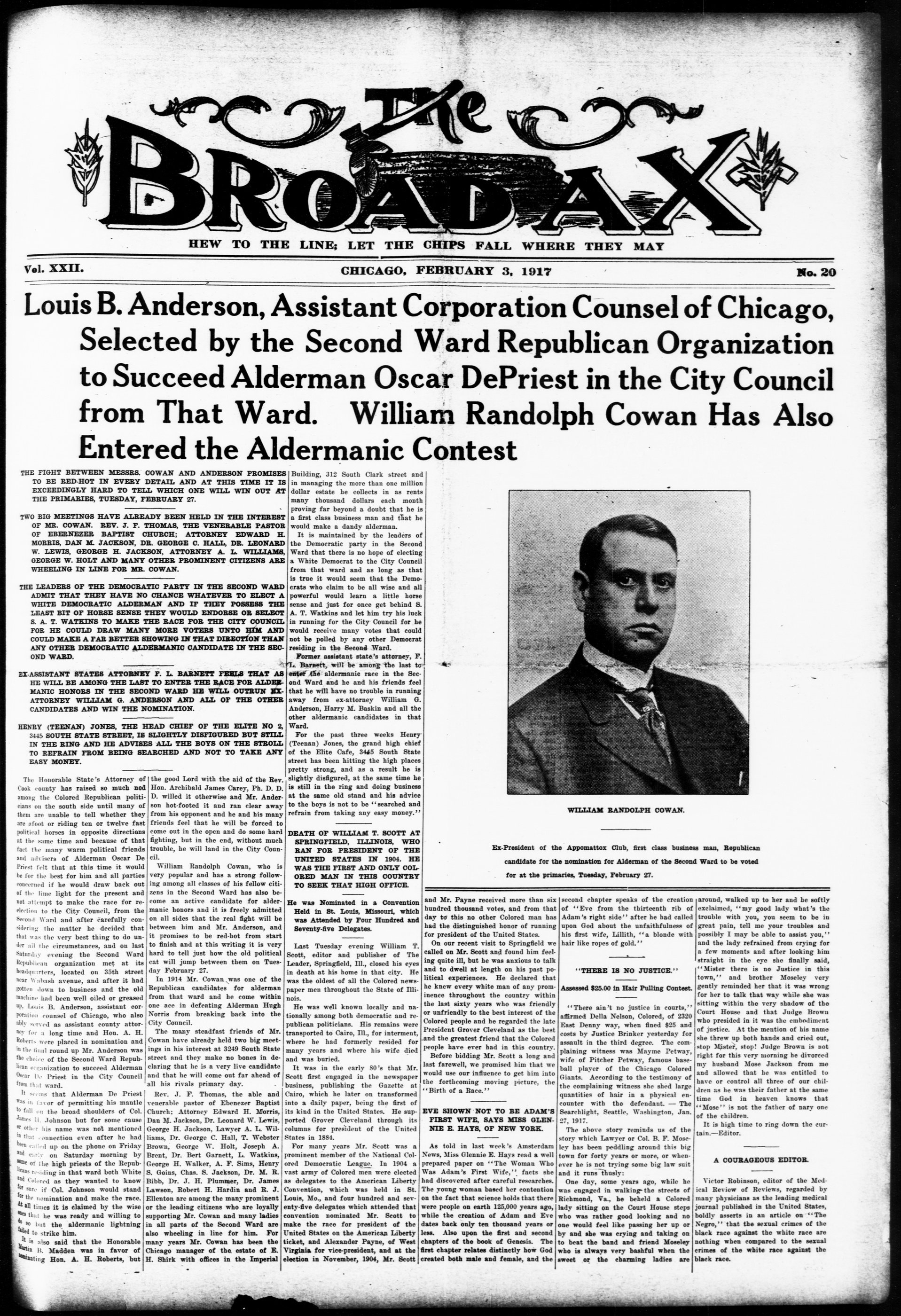
Louis B. Anderson, Assistant Corporation Counsel of Chicago, Selected by the Second Ward Republican Organization to Succeed Alderman Oscar DePriest in the City Council from That Ward. William Randolph Cowan Has Also Entered the Aldermanic Contest
THE FIGHT BETWEEN MESSRS. COWAN AND ANDERSON PROMISES TO BE RED-HOT IN EVERY DETAIL AND AT THIS TIME IT IS EXCEEDINGLY HARD TO TELL WHICH ONE WILL WIN OUT AT THE PRIMARIES, TUESDAY, FEBRUARY 27.
TWO BIG MEETINGS HAVE ALREADY BEEN HELD IN THE INTEREST OF MR. COWAN. REV. J. P. THOMAS, THE VENERABLE PASTOR OF EBERNEZER BAPTIST CHURCH; ATTORNEY EDWARD H. MORRIS, DAN M. JACKSON, DR. GEORGE C. HALL, DR. LEONARD W. LEWIS, GEORGE H. JACKSON, ATTORNEY A. L. WILLIAMS, GEORGE W. HOLT AND MANY OTHER PROMINENT CITIZENS ARE WHEELING IN LINE FOR MR. COWAN.
THE LEADERS OF THE DEMOCRATIC PARTY IN THE SECOND WARD ADMIT THAT THEY HAVE NO CHANCE WHATEVER TO ELECT A WHITE DEMOCRATIC ALDERMAN AND IF THEY POSSESS THE LEAST BIT OF HORSE SENSE THEY WOULD ENDORSE OR SELECT S. A. T. WATKINS TO MAKE THE RACE FOR THE CITY COUNCIL FOR HE COULD DRAW MANY MORE VOTERS UNTO HIM AND COULD MAKE A FAR BETTER SHOWING IN THAT DIRECTION THAN ANY OTHER DEMOCRATIC ALDERMANIC CANDIDATE IN THE SECOND WARD.
EX-ASSISTANT STATES ATTORNEY P. L. BARNETT PEELS THAT AS HE WILL BE AMONG THE LAST TO ENTER THE RACE FOR ALDERMANIC HONORS IN THE SECOND WARD HE WILL OUTRUN EX-ATTORNEY WILLIAM G. ANDERSON AND ALL OF THE OTHER CANDIDATES AND WIN THE NOMINATION.
HENRY (TEENAN) JONES, THE HEAD CHIEF OF THE ELITE NO 2
3445 SOUTH STATE STREET, IS SLIGHTLY DISFIGURED BUT STILL
IN THE RING AND HE ADVISES ALL THE BOYS ON THE STROLL
TO REFRAIN FROM BEING SEARCHED AND NOT TO TAKE ANY
EASY MONEY.
Vol. XXII.
Louis B. A.
Select
to Sue
from
Enter
THE FIGHT BETWEEN MESSRS.
TO BE RED-HOT IN EVERY
EXCEEDINGLY HARD TO TEEN
THE PRIMARIES, TUESDAY, E
TWO BIG MEETINGS HAVE ALREA
OF MR. COWAN. REV. J. F.
OF EBERNEZER BAPTIST C
MORRIS, DAN M. JACKSON, I
W. LEWIS, GEORGE H. JACE
GEORGE W. HOLT AND MANY
WHEELING IN LINE FOR MR.
THE LEADERS OF THE DEMOCRATIC
ADMIT THAT THEY HAVE NO
WHITE DEMOCRATIC ALDER,
LEAST BIT OF HORSE SENSE
S. A. T. WATKINS TO MAKE
FOR HE COULD DRAW MANY
COULD MAKE A FAR BETTER S
ANY OTHER DEMOCRATIC AL
OND WARD.
EX-ASSISTANT STATES ATTORNEY
HE WILL BE AMONG THE LAST
MANIC HONORS IN THE SEC
ATTORNEY WILLIAM G. AND
CANDIDATES AND WIN THE M
HENRY (TEENAN) JONES, THE B
3445 SOUTH STATE STREET, IS
IN THE RING AND HE ADVISI
TO REFRAIN FROM BEING S
EASY MONEY.
The Honorable State's Attorney of Cook county has raised so much need among the Colored Republican politicians on the south side until many of them are unable to tell whether they are afoot or riding ten or twelve fast political horses in opposite directions at the same time and because of that fact the many warm political friends and advisers of Alderman Oscar De Priest felt that at this time it would be for the best for him and all parties concerned if he would draw back out of the lime light for the present and not attempt to make the race for reelection to the City Council, from the Second Ward and after carefully considering the matter he decided that that was the very best thing to do under all the circumstances, and on last Saturday evening the Second Ward Republican organization met at its headquarters, located on 35th street near Wabash avenue, and after it had gotten down to business and the old machine had been well oiled or greased up, Louis B. Anderson, assistant corporation counsel of Chicago, who also served as assistant county attorney for a long time and Hon. A. H. Roberts were placed in nomination and in the final round up Mr. Anderson was the choice of the Second Ward Republican organization to succeed Alderman Oscar De Priest in the City Council from that ward.
It seems that Alderman De Priest was in favor of permitting his mantle to fall on the broad shoulders of Col. James H. Johnson but for some cause or other his name was not mentioned in that connection even after he had been called up on the phone on Friday and early on Saturday morning by some of the high priests of the Republicans residing in that ward both White and Colored as they wanted to know for sure if Col. Johnson would stand for the nomination and make the race. At all times it is claimed by the wise ones that he was ready and willing to do so but the aldermanic lightning failed to strike him.
It is also said that the Honorable Martin B. Madden was in favor of nominating Hon. A. H. Roberts, but
the good Lord with the aid of the Rev Hon. Archibald James Carey, Ph. D. D. d willed it otherwise and Mr. Anderson hot-footed it and ran clear away from his opponent and he and his many friends feel that he will be forced to come out in the open and do some hard fighting, but in the end, without much trouble, he will land in the City Council.
William Randolph Cowan, who is very popular and has a strong following among all classes of his fellow citizens in the Second Ward has also become an active candidate for aldermanic honors and it is freely admitted on all sides that the real fight will be between him and Mr. Anderson, and it promises to be red-hot from start to finish and at this writing it is very hard to tell just how the old political cat will jump between them on Tuesday February 27.
In 1914 Mr. Cowan was one of the Republican candidates for alderman from that ward and he come within one ace in defeating Alderman Hugh Norris from breaking back into the City Council.
The many steadfast friends of Mr. Cowan have already held two big meetings in his interest at 3249 South State street and they make no bones in declaring that he is a very live candidate and that he will come out far ahead of all his rivals primary day.
Rev. J. F. Thomas, the able and venerable pastor of Ebenezer Baptist Church; Attorney Edward H. Morris, Dan M. Jackson, Dr. Leonard W. Lewis, George H. Jackson, Lawyer A. L. Williams, Dr. George C. Hall, T. Webster Brown, George W. Holt, Joseph A. Brent, Dr. Bert Garnett, L. Watkins, George H. Walker, A. F. Sims, Henry S. Goins, Chas. S. Jackson, Dr. M. R. Bibb, Dr. J. H. Plummer, Dr. James Lawson, Robert H. Hardin and R. J. Ellenton are among the many prominent or the leading citizens who are loyally supporting Mr. Cowan and many ladies in all parts of the Second Ward are also wheeling in line for him. For many years Mr. Cowan has been the Chicago manager of the estate of E. H. Shirk with offices in the Imperial
CHICAGO, FEBRUARY 3, 1917
Building, 312 South Clark street and in managing the more than one million dollar estate he collects in as rents many thousand dollars each month proving far beyond a doubt that he is a first class business man and that he would make a dandy alderman.
It is maintained by the leaders of the Democratic party in the Second Ward that there is no hope of electing a White Democrat to the City Council from that ward and as long as that is true it would seem that the Democrats who claim to be all wise and all powerful would learn a little horse sense and just for once get behind S. A. T. Watkins and let him try his luck in running for the City Council for he would receive many votes that could not be polled by any other Democrat residing in the Second Ward.
Former assistant state's attorney, F. L. Barnett, will be among the last to enter the aldermanic race in the Second Ward and he and his friends feel that he will have no trouble in running away from ex-attorney William G. Anderson, Harry M. Baskin and all the other aldermanic candidates in that Ward.
For the past three weeks Henry (Teenan) Jones, the grand high chief of the Elite Cafe, 3445 South State street has been hitting the high places pretty strong, and as a result he is slightly disfigured, at the same time he is still in the ring and doing business at the same old stand and his advice to the boys is not to be "searched and refrain from taking any easy money."
DEATH OF WILLIAM T. SCOTT AT SPRINGFIELD, ILLINOIS, WHO RAN FOR PRESIDENT OF THE UNITED STATES IN 1904. HE WAS THE FIRST AND ONLY COLORED MAN IN THIS COUNTRY TO SEEK THAT HIGH OFFICE.
He was Nominated in a Convention Held in St. Louis, Missouri, which was Attended by Four Hundred and Seventy-five Delegates.
Last Tuesday evening William T. Scott, editor and publisher of The Leader, Springfield, Ill., closed his eyes in death at his home in that city. He was the oldest of all the Colored newspaper men throughout the State of Illinois.
He was well known locally and nationally among both democratic and republican politicians. His remains were transported to Cairo, Ill., for interment where he had formerly resided for many years and where his wife died and was buried.
It was in the early 80's that Mr. Scott first engaged in the newspaper business, publishing the Gazette at Cairo, which he later on transformed into a daily paper, being the first of its kind in the United States. He supported Grover Cleveland through its columns for president of the United States in 1884.
For many years Mr. Scott was a prominent member of the National Colored Democratic League. In 1904 a vast army of Colored men were elected as delegates to the American Liberty Convention, which was held in St. Louis, Mo., and four hundred and seventy-five delegates which attended that convention nominated Mr. Scott to make the race for president of the United States on the American Liberty ticket, and Alexander Payne, of West Virginia for vice-president, and at the election in November, 1904, Mr. Scott
COLLEGE
Ex-President of the Appomattox Club, first class business man, Republican candidate for the nomination for Alderman of the Second Ward to be voted for at the primaries, Tuesday, February 27.
and Mr. Payne received more than six hundred thousand votes, and from that day to this no other Colored man has had the distinguished honor of running for president of the United States. On our recent visit to Springfield we called on Mr. Scott and found him feeling quite ill, but he was anxious to talk and to dwell at length on his past political experiences. He declared that he knew every white man of any prominence throughout the country within the last sixty years who was friendly or unfriendly to the best interest of the Colored people and he regarded the late President Grover Cleveland as the best and the greatest friend that the Colored people have ever had in this country. Before bidding Mr. Scott a long and last farewell, we promised him that we would use our influence to get him into the forthcoming moving picture, the "Birth of a Race."
EVE SHOWN NOT TO BE ADAM'S
FIRST WIFE, SAYS MISS GLEN-
NIE E. HAYS, OF NEW YORK.
As told in last week's Amsterdam News, Miss Glennie E. Hays read a well prepared paper on "The Woman Who Was Adam's First Wife," facts she had discovered after careful researches, the young woman based her contention on the fact that science holds that there were people on earth 125,000 years ago, while the creation of Adam and Eve dates back only ten thousand years or less. Also upon the first and second chapters of the book of Genesis. The first chapter relates distinctly how God created both male and female, and the
second chapter speaks of the creation of "Eve from the thirteenth rib of Adam's right side" after he had called upon God about the unfaithfulness of his first wife, Lillith, "a blonde with hair like ropes of gold."
"THERE IS NO JUSTICE."
Assessed $25.00 in Hair Pulling Contest
"There ain't no justice in courts," affirmed Della Nelson, Colored, of 2320 East Denny way, when fined $25 and costs by Justice Brinker yesterday for assault in the third degree. The complaining witness was Mayme Petway, wife of Pitcher Petway, famous baseball player of the Chicago Colored Giants. According to the testimony of the complaining witness she shed large quantities of hair in a physical encounter with the defendant. — The Searchlight, Seattle, Washington, Jan. 27, 1917.
The above story reminds us of the story which Lawyer or Col. B. F. Moseley has been peddling around this big town for forty years or more, or whenever he is not trying some big law suit and it runs thusly:
One day, some years ago, while he was engaged in walking the streets of Richmond, Va., he beheld a Colored lady sitting on the Court House steps who was rather good looking and no one would feel like passing her up or by and she was crying and taking on to beat the band and friend Moseley who is always very bashful when the sweet or the charming ladies are
No.20
around, walked up to her and he softly exclaimed, "my good lady what's the trouble with you, you seem to be in great pain, tell me your troubles and possibly I may be able to assist you," and the lady refrained from crying for a few moments and after looking him straight in the eye she finally said, "Mister there is no Justice in this town," and brother Moseley very gently reminded her that it was wrong for her to talk that way while she was sitting within the very shadow of the Court House and that Judge Brown who presided in it was the embodiment of justice. At the mention of his name she threw up both hands and cried out, stop Mister, stop! Judge Brown is not right for this very morning he divorced my husband Mose Jackson from me and allowed that he was entitled to have or control all three of our children as he was their father at the same time God in heaven knows that "Mose" is not the father of nary one of the children. It is high time to ring down the curtain—Editor.
A COURAGEOUS EDITOR
Victor Robinson, editor of the Medical Review of Reviews, regarded by many physicians as the leading medical journal published in the United States, boldly asserts in an article on "The Negro," that the sexual crimes of the black race against the white race are nothing when compared to the sexual crimes of the white race against the black race.
Dan M. Jackson
Geo. T. Kersey
David A. McGowan
Ahmed A. Rayner
The Emanuele
Undertaking
2959-61 South
Reliable Service
Reasonable
Reliable Service & Courteous Treatment
Reasonable Prices
FREE CHAPEL IN CONNECTION
Complete line of Funeral Goods. Automobiles for hire
Telephone Douglas 6568 Automatic 73-657
THE SOLACE BILLIARD ACADEMY
"THE MODERN SCHOOL" - CLEAN AND RELIABLE
TERREVOUS L. DOUGLAS, Prop.
CIGARS—WHOLESALE AND RETAIL
BOX TRADE A SPECIALTY
3556 South State Street
Real Estate Brokers
RENTING :: LOANS ::
5107 South State Street
Chicago
TEACHING INDIANS IS THIS WOMAN'S HOBBY
Mrs. Molineux Declares Red Man Can Be Led, but Will Not Be Driven.
Salt Lake City.—To have mothered one or possibly two tiny lives through the strenuous days of early infancy is a task that most women consider plenty, but Mrs. Elizabeth Molineux, until recently a teacher in the United States Indian service, has the distinction of having mothered a whole tribe of Plute Indians, and claims the satisfaction of having raised them, old and young, from a condition bordering on the squalid state where they consider cleanliness next to godliness and, one and all, are heartily in favor of both.
Mrs. Molneux recently resigned her post as teacher on the Shivwits reservation in southern Utah and is in Salt Lake resting preparatory to going to Ketchikan, Alaska, to take charge of the Episcopal church's mission school there. She is a guest at the home of the Right Rev. Paul Jones, bishop of the Episcopal diocese of Utah, while here.
Indians have become a hobby with this diminutive little Scotchwoman, She speaks their languages and in her eight years of service with the Indian department has been intimately associated with the trials and tribulations that beset poor Lo on his native heath. Mrs. Molineux is an ardent churchwoman and attributes her success in dealing with Indians to the fact that by blending religious teachings with the "three R's" she has dismissed distrust of her from the minds of her charges and has always been regarded by them more in the light of a friend than a teacher. She declared the Indian mind to be susceptible to teaching if properly approached, but adds that he can be led but will not be driven.
CHASING A COYOTE IN AUTO EXCITING SPORT
Hound, Sighting Game, Leaps Over Mud Shield and Lands Twenty Feet Ahead of Car.
Larned, Kan.—An exciting coyote chase in automobiles took place near Hanston. The party consisted of Bill Hann, John Hann, Mr. and Mrs. Irvin Seaman and William Warring. They went in two cars and took three grey-hounds in each car.
Mr. Warring says that auto polo is mild compared with the way those two cars chased across the prairie, ravines and bluffs after coyotes. He said that his speedometer registered forty miles one time when he dared to glance at it, and he was afraid to look again.
They were going along between twenty and thirty miles an hour at the time they started up the first coyote, and when the biggest hound in Mr. Waring's car sighted the wolf it leaped over the wind shield and hood and landed running twenty feet ahead of the car. The coyote was a big fellow, but the hounds finally brought him down, the big hound throwing him, while the others pinned him down.
While chasing the first coyote the other auto nearly ran over another one, which leaped up almost from under the wheels of the car. The men shot at it several times, wounding it, but because of the speed of the bounding car could get but poor aim. It finally ran into a hole and was dished out with a wire. Messrs. Hann and Seaman have killed many coyotes.
---
PAGE TWO
PH ONE DREXEL 3244
Phones Calumet 6164
Automatic 71-629
OPEN DAY
AND NIGHT
Juel Jackson
Bug Co., Inc.
South State St.
Courteous Treatment
Sale Prices
Automobles for hire
Automatic 73-657
BILLIARD ACADEMY
- CLEAN AND RELIABLE
DOUGLAS, Prop.
RES. PHONE DREXEL 2082
ANS :: INSURANCE
A State Street
Chicago
The Famous "Green Man of Brighton." In October, 1806, an individual was to be observed at Brighton, England, who walked out every day dressed in green from head to foot—green shoes, green gloves, green handkerchief and other articles to match. This eccentric person lived alone, knew nobody, and in his house the curtains, the wall paper, the furniture, even the plates and dishes and the smallest toilet articles, offered an uninterrupted sequence of green. Having started on his career, there was obviously no reason to stop, and with full consistency he carried his scruples so far as to eat nothing but fruit and vegetables of the same green color. The consequences were extremely disastrous. One fine day the green man jumped from his window into the street, rushed forward and performed a second somersault from the top of the nearest cliff.
In the angle between the Kings and Kern canyons lies a woodland empire beside which the Harz and Black forest of Germany would appear almost diminutive. Within the borders of the Sequoia National park and the General Grant National park near by there are no fewer than 1,166,000 sequoia trees, and of these 12,000 are more than ten feet in diameter. In the Sequoia National park stands the largest tree in the world—not the tallest, but the largest—the General Sherman tree, with a diameter of 36.5 feet and a height of 279.9 feet. Its massive trunk and branches contain about 1,000,000 feet of lumber, board measure. This is equal to the amount of lumber that is cut from forty acres of average Minnesota timberland—Arconaut.
Self Convicted
"Say, pa," queried small Bobby, "what is gossiping, anyway?" "Gossiping, my son," replied the old man, "if we get right down to the plain, unvarnished facts, is lying. But why do you ask?" "Because," answered the young investigator, "ma says you do a lot of gossiping every time your business keeps you late at the office."—Exchange.
Too Much Practice.
Does your minister practice what he preaches?" the newcomer questioned. "He does," the citizen answered, with a sigh, "and I'd be perfectly willing to have him stop. He lives next door to me and begins at 7 o'clock Sunday morning to practice what he is going to preach."—New York Times.
Scene—Pollice court during dispute over eight day clock.
Magistrate—I award the clock to the plaintiff.
Defendant—Then what do I get?
Magistrate—I'll give you the eight days.
London Stray Stories.
Sharks and Death.
There is an old yet still operative superstition among seafaring men that when a shark persistently follows a vessel it is a sign that some person on board is going to die, the alleged reason being that the great fish can scent death.
Fashionable.
Willie—Paw, what is a fashionable resort? Paw—A place where you can obtain the least comfort and the most style for the most money, my son.—Cincinnati Enquirer.
Oh, how bitter a thing it is to look into happiness through another man's eyes! "As You Like It" II, 1.
Chicago
Chioago
Some Trees.
Divided It
THE BROAD AX. CHICAGO, FEBRUARY 3, 1917.
Crude Stone Idol Probably Antedates Indian Mound Builders.
Madisonville, Ky.-E. L. Littlepage of the Morton Gap country brought to this place recently a stone image that is a curiosity and probably of historic value.
Mr. Littlepage found it at the edge of a cave on a high elevation in North Christian county, Ky., while investigating some prospective oil land belonging to him. The cave is located in a wild and broken section of land unculivated and but thinly inhabited.
The image is rudely carved out of a tough, ferrous sandstone. It is about six inches in height and is well preserved, except for a slight injury on one side of its head and slight weathering of one arm. The figure is in a sitting position, with its legs doubled under its body and arms extended in front, with hands resting on its knees.
The image is evidently a relic of an idol worshiping people and antedates any old Indian relic found in various Indian mounds in western Kentucky.
Turns Commissioners From Those Planted by Her Husband.
St. Cloud, Mich.—"Woodman, spare that tree; touch not a single bough."
Thus quoted Mrs. Mary Splcer, widow, as she pleaded for the preservation of trees planted by her husband, long dead.
It was three years ago that Mrs. Splcer started her battle with city officials over the maintenance of this arborian inheritance. She was called upon to enter another skirmish the other day when sidewalk bids were opened, in which provision was to have been made for the removal of the trees.
Mrs. Spicer's "pets" fringe a lot on which her modest little home is built. "Wait until I am gone and you may remove them," she told the city commissioners, who took her words to heart. When sidewalk bids were opened there were proposed contracts on other jobs, but on the Widow Spicer's property—not a word.
EIGHTY, WANTS HEART BALM
Woman Is Deaf, Has Lost Right Eye and is a Little Lame.
Utica, N. Y.-Mrs. Almira Kingsbury is just a little on the right side of eighty years old. She is rather deaf. She has lost her right eye and her left thumb. Besides she is a little lame.
But she took the stand to testify that Robert Roberts of Trenton, seventy-six years old and a farmer, had been so smitten with her charms at first sight that he urged her to marry him. Then she said he broke troth and she sued for breach of promise. They met at an employment agency where he sought a housekeeper.
Judge Hazard told Mrs. Kingsbury's attorney, "I think your client is clearly entitled to about 6 cents." However, the case was held open for more evidence.
GIRL JILTS ARE FALSE,
SAYS PROFESSOR SHAW
Don't Believe Her When She Says She'll Be Your Friend.
New York.—"When a girl says, 'I cannot be your wife, but I'll be your friend,' she tries to speak the truth, but utters a psychological falsehood," declared Professor Charles Gray Shaw, head of the philosophy department of the New York university, in a lecture at the institution.
Professor Shaw argued that no woman could be a friend to men or to women, because a friend requires a clear cut personality and a disinterested outlook on life. Both of these, he asserted, women lack. He also declared that friendships between men were passing from the earth.
"Woman cannot be a friend because she is never an individual, for to be an individual one must stand alone," he said. "Only those who stand alone can come together."
Professor Shaw said that woman was like a planet—well adapted to revolve about some center, "but not organized in such a way as to stand alone."
"Unfortunately, masculine friendships are just passing from the earth, and in the course of time friends will be found only in museums, along with other aboriginal products. This melancholy situation is due to the fact that modern life tends to destroy personality and a philosophic view of the world. Man is bound to man not by ties of friendship, but by bonds of professionalism which are usually of a commercial character."
INDIAN TRIBES USE
WHISTLING LANGUAGE
Able to Express Their Thoughts Perfectly by Its Use, Says Mining Engineer.
Carlisle, Pa.—That entire tribes of Indians in Mexico carry on long conversations by means of whistling is asserted by Harold T. Mapes, mining engineer, who was for twelve years in Mexico, but now lives in Carlisle.
Mapes declares that the Indians have a whistling language and are able to express their thoughts perfectly by its use. He says it is not a series of signs or calls signifying danger, love, fear, peace, war, etc., but a regular language, by which the most subtle shades of thought may be expressed.
Like people in other parts of the world, the Mexican Indians occasionally whistle for their dinners, only they are able to explain by their whistles exactly what kind of a dinner they want—either a simple meal of tortillas and frioles or a more elaborate feast of enchiladas and mole guajalote, with cervez or vino.
Mapes says that he understands that the whistling language has been handed down from generation to generation from the time of the Toltecs and Aztecs and that Indian lovers can put a world of tenderness and passion into their whistled declarations of love or stir their fellows to heroic deeds by the fierceness with which they whistle a call to arms.
A whistling language has been used from time immemorial by the Swiss mountainers, and Neapolitan sailors converse frequently by means of whistling. Convicts in the big jails in Naples converse freely by means of whistling, and there is apparently no limit to their whistling vocabulary.
BIRD DOG WEARS GLASSES.
Georgia Setter Does Good Work After Visit to Oculist.
Moultrie, Ga.-Fanny, a thoroughbred setter, wears spectacles. She was fitted with glasses by an oculist, who found that she had astigmatism.
For years Fanny has been known as one of the best hunting dogs in this section. Before the opening of the quail season this year she went to the fields by herself and on returning showed evidence of bad falls. Fanny could not help falling into ditches and running into trees. Then it was discovered that her eyes had become affected.
It is believed the glasses will correct the trouble. At least Fanny now is doing her work as well as usual.
HE KNEW.
Austrian Tells Who It Is That Elects a President.
Hammond, Ind.—Jorn Bosovich, late of Austria, applied to the federal court for citizenship papers. Clerk Hemstock put the questions and got these answers:
"Who is president of the United States?"
"Mr. Wilson."
"Who makes the laws?"
"The congress."
"Who elects the president?"
"California."
He got the papers.
Bank Robber Returns $5
Scranton, Pa.—A letter with $5 inclosed has been received by the Pine Brook bank. The letter said that the writer held up the teller and took the money at the point of a revolver. "I am taking the first opportunity to pay it back," said the letter, which was postmarked Moscow, Pa. The bank officials will have the missive framed. The robber entered the bank and pointing a revolver at the teller, George Browning, demanded $25. Browning handed out $5, which satisfied him.
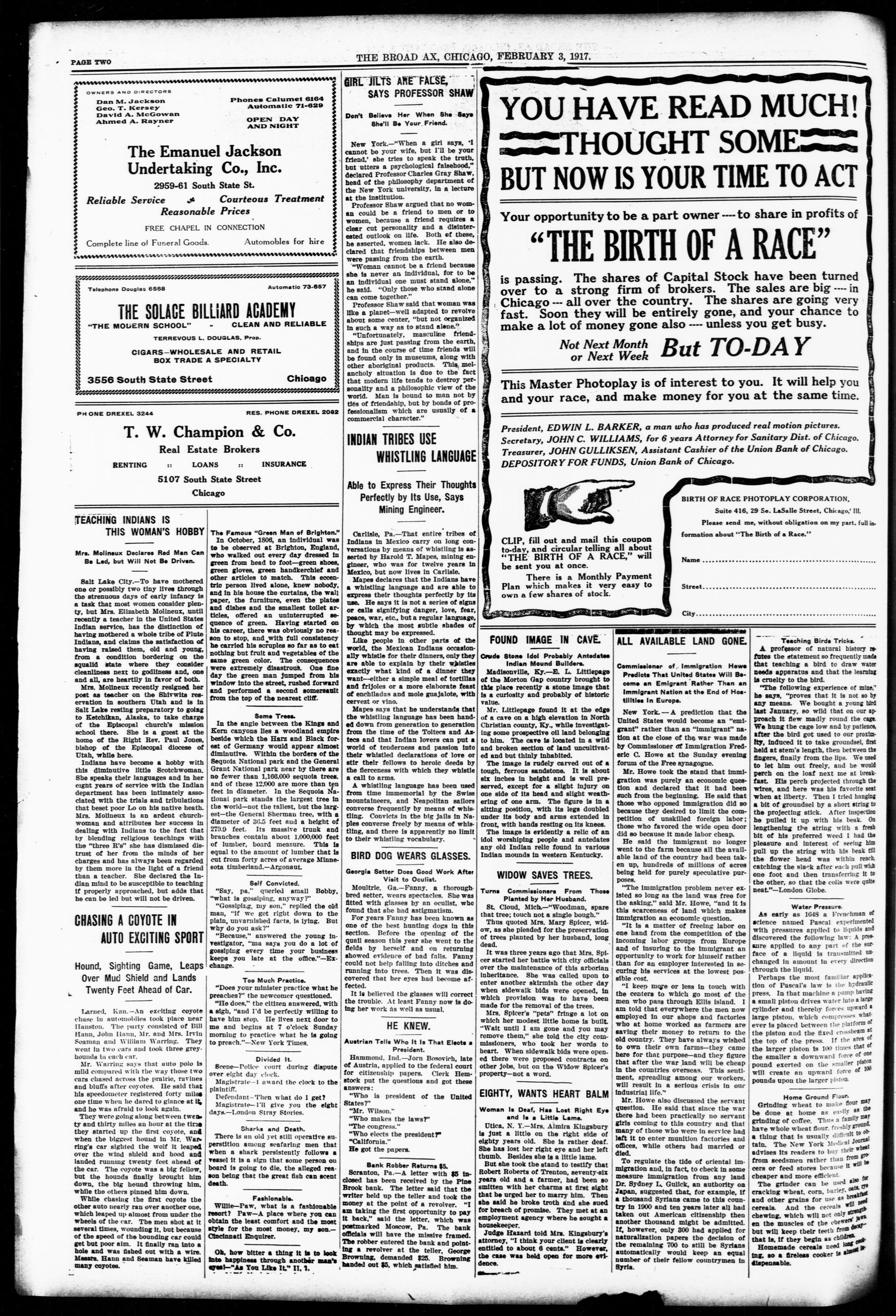
YOU HAVE READ MUCH! THOUGHT SOME BUT NOW IS YOUR TIME TO ACT
is passing. The shares of Capital Stock have been turned over to a strong firm of brokers. The sales are big --- in Chicago --- all over the country. The shares are going very fast. Soon they will be entirely gone, and your chance to make a lot of money gone also --- unless you get busy.
Not Next Month But TO-DAY
This Master Photoplay is of interest to you. It will help you and your race, and make money for you at the same time.
President, EDWIN L. BARKER, a man who has produced real motion pictures. Secretary, JOHN C. WILLIAMS, for 6 years Attorney for Sanitary Dist. of Chicago. Treasurer, JOHN GULLIKSEN, Assistant Cashier of the Union Bank of Chicago. DEPOSITORY FOR FUNDS, Union Bank of Chicago.
CLIP, fill out and mail this coupon to-day, and circular telling all about "THE BIRTH OF A RACE," will be sent you at once. There is a Monthly Payment Plan which makes it very easy to own a few shares of stock.
ALL AVAILABLE LAND GONE
Commissioner of Immigration Howe Predicts That United States Will Become an Emigrant Rather Than an Immigrant Nation at the End of Hostilities In Europe.
New York.—A prediction that the United States would become an "emigrant" rather than an "immigrant" nation at the close of the war was made by Commissioner of Immigration Frederic C. Howe at the Sunday evening forum of the Free synagogue.
Mr. Howe took the stand that immigration was purely an economic question and declared that it had been such from the beginning. He said that those who opposed immigration did so because they desired to limit the competition of unskilled foreign labor; those who favored the wide open door did so because it made labor cheap.
He said the immigrant no longer went to the farm because all the available land of the country had been taken up, hundreds of millions of acres being held for purely speculative purposes.
"The immigration problem never existed so long as the land was free for the asking," said Mr. Howe, "and it is this scarceness of land which makes immigration an economic question.
"It is a matter of freeing labor on one hand from the competition of the incoming labor groups from Europe and of insuring to the immigrant an opportunity to work for himself rather than for an employer interested in securing his services at the lowest possible cost.
"I keep more or less in touch with the centers to which go most of the men who pass through Ellis island. I am told that everywhere the men now employed in our shops and factories who at home worked as farmers are saving their money to return to the old country. They have always wished to own their own farms—they came here for that purpose—and they figure that after the war land will be cheap in the countries overseas. This sentiment, spreading among our workers, will result in a serious crisis in our industrial life."
Mr. Howe also discussed the servant question. He said that since the war there had been practically no servant girls coming to this country and that many of those who were in service had left it to enter munition factories and offices, while others had married or died.
To regulate the tide of oriental immigration and, in fact, to check in some measure immigration from any land Dr. Sydney L. Gulluck, an authority on Japan, suggested that, for example, if a thousand Syrians came to this country in 1900 and ten years later all had taken out American citizenship then another thousand might be admitted. If, however, only 300 had applied for naturalization papers the decision of the remaining 700 to still be Syrians automatically would keep an equal number of their fellow countrymen in Syria.
1
FOUND IMAGE IN CAVE.
WIDOW SAVES TREES.
Please send me, without obligation on my part, full information about "The Birth of a Race."
A professor of natural history refutes the statement so frequently made that teaching a bird to draw water needs apparatus and that the learning is cruelty to the bird.
"The following experience of mine," he says, "proves that it is not so by any means. We bought a young bird last January, so wild that on our approach it few madly round the cage. We hung the cage low and by patience, after the bird got used to our proximity, induced it to take groundsel, first held at stem's length, then between the fingers, finally from the lips. We used to let him out freely, and he would perch on the loaf next me at breakfast. His perch projected through the wires, and here was his favorite seat when at liberty. Then I tried hanging a bit of groundsel by a short string to the projecting stick. After inspection he pulled it up with his beak. On lengthening the string with a fresh bit of his preferred weed I had the pleasure and interest of seeing him pull up the string with his beak till the flower head was within reach, catching the slack after each pull with one foot and then transferring it to the other, so that the coils were quite neat."—London Globe.
Water Pressure.
As early as 1648 a Frenchman of science named Pascal experimented with pressures applied to liquids and discovered the following law: A pressure applied to any part of the surface of a liquid is transmitted unchanged in amount in every direction through the liquid.
Perhaps the most familiar application of Pascal's law is the hydraulic press. In that machine a pump having a small piston drives water into a large cylinder and thereby forces upward a large piston, which compresses whatever is placed between the platform of the piston and the fixed crossbeam at the top of the press. If the area of the larger piston is 100 times that of the smaller a downward force of one pound exerted on the smaller piston will create an upward force of 100 pounds upon the larger piston.
Home Ground Flour
Grinding wheat to make flour may be done at home as easily as the grinding of coffee. Thus a family may have whole wheat flour, freshly ground, a thing that is usually difficult to obtain. The New York Medical Journal advises its readers to buy their wheat from seedsoenm rather than from grocers or feed stores because it will be cheaper and more efficient. The grinder can be used also for cracking wheat, corn, barley, oat, and other grains for use as breakfast cereals. And the cereals will need chewing, which will not only strengthen the muscles of the chewers' jaw but will keep their teeth from decay—that is, if they begin as children. Homemade cereals need long cooking, so a fireless cooker is almost indispensable.
SHOPS AND PLANTS FAVOR INDUSTRIAL BETTERMENT WORK
Actively Aid Welfare Plans of Every Description For Employees.
PHILANTHROPY NOT INTENT.
Comfort and Contentment of the Workers Considered Paramount.
Hundreds of millions of dollars have been expended during the past decade by American manufacturers for those forms of industrial betterment, in behalf of employees, that are generally classed as philanthropic or beyond the mere requirements of laws and contracts.
Decent manufacturers—and they are in the vast majority—as are the decent people of other classes—are opposed to grinding child labor, and they strive to pay a living wage to all of their employees. They go much farther than that, as a study of American industry will show. They devote time, money and effort to provide every possible supplementary means for promoting the convenience, the comfort, the health, contentment and happiness of their workers and of the families of employees. Very few manufacturers consider such work or expenditure to be philanthropy, but, rather, a necessary feature of their business. While their motives may be as altruistic as those of the average of mankind, they find that it is good, from the business point of view, to promote as far as possible the welfare of their employees. Industrial betterment pays.
Industrial betterment means an attempt to provide the best kind of working and living conditions, and it implies the co-operative responsibility of the wage earner and the employer in bringing those conditions about and in improving them from time to time. It is not a dole to be handed to the wage earner, but is a token of that spirit of mutuality which, under right conditions, should permeate industry.
A thorough description of industrial betterment activities in the United States would require more space than is contained in the most voluminous encyclopaedias to be found in the libraries. Indeed, volumes might be written about the welfare work of a single corporation alone—the National Cash Register Company, for instance, or the International Harvester Company, the United States Steel Corporation, Cheney Brothers, the Curtis Publishing Company, the Bethlehem Steel Company, the American Telephone and Telegraph Company, the Eastman Kodak Company, any one of the leading railroad companies, the principal banks, Wanamaker's, or any of a host of other concerns which has developed activities of the sort. There is hardly a concern in the country doing business on a fairly extensive scale that has not initiated some form of industrial betterment for its employees. The honors do not go to the larger companies exclusively either, for many of the smaller business units have developed this side of their activities to a remarkable extent. Naturally it is easier for the larger corporations to put highly trained specialists in charge of the various branches of industrial betterment work.
The fundamentals of industrial betterment are observed in furnishing pleasant, sanitary, safe working conditions. Educational and entertainment features, facilities for study and recreation, special opportunities for the exercise of thrift and provisions tending to remove the dread of and to mitigate the sufferings occasioned by sickness, disability or invalidity are matters which next receive attention. Well lighted, well ventilated and otherwise pleasant and safe working places, restaurants, reading rooms and libraries, rest rooms, emergency kits and hospitals, club rooms, assembly rooms, gymnasiums, lockers and bathing facilities, recreation grounds, bonus and profit sharing plans, special housing accommodations, facilities for the purchase of homes on easy payments, discounts in the purchase of goods, industrial and other educational classes, lectures for entertainment or instruction, moving pictures, excursions, field days, medical attendance, safety committees for accident and fire prevention, sickness, disability and invalidity funds, insurance or benefit associations and pensions are some of the customary features of industrial betterment work, the variety of which has no limit.
Tens of thousands of lives are saved each year and hundreds of thousands of lesser accidents are prevented annually through the accident prevention campaign and feature of industrial betterment. The Eastern Kodak Company in five years reduced the accidents in its plants by over 75 per cent per annum through a progressive safety campaign. The Pennsylvania Railroad in ten months decreased the serious injuries of its 33,242 shop employees over 63 per cent by the installation of safety devices and by the constant instruction of the workmen in exercising due caution. As a result of its safety campaign the United States Steel Corporation reduced serious and fatal accidents in its various plants by 46 per cent since 1906. Each year 2200 of the men employed by the corporation escape who would have been injured under the previous conditions.
GET TOGETHER FOR PERMANENT PROSPERITY.
Every man and woman engaged in American factories, mills and mines, whether they know English or speak it, are naturalized or intend to become citizens, have a direct interest in maintaining industrial prosperity. When times are good, all workers should not only be thrifty in habit and lay up a little something for possible rainy days, but they should do all they can to keep the good times with us. Simply because your language is different from that of the foreman, overseer, superintendent, manager or owner of the plant in which you earn a living, is no excuse for misunderstanding your own common interest in prosperity by hating your partner in your own industry or listening to and following the gospel of dissension and violence which selfish agitators so often prosec
Do not blindly follow the man who tells you how hard your lot is. Often he is doing so untruthfully and for the purpose of getting you to contribute membership money for his own support in idleness. Agitators get rich by preying on the men in American industry, whom they urge into unlawful or harmful acts by misrepresenting conditions or holding out foolish and false promises of better things if they follow their orders. You know conditions yourself, and you know or ought to know that the man or men whom the agitator who pictures your employer as on inhuman driving machine is actually a partner with you, interested in having the plant or industry successful
The more successful your plant or industry becomes, the more room for you to grow with it there will be. It should be your feeling, then, that you will not do as little as you may find it convenient to do, but to do just as much as you possibly can do, and then reasonably expect to share in the rewards that always come to the efficient worker.
Do not be a clock watcher in the factory. Those who wait for hours to strike or whistles to blow and "soldier" at the bench, machine or in the office, never get ahead in the ranks of industry. They never get any more pay because they are not worth any more, and often are worth less than they get. Remember the old adage that a man who never does any more or as much as he gets paid for, never gets paid for any more than he does.—Industrial Conservation, N. Y.
PUTTING BUSINESS RIGHT WITH THE PUBLIC
A few years ago some big industrial organizations and certain railroads employed business tactics which, according to the popular idea, would make the financial adventures of Pizarro, Morgan or Captain Kidd look as amateurish as the verbal exploits of Bobby Make-Belleve.
All are more or less acquainted with the details. We will concede that there were some glaring abuses, but the public when it came to apply a remedy ignored the fact that these were peculiar to comparatively few institutions and instead of tackling the trouble where it lay furiously assailed everything classifiable as business—the trust magnate, the independent manufacturer ready and anxious to obey the law, the small retailer, a law abiding and useful citizen—the innocent and the guilty suffering alike. Seemingly the law was invoked not to regulate, but to persecute.
There could be but one result. Bustiness was demoralized, and the whole country has felt the evil effects. Now the public is beginning to realize its error and in a rather grudging way is making some concessions.
Business is being permitted to speak for itself, and a movement has been instituted by the leading business men of the country under the title of the National Industrial Conservation Movement for the purpose of repairing the damage that has been done. Nothing revolutionary is contemplated. The plan is simply to educate the public by taking it into the business man's confidence. Meetings will be held in various trade and industrial centers. All classes of citizens will be invited. The purpose of these meetings is to give the public a new and correct viewpoint as to the effects of drastic legislation and restriction of business on the prosperity of the country. Every effort will be made to give the public a clear view of the problems and difficulties which beset business.
Special favors are not sought through these meetings, only fair play. It is believed that once the citizen grasps the situation his whole attitude toward business will change and that he will readily co-operate toward bringing about better conditions. Commercial and other civic organizations and the local press are already showing great interest in this movement, and it is reasonable to believe that much good will come from it. Industrial Conservation, N. Y.
Common Capitalists.
Every man or woman who possesses a dollar or owns a set of tools is a capitalist. People generally make the mistake of thinking that the only form of capital in existence is the national currency—the dollar, franc, ruble, mark, lire or pound sterling. Yet everybody knows that many a successful business man's only original capital was brains, knowledge, ability, determination or ingenuity. It would be well for more people to recognize this truism before abetting, either by action or attitude, ceaseless efforts on the part of some political or other self seekers, to hobble business men and industrial development. Such is the spirit of industrial patriotism which is needed in America.—Industrial Conservation. New York.
THE BROAD AX. CHICAGO, FEBRUARY 3, 1917.
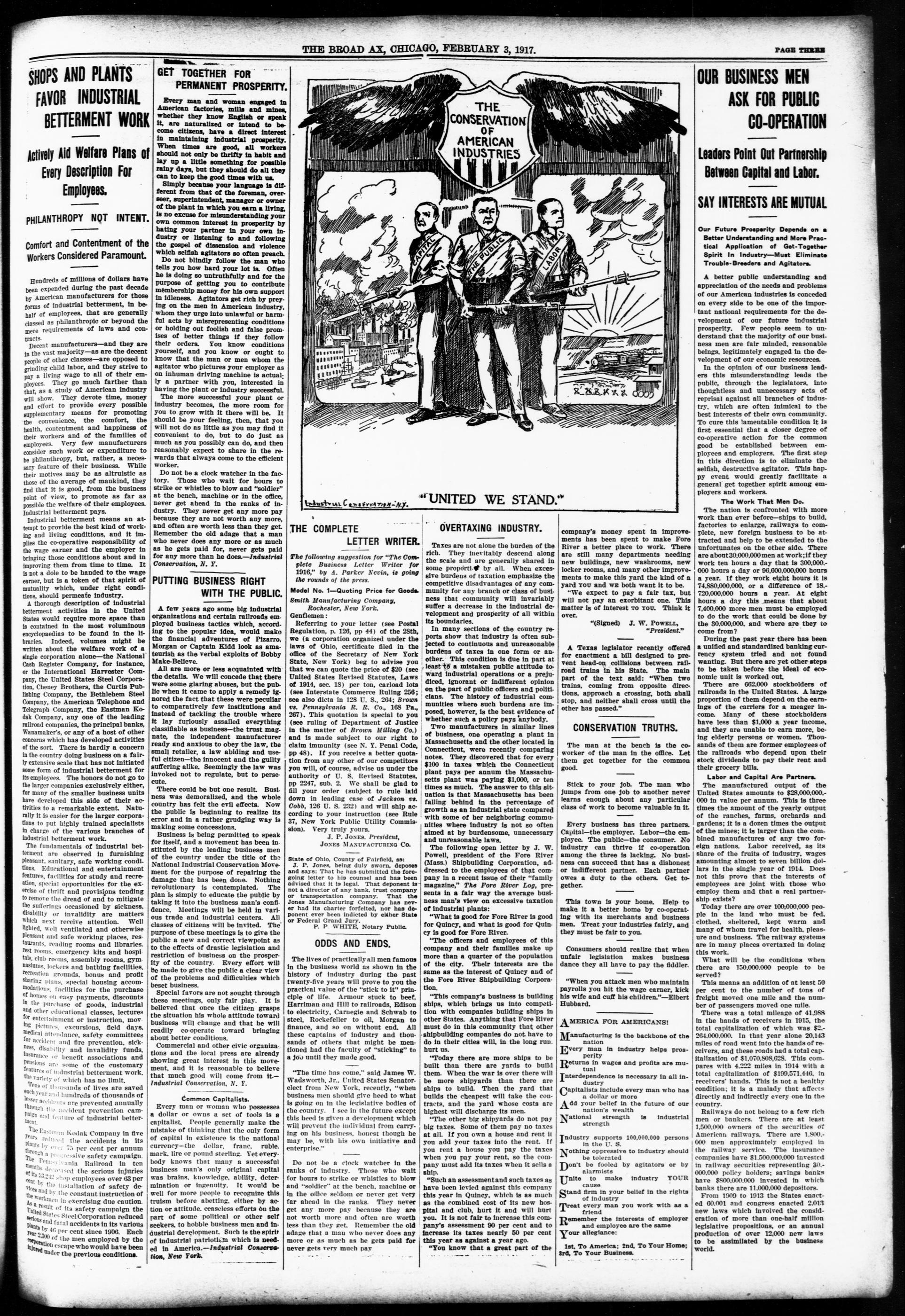
THE CONSERVATION OF AMERICAN INDUSTRIES
LETTER WRITER.
The following suggestion for "The Complete Business Letter Writer for 1916," by A. Parker Nevin, is going the rounds of the press.
Model No. 1—Quoting Price for Goods
Smith Manufacturing Company,
Rochester, New York.
Gentlemen:
Referring to your letter (see Postal Regulation, p. 126, pp 44) of the 28th, we (a corporation organized under the laws of Ohio, certificate filed in the office of the Secretary of New York State, New York) beg to advise you that we can quote the price of $20 (see United States Revised Statutes, Laws of 1914, sec. 18) per ton, carload lots (see Interstate Commerce Ruling 250; see also dicta in 128 U. S. 264; Brown vs. Pennsylvania R. R. Co., 168 Pa. 267). This quotation is special to you (see ruling of Department of Justice in the matter of Brown Milling Co.), and is made subject to our right to claim immunity (see N. Y. Penal Code, pp 48). If you receive a better quotation from any other of our competitors you will, of course, advise us under the authority of U. S. Revised Statutes, pp 2247, sub. 2. We shall be glad to fill your order (subject to rule laid down in leading case of Jackson vs. Cobb, 126 U. S. 232) and will ship according to your instruction (see Rule 37, New York Public Utility Commission). Very truly yours.
State of Ohio, County of Fairfield, ss:
State of Ohio, County of Fairfield, ss:
J. P. Jones, being duly sworn, deposes
and says: That he has submitted the fore-
going letter to his counsel and has been
advised that it is legal. That deponent is
not a director of any bank, trust company
or transportation company. That the
Jones Manufacturing Company has never
had its charter forfelt, nor has deponent
ever been indicted by either State
or Federal Grand Jury.
P. P WHITE, Notary Public.
ODDS AND ENDS.
The lives of practically all men famous in the business world as shown in the history of industry during the past twenty-five years will prove to you the practical value of the "stick to it" principle of life. Armour stuck to beef, Harriman and Hill to railroads, Edison to electricity, Carnegie and Schwab to steel, Rockefeller to oil, Morgan to finance, and so on without end. All these captains of industry and thousands of others that might be mentioned had the faculty of "sticking" to a job until they made good.
"The time has come," said James W. Wadsworth, Jr., United States Senator-elect from New York, recently, "when business men should give heed to what is going on in the legislative bodies of the country. I see in the future except this heed is given a development which will prevent the individual from carrying on his business, honest though he may be, with his own initiative and enterprise."
Do not be a clock watcher in the ranks of industry. Those who wait for hours to strike or whistles to blow and "soldier" at the bench, machine or in the office seldom or never get very far ahead in the ranks. They never get any more pay because they are not worth more and often are worth less than they get. Remember the old adage that a man who never does any more or as much as he gets paid for never gets very much pay
"UNITED WE STAND."
OVERTAXING INDUSTRY.
Taxes are not alone the burden of the rich. They inevitably descend along the scale and are generally shared in some proprietory by all. When excessive burdens of taxation emphasize the competitive disadvantages of any community for any branch or class of business that community will invariably suffer a decrease in the industrial development and prosperity of all within its boundaries. In many sections of the country reports show that industry is often subjected to continuous and unreasonable burdens of taxes in one form or another. This condition is due in part at least to a mistaken public attitude toward industrial operations or a prejudiced, ignorant or indifferent opinion on the part of public officers and politicians. The history of industrial communities where such burdens are imposed, however, is the best evidence of whether such a policy pays anybody.
Two manufacturers in similar lines of business, one operating a plant in Massachusetts and the other located in Connecticut, were recently comparing notes. They discovered that for every $100 in taxes which the Connecticut plant pays per annum the Massachusetts plant was paying $1,000, or ten times as much. The answer to this situation is that Massachusetts has been falling behind in the percentage of growth as an industrial state compared with some of her neighboring communities where industry is not so often aimed at by burdensome, unnecessary and unreasonable laws.
The following open letter by J. W, Powell, president of the Fore River (Mass.) Shipbuilding Corporation, addressed to the employees of that company in a recent issue of their "family magazine," The Fore River Log, presents in a fair way the average business man's view on excessive taxation of industrial plants:
"What is good for Fore River is good for Quincy, and what is good for Quincy is good for Fore River.
"The officers and employees of this company and their families make up more than a quarter of the population of the city. Their interests are the same as the interest of Quincy and of the Fore River Shipbuilding Corporation.
"This company's business is building ships, which brings us into competition with companies building ships in other States. Anything that Fore River must do in this community that other shipbuilding companies do not have to do in their cities will, in the long run, hurt us.
"Today there are more ships to be built than there are yards to build them. When the war is over there will be more shipyards than there are ships to build. Then the yard that builds the cheapest will take the contracts, and the yard whose costs are highest will discharge its men.
"The other big shipyards do not pay big taxes. Some of them pay no taxes at all. If you own a house and rent it you add your taxes into the rent. If you rent a house you pay the taxes when you pay your rent, so the company must add its taxes when it sells a ship.
"Such an assessment and such taxes as have been levied against this company this year in Quincy, which is as much as the combined cost of its new hospital and club, hurt it and will hurt you. It is not fair to increase this company's assessment 90 per cent and to increase its taxes nearly 50 per cent this year as against a year ago. "You know that a great part of the
company's money spent in improvements has been spent to make Fore River a better place to work. There are still many departments needing new buildings, new washrooms, new locker rooms, and many other improvements to make this yard the kind of a yard you and we both want it to be.
"We expect to pay a fair tax, but will not pay an exorbitant one. This matter is of interest to you. Think it over.
"(Signed) J. W. Powell,
"President."
A Texas legislator recently offered for enactment a bill designed to prevent head-on collisions between railroad trains in his State. The main part of the text said: "When two trains, coming from opposite directions, approach a crossing, both shall stop, and neither shall cross until the other has passed."
CONSERVATION TRUTHS.
The man at the bench is the coworker of the man in the office. Let them get together for the common good.
Stick to your job. The man who jumps from one job to another never learns enough about any particular class of work to become valuable in it.
Every business has three partners. Capital—the employer. Labor—the employee. The public—the consumer. No industry can thrive if co-operation among the three is lacking. No business can succeed that has a dishonest or indifferent partner. Each partner owes a duty to the others. Get together.
This town is your home. Help to make it a better home by co-operating with its merchants and business men. Treat your industries fairly, and they must be fair to you.
Consumers should realize that when unfair legislation makes business dance they all have to pay the fiddler.
"When you attack men who maintain payrolls you hit the wage earner, kick his wife and cuff his children."—Elbert Hubbard.
A MERICA FOR AMERICANS!
Manufacturing is the backbone of the nation
Every man in industry helps prosperity
Returns in wages and profits are mutual
Interdependence is necessary in all industry
Capitalists include every man who has a dollar or more
Add your belief in the future of our nation's wealth
National strength is industrial strength
Industry supports 100,000,000 persons in the U. S.
Nothing oppressive to industry should be tolerated
Don't be fooled by agitators or by alarmists
Unite to make industry YOUR cause
Stand firm in your belief in the rights of industry
Treat every man you work with as a friend
Remember the interests of employer and employee are the same
Your allegiance:
1st, To America; 2nd, To Your Home;
3rd, To Your Business.
PAGE THREE
OUR BUSINESS MEN ASK FOR PUBLIC CO-OPERATION
Leaders Point Out Partnership Between Capital and Labor. SAY INTERESTS ARE MUTUAL
Our Future Prosperity Depends on a Better Understanding and More Practical Application of Get-Together Spirit In Industry—Must Eliminate Trouble-Breeders and Agitators.
A better public understanding and appreciation of the needs and problems of our American industries is conceded on every side to be one of the important national requirements for the development of our future industrial prosperity. Few people seem to understand that the majority of our business men are fair minded, reasonable belongs, legitimately engaged in the development of our economic resources.
In the opinion of our business leaders this misunderstanding leads the public, through the legislators, into thoughtless and unnecessary acts of reprisal against all branches of industry, which are often inimical to the best interests of their own community. To cure this lamentable condition it is first essential that a closer degree of co-operative action for the common good be established between employees and employers. The first step in this direction is to eliminate the selfish, destructive agitator. This happy event would greatly facilitate a general get together spirit among employers and workers.
The Work That Men Do.
The nation is confronted with more work than ever before—ships to build, factories to enlarge, railways to complete, new foreign business to be attracted and help to be extended to the unfortunates on the other side. There are about 30,000,000 men at work; if they work ten hours a day that is 300,000,000 hours a day or 96,600,000 hours a year. If they work eight hours it is 74,880,000,000, or a difference of 18.720,000,000 hours a year. At eight hours a day this means that about 7,400,000 more men must be employed to do the work that could be done by the 30,000,000, and where are they to come from?
During the past year there has been a unified and standardized banking currency system tried and not found wanting. But there are yet other steps to be taken before the ideal of economic unit is worked out.
There are 662,000 stockholders of railroads in the United States. A large proportion of them depend on the earnings of the carriers for a meager income. Many of these stockholders have less than $1,000 a year income, and they are unable to earn more, being elderly persons or women. Thousands of them are former employees of the railroads who depend upon their stock dividends to pay their rent and their grocery bills.
Labor and Capital Are Partners.
The manufactured output of the United States amounts to $28,000,000,000 in value per annum. This is three times the amount of the yearly output of the ranches, farms, orchards and gardens; it is a dozen times the output of the mines; it is larger than the combined manufactures of any two foreign nations. Labor received, as its share of the fruits of industry, wages amounting almost to seven billion dollars in the single year of 1914. Does not this prove that the interests of employees are joint with those who employ them and that a real partnership exists?
Today there are over 100,000,000 people in the land who must be fed, clothed, sheltered, kept warm and many of whom travel for health, pleasure and business. The railway systems are in many places overtaxed in doing this work.
What will be the conditions when there are 150,000,000 people to be served?
This means an addition of at least 50 per cent to the number of tons of freight moved one mile and the number of passengers moved one mile.
There was a total mileage of 41,988 in the hands of receivers in 1915, the total capitalization of which was $2-264,000,000. In that year alone 20,143 miles of road went into the hands of receivers, and these roads had a total capitalization of $1,070,808,628. This compares with 4,222 miles in 1914 with a total capitalization of $199,571,446, in receivers' hands. This is not a healthy condition; it is a malady that affects directly and indirectly every one in the country.
Railways do not belong to a few rich men or bankers. There are at least 1,500,000 owners of the securities of American railways. There are 1,800,000 men approximately employed in the railway service. The insurance companies have $1,500,000,000 invested in railway securities representing 30,000,000 policy holders; savings banks have $800,000,000 invested in which banks there are 11,000,000 depositors. From 1900 to 1913 the States enacted 60,001 and congress enacted 2,013 new laws which involved the consideration of more than one-half million legislative propositions, or an annual production of over 12,000 new laws to be assimilated by the business world.
PAGE FOUR
SOME PHASES OF THE NEGEO IN
THE UNITED STATES.
Illiteracy—Article Number Two.
By John W. Felton.
There have been many theories advanced as to the reason that Negroes in the United States are discriminated against. In my opinion, there is no one reason, but it is safe to say that illiteracy plays an important part.
In viewing the Negro, not from the heights that he has attained but from the depths from which he sprang, the reduction of his illiteracy has been a marvelous feat.
In 1880 the illiteracy of the Negro was 70 per cent; in 1890 it was 57.1 per cent; in 1900 44.5, and 1910 it had been reduced to 30.4 per cent. When it is realized that within thirty years the illiteracy of the Negro has been reduced from 70 to 30.4 per cent, no one can truthfully say that his record in eradicating illiteracy has not been phenomenal.
This has been accomplished in spite of the fact that for every nine dollars spent in the State of Mississippi on investment in school property, only one dollar is spent for Negroes. It is also to be noticed that in Louisiana for every fifty-one dollars spent for the same purpose, only forty-nine dollars of it is spent for the "Whites." 4Oh, Inconsistency, thou art a jewel." These conditions do not exist in these two states alone, but throughout the benighted South. Facing such conditions as these, not to speak of the dastardly crimes committed against the Negro, we should not marvel because nearly a quarter of a million of them have left recently.
There are fifty cities that have a total population of 100,000. Of these, the highest percentage of illiteracy of the Negro in 1910 were as follows: Birmingham, Ala., 22.1; Nashville, Tenn., 22; and Atlanta, Ga., 20.9. Of the nineteen cities of this class having a population of at least 10,000 Negroes, the lowest percentages of illiteracy were: In Boston, 3.5 per cent; New York, 3.6; and Chicago, 4 per cent. The lowest per cent recorded in any of these cities was 1.4 per cent in Rochester, New York.
In Georgia in 1829 the following law was enacted: If any slave, Negro or free person of color, or any white person shall teach any other slave, Negro, or free person of color to read or write, either written or printed characters, the said free person or slave shall be punished with a fine and whipping, or fine or whipping, at the discretion of the court; and if a white person so offend, he, she, or they shall be punished with a fine not exceeding $500 and imprisonment in the common jail, at the discretion of the court.
Similar laws were enacted in Louisiana, Mississippi, Missouri, South Carolina and Virginia. Such southern writers as W. B. Smith and Thomas Nelson Page with their pseudo-scientific books on the Negro have yet much to learn about him.
W. B. Smith in his disgusting volume, "Along the Color Line," heaps unhallowed obloquy upon the Negro. He says that he is illiterate, criminal, etc., without stopping to consider the causes of these things if they are so. With such obstacles as the Blease "Walls" to scale, the Vardaman "Seas" to cross, the Tillman "Mountains" to climb, the Smith "Air" to breathe and the Page "Water" to drink, it would be well not to boast of scholarship and accomplishment, but rather marvel that the Negro is able to read the first reader.
The school attendance of the Negro 6 to 20 years of age is 47.3. Now, in order to eradicate the menace of illiteracy, the remaining 52.7 per cent should be made to attend school by law, if not by the parents of the children. If this was done immediately, in 1920 when the next census is taken, the illiteracy of the Negro would be so small that it would hardly be worth while to count.
THE ALPHA SUFFRAGE CLUB
The Alpha Suffrage Club in its election of officers last meeting elected the following: Dr. Fannie Emanuel, president; Mrs. S. L. Adams, vice-president; Mrs. J. E. Hughes, secretary; Miss Laura Beasley, treasurer; Mrs. Ida Wells-Barnett, chairman of the executive board. A strong letter of protest was sent to Mrs. Joseph T. Bowen, president of the Juvenile Protective Association, in relation to coarsa language used about and in the presence of Colored women, officers of the Juvenile Court. Said language was by one, Mr. Guile, who was a juvenile protective officer in charge of the work in the Colored district. A request was made that he be taken off the Colored cases, and if it was possible to do so, a representative of the Negro race be put in the work.
The Ideal Woman's Club which held its Reciprocity Day meeting on Friday, appointed a committee to wait upon Mrs. Bowen in regard to the same matter. The clubs reported were: The Ideal Woman's Club, East Side Club, The American Rose Art Club, The
North Side Woman's Club and the Ida B. Wells Woman's Club. This committee waited on Mrs. Bowen on Wednesday morning of this week and had a most satisfactory interview with her. Mrs. Bowen is well known and is a staunch friend of the Colored people.
THE WINTER PLY.
It is time now to talk about the winter fly. But there are no flies in winter time, the average person would say.
The Department of Health, however, says that there are winter time flies. And these winter time flies are responsible for the countless millions of these pesteriferous little insects that we have with us in the summer months. As a matter of fact, there is scarcely an office building or hotel in the loop district, and especially the latter, that has not harbored live flies all winter long and in which they might be found right now. Bakeries and bakery oven rooms are places for the flies to survive the cold season, and as already stated, the flies that survive during the winter are responsible for those that we have during the summer months.
Flies do not hibernate; they are not long lived. When the chilling frosts of the autumn months come they disappear by the millions. It is only the few that manage to secure quarters comfortable enough to enable them to live and breed through the winter. Therefore, it is important that right now we should get after the winter fly. If every hotel and restaurant keeper in the City of Chicago and every bakery and delicatessen store should get busy now to exterminate the flies that they may find on their premises, it would be a most effective measure towards the prevention of fly plague next summer.
It is possible, too, that in a few places and comparatively few throughout the city, manure, in which flies' eggs have been deposited, has been stored in quantities so large as to retain heat sufficient to keep the eggs from freezing; and these, when warm weather comes and the manure is removed, will no doubt emerge as flies. The most prolific sources of supply, however, are found in the places named, where a summer temperature has been maintained during the cold weather and where the flies have had plenty to eat and managed to get along without discomfort or starvation.
Every housewife should also go carefully over her house to see that there is not a fly now living in it. It is not an uncommon sight in midwinter to see a fly buzzing on one of your window panes. The important thing is, however, to catch that winter fly. The Department of Health believes that this is an important matter, for the reason that the flies now living are laying eggs in favorable places for incubation in early spring, and some of these eggs are hatched out during the winter months in places where the temperature is warm and even.
It is hardly necessary at this time to repeat what so often has been said, that flies carry the germs of disease; that they are a menace to the health of any community in which they are allowed to exist. They carry the germs of such diseases as typhoid, dysentery and tuberculosis, and many medical men suspect them of playing a part in the spread of infantile paralysis. In view of the fact that Chicago may have an outbreak of this dread disease next summer, this appeal to start the fly killing campaign now should not go unheeded. Let every one get busy and swat the winter fly.
* * * *
To overcome diphtheria and wipe it gradually off the map, let all parents follow this advice:
Have your child's tonsils and adenoids properly removed by those who know how. These glands are favorite points for diphtheria to attack. In case of even slight sore throat, keep close watch, especially in the cold, indoor season, and get a doctor early. Insist that the child be given a prompt dose of antitoxin in case of the slightest question of the disease. Antitoxin will do no harm, the poison of diphtheria will.
PLATFORM LECTURE AT GRACE
The chairman of the speakers' committee of the Young People's Lyceum, Grace Presbyterian church, has secured Miss Katheryn Johnson, Wilberforce University, a platform lecturer, to speak Sunday, February 4, at Grace church, at 5 o'clock. Miss Johnson has a thirty minute lecture that is a literary gem, brimful of wholesome instructions and advice. Until recently, she has traveled extensively for the National Association for the Advancement of Colored People. Clarence Lee, the "wizard of the violin," will play, Miss Eloise Cook, a talented soprano, will sing; also a noted tenor singer is on the program. Miss Maude J. Roberts will preside. Miss Bertha Moseley, president, Cary B. Lewis, chairman of the speakers' committee. Best seats are secured at 5 o'clock. The public is invited. No admission.
THE BROAD AX. CHICAGO, FEBRUARY 3, 1917.
Moffett
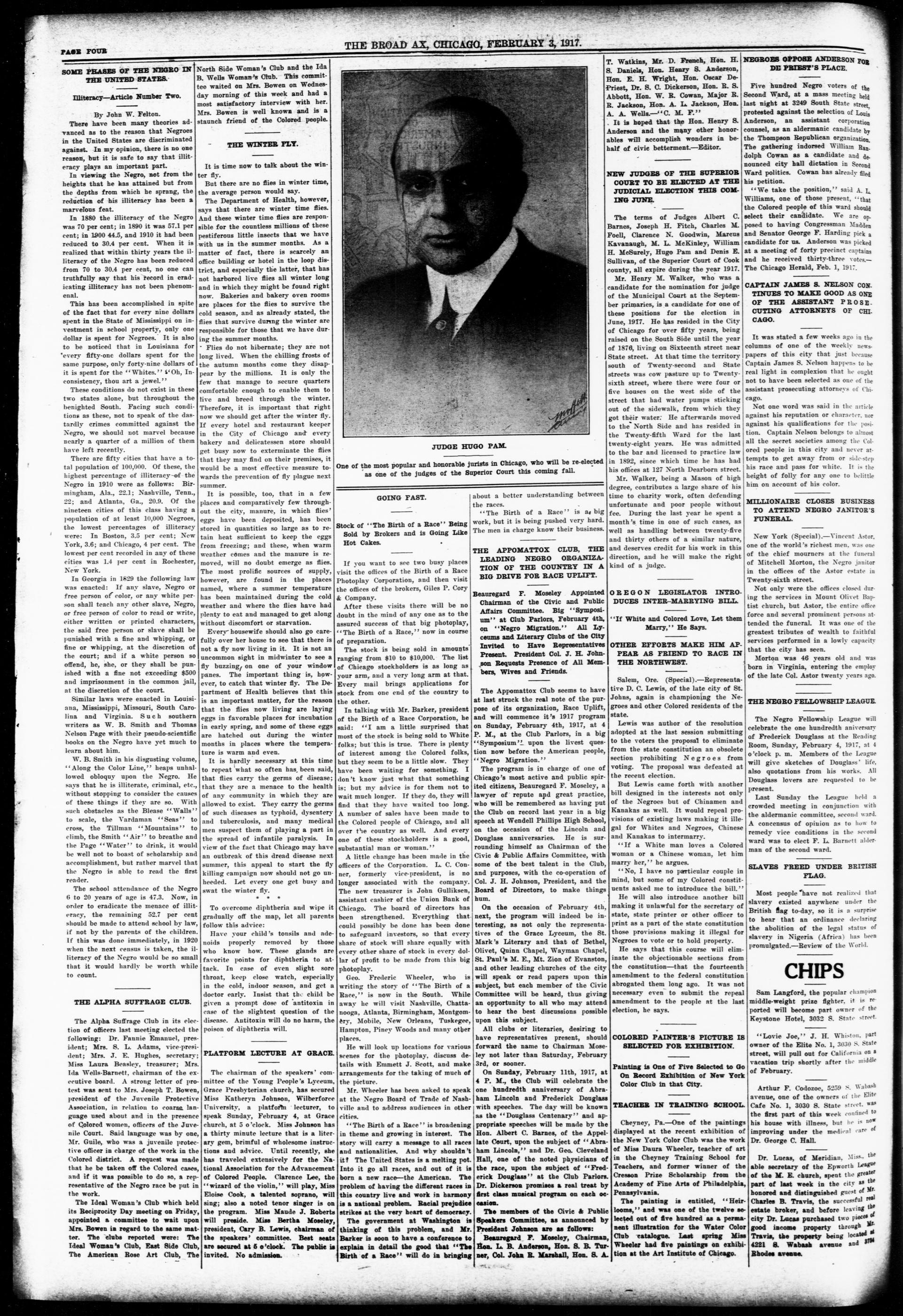
JUDGE HUGO PAM.
One of the most popular and honorable jurists in Chicago, who will be re-elected as one of the judges of the Superior Court this coming fall.
One of the most popular and honorable jurists in Chicago, who will be re-elected as one of the judges of the Superior Court this coming fall.
Stock of "The Birth of a Race" Being Sold by Brokers and is Going Like Hot Cakes.
If you want to see two busy places visit the offices of the Birth of a Race Photoplay Corporation, and then visit the offices of the brokers, Giles P. Cory & Company.
After these visits there will be no doubt in the mind of any one as to the assured success of that big photoplay, "The Birth of a Race," now in course of preparation.
The stock is being sold in amounts ranging from $10 to $10,000. The list of Chicago stockholders is as long as your arm, and a very long arm at that. Every mail brings applications for stock from one end of the country to the other.
In talking with Mr. Barker, president of the Birth of a Race Corporation, he said: "I am a little surprised that most of the stock is being sold to White folks; but this is true. There is plenty of interest among the Colored folks, but they seem to be a little slow. They have been waiting for something. I don't know just what that something is; but my advice is for them not to wait much longer. If they do, they will find that they have waited too long. A number of sales have been made to the Colored people of Chicago, and all over the country as well. And every one of these stockholders is a good, substantial man or woman."
A little change has been made in the officers of the Corporation. L. C. Conner, formerly vice-president, is no longer associated with the company. The new treasurer is John Gulliksen, assistant cashier of the Union Bank of Chicago. The board of directors has been strengthened. Everything that could possibly be done has been done to safeguard investors, so that every share of stock will share equally with every other share of stock in every dollar of profit to be made from this big photoplay.
Geo. Frederic Wheeler, who is writing the story of "The Birth of a Race," is now in the South. While away he will visit Nashville, Chattanooga, Atlanta, Birmingham, Montgomery, Mobile, New Orleans, Tuskegee, Hampton, Piney Woods and many other places.
He will look up locations for various scenes for the photoplay, discuss details with Emmett J. Scott, and make arrangements for the taking of much of the picture.
Mr. Wheeler has been asked to speak at the Negro Board of Trade of Nashville and to address audiences in other cities.
"The Birth of a Race" is broadening in theme and growing in interest. The story will carry a message to all races and nationalities. And why shouldn't it? The United States is a melting pot. Into it go all races, and out of it is born a new race—the American. The problem of having the different races in this country live and work in harmony is a national problem. Racial prejudice strikes at the very heart of democracy. The government at Washington is thinking of this problem, and Mr. Barker is soon to have a conference to explain in detail the good that "The Birth of a Race" will do in bringing
GOING FAST.
---
about a better understanding between the races.
"The Birth of a Race" is a big work, but it is being pushed very hard. The men in charge know their business.
THE APPOMATTOX CLUB, THE LEADING NEGRO ORGANIZATION OF THE COUNTRY IN A BIG DRIVE FOR RACE UPLIFT.
Beauregard F. Moseley Appointed Chairman of the Civic and Public Affairs Committee. Big "Symposium" at Club Parlors, February 4th, on "Negro Migration." All Lyceums and Literary Clubs of the City Invited to Have Representatives Present. President Col. J. H. Johnson Requests Presence of All Members, Wives and Friends.
The Appomattox Club seems to have at last struck the real note of the purpose of its organization, Race Uplift, and will commence it's 1917 program on Sunday, February 4th, 1917, at 4 P. M., at the Club Parlors, in a big "Symposium" upon the livest question now before the American people, "Negro Migration."
The program is in charge of one of Chicago's most active and public spirited citizens, Beauregard F. Moseley, a lawyer of repute and great practice, who will be remembered as having put the Club on record last year in a big speech at Wendell Phillips High School, on the occasion of the Lincoln and Douglass anniversaries. He is surrounding himself as Chairman of the Civic & Public Affairs Committee, with some of the best talent in the Club, and purposes, with the co-operation of Col. J. H. Johnson, President, and the Board of Directors, to make things hum.
On the occasion of February 4th, next, the program will indeed be interesting, as not only the representatives of the Grace Lyceum, the St. Mark's Literary and that of Bethel, Olivet, Quinn Chapel, Wayman Chapel, St. Paul's M. E., Mt. Zion of Evanston, and other leading churches of the city will speak or read papers upon this subject, but each member of the Civic Committee will be heard, thus giving an opportunity to all who may attend to hear the best discussions possible upon this subject. All clubs or literaries, desiring to have representatives present, should forward the name to Chairman Moseley not later than Saturday, February 3rd, or sooner.
On Sunday, February 11th, 1917, at 4 P. M., the Club will celebrate the one hundredth anniversary of Abraham Lincoln and Frederick Doughlass with speeches. The day will be known as the "Douglass Centenary" and appropriate speeches will be made by the Hon. Albert C. Barnes, of the Appellate Court, upon the subject of "Abraham Lincoln," and Dr. Geo. Cleveland Hall, one of the noted physicians of the race, upon the subject of "Frederick Douglass" at the Club Pariors. Dr. Dickerson promises a real treat by first class musical program on each occasion.
The members of the Civic & Public Speakers Committee, as announced by President Johnson are as follows:
Beauregard F. Moseley, Chairman,
Hon. L. B. Anderson, Hon. S. B. Turner,
Col. John R. Marshall, Hon. S. A.
T. Watkins, Mr. D. French, Hon. H. S. Daniels, Hon. Henry S. Anderson, Hon. E. H. Wright, Hon. Oscar DePriest, Dr. S. C. Dickerson, Hon. R. S. Abbott, Hon. W. R. Cowan, Major R. R. Jackson, Hon. A. L. Jackson, Hon. A. A. Wells.—"C. M. F." It is hoped that the Hon. Henry S. Anderson and the many other honorables will accomplish wonders in behalf of civic betterment.-Editor.
NEW JUDGES OF THE SUPERIOR COURT TO BE ELECTED AT THE JUDICIAL ELECTION THIS COMING JUNE.
The terms of Judges Albert C. Barnes, Joseph H. Fitch, Charles M. Foell, Clarence N. Goodwin, Mareus Kavanaugh, M. L. McKinley, William H. McSurely, Hugo Pam and Denis E. Sullivan, of the Superior Court of Cook county, all expire during the year 1917. Mr. Henry M. Walker, who was a candidate for the nomination for judge of the Municipal Court at the September primaries, is a candidate for one of these positions for the election in June, 1917. He has resided in the City of Chicago for over fifty years, being raised on the South Side until the year of 1876, living on Sixteenth street near State street. At that time the territory south of Twenty-second and State streets was cow pasture up to Twenty-sixth street, where there were four or five houses on the west side of the street that had water pumps sticking out of the sidewalk, from which they got their water. He afterwards moved to the North Side and has resided in the Twenty-fifth Ward for the last twenty-eight years. He was admitted to the bar and licensed to practice law in 1892, since which time he has had his offices at 127 North Dearborn street.
Mr. Walker, being a Mason of high degree, contributes a large share of his time to charity work, often defending unfortunate and poor people without fee. During the last year he spent a month's time in one of such cases, as well as handling between twenty-five and thirty others of a similar nature, and deserves credit for his work in this direction, and he will make the right kind of a judge.
OREGON LEGISLATOR INTRO
DUCES INTER-MARRYING BILL.
"If White and Colored Love, Let them Marry," He Says.
OTHER EFFORTS MAKE HIM AP-
PEAR AS FRIEND TO RACE IN
THE NORTHWEST.
Salem, Ore. (Special).—Representative D. C. Lewis, of the late city of St. Johns, again is championing the Negroes and other Colored residents of the state.
Lewis was author of the resolution adopted at the last session submitting to the voters the proposal to eliminate from the state constitution an obsolete section prohibiting Negroes from voting. The proposal was defeated at the recent election.
But Lewis came forth with another bill designed in the interests not only of the Negroes but of Chinamen and Kanakas as well. It would repeal provisions of existing laws making it illegal for Whites and Negroes, Chinese and Kanakas to intermarry.
"If a White man loves a Colored woman or a Chinese woman, let him marry her," he argues.
"No, I have no particular couple in mind, but some of my Colored constituents asked me to introduce the bill." He will also introduce another bill making it unlawful for the secretary of state, state printer or other officer to print as a part of the state constitution those provisions making it illegal for Negroes to vote or to hold property.
He says that this course will eliminate the objectionable sections from the constitution—that the fourteenth amendment to the federal constitution abrogated them long ago. It was not necessary even to submit the repeal amendment to the people at the last election, he says.
COLORED PAINTER'S PICTURE IS
SELECTED FOR EXHIBITION.
Painting is One of Five Selected to Go On Record Exhibition of New York Color Club in that City.
TEACHER IN TRAINING SCHOOL
Cheyney, Pa.—One of the paintings displayed at the recent exhibition of the New York Color Club was the work of Miss Daura Wheeler, teacher of art in the Cheyney Training School for Teachers, and former winner of the Cresson Prize Scholarship from the Academy of Fine Arts of Philadelphia, Pennsylvania.
The painting is entitled, "Heirlooms," and was one of the twelve selected out of five hundred as a permanent illustration for the Water Color Club catalogue. Last spring Miss Wheeler had five paintings on exhibition at the Art Institute of Chicago.
NEGROES OPPOSE ANDERSON FOR
DE PRIEST'S PLACE.
Five hundred Negro voters of the Second Ward, at a mass meeting held last night at 3249 South State street, protested against the selection of Louis Anderson, an assistant corporation counsel, as an aldermanic candidate by the Thompson Republican organization. The gathering indorsed William Randolph Cowan as a candidate and denounced city hall dictation in Second Ward politics. Cowan has already filed his petition.
"We take the position," said A. L. Williams, one of those present, "that the Colored people of this ward should select their candidate. We are opposed to having Congressman Madden and Senator George F. Harding pick a candidate for us. Anderson was picked at a meeting of forty precinct captains and he received thirty-three votes—The Chicago Herald, Feb. 1, 1917.
CAPTAIN JAMES S. NELSON CON-
TINUES TO MAKE GOOD AS ONE
OF THE ASSISTANT PROSE-
CUTING ATTORNEYS OF CHI-
CAGO.
It was stated a few weeks ago in the columns of one of the weekly newspapers of this city that just because Captain James S. Nelson happens to be real light in complexion that he ought not to have been selected as one of the assistant prosecuting attorneys of Chicago.
Not one word was said in the article against his reputation or character, nor against his qualifications for the position. Captain Nelson belongs to almost all the secret societies among the Colored people in this city and never attempts to get away from or side-step his race and pass for white. It is the height of folly for any one to belittle him on account of his color.
MILLIONAIRE CLOSES BUSINESS
TO ATTEND NEGRO JANITOR'S
FUNERAL.
New York (Special).—Vincent Astor, one of the world's richest men, was one of the chief mourners at the funeral of Mitchell Morton, the Negro junior in the offices of the Astor estate in Twenty-sixth street.
Not only were the offices closed during the services in Mount Olivet Baptist church, but Astor, the entire office force and several prominent persons attended the funeral. It was one of the greatest tributes of wealth to faithful services performed in a lowly capacity that the city has seen.
Morton was 46 years old and was born in Virginia, entering the employ of the late Col. Astor twenty years ago.
THE NEGRO FELLOWSHIP LEAGUE
The Negro Fellowship League will celebrate the one hundredth anniversary of Frederick Douglass at the Reading Room, Sunday, February 4, 1917, at 4 o'clock p. m. Members of the League will give sketches of Douglass' life, also quotations from his works. All Douglass lovers are requested to be present.
Last Sunday the League held a crowded meeting in conjunction with the aldermanic committee, second ward. A consensus of opinion as to how to remedy vice conditions in the second ward was to elect F. L. Barnett alderman of the second ward.
SLAVES PREEED UNDER BRITISH FLAG.
Most people have not realized that slavery existed anywhere under the British flag to-day, so it is a surprise to hear that an ordinance declaring the abolition of the legal status of slavery in Nigeria (Africa) has been promulgated.—Review of the World.
CHIPS
Sam Langford, the popular champion middle-weight prize fighter, it is reported will become part owner of the Keystone Hotel, 3032 S. State street.
"Lovie Joe," J. H. Whiston, part owner of the Elite No. 1, 3030 S. State street, will pull out for California on a vacation trip shortly after the middle of February.
Arthur F. Codozoe, 5259 S. Wabash avenue, one of the owners of the Elite Cafe No. 1, 3030 S. State street, was the first part of this week confined to his house with illness, but he is now improving under the medical care of Dr. George C. Hall.
Dr. Lucas, of Meridian, Miss, the able secretary of the Epworth League of the M. E. church, spent the greater part of last week in the city as the honored and distinguished guest of Mr. Charles B. Travis, the successful real estate broker, and before leaving the city Dr. Lucas purchased two pieces of good income property through Mr. Travis, the property being located at 4221 S. Wabash avenue and 3784 Rhodes avenue.
If They Could Keep It Up.
There have been big men in Wall street who did all the work themselves, who attended to every minute item, who were from Missouri in regard to each point in any proposition put up to them. One of these marvels was among the very greatest financiers the country ever had. But he didn't last long, and there have been few others like him. If a man with the first order of brains and ability could only keep it up there is nothing to prevent his owning the United States. If E. H. Harriman could have kept on fifteen or twenty years longer at the pace he was going he would have gobbled up all that was worth taking. He had about all the railroads in sight, and he was just getting a strangle hold on the big banks. He conquered every square foot of territory as he went along. There was no force on earth to stop him except premature death, and now he is almost forgotten.—A. W. Atwood in Saturday Evening Post.
Most Buoyant Wood.
The lightest wood known, so far as any evidence attainable is concerned, is balsa wood, which grows extensively in the Central American and northern South American states. It is composed of very thin walled cells, which are barrel shaped, interface with each other and are almost devoid of woody fiber. These cells are filled with air, making a natural structure well adapted to prevent the transmission of heat because of the particles of air imprisoned in the material without interconnecting fibers. Various tests of the insulating properties for resisting the flow of heat have been made. Balsa wood has been used quite extensively in the past as a buoyancy product for life preservers and in connection with the fenders of lifeboats and rafts. Its life is short, under ordinary conditions, unless treated with antiseptic or preservative material.
Ariake Bay's Mystio Fire.
Shiranubi, the mystic fire of Ariake bay, Kyushu, has been famous for the past 2,000 years, the sight being considered one of the great wonders of the Japan seas.
In a recent issue of the Talyo Magazine M. Kaneko, a teacher in the Shimabara middle school, relates his impressions of the fire. According to Mr. Kaneko, when he witnessed the spectacle the first light appeared like a star about five miles distant. Suddenly the volume of light increased until it soon covered an area of many miles. The light moved with the waves and resembled electric lights being lighted and then suddenly extinguished. Mr. Kaneko says that intermittent wave-like movements are the chief characteristics of the mystic fire. He falls to find a cause for the origin of the fire.
Cheaping.
In parts of Switzerland the baker's wife carries round the bread in a sort of hamper, and she has not a fixed, immutable charge, but chaffers for a price with the customers. The old English word for this process was "cheaping," which in many places in England has been corrupted into chipping. Chipping Norton, for instance, is really Cheaping Norton, or the place where goods were cheapened—that is, sold by chaffer.—London Standard.
Congressional "Prairie"
The custom of legislative "parling" is the practice of members of legislative bodies by which two members of opposing parties agree to refrain from voting on a prescribed subject or to be absent during a certain time. It was first used in the United States house of representatives in 1839.
Helping Old Rubber
Rubber that has lost its elasticity may be rejuvenated by immersing it for five minutes in a bath of glycerin mixed with twenty-five times its volume of distilled water and heated to 70 degrees C. and then drying it with filter paper.
A Fluent Talker:
Whangs—Is your wife a good conversationalist? Bangs—She would be but for one thing—she talks so fluently that she interrupts herself.
Alpine Shoes.
The shoes worn by Alpine mountainers have steel soles with eight projecting points.
PRACTICAL HEALTH HINT.
Sense In the Sickroom.
Sense In the Sickroom.
Every one who goes into a sick person's room should be bright and cheerful. Sick people are extremely sensitive to the manner of those around them, and any depressing influence has a most injurious effect. Hope is the best medicine. Unfortunately the sick person's relatives often take the worst view of the case, and their anxiety is unmistakably manifested by their looks, voice and general manner. They even talk despairingly in the room, thinking that because the patient is quiet and dull he does not understand. But his perception of everything relating to his illness is markedly acute. Note the good effects of the visit of a cheery doctor. For hours after the patient seems better and is better. Of course it does not do to be flippant, but if relatives would force themselves to take a hopeful view and show it in their manner they would in many cases actually save the sick person's life.
```markdown
```
What It Would Be.
A teacher was endeavoring to explain the term "facsimile" to his class. "Now," he remarked to one sharp youth, "what is your father's trade or profession?"
"He's a lithographer," was the reply. "Very well. Supposing a man came to your father with a document which he wanted reproducing in every particular, your father agreed and the document was faithfully copied, what would it be?"
"Well," repiled the boy thoughtfully, "it depends."
"On what?" asked the teacher.
"On the document."
"How so?"
"Well, if it was a ten dollar bill, for instance, the other would be a counterfeit. If the document was a check the copy would be a forgery."
"You don't understand what I mean." "Oh, yes, I'm quite sure I do," went on the boy. "I'm just coming to it now. In either case I reckon it would be about ten years."
John Smith and Pooshontas.
About a mile below Richmond, in what is now the brickyard region, there used to stand the residence of the Mayo family, a place known as Powhatan. This place has long been pointed out as the scene of the saving of Smith by the Indian girl, but late research has proved that, though Smith did come up the James to the present site of Richmond, his capture by the Indians did not occur here, but in the vicinity of Jamestown. The Indians took him first to one of their villages on York river, near the present site of West Point, Va., and thence to a place on the same stream in the county of Gloucester, where the powhatan, or tribal chief, resided. Here, on the west side of the river, some nine miles from Williamsburg, the scene of Smith's rescue by Pocahontas has been located.—Julian Street in Collier's.
"Overhang" Houses
By the year 1670 wooden chimneys and log houses of the Plymouth and Bay colonies were replaced by more sightly houses of two stories, which were frequently built with the second story jutting out a foot or two over the first and sometimes with the atic story still further extending over the second story. This "overhang" is popularly supposed to have been built for the purpose of affording a convenient shooting place from which to repel the Indians. This is, however, a historic fable. The overhanging second story was a common form of building in England in the time of Queen Elizabeth, and the Massachusetts and Rhode Island settlers simply and naturally copied their old homes.
Wild Ducks
Canvasback and redhead ducks, which are very quick of movement, after deep diving are capable of taking flight immediately upon coming to the surface of the water. They do not spring directly upward into the air, but fly at first at an angle until they reach the desired elevation. Surface feeding wild fowl, like the black duck, pintail and teal, fly directly upward from the surface of the water if the emergency demands it.
Truthful Excuse
"The sheriff caught his young assistant writing love letters in business hours today."
"What did the young fellow say when he was taxed with doing so?"
"Said he was not shirking his duty, as they were all writes of attachment."
—Baltimore American.
People of Sardinia.
Sardinians retain traces of the many races which have occupied the island through the centuries—Phoeniclans, Carthaginians, Romans, Saracens, Italians and Spaniards. Many dialects are spoken, but Italian is now taught in the schools.—Exchange.
Bostonese.
"When the Boston girl wishes her pet dog to stand on his hind legs," remarked the observer of events and things "she requests him to assume a ramp attitude."—Yonkers Statesman.
Surnames.
Surnames were introduced into England by the Normans and were adopted by the nobility in 1100.
PRACTICAL HEALTH HINT.
Headache and Sick Stomach. This condition results from imperfect digestion. Whether it has been caused by eating too much food, which has disturbed digestion, the treatment remains the same, and this is to empty the stomach. Drinking one tumblerful of water after another as rapidly as possible until six or eight glasses are taken is the quickest way of washing offing substances out of the stomach. If this is done in ten minutes one will have relief from the sick feeling and headache and be ready to go to sleep or to go about again in comfort. This method of treating a sick headache is also good for attacks of acute indigestion. Half an hour after the stomach has become comfortable it is well to take a seidlits powder or a dose of citrate of magnesia. Either of these remedies will bring up the gas, sweeten the stomach and give one a clean, pleasant taste in the mouth.
---
THE BROAD AX, CHICAGO, FEBRUARY 3, 1917.
When Pattens Were Worn.
Americans find it more difficult than the English to understand what Dickens means when he says in "David Copperfield," "Women went clicking along the pavements in pattens." Pattens were an abbreviated form of stilts. The word is also used by builders as the name of the base of a column or pillar, and so architecturally the patten is the support used by a woman to keep her out of the water and mud. From this architectural use has come the secondary application of the word, meaning an arrangement attached to the shoe so that the walker is raised three or four inches above the solid earth, says Popular Science Monthly. If the mud and water did not exceed that depth the shoes were thus kept fairly dry.
It appears that pattens were not worn solely by the rich, but were luxuries indulged in by the very poor. In speaking of a person who was not especially speedy Ben Jonson uses the comparison, "You make no more haste than a beggar upon pattens."
Wrecked by a Knife Blade.
A ship was once wrecked on the Irish coast. The captain was a careful one. Nor had the weather been of so severe a kind as to explain the wide distance which the vessel had swerved from her proper course. The ship went down, but so much interest attached to the disaster that a diving bell was sunk. Among other portions of the vessel that were examined was the compass that was swung on the deck, and inside the compass box was detected a bit of steel, which appeared to be the small point of a pocketknife blade. It was learned that the day before the wreck a sailor who had been set cleaning the compass had used his pocketknife in the process and had unceremoniously broken off the point and left it remaining in the box. That bit of knife blade exerted its influence on the compass and to a degree that deflected the needle from its proper bent and vitiated it as an index of the ship's direction. That bit of knife blade wrecked the vessel.
Coming In Out of the Wet
There is an amusing story by Athenaeus which suggests the possible origin of the phrase "He does not know enough to come in out of the wet." According to the entertaining grammarian referred to, a town in Greece under stress of evil circumstances borrowed money from a rich man, who took as security for the loan a mortgage on the handsome portico which surrounded the market place. He was not an ungenerous creditor, for when it rained he caused the town criers to announce that the citizens had permission to take refuge under the colonnade. Strangers visiting the town who failed to have the matter properly explained to them were so impressed by the extraordinary circumstances that they spread abroad the report that the people were so stupid that they had to be told when to come in out of the wet.
Early Insurance.
William Gibbons of London is said to have been the first man to have his life insured. On June 18, 1883, he signed a contract with eight men by the terms of which he was to have his life insured for £283 for one year for 8 per cent of this amount. In 1889 a resident of a Connecticut city was traveling in England and became interested in the workings of accident insurance for travelers. So he came home and promoted the first accident insurance company in this country. His first client was a resident of Hartford, whom he insured for $5,000 against injury in his stroll from the postoffice to his home. Marine insurance goes back to the early part of the fourteenth century and comes from Belgium.
Curious Death Custom In Fill
The Fijians believe that in case a marriageable youth or maiden dies without having gone through with the elaborate nuptial knot tying ceremony of the islands his or her soul is doomed to wander about forever in an intermediate region between heaven and hell.
When any one dies—man, woman or child—a whale's tooth is placed in the hand of the corpse, the missile to be thrown at the tree which stands as a guidepost to point out the road that leads to heaven and the one that leads to hell—London Mall.
Jill - I'm going downtown to the jeweler's.
"What for?"
"To have my watch fixed."
"Isn't your watch going?"
"Sure! I'm taking it along with me."-St. Louis Post-Dispatch.
Preparing For Patches
When making kitchen aprons leave the strings longer and wider than is necessary, then when a patch is needed cut off a piece of the apron string for this purpose. This is better than using a new piece, as the string has faded with the apron.—Mothers' Magazine.
A Bit Heavy.
Barbour—You seem warm. Have you been exercising? Waterman—Yes, indeed. I went to the mutes' dance and swung dumb belles around all evening—Michigan Gargoyle.
Just What He Meant.
Editor—What do you mean by writing such a phrase as "The house burnt up?" We always say houses burn down. Reporter—Yes, but this one caught fire in the cellar.
Better to be despised for too anxious apprehensions than ruined by too confident security.—Burke.
"GOLDEN CALF" HAS COST $10,000 IN LITIGATION.
Rival Claimants to Animal Engage In Bitter Legal Warfare.
Denver.—A "golden calf" will be on exhibition at the western national live stock show in this city. It is a perfect specimen of the Hereford breed. The calf has a reasonable market value of about $25 at present, but it already has cost more than $10,000 in litigation, and the end is not yet in sight. The calf has come to be known as the "golden calf" throughout Pitkin and Garfield counties, where the rival claimants to the animal live.
Born in the spring of 1914, the question of the calf's motherhood arose. Nobody attempted to guess the identity of the immediate paternal ancestor. The docketed case known as Brunton versus Stapleton has puzzled four juries without a solution of the mystery. Brunton claims the calf is the daughter of one of his prize Herefords, while Stapleton claims the calf is just a scrub, the daughter of a boated red cow that he raised on his ranch.
In November, 1914, Brunton went to Stapleton's ranch and took away three calves that were with one of his cows. One of the calves was the "golden calf." The next day Stapleton went to Brunton's ranch and took the "golden calf" back again. Demand for its return was refused, and then Brunton started the replevin suit. Both claims say they will take the case to the supreme court.
CHINESE REVOLUTIONARY HERO'S MEMORY HONORED
Scrolls Sent by Three of Late Yuan Shih Kai's Sons to Commemorate Patriotism.
Shanghai.-Scrolls sent by three of the late Yuan Shih Kai's sons to commemorate the patriotism of General Tsai Ao were the most unusual feature of the funeral services for the revolutionary leader conducted here on the arrival of his body from Japan.
General Tsai Ao was the chief mover in the Yunnan revolution, which defeated Yuan Shih Kai's ambition to become emperor. Yuan Ko Ting, the oldest son of Yuan Shih Kai, was especially ambitious for his father to become emperor that he might succeed to the throne. But practically all the younger sons were opposed to the monarchical movement. The scroll sent to Shanghai by Yuan Ko Wen, the second son of Yuan Shih Kai, commends the lamented General Tsai Ao in the highest terms. It says:
You were a model of the people.
You were the model of the army.
You were the soul of the republic.
You were the spirit of liberty.
The American navy took a prominent part in the Tsai Ao funeral services. The Brooklyn and the other American warships in Shanghai harbor had their flags at half staff as the Chinese warship bearing the body came into port, and a detachment of fifty American marines marched in the funeral procession. Thirty Japanese, mostly personal friends and admirers of the patrol, also were in the procession.
The Chinese community in Shanghai was in mourning, and thousands of young Chinese, mostly students at schools and colleges, were in the procession. The body of General Tsai Ao was taken to his native province of Hunan for burial.
COURT EQUIPS CUPID'S BOWER
Chicago Judge Battles Divorce by Fitting Up a Room For Spooning.
Chicago.—Husbands and wives who allow their troubles to reach the court of domestic relations will be given an opportunity to "make up" in a little room attached to the court which is being fitted up for that purpose by Judge John Stelk. The judge has not given the room a name yet, but he said it will be fitted up in a way aimed to aid the disgruntled in renewing their love for one another. Plants, flowers, canary birds, a music box and soft draperies will contribute to the furnishings.
"The purpose of the fittings will be to bring out the old affection that the couple held for each other when they were courting," said the judge. "It is my purpose to get them to spoon all over again and then go home and live as they ought to."
Deer Gores Cattle.
Estey, W. Va.—A large deer appeared in a pasture near here in which there were a large number of cows owned by W. L. Huffman and defeated the cattle in a pitched battle, goring several of them to such an extent that they later died. The deer was captured and killed by a posse.
Chicago - The body of Mrs.
Charles B. Young was found
hanging in her home in Riverside, a Chicago suburb. A verdict of accidental death was returned when relatives asserted that health exercises, including hanging by the shoulders, had been prescribed and that while following her physician's instructions she evidently had fainted or slipped.
Talks on
HEALTH,
CLEANLINESS,
PROPER LIVING,
SANITATION, ETC.
By
Dr. W. A. Driver
3300 So. State Street
Phone Douglas 3617
INDIGESTION.
Many ills are simply indigestion. The signs of indigestion are of wide distribution; they are often deceiving because of their peculiar remote manifestations.
A choking sensation is often the only sign of indigestion; it may be so severe as to cause instant death. Another sign of indigestion is distressful dreams, called nightmares.
Many cases of so-called heart disease is only a form of indigestion disequilibrium. Such a sign of indigestion often causes instant death.
Difficult breathing, called asthma, is often indigestion. The fact that instant evidence does not make its appearance deludes many. The accumulative evidence of indigestion comes only after a long time.
The cause of indigestion is without a doubt the abuse of the digestive system by the introduction of improper foods. Headaches, constipation, rheumatism, colds, coughs, pneumonia and
CHIPS.
Mrs. M. L. Clinkseale, 5652 S. State street, will leave the latter part of this month on a pleasant vacation trip to New York City where she will spend one month in visiting with relatives and friends; after that she will spend a few weeks in Philadelphia, Pa., and Washington, D. C.
Mrs. James H. Johnson, 3650 Prairie avenue, yesterday afternoon gave a delightful reception in the parlors of the Appomattox Club in honor of the wives of many of its members and other lady friends. Those who will assist her in arranging for the ball which will be given at the Eighth Regiment Armory in the near future, for the benefit of the Phyllis Wheatly home.
FIVE BOOM COTTAGE FOR SALE
AT A BIG BARGAIN.
Five room cottage on the South Side, toilet and gas, lot 25x125, east front, one block from street car line, for sale for $1.650. Phone, Douglas 7047.
Allike. Yet Very Different.
On Seventh avenue the other evening I saw a small red headed fool of a boy throwing cans. "An excitement craving, empty headed kid," I said to myself, driving by. On the next block I saw a girl with red curls, dressed in furs, rather dashing, who gave me a little provocative smile as I passed. Did I say to myself that she was an excitement craving, empty headed kid? She was, but I didn't. On the contrary, for the moment at least, I felt quite drawn toward her. Yet she and that boy might easily have been brother and sister and twin rowdies at heart. Why did one of the two so attract me and the other repel?
The strange lure of sex. It was ready to blind me to the mental defects of that girl. It was ready to fix my thoughts on her cheeks or her hair if I'd sat with her. Now, isn't that odd? I should never have given a snap for her kid brother's hair or cheeks naturally. I'd have looked him well over and seen at a glance he hadn't much character and maybe less brains, but could I have seen what she lacked once I'd felt her attraction?-Clarence Day. Jr., in Metropolitan Magazine.
Wonders of Color.
A small and simple experiment can be made by any reader which will go far to convince him or her what a good thing it is we have sunlight, which enables our eyes to take advantage of the beautiful hues of nature. Make a room quite dark and then burn some carbonate of soda in the flame of a bunsen gas burner. It will burn with an orange yellow light sufficiently strong to illuminate everything in the room. but you will realize with a sudden shock that, bright though the light is, all distinctions of color have vanished. Only light and shade remain. A crimson carnation, a blue violet, a red tablecloth, a yellow blind—all look gray or black or white. The faces of those present look positively repulsive, for all natural color has disappeared. No other experiment will so well convince those who have witnessed it how great a loss would be that of our sense for color.
It is unfortunate that it is so, but it is so, that the paths for going wrong are planted so prettily with flowers at the beginning.
PAGE FIVE
[Name]
other disorders are merely disorders of metabolism which are primarily indigestion.
The connection between indigestion and the terminal manifestations is often difficult to trace, sometimes because of one factor or a number of factors. It is best to try to trace each illness back to its physical or metaphysical origin so as to be able to eliminate the cause. Unless the cause is removed the disease will eventually return with different deceiving manifestations and eventuate in physical and possibly metaphysical death.
Improper ventilation interferes with the general welfare of the body and hence contributes to indigestion and other ills as well. Sleep with the window up from the bottom as well as down from the top and indigestion has less encouragement.
Touch not, taste not, handle not the unclean thing, and digestive disturbances as well as the different, remote and deceptive named diseases will disappear as if by magic.
Artist and Counterfeiter.
There used to be an old German counterfeiter in this country who was a veritable wonder with the brush and pen. This man literally painted pictures of twenty dollar notes which were works of art. He used no tools except his pens and brushes, and it took him a week to do the portrait of a banknote. He figured that his handicap was worth about $3 a day and worked under the idea that the world owed him a fair living and should not object if his talent led him toward portrait painting, with twenty dollar bills for models. Even jail terms failed to impress him seriously with his wrongdoing. A collector of curios once offered $200 for one of his spectacles of bill portraiture, and the value of some others was said to be even greater, so marvelous was the delicacy of his brush work.
The Ancient Dragon.
The pterodactyl, wlose fossil remains have been found in the chalk at Cambridge, England, and elsewhere, with a very varied spread of wings, which in the largest specimens must have reached twenty-five feet, is almost identical with the dragon of fable. A batlike creature, with an elevated body and long neck ending in an absurdly small head with a portentous beak, it could run very swiftly, was a fish eater and could swim, or it flew by means of huge membranous wings, which connected its long fore quarters with its hind legs. The pterodactyl evidently existed down to a comparatively recent geological period, and it is not at all improbable that the traditional dragon is described from the last living specimens as met with by primitive man.
Hard to Endure
"My dear, said the sick man, "if I should die don't let that impressible wag, Snoofers, be one of the pall bearers."
"Oh, don't talk about dying, Henry!" answered the tearful woman.
"But I must. The idea of Snoofers keeping the other pall bearers chuckling all the way out to the cemetery and back to town gets on my nerves."—Birmingham Age-Herald.
Regrate Inexitable
He had proposed and been rejected.
"Very well," he said coldly; "there will come a time when your treatment of me will be regretted."
"I shall never regret it," she replied.
"Oh, I don't mean you," he returned.
"I refer to the man whom you will finally accept."—New York Times.
Nothing Like
"Is your physician a homeopath or an allopath, Mrs. Snooks?"
"I don't think he is either one of those. At any rate, those names do not sound in the least like what my husband called him when the bill came in."—Exchange
An Ancient Clock
The Tour de l'Horloge, a square tower which forms part of the Palais de Justice in Paris, the ancient palace of the French kings, has the oldest public clock in France. It dates from 1370.
Corrected Hia Veracity.
James—Papa, I ain't got no sipup.
Father—John, correct your brother.
John (leaning over and peering into
James' plate)—Yes, you is.
Revenge is a kind of wild justice
which the more man's nature runs to
the more ought law to weed it out—
Bacon.
MACH OLA
THE BROAD AX
Published Weekly
In this city since July 15th, 1899,
without missing one single issue, Republians, Democrata, Catholics, Protestants, single Taxers, Priesta, infidels or anyone else can have their say as long as their language is proper and responsibility is fixed.
The Broad Ax is a newspaper whose platform is broad enough for all, ever claiming the editorial right to speak its own mind.
Local communications will receive attention. Write only on one side of the paper.
Subscriptions must be paid in advance.
One Year.....$2.00
Six Months.....1.00
Advertising rates made known on application.
Address all communications to
THE BROAD AX
6418 Champlain Ave., Chicago, Ill.
PHONE WENTWORTH 2507.
JULIUS P. TAYLOR, Editor and Publisher.
Entered as Second-Class Matter Aug. 19, 1902, at the Post Office at Chicago, Illinois, under Act of March 3, 1879.
Suffrage In Norway.
Among the most important laws enacted by Norway since women have had the vote are the two maternity insurance laws of 1909 and 1915 and the divorce law of 1910.
"Since the women in Norway have got the vote," says Ella Anker in Jus Suffragil, "they have turned their chief attention to their rights and duties as wives and mothers. Education and economic independence are the basis of woman's freedom, but her greatest work and happiness will be as wife and mother. It is an astonishing fact that in all these centuries, while men have taught us that woman's place is in the home, they have neglected to prepare us for the chief duties of our home life."
Norwegian women have also given particular strength to the work for "rational housekeeping" by the establishment of a state high school for the education of teachers for the elementary housekeeping schools, to a campaign against consumption and to the support of the peace movement.
Eiffel's Tower.
The most famous tower since that of Babel is the Elfel tower in Paris, a monument to the engineering genius of Gustave Elfel. The tower of Babel was reared in the hope that it might afford a passage to heaven, but the builders, we are told in Genesis, were foiled by their language being confounded.
Gustave Elfel had no such ambition in rearing the highest edifice the world has ever seen. It is a tower dedicated to science. Its rearing was one of the greatest engineering feats of modern times and was a result of experiments undertaken to prove the greatest limit to which metallic pliers in viaducts could be safely pushed. It is now the world's must celebrated wireless telegraph station.
Elfel tower is 1,000 feet in height and is constructed of iron lattice work, 7,300 tons of iron being used in its construction. A system of elevators carries visitors to the top.
Uncle Sam's Uniforms.
An act of congress, approved March 1, 1911, entitled "An act to protect the dignity and honor of the uniform of the United States," provides "that hereafter no proprietor, manager or employee of a theater or other public place of entertainment or amusement in the District of Columbia or in any territory, the district of Alaska or insular possessions of the United States shall make or cause to be made any discrimination against any person lawfully wearing the uniform of the army, navy, revenue cutter service or marine corps of the United States because of that uniform, and any person making or causing to be made such discrimination shall be guilty of a misdemeanor, punishable by a fine not exceeding $500."
A Curiosity of Sound.
If when riding in a balloon at a height, say, of 2,000 feet a charge of guncotton be fired electrically 100 feet below the car, the report, though really as loud as a cannon, sounds no more than a pistol shot, possibly partly owing to the greater rarity of the air, but chiefly because the sound, having no background to reflect it, simply spends itself in the air. Then, always and under all conditions of atmosphere, there ensues absolute silence until the time for the echo back from earth has fully elapsed, when a deafening outburst of thunder rises from below, rolling on often for more than half a minute.
She Meant Well.
The late Sir Wilfrid Lawson, the rigid apostle of temperance, while on a week end visit made the acquaintance of a sharp young lady of seven to whom on leaving he said: "Now, my dear, we have been talking some time. I am sure you have no idea who I am."
"Oh, yes, I have," the little missy replied. "You are the celebrated drunkard."—London Graphic.
TRACING FAKE BILL
Exciting Chase of United States Secret Service Man.
MANY HANDLE COUNTERFEIT.
After Bank Clerk Discovers Spurious Currency, Hunt Leads to Many Cities. Grocer, Original Owner of Bill, Proves to Be Agent For Organized Band of Counterfeiters.
Cleveland, O.—The tracing of counterfeit bills back to the persons responsible for their issue is a curious and exciting employment. The experts assigned by the government to this work are among the most skillful members of the secret service. The protection of the currency depends in large meas are upon their efficiency, and the pains they take are almost infinite. The following case is one illustrating the difficulties which the secret service people meet and overcome:
A bank clerk in Cleveland had detected a counterfeit twenty dollar bill
P.
WILLIAM J. FLYNN, CHIEF OF UNITED STATES SECRET SERVICE.
WILLIAM J. FLYNN, CHIEF OF UNITED STATES SECRET SERVICE.
in the deposit of a small retail grocer. An expert was sent for and undertook the case.
He found that the grocer had received the bill from a shoe dealer, who had it from a dentist, who had it from somebody else, and so on until the secret service man finally traced the note to an invalid woman, who had used it to pay her physician. When questioned this woman said that the money had been sent her by her brother, who lived in New Orleans.
The sleuth looked up the brother's antecedents and soon became convinced that he was the man wanted. The brother, however, soon proved to the satisfaction of the secret service man that his suspicions were unfounded. Indeed, it appeared that the money had been received by the New Orleans man in part payment of rent of a house he owned in Pittsburgh. While the sleuth was a bit discouraged, he couldn't give over the case when he had gone so far, so he took the next train for Pittsburgh.
The tenant of the house in Pittsburgh proved to be a traveling oculist, who spent most of his time in the middle west. The secret service man had the good fortune, however, to catch him just as he had returned from a trip, and the man at once recognized the bad bill as one that had been given him by a patient in Cleveland, the very point where the sleuth had started.
The patient was a boss carpenter. The carpenter, an honest old fellow, said that he had received the bill from a certain Perkins. The said Perkins was the small grocer in whose bank deposit the counterfelt had turned up. The expert flew to the grocer's as quickly as the taxi would take him and found it closed. The grocer had left town.
Afterward it was shown beyond question that the grocer was the agent of an organized band of counterfeiters. His shop was a mere blind. That the bill which he gave the carpenter should get back into his own funds after traveling all over the country was one of those miracles of chance for which there is no explanation.
RAFFLE THREE BACHELORS.
Men Willing to Wed Won by Girls With Lucky Numbers.
Glen Carbon, Ill.-Three "eligible" bachelors guaranteed "good providers" and willing to marry were won by three women at a matrimonial raffle recently as the climax of a dance given by the Glen Carbon Bachelors' club.
The names of the prizes and the holders of the lucky numbers, as given out by Carl Huffman, a member of the club, are:
Joe Clenson, thirty-three, coal miner, of Glen Carbon, won by Miss Maude Fletcher of Glen Carbon.
Charles Hendricks, thirty-eight, marble worker, of Edwardsville, won by Miss Sarah Brown of Denver.
Joe Jiggers, thirty-four, bartender, of Glen Carbon, won by Miss Rose Brown of Denver.
The Misses Brown are sisters. They were not present at the drawing, having sent their numbers and names to two young women of Glea Carbon, who drew for them.
THE BROAD AX. CHICAGO. FEBRUARY 3, 1917.
SMILE CURES MIND
一
Fiancee Helps to Lift Veil When Science Fails.
REASON SLOWLY . RETURNS.
Detroit Man Proves Puzzle to Physicians After Partial Asphyxiation In Auto—Sweetheart, In Same Hospital, Is Wheeled Into His Ward, and Eyes Brighten For First Time.
Detroit, Mich.—A sweetheart's smile won where science failed. The smile lured back a wandering mind that all the little bottles, all the gleaming instruments and all the solemn books had failed to cure.
The case of Arthur Connor, twenty-eight years old, puzzled physicians for days after he was taken to Grace hospital suffering from a form of gas asphyxiation induced by inhaling gasoline fumes from his automobile. He slept for hours, a calm, deep sleep, with normal pulse and respiration, but a sleep that could not be driven out. When it did lift its veil for a few minutes at a time it was found his mind had somehow slipped in its delicate mechanism, and Connor muttered and chattered of things foreign and unconnected with reason. They dug in his spine and brewed serums, and they tapped with inquisitive fingers and touched the nerves with the wizard flow of electricity and the veins with the gleaming hypodermic. In vain all these things—and then came the cure, a greeting smile and a cheery "Good morning" from the girl he is to marry.
Nellie Winters, dark halred and brown eyed, sought her fliance, knowing something had happened to prevent the filling of an engagement. She found him after a long search lying in his car in the garage, asleep. He had sat down to rest, and the fumes had overcome him and started the long slumber. But the hunt through the cold day had wrought another misfortune. and Miss Winters found herself threatened by pneumonia in the same hospital with Connor.
She grew better, and, once able to sit in a wheel chair, she demanded to be taken to the side of her sweetheart. They wheeled her in just as one of the moments of his consciousness came. And the eyes that had been filled with vague dreamings suddenly cleared, and the girl's smile and glad greeting found an answer.
"Hello, Nellie! Gee, it's too bad we are both sick in the same place."
It was almost the first rational words he had uttered. The vell fell again, but the doctors had found a key to the mystic door and hope for a complete recovery.
BECOMES A MOTHER AT 62.
Woman Wedded to Young Man Has a Baby In Her Old Age.
Milwaukee, Wis.—"Fifty-eight years years old? My dear boy, they said that about me four years ago when I went to Kenosha with Albert to be married where our friends could not make too much of a hubbub about a disparity in our ages. They said then that he was twenty-five and I was fifty-eight. What of it? Love knows no years."
Thus spoke Mrs. Balone Manzke, a mother at sixty-two or thereabouts, as she fondled the baby girl which some time ago came to their home in Milwaukee to gladden the declining years of the mother and to rejoice the heart of the youthful husband. And it was a real motherhood that Mrs. Manzke portrayed as she played with her own baby, a mother with her hair showing the advance of years in its suggestion of gray.
Four years ago the couple went from Zion City to Kenosha to be married. The husband is an expert chemist in a Milwaukee laboratory which specializes on perfumery.
JERSEY TEACHER A HEROINE
Prevents Panic Among 150 Children;
Fights Fire In School.
Paterson, N. J.—Miss Bertha Ruth, a teacher in public school annex No. 4.
in the basement of St. Stanislaus' Polish Catholic church, Garfield, by cool action prevented a panic among the 150 children and also saved the church from destruction by fire when Stephen Westcombe mischievously dropped a match into a hole in one of the partitions.
When smoke issued from the opening there was a stir and the pupils in Miss Ruth's class moved uneasily.
"Be calm, children," said Miss Ruth without the slightest touch of emotion.
"and file quietly into the yard."
Her command was obeyed, and the children quickly left the room. Then Miss Ruth notified the teachers in the other classes to dismiss the pupils. The children thought it was a fire drill and moved out in order, the whole anex being emptied in half a minute.
BOMB BY MAIL BLINDS YOUTH.
Plainfield Youth Thought Can Was Powder From Friend.
Plainfield, Conn.—Joseph Emil Sevigny, a young Frenchman who lives here, received a can of powder through the mail. After shaving he started to shake some of it out, thinking it was talcum. It wasn't. It was an infernal device, which exploded, lacerating his face and blinding both eyes.
Sevigny knows of no one who would wish to kill him, he says. Investigation by the police showed powerful explosives, steel fragments and coarse sandpaper were in the can. The pack age was postmarked Taftville
TIED DUCK WITH CRAVAT.
Left Diamond Stud on It, and That May Account For Turkey Find.
Cuero, Tex.-What Thomas Lovett of this county believes to be the previous history of the recent story from Chicago telling of a diamond stud valued at $150 found in the crawd of a Thanksgiving turkey had its inception in a duck hunt here.
According to Lovett's story, while hunting two years ago he slightly wounded a duck and decided to carry the bird home. He used his necktie to bind the bird's feet, neglecting to remove a diamond stud fastened therein. Placing the supposedly helpless bird in the rear of his conveyance, he started home, when a flutter a few minutes later attracted his attention. He turned in time to see the duck flying off with his necktie dangling from its feet. Cuero is in the center of a large turkey raising portion of Texas, and many of the birds, which roam over a large range, find their way to the Chicago market.
Mr. Lovett so far has entered no claim to the stud.
"GLAZE." NEW WEATHER WORD
Old Fashioned "Sleet" Will Be Out of Style This Winter.
Washington.—The old fashioned "sleet" is going out of style this winter before the newer "ice storm" and "glaze," weather bureau officials reported in their campaign for more accurate terminology for various kinds of frozen rain. Sleet is officially described as small globules of rain frozen before striking the earth. When rain freezes after falling and forms a glassy coating on the ground, trees and wires the condition is called a glaze, and when this is severe and accompanied by wind, it is reported as an ice storm.
The weather bureau hopes to eliminate what it considers improper use of the word "sleet," as it has caused substitution of the term "tornado" for "cyclone" when a violent storm of small diameter is meant.
TATTOOS HIS DAY OLD BABE
Convicted German Military Attache Takes No Chances.
San Francisco.-His coat of arms sketched in indelible ink on the wrist of his baby daughter gives assurance to Lieutenant G. W. von Brincken, military attache of the German consulate here, that his young wife will carry away no other couple's child when she leaves the hospital where their first-born came into the world.
In a panic at the sight of numerous other infants in the hospital nursery Von Brincken, lately convicted of complicity in the munitions plots involving the German consulate, catechized the nurses on their methods of identification. Not satisfied with their system, he called for ink and pen.
WOMAN OF 82 ELOPES
Her Daughter Seeks to Be Appointed Guardian of Her Estate.
Bellefontaine, O.-Securing restoration of her right to manage her own property by securing the dismissal of her mother, Mrs. Harriet Fulwider, as her guardian, Cora Woodbury on the following day filed an application in the Champaign county court to be appointed guardian for her mother, who owns property valued at several thousand dollars.
It was the announcement that the mother, who is eighty-two years old, had eloped to Newport, Ky., and there married Joel Bates, sixty-two years old, that caused the daughter to petition the court to appoint her a guardian for her mother.
WOMEN'S CLOTHES IN LEAD
Head In Value All Manufactures in New York State.
Albany, N. Y.—A special report from the United States census bureau shows that the chief manufacture in New York state is the production of women's clothing, goods of that kind to the value of $345,316,000 having been turned out in 1914. Printing and publishing came next, with an output of $257,260,000. Next was men's clothing. $230,627,000.
Other productions were foundry and machine shop products, $175,450,000; slaughtering and meat packing, $148,106,000; bread and other bakery products, $100,228,000. The total value of all manufactured products was $3,814,661,000.
GOT $1,000 FOR EYE
Young Man Then Lost Money on a Celebration Trip.
Monessen, Pa.—Michael Kamar, aged twenty-nine, who received $1,000 compensation because of the loss of an eye while at work in a Pittsburgh steel mill, is now bemoaning his desire to celebrate because of his newly acquired wealth.
When Michael got his money he immediately arranged for a trip to New York, with a stop at Ashtabula as a side issue. He started one day at noon, an hour after he had the compensation check cashed, and in less than a half hour was minus his thousand. He continued his journey to Ashtabula, but returned home and sald he would get a job.
Buried Twenty Minutes and Lives. Lawrence, Kan.-After being completely buried at the bottom of an eighteen foot ditch for twenty minutes. Wayne Richardson, a laborer from Clay Center, who was working on the construction work in the draining district of North Lawrence, was rescued alive without apparent injury one day recently.
COUPLE WED SEVENTY
YEARS WITHOUT STRIFE
Married Pair Celebrate Their Anniversary of Life in Happiness.
Glasgow, Mo.-J. P. Bentley, ninety years old, and his wife, Mrs. Susan Fristoe Bentley, eighty-eight years of age, were married seventy years ago and never had a fuss. They recently celebrated their anniversary. They live near Forest Green.
Mr. Bentley, who has lived all his life on his farm and still runs the 600 acre tract himself, is rated one of the wealthiest men in Charlton county, having amassed a fortune of between $75,000 and $100,000.
Both he and his wife were born on adjoining farms. When they were wed they agreed that if either became angry the other should take cognizance of it and preserve an unruffled demeanor. This, they say, is the secret of their smooth relations.
Nine children, five of whom are living, were born to the union. The five are T. M. Bentley, Sailsbury, Mo.; S. J. Bentley, Forest Green; William Bentley and Mrs. William La Motte, Roanoke, Mo., and Mrs. Lloyd Herring, Forest Green. The Bentley farm descended to its present owner from his father, who obtained it from the government by grant in 1815.
OUTDOOR SHOWMEN GO ON RECORD FOR UPLIFT
Will Endeavor to Check Unjust Attacks on Their Business. Sunday Sends Message.
New York.—In these days of uplift movements the statement of the newly organized Association of the Outdoor Showmen of the World that its chief purpose in life is to uplift and purify the outdoor show business has attracted attention. The association is a unique aggregation of outdoor show interests, embracing every variety of outdoor amusement enterprises, from the big exposition and circus to the fair, carnival and concession men, and its officers are carrying on a wide campaign to secure membership in all parts of the world.
One of the outdoor showmen's announcements, made at the organization meeting and banquet at the Hotel Astor, was that of President Frank P. Spellman, who in explaining the scope of the organization said that Billy Sunday had been invited to become a member and to attend the banquet, as it was recognized that "he is the greatest showman of us all." Billy Sunday in acknowledging the letter of introduction said in characteristic fashion, "You fellows could go some for God if you would."
"We have more practical objects, of course, than the ethical uplift of the outdoor show business," said President Spellman. "We propose to exert our influence to make certain that we get a square deal in the various state legislatures. We will have legal representatives in every city, and we will correct other abuses that we believe exist. We will endeavor to check unjust attacks made on the outdoor show business and to secure fair and equitable treatment. We believe the public will be with us in this campaign."
LACE GROWS ON TREES.
Panama Product May Take Place of Mosquito Netting.
New Orleans, La.-Lace grows on trees on the isthmus of Panama, and the trees grow wild in the swamps.
Captain L. W. Richards of the steamship Norwalk brought a fine sample, not merely as a curiosity, but to induce tests as to the probable utility of the plant or the tree in this section.
When the bark of the limbs is stripped there are rolls of filmy substance of a texture very much like mosquito netting. The size of these layers increases with the size of the tree, the largest being about a foot in diameter. The fabric is strong and can be sewn without tearing.
The natives use the stuff in making garments. Captain Richards believes that by cultivation the trees may become very valuable, and if the lace layers cannot be enlarged some process may be perfected by which they can be joined into a fabric which will make the finest mosquito bar and may even serve for summer ralment.
POTATO PROFIT 108 PER CENT
That's What South Jersey Farmers Earned on Their Stock.
Woodstown, N. J.—Farmers are prosperous, at least down in southern New Jersey, where a large percentage of New York city's potatoes are grown. The South Jersey Farmers' exchange declared a 100 per cent stock dividend and an 8 per cent cash dividend.
The exchange is a co-operative selling organization, with 750 farmers as members. At its sixteen stations last year 970 carloads of white potatoes were handled at an average price of 90 cents a bushel. It did a total business in 1916 of $1,087,347.70, with a net profit of $4,217.70. This was the biggest year since its organization in 1900
Triplets Follow Twins
Terre Haute, Ind.—Mrs. Joseph Marcinki, wife of a miner east of the city, gave birth to triplets, and all are doing well. The mother is thirty six years old and the husband forty-seven. A year ago the mother gave birth to twins, who still live. The triplets make teu living children.
Bavarian Chief Sleeps but Four Hours a Day.
IS STERN DRIVER OF MEN.
Rupprecht Man on Whom Fell Task of Directing German Defense Against Allies' Great Somme Attack—One of Best Known Archaeologists and Famous Art Collector.
Berlin.—Prince Rupprecht of Bavaria, the man on whom fell the task of directing the German defense against the allies' great Somme attack, is one of the few many sided men in Europe's royal circles. Rupprecht is one of the ablest of the German generals, schooled in military tactics, a hard, driving sort of man. He is one of the best known European archaeologists and is a famous art collector.
But Rupprecht differs mostly from the rest of his royal kinsmen by his insatiable love of work. It is his boast that he works longer hours than any other man in the kingdom of Bavaria, over which he is destined to rule.
This grim faced, cold eyed Teuton is one of the most inveterate time steal-
[Name]
PRINCE RUPPRECHT.
ers in Europe, if stories that are circulated about him are anything like true. It is said that the revelers in Munich, going home past the royal residence, always could tell whether it was yet 4-o'clock in the morning. If it was that hour a light was sure to be burning in the prince's study. Four hours is the maximum amount of sleep he permits himself, and in that respect he is like his old regent, Luitpold, his grandfather, who lived to be past eighty years old.
Life has brought much of sorrow and little of pleasure to the Bavarian prince. His wife, who was a sister of the queen of the Belgians, died in 1912 after several years of invalidism. Their marriage in 1900 was the culmination of a genuine love affair. Four of their five children have died, one of them while Rupprecht was at the battle front. When he was notified of his son's death he sent this laconic message to his father: "Duty commands action, not tears, at this moment." Rupprecht has one of the finest art galleries of Germany and has a wide knowledge of antiques of all sorts. In his spare moments he is almost certain to be found in the museums of Munich, of which he is perhaps the most liberal patron.
Military observers differ as to Rupprecht's work in the present war. At the start of it he achieved some success on the Lorraine front, but he was blamed for the German failure at Neuve Chapelle. There is no doubt however, that he displayed great military ability in handling the defense on the Somme. He is unsparing of his men, as he is of himself, and it is safe to wager that the Germans will lose no battle because of tenderness on the part of Rupprecht of Bavaria.
He is in direct line of succession to the throne of Bavaria, outside of Prussia probably the most important German state.
Clock Takes Vacation.
Middleport, O.-Morgan Johnson, a newspaper distributor here, bought a clock in 1881. It ran along very cheerfully until about nine years ago, when it stopped stock still. No amount of persuasion would start it again. The other day his sister Retta was dusting when she happened to touch it, where upon it started off as vigorously as it first, and it has been keeping good time and striking the hours ever since.
```markdown
```
BREAKS ARM WHILE CHASING HIS HAT
Nelsonville, N. Y. - Philip Gardiner broke his right arm in his haste to jump from a moving train when a wanton breeze lifted his hat through the car window and landed it in a clump of weeds. Despite his injury he beamed when he found the top piece. He had sewed inside the band $842 in bills.
The Loyal Alumna and Trustee Makes a New Gift.
REMEMBERS HER ALMA MATER
Mrs. Sage Makes a Double Contribution to the School Already Endowed by Her Husband In Appreciation of His Wife's Early Education.
Mrs. Russell Sage, a graduate of the Emma Willard school, is continuing her benefactions to that institution.
Its founder was pre-eminently a pioneer in securing higher education for women in this country, and she was aided in her efforts by such men as Governor DeWitt Clinton, John Adams and Thomas Jefferson. From the beginning high intellectual and social standards were maintained at the in-
1920
MRS. RUSSELL SAGE.
stitution, and at the time of the visit to America of Marquis de Lafayette no school for women ranked higher in this country than did Mrs. Willard's. During his stay in New York state General Lafayette was entertained at the school by Mrs. Willard, and he was so favorably impressed that he complimented the founder highly and extended special courtesies to her on the occasion of her visit to France.
While the school has had a constant career of success during the eight decades and more that it has been in existence, it has been especially favored of late in the efforts of the alumnae to have it hold among schools of today the same rank that it did in earlier times. The old seminary buildings have been replaced by handsome modern structures. Many alumnae have contributed to the cost.
One of the most beautiful and impressive of these buildings is Russell Sage hall, which was donated and furnished by the late Russell Sage as an evidence of his appreciation of the work and aim of the institution from which his wife was graduated and of whose alumnae association she is and has been for some time a loyal member.
The trustees of the institution announced recently that, continuing her line of great benevolence toward this school and the new Russell Sage College of Practical Arts, Mrs. Russell Sage had given $250,000 toward the advancement of the work of this latter institution.
The only requirement is that the money will be used the same way as the original gift of a like amount a year ago, to establish the college. All together this makes half a million dollars given by Mrs. Sage for this new school.
Cleaning Shiny Serge.
If anybody could invent a process to remove the shine from a worn suit his or her fortune would be assured. The shine cannot be permanently removed from any material, but it can be so treated that it will keep its shiny face in the background for a little while. First of all, brush the garment well. Then purchase a lump of ammonia from a drug store and dissolve it in one pint of boiling water. With an old stocking—this is better than any other cloth—dipped in the ammonia solution rub the shiny part backward and forward. Wash off the ammonia with a brush and clean hot water. Hang the suit up to dry in the shade. When pressing the garment wet it with hot (not boiling) water instead of cold. Lay the cloth on the suit and press with a hot iron until dry. Then wet the cloth again and iron lightly, but not enough to dry the cloth. It is this latter treatment that gives the material the dull new finish to take the place of the old shine.
Bran Muffins
One-half cupful of bran, one and one half cupfuls of flour, one-quarter cupful of sugar, one tablespoonful of butter, one egg, one cupful of milk, one teaspoonful of salt, four teaspoonfuls of baking powder. Sift the flour, baking powder, sugar and then the bran together; add milk gradually, then well beaten egg and melted butter. Bake in hot oven in gem or iron pans twenty to thirty minutes.
PARIS NOTES.
What the Parisians Are Turning Out For Spring.
What is lost in the width of the new skirts for spring is added to the length in the proportion of a yard to an inch. Skirts are now inches longer and certainly yards narrower. Where they were ten and twelve inches from the ground, they are now six or seven. As if this were not change enough, there is a new silhouette introduced, and that is one that closely resembles a barrel as far as the skirt is concerned. This is probably inspired by the Turkish skirt that was shown by several of the couturiers last spring. At any rate, there are a number of the largest creators in Paris who show skirts of this description.
Paquin uses it in an afternoon gown with a Russian blouse effect in the fastenings of the buttons down one side. Otherwise the frock has straight lines—that is, the waist is not fitted snugly as it is in many of the new spring creations.
Jenny fashions a coat with this "tonneau" or barrel skirt of light gray broadcloth, made with the trimming of many rows of stitching in a darker shade of gray. The barrel effect is introduced between straight panels in the front, sides and back of the coat.
Even coat suits are showing the barrel skirt, and one sponsored by an expert is of checks of blue and white, trimmed with Roumanian embroidery. The jacket of this suit is hip length, as are many of the suits for spring for this house.
Premet uses this type of skirt in an afternoon frock of two materials. They are joined just below the hips, and at this point the skirt is much wider than at the bottom where it is drawn in considerably.
From these various couturiers it will be seen that there is every chance that skirts of this description will be very much the mode for the early spring frock. They are not unattractive, especially if they are not exaggerated in line. Most of the frocks with such a skirt are sure to have the waist fit a bit more snugly, for the outline then is wider at the shoulders than at the waist, when the line goes in, and it undulates from that point to greater width at the knees and narrows considerably at the bottom.
EMBROIDERY HINTS.
Designs That Children Love on Their Belongings.
For nursery fittings, baby blankets, bibs and pinafores are these delectable animals all friends of small tots.
ELEPHANT CHICK DOG RABBIT
THE MENAGERIE.
They may be done in linen, silk or wool embroideries and used as medallions or as friezes. They are easily copied.
Hats For Evening.
The edict of the French government that hats and simple gowns must be worn in the evening in public has already brought about the fashion in this country. Milliners are delighted over the change. They are offering all manner of brilliant and expensive hats to wear with low evening gowns. It has been a half dozen years or more since this fashion was accepted in America. Today one sees more than half a dozen fashionable women in the restaurants in the evening adopting it. The majority of these evening hats are of silver tulle or bullion cloth.
New Sweaters.
Most of the new sweaters, whether of Angora or of the various yarn weaves, are made to slip over the head. They are ample below the waist and have apron string belts and cravats, the former tying the rather loose garment in about the waist. The more Frenchy kinds have yokes and button adornments.
THE BROAD AX, CHICAGO, FEBRUARY 3, 1917.
FOR LITTLE FOLKS
Sleepy Time Story About a Very Interesting Creature.
HOW A BIRD LIVES IN WINTER.
Little Feathered Cold Weather Resident of the Woods Stores Up Food For Hard Times—How Its Nest Is Safeguarded Against Attack.
Well, said Uncle Ben to Little Ned and Polly Ann, I am going to tell you about the
TREE MOUSE
No doubt you think you can do wonders since you've learned to turn hand-springs, Master Ned, but there's a little white breasted bird that hops about on our-trees every morning that can give you or any little boy I know of points in exercising.
The name of the bird? Well, some people call him a tree mouse, and others call him a nuthatch. He is part bluish gray, part black and part white. He does not look much like a mouse to me, but the way he can run up and down the limbs of trees, banging now to the underside or running along head downward, makes one think of a fly.
The little nuthatch is one of our winter birds, for he does not leave us when cold weather comes, as so many of our birds do.
You see, his food can be picked up nearly all the year round. He is one of those birds that get the worms from under the bark, and grubs and insect eggs are delicious morsels to him.
The little nuthatch is a thrifty bird. Like the squirrel in the fall, he lays away a store of food for hard times. When cold weather comes he goes to the tree in a crack of which he may have stuck the little nuts of which he is so fond and draws out a nut. Beech-nuts are favorites. He can crack the shells of these with his long, sharp bill in a short time. Then, cooking his little head on one side, he bolts the nut meat with the greatest enjoyment.
Put some kernels of dried corn out for him on a feeding board or some cracked hickory nuts and see how pleased the nuthatch will be.
This lively little bird likes hazelnuts, chestnut, sunflower seeds and grains. In the winter one sees him in the company of the chickadees, the juncs, buntings and winter wrens, the downy woodpecker and the winter sparrows. In spring these nuthatches build nests in the hollows of trees. Perhaps they fear the red squirrels, the snakes or the mice in the neighborhood. At any rate, they gather pitch and sticky balsams from the trees and smear it about the outside of the holes in which they make their nests and lay their eggs. Often when the nuthatches are in a hurry they forget about this sticky doormat and go flitting carelessly over it so that it catches on their own tails, and before they can get loose they have to wrench out some of their feathers.
Just the same, the little nuthatch is one of the nimbest little creatures you will ever see and is well worth watching.
The New Paint Box.
Little artist, here is an idea for you. Isn't it troublesome to keep brushes clean when you have to color the little girl's dress blue, her hair brown and her shoes black? Make yourself a blotting ball out of crushed blotters sewed up in a piece of cheesecloth. When your brush is touched on this ball the color is quickly absorbed, and it is clean for the next shade.
Fun on the Ice.
Now is the season for the lovers of winter sports, which include all boys and girls and a goodly percentage of grown folks. One of the most healthful of outdoor exercises is that of skating.
A man skates on the ice.
Photo by American Press Association. THE SKATER. and it is highly enjoyable. Happy lads and lasses throng the ponds and feel the thrill of gliding over the smooth ice. Skating promotes grace of movement, as nearly every muscle is brought into play. Care should be taken, however, not to exercise until exhaustion comes, because that takes away all the good of the sport.
Sensible Gown For Merely Everyday Wear.
Back we swing to just serviceable navy gaberdine attractively trimmed with an embroidered belt, satin collar
THE FASHION WEEKLY
PLEASED WITH IT.
and cuffs and two silk tassels instead of a tie. The hip fullness secretes voluminous pockets just for convenience.
ROAST GOOSE.
The Way Mother Used to Get That Remarkable Flavor.
A green goose from three to four months old is a great delicacy and is cooked like a game bird without stuffing. Season inside and out with salt and pepper, put half a white onion inside to absorb any strong taste, dredge the outside with flour and roast in a hot oven for about an hour. Serve with boiled white onions and apple sauce.
For an older goose—and, even so, it should not be more than a year old—you may use the time honored stuffing of potatoes and sage. Having thoroughly cleaned and washed the bird in soda water, remove all the fat that can be reached from under the skin or inside. This may be saved and tried out to use later for goose grease. To make the stuffing boil for twenty minutes or half an hour a half dozen potatoes. Peel and mash, adding to them a tablespoonful of salt, a teaspoonful of pepper, a teaspoonful of powdered sage and two tablespoons of white onions minced and fried yellow in butter. Mix these ingredients lightly together, then bind with two tablespoons of melted butter. Season the goose on the inside with salt.
High Shoes Worn.
Last winter many women wore low shoes in the street throughout the worst weather. Now unless a woman steps from a limousine or a taxi she is seldom seen courting pneumonia. Those who are on their way to afternoon functions requiring elaborate dress generally slip on a pair of silk gaiters which are in keeping with the costume and may be slipped on arrival at destination. There might be some question of correctness in wearing these spats with a crepe or chiffon afternoon dress if kept on after the coat was removed. Black patent afternoon pumps or slippers are worn with stockings which match the gown.
Fillet Lace Trimming.
New blouses show fillet lace used extensively as trimming. This fashion began in November, but was not widely taken up until the present month. The usual form the fillet lace takes is a wide turnover collar extending into a broad panel that runs to the waist in front and deep cuffs that fit the wrists and are fastened with small lace buttons. Although the lace is sometimes put on handkerchief linen blouses, the most fashionable combination is with crepe de chine and georgette crepe.
New Sport Hats.
Hats introduced for Palm Beach, Alken and the spring sporting events are high crowned, pot shaped, made of fuzzy felt. They are done in brilliant yellow more than any other color, and the novelty is that they are cross stitched in black worsted threads in a loose, negligent manner. In the front or at the side the two edges of the materials are brought together and laced with the black thread.
Block Print Trimming
The newest sport suits for the south sent over by Callot show a block design in colors used as a border for skirt and jacket. Large blocks of Indian red will be used on a cream colored silk jersey suit.
ABOUT YOUR RUGS
A Short History of Their Early Origins and Kinds.
A Word About the Two Methode Which Give Woven and Tufted Carpetings. Before You Buy Prime Yourself About the Different Kinds.
Most rugs are made according to one of two methods, which gives us woven and tufted carpetings. The latter is distinctly oriental and is made upon a foundation warp composed of hempen, woolen or silk threads. The number of these threads depends upon the breadth of the rug and its desired fineness or coarseness. Lengths of colored wool or the hair of a camel or goat or silken threads are knotted on to the warp threads, with the two ends of the individual twists standing up. What is called a weft thread is then run across the warp and another line of tufts made. The whole is brought securely together by means of a hand instrument, the ends of the tufts clipped to an equal length by expert fingers, and thus a tufted rug is completed.
Writing in 1632, Pierre Dupont, a master carpet maker of Paris, said he was convinced that rug weaving was taught to the French by the Saracens after the latter had suffered defeat at the hands of Charles Martel in 726. The middle ages found the art flourishing all over Europe and especially in France and Flanders. Colbert, minister of Louis XIV., who did so much to aid the birth of industrial France, established the Hotel des Gobelins in 1667 as a state manufactory, and the enterprise grew to be one of the notable institutions of the realm.
In 1701 William III. of England granted royal charters to weavers in Wilton and Axminster, towns which were to give their names to types of carpeting that have come down to the present day. The fame of the Wilton rug was largely due to Henry, earl of Pembroke and Montgomery, who brought two Frenchmen, Antoine Dufossy and Pierre Jemale, to England and put them in charge of operations at Wilton. Their skill and enterprise won fame for the establishment in a little while. Other French and Flemish weavers followed, and the industry was fairly launched.
The opening of the nineteenth century saw much experimentation in the effort to produce a satisfactory machine made carpeting. Erastus B. Bigelow, an American, and William Wood, an Englishman, perfected the Jacquard loom to a point where it could be depended upon to turn out a uniform product of good quality. The passing years have witnessed further important development, and results are now accomplished by mechanical process that will stand the test of comparison with the hand made article.
Not until 1880 did the French turn to machinery for carpet weaving, and they at first adopted English machinery to a great extent. So it was that the art first crossed the channel and then came back in a different form after the lapse of centuries.
In America we have produced at least one kind of floor covering which we may claim as our own—the rag rug. In colonial times rag rugs were made in considerable numbers, and it was deemed a fine accomplishment for a woman. Much ingenuity was shown in the matching of colors.
JUST LIKE MOTHER'S.
A Silk Sweater That Promises Wide Popularity.
This interesting garment is of pink sunn sip, cut with a deep detachable
A
collar that fastens with four snap-on buttons, a wide belt and patch pockets. Small persons find these sweaters a joy.
PAGE SEVEN
A House Gown For Wintry Days and Also Matinees.
The fabric is gingersnap brown crepe de chine set off with fur bands. Beneath the skirt tucks fall georgette
I
MODISHLY CUT.
crape to take the banding, while crape ball buttons trim the waist and cuffs. The girdle is cored three times.
FAMILY SEWING
How to Economize Labor For the Seamstress or Mother.
The mother of a family of little ones who must be housekeeper, cook, nurse maid and seamstress as well as mother often wishes that she had two pairs of hands and four eyes. Sometimes she wishes that the days might be longer or the hours less fleeting.
There is only one solution of the busy mother's problem, and that is to systematize all the branches of her work so that the very smallest amount of time and labor will be consumed in the various tasks, and there is no work where system is more generally misunderstood or to which it may be more readily applied than the family sewing. By family sewing is meant the making of practical clothes for both mother and children, such as underwear, dresses, guippes, aprons and rompers, which are changed every day and for that reason must be simple of construction and durable enough to look well after many trips to the washtub.
A word about materials is important, for here is where the real saving of labor and time is to be gained. There is absolutely no economy in buying cheap materials for small children's clothes, yet it is not necessary to spend large sums for them. There are excellent materials made especially for children's clothes and designed to withstand the wear and washing that will be given these garments. Frequently on remnant counters one can procure excellent goods that have been greatly reduced in price, but it never pays to buy cheap calico. Well made garments of durable materials are an asset in a family of small children, for such garments may be passed along as one child outgrows them, thus lessening the labor of sewing.
After carefully selecting the various materials with a view to their wearing qualities and fastness of color, make an intelligent selection of patterns by which each garment is to be cut. It will be well to consider what constitutes an intelligent selection of patterns.
First.—The purpose for which the garment is to be used.
Second.—The actual work required in making.
Remember that straight seams are easier to stitch than curved ones, that tucks and plaits require time and are difficult to iron; that excessive fullness makes both washing and ironing more laborious and, like tucks and plaits, requires extra material; that garments which may be adjusted by slipping on over the head eliminate the need of time for making buttonholes and sewing on buttons and that patterns with a small number of pieces save time in cutting and sewing.
Two or three buttonholes to a garment are not much of a task to a woman with nimble fingers, who picks up such work between times while cooking or watching the little ones at play, but where a number are needed it is best to buy buttonhole and button strips by the yard, ready to stitch under the laps of dresses and rompers.
Wing Effects Graceful.
Wing effects at the back of evening dresses are distinctive. They are generally produced by tulle draperies, and these are often garnished with metal threads. They float gracefully aboft the arms and also fall over the train at the back.
TEENAN JONES’ PLACE
: 3445 SOUTH STATE STREET
Telephone Douglas 459;1
The finest and most UP-TO-DATE
BUFFET and CAFE on the South
Side. First-Class Entertainers.
HENRY “TEENAN” JONES, Proprietor.
Residence 1262 Macalister Place
‘Telephone Monres 2714
MILES J. DEVINE
ATTORNEY AT LAW
Suite 313.329 Reaper Block
Clark & Washington Sts.
Phones Comral 238
Setar 38 cmcaco
PHONES. OFFICE. MAIN 4163
"AUIOMATIC. 33-736
RESIDENCE, DREXEL 7000
Walter M. Farmer
ATTORNEY AT LAW
SUITE 708, 184 WASHINGTON ST.
NOTARY PUBLIC CHICAGO
Franklin A. Denison
ATTORNEY AT LAW
36 West Randolph St., Chicage
Suite 708 Delaware Building
Tel. Central 3142 |
PRANK DUNN Reablished 1677
‘TRL. OAKLAND 1880, 1881, 1862
you GOL wm.
Pifty-Firet and Armour Avenze
RAILYARDS
Stet Sten. 8.8m.
StS St SES Kemenr we:
onronee
Eight feet of “Concealo” flexible metal
. tube hose, with screw connection,
Ti@ easily attached to any gas outlet,
| For $1.95
i}
| and present each purchaser with one
| No. 1 Eclipse Space Heater
|
i Over two hundred people carried
f home these little heaters in one
day during the recent cold snap.
] They are neat little portable heat-
| ers and just the thing for the “ex-
| tra heat” you sometimes
| need so badly. Easily moved
| K and can be screwed on any
1 E58 Do not wait until you are cold and
i j uncomfortable. Get one now and
{| im have it ready for emergencies.
| ieee «They can be had, ready wrapped,
A = at any of our branch stores, or at
“Fe the main office, downtown. We
do not deliver them.
The Peoples Gas Light & Coke Company
pe HAIR
hee
/ A) vee
f ae ee
A : BEF item mm
ExttenTo
a. ] Quine.
MMI wee te os te
Gs y Suto
ay SSeS
NS yy Yong, and so soft and
x | ERSIRTS
: bed ay Peat
Renew, Sua cue
Don’t lot some fake Kink Remover foot
on, Hour core eoaian or at
Totnlebicemad los Biave what
EXELENTO couse
POMADE
removes Dat feeds the
Sphsiresamncar eer oar ates
silky, After using a few times you can tell
guismpevenier aeons
Eun rue if Rislontedan dos
Suchen psicies yore mony ace
‘BSc by mailon receipt of stamps or coin,
AGENTS WANTED EVERYWHERE,
Wis ren
cxeunrro muna Sos Ament Om
Otte Phones: Res. S133 50, Wabash Ave.
esd aa eaves aioe
Dr. Theo. R. Mozee
DENTIST
4709 S. STATE STREET
CHICAGO
Hears 9 A.M. te SP. M., 7 P.M. te SP. i.
a asses
Phone Maia 2017 Automatie 32-395
A. L. WILLIAMS
ATTORNEY AND COUNSELOR AT LAW
Suite 706 Firmenich Blds.
184 W. Washington St.
Residence 5548 Jeferson Av.
Phone Midway 5515 Chieago
A. D. GASH
ATTORNEY AT LAW
118 North La Sallle St., Chicage
Suite o16 te e16
PHons main sa14
THE BROAD AX, CHICAGO, FEBRUARY 3, 1917.
————
As Near As Your Telephone
eee DISTANCE eee
-— IN a Metropolitan City of this size, death knocks
Po | Sa easrampe pend hans Too often that ao
i not only brings sorrow, but misfortune as well. Let the
at price you pay for a funeral be a business proposition and
7 you will benefit by it in_service, quality and cost to you
in dollars and cents. The result of my campaign has
e built for me one of the largest and most magnificent
establishments in the world. a ma
% & Van wi conviice 7
Consult me, Ian save you Worry, Time and Money. 49
Shipping to all parts of the Country and Automobile E—
Funerals a Specialty. Central Display Rooms and ~~ __ Sa
Chapel. Call promptly answered day or night ==
Ernest H. Williamson, (er
m=v20 Undertaker “VPs, EGR
5028 and 5030S. StateSt, - - - - Chicago, Ill
As Nez
Ve Dl
= IN a Metrop
Pee at thirty minu
; ou
: EMME you wil bene
, in dollars and
YA built for me.
L establishment
A visit will
Consult me, Ican save you Worry,
Shipping to all parts of the Country
Funerals a Specialty. Central Dis
Chapel. Call promptly answered das
‘| - Ernest H. Willie
358 Undertak
| 5028 and 5030 S. State St.,
er
Signing Diplomatic Notes.
No one can say exactly why our sec-
retaries of state sign diplomatic com-
munications with their surnames only.
except that it has always been so. We
copied the custom from European chan-
celleries, and it probably has its origin
in the habit of royalty, which is to
sign with one name only. Thus King
George of England signs himself
“George, R. 1.” (Rex, Imperator—King,
Emperor); Sir Edward Grey signed al-
ways as “Grey;” the democratic Mr.
Bryan when secretary of state affixed
his signature to diplomatic notes as
“Bryan.” At first sight there seems to
be a profound flattery implied in the
custom. It assumes that the signer
cannot be mistaken; that there is only
one “George,” and “Grey,” one “Bry-
an.” And generally there is only one
in the diplomatie world where these
exchanges take place—New York Sun.
Betecte of Areanic.
“Arsenic, as science has long told us
is an accumulative poison,” said
druggist. “When one takes it either by
prescription for the upbuilding of an
appetite or for the bleaching of the
skin he does not feel any ill effects for
several years. The effect of the drug
is bracing and makes a person feel
like eating. It also aids the digestion
‘The average user of the polson takes
it in such small quantities that he does
not realize how much of it will ac-
cumulate in his system in the course
of four or five years.
“Being an accumulative poison, 1
often takes that length of time to see
the results of the drug. Then the user
may complain of not being able to con-
trol his fingers or toes. Subsequently
he loses control of his hands and arms.
Paralysis, superinduced by arsenical
poisoning, is the fearful result.”
Got There All Richt.
Many years ago, at the beginning of
November, a missive bearing the St
Albans postmark reached St. Martin's.
The envelope was addressed “Iud mar
lunding.” Neither tail nor bead could
be made out of this by the staff, so the
envelope was opened for a clew. The
letter read, “kenyoblauosfoyosho bil
igs.”
‘The practiced St. Martin's decipherer
of puzzles promptly made out the slg:
nature as “Bill Higgs.” With the key
this afforded the rest was deliciously
easy. The message was, “Can you
buy @ horse for your show?” and “lud
mar” meant “lord mayor.” So the let:
ter, with an official translation consid:
erately appended, was delivered to the
lord mayor elect—London Mail.
is ian i
Sawdust is valuable. It can be used
for almost anything except food. Used
as an absorbent for nitroglycerin it
produces dynamite. Used with clay
and burned it produces a terra cotta
brick full of small cavities that, owing
to its lightness and its properties as
@ nonconductor, makes excellent fire
proof material for walls or floors
Treating it with fused caustic alkali
Produces oxalic acid. ‘Treating it with
sulphurie acid and fermenting it with
the sugar so formed produces alcohol
‘Mixed with a suitable binder and com-
Pressed it can be used for making
moldings and imitation carvings. If
mixed with portland cement it pro-
duces a flooring material.—Philadel-
phia Record.
Ivory In Siberia.
An enormous suppply of ivory exists
in the frozen tundras of Siberia, which,
it is thought, will probably suffice for
the world’s consumption for many
Years to come. This ivory consists of
the tusks of the extinct species of ele-
Phants called mammoths. The tusks
of these animals were of great size
and are wonderfully abundant at some
Places in Siberia, where the frost has
perfectly preserved them.
es hin os ee.
On the island of Trinidad is a lone
| brick chimney which once was part of
/-& sugar_mill long since gone to ruin.
‘The chimney has remained intact, and
a tree has grown up through the cen-
ter and pushed its branches through
the top.
Love.
At twenty love is a rosy dream, at
thirty it is a thrilling reality, at forty
it is a calm contentment, and at fifty
it is a reminiscence.
Robber!
Tom—So you heard that Bill stole
from his wife. Sam—Yep, he hooked
ber dress.—Michigan Gargoyle.
Poor and content is rich and rich
enough.—Shakespeare.
“am JESSE BINGA
~~ Sos
Telephone Douglas 1565
GENERAL
BANEING
~ 3 per cent allowed on Savings Accounts
Safety Deposit Vaults, $3.00 per Year
REAL ESTATE DEPARTMENT
‘As agent buy and sell Real Estate on commission, manages estates for non-resh.
dents, including payment of taxes and locking after assessments. Money to loan
an Chicago Real Estate.
Especially Invites the patronage of Chicago business men.
How Wood Shrinks.
Students in the college of forestry at
the University of Washington have
proved by experiment that a cord of
full length wood when sawed and re-
piled in the ordinary stack shrinks on
an average 24.76 per cent. As dealers
buy wood in full lengths and usually
measure it for delivery before sawing
ft, they are often accused of giving
short measure.
‘A “cord” {s the standard measure-
ment of wood, and it is defined as 128
eubie feet of wood, measured by a pile
four feet hich and eight feet wide of
logs four feet long.
‘The discrepancy between the cord as
bought by the dealer and as delivered
to the customer, according to Professor
Hugo Winkenwerder, dean of the col-
lege, 1s not entirely explained by the
sawdust. When wood is piled up in
four foot lengths there are many spaces
between sticks, caused by knots and
curvatures. These spaces are elim-
{nated when the wood is cut up small.
The- Cranford = Apartmeiit
Building, 3600. Wabash Ave;
: “Eg <
| a om rey
=
aide a
Ancestry of Modern Dogs.
According to Charles R. Eastman,
writing in the Museum Journal, our
modern dogs have a varied ancestry,
some being descended from Asiatic
and some from African species. The
spitz in all its varieties is a domestl-
cated jackal. The mastiff and St. Ber-
nard and their kind are descended
through the molossus of the Romans
from a huge, wolflike creature that was
already domesticated by the Assyro-
Babylonians 3,000 years before our era.
‘The Russian borzol and the Sicilian
hound had their origin in the Cretan
hound, which 1s still common in Crete,
and it and its cousin, the Ibaza hound
of the Balearic islands, came from the
ancient Ethiopian hound, which was a
domesticated wolf. The collie or shep-
herd dog seems to come down direct
from a small wild dog of the paleolith-
te marie’
The finest building ever opened to Colored tenants in Chicago
Steam heat, electric light, tile baths, marble entrance.
J. W. Casey,” Agent,
“Phone Randolph 803 74 W. WAS*ANGTON STREET.
See a So tee gta ren ee ere
In the American Magazine a writer
says:
“Here's a funny thing, by the way.
that I've noticed about hotel guests:
You leave a soiled towel in a room
and the guest will probably complain,
but you can leave a bucket of paint
and a paper hanger’s scaffold in the
hallway and compel the guest to craw!
under a stepladder to get to his room
and he will put up with it cheerfully,
because he knows you are painting or
Papering by way of making an im-
provement and he is in sympathy with
that It doesn't cost much to make
over a carpet so that a bare spot in
front of the dresser will be eliminated,
but such little details are a vast help
tn making a hotel prosper.”
All Eye Trouble
, SEE |
| Dn. Lowe USSELMAMR
| The Practical O tician
TMi mOST COMPLETE Senicad ROOMS IN THE CITY
ie BEST GOODS AT THE LOWEST PRICES eet
Comsakation or examination | 3150 S. STATE ST. |
et
earantes to give satisfaction. CHICAGO
The “Only Child.”
When parents have an “only child”
it seems to get as much attention as
six or eight children in a large family.
Some statistics show that out of a bun-
dred “only children” eighty-seven were
nervous, the girls suffering worse than
the boys. And then the statisticians
say the only child lacks self reliance,
is precocious, vain and unsociable, 1s
often extremely timid, being afraid of
dark rooms and of sleeping alone—
ecko
4OHW BLOCK!, Presicent FW. BLOOKI, Treasurer
JOHN BLOCK! & SON
PERFUMERS
= G0 70 Se
C. E. KREYSSLER, Druggist
5057 South State Street
NOT ON THE CORNER
FOR HIGH GRADE DRUGS, CHEMICALS AND
MEDICINAL PREPARATIONS
All Prescriptions Carefully Compounded
ALSO CARRY A FULL LINE OF
BLOCKI’S IDEAL & BLOCKI’S FLOWER
IN BOTTLE PERFUMES
It’s an Ill Wind.
“Rejected you, did she, old man?”
“Yes.”
“Too bad! No doubt you had plan.
ned to buy her a ring and all that?”
“Yes.”
“Had your money all saved up, eh?”
“I should say so. Had $50 all ready.”
“I say, old man, you—er—couldn't
lend me that $50 till you find some oth-
ér girl who will have you, could you?”
—Boston Transcript,
| ‘Worse Still.
“Does you father ever comment on
my staying so late at night?”
“No, Algernon.”
“That's good.”
“But he sometimes makes sarcastic
remarks about your staying so early
in the morning.” — Birmingham Age-
Bleralé.
(GPCcHEEDOcCEEEOCCEEEROCCEEEEIOOCEEEEIOC
; 5
The Elite Cafe
: AND BUFFET
3030 STATE STREET CHICAGO
Cause and Effect.
She—So you danced with Miss Light-
foot at the ball last night? He—Yes.
Did she tell you? She—Ob, no. But I
saw her going into a chiropodist’s this
morning.
Mosquito Netting.
Mosquito netting 1s an ancient Greek
if not Egyptian invention, even if it
does seem a Yankee idea.
It ts easier for the generous to for-
give than for offense to ask it—Thom-
eon.