The Broad Ax
Saturday, February 10, 1917
Chicago, Illinois
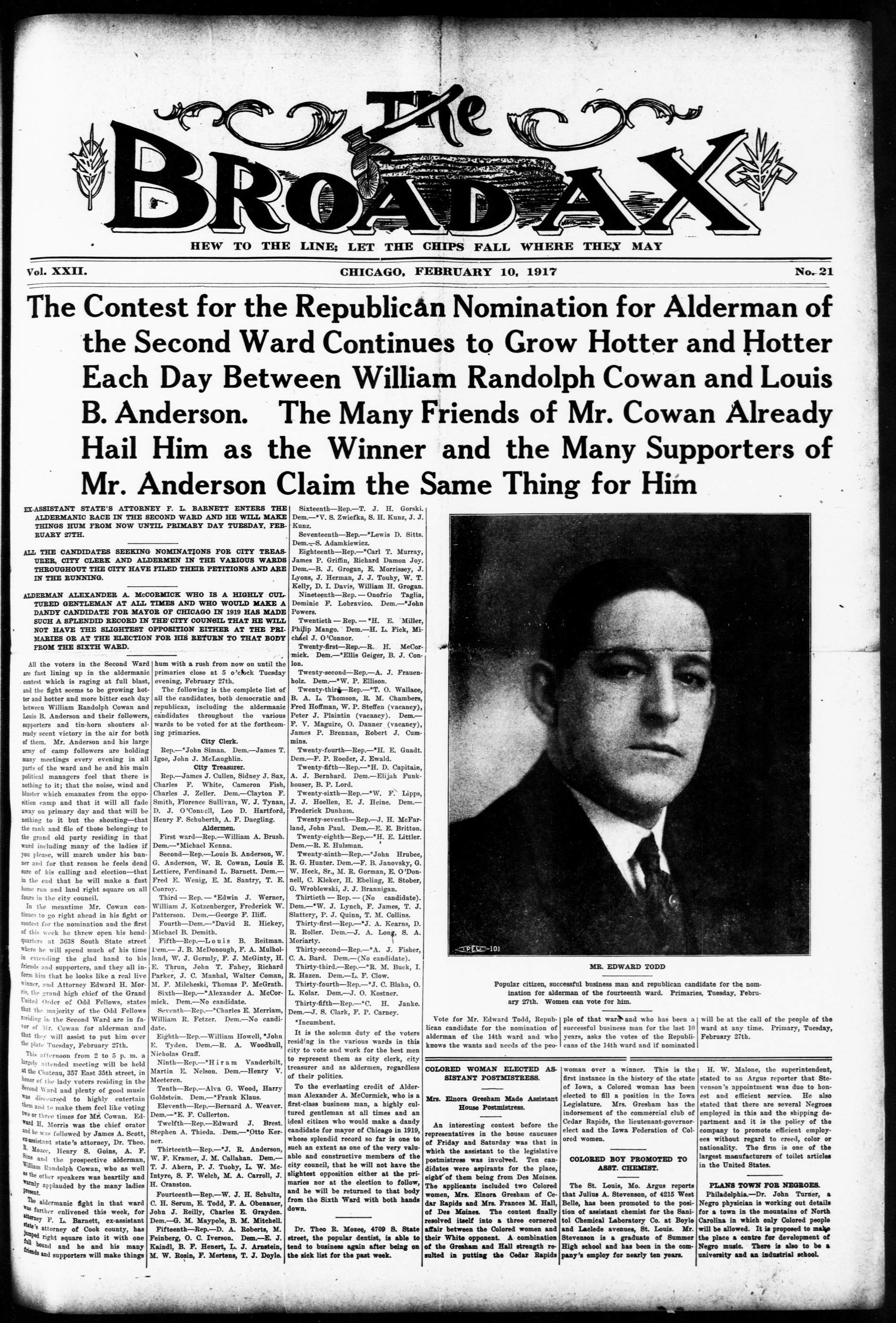
Page text (machine-generated)
THE BROAD AX
HEW TO THE LINE; LET THE CHIPS FALL WHERE THEY MAY
The Contest for the Republican Nomination for Alderman of the Second Ward Continues to Grow Hotter and Hotter Each Day Between William Randolph Cowan and Louis B. Anderson. The Many Friends of Mr. Cowan Already Hail Him as the Winner and the Many Supporters of Mr. Anderson Claim the Same Thing for Him
EX-ASSISTANT STATE'S ATTORNEY F. L. BARNETT ENTERS THE ALDERMANIC RACE IN THE SECOND WARD AND HE WILL MAKE THINGS HUM FROM NOW UNTIL PRIMARY DAY TUESDAY, FEBUARY 27TH.
ALL THE CANDIDATES SEEKING NOMINATIONS FOR CITY TREASURER, CITY CLERK AND ALDERMEN IN THE VARIOUS WARDS THROUGHOUT THE CITY HAVE FILED THEIR PETITIONS AND ARE IN THE RUNNING.
ALDERMAN ALEXANDER A. McCORMICK WHO IS A HIGHLY CULTURED GENTLEMAN AT ALL TIMES AND WHO WOULD MAKE A DANDY CANDIDATE FOR MAYOR OF CHICAGO IN 1919 HAS MADE SUCH A SPLENDID RECORD IN THE CITY COUNGIL THAT HE WILL NOT HAVE THE SLIGHTEST OPPOSITION EITHER AT THE PRIMARIES OR AT THE ELECTION FOR HIS RETURN TO THAT BODY FROM THE SIXTH WARD.
Vol. XXII.
The Conti
the S
Each
B. An
Hail
Mr. A
EX-ASSISTANT STATE'S ATTORNEY
ALDERMANIC RACE IN THE S
THINGS HUM FROM NOW UN
RUARY 27TH.
ALL THE CANDIDATES SEEKING
URER, CITY CLERK AND ALL
THROUGHOUT THE CITY HAVE
IN THE RUNNING.
ALDERMAN ALEXANDER A. McC
TURED GENTLEMAN AT ALL,
DANDY CANDIDATE FOR MAY
SUCH A SPLENDID RECORD IN
NOT HAVE THE SLIGHTEST
MARIES OR AT THE ELECTION
FROM THE SIXTH WARD.
All the voters in the Second Ward are fast lining up in the aldermanic contest which is raging at full blast and the fight seems to be growing hotter and hotter and more bitter each day between William Randolph Cowan and Louis B. Anderson and their followers, supporters and tin-horn shouters already scent victory in the air for both of them. Mr. Anderson and his large army of camp followers are holding many meetings every evening in all parts of the ward and he and his main political managers feel that there is nothing to it; that the noise, wind and bluster which emanates from the opposition camp and that it will all fade away on primary day and that will be nothing to it but the shouting—that the rank and file of those belonging to the grand old party residing in that ward including many of the ladies if you please, will march under his banner and for that reason he feels dead sure of his calling and election—that in the end that he will make a fast home run and land right square on all fours in the city council.
In the meantime Mr. Cowan continues to go right ahead in his fight or contest for the nomination and the first of this week he threw open his headquarters at 3638 South State street where he will spend much of his time in extending the glad hand to his friends and supporters, and they all inform him that he looks like a real live winner, and Attorney Edward H. Morris, the grand high chief of the Grand United Order of Odd Fellows, states that the majority of the Odd Fellows residing in the Second Ward are in favor of Mr. Cowan for alderman and that they will assist to put him over the plate Tuesday, February 27th.
This afternoon from 2 to 5 p. m. a largely attended meeting will be held at the Chateau, 357 East 35th street, in honor of the lady voters residing in the Second Ward and plenty of good music was discoursed to highly entertain them and to make them feel like voting two or three times for Mr. Cowan. Edward H. Morris was the chief orator and he was followed by James A. Scott, ex-assistant state's attorney, Dr. Theo. R. Mozee, Henry S. Goins, A. F. Sims and the prospective alderman, William Randolph Cowan, who as well as the other speakers was heartily and warmly applauded by the many ladies present.
The aldermanic fight in that ward was further enlivened this week, for attorney F. L. Barnett, ex-assistant state's attorney of Cook county, has jumped right square into it with one full bound and he and his many friends and supporters will make things
hum with a rush from now on until the primaries close at 5 o'clock Tuesday evening, February 27th.
The following is the complete list of all the candidates, both democratic and republican, including the aldermanic candidates throughout the various wards to be voted for at the forthcoming primaries.
**City Clerk.**
Rep.—*John Siman. Dem.—James T. Igoe, John J. McLaughlin.
**City Treasurer.**
Rep.—James J. Cullen, Sidney J. Sax, Charles F. White, Cameron Fish, Charles F. Zeller. Dem.—Clayton F. Smith, Florence Sullivan, W. J. Tynan, D. J. O'Connell, Leo D. Hartford, Henry F. Schuberth, A. F. Daegling.
**Aldermen.**
First ward—Rep.—William A. Brush. Dem.—*Michael Kenna.
Second—Rep.—Louis B. Anderson, W. G. Anderson, W. R. Cowan, Louis E. Lettiere, Ferdinand L. Barnett. Dem.—Fred E. Wenig, E. M. Santry, T. E. Conroy.
Third—Rep.—*Edwin J. Werner, William J. Kotzenberger, Frederick W. Patterson. Dem.—George F. Iliiff.
Fourth—Dem.—*David R. Hickey, Michael B. Demith.
Fifth—Rep.—Louis B. Reitman. Dem.—J. B. McDonough, F. A. Mulholland, W. J. Gormly, F. J. McGinty, H. E. Thrun, John T. Fahey, Richard Parker, J. C. Manhal, Walter Coman, M. F. Milcheski, Thomas P. McGrath. Sixth—Rep.—*Alexander A. MeCormiek. Dem.—No candidate. Seventh—Rep.—*Charles E. Merriam, William R. Fetzer. Dem.—No candidate. Eighth—Rep.—William Howell,*John E. Tyden. Dem.—R. A. Woodhull, Nicholas Graff. Ninth—Rep.—*Hiram Vanderbilt, Martin E. Nelson. Dem.—Henry V. Meeteren. Tenth—Rep.—Alva G. Wood, Harry Goldstein. Dem.—*Frank Klaus. Eleventh—Rep.—Bernard A. Weaver. Dem.—*E. F. Cullerton. Twelfth—Rep.—Edward J. Brest. Stephen A. Thieda. Dem.—*Otto Kerner. Thirteenth—Rep.—*J. R. Anderson, W. F. Kramer, J. M. Callahan. Dem.—T. J. Ahern, P. J. Tuohy, L. W. McIntyre, S. F. Welch, M. A. Carroll, J. H. Cranston.
Fourteenth—Rep.—W. J. H. Schultz,
C. H. Serum, E. Todd, F. A. Obenauz,
John J. Reilly, Charles E. Grayden,
Dem.—G. M. Maypole, B. M. Mitchell
Fifteenth—Rep.—D. A. Roberts, M.
Feinberg, O. C. Iverson, Dem.—E. J.
Kaind, B. F. Henert, L. J. Arnstein,
M. W. Rosin, F. Mertens, T. J. Doyle
CHICAGO, FEBRUARY 10, 1917
Sixteenth—Rep.—T. J. H. Gorski. Dem.—*V. S. Zwiefka, S. H. Kunz, J. J. Kunz.
Seventeenth—Rep.—*Lewis D. Sitts. Dem.—S. Adamkiewicz.
Eighteenth—Rep.—*Carl T. Murray, James P. Griffin, Richard Damon Joy. Dem.—B. J. Grogan, E. Morrissey, J. Lyons, J. Herman, J. J. Touhy, W. T. Kelly, D. I. Davis, William H. Grogan, Nineteenth—Rep.—Onofrio Taglia, Dominic F. Lobravico. Dem.—*John Powers.
Twentieth—Rep.—*H. E. Miller, Philip Mango. Dem.—H. L. Fick, Michael J. O'Connor.
Twenty-first—Rep.—R. H. McCormiek. Dem.—*Ellis Geiger, B. J. Conlon.
Twenty-second—Rep.—A. J. Frauenholz. Dem.—*W. P. Ellison.
Twenty-third—Rep.—T. O. Wallace, B. A. L. Thomson, R. M. Chambers, Fred Hoffman, W. P. Steffen (vacancy), Peter J. Plaintin (vacancy). Dem.—F. V. Maguire, O. Danner (vacancy), James P. Brennan, Robert J. Cummins.
Twenty-fourth—Rep.—*H. E. Gnadt. Dem.—F. P. Roeder, J. Ewald.
Twenty-fifth—Rep.—*H. D. Capitain, A. J. Bernhard. Dem.—Elijah Funkhouser, B. P. Lord.
Twenty-sixth—Rep.—*W. F. Lipps,
J. J. Hoellen, E. J. Heine. Dem.—Frederick Dunham.
Twenty-seventh—Rep.—J. H. McFarland, John Paul. Dem.—E. E Britton.
Twenty-eighth—Rep.—*H. E. Littler. Dem.—R. E. Hulsman.
Twenty-ninth—Rep.—*John Hrubec, R. G. Hunter. Dem.—F. B. Janovsky, G. Wheek, Sr., M. R. Gorman, E. O'Donnell, C. Kleker, H. Ebeling, E. Stober, G. Wroblewski, J. J. Brannigan.
Thirtieth—Rep.—(No candidate).
Dem.—*W. J. Lynch, F. James, T. J. Slattery, P. J. Quinn, T. M. Collins.
Thirty-first—Rep.—*J. A. Kearns, D. R. Roller. Dem.—J. A. Long, S. A. Moriarty.
Thirty-second—Rep.—*A. J. Fisher, C. A. Bard. Dem.—(No candidate).
Thirty-third—Rep.—*R. M. Buck, I. R. Hazen. Dem.—L. F. Clow.
Thirty-fourth—Rep.—*J. C. Blaha, O. L. Kolar. Dem.—J. O. Kostner.
Thirty-fifth—Rep.—*C. H. Janke. Dem.—J. S. Clark, F. P. Carney.
*Incumbent.
It is the solemn duty of the voters residing in the various wards in this city to vote and work for the best men to represent them as city clerk, city treasurer and as aldermen, regardless of their politics.
To the everlasting credit of Alderman Alexander A. McCormick, who is a first-class business man, a highly cultured gentleman at all times and an ideal citizen who would make a dandy candidate for mayor of Chicago in 1919, whose splendid record so far is one to such an extent as one of the very valuable and constructive members of the city council, that he will not have the slightest opposition either at the primaries nor at the election to follow, and he will be returned to that body from the Sixth Ward with both hands down.
Dr. Theo R. Mozee, 4709 S. State street, the popular dentist, is able to tend to business again after being on the sick list for the past week.
101
Popular citizen, successful business man and republican candidate for the nomination for alderman of the fourteenth ward. Primaries, Tuesday, February 27th. Women can vote for him.
COLORED WOMAN ELECTED AS
SISTANT POSTMISTRESS.
Mrs. Elnora Gresham Made Assistant
House Postmistress.
An interesting contest before the representatives in the house caucuses of Friday and Saturday was that in which the assistant to the legislative postmistress was involved. Ten candidates were aspirants for the place, eight of them being from Des Moines. The applicants included two Colored women, Mrs. Elnora Gresham of Cedar Rapids and Mrs. Frances M. Hall, of Des Moines. The contest finally resolved itself into a three cornered affair between the Colored women and their White opponent. A combination of the Gresham and Hall strength resulted in putting the Cedar Rapids
ple of that ward and who has been a successful business man for the last 10 years, asks the votes of the Republicans of the 14th ward and if nominated
woman over a winner. This is the first instance in the history of the state of Iowa, a Colored woman has been elected to fill a position in the Iowa Legislature. Mrs. Gresham has the indorsement of the commercial club of Cedar Rapids, the lieutenant-governor-elect and the Iowa Federation of Colored women.
COLORED BOY PROMOTED TO
ASST. CHEMIST.
The St. Louis, Mo. Argus reports that Julius A. Stevenson, of 4215 West Belle, has been promoted to the position of assistant chemist for the Sanitol Chemical Laboratory Co. at Boyle and Laclede avenues, St. Louis. Mr. Stevenson is a graduate of Summer High school and has been in the company's employ for nearly ten years.
No.21
will be at the call of the people of the ward at any time. Primary, Tuesday, February 27th.
H. W. Malone, the superintendent, stated to an Argus reporter that Stevenson's appointment was due to honest and efficient service. He also stated that there are several Negroes employed in this and the shipping department and it is the policy of the company to promote efficient employees without regard to creed, color or nationality. The firm is one of the largest manufacturers of toilet articles in the United States.
PLANS TOWN FOR NEGROES
Philadelphia.—Dr. John Turner, a Negro physician is working out details for a town in the mountains of North Carolina in which only Colored people will be allowed. It is proposed to make the place a centre for development of Negro music. There is also to be a university and an industrial school.
CR Phones Calumet e104
Geo. T. Kersey ‘Automatic 71-629
David A. McGowan
Ahmed A. Rayner OPEN DAY
AND NIGHT
The Emanuel Jackson
Undertaking Co., Inc.
2959-61 South State St.
Reliable Service * Courteous Treatment
Reasonable Prices
FREE CHAPEL IN CONNECTION
Complete line of Funeral Goods. Automobles for hire
anal
: “THE MOLERN SCHOOL” - CLEAN AND RELIABLE
; TERREVOUS L, DOUGLAS. Prop.
3 CIGARS—WHOLESALE AND RETAIL
: BOX TRADE A SPECIALTY
| 3556 South State Street Chicago
PHONE DREXEL s2e0 RES. PHONE DREXEL 2082
T. W. Champion & Co.
Real Estate Brokers
RENTING a LOANS 2% INSURANCE
5107 South State Street
Chicago *
PAGE TWO
TEACHING INDIANS IS
THIS WOMAN'S HOBBY
Mrs. Molineux Declares Red Man Can
Be Led, but Will Not Be Driven.
Salt Lake City.To have mothered
one or possibly two tiny lives through
the strenuous days of early infancy is
a task that most women consider plen-
ty, but Mrs. Elizabeth Molineux, until
recently a teacher in the United States
Indian service, has the distinction of
having mothered a whole tribe of Plute
Indians, and claims the satisfaction of
having raised them, old and young,
from a condition bordering on the
squalid state where they consider
cleanliness next to godlinéss and, one
and all, are heartily in favor of both.
Mrs. Molineux recently resigned her
Post as teacher on the Shivwits res-
ervation in southern Utah and is in
Salt.Lake resting preparatory to going
to Ketchikan, Alaska, to take charge
of the Episcopal church’s mission
school there. She is a guest at the
home of the Right Rev. Paul Jones,
bishop of the Episcopal diocese of
Utah, while here.
Indians have become a hobby with
this diminutive little Scotchwoman.
She speaks their languages and in her
eight years of service with the Indian
department has been intimately asso-
lated with the trials and tribulations
that beset poor Lo on his native heath.
Mrs. Molineux is an ardent church-
woman and attributes ber success in
dealing with Indians to the fact that
by blending religious teachings with
the “three R's” she has dismissed dis-
trust of her from the minds of her
charges and has always been regarded
by them more in the light of a friend
than a teacher. She declared the In-
dian mind to be susceptible to teaching
if properly approached, but adds that
he can be led but will not be driven.
CHASING A COYOTE IN
AUTO EXCITING SPORT
Hound, Sighting Game, Leaps
Over Mud Shield and Lands
Twenty Feet Ahead of Car.
Larned, Kan.—An exeliting coyote
chase In automobiles took place wear
Ifanston. ‘The party consisted of Dill
Hann, John Hann, Mr. and Mrs. Irvin
Seaman and William Warring. They
went in two cars and took three grey:
hounds in each car.
Mr. Warring says that auto polo ts
mild compared with the way those two
cars chased across the prairie, ravines
‘and bluffs after coyotes. He said that
his speedometer registered forty miles
one time when he dared to glance at If
and he was afraid to look again.
‘They were going along between twet
ty and thirty miles an hour at the tire
they started up the first coyote, and
when the biggest hound in Mr, War
ring’s car sighted the wolf it leaped
‘over the wind shield and hood and
landed running twenty feet abead of
the car. The coyote was a big fellow,
but the hounds @nally brought him
down, the big hound throwing him,
while the others pinned him down.
While chasing the first coyote the
other auto nearly ran over another one,
which leaped up almost from under the
wheels of the car. The men shot at it
several times, wounding it, but because
ofthe speed of the bounding car could
get but poor aim. It fnally ran into
bole and was fished out with a wire.
‘Messre, Hann and Seaman have killed
‘Many coyotes.
The Famous “Green Man of Brighton.”
In October, 1806, an individual was
to be observed at Brighton, England,
who walked out every day dressed in
green from head to foot—green shoes,
green gloves, green handkerchief and
other articles to match. This eccen-
tric person lived alone, knew nobody,
and in his house the curtains, the wall
paper, the furniture, even the plates
and dishes and the smallest toilet ar-
ticles, offered an uninterrupted se-
quence of green. Having started on
his career, there was obviously no rea-
son to stop, and with full consistency
he carried his scruples so far as to eat
nothing but fruit and vegetables of the
same green color. The consequences
were extremely disastrous. One fine
day the green man jumped from his
window into the street, rushed forward
and performed a second somersault
from the top of the nearest elif.
Gus Seems.
In the anzie between the Kings and
Kern canyons lies a woodland empire
beside which the Harz and Black for-
est of Germany would appear almost
diminutive. Within the borders of the
Sequcia National park and the General
Grant National park near by there are
no fewer than 1,166,000 sequoia trees,
and of these 12,000 are more than ten
feet in diameter. In the Sequoia Na-
tional park stands the largest tree in
the world—not the tallest, but the larg-
est—the General Sherman tree, with a
diameter of 36.5 feet and a height of
279.9 feet. Its massive trunk and
branches contain about 1,000,000 feet
of lumber, board measure. This fs
equal to the amount of lumber that fs
cut from forty acres of average Minne-
sota timberland.—Argonaut.
Self Convicted.
“Say, pa.” queried small Bobby,
“what Is gossiping, anyway?”
“Gossipitg. my son,” replied the old
man, “if we get right down to the
plain, unvarnisbed facts, is lying. But
why do you ask?” *
“Because,” answered the young in-
vestigator, “ma says you do a lot of
gossiping every time your business
Keeps you late at the office."—Ex-
ebange.
Wi BR Dini
“Does your minister practice what he
preaches?” the newcomer questioned.
“Fle does.” the citizen answered, with
a.sigh, “and I'd be perfectly willing to
have him stop. He lives next door to
me and begins at 7 o'clock Sunday
morning to practice what he is going
to preach.”—New York Times.
Divided It.
Scene—Police court during dispute
over eizht day clock.
Magistrate—1 award the clock to the
plaintift.
Defendant—Then what do I get?
Magistrate—I'll give you the elgbt
days.—London Stray Stories.
Sharks and Death.
There fs an old yet still operative su-
perstition among seafaring men that
when a shark persistently follows a
‘vessel it is a sign that some person on
board is going to die, the alleged rea-
son being that the great fish can scent
death.
Fashionable:
‘Willie—Paw, what is a fashionable
Fesort? Paw—aA place where you can
‘obtain the least comfort and the most
style for the most money, my son.—
‘Cincinnati Enquirer.
Ob, how bitter @ thing it ts to leok
{nto happiness through another man’s
qesl—“As You Like It,” II, 1.
THE BROAD AX, CHICAGO, FEBRUARY 10, 1917.
a
GIRL JILTS ARE FACSE, =}
SAYS PROFESSOR SHAW
Don’t Believe Her When She Says j i OU H
She'll Be Your Friend. .
New York.—“When a girl says, ‘I
cannot be your wife, but I'll be your
friend,’ she tries to speak the truth,
Dut utters a psychological falsehood,”
declared Professor Charles Gray Shaw,
head of the philosophy department of
the New York university, in a lecture
at the institution.
Professor Shaw argued that no wom
an could be a friend to men or to
women, because a friend requires @
clear cut personality and a disinter-
ested outlook on life. Both of these,
he asserted, women lack. He also de-
clared that friendships between men
were passing from the earth.
“Woman cannot be a friend because
she is never an individual, for to be
‘an individual one must stand alone,”
he said. “Only those who stand alone
can come together.”
Professor Shaw said that woman was
lke a planet—well adapted to revolve
‘about some center, “but not organized
In such a way as to stand alone.”
“Unfortunately, masculine friend-
ships are just passing from the earth,
and in the course of time friends will
be found only in museums, along with
other aboriginal products. This mel-
ancholy situation is due to the fact
that modern life tends to destroy per-
sonality and a philosophic view of the
world. Man is bound to man not by
ties of friendship, but by bonds of pro-
fessionalism which are usually of a
commercial character.”
INDIAN TRIBES USE
WHISTLING LANGUAGE
Able to Express Their Thoughts
Perfectly by Its Use, Says
Mining Engineer.
Carlisle, Pa.—That entire tribes of
Indians in Mexico carry on long con-
versations by means of whistling is as-
serted by Harold T. Mapes, mining en-
gineer, who was for twelve years in
Mexico, but now lives in Carlisle.
‘Mapes declares that the Indians have
a whistling language and are able to
express their thoughts perfectly by its
use. He says it is not a series of signs
or alls signifying danger, love, fear,
peace, war, etc., but a regular language,
by which the most subtle shades of
thought may be expressed.
Like people in other parts of the
world, the Mexican Indians occasion-
ally whistle for their dinners, only tuey
are able to explain by their whistles
exactly what kind of a dinner they
want—elther a simple meal of tortillas
and frijoles or a more elaborate feast
of enchiladas and mole guajalote, with
cervezt or vino.
Mapes says that he understands that
the whistling language has been hand-
ed down from generation to generation
from the time of the Toltecs and Az-
tees and that Indian lovers can put a
world of tenderness and passion into
their whistled declarations of love or
stir their fellows to heroie deeds by
the fierceness with which they whistle
call to arms.
A whistling language has been used
from time immemorial by the Swiss
mountaineers, and Neapolitan sailors
converse frequently by means of whis-
fling. Convicts in the big jails in Na-
ples converse freely by means of whis-
tling, and there is apparently no limit
to their whistling vocabulary.
BIRD DOG WEARS GLASSES.
Georgia Setter Does Good Work After
Visit to Oculist.
Moultrie, Ga—Fanny, a thorough:
bred setter. wears spectacles. She was
fitted with glasses by an oculist, who
found that she had astigmatism.
For years Fanny has been known as
one of the best hunting dozs in this
section. Before the opening of the
quail season this year she went to the
fields by lerself and on_ returning
showed evidence of bad falls, Fanny
could not help falling into ditehes and
running into trees. Then it was dis
covered that her eyes had become af-
fected.
It fg believed the glasses will correct
the trouble. .\t least Fanny now is do-
ing her work as well as usual,
HE KNEW.
Austrian Tells Who It Is That Elects a
President.
Hammond, Ind.—Jorn Bosovich, late
of Austria, applied to the federal court
for citizenship papers. Clerk Hem-
stock put the questions and got these
answers:
“Who is president of the United
States?”
“Mr. Wilson.”
“Who makes the laws?”
“The congress.”
“Who elects the president”
“California.”
Be got the papers. z
Bank Robber Returns $5.
Scranton, Pa.—A letter with $5 in-
closed has been received by the Pine
Brook bank. The letter said that the
writer held up the teller and took the
money at the point of a revolver. “I
am taking the first opportunity to pay
it back,” said the letter, which was
postmarked Moscow, Pa. The bank
officials will have the missive framed.
‘The robber entered the bank and point-
ing &@ revolver at the teller, George
Browning, demanded $25. Browning
handed out $5, which satisfied him.
YOU HAVE READ MUCH!
=<THOUGHT SOMES
gee
——————
Your opportunity to be a part owner -—-to share in profits of
“THE BIRTH OF A RACE”
is passing. The shares of Capital Stock have been turned
over to a strong firm of brokers. The sales are big ---- in
Chicago -- all over the country. The shares are going very
fast. Soon they will be entirely gone, and your chance to
make a lot of money gone also ---- unless you get busy.
Not Next Month
| ot Next Month But TO-DAY
——
This Master Photoplay is of interest to you. It will help you {
| and your race, and make money for you at the same time.
——
President, EDWIN L. BARKER, a man who has produced real motion pictures.
Secretary, JOHN C. WILLIAMS, for 6 years Attorney for Sanitary Dist. of Chicago.
Treasurer, JOHN GULLIKSEN, Assistant Cashier of the Union Bank of Chicago.
DEPOSITORY FOR FUNDS, Union Bank of Chicago. (
me i
‘ C g 333 BIRTH OF RACE PHOTOPLAY CORPORATION,
em, a Suite 416, 29 Se. LaSalle Street, Chicago, Ill.
as - Please send me, without obligation on my part, full in-
CLIP, fill out ‘and mail thi: coupon formation about ‘The Birth of a Race.””
J to-day, and circular telling all about
) “THE BIRTH OF A RACE,” will a
be sent you at once. Cad daleaknaincaesasnecanageniniananaaidiedsanis btied
{ There is a Monthly Payment
* Plan which makes it very easy to Slreelis saan can ccs ctcesusceeuesenssees
j own a few shares of stock. ( sacar
FOUND IMAGE IN CAVE.”
Crude Stone Idol Probably Antedates
‘Secthens Wicd Gildas.
Madisonville, Ky.—E. L. Littlepage
of the Morton Gap country brought to
thie place recently a stone image that
is a curiosity and probably of historic
value. :
Mr. Littlepage found it at the edge
of a cave on a high elevation in North
Christian county, Ky., while investigat-
ing some prospective oil land belonging
to him, The cave is located in a wild
and broken section of land uncultivat-
ed and but thinly inhabited.
The image is rudely carved out of a
tough, ferrous sandstone. It is about
six inches in height and is well pre-
served, except for a slight injury on
one side of its head and slight weath-
ering of one arm. The figure is in a
sitting position, with its legs doubled
under its body and arms extended in
front, with hands resting on its knees.
‘The image is evidently a relic of an
idol worshiping people and antedates
any old Indian relic found in various
Indian mounds in western Kentucky.
WIDOW SAVES TREES.
Turns Commissioners From Those
Planted by Her Husband.
SN ee eee tet ee
St. Cloud, Mich—“Woodman, spare
that tree; touch not a single bough.”
‘Thus quoted Mrs. Mary Spicer, wid-
ow, as she pleaded for the preservation
of trees planted by ber husband, long
dead.
It was three years ago that Mrs. Spl-
cer started her battle with city officials
over the maintenance of this arborian
inheritance. She was called upon to
enter another skirmish the other day
when sidewalk bids were opened, in
which provision was to have been
made for the removal of the trees.
Mrs. Spicer's “pets” fringe a lot on
which her modest little home ts built.
“Walt until I am gone and you may
remove them,” she told the city com-
missioners, who took her words to
heart. When sidewalk bids were open-
ed there were proposed contracts on
other jobs, but on the Widow Splcer's
Property—not @ word.
EIGHTY, WANTS HEART BALM
ane te ao Little Lame.
Utica, N. Y.—Mrs, Almira Kingsbury
is Just a little on the right side of
eighty years old. She is rather deaf.
She bas lost her right eye and her left
thumb, Besides she is a little lame.
But she took the stand to testify that
Robert Roberts of Trenton, seventy-six
years old and a farmer, had been so
smitten with her charms at first sight
that he urged her to marry him. Then
she said he broke troth and sbe sued
for breach of promise. They met at an
employment agency where he sought a
housekeeper.
Judge Hazard told Mrs. Kingsbury’s
attorney, “I think your client is clearly
entitled to about @ cent.” However,
the case was held open for more evt-
dence.
ALL AVAILABLE LAND GONE.
Commissioner of Immigration Howe
Predicts That United States Will Be-
come an Emigrant Rather Than an
Immigrant Nation at the End of Hos-
tilities In Europe.
Se ee
New York.—A prediction that the
United States would become an “em!-
grant” rather than an “immigrant” na-
tion at the close of the war was made
by Commissioner of Immigration Fred-
erie C. Howe at the Sunday evening
forum of the Free synagogue.
Mr. Howe took the stand that imm!-
gration was purely an economic ques-
tion and declared that it had been
such from the beginning. He sald that
those who opposed immigration did so
because they desired to limit the com-
Petition of unskilled foreign labor;
those who favored the wide open door
‘did so because it made labor cheap.
Be said the immigrant no longer
went to the farm because all the avail-
able land of the country had been tak-
en up, hundreds of millions of acres
| being held for purely speculative pur-
Poses.
“The immigration problem never ex-
isted so long as the land was free for
the asking.” sald Mr. Howe, “and it is
this searceness of land which makes
immigration an economie question.
“It is a matter of freeing labor on
‘one hand from the competition of the
incoming labor groups from Europe
and of insuring to the immigrant an
opportunity to work for himself rather
than for an employer interested in se-
curing his services at the lowest pos-
sible cost.
“I keen more or less in touch with
the centers to which go most of the
‘men who pass through Ellis island. 1
am told that everywhere the men now
employed in our shops and factories
“who at home worked as farmers are
‘saving thelr money to return to the
‘old countrs. They have always wished
to own their own farms—they came
here for that purpose—and they Sure
| that after the war land will be cheap
in the countries overseas. This senti-
‘ment, spreading among our workers,
Will result in a serious crisis in our
industria} life.”
| Mr. Howe also discussed the servant
question. He said that since the war
there had been practically no servant
‘Girls coming to this country and that
many of those who were in service had
Jeft it to enter munition factories and
offices, while others had married or
died.
To regulate the tide of oriental im.
migration and, in fact, to check in some
measure immigration from any land
Dr. Sydney 1, Gulick, an authority on
Japan, suggested that, for example, if
‘@ thousand Syrians came to this coun-
try in 1900 and ten years later all had
taken out American citizenship then
‘another thousand might be admitted.
If, however, only 800 had applied for
naturalization papers the decision of
the remaining 700 to still be Syrians
‘automatically would keep an equal
number of thelr fellow countrymen tn
‘Teaching Birds Tricks. ~
A professor of natural history re
fates the statement so frequently made
that teaching a bird to draw water
needs apparatus and that the learning
is cruelty to the bird.
“The following experience of mine,"
he says, “proves that it is not so by
any means. We bought a young bint
last January, so wild that on our ap-
Proach it flew madly round the cage.
We hung the cage low and bs patience,
after the bird got used to our proxim-
ity, induced it to take groundsel, first
held at stem’s lenzth, then between the
fingers, finally from the lips. We used
to let him out freely, and he would
Perch on the loaf next me at break-
fast. His perch-projected through the
Wires, and here was his favorite seat
when at liberty. Then I tried hanzing
‘@ bit of groundsel by a short string to
the projecting stick. After inspection
he pulled it up with his beak. On
lengthening the string with a fresh
bit of his preferred weed I had the
pleasure and interest of seeing bim
pull up the string with his beak till
the flower head was within reach,
catching the slack after each pull with
one foot and then transferring tt to
the other, so that the coils were quite
neat"—London Globe.
‘Weter Brana.
As early as 1618 a Frenchman of
science named Pascal experimented
With pressures applied to liquids and
discovered the following law: A pres
sure applied to any part of the sur
face of a liquid is transmitted um
changed in amount im every direction
throuzh the liquid.
Perhaps the mos familiar applice
ton of Pascal's law is the hzdraulie
press, In that machine a pump having
a small piston drives water inte a large
cylinder and thereby forces vpward ®
large piston, which compresses what,
ever 1s placed between the platform of
the piston and the fixed cressbeam at
the top of the press. If the area of
the larger piston ts 100 times that of
the smaller a downward force of one
pound exerted on the snialler pistes
will create an upward force of 10
pounds upon the larger piston.
Sienen Qeeunst Cicer.
Grinding wheat to make flour Me
be done at home as easily as the
grinding of coffee. Thus a farily may
have whole wheat flour. freshly round
fa thing that is usually difficult too
tain. The New York Medica! Journal
advises its readers to buy their wheat
from seedsmen rather than from #%
cers or feed stores because it will
cheaper and more efficient
‘The grinder can be used sls? te
eracking wheat, corn, barley. 08t%
fand other grains for use as breskfie’
cereals. And the cereals will eed
chewing, which will not only steas
en the muscles of the chewer 28
Dut will keep their teeth from dees
that is, if they begin as childret-
Homemade cereals need ions
ng, 20 0 freless cooker is sine
‘dispensable.
SHOPS AND PLANTS —
FAVOR INDUSTRIAL
BETTERMENT WORK
Actively Aid Welfare Plans of
Every Description, For
Employees,
PHILANTHROPY NOT INTENT.
Comfort and Contentment of the
Workers Considered Paramount.
Hundreds of millions of dollars bave
teon expended during the past decade
by American manufacturers for those
forms of industrial betterment, in be-
half of employees, that are generally
classed as philanthropic or beyond the
mere requirements of laws and con-
tracts.
Decent manufacturers—and they are
in the vast majority—as are the decent
people of other classes—are opposed to
grisding ehild labor, and they strive to
pay a living wage to all of their em-
ployees. They go much farther than
thst, as a study of American industry
will show. ‘They devote time, money
aud effort to provide every possible
supplementary means for promoting
the convenience, the comfort, the
health, contentment and happiness of
their workers and of the families of
employees. Very few manufacturers
cousider such work or expenditure to
be philanthropy, but, rather, a neces-
sary feature of their business. While
their motives may be as altruistic as
those of the average of mankind, they
find that it is good, from the business
point of view, to promote as far as
possible the welfare of their employees.
Industrial betterment pays.
Industrial betterment means an at-
tempt to provide the best kind of work-
ing and living conditions, and it im-
plies the co-operative responsibility of
the wage earner and the employer in
bringing those conditions about and in
improving them from time to time. It
is not a dole to be handed to the wage
earner, but is a token of that spirit of
mutuality which, under right condi-
tions, should permeate industry.
A thorough description of industrial
betterment activities in the United
States would require more space than
is contained in the most voluminous
encyclopaedias to be found in the li-
braries. Indeed, volumes might be
written about the welfare work of a
single corporation alone—the Nationa!
Cash Register Company, for instance,
or the International Harvester Com-
pany, the United States Steel Corpora-
tion, Cheney Brothers, the Curtis Pub-
lishing Company, the Bethlehem Steel
Company, the American Telephone and
Telegraph Company, the Eastman Ko-
dak Company, any one of the leading
railroad companies, the principal banks,
Wanamaker’s, or any of a host of other
concerns which has developed activities
of the sort. There is hardly a concern
in the country doing business on a fair-
ly extensive scale that has not initiated
some form of industriel betterment for
its employees. The honors do not go to
the larger companies exclusively either,
for many of the smaller business units
have developed this side of their ac-
tivities to a remarkable extent. Natu-
rally it is easier for the larger corpora-
tious to put highly trained specialists
in charge, of the various branches of
industrial betterment work.
The fundamentals of industrial bet-
terment are observed in furnishing
pleasant, sanitary, safe working condi-
tions. Educational and entertainment
features, facilities for study and recre-
ation, special opportunities for the ex-
excise of thrift and provisions tending
to remove the dread of and to mitigate
the sufferings occasioned by sickness.
disability or invalidity are matters
which next receive attention. Well
lichied, well ventilated and otherwise
Pletsant and safe working places, res-
tuwants, reading rooms and libraries.
Test rooms, emergency kits and hospi-
tals, club rooms, assembly rooms, gym
nasiums, lockers and bathing facilities,
recreation grounds, bonus and profit
sharing plans, special housing accom:
modations, facilities for the purchase
of homes on easy payments, discounts
in the purchase of goods, industrial
and other educational classes, lectures
for entertainment or instruction, mov.
ing pictures, excursions, field days.
nedieal attendance, safety committees
for accident and fire prevention, sick-
hess, disability and invalidity funds,
insurance or benefit associations and
Pensions are some of the customary
features of industrial betterment work,
the variety of which has no limit.
‘lens of thousands of lives are saved
each year and hundreds of thousands of
lesser necidents are prevented annually
through the aceident prevention cam-
Paizn and feature of industrial better-
mei:
‘The Eastman Kodak Company in five
Years reduced the accidents in its
Nauts by over 75 per cent per annum
throuch @ progressive safety campaign.
The Pennsylvania Railroad in ten
Months decreased the serious injuries
°f its 33.242 shop employees over 63 per
cent by the installation of safety de
"ices and by the constant instruction of
the workmen in exercising due caution.
4s a result of its safety campaign the
United States Steel Corporation reduced
srious and fatal accidents in its various
Dlants by 46 per cent since 1906. Each
Year 2,300 of the men employed by the
‘poration escape Who would have been
GET TOGETHER FOR
PERMANENT PROSPERITY.
Every man and woman engaged ir
American factories, mills and mines
whether they know English or speak
it, are naturalized or intend to be
come citizens, have a direct interest
in maintaining industrial prosperity.
When times are good, all workers
should not only be thrifty in habit and
lay yp a little something for possible
rainy days, but they should do all they
can to keep the good times with us.
Simply because your language is dif
ferent from that of the foreman, over
seer, superintendent, manager or owner
of the plant in which you earn a living
is no excuse for misunderstanding your
own common interest in prosperity by
hating your partner in your own in
‘dustry or listening to and following
the gospel of dissension and violence
which selfish agitators so often preach.
Do not blindly follow the man who
tells you how hard your lot is. Often
he is doing so untruthfully and for the
Purpose of getting you to contribute
membership money for his own support
in idleness. Agitators get rich by prey-
ing on the men in American industry.
whom they urge into unlawful or harm-
ful acts by misrepresenting conditions
or holding out foolish and false prom
ises of better things if they follow
their orders. You know conditions
yourself, and you know or ought to
know that the man or men whom the
agitator who pictures your employer as
on inhuman driving machine is actual
ly a partner with you, interested in
having the plant or industry successful.
‘The more successful your plant or
industry becemes, the more room for
you to grow with it there will be. It
should be your feeling, then, that you
will not do as little as you may find it
convenient to do, but to do just as
much as you possibly can do, and then
reasonably expect to share in the re-
wards that always come to the efficient
worker.
Do uot be @ clock watcher in the fac-
tory. Those who wait for hours to
strike or whistles to blow and “soldier”
at the bench, machine or in the office,
never get ahead in the ranks of in-
dustry. They never get any more pay
because they are not worth any more,
and often are worth less than they get.
Remember the old adage that a man
who never does any more or as much
as he gets paid for, never gets paid
for any more than he does.—Industrial
Conservation, N. ¥. ’
PUTTING BUSINESS RIGHT
WITH THE PUBLIC
A few years ago some big industrial
organizations and certain railroads em.
ployed business tactics which, accord-
ing to the popular idea, would make
the financial adventures of Pizarro,
Morgan or Captain Kidd look as ama-
teurish as the verbal exploits of Bobby
Make-Believe.
All are more or less acquainted with
the details. We will concede that there
were some glaring abuses, but the pub.
He when it came to apply a remedy tg-
nored the fact that these were peculiar
to comparatively few institutions and
instead of tackling the trouble where
it lay furiously assailed everything
classifiable as business—the trust mag-
nate, the independent manufacturer
ready and anxious to obey the law, the
smal] retailer, a law abiding and use-
fal citizen—the inuocent and the guilty
suffering alike. Seemingly the law was
invoked not to regulate, but to perse-
‘cute.
| ‘Ther® could be but one result. Busi.
ness was demoralized, and the whole
country has felt the evil effects. Now
the public is beginning to realize its
error and in a rather grudging way Is
making some concessions.
Business is being permitted to speak
for itself, and a movement has been in.
stituted by the leading business men
of the country under the title of the
National Industrial Conservation Move
ment for the purpose of repairing the
damage that has been done. Nothing
revolutionary is contemplated.’ The
plan is simply to educate the public by
taking it into the business man's conf
ence. Meetings will be held in vari-
ous trade and industrial centers. All
classes of citizens will be invited. The
Purpose of these meetings is to give the
public a new and correct viewpoint as
to the effects of drastic legislation and
restriction of business on the prosper-
ity of the country. Every effort will
be made to give the public a clear view
of the problems and difficulties which
beset business.
Special favors are not sought through
these meetings, only fair play. It is
believed that once the citizen grasps
the situation his whole attitude toward
business will change and that be will
readily co-operate toward bringing
about better conditions.
Commercial and other eivie organiza.
tions and the local press are already
showing great interest in this move-
ment, and it fs reasonable to believe
that much good will come from it—
Industrial Conservation, N. ¥.
Common Capitalists.
Every man or woman who possesses
a dollar or owns a set of tools is a
capitalist, People generally make the
mistake of thinking that the only form
of capital in existence {s the national
currency—the ‘dollar, frane, ruble.
mark, lire or pound sterling. Yet every-
body knows that many a successful
business man’s only original capital
was brains, knowledge, ability, deter
mination or ingenuity. It would be
well for more people to recognize this
truism before abetting, either by ac
tion or attitude. ceaseless efforts on the
part of some political or other self
seekers, to hobble business men and in-
dustrial development. Such is the spirit
of industrial patriotism which is need-
ed in America.—Industrial Conserva-
tion, New York.
FAMILY REUNITED. |our BUSINESS MEN
Children Uae Seearated by the i ASK FOR PUBLIC
—— 7 C0-OPERATIC
SEARCH BEGUN BY BROTHER.| = — ,
Bushwhackers. Raided Home, Killed
Parents and Drove Children Into
Woods—Adopted In Different Homes,
Survivors Drifted Apart — Meeting
Between Sisters and Brother Pathetic
Clarinda, ta.—A tragedy of the civil
war which resulted in the separation
of three children of a Missouri family
was recalled recently by the reunion of
the three children who bad been sepa.
tated during the long period, too young
At the time to maintain a correspond-
ence, and it was only after much effort
and correspondence that the members
of the family were enabled to meet and
hold a reunion after so long a separa-
tion.
Living near Laclede, Mo., was a fam-
ily named Deer, Bushwhackers raided
their home, killed the parents and
drove the children into the woods.
where they passed a night in terror.
‘The children sere Mary Deer, eight
Years old; Audie Deer, six years old.
and a brother two years old. Upon the
girl of eight years devolved the task of
keeping the others with her and to
vainly try to console them. Speaking
of the terrifying incidents of the night,
Mary, now Mrs. Mary Rabn of this
city, told how the baby boy cried to be
taken to his mother.
In the morning the children made
their way to Laclede, where they were
found nearly dead from exposure and
fright and crying bitterly. A man who
chanced to run across the children was
‘80 filled with pity that he took them in
charge, fed them and cared for them
for several days uutil he had succced-
ed in locating a!l three in homes, into
which they were finally adopted.
‘Thus torn apart, the children did not
again hear from euch other, Mary
spent ber entire girlhood as a nurse
girl in a family where there were sev-
eral children, and from them she man-
aged to learn to read and write. She
was taken to Illinois, where she mar-
ried. Addie Deer was taken with the
brother to Crete, Neb., where the girl
married and where the boy grew to
manhood and where he still resides.
Addie married and lost her busband.
She was married a second time to a
Mr. Downing, owner of a large ranch
near Glenwood Springs, Colo.
Some time «zo the brother began a
search for his sisters. It was an ap-
parently hopeless task, but by persever-
ance, much correspondence and long
range inquiry he managed to find them,
and all held a reunion at the home of
Mrs. Downing in Colorado.,
Mrs, Rahn soon after her marriage
moved from Illinois to this county.
She is now a widow, sixty years of
age. The meeting between the sisters
and brother was pathetic despite the
fact that a separation of over fifty
years had obviously tended to break
down the feeling of family relationship.
| WAR AFFECTS WATER TOO.
No Soda Ash to Soften City’s Drinking
Supply.
Columbus, O.—Liard water will be
the best the filtration plant can furnish
consumers the rest of the winter unless
something is done to increase the avail-
able supply of soda ash, one of the chief
‘chemicals used in the softeninz process.
Superintendent O'Shaughnessy of the
Columbus water plant said that soda
ash could not be had at any price ow-
Ing to Inability of ra¥roads to furnish
adequate transportation facilities; also
the Barberton plants, where the city’s
supply of soda ash is obtained, have
been handicapped during the last few
weeks because of a shortage of fuel.
No soda ash has been used at the fil-
tration plant for several days. Since
the war began soda ash has advanced
$44.a ton. Water can be softened to 2
certain dezree by lime, but soda ash
must be added to get the desired soft-
ness.
WAR ON CATS SAVES GAME.
Good Hunting In New Jersey Since Fe-
line Slauchter Started,
‘Trenton, N. J.—A report of the New
Jersey fish and game commission re-
cently issued states that the wholesale
extermination of cats in Burlington
‘county during the 1915 epidemic of foot
and mouth disease has resulted in
sportsmen nding Burlington among
the best hunting grounds in the state.
Game animals and birds are more
plentiful in the county than for years.
and scores of hunters have repeatedly
bagged their lezal limit of ten rabbits;
also quails, pheasants and squirrels. It
is held that the chief factor in the in-
crease in game animals and birds as
Well as song birds in that county was
the warfare on cats by both hunters
and farmers. Sportsmen found hun-
dreds of prowling homeless cats'In the
woods and fields preying upon native
birds and animals and killed them.
Newspaper on Fig Leaves.
Santa Cruz, Cal.—Because of the
high cost of paper and the failure of
subscribers to pay up, Luther McQues-
ton, publisher of the Mountain Echo
at Boulder creek, printed an edition of
his weekly on fig leaves. The edition
consists of five dried leaves pinned to-
gether with a twig and printed on both
sides and contains news items, classi-
fied and legal advertising and an edito-
rial in which McQueston sets forth bis
reasons for “returning to first princi
ples for print paper.”
OUR BUSINESS MEN
~ ASK FOR PUBLIC
CO-OPERATION
Leaders Point Out Partnership
Between Gapital and Labor,
SAY INTERESTS ARE MUTUAL
A better public understanding and
Appreciation of the needs and problems
of our American industries is conceded
on every side to be one of the tmpor-
tant national requirements for the de-
Yelopment of our future industrial
Prosperity. Few people seem to un-
derstand that the majority of our busi.
ness men are fair minded, reasonable
beings, legitimately engaged In the de-
Yelopment of our economic resources.
In the opinion of our business lead
ers this misunderstanding leads the
Public, through the legislators, into
thoughtless and unnecessary acts of
reprisal against all branches of indus-
try, which are often inimical to the
best interests of their own community
‘To cure this lamentable condition ft ts
first essential that a closer degree of
co-operative action for the common
good be established between em
Ployees and employers, The first step
in this direction {s to eliminate the
selfish, destructive agitator. This hap.
Py event would greatly facilitate a
general get together spirit among em:
Ployers and workers.
The Work That Men Do.
‘The nation is confronted with more
work than ever before—ships to build.
factories to enlarge, railways to com-
Plete, new foreign business to be at-
tracted and help to be extended to the
unfortunates on the other side. There
are about 30,000,000men at work;if they
work ten hours a day that is 300,000.
000 hours a.day or 96,600,000,000 hours
a year. If they work eight hours it Is
74,880,000.000, or a difference of 18.-
720,000,000 hours a year. At eight
hours a day this means that about
7.400.000 more men must be employed
to do the work that could be done by
the 30,000,000, and where are they to
come from?
During the past year there has been
a unified and standardized banking eur-
Tency system tried and not found
wanting. Rut there are yet other steps
to be taken before the ideal of eco-
nomle unit is worked out.
There are 62,000 stockholders of
railroads in the United States. A larze
proportion of them depend on the earn-
ings of the carriers for a meager in-
come. Many of these stockholders
have less than $1,000 a year income,
and they are unable to earn more, be-
ing elderly persons or women. Thou-
sands of them are former employees of
the railroads who depend upon their
stock dividends to pay their rent and
thelr grocery bills.
Labor and Capital Are Partners.
The manufactured output of the
United States amounts to $23,000,000,-
000 in value per annum. This is three
times the amount of the yearly output
of the ranches, farms, orebards and
gardens; it is a dozen times the output
of the mines; {t is larger than the com-
bined manufactures of any two for-
elgn nations. Labor received, as its
share of the fruits of industry, wages
amounting almost to seven billion dol-
lars in the single year of 1914. Does
not this prove that the interests of
employees are joint with those who
employ them and that a real partner-
ship exists?
Today there are over 100,000,000 peo-
ple in the land who must be fed.
clothed. sheltered, kept warm and
many of whom travel for health, pleas-
ure and business. The railway systems
are in many places overtaxed in doing
this work.
What will be the conditions when
there are 150,000,000 people to be
served?
‘This means an addition of at least 50
per cent to the number of tons of
freight moved one mile and the num-
ber of passengers moved one mile.
‘There was a total mileage of 41.988
in the hands of receivers in 1915, the
total capitalization of which was $2.-
264,000,000. In that year alone 20,143
miles of road went into the hands of re-
selvers, and these roads had a total cap-
talization of $1,070.808,628. This com-
pares with 4,222 miles in 1914 with a
total capitalization of $199.571.446. in
receivers’ hands. This is not a healthy
condition; it is a malady that affects
directly and indirectly every one in the
country.
Railways do not belong to a few rich
men or bankers. There are at least
1,500.000 owners of the securities of
American railways. There are 1.800.-
000 men approximately employed in
the railway service. The insurance
companies have $1.500,000,000 invested
in railway securities representing 30.-
000,000 policy holders; savings banks
have $800,000.000 invested in which
banks there are 11,000,000 depositors.
From 1909 to 1913 the States enact-
ed 60,001 and congress enacted 2.013
new laws which involved the consid-
eration of more than one-baif million
lerisiative propositions. or an annual |
production of over 12,000 new laws
© be assimilated by the business
FIND HEART ON RIGHT
SIDE, LIVER ON LEFT
Body of William King Described as
Left Handed Both Inside and Out.
St. Louls.—The body of William King,
which has been preserved for twenty
months, is described by an anatomist
as “left handed, both inside and out,”
according to a statement made public
at the City hospital.
In May, 1915, King, who was thirty.
five years old, applied at the hospital
‘for treatment. He said he was i la-
borer and had lived most of his life in
Wisconsin. He was suffering from ty-
phoid fever.
When asked who should be notified
in case of his death King said: “Don't
worry about that. Just cut me up and
examine my body. There's something
wrong with me besides the fever.”
He died a few days later. When sur-
geons made an examination of the
body they found one of the most ab-
normal cases in the history of surgery.
The heart was on the right side, the
liver on the left; the appendix was on
the left side and the spleen on the
right. The stomach was turned around
completely. On the left lung were three
lobes; the right lung had but two. The
left kidney was larger and lower than
the right one.
——
Phonograph at High Bridge, N. Y.,
Heard All Over House at
Morristown, N. J.
New York.—What was declared to be
the world’s first wireless dance was
held at 29 Morris avenue, Morristown,
N. J., the bome of Theodore E. Gaty,
vice president of the Fidelity and Cas-
ualty Insurance company of this city.
His two sons—John P. and Theodore
B. Gaty, Jr., the latter home from Cor-
nell for the Christmas holidays—got
up a dance and throughout the even-
Ing the seven or eight couples who had
been invited danced to music that was
played on a phonograph in High Bridge.
at the northern end of Manhattan,
about forty miles away from Morris-
town by alr line.
Mr. Gaty and his sons are enthusias-
tie amateurs in the science of radio te-
lephony and telegraphy. friend, P. F.
Godley of Montclair, who is a radio en-
gineer, made use of the Lee de Forest
audion detector and the sound ampli-
fier invented by Dr. Edwin H. Arm-
strong of Columbia, the inventions
which made transcontinental telephony
Possible, as well as a wireless tele-
Phone message to Honolulu. Mr. God-
ley, who is only twenty-seven years old,
adapted the two devices to amateur
‘use and attached them to a phonograph
born in the Gaty bome.
‘The phonograph that furnished the
dance music was played in the High
Bridge plaut of the De Forest Radio
Telephone and Telegraph company, and
the musical sound waves were receiv-
ed by the amateur receiver over Mr.
Gaty’s house.
When the faint sounds, which, com-
ing from the receiver, could scarcely be
detected by the ear, passed through the
combined sound amplifiers and then
through the megaphone they could be
heard all over the house.
FROM MISSOURI TO PANAMA.
Bottle Found After Being Six Months
Afloat.
Hartville, Mo.—A list of names which
a party of Springfield normal school
students sealed in a soda pop bottle
which was thrown into the James river
at Turner, Mo., last Juné has been re-
turned in a letter received by Miss
Opal Pope of this place, one of the
young “women whose names were on
the list.
‘The letter was written by a member
of the crew of the United States ship
Raleigh, which reached San Francisco
recently after being stationed off the
coast of Panama. The writer said he
found the bottle on the beach while in
Panama.
oe ’
WILL AID WEARY HORSES.
School Children Plan Farm For Worn-
epithe
Youngstown, O.—Members of the
Junior Humane society here have con-
tributed the nucleus of a fund which
they will raise to rent or buy a rest
farm for worked out horses.
Tt ts planned to have the farm for
Use next summer. Many school chil-
dren have pledged support to the fund
getting, project, and senior humane
workers expect their little associates
will succeed in their plans.
» BANK INSURES ASSETS
» FOR TWENTY-FOUR HOURS:
, =e
» New York.—A $90,000,000 pro-
} tective insurance policy for
» twenty-four hours was purchased
) by the Chatham and Phoenix Na-
» tional bank to cover the trans-
» fer of its assets from 192 Broad-
) way to the new offices of the
» bank in the Singer building, a
distance of about a block and a
) half. About $16,000,000 in cash
) was carried to the new quarters
» im an armored car, with armed
) guards at the front and rear, and
) there were guards stationed ev-
ery fifty feet between the two
) buildings.
;
OUR BUSINESS MEN
ASK FOR PUBLIC
CO-OPERATION
Leaders Point Out Partnership
Between Gapital and Labor.
SAY INTERESTS ARE MUTUAL
Our Future Prosperity Depends on a
Net ncecauek crea tee
= be — Eliminate
A better public understanding and
appreciation of the needs and problems
of our American industries is conceded
on every side to be one of the impor-
‘tant national requirements for the de-
velopment of our future industrial
prosperity. Few people seem to un-
derstand that the majority of our bust-
ness men are fair minded. reasonable
beings, legitimately eng4ged in the de-
velopment of our economic resources.
In the opinion of our business lead-
ers this misunderstanding leads the
Public, through the legislators, into
thoughtless and unnecessary acts of
reprisal against all branches of indus-
try, which are often inimical to the
best interests of their own community.
‘To cure this lamentable condition it is
first essential that a closer degree of
co-operative action for the common
| good be established between em-
ployees and employers, The first step
in this direction is to eliminate the
selfish, destructive agitator. ‘This hap-
py event would greatly facilitate a
general get together spirit among em-
Ployers and workers.
The Work That Men Do.
‘The nation is confronted with more
work/than ever before—ships to build,
factories to enlarge, railways to com-
Plete, new foreign business to be at-
tracted and help to be extended to the
unfortunates on the other side. There
are about 30,000,000men at work;if they
work ten hours a day that is 300,000,-
000 hours a day or 96,600,000.000 hours
a year. If they work eight hours it is
eS or a difference of 18.-
720,000,000 hours a year. At eight
hours a day this means that about
| 7.400.000 more men must be employed
‘to do the work that could be done by
the 30.000,000. and where are they to
come from?
During the past year there has been
a unified and standardized banking eur-
‘reney system tried and not found
wanting. But there are yet other steps
to be taken before the ideal of eco-
nomic unit is worked out.
| There are 662.000 stockholders of
railroads in the United States. A larze
‘proportion of them depend on the earn-
ings of the carriers for a meager in-
come. Many of these stockholders
have less than $1,000 a year income,
and they are unable to earn more, be-
ing elderly persons or women. Thou-
sands of them are former employees of
the railroads who depend upon their
stock dividends to pay their rent and
their grocery bills.
Labor and Capital Are Partners.
The manufactured output of the
United States amounts to $28,000,000,-
000 in ralue per annum. This fs three
times the amount of the yearly output
of the ranches, farms, orchards and
gardens; it is a dozen times the output
of the mines; it is larger than the com-
bined manufactures of any two for-
eign nations. Labor received, as its
share of the fruits of industry, wages
amounting almost to seven billion dol-
lars in the single year of 1914. Does
not this prove that thé interests of
employees are joint with those who
employ them and that a real partner-
ship exists?
‘Today there are over 100,000,000 peo-
ple in the land who must be fed.
clothed. sheltered, kept warm and
many of whom travel for health. pleas-
ure atid business. The railway systems
are in many places overtaxed in doing
this work. *
What will be the conditions when
there are 150,000,000 people to be
served?
‘This means an addition of at least 60
per cent to the number of tons of
freight moved one mile and the num-
ber of passengers moved one mile.
‘There was a total mileage of 41,988
in the hands of receivers in 1915, the
total capitalization of which was $2,-
264,000,000. In that year alone 20,143
miles of road went into the hands of re-
ceivers, and these roads had a total cap-
Italization of $1,070.808,628. This com.
pares with 4.222 miles in 1914 with a
total capitalization of $199.571,446, in
receivers’ hands. This is not a healthy
condition; it is a malady that affects
directly and indirectly every one in the
country.
Railways do not belong to a few rich
men or bankers. There are at least
1,500,000 owners of the securities of
American railways. There are 1,900,-
000 men ——* employed in
the railway service. "The insurance
compantes have $1,500,000,000 invested
in railway securities representing 30.-
000,000 policy holders; savings banks
have $30,000,000 invested in which
banks there are 11,000,000 depositors.
From 1909 to 1918 the States enact-
ed 00,001 and congress enacted 2,013
new laws which involved the consid-
eration of more than one-half million
legislative propositions, or an annual
production of over 12,000 new laws
to be assimilated by the business
werld.
WILLIAM RANDOLPH COWAN
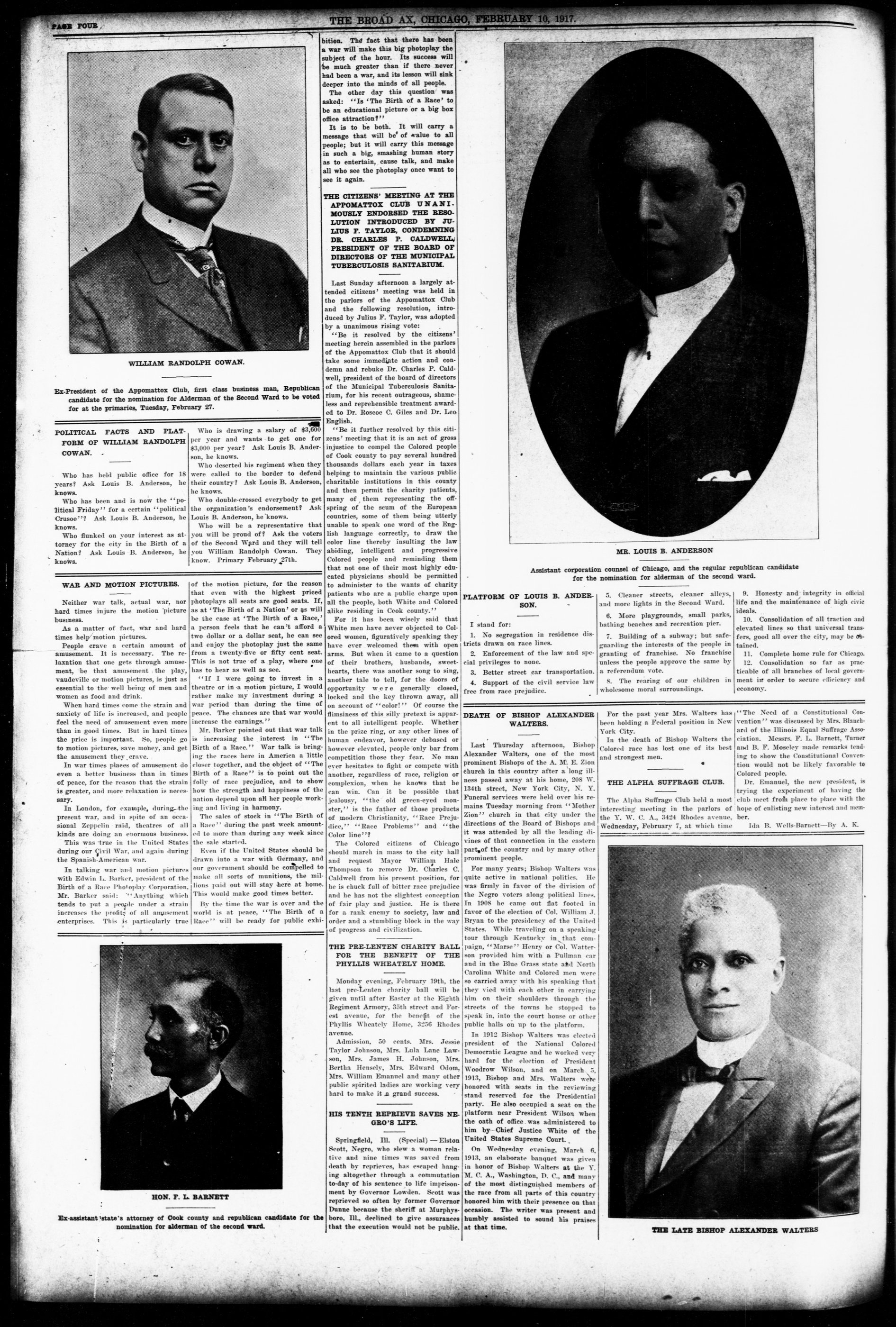
Ex-President of the Appomattox Club, first class bust candidate for the nomination for Alderman of the Se for at the primaries, Tuesday, February 27.
Ex-President of the Appomattox Club, first class business man, Republican candidate for the nomination for Alderman of the Second Ward to be voted for at the primaries, Tuesday, February 27.
POLITICAL FACTS AND PLATFORM OF WILLIAM RANDOLPH COWAN.
Who has held public office for 18 years? Ask Louis B. Anderson, he knows.
Who has been and is now the "political Friday" for a certain "political Crusoe"? Ask Louis B. Anderson, he knows.
Who flunked on your interest as attorney for the city in the Birth of a Nation? Ask Louis B. Anderson, he knows.
WAR AND MOTION PICTURES.
Neither war talk, actual war, nor hard times injure the motion picture business.
As a matter of fact, war and hard times help/motion pictures.
People crave a certain amount of amusement. It is necessary. The relaxation that one gets through amusement, be that amusement the play, vaudeville or motion pictures, is just as essential to the well being of men and women as food and drink.
When hard times come the strain and anxiety of life is increased, and people feel the need of amusement even more than in good times. But in hard times the price is important. So, people go to motion pictures, save money, and get the amusement they crave.
In war times places of amusement do even a better business than in times of peace, for the reason that the strain is greater, and more relaxation is necessary.
In London, for example, during the present war, and in spite of an occasional Zeppelin raid, the theatres of all kinds are doing an enormous business.
This was true in the United States during our Civil War, and again during the Spanish-American war.
In talking war and motion pictures with Edwin L. Barker, president of the Birth of a Race Photoplay Corporation, Mr. Barker said: "Anything which tends to put a people under a strain increases the profits of all amusement enterprises. This is particularly true
---
HON. F. L. BARNETT
Ex-assistant's attorney of Cook county and republican candidate for the nomination for alderman of the second ward.
Who is drawing a salary of $3,600 per year and wants to get one for $3,000 per year? Ask Louis B. Anderson, he knows.
Who deserted his regiment when they were called to the border to defend their country? Ask Louis B. Anderson, he knows.
Who double-crossed everybody to get the organization's endorsement? Ask Louis B. Anderson, he knows.
Who will be a representative that you will be proud of? Ask the voters of the Second Ward and they will tell you William Randolph Cowan. They know. Primary February 27th.
of the motion picture, for the reason that even with the highest priced photoplays all seats are good seats. If, as at 'The Birth of a Nation' or as will be the case at 'The Birth of a Race,' a person feels that he can't afford a two dollar or a dollar seat, he can see and enjoy the photoplay just the same from a twenty-five or fifty cent seat. This is not true of a play, where one has to hear as well as see.
'If I were going to invest in a theatre or in a motion picture, I would rather make my investment during a war period than during the time of peace. The chances are that war would increase the earnings.'
Mr. Barker pointed out that war talk is increasing the interest in "The Birth of a Race." War talk is bringing the races here in America a little closer together, and the object of "The Birth of a Race" is to point out the folly of race prejudice, and to show how the strength and happiness of the nation depend upon all her people working and living in harmony.
The sales of stock in "The Birth of a Race" during the past week amounted to more than during any week since the sale started.
Even if the United States should be drawn into a war with Germany, and our government should be compelled to make all sorts of munitions, the millions paid out will stay here at home. This would make good times better.
By the time the war is over and the world is at peace, "The Birth of a Race" will be ready for public exhi
bition. The fact that there has been a war will make this big photoplay the subject of the hour. Its success will be much greater than if there never had been a war, and its lesson will sink deeper into the minds of all people.
The other day this question was asked: "Is 'The Birth of a Race' to be an educational picture or a big box office attraction?"
It is to be both. It will carry a message that will be of value to all people; but it will carry this message in such a big, smashing human story as to entertain, cause talk, and make all who see the photoplay once want to see it again.
THE CITIZENS' MEETING AT THE APPOMATTOX CLUB UNANIMOUSLY ENDORSED THE RESOLUTION INTRODUCED BY JULIUS F. TAYLOR, CONDEMNING DR. CHARLES P. CALDWELL, PRESIDENT OF THE BOARD OF DIRECTORS OF THE MUNICIPAL TUBERCULOSIS SANITARIUM.
Last Sunday afternoon a largely attended citizens' meeting was held in the parlors of the Appomattox Club and the following resolution, introduced by Julius F. Taylor, was adopted by a unanimous rising vote:
"Be it resolved by the citizens' meeting herein assembled in the parlors of the Appomattox Club that it should take some immediate action and condemn and rebuke Dr. Charles P. Caldwell, president of the board of directors of the Municipal Tuberculosis Sanitarium, for his recent outrageous, shameless and reprehensible treatment awarded to Dr. Roscoe C. Giles and Dr. Leo English.
"Be it further resolved by this citizens' meeting that it is an act of gross injustice to compel the Colored people of Cook county to pay several hundred thousands dollars each year in taxes helping to maintain the various public charitable institutions in this county and then permit the charity patients, many of them representing the offspring of the scum of the European countries, some of them being utterly unable to speak one word of the English language correctly, to draw the color line thereby insulting the law abiding, intelligent and progressive Colored people and reminding them that not one of their most highly educated physicians should be permitted to administer to the wants of charity patients who are a public charge upon all the people, both White and Colored alike residing in Cook county."
For it has been wisely said that White men have never objected to Colored women, figuratively speaking they have ever welcomed them with open arms. But when it came to a question of their brothers, husbands, sweet-hearts, there was another song to sing, another tale to tell, for the doors of opportunity were generally closed, locked and the key thrown away, all on account of "color!" Of course the flimsiness of this silly pretext is apparent to all intelligent people. Whether in the prize ring, or any other lines of human endeavor, however debased or however elevated, people only bar from competition those they fear. No man ever hesitates to fight or compete with another, regardless of race, religion or complexion, when he knows that he can win. Can it it be possible that jealousy, "the old green-eyed monster," is the father of those products of modern Christianity, "Race Prejudice," "Race Problems" and "the Color line"?
The Colored citizens of Chicago should march in mass to the city hall and request Mayor William Hale Thompson to remove Dr. Charles C. Caldwell from his present position, for he is chuck full of bitter race prejudice and he has not the slightest conception of fair play and justice. He is there for a rank enemy to society, law and order and a stumbling block in the way of progress and civilization.
THE PRE-LENTEN CHARITY BALL FOR THE BENEFIT OF THE PHYLLIS WHEATELY HOME.
Monday evening, February 19th, the last pre-Lenten charity ball will be given until after Easter at the Eighth Regiment Armory, 35th street and Forest avenue, for the benefit of the Phyllis Wheately Home, 3256 Rhodes avenue.
Admission, 50 cents. Mrs. Jessie Taylor Johnson, Mrs. Lula Lane Lawson, Mrs. James H. Johnson, Mrs. Bertha Hensely, Mrs. Edward Odom, Mrs. William Emanuel and many other public spirited ladies are working very hard to make it a grand success.
HIS TENTH REPRIEVE SAVES NE-
GRO'S LIFE.
Springfield, Ill. (Special) — Elston Scott, Negro, who slew a woman relative and nine times was saved from death by reprieves, has escaped hanging altogether through a commutation to-day of his sentence to life imprisonment by Governor Lowden. Scott was reprieved so often by former Governor Dunne because the sheriff at Murphysboro, Ill., declined to give assurances that the execution would not be public.
12
PLATFORM OF LOUIS B. ANDERSON.
I stand for:
1. No segregation in residence districts drawn on race lines.
2. Enforcement of the law and special privileges to none.
3. Better street car transportation.
4. Support of the civil service law free from race prejudice.
5. Cleaner streets, cleaner alleys, and more lights in the Second Ward.
6. More playgrounds, small parks, bathing beaches and recreation pier.
7. Building of a subway; but safeguarding the interests of the people in granting of franchise. No franchise unless the people approve the same by a referendum vote.
8. The rearing of our children in wholesome moral surroundings.
9. Honesty and life and the main ideals.
10. Consolidation elevated lines so officers, good all overtained.
11. Complete he
12. Consolidation tieable of all branchment in order to economy.
DEATH OF BISHOP ALEXANDER
WALTERS.
Last Thursday afternoon, Bishop Alexander Walters, one of the most prominent Bishops of the A. M. E. Zion church in this country after a long illness passed away at his home, 208 W. 134th street, New York City, N. Y. Funeral services were held over his remains Tuesday morning from "Mother Zion" church in that city under the directions of the Board of Bishops and it was attended by all the leading divines of that connection in the eastern part of the country and by many other prominent people.
For many years; Bishop Walters was quite active in national politics. He was firmly in favor of the division of the Negro voters along political lines. In 1908 he came out flat footed in favor of the election of Col. William J. Bryan to the presidency of the United States. While traveling on a speaking tour through Kentueky in that campaign, "Marse" Henry or Col. Watterson provided him with a Pullman car and in the Blue Grass state and North Carolina White and Colored men were so carried away with his speaking that they vied with each other in carrying him on their shoulders through the streets of the towns he stopped to speak in, into the court house or other public halls on up to the platform.
In 1912 Bishop Walters was elected president of the National Colored Democratic League and he worked very hard for the election of President Woodrow Wilson, and on March 5, 1913, Bishop and Mrs. Walters were honored with seats in the reviewing stand reserved for the Presidential party. He also occupied a seat on the platform near President Wilson when the oath of office was administered to him by-Chief Justice White of the United States Supreme Court.
On Wednesday evening, March 6, 1913, an elaborate banquet was given in honor of Bishop Walters at the Y. M. C. A., Washington, D. C., and many of the most distinguished members of the race from all parts of this country honored him with their presence on that occasion. The writer was present and humbly assisted to sound his praises at that time.
MR. LOUIS B. ANDERSON
in counsel of Chicago, and the regular nomination for alderman of the second
5. Cleaner streets, cleaner alleys,
and more lights in the Second Ward.
6. More playgrounds, small parks,
bathing beaches and recreation pier.
7. Building of a subway; but safeguarding the interests of the people in granting of franchise. No franchise unless the people approve the same by a referendum vote.
8. The rearing of our children in wholesome moral surroundings.
For the past year Mrs. Walters has been holding a Federal position in New York City.
In the death of Bishop Walters the Colored race has lost one of its best and strongest men.
THE ALPHA SUFFRAGE CLUB
The Alpha Suffrage Club held a most interesting meeting in the parlors of the Y. W. C. A., 3424 Rhodes avenue, Wednesday, February 7, at which time
[Name]
[Name not visible]
[Name]
THE LATE BISHOP ALEXANDER WALTERS
---
9. Honesty and integrity in official life and the maintenance of high civic ideals.
10. Consolidation of all traction and elevated lines so that universal transfers, good all over the city, may be obtained.
11. Complete home rule for Chicago.
12. Consolidation so far as practicable of all branches of local government in order to secure efficiency and economy.
"The Need of a Constitutional Convention" was discussed by Mrs. Blanchard of the Illinois Equal Suffrage Association. Messrs. F. L. Barnett, Turner and B. F. Moseley made remarks tending to show the Constitutional Convention would not be likely favorable to Colored people. Dr. Emanuel, the new president, is trying the experiment of having the club meet from place to place with the hope of enlisting new interest and member. Ida B. Wells-Barnett—By A. K.
[Name]
```markdown
```
THE RACE SPEAKS THROUGH ITS REPRESENTATIVES IN A BIG MEETING AT THE APPOMATTOX CLUB PARLOERS, SUNDAY, LAST. BEAUREGARD F. MOSELEY AT THE POREFRONT.
The meeting of the Appomattox Club, Saturday night, last, and the meeting that followed it the next day, Sunday, at the Appomattox Club, in the Club Parloors, were history in the making.
No one attending the meeting knew the purposes for which the meeting had been called by President J. H. Johnson, of the Club, but when the members had assembled and certain routine matters had been disposed of, Lawyer Beauregard F. Moseley, a member of the club, and one of Chicago's public spirited citizens, rose and proposed the following telegram be sent to the President of the United States:
"Chicago, Ill.
Feb. 3rd, 1917.
Excellent Sir:
Recognizing the intensity of the war spirit and the delicate position in which our President is now placed, and the burden that rests upon him in making so momentous a decision as he is now being called upon to make, amid the agonizing cries of a perishing world, we, the members of the Appomattox Club of Chicago, send you this expression of loyalty, the deepest sympathy and the earnest and constant prayers of it's membership, to the end that you, Mr. President, in your great wisdom, may with honor, maintain a peaceful attitude and refuse to be drawn into this world-wide conflict, which in the end, only means unlimited suffering and will tend to the humiliation of the entire human race.
Assuring you, however, that what ever your decision may be, as loyal patriots of our country, we stand willing and ready to obey your commands and preserve with honor, the respect and security that is our due, even though we perish by the sword.
To President Woodrow Wilson,
Executive Mansion.
Washington, D. C. "Col. J. H. Johnson, Pres.
Howard T. Cornwell, Sec.
The eager and enthusiastic manner in which the motion to send this telegram to the President was seconded, was proof sufficient that the Negro of today, is still the most patriotic of all American patriots, and as a result, the telegram was sent to the President, bearing the name of President Johnson, and the Secretary, Howard T. Cornwell
On Sunday, a "Symposium" upon the question of "Negro Migration North," was held at the Parlors of the Appomattox Club. There were representatives from all of the churches and literary societies of the city. Speeches were made by Prof. W. W. Lucas, of Meridian, Miss.; Mr. Frank W. Henry, of Bethel Literary Club; Dr. S. C. Dickerson, of the Appomattox Club; Rev. J. W. Robinson, of the St. Mark's Literary; Mr. John Reece, of Mississippi; Mr. A. L. Jackson, Secretary Young Men's Christian Association; Hon. R. S. Abbott; Rev. G. E. Carter, Representative of the Epworth League; Edw. Clisby, of Sylvester, Texas; J. A. Walden, of the Berean Baptist Literary; Hon. John R. Lynch and Beaureard F. Moseley.
Before the speech making began, Mr. Moseley, acting as Chairman of the Civic and Public Affairs Committee of the Club, proposed the following telegram be sent to the President:
"Chicago, Ill.
Feb. 4th, 1917.
Excellent Sir:
Realizing the momentous decision you are now being called upon by your duty as the Chief Executive of this country to make, regarding the present and future of our country, and the possible fate of all of our citizens, the representatives of the Literary Societies of Grace Presbyterian, Bethel A. M. E., St. Paul's M. E., St. Mark's M. E., Olivet Baptist, Quinn Chapel, Wayman Chapel, Mt. Zion, Berean Baptist Epworth League, Y. M. C. A., The Fellowship League and the Appomattox Club, in meeting assembled, send you this expression of loyalty, the deepest sympathy and the earnest and constant prayers of the churches and lyeums of the Negro citizens of Chicago, and offer all, even our lives to you in your efforts to maintain, if possible, security of our citizens and their homes, with the sword, if need be.
To President Woodrow Wilson,
Executive Mansion,
Washington, D.C.
Washington, D. C.
The motion to send this telegram to President Woodrow Wilson, Washington, D. C., was unanimously made by a rising vote of all persons present. Not one dissenting voice was heard. The telegram was forthwith sent. Thus was the Negro race of the country placed on record as being willing and ready to defend the honor and integrity of this country; not because he has not reasons at times to criticise it and feel that its attitude towards him has been and is unjust, but because he is a patriot and believes that this is an opportune hour to think of any wrongs inflicted upon him in the past, when the welfare of the country is at stake; willing to sacrifice his all for his coun-
try's sake makes him as the telegram shows, the greatest patriot of them all. Another resolution was adopted by the conference, which required the Literary Societies of the various clubs and churches to submit three questions to all candidates now running for Aldermanic honors in the February primaries. At the conclusion of the meeting, arrangements were made for an organization to take care of the subjects discussed, which organization will be heard from shortly.—M. C. T.
DANGEROUS FLY KILLERS
A bill is now pending before the Illinois Legislature prohibiting the manufacture or sale of fly paper or other forms of fly killer which contains arsenic or other poison of sufficient quantity to be dangerous to the life or health of persons, unless the same, when so manufactured, compounded, sold or offered for sale, shall be so prepared, constructed or guarded that when in use said poisonous paper, substance, compound or solution shall be inaccessible to children or other persons who might eat, drink or swallow the same or any portion thereof.
The bill is identical with one that has already been enacted into a law by the State of Michigan, and is supported by the Child Betterment Bureau of Chicago, headed by Dr. G. Frank Lydston, who is earnestly advocating its passage.
In support of its advocacy of the measure, the Child Betterment Bureau cites the number of cases of poisoning of children in the United States through the agency of arsenical fly killers, and urges the abolition of the manufacture and sale of this class of fly destroyers as a means of protecting the child life of the country from this form of danger.
While it may well be urged that cases of accidental poisoning of children from the arsenical fly poisons are of rare occurrence and attributable to the carelessness or the ignorance of parents, it seems perfectly reasonable to assume that less dangerous agencies may be employed and involving no danger to children.
In this day of advanced methods of fly destruction, it is thoroughly recognized that the use of fly destroying agencies in the home is simply the last trench form of fighting this well known and dangerous household and community pest. It is also well understood by those trained only in the fundamentals of public sanitation, that to destroy the fly it is necessary to destroy or do away with the places where it breeds. Once this has been thoroughly accomplished, the flies soon disappear.
As to fly poisons of any kind, there is no real necessity for using them in the home. The better way is to place the poison outside, preferably on the back porch, and kill the flies before they get into the house. The U. S. Public Health Service warns against the use of the poisons containing arsenic; but does recommend the 40 per cent. solution of formaldehyde, three teaspoonsful to a pint of water and milk mixed in equal parts. This solution placed in shallow plates and put outside the house attracts the flies and kills them quickly. The same mixture also may be used as follows: Nearly fill a large glass tumbler; place over this a piece of blotting paper, cut in circular form and a little larger than the rim of the tumbler, and over this invert a saucer. Now invert the whole device and insert a match or toothpick under the edge of the tumbler to admit air. The blotting paper will absorb and retain enough moisture to feed and kill the flies, and the strength of the mixture will be retained, making it unnecessary to renew so frequently. This form of using is also safe.
The man who is afraid of fresh air evidently is not afraid of pneumonia. And yet pneumonia generally kills its victims, while fresh air makes for health, vigor and happiness.
* * *
Windows up a little from the bottom and down a little from the top will let good air in and bad air out. If you persist in keeping your windows closed, what's the answer? You breathe bad air and thus lay the foundation for impaired bodily health and vigor.
THE NEGRO FELLOWSHIP LEAGUE
Last Sunday the League again gave over its meeting to the Second Ward Primary Committee of 100 that is working in the interest of the candidacy of F. L. Barnett. A rousing meeting was held, and ten precinct meetings were planned for this week. The League will hold its regular meeting, Sunday afternoon, February 18, at 3005 State St.
THE BROAD AX, CHICAGO, FEBRUARY 10, 1917
NATIONAL NEWS NOTES.
Brief Bits of News and Comment On Men and Women.
FUND FOR LOUISVILLE MISSIONS
FOR NEGROES.
Louisville, Ky.—Members of the Presbyterian churches in Louisville have completed a canvass for funds to enlarge the scope of the work of the Missions for Negroes in Louisville, which netted $52,052, $7,050 more than had been fixed as the necessary amount. There are three missions in Louisville devoted to the advancement of the Negro and while the work is done under the supervision of the Presbyterian church, it consists principally of teaching Negroes trades and professions. The missions are open to men and women and boys and girls and the facilities have been overtaxed by the number of those desiring to take advantage of the various courses provided.
WORKING FOR A CHANGE IN PUBLIC SENTIMENT.
St. Louis, Mo.—The bright oasis in present-day discussion of the issues between the temperance people, and others, is afforded in the position being taken by leading brewers of the country who are promoting an active sentiment antagonistic to some of the abuses of the saloon. Temperance forces have centered their attacks mainly upon hard drinking, whiskey and its attendant spirituous partners, but not upon malts, including beer, and the lighter wines. The whole question would be speedily settled if the brewers would break away from the distillers. That this is being done is evidenced by some recent statements coming from the brewers. For instance, in an interview with a reporter for a St. Louis daily newspaper, late in November, August A. Busch, of that city, one of the most prominent brewers in the United States, said that much might be done to counteract prohibition sentiment by strict enforcement of all excise laws, discontinuance of bars in saloons, abolition of treating, and the elimination of the lawless saloonkeeper, through the cooperation of brewers to that end.
Colonel Gustav Pabst, of Milwaukee another of the country's most conspicuous brewers, at a convention in Cleveland recently, declared that he stood for prompt prosecution of violators of the liquor laws, greater discrimination on the part of local authorities in the granting of licenses, and fewer saloons as means of counteracting the prohibition movement. Following this statement, a representative of The Christian Science Monitor in Milwaukee, obtained an interview with W. H. Austin, assistant to the president of the United States Brewers Association and secretary of the Wisconsin Brewers Association, who spoke for himself and for his official superior, Colonel Pabst. In his opening statement he said that the brewers of the United States are in earnest in their desire for reform in the liquor trade. "They stand ready," he said, "to back any reasonable movement for the enforcement of existing laws, and, if these do not cover the need, they are ready to aid in the enactment of laws that will."
BIBLE SANCTIONS DISHONESTY
Cheating—Jacob cheated his brother Esau (Gen. 25:29-34). Jacob by a “ringstreaked” and “speckled” game cheated Labon out of his cattle (Gen. 30:41-31). The Israelites obtain the Egyptians’ property by false pretenses (Ex. 3:21, 22). “And the Lord said unto Moses * * * Speak now in the ears of the people and let every man borrow of his neighbor, and every woman of her neighbor, jewels of silver, and jewels of gold,” (Ex. 11:1, 2). “And the children of Israel did according to the word of Moses; * * * and they spoiled the Egyptians.—Ex. 12:35, 36.
Stealing—The Bible upholds theft and robberies. God directs Moses to send a marauding expedition against the Midianites. They put the inhabitants to the sword, and return with 800,000 (?) cattle. Of this booty God exacts 800 head for himself and 8,000 head for his priests. The remainder he causes to be divided between the soldiers and citizens. So elated are the Israelites with their successes, so grateful to God for his assistance, that they make him a gift of 16,000 shekels of stolen gold (Num. 30).
When Joshua took Jerricho, "they burnt the city with fire and all that was therein; only the silver and the gold and vessels of brass and of iron they put into the treasury of the Lord" (Josh. 6:19-24). When he captured Ai, "the cattle and the spoils of that city Israel took for a prey unto themselves, according unto the word of the Lord which he commanded Josuha" (Josh. 8:27).
David, a modest shepherd lad, is placed under the tutelage of Jehovah only to become the cruelest robber of his time. On one occasion, purely for plunder, he despoiled three nations and "saved neither man nor woman alive to bring tidings to Gath, saying, Lest they should tell on us" (1 Sam. 27:8
12). "When thou comest into the standing corn of thy neighbor, then thou mayest pluck the ears with thine hand, but thou shalt not move a sickle unto thy neighbor's standing corn" (Deut. 22:24, 25). "Men do not despise a thief if he steal to satisfy his soul when he is hungry" (Prov. 6:30). Christ enjoined submission to robbery, "Of him that taketh away thy goods ask them not again" (Luke 6:30)—Channing Severance in the People's Press, Chicago, 1916.
THE NEW OWL THEATER.
The Owl Theater Opens to Movieland
The new theater erected by Patrick Casey of the Merchants' State Bank next door a twin front which was leased to the Metropolitan Amusement Company, opened its doors as a moving picture house lately. The house has been named the Owl Theater and it is distinguished by a large electric owl in front in colored lights which winks its eyes as a trademark, a curiosity to passersby. The interior has a fireproof ground floor, auditorium of modern improvements seating 1200 people. Music every performance by selected orchestra directed by the popular Clarence M. Jones, the great composer. Showing at all times the pick of the world in moving pictures. Perfect ventilation. All seats ten cents. Open from 2 P. M. to 11:30 P. M. On State near 47th street.
PULLMAN PORTER SENTENCED.
La Crosse, Wis.—William J. Mangum
Pullman porter, pleaded guilty to stealing
jewelry valued at $1,000 from pass-
engers and was sentenced to two and
one-half years.
FIVE ROOM COTTAGE FOR SALE
AT A BIG BARGAIN.
Five room cottage on the South Side, toilet and gas, lot 25x125, east front, one block from street car line, for sale for $1,650. Phone, Douglas 7047.
CHIPS
Miss Violette N. Anderson, 143 N. Dearborn street, continues to make good as one of the most proficient court reporters and stenographers in Chicago.
Mr. and Mrs. T. L. Douglas, who recently took each other for better or for worse, are now at home to their hosts of friends at 4428 Langley avenue.
Some of the many friends of Dr. and Mrs. Blanchet, 6400 Rhodes avenue, last Thursday evening, without any notice or warning, swamped down upon them and royally treated them to a pleasant surprise party.
Mrs. David Manson, 5816 S. Michigan avenue, is still pursuing her artistic cultivation of soul-inspiring music. With much truthfulness it can be said that Mrs. Manson ranks among the most cultured women in this city.
McKinley Emanuel, the youngest son of Prof. and Mrs. William Emanuel, 6350 Rhodes avenue, who has spent the last five or six months in South America, is on his way home, and expects to reach his native land before the war breaks out between it and Germany.
George H. Walker and M. C. Cowan have presented William Randolph Cowan, Republican candidate for the second ward, with five thousand campaign buttons with the following inscription on them: "I am for W. R. Cowan for Alderman of the second ward." S. W. Green, of New Orleans, La., grand chancellor of the Knights of Pythias; S. A. T. Watkins, supreme attorney for that order, and Major Robert R. Jackson, head of the uniform rank, spent the first part of the week in St. Louis, Mo.
Sandy W. Trice, 6438 Eberhart avenue, who has charge of all the Red Cap men at the Illinois Central depot, is as honest as a thousand days are long and without any doggin he states: "That it is always a source of much pleasure to him to promptly pay his obligations to this paper."
Mrs. Carrie Warner, 5223 Dearborn street, will shortly buy a new home in the 38th block on Calumet avenue and become a resident of the east side of State street. She will retain her present home on Dearborn street and rent it out.
Mrs. George H. Jackson, 3416 Vernon avenue, who had been ailing for some time with heart trouble, passed away the latter part of last week and the first part of this week her remains were transported back to Cincinnati, O., her old home, for interment. Mrs. Jackson owned a great deal of valuable property in that city and she also owned some good income property in this city. She was among the wealthiest Afro-American women in this country.
Talks on
HEALTH,
CLEANLINESS,
PROPER LIVING,
SANITATION, ETC.
By
Dr. W. A. Driver
3300 So. State Street
Phone Douglas 3617
CANCER AND CURE.
Cancer is only a distant point on the toboggan slide of disease and death. To prevent it, avoid the cause. In other words keep off the toboggan slide of disease and death.
Cancer can be cured. The remedy is always easy when the cause is known. When the cause is removed the trouble ceases. That is not only true of cancer but it is true of every other malady, mental or physical, local or general. In every conceivable walk of life that law fits. It is safe and sane. It is the truth.
Cancer is often an ulceration of the skin or of a fibroid tumor or other tissue. Every sore and every tumor is a possible cancer of the ulcerative kind. Cancer is a penalty. It does not always mean death of the physical. It is only fatal when the unfortunate surrenders.
The obstinate nature of cancer is a logical result of long continued errors of living. It is the result of defiance; it is the result of years of disobedience. Is not cancer a disease of middle and advanced life representing accumulated wisdom or accumulated folly? Cancer is accumulated corruption and a fibroid tumor and other tumors are accumulated corruption that is liable to reach its full growth if a change, a radical change is not made in the life of the tumor grower. The fibroid is more than
8
One of the big eastern structural companies, having a contract to build a traveling crane above a coal handling plant at a dock, decided to employ a surgeon to remain "on the job." The honored one was given a note which read, "Please hand this to the foreman in charge and tell him that you will look after any of the men who may be injured by falling from the work." The doctor without ado went out to the plant. He looked up at the false work that was being built in preparation for the crane, and it was so high that the men on it looked like illiputians. He thought of the possibilities if one of them should fall to the dock, and he said to the foreman: "I think the company made a mistake. It should have addressed this letter to an undertaker." —Argonaut.
Stage Art and Motion Pictures
Stage Art and Motion Pictures.
As a form of entertainment, not instruction, the motion picture will probably develop along the lines of free, even fantastic, romance, of melodrama and of simple narrative. The stage, free from the burden of supplying these forms of entertainment, will probably concentrate more on the mission of the spoken work, which is to convey ideas and illuminate character, on the creation of the complete illusion of reality and on the pictorial art of scene painting. The movies and the spoken drama are not so antagonistic as we at first pessimistically supposed. Time, we think, will prove to us that in reality they are two different forms of art, as different as painting and sculpture.
-American Year Book.
The Bull of Phalaris
Perillus of Athens is said by the ancient authorities to have invented for Phalaris, tyrant of Agrimentum, B. C. 570, a brazen bull which opened on the side to admit victims who were to be roasted to death by the fire which was built underneath. The dying groans of the sufferers closely resembled the "roaring of a maddened bull;" hence the name that was given to the invention. It is refreshing to know that later on the populace rose against Phalaris and burned the tyrant in the bull that he had made to be the cause of death to so many others.
A Better Trade
"I understand young Briefless is about to marry the daughter of old Bonds, the millionaire?"
"Yes, so I am told."
"Will he give up the law business?"
"Yes. He will give up the law business and go into the son-in-law business."
Court Plaster
You can make court plaster at home by spreading clean silk with a preparation made by dissolving one part of isinglass in ten parts of water and afterward straining it through muslin. Add two parts of tincture of benzoin. -New York Telegram
Easy Marks.
"This world would be a pleasanter place if there were not so many fools in it."
"Yes, but it would be more difficult to make a living."—Boston Transcript.
PAGE FIVE
[Name]
a hint and a hint to the wise is sufficient.
Cancer attacks the stomach and the uterus or womb more often than any other organ of the body. Carnality is doubtless the cause.
Carnality is the enemy of the people. Vegetarians know the dangers of carnality. Pathological microorganisms called germs breed corruption and meat, the flesh of animals is the harbor and breeding place of germs. Cancer is a germ disease; germs live in meat and they love corruption. A good way to test the theory of meat as a cause of cancer is to find a victim of cancer and of fibroids and other tumor and put them on the meat free of vegetable and fish diet.
Sensitive natures stand aghast at the slaughter of the innocents whether the innocents are possessed of articulate speech or not. They also prefer to be magnanimous with the carnivora or meat eaters as well as the herbivora or vegetable eaters. They are not liable to cancer and they know the cure.
Since cancer is the fruit of years of wrong living, the cure is to reverse wrong living to the point of right living. It means live a pure life aided by competent supervision. The journey back to the healthy condition will be as rapid as the confidence of the patient and the efficiency of the supervision will permit. Correct living is the cure and is simply conforming to proper treatment and care.
Artist and Counterfeiter
There used to be an old German counterfeiter in this country who was a veritable wonder with the brush and pen. This man literally painted pictures of twenty dollar notes which were works of art. He used no tools except his pens and brushes, and it took him a week to do the portrait of a banknote. He figured that his handicap was worth about $3 a day and worked under the idea that the world owed him a fair living and should not object if his talent led him toward portrait painting, with twenty dollar bills for models. Even jail terms failed to impress him seriously with his wrongdoing. A collector of curios once offered $500 for one of his spectacles of bill portraiture, and the value of some others was said to be even greater, so marvelous was the delicacy of his brush work.
The Ancient Dragon
The pterodactyl, whose fossil remains have been found in the chalk at Cambridge, England, and elsewhere, with a very varied spread of wings, which in the largest specimens must have reached twenty-five feet, is almost identical with the dragon of fable. A batlike creature, with an elevated body and long neck ending in an absurdly small head with a portentous beak, it could run very swiftly, was a fish eater and could swim, or it flew by means of huge membranous wings, which connected its long fore quarters with its hind legs. The pterodactyl evidently existed down to a comparatively recent geological period, and it is not at all improbable that the traditional dragon is described from the last living specimens as met with by primitive man.
Hard to Endure
"My dear, said the sick man, "if I should die don't let that irrepressible wag, Snoofers, be one of the pall bearers."
"Oh, don't talk about dying, Henry!" answered the tearful woman.
"But I must. The idea of Snoofers keeping the other pall bearers chuckling all the way out to the cemetery and back to town gets on my nerves."—Birmingham Age-Herald.
Regrets Inevitable
He had proposed and been rejected.
"Very well," he said coldly; "there will come a time when your treatment of me will be regretted."
"I shall never regret it," she replied.
"Oh, I don't mean you," he returned.
"I refer to the man whom you will finally accept."—New York Times.
Nothing Like.
"Is your physician a homeopath or an allopath. Mrs. Snooks?" "I don't think he is either one of those. At any rate, those names do not sound in the least like what my husband called him when the bill came in."—Exchange.
An Ancient Clock
The Tour de l'Horloge, a square tower which forms part of the Palais de Justice in Paris, the ancient palace of the French kings, has the oldest public clock in France. It dates from 1370.
THE BROAD AX
Published Weekly
In this city since July 15th, 1899, without missing one single issue, Republians, Democrate, Catholies, Protestants, single Taxers, Priests, infidels or anyone else can have their say as long as their language is proper and responsibility is fixed.
The Broad Ax is a newspaper whose platform is broad enough for all, ever claiming the editorial right to speak its own mind.
Local communications will receive attention. Write only on one side of the paper.
Subscriptions must be paid in advance.
One Year.....$2.00
Six Months.....1.00
Advertising rates made known on application.
Address all communications to
THE BROAD AX
6418 Champlain Ave., Chicago, Ill.
PHONE WENTWORTH 2597.
JULIUS F. TAYLOR, Editor and Publisher.
Entered as Second-Class Matter Aug
19, 1902, at the Post Office at Chicago
Illinois, under Act of March 3, 1879.
Suffrage In Norway.
Among the most important laws enacted by Norway since women have had the vote are the two maternity insurance laws of 1909 and 1915 and the divorce law of 1910.
"Since the women in Norway have got the vote," says Ella Anker in Jus Suffragil, "they have turned their chief attention to their rights and duties as wives and mothers. Education and economic independence are the basis of woman's freedom, but her greatest work and happiness will be as wife and mother. It is an astonishing fact that in all these centuries, while men have taught us that woman's place is in the home, they have neglected to prepare us for the chief duties of our home life."
Norwegian women have also given particular strength to the work for "rational housekeeping" by the establishment of a state high school for the education of teachers for the elementary housekeeping schools, to a campaign against consumption and to the support of the peace movement.
Eiffel's Tower.
The most famous tower since that of Babel is the Eiffel tower in Paris, a monument to the engineering genius of Gustave Eiffel. The tower of Babel was reared in the hope that it might afford a passage to heaven, but the builders, we are told in Genesis, were folled by their language being confounded.
Gustave Eiffel had no such ambition in rearing the highest edifice the world has ever seen. It is a tower dedicated to science. Its rearing was one of the greatest engineering feats of modern times and was a result of experiments undertaken to prove the greatest limit to which metallic pliers in viaducts could be safely pushed. It is now the world's most celebrated wireless telegraph station.
Eiffel tower is 1,000 feet in height and is constructed of iron lattice work, 7,300 tons of iron being used in its construction. A system of elevators carries visitors to the top.
Uncle Sam's Uniforms.
An act of congress, approved March 1, 1911, entitled "An act to protect the dignity and honor of the uniform of the United States," provides "that hereafter no proprietor, manager or employee of a theater or other public place of entertainment or amusement in the District of Columbia or in any territory, the district of Alaska or insular possessions of the United States shall make or cause to be made any discrimination against any person lawfully wearing the uniform of the army, navy, revenue cutter service or marine corps of the United States because of that uniform, and any person making or causing to be made such discrimination shall be guilty of a misdemeanor, punishable by a fine not exceeding $500."
A Curiosity of Sound.
If when riding in a balloon at a height, say, of 2,000 feet a charge of guncotton be fired electrically 100 feet below the car, the report, though really as loud as a cannon, sounds no more than a pistol shot, possibly partly owing to the greater rarity of the air, but chiefly because the sound, having no background to reflect it, simply spends itself in the air. Then, always and under all conditions of atmosphere, there ensues absolute silence until the time for the echo back from earth has fully elapsed, when a deafening outburst of thunder rises from below, rolling on often for more than half a minute.
She Meant Well.
The late Sir Wilfrid Lawson, the rigid apostle of temperance, while on a week end visit made the acquaintance of a sharp young lady of seven, to whom on leaving he said: "Now, my dear, we have been talking some time. I am sure you have no idea who I am."
"Oh, yes, I have," the little missy replied. "You are the celebrated drunkard."—London Graphic
Exciting Chase of United States Secret Service Man.
MANY HANDLE COUNTERFEIT.
After Bank Clerk Discovers Spurious Currency, Hunt Leads to Many Cities. Grocer, Original Owner of Bill, Proves To Be Agent For Organized Band of Counterfeiters.
Cleveland, O.—The tracing of counterfeit bills back to the persons responsible for their issue is a curious and exciting employment. The experts assigned by the government to this work are among the most skillful members of the secret service. The protection of the currency depends in large measure upon their efficiency, and the palms they take are almost infinite. The following case is one illustrating the difficulties which the secret service people meet and overcome:
A bank clerk in Cleveland had detected a counterfeit twenty dollar bill
P.
WILLIAM J. FLYNN, CHIEF OF UNITED STATES SECRET SERVICE.
WILLIAM J. FLYNN, CHIEF OF UNITED STATES SECRET SERVICE.
in the deposit of a small retail grocer. An expert was sent for and undertook the case.
He found that the grocer had received the bill from a shoe dealer, who had it from a dentist, who had it from somebody else, and so on until the secret service man finally traced the note to an invalid woman, who had used it to pay her physician. When questioned this woman said that the money had been sent her by her brother, who lived in New Orleans.
The sleuth looked up the brother's antecedents and soon became convinced that he was the man wanted. The brother, however, soon proved to the satisfaction of the secret service man that his suspicions were unfounded. Indeed, it appeared that the money had been received by the New Orleans man in part payment of rent of a house he owned in Pittsburgh. While the sleuth was a bit discouraged, he couldn't give over the case when he had gone so far, so he took the next train for Pittsburgh.
The tenant of the house in Pittsburgh proved to be a traveling oculist, who spent most of his time in the middle west. The secret service man had the good fortune, however, to catch him just as he had returned from a trip, and the man at once recognized the bad bill as one that had been given him by a patient in Cleveland, the very point where the sleuth had started.
The patient was a boss carpenter. The carpenter, an honest old fellow, said that he had received the bill from a certain Perkins. The said Perkins was the small grocer in whose bank deposit the counterfeit had turned up. The expert flew to the grocer's as quickly as the taxi would take him and found it closed. The grocer had left town.
Afterward it was shown beyond question that the grocer was the agent of an organized band of counterfeiters His shop was a mere blind. That the bill which he gave the carpenter should get back into his own funds after traveling all over the country was one of those miracles of chance for which there is no explanation.
RAFFLE THREE BACHELORS
Men Willing to Wed Won by Girls With Lucky Numbers.
Glen Carbon, Ill.-Three "eligible" bachelors guaranteed "good providers" and willing to marry were won by three women at a matrimonial raffle recently as the climax of a dance given by the Glen Carbon Bachelors' club.
The names of the prizes and the holders of the lucky numbers, as given out by Carl Huffman, a member of the club, are:
Joe Clenson, thirty-three, coal miner, of Glen Carbon, won by Miss Maude Fletcher of Glen Carbon.
Charles Hendricks, thirty-eight, marble worker, of Edwardsville, won by Miss Sarah Brown of Denver.
Joe Jiggers, thirty-four, bartender, of Glen Carbon, won by Miss Rose Brown of Denver.
The Misses Brown are sisters. They were not present at the drawing, having sent their numbers and names to two young women of Glen Carbon, who drew for them.
THE BROAD AX. CHICAGO, FEBRUARY 10, 1917.
Fiancee Helps to Lift Veil When Science Fails.
REASON SLOWLY RETURNS
Detroit Man Proves Puzzle to Physicians After Partial Asphyxiation In Auto—Sweetheart, In Same Hospital, Is Wheeled Into His Ward, and Eyes Brighten For First Time.
Detroit, Mich.—A sweetheart's smile won where science failed. The smile lured back a wandering mind that all the little bottles, all the gleaming instruments and all the solemn books had failed to cure.
The case of Arthur Connor, twenty-eight years old, puzzled physicians for days after he was taken to Grace hospital suffering from a form of gas asphyxiation induced by inhaling gasoline fumes from his automobile. He slept for hours, a calm, deep sleep, with normal pulse and respiration, but a sleep that could not be driven out. When it did lift its veil for a few minutes at a time it was found his mind had somehow slipped in its delicate mechanism, and Connor muttered and chattered of things foreign and unconnected with reason. They dug in his spine and brewed serums, and they tapped with inquisitive fingers and touched the nerves with the wizard flow of electricity and the veins with the gleaming hypodermic. In vain all these things—and then came the cure, a greeting smile and a cheery "Good morning" from the girl he is to marry.
Nellie Winters, dark haired and brown eyed, sought her fiance, knowing something had happened to prevent the filling of an engagement. She found him after a long search lying in his car in the garage, asleep. He had sat down to rest, and the fumes had overcome him and started the long slumber. But the hunt through the cold day had wrought another misfortune and Miss Winters found herself threatened by pneumonia in the same hospital with Connor.
She grew better, and, once able to sit in a wheel chair, she demanded to be taken to the side of her sweetheart. They wheeled her in just as one of the moments of his consciousness came. And the eyes that had been filled with vague dreamings suddenly cleared, and the girl's smile and glad greeting found an answer.
"Hello, Nellie! Gee, it's too bad we are both sick in the same place."
It was almost the first rational words he had uttered. The veil fell again, but the doctors had found a key to the mystic door and hope for a complete recovery.
BECOMES A MOTHER AT 62.
Woman Wedded to Young Man Has a Baby In Her Old Age.
Milwaukee, Wis.—"Fifty-eight years years old? My dear boy, they said that about me four years ago when I went to Kenosha with Albert to be married where our friends could not make too much of a hubbub about a disparity in our ages. They said then that he was twenty-five and I was fifty-eight. What of it? Love knows no years."
Thus spoke Mrs. Balone Manzke, a mother at sixty-two or thereabouts, as she fondled the baby girl which some time ago came to their home in Milwaukee to gladden the declining years of the mother and to rejoice the heart of the youthful husband. And it was a real motherhood that Mrs. Manzke portrayed as she played with her own baby, a mother with her hair showing the advance of years in its suggestion of gray.
Four years ago the couple went from Zion City to Kenosha to be married. The husband is an expert chemist in a Milwaukee laboratory which specializes on perfumery.
JERSEY TEACHER A HEROINE
Prevents Panic Among 150 Children; Fights Fire In School.
Paterson, N. J.-Miss Bertha Ruth, a teacher in public school annex No. 4. in the basement of St. Stanislaus' Polish Catholic church, Garfield, by coo action prevented a panic among the 150 children and also saved the church from destruction by fire when Stephen Westcombe mischievously dropped a match into a hole in one of the partitions.
When smoke issued from the opening there was a stir and the pupils in Miss Ruth's class moved uneasily.
"Be calm, children," said Miss Ruth without the slightest touch of emotion, "and file quietly into the yard."
Her command was obeyed, and the children quickly left the room. Then Miss Ruth notified the teachers in the other classes to dismiss the pupils. The children thought it was a fire drill and moved out in order, the whole annex being emptied in half a minute.
BOMB BY MAIL BLINDS YOUTH
Plainfield Youth Thought Can Was Powder From Friend.
Plainfield, Conn.—Joseph Emil Sevigny, a young Frenchman who lives here, received a can of powder through the mail. After shaving he started to shake some of it out, thinking it was talcum. It wasn't. It was an infernal device, which exploded, lacerating his face and blinding both eyes.
Sevigny knows of no one who would wish to kill him, he says. Investigation by the police showed powerful explosives, steel fragments and coarse sandpaper were in the can. The package was postmarked Taftville.
TIED DUCK WITH CRAVAT.
Left Diamond Stud on It, and That May Account For Turkey Find.
Cuero, Tex.-What Thomas Lovett of this county believes to be the previous history of the recent story from Chicago telling of a diamond stud valued at $150 found in the craw of a Thanksgiving turkey had its inception in a duck hunt here.
According to Lovett's story, while hunting two years ago he slightly wounded a duck and decided to carry the bird home. He used his necktie to bind the bird's feet, neglecting to remove a diamond stud fastened therein. Placing the supposedly helpless bird in the rear of his conveyance, he started home, when a flutter a few minutes later attracted his attention. He turned in time to see the duck flying off with his necktie dangling from its feet.
Cuero is in the center of a large turkey raising portion of Texas, and many of the birds, which roam over a large range, find their way to the Chicago market. Mr. Lovett so far has entered no claim to the stud.
"GLAZE." NEW WEATHER WORD
Old Fashioned "Sleet" Will Be Out of Style This Winter.
Washington. — The old fashioned "sleet" is going out of style this winter before the newer "ice storm" and "glaze," weather bureau officials reported in their campaign for more accurate terminology for various kinds of frozen rain. Sleet is officially described as small globules of rain frozen before striking the earth. When rain freezes after falling and forms a glassy coating on the ground, trees and wires the condition is called a glaze, and when this is severe and accompanied by wind, it is reported as an ice storm. The weather bureau hopes to eliminate what it considers improper use of the word "sleet," as it has caused substitution of the term "tornado" for "cyclone" when a violent storm of small diameter is meant.
TATTOOS HIS DAY OLD BABE
Convicted German Military Attache Takes No Chances.
San Francisco.-His coat of arms sketched in indelible ink on the wrist of his baby daughter gives assurance to Lieutenant G. W. von Brincken, military attache of the German consulate here, that his young wife will carry away no other couple's child when she leaves the hospital where their first-born came into the world.
In a panic at the sight of numerous other infants in the hospital nursery Von Brincken, lately convicted of complicity in the munitions plots involving the German consulate, catechized the nurses on their methods of identification. Not satisfied with their system, he called for ink and pen.
WOMAN OF 82 ELOPES.
Her Daughter Seeks to Be Appointed Guardian of Her Estate.
Bellefontaine, O.-Securing restoration of her right to manage her own property by securing the dismissal of her mother, Mrs. Harriet Fulwider, as her guardian, Cora Woodbury on the following day filed an application in the Champaign county court to be appointed guardian for her mother, who owns property valued at several thousand dollars.
It was the announcement that the mother, who is eighty-two years old, had eloped to Newport, Ky., and there married Joel Bates, sixty-two years old, that caused the daughter to petition the court to appoint her a guardian for her mother.
WOMEN'S CLOTHES IN LEAD.
Head In Value All Manufactures In New York State.
Albany, N. Y.—A special report from the United States census bureau shows that the chief manufacture in New York state is the production of women's clothing, goods of that kind to the value of $345,316,000 having been turned out in 1914. Printing and publishing came next, with an output of $257,260,000. Next was men's clothing, $230,627,000.
Other productions were foundry and machine shop products, $175,450,000; slaughtering and meat packing, $148,106,000; bread and other bakery products, $100,228,000. The total value of all manufactured products was $3,814. 661,000.
GOT $1.000 FOR EYE
Young Man Then Lost Money on a Celebration Trip.
Monessen, Pa. - Michael Kamar, aged twenty-nine, who received $1,000 compensation because of the loss of an eye while at work in a Pittsburgh steel mill, is now bemoaning his desire to celebrate because of his newly acquired wealth.
When Michael got his money he immediately arranged for a trip to New York, with a stop at Ashtabula as a side issue. He started one day at noon, an hour after he had the compensation check cashed, and in less than a half hour was minus his thousand. He continued his journey to Ashtabula, but returned home and said he would get a job.
Buried Twenty Minutes and Lives. Lawrence, Kan.-After being completely buried at the bottom of an eleighteen foot ditch for twenty minutes. Wayne Richardson, a laborer from Clay Center, who was working on the construction work in the draining district of North Lawrence, was rescued alive without apparent injury one day recently.
COUPLE WED SEVENTY
YEARS WITHOUT STRIFE
Married Pair Celebrate Their Anniversary of Life In Happiness.
Glasgow, Mo.-J. P. Bentley, ninety years old, and his wife, Mrs. Susan Fristoe Bentley, eighty-eight years of age, were married seventy years ago and never had a fuss. They recently celebrated their anniversary. They live near Forest Green.
Mr. Bentley, who has lived all his life on his farm and still runs the 600 acre tract himself, is rated one of the wealthiest men in Charlton county, having amassed a fortune of between $75,000 and $100,000.
Both he and his wife were born on adjoining farms. When they were wed they agreed that if either became angry the other should take cognizance of it and preserve an unruffled demeanor. This, they say, is the secret of their smooth relations.
Nine children, five of whom are living, were born to the union. The five are T. M. Bentley, Salisbury, Mo.; S. J. Bentley, Forest Green; William Bentley and Mrs. William La Motte, Roanoke, Mo., and Mrs. Lloyd Herring, Forest Green.
The Bentley farm descended to its present owner from his father, who obtained it from the government by grant in 1815.
OUTDOOR SHOWMEN GO
ON RECORD FOR UPLIFT
Will Endeavor to Check Unjust Attacks on Their Business. Sunday Sends Message.
New York.—In these days of uplift movements the statement of the newly organized Association of the Outdoor Showmen of the World that its chief purpose in life is to uplift and purify the outdoor show business has attracted attention. The association is a unique aggregation of outdoor show interests, embracing every variety of outdoor amusement enterprises, from the big exposition and circus to the fair, carnival and concession men, and its officers are carrying on a wide campaign to secure membership in all parts of the world.
One of the outdoor showmen's anouncements, made at the organization meeting and banquet at the Hotel Astor, was that of President Frank P. Spellman, who in explaining the scope of the organization said that Billy Sunday had been invited to become a member and to attend the banquet, as it was recognized that "he is the greatest showman of us all." Billy Sunday in acknowledging the letter of introduction said in characteristic fashion, "You fellows could go some for God if you would."
"We have more practical objects, of course, than the ethical uplift of the outdoor show business," said President Spellman. "We propose to exert our influence to make certain that we get a square deal in the various state legislatures. We will have legal representatives in every city, and we will correct other abuses that we believe exist. We will endeavor to check unjust attacks made on the outdoor show business and to secure fair and equitable treatment. We believe the public will be with us in this cammair."
LACE GROWS ON TREES
Panama Product May Take Place of Mosquito Netting.
New Orleans, La.-Lace grows on trees on the isthmus of Panama, and the trees grow wild in the swamps. Captain L. W. Richards of the steamship Norwalk brought a fine sample, not merely as a curiosity, but to induce tests as to the probable utility of the plant or the tree in this section.
When the bark of the limbs is stripped there are rolls of filmy substance of a texture very much like mosquito netting. The size of these layers increases with the size of the tree, the largest being about a foot in diameter. The fabric is strong and can be sewn without tearing.
The natives use the stuff in making garments. Captain Richards believes that by cultivation the trees may become very valuable, and if the lace layers cannot be enlarged some process may be perfected by which they can be joined into a fabric which will make the finest mosquito bar and may even serve for summer raiment.
POTATO PROFIT 108 PER CENT
That's What South Jersey Farmers Earned on Their Stock.
Woodstown, N. J.—Farmers are prosperous, at least down in southern New Jersey, where a large percentage of New York city's potatoes are grown. The South Jersey Farmers' exchange declared a 100 per cent stock dividend and an 8 per cent cash dividend. The exchange is a co-operative selling organization, with 750 farmers as members. At its sixteen stations last year 907 carloads of white potatoes were handled at an average price of 90 cents a bushel. It did a total business in 1916 of $1,087,347.70, with a net profit of $34,237.79. This was the biggest year since its organization in 1909
Triplets Follow Twins
Terre Haute, Ind. - Mrs. Joseph Marcinki, wife of a miner cast of the city, gave birth to triplets, and all are doing well. The mother is thirty six years old and the husband forty-seven. A year ago the mother gave birth to twins, who still live. The triplets make ten living children.
A TIRELESS PRINCE
Bavarian Chief Sleeps but Four Hours a Day.
IS STERN DRIVER OF MEN.
Rupprecht Man on Whom Fell Task of Directing German Defense Against Allies' Great Somme Attack—One of Best Known Archaeologists and Famous Art Collector.
Berlin.—Prince Rupprecht of Bavaria, the man on whom fell the task of directing the German defense against the allies' great Somme attack, is one of the few many sided men in Europe's royal circles. Rupprecht is one of the ablest of the German generals, schooled in military tactics, a hard, driving sort of man. He is one of the best known European archaeologists and is a famous art collector.
But Rupprecht differs mostly from the rest of his royal kinsmen by his insatiable love of work. It is his boost that be works longer hours than any other man in the kingdom of Bavaria, over which he is destined to rule.
This grim faced, cold eyed Teuton is one of the most inveterate time steal
[Name]
PRINCE RUPPRECHT.
ers in Europe, if stories that are circulated about him are anything like true. It is said that the revelers in Munich, going home past the royal residence, always could tell whether it was yet + o'clock in the morning. If it was that hour a light was sure to be burning in the prince's study. Four hours is the maximum amount of sleep he permits himself, and in that respect he is like his old regent, Luitpold, his grandfather, who lived to be past eighty years old.
Life has brought much of sorrow and little of pleasure to the Bavarian prince. His wife, who was a sister of the queen of the Belgians, died in 1912 after several years of invalidism. Their marriage in 1900 was the culmination of a genuine love affair. Four of their five children have died, one of them while Rupprecht was at the battle front. When he was notified of his son's death he sent this laconic message to his father: "Duty commands action, not tears, at this moment."
Rupprecht has one of the finest art galleries of Germany and has a wide knowledge of antiques of all sorts. In his spare moments he is almost certain to be found in the museums of Munich, of which he is perhaps the most liberal patron.
Military observers differ as to Rupprecht's work in the present war. At the start of it he achieved some success on the Lorraine front but he was blamed for the German failure at Neuve Chapelle. There is no doubt however, that he displayed great military ability in handling the defense on the Somme. He is unsparing of his men, as he is of himself, and it is safe to wager that the Germans will lose no battle because of tenderness on the part of Rupprecht of Bavaria. He is in direct line of succession to the throne of Bavaria, outside of Prussia probably the most important German state.
Clock Takes Vacation.
Middleport, O.-Morgan Johnson, a newspaper distributor here, bought a clock in 1881. It ran along very cheerfully until about nine years ago, when it stopped stock still. No amount of persuasion would start it again. The other day his sister Retta was dusting when she happened to touch it, whereupon it started off as vigorously as at first, and it has been keeping good time and striking the hours ever since.
BREAKS ARM WHILE
CHASING HIS HAT
Nelsonville, N. Y. - Philip Gardiner broke his right arm in his haste to jump from a moving train when a wanton breast lifted his hat through the car window and landed it in a clump of weeds. Despite his injury he beamed when he found the top piece. He had sewed in side the band $842 in bills.
The Loyal Alumna and Trustee
Makes a New Gift.
REMEMBERS HER ALMA MATER
Mrs. Sage Makes a Double Contribu-
tion to the School Already Endowed
by Her Husband In Appreciation of
His Wife's Early Education.
Mrs. Russell Sage, a graduate of the
Emma Willard school, is continuing
per benefactions to that institution.
Its founder was pre-eminently a
pioneer in securing higher education
for women in this country, and she
was aided in her efforts by such men
as Governor DeWitt Clinton, John Ad-
ams and Thomas Jefferson. From the
beginning high intellectual and social
standards were maintained at the in-
&
aes ge
AS
: £ a y
eg
God asi
Vj S}) pom
( v4
ie 5
oe
i ae le
Wes re oe
stitution, and at the time of the visit
to America of Marquis de Lafayette
no school for women ranked higher
iu this couutrs than did Mrs, Wil
hans, During his sity In New York
state General Lafayette was entertain-
ed at the school by Mrs, Willard, and
le was So favorably impressed that he
complimented the founder highly and
esieuded special conrtesies to her on
the oceasion of her visit to France.
While the school has had a constant
career of success during the eizht dec-
ades and more that it has been in ex-
ixeure, it has been especially favored
of late in the efforts of the alumnae
to have it hold among schools of today
the same rank that it did in earlier
tues, ‘The old seminary buildings
lave heen replaced by landsome mod-
em sirueiures. Maiiy alumnae have
coitridnited to the cost.
(ue of the most beautiful and impres-
sive of these buildings is Russell Sage
jal, which was donated and furnish-
cl hy the late Russell Sage as an
evidence of Lis appreciation of the
Work aud aim of the § (itution from
Whivl) is wife was graduated and of
Whose alumnae association she is and
tas teen for some time a loyal mem.
her
‘The trustees of the institution an-
Downed recently that, continuing her
line of reat benevolence toward this
school aud the new Russell Sage Col-
leer of Practical Arts, Mrs, Russell
Sage liad given $250,000 toward the ad-
Rucetoont of the work of this latter
hustitution,
‘Toe uly requirement is that the
Ties will be used the same way as
the oricinal gift of a like amount a
Yer sos, to establisli the colleze. Al-
teother {his makes half a million dol-
las Jiven hy Mrs. Sage for this new.
eluw.
Cleaning Shiny Serge.
Hany! ly could iavent a process to
Trove fue shine from a worn suit bis
© her tortune would be assured. ‘The
Shiv» cnuot be permanently removed
fom sy material, but it can be so
feared Guar it will keep its shiny face
in te background for a little while.
Firs) of all, brush the garment well.
The purchase a Tump of ammonia
fw s doug store and dissolve it in
Se phy of boiling water. With an
oH soc hing—this is better than any
Siler clot) dipped in the ammonia so-
Iwi rah the shiny part backward
42 Orvard. Wash off the ammonia
Wil a irush and clean hot water.
Hans tiie suit up to dry in the shade.
hea juessing the garment wet it with
‘or (uot Loilingy water instead of cold.
Tay the cloth on the suit and press
Nii a hot iron until dry. ‘Then wet
thecioth asain and iron lightly, but not
Such to dry the cloth. It is this lat-
(treatment that gives the material
au new finish to take the place
the ol shine.
aaa acai aa)
“velit cupful of bran, one and one-
Sf cunrsis of flour, one-quarter eup-
Blot susar, one tablespoonful of but-
(Eee sex, one cupful of milk, one
‘Ssomcul of salt, four teaspoonfuls
(iki powder. “Sift the flour, bak-
Stover, sugar and then the bran
(Beer: add milk gradually, then
WS besten egg and melted butter.
Rit! hot oven in gem or fron pane
‘mety to thirty minutes.
PARIS NOTES.
————
What the Parisians Are
Turning Out For Spring.
What is lost in the width of the new
skirts for spring is added to the length
in the proportion of a yard to an inch.
Skirts are now inches and cer.
tainly yards arise ra they
were ten and twelve inches from the
ground, they are now six or seven. As
if this were not change enough, there
is a new silhouette introduced, and
that is one that closely resembles a
barrel as far as the skirt is concern-
ed. This is probably inspired by the
‘Turkish skirt that was shown by sev-
eral of the couturlers last spring. At
any rate, there are a number of the
largest creators in Paris who show
skirts of this description.
Paquin uses it in an afternoon gown
with a Russian blouse effect in the
fastenings of the buttons down one
side. Otherwise the frock has straight
lines—that is, the waist is not fitted
snugly as it is in many of the new
spring creations,
Jenny fashions a coat with this “ton-
neau” or barrel skirt of light gray
broadcloth, made with the trimming
of many rows of stitching in a darker
shade of gray. The barrel effect is in-
troduced between straight panels in
the front, sides and back of the coat.
Even coat suits are showing the bar-
rel skirt, and one sponsored by an
expert is of checks of blue and white,
trimmed with Roumantan embroidery.
The jacket of this suit fs hip length,
as are many of the suits for spring for
this house.
Premet uses this type of skirt in an
afternoon frock of two materials.
They are joined just below the hips,
and at this point the skirt is much
wider than at the bottom where it is
drawn in considerably.
From these various couturiers it will
be seen that there is every chance that
skirts of this description will be very
much the mode for the early spring
frock. They are not unattractive, es-
pecially, if they are not exaggerated
in line. Most of the frocks with such
a skirt are sure to have the waist fit a
bit more snuzly, for the outline then is
wider at the shoulders than at the
waist, When the line goes in, and it un-
juiates from that point to greater
width at the knees and narrows con-
siderably at the bottom.
. EMBROIDERY HINTS.
Designs That Children Love on Their
Belongings.
For nursery fittings, baby blankets,
bibs and pinafores are these delecta-
ble animals, al! friends of small tots.
oe ESN
ad ae baer
: Se
eet
GERD |
Wa A
a
aS ee ti
Bie ’
RS ae aye nid
E cag »
: BEAK
. Be AEE
2 s5 .
THE MENAGERIE
‘They may be done in linen, silk or
wool embroideries and used as medal-
lions or as friezes. They are easily
copied.
Hats For Evening.
The edict of the French government
that hats and simple gowns must be
worn in the evening in public has al-
ready brought about the fashion in
this country. Milliners are delighted
over the change. They are offering all
manner of brilliant and expensive hats
to wear with low evening gowns. It
has been a half dozen years or more
since this fashion was accepted in
America. Today one sees more than
half a dozen fashionable women in the
restaurants in the evening adopting it.
‘The majority of these evening hats
are of silver tulle or bullion cloth.
New Sweaters.
Most of the new sweaters, whether
of Angora or of the various yarn
‘weaves, are made to slip over the head.
They are ample below the waist and
have apron string belts and cravats,
the former tying the rather loose gar-
ment in about the waist! The more
Frenchy kinds have yokes and button
gdornments.
THE BROAD AX, CHICAGO, FEBRUARY 10, 1917.
en
eee
FOR LITTLE FOLKS [st 1 trorreun
———_———
Sensible Gown For
Sleepy Time Story About a Very ene Evezeer et
: ——
Interesting Creature. Back we swing to just serviceab
i—— BAavy gaberdine attractively trimme
HOW A BIRD LIVES IN WINTER. |" ® embroldered belt. satin cots
Little Feathered Cold Weather Resi- ae ay . tee e oe
dent of the Woods Stores Up Food| |g oS
For Hard Times—How Its Nest Ie| |p 4 ee
Safeguarded Against Attack. oN a
Well, said Uncle Ben to Little Ned PAT ee
and Polly Ann, I am going to tell you ie el
TREE MOUSE.. 2 vo
No doubt you think you can do won-
ders since you've learned to turn hand-
springs, -Master Ned, but there's a lit-
tle white breasted bird that hops about
on our trees every morning that cap
give you or any little boy I know of
points in exercising.
The name of the bird? Well, some
people call him a tree mouse, and otb-
ers call bim a nuthatch. He is part
bluish gray, part black and part white.
He does not look much like a mouse to
me, but the way he can run up and
down the limbs of trees, baaging now
to the underside or running along head
downward. makes one think of a fy.
‘The little nuthateh is one of our win-
ter birds. for he does not leave us
when cold weather comes, as so many
of our birds do.
You see, bis food can be picked up
nearly ail the year round. He is one of
those birds that get the worms from
under the bark, and grubs and insect
eggs are deii ious morsels to him.
The littic nuthatch is a thrifty bird.
Like the squirrel in the fall, be lays
away a store of food for hard times.
When cold weather comes he goes to
the tree in a crack of which he may
uave stuck the little nuts of which be
is so foud and draws out a nut. Beech-
outs are favorites. He can crack the
hells of these with bis long, sharp bill
‘short time. ‘Then, cocking is little
<A on ove side, he bolts the nut meat
vuh the greatest enjoyment.
Put sowie kernels of dried corn out
or Lim oa a feeding board or some
sacked hickory nuts and see how
leased the nuthateh will be.
‘This lively litiie bird likes hazelnuts,
chestnuts, stuiluwer seeds and grains
in the winter one sees him in the com-
bany of the chickadees, the Juncos,
buntings aud winter wrens, the downy
woodpecker and the winter sparrows.
In spring these nuthatches build
nests in the hollows of trees. Perhaps
they fear the red squirrels, the snakes
or the mice in the neizhberhood. At |
any rate, they gather pitch and sticky
valsame from: the trees and sacar it
about the outside of the holes in which |
they make their nests and lay their |
exes.
Often when the nuthatches are in a |
hurry they forzet about this sticky |
doormat and go flitting carelessly ever |
it so that it catches on their own tails, |
and before they ean get loose they have |
(o wrench out some of their feathers.
Just the sume, the little nuthateh fs |
one of the nimbiest little creatures you |
will ever see and is well worth wateb-
ieee
The New Paint Box.
Little artist, here is an idea for you.
Isn't it troublesome to keep brushes
clean when you have to color the little
sirl’s dress blue, her hair brown and
her shoes black? Make yourself a blot-
ting ball out of crushed blotters sewed
up in a silece of cheesecloth. When
your brush is touched on this ball the
color is quickly absorbed, and it 1s
clean for the next shade.
Fun on the Ice.
Now is the season for the lovers of!
winter sports, which include all boys
and girls and a goodly percentage of
grown folks. Oue of the most healthful
of outdoor exercises is that of skating,
a Ades ae
| oie os
: ‘ 4 D
; oy
& een eos:
E : gee IS:
re ec iee RS
Photo by American Press Association.
THE SKATER
and it is highly enjoyable. Happy lads
and lasses throng the ponds and feel
the thrill of gliding over the smooth
ice. Skating promotes grace of move-
ment, as nearly every muscle is
brought into play. Care should be
taken, however, not to exercise until
exhaustion comes, because that takes
away all the good of the sport.
| JUST A TROTTEUR.
es
Sensible Gown For
Merely Everyday Wear.
———_———3
Back we swing to just serviceable
Davy gaberdine attractively trimmed
with an embroidered belt, satin collar
SRA pe
GEES Pi one:
° ©
Do. Ye
bo. \=
re 5 .
" reget |
| |
= }
|
— nt
yee eh A
Cote tk ae
PLEASED WITH If.
and cuffs and two silk tassels instead
of a tie. The hip fullness secretes volu-
minous pockets just for convenience.
ROAST GOOSE.
The Way Mother Used to Get That
Remarkable Flavor.
A green soose from three to four
months old fs u gieat delicacy und Is
cooked like a came bird without stuff-
ing. Season inside and out with salt
and pepper, put half a white onion in-
side to wisorl any strong taste, dredge
the outside with flour and roast in a
hot oven for about an hour, Serve
with boiled white onions and apple
sauce.
For an older goose—and, even so, it
should not be more than a year old—
you may use the time honored stufling
of potatoes and sage. Having thor-
oughly cleaned and washed the bird in
soda water, remove all the fat that can
be reached from under the skin or in-
side. This may be saved and tried out
to use later for goose grease. To make
the stufling boil for twenty minutes or
half an hour a half dozen potatoes.
Peel and mash, adding to them a table-
spoonful of salt, a teaspoonful of pep-
pet, a teaspoonful of powdered sage
and two tablespoonfuls of white onions
minced and fried yellow in butter. Mix
these ingredients lightly together, then
bind with two tablespoonfuls of melted
butter, Season the goose on the inside
with salt.
High Shoes Worn.
Last winter many women wore low
shoes in the street throughout the
worst weather. Now unless a woman
steps from a limousine or a taxi she is
seldom seen courting pneumonia.
Those who are on their way to after-
noon ftuctions requiring elaborate
dress generally slip on a pair of silk
gaiters which are in keeping with the
costuine aud may be,slipped off on ar-
rival at destination.’ There might be
some question of correctness in wear-
ing these spats with a crepe or chiffon
afternoon dress if kept on after the
coat was removed. Black patent after-
noon pumps or slippers are worn with
stockings which mateh the gown.
Fillet Lace Trimming.
New blouses show fillet lace used ex-
tensively as trimming. ‘This fashion
began in November, but was not wide-
ly taken up until the present month.
The usual form the fillet lace takes is a
wide turnover collar extending into a
broad panel that runs to the waist in
front and deep cuffs that fit the wrists
and are fastened with small lace but-
tons. Although the lace is sometimes
put on handkerchief linen blouses, the
most fashionable combination is with
crepe de chine and georgette crepe.
Bles Sract Mate.
Hats introduced for Palm Beach, Ai-
ken and the spring sporting events are
high crowned, pot shaped, made of
fuzzy felt. They are done in brilliant
yellow more than any other color. and
the novelty is that they are cross
stitched in black worsted threads in a
loose, neglizent manner. In the front
or at the side the two edges of the ma-
terials are brought together and laced
with the black thread.
Block Print Trimming.
‘The newest sport suits for the south
sent over by Callot show a block de-
sign in colors’ used as a border for
skirt and jacket. Large blocks of In-
dian red will be used on a cream col-
ored silk jersey suit.
ABOUT YOUR RUGS
A Short ime Their Early
Origins and Kinds.
RAG ONES ARE. AMERICAN.
‘A Word About the Two Methods Which
Give Woven and Tufted Carpetings.
Before You Buy Prime Yourseif
About the Different Kinds.
‘Most rugs are made according to one
.of two methods, which gives us woven
and tufted carpetings. The latter is
distinctly oriental and is made upon
‘@ foundation warp composed of hemp-
en, woolen or silk threads. ‘The num-
ber of these threads depends upon the
breadth of the rug and its desired fine-
ness or coarseness. Lengths of col
ored wool or the bair of a camel ot
goat or silken threads are knotted on
to the warp threads, with the two ends
ot the individual twists standing up.
‘What is called a weft thread is then
run across the warp and another line
of tufts made. The whole is brought
securely together by means of a hand
instrument, the ends of the tufts clip-
ped to an equal length by expert fin-
gers,and thus a tufted rug is completed.
Writing in 1632, Pierre Dupont, a
master carpet maker of Paris, said he
Was convinced that rug weaving was
taught to the French by the Saracens
after the latter had suffered defeat at
the hands of Charles Martel in 726.
‘The middie ages found the art flour-
ishing all over Europe and especially in
France and Flanders. Colbert, minis-
ter of Louis XIV., who did so much to
aid the birth of industrial France, es-
tablished the Hotel des Gobelins in
1667 as a state manufactory, and the
enterprise grew to be one of the nota-
ble institutions of the realm.
In 1701 William III of England
granted royal charters to weavers in
Wilton and Axminster, towns which
were to give their names to types of
carpeting that have come down to the
present day. The fame of the Wilton
rug was largely due to Henry, earl of
Pembroke and Montgomery, who
brought two Frenchmen, Antoine Du-
fossy and Pierre Jemale, to England
and put them in charge of operations
at Wilton. ‘Their skill and enterprise
won fame for the establishment in a
little while. Other French and Flemish
weavers followed, and the industry
was fairly launched.
‘The opening of the nineteenth cen-
tury saw much experimentation in the
effort to produce a satisfactory ma-
chine made carpeting. Erastus B Bige-
low, an American, and William Wood,
an Englishman, perfected the Jacquard
loom to a point where it could be de-
pended upon to turn out a uniform
product of good quality. The passing
years have witnessed further impor-
tant development, and results are now
accomplished by mechanical process
that will stand the test of comparison
with the hand made article.
Not until 1880 did the French turn to
machinery for carpet weaving, aud
they at first adopted English machin-
ery to a great extent. So it was that
the art first crossed the channel and
then came back in a different form
after the lapse of centuries.
In America we have produced at
least one kind of floor covering which
we may claim as our own—the raz
rug. In colonial times raz rugs were
made in considerable numbers, and it
was deemed a fine accomplishment for
a woman. Much ingenuity was shown
in the matching of colors.
JUST LIKE MOTHER'S.
A Silk Sweater That Promises Wide
Popularity.
This interesting garment is of pink
spun silk, cut with a deep detachable
se a
si
' ‘
; 7 ™
, ae
80 BLASE.
collar that fastens with four snap-on
buttons, a wide belt and patch pock-
ets. Small persons find these sweat-
ors a joy.
PAGE SEVEN
. FOR AFTERNOONS.
A House Gown For Wintry
Days and Also Matinees.
‘The fabric is gingersnap br@wn crepe
de chine set off with fur bands. Be-
neath the skirt tucks fall georgette
| S — ye
: s
SS
oe 4
ig
ef
. A =
2 Oo
fe on
43a '.
No ;
5 en th |
aa ak
so SS ae eS
MODISHLY CUT.
crape to take the banding, while crape
ball buttons trim the waist and cuffs.
‘The girdle is corded three times.
FAMILY SEWING.
How “to Economize Labor For the
Seamstress or Mother.
| ‘The mother of a family of little ones
who must be housekeeper. cook. nurse
maid and seamstress as well as mother
often wishes that she had two pairs of
hands and four eyes. Sometimes ‘she
wishes that the days might be longer
or the hours less fleeting.
‘There is only one solution of the busy
mother's problem. and that is to sys-
tematize ail the branches of her Work
so that the very sumallest amount of
time and labor will be consumed in the
various tasks, and there is no work
where system is more generally misun-
derstood or to which it may be more
readily applied than the family sew-
ing. By family sewing is meant the
making of practical clothes for both
mother and children, such as under-
wear, dresses, guimpes, aprons and
rompers, which are chanzed every day
and for that reason must be simple of
construction and durable enough to
look well after many trips to the wash-
tub.
A: word about materials is important,
for here is where the real saving of la-
bor and time is to be gained. ‘There is
absolutely no economy in buying cheap
materials for smull children’s clothes,
Yet it is not necessary to spend large
sums for them. There are excellent
materials imade especially for chil-
dren's clothes and designed to with-
stand the wear and washing that will
be given these garments. Frequently
on remnant counters one can procure
excellent coods that have been greatly
reduced in price, but it never pays
to buy cheap calico. Well made gar-
ments of durable materials are an asset
in a family of small children. for such
garments may be passed along as gue
child outzrows them, thus lessening
the Inbor of sewing.
After carefully selecting the various
materials with a view to their wearing
qualities and fastness of color, make an
{intelligent selection of patterus by
which each garment. is to be cut. It
Will be well to cousider what consti-
tutes an intelligent selection of pat-
terns.
First.—The purpose for which the
garment is to be used..
Second.—The actual work required in
making.
Remember that straight seams are
easier to stitch than curved ones. that
tucks and plaits requiré time and are
difficult to iron, that excessive fullness
makes both washing and froning more
laborious and, like tucks and pluits, re-
quires extra material; that garments
which may be adjusted by slipping on
over the head eliminate the need of
time for making buttonholes and sew-
ing on buttons and that patterns with
‘@ small number of pieces save time in
cutting and sewing.
‘Two or three buttonholes to a gar-
‘ment are not much of a task to 8 wo-
man with nimble fingers, who picks up
such work between times while cook-
ing or watching the little ones at play.
but where a number are needed it is
best to buy buttonhole and button
strips by the yard, ready to stitch un-
der the laps of dresses and rompers.
Wing Effects Graceful.
Wing effects at the back of evening
dresses are distinctive. They are gen-
erally produced by tulle draperies, and
these are often garnished with metal
threads. They float gracefully about
the arms and also fall over the train at
the back,
PAGE EIGHT
TEENAN JONES' PLACE
3445 SOUTH STATE STREET Telephone Douglas 4591 The finest and most UP-TO-DATE BUFFET and CAFE on the South Side. First-Class Entertainers. HENRY "TEENAN" JONES, Proprietor.
Residence 1262 Macalister Place
Telephone Monroe 2714
MILES J. DEVINE
ATTORNEY AT LAW
Suite 313-329 Reaper Block
Clark & Washington Sts.
Office Phone: Res. 5133 So. Walah Ave.
Oakland 4662, Auto. 73-658 Phone Drexel 18815
Dr. Theo. R. Mozee
DENTIST
4709 S. STATE STREET
CHICAGO
PHONES: OFFICE, MAIN 4181
AUTOMATIC 33-736
RESIDENCE, DREXEL 7900
Houre 9 A. M. to 5 P. M. 7 P. M. to 9 P. M.
Sundays by Appointment
Walter M. Farmer
ATTORNEY AT LAW
Phone Main 2017
SUITE 708, 184 WASHINGTON ST.
NOTARYPUBLIC CHICAGO
A. L. WILLIAMS
ATTORNEY AND COUNSELOR AT LAW
Suite 706 Firmenich Bldg.
184 W. Washington St.
Franklin A. Denison
ATTORNEY AT LAW
36 West Randolph St., Chicago
Suite 708 Delaware Building
Residence 5548 Jefferson Av. Phone Midway 5515 Chicago
Tel. Central 3142
JOHN J. DUNN
WHOLESALE COAL RETAIL
Fifty-First and Armour Avenue
RAILYARDS
Sit St. and L. S. & M. S.
Sit St. and Armour Ave.
OHIOAGC
118 North La Salle St., Chicago
Suite 615 to 616
PHONE MAIN 2214
Alike, Yet Very Different.
On Seventh avenue the other evening I saw a small red headed fool of a boy throwing cans. "An excitement craving, empty headed kid," I said to myself, driving by. On the next block I saw a girl with red curls, dressed in furs, rather dashing, who gave me a little provocative smile as I passed. Did I say to myself that she was an excitement craving, empty headed kid? She was, but I didn't. On the contrary, for the moment at least, I felt quite drawn toward her. Yet she and that boy might easily have been brother and sister and twin rowdies at heart. Why did one of the two so attract me and the other repel?
---
No one can do good work or even be happy as long as they are uncomfortable.
The changes in the weather are so sudden and so extreme that it is impossible to keep rooms at a comfortable temperature.
The strange lure of sex. It was ready to blind me to the mental defects of that girl. It was ready to fix my thoughts on her cheeks or her hair if I'd sat with her. Now, isn't that odd? I should never have given a snap for her kid brother's hair or cheeks naturally. I'd have looked him well over and seen at a glance he hadn't much character and maybe less brains, but could I have seen what she lacked once I'd felt her attraction?-Clarence Day. Jr., in Metropolitan Magazine.
The greatest little "equalizer" is a small gas heater. Begins to show results in a minute and can be turned off in a second. Small heaters with screw connections and metal tubing can be had for $1.95; larger ones from $5.50—small payments with your monthly gas bill, if you wish. Very soon save their cost in coal.
Wonders of Color.
A small and simple experiment can be made by any reader which will go far to convince him or her what a good thing it is we have sunlight, which enables our eyes to take advantage of the beautiful hues of nature. Make a room quite dark and then burn some carbonate of soda in the flame of a bunsen gas burner. It will burn with an orange yellow light sufficiently strong to illuminate everything in the room, but you will realize with a sudden shock that, bright though the light is, all distinctions of color have vanished. Only light and shade remain. A crimson carnation, a blue violet, a red tablecloth, a yellow blind—all look gray or black or white. The faces of those present look positively repulsive, for all natural color has disappeared. No other experiment will so well convince those who have witnessed it how great a loss would be that of our sense for color.
```markdown
```
Call up House Heating Section—
The Peoples Gas Light&Coke Company
Or visit our nearest Branch Store
KINKY
THE BROAD AX, CHICAGO, FEBRUARY 10, 1917.
As Near As Your Telephone DISTANCE IMMATERIAL
IN a Metropolitan City of this size, death knocks every thirty minutes at some door. Too often that death not only brings sorrow, but misfortune as well. Let the price you pay for a funeral be a business proposition and you will benefit by it in service, quality and cost to you in dollars and cents. The result of my campaign has built for me one of the largest and most magnificent establishments in the world. A visit will convince you.
Consult me, I can save you Worry, Time and Money. Shipping to all parts of the Country and Automobile Funerals a Specialty. Central Display Rooms and Chapel. Call promptly answered day or night.
As Nearest
DISC
IN a Metropolitan
thirty minutes
not only brings
price you pay for
you will benefit
in dollars and o
built for me or
establishments
A visit will co
Consult me, I can save you Worry, The
Shipping to all parts of the Country a
Funerals a Specialty. Central Disp
Chapel. Call promptly answered day o
Ernest H. William
KENWOOD
455
Undertake
5028 and 5030 S. State St.,
.
Signing Diplomatic Notes.
Signing Diplomatic Notes. No one can say exactly why our secretaries of state sign diplomatic communications with their surnames only, except that it has always been so. We copied the custom from European chancelleries, and it probably has its origin in the habit of royalty, which is to sign with one name only. Thus King George of England signs himself "George. R. I." (Rex, Imperator—King, Emperor); Sir Edward Grey signed always as "Grey;" the democratic Mr. Bryan when secretary of state affixed his signature to diplomatic notes as "Bryan." At first sight there seems to be a profound flattery implied in the custom. It assumes that the signer cannot be mistaken; that there is only one "George," and "Grey," one "Bryan." And generally there is only one in the diplomatic world where these exchanges take place—New York Sun.
Automatic 32-395
Effects of Arsenic.
"Arsenic, as science has long told us, is an accumulative poison," said a druggist. "When one takes it either by prescription for the upbuilding of an appetite or for the bleaching of the skin he does not feel any ill effects for several years. The effect of the drug is bracing and makes a person feel like eating. It also aids the digestion. The average user of the poison takes it in such small quantities that he does not realize how much of it will accumulate in his system in the course of four or five years.
"Being an accumulative poison, it often takes that length of time to see the results of the drug. Then the user may complain of not being able to control his fingers or toes. Subsequently he loses control of his hands and arms. Paralysis, superinduced by arsenical poisoning, is the fearful result."
Got There All Right.
Many years ago, at the beginning of November, a missive bearing the St. Albans postmark reached St. Martin's. The envelope was addressed "lud mar lunding." Neither tall nor head could be made out of this by the staff, so the envelope was opened for a clew. The letter read, "kenyoblauosfoyosho bilgs."
The practiced St. Martin's decipherer of puzzles promptly made out the signature as "Bill Higgs." With the key this afforded the rest was deliciously easy. The message was, "Can you buy a horse for your show?". and "lud mar" meant "lord mayor." So the letter, with an official translation considerably appended, was delivered to the lord mayor elect.-London Mall.
Many Uses For Sawdust.
Sawdust is valuable. It can be used for almost anything except food. Used as an absorbent for nitroglucerin it produces dynamite. Used with clay and burned it produces a terra cotta brick full of small cavities that, owing to its lightness and its properties as a nonconductor, makes excellent fireproof material for walls or floors. Treating it with fused caustic alkali produces oxalic acid. Treating it with sulphuric acid and fermenting it with the sugar so formed produces alcohol. Mixed with a suitable blender and compressed it can be used for making moldings and imitation carvings. If mixed with portland cement it produces a flooring material.—Philadelphia Record.
Ivory In Siberia:
An enormous supply of ivory exists in the frozen tundras of Siberia, which it is thought, will probably suffice for the world's consumption for many years to come. This ivory consists of the tusks of the extinct species of elephants called mammoths. The tusks of these animals were of great-size and are wonderfully abundant at some places in Siberia, where the frost has perfectly preserved them.
Tree In a Chimney
On the island of Trinidad is a lone brick chimney which once was part of a sugar mill long since gone to ruin. The chimney has remained intact, and a tree has grown up through the center and pushed its branches through the top.
Love.
At twenty love is a rosy dream, at
thirty it is a thrilling reality, at forty
it is a calm contentment, and at fifty
it is a reminiscence.
Robber!
Tom—So you heard that Bill stole from his wife. Sam—Yep, he hooked her dress.—Michigan Gargoyle.
Poor and content is rich and rich enough.—Shakespeare.
LAUREL
How Wood Shrinks.
Students in the college of forestry at the University of Washington have proved by experiment that a cord' of full length wood when sawn and repiled in the ordinary stack shrinks on an average 24.76 per cent. As dealers buy wood in full lengths and usually measure it for delivery before sawing it, they are often accused of giving short measure. A "cord" is the standard measurement of wood, and it is defined as 128 cubic feet of wood, measured by a pile four feet high and eight feet wide of logs four feet long.
The discrepancy between the cord as bought by the dealer and as delivered to the customer, according to Professor Hugo Winkenwerder, dean of the college, is not entirely explained by the sawdust. When wood is piled up in four foot lengths there are many spaces between sticks, caused by knots and curvatures. These spaces are eliminated when the wood is cut up small.
Ancestry of Modern Dogs.
According to Charles R. Eastman, writing in the Museum Journal, our modern dogs have a varied ancestry, some being descended from Aslatic and some from African species. The spitz in all its varieties is a domesticated jackal. The mastiff and St. Bernard and their kind are descended through the molossus of the Romans from a huge, wollike creature that was already domesticated by the Assyro-Babylonians 3,000 years before our ers. The Russian borzoi and the Sicilian hound had their origin in the Cretan hound, which is still common in Crete, and it and its cousin, the Ibaza hound of the Balearic islands, came from the ancient Ethiopian hound, which was a domesticated wolf. The colle or shepherd dog seems to come down direct from a small wild dog of the paleolithic period.
Here's a Tip About Hotel Guests.
In the American Magazine a writer says:
"Here's a funny thing, by the way, that I've noticed about hotel guests: You leave a soiled towel in a room and the guest will probably complain, but you can leave a bucket of paint and a paper hanger's scaffold in the hallway and compel the guest to crawl under a stepladder to get to his room and he will put up with it cheerfully, because he knows you are painting or papering by way of making an improvement and he is in sympathy with that. It doesn't cost much to make over a carpet so that a bare spot in front of the dresser will be eliminated, but such little details are a vast help in making a hotel prosper."
The "Only Child."
When parents have an "only child" it seems to get as much attention as six or eight children in a large family. Some statistics show that out of a hundred "only children" eighty-seven were nervous, the girls suffering worse than the boys. And then the statisticians say the only child lacks self reliance, is precocious, vain and unsociable, is often extremely timid, being afraid of dark rooms and of sleeping alone.—Exchange.
It's an Ill Wind.
"Rejected you, did she, old man?"
"Yes."
"Too bad! No doubt you had planned to buy her a ring and all that?"
"Yes."
"Had your money all saved up, eh?"
"I should say so. Had $50 all ready."
"I say, old man, you—er—couldn't lend me that $50 till you find some other girl who will have you, could you?"
—Boston Transcript.
Worse Still.
"But he sometimes makes sarcastic remarks about your staying so early in the morning." - Birmingham Age-Herald.
Cause and Effect
She—So you danced with Miss Lightfoot at the ball last night? He—Yes. Did she tell you? She—Oh, no. But I saw her going into a chiropodist's this morning.
Mosquito Netting:
Mosquito netting is an ancient Greek if not Egyptian invention, even if it does seem a Yankee idea.
It is easier for the generous to forgive than for offense to ask it.—Thomson.
S. E. Cor. State and 36th Place, Chicago
Telephone Douglas 1565
GENERAL
BANKING
3 per cent allowed on Savings Accounts
Safety Deposit Vaults, $3.00 per Year
cent allowed on Savings Ac Deposit Vaults, $3.00 per
owed on Savings Accounts at Vaults, $3.00 per Year
3 per cent allowed on Savings Accounts Safety Deposit Vaults, $3.00 per Year REAL ESTATE DEPARTMENT
As agent buy and sell Real Estate on commis dents, including payment of taxes and locking on Chicago Real Estate.
Especially Invites the patronage of
The Cranford Building. 3600
The finest building ever opened Steam heat, electric light, tile baths, J. V.
and sell Real Estate on commission, manages est-
payment of taxes and locking after assessment
Estate.
Specially Invites the patronage of Chicago business
Cranford Apart
Building. 3600. Wabash
It building ever opened to Colored tena-
lectric light, tile baths, marble entrances
state on commission, manages estates for non-resi-
tives and locking after assessments. Money to loa-
the patronage of Chicago business men.
Anford Apartment
g. 3600. Wabash Ave.
ever opened to Colored tenants in Chicago
, tile baths, marble entrance.
As agent buy and sell Real Estate on commission, manages estates for non-residents, including payment of taxes and locking after assessments. Money to loan on Chicago Real Estate. Especially Invites the patronage of Chicago business men.
The Cranford Apartment Building. 3600-Wabash Ave.
THE BROADWAY
The finest building ever opened to Colored tenants in Chicago. Steam heat, electric light, tile baths, marble entrance. J. W. Casey,'Agent, Phone Randolph 803 74 W. WASHINGTON STREET.
All Eye Trouble
SEE
DR. LOUIE USSELMAN
The Practical O tici
THE MOST COMPLETE OPTICAL ROOMS IN THE CITY
BEST GOODS AT THE LOWEST PRICES
Consultation or examination
FREE. We have 28 different
ways of testing the eyes and
guarantee to give satisfaction.
3150 S. STATE ST
Phone Douglas 5308
CHICAGO
F. W. BLOCKI, Treasurer
BLOCKI & SON
PERFUMERS
JOHN BLOCKI, President
JOHN BLOC
PERFUME
GO TO
BLOCKI, President F. W. BLOCKI
JOHN BLOCKI & SC
PERFUMERS
JOHN BLOCKI, President F. W. BLOCKI, Treasurer
JOHN BLOCKI & SON
PERFUMERS
GO TO
C. E. KREYSSLER, Druggist
5057 South State Street
NOT ON THE CORNER
FOR HIGH GRADE DRUGS, CHEMICALS AND
MEDICINAL PREPARATIONS
All Prescriptions Carefully Compounded
ALSO CARRY A FULL LINE OF
BLOCKI'S IDEAL & BLOCKI'S FLOWER
IN BOTTLE PERFUMES
A. F. CODOZOE,
J. H. WHISTON, Proprietors
CHAS. HARRIS, Manager
DOUGLAS 5971
Phones DOUGLAS 3258
AUTO. 72-379
The Elite Cafe
AND BUFFET
3030 STATE STREET
CHICAGO
THE MUSEUM OF THE ARTS
J. W. Casey, Agent,
24 W. WESTINGTON STREET.
3150 S. STATE ST.
Phone Douglas 5308
CHICAGO