The Broad Ax
Saturday, February 17, 1917
Chicago, Illinois
Page text (machine-generated)
THE BROAD AX
The Great Centennial Celebration in Honor of the Memory of the Immortal Frederick Douglass, Has for the Past Week Been Extensively Observed by the Colored People Residing in All Parts of the United States. The Names of Frederick Douglass and Abraham Lincoln Will Never Grow Dim in the Hearts of All True Americans Who Dearly Love Liberty and Justice!
THE LINCOLN AND DOUGLASS CELEBRATION FOR THE PAST WEEK HAS AWAKENED IN THE HEARTS OF THE VAST MAJORITY OF THE AMERICAN PEOPLE A GREATER LOVE FOR LIBERTY AND JUSTICE.
LAST SUNDAY AFTERNOON THEIR ANNIVERSARIES WAS OBSERVED BY THE MEMBERS OF THE APPOMATTOX CLUB, DR. CARL G. ROBERTS SPOKE ON FREDERICK DOUGLASS AND MR. JUSTICE ALBERT C. BARNES OF THE APPELLATE COURT OF COOK COUNTY DELIVERED A SPLENDID ADDRESS ON ABRAHAM LINCOLN.
THE LINCOLN AND DOUGLASS DAY WAS HELD AT BETHEL CHURCH, HON. CHARLES S. DENEEN AND PROF. RICHARD T. GREENER WERE THE PRINCIPAL SPEAKERS.
THIS COMING SUNDAY AFTERNOON, FEBRUARY 18, THE GREAT CENTENIAL CELEBRATION IN HONOR OF THE MEMORY OF FREDERICK DOUGLASS WILL BE HELD AT QUINN CHAPEL, HON. WILLIAM E. MASON AND MAJOR JOHN R. LYNCH WILL BE THE LEADING ORATORS, MR. A. H. ROBERTS MASTER OF CEREMONIES.
JOSEPH H. DOUGLASS, THE GRANDSON OF FREDERICK DOUGLASS, ONE OF THE GREATEST VIOLINISTS IN THE WORLD WILL BE PRESENT AND RENDER THREE NUMBERS.
Vol. XXII.
The Great
the In
Been
Resid
of Fr
Grow
Dear
THE LINCOLN AND DOUGLASS CITY
HAS AWAKENED IN THE HE
THE AMERICAN PEOPLE A G
JUSTICE.
LAST SUNDAY AFTERNOON THE
BY THE MEMBERS OF THE
ROBERTS SPOKE ON FREDER
ALBERT C. BARNES OF THE A
DELIVERED A SPLENDID ADD
THE LINCOLN AND DOUGLASS DAY
HON. CHARLES S. DENEEN A
WERE THE PRINCIPAL SPEAKER
THIS COMING SUNDAY AFTERNOON
TENNIAL CELEBRATION IN HOC
ICK DOUGLASS WILL BE HELD
E. MASON AND MAJOR JOHN
ORATORS, MR. A. H. ROBERTS.
JOSEPH H. DOUGLASS, THE GRA
ONE OF THE GREATEST VIOL
PRESENT AND RENDER THRE
At the Frederick Douglass Day, celebration at the Appomattox Club, last Sunday afternoon, Dr. Carl Glennis Roberts eloquently spoke in part as follows:
Mr. Chairman, Ladies and Gentlemen: It was with deep and humble realization of my inability to measure up to all the possibilities of this occasion, that I accepted the honor of appearing before you and I plead in extenuation the fact that duty renders it incumbent upon any of us, to contribute to the full extent of our capability to any commemoration in honor of those great men whose efforts enabled us to assemble today, not as chattels, but as free American citizens.
As a people and as individuals, we are too prone to forget those that hewed the way for us to follow, we are too prone to forget the ones that bore the brunt of the battle with unwearied enthusiasm, never swerving, never faltering under pitiless persecution, but steadily marching through it all to gain that priceless heritage, human liberty.
About one year ago, on an occasion similar to this one, a very prominent speaker was being escorted to the platform. Turning to the usher he asked, "In whose honor is this meeting held?" "Frederick Douglass," was the answer. "Frederick Douglass, Frederick Douglass," said the orator. "Why, who was he?" With a look of amazement the usher proceeded to enlighten him upon the subject of American history.
It seems almost incredible that any adult American, even one hundred years after his birth, should be unaware of the fact that there once existed a man of unyielding determination and unlimited courage, a pioneer in the abolition of human slavery, a fervent apostle in freedom's cause, one with beautiful simplicity of character, unchangeable honesty of purpose, a resourceful diplomat and a great statesman, and that man was Frederick Douglass.
This celebration of his centenary is altogether appropriate and an unquestioned duty, which, if unperformed, would reflect discredit upon us, and though his memory is indelibly writ-
---
ten on our hearts, yet can we derive great benefit from a brief resume of those life details that may have become dim to memories vision through the thickening curtain of passing years.
Sometimes in February, 1817, in Tuckahoe, Talbot County, Md., was born the one fated to be cradled in destiny's fame. Until eight years of age he was under the care of his grandmother, at the expiration of which time he spent one year on the plantation of Colonel Edward Lloyd, whose overseer, Captain Anthony, was Frederick's master. He was then sent to Baltimore and placed in the family of Hugh Auld, whose brother Thomas was the son-in-law of Captain Anthony.
Without the knowledge of her husband, Mrs. Auld began teaching Douglass to read and write, and this was a source of mutual pleasure to both of them, as she was greatly pleased at his aptness and wistful eagerness to learn, while he, who could adequately describe his unbounded delight, his ambitious resolves, and heartfelt gratitude for being permitted to catch some of the crumbs from the table of knowledge. To him this opportunity, which today is within the grasp of all of us for the taking, represented the supreme height of boyhood ambition, and it was with great pride that he read to his mistress the first few sentences learned. But there came that which was disaster to his budding ambition. Hugh Auld, learning of the lessons, ordered them immediately discontinued, on the grounds that education and intelligence were incompatible with contented involuntary servitude, with which opinion we most heartily agree.
Nothing daunted, Douglass determined to surreptitiously add to the learning that had awakened an unappeased desire for more, so in moments stolen from work, and away from prying eyes, he scribbled with pieces of chalk, sometimes using a plank or fence for a blackboard, always actuated by a consuming thirst for more knowledge, until, with money saved by blacking boots, he purchased his first book, the Columbian Orator. Upon the death of Captain Anthony in 1833, he was sent back to the plan-
CHICAGO, FEBRUARY 17, 1917
tation of Thomas Auld, who hired him out to Edward Covey, noted as a disciplinarian and crusader of whatever ambitious aspirations a presumptuous slave might develop. Covey left nothing undone to break the spirit of his new victim, and not only failed, but did not even subdue his physical resistance. It was while undergoing this persecution that Douglass formed the opinion through observation and experience, that the man whipped easiest and without resistance was the man most often selected for punishment.
This axiom assumes all the more prophetic importance today than ever before, especially in view of the fact that a recent, widely read editorial on the local race situation, cheerfully advised us that whenever principles of admitted right conflict with conditions admittedly wrong, then should the Colored man tactfully sacrifice principle rather than incur the resentment and anger by disturbing those who yield or sacrifice nothing. What individuals, what races, or what nations have ever attained its highest development, or even obtained a place of recognition in the respect of the world, who in the face of opposition, regardless of the fact they were on the side of the right and justice, meekly surrendered without protest or effort in order to avoid the friction that might attend the disturbance of conditions justified by custom only? Did Washington surrender principles of justice to avoid friction? Did Lincoln, or Grant, or has any other nationality been advised to do so? If not, then we may be pardoned for persisting in the belief that whatever is good for one man is good for another, and whatever is bad for the white is equally so for the black.
I maintain that were the policies advocated solely and carefully for the Afro-American by the author of this editorial, made applicable to, and accepted by the American people as a whole, they would eat away and destroy the very foundation of a government established by men who did not hesitate to face and contend against overwhelming odds for those principles for which they were ready to give their all. And when the day comes that any people must sacrifice the essential principles of manhood and womanhood, upon which its self respect is based, to whatever opposing conditions that may exist, on that day is its doom spelled and it begins the journey to a deserved decadence and extinction.
And sir, no man, race and nation, can successfully gain and maintain recognition for great principles of moral right, until they learn how to die for them, and demonstrate to an unphilanthropic and belligerent world that this they are ready and willing to do if need be. If this be not true, then was the blood shed at Bunker Hill in vain, in vain the cornerstones of this nation, the constitution and the glorious Declaration of Independence, for true freedom has never been a bequest, but always a conquest.
Evidently Douglass was not a believer in the policy of non-resistance, as
(Continued on page 4.)
IPED 10!
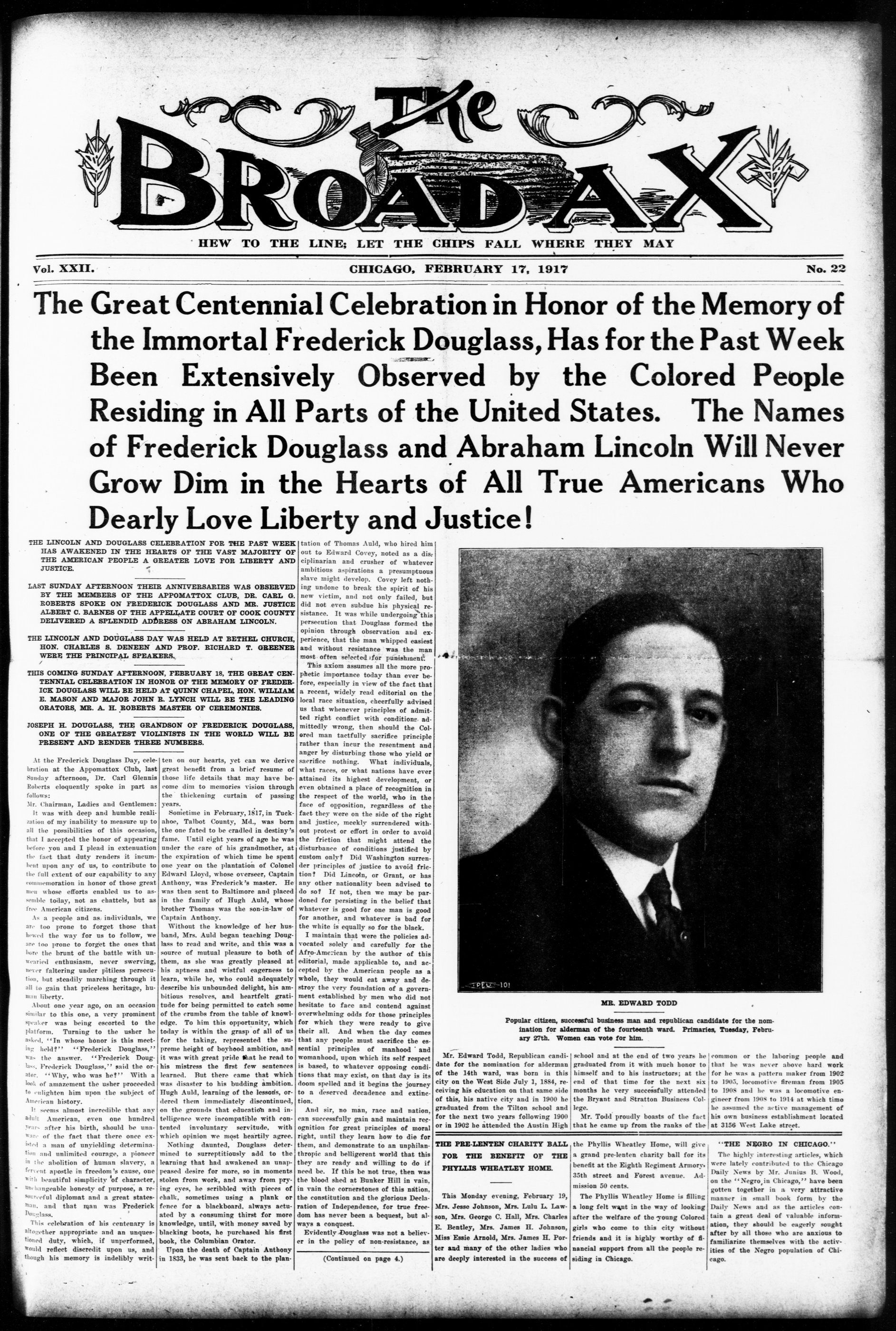
Popular citizen, successful business man and republican candidate for the nomination for alderman of the fourteenth ward. Primaries, Tuesday, February 27th. Women can vote for him.
Mr. Edward Todd, Republican candidate for the nomination for alderman of the 14th ward, was born in this city on the West Side July 1, 1884, receiving his education on that same side of this, his native city and in 1900 he graduated from the Tilton school and for the next two years following 1900 or in 1902 he attended the Austin High
THE PRE-LENTEN CHARITY BALL
FOR THE BENEFIT OF THE
PHYLLIS WHEATLEY HOME.
This Monday evening, February 19, Mrs. Jesse Johnson, Mrs. Lulu L. Lawson, Mrs. George C. Hall, Mrs. Charles E. Bentley, Mrs. James H. Johnson, Miss Essie Arnold, Mrs. James H. Porter and many of the other ladies who are deeply interested in the success of
school and at the end of two years he graduated from it with much honor to himself and to his instructors; at the end of that time for the next six months he very successfully attended the Bryant and Stratton Business College.
Mr. Todd proudly boasts of the fact that he came up from the ranks of the
the Phyllis Wheatley Home, will give a grand pre-lenten charity ball for its benefit at the Eighth Regiment Armory, 35th street and Forest avenue. Admission 50 cents.
The Phyllis Wheatley Home is filling a long felt want in the way of looking after the welfare of the young Colored girls who come to this city without friends and it is highly worthy of financial support from all the people residing in Chicago.
No.22
common or the laboring people and that he was never above hard work for he was a pattern maker from 1902 to 1905, locomotive fireman from 1905 to 1908 and he was a locomotive engineer from 1908 to 1914 at which time he assumed the active management of his own business establishment located at 3156 West Lake street.
"THE NEGRO IN CHICAGO."
The highly interesting articles, which were lately contributed to the Chicago Daily News by Mr. Junius B. Wood, on the "Negro, in Chicago," have been gotten together in a very attractive manner in small book form by the Daily News and as the articles contain a great deal of valuable information, they should be eagerly sought after by all those who are anxious to familiarize themselves with the activities of the Negro population of Chicago.
Dan M. Jackson
Geo. T. Kersey
David A. McGowan
Ahmed A. Rayner
The Emanu
Undertaking
2959-61 South State St.
Reliable Service * Courteous Treatment
Reasonable Prices
FREE CHAPEL IN CONNECTION
Complete line of Funeral Goods. Automobiles for hire
Telephone Douglas 6568 Automatic 73-657
THE SOLACE BILLIARD ACADEMY
"THE MODERN SCHOOL" - CLEAN AND RELIABLE
TERREVOUS L, DOUGLAS, Prop.
CIGARS—WHOLESALE AND RETAIL
BOX TRADE A SPECIALTY
3556 South State Street
PHONE DREXEL 3244
T. W. Chan
Real Estate
RENTING :: LOAN
5107 South
Chi
TEACHING INDIANS IS THIS WOMAN'S HOBBY
Mrs. Molineux Declares Red Man Can Be Led, but Will Not Be Driven.
Salt Lake City.—To have mothered one or possibly two tiny lives through the strenuous days of early infancy is a task that most women consider plenty, but Mrs. Elizabeth Molineux, until recently a teacher in the United States Indian service, has the distraction of having mothered a whole tribe of Plute Indians, and claims the satisfaction of having raised them, old and young, from a condition bordering on the squalid state where they consider cleanliness next to godliness and, one and all, are heartily in favor of both.
Mrs. Mollneux recently resigned her post as teacher on the Shivwits reservation in southern Utah and is in Salt Lake resting preparatory to going to Ketchikan, Alaska, to take charge of the Episcopal church's mission school there. She is a guest at the home of the Right Rev. Paul Jones, bishop of the Episcopal diocese of Utah, while here.
Indians have become a hobby with this diminutive little Scotchwoman. She speaks their languages and in her eight years of service with the Indian department has been intimately associated with the trials and tribulations that beset poor Lo on his native heath. Mrs. Molineux is an ardent churchwoman and attributes her success in dealing with Indians to the fact that by blending religious teachings with the "three R's" she has dismissed distrust of her from the minds of her charges and has always been regarded by them more in the light of a friend than a teacher. She declared the Indian mind to be susceptible to teaching if properly approached, but adds that he can be led but will not be driven.
CHASING A COYOTE IN AUTO EXCITING SPORT
Hound, Sighting Game, Leaps Over Mud Shield and Lands Twenty Feet Ahead of Car.
Learned, Kan.—An exciting coyote chase in automobiles took place near Hanston. The party consisted of Bill Hann, John Hann, Mr. and Mrs. Irvin Seaman and William Warring. They went in two cars and took three greyhounds in each car.
Mr. Warring says that auto polis is mild compared with the way those two cars chased across the prairie, ravines and bluffs after coyotes. He said that his speedometer registered forty miles one time when he dared to glance at it, and he was afraid to look again.
They were going along between twenty and thirty miles an hour at the time they started up the first coyote, and when the biggest hound in Mr. Warring's car sighted the wolf it leaped over the wind shield and hood and landed running twenty feet ahead of the car. The coyote was a big fellow, but the hounds finally brought him down, the big hound throwing him, while the others pinned him down.
While chasing the first coyote the other auto nearly ran over another one, which leaped up almost from under the wheels of the car. The men shot at it several times, wounding it, but because of the speed of the bounding car could get but poor alm. It finally ran into a hole and was fished out with a wire. Messrs. Hann and Seaman have killed many coyotes.
---
PAGE TWO
PH ONE DREXEL 3244
Phones Calumet 6164
Automatic 71-629
OPEN DAY
AND NIGHT
uel Jackson
ing Co., Inc.
Automobles for hire
Automatic 73-657
LLIARD ACADEMY
- CLEAN AND RELIABLE
et Chicago
RES. PHONE DREXEL 2082
Champion & Co.
State Brokers
MANS :: INSURANCE
On State Street
Chicago
The Famous "Green Man of Brighton." In October, 1806, an individual was to be observed at Brighton, England, who walked out every day dressed in green from head to foot—green shoes, green gloves, green handkerchief and other articles to match. This eccentric person lived alone, knew nobody, and in his house the curtains, the wall paper, the furniture, even the plates and dishes and the smallest toilet articles, offered an uninterrupted sequence of green. Having started on his career, there was obviously no reason to stop, and with full consistency he carried his scruples so far as to eat nothing but fruit and vegetables of the same green color. The consequences were extremely disastrous. One fine day the green man jumped from his window into the street, rushed forward and performed a second somersault from the top of the nearest cliff.
In the angle between the Kings and Kern canyons lies a woodland empire beside which the Harz and Black forest of Germany would appear almost diminutive. Within the borders of the Sequoia National park and the General Grant National park near by there are no fewer than 1,166,000 sequoia trees, and of these 12,000 are more than ten feet in diameter. In the Sequoia National park stands the largest tree in the world—not the tallest, but the largest—the General Sherman tree, with a diameter of 36.5 feet and a height of 279.9 feet. Its massive trunk and branches contain about 1,000,000 feet of lumber, board measure. This is equal to the amount of lumber that is cut from forty acres of average Minnesota timberland—Argonaut.
Self Convicted
"Say, pa," queried small Bobby, "what is gossiping, anyway?" "Gossiping, my son," replied the old man, "if we get right down to the plain, unvarnished facts, is lying. But why do you ask?" "Because," answered the young investigator, "ma says you do a lot of gossiping every time your business keeps you late at the office."—Exchange.
Too Much Practice
"Does your minister practice what he preaches?" the newcomer questioned. "He does," the citizen answered, with a sigh, "and I'd be perfectly willing to have him stop. He lives next door to me and begins at 7 o'clock Sunday morning to practice what he is going to preach."—New York Times.
Scene—Pollice court during dispute over eight day clock.
Magistrate—I award the clock to the plaintiff.
Defendant—Then what do I get?
Magistrate—I'll give you the eight days.—London Stray Stories.
Sharks and Death.
There is an old yet still operative superstition among seafaring men that when a shark persistently follows a vessel it is a sign that some person on board is going to die, the alleged reason being that the great fish can scent death.
Fashionable.
Willie—Paw, what is a fashionable resort? Paw—A place where you can obtain the least comfort and the most style for the most money, my son.—Cincinnati Enquirer.
Oh, how bitter a thing it is to look into happiness through another man's eyes!—"As You Like It," II, 7.
Chicago
Some Trees.
Divided It.
THE BROAD AX, CHICAGO, FEBRUARY 17, 1917.
GET TOGETHER FOR PERMANENT PROSPERITY.
Every man and woman engaged in American factories, mills and mines, whether they know English or speak it, are naturalized or intend to become citizens, have a direct interest in maintaining industrial prosperity. When times are good, all workers should not only be thrifty in habit and lay up a little something for possible rainy days, but they should do all they can to keep the good times with us. Simply because your language is different from that of the foreman, overseer, superintendent, manager or owner of the plant in which you earn a living, is no excuse for misunderstanding your own common interest in prosperity by hating your partner in your own industry or listening to and following the gospel of dissension and violence which selfish agitators so often preach.
Do not blindly follow the man who tells you how hard your lot is. Often he is doing so untruthfully and for the purpose of getting you to contribute membership money for his own support in idleness. Agitators get rich by preying on the men in American industry, whom they urge into unlawful or harmful acts by misrepresenting conditions or holding out foolish and false promises of better things if they follow their orders. You know conditions yourself, and you know or ought to know that the man or men whom the agitator who pictures your employer as on inhuman driving machine is actually a partner with you, interested in having the plant or industry successful.
The more successful your plant or industry becomes, the more room for you to grow with it there will be. It should be your feeling, then, that you will not do as little as you may find it convenient to do, but to do just as much as you possibly can do, and then reasonably expect to share in the rewards that always come to the efficient worker.
Do not be a clock watcher in the factory. Those who wait for hours to strike or whistles to blow and "soldier" at the bench, machine or in the office, never get ahead in the ranks of industry. They never get any more pay because they are not worth any more, and often are worth less than they get.
Remember the old adage that a man who never does any more or as much as he gets paid for, never gets paid for any more than he does.—Industrial Conservation, N. Y.
PUTTING BUSINESS RIGHT WITH THE PUBLIC.
A few years ago some big industrial organizations and certain railroads employed business tactics which, according to the popular idea, would make the financial adventures of Pizarro, Morgan or Captain Kidd look as amateurish as the verbal exploits of Bobby Make-Belleve.
All are more or less acquainted with the details. We will concede that there were some glaring abuses, but the public when it came to apply a remedy ignored the fact that these were peculiar to comparatively few institutions and instead of tackling the trouble where it lay furiously assailed everything classifiable as business—the trust magnate, the independent manufacturer ready and anxious to obey the law, the small retailer, a law abiding and useful citizen—the innocent and the guilty suffering alike. Seemingly the law was invoked not to regulate, but to persecute.
There could be but one result. Business was demoralized, and the whole country has felt the evil effects. Now the public is beginning to realize its error and in a rather grudging way is making some concessions.
Business is being permitted to speak for itself, and a movement has been instituted by the leading business men of the country under the title of the National Industrial Conservation Movement for the purpose of repairing the damage that has been done. Nothing revolutionary is contemplated. The plan is simply to educate the public by taking it into the business man's confidence. Meetings will be held in various trade and industrial centers. All classes of citizens will be invited. The purpose of these meetings is to give the public a new and correct viewpoint as to the effects of drastic legislation and restriction of business on the prosperity of the country. Every effort will be made to give the public a clear view of the problems and difficulties which beset business.
Special favors are not sought through these meetings, only fair play. It is believed that once the citizen grasps the situation his whole attitude toward business will change and that he will readily co-operate toward bringing about better conditions. Commercial and other civic organizations and the local press are already showing great interest in this movement, and it is reasonable to believe that much good will come from it. Industrial Conservation, N. Y.
Common Capitalists.
Every man or woman who possesses a dollar or owns a set of tools is a capitalist. People generally make the mistake of thinking that the only form of capital in existence is the national currency—the dollar, franc, ruble, mark, lire or pound sterling. Yet everybody knows that many a successful business man's only original capital was brains, knowledge, ability, determination or ingenuity. It would be well for more people to recognize this trulism before abetting, either by action or attitude, ceaseless efforts on the part of some political or other self seekers, to hobble business men and industrial development. Such is the spirit of industrial patriotism which is needed in America.—Industrial Conservation, New York.
YOU HAVE READ MUCH! THOUGHT SOME BUT NOW IS YOUR TIME TO ACT
is passing. The shares of Capital Stock have been turned over to a strong firm of brokers. The sales are big --- in Chicago --- all over the country. The shares are going very fast. Soon they will be entirely gone, and your chance to make a lot of money gone also --- unless you get busy.
Not Next Month But TO-DAY or Next Week
This Master Photoplay is of interest to you. It will help you and your race, and make money for you at the same time.
President, EDWIN L. BARKER, a man who has produced real motion pictures. Secretary, JOHN C. WILLIAMS, for 6 years Attorney for Sanitary Dist. of Chicago. Treasurer, JOHN GULLIKSEN, Assistant Cashier of the Union Bank of Chicago. DEPOSITORY FOR FUNDS, Union Bank of Chicago.
CLIP, fill out and mail this coupon to-day, and circular telling all about "THE BIRTH OF A RACE," will be sent you at once. There is a Monthly Payment Plan which makes it very easy to own a few shares of stock.
ALL AVAILABLE LAND GONE
Commissioner of Immigration Howe Predicts That United States Will Become an Emigrant Rather Than an Immigrant Nation at the End of Hostilities In Europe.
New York.—A prediction that the United States would become an "emigrant" rather than an "immigrant" nation at the close of the war was made by Commissioner of Immigration Frederic C. Howe at the Sunday evening forum of the Free synagogue.
Mr. Howe took the stand that immigration was purely an economic question and declared that it had been such from the beginning. He said that those who opposed immigration did so because they, desired to limit the competition of unskilled foreign labor; those who favored the wide open door did so because it made labor cheap.
He said the immigrant no longer went to the farm because all the available land of the country had been taken up, hundreds of millions of acres being held for purely speculative purposes.
"The immigration problem never existed so long as the land was free for the asking." said Mr. Howe, "and it is this scarceness of land which makes immigration an economic question.
"It is a matter of freeing labor on one hand from the competition of the incoming labor groups from Europe and of insuring to the immigrant an opportunity to work for himself rather than for an employer interested in securing his services at the lowest possible cost.
"I keep more or less in touch with the centers to which go most of the men who pass through Ellis island. I am told that everywhere the men now employed in our shops and factories who at home worked as farmers are saving their money to return to the old country. They have always wished to own their own farms—they came here for that purpose—and they figure that after the war land will be cheap in the countries overseas. This sentiment, spreading among our workers, will result in a serious crisis in our industrial life."
Mr. Howe also discussed the servant question. He said that since the war there had been practically no servant girls coming to this country and that many of those who were in service had left it to enter munition factories and offices, while others had married or died.
To regulate the tide of oriental immigration and, in fact, to check in some measure immigration from any land Dr. Sydney L. Gullick, an authority on Japan, suggested that, for example, if a thousand Syrians came to this country in 1900 and ten years later all had taken out American citizenship then another thousand might be admitted. If, however, only 300 had applied for naturalization papers the decision of the remaining 700 to still be Syrians automatically would keep an equal number of their fellow countrymen in Syria.
BFT
FOUND IMAGE IN CAVE
Crude Stone Idol Probably Antedates Indian Mound Builders.
Madisonville, Ky.-E. L. Littlepage of the Morton Gap country brought to this place recently a stone image that is a curiosity and probably of historic value.
Mr. Littlepage found it at the edge of a cave on a high elevation in North Christian county, Ky., while investigating some prospective oil land belonging to him. The cave is located in a wild and broken section of land uncultivated and but thinly inhabited.
The image is rudely carved out of a tough, ferrous sandstone. It is about six inches in height and is well preserved, except for a slight injury on one side of its head and slight weathering of one arm. The figure is in a sitting position, with its legs doubled under its body and arms extended in front with hands resting on its knees.
The image is evidently a relic of an idol worshiping people and antedates any old Indian relic found in various Indian mounds in western Kentucky.
WIDOW SAVES TREES.
Turns Commissioners From Those Planted by Her Husband.
St. Cloud, Mich.—"Woodman, spare that tree; touch not a single bough." Thus quoted Mrs. Mary Splcer, widow, as she pleaded for the preservation of trees planted by her husband, long dead.
It was three years ago that Mrs. Splcer started her battle with city officials over the maintenance of this arborian inheritance. She was called upon to enter another skirmish the other day when sidewalk bids were opened, in which provision was to have been made for the removal of the trees.
Mrs. Spicer's "pets" fringe a lot on which her modest little home is built. "Walt until I am gone and you may remove them," she told the city commissioners, who took her words to heart. When sidewalk bids were opened there were proposed contracts on other jobs, but on the Widow Spicer's property—not a word.
EIGHTY. WANTS HEART BALM
Woman Is Deaf, Has Lost Right Eye and Is a Little Lame.
Utica, N. Y.-Mrs. Almira Kingsbury is just a little on the right side of eighty years old. She is rather deaf. She has lost her right eye and her left thumb. Besides she is a little lame.
But she took the stand to testify that Robert Roberts of Trenton, seventy-six years old and a farmer, had been so smitten with her charms at first sight that he urged her to marry him. Then she said he broke troth and she sued for breach of promise. They met at an employment agency where he sought a housekeeper.
Judge Hazard told Mrs. Kingsbury's attorney, "I think your client is clearly entitled to about 6 cents." However, the case was held open for more evidence.
Teaching Birds Tricks.
A professor of natural history refutes the statement so frequently made that teaching a bird to draw water needs apparatus and that the learning is cruelty to the bird.
"The following experience of mine," he says, "proves that it is not so by any means. We bought a young bird last January, so wild that on our approach it flew madly round the cage. We hung the cage low and by patience, induced it to take groundsel, first held at stem's length, then between the fingers, finally from the lips. We used to let him out freely, and he would perch on the loaf next me at breakfast. His perch projected through the wires, and here was his favorite seat when at liberty. Then I tried hanging a bit of groundsel by a short string to the projecting stick. After inspection he pulled it up with his beak. On lengthening the string with a fresh bit of his preferred weed I had the pleasure and interest of seeing him pull up the string with his beak till the flower head was within reach, catching the slack after each pull with one foot and then transferring it to the other, so that the coils were quite neat."—London Globe.
Water Pressure.
As early as 1648 a Frenchman of science named Pascal experimented with pressures applied to liquids and discovered the following law: A pressure applied to any part of the surface of a liquid is transmitted unchanged in amount in every direction through the liquid.
Perhaps the most familiar application of Pascal's law is the hydraulic press. In that machine a pump having a small piston drives water into a large cylinder and thereby forces upward a large piston, which compresses whatever is placed between the platform of the piston and the fixed crossbeam at the top of the press. If the area of the larger piston is 100 times that of the smaller a downward force of one pound exerted on the smaller piston will create an upward force of 100 pounds upon the larger piston.
Home Ground Floor
Grinding wheat to make flour may be done at home as easily as the grinding of coffee. Thus a family may have whole wheat flour, freshly ground, a thing that is usually difficult to obtain. The New York Medical Journal advises its readers to buy their wheat from seedsmen rather than from grocers or feed stores because it will be cheaper and more efficient.
The grinder can be used also for cracking wheat, corn, barley, oats, rye and other grains for use as breakfast cereals. And the cereals will need chewing, which will not only strengthen the muscles of the chewers' jaws, but will keep their teeth from decay that is, if they begin as children.
Homemade cereals need long cooking, so a fireless cooker is almost indispensable.
Oe , i
Wi RRHAT, AW THT Agr np p Dv oO
Naval Militiamen, on Patrol,
Searched Every Vehicle.
WATCHED FOR EXPLOSIVES.
When Break With Germany Came Par-
ticular Attention Was Centered on
Brooklyn and Manhattan Spans, as
Destruction Would Prevent Egress of
War Vessels From Navy Yard.
New York.—With machine guns and
three pounders stationed at the bases
and naval militiamen patrolling the
spans with bayoneted rifes, the Brook-
lyn, Manhattan, Williamsburg, Queens-
poro and Hell Gate bridges took on
the appearance of stern preparedness
agninst war immediately following the
sererance of diplomatic relations.
‘The automobilist who motored across
the bridges was held up as he chugged
to the bridge and as he left the struc-
ture by blue uniformed naval militia-
men Who insisted on searching each
vehicle for explosives.
“Keep moving” was the spirit im-
parted to all who used the bridges
|:
2. ae =
a |
‘seas !
ee as i .
a AN
= a
fa |i\\\
go as [ae ||
fA id LJ é
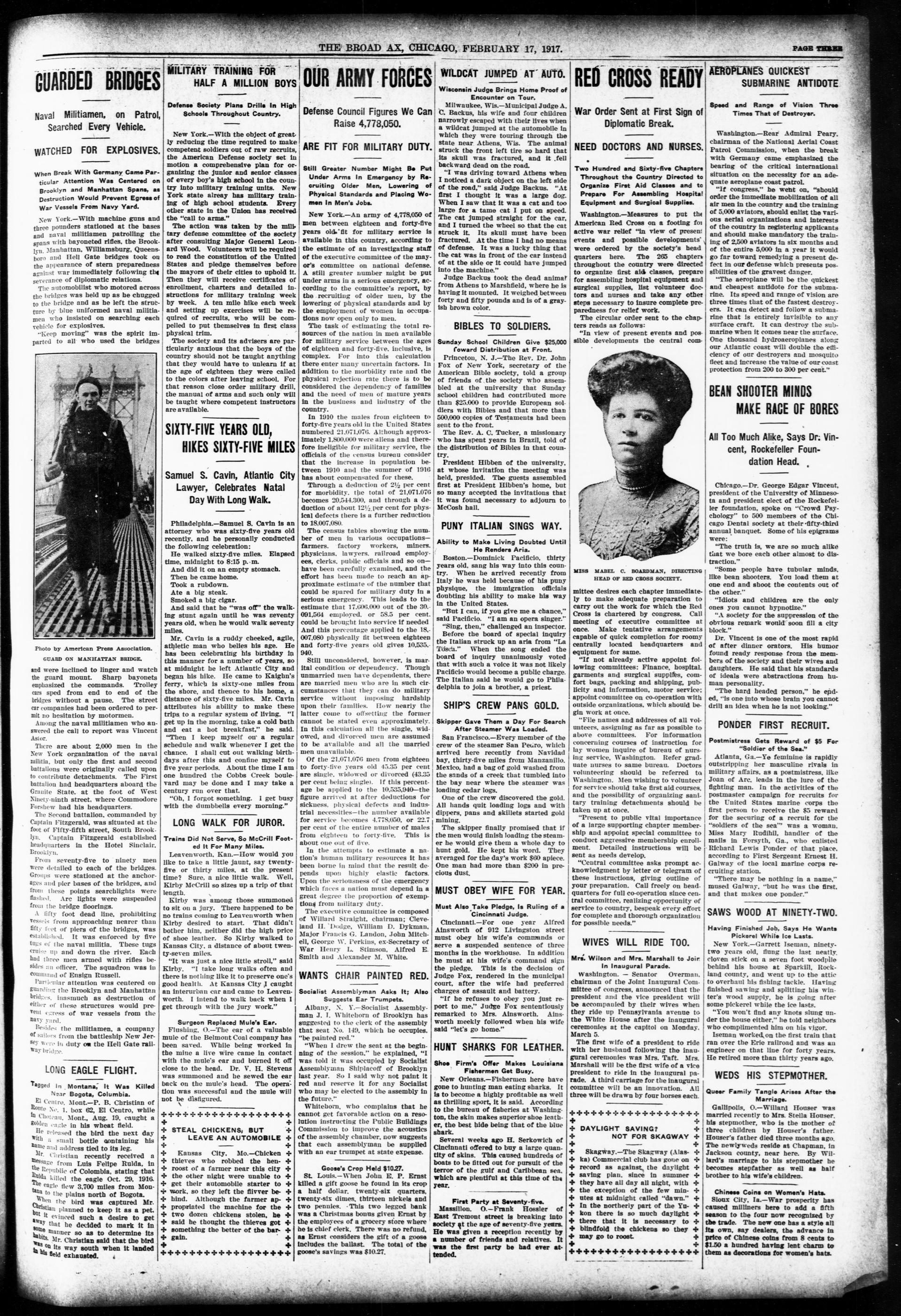
Photo by American Press Association,
GUARD ON MANHATTAN BRIDGE,
and were inclined to linger and watet
the guard mount. Sharp bayonets
enphasized the commands. Trolles
cas sped from end to end of the
ridges without a pause. The street
car companies had been ordered to per
nit no hesitation by motormen.
Among the naval militiamen who an
swered the eal] to report was Vincent
Asior.
‘There are about 2,000 men in the
New York organization of the naval
nilitia, but only the first and second
Lattalions were originally called upon
to contribute detachments. The First
battalion had headquarters aboard the
Granite State, at the foot of West
Ninety-ninth street, where Commodore
Forshew had his headquarters.
‘The Second battalion, commanded by
Captain Fitzgerald, was situated at the
foot of Fifty-fifth street, South Brook-
lyn, Captain Fitzgerald established
headquarters in the Hotel Sinclair.
Brooklyn.
From seventy-five to ninety men
were detailed to each of the bridges.
Groups were stationed at the anchor-
azes aud pler bases of the bridges, and
from these points searcblights were
Maske], Are lights were suspended
frow the bridge floorings.
\ fifty foot dead line, prohibiting
Yesseis from approaching nearer than
fifty foot of piers of the bridges, was
estiblished. It was enforced by five
tuss of the naval militia, These tugs
cruise up and down the river. Each
had three men armed with rifles be-
Sides sn officer, ‘The squadron was in
‘coumaud of Ensign Russell.
Varvienlar attention was centered on
SwrJiys the Brooklyn and Manhattan
Uridses, inasmuch as destruction of
either of these structures would pre-
Feut cress of war vessels from the
avy yund,
Resides the militiamen, a company
of ssilws from the battleship New Jer-
Se) Nese tn duty om the Hell Gate rail-
ay bridsre.
LONG EAGLE FLIGHT.
“sar Bogota, Columbia.
Ei Ceniro, Mont.—P. B. Christian of
Route Ne. 1, box 62, El Centro, while
{ Chocan, Mont, Aug. 19, caught a
Felden caste in his wheat field.
He teloased the bird the next day
With x small bottle aontaining his
Rame anid address tied to its leg.
Mr. Christian recently received a
Ressixe from Luls Felipe Rulda, in
Le Eenubite of Colombia, stating that
Rul ‘hited the eagle Oct. 29, 1916
Ree cazie tlew 3,700 miles from Mon-
“2 to the plains north of Bogota.
‘hen the bird was captured Mr.
Besian planned to keep It as a pet,
ang! fvineed such a desire to get
SY that he decided to mark ft in
= manner so as to determine its
fern Mr. Christian said that the bird
fa y3,!ts way south when it landed
‘Me tea exhausted. ;
MILITARY TRAINING FOR ~~
HALF A MILLION BOYS
Defense Society Plans Drille In High
Schools Throughout Country.
New York.—With the object of great
ly reducing the time required to make
competent soldiers out of raw recruits,
the American Defense society set in
motion a comprehensive plan for or-
‘ganizing the junior and senior classes
‘of every boy's bigh school in the coun:
‘try into military training units. New
‘York state alreay has military train.
ing of high school students. Every
other state in the Union has recelved
the “call to arms.”
‘The action was taken by the milk
tary defense committee of the society
after consulting Major General Leon-
ard Wood. Volunteers will be required
to read the constitution of the United
States and pledge themselves before
the mayors of thelr cities to uphold it.
‘Then they will receive certificates of
enrollment, charters and detailed in-
structions for military training week
by week. A ten mile hike each week
and setting up exercises will be re-
quired of recruits, who will be com-
pelled to put themselves in first class
physical trim.
‘The society and its advisers are par-
ticularly anxious that the boys of the
country should not be taught anything
that they would have to unlearn if at
the age of eighteen they were called
to the colors after leaving school. For
that reason close order military drill,
the manual! of arms and such only will
be taught where competent instructors
are available.
SIXTY-FIVE YEARS OLD,
HIKES SIXTY-FIVE MILES
Samuel S. Cavin, Atlantic City
Lawyer, Celebrates Natal
Day With Long Walk.
Philadelphia.—Samuel S, Cavin ts an
attorney who was sixty-five years old
recently, and he personally conducted
the following celebration:
He walked sixty-five miles. Elapsed
time, midnight to 8:15 p.-m.
‘And did it on an empty stomach.
‘Then he came home.
Took a rubdown.
Ate a big steak.
Smoked a big cigar.
And said that he “was off” the walk-
ing stunt again until he was seventy
years old, when he would walk seventy
miles.
‘Mr. Cavin is a ruddy cheeked, agile,
athletic man who belles his age. He
has been celebrating his birthday in
this manner for a number of years, 80
at midnight he left Atlantic City and
began his hike. He came to Kaighn's
ferry, which is sixty-one miles from
the shore, and thence to his home, a
distance of sixty-five miles, Mr. Cavin
attributes his ability to make these
trips to a regular system of living. “I
get up in the morning, take a cold bath
and eat a hot breakfast,” he said.
“Then I keep myself on’ a regular
schedule and walk whenever I get the
chance. I shall cut out walking birth-
days after this and confine myself to
five year periods. About the time I am
one hundred the Cobbs Creek boule-
vard may be done and I may take a
century run over that.
“Oh, I forgot something. 1 get busy
with the dumbbells every morning.”
_ LONG WALK FOR JUROR.
‘Trains Did Not Serve, So McCrill Foot-
ed It For Many Miles.
Leavenworth, Kan.—How would you
like to take a little jaunt, say twenty-
five or thirty miles, at the present
time? Sure, a nice little walk. Well,
Kirby McCrill so sizes up a trip of that
length. S
Kirby was among those summoned
to sit on a jury. There happened to be
no trains coming to Leavenworth when
Kirby desired to start. That didn't
bother him, neither did the high price
of shoe leather. So Kirby walked to
Kansas City. a distance of about twen-
ty-seven miles.
“It was just a nice little stroll,” said
Kirby. “I take long walks often and
there is notliing like it to preserve one’s
good health. At Kansas City I caught
an interurban car and came to Leaven-
worth. I intend to walk back when I
get through with the jury work.”
issenen Siianed Shakes Bn
Flushing. O.—The ear of a valuable
mule of the Belmont Coal company has
been saved. While being worked in
the mine a live wire came in contact
with the mule’s ear and burned St off
close to the head. Dr. V. H. Stevens
was summoned and he sewed the ear
back on the mule’s head. The opera-
tion was successful and the mule will
not he disfigured.
PEEEEEEE EE EEE EE ESE
+ +
‘+ STEAL CHICKENS, BUT +
+ LEAVE AN AUTOMOBILE +
+ — +
+ Kansas City, Mo.—Chicken +
+ thieves who robbed the hen- +
‘+ roost of a farmer near this city +
‘+ the other night were unable to +
+ get their automobile starter to +
% Work, so they left the fivver be
+ bind. Although the farmer ap- +
+ propriated the machine for the +
‘+ two dozen chickens stolen, he +
+ said be thought the thieves got 4
+ something the better of the bar +
+ gain. +
> yy
OUR ARMY FORCES
Defense coeaieaee We Can
Raise 4,778,050.
ARE FIT FOR MILITARY DUTY.
Still Greater Number Might Be Put
Under Arms In Emergency by Re-
cruiting Older Men, Lowering of
Physical Standards and Placing Wo-
men In Men's Jobs.
New York.—An army of 4,778,050 of
men between eighteen and forty-five
years old’ft for military service is
available in this country, according to
the estimate of an investigating staff
of the executive committee of the may-
or’s committee on national defense.
A still greater number might be put
under arms in a serious emergency, ac-
cording to the committee's report, by
the recruiting of older men, by the
lowering of physical standards and by
the employment of women in occupa-
tions now open only to men.
‘The task of estimating the total re-
sources of the nation in men available
for military service between the ages
of eighteen and forty-five. inclusive, is
complex. For into this calculation
there enter many uncertain factors. In
addition to the morbidity rate and the
physical rejection rate there is to be
considered the dependency of families
and the need of men of mature years
fn the business and industry of the
country.
In 1910 the males from eighteen to
forty-five years old in the United States
numbered 21,071,076. Although approx-
imately 1,800,000 were aliens and there-
fore ineligible for military service, the
officials of the census bureau consider
that the increase in population be-
tween 1910 and the summer of 1916
has about compensated for these.
Through a deduction of 2% per cent
for morbidity. the total of 21,071,076
becomes 20,514.300, and through a de.
‘action of about 1214,per cent for phys-
feal defects there is a further reduction
to 18,007,080.
‘The census tables showing the num.
ber of men in various occupations—
farmers. factory workers, miners.
physicians, lawyers. railroad employ-
ees, clerks. public officials and so on—
have been carefully examined, and the
effort has been made to reach an ap-
proximate estimate of the number that
could be spared for military duty in a
serious emergency. ‘This leads to the
estimate that 17.606,000 out of the 30.
091,56 employed. or 585 per cent.
could be brousht into service if needed
And this percentaze applied to the 18,-
007,080 physically fit between eighteen
and forty-five years old gives 10,535.
940.
Stil unconsidered, however, is mar-
{tal condition or dependency. Though
unmarried men have dependents, there
are married men who are in such cir-
cumstances that they can do military
service without imposing hardship
upon their families. How nearly the
latter come to offsetting the former
cannot be stated even approximately.
In this calculation all the single, wid-
owed, and divorced men are assumed
to be available and all the married
men unavailable.
Of the 21,071,076 men from eighteen
to forty-tive years old 45.35 per cent
are single, widowed or divorced (43.35
per cent bein single). If this percent-
age be applied to the 10.535,040—the
figure arrived at after deductions for
sickness, physical defects and indus-
trial necessities—the number available
for service becomes 4.778050, or 22.7
per cent of the entire number of males
from eizhteeu to forty-five. This is
about one out of tive.
In the attempts to estimate a na-
tion's human military resources it has
been borne in mind that the result de-
pends upon highly elastic factors.
Upon the seriousness of the emergency
which faces a nation mnst depend in a
great desree the proportion of exemp-
tong from military duty.
The executive committee is composed
of Willard Straight, chairman; Cleve-
land H. Dodge, William D. Dykman,
Major Francis G. Landon, John Mitcb-
ell, George W. Perkins, ex-Secretary of
War Henry L, Stimson, Alfred E.
Smith und Alexander M, White.
Socialist Assemblyman Asks It; Also
Suggests Ear Trumpets.
Albany, N. Y.—Socialist Assembly-
man J. I, Whitehorn of Brooklyn bas
suggested to the clerk of the assembly
that seat No. 149, which be occupies.
“be painted red.” «
“When I drew the seat at the begin-
ning of the session,” be explained, “I
‘was told it was occupied by Socialist
Assemblyman Shiplacoff of Brooklyn
last year. So I said why not paint it
red and reserve it for any Socialist
who may be elected to the assembly in
the future.”
Whiteborn, who complains that he
cannot get favorable action on @ reso-
lution instructing the Public Buildings
Commission to improve the acoustics
of the assembly chamber, now suggests
that each assemblyman be supplied
with an ear trumpet at state expense.
Goose's Crop Held $10.27.
St Louis.—When John E. P. Ernst
Killed a gift goose he found in its crop
a half dollar, twenty-six quarters,
twenty-six dimes, thirteen nickels and
two pennies. -This two legced bank
was a Christmas bonus given Ernst by
the employees of a grocery store where
he ts chief clerk, There was no refund,
as Ernst considers the gift of a goose
Includes the ballast. ‘The total of the
goose’s savings was $10.27.
WILDCAT JUMPED AT’ AUTO.
Wisconsin Judge Brings Home Proof of
Encounter on Tour.
Milwaukee, Wis.—Municipal Judge A.
©. Backus, bis wife and four children
narrowly escaped with thelr lives when
a wildcat jumped at the automobile In
which they were touring through the
state near Athens, Wis. The animal
struck the front left tire so hard that
its skull was fractured, and it .fell
backward dead on the road.
“I was driving toward Athens when
I noticed a dark object on the left side
of the road,” said Judge Backus. “At
first I thought it was a large doz.
When I saw that it was a cat and too
large for a tame cat I put on speed.
‘The cat jumped straight for the car,
and I turned the wheel so that the cat
struck it. Its skull must have been
fractured. At the time I had no means
of defense. It was a lucky thing that
the cat was in front of the ear instead
of at the side or it could have jumped
into the machine.”
Judge Backus took the dead animat
from Athens to Marshfield, where he is
having it mounted. It weighed between
forty and fifty pounds and is of a gray-
ish brown color.
BIBLES TO SOLDIERS.
Nee ae Tr ete
foward Distribution at Front.
Princeton, N. J—The Rev. Dr. John
Fox of New York, secretary of the
American Bible society, told a group
of friends of the society who assem-
bled at the university that Sunday
school children had contributed more
than $25,000 to provide European sol-
diers with Bibles and that more than
500,000 copies of Testaments had been
sent to the front.
‘The Rev. A. C. Tucker, a missionary
who has spent years in Brazil, told of
the distribution of Bibles in that coun-
try.
President Hibben of the university,
at whose invitatfon the meeting was
held, presided. Tbe guests assembled
first at President Hibben’s home, but
so many accepted the invitations that
it was found necessary to adjourn to
MeCosh hall.
PUNY ITALIAN SINGS WAY.
Ability to Make Living Doubted Until
Me Mesdars Acie.
Boston.—Dominick Pacificio, thirty
years old, sang his way into this coun-
try. When he arrived recently from
Italy he was held because of his puny
physique, the immigration officials
doubting his ability to make his way
in the United States.
“But I can, if you give me a chance,”
said Pacificio. “I am an opera singer.”
“Sing, then,” challenged an inspector.
Before the board of special inquiry
the Italian struck up an aria from “La
‘Tdsva." When the song ended the
board of inquiry unanimously voted
that with such a voice it was not likely
Pacifico would become a public charge.
‘The Italian said he would go to Phila-
delphia to join a brother, a priest.
SHIP’S CREW PANS GOLD.
| Skipper Gave Them a Day For Search
After Steamer Was Loaded.
San Francisco—Every member of the
crew of the steamer San Peuro, which
arrived here recently from Navidad
bay, thirty-five miles from Manzanillo,
| Mexico, had a bag of gold washed from
| the sands of a creek that tumbled into
| the bay near where the steamer was
| loading cedar logs.
| One of the crew discovered the gold.
All hands quit loading logs and with
‘dippers, pans and skillets started gold
mining.
‘The skipper finally promised that if
the men would finish loading the steam-
er he would give them a whole day to
hunt gold. He kept his word. They
averaged for the day’s work $60 apiece.
One man had more than $200 in pre-
cious dust,
MUST OBEY WIFE FOR YEAR.
Must Also Take Pledge, Is Ruling of
Cincinnati Judge.
Cincinnati—For one year Alfred
Ainsworth of 912 Livingston street
must obey his wife's comnmnds or
serve a suspended sentence of three
/months in the workhouse. In addition
‘he must at his wife's command sign
‘the pledge. This is the decision of
‘Judge Fox, rendered in the municipal
court, after the wife had preferred
charges of assault and battery.
“If he refuses to obey you just re-
Port to me,” Judge Fox sententiously
remarked to Mrs. Ainsworth. Ains-
worth meekly followed when his wife
said “let's go home.”
HUNT SHARKS FOR LEATHER.
Shoe Firm's Offer Makes Louisiana
Fishermen Get Busy.
New Orleans.—Fishermen here have
gone to hunting man eating sharks. It
is to become a highly profitable as well
as thrilling sport, it is said. According
to the bureau of fisheries at Washing-
ton, the skin makes superior shoe leath-
er, the best hide being that of the biue
shark.
Several weeks ago H. Serkowich of
Cincinnati offered to buy a large quan.
tity of skins. ‘This caused hundreds of
boats to be fitted out for pursuit of the
terror of the gulf and Caribbean sea.
which are plentiful at this time of the
year.
First Party at Seventy-five.
Massillon, ©.—Frank Hossler of
East Tremont street is breaking into
society gt the age of seventy-five years
He was given a reception recently by
© number of friends and relatives. It
was the first party be bad ever at
tended.
RED CROSS READY
War Order eee Sign of
Diplomatic Break.
NEED DOCTORS AND NURSES,
Two Hundred and Sixty-five Chapters
‘Throughout the Country Directed to
Organize First Aid Classes and to
Prepare For Assembling Hospital
Equipment and Surgical Supplies.
‘Washington.—Measures to put the
American Red Cross on a footing for
active war relief “in view of present
events and possible developments’
were ordered by the society's head
quarters here. ‘The 265 chapters
throughout the country were directed
to organize first ald classes, prepare
for assembling hospital equipment and
surgical supplies, Ust volunteer doc-
tors and nurses and take any other
steps necessary to insure complete pre-
paredness for rellef work.
‘The circular order sent to the chap-
ters reads as follows:
“In view of present events and pos
sible developments the central com-
Rae
et
(oo
\ “m4
\
\
Ke =a >
Later
iL, Ghf alas
SEY
ue amet, ¢. poaxDwaN, EREOTIN
aid ee ee
mittee desires each chapter immediate-
ly to make adequate preparation to
carry out the work for which the Red
Cross is chartered by congress. Call
meeting of executive committee at
once. Make tentative arrangements
capable of quick completion for roomy
centrally located headquarters and
equipment for same.
“If not already active appoint fol-
lowing committees: Finance, hospital.
garments and surgical supplfes, com-
fort bags, packing and shipping, pub-
Ucity and information, motor service;
appoint committee on co-operation with
| outside organizations, which should be-
gin work at once.
| “File names and addresses of all vol-
unteers, assigning as far as possible to
above committees. For information
concerning courses of instruction for
lay women inquire of bureau of nurs-
ing service, Washington. Refer grad-
uate nurses to same bureau. Doctors
volunteering should be referred ta
Washington. Men wishing to volunteer
for service should take first ald courses,
and the possibility of organizing sani.
tary training detachments should be
taken up at once.
“Present to public vital importance
of a large supporting chapter member-
ship and appoint special committee to
conduct aggressive membership enroll-
ment. Detailed instructions will be
sent as needs develop.
“Central committee asks prompt ac-
knowledgment by letter or telegram of
these instructions, giving outline of
your preparation. Call freely on head-
quarters for full co-operation since cen-
tral committee, realizing opportunity of
service to country, bespeak every effort
for complete and thorough organization
for possible needs.”
WIVES WILL RIDE TOO.
Mrs. Wilson and Mrs. Marshall to Joir
In Inaugural Parade.
Washington. — Senator Overman.
chairman of the Joint Inaugural Com.
mittee of congress, announced that the
President and the vice president wiil
be accompanied by their wives when
they ride up Pennsylvania avenue to
the White House after the inaugural
ceremonies at the capitol on Monday.
March 5.
The first wife of a president to ride
with her husband following the inau-
gural ceremonies was Mrs. Taft. Mrs.
Marshall will be the first wife of a vice
President to ride in the inaugural pa-
fade. A third carriage for the inaugural
committee will be an innovation. AU
three will be drawn by four horses each.
+ DAYLIGHT SAVING? :
+ NOT FOR SKAGWAY -
+ as :
+ Skagway.—The Skagway (Alas- -
ka) Commercial club has gone on
record as against, the daylight -
* saving plan, since in summer -
# they have all day all night, with -
# the exception of the few min- -
+ utes at midnight called “dawn.” «
+ In the northerly part of the Yu- -
+ kon there is so much daylight -
# there that it is necessary to -
+ blindfold the chickens so they -
. may go to roost. :
PAGE THREE
KEROPLANES QUICKEST ~~
SUBMARINE ANTIDOTE
Speed and Range of Vision Three
Times That of Destroyer.
Washington—Rear Admiral Peary,
chairman of the National Aerial Coast
Patrol Commission, when the break
with Germany came emphasized the
bearing of the critical international
situation on the necessity for an ade-
quate aeroplane coast patrol.
“It congress,” he went on, “should
order the immediate mobilization of all
air men in the country and the training
‘of 5,000 aviators, should enlist the vari.
‘ous aerial organizations and interests
‘of the country in registering applicants
and should make mandatory the train-
ing of 2,500 aviators in six months and
of the entire 5,000 in a year it would
go far toward remedying a present de-
fect in our defense which presents pos-
sibilities of the gravest danger.
“The aeroplane will be the quickest
and cheapest antidote for the subma-
tine. Its speed and range of vision are
three times that of the fastest destroy-
ers. It can detect and follow a subma-
rine that {s entirely invisible to any
surface craft. It can destroy the sub-
marine when it comes near the surface.
One thousand hydroaeroplanes along
our Atlantic coast will double the efti-
clency of our destroyers and mosquito
fleet and increase the value of our coast
protection from 200 to 300 per cent.”
BEAN SHOOTER MINDS
MAKE RAGE OF BORES
All Too Much Alike, Says Dr: Vin-
cent, Rockefeller Foun-
dation Head. .
Chicago.—Dr. George Edgar Vincent,
president of the University of Minneso-
ta and president elect of the Rockefel-
ler foundation, spoke on “Crowd Psy-
chology” to 500 members of the Chi-
cago Dental society at their-ffty-third
annual banquet. Some of his epigrams
were:
“The truth is, we are so much alike
tuat we bore each other almost to dis-
traction.”
“Some people have tubular minds,
like bean shooters. You load them at
one end and shoot the contents out of
the other.”
“Idiots and children are the only
‘ones you cannot hypnotize.”
“A society for the suppression of the
obvious remark would’ soon fill a city
block.”
Dr. Vincent is one of the most rapid
of after dinner orators. His humor
found ready response from the mem-
bers of the society and their wives and
daughters. He said that his standards
of ideals were abstractions from hu-
man personality.
“The hard headed person,” he epd-
ed, “is one into whose brain you cannot
drill an idea when he is not looking.”
PONDER FIRST RECRUIT.
Postmistress Gets Reward of $5 For
“Soldier of the Sea.”
_ Atlanta, Ga.—Ye feminine is rapidly
outstripping her masculine rivals in
military affairs, as a postmistress, like
Joan of Are, leads in the lure of the
fighting man. In the activities of the
Postmaster campaign for recruits for
the United States marine corps the
first person to receive the $5 reward
for the securing of a recruit for the
“soldiers of the sea” was a woman,
Miss Mary Rudibil, handler of the
mails in Forsyth, Ga., who enlisted
Richard Lewis Ponder of that place.
according to First Sergeant Ernest H.
Galway of the local marine corps re-
eruiting station.
“There may be nothing in a name,”
mused Galway, “but he was the first,
and that makes one ponder.”
SAWS WOOD AT NINETY-TWO.
Having Finished Job, Says He Wants
Pickere! While Ice Lasts.
F See at are LE aos ay ee eee ee
New York.—Garrett Iseman, ninety-
two years old, flung the last neatly.
cloven stick on a seven foot woodplle
behind his house at Sparkill, Rock-
land county, and went up to the attic
to overhaul his fishing tackle. Having
finished sawing and splitting his win-
ter’s wood supply, he is going after
some pickerel while the ice lasts.
“You won't find any knots slung un-
der the house either,” he told neighbors
who complimented him on his vigor.
Iseman worked.on the first train that
ran over the Erie railroad and was an
engineer on that line for forty years.
He retired more than thirty years ago.
WEDS HIS STEPMOTHER.
Queer Family Tangle Arises After the
tie
Gallipolis, O.—Willard Houser was
married recently to Mrs. Stella Houser,
his stepmother, who is the mother of
three children by Houser’s father.
Houser’s father died three months ago.
The newlyweds reside at Chapman, in
Jackson county, near here. By Wil-
lard’s marriage to his stepmother he
becomes stepfather as well as half
brother to his wife's children.
Chinese Coins on Women's Hats.
Sioux City, Ia.—War prosperity has
caused milliners here to add a fifth
season to the four now recognized by
the trade. The new one has a style all
its own, say dealers, the advance in
price of Chinese coins from 8 cents to
$1.50 a hundred having lent charm to
them as decorations for women's hats.
M. C. H.
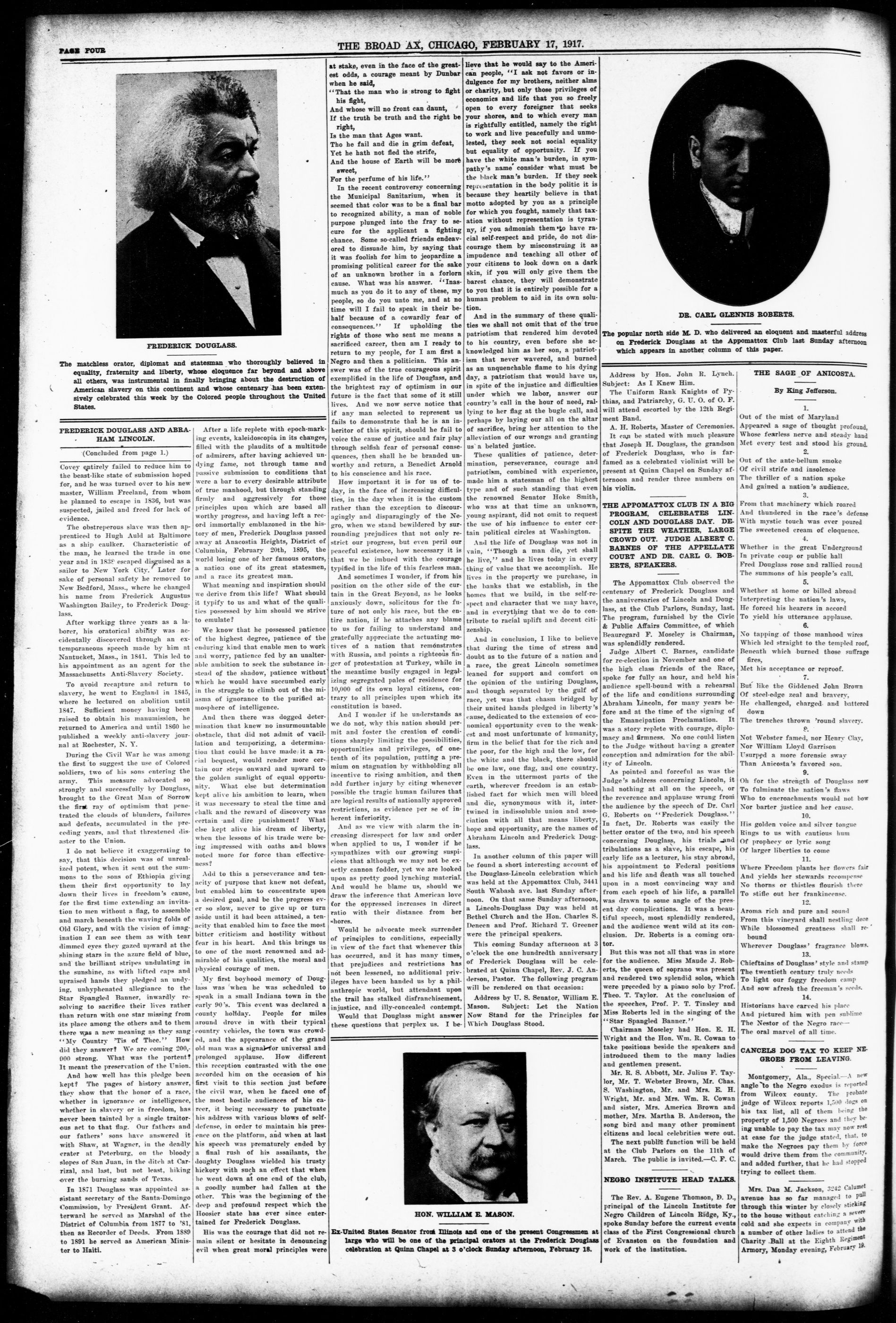
FREDERICK DOUGLASS.
The matchless orator, diplomat and statesman who thoroughly believed in equality, fraternity and liberty, whose eloquence far beyond and above all others, was instrumental in finally bringing about the destruction of American slavery on this continent and whose centenary has been extensively celebrated this week by the Colored people throughout the United States.
The matchless orator, diplomat and statesman who thoroughly believed in equality, fraternity and liberty, whose eloquence far beyond and above all others, was instrumental in finally bringing about the destruction of American slavery on this continent and whose centenary has been extensively celebrated this week by the Colored people throughout the United States.
Covey entirely failed to reduce him to the beast-like state of submission hoped for, and he was turned over to his new master, William Freeland, from whom he planned to escape in 1836, but was suspected, jailed and freed for lack of evidence.
The obstreperous slave was then apprenticed to Hugh Auld at Baltimore as a ship caulker. Characteristic of the man, he learned the trade in one year and in 1838 escaped disguised as a sailor to New York City. Later for sake of personal safety he removed to New Bedford, Mass., where he changed his name from Frederick Augustus Washington Bailey, to Frederick Douglass.
After working three years as a laborer, his oratorical ability was accidentally discovered through an ex-temporaneous speech made by him at Nantucket, Mass., in 1841. This led to his appointment as an agent for the Massachusetts Anti-Slavery Society.
To avoid recapture and return to slavery, he went to England in 1845, where he lectured on abolition until 1847. Sufficient money having been raised to obtain his manumission, he returned to America and until 1860 he published a weekly anti-slavery journal at Rochester, N. Y.
During the Civil War he was among the first to suggest the use of Colored soldiers, two of his sons entering the army. This measure advocated so strongly and successfully by Douglass, brought to the Great Man of Sorrow the first ray of optimism that penetrated the clouds of blunders, failures and defeats, accumulated in the preceding years, and that threatened disaster to the Union.
I do not believe it exaggerating to say, that this decision was of unrealized potent, when it sent out the summons to the sons of Ethiopia giving them their first opportunity to lay down their lives in freedom's cause, for the first time extending an invitation to men without a flag, to assemble and march beneath the waving folds of Old Glory, and with the vision of imagination I can see them as with tear dimmed eyes they gazed upward at the shining stars in the azure field of blue, and the brilliant stripes undulating in the sunshine, as with lifted caps and upraised hands they pledged an undying, unhyphenated allegiance to the Star Spangled Banner, inwardly resolving to sacrifice their lives rather than return with one star missing from its place among the others and to them there was a new meaning as they sang "My Country 'Tis of Thee." How did they answer? We are coming 200, 000 strong. What was the portent! It meant the preservation of the Union.
And how well has this pledge been kept? The pages of history answer, they show that the honor of a race, whether in ignorance or intelligence, whether in slavery or in freedom, has never been tainted by a single traitorous act to that flag. Our fathers and our fathers' sons have answered it with Shaw, at Wagner, in the deadly crater at Peterburg, on the bloody slopes of San Juan, in the ditch at Carrizal, and last, but not least, hiking over the burning sands of Texas. In 1871 Douglass was appointed assistant secretary of the Santa-Domingo Commission, by President Grant. Afterward he served as Marshal of the District of Columbia from 1877 to '81, then as Recorder of Deeds. From 1889 to 1891 he served as American Minister to Haiti.
PAGE FOUR
After a life replete with epoch-marking events, kaleidoscopia in its changes, filled with the plaudits of a multitude of admirers, after having achieved undying fame, not through tame and passive submission to conditions that were a bar to every desirable attribute of true manhood, but through standing firmly and aggressively for those principles upon which are based all worthy progress, and having left a record immortally emblazoned in the history of men, Frederick Douglass passed away at Anacostia Heights, District of Columbia, February 20th, 1895, the world losing one of her famous orators, a nation one of its great statesmen, and a race its greatest man.
What meaning and inspiration should we derive from this life? What should it typify to us and what of the qualities possessed by him should we strive to emulate?
We know that he possessed patience of the highest degree, patience of the enduring kind that enable men to work and worry, patience fed by an unalterable ambition to seek the substance instead of the shadow, patience without which he would have succumbed early in the struggle to climb out of the miasma of ignorance to the purified atmosphere of intelligence.
And then there was dogged determination that knew no insurmountable obstacle, that did not admit of vacillation and temporizing, a determination that could he have made it a racial bequest, would render more certain our steps onward and upward to the golden sunlight of equal opportunity. What else but determination kept alive his ambition to learn, when it was necessary to steal the time and chalk and the reward of discovery was certain and dire punishment? What else kept alive his dream of liberty, when the lessons of his trade were being impressed with oaths and blows noted more for force than effectiveness?
Add to this a perseverance and tenacity of purpose that knew not defeat, but enabled him to concentrate upon a desired goal, and be the progress ever so slow, never to give up or turn aside until it had been attained, a tenacity that enabled him to face the most bitter criticism and hostility without fear in his heart. And this brings us to one of the most renowned and admirable of his qualities, the moral and physical courage of men.
My first boyhood memory of Douglass was when he was scheduled to speak in a small Indiana town in the early 90's. This event was declared a county holiday. People for miles around drove in with their typical country vehicles, the town was crowded, and the appearance of the grand old man was a signal for universal and prolonged applause. How different this reception contrasted with the one accorded him on the occasion of his first visit to this section just before the civil war, when he faced one of the most hostile audiences of his career, it being necessary to punctuate his address with various blows of self-defense, in order to maintain his presence on the platform, and when at last his speech was prematurely ended by a final rush of his assailants, the doughty Douglass wielded his trusty hickory with such an effect that when he went down at one end of the club, a goodly number had fallen at the other. This was the beginning of the deep and profound respect which the Hoosier state has ever since entertained for Frederick Douglass.
His was the courage that did not remain silent or hesitate in denouncing evil when great moral principles were
at stake, even in the face of the greatest odds, a courage meant by Dunbar when he said,
"That the man who is strong to fight his fight,
And whose will no front can daunt,
If the truth be truth and the right be right,
Is the man that Ages want.
The ho he fail and die in grim defeat,
Yet he hath not fled the strife,
And the house of Earth will be more sweet,
lieve that he would say to the Ages can people, "I ask not favors or dulgence for my brothers, neither for charity, but only those privileged economics and life that you so far open to every foreigner that s your shores, and to which every is rightfully entitled, namely the to work and live peacefully and un lested, they seek not social equ but equality of opportunity. If have the white man's burden, in pathy's name consider what mus
For the perfume of his life.
In the recent controversy concerning the Municipal Sanitarium, when it seemed that color was to be a final bar to recognized ability, a man of noble purpose plunged into the fray to secure for the applicant a fighting chance. Some so-called friends endeavored to dissuade him, by saying that it was foolish for him to jeopardize a promising political career for the sake of an unknown brother in a forlorn cause. What was his answer. "Inasmuch as you do it to any of these, my people, so do you unto me, and at no time will I fail to speak in their behalf because of a cowardly fear of consequences." If upholding the rights of those who sent me means a sacrificed career, then am I ready to return to my people, for I am first a Negro and then a politician. This answer was of the true courageous spirit exemplified in the life of Douglass, and the brightest ray of optimism in our future is the fact that some of it still lives. And we now serve notice that if any man selected to represent us fails to demonstrate that he is an inheritor of this spirit, should he fail to voice the cause of justice and fair play through selfish fear of personal consequences, then shall he be branded unworthy and return, a Benedict Arnold to his conscience and his race.
How important it is for us of today, in the face of increasing difficulties, in the day when it is the custom rather than the exception to discouragingly and disparagingly of the Negro, when we stand bewildered by surrounding prejudices that not only restrict our progress, but even peril our peaceful existence, how necessary it is that we be imbued with the courage typified in the life of this fearless man.
And sometimes I wonder, if from his position on the other side of the curtain in the Great Beyond, as he looks anxiously down, solicitous for the future of not only his race, but the entire nation, if he attaches any blame to us for failing to understand and gratefully appreciate the actuating motives of a nation that demonstrates with Russia, and points a righteous finger of protestation at Turkey, while in the meantime busily engaged in legalizing segregated pales of residence for 10,000 of its own loyal citizens, contrary to all principles upon which its constitution is based.
And I wonder if he understands as we do not, why this nation should permit and foster the creation of conditions sharply limiting the possibilities, opportunities and privileges, of one tenth of its population, putting a premium on stagnation by withholding all incentive to rising ambition, and then add further injury by citing whenever possible the tragic human failures that are logical results of nationally approved restrictions, as evidence per se of inherent inferiority.
And as we view with alarm the increasing disrespect for law and order when applied to us, I wonder if he sympathizes with our growing suspicions that although we may not be exactly cannon fodder, yet we are looked upon as pretty good lynching material. And would he blame us, should we draw the inference that American love for the oppressed increases in direct ratio with their distance from her shores.
Would he advocate meek surrender of principles to conditions, especially in view of the fact that whenever this has occurred, and it has many times, that prejudices and restrictions has not been lessened, no additional privileges have been handed us by a philanthropic world, but attendant upon the trail has stalked disfranchisement, injustice, and illy-concealed contempt.
Would that Douglass might answer these questions that perplex us. I be-
HON. WILLIAM E. MASON.
Ex-United States Senator from Illinois and one of the present Congressmen at large who will be one of the principal orators at the Frederick Douglass celebration at Quinn Chapel at 3 o'clock Sunday afternoon, February 18.
Is the man that Ages want.
lieve that he would say to the American people, "I ask not favors or indulgence for my brothers, neither alms or charity, but only those privileges of economics and life that you so freely open to every foreigner that seeks your shores, and to which every man is rightfully entitled, namely the right to work and live peacefully and unmolested, they seek not social equality but equality of opportunity. If you have the white man's burden, in sympathy's name, consider what must be the black man's burden. If they seek representation in the body politic it is because they heartily believe in that motto adopted by you as a principle for which you fought, namely that taxation without representation is tyranny, if you admonish them to have racial self-respect and pride, do not discourage them by misconstruing it as impudence and teaching all other of your citizens to look down on a dark skin, if you will only give them the barest chance, they will demonstrate to you that it is entirely possible for a human problem to aid in its own solution.
And in the summary of these qualities we shall not omit that of the true patriotism that rendered him devoted to his country, even before she acknowledged him as her son, a patriotism that never wavered, and burned as an unquenchable flame to his dying day, a patriotism that would have us, in spite of the injustice and difficulties under which we labor, answer our country's call in the hour of need, rallying to her flag at the bugle call, and perhaps by laying our all on the altar of sacrifice, bring her attention to the alleviation of our wrongs and granting us a belated justice.
These qualities of patience, determination, perseverance, courage and patriotism, combined with experience, made him a statesman of the highest type and of such standing that even the renowned Senator Hoke Smith, who was at that time an unknown, young aspirant, did not omit to request the use of his influence to enter certain political circles at Washington.
And the life of Douglass was not in vain, "Though a man die, yet shall he live," and he lives today in everything of value that we accomplish. He lives in the property we purchase, in the banks that we establish, in the homes that we build, in the self-respect and character that we may have, and in everything that we do to contribute to racial uplift and decent citizenship.
And in conclusion, I like to believe that during the time of stress and doubt as to the future of a nation and a race, the great Lincoln sometimes leaned for support and comfort on the opinion of the untiring Douglass, and though separated by the gulf of race, yet was that chasm bridged by their united hands pledged in liberty's cause, dedicated to the extension of economical opportunity even to the weakest and most unfortunate of humanity, firm in the belief that for the rich and the poor, for the high and the low, for the white and the black, there should be one law, one flag, and one country. Even in the uttermost parts of the earth, wherever freedom is an established fact for which men will bleed and die, synonymous with it, intertwined in indissoluble union and association with all that means liberty, hope and opportunity, are the names of Abraham Lincoln and Frederick Douglass.
In another column of this paper will be found a short interesting account of the Douglass-Lincoln celebration which was held at the Appomattox Club, 3441 South Wabash ave. last Sunday afternoon. On that same Sunday afternoon, a Lincoln-Douglass Day was held at Bethel Church and the Hon. Charles S. Deneen and Prof. Richard T. Greener were the principal speakers.
This coming Sunday afternoon at 3 o'clock the one hundredth anniversary of Frederick Douglass will be celebrated at Quinn Chapel, Rev. J. C. Anderson, Pastor. The following program will be rendered on that occasion:
Address by U. S. Senator, William E. Mason. Subject: Let the Nation Now Stand for the Principles for Which Douglass Stood.
[Name]
DR. CARL GLENNIS ROBERTS.
The popular north side M. D. who delivered an eloquent and masterful address on Frederick Douglass at the Appomattox Club last Sunday afternoon which appears in another column of this paper.
Subject: As I Knew Him.
The Uniform Rank Knights of Pythias, and Patriarchy, G. U. O. of O. F. will attend escorted by the 12th Regiment Band.
A. H. Roberts, Master of Ceremonies.
It can be stated with much pleasure that Joseph H. Douglass, the grandson of Frederick Douglass, who is far-famed as a celebrated violinist will be present at Quinn Chapel on Sunday afternoon and render three numbers on his violin.
THE APPOMATTOX CLUB IN A BIG PROGRAM, CELLEBRATES LINCOLN AND DOUGLASS DAY. DESPIITE THE WEATHER, LARGE CROWD OUT. JUDGE ALBERT C. BARNES OF THE APPELLATE COURT AND DR. CARL G. BOBERTS. SPEAKERS.
The Appomattox Club observed the centenary of Frederick Douglass and the anniversaries of Lincoln and Douglass, at the Club Parlors, Sunday, last. The program, furnished by the Civic & Public Affairs Committee, of which Beauregard F. Moseley is Chairman, was splendidly rendered. Judge Albert C. Barnes, candidate for re-election in November and one of the high class friends of the Race, spoke for fully an hour, and held his audience spell-bound with a rehearsal of the life and conditions surrounding Abraham Lincoln, for many years before and at the time of the signing of the Emancipation Proclamation. It was a story replete with courage, diplomacy and firmness. No one could listen to the Judge without having a greater conception and admiration for the ability of Lincoln.
As pointed and forceful as was the Judge's address concerning Lincoln, it had nothing at all on the speech, or the reverence and applause wrung from the audience by the speech of Dr. Carl G. Roberts on "Frederick Douglass." In fact, Dr. Roberts was easily the better orator of the two, and his speech concerning Douglass, his trials and tribulations as a slave, his escape, his early life as a lecturer, his stay abroad, his appointment to Federal positions and his life and death was all touched upon in a most convincing way and from each epoch of his life, a parallel was drawn to some angle of the present day complications. It was a beautiful speech, most splendidly rendered, and the audience went wild at its conclusion. Dr. Roberts is a coming orator.
But this was not all that was in store for the audience. Miss Maude J. Roberts, the queen of soprano was present and rendered two splendid solos, which were preceded by a piano solo by Prof. Theo. T. Taylor. At the conclusion of the speeches, Prof. P. T. Tinsley and Miss Roberts led in the singing of the "Star Spangled Banner." Chairman Moseley had Hon. E. H. Wright and the Hon. Wm. R. Cowan to take positions beside the speakers and introduced them to the many ladies and gentlemen present.
Mr. R. S. Abbott, Mr. Julius F. Taylor, Mr. T. Webster Brown, Mr. Chas. S. Washington, Mr. and Mrs. E. H. Wright, Mr. and Mrs. Wm. R. Cowan and sister, Mrs. America Brown and mother, Mrs. Martha B. Anderson, the song bird and many other prominent citizens and local celebrities were out. The next public function will be held at the Club Parlors on the 11th of March. The public is invited.—C. F. C.
NEGRO INSTITUTE HEAD TALKS.
The Rev. A. Eugene Thomson, D. D., principal of the Lincoln Institute for Negro Children of Lincoln Ridge, Ky., spoke Sunday before the current events class of the First Congressional church of Evanston on the foundation and work of the institution.
ered an eloquent and masterful address
pomattox Club last Sunday afternoon
of this paper.
THE SAGE OF ANICOSTA.
By King Jefferson.
1.
Out of the mist of Maryland
Appeared a sage of thought profound,
Whose fearless nerve and steady hand
Met every test and stood his ground.
Out of the ante-bellum smoke
Of civil strife and insolence
The thriller of a nation spoke
And gained a nation's audience.
3.
From that machinery which roared
And thundered in the race's defense
With mystic touch was ever poured
The sweetened cream of eloquence.
4.
Whether in the great Underground
In private coup or public hall
Fred Douglass rose and rallied round
The summons of his people's call.
5.
Whether at home or billed abroad
Interpreting the nation's laws,
He forced his hearers in accord
To yield his utterance applause.
6.
No tapping of those manhood wires
Which led straight to the templed roof,
Beneath which burned those suffrage fires,
Met his acceptance or reproof.
7.
But like the Giddened John Brown
Of steel-edge zeal and bravery,
He challenged, charged and battered down
The trenches thrown 'round slavery.
8.
Not Webster famed, nor Henry Clay,
Nor William Lloyd Garrison
Usurped a more forensic sway
Than Aniecosta's favored son.
9.
Oh for the strength of Douglass now
To fulminate the nation's flaws
Who to encroachments would not bow
Nor barter justice and her cause.
10.
His golden voice and silver tongue
Rings to us with cautious hum
Of prophecy or lyric song
Of larger liberties to come
11.
Where Freedom plants her flowers fair
And yields her stewards recompense
No thorns or thistles flourish there
To stifle out her frankineense.
12.
Aroma rich and pure and sound
From this vineyard shall nestling doze
While blossomed greatness shall rebound
Wherever Douglass' fragrance blows.
13.
Chieftains of Douglass' style and stamp
The twentieth century truly needs
To light our foggy freedom camp
And sow afresh the freeman's seeds.
14.
Historians have carved his place
And pictured him with pen sublime
The Nestor of the Negro race—
The oral marvel of all time.
CANCELS DOG TAX TO KEEP NE-
GROES FROM LEAVING.
Montgomery, Ala., Special.—A new angle to the Negro exodus is reported from Wilcox county. The probate judge of Wilcox reports 1,500 dogs on his tax list, all of them being the property of 1,500 Negroes and they being unable to pay the tax may now rest at ease for the judge stated, that, to make the Negroes pay them by force would drive them from the community, and added further, that he had stopped trying to collect them.
Mrs. Dan M. Jackson, 3242 Calumet avenue has so far managed to pull through this winter by closely sticking to the house without catching a severe cold and she expects in company with a number of other ladies to attend the Charity. Ball at the Eighth Regiment Armory, Monday evening, February 19.
```markdown
```
[Name]
F. L. BARNETT
CANDIDATE
FOR ALDERMAN
of the
2nd Ward
PLEDGED UPON A PLATFORM OF
MORAL ISSUES.
3. Stop graft protection, and gambling.
NATIONAL NEWS NOTES.
Brief Bits of News and Comment. On Men and Women.
"THE COLLEGE-TRAINED NEGRO."
Boston, Mass.—That the prize for the best original oration delivered by a Bowdoin College senior should this year have gone to David A. Lane, Jr., a Negro, will not surprise those who have observed the recent achievements of this race.
What is particularly noteworthy about the incident mentioned, and no doubt contributed to the winner's success, was the fact that he chose no irrelevant and high-sounding subject, but a practical topic appropriate to the times and to himself, namely, "The Task of the College-Trained Negro."
Were all orators as careful to choose common-sense subjects on which they are able to speak with some authority, their audiences would oftener find it worth while to listen.
A PROHIBITION COMMISSION
New York, N. Y.—Amazed by magazine and newspaper stories illustrating the failure of Prohibition to prohibit, a famous scientist suggests to the New York TRIBUNE that before the National Prohibition idea is even talked of seriously, a commission should be appointed to see how the "dry" law actually works. The TRIBUNE article says:
Dr. Thomas Sewall Adams, professor of political economy in Sheffield Scientific School, Yale University, told the life insurance presidents, convened at the Hotel Astor, that there ought to be not only a PERMANENT COMMISSION to take the tariff out of politics, but one also to study the effects of prohibition
"A permanent commission," he said, "instructed to ascertain with cold-blooded impartiality the effects of tariff legislation, could go a long way toward taking the tariff out of politics THE SAME IS TRUE OF PROHIBITION. It would be a comparatively easy matter for A BOARD OF SCIENTIFICALLY MINDED MEN to ascertain with reasonable accuracy how far prohibition does actually prohibit in particular places."
Professor Adams' subject was "The Increase of Public Expenditures and Taxes," which he found a well-night universal phenomenon the world over. And the fundamental difficulty, he thought, was the inability of the public to ascertain the value of a public service. He proposed the creation of efficiency commissions to measure their value.
THE NEGRO FELLOWSHIP
LEAGUE.
The Negro Fellowship League will hold a short business meeting at the Reading Room, 3005 State St., Sunday, February 18 at 3:30 o'clock. All members are urged to be present promptly on time, after which time we will adjourn in a body to Quinn Chapel to attend the celebration of the 100th anniversary of the birth of Frederick Douglass.
Last Sunday the League united with the Federated Organizations in its celebration of the same event at Bethel A. M. E. Church. Our president, Mrs. Barnett, also addressed the meeting of the City Federation of Colored Women's Clubs at St. Mark's M. E. Church.
The League is working tooth and nail for the nomination of its candidate, F. L. Barnett, for alderman of the 2nd ward on Primary Day, February 27.
4. Break strangle-hold of lawless resorts.
5. Defend homes and churches against vice surroundings.
6. Improve civic and industrial conditions.
7. Promote progressive legislation in the Common Council.
8. Clean the streets and alleys.
9. Locate a bathing beach in the Ward.
10. Maintain Ward office, with open doors for Ward business.
THE ALPHA SUFFRAGE CLUB
The Alpha Suffrage Club will hold its regular fort-nightly meeting at the Y. W. C. A., 3424 Rhodes Avenue, Wednesday evening, February 21, at which time the report of the committee on the revision of the by-laws will be submitted. This committee met at the home of Mrs. Laura Beasley, 3245 Forest Avenue Monday evening of this week. All women who wish to keep informed on suffrage matters are urged to attend the meetings.
Mrs. Barnett, our delegate to the League of Cook County Clubs, attended its board meeting last Saturday and presented the case of Dr. Giles, asking the clubs to take action on the violation of Civil Service Laws by which he was dismissed from the Tuberculosis Sanitarium. Mrs. Barnett was also reelected director of the board of the Women's Protective Association for the term of two years. This association gave its annual dinner at the City Club Thursday evening of this week at which time the Alpha Suffrage Club was represented by its president, Dr. Fannie Emanuel; recording secretary, Mrs. J. E. Hughes; Mr. and Mrs. Barnett, Mrs. Bertha Cook and other members of the club.
NEGRO RAZOZ WHITE MAN ON
SAME CAR SEAT.
Following a quarrel with Claude Simmons of 346 East Fifty-third street over mutual occupancy of a cross seat, dubbed by the straphangers' union "a 10 cent seat," in a Forty-seventh street car Tuesday afternoon, W. B. Benson, a Negro, of Thirty-sixth and State streets, slashed Simmons and an unidentified man.
Benson asserted the white man was not giving him a fair share of the seat. Argument ensued and suddenly the Negro pulled his razor from his pocket and slashed Simmons. When the second man tried to overpower Benson he was slashed and jumped from the car and ran.
"I'm a-goin' to kill a lot of white folks," announced Benson as passengers sprang from their seats and rushed toward the front of the car. Another unidentified passenger, standing on the rear platform with a bundle of curtain poles, struck the Negro several times over the head with the package and finally succeeded in driving him from the car. Benson was booked at the Hyde Park station on a charge of assault with a deadly weapon.
MOSELEY TAKES THE PLATFORM
Chicago's Leading Attorney to Speak at Grace Presbyterian Lyceum Sunday.
The biggest day of the year is planned for the Young People's Lyceum Sunday, Feb. 18, 5 o'clock, when Hon. B. F. Moseley, Chicago's leading attorney will speak at Grace Presbyterian church. His subject is "Negro Migration North." Since Xmas Mr. Moseley has given the question much study and thought. He is chairman of the Civic Department of Appomattox Club which is handling the question in a way to help the "New Comers" migrating north. He will be introduced by Editor Robert S. Abbott of the Chicago Defender, secretary of the Civic Committee, Appomattox Club. A special invitation is extended to those who have come to the city recently. Miss Maude J. Roberts, chairman of the Musical Committee, "Chicago's Queen of Song" has arranged a splendid program. Sunday will be known as "Exodus Day." Tell your
Ida B. Wells Barnett.
friends to attend. The meeting begins at 5 o'clock. Cary B. Lewis, chairman Committee, on Publicity.
Military Marshals.
Like many other French words lating to war and hunting, "marechs
PAPERS AND DROP LETTERS TO RETAIN POSTAGE RATES.
Washington, D. C., Special.—By a vote of 37 to 34 the senate has refused to suspend its rules and permit attachment to the postoffice appropriation bill of an amendment increasing the postage rates on weekly and daily newspapers and magazines and decreasing to 1 cent the rate on drop letters. This is expected to end the fight on the provision at this session.
COLORED SOLDIER WINS IRON CROSS.
The Golden West, a Hungarian magazine, makes a note of the fact that Leon Welchin, a Colored soldier fighting in the Austrian army, has been decorated with the Iron Cross for bravery under fire. Welchin led a charge against the enemy and, although wounded, pushed on until his aim was accomplished. He is a West Indian who has lived in Austria for many years.
JERRY GRIDER NO MORE
St. Joseph, Mo., Special to The Broad Ax.—Jeremiah Grider, who died here a few days ago, was one of the best known characters in the State. A newspaper "discovered" him, and for a long while some of Grider's quaint sayings appeared daily. He was interested in the uplift of the race, and was one of the first Colored Democrats in the State. He was 60 years of age.
IOWANSSEEKNEGROWHO
WOUNDED WOMAN.
Des Moines, Ia., Special.—More than 100 persons have been engaged in the pursuit of Holbert White, a Negro, who shot and wounded Mrs. Ida Kizer, also Colored, as she stepped from a street car on a busy downtown corner here. White escaped. Jealousy is believed to have caused the shooting.
FIVE ROOM COTTAGE FOR SALE
AT A BUG BARGAIN.
Five room cottage on the South Side, toilet and gas, lot 25x125, east front, one block from street car line, for sale for $1.650. Phone, Douglas 7047.
CHIPS
Mr. Hill, representing the Urban League, will address the Bethel Literary Society which meets at Bethel A. M. E. church, 30th and Dearborn streets at 4 o'clock Sunday afternoon, February 18.
Dr. S. D. Redmond of Jackson, Miss., one of the many regular subscribers to The Broad Ax, is at present rusticating in Habana, Cuba, where he is enjoying himself while basking in the warm sunshine of that delightful clime.
Mrs. Florence Woodard, 3242 Calumet avenue has been seriously ill for the past two weeks but at this writing she is rapidly improving.
Rev. Father E. Thomas Demby, of Memphis, Tenn., Archdeacon of the Protestant Episcopal church of that state has for the past two weeks been the honored guest of Mrs. Harry Stanton Brown, 3242 Calumet avenue.
Mr. Isaac T. Montgomery of Mound Bayou, Miss., who belongs to the old school of Southern politicians and business men who in 1890 in the new constitutional convention in Mississippi, being the only Colored man as one of its members, voted in favor of disfranchising all the Colored people in that state, has for the past week been visiting his daughter and other friends in this city.
James H. Harris, who was a Union soldier in the war of the rebellion and who was a member of the Grand Army of the Republic, passed away at his home, 4764 Federal street, Tuesday evening at 9:30 p. m. Funeral services were held over his remains yesterday afternoon from his late residence. For many years Mr. Harris worked for the McCormick estate and was well thought of by the heads of that old Chicago family. His wife Mrs. Eliza J. Harris has the deep sympathy of a large circle of friends over the loss of her husband.
Mrs. Louie Usselmann, wife of Dr. Louie Usselmann, the popular and up-to-date jeweler at 3150 S. State street, met with a very painful accident the latter part of last week which came very near causing her the loss of one of her eyes. A rubber band, with a sharp metal end to it, got beyond her control and it bounded back with great force driving itself into her face just below the eye, which was very painful and requiring medical attention for three or four days and Dr. Louie is all smiles again over the fact that Mrs. Usselmann is recovering from the effects of the accident and that her face will not be permanently disfigured.
Military Marshals
military marshal.
Like many other French words relating to war and hunting, "marechal," in its older form "mareschal," is of purely Teutonic derivation in both its parts, and the word has had a curious history. Some words rise in the world with the passage of the centuries and others fall. This is one that from the very humbest of beginnings has come to great estate.
The marshals do not owe their name to Mars, though they are his votaries. In the olden times they were about the humbleest men in an army—horse servants, or grooms. Then they advanced to the dignity of being horseshoes, and those highly respected artisans are still "marechals" in France, though "ferrants" has to be added to make their calling clear. And, while "marechal de France" is a magnificent title, there are also "marechals des logis," who are in cavalry regiments only what "sergeants" are in infantry regiments—Exchange.
Gun Salutes In India.
The viceroy of India, as representative of the king-emperor, is entitled to a salute of thirty-one guns. This number had its origin in a mistake. Formerly he was entitled to twenty-one guns. When the time came, years ago, for allotting the salutes to the various native rulers of India the three principal of these vassal sovereigns—namely, those of Hyderabad, Mysore and Baroda—were each accorded twenty-one guns. It was discovered a little late in the day that the superior rank of the viceroy had been overlooked in the matter, and the necessity was pointed out of his supremacy over the vassal rulers being emphasized in the eyes of the natives. So instead of reducing the number of twenty-one guns that had been accorded to the three rulers in question the viceroy was given ten more guns and is today the only person in the world who is entitled to that altogether exceptional number of guns.—London Spectator.
How Buffalo Bill Got His Name
Many years ago, when the Union Pacific railroad was completed, the question arose as to how all the laboring men were to be fed on meat, as meat was thought necessary to make muscle. General W. E. Webb had the contract to feed the men, and in talking the matter over one day with some of his subordinates one of them suggested that he call in William Cody, then a famous government scout on the plains, to help solve the problem. Cody suggested that he be allowed to hire men and kill buffaloes for the railroad men. This plan was adopted, and Cody became later world famous as Buffalo Bill. In those days the buffaloes were so plentiful that it is on record that more than one engineer had to stop his train until a herd had crossed.—A. G. Hegeman in New York Sun.
Masters of Tool Making.
Are Anglo-Saxons conceived about their pre-eminence in matters of machinery? A book, "English and American Tool Builders" by Professor J. W. Roe of Yale, answers the question thus: "Practically all the creative work in tool building has been done in England and America. * * * The French have shown an aptitude for refinements and ingenious novelties. * * * The Swiss are clever artisans, but have excelled in personal skill. * * * Germany has developed splendid mechanics, but the principal machine tools had taken shape before 1870, when the empire began. The history of English and American tool building therefore covers substantially the entire history of the art."
A Daring Voyage.
The smallest boat to cross the Atlantic under her own sail was sailed by Captain Andrews. This craft was but fourteen feet long, but in it Captain Andrews crossed the ocean in 1891, landing at Palos, Spain. He traveled about Europe exhibiting his boat until the World's fair in Chicago, when he returned to this country and placed it on view there. He had previously made two unsuccessful attempts to cross the ocean.
A Good Motte:
"We've got a good motto for our paper," said Kidder.
"What is it?" asked his acquaintance.
"What we have we hold.""
"Oh, I see! Referring to your circulation. By the way, I didn't know you were a publisher."
"We're not; we manufacture fly paper."—Chicago News.
Inhuman.
"Gentlemen of the jury," said the lawyer for the plaintiff, "the defendant claims that when he ran over my client his car was going but three miles an hour. Think of the agony endured by my client when being run over as slowly as that!"—New York American.
Verk Thoughtful
Miss Askit-Did your husband smoke those cigars you gave him for his birthday? Mrs. Nuwed-He smoked one and said he would keep the rest to remind him of my kindness.
"Just her contrary ways. First she broke down, and then she broke up."- Baltimore American.
National Forest Lands
On about 2,000,000 acres of national forest lands grazing by domestic stock is either entirely prohibited or is greatly restricted to provide range for elk.
There is no gate into heaven except at the end of the path of duty.—Van Dyke.
"Let the People Decide"
The City of Chicago is making a serious attempt to solve its greatest transportation problem, and has under consideration the plan proposed by the Traction and Subway Commission Messrs. Parsons, Ridgway and Arnold employed by the City to provide for its present needs immediately, and make ample provision for the future.
watch for the advertisements under the caption "LET THE PEOPLE DECIDE" now appearing in the daily papers.
ALL PHASES OF THIS VITAL QUESTION WILL BE DISCUSSED. GET THE FACTS
CHICAGO SURFACE LINES
Talks on
HEALTH,
CLEANLINESS,
PROPER LIVING,
SANITATION, ETC.
Dr. W. A. Driver
3300 So. State Street
Phone Douglas 3617
TREATMENT AND HEALTH.
Health is wealth. It is the best of all possible possessions. Any living creature will forsake everything for life. Health and life are inseparable, even in the final analysis.
There are those who know the laws of health and will not follow them and there are those who will follow them if properly informed. The fundamental laws of health are generally known; they are of great antiquity; they are preventive and called by medical men prophylactic treatment.
They that are in health need healthy associations in order to continue in health. They that are sick need a physician. Many are sick but do not know that they are sick. It is our duty to watch for each other in this matter.
Treatment is divided into preventive, palliative and curative. Preventive treatment is the principal treatment but unfortunately it is given least consideration by the majority of the people. An old and a true saying it is that "An ounce of prevention is worth a pound of cure." Those who enjoy health are those who take preventive treatment seriously. They practice the laws of fundamental health and are rewarded for their practices. They live clean, careful, sensible lives. They go to bed early and arise early. They live simply and cleanly.
CHIPS.
CHIPS.
Mrs. Leo Harding, who was well known in south side society circles some years ago and who has lately become one of the fashionable and artistic millinery artists and French modistes in New York City, maintaining an establishment at Newport, R. I., during the summer months, is still greatly enjoying her visit with her mother Mrs. Lloyd, 3648 Forest avenue, phone Douglass 5186 and with her other friends. She will remain here two weeks longer and attend the pre-lenten charity ball at the Eighth Regimen Armory, Monday evening, February 19th Mrs. Harding is looking exceedingly fine and is still ever so charming.
"Let the Peo The City of Ch
PAGE FIVE
[Name]
They eat the proper food in quality and in quantity. They are not afraid of the criticism of the masses; they know they are right and they are satisfied with knowing that virtue is its own reward.
They are the beneficiaries of prophylactic treatment and they live long and happily. They are full of right living; it is seen in their faces. Their lives are free from the ills of those who fail to act in accord with their convictions. They treat with preventive treatment.
Palliative treatment is not of much benefit. It is only for immediate relief and is a makeshift. It does not restore health. It does not remove the cause of defective health and hence it is not curative. It is the treatment that should be discouraged because it interferes with curative as well as preventive treatment. Patent medicine is the most striking example of palliative treatment and it is a sure sign of ignorance.
Curative treatment is a sure path leading to health. It is for those who have lost health by straying from the straight and narrow path. Curative treatment removes the cause of lost health and gets us back to where preventive treatment will keep us on the high ground of that greatest of all treasures, the wealth of health.
China's Sugar Palm.
In the southern parts of French Indo-
China the natives obtain both food and
a certain kind of wine from the sugar
palm. Several varieties of this palm
are exploited by the natives. The tree
attains a height of fully twenty feet,
but cannot be tapped to any advantage
until it is fifty or sixty years of age,
when it begins to flower. The flowers,
which generally appear at the end of
branches, are cut open, and the sap
which exudes is collected in little jumbo
cups. Sometimes a single flower
will produce a quart and a half of sap
dally for a month, but the average is
about a quart each day per tree during
the four or five months of inflorescence.
"That girl made $10,000 in letters."
"She doesn't look like she can write."
"Neither can she. She got it from
the letters in her breach of promise
suit."-Baltimore American.
THE BROAD AX
In this city sinee July 15th, 1899,
without missing one single issue, Be-
publieans, Democrats, Catholies, Pro-
testants, single Taxers, Priests, inf
dels or anyone else ean have their say
as long as their language is proper and
responsibility is fixed.
The Broad Ax is a newspaper whose
platform is broad enough for all, ever
élaiming the editorial right to speak its
own mind.
Local communications will reeeive
attention. Write only en one side of
the paper.
Subseriptions must be paid im ad-
vance.
One {Year.......ceeceeece eee e+ $8.00
Bix Months..................4++ 1.00
Advertising rates made knowa on ap-
plication.
Address all communications te
THE BROAD AX
6418 Champlain Ave, Chicago, TIL
PHONE WENTWORTH 2507.
JULIUS F. TAYLOR, Editor and Pub-
Usher.
Entered as Seeond-Class Matter Aug.
19, 1902, at the Post Office at Chieago,
Illinois, under Act of March 3, 1879.
Suffrage In Norway.
Among the most important laws en-
acted by Norway since women have had
the vote are the two maternity insur-
ance laws of 1909 and 1915 and the di-
vorce law of 1910.
“Since the women in Norway have got
the vote,” says Ella Anker in Jus Suf-
fragii, “they have turned their chief
attention to their rights and duties as
wives and mothers. Education and eco-
nomic independence are the basis of wo-
man’s freedom, but her greatest work
and happiness will be as wife and moth-
er. It is an astonishing fact that in all
these centuries, while men have taught
us that woman's place is in the home,
they have neglected to prepare us for
the chief duties of our home life.”
Norwegian women have also given
particular strength to the work for “ra-
tional housekeeping” by the establish-
ment of @ state high school for the ed-
ucation of teachers for the elementary
housekeeping schools, to a campaign
against consumption and to the support
of the peace movement. -
Eiffel’s Tower.
‘The most famous tower since that
of Babel is the Eiffel tower in Paris,
@ monument to the engineering genius
of Gustave Eiffel. The tower of Babel
was reared in the hope that it might
afford a passage to heaven, but the
builders, we are told in Genesis, were
foiled by their language being con-
founded.
Gustave Eiffel had no such ambition
in rearing the highest edifice the world
has ever seen. It is a tower dedicated
to science. Its rearing was one of the
greatest engineering feats of modern
times and was a result of experiments
undertaken to prove the greatest limit
to which metallic piers in viaducts
conld be safely pushed. It is now the
world’s must celebrated wireless tele-
graph station.
Eiffel tower is 1,000 feet in height
and fs coustructed of iron lattice work,
7,300 tons of iron being used in its con-
struction. A system of elevators car-
Tes visitors to the top.
Chie Dee Bie
An act of congress, approved March
1, 1911, entitled “An act to protect the
ignity and honor of the uniform of
the United States,” provides “that
hereafter no proprietor, manager ov
employee of a theater or other public
place of entertainment or amusement
in the District of Columbia or in any
territory, the district of Alaska or in-
sular possessious of the United States
shall make or cause to be made any
iscrimination against any person law-
fully wearing the uniform of the army,
navy, revenue cutter service or marine
corps of the United States because of
that uniform, and any person making
or causing to be made such discrimina-
tion shall be guilty of a misdemeanor,
punishable by a fine not exceeding
$500.”
‘A Gates a tn.
if when riding in a balleon at a
heizht, say, of 2,000 feet a charge of
guncotton be fired electrically 100 fect
below the car, the report, though really
as loud as a cannon, sounds no more
than a pistol shot, possibly partly owing
to the greater rarity of the air, but
chiefly because the sound, having no
background to reflect it, simply spends
itself in the air. Then, always and un.
der all conditions of atmosphere, there
ensues absolute silence until the time
for the echo back from earth has fully
elapsed, when a deafening outburst of
thunder rises from below, rolling on
often for more than half a minute.
She Meant Well.
The late Sir Wilfrid Lawson, the
rigid apostle of temperance, while on
& Week end visit made the acquaint-
nce of a sharp young lady of seven.
to whom on leaving he said: “Now.
my dear, we bave been talking some
ion Tam sure you have no idea who
“a
“Ob, yes, I have,” the little missy
replied. “You are the celebrated
@runkaré."—London Graphic.
ri Boys and Girl, ~~
‘The difference 1s apparent early: A
boy bas as much fun in stoning a cat
as a girl has in bunting for violets.
A boy's curiosity 1s directed to the ice-
box; a girl would like to see what is
in the top bureau drawer.
‘A girl can give the impression when
away from home that ber parents are
wealthy; a boy cannot.
Every boy ts old enough to be wel-
come fo sit in the neighbor girl's par-
lor many years before his sister thinks
he is old enough to sit in the parlor
at home.
A girl is never so young that she will
reveal to guests at a party that the
spoons are borrowed; a boy child never
grows so old that he fails to.
Give the boy a dollar and he will
eat it; give his sister one and she will
wear it.
A brother and sister may have hair
of the same shade, but the boy's is
called red and the girl’s auburn.
When brothers fight it is over the
larger share of pie; when sisters quar-
rel one has worn something belonging
to the other without asking permis-
sion.—Youth’s Companion.
‘The Famous Mosiem Kaaba.
it is a curious fact that the kaaba,
which is one of the great attractions to
the pilgrims who go to Mecca and Me-
dina, antedates Mohammed as an in-
stitution and consequently is of pagan
origin. It is a smal] building, in one
wall of which is set the famous black
stone, probably a meteorite, which the
pilgrims all seek to kiss. The structure
has actually been rebuilt more than
once since Mohammed, but its old pa-
gan form has been preserved. It was
originally a heathen temple, of such
standing among the Arabs that Mo-
hammed felt compelled to adopt it into
his new religion and even to permit
the continuance of ancient customs
concerning it. He did destroy the idols
it contained, but he made a great con-
cession to the old prejudices of his
converts by making the observance of
an old pagan feast of Mecca one of
the five great precepts of the new faith.
Satin Either
Himalaya, in south central Asia. is
the most elevated and stupendous
mountain system on the globe. It is
not, as sometimes represented, a sin-
gle chain, but a system, consisting of
several parallel and converging ranges,
with a vast number of rugged, snowy
peaks, separated by great elevated val-
leys and plateaus. On the north the
system descends to the elevated pla-
teau of Tibet, on the south to the de-
pression drained by the Ganges and
the Indus. The system starts with
the Karakoram, in the Pamirs, whence
it trends southeast and east, sweeping
in a broad curve, convex, southward.
The mass of the Himalaya proper ex-
tends from the great bend of the Indus
in the west to the great bend of the
Brahmaputra in the east, a distance of
nearly 1,500 miles.
ie a ae
‘The first horse omnibus was seen in
the neizhborhod of Nantes in 1826 and
ran to facilitate access to a bathing
establishment which a M, Baudry had
set up in the outskirts of that town.
“The name of these vehicles,” M.
Baudry said, “shall be omnibus—that
4s to say, ‘open to all" ‘The venture
Was so successful that a Umited com-
Pany was formed to inaugurate a simi-
lar enterprise in Paris, ‘The Parisian
experiment was at frst a failure, but
after its originator had manifested his
disappointment by drowning himself
fm the Caual St. Martin otbers reaped
arich barvest from his ideas.
No Immediate Benefits.
Things looked black for the dramat-
ist. For the fourth time in one season
a play had been withdrawn after a
week's run,
“Cheer up. old man,” said a consol-
ing friend. “Perhaps posterity will
recognize the xenius displayed in your
plays.”
“Maybe,” said the dramatist bitter-
ly, “but the dillicuity is that so far as
Tam concerned posterity is on the free
lst."—New York Times.
Ey
Talleyrand’s conservatism was sum-
med up by a witty compatriot, Paul
de Courrier, who on one occasion de-
clared that if Talleytand had been pres-
ent at the creation he would have ex-
claimed: “Good gracious! Chaos. will
be destroyed!”
When It’s True.
“There's no sentiment in business,”
he said coldly.
“Not when son want to give some-
body a little the worst of it,” the other
fellow replied.—Detroit Free Press.
Baetts 7
+ PRACTICAL HEALTH HINT. :
+ -— 4
+ Use of Mineral Oil. 3
¥ Dr. Le Tauneur contributes to ;
¥ the Paris Medical some practical ;
+ points in the use of mineral oll ;
+ in constipation, The oil, he says, ;
+ is in no way digested or even
+ modified by the juices of the
+ stomich and Intestines. It acts 4
+ as a lubricant and nothing else, ;
+ though it tends to heal abrasions
* of the Intestinal wall caused by 4
+ rough particles of food. 3
+ The New York Medical Jour- 4
+ nal says mineral oll should be 4
+ taken either before breakfast or 4
* after dinner, two tablespoon- 4
+ fuls being a dose, Its use should 4
+ be continued every day for at 4
+ least a fortnight, when the 4
+ bowels will continue to work 4
+ naturally without it, for the min- 4
+ eral oll Is in no sense a cathar- 4
+ tic, but it will cure constipation. 4
7 +
THE BROAD AX, CHICAGO, FEBRUARY 17, 1917.
a
: St Louis as “Pain Court” (Aritanane the Mighty.
Not many people of today would ree | ff all the rice in Arkansas were ¢
ognize the metropolis of Missouri by [grain it would take a Grand canyon
the name “Pain Court.” yet that name | gcore it. If all the corn in Arkan:
was quite generally applied to St. | were one ear it would take the co
Louis in its early days. Laclede, who | pined force of all stump pullers to «
founded it in 174. loyally called it | wact one grain from that ear. If
after his French sovereizn, Louis XV.|the chickens in Arkansas were 4
But the people of the other villages | chicken it would straddle the Roc
up and down the Mississippi and along | mountains like a colossus and its cr
the Ohio and the Wabash derisively | would shake the rings from Saturn.
nicknamed it Pain Court. It appears | al) the hogs in Arkansas were one h
that the French settlers of St. Louis | he could stand with his hind feet
neglected agriculture and devoted near- | the island of Cuba and his fore f¢
ly all thelr time to bunting and trap-|on the isthmus of Panama and dig t
ping and trading with the Indians. On | canal with one stroke of his snout.
this account and because a considera- | all the cows in Arkansas were one
ble gerrison was maintained at the | she could graze on the evergreens
fort provisions were scercer and high- | the tropics and switch the icicles fr¢
er priced than they were in the other | the north pole Sith her tail and
villages. ‘The people of the latter, who | would take a canal from the gre
frequently went there to trade, took | lakes to the gulf of Mexico to car
note of this, especially the high price | boats laden with her butter and chee:
and scarcity of bread, end dubbed the |If all the mules in Arkansas were o
place Pain Court, which in French | mule he cou!d stand with one fore f¢
signifies short or scant bread. — Ex-|on Mexico and the other fore foot |
change. Canada anil kick the man out of t
ee moon.—H. 8. Taylor, Inspector Unit
Ticiae Sham sha Cone. States Indian Service.
| The “wild cow” of Arabia. in reail-
ty an antelope, the Beatrix oryx, 1s
said never to drink, which is probably
correct, for umtess these animals can
descend the weils they can find no
drinking water for ten mouths in the
year. There fs uo surface water, and
rain falls but précariousiy daring the
winter. Only ouce during my Journey
did 1 find a pool of rain water, caught
in a hollow 10k, and even this I
should have passed by without know-
ing of its exisievce had not my camels
sniffed it from a distance and obstt-
nately refused to be turned from golng
in that direction. ‘These antelopes.
however. are provided by nature with
a curious foud supply. espectally de
signed as a thirst quencher, This is a
parasite which grows on the roots of
the desert bustes and forms a long
spandix full of water and jaice. The
antelope diz deep boies in the sand in
order to get at these.—Wide World
Magazine. .
to on
For many generations England has
been nicknamed “Join Bull.” “John
Bull” means beefy, brawny and ob-
stinate. It is a popular personifica-
tlon of the Enziish people. He is rep.
resented as a biti’, corpatent. irascibie
old fellow, clad in leather breeches and
top boots and carrying a stout oaken
cudgel. The nickname is derived from
Dr. Arbuthnot’s satire ent'tled “The
History of John Bull,” a political skit
on the subject of the Spanish succes-
sion, first published in 1712 and after-
ward reprinted complete in Pope's
“Miscellany” in 1728.
Arbuthnot thus describes John Bull:
“In the main he was an honest, plain
dealing fellow, choleric, bold and of
very fuconstast temper. Very apt to
quacrel with his best friends, especial-
ly if they pretended to govern him. If
you flattered him you might lead him
as a child.”—Kansas City Star.
‘iim
The chimney is something that is
relatively new in architecture. Many
of the old castles and other buildings
of Europe which were constructed be-
fore the fifteenth century have no
chimneys. In some of them a flue
leads from the back and above the
fireplace through the wall to the outer
air. It was somewhere about the thir-
teenth century that in certain build-
‘ings the masons began to run the flue
to the top of the building, but the
chimness of that period bad openings
in the side, the top being roofed over.
It was about the fifteenth century that
masons began to build chimneys that
extended above the roof of the house
and to leave the top of the chimney
‘aneovered.
Granulated Butter.
The Chinese preserve their eggs in-
definitely by drying them, the yolks and
whites being first separated and then
each reduced to powder by evaporation,
In India butter is treated in much the
same way, so that it never becomes
stale and may be kept fresh for a huu-
dred years. The butter is boiled till
all the water and curds are got rid of
and nothing remains but clear oil.
When the oil cools into a solid it is
granulated and in this form will re-
main fresh indefiuitely. This is what
they call ghee, and ghee is nothing
more or less than dried butter,
Couldn't Fool Him Twice.
‘The manager of Kidem's great me-
nagerie had induced all the crowd to
become patrons except one individual,
who stood gazing up at him with
mouth agape.
“Right in this way, sir, if you wish
to see some deer stalking!” shouted
the animal king.
“No fear, lad," came the reply. “I
was in yesterday, and none of ‘em said
‘8 bloomin’ word."—London Mall,
Just Had to Grow.
“Why are American men taller than
most races?”
“It's a case of evolution.”
“Hub?”
“We had to grow to reach those
street car straps.”—Loulsville Courier-
Journal.
Nothing Particular.
Mrs. Benham—What sort of tooking
woman {is she? Benbam—Ob, 1 don't
know. She has one of those standard
faces, with mouth, nose, eyes, ete.—
Chicago Herald.
Real Love.
‘The Girl—Do you really love me, or
do you only think so? The Boy—Oh, I
really love yout I haven't thought a
deuced thing about itl—Exchange.
Deliberate with caution, but act with
decision; yield with graciousness or
oppose with érmness.
Arkansas the Mighty.
If all the rice in Arkansas were one
grain it would take a Grand canyon to
store it. If all the corn in Arkansas
were one ear it would take the com-
bined force of all stump pullers to ex-
tract one grain from that ear. If all
the chickens in Arkansas were one
chicken it would straddle the Rocky
mountains like a colossus and its crow
would shake the rings from Saturn, If
all the hogs in Arkansas were one hog
he could stand with his hind feet on
the island of Cuba and his fore fect
on the isthmus of Panama and dig the
canal with one stroke of his snout. If
all the cows in Arkansas were one cow
she could graze on the evergreens of
the tropics aud switch the icicles from
the north pole Sith her tail and it
would take a canal from the great
lakes to the gulf of Mexico to carry
boats laden with her butter and cheese.
If all the mules in Arkansas were one
mule he cou!d stand with one fore foot
on Mexico and the other fore foot on
Canada anil kick the man out of the
moon.—H. 8. Taylor, Inspector United
States Indian Service.
Art of Politencec,
All truly artistic effort is a labor of
love, and love never counts the cost.
Art has no price até makes none.
A perfect art of politeness ever in-
volves in one respect or another acts
of self abnegation.
‘There is the famous example of Lord
Stair avd Louis XIV. when his lord-
ship, being bidden by the king to pre-
cede lin Inco one of the royal car-
rlaxes, lunmediately complied.
‘Tue polizeness was eqnal on both
sides. The French sovercign gave
woof of So mazneumous a monarch
iy abandoning his presogative of pre-
eden e in bis own deminions to the
Seoich viscount.
‘The English ambassador returned the
compliment by yielding immediate obe-
dience to the: bebest of a king who
was uot luis master. Neither sacrifice
was outdone by the other.
Eerly Railiroadina.
Some seventy five jeurs ago when
two trains of the Western Atlantic
railway met on the roxd’s single track
line violent discussions ensued be-
tween the conductors as to which train
should back up and take the side
track, and the engiuesrs frequently
Joined in the dispute. Rute 14, issued
March 1, 1852, says: "As a general rule
when trains meet between stations the
train uearest the turnout wi!l run back
Any dispute as to which train is to
retire is to be determined at once by
the conductors without interference
on the part of the enzineman. This
rule is reqttired to be varied in favor
of the heaviest loaded engine or worst
grades if they meet near the center.”
Conductors were admonished never to
leave either terwinal point without the
mail or at least drst sending to the
postottice for it.
Frightful Friends.
| The friend who welcomes you by
creeping up behind and knocking of
your bat.
‘The friend who invites you to the
theater and buys only one ticket.
The friend who introduces you to
Miss Walltlower and then disappears
‘The friewd you ask to dinner on Sat-
urday and who stays over the week
end.
‘The friend who drops in to talk over
old times and incidentally borrows all
your spare cxsh,
‘The friew! who insists that you visit
him and continually quarreis with his
wife.
‘The friend who telephones you in the
middie of the night that he's been ar
rested.—Life.
Seen on an Ostrich Farm.
It 4s no uncommon thing to see a
male ostrich strutting about followed
by three or four distinct broods, all of
different sizes. When the incubating
process 1s completed the cock bird leads
his young ones off and, if he meets an-
other proud papa, engages in a terrific
combat with lim, ‘The vanquished bird
retires without 2 single chick, while
the other. surrounded by the two
broods, walks away triumphantly.
ey ea a
| “So you are attending cooking
school?” said the friend. “Are you
going to do your own work after you
are married?"
“No; I want to be able to teach my
husband how to prepare the meals in
an emergency.”
Too Much.
Doctor—Have you tried counting up
to 100? Insomnia Patient—Yes, but at
forty I remember that's the amount of
‘your bill, and at eighty my wife’s new
gown gets my goat!—Exchange.
——
More Than Serious.
Eulalia (elderly heiress) — Do you
think the baron regards me seriously?
Rosa—Seriously? Why, my dear, every
time I mention you he looks positively
sad.—Fliegende Blaetter.
Pea
Miss B—What a frightful night for
adance! But, of course, you've a taxi?
Frugal Suitor—Well, not exactly, but
I've brought you rubbers.—Life.
—_—_
Natural Preference.
“Do you believe much in wives to or-
der?”
“I'd rather have one ready maid."—
Baltimore American.
Good Night.
He—Let me stay an hour more, dear;
Just an hour by the clock. She—But,
Billie, the clock doesn’t need company.
—Penn Froth,
The truest wisdom is a resolute de-
fermination.—Napoleon 1.
~~ "~“in Northern France.
It ts strange and terrible to visit
Paris—and no one can be happy—but
to one who has loved France it is far
worse to visit the lovely northern
country. There is here a sense of
emptiness. as if terror still hushed the
normal cheerful noises of mankind.
The people of these regions have lost
everything. Their houges are burned;
their animals. even the rabbits, are
gone; their farm implements are shape-
less pieces of grotesquely melted iron.
They live in temporary, patched shel-
ters and in the houses built by the So-
ciety of Friends or mass themselves
in some neerby village that escaped
destruction, After a time in this silent
country one gets the sense that de-
struction is normal, and tears start to
one's eyes at the sight of an unde-
stroyed French village smiling in the
sun. So changed are all values that I
could feel nothing strange in the
words of the woman who told me:
“Fortunately my busband is a hunch-
back. He can't go to the war.’—Mary
Heaton Vorse in Century.
Abused Superlatives.
It is bard to make people understand
that the adjective almost invariably
weakens the noun and that the word
“very,” for instance, does not strength-
en a statement, but qualifies it. But
the use of the superlative is even more
abused. We talk of the “unimpeach-
able” honesty of somebody or other.
knowing perfectly well that anybody's
honesty may be impeached. What
seems to be required is a readjustment
of our habits of thought and better
teaching of the value of words and
even of the usefulness of grammar. A
superlative necessarily involves an ax-
fom. It commits you, like saying that
the sum of the angles of any triangle
fs equal to two right angles. Your di-
lemma arises when you try to prove it.
“Impregnability” and “invulnerability”
and all other superlatives in general
use are posing as axioms when they
are mostly fallacies.—Wall Street Jour-
nal.
. Cakdine Mies Dew
A lawyer with a liking for billiards
had occasion recently to visit a small
town in the west of Scotland. While
there, seeking to pass the time, he
found a new and excellent billiard ta-
ble. Upon inquiring éf there was any-
body about who could play the land-
lord referred him to one of the natives.
They played several games, but the
restit was against the lawyer. Try as
he might, the countryman won every
game.
“Mr. —," the lawyer remarked,
“I've quite a reputation at home.
They consider me a good billiard play-
er, but I'm not in your class. May I
inquire how long you have played?”
“Ob, for awhile back,” replied the na-
tive. “But, I say, I dinna want to
hurt yer feelin’s, but you're the first
fellow 1 ever beat!"—London Tit-Bits.
ican ips
Victor Hugo was born at Besancon.
France, Feb. 26, 1802; died May 22.
1885. He began his literary work at
fourteen. and by 1827 his reputation
Was continental. In 1852, on accodnt
of his democratic sympathies, he was
an exile in the island of Jersey, but aft-
er 1870 he returned to France. Forced
into politics, he soon became disgusted
with its insincerities and resigned his
seat in the assembly to which he had
been elected. In 1876 he was made a
senator, but never accomplished much
on account of his uncompromising hos-
tility to every form of official trickery.
British Isles.
Great Britain is an island in which
are located the countries of England.
Scotland and Wales. Ireland is an is-
land by itself. ‘These two larze islands
together, with the numerous small is-
lands adjacent, constitute the British
isles.
Lobsters’ Shells.
When a lobster is about to shed its
shell the latter splits down the back
and drops off in two equal parts. Then
the tail slips out of the shell like 9
finger out of a glove.
PRACTICAL HEALTH HINT.
Winning Leng Life.
+ A recent investigation made to
+ find out what class of meu live |
the longest revealed the fact -
that clergymen live longer than
+ other men. Monell Sayre. who
+ made the investigation. attrib: -
‘+ utes the longevity of clergymen -
+ to their simple life and says that
+ the extra years which the clergy
+ accumulate are the results of :
+ clean personal Iives—lives of sac-
+ ritice and abstemiousness. ;
Moderation is now considered
the salvation of this life A:
splendid rule for attaining lon- ;
+ xevity is summed up by the :
United States public bealth serv-
ice in the following enrt state
+ ments:
+ “Other things being equal. It
+ is the man who leads the well
balanced life who iasts the tong
est. whose work to the end is :
uniformly the best: be who nei +
+ ther overworks nor overplars.
+ neither overeats, overdrinks nor
oversieeps; ke who maintains a
+ standard of simple. healthy diet:
% In moderation: who offsets men
+ iat work with physical recrea-
+ tion; who is as bonest with tis
+ own body as he is with bis own
+ business) When success comes. :
+ to such a one his physical and ;
mental condition is such that he ;
can enjoy in peace of mind and
contentment of body the fruits
> of his labors.” 3
> ‘ 3
“Just Livin’ Along» -—~
Frank L. Stanton of the ay,
Constitution is one of the best ja
newspaper men in America. Tykeqg2
he is one of America’s swvctect poet
One of his dainty tries is exrinc
“Just Livin’ Along.” It is a cue je
optimism. It embodies a phiioay
which might be adopted with prog, re
all men and women.
Let us be thankful that were jog
livin’ along.
Life, joyous, jubflant. vital ayy
thrilling, is all about us. Biss yeasts
Plants and flowers live avi lore ac}
pass to the great change.
Indeed, is there ansthine other o
greater than life in*its myriad may,
festations? It doesn’t much matte
how we designate the forms ani qc
Dects of being. Let us be thantful tney
we're Just livin’ along. We sliatl con.
tinue to Uve. All our worries ani
frettings will not affect that far
though they may hurry us to otlier gon,
ditions, hurry us more swiftly to ,
new plane of existence.
But let us join in the sons of the op
timist and be happy forever that we
are just livin’ along.—Dayton Herald,
@eod Journsiiem.
‘There are many stories of the jour.
nalistie genlus of the blind Jost Py
litzer. One cropped up the other day.
“There was a big championstilp soit
tournament to be played,” a svifer
said. “This was years azo. before 3c
Pulitzer went blind. Golf at that tims
Was in its infancy in this country.
“Well, Mr. Pulitzer sent for tis
dozen best reporters and special writers
and, lining them up before him, said
“Those who understand roif stand
on the left; those who are iznorant of
it, on the right.”
“The stars separated themselves ac.
cordingly. All understood golf bat
three—three very excellent writers,
“You three chaps will cover the
tournament,’ said Mr. Pulitzer, with
his nervous smile. ‘I want all our
readers to enjoy our story of this
event, and, since most of them are
ignorant of golf, what interests you
three will be sure to interest them." "—
Washington Star.
Gelnet Gtetien bn Sena.
School strikes seem peculiar to Ja-
pan, and invariably one is under way.
Such a strike 1s a calamity dreaded
by bead master and undermaster alike.
A head master who has had a strike
in his school is under suspicion, even
though he may be quite innocent of
any unjust conduct, and eventually be
must seek a new field for his activities,
so unpleasant do the students make
his continued stay. When students
combine against one of the undermas-
ters he has nothing to do but tender
his resignation. If the strike is tem-
porarily calmed down it is tacitly un-
derstood that the master in question
fs on the lookout for a new place.
Sometimes strikes take place for the
retention of the teacher rather than
for his dismissal. In this latter case
it 1s always the head master who
suffers the most, as the move is direct-
ed against him for not retaining some
favorite.
pa
How to keep your money safe from
thieves is a problem that was solved
by the inhabitants of Uap, in the Care
Une islands. when they devised a cur
rency too heavy for burglars to carry
away. The money used by the natives
is in the form of huge wheels of stone.
weighing as much as 500 pounds aul
roughly shaped in the form of a grind
stone. A large hole in the center is a
feature of the Uap money. Even tlie
‘clam shell pennies are perforated. ‘The
stones are used for large purchases
only. If an islander becomes wealttis
enough to purchase a pig he must part
with a 500 pound efreular stone, but if
he is required to deliver it for any dis
tance the pork is well earned.—Amveri
can Boy.
Breaking on the Wheel.
In medieval days “breaking om the
wheel,” a most barbarous mole of in
flicting capital punishment was ofte
used in Frauce and Germany. It «on
sisted of stretching the victim upou
wheel or upon a wooden frame in t!
shape of St. Andrew's cross ant tiv
breaking his limbs by blows fron ir
bars. ‘The sufferer was then left §
die slowly from fear, thirst and ©
haustion.
‘Sat Beek:
“Yes,” said the young wife proud
“father always gives sometliins esi
sive when he makes presents.”
“So I discovered when he gaye
away,” rejoined the young hus!iavl
And, with a large, open fae! si
he continued to audit the mont\iiy
of his better half—Stray Stories
In_an Emergency.
‘Tripplets—What did your chaniteur
do when your wife fainted? Ab!w'ls
He didn’t do anything till some ene i=
the crowd hollered, “Give er slr
‘Then he got his pump.—Town ‘Topies
Keen Sense of Smell.
The aborigines of Peru can in the
darkest night and in the thicket woods
distinguish respectively a white m
& negro and one of their own race
the sense of smell.
Men and Women.
Men ought to be mighty good to ¥”
men, for nature gave them the bis ent
of the log to lft and mizhty lle
strength to do it with.—Lincols.
Well Trained.
“Your daughter did well to land tbat
young millionaire.”
“I gave her a good business educt
tion.”—Puck.
Every man’s task is his life preset
er.—Emersop.
GAVE A HOSPITAL
An American Born Woman of Conspicuous Achievement.
ATTENDS FRIEND AND FOE.
Daughter of Paran Stevens of Boston
Married an English Nobleman and
Founded a Hospital That Did Remarkable Service In Servia.
The Austro-Hungarian government has made public a high official tribute to the services rendered in Servia by Lady Paget and her hospital. It is one of the rare occasions in this great war in which one belligerent nation has said a kind word, even in the name of humanity, about the subject of an enemy nation.
Lady Pager's hospital work in Servia is well known to Americans, for she labored in direct co-operation with the American Red Cross. Says the report: "Even under the Servian regime it was, thanks to Lady Pager's mission
P.
LADY PAGET.
among our prisoners that the epidemic of typhus did not have more victims. In her hospital she continually nursed 70 per cent of our soldiers. Those who recovered were well nourished and given clean linen and shoes before they were sent to the prison camp. The attendants in her hospital she recruited entirely out of our soldiers, who were well fed and housed. She always gave them clean linen, good clothes and good shoes. Lady Paget repeatedly visited our prison camp and did all she could to induce the Servians to be humane in their treatment of our people. The lady herself was the soul of the mission.
"As a result of Lady Paget's friendly treatment of the Austro-Hungarian prisoners she became the victim of suspicion in England and had to justify herself in a London meeting. There she declared—for we have read the speech which she made there—that she would continue her activity and if the standpoint that she took was not acceptable she would give up her post as the leader of this mission."
Lady Paget is American born, the daughter of Paran Stevens, at one time owner of the Tremont House in Boston. Her husband is General Sir Arthur H. Paget. Lady Paget's benefactions have been remarkable. During the Boer war she equipped a hospital ship and called it the Maine. She made a great collection of furniture of the period of James I. for the Jamestown exposition. She has been extremely popular in British society, particularly in the reign of Edward VII.
FOR THE CHILDREN.
How to Make Raffia Dolls on Stormy Days.
If you have been making raffia baskets or picture frames save some of the leftover pieces of raffia for the children. They can make a whole family of dolls from them.
For a good sized father or mother doll the strips should be about fourteen inches long and plain colored. Just in the center tie them with a colored bit of raffia. The number of the strips you use will depend upon how fat you want your doll.
Next double the raffia over exactly in two and tie again about an inch from the top. Now you have the doll's head. Tie again at the waist and cut the skirt off evenly at the bottom if it is to be a lady doll.
If it is a man separate the raffia at the waist and tie his trousers at the bottom.
For arms put a few strands of raffia through the body and tie at the wrist and shoulder. Your raffia must be long enough for both arms. The children of the raffia family will be made the same way, but smaller.
Silver Lace and Pale Blue Silk.
Silver Lace and Pale Blue Silk.
Silver lace and pale blue silk is an effective combination for the debutante, and it is carried out in one model in souces of silver lace over a skirt of faint blue solace silk, and underneath is a second skirt of silver cloth. The blue solace silk bodice is trimmed with bands of silver ribbon and flesh pink tule in a single airy layer, giving the debutante touch at the shoulder, for the young girl does not wear an entirely sleeveless bodice. Pale pink roses shading to orchid tone are caught against circle and skirt hem.
STYLES FOR CHILDREN.
What Small People Will Wear This Springtime.
The inclination just now is toward the simplest lines, and bloomers are included, as a matter of course, in frocks, not only for the littlest girl, but for her elder sister, who may be almost in her teens.
Chambray, Scotch ginghams, linens, batistes and lawns are the favorite fabrics. Sometimes there is a yoke, to which the material is gathered and held in position by rows of smocking in colored threads. It has taken some time for this form of decoration to become popular in this country. For many years it has been a favorite means or ornamentation in England and, to a less extent, in France.
The type of smock that fastens on either shoulder and is slipped over the head is shown for both little boys and girls. In the garment for the former the smock is cut much shorter than when it is for the girl, and the bloomers are not as full as those worn by the latter.
While white remains the only thing considered in connection with the clothes of infants, color has crept into the little dresses, coats and hats of children who have entered their second or third year. Even the standard pale blue and pale pink now have rivals in such shades as maize, old blue and rose. Now and then one meets a light green color or a pale lavender, but on the whole these have not a very large representation in juvenile clothes.
The dress intended for beach wear continues to be made of serge in white, in navy and quite serge in shades of red. The trimming is simple and employs soutache braiding, machine stitching and embroidery motifs. Sometimes there is no trimming other than the belt and the collars and cuffs of some washable stuff.
The matter of long waist or short waist is one that the mother may decide for her child, according to the former's preference. The very little girls wear yoke dresses, but those who have attained as many as five years or more wear long waisted frocks with a belt. On the whole, perhaps these are preferred, excepting for the party frock, which has a short waist, very fluffy skirt and a sash finish.
Of course there must be a party frock in every liliputian wardrobe. They are made of the daintiest fabrics, exquisitely sheer and trimmed with fine laces and embroideries. The effort is to keep away from too much ornamentation. Ribbons are permissible in dainty colors, and usually they are in very narrow widths and manipulated in rosette or chon effect.
NEW ACCESSORIES.
Freshen Up Your Old Blouse With This Jabot.
Dainty white organdie edged with deep val gives this sailor collar and jabot front. Please notice the straw
M.
LACE AND FRILLS.
mushroom with its striped shantung
brim and ribbon pointed crown dotted
with little camoes.
The Paisley Vogue.
Negligees have taken up the Paisley vogue, and one can now find Paisley printed chiffon borders or silk medallions in the popular Indian designs. Challis in printed Paisley patterns is being largely used for negligees and rest robes. Soutache braid in frocks and suits is being applied in Paisley patterns, if not in the accepted Paisley colorings. Some suits have stenci designs outlined with soutache braid, recalling the familiar patterns of the orient.
For Mrs. Newlywed
Is there a friend who is just starting housekeeping? An addition to the kitchen outfit which would amuse and still find a helpful place is called "a kitchen doll." The foundation is a wooden mixing spoon on the bowl of which eyes, nose and mouth are marked. A dish mop just back of the spoon makes "the mop of hair," a floor cloth the skirt, a wash cloth the apron and a dish cloth the shawl. The price of the "doll" is 65 cents.
THE BROAD AX, CHICAGO, FEBRUARY 17, 1917
FOR YOUNG FOLKS
Sleepy Time Story Concerning a Very Vain Little Bird.
HOW MISFORTUNE CAME TO IT
Member of a Large Family Became Proud Because It Thought Itself Smart—A Fateful Jump In the Barnyard—Pride Is Humbled.
Why, it is nearly dark, said Uncle Ben to little Ned and Polly Ann. I believe I will tell you a story about
THE SMART CHICKEN.
Once on a time there was a nice family of chickens living in a nice chicken yard in a charming town, and the chickens belonged to a dear little girl named Milly.
Milly was very fond of the chickens. She had given all of them nice names. I can't remember all the names, but there were Flossie and Fluffie and Tipple and Topple and many others.
One of the others was Smokie. He was given that name because he looked so much like the gray smoke that came out of the kitchen chimney.
Smokie was really quite a pretty little chicken, and Milly gave him a great deal of petting. Perhaps that turned his head. He became a very vain little chicken. If Milly came out to the chicken yard and did not notice him he was much displeased.
So to make sure she would notice him Smokie, when his little wings would bear him, hopped up on the roof of one of the colony houses. When that didn't attract Milly's attention Smokie would flutter up on the fence. "You'd best be careful," Mother Hen said, for Smokie had a reckless way of fluttering down from his perch. Smokie tossed his little head. He thought he was quite able to take care of himself.
One day Milly came out to the chicken yard with a big pan of yellow looking stuff. She set it down on the ground and called the chicks to her. Smokie must have been taking a nap on the fence, for he hadn't noticed her come in.
When she called: "Chick, chick, chick! Come, chick, chick, chick!" he turned and almost tumbled off the fence. Then he made a dive and landed right in the midst of the pan of yellow stuff.
It was cornmeal, mush, which Milly had brought out nice and warm.
Smokie landed right in the middle of it, and the more he tried to get out the more trouble he had, for it was very sticky.
Milly picked him out with mush in his wings and in his feathers.
"Oh, dear! Now you have to have a bath!" cried Milly.
So she took him into the house and washed him in warm water, and Smokie felt so queer and to sit in the basket by the fire until he was dry. The next time Smokie will watch where he jumps.
Riddle.
Nine times my value is not a cent, be sure
Yet he who owns me certainly is not poor
I give to all their daily bread, and though
I'm in a race
And driven by wind and water, yet I never leave my place.
Prepared For a Spin.
The smiling young miss in the picture is evidently pleased with herself and everybody else. And there is good reason why she should be. Amply
THE CHILDREN'S HOLIDAYS
Photo by American Press Association.
A SMILING SKATER.
clothed for cold weather and with
skates on her feet, she feels there is a
fine afternoon ahead. Skaters are
verbally good humored, for this splendid
exercise in the open air is one of
the most joyous and healthful of sports.
Gorgeous Creation For the Season's Evening Wear.
A
BEAUTIFUL LINES.
Fashioned of black chiffon velvet, cut to fall in naturally graceful folds, and a long, square train, this handsome frock also takes a shoulder drape of silver lace, which is held by a huge rhinestone garniture. The butterfly effect of the lace is especially effective.
SAVE YOUR IRISH CROCHET.
This Lace Is Coming Into Vogue Again With Spring.
Have you heard the news? Irish crochet is coming back into favor for all sorts of things--lingerie blouses, neckwear and even frock trimming. It isn't used exactly as it used to be, but any one possessing one of those lovely large, round Dutch collars or a set of collar and cuffs is fortunate in that she can turn the collar and cuffs into something entirely different without cutting the lace.
For chemise tops and nightgown yokes the Irish crochet is indeed lovely. Two of those old time "choker" collars could be utilized to set in the back and the front of either garment. If you do not possess such things as choker collars watch the little lace shops, which deal in such articles. You may be able to strike a bargain.
A round collar can be set in as a round yoke in a nightgown, with cuffs to match as finishes for the short kimono sleeves. Sometimes cuffs can be used as shoulder straps on a chemise, with the round collar set in as a motif. On blouses the Irish lace collar can be used in a bolero effect, for a vest, revers, blib or little coatie, depending entirely on the cut and shape. On frocks the uses of Irish lace are legion. On such fabrics as linens, organdles and volles for spring and summer wear Irish collars can be used to outline deep pockets, in blib effects, to define panels and apron fronts, to edge deeper collars and in the same ways as they are used on blouses.
If you have some fine piece of this once popular lace stored away get it out and start to bleach it in the frost so that you will have it all fresh and ready to use when spring sewing starts in.
New Blouses.
Some of the latest blouses are singularly soft and graceful. A few fashioned from black net over white are made with a few perpendicular tucks, the sleeves full to the wrist, with a frill falling over the hand. Even the crepe de chine blouses are, many of them, made with a pointed piece falling from the wristband over the hand, the blouse itself opening in a V form at the neck, the edge with an open hemstitch about an inch wide. Brown is a fashionable blouse color, and brown chiffon tucked and worn over gold net is altogether charming. Vivid coloring, even in the embroideries, is not now the first fashion. The soft slik ones are wrought in dull shades, but are all the more effective for their subdued hues.
Hush! A Garter Purse
If you are addicted to the bad habit of carrying your valuables and money with you wherever you go you should provide yourself with one of the new garter purses. They are made of two pockets, one large for jewels the other small for money, and both attached to straps to buckle tightly around the leg below the knee. They come in all shades of satin.
A Delightful Combination.
Speaking of satin slip over blouses, what do you think of this costume? It is a slip over blouse of dark blue satin smocked in the shoulders with white silk and showing a novel collar and cuffs of white satin. It is worn with a box pleated white flannel skirt. Sounds stunning, doesn't it?
ABOUT MENDING
Short Cuts to This Bane of the Busy Housewife.
THE WAY TO REPAIR SKIRTS.
Dresses, Blouses and Skirt Buttons All Play Out and Need to Be Made to Look Modish and Fresh For Spring Wear, You Know.
Effective short cuts in dress repairing practiced by mending shops offer variable suggestions to the home seamstress. As the basic principle of the newfangled mending is efficiency or the maximum result for the minimum labor, ingenuity counts more than fine needlework. The efficiency method is not to mend a worn place with hundreds of tiny stitches, but where possible to conceal the blemish by an applied trimming or to remove the defect and inset new material in some manner which shall not indicate its real purpose. Many of the new trimming details accommodate themselves to the needs of the amateur repairer. In this class the applied pocket stands near the top of the list of first aids to damaged garments.
The patch pocket is easily made and effectively used on separate skirts and blouses as well as on one piece dresses and outer garments. The shape may be varied to meet the needs of the individual case, and the fabric may be the same as the garment and plain, beaded or embroidered, or it may differ both in color and material. For covering an obstinate stain or concealing a torn place the applied pocket, round, square, triangular, large or small, is a boon to the efficiency mender.
For the skirt that has crept up above even the high water mark of fashion the attached band at the lower edge is an effective remedy. If the cut of the skirt admits of it a ityoke may be introduced at the top. Where spots or the ravages of time have made the front of a skirt unwearable the professional repairer recommends the insetting of a front breadth of either similar or contrasting material. An ingenious girl successfully remodeled a dress in this way, overcoming what seemed an unsurmountable difficulty by trimming the new front breadth with cross bands of silk. This made it possible to utilize short lengths of the fabric which would have been useless without the bands to cover the seams.
A favorite trick of the professional repairer is to substitute sleeves and under the arm portions of contrasting material, such as taffeta or georgette crepe, where the original material is worn or discolored. On the other hand, where the front of a blouse becomes spotted before the other portions show signs of wear the professional mender is apt to apply lace and appliques to cover the damage.
.DASHING SPRING MODEL
Cloth Hats the Popular Between Seasons Mode.
With a jade green topcoat of velours goes, this pliant turban made of the same shade of grosgrain silk set off
A
THE FLYAWAY.
with a straw fancy that supports a tall wing of pheasants' feathers, brilliant with green lights.
About Skirts.
In conformity with the straight line effect the skirts are considerably narrower than those of last season—two to two and one-half yards in width. Where plaits are used they are pressed down so as to preserve the narrow effect.
PAGE SEVEN
Topcoat For the Small Girl Who Sheds Her Old One.
A girl in a dress and hat
DELIGHTED WITH IT.
Serviceable navy blue gardened affords daughter this smart spring coat, cut with a kilt skirt and double breasted front. Natty white and blue buttons add almost as much trimming as does the white cloth collar all picoted around the edge.
A FESTIVE IDEA.
This Fetching Way of Arranging Your Dining Table.
It is a new idea now among observing housewives to have, instead of the round or square luncheon cloth, one long runner for the square or oblong table, with enough large and small dolies matching it to fill in along the sides. Of course both ends of the table are covered by the runner, an excellent idea when part of the meal is served from the table instead of from the "side."
While this arrangement is especially appropriate for the oblong table, it can be used for the square, oval or round table with some modification. In the square table the symmetry is often better preserved by two runners crossing in the middle. In the oval or round table the ugly line where the runner falls over the rounded edge is done away with by cutting the runner, rounding the edge to fit the table and setting on the end to fit with a fine seam or a bit of beading. This arrangement means that the runner could be used only for the one size of table, but it is worth the trouble.
Square hemstitched dolllies with a simple corner motif are used with the plain hemstitched runner. It is a good plan to make plate dolllies and napkins of the same size and decoration, so that if one gives out the other may come to the rescue. A large dolly for the plate will do away with an extra tumbler or teacup dolly.
ABOUT CAKE BAKING.
How to Prepare and Bake All Kinds of Good Sweetmeats.
Where do you set your loaf cakes and what place in your own oven do you give to muffins and small cakes? From your answer your success would be gauged by a scientific baker.
Thin layer cakes, cookies, biscuits, macaroons and other small cakes should always be baked in shallow pans set at the top of the oven. This gives the heat a chance to circulate around the cookies rather than concentrate under them.
Loaf cakes bake more evenly in sheet tin or aluminum pans than in iron pans. The shelf in the center of the oven is right for loaf cakes, and no cake should ever be set on the bottom of the oven.
It is a good idea to start sponge cake and loaf cake in a very slow oven and then increase the heat as the cake starts to rise. About ten minutes before the cake should be done the gas can be turned off entirely as there is sufficient heat left in the oven to finish the baking. Whenever it seems desirable to reduce the heat it is better to turn down both burners halfway rather than to turn one out completely.
Keeping Attractive.
An important step in keeping attractive is to see that your neckwear and accessories are fresh. Always put your hat and veil on with care. Choose the most becoming colors for your gowns and suits. The well groomed woman has the advantage over her sister who is untidy. The knowledge gives her self confidence, and with self confidence rightly gained one can accomplish anything.
PAGE EIGHT
TEENAN JONES' PLACE
3445 SOUTH STATE STREET Telephone Douglas 4591 The finest and most UP-TO-DATE BUFFET and CAFE on the South Side. First-Class Entertainers. HENRY "TEENAN" JONES, Proprietor.
Residence 1262 Macalister Place
Telephone Monroe 2714
MILES J. DEVINE
ATTORNEY AT LAW
Suite 313-329 Reaper block
Clark & Washington Sts.
Office Phone: Res. 5133 So. Wabash Ave.
Oakland 4682, Auto. 73-058 Phone Drexel 18815
Dr. Theo. R. Mozee
DENTIST
4709 S. STATE STREET
CHICAGO
Phone Central 239
Auto 41-916 CHI6
PHONES. OFFICE. MAIN 4158
AUTOMATIC 33-736
RESIDENCE. DREXEL 7890
Hours @ A. M. to 5 P. M., 7 P. M. to 6 P. M.
Sundays by Appointment
Walter M. Farmer
ATTORNEY AT LAW
Phone Main 2017
SUITE 708, 184 WASHINGTON ST.
NOTARY PUBLIC CHICAGO
A. L. WILLIAMS
ATTORNEY AND COUNSELOR AT LAW
Franklin A. Denison ATTORNEY AT LAW
Suite 706 Firmenich Bldg
184 W. Washington St.
36 West Randolph St., Chicago
Suite 708 Delaware Building
Residence 5548 Jefferson Av.
Phone Midway 5515 Chicago
Tel. Central 3142
TEL. OAKLAND 1550, 1551, 1552
A. D. GASH ATTORNEY AT LAW
Fifty-First and Armour Avenue
RAILYARDS
51st St. and L. S. & M. S.
51st St. and Armour Ave.
ONIOA@
118 North La Salle St., Chicago
Suite 615 to 616
PHONE MAIN 2214
```markdown
```
Alike, Yet Very Different.
On Seventh avenue the other evening I saw a small red headed fool of a boy throwing cans. "An excitement craving, empty headed kid," I said to myself, driving by. On the next block I saw a girl with red curls, dressed in furs, rather dashing, who gave me a little provocative smile as I passed. Did I say to myself that she was an excitement craving, empty headed kid? She was, but I didn't. On the contrary, for the moment at least, I felt quite draws toward her. Yet she and that boy might easily have been brother and sister and twin rowdies at heart. Why did one of the two so attract me and the other repel?
A Little Gas Heater Given Away
To every purchaser of one length—8 ft. of our metal tubing hose with screw connection,$1.95, we will present one
No. 1 Eclipse Heater
*(Like Cut)*
Just the thing to equalize the temperature in Winter and Spring weather.
The strange lure of sex. It was ready to blind me to the mental defects of that girl. It was ready to fix my thoughts on her cheeks or her hair if I'd sat with her. Now, isn't that odd? I should never have given a snap for her kid brother's hair or cheeks naturally. I'd have looked him well over aid seen at a glance he hadn't much character and maybe less brains, but could I have seen what she lacked once I'd felt her attraction? Clarence Dry. Jr., in Metropolitan Magazine.
Shows results in a minute and can be turned off in a second. Saves health, temper, time and money. Larger heaters for bigger requirements.
Call up House
Heating Section
The Peoples Gas
Light & Coke
Company
Wabash 6000
Or visit our nearest
Branch Store
Call up House Heating Section The Peoples Gas Light & Coke Company
Wonders of Color.
A small and simple experiment can be made by any reader which will go far to convince him or her what a good thing it is we have sunlight, which enables our eyes to take advantage of the beautiful hues of nature. Make a room quite dark and then burn some carbonate of soda in the flame of a bunsen gas burner. It will burn with an orange yellow light sufficiently strong to illuminate everything in the room, but you will realize with a sudden shock that, bright though the light is, all distinctions of color have vanished. Only light and shade remain. A crimson carnation, a blue violet, a red tablecloth, a yellow blind—all look gray or black or white. The faces of those present look positively repulsive, for all natural color has disappeared. No other experiment will so well convince those who have witnessed it how great a loss would be that of our sense for color.
Or visit our nearest Branch Store
Harmony There.
Papa (sternly)—Come here, sir! Your mother and I agree that you deserve a sound whipping. Small Boy (bitterly)—Oh, yes; that's about the only thing that you and mamma ever do agree about!—Christian Advocate.
"How do you keep moths out of clothing?" asked the girl with a needle and thread.
"Why," replied the girl with a story book, "I didn't know they wore any."—Washington Star.
KINKY
HAIR
Atlanta, Ga.
Boca Raton, Mo.
Gentlemen.
My picture shows you what your hair
EXELENTO
CUNINE
POUMADE
has done for my hair.
Deltoi I use it, my hair was short and coarse,
and soft and silky, and so soft and
up my way I want to.
CELIA GREEN.
Don't let some fake Kink Remover fool you. You really can't straighten your hair until it's nice and long. That's what
EXELENTO CUNINE
POUMADE
does, removes Dandruff, feeds the Roots of the hair, and smoothes it up and softens it silky. After using a few times you can tell the difference, and after a little while it will be so pretty and long that you can fix it up to suit you. If Kink Remover doesn't we claim, we will give your money back, 25c by mail on receipt of stamps or coin.
AGENTS WANTED EVERYWHERE.
Write For Particulars.
EXELENTO MEDICINE CO., Atlanta, Ga.
THE BROAD AX, CHICAGO, FEBRUARY 17, 1917.
As Near As Your Telephone DISTANCE IMMATERIAL
IN a Metropolitan City of this size, death knocks every thirty minutes at some door. Too often that death not only brings sorrow, but misfortune as well. Let the price you pay for a funeral be a business proposition and you will benefit by it in service, quality and cost to you in dollars and cents. The result of my campaign has built for me one of the largest and most magnificent establishments in the world. A visit will convince you.
Consult me, I can save you Worry, Time and Money. Shipping to all parts of the Country and Automobile Funerals a Specialty. Central Display Rooms and Chanel. Call promptly answered day or night.
Ernest H. Williamson,
KENWOOD
455
Undertaker
AUTOMATIC
73-867
As Nearest
DISC
IN a Metropolitan
thirty minutes
not only brings
price you pay for
you will benefit
in dollars and o
built for me on
establishments
A visit will co
Consult me, I can save you Worry, T
Shipping to all parts of the Country a
Funerals a Specialty. Central Disp
Chapel. Call promptly answered day
Ernest H. William
KENWOOD
455
Undertake
5028 and 5030 S. State St.,
Signing Diplomatic Notes.
Signing Diplomatic Notes.
No one can say exactly why our secretaries of state sign diplomatic communications with their surnames only, except that it has always been so. We copied the custom from European chancelleries, and it probably has its origin in the habit of royalty, which is to sign with one name only. Thus King George of England signs himself "George, R. 1." (Rex, Imperator—King, Emperor); Sir Edward Grey signed always as "Grey;" the democratic Mr. Bryan when secretary of state affixed his signature to diplomatic notes as "Bryan." At first sight there seems to be a profound flattery implied in the custom. It assumes that the signer cannot be mistaken; that there is only one "George," and "Grey," one "Bryan." And generally there is only one in the diplomatic world where these exchanges take place—New York Sun.
Effects of Arsenic.
"Arsenic, as science has long told us, is an accumulative poison," said a druggist. "When one takes it either by prescription for the upbuilding of an appetite or for the bleaching of the skin he does not feel any ill effects for several years. The effect of the drug is bracing and makes a person feel like eating. It also aids the digestion. The average user of the poison takes it in such small quantities that he does not realize how much of it will accumulate in his system in the course of four or five years.
"Being an accumulative poison, it often takes that length of time to see the results of the drug. Then the user may complain of not being able to control his fingers or toes. Subsequently he loses control of his hands and arms. Paralysis, superinduced by arsenical poisoning, is the fearful result."
Got There All Right
Many years ago, at the beginning of November, a missive bearing the St. Albans postmark reached St. Martin's. The envelope was addressed "lud mar lunding." Neither tall nor head could be made out of this by the staff, so the envelope was opened for a clew. The letter read, "kenyoblauosfoyosho biligs."
The practiced St. Martin's decipherer of puzzles promptly made the signature as "Bill Higgs." With the key this afforded the rest was delicously easy. The message was, "Can you buy a horse for your show?" and "lud mar" meant "lord mayor." So the letter, with an official translation considerably appended, was delivered to the lord mayor elect.-London Mall.
Many Uses For Sawdust.
Sawdust is valuable. It can be used for almost anything except food. Used as an absorbent for nitrolycerin it produces dynamite. Used with clay and burned it produces a terra cotta brick full of small cavities that, owing to its lightness and its properties as a nonconductor, makes excellent fireproof material for walls or floors. Treating it with fused caustic alkali produces oxalic acid. Treating it with sulphuric acid and fermenting it with the sugar so formed produces alcohol. Mixed with a suitable binder and compressed it can be used for making moldings and imitation carvings. If mixed with portland cement it produces a flooring material.-Philadelphia Record.
Ivory In Siberia.
An enormous supply of ivory exists in the frozen tundras of Siberia, which it is thought, will probably suffice for the world's consumption for many years to come. This ivory consists of the tusks of the extinct species of elephants called mammoths. The tusks of these animals were of great size and are wonderfully abundant at some places in Siberia, where the frost has perfectly preserved them.
Tree In a Chimney
On the island of Trinidad is a lone brick chimney which once was part of a sugar mill long since gone to ruin. The chimney has remained intact, and a tree has grown up through the center and pushed its branches through the top.
Love.
At twenty love is a rosy dream, at
thirty it is a thrilling reality, at forty
it is a calm contentment, and at fifty
it is a reminiscence.
Robber!
Tom—So you heard that Bill stole from his wife. Sam—Yep, he hooked her dress.—Michigan Gargoyle.
Poor and content is rich and rich enough.—Shakespeare.
LAURENCE
How Wood Shrinks.
Students in the college of forestry at the University of Washington have proved by experiment that a cord of full length wood when sawed and replied in the ordinary stack shrinks on an average 24.76 per cent. As dealers buy wood in full lengths and usually measure it for delivery before sawing it, they are often accused of giving short measure.
A "cord" is the standard measurement of wood, and it is defined as 128 cubcle feet of wood, measured by a pile four feet high and eight feet wide of logs four feet long.
The discrepancy between the cord as bought by the dealer and as delivered to the customer, according to Professor Hugo Winkenwerder, dean of the college, is not entirely explained by the sawdust. When wood is piled up in four foot lengths there are many spaces between sticks, caused by knots and curvatures. These spaces are eliminated when the wood is cut up small.
Ancestry of Modern Dogs.
According to Charles R. Eastman, writing in the Museum Journal, our modern dogs have a varied ancestry, some being descended from Aslatic and some from African species. The spitz in all its varieties is a domesticated jackal. The mastiff and St. Bernard and their kind are descended through the molossus of the Romans from a huge, wolflike creature that was already domesticated by the Assyro-Babylonians 3,000 years before our era. The Russian borzol and the Sicilian hound had their origin in the Cretan hound, which is still common in Crete, and it and its cousin, the Ibaza hound of the Baleare islands, came from the ancient Ethiopian hound, which was a domesticated wolf. The collie or shepherd dog seems to come down direct from a small wild dog of the paleolithic period.
Here's a Tip About Hotel Guests.
In the American Magazine a writer says:
"Here's a funny thing, by the way, that I've noticed about hotel guests: You leave a soiled towel in a room and the guest will probably complain, but you can leave a bucket of paint and a paper hanger's scaffold in the hallway and compel the guest to crawl under a stepladder to get to his room and he will put up with it cheerfully, because he knows you are painting or papering by way of making an improvement and he is in sympathy with that. It doesn't cost much to make over a carpet so that a bare spot in front of the dresser will be eliminated, but such little details are a vast help in making a hotel prosper."
The "Only Child."
When parents have an "only child" it seems to get as much attention as six or eight children in a large family. Some statistics show that out of a hundred "only children" eighty-seven were nervous, the girls suffering worse than the boys. And then the statisticians say the only child lacks self reliance, is precocious, vain and unsociable, is often extremely timid, being afraid of dark rooms and of sleeping alone—Exchange.
It's an III Wind.
It's an in Wind.
"Rejected you, did she, old man?"
"Yes."
"Too bad! No doubt you had planned to buy her a ring and all that?"
"Yes."
"Had your money all saved up, eh?"
"I should say so. Had $50 all ready."
"I say, old man, you—er—couldn't lend me that $50 till you find some other girl who will have you, could you?"
-Boston Transcript.
"But he sometimes makes sarcastic remarks about your staying so early in the morning." - Birmingham Age-Herald.
Cause and Effect
She—So you danced with Miss Lightfoot at the ball last night? He—Yes. Did she tell you? She—Oh, no. But I saw her going into a chiropodist's this morning
Mosquito Netting.
Mosquito netting is an ancient Greek if not Egyptian invention, even if it does seem a Yankee idea.
It is easier for the generous to forgive than for offense to ask it.—Thomson.
S. E. Cor. State and 36th Place, Chicago
Telephone Douglas 1565
GENERAL
BANKING
3 per cent allowed on
Safety Deposit Vaults,
REAL ESTATE D
As agent buy and sell Real Estate on commi-
dents, including payment of taxes and locking
on Chicago Real Estate.
Especially Invites the patronage
The Cranford
Building. 3600
The finest building ever opened
Steam heat, electric light, tile baths,
J. V
Recent allowed on Savings Acct. Deposit Vaults, $3.00 per
REAL ESTATE DEPARTMENT
and sell Real Estate on commission, manages est
payment of taxes and locking after assessment
Estate.
Specially Invites the patronage of Chicago business.
Cranford Apartm
uilding. 3600. Wabash
The building ever opened to Colored tena
electric light, tile baths, marble entranc
owed on Savings Accounts
at Vaults, $3.00 per Year
ESTATE DEPARTMENT
state on commission, manages estates for non-resi-
tues and locking after assessments. Money to loan
the patronage of Chicago business men.
Anford Apartment
3600 Wabash Ave.
ver opened to Colored tenants in Chicago
, tile baths, marble entrance.
3 per cent allowed on Savings Accounts Safety Deposit Vaults, $3.00 per Year
As agent buy and sell Real Estate on commission, manages estates for non-residents, including payment of taxes and locking after assessments. Money to loan on Chicago Real Estate.
Especially Invites the patronage of Chicago business men.
The Cranford Apartment Building. 3600 Wabash Ave.
THE MASTER
The finest building ever opened to Colored tenants in Chicago Steam heat, electric light, tile baths, marble entrance.
J. W. Casey, Agent,
Phone Randolph 803
74 W. WASINGTON STREET.
Eye
DR. LOUIE USSELMANN
The Practical O tician
ETE OPTICAL ROOMS IN THE CITY
ODS AT THE LOWEST PRICES
THE MOST COMPLETE OPTICAL ROOMS IN THE CITY
BEST GOODS AT THE LOWEST PRICES
Consultation or examination
FREE. We have 28 different
ways of testing the eyes and
guarantee to give satisfaction.
3150 S. STATE ST
Phone Douglas 5308
CHICAGO
JOHN BLOCKI, President
F. W. BLOCKI, Treasurer
JOHN BLOCKI & SON
PERFUMERS
GO TO
KI, President F. W. BLO
OHN BLOCKI & SO
PERFUMERS
F. W. BLOCKI, Treasurer
BLOCKI & SON
PERFUMERS
JOHN BLOCKI, President F. W. BLOCKI, Treasurer
JOHN BLOCKI & SON
PERFUMERS
GO TO
C. E. KREYSSLER, Druggist
5057 South State Street
NOT ON THE CORNER
FOR HIGH GRADE DRUGS, CHEMICALS AND
MEDICINAL PREPARATIONS
All Prescriptions Carefully Compounded
ALSO CARRY A FULL LINE OF
BLOCKI'S IDEAL & BLOCKI'S FLOWER
IN BOTTLE PERFUMES
A. F. CODOZOE,
J. H. WHISTON, Proprietors
CHAS. HARRIS, Manager
DOUGLAS 5971
Phones DOUGLAS 3258
AUTO. 72.379
The Elite Cafe
AND BUFFET
3030 STATE STREET
CHICAGO
MIDDLEBROOK BANK
J. W. Casey, Agent, 74 W. WASHINGTON STREET.
All Eye Trouble
SEE
3150 S. STATE ST.
Phone Douglas 5308
CHICAGO