The Broad Ax
Saturday, February 24, 1917
Chicago, Illinois
Page text (machine-generated)
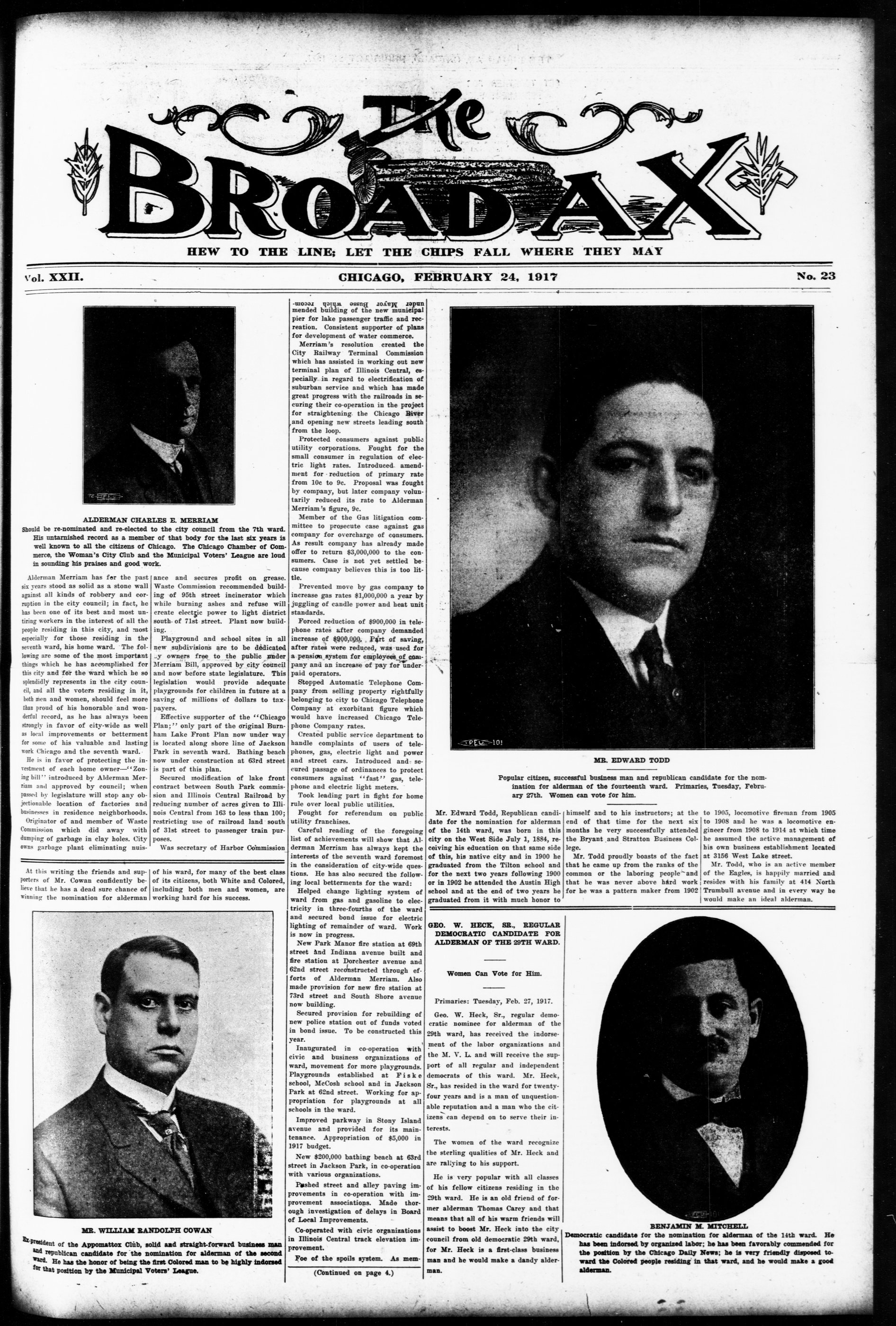
THE BROAD AX
ALDERMAN CHARLES E. MERRIAM
Should be re-nominated and re-elected to the city council from His untarnished record as a member of that body for the last well known to all the citizens of Chicago. The Chicago Chamber, the Woman's City Club and the Municipal Voters' League in sounding his praises and good work.
Should be re-nominated and re-elected to the city council from the 7th ward. His untarnished record as a member of that body for the last six years is well known to all the citizens of Chicago. The Chicago Chamber of Commerce, the Woman's City Club and the Municipal Voters' League are loud in sounding his praises and good work.
Alderman Merriam has for the past six years stood as solid as a stone wall against all kinds of robbery and corruption in the city council; in fact, he has been one of its best and most untriring workers in the interest of all the people residing in this city, and most especially for those residing in the seventh ward, his home ward. The following are some of the most important things which he has accomplished for this city and for the ward which he so splendidly represents in the city council, and all the voters residing in it, both men and women, should feel more than proud of his honorable and wonderful record, as he has always been strongly in favor of city-wide as well as local improvements or betterment for some of his valuable and lasting work Chicago and the seventh ward.
ance and secures profit on greases Waste Commission recommended building of 95th street incinerator which while burning ashes and refuse will create electric power to light district south of 71st street. Plant now building.
Playground and school sites in all new subdivisions are to be dedicated by owners free to the public under Merriam Bill, approved by city council and now before state legislature. This legislation would provide adequate playgrounds for children in future at a saving of millions of dollars to tax-payers.
Effective supporter of the "Chicago Plan;" only part of the original Burnham Lake Front Plan now under way is located along shore line of Jackson Park in seventh ward. Bathing beach
He is in favor of protecting the investment of each home owner—"Zoning bill" introduced by Alderman Merriam and approved by council; when passed by legislature will stop any objectionable location of factories and businesses in residence neighborhoods. Originator of and member of Waste Commission which did away with dumping of garbage in clay holes. City owns garbage plant eliminating nuis-
At this writing the friends and supporters of Mr. Cowan confidently believe that he has a dead sure chance of winning the nomination for alderman
```markdown
```
[Picture of a man in a suit with a tie].
MR. WILLIAM RANDOLPH COWAN
Ex-president of the Appomattox Club, solid and straight-faced and republican candidate for the nomination for alder ward. He has the honor of being the first Colored man for that position by the Municipal Voters' League.
21 president of the Appomattox Club, solid and straight-forward business man and republican candidate for the nomination for alderman of the second ward. He has the honor of being the first Colored man to be highly indorsed for that position by the Municipal Voters' League.
HEW TO THE LINE: LET THE CHIPS FALL WHERE THEY MAY
to the city council from the 7th ward. or of that body for the last six years is Chicago. The Chicago Chamber of Com- the Municipal Voters' League are loud ork.
ance and secures profit on grease. Waste Commission recommended building of 95th street incinerator which while burning ashes and refuse will create electric power to light district south of 71st street. Plant now building.
Playground and school sites in all new subdivisions are to be dedicated by owners free to the public under Merriam Bill, approved by city council and now before state legislature. This legislation would provide adequate playgrounds for children in future at a saving of millions of dollars to taxpayers.
Effective supporter of the "Chicago Plan;" only part of the original Burnham Lake Front Plan now under way is located along shore line of Jackson Park in seventh ward. Bathing beach now under construction at 63rd street is part of this plan.
Secured modification of lake front contract between South Park commission and Illinois Central Railroad by reducing number of acres given to Illinois Central from 163 to less than 100; restricting use of railroad land south of 31st street to passenger train purposes. Was secretary of Harbor Commission
of his ward, for many of the best class of its citizens, both White and Colored, including both men and women, are working hard for his success.
H.
solid and straight-forward business man nomination for alderman of the second first Colored man to be highly indorsed poters' League.
mended building of the new municipal pier for lake passenger traffic and recreation. Consistent supporter of plans for development of water commerce. Merriam's resolution created the City Railway Terminal Commission which has assisted in working out new terminal plan of Illinois Central, especially in regard to electrification of suburban service and which has made great progress with the railroads in securing their co-operation in the project for straightening the Chicago River and opening new streets leading south from the loop. Protected consumers against public utility corporations. Fought for the small consumer in regulation of electric light rates. Introduced amendment for reduction of primary rate from 10c to 9c. Proposal was fought by company, but later company voluntarily reduced its rate to Alderman Merriam's figure, 9c. Member of the Gas litigation committee to prosecute case against gas company for overcharge of consumers. As result company has already made offer to return $3,000,000 to the consumers. Case is not yet settled because company believes this is too little.
Prevented move by gas company to increase gas rates $1,000,000 a year by juggling of candle power and heat unit standards.
Forced reduction of $900,000 in telephone rates after company demanded increase of $900,000. Part of saving, after rates were reduced, was used for a pension system for employees of company and an increase of pay for underpaid operators.
Stopped Automatic Telephone Company from selling property rightfully belonging to city to Chicago Telephone Company at exorbitant figure which would have increased Chicago Telephone Company rates.
Created public service department to handle complaints of users of telephones, gas, electric light and power and street cars. Introduced and secured passage of ordinances to protect consumers against "fast" gas, telephone and electric light meters.
Took leading part in fight for home rule over local public utilities.
Fought for referendum on public utility franchises.
Careful reading of the foregoing list of achievements will show that Alderman Merriam has always kept the interests of the seventh ward foremost in the consideration of city-wide questions. He has also secured the following local betterments for the ward: Helped change lighting system of ward from gas and gasoline to electricity in three-fourths of the ward and secured bond issue for electric lighting of remainder of ward. Work is now in progress. New Park Manor fire station at 69th street and Indiana avenue built and fire station at Dorchester avenue and 62nd street reconstructed through efforts of Alderman Merriam. Also made provision for new fire station at 73rd street and South Shore avenue now building. Secured provision for rebuilding of new police station out of funds voted in bond issue. To be constructed this year.
Inaugurated in co-operation with civic and business organizations of ward, movement for more playgrounds. Playgrounds established at Fiske school, McCosh school and in Jackson Park at 62nd street. Working for appropriation for playgrounds at all schools in the ward.
Improved parkway in Stony Island avenue and provided for its maintenance. Appropriation of $5,000 in 1917 budget.
New $200,000 bathing beach at 63rd street in Jackson Park, in co-operation with various organizations.
Pushed street and alley paving improvements in co-operation with improvement associations. Made thorough investigation of delays in Board of Local Improvements.
Co-operated with civic organizations in Illinois Central track elevation improvement.
PEU 101
Mr. Edward Todd, Republican candidate for the nomination for alderman of the 14th ward, was born in this city on the West Side July 1, 1884, receiving his education on that same side of this, his native city and in 1900 he graduated from the Tilton school and for the next two years following 1900 or in 1902 he attended the Austin High school and at the end of two years he graduated from it with much honor to
GEO. W. HECK, SR., REGULAR DEMOCRATIC CANDIDATE FOR ALDERMAN OF THE 29TH WARD.
Women Can Vote for Him.
Primaries: Tuesday, Feb. 27, 1917.
Geo. W. Heck, Sr., regular democratic nominee for alderman of the 29th ward, has received the indorsement of the labor organizations and the M. V. L. and will receive the support of all regular and independent democrats of this ward. Mr. Heck, Sr., has resided in the ward for twenty-four years and is a man of unquestionable reputation and a man who the citizens can depend on to serve their interests.
The women of the ward recognize the sterling qualities of Mr. Heck and are rallying to his support.
He is very popular with all classes of his fellow citizens residing in the 29th ward. He is an old friend of former alderman Thomas Carey and that means that all of his warm friends will assist to boost Mr. Heck into the city council from old democratic 29th ward, for Mr. Heck is a first-class business man and he would make a dandy alderman.
---
himself and to his instructors; at the end of that time for the next six months he very successfully attended the Bryant and Stratton Business College.
Mr. Todd proudly boasts of the fact that he came up from the ranks of the common or the laboring people and that he was never above hard work for he was a pattern maker from 1902
```markdown
```
101
101
BENJAMIN M. MITCHELL
Democratic candidate for the nomination has been indorsed by organized labo the position by the Chicago Daily ward the Colored people residing in alderman.
for the nomination for alderman organized labor; he has been in Chicago Daily News; he is w people residing in that ward, are
Democratic candidate for the nomination for alderman of the 14th ward. He has been indorsed by organized labor; he has been favorably commended for the position by the Chicago Daily News; he is very friendly disposed toward the Colored people residing in that ward, and he would make a good alderman.
candidate for the nom-
ies, Tuesday, February
to 1905, locomotive fireman from 1905 to 1908 and he was a locomotive engineer from 1908 to 1914 at which time he assumed the active management of his own business establishment located at 3156 West Lake street. Mr. Todd, who is an active member of the Eagles, is happily married and resides with his family at 414 North Trumbull avenue and in every way he would make an ideal alderman.
17
n for alderman of the 14th ward. He
; he has been favorably commended for
News; he is very friendly disposed to
that ward, and he would make a good
No.23
OWNERS AND DIRECTORS
esac sacneon Phones Calumet 6164
Gan tanceey, Antoraatia viene
Sota as eccowan
Ahmed A. Reyner OPEN DAY
: Qn NIGHT
The Emanuel Jackson
Undertaking Co., Inc.
2959-61 South State St.
Reliable Service * Courteous Treatment
Reasonable Prices
FREE CHAPEL IN CONNECTION
Complete line of Funeral Goods. Automobles for hire
“THE MOUERN SCHOOL” - CLEAN AND RELIABLE
TERREVOUS L. DOUGLAS. Pros.
CIGARS—WHOLESALE AND RETAIL
BOX TRADE A SPECIALTY
$ 3556 South State Street Chicago
PH ONE DREXEL 3244 RES. PHONE DREXEL 2082
_ T. W. Champion & Co.
Real Estate Brokers
: RENTING Fs LOANS INSURANCE
: 5107 South State Street
: Chicago
QEACHING INDIANS IS .
THIS WOMAN’S HOBBY| "52 ‘Ocroce. ssoe on tnctemeor on
Mrs. Molineux Declares Red Man Can
Be Led, but Will Not Be Driven.
Salt Lake City.To have mothered
ene or possibly two tiny lives through
the strenuous days of early infancy is
@ task that most women consider plen-
ty, but Mrs. Elizabeth Molineux, until
recently a teacher in the United States
Indian service, has the distinction of
having mothered a whole tribe of Plute
Indians, and claims the satisfaction of
having raised them, old and young,
from ® condition bordering on the
squalid state where they consider
cleanliness next to godliness and, one
and all, are heartily in favor of both.
Mrs. Molineux recently resigned her
post as teacher on the Shivwits res-
ervation in southern Utah and is in
Salt Lake resting preparatory to going
to Ketchikan, Alaska, to take charge
af the Episcopal church's mission
school there. She is a guest at the
home of the Right Rev. Paul Jones,
bishop of the Episcopal diocese of
Utah, while here.
Indians have become a hobby with
this diminutive little Scotchwoman,
She speaks their languages and in her
eignt years of service with the Indian
department has been intimately asso-
ciated with the trials and tribulations
that beset poor Lo on his native heath.
Mrs. Molineux {s an ardent eburch-
women and attributes her success in
dealing with Indians to the fact that
by blending religious teachings with
the “three R's” she has dismissed dis-
trust of her from the minds of her
charges and has always been regarded
by them more in the light of a friend
than a teacher. She declared the In-
Gian mind to be susceptible to teaching
if properly approached, but adds that
he can be led but will not be driven.
CHASING A COYOTE IN
- AUTO EXCITING SPORT
Hound, Sighting Game, Leaps
4 Over Mud Shield and Lands
4 Twenty Feet Ahead of Car.
Larned, Kan.—An exciting coyote
chase in automobiles took place near
Hanston. The party consisted of Bill
Hann, John Hann, Mr. and Mrs. Irvin
Seaman and William Warring. They
went in two cars and took three grey-
hounds in each car.
Mr. Warring says that auto polo is
mild compared with the way those two
cars chased across the prairie, ravines
and bluffs after coyotes. He said that
his speedometer registered forty miles
‘ene time when he dared to glance at i
‘and he was afraid to look again.
‘They were going along between twem
ty and thirty miles an hour at the time
‘they started up the first coyote, and
‘when the biggest hound in Mr. War
‘ting’s car sighted the wolf it leaped
over the wind shield and hood and
landed running twenty feet ahead of
the ear. The coyote was a big fellow,
but the hounds finally brought bim
down, the big hound throwing him,
‘while the others pinned him down.
‘While chasing the first coyote the
ether auto nearly ran over another one,
‘Which leaped up almost frém under the
Wheels of the car. The men shot at it
several times, wounding it, but because
ef the apeed of the bounding car could
‘bet poor aim. It finally ran into a
and was fished out with a wire.
‘Hann and Seaman have killed
@any cayotes. ~ =
The Famous “Green Man of Brighton.”
In October, 1806, an individual was
to be observed at Brighton, England,
who walked out every day dressed in
green from head to foot—green shoes,
green gloves, green handkerchief and
other articles to match. This eocen-
tric person lived alone, knew nobody,
and in his house the curtains, the wall
paper, the furniture, even the plates
and dishes and the smallest toilet ar
ticles, offered en uninterrupted se-
quence of green. Having started on
his career, there was obviously no rea-
eon to stop, and with full consistency
he carried his scruples so far as to eat
nothing but fruit and vegetables of the
same green color. The consequences
were extremely disastrous. One fine
day the green man jumped from his
window into the street, rushed forward
and performed a second somersauit
from the top of the nearest cliff.
i ie
In the angle between the Kings and
Kern canyons lies a woodland empire
beside which the Harz and Black for-
est of Germany would appear almost
diminutive. Within the borders of the
Sequoia National park and the General
Grant National park near by there are
no fewer than 1,168,000 sequoia trees,
and of these 12,000 are more than ten
feet in diameter. In the Sequoia Na-
tional park stands the largest tree in
the world—not the tallest, but the larg-
est—the General Sherman tree, with a
diameter of 36.5 feet and a height of
270.9 feet. Its massive trunk and
branches contain about 1,000,000 feet
of lumber, board measure. This is
equal to the amount of lumber that fs
eut from forty acres of average Minne-
sota timberland.—Argonaut.
Self Convicted.
“Bay, pa,” queried small Bobby,
“what is gossiping, anyway?"
“Gossiping, my son,” replied the old
man, “if we get right down to the
plain, unvarnished facts, is lying. But
why do you ask?”
“Because,” answered the young in-
Yestigator, “ma says you do a lot of
gossiping every time your business
keeps you late at the office."—Ex-
ebange.
Teo Much Practice
“Does your minister practice what he
preaches?" the newcomer questioned.
“He does,” the citizen answered, with
a sigh, “and I'd be perfectly willing to
have him stop. He lives next door to
me and begins at 7 o'clock Sunday
morning to practice what he is going
to preach."—New York Times,
Divided It
‘Scene—Police court during dispute
over eight day clock.
‘Magistrate—I award the clock to the
plaintiff.
Defendant—Then what do I get?
Magistrate—I'l give you the elght
days.—London Stray Stories.
Shake end Qecth,
‘There is an old yet still operative su-
Derstition among seafaring men that
when a shark persistently follows a
Vessel it is a sign that some person on
board is going to die, the alleged rea-
won being that the great fish can scent
death
Fashionable.
‘Wilie—Paw, what is a fashionable
wesort? Paw—A place where you can
@dtain the least comfort and the most
style for the most money, my sua—
Qiretnnati Enquirer.
‘Ob, how bitter a thing it is te leok
fate happiness through another man’s
qest—“As You Likes It," 11, 7.
THE BROAD AX, CHICAGO, FEBRUARY 24, 1917.
GET TOGETHER FOR
PERMANENT PROSPERITY.|\B |. |
Every man and woman engaged in
American factories, mills and mines,
whether they know English or speak
it, are naturalized or intend to be
come citizens, have a direct interest
in maintaining industrial prosperity.
When times are good, all workers
should not only be thrifty in habit and
lay up a little something for possible
rainy days, but they should do all they
can to keep the good times with us.
Simply because your language is dif-
ferent from that of the foreman, over-
seer, superintendent, manager or owner
of the plant in which you earn a living,
is no excuse for misunderstanding your
‘own common interest in prosperity by
hating your partner in your own in-
dustry or listening to and following
the gospel of dissension and violence
which selfish agitators so often preach.
Do not blindly follow the man who
tells you how hard your lot is. Often
‘he is doing so untruthfully and for the
Durpose of getting you to contribute
‘Bemberahip money for his ovn suport
in idleness. Agitators get rich by prey-
ing on the men in American industry,
whom they urge into unlawful or harm-
ful acts by misrepresenting conditions
or holding out foolish and false prom-
ises of better things if they follow
their orders. You know conditions
yourself, and you know or ought to
know that the man or men whom the
agitator who pictures your employer as
on inhuman driving machine is actual-
ly « partner with you, interested in
‘having the plant or industry successful.
‘The more successful your plant or
industry becomes, the more room for
you to grow with it there will be. It
should be your feeling, then, that you
will not do as little as you may find it
convenient to do, but to do just as
much as you possibly can do, and then
reasonably expect to share in the re-
wards that always come to the efficient
worker.
Do not be a clock watcher in the fac-
tory. Those who wait for hours to
strike or whistles to blow and “soldier”
at the bench, machine or in the office,
never get ahead in the ranks of in-
dustry. They never get any more pay
because they are not worth any more,
and often are worth less than they get.
Remember the old adage that a man
who never does any more or as much
as he gets paid for, never gets paid
for any more than he does.—Industrial
Conservation, N. Y.
PUTTING BUSINESS RIGHT
WITH THE PUBLIC.
A few years ago some big industrial
organizations and certain railroads em.
Ployed business tactics which, accord-
ing to the popular idea, would make
the financial adventures of Pizarro,
Morgan or Captain Kidd look as ama-
teurish as the verbal exploits of Bobby
Make-Believe.
All are more or less acquainted with
the detatis. We will concede that there
were some glaring abuses, but the pub-
le when it came to apply a remedy ig-
nored the fact that these were peculiar
to comparatively few institutions and
instead of tackling the trouble where
% lay furiously assailed everything
classifiable as business—the trust mag.
nate, the independent manufacturer
ready and anxious to obey the law, the
small retailer, a law abiding and use-
fal citizen—the innocent and the guilty
suffering alike. Seemingly the law was
Anvoked not to regulate, but to perse-
cute.
_ ‘There could be but one result. Busi-
ness was demoralized, and the whole
country has felt the evil effects. Now
the public is beginning to realize its
error and in a rather grudging way is
making some concessions,
Business is being permitted to speak
for itself, and a movement has been in-
stituted by the leading business men
of the country under the title of the
National Industrial Conservation Move-
ment for the purpose of repairing the
‘damage that bas been done. Nothing
revolutionary is contemplated. The
plan is simply to educate the public by
taking it into the business man’s confi-
ence. Meetings will be held in vari-
ous trade and industrial centers. All
classes of citizens will be invited. The
Purpose of these meetings is to give the
Public a new and correct viewpoint as
to the effects of drastic legislation and
restriction of business on the prosper-
ity of the country. Every effort will
be made to give the public a clear view
of the problems and difficulties which
beset business.
Special favors are not sought through
these meetings, only fair play. It is
believed that once the citizen grasps
the situation his whole attitude toward
business will change and that he will
readily co-operate toward bringing
about better conditions.
Commercial and other civic organiza.
tions and the local press are already
showing great interest in this move-
ment, and ‘t is reasonable to believe
that much good will come from it—
Industrial Conservation, W. ¥.
Common Capitalists.
Every man or woman who possesses
& dollar or owns a set of tools is a
capitalist. People generally make the
mistake of thinking that the only form
of capital in existence is the national
currency—the dollar, franc, ruble,
mark, lire or pound sterling. Yet every-
body knows that many a successful
business man’s only original capital
was brains, knowledge, ability, deter
mination or ingenuity. It would be
well for more people to recognize this
truism before abetting, elther by ac
tion or attitude, ceaseless efforts on the
part of some political or other self
seekers, to hobble business men and in-
dustrial development. Such is the spirit
of industrial patriotiCm which is need-
ed tm America.—Industrial Conserve-
thon, New York.
YOU HAVE READ MUCH!
=~ 1 HOUGHT SOMES
ees
Your opportunity to be a part owner ---to share in profits of
“THE BIRTH OF A RACE”
is passing. The shares of Capital Stock have been turned
over to a strong firm of brokers. The sales are big -~- in
Chicago -- all over the country. The shares are going very
fast. Soon they will be entirely gone, and your chance to
make a lot of money gone also ---- unless you get busy.
Not Next Month
ot Next Month But TO-DAY
————
This Master Photoplay is of interest to you. It will help you
and your race, and make money for you at the same time.
President, EDWIN L. BARKER, a man who has produced real motion pictures.
Secretary, JOHN C. WILLIAMS, for 6 years Attorney for Sanitary Dist. of Chicago.
Treasurer, JOHN GULLIKSEN, Assistant Cashier of the Union Bank of Chicago.
DEPOSITORY FOR FUNDS, Union Bank of Chicago.
Ee a 43 BIRTH OF RACE PHOTOPLAY CORPORATION,
y, b es Suite 416, 29 Se. LaSalle Street, Chicago,‘ Ill.
2 Please send me, without obligation on my part, full in-
CLIP, fill out and mail this coupon Seemation sheet ee mete ote Rsce
to-day, and circular telling all about
“THE BIRTH OF A RACE,” will aoe
ios cent quatat ones: er anon at acaacees toes eaeacee res
There is a Monthly Payment
Plan which makes it very easy to eee
own a few shares of stock. a ey Seneca
City.ceccceccccccccccccccccccccecccscccsccceccescocscceseces
FOUND IMAGE IN CAVE.”
Crude Stone Idol Probably Antedates
Indian Mound Bullders.
See Cena eee ee.
Madisonville, Ky—B. L. Littlepage
of the Morton Gap country brought to
thie place recently a stone image that
is a curiosity and probably of historic
value.
Mr. Littlepage found it at the edge
of a cave on a@ high elevation in North
Christian county, Ky., while investigat-
ing some prospective oil land belonging
to him. The cave is located in a wild
and broken section af land uncultivat-
ed and but thinly inhabited.
‘The image is rudely carved out of a
tough, ferrous sandstone. It is about
six inches in height and is well pre-
served, except for a slight injury on
one side of its head and slight weath-
ering of one arm, The figure is in a
sitting position, with its legs doubled
under its body and arms extended in
front, with hands resting on its knees.
The image is evidently a relic of an
idol worshiping people and antedates
any old Indian relic found in various
Indian mounds in western Kentucky.
WIDOW SAVES TREES.
Turns Commissioners From Those
Planted by Her Husband.
St. Cloud, Mich—“Woodman, spare
that tree; touch not a single bough.”
‘Thus quoted Mra. Mary Spicer, wid-
ow, as she pleaded for the preservation
of trees planted by her husband, long
dead.
It was three years ago that Mrs. Spi-
cer started her battle with city officials
over the maintenance of this arborian
inheritance. She wes called upon to
enter another skirmish the other day
when sidewalk bids were opened, in
which provision was to have been
made for the removal af the trees.
‘Mrs. Spicer’s “pets” fringe a lot on
which her modest ttle home is built
“Wait until I am gone and you may
Femove them,” she told the city com-
missioners, who took her words to
heart. When sidewalk bids were open.
ed there were proposed contracts on
other jobs, but on the Widow Spicer’s
property—not a word.
—————
EIGHTY, WANTS HEART BALM
Weman Ie Deaf, Has Lost Right Bye
and le a Little Lame.
Utica, N. ¥.—Mra, Almira Kingsbury
fg just a Uttle on the right side of
eighty years old. She is rather deaf.
Sho has lost her right eye and her left
thamb, Besides she is a little lame.
But she took the stand to testify that
Robert Roberts of Trenton, seventy-gix
yeats old and a farmer, had been so
smitten with her charms at first sight
that he urged her to marry him. Then
she said be broke troth and she sued
for breach of promise. They met at an
employment agency where he sought s
bousekeaper.
Jodge Hasard told Mrs. Kingsbury's
eteomney, “1 think your cient ie clearly
extitied to about € cents.” However,
the ease was held open for more evi
Gere
ALL AVAILABLE LAND GONE.
Commissioner of Immigration Hows
Predicts That United States Will Be-
come an Emigrant Rather Than an
Immigrant Nation at the End of Hos-
tillties In Europe.
New York.—A prediction that the
United States would become an “emi-
grant” rather than an “immigrant” na-
tion at the close-of the war was made
by Commissioner of Immigration Fred-
eric C. Howe at the Sunday evening
forum of the Free synagogue.
Mr. Howe took the stand that imm!-
gration was purely an economic ques-
tion and declared that it had been
such from the beginning. He said that
those who opposed immigration did so
because they desired to limit the com-
petition of unskilled foreign labor;
those who favored the wide open door
did so because it made labor cheap.
He said the immigrant no longer
went to the farm because all the avail-
able land of the country had been tak-
em up, hundreds of millions of acres
being held for purely speculative pur-
Poses.
“The immigration problem never ex-
{ated so long as the land was free for
the asking,” said Mr. Howe, “and it ts
this scarceness of land which makes
immigration an economic question.
“It is a matter of freeing labor on
ene hand from the competition of the
incoming labor groups from Europe
and of insuring to the immigrant an
opportunity to work for himself rather
than for an employer interested in se-
curing his services at the lowest pos-
sible cost.
“I keep more or Jess in touch with
the centers to which go most of the
men who pass through Ellis island. I
am told that everywhere the men now
employed in our shops and factories
who at home worked as farmers are
saving their money to return to the
eld country. They have always wished
to own their own farms—they came
here for that purpose—and they figure
that after the war land will be cheap
im the countries overseas. This senti-
ment, spreading among our workers,
will result in a serious crisis in our
industrial life.”
‘Mr. Howe also discussed the servant
question. He said that since the war
there had been practically no servant
girls coming to this country and that
many of those who were in service had
left it to enter munition factories and
— while others had married or
‘To regulate the tide of oriental im
migration and, in fact, to check in some
measure immigration from any land
De, Sydney L, Gulick, an authority on
Japan, suggested that, for example, if
® thousand Syrians eame to this coun-
try tm 1900 and ten years later all had
taken out American citisenship then
another thousand might be admitted.
If, however, only 800 had applied for
naturalization papers the decision of
the remaining 700 to still be Syrians
automatically would keep an equal
number of their fellow countrymen in
Teaching Birds Tricks. ~
‘A professor of natural history 1
fates the statement so frequently made
hat teaching a bird to draw water
‘Beeds apparatus and that the learning
$s cruelty to the bird.
“The following experience of ming,”
be says, “proves that it is not so by
any means. We bought a young bind
Yast January, so wild that on our ap
roach it flew madly round the cage
‘We hung the cage low and by patience,
After the bird got used to our proxim
Ry, induced it to take groundsel, first
‘held at stem’s length, then between the
fingers, finally from the lips. We used
to let him out freely, and he would
Perch on the loaf next me at break
fast. His perch projected through the
wires, and here was his favorite seat
when at liberty. ‘Then I tried hanging
@ bit of groundsel by a short string to
the projecting stick. After inspection
he pulled it up with his beak On
lengthening the string with a fresb
Bit of his preferred weed I had the
Pleasure and interest of seeing him
pall up the string with his beak til
the flower head was within resch
catching the slack after each pull with
one foot and then transferring it t
the other, so that the coils were quite
neat.”—London Globe.
Wiis Citi
As early as 1643 a Frenchman of
science named Pascal experimented
with pressures applied to liquids and
iscovered the following law: A pret
sure applied to any part of the sur
face of a liquid is transmitted uw
changed in amount in every direction
through the liquid.
Perhaps the most familiar applice-
ton of Pascal's law is the hydraulle
Press, In that machine a pump having
@ small piston drives water into « large
eylinder and thereby forces upward #
large piston, which compresses what:
ever 1s placed between the platform of
the piston and the fixed crossbeam st
the top of the press. If the ares of
the larger piston 1s 100 times that of
the smaller a downward force of one
pound exerted on the smaller piston
will create an upward force of 1°
pounds upon the larger piston
Stiieen Geil Clem
Grinding wheat to make Sout ©
be done at home as easily as
grinding of coffee. Thus a family D4
have whole wheat flour, freshly sreasd
a thing that is usually difficult to o>
tain. The New York Medica! Jour
advises its readers to buy thelr whet
from seedsmen rather than from FY
cers or feed stores because it will
cheaper and more efficient.
‘The grinder can be used ale
eracking wheat, corn, barley, 08th 7
and other grains for use as Desi
cereals. And the cereals wil
chewing, which wil not ooly #760
ex the muscles of the chewers 1
but will keep thelr tooth from 67
thas fa, tf they begin as chide
Homamade cereals need 105
tne, 00 0 Sreless cocker # ae
@ispensable.
Naval Militiamen, on Patrol, Searched Every Vehicle.
WATCHED FOR EXPLOSIVES.
When Break With Germany Came Particular Attention Was Centered on Brooklyn and Manhattan Spans, as Destruction Would Prevent Egress of War Vessels From Navy Yard.
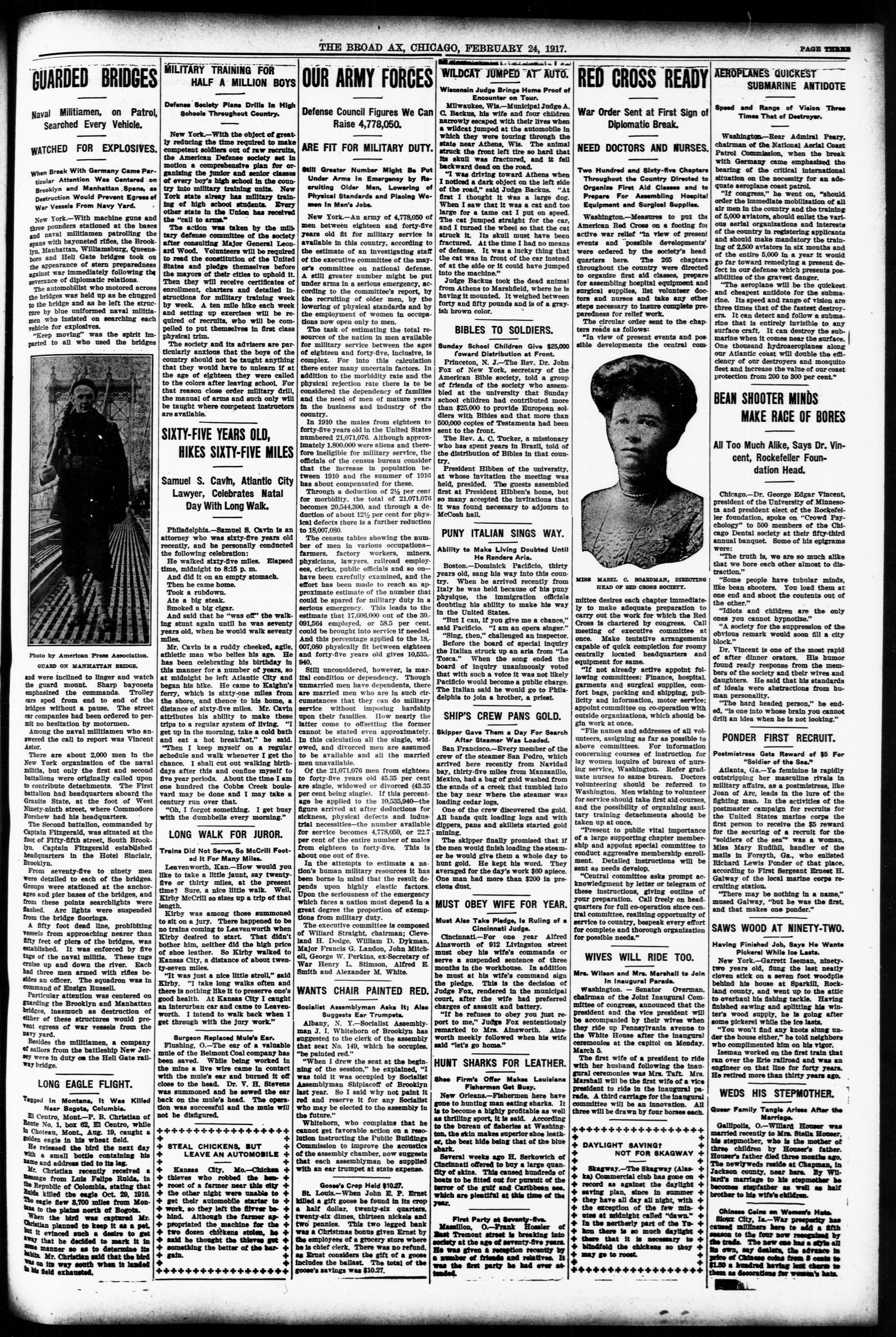
New York.—With machine guns and three pounders stationed at the bases and naval militiamen patrolling the spans with bayoneted rifles, the Brooklyn, Manhattan, Williamsburg, Queensboro and Hell Gate bridges took on the appearance of stern preparedness against war immediately following the severance of diplomatic relations.
The automobillist who motored across the bridges was held up as he chugged to the bridge and as he left the structure by blue uniformed naval militiamen who insisted on searching each vehicle for explosives. "Keep moving" was the spirit imparted to all who used the bridges
THE BROOKLYN BROADWAY
Photo by American Press Association.
GUARD ON MANHATTAN BRIDGE,
and were inclined to linger and watch
the guard mount. Sharp bayonets
emphasized the commands. Trolley
cars sped from end to end of the
bridges without a pause. The street
car companies had been ordered to
permit no hesitation by motormen.
Among the naval militamen who
answered the call to report was Vincent
Astor.
There are about 2,000 men in the
New York organization of the naval
militia, but only the first and second
battalions were originally called upon
to contribute detachments. The First
battalion had headquarters aboard the
Granite State, at the foot of West
Ninety-ninth street, where Commodore
Forshew had his headquarters.
The Second battalion, commanded by Captain Fitzgerald, was situated at the foot of Fifty-fifth street, South Brooklyn. Captain Fitzgerald established headquarters in the Hotel Sinclair, Brooklyn.
From seventy-five to ninety men were detailed to each of the bridges. Groups were stationed at the anchorage and pier bases of the bridges, and from these points searchlights were flashed. Arc lights were suspended from the bridge floorings.
A fifty foot dead line, prohibiting vessels from approaching nearer than fifty feet of pliers of the bridges, was established. It was enforced by five tugs of the naval militia. These tugs cruise up and down the river. Each had three men armed with rifles besides an officer. The squadron was in command of Ensign Russell.
Particular attention was centered on guarding the Brooklyn and Manhattan bridges, inasmuch as destruction of either of these structures would prevent egress of war vessels from the navy yard.
Besides the militiamen, a company of sailors from the battleship New Jersey were in duty on the Hell Gate railway bridge.
LONG EAGLE FLIGHT.
Tagged In Montana, It Was Killed
Near Bogota, Columbia.
El Centro, Mont.-P. B. Christian of
Route No. 1, box 62, El Centro, while
in Choteau, Mont., Aug. 19, caught
a golden eagle in his wheat field.
He released the bird the next day
with a small bottle containing his
name and address tied to its leg.
Mr. Christian recently received a
message from Luis Felle Ruida, in
the Republic of Colombia, stating that
Ruida killed the eagle Oct. 29, 1916.
The eagle flew 3,700 miles from Monta
to the plains north of Bogota.
When the bird was captured Mr.
Christian planned to keep it as a pet,
but it evinced such a desire to get
away that he decided to mark it in
some manner so as to determine its
habit. Mr. Christian said that the bird
was on its way south when it landed
in his field exhausted.
MILITARY TRAINING FOR HALF A MILLION BOYS
MILITARY TRAINING FOR HALF A MILLION BOYS
Defense Society Plans Drills In High Schools Throughout Country.
New York.—With the object of greatly reducing the time required to make competent soldiers out of raw recruits, the American Defense society set in motion a comprehensive plan for organizing the junior and senior classes of every boy's high school in the country into military training units. New York state already has military training of high school students. Every other state in the Union has received the "call to arms."
The action was taken by the military defense committee of the society after consulting Major General Leonard Wood. Volunteers will be required to read the constitution of the United States and pledge themselves before the mayors of their cities to uphold it. Then they will receive certificates of enrollment, charters and detailed instructions for military training week by week. A ten mile hike each week and setting up exercises will be required of recruits, who will be compelled to put themselves in first class physical trim.
The society and its advisers are particularly anxious that the boys of the country should not be taught anything that they would have to unlearn if at the age of eighteen they were called to the colors after leaving school. For that reason close order military drill, the manual of arms and such only will be taught where competent instructors are available.
SIXTY-FIVE YEARS OLD, HIKES SIXTY-FIVE MILES
Philadelphia.—Samuel B. Cavin is an attorney who was sixty-five years old recently, and he personally conducted the following celebration:
He walked sixty-five miles. Elapsed time, midnight to 8:15 p. m.
And did it on an empty stomach.
Then he came home.
Took a rudown.
Ate a big steak.
Smoked a big cigar.
And said that he "was off" the walking stunt again until he was seventy years old, when he would walk seventy miles.
Mr. Cavin is a ruddy cheeked, agile, athletic man who belies his age. He has been celebrating his birthday in this manner for a number of years, so at midnight he left Atlantic City and began his hike. He came to Kalighn's ferry, which is sixty-one miles from the shore, and thence to his home, a distance of sixty-five miles. Mr. Cavin attributes his ability to make these trips to a regular system of living. "I get up in the morning, take a cold bath and eat a hot breakfast," he said. "Then I keep myself on a regular schedule and walk whenever I get the chance. I shall cut out walking birthdays after this and confine myself to five year periods. About the time I am one hundred the Cobbs Creek boulevard may be done and I may take a century run over that. "Oh, I forgot something. I get busy with the dumbbells every morning."
LONG WALK FOR JUROR.
Trains Did Not Serve, So McCrill Footed It For Many Miles.
Leavenworth, Kan.—How would you like to take a little jaunt, say twenty-five or thirty miles, at the present time? Sure, a nice little walk. Well, Kirby McCrill so sizes up a trip of that length.
Kirby was among those summoned to sit on a jury. There happened to be no trains coming to Leavenworth when Kirby desired to start. That didn't bother him, neither did the high price of shoe leather. So Kirby walked to Kansas City, a distance of about twenty-seven miles.
"It was just a nice little stroll," said Kirby. "I take long walks often and there is nothing like it to preserve one's good health. At Kansas City I caught an interurban car and came to Leavenworth. I intend to walk back when I get through with the jury work."
Surgeon Replaced Mule's Ear.
Flushing, O.-The ear of a valuable mule of the Belmont Coal company has been saved. While being worked in the mine a live wire came in contact with the mule's ear and burned it off close to the head. Dr. V. H. Stevens was summoned and he sewed the ear back on the mule's head. The operation was successful and the mule will not be disfigured.
STEAL CHICKENS, BUT
LEAVE AN AUTOMOBILE
Kansas City, Mo.-Chicken thieves who robbed the hambroost of a farmer near this city the other night were unable to get their automobile starter to work, so they left the filver behind. Although the farmer appropriated the machine for the two dozen chickens stolen, he said he thought the thieves got something the better of the bargain.
THE BROAD AX. CHICAGO. FEBRUARY 24. 1917.
OUR ARMY FORCES
OUR ARMY FORCES
Defense Council Figures We Can Raise 4.778.050.
ARE FIT FOR MILITARY DUTY.
Still Greater Number Might Be Put Under Arms In Emergency by Recruiting Older Men, Lowering of Physical Standards and Placing Women In Men's Jobs.
New York.—An army of 4,778,050 of men between eighteen and forty-five years old fit for military service is available in this country, according to the estimate of an investigating staff of the executive committee of the mayor's committee on national defense. A still greater number might be put under arms in a serious emergency, according to the committee's report, by the recruiting of older men, by the lowering of physical standards and by the employment of women in occupations now open only to men.
The task of estimating the total resources of the nation in men available for military service between the ages of eighteen and forty-five, inclusive, is complex. For into this calculation there enter many uncertain factors. In addition to the morbidity rate and the physical rejection rate there is to be considered the dependency of families and the need of men of mature years in the business and industry of the country. In 1910 the males from eighteen to forty-five years old in the United States numbered 21,071,076. Although approximately 1,800,000 were aliens and therefore ineligible for military service, the officials of the census bureau consider that the increase in population between 1910 and the summer of 1910 has about compensated for these.
Through a deduction of $2 \frac{1}{2}$ per cent for morbidity, the total of 21,071,076 becomes 20,544,300, and through a deduction of about $12 \frac{1}{2}$ per cent for physical defects there is a further reduction to 18,007,080.
The census tables showing the number of men in various occupations—farmers, factory workers, miners, physicians, lawyers, railroad employees, clerks, public officials and so on have been carefully examined, and the effort has been made to reach an approximate estimate of the number that could be spared for military duty in a serious emergency. This leads to the estimate that 17,606,000 out of the 30,091,564 employed, or 58.5 per cent could be brought into service if needed. And this percentage applied to the 18,007,080 physically fit between eighteen and forty-five years old gives 10,535,940.
Still unconsidered, however, is marital condition or dependency. Though unmarried men have dependents, there are married men who are in such circumstances that they can do military service without imposing hardship upon their families. How nearly the latter come to offsetting the former cannot be stated even approximately. In this calculation all the single, widowed, and divorced men are assumed to be available and all the married men unavailable.
Of the 21,071,076 men from eighteen to forty-five years old 45.35 per cent are single, widowed or divorced (43.35 per cent being single). If this percentage be applied to the 10,535,940—the figure arrived at after deductions for sickness, physical defects and industrial necessities—the number available for service becomes 477,850, or 22.7 per cent of the entire number of males from eighteen to forty-five. This is about one out of five.
In the attempts to estimate a nation's human military resources it has been borne in mind that the result depends upon highly elastic factors.
Upon the seriousness of the emergency which faces a nation must depend in a great degree the proportion of exemptions from military duty.
The executive committee is composed of Willard Straight, chairman; Cleveland H. Dodge, William D. Dykman, Major Francis G. Landon, John Mitchell, George W. Perkins, ex-Secretary of War Henry L. Stimson, Alfred E. Smith and Alexander M. White.
WANTS CHAIR PAINTED RED.
Socialist Assemblyman Asks It; Also Suggests Ear Trumpeta.
Albany, N. Y.-Socialist Assemblyman J. I. Whitehorn of Brooklyn has suggested to the clerk of the assembly that seat No. 149, which he occupies, "be painted red."
"When I drew the seat at the beginning of the session," he explained, "I was told it was occupied by Socialist Assemblyman Shiplacoff of Brooklyn last year. So I said why not paint it red and reserve it for any Socialist who may be elected to the assembly in the future."
Whitehorn, who complains that he cannot get favorable action on a resolution instructing the Public Buildings Commission to improve the acoustics of the assembly chamber, now suggests that each assemblyman be supplied with an ear trumpet at state expense.
Goose's Crop Held $10.27.
St. Louis—When John E. P. Ernst killed a gift goose he found in its crop a half dollar, twenty-six quarters, twenty-six dimes, thirteen nickels and two pennies. This two legged bank was a Christmas bonus given Ernst by the employees of a grocery store where he is chief clerk. There was no refund, as Ernst considers the gift of a goose includes the ballast. The total of the goose's savings was $10.27.
WILDCAT JUMPED AT AUTO.
Wisconsin Judge Brings Home Proof of Encounter on Tour.
Milwaukee, Wis.—Municipal Judge A. C, Backus, his wife and four children narrowly escaped with their lives when a wildcat jumped at the automobile in which they were touring through the state near Athens, Wis. The animal struck the front left tire so hard that its skull was fractured, and it fell backward dead on the road.
"I was driving toward Athens when I noticed a dark object on the left side of the road," said Judge Backus. "At first I thought it was a large dog. When I saw that it was a cat and too large for a tame cat I put on speed. The cat jumped straight for the car, and I turned the wheel so that the cat struck it. Its skull must have been fractured. At the time I had no means of defense. It was a lucky thing that the cat was in front of the car instead of at the side or it could have jumped into the machine."
Judge Backus took the dead animal from Athens to Marshfield, where he is having it mounted. It weighed between forty and fifty pounds and is of a grayish brown color.
BIBLES TO SOLDIERS.
Sunday School Children Give $25,000
Coward Distribution at Front.
Princeton, N. J. - The Rev. Dr. John Fox of New York, secretary of the American Bible society, told a group of friends of the society who assembled at the university that Sunday school children had contributed more than $25,000 to provide European soldiers with Bibles and that more than 500,000 copies of Testaments had been sent to the front. The Rev. A. C. Tucker, a missionary who has spent years in Brazil, told of the distribution of Bibles in that country. President Hibben of the university, at whose invitation the meeting was held, presided. The guests assembled first at President Hibben's home, but so many accepted the invitations that it was found necessary to adjourn to McCosh hall.
PUNY ITALIAN SINGS WAY.
Ability to Make Living Doubted Until He Renders Aria.
Boston.—Dominick Pacificio, thirty years old, sang his way into this country. When he arrived recently from Italy he was held because of his puny physique, the immigration officials doubting his ability to make his way in the United States.
"But I can, if you give me a chance," said Pacificio. "I am an opera singer." "Sing, then," challenged an inspector. Before the board of special inquiry the Italian struck up an aria from "La Tosca." When the song ended the board of inquiry unanimously voted that with such a voice it was not likely Pacificio would become a public charge. The Italian said he would go to Philadelphia to join a brother, a priest.
SHIP'S CREW PANS GOLD.
Skipper Gave Them a Day For Search After Steamer Was Loaded.
San Francisco.—Every member of the crew of the steamer San Pedro, which arrived here recently from Navidad bay, thirty-five miles from Manzanillo, Mexico, had a bag of gold washed from the sands of a creek that tumbled into the bay near where the steamer was loading cedar logs.
One of the crew discovered the gold. All hands quit loading logs and with dippers, pans and skillets started gold mining.
The skipper finally promised that if the men would finish loading the steamer he would give them a whole day to hunt gold. He kept his word. They averaged for the day's work $60 apiece. One man had more than $200 in precious dust.
MUST OBEY WIFE FOR YEAR.
Must Also Take Pledge, Is Ruling of a Cincinnati Judge.
Cincinnati—For one year Alfred Ainsworth of 912 Livingston street must obey his wife's commands or serve a suspended sentence of three months in the workhouse. In addition he must at his wife's command sign the pledge. This is the decision of Judge Fox, rendered in the municipal court, after the wife had preferred charges of assault and battery.
"If he refuses to obey you just report to me," Judge Fox sententiously remarked to Mrs. Ainsworth. Ainsworth meekly followed when his wife said "let's go home."
HUNT SHARKS FOR LEATHER.
Shee Firm's Offer Makes Louisiana Fishermen Get Busy.
New Orleans—Fishermen here have gone to hunting man eating sharks. It is to become a highly profitable as well as thrilling sport, it is said. According to the bureau of fisheries at Washington, the skin makes superior shoe leather, the best hide being that of the blue shark.
Several weeks ago H. Serkowich of Clinchnati offered to buy a large quantity of skins. This caused hundreds of boats to be fitted out for pursuit of the terror of the gulf and Caribbean sea, which are plentiful at this time of the year.
First Party at seventy-nine.
Massillon, O.-Frank Hosler of
East Tremont street is breaking into
society at the age of seventy-five years.
He was given a reception recently by
a number of friends and relatives.
It was the first party he had ever attended.
RED CROSS READY
War Order Sent at First Sign of Diplomatic Break.
NEED DOCTORS AND NURSES.
Two Hundred and Sixty-five Chapters Throughout the Country Directed to Organize First Aid Classes and to Prepare For Assembling Hospital Equipment and Surgical Supplies.
Washington-Measures to put the American Red Cross on a footing for active war relief "in view of present events and possible developments" were ordered by the society's head quarters here. The 265 chapters throughout the country were directed to organize first aid classes, prepare for assembling hospital equipment and surgical supplies, list volunteer doctors and nurses and take any other steps necessary to insure complete preparedness for relief work. The circular order sent to the chapters reads as follows: "In view of present events and possible developments the central com-
Mary E.
MISS MABEL C. BOARDMAN, DIRECTING HEAD OF RED CROSS SOCIETY.
mitteees each chapter immediately to make adequate preparation to carry out the work for which the Red Cross is chartered by congress. Call meeting of executive committee at once. Make tentative arrangements capable of quick completion for room centrally located headquarters and equipment for same.
"If not already active appoint following committees: Finance, hospital, garments and surgical supplies, comfort bags, packing and shipping, publicity and information, motor service; appoint committee on co-operation with outside organizations, which should begin work at once.
"File names and addresses of all volunteers, assigning as far as possible to above committees. For information concerning courses of instruction for lay women inquire of bureau of nursing service, Washington. Refer graduate nurses to same bureau. Doctors volunteering should be referred to Washington. Men wishing to volunteer for service should take first aid courses, and the possibility of organizing sanitary training detachments should be taken up at once. "Present to public vital importance of a large supporting chapter membership and appoint special committee to conduct aggressive membership enrollment. Detailed instructions will be sent as needs develop.
"Central committee asks prompt acknowledgment by letter or telegram of these instructions, giving outline of your preparation. Call freely on headquarters for full co-operation since central committee, realizing opportunity of service to country, bespeak every effort for complete and thorough organization for possible needs."
WIVES WILL RIDE TOO.
Mrs. Wilson and Mrs. Marshall to Join
In Inaugural Parade.
Washington. — Senator Overman,
chairman of the Joint Inaugural Committee
of congress, announced that the president and the vice president will be accompanied by their wives when they ride up Pennsylvania avenue to the White House after the inaugural ceremonies at the capitol on Monday.
March 5.
The first wife of a president to ride with her husband following the inaugural ceremonies was Mrs. Taft. Mrs. Marshall will be the first wife of a vice president to ride in the inaugural parade. A third carriage for the inaugural committee will be an innovation. All three will be drawn by four horses each.
Skagway.--The Skagway (Alaska) Commercial club has gone on record as against the daylight saving plan, since in summer they have all day all night, with the exception of the few minutes at midnight called "dawn." In the northerly part of the Yukon there is so much daylight there that it is necessary to blindfold the chickens so they may go to roost.
PAGE THREE
AEROPLANES QUICKEST
SUBMARINE ANTIDOTE
Speed and Range of Vision Three Times That of Destroyer.
Washington—Rear Admiral Peary, chairman of the National Aerial Coast Patrol Commission, when the break with Germany came emphasized the bearing of the critical international situation on the necessity for an adequate aeroplane coast patrol.
"If congress," he went on, "should order the immediate mobilization of all air men in the country and the training of 5,000 aviators, should enlist the various aerial organizations and interests of the country in registering applicants and should make mandatory the training of 2,500 aviators in six months and of the entire 5,000 in a year it would go far toward remedying a present defect in our defense which presents possibilities of the gravest danger.
"The aeroplane will be the quickest and cheapest anddote for the submarine. Its speed and range of vision are three times that of the fastest destroyers. It can detect and follow a submarine that is entirely invisible to any surface craft. It can destroy the submarine when it comes near the surface. One thousand hydroaeroplanes along our Atlantic coast will double the efficiency of our destroyers and mosquito fleet and increase the value of our coast protection from 200 to 300 per cent."
BEAN SHOOTER MINDS
MAKE RACE OF BORES
All Too Much Alike, Says Dr. Vincent, Rockefeller Foundation Head.
Chicago—Dr. George Edgar Vincent, president of the University of Minnesota and president elect of the Rockefeller foundation, spoke on "Crowd Psychology" to 500 members of the Chicago Dental society at their fifty-third annual banquet. Some of his epigrams were:
"The truth is, we are so much alike that we bore each other almost to distraction."
"Some people have tubular minds, like bean shooters. You load them at one end and shoot the contents out of the other."
"Idlots and children are the only ones you cannot hypnotize."
"A society for the suppression of the obvious remark would soon fill a city block."
Dr. Vincent is one of the most rapid of after dinner orators. His humor found ready response from the members of the society and their wives and daughters. He said that his standards of ideals were abstractions from human personality.
"The hard headed person," he ended, "is one into whose brain you cannot drill an idea when he is not looking."
PONDER FIRST RECRUIT.
Postmistress Gets Reward of $5 For "Soldier of the Sea."
Atlanta, Ga.—Ye feminine is rapidly outstripping her masculine rivals in military affairs, as a postmistress, like Joan of Arc, leads in the lure of the fighting man. In the activities of the postmaster campaign for recruits for the United States marine corps the first person to receive the $5 reward for the securing of a recruit for the "soldiers of the sea" was a woman, Miss Mary Rudhil, handler of the mails in Forsyth, Ga., who enlisted Richard Lewis Ponder of that place, according to First Sergeant Ernest H. Galway of the local marine corps recruiting station.
"There may be nothing in a name," mused Galway, "but he was the first, and that makes one ponder."
SAWS WOOD AT NINETY-TWO.
Having Finished Job, Says He Wants Pickerel While Ice Lasts.
New York.—Garrett Iseman, ninety-two years old, fung the last neatly cloven stick on a seven foot woodpile behind his house at Sparkill, Rockland county, and went up to the attic to overhaul his fishing tackle. Having finished sawing and splitting his winter's wood supply, he is going after some pickerel while the ice lasts.
"You won't find any knots slung under the house either," he told neighbors who complimented him on his vigor.
Iseman worked on the first train that ran over the Erie railroad and was an engineer on that line for forty years. He retired more than thirty years ago.
WEDS HIS STEPMOTHER.
Queen Family Tangle Arises After the Marriage.
Gallipolis, O.—Willard Houser was married recently to Mrs. Stella Houser, his stepmother, who is the mother of three children by Houser's father. Houser's father died three months ago. The newlyweds reside at Chapman, in Jackson county, near here. By Willard's marriage to his stepmother he becomes stepfather as well as half brother to his wife's children.
Chinese Coins on Women's Hats.
Sloxx City, Ia.—War prosperity has caused milliners here to add a fifth season to the four now recognized by the trade. The new one has a style all its own, say dealers, the advance in price of Chinese coins from 8 cents to $1.50 a hundred having lent charm to them as decorations for women's hats.
74
ALDERMAN RD
The people's candidate for re-nomination
the 33rd ward. His past splendid
been highly commended by the Mu
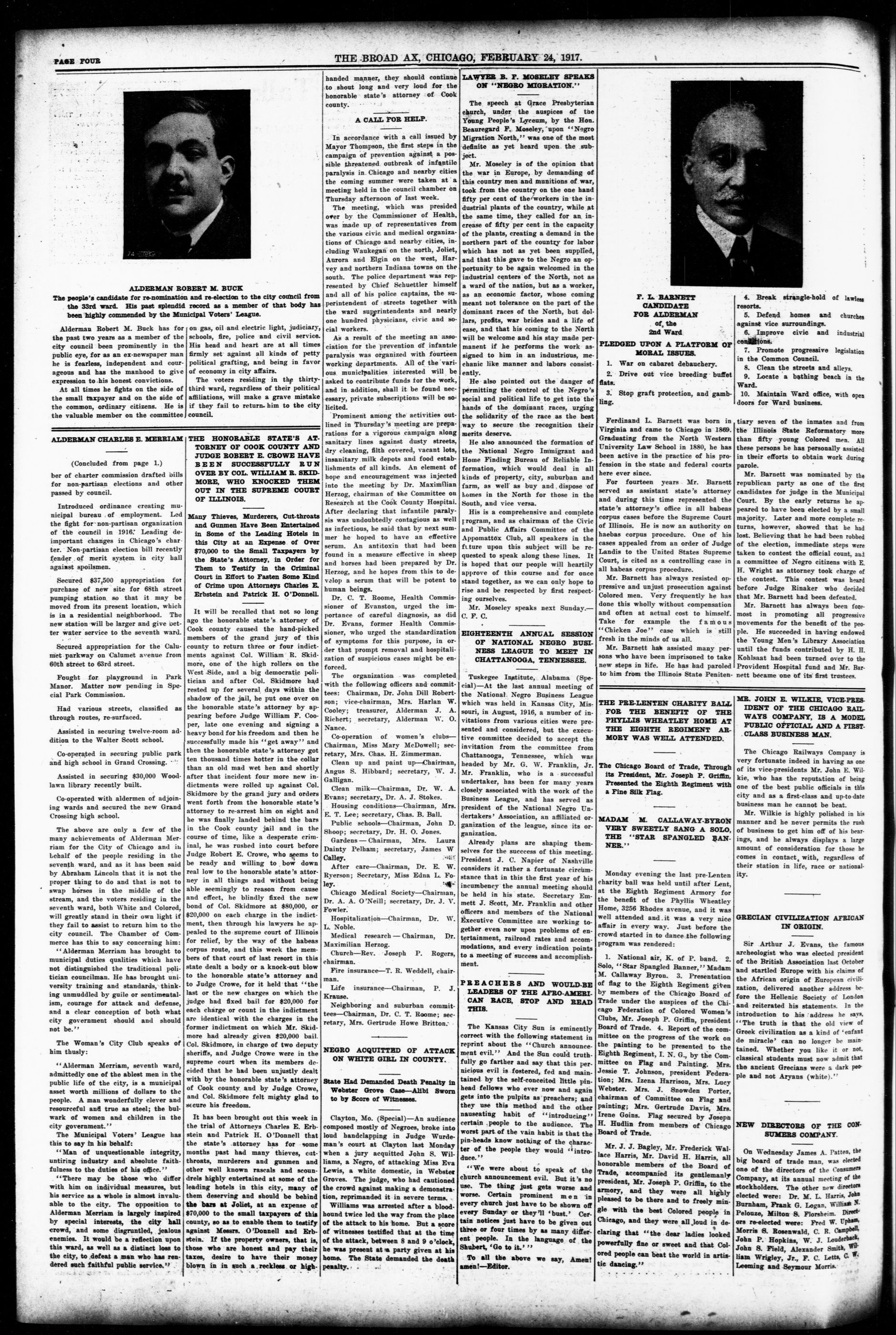
The people's candidate for re-nomination and re-election to the city council from the 33rd ward. His past splendid record as a member of that body has been highly commended by the Municipal Voters' League.
Alderman Robert M. Buck has for the past two years as a member of the city council been prominently in the public eye, for as an ex-newspaper man he is fearless, independent and courageous and has the manhood to give expression to his honest convictions.
At all times he fights on the side of the small taxpayer and on the side of the common, ordinary citizens. He is the valuable member on the committee on gas, oil and electric light, judiciary, schools, fire, police and civil service. His head and heart are at all times firmly set against all kinds of petty political grafting, and being in favor of economy in city affairs.
The voters residing in the thirty-third ward, regardless of their political affiliations, will make a grave mistake if they fail to return him to the city council.
ALDERMAN CHARLES E. MERRIAM
(Concluded from page 1.)
THE HONORABLE STATE'S AT-TORNEY OF COOK COUNTY AND JUDGE ROBERT E. CROWE HAVE BEEN SUCCESSFULLY RUN
ber of charter commission drafted bills for non-partisan elections and other passed by council.
Introduced ordinance creating municipal bureau of employment. Led the fight for non-partisan organization of the council in 1916. Leading de-important changes in Chicago's charter. Non-partisan election bill recently fender of merit system in city hall against spoilsmen.
Secured $37,500 appropriation for purchase of new site for 68th street pumping station so that it may be moved from its present location, which is in a residential neighborhood. The new station will be larger and give better water service to the seventh ward.
Secured appropriation for the Calumet parkway on Calumet avenue from 60th street to 63rd street.
Fought for playground in Park Manor. Matter now pending in Special Park Commission.
Had various streets, classified as through routes, re-surfaced.
Assisted in securing twelve-room addition to the Walter Scott school.
Co-operated in securing public park and high school in Grand Crossing.
Assisted in securing $30,000 Woodlawn library recently built.
Co-operated with aldermen of adjoining wards and secured the new Grand Crossing high school.
The above are only a few of the many achievements of Alderman Merriam for the City of Chicago and in behalf of the people residing in the seventh ward, and as it has been said by Abraham Lincoln that it is not the proper thing to do and that is not to swap horses in the middle of the stream, and the voters residing in the seventh ward, both White and Colored, will greatly stand in their own light if they fail to assist to return him to the city council. The Chamber of Commerce has this to say concerning him:
"Alderman Merriam has brought to municipal duties qualities which have not distinguished the traditional politician councilman. He has brought university training and standards, thinking unmuddled by guile or sentimentalism, courage for attack and defense, and a clear conception of both what city government should and should not be."
The Woman's City Club speaks of him thusly:
"Alderman Merriam, seventh ward, admittedly one of the ablest men in the public life of the city, is a municipal asset worth millions of dollars to the people. A man wonderfully clever and resourceful and true as steel; the bulwark of women and children in the city government." The Municipal Voters' League has this to say in his behalf: "Man of unquestionable integrity, untiring industry and absolute faithfulness to the duties of his office."
"There may be those who differ with him on individual measures, but his service as a whole is almost invaluable to the city. The opposition to Alderman Merriam is largely inspired by special interests, the city hall crowd, and some disgruntled, jealous enemies. It would be a reflection upon this ward, as well as a distinct loss to the city, to defeat a man who has rendered such faithful public service."
PASE FOUR
on gas, oil and electric light, judiciary, schools, fire, police and civil service. His head and heart are at all times firmly set against all kinds of petty political grafting, and being in favor of economy in city affairs. The voters residing in the thirty-third ward, regardless of their political affiliations, will make a grave mistake if they fail to return-him to the city council.
THE HONORABLE STATE'S ATTORNEY OF OOK COUNTY AND JUDGE ROBERT E. CROWE HAVE BEEN SUCCESSFULLY RUN OVER BY COL. WILLIAM R. SKIDMORE, WHO KNOCKED THEM OUT IN THE SUPREME COURT OF ILLINOIS.
Many Thieves, Murderers, Cut-throats and Gunmen Have Been Entertained in Some of the Leading Hotels in this City at an Expense of Over $70,000 to the Small Taxpayers by the State's Attorney, in Order for Them to Testify in the Criminal Court in Effort to Fasten Some Kind of Crime upon Attorneys Charles E. Erbstein and Patrick H. O'Donnell.
It has been brought out this week in the trial of Attorneys Charles E. Erbstein and Patrick H. O'Donnell that the state's attorney has for some months past had many thieves, cut-throats, murderers and gunmen and other well known rascals and scoundrels highly entertained at some of the leading hotels in this city, many of them deserving and should be behind the bars at Joliet, at an expense of $70,000 to the small taxpayers of this county, so as to enable them to testify against Messrs. O'Donnell and Erbstein. If the property owners, that is, those who are honest and pay their taxes, desire to have their money blown in in such a reckless or high-
THE BROAD AX, CHICAGO, FEBRUARY 24, 1917.
handed manner, they should continue to shout long and very loud for the honorable state's attorney of Cook county.
LAWYER B. F. MOSELEY SPEE ON "NEGRO MIGRATION."
The speech at Grace Presbyte
A CALL FOR HELP.
In accordance with a call issued by Mayor Thompson, the first steps in the campaign of prevention against a possible threatened outbreak of infantile paralysis in Chicago and nearby cities the coming summer were taken at a meeting held in the council chamber on Thursday afternoon of last week.
The meeting, which was presided over by the Commissioner of Health, was made up of representatives from the various civic and medical organizations of Chicago and nearby cities, including Waukegan on the north, Joliet, Aurora and Elgin on the west, Harvey and northern Indiana towns on the south. The police department was represented by Chief Schuettler himself and all of his police captains, the superintendent of streets together with the ward superintendents and nearly one hundred physicians, civic and social workers.
As a result of the meeting an association for the prevention of infantile paralysis was organized with fourteen working departments. All of the various municipalities interested will be asked to contribute funds for the work, and in addition, shall it be found necessary, private subscriptions will be solicited.
Prominent among the activities outlined in Thursday's meeting are preparations for a vigorous campaign along sanitary lines against dusty streets, dry cleaning, filth covered, vacant lots, insanitary milk depots and food establishments of all kinds. An element of hope and encouragement was injected into the meeting by Dr. Maximilian Herzog, chairman of the Committee on Research at the Cook County Hospital. After declaring that infantile paralysis was undoubtedly contagious as well as infectious, he said that by next summer he hoped to have an effective serum. An antitoxin that had been found in a measure effective in sheep and horses had been prepared by Dr Herzog, and he hopes from this to develop a serum that will be potent to human beings.
Dr. C. T. Roome, Health Commissioner of Evanston, urged the importance of careful diagnosis, as did Dr. Evans, former Health Commissioner, who urged the standardization of symptoms for this purpose, in order that prompt removal and hospitalization of suspicious cases might be enforced.
The organization was completed with the following officers and committees: Chairman, Dr. John Dill Robertson; vice-chairman, Mrs. Harlan W. Cooley; treasurer, Alderman J. A. Richert; secretary, Alderman W. O. Nance.
Co-operation of women's clubs—Chairman, Miss Mary McDowell; secretary, Mrs. Chas. H. Zimmerman.
Clean up and paint up—Chairman, Angus S. Hibbard; secretary, W. J. Galligan.
Clean milk—Chairman, Dr. W. A. Evans; secretary, Dr. A. J. Stokes. Housing conditions—Chairman, Mrs. E. T. Lee; secretary, Chas. B. Ball. Public schools—Chairman, John D. Shoop; secretary, Dr. H. O. Jones. Gardens—Chairman, Mrs. Laura Dainty Pelham; secretary, James W. Calley. After care—Chairman, Dr. E. W. Ryerson; Secretary, Miss Edna L. Foley. Chicago Medical Society—Chairman, Dr. A. A. O'Neill; secretary, Dr. J. V. Fowler. Hospitalization—Chairman, Dr. W. L. Noble. Medical research—Chairman, Dr. Maximilian Herzog. Church—Rev. Joseph P. Rogers, chairman.
Fire insurance—T. R. Weddell, chairman. Life insurance—Chairman, P. J. Krause. Neighboring and suburban committees—Chairman, Dr. C. T. Roome; secretary, Mrs. Gertrude Howe Britton.
NEGRO ACQUITTED OF ATTACK
ON WHITE GIRL IN COUNTY.
State Had Demanded Death Penalty in Webster Grove Case—Alibi Sworn to by Score of Witnesses.
Clayton, Mo. (Special)—An audience composed mostly of Negroes, broke into loud handclapping in Judge Wurdeman's court at Clayton last Monday when a jury acquitted John S. Williams, a Negro, of attacking Miss Eva Lewis, a white domestic, in Webster Groves. The judge, who had cautioned the crowd against making a demonstration, reprimanded it in severe terms.
Williams was arrested after a bloodhound twice led the way from the place of the attack to his home. But a score of witnesses testified that at the time of the attack, between 8 and 9 o'clock, he was present at a party given at his home. The State demanded the death penalty.
LAWYER B. F. MOSLEY SPEAKS ON "NEGRO MIGRATION."
The speech at Grace Presbyterian church, under the auspices of the Young People's Lyceum, by the Hon. Beauregard F. Moseley, upon "Nogro Migration North," was one of the most definite as yet heard upon the subject.
Mr. Moseley is of the opinion that the war in Europe, by demanding of this country men and munitions of war, took from the country on the one hand fifty per cent of the workers in the industrial plants of the country, while at the same time, they called for an increase of fifty per cent in the capacity of the plants, creating a demand in the northern part of the country for labor which has not as yet been supplied, and that this gave to the Negro an opportunity to be again welcomed in the industrial centers of the North, not as a ward of the nation, but as a worker, as an economic factor, whose coming meant not tolerance on the part of the dominant races of the North, but dollars, profits, war brides and a life of ease, and that his coming to the North will be welcome and his stay made permanent if he performs the work assigned to him in an industrious, mechanic like manner and labors consistently.
He also pointed out the danger of permitting the control of the Negro's social and political life to get into the hands of the dominant races, urging the solidarity of the race as the best way to secure the recognition their merits deserve.
He also announced the formation of the National Negro Immigrant and Home Finding Bureau of Reliable Information, which would deal in all kinds of property, city, suburban and farm, as well as buy and dispose of homes in the North for those in the South, and vice versa.
His is a comprehensive and complete program, and as chairman of the Civic and Public Affairs Committee of the Appomattox Club, all speakers in the future upon this subject will be requested to speak along these lines. It is hoped that our people will heartily approve of this course and for once stand together, as we can only hope to rise and be respected by first respecting ourselves.
Mr. Moseley speaks next Sunday.—C. F. C.
EIGHTEENTH ANNUAL SESSION
OF NATIONAL NEGRO BUSINESS LEAGUE TO MEET IN CHATTANOOGA, TENNESSEE.
Tuskegee Institute, Alabama (Special)—At the last annual meeting of the National Negro Business League which was held in Kansas City, Missouri, in August, 1916, a number of invitations from various cities were presented and considered, but the executive committee decided to accept the invitation from the committee from Chattanooga, Tennessee, which was headed by Mr. G. W. Franklin, Jr. Mr. Franklin, who is a successful undertaker, has been for many years closely associated with the work of the Business League, and has served as president of the National Negro Undertakers' Association, an affiliated organization of the league, since its organization.
Already plans are shaping themselves for the success of this meeting. President J. C. Napier of Nashville considers it rather a fortunate circumstance that in this the first year of his incumbency the annual meeting should be held in his state. Secretary Emmett J. Scott, Mr. Franklin and other officers and members of the National Executive Committee are working together even now upon problems of entertainment, railroad rates and accommodations, and every indication points to a meeting of success and accomplishment.
PREACHERS AND WOULD-BE LEADERS OF THE AFRO-AMERICAN RACE, STOP AND READ THIS.
The Kansas City Sun is eminently correct with the following statement in reprint about the "Church announcement evil." And the Sun could truthfully go farther and say that this pernicious evil is fostered, fed and maintained by the self-conceited little pinhead fellows who ever now and again gets into the pulpits as preachers; and they use this method and the other nauseating habit of "introducing" certain people to the audience. The worst part of the vain habit is that the pin-heads know nothing of the character of the people they would "introduce."
"We were about to speak of the church announcement evil. But it's no use. The thing just gets worse and worse. Certain prominent men in every church just have to be shown off every Sunday or they'll 'bust.' Certain notices just have to be given out three or four times by as many different people. In the language of the Shubert, 'Go to it.'"
To all the above we say, Amen! amen!-Editor.
A. B.
F. L. BARNETT
CANDIDATE
FOR ALDERMAN
of, the
2nd Ward
PLEDGED UPON A PLATFORM OF
MORAL ISSUES
Ferdinand L. Barnett was born in Virginia and came to Chicago in 1869. Graduating from the North Western University Law School in 1880, he has been active in the practice of his profession in the state and federal courts here ever since.
For fourteen years Mr. Barnett served as assistant state's attorney and during this time represented the state's attorney's office in all habeas corpus cases before the Supreme Court of Illinois. He is now an authority on haebas corpus procedure. One of his cases appealed from an order of Judge Landis to the United States Supreme Court, is cited as a controlling case in all habeas corpus procedure.
Mr. Barnett has always resisted oppressive and unjust prosecution against Colored men. Very frequently he has done this wholly without compensation and often at actual cost to himself. Take for example the famous "Chicken Joe" case which is still fresh in the minds of us all. Mr. Barnett has assisted many persons who have been imprisoned to take new steps in life. He has had paroled to him from the Illinois State Penitent
THE PRE-LENTEN CHARITY BALL
FOR THE BENEFIT OF THE
PHYLLIS WHEATLEY HOME AT
THE EIGHTH REGIMENT
ARMORY WAS WELL ATTENDED.
The Chicago Board of Trade, Through its President, Mr. Joseph P. Griffin, Presented the Eighth Regiment with a Fine Silk Flag.
MADAM M. CALLAWAY-BYEON
VERY SWEETLY SANG A SOLO
THE "STAR SPANGLED BAN-
NER."
Monday evening the last pre-Lenten charity ball was held until after Lent, at the Eighth Regiment Armory for the benefit of the Phyllis Wheatley Home, 3256 Rhodes avenue, and it was well attended and it was a very nice affair in every way. Just before the crowd started in to dance the following program was rendered:
1. National air, K. of P. band. 2. Solo, "Star Spangled Banner," Madam M. Callaway Byron. 3. Presentation of flag to the Eighth Regiment given by members of the Chicago Board of Trade under the auspices of the Chicago Federation of Colored Women's Clubs, Mr. Joseph P. Griffin, president Board of Trade. 4. Report of the committee on the progress of the work on the painting to be presented to the Eighth Regiment, I. N. G., by the Committee on Flag and Painting. Mrs. Jessie T. Johnson, president Federation; Mrs. Izena Harrison, Mrs. Lucy Webster. Mrs. J. Snowden Porter, chairman of Committee on Flag and painting; Mrs. Gertrude Davis, Mrs. Irene Goins. Flag secured by Joseph H. Hudlin from members of Chicago Board of Trade.
Mr. J. J. Bagley, Mr. Frederick Wallace Harris, Mr. David H. Harris, all honorable members of the Board of Trade, accompanied its gentlemanly president, Mr. Joseph P. Griffin, to the armory, and they were all highly pleased to be there and to freely mingle with the best Colored people in Chicago, and they were all loud in declaring that "the dear ladies looked powerfully fine or sweet and that Colored people can beat the world in artistic dancing."
4. Break strangle-hold of lawless resorts.
5. Defend homes and churches against vice surroundings.
6. Improve civic and industrial conditions.
7. Promote progressive legislation in the Common Council.
10. Maintain Ward office, with open doors for Ward business.
tiary seven of the inmates and from the Illinois State Reformatory more than fifty young Colored men. All these persons he has personally assisted in their efforts to obtain work during parole.
Mr. Barnett was nominated by the republican party as one of the first candidates for judge in the Municipal Court. By the early returns he appeared to have been elected by a small majority. Later and more complete returns, however, showed that he had lost. Believing that he had been robbed of the election, immediate steps were taken to contest the official count, and a committee of Negro citizens with E. H. Wright as attorney took charge of the contest. This contest was heard before Judge Rinaker who decided that Mr. Barnett had been defeated.
Mr. Barnett has always been foremost in promoting all progressive movements for the benefit of the people. He succeeded in having endowed the Young Men's Library Association until the funds contributed by H. H. Kohlsaat had been turned over to the Provident Hospital fund and Mr. Barnett became one of its first trustees.
MR. JOHN E. WILKIE, VICE-PRESIDENT OF THE CHICAGO RAILWAYS COMPANY, IS A MODEL PUBLIC OFFICIAL AND A FIRST-CLASS BUSINESS MAN.
The Chicago Railways Company is very fortunate indeed in having as one of its vice-presidents Mr. John E. Wilkie, who has the reputation of being one of the best public officials in this city and as a first-class and up-to-date business man he cannot be beat.
Mr. Wilkie is highly polished in his manner and he never permits the rush of business to get him off of his bearings, and he always displays a large amount of consideration for those he comes in contact, with, regardless of their station in life, race or nationality.
GRECIAN CIVILIZATION AFRICAN IN ORIGIN.
Sir Arthur J. Evans, the famous archeologist who was elected president of the British Association last October and startled Europe with his claims of the African origin of European civilization, delivered another address before the Hellenic Society of London and reiterated his statements. In the introduction to his address he says, "The truth is that the old view of Greek civilization as a kind of 'enfant de miracle' can no longer be maintained. Whether you like it or not, classical students must now admit that the ancient Greecians were a dark people and not Arvans (white)."
NEW DIRECTORS OF THE CON SUMERS COMPANY.
On Wednesday James A. Patten, the big board of trade man, was elected one of the directors of the Consumers Company, at its annual meeting of the stockholders. The other new directors elected were: Dr. M. L. Harris, John Burnham, Frank G. Logan, William N. Pelouze, Milton S. Florsheim. Directors re-elected were: Fred W. Upham, Morris S. Rosenwald, C. R. Campbell, John P. Hopkins, W. J. Louderback, John S. Field, Alexander Smith, William Wrigley, Jr., F. C. Letts, C. W. Leeming and Seymour Morris.
```markdown
```
M. C.
FREDERICK DOUGLASS.
The matchless orator, diplomat and statesman who thoroughly believed in equality, fraternity and liberty, whose eloquence far beyond and above all others, was instrumental in finally bringing about the destruction of American slavery on this continent and whose centenary has been extensively celebrated this week by the Colored people throughout the United States.
The matchless orator, diplomat and statesman who thoroughly believed in equality, fraternity and liberty, whose eloquence far beyond and above all others, was instrumental in finally bringing about the destruction of American slavery on this continent and whose centenary has been extensively celebrated this week by the Colored people throughout the United States.
Prof. T. W. Lott is in the city, visiting his friends Dr. and Mrs. W. A. Driver 3344 Calumet avenue, and he will be pleased to meet his old friends at the office of Dr. Driver, 3300 S. State street.
Mrs. Benjamin Johnson, 6316 Champlain avenue, left the city Saturday evening for St. Louis, Mo., in order to be at the bedside of her mother, who is dangerously ill.
Mrs. J. C. Stewart, 5434 Normal avenue, who is one of the oldest members of Olivet Baptist church, member of the Household of Ruth, No. 44, also a member of the Order of Eastern Star, passed away the latter part of last week. Funeral services were held over her remains Monday at Olivet Baptist church. Interment in Oakwood cemetery, her remains being laid by the side of the remains of her late husband, J. C. Stewart, who passed away about fifteen months ago. She had many loving friends who very much regret to learn of her death.
Mrs. Matilda Dunbar, mother of the late Paul Lawrence Dunbar, has been visiting her son in this city the past week. On Wednesday afternoon a reception was held in her honor by the Phyllis Wheatley Club, 3256 Rhodes avenue. Mrs. D. Harry Hammer, of the Chicago Woman's Club, was the principal speaker. Mrs. Dunbar was royally received by the many ladies present, and she has greatly enjoyed her visit to this city.
Sunday afternoon, February 25th, at 4 p. m. Frederick Douglass Day will be held at the Phyllis Wheatley Home, 3256 Rhodes avenue. Judge Edward Osgood Brown will be the leading orator. He will be introduced by James Hale Porter. There will be a vocal solo by Mr. J. P. Norwood; piano solo, Miss Aurelia Cartell; reading, Miss R. Alexander. The public is cordially invited to attend.
The Hon. Roger C. Sullivan, the Hon. John P. Hopkins, the Hon. George E. Brennan, the Hon. John F. O'Malley and many of the other honorable big democratic politicians have all faded away out of Chicago until after the primaries, Tuesday, February 27th. It seems that they do not desire to take any part in the scrap or fight between James T. Igoe and John J. McLaughlin for the nomination for city clerk of Chicago.
The one hundredth anniversary of the birth of Frederick Douglass, which was held at Quinn Chapel last Sunday afternoon, was very largely attended. The speeches by Hon. William E. Mason and Maj. John R. Lynch were very timely and highly instructive. The singing by the choir was very fine. To the regret of the many present, Mr. Joseph H. Douglass, grandson of Frederick Douglass, did not add to his reputation as a first-class violinist. “Coming Through the Rye” and his other selections were common place and were not suitable in our humble opinion for the occasion. He would have covered himself over with glory if he would have executed some of Coleridge Taylor's compositions, which would have endeared him in the hearts of the music-loving people of Chicago, for just now everybody seems to be going crazy about the songs and other compositions of Colored music writers or composers. The thing which most marred the celebration was one who toward its close claimed to be a college graduate was
CHIPS
introduced and in a loud voice he began to advertise a certain publication which he is connected with in some way or other and advised everybody present to buy a copy of it on leaving the church, which was entirely out of place at such a time and it simply shows that some Colored people, although they may be ever so highly educated, have not the slightest conception of the eternal fitness of things.
FIVE ROOM OTTAGE FOR SALE
AT A BIG BARGAIN.
Five room cottage on the South Side,
toilet and gas, lot 25x125, east front,
one block from street car line, for sale
for $1.650. Phone, Douglas 7047.
One of the big eastern structural companies, having a contract to build a traveling crane above a coal handling plant at a dock, decided to employ a surgeon to remain "on the job." The honored one was given a note which read, "Please hand this to the foreman in charge, and tell him that you will look after any of the men who may be injured by falling from the work." The doctor without ado went out to the plant. He looked up at the false work that was being built in preparation for the crane, and it was so high that the men on it looked like illiputians. He thought of the possibilities if one of them should fall to the dock, and he said to the foreman: "I think the company made a mistake. It should have addressed this letter to an undertaker." — Arionant.
Stage Art and Motion Pictures
As a form of entertainment, not instruction, the motion picture will probably develop along the lines of free, even fantastic, romance, of melodrama and of simple narrative. The stage, free from the burden of supplying these forms of entertainment, will probably concentrate more on the mission of the spoken work, which is to convey ideas and illuminate character, on the creation of the complete illusion of reality and on the pictorial art of scene painting. The movies and the spoken drama are not so antagonistic as we at first pessimistically supposed. Time, we think, will prove to us that in reality they are two different forms of art, as different as painting and sculpture. American Year Book.
The Bull of Phalaris.
Perillus of Athens is said by the ancient authorities to have invented for Phalaris, tyrant of Agrigentum, B. C. 570, a brazen bull which opened on the side to admit victims who were to be roasted to death by the fire which was built underneath. The dying groans of the sufferers closely resembled the "roaring of a maddened bull;" hence the name that was given to the invention. It is refreshing to know that later on the populace rose against Phalaris and burned the tyrant in the bull that he had made to be the cause of death to so many others.
A Better Trade
"I understand young Briefess is about to marry the daughter of old Bonds, the millionaire?"
"Yes, so I am told."
"Will he give up the law business?"
"Yes. He will give up the law business and go into the son-in-law business."
Court Plaster
You can make court plaster at home by spreading clean silk with a preparation made by dissolving one part of isinglass in ten parts of water and afterward straining it through muslin. Add two parts of tincture of benzoin.—New York Telegram.
Easy Marks.
"This world would be a pleasanter place if there were not so many feels in it." "Yes, but it would be more difficult to make a living."-Boston Transcript.
THE BROAD AX. CHICAGO. FEBRUARY 24. 1917
TIED DUCK WITH CRAVAT.
Left Diamond Stud on it, and That May Account For Turkey Find.
Cuero, Tex.—What Thomas Lovett of this county believes to be the previous history of the recent story from Chicago telling of a diamond stud valued at $150 found in the craw of a Thanksgiving turkey had its inception in a duck hunt here.
According to Lovett's story, while hunting two years ago he slightly wounded a duck and decided to carry the bird home. He used his necktie to bind the bird's feet, neglecting to remove a diamond stud fastened therein. Placing the supposedly helpless bird in the rear of his conveyance, he started home, when a flutter a few minutes later attracted his attention. He turned in time to see the duck flying off with his necktie dangling from its feet.
Cuero is in the center of a large turkey raising portion of Texas, and many of the birds, which roam over a large range, find their way to the Chicago market.
Mr. Lovett so far has entered no claim to the stud.
"GLAZE," NEW WEATHER WORD
Old Fashioned "Sleet" Will Be Out of Style This Winter.
Washington.—The old fashioned "sleet" is going out of style this winter before the newer "ice storm" and "glaze," weather bureau officials reported in their campaign for more accurate terminology for various kinds of frozen rain. Sleet is officially described as small globules of rain frozen before striking the earth. When rain freezes after falling and forms a glassy coating on the ground, trees and wires the condition is called a glaze, and when this is severe and accompanied by wind, it is reported as an ice storm.
The weather bureau hopes to eliminate what it considers improper use of the word "sleet," as it has caused substitution of the term "tornado" for "cyclone" when a violent storm of small diameter is meant.
TATTOOS HIS DAY OLD BABE.
Convicted German Military Attache Takes No Chances.
San Francisco.-His coat of arms sketched in indelible ink on the wrist of his baby daughter gives assurance to Lieutenant G. W. von Brincken, military attache of the German consulate here, that his young wife will carry away no other couple's child when she leaves the hospital where their first-born came into the world.
In a panic at the sight of numerous other infants in the hospital nursery Von Brincken, lately convicted of complicity in the munitions plots involving the German consulate, catechized the nurses on their methods of identification. Not satisfied with their system, he called for ink and pen.
WOMAN OF 82 ELOPES
Her Daughter Seeks to Be Appointed Guardian of Her Estate.
Bellefontaine, O.-Securing restoration of her right to manage her own property by securing the dismissal of her mother, Mrs. Harriet Fulwider, as her guardian, Cora Woodbury on the following day filed an application in the Champaign county court to be appointed guardian for her mother, who owns property valued at several thousand dollars.
It was the announcement that the mother, who is eighty-two years old, had eloped to Newport, Ky., and there married Joel Bates, sixty-two years old, that caused the daughter to petition the court to appoint her a guardian for her mother.
WOMEN'S CLOTHES IN LEAD.
Head In Value All Manufactures in New York State.
Albany, N. Y.—A special report from the United States census bureau shows that the chief manufacture in New York state is the production of women's clothing, goods of that kind to the value of $345,316,000 having been turned out in 1914. Printing and publishing came next, with an output of $257,269,000. Next was men's clothing, $230,627,000.
Other productions were foundry and machine shop products, $175,450,000; slaughtering and meat packing, $148,106,000; bread and other bakery products, $109,228,000. The total value of all manufactured products was $3,814,661,000.
GOT $1.000 FOR EYE
Young Man Then Lost Money on a Celebration Trip.
Monessen, Pa.—Michael Kamar, aged twenty-nine, who received $1,000 compensation because of the loss of an eye while at work in a Pittsburgh steel mill, is now bemoaning his desire to celebrate because of his newly acquired wealth.
When Michael got his money he immediately arranged for a trip to New York, with a stop at Ashtabula as a side issue. He started one day at noon, an hour after he had the compensation check cashed, and in less than a half hour was minus his thousand. He continued his journey to Ashtabula, but returned home and said he would get a job.
Buried Twenty Minutes and Lives. Lawrence, Kan.—After being completely buried at the bottom of an eighteen foot ditch for twenty minutes, Wayne Richardson, a laborer from Clay Center, who was working on the construction work in the draining district of North Lawrence, was rescued alive without apparent injury one day recently.
Military Marshals.
Like many other French words relating to war and hunting, "marechal," in its older form "mareechal," is of purely Teutonic derivation in both its parts, and the word has had a curious history. Some words rise in the world with the passage of the centuries and others fall. This is one that from the very humblest of beginnings has come to great estate.
The marshals do not owe their name to Mars, though they are his votaries. In the olden times they were about the humbleest men in an army—horse servants, or grooms. Then they advanced to the dignity of being horseshoes, and those highly respected artisans are still "marechals" in France, though "ferrants" has to be added to make their calling clear. And, while "marechal de France" is a magnificent title, there are also "marechals des logis," who are in cavalry regiments only what "sergeants" are in infantry regiments—Exchange.
Gun Salutes In India.
The viceroy of India, as representative of the king-emperor, is entitled to a salute of thirty-one guns. This number had its origin in a mistake. Formerly he was entitled to twenty-one guns. When the time came, years ago, for allotting the salutes to the various native rulers of India the three principal of these vassal sovereigns—namely, those of Hyderabad, Mysore and Baroda—were each accorded twenty-one guns. It was discovered a little late in the day that the superior rank of the viceroy had been overlooked in the matter, and the necessity was pointed out of his supremacy over the vassal rulers being emphasized in the eyes of the natives. So instead of reducing the number of twenty-one guns that had been accorded to the three rulers in question the viceroy was given ten more guns and is today the only person in the world who is entitled to that altogether exceptional number of guns.—London Spectator.
How Buffalo Bill Get His Name
Many years ago, when the Union Pacific railroad was completed, the question arose as to how all the laboring men were to be fed on meat, as meat was thought necessary to make muscle. General W. E. Webb had the contract to feed the men, and in talking the matter over one day with some of his subordinates one of them suggested that he call in William Cody, then a famous government scout on the plains, to help solve the problem. Cody suggested that he be allowed to hire men and kill buffaloes for the railroad men.
This plan was adopted, and Cody became later world famous as Buffalo Bill. In those days the buffaloes were so plentiful that it is on record that more than one engineer had to stop his train until a herd had crossed.—A. G. Hegeman in New York Sun.
Mastera of Tool Making.
Are Anglo-Saxons conceived about their pre-eminence in matters of machinery? A book, "English and American Tool Builders," by Professor J. W. Roe of Yale, answers the question thus: "Practically all the creative work in tool building has been done in England and America. * * * The French have shown an aptitude for refinements and ingenious novelties. * * * The Swiss are clever artisans, but have excelled in personal skill. * * * Germany has developed splendid mechanics, but the principal machine tools had taken shape before 1870, when the empire began. The history of English and American tool building therefore covers substantially the entire history of the art."
A Daring Voyage.
The smallest boat to cross the Atlantic under her own sail was sailed by Captain Andrews. This craft was but fourteen feet long, but in it Captain Andrews crossed the ocean in 1891, landing at Palos, Spain. He traveled about Europe exhibiting his boat until the World's fair in Chicago, when he returned to this country and placed it on view there. He had previously made two unsuccessful attempts to cross the ocean.
A Good Motta.
"We've got a good motto for our paper," said Kidder.
"What is it?" asked his acquaintance.
"What we have we hold."
"Oh, I see! Referring to your circulation. By the way, I didn't know you were a publisher."
"We're not; we manufacture fly paper."-Chicago News.
Inhuman.
"Gentlemen of the jury," said the lawyer for the plaintiff, "the defendant claims that when he ran over my client his car was going but three miles an hour. Think of the agony endured by my client when being run over as slowly as that!"—New York American.
Very Thoughtful
Miss Askit-Did your husband smoke those cigars you gave him for his birthday? Mrs. Nuwed-He smoked one and said he would keep the rest to remind him of my kindness.
"How was it your wife came to give up housekeeping?"
"Just her contrary ways. First she broke down, and then she broke up."- Baltimore American.
On about 2,000,000 acres of national forest lands grazing by domestic stock is either entirely prohibited or is greatly restricted to provide range for elk.
There is no gate into heaven except at the end of the path of duty.—Van Dyka.
"Let the People Decide"
The City of Chicago is making a serious attempt to solve its greatest transportation problem, and has under consideration the plan proposed by the Traction and Subway Commission Messrs. Parsons, Ridgway and Arnold employed by the City to provide for its present needs immediately, and make ample provision for the future.
The New Transportation Plan for Chicago
watch for the advertisements under the caption "LET THE PEOPLE DECIDE" now appearing in the daily papers.
ALL PHASES OF THIS VITAL QUESTION WILL BE DISCUSSED. GET THE FACTS
CHICAGO SURFACE LINES
Talks on
HEALTH,
CLEANLINESS,
PROPER LIVING,
SANITATION, ETC.
Dr. W. A. Driver
3300 So. State Street
Phone Douglas 3617
THE HEART
The heart is the power that transmits the sublime potentialities to the body. It is an exceedingly delicate organ; it is the most delicate organ in the body. It registers truly the activities of the body and the influences of the mind. Every emotion has its effects upon the heart.
Length of life depends upon the careful guarding of vital forces and the heart is the crux of the matter in the materialistic realm.
Lessen the labor of the heart and life will last longer. Lessen the cares, worries and fears and the heart will be wonderfully benefited. The labor of the heart is made by errors in living. Fat is an evidence of errors in living; it shows that the heart is carrying over weight on account of long continued errors. Fat makes the heart work
Don't Believe Her When She Says
She'll Be Your Friend.
New York.—"When a girl says, 'I cannot be your wife, but I'll be your friend,' she tries to speak the truth, but butters a psychological falsehood," declared Professor Charles Gray Shaw, head of the philosophy department of the New York university, in a lecture at the institution.
Professor Shaw argued that no woman could be a friend to men or to women, because a friend requires a clear cut personality and a disinterested outlook on life. Both of these, he asserted, women lack. He also declared that friendships between men were passing from the earth.
"Woman cannot be a friend because she is never an individual, for to be an individual one must stand alone," he said. "Only those who stand alone can come together."
Professor Shaw said that woman was like a planet—well adapted to revolve about some center, "but not organized in such a way as to stand alone."
"Unfortunately, masculine friendships are just passing from the earth, and in the course of time friends will be found only in museums, along with other aboriginal products. This melancholy situation is due to the fact that modern life tends to destroy personality and a philosophic view of the world. Man is bound to man not by ties of friendship, but by bonds of professionalism which are usually of a commercial character."
"Let the Peo
PAGE FIVE
[Name]
harder; fat is the tell tale evidence of accumulated error.
To be fat at forty is a sure sign that the heart has been imposed upon in some way. Often sedentary habit or overfeeding is responsible. Adiposity is often due to toxemia; beer drinkers of ten become fat because of some toxic agent of the brew.
Fear is a poison to the heart and its delicate accessories. Any poison is bad on the heart. Guard well the heart against all toxic agents but the question of what are toxic agents is the most important question of all.
Meat, beer, wine, whiskey, tobacco and the like are toxic agents that shorten life and cause asthma, dropsy and other evidence of long continued abuse of the heart.
The heart should be protected by leading a calm, cheerful and useful life.
BIRD DOG WEARS GLASSES.
Georgia Setter Does Good Work After Visit to Oculist.
Moultrie, Ga.—Fanny, a thoroughbred setter, wears spectacles. She was fitted with glasses by an oculist, who found that she had astigmatism.
For years Fanny has been known as one of the best hunting dogs in this section. Before the opening of the quail season this year she went to the fields by herself and on returning showed evidence of bad falls. Fanny could not help falling into ditches and running into trees. Then it was discovered that her eyes had become affected.
It is believed the glasses will correct the trouble. At least Fanny now is doing her work as well as usual.
HE KNEW.
Austrian Tells Who It Is That Elects a President.
Hammond, Ind.—Jorn Bosovich, late of Austria, applied to the federal court for citizenship papers. Clerk Hemstock put the questions and got these answers:
"Who is president of the United States?"
"Mr. Wilson."
"Who makes the laws?"
"The congress."
"Who elects the president?"
"California."
He got the papers.
THE BROAD AX
Published Weekig
In this city sines July Eub, 1899,
without missing one single ime, Be-
publieans, Democrats, Cathelies, Pro-
testants, \bingle Taxers, Priests, inf.
dels or anyone else ean Rave their sey
as long as their language & proper and
ity to fixed
The Broad Ax is » newspaper whose
platform is broaf enough for all, ever
aisiming the editorial night te apeak its
own mind.
Local communications will reeeive
attention. Write only om ene side of
the paper.
Subscriptions must be pail in ad-
vance.
One Year...........e2000eeeeee 200
Bix Months.........-..00--.00-- 100
Advertising rates made knows on ap
plication.
Address all communientions
THE BROAD 4x
€418 Champlain Ave, Chieago, Dl.
PHONE WENTWORTH 2507.
JULIUS F. TAYLOR, Béitor and Pud-
Usher.
‘Entered as Second-Class Matter Aug.
19, 1902, at the Post Office at Chicago,
Tiinois, under Act of March 3, 1879.
‘ Suffrage fn Norway.
mong the most important laws en-
‘acted by Norway since women have had
the vote are the two maternity insur-
ence laws of 1909 and 1915 and the di-
vorce law of 1910.
“Since the women in Norway have got
the vote,” says Ella Anker in Jus Suf-
fragii, “they have turned their chief
attention to their rights and duties as
wives and mothers. Education and eco-
nomic independence are the basis of wo-
man’s freedom, but her greatest work
and happiness will be as wife and moth-
ex. It is an astonishing fact that in all
these centuries, while men have taught
us that woman's place is in the home,
they have neglected to prepare us for
the chief duties of our home life.”
Norwegian women have also given
particular strength to the work for “ra-
tional housekeeping” by the establish
ment of a state high school for the ed-
ueation of teachers for the elementary
housekeeping schools, to a campaign
against consumption and to the support
ef the peace movement.
Eiffel’e Tower.
‘The most famous tower since that
@f Babel is the Hiffel tower in Paris,
& monument to the engineering genius
of Gustave Eiffel. The tower of Babel
Was reared in the hope that it might
afford a passage to heaven, but the
builders, we are told in Genesis, were
folled by their language being con-
founded.
Gustave Biffel had no such ambition
im rearing the highest edifice the world
has ever seen. It is a tower dedicated
toecience. Its rearing was one of the
greatest engineering feats of modern
times and was a result of experiments
undertaken to prove the greatest limit
te which metallic piers in viaducts
could be safely pushed. It is now the
world’s must celebrated wireless tele-
graph station.
Eiffel tower is 1,000 feet in height
and is constructed of fron lattice work,
7,300 tons of tron being used in its con-
struction. A system of elevators car-
Hies visitors to the top.
Rises Cin hain
‘4m act of congress, approved March
2, 1911, entitled “An act to protect the
Gignity and honor of the uniform of
the United States,” provides “that
Rereafter no proprietor, manager or
employee of a theater or other public
Place of entertainment or amusement
im the District of Columbia or in any
territory, the district of Alaska or in-
sular possessions of the United States
ball make or cause to be made any
@iscrimination against any person law-
fully wearing the uniform of the army,
Bavy, revenue cutter service or marine
corps of the United States because of
that uniform, and any person making
‘er causing to be made such discrimina-
tion shall be guilty of a misdemeanor,
punishable by a fine not exceeding
$500.”
A Guriceity of Saund.
at when riding in a balleon at a
height, say, of 2,000 feet a charge of
guncotton be fired electrically 100 feet
Below the car, the report, though really
‘as loud as a cannon, sounds no more
than a pistol shot, possibly partly owing
to the greater rarity of the afr, but
@hiefiy because the sound, having no
background to refiect it, simply spends
tteelf in the air. Then, always and un-
der all conditions of atmosphere, there
ames absolute silence until the time
for the echo back from earth has fully
lapsed, when a deafening outburst of
thunder rises from below, rolling on
ften for more than half a minute.
She Meant Well.
The late Sir Wilfrid Lawson, the
¥igid apostle of temperance, while on
© week end visit made the acquaint-
@uce of a sharp young lady of seven,
t whom on leaving he said: “New.
‘my Gear, we bave been talking some
= J am sure you have no idea who
=”
“OR, yes, I have” tho Mitio missy
weaiied. “Tou are te cateteated |
Grmieré"—Leadse Graphin,
hide) oe
~~~" Boys and Girls. ~~”
‘The difference is apparent early: A
boy has as much fun in stoning 8 cat
as 2 girl has in bunting for violets.
A boy's curiosity is directed to the ice-
box; a girl would like to see what is
in the top bureau drawer.
A girl can give the impression when
away from home that her parents are
wealthy; a boy cannot.
Every boy is old enough to be wel-
come to sit in the neighbor girl's par-
lor many years before his sister thinks
he is old enough to sit in the parlor
at home.
A girl is never so young that she will
reveal to guests at a party that the
spoons are borrowed; a boy child never
grows so old that he falls to.
Give the boy a dollar and be will
eat it; give bis sister one and she will
wear it.
A brother and sister may have hair
of the same shade, but the boy’s is
called red and the girl's auburn.
When brothers fight it is over the
larger share of pie; when sisters quar-
Tel one has worn something belonging
to the other without asking permis-
sion.—Youth's Companion.
‘The Famous Moslem Kaahe.
It is a-curious fact that the kaaba,
which is one of the great attractions to
the pilgrims who go to Mecea and Me-
dina, antedates Mohammed as an in-
stitution and consequently is of pagan
origin. It is a small building, in one
wall of which is set the famious black
stone, probably a meteorite, which the
pilgrims all seek to kiss. The structure
has actually been rebuilt more: than
once since Mohammed, but its old pa-
gan form has been preserved. It was
originally a heathen temple, of such
standing among the Arabs that Mo-
hammed felt compelled to adopt it into
his new religion and even to permit
the continuance of ancient customs
concerning it. He did destroy the idols
it contained, but he made a great con-
cession to the old prejudices of his
converts by making the observance of
an old pagan feast of Mecca one of
the five great precepts of the new faith.
Ratte Giieiain.
Himalaya, in south central Asia. is
the most elevated and stupendous
mountain system on the globe. It is
not, as sometimes represented, a sin
gle chain, but a system, consisting of
several parallel and converging ranges,
with a vast number of rugged, snowy
peaks, separated by great elevated val-
leys and plateaus. On the north the
system descends to: the elevated pla-
teau of Tibet, on the south to the de-
pression ‘drained by the Ganges and
the Indus. The system starts with
the Karakoram, in the Pamirs, whence
it trends southeast and east, sweeping
in @ broad curve, convex, southward.
The mass of the Himalaya proper ex-
tends from the great bend of the Indus
in the west to the great bend of the
Brahmaputra in the east, a distance of
nearly 1,500 miles.
Firat Horee Omnihus,
‘The first horse omnibus was seen in
the neighborhod of Nantes in 1826 and
Fan to facilitate access to a bathing
establishment which a M. Baudry had
set up in the outskirts of that town.
“The name of these vehicles,” M.
Baudry said, “shall be omnibus—that
is to say, ‘open to all’” ‘The venture
‘Was so successful that a limited com-
pany was formed to inaugurate a simi-
lar enterprise in Paris. ‘The Parisian
experiment was at first a-failure, but
after its originator had manifested his
disappointment by drowning himself
in the Canal St. Martin others reaped
a rich harvest from his ideas.
Stu Reaaciiene Qenatine
| Things looked black for the dramat.
ist. For the fourth time in one season
@ play had been withdrawn after a
week's run.
“Cheer up, old man,” said a consol-
ing friend. “Perhaps posterity will
recognize the genius displayed in your
plays.”
“Maybe,” said the dramatist bitter-
ly, “but the difficulty is that so far as
Iam concerned posterity 1s on the free
Ust.”—New York Times.
Talleyrand.
‘Talleyrand’s conservatism was sum-
med up by a witty compatriot, Paul
de Courrier, who on one occasion de-
clared that if Talleyrand had been pres-
ent at the creation he would have ex-
claimed: “Good gracious! Chaos will
be destroyed!”
When It’s True.
“There's no sentiment in business,”
he said coldly.
“Not when you want to give some-
body a little the worst of it,” the other
fellow replied.—Detrolt Free Press.
# PRACTICAL HEALTH HINT. |
+ — :
2 Use of Mineral Oil. :
* Dr. Le Tanneur contributes to
* the Paris Medical some practical ;
+ points in the uso of mineral oll
+ in constipation. The oll, hesays, .
+ is in no way digested or even .
# modified by the juices of the .
# stomach and intestines.” It acts .
# as a lubricant and nothing else, ;
+ though it tends to heal abrasions «
+ of the intestinal wall caused by ‘
+ rough particles of food. :
# The New York Medical Jour ;
+ nal says mineral oll should be :
+ taken elther before breakfast or :
# after dinner, two tablespoon- :
# fuls being a dose, Ita use should ¢
® be continued every day for at 4
+ least a fortnight, when the 4
@ bowels will continue to work 4
@ naturally without it, for the min- 4
# eral off is in no sense a cathar <
% te, bat ft witb eure constipation 4
. 4
THE BROAD AX, CHICAGO, FEBRUARY 24, 1917.
Se
~~ St. Louis as “Pain Court.” “~~ Arkansas the Mighty. ~~
Not many people of today would ree] yp alt the rice in Arkansas were o
ognize the metropolis of Missouri by | grain it would take a Grand canyon
the name “Pain Court.” yet that name | store it. If all the corn in Arkans
was quite generally applied to St.|were one ear it would take the co
Louis in its early days. Laclede, who | pined force of all stump pullers to e
founded it in 1764, loyally called it | tract one grain from that ear. If ¢
after bis French sovereign, Louis XV.|the chickens in Arkansas were o
But the people of the other villages | chicken it would straddle the Rocl
up and down the Mississippi and along | mountains like a colossus and its cro
the Ohio and the Wabash derisively | would shake the rings from Saturn.
nicknamed it Pain Court. It appears |all the hogs in Arkansas were one bi
that the French settlers of St. Louis | ne could stand with his hind feet }
neglected agriculture and devoted near- | the island of Cuba and his fore fe
ly all their time to bunting and trap | on the isthmus of Panama and dig tl
ping and trading with the Indians. On | canal with one stroke of his snout.
this account and because a considera- | all the cows in Arkansas were one cc
ble garrison was maintained at the |she could graze on the evergreens |
fort provisions were scercer and high- | the tropics and switch the icicles fro
er priced than they were in.the other |the north pole ith ber tail and
villages. ‘The people of the latter, who | would take a canal from the gre
frequently went there to trade, took | lakes to the gulf of Mexico to car
note of this, especially the high price | boats laden with her butter and ches
and scarcity of bread, and dubbed the | If all the mules in Arkansas were o
place Pain Court, which in French | mule he could stand with one fore fo
signifies short or ‘scant bread. — Ex-|on Mexico and the other fore foot «
change. Canada and kick the man out of t
—— moon.—H. 8. Taylor, Inspector Unit
Drier Than the Camel. ‘Sinton Endlen Gervien,
Tne “wild cow” of Arabia, in realt-
ty an antelope, the Beatrix oryx, is
said never to drink, which 1s probably
correct, for unless these animals can
descend the wells they can. find no
drinking water for ten months in the
year: There {s no surface water, and
rain falls but precariously during the
winter. Only once during my journey
did I'find a pool of rain water, caught
in-a hollow rock, and even this I
should have passed by without know-
ing of its existevce bad not.my camels
sniffed it from a distance and’. obstl-
nately refused to be turned from going
in that direction. These antelopes,
however, are provided by nature With
a curious food supply, especially de-
signed as a thirst quencher. ‘This 1s a
parasite which grows on the roots .of
the desert busbes and -forms along
spandix full of water and julce: ‘The
antelope dig deep holes in the sand in
order to get at these—Wide= World
Magazine.
Jehn Bull.
| For many generations England has
been nicknamed “John Bull.” “John
Bull” means beefy, brawny and ob-
stinate. It is a popular personifica-
tion of the Engiish people. He ts rep-
resented as a biuil. corpalent, irascible
old fellow, clad in ieather breeches and
top boots and carrying a stout oaken
cudgel. The nickname is derived from
Dr. Arbuthnot's satire entitled “The
History of John Bull,” a political skit
‘on the subject of the Spanish succes-
sion, first publisbed in 1712 and after-
ward reprinted complete in Pope's
“Miscellany” in 1723.
Arbuthnot thus describes John Bull:
“In the main he was an honest, plain
dealing fellow, choleric, bold and of
very inconstant temper. Very apt to
quarrel with his best friends, especial-
ly if they pretended to govern him. If
you flattered him you might lead him
as a child.”—Kansas City Star,
Chimneve.
The chimney is something that is
relatively new in architecture. Many
of the old castles and other buildings
of Europe which were constructed be-
fore the fifteenth century have no
chimneys. In some of them a fiue
leads from the back and above the
fireplace through the wall to the outer
‘air. It was somewhere about the thir-
‘teenth century that in certain build-
ings the masons began to run the flue
to the top of the building, but the
chimneys of that period had openings
in the side, the top being roofed over.
It was about the fifteenth century that
masons began to build chimneys that
extended above the roof of the house
and to leave the top of the chimney
‘uncovered.
Granulated Butter.
The Chinese preserve their eggs in-
definitely by drying them, the yolks and
whites being first separated and then
each reduced to powder by evaporation.
In India butter is treated in much the
same way, so that it never becomes
stale and may be kept fresh for a hun-
dred years. The butter is boiled till
all the water and curds are got rid of
and nothing remains but clear oll.
When the oil cools into a solid it is
granulated and in this form will re-
main fresh indefinitely. This is what
they call ghee, and ghee is nothing
more or less than dried butter.
Couldn't Fool Him Twice.
The manager of Kidem's great me-
nagerie had induced all the crowd to
become patrons except one individual,
who stood gazing up.at him with
mouth agape.
“Right in this way, sir, if you wish
to see some deer stalking!” shouted
the animal king.
“No fear, lad," came the reply. “I
was in yesterday, and none of ‘em said
@ bloomin’ word.”—London Mail.
Just Hed te Grow _
| “Why are American men taller than
most races?”
“It’s a case of evolution.”
“Huh?”
“We had to grow to reach those
street car straps.”—Loulsville Courler-
Journal.
Nothing Particular.
‘Mrs. Benham—What sort of looking
woman is she? Benham—Ob, I don't
know. She has one of those standard
faces, with mouth, nose, eyes, ete—
Chicago Herald,
nea
| The Giri—Do you really love me, er
do you only think #0? The Bay—Oh, I
really love yeu! I haven't thought.
deuced thing about it}—Exchanga,
‘Deliberate with caction, but act with
decision; yield with guicioumens oe
oppese with firmness
a: ~ Arkansas the Mighty. —
If all the rice in Arkansas were one
grain it would take a Grand canyon to
store it If all the corn in Arkansas
were one ear it would take the com-
bined force of all stump pullers to ex-
tract one grain from that ear. If all
the chickens in Arkansas were one
chicken it would straddie the Rocky
mountains like a colossus and its crow
would shake the rings from Saturn. If
all the hogs in Arkansas were one hog
he could stand with his hind feet on
the island of Cuba and his fore feet
on the isthmus of Panama and dig the
canal with one stroke of his snout. If
all the cows in Arkansas were one cow
she could graze on the evergreens of
the tropics and switch the icicles from
the north pole Sith ber tail and it
would take a canal from the great
lakes to the gulf of Mexico to carry
boats laden with her butter and cheese.
If all the mules in Arkansas were one
mule he could stand with one fore foot
on Mexico and the other fore foot on
Canada and kick the man out of the
moon.—H. 8. Taylor, Inspector United
States Indian Service.
Art of Politeness.
All truly artistic effort is a labor of
love, and love never counts the cost.
Art has no price até makes none.
A perfect art of politeness ever in-
volves in one respect or another acts
of self abmegation.
‘There is the famous exaniple of Lord
Stair and Louis XIV. when his lord-
ship, being bidden by the king to pre
cede ius Inco oné of ‘the’ royal car-
ria.ccs, immediately contplied.
‘Tue polizeness was’ equal on both
sides The French sovereign gave
proof sf so magnanimous a monatch
by ufanconing bis prerogative of re-
cedei ¢ in kis own dominions’ to the
Scow h viscount.
‘The Euz:ish ambassador returned the
comp:iment by ylelding immediate obe-
dience to the behest of a king who
was not his master. Neither sacrifice
was outdone by the other.
Early Railroadina.
Some seventy-five years ago when
two trains of the Western Atlantic
railway met on the road's single track
Une violent discussions ensued be
tween the conductors as to which train
should back up and take the side
track, and the engineers frequently
Joined in the dispute. Rule 14, issued
March 1, 1852, says: “As a general rule
when trains mcet between stations the
train nearest the turnout will run back.
Any dispute as to which train is to
Tetire is to be determined at once by
the conductors without interference
on the part of the engineman. This
rule is required to be varied in favor
of the heaviest loaded engine or worst
grades if they meet near the center.”
Conductors were admonished never to
leave either terminal point without the
mail or at least first sending to the
Postoffice for it.
Svicheful Selene.
‘The friend who welcomes you by
creeping up behind and knocking off
your hat.
‘The friend who invites you to the
theater and buys only one ticket.
The friend who introduces you to
Miss Wallflower and then disappears.
‘The friend you ask to dinner on Sat-
urday and who stays over the week
end.
| ‘The friend who drops in to talk over
old times and incidentally borrows all
your spare cash.
The friend who insists that you visit
him and continually quarrels with his
wife.
‘The friend who telephones you in the
middle of the night that he’s been ar-
rested.—Life.
‘Seen on an Ostrich Farm.
Tt is no uncommon thing to see a
male ostrich strutting about followed
by three or four distinct broods, all of
different sizes. When the incubating
process is completed the cock bird leads
his young ones off and, if he meets an-
other proud papa, engages in'a terrific
combat with him.” The vanquished bird
retires without a single chick, while
the other, surrounded by the two
broods, walks away triumphantly.
Just a Precaution.
“Bo you are attending cooking
school?” said the friend. “Are you
going to do your own work after you
‘are married?”
“No; I want to be able to teach my
husband how to prepare the meals in
an emergency.”
‘Teo Much.
Doctor—Have you tried counting up
to 100? Insomnia Patient—Yes, but at
forty I remember that’s the amount of
your bill, and at eighty my wife's new
ee —————
More Than Serious.
Bolatia (elderly heiress) — Do you
think the baron regards me seriously?
Rosa—Seriously? Why, my dear, every
time I mention you he looks positively
sad.—Fiiegende Blaetter.
Tightwad.
‘Miss B.—What a frightful night for
adance! But, of courke, you've a taxi?
Frugal Suttor—Well, not exactly, but
T've brought you rubbers —Lifs.
Cstieelk Genii
“Do you believe much in wives to or
“Ta rather have one ready maid.”—
Baltimore American.
———“—
Goed Niakt.
‘He—Let mo stay an hour mere, dear;
Dia te cect doen't sod conpuay
—Pean Feeth. ‘
—————
‘Tho trasst wisdem is 0 reseinte do
germination. —Napoleen 1,
[~~ "in Northern France.
It is strange and terrible to visit
Paris—and no one can be bappy—but
to one who has loved France it is far
Worse to visit the lovely northern
country. There is here a sense of
emptiness, as if terror still hushed the
normal cheerful noises of mankind
The people of these regions have lost
everything. Their houses are burned;
their animals, even the rabbits, are
gone; their farm implements are shape-
less pieces of grotesquely melted iron.
They live in temporary, patched shel-
ters and in the houses built by the So-
ciety of Friends or mass themselves
in some nearby village that escaped
destruction. After a time in this silent
country one gets the sense that de-
struction is normal, and tears start to
one’s eyes at the sight of an unde-
stroyed French village smiling in the
sun. So changed are all values that I
could feel nothing strange in the
words of the woman who told me:
“Fortunately my husband is a hunch-
back. He can’t go to the war.”—Mary
Heaton Vorse in Century.
Abused Suneriatives,
3t is bard to make people understand
that the adjective almost invariably
Weakens the noun and that the word
“very,” for instance, does not strength-
en a statement, but qualifies tt. But
the use of the superlative is even more
abused. We talk of the “unimpeach-
able” honesty of somebody or other,
knowing perfectly well that anybody's
honésty may be impeached. What
seems to be required is a readjustment
of our habits of thought and: better
teaching of the value of words: and
even of the usefulness of grammar. A
guperlative necessarily involves an ax-
iom. It commits you; like'saying that
the sum of the angles of any triangle
js equal to two right angles. Your di-
Jemma arises when you try to prove it.
“Impregnability” and “invulnerability”
and all other superlatives in general
use are posing as axioms when they
are mostly fallacies.—Wall Street Jour-
nal.
Takina Him Down.
A lawyer with a liking for billiards
had occasion recently to visit a small
town in the west of Scotland. While
there, seeking to pass the time, he
found a new and excellent billiard ta
ble. Upon inquiring $f there was any.
body about who could play the land.
Jord referred him to one of the natives.
They played several games, but the
result was against the lawyer. Try as
he might, the countryman won every
game.
“Mr. —," the lawyer remarked,
“T've quite a reputation at home.
‘They consider me a good billiard play-
er, but I'm not in your class. May I
inguire how long you have played?”
“Ob, for awhile back,” replied the na-
tive. “But, I say, I dinna want to
hurt yer feelin's, but you're the first
fellow I ever beat!”—London Tit-Bits.
Viekas tune.
__ Victor Hugo was born at Besancon,
France, Feb. 26, 1802; died May 22
1885. He began his literary work at
fourteen, and by 1827 his reputation
‘Was continental. In 1852, on account
of his democratic sympathies, he was
an exile in the island of Jersey, but aft-
er 1870 he returned to France. Forced
into politics, he soon became disgusted
with its insincerities and resigned his
seat in the assembly to which he had
been elected. In 1876 he was made a
senator, but never accomplished much
on account of bis uncompromising hos-
tility to every form of official trickery.
British Isles.
Great Britain is an island in which
are located the countries of England,
Scotland and Wales. Ireland is an is-
land by itself. These two large islands
together, with the numerous small is-
lands adjacent, constitute the British
isles.
Lobsters’ Shells.
‘When a lobster is about to shed its
shell the latter splits down the back
and drops off in two equal parts. Then
the tail slips out of the shell like a
finger out of a glove.
PRACTICAL HEALTH HINT.
Winainn team Life.
* _ A recent investigation made to :
find ont what class of men live ;
# the longest revealed the fact 4
% that clergymen live longer than ;
* other men. Monell Sayre, who $
# made the investigation, attrib- 4
# utes the longevity of clergymen 4
* to their simple life and says that 4
# the extra years which the clergy 4
* accumulate are the results of 4
% clean personal Iives—tives of sac- 4
# rifice and abstemiousness. 4
“+ Moderation 1s now considered
# the salvation of this life. A 4
# splendid rule for attaining lon- 4
* gevity is summed up by the 4
+ United States public health serv- 3
# ice in the following curt state 4
+ ments: 3
+ “Other things being equal, it 4
# Is the man who leads the well 4
+ balanced life who lasts the long- 4
# est. whose work to the end is 4
+ uniformly the best; be who nel- 4
+ ther overworks nor overplass, 4
+ neither overeats. overdrinks nor 4
+ oversieeps: be who maintains a 4
* standard of simple, healthy diet 4
+ in moderation; who offsets men- 4
+ tal work with physical recrea- 4
+ tion: who Is as honest with bis 4
+ own body as he is with his own 4
# business. When success comes 4
# to such a one his physical and 4
# mental condition is such that he 4
# can enjoy tn peace of mind and 4
+ contentment of body the fruits ¢
. Of Bis tebors.~ 4
>
‘Just Livin’ Along.” ~~
Frank L. Stanton of the Attants
Constitution is one of the best knows
newspaper men in America. Likewise
he is one of America’s sweetest poets,
One of his dainty lyrics is entitled
“Just Livin’ Along.” It is a song of
optimism. It embodies a philosophy
which might be adopted with prot by
all men and women.
Let us be thankful that we're just
livin’ along.
Life, ert wee and
thrilling, is all about us. . Deasts,
plants and flowers live and love anj
pass to the great change.
Indeed, is there anything other or
greater than life in its myriad mani,
festations? It doesn't much matter
how we designate the forms and as.
Dects of being. Let us be thankful that
we're just livin’ along. We shall con.
tinue to live. All our worries ang
frettings will not affect that fact
though they may hurry us to other con.
ditions, burry us more swiftly to s
new plane of existence.
But let us join in the song of the op.
timist and be happy forever that we
are just livin’ along.—Dayton Herald.
Good Jourealiam.
‘There are many stories of the jour
nalistic genius of the blind Joseph Pu-
Mtzer. One cropped up the other das.
“There was a big championship goit
tournament to be played,” a golfer
said, “This was years ago, before Mr.
Pulitzer went blind. Golf at that time
‘was in Its infancy: in this country.
<“Well, ‘Mr. Pulitzer sent for his
dozen best reporters ané:spectal writers
and, lining them up befors:-him, said:
“Those who understand golf stand
on the left; those who are ignorant of
it, on the right.’ =
“The stars separated themselves ac.
cordingly. All understood golf but
three—three very excellent writers.
“You three chaps will cover the
tournament,’ said Mr. Pulitzer, with
his nervous smile. ‘I want all our
readers to enjoy our story of this
event, and, since most of them are
ignorant of golf, what interests you
three will be sure to interest them.’"—
Washington Star.
Ce ae a
School strikes seem peculiar to Ja-
pan, and invariably one is under way.
Such a strike is a calamity dreaded
by head master and undermaster alike.
A head master who has had a strike
im his school is under suspicion, even
though he may be quite innocent of
any unjust conduct, and eventually he
must seek a new fleld for his activities,
so unpleasant do the students make
his continued stay. When students
combine against one of the undermas-
ters he bas nothing to do but tender
his resignation. If the strike is tem-
porarily calmed down it is tacitly un-
derstood that the master in question
is on the lookout for a new place.
Sometimes strikes take place for the
retention of the teacher rather than
for his dismissal. In this latter case
it is always the head master who
suffers the most, as the move is direct-
ed against him for not retaining some
favorite.
(filet Ott
|. Hlow to keep your money safe from
thieves is a problem that was solved
by the inhabitants of Uap, in the Caro-
Une islands, when they devised a cur
rency too heavy for burglars to carry
away. The money used by the natives
is in the form of huge wheels of stone,
weighing as much as 500 pounds and
roughly shaped in the form of a grind-
stone. A large hole in the center is a
feature of the Uap money. Even the
clam shell pennies are perforated. ..The
stones are used for large purchases
only. If an islander becomes wealthy
enough to purchase a pig he must part
with a 500 pound circular stone, but if
he is required to deliver it for any dis-
tance the pork is well earned.—Amert-
can Boy.
Breaking on the Wheel.
In medieval days “breaking on the
wheel,” a most barbarous mode of in-
fiicting capital punishment was often
‘used in France and Germany. It con-
sisted of stretching the victim upon *
wheel or upon # wooden frame in the
shape of St. Andrew's cross and then
breaking his limbs by blows from iron
bara. The sufferer was then left t
die slowly from fear, thirst and ex
haustion.
Bed Procf,
“Yes,” said the young wife proud!y.
“tather always gives something expet-
sive when he makes presents.”
“Bo I discovered when be gave 50"
away,” rejoined the young husband.
And, with a large, open faced sis>.
he continued to audit the monthly bills
of his better half.—Stray Stories.
In an Emergency.
‘Tripplets—What did your chauffeor
do when your wife fainted? Abbells—
‘He didn’t do anything till some one 1
the crowd hollered, “Give her sit”
‘Then he got his pump.—Town Topics.
Keen Sense of Smell.
The aborigines of Peru can in the
Garkest night and in the thickest woods
distinguish respectively a white ma>
& negro and one of their own race DY
the sense of smell.
nent Otis
Men ought to be mighty good % By
men, for nature gave them the Dis ss
of the log to lift and mighty
strength to do it with—Lincols.
Well Trained, mos
“Your daughter did well to aad O°
young millionaire.”
“T gave ber a good bostoess oe
tton."—Poek,
——_—
very many tank to his ite OPT
e-em,
An American Born Woman of
Conspicuous Achievement.
ATTENDS FRIEND AND FOE.
Daughter of Paran Stevens of Boston
Married an English Nobleman and
Founded a*Hospital That Did Re-
markable Service In Servia.
The Austro-Hungarian government
has made public a high official tribute
to the services rendered in Servia by
Lady Paget and her hospital. It is
one of the rare occasions in this great
war in which one belligerent nation
has said a kind word, even in the
name of humanity, about the subject
of an enemy nation.
Lady Paget's hospital work in Servia
is well known to Americans, for she
labored in direct co-operation with the
American Red Cross. Says the report:
“Even under the Servian regime it
was thanks to Lady Paget’s mission
5 ae
~
be | : oe
ee 2
er oe
oes
We
Be ee
Sie ees
on
iC —- fs
Ee
among our prisoners that the epidemic
of typhus did not have more victims.
In her hospital she continually nursed
70 per cent of our soldiers. ‘Those who
recovered Were well nourished and giv-
en clean linen and shoes before they
were sent to the prison camp. The at-
tendants in her hospital she recruited
entirely out of our soldiers, who were
well fed and housed. She always gave
them clean linen, good clothes and good
shoes. Lady Paget repeatedly visited
our prison camp and did all she could
to induce the Servians to be humane in
their treatment of our people. ‘The
lady herself was the soul of the mis-
sion.
“Ae a result of Lady Paget's friend-
ly treatment of the Austro-Hungarian
prisoners she became the victim of sus-
picion in England and had to justify
herself in a London meeting. There
she declared—for we have read the
speech which she made there—that she
‘Would continue her activity and if the
standpoint that she took was not ac-
ceptable she would give up her post as
the leader of this mission.”
Lady Paget is American born, the
@aughter of Paran Stevens, at one
time owner of the Tremont House in
Boston, Her husband is General Sir
Arthur H, Paget. Lady Paget's bene-
factions have been remarkable. Dur-
ing the Boer war she equipped a hos-
Pital ship and called it the Maine. She
made a great collection of furniture of
the period of James I. for the James-
town exposition. She has been ex-
tremely popular in British society, par-
ticularly in the reign of Edward VII.
FOR THE CHILDREN.
How to Make Raffia Dolls on Stormy
a
es
If you have been making raffia bas
kets or picture frames save some of
the leftover pieces of raffia for the
children. They can make a whole fam.
fly of dolls from them.
For a good sized father or mother
doll the strips should be about four
teen inches long and plain colored.
Just in the center tle them with a
colored bit of raffla. The number of
the strips you use will depend upon
how fat you want your doll.
Next double the raffia over exactly
fn two and tie again about an inch
from the top. Now you have the doll's
head. Tie again at the waist and cut
the skirt off evenly at the bottom if
it is to be a lady doll.
If it is a man separate the raffia
at the waist and tle his trousers at
the bottoms.
For arms put a few strands of raf-
fa through the body and tie at the
Wrist and shoulder. Your raffla must
be long enough for both arms.
‘The children of the raffia family will
be made the same way, but smaller.
Silver t.ece and Pain Binn Oi.
Silver lace and pale blue silk is an ef-
fective combination for the debutante,
fad it is carried out in one model in
founces of silver lace over a skirt of
faint biue soiree silk, and underneath
fe a second skirt of silver cloth. ‘The
Lue soiree silk bodice is trimmed with
bands of silver ribbon and fiesh pink
{le in a single airy layer, giving the
(ebutante touch at the shoulder, for
Ge young girl does not wear an entire-
YW aeveless bodice. Pale pink roses
fading to orchid tone are canght
Atinst girdle and skirt hem.
STYLES FOR CHILDREN.
What Small People Will
Wear This Springtime.
‘The inclination just now is toward
the simplest lines, and bloomers are in.
cluded, as a matter of course, in frocks,
not only for the littlest girl, but for
her elder sister, who may be almost in
her teens.
Chambray, Scotch ginghams, linens,
batistes and lawns are the favorite
fabrics, Sometimes there is a yoke, to
which the material is gathered and
held in position by rows of smocking
in colored threads. It has taken some
time for this form of decoration to be-
come popular in this country. For
many years it has been a favorite
means or ornamentation in England
and, to a less extent, in France.
The type of smock that fastens on
either shoulder and is slipped over the
head is shown for both little boys and
girls. In the garment for the former
the smock is cut much shorter than
when it is for the girl, and the bloom-
ers are not as full as those worn by
the latter.
/_ While white remains the only thing
considered in connection with the
clothes of infants, color has crept into
the little dresses, coats and hats of
children who have entered their second
or third year. Even the standard pale
blue and pale pink now have rivals in
such shades as maize, old blue and
Tose. Now and then one meets a light
green color or a pale lavender, but on
the whole these have not a very large
representation in juvenile clothes.
‘The dress intended for beach wear
continues to be made of serge in white,
in navy and quite recently in shades
of red. The trimming s simple and
employs soutache braiding, machine.
stitching and embroidery motifs.
Sometimes there is no trimming other
than the belt and the collars and cuffs
of some washable stuff.
The matter of long waist or short
waist is one that the mother may de-
cide for her child, according to the
former's preference. The very little
girls wear yoke dresses, but those who
have attained as many as five years or
more wear long waisted frocks with
a belt. On the whole, perhaps these
are preferred, excepting for the party
frock, which has a short waist, very
fluffy skirt and a sash finish.
Of course there must be a party
frock in every liliputian wardrobe.
They are made of the daintiest fabrics,
exquisitely sheer and trimmed with
fine laces and embroideries. The ef-
fort is to keep away from too much or-
namentation. Ribbons are permissible
in dainty colors, and usually they are
in very narrow widths and manipu-
lated in rosette or chou effect.
NEW ACCESSORIES.
Freshen Up Your Old Blouse With This
Jabot.
Dainty white organdie edged with
deep val gives this sailor collar and
Jabot front. Please notice the straw
. a
Ah
we
oe Ae
a}
Bor
of eee’
‘LACE AND FRILLS.
mushroom with its striped sbantung
brim and ribbon pointed crown dotted
with little cameos.
The Paisley Vogue.
Negligees have taken up the Paisley
vogue, and one can now find Paisley
printed chiffon borders or silk medal-
lions in the popular Indian designs.
Challis in printed Paisley patterns is
being largely used for negligees and
rest robes. Soutache braid in frocks
and suits is being applied in Paisley
patterns, if not in the accepted Pais-
ley colorings. Some suits have stencli
designs outlined with soutache braid,
recalling the familiar patterns of the
orient.
For Mra. Newlywed.
Is there a friend who is just start-
ing housekeeping? An addition to the
Kitchen outfit which would amuse and
still find a helpful place is called “a
Kitchen dol.” ‘The foundation is a
Wooden mizing spoon on the bowl of
which eyes, nose and mouth are mark-
ed. «A dish mop just back of the spoon
makes “the mop of hair,” a floor cloth
the skirt, a wash cloth the apron end a
dish cloth the shawl The price of the
“dol” is 65 cents.
THE BROAD AX, CHICAGO, FEBRUARY 4, 1917.
> 2 ena
. ES
FOR YOUNG FOLKS|{__rows. cow.
=— Gorgeous Creation For the
Season's Evening Wear.
Sleepy Time Story Concerning a} ¢—————$—————_—
Very Vain Little Bird. QO
ery Vain Little Bi cE 2 £
HOW MISFORTUNE CAME TO IT fe
7 ff a
Member of a Large Family Became Af ir are \
Proud Because It Thought Itself Hf y oe SA ey Ny
Smart—A Fateful Jump in the Barn-| F/M = El)
yard—Pride Is Humbled. HE ae ee \
Why, it ts nearly dark, sald Uncle] \FMP 7 ie _! y)
Ben to little Ned and Polly Ann. I be- NI aie TN
Heve I will tell you a story about i gi “ Pa 4 /
a ae
THE SMART CHICKEN. at ie pe 4 fz
‘Once on a time there was a nice fam
ly of chickens living in a nice chicker
yard in a charming town, and th
chickens belonged to a dear Uttle gir
named Milly.
‘Milly was very fond of the chickens
She had given all of them nice names
1 can’t remember all the names, but
there were Flossie and Fluffie and Tip.
ple and Topple and many others.
One of the others was Smokie. He
was given that name because he looked
so much like the gray smoke that came
out of the kitchen chimney.
Smokie was really quite a pretty Ut
tle chicken, and Milly gave him a great
deal of peiting. Perhaps that turned
his head. ie became a very vain little
chicken. If Milly came out to the
chicken. yard and did not notice him
he was much displeased.
So to make sure she would notice
him Smo'is, when his little wings
would 1ve.'r him, hopped up on the roof
of one of the colony houses. When
that didn't attract Milly's attention
Sr-ok'e weuld flutter up on the fence.
“Ton'd best be careful,” Mother Hen
st. fr Smokle had a reckless way of
‘coring cown from his perch.
So'ie tossed his Mttle head. He
“Noo it he was quite able to take care
at tleself.
‘Cne Gay Milly came out to the chick-
en yard with a big pan of yellow look-
ing stuff. She set it down on the
ground and called the chicks to her,
Smo'sie must have been taking a nap
on the fence, for he hadn't noticed her
come in,
When she called: “Chick, chick, chick!
Come, chick, chick, chick!” he turned
and almost tumbled off the fence.
‘Then he made a dive and landed right
in the midst of the pan of yellow
stuff.
It was cornmeal mush, which Milly
had brought out nice and warm.
Smokie landed right in the middle of
it, and the more he tried to get out the
more trouble he had, for it was very
sticky.
Milly picked him out with mush in
his wings and in his feathers.
“Ob, dear! Now you'll have to have
a bath!” cried Milly.
So she took him into the house and
washed him in warm water, and
Smokie felt so queer and had to sit in
the basket by the fire until he was dry.
The next time Smokie will watch
where he jumps.
Riddle.
Nine times my value is not a cent, be sure.
Yet he who owns me certainly is not poor.
I give to all their daily bread, and though
Tm in a race
And driven by wind and water, yet I nev-
er leave my place.
Answer.—A mill.
Prepared For a Spin.
‘The smiling young miss in the pic-
ture is evidently pleased with herself
and everybody else. And there is good
reason why she should be. Amply
= a
Sha e |
by -
A SMILING SKATER,
Clothed for cold weather and with
skates on her feet, she feels there is a
fine afternoon ehead. Skaters are pro-
verblally good huiored, for this splen-
did exercise in the open air is one of
the mest joyous and healthful of gports.
FORMAL GOWN.
Gorgeous Creation For the
Season's Evening Wear.
(6):
x Cy’ ae
BEAUTIFUL LINES.
Fashioned of black chiffon velvet,
cut to fall in naturally graceful folds,
and a long, square train, this hand-
some frock also takes a shoulder drape
of silver lace, which is held by a huge
rhinestone garniture. The butterfly ef-
fect of the lace is especially effective.
SAVE YOUR IRISH CROCHET.
Thie Lace ts Coming Into Vogue Again
With Spring.
Have you heard the news? Irish
crochet is coming back into favor for
all sorts of things—tingerie blouses,
neckwear aud even frock trimming. It
isn't used exactly as it used to be, but
any one possessing one of those lovely
large, round Dutch collars or a set of
collar and cuffs is fortunate in that she
can turn the collar and cuffs into some-
thing entirely different without cut-
ting the lace.
For chemise tops and nightgown
yokes the Irish crochet is indeed love-
ly. Two of those old time “choker”
collars could be utilized to set in the
back and the front of either garment.
If you do not possess such things as
choker collars watch the little lace
shops, which deal in such articles. You
may be able to strike a bargain.
A round collar can be set in as a
round yoke in a nightgown, with cuffs
to match as finishes for the short ki-
mono sleeves. Sometimes cuffs can be
used as shoulder straps on a chemise,
with the round collar set in as a motif.
On blouses the Irish lace collar can
be used in @ bolero effect, for a vest,
revers, bib or little coatee, depending
entirely on the cut and shape.
On frocks the uses of Irish lace are
legion. On such fabrics as linens, or-
gandies and volles for spring and sum-
mer wear Irish collars can be used to
outline deep pockets, in bib effects, to
define panels and apron fronts, to edge
deeper collars and in the same ways as
they are used on blouses.
If you have some fine piece of this
once popular lace stored away get it
out and start to bleach it in the frost
so that you will have it all fresh and
ready to use when spring sowing
starts in.
New Blouses.
Some of the latest blouses are singu-
larly soft and graceful. A few fash-
joned from black net over white are
made with a few perpendicular tucks,
the sleeves full to the wrist, with a
frill falling over the hand. Even the
crepe de chine blouses are, many of
them, made with a pointed piece fall-
ing from the wristband over the hand,
the blouse itself opening in a V form
at the neck, the edge with an open
hemstitch about an inch wide. Brown
4g a fashionable blouse color, and
brown chiffon tucked and worn over
gold net is altogether charming. Vivid
coloring, even in the embroideries, ts
not now the first fashion. The soft
silk ones are wrought in dull shades,
but are all the more effective for their
subdued hues.
Hush! A Garter Purse.
If you are addicted to the bad habit
of carrying your valuables and money
with you wherever you go you should
provide yourself with one of the new
garter purses. They are made of two
pockets, one large for jewels the other
small for money, and both attached to
straps to buckle tightly around the leg
below the knee. They come in all
shades of satin.
A Gictiabtied Gobinedion
Speaking of satin slip over blouses,
what do you think of this costume? It
is a alip over blouse of dark biue satin
smocked in the shoulders with white
silk and showing a novel collar and
cuffs of white satin. It is worn with a
box pleated white flannel skirt. Sounds
stunning, doesn't it?
ABOUT MENDING
Short Cuts x Tins ts of the
Busy Housewife.
THE WAY TO REPAIR SKIRTS
Dresses, Blouses and Skirt Buttons Al
Play Out and Need to Be Made t
Look Modish and Fresh For Spring
Wear, You Know.
Effective short cuts in dress repair
ing practiced by mending shops offer
variable suggestions to the home seam
stress. As the basic principle of the
newfangled mending is efficiency ot
the maximum result for the minimum
labor, ingenuity counts more than fine
needlework. ‘The efficiency method is
not to mend a worn place with hun
dreds of tiny stitches, but where pos.
sible to conceal the blemish by an ap
plied trimming or to remove the defect
‘and inset new material in some manner
which shallnot indicateits real purpose.
Many of the new trimming details
accommodate themselves to the needs
of the amateur repairer, In this class
the applied pocket stands near the top
of the list of first aids to damaged gar.
ments.
‘The patch pocket is easily made and
effectively used on separate skirts and
blouses as well as on one piece dresses
and outer garments. The shape may
be varied to meet the needs of the in-
dividual case, and the fabric may be
the same as the garment end plain,
beaded or embroidered, or it may dif-
fer both in color and material. For
covering an obstinate stain or conceal-
ing a torn place the applied pocket,
round, square, triangular, large or
small, is a boon to the efficiency
mender.
For the skirt that has crept up above
even the high water mark of fashion
the attached band at the lower edge
is an effective remedy. If the cut of
the skirt admits of it a yoke may be
introduced at the top. Where spots or
the ravages of time have made the
front of a skirt unwearable the pro-
fessional repairer recommends the in-
setting of a front breadth of either
similar or contrasting material. An in-
genious girl successfully remodeled a
dress in this way, overcoming what
seemed an unsurmountable difficulty
by trimming the new front breadth
with cross bands of silk. This made
it possible to utilize short lengths of
the fabric which would have been use-
less without the bands to cover the
seams,
A favorite trick of the professfonal
repairer is to substitute sleeves and
under the arm portions of contrasting
material, such as taffeta or georgette
erepe, where the original material is
worn or discolored. On the other hand,
where the front of a blouse becomes
spotted before the other portions show
signs of wear the professional mender
Is apt to apply lace and appliques to
cover the damage.
DASHING SPRING MODEL.
Cloth Hats the Popular Between Sea-
sons Mode.
With a jade green topcoat of velours
goes this piquant turban made of the
same shade of grosgrain silk set off
er Q oe
f Sus 2
[ 5) &
F i Ce
: SORRSIN:
: san
OK
A
ay
ee ie - V ;
Fe ‘
Lo
Be ee
S = *|
be TR
es ac el
F >
B ae
ae
- ee
Rov “q|
a f y * |
N |
Oe
oD ee
THE FLrawar.
with a straw fancy that supports a
tall wing of pheasants’ feathers, bril-
Uant with green lights.
About Skirts.
In conformity with the straight line
effect the skirts are considerably nar-
Tower than those of last season—two
to two and one-half yards in width
‘Where plaits are used they are pressed
down so as to preserve the narrow ef-
test,
“Tr
PAGE SEVEN
THE NEWEST.
‘Topcoat For the Small Girl
Who Sheds Her Old One.
ieee Gees. ree 07
la aot
ee Ker —_
owe eG
iS ° we
at te NE
ee
coe .
a ||
be : - |
a2 “
a es
ax ‘ r
\
\ ‘
DELIGHTED WITH IT.
Serviceable navy blue gaberdine af-
fords daughter this smart spring coat,
cut with a kilt skirt and double breast-
ed front. Natty white and blue but-
tons add almost as much trimming as
does the white cloth collar all picoted
around the edge.
ee
A FESTIVE IDEA.
‘This Fetching Way of Arranging Your
Dinina Table.
cane toe
It is a new idea now among obsery-
ing housewives to have, instead of the
round or square luncheon cloth, one
Jong runner for the square or oblong
table, with enough large and small
doilies matching it to fill in along the
sides. Of course both ends of the ta-
ble are covered by the runner, an ex-
cellent idea when part of the meal is
served from the table instead of from
the “side.”
While this arrangement is especially
appropriate for the oblong table, it can
be used for the square, oval or round
table with some modification. In the
square table the symmetry is often
better preserved by two runners cross-
ing in the middle. In the oval or round
table the ugly line where the runner
falls over the rounded edge is done
away with by cutting the runner,
rounding the edge to fit the table and
setting on the end to fit with a fine
seam or a bit of beading. This ar-
rangement means that the runner could
be used only for the one size of table,
but it is worth the trouble.
Square hemstitched doilies with «
simple corner motif are used with the
plain hemstitched runner. It is a good
plan to make plate doilies and napkins
of the same size and decoration, so
that if one gives out the other may
come to the rescue. A large doily for
the plate will do away with an extra
tumbler or teacup dolly.
ABOUT CAKE BAKING.
How to Prepare and Bake All Kinds of
Good Sweetmeats,
Where do you set your loaf cakes
and what place in your own oven do
you give to muffins and small cakes?
From your answer your success would
be gauged by a scientific baker.
‘Thin layer cakes, cookies, biscuits,
macaroons and other small cakes
should always be baked in shallow
pans set at the top of the oven. This
gives the heat a chance to circulate
around the cookies rather than concen-
trate under them.
Loaf cakes bake more evenly in sheet
tin or aluminum pens than in iron
pans. The shelf in the center of the
oven is right for loaf cakes, and no
cake should ever be set on the bottom
of the oven.
It is a good idea to start sponge cake
and loaf cake in a very slow oven and
then increase the heat as the cake starts
to rise. About ten minutes before the
cake should be done the gas can be
turned off entirely as there is sufficient
heat left in the oven to finish the bak-
ing. Whenever it seems desirable to
reduce the heat it is better to turn
down both burners halfway rather than
to turn one out campletely.
Keeping Attractive.
4n important step in keeping attrac-
tive is to see that your neckwear and
accessories are fresh. Always put your
hat and veil on with care. Choose the
most becoming colors for your gowns
and suits. The well groomed woman
has the advantage over her sister who
is untidy. The knowledge gives her
self confidence, and with self confidence
rightly gained one can accomplish any-
PAGE EIGHT
TEENAN JONES' PLACE
3445 SOUTH STATE STREET Telephone Douglas 4591 The finest and most UP-TO-DATE BUFFET and CAFE on the South Side. First-Class Entertainers. HENRY "TEENAN" JONES, Proprietor.
Residence 1262 Macalister Place
Telephone Monroe 2714
MILES J. DEVINE
ATTORNEY AT LAW
Suite 313-329 Reper Block
Clark & Washington Ste.
Phone Central 239
Auto. 41-916 CHICAGO
PHONES: OFFICE, MAIN 4188
AUTOMATIC 33-736
RESIDENCE, DREXEL 7990
Office Phones: Res. 5133 S. Walsh Ave.
Oakland 4682. Auto. T3-688 Phone Dresel 18515
Dr. Theo, R. Mozee
DENTIST
4709 S. STATE STREET
CHICAGO
Hours 9 A.M. to 5 P.M., 7 P.M. to 6 P.M.
Sandays by Appointment
Walter M. Farmer
ATTORNEY AT LAW
Phone Main 2017
SUITE 708, 184 WASHINGTON ST.
NOTARYPUBLIC CHICAGO
Franklin A. Denison
ATTORNEY AT LAW
36 West Randolph St., Chicago
Suite 708 Delaware Building
Residence 5548 Jefferson Av.
Phone Midway 5515 Chicago
Tel. Central 3142
FRANK DUNN Trustees Established 1877
I. B. McCAHEY
TEL. OAKLAND 1850, 1851, 1852
A. D. GASH
ATTORNEY AT LAW
Fifty-First and Armour Avenue
RAILYARDS
Sist St. and L. S. & M. S.
Sist St. and Armour Ave.
CHICAGO
118 North La Salle St., Chicago
Suite 615 to 616
PHONE MAIN 2214
Alike, at Very Different.
On Seventh evening the other evening I saw a small red headed fool of a boy throwing can. "An excitement craving, empty headed kid," I said to myself, driving. "On the next block I saw a girl with red curls, dressed in furs, rather fishing, who gave me a little provocation smile as I passed. Did I say to myself that she was an excitement craving, empty headed kid? She was, but I didn't. On the contrary, for the moment at least, I felt quite drawn toward her. Yet she and that boy might easily be brother and sister and twin rowdies at heart. Why did one of the two so attract me and the other repel?
A Little Gas Heater Given Away
```markdown
```
To every purchaser of one length—8 ft. of our metal tubing hose with screw connection,$1.95, we will present one
No. 1 Eclipse Heater (Like Cut)
Just the thing to equalize the temperature in Winter and Spring weather.
Shows results in a minute and can be turned off in a second. Saves health, temper, time and money.
Larger heaters for bigger requirements.
The strange lure of sex. It was ready to blind me to the mental defects of that girl. It was ready to fix my thoughts on her cheeks or her hair if I'd sat with her. Now, isn't that odd? I should never have given a snap for her kid brother's hair or cheeks naturally. I'd have looked him well over and seen at a glance he hadn't much character and maybe less brains, but could I have seen what she lacked once I'd felt her attraction?-Clarence Day. Jr., in Metropolitan Magazine.
```markdown
```
Call up House Heating Section The Peoples Gas Light & Coke Company
Wonders of Color
A small and simple experiment can be made by any reader which will go far to convince him or her what a good thing it is we have sunlight, which enables our eyes to take advantage of the beautiful lues of nature. Make a room quite dark and then burn some carbonate of sofa in the flame of a bunsen gas burner. It will burn with an orange yellow light sufficiently strong to illuminate everything in the room, but you will realize with a sudden shock that, bright though the light is, all distinctions of color have vanished. Only light and shade remain. A crimson carnation, a blue violet, a red tablecloth, a yellow blind—all look gray or black or white. The faces of those present look positively repulsive, for all natural color has disappeared. No other experiment will so well convince those who have witnessed it how great a loss would be that of our sense for color.
Wabash 6000
Or visit our
nearest
Branch Store
Harmony There.
Papa (sternly)—Come here, sir! Your mother and I agree that you deserve a sound whipping. Small Boy (bitterly)—Oh, yes; that's about the only thing that you and mamma ever do agree about—Christian Advocate.
"How do you keep moths out of clothing?" asked the girl with a needle and thread.
"Why," replied the girl with a story book, "I didn't know they wore any."—Washington Star.
KINKY
HAIR
Atlanta, Ga.
Exelento Med. Co.
Gentlemen.
My picture shows you what your hair is.
EXELENTO
QUININE
POMADE
has done for my hair.
Exelento used it, my hair was short and coarse, and gave it 6 inches long, and so soft and silky that I can do it up any way I want to.
Yours truly.
Don't let some fake Kink Remover fool you. You really can't straighten your hair until it's nice and long. That's what
EXELENTO QUININE
POMADE
does, removes Dandruff, feeds the Roots of the hair, and makes it grow long, soft and silky. After using a few times you can tell the difference, and after a little while it will be so pretty and long that you can fix it up to suit you. If Exelenton don't do as we claim, we will give your money back. He by mail on receipt of stamps or coin.
AGENTS WANTED EVERYWHERE.
Write For Particulars.
EXELENTO MEDICINE CO., Atlanta, Ga.
THE BROAD AX, CHICAGO, FEBRUARY 24, 1917.
As Near As Your Telephone DISTANCE IMMATERIAL
IN a Metropolitan City of this size, death knocks every thirty minutes at some door. Too often that death not only brings sorrow, but misfortune as well. Let the price you pay for a funeral be a business proposition and you will benefit by it in service, quality and cost to you in dollars and cents. The result of my campaign has built for me one of the largest and most magnificent establishments in the world. A visit will convince you.
Consult me, I can save you Worry, Time and Money. Shipping to all parts of the Country and Automobile Funerals a Specialty. Central Display Rooms and Chapel. Call promptly answered day or night.
W. E. H.
Consult me, I can save you Worry,
Shipping to all parts of the Country
Funerals a Specialty. Central Dis
Chapel. Call promptly answered day
Ernest H. William
KENWOOD
455
Undertake
5028 and 5030 S. State St.,
Signing Diplomatic Notes.
Signing Diplomatic Notes.
No one can say exactly why our secretaries of state sign diplomatic communications with their surnames only, except that it has always been so. We copied the custom from European chancelleries, and it probably has its origin in the habit of royalty, which is to sign with one name only. Thus King George of England signs himself "George, R. I." (Rex, Imperator—King, Emperor); Sir Edward Grey signed always as "Grey;" the democratic Mr. Bryan when secretary of state affixed his signature to diplomatic notes as "Bryan." At first sight there seems to be a profound flattery implied in the custom. It assumes that the signer cannot be mistaken; that there is only one "George," and "Grey," one "Bryan." And generally there is only one in the diplomatic world where these exchanges take place—New York Sun.
Automatic 32-395
Effects of Arsenic.
"Arsenic, as science has long told us, is an accumulative poison," said a druggist. "When one takes it either by prescription for the upbuilding of an appetite or for the bleaching of the skin he does not feel any ill effects for several years. The effect of the drug is bracing and makes a person feel like eating. It also aids the digestion. The average user of the poison takes it in such small quantities that he does not realize how much of it will accumulate in his system in the course of four or five years.
"Being an accumulative poison, it often takes that length of time to see the results of the drug. Then the user may complain of not being able to control his fingers or toes. Subsequently he loses control of his hands and arms. Paralysis, superinduced by arsenical poisoning, is the fearful result."
Got There All Right.
Many years ago, at the beginning of November, a missive bearing the St. Albans postmark reached St. Martin's. The envelope was addressed "lud mar lunding." Neither tall nor head could be made out of this by the staff, so the envelope was opened for a clew. The letter read, "kenyoblauosfoyosho bilgs."
The practiced St. Martin's decipherer of puzzles promptly made out the signature as "Bill Higgs." With the key this afforded the rest was delicously easy. The message was, "Can you buy a horse for your show?" and "lud mar" meant "lord mayor." So the letter, with an official translation considerably appended, was delivered to the lord mayor elect.-London Mall.
Many Uses For Sawdust.
Sawdust is valuable. It can be used for almost anything except food. Used as an absorbent for nitroglycerin it produces dynamite. Used with clay and burned it produces a terra cotta brick full of small cavities that, owing to its lightness and its properties as a nonconductor, makes excellent fireproof material for walls or floors. Treating it with fused caustic alkali produces oxalic acid. Treating it with sulphuric acid and fermenting it with the sugar so formed produces alcohol. Mixed with a suitable binder and compressed it can be used for making moldings and imitation carvings. If mixed with portland cement it produces a flooring material—Philadelphia Record.
Ivory In Siberia.
An enormous supply of ivory exists in the frozen tundras of Siberia, which it is thought, will probably suffice for the world's consumption for many years to come. This ivory consists of the tusks of the extinct species of elephants called mammoths. The tusks of these animals were of great size and are wonderfully abundant at some places in Siberia, where the frost has perfectly preserved them.
Tree In a Chimney.
On the island of Trinidad is a lone brick chimney which once was part of a sugar mill long since gone to ruin. The chimney has remained intact, and a tree has grown up through the center and pushed its branches through the top.
Love.
At twenty love is a rosy dream, at
thirty it is a thrilling reality, at forty
it is a calm contentment, and at fifty
it is a reminiscence.
Robber!
Tom—So you heard that Bill stole from his wife. Sam—Yep, he booked her dress.—Michigan Gargoyle.
Poor and content is rich and rich enough.—Shakespeare.
Chicago, Ill.
How Wood Shrinks
Students in the college of forestry at the University of Washington have proved by experiment that a cord of full length wood when sawn and replied in the ordinary stack shrinks on an average 24.76 per cent. As dealers buy wood in full lengths and usually measure it for delivery before sawing it, they are often accused of giving short measure. A "cord" is the standard measurement of wood, and it is defined as 128 cubic feet of wood, measured by a pile four feet high and eight feet wide of logs four feet long.
The discrepancy between the cord as bought by the dealer and as delivered to the customer, according to Professor Hugo Winkenwerder, dean of the college, is not entirely explained by the sawdust. When wood is piled up in four foot lengths there are many spaces between sticks, caused by knots and curvatures. These spaces are eliminated when the wood is cut up small.
Ancestry of Modern Dogs.
According to Charles R. Eastman, writing in the Museum Journal, our modern dogs have a varied ancestry, some being descended from Aslatic and some from African species. The spitz in all its varieties is a domesticated jackal. The mastiff and St. Bernard and their kind are descended through the molossus of the Romans from a huge, wollike creature that was already domesticated by the Assyro-Babylonians 3,000 years before our era. The Russian borzol and the Slcillian hound had their origin in the Cretan hound, which is still common in Crete, and it and its cousin, the Ibaza hound of the Balearic islands, came from the ancient Ethiopian hound, which was a domesticated wolf. The collie or shepherd dog seems to come down direct from a small wild dog of the paleolithic period.
Here's a Tip About Hotel Guests.
In the American Magazine a writer says:
"Here's a funny thing, by the way, that I've noticed about hotel guests: You leave a soiled towel in a room and the guest will probably complain, but you can leave a bucket of paint and a paper hanger's scaffold in the hallway and compel the guest to crawl under a stepladder to get to his room and he will put up with it cheerfully, because he knows you are painting or papering by way of making an improvement and he is in sympathy with that. It doesn't cost much to make over a carpet so that a bare spot in front of the dresser will be eliminated, but such little details are a vast help in making a hotel prosper."
The "Only Child."
When parents have an "only child" it seems to get as much attention as six or eight children in a large family. Some statistics show that out of a hundred "only children" eighty-seven were nervous, the girls suffering worse than the boys. And then the statisticians say the only child lacks self reliance, is precocious, vain and unsociable, is often extremely timid, being afraid of dark rooms and of sleeping alone.—Exchange.
It's an Ill Wind.
"Rejected you, did she, old man?"
"Yes."
"Too bad! No doubt you had planned to buy her a ring and all that?"
"Yes."
"Had your money all saved up, eh?"
"I should say so. Had $50 all ready."
"I say, old man, you—er—couldn't lend me that $50 till you find some other girl who will have you, could you?"
—Boston Transcript.
Worse Still.
"But he sometimes makes sarcastic remarks about your staying so early in the morning." - Birmingham Age-Herald.
Cause and Effect
She—So you danced with Miss Light-
foot at the ball last night? He—Yes.
Did she tell you? She—Oh. no. But I
saw her going into a chiropodist's this
morning.
Mosquito Netting.
Mosquito netting is an ancient Greek if not Egyptian invention, even if it does seem a Yankee idea.
It is easier for the generous to forgive than for offense to ask it.—Thomson.
THE MUSEUM OF THE ARTS
S. E. Cor. State and 36th Place, Chicago
Telephone Douglas 1565
GENERAL
BANKING
3 per cent allowed on
Safety Deposit Vaults
REAL ESTATE
As agent buy and sell Real Estate on comm
dents, including payment of taxes and locki
on Chicago Real Estate.
Especially Invites the patronage
The Cranford
Building. 3600
The finest building ever opened
Steam heat, electric light, tile baths,
J. V
Recent allowed on Savings Acco
Deposit Vaults, $3.00 per
REAL ESTATE DEPARTMENT
and sell Real Estate on commission, manages estate
payment of taxes and looking after assessments
Estate.
Specially Invites the patronage of Chicago business
Cranford Apartment
Building. 3600.. Wabash A
The building ever opened to Colored tenant
electric light, tile baths, marble entrance.
owed on Savings Accounts
at Vaults, $3.00 per Year
ESTATE DEPARTMENT
state on commission, manages estates for non-real
es and looking after assessments. Money to loa
the patronage of Chicago business men.
Anford Apartment
. 3600. Wabash Ave.
er opened to Colored tenants in Chicago
tile baths, marble entrance.
3 per cent allowed on Savings Accounts Safety Deposit Vaults, $3.00 per Year
As agent buy and sell Real Estate on commission, manages estates for non-residents, including payment of taxes and looking after assessments. Money to loan on Chicago Real Estate. Especially Invites the patronage of Chicago business men.
The Cranford Apartment Building. 3600 Wabash Ave.
THE NEW YORK MUSEUM
The finest building ever opened to Colored tenants in Chicago, Steam heat, electric light, tile baths, marble entrance.
J. W. Casey, Agent,
Phone Randolph 803
74 W. WAS INGTON STREET.
All Eye Trouble
SEE
Dr. LOUIE USSELMANN
The Practical O tician
THE MOST COMPLETE OPTICAL ROOMS IN THE CITY
BEST GOODS AT THE LOWEST PRICES
All Eye Trouble
SEE
DR. LOUIE USSELMAN
The Practical O tici
THE MOST COMPLETE OPTICAL ROOMS IN THE CITY
BEST GOODS AT THE LOWEST PRICES
Consultation or examination
FREE. We have 28 different
ways of testing the eyes and
guarantee to give satisfaction.
3150 S. STATE ST
Phone Douglas 5308
CHICAGO
JOHN BLOCKI, President
JOHN BLOCK
PERFUME
GO TO
I. President F. W. BLOCKI
OHN BLOCKI & SON
PERFUMERS
F. W. BLOCKI, Treasurer
BLOCKI & SON
PERFUMERS
GO TO
YSSLER, Druggist
South State Street
IN THE CORNER
DE DRUGS, CHEMICALS AND
NATURAL PREPARATIONS
A. F. CODOZOE,
J. H. WHISTON, Proprietors
CHAS. HARRIS, Manager
DOUGLAS 5971
Phones DOUGLAS 3256
AUTO. 72-379
The Elite Cafe
AND BUFFET
3030 STATE STREET
CHICAGO
J. W. Casey, Agent,
74 W. W. INGTON STREET
3150 S. STATE ST.
Phone Douglas 5308
CHICAGO
F. W. BLOCKI, Treasurer