The Broad Ax
Saturday, March 3, 1917
Chicago, Illinois
Page text (machine-generated)
THE BROADAX
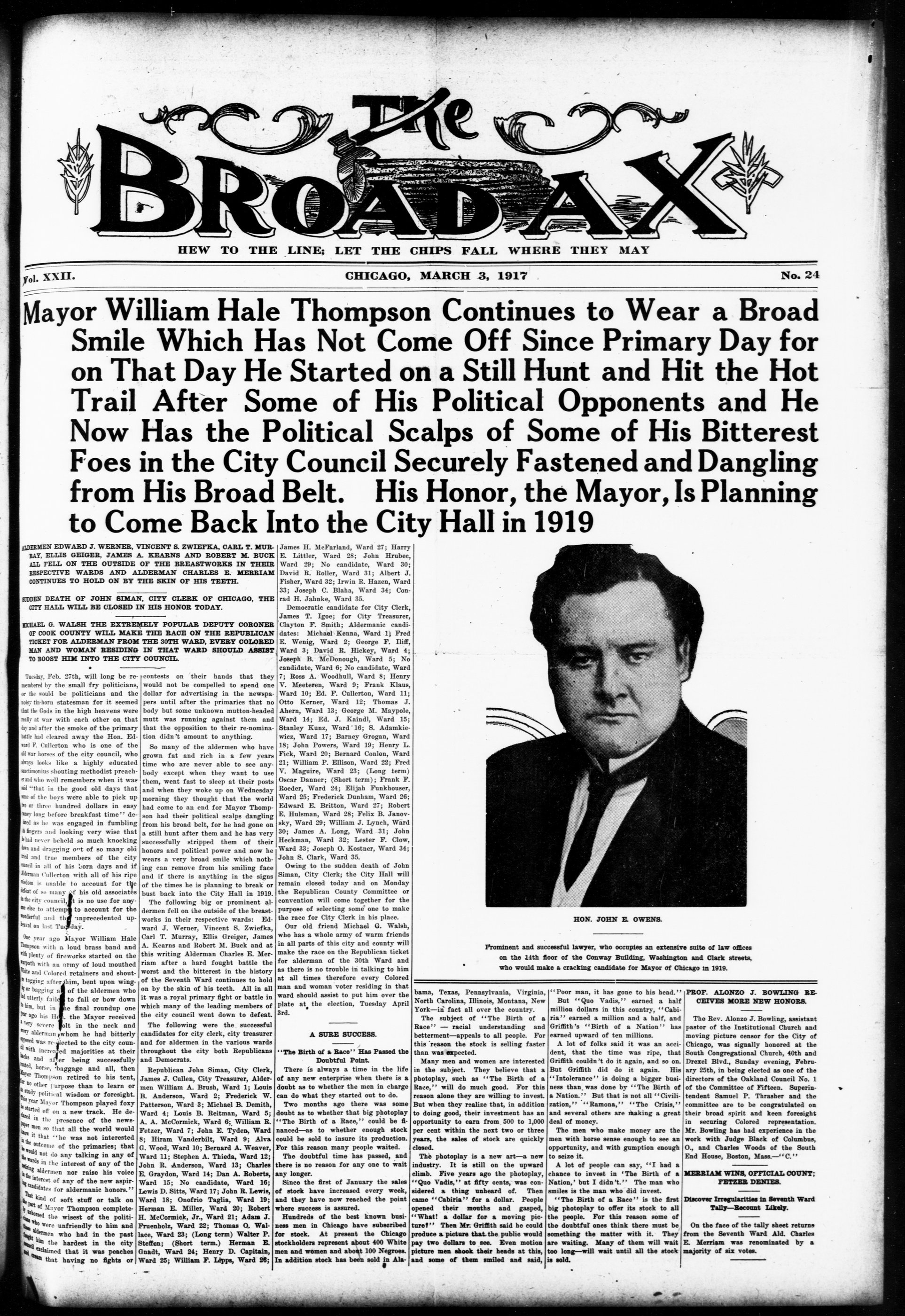
Mayor William Hale Thompson Continues to Wear a Broad Smile Which Has Not Come Off Since Primary Day for on That Day He Started on a Still Hunt and Hit the Hot Trail After Some of His Political Opponents and He Now Has the Political Scalps of Some of His Bitterest Foes in the City Council Securely Fastened and Dangling from His Broad Belt. His Honor, the Mayor, Is Planning to Come Back Into the City Hall in 1919
ALDERMEN EDWARD J. WERNER, VINCENT S. ZWIEFKA, CARL T. MURRAY, ELLIS GEIGER, JAMES A. KEARNS AND ROBERT M. BUCK ALL FELL ON THE OUTSIDE OF THE BREASTWORKS IN THEIR RESPECTIVE WARDS AND ALDERMAN CHARLES E. MERRIAM CONTINUES TO HOLD ON BY THE SKIN OF HIS TEETH.
SUDDEN DEATH OF JOHN SIMAN, CITY CLERK OF CHICAGO, THE CITY HALL WILL BE CLOSED IN HIS HONOR TODAY.
MICHAEL G. WALSH THE EXTREMELY POPULAR DEPUTY CORONER OF COOK COUNTY WILL MAKE THE RACE ON THE REPUBLIC TICKET FOR ALDERMAN FROM THE 30TH WARD, EVERY COLORED MAN AND WOMAN RESIDING IN THAT WARD SHOULD ASSIST TO BOOST HIM INTO THE CITY COUNCIL.
Vol. XXII.
Mayor W
Smile
on The
Trail
Now
Foes
from
to Co
ALDERMEN EDWARD J. WERNER, W
BAY, ELLIS GEIGER, JAMES H
ALL FELL ON THE OUTSIDE
RESPECTIVE WARDS AND A
CONTINUES TO HOLD ON BY
SUDDEN DEATH OF JOHN SIMA
CITY HALL WILL BE CLOSED
MICHAEL G. WALSH THE EXTRE
OF COOK COUNTY WILL MAKE
TICKET FOR ALDERMAN FROM
MAN AND WOMAN RESIDING
TO BOOST HIM INTO THE CITY
Tuesday, Feb. 27th, will long be remembered by the small fry politicians, or the would be politicians and the noisy tin-horn statesman for it seemed that the Gods in the high heavens were really at war with each other on that day and after the smoke of the primary battle had cleared away the Hon. Edward F. Cullerton who is one of the old war horses of the city council, who always looks like a highly educated sanctioninist shouting methodist preacher and who well remembers when it was said "that in the good old days that some of the boys were able to pick up two or three hundred dollars in easy money long before breakfast time" deemed as he was engaged in fumbling in fingers and looking very wise that he never beheld so much knocking down and dragging out of so many old tried and true members of the city council in all of his born days and if Alerman Cullerton with all of his ripe wisdom is unable to account for the defeat of so many of his old associates in the city council, it is no use for anyone else to attempt to account for the wonderful and the unprecedented upheaval on last Tuesday.
One year ago Mayor William Hale Thompson with a loud brass band and with plenty of fireworks started on the rampath with an army of loud mouthed and Colored retainers and shouted tagging after him, bent upon wings or bagging all of the aldermen who had utterly failed to fall or bow down to him, but in the final roundup one year ago his Herd, the Mayor received a very severe polt in the neck and every alderman whom he had bitterly opposed was rejected to the city council with increased majorities at their hacks and after being successfully routed, horse, baggage and all, then Mayor Thompson retired to his tent, for no other purpose than to learn or to study political wisdom or foresight. This year Mayor Thompson played foxy he started off on a new track. He declared in the presence of the newspaper men so that all the world would know it that "he was not interested in the outcome of the primaries; that he would not do any talking in any of the words in the interest of any of the meeting aldermen nor raise his voice in the interest of any of the new aspiring candidates for aldermanic honors." That kind of soft stuff or talk on the part of Mayor Thompson complete unhorsed the wisest of the politicians who were unfriendly to him and those aldermen who had in the past fought him the hardest in the city council enclaimed that it was peaches and cream that having no fights or
```markdown
```
contests on their hands that they would not be compelled to spend one dollar for advertising in the newspapers until after the primaries that no body but some unknown mutton-headed mutt was running against them and that the opposition to their re-nomination didn't amount to anything.
So many of the aldermen who have grown fat and rich in a few years time who are never able to see anybody except when they want to use them, went fast to sleep at their posts and when they woke up on Wednesday morning they thought that the world had come to an end for Mayor Thompson had their political scalps dangling from his broad belt, for he had gone on a still hunt after them and he has very successfully stripped them of their honors and political power and now he wears a very broad smile which nothing can remove from his smiling face and if there is anything in the signs of the times he is planning to break or bust back into the City Hall in 1919.
The following big or prominent aldermen fell on the outside of the breastworks in their respective wards: Edward J. Werner, Vincent S. Zwieffka Carl T. Murray, Ellis Greiger, James A. Kearns and Robert M. Buck and at this writing Alderman Charles E. Merriam after a hard fought battle the worst and the bitterest in the history of the Seventh Ward continues to hold on by the skin of his teeth. All in all it was a royal primary fight or battle in which many of the leading members of the city council went down to defeat. The following were the successful candidates for city clerk, city treasurer and for aldermen in the various wards throughout the city both Republicans and Democrats.
Republican John Siman, City Clerk James J. Cullen, City Treasurer, Aldermen William A. Brush, Ward 1; Louis B. Anderson, Ward 2; Frederick W. Patterson, Ward 3; Michael B. Demith Ward 4; Louis B. Reitman, Ward 5; A. A. McCormick, Ward 6; William R. Fetzer, Ward 7; John E. Tyden, Ward 8; Hiram Vanderbilt, Ward 9; Alva G. Wood, Ward 10; Bernard A. Weaver, Ward 11; Stephen A. Thieda, Ward 12; John R. Anderson, Ward 13; Charles E. Graydon, Ward 14; Dan A. Roberts, Ward 15; No candidate, Ward 16; Lewis D. Sitts, Ward 17; John R. Lewis, Ward 18; Onofrio Taglia, Ward 19; Herman E. Miller, Ward 20; Robert H. McCormick, Jr., Ward 21; Adam J. Fruenholz, Ward 22; Thomas O. Wallace, Ward 20 (Long term) Walter P. Steffen; (Short term.) Herman E. Gaadt, Ward 24; Henry D. Capitain, Ward 25; William F. Lipps, Ward 26;
CHICAGO, MARCH 3, 1917
James H. McFarland, Ward 27; Harry E. Littler, Ward 28; John Hrubec, Ward 29; No candidate, Ward 30; David R. Roller, Ward 31; Albert J. Fisher, Ward 32; Irwin R. Hazen, Ward 33; Joseph C. Blaha, Ward 34; Conrad H. Jahnke, Ward 35.
Democratic candidate for City Clerk, James T. Igoe; for City Treasurer, Clayton F. Smith; Aldermanic candidates: Michael Kenna, Ward 1; Fred E. Wenig, Ward 2; George F. Liff, Ward 3; David R. Hickey, Ward 4; Joseph B. McDonough, Ward 5; No candidate, Ward 6; No candidate, Ward 7; Ross A. Woodhull, Ward 8; Henry V. Meeteren, Ward 9; Frank Klaus, Ward 10; Ed. F. Cullerton, Ward 11; Otto Kerner, Ward 12; Thomas J. Ahern, Ward 13; George M. Maypole, Ward 14; Ed. J. Kaindl, Ward 15; Stanley Kunz, Ward 16; S. Adamkiewicz, Ward 17; Barney Grogan, Ward 18; John Powers, Ward 19; Henry L. Fick, Ward 20; Bernard Conlon, Ward 21; William P. Ellison, Ward 22; Fred V. Maguire, Ward 23; (Long term) Oscar Danner; (Short term); Frank F. Roeder, Ward 24; Elijah Funkhouser, Ward 25; Frederick Dunham, Ward 26; Edward E. Britton, Ward 27; Robert E. Hulsman, Ward 28; Felix B. Janovsky, Ward 29; William J. Lynch, Ward 30; James A. Long, Ward 31; John Heckman, Ward 32; Lester F. Clow, Ward 33; Joseph O. Kostner, Ward 34; John S. Clark, Ward 35.
Owing to the sudden death of John Siman, City Clerk; the City Hall will remain closed today and on Monday the Republican County Committee or convention will come together for the purpose of selecting some one to make the race for City Clerk in his place. Our old friend Michael G. Walsh, who has a whole army of warm friends in all parts of this city and county will make the race on the Republican ticket for alderman of the 30th Ward and as there is no trouble in talking to him at all times therefore every Colored man and woman voter residing in that ward should assist to put him over the plate at the election, Tuesday April 3rd.
A SURE SUCCESS
"The Birth of a Race" Has Passed the Doubtful Point.
There is always a time in the life of any new enterprise when there is a doubt as to whether the men in charge can do what they started out to do.
Two months ago there was some doubt as to whether that big photoplay "The Birth of a Race," could be financed—as to whether enough stock could be sold to insure its production. For this reason many people waited.
The doubtful time has passed, and there is no reason for any one to wait any longer.
Since the first of January the sales of stock have increased every week, and they have now reached the point where success is assured.
Hundreds of the best known business men in Chicago have subscribed for stock. At present the Chicago stockholders represent about 400 White men and women and about 100 Negroes. In addition stock has been sold in Ala-
M.
Prominent and successful lawyer, who occupies an extensive suite of law offices on the 14th floor of the Conway Building, Washington and Clark streets, who would make a cracking candidate for Mayor of Chicago in 1919.
bama, Texas, Pennsylvania, Virginia, North Carolina, Illinois, Montana, New York—in fact all over the country.
The subject of "The Birth of a Race" — racial understanding and betterment—appeals to all people. For this reason the stock is selling faster than was expected.
Many men and women are interested in the subject. They believe that a photoplay, such as "The Birth of a Race," will do much good. For this reason alone they are willing to invest. But when they realize that, in addition to doing good, their investment has an opportunity to earn from 500 to 1,000 per cent within the next two or three years, the sales of stock are quickly closed.
The photoplay is a new art—a new industry. It is still on the upward climb. Five years ago the photoplay, "Quo Vadis," at fifty cents, was considered a thing unheard of. Then came "Cabiria" for a dollar. People opened their mouths and gasped, "What! a dollar for a moving picture?" Then Mr. Griffith said he could produce a picture that the public would pay two dollars to see. Even motion picture men shook their heads at this, and some of them smiled and said,
---
successful lawyer, who occupies an extensive door of the Conway Building, Washington like a cracking candidate for Mayor of Ch.
"Poor man, it has gone to his head." But "Quo Vadis," earned a half million dollars in this country, "Cabria" earned a million and a half, and Griffith's "Birth of a Nation" has earned upward of ten millions.
A lot of folks said it was an accident, that the time was ripe, that Griffith couldn't do it again, and so on. But Griffith did it again. His "Intolerance" is doing a bigger business than was done by "The Birth of a Nation." But that is not all "Civilization," "Ramona," "The Crisis," and several others are making a great deal of money.
The men who make money are the men with horse sense enough to see an opportunity, and with gumption enough to seize it.
A lot of people can say, "I had a chance to invest in 'The Birth of a Nation,' but I didn't.' The man who smiles is the man who did invest.
"The Birth of a Race" is the first big photoplay to offer its stock to all the people. For this reason some of the doubtful ones think there must be something the matter with it. They are waiting. Many of them will wait too long—will wait until all the stock is sold.
No.24
PROF. ALONZO J. BOWLING RE
CEIVES MORE NEW HONORS.
The Rev. Alonzo J. Bowling, assistant pastor of the Institutional Church and moving picture censor for the City of Chicago, was signally honored at the South Congregational Church, 40th and Drexel Blvd., Sunday evening, February 25th, in being elected as one of the directors of the Oakland Council No. 1 of the Committee of Fifteen. Superintendent Samuel P. Thrasher and the committee are to be congratulated on their broad spirit and keen foresight in securing Colored representation. Mr. Bowling has had experience in the work with Judge Black of Columbus, O., and Charles Woods of the South End House, Boston, Mass.—"C."
MERRIAM WINS, OFFICIAL COUNT; FETZER DENIES.
Discover Irregularities in Seventh Ward Tally—Recount Likely.
On the face of the tally sheet returns from the Seventh Ward Ald. Charles E. Merriam was renominated by a majority of six votes.
PAGE RIGHT
TEENAN JONES' PLACE
3445 SOUTH STATE STREET Telephone Douglas 4591 The finest and most UP-TO-DATE BUFFET and CAFE on the South Side. First-Class Entertainers. HENRY "TEENAN" JONES. Proprietor.
Residence 1262 Macalister Place
Telephone Menroe 2714
MILES J. DEVINE
ATTORNEY AT LAW
Suite 313-329 Reaper Block
Clark & Washington Sts.
4709 S. STATE STREET
CHICAGO
Phone: Central 239
Auto. 41-916 CHICAGO
PHONES: OFFICE. MAIN 4188
AUTOMATIC 33-736
RESIDENCE. DREXEL 7990
Hours 9 A. M. to 5 P. M., 7 P. M. to 6 P. In
Sundays by Appointment
Walter M. Farmer ATTORNEY AT LAW
Phone Main 2017
SUITE 708, 184 WASHINGTON ST.
NOTARYPUBLIC CHICAGO
A. L. WILLIAMS
ATTORNEY AND COUNSELOR AT LAW
Franklin A. Denison ATTORNEY AT LAW
Suite 706 Firmenich Bldg
184 W. Washington St.
36 West Randolph St., Chicago
Suite 708 Delaware Building
Residence 5548 Jefferson Av.
Phone Midway 5515 Chicago
Tel. Central 3142
TEL. OAKLAND 1650, 1651, 1652
JOHN J. DUNN
WOOLSALE COAL RETAIL
Fifty-First and Armour Avenue
RAILYARDS
51st St. and L. S. & M. S.
51st St. and Armour Ave.
118 North La Salle St., Chicago
Suite 615 to 616
PHONE MAIN 2214
---
Alike, very Different.
On Seventh avenue the other evening I saw a small red headed fool of a boy throwing can. "An excitement craving, empty headed kid." I said to myself, driving on. On the next block I saw a girl with red curls, dressed in fur, rather dashing, who gave me a little provocative smile as I passed. Did I say to myself that she was an excitement craving, empty headed kid? She was, but I didn't. On the contrary, for the moment at least, I felt quite drawn toward her. Yet she and that boy migt easily have been brother and sister and twin rowdies at heart. Why did one of the two so attract me and the other repel?
A Little Gas Heater Given Away
A
To every purchaser of one length—8 ft. of our metal tubing hose with screw connection,$1.95, we will present one
No. 1 Eclipse Heater
(Like Cut)
Just the thing to equalize the temperature in Winter and Spring weather.
The strange lure of sex. It was ready to blind me to the mental defects of that girl. It was ready to fix my thoughts on her cheeks or her hair if I'd sat with her. Now, isn't that odd? I should never have given a snap for her kid brother's hair or cheeks naturally. I'd have looked him well over aid seen at a glance he hadn't much character and maybe less brains, but could I have seen what she lacked once I'd felt her attraction?—Clarence Dry, Jr., in Metropolitan Magazine.
```markdown
```
Call up House Heating Section
The Peoples Gas Light & Coke Company
Wonders of Color
A small and simple experiment can be made by any reader which will go far to convince him or her what a good thing it is we have sunlight, which enables our eyes to take advantage of the beautiful hues of nature. Make a room quite dark and then burn some carbonate of soda in the flame of a bunsen gas burner. It will burn with an orange yellow light sufficiently strong to illuminate everything in the room, but you will realize with a sudden shock that, bright though the light is, all distinctions of color have vanished. Only light and shade remain. A crimson carnation, a blue violet, a red tablecloth, a yellow blind—all look gray or black or white. The faces of those present look positively repulsive, for all natural color has disappeared. No other experiment will so well convince those who have witnessed it how great a loss would be that of our sense for color.
Wabash 6000
Or visit our nearest
Branch Store
Harmony There.
Papa (sternly)—Come here, sir! Your mother and I agree that you deserve a sound whipping. Small Boy (bitterly)—Oh, yes; that's about the only thing that you and mamma ever do agree about!—Christian Advocate.
"How do you keep moths out of clothing?" asked the girl with a needle and thread.
"Why," replied the girl with a story book, "I didn't know they wore any."—Washington Star.
KINKY
HAIR
Atlanta, Ga.
Duluth Med. Co.
Gentlemen. Med.
My picture shows you
what your hair is.
EXELENTO QUININE
POMADE
has done for me a hair.
Before I used it, my hair
was short and coarse,
and soft and long,
and so soft and
mild, and it felt like
up my way. I want to
CELLA GREEK.
Don't let some fake Kink Remover fool
you. You really can't straighten your hair
until it's nice and long. That's what
EXELENTO QUININE
POMADE
does, removes Dandruff, feeds the Roots of
the hair, and helps it soft and
silky. After using a few times you can
bake the difference, and after a little while it
will be so pretty and long that you can fix
it so well yet. If Dandruff does
we claim, we will give your money back.
25c by mail on receipt of stamps or coin.
AGENTS WANTED EVERYWHERE.
Write for Particular.
EXELENTO MEDICINE CO., Atlanta, Ga.
THE BROAD AX. CHICAGO, MARCH 3, 1917.
As Near As Your Telephone DISTANCE IMMATERIAL
IN a Metropolitan City of this size, death knocks every thirty minutes at some door. Too often that death not only brings sorrow, but misfortune as well. Let the price you pay for a funeral be a business proposition and you will benefit by it in service, quality and cost to you in dollars and cents. The result of my campaign has built for me one of the largest and most magnificent establishments in the world. A visit will convince you.
Consult me, I can save you Worry, Time and Money. Shipping to all parts of the Country and Automobile Funerals a Specialty. Central Display Rooms and Chapel. Call promptly answered day or night.
Ernest H. Williamson,
KENWOOD
455
Undertaker
AUTOMATIC
73-867
5028 and 5030 S. State St.,
A. E. H.
A visit will
Consult me, I can save you Worry,
Shipping to all parts of the Country
Funerals a Specialty. Central Dis
Chapel. Call promptly answered day
Ernest H. William
KENWOOD
455
Undertake
5028 and 5030 S. State St.,
Signing Diplomatic Notes.
No one can say exactly why our secretaries of state sign diplomatic communications with their surnames only, except that it has always been so. We copied the custom from European chancelleries, and it probably has its origin in the habit of royalty, which is to sign with one name only. Thus King George of England signs himself "George, R. I." (Rex, Imperator—King, Emperor); Sir Edward Grey signed always as "Grey;" the democratic Mr. Bryan when secretary of state affixed his signature to diplomatic notes as "Bryan." At first sight there seems to be a profound flattery implied in the custom. It assumes that the signer cannot be mistaken; that there is only one "George," and "Grey," one "Bryan." And generally there is only one in the diplomatic world where these exchanges take place—New York Sun.
Effects of Arsenic.
"Arsenic, as science has long told us an accumulative poison," said a druggist. "When one takes it either by prescription for the upbuilding of an appetite or for the bleaching of the skin he does not feel any ill effects for several years. The effect of the drug is bracing and makes a person feel like eating. It also aids the digestion. The average user of the poison takes it in such small quantities that he does not realize how much of it will accumulate in his system in the course of four or five years.
"Being an accumulative poison, it often takes that length of time to see the results of the drug. Then the user may complain of not being able to control his fingers or toes. Subsequently he loses control of his hands and arms. Paralysis, superinduced by arsenical poisoning, is the fearful result."
Got There All Right
Many years ago, at the beginning of November, a missive bearing the St. Albans postmark reached St. Martin's. The envelope was addressed "lud mar lunding." Neither tall nor head could be made out of this by the staff, so the envelope was opened for a clew. The letter read, "kenyoblauosfoyosho bilgs."
The practiced St. Martin's decipherer of puzzles promptly made out the signature as "Bill Higgs." With the key this afforded the rest was delicously easy. The message was, "Can you buy a horse for your show?" and "lud mar" meant "lord mayor." So the letter, with an official translation considerately appended, was delivered to the lord mayor elect—London Mall.
Many Uses For Sawdust
Sawdust is valuable. It can be used for almost anything except food. Used as an absorbent for nitrolycerin it produces dynamite. Used with clay and burned it produces a terra cotta brick full of small cavities that, owing to its lightness and its properties as a nonconductor, makes excellent fireproof material for walls or floors. Treating it with fused caustic alkali produces oxalic acid. Treating it with sulphuric acid and fermenting it with the sugar so formed produces alcohol. Mixed with a suitable binder and compressed it can be used for making moldings and imitation carvings. If mixed with portland cement it produces a flooring material.—Philadelphia Record.
Ivory In Siberia:
An enormous supply of ivory exists in the frozen tundras of Siberia, which it is thought, will probably suffice for the world's consumption for many years to come. This ivory consists of the tusks of the extinct species of elephants called mammoths. The tusks of these animals were of great size and are wonderfully abundant at some places in Siberia, where the frost has perfectly preserved them.
Tree In a Chimney.
On the island of Trinidad is a lone brick chimney which once was part of a sugar mill long since gone to rule. The chimney has remained intact, and a tree has grown up through the center and pushed its branches through the top.
Love
At twenty love is a rosy dream, at
thirty it is a thrilling reality, at forty
it is a calm contentment, and at fifty
it is a reminiscence.
Robber1
Tom—So you heard that Bill stole from his wife. Sam—Yep, he hooked her dress.—Michigan Gargoyle.
Poor and content is rich and rich enough.—Shakespeare.
Chicago, Ill.
How Wood Shrinks.
Students in the college of forestry at the University of Washington have proved by experiment that a cord of full length wood when sawn and replied in the ordinary stack shrinks on an average 24.76 per cent. As dealers buy wood in full lengths and usually measure it for delivery before sawing it, they are often accused of giving short measure.
A "cord" is the standard measurement of wood, and it is defined as 128 cubic feet of wood, measured by a pile four feet high and eight feet wide of logs four feet long.
The discrepancy between the cord as bought by the dealer and as delivered to the customer, according to Professor Hugo Winkenwerder, dean of the college, is not entirely explained by the sawdust. When wood is piled up in four foot lengths there are many spaces between sticks, caused by knots and curvatures. These spaces are eliminated when the wood is cut up small.
Ancestry of Modern Dogs.
According to Charles R. Eastman, writing in the Museum Journal, our modern dogs have a varied ancestry, some being descended from Asatil and some from African species. The spitz in all its varieties is a domesticated jackal. The mastiff and St. Bernard and their kind are descended through the molossus of the Romans from a huge, wolflike creature that was already domesticated by the Assyro-Babylonians 3,000 years before our era. The Russian borzol and the Sicilian hound had their origin in the Cretan hound, which is still common in Crete, and it and its cousin, the Ibaza hound of the Baleariic islands, came from the ancient Ethiopian hound, which was a domesticated wolf. The collie or shepherd dog seems to come down direct from a small wild dog of the paleolithic period.
Here's a Tip About Hotel Guests.
In the American Magazine a writer says:
"Here's a funny thing, by the way, that I've noticed about hotel guests. You leave a soiled towel in a room and the guest will probably complain, but you can leave a bucket of paint and a paper hanger's scaffold in the hallway and compel the guest to crawl under a stepladder to get to his room and he will put up with it cheerfully, because he knows you are painting or papering by way of making an improvement and he is in sympathy with that. It doesn't cost much to make over a carpet so that a bare spot in front of the dresser will be eliminated, but such little details are a vast help in making a hotel prosper."
The "Only Child."
When parents have an "only child" it seems to get as much attention as six or eight children in a large family. Some statistics show that out of a hundred "only children" eighty-seven were nervous, the girls suffering worse than the boys. And then the statisticians say the only child lacks self reliance, is precocious, vain and unsociable, is often extremely timid, being afraid of dark rooms and of sleeping alone.—Exchange.
It's an Ill Wind.
"Rejected you, did she, old man?"
"Yes."
"Too bad! No doubt you had planned to buy her a ring and all that?"
"Yes."
"Had your money all saved up, eh?"
"I should say so. Had $50 all ready."
"I say, old man, you—er—couldn't lend me that $50 till you find some other girl who will have you, could you?"
—Boston Transcript
"But he sometimes makes sarcastic remarks about your staying so early in the morning." - Birmingham Age-Herald.
Cause and Effect
She—So you danced with Miss Light-
foot at the ball last night? He—Yes.
Did she tell you? She—Oh, no. But I
saw her going into a chropodist's this
morning.
Mosquito Netting.
Mosquito netting is an ancient Greek if not Egyptian invention, even if it does seem a Yankee idea.
It is easier for the generous to forgive than for offense to ask it.—Thomson.
GENERAL BANKING cent allowed on Savings Accounts Deposit Vaults, $3.00 per Year
3 per cent allowed on Savings Accounts Safety Deposit Vaults, $3.00 per Year
Cranford Apartment Building. 3600. Wabash Ave.
building ever opened to Colored tenants in Chicago electric light, tile baths, marble entrance.
As agent buy and sell Real Estate on commission, manages estates for non- residents, including payment of taxes and locking after assessments. Money to loan on Chicago Real Estate. Especially Invites the patronage of Chicago business men
The-Cranford Apartment Building. 3600-Wabash Ave.
THE NEW YORK MUSEUM
The finest building ever opened to Colored tenants in Chicago Steam heat, electric light, tile baths, marble entrance.
All Eye Trouble
SEE
Dr. LOUIE UGELMAN
All Eye Trouble
SEE
DR. LOUIE USSELMANN
The Practical O tician
THE MOST COMPLETE OPTICAL ROOMS IN THE CITY
BEST GOODS AT THE LOWEST PRICES
Consultation or examination
FREE. We have 28 different
ways of testing the eyes and
guarantee to give satisfaction.
3150 S. STATE ST.
Phone Douglas 5308
CHICAGO
A. F. CODOZOE,
J. H. WHISTON, Prepristers
CHAS. HARRIS, Manager
DOUGLAS 6971
Phones DOUGLAS 3258
AUTO. 72-379
The Elite Cafe
AND BUFFET
3080 STATE STREET
CHICAGO
THE BANK OF THE UNITED STATES
3 per cent and Safety Depot
REAL
As agent buy and sell Real
dents, including payment of
on Chicago Real Estate.
Especially Invite
The Cra-
Building
The finest building
deam heat, electric light
'Phone Randolph 80
THE MOST COMPU
BEST GO
Consultation or examin-
FREE. We have 28 diffe-
ways of testing the eyec
guarantee to give satisfac
JOHN BLOCKI, President
C. E. KRE
5057 S
NOT O
FOR HIGH, GRA
MEDIC
S. E. Cor. State and 36th Place, Chicago Telephone Douglas 1565
REAL ESTATE DEPARTMENT
J. W. Casey, Agent,
74 W. WASINGTON STREET.
Dan M. Jackson
Geo. T. Kersey
David A. McGowan
Ahmed A. Rayner
The Emanu
Undertaking
2959-61 South State St.
Reliable Service Courteous Treatment
Reasonable Prices
FREE CHAPEL IN CONNECTION
Complete line of Funeral Goods. Automobiles for hire
Telephone Douglas 6568 Automatic 73-657
THE SOLACE BILLIARD ACADEMY
"THE MODERN SCHOOL" - CLEAN AND RELIABLE
TERREVOUS L, DOUGLAS, Prop.
CIGARS—WHOLESALE AND RETAIL
BOX TRADE A SPECIALTY
3556 South State Street
PH ONE DREXEL 3244
T. W. Chan
Real Estate
RENTING :: LOAN
5107 South
Ch
A Wonderful Aboriginal City.
A Wonderful Aboriginal City.
Near Laguna, N. M., may be seen Acoma, the "sky city," claimed to be the most wonderful aboriginal city in the world. It stands on an isolated rock eminence 400 feet in height. The city embraces three rows of houses over a thousand feet in length, rising up in terraces four and five stories. One is amazed when he stops to consider that the material for these buildings were transported long distances and up the cliffs upon the heads and backs of these human burden bearers. Their graveyard consumed forty years in building by reason of the necessity of bringing earth from the plain below, and their church must have cost the labor of many generations, for its walls are sixty feet high and ten feet thick. and it has timbers forty feet long and fourteen inches square.-Exchange.
A Story of Longfellow.
In Longfellow's journal, in which he chronicled daily things that came under his observation, he notes that upon a certain occasion he attended a church where the minister took as his subject "Progress." He was very flattered when the latter quoted about half of the "Psalm of Life." After repeating the verses the minister said, "I could never read that poem without feeling the inspiration with which it was written." To this incident Longfellow adds: "But I had the conceit taken out of me on the evening of that day, when I happened to meet a lady at Prescott's and in our conversation she referred to the sermon in the morning and added, 'He quoted some beautiful verses, but nobody knew whence came the quotations.'"
We, the People.
Estimating the world's population as 1,600,000,000, the whole human race at present living could stand comfortably shoulder to shoulder in an area of 500 square miles. Taking the number of generations in the past 6,000 years as 200, the room taken up by them all on the above plan would be less than the area of the state of Colorado. To bury all the people on earth would need a graveyard little larger than that area.
What Is a Hawaiian?
A correspondent inquires whether it is proper to speak of a Hawaiian as a "Kanaka." The term is masculine. A "Kanaka" is a male Hawaiian. A "wahine" is an unmarried Hawaiian woman. A "wahinemare" is a married Hawaiian woman. These definitions are from the Hawaiian dictionary—Bellingham American Review.
Inherited, as It Were.
Professor—Yes, sir, your daughter is pretty well grounded in French, but it will, of course, take some time and trouble for her to acquire fluency. Father—Well, you know, that's rather strange to me. I had an idea that the fluency would have come sort of natural to her—Exchange.
Explained the Matter.
Papa—I'm surprised that you are at the foot of your class, Tommy. Why aren't you at the head sometimes, like little Willie Bigbee? Tommy—You see, papa, Willie's got an awful smart father, and I guess he takes after him.—London Telegraph.
Made a Difference
"Why do you fire me? I work like sixty."
"If you were sixty that might be excusable. But you're only twenty-five."
—Louisville Courier-Journal.
Happy the man who learns the very wide chasm that lies between his wishes and his powers.—Goethe.
PAGE TWO
PHONE DREXEL 3244
\(x^{2}+y^{2}=r^{2}\)
Phones Calumet 6164
Automatic 71-629
OPEN DAY
AND NIGHT
uel Jackson
g Co., Inc.
Automobles for hire
Automatic 73-657
BLIARD ACADEMY
CLEAN AND RELIABLE
Res. PHONE DREXEL 2082
Champion & Co.
State Brokers
INSURANCE
State Street
Chicago
Outside the House.
Outside the House.
How many beautiful homes on which money has been spent lavishly to make them complete are marred by some defect in the landscape work! A few hours' motor trip through the suburbs of almost any city in the country will reveal many such cases. The most frequent jar the trained eye receives is from the poorly laid out walks and driveways in which badly arranged curves are used or walks made to curve around an oval grass plot placed in the center for no other reason than to make pedestrians take time to circle about that particular grass plot. Postmen, messenger boys and others take a short cut, and soon a path in the proper direction is worn across the sod. When a curve is used in a walk or driveway there should be a reason for it. If there is no other reason plant one; place a tree or two or shrubs in a position so the curve will seem necessary. People then will keep on the walk, and the plan will seem reasonable—New York Sun.
Making a Magnet
The simplest way of magnetizing a bar of steel is that known as "single touch." The bar to be magnetized is laid on the table, and the pole of a powerful magnet is rubbed from ten to twenty times along its length, always in the same direction. If the north pole of the magnet is employed the end of the bar first touched will also become a north pole, while the opposite end, at which the magnet is lifted before returning, will be a south pole.
There are other and more complicated methods, known as "divided touch" and "double touch," in which two and even four magnets are employed.
A steel bar can also be magnetized by placing it within a coll of insulated wire, through which a galvanic current is circulating. The magnetism induced in this way, however, is weak compared with that which can be procured if the same strength of current is employed through the intervention of an electromagnet.
Many William Shakespeare.
There have been many William Shakespearees in the past. Among the burials in the registers of St. Clement Danes, in the Strand, there is the entry, "Jane Shackpeer, daughter of Willm, 8 Aug., 1609." Warwickshire records show, among other things, that a William Shakespeare "paid 8s. to the Lay Subsidy, Walton super Olde," another W. S. priced the goods of "Robert Shakespeare of Wroxall" on March 10, 1563; another, a shoemaker of Coventry, made his will March 18, 1605-6; still another William Shakespeare, "gentleman," had "his daughter Susanna" (singularly enough) baptized on March 14, 1596, and yet again another W. S., a shoemaker of Warwick, fell into the Avon and was drowned. These are a mere fraction of the full list.—London Chronicle.
Falling Up Out of a Balloon.
If a man falls out of a rising aeroplane or balloon he will not go toward the earth, but will continue rising into the air for an appreciable time. If the air machine were stopped in its ascent at the time it could catch the man as he came down. If the airship were ascending at the rate of thirty-two feet a second the man would rise sixteen feet before beginning to fall toward the earth. Thus, by reducing the speed of its ascent, the vessel might keep by the side of the man and rescue him. The reason why the man rises is the same as the reason for a bullet's rising when shot from a gun into the air—both the man and the bullet are given a velocity upward, and it takes some time for gravity to negative that velocity.
---
THE BROAD AX. CHICAGO. MARCH 3. 1917.
What Are You Worth?
Have you any idea? Did you ever capitalize your wages and figure it out? This is the way to ascertain how much your labor is really worth. For instance, a man who has saved $20,000 and invested it at 5 per cent receives an annual income of $1,000 a year, or about $20 a week. The clerk in the office or the workman in the factory who gets $20 a week therefore receives the income at 5 per cent on an investment of $20,000. He is a $20,000 man—that is, he is getting as much week by week as the man with $20,000 who depends solely upon the income from his investments and who does not work for a living. The man who earns $40 a week has about the same income as the investor with $40,000 put out at interest at 5 per cent.
So labor is capital. It has a market value. It can be called a commodity because it can be sold by its owner the same as any other possession he may have. John A. Sleicher in Leslie's.
Shotguns In War.
That shotguns should be largely utilized in modern warfare is the contention of a number of military experts. It is pointed out that such guns would be particularly useful to sentries at night time, as an intruder might more easily be crippled and captured by a spreading charge of heavy shot than by a single bullet. Moreover, a person moving quickly might often be missed by a shot from a rifle, whereas a snapshot from a shotgun in semidarkness could hardly fail to find its object.
In the trenches shotguns could be used with success. A shotgun loaded with about forty-eight grains of powder and one and a half ounces of big shot, with about twenty-five pellets, would be of much more value than the rifle, as during a night attack, either for attack or defense in semidarkness, a single charge would hardly fail to inflict serious wounds on one or more of the enemy.—Exchange.
The Swiss Admiral
"As much business as a Swiss admiral" is a term sometimes used satirically. But the little inland nation actually had an admiral once. He was an Englishman, too, a Colonel Williams, who joined the Swiss colors in 1790. This Colonel Williams got together a small fleet on Lake Zurich and was ordered to oppose the French army, which was preparing to attack the Austrians and Russians massed near by.
The French attacked their allied foes and routed them. Admiral Williams calmly watched the battle that was in progress on land. Then, enraged at his own inaction, he discharged his crews, scuttled his vessels and went back to England.
Switzerland now has one armored boat on Lake Lucerne, but its commander is only a captain.—Kansas City Star.
A Father Vaughan Story.
Father Bernard Vaughan, the famous English Jesuit preacher, says what he means and means what he says and is never afraid of directing his criticisms even against the most powerful sections of society, especially the idle rich.
An amusing reference was once made to the fiery methods of denunciation he employs when in the pulpit. He had been preaching in Rome and had, as usual, dealt out plain truths about everybody with his accustomed force. One of the cardinals remarked that he preached like an Italian. "Yes," said another dignitary, "but he is an Italian. He was born on Vesuvius, and we only sent him to England to cool."—London Globe.
Salt and Toothbrushes
Our dentist tells us a very interesting thing. Ordinary salt is one of the best methods for sterilizing toothbrushes that are known. But not only because it sterilizes it is so excellent, but because it has the effect of softening the bristles and making them expand in a way. One of the troubles so frequently met with is that the bristles come out and are swallowed, causing appendicitis. The salt causes the bristles to swell and so remain in the brush. This may be but another of the several million theories. It is important, however, that bristles do cause appendicitis—New York Globe.
Substitute For Tobacco
Throughout the tropical orient the natives employ a substitute for tobacco consisting of a slice of areca palm nut, wrapped in betel leaf, flavored with a fine lime made of native seashells and colored with carmine. The habit is universal, especially with the women, and sellers of "betel nut" may be seen on many of the street corners in Saigon and other cities of Indo-China.
Handsome Serenity
"George Washington was never guilty of deception."
"Maybe not. I don't believe, in fact, that he ever looked like his pictures on our postage stamps. But, of course, he wasn't responsible for them."—Washington Star.
Logical Conclusion:
"Electric wires must be quick tempered."
"Why?"
"Because it seems so dangerous to cross them."—Baltimore American.
No Hangings.
Him—How did you like the stage hangings in that Shakespeare show? He—There weren't no hangings, 'y boob! He killed 'em with a sword.—Cornell Widow.
Men who are low and are falling do not revolt. It is men who, although they may be low, are rising who revolt.—W. G. Sumner.
YOU HAVE READ MUCH! THOUGHT SOME BUT NOW IS YOUR TIME TO ACT
Your opportunity to be a part owner----to share in profits of "THE BIRTH OF A RACE"
is passing. The shares of Capital Stock have been turned over to a strong firm of brokers. The sales are big----in Chicago----all over the country. The shares are going very fast. Soon they will be entirely gone, and your chance to make a lot of money gone also----unless you get busy. Not Next Month But TO-DAY or Next Week
This Master Photoplay is of interest to you. It will help you and your race, and make money for you at the same time.
President, EDWIN L. BARKER, a man who has produced real motion pictures. Secretary, JOHN C. WILLIAMS, for 6 years Attorney for Sanitary Dist. of Chicago. Treasurer, JOHN GULLIKSEN, Assistant Cashier of the Union Bank of Chicago. DEPOSITORY FOR FUNDS, Union Bank of Chicago.
CLIP, fill out and mail this coupon to-day, and circular telling all about "THE BIRTH OF A RACE," will be sent you at once. There is a Monthly Payment Plan which makes it very easy to own a few shares of stock.
Life of a Battleship.
We are continually reading in the newspapers that various battleships have been completed, launched and for how long they have been commissioned. There are probably few people, however, who know how long a battleship lasts. The average life of a modern battleship is about fifteen years. In the old days a battleship was on active service nearly the whole time of its commission, which was about a hundred years.
The Victory was forty years old when she fought at Trafalgar, and the Royal William, which was built in 1670, was not "scrapped" until 1813.—London Mail.
A squab grows enormously the first twelve hours and still more rapidly after the third day. Squabs are at first sparsely covered with long filaments of down, the root of each filament indicating the point from which each future feather is to start. The down for awhile still hangs on the tips of some of the feathers during their growth and is thought by some to be finally absorbed into the shaft of the growing feather.
"Oh, come! Stop borrowing trouble."
"Borrowing! Gee whiz, man, trouble isn't like money! When I borrow money I can forget about it right away."—Boston Transcript.
"The office should seek the man."
"And the girls aren't hanging back either these days."—Kansas City Journal.
___
☐ PRACTICAL HEALTH HINT.
☐ ___
---
```markdown
```
Using the Scrub Palmetto.
Once a prolific and troublesome waste product throughout Florida, the scrub palmetto is now being developed into an asset of great possibilities. Not only has it been discovered that paper of good quality can be made from it, but the manufacture of carpets, mattings, twines, rope and burlap from the plant is already an industry of high standing in the state. Only the green leaf, or fan, is used. Claim is made that the palmetto leaves when shredded and spun are very much tougher than the grass now used for mattings. The green leaves are fed just as they are cut into the shredding and spinning machines, and in three minutes they come out in twine. This avoids the discolorations and losses occasioned in drying, storing and handling grasses commonly used for matting. Palmetto can be cut every day in the year and immediately made into twine. The skins of twine when hung up dry rapidly and uniformly. The twine is used as soon afterward as necessary.—Argonaut
Creed of the Busy Man.
I believe in the stuff I am handing out, in the firm I am working for and in my ability to get results. I believe that honest stuff can be passed out to honest men by honest methods. I believe in working, not weeping; in boosting, not knocking, and in the pleasure of my job. I believe a man gets what he goes after, that one deed done today is worth two deeds tomorrow, and that no man is down and out until he has lost faith in himself. I believe in today and the work I am doing, in tomorrow and the work I hope to do and in the sure reward which the future holds.
I believe in courtesy, in kindness, in generosity, in good cheer, in friendship and in honest competition. I believe there is something doing, somewhere, for every man ready to do it. I believe I'm ready—right now!—Elbert Hubbard.
The Sadness of a Wedding.
There is something sad about a wedding. The young groom is leaving a home in which he always has had his way and is going into one in which he never will have his way. Although his parents do not go through the formality of giving him away at the altar, they know well enough that in a few minutes he will be a son-in-law to another woman, while to them he is nothing but a son. There he comes, with another son holding to his arm. It looks as if he might have made an attempt to escape and that the strong best man captured him and brought him back. He is as happy as he is nervous and so trustful that he has no fear for the future—Claude Callan in Fort Worth Star-Telegram.
Why Not?
Clerk—Now, see here, little girl, I can't spend the whole day showing you penny toys. Do you want the earth with a little red fence around it for 1 cent?
Little Girl—Let me see it—Life.
Life of a Battleship.
Squabs.
The Wrong Word.
His Grouchy Opinion
Cleaning the Teeth.
A clean tooth never decays. The best way to clean the teeth is to place the bristles of the brush firmly against the teeth and with a rotary or scrubbing motion go up and down the surface of the upper and lower teeth both inside and out and up on the gums. Go also behind the teeth. After seeing that every bit of the surface of the teeth has been cleaned in this way rinse the mouth thoroughly, forcing the water between the teeth several times to loosen any food particles. Do this more than once and always spit it out. To keep the teeth as clean as they should be kept in order to preserve them and prevent decay it is necessary to wash them after each meal so as to remove all food particles. They should also be washed the first thing in the morning and the last thing at night. It is well to have more than one brush on hand at a time, so that it will never be necessary to use a wet, limp brush.
```markdown
```
FREE STYLE BOOK ... HAIR ...
To Colored Women
We are the largest
manufacturer of
Colored Hair. Our latest
book showing new
styles in hair
dressing and hair
every colored we
man should have
one. We sell lashes
and winters articles. 361
Infaction guaranteed
or money back.
We sell lashes
and winters articles. 361
Infaction guaranteed
or money back.
We sell lashes
and winters articles. 361
Infaction guaranteed
or money back.
ENING combs, with extra heavy lock,
guaranteed. With each comb we give him
FREE. Send money order or stamp. MONEY
BACK IF NOT SATISFACTORY. No postal.
POSTPAID 89c
Hair nets, brushes, combs and toilet articles
manufacturers' prices. Add to order.
Agency Weaved. Add to order. See us as follows:
HUMANIA HAIR COMPANY,
181-187 Park Row,
New York City.
Address Dept. 84
Grapes will grow almost anywhere and are sure to bear. Grapes can be trained on trellises close to fences or outbuildings. Spring is the best time to plant, using either one or two year old vines. Frequently cultivation during summer will improve the fruit. Wood ashes make a good fertilizer for grapes, and half a bushel to the vine will not be too much. No pruning will be required the first season, but the second season cut back the strongest canes to three or four buds and remove all others.
Prepar Physical Education
Proper Physical Education
The purpose of physical education is of course, not merely to build up the bodies of boys today, but to put into the lives of boys that thing, whatever it is, that will make the boy stay strong and ablebodied when he reaches manhood. Such men—lovers of fresh manhood of hiking in the wild, of sleeping out under the sky—men who can both enjoy and endure, are the men who will make up a strong nation and not a nation of weaklings.—Scouting.
Casa Hernie Lighthouse
Cape Horn's Lighthouse
Probably the most desolate and dreary spot in the world inhabited by white men is the lighthouse that is maintained by the Argentine government at Cape Horn. This is claimed to be the southernmost lighthouse in the world.
One at a Time.
"Does your husband worry about the grocery bill?"
"No; he says there's no sense in his
himself and the grocer worrying over
the same bills."—Exchange
Health lies in labor, and there is an earthly royal road to it but through toll—Wendell Phillips.
PROMOTING THE HAPPY FAMILY PLAN IN AMERICAN INDUSTRY
All Grievances Presented by Men Through Representatives Reach Head of Company and Are Honestly Investigated.
For more than a year a large and progressive industrial corporation with plants scattered over a large territory in several states of the southwest has been improving its relations with its employees through the medium of a so-called industrial representation plan—an industrial constitution drawn on a basis of democracy and mutual confidence between the head of the company and the workmen who number from 10,000 to 12,000.
To deal with the diverse interests of such a vast body of men is a serious task involving stern responsibilities. Nevertheless the company, through its representation plan, has not only carried on social and industrial betterment work on a comprehensive scale but has succeeded in settling all grievances without friction and without interference from the outside. During the year several increases in pay have been made upon the initiative of the company.
Altogether the plan has demonstrated itself to an important forward step in the establishment of amicable relations between all the factors in industry. A more widespread adoption of such schemes in plants and factories is heartily recommended by the bread-minded manufacturers of the country who have started the National Industrial Conservation Movement for the purpose of getting employers and employees together. The supporters of the conservation movement realize that the captain of industry and the workingman must fight shoulder to shoulder to protect American industry against conditions that are sure to prevail after the War.
Workers Elect Representatives
Workers Elect Representatives.
The Industrial Representation plan was adopted in its present form by the directors of the company and by a referendum vote of the workmen. By secret ballot the workmen in the company's various plants select representatives who act as their authorized agents in all matters pertaining to employment, living and working conditions, the adjustment of differences, and other matters of mutual concern and interest. On the other hand, the president keeps in direct touch with the workmen through officers known as presidents industrial representatives.
Employee have been made to understand that they are absolutely free to present all their grievances even though they involve charges against the foreman or superintendents under whom they work. Through the workmen's representatives the complaints are referred to the presidents' industrial representatives, who in turn investigate them carefully and report their findings in detail to the president.
In every case the grievances have been investigated fearlessly and impartially and adjustments have been made on a strict basis of fairness, irrespective of whether the award was in favor of the workman or the company official. The workman, dissatisfied with the decision of the presidents' industrial representatives, can appeal to the higher officers of the company in consecutive order up to the president. Then, if he still feels that he has not received full justice, he can carry his case to the joint committee on Industrial Cooperation and conciliation, comprised of both employees, representatives and the company's representations, and finally to the State Industrial Commission.
Confer on Wage Increases
Under the industrial constitution drawn up matters of wages, hours of service and other vital factors in the company's relations with its employees are settled by a written contract. Increases in wages are worked out in conference between company officials and the workmen's representatives. In all matters of industrial betterment the employees' representatives play an important part. They are assigned to joint committees on which they serve with representatives of the company. The names of these committees—Safety and Accidents, Sanitation, Health and Housing, and Recreation and Education—give an adequate idea of the broad scope of the company's interest in its employees. To carry out the schemes endorsed by the committees the company has spent money and effort unstintingly, although it has always avoided any semblance of parentalism.
since the inauguration of the plan that the company has enlarged its previous programme of providing model homes for its employees who live on company property. The company is fencing, free of charge, each employee's home. A series of prizes is given every year for the cultivation of lawns and gardens. Many of the workers own their own automobiles. At the plants garages have been provided, with stalls rented to employees at a moderate rate—Industrial Conservation, N. Y.
UNITY NEEDED TO HOLD
TRADE AFTER THE WAR
Labor Must Join In Effort to Meet New Competitive Spirit In Europe.
"Employers and workers must unite to meet the conditions that the restoration of peace in Europe will bring," says Eugene H. Outerbridge, president of the New York Chamber of Commerce. "I think there is no single element in industry before this country today of such vast importance as the matter of bringing these two constituents into mutual confidence and understanding in a real spirit of co-operation.
"In the world conditions now prevailing the peoples of the belligerent nations have, under the stress of a compelling necessity, developed a degree of co-operation and efficiency in production of which they never before knew themselves capable and which has never been approached anywhere else in the world.
"The war has produced many unprecedented conditions. This is only one of them. After it is over there will be many we shall have to meet and many changes to which we shall have to adapt ourselves. Some cannot be foretold or foreseen, but it appears to me inevitable that the consciousness of the efficiency and productive power that has been developed in the European peoples will lead them not to turn to previous methods or lives of indolence and ease, but that they will turn their newly developed powers to production in peaceful pursuits and that we then shall have to meet in foreign fields, and perhaps in domestic trade, the force of a competitive production organized on a degree of efficiency which we have never before had to combat."—Industrial Conservation, N. Y.
Don't Rock the Industrial Boat.
After the European war is over the prosperity of the country will depend on the willingness of labor to co-operate with capital in fighting destructive competition from abroad. This is the consensus of opinion among men of affairs who have made a close study of conditions in the industrial and economic world. During the reconstruction period that must follow the termination of the war, these men say, labor and capital will be shipmates, and if there is going to be any mutiny among the members of the crew the result will affect the wage earners' income. In this connection George Roberts, vicepresident of the National City Bank of New York, says:
"I cannot get rid of the conviction that there will have to be a period of readjustment for the general business situation soon after the war. There is only one way to maintain high wages, and that is by increasing the efficiency of industry. We have to convince our own people of the advantages of large scale, economical production, and we have to satisfy our wage-earners that they are interested not in restricting production, but in increasing production. They must be brought to see not only that wages are dependent upon production, but that an increasing supply of all the comforts of life for the masses of the people is dependent upon it."—Industrial Conservation, N. Y.
WITHOUT AGITATORS INDUSTRY FLOURISHES
Figures Show Big Increase In Wages and Factories In Queens.
Wherever labor agitators are few, there industry flourishes and workers are prosperous. This is the lesson to be gleaned from the remarkable industrial growth in the Borough of Queens, New York City, as shown by the figures recently compiled by the Bureau of Census for the year 1914.
The figures record a decided gain not only in the number of new factories, capital invested in manufacturing, and the value of manufactured products, but also in the sum total of salaries and wages and the number of salaried employees and wage earners since the taking of the last census in 1900. From a percentage standpoint, the increase over the several items was as follows:
Salaried employees, 62.7 per cent; salaries, 50.8 per cent; wages, 35 per cent; wage earners, 30.7 per cent; capital invested, 29 per cent; number of factories, 26.6 per cent; value of products, 8.8 per cent.
While complete figures have not been published as yet for all the cities and States, still from the figures that are now available it is evident that the Borough of Queens for the year 1914 exceeded in the value of its manufactured products many States of the Union, such as Vermont, Delaware, Oregon, Florida, and Wyoming; it exceeded, also, in this respect every city in New York State, with the exception of Buffalo. In fact, there were not more than fifteen or sixteen cities in the United States which produced manufactured products greater in value than those made in Queens for the year 1914.—Industrial Conservation, N. Y.
Beat Your Own Record.
Don't gauge your own efforts by the activity or output of your fellow workers. Never mind how little the man next to you does. That is his own funeral, and he will be chief mourner some day. Compete with yourself each day, striving to beat your record of the day before.
THE BROAD AX, CHICAGO, MARCH 3. 1917.
LEGISLATIVE MILL
UNNECESSARY LEGISLATION
BILL
UNWISE LEGISLATION
UNNECESSARY LEGISLATION
BILL TO REGULATE
UNNECESSARY LEGISLATION
BILL
UNWISE LEGISLATION
LAWS
FOOL LEGISLATION
COMMISSION BI-LL
BILL
NEW LAWS
BILL
LAWS
MORE LAWS
INSTRUCTIVE LEGISLATION
BILL TO INVESTIGATE
LAWS
UNWISE LAWS
CONSUMER
LAWS
UNNECESSARY LEGISLATION
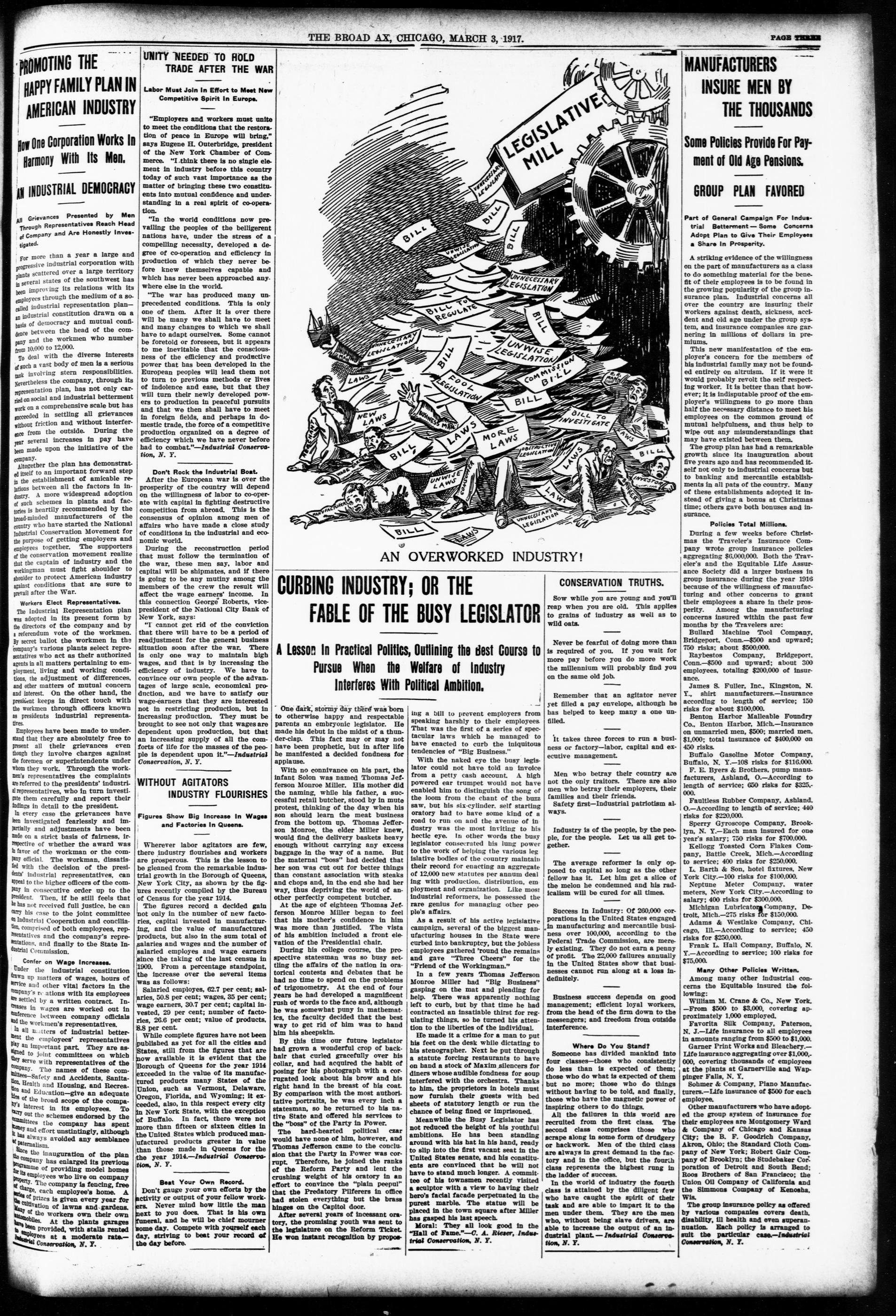
AN OVERWORKED INDUSTRY!
CURBING INDUSTRY; OR THE FABLE OF THE BUSY LEGISLATOR
One dark, stormy day there was born to otherwise happy and respectable parents an embryonic legislator. He made his debut in the midst of a thunder-clap. This fact may or may not have been prophetic, but in after life he manifested a decided fondness for applause.
With no connivance on his part, the infant Solon was named Thomas Jefferson Monroe Miller. His mother did the naming, while his father, a successful retail butcher, stood by in mute protest, thinking of the day when his son should learn the meat business from the bottom up. Thomas Jefferson Monroe, the elder Miller knew, would find the delivery baskets heavy enough without carrying any excess baggage in the way of a name. But the maternal "boss" had decided that her son was cut out for better things than constant association with steaks and chops and, in the end she had her way, thus depriving the world of another perfectly competent butcher.
At the age of eighteen Thomas Jefferson Monroe Miller began to feel that his mother's confidence in him was more than justified. The vista of his ambition included a front elevation of the Presidential chair.
During his college course, the prospective statesman was so busy settling the affairs of the nation in oratorical contests and debates that he had no time to spend on the problems of trigonometry. At the end of four years he had developed a magnificent rush of words to the face and, although he was somewhat puny in mathematics, the faculty decided that the best way to get rid of him was to hand him his sheepskin. By this time our future legislator had grown a wonderful crop of backhair that curled gracefully over his collar, and had acquired the habit of posing for his photograph with a corrugated look about his brow and his right hand in the breast of his coat. By comparison with the most authoritative portraits, he was every inch a statesman, so he returned to his native State and offered his services to the "boss" of the Party in Power.
The hard-hearted political czar would have none of him, however, and Thomas Jefferson came to the conclusion that the Party in Power was corrupt. Therefore, he joined the ranks of the Reform Party and lent the crushing weight of his oratory in an effort to convince the "plain peepul" that the Predatory Pilferers in office had stolen everything but the brass hinges on the Capitol door.
After several years of incessant oratory, the promising youth was sent to the legislature on the Reform Ticket. He won instant recognition by propos-
ing a bill to prevent employers from speaking harshly to their employees. That was the first of a series of spectacular laws which he managed to have enacted to curb the iniquitous tendencies of "Big Business."
With the naked eye the busy legislator could not have told an invoice from a petty cash account. A high powered ear trumpet would not have enabled him to distinguish the song of the loom from the chant of the buzz saw, but his six-cylinder, self starting oratory had to have some kind of a road to run on and the avenue of industry was the most inviting to his hectic eye. In other words the busy legislator consecrated his lung power to the work of helping the various legislative bodies of the country maintain their record for enacting an aggregate of 12,000 new statutes per annum dealing with production, distribution, employment and organization. Like most industrial reformers, he possessed the rare genius for managing other people's affairs.
As a result of his active legislative campaign, several of the biggest manufacturing houses in the State were curbed into bankruptcy, but the jobless employees gathered 'round the remains and gave "Three Cheers" for the "Friend of the Workingman." In a few years Thomas Jefferson Monroe Miller had "Big Business" gasping on the mat and pleading for help. There was apparently nothing left to curb, but by that time he had contracted an insatiable thirst for regulating things, so he turned his attention to the liberties of the individual.
He made it a crime for a man to put his feet on the desk while dictating to his stenographer. Next he put through a statute forcing restaurants to have on hand a stock of Maxim silencers for diners whose audible fondness for soup interfered with the orchestra. Thanks to him, the proprietors in hotels must now furnish their guests with bed sheets of statutory length or run the chance of being fined or imprisoned.
Meanwhile the Busy Legislator has not reduced the height of his youthful ambitions. He has been standing around with his hat in his hand, ready to slip into the first vacant seat in the United States senate, and his constituents are convinced that he will not have to stand much longer. A committee of his townsmen recently visited a sculptor with a view to having their hero's facial facade perpetuated in the purest marble. The statue will be placed in the town square after Miller has gasped his last speech.
Moral: They all look good in the "Hall of Fame."—C. A. Rieser, Industrial Conservation, N. Y.
CONSERVATION TRUTHS.
Sow while you are young and you'll reap when you are old. This applies to grains of industry as well as to wild oats.
Never be fearful of doing more than is required of you. If you wait for more pay before you do more work the millennium will probably find you on the same old job.
Remember that an agitator never yet filled a pay envelope, although he has helped to keep many a one un-filled.
It takes three forces to run a business or factory—labor, capital and executive management.
Men who betray their country are not the only traitors. There are also men who betray their employers, their families and their friends.
Safety first—Industrial patriotism always.
Industry is of the people, by the people, for the people. Let us all get together.
The average reformer is only opposed to capital so long as the other fellow has it. Let him get a slice of the melon he condemned and his radicalism will be cured for all times.
Success In Industry: Of 200,000 corporations in the United States engaged in manufacturing and mercantile business over 100,000, according to the Federal Trade Commission, are merely existing. They do not earn a penny of profit. The 22,000 failures annually in the United States show that businesses cannot run along at a loss indefinitely.
Business success depends on good management; efficient loyal workers, from the head of the firm down to the messengers; and freedom from outside interference.
Where Do You Stand?
Someone has divided mankind into four classes—those who consistently do less than is expected of them; those who do what is expected of them but no more; those who do things without having to be told, and finally, those who have the magnetic power of inspiring others to do things. All the failures in this world are recruited from the first class. The second class comprises those who scrape along in some form of drudgery or hackwork. Men of the third class are always in great demand in the factory and in the office, but the fourth class represents the highest rung in the ladder of success.
In the world of industry the fourth class is attained by the diligent few who have caught the spirit of their task and are able to impart it to the men under them. They are the men who, without being slave drivers, are able to increase the output of an industrial plant. — Industrial Conservation, N. Y.
PAGE THREE
MANUFACTURERS INSURE MEN BY THE THOUSANDS Some Policies Provide For Payment of Old Age Pensions.
GROUP PLAN FAVORED
Part of General Campaign For Industrial Betterment—Some Concerns Adopt Plan to Give Their Employees a Share In Prosperity. A striking evidence of the willingness on the part of manufacturers as a class to do something material for the benefit of their employees is to be found in the growing popularity of the group insurance plan. Industrial concerns all over the country are insuring their workers against death, sickness, accident and old age under the group system, and insurance companies are garnering in millions of dollars in premiums.
This new manifestation of the employer's concern for the members of his industrial family may not be founded entirely on altruism. If it were it would probably revolt the self respecting worker. It is better than that however; it is indisputable proof of the employer's willingness to go more than half the necessary distance to meet his employees on the common ground of mutual helpfulness, and thus help to wipe out any misunderstandings that may have existed between them.
The group plan has had a remarkable growth since its inauguration about five years ago and has recommended itself not only to industrial concerns but to banking and mercantile establishments in all pats of the country. Many of these establishments adopted it instead of giving a bonus at Christmas time; others gave both bonuses and insurance.
Policies Total Millions.
During a few weeks before Christmas the Traveler's Insurance Company wrote group insurance policies aggregating $6,000,000. Both the Traveler's and the Equitable Life Assurance Society did a larger business in group insurance during the year 1916 because of the willingness of manufacturing and other concerns to grant their employees a share in their prosperity. Among the manufacturing concerns insured within the past few months by the Travelers are:
Bullard Machine Tool Company, Bridgeport, Conn.—$500 and upward; 750 risks; about $500,000.
Raybestos Company, Bridgeport, Conn.—$500 and upward; about 300 employees, totaling $200,000 of insurance.
James S. Fuller, Inc., Kingston, N. Y., shirt manufacturers—Insurance according to length of service; 150 risks for about $100,000.
Benton Harbor Malleable Foundry Co., Benton Harbor, Mich.—Insurance on unmarried men, $500; married men, $1,000; total insurance of $400,000 on 450 risks.
Buffalo Gasoline Motor Company, Buffalo, N. Y.—108 risks for $116,000.
F. E. Byers & Brothers, pump manufacturers, Ashland, O.—According to length of service; 650 risks for $325,000.
Faultless Rubber Company, Ashland, O.—According to length of service; 440 risks for $220,000.
Sperry Gyroscope Company, Brooklyn, N. Y.—Each man insured for one year's salary; 750 risks for $700,000.
Kellogg Toasted Corn Flakes Company, Battle Creek, Mich.—According to service; 400 risks for $250,000.
L. Barth & Son, hotel fixtures, New York City—100 risks for $100,000.
Neptune Meter Company, water meters, New York City.—According to salary; 400 risks for $300,000.
Michigan Lubrication Company, Detroit, Mich.—275 risks for $150,000.
Adams & Westlake Company, Chicago, Ill.—According to service; 450 risks for $250,000.
Frank L. Hall Company, Buffalo, N.Y.—According to service; 100 risks for $75,000.
Many Other Policies Written.
Among many other industrial concerns the Equitable insured the following:
William M. Crane & Co., New York.
—From $500 to $3,000, covering approximately 1,000 employed.
Favorita Silk Company, Paterson, N. J. Life insurance to all employees in amounts ranging from $500 to $1,000. Garner Print Works and Bleachery. Life insurance aggregating over $1,000,000, covering thousands of employees at the plants at Garnerville and Wappinger Falls, N. Y. Sohmer & Company, Plano Manufacturers. Life insurance of $500 for each employee. Other manufacturers who have adopted the group system of insurance for their employees are Montgomery Ward & Company of Chicago and Kansas City; the B. F. Goodrich Company, Akron, Ohio; the Standard Cloth Company of New York; Robert Gair Company of Brooklyn; the Studebaker Corporation of Detroit and South Bend; Roos Brothers of San Francisco; the Union Oil Company of California and the Simmons Company of Kenosha, Wis.
The group insurance policy as offered by various companies covers death, disability, ill health and even supernauishment. Each policy is arranged to suit the particular case.—Industrial Conservation, N. Y.
PaGR FOUR
Ee ————
———S====—=—>=
SCORCHING ARTICLE.
By White Doctor.
journal and he certainly handles with-
out gloves the sins of omission and
commission of his brethren.
‘The other day a southern city was
investigated. This Baltimore Vice
Commission should be of special inter-
‘est to us, for among its personnel were
medical men from Johns Hopkins Uni-
versity; Howell the professor of physi-
ology; Finney, the clinical professor of
surgery; and George Walker, associate
in surgery—the director of the investi-
gation and writer of the report. The
Red-light Report tells of- well-to-do and
prominent men, with wives and fam-
ilies, systematically pursuing and prey-
ing upon females in their offices, using
every possible means, fair and far from
fair, to induce these young girls to en-
ter into immoral relations with them;
it tells of many unprotected women
who resist temptation at first, only to
succumb at the end to the persistent
wiles of men who are their social and
intellectual superiors; it tells of a host
of employers who admit they will not.
employ girls who are too moral; it tells|
a tale of lust and sexual deceit among
the most reputable Baltimoreans—it
lifts the cover from a never-ceasing
cauldron of sensuality and seduction.
Baltimore is a city taken in adultery.
Yet there is no reason to suppose that
Babylon-Baltimore is worse than other
places—the 1200 pages of this report
are a transcript of the white man’s
sexual life anywhere; a record which
should prevent him from criticising
other races.
But the sinless Caucasian seems to
be much grieved because the Negro is
immoral. Dr. James MeIntosh, in his
address before the South Carolina
Medieal Association, was applauded
when he spoke of the utter lack of
virtue and chastity so markedly char-
aeteristie of the Colored race.’’
‘The White Man's Morality.
Before the Civil War, when the
White man owned the black, he had
an opportunity to show how deeply he
believed in morality, and this is how
he did it: he used the black men as
bucks, and turned the, women into
brood-mares. The woman who did not
breed piceaninnies rapidly enough was
headed for the auction block, for these
masters made merchandise of maternity.
The mother lay down with her babes
at night, and the next morning they
might be parted never to meet again,
just as Fred. Douglass was separated
in infancy from her who gave him
birth. ‘The father might be sold to a
Virginia plantation, the mother to a
cotton-farm in the Carolinas, and the
daughter to a rice swamp in Louisiana.
A bitch taken from her puppies will
pine for days, but the southerner did
not consider the feelings of black
slaves—though their souls were white
with anguish and their tears were red
with pain, Every Negro knew that his
family life was temporary; it could be
terminated, at the master’s whim, with-
out notice. We thus see how faithfully
the dominant White man taught the
Colored people sexual virtue, and the
sacredness of the marriage tie, and the
sanctity of the family.
Before the Emancipation Proclama-
tion, the southern gentleman came into
intimate contact with the slave woman.
As a baby he nursed at the bosom of
the ‘black mammy,’ and when he grew
up he had intercourse with these
women. It mattered not whether she
was of tender years or already a wife
and mother; whereever he met one of
his bondwomen, in the fields or in the
cabin, if he wanted her, she was forced
to submit. The sexual crimes of the
black race agajnst the white, are as
nothing when Meorarea to the sexual
crimes of the white race against the
black * * * the white man has
raped the Colored woman wholesale.
Many children were born from these
unions—the two million mulattoes are
the evidence. Frequently the white
father sold these children—knowingly
doomed his own sons and daughters to
slavery. Of course a crude northerner
cannot grasp this species of morality—
it takes a true southern gentleman to
understand it.
The Negro’s Progress.
In view of these sad and incontes-
table facts, the editor of the Medical
Review of Reviews considers it hypo-
critieal and unfair on the part of his
fellow-editors and the profession to
continue to point the finger of con-
In view of these sad and incontes-
table facts, the editor of the Medical
Review of Reviews considers it hypo:
critical and unfair on the part of his
fellow-editors and the profession to
continue to point the finger of con-
demnation at the Negro. Our own
hands are too spotted.
Half a century ago it was a crime
to teach Negroes to read and write.
‘They were bought and sold for coin
or exchanged for a horse or so many
bags of flour—and when the whip
struck too heavily and often, and free-
dom was sought in the forests, they
were hunted with bloodhounds and buck-
shot. But today there is a Class A
medical school where practically all the
students are Colored.
During its brief period of quasi-free.
dom, the Negro race has produced mer
of eminence in various spheres of
activity; a statesman like Frederick
Douglass; an educator like Booker
Washington, with his volumes and his
Tuskegee Institute; a sociologist like
DuBois, with his superb book on ‘The
‘Souls of Black Folk;’? an inventor like
MeCoy, with his pioneer work in ma-
chinery lubricators; an electrician like
Granville Woods, with his numerous
patented devices; a surgeon like Dr.
Williams, who skillfully sewed up a
stab wound in the heart; a speaker like
William Pickens, who won the prize
for oratory at Yale; an artist like Tan-
ner, whose paintings hang in the
world’s best galleries; a sculptress like
Meta Warwick, whose work has been
‘compared to Rodin’s; a musician like
Coleridge-Taylor; 2 poet like Dunbar,
with his beautiful lyries of lowly life;
a novelist like Chestnut, author of
“The House Behind the Cedars;’? a
distinguished mathematician like Kelley
Miller, and an inereasing number of
others. In exultation let the Negro
‘compare these men with the slaves who
twanged banjos at the feet of the cot-
ton kings.
Let him remember with a flush of
pride that wherever the spirit of fra-
ternity has let down the bars of preju-
dice, his race has stepped in and taken
its place with those who march onward
and forward. But we regret to say
that American medical man has done
nothing to destroy the barrier of bias.
‘The profession has not yet learned the
noble words of the Fugitive Poet.
‘There is a shameful chapter in the
history of American medicine, and it
is headed: The Negro.
GET A GARDEN.
‘The owner of every vacant lot in
Chicago should be willing to donate its
use during the coming Summer for
growing table vegetables to anyone
who will agree to cultivate it, provi
ded, of course, he does not want to use
it himself.
' There are within the city limits of
Chieago thousands of acres of idle
land. It is all, or most of it at least,
land that with proper cultivation ean
be made highly productive. It would
be far better to devote the idle, vacant
lots of Chicago to growing table vege-
tables, than to allow them to remain
as they are, simply waste places and
depositaries for unsightly rubbish of
every kind.
The Philadelphia Vacant Lot Garden-
ing Association, in existenee now for
several years, has demonstrated be-
yond any doubt the value to any com-
munity of vacant lot gardening. When
looked at from almost any angle, it be-
comes a health proposition. An under-
fed and improperly nourished people
will be sickly people. People that are
properly fed and nourished will be
healthy. This is fundamental.
: ‘There are in Chicago many thov-
sands of people who would be both
willing and anxious to do outdoor
gardening, provided only they might be
given the soil to work. It would be a
fine thing to bring idle people and idle
land together. Bodily health and vigor
are to be gained by outdoor work such
as gardening. Fresh air, sunshine and
exercise tend to make people strong
and well. If only the yacant lots of
the City of Chicago ean be utilized
along these lines, thousands of tons of
table foodstuffs may be raised, and will
certainly have an important bearing on
reducing high prices to the consumers
of Chicago.
Let everyone get busy and talk va-
cant lot gardening. The people of Chi-
cago can raise within the city limits
enough foodstuffs to materially reduce
the amount that would be needed to be
shipped in from outside. At all events
it is an experiment worth trying. The
planting season will soon be here. Now
is the time to get ready for it.
‘The U. 8. Public Health Service is
responsible for the statement, that in
this country not less than 30,000,000
workers lose an average of nine days
each year on account of sickness. Un-
cle Sam’s health officials also estimate
that counting medical treatment at one
dollar per day, together with the atten-
dant loss of wages, costs the workers
of the country approximately $680,000,-
000, There is no doubt either, but much
of this sickness is due to both the
ignorance and carelessness of the work-
ers themselves. In other words, this
tremendous economic loss is largely
preventable. Two things seem to be
needed to better these conditions,
health education and health insurance.
The latter, just now, is being much dis-
cussed by both economie and social
workers; but without a plan of health
education to help it along, health in-
surance alone will be found a difficult
and expensive method of relief.
Alcoholism has long ceased to be
& question of morals. It is now recog:
nized as one of the country’s most im-
portant health problems, This is why
all over the country we find health
officials preaching against the excessive
use of alcoholic stimulants and indeed,
urging total abstinence as the surest
way of prolonging life and insuring
bodily health and vigor. ‘
It is fair to say that our primitive
ancestors, who first lived in sanitary
tree tops with no floors to spit upon,
and inhabited well ventilated caves
untrammeled by storm windows, fur
THE BROAD AX, CHICAGO, MARCH 3, 1917.
———————
nae heat, or sweeping day, had no|ditions of contest, and the prize
word in their vocabularies for catchimg| awarded by judges named by
cold, for it is fair to say that they did|your Executive Committeo th
not suffer from cold as do we. your Health Week Campai
zesmers okarge.??
RED CROSS SEALS RAISED A MIL-| The conditions of the cont
LION. gether with names of the judges
— published later. Local committ
‘Three Hundred Million Penny Holiday |campaign chairmen desiring t
‘Tokens Sold in 1916 Christmas Cam-|their communities for these cups
paign—Newspapers Thanked by Na-|make known their intentions to |
tional Tuberculosis Association. J. Scott, Secretary, Tuskegee Iz
SOR Ra NT pane nf elt NS RR ee eR
seals raised in the 1916 sale $1,000,000
‘or the tuberculosis campaign, accord-
ing to the National Association for the
Study and Prevention of Tuberculosis,
which announced today the results of
the recent holiday campaign. All re
ports are not in, but carefully revised
estimates of the few yet outstanding
indicate that more than one hundred
million seals were sold.
|All the proceeds of the sale, amount-
ing to a tax for health work of one
cent on each person in the country
except the insular possessions, are de-
voted to preventive tuberculosis work
in the states and communities in whieh
the seals are sold.
The National Association points with
gratification to the fact that it realized
its slogan “‘one seal for each inhabi-
S in the United States.’? Seals
have been sold annually at the holiday
season, beginning with 1908. They
have been the means of raising a total
of $4,206,051 for tuberculosis work. In
addition to the thousands of tubercu-
losis beds which this sum has made
possible, the seals have also aided in
the establishment of hundreds of open-
air schools, employment of thousands
of tuberculosis visiting nurses, and
have been an indirect cause of tremen-
dous advances in the whole field of
public health work.
Tuberculosis committees have been
organized in practically every commun-
ity of any size in the country. Every
state in the union now has a state so-
ciety engaged in state-wide anti-tuber-
eulosis work. Hundreds of thousands
of open windows, letting in unwonted
quantities of fresh air to sleepers, may
be traced directly to the public health
educational effect of the Red Cross
Christmas Seals.
Last fall agents sold seals in every
state and territory of the United States
except Guam, Tahiti and Samoa.
Counting the school children, some
300,000 the total number of agents of
the country approached 500,000. These
included elub women, school teachers,
merchants, bankers, post masters, and
in fact, every kind of business man and
woman.
‘The educational features of the seal
campaign was developed in 1916 on a
larger scale than ever before. School
teachers received and read to their pu-
pils one hundred and fifteen thousand
story talks on tuberculosis. During
Tuberculosis Week in December three
hundred and fifty thousand pieces of
edueational literature, containing sug-
gestions for sermons on tuberculosis
and recommendations for medical
examination for employees were distri-
buted.
“Without the co-operation of the
press of the country unstintedly
given, as it always has been,
these tremendous results from the
Red Cross seal sale would have
been impossible,’? said Dr. Charles J.
Hatfield, Executive Secretary for the
National Association, in making pub-
lie the results of the sale. ‘Both di-
rectly and indirectly the newspapers
of the country have, through the Red
Cross Christmas seal sale, contributed
to the alleviation of human suffering
and to the total of human happiness,
to a greater degree than any other sin-
gle agency.?*
NATIONAL NEGRO HEALTH WEEK.
Important’ Announcement Covering
Prizes for Best Cleaned Communities
During Campaign.
‘Tuskegee Institute, Alabama, Febru-
ary 26.—In the first call for the Na-
tional Negro Health Week which is to
be observed April 21 to 27, 1917, refer-
ence was made to the co-operation of
the National ‘Clean Up and Paint Up”?
Campaign Bureau, Kinloch Building, St.
Louis, Missouri.
In addition to their offer. to send
literature to any community where
Health Week Campaigns may be ob-
served they have now offered three
prize cups for the best clean up effort
among the Negro people. In a letter
to Emmett J. Scott, Secretary of the
National Negro Business League, Mr.
Allen W..Clark, Chairman of the Clean
Up and Paint Up Bureau, says concern:
‘ing the prizes:
“‘However, we have decided ypon
lone thing that I hope will interest and
please you, viz, to offer you three
Silver Cups, suitable for First, Second
land Third Prizes to the three commu:
nities or local Negro Committees, ot
chairmen of local campaigns among
lyour people, that submit the best re-
port, of the best work, done in 2
«Clean Up and Paint Up’? campaign
that has for its ‘‘Opening Week,”? yout
Jown ‘‘Health Week’'—such report ot
campaign contest to be conducted under
your auspices, and your published con:
ditions of contest, and the prizes to be
awarded by judges named by you or
your Executive Committeo that has
your Health Week Campaign in
charge.’?
The conditions of the contest to-
gether with names of the judges will be
published later. Local committees and
campaign chairmen desiring to enter
their communities for these cups should
make known their intentions to Emmett
J. Scott, Secretary, Tuskegee Institute,
Alabama. He will also be very glad
to send detailed plans and suggestions
for conducting Health Week Campaigns.
SOME MISSTATEMENTS IN CON-
NECTION WITH THE HISTORY
OF BETHEL CHURCH.
ee ee
Ax, please allow me space in the col-
umns of your paper to correct some
untruthful statements which appear in
a so-called history of Bethel A. M. E.
Chureh, Chitago, by one Mr. Richard
E. Moore, who gives an account of an
indignation meeting which was held in
Bethel in 1892, by my permission, at
which time I presided.
Mr. Morgan presided at the organ
and I called on him to select an appro-
priate song for the opening service.
He struck up, “My Country Tis of
Thee, Sweet Land of Liberty, of Thee I
Sing.’” I forbade him to sing said song
and requested him to sing instead, ‘I
am the Lily of the Valley, Christ was
born across the Sea’? which was sung
to the tune of John Brown, Mr. F.
L. Barnett was the principal speatier.
The said so-ealled history proposes to
detail the rise and progress of Bethel
Chureh.
‘The newcomers may not know that
I had two daughters who were loyal
members ‘of said church, and also the
‘Sunday school and were both married
out of Bethel Church. Miss Ruth Aada
Gaines after she was graduated from
Wilberforce taught a class of 30 young
men in the Sunday school and organ-
izea the young people in my house
having no place to hold meetings and
raised and turned over the sum of
$750.00 for the Building Fund of Bethel
Church of that time done what it could
for both myself and daughters I can’t
mention all that was done nor recall
names but Mr. C. R. Johnson furnished
the carriages at a cost of $30.00 for
my oldest daughter's wedding. The
lady stewardess served an elegant din-
ner at the home of Mr. and Mrs. Buch-
annan Lewis at no cost to myself. Mr.
©. R. Johnson and his wife served a
dinner for my youngest daughter the
day after her wedding which was an
elaborate affair at no cost to myself.
‘The Indignation meeting I refer to was
held just after the lynehing of Colored
men in Memphis, ‘Tenn. Now Mr.
Moore would make people believe it
was the Rev. A. L. Murray who for-
bade the choir singing ‘“ America.”
‘The truth is Rev. Murray had not come
to Chicago for ten years yet I was af-
ter a Pastorate of 3 years, was sue-
ceeded by the Rev. D. A. Graham,
who remained 5 years and was followed
by Rev. R. C, Ransom who remained 5
years and was succeeded by Rev. Mur-
ray. My Pastorate of Bethel Church
was occupied with an earnest honest
effort to do all I could to make a great
and useful church.
‘The pen is an instrument for writing
and if it be used whether to write a
letter a minute or a history to tell the
truth. ik
Geo. W. Gaines,
Co. G. National Home, Danville, 11
Feb. 26, 1917. |
SUCCESSFUL RACE FILM CoM
PANY INCORPORATES.
Lincoln Motion Picture Co., of Los An
geles, Incorporates for $75,000.
Los Angeles, Cal., Special—The Lin.
coln Motion Picture Company, of this
city, the largest and only suecessfu
film company producing photoplays di
rected and staged entirely by Colored
people, has recently been incorporated
in this State at a capitalization of
$75,000. Headed by Mr. Noble M.
Johnson, the leading sereen artist of
his race, who is as well a talented
photo-playwright and director, this com
pany has produced and successfully re
leased through their own branch offices
the two leading feature plays of the
day, ‘The Realization of a Negro’s
Ambition,’’ a two-reel society drama
and ‘The Trooper of Troop K."’ the
sensational and historical three-reel re
production of the Carrizal fight. A
third is now being filmed apd the in
creasing. demands far EestelPijnlesses
made the step of incorporating“#-neces
sity. The incorporators and director:
are J. Thomas Smith, Noble M. John.
son, Clarence A. Brooks, Dudley A
Brooks and George P. Johnson, Branch
offices have been established in New
York, St> Louis, Chieago, Atlanta and
New Orleans, with main booking of
fices at Omaha, Neb.
Ford 8. Black, author of Black’s
“Blue Book,’? is confined to his home,
6444 St. Lawrence avenue with a
sprained ankle and it will be ten days
before he will be able to look after
the delivery of his books to those who
have already engaged them.
PHYLLIS WHEATLEY.CLUB NOTES.
The Social afternoon of the Phyilis
‘Wheatley Club was held under the aus
pices of the Art Department, Mrs
Geraldine Withers, Chairman, Wednes.
day.
An usually fine exhibit of needle
work, pictures, hand painted china and
wood craft was displayed.
Mrs. Matilda Dunbar, mother of the
late lamented Paul Laurence Dunbar
was the guest of honor and delighted
the large and appreciative audience
with her witty and interesting remarks.
Prof. R. T. Greener, Major John RB.
Lynch and Mrs, Fannie Barrier Wil-
liams spoke in glowing terms of Mrs.
Dunbar and her illustrious son.
It is easy to see from what source
Paul Dunbar derived his wonderful gift
‘of poetry and song.
| Mrs, D. Harry Hammer, Ex-President
of the Arche Club, gave an interesting
and educative address on ‘The Unde-
feated Flag.’’ Mr. Grimes rendered
patriotic selections and refreshments
were served.
Elizabeth Lindsay Davis, Pres.
Irene Goins, Cor. See.
THE WATTS-WILSON FASHION.
ABLE WEDDING AT DETROIT,
MICHIGAN.
Miss Adelaid A. Watts, the highly
aceomplished daughter of Mr. and Mrs.
David C. Watts, 234 Watson street,
Detroit, Mich. was on last Thursday
united in marriage to Mr. Bruce L.
Wilson, formerly of Washington, D. C.
It was the grandest and most fashion-
able wedding ever held among the
Afro-Americans in that city, the bride’s
parents being among the wealthiest
Colored people residing in Detroit.
Immediately after the wedding the
newly married couple departed for their
honeymoon trip for Chicago and were
the guests of Mr. and Mrs. George T.
Kersey, 2966 Vernon avenue. Mrs.
Watts, mother of the bride, being the
only sister of Mr. Kersey. Mr. and
Mrs. Wilson are now at home to their
friends in Detroit, Mich.
MOB LYNCHES NEGRO WOMAN.
Hammond, La. Mareh, Special —
Emma Hooper, a Colored woman was
lynehed by a mob early today after
she had shot a policeman who had at.
tempted to arrest her for wounding a
‘Negro boy. The mob rushed her cabin,
six miles from Hammond, and strung
her up to a tree.
W. M. Webster, who has for many
years conducted a barber shop on 5ist
street near Federal is confined to his
home’ with illness, 6352 Rhodes avenue.
Judge Joseph S. La Buy, who con-
tinues to make good as one of the
judges of the Municipal Court, would
be right at home as one of the judges
of the Superior Court.
Sunday afternoon, March 4th, memo-
rial services will be held at the Phyllis
Wheatley Home, 3256 Rhodes avenue
in honor of the memory of the late Mrs.
Clara Studymire. The public are cor-
dially invited to attend the services.
Mr. Arnold Hill of New York City,
representing the Urban League, will
address the Bethel Literary which
meets at Bethel church, 30th and Dear-
born streets, Sunday afternoon, March
4th at 4 p.m. Don’t fail to hear him.
Good music. Sandy W. Trice, Presi-
dent.
Miss Maude J. Roberts, the silver
voiced songbird assisted by Prof. Roy
Tibbs of Washington, D. C., will give
a recital at the Abraham Lincoln Cen-
ter, Langley avenue and Oakwood
Boulevard, Wednesday evening, March
14th.
Mr. and Mrs. Thomas Cole, 5427 S.
Wabash avenue, will shortly leave on
a pleasure trip for their former old
home, Louisville, Ky., where many of
their old friends and neighbors are
ready to give them a good time.
Dr. J. Norman Croker, No. 1 E. 22nd
street, has had his suite of offices re-
modeled and redecorated which greatly
adds to their appearance and attraetive-
ness and they are now thoroughly sani-
tary im every respect.
Charles E. Morrison, special messen-
ger to his Honor, Mayor William Hale
‘Thompson, smiles and smiles all day
long simply because some of the alder-
men who have been fighting Mayor
‘Thompson failed to connect up on pri-
mary day.
Joseph R. Dunn aud George Hight,
5050 S. State street who are strong
Republican political factors in the 30th
Ward will work day and night from
now until Tuesday, April 3rd, for the
election of Michael G. Walsh to the
City Council from that ward.
Miss Josephine Davis, formerly of
3331 S. Wabash avenue, was on Mon-
day united in marriage ty, y
Wallace of Greensboro, x. ous
home of the bride’s mothe pele
ington, D. C. The many fea
Miss Davis wish her muy. tt
happiness in her new state 2”
ence. fis.
The Board of Directors of ty,
ard University of Washington, —
have honored us with an inyity °
attend the Sociological Herm)
which was held in convection wars
50th Anniversary of the founding 6
the Howard University, Yar i
We regret very much our inabitity ©
be present on that delightfuy eae
| Mrs, Jennie Pangburs, 3752 § yy
bash avenue, a sister of col 350
R, Marshall passed avay the fr ee
of this week. Fumersi services yen
hheld over her remains at 2 gay
‘Thursday afternoon from ler late ree
dence. Interment at Oakwood Cog
tery. Charles S. Jackson in chap
The many friends of Mrs. Pangin
will regret to hear of her death
Mrs, David Manson, i816 8. yy.
igan avenue, has for the past tin,
weeks been confined to her home thrag,
illness from the effects of a very seray
cold causing her to miss the preLeste
Charity Ball, for the benefit of thy
Phyllis Wheatley Home. Her may
friends hope that she will soon be abjy
to be out again.
MOUNTAIN TRAIL BELLS ~
TO HELP OUT TRAVELERS
Located Thousands of Feet Above Sq
Level In Rockies.
Denver.— Travelers accustomed
the sound of fog bells on the Atm,
tie or Pacific coast will be amazed, pe.
chance, to hear the warning ring neq
summer from 10,000 to 14,000 feg
‘above the sea level in the Rocky most
tains.
‘The tragic end of the Rev. Thoraty
R. Sampson of Texas, who disappeared
in the Rocky Mountain National jet
while on a walking tour, bas resulta
in plans to safeguard the precipitos
and dangerous trails of the park.
I. C. Way, supervisor of the Cale
rado playground, has devised the pla
of having fog bells scattered along the
trails at intervals from a quarter tox
half mile apart on Flat Top, Lox
peak, Hallets glacier and Hallets peak
‘The bells will be of deep tone and vil
be operated by a system similar tp
weather vanes.
‘The bells will be placed on pss
about seven feet high. Suspended ore
the bell will be a small, light woods
paddle. The slightest breeze will tik
the paddle and ring the bell.. Ther
probably would not be one day in th
Year when the breeze would be fas
ficient to ring the bell.
While the mountains are not too dan
‘gerous for travel, even the most expe
Flenced traveler sometimes will lo
the trails in the mountains. Aboet
11,000 feet aBove sea level and abor
timber line heavy clouds sometimes
totally obscure the sight of the tn
eler. Walking in the face of the wibl
with bis head lowered, he is apt t
‘Sent ties team:
Bathtubs and Bathing. —
In many European countries “Be
best people”—if you know what tat
means—never bathe in water.
Spanish matrons have express
much surprise at my complaints abowt
the absence of bathing facilities in th
Madrid hotels. One lady, wife of ad
tinguished member of the cortes, told
me she “bad herself rubbed down indi
once a week, but never had got intot
tub of water and never would!” ~
‘My memory of London hotels 8
back to 1875, when there was nt!
single bathtub in any hotel in thatelt
A tin pan and bucket of warm watt
was the only “tub,” and you we
lucky to get that.
And in that same period in New York
city the Metropolitan and St. Nichols
hotels, supposed to be models of exct
Jence, were totally wanting in beth
rooms.
Admittedly, it is as difficult to ime
ine life without motorcars as withot
bathtubs, but the former are less thi
a twenty-year-old necessity, while th
bath was an institution long before
times of the Roman emperors—Julits
Chambers in Brooklyn Eazle.
a a
Are our coal mines being exhamt
by their vast production? Not at# od
which need worry us or cause fet
that the next generation will fret?
death. Nearly ten years a: a come
tent engineer analyzed the ticures
soft coal production and reserve a
concluded that if our output continu
to increase according to the srt
shown up to that time it would ra?
‘a stable maximum of 2,300,0400,000
per year about the year 219) and O#
700 years more of production at O#
rate would exhaust the knows
measures of the United States!
Since he wrote production bas
vanced at a slower rate than be ax
pated and tmportant new deposits BY
come to light. There should ®™
waste of our mineral fuel, but nel
fs there any occasion for alarm 1
thracite, of course, is another matt
But even of that there is enoush #8
for at least a century —Chicago Joo
Wife—1 don't understand D0® %
men can spend whole evening #
club, "
Hub—Then you talk an <a
about something you don't unde?
Boston Transcript. af
Starvation Point
To the question, "If there were a stage, how long do you think the soldiers and civilians could live after the food supplies gave out?" an English paper answers: Science tells us that if he can get drinking water an ordinary man can exist for thirty days without food. At the end of that time the machinery of the body will not be spoiled and can be brought back to its former peaceful feeding.
strength by carrying. About a quarter of our body weight is fat, and it is mostly this fat that is absorbed as food during the period of starvation. We can absorb and burn up our muscles until 60 per cent of their weight is gone. We can do the same with from 30 to 40 per cent of our livers and digestive organs and 20 per cent of our lungs. Our hearts can lose 10 per cent and our brains and nervous systems can lose 5 per cent. It will be seen that the more vital organs—brain and heart—yield least of their valuable substance for the life of the body, while the less essential substances—fat, muscle fiber, etc.—are consumed first.
It can't Be Afraid of Work.
Don't Be Afraid
Charles M. Schwab, the well known master of Bethlehem steel works, has no more patience with the man who works by the time clock than has Adam Bede with his fellow workmen who dropped their tools at the sound of the whistle. In his book "Succeeding With What You Have" he writes: "I have yet to hear of one instance where misfortune hit a man because he worked overtime. Not long ago a man was promoted in our works. 'How did you happen to advance this fellow?' I asked his boss. 'Well,' he explained, "I noticed that when the day shift went off duty this man stayed on the job until he had talked over the day's problems with his successor. That's why." The man who fails to give fair service during the hours for which he is paid is dishonest. The man who is not willing to give more than this is foolish."
His First Golf Play.
H. Chandler Egan's first golf was played on a three hole course in a pasture back of his father's house, at Highland Park, Ill. The former champion and his brother laid out the links, then invited their cousin, Walter, to teach them the game. The latter teed up a ball on the first, hit it straight down to the broomstick which served as a flag pole. The ball bounced along the uneven green and disappeared in the hole. Turning to his astonished gallery, he remarked: "There, you see, it is very simple. That is the way you do it." Chandler Egan tried, but didn't succeed, and although he won the amateur title twice, he claims he was never able to equal the wonderful drive his cousin made that day.—Golfers' Magazine
Eyes of Rubber.
Artificial eyes of rubber are taking the place of the old style glass optic in Europe. The rubber eyes have the advantage of being unbreakable, and as they are of pneumatic construction they maintain an elastic contact between the eyelids and the back of the orbitary cavity. To make the new rubber product a cast formed of liquid plaster is made of the orbitary cavity, and from this is constructed an eyeball, the face being of vulcanite. The front and back parts are made of soft rubber, there being a space between the two parts which is occupied by air, making the eyes pneumatic.—Popular Science Monthly.
A Motorcar Race In 1895.
In 1905 a new enthusiastic "horseless marriage" manufacturers decided that the time was ripe for a race. As we back back at it now the contest was a mechanical jest. The vehicles started lavely and then stopped lamely while their drivers made repairs. One investor followed his mechanical wonder with a team of horses. The winner of the race had averaged the mad speed of seven and one-half miles an hour. This engine, carefully tested after the fiercish contest was over, was found to develop an amazing four horsepower. -Waldear Kaempfert in Harper's magazine.
Football and Matrimony
"Well, I wish him luck," said Mr. Jones after reading in the paper an account of the wedding of a popular member of a college football team, "he added in a ruminating tone, marriage is very much like football." "Don't talk so ridiculous," snapped Mr. Jones. "How can you compare football to marriage?" "Why," replied Jones, "it looks so arty to those who haven't tried it."
Should Dissemble
"You claim to have loved and lost." "Yes."
"Let you go around with a perpetual grin on your face. When you have loved and lost, deference to the lady makes it proper not to appear to be so勇敢 a loser."—Louisville Courier-Journal.
Ellis Island
the prehistoric days of the Amer-
can continent the Indians called what
now Ellis Island, the immigrant sta-
tion in New York harbor, Kloskos,
which in English meant Gull Island.
The tribes thereabout had some strange
traditions about it.
my time" declared grandma,
grants were more modest."
"I know," said the flippant girl. "It
was a fad once. We may get back to
—Life.
Nothing can be lasting when reason
does not rule—Quintus Curtius Ruys.
Length of Our Ware.
The first American war, that of the Revolution, dated from April 19, 1775, to April 11, 1783, a period of eight years; the northwestern Indian wars; from Sept. 19, 1790, to Aug. 3, 1795; the war with France, from July 9, 1798, to Sept. 30, 1800; the war with Tripoli, from June 10, 1801, to June 4, 1805; the Creek Indian war, from July 27, 1813, to Aug. 9, 1814; the war of 1812 with Great Britain, from June 18, 1812, to Feb. 17, 1815; the Seminole Indian war, from Nov. 20, 1817, to Oct. 21, 1818; the Black Hawk Indian war, from April 21, 1831, to Sept. 30, 1832; the Cherokee disturbance or removal, from 1836 to 1837; Creek Indian war or disturbance, from May 5, 1836, to Sept. 30, 1837; the Florida Indian war, from Dec. 23, 1835, to Aug. 14, 1843; Aroostock disturbance, 1836 to 1839; the war with Mexico, April 24, 1846, to July 4, 1848; the Apache, Navajo and Utah war, from 1849 to 1855; the Seminole war, from 1856 to 1858; the war between the states, from 1861 to 1865; the Spanish-American war, April 21, 1898, to Aug. 12, 1898, and the Philippine insurrection, from 1899 to 1900.
The British Manicure Lady.
"In English barber shops you do not have to pay for mirrors, elaborately tiled floors and a manicure girl," writes Homer Croy in Everybody's. "Over there a manicurist is considered the last vocable in the way of smartness. The manicure girl hasn't the run of the shop there as she has here. She has a little cage down in one corner, where she is bottled up as if she were a rare liquid. When a man wants to have any light housework done on his hands he thrusts one of them through the bars, while the proprietor hurries up with a newspaper for him to read. In America we would be insulted if the owner of the shop put something into our hands to read while the manicure girl was working on us. In England the art of jollying the manicurist is unknown."
Boom For Thrift
The American Society For Thrift is sounding a warning that should not go unheeded. The statistics it has gathered indicate how reckless we are with our money and how little we lay up for a rainy day. We are pre-eminently a nation of spenders who believe in living while we live.
Statistics show that ninety-five of every hundred Americans who reach the age of sixty are dependent upon their daily earnings or on others for support. The total, of course, includes wives, mothers and daughters who had not tried nor expected to accumulate a competency. But after they are eliminated the percentage of workers who have a nest egg at sixty is very small, even if that is generally considered too young for retirement.
Woman and Electricity.
When a woman is sulky and will not speak—exciter.
If she gets too excited—controller.
If she talks too long—interrupter.
If her way of thinking is not yours—converter.
If she is willing to meet you. half-way—meter.
If she will meet you all the way—receiver.
If she wants to go farther—conductor.
If she would go still farther—dispatcher.
If she wants chocolate—feeder.—Exchange.
Stamp Taxes.
Taxation through the use of stamps is nearly 300 years old. The states general of the Netherlands offered a reward for the invention of a new tax, and some person in 1624 suggested that stamps be required on legal documents. England first used stamp taxes in 1694, the United States in 1797.—New York Sum.
Getting It Right.
Mrs. Quizzer—I see your friend, Mr. Singleton, is here. He was the best man at your wedding, was he not? Mr. Whlzer—No; he was merely the luckiest—New York Globe.
Convincing Proof.
Harker—Why do you think he is a great practical joker? Parker—Because when I played a little joke on him the other day it made him furious. Indianapolis Star.
His Wish.
Willis—Would you be satisfied if you
had all the money you wanted? Gillis
—I'd be satisfied if I had all the money
my creditors wanted.—Exchange.
○○○○○○○○○○○○○○○○
PRACTICAL HEALTH HINT.
Bronchitis
Symptoms of an ordinary cold accompany the onset of bronchitis. A chill is rare, but there is invariably a sense of oppression, with heaviness and languor and pains in the bones and back. In mild cases there is scarcely any fever.
The bronchial symptoms set in with a feeling of tightness and rawness beneath the breastbone and a sensation of oppression in the chest. The cough is rough at first and often of a ringing character. It comes on in paroxysms, which rack and distress the patient extremely.
If you get acute bronchitis and want to play safe to bed and stay there until you are no longer feverish. You will get well a great deal quicker if you stay in bed for a day or two at the beginning of the attack.
```markdown
```
THE BROAD AX, CHICAGO, MARCH 3, 1917.
TIED DUCK WITH CRAVAT.
Left Diamond Stud on It, and That May Account For Turkey Find.
Cuero, Tex. - What Thomas Lovett of this county believes to be the previous history of the recent story from Chicago telling of a diamond stud valued at $150 found in the craw of a Thanksgiving turkey had its inception in a duck hunt here.
According to Lovett's story, while hunting two years ago he slightly wounded a duck and decided to carry the bird home. He used his necktie to bind the bird's feet, neglecting to remove a diamond stud fastened therein. Placing the supposedly helpless bird in the rear of his conveyance, he started home, when a flutter a few minutes later attracted his attention. He turned in time to see the duck flying off with his necktie dangling from its feet.
Cuero is in the center of a large turkey raising portion of Texas, and many of the birds, which roam over a large range, find their way to the Chicago market.
Mr. Lovett so far has entered no claim to the stud.
"GLAZE." NEW WEATHER WORD
Old Fashioned "Sleet" Will Be Out of Style This Winter.
Washington. — The old fashioned "sleet" is going out of style this winter before the newer "ice storm" and "glaze," weather bureau officials reported in their campaign for more accurate terminology for various kinds of frozen rain. Sleet is officially described as small globules of rain frozen before striking the earth. When rain freezes after falling and forms a glassy coating on the ground, trees and wires the condition is called a glaze, and when this is severe and accompanied by wind, it is reported as an ice storm. The weather bureau hopes to eliminate what it considers improper use of the word "sleet," as it has caused substitution of the term "tornado" for "cyclone" when a violent storm of small diameter is meant.
TATTOOS HIS DAY OLD BABE
Convicted German Military Attache Takes No Chances.
San Francisco.-His coat of arms sketched in indelible ink on the wrist of his baby daughter gives assurance to Lieutenant G. W. von Brincken, military attache of the German consulate here, that his young wife will carry away no other couple's child when she leaves the hospital where their first-born came into the world.
In a panic at the sight of numerous other infants in the hospital nursery Von Brincken, lately convicted of complicity in the munitions plots involving the German consulate, catechized the nurses on their methods of identification. Not satisfied with their system, he called for ink and pen.
WOMAN OF 82 ELOPES
Her Daughter Seeks to Be Appointed Guardian of Her Estate.
Bellefontaine, O.-Securing restoration of her right to manage her own property by securing the dismissal of her mother, Mrs. Harriet Fulwider, as her guardian, Cora Woodbury on the following day filed an application in the Champaign county court to be appointed guardian for her mother, who owns property valued at several thousand dollars.
It was the announcement that the mother, who is eighty-two years old, had eloped to Newport, Ky., and there married Joel Bates, sixty-two years old, that caused the daughter to petition the court to appoint her a guardian for her mother.
WOMEN'S CLOTHES IN LEAD
Head In Value All Manufactures In New York State.
Albany, N. Y.—A special report from the United States census bureau shows that the chief manufacture in New York state is the production of women's clothing, goods of that kind to the value of $345,316,000 having been turned out in 1914. Printing and publishing came next, with an output of $257,269,000. Next was men's clothing, $230,627,000.
Other productions were foundry and machine shop products, $175,450,000; slaughtering and meat packing, $148,106,000; bread and other bakery products, $109,228,000. The total value of all manufactured products was $3,814,661,000.
GOT $1,000 FOR EYE
Young Man Then Lost Money on a Celebration Trip.
Monessen, Pa.—Michael Kamar, aged twenty-nine, who received $1,000 compensation because of the loss of an eye while at work in a Pittsburgh steel mill, is now bemoaning his desire to celebrate because of his newly acquired wealth.
When Michael got his money he immediately arranged for a trip to New York, with a stop at Ashtabula as a side issue. He started one day at noon, an hour after he had the compensation check cashed, and in less than a half hour was minus his thousand. He continued his journey to Ashtabula, but returned home and said he would get a job.
Buried Twenty Minutes and Lives. Lawrence, Kan.-After being completely buried at the bottom of an eighteen foot ditch for twenty minutes, Wayne Richardson, a laborer from Clay Center, who was working on the construction work in the draining district of North Lawrence, was rescued alive without apparent injury one day recently.
Military Marshals
Like many other French words relating to war and hunting, "marechal," in its older form "marechal," is of purely Teutonic derivation in both its parts, and the word has had a curious history. Some words rise in the world with the passage of the centuries and others fall. This is one that from the very humblest of beginnings has come to great estate.
The marshals do not owe their name to Mars, though they are his votaries. In the olden times they were about the humblest men in an army—horse servants, or grooms. Then they advanced to the dignity of being horseshoes, and those highly respected artisans are still "marechals" in France, though "ferrants" has to be added to make their calling clear. And, while "marechal de France" is a magnificent title, there are also "marechals des logis," who are in cavalry regiments only what "sergeants" are in infantry regiments—Exchange.
Gun Salutes In India
The viceroy of India, as representative of the king-emperor, is entitled to a salute of thirty-one guns. This number had its origin in a mistake. Formerly he was entitled to twenty-one guns. When the time came, years ago for allotting the salutes to the various native rulers of India the three principal of these vassal sovereigns—namely, those of Hyderabad, Mysore and Baroda—were each accorded twenty-one guns. It was discovered a little late in the day that the superior rank of the viceroy had been overlooked in the matter, and the necessity was pointed out of his supremacy over the vassal rulers being emphasized in the eyes of the natives. So instead of reducing the number of twenty-one guns that had been accorded to the three rulers in question the viceroy was given ten more guns and is today the only person in the world who is entitled to that altogether exceptional number of guns.—London Spectator.
How Buffalo Bill Got His Name.
Many years ago, when the Union Pacific railroad was completed, the question arose as to how all the laboring men were to be fed on meat, as meat was thought necessary to make muscle. General W. E. Webb had the contract to feed the men, and in talking the matter over one day with some of his subordinates one of them suggested that he call in William Cody, then a famous government scout on the plains, to help solve the problem. Cody suggested that he be allowed to hire men and kill buffaloes for the railroad men.
This plan was adopted, and Cody became later world famous as Buffalo Bill. In those days the buffaloes were so plentiful that it is on record that more than one engineer had to stop his train until a herd had crossed.—A. G. Hegeman in New York Sun.
Masters of Tool Making.
Are Anglo-Saxons conceived about their pre-eminence in matters of machinery? A book, "English and American Tool Builders," by Professor J. W. Roe of Yale, answers the question thus: "Practically all the creative work in tool building has been done in England and America. * * * The French have shown an aptitude for refinements and ingenious novelties. * * * The Swiss are clever artisans, but have excelled in personal skill. * * * Germany has developed splendid mechanics, but the principal machine tools had taken shape before 1870, when the empire began. The history of English and American tool building therefore covers substantially the entire history of the art."
A Daring Voyage.
The smallest boat to cross the Atlantic under her own sail was sailed by Captain Andrews. This craft was but fourteen feet long, but in it Captain Andrews crossed the ocean in 1891, landing at Palos, Spain. He traveled about Europe exhibiting his boat until the World's fair in Chicago, when he returned to this country and placed it on view there. He had previously made two unsuccessful attempts to cross the ocean.
A Good Matto.
"We've got a good motto for our paper," said Kilder.
"What is it?" asked his acquaintance.
"What we have we hold."
"Oh, I see! Referring to your circulation. By the way, I didn't know you were a publisher."
"We're not; we manufacture fly paper."—Chicago News.
Inhuman.
"Gentlemen of the jury," said the lawyer for the plaintiff, "the defendant claims that when he ran over my client his car was going but three miles an hour. Think of the agony endured by my client when being run over as slowly as that!"—New York American.
Very Thoughtful
Miss Askit-Did your husband smoke those cigars you gave him for his birthday? Mrs. Nuwed-He smoked one and said he would keep the rest to remind him of my kindness.
Contrariness of the Sex.
"How was it your wife came to give up housekeeping?"
"Just her contrary ways. First she broke down, and then she broke up."
Baltimore American.
National Forest Lands
On about 2,000,000 acres of national forest lands grazing by domestic stock is either entirely prohibited or is greatly restricted to provide range for elk.
There is no gate into heaven except at the end of the path of duty.—Van Dyka.
Talks on
HEALTH,
CLEANLINESS,
PROPER LIVING,
SANITATION, ETC.
Dr. W. A. Driver
3300 So. State Street
Phone Douglas 3617
THE CORSET DANGER
The time of the corset is passing, because women are learning better sense. They have found out that it is dangerous to press down the abdominal contents upon the pelvic viscera. Such pressure from above causes congestion of the pelvic contents and the results are diseases of the genito-urinary and allied systems.
The corset is an evil; it is not a necessary evil. It is a needless torment. It is a positive menace to health and hence it is destructive to the well being of the body. Nature never intended to have the liver, the stomach, the spleen and intestines pressed down and crowded upon the delicate life conserving organs that inhabit the pelvis.
The foremost and bravest women have been avoiding with right good reason the use of the corset. It is too bad that some women are unable to see the dangers of the tormenting relic of more ignorance. The binding and constricting lines of the corset interfere with the circulation of the blood and thus predispose to disease of the delicate maternal or
Larned, Kan.—An exciting coyote chase in automobiles took place near Hanston. The party consisted of Bill Hann, John Hann, Mr. and Mrs. Irvin Seaman and William Warring. They went in two cars and took three grey-hounds in each car.
Mr. Warring says that auto polo is mild compared with the way those two cars chased across the prairie, ravines and bluffs after coyotes. He said that his speedometer registered forty miles one time when he dared to glance at it and he was afraid to look again.
They were going along between twenty and thirty miles an hour at the time they started up the first coyote, and when the biggest hound in Mr. Warring's car sighted the wolf it leaped over the wind shield and hood and landed running twenty feet ahead of the car. The coyote was a big fellow, but the hounds finally brought him down, the big hound throwing him, while the others plumed him down.
While chasing the first coyote the other auto nearly ran over another one, which leaped up almost from under the wheels of the car. The men shot at it several times, wounding it, but because of the speed of the bounding car could get but poor aim. It finally ran into a hole and was fished out with a wire. Messrs. Haun and Seaman have killed many coyotes.
"Let the Peo
The City of Chic a serious attem greatest transpo and has under c plan proposed b and Subway C Messrs. Parson Arnold employed provide for its immediately, an provision for the
"Let the People Decide"
The City of Chicago is making a serious attempt to solve its greatest transportation problem, and has under consideration the plan proposed by the Traction and Subway Commission Messrs. Parsons, Ridgway and Arnold employed by the City to provide for its present needs immediately, and make ample provision for the future.
If you want to be well informed about
The New Transportation Plan for C
watch for the advertisements under the ca
"LET THE PEOPLE DECIDE"
now appearing in the daily paper
ALL PHASES OF THIS VITAL QUESTION
WILL BE DISCUSSED. GET THE FACT
CHICAGO SURFACE L
The New Transportation Plan for Chicago
watch for the advertisements under the caption "LET THE PEOPLE DECIDE" now appearing in the daily papers.
ALL PHASES OF THIS VITAL QUESTION WILL BE DISCUSSED. GET THE FACTS
CHICAGO SURFACE LINES
By
A. E.
gangs. The tightness that even the loosest corset imposes is unnatural and throws a needless burden upon the heart, the organ that should be guarded with all diligence for out of it spring all the issues of life.
Constipation is one of the most common complaints of women and evidence is not wanting that the corset is responsible for much of it. Constipation leads the way for hysteria, neurasthenia, insanity and other diseases of common occurrence and of fatal tendency.
Because of the close proximity of the uterus, bladder and rectum, constipation is logically a factor in the production of diseases of the structures mentioned. Cancer of the womb, the most malignant of all uterine ills is often preceded by constipation and succeeded by cancer of the bladder. The last fact is better appreciated when it is remembered that the uterus lies midway between the bladder and rectum. The corset puts pressure upon all three organs and causes slow death of function and ultimate death of the part and death of the body by heart failure. All that damnable sequence because of vanity.
"Tes," said the young wife proudly, "father always gives something expensive when he makes presents." "So I discovered when he gave you away," rejoined the young husband.
And, with a large, open faced sigh, he continued to audit the monthly bills of his better half. -Stray Stories.
In an Emergency.
In an Emergency.
Tripplets—What did your chauffeur do when your wife fainted? Abbells—He didn't do anything till some one in the crowd hollered, "Give her air!" Then he got his pump.—Town Topics.
Keen Sense of Smell.
The aborigines of Peru can in the darkest night and in the thickest woods distinguish respectively a white man, a negro and one of their own race by the sense of smell.
Men and Women.
Men ought to be mighty good to women, for nature gave them the big end of the log to lift and mighty little strength to do it with—Lincoln.
Well Trained.
"Your daughter did well to land that young millionaire."
"I gave her a good business education."-Puck.
Apple Decide"
Chicago is making attempt to solve its transportation problem, consideration the city the Traction Commission—its, Ridgway and led by the City to present needs and make ample future.
Action Plan for Chicago
ments under the caption
"POPLE DECIDE"
in the daily papers.
S VITAL QUESTION
D. GET THE FACTS
RFACE LINES
PAGE FIVE
PAYD OLA
THE BROAD AX
Published Weekly
In this city since July 15th, 1899, without missing one single issue, Republicans, Democrats, Catholics, Protestants, single Taxers, Priests, infidels or anyone else can have their say as long as their language is proper and responsibility is fixed.
The Broad Ax is a newspaper whose platform is broad enough for all, ever claiming the editorial right to speak its own mind.
Local communications will receive attention. Write only on one side of the paper.
Subscriptions must be paid in advance.
One Year.....$2.00
Six Months.....1.00
Advertising rates made known on application.
Address all communications to
THE BROAD AX
6418 Champlain Ave., Chicago, Ill.
PHONE WENTWORTH 2507.
JULIUS F. TAYLOR, Editor and Publisher.
Entered as Second-Class Matter Aug
19, 1902, at the Post Office at Chicago
Illinois, under Act of March 3, 1879.
LARGEST WIRELESS
PLANT AT SAN DIEGO
New $300,000 Station Is Made Ready For Work After Satisfactory Tests.
San Diego, Cal.-The new $300,000 wireless telegraph station was recently completed and officially put in commission after suitable tests. It is the largest and most powerful radio station in the western hemisphere and is capable of carrying for 12,000 miles Messages from the British fleet cruising in the North sea, from the high powered German plant at Berlin and from American ships and from Australia have been intercepted.
Three units in the globe encircling radio service of the United States navy are now completed. These are the stations at San Diego, Arlington and Darien (Panama canal zone). A fourth is under construction at Manila. The three 600 foot aerial towers form a triangle. They contain 1,000,000 pounds of fabricated steel and are the largest radio towers in the world. They are 150 feet in width at the base and eight feet at the apex. They are placed 1,100 feet apart. Huge porcelain insulators embedded in concrete form the base of each leg of the towers. The receiving room is absolutely sound proof, the walls and floors being padded with asbestos. There are four distinct and complete controlling sets installed in the receiving room, enabling any one of the four operators or all four simultaneously to send and receive messages.
The aerials or antennae weigh sixteen tons and have a sag between towers of 100 feet. They are twice as large as those strung from the Eiffel tower in Paris. The helix is fourteen feet in diameter and eleven feet in height, or nine feet higher than the helix used in ordinary naval and commercial stations.
WOMAN IS A MAIL CARRIER.
She Braves Winter and Bad Roads in Maryland.
Baltimore. — Braving snow, sleet, drifts, biting winds in the winter and blistering and scorching heat in the summer, Miss Julia M. Shafer of Knoxville, Md., for twelve years has served the United States as rural mail carrier.
She is now covering the same route her father traveled fourteen years ago, when the route first was established. Miss Shafer in those days was a substitute for her father; now the father is substituting for her.
In the twelve years that Miss Shafer has carried mail it is estimated that she has traveled 93,060 miles. She makes twenty-five miles six days of the week. With the exception of the regular fifteen day annual vacation, Miss Shafer has been off duty only thirty days in twelve years.
LINER SAVES TWO AT SEA.
Barge Crew Drifting In Ice Covered Craft—Get $40 Purse.
New York.—The Ward liner Saratoga, from Havana, brought in two seamen, Jose Faria and Manual Baptista, crew of the coal barge Edward F. Clark, which, with her sister barge, the Theodora Palmer, broke away from the ocean tug Minnie in a northwestly blast. The Saratoga fell in with the Clark, covered with ice and the seas breaking over her, about 240 miles south of Sandy Hook.
The two men launched a dory and rowed to the Saratoga and boarded her by a sea ladder. Captain Miller of the Saratoga also noted another barge flying distress signals with a tank standing by and preparing to take off the seamen. Passengers of the Saratoga made up a purse of $40 for the two seamen.
Entrances to Important Harbors Are Quickly Protected.
COAST ARTILLERY IS READY.
Every Square Foot of Water Near Port of New York Made Unsafe Even For Rowboat—Rear Admiral Knight Set About Safeguarding Narragansett Bay Naval District.
Washington.—When the break with Germany came two of the most elaborate and intricate mine fields that a nation ever devised for the safeguarding of a city's water gates were planned by the coast artillery and the corps of engineers to protect the entrances to the waters immediately about New York. It was a task which was completed in all save the last detail, the actual laying of the mines, and these were stored by hundreds at Fort Totten and Sandy Hook, ready for the message from the war department which would send the mine layers out with their gingerly handled burens. The aggressiveness and determination with which an attack can be delivered are a lesson of the European war which has not been lost upon the military and naval officials of this country.
PETER H. BURKE
REAR ADMIRAL KNIGHT.
It has certainly proved of vast value to the coast artillery, which as a second and third line of defense will be intrusted with the defense of New York. The first line is the navy, the fourth is the mobile army.
Newport, R. I., the seat of a torpedo factory, a mine base, fuel station, munition magazines, the naval war college and other departments of high naval importance, was formally transferred from the control of Collector of Customs Fitzsimmons to Rear Admiral Austin M. Knight. The latter immediately set about protecting the harbor and the entire Narragansett bay naval district against any emergency.
Mines were collected at Forts Greble and Adams ready for distribution in the waters of the harbor approaches. Every strategic center was placed under double guard, the public was refused admission and troops refused leave of absence except in special instances. Officers received what is known as the "mobilization slate," indicating the posts which they will be called upon to fill in the event of an actual mobilization order.
The naval torpedo factory was especially busy. Extra time by workers and operation in shifts have been ordered, while efforts were made to recruit 400 additional machinists. Three torpedo boat destroyers, with a full quota of torpedoes, are protecting the factory and ready at the same time to perform such other duties as the commandant may order.
"IT'S REAL SPORT."
This Fighting of Duels In Air, Aviator on Furlough Says.
Cleveland, O.—"It's real sport," said Robert Rockwell, a member of the French aviation service, who is home on a furlough.
"The Americans in the service," said Rockwell, "look upon it as sport. They forget it is war. When we come back and, laughing, tell how some enemy birdman escaped, our officers remind us we are 'at war.'"
Rockwell went to France two years ago as a member of the hospital service. He joined the air squad last March. He will rejoin the service on the Somme front. His cousin, Kiffin Rockwell, was killed in an air duel.
U. S. LAYS SUBMARINE NET.
It Blocks Entrance to Hampton Roads and Is Two Miles Long.
Norfolk, Va.—As a protection against hostile submarines a powerful steel net has been placed in Hampton Roads between Fort Wool and the government pier at Fort Monroe. The net blocks entrance to the entire channel of the roads and affords absolute protection to Fort Monroe and Old Point Comfort.
The net was laid with so much secrecy that its presence was not known until masters of vessels were forbidden to pass over it without authority from the commanding officer of the navy patrol boats now on duty in the roads. The net is about two miles long. Its efficiency was proved by the capture of the steamship Madison.
THE BROAD AX, CHICAGO, MARCH 3, 1917.
WRIGHT MAY ORGANIZE AERIAL ARMY FOR U. S
Favors Small, High Climbing Piane With but a Single Gun.
Dayton, O.—Orville Wright, inventor of the aeroplane, announced that in case of war with Germany he would abandon his private affairs and offer his services to the government to help organize an aerial army.
"While I could not duplicate Henry Ford's offer to manufacture war machines because I have disposed of my interests in the manufacturing end of the business," Wright asserted, "I certainly will do everything I can for the country.
"We have a pitifully small number of military and licensed civilian pilots to meet an emergency, but that need not trouble us a great deal if we meet the situation promptly.
"It takes but about two weeks to develop and train a good military aerial observer. It takes two weeks more to make him a competent fighting man.
"As for the type of aerial defense, I would favor the small, high climbing plane, light and unarmored except for a single gun. It can jump in and do a lot of damage and get away while heavier planes are getting started.
"I would be absolutely against the manufacture of Zeppelins or dirigibles except for observation purposes. As an offensive weapon in war the Zeppelin has been a flat failure."
UNCLE SAM SWAMPED WITH SPY APPLICANTS
Several Linguists Say They Could Make Themselves Agreeable to Foreign Diplomats.
Washington.-Uncle Sam will never run short of spies. He has been fairly swamped with applications for appointments in the secret service since the diplomatic break with Germany.
Judging by the number of applications coming in, every family must have at least one husky young movie fan who yearns for the exciting life of a daring, dashing, omnipresent, well dressed, swagger and handsome secret service agent, spending the winter in Florida watching foreign diplomats and spies, with nothing much to do except keep his fannel trousers well creased all the time so that he may be ready on a moment's notice to rush out from ambuscade, hop in an automobile to follow some fair foreign enchantress to a secret rendezvous, there to make the grim, stern, heartbreaking choice between enchantress and cold, gloomy duty, nobly rising to the occasion, grabbing her traveling bag and returning with the plans and specifications of an explosive doughnut to the waiting chief of the secret service in Washington.
Of course all the present war fever applicants for jobs in the secret service have special qualifications. Several of them know foreign languages. Many of them are expert dancers and could make themselves agreeable to foreign diplomats and their families, particularly the diplomatic daughters, who are bound to "leak" a lot of state secrets to a first class fox trotter maybe.
RIDS TOWN OF TRAMPS.
"Knights of Road" Confronted With Sign of Skull and Bones.
Nesquehoning, Pa. - While almost every other community throughout the state and probably throughout the entire country is being bothered with the tramp nuisance, these "knights of the road" are giving Nesquehoning a wide berth.
One day a "Weary Willie" had the audacity to come into the town and attempt to eke out an existence without working. It was decided to rid the town of him and thereby discourage others from leading a free and easy life. Various ways were discussed, and it was finally decided to place him in a barrel and roll him down a hill. Before being put into the barrel he said:
To Nesquehoning I bid adieu.
And I'll never back again to see you.
He reached the bottom of the hill more dead than alive and after extricating himself made a dash for the wilds of Broad mountain. That was the last ever seen of him. His treatment reached the ears of many other tramps, who to this day fear even to pass through the town.
"SHORT SKIRTS MAKE'EM EAT"
Lecturer Would Cut Living Cost by Changing Fashions.
Philadelphia.—Short skirts and silk stockings made a girl eat so much she becomes bad tempered.
An inch from the skirt means a pound of beefsteak inside.
Highly colored dresses are very dangerous and make a girl irritable.
A calico dress is better than imitation silk.
A woman's first duty is to make her self as beautiful as she can.
These are a few excerpts from the law of clothes laid down by Miss Jane Newcomb, a State college extension lecturer, in a talk to a group of women at the Friends' Central school.
Miss Newcomb first gave warning that the less a girl wears the more she must eat to keep warm. In the day of short skirts and high living costs Miss Newcomb has in her investigation into the folly of fashions come to the conclusion that to lengthen the skirt is to shorten the grocer's bill.
FUNSTON'S ESCAPE
FUNSTON'S ESCAPE
Narrowly Missed Being Shot by General Fitzhugh Lee.
LEE DIDN'T RECOGNIZE HIM.
Captor of Aguinaldo Had Long Hair, Unkempt Beard and Gaunt Appearance and Approached Lee Cautiously, Got Aboard Steamer Next Day Without Arousing Suspicion.
Washington.--There are many stories told here of Major General Fred Funston, whose death occurred recently. One of the stories has to do with General Fitzhugh Lee, now dead, who often told how near he came to shooting the intrepid captor of Aguinaldo, the Filipino chief.
Just before the Maine was blown up General Lee received many threats that he would be killed and was in daily fear of his life. Soon after being warned of a plot to slay him the American consul general at Havana got one of the worst scares in his life.
He was alone in his office when the door opened and one of the worst looking faces he had ever seen looked in at him. The man had long hair, unkempt beard and a gaunt appearance. His hat was full of holes, his shoes about all gone, and he had no clothing apparently but a linen duster. He approached General Lee cautiously, and the latter instinctively grasped his revolver. "If that fellow had once put his hand under his duster I am positive I would have shot him without waiting for a word," said General Lee.
"I was satisfied he had been hired to come and kill me. When he approached to a speaking distance he astonished me by asking in good English if I was General Lee. I told him I was and asked him who he was. He said he belonged to the Cuban army, was General Gomez's chief of artillery and wanted to go back to the United States.
"He said he was from Kansas and had enough of the Cubans. I told him he was taking his life in his hands by coming into the Spanish lines and if he was caught they would make quick work of him as a spy.
"He said he didn't care. I was satisfied he was telling the truth and sent him out for a bath and hair cut. When he came back in a new suit of clothes you wouldn't have recognized him as the same man. I got him aboard a steamer the next day without arousing any suspicion. He landed safely in the United States. That man was General Funston, who captured Aguinaldo."
INTERSTATE BRIDGE OPENED.
$1,750,000 Structure Between Washington and Oregon In Use.
Vancouver, Wash.—In a din of steamboat whistles, clanging bells and cheers from thousands of spectators the new $1,750,000 interstate bridge between Oregon and Washington was opened.
The structure is one of the longest in the world, four miles, including approaches. It spans the Columbia river between Vancouver and Multnomah counties a few miles from Portland.
When the great central draw was lowered into place a street car crowded with officials and noted visitors crossed slowly. That was the signal for an outburst of noise such as the old Columbia river never heard before. A procession of flag bedecked automobiles followed the car, and another long line of machines started at the same time from the Washington side. They passed in the middle.
SHE BRAVES U BOATS.
Undaunted by Submarine Menace, Miss Floretty Sails to Meet Lover.
Philadelphia. — Believing that woman's place is in the home, after all, Miss Nelle Floretty of Liverpool has given up her job in an English munitions factory to marry a Clifton Heights shoemaker.
Hereafter Miss Floretty's pretty hands will make bread instead of bullets. She became the bride of Samuel Kooyoomjian, an Armenian shoemaker, employed in a shop at Clifton Heights, thus ending—or perhaps beginning—a romance that had its origin five years ago when Kooyoomjian deserted the Turkish army and made his way to Liverpool.
Undaunted by the kalser's submarine warfare, Miss Floretty, twenty-three years old, pretty and blond, left Liverpool, landing in New York on the steamer Kroonland.
Bible Saves Man's Life.
Philadelphia.—An old Bible tucked in his vest pocket saved the life of George Tustin, forty-four, when, according to the police, his companion and roommate, Frank Hatfield, stabbed him just below the heart. The knife penetrated his breast after passing through the Bible, inflicting a serious wound. Hatfield has been arrested.
THIS MAN LEARNS TO
READ WITH TONGUE
Chicago.—The loss of his sight
and both arms in a mine explosion
in 1906 failed to cause de-
spair to William McPherson of
Highland Park, Ill. He has since
learned to read with his tongue
by means of raised letters on
porcelain slabs. Now he has
been fitted with artificial arms
and can feed himself, for the
first time in eleven years.
OFFERS A CONVICT REGIMENT.
Commissioner Lewis Would Recruit 1,200 From City Prisons.
New York.-New York gangsters may yet rival the exploits of the apaches of Paris on the firing line, and the American gun man and the French blue devil may yet be fighting side by side. Burdette G. Lewis, commissioner of correction, announced that he had been in consultation with Major General Leonard Wood regarding the advisability of recruiting a regiment of workhouse and penitentiary inmates in the event of war between the United States and Germany. Commissioner Lewis also consulted with Major General O'Ryan, commanding the national guard.
Commissioner Lewis spoke of the exploits of the apaches of Paris, the outlaws of the boulevards, who are comparable to the gun men and gangsters of New York. In the fall of 1914, when the German army was almost at the gates of Paris, a force of apaches so distinguished itself for desperate fighting that it won the sobriquet of the blue devils. The commissioner of correction believes that the same reckless individuality and excess of physical exuberance which enter into the personality of gang leaders and gang men would tend to make New York's workhouse and penitentiary population a valuable fighting force if officered by strict disciplinarians.
POSTOFFICE AIDS AIR RACE.
Designates Transcontinental Course as an Official Mail Route.
Washington. — Delivery of United States mail by aeroplane will be a feature of the cross continental race planned for next June, as the route of the contest will be designated as an aerial mail route by the postoffice department.
In accepting the Aero club's offer of co-operation the second assistant postmaster general, Otto Praeger, says in a letter read at the aeronautics exposition in the Grand Central palace, New York, by Alan R. Hawley, president of the club:
"The field superintendents of the railway mail service have presented to the department thirty-seven practicable aeroplane mail routes. The postoffice department will appreciate it if you will designate a committee to co-operate with this bureau in making an investigation as to the designation of such cities in various states as aerial mail stations, where satisfactory landing places can be provided."
SLATES MAY COME BACK.
High Price of Paper Forces Them Into Use In New Jersey.
Pennsgrove, N. J.—Slates may come into vogue again in south Jersey schools, in spite of objections to them on sanitary grounds, as a result of the shortage and increased cost of paper. County Superintendent of Schools Dixon has already issued an order to pupils of the Salem county schools to use both sides of the paper in preparing written lessons.
A number of organizations and church societies throughout this end of the state are collecting and selling old paper as an effective method of raising funds for their various schemes. The most systematic paper saving campaign in this part of the state is being conducted at the new Du Pont villages, where a salvage department has been established.
Old paper is regularly collected in wagons, and presses have been set up for baling it into 100 pound bundles for shipment.
BEAR IN RUSSIAN ARMY.
Huge Animal Fights With a Regiment on French Front.
Petrograd.—Fighting with the Russian army in France is a huge bear from the Caucasian mountains, who seems to enjoy his sojourn on the French front fully as much as his masters enjoy theirs.
He is the mascot of one of the Russian regiments that were transported halfway round the world from the Russian to the French front to show the solidarity of the allies.
When the time comes for the bear's regiment to go to the front line trenches for its six days of duty the bear goes along. He keeps the all night vigils with the sentinels, and as there is nothing else to eat but the regular rations brought up from the rear he permits the soldiers to divide their share with him.
COUGARS EATING DOGS.
Live Canines as Bait Very Popular Among Mountain Beasts.
Los Angeles.—John B. Miller, president of the Southern California Edison company, has encountered a problem which he did not consider when he built his country home in Liveoak canyon, north of Pomona, last summer. The problem is how to get rid of the mountain lions.
It not only is worrying Mr. Miller but threatens to spread to the county authorities for determination of the question whether or not live dogs may be used for bait.
Reports from the Miller home were that the tracks of the lion were as large as a man's hand and that the distance it covered when it leaped on the animal killed was fifteen feet.
Hannibal Gets Mark Twain's Chair.
Hannibal. Mo.-A a willow chair
which was Mark Twain's favorite seat.
has been presented to the boyhood
home of the humorist in Hannibal by
Albert Bigelow Palne. Accompanying
it was a photograph taken by Twain
seated in the chair in 1900, upon which
the humorist wrote: "This is my best
Mark Twain."
Hundreds Joined When Break
With Germany Came.
RECRUIT TO FULL STRENGTH.
Mrs. Low Works Energetically to Get
Organizations to Take Up Training
Instituted For Women by New
League—English Girls Render Assis-
sance In War.
New York.—Hundreds of girls and young women have joined the National Girl Scouts since the outbreak with Germany, and Mrs. Juliette Low, the national president, announced from the headquarters, 527 Fifth avenue, this city, that to meet any emergency the organization will be recruited up to the strength of the Boy Scouts of America. Mrs. Low telegraphed to Elliott Washworth, vice chairman of the American Red Cross at Washington, offering the services of the girl scouts. They are to co-operate with the nearest Red Cross branch.
It is Mrs. Low's ambition to make the girl scouts, already 100,000 strong, the greatest girl's organization in
THE FOLK
GIRL SCOUTS IN WOODS.
world. Mrs. Low is prominent socially in England and Scotland as well as in this country.
The Girl Scouts of America is the same as the Girl Guides of England and the continent and is adapted to fill the same need in girl life that the boy scout movement fills for lads. Mrs. Low became interested in this work for girls through her observation of the boy scout movement in England by Sir Robert Baden-Powell and the almost simultaneously similar movement for girls started by his sister, Miss Agnes Baden-Powell. Sir Robert and his sister visited Mrs. Low upon her estates in Scotland and assisted her in starting the work among the Scottish lassies. They have recently come into the advisory board of the American organization.
Mrs. Low is now working energetically to get the organizations in the various cities to take up the training instituted for women by the Navy league. She has arranged for classes of girls scouts to take these courses and has offered prizes in that connection. Mrs. Low saw the necessity for this work after watching the assistance rendered their country by the girls of England during the progress of the European war. She says there are innumerable things that girls can do in wartime to help their country if they are properly trained.
Mrs. Low will hold meetings in the cities she visits under the auspices of the women's clubs. All women who are interested in the movement looking to the uplift of American girlhood are invited to attend these meetings. Girls from educational institutions are especially invited, as are also college sorrieties and associations of college women. Mrs. Low, a brilliant speaker, is in demand both in the west and the east to explain the work.
Mrs. Low has great hopes that her visit to America at this time will be the means of arousing considerable interest in the movement among the women of the land. It is the purpose of Mrs. Low to explain the great good to be accomplished among the girls of the land through an organization of this kind and to tell something of the things that have already been accomplished in England and other European countries.
WAIST LINES TIGHTER.
Men to Wear Longer Coats and New Padded.
Columbus, O. — Coats will be much longer, shoulders will be wider, with no padding, and coats will be high at the waist line in men's suits this coming season, according to styles set here by the fashions committee of the International Custom Cutters' association.
The cutters say trousers will be wider, waistcoats will be cut low and will be tight at the waist line, and browns will be the proper shade for spider clothes. They also indicated that the Norfolk jacket will again be popular.
EX-ENVOY'S LADY
American Born Wife of Former German Ambassador.
EXPATRIATED BY DIPLOMACY
The Break In the Relations Between Germany and the United States Has Necessitated the Countess von Bernstorff Leaving the Land of Her Birth and Many Washington Friends.
As far as is known, Countess von Bernstorff is the only American woman married to a German diplomat, and the fact is a strong reminder at this time of the desire of Kaiser Wilhelm in sending Count von Bernstorff to Washington in 1908 to strengthen the bonds of friendship between the United States and Germany.
Before her marriage to the count on Nov. 14, 1857, Countess von Bernstorff was a Miss Jeanne Luckemeyer of
1930
Photo by American Press Association.
COUNTESS VON BERNSTORFE.
New York. She is a woman of gracious personality and before the war was one of the most popular hostesses in the diplomatic set in Washington. When the war broke out she was visiting in Berlin, and it was not until last fall that she was able to rejoin her husband in Washington. The countess leaves many warm friends in her social circle at the capital, who will sincerely regret her absence.
MEDICINAL GARDENS.
What the Commonest Vegetables Do For Your Liver.
Every vegetable garden, is a medicine chest recognized by physicians as of considerable value in the treatment of diseases. Onions, for example, contain sulphur oil and are recommended for insomnia and as an aid to gastric digestion. They also help to allay rheumatic pains.
Turnips and parsnips have peculiarly principles which are of value as an aperiod and diuretic. They are also claimed to be good for coughs and harseness. Carrots are useful for correcting derangements of the liver. They are excellent as a dressing for painful wounds and swellings.
The tomato exercises medicinal effects not completely explained by the presence of alkaline salts. There is a principle present which, in a concentrated state, produces salivation and a free stimulation of the liver.
Satin Hats.
The type of satin hat that dominates in the smart shops is made of black satin, with so small a headband that it is merely a ribbon and so large a brim that it eclipses the crown. This brim convolutes around the head in a series of curves and irregular lines. If it were not made by an expert it would be utterly impossible for any woman to wear. Every line of it must be nicely calculated to the fraction of an inch, that the face beneath will appear at its best. Hardly is there a touch of trimming on turbans, but the introduction of two flaming, bright wings in front of a black satin turban gives us a new skin—wings are evidently coming back to fashion, and one goes up and one goes down.
Avalanche of Pockets
Pockets started to be the fashion a couple of seasons ago. No one looked, however, for the avalanche of pockets which seem to have tumbled on to dresses for all times of day. On sport coats and dresses they are so large that they are really draped on to the sides of the garment. They are mostly patch pockets, the tops adorned with a narrow fur band. In one or two models the whole pocket is of fur like the collar and cuffs.
New Millinery.
Among the new features for the south are suede finished felts combined with lisere, tagal straws embranded or braided with soutache, and cottones and silks printed or embranded in Paisley, East Indian and Romanian designs and colors. These quality straws and fabrics are used in connection with the plain straws, including coconut effects, lisere and hemp.
NECK FIXINGS.
Gay Colors and Collarless Effects the Thing.
Just when it seemed that the white collar had become an obsolete feature of dresses it shows evidence of reviving, and it may be said that the broad collar of satin or of lingerie fabrics will be one of the principal attractions of incoming fashions.
As things are at the present moment many women look as if they had dressed in a hurry and omitted the important item of neckwear. The French designer who brought out the collarless frock had in mind the eternally young and piquant type of girl. As this type is limited, despite all efforts to the contrary, it follows that only the favored few look well dressed in the gown sans collar.
There is something rather commendable in the dress that exploits a neck finish of a gay color. It is in keeping with the trend of fashion that emphasizes everything connected with sport wear, whether the garment in question has anything to do with athletic life or otherwise.
Some of the color combinations are decidedly startling. One finds green associated with purple, and yellow with old rose, and turquoise with pink. Usually the collar is of satin, and this in itself supplies a decorative note when the dress is of wool jersey, serge or similar fabric.
Frequently it happens that the color of the collar is repeated in the facing of the sash. A recent model shows a collar whose front lines are extended to give a four-in-hand effect. The front of the bodice shows two slashes, and through these the ends of the cravat are passed.
FOR TEN-YEAR-OLDS.
Serviceable Frock That Is Also Smart Style.
Flesh colored linen cut kilt skirt, wide belt, bolero and patch pockets, always a childish delight, give this
1920
AFTERNOON FINERY.
good model for school gowns. It is not so simple as it looks, for hours we consumed doing the small scallops that finish all edges.
The Slender Throat.
Too much flesh on the neck is a fatal bar to beauty. It is far simpler to put flesh on a woman's throat than to take it off, for if the tissues are fed with a good skin food, such as cocoa butter, the neck will soon begin to round out. On the other hand, only exercise of the most vigorous sort will reduce the size of the throat. For a tendency to a double chin and to tighten the muscles which have become loosened, try this simple exercise: Throw the head back as far as it will go, drawing the muscles tight. Now turn the head slowly as far to the right as you can and then to the left. Repeat ten times, increasing as you become accustomed to the strain. Massaging the neck with a piece of ice is excellent for keeping the flesh firm.
Colored Veils Worn.
Colored vells are being worn to a considerable extent. Beige, gray and navy are the most popular colors. The embroidered vell continues to dominate, yet one sees a combination of colors; for example, beige colored embroidery on a navy vell is smart, again gray on navy. Black and white combinations are making their appearance in increasing number. We note white chenille embroidery on a fine black hexagon mesh. There seems to be a wane in metallic embroidered vells.
Cheesecloth Bags
Refrigerator bags are a comfort. They are plain and made of white cheesecloth, with white drawstrings at the top. The name of the contents of each bag is written in a running stitch across the side in a fast shade of blue. The celery bag is made long and slender, lettuce bag wide and short and parsley small and square.
A set of these bags is a welcome gift to a friend just starting housekeeping.
THE BROAD AX, CHICAGO, MARCH 3. 1917.
FOR YOUNG FOLKS
Sleepy Time Story About Kind and Unkind Trees.
THE REWARD OF EVERGREENS
Experience of a Lame Robin Which Could Not Fly Away With Its Companions—How the Oak and the Beech Were Punished For Their Lack of Hospitality.
I am going to tell you tonight, said Uncle Ben to little Ned and Polly Ann, about
THE TALKING TREES.
Once upon a time as the little birds were making their long journey to the pleasant warm countries where birds spend the winter a little robin was left behind. He had a lame wing, and lame winged birds never can fly far.
Little robin looked about in the strange woods where, tired out, he had to stop. He crept up to a gnarled old oak tree whose branches soared a hundred feet into the air.
"Please let me stay with you all winter," the little bird pleaded. "Your leaves will shelter me from the winter winds."
But the oak was proud. "Go away," he said. "I do not want tramp birds like you about my branches."
The little bird sped to the beech tree, but the beech tree made believe not to hear the robin
"The maple is so lovely. Perhaps she is also kind," the little bird said. And he went to the maple tree to ask her for shelter. But the maple tree was not kind.
He flew to the little stream along which the white birch trees gleamed, but the birches said that they were not strong enough to take lodgers.
As, tired and sorrowful, the little bird started away on his lame wing a dark, shaggy tree standing on the hill slope called to him, "Here you are welcome to shelter, wanderer." It was the tall pine tree with thick needles which could turn off the roughest winter wind.
"I, too, have a home for you," called the tall, dark spruce. And the stately cedar whispered that if the little bird cared to live near the dwellings of man not to overlook its sheltering branches in the garden.
"As for me," called the little juniper, "though I may not be able to offer shelter, my berries will provide you with food, to which you are welcome as long as you need them."
And so the little bird stayed with these kind ones, and every morning and every evening he sang them a little song of gratitude.
Old King Winter heard it one day and learned the bird's story. He said to one of his wildest winds:
"Go out into the woods and strip those unkind trees of the leaves of which they are so proud, but the trees that have been kind and willing to share what they had with the unfortunate shall always wear their green leaves all winter."
Happy Days of Ice and Snow.
10
Photos by American Press Association.
BESTING AFTER A SPIN.
Photos by American Press Association.
RESTING AFTER A SPIN.
Old Mrs. Northwind and sprightly Jack Frost are friends of little folks. If it were not for the activities of these two worthies there would be little joy in the land for the devotees of coasting and skating. Many people complain and rail against the ice and snow, but boys and girls are loud in their praises. The little lady in the picture was snapped while resting after a strenuous hour on her gleaming skates. Like her playmates, she revels in such sports.
The Milkman.
Our milkman, he comes every day,
No matter if it rains and pours.
He never seems to mind a bit
What it is doing out of doors.
And in the middle of the night
I hear him coming up the stairs.
He tiptoes to our door and leaves
Our milk and leaves our neighbors theirs.
What the Debutante Craves When She Discards Furs.
THE BROADWAY THEATRE
BELLE OF THE BALL.
Soon as warm nights arrive this fetching substitute for velvets and furs will delight dancing maidens. A long chiffon scarf with deep borders of metal cloth is the idea, and in this case the color is old gold hemstitched on to a maize chiffon. Any becoming colors may be had.
EMBROIDERY CRETONNES
How to Make Attractive Spreads by the Art of Applique.
Simple work for busy hands seems to be in demand just at present. Appliqued patch embroidery is simple and is made quickly.
To make centerpieces, cushion tops, scarfs, tidies or chair backs, clothes bags, etc., plain linen or silk is needed, preferably linen.
Circles of applique are cut from cretonne. The design should be a large single flower or small spray in order to cut three inch circles. The circles are basted to the cloth and stitched on by machine close to the edge. Chain stitch around each circle with coarse thread, then run through with a white thread in what is called the blanket stitch, or whip it straight along the last row of stitches, catching it over and over. The white rolls in with the black and is very pretty. A scroll is drawn in by cutting out a figure which looks well and then tracing it off on the cloth.
In a centerpiece six medallions are used, three in a pillow, three in each end of a scarf and three in a chair back. To finish the edge outline it as the medallions were outlined. Dots, which are often placed in the center of the scrollwork, are made of black in the satin stitch.
Fashion's Creed.
It appears that the prevailing creed in fashion is that a woman must not think of going in her shirt sleeves any more than a man would think of doing it. She wears a wash blouse beneath the jacket for purposes of cleanliness, but not publicity. So farreaching is this creed that the medieval tunic which extends only to the hip line and is fastened to the shoulder or slips over the head is worn over a blouse with a cloth skirt even in the house. Probably the best thing to remember in buying clothes now is that the figure must be straightened out, in the medieval manner, from bust to hips. You can choose your own way of doing it, whether by a deep girdle, by the straight lines of the fabric or by a belt of suede or leather that conceals any inward curve beneath the arms toward the waist.
For Stout Women.
Becoming to the stout woman are tunics of plaited Georgette crape weighted at the edge with a band of velvet and drawn in loosely at the waist line with a knotted or buckled sash. The plaited Georgette hangs in graceful lines, and such a tunic is flattering to the figure, disguising embonpoint more successfully than a fitted tailored frock of cloth material. The skirt may be of velvet, cloth or silk, and the band at the tunic edge should be of similar material, the cuffs also to give continuity of the costume.
Sash an Important Thing.
All the French gowns are showing that the girdle or the sash will be an important feature of the spring fashions. There is no attempt to define the waist line by any kind of belt, but it is swathed in oriental fashion with soft and stiff belts, with Chinese embroidery, with Russian handwork, including threads of old silver and colored crystals and with broad pieces of satin which are cross stitched with silver and gold thread, and on these jersey blouses there are sashes in broad peppermint candy striping.
A Dragon Blouse
A novelty in a dress blouse shows the Chinese influence in two wild eged dragons which are embroidered at each side of the front. In back there is a pointed collar, a kind of variation of the capuchin hood.
ABOUT FOOD VALUE
How to Buy Nourishment Is Told by an Expert.
COMPARISON OF NUTRIENTS
The High Cost of Living May Be Reduced by Simple Arithmetic and a Knowledge of What the Different Foods Contain Both of Nourishment and of Waste.
"How much is it a pound?" inquires the housekeeper, whether she purchases meat, flour, cheese or coffee. On the pound value she bases the cost of her housekeeping and the cost of the meals and living of her family. One would think to hear her that, if meat costs 28 cents a pound or cheese 22 cents or coffee 35 cents, just in so many cents does she get an equivalent in nourishment. But this is totally wrong. The price per pound in nowise represents the price of nourishment to the body.
The housekeeper who is really trying to solve the high cost of everything will first study nutritive values. She can do this by the aid of government bulletins and several small volumes which she can buy. She must know how much nutrition she gets out of her meat, her sugar, her cheese, her coffee, before she knows the actual cost of feeding her family. In other words, she must learn to buy not by the pound, but by the food value.
Let us compare porterhouse, the rump and the flank. From actual figures we see that the food values of these pieces are not the same; neither do they contain the same amount of waste:
Refuse. Water. Protein. Fat.
Pct. Pct. Pct. Pct.
Porterhouse ...12.7 52.4 19.1 17.9
Rump ...20.7 45.0 13.0 20.0
Flank ...10.2 54.0 17.0 19.0
The main nutrient which we buy food for, protein, is greatest in the porterhouse. But it is nearly equaled by the flank, and when we compare the refuse of the two we see that there is less refuse in the flank and more fat. But comparing the rump, which is a much cheaper piece, we see it has quite as much refuse and a third less protein value. Now, many a housekeeper with a sense of economy would purchase the rump because it sells for 6 cents or 8 cents a pound less than the porterhouse; or, again, she might purchase the porterhouse, which sells for sometimes 10 cents more than the flank. But the really true economy would be to purchase that meat which sells not for the lower price, but which has the most nutrient "on the dollar," we might say, and this would certainly be the flank. In other words, given a dollar or any number of dollars, on what can it be spent to get best value?
Every food has a certain per cent of waste, and this per cent of waste must be known in order to do really economical buying. It frequently happens that the higher priced foods without waste are less expensive than the cheap food where there are bones, gristle, skin, parings, peel, etc., paid for. Marketing along this new line is being carried on in some of our high schools, where girls are given a definite sum for weekly expenditures and are asked to figure how best to nourish some imaginary family for that amount. How many older housekeepers are following this new and scientific marketing? Perhaps the new arithmetic will have such examples as these: If one pound of cheese costs 22 cents and yields a 25 per cent protein value and one pound of rib roast costs 30 cents and yields only 13 per cent of protein, how many pounds of the most protein value can you buy for a dollar? Arithmetic based on actual practical problems might do more to interest girls and to bring up a new race of scientific housekeepers.
BETWEEN SEASONS.
Just the Kind of Hat You Need For Spring Wear.
Beige straw with a fascinating new rough weave with a draped silk crown is here mounted by an odd white wing
A.
NATTY DESIGN.
that gives a military dash to the contour of the hat. Turbans were never so trig as this season.
PAGE SEVEN
OFF FOR THE SOUTH. The Newest Kind of Suit Is This Silk Model.
THE FASHION OF THE TWENTIETH CENTURY
THE CHIC ONE.
Figured tussore will be all the rage this spring. The body of this pictured is deep cream color with odd figures in terra cotta contrasted with a Chinese blue. Terra cotta velvet gives the smart rumpled collar, strapped cuffs and stringy belt. Please note the round yoke on the coat.
BEAUTIFUL TEETH.
A Hygiene Note For Mothers of Small Babes
Good milk will make good teeth, for it makes teeth for calves. Good meat will, for it makes them for young lions and wolves. Good vegetables, nuts and fruits will, for it makes them for monkeys. Good corn, oats, barley, wheat, rye, and indeed everything that grows, will make good teeth if taken in their natural state, no elements being taken out, for every one of them makes good teeth for horses and cows.
But starches and sugars and lard and adulterated foods will not make good teeth; therefore a wise mother will keep from very young children pastry, white bread, cakes and tea and will give them instead good milk, whole wheat bread, cereals, meat, eggs, ripe fruit, vegetables and nuts and will do well to see that these helps are given them early enough.
Every mother should remember that the duty of giving her child useful and strong teeth devolves upon her.
Some Wedding Ways.
Goodby to the plain gold band, at least for awhile. The really smart bride now wears a band of platinum set close with diamonds or merely a plain band of chased or filigree platinum. Hoops of platinum set with one kind of gems—rubies, emeralds, sapphires, as the case may be—are surely unusual as the symbol of "the tie that binds." Green gold, the latest metal fad in jewelry, is fashioned in plain chased bands for the same dignified purpose.
It is something of a change to have the bridesmaids garbed with short vellies instead of hats or bonnets. The custom is a pretty one when properly carried out. The veil may be a square of hematised chiffon, bound pointwise on the head with a circlet of pearl beads or a band of metal ribbon.
Hot Water Bags
A few precautions taken with a new hot water bag and continued throughout its life will greatly prolong its days of usefulness. To begin with, buy the bag from a reliable dealer. Most bags are guaranteed and are replaced with new ones if there is any defect. These guarantees, of course, are not good if you treat the bag harshly. But as soon as you get a new bag home fill it with hot water, screw in the top and look it over carefully to see that there is no leak and no other visible imperfection. If there is none and if the bag is of good quality it is your own fault if you cannot tear up the guarantee as not needed.
Grape Sponge.
Soften one tablespoonful of granulated gelatin in one-fourth cupful of solid water, then dissolve over boiling water. Bring one cupful of grape juice to the boiling point, add three-fourths cupful of sugar, the dissolved gelatin, the juice of one lemon and strain. Stir occasionally until beginning to thicken, then add gradually the stiffly beaten whites of three eggs and beat until stiff enough to hold its shape. Turn into a wet mold, place on ice until firm and serve with whipped cream or soft boiled custard.