The Broad Ax
Saturday, March 31, 1917
Chicago, Illinois
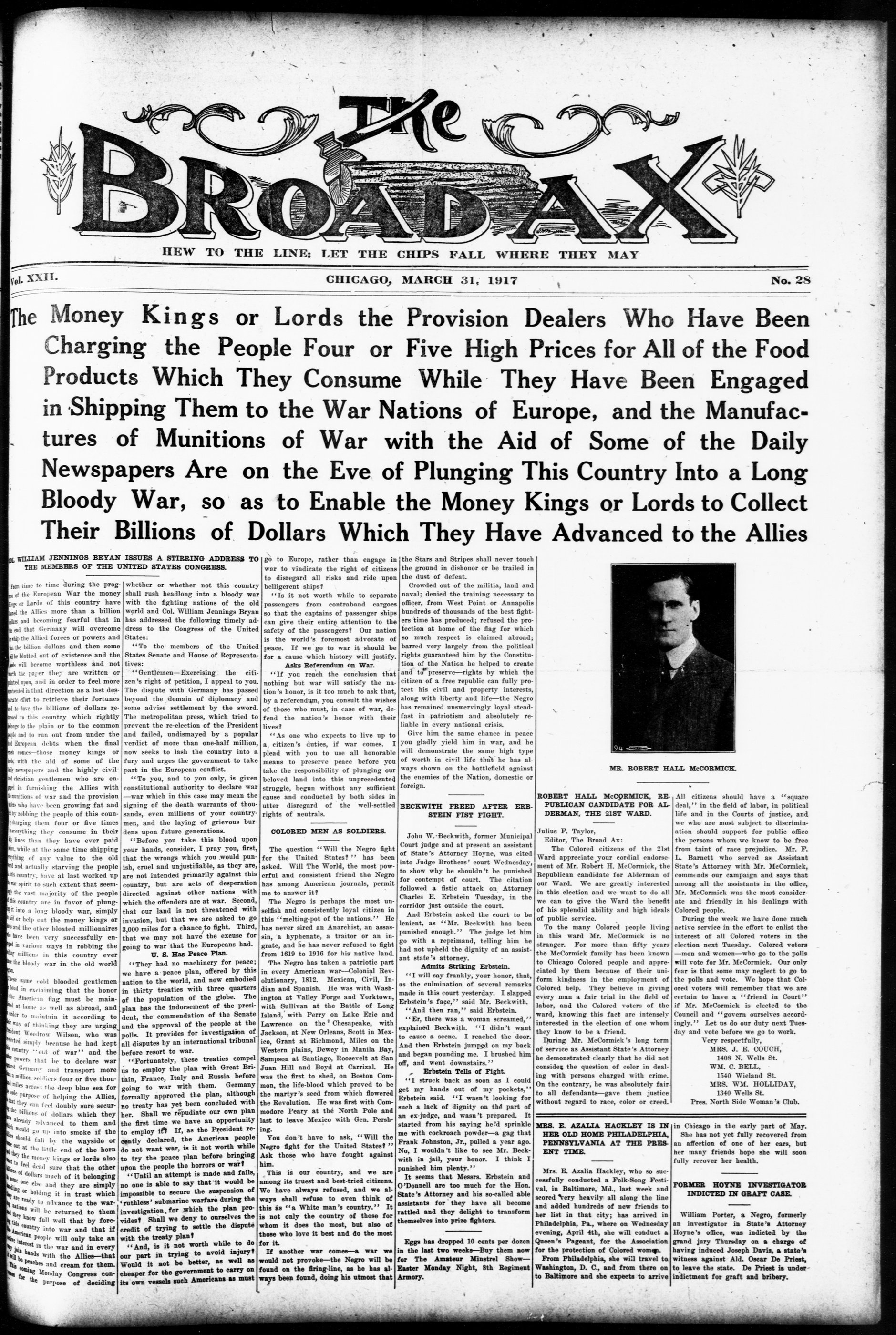
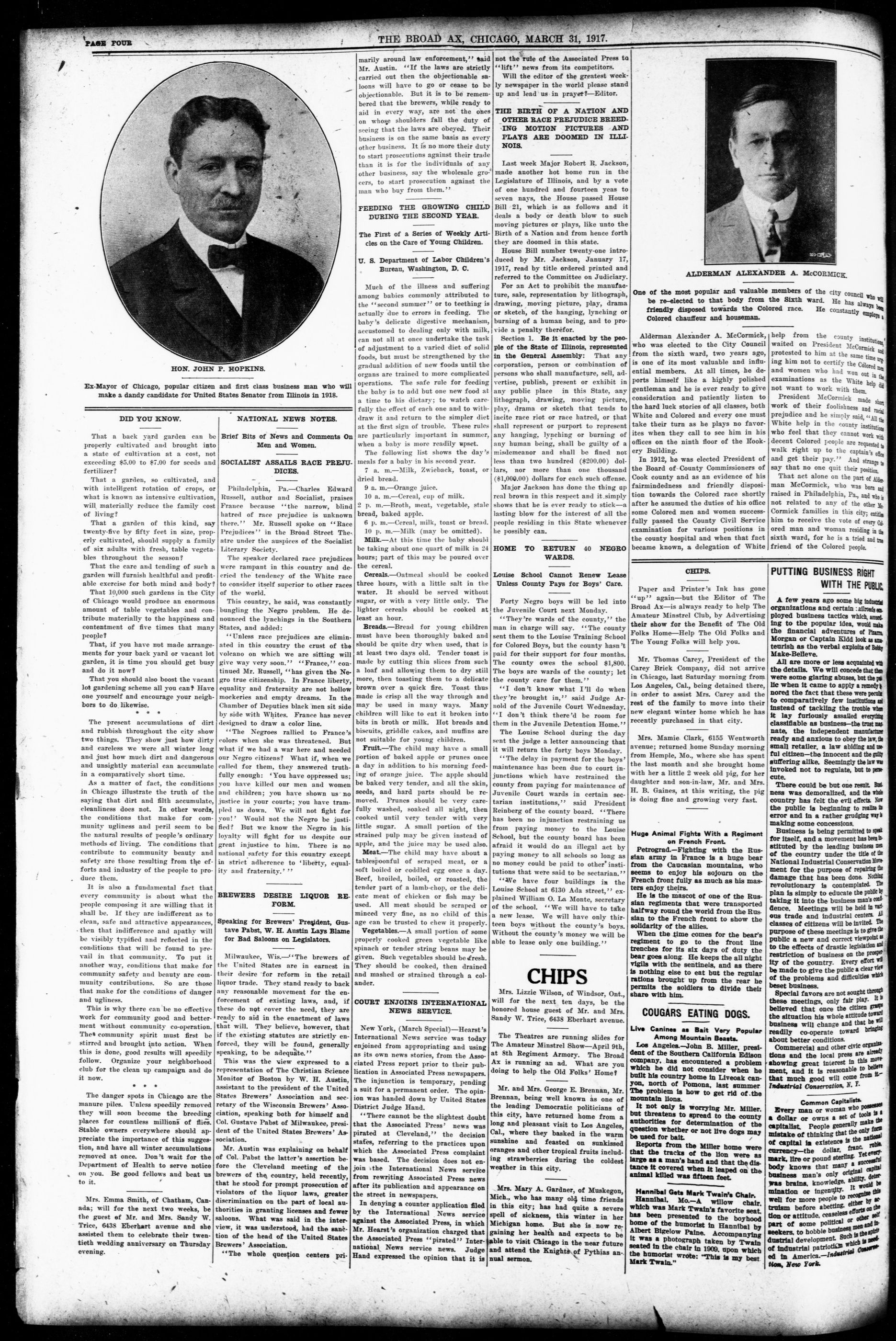
Page text (machine-generated)
THE BROAD AX
The Money Kings or Lords the Provision Dealers Who Have Been Charging the People Four or Five High Prices for All of the Food Products Which They Consume While They Have Been Engaged in Shipping Them to the War Nations of Europe, and the Manufactures of Munitions of War with the Aid of Some of the Daily Newspapers Are on the Eve of Plunging This Country Into a Long Bloody War, so as to Enable the Money Kings or Lords to Collect Their Billions of Dollars Which They Have Advanced to the Allies
M. WILLIAM JENNINGS BRYAN ISSUES A STIRRING ADDRESS TO
THE MEMBERS OF THE UNITED STATES CONGRESS.
Vol. XXII.
The Money
Charging
Productions
in Ship
tures
Newspaper
Bloody
Their L
DOL WILLIAM JENNINGS BRYAN
THE MEMBERS OF THE U
These same cold blooded gentlemen loud in exclaiming that the honor the American flag must be maintained at home as well as abroad, and order to maintain it according to her way of thinking they are urging President Woodrow Wilson, who was selected simply because he had kept in country "out of war" and the power powers that be to declare war against Germany and transport more than a million soldiers four or five thousand miles across the deep blue sea for a sole purpose of helping the Allies, that they can feel doubly sure securing the billions of dollars which they are already advanced to them and which would go up into smoke if the allies should fall by the wayside or out at the little end of the horn and they the money kings or lords also want to feel dead sure that the other is some one else and they are simply running or holding it in trust which they are ready to advance to the war, nations will be returned to them and they know full well that by force this country into war and that if American people will only take an active interest in the war and in every joy join hands with the Allies—that they will be peaches and cream for them. This coming Monday Congress concludes for the purpose of deciding
---
whether or whether not this country shall rush headlong into a bloody war with the fighting nations of the old world and Col. William Jennings Bryan has addressed the following timely address to the Congress of the United States:
"To the members of the United States Senate and House of Representatives:
"Gentlemen—Exercising the citizen's right of petition, I appeal to you. The dispute with Germany has passed beyond the domain of diplomacy and some advise settlement by the sword. The metropolitan press, which tried to prevent the re-election of the President and failed, undismayed by a popular verdict of more than one-half million, now seeks to lash the country into a fury and urges the government to take part in the European conflict.
"To you, and to you only, is given constitutional authority to declare war—war which in this case may mean the signing of the death warrants of thousands, even millions of your countrymen, and the laying of grievous burdens upon future generations.
"Before you take this blood upon your hands, consider, I pray you, first, that the wrongs which you would punish, cruel and unjustifiable, as they are, are not intended primarily against this country, but are acts of desperation directed against other nations with which the offenders are at war. Second, that our land is not threatened with invasion, but that we are asked to go 3,000 miles for a chance to fight. Third, that we may not have the excuse for going to war that the Europeans had.
U. S. Has Peace Plan.
"They had no machinery for peace; we have a peace plan, offered by this nation to the world, and now embodied in thirty treaties with three quarters of the population of the globe. The plan has the indorsement of the president, the commendation of the Senate and the approval of the people at the polls. It provides for investigation of all disputes by an international tribunal before resort to war.
"Fortunately, these treaties compel us to employ the plan with Great Britain, France, Italy and Russia before going to war with them. Germany formally approved the plan, although no treaty has yet been concluded with her. Shall we repudiate our own plan the first time we have an opportunity to employ if? If, as the President recently declared, the American people do not want war, is it not worth while to try the peace plan before bringing upon the people the horrors or war!
"Until an attempt is made and fails, no one is able to say that it would be impossible to secure the suspension of 'ruthless' submarine warfare during the investigation, for which the plan provides. Shall we deny to ourselves the credit of trying to settle the dispute with the treaty plan!"
"And, is it not worth while to do our part in trying to avoid injury? Would it not be better, as well as cheaper for the government to carry on its own vessels such Americans as must
go to Europe, rather than engage in war to vindicate the right of citizens to disregard all risks and ride upon belligerent ships?
“Is it not worth while to separate passengers from contraband cargoes so that the captains of passenger ships can give their entire attention to the safety of the passengers? Our nation is the world’s foremost advocate of peace. If we go to war it should be for a cause which history will justify.
Asks Referendum on War.
“If you reach the conclusion that nothing but war will satisfy the nation’s honor, is it too much to ask that, by a referendum, you consult the wishes of those who must, in case of war, defend the nation’s honor with their lives?
“As one who expects to live up to a citizen’s duties, if war comes. I plead with you to use all honorable means to preserve peace before you take the responsibility of plunging our beloved land into this unprecedented struggle, begun without any sufficient cause and conducted by both sides in utter disregard of the well-settled rights of neutrals.
COLORED MEN AS SOLDIERS
The question "Will the Negro fight for the United States?" has been asked. Will The World, the most powerful and consistent friend the Negro has among American journals, permit me to answer it?
The Negro is perhaps the most unselfish and consistently loyal citizen in this "melting-pot of the nations." He has never sired an Anarchist, an assassin, a hyphenate, a traitor or an ingrate, and he has never refused to fight from 1619 to 1916 for his native land.
The Negro has taken a patriotic part in every American war—Colonial Revolutionary, 1812. Mexican, Civil, Indian and Spanish. He was with Washington at Valley Forge and Yorktown, with Sullivan at the Battle of Long Island, with Perry on Lake Erie and Lawrence on the Chesapeake, with Jackson, at New Orleans, Scott in Mexico, Grant at Richmond, Miles on the Western plains, Dewey in Manila Bay, Sampson at Santiago, Roosevelt at San Juan Hill and Boyd at Carrizal. He was the first to shed, on Boston Common, the life-blood which proved to be the martyr's seed from which flowered the Revolution. He was first with Commodore Peary at the North Pole and last to leave Mexico with Gen. Pershing.
You don't have to ask, "Will the Negro fight for the United States?" Ask those who have fought against him.
This is our country, and we are among its truest and best-tried citizens. We have always refused, and we always shall refuse to even think of this as "a White man's country." It is not only the country of those for whom it does the most, but also of those who love it best and do the most for it.
If another war comes—a war we would not provoke—the Negro will be found on the firing-line, as he has always been found, doing his utmost that
the Stars and Stripes shall never touch the ground in dishonor or be trailed in the dust of defeat.
Crowded out of the militia, land and naval; denied the training necessary to officer, from West Point or Annapolis hundreds of thousands of the best fighters time has produced; refused the protection at home of the flag for which so much respect is claimed abroad; barred very largely from the political rights guaranteed him by the Constitution of the Nation he helped to create and to preserve—rights by which the citizen of a free republic can fully protect his civil and property interests, along with liberty and life—the Negro has remained unswervingly loyal steadfast in patriotism and absolutely reliable in every national crisis.
Give him the same chance in peace you gladly yield him in war, and he will demonstrate the same high type of worth in civil life that he has always shown on the battlefield against the enemies of the Nation, domestic or foreign.
BECKWITH FREED AFTER ERB
STEIN FIST FIGHT.
John W. Beckwith, former Municipal Court judge and at present an assistant of State's Attorney Hoyne, was cited into Judge Brothers' court Wednesday, to show why he shouldn't be punished for contempt of court. The citation followed a fistic attack on Attorney Charles E. Erbstein Tuesday, in the corridor just outside the court.
And Erbstein asked the court to be lenient, as "Mr. Beckwith has been punished enough." The judge let him go with a reprimand, telling him he had not upheld the dignity of an assistant state's attorney.
Admits Striking Erbstein.
"I will say frankly, your honor, that, as the culmination of several remarks made in this court yesterday. I slapped Erbstein's face," said Mr. Beckwith. "And then ran," said Erbstein. "Er, there was a woman screamed," explained Beckwith. "I didn't want to cause a scene. I reached the door. And then Erbstein jumped on my back and began pounding me. I brushed him off, and went downstairs."
Erbstein Tells of Fight.
"I struck back as soon as I could get my hands out of my pockets," Erbstein said. "I wasn't looking for such a lack of dignity on the part of an ex-judge, and wasn't prepared. It started from his saying he'd sprinkle me with cockroach powder—a gag that Frank Johnston, Jr., pulled a year ago. No, I wouldn't like to see Mr. Beck-with in jail, your honor. I think I punished him plenty."
It seems that Messrs. Erbstein and O'Donnell are too much for the Hon. State's Attorney and his so-called able assistants for they have all become rattled and they delight to transform themselves into prize fighters.
Eggs has dropped 10 cents per dozen in the last two weeks—Buy them now for The Amateur Minstrel Show—Easter Monday Night, 8th Regiment Armory.
94
MR. ROBERT HALL, McCORMICK
ROBERT HALL McCORMICK, REPUBLICAN CANDIDATE FOR AL
DERMAN, THE 21ST WARD.
The Colored citizens of the 21st Ward appreciate your cordial endorsement of Mr. Robert H. McCormick, the Republican candidate for Alderman of our Ward. We are greatly interested in this election and we want to do all we can to give the Ward the benefit of his splendid ability and high ideals of public service.
To the many Colored people living in this ward Mr. McCormick is no stranger. For more than fifty years the McCormick family has been known to Chicago Colored people and appreciated by them because of their uniform kindness in the employment of Colored help. They believe in giving every man a fair trial in the field of labor, and the Colored voters of the ward, knowing this fact are intensely interested in the election of one whom they know to be a friend.
During Mr. McCormick's long term of service as Assistant State's Attorney he demonstrated clearly that he did not consider the question of color in dealing with persons charged with crime. On the contrary, he was absolutely fair to all defendants—gave them justice without regard to race, color or creed.
MRS. E. AZALIA HACKLEY IS IN HER OLD HOME PHILADELPHIA, PENNSYLVANIA AT THE PRESENT TIME.
Mrs. E. Azalia Hackley, who so successfully conducted a Folk-Song Festival, in Baltimore, Md., last week and scored very heavily all along the line and added hundreds of new friends to her list in that city; has arrived in Philadelphia, Pa., where on Wednesday evening, April 4th, she will conduct a Queen's Pageant, for the Association for the protection of Colored women. From Philadelphia, she will travel to Washington, D. C., and from there on to Baltimore and she expects to arrive
Julius F. Taylor,
Editor, The Broad Ax:
All citizens should have a "square deal," in the field of labor, in political life and in the Courts of justice, and we who are most subject to discrimination should support for public office the persons whom we know to be free from taint of race prejudice. Mr. F. L. Barnett who served as Assistant State's Attorney with Mr. McCormick, commends our campaign and says that among all the assistants in the office, Mr. McCormick was the most considerate and friendly in his dealings with Colored people.
During the week we have done much active service in the effort to enlist the interest of all Colored voters in the election next Tuesday. Colored voters—men and women—who go to the polls will vote for Mr. McCormick. Our only fear is that some may neglect to go to the polls and vote. We hope that Colored voters will remember that we are certain to have a "friend in Court" if Mr. McCormick is elected to the Council and "govern ourselves accordingly." Let us do our duty next Tuesday and vote before we go to work.
Very respectfully,
MRS. J. E. COUCH,
1408 N. Wells St.
WM. C. BELL,
1540 Wieland St.
MRS. WM. HOLLIDAY,
1340 Wells St.
Pres. North Side Woman's Club.
in Chicago in the early part of May. She has not yet fully recovered from an affection of one of her ears, but her many friends hope she will soon fully recover her health.
FORMER HOYNE INVESTIGATOR
INDICTED IN GRAFT CASE.
William Porter, a Negro, formerly an investigator in State's Attorney Hoyne's office, was indicted by the grand jury Thursday on a charge of having induced Joseph Davis, a state's witness against Ald. Oscar De Priest, to leave the state. De Priest is under indictment for graft and bribery.
No.28
PaGE TWO
owners ano oinectons
} Dan M. Jackson Phones Calumet 6164
} Geo. T. Kersey ‘Automatic 71-629
$ Devia A. MeGowan
} Anmed A. Rayner OPEN pay
AND NIGHT
} The Emanuel Jackson
He
Undertaking Co., Inc.
; 2959-61 South State St.
} Reliable Service * Courteous Treatment
; Reasonable Prices
FREE CHAPEL IN CONNECTION
} Complete line of Funeral Goods. Automobles for hire
Re EO OEE
E rumenene Comin 8806 automatic 73.057 |
§ -THE MOUERN SCHOOL” - CLEAN AND RELIABLE
§ TERREVOUS L, DOUGLAS, Prop.
z CIGARS—WHOLESALE AND RETAIL
i BOX TRADE A SPECIALTY
' 3556 South State Street Chicago
PH ONE DREXEL 3244 RES. PHONE OREXEL 208:
T. W. Champion & Co.
Real Estate Brokers
RENTING +: LOANS 1: INSURANCE
: 5107 South State Street
Chicago
peileie nebo ese | = iiss tn Stee *
Near Laguna, N. M, may be seen
Acoma, the “sky city,” claimed to be
the most wonderful aboriginal city in
the world. It stands on an isolated
rock eminence 400 feet in height. The
city embraces three rows of houses
over a thousand feet in length, rising
‘up in terraces four and five stories.
One is amazed when he stops to con-
sider that the material for these buiid.
ings were transported long distances
and up the cliffs upon the heads and
backs of these human burden bearers.
Their graveyard consumed forty years
in building by reason of the necessity
of bringing earth from the plain below,
and their church must have cost the
labor of many generations, for its walls
are sixty feet high and ten feet thick,
and it has timbers forty feet long and
fourteen inches square—Exchange.
Si
In Longfellow’s journal, in which he
chronicled daily things that came un-
der his observation, he notes that upon
@ certain occasion he attended a
church where the minister took as his
subject “Progress.” He was very fiat
tered when the latter quoted about
half of the “Psalm of Life.” After re-
eating the verses the minister said,
“I could never read that poem without
feeling the inspiration with which it
‘was written.” To this incident Long-
fellow adds: “But I had the conceit
taken out of me on the evening of that
Gay, when I happened to meet a lady
at Prescott’s and in our conversation
she referred to the sermon in the
morning and added, ‘He quoted some
beautiful verses, but nobody knew
whence came the quotations.”
We, the People.
Estimating the world's population as
1,600,000,000, the whole human race at
Present Uving could stand comfortably
shoulder to shoulder in an area of 500
square miles.
‘Taking the number of generations in
the past 6,000 years as 200, the room
taken up by them all on the above
plan would be less than the area of
the state of Colorado. ‘To bury all the
People on earth would need a grave-
yard little larger than that area.
a a ee ee
A correspondent inquires whether it
is proper to speak of a Hawaiian as a
“Kanaka.” The term is masculine. A
“Kanaka” is a male Hawaiian. A
“wahine” is an unmarried Hawaiian
woman. A “wahinemare” is a mar-
ried Hawalian woman. These defini-
tions are from the Hawaiian diction-
ary.—Bellingham American Review.
Inherited, as It Were.
Professor—Yes, sit, your daughter ts
pretty well grounded in French, but it
will, of course, take some time and
trouble for her to acquire fluency. Fa-
ther—Well, you know, that's rather
strange to me. I had an idea that
the fluency would have come sort of
natural to her.—Exchange.
Explained the Matter.
Papa—I'm surprised that you are at
the foot of your class, Tommy. Why
aren’t you at the head sometimes, like
little Wille Bigbee? Tommy—You
see, papa, Willie's got an awful smart
father, and I guess he takes after him.
—London Telegraph.
Made a Difference.
“Why do you fire me? I work like
aixty.”
“If you were sixty that might be ex-
eusable. But you're only twenty-five.”
—Louisville Courier-Journal.
Happy the man who learns the
very wide chasm that lies between his
‘Wishes and his powers—Goethe,
~ Outside the House. ”
‘How many beautiful homes on which
money has been spent lavishly to make
them complete are marred by some de-
fect in the landscape work! A few
hours’ motor trip through the suburbs
of almost any city in the country will
reveal many such cases. The most fre-
quent jar the trained eye receives is
from the poorly laid out walks and
Griveways in which badly arranged
curves are used or walks made to curve
around an oval grass plot placed in the
center for no other reason than to
make pedestrians take time to circle
about that particular grass plot. Post-
men, messenger boys and others take
a short cut, and soon a path in the
proper direction is worn across the sod.
‘When a curve is used in a walk or
Griveway there should be a reason for
it. If there is no other reason plant
one; place a tree or two or shrubs in a
position so the curve will seem neces-
sary. People then will keep on the
walk, and the plan will seem reason-
able—New York Sun.
Making a Macnet.
‘The simplest way of magnetizing a
bar of steel is that known as “single
touch.” The bar to be magnetized 1s
laid on the table, and the pole of a
powerful magnet is rubbed from ten to
twenty times along its length, always
in the same direction. If the north pole
of the magnet is employed the end of
the bar first touched will also become
a north pole, while the opposite end, at
which the magnet {s lifted before re-
turning, will be a south pole.
‘There are other and more complicat
ed methods, known as “divided touch”
and “double touch,” in which two and
even four magnets are, employed.
A steel bar can also be magnetized
by placing it within a coll of insulated
wire, through which a galvanic current
is circulating. The magnetism induced
in this way, however, {s weak com-
pared with that which can be procured
if the same strength of current is em-
ployed through the intervention of an
electromagnet.
Sac Willen Ghaleasearen,
‘There have been many William
Shakespeares in the past. Among the
burials in the registers of St. Clement
Danes, in the Strand, there is the en-
try, “Jane Shackspeer, daughter of
‘Willm., 8 Aug., 1609.” Warwickshire
records show, among other things, that
a William Shakespeare “paid 8s. to the
Lay Subsidy, Walton super Olde;” an-
other W. 8. priced the goods of “Rob-
ert Shakesper of Wroxall” on March 19,
1563; another, a shoemaker of Coven-
try, made his will March 18, 1605-6;
still another William Shakespeare,
“gentleman,” had “his daughter Su-
sanna” (singularly enough) baptized on
March 14, 1596, and yet again another
W. 8, a shoemaker of Warwick, fell
into the Avon and was drowned.
‘These are a mere fraction of the full
list—London Chronicle.
Falling Uo Ou* of a Balleon,
If a man falls out of a rising aero-
plane or balloon he will not go toward
the earth, but will continue rising into
the air for an appreciable time. If
the air machine were stopped in its
ascent at the time it could catch the
man as he came down. If the airship
were ascending at the rate of thirty:
two feet a second the man would rise
sixteen feet before beginning to fall
toward the earth. Thus, by reducing
the speed of its ascent, the vessel
might keep by the aide of the man and
rescue him. ‘The reason why the man
rises is the same as the reason for a
Dallgt’s rising when shot from @ guz
tnto' the air—both the man and the
ballet are given a velocity upward, and
tt takes some time for gravity te nega-
tive that velocity.
THE BROAD AX, CHICAGO, MARCH 31, 1917.
ES
-" | What Are You Worth? :
Have you any idea? Did you ever
capitalize your wages and figure it
out? ‘This is the way to ascertain how
much your labor is really worth.
For instance, @ man who has saved
$20,000 and invested it at 5 per cent re-
celves an annual income of $1,000 a
year, or about $20 a week,
‘The clerk in the office or the work-
man in the factory who gets $20 a EQ
week therefore receives the income at
5 per cent on an investment of $20,000.
He is a $20,000 man—that is, he is
getting as much week by week as the
man with $20,000 who depends solely
upon the income from his investments ————————
and who does not work for a living.
‘The man who earns $40 a week has ?
about the same income as the investor Your opportuni
with $40,000 put out at interest at 5
per cent. {4
So labor is capital. It has a market
value. It can be called a commodity
because it can be sold by its owner the
same as any other possession he may
have—John A. Sleicher in Leslie's. Ps a
ener is passing. The
‘nhs ee Ss aver to a stro
‘That shotguns should be largely utl-
lized in modern warfare is the conten-
tion of a number of military experts
It is pointed out that such guns would
be particularly useful to sentries at
night time, as an intruder might more
easily be crippled and captured by 8
spreading charge of heavy shot than by
a single bullet. Moreover, a person
moving quickly might often be missed
by a shot from a rifle, whereas a suap-
shot from a shotgun in semidarkness
could hardly fail to find its object.
In the trenches shotguns could be
used with success. A shotgun loaded
with about forty-eight grains of pow.
der and one and a half ounces of big
shot, with about twenty-five pellets,
would be of much more value than the
rifle, as during a night attack, either
for attack or defense in semidarkness,
a single charge would hardly fail to in-
flict serious wounds on one or more of
the enemy.—Exchange.
The Swiss Admiral.
“As much business as a Swiss admt-
ral” is a term sometimes used satirical.
ly. But the little inland nation actual.
ly had an admiral once. He was an
Englishman, too, a Colonel Williams,
who Joined the Swiss colors in 1709.
‘This Colonel Williams got together a
small fleet on Lake Zurich and was or
dered to oppose the French army, whict
‘was preparing to attack the Austrians
and Russians massed near by.
‘The French attacked thelr allied foes
and routed them. Admiral Williams
calmly watched the battle that was in
progress on land. Then, enraged at his
own inaction, he discharged his crews,
scuttled his vessels and went back to
England.
Switzerland now has one armored
oat on Lake Lucerne, but its com-
mander is only a captain.—Kansas City
Star.
A Pather Vanshen Qtery.
Father Bernard Vaughan, the famous
English Jesuit preacher, says what he
means and means what he says and
is never afraid of directing his criti-
cisms even against the most powerful
Sections of society, especially the idle
rich.
An amusing reference was once made
to the fiery methods of denunciation
he employs when in the pulpit. He
had been preaching in Rome and had,
‘as usual, dealt out plain truths about
everybody with his accustomed force.
One of the cardinals remarked that
he preached like an Italian. “Yes,”
said another dignitary, “but he is an
Italian, He was born on Vesuvius,
and we only sent him to England to
¢ool.”—London Globe.
Salt and Toothbrushes.
Our dentist tells us a very interest-
ing thing. Ordinary salt is one of
the best methods for sterilizing tooth-
brushes that are known. But not only
because it sterilizes is it so excellent,
but because it has the effect of soften-
ing the bristles and making them ex-
pand ina way. One of the troubles so
frequently met with is that the bristles
come out and are swallowed, causing
appendicitis. The salt causes the bris-
tles to swell and so remain in the
brush. ‘This may be but another of
the several million theories. It is im-
portant, however, that bristles do cause
appendicitis.—New York Globe.
Substitute For Tobacco.
Throughout the tropical orient the
natives employ a substitute for tobac-
co consisting of a slice of areca palm
nut, wrapped in betel leaf, flavored
with a fine lime made of native sea-
shells and colored with carmine. The
habit 1s universal, especially with the
Women, and sellers of “betel nut” may
be seen on many of the street corners
im Saigon and other cities of Indo-
China,
Handsome Serenity.
“George Washington was never guilty
of deception.”
“Maybe not. I don’t believe, in fact,
that he ever looked like his pictures
on our postage stamps. But, of course,
he wasn't responsible for them."—
‘Washington Star.
Logical Conclusion.
“Hlectric wires must be quick tem-
pered.”
“Why?
“Because it seems so dangerous to
cross them.”—Baltimore American.
No Hangings.
Him—How did you like the stage
hangings in that Shakespeare show?
He—There weren't no hangings, y’
boob! He killed ‘em with a sword—
Cornell Widow. .
Men who are low and are falling do
not revolt. It is men who, although
they may be low, are rising who re
volt—W. G. Sumner.
fat os bt a ME oe PO
OU HA UCH!
ERtram,
THOUGHT SOME=
BUT NOW IS YOUR TIME TO Act}
BUT NOW bb 10K eect
Your opportunity to be a part owner ---to share in profits of |
“THE BIRTH OF A RACE”
is passing. The shares of Capital Stock have been turneg
over to a strong firm of brokers. The sales are big — i
Chicago --- all over the country. The shares are going very
fast. Soon they will be entirely gone, and your chance ty
make a lot of money gone also --- unless you get busy,
Not Next Month
ot Next Month But TO-DAY
ee
This Master Photoplay is of interest to you. It will help yoy
and your race, and make money for you at the same time,
——————————
President, EDWIN L. BARKER, a man who has produced real motion pictures.
Secretary, JOHN C. WILLIAMS, for 6 years Attorney for Sanitary Dist. of Chicago,
Treasurer, JOHN GULLIKSEN, Assistant Cashier of the Union Bank of Chicago, |
DEPOSITORY FOR FUNDS, Union Bank of Chicago.
Be ee)
Fs ré a BIRTH OF RACE PHOTOPLAY ‘CORPORATION,
aoe Le Suite 416, 29 Se. LaSalle Street, Chicago’
, < Please send me, without obligation on my part, fl
CLIP, fill out and mail this coupon Komeatiom sone the Pee 6 Stas
to-day, and circular telling all about
“THE BIRTH OF A RACE,” will ‘ume
is ee ontat once: aes tees ceneu enenarscceseectesesesenccercene
There is a Monthly Payment
Plan which makes it very easy to Street.
own a few shares of stock. ssseneneneeneneneneecaeneas seeeeeseesssetin
Using the Scrub Palmetto,
Once a prolific and troublesome waste
product throughout Florida, the scrub
palmetto is now being developed into
an asset of great possibilities. Not
only has it been discovered that paper
of good quality can be made from it,
Dut the manufacture of carpets, mat-
tings, twines, rope and burlap from the
plant is already an industry of high
standing in the state. Only the green
leaf, or fan, is used. Claim ts made
that the palmetto leaves when shred-
ded and spun are very much tougher
than the grass now used for mattings.
‘The green leaves are fed just as they
are cut into the shredding and spinning
machines, and in three minutes they
come out in twine. This avolds the
Giscolorations and losses occasioned in
drying, storing and handling grasses
commonly used for matting. Palmetto
can be cut every day in the year and
immediately made into twine. The
skeins of twine when hung up dry rap-
idly and uniformly. The twine is used
as soon afterward as necessary. —Argo,
naut,
Sind ot Mesias Se
I believe in the stuff I am handing
out, in the firm I am working for and
in my ability to get results. I believe
that honest stuff can be passed out to
honest men by honest methods. I be-
eve in working, not weeping; in
boosting, not knocking, and in the
Pleasure of my job. I believe a man
gets what he goes after, that one deed
done today is worth two deeds tomor-
row, and that no man is down and out
‘until he has lost faith in himself. I be-
Weve in today and the work I am do-
ing, in tomorrow and the work I hope
to do and in the sure reward which the
future holds.
I believe in courtesy, in kindness, in
generosity, in good cheer, in friendship
and in honest competition. I believe
there is something doing, somewhere,
for every man ready to do it. I believe
I'm ready—right now!—Elbert Hub-
bard.
‘The Sadness of @ Weddina.
‘There is something sad about a wed.
ding. The young groom fs leaving a
home in which he always has had his
‘way and is going into one in which he
never will have his way. Although his
Parents do not go through the formal
ity of giving him away at the altar,
they know well enough that in a few
minutes he will be a son-in-law to an.
other woman, while to them he is noth-
ing but a son. There he comes, with
another man holding to his arm. It
looks as if he might have made an at
tempt to escape and that the strong
Dest man captured him and brought
him back. He is as happy as he is
‘Rervous and so trustful that he has no
fear for the future—Claude Callan in
Fort Worth Star-Telegram.
Why Not?
Glerk—Now, see here, ttle girl, 1
¢an't spend the whole day showing
you penny toys. Do you want the
earth with a little red fence around i
for 1 cent?
Little Girl—Let me see it—Life.
Life of a Battleship.
We are continually reading in the
newspapers that various battleships
have been completed, launched and for
‘how long they have been commission-
ed. There are probably few people,
however, who know how long a bat-
tleship lasts. The average life of a
modern battleship is about fifteen
years. In the old days a battleship
‘Was on active service nearly the whole
time of its commission, which was
about a hundred years.
The Victory was forty years old
‘when she fought at Trafalgar, and the
Royal William, which was built in
1670, was not “scrapped” until 1813.—
London Mail.
Squabs.
A squab grows enormously the first
twelve hours and still more rapidly
after the third day. Squabs are at first
sparsely covered with long filaments
of down, the root of each filament in-
dicating the point from which each fu-
ture feather is to start. The down for
awhile still hangs on the tips of some
of the feathers during their growth and
is thought by some to be finally absorb-
ed into the shaft of the growing feather.
i a
2b, come! Stop borrowing trouble.”
“Borrowing! Gee whiz, man, trou-
ble isn’t like money! When I borrow
money I can about it right
Sway?—Boston Transcript
Hie Grouchy Ocinion.
“The office should seek the man.”
“And the girls aren't hanging back
bees these days.”—Kansas City Jour-
nal
© PRACTICAL HEALTH HINT. |
° ee,
° Cleaning the Teeth.
© A clean tooth never decays.
© The best way to clean the teeth |
© 1s to place the bristles of the |
© brush firmly against the teeth |
© and with a rotary or scrubbing |
© motion go up and down the sur- |
© face of the upper and lower teeth |
© both inside and out and up on
© the gums. Go also behind the |
© teeth. After seeing that every |
© bit of the surface of the teeth |
© has been cleaned in this way |
© rinse the mouth thotoughly, |
© forcing the water between the |
© teeth several times to loosen |
© any food particles. Do this more |
© than once and always spit it out. <
© To keep the teeth as clean as |
© they should be kept in order to
© preserve them and prevent de- «
© cay it is necessary to wash them <
© mon, Sach meal so as to re- |
© move all food particles. They «
© should also be washed the first <
© thing in the morning and the «
© last thing at night It is well «
© to have more than one brash on «
© hand at a time, so thht it will «
© never be necessary to use a wet, «
© limp brush. P
° «
Be Nt ge
STYLE
<- HAIR.
To Colored
cates tie ind
Ml micsiscos
ee ess
Ni 3 ys it.
Ee ios
SAMY fcc
ee
WME? So ee:
eer oes
Cee eo
MED ccc
tesieg. 3 ‘We make the Sat
coh asery
ENING combs, with extra heavy back i
Eusraniccds With each cont we ge
FREE: “Send money ordcr ot saan: KO
BACK IF NOT SATISPACTORY. Se r=
= mee)
ree
Eoin © POSTPAID
Hear nets, brushes, combs snd tl 2
manufacturers prices, Sod toes!
Agents Wanted. Address a5: inal
HUMANIA. HAIR COMPANT -
stash Park Hows Sew tes
F ndacene Dont |
Grapes will grow almost am
and are sure to bear, Grape a
trained on trellises cose to tes
to outbuildings. Spring 's
time to plant, using elther ove ot
Year old vines. Frequently
during summer will improve
‘Wood ashes make a god
for grapes, and half « bushel ®
‘vine Will not be too much.
No pruning will be required
season, but the second season ct
the strongest canes to three
buds and remove all others
See ee
Proper Physical Education
‘The purpose of physical elvaiay
of course, not merely to bald #
bodies of boys today, but 9 Pa
the lives of boys that thing.
it is, that will make the boy sa!
and ablebodied when be reach,
hood. Such men—lorers of fret
of hiking in the wild, of sleeis®
‘under the sky—men who can BO
Joy and endure, are the men ¥
make up a strong nation and mt
ton of weaklings—Scouting-
aa
Pen, Unen’e Lighthous® |
Probably the most ey
Greary spot in the world soba
white men is the lighhoue Oy
maintained by the angentioe
ment at Cape Horn. Te?
to be the southernmost
the world. 7
————
‘One at « Time
“Does your husband "O77 wen
Sra OT erin
lo; he says ‘worry
himself and the s70°eF _
the same bills.’"—Bxcbsns®
sepia
Queer. a
“Your wife gave 0 * alt
ture on cooking last 4
weren't you there?” ole
“[ was home with x
of dyspepsia.” ___
”
Heath es ine ot
earthly royal road 19 #
tofl.—Wendell Philips
Ee OR a ins = r."
—“Potatoes a8 @ Food.
uted prices the potato 1s not «
Mey itis not at any rice one of
eS Civilized humanity existed
et for centuries, rising to its
ei ‘ potatoless old world. Habit
egresieace in storage have led to
ae ssto 1s three-fourths water
pont qite one Sth starch, which is
pet ood substance, an excellent
ovelgatdoor workers in severe elf
Se ris less valuable for seden-
wi oters indore
oly onetive hundredth part of the
pains fat per cent nitrogen, 2 per
efigse. These more valuable sub
sees are 8? slight that during the
Sipe of 1817 Irish cotters formed
ie babit, of cooking potatoes “with a
tp the middle”—that is, of under
Wig them #0 that they might delay
gestion and stave off hunger.
Mere are substitutes, of which rice
bs ‘approaches the potato in values
foi defects. ‘The correct instinct of
fiers las mended the latter by
pe invention of pilaf, in which rice is
sppiesented by chopped meats or
res—New York World,
i te Deen
pitts) ee Oe oun Ee ace
gp Cnited States 1s 2,001,833. If Aus.
Si slungary is included the total ts
perased to 4,171,915.
fhe matives of Germany and Austria-
gaary comprise 31 per cent of the
Eni foreign population of the country
‘Giles than 5 per cent of the total.
er York bas the largest German
paistion of any state in the Union.
FP total is 463,700. ‘The German
poastion of New York city ts only
Mer cent of its forelgn population.
ie half of Cincinnati's citizens were
yn in Germany. The other centers
p ite order of their population of the
fenmn vote are a8 follows: Balti-
gore, Buffalo, Chicago, Detroit, Jersey
(is, Los Angeles, Milwaukee, Newark,
& Louis and San Francisco,
i its proportion of Germans Wis-
yssin leads, Minnesota second.—Syra-
gon Post-Standard.
Our Fishing Presidents.
Fourteen of the twenty-seven prest-
dats of the United States have been
fermen. When fishing and the pres
fiacy are mentioned the mind in-
gatiy recalls Cleveland, the fishing
peident. He 1s the one president
io wrote a book discussing angling.
isnot generally known, but the first
psident of the republic was an en-
fasastic angler. It may be of inter-
e¢ to the enthusiastic anglers of the
ion to record the names of the fish-
by presidents. ‘They are George
Fasington, Martin Van Buren, John
fie, Zachary Taylor, Millard Fill-
pre, Franklin Pieree, Abraham Lin-
ib, Andrew Johnson, Ulysses Simp-
= Graut, James Abram Garfeld.
Gester Alan Arthur, Grover Cleveland,
feolore Roosevelt and William How-
el Taft—New York Sun.
Be er
|g it of any value to know how to
‘ny the alphabet backward? A corre-
guviest says: “I think this is new, as
Im tie inventory and it is of some
we in exercising By the typewriter if
for wthing else. The twenty-six let-
tesof the alphabet are used as initials
«wunds divided into five groups of
‘nr iutials and one group of six. The
‘oy are connected as follows:
tatras Yoked, Xylophones Whacked,
Tees United To Sing.
‘Bed Quick, Pass On!
Suture May Lack Kindness:
dices Inside Hanging Grapes—
Trends, Enemies, Dogs, Cats, Bats, Ants.
—New York Sun.
A Way the Dutch Have.
Tie Dutch have a delightfully orig-
jt way of collecting their taxes. If
jtter the notice has been given the
‘mney is not sent the authorities place
‘or two hungry militiamen in the
‘ewe, to be lodged and maintained at
Seexpense of the defaulter until the
‘Bount of the tax is paid.
Its Oddity.
“There is one thing in a lawyer's pro-
— which is different from any
“What fs that?”
“Tho longer he is at it the more be
tu ot a brief career.”"—Baltimore
American,
Im Hie Line. >
He is building an immense artifi-
41 mountain on bis country estate.”
“Well, 1 sues it comes sort of natu-
Alfor him to put up @ biuff.”"—Puck.
Marital Amenities.
‘(My band is always in my pocket.”
“That's just what I'm complaining
mt, it never comes out.”—Brchanee.
; PRACTICAL HEALTH HINT :
. Consumption, ‘
§ Addict of peanuts is suggested ¢
* secure for consumption by Dr.
Brewer in the Journal of Hy- ¢
§ siete. ‘This seems too simple to
fie true, but Dr, Brewer tells <
$ sf two young women who had <
§ Bown sick of cod liver off and 4
$ tonics and who were treated by 4
¢ Hn with sulted peanute-all they 4
$ Sd eat—combined with inbala- 4
; tons of vinegar, :
Ove would think this a very
§ Ratcestibie diet.” he writes, “but.
¢ Bey craved them, and it has al- 4
$ [27 been my policy to find out 4
¢ 28 what my patients desire to 4
¢ af.824 unless tt is too unreason- 4
4 ie! homor them, Both young 4
tities ave become plamp and 4
8 one year’s inhalation bave
4 asec, and I pronoane- ‘
cured.”
+ Peau ate recommended also
9M aleepiesmess, :
Me
ee ne 's Best, Says Armour.
In the American Magazine is an arti-
ele by J. O, Armour entitled “Armour
‘Men Who Got Ahead—and Why,” in
which Mr, Armour gives his opinion of
the qualifications that make for busi-
ness success,
“One of the truest axioms I know,”
he says, “is the business saying that
‘the best trained man is the self train-
ed man.’ It is my belief that no man
developed by a formula in a business
‘organization ¢an ever reach the power
of one who is put on his own responsi-
bility, knowing that his advancement
depends on his own brains, foresight
and application.
“By this I do not mean that a busi-
ness leader should let his men go along
blindly. He must always give some-
thing of himself. He must teach them
the overhand and crawl strokes where
they knew only the breast stroke be-
fore. But in any office organization
the man who has never had to stand
squarely on his own feet is never in a
Position to march ahead.”
——__—_—_
Wek sta tii
One of the newest of astronomical
instruments is the blink microscope.
The principle involved is similar to
that of the moving picture machine.
In the latter the film used consists of a
series of pictures, each a little differ-
ent from its predecessor. If these are
Presented in rapid succession the se-
les is fused into one picture in which
the succeeding differences appear as
motion, The blink microscope enables
one to compare a photograph of a por-
tion of the heavens with another of
the same region taken several years
later. An ingenious contrivance brings
first one then the other plate into view
im rapid succession. If in the interval
between two exposures a star in the
Tegion has changed its position appre-
clably it will appear to move and can
be detected at once. Formerly it was
necessary to measure carefully the po-
sitions of all the stars on both plates
in order to detect those with large
Proper motions. Such stars are some-
times called “runaway” stars.
Complaint of the Stupid.
+t Is only stupid people who complain
that they are misunderstood. If they
were not stupid they would know that
there is absolutely no such thing as be
ing misunderstood, and therefore that
there is nothing whatsoever to be gain:
ed by complaining about it.
Wise people who want to be under
‘stood do not spend thelr time com-
plaining, but in perfecting some means
‘of expressing themselves by which
they may reveal to the world about
them some slight remnant, at least, of
their souls or their minds or their ideas
or thelr discoveries or their eccentrici-
ties or whatever it is they want to
make known.
‘When you complain about not being
understood the only thing you make
clear is that you are a complainer.—
Puck.
Sistine ecco
All of the Eskimo carving today is
done with steel tools, but there is work
im existence that dates back to the
stone age. The older Eskimos say that
their ancestors used tools of flint, and
it is known that they have been carv-
ing ivory for many generations. Some
of the very poorest of them and those
that live in the most out of the way
places are noted for their work of this
kind. They seem to do it for pastime
and make many toys and dolls for
their children. ‘They have a way of
softening the bone, horn or ivory be-
fore they work it, and to make the
carvings more distinct they etch lines
on the surface with a black paint made
of a mixture of gunpowder and blood.
‘This, when put on the freshly cut bone,
‘makes a permanent stain.
What He Didn't Know.
Peyton R. Hayden was long a con-
spicuous figure among the lawyers of
Boone county. While he was fond of
studying lawbooks, he cared little about
Uterature.
‘During a recess one day in the Boone
county courthouse a lawyer named
Field from Lafayette county asked
him what he thought of Byron's
“Qhilde Harold.” Hayden replied:
“Bgad, sir, I did not know that By-
ron bad a child named Harold.”—
“Bench and Bar of Boone County, Mo.”
A QGlveewev,
Mrs, Blabbit—I don’t like her at all,
Gear. She's a deceitful woman. The
other day she tried to get me to say
something against you. Mrs, Gaddeigh
She did! How? Mrs, B.—Why, she
asked me to tell her confidentially
what I really thought of you—Boston
‘Transcript.
Oddity of the Sturgeon.
‘The sturgeon has no skeleton. This
fish has many tubercles fixed in the
skin along the back and sides. If these
tubercles are boiled with a little soda
it will be seen that they are beautifully
ornamented, somewhat resembling very
fine Chinese carving.
Easy Judgments,
“Solomon was a wise man.”
“Ob, he had it easy. There were no
technicalities in his day, nor did he
have to decide cases with the allenists
evenly divided.”—Exchange.
When He Got the Hint.
“What started you thinking about
marriage all at once?”
“She wouldn't let me buy ber a bor of
eandy—said I would need the money.”
—Houston Post.
Romance and Fiction.
‘When a very rich man marries a very
poor girl, that’s romance, When a very
wich girl marries a very poor man,
that's fiction.—Galveston News,
Meet trouble Hike a man and cheen
fully endure what you can’t cure,
~__ THE BROAD AX, CHICAGO, MARCH 31, 1917.
—$——_———
‘The Ideal Kitchen, : Bees and Fruit. ~
‘The kitchen is the real workshop of | An agricultural society of Flor
the family. Most of the work there Italy, has recently carried out a
has to do with preparing food for the | ough investigation of the allege
family, cleaning it up and putting it | Jury of fruit by bees and has
away. The old fashioned kitchens | pletely exonerated the latter. Bee
never took into account economy of | unable to perforate the skin of
steps and time, but today this is al-| fruit, and it is only incidentally
ways done. ‘There is a logical order | they suck the juices of fruits. inj
for the arrangement of the equipment. | by other natural causes. The dat
‘Things that belong to each process | sometimes attributed to these in:
should be together, within the reach | 1s due to poultry, wild birds, wind
of the worker. The icebox, cold pan- | hail, and even more frequently to
try, Kitchen cabinet, stove and serving | nets, Wasps, vine moths and othe
table are used together and should be | sects. Instead of being harmfu
tm a close continuous line. This is the | orchards and vineyards, bees per!
food preparation side of the equip-|the useful service of effecting
ment. For the cleaning up of the same | cross pollination of flowers, and b
economy should be practiced. The sink | the setting of fruit as well as th
should be near the china closet or in | struction of damaged fruits (espec
@ butlers pantry, the track should be | Tapes) by sucking the juice and
straight for clearing up. Always have | and thus preventing fermentation
Plenty of table room near the sink, | Tot extending to sound individi
Grain board on each side is the best | The orchards and vineyards freque
plan, or at least a set of hanging | by bees give the most constant cro
shelves, a hinged shelf and extra ta- | Scientific American.
ble or a wheeled table at the right. If ———_
the drain table is porcelain a rubber Idolatry as It is.
mat will prevent breakage.—Exchanga, After months spent in idolatrous I
——_——_ I have been unable to see much
iinet sh Maia worship in heathen shrines. The.
Atuminum is in many ways & won-
derful substance, albeit in the natural
world most of it is oxidized and turned
to clay. Its avidity for oxygen is one
of its most salient characteristics. It is
said that one never sees the metal, di.
rectly, in air, but always and only
through a vell of superficial oxide
which forms on its free surface with
marvelous rapidity. It is stated that if
‘a fresh surface of aluminum be pre
pared by scraping with a knife the
oxygen of the air runs in as fast as the
scale is peeled off and keeps close be-
hind the knife blade.
If it were not for this superficial
scale of oxide, which acts as a barrier
to further action, the metal would burn
up or deflagrate in air. The large
amount of heat developed by thermtit,
a mixture of powdered aluminum with
oxygen giving substances, bears wit-
ness to the activity of the oxidizing
process when completed.—Washington
Star.
‘Tokvo'a Prolific Blume
No tourist crosses the Sumida river
unless it is to visit the great amphi-
theater for a wrestling match or a
chrysanthemum show, yet there is
where the real secret of Tokyo's fu-
ture lies. It is the factory and slum
sections of the city, and the population
there has increased in the last decade
ten times as fast as has the population
in the district of Kojimachi, which
surrounds the palace.
In the last generation the population
of the five greatest industrial and com.
mercial cities in Japan bas increased
by 314 per cent as against an increase
in the whole empire of 15 per cent.
‘The trend in Japan is cityward, and
the visitor to Tokyo, seeing the streets
crowded with people, does not realize
that in the suburbs the growth in popu-
lation has run from 250 to 500 per cent
in the last decade.—Christian Herald.
pimeiittantis ONIRs Duet
Every native or naturalized citizen
of Argentina, at home or abroad, on
reaching the age of eighteen years
must be enrolled. The federal execu
tive power takes charge of this nation.
al enrollment, which serves at once as
a registration of voters and national
defenders. A given individual, if at
home, is enrolled in one of the five
‘military districts into which the four-
teen states and ten territories of Ar-
gentina are divided. If he resides
abroad he is enrolled in his consulate,
for the government follows him with
precision wherever he may wander.
‘With the exception of these consular
registrations abroad the general en-
rollment is entirely in charge of the
military authorities, who are counted
upon to get more thorough results than
a civil census provides.—World’s Work.
A Help to the Soil.
A Fiench chemist attributes to car
bonate of manganese in very minute
quantities the power of rendering fer-
tilizers more readily assimilable with-
out undergoing any change itself. Ex-
periments have tended to show that
with the use of an ounce to about
seven square yards germination was
more free, growth more rapid and yield
better—that 1s, used with other fer
tilizers. By itself it is supposed to have
no effect whatever.
His Idea.
“Binks has an idea that he expects
to make a lot of money out of.”
“What fs it?”
“An electric plano with a slot ma-
chine attachment.”
“There's nothing new in that.”
“Oh, yes, there is. The coin you put
in stops the playing.”—Buffalo Express.
Flannagan’s Way.
Cassidy—Flannagan’s thinking of go-
in’ into the haulin’ business, He bought
@ folne new cart today. Casey—But
shure he has no horse. Flannagan—
No, but he’s goin’ to buy wan. Casey—
‘Well, that’s loike Flannagan. He al-
ways did git the cart befor the horse.
—Philadelphia Ledger.
A Confirmed Taste.
“1m blest if I can see what Blabkins
finds to admire in that Miss Jorkins,”
said Hinkleigh. “Why, she's wholly
made up.”
“That's it, I guess,” said Harkawey.
“Biabkins always was crazy about fic-
‘tlon.”—Harper’s.
Severe Treatment.
‘Howell—Why did Rowell allow bim-
self to die of starvation? Powell—He
said be wouldn't humor his stomach
any longer, as it was getting to be a
regular grafter.—New York Times.
‘There are things we must try to at-
tain, yet it is not really the attainment
that matters; it is the seeking —Gilbert
Murray.
Th oto
An agricultural society of Florence,
Italy, has recently carried out a thor
ough investigation of the alleged in-
Jory of fruit by bees and has com-
pletely exonerated the latter. Bees are
unable to perforate the skin of the
frat, and it is only incidentally that
they suck the juices of fruits. injured
by other natural causes. The damage
sometimes attributed to these insects
4s due to poultry, wild birds, wind and
hail, and even more frequently to hor-
nets, wasps, vine moths and other in-
sects. Instead of being harmful to
orchards and vineyards, bees perform
the useful service of effecting the
cross pollination of flowers, and hence
the setting of fruit as well as the de-
struction of damaged fruits (especially
grapes) by sucking the juice and pulp
and thus preventing fermentation and
rot extending to sound individuals.
‘The orchards and vineyards frequented
by bees give the most constant crops.—
Sclentifie American.
iit aa On Bi
After months spent in idolatrous lands
I have been unable to see much real
worship in heathen shrines. ‘The edu-
cated worship with their tongues in
their cheeks and the ignorant with
their hearts in their mouths. But the
amount of real worship that exists in
heathen temples is very small.
Sometimes a bereaved mother will
enter the temple and draw from her
kimono the tiny bib of a departed little
one and tie it to the statue of Jizo, the
god of motherhood. Sometimes an old
man or woman almost blind will enter
the temple and rub the eyes of a wood-
en god and then rub his own in the
hope that eternal darkness may not
close in on his affrighted soul. In some
places Buddhist services are as digni-
fied, as well attended and as helpful as
our own, In Hakodate I attended a
Buddhist preaching service that smack-
ed less of idolatry and more of morals
than some ceremonials in our crucl-
form ehapels.—Christian Herald,
a eo a pn
Though the Arabs number less than
the population of London, their lan-
guage is one of the most widely spoken
and influential in the world, for it is
the language of the Koran. Seventy
millions of people in Asia and north
Africa speak some form of Arabic as
their vernacular, and quite as many
more know something of the language
from the Koran, which in the original
is a text book in the day schools of the
Mohammedans from Turkey to Afgha-
nistan and New Guinea. Nor is Arabic
unworthy of this extensive use. Re-
nan, after expressing his surprise that
such a language should spring from
the desert regions of Arabia and reach
perfection in nomadic camps, declares
that it surpasses all its sister Semitic
languages in richness of vocabulary,
delicacy of expression and the logic of
its grammatical construction.—London
Chronicle.
ala |
Something like half a century ago a
man named Dan Bradley started the
custom in a little cigar store in Brook.
lyn of keeping a box of smoking to-
bacco on the counter, with a sign
above it saying, “Fill your pipe.” Part-
‘ly on the strength of his popularity,
‘due in no small degree to the free ‘il
‘ings for a pipe, Bradley ran independ.
ently for the state senate and was elect
ed as against the regular candidate.
“Five thousand clay pipes did the
trick for Dan™ was a saying at the time.
“A man would have to give away au-
tomobiles to get elected to the senate
nowadays,” observed one of the new
school of politicians.
“The days of the election cigar and
tobacco are goue forever.”—New York
World,
Damascus Swords.
Damascus swords, whose fzme at one
time made them almost one of the won-
ders of the world, were made of al-
ternate layers of iron and steel, so
finely tempered that the blade would
bend to the hilt without breaking, with
an edge so keen that no coat of mail
could resist it and a surface so highly
polished that when a Moslem wished
to rearrange his turban he used his
sword for a looking glass.
Wises Sacha Liien:.
_ A Yankee clinched his heated argu-
ment with an Englishman as to the
relativ size of the Thames and Mis-
sissippl by saying:
“Why, look here, mister, there ain't
enough water in the whole of the
‘Thames to make a gargle for the mouth
of the Mississippi.”
‘Too Much to Ask.
“Bliggins is a little annoying in man-
ner, but his heart is in the right place.”
“Yes,” objected Miss Cayenne, “but
you can't be expected to perform a
surgical operation on every disagree-
able person to ascertain where his
heart i”"—Washington Star.
Doing Her Part.
“Wife, will you thread a needle for
me? I want to sew on a few buttons.”
“Why, certainly. There you are.
Now you can sew on your buttons
‘while I go to the bridge club. Some-
times I wonder how you managed be-
fore you were married.”
Cini
Sappleigh—It’s an awful thing io
realize that you've made an egregious
ass of yourself. Miss Keen—Haven't
you got used to it yet?—Boston Tran-
‘extpt.
| Neutral Ground,
Individuals, like nations, must have
suitable, broad and natural bounda-
ries, even a considerable neutral
ground, between them.—Thorean.
Could we but think with the same In-
tensity we love with we might dc great
things.—P. J. Bailey's “Festus.”
Fragrant Fern. ~
Some say it has the fragrancy of new
mown hay. It reminds others of fresh
strawberries. ‘There are also those
who detect it in the perfume of the
wild rose. Opinions differ as to what
the fragrance resembles, but all opin
lons are unanimous in praising it Sc
they call ft the fragrant fern.
It grows in small, round clumps in
clefts on the face of a precipice, out of
reach of collectors, who haven't the
patience to hunt for it. For this rea-
ton it 1s not well known. Its out of
the way haunts provide an effectual
hiding place.
‘The hardiness of the fragrant fern
surprises the amateur collector. It
grows in full glare of the sun, in
Places where more common ferns
would be scorched and withered. Yet
the fronds remain green throughout
the year, and even the year-old fronds,
which turn brown at the end of the
Season, curl up around the roots of
the plant and cling to the rocks —Phil-
adelphia North American,
Tact and Success.
Tact is a combination of good tem-
per, ready wit, quickness of percep-
tion and ability to take in the exigency
of the occasion instantly. It is never
offensive, but is a balm allaying sus-
picion and soothing. It is appreciated.
It is plausible without being dishon-
est, apparently consults the welfare of
the second party and does not mani-
fest any selfishness. It is never antag-
onistic, never opposes, never strokes
the hair the wrong way and never irri-
tates. Tact, like a fine manner, eases
the way, takes the Jar out of the jolts,
oils the bearings, opens doors barred
to others, sits in the drawing room
when others must wait in the recep-
tion hall, gets into private offices when
others are turned down. It admits you
into exclusive circles, where wealth
abounds, even though poor. It secures
the position when merit is turned
away. Tact is a great manager. It
easily controls people, even when com-
bined with small ability, when genius
cannot get along.
Slesie Tikenn Gasset.
The more complex life grows the
more these little things count. One or
two men at the pumping station could
produce a water famine for 2,000,000
people.
Cut a very thin wire, and a city fs in
total darkness.
Five cents’ worth of calico 1s enough
to eclipse Raphael's finest Madonna.
When everybody walked to his ap-
pointed place of work nothing short of
a universal calamity would keep ev-
ersbody away from work. Now a de-
fective feed wire will halt a hundred
thousand in trolley cars.
And because these little things do
foot up to such big totals the human
element remains important despite all
our inventions.
Most failures are men and women
failures, not machine failures.—Phila.
delphia Ledger.
| i aia
Lettres de cachet was the name given
in France to warrants sealed with the
King’s seal ordering persons to be
thrown into prison or exiled. The frst
came into use about 1670 and shortly
became one of the popular terrors of
France. It is said that no less than 9,000
lettres de cachet were issued during
the reign of Louis XIV. and 80,000 dur-
ing the relgn of Louis XV. In many
cases these terrible documents were
secretly sold and used as a source of
illicit revenue. They were frequently
signed in blank, and the holder of one
of these royal terrors could write in
the name of any person against whom
he happened to have a grudge. The na-
tional assembly abolished this iniqui-
tous privilege of issuing lettres de
cachet on Nov. 1, 1789.
Rattling Windows.
In some houses the windows have an
unpleasant habit of rattling at all times
of the day and night when there is the
Jeast wind. In such a case an ordinary
clothespin is most effective, It must be
‘split in half and one half inserted on
each side between the framework and
the window or between the sashes. A
good plan is to paint the clothespeg the
same color us the window frame and
secure the pleces by a cord and screw
to the frame so that they will be in
readiness when needed.
2
“That is my hired man asleep up
there in the crotch of that oak tree,”
said honest Farmer Hornbeak. “You
are entitled to one guess as to whether
he clumb up there to slumber or went
to sleep on the ground on top of an
acorn which grew up with him”—
Kansas City Star.
A Cont.
‘The habit of calling the cent piece
of our American coinage a “penny” is
utterly without foundation or excuse.
We have no penny in our coinage. At
‘one time half cent pieces were coined,
but now the unit is a cent, the hun-
dredth part of « dollar.
Wonderful.
In the art department a few days ago
ne of the students drew the picture of
@ hen so lifelike that when she threw
it into the waste basket it laid there—
Liverpool Post.
Give Her Time.
_. Mother—I hope you do not allow him
tokiss you as yet. Daughter—I cannot
break him of all his foolish habits in a
month, can 1?—Life.
Brain Trouble.
“Cholly has brain trouble.”
“Is that 90? What kind?”
“It troubles him to think.”—Bostoz
‘Transcript.
We have no right to say that any
good work is too hard for us to do.
“"""——<"“Bust Dangers. =="
An analysis of the contents of a
vacizum cleaner made recently showed
that the dust which had collected on
the bookshelves in a library consisted
of “hair, green wool, white wool, cot-
ton fibers, celluloid, pieces of finger
nails, fly wings, sand grains, wood, pa-
per, string, metallic iron and leather.
‘The hair was probably derived from
‘soft hats, the wool and cotton fibers
from clothing, sand from the mud
tracked in on shoes and the gradual
pulverizing of the floor, fly wings from
dead flies and paper from book leaves.”
Curiously enough, very few germs
were found in this dust. Yet there is
no question that inhaling it might lead
to various diseased conditions. This
would not be the result of any disease
germs contained in the dust itself, but
to the irritating effects produced by
the dust particles when brought into
contact with the bronchial membranes.
‘Thus it is evident that even germ free
dust may be harmful when inhaled —
Los Angeles Times.
‘Clever Advertisinc.
An ingenious advertisement recently
made its appearance on the walls and
boardings of a French town. It said:
“A wallet containing the sum of 300
francs and @ large number of orders
has been lost by a traveling salesman
of the firm of X. & Co, The finder is
requested to return the orders to X. &
Co, and to keep the 200 francs as a re-
ward for his trouble in so doing.”
Of course everybody read the adver-
tisement. Of course everybody said to
himself that the bateh of orders on X.
& Co. must be a nice, fat one. Thus
by a clever stratagem X. & Co, man-
aged to diffuse among the public the
impression that theirs was a large
business, with an immense number of
customers. “Not even the Americans,”
says the proud Frenchman who reports
this example of Gallle enterprise, “not
even the Americans could have worked
the trick better.”"—New York Post.
Mousee Made of Glacs.
| Glass is becoming more generally
Used as a building material each year.
For some years glass bricks have been
utilized where strength and durability
as well as beauty were essential fea-
tures. Glass is used for wainscoting,
for partitions, for ceilings and for fac
ing the fronts of buildings. It is also
being used for foundations.
It has been demonstrated that the
crushing strength of glass is three
times that of granite, six times that of
ordinary brick and ten times that of
concrete. Another advantage it has
over these materials is that it is abso-
lately nonabsorbent, so that a glass
building can be perfectly dry inside, no
matter what the atmospheric condi-
tlons outside—Atlanta Journal.
Fish Versus Mosquitoes,
Myriads of mosquitoes used to infest
the rice plantations of Madagascar.
Dr. Legendre, a savant well known in
scientific circles in Paris, conceived
the idea of freeing the region of mala-
ria) trouble by the introduction into
the watercourses of cyprin, or red fish,
which are very fond of both mosqui-
toes and their eggs. Within five months
500 fish multiplied to 10,000, and these
destroyed nearly all the mosquitoes.
‘The fish besides being a malaria de-
stroyer became very important as an
addition to native food—London Tele.
graph.
Smiled the Wrong Way.
“Well, my boy,” he asked cheerfully
at the breakfast table the morning aft-
er Cholly had taken the leap, “how did
things go last evening? Did she smile
on your proposal?”
“No,” said Cholly faintly, pushing
away a breakfast roll. “She smiled at
it”"—Pittsburgh Chronicle-Telegraph.
Compensation.
Life is compensatory to this ex-
tent: When a man reaches the point
at which his wife 1s compelled to make
the living for the family he has also
reached the point at which the fact
Senaae to namainte kien —rvgetx Onse-
tal.
What Every Woman Knows.
A woman always knows when a man
isin love with her. A man often knows
& woman fs in love with him when she
isn’t—Exchange.
He Was Fat.
Skinny—What made the tower of
Pisa lean? Aver D. Pois—If I knew I'd
try itl—Yale Record.
PRACTICAL HEALTH HINT
® For acute articular rheuma- «
® tism the following treatment i:
® recommended by a writer in the «
© Medical Adviser, quoted by the -
@ Medical Record: An olntment -
made of four drams each of ich- «
@ thyol, methyl salicylate and oil «
of tarpentine, mixed with four <
ounces of lanolin, is applied to «
@ the affected joints and covered <
with cotton and olled silk. The «
® patient is put to bed in flannel «
@ nightclothes and between blan- ;
@ kets for absolute rest. ‘
© His diet must be liquid, prefer «
@ ably milk, together with fruit «
@ juices and plenty of water. «
@ Elimination through bowels, skin «
© and kidneys must be attended to
@ carefully. At the beginning of «
@ the treatment a dose of calomel «
@ and bicarbonate of soda is given
@ and followed after four hours by «
@ rochelle salts or a seldlits pow- «
@ der. Rhubarb and soda may be <
@ given to advantage until the «
® tongue is clean. Throughout con- ¢
® valescence the patient must ab 4
@ stain from all animal foods and <
© alcohol. ‘
‘a
Gamnanaesttiean
He Wee Fat.
Rheumatiem.
[Name not visible in the image]
HON. JOHN P. HOPKINS.
Ex-Mayor of Chicago, popular citizen and first class business man who will make a dandy candidate for United States Senator from Illinois in 1918.
That a back yard garden can be properly cultivated and brought into a state of cultivation at a cost, not exceeding $5.00 to $7.00 for seeds and fertilizer?
That a garden, so cultivated, and with intelligent rotation of crops, or what is known as intensive cultivation, will materially reduce the family cost of living?
That a garden of this kind, say twenty-five by fifty feet in size, properly cultivated, should supply a family of six adults with fresh, table vegetables throughout the season?
That the care and tending of such a garden will furnish healthful and profitable exercise for both mind and body?
That 10,000 such gardens in the City of Chicago would produce an enormous amount of table vegetables and contribute materially to the happiness and contentment of five times that many people?
That, if you have not made arrangements for your back yard or vacant lot garden, it is time you should get busy and do it now?
That you should also boost the vacant lot gardening scheme all you can! Have one yourself and encourage your neighbors to do likewise.
* * *
The present accumulations of dirt and rubbish throughout the city show two things. They show just how dirty and careless we were all winter long and just how much dirt and dangerous and unsightly material can accumulate in a comparatively short time.
As a matter of fact, the conditions in Chicago illustrate the truth of the saying that dirt and fifth accumulate, cleanliness does not. In other words, the conditions that make for community ugliness and peril seem to be the natural results of people's ordinary methods of living. The conditions that contribute to community beauty and safety are those resulting from the efforts and industry of the people to produce them.
It is also a fundamental fact that every community is about what the people compose it are willing that it shall be. If they are indifferent as to clean, safe and attractive appearances, then that indifference and apathy will be visibly typified and reflected in the conditions that will be found to prevail in that community. To put it another way, conditions that make for community safety and beauty are community contributions. So are those that make for the conditions of danger and ugliness.
This is why there can be no effective work for community good and betterment without community co-operation. The community spirit must first be stirred and brought into action. When this is done, good results will speedily follow. Organize your neighborhood club for the clean up campaign and do it now.
* * *
The danger spots in Chicago are the manure piles. Unless speedily removed they will soon become the breeding places for countless millions of flies. Stable owners everywhere should appreciate the importance of this suggestion, and have all winter accumulations removed at once. Don't wait for the Department of Health to serve notice on you. Be good fellows and beat us to it.
Mrs. Emma Smith, of Chatham, Canada; will for the next two weeks, be the guest of Mr. and Mrs. Sandy W. Trice, 6438 Eberhart avenue and she assisted them to celebrate their twentieth wedding anniversary on Thursday evening.
DID YOU KNOW
***
NATIONAL NEWS NOTES.
Brief Bits of News and Comments On Men and Women.
SOCIALIST ASSAILS RACE PREJU-
DICES.
Philadelphia, Pa.—Charles Edward Russell, author and Socialist, praises France because "the narrow, blind hatred of race prejudice is unknown there." Mr. Russell spoke on "Race Prejudices" in the Broad Street Theatre under the auspices of the Socialist Literary Society. The speaker declared race prejudices were rampant in this country and decried the tendency of the White race to consider itself superior to other races of the world. This country, he said, was constantly bungling the Negro problem. He denounced the lynchings in the Southern States, and added:
"Unless race prejudices are eliminated in this country the crust of the volcano on which we are sitting will give way very soon." "France," continued Mr. Russell, "has given the Negro true citizenship. In France liberty, equality and fraternity are not hollow mockeries and empty dreams. In the Chamber of Deputies black men sit side by side with Whites. France has never designed to draw a color line.
"The Negroes rallied to France's colors when she was threatened. But what if we had a war here and needed our Negro citizens? What if, when we called for them, they answered truthfully enough: 'You have oppressed us; you have killed our men and women and children; you have shown us no justice in your courts; you have trampled us down. We will not fight for you!' Would not the Negro be justified? But we know the Negro in his loyalty will fight for us despite our great injustice to him. There is no national safety for this country except in strict adherence to 'liberty, equality and fraternity.'"
BREWERS DESIRE LIQUOR RE
FORM.
Speaking for Brewers' President, Gustave Pabst, W. H. Austin Lays Blame for Bad Saloons on Legislators.
Milwaukee, Wis.—"The brewers of the United States are in earnest in their desire for reform in the retail liquor trade. They stand ready to back any reasonable movement for the enforcement of existing laws, and, if these do not cover the need, they are ready to aid in the enactment of laws that will. They believe, however, that if the existing statutes are strictly enforced, they will be found, generally speaking, to be adequate."
This was the view expressed to a representation of The Christian Science Monitor of Boston by W. H. Austin, assistant to the president of the United States Brewers' Association and secretary of the Wisconsin Brewers' Association, speaking both for himself and Col. Gustave Pabst of Milwaukee, president of the United States Brewers' Association.
Mr. Austin was explaining on behalf of Col. Pabst the latter's assertion before the Cleveland meeting of the brewers of the country, held recently, that he stood for prompt prosecution of violators of the liquor laws, greater discrimination on the part of local authorities in granting licenses and fewer saloons. What was said in the interview, it was understood, had the sanction of the head of the United States Brewers' Association.
"The whole question centers pri-
marily around law enforcement," said Mr. Austin. "If the laws are strictly carried out then the objectionable saloons will have to go or cease to be objectionable. But it is to be remembered that the brewers, while ready to aid in every way, are not the ones on whose shoulders fall the duty of seeing that the laws are obeyed. Their business is on the same basis as every other business. It is no more their duty to start prosecutions against their trade than it is for the individuals of any other business, say the wholesale grocers, to start prosecution against the man who buy from them."
not the rule of the Associated Press "lift" news from its competitor. Will the editor of the greatest newspaper in the world please up and lead us in prayer?—Edition
THE BIRTH OF A NATION OTHER RACE PREJUDICE BING MOTION PICTURES PLAYS ARE DOOMED IN NOIS.
Last week Major Robert R. J. made another hot home run in Legislature of Illinois, and by one of one hundred and fourteen y
FEEDING THE GROWING CHILD
DURING THE SECOND YEAR.
The First of a Series of Weekly Articles on the Care of Young Children.
U. S. Department of Labor Children's Bureau, Washington, D. C.
Much of the illness and suffering among babies commonly attributed to the "second summer" or to teething is actually due to errors in feeding. The baby's delicate digestive mechanism, accustomed to dealing only with milk, can not all at once undertake the task of adjustment to a varied diet of solid foods, but must be strengthened by the gradual addition of new foods until the organs are trained to more complicated operations. The safe rule for feeding the baby is to add but one new food at a time to his dietary; to watch carefully the effect of each one and to withdraw it and return to the simpler diet at the first sign of trouble. These rules are particularly important in summer, when a baby is more readily upset.
means for a baby in his second year.
7 a. m.—Milk, Zwieback, toast, or
dried bread.
9 a. m.—Orange juice.
10 a. m.—Cereal, cup of milk.
2 p. m.—Broth, meat, vegetable, stale bread, baked apple.
6 p. m.—Cereal, milk, toast or bread.
10 p. m.—Milk (may be omitted).
Milk.—At this time the baby should be taking one quart of milk in 24 hours; part of this may be poured over the cereal.
Cereals.—Oatmeal should be cooked three hours, with a little salt in the water. It should be served without sugar, or with a very little only. The lighter cereals should be cooked at least an hour.
Breads.—Bread for young children must have been thoroughly baked and should be quite dry when used, that is at least two days old. Tender toast is made by cutting thin slices from such a loaf and allowing them to dry still more, then toasting them to a delicate brown over a quick fire. Toast thus made is crisp all the way through and may be used in many ways. Many children will like to eat it broken into bits in broth or milk. Hot breads and biscuits, griddle cakes, and muffins are not suitable for young children.
**Fruit.**—The child may have a small portion of baked apple or prunes once a day in addition to his morning feeding of orange juice. The apple should be baked very tender, and all the skin, seeds, and hard parts should be removed. Prunes should be very carefully washed, soaked all night, then cooked until very tender with very little sugar. A small portion of the strained pulp may be given instead of apple, and the juice may be used also.
**Meat.**—The child may have about a tablespoonful of scraped meat, or a soft boiled or coddled egg once a day. Beef, broiled, boiled, or roasted, the tender part of a lamb-chop, or the delicate meat of chicken or fish may be used. All meat should be scraped or minced very fine, as no child of this age can be trusted to chew it properly.
Vegetables.—A small portion of some properly cooked green vegetable like spinach or tender string beans may be given. Such vegetables should be fresh. They should be cooked, then drained and mashed or strained through a colander.
COURT ENJOINS INTERNATIONAL
NEWS SERVICE.
New York, (March Special)—Hearst's International News service was today enjoined from appropriating and using as its own news stories, from the Associated Press report prior to their publication in Associated Press newspapers. The injunction is temporary, pending a suit for a permanent order. The opinion was handed down by United States District Judge Hand. "There cannot be the slightest doubt that the Associated Press' news was pirated at Cleveland," the decision states, referring to the practices upon which the Associated Press complaint was based. The decision does not enjoin the International News service from rewriting Associated Press news after its publication and appearance on the street in newspapers.
In denying a counter application filed by the International News service against the Associated Press, in which Mr. Hearst's organization charged that the Associated Press "pirated" International News service news. Judge Hand expressed the opinion that it is
not the rule of the Associated Press to "lift" news from its competitors. Will the editor of the greatest weekly newspaper in the world please stand up and lead us in prayer?—Editor.
THE BIRTH OF A NATION AND OTHER RACE PREJUDICE BREEDING MOTION PICTURES AND PLAYS ARE DOOMED IN ILLINOIS.
Last week Major Robert R. Jackson, made another hot home run in the Legislature of Illinois, and by a vote of one hundred and fourteen yeas to seven nays, the House passed House Bill 21, which is as follows and it deals a body or death blow to such moving pictures or plays, like unto the Birth of a Nation and from hence forth they are doomed in this state.
House Bill number twenty-one introduced by Mr. Jackson, January 17, 1917, read by title ordered printed and referred to the Committee on Judiciary.
For an Act to prohibit the manufacture, sale, representation by lithograph, drawing, moving picture, play, drama or sketch, of the hanging, lynching or burning of a human being, and to provide a penalty therefor.
Section 1. Be it enacted by the people of the State of Illinois, represented in the General Assembly: That any corporation, person or combination of persons who shall manufacture, sell, advertise, publish, present or exhibit in any public place in this State, any lithograph, drawing, moving picture, play, drama or sketch that tends to incite race riot or race hatred, or that shall represent or purport to represent any hanging, lynching or burning of any human being, shall be guilty of a misdeanor and shall be fined not less than two hundred ($200.00) dollars, nor more than one thousand ($1,000.00) dollars for each such offense.
Major Jackson has done the thing up real brown in this respect and it simply shows that he is ever ready to stick—a lasting blow for the interest of all the people residing in this State whenever he possibly can.
HOME TO RETURN 40 NEGRO
WARDS.
Louise School Cannot Renew Lease
Unless County Pays for Boys' Care.
Forty Negro boys will be led into the Juvenile Court next Monday.
"They're wards of the county," the man in charge will say. "The county sent them to the Louise Training School for Colored Boys, but the county hasn't paid for their support for four months. The county owes the school $1,800. The boys are wards of the county; let the county care for them."
"I don't know what I'll do when they're brought in," said Judge Arnold of the Juvenile Court Wednesday.
"I don't think there'd be room for them in the Juvenile Detention Home."
The Louise School during the day sent the judge a letter announcing that it will return the forty boys Monday.
"The delay in payment for the boys' maintenance has been due to court injunctions which have restrained the county from paying for maintenance of Juvenile Court wards in certain sectarian institutions," said President Reinberg of the county board. "There has been no injunction restraining us from paying money to the Louise School, but the county board has been afraid it would do an illegal act by paying money to all schools so long as no money could be paid to other"institutions that were said to be sectarian."
"We have four buildings in the Louise School at 6130 Ada street," explained William O. La Monte, secretary of the school. "We will have to take a new lease. We will have only thirteen boys without the county's boys. Without the county's money we will be able to lease only one building."
CHIPS
Mrs. Lizzie Wilson, of Windsor, Ont., will for the next ten days, be the honored house guest of Mr. and Mrs. Sandy W. Trice, 6438 Eberhart avenue.
The Theatres are running slides for The Amateur Minstrel Show—April 9th, at 8th Regiment Armory. The Broad Ax is running an ad. What are you doing to help the Old Folks' Home?
Mr. and Mrs. George E. Brennan, Mr. Brennan, being well known as one of the leading Democratic politicians of this city, have returned home from a long and pleasant visit to Los Angeles, Cal., where they basked in the warm sunshine and feasted on sunkissed oranges and other tropical fruits including strawberries during the coldest weather in this city.
Mrs. Mary A. Gardner, of Muskegon, Mich., who has many old time friends in this city; has had quite a severe spell of sickness, this winter in her Michigan home. But she is now regaining her health and expects to be able to visit Chicago in the near future and attend the Knights of Pythias annual sermon.
202
ALDERMAN ALEXANDER A. McCORMICK.
One of the most popular and valuable members of the city council who will be re-elected to that body from the Sixth ward. He has always been friendly disposed towards the Colored race. He constantly employs a Colored chauffeur and houseman.
Alderman Alexander A. McCormick, who was elected to the City Council from the sixth ward, two years ago, is one of its most valuable and influential members. At all times, he deports himself like a highly polished gentleman and he is ever ready to give consideration and patiently listen to the hard luck stories of all classes, both White and Colored and every one must take their turn as he plays no favorites when they call to see him in his offices on the ninth floor of the Rookery Building.
help from the county institutions waited on President McCormick and protested to him at the same time urging him not to certify the Colored men and women who had won out in the examinations as the White help did not want to work with them.
President McCormick made short work of their foolishness and racial prejudice and he simply said, "All the White help in the county institutions who feel that they cannot work with decent Colored people are requested to walk right up to the canteen."
In 1912, he was elected President of the Board of County Commissioners of Cook county and as an evidence of his fairmindedness and friendly disposition towards the Colored race shortly after he assumed the duties of his office some Colored men and women successfully passed the County Civil Service examination for various positions in the county hospital and when that fact became known, a delegation of White
Paper and Printer's Ink has gone "up" again—but the Editor of The Broad Ax—is always ready to help The Amateur Minstrel Club, by Advertising their show for the Benefit of The Old Folks Home—Help The Old Folks and The Young Folks will help you.
Mr. Thomas Carey, President of the Carey Brick Company, did not arrive in Chicago, last Saturday morning from Los Angeles, Cal., being detained there, in order to assist Mrs. Carey and the rest of the family to move into their new elegant winter home which he has recently purchased in that city.
Mrs. Mamie Clark, 6155 Wentworth avenue; returned home Sunday morning from Hemple, Mo., where she has spent the last month and she brought home with her a little 2 week old pig, for her daughter and son-in-law, Mr. and Mrs. H. B. Gaines, at this writing, the pig is doing fine and growing very fast.
Huge Animal Fights With a Regiment on French Front.
Petrograd.—Fighting with the Russian army in France is a huge bear from the Caucasian mountains, who seems to enjoy his sojourn on the French front fully as much as his masters enjoy theirs.
He is the mascot of one of the Russian regiments that were transported halfway round the world from the Russian to the French front to show the solidarity of the allies.
When the time comes for the bear's regiment to go to the front line trenches for its six days of duty the bear goes along. He keeps the all night vigils with the sentinels, and as there is nothing else to eat but the regular rations brought up from the rear he permits the soldiers to divide their share with him.
COUGARS EATING DOGS
Live Canines as Bait Very Popular Among Mountain Beasts.
Los Angeles.—John B. Miller, president of the Southern California Edison company, has encountered a problem which he did not consider when he built his country home in Liveoak canyon, north of Pomona, last summer. The problem is how to get rid of the mountain lions.
It not only is worrying Mr. Miller, but threatens to spread to the county authorities for determination of the question whether or not live dogs may be used for bait.
Reports from the Miller home were that the tracks of the lion were as large as a man's hand and that the distance it covered when it leaped on the animal killed was fifteen feet.
Hannibal Gets Mark Twain's Chair.
Hannibal, Mo.-A willow chair,
which was Mark Twain's favorite seat,
has been presented to the boyhood
home of the humorist in Hannibal by
Albert Bigelow Palne. Accompanying
it was a photograph taken by Twain
seated in the chair in 1809, upon which
the humorist wrote: "This is my best
Mark Twain."
CHIPS.
help from the county institutions waited on President McCormick and protested to him at the same time urging him not to certify the Colored men and women who had won out in the examinations as the White help did not want to work with them.
President McCormick made short work of their foolishness and racial prejudice and he simply said, "All the White help in the county institutions who feel that they cannot work with decent Colored people are requested to walk right up to the captain's office and get their pay." And strange to say that no one quit their pay.
That act alone on the part of Alderman McCormick, who was born and raised in Philadelphia, Pa., and who is not related to any of the other McCormick families in this city; entitle him to receive the vote of every Colored man and woman residing in the sixth ward, for he is a tried and true friend of the Colored people.
PUTTING BUSINESS RIGHT WITH THE PUBLIC
A few years ago some big industrial organizations and certain alliances employed business tactics which, according to the popular idea, would make the financial adventures of Pizarro Morgan or Captain Kidd look as untearful as the verbal exploits of Bobby Make-Belleve.
All are more or less acquainted with the details. We will concede that then were some glaring abuses, but the public when it came to apply a remedy nored the fact that these were peculiar to comparatively few institutions and instead of tackling the trouble when it lay furiously assailed everything classifiable as business—the trust must nate, the independent manufacture ready and anxious to obey the law, the small retailer, a law abiding and useful citizen—the innocent and the guilty suffering alike. Seemingly the law was invoked not to regulate, but to persecute
There could be but one result. Bust
ness was demoralized, and the whole
country has felt the evil effects. Now
the public is beginning to realize
in error and in a rather grudging way
making some concessions.
Business is being permitted to speak for itself, and a movement has been instituted by the leading business man of the country under the title of the National Industrial Conservation Movement for the purpose of repairing the damage that has been done. Nothing revolutionary is contemplated. The plan is simply to educate the public by taking it into the business man's confidence. Meetings will be held in various trade and industrial centers. All classes of citizens will be invited. The purpose of these meetings is to give the public a new and correct viewpoint as to the effects of drastic legislation and restriction of business on the prosperity of the country. Every effort will be made to give the public a clear view of the problems and difficulties which beset business.
Special favors are not sought through these meetings, only fair play. It is believed that once the citizen grasps the situation his whole attitude toward business will change and that he will readily co-operate toward bringing about better conditions. Commercial and other civic organizations and the local press are already showing great interest in this movement, and it is reasonable to believe that much good will come from it- Industrial Conservation, N. Y.
Common Capitalists
Every man or woman who possesses a dollar or owns a set of tools is a capitalist. People generally make the mistake of thinking that the only form of capital is existence is the national currency—the dollar, franc, ruble mark, mark, or pound sterling. Yet every body knows that many a successful business man's only original capital was brains, knowledge, ability, determination or ingenuity. It would be well for more people to recognize this trulism before abetting, either by action or attitude, ceaseless efforts on the part of some political or other self-seekers, to hobble business men and industrial development. Such is the spirit of industrial patriotism which is needed in America.—Industrial Conservation. New York.
EASTER
Monday Night, April 9th
8th Reg. Armory
BENEFIT
OLD FOLKS HOME
OUTDOOR SHUWMEN GO
ON RECORD FOR UPLIFT
Will Endeavor to Check Unjust Attacks on Their Business. Sunday Sends Message.
New York.—In these days of uplift movements the statement of the newly organized Association of the Outdoor Showmen of the World that its chief purpose in life is to uplift and purify the outdoor show business has attracted attention. The association is a unique aggregation of outdoor show interests, embracing every variety of outdoor amusement enterprises, from the big exposition and circus to the fair, carnival and concession men, and its officers are carrying on a wide campaign to secure membership in all parts of the world.
One of the outdoor showmen's announcements, made at the organization meeting and banquet at the Hotel Ascot, was that of President Frank P. Spellman, who in explaining the scope of the organization said that Billy Sunday had been invited to become a member and to attend the banquet, as it was recognized that "he is the greatest showman of us all." Billy Sunday in knowing the letter of introduction said in characteristic fashion, "Too fellows could go some for God if you would."
"We have more practical objects, of course, than the ethical uplift of the outdoor show business," said President Spellman. "We propose to exert our influence to make certain that we get a square deal in the various state legislatures. We will have legal representatives in every city, and we will correct other abuses that we believe exist. We will endeavor to check unjust attacks made on the outdoor show business and to secure fair and equitable treatment. We believe the public will be with us in this campaign."
LACE GROWS ON TREES
Ibama Product May Take Place of Mosquito Netting.
New Orleans, La.—Lace grows on trees on the isthmus of Panama, and the trees grow wild in the swamps.
Captain L. W. Richards of the steamship Norwalk brought a fine sample, not merely as a curiosity, but to induce tests as to the probable utility of the plant or the tree in this section.
When the bark of the lilms is stripped there are rolls of filmy substance of a texture very much like mosquito tearing. The size of these layers increases with the size of the tree, the largest being about a foot in diameter. The fabric is strong and can be sewn without tearing.
the natives use the stuff in makingaments. Captain Richards believes that by cultivation the trees may become very valuable, and if the lace layers cannot be enlarged some process may be perfected by which they can be fitted into a fabric which will make the finest mosquito bar and may even serve for summer raiment.
OTATO PROFIT 108 PER CENT
What South Jersey Farmers
Earned On Their Stock.
Woodstown, N. J.—Farmers are proxies, at least down in southern New Jersey, where a large percentage of New York city's potatoes are grown. The South Jersey Farmers' exchange declared a 100 per cent stock dividend and an 8 per cent cash dividend. The exchange is a co-operative sell-in organization, with 750 farmers as members. At its sixteen stations last year 907 caribonds of white potatoes were handled at an average price of 90 cents a bushel. It did a total business in 1916 of $1.087.347.70, with a net profit of $34.237.79. This was the biggest year since its organization in 1900
Terry Haute, Ind.—Mrs. Joseph Mar-
kini, wife of a miner east of the city,
wife birth to triplets, and all are doing
well. The mother is thirty-six years old
and the husband forty-seven. A year
after the mother gave birth to twins,
she still live. The triplets make ten
doug children.
BIG REAL ESTATE BARGAINS
Biggest bargain in the City. Fine interior, new baths, good light, convenient to 35th St., Indiana surface and Elevated cars—only $500 Cash down. Phone or write H. E. Evans, 517 E. 42nd St. Phone Oakland 2726.
FIVE AND SIX ROOM FLATS FOR SALE.
For Sale—Big bargain, 5 and 6 room brick flats; all modern, 5931 and 5935 La Fayette Ave., rented to Whites at $22.00 and $25.00 a flat. Small cash payment, balance $50.00 per month, including interest. Price $5000.00, worth more. Nehf. 21 N. La Salle St. Telephone Franklin 3966.
FLATS FOR RENT.
For rent in new Colored district, south of 59th street. Beautiful newly decorated 5 and 6 room flats. Stove or hot water heat. Large yard. Convenient to "L" and 3 surface lines. References required. Nehf. 21 N. La Salle St. Telephone Franklin 3966.
THREE STORY BRICK RESIDENCE ON LANGLEY AVENUE, NORTH OF 38TH STREET FOR SALE FOR $3250.00 ON EASY PAYMENTS.
Non-resident, offers for sale a three story brick residence, clear of all incumbrance, located on Langley avenue, north of 38th street; for $3250.00 on easy payments. Rental $30 per month.
If you desire a bargain, address T. L. Care of this paper or phone Wentworth 2597.
FOR SALE FOR COLORED PEOPLE
Beautiful 2 flat buildings, brick and stone, hot water and furnace heat, 5, 6 and 7 room flats. Located on the North side, in one of the best districts. Only two blocks to the Wilson Ave. and Evanston "L," and the Broadway cars.
One block to beautiful Sheridan Road, 2 blocks to the new Clarendon Bathing Beach. Convenient to thethes, stores and churches. This neighborhood offers great opportunity for employment, many positions being open for janitors, porters, laundry work, etc. Prices range from $4,600.00 to $6,000.00. Small cash payments, balance like rent. For further information address—Julius F. Taylor, 6418 Champlain Ave. Phone Wentworth 2597.
Like many other French words relating to war and hunting, "marechal," in its older form "mareschal," is of purely Teutonic derivation in both its parts, and the word has had a curious history. Some words rise in the world with the passage of the centuries and others fall. This is one that from the very humblest of beginnings has come to great estate.
The marshals do not owe their name to Mars, though they are his votaries. In the olden times they were about the humbleest men in an army—horse servants, or grooms. Then they advanced to the dignity of being horseshoes, and those highly respected artisans are still "marechals" in France, though "ferrants" has to be added to make their calling clear. And, while "marechal de France" is a magnificent title, there are also "marechals des logis," who are in cavalry regiments only what "sergeants" are in infantry regiments—Exchange.
Gun Salutes In India.
The viceroy of India, as representative of the king-emperor, is entitled to a salute of thirty-one guns. This number had its origin in a mistake. Formerly he was entitled to twenty-one guns. When the time came, years ago for allotting the salutes to the various native rulers of India the three principal of these vassal sovereigns—namely, those of Hyderabad, Mysore and Baroda—were each accorded twenty-one guns. It was discovered a little late in the day that the superior rank of the viceroy had been overlooked in the matter, and the necessity was pointed out of his supremacy over the vassal rulers being emphasized in the eyes of the natives. Be instead of reducing the number of twenty-one guns that had been accorded to the three rulers in question the viceroy was given ten more guns and is today the only person in the world who is entitled to that altogether exceptional number of guns—London Spectator.
How Buffalo Bill Get His Name
How Buffalo Bill Get His Name.
Many years ago, when the Union Pacific railroad was completed, the question arose as to how all the laboring men were to be fed on meat, as meat was thought necessary to make muscle.
General W. E. Webb had the contract to feed the men, and in talking the matter over one day with some of his subordinates one of them suggested that he call in William Cody, then a famous government scout on the plains, to help solve the problem. Cody suggested that he be allowed to hire men and kill buffaloes for the railroad men.
This plan was adopted, and Cody became later world famous as Buffalo Bill. In those days the buffaloes were plentiful that it is on record that more than one engineer had to stop his train until a herd had crossed.—A. G. Herman in New York Sun.
THE BROAD AX, CHICAGO, MARCH 31, 1917.
Charles E. Stump Declares that the So-called Best White Friends of the Colored Race of Miami, Florida, Treat the Better Class of the Colored People in the Most Savage and Brutal Manner ; Hence Their Migration to the North
Miami, Fla.—I am forced to ask some questions this week, that I don't like to ask, and one of them will be "What is civilization?" I am told that this country of ours represent civilization in the highest, and if it is true, then I have been misinformed as to what civilization is. For they kill and cook human beings here, but they differ from the cannibals, in as much as they do not eat them when they are well done.
But I do not want my feelings to get into this letter this week, but must go right on and tell your good readers what is going on in the world and how it is going on, and when I am through you will be likely to say that I know just a few things, and you may be forced to use some words which are not in the vocabulary of a Sunday school lexicon, or used by a teacher in the Sunday School or a preacher of righteousness. I do not want you to sin, for I have sinned myself, and I have been doing some heavy "cussing" which would make the devil take in his sign, and give the laurels to me. When you can not "cuss" the devil then you are going some sure "nuf" "cusses"
For some little bit, I have been in the land of sunshine and flowers, the land where you can come in the winter to keep warm without having to use blankets or wear heavy under clothes or top clothes. The land where wealth and splendor assembles, because you can get here quicker than going to California. I am going to California. You see where I am myself as I write to you this week, and if you have been reading newspapers any, then you are ready to understand why I have commanded my religion to lay on the shelf for a little while, while I express myself and words which were not selected for the Sunday School lesson. They've never been used by that great Sunday school writer, Dr. J. T. Brown, and may never be used by him.
Miami, is the place where in the UNITED STATES POST OFFICE they have a special window for White folks, and one for Colored, then they have a White desk and a Colored desk, and they have a White town and a Colored town, run White bus and Colored bus, and they are trying to have White air and Colored air, White water and Colored water, I believe, although I have not heard of them introducing it yet. They are the father, mother, and all the sisters and brothers of segregation, and is as full of prejudice as you can find in the world. Of course like all these questions, the Negro must toe the mark and come up to the law while the White man is permitted to do as he sees fit and you must not say a word about it, and if you do there will be some trouble.
They do not allow Negroes to drive automobiles for White people, declaring that it is a White man's job. Little over a year ago, a young man of our race came from Roanoke, Va., with Mr. Stone, driving his car, and before he realized what had happened he found himself face to face with death, and had to flee for his life. The only crime he had committed was that he belonged to this race, and was driving a car owned by a White man, thereby filling a White man's position.
A few days ago, there was a fair in town, and Mr. Alexander, a young mail clerk was standing on the street listening to the music—on the public street, and a policeman walked up and said "Niggers are not allowed to listen to music in White town, and you must move on or I will club h—l out of you." The young man moved away in a hurry. He was unmolested. What was his crime, he belonged to this race and was not born White. Worse still, Jenkins & Sampson run a pop factory in Colored town, and they are industrious young men, attend-
ing strictly to business, they are making good in Colored town, occupying one of the down stair floors of the Woodmen. The people are using their goods, and that is sufficient. A few Saturdays ago, these two young men, who live in the country, had finished their work, and started to do their shopping. Jenkins had his wagon, and Sampson was in his buggy. They hitched in front of McKeevers, where they bought their Saturday night's rashing.
When they came out of the store, they found that some one had searched their vehicles. The White man walked up and told him that he had been in there and asked him if he didn't like it. To this no reply was made, and then he turned on Jenkins and held a revolver while the other man out with his revolver and pounded the young man over the head. He let them know that they were officers of the law and had a right to search vehicles, and club "Niggers." These men started in the store to get their groceries, but were denied this, and made to get in their buggy and wagon and move on out of town. No charge against them, the only crime being they were members of this race, and that was sufficient for a clubbing. Jenkins was laid up for two or three days, and when he got up, sought protection from the mayor of the city, and was informed that he was helpless, because they were not regular police men, but belonged to the force of the sheriff. He then sought the sheriff, and that big man told him that the men did not belong to him, and if he found out who they were would let him know. While talking one of them came in, and Jenkins let the sheriff know that it was the one, and this put a new phase on it. The official then accused the Negro of trying to assault the official of the law, and therefore had been properly chastised.
Now what do you think of this? These men were not arrested, but because they were born before the McKinley tariff was put on color and got the dark goods mixed in them, they had to be mistreated. Is that what you call civilization? Is this what you call law and order. Law made for the protection of one class and for the destruction of another. Do you blame the people for leaving the South? I am sure that I don't now. How long will this kind of thing last? Who will be the first to come and attempt to put an end to it? Call on our God and He will answer prayer.
In the face of this kind of treatment, of course we will be called upon to defend the flag of our country, and we must ever sing "My Country Tis of Thee." I am still singing in the sweetest voice I know anything about, because when it gets too hot down South I can move to another part of the country just what many of us are doing now. Some are making to Chicago, some to New York, and some to the state of Pennsylvania. Some White people are trying to stop us, but it will not be possible to do so. The only way we are to be stopped now, to a guarantee for the protection of life and property, and for good schools, good towns, and we will work our hands off if need be, and if not, we will continue to sing "Good Bye My Honey I'm Gone." I will not return soon to see how you are getting along.
Are we offensive to the White man? If so let us get out of his way. I am not going to contend with him one moment down here. I will give him the whole side walk and then the outside too if he desires to have it. Some of our people who have worked for years are all but giving away what they have accumulated and are breaking to freedom. They will be able to sing with a loud voice "America."
The South is full of able men and
Talks on
Talks on
HEALTH,
CLEANLINESS,
PROPER LIVING,
SANITATION, ETC.
Dr. W. A. Driver
3300 So. State Street
Phone Douglas 3617
REST AND A CHANGE OF SCENE
The value of rest and a change of scene can be tested profitably by all of us. No one is immune to the wear and tear of monotony and therefore every individual needs variety that spice of life. None is proof against fatigue, hence rest is essential to the weary.
In the process of a twenty-four hour day the law of life requires of even the healthy person a period of rest. Thus it is evident that rest should be regarded as our reasonable service as evidenced by the usual eight hours allowed for restful sleep out of twenty-four. A third of the life cycle of a day should be devoted to absolute rest in the form of sleep. That leaves eight hours for work and eight hours for recreation. The time allotted for recreation is in reality a semi-rest period.
The quieting and soothing influence of rest in sleep has been aptly termed nature's sweet restorer, balmy sleep. The night is symbolic of rest as well as of the death of the preceding day and the birth of the succeeding day. It is a hint, a suggestion. Night has no eyes and it blots out from the mental
women, and some of them are doing well, but when there we find others. For instance, I have met D. A. Dorsey, of Miami, one of the rich men, and a man who owns so much real estate, and has erected a fine hotel. Then I have been down on the keys owned by I. H. Jones, a man who has entertained the rich man, and his wife and daughter, Andrew Carnegie. Wonderful, yet he is mistreated by a few—well I will not give them any cuss name or say anything about them. I am full of it, and would willingly say something if I could. He will sell you all the grape fruit you can eat, and then full of limes and other things. He has a little palace on one of his islands, and it is worth while, but you cannot get there unless you are invited by him. He is 35 miles from Miami down Biscayne Bay.
I shall tell you how I got there, and other things in my next letter. I was the guest of Dr. J. T. Brown, and his people for a few days, and visiting around I met so many strong people. I have been in touch with Rev. John E. Ford, formerly of Chicago who has been elected president of Leland University in Louisiana, and his two sisters. I have been with N. W. Collier, the great educator, and with Prof. N. B. Young, president of the state school, and one of the strong men of the race. I could mention many others.
The Rev. Dr. J. A. Gregg, president of Edward Waters college is one of our strong men, and he is doing things in good shape. He is of the African Methodist Episcopal church. He has a good record, and a clean life behind him. I want to see the next general conference promote two deserving men, Dr. W. A. Fountain of Georgia, and Dr. J. A. Gregg, of Florida. I will stop now until my next letter.
The Magistrate—The officer says you have no employment or trade of any kind. The Vag-He's got me wrong, your honor. I'm a rock breaker emeritus for the state.-Puck.
Hot Applications For Pain. Pain and a tight feeling in the chest are greatly relieved by an application of turpentine-spirits of turpentine-a few drops sprinkled on a piece of hot flannel which has been wrung out of hot water. It is difficult, however, to wring flannel out of boiling water without scalding the fingers. The best plan, therefore, is to hold the flannel by the corner, drain for an instant, then put it in a towel lengthwise. Take each end of the towel in the hands and twist in opposite directions. This will wring the flannel almost dry, yet leave it very warm. The turpentine application is also an excellent remedy for pain in the abdomen, especially the colicky kind of pain caused by catching cold.
PAGE FIVE
```markdown
```
horizon temporarily the fatigue effects of a tired body. How necessary is the restful night any workman whether of brain or brawn can testify. Now consider the larger space of time, say a year, of constant trips, to and fro, from your work, business or the monotonous confinement indoors that some endure. A trip to a distant city or a sojourn in the country for even the brief space of a week or a fortnight has brought renewed interest and restored the joy of life. The face reveals often the benefits derived from the change of scene even when there has been no actual rest but the two should be combined for best results.
Investigators are agreed that the mind requires rest, change and cheerful surroundings for its welfare. And psychological phenomena is no small factor in the life of the individual. To get a bigger and a better view of the world is to take periodical trips here and there and learn to rest in a systematic way. The progressive business man knows that employees are more efficient when they are given from two weeks to one month vacation with pay. The reasons for increased efficiency are too apparent for attempts to explain.
Cancer Dangers.
It is a well established fact that moles, warts and scars are prone to degenerate if subjected to repeated irritation, especially in the evening of like, says the Therapeutic Gazette. These abnormalities should be kept under intelligent observation and if they display any activity or arouse an unusual sensation should be immediately put in the hands of the surgeon for speedy excision.
The senile keratoses, so common on the skin of the old; the little wartlike excrescences and little scurfy patches so frequent on the faces and the hands, offer peculiar advantage for the development of epithelioma. They have been called "halfway houses" on the road to malignancy. They should be subjected to no avoidable irritation and, above all, should not be "treated" with the meddlesome notion of cleaning them up. They should be handled with gloves, as it were, and gently carried along to a quiescent end.
The pressure of nose glasses has been sufficient to excite such a skin (of the old) to perverse activity. The pressure of a tight hatband has served to grouse the latent fury of an old and disregarded birthmark. Bear this in mind, particularly old persons, and guard against any irritation of the skin.
---
Worked the Car Owners.
Quite recently patrons of a well known New York restaurant, who were in the habit of leaving their ears unattended outside, uncovered the methods of a new kind of practical joker, new because he was practical.
It appears that almost every day some one would have trouble in getting his car started. After he had tinkered for a few minutes an obliging mechanic would stroll up, proffer his aid and have the engine running in no time. Two actors happened to compare notes one day and found that this incident had occurred to both of them. They immediately became suspicious and on leaving the restaurant saw the man working at a car a short distance down the street. By quick action one of them pounced on him and caught him. He was the obliging mechanic, and after his arrest it developed that he had deliberately disconnected portions of the cars' electrical systems and then had collected substantial rewards from puzzled owners for services rendered in starting the machines. -Motor Life.
The art of candy making originated with the Chinese long ago.
THE ROAD TO RIGHT.
The road to right is not so narrow as some folk would have us believe. It is a bit narrow in one or two places; but, having passed these, it is wide enough for every right desire and high ambition.
BASE OLA
THE BROAD AX
Published Weekly
In this city since July 15th, 1899, without missing one single issue, Republisans, Democrats, Catholies, Protestants, single Taxers, Priests, infidels or anyone else can have their say as long as their language is proper and responsibility is fixed.
The Broad Ax is a newspaper whose platform is broad enough for all, ever claiming the editorial right to speak its own mind.
Local communications will receive attention. Write only on one side of the paper.
Subscriptions must be paid in advance.
One Year.....$2.00
Six Months.....1.00
Advertising rates made known on ap-
plication.
Address all communications to
THE BROAD AX
6418 Champlain Ave., Chicago, Ill.
PHONE WENTWORTH 2507.
JULIUS P. TAYLOR, Editor and Publisher.
Entered as Second-Class Matter Aug.
19, 1902, at the Post Office at Chicago,
Illinois, under Act of March 3, 1879.
with the British Armies in France, via London. One of the most thrilling flying episodes of the war was recorded when the British observer in a two seated machine which had been damaged by German shell fire climbed out on one of the wings and steadied the airplane while the pilot brought it safely to earth.
Two young aviators were leading an offensive patrol when an anti-aircraft high explosive shell burst just behind the right lower wing of the airplane. The machine was completely riddled. Three of the stay booms were cut, one blade of the propeller was blown away and all the controls except the elevator were put out of action. The machine was further smashed by the broken propeller blade and became uncontrollable.
Realizing the situation, the observer did not hesitate, but climbed out three-quarters of the way on the right wing tip in order to balance the machine. The air craft continued to fall in spirals, however, until it was about 2,000 feet above the earth. Here the observer succeeded in balancing it, and the machine glided down evenly. When about 200 feet from the earth a slight movement by the man on the wing caused the machine to spin again, but the pilot was able to control it when just ten feet above the ground, and the air craft landed with neither man injured.
PLANS FOR TRAINING
EASTERN CITIZENS
Plattsburg to Have Four Camps. Others at Portland and at Plum Island.
New York.-Major General Wood, commander of the department of the east, announces that training camps for civilians in the department will be held this summer at Plattsburg, Plum Island and Portland. The Plattsburg camp will be for the senior division and the other two for the junior division. The senior camp contemplated at Fort Oglethorpe, Ga., is still under consideration. There will be four camps at Plattsburg-June 2 to July 1, July 7 to Aug. 5, Aug. 11 to Sept. 9 and Sept. 15 to Oct. 14. Men between eighteen and forty-five are eligible. Applicants from forty-five to fifty-five must obtain special permits to attend and do so at their own expense.
The junior division for boys from fifteen to eighteen will hold two camps at Fort Terry. They will be from June 30 to July 29 and from Aug. 2 to Aug. 30. Two camps will also be held at Portland for the same periods. Plans are being made for a camp for negroes on Plattsburg lines. If 200 possessing the necessary qualifications apply for membership it is intended to begin instruction in June under the direction of regular army officers, assisted probably by noncommissioned officers from the crack negro regiments in the service.
WOMEN CROSS HUDSON ON ICE
Pive From Highland Falls Make Perilous Trip In Safety.
Albany, N. Y.-On a dare five young women, including Miss May Strebbing of Highland Falls, safely walked across the ice on the Hudson river recently, they jubilantly reported, from Highland Falls to Manitou, Putnam county.
Although the ice could be heard cracking and rumbling in places, they hurried across safely. Few men have crossed the river south of Newburgh this winter on the ice, and no such ventures have been made by women. With Miss Strebbing on the risky trip were Miss Nora Connors, Miss Annie O'Malley, Miss May Fuller and Mrs Mary Cook of Highland Falls.
AERONAUTIC BOOM
Prominent Youths Want to Serve Country In War.
FRANKLIN K. LANE, JR., IS ONE
Vincent Astor Some Time Ago Declared Willingness to Aid Defense—Admiral Pearly Declares Aerial Patrol Should Consist of One Hundred Stations Along the Coast.
Washington.—There has been the liveliest interest in aviation as a means of national defense and almost every day some prominent man signifies his willingness to aid his country by joining the aviation squad. It is only a short time since Vincent Astor, one of the wealthiest youths in the country, declared that he'd serve in the air brigade. Now, Franklin K. Lane, Jr., son of the secretary of the interior, is preparing for war at Newport News, Va. Mr. Lane is only nineteen years old. All over the country there, has been intense interest in aeronautics. Rear Admirals Robert E. Peary and Bradley A. Fiske, U. S. N., were the chief
AIRCRAFT MASTER
photo by American Press Association.
FRANKLIN K. LANE, JR., IN AIRSHIP,
speakers at the "Congress and Aerial
Defense day," observed at the pan-
American aeronautical exposition re-
cently.
Charles R. Witteman spoke of a
scheme whereby the regular White-
head auto torpedo may be launched
from an airplane as effectively as it is
launched from a destroyer. Mr. Witt-
eman said:
"The aviator approaches his target from a great distance and high up in the air, and when say six or seven miles away he volplanes toward the water, runs above the surface of the water a short distance, heading toward his target and when ready simply pulls a lever. The action of pulling the lever releases the torpedo, which is rigidly held under the airplane, and at the same time throws back the starting lever, with the result that the torpedo falls into the water in the same way as if it had been dropped from a destroyer.
"I received private information from Europe about a year ago that a lieutenant in the British navy made four flights over the land into the sea of Marmora in an airplane under which a Whitehead torpedo was secured and sank four Turkish vessels, using fourteen inch torpedoes weighing 731 pounds each."
Admiral Peary said an aerial coast patrol should consist of 100 stations along the coast from San Diego to Cape Flattery and Eastport to Brownsville, from each of which aeroplanes would patrol as far out to sea as 100 miles.
DOG LOCATES BOY'S BODY.
Faithful Animal Leads Searchers to Victim of Shooting.
Carlisle, Pa.—After a party, headed by his father, had searched all night a faithful dog brought them to a point where Chester Nelson, aged seventeen, of Doubling Gap Springs had been accidentally shot.
The boy went hunting for raccoons, and when he did not return a search was instituted.
While the party were in the mountains the dog, which had accompanied the boy, met the party and led them to where his body was lying.
The boy had found a raccoon, and in an effort to get it out of a hole in the rocks his gun had been accidentally discharged, the entire charge entering his heart and causing instant death.
WOMAN GETS A FARM.
Mrs. Reagan Went to California With Her Parents In 1853.
Oroville, Cal.—"Once a ploneer, always a ploneer," said Mrs. Charlotte Reagan, seventy years of age, who proved up on a homestead claim near Blomer mountain recently.
Five years ago Mrs. Reagan filed a homestead under the old law and since then has lived almost continuously on the tract of 100 acres. She has built a home, planted an orchard and developed an irrigation system.
In addition, she has enrolled as a student in one of the correspondence courses of the University of California. Mrs. Reagan came to California with her parents in 1853.
THE BROAD AX, CHICAGO, MARCH 31, 1917.
SEEK MANY GIRLS
Thirty-five Hundred Disappear Yearly In New York.
ONE-HALF SEEM TO VANISH.
Recent Search For Ruth Cruger Recalls
Case of Dorothy Arnold and Others.
Police Assign Among Reasons Family
Troubles, Failure at Business, Disappointed Love.
New York.—B-z-z-z-z. It's the tele
phone on the lieutenant's desk at police
headquarters.
"Hello, _____" "_____ is missing." The lieutenant jots down a few
words, the description is flashed to every
detective headquarters, and the
search for "another missing person"
is on.
Ruth Cruger, pretty high school girl, was sought by the police. Leaving her home, happy and contented, she was swallowed up in the swirl of the great city and no clews to her whereabouts had been unearthed. Because her family is of prominence and because of her father's insistence the case was widely discussed and given much publicity, but the case of Ruth Cruger was only one of hundreds.
Every year there are 3,500 missing persons in New York, according to police estimates. Most of the missing persons are girls—pretty, happy girls, youthful and of good home training. They are swallowed in the highways and byways of the mammoth city. Most of them never return, and the public hears of the disappearance of but very few.
Dorothy Arnold went shopping on Fifth avenue one afternoon in 1910. No one saw her leave a certain shop she entered, and the four corners of the globe have been searched for her. They still seek her.
Ruth Wheeler needed a job, and she answered an advertisement. Her battered little body was found days later, and a ne'er do well, Wolter, was later put to death for her murder.
The hacked up body of Anna Aumler was found in the river. Hundreds of anxious mothers and fathers viewed her body, believing it might be their daughter. Her slayer was also executed.
These are but a few of the hundreds of missing. Why missing? Police answer-white slavery, lack of courage to face disgrace, failure at business, family troubles, broken faith, disappointed love, wanderlust and the lure of adventure.
Do they come back? Police say of the 3,500 or more who disappear each year perhaps a little more than half return or are found. The other half? They seem to vanish. The telephone bell of the lieutenant's desk at police headquarters buzzes—another addition to the hundreds of missing.
PITCAIRN ISLAND MAIL
First Dispatch From United States by Steamship Australplain.
Washington.—For the first time since its colonization in 1789 by mutineers of the British warship Bounty and Tahitian women Piticairn island, a dot in the Pacific about midway between Panama and New Zealand, is to receive mail from the United States. The historic event is announced in the usual dry, formal mail notice as follows:
“Postmaster Morgan advises that the steamship Australplain will sail from New York on or about March 15, 1917, via the Panama canal for Piticairn island, being due to arrive there within twenty-five days of the date of sailing.
He issues this notice in order that the patrons of the postal service may take advantage of this unusual opportunity for the expeditionous dispatch of mail for the place named.”
It is not likely that the mail to Pitcairn island will be a heavy one, since only one Pitcairn islander, Miss Emily McCoy, has ever visited the United States to make friends here. Miss McCoy left the island about fifteen years ago to study nursing. Probably she will be the only person in the United States to whom the mail service to Pitcairn island will be of interest. There are about 170 men, women and children on the island.
INDIANS FORCED TO WED.
Young Chippewa Rush to Judge to Avoid Arrest.
Deer River, Minn.—This village was visited by a large delegation of young Chippewa Indians from the Bowstring country, who came to be married by Justice Cahill, in accordance with the ruling he made that he would give them a week in which to get married subsequent to many arrests by the sheriff of Itasca county on complaint of the Indian agent at Bena.
It is not the intention of the department, it is said, to interfere with the marital rights of the older natives who married years ago under tribal laws, but it is the younger members and in most cases the well educated ones, some of whom have college educations, the department officers are watching.
Twins Run In the Family.
Evansville, Ind.—The sixteenth birthday of Elsie and Ethel Brady, who are the second of three pairs of twins in one family, was celebrated at their home at 1 Randall street. The mother of the girls is a twin sister of Mrs. Isora Young of Rockport. The younger sisters of Mrs. Brady are the third twina.
$500,000 HOSPITAL IN TOKYO
Japanese Contribute $75,000 to New Mission Structure.
Tokyo.—Announcement is made that the fund of $500,000 for the construction in Tokyo of the new St. Luke's International hospital has been completed at a luncheon given by the Japanese advisory council. The Japanese contributed $75,000, including $25,000 from Emperor Yoshihito. The remainder has been either contributed or pledged in the United States.
The proposed hospital will replace the present St. Luke's hospital, which was founded by the American Episcopal mission many years ago and which has achieved a reputation throughout the far east. Dr. R. B. Teusler, its present director, will have charge of the enlarged institution, work upon which will be started as soon as a proper site is decided upon. The hospital will be international in scope. It is hoped later to add a training department for doctors and for nurses, and to that end an effort will be made to secure further assistance in the United States. The proposed hospital will probably be the most complete modern medical institution in the far east.
HOLD AN ODD FUNERAL.
Salvation Army Takes Charge of Obsequies For Victim of Diphtheria.
Chicago.—A band of Salvation Army workers stood in the alley in the rear of a dislipidated house in the slums and sing "Lead, Kindly Light," "Nearer, My God, to Thee" and then knelt in the mud while the adjutant offered a prayer. Face pressed against the dingy window, stood a blind man and a tearful woman.
As the prayer ended the basement door opened and a little white casket was quickly carried out, placed in a hearse and hurried away, unescorted, to a cemetery.
Such was the unusual funeral accorded Josephine Tomaszewski, six, diphtheria victim. Her parents' home was quarantined because her two little sisters and one brother were ill from the same disease. The mother insisted upon a funeral ceremony for Josephine, and the Salvation Army hit upon holding it in the alley as the way of overcoming orders of the board of health against entering the house.
BULING FAVORS TEACHERS.
Justice Levy Sats Basis of Pay "Docking" For Absence.
New York. -Schoolteachers absent from work in the past have been "docked" one-twenty-fifth of a month's pay for each day lost. Justice Aaron J. Levy of the municipal court ruled that the proper basis is to deduct 1-365 of a year's pay for each day's absence. His decision was returned in the case of Mary A. Broughton, teacher in public school 198, who lost eleven days' work because of illness in October, 1915. The decision also holds the signing of a receipt for pay "in full" is no bar to action for recovery.
The battle is an old one which the teachers and principals have been waging against the board of education. Years ago they were "docked" only one-thirtieth of a month's pay for each day lost.
William G. Willcox, president of the board, pointed out that under the Levy ruling the teacher could be absent 190 days, a full school year, and still demand almost half a year's pay.
PHONES FUNERAL SERMON.
Preached at Long Distance Because Storm Held Up Railways.
Fond du Lac, Wis. — A funeral by long distance telephone was conducted the other day when the body of the Rev. Frank Millar of Oakfield was sent to its last resting place through the drifts about the village where Mr. Millar had been a pastor.
The storms tied up all railroads leading to Oakfield from here, a branch line of a few miles in length, and with the main line in trouble no effort was made to resume traffic. The country roads were also drifted so deep that the village and countryside adjoining had been isolated for half a month.
The Rev. Robert S. Ingraham of this city was to conduct the services over the body of his Methodist colleague, Ingraham being the district superintendent. Trying to reach Oakfield by road, he was stalled and worked his way back to the nearest farmhouse, where he arranged to read the service by wire. A listener at the Millar home took his words and repeated them to the mourners.
RICHEST VILLAGE TO BE CITY.
Glen Cove, N. V., Votes to Incorporate in the Third Class.
New York.—First steps toward the incorporation of the richest little city in the United States were taken when residents of Glen Cove, N. Y., in a test voted to incorporate the village as a third class city. The vote was more than two to one in favor of incorporation, which will include a population of 10,000.
Glen Cove is considered the largest millionaire colony in Long Island. Among its residents are J. P. Morgan, J. T. Pratt, H. L. Pratt, G. D. Pratt, Captain J. R. De Lamar, Percy Chubb, H. W. Maxwell, Edward L. Young, Justice Townsend Scudder, F. W. Woolworth and Harvey S. Ladew.
Greensburg, Ind.-Issaac Sefton, one of Decatur county's wealthiest residents, presented each of his two daughters with valuable farm land as gifts. The gifts comprise 461 acres of land that is said to be valued at $60,000.
Thousands Imported to Work In Munitions Factories.
OTHERS EMPLOYED ON FARMS.
Contracts Provide For Double Oriental Wages and Return of Bodies of Dead. Exportation Has Been Going on For More Than Year—Only Biggest Men Taken.
Chicago.—The pick of Chinese skilled and partly skilled laborers is being sent from Tientsin, China, to France at the rate of more than 1,000 a week, and from Indo-China to France in at least equal numbers, mainly to work in French munition factories, according to a representative of one of the largest British manufacturing and trading concerns in China, now on a visit to this country.
"They are carried over to France at the rate of between 2,000 and 3,000 a ship," he said. "It does not take a large ship to carry 2,000 Chinese, for they go practically as freight. A Chinese can flourish in a space that would hardly do a white man for his grave.
"Only the best selected stock is going to France from Tientsin. A large
# 1945年10月16日
中国工农红军长征途中,红军战士们在雪地中行走。
percentage of the men are six feet tall. For the most part they are Chinese who have learned something about machinery in British mills and factories or in construction camps. Some, are agricultural laborers, taken to France to increase food production. "The exportation of Chinese to France has been going on at Tientsin for considerably more than a year, and the number of Chinese now in France, including those from French China, is probably more than 100,000.
"Before they can be induced to leave China these Chinamen all insist on a contract providing not only for their wages, which are small enough, but binding the French government to ship their bodies back to China for burial if they die in France. It also provides in detail for the apparatus of a Chinese burial. Every Chinese who dies must have a new set of clothing for his appearance in the future world and for the food which goes for the spirit of a Chinese of his class, from rice to roast goose and pig. He must be assured that other funeral ceremonies will faithfully observed, such as the burning of a string of tinfoil imitations of Chinese money, the burning of a paper house, a paper chair or carriage.
"In our factories in China we pay Chinese workingmen who have some mechanical knowledge $12\frac{1}{2}$ cents a day, American money. The contract which induces them to go to France provides for wages of 20 or 25 cents a day, and that is enough to recruit the Chinese as fast as ships can be found to carry them out."
HE MADE GOOD.
Man Released on Forgery Charge Is Now a Wealthy Landowner.
Los Angeles, Cal.—Furnishing proof that he had made good since he was released on his own recognition thirteen years ago, after his arrest on a forgery charge, Charles Ross was given permanent freedom recently by Judge Willis and his case dismissed.
Mr. Ross now is a wealthy landowner of Mexico. He was released by Superior Judge B. N. Smith in 1904 and told to get out in the world and make good.
THIS DOG IS GIVEN
AN AUTO FUNERAL
Philadelphia. — Wrinkles, the sixteen-year-old fox terrier of Professor Mauritz Leefson of Forty-fifth street and Osage avenue, West Philadelphia, was buried recently in Fred Triplett's animal cemetery, 1718 South Tenth street, Camden. It was an automobile funeral. Wrinkles had made four trips to Europe and was known to many West Philadelphia residents. The body of the dog was in a rattan basket.
C. H. Livingstone Says Half Million Are Available For Various Duties.
Washington.—In the Boy Scouts of America the country has a well trained "peace army" of 202,000, backed by reserves of 350,000 "veterans," the former well qualified to take the place of police in guard duty, to give "aid" and to do the work of older men in many things, and the latter particularly well qualified to serve their country in any capacity required of a citizen, according to Colin H. Livingstone, president of the national council of the Boy Scouts of America.
"The Boy Scouts of America is not a military organization," said Mr. Livingstone. "Primarily its aims are character building and citizen making. Our boys get an outdoor training, and with them it is a case of playing soldier in the field and camp, getting a handy training for the duties of citizenship, building up health and mind.
"I told the boy scouts of Buffalo recently that they were part of a million of service. In the event of war they will perform all the services that can normally be expected of them. For instance, they will be able to relieve the police of guard duty over waterworks, reservoirs, public buildings, bridges, and so on. They will look after families whose heads have gone to war and help relieve any suffering."
WANTS DOCTORS, TOO TO PREPARE FOR WAR
Medical Journal Tells of Qualities Needed In an Efficient Military Surgeon.
Medical Journal Tells of Qualities Needed In an Efficient Military Surgeon.
"If War Comes" is the heading under which the New York Medical Journal says editorially:
"Modern warfare demands the complete mobilization of every resource of the countries involved. Defeat is the price paid for unpreparedness, and the conquered pays the bills for both sides. Therefore it pays to be prepared. Every war in which the United States has taken part has accentuated the necessity for and the deplorable lack of preliminary preparation.
"Surgeon General Lovell in his report for the year 1817 says of the war of 1812: 'There could be little doubt that where one man had died from improper medical treatment they had been destroyed from want of a knowledge of the many duties peculiar to an army surgeon.' The same comment could have been made at the close of the civil war and of the war with Spain.
"In no direction is preparedness more important than in the medical departments of the army and the navy. The public and a large part of the medical profession erroneously assume that be cause a man is a qualified medical practitioner or surgeon he will therefore make an efficient medical officer. This is not true. The military surgeon is much more than an efficient surgeon or a competent practitioner. He must also understand sanitary tactics; he must be familiar with the organization of the medical department and know how to handle men and material. Without this knowledge he cannot perform the full measure of his duties.
"Therefore every patriotic physician should at once enroll in the medical department of the reserve officers corps, where he can learn the essentials of military medicine by devoting a few hours a week to home study without interfering with his practice. Then when the need comes he can serve his country acceptably and with credit to himself and his profession. Applications for enrollment in the corps should be addressed to the surgeon general of the army, Washing ton."
GIRL WOULD BE SOLDIER.
Writes a Letter Asking to Enlist in the United States Army. Muncie, Ind.-The following letter has been received by Sergeant Joseph R. Finney of the local recruiting station:
Union City, Ind
Captain Finney, Army Recruiting Office
Munce, Ind.:
Dear Sir/St. Mary in my application to the administration office several months ago and I was told to write you about wish to join the United States army. Whatever way you may see it, I shall be willing to position you my best service. My presence is clerical office. Now, if you see it to use me to meet me know. If it be on the firing line I am willing even to come. Hope to hear from you soon.
am, sincerely yours,
MISS MINNIE HARMON.
R. R. 2, Union City, Ind.
Sergeant Finer, after an investigation, said the young woman who sent the letter is a pretty girl who clerks in a country grocery near Union City and that she is in earnest about desire to be a soldier or to enter the army in any capacity. Sergeant Finer has written to her that he has not the authority to enlist women for any purpose, but that she might find army work with the Red Cross association.
White Negro Called a "Hoodoos"
Hot Springs, Ark.-Claiming he is a "hoodoos" and practices sorcery, an old negro was given five days to leave the town of Earle, Ark. by three negroes who recently beat him and pursued him through the streets with brooms. Their belief is said to be based on the fact that the old man's skin has turned white, except for a streak about the eyes, giving him an uncanny look.
WRIGHT MAY ORGANIZE
AFRIAL ARMY FOR U. S.
Favors Small, High Climbing Piane With but a Single Gun.
Dayton, O.—Orville Wright, inventor of the aeroplane, announced that in case of war with Germany he would abandon his private affairs and offer his services to the government to help organize an aerial army.
"While I could not duplicate Henry Ford's offer to manufacture war machines because I have disposed of my interests in the manufacturing end of the business," Wright asserted, "I certainly will do everything I can for the country.
"We have a pitifully small number of military and licensed civilian pilots to meet an emergency, but that need not trouble us a great deal if we meet the motion promptly.
situation.
"It takes but about two weeks to develop and train a good military aerial observer. It takes two weeks more to make him a competent fighting man.
"As for the type of aerial defense, I would favor the small, high climbing plane, light and unarmored except for a single gun. It can jump in and de a lot of damage and get away while barrier planes are getting started.
"I would be absolutely against the manufacture of Zeppelins or dirigibles except for observation purposes. As an offensive weapon in war the Zeppelin has been a flat failure."
Several Linguists Say They Could Make Themselves Agreeable to Foreign Diplomats.
Washington.-Uncle Sam will never run short of spies. He has been fairly swamped with applications for appointments in the secret service since the democratic break with Germany.
Judging by the number of applications coming in, every family must have at least one husky young movie fan who years for the exciting life of a daring, dashing, onmipresent, well dressed, swagger and handsome secret service agent, spending the winter in Florida watching foreign diplomats and spies, with nothing much to do except keep his flannel trousers well creased all the time so that he may be ready on a moment's notice to rush out from ambuscade, hop in an automobile to follow some fair foreign enchantress to a secret rendezvous, there to make the grim, stern, heartbreaking choice between enchantress and cold. gloomy duty, nobly rising to the occasion, grabbing her traveling bag and returning with the plans and specifications of an explosive doughnut to the waiting chief of the secret service in Washington.
Of course all the present war fever applicants for jobs in the secret service have special qualifications. Several of them know foreign languages. Many of them are expert dancers and could make themselves agreeable to foreign diplomats and their families, particularly the diplomatic daughters, who are bound to "leak" a lot of state secrets to a first class fox trotter maybe.
BIDS TOWN OF TRAMPS
"Knights of Road" Confronted With Sign of Skull and Bones.
Nesquehoning, Pa.--While almost every other community throughout the state and probably throughout the entire country is being bothered with the trump nuisance, these "knights of the road" are giving Nesquehoning a wide berth.
One day a "Weary Willie" had the sadacity to come into the town and attempt to owe out an existence without working. It was decided to rid the town of him and thereby discourage others from leading a free and easy life. Various ways were discussed, and it was finally decided to place him in a barrel and roll him down a hill. Before being put into the barrel he said:
To Nesquehoning a bid was
And I'll never come back again to see you.
He reached the bottom of the hill more dead than alive and after extricating himself made a dash for the wilds of broad mountain. That was the last ever seen of him. His treatment reached the ears of many other tramps, who to this day fear even to pass through the town.
"SHORT SKIRTS MAKE'EM EAT"
Lecturer Would Cut Living Cost by Changing Fashions.
Philadelphia.—Short skirts and silk stockings made a girl eat so much she becomes bad tempered.
An inch from the skirt means a pound of beefsteak inside.
Highly colored dresses are very dangerous and make a girl irritable.
A calico dress is better than imitation silk.
A woman's first duty is to make herself as beautiful as she can.
These are a few excerpts from the law of clothes laid down by Miss Jane Newcomb, a State college extension lecturer, in a talk to a group of women at the Friends' Central school.
Miss Newcomb first gave warning that the less a girl wears the more she must eat to keep warm. In the day of short skirts and high living costs Miss Newcomb has in her investigation into the folly of fashions come to the conclusion that to lengthen the skirt is to shorten the grocer's bill.
Art of Politeness
All truly artistic effort is a labor of love, and love never counts the cost. Art has no price and makes none.
A perfect art of politeness ever involves in one respect or another acts of self abnegation.
There is the famous example of Lord Stair and Louis XIV. when his lordship, being bidden by the king to precede him into one of the royal carriages, immediately complied.
The politeness was equal on both sides. The French sovereign gave proof of so magnanimous a monarch by abandoning his prerogative of precedence in his own dominions to the Scotch viscount.
The English ambassador returned the compliment by yielding immediate obedience to the behest of a king who was not his master. Neither sacrifice was outdone by the other.
Early Railroading.
Some seventy five years ago when two trains of the Western Atlantic railway met on the road's single track line violent discussions ensued between the conductors as to which train should back up and take the sidetrack, and the engineers frequently joined in the dispute. Rule 14, issued March 1, 1852, says: "As a general rule when trains meet between stations the train nearest the turnout will run back. Any dispute as to which train is to retire is to be determined at once by the conductors without interference on the part of the engineer. This rule is required to be varied in favor of the heaviest loaded engine or worst grades if they meet near the center." Conductors were admonished never to leave either terminal point without the mall or at least first sending to the postoffice for it.
Eightful Friends
The friend who welcomes you by creeping up behind and knocking off your hat.
The friend who invites you to the theater and buys only one ticket.
The friend who introduces you to Miss Wallflower and then disappears.
The friend you ask to dinner on Saturday and who stays over the week end.
The friend who drops in to talk over old times and incidentally borrows all your spare cash.
The friend who insists that you visit him and continually quarrels with his wife.
The friend who telephones you in the middle of the night that he's been arrested—Life.
Seen on an Ostrich Farm.
It is no uncommon thing to see a male ostrich strutting about followed by three or four distinct broods, all of different sizes. When the incubating process is completed the cock bird leads his young ones off and, if he meets another proud papa, engages in a terrific combat with him. The vanquished bird retires without a single chick, while the other, surrounded by the two broods, walks away triumphantly.
Just a Precaution
"So you are attending cooking school?" said the friend. "Are you going to do your own work after you are married?"
"No; I want to be able to teach my husband how to prepare the meals in an emergency."
Too Much.
Doctor—Have you tried counting up to 100? Insomnia Patient—Yes, but at forty I remember that's the amount of your bill, and at eighty my wife's new gown gets my goat!—Exchange
More Than Serious.
Eulalia (elderly heilress) - Do you think the baron regards me seriously? Rosa - Seriously? Why, my dear, every time I mention you he looks positively sad. -Flegende Blatter.
Tightwad.
Miss B.—What a frightful night for a dance! But, of course, you've a taxi! Frugal Sutor—Well, not exactly, but I've brought you rubbers—Life.
Natural Preference
"Do you believe much in wives to order?"
"I'd rather have one ready maid."—Baltimore American.
Good Night.
He—Let me stay an hour more, dear,
just an hour by the clock. She—But
Billie, the clock doesn't need company.
—Penn Froth.
The truest wisdom is a resolute determination—Napoleon I.
THE BROAD AX. CHICAGO. MARCH 24. 1917.
In Northern France
In Northern France.
It is strange and terrible to visit Paris—and no one can be happy—but to one who has loved France it is far worse to visit the lovely northern country. There is here a sense of emptiness, as if terror still hushed the normal cheerful noises of mankind. The people of these regions have lost everything. Their houses are burned; their animals, even the rabbits, are gone; their farm implements are shapeless pieces of grotesquely melted iron. They live in temporary, patched shelters and in the houses built by the Society of Friends or mass themselves in some nearby village that escaped destruction. After a time in this silent country one gets the sense that destruction is normal, and tears start to one's eyes at the sight of an undestroyed French village smiling in the sun. So changed are all values that I could feel nothing strange in the words of the woman who told me "Fortunately my husband is a hunchback. He can't go to the war."—Mary Heaton Vorse in Century.
Abused Superlatives.
It is hard to make people understand that the adjective almost invariably weakens the noun and that the word "very," for instance, does not strengthen a statement, but qualifies it. But the use of the superlative is even more abused. We talk of the "unimpeachable" honesty of somebody or other, knowing perfectly well that anybody's honesty may be impeached. What seems to be required is a readjustment of our habits of thought and better teaching of the value of words and even of the usefulness of grammar. A superlative necessarily involves an axiom. It commits you, like saying that the sum of the angles of any triangle is equal to two right angles. Your dilemma arises when you try to prove it "Impregnability" and "invulnerability" and all other superlatives in general use are posing as axioms when they are mostly fallacies.—Wall Street Journal.
Taking Him Down.
A lawyer with a liking for billiards and occasion recently to visit a small town in the west of Scotland. While there, seeking to pass the time, he found a new and excellent billiard table. Upon inquiring if there was anybody about who could play the landlord referred him to one of the natives. They played several games, but the result was against the lawyer. Try as he might, the countryman won every game.
"Mr. —," the lawyer remarked, "I've quite a reputation at home. They consider me a good billiard player, but I'm not in your class. May I inquire how long you have played?"
"Oh, for awhile back," replied the native. "But. I say, I dinnna want to hurt yer feelin's, but you're the first fellow I ever beat!" -London Tit-Bits.
Victor Huge.
Victor Hugo was born at Besancon, France, Feb. 26, 1802; died May 22, 1885. He began his literary work at fourteen, and by 1827 his reputation was continental. In 1852, on account of his democratic sympathies, he was an exile in the island of Jersey, but after 1870 he returned to France. Forced into politics, he soon became disgusted with its insincerities and resigned his seat in the assembly to which he had been elected. In 1876 he was made a senator, but never accomplished much on account of his uncompromising hostility to every form of official trickery.
British Isles.
Great Britain is an island in which are located the countries of England, Scotland and Wales. Ireland is an island by itself. These two large islands together, with the numerous small islands adjacent, constitute the British isles.
Lobster's Shells.
When a lobster is about to shed its shell the latter splits down the back and drops off in two equal parts. Then the tall slips out of the shell like a finger out of a glove.
PRACTICAL HEALTH HINT.
Winning Long Life.
A recent investigation made to find out what class of men live the longest revealed the fact that clergymen live longer than other men. Monell Sayre, who made the investigation, attributes the longevity of clergymen to their simple life and says that the extra years which the clergy accumulate are the results of clean personal lives—lives of sacrifice and abstemiousness. Moderation is now considered the salvation of this life. A splendid rule for attaining longevity is summed up by the United States public health service in the following curt statements:
"Other things being equal, it is the man who leads the well balanced life who lasts the longest, whose work to the end is uniformly the best; he who neither overworks nor overplays, neither overeats, overdrinks nor oversleeps; he who maintains a standard of simple, healthy diet in moderation; who offsets mental work with physical recreation; who is as honest with his own body as he is with his own business. When success comes to such a one his physical and mental condition is such that he can enjoy in peace of mind and contentment of body the fruits of his labors."
St. Louis as "Pain Court?"
Not many people of today would recognize the metropolis of Missouri by the name "Pain Court," yet that name was quite generally applied to St. Louis in its early days. Lacade, who founded it in 1764, loyally called it after his French sovereign, Louis XV. But the people of the other villages up and down the Mississippi and along the Ohio and the Wabash derisively nicknamed it Pain Court. It appears that the French settlers of St. Louis neglected agriculture and devoted nearly all their time to hunting and trapping and trading with the Indians. On this account and because a considerable garrison was maintained at the fort provisions were scarcer and higher priced than they were in the other villages. The people of the latter, who frequently went there to trade, took note of this, especially the high price and scarcity of bread, and dubbed the place Pain Court, which in French signifies short or scant bread. — Exchange.
Drier Than the Camel.
The "wild cow" of Arabia, in reality an antelope, the Beatrix oryx, is sald never to drink, which is probably correct, for unless these animals can descend the wells they can find no drinking water for ten months in the year. There is no surface water, and rain falls but precariously during the winter. Only once during my journey did I find a pool of rain water, caught in a hollow rock, and even this I should have passed by without knowing of its existence had not my camels sniffed it from a distance and obstinately refused to be turned from going in that direction. These antelopes, however, are provided by nature with a curious food supply, especially designed as a thirst quencher. This is a parasite which grows on the roots of the desert bushes and forms a long spandix full of water and juice. The antelope dig deep holes in the sand in order to get at these.—Wide World Magazine.
John Bull.
For many generations England has been nicknamed "John Bull." "John Bull" means beefy, brawny and obstinate. It is a popular personification of the English people. He is represented as a bluff, corpulent, irascible old fellow, clad in leather breeches and top boots and carrying a stout oaken cudgel. The nickname is derived from Dr. Arbuthnot's satire entitled "The History of John Bull," a political skit on the subject of the Spanish succession, first published in 1712 and afterward reprinted complete in Pope's "Miscellany" in 1728.
Arbuthnot thus describes John, Bull: "In the main he was an honest, plain dealing fellow, choleric, bold and of very inconstant temper. Very apt to quarrel with his best friends, especially if they pretended to govern him. If you flattered him you might lead him as a child."—Kansas City Star.
Chimneys
The chimney is something that is relatively new in architecture. Many of the old castles and other buildings of Europe which were constructed before the fifteenth century have no chimneys. In some of them a fire leads from the back and above the fireplace through the wall to the outer air. It was somewhere about the thirteenth century that in certain buildings the masons began to run the fire to the top of the building, but the chimneys of that period had openings in the side, the top being roofed over. It was about the fifteenth century that masons began to build chimneys that extended above the roof of the house and to leave the top of the chimney uncovered.
Granulated Butter
The Chinese preserve their eggs indefinitely by drying them, the yolks and whites being first separated and then each reduced to powder by evaporation. In India butter is treated in much the same way, so that it never becomes stale and may be kept fresh for a hundred years. The butter is boiled till all the water and curds are got rid of and nothing remains but clear oil. When the oil cools into a solid it is granulated and in this form will remain fresh indefinitely. This is what they call ghee, and ghee is nothing more or less than dried butter.
Couldn't Fool Him Twice
The manager of Kidem's great managerle had induced all the crowd to become patrons except one individual, who stood gazing up at him with mouth agape.
"Right in this way, sir, if you wish to see some deer stalking!" shouted the animal king.
"No fear, lad," came the reply. "I was in yesterday, and none of 'em said a bloomin' word." -London Mall.
Just Had to Grow.
"Why are American men taller than most races?"
"It's a case of evolution."
"Huh?"
"We had to grow to reach those street car straps."—Louisville Courier Journal.
Nothing Particular.
Mrs. Benham—What sort of looking woman is she? Benham—Oh, I don't know. She has one of those standard faces, with mouth, nose, eyes, etc.—Chicago Herald.
Real Love
The Girl—Do you really love me, or do you only think so? The Boy—Oh, I really love you! I haven't thought a deuced thing about it!—Exchange.
Deliberate with caution, but act with decision; yield with graciousness or oppose with firmness.
Boya and Girls
The difference is apparent early: A boy has as much fun in stoning a cat as a girl has in hunting for violets. A boy's curiosity is directed to the ice-box; a girl would like to see what is in the top bureau drawer. A girl can give the impression when away from home that her parents are wealthy; a boy cannot. Every boy is old enough to be welcome to sit in the neighbor girl's parlor many years before his sister thinks he is old enough to sit in the parlor at home. A girl is never so young that she will reveal to guests at a party that the spoons are borrowed; a boy child never grows so old that he fails to. Give the boy a dollar and he will eat it; give his sister one and she will wear it. A brother and sister may have hair of the same shade, but the boy's is called red and the girl's anuburn.
When brothers fight it is over the larger share of pie; when sisters quarrel one has worn something belonging to the other without asking permission—Youth's Companion.
The Famous Moslem Kaaba.
It is a curious fact that the kaaba, which is one of the great attractions to the pilgrims who go to Mecca and Medina, antedates Mohammed as an institution and consequently is of pagan origin. It is a small building, in one wall of which is set the famous black stone, probably a meteorite, which the pilgrims all seek to kiss. The structure has actually been rebuilt more than once since Mohammed, but its old pagan form has been preserved. It was originally a heathen temple, of such standing among the Arabs that Mohammed felt compelled to adopt it into his new religion and even to permit the continuance of ancient customs concerning it. He did destroy the idols it contained, but he made a great concession to the old prejudices of his converts by making the observance of an old pagan feast of Mecca one of the five great precepts of the new faith.
Lofty Himalaya.
Himalaya, in south central Asia, is the most elevated and stupendous mountain system on the globe. It is not, as sometimes represented, a single chain, but a system, consisting of several parallel and converging ranges, with a vast number of rugged, snowy peaks, separated by great elevated valleys and plateaus. On the north the system descends to the elevated plateau of Tibet, on the south to the depression drained by the Ganges and the Indus. The system starts with the Karakoram, in the Pamirs, whence it trends southeast and east, sweeping in a broad curve, convex, southward. The mass of the Himalaya proper extends from the great bend of the Indus in the west to the great bend of the Brahmaputra in the east, a distance of nearly 1,500 miles.
First Horse Omnibus
The first horse omnibus was seen in the neighborhood of Nantes in 1826 and ran to facilitate access to a bathing establishment which a M. Baudry had set up in the outskirts of that town.
"The name of these vehicles," M. Baudry said, "shall be omnibus—that is to say, 'open to all.'" The venture was so successful that a limited company was formed to inaugurate a similar enterprise in Paris. The Parisian experiment was at first a failure, but after its originator had manifested his disappointment by drowning himself in the Canal St. Martin others reaped a rich harvest from his ideas.
No Immediate Benefits.
Things looked black for the dramatist. For the fourth time in one season a play had been withdrawn after a week's run.
"Cheer up, old man," said a consoling friend. "Perhaps posterity will recognize the genius displayed in your plays."
"Maybe," said the dramatist bitterly, "but the difficulty is that so far as I am concerned posterity is on the free list."—New York Times.
Tallevrand.
Talleyrand's conservatism was summed up by a witty compatriot, Paul de Courrier, who on one occasion declared that if Talleyrand had been present at the creation he would have exclaimed: "Good gracious! Chaos will be destroyed!"
When It's True.
"There's no sentiment in business," he said coldly.
"Not when you want to give somebody a little the worst of it," the other fellow replied.—Detroit Free Press.
PRACTICAL HEALTH HINT.
Use of Mineral Oil.
Dr. Le Tanneur contributes to the Paris Medical some practical points in the use of mineral oil in constipation. The oil, he says, is in no way digested or even modified by the juices of the stomach and intestines. It acts as a lubricant and nothing else, though it tends to heal abrasions of the intestinal wall caused by rough particles of food.
The New York Medical Journal says mineral oil should be taken either before breakfast or after dinner, two tablespoonfuls being a dose. Its use should be continued every day for at least a fortnight, when the bowels will continue to work naturally without it, for the mineral oil is in no sense a cathartic, but it will cure constipation.
PAGE SEVEN
FUNSTON'S ESCAPE
Narrowly Missed Being Shot by General Fitzhugh Lee.
LEE DIDN'T RECOGNIZE HIM.
Captor of Aguinaldo Had Long Hair, Unkempt Beard and Gaunt Appearance and Approached Lee Cautiously. Got Aboard Steamer Next Day Without Arousing Suspicion.
Washington.—There are many stories told here of Major General Fred Funston, whose death occurred recently. One of the stories has to do with General Fitzhugh Lee, now dead, who often told how near he came to shooting the intrepid captor of Aguinaldo, the Filipino chief.
Just before the Maine was blown up General Lee received many threats that he would be killed and was in daily fear of his life. Soon after being warned of a plot to slay him the American consul general at Havana got one of the worst scares in his life.
He was alone in his office when the door opened and one of the worst looking faces he had ever seen looked in at him. The man had long hair, unkempt beard and a gaunt appearance. His hat was full of holes, his shoes about all gone, and he had no clothing apparently but a linen duster. He approached General Lee cautiously, and the latter instinctively grasped his revolver. "If that fellow had once put his hand under his duster I am positive I would have shot him without waiting for a word," said General Lee.
"I was satisfied he had been hired to come and kill me. When he approached to a speaking distance he astonished me by asking in good English if I was General Lee. I told him I was and asked him who he was. He said he belonged to the Cuban army, was General Gomez's chief of artillery and wanted to go back to the United States.
"He said he was from Kansas and had enough of the Cubans. I told him he was taking his life in his hands by coming into the Spanish lines and if he was caught they would make quick work of him as a spy.
"He said he didn't care. I was satisfied he was telling the truth and sent him out for a bath and hair cut. When he came back in a new suit of clothes you wouldn't have recognized him as the same man. I got him aboard a steamer the next day without arousing any suspicion. He landed safely in the United States. That man was General Funston, who captured Aguinaldo."
INTERSTATE BRIDGE OPENED.
$1,750,000 Structure Between Washington and Oregon In Use.
Vancouver, Wash.—In a din of steamboat whistles, clanging bells and cheers from thousands of spectators the new $1,750,000 interstate bridge between Oregon and Washington was opened.
The structure is one of the longest in the world, four miles, including approaches. It spans the Columbia river between Vancouver and Multnomah counties a few miles from Portland.
When the great central draw was lowered into place a street car crowded with officials and noted visitors crossed slowly. That was the signal for an outburst of noise such as the old Columbia river never heard before. A procession of flag bedecked automobiles followed the car, and another long line of machines started at the same time from the Washington side. They passed in the middle.
SHE BRAVES U BOATS.
Undaunted by Submarine Menace, Miss Floretty Sails to Meet Lover.
Philadelphia. — Believing that woman's place is in the home, after all, Miss Nellie Floretty of Liverpool has given up her job in an English munitions factory to marry a Clifton Heights shoemaker.
Hereafter Miss Floretty's pretty hands will make bread instead of bullets. She became the bride of Samuel Kooyoomjian, an Armenian shoemaker, employed in a shop at Clifton Heights, thus ending—or perhaps beginning—a romance that had its origin five years ago when Kooyoomjian deserted the Turkish army and made his way to Liverpool.
Undaunted by the kaiser's submarine warfare, Miss Floretty, twenty-three years old, pretty and blond, left Liverpool, landing in New York on the steamer Kroonland.
Bible Saves Man's Life.
Philadelphia.—An old Bible tucked in his vest pocket saved the life of George Tustin, forty-four, when, according to the police, his companion and roommate, Frank Hatfield, stabbed him just below the heart. The knife penetrated his breast after passing through the Bible, inflicting a serious wound. Hatfield has been arrested.
THIS MAN LEARNS TO
READ WITH TONGUE
Chicago.—The loss of his sight
and both arms in a mine explosion
in 1906 failed to cause despair
to William McPherson of
Highland Park, Ill. He has since
learned to read with his tongue
by means of raised letters on
porcelain slaba. Now he has
been fitted with artificial arms
and can feed himself, for the
first time in eleven years.
TEENAN JO
TEENAN JONES' PLACE
3445 SOUTH STATE STREET
Telephone Douglas 45911
The finest and most UP-TO BUFFET and CAFE on the Side. First-Class Entertainer HENRY "TEENAN" JONES, Prop
Residence 1262 Macalister Place
Telephone Monroe 2714
MILES J. DEVINE
ATTORNEY AT LAW
Suite 313-329 Reapor Block
Clark & Washington Sts.
Phones Central 239
Auto 41-916 CHICAGO
Office Phones: Res. 9
Oakland 4562, Auto. 13-068 P
Dr. Theo. R.
DENTIST
4709 S. STATE
CHICAGO
finest and most UP-TOC CT and CAFE on the First-Class Entertainer BY "TEENAN" JONES, Prop
The finest and most UP-TO-DATE BUFFET and CAFE on the South Side. First-Class Entertainers. HENRY "TEENAN" JONES, Proprietor.
PHONES, OFFICE, MAIN 4188
AUTOMATIC 33-736
RESIDENCE, DREXEL 7990
Walter M. Farmer
ATTORNEY AT LAW
SUITE 708, 184 WASHINGTON ST.
NOTARYPUBLIC CHICAGO
Franklin A. Denison
ATTORNEY AT LAW
36 West Randolph St., Chicago
Suite 708 Delaware Building
Chicago Spr
One day it is balmy and goes out—
The next day it is cold and you have suffered enough comfortable, you start the fire
Whether you let your coat constantly burning, the cost unsatisfactory and uncomfortable temperature is dangerous
The way to keep healthy discomforts of Chicago Spray gas heater always handy—will begin to warm up a roof be turned off in a second.
We have gas heaters to suit all pocketbooks. They to anyone purchasing the heat cost only $1.95. Larger hese connections included.
For fireplace equipment Humphrey "Radiantfire"—and economical appliance known as "The Opal Fire."
For factories, offices, stove Gasteam Radiator is just the complete heating plant in required is gas.
All the above appliance monthly installments.
Talk this matter over with experts. If you cannot call on you. Ask for—
Wabash
House Heater
The Peoples Gas Light
Central 3142
Trustees Established 1877
ND 1650, 1651, 1652
Chicago Spring Weather
The day it is balmy and beautiful and the fire is out—
The next day it is cold and dark and dreary.
We suffered enough and become thoroughlyritable, you start the fire again.
Whether you let your coal fires go out or keep them burning, the cost is excessive. Besidesfactory and uncomfortable, this constant temperature is dangerous to health.
The way to keep healthy and happy and defend the forts of Chicago Spring Weather is to water always handy—ready for use. A gas ignition to warm up a room in one minute and feed off in a second.
We have gas heaters to meet all requirements and pocketbooks. The smallest one we give one purchasing the hose and connections, only $1.95. Larger heaters can be had from connections included.
Our fireplace equipments we recommend the firey "Radiantfire"—a most beautiful, economical appliance. This equipment is as "The Opal Fire."
Factories, offices, stores, churches and homes Radiator is just the thing. Every radiate heating plant in itself. Only connection is gas.
The above appliances can be paid for in any installments.
Ask this matter over with some of our house heater. If you cannot call on us, telephone and on you. Ask for—
Wabash 6000
House Heating Section
Peoples Gas Light & Coke Company
Chicago Spring Weather
One day it is balmy and beautiful and the furnace goes out—
The next day it is cold and dark and dreary. When you have suffered enough and become thoroughly uncomfortable, you start the fire again.
Whether you let your coal fires go out or keep them constantly burning, the cost is excessive. Besides being unsatisfactory and uncomfortable, this constant change of temperature is dangerous to health.
The way to keep healthy and happy and defeat the discomforts of Chicago Spring Weather is to have a gas heater always handy—ready for use. A gas heater will begin to warm up a room in one minute and can be turned off in a second.
We have gas heaters to meet all requirements, and suit all pocketbooks. The smallest one we give away to anyone purchasing the hose and connections, which cost only $1.95. Larger heaters can be had from $5.50, hose connections included.
For fireplace equipments we recommend the new Humphrey "Radiantfire"—a most beautiful, effective and economical appliance. This equipment is also known as "The Opal Fire."
For factories, offices, stores, churches and halls a Gasteam Radiator is just the thing. Every radiator a complete heating plant in itself. Only connection required is gas.
All the above appliances can be paid for in small monthly installments.
Talk this matter over with some of our house heating experts. If you cannot call on us, telephone and we will call on you. Ask for—
Wabash 6000
House Heating Section
The Peoples Gas Light & Coke Company
KINKY
HAIR
Atlanta, Ga.
Boston Med. Co.
Georgia.
My picture shows you what you do.
EXELENTO QUININE
POMADE
Has done it, used it, my hair.
Before it used it, my hair was short and coarse,
and more of it lush,
long, and so soft and silky that I want it to up my way I want it to CELLA GREEK.
Don't let some fake Kink Remover fool you. You really can't straighten your hair until it's nice and long. That's what
EXELENTO QUININE
POMADE
does, remove Dandruff, feeds the Roots of the hair, and removes it from soft and silky. After using a few times you can call the difference, and after a little while it will be so pretty and long that you can fix it up without you. And besides do as we claim, we will give your money or coins.
AGENTS WANTED EVERYWHERE.
Write for Purification.
EXELENTO MEDICINE CO., Atlanta, Ga.
---
---
PAGE EIGHT
most UP-TO-DATE LIFE on the South Entertainers. JONES, Proprietor.
Office Phones: Res. 5133 Se. Walash Ave.
Oaklaad 4652, Auto. 73-058 Phone Drexel 18815
Dr. Theo. R. Mozee
DENTIST
4709 S. STATE STREET
CHICAGO
Hours 9 A. M. to 5 P. M., 7 P. M. to 6 P. M.
Sundays by Appointment
Phone Main 2017 Automatic 32-395
A. L. WILLIAMS
ATTORNEY AND COUNSELOR AT LAW
Suite 706 Firmenich Bldg.
184 W. Washington St.
Residence 5548 Jefferson Av.
Phone Midway 5515 Chicago
A. D. GASH
ATTORNEY AT LAW
118 North La Salle St., Chicago
Suite 615 to 616
PHONE MAIN 2234
Bring Weather
beautiful and the furnace
and dark and dreary. When
and become thoroughly un-
re again.
fires go out or keep them
is excessive. Besides being
table, this constant change
to health.
and happy and defeat the
Bring Weather is to have a
ready for use. A gas heater
from in one minute and can
meet all requirements, and
smallest one we give away
rose and connections, which
waters can be had from $5.50,
we recommend the new
a most beautiful, effective
This equipment is also
res, churches and halls a
thing. Every radiator a
itself. Only connection
can be paid for in small
some of our house heating
on us, telephone and we
In 6000
Bring Section
Cent & Coke Company
---
THE BROAD AX, CHICAGO, MARCH 31, 1917. The Starvation Point Length of Our Ware.
To the question, "If there were a stage, how long do you think the soldiers and civilians could live after the food supplies gave out?" an English paper answers: Science tells us that if he can get drinking water an ordinary man can exist for thirty days without food. At the end of that time the machinery of the body will not be spoiled and can be brought back to its former strength by careful feeding.
About a quarter of our body weight is fat, and it is mostly this fat that is absorbed as food during the period of starvation. We can absorb and burn up our muscles until 60 per cent of their weight is gone. We can do the same with from 30 to 40 per cent of our livers and digestive organs and 20 per cent of our lungs. Our hearts can lose 10 per cent and our brains and nervous systems can lose 5 per cent.
It will be seen that the more vital organs—brain and heart—yield least of their valuable substance for the life of the body, while the less essential substances—fat, muscle fiber, etc.—are consumed first.
Don't Be Afraid of Work.
Don't Be Afraid of Work
Charles M. Schwab, the well known master of Bethlehem steel works, has no more patience with the man who works by the time clock than has Adam Bede with his fellow workmen who dropped their tools at the sound of the whistle. In his book "Succeeding With What You Have" he writes; "I have yet to hear of one instance where misfortune hit a man because he worked overtime. Not long ago a man was promoted in our works. How did you happen to advance this fellow? I asked his boss. 'Well,' he explained, 'I noticed that when the day shift went off duty this man stayed on the job until he had talked over the day's problems with his successor. That's why.' The man who fails to give fair service during the hours for which he is paid is dishonest. The man who is not willing to give more than this is foolish."
His First Golf Play.
H. Chandler Egan's first golf was played on a three hole course in a pasture back of his father's house, at Highland Park, Ill. The former champion and his brother laid out the links, then invited their cousin, Walter, to teach them the game. The latter teeing up a ball on the first, hit it straight down to the broomstick which served as a flag pole. The ball bounced along the uneven green and disappeared in the hole. Turning to his astonished gallery, he remarked:
"There, you see, it is very simple. That is the way you do it."
Chandler Egan tried, but didn't succeed, and although he won the amateur title twice, he claims he was never able to equal the wonderful drive his cousin made that day.—Golfers' Magazine.
Eyes of Rubber
Artificial eyes of rubber are taking the place of the old style glass optic in Europe. The rubber eyes have the advantage of being unbreakable, and as they are of pneumatic construction they maintain an elastic contact between the eyelids and the back of the orbitary cavity. To make the new rubber product a cast formed of liquid plaster is made of the orbitary cavity, and from this is constructed an eyeball, the face being of vulcanite. The front and back parts are made of soft rubber, there being a space between the two parts which is occupied by air, making the eyes pneumatic.—Popular Science Monthly.
A Motorcar Race In 1895.
In 1805 a few enthusiastic "horseless carriage" manufacturers decided that the time was ripe for a race. As we look back at it now the contest was a mechanical jest. The vehicles started bravely and then stopped lamely while their drivers made repairs. One inventor followed his mechanical wonder with a team of horses. The winner of the race had averaged the mad speed of seven and one-half miles an hour. His engine, carefully tested after the feverish contest was over, was found to develop an amazing four horsepower. —Waldemar Kaempffert in Harper's Magazine.
Football and Matrimony.
"Well, I wish him luck," said Mr. Jones after reading in the paper an account of the wedding of a popular member of a college football team. "But." he added in a ruminating tone, "marriage is very much like football." "Don't talk so ridiculous!" snapped Mrs. Jones. "How can you compare football to marriage?" "Why," replied Jones, "it looks so easy to those who haven't tried it."
Should Disassemble
"You claim to have loved and lost."
"Yes."
"Yet you go around with a perpetual grin on your face. When you have loved and lost, deference to the lady makes it proper not to appear to be too cheerful a loser."—Louisville Courier-Journal.
Ellia Island.
In the prehistoric days of the American continent the Indians called what is now Ellis island, the immigrant station in New York harbor, Kloskos, which in English meant Gull island. The tribes thereabout had some strange traditions about it.
"I know," said the flippant girl. "It was a fad once. We may get back to it."—Life.
Nothing can be lasting when reason does not rule. Quintus Curtius Rufus.
Length of Our Wars.
Length of Our Wars.
The first American war, that of the Revolution, dated from April 19, 1775, to April 11, 1783, a period of eight years; the northwestern Indian wars, from Sept. 19, 1790, to Aug. 3, 1795; the war with France, from July 9, 1798, to Sept. 30, 1800; the war with Tripoli, from June 10, 1801, to June 4, 1805; the Creek Indian war, from July 27, 1813, to Aug. 9, 1814; the war of 1812 with Great Britain, from June 18, 1812, to Feb. 17, 1815; the Seminole Indian war, from Nov. 20, 1817, to Oct. 21, 1818; the Black Hawk Indian war, from April 21, 1831, to Sept. 30, 1832; the Cherokee disturbance or removal, from 1836 to 1837; Creek Indian war or disturbance, from May 5, 1836, to Sept. 30, 1837; the Florida Indian war, from Dec. 23, 1835, to Aug. 14, 1843; Aroostock disturbance, 1836 to 1839; the war with Mexico, April 24, 1846, to July 4, 1848; the Apache, Navajo and Utah war, from 1849 to 1855; the Seminole war, from 1856 to 1858; the war between the states, from 1861 to 1865; the Spanish-American war, April 21, 1898, to Aug. 12, 1898, and the Philippine insurrection, from 1899 to 1900.
The British Manicure Lady:
"In English barber shops you do not have to pay for mirrors, elaborately tiled floors and a manicure girl," writes Homer Croy in Everybody's. "Over there a manicurist is considered the last vocable in the way of smartness. The manicure girl hasn't the run of the shop there as she has here. She has a little cage down in one corner, where she is bottled up as if she were a rare liquid. When a man wants to have any light housework done on his hands he thrusts one of them through the bars, while the proprietor hurries up with a newspaper for him to read. In America we would be insulted if the owner of the shop put something into our hands to read while the manicure girl was working on us. In England the art of jollying the manicurist is unknown."
Room For Thrift
The American Society For Thrift is sounding a warning that should not go unheeded. The statistics it has gathered indicate how reckless we are with our money and how little we lay up for a rainy day. We are pre-eminently a nation of spenders who believe in living while we live.
Statistics show that ninety-five of every hundred Americans who reach the age of sixty are dependent upon their daily earnings or on others for support. The total, of course, includes wives, mothers and daughters who had not tried nor expected to accumulate a competency. But after they are eliminated the percentage of workers who have a nest egg at sixty is very small, even if that is generally considered too young for retirement.
Woman and Electricity
Woman and Electricity.
When a woman is sulky and will not speak—exciter.
If she gets too excited—controller.
If she talks too long—interrupter.
If her way of thinking is not yours—converter.
If she is willing to meet you half-way—meter.
If she will meet you all the way—receiver.
If she wants to go farther—conductor.
If she would go still farther—dispatcher.
If she wants chocolate—feeder.—Exchange.
Stamp Taxes.
Taxation through the use of stamps is nearly 300 years old. The states general of the Netherlands offered a reward for the invention of a new tax, and some person in 1624 suggested that stamps be required on legal documents. England first used stamp taxes in 1694, the United States in 1797.—New York Sum.
Getting It Right.
Mrs. Quilzzer-I see your friend, Mr. Singleton, is here. He was the best man at your wedding, was he not? Mr. Whizzer-No; he was merely the luckiest-New York Globe
Convincing Proof
Harker—Why do you think he is a great practical joker? Parker—Because when I played a little joke on him the other day it made him furious.—Indianapolis Star.
Hia Wish.
Willis—Would you be satisfied if you
had all the money you wanted? Gillis
—I'd be satisfied if I had all the money
my creditors wanted.—Exchange.
Bronchitis
Symptoms of an ordinary cold accompany the onset of bronchitis. A chill is rare, but there is invariably a sense of oppression, with heaviness and languor and pains in the bones and back. In mild cases there is scarcely any fever.
The bronchial symptoms set in with a feeling of tightness and rawness beneath the breastbone and a sensation of oppression in the chest. The cough is rough at first and often of a ringing character. It comes on in paroxysms, which rack and distress the patient extremely.
If you get acute bronchitis and want to play safe go to bed and stay there until you are no longer feverish. You will get well a great deal quicker if you stay in bed for a day or two at the beginning of the attack.
In a Metropolitan City of this size, death knocks every thirty minutes at some door. Too often that death not only brings sorrow, but misfortune as well. Let the price you pay for a funeral be a business proposition and you will benefit by it in service, quality and cost to you in dollars and cents. The result of my campaign has built for me one of the largest and most magnificent establishments in the world. A visit will convince you.
Consult me, I can save you Worry, Time and Money. Shipping to all parts of the Country and Automobile Funerals a Specialty. Central Display Rooms and Chapel. Call promptly answered day or night.
Consult me, I can save you Worry, Time. Shipping to all parts of the Country and Funerals a Specialty. Central Display Chapel. Call promptly answered day or night.
Ernest H. William
KENWOOD
455
Undertaker
5028 and 5030 S. State St.,
The Cranford Building. 3600
The finest building ever opened to Steam heat, electric lights, tile basement.
J. W.
Phone Main 263
Ernest H. Williamson,
KENWOOD
455
Undertaker
AUTOMATIC
73-867
5028 and 5030 S. State St.,
ranford Apartment
ing. 3600. Wabash Ave.;
g ever opened to Colored tenants in Chicago
c lights, tile baths, marble entrance.
J. W. Casey, Agent
133 W. Washington St.
The Cranford Apartment Building. 3600. Wabash Ave.
THE NEW YORK MUSEUM
The finest building ever opened to Colored tenants in Chicago Steam heat, electric lights, tile baths, marble entrance.
J. W. Casey, Agent
Phone Main 263 133 W. Washington St.
Eye
COMPLETE OPTICAL ROOMS IN THE CITY
GOODS AT THE LOWEST PRICES
nomination
different
eyes and
satisfaction.
3150 S. STATE ST.
Phone Douglas 5308
CHICAGO
THE MOST COMPLETE OPTICAL ROOMS IN THE CITY
BEST GOODS AT THE LOWEST PRICES
JOHN BLOOKI, President
JOHN BLOCK
PERFUME
JOHN BLOCKI & SON PERFUMERS
JOHN H. HARRIS
Consultation or examination FREE. We have 28 different ways of testing the eyes and guarantee to give satisfaction.
BOOK