The Broad Ax
Saturday, April 14, 1917
Chicago, Illinois
Page text (machine-generated)
THE BROAD AX
The Twenty-First Annual Minstrel and Dance Given by the Amateur Minstrel Club for the Benefit of the Old Folks Home, Easter Monday Night at the Eighth Regiment Armory, Was a Grand Success. It Was Attended by More Than Two Thousand People
NOT ANOTHER NEWSPAPER IN CHICAGO GAVE ANY PUBLICITY TO THE AFFAIR TO THE EXTENT OF ONE LINE FOR ADVERTISING OR OTHERWISE. THE GREATEST WEEKLY NEWSPAPER IN THE WORLD WANTED TO CHARGE EIGHT OR TEN TIMES MORE THAN A SMALL AD WOULD BE REALLY WORTH, AND ITS OWNERS WOULD NOT CONSENT TO MAKE ANY REDUCTION IN ITS ADVERTISING RATE TO ASSIST A WORTHY CHARITABLE INSTITUTION.
SO IT REMAINED FOR THE BROAD AX, SINGLE HANDED AND ALONE, TO SPREAD THE NEWS FAR AND NEAR IN CONNECTION WITH THE AMATEUR MINSTREL BALL, AND IT FILLED THE EIGHTH REGIMENT ARMORY TO OVERFLOWING.
MR. CHARLES F. GUNTHER, THE FAMOUS CANDY MANUFACTURER, AND OTHER PROMINENT WHITE CITIZENS ATTENDED THE AFFAIR AND GREATLY ENJOYED IT. IT WAS BY FAR THE BEST SHOW SO FAR GIVEN BY THE AMATEUR MINSTREL CLUB.
MAJOR ROBERT R. JACKSON AND THE EVER POPULAR AND COMICAL JOE SHOECRAFT CRACKED JOKES AT THE EXPENSE OF JULIUS F. TAYLOR, WHICH BROUGHT DOWN THE HOUSE.
E. H. WILLIAMSON, THE POPULAR AND UP-TO-DATE FUNERAL DIRECTOR, AT 5028 S. STATE STREET, CONVEYED TEN OR TWELVE OF THE INMATES OF THE OLD FOLKS' HOME TO AND FROM THE EIGHTH REGIMENT ARMORY IN TWO OF HIS LARGE AUTOMOBILES FREE OF CHARGE.
Vol. XXII.
The Twent
Ama
Home
Arm
More
NOT ANOTHER NEWSPAPER IN O
THE AFFAIR TO THE EXTEN
OR OTHERWISE. THE GREAT
WORLD WANTED TO CHARGE
A SMALL AD WOULD BE RE
WOULD NOT CONSENT TO MA
TISING RATE TO ASSIST A W
SO IT REMAINED FOR THE BROAD
TO SPREAD THE NEWS FAR
THE AMATEUR MINSTREL B
REGIMENT ARMORY TO OVER
MR. CHARLES P. GUNTHER, THE
AND OTHER PROMINENT WH
FAIR AND GREATLY ENJOYED
SHOW SO FAR GIVEN BY THE
MAJOR ROBERT R. JACKSON AND
JOE SHOECRAFT CRACKED JOH
TAYLOR, WHICH BROUGHT DO
E. H. WILLIAMSON, THE POPUL
RESTOR, AT 5028 S. STATE ST
OF THE INMATES OF THE OLD
EIGHTH REGIMENT ARMORY
BILES FREE OF CHARGE.
Monday evening the Amateur Minstrel Club gave its twenty-first annual minstrel and dance at the Eighth Regiment Armory, 35th street and Forest Avenue. It was for the benefit of the Old Folks' Home and to the great delight of those who are deeply interested in the home it was more than a grand success, for it was attended by more than two thousand people and the very best class of people were in evidence; a fact, the cream of the four hundred among the Afro-Americans in this city were out in full force and mingled with those not so high up in the social scale, and the many ladies in all their Easter fairy and trimmings looked ever so sweet and charming. Right here it must be said that the people in this city have long since concluded that those who are connected with the Amateur Minstrel Club are on the square; that they are in dead earnest in working for a good cause; that their shows and dances are always looked forward to as the most pleasant and enjoyable social events of the Easter or the spring season.
Not one newspaper in Chicago aside from The Broad Ax gave the affair one time of publicity in any manner, shape or form. The greatest weekly newspaper in the world wanted to charge eight or ten times more than a small ad was really worth. It would not consent to make the slightest reduction in its regular advertising rates in order to assist a most worthy charitable institution; therefore it remained for The Broad Ax, single-handed and absolutely alone, to spread the news far and near in connection with the amateur minstrel show and dance and without any blowing about it, it filled the Eighth Regiment Armory to overflowing.
The following program was entertainingly rendered by the minstrel boys during their evening's frolic:
Entertainers of the evening—Bones: Harry Horsley, I. N. Dunlap, Macon Enggins, Clarence Mayo. Tambos: Major R. R. Jackson, Andrew Childress, Howard Cornwell, Joe Shoecraft. Opening chorus, "How's Everything in Dixie?" Company; "Blue—Just Blue," Macon Huggins; "Lindy," J. Ernest Oldham; "Pray for the Light to Go Out" Howard Cornwell; "The Lost Chord" (imitation), A. W. Ray; "Georgia Moon," Richard E. Moore, Jr.; "Oh How She Could Yacki-Hacki-Wacki" Charles Wacki; "Shim-Mea-Wableb," Major R. R. Jackson; "Turn Back the Universe," George F.
Proctor; "On the Puppy's Tail," I. N. Dunlap; "Last Night When the World Was Mine," D. Goodloe Smith; "A Pew Foot Notes," D. Rudolph Lawrence; "Roll On, Thou Dark and Deep Blue Ocean," Edward Hagen; "Naughty, Naughty, Naughty," Clarence Mayo; "The Darktown Strutter's Ball," Andrew J. Childress; "Beautiful Bed," Joe Shoecraft; closing chorus, "Yankee Doodle Boy," company. The following are the officers and members of the Amateur Minstrel Club: Howard Cornwell, president; David Hawley, treasurer; Chas. S. Washington, secretary; Rush Yerby, assistant secretary; David McGowan, musical director; Isaae N. Dunlap, Property man. Members, D. R. Lawrence, Jos. Shoecraft, Frank B. Waring, H. H. Horsley, Morris Bell, Chas. Settles, A. A. Brown, Dr. J. H. Plummer, Ernest Oldham, Clarence Mayo, Geo. Proctor, L. V. Berry, F. L. Cuffee, W. H. Washington, R. R. Jackson, Andrew Childress, Ralph McKinley, D. G. Smith, Jack Doyle, Macon Huggins, Edw. Hagen, R. E. Moore, Jr., A. W. Ray, Wm. H. Jackson, Rush Yerby, I. T. Yarbough, R. Thomassen and William Carroll.
Prof. Steward's K. P. band and orchestra furnished the dancing music which was very catchy and classy. Mr. Charles F. Gunther, the far famed candy manufacturer, and other prominent White citizens who are greatly interested in the welfare of the Colored people, were present and hugely enjoyed the affair, which was by far the very best show so far given by the Amateur Minstrel Club.
Major Robert R. Jackson and the more than ever popular and comical Joe Shoecraft both joined in cracking jokes at the expense of Julius F. Taylor. The gallant major started in to lay or work on us thusly: He shouted, "Say, Mr. Carroll, you know Julius F. Taylor, editor of The Broad Ax," and Mr. Carroll responded, "Yes; what about him?" Major Jackson replied, "Oh, nothing, but don't you know that he attended a big Lincoln and Douglass celebration last winter at the Wendell Phillips High School, and he was sitting well up in the front while the Hon. A. H. Roberts was engaged in delivering one of his most eloquent orations and in his long to be remembered closing peroration he exclaimed, "In looking down or back through the corridors of time that in a vision or dream that he behold the dead forms of the immortal Wendell Phillips, Harriet
CHICAGO, APRIL 14, 1917
Beecher Stowe, Abraham Lincoln, Charles Sumner, John Brown, who cheerfully kissed the lips of a little black baby just before his life was ended at Harper's Ferry, Virginia. All of those White friends accomplished great work for my people. In my vision I can also see the forms of many other good White friends who have in the past performed many noble deeds for my race." At that point Major Jackson stopped real short and shouted, "Mr. Carroll, don't you know before the Hon. A. H. Roberts had finished his eloquent peroration that Julius F. Taylor turned real white in the face and as he grabbed his hat and overcoat I heard him say, 'Let me bust out of here; Brother Roberts can see too many dead people for me,'" and more than two thousand people enjoyed a hearty laugh at our expense and they had no more than settled down to quietude before Joe Shoecraft started them to laughing again with one of his funny short stories at our expense in connection with Alderman-elect Louis B. Anderson and The Broad Ax.
With much pleasure it can be stated right here that E. H. Williamson, the hustling and up-to-date funeral director at 5028 South State street, conveyed ten or twelve of the inmates of the Old Folks' Home to and from the Eighth Regiment Armory in two of his best and finest automobiles free of charge, which was very nice indeed on the part of Mr. Williamson, and it simply proves that he has a large, warm heart in him. The 40 Boys gave their services and refused to use complimentary tickets, but bought them. Messrs. Wm. J. Kelly, Walter M. Abernathy had charge of the young ladies. Ushers—the following young ladies served as ushers and made over $50 selling flowers and programs: Aldine Busey, Thelma Washington, Grace Gallaway, Annie Walton, Grace Cunningham, Mayne Edmondson, Lucille Brewer, Marie Johnson, Nellie Seruggs, Bertha Moseley, Norma Kennedy, Mary Walker, Swersie McGooden, Hattie McCray, Ernestine Oldham, Helen Adams, Georgie Osby, Jennette Triplette, Laraine Jones, Mannie Huggins, Janinate Christey, Irene Hudlin, Ruby Clark, Joseline Hadley, Annette Meaux, Dorothy Ware, Belozara Towles, Ida Taylor, Caro Lewis, Cathrine Twiggs.
The following young men gave their services: Master Robt. Hardin, Jr., Master Reginal Hardin, Master Arthur Thomas, Master David Hawley, Jr. The house committee of the Old Folks' Home, with Mrs. Dent as chairman, about fifteen ladies (and they bought their tickets) served'the frappe, realizing about $58. Without any doubt it showed a very broad spirit on the part of the above mentioned persons to donate their services free and then pay their way into the Eighth Regiment Armory in order to make the affair for the benefit of the Old Folks' Home a grand success.
ALDERMAN OSCAR DePRIEST
WILL HAVE HIS DAY IN COURT,
BEGINNING ON MAY 15.
On May 15th Alderman Oscar DePriest, through his attorney, Clarence S. Darrow, will start in to have his day in the Criminal Court of Cook county. For on that day his trial will begin and his many friends sincerely hope that he will be able to clear or free himself of all the criminal charges which have been heaped upon him by the honorable state's attorney of Cook county.
107
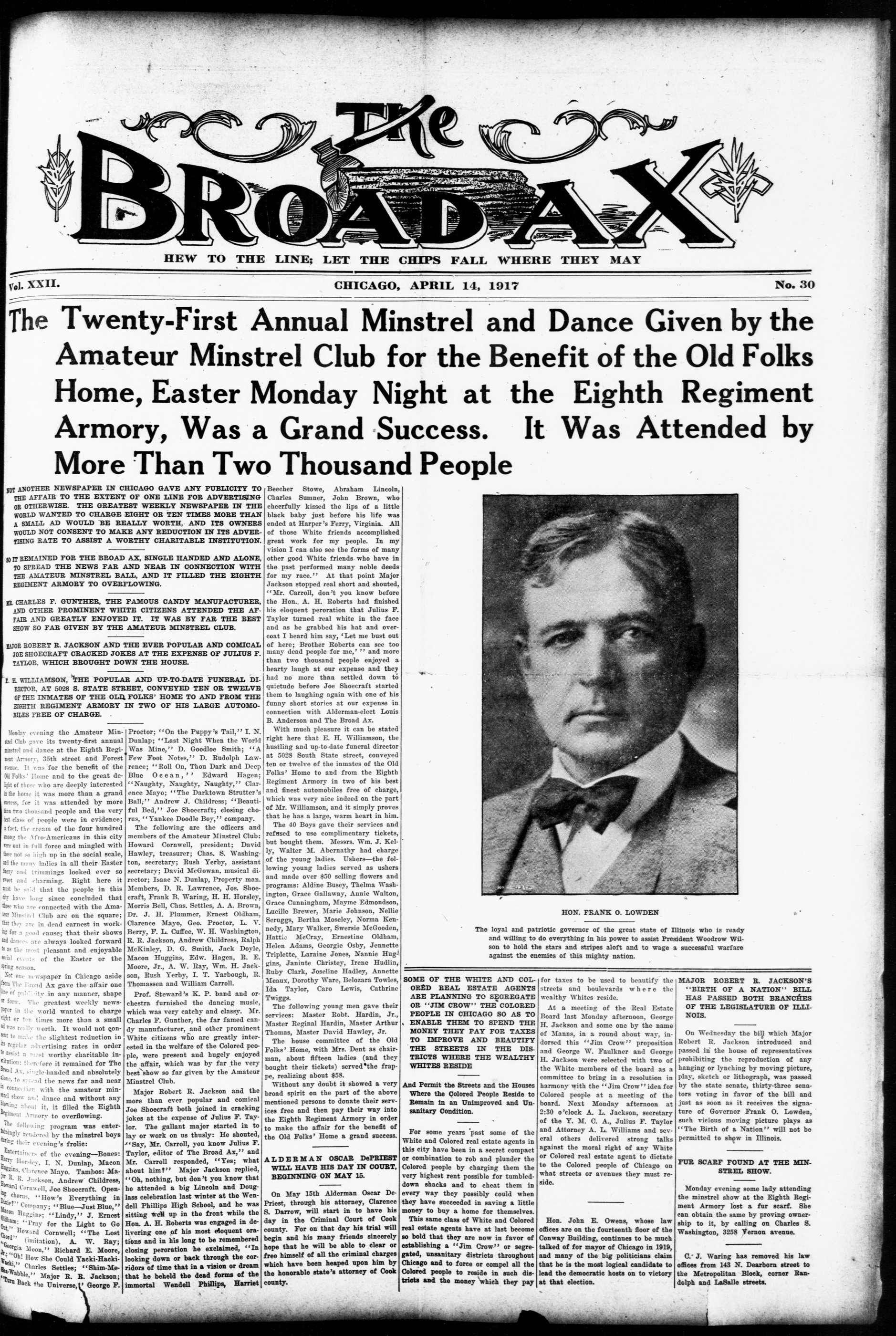
The loyal and patriotic governor of the great state of Illinois who is ready and willing to do everything in his power to assist President Woodrow Wilson to hold the stars and stripes aloft and to wage a successful warfare against the enemies of this mighty nation.
The loyal and patriotic governor of the great state of Illinois who is ready and willing to do everything in his power to assist President Woodrow Wilson to hold the stars and stripes aloft and to wage a successful warfare against the enemies of this mighty nation.
SOME OF THE WHITE AND COLORED REAL ESTATE AGENTS ARE PLANNING TO SEGREGATE OR "JIM CROW" THE COLORED PEOPLE IN CHICAGO SO AS TO ENABLE THEM TO SPEND THE MONEY THEY PAY FOR TAXES TO IMPROVE AND BEAUTIFY THE STREETS IN THE DISTRICTS WHERE THE WEALTHY WHITES RESIDE
And Permit the Streets and the Houses Where the Colored People Reside to Remain in an Unimproved and Unsanitary Condition.
For some years past some of the White and Colored real estate agents in this city have been in a secret compact or combination to rob and plunder the Colored people by charging them the very highest rent possible for tumbled-down shacks and to cheat them in every way they possibly could when they have succeeded in saving a little money to buy a home for themselves
This same class of White and Colored real estate agents have at last become so bold that they are now in favor of establishing a "Jim Crow" or segregated, unsanitary districts throughout Chicago and to force or compel all the Colored people to reside in such districts and the money which they pay
HON. FRANK O. LOWDEN
atriotic governor of the great state of H. do everything in his power to assist Prec stars and stripes aloft and to wage enemies of this mighty nation.
for taxes to be used to beautify the streets and boulevards where the wealthy Whites reside.
At a meeting of the Real Estate Board last Monday afternoon, George H. Jackson and some one by the name of Manns, in a round about way, indorsed this "Jim Crow" proposition and George W. Faulkner and George H. Jackson were selected with two of the White members of the board as a committee to bring in a resolution in harmony with the "Jim Crow" idea for Colored people at a meeting of the board. Next Monday afternoon at 2:30 o'clock A. L. Jackson, secretary of the Y. M. C. A., Julius F. Taylor and Attorney A. L. Williams and several others delivered strong talks against the moral right of any White or Colored real estate agent to dictate to the Colored people of Chicago on what streets or avenues they must reside.
Hon. John E. Owens, whose law offices are on the fourteenth floor of the Conway Building, continues to be much talked of for mayor of Chicago in 1919, and many of the big politicians claim that he is the most logical candidate to lead the democratic hosts on to victory at that election.
No.30
MAJOR ROBERT R. JACKSON'S "BIRTH OF A NATION" BILL HAS PASSED BOTH BRANCHES OF THE LEGISLATURE OF ILLINOIS.
On Wednesday the bill which Major Robert R. Jackson introduced and passed in the house of representatives prohibiting the reproduction of any hanging or lynching by moving picture, play, sketch or lithograph, was passed by the state senate, thirty-three senators voting in favor of the bill and just as soon as it receives the signature of Governor Frank O. Lowden, such vicious moving picture plays as "The Birth of a Nation" will not be permitted to show in Illinois.
FUR SCARF FOUND AT THE MIN.
STEEL SHOW.
Monday evening some lady attending the minstrel show at the Eighth Regiment Armory lost a fur scarf. She can obtain the same by proving ownership to it, by calling on Charles S. Washington. 3258 Vernon avenue.
C. J. Waring has removed his law offices from 143 N. Dearborn street to the Metropolitan Block, corner Randolph and LaSalle streets.
OWNERS AND DIRECTORS
Dan M. Jackson
Geo. T. Kersey
David A. McGowan
Ahmed A. Rayner
The Emanuel
Undertaking
2959-61 South
Reliable Service
Reasonable
Reliable Service & Courteous Treatment
Reasonable Prices
FREE CHAPEL IN CONNECTION
Complete line of Funeral Goods. Automobiles for hire
Telephone Douglas 6568 Automatic 73-657
THE SOLACE BILLIARD ACADEMY
"THE MODERN SCHOOL" - CLEAN AND RELIABLE
TERREVOUS L. DOUGLAS, Prop.
CIGARS—WHOLESALE AND RETAIL
BOX TRADE A SPECIALTY
3556 South State Street Chicago
FREE
STYLE BOOK
HAIR
To Colored Women
We are the largest
manufacturers of
Colored Women's
Hair. Our latest
book shows new
style in dressing sent free.
Every colored woman
should have
one. We sell those
sands our hair and
toilet articles. Satisfaction guaranteed
or money back. We make the best
solid brass STRAIGHT-
ENING combs, with extra heavy back, fully
guaranteed. With each comb we give lamp cap
PRIM. Send money order or stamp. MONEY
BACK IF NOT SATISFACTORY. Svc. postpaid.
POSTPAID 89c
Hair med. brushes, combs and toilet articles
manufacturers' prices. Send two-cent stamp.
Agents Wanted. Address as follows:
HUMANIA HAIR COMPANY.
181-157 Park Row,
New York City.
Address Dept. 84
Fish Versus Mosquitoes.
Myriads of mosquitoes used to infest the rice plantations of Madagascar. Dr. Legendre, a savant well known in scientific circles in Paris, conceived the idea of freeing the region of malarial trouble by the introduction into the watercourses of cyprin, or red fish, which are very fond of both mosquitoes and their eggs. Within five months 500 fish multiplied to 10,000, and these destroyed nearly all the mosquitoes. The fish besides being a malaria destroyer became very important as an addition to native food—London Telegraph.
Smiled the Wrong Way.
"Well, my boy," he asked cheerfully at the breakfast table the morning after Cholly had taken the leap, "how did things go last evening? Did she smile on your proposal?"
"No," said Cholly faintly, pushing away a breakfast roll. "She smiled at it"—Pittsburgh Chronicle-Telegraph.
Compensation.
Life is compensatory to this extent: When a man reaches the point at which his wife is compelled to make the living for the family he has also reached the point at which the fact ceases to humiliate him.—Topeka Capital.
What Every Woman Knows
A woman always knows when a man is in love with her. A man often knows a woman is in love with him when she isn't—Exchange.
He Was Fat.
Skinny—What made the tower of Pisa lean? Aver D. Pols—If I knew I'd try it—Yale Record.
```markdown
```
PRACTICAL HEALTH HINT
Rheumatism.
For acute articular rheumatism the following treatment is recommended by a writer in the Medical Adviser, quoted by the Medical Record: An ointment made of four drums each of ichthyol, methyl salicylate and oil of turpentine, mixed with four ounces of lanolin, is applied to the affected joints and covered with cotton and oiled silk. The patient is put to bed in flannel nightclothes and between blankets for absolute rest.
His diet must be liquid, preferably milk, together with fruit juices and plenty of water. Elimination through bowels, skin and kidneys must be attended to carefully. At the beginning of the treatment a dose of calomel and bicarbonate of soda is given and followed after four hours by rochelle salts or a selidilts powder. Rhubarb and soda may be given to advantage until the tongue is clean. Throughout convalescence the patient must abstain from all animal foods and alcohol.
PAGE TWO
Phones Calumet 6164
Automatic 71-629
OPEN DAY
AND NIGHT
Michael Jackson
Eng Co., Inc.
North State St.
Courteous Treatment
Table Prices
N CONNECTION
Automobles for hire
LIARD ACADEMY
- CLEAN AND RELIABLE
Bees and Fruit.
An agricultural society of Florence, Italy, has recently carried out a thorough investigation of the alleged injury of fruit by bees and has completely exonerated the latter. Bees are unable to perforate the skin of the fruit, and it is only incidentally that they suck the juices of fruits injured by other natural causes. The damage sometimes attributed to these insects is due to poultry, wild birds, wind and hail, and even more frequently to hornets, wasps, vine moths and other insects. Instead of being harmful to orchards and vineyards, bees perform the useful service of effecting the cross pollination of flowers, and hence the setting of fruit as well as the destruction of damaged fruits (especially grapes) by sucking the juice and pulp and thus preventing fermentation and rot extending to sound individuals. The orchards and vineyards frequented by bees give the most constant crops.—Scientific American.
Idolatry as It Is.
After months spent in idolatrous lands I have been unable to see much real worship in heathen shrines. The educated worship with their tongues in their cheeks and the ignorant with their hearts in their mouths. But the amount of real worship that exists in heathen temples is very small. Sometimes a bereaved mother will enter the temple and draw from her kimono the tiny bib of a departed little one and tie it to the statue of Jizo, the god of motherhood. Sometimes an old man or woman almost blind will enter the temple and rub the eyes of a wooden god and then rub his own in the hope that eternal darkness may not close in on his affirred soul. In some places Buddhist services are as dignified, as well attended and as helpful as our own. In Hakodate I attended a Buddhist preaching service that smacked less of idolatry and more of morals than some ceremonials in our cruciform chapels.-Christian Herald.
The Arabic Language.
Though the Arabs number less than the population of London, their language is one of the most widely spoken and influential in the world, for it is the language of the Koran. Seventy millions of people in Asia and north Africa speak some form of Arabic as their vernacular, and quite as many more know something of the language from the Koran, which in the original is a text book in the day schools of the Mohammedans from Turkey to Afghanistan and New Guinea. Nor is Arabic unworthy of this extensive use. Renan, after expressing his surprise that such a language should spring from the desert regions of Arabia and reach perfection in nomadic camps, declares that it surpasses all its sister Semitic languages in richness of vocabulary, delicacy of expression and the logic of its grammatical construction—London Chronicle.
Politics and Tobacco
Something like half a century ago a man named Dan Bradley started the custom in a little cigar store in Brooklyn of keeping a box of smoking tobacco on the counter, with a sign above it saying, "Fill your pipe." Partly on the strength of his popularity, due in no small degree to the free fillings for a pipe, Bradley ran independently for the state senate and was elected as against the regular candidate.
"Five thousand clay pipes did the trick for Dan" was a saying at the time.
"A man would have to give away automobiles to get elected to the senate nowadays," observed one of the new school of politicians.
"The days of the election cigar and tobacco are gone forever."—New York World.
Damascus Swords.
Damascus swords, whose fame at one time made them almost one of the wonders of the world, were made of alternate layers of iron and steel, so finely tempered that the blade would bend to the hilt without breaking, with an edge so keen that no coat of mail could resist it and a surface so highly polished that when a Moslem wished to rearrange his turban he used his sword for a looking glass.
Automatic 73-657
Chicago
THE BROAD AX, CHICAGO, APRIL 14, 1917.
The Transformation
After the hero of seventeen looks at the heroine of fifteen she is a different person. Before he looks at her she likes the fine brick houses in the neighborhood. In fact, she sees many elegant houses in town that she thinks would make ideal homes. Unlike her mother, she even likes the house in which the family lives. But after the hero looks at her you couldn't give her a big brick house. To her such places look cold, and she hardly would take one of them as a gift. But she just worships every little four and five room cottage she sees. They look so cute and neat and dear and sweet and cozy and snug. Oh, if she could just have a house like that and a hero like him—he is the only one there is of his kind—she would be just too happy for anything! And she would make fudge and have a regular home, only it would be far happier than other homes.—Claude Callan in Fort Worth Star-Telegram.
Tragedy of Being Dull.
In the Woman's Home Companion Arnold Bennett describes the tragedy of being dull:
"The man lacking imagination is the utterly matter of fact man. He is necessarily the man who never has and cannot have any point of view except his own. He is the Wordsworthian man to whom a primrose by the river's brim was strictly a yellow primrose instead of being a miracle. He is imprisoned in what to him is the actual, and he is always the exact center of the prison, which is of thickest iron. His tragedy is that he does not suspect and is incapable of suspecting that he is in prison at all and that the prison walls and floor and roof entirely prevent him from really 'getting at' any other human being whatsoever. He is always in his own place. This is the deep meaning of dullness, and this is the dull man's doom."
How a Bullet Falls.
In order to solve the problem a special stand was erected in Germany, and experiments were carried on along the shores of a lake the surface of which was frozen. The ice was covered with strong planks. It was shown that an infantry bullet shot upward in a vertical direction passes downward in the same position in which it passed upward. In other words, it came back to the earth with its bottom first. Why was it not upset at its culmination point? The answer is that the propelling force ceases to act at the culmination point, but the twist has as yet not stopped, and therefore it starts its fall with a twist. Even on impact the twist has not stopped, as was indicated by the warping of the wood fibers in the planking on the ice.—Popular Science Monthly.
Where the Five Points Was
The Five Points, once a most dangerous part of the New York slums, is now the site of Paradise park. It is at the crossing of Worth, Baxter and Park streets, near the junction of Park row and the New Bowery and Chatham square and practically adjoining Mulberry bend. In 1740 fourteen negroes were burned here during the negro insurrection. Here the Dead Rabbits had their headquarters and fought the Bowery Boys. The Seventh regiment was called out July 3, 1857, to quell a riot here. The Five Points mission was incorporated in 1850.
Shrewd.
The manager, writing out the announcement of his show, ended with these words:
"The patronage of children under eighteen is not encouraged."
"That," he remarked shrewdly, "will appeal to the children over eighteen."
-New York Post-
Hard on the Records
Freshman (in awed voice)—See that big fellow over there? He broke three records last week. Sweet Young Thing--Mercy, I wouldn't let him run the phonogram!- Penn State Froth.
Blindfolded.
If blindfolded, it is said, no person is able to stand five minutes without moving.
PRACTICAL HEALTH HINT.
Restrain a Cough.
A patient German statistician has calculated that a patient who coughs once every quarter of an hour for ten hours expends energy equivalent to 250 units of heat, which may be translated as equivalent to the nourishment contained in three eggs or two glasses of milk. In normal respiration the air is expelled from the chest at the rate of four feet per second, whereas in violent coughing it may attain a velocity of 300 feet. This waste of energy is especially important because it occurs for the most part in persons whose assimilative functions are already working under difficulties; consequently the ingestion of the corresponding quantity of nourishment by no means compensates for the exertion. It follows that persistent cough is per se a cause of emaciation, though there are many other factors which tend in the same direction; hence the desirability of restraining cough within safe limits, especially when it is due to irritative reflexes, such as are excited by laryngitis and pharyngitis.-Medical Critic and Gulde.
```markdown
```
Dreams May Be Overtime Work. Dreams are a good test of the need of sleep and many times answer the question of overwork or idleness, according to Dr. Percy G. Stiles, who lectured at the Harvard medical school on "Sleep."
"It is possible to judge by one's dreams whether one needs sleep," he said. "If the dreams are of a rambling variety, the kind that seem to pop from nowhere or anywhere, it is a pretty good sign that you are not overtired. On the other hand, if the dreams are a continuation of the day's worries the chances are that you are overtired. Dreams remote from the day's work are a vacation, but dreams connected with the day's work are overtime.
"To go to sleep get the body and mind comfortable. The body is easier to make comfortable than the mind. A rubdown, a bath and a little bit to eat help bring that about. To compose the mind read some familiar book or poetry. That soothes the mind, for no exertion is necessary to read it."—Boston Journal.
The Actor's Indifference
It is probable that the height of indifference is reached in the veteran actor. I saw one at the Press club recently who confirms this suspicion thoroughly.
He is in a good show, but has a small part, appearing only in the first act.
"How is the show?" I asked him.
"Pretty fair, I'm told," he answered.
"What's it about?"
"Can't say."
"How does it end?"
"Don't know."
"For goodness' sake," I asked,
"haven't you ever seen the play? You are in it yourself?"
"No," he answered, with a look of being bored. "Several times I have thought of going around front to see what it was all about; but, my dear old chap, I have never seemed to get around to it."—Washington Star.
Keeps Milk From Boiling Over.
Among the various devices which are intended to prevent milk from bolling over we noticed one which solves the problem in a very simple way, says the Scientific American. It consists of a straight tube of say two or three inches in diameter at the top and expanding somewhat toward the bottom, where it is provided with a faring and cup shaped end of rather large diameter, the whole being somewhat of trumpet shape. Out of the lower part are cut, say four suitable openings, and we set the device upright in the vessel with the small end just out of the liquid. Should the milk tend to boll violently this action commences at the bottom, and the liquid is forced up the tube, then falls upon the surface again, so that the bolling action will continue in this way and the milk has no tendency to leave the vessel.
Submarine Torpedoes.
Launching a torpedo from a submarine is simple. The torpedo fits closely in a tube or cylinder, with an opening at the rear made airtight when closed. At the desired moment there is a discharge of cordite and the torpedo is on its way.
When the torpedo is projected from a ship or boat into the water a lever is thrown back, admitting air into the engines, causing the propellers to revolve and drive the torpedo ahead. The torpedo travels under water at a high rate of speed. It carries a large charge of explosive, which is ignited on the torpedo striking any hard substance, such as the hull of a ship.
The distance the tube is submerged depends on the target, but the nearer the surface the more effective.
Shun "Tips" if You Play Stocks.
SHUN 'TIPS. IF YOU PLAY STOCKS.
"Whatever you do, don't go it alone," is the advice that Harold Howland gives to women investors in the Woman's Home Companion. "Shun the financial gossip of the uninformed, the cocksure counsel of the irresponsible, the glittering generalities or the more insidious particularities of the conceited ignoramus. Beware of rumors, 'tips' and 'inside information.' Base your transactions upon the firm ground of accurate information, sound judgment and disinterested advice. Don't try to 'get rich quick.'"
His Modesty
"Are you an art connoisseur?"
"Yes," replied Mr. Cumrox, "although I should never speak of myself as such."
"Why not?"
"Because I'm not absolutely sure I know how to pronounce the word."—New York American.
A Matter of Protection
Actor—I say, old man, I wish you'd advance me $5 and take it out of my first week's salary. Manager—But, my dear fellow, suppose it happened that I couldn't pay your first week's salary. Where would I be?—Boston Transcript.
Probably.
"Pop, you know that famous bare-foot winter at Valley Forge?"
"Yes, son. What of it?"
"Was that the time they said tried men's soles?" -Baltimore American.
Sharp.
Jack—Do you know that Kitty is an awfully sharp girl? Percy—Yes; she cut me on the street the other day.—Cornell Widow.
Mara Photographs
The best photographs of the canals of Mars were taken through red and orange screens.
Perseverance always wins in the long run—usually in a walk.
An interesting feature of artillery fire is the "curtain" or "barrage" fire. This means simply keeping up such a terrific fire on a certain area that an enemy cannot or will not cross it. When an infantry attack is launched a barrage on the ground beyond the enemy's front line prevents his re-enforcements coming up while the attacking infantry are having it out with the defenders of the trench. If the attack carries beyond the first line the artillery of the defense promptly interposes a barrage to prevent its reaching the second line. If the attack on the first line fails the defending artillery puts a barrage behind the attacker's line to prevent re-enforcements coming up to it and to enable the victorious defenders to counterattack and destroy the enemy in his own trenches. It is merely a wholesale development of a long established method of supporting the infantry.—Major E. D. Scott in National Service Magazine.
Mystery of a Fish
In the economy of nature nothing is more remarkable than the metamorphosis of the flounder, which when young swims in an upright position, as do all other fish, but when maturity develops it becomes topeheavy, falls over on its side and its existence is passed as a flat fish.
That nature moves in a mysterious way is here freely illustrated, for when the flounder falls flat the two eyes, which originally were on either side of the head, are transposed to the upper side of the fish, where they always face the light.
The process by which this strange change is accomplished has never been discovered by scientists and is a marvelous instance of nature's operations, for while the fish usually rests upon bottom it can readily swim about in any depth of water.—New York Sun.
A. Short Business Talk.
In a certain store the merchandise manager sent for the ready to wear and millinery buyers and said to them: "You men are getting a bad accumulation of stock that is hard to move. Hereafter you will make a daily and weekly inventory and send the report to this office." Both buyers declared this to be impossible, but the merchandise man told them to go and do it. Especially he wanted them to show the age of the goods in stock, the sizes and the colors. After attempting to take some of these daily inventories the buyers decided that an easier way would be to get busy and sell the goods faster. This same plan has been used in many departments with fine results. There is nothing like the spot light to engender selling activity in a store. Philadelphia Record.
All In the Dialect
A New Zealand man vouchs for the truth of the following story:
Dick Seddon was of Lancashire origin, and when he died the Lancastrian society in New Zealand sent a wreath with the following inscription: "I have gone whoam." The journalist who reported the funeral evidently did not come from Lancashire and consequently was somewhat puzzled by the wording and, after thinking hard, concluded that some one had blundered. His report read: "The Lancastrian society sent a beautiful wreath bearing the inscription: 'I have gone. Who am I?'
Destroying an Idol.
"Charley, dear," said young Mrs. Torkins, "you can say anything you like nowadays about George Washington, can't you?" "Yes. The lid seems to be off." "Well, I never liked to mention it before, but I have my doubts about his being incapable of an effort to deceive. His pictures look to me as if the old gentleman wore a wig."—Washington Star.
Luxury and Labor:
Alexander the Great, reflecting on his friends degenerating into sloth and luxury, told them that it was a most slavish thing to luxuriate and a most royal thing to labor-Barrow.
Happiness.
Happiness rarely is absent. It is that we know not of its presence. The greatest felicity avails us nothing if we know not that we are happy.
PRACTICAL HEALTH HINT.
Diet and Health
In an article on "Taming the Liver" World's Work says that the daily meal of the average business man consisting of meat and potatoes and white bread is ideal for inducing constipation. Most of us should not eat more than once a day. Eat the shells of your baked potatoes and eat whole wheat bread or graham for the help that what we call "roughage" has in stimulating bowel action. And see to it that you take liberal portions of at least two kinds of vegetables at both luncheon and dinner, such vegetables as peas, beans, lettuce, parsnips, carrots, turnips, celery, oyster plant, cabbage, Brussels sprouts, tomatoes, salsify, Spanish onions, asparagus and spinach. If you dislike these you will be able to substitute fruits that you do like. Eat the right things, get sufficient exercise and rest and you will have no need for habit forming laxatives which eventually may do you much harm.
---
Vacations, according to the New York Medical Journal, are nature's safety valves for the relief of the high pressure resulting from efficiency. Efficiency demands that throughout working hours all the faculties be taxed to the utmost without waste of material or of energy, but if properly directed it at making an efficient man before an efficient product. Therefore production may not exact that the man speed up beyond his endurance.
The recent application of efficiency methods makes the vacation more than ever necessary. "The vacation," says the Medical Journal, "should be the nearest approach to the simple life. It is for this reason that the country, with all its many inconveniences, is so often chosen for the place of vacation. The vacation period allows for the absorption and elimination of the fatigue products from the system accumulated in the pressure period of the work. The longer the vacation, therefore, the better the subsequent work."
Plant For a Hanging Book
Indoor gardeners will be interested in watching this plant grow. It follows the plan of the strawberry in sending out runners and starting new growths at the end of the stem. The strawberry, however, has the earth to establish its new growths. This indoor plant sends out the runners growing for earth where there is none. It called the saxifrage.
It is a favorite plant for hanging baskets. A small tuft of leaves develops at the end of each vine. From this tuft other runners are sent out, and these in turn develop more tufts. By this method the saxifrage keeps on expanding until the basket is covered with a network of vines and a blanket of leaves.
The leaves, shaped like those of the geranium, are a reddish olive color veined in white. It requires ordinary soil and a moderate amount of water and shade.-Philadelphia North American.
Real Democracy
Before Denmark consented to sell the Danish West Indies to the United States a plebiscite was held, and the electorate voted upon the question. The people of the United States, however, were never consulted as to whether they desired to make the purchase. The people of England vote directly on national questions whenever parliament is dissolved, and the government "goes to the country" on nearly every matter of really vital import. Many Americans fondly imagine that the United States is the only real democracy in the world. As a matter of fact, in Switzerland, Australia and New Zealand government is more directly responsible to the people than in the United States; Canada's government is at least equally representative as ours, while England, although nominally a constitutional monarchy, probably is more democratic than the United States—St. Paul Dispatch.
Art and Nature
Art is the revelation of man, and not merely that, but likewise the revelation of nature speaking through man. Art pre-exists in nature, and nature is reproduced in art. As vapors from the ocean floating landward and dissolved in rain are carried back in rivers to the ocean, so thoughts and the semblances of things that fall upon the soul of man in showers flow out again in living streams of art and lose themselves in the great ocean, which is nature. Art and nature are not, then discordant, but ever harmonious working in each other—Longfellow "Hyperion."
What She Wanted
A woman was knocked down by a horse, but happily escaped with a few scratches.
A man rescued her and said, "Can I get you anything?"
She (much out of breath and gasping with excitement)—Oh—oh—can you kindly get me—
He—Some brandy?
He—some brandy?
She—No-not drink—some safety pins.
I feel I'm failing all to pieces-Pittsburgh Chronicle.
Heard at the Club.
Heard at the Club "That's Fred Darling just come in You know his wife made him."
"You mean that fellow with a waxy mustache and manicured nails?"
"Yes."
"Well, I knew women did fancy work, but I never knew they did anything as fancy as that."—Exchange.
On the Lookout.
Friend—You are not going to run again? Congressman—No; it's too strenuous. I was sent down to Washington to look out for my constituents, and from the tone of their letters I've got to look out for them when I get home—Puck.
Second Sight.
"Do you believe in second sight?
"No, but my wife does. When I go shopping with her she always says to the assistant, 'I'll come in and look at these again.'"—London Telegraph
Did Her Best.
Did Her Best
Teacher—Do you know the population of New York? Mamle Backrow-
Not all of them, ma'am; but, then,
we've only lived here two years—Puck.
The Champion Lie.
Probably the unmitigated falsehood most frequently told year in and year out takes this form: We welcome honest criticism.—Ohio State Journal.
To fret and fume is undignified, sucidally foolish and theoretically unpar-
donable—Robert Louis Stevenson.
U BOAT RIDDANCE
Knotty Problem Confronts United States Naval Department.
CONFIDENT OF SOLVING IT.
Do Not Expect It Will Be Easy Task,
However—Latest German Submersible Said to Be Able to Take Considerable Punishment From Light Guns of Armed Merchant Craft.
Washington.—Navy department advises indicate that Germany has laid down no new capital ship or destroyer during the war, confining new construction to submarines, Battleships, battle cruisers and destroyers building when the war began have been finished, but aside from them Germany's naval constructing geniuses have devoted their efforts to turning out large numbers of submarines and to improving such craft. While little positive information has been received, naval officers are satisfied with the information regarding
A. M.
Photo by American Press Association.
BEAR ADMIRAL BENSON.
submarines. Among other things, reports show that Germany probably has 20,000-ton submarines of the newer type capable of a wide radius of action and greater execution than any devised by other nations.
The very latest German submarines have considerably thicker skins than earlier types and are said to be able to take considerable punishment from light guns, especially in clashes with armed merchant craft.
The understanding is that the German navy has largely standardized submarine construction and can turn out the largest underwater craft in large numbers in a short time.
In view of the feverish activity of the German navy in turning out submarines, naval experts are not inclined to belittle the task which lies before the United States and the allies in raising the high seas of the underwater menace. If Germany can turn out large, powerful submarines in great numbers and keep them coming steadily the task will prove anything but easy.
The fact that the tonnage destroyed since Feb. 1 has been far below the figure set by Berlin has encouraged the belief in the allied countries that Germany has already passed her maximum in utilizing the submarine to "starr" England and the nations fishing with that country.
But American naval officers are not inclined to take this view. Although they are confident the submarine problem will be solved, they will not be surprised if it takes a long time.
Naval preparations for all emergencies have settled down largely to routine. Instead of being in haste navy department officials and navy officers go about their tasks with cool determination. Some of the higher officers skip the barber shop occasionally and work long hours in their offices and in their homes after office hours. But there is no outward evidence of excitement in or about the navy department. The machinery is in smooth running order and appears to be working with precision.
PISTOL THREAT HOLDS MAID.
Society Leader Takes Drastic Step to Prevent Sentinel Form Leaving
**Kevin Servant From Leaving.**
Evanson, Ill.-The practice of old feudal Kentucky of shooting those who invade your home in search of something you own will be staged in staid old Evanson unless other women cause entailing away the malds of one society leader late from "down south." Annie, maid extraordinary, is the bone of contention.
"I am leaving Saturday night," said Annie after a talk with one of her mistress' friends. "Mrs. Jones will pay me higher wages."
"Down where I come from," drawned the mistress, "they shoot people for taking things of a whole lot less value than servants. You can go with Mrs. Jones if you want to. But some day I am going to call on Mrs. Jones. Either she or you is going to answer the door. I am going to shoot the first one of you I see. That's all."
Amie is holding down the old job, and Mrs. Jones is not nearly so anxious to hire her as she believed she was.
Broke Up Gangs and Earned Title "Czar of Tenderloin."
New York.—For nearly thirty years one of the most striking and picturesque figures in the metropolitan police department was former Inspector Alexander S. Williams, who died recently.
Williams was a policeman of the old school. Sometimes they called him "the clubber," and at others "the czar of the Tenderloin." He earned both titles, the former breaking heads of thugs on the lower east side and the gas house district, and the latter by his conduct during the eleven years he was in command of the West Thirtieth street precinct.
In 1806 Williams tired of ship carpentry, the trade he had learned, and became a policeman. His first post was on Houston street, where the toughest men in the city congregated. Their specialty was "beating cops," but they did not beat Williams. Picking out the toughest of the gang, Williams thrashed him thoroughly. There after the new policeman was not troubled.
In 1872 he was made captain and sent to the East Thirty-fifth street station. Gangs ruled the neighborhood, but the new captain clubbed them into submission.
It was in 1876 that Williams was sent to the West Thirtieth street station, controlling the district given over to gambling and all night revels. He retired on a pension after the Lexow investigation.
BOAT BEATEN OFF IN BATTLE WITH STEAMER
Survivors of Coronada Reach Halifax, N. S., and Relate Thrilling Story of Fight.
Halifax, N. S.—Twenty-one survivors of the British steamer Coronada, which was torpedoed 150 miles off the Irish coast, arrived on a British steamer, which picked them up nine hours after the Coronada went down. Nine men were lost by the capsizing of their lifeboat.
The survivors reported they had scarcely reached the deck of the rescuing steamer than they witnessed a thrilling battle between another tramp steamer and a submarine, in which the submarine probably received its death-blow. One of the Coronada's men said: "I was looking aft when I saw what looked to be a steamer coming up astern. She was making pretty good time considering the class that comes around as cargo boats. I took the glasses and saw that the steamer was in action with a submarine and was certainly holding her own. As I watched I saw a spurt of smoke issue from her stern gun and hit dangerously close to the periscope of the submarine. As the shot struck the submarine came to the surface, and a second later I saw the water shoot like a geyser alongside the Britisher.
"Before the submarine could get under water the tramp returned this fire, As I watched the submarine I saw a shot land right at her side. There was a gush of water, and when the sea had quieted down once more there were no signs of the German craft. Whether she was sunk by the last shot of the Britsher or whether she managed to escape I cannot say, but this I know—that the battle ended in a manner which left little doubt as to who had the best of it."
GERMANS IMPROVE AIR FIRE.
They Greatly Increase Dangers of Entente Reconnaissance. London. — Airmen returning from France report that the Germans are using new methods of combating the British airmen. Hitherto it has been possible for the British aviators to patrol over the important German positions by making squadron flights, the Germans using scattering anti-air craft fire. Now the Germans concentrate their anti-air craft guns on given areas, forcing the British aviators to go through a withering fire if they wish to reconnoiter the positions.
Calexico, Cal.-Cartoonists and paragraphers have not been so very extravagant in their depictions of H. C. of L, if one is to judge by the innovation of a Main street jeweler here who has actually put in meats as a side line. The store presents a dazzling array of diamonds, steaks, rubles, pork chops, pigs' feet and amethysts. The old talk about casting your pearls before swine now seems certain to acquire an added significance.
THE BROAD AX. CHICAGO. APRIL 14. 1917.
LEGENDS OF WAR
Many Strange Superstitions Are Born on Battlefield.
GOLD COINS GOOD LUCK SIGNS
To Dream of Autobus Considered Death Token—Appeals to Have Currency Sent to Bank of France and Keep It From Enemy Reduces Amount at Front.
Paris.—The character of the war has allowed a number of legends and superstitions to be born and spread, some of which can be traced and explained, while others remain obscure.
To dream of an autobus has become a token of death. Apollinaire, the poet, has found this superstition in four different regiments and gives a story of a sergeant who succeeded in averting the omen in the case of a corporal who said he had dreamed of an autobus. "How can that be," the sergeant asked, "when you have never been to Paris or seen an autobus?" The corporal described the vision. "That an autobus!" declared the sergeant. "Why, that's one of those new machines that the English are using. Don't let that worry you."
A regiment from the south has the same belief about an automobile wagon instead of an autobus and can quote many examples of the truth of such dreams.
Gold coins are a mascot in the front lines, a superstition not difficult to explain. It was at first believed that wounded men on whom some gold was found would be better looked after by those who found them, and by degrees the belief grew up, especially among artillery, that a gold coin was a talisman against being mutilated if they were taken prisoners whether wounded or not.
Apollinaire knew of a certain battery which in May, 1915, had some $1,000 in gold among its men, thanks chiefly to their commerce in rings, paper knives and other souvenirs, made by them from cartridge cases and aluminum and sold to foot soldiers.
The government's appeals to have gold sent to the Bank of France and not to let it fall into enemy hands in case of capture have since reduced the amount of gold at the front, but many keep some coins as a charm. Many men sew coins touching one another in such a way as to make a shield over the heart.
A story that is believed in the ranks shows how gold can attract the Germans. A sergeant made a gold coin glitter in the sun and some thirsty German soldiers walked right up to the French trench, charmed by its dazzle, and were easily captured.
"Every man has his own particular star," a Lyons farm hand said to Apollinaire, "but he must know it. A gold coin is the only means to put you in communication with your star, so that its protecting virtue can be exercised. I have a piece of gold and so am easy in my mind I shall never be touched." As a matter of fact he was seriously wounded later.
MULE BEAT HORSE AND MOTOR
Proved Superior In Rural Mail Service Through Snow and Ice.
Middleboro, Mass.—A sure footed mule accustomed to many hardships proved superior to horse and motorcar in the delivery of rural mail through highways packed deep with drifts of ice and snow. Not since the rural route hereabout was established fifteen years ago had such road conditions been reported as a result of a March snowstorm.
Samuel Guilford, a carrier, tried to reach the country districts in a horse drawn pung, but made no progress. Later an automobile was pressed info use; but, like the horse, it failed. Then Guilford hired a mule and experienced no further trouble.
ODD MALADY IN WISCONSIN
Swollen Glands and High Temperature Features of Outbreak.
Galesville, Wis.—Four persons have died here and scores are ill, some critically, from a disease the nature of which has baffled physicians from the Rochester (Minn.) foundation and the local health authorities. Schools have been closed as a result of the outbreak.
City officials appealed to physicians in other cities for assistance in checking the spread of the malady. According to the statement of physicians who have had the disease under observation, little difficulty is experienced in detecting the symptoms, swollen glands and high temperature, but add that the proper treatment has not been developed.
"BABY WEEK" IS SELECTED.
Welfare Association Sets May 1-6 as Period of Celebration.
New York.—May 1 to 6 has been designated as "baby week" throughout the country. The Babies' Welfare association of New York city urges all organizations to undertake local celebrations in the districts where they work and advises that in view of the present national situation no attempt be made to form a centrally organized committee to run a campaign like those of previous years.
It is felt that the work of instructing parents in the needs and rights of babyhood can be done just as effectively in this way.
MORE EGGS BY KINDNESS.
Professor Has a Theory That Will Be Given a Thorough Test.
Vineland, N. J.-Whether kindly treatment of a hen will accelerate egg productivity in the inverse ratio of careless or indifferent attention is to be given official demonstration in the egg laying contests under way here.
Professor E. R. Johnstone, superintendent of the Training School For Feeble Minded Boys and Girls, has maintained that kindness to a hen means more eggs, but some of the expert poultrymen hereabouts scout the idea, saying that the average hen is too obtuse to appreciate what is done for her.
With the aid of Harry R. Lewis, poultry husbandman of the state experiment station, Professor Johnstone has arranged for the demonstration of his theory.
Two pens of hens of the same breed and strain will be set apart. To one of them will be attached as attendant a man who can go about his work with a sunny smile, cheerful interest and gentle touch. To the other will be assigned one with an ingrown grouch. The same feed and the same conditions exactly will be applied to both pens and the records carefully kept as to which gives the best results. Professor Johnstone feels sure that his theory will be fully substantified.
NURSES FOR ARMY OF MILLION
Red Cross Preparing to Serve. That Number of Men In Case of War.
Washington.—The Red Cross is ready to care for an army of a million. Enrolled for active service are 2,970 graduate nurses and more than 1,000 doctors and surgeons. Red Cross certificates in elementary hygiene and home care of the sick have been issued to 4,450 women who are available as nurses' aids. Thus the total nursing personnel is more than 7,000.
Twenty-six base hospitals, each of 500 beds, have been organized in various cities. Their total cost is between $300,000 and $400,000. Twenty of these are ready for service completely equipped and fully manned. These units will call for 1,250 nurses and 500 nurses' aids. All Red Cross nurses, surgeons and nurses' aids have received or are now receiving immunity treatment for typhoid fever. All have also passed physical examinations.
In addition to these army hospital units, the Red Cross is now organizing thirty-one navy detachments of twenty nurses each. Emergency detachments of nurses are also planned, which can be sent to relieve units on service or to meet special needs.
FOR ANTI-LITTER LEAGUE.
Several Thousand "Block Captains" Will Assist in Crusade.
New York.—A movement to appoint several thousand "block captains" to co-operate with the New York Anti-Litter league in its work of keeping the streets and sidewalks clean was started at a conference in the Aldine club, attended by city officials and representatives of nearly a score of chambers of commerce, boards of trade, neighborhood associations and other civic organizations.
For the present it is probable that captains will be appointed only from the ranks of the organizations interested in the movement, but eventually the league hopes to have a captain on every block in the city, whose duty it will be to urge upon janitors, porters, shopkeepers and the general public the necessity of keeping the sidewalks clean and sweeping their litter into proper receptacles.
YALE MEN IN AERO UNIT.
They Enroll in Naval Service and Begin Training.
New London, Conn. — Sixteen members of Yale's flying unit arrived from New Haven and after being enrolled by Commander Yates Stirling, U. S. N., of the local submarine base, the young men returned to the Elm City.
William F. Sullivan, who will be their instructor, is an experienced aviator employed by F. Trubee Davison last season, making several flights and at times accompanying the submarines in their maneuvers. The entire Yale squad of aviators numbering forty-eight left New York for Palm Beach, where ten flying machines awaited them for daily practice.
David McColloch, another veteran aviator, will also instruct the Yale men at Palm Beach.
Atlantic City.—Diamond Jim Brady placed an order with a jeweler for a pair of tortoise shell spectacles to be studded with chips of rose colored stones as a gift for Mickers Mallory, a terrler owned by William Mallory, a board walk shopkeeper. Mr. Brady took a fancy to the dog and noticed its eyesight is affected.
************************************************************
* TOSS OF A COIN PICKS
* CANDIDATE FOR MAYOR
Cripple Creek, Colo.—Thomas
Surber, Democratic alderman, is
the Democratic candidate for
mayor by the grace of the flipping
of a dollar that came
"tails." The choice lay between
Surber and Frank Vetter, another
alderman. The leaders could not
decide, so the men, who are good
friends, settled it by the toss of
a coin.
COLLEGES IN WAR
Institutions of Learning Rush to National Defense.
Princeton Has Adopted Resolutions to Enlarge Military Science and Tactics Course to Continue Two Years—Census of College Men to See What Each Can Do.
Princeton, N. J.—Princeton university will not be behind other American institutions of learning in furthering America's defense. Of the many preparedness measures proposed here one of the most important is the scientific aid to be given the national research council in solving military problems and devising new engines of war.
President Hibben has appointed a committee of twelve members of the faculty, alumni and trustees to supervise this work.
The faculty has also adopted resolutions to enlarge the military science and tactics course, which will now con-
Photo by American Press Association.
JOHN GRIEB HIBBEN.
tinue two years, and take a military
census of present and past Princeton
men to find what each can do for his
country.
The university has also notified the
war department it stands ready to turn
over its plant to the government when-
ever required.
The resolution to appoint a committee
to supervise the research work of
the university professors was made at
the suggestion of George E. Hale, chair-
man of the national research council
and of the Mount Wilson solar observa-
tory, who wrote to Professor Edwin G. Couklin, explaining what the world of science expected in event of war. In his letter he says:
"In the face of war every loyal man of science would be willing to drop his present work and devote his time and attention to researches in military problems. No one should hesitate because he faces new conditions. His experience as an investigator in any field will serve him well. It should not be forgotten that many of the greatest discoveries have been made by men of science who have come with fresh vision into a new department, where freedom from the hampering effect of habit and tradition has more than compensated for deficiency in special experience."
WOMEN WEAR HOOPSKIRTS.
Old Time Costume Reception In Cocks Home For Belgian Fund.
New York.—The old country place of ex-Representative William W. Cocks at Westbury, on Long Island, had the appearance of an old manse during the Revolutionary war. Mrs. Cocks and a number of her neighbors held a reception at which every one wore an old costume. There were the hoopskirts, the bustle and the hobble.
Over 500 persons crowded the Cocks home, and a good sum was realized for the Belgian relief fund, for the benefit of which the affair was held.
WOULD COVER FAIR FORMS.
Illinois Bill Fixes Low Limit For Decollete Gowns.
Springfield, Ill.-A "barred zone" regulating decollete gown exposures in ballrooms will be established by the state of Illinois if an amendment offered by Senator Denvir to a Democratic bill is adopted.
Senator Denvir's amendment would prohibit at public dances women from wearing any dress that exposed the body below a line drawn from shoulder tip to shoulder tip.
DYE STOCK RISES 150 TIMES.
Britisher Bankrupt Before War Now Worth $425,000.
London.—The few firms of British dye manufacturers have made enormous profits since the beginning of the war. The report of one of them shows that the value of its shares has risen from $2* to $300.
The value of the stock held by one stockholder who was declared bankrupt before the war jumped to* $425,000. Before the war the stock was worth about $3,500.
PAGE THREE
HANGING BOY WINS IN FIGHT WITH BUZZARD
HANGING BOY WINS IN FIGHT WITH BUZZARD
Giant Bird Gives Up the Battle After an Hour's Terrific Grueling.
Santa Rosa, Cal.—A battle between a giant buzzard and a fifteen-year-old boy clinging to the root of a shrub 250 feet up a straight ledge of rock was won by the boy, who is now recovering from an experience that rivals Poe's fictional terrors.
The boy is Hans Mierbach, and he hung high above a pile of jagged rocks for four hours. He was walking on the brink of a precipice when his foot slipped and he fell over. Twenty feet below he caught a root and hung on. With his handkerchief he tied his left wrist to the root and then wrote a note to a boy friend bidding him farewell and saying that no one was responsible for his predicament.
Just as he finished writing a huge buzzard flew down upon him and started to peck at his head and body. The hungry bird inflicted deep wounds in the boy's flesh. Young Mierbach fought the buzzard with his free hand for over an hour. He had been tormented to a frenzy and was about exhausted when the bird gave up the fight.
At nightfall a searching party found the boy and rescued him. He had nearly lost consciousness from his experience and loss of blood.
EFFECTS OF THE WAR ON CHILDREN OF ENGLAND
EFFECTS OF THE WAR ON CHILDREN OF ENGLAND
Juvenile Delinquency Has Increased 34 Per Cent Since Great Struggle Began.
Baltimore.—Drawing a terrible picture of war's effects on children in England, Owen R. Lovejoy, general secretary of the National Child Labor Committee, told the conference on child labor here this country must take drastic steps to protect its little ones. Concerning conditions in Great Britain he said:
"Last fall in the English parliament Sir James Yoxall said: 'A large portion of our elementary school system is in ruins—I will not say as desolate as the ruins of Louvain, but there is to some extent a likeness."
"In one area 17,000 children out of 41,000 have been displaced from school because the buildings have been taken over for military purposes. Teachers have enlisted and government economies have lowered the efficiency of the schools; special classes, evening classes, medical inspection, free lunches have been reduced or stopped. In addition some 500,000 children between twelve and fifteen left school to enter industry in 1915 and probably more than that in 1916. Between 150,000 and 200,000 children eleven and twelve years old are at work. "Juvenile delinquency in England has increased 34 per cent since 1914, and delinquency of boys twelve and thirteen has increased in greater proportion than in any other age group."
DOG SAVES GIRL'S LIFE.
Animal Drags Her From River to a Sanitarium.
Green Bay, Wis.-Madeline Denny, aged ten, of Little Rapids, owes her life to the courage and faithfulness of Brewster, a bulldog owned by Miss Helen Scheller, superintendent of the Brown county tuberculosis sanitarium. Madeline was crossing Fox river when she fell through a hole in the ice.
"I clung on to the edge and screamed," she said. "Brewster was standing on the bank. He ran to me, grabbed my sleeve and pulled until I was able to extricate myself. Then he dragged me by the collar to the sanitarium grounds."
The grounds are about 200 yards from the river.
Brewster will be given a new collar, properly inscribed, just like heroic humans get Carnegie medals.
FORTUNE TO POLICEMAN.
Brooklyn Patrolman Goes to California For Legacy.
New York.—A nineteen days' leave of absence was granted by Police Commissioner Woods to Patrolman James F. Gaffney of the Bedford avenue police station, Williamsburg. The policeman started for the Pacific coast to claim a fortune left to him by an aunt. Gaffney, who is thirty-five years old, married and lives at 124 Oak street, has been a dozen years on the force.
The inheritance ranges all the way from $50,000 to $100,000, and the first knowledge the policeman had of his good fortune was when he received a letter from a San Francisco attorney.
TO BAR TOWN CLOCK.
Hotel Keeper Seeks Injunction Against City Timepiece.
Wichita, Kan.—S. J. Smalley, proprietor of the Coronado hotel, across the street from the city hall, employed a lawyer to obtain an injunction to prevent Mayor Bentley and the commissioners from installing a clock in the city hall tower.
For years citizens have petitioned administrations to beautify the unsightly boarded up tower with a clock, and the Bentley administration let a contract for a $1,500 clock. Smalley alleges that the striking of the clock will wake up his guests every hour at night,
[Image of a man in a suit with a bow tie].
74
HON. JOHN J. BRADLEY
United States marshal for the North with both eyes open all the time who is secretly plotting against the
United States marshal for the Northern District of Illinois, who will sleep with both eyes open all the time until he captures every disloyal rascal who is secretly plotting against the government in this neck of the woods.
EQUALITY IN ALL THINGS.
By Thor J. Benson.
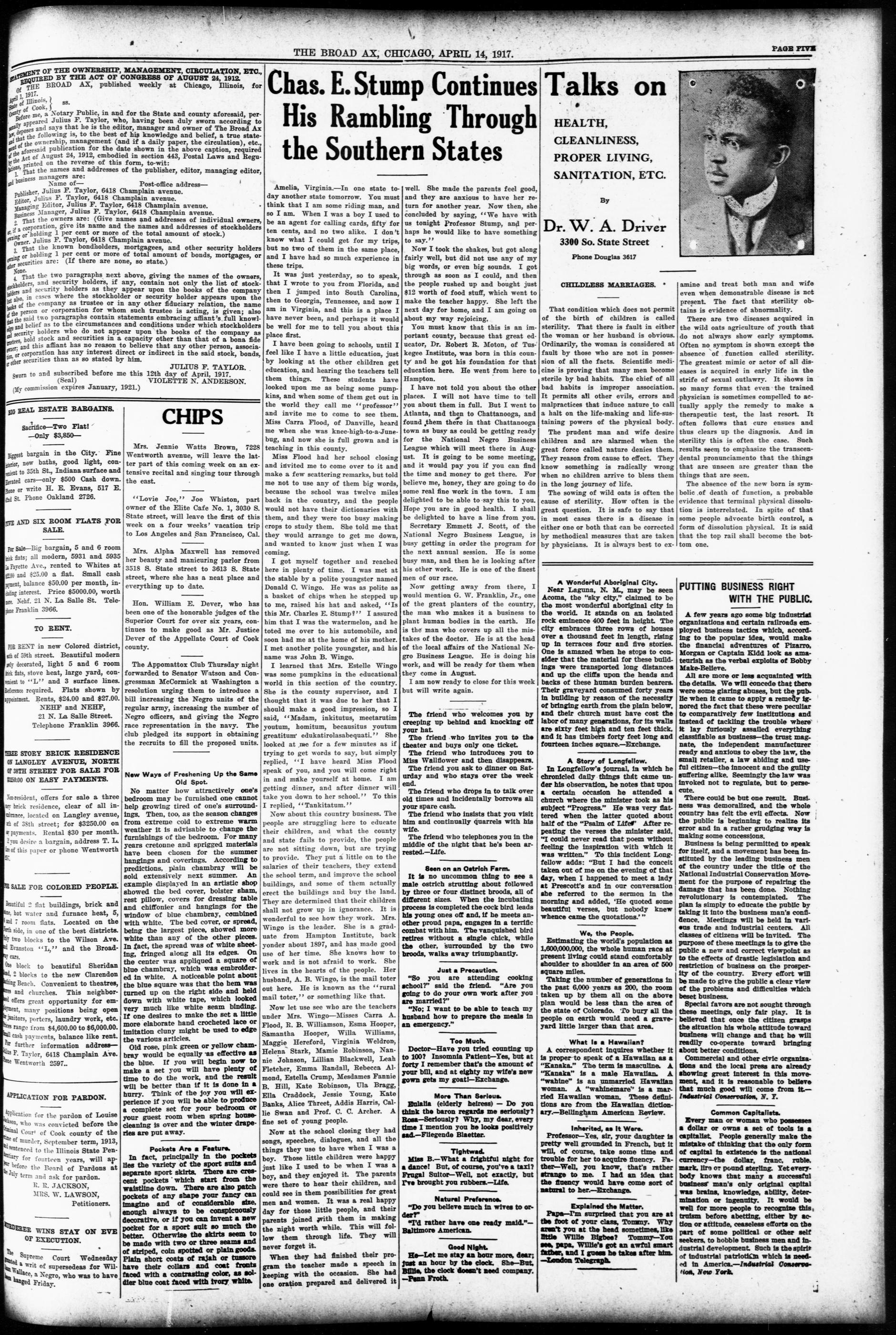
(Formerly an assistant city prosecuting attorney, assigned to the near South Side District Police Court.) Julius F. Taylor, editor of The Broad Ax:— In these troubous times it is well to hark back to original principles and urge that the people live up to them, so as to avoid political breakers in the coming days, after the world shall have laid aside its brutal and forcible contentions on the battlefield, and taken its issues back into the more peaceful forums.
It is our boast individually and as a community that we, in the words of the declaration of independence, this the august chart of human rights, that "we hold these truths to be self evident that all men are created equal, endowed by their creator with certain inalienable rights, among which are life, liberty and the pursuit of happiness." But, are we really accepting these self-evident truths as our guide to our conduct? If we are honest with ourselves and candid, we must say that we are far from it.
For this reason I think it would be justifiable, notwithstanding the fact that we have countless organizations in the interest of some part of the movement for greater democracy in political, industrial and social discussions and positive reforms, to form another organization to take such an appellation as "The Political, Industrial and Social Equality League of the South Side of Chicago" in order to propagate sentiment that would induce our representatives in public affairs to come nearer to the spirit of equality among the citizens of the different races and religious persuasions living within the territory mentioned in the name. As far as the form of name is concerned, that is not of the essential part, but the idea sought to convey is that we must treat every citizen as equal, be he a person of means or one without means, so that the latter as well as the former may have an opportunity to present any reason he may have to the electorate, why he thinks he could well serve the community in certain elective or appointive position. And while the franchise has lately been extended to a very considerable additional number of people to some extent, and full franchise will likely soon be extended to this large number, at the same time the movement might well go further and extend the franchise to all persons above the age of secondary school graduation, eighteen years. Why, our laws permit a girl at that age to control her own property and compels boys, if needed, to serve in the militia, and then why should we withhold the franchise from them for three years? Then again to encourage motherhood, it would seem well that a mother having charge of her minor children, either exclusively or in co-operation with her husband, should have the right in addition to casting her own vote, one vote each for her minor children. This would bring the franchise to every member of the community, and would be a pure democracy.
Then also the necessary information should be furnished to each individual at the public expense, enabling him or her to act intelligently on any question presented for decision at the polls,
PAGE FOUR
and all solicitations for votes by private parties or committees should be absolutely prohibited on registration and election day.
Next the question of industrial equality. The measure of compensation that a person should receive for any useful and necessary work, if employed by the public or by individual persons or associations of persons, should be measured by the time actually put into the useful and well-directed effort, and not by an arbitrary rule making difference in productive capacity. Inasmuch as all work of any considerable importance is dependent for its successful accomplishment upon joint efforts of all those engaged on the work, the compensation received by each for the actual time put in on the work should be the same. The difference in the working conditions of different classes of workers, as for instance in the construction of a building, in that of the head architect and the trench digger, should be sufficient incentive for the former to qualify himself for the more intricate duties of his calling, and not the additional material gains. And why should any class of citizens on account of race, be barred from any kind of useful and necessary employment?
Isn't this prejudice one of the most potent reasons for the gross economic inequalities today? Take for instance the traction question that we had up ten years ago. The fact that in case the city owned and operated the street car system would require the city authorities to employ carmen without regard to the race question, under the civil service law, was a potent factor in defeating the public ownership and operation proposition, leaving the industry in the hands of private profit interests, at liberty to discriminate to their hearts' content in the way of securing operatives.
Then again we have the absurd spectacle of a number of unfortunates receiving the bounties of charity from the generous citizenship of Chicago in the tuberculosis hospital, making a joint threat that in case the civil service law were upheld and the man on top of the eligible list for medical attendant appointed, who happened to be a Colored man, they would refuse to be attended, and as a result the appointive official of the institution considered it policy to refuse to be guided by the provisions of the law. Shall we stand for this much longer?
And lastly the social equality question. This is of less importance, but is also extremely annoying. How can we love our neighbors as ourselves and deny them social rights? Now the stereotyped argument by the believers in social inequality and ostracism on account of racial differences, is generally the propounding of this question "How would you like to have your son or daughter marry into the family of another and dark-skinned race?" This is a decidedly unfair manner of arguing the question as no one is required to form intimate social relations with people in order to honestly believe in equality and freedom to form social or family relations.
But, even if this question is being insisted upon being met, then it is only necessary to quote the holy scriptures, the authenticity of which is quite generally admitted by most of those denying social racial equality, and we leave them to "fight the question out with the Bible."
THE BROAD AX, CHICAGO, APRIL 14, 1917.
Notice what one of the greatest characters presented in the annals of the book of books, did along these lines, one of the only two, that according to the evangelists, appeared again upon this earth at the transfiguration of Christ on Mt. Tabor. To quote from the twelfth chapter of Numbers: "And Miriam and Aaron spake against Moses on account of the Ethiopian woman whom he had married: for he had married an Ethiopian woman. And they said, Hath the Lord spoken only by Moses? Hath he not spoken also by us? And the Lord heard it. Now the man Moses was very meek, above all the men that were upon the face of the earth. And the Lord spake suddenly unto Moses, and unto Aaron, and unto Miriam, Come out ye three unto the tabernacle of the congregation. And they three came out. And the Lord came down in the pillar of the cloud, and stood in the door of the tabernacle, and called Aaron and Miriam; and they both came forth. And he said, Hear now my words: If there be a prophet among you, I the Lord will make myself known to him in a vision and will speak unto him in a dream. My servant Moses is not so, who is faithful in all mine house. With him will I speak mouth to mouth, even apparently and not in dark speeches and the similitude of the Lord shall he behold: Wherefore then were ye not afraid to speak against my servant Moses? And the anger of the Lord was kindled against them and he departed."
Now, then, if one believe in the holy scripture, the old as well as the new testament, and Christ himself more than once referred approvingly of Moses and the prophets, Moses and Elijah being the two mentioned as his associates during his transfiguration, this antipathy toward the social equality of the African should have been settled then and there for all times, and I do not see how a Christian can take a different position, for surely an Ethiopian is also an African of the darkest hue.
NATIONAL NEWS NOTES.
Brief Bits of News and Comments on Men and Women.
Housemaids' School Proposed.
Louisville, Ky.-The people of this section are deeply interested in a bill introduced into the Indiana legislature for the establishment at New Albany of a housemaids' training school for Negro women. A similar bill was introduced two years ago and passed the senate, but did not get through the house, because of lack of attention. The bill just introduced provides an appropriation of $25,000 for the maintenance of a school.
Some Really Dry States.
Chicago, Ill.—Before anti-liquor enthusiasts shout themselves hoarse over the Webb-Kenyon bill let them look up just how many of the "dry" states forbid the shipment of liquor into the state. The Webb-Kenyon bill might be a triumph for the "drys" were there a set of really dry states. But there are only four where there is any provision against shipment in, and these are unimportant states.
The Supreme Court decision grew out of the provision of the West Virginia law, which says that all shipments are forbidden. Individuals may carry in limited quantities for personal use under certain restrictions. Then there is Arizona, where the law provides that all shipments are forbidden for beverage purposes. Wine for sacramental use and alcohol for scientific purposes are excepted. Idaho allows no liquor to be shipped in except alcohol for scientific, mechanical, medicinal and religious purposes. Oregon says that no intoxicating liquors shall be imported into the state for beverage purposes. Now these four states are the only ones that prohibit the shipment in of liquors. Every other "dry" state is open to the mail order whisky game just the same as before the Supreme Court upheld the Webb-Kenyon law.
We find in this fact the reason why the consumption of whisky and other liquors has not decreased with the spread of anti-saloon laws. We find, for instance, that the well-known prohibition states of Maine, Kansas, Colorado, Arkansas, Iowa, Michigan, North Dakota, Oklahoma and Tennessee place absolutely no restriction on the shipment in of whisky, beer or wine in any quantities for individual use. Alabama, Georgia, Mississippi, North Carolina and South Carolina, Washington and Virginia place a limit on the amount that may lawfully be received, but the limit is more than sufficiently liberal, as it provides for enough assorted liquor to keep any reasonable individual afloat.
A. R. Martin.
Influx of Negroes Noted in New York. New York, N. Y.-New York's Negro problem is becoming increasingly difficult, according to speakers at the first luncheon held by the business men' meetings. William J. Doherty, deputy commissioner of charities, said that 150.000 southern Negroes had come north since war time prosperity came into evidence. They were lured by high
wages and plenty of work, but when they got here they found they were not acclimated, educated or experienced enough to care for themselves. Their emigration from the south gave the southerners a problem, but eventually, he said, southern employers will have to meet the high wages offered in the north. George Foster Peabody said that when the south realized that the Negro laborers were flocking north productive conditions there would improve and the Negroes would stay there.
MR. AND MRS. SANDY W. TRICE STILL CONTINUE TO RECEIVE PRESENTS IN HONOR OF THEIR TWENTIETH WEDDING ANNIVERSARY.
As further evidence that Mr. and Mrs. Sandy W. Trice, 6438 Eberhart avenue, are held in the highest esteem by a large circle of friends, they are continuing to receive presents in honor of their twentieth wedding anniversary.
So far this week the additional presents received by them follow:
Mr. W. R. Ferguson, fine hand-painted vase; Mr. and Mrs. Winston, imported china butter dish; Mrs. E. W. Chandler, hand-painted fruit plate; turquoise and diamond set ring, presented to Mrs. Trice by Mr. Trice.
Last week in turning over to us the names of the donors of the many presents, the following names and presents were omitted:
Beautiful electric piano lamp, by Rev. and Mrs. W. D. Cook, Rev. and Mrs. R. E. Wilson, Mr. and Mrs. H. A. Watkins, Mr. James A. Mondy, Mr. and Mrs. P. G. Hicks, Mr. and Mrs. Robt. Hall, Mr. Adam Horn, Mrs. Mary Parks, Mrs. Susie Jefferson, Mrs. Geneva Ayers, Mrs. Mary Davenport, Mrs. Mamie Swann; Progressive Circle of King's Daughters, center piece for table and side board.
The ushers of the Illinois Central Railroad Company, in commemoration of the celebration of the twentieth anniversary of the marriage of “Our chief usher, Sandy W. Trice,” we the undersigned ushers of the Illinois Central cheerfully donate for the purchase of a present for Mr. and Mrs. Trice, and that present consisted of a lovely cut glass vase: J. W. Bell, E. G. Jordan, J. W. Hightower, G. W. Trice, Wm. Clifton, Wm. Ferguson, C. P. Johnson, F. E. Bowman, Jesse Waters, J. Henderson, J. S. Taylor, A. Marshall, W. S. Russell, Jas. Robinson, Wyatt Edgerton, Fred Clogstal, Chas. Collins, W. M. Hall, Bent Ferguson, C. Wilkins, Jno. Combs, Jas. Ferguson, O. A. Clement, J. O. Davis, F. Saunders, Samuel White, Geo. Duncan, John Ferguson, Jas. Woodland, D. Giles, Ed. Graves, Jno. Duncan, W. Clark, Saul Shields, H. Maat, Jas. Ferguson, M. D. Roach.
HIGH OR DISTINGUISHED HONORS
CONFERRED UPON THE RT. REV.
FATHER EDWARD A. KELLY.
The Rt. Rev. Mons. Edward A. Kelly, pastor of St. Anne's Roman Catholic church, West Garfield boulevard and Wentworth avenue, is one of the most widely known clergymen of Chicago and one of the priests chosen by Pope Benedict on recommendation of Archbishop G. W. Mundelein for the rank of monsignor. He will be invested Sunday morning, April 22, at St. Anne's. Mons. Kelly is known outside of the circles of his own church by reason of his chaplaincy of the Seventh regiment, Illinois National Guard, until a year ago, when on account of ill health, he was not able to accompany the troops to the Mexican border and resigned his position. He showed his love for the service by making strenuous efforts, going to Springfield for the purpose with his regiment, and resigned only when it became imperative for him to do so. In the Spanish-American war he went with the regiment to Fort Alger and Fort Meade and hoped to get into the actual conflict, but the war closed in triumph before he had the chance and he returned with the regiment.
He was born in Chicago and was educated in the Chicago public schools. For his higher education he attended St. Mary's, Baltimore, and last November, on the 125th anniversary of the founding of the seminary, was made president of its alumni association.
FIRST COLORED SHERIFF.
Noank, Conn., April 12 (Special)—First Colored citizen so honored in the history of the quaint old town. Through the masterly influence of Capt. Frank Meader, superintendent of the Robert Palmers Ship and Marine Ry Co., of Noank and the Roas champion along industrial lines, Mr. N. Z. Crawford, recently of Brooklyn, N. Y., but a native of Charlestown, S. C., was made a deputy sheriff of Noank on last Monday. Not only is he receiving the congratulations of his fellow workmen, but the entire official staff stood at attention while he took oath.
Mrs. E. Lawrence Smith and Mrs. Lizzie Wilson, who have been the house guests of Mr. and Mrs. Sandy W. Trice, 6438 Eberhart avenue, for the past two weeks, have returned to their respective homes, Chatham and Windsor, Canada.
FRANK L. HAMILTON
Ex-president of the Appomattox Club, Home, who is dangerously ill at St.ical care of Dr. Daniel H. William
Ex-president of the Appomattox Club, the present president of the Old Folks Home, who is dangerously ill at St. Luke's Hospital. He is under the medical care of Dr. Daniel H. Williams.
Ex-president of the Appomattox Club, the present president of the Old Folks Home, who is dangerously ill at St. Luke's Hospital. He is under the medical care of Dr. Daniel H. Williams.
H. Chandler Egan's first golf was played on a three hole course in a pasture back of his father's house, at Highland Park, Ill. The former champion and his brother laid out the links, then invited their cousin, Walter, to teach them the game. The latter teeing up a ball on the first, hit it straight down to the broomstick which served as a flag pole. The ball bounced along the uneven green and disappeared in the hole. Turning to his astonished gallery, he remarked: "There, you see, it is very simple. That is the way you do it." Chandler Egan tried, but didn't succeed, and although he won the amateur title twice, he claims he was never able to equal the wonderful drive his cousin made that day—Golfers' Magazine.
Artificial eyes of rubber are taking the place of the old style glass optic in Europe. The rubber eyes have the advantage of being unbreakable, and as they are of pneumatic construction they maintain an elastic contact between the eyelids and the back of the orbitary cavity. To make the new rubber product a cast formed of liquid plaster is made of the orbitary cavity, and from this is constructed an eyeball, the face being of vulcanite. The front and back parts are made of soft rubber, there being a space between the two parts which is occupied by air, making the eyes pneumatic.—Popular Science Monthly.
A Motorcar Race In 1895.
In 1895 a few enthusiastic "horseless carriage" manufacturers decided that the time was ripe for a race. As we look back at it now the contest was a mechanical jest. The vehicles started bravely and then stopped lamely while their drivers made repairs. One inventor followed his mechanical wonder with a team of horses. The winner of the race had averaged the mad speed of seven and one-half miles an hour. His engine, carefully tested after the feverish contest was over, was found to develop an amazing four horsepower. —Waldemar Kaempffert in Harper's Magazine.
Football and Matrimony.
"Well, I wish him luck," said Mr. Jones after reading in the paper an account of the wedding of a popular member of a college football team. "But," he added in a ruminating tone, "marriage is very much like football."
"Don't talk so ridiculous!" snapped Mrs. Jones. "How can you compare football to marriage?"
"Why," replied Jones, "it looks so easy to those who haven't tried it."
"You claim to have loved and lost." "Yes."
"Yet you go around with a perpetual grin on your face. When you have loved and lost, deference to the lady makes it proper not to appear to be too cheerful a loser."—Louisville Courier Journal.
In the prehistoric days of the American continent the Indians called what is now Ellis island, the immigrant station in New York harbor, Klosik, which in English meant Gull island. The tribes thereabout had some strange traditions about it.
Around the Circle.
"In my time," declared grandma, "girls were more modest."
"I know," said the flippant girl. "It was a fad once. We may get back to it."—Life.
Nothing can be lasting when reason does not rule.—Quintus Curtius Rufus.
Hia First Golf Play.
Eyes of Rubber.
Football and Matrimony
Should Dissemble
Ellis Island.
The first American war, that of the Revolution, dated from April 19, 1775, to April 11, 1783, a period of eight years; the northwestern Indian war, from Sept. 19, 1790, to Aug. 3, 1796; the war with France, from July 9, 1798, to Sept. 30, 1800; the war with Tripoli, from June 10, 1801, to June 4, 1806; the Creek Indian war, from July 27, 1813, to Aug. 9, 1814; the war with Great Britain, from June 18, 1812, to Feb. 17, 1815; the Seminole Indian war, from Nov. 20, 1817, to Oct. 21, 1818; the Black Hawk Indian war, from April 21, 1831, to Sept. 30, 1832; the Cherokee disturbance or removal, from 1836 to 1837; Creek Indian war or disturbance, from May 5, 1836, to Sept 30, 1837; the Florida Indian war, from Dec. 23, 1835, to Aug. 14, 1843; Arostock disturbance, 1836 to 1838; the war with Mexico, April 24, 1844, to July 4, 1848; the Apache, Navajo and Utah war, from 1849 to 1855; the Seminole war, from 1856 to 1858; the war between the states, from 1861 to 1868; the Spanish-American war, April 21, 1898, to Aug. 12, 1898, and the Philippine insurrection, from 1899 to 1900.
The British Manicure Lady.
"In English barber shops you do not have to pay for mirrors, elaborately tiled floors and a manicure girl," writes Homer Croy in Everybody's. "Over there a manicurist is considered the last vocable in the way of smartness. The manicure girl hasn't the run of the shop there as she has here. She has a little cage down in one corner, where she is bottled up as if she were a rare liquid. When a man wants to have any light housework done on his hands he thrusts one of them through the bars, while the proprietor hurries up with a newspaper for him to read. In America we would be insulted if the owner of the shop put something into our hands to read while the manicure girl was working on us. In England the art of jollying the manicurist is unknown."
The American Society For Thrift is sounding a warning that should not go unheeded. The statistics it has gathered indicate how reckless we are with our money and how little we lay up for a rainy day. We are pre-eminently a nation of spenders who believe in living while we live.
Statistics show that ninety-five of every hundred Americans who reach the age of sixty are dependent upon their daily earnings or on others for support. The total, of course, includes wives, mothers and daughters who has not tried nor expected to accumulate a competency. But after they are eliminated the percentage of workers who have a nest egg at sixty is very small even if that is generally considered too young for retirement.
Woman and Electricity.
When a woman is sulky and will not speak—exciter.
If she gets too excited—controller.
If she talks too long—interrupter.
If her way of thinking is not your converter.
If she is willing to meet you halfway—meter.
If she will meet you all the way—receiver.
If she wants to go farther—conductor.
If she would go still farther—dispatcher.
If she wants chocolate—feeder—exchange.
Taxation through the use of stamps is nearly 300 years old. The states general of the Netherlands offered a reward for the invention of a new tax, and some person in 1624 suggested that stamps be required on legal documents. England first used stamp taxes in 1694, the United States in 1797—New York
Length of Our Ware
Room For Thrift
STATEMENT OF THE OWNERSHIP, MANAGEMENT, CIRCULATION, ETC., REQUIRED BY THE ACT OF CONGRESS OF AUGUST 24, 1912.
Of THE BROAD AX, published weekly at Chicago, Illinois, for April 1, 1917.
State of Illinois, ss.
County of Cook, )
Before me, a Notary Public, in and for the State and county aforesaid, personally appeared Julius F. Taylor, who, having been duly sworn according to law, deposes and says that he is the editor, manager and owner of The Broad Ax and that the following is, to the best of his knowledge and belief, a true statement of the ownership, management (and if a daily paper, the circulation), etc., of the aforesaid publication for the date shown in the above caption, required by the Act of August 24, 1912, embodied in section 443, Postal Laws and Regu-
printed on the reverse of this form, to-wit:
Bartlett That the names and addresses of the publisher, editor, managing editor, and business managers are:
B. Reason
2. That the owners are: (Give names and addresses of individual owners, so if a corporation, give its name and the names and addresses of stockholders owning or holding 1 per cent or more of the total amount of stock.)
Owner. Julius F. Taylor, 6418 Champlain avenue.
3. That the known bondholders, mortgagees, and other security holders owning or holding 1 per cent or more of total amount of bonds, mortgages, or other securities are: (If there are none, so state.)
None.
4. That the two paragraphs next above, giving the names of the owners, stockholders, and security holders, if any, contain not only the list of stockholders and security holders as they appear upon the books of the company but also, in cases where the stockholder or security holder appears upon the books of the company as trustee or in any other fiduciary relation, the name of the person or corporation for whom such trustee is acting, is given; also that the said two paragraphs contain statements embracing affiant's full knowledge and belief as to the circumstances and conditions under which stockholders and security holders who do not appear upon the books of the company as trustee, hold stock and securities in a capacity other than that of a bona fide owner, and this affiant has no reason to believe that any other person, association or corporation has any interest direct or indirect in the said stock, bonds, other securities than as so stated by him.
Mrs. Jennie Watts Brown, 7228 Wentworth avenue, will leave the latter part of this coming week on an extensive recital and singing tour through the east.
"Lovie Joe," Joe Whiston, part owner of the Elite Cafe No. 1, 3030 S. State street, will leave the first of this week on a four weeks' vacation trip to Los Angeles and San Francisco, Cal.
Mrs. Alpha Maxwell has removed her beauty and manicuring parlor from 3518 S. State street to 3613 S. State street, where she has a neat place and everything up to date.
Hon. William E. Dever, who has been one of the honorable judges of the Superior Court for over six years, continues to make good as Mr. Justice Dever of the Appellate Court of Cook county.
The Appomattox Club Thursday night forwarded to Senator Watson and Congressman McCormick at Washington a resolution urging them to introduce a bill increasing the Negro units of the regular army, increasing the number of Negro officers, and giving the Negro race representation in the navy. The club pledged its support in obtaining the recruits to fill the proposed units.
New Ways of Freshening Up the Same Old Spot.
No matter how attractively one's bedroom may be furnished one cannot help growing tired of one's surroundings. Then, too, as the season changes from extreme cold to extreme warm weather it is advisable to change the furnishings of the bedroom. For many years cretonne and sprigged materials have been chosen for the summer hangings and coverings. According to predictions, plain chambray will be sold extensively next summer. An example displayed in an artistic shop showed the bed cover, bolster sham, rest pillow, covers for dressing table and chiffonier and hangings for the window of blue chambray, combined with white. The bed cover, or spread, being the largest piece, showed more white than any of the other pieces. In fact, the spread was of white sheeting, fringed along all its edges. On the center was appliqued a square of blue chambray, which was embroidered in white. A noticeable point about the blue square was that the hem was turned up on the right side and held down with white tape, which looked very much like white seam binding. If one desires to make the set a little more elaborate hand crocheted lace or imitation cluny might be used to edge the various articles.
Old rose, pink green or yellow chambray would be equally as effective as the blue. If you will begin now to make a set you will have plenty of time to do the work, and the result will be better than if it is done in a hurry. Think of the joy you will experience if you will be able to produce a complete set for your bedroom or your guest room when spring housecleaning is over and the winter draperies are put away.
In fact, principally in the pockets lies the variety of the sport suits and separate sport skirts. There are crescent pockets which start from the waistline down. There are also patch pockets of any shape your fancy can imagine and of considerable size, enough always to be conspicuously decorative, or if you can invent a new pocket for a sport suit so much the better. Otherwise the skirts seem to be made with two or three seams and of striped, coln spotted or plain goods. Plain short coats of rajah or tussore have their collars and coat fronts faced with a contrasting color, as soldier blue coat faced with ivory white.
April 1, 1918
State of Illinois, }
State of Cook, }
ss.
(Ms commission expires January, 1921.)
FUG REAL ESTATE BARGAINS
Sacrifice—Two Flat!
—Only $3,850—
Biggest bargain in the City. Fine interior, new baths, good light, convenient to 38th St., Indiana surface and elevated cars—only $500 Cash down. Phone or write H. E. Evans, 517 E. St. Phone Oakland 2726.
ITE AND SIX ROOM FLATS FOR SALE.
For Sale--Big bargain, 5 and 6 room
flats click; all modern, 5931 and 5935
La Fayette Ave., rented to Whites at
$2.00 and $25.00 a flat. Small cash
payment, balance $50.00 per month,
including interest. Price $5000.00, worth
more. Nehf. 21 N. La Salle St. Tele-
phone Franklin 3966.
TO RENT.
FOR RENT in new Colored district,
with of 50th street. Beautiful modern
only decorated, light 5 and 6 room
brick flats, stove heat, large yard, con-
venient to 'L' and 3 surface lines.
Reference required. Flats shown by
appointment. Rents, $24.00 and $27.00.
NEHF and NEHF,
21 N. La Salle Street.
Telephone Franklin 3966.
THERE STORY BRICK RESIDENCE
ON LANGLEY AVENUE, NORTH
OF 38TH STREET FOR SALE FOR
$3250.00 ON EASY PAYMENTS.
Non-resident, offers for sale a three
brick residence, clear of all in-
nance, located on Langley avenue,
eighth of 38th street; for $3250.00
on payments. Rental $30 per month.
If you desire a bargain, address T. L.
Lane of this paper or phone Wentworth
ES.
SALE FOR COLORED PEOPLE
Beautiful 2 flat buildings, brick and
stone, hot water and furnace heat, 5,
6 and 7 room flats. Located on the
North side, in one of the best districts.
Only two blocks to the Wilson Ave.
and Eraston "L," and the Broadway
cars.
One block to beautiful Sheridan
Ave., 2 blocks to the new Charendon
walking Beach. Convenient to theatres,
murals and churches. This neighborhood offers great opportunity for employment, many positions being open
sanitizers, porters, laundry work, etc.
offers range from $4,600.00 to $6,000.00.
small cash payments, balance like rent.
For further information address—
Catherine P. Taylor, 6418 Champlain Ave.
Grieve Wentworth 2597.
APPLICATION FOR PARDON
Application for the pardon of Louise Johnson, who was convicted before the Criminal Court of Cook county of the crime of murder, September term, 1913, and sentenced to the Illinois State Penitentiary for fourteen years, will appear before the Board of Pardons at the July term and ask for pardon.
SUPREMEER WINS STAY ON EVE
OF EXECUTION.
The Supreme Court Wednesday
quoted a writ of supersedeas for Willi-
lam Wallace, a Negro, who was to have
been hanged Friday.
JULIUS F. TAYLOR.
12th day of April, 1917.
VIOLETTE N. ANDERSON.
CHIPS
CHIPS
Rockets Are a Feature
THE BROAD AX. CHICAGO. APRIL 14. 1917
Chas. E. Stump Continues His Rambling Through the Southern States
Amelia, Virginia.—In one state today another state tomorrow. You must think that I am some riding man, and so I am. When I was a boy I used to be an agent for calling cards, fifty for ten cents, and no two alike. I don't know what I could get for my trips, but no two of them in the same place, and I have had so much experience in these trips.
It was just yesterday, so to speak, that I wrote to you from Florida, and then I jumped into South Carolina, then to Georgia, Tennessee, and now I am in Virginia, and this is a place I have never been, and perhaps it would be well for me to tell you about this place first.
I have been going to schools, until I feel like I have a little education, just by looking at the other children get education, and hearing the teachers tell them things. These students have looked upon me as being some pumpkins, and when some of them get out in the world they call me "professor" and invite me to come to see them. Miss Carra Flood, of Danville, heard me when she was knee-high-to-a-June-bug, and now she is full grown and is teaching in this county.
Miss Flood had her school closing and invited me to come over to it and make a few scattering remarks, but told me not to use any of them big words, because the school was twelve miles back in the country, and the people would not have their dictionaries with them, and they were too busy making crops to study them. She told me that they would arrange to get me down, and wanted to know just when I was coming.
I got myself together and reached here in plenty of time. I was met at the stable by a polite youngster named Donald C. Wingo. He was as polite as a basket of chips when he stepped up to, me raised his hat and asked, "Is this Mr. Charles E. Stump?" I assured him that I was the watermelon, and he tomed me over to his automobile, and soon had me at the home of his mother. I met another polite youngster, and his name was John B. Wingo.
I learned that Mrs. Estelle Wingo was some pumpkins in the educational world in this section of the country. She is the county supervisor, and I thought that it was due to her that I should make a good impression, so I said, “Madam, inkitukus, meetartutim youtum, homitum, becauseus youtum greatitum edukatirolasabequati.” She looked at me for a few minutes as if trying to get words to say, but simply replied, “I have heard Miss Flood speak of you, and you will come right in and make yourself at home. I am getting dinner, and after dinner will take you down to her school.” To this I replied, “Tankitatum.”
Now about this country business. The people are struggling here to educate their children, and what the county and state fails to provide, the people are not sitting down, but are trying to provide. They put a little on to the salaries of their teachers, they extend the school term, and improve the school buildings, and some of them actually erect the buildings and buy the land. They are determined that their children shall not grow up in ignorance. It is wonderful to see how they work. Mrs. Wingo is the leader. She is a graduate from Hampton Institute, back yonder about 1897, and has made good use of her time. She knows how to work and is not afraid to work. She lives in the hearts of the people. Her husband, A. B. Wingo, is the mail toter out here. He is known as the "rural mail toter." or something like that.
Now let use see who are the teachers under Mrs. Wingo--Misses Carra A. Flood, R. B. Williamson, Esma Hooper, Samantha Hooper, Willa Williams, Maggie Hereford, Virginia Weldron, Helena Stark, Mamie Robinson, Nannie Johnson, Lillian Blackwell, Leah Fletcher, Emma Randall, Rebecca Almond, Estella Crump, Mesdames Fannie B. Hill, Kate Robinson, Ula Bragg, Ella Craddock, Jessie Young, Kate Banks, Alice Threet, Addis Harris, Callie Swan and Prof. C. C. Archer. A fine set of young people.
Now at the school closing they had songs, speeches, dialogues, and all the things they use to have when I was a boy. Those little children were happy just like I used to be when I was a boy, and they enjoyed it. The parents were there to hear their children, and could see in them possibilities for great men and women. It was a real happy day for those little people, and their parents joined with them in making the night worth while. This will follow them through life. They will never forget it.
When they had finished their program the teacher made a speech in keeping with the occasion. She had one oration prepared and delivered it
well. She made the parents feel good, and they are anxious to have her return for another year. Now then, she concluded by saying, "We have with us tonight Professor Stump, and perhaps he would like to have something to say." Now I took the shakes, but got along fairly well, but did not use any of my big words, or even big sounds. I got through as soon as I could, and then the people rushed up and bought just $12 worth of food stuff, which went to make the teacher happy. She left the next day for home, and I am going on about my way rejoicing.
You must know that this is an important county, because that great educator, Dr. Robert R. Moton, of Tuskegee Institute, was born in this county and he got his foundation for that education here. He went from here to Hampton.
I have not told you about the other places. I will not have time to tell you about them in full. But I went to Atlanta, and then to Chattanooga, and found them there in that Chattanooga town as busy as could be getting ready for the National Negro Business League which will meet there in August. It is going to be some meeting, and it would pay you if you can find the time and money to get there. For believe me, honey, they are going to do some real fine work in the town. I am delighted to be able to say this to you. Hope you are in good health. I shall be delighted to have a line from you.
Secretary Emmett J. Scott, of the National Negro Business League, is busy getting in order the program for the next annual session. He is some busy man, and then he is looking after his other work. He is one of the finest men of our race.
Now getting away from there, I would mention G. W. Franklin, Jr., one of the great planters of the country, the man who makes it a business to plant human bodies in the earth. He is the man who covers up all the mistakes of the doctor. He is at the head of the local affairs of the National Negro Business League. He is doing his work, and will be ready for them when they come in August.
I am now ready to close for this week but will write again.
The friend who welcomes you by creeping up behind and knocking off your hat.
The friend who invites you to the theater and buys only one ticket.
The friend who introduces you to Miss Wallflower and then disappears.
The friend you ask to dinner on Saturday and who stays over the week end.
The friend who drops in to talk over old times and incidentally borrows all your spare cash.
The friend who insists that you visit him and continually quarrels with his wife.
The friend who telephones you in the middle of the night that he's been arrested.—Life
Seen on an Ostrich Farm
It is no uncommon thing to see a male ostrich strutting about followed by three or four distinct broods, all of different sizes. When the incubating process is completed the cock bird leads his young ones off and, if he meets another proud papa, engages in a terrific combat with him. The vanquished bird retires without a single chick, while the other, surrounded by the two broods, walks away triumphantly.
Just a Precaution:
"So you are attending cooking school?" said the friend. "Are you going to do your own work after you are married?" "No; I want to be able to teach my husband how to prepare the meals in an emergency."
Too Much.
Doctor—Have you tried counting up to 100? Insomnia Patient—Yes, but at forty I remember that's the amount of your bill, and at eighty my wife's new gown gets my goat—Exchange.
More Than Serious
Enalia (elderly heiless) — Do you think the baron regards me seriously?
Rosa—Seriously? Why, my dear, every time I mention you he looks positively sad.—Flegende Blauer.
Tightwad
Miss B.—What a frightful night for a dance! But, of course, you've a taxi? Frugal Sulton—Well, not exactly, but I've brought you rubbers.—Life.
Natural Preference
"Do you believe much in wives to order?"
"I'd rather have one ready maid."—Baltimore American.
Good Night.
He-Let me stay an hour more, dear;
just an hour by the clock. She-But,
Billie, the clock doesn't need company.
-Penn Froth.
Talks on
HEALTH,
CLEANLINESS,
PROPER LIVING,
SANITATION, ETC.
Dr. W. A. Driver
3300 So. State Street
Phone Douglas 3617
CHILDLESS MARRIAGES.
That condition which does not permit of the birth of children is called sterility. That there is fault in either the woman or her husband is obvious. Ordinarily, the woman is considered at fault by those who are not in possession of all the facts. Scientific medicine is proving that many men become sterile by bad habits. The chief of all bad habits is improper association. It permits all other evils, errors and malpractices that induce nature to call a halt on the life-making and life-sustaining powers of the physical body. The prudent man and wife desire children and are alarmed when the great force called nature denies them. They reason from cause to effect. They know something is radically wrong when no children arrive to bless them in the long journey of life.
The sowing of wild oats is often the cause of sterility. How often is the great question. It is safe to say that in most cases there is a disease in either one or both that can be corrected by methodical measures that are taken by physicians. It is always best to ex-
A Wonderful Aboriginal City.
A Wonderful Aboriginal City.
Near Laguna, N. M., may be seen Acoma, the "sky city," claimed to be the most wonderful aboriginal city in the world. It stands on an isolated rock eminence 400 feet in height. The city embraces three rows of houses over a thousand feet in length, rising up in terraces four and five stories. One is amazed when he stops to consider that the material for these buildings were transported long distances and up the cliffs upon the heads and backs of these human burden bearers. Their graveyard consumed forty years in building by reason of the necessity of bringing earth from the plain below, and their church must have cost the labor of many generations, for its walls are sixy feet high and ten feet thick, and it has timbers forty feet long and fourteen inches square—Exchange.
A. Story of Longfellow.
In Longfellow's journal, in which he chronicled daily things that came under his observation, he notes that upon a certain occasion he attended a church where the minister took as his subject "Progress." He was very flattered when the latter quoted about half of the "Psalm of Life." After repeating the verses the minister said, "I could never read that poem without feeling the inspiration with which it was written." To this incident Longfellow adds: "But I had the conceit taken out of me on the evening of that day, when I happened to meet a lady at Prescott's and in our conversation she referred to the sermon in the morning and added, 'He quoted some beautiful verses, but nobody knew whence came the quotations.'"
We. the People.
Estimating the world's population as 1,600,000,000, the whole human race at present living could stand comfortably shoulder to shoulder in an area of 500 square miles. Taking the number of generations in the past 6,000 years as 200, the room taken up by them all on the above plan would be less than the area of the state of Colorado. To bury all the people on earth would need a graveyard little larger than that area.
What Is a Hawaiian?
A correspondent inquires whether it is proper to speak of a Hawaiian as a "Kanaka." The term is masculine. A "Kanaka" is a male Hawaiian. A "wahine" is an unmarried Hawaiian woman. A "wahinemare" is a married Hawaiian woman. These definitions are from the Hawaiian dictionary—Bellingham American Review.
Inherited, as It Were
Professor—Yes, sir, your daughter is pretty well grounded in French, but it will, of course, take some time and trouble for her to acquire fluency. Father—Well, you know, that's rather strange to me. I had an idea that the fluency would have come sort of natural to her—Exchange.
Explained the Matter
Papa—I'm surprised that you are at the foot of your class, Tommy. Why aren't you at the head sometimes, like little Wille Bigbee? Tommy—You see, papa, Wille's got an awful smart father, and I guess he takes after him.—London Telegraph.
PAGE FIVE
[Name]
amine and treat both man and wife even when demonstrable disease is not present. The fact that sterility obtains is evidence of abnormality.
There are two diseases acquired in the wild oats agriculture of youth that do not always show early symptoms. Often no symptom is shown except the absence of function called sterility. The greatest mimic or actor of all diseases is acquired in early life in the strife of sexual outlawry. It shows in so many forms that even the trained physician is sometimes compelled to actually apply the remedy to make a therapeutic test, the last resort. It often follows that cure ensues and thus clears up the diagnosis. And in sterility this is often the case. Such results seem to emphasize the transcendental pronunciamento that the things that are unseen are greater than the things that are seen.
The absence of the new born is symbolic of death of function, a probable evidence that terminal physical dissolution is interrelated. In spite of that some people advocate birth control, a form of dissolution physical. It is said that the top rail shall become the bottom one.
PUTTING BUSINESS RIGHT WITH THE PUBLIC
A few years ago some big industrial organizations and certain railroads employed business tactics which, according to the popular idea, would make the financial adventures of Pizarro, Morgan or Captain Kidd look as amateurish as the verbal exploits of Bobby Make-Believe.
All are more or less acquainted with the details. We will concede that there were some glaring abuses, but the public when it came to apply a remedy ignored the fact that these were peculiar to comparatively few institutions and instead of tackling the trouble where it lay furiously assailed everything classifiable as business—the trust magnate, the independent manufacturer ready and anxious to obey the law, the small retailer, a law abiding and useful citizen—the innocent and the guilty suffering alike. Seemingly the law was invoked not to regulate, but to persecute.
There could be but one result. Business was demoralized, and the whole country has felt the evil effects. Now the public is beginning to realize its error and in a rather grudging way is making some concessions.
Business is being permitted to speak for itself, and a movement has been instituted by the leading business men of the country under the title of the National Industrial Conservation Movement for the purpose of repairing the damage that has been done. Nothing revolutionary is contemplated. The plan is simply to educate the public by taking it into the business man's confidence. Meetings will be held in various trade and industrial centers. All classes of citizens will be invited. The purpose of these meetings is to give the public a new and correct viewpoint as to the effects of drastic legislation and restriction of business on the prosperity of the country. Every effort will be made to give the public a clear view of the problems and difficulties which beset business.
Special favors are not sought through these meetings, only fair play. It is believed that once the citizen grasps the situation his whole attitude toward business will change and that he will readily co-operate toward bringing about better conditions. Commercial and other civic organizations and the local press are already showing great interest in this movement, and it is reasonable to believe that much good will come from it—Industrial Conservation, N. Y.
Common Capitalists.
Every man or woman who possesses a dollar or owns a set of tools is a capitalist. People generally make the mistake of thinking that the only form of capital in existence is the national currency—the dollar, franc, ruble, mark, lire or pound sterling. Yet everybody knows that many a successful business man's only original capital was brains, knowledge, ability, determination or ingenuity. It would be well for more people to recognize this truism before abetting, either by action or attitude, ceaseless efforts on the part of some political or other self seekers, to hobble business men and industrial development. Such is the spirit of industrial patriotism which is needed in America.—Industrial Conservation, New York.
1
BARB OLL
THE BROAD AX
Published Weekly
In this city since July 15th, 1899,
without missing one single issue, Rep-
publicans, Democrats, Catholics, Pro-
testants, single Taxers, Priests, in-
fidels or anyone else can have their say
as long as their language is proper and
responsibility is fixed.
The Broad Ax is a newspaper whose
platform is broad enough for all, ever
claiming the editorial right to speak its
own mind.
Local communications will receive
attention. Write only on one side of
the paper.
Subscriptions must be paid in advance.
One Year.....$2.00
Six Months.....1.00
Advertising rates made known on ap
plication.
Address all communications to
THE BROAD AX
6418 Champlain Ave. Chicago, Ill.
PHONE WENTWORTH 2597.
JULIUS P. TAYLOR, Editor and Publisher.
Entered as Second-Class Matter Aug.
19, 1902, at the Post Office at Chicago,
Illinois, under Act of March 3, 1870.
with the British Armies in France, via London.—One of the most thrilling flying episodes of the war was recorded when the British observer in a two seated machine which had been damaged by German shell fire climbed out on one of the wings and steadied the airplane while the pilot brought it safely to earth.
Two young aviators were leading an offensive patrol when an anti-aircraft high explosive shell burst just behind the right lower wing of the airplane. The machine was completely riddled. Three of the stay booms were cut, one blade of the propeller was blown away and all the controls except the elevator were put out of action. The machine was further smashed by the broken propeller blade and became uncontrollable.
Realizing the situation, the observer did not hesitate, but climbed out three-quarters of the way on the right wing tip in order to balance the machine. The air craft continued to fall in spirals, however, until it was about 2,000 feet above the earth. Here the observer succeeded in balancing it, and the machine glided down evenly. When about 200 feet from the earth a slight movement by the man on the wing caused the machine to spin again, but the pilot was able to control it when just ten feet above the ground, and the air craft landed with neither man inured.
PLANS FOR TRAINING EASTERN CITIZENS
Plattsburg to Have Four Camps. Others at Portland and at Plum Island.
New York—Major General Wood, commander of the department of the east, announces that training camps for civilians in the department will be held this summer at Plattsburg, Plum Island and Portland. The Plattsburg camp will be for the senior division and the other two for the junior division. The senior camp contemplated at Fort Oglethorpe, Ga., is still under consideration.
There will be four camps at Plattsburg—June 2 to July 1, July 7 to Aug. 5, Aug. 11 to Sept. 9 and Sept. 15 to Oct. 14. Men between eighteen and forty-five are eligible. Applicants from forty-five to fifty-five must obtain special permits to attend and do so at their own expense.
The junior division for boys from fifteen to eighteen will hold two camps at Fort Terry. They will be from June 30 to July 29 and from Aug. 2 to Aug. 30. Two camps will also be held at Portland for the same periods.
Plans are being made for a camp for negroes on Plattsburg lines. If 200 possessing the necessary qualifications apply for membership it is intended to begin instruction in June under the direction of regular army officers, assisted probably by noncommissioned officers from the crack negro regiments in the service.
WOMEN CROSS HUDSON ON ICE
Five From Highland Falls Make Perilous Trip In Safety.
Albany, N. Y.—On a dare five young women, including Miss May Strebbling of Highland Falls, safely walked across the ice on the Hudson river recently, they jubilantly reported, from Highland Falls to Manitou, Putnam county.
Although the ice could be heard cracking and rumbling in places, they hurried across safely. Few men have crossed the river south of Newburgh this winter on the ice, and no such ventures have been made by women.
With Miss Strebbling on the risky trip were Miss Nora Connors, Miss Annie O'Malley, Miss May Fuller and Mrs. Mary Cook of Highland Falls.
---
Madrid is not So Ancient. Madrid is not a city of great antiquity. Many efforts, it is true, have been made to trace its history back into classical times and even beyond, but the first authentic mention of the town occurs in the Arab chronicles, and this does not carry one back farther than the first half of the tenth century. The place was, of course, occupied by the Moors when they were the dominant power of Spain, but was finally taken from them by Alfonso VI in 1083. Henry IV. used it as a hunting seat, but it did not attain any importance until the reign of Charles V. who made it a place of residence and was wont to visit it occasionally. It was in the reign of Philip II, that an last it attained to the dignity of a capital city. He created it his capital and unica corte, or only court, in 1560, and it has remained the capital of Spain ever since in spite of occasional efforts on the part of sundry kings to transfer the government to Valladolid and Seville—National Geographic Society Bulletin.
Her "Hope Box."
Miss Helen, the daughter of the family in which jet black Marla Jackson occasionally worked by the day, had been given a beautiful cup and saucer of rare china. She showed it to Maria and said:
"I mean to put it away in my hope box. You know what that is, Aunt Maria? It's the box a girl puts things into in the hope that she will some day need them as a bride."
"Lawzy, chile, I knows all about dem hope boxes. I got one of my own, chile."
"Why, I thought you were already married."
"I is, chile, an' my hope box is one I is puttin' money into fas' as I kin until I has enough to pay fo' a divorcement from Pete Jackson. More'n one kind of hope box is mixed up with matrimony, Miss Helen."—New York Times.
Easy Jail Methods
The greatest leniency is shown to criminals in New Zealand. Thus in one jail at the end of the South island a prisoner may keep a race horse and is permitted to transact business concerning it. In the same jail well behaved prisoners are allowed an afternoon out occasionally. Prison authorities in New Zealand are believers in the moral effects of open air. In one of their institutions the newly arrived misdeemment is allowed the choice of living in jail or outside it, tents being erected at the back. This system of sending people to jail by letting them live outside has, however, its disadvantages. In one case the "prisoners," resenting harsh treatment in the way of a "lockout," lifted up the "jail" and deposited it far away in the bush.
Kilted Troops.
The Greek kilted troops, the Evzones, bear a variant of a name which was given to troops in the days of ancient Greece. Euzonol, meaning well girdled and so girt up for exercise as kilted men are, were light troops or even the heavily armed hospital, but without their weighty shields. At first, however, the term, as in Homer, was used only regarding women, the "zone" being the lower girdle worn by them about the waist, but by an easy and natural transition this came to mean a man's belt. Then, as the belt supported the short skirts, kilted men were called well belted.
Use of Gas.
It is now a hundred years since gas was first used for illumination in this country, and this is supposed to be "the age of electricity," yet the amount of gas consumed is still increasing. There has indeed been a falling off in the amount used for lighting, but a great gain in the amount used for fuel. This is not only the age of electricity, but also the age of the gas burning cook house.
Signs of Reform:
"Is Binks as close listed as he used to be"
"Oh, no. Coming down to business in the morning he frequently buys a newspaper instead of trying to read that of the man in the next seat."—Richmond Times Dispatch.
So, He Forged.
Judge—How came a man of your ability to stand here convicted of forgery? Prisoner—It is all owing to my taking good advice, your honor. When I left school my teacher told me with my talents to go on and forge ahead. Baltimore American.
Mitigating Circumstances.
"How did her friend break it to her gently that she had suddenly become a widow?"
"Told the dear creature she looked so stunning in mourning that it was lucky she had a chance to wear it."—Exchange.
Right Up to the Minute Methods.
"Is this an up to date city?"
"Very. Whenever we have an important place to fill we always go out of town to get the man for the job."—Detroit Free Press.
How to Smile All Day.
"Keep a smile on your face till 10 o'clock and it will stay there all day," says Douglas Fairbanks in the Woman's Home Companion.
In College Towns
"What is the rent of your room, Henry? I suppose they ask a lot for it."
"Yes, all the time."—Harvard Lampoon.
Justice without wisdom is impossible.—Froude.
THE BROAD AX. CHICAGO. APRIL 14, 1917.
SEEK MANY GIRLS
Thirty-five Hundred Disappear Yearly In New York.
ONE-HALF SEEM TO VANISH.
Recent Search For Ruth Cruger Recalls Case of Dorothy Arnold and Others. Police Assign Among Reasons Family Troubles, Failure at Business, Disappointed Love.
New York.—B-z-z-z-z. It's the telephone on the lieutenant's desk at police headquarters.
"Hello, _____" "_____ is missing." The lieutenant jots down a few words, the description is flashed to every detective headquarters, and the search for "another missing person" is on.
Ruth Cruger, pretty high school girl, was sought by the police. Leaving her home, happy and contented, she was swallowed up in the swirl of the great city and no clews to her whereabouts had been unearthed. Because her family is of prominence and because of her father's insistence the case was widely discussed and given much publicity, but the case of Ruth Cruger was only one of hundreds.
Every year there are 3,500 missing persons in New York, according to police estimates. Most of the missing persons are girls—pretty, happy girls, youthful and of good home training. They are swallowed in the highways and byways of the mammoth city. Most of them never return, and the public hears of the disappearance of but very few.
Dorothy Arnold went shopping on Fifth avenue one afternoon in 1910. No one saw her leave a certain shop she entered, and the four corners of the globe have been searched for her. They still seek her.
Ruth Wheeler needed a job, and she answered an advertisement. Her battered little body was found days later, and a ne'er do well, Wolter, was later put to death for her murder.
The hacked up body of Anna Aumuller was found in the river. Hundreds of anxious mothers and fathers viewed her body, believing it might be their daughter. Her slayer was also executed.
These are but a few of the hundreds of missing. Why missing? Police answer—white slavery, lack of courage to face disgrace, failure at business, family troubles, broken faith, disappointed love, wanderlust and the lure of adventure.
Do they come back? Police say of the 3,500 or more who disappear each year perhaps a little more than half return or are found. The other half? They seem to vanish.
The telephone bell of the lieutenant's desk at police headquarters buzzes—another addition to the hundreds of missing.
PITCAIRN ISLAND MAIL
First Dispatch From United States by Steamship Australplain.
Washington.—For the first time since its colonization in 1780 by mutineers of the British warship Bounty and Tahitian women Pitcairn island, a dot in the Pacific about midway between Panama and New Zealand, is to receive mail from the United States. The historic event is announced in the usual dry, formal mail notice as follows:
"Postmaster Morgan advises that the steamship Australplain will sail from New York on or about March 15, 1917, via the Panama canal for Pitcairn island, being due to arrive there within twenty-five days of the date of sailing. He issues this notice in order that the patrons of the postal service may take advantage of this unusual opportunity for the expeditional dispatch of mail for the place named."
It is not likely that the mail to Pitcairn island will be a heavy one, since only one Pitcairn islander, Miss Emily McCoy, has ever visited the United States to make friends here. Miss McCoy left the island about fifteen years ago to study nursing. Probably she will be the only person in the United States to whom the mail service to Pitcairn island will be of interest. There are about 170 men, women and children on the island.
INDIANS FORCED TO WED
Young Chippewas Rush to Judge to Avoid Arrest.
Deer River, Minn.—This village was visited by a large delegation of young Chippewa Indians from the Bowstring country, who came to be married by Justice Cahill, in accordance with the ruling he made that he would give them a week in which to get married subsequent to many arrests by the sheriff of Itasca county on complaint of the Indian agent at Bena.
It is not the intention of the department, it is said, to interfere with the marital rights of the older natives who married years ago under tribal laws, but it is the younger members and in most cases the well educated ones, some of whom have college educations, the department officers are watching.
Twins Run In the Family
Evansville, Ind.—The sixteenth birthday of Elsie and Ethel Brady, who are the second of three pairs of twins in one family, was celebrated at their home at 1 Randall street. The mother of the girls is a twin sister of Mrs. Iora Young of Rockport. The younger sisters of Mrs. Brady are the third twina.
$500,000 HOSPITAL IN TOKYO.
Japanese Contribute $75,000 to New Mission Structure.
Tokyo.-Announcement is made that the fund of $500,000 for the construction in Tokyo of the new St. Luke's International hospital has been completed at a luncheon given by the Japanese advisory council. The Japanese contributed $75,000, including $25,000 from Emperor Yoshihito. The remainder has been either contributed or pledged in the United States.
The proposed hospital will replace the present St. Luke's hospital, which was founded by the American Episcopal mission many years ago and which has achieved a reputation throughout the far east. Dr. R. B. Teusler, its present director, will have charge of the enlarged institution, work upon which will be started as soon as a proper site is decided upon. The hospital will be international in scope. It is hoped later to add a training department for doctors and for nurses, and to that end an effort will be made to secure further assistance in the United States. The proposed hospital will probably be the most complete modern medical institution in the far east.
HOLD AN ODD FUNERAL
Salvation Army Takes Charge of Obsequies For Victim of Diphtheria.
Chicago.—A band of Salvation Army workers stood in the alley in the rear of a dilapidated house in the slums and sang "Lead, Kindly Light," "Nearer, My God, to Thee" and then knelt in the mud while the adjutant offered a prayer. Face pressed against the dingy window, stood a blind man and a tearful woman.
As the prayer ended the basement door opened and a little white casket was quickly carried out, placed in a hearse and hurried away, unescorted, to a cemetery.
Such was the unusual funeral accorded Josephine Tomaszewski, six, diphtheria victim. Her parents' home was quarantined because her two little sisters and one brother were ill from the same disease. The mother insisted upon a funeral ceremony for Josephine, and the Salvation Army hit upon holding it in the alley as the way of overcoming orders of the board of health against entering the house.
RULING FAVORS TEACHERS.
Justice Levy Sets Basis of Pay "Docking" For Absence.
New York.-Schoolteachers absent from work in the past have been "docked" one-twenty-fifth of a month's pay for each day lost. Justice Aaron J. Levy of the municipal court ruled that the proper basis is to deduct 1-355 of a year's pay for each day's absence. His decision was returned in the case of Mary A. Broughton, teacher in public school 198, who lost eleven days' work because of illness in October, 1915. The decision also holds the signing of a receipt for pay "in full" is no bar to action for recovery.
The battle is an old one which the teachers and principals have been waging against the board of education. Years ago they were "docked" only one-thirtieth of a month's pay for each day lost.
William G. Willecox, president of the board, pointed out that under the Levy ruling the teacher could be absent 190 days, a full school year, and still demand almost half a year's pay.
PHONES FUNERAL SERMON.
Preached at Long Distance Because Storm Held Up Railways.
Fond du Lac, Wis. - A funeral by long distance telephone was conducted the other day when the body of the Rev. Frank Millar of Oakfield was sent to its last resting place through the drifts about the village where Mr. Millar had been a pastor.
The storms tied up all railroads leading to Oakfield from here, a branch line of a few miles in length, and with the main line in trouble no effort was made to resume traffic. The country roads were also drifted so deep that the village and countryside adjoining had been isolated for half a month.
The Rev. Robert S. Ingraham of this city was to conduct the services over the body of his Methodist colleague, Ingraham being the district superintendent. Trying to reach Oakfield by road, he was stalled and worked his way back to the nearest farmhouse, where he arranged to read the service by wire. A listener at the Millar home took his words and repeated them to the mourners.
RICHEST VILLAGE TO BE CITY.
Glen Cove, N. Y., Votes to Incorporate In the Third Class.
New York.—First steps toward the incorporation of the richest little city in the United States were taken when residents of Glen Cove, N. Y., in a test voted to incorporate the village as a third class city. The vote was more than two to one in favor of incorporation, which will include a population of 10,000.
Glen Cove is considered the largest millionaire colony in Long Island. Among its residents are J. P. Morgan.
J. T. Pratt, H. L. Pratt, G. D. Pratt.
Captain J. R. De Lamar, Percy Chubb.
H. W. Maxwell, Edward L. Young.
Justice Townsend Scudder, F. W. Woolworth and Harvey S. Ledew.
$50,000 For Two Daughters
Greensburg, Ind.-Iowaa Sefton, one of Decatur county's wealthiest residents, presented each of his two daughters with valuable farm land as gifts. The gifts comprise 461 acres of land that is said to be valued at $80,000.
Doing It the Right Way.
For every right way to do a thing
there are ninety-nine wrong ways.
there are ninety-nine wrong ways.
Take the apparently single matter of loading sugar in cars or putting it in storage houses. The difference between any one of the ninety-nine wrong ways and the one right way is a sufficient reason for the world's biggest sugar company to issue a book about it.
An amateur wouldn't dream there could be so much science in rolling 150 barrels of sugar in a box car. But this little book, filled with diagrams, is a school of instruction for all employees. There they learn to do it the right way and to avoid the ninety-nine wrong ones.
The fellow who learns to load sugar the right way soon finds out that the thing contains higher mathematics, chemistry and finance.
The American people eat just about their own weight in sugar in a year, and even the tiniest saving on each pound achieved by this scientific handling is quite enough to pay all salaries and leave a snug margin to boot. -Glirard in Philadelphia Ledger.
Paper From Wood Pulp.
The idea of making paper from wood originated in Germany in the early forties with Gottfried Keller, tradition having it that he in turn received his inspiration from a wasp's nest. Keller collaborated with a manufacturer of machinery, Heinrich Voelter, in whose name the patents were executed. It was not until 1866 that the possibilities of this invention in this country were recognized, when Albrecht and Rudolf Pagenstecher induced their cousin, Alberto Pagenstecher, to build a mill in this country and financed the purchase of machinery and the building of a mill. The choice of location fell to Curtisville, now Interlaken, Mass., where the outlet of Stockbridge bowl seemed to supply an adequate amount of power. The mill was built and on March 5, 1867, the first ground wood pulp was produced.-New York Globe.
A Nation With No Language.
The Swiss alone, of all the peoples of the world, may in a sense be said to possess no language, a fact that is the more surprising when we consider that there is no people showing a more intense patriotism.
The official languages of the little republic are French and German. The public documents are published in these tongues, both of which are spoken by many Swiss. Roughly speaking, however, about 75 per cent of the population speak German, while the remainder divide four other languages among them, mainly French and Italian. These tongues vary, as a rule, according to the proximity of the people to the country whose language they speak. In the Swiss parliament members deliver their speeches either in French or German, for nearly all the members understand both tongues.
When "Old Women" Abounded.
In the eighteenth century women soon grew old, says an English writer. At the age of twenty-nine Marie Antoinette, the wife of Louis XVL, gravely discussed the question with her modiste, Rose Bertin. She would soon be thirty. Her idea was to change her manner of dress, which inclined too much to that of extreme youth. In consequence she should wear no more flowers or feathers. The glorious Georgiana, the duchess of Devonshire, complained to the French ambassador that she was already seven and twenty years old. "Consider," said the glorious one, "what an age that is!" to which the ungainful ambassador replied that "in France at seven and twenty a woman was considered elderly."
Homemade Cold Cream
Here is the recipe for a homemade cold cream, the kind always used by the famous Lillian Russell:
Pure lanolin, four ounces; sweet almond oil, four ounces; spermaceti, one-half ounce; white wax, one-half ounce; orange flower water, two ounces; tincture of benzoin, forty drops. Melt spermaceti and white wax in an enamel vessel, add almond oil, then lanolin. Beat constantly and add orange flower water little at a time; lastly, the benzoin, drop at a time. Beat hard till all is consistency of a light cream.
Making the Best of It
"What would you do if a situation arose which compelled you to fire a gun?"
"I'd be nervous," confessed Mr. Bilgings, "and yet I'd be exceedingly thankful I was the man with the gun and not an innocent bystander."—Washington Star.
Reversed.
"Did you read about the man who spent twenty years in jail?"
"What about him?"
"I see he has had his case reopened and his sentence reversed."
"I suppose that gives him back those twenty years, eh?"—Louisville Courier-Journal.
Restful.
Laura—Alice Flitter is such a restful friend. Charles—Restful? She talks all the time. Laura—That's it. I never have to think about what to say when I'm with her.
Fuller's Earth
Fuller's earth is now used in bleaching, clarifying or filtering vats and rarely for filling cloth, the purpose for which it was employed originally.
A man must be well off who is irritated by trifles, for in misfortune trifles are not felt. Schopenhauer
C. H. Livingatone Says Half Million Are Available For Various Duties.
Washington.—In the Boy Scouts of America the country has a well trained "peace army" of 202,000, backed by reserves of 350,000 "veterans," the former well qualified to take the place of police in guard duty, to give the aid" and to do the work of older men in many things, and the latter particularly well qualified to serve their country in any capacity required of a citizen, according to Colin H. Livingstone, president of the national council of the Boy Scouts of America.
The Boy Scouts of America is not a military organization," said Mr. Livingstone. "Primarily its aims are character building and citizen making. Our boys get an outdoor training, and with them it is a case of playing soldier in the field and camp, getting a handy training for the duties of citizenship, building up health and mind.
"I told the boy scouts of Buffalo recently that they were part of a militia of service. In the event of war they will perform all the services that can normally be expected of them. For instance, they will be able to relieve the police of guard duty over waterworks, reservoirs, public buildings, bridges, and so on. They will look after families whose heads have gone to war and help relieve any suffering.
Medical Journal Tells of Qualities Needed In an Efficient Military Surgeon.
"If War Comes" is the heading under which the New York Medical Journal says editorially:
"Modern warfare demands the complete mobilization of every resource of the countries involved. Defeat is the price paid for unpreparedness, and the conquered pays the bills for both sides. Therefore it pays to be prepared. Every war in which the United States has taken part has accentuated the necessity for and the deplorable lack of preliminary preparation.
"Surgeon General Lovell in his report for the year 1817 says of the war of 1812: 'There could be little doubt that one man had died from improper medical treatment that had been destroyed from want of a knowledge of the many duties peculiar to an army surgeon.' The same comment could have been made at the close of the civil war and of the war with Spain.
"In no direction is preparedness more important than in the medical departments of the army and the navy. The public and a large part of the medical profession erroneously assume that because a man is a qualified medical practitioner or surgeon he will therefore make an efficient medical officer. This is not true. The military surgeon is much more than an efficient surgeon or a competent practitioner. He must also understand sanitary tactics; he must be familiar with the organization of the medical department and know how to handle men and material. Without this knowledge he cannot perform the full measure of his duties.
"Therefore every patriotic physician should at once enroll in the medical department of the reserve officer corps, where he can learn the essentials of military medicine by devoting a few hours a week to home study without interfering with his practice. Then when the need comes he can serve his country acceptably and with credit to himself and his profession. Applications for enrollment in the corps should be addressed to the surgeon general of the army, Washington."
GIRL WOULD BE SOLDIER.
Writes a Letter Asking to Enlist in the United States Army. Muncle, Ind.-The following letter has been received by Sergeant Joseph R. Finney of the local recruiting station:
Union City, Inc.
Captain Finney, Army Recruiting Office
Muncie, Ind.:
Dear Sir- I sent in my application to the
army recruiting office several months ago,
and I was told to write you about it.
I wish to join the United States army.
Whatever way you may see it, use my
I shall be willing to give you my best
service. My present position is clerking in
a grocery store. Now, if you see any
way to use me let me know. If it is to
on the firing line I am willing even to
there. Hoping to hear from you soon.
am, sincerely yours,
MISS MINNIE HARMON.
R. R. 2, Union City, Ind.
Sergeant Finney, after an investiture, said the young woman who seized the letter is a pretty girl who clerks in a country grocery near Union City and that she is in earnest about destiny to be a soldier or to enter the army in any capacity. Sergeant Finney has written to her that he has not the authority to enlist women for any purpose, but that she might find army work with the Red Cross association.
White Negro Called a "Hot Springs, Ark—Climbing be is "hoodoo" and practices sorcery, an old negro was given five days to leave the town of Earle, Ark., by three negroes who recently beat him and pursued him through the streets with brooms. Their belief is said to be based on the fact that the old man's skin has turned white, except for a streak about the eyes, giving him an unanny look.
BELGIUM'S QUEEN
Lives Unattended by Her Ladies
In Waiting Now.
RECEIVED A NEW YORK GIRL.
Albert's Brave Lady Lives Within
Sound of the Big Guns and Spends
Her Days Visiting the Soldiers In
Hospitals and Cheering Her People.
Miss Carita Spencer of New York,
having spent much time in Belgium
doing relief work, was recently
received by the Queen of Belgium at La
Panne and gives this interesting ac
"La Panne, where the king and queen live, is a charming channel village, a bright dot of color along the shore about three-quarters of a mile in length and sandy. There is a long row of houses, with a hotel at one end, which is now used as a hospital by Dr. DeParge, the noted Belgian surgeon, and at the other end a group of slightly more pretentious villas, where the king and queen and their court officers
1920
ELIZABETH OF BELGIUM.
fire and work. They put in a long, hard day's work day in and day out, week after week and month after month.
"The queen, in her simple dignity and great devotion to the people of her adoption, spends her days working with and for them, visiting hospitals, cheering the men, bringing presents to the biddles and in everything she does never forgetting the personal touch and the word of heartfelt sympathy for each patient.
"When one meets with her and talks to her—so simple, so direct, so earnest—one feels that the idealized character of this woman is her real character. I always shall remember the smile of happiness that overspread the face of my chaucerman at the little hotel in Calais when I told him I was on my way to see his queen. He had been wounded and could not go back to the front, but would walk with a limp to his dying day.
"He spoke of the queen as of the dearest loved member of his family. She is a real queen.' he said. 'She cries for the poor and the suffering. I even saw her once, and she smiled at me when I wore my uniform and our de guerre.'
Since the fighting has become heavy near La Panne—the town is often bombarded—the queen was not willing that any of her ladies in waiting should experience such dangers and so was living in the little villa unattended.
"She sent me to visit the various orphanages, one in particular, her favorite, where much of the equipment has been donated by children in America wanting to help their little brothers across the sea. One dormitory in particular was filled with beds, over each of which was the name of the American child who gave it.
"There were lots of babies so small they could barely toddle. It was the easiest sight: imaginable to come with a box of chocolates and stand on the steps of the asylum yard and call to them as you would to a bunch of little chickens. Then to see them rush pell-mell, falling over each other, each eager to get his own piece of candy."
Cozy Living Room.
When planning for the living room of simplicity don't forget the wicker or rattan hourglass chair. We have learned their infinite possibilities for charm by their successful use in the studios of artists and on the well furnished porch. From these two uses it is merely a step to the small and unconventional living room. One of these chairs, supplied with a pillow, will be an addition.
About Blouses
There is a decided vogue for dark blouses in stripes and plaids. They are most decidedly smart, but they are not very becoming to most women. Not only do they lack any touch of redeeming white at the neck, but they are cut on the most severe lines.
Fashion Gues
A frock that is very picturesque is made of yellow satin, and on the front of the bodice is embroidered a basket of flowers. Another frock for afternoon wear is a flesh pink georgette trape embroidered with bright blue glass beads.
ULTRA MILLINERY.
How the Chinese Idea Is Coloring the New Headgear.
This season seems to have brought with it two very different and distinct styles of hats, one in the usual colors and the other a strong Chinese note which dominates everything and produces most weird but wonderful effects.
In the first class there is a hat somewhat small in shape, with round, high crown and narrow brim turned down. This hat is entirely of soft peach colored crape. Directly in the front are two round, fat ornaments meant to represent flowers. One is of crape and the other of satin. Both are pink, but one is slightly deeper in color than the satin one.
On either side of the flowers are leaves made-of twisted loops of panne velvet, held in place with tiny invisible stitches. It is a very sweet and dainty hat and one which any home milliner can copy, for the flat flowers are made exactly like flat cardboard pincushions covered with satin or velvet, only it would be better to substitute buckram for cardboard.
After the circles are covered with the material buttonhole stitch around the edge with heavy silk of the same color, making the stitches a quarter of an inch long and the same distance apart.
The wonderful silks used to trim these hats are often dull in color, with here and there a truly oriental design embroidered or printed in the most blazing colors.
A hat will have a crown covered with silk as described and a plain upper brim and the under brim of some soft color near the face and an all over silk pattern near the edge, three entirely different materials—different in texture, design and color—all on one hat, yet in perfect harmony of color.
The conservative woman may not look upon these hats with favor, but sooner or later, being a woman, she will succumb to the charm of these wonderful oriental effects, which are chiefly Chinese in character.
Tassels still demand attention, even on hats. A hat of dull blue straw trimmed with black silk, with here and there a blue, green and gold motif, had a long tassel extending from the center of the crown down over the brim. This tassel was fastened to an odd cord affair partly made of ribbon and partly of straw. It started from the center of a stiff little upright ruffle of black ribbon on the crown, and near the end where the black and gold tassel was attached was an odd tricolored carved bead.
CORRECT FOR SPRING.
The Kind of Useful Suit Every Maiden Needs.
Black and tan wool checkerboard plaids make this modish suit cut finger tip length coat, sash belt and close
THE FASHION OF THE TWENTIETH CENTURY
THE TRIM ONE.
ly plaited skirt. Black buttons close it,
and a black velvet collar adds chic.
The hat is a black chip trimmed with
tan ribbon.
Capes of Marabou.
Marabou capes similar to the fur capes of the winter will be worn this spring. They are admirable as accompaniments of the modish straight little one piece frocks. These capes are of white or brown marabou in various styles, and they reach to the hips. There will also be smaller models fashioned in two tones. For instance, there may be a collar and yoke of white marabou finished with a deep border of white feathers striped with gray, or perhaps there will be little tufts of snowy ostrich on a marabou foundation.
Black and white speckled feathers make an effective edging to a plain white boa, the ends of which have enormous tassels of feathers.
THE BROAD AX, CHICAGO, APRIL 14, 1917
FOR YOUNG FOLKS
How the Early Little May Flower Got Its Name.
LIKED BY THE BUMBLEBEES.
Not Only Is the Trailing Arbutus of the Woodside Sweet Scented; It Also Contains Delicious Nectar—Its American History Reaches Far Back.
Spring is with us, said Uncle Ben to little Ned and Polly Ann, and it seems a good time to tell about
PINK MAYFLOWERS.
The little mayflower, or arbutus, is a great favorite of mine.
Not only is the mayflower sweet smelling, but it is sweet tasting, as any little bumblebee can tell you. On the hillsides or the borders of rocky woods, where the flower generally grows, you will in the springtime find swarms of the bumblebees hanging around the flowers, into which they dive for a drink of their delicious nectar.
I must tell you how the mayflower got its name.
I have told you of the brave white people who first came to live in this country nearly 300 years ago. They reached the land in the fall, and in Massachusetts, where they had come to stay, that winter was a very cold one. They suffered much because the food was scarce and the clothes which they had were not warm enough. Their English homes had been warm and comfortable, but in the American forest they had only poorly built log cabins, through the cracks in which the chill winds often whistled. When the hungry wolves howled around their doors on wild nights or they could see the Indians watching them from behind the trees in the great uncleared forest no doubt they often longed for the pleasant English towns they had left. For the women and children who had to stay much indoors it was very hard indeed.
But by and by spring came, and then the settlers were able to be out once more. And great was their delight when the leaves came out on the trees, when the bushes in the forest clothed themselves in green and the grass everywhere became fresh and bright. Here and there in the woods flowers began to appear and first of all among them the little pink flower which we have named the mayflower.
The little children gathered them and carried them home to show their delighted parents.
And the women dug them up and tried to plant them around the cabins to begin little gardens, gardens that they meant to make as much as they could like the loved gardens which they had left with their homes across the ocean.
The flowers grew all about the pine groves of old Plymouth, where the people had settled, and because the flowers had come to them in May and because the name of the good ship that had brought them to America had been called the Mayflower they so named the flower.
Heard In the Library.
"I don't think you books are very polite," said the andiron, peeping out of the fireplace.
"What are we doing now?" asked one of the books.
"Why, you've got all your backs turned toward the rest of us," said the andiron.
Overheard In Vegetown.
"Your heart is like a dog's tail," said Peter Pumpkin.
"Why so?" spoke Mr. Tree.
"Because it's farthest from the bark," replied Peter.
Riding a Wooden Steed.
It is related that the common and very popular toy seen here was the invention of a man who was urged by his wife to make a toy to please and amuse their only boy. So the man got
1930
Photo by American Press Association. ABOARD A KIDDY KAR. busy and the popular toy was the result. Before his invention he worked for a small wage per day, but now that little boys and girls all over the country demand his invention he has grown rich, and the little boy will soon ride in an auto.
FOR SOUTHLANDS.
A Smart Coat Designed For Youth In Sunny Climates.
THE FASHION WEEKLY
JAUNTY LINES.
Dove gray and cherry duvetyn are combined for this stunning garment, the huge soft collar terminating in deep revers and the leg-o-mutton sleeves being cherry, while the rest is gray. Ivory buttons close the medieval sleeves. Please note the piquant turban.
KEEP YOUR FLOWERS.
Bloom May Be Prolonged by Following These Tips.
Some women seem to have a magic way with flowers. They can throw in seed and blooms will spring up. They can wear a corsage bouquet a whole evening and never have it wilt, and, as for cut flowers, they can keep them for weeks, it seems. Some one has said that it is the true flower lover who has such luck, and of course a woman must love flowers to want to have them and keep them. but sometimes, in spite of the best intentions, they do not know how to give cut flowers long life.
There are several secret methods which flower lovers practice to keep the cut blooms fresh beyond the usual length of time. Every one knows that to cut off a bit of the stems of flowers every day before immersing them in fresh water will prolong their life. Every one does not know, however, that with woody stems it is a good plan to peel or cut away part of the hard bark so that the stem can absorb moisture. A night bath for sturdy blooms is refreshing. Throw them, flowers and all, into a basin of clean water.
The hot water bath will bring apparently wilted blooms to life. Place the cut stems of the flowers in a jar of steaming hot water and allow them to remain there an hour or so until the water has cooled off. If the flowers are very wilted a lump of camphor in the hot water will sometimes react upon them quicker. Salt water will revive some flowers more quickly than anything else.
A corsage bouquet which cannot be untied can be sprinkled with water and kept in the icebox overnight.
A florist gives the following way of keeping blooming flowers for several weeks: Stick the stalks of the flowers in several inches of damp sand which has been placed in a bowl. Cover them with a glass jar or tumbler and move to a cool place where the sun will not reach them.
Flowers benefit by massage. The Japanese find this a successful way of training blossoms with soft stems in the way they should go. Never keep flowers in a warm room overnight or in the bedroom either.
Tender Meats.
Quick cooking will not make steak tender; it must be tender in the beginning. But tough meat can be made tender by cooking it very gently in a gravy for an hour or more. By browning it first we give it a good flavor and have seared the surface so that more of the juice will be retained than if raw meat were used. Some scraps of fat are browned and an onion sliced and fried in the fat, a tablespoonful of flour is added, and when it is mixed smoothly with the fat a cupful of water is put in. The meat is put in the gravy and left covered on the back of the stove to cook slowly. Later carrot and turnip cut in cubes are added, and twenty minutes before serving the potatoes are put in. These have been pared, quartered and left-in cold water for thirty minutes.
To Mend Holes In Graniteware
Work a piece of putty until it is soft. Take a piece large enough to cover the hole and put it over both inside and out. Place the utensil in a slow oven and bake until the putty is a deep brown color. The utensil may then be used the same as when new. Even a teakettle may be mended and used as before.
ABOUT BABY WEEK
The Children's Bureau Has Started the Campaign.
HOW ABOUT YOUR OWN TOWN?
First Week of May Is the Best Time, but Plan Your Work So It Best Fits In With Local Conditions and Prepares For Summer.
[Prepared by the children's bureau. Washington.]
The 1917 baby week bids fair to be an even bigger, more worth while celebration than last year's, but 1916 will keep the distinction of being the year when each community's provision for the welfare of its babies was generally recognized as a civic responsibility.
Have your baby week from the 1st to the 6th of May if possible. This date has been agreed upon by the bureau and the General Federation of Women's Clubs as the time best adapted to the varying conditions of different states.
It requires only twelve months for a baby to become one year old and no longer subject to the hazards of infant mortality, but there are still many risks for him to encounter. He is still absolutely helpless, although increasingly charming, and his parents are as eager to keep him well and happy, as desirous of sound advice, as they were last year. Open out the 1917 baby week to include all children still at home with their mothers. Remember the mothers. Well cared for, healthy mothers are necessary for the health and happiness of their babies. Find out what your community is doing to insure to every mother skilled advice and adequate care before and after her baby is born and give the importance of protecting the mother a prominent place in the educational work of the campaign.
And one word to communities where infantile paralysis has been epidemic: Mothers should be urged to leave the baby at home during baby week. Any feature of the campaign involving the bringing together of numbers of babies must of course be omitted, but such features are not essential to the interest and success of a campaign. And baby week will afford an excellent opportunity for giving information as to the proper physical training of children with paralyzed muscles. The baby week emphasizes the constructive side of infant care. It addresses not only individual parents, but communities. The best test of its value will be the work that follows it.
Undoubtedly every state board of health should secure what only six states have at present—a special division of child hygiene. No city or town should fail to provide instructive nursing service and to pay constant heed to the problems of hygiene and sanitation, of proper housing and of recreation spaces, since all these immediately affect the welfare of infants. There are 3,000 counties in the United States. In every county seat there should be a center for the health work of that county, a station for examining babies and older children and for furnishing expert advice for keeping them well—in short, a health teaching center.
THIS WORK DRESS
What Small Girls Will Wear to School Soon. Cerise is a popular spring shade, so this gown is fashioned of cerise and white blocked gingham cut one piece
```markdown
```
and trimmed with pique pipings and a diagonally piped belt. A black velvet bow tie has a quite grownup effect.
A Cheap Dessert
Take half dozen bananas, slice them into a deep dish, squeeze the juice of half a lemon over them, covering them with water and half cupful of sugar. Stir them with a dessert spoon, place in ice chest one hour before using. They are good without going on ice.
SLIM ELEGANCE.
Evening Gowns From Paris
All Have Trains Now.
THE FASHION
HER BALL GOWN.
Black velvet is here put up with spangled black net, the garnitures being butterflies of rhinestones. Butterflies, by the way, are the hallmark of at least two of the most fashionable houses in Paris. The shoulder straps are also of this same stone.
FOR THE WEDDING SHOWER.
Dainty Menus For the Spring Bride's Delectation.
I.
Pineapple and Orange Fruit Cocktail.
Oysters a la King (Chafing Dish).
Heart Shaped Brown Bread and Butter Sandwiches.
Olives. Salted Almonds.
Cream Cheese Ball, French Dressing.
Nut Salad.
Whipped Cream Cake.
Coffee.
II.
Heart Shaped Salmon and Olive Canapes.
Tomato Bouillon. Wafers.
Radish Roses. Watercress.
Chicken Croquettes. Buttered Peas.
Potato Chips.
Waldorf Salad in Red Apple Cups.
Lettuce and Brown Bread Sandwiches.
Charlotte Russe, Garnished with Candled
Grapefruit With Maraschino Cherries.
Cream of Pea Soup With Whipped Cream.
Toast Sticks.
Olives.
Salted Nuts.
Creamed Sweetbreads. Potato Croquettes.
Pimento Jelly Salad, Mayonnaise.
Cheese Crackers.
Pistachio Ice Cream.
Little Heart Shaped Cakes.
Bonbons.
Black Coffee.
A Boning Process.
Legs and loins of lamb and mutton are the meats ordinarily boned. The butcher will do it, but if it must be done at home wipe the meat and with a sharp knife scrape the meat from the bone, being careful not to cut through the skin.
To bone birds, chickens or turkeys, select undrawn birds, with head and feet left on. Remove pin feathers and singe. Draw tendons from legs by making an incision just below the knee joint, and with a strong skewer draw the tendons out one at a time. Loosen the skin near the feet and cut off the feet. Make an incision through the skin from the neck to the tail the entire length of the backbone. Scrape the flesh from the bones until the shoulder blade is found, then scraping around the wing joint. Scrape down the backbone to the thigh, then around the second joint and leg, cutting tendonous portion when necessary. When one side of backbone is boned, bone the other, then remove flesh from breastbone on either side of bird. When flesh is all separated from bone discard carcass, wipe flesh and skin and arrange in original shape. The birds may be seasoned and broiled or stuffed, sewed into shape and steamed.
Macaroni and Cheese.
Cook macaroni in boiling water until it becomes tender, salted to taste. Drain off water, make a white sauce from butter, flour, milk and seasoning. Add macaroni to white sauce, also grated cheese to taste. Pour into buttered baking pan, cover top with breadcrumbs and bake until crumbs become a golden brown. This makes a delicious dish when served piping hot.
Improvised Ice Chin
Many people do not know that by taking an ordinary sewing needle they can chip ice from a large cake without breaking the large piece too much. Tap the needle with a thimble or small tack hammer and the ice will break off into small pieces.
_TEENAN JONES’ PLACE
3445 SOUTH STATE STREET)
Telephone Douglas 4591
. The finest and most UP-TO-DATE
BUFFET and CAFE on the South
Side. First-Class Entertainers.
HENRY “TEENAN” JONES, Proprietor.
Residence 1262 Macalister Place
‘Telephone Monroe 2714
MILES J. DEVINE
ATTORNEY AT LAW
Seite 313.329 Reaper Bleck
Clark & Washington Sts.
Phones Soret oie cmcaco
PHONES: OFFICE. MAIN 4163
AUTOMATIC 33-736
RESIDENCE, DREXEL 7000
Walter M. Farmer
ATTORNEY AT LAW.
SUITE 708, 154 WASHINGTON ST.
NOTARYPUBLIC . CHICAGO
Franklin A. Denison
ATTORNEY AT LAW
36 West Randolph St., Chicage
Suite 708 Dplaware Bailding
Tel. Central 3142
FRASE DUNN | rraey Somiinee 1
, TEL. OAKLAND 1850, 1851, 1882
JOHN J. DUNN
vou OO wae
Pifty-Firet and Armour Avenue
RAILYARDS
SiSt SE SES “Temata:
aiinane
—————
fran = a
atl par ee
| |
alZa i .
ALA
| [ (ai) US
| ik
SS ee
ae | A cece |
a ee A gaan
Lie Po eel ne y
||| nero a 54, > eee
ye , — \\
+ Detroit Jewel Composite i
No. 16-308 o i
|
—_———§_ |_|
Ty 0] SaaS S|
Oe SS I
— poee= SSN SS SOS
3 per > =
ESS SSS
. cece — SS:
:
A Gas Range Bargain!
\HIS is the standard composite range described on page 35 of oar
TEL ea ee ee
for 18 months. To encourage prompt discard of burnt-out, worn-
out, inadequate gas ranges, we have cut the price, for either right or
left hand ovens, to $36, on easy terms.
- Moth
$2 Down and $2 a Month fer 17 Months
This range is large enough for most Chicago families. Bake oven
(6x18x12), holds 8 one-pound loaves. Meat oven is 16x18x9.
irae ays ton Bereet rs asetcining 2s eee on
valves are in front. Underneath is a convenient shelf for pus and pai
pease oe eee ee
raven ste brady Har Se fe pen gene se
ea
sacle naa eee eee eee eee
prlivecaghdy eee,
The Peoples Gas Light & Coke Company
Bein pry me fa eoreean refely
WEST SIDE Branch Stores: SOUTH SIDE
Sa een eee ee eee,
lg aA HAIR
es Aan, Ga.
ce] =e
: nyipici owe ou
: kalgear ton
e 5 aS
Cia? je rerres
UP) Sten Pr
SRY iowa ios
x Yo Braces es ed ont
X Pea fens
So sey war fast os
Yous trl, Gla Gum
Dov let ane fake Kink Remover fol
you, You realy cane stratshcen your hae
nt ice niveaod long. That's what
Quinine:
EXELENTO QUuune
Goes, removes Dandra®, feeds the Roots
Sxetalg, and makes I tro tones soleus
‘ily, After using a few times you enn tell
the diference, and. after litte while 1
pitboss pretty nding thee zoucen Or
Sechsinn ws'eil eive pect mosey Sake
Scymaiion recepe cr stampe te coe:
AGENTS WANTED EVERYWHERE, .
Wri Por Pereetre
XELENTO mearower OO, Aunt, On,
Ottice Phones: Res. S133 Se, Wabash Ave.
op ea eri
Dr. Theo. R. Mozee
DENTIST
4709 S. STATE STREET
CHICAGO
meatier hansen ts
Sineaect erica
Phone Main 2017 Automatie 32-395
A. L. WILLIAMS
ATTORNEY AND COUNSELOR AT LAW
Suite 706 Firmenich Bldg.
184 W. Washington St.
Residence 5548 Jefferson Av.
* Phone Midway 5515 Chieago
A. D. GASH
ATTORNEY AT LAW
118 North La Salle St., Chicage
Suite 615 te 616
PHONE MAIN 22146
THE BROAD AX, CHICAGO, APRIL 14, 1917.
a
¢ What Are You Worth? ” ~~~"tm Northern France.
Have you any idea? Did you ever! It is strange and terrible ¢
capitalize your wages and figure it | Paris—and no one ‘can be hap
ut? This is the way to ascertain how | to one who has loved France i
much your labor is really worth. worse to visit the lovely n
For instance, a man who has saved | country. There. is here a s¢
$20,000 and invested it at 5 per cent re- | emptiness, as if terror still busi
ceives an annual income of $1,000 | normal cheerful noises: of m
year, or about $20 a week, ‘The people of thesé regions ha
‘The clerk in the office or the work- | everything. Their houses are |
man in the factory who gets \$20 ®| their animals, even the rabbi
week therefore recelves the income at | gone; thelr farm implements are
5 per cent on an investment of $20,000. | jess pieces of grofesquely melts
He is a $20,000 man—that is, he is | whey live in temporary, patebe
getting as much week by week as the | ters and in the houses built by
man with $20,000 who depends solely | ciety of Friends or mass ther
upon the income trom his investments | i some nearby village that ¢
and who does not work for a living. | destruction, After a time in thi
‘The man who earns $40 a week bas | country one gets the sense tl
about the same income as the investor | struction is normal, and tears 1
with $40,000 put out at interest at 5) one's eyes at the sight of an
cont. stroyed French
PiSo labor ts capital. It has a market | S7°¢d | Naetenane anicaiee
value. It can be called a commodity |°ouia feel nothing strange
because it can be sold by its owner the | Yoras of the w one ts
same as any other possession he MAY | “rormmnately my husband 1s
have—John A. Slelcher in Leslie's. | pack’ He can't go to the war.”
eee Heaton Vorse in Century.
li |
That shotguns should be largely ut!
zed in modern warfare 1s the conten.
tion of a number of military experts
It is pointed out that such guns would
be particularly useful to sentries at
night time, as an intruder might more
easily be crippled and captured by
spreading charge of heavy shot than by
‘a single bullet. Moreover, a person
moving quickly might often be missed
by a shot from a rifle, whereas a snap-
shot from a shotgun in semidarkness
could hardly fail to.find its object.
In the trenches shotguns could be
used with success. A shotgun loaded
with about forty-eight grains of pow-
der and one and a half ounces of big
shot, with about twenty-five pellets,
would be of much more value than the
rifle, as during a night attack, either
for attack or defense in semidarkness,
a single charge would hardly fail to in-
flict serious wounds on one or more of
the enemy —Exchange.
a ey ee eg
“As much business as a Swiss admi-
ral” is a term sometimes used satirical.
ly. But the little inland nation actual.
ly hadjan admiral once. He was an
Englishman, too, a Colonel Williams,
who joined the Swiss colors in 1799.
‘This Colonel Williams got together a
small fleet on Lake Zurich and was or-
dered to oppose the French army, which
was preparing to attack the Austrians
and Russians massed near by.
‘The French attacked their allied foes
and routed them. Admiral Williams
calmly watched the battle that was in
Progress on land. Then, enraged at his
own inaction, he discharged his crews,
scuttled his vessels and went back to
England.
Switzerland now has one armored
boat on Lake Lucerne, but its com
mander is only a captain—Kansas City
Star.
A Feather Veuchen Qtery,
Father Bernard Vaughan, the famous
English Jesuit preacher, says what he
means and means what he says and
ig never afraid of diretting his criti-
cisms even against the most powerful
Sections of society, especially the idle
rich.
An amusing reference was once made
to the fiery methods of denunciation
he employs when in the pulpit. He
had been preaching in Rome and had,
as usual, dealt out plain truths about
everybody with his accustomed force.
One of the cardinals remarked that
he preached like un Italian, “Yes,”
said another dignitary, “but he is an
Italian. He was born on Vesuvius,
and we only sent him to England te
¢0ol.”—London Globe.
Salt and Toothbrushes.
Our dentist tells us a very interest-
ing thing. Ordinary salt is one of
the best methods for sterilizing tooth-
brushes that are known. But not only
Decause it sterilizes is tt so excellent,
but because it has the effect of soften-
ing the bristles and making them ex-
Pand in a way. One of the troubles so
frequently met with is that the bristles
come out and are swallowed, causing
appendicitis. The salt causes the bris-
tles to swell and so remain in the
brush. This may be but another of
the several million theories. It is im-
portant, however, that bristles do cause
appendicitisNew York Globe.
Substitute For Tobacco.
‘Throughout. the tropical orient the
natives employ a substitute for tobac-
co consisting of a slice of areca palm
nut, wrapped in betel leaf, flavored
with a fine lime made of native sea-
shells and colored with carmina The
habit ts universal, especially with the
| Women, and sellers of “betel nut” may
be seen on many of the street corners
in Saigon and other cities of Indo-
‘China,
| Handsome Serenity.
“George Washington was never guilty
of deception.”
“Maybe not. I don’t believe, in fact,
that he ever looked like his pictures
n our postage stamps. But, of course,
he wasn't responsible for them.”—
‘Washington Star.
Legical Conclusien,
“Electric wires must be quick tem-
ered.”
“Why?”
“Because it seems so dangerous to
cross them."—Paltimore American.
ee
No Hangings.
Him—How did you like the stage
hangings in that Shakespeare show?
He—There weren't no hangings, y’
boob! He killed ‘em with a sword—
Cornell Widow.
———___
‘Men who are low and are falling do
not revolt. It is men who. although
they may be’ low, are rising who re
volt—W. G. Sumner.
‘As NearAsYour Tag,
DISTANCE IMM.
JN Metopoltan Ciy of tin sin dea
tage thirty minutes at some door. Too oh aoe
ot not only brings sorrow, but misfortine yo "yi dag
et price you pay for a funeral be a business > Lenig
vA you will benefit by it in_ service, qualsy Pt aj
v5) in dollars and cents, The reat of py tM yy
aN built for me one of the largest and oo 78 by
establishments in the world. oe ane
A visit wil convince you. Ci
Consult me, Ian save you Worry, Time and Money. (if
Shipping to all parts of the Country and Automobile (gy
Funerals a Specialty. Central Display Rooms and WAS
Chapel. Call promptly answered day or night. i —
Ernest H. Williamson, A
“gg? Undertaker “723sr Dlg
5028 and 5030S. StateSt, = - = - Chiang
"tim Northern France.
_It is strange and terrible to visit
‘Paris—and no one ‘can be happy—but
to one who has loved France it is far
worse to visit the lovely northern
country. ‘There: is here a sense of
emptiness, as if terror still hushed the
normal cheerful noises: of mankind.
‘The people of thesé regions have lost
everything. Their houses are burned;
their animals, even the rabbits, are
gone; their farm implements are shape-
Jess pleces of grotesquely melted iron.
‘They live in temporary, patched thel-
ters and in the houses built by the So-
ciety of Friends or mass themselves
in some nearby village that escaped
destruction, After a time in this silent
country one gets the sense that de-
struction is normal, and tears start to
one’s eyes at the sight of an unde-
stroyed French village smiling in the
sur. So changed are all values that I
could feel nothing strange in the
words of the woman who told me:
“Fortunately my husband is a hunch-
back. He can’t go to the war.”—Mary
Heaton Vorse in Century.
Dit Geaaiati
The- Cranford Apartinei
Building, 3600. Wabash An;
eee coc Cae
et ee hee
ee
It is bard to make people understand
that the adjective almost invariably
weakens the noun and that the word
“very,” for instance, does not strength-
en a statement, but qualifies it. But
the use of the superlative is even more
abused. We talk of the “unimpeach-
able” honesty of somebody or other,
knowing perfectly well that anybody's
honesty may be impeached. What
seems to be required is a readjustment
of our habits of thought and better
teaching of the value of words and
even of the usefulness of grammar. A
superlative necessarily involves an ax-
fom. It commits you, like saying that
the sum of the angles of any triangle
is equal to two right angles. Your di-
Jemma arises when you try to prove it.
“Impregnability” and “invulnerability”
and all other superlatives in general
use are posing as axioms when they
are mostly fallacies.—Wall Street Jour-
nal. Z
Sis ai Mis
a cee ce ey
had occasion recently to visit a smal
town in the west of Scotland. While
there, seeking to pass the time, he
found a new and excellent billiard ta
ble. Upon inquiring if there was any
body about who could play the land
lord referred him to one of the natives.
‘They played several games, but the
result was against the lawyer. Try a:
he might, the countryman won every
game.
“Mr. —,” the lawyer remarked,
“I've quite a reputation at dome.
‘They consider me a good billiard play-
er, but I'm not in your class. May I
inquire how long you bave played?”
“Oh, for awhile back,” replied the na.
tive. “But, I say, I dinna want to
hurt yer feelin's, but you're the first
fellow I ever beat!”—London Tit-Bits.
The finest building ever opened to Colored tenants in Chic
Steam heat, electric lights, tile baths, marble entrance.
J. W. Casey, Agent
Phone Main 263 133 W. Washington&.
' Victor Huge.
Victor Hugo was born at Besancon
France, Feb. 26, 1802; died May 22
1885. He began his literary work ai
fourteen, and by 1827 his reputation
‘Was continental. In 1852, on account
of his democratic sympathies, he was
an exile in the island of Jersey, but aft
er 1870 he returned to France. Forced
into politics, he soon became disgusted
with its insincerities and resigned his
seat in the assembly to which he had
been elected. In 1876 he was made «
senator, but never accomplished much
‘on account of his uncompromising hos.
tility to every form of official trickery.
ee All Eye Trouble
A HET :
| FEB ae SEE
See UA LOUIE UsseiMat
| ey ae The Practical O tician
| THI MOST cometate cenGae ROOMS IN THE CITY
e BEST GOODS AT THE LOWEST PRICES ed
Consultati jinatic a
a, We see foe 3150 S. = —_—
guacestes 0 pre suintaction: CHICAGO
British Isles.
Great Britain is an island in which
are located the countries of England.
Scotland and Wales. Ireland is an is-
land by itself. These two large islands
together, with the numerous small is-
Jands adjacent, constitute the British
isles.
Lobsters’ Shells.
When a lobster is about to shed its
shell the latter splits down the back
and drops off in two equal parts. Then
the tail slips oat of the shell like a
finger out of a glove.
come BLOCK! aan r. Sieccons ‘Treasre
JOHN BLOCKI & SON
PERFUMERS
Ss GO 10
C. E. KREYSSLER, Drugsist
5057 South State Street
NOT ON THE CORNER
FOR HIGH GRADE DRUGS, CHEMICALS AND
MEDICINAL PREPARATIONS
All Prescriptions Carefully Compounded
ALSO CARRY A FULL LINE OF aa
BLOCKI’S IDEAL & BLOCKI'S FLOWE!
IN BOTTLE PERFUMES
PRACTICAL HEALTH HINT.
a a
* A recent investigation made to :
find out what class of men live ;
* the longest revealed the fact
+ that clergymen live longer than
other men. Monell Sayre, who ;
+ made the investigation, attrib- ;
+ utes the longevity of clergymen
* to their simple life and says that ;
+ the extra years which the clergy
accumulate are the results of ;
+ clean personal lives—lives of sac- ;
rifice and abstemiousness. :
Moderation is now considered
+ the salvation of this life. A
splendid rule for attaining lon- ;
+ gevity is summed up by the
United States public health serv-
‘ice in the following curt state
* ments: 4
+ “Other things being equal, it ;
+ 1s the man who leads the well ;
balanced life who lasts the long- ;
est, whose work to the end is ;
uniformly the best; he who nel- 4
# ther overworks nor overplays, ‘
+ neither overeats, overdrinks nor ;
# oversieeps; be who maintains a ;
standard of simple, healthy diet 4
in moderation; who offsets men- 4
tal work with physical recrea- 4
tion; who is as honest with his 4
+ own body as he is with bis own
business. When success comes
to such a one bis physica! and 4
mental condition is such that he 4
* can enjoy in peace of mind and 4
+ contentment of body the fruits 4
® of bis labors.” s
* 4
i Ee
(eocex=ncocemmoocsemocc =
The Elite Cafe
AND BUFFET
3030 STATE STREET ontcad’