The Broad Ax
Saturday, May 12, 1917
Chicago, Illinois
Page text (machine-generated)
THE BROAD AX
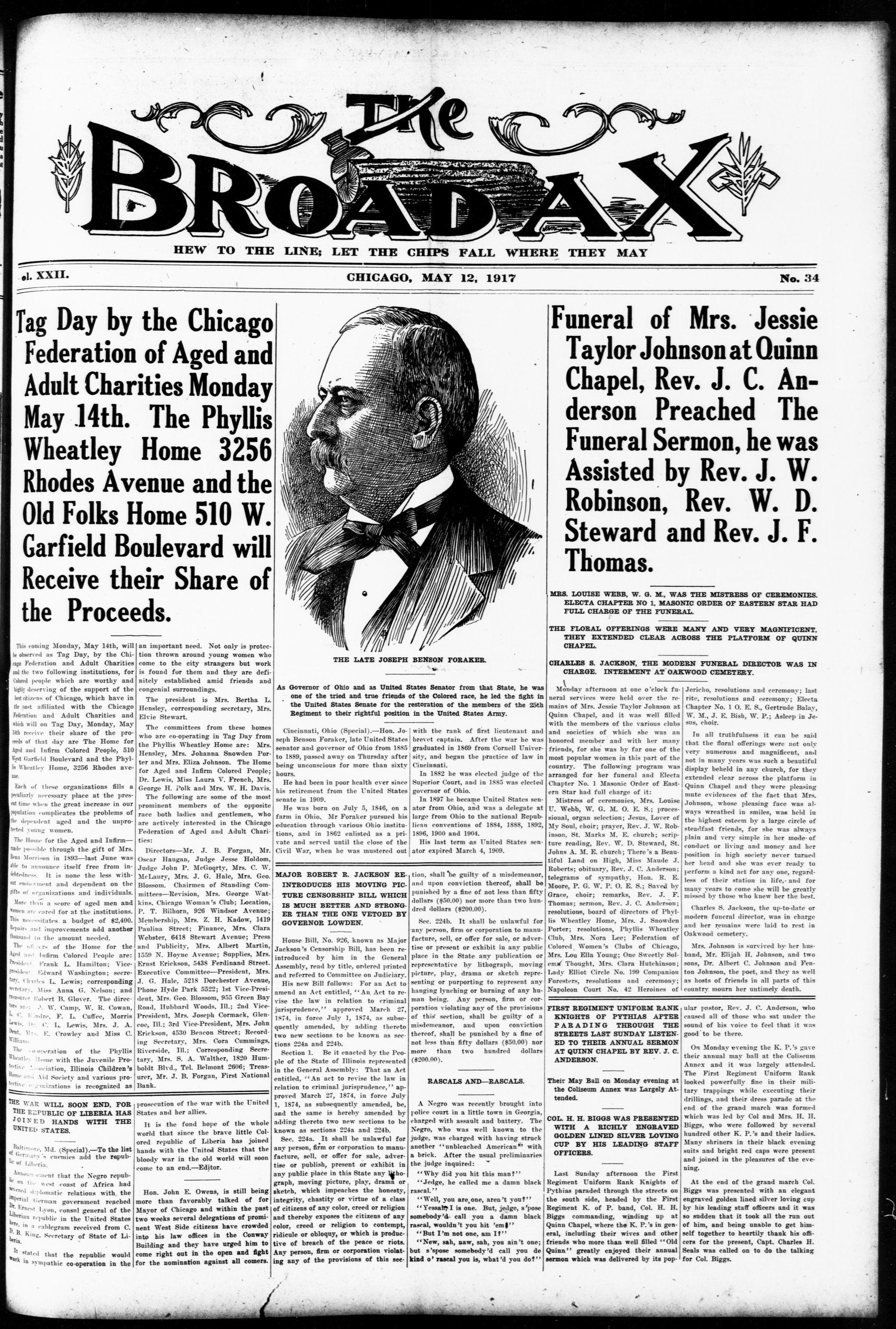
Tag Day by the Chicago Federation of Aged and Adult Charities Monday May 14th. The Phyllis Wheatley Home 3256 Rhodes Avenue and the Old Folks Home 510 W. Garfield Boulevard will Receive their Share of the Proceeds.
al. XXII.
Tag Day by Federation Adult Char May 14th. Wheatley Rhodes Ave Old Folks B Garfield Be Receive th the Procee
This coming Monday, May 14th, will be observed as Tag Day, by the Chicago Federation and Adult Charities and the two following institutions, for Colored people which are worthy and highly deserving of the support of the best citizens of Chicago, which have in the past affiliated with the Chicago Federation and Adult Charities and which will on Tag Day, Monday, May 14th receive their share of the proceeds of that day are The Home for Aged and Infirm Colored People, 510 West Garfield Boulevard and the Phyllis Wheatley Home, 3256 Rhodes avenue.
Each of these organizations fills a particularly necessary place at the present time when the great increase in our population complicates the problems of the dependent aged and the unprotected young women.
The Home for the Aged and Infirm—made possible through the gift of Mrs. Bena Morrison in 1893—last June was able to announce itself free from indebtedness. It is none the less without entourage and dependent on the gifts of organizations and individuals. More than a score of aged men and women are cared for at the institutions. This necessitates a budget of $2,400, improvements add another thousand to the amount needed.
The officers of the Home for the Aged and Infirm Colored People are: President Frank L. Hamilton; Vice-president Edward Washington; secretary, Charles L. Lewis; corresponding secretary, Miss Anna G. Nelson; and treasurer Robert B. Glover. The directors are: J. W. Camp, W. R. Cowan, L. C. Kindre, F. L. Cuffee, Morris Lewis, Dr. C. L. Lewis, Mrs. J. A. Dent, Mrs. E. Crowley and Miss C. Williams.
The W. C. Worker of the Phyllis Wheatley Home with the Juvenile Protective Association, Illinois Children's Home and Aid Society and various protective organizations is recognized as
THE WAR WILL SOON END, FOR
THE REPUBLIC OF LIBERIA HAS
JOINED HANDS WITH THE
UNITED STATES.
Baltimore, Md. (Special)—To the list of Germany's enemies add the republic of Liberia.
Announcement that the Negro republic on the west coast of Africa had severed diplomatic relations with the imperial German government reached Dr. Ernest Lyon, consul general of the Liberian republic in the United States here, in a cablegram received from C. D. B. King, Secretary of State of Liberia.
It stated that the republic would work in sympathic co-operation in the
HEW TO THE LINE; LET THE CHIPS FALL WHERE THEY MAY
an important need. Not only is protection thrown around young women who come to the city strangers but work is found for them and they are definitely established amid friends and congenial surroundings.
The president is Mrs. Bertha L. Hensley, corresponding secretary, Mrs. Elvie Stewart.
The committees from these homes who are co-operating in Tag Day from the Phyllis Wheatley Home are: Mrs. Hensley, Mrs. Johanna Snowden Porter and Mrs. Eliza Johnson. The Home for Aged and Infirm Colored People; Dr. Lewis, Miss Laura V. French, Mrs. George H. Polk and Mrs. W. H. Davis.
The following are some of the most prominent members of the opposite race both ladies and gentlemen, who are actively interested in the Chicago Federation of Aged and Adult Charities:
Directors—Mr. J. B. Forgan, Mr Oscar Haugan, Judge Jesse Holdom Judge John P. McGoody, Mrs. C. W McLaury, Mrs. J. G. Hale, Mrs. Geo Blossom. Chairmen of Standing Committee—Revision, Mrs. George Watkins, Chicago Woman's Club; Location P. T. Bilhorn, 926 Windsor Avenue; Membership, Mrs. Z. H. Kadow, 1419 Paulina Street; Finance, Mrs. Clara Webster, 6418 Stewart Avenue; Press and Publicity, Mrs. Albert Martin, 1559 N. Hoyne Avenue; Supplies, Mrs. Ernst Erickson, 5438 Ferdinand Street Executive Committee—President, Mrs. J. G. Hale, 5218 Dorchester Avenue Phone Hyde Park 5522; 1st Vice-President, Mrs. Geo Blossom, 955 Green Bay Road, Hubbard Woods, Ill.; 2nd Vice-President, Mrs. Joseph Cormack, Glencoe, Ill.; 3rd Vice-President, Mrs. John Erickson, 4530 Beacon Street; Recording Secretary, Mrs. Cora Cummings, Riverside, Ill.; Corresponding Secretary, Mrs. S. A. Walther, 1820 Humboldt Blvd., Tel. Belmont 2606; Treasurer, Mr. J. B. Forgan, First National Bank. prosecution of the war with the United States and her allies.
It is the fond hope of the whole world that since the brave little Colored republic of Liberia has joined hands with the United States that the bloody war in the old world will soon come to an end.-Editor.
Hon. John E. Owens, is still being more than favorably talked of for Mayor of Chicago and within the past two weeks several delegations of prominent West Side citizens have crowded into his law offices in the Conway Building and they have urged him to come right out in the open and fight for the nomination against all comers.
CHICAGO, MAY 12, 1917
B
THE LATE JOSEPH BENSON FORAKER.
THE LATE JOSEPH BENSON FORAKER.
As Governor of Ohio and as United States Senator from the one of the tried and true friends of the Colored race, he the United States Senate for the restoration of the mem Regiment to their rightful position in the United States
As Governor of Ohio and as United States Senator from that State, he was one of the tried and true friends of the Colored race, he led the fight in the United States Senate for the restoration of the members of the 25th Regiment to their rightful position in the United States Army.
Cincinnati, Ohio (Special).—Hon. Joseph Benson Foraker, late United States senator and governor of Ohio from 1885 to 1889, passed away on Thursday after being unconscious for more than sixty hours.
He had been in poor health ever since his retirement from the United States senate in 1909.
He was born on July 5, 1846, on a farm in Ohio. Mr Foraker pursued his education through various Ohio institutions, and in 1862 enlisted as a private and served until the close of the Civil War, when he was mustered out with the rank of first lieutenant and brevet captain. After the war he was graduated in 1869 from Cornell University, and began the practice of law in Cincinnati.
In 1882 he was elected judge of the Superior Court, and in 1885 was elected governor of Ohio.
In 1897 he became United States senator from Ohio, and was a delegate at large from Ohio to the national Republican conventions of 1884, 1888, 1892, 1896, 1900 and 1904.
His last term as United States senator expired March 4, 1909.
MAJOR ROBERT R. JACKSON RE
INTRODUCES HIS MOVING PIC
TURE CENSORSHIP BILL WHICH
IS MUCH BETTER AND STRONG-
ER THAN THE ONE VETOED BY
GOVERNOR LOWDEN.
House Bill, No. 926, known as Major Jackson's Censorship Bill, has been reintroduced by him in the General Assembly, read by title, ordered printed and referred to Committee on Judiciary. His new Bill follows: For an Act to amend an Act entitled, "An Act to revise the law in relation to criminal jurisprudence," approved March 27, 1874, in force July 1, 1874, as subsequently amended, by adding thereto two new sections to be known as sections 224a and 224b.
Section 1. Be it enacted by the People of the State of Illinois represented in the General Assembly: That an Act entitled, "An act to revise the law in relation to criminal jurisprudence," approved March 27, 1874, in force July 1, 1874, as subsequently amended, be, and the same is hereby amended by adding thereto two new sections to be known as sections 224a and 224b.
Sec. 224a. It shall be unlawful for any person, firm or corporation to manufacture, sell, or offer for sale, advertise or publish, present or exhibit in any public place in this State any lithograph, moving picture, play, drama or sketch, which impaches the honesty, integrity, chastity or virtue of a class of citizens of any color, creed or religion and thereby exposes the citizens of any color, creed or religion to contempt, ridicule or obloquy, or which is productive of breach of the peace or riots. Any person, firm or corporation violating any of the provisions of this sec-
with the rank of first lieutenant and brevet captain. After the war he was graduated in 1869 from Cornell University, and began the practice of law in Cincinnati.
In 1882 he was elected judge of the Superior Court, and in 1885 was elected governor of Ohio.
In 1897 he became United States senator from Ohio, and was a delegate at large from Ohio to the national Republican conventions of 1884, 1888, 1892, 1896, 1900 and 1904.
His last term as United States senator expired March 4, 1909.
tion, shall be guilty of a misdemeanor, and upon conviction thereof, shall be punished by a fine of not less than fifty dollars ($50.00) nor more than two hundred dollars ($200.00).
See. 224b. It shall be unlawful for any person, firm or corporation to manufacture, sell, or offer for sale, or advertise or present or exhibit in any public place in the State any publication or representative by lithograph, moving picture, play, drama or sketch representing or purporting to represent any hanging lynching or burning of any human being. Any person, firm or corporation violating any of the provisions of this section, shall be guilty of a misdemeanor, and upon conviction thereof, shall be punished by a fine of not less than fifty dollars ($50.00) nor more than two hundred dollars ($200.00).
RASCALS AND—RASCALS
A Negro was recently brought into police court in a little town in Georgia, charged with assault and battery. The Negro, who was well known to the judge, was charged with having struck another "unbleached American" with a brick. After the usual preliminaries the judge inquired:
"Why did you hit this man?"
"Judge, he called me a damn black rascal."
"Well, you are one, aren't you?"
"Yessay, I is one. But, judge, s'pose somebody'd call you a damn black rascal, wouldn't you hit 'em?"
"But I'm not one, am I?"
"New, sah, naw, sah, you ain't one; but s'spose somebody'd call you de kind o' rascal you is, what'd you do?"
Funeral of Mrs. Jessie Taylor Johnson at Quinn Chapel, Rev. J. C. Anderson Preached The Funeral Sermon, he was Assisted by Rev. J. W. Robinson, Rev. W. D. Steward and Rev. J. F. Thomas.
MRS. LOUISE WEBB, W. G. M., WAS THE MISTRESS OF CEREMONIES, ELECTA CHAPTER NO 1, MASONIC ORDER OF EASTERN STAR HAD FULL CHARGE OF THE FUNERAL.
THE FLORAL OFFERINGS WERE MANY AND VERY MAGNIFICENT, THEY EXTENDED CLEAR ACROSS THE PLATFORM OF QUINN CHAPEL.
CHARLES S. JACKSON, THE MODEEN FUNERAL DIRECTOR WAS IN CHARGE. INTERMENT AT OAKWOOD CEMETERY.
Monday afternoon at one o'clock funeral services were held over the remains of Mrs. Jessie Taylor Johnson at Quinn Chapel, and it was well filled with the members of the various clubs and societies of which she was an honored member and with her many friends, for she was by far one of the most popular women in this part of the country. The following program was arranged for her funeral and Electa Chapter No. 1 Masonic Order of Eastern Star had full charge of it:
Jericho, resolutions and ceremony; last rite, resolutions and ceremony; Electa Chapter No. 1 O. E. S., Gertrude Balay, W. M., J. E. Bish, W. P.; Asleep in Jesus, choir.
In all truthfulness it can be said that the floral offerings were not only very numerous and magnificent, and not in many years was such a beautiful display beheld in any church, for they extended clear across the platform in Quinn Chapel and they were pleasing with evidence of their
Mistress of ceremonies, Mrs. Louise U. Webb, W. G. M. O. E. S.; processional, organ selection; Jesus, Lover of My Soul, choir; prayer, Rev. J. W. Robinson, St. Marks M. E. church; scripture reading, Rev. W. D. Steward, St. Johns A. M. E. church; There's a Beautiful Land on High, Miss Maude J. Roberts; obituary, Rev. J. C. Anderson; telegrams of sympathy, Hon. R. E. Moore, P. G. W. P. O. E. S.; Saved by Grace, choir; remarks, Rev. J. F. Thomas; sermon, Rev. J. C. Anderson; resolutions, board of directors of Phyllis Wheatley Home, Mrs. J. Snowden Porter; resolutions, Phyllis Wheatley Club, Mrs. Nora Lee; Federation of Colored Women's Clubs of Chicago, Mrs. Lou Ella Young; One Sweetly Solemn Thought, Mrs. Clara Hutchinson; Lady Elliot Circle No. 199 Companion Foresters, resolutions and ceremony; Napoleon Court No. 42 Heroines of
FIRST REGIMENT UNIFORM RANK
KNIGHTS OF PYTHIAS AFTER PARADING THROUGH THE STREETS LAST SUNDAY LISTENED TO THEIR ANNUAL SERMON AT QUINN CHAPEL BY REV. J. C. ANDERSON.
Their May Ball on Monday evening at the Coliseum Annex was Largely Attended.
COL. H. H. BIGGS WAS PRESENTED WITH A RICHLY ENGRAVED GOLDEN LINED SILVER LOVING CUP BY HIS LEADING STAFF OFFICERS.
Last Sunday afternoon the First Regiment Uniform Rank Knights of Pythias paraded through the streets on the south side, headed by the First Regiment K. of P. band, Col. H. H. Biggs commanding, winding up at Quinn Chapel, where the K. P.'s in general, including their wives and other friends who more than well filled "Old Quinn" greatly enjoyed their annual sermon which was delivered by its pop-
No.34
Jericho, resolutions and ceremony; last rite, resolutions and ceremony; Electa Chapter No. 1 O. E. S., Gertrude Balay, W. M., J. E. Bish, W. P.; Asleep in Jesus, choir.
In all truthfulness it can be said that the floral offerings were not only very numerous and magnificent, and not in many years was such a beautiful display beheld in any church, for they extended clear across the platform in Quinn Chapel and they were pleasing mute evidences of the fact that Mrs. Johnson, whose pleasing face was always wreathed in smiles, was held in the highest esteem by a large circle of steadfast friends, for she was always plain and very simple in her mode of conduct or living and money and her position in high society never turned her head and she was ever ready to perform a kind act for any one, regardless of their station in life, and for many years to come she will be greatly missed by those who knew her the best.
Charles S. Jackson, the up-to-date or modern funeral director, was in charge and her remains were laid to rest in Oakwood cemetery.
Mrs. Johnson is survived by her husband, Mr. Elijah H. Johnson, and two sons, Dr. Albert C. Johnson and Fenton Johnson, the poet, and they as well as hosts of friends in all parts of this country mourn her untimely death.
Ular pastor, Rev. J. C. Anderson, who caused all of those who sat under the sound of his voice to feel that it was good to be there.
On Monday evening the K. P.'s gave their annual may ball at the Coliseum Annex and it was largely attended. The First Regiment Uniform Rank looked powerfully fine in their military trappings while executing their drillings, and their dress parade at the end of the grand march was formed which was led by Col and Mrs. H. H. Biggs, who were followed by several hundred other K. P.'s and their ladies. Many shriners in their black evening suits and bright red caps were present and joined in the pleasures of the evening.
At the end of the grand march Col. Biggs was presented with an elegant engraved golden lined silver loving cup by his leading staff officers and it was so sudden that it took all the run out of him, and being unable to get himself together to heartily thank his officers for the present, Capt. Charles H. Seals was called on to do the talking for Col. Biggs.
OWNERS AND DIRECTORS
Dan M. Jackson
Geo. T. Kersey
David A. McGowan
Ahmed A. Rayner
The Emanu
Undertaking
The Emanuel Jackson Undertaking Co., Inc.
2959-61 South State St.
Reliable Service Courteous
Reasonable Prices
FREE CHAPEL IN CONNECTION
Reliable Service Courteous Treatment Reasonable Prices
Complete line of Funeral Goods.
FREE
STYLE BOOK
HAIR
To Colored Women
We are the largest manufacturers of Colored Women's Hair. Our latest book showing new style in Indian dressing sent free. Every colored woman should have we all the sands our hair and toilet articles. Satisfaction guaranteed or money back. We make the best solid Brass STRAIGHTENING combs, with extra heavy back, fully guaranteed. With each comb we give lamp cap FREE. Send money order status. MONEY BACK IF NOT SATISFACTORY. 88c. postpaid.
POSTPAID 89c
Hair nets, brushes, combs and toilet articles manufacturers' prices. Send two-cent stamp.
Agents Wanted. Address as follows:
HUMANIA HAIR COMPANY.
181-S7 Park Row,
New York City.
Address Dept. 84
In a French War Hospital
Serving a community of fifty a three course meal—soup, meat and vegetables and dessert—is a man size proposition, says Elizabeth Frazer in the Saturday Evening Post. Serving it on beet tables, often cutting up the food and feeding the armless patients, further complicates the task. The first day I completely lost my head. My clamorous young brood, nine of whom were under twenty-two, reminded me of nothing so much as a nestful of yawning baby robins waiting to be fed.
It was: "Look out for my leg, mees!" "More bread, mees!" "My servette, mees!" "Have you forgotten me, mees?" "My soup's tipped into my bed! I'm afloat, mees!" And all in a rapid bubble of French that made my head spin. At last in sheer desperation I addressed them in the American language: "You darned kids—shut up!"
The captain of a foreign ship, in port at Baltimore, at an entertainment given by friends was delighted with the oysters which were on the menu. Just before the ship sailed these friends sent to it several barrels of these oysters as a present to the captain. When he made the trip back to this country his friends asked him how he liked the oysters. He said: "Don't you know, we had to throw nearly all of them overboard. They were no good. Practically every one of them had a live insect on the inside, and knowing they were not fit to eat, we let the whole lot go to Davy Jones." Investigation showed that the insect was the little oyster crab, which is a great delicacy, preferred by many to the oysters themselves, and which the epicure knows as a sure guarantee of the quality of the bivalve. It was a good joke on those sending and the one receiving the present, at which neither side laughed very much.—Christian Herald.
A problem of the zoologist is the endurance of freezing by many animals, Collecting the records, Mlle. France and Paul Portier, entomologists, of Paris find that fish have survived 5 degrees F., frogs 8 degrees below, mollusks 184 degrees below and bacteria have come out alive after exposure to 300 degrees below zero. The two French experimenters froze certain caterpillars—Cossus cossus—at a temperature just above zero. They became quite solid and brittle and could be broken like icicles. On warming, however, even broken ones returned to life. Several freezings and thawings were endured, but recovery became slower each time and ceased after the sixth thawing. Other genera showed like results. There seemed to be some physiological preparation for the cold, for caterpillars that survived the winter freezing all succumbed to similar temperatures in the spring.
There are two places on the earth's surface where the magnetic needle must point due south. They are not easy places to reach. One is in the arctic regions north of the northern magnetic pole on the line between that pole and the geographical north pole. The other is in the antarctic regions, south of the southern magnetic pole, on the line between that spot and the geographical south pole. In the first case the point of the needle is attracted to the northern magnetic pole. In the second case the other end of the needle is attracted to the southern magnetic pole.
The mission fathers brought the olive and the date from the Mediterranean regions and gave California one of its most important crops.
---
PAGE TWO
The Little Oyster Grab
Living Icicles.
The Magnetic Needle
Phones Calumet 6164 Automatic 71-629
Michael Jackson
ing Co., Inc.
South State St.
Courteous Treatment
table Prices
L. IN CONNECTION
An Expert In Motives.
Cousin Henry is an expert in motives. If you were reading off a list of names and overlooked Henry he would understand. He would know exactly the motive that prompted you to do it. If you don't think to introduce him to the man who is with you he can see through it. He may have to go back four or five years, but he will make a complete case against you. In less than an hour he will know what your motive was. Right now he is angry because his daughter was not selected as valedictorian of her class. You may think that the other girl deserved to be selected, but you don't know all that Henry knows. It is a long story, but he is willing to tell it to you, and after hearing it you will understand the motive--you will understand that it is a case of spite work.—Claude Callan in Fort Worth Star-Telegram.
How David Garrick Made His Fortune.
If David Garrick had had no more than his salary as an actor he would have had little to leave at his death. He made his fortune as joint proprietor, and for a time as sole proprietor, of Drury Lane theater, so that the amount set down to himself as salary was practically nominal. When he retired from the stage in 1776 he sold half his share in the theater for £35,000. He was probably the only actor who consistently made Shakespeare pay, and, like Shakespeare, he was actor, author and proprietor.
It may be recalled that Garrick, who had no enemies outside his own profession, was the grandson of a Frenchman exiled at the revocation of the edict of Nantes and that his father was a captain in the army.—London Standard.
One of the most common faults of the diet is the eating of too much protein foods. In excess this is hard for the body to excrete and is likely to decompose in the intestines with the formation of poisonous waste products. Green vegetables and raw fruit are important elements of the diet. There is little energy in these foods, but they supply mineral salts which the body needs and curious substances called vitamins, which are easily destroyed by cooking.
One food expert has suggested a rule for securing a well balanced diet. It is: An ordinary family should spend about as much for milk, vegetables and fruits as for meats, fish and eggs and as much for milk and eggs as for meat and fish.
The history of science has seven problems which men in all ages more or less have tried to solve, but which have finally been given up by all. Today they are called follies.
The usual list comprises the following: First, squaring the circle; second, duplication of the cube; third, trisection of an angle; fourth, perpetual motion; fifth, transmutation of metals; sixth, fixation of mercury; seventh, elixir of life. Some lists put the philosopher's stone for the last three and then add astrology and magic to make the seven.
Too Much For Him.
"I thought he was going to marry that girl?"
"Well, he did think of it. But it seems when he called the other night she threw him down."
"Well, if she's as good as that at wrestling I don't blame him for quitting."—St Louis Post-Dispatch.
"I can't tell a canvasback duck from a barnyard specimen."
"Experts say you can tell by the bill."
"How so? The bill for one is always as high as the bill for the other. That's what I'm kicking about."—Louisville Courier-Journal.
Just a Change In Words.
Young Clerk—Do you like to stand in front of the store and see the crowds go by? Old Merchant—No, but I like to stand in the back of our store and see the crowds come buy.—Exchange
Howell-Rowell is a man of tenacity
Powell-Yes. If he were a dog and got
a grip on your trousers you would be
perfectly safe in ordering a new pair.
Pistols were invented at Pistoja. Italy, and were first used by English cavalrymen in 1544.
Gold, like the sun, which melts wax and hardens clay, expands great souls and contracts bad hearts.—Rivarol.
OPEN DAY AND NIGHT
Automobles for hire
Well Balanced Diet
Follies of Science
Not That Bill.
A Sticker
Pistols
THE BROAD AX. CHICAGO, MAY 12, 1917.
He Lacked Concentration.
Speaking of a man who was a failure because of his lack of concentration and his inability to know his own mind five minutes at a time, a captain of industry said he reminded him of a hunting dog he once owned:
"At sunrise the dog would start out on his own hook after deer. He would jump a buck and run him for miles. When the buck was on the point of exhaustion the hound's nostrils would catch the taint in the air where a fox had crossed the trail, and he would instantly decide that, after all, fox was what he had come for, and he would turn aside to pursue the fox. Perhaps an hour later, when the chase was growing warmer every minute, his keen nose would detect the presence of a rabbit, and he would go after the cottontail, with the inevitable result that by 4 o'clock in the afternoon that hound would be thirty or forty miles away from home in a swamp with a chipmunk treed!"—Saturday Evening Post.
George and His Legs.
Bit by bit the historical grubbers are digging out the truth about our immortal George. We have heretofore been told that he wore false teeth and that at Valley Forge he unblushingly deceived his ragged and despondent troops with the arrival of ample supplies of ammunition, which consisted of powder barrels filled with sand, and now a correspondent of the New York Sun declares that in the full length portraits of Washington by Stuart, of which there is one in the New York public library, the legs were not his own. "I have seen the letter from Stuart thanking the true owner for his kindness in providing a symmetrical foundation for the bust of the great president and presenting one of the smaller portraits in thanks for his kindness."
Free Speech
An old negro woman had lived with a certain family in the south for many years. One day her mistress had occasion to reprimand her quite sharply for something that had gone wrong. The negress said nothing at the time, but a little later her voice could be heard in the kitchen in shrill vituperation of everything and everybody, with a rattling accompaniment of pans and kettles. So loud became the clamor and so vindictive the exclamations that Mrs. C. went hurriedly down to the kitchen.
"Why, Liza," she began in amazement, "who on earth are you talking to?"
"I ain't talkin' to nobody," the old negress replied, "but I don't keer who in dis house hyars me."—Harper's Magazine.
Misprints and Maxim Guns
The late Sir Hiram Maxim says in his autobiography that when he organized the United States Electric Lighting company the printer sent home its stationery with the heading, "The United States Electric Lightning company." When he established his new gun company in England he told of this mistake in order to emphasize the importance of getting the stationery printed correctly. When the first sheets were brought to him, however, he found that the English printers had made his concern appear as "The Maxim Gum company."
Easy Generosity.
Mother (to small son)—Bobby, dear,
I hoped you would be unselfish enough
to give little sister the largest piece of
candy. Why, see, even our old hen
gives all the nice big dainties to the
little chicks and only keeps an occasional tiny one for herself.
Bobby thoughtfully watched the hen
and chickens for a time and then said,
"Well, mamma, I would, too, if it was worms."—Rochester Times.
A Generation:
In the long lived patriarchal age a generation seems to have been computed at 100 years (Genesis xv, 1). Subsequently the reckoning was the same that has been more recently adopted—that is, from thirty to forty years (Job xiii, 16).
Incongruous
Little Alick—What is an incongruity,
uncle? Uncle William—An incongruity,
child, is a divorce lawyer humming a
wedding march.
Vegetation In Polar Regions.
The rapid growth of vegetation in
the polar regions is attributed to the
electric currents in the atmosphere.
---
PRACTICAL HEALTH HINT.
Neuralgia.
Neuralgia means nerve pain.
Neuritis means inflammation of the nerve. In neuralgia the pain comes and goes. In neuritis the ache is steady and sticks closely to the affected nerve. If the nerve could be taken out and examined we could find nothing abnormal in the case of neuralgia. In neuritis the nerve would be found to be inflamed. The question of what is behind the pain of neuralgia is more important than the answer to the cry for relief. It must be remembered that neuralgia is merely a symptom, not a disease. Sometimes malaria is the underlying cause. Other times it may be due to alcoholism, diabetes, lead poisoning, gout, rheumatism or Bright's disease. A diseased tooth or a diseased ovary may be responsible. In every case treatment must include treatment of the underlying cause.
```markdown
```
Spanish Doubloons.
Spanish Doubloons.
Should one find a pirate's buried treasure he would have to dispose of his Spanish gold at its bullion value, for since Aug. 1, 1908, when the common crier made proclamation from the steps of the Royal Exchange of London that after that date the doubloon would cease to be legal tender in the West Indies, including British Gulana, the doubloon has not been the precious thing it was. In 1730 and for a century after it was worth $8, more or less. It has ceased to be coined in its native country, Spain, and since 1908 it has been unpopular in the West Indies, where for a long time it figured in a mixed circulation, embracing British, United States and Spanish coins. In the interest of romance, however, the name at least must survive. -It signifies nothing more than that the coin was double the value of a pistole, but the "doubloon" was never such a mouth filling mockery as "pieces of eight," which suggests great riches, but means only Spanish silver dollars, pieces equivalent to eight reals.—Rochester Post-Express.
A Famous New York Street
Few of the thousands of people who pass the corner of Nassau and John streets every day know the early history of Nassau street. And yet right at that corner is a bronze tablet which gives in concise form the following historical information:
"Nassau Street, Known Originally as 'the Street That Runs by the Pye Woman,' Was Laid Out About 1695 and Was Named In Honor of the House of Nassau, Whose Head at That Time Was William the Third, King of England and Stadtholder of the Dutch Republic. Nassau Street became Identified With the Jewelry Trade More Than Half a Century Ago."
The bronze tablet is on the exterior of the building at the northwest corner of Nassau and John streets. It was erected by the Malden Lane Historical society in 1916—New York Sun.
William De Morgan
In spite of himself William De Morgan became famous. He deliberately violated all the rules made for the guidance of novelists who seek to become popular. None of his novels was addressed to the greater public that is avid for the latest thing of the moment in fiction, but nevertheless they reached that public. He was a law unto himself in the novels that he wrote during his marvelous career that spanned only ten years. It is doubtful if in English literature or in any other can be found a writer whose life and literary career are comparable to his. He was an old man when the world of readers came to know him, and his age was an asset toward celebrity. At seventy he was hailed as eagerly as Kipling was hailed at twenty, and in his way he was no less a prodigy than the younger writer.—Bookman.
The Emerald.
The emerald has been known since early times both in Europe and in certain parts of the orient, where its attractive color and rarity have endowed it with the highest rank and a vaued lore. Its name may be traced back to an old Persian word which appeared in Greek as "smaragdos," mentioned by Theophrastus over 300 years before the Christian era, and again in Latin as "smaragdus," seen in the writings of Pliny, who particularized somewhat on its properties and supposed medicinal virtues and was even shrewd enough to suspect its identity with the much more common beryl, although eighteen centuries elapsed before this suspicion was verified by scientific proof.
His Hard Luck:
A small boy whose record for department at school had always stood at 100 came home one day recently with his standing reduced to 98.
"What have you been doing, my son?" asked his doting mother.
"Been doing?" replied the young hopeful. "Been doing just as I have been doing all along, only the teacher caught me this time." — Philadelphia Inquirer.
Where Is the Profit?
"I understand they sold their house for $3,000 more than they paid for it." "How lucky!" "Lucky nothing! After they'd sold it they discovered that they've got to pay $2,000 more than they received for their house for another home to live in."-Detroit Free Press.
Books In Brazil.
In Brazil, as throughout South America, French is almost universally read. Editions of the classics are found in most homes, and bookstores are filled with modern French writers of prose or verse, sometimes in translation and as frequently in the original.
Went Further:
"Didn't I tell you that when you met a man in hard luck you ought to greet him with a smile?" said the wise and good counselor. "Yes," replied the flinty souled person. "I went even further than that. I gave him the grand laugh."
Best Way of Taking Iron
When anemic persons have to take iron the best form in which to administer it is spinach, cabbage, green chicory, asparagus, lentils, carrots and peas, all of which contain much iron.
About the Same Thing
Scribbler—Can you suggest a simile for giving advice? Scrawler—How would pouring water on a duck's back so?—Philadelphia Record.
Let us teach people as much as we can to enjoy, and they will learn for themselves to aymathize—Stevenson
Necessities of War.
When Lloyd George in England undertook to organize the ministry of munitions a glazier began to stamp out cartridge clips; a manufacturer of music rolls used his equipment to make gauges; a concern engaged before the war in preparing infants' food began delivering plugs for shells; an advertising agency manufactured shell adapters; watchmakers began adjusting fuses; a manufacturer of baking machinery became a contractor for six inch high explosive shells; a jewelry house devoted itself exclusively to periscope; a phonograph concern sent millions of delicate shell parts to the assembling stations; a firm which made nothing but sheep shearing machinery started turning out shell cases; a cream separator factory manufactured shell primers. Among other producers of finished shells were candlemakers, flour mills, tobacco manufacturers, syphonmakers and the manufacturers of sporting goods.—World's Work.
Stocking the National Parks.
The United States is carrying on a very interesting work in exchanging the wild animals of one region for those of others—transplanting elk and deer and Rocky mountain bighorns from regions in the United States where they are plentiful to others where, so far as known, they have not lived. Some of the animals are being shipped long distances, says the Popular Science Monthly.
Wyoming is full of elk. The herds in the Jackson Hole country are the largest of any of North American wild animals since the days of the countless buffaloes. But the big Yosemite National park of California, with its three-quarters of a million acres, until recently had no elk, or at least only a very few scattered specimens. But the elk shipped in from Wyoming have become very much at home and are breeding and multiplying rapidly, adding to the charm and picturesqueness of this popular national playground.
Love and Marriage
"First love is very apt not to be the lasting love," said Dr. Antoinette Konikow, speaking at the Boston School of Social Science.
"Young lovers try to excuse all the faults of the loved one because they are not in love with the individual, but with love. Hence they may not choose the partner with whom they will find their happiness in later years. Many a man and woman is glad by middle age that the first love was frustrated.
"Marriage should be based on love alone or it is immoral, and some change is necessary if marriage is to be saved from degradation. Real love always makes people better. Romantic love is the source of all the best things in life—the foundation of all the arts. And individual happiness makes up the happiness of the race."—Boston Post.
Use of Bacon Drippings.
Bacon drippings make splendid shortening for light, flaky pie crust. It takes just a little less of the drippings than of ordinary lard or vegetable shortening. Use it for shortening in spice cake, gingerbread or any dark cake and note the delicious flavor. Spread rye bread with a thin layer of the pure drippings and sprinkle a little salt on it. Add to this a thin slice of any salt meat and you will have a delicious and highly nutritious sandwich. The European housewife has long made use of such sandwiches for the between meal snack for growing boys and girls.
The Pygmy Hippopotamus
One of the animals least known to the outside world is the pygmy hippopotamus of West Africa. This animal is just what its name implies, a pygmy hippopotamus. It is much smaller than the common hippopotamus, being no larger than an ordinary or fair sized hog. It differs somewhat from the common hippo in the character of its teeth, and instead of spending its time in the rivers and lakes in large herds it wanders about through the jungles singly or in pairs, much after the manner of swine in search of mast—London Snectator
Just the Time.
"No, I have never played bridge before."
"So I should surmise," said the disgusted partner. "But how came you to enter an important tournament like this?"
"Oh, I thought it would be a good time to learn."—Louisville Courier.
All Wrong
"Now, look here, Alice, I know everything. You've been carrying on with another man. I even know that his nage is Rupert."
"How ridiculous you are! First of all, I haven't flirted with any one, and, secondly, his name isn't Rupert."—Passing Show.
Profitable Writing
"My writings bring in a lot of money every month." "That so? I didn't know you were an author." "I'm not. I'm the man that makes out the bills for our firm."—Detroit Free Press.
Trials of Authors
"You do not know." Saint-Beuve wrote to George Sand, "what it is to remain a whole day with your head in your hands, squeezing your unfortunate brain to find a word."
Silent Heroes
"Father," asked Tommy, "what are silent heroes?" "Married men, my boy," replied the father.—London Telegraph.
We like to give in the sunlight, to receive in the dark.
He—Do you know what I am going to say to you? Drop it!
Nju—Drop what?
He—Everything—happiness and love and work and God knows what else it is all so provincial. Even our dreams, let them be what they will, are provincial—yes, even our sufferings.
Nju—And what is there that isn't provincial?
He—What! Art and death? No; art is tool. Only death.
Nju—Yes. I understand.
Nju—Yes; I understand.
* * *
He—You don't love me, Nju.
Nju—I love you.
Nju—I love you very much. Really
I do love you, only there is something
that is more than love—something still
higher.
He—What's that—life?
Nju—I don't know.
He—Or—or death?
Nju—No; there is something still
higher.
He—Than life, death and love?
Nju—Than all combined. There must surely be something; otherwise the whole thing would be so meaningless —From the Russian Play "Nin."
Grass on the Lawn
Grass seeds germinate in from fourteen to eighteen days. A quart of seeds is sufficient to cover 300 square feet-15 by 20 feet. Five to six bushels are required per acre.
Do not sow grass seeds in hot, dry weather, particularly in July or August.
Poa trivalis is good for shady lawns under trees.
Festuca rubra is most suitable for hard wear and for dry or salsic acid.
hard wear and for dry or sandy soils.
Sharp sea sand applied lightly over lawns in the autumn—that is, over lawns on clay or loam—encourages the growth of fine grasses.
Lawns that are frequently watered need more fertilizers than those that are not, as the water washes away much plant food—New York Sun
Glengarry's "Treason."
How startling was the difference in the customs of the English and the Scots even less than a century ago is shown in the story of the way in which the famous highland chief, Alastair Macdonell, of Glengarry frightened George IV. out of his wits. In 1822 Glengarry was one of a party of Scottish nobles and gentlemen who banqueted "the first gentleman of Europe" in Holyrood palace. Colonel Macdonell was the last chief to wear the full highland costume, and when the company sat down to dinner he, according to custom, placed a brace of loaded pistols by his plate. The king started up in alarm and was persuaded to remain in the room only on the assurance that Glengarry meant no treason-London Spectator.
Stevenson's Wife.
A half caste sailor once said, "Mr Stevenson is good to me, like my father, and his wife is the same kind of man."
King Tembinoke said of Mrs. Stevenson, "She good; look pretty plenty chench" (sense).
Perhaps they both meant what the poet Edmund Gosse so well expressed when he wrote of her as being "dark and rich hearted, like some wonderful wine-red jewel."
But the best tribute in Mrs. Stevenson's praise came from the pen of her husband—Critic.
Our Coal Supply.
The United States coal supply is nearly one-half that of the entire world. Estimates put the available coal supply of the United States at 3,538,500,000 tons out of a world total estimated at 7,397,533,000,000 tons. China ranks next to the United States in available supply, estimated at 1,500,000,000,000 tons Great Britain, 180,000,000,000; Germany, 164,000,000,000; and Canada, 100,000,000,000 tons.
Too Pushing.
"I had an idea I'd grow up and own this business some day," said the discharged office boy.
"That's just why you were fired," said the boss. "Ever since you started to work here you've been acting as if you already owned the business"—Birmingham Age-Herald.
Forgiveness.
Waiter—Beg pardon, sir, but—ah-em the gents here usually remember my services. Guest (pocketing all the change)—Do they? They ought to be more charitable and forget them!
Clever Sheep Shearers
Diet For the Aged.
O The aged should have food at frequent intervals—bittle and often should be the rule—food every three or four hours. The appetite is not as keen in old age as it is in youth, nor is the digestion so good.
O Fresh vegetables are needed and rellished by elderly persons, and they are a valuable addition to the dietary if they are troubled with constipation, as they contain fibrous tissue, which gives bulk to the contents of the intestinal canal and supplies something for the intestines to contract upon. Stewed or raw fruits are useful, as well as vegetables, and one or the other should be eaten two or three times a day.
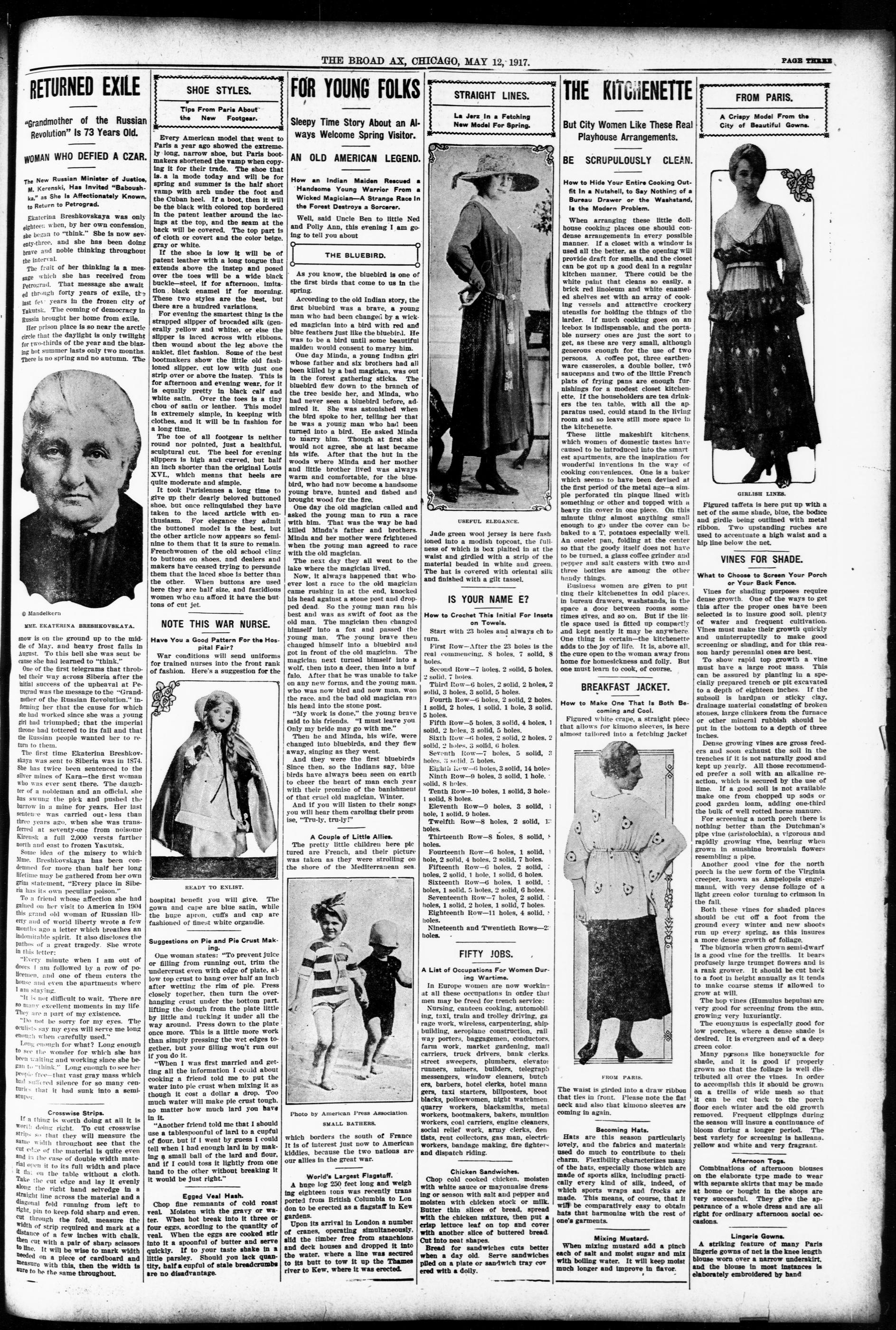
"Grandmother of the Russian Revolution" Is 73 Years Old.
WOMAN WHO DEFIED A CZAR.
The New Russian Minister of Justice, M. Kerenski, Has Invited "Baboushka," as She Is Affectionately Known, to Return to Petrograd.
Ekaterina Breshkovskaya was only eighteen when, by her own confession, she began to "think." She is now seventy-three, and she has been doing brave and noble thinking throughout the interval.
The fruit of her thinking is a message which she has received from Petrograd. That message she awaited through forty years of exile, the last few years in the frozen city of Yakutsk. The coming of democracy in Russia brought her home from exile. Her prison place is so near the arctic circle that the daylight is only twilight for two-thirds of the year and the blazing hot summer lasts only two months. There is no spring and no autumn. The
Mary Catherine
MME. EKATERINA BRESHKOVSKAYA.
snow is on the ground up to the middle of May, and heavy frost falls in August. To this hell she was sent be cause she had learned to "think."
One of the first telegrams that throbbed their way across Siberia after the initial success of the upheaval at Petregrad was the message to the "Grandmother of the Russian Revolution." informing her that the cause for which she had worked since she was a young girl had triumphed; that the imperial throne had toterted to its fall and that the Russian people wanted her to return to them.
The first time Ekaterina Breshkovskaya was sent to Siberia was in 1874. She has twice been sentenced to the silver mines of Kara—the first woman who was ever sent there. The daughter of a nobleman and an official, she has swung the pick and pushed the barrow in a mine for years. Her last sentence was carried out less than three years ago, when she was transferred at seventy-one from noisome Kirenskai a full 2,000 versts farther north and east to frozen Yakutsk.
Some idea of the misery to which Mme. Breshkovskaya has been condemned for more than half her long lifetime may be gathered from her own grim statement, "Every place in Siberia has its own peculiar poison."
To a friend whose affection she had gained on her visit to America in 1904 this grand old woman of Russian liberty and of world liberty wrote a few months ago a letter which breathes an indomitable spirit. It also discloses the paths of a great tragedy. She wrote in this letter:
"Every minute when I am out of doors I am followed by a row of policemen, and one of them enters the house and even the apartments where I am staying.
"It is not difficult to wait. There are so many excellent moments in my life. They are a part of my existence.
"Do not be sorry for my eyes. The oculists say my eyes will serve me long enough when carefully used."
Long enough for what? Long enough to see the wonder for which she has been waiting and working since she began to "think." Long enough to see her people free—that vast gray mass which had suffered silence for so many centuries that it had sunk into a semi-storm.
Crosswise Strips.
If a thing is worth doing at all it is worth doing right. To cut crosswise strips so that they will measure the same width throughout see that the cut edge of the material is quite even and in the case of double width material open it to its full width and place it flat on the table without a cloth. Take the cut edge and lay it evenly along the right hand selvedge in a straight line across the material and a diagonal fold running from left to right, pin to keep fold sharp and even, cut through the fold, measure the width of strip required and mark at a distance of a few inches with chalk, then cut with a pair of sharp scissors to line. It will be wise to mark width needed on a piece of cardboard and measure with this, then the width is sure to be the same throughout.
SHOE STYLES.
Tips From Paris About the New Footgear.
Every American model that went to Paris a year ago showed the extremely long, narrow shoe, but Paris bootmakers shortened the vamp when copying it for their trade. The shoe that is a la mode today and will be for spring and summer is the half short vamp with arch under the foot and the Cuban heel. If a boot, then it will be the black with colored top bordered in the patent leather around the lacings at the top, and the seam at the back will be covered. The top part is of cloth or covert and the color beige, gray or white.
If the shoe is low it will be of patent leather with a long tongue that extends above the instep and posed over the toes will be a wide black buckle—steel, if for afternoon imitation. black enamel if for morning. These two styles are the best, but there are a hundred variations.
For evening the smartest thing is the strapped slipper of brocaded silk (generally yellow and white), or else the slipper is laced across with ribbons, then wound about the leg above the ankle, filet fashion. Some of the best bootmakers show the little old fashioned slipper, cut low with just one strip over or above the instep. This is for afternoon and evening wear, for it is equally pretty in black calf and white satin. Over the toes is a tiny chou of satin or leather. This model is extremely simple, in keeping with clothes, and it will be in fashion for a long time.
The toe of all footgear is neither round nor pointed, just a healthful, sculptural cut. The heel for evening slippers is high and curved, but half an inch shorter than the original Louis XVI, which means that heels are quite moderate and simple.
It took Parisiennes a long time to give up their dearly beloved buttoned shoe, but once relinquished they have taken to the laced article with enthusiasm. For elegance they admit the buttoned model is the best, but the other article now appears so feminine to them it is sure to remain. Frenchwomen of the old school cling to buttons on shoes, and dealers and makers have ceased trying to persuade them that the laced shoe is better than the other. When buttons are used here they are half size, and fastidious women who can afford it have the buttons of cut jet.
NOTE THIS WAR NURSE
Have You a Good Pattern For the Hospital Fair?
War conditions will send uniforms for trained nurses into the front ranks of fashion. Here's a suggestion for the
A
READY TO ENLIST.
hospital benefit you will give. The gown and cape are blue satin, while the huge apron, cuffs and cap are fashioned of finest white organdie.
Suggestions on Pie and Pie Crust Making.
One woman states: "To prevent juice or filling from running out, trim the undercrust even with edge of plate, allow top crust to hang over half an inch after wetting the rim of pie. Press closely together, then turn the overhanging crust under the bottom part, lifting the dough from the plate little by little and tucking it under all the way around. Press down to the plate once more. This is a little more work than simply pressing the wet edges together, but your filling won't run out if you do it.
"When I was first married and getting all the information I could about cooking a friend told me to put the water into pie crust when mixing it as though it cost a dollar a drop. Too much water will make pie crust tough, no matter how much lard you have in it.
"Another friend told me that I should use a tablespoonful of lard to a cupful of flour, but if I went by guess I could tell when I had enough lard in by making a small ball of the lard and flour, and if I could toss it lightly from one hand to the other without breaking it it would be just right."
Egged Veal Hash.
Chop fine remnants of cold roast veal. Molsten with the gravy or water. When hot break into it three or four eggs, according to the quantity of veal. When the eggs are cooked stir into it a spoonful of butter and serve quickly. If to your taste shake in a little parsley. Should you lack quantity, half a cupful of stale breadcrumbs are no disadvantage.
THE BROAD AX, CHICAGO, MAY 12. 1917.
FOR YOUNG FOLKS
Sleepy Time Story About an Always Welcome Spring Visitor.
AN OLD AMERICAN LEGEND.
How an Indian Maiden Rescued a Handsome Young Warrior From a Wicked Magician—A Strange Race In the Forest Destroys a Sorcerer.
Well, said Uncle Ben to little Ned and Polly Ann, this evening I am going to tell you about
THE BLUEBIRD.
As you know, the bluebird is one of the first birds that come to us in the spring.
According to the old Indian story, the first bluebird was a brave, a young man who had been changed by a wicked magician into a bird with red and blue feathers just like the bluebird. He was to be a bird until some beautiful maiden would consent to marry him.
One day Minda, a young Indian girl whose father and six brothers had all been killed by a bad magician, was out in the forest gathering sticks. The bluebird flew down to the branch of the tree beside her, and Minda, who had never seen a bluebird before, admired it. She was astonished when the bird spoke to her, telling her that he was a young man who had been turned into a bird. He asked Minda to marry him. Though at first she would not agree, she at last became his wife. After that the hut in the woods where Minda and her mother and little brother lived was always warm and comfortable, for the bluebird, who had now become a handsome young brave, hunted and fished and brought wood for the fire.
One day the old magician called and asked the young man to run a race with him. That was the way he had killed Minda's father and brothers. Minda and her mother were frightened when the young man agreed to race with the old magician. The next day they all went to the lake where the magician lived.
Now, it always happened that whoever lost a race to the old magician came rushing in at the end, knocked his head against a stone post and dropped dead. So the young man ran his best and was as swift of foot as the old man. The magician then changed himself into a fox and passed the young man. The young brave then changed himself into a bluebird and got in front of the old magician. The magician next turned himself into a wolf, then into a deer, then into a buffalo. After that he was unable to take on any new forms, and the young man, who was now bird and now man, won the race, and the bad old magician ran his head into the stone post.
"My work is done," the young brave said to his friends. "I must leave you Only my bride may go with me."
Then he and Minda, his wife, were changed into bluebirds, and they flew away, singing as they went.
And they were the first bluebirds Since then, so the Indians say, bluebirds have always been seen on earth to cheer the heart of man each year with their promise of the banishment of that cruel old magician, Winter. And if you will listen to their songs you will hear them caroling their promise, "Tru-ly, tru-ly."
A Couple of Little Allies.
the pretty little children here picture are French, and their picture was taken as they were strolling on the shore of the Mediterranean sea
BENNETT AND BENNETT
Photo by American Press Association SMALL BATHERS. which borders the south of France It is of interest just now to American kiddies, because the two nations are our allies in the great war.
World's Largest Flagstoff.
A huge log 250 feet long and weighing eighteen tons was recently transported from British Columbia to London to be erected as a flagstaff in Kew gardens. Upon its arrival in London a number of cranes, operating simultaneously, slid the timber free from stanchions and deck houses and dropped it into the water, where a line was secured to its butt to tow it up the Thames river to Kew, where it was erected.
STRAIGHT LINES.
La Jerz in a Fetching New Model For Spring.
THE FASHION OF THE TWENTIETH CENTURY
USEFUL ELEGANCE.
Jade green wool jersey is here fashioned into a modish topcoat, the fullness of which is box plaited in at the waist and girdled with a strip of the material beaded in white and green. The hat is covered with oriental silk and finished with a gilt tassel.
IS YOUR NAME E?
How to Crochet This Initial For Insets on Towels.
Start with 23 holes and always ch to turn.
First Row—After the 23 holes is the real commencing, 8 holes, 7 solid, 8 holes.
Second Row—7 holes, 2 solid, 5 holes, 2 solid, 7 holes.
Third Row—6 holes, 2 solid, 2 holes, 2 solid, 3 holes, 3 solid, 5 holes.
Fourth Row—6 holes, 2 solid, 2 holes, 1 solid, 2 holes, 1 solid, 1 hole, 3 solid, 5 holes.
Fifth Row—5 holes, 3 solid, 4 holes, 1 solid, 2 holes, 3 solid, 5 holes.
Sixth Row-6 holes, 2 solid, 2 holes, 2 solid, 2 holes, 3 solid, 6 holes.
Seventh Row-7 holes, 5 solid, 3 holes, 3 solid, 5 holes.
Eighth Row-6 holes, 3 solid, 14 holes Ninth Row-9 holes, 3 solid, 1 hole, solid, 8 holes.
Tenth Row-10 holes, 1 solid, 3 holes 1 solid, 8 holes.
Eleventh Row-9 holes, 3 solid, 1 hole, 1 solid, 9 holes.
Twelfth Row-8 holes, 2 solid, 13 holes.
Thirteenth Row-8 holes, 8 solid, 9 holes.
Fourteenth Row-6 holes, 1 solid, 1 hole, 2 solid, 4 holes, 2 solid, 7 holes.
Eighteenth Row—11 holes, 4 solid, 2 holes.
Nineteenth and Twentieth Rows—2 holes.
FIFTY JOBS.
A List of Occupations For Women During Wartime. In Europe women are now working at all these occupations in order that men may be freed for trench service:
Nursing, canteen cooking, automobility, taxi, train and trolley driving, garage work, wireless, carpentering, ship building, aeroplane construction, rail way porters, baggagemen, conductors farm work, market gardening, mail carriers, truck drivers, bank clerkes street sweepers, plumbers, elevator runners, miners, builders, telegraph messengers, window cleaners, butchers, barbers, hotel clerks, hotel managers, taxi starters, billposters, boot blacks, policewomen, night watchmen quarry workers, blacksmiths, metal workers, bootmakers, bakers, munition workers, coal carriers, engine cleaners social relief work, army clerks, dentists, rent collectors, gas man, electric workers, bandage making, fire fighter and dispatch riding.
Chicken Sandwiches
Chop cold cooked chicken. moisten with white sauce or mayonnaise dressing or season with salt and pepper and moisten with chicken stock or milk. Butter thin slices of bread, spread with the chicken mixture, then put a crisp lettuce leaf on top and cover with another slice of buttered bread. Cut into neat shapes. Bread for sandwiches cuts better when a day old. Serve sandwiches piled on a plate or sandwich tray covered with a dolly.
THE KITCHENETTE
But City Women Like These Real Playhouse Arrangements.
BE SCRUPULOUSLY CLEAN.
How to Hide Your Entire Cooking Outfit In a Nutshell, to Say Nothing of a Bureau Drawer or the Washstand, Is the Modern Problem.
When arranging these little dollhouse cooking places one should condense arrangements in every possible manner. If a closet with a window is used all the better, as the opening will provide draft for smells, and the closet can be got up a good deal in a regular kitchen manner. There could be the white paint that cleans so easily, a brick red linoleum and white enameled shelves set with an array of cooking vessels and attractive corkery utensils for holding the things of the larder. If much cooking goes on an icebox is indispensable, and the portable nursery ones are just the sort to get, as these are very small, although generous enough for the use of two persons. A coffee pot, three earthenware casseroles, a double boler, two saucepans and two of the little French plats of frying pans are enough furnishings for a modest closet kitchenette. If the householders are tea drinkers the tea table, with all the apparatus used, could stand in the living room and so leave still more space in the kitchenette.
These little makeshift kitchens, which women of domestic tastes have caused to be introduced into the smart est apartments, are the inspiration for wonderful inventions in the way of cooking conveniences. One is a baker which seems to have been devised at the first period of the metal age—a simple perforated tin plaque lined with something or other and topped with a heavy tin cover in one piece. On this minute thing almost anything small enough to go under the cover can be baked to a T, potatoes especially well. An omelet pan, folding at the center so that the goody itself does not have to be turned, a glass coffee grinder and pepper and salt casters with two and three bottles are among the other handy things.
Business women are given to putting their kitchenettes in odd places in bureau drawers, washstands, in the space a door between rooms some times gives, and so on. But if the little space used is fitted up compactly and kept neatly it may be anywhere. One thing is certain—the kitchenette adds to the joy of life. It is, above all, the cure open to the woman away from home for homeslackness and folly. But one must learn to cook, of course.
BREAKFAST JACKET.
How to Make One That Is Both Becoming and Cool.
Figured white crape, a straight piece that allows for kimono sleeves, is here almost tailored into a fetching jacket
```markdown
```
FROM PARIS.
The waist is girded into a draw ribbon that ties in front. Please note the flat neck and also that kimono sleeves are coming in again.
Becoming Hats.
Hats are this season particularly lovely, and the fabrics and materials used do much to contribute to their charm. Flexibility characterizes many of the hats, especially those which are made of sports silks, including practically every kind of silk, indeed, of which sports wraps and frocks are made. This means, of course, that it will be comparatively easy to obtain hats that harmonize with the rest of one's garments.
Mixing Mustard
When mixing mustard add a pinch each of salt and moist sugar and mix with boiling water. It will keep moist much longer and improve in flavor.
PAGE THREE
A Crispy Model From the City of Beautiful Gowns.
THE FASHION WEEKLY
GIRLISH LINES.
Figured taffeta is here put up with a net of the same shade, blue, the bodice and girdle being outlined with metal ribbon. Two upstanding rushes are used to accentuate a high waist and a hip line below the net.
VINES FOR SHADE.
What to Choose to Screen Your Porch or Your Back Fence.
Vines for shading purposes require dense growth. One of the ways to get this after the proper ones have been selected is to insure good soil, plenty of water and frequent cultivation. Vines must make their growth quickly and uninterruptedly to make good screening or shading, and for this reason hardy perennial ones are best.
To show rapid top growth a vine must have a large root mass. This can be assured by planting in a specially prepared trench or pit excavated to a depth of eighteen inches. If the subsoil is hardpan or sticky clay, drainage material consisting of broken stones, large clinkers from the furnace or other mineral rubbish should be put in the bottom to a depth of three inches.
Dense growing vines are gross feeders and soon exhaust the soil in the trenches if it is not naturally good and kept up yearly. All those recommended prefer a soil with an alkaline reaction, which is secured by the use of lime. If a good soil is not available make one from chopped up sods or good garden loam, adding one-third the bulk of well rotted horse manure. For screening a north porch there is nothing better than the Dutchman's pipe vine (aristolochia), a vigorous and rapidly growing vine, bearing when grown in sunshine brownish flowers resembling a pipe. Another good vine for the north porch is the new form of the Virginia creeper, known as Ampelopsis engelmann, with very dense foliage of a light green color turning to crimson in the fall.
Both these vines for shaded places should be cut off a foot from the ground every winter and new shoots run up every spring, as this insures a more dense growth of foliage.
The bignorla when grown semi-dwarf is a good vine for the trellis. It bears profusely large trumpet flowers and is a rank grower. It should be cut back to a foot in height annually as it tends to make coarse stems if allowed to grow at will.
The hop vines (Humulus hepulus) are very good for screening from the sun, growing very luxuriantly.
The euonymus is especially good for low porches, where a dense shade is desired. It is evergreen and of a deep green color.
Many persons like honeysuckle for shade, and it is good if properly grown so that the foliage is well distributed all over the vines. In order to accomplish this it should be grown on a trellis of wide mesh so that it can be cut back to the porch floor each winter and the old growth removed. Frequent clippings during the season will insure a continuance of bloom during a longer period. The best variety for screening is halleanna, yellow and white and very fragrant.
Afternoon Toys.
Combinations of afternoon blouses on the elaborate type made to wear with separate skirts that may be made at home or bought in the shops are very successful. They give the appearance of a whole dress and are all right for ordinary afternoon social occasions.
Lingarie Gowna.
A striking feature of many Paris lingerie gowns of net is the knee length blouse worn over a narrow underskirt, and the blouse in most instances is elaborately embroidered by hand
PETER H.
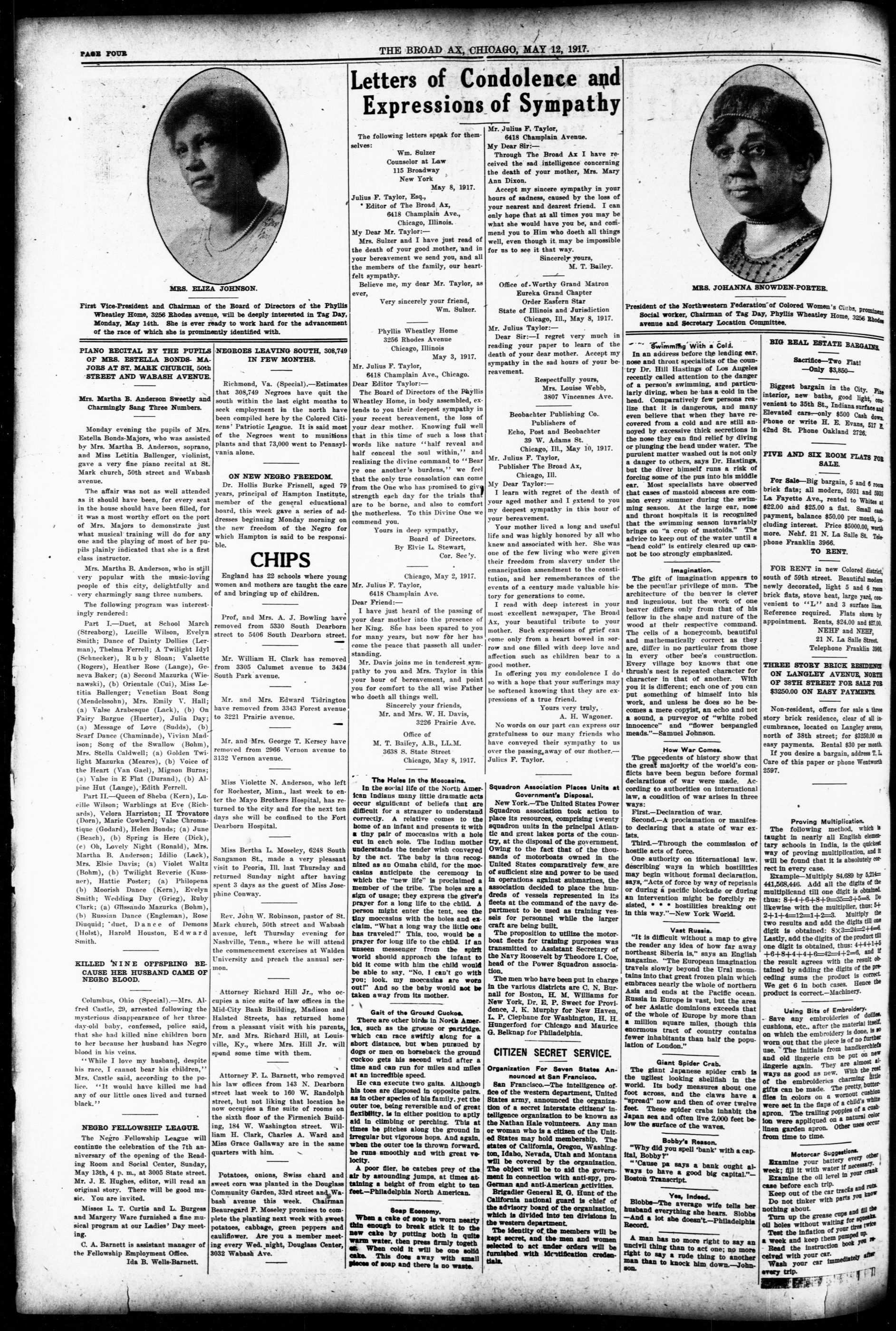
MRS. ELIZA JOHNSON.
First Vice-President and Chairman of the Board of Directors of the Phyllis Wheatley Home, 3256 Rhodes avenue, will be deeply interested in Tag Day, Monday, May 14th. She is ever ready to work hard for the advancement of the race of which she is prominently identified with.
PIANO RECITAL BY THE PUPILS OF MRS. ESTELLA BONDS- MAJORS AT ST. MARK CHURCH, 50th STREET AND WABASH AVENUE.
NEGROES LEAVING SOUTH, 308,749 IN FEW MONTHS.
Mrs. Martha B. Anderson Sweetly and Charmingly Sang Three Numbers.
Monday evening the pupils of Mrs Estella Bonds-Majors, who was assisted by Mrs. Martha B. Anderson, soprano and Miss Letitia Ballenger, violinist, gave a very fine piano recital at St. Mark church, 50th street and Wabash avenue.
The affair was not as well attended as it should have been, for every seat in the house should have been filled, for it was a most worthy effort on the port of Mrs. Majors to demonstrate just what musical training will do for any one and the playing of most of her pupils plainly indicated that she is a first class instructor.
Mrs. Martha B. Anderson, who is stjll very popular with the music-loving people of this city, delightfully and very charmingly sang three numbers.
The following program was interestingly rendered:
Part I.—Duet, at School March (Streaborg), Lucille Wilson, Evelyn Smith; Dance of Dainty Dollies (Lerman), Thelma Ferrell; A Twilight Idyl (Sneeker), Ruby Sloan; Valsette (Rogers), Heather Rose (Lange), Geneva Baker; (a) Second Mazurka (Wienawski), (b) Orientale (Cui), Miss Letitia Ballenger; Venetian Boat Song (Mendelssohn), Mrs. Emily V. Hall; (a) Valse Arabesque (Lack), (b) On Fairy Bargue (Huerter), Julia Day; (a) Message of Love (Sudds), (b) Scarf Dance (Chaminade), Vivian Madison; Song of the Swallow (Bohm), Mrs. Stella Caldwell; (a) Golden Twilight Mazurka (Meares), (b) Voice of the Heart (Van Gael), Mignon Burns; (a) Valse in E Flat (Durand), (b) Alpine Hut (Lange). Edith Ferrell.
Part II.—Queen of Sheba (Kern), Lucille Wilson; Warbals at Eve (Richards), Velora Harrison; II Trovatore (Dorn), Marie Cowherd; Valse Chromatique (Godard), Helen Bonds; (a) June (Beach), (b) Spring is Here (Dick), (e) Oh, Lovely Night (Ronald), Mrs. Martha B. Anderson, Idilio (Lack), Mrs. Elsie Davis; (a) Violet Waltz (Bohm), (b) Twilight Reverie (Kusner), Hattie Foster; (a) Philopena (b) Moorish Dance (Kern), Evelyn Smith; Wedding Day (Grieg), Ruby Clark; (a) Glissando Mazurka (Bohm), (b) Russian Dance (Engleman), Rose Diuquid; 'duet, Dance of Demons (Holst), Harold Houston, Edward Smith.
KILLED NINE OFFSPRING BE CAUSE HER HUSBAND CAME OF NEGRO BLOOD.
Columbus, Ohio (Special).—Mrs. Alfred Castle, 29, arrested following the mysterious disappearance of her three-day-old baby, confessed, police said, that she had killed nine children born to her because her husband has Negro blood in his veins.
"While I love my husband, despite his race, I cannot bear his children," Mrs. Castle said, according to the police. "It would have killed me had any of our little ones lived and turned black."
NEGRO FELLOWSHIP LEAGUE.
The Negro Fellowship League will continue the celebration of the 7th anniversary of the opening of the Reading Room and Social Center, Sunday, May 13th, 4 p. m., at 3005 State street. Mr. J. E. Hughes, editor, will read an original story. There will be good music. You are invited. Misses L. T. Curtis and L. Burgess and Margery Ware furnished a fine musical program at our Ladies' Day meeting. C. A. Barnett is assistant manager of the Fellowship Employment Office. Hla R. Wells Barnett
Ida B. Wells-Barnett.
PAGE FOUR
If the Board of Directors of the Phyllis
due, will be deeply interested in Tag Day,
ready to work hard for the advancement
identified with.
NEGROES LEAVING SOUTH, 308,749
IN FEW MONTHS.
Richmond, Va. (Special).—Estimates that 308,749 Negroes have quit the south within the last eight months to seek employment in the north have been compiled here by the Colored Citizens' Patriotic League. It is said most of the Negroes went to munitions plants and that 73,000 went to Pennsylvania alone.
ON NEW NEGRO FREEDOM
Dr. Hollis Burke Frisnell, aged 79 years, principal of Hampton Institute, member of the general educational board, this week gave a series of addresses beginning Monday morning on the new freedom of the Negro for which Hampton is said to be responsible.
CHIPS
England has 22 schools where young women and mothers are taught the care of and bringing up of children.
Prof, and Mrs. A. J. Bowling have removed from 5330 South Dearborn street to 5406 South Dearborn street.
Mr. William H. Clark has removed from 3305 Calumet avenue to 3434 South Park avenue.
Mr. and Mrs. Edward Tidrington have removed from 3343 Forest avenue to 3221 Prairie avenue.
Mr. and Mrs. George T. Kersey have removed from 2966 Vernon avenue to 3132 Vernon avenue.
Miss Violette N. Anderson, who left for Rochester, Minn., last week to enter the Mayo Brothers Hospital, has returned to the city and for the next ten days she will be confined to the Fort Dearborn Hospital.
Miss Bertha L. Moseley, 6248 South Sangamon St., made a very pleasant visit to Peoria, Ill. last Thursday and returned Sunday night after having spent 3 days as the guest of Miss Josephine Conway.
Rev. John W. Robinson, pastor of St. Mark church, 50th street and Wabash avenue, left Thursday evening for Nashville, Tenn., where he will attend the commencement exercises at Walden University and preach the annual sermon.
Attorney Richard Hill Jr., who occupies a nice suite of law offices in the Mid-City Bank Building, Madison and Halsted Streets, has returned home from a pleasant visit with his parents, Mr. and Mrs. Richard Hill, at Louisville, Ky., where Mrs. Hill Jr. will spend some time with them.
Attorney F. L. Barnett, who removed his law offices from 143 N. Dearborn street last week to 160 W. Randolph street, but not liking that location he now occupies a fine suite of rooms on the sixth floor of the Firmenich Building, 184 W. Washington street. William H. Clark, Charles A. Ward and Miss Grace Gallaway are in the same quarters with him.
Potatoes, onions, Swiss chard and sweet corn was planted in the Douglass Community Garden, 33rd street and Wabash avenue this week. Chairman Beauregard F. Moseley promises to complete the planting next week with sweet potatoes, cabbage, green peppers and cauliflower. Are you a member meeting every Wed. night, Douglass Center, 3032 Wabash Ave.
THE BROAD AX, CHICAGO, MAY 12, 1917.
Letters of Condolence and Expressions of Sympathy
The following letters speak for them-
selves:
Wm. Sulzer
Counselor at Law
115 Broadway
New York
May 8, 1917.
Julius F. Taylor, Esq.,
* Editor of The Broad Ax,
6418 Champlain Ave.,
Chicago, Illinois.
My Dear Mr. Taylor:—
Mrs. Sulzer and I have just read of the death of your good mother, and in your bereavement we send you, and all the members of the family, our heart-felt sympathy.
Believe me, my dear Mr. Taylor, as ever,
Very sincerely your friend,
Wm. Sulzer.
Phyllis Wheatley Home
3256 Rhodes Avenue
Chicago, Illinois
May 3, 1917.
Mr. Julius F. Taylor,
6418 Champlain Ave., Chicago.
Dear Editor Taylor:—
The Board of Directors of the Payllis Wheatley Home, in body assembled, extends to you their deepest sympathy in your recent bereavement, the loss of your dear mother. Knowing full well that in this time of such a loss that words like nature "half reveal and half conceal the soul within," and realizing the divine command to "Bear ye one another's burdens," we feel that the only true consolation can come from the One who has promised to give strength each day for the trials that are to be borne, and also to comfort the motherless. To this Divine One we commend you.
Yours in deep sympathy,
Board of Directors.
By Elvie L. Stewart,
Cor. See'y.
Chicago, May 2, 1917.
Mr. Julius F. Taylor,
6418 Champlain Ave.
Dear Friend:—
I have just heard of the passing of
your dear mother into the presence of
her King. She has been spared to you
for many years, but now for her has
come the peace that passeth all understanding.
Mr. Davis joins me in tenderest sympathy to you and Mrs. Taylor in this
your hour of bereavement, and point
you for comfort to the all wise Father
who doeth all things well.
Sincerely your friends.
Office of
M. T. Bailey, A.B., LL.M.
3638 S. State Street
Chicago, May 8, 1917.
The Holes In the Moccasins.
In the social life of the North American Indians many little dramatic acts occur significant of beliefs that are difficult for a stranger to understand correctly. A relative comes to the home of an infant and presents it with a tiny pair of moccasins with a hole cut in each sole. The Indian mother understands the tender wish conveyed by the act. The baby is thus recognized as an Omaha child, for the moccasins anticipate the ceremony in which the "new life" is proclaimed a member of the tribe. The holes are a sign of usage; they express the giver's prayer for a long life to the child. A person might enter the tent, see the tiny moccasins with the holes and exclaim, "What a long way the little one has traveled!" This, too, would be a prayer for long life to the child. If an unseen messenger from the spirit world should approach the infant to bid it come with him the child would be able to say, "No. I can't go with you; look, my moccasins are worn out!" And so the baby would not be taken away from its mother.
Gait of the Ground Cuckoo
There are other birds in North America, such as the grouse or partridge, which can race swiftly along for a short distance, but when pursued by dogs or men on horseback the ground cuckoo gets his second wind after a time and can run for miles and miles at an incredible speed.
He can execute two gaits. Although his toes are disposed in opposite pairs, as in other species of his family, yet the outer toe, being reversible and of great flexibility, is in either position to aptly aid in climbing or perching. This at times he pitches along the ground in irregular but vigorous hops. And again, when the outer toe is thrown forward, he runs smoothly and with great velocity.
A poor flier, he catches prey of the air by astounding jumps, at times attaining a height of from eight to ten feet—Philadelphia North American.
Soap Economy
When a cake of soap is worn nearly thin enough to break stick it to the new cake by putting both in quite warm water, then press firmly together. When cold it will be one solid cake. This does away with small pieces of soap and there is no waste.
Mr. Julius F. Taylor,
6418 Champlain Avenue.
My Dear Sir:—
Through The Broad Ax I have received the sad intelligence concerning the death of your mother, Mrs. Mary Ann Dixon.
Accept my sincere sympathy in your hours of sadness, caused by the loss of your nearest and dearest friend. I can only hope that at all times you may be what she would have you be, and commend you to Him who doeth all things well, even though it may be impossible for us to see it that way.
Sincerely yours.
Office of Worthy Grand Matron
Eureka Grand Chapter
Order Eastern Star
State of Illinois and Jurisdiction
Chicago, Ill., May 8, 1917.
Mr. Julius Taylor:—
Dear Sir:—I regret very much in
reading your paper to learn of the
death of your dear mother. Accept my
sympathy in the sad hours of your be-
reavement.
Respectfully yours,
Mrs. Louise Webb,
3807 Vincennes Ave.
Chicago, Ill., May 10, 1917.
Mr. Julius F. Taylor.
Publisher The Broad Ax,
Chicago, Ill.
My Dear Taylor:—
I learn with regret of the death of
your aged mother and I extend to you
my deepest sympathy in this hour of
your bereavement.
Your mother lived a long and useful
life and was highly honored by all who
knew and associated with her. She was
one of the few living who were given
the freedom from slavery under the
emancipation amendment to the constitution,
and her rememberances of the
events of a century made valuable history
for generations to come.
I read with deep interest in your most excellent newspaper, The Broad Ax, your beautiful tribute to your mother. Such expressions of grief can come only from a heart bowed in sorrow and one filled with deep love and affection such as children bear to a good mother.
In offering you my condolence I do so with a hope that your sufferings may be softened knowing that they are expressions of a true friend.
Yours very truly,
A. H. Wagoner.
No words on our part can express our gratfulness to our many friends who have conveyed their sympathy to us over the passing, away of our mother.—Julius F. Taylor.
Squadron Association Places Units at Government's Diaposal.
New York.-The United States Power Squadron association took action to place its resources, comprising twenty squadron units in the principal Atlantic and great lakes ports of the country, at the disposal of the government. Owing to the fact that of the thousands of motorboats owned in the United States comparatively few are of sufficient size and power to be used in operations against submarines, the association decided to place the hundreds of vessels represented in its fleets at the command of the navy department to be used as training vessels for personnel while the larger craft are being built.
The proposition to utilize the motorboat fleets for training purposes was transmitted to Assistant Secretary of the Navy Roosevelt by Theodore I. Coe, head of the Power Squadron association.
The men who have been put in charge in the various districts are C. N. Burnall for Boston, H. M. Williams for New York, Dr. E. P. Sweet for Providence, J. K. Murphy for New Haven, L. P. Clephane for Washington, H. H. Hungerford for Chicago and Maurice G. Belknap for Philadelphia.
CITIZEN SECRET SERVICE
Organization For Seven States Announced at San Francisco.
San Francisco.-The intelligence office of the western department, United States army, announced the organization of a secret interstate citizens' intelligence organization to be known as the Nathan Hale volunteers. Any man or woman who is a citizen of the United States may hold membership. The states of California, Oregon, Washington, Idaho, Nevada, Utah and Montana will be covered by the organization. The object will be to aid the government in connection with anti-spy, pro-German and anti-American activities.
Brigadier General E. G. Hunt of the California national guard is chief of the advisory board of the organization, which is divided into ten divisions in the western department.
The identity of the members will be kept secret, and the men and women selected to act under orders will be furnished with identification credentials.
A. E.
MRS. JOHANNA SNOWDEN-PORTER.
President of the Northwestern Federation of Colored Women's Clubs, prominent Social worker, Chairman of Tag Day, Phyllis Wheatley Home, 3256 Rhodes avenue and Secretary Location Committee.
Swimming With a Cold.
Swimming With a Collar.
In an address before the leading earnose and throat specialists of the country Dr. Hill Hastings of Los Angeles recently called attention to the danger of a person's swimming, and particularly diving, when he has a cold in the head. Comparatively few persons realize that it is dangerous, and many even believe that when they have recovered from a cold and are still annoyed by excessive thick secretions in the nose they can find relief by diving or plunging the head under water. The purulent matter washed out is not only a danger to others, says Dr. Hastings, but the diver himself runs a risk of forcing some of the pus into his middle ear. Most specialists have observed that cases of mastoid abscess are common every summer during the swimming season. At the large ear, nose and throat hospitals it is recognized that the swimming season invariably brings on "a crop of mastoids." The advice to keep out of the water until a "head cold" is entirely cleared up cannot be too strongly emphasized.
The gift of imagination appears to be the peculiar privilege of man. The architecture of the beaver is clever and ingenious, but the work of one beaver differs only from that of his fellow in the shape and nature of the wood at their respective command. The cells of a honeycomb, beautiful and mathematically correct as they are, differ in no particular from those in every other bee's construction. Every village boy knows that one thrush's nest is repeated character for character in that of another. With you it is different; each one of you can put something of himself into his work, and unless he does so he becomes a mere copyist, an echo and not a sound, a purveyor of "white robed innocence" and "flower bespangled meads."-Samuel Johnson.
How War Comes.
The precedents of history show that the great majority of the world's conflicts have been begun before formal declarations of war were made. According to authorities on international law, a condition of war arises in three ways:
First.—Declaration of war.
Second.—A proclamation or manifesto declaring that a state of war exists.
Third.—Through the commission of hostile acts of force.
One authority on international law, describing ways in which hostilities may begin without formal declaration, says, "Acts of force by way of reprisals or during a pacific blockade or during an intervention might be forcibly resisted, * * * hostilities breaking out in this way."—New York World.
"It is difficult without a map to give the reader any idea of how far away northeast Siberia is," says an English magazine. "The European imagination travels slowly beyond the Ural mountains into that great frozen plain which embraces nearly the whole of northern Asia and ends at the Pacific ocean. Russia in Europe is vast, but the area of her Asiatic dominions exceeds that of the whole of Europe by more than a million square miles, though this enormous tract of country contains fewer inhabitants than half the population of London."
Giant Spider Crab
The giant Japanese spider crab is the ugliest looking shellfish in the world. Its body measures about one foot across, and the claws have a "spread" now and then of over twelve feet. These spider crabs inhabit the Japan sea and often live 2,000 feet below the surface of the waves.
Bobby's Reason
"Why did you spell 'bank' with a capital, Bobby?"
"Cause pa says a bank ought always to have a good big capital."—Boston Transcript.
Blobbs—The average wife tells her husband everything she hears. Slobbs—And a lot she doesn't—Philadelphia Record.
A man has no more right to say an uncivil thing than to act one; no more right to say a rude thing to another man than to knock him down.—Johnson.
Imagination.
Vast Russia.
Yes. Indeed.
BIG REAL ESTATE BARGAINS
Sacrifice—Two Flat!
—Only $3,850—
Biggest bargain in the City. Fine
interior, new baths, good light, con-
venient to 35th St., Indiana surface and
Elevated cars—only $500 Cash down.
Phone or write H. E. Evans, 517 E.
42nd St. Phone Oakland 2726
FIVE AND SIX ROOM FLATS FOR SALE.
For Sale—Big bargain, 5 and 6 room brick flats; all modern, 5931 and 5933 La Fayette Ave., rented to Whites at $22.00 and $25.00 a flat. Small cash payment, balance $50.00 per month, including interest. Price $5000.00, worth more. Nehf, 21 N. La Salle St. Telephone Franklin 3966.
FOR RENT in new Colored district south of 59th street. Beautiful modern newly decorated, light 5 and 6 room brick flats, stove heat, large yard, convenient to "L" and 3 surface lines. Reference required. Flats shown by appointment. Rents, $24.00 and $27.00.
THREE STORY BRICK RESIDENCE
ON LANGLEY AVENUE, NORTH
OF 38TH STREET FOR SALE FOR
$3250.00 ON EASY PAYMENTS.
Non-resident, offers for sale a three
story brick residence, clear of all
incumbrance, located on Langley avenue,
north of 38th street; for $3250.00
on easy payments. Rental $30 per month.
If you desire a bargain, address T. L.
Care of this paper or phone Wentworth
2597.
Proving Multiplication
The following method, which is taught in nearly all English elementary schools in India, is the quickest way of proving multiplication, and it will be found that it is absolutely correct in every case.
Example—Multiply 84,689 by 5,214=441,568,446. Add all the digits of the multiplicand till one digit is obtained; thus: 8+4+6+8+9=35=3+5=8. Do likewise with the multiplier, thus: 8+2+1+4=12=1+2=3. Multiply the two results and add the digits till one digit is obtained: $8\times 3=24=2+4=8$. Lastly, add the digits of the product till one digit is obtained; thus: $4+4+1+5+6+8+4+4+6=42=4+2=6$, and if the result agrees with the result obtained by adding the digits of the preceding sums the product is correct. We get 6 in both cases. Hence the product is correct—Machinery.
Using Bits of Embroidery
Using Bits of Embroidery:
- Save any embroidery of dolls, cushions, etc. after the material itself on which the embroidery is done, is so worn out that the piece is of no further use. The initials from handkerchiefs and old lingerie can be put on new lingerie again. They are almost always as good as new. With the rest of the embroidery charming little gifts can be made. The pretty butterflies in colors on a worn out cushion were set in the flaps of a child's white apron. The trailing popies of a cushion were applied on a natural color linen garden apron. Other uses occur from time to time.
Motorcar Suggestions.
Examine your battery every other week; fill it with water if necessary.
Examine the oil level in your crank case before each trip.
Keep out of the car tracks and ruts.
Do not tinker with parts you know nothing about.
Turn up the grease cups and fill the oil holes without waiting for squeaks.
Test the inflation of your tires twice a week and keep them pumped up.
Read the instruction book you received with your car.
Wash your car immediately after every trip.
TO RENT.
NEHF and NEHF,
21 N. La Salle Street.
Telephone Franklin 3966
COLISEUM ANNEX
15TH ST. AND WABASH AVE.
MONDAY NIGHT, MAY 14TH
Music by 1st Regt. K. of P. Band
REFRESHMENTS
PATROL DRILL
Admission 50
Bell With the Wail of a Child.
A querely shaped骨吵 which occupies a position of honor in the center of the city of Seoul, Korea, is said to be one of the largest in the world and is called "the bell with the wall of a child in its voice." When first cast the bell sounded with a harsh and cracked note, and the superstitious emperor, fearing an ill omen, consulted with his magicians. These gentlemen held a long confab and finally stated that the bell would never sound right until a live child was given to it. The mass was then melted again, and a live baby was thrown into the molten metal. The wall of agony uttered by the little tot as the bronze engulfed it seemed to be repeated every time the bell was toled, and today the Koreans still claim that the wall of a child can be heard in the voice of the metal.
Uncalled For Courtesy.
The Vicomte Toussaint was formerly a colonel in the French army and mayor of Toulouse. He was a brave man and a dashing officer. During one of the hottest engagements of a terrible year of war, noticing that his troops were bending forward under a galling fire to escape the bullets of the enemy while he alone maintained an erect position, he exclaimed, "Since when, I should like to know, has so much politeness been shown to the enemy" The sarcasm took instantaneous effect, for the soldiers rushed forward and carried everything before them.
Selenium Is Sensitive.
Selenium is sensitive.
By substituting a selenium cell for the human eye at the telescope M. Fourier d'Albe believes it would be possible to detect stars five magnitudes fainter than any now observable, thus enormously increasing the powers of the greatest instruments. Theoretically a selenium cell of sixteen square inches would register the light of a twenty-eighth magnitude star, but this would require longer exposure—several days—than would be practicable.
Philip's Reminder:
Philip, father of Alexander, had a servant whose sole business it was to remind him that he was human. It is said accordingly that he never went from the house and, having returned, never gave audience to any one without first this servant saying to him three times in a loud voice, "Philip, thou art but a man!"
Right In Line.
"Have your millions enabled your children to marry well?"
"Rather. My daughter married a cabaret dancer and my son is engaged to a prominent chorus girl. We're headed for the best society now."—Pittsburgh Post.
No Enthusiasm.
"Your friend did not appear to be enthusiastic when I spoke of a coming wireless age." "No wonder. He is a wire walker in a cress."—Baltimore American.
A Cumbersome Cure
"Eat a gumdrop every time you want a drink." advises an exchange, but who the dickens wants to go tagging around with a water bucketful of gumdrops on his arm? - Macon Telegraph
She—Don't be downhearted, Richard, even if father does say you'll be young enough to marry five years from now. He—Oh, I don't care for myself, but how about you?—Exchange.
God does not comfort us to make us comfortable, but to make us comforters—J. Jawetw.
Gray Hairs Can't Make You Old. People do not grow old so fast as they used to. Time was when the fathers and the mothers seldom left home.
They would not think of taking part in any sort of frivolous conversation.
Grandfather and father, too, went around the house with a "dark as the tumb" sort of face, and if the young got too hilarious "Tut, tut," you would hear them say.
Now granddad enjoys a good play, a football game, and a baseball game makes him as young as the next one. Bravo! That is the right idea. Don't give up to the gray hairs. Silver threads should not absorb all the golden hues from your life. Keep abreast of the times. Read up so you can converse with your children on modern topics. Interest yourself in their work and their play. Help them play and you will keep your heart young→Los Angeles Herald.
Admission 50 Cents
The daffodils and the jonquils all belong to the narcissus family and are among the first flowers to bloom in our gardens in the springtime.
These, of course, I bought of a man who sells flowers. They were raised in a hothouse.
Daffodils do not grow wild in this country, though in some parts of southern Europe they do.
The name narcissus was given to the flowers by the Greeks.
They had a story about them which you may like to hear.
Long ago, the Greeks' story ran, there was a handsome lad named Narcissus. So beautiful was he that every one who saw admired him.
Most of his time was spent in wandering about the woods and fields alone. One day he went to the woods to hunt. Tired and thirsty near the middle of the day, he looked about for a place to get a drink.
Deep in the forest he found a beautiful clear, deep pool. It was shaded by tall green trees, and the violets that grew by the water were the most lovely and fragrant of their kind.
Narcissus knelt to drink from the pool, and lo, just beneath his own face looked up another, a face which he thought the most attractive he had ever seen.
There were no mirrors in those days save the polished silver ones that belonged to kings or the rich. The simple country youth did not know that it was his own face that he saw looking up at him out of the water.
Narcissus leaned down and the face in the water seemed to come closer, but though he dipped his in the pool he could not touch the other.
The foolish boy was happy, for he thought that what he saw in the water was the nymph or the fairy guardian of the pool.
But, though he begged the image to come out of the water and talk to him, of course it could make no reply. Day after day Narcissus came to the pool to gaze at himself in the water. He forgot to eat, to drink, to sleep and at last he faded away and died. But he did not really die, for from his body sprang a wonderful flower whose golden head hung over the pool as his head so often had done. The flower was called narcissus, and, though I would not have you believe this story true, yet it may help you to remember the name.
The Mayflower
Trailing arbutus, or the mayflower, is to the northeastern part of North America the true harbinger of spring. In the pine woods of the north it makes its fight against the cold weather and wins. Through the long, bitter winter its leaves stay green, and its dainty little flower blossoms out in the coolest days of spring. Of all the flowers of the wildwood trailing arbutus is one of the wildest. It grows in profusion, carpeting the cool glades, its faint perfume sweetening the forest. But when taken to a garden it sickens and dies.
Baseball Season Has Begun.
All over the country the warm spring sun has wrought a transformation. Along with flowers and green leaves the game of baseball has appeared. Balls, bats, masks and mitts have tak-
Photo by American Press Association. WATCHING THE GAME.
en the places of marbles and tops. The American boy is the most enthusiastic of all baseball fans, and everywhere he is to be seen engaged in this favorite diversion. The group here pictured was snapped by the camera man on the side lines. They are watching a runner who had just made a hit.
What Boy Scouting Does.
Moral courage is no less necessary in times of national peril than physical courage, and it is more largely a product of training. The boy scout leaders seek to develop both, but they put most emphasis on the moral element, believing that the other is likely to follow as a natural result—Portland Oregonian.
THE BROAD AX. CHICAGO. MAY 12. 1917.
Charles E. Stump Visits Baltimore Md. and Has a Pleasant Interview with Rev. W. Sampson Brooks the New Pastor of Bethel Church of That City.
Baltimore, Md.—The war is on and the battle is being fought and that hard, and soon you will be hearing of people being killed, but our people are ready to enter into it and die like others if the country demands it of them. We love our God, our country and our family. Nothing more and nothing less, and that which a man loves he is willing to die for.
You don't realize what it is to be busy until you visit this part of the world and see what is being done up here. You see things and yet you don't see. It is not possible for you to know all the activities, but you will find that it is not possible to get into the buildings that were once opened to you. To get into any place you must have a pass, even to get into the galleries of Congress.
I wanted to make a visit to Congress and just appealed to Congressman Martin B. Madden from Illinois, and in the next mail came the pass reading, "Here it is." I thanked him and then went into the house to hear the debates on the knotty problems. You are not permitted to either read or write when you are up there, but must remain as still as a real mouse. This is what I had to do and found pleasure in doing it. Mr. Madden is true to his people, and they are proud of him, and the people of Illinois are willing to give him anything he wants in that state, especially around and about Chicago.
Getting over this country at this time is interesting because there is so much protection accorded you. Every turn you take you will see a bunch of soldiers, and they are guarding you and your train as you move along over the country. We have a great country and we intend to keep it great. I am sure you will agree with me that it is just the thing to do, and if you don't agree it is the thing to do just the same.
I am in Baltimore, as you can see from the date line of this letter to you this week, and the first man to attract my attention here was the Rev. Dr. W. Sampson Brooks. Of course you are acquainted with him, because he is a man of much vision and experience. Little more than a year ago I saw him in St. Louis, and this very month one year ago his name was before his church for episcopacy, but he did not make it, but then he will make it. Last fall when his time was out in St. Louis, they sent him to Wichita, Kas., but the people of Baltimore thought that they should have him and have been working to get him ever since.
It has been work, work, until the Baltimore conference met, and then Bishop J. Albert Johnson conceded to the wishes of the people of Baltimore and assigned Dr. Brooks to Bethel A. M. E. church in this city, one of the largest and oldest in the connection. It vies with Bethel in Philadelphia for age, and vies with the whole connection for influence and actual work. A few years ago this congregation took a big bite when it took in perhaps the largest church building in the whole connection. I don't know what the purchase price was, but I do know that they now owe about $75,000 on it, and this is what Dr. Brooks must shoulder with his people, and I think it will go down in a hurry. He is here to wrestle with the debt, and already he has launched a rally for $5,000 and then will begin to plan for other emergencies. He has met with a cordial welcome in Baltimore.
Speaking of his welcome in Baltimore, permit me to say that it was here that Dr. Brooks took on his education at Morgan College, and of course his school is proud to have him here. It was here that he got the inspiration and the divine call to preach and he has been preaching too. Now he returns to his old home and is honored by the people of the town. He is with honor in his own country, and I believe he is going to do some work here.
I told you a little about being in Washington when I wrote to you, and now that I am away from that, I may tell you of some of the other things I have seen and been doing. From Washington I went out to Chester, Pa., to spend a little time there with the Rev. Dr. J. R. Bennett. He was glad to see me and I was glad to see him. We shook hands and then I was soon in my room after greeting his wife and his daughter by adoption, Jessie. Chester is one of the places where our people from the south have been pouring in,
and believe me I saw them there from Georgia, Florida, Louisiana and some from Mississippi. Some knew me and I knew some of them, but there were others I did not know and they did not know me. Well, such is life after all. You want to know what these people are doing? Well, they are making good. Of course there is a worthless set in this bunch just like you would find anywhere, but the most of them are being heard from in this busy world. Just let me give you an example. One little woman from Savannah, Ga., with two or three children, started from Savannah at the time when they would not permit them to leave. She went back home and declared that she was going to get out of the south. She held a position there paying two dollars a week, out of which she had to support her children. She pinched off a little every week until she got together enough to pay her fare and left the children behind.
She found a good position in Chester, sent for the children. Her son now about 19 years old is making $15 to $18 a week. She has now started on the purchase of a home, putting down one hundred dollars, and has paid the second one hundred dollars.
People who have lived in Chester for years, paying rent, have been forced to take down their signs, for these people from the south are coming right into town and buying the places where they have lived for years. They are teaching our people in the north the lessons of thrift and industry and how to invest money. They will be large property owners before they are through with it, and thereby will be substantial citizens of the city or town in which they may cast their lot. Now this is not a disgrace, and these people should be encouraged.
Of course we may expect to meet with prejudice even in the north, and some of the prejudiced White people are using the coming of Negroes to the north as a subterfuge to get out of serving them or granting admission to their places of amusement. I am not going to comment on it just now, but you will hear from me just a little later on this question.
In Philadelphia where I visited I had the pleasure of meeting some of the leading preachers there, and at the same time heard an able sermon from Dr. C. T. Walker; also had the pleasure of attending a reception which was given to Dr. L. G. Jordan, who has just returned from the west coast of Africa, and he was called the modern Paul, because he dared to carry the gospel to the people and to look into his mission work at a time when it was almost worth a man's life to cross the Atlantic Ocean. Dr. Jordan said that he was going on business for the Lord and felt that the Lord would take care of him which He did, and now he is back in his office in Philadelphia.
It was indeed pleasing to note the interest the Philadelphia ministers took in the affair, and all of them united as one in order to give their missionary secretary a good hearing and to demonstrate to him that they were really with him. They told how they would pray for his safe return home and then go right out and ask if they thought Dr. Jordan could get back home. He is back, and told of his return, of the condition of the work in Africa and brought with him three girls to be educated and returned to do mission work.
The reception was given by the Ministers' Conference of Philadelphia and vicinity, Rev. W. T. Hall; president. It was at the largest church in Philadelphia, the Union Baptist church, Dr. W. G. Parks, pastor. I never saw so many preachers in all my life. The committee consisted of Revs. C. C. Scott, chairman; J. R. Bennett, secretary; J. M. Moses, J. T. Smith, P. H. Hughes, W. G. Parks, A. R. Robinson and J. C. Jackson.
Rev. W. H. Moses, pastor of the Zion Baptist church, is one hard working man in this part of the world. He is making the world know that he is in it, and is by the help of God doing the commendable things. He is some pumpkins in the National Baptist Convention, and has the love and respect of his people. I was delighted to hear Dr. Moses, and I will go a hundred miles out of my way to hear him preach if he is going to preach. He is a hard worker in the National Baptist Convention.
Talks on
Talks on
HEALTH,
CLEANLINESS,
PROPER LIVING,
SANITATION, ETC.
By
Dr. W. A. Driver
3300 So. State Street
Phone Douglas 3617
RELATION OF TEETH TO TUBER
CULOSIS.
Unclean teeth are not only a bad sight to the seeing eye, but they are the beginning of a long train of mental and physical diseases. One of the most widespread and fatal diseases of the human animal is caused by the germ called the tubercle bacillus. For many years science has accepted the theory that tuberculosis is caused by the germ, other conditions being present. The tubercle bacillus is known to be plentiful in human habitations; it is well-nigh everywhere. Some investigators tell us that it is found in the sputum (spit) or saliva of one person in every five or six individuals whom we meet in our ordinary environment. It is admitted that tuberculosis is a great scourge and that many who are considered well are found, upon careful examination, to be in the first stage of the disease, yet it is not generally believed that one person in every five or six has tuberculosis.
It is probably true that every person who lives in a city has had an intimate Speaking of the National Baptist Convention, I am reminded that the National Baptist Sunday School Congress which meets June 6th, in Atlanta, Georgia. The people there are all ready for it and all you need to do is to come right on where you will find your people and you will be well cared for. This will be followed by the National Baptist Convention in Muskogee, Oklahoma.
It would not be out of place to remind you that there are to be a few big meetings this year. Already Morehouse College has celebrated its 50th anniversary; Florida Baptist College has celebrated its 25th, Virginia is getting ready to celebrate its 50th and Kentucky will also give a celebration. The National Negro League will meet in Muskogee, Oklahoma. The National Medical Association will meet some where this year. The Business League will meet in Chattanooga, and Mr. Franklin and his people are getting ready for it, and will give the people a good time. It will be an embodiment of enjoyment. You must try to get there if you can.
I am delighted to note the wonderful progress we are making. By next week I will know something about the war. I just learned that it was going on.
I have just learned of the death of Prof. A. H. Colwell, of New Orleans, Louisiana. Another great man gone to the great beyond. One more to welcome me when I shall leave here. I knew him well. He was a friend of mine. I have just finished talking about the death of Rev. T. L. Smith, of Quincy, Illinois, and now comes this one. Who will be the next?
At the rate men and women are dying, it is not necessary to go to war, just let us alone and we will die fast enough.
Catarchal Jaundice.
The most common form of jaundice is that known as catarrhal jaundice because it is caused by an inflammation of the mucous membrane of the bile ducts. That affection is usually the result of some indiscretion of diet or of exposure to inclement weather. Sometimes the symptoms are very slight. The patient merely feels a little out of sorts or bilious; he loses his appetite, his tongue is furred. there is perhaps a jittle nausea, and his bowels are sluggish. He hardly regards himself as sick and is quite surprised to be told that he has grown yellow. The yellow color affects the whites of the eyes as well as the skin, and sometimes it is almost entirely confined to the eyes.
The treatment of this form of jaundice is simple. A light diet. a blue pill or a dose of salts and rest in bed for a day or two will usually suffice. If the symptoms persist consult a physician, for they may be the first indication of some grave liver trouble. Indeed, it is safer to consult a physician at once and let him take charge of the case from the very start.
PAGE FIVE
J. H. H.
contact with the germ, if the time of residence has been for some years. It is not strange that with intimate contact the disease fails to abide with most of us. When we are up to the high standard of perfect resistance, the germs of disease have no chance in the battle of life. Germs prey upon the weak; dirty teeth as well as decayed teeth are hot-beds for destructive micro-organisms. No better portal of entry could be made than a dirty, foul smelling tooth. They produce weaklings.
Tuberculous ulcers are often seen post mortem in the intestines. They were doubtless caused by germs transported there by food masticated by unclean teeth.
Toxemia or the injurious action of other material from infections of the teeth lowers the resistance of the entire system and opens the way for many fierce diseases. Tuberculosis is no exception. Great improvement has been noted in many patients who have been taught the proper care of the teeth.
HAWK BREAKS WINDOW GLASS
Famishing Bird Attempts to Feast on Parrot.
Green Bay, Wis.-Polly, a parrot, the companion of Mrs. William Anderson, was preening herself in the sunshine at the window of the front room when a hawk, swooping down, crashed through the window glass.
Before the bleeding bird of prey could reach the parrot with its talcus Polly soared out through the same hole and perched in an apple tree. Polly set up a frightened chatter that brought her mistress, who couldn't imagine how she got out of the room. Mrs. Anderson hurried out and to the window, where she saw the havoc and the great hawk flopping about the floor, sprinkling blood all over her erstwhile immaculate parlor.
When Mrs. Anderson and a neighbor had pinned it down and chopped off its head they found it three feet five inches from tip to tip. The bird was thin and seemed nearly starred, probably, they thought, because of the deep snow.
WARNS OF FOOD SHORTAGE.
Armour Favora Government Control of Production and Price.
Chicago—"If immediate and radical steps are not taken to increase and conserve the food supply in the United States," said J. Ogden Armour, "this country will find itself next fall and winter in as bad a state so far as food is concerned as any of the warring nations of Europe.
"Our first duty, as I see it, is to make certain that both our own people and our allies have an abundant food supply. I favor government supervision and control of food production and food prices.
"Let the government, for instance, fix the wholesale price of all meat products. Let the government guarantee to the farmer a minimum price of $1.50 a bushel for all the wheat he can raise."
HIS LAST JUDGE A TRAIN.
Man Acquitted of Railway Murder is Killed on Same Road.
High Bridge, N. J.-Over a year ago John Wesley Beam was acquitted of a charge of murdering William Beam (not a relative of John's) by pushing him under a railroad train on New Year's eve, 1915. The case was tried before Justice Parker of the supreme court and Judge Salmon of the Morris county court.
Recently John was killed by a train on the same railroad. He had fallen asleep on the High Bridge branch of the Central Railroad of New Jersey. His body was taken to his parents' home at Bunnyville.
WILL NOT MINGLE RACES.
War Department to Train Whites and Blacks Separately.
Washington.—It was learned authoritatively at the war department that negro and white troops will not be camped and trained together and that the department does not contemplate any action which would smack of offending the south.
The problem has been solved In the past, and a solution will be found during the present war, it was said.
AUD OLA
THE BROAD AX
Published Weekly
In this city since July 15th, 1899, without missing one single issue, Republians, Democrats, Catholies, Protestants, single Taxerz, Priesta, infidels or anyone else can have their say as long as their language is proper and responsibility is fixed.
The Broad Ax is a newspaper whose platform is broad enough for all, ever claiming the editorial right to speak its own mind.
Local communications will receive attention. Write only on one side of the paper.
Subscriptions must be paid in advance.
One Year.....$2.00
Six Months.....1.00
Advertising rates made known on application.
Address all communications to
THE BROAD AX
6418 Champlain Ave., Chicago, Ill.
PHONE WENTWORTH 2567.
JULIUS P. TAYLOR, Editor and Publisher.
Entered as Second-Class Matter Aug.
19, 1902, at the Post Office at Chicago,
Illinois, under Act of March 3, 1879.
PART OF BABYLONIAN EPIC IS TRANSLATED
Missing Book of Gilgamesh, Regarded as One of Oldest Poems In World.
Philadelphia.—In the University of Pennsylvania Museum Journal published recently is the translation of a Babylonian tablet, which will be of interest to the historical, religious and literary world. It is one of the missing books of the epic of Gilgamesh, regarded as one of the oldest and noblest poems in the world. The epic was composed about the time of Abraham, but all known tablets and fragments of tablets containing it date from a much later period. George Smith made the first discoveries more than forty years ago. The tablet in the University museum was probably written between 600 B. C. and 300 B. C. he says. It was translated by Dr. Stephen Langdon, curator of the Babylonian section of the University museum, and, according to that scholar, contains important new material bearing on the whole epic and also supplies missing data and mentions hitherto unrecorded nations. It tells the story of how barbarous man, in the person of Enkidu, is redeemed by the love and devotion of a woman.
Gilgamesh, a half mythical king, by many identified with Nimrod, ruled so cruelly that the people asked the gods for relief. The mother goddess made from clay a wild satyr, covered with hair, but strong enough to oppose Gilgamesh, who was two-thirds a god. Eventually Enkidu is changed by love of a woman to a civilized being, loses his hair and becomes a rival of Gilgamesh, with whom he has a terrife combat. Finally the men become friends. Gilgamesh forsakes his evil ways, and the two heroes start on adventures, which are told in the other tablets already well known.
WILL RUN CANTEENS.
Girls and Boy Scouts Will Dispense Eatables to Militiamen.
New York. — Canteen stations, at which girls and boy scouts in uniform will dispense coffee, chocolate, buns, sandwiches and cold ham to the soldiers, sailors and militiamen detailed on guard duty, are to be established in New York and other cities throughout the country, according to an announcement by Mrs. William Carrol Rafferty of the Waldorf-Astoria, wife of Colonel Rafferty, commandant at Fort Hamilton.
Mrs. Rafferty has been made honorary commandant of the emergency canteen stations to be opened here after the plan originated by Mrs James Montgomery Hendrick in London. Uniforms are now being made for girls of the Young Women's Christian association, who will be in attendance.
ROMANCE NOT DEAD;
HERE'S A CINDERELLA.
New York. — Who says romance is dead or never shows itself in big cities? Miss Minerva Menke of New York insists it is not. Five months ago she lost a pump-size No. 2—as she was alighting from a trolley car. The footwear caught in the step. The motorman drove on, and a passenger, Jack Wolfson, found it. He advertised for the fair owner. He answered. He called—then called often. Soon Miss Menke will be Mrs. Wolfson.
---
CUBA OFFERS AID
Well Trained Troops at Service of United States.
PORTS OPEN TO OUR SHIPS.
Will Act if Necessary as Halfway Station to Aid Northern Republic In Transportation of Troops and Munitions to Panama Canal or Other Points on Gulf.
New Orleans.—In addition to declaring war on Germany immediately following the lead of the United States government, Cuba will place 25,000 well trained troops—infantry, cavalry and artillery—at the service of the northern republic for the duration of the war. President Mario G. Menocal has issued an order to this effect, and Colonel Aurelio Hevias, Cuban minister of war, is apportioning these troops and selecting the officers who will accompany them.
First news of this placing of a whole army division of Cuban troops at the orders of the United States was brought to New Orleans by Eduardo R. Mendez, Cuban sugar expert, who has just returned from Havana.
"Cuba entered the great war largely in an effort to show its sincere friend-
P.
Photo by American Press Association.
PRESIDENT MARIO M. MENOCAL
PRESIDENT MARIO G. MENOCAL
ship for the United States," said Mr. Mendez at his home. "The island is the key to the gulf of Mexico and to the Caribbean sea, and by declaring war on Germany Cuba closes all her ports to Germany. More than this, all the ports of Cuba now are open to the United States as a war ally for indefinite periods and for unlimited supplies of all kinds, whereas had Cuba not entered the war American warships would have been subjected to all restrictions of international law as to time of stay and amount of fuel obtainable there.
"In other words, Cuba desires to be the outpost of the United States in the gulf and to act also if necessary as a halfway station to aid the northern republic in its transportation of troops and munitions of war to the Panama canal or to other points on the gulf or on the Caribbean sea. President Menocal has announced officially in Havana that the entire Cuban army of 25,000 men will be placed at the orders of the United States government and will be supplied with officers who speak English as well as Spanish, for service throughout the war. This quota, constituting an entire army division, will be kept to full enlistment by constant recruiting throughout the war, and 25,000 more volunteers will be recruited to take the place in the army of those sent to the front or distributed wherever the United States wishes to use them.
"Announcement also has been made that American warships will aid the Cuban navy in patrolling the waters around the island and such parts of the gulf as may be deemed necessary. The ill timed and badly advised revolution is at an end; General Gomez is a prisoner in Havana, and other revolutionists are being extradited from Haiti, so the full forces of the Cuban government can be turned to the prosecution of the war against Germany."
BRITON ACTS AS GUARD.
Does Patrol Duty In Boston After Militiaman Collapses.
Boston.—A sailor of the British navy maintained a part of the water front patrol here, bearing the rifle of a national guardman who had collapsed on his post.
The bluejacket, a member of the gun crew of a steamship which was tied up in port, found the guardsmans on the wharf where he had fainted. Taking him into a nearby shanty, the sailor telephoned for a doctor, then shouldered the guardsmans's rifle and for nearly an hour kept the post in a drizzle of rain until a corporal who encountered him arranged for relief.
At Thirty-three Mother of Twelve.
Oklahoma. Ark.—Twin boys have
been born to Mr. and Mrs. Aleck Murkerson of Dobyville, making the third pair of twins in the family with less than two and a half years between the ages of the two younger sets. The new arrivals bring the number of Murkerson children to twelve. The mother is but thirty-three.
THE BROAD AX. CHICAGO. MAY 12, 1917.
PAYROLL OF ARMY
Big Task Getting Money to Uncle Sam's Troops.
RATES HIGH UNDER NEW LAW.
Biggest Pay of Any Officer In the Field Is That of Liputenant General, Which Is $11,000 a Year—United States Aviation Force Offers Wide Field and Is Remunerative.
Washington.—Uncle Sam for the first time in nineteen years is getting ready to pay a big field army. The army on the border was designated as a departmental force. With 2,000,000 men scheduled to serve with the colors just as soon as they can be obtained, a big job faces the quartermasters at each of the six department headquarters, and the finance division of the depot here.
The finance division of the depot in Washington is under the direction of Major George C. Barnhardt. It pays off all retired officers and soldiers under the war depot in the city, some in the Philippines and some in Texas. Already it has a big task, and with the increase of the army it will be loaded down with work.
The highest pay of any officer in the field is that of lieutenant general, which is $11,000 a year. There is no active lieutenant general now, however. Generals Miles, Bates and Young, who reached that rank, are all retired.
The pay of a major general is $8,000 a year at the time of his appointment, and he gets a 10 per cent increase each five years. This 10 per cent increase each five years also applies to brigadier generals, colonels, lieutenant colonels, majors, captains, first lieutenants and second lieutenants.
The pay of a brigadier general is $5,000 a year; a colonel, $4,000, and lieutenant colonel, $3,500. Other salaries for line office are major, $3,000 a year; captain, $2,400; first lieutenant, $2,000; second lieutenant, $1,700.
First and second lieutenants are very much in demand. Examinations are being held in many parts of the country to fill up the ranks of lieutenants in order that the big army of recruits may be drilled.
The aviation corps, which offers a wide field and which is to receive much attention, in addition to opportunities for service, is attractive from the standpoint of pay.
While on duty that requires him to participate regularly and frequently in areal flights, each duly qualified military aviator receives an increase of 75 per cent over the salary which the pay of his grade entitles him to.
Chaplains appointed to the army will receive $2,000 a year, the pay of a first lieutenant.
Privates receive $15 a month. In case they are sent to Europe they will get an increase of 20 per cent or $18 per month. A certificate of merit entitles a soldier to $2 a month more, and there is yet an additional sum for expert riflemen, sharpshooters and marksmen. Cooks receive $30 a month.
GROWS HAIR FOR GIRL
Man Arrested Tells Story About Accident to Daughter.
Sacramento, Cal.-Because his little daughter two years ago, when she was but three years of age, fell into the fire and burned her scalp to a crisp, so that hair never again will grow thereon, Henry Hamilton of Idaho, now working on a nearby ranch, is growing a luxuriant head of hair, it being his idea when he returns home to have the hair cut and made into a wig for his little girl.
The story came out when Hamilton, who had been arrested while on a visit to this city, was questioned by Max P. Fisher as to the cause of the flowing locks.
Hamilton said he had come to California to work during the winter because he could not get steady employment in Idaho during the cold weather. He added he expected to return home in a few weeks and prepare the wig for which he has been undergoing ridicule because of his long hair. After his story had been verified he was released.
MRS. GEORGE DEWEY'S PLEA
Enlist In Navy First, Says Admiral's Widow.
Washington.—A national campaign to promote recruiting for the navy and marine corps has been started by the woman's section of the Navy league.
Mrs. George Dewey, widow of the late admiral and president of the woman's section, has sent this appeal to all chapter heads:
"Urge all young men of your community who are without dependents to enlist in the navy and marine corps, our first line of defense. There merit is recognized and promotion comes speedily. Send in the names of eligibles to the woman's section, Washington. Ask the newspapers in your neighborhood to co-operate with us. Help our country now, and may God bless your ef forts and give us security."
Almost 1,000 In Family.
Hlawatha, Kan.-The biggest family in this country has almost 1,000 members. It is at Reserve, nine miles north of here. Reserve is a small town of 200 or more people with an average Kansas population in the country surrounding for an area of six miles. Yet in the town and the entire area of country there are not more than ten families who are not related to each other by ties of blood or marriage.
WAR'S GOLDEN AGE.
Cardiffs Subscription to British War
Loan $150,000,000.
Cardiff, Wales.—Subscriptions from Cardiff to the new British war loan amounted, to more than $150,000,000, an average of $750 for every man, woman and child in the city. This remarkable contribution is an indication of the golden age which the war has brought to Cardiff. In no British city has such vast wealth been earned so easily and quickly. At the outbreak of the war Cardiff had the largest export trade in the country. Freights began to increase. Ships doubled, trebled, quadrupled in value. Young business men, enterprising and daring, bought whole fleets on a speculative basis which would almost make a New York curb broker hesitate.
Among the new millionaires of Cardiff are fourteen young men who before the war were shipping clerks earning not more than $10 a week. It has not been the owners only who profitted. First class dock laborers, especially trimmers, have earned as high as $100 a week. The miners, too, have earned big money, and the shopkeepers, especially the jewelers and the department stores, have never known such prosperous times.
TO DIG UP BANDIT'S LOOT.
Man Says He Has Map of Buried Oklahoma Treasure.
Columbus, Ind.-J. N. Swain of Denver, who has been visiting his parents, Mr. and Mrs. Thomas E. Swain, west of this city, has left hurriedly for Tulsa, Okla., to hunt for $200,000 in buried treasure.
Several years ago Swain was a nurse in a Denver hospital, where a man known as Oklahoma Charley was a patient. Oklahoma Charley, Swain said, had been a bandit and buried large amounts of money in three different places near Tulsa.
Before he died he gave Swain three diagrams showing where the money is buried. It all amounts to $200,000 Oklahoma Charley said. The supposed badit charged Swain with finding his daughter, a half breed, wishing the girl to share in the money.
Swain said he never thought much of the affair until he read in a news paper that Scout Younger was getting ready to dig for buried treasure near Tulsa. Then Swain caught the first train for Tulsa.
ASHES ON LAKE BOTTOM.
Scientists Will See if There is a Volcano There.
San Francisco.—A strange phenomenon is agitating the waters of the La luna and the members of the San Luis Obispo (Cal.) Rod and Gun club. Whether the bed of the lake harbors a semiactive volcano, geyser or other eruptive force is still to be determined. Weird tales are also being told of a floating island in the lake, the waters of which are no longer clear, but turbid. In the bottom of the lake a sediment which resembles volcanic ash has been discovered.
An effort is to be made to secure a scientific investigation of the strange phenomenon by scientists from the state university.
In the meantime sportsmen are wondering what effect the disturbances in the lake are having on the fish that in habit it. Fishermen who cast their lines for black bass on the opening day of the season have failed to get even a most remote sign of a nibble.
VASSAR GIRLS TO TRAIN.
Abandon Festivities to Study Women's Work in War.
Poughkeepsie, N. Y.-At a meeting of the Vassar College Students' association extensive preparedness measures were taken. The spring program was changed from a series of week end festivities to a strict curriculum of voluntary courses in which each girl will be prepared in some way to be of real service to the nation.
All college events calling for a large expenditure of money will be eliminated or modified. The money and the time will be given over to instruction in wireless telegraphy, library work, Red Cross training, automobile mechanism and operation and stenography. Military drill was crossed from the list as being impracticable.
Commencement exercises will be greatly simplified. The hoop dance and procession of the daisy chain will be omitted. The third hall play and the senior prom are also stricken off.
HAIR CUTS BOOSTED.
But Members of Baldhead Club Plan a Back Fire.
Milford, Conn.—The price of a hair cut in Connecticut cities was boosted from 25 cents to 35 cents by barbers throughout the state. Led by members of the Baldhead Club of America, a revolution against the barbers is now in progress and a remonstrance against the action was sent to the state barbers' commission at Hartford.
The Baldhead club plans vengeance with a capital V—"No tips" is the word being passed down the line. At the head of the protesting phalanx are George C. Woodruff, president of the club; John Rodemeyer, originator of the club; and John Stone of Winsted
Had to Promise to Win Her:
Valparaiso, Ind.-Before she would marry him here recently Mrs. Edna H. Jewett exacted a promise from Otto J. Wankle that he would become an American citizen. Wankle is an Austrian, and Mrs. Jewett refused to sacrifice her own Americanism. The couple came here from Janesville, Wla
PLANS VAST FLEET
Story of How Wooden Craft Building Plan Grew.
TRIBUTE TO YANKEE GENIUS.
General Goethals, Chosen to Head Work, Has Never Been Forgiven by Germany For Constructing Panama Canal When German Experts Said It Could Not Be Accomplished.
Washington.—The administration's program for building a vast fleet of wooden cargo ships to transport supplies to the allies and thus defeat the German submarine campaign was put under way when the shipping board formed a corporation to build and operate the vessels.
Major General Goethals, who at the direction of President Wilson has agreed to supervise building of the ships, will come to Washington to take charge of the work as soon as he can arrange to leave his task of building New Jersey highways. F. A. Eustace, a Boston mining engineer, who, with
PETER H.
Photo by American Press Association. WILLIAM DENMAN, CHAIRMAN OF SHIPPING BOARD. F. Huntington Clark, a New York engineer, conceived the idea of a wooden ship fleet, probably will be associated with him. The story of how the wooden ship-building plan grew from an idea conceived simultaneously by two mining engineers until it has taken a place in the forefront of America's war policy reveals that Yankee inventive genius and ingenuity were as ready to meet the present emergency as at any time of national stress in the past.
After Mr. Eustace and Mr. Clark had been called to Washington by Chairman Denman of the shipping board, and the board decided to take up the plan, Mr. Eustace decided to interest General Goethals and went to place the situation before him. The canal builder immediately seized on the plan as the one way by which the United States could do most to aid the allies in defeating Germany. Then General Goethals was told the board wished him to take charge of the work. Reluctant at first to leave his post in New Jersey, the general finally was convinced the nation needed him.
General Goethals was chosen to head the work. it was explained, for three reasons—his capacity, his German descent and as a testimonial to the loyalty of American citizens of Teutonic extraction and because he is considered the one man in the United States most offensive to Germany. Germany, it has been said, has never forgiven the man who constructed the canal when German experts said it could not be accomplished.
In their efforts to persuade General Goethals to take charge of building the ships it was pointed out that he probably would spend before the war was over as much or more than was expended in building the canal.
Troops to Get Bibles
New York.-The American Bible society has issued an emergency call for $50,000 with which to provide large editions of New Testaments bound in khakl to be given to all soldiers and sailors through the Sunday School as sociation and the Young Men's Chris tian association. The society has cooperated with these agencies in the distribution of about 1,000,000 copies to soldiers in Europe and 100,000 to men on the Mexican border. Similar distribution is to be started here with out delay.
THEY COULDN'T STAND YELLOW STREAK SIGN.
Pittsburgh. — Angry at the haste many young men were making to obtain marriage licenses in view of the country's call for unmarried citizens, an official of one of the Pittsburgh departments caused a big yellow card to be bung on the application clerk's desk in the marriage license office, with the remark that "he hoped it would turn some of the quitters back." It did. Of the first 150 couples who entered the room one day fully forty, after a look at the big yellow streak, quietly turned and disappeared.
Form of Oath Equivalent to Enlist-
ment Pledge Drawn Up.
New York. - A movement to train
New York's immigrant population in
readiness for military service was start-
ed at a meeting held in the offices of
the National Liberal Immigration league.
The league has been at work on the
situation concerning the part immi-
grants will take in any national crisis
for the last eight years and has the
approval of the war department.
This consists of a recruiting campaign on the east side for the Macrobean brigade, as it will be called. The house of the James G. Bialne club has been offered by the president, Dr. L. Levenson, and is open for recruiting. Applicants will enlist without any stipulation and will take an oath which virtually binds them to federal military service for the duration of the war. A form of oath equivalent to the army enlistment pledge has been drawn up by the adjunct general of the eastern department at the league's request. Recruits will be trained under competent instructors and then will be available either to be mustered in the regular army, the national guard or service as reserve officers if they show progress enough. There will be no stipulation that they be accepted in a body, keeping their racial unity in companies or other units, but will go where assigned.
JAPANESE ARMY TO HOLD
SHAM BATTLE OF SOMME
Will Apply Lessons of Great Struggle In Europe to Grand Army Maneuvers.
New York. — The grand army meneuvers in Japan next November will be held in the country adjacent to Lake Biwa, in Shiga prefecture, near Kioto, says the East and West News Headquarters will be located in the town of Hikone, of which the famous Lord Ll, assassinated on dolls' day many years ago, was the feudal chief. To provide for the final review by the emperor a few rice fields will be cleared for that purpose.
A great feature of the war play will be the conduct of battles after the latest methods adopted by the Germans and the allies in the valley of the Somme, northern France. Geographically the lay of the land about Lake Biwa, the largest lake in Japan, closely resembles that of the Somme war theater. Staff officers familiar with the ground in France will conduct the operations from which the soldiery and underofficers will acquire a knowledge of the latest features of modern warfare. Airplanes and planes will also be actively employed for the first time in Japan. The art of war has advanced a hundred years since the battle of the Marne, two and a half years ago.
NEW U BOAT DESTROYER
Will Be Turned Over to Government Early In July.
Wilmington, Del.-A submarine destroyer of a new type which is pronounced by experts to be the most efficient conceived is being constructed for Alfred I. du Pont and when completed early in July will be turned over to the government for use against U boats.
The craft, which is being constructed by the Herreschoffs at Bristol, R. I., of all steel torpedo boat destroyer construction. It is 110 feet long, has a fifteen foot beam and a draft of only four and one-half feet. The latter dimension is so small as to render the boat immune from submarine torpedo does.
The destroyer has a guaranteed speed of twenty-seven miles an hour. The two high pressure steam generators will develop approximately 1,500 horse power. Oil, which is used as fuel can be carried for a cruise of 1,200 miles at fifteen knots or 650 miles at full speed.
PREPARES OWN FUNERAL
Thought He Had Cancer—Proven Corpse by Committing Suicide
Bishop, Cal.—After having prepared carefully for his own funeral Job
Shortall, a mining man, went out and shot himself through the head.
sad sinister. Death was instantaneous. A man ago he had undergone an operation a growth on his lip and had become obsessed with the fear that it was cancer. This led him to self destruction. Shortall was sixty-four years old and had been long in the Owens valley. His mining property, a promising copper proposition, is located in Moçangue, tween Benton and Laws.
Desecrators Will Be Arrested, Justice Department.
Washington.—Warn against desecration of the American flag by allen was issued by the department of justice. The following notice was sent to federal attorneys and marshals: "Any alien enemy tearing down, mutilating, abusing or desecrating the United States flag in any way will be regarded as a danger to the public peace or safety within the meaning of regulation 12 of the proclamation of the president, issued April 6, 1917, and will be subject to summary arrest and trial."
WA NEW ROLE
Woman Becomes a Chief Yeo-
man In Our Navy.
jssiGNED IN PHILADELPHIA.
ony Twenty Years Old, This Young
Iuiy Passed Both Her Physical and
yontal Examinations and Went Di-
etl to Work as Recruiting Agent.
yiss Loretta Walsh, cousin of Dr.
joes J. Walsh, former dean of the
gycity of medicine of Fordham uni-
ests. bas entered upon her duties
ga chief yeoman in the United States
far. the Srst woman ever enrolled for
rece in the country’s naval arm.
‘yiss Walsh, who is twenty years old,
aj her physical and mental ex-
)
ae
gzinations und was immediately as-
tized to duty under Lieutenant Com-
sunder F. It. Payne of the United
{utes Naval home. by whom she was
sor in. The oath was administered
athe bome and was witnessed by a
‘inge number of women attached to
fie Navy leazue,
‘Tbe young woman enlisted under
fie recent order of Secretary Daniels
Gecting recruiting agents to accept
te applications of women for enlist-
ment in certain classes.
‘The ruling reads: “A limited number
xomen may be enrolled for clerical
Fat to tike care of increased corre-
foaince in the various naval dis-
‘tits during a war. All reservists
Wis in active service either have
@uters and subsistence furnished by
tie gorerument or a money allowance
‘6 pid them for this purpose. ‘The
By of a nurse is $50 a month, The pay
€4 woman enrolled for clerical work
5"
Yeoman Walsh has been furnished
witha uniform and will take up her
ies as a recruiting officer ‘at the sta-
foo as her Lome. She will pay par-
Sulr attention to other women who
Teh to joi the service, but also will
Be her influence to persuade men to
list
| KITCHEN HINTS.
Oh a eee ee
Struggles to Succeed.
Everybody does not know that food
8 general should not be allowed to
eel in tin, copper or iron. It must be
Meed while hot in agate, china or
Yel glazed earthenware.
Green vexetables should be dropped
0 boiling water, to which a pinch
Mbicarbonate of soda has been added.
Rt in salt when the article is half
tmiked,
Ityou have covered a pan in whieh
Bat is to Ie roasted never open it to
ste the mat. Keep it covered from
fart to ‘nist, ‘The idea is that the
Mts are tliesi with steam, which pene-
ites the sihers of the meat. If desir-
“to brows the outside leave the cover
S for thw cirst halt hour in @ quick
ren,
[Reshark vonessof mutton, of 80 It-
Seeners: value, if well soaked, add to
Stich of zravies and soup stock.
When iwitins haricot beans or dried
Bs do voi put in the salt until they
© nearly cooked; otherwise they are
$toxpl't and come out of their skins.
Ter should he brought to the boiling
Wist, the water poured off and fresh
. water poured over them.
.. iiities Sieber
es to be supposed that when
Aeeriea row enthusiastic about the
See! novelties that were introduced
f& Ching and Japan some clever
Hen would look up our Indian work
Ma bring it out as a rival.
There re now Indian beads from
(tena used as trimming for hats
ei fowns. and the Indian embroid-
"8 well as the beaded work, tas
St "ith queer Indian ornaments
REE toxciter, and sweaters made of
Rerao isutcts are among the things
feted and accepted.
eee ee
Ne ined ee a
attest! -Zeorgette crape stamp the
tera to tie headed om to a piece of
S27 white writing paper, then beste
8,2 to the cloth with ttle, tne
vistas ‘The pattern can be very plain-
(lowed, and being on the etift.pe-
wie is very easy to handle.
FASHION CUES,
Points About the Very Lat-
ect _Qurian Teme Avo fen.
Despite all the rumors to the oppo
site effect, there is a strong directoire
influence in some of the spring suits
‘and frocks. Especially is this true of
the Paris collection. In the suits this
effect is obtained in the placing of the
belt and in the size of the revers. As
for the materials used, there is a quan-
tity of satin and charmeuse besides fig-
ured and striped foulard and striped
mousseline. Embroidered chiffon is
‘used to drape over satin or charmeuse.
‘There are seen both the barrel and the
draped skirts, while the skirt for the
suit is narrower and occasionally
Plaited. Jackets for the two pieced
suits are short, for they reach to the
waist, not even the conservative finger
tip length that had been predicted for
the early spring. These short jackets
frequently show panels of accordion
plaits and a combination of materials,
but in a different order from that which
We have been accustomed to—for in-
stanée, the skirts will be checked ma-
terial and the jackets of plain.
At the southern resorts, for cycling,
which is eminently southern sport, the
suits are most attractive, the skirts
short and the bloomers of the fitted
riding type, and these of a striped.
checked or blocked material, and the
Jacket of the predominating tone of
the figured material. The material
used for these sports clothes is home-
spun, and this, by the way of a change,
1s quite acceptable and very attrac-
tive. The skirts as often as not are di-
vided, and the knickers are, of course,
of the same material.
On all sides we hear of the slip-over
effect of suits and blouses and even
wraps. Organdie and linen make a
southern wear frock on this order.
‘Top coats come in all the bright new
colors and are most attractive in de-
sign. Some have quite @ directoire
effect, while others show belts at the
natural waist line. Velvet ribbon en-
ters into the trimming of these as well
as the dressier suit.
FULLY PREPARED.
For Play Is This Comfortable Twe
Piece.
Blue linen trousers strongly, obvious-
ly buttoned into a waist cut with a
stylish twelfth century neck makes a
am qi :
Se z
a
fo os
ay
4 es
%
4
it
vey
READY FOR ANYTHING.
very satisfactory uniform for small
rogues to romp in. Short sleeves are
best to punch things in.
A Tidy Linen Closet.
A linen closet that is tidy and neat
is a delight not often met with. The
linens may be placed in neat piles
when the laundry comes home, but
when searching for a particular sheet
or pillowcase or towel the pile is apt to
become disordered. If you will use
bands and tie each pile you will find
that the shelves will present a much
better appearance. A band of linen
about ten inches long and about three
or four inches wide is scalloped in
blue and the words “Sheets,” “Pillow-
cases,” or whatever the article may be,
are worked in cross stitch. Tape
strings are attached to each end.
Bindings Ready.
‘When making children's clothes have
Dias binding and facing ready to put
on, Save pieces of lining lawn, col-
ored linens and gay plaid ginghams,
and cut them into one inch bias strips
and sew together and fold into neat
rolls and put in the machine drawer,
where they will be handy when need-
ed. The linens and ginghams are ex-
cellent for pipings on contrasting ma-
terials for children’s school dresses.
For Sweeping Day.
A common handled basket that sells
for 8 or 10 cents will save more steps
on sweeping day than one would think.
Line with table ollcloth, make pockets
all around to put in such things as
tacks, string, soap; then in the basket
proper put dust brushes and cloth, bot-
tle of furniture polish—all the other
things one needs for cleaning. Try tt
‘and see how many trips to the kitchen
eave
THE BROAD AX, CHICAGO, MAY 12, 1917.
————_—_———_———e ee
Vaio of” Vacations. ~ ~ What “Barrage Fire” Ie
Vacations, according to the New York | _ AN, interesting feature of
Medical Journal, are nature's safety | Sre is the “curtain” or “barrag
valves for the relief of the high pres- | This means simply keeping up
sure resulting from efficiency. EMficien- | tetrific fre on a certain area |
cy demands that throughout working | ©2€My cannot or will not c
hours all the faculties be taxed to the | When an infantry attack is Is
utmost without waste of material or | ® barrage on the ground bey:
of energy, but if properly directed it | Nemy’s front line prevents hii
aims at making an efficient man before | forcements coming up while
an efficient product. Therefore pro- | tacking infantry are having it o
duction may not exact that the man | the defenders of the trench.
speed up beyond his endurance. attack carries beyond the first |
‘The recent application of efficiency | @ftillery of the defense prom!
methods makes the vacation more than | tfP0ses a barrage to prevent it
ever necessary. “The vacation,” says | 2S the second line. If the att
the Medical Journal, “should be the | the first line fails the defend
nearest approach to the simple life. It | tillery puts a barrage behind
Is for this reason that the country, with | ##¢ker’s line to prevent re-enfore
all its many inconveniences, is so often | Co™INg up to it and to enable 1
chosen for the place of vacation. ‘The | ‘fous defenders to counteratts
vacation period allows for the absorp- | 2estToy the euemy in bis own tr
tion and elimination of the fatigue | it #8 merely a wholesale devel
products from the system accumulated | °f ® long established method |
in the pressure period of the work. | Porting the infantry —Major
The longer the vacation, therefore, the | Scott m National Service Maga:
better the subsequent work.” Sn ee
a8 Mystery of a Fish.
Stink Piso Ghiatins ion: _ In the economy of nature not
Indoor gardeners will be interested
in watching this plant grow. It fol-
lows the plan of the strawberry in
sending out runners and starting new
growths at the end of the stem The
strawberry. however, has the earth to
establish its new growths, This in
door int sends out the runners grop
ing for earth where there is none. It’s
called the sasifrage.
It is a favorite plant for hanging bas-
kets. A small tuft of leaves develops
at the end of each vine. From this
tuft other runners are sent out. aud
these In turn develop more tufts. By
this method the saxifrage keeps on ex
Panding until the basket is covered
with a network of vines and a blanket
of leaves,
‘The leaves. shaped like those of the
geranium. are a reddish olive color
veined in white. It requires ordiuars
sol! and 1 moderate amount of water
and shude.~Philadelphia North Amer
lean.
Real Democracy.
Before Denmark consented to sell
1e Danisb West Indies to the United
tates a plebiscite was held. and the
‘iectorate voted upon the question
«be people of the United States, how
“ver, Were never consulted as to wheth
‘ they desired to make the purchase.
The people of England vote directly
-n national questions whenever parlia
ateut {8 dissolved. and the government
“goes to the country” on nearly every
water of really vital import.
Many Americans fondly imagine that
tte United States ix the only real de
mocracy in the world As a matter of
fact, in Switzerland. Australia and
New Zealand :overnment fs more di
rectly responsible to the people than in
the United States: Canada’s govern
ment is at least equally representative
as ours, While England. although nomi.
nally a constitutional monarchy. prob:
ably is more democratic than the Unit
ed States -St. Paul Dispatch.
Bas meet Bite
Art is the revelation of man, an¢
not merely that, but likewise the reve
lation of nature speaking through man
Art pre-exists In nature, and nature i:
reproduced in art. As vapors fron
the ocean floating landward and dix
solved in rain are carried back in riv
ers to the ocean, so thoughts and the
semblances of things that fall upon th:
soul of man in showers flow out agaln
in living streams of art and lose them
selves in the great ocean, which is na
ture. Art and nature are not, then,
discordant, but ever barmoniously
working in each other—Longfellow’s
“Hyperion.”
What She Wanted.
A woman was knocked down by a
horse, but happily escaped with a few
scratches.
‘A man rescued ber and said, “Can I
get you anything?”
She (much out of breath and gasping
with excitement)—Ob—ob—can you
kindly get me—
He—Some brandy?
She—No—not drink—some safety
pins. I feel I'm falling all to pieces.—
Pittsburgh Chronicle.
Steund at the Chie
“That's Fred Darling just come tn.
You know his wife made him.”
“You mean that fellow with a waxed
mustache and manicured nails?”
“Yes.”
“Well, 1 knew women did fancy
work, but I never knew they did any-
thing as fancy as that.”—Exchange.
On the Lookout.
Friend—You are not going to run
again? Congressman — No; {t's too
strenuous, | was sent down to Wash.
ington to look out for my constituents,
and from the tone of their letters I've
got to look out for them when I get
home.—Puck.
Second Sight.
“Do you believe in second sight?”
“No, but my wife does. When I go
shopping with ber she always says to
the assistant, ‘I'll come in and look at
these again.’ —London Telegraph.
Did Her Best.
“meacher—Do you know the popula-
tion of New York? Mamie Backrow—
Not all of them, ma'am; but, then.
we've only lived here two years—
mae
alt ea a li,
Probatily the unmitigated falsehood
most frequently told year in and year
out takes this form: We welcome hon-
‘est criticism.—Ohio State Journal.
‘To fret and fume is undignified, su!
cidally foolish and theoretically unpar
donable—Robert Louis Stevenson.
What “Barrage Fire” la
An, interesting feature of artillery
fire is the “curtain” or “barrage” fire.
‘This means simply keeping up such a
terriffe fire on a certain area that an
enemy cannot or will not cross it
‘When an infantry attack is launched
@ barrage on the ground beyond the
enemy's front line prevents his re-en
forcements coming up while the at
tacking infantry are having it out with
the defenders of the trench. If the
attack carries beyond the first line the
artillery of the defense promptly in
terposes a barrage to prevent its reach-
ing the second line. If the attack on
the frst line fails the defending ar-
tillery puts a barrage behind the at-
tacker’s line to prevent re-enforcements
coming up to it and to enable the vic-
torious defenders to counterattack and
destroy the enemy in bis own trenches.
It is merely a wholesale development
of a long established method of sup-
porting the infantry.—Major EB. D.
Scott in National Service Magazine.
Mystery of a Fish.
In the economy of nature nothing is
more remarkable than the metamor-
phosis of the flounder, which when
young swims in an upright position, as
do all other fish, but when maturity
develops it becomes topheavy, falls
over on its side and its existence is
passed as a flat fish.
‘That nature moves in a mysterious
way is bere freely illustrated, for when
the flounder falls flat the two eyes,
which originally were on either side of
the head, are transposed to the upper
side of the fish, where they alwayx
face the light.
The process by which this strange
change is accomplished has never been
discovered by scientists and is a mar-
velous instance of nature’s operations.
for while the fish usually rests upon
bottom it can readily swim about ip
any depth of water.—New York Sun.
A Ohne Sikes See
In a certain store the merchandise
manager sent for the ready to wear and
millinery buyers and said to them:
“You men are getting a bad accumu-
lation of stock that is bard to move.
Hereafter you will make a daily and
weekly inventory and send the report
to this office.”
Both buyers declared this to be im
possible, but the merchandise man told
them to go and do it. Especially be
wanted them to show the age of the
goods in stock, the sizes and the colors.
After attempting to take some of
these daily inventories the buyers de-
cided that au easier way would be to
get busy and sell the goods faster. This
same plan has been used in many de
partments with fine results.
‘There is nothing like the spot light to
engender selling activity in a store.—
Philadelphia Record.
AM In the Dialect.
‘A New Zealand man vouches for the
‘truth of the foliowing story:
Dick Seddon was of Laucashire ort
gin, and when he died the Lancastrian
society in New Zealand sent a wreath
with the following inscription: “I have
gone whoam.” The journalist who re-
ported the funeral evidently did not
come from Lancashire and consequent.
ly was somewhat puzzled by the word.
ing and, after thinking bard. conclud
ed that some one bad blundered. His
report read:
“The Lancastrian society sent a
beautiful wreath bearing the inscrip-
tion: ‘I have gone. Who am I?"
Destroying an Idol.
“Charley, dear,” said young Mrs. Tor-
kins, “you can say anything you like
nowadays about George Washington,
can't you?”
“Yes, The lid seems to be off.”
“Well, I never liked to mention it be
fore, but I have my doubts about bis
being incapable of an effort to deceive.
His pictures look to me as if the old
gentleman wore a wig.”— Washington
Star.
Luxury and Labor.
Alexander the Great, reflecting on his
friends degenerating into sloth and
luxury, told them that it was a most
slavish thing to luxuriate and a most
royal thing to labor.—Barrow.
Happiness.
Happiness rarely is absent. It is that
we know not of its presence. The
greatest felicity avails us nothing if
we know not that we are bappy.
@ PRACTICAL HEALTH HINT. ¢
e ~ 4
° Diet and Health. 4
@ In an article on “Taming the ¢
@ Liver” World's Work says that 4
@ the daily meal of the average ¢
@ business man consisting of meat 4
@ and potatoes and white brexd is 4
@ ideal for inducing constipation 4
@ Most of us should not eat more ¢
@ than once a day. Eat the shells ¢
@ of your baked potatoes and eat ‘
@ whole wheat bread or gralam ¢
@ for the help that what we call ¢
@ “roughage” has in stimulating 4
@ bowel action. And see to it that 4
@ you take liberal portions of at
@ least two kinds of vegetables at 4
@ both luncheon and dinner, such 4
@ vegetables as peas. beans. let ¢
@ tuce, parsnips, carrots, turnips. ‘
@ colery. oyster plant, cabbage. 4
@ Brussels sprouts, tomatoes, salsi +
@ fy, Spanish onions. asparagus ¢
@ and spinach. If you dislike these ¢
@ you will be able to substitute «
@ fruits that you do like. Eat the ¢
@ right things, get sufficient exer
@ cise and rest and you will have 4
@ 0 need for babit forming laxa- 4
@ tives which eventually may do 4
@ yoo much harm. ‘
a 4
Dreame May Be Overtime Work.
Dreams are a good test of the need
of sleep and many times answer the
question of overwork or idleness. ac-
cording to Dr. Percy G. Stiles, who
lectured at the Harvard medical school
on “Sleep.”
“It is possible to judge by one’s
dreams whether one needs sleep,” he
said. “If the dreams are of a ram.
bling variety, the kind that seem to
pop from nowhere or anywhere, it is
& pretty good sign that you are not
overtired. On the other band. if the
dreams are a continuation of the day's
worrtes the chances are that you are
overtired. Dreams remote from the
day's work are a vacation, but dreams
connected with the day's work are
overtime.
“To go to sleep get the body and
mind comfortable. The body is easter
to make comfortable than the mind
‘A rubdown, a bath and a little bit to
eat help bring that about. To compose
the mind read some familiar book or
poetry. That soothes the mind, for no
exertion is necessary to read it."—Bos.
ton Journal.
Fics Bakes Gene.
It is probable that the height of in-
difference 1s reached in the veteran ac.
tor. 1 saw one at the Press club re-
cently who confirms this suspic’
thoroughly. :
He is in a good show, but has «
small part. appearing only in the first
act.
“How 1s the show?” I asked him.
“Pretty fair, I'm told,” be answered.
“What's it about?”
“Can't say.”
“How does it end?”
“Don't know.”
“For goodness’ sake,” 1 asked,
“haven't you ever seen the play? You
are in it yourself?”
“No,” he answered, pith a look of
being bored. “Several times I have
thought of going around front to see
what ft was all about; but, my dear
old chap, I have never seemed to get
around to {t."—Washington Star.
Keeps Milk From Bolling Over.
Among the various devices which are
intended to prevent milk from boiling
‘over we noticed one which solves the
problem in a very simple way, says the
Scientific American. It consists of a
straight tube of say two or three
inches in diameter at the top and ex
panding somewhat toward the bottom.
where {t is provided with a Saring and
cup shaped end of rather large diame-
ter. the whole beng somewhat of
trumpet sbape. Out of the lower part
are cut. say four suitable openings, and
we set the device upright in the vessel
with the small end just out of the
liquid. Should the milk tend to boll
violently this action commences at th:
bottom, and the liquid is forced up the
tube, then falls upon the surface again.
so that the boiling action will continue
in this way and the milk has no ten
dency to leave the vessel.
Per a ee Se
Launching a torpedo from a subma
rine is simple. The torpedo fits closely
in a tube or cylinder. with an opening
at the rear made airtight when closed
At the desired moment there ts a dis
charge of cordite and the torpedo Is 0:
its way.
‘When the torpedo ts projected fron:
a ship or boat into the water a lever
is thrown back, admitting air into the
engines, causing the propellers to re
volve and drive the tofpedo ahead
The torpedo travels under water at a
high rate of speed. It carries a large
charge of explosive, which ts ignited
on the torpedo striking any hard sub
stance, such as the bull of a ship.
‘The distance the tube is submerged
depends on the target, but the nearer
the surface the more effective.
Shun “Tips” if You Play Stocks.
“Whatever you do, don't go it alone,”
Is the advice that Harold Howland
gives to women Investors in the Wo
man's Home Companion. “Shun the
financial gossip of the uninformed, the
cocksure counsel of the frresponsible,
the glittering generalities or the more
insidious particularities of the con-
celted ignoramus. Beware of rumors,
‘tips’ and ‘inside information.’ Base
your transactions upon the firm ground
of accurate information, sound judg:
ment and disinterested advice. Don't
try to ‘get rich quick.’”
His Modesty.
“Are you an art connoisseur?”
“Yes,” replied Mr. Cumrox, “although
I should never speak of myself as
uch.”
“Why not?”
“Because I'm not absolutely sure 1
know how to pronounce the word.”—
New York American.
A Matter of Protection.
Actor—I sas, old man. 1 wish you'd
advance me $5 and take {t out of my
first week's salary. Manager — But.
my dear fellow, suppose it happened
that I couldn't pay your frst week's
salary. Where would 1 be?—Boston
Transcript.
Probably.
“Pop, you know that famous bare
foot winter at Valley Forge?”
“Yes, son. What of it?”
“Was that the time they sald tried
men's soles7"—Baltimore American.
Sharp.
Jack—Do you know that Kitty is an
awfully sharp girl? Percy—Yes; she
cut me on the street the other day.—
Cornell Widow.
Mars Photecraph«
‘The best photographs of the canals
of Mars were taken through red and
orange screens.
Perseverance always wins in the long
run—asually in a walk.
PAGE SEVEN
'~The Transformation.
After the hero of seventeen looks at
the heroine of fifteen she is a different
person. Before he looks at her she
Mikes the fine brick houses in the neigh-
borhood. In fact, she sees many ele-
gant houses in town that she thinks
would make ideal homes. Unlike ber
mother, she even likes the house in
which the family lives. But after the
hero looks at her you couldn't give her
a big brick house. To her such places
look cold, and she hardly would take
one of them as 2 gift But she just
worships every little four and five room
cottage she sees. They look sb cute
and neat and dear and sweet and cozy
and snug. Ob, if she could just have
a house like that and a hero like bim—
he fs the only one there is of his kind
—she would be just too happy for any-
thing! And she would make fudge
and have a regular home, only it would
be far happier than other homes.—
Claude Callan in Fort Worth Star-
Telegram.
‘Tracedy of Being Dull.
In the Woman's, Home Companion
Amold Bennett describes the tragedy
of being dull:
“The man lacking imagination is the
utterly matter of fact man. He is nec-
essarily the man who never has and
cannot have any point of view except
his own. He is the Wordsworthian
man to whom a primrose by the river's
brim was strictly a yellow primrose
instead of being a miracle. He is im-
prisoned in what to him is the actual,
and he is always the exact center of
the prison, which ts of thickest iron.
His tragedy 1s that he does not sus-
pect and is incapable of suspecting
that he fs in prison at all and that the
prison walls and floor and roof entirely
prevent him from really ‘getting at’
any other human being whatsoever.
He is always in his own place. This
is the deep meaning of dullness, and
this is the dull man’s door.”
How a Bullet Falls.
In order to solve the problem a spe-
cial stand was erected in Germany.
and experiments were carried on aloug
the shores of a lake the surface of
which was frozen. The ice was cov-
ered with strong planks. It was shown
that an infantry bullet shot upward in
a vertical direction passes downward
fm the same position in which it pass-
ed upward. In other words, it came
back to the earth with its bottom tirst.
Why was it not upset at its culmina-
tion point? The answer is that the
propelling force ceases to act at the
culmination point, but the twist bas as
yet not stopped, and therefore it starts
its fall with a twist. Even on impact
the twist has not stopped, as was in-
dicated by the warping of the wood
fibers in the planking on the'ice—Pop-
ular Science Monthly. :
Where the Five Painte Wea
The Five Points, once a most dan-
gerous part of the New York slums,
is now the site of Paradise park. It
is at the crossing of Worth, Baxter
and Park streets, near the junction of
Park row and the New Bowery and
Chatham square and practically ad-
Joining Mulberry bend. In 1740 four-
teen negroes were burned here dur-
ing the negro insurrection. Here the
Dead Rabbits bad their headquarters
and fought the Bowery Boys. The
Seventh regiment was called out July
8, 1857, to quell a riot here. The Five
Points mission was incorporated in
1950,
‘The manager, writing out the an-
nouncement of his show, ended with
these words:
“The patronage of children under
eighteen is not encouraged.”
“That,” he remarked shrewdly, “will
appeal to the children over eighteen!”
—New York Post.
Hard on the Records.
Freshman (in awed volce)—See that
big fellow over there? He broke
three records last week. Sweet Young
‘Thing—Mercy. I wouldn't let bim run
the phonograph!—Penn State Froth.
Blindfolded.
If blindfolded, it is said, no person
fs able to stand ve minutes without
moving.
PRACTICAL HEALTH HINT.
‘itil a Cee
® A patient German statistician
® has calculated that a patient who
@ coughs once every quarter of an
® hour for ten hours expends en-
@ ergy equivalent to 250 units’ of
@ heat, which may be translated
# as equivalent to the nourish:
@ ment contained in three eggs or
@ two glasses of milk In normal
@ respiration the air is expelled
@ from the chest at the rate of
® four feet per second, whereas in
@ violent coughing it may attain
@ a velocity of 300 feet. This
@ waste of energy is especially tm-
@ portant because it occurs for the
® most part in persons whose as-
similative functions are already
@ working under ditficulties; conse
@ quently the ingestion of the cor-
@ responding quantity of nourish-
@ ment by no means compensates
@ for the exertion. It follows that
® persistent cough is per se a
@ cause of emaciation, though
@ there are many other factors
® which tend in the same direc-
@ tion; hence the desirability of re-
® straining cough within safe lim-
® its, especially when it ts due to
® irritative reflexes, such as are
® excited by laryngitis and pharyn-
@ gitis.—Medical Critic and Guide.
.
Shrewd.
Blindfolded.
TEENAN JON
TEENAN JONES' PLACE
3445 SOUTH STATE STREET
Telephone Douglas 4591
The finest and most UP-TO BUFFET and CAFE on the Side. First-Class Entertainer
HENRY "TEENAN" JONES, Prop
Residence 1262 Macalister Place
Telephone Monroe 2714
Office Phones: Res.
Oakland 4063, Auto. 73-054
finest and most UP-TO-DATE ET and CAFE on the South First-Class Entertainers. Y "TEENAN" JONES, Proprietor.
The finest and most UP-TO-DATE BUFFET and CAFE on the South Side. First-Class Entertainers. HENRY "TEENAN" JONES, Proprietor.
MILES J. DEVINE
ATTORNEY AT LAW
Suite 313-320 Reeper Block
Clark & Washington Sts.
PHONES: OFFICE, MAIN 4188
AUTOMATIC 33-736
RESIDENCE, DREXEL 7090
Walter M. Farmer
ATTORNEY AT LAW
SUITE 708, 184 WASHINGTON ST.
NOTARYPUBLIC CHICAGO
Franklin A. Denison
ATTORNEY AT LAW
36 West Randolph St., Chicago
Suite 708 Delaware Building
Tel. Central 3142
FRANK DUNN
J. B. McCAREY
Trustees
Established 1877
TEL. OAKLAND 1850, 1851, 1852
JOHN J. DUNN
MILLSALE COAL RETAIL
Fifty-First and Armour Avenue
RAILYARDS
51st St. and L. S. & M. S.
51st St. and Armour Ave.
CHICAGO
Let “Low Cost
Fight High Co
Prices of almost everything
up—up—except gas. Stove
thing made of metal, are
Trustees Established 187
ND 1850, 1851, 1852
J. DUNN
GOAL RETAIL
A. D. GASH
ATTORNEY AT LAW
"Low Cost of Cooking" high High Cost of Living of almost everything you buy are going up except gas. Stoves and ranges, like every made of metal, are going up too.
Let "Low Cost of Cooking" Fight High Cost of Living
Prices of almost everything you buy are going up—up—up—except gas. Stoves and ranges, like everything made of metal, are going up too.
STANLEY
Save $900 on this Range NOW!
(Only $3.00 down and $2 a month for 15 mos., $33)
Act Now Before War
Since we bought, prices have just facturers' prices TODAY, this price $42 instead of our price—$33.
This identical range is less more, when the present
The range is a standard Compactionally satisfactory one regal ovens. Bake oven, 18 x 18½ x 18 bread pans. Meat oven, 18 modates roasts and poultry as Splasher back and side, and enamel; burner tray and bread. The range has self-lighter and adjusted free. See it TODAY do
"The Low Cost of Cooking," by M. Science Expert, is yours for the
The Peoples Gas Light
Peoples Gas Building
Now Before War Prices Go Higher
We bought, prices have jumped. On the basis of manu-
surer's prices TODAY, this range would sell regularly for
head of our price—$33. Another advance is coming.
This identical range is likely to be $50.00 or
more, when the present supply is exhausted.
Range is a standard Composite Clark Jewel, an excep-
satisfactory one regardless of price, with large
Bake oven, 18 x 18½ x 14 inches, holds 12 one-pound
beans. Meat oven, 18 x 18 x 10½ inches, accom-
roasts and poultry as well as steaks.
For back and side, and door panels are porcelain
burner tray and broiler pan are gray enamel.
Range has self-lighter and is installed, connected and
free. See it TODAY downtown or at branch stores.
The Low Cost of Cooking," by Mrs. Helen Ruggles, Domestic
Science Expert, is yours for the asking. Phone, call or write.
Peoples Gas Light & Coke Company
Gas Building Telephone Wabash 6000
Act Now Before War Prices Go Higher
Since we bought, prices have jumped. On the basis of manufacturers' prices TODAY, this range would sell regularly for $42 instead of our price—$33. Another advance is coming.
This identical range is likely to be $50.00 or more, when the present supply is exhausted.
The range is a standard Composite Clark Jewel, an exceptionally satisfactory one regardless of price, with large ovens. Bake oven, $18 x 18½ x 14 inches, holds 12 one-pound bread pans. Meat oven, $18 x 18 x 10½ inches, accommodates roasts and poultry as well as steaks.
Splasher back and side, and door panels are porcelain enamel; burner tray and broiler pan are gray enamel. The range has self-lighter and is installed, connected and adjusted free. See it TODAY downtown or at branch stores.
"The Low Cost of Cooking," by Mrs. Helen Ruggles, Domestic Science Expert, is yours for the asking. Phone, call or write.
The Peoples Gas Light & Coke Company
Peoples Gas Building
Telephone Wabash 6000
KNKY
Hair
Made to Grow
Long, Soft
and Silky
ANY STARNS says
her hair was nappy
and short until she
used Exelento, and
now she can comb it,
as title 34 inches long,
soft and silky.
Don't be fooled all your life by using
some fake preparation which claims
to straighten kinky hair. You are just
fooling yourself by using it. Kinky
hair cannot be made straight. You
must have hair first. Now this
EXELENTO QUININE
POMADE
is a Hair Grower which feeds the scalp
and roots of the hair and makes kinky
nappy hair grow long, soft and silky.
It cleans dandruff and stops Falling
Hairs. Please 38¢ by mail on
receipt of stamps or coin.
AGENTS WANTED EVERYWHERE
Write for Participants
EXELENTO NEDICINE CO. ATLANTA, GA.
---
---
PAGE NIGHT
Office Phones: Res. 5133 So. Wabash Ave.
Oakland 4062, Auto. 73-058 Phone Dresel 18815
Dr. Theo. R. Mozeee
DENTIST
4709 S. STATE STREET
CHICAGO
Houro 9 A.M. to 5 P.M., 7 P.M. to 9 P.M.
Sundays by Appointment
Phone Main 2017 Automatic 32-395
A. L. WILLIAMS
ATTORNEY AND COUNSELOR AT LAW
Suite 706 Firmenich Bldg.
184 W. Washington St.
Residence 5548 Jefferson Av.
Phone Midway 5515 Chicago
118 North La Salle St., Chicago
Suite 615 to 616
PHONE MAIN 2214
An Irresistible Call.
Hulda, the Swedish maid, had served her mistress faithfully for a year when one day she announced her intention of leaving.
"Why, Hulda, what is the matter? Is the work too hard? Or don't you like your wages?
"De vork he be all right, an' de vages he be, too, but the beau--he moost have me."—San Francisco Chronicle.
Warning.
"He says I am the only girl he has ever loved."
"I think it dangerous to tie up for life with a man who takes the first thing that comes along."—Detroit Free Press.
How Could It Be?
First Office Boy—Wotcher doin' lookin' at the office wot fired you last week? Tryin' to git took back? Second Office Boy—Naw; I jest' dropped rom' to see if they were still in business—Albany Knickerbocker-Press.
A "Sidereal Day."
In answering a correspondent who asked the meaning of the term "sidereal time" the Irish Times explains that that is the only truly scientific manner of recording time and is that which astronomers and navigators use. A "sidereal day" is the precise time taken by the earth in revolving on its axis and is twenty-three hours, fifty-six minutes and four seconds. Our sundials, however, record a very different day.
When Lebas Dared Day
In 1876 the granite obelisk sentinel before the palace of III. at Luxor, for more the centuries was taken to Paris, in the place de la Conde marked by a fine example of age. It had been brought fright by the engineer Lebas in a especially constructed at T navigate the Nile and the Se boat was towed through the warship. When the cables us
If you set up a sundial in a garden and observe when it is noon today and again tomorrow you will find that it exceeds the "dildereal day" by three minutes and fifty-six seconds. The difference is due to the distance that the earth has traveled on its orbit while it has been revolving on its axis. The orbit motion makes it necessary for the earth to turn nearly four minutes longer in order to bring any place to the same position with regard to the sun that it had on the previous day.
The Novice's Mistake.
In "Tales of the Flying Service" C. G. Grey tells about a strange entry in the official report of an officer who had recently joined the service and was sent to pass a seaplane through its test for the English navy. He had to go up as a passenger with the constructor's pilot and to keep a log of what occurred during the test.
This is what he put down: "9:05 a.m. left slip; 9:10 a.m. altimeter shows 300 feet above sea; 9:12 a.m. curious phenomenon. Met a seagull flying backward."
That meant that the machine, flying at the rate of about eighty miles an hour, overtook a seagull—which is not a fast flier—going at about forty miles an hour, and that up in the air, without any background to give a proper sense of direction, the bird looked as if it were flying toward them tall first. Probably the officer knows better now.
Teach Children Thrift.
We Americans are notoriously the most thriftless of peoples. You have heard how much we throw away. We are too prone to think of thrift as stinginess. We hate to hear about saving. Dorothy Canfield Fisher in her recent book, "Self Reliance," gives parents a strong word of warning. She says: "There is nothing in the fact of being children which need cut off our sons and daughters from a great deal of accurate information and considerable practical experience with the ins and outs of wise money spending. But there is a great deal in the fact of their being Americans which will shut them off from such information and experience unless parents make a very determined effort to see that they get the proper training, for the whole spirit of our country and age is against us in the effort."
The City of the Dove
When mighty Amru went to conquer Egypt he camped on the east bank of the Nile opposite Memphis, that great twenty mile long capital of mud bricks whose western verge was the pyramids and whose mud brick houses have all vanished. Amru crushed the Egyptians and came back to get his camp to move over and occupy Memphis. A dove had built in the folds near the top of his tent. Blood bathed Amru, the ruthless, would not let her be disturbed. A new city started about his tents. It grew northward along the Nile. It is today Cairo. Memphis is only a name.
Can You?
Here are a few things that you cannot do:
You cannot jot down the square root of two.
You cannot state the number of buttons on your clothes.
And yet you think you are clever!-
London Answers.
That Was Different.
Mrs. Tittle—What a beautiful world it must have been when there were only Adam and Eve in it! There was nobody to say nasty things about them. Mrs. Tattle—But, then, they had nobody to talk about. Mrs. Tittle—Well, I guess, after all, the world has improved since their time—Exchange.
Ahead of the Times
"The trouble with my boy Josh is that he's always ahead of the times," remarked Farmer Corntossel. "What has he done?" "Went to town to see about a position. He found a strike in progress and joined the strike before he got the job."—Washington Star.
Our Vanishing Forests
The ax and the saw are insanely busy, chips are dying thick as snowflakes, and every season thousands of acres of priceless forests, with their underbrush, soils, springs, climate, scenery and religion, are vanishing away in clouds of smoke.—John Muir.
Once Bitten, Etc.
"Why did that brilliant woman marry such a stupid man?" "Because her first husband was a genius."—Boston Transcript.
"What is the favorite fare of Wall street bulls and bears?" "Supposed to be lamb chops."—Baltimore American.
Nature knows no pause in progress and development and attaches her curse on all inaction.—Goethe.
When Lobes Dared Death
When Lebas Dared Death. In 1876 the granite obelisk that stood sentinel before the palace of Rameses III., at Laxor, for more than thirty centuries was taken to Paris. Its erection in the Place de la Concorde was marked by a fine example of civic courage. It had been brought from Egypt by the engineer Lebas in a river boat especially constructed at Toulon to navigate the Nile and the Seine. This boat was towed through the sea by a warship. When the cables used in raising the obelisk in its position in Paris were strained almost to breaking Lebas placed himself at once under the enormous stone as it began to move. If a single cable had broken all would have been over with the engineer. Explaining his hardihood, Lebas said it was to show the crowd of onlookers that he was sure of his calculations. A single error and he would have been crushed, and he preferred a tragic end to dishonor. "This," said Le Crl de Paris, "was before our day of interviews, and Lebas occupied only a few lines in the Constitutionel, no more, no less than the periodical adventures of the sea serpent."
The Graham Bread Myth.
Most people suppose they are getting more nutrition in graham or whole wheat bread than they get in white bread. Another mistake, says the Kansas City Star. This isn't a matter of guesswork, for there are elaborate tables worked out after the most thorough experimentation in laboratories and published, for instance, in Dr. E. A. Locke's book on "Food Values." Roughly, food is valued in accordance with its fuel contents, which is figured in calories. A pound of brown bread contains about 1,050 calories, a pound of rye bread 1,180, a pound of gluten bread 1,160, a pound of graham bread 1,210, a pound of whole wheat bread 1,140 and a pound of ordinary white bread 1,215. The white bread has more nourishment to the pound than any other kind. The notion that milling deprives it of its nutrition is fiction.
Fine Art In Candle Making.
The making of candles is not ordinarily considered a fine art, but the Italians have made it such. The distinctively Italian votive taper is made by hand. The materials are pure beeswax, which is kneaded and tempered and mixed with a secret ingredient to retard combustion and which has special Egyptian cotton for wicks. The cotton, too, is treated with chemicals to keep it from feeding too fast. Small candles are molded. Large ones are made by rolling up sheets of wax. That gives the candle great strength and enables it to stand erect when a molded candle would bend under the heat. After the candle is fashioned it goes to the decorators, men who are skilled in the use of the brush, and when it leaves their hands it is a work of art.
Dishes and Divorce
If, as one clever writer avers, most divorces start over the breakfast cups how very important is the selection of one's china. For, despite the time honored legend that would have us believe the way to a man's heart is through his stomach, it is quite certain that beauty of the eyes goes as far toward promoting happiness as does digestion. Often they are one and the same thing. So in providing pretty tableware one never knows what dire calamities may be averted.
"Living up" to a fine bit of china, a good picture or piece of rare old silver has its advantages, not the least of which is the lasting pleasure of owning something really beautiful.-Mother's Magazine.
The Chestnut Blight
The chestnut blight has already done damage estimated as close to $20,000,000. The disease attacks both American and European species, but does little damage to those from Japan and China. Plant breeders by crossing Japanese chestnut and native chinquapin have produced resistant trees. Some of the Chinese chestnuts are said to grow 100 feet high in their home forests.—Tree Talk.
Mighty Arcturus.
Arcturus is one of the most brilliant stars that we can see in the heavens. Its diameter is 62,000,000 miles. The light that comes to us from it is over 200 years old when it enters our eyes. The sun is distant 93,000,000 miles. Just compare the eight or nine minutes it takes for the sun's light to reach us with 200 years.
His Opportunity:
"Scientists say that blonds will disappear in a few years." This gave the golden haired girl her opportunity. "Well, if you want one," said she sweetly, "you'd better speak up now." -Louisville Courter-Journal.
Easier.
The Landlady—At our table, Mr. Bjinks, it is customary to return thanks at each meal. The New Boarder—That's fine. I like it lots better than paying cash—New York Journal.
Looked That Way.
She—Do you really think I married you for your money? He—Well, the way my money has been going it looks suspicious—Boston Transcript.
Miaunderstood.
Marcella—Did I understand you to say Gerty Glidigad won't take you seriously? Waverly—Not exactly. I said seriably, she won't take me at all. —Youngstown Telegram.
I will listen to any one's convictions, but pray keep your doubts to yourself. I have plenty of my own—Goethe.
Consult me, I can save you Worry, Time and Money. Shipping to all parts of the Country and Automobile Funerals a Specialty. Central Display Rooms and Chapel. Call promptly answered day or night.
The-Cranford Apartment Building. 3600.Wabash Ave.
1
The finest building ever opened to Colored tenants in Chicago Steam heat, electric lights, tile baths, marble entrance.
A. F. CODOZOE,
J. H. WHISTON, Proprietors
CHAS. HARRIS, Manager
DOUGLAS 5871
Phones DOUGLAS 3258
AUTO. 72-379
The Elite Cafe
AND BUFFET
3030 STATE STREET
CHICAGO
All Eye Trouble
SEE
DR. LOUIE USGELMANN
The Practical O tician
THI MOST COMPLETE OPTICAL ROOMS IN THE CITY
BEST GOODS AT THE LOWEST PRICES
Consultation or examination
FREE. We have 28 different
ways of testing the eyes and
guarantee to give satisfaction.
3150 S. STATE ST.
Phone Douglas 5308
CHICAGO
JOHN BLOCKI & SON
PERFUMERS
GO TO
C. E. KREYSSLER, Druggist
5057 South State Street
NOT ON THE CORNER
FOR HIGH GRADE DRUGS, CHEMICALS AND
MEDICINAL PREPARATIONS
All Prescriptions Carefully Compounded
ALSO CARRY A FULL LINE OF
BLOCKI'S IDEAL & BLOCKI'S FLOWER
IN BOTTLE PERFUMES
PETER H.
Consult me, I can save you
Shipping to all parts of the
Funerals a Specialty. Cen
Chapel. Call promptly answer
Ernest H. W.
KENWOOD
455
Under
5028 and 5030 S. Sta
The Cra-
Building
The finest building e
Steam heat, electric l
Phone Main 2633
A. F. CODOZOE,
J. H. WHISTON, Proprietor
CHAS. HARRIS, Manager
IN A Metropolitan City of this size, death knocks every thirty minutes at some door. Too often that death not only brings sorrow, but misfortune as well. Let the price you pay for a funeral be a business proposition and you will benefit by it in service, quality and cost to you in dollars and cents. The result of my campaign has built for me one of the largest and most magnificent establishments in the world.
LAUREL
ranford Apartment
ing. 3600. Wabash Ave..
ing ever opened to Colored tenants in Chicago,
eric lights, tile baths, marble entrance.
rtment
sh Ave.;
renants in Chicago
e entrance.
J. W. Casey, Agent
263 133 W. Washington St.
DOUGLAS 2071
Opieters
Phones DOUGLAS 2209
Manager
AUTO. 72-379
the Elite Cafe
DOUGLAS 5871
nnes DOUGLAS 3258
AUTO. 72-379