The Broad Ax
Saturday, May 19, 1917
Chicago, Illinois
Page text (machine-generated)
THE BROAD AX
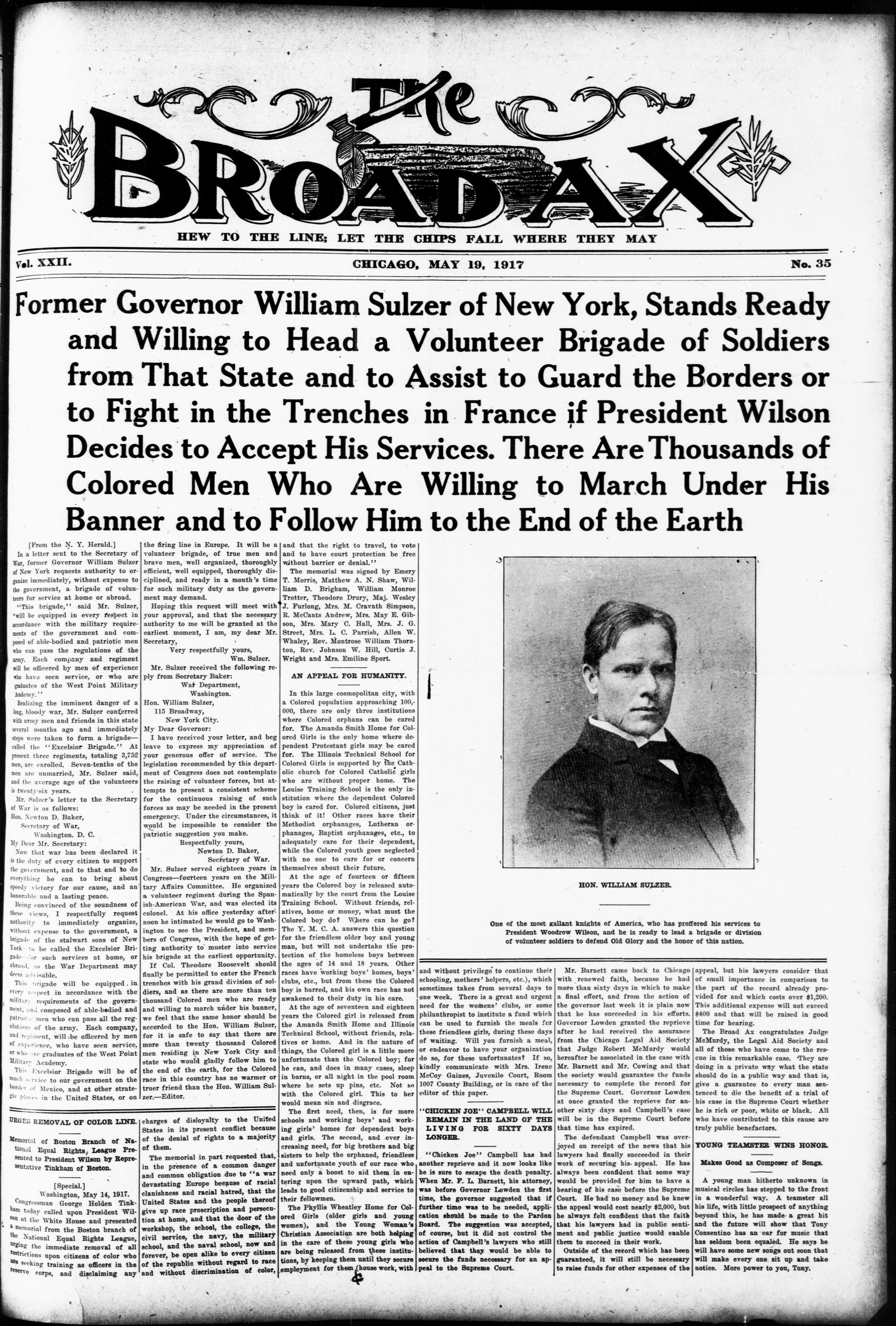
Former Governor William Sulzer of New York, Stands Ready and Willing to Head a Volunteer Brigade of Soldiers from That State and to Assist to Guard the Borders or to Fight in the Trenches in France if President Wilson Decides to Accept His Services. There Are Thousands of Colored Men Who Are Willing to March Under His Banner and to Follow Him to the End of the Earth
Vol. XXII.
Former G and from to Fig Decid Color Bann
[From the N. Y. Herald.]
In a letter sent to the Secretary of War, former Governor William Sulzer of New York requests authority to organize immediately, without expense to the government, a brigade of volunteers for service at home or abroad.
“This brigade,” said Mr. Sulzer, “will be equipped in every respect in accordance with the military requirements of the government and composed of able-bodied and patriotic men who can pass the regulations of the army. Each company and regiment will be officered by men of experience who have seen service, or who are graduates of the West Point Military Academy.”
Realizing the imminent danger of a long, bloody war, Mr. Sulzer conferred with army men and friends in this state several months ago and immediately steps were taken to form a brigade—called the “Excelsior Brigade.” At present three regiments, totaling 3,752 men, are enrolled. Seven-tenths of the men are unmarried, Mr. Sulzer said, and the average age of the volunteers is twenty-six years.
Mr. Sulzer’s letter to the Secretary of War is as follows: Hon. Newton D. Baker
Secretary of War,
Washington. D. C.
My Dear Mr. Secretary:
Now that war has been declared it is the duty of every citizen to support the government, and to that and to do everything he can to bring about speedy victory for our cause, and an honorable and a lasting peace.
Being convinced of the soundness of these views, I respectfully request authority to immediately organize, without expense to the government, a brigade of the stalwart sons of New York to be called the Excelsior Brigade for such services at home, or abroad, as the War Department may deem advisable.
This brigade will be equipped, in every respect in accordance with the military requirements of the government, and composed of able-bedied and patriotic men who can pass all the regulations of the army. Each company, and regiment, will be officered by men of experience, who have seen service, or who are graduates of the West Point Military Academy.
This Excelsior Brigade will be of much service to our government on the border of Mexico, and at other strategic places in the United States, or on
URGES REMOVAL OF COLOR LINE
Memorial of Boston Branch of National Equal Rights League Presented to President Wilson by Representative Tinkham of Boston.
Washington, May 14, 1917. Congressman George Holden Tinkham today called upon President Wilson at the White House and presented a memorial from the Boston branch of the National Equal Rights League, urging the immediate removal of all restrictions upon citizens of color who are seeking training as officers in the reserve corps, and disclaiming any
the firing line in Europe. It will be a volunteer brigade, of true men and brave men, well organized, thoroughly efficient, well equipped, thoroughly disciplined, and ready in a month's time for such military duty as the government may demand.
Hoping this request will meet with your approval, and that the necessary authority to me will be granted at the earliest moment, I am, my dear Mr. Secretary,
Very respectfully yours,
Wm. Sulzer.
Mr. Sulzer received the following reply from Secretary Baker:
Hon. William Sulzer,
115 Broadway,
New York City.
My Dear Governor:
I have received your letter, and beg leave to express my appreciation of your generous offer of service. The legislation recommended by this department of Congress does not contemplate the raising of volunteer forces, but attempts to present a consistent scheme for the continuous raising of such forces as may be needed in the present emergency. Under the circumstances, it would be impossible to consider the patriotic suggestion you make.
Mr. Sulzer served eighteen years in Congress—fourteen years on the Military Affairs Committee. He organized a volunteer regiment during the Spanish-American War, and was elected its colonel. At his office yesterday afternoon he intimated he would go to Washington to see the President, and members of Congress, with the hope of getting authority to muster into service his brigade at the earliest opportunity. If Col. Theodore Roosevelt should finally be permitted to enter the French trenches with his grand division of soldiers, and as there are more than ten thousand Colored men who are ready and willing to march under his banner, we feel that the same honor should be accorded to the Hon. William Sulzer, for it is safe to say that there are more than twenty thousand Colored men residing in New York City and state who would gladly follow him to the end of the earth, for the Colored race in this country has no warmer or truer friend than the Hon. William Sulzer—Editor.
charges of disloyalty to the United States in its present conflict because of the denial of rights to a majority of them. The memorial in part requested that, in the presence of a common danger and common obligation due to "a war devastating Europe because of racial clanishness and racial hatred, that the United States and the people thereof give up race proscription and persecution at home, and that the door of the workshop, the school, the college, the civil service, the navy, the military school, and the naval school, now and forever, be open alike to every citizen of the republic without regard to race and without discrimination of color,
CHICAGO, MAY 19, 1917
William Sulz Head a Wife and to A Trenches Sept His Serge Who Are Follow Him
and that the right to travel, to vote and to have court protection be free without barrier or denial." The memorial was signed by Emery T. Morris, Matthew A. N. Shaw, William D. Brigham, William Monroe Trotter, Theodore Drury, Maj. Wesley J. Furlong, Mrs. M. Cravath Simpson, R. McCants Andrew, Mrs. May E. Gibson, Mrs. Mary C. Hall, Mrs. J. G. Street, Mrs. L. C. Parrish, Allen W. Whaley, Rev. Montrose William Thornton, Rev. Johnson W. Hill, Curtis J. Wright and Mrs. Emiline Sport.
AN APPEAL FOR HUMANITY.
In this large cosmopolitan city, with a Colored population approaching 100,000, there are only three institutions where Colored orphans can be cared for. The Amanda Smith Home for Colored Girls is the only home where dependent Protestant girls may be cared for. The Illinois Technical School for Colored Girls is supported by the Catholic church for Colored Catholic girls who are without proper home. The Louise Training School is the only institution where the dependent Colored boy is cared for. Colored citizens, just think of it! Other races have their Methodist orphanages, Lutheran orphanages, Baptist orphanages, etc., to adequately care for their dependent, while the Colored youth goes neglected with no one to care for or concern themselves about their future.
At the age of fourteen or fifteen years the Colored boy is released automatically by the court from the Louise Training School. Without friends, relatives, home or money, what must the Colored boy do? Where can he go? The Y. M. C. A. answers this question for the friendless older boy and young man, but will not undertake the protection of the homeless boys between the ages of 14 and 18 years. Other races have working boys' homes, boys' clubs, etc., but from these the Colored boy is barred, and his own race has not awakened to their duty in his care. At the age of seventeen and eighteen years the Colored girl is released from the Amanda Smith Home and Illinois Technical School, without friends, relatives or home. And in the nature of things, the Colored girl is a little more unfortunate than the Colored boy; for he can, and does in many cases, sleep in barns, or all night in the pool room where he sets up pins, etc. Not so with the Colored girl. This to her would mean sin and disgrace.
The first need, then, is for more schools and working boys' and working girls' homes for dependent boys and girls. The second, and ever increasing need, for big brothers and big sisters to help the orphaned, friendless and unfortunate youth of our race who need only a boost to aid them in entering upon the upward path, which leads to good citizenship and service to their fellowmen.
The Phyllis Wheatley Home for Colored Girls (older girls and young women), and the Young Woman's Christian Association are both helping in the care of these young girls who are being released from these institutions, by keeping them until they secure employment for them (house work, with
Zer of New Volunteer Assist to G in France Services. The Willing to turn to the En
One of the most g President Wo of volunteer s
One of the most gallant knights of America, who has proffered his services to President Woodrow Wilson, and he is ready to lead a brigade or division of volunteer soldiers to defend Old Glory and the honor of this nation.
and without privilege to continue their schooling, mothers' helpers, etc.), which sometimes takes from several days to one week. There is a great and urgent need for the women's clubs, or some philanthropist to institute a fund which can be used to furnish the meals for these friendless girls, during these days of waiting. Will you furnish a meal, or endeavor to have your organization do so, for these unfortunates? If so, kindly communicate with Mrs. Irene McCoy Gaines, Juvenile Court, Room 1007 County Building, or in care of the editor of this paper.
'CHICKEN JOE'' CAMPBELL WILL
REMAIN IN THE LAND OF THE
LIVING FOR SIXTY DAYS
LONGER.
"Chicken Joe" Campbell has had another reprieve and it now looks like he is sure to escape the death penalty. When Mr. F. L. Barnett, his attorney, was before Governor Lowden the first time, the governor suggested that if further time was to be needed, application should be made to the Pardon Board. The suggestion was accepted, of course, but it did not control the action of Campbell's lawyers who still believed that they would be able to secure the funds necessary for an appeal to the Supreme Court.
9
allant knights of America, who has pro-
drew Wilson, and he is ready to lead a
oldiers to defend Old Glory and the hono
Mr. Barnett came back to Chicago
with renewed faith, because he had
more than sixty days in which to make
a final effort, and from the action of
the governor last week it is plain now
that he has succeeded in his efforts.
Governor Lowden granted the reprieve
after he had received the assurance
from the Chicago Legal Aid Society
that Judge Robert McMurdy would
hereafter be associated in the case with
Mr. Barnett and Mr. Cowing and that
the society would guarantee the funds
necessary to complete the record for
the Supreme Court. Governor Lowden
at once granted the reprieve for
another sixty days and Campbell's case
will be in the Supreme Court before
that time has expired.
The defendant Campbell was overjoyed on receipt of the news that his lawyers had finally succeeded in their work of securing his appeal. He has always been confident that some way would be provided for him to have a hearing of his case before the Supreme Court. He had no money and he knew the appeal would cost nearly $2,000, but he always felt confident that the faith that his lawyers had in public sentiment and public justice would enable them to succeed in their work.
Outside of the record which has been guaranteed, it will still be necessary to raise funds for other expenses of the
No. 35
ands Ready of Soldiers Borders or Agent Wilson thousands of Under His Earth
ffered his services to brigade or division of this nation.
appeal, but his lawyers consider that of small importance in comparison to the part of the record already provided for and which costs over $1,200. This additional expense will not exceed $400 and that will be raised in good time for hearing. The Broad Ax congratulates Judge McMurdy, the Legal Aid Society and all of those who have come to the rescue in this remarkable case. They are doing in a private way what the state should do in a public way and that is, give a guarantee to every man sentenced to die the benefit of a trial of his case in the Supreme Court whether he is rich or poor, white or black. All who have contributed to this cause are truly public benefactors.
YOUNG TEAMSTER WINS HONOR
Makes Good as Composer of Songs.
A young man hitherto unknown in musical circles has stepped to the front in a wonderful way. A teamster all his life, with little prospect of anything beyond this, he has made a great hit and the future will show that Tony Consentino has an ear for music that has seldom been equaled. He says he will have some new songs out soon that will make every one sit up and take notice. More power to you, Tony.
Dan M. Jackson
Geo. T. Kersey
David A. McGowan
Ahmed A. Rayner
The Emanu
Undertaking
The Emanuel Jackson Undertaking Co., Inc.
2959-61 South State St.
Reliable Service Courteous Treatment
Reasonable Prices
FREE CHAPEL IN CONNECTION
Complete line of Funeral Goods. Automobles for hire
FREE
STYLE BOOK
--- HAIR
To Colored Women
We are the largest
market of
Colored Women's
Hair. Our latest
book showing new
styles in hair
dressing sent free.
Every colored woman
should have
one. We sell thou-
sands of new
tissue articles. Sat-
tification guaranteed
or money back.
We also have best
solidness STRAIGHT-
ENING combs, with extra heavy back, fully
guaranteed. With each comb we give lamp cap
FREE. Send money order or stamps. MONEY
BACK IF NOT SATISFACTORY. 80c, postpaid.
POSTPAID 89c
Hair pets, brushes, combs and toilet articles
manufactured in the U.S.
Stamp Agent Wanted. Address as follows:
HUMANITY BAR COMPANY,
181-157 Park row,
New York City.
Address Dept. 84
In a French War Hospital
Serving a community of fifty a three course meal—soup, meat and vegetables and dessert—is a man size proposition, says Elizabeth Frazer in the Saturday Evening Post. Serving it on be tables, often cutting up the food and feeding the armless patients, further complicates the task. The first day I completely lost my head. My clamorous young brood, nine of whom were under twenty-two, reminded me of nothing so much as a nestful of yawning baby robins waiting to be fed.
It was: "Look out for my leg, mees!" "More bread, mees!" "My serviette, mees!" "Have you forgotten me, mees?" "My soup's tipped into my bed! I'm afloat, mees!" And all in a rapid bubble of French that made my head spin. At last in sheer desperation I addressed them in the American language: "You darned kids—shut up!"
The Little Oyster Grab
The captain of a foreign ship, in port at Baltimore, at an entertainment given by friends was delighted with the oysters which were on the menu. Just before the ship sailed these friends sent to it several barrels of these oysters as a present to the captain. When he made the trip back to this country his friends asked him how he liked the oysters. He said: "Don't you know, we had to throw nearly all of them overboard. They were no good. Practically every one of them had a live insect on the inside, and knowing they were not fit to eat, we let the whole lot go to Davy Jones." Investigation showed that the insect was the little oyster crab, which is a great delicacy, preferred by many to the oysters themselves, and which the epicure knows as a sure guarantee of the quality of the bivalve. It was a good joke on those sending and the one receiving the present, at which neither side laughed very much.—Christian Herald.
A problem of the zoologist is the endurance of freezing by many animals, Collecting the records, Mile, France and Paul Portier, entomologists, of Paris find that fish have survived 5 degrees F., frogs 8 degrees below, mollusks 184 degrees below and bacteria have come out alive after exposure to 300 degrees below zero. The two French experimenters froze certain caterpillars—Cossus cossus—at a temperature just above zero. They became quite solid and brittle and could be broken like icicles. On warming, however, even broken ones returned to life. Several freezings and thawings were endured, but recovery became slower each time and ceased after the sixth thawing. Other genera showed like results. There seemed to be some physiological preparation for the cold, for caterpillars that survived the winter freezing all succumbed to similar temperatures in the spring.
There are two places on the earth's surface where the magnetic needle must point due south. They are not easy places to reach. One is in the arctic regions north of the northern magnetic pole on the line between that pole and the geographical north pole. The other is in the antarctic regions, south of the southern magnetic pole, on the line between that spot and the geographical south pole. In the first case the point of the needle is attracted to the northern magnetic pole. In the second case the other end of the needle is attracted to the southern magnetic pole.
The mission fathers brought the olive and the date from the Mediterranean regions and gave California one of its most important crops.
---
PAGE TWO
Living Icicles.
The Magnetic Needle
Phones Calumet 6164 Automatic 71-629
uel Jackson ng Co., Inc.
ds. Automobles for hire
An Expert In Motives.
Cousin Henry is an expert in motives. If you were reading off a list of names and overlooked Henry he would understand. He would know exactly the motive that prompted you to do it. If you don't think to introduce him to the man who is with you he can see through it. He may have to go back four or five years, but he will make a complete case against you. In less than an hour he will know what your motive was. Right now he is angry because his daughter was not selected as valedictorian of her class. You may think that the other girl deserved to be selected, but you don't know all that Henry knows. It is a long story, but he is willing to tell it to you, and after hearing it you will understand that the motive--you will understand that it is a case of spite work.—Claude Callan in Fort Worth Star-Telegram.
How David Garrick Made His Fortune.
If David Garrick had had no more than his salary as an actor he would have had little to leave at his death. He made his fortune as joint proprietor, and for a time as sole proprietor, of Drury Lane theater, so that the amount set down to himself as salary was practically nominal. When he retired from the stage in 1776 he sold half his share in the theater for £35,000. He was probably the only actor who consistently made Shakespeare pay, and, like Shakespeare, he was actor, author and proprietor. It may be recalled that Garrick, who had no enemies outside his own profession, was the grandson of a Frenchman exiled at the revocation of the edict of Nantes and that his father was a captain in the army.-London Standard
Well Balanced Diet
One of the most common faults of the diet is the eating of too much protein foods. In excess this is hard for the body to excrete and is likely to decompose in the intestines with the formation of poisonous waste products. Green vegetables and raw fruit are important elements of the diet. There is little energy in these foods, but they supply mineral salts which the body needs and curious substances called vitamins, which are easily destroyed by cooking.
One food expert has suggested a rule for securing a well balanced diet. It is: An ordinary family should spend about as much for milk, vegetables and fruits as for meats, fish and eggs and as much for milk and eggs as for meat and fish.
Follies of Science
The history of science has seven problems which men in all ages more or less have tried to solve, but which have finally been given up by all. Today they are called follies.
The usual list comprises the following: First, squaring the circle; second, duplication of the cube; third, trisection of an angle; fourth, perpetual motion; fifth, transmutation of metals; sixth, fixation of mercury; seventh, elixir of life. Some lists put the philosopher's stone for the last three and then add astrology and magic to make the seven.
Too Much For Him
"I thought he was going to marry that girl?" "Well, he did think of it. But it seems when he called the other night she threw him down." "Well, if she's as good as that at wrestling I don't blame him for quitting."-St. Louis Post-Dispatch.
"Experts say you can tell by the bill."
"How so? The bill for one is always as high as the bill for the other. That's what I'm kicking about."—Louisville Courier-Journal.
Just a Change In Words
Young Clerk—Do you like to stand in front of the store and see the crowds go by? Old Merchant—No, but I like to stand in the back of our store and see the crowds come buy.—Exchange.
Howell-Rowell is a man of tenacity.
Powell-Yes. If he were a dog and got a grip on your trousers you would be perfectly safe in ordering a new pair.
Pistols were invented at Pistoja, Italy, and were first used by English cavalrymen in 1544.
Gold, like the sun, which melts wax and hardens clay, expands great souls and contracts bad hearts.—Rlvarol.
OPEN DAY AND NIGHT
Not That Bill.
A Sticker.
Pistols.
THE BROAD AX. CHICAGO. MAY 19. 1917.
He Lacked Concentration.
Speaking of a man who was a failure because of his lack of concentration and his inability to know his own mind five minutes at a time, a captain of industry said he reminded him of a hunting dog he once owned:
"At sunrise the dog would start out on his own hook after deer. He would jump a buck and run him for miles. When the buck was on the point of exhaustion the hound's nostrils would catch the taint in the air where a fox had crossed the trail, and he would instantly decide that, after all, fox was what he had come for, and he would turn aside to pursue the fox. Perhaps an hour later, when the chase was growing warmer every minute, his keen nose would detect the presence of a rabbit, and he would go after the cottonail, with the inevitable result that by 4 o'clock in the afternoon that hound would be thirty or forty miles away from home in a swamp with a chipmunk treed!"—Saturday Evening Post.
George and His Legs.
Hit by bit the historical grubbers are digging out the truth about our immortal George. We have heretofore been told that he wore false teeth and that at Valley, Forge he unbushingly deceived his ragged and despondent troops with the arrival of ample supplies of ammunition, which consisted of powder barrels filled with sand, and now a correspondent of the New York Sun declares that in the full length portraits of Washington by Stuart, of which there is one in the New York public library, the legs were not his own. "I have seen the letter from Stuart thanking the true owner for his kindness in providing a symmetrical foundation for the bust of the great president and presenting one of the smaller portraits in thanks for his kindness."
Free Speech
An old negro woman had lived with a certain family in the south for many years. One day her mistress had occasion to reprimand her quite sharply for something that had gone wrong. The negress said nothing at the time, but a little later her voice could be heard in the kitchen in shrill vituperation of everything and everybody, with a rattling accompaniment of pans and kettles. So loud became the clamor and so vindictive the exclamations that Mrs. C. went hurriedly down to the kitchen.
"Why, Liza," she began in amazement, "who on earth are you talking to?
"I ain't talkin' to nobody," the old negress replied, "but I don't keer who in dis house hyars me."—Harper's Magazine.
Misprints and Maxim Guns
The late Sir Hiram Maxim says in his autobiography that when he organized the United States Electric Lighting company the printer sent home its stationery with the heading, "The United States Electric Lightning company." When he established his new gun company in England he told of this mistake in order to emphasize the importance of getting the stationery printed correctly. When the first sheets were brought to him, however, he found that the English printers had made his concern appear as "The Maxim Gum company."
Easy Generosity.
Mother (to small son)—Bobby, dear,
I hoped you would be unselfish enough
to give little sister the largest piece of
candy. Why, see, even our old hen
gives all the nice big dainties to the
little chicks and only keeps an occasional tiny one for herself.
Bobby thoughtfully watched the hen
and chickens for a time and then said,
"Well, mamma, I would, too, if it was worms."—Rochester Times.
A. Generation:
In the long lived patriarchal age a generation seems to have been computed at 100 years (Genesis xv, 1). Subsequently the reckoning was the same that has been more recently adopted—that is, from thirty to forty years (Job xil, 16).
Incongruous.
Little Alick—What is an incongruity,
uncle? Uncle William—An incongruity,
child, is a divorce lawyer humming a
wedding march.
Vegetation In Polar Regions
The rapid growth of vegetation in
the polar regions is attributed to the
electric currents in the atmosphere.
○○○○○○○○○○○○○○○
PRACTICAL HEALTH HINT.
Neuralgia.
Neuralgia means nerve pain. Neuritis means inflammation of the nerve. In neuralgia the pain comes and goes. In neuritis the ache is steady and sticks closely to the affected nerve. If the nerve could be taken out and examined we could find nothing abnormal in the case of neuralgia. In neuritis the nerve would be found to be inflamed. The question of what is behind the pain of neuralgia is more important than the answer to the cry for relief. It must be remembered that neuralgia is merely a symptom, not a disease. Sometimes malaria is the underlying cause. Other times it may be due to alcoholism, diabetes, lead poisoning, gout, rheumatism or Bright's disease. A diseased tooth or a diseased ovary may be responsible. In every case treatment must include treatment of the underlying cause.
```markdown
```
Spanish Doubleons
Should one find a pirate's buried treasure he would have to dispose of his Spanish gold at its bullion value, for since Aug. 1, 1908, when the common crier made proclamation from the steps of the Royal Exchange of London that after that date the doubloon would cease to be legal tender in the West Indies, including British Guiana, the doubloon has not been the precious thing it was. In 1730 and for a century after it was worth $8, more or less. It has ceased to be coined in its native country, Spain, and since 1908 it has been unpopular in the West Indies, where for a long time it figured in a mixed circulation, embracing British, United States and Spanish coins. In the interest of romance, however, the name at least must survive. It signifies nothing more than that the coin was double the value of a pistole, but the "doubloon" was never such a mouth filling mockery as "pieces of eight," which suggests great riches, but means only Spanish silver dollars, pieces equivalent to eight reals.—Rochester Post-Express.
A Famous New York Street.
Few of the thousands of people who pass the corner of Nassau and John streets every day know the early history of Nassau street. And yet right at that corner is a bronze tablet which gives in concise form the following historical information:
"Nassau Street, Known Originally as the 'Street That Runs by the Pye Woman,' Was Laid Out About 1695 and Was Named In Honor of the House of Nassau, Whose Head at That Time Was William the Third, King of England and Stadholder of the Dutch Republic. Nassau Street became Identified With the Jewelry Trade More Than Half a Century Ago."
The bronze tablet is on the exterior of the building at the northwest corner of Nassau and John streets. It was erected by the Malden Lane Historical society in 1916—New York Sum.
William De Morgan.
In spite of himself William De Morgan became famous. He deliberately violated all the rules made for the guidance of novelists who seek to become popular. None of his novels was addressed to the greater public that is avid for the latest thing of the moment in fiction, but nevertheless they reached that public. He was a law unto himself in the novels that he wrote during his marvelous career that spanned only ten years. It is doubtful if in English literature or in any other can be found a writer whose life and literary career are comparable to his. He was an old man when the world of readers came to know him, and his age was an asset toward celebrity. At seventy he was hailed as eagerly as Klipling was hailed at twenty, and in his way he was no less a prodigy than the younger writer—Bookman.
The Emerald.
The emerald has been known since early times both in Europe and in certain parts of the orient, where its attractive color and rarity have endowed it with the highest rank and a varied lore. Its name may be traced back to an old Persian word which appeared in Greek as "smaragdos," mentioned by the Ophrahrastus over 300 years before the Christian era, and again in Latin as "smaragdus," seen in the writings of Pliny, who particularized somewhat on its properties and supposed medicinal virtues and was even shrewd enough to suspect its identity with the much more common beryl, although eighteen centuries elapsed before this suspicion was verified by scientific proof.
His Hard Luck
A small boy whose record for deportment at school had always stood at 100 came home one day recently with his standing reduced to 98.
"What have you been doing, my son?" asked his doting mother.
"Been doing?" replied the young hopeful. "Been doing just as I have been doing all along, only the teacher caught me this time." — Philadelphia Inquirer.
Where Is the Profit?
"I understand they sold their house for $3,000 more than they paid for it." "How lucky!"
"Lucky nothing! After they'd sold it they discovered that they've got to pay $2,000 more than they received for their house for another home to live in."-Detroit Free Press.
Books In Brazil.
In Brazil, as throughout South America, French is almost universally read. Editions of the classics are found in most homes, and bookstores are filled with modern French writers of prose or verse, sometimes in translation and as frequently in the original.
Went Further:
"Didn't I tell you that when you met a man in hard luck you ought to greet him with a smile?" said the wise and good counselor. "Yes," replied the flinty souled person. "I went even further than that. I gave him the grand laugh."
Best Way of Taking Iron
When anemic persons have to take iron the best form in which to administer it is spinach, cabbage, green chicory, asparagus, lentils, carrots and peas, all of which contain much iron.
About the Same Thing:
Scribbler—Can you suggest a simile for giving advice? Scrawler—How would pouring water on a duck's back so?—Philadelphia Record.
Let us teach people as much as we can to enjoy, and they will learn for themselves to sympathize—Stevenson.
Necessities of War.
When Lloyd George in England undertook to organize the ministry of munitions a glazier began to stamp out cartridge clips; a manufacturer of music rolls used his equipment to make gauges; a concern engaged before the war in preparing infants' food began delivering plugs for shells; an advertising agency manufactured shell adapters; watchmakers began adjusting fuses; a manufacturer of baking machinery became a contractor for six inch high explosive shells; a jewelry house devoted itself exclusively to periscopes; a phonograph concern sent millions of delicate shell parts to the assembling stations; a firm which made nothing but sheep shearing machinery started turning out shell cases; a cream separator factory manufactured shell primers. Among other producers of finished shells were candlemakers, flour mills, tobacco manufacturers, syphonmakers and the manufacturers of sporting goods.—World's Work.
Stocking the National Parks.
The United States is carrying on a very interesting work in exchanging the wild animals of one region for those of others—transplanting elk and deer and Rocky mountain bighorns from regions in the United States where they are plentiful to others where, so far as known, they have not lived. Some of the animals are being shipped long distances, says the Popular Science Monthly.
Wyoming is full of elk. The herds in the Jackson Hole country are the largest of any of North American wild animals since the days of the countless buffaloes. But the big Yosemite National park of California, with its three-quarters of a million acres, until recently had no elk, or at least only a very few scattered specimens. But the elk shipped in from Wyoming have become very much at home and are breeding and multiplying rapidly, adding to the charm and picturesqueness of this popular national playground.
Love and Marriage.
"First love is very apt not to be the lasting love," said Dr. Antoinette Konikow, speaking at the Boston School of Social Science.
"Young lovers try to excuse all the faults of the loved one because they are not in love with the individual, but with love. Hence they may not choose the partner with whom they will find their happiness in later years. Many a man and woman is glad by middle age that the first love was frustrated.
"Marriage should be based on love alone or it is immoral, and some change is necessary if marriage is to be saved from degradation. Real love always makes people better. Romantic love is the source of all the best things in life—the foundation of all the arts. And individual happiness makes up the happiness of the race."—Boston Post.
Use of Bacon Drippings
Bacon drippings make splendid shortening for light, flaky pie crust. It takes just a little less of the drippings than of ordinary lard or vegetable shortening. Use it for shortening in spice cake, gingerbread or any dark cake and note the delicious flavor. Spread rye bread with a thin layer of the pure drippings and sprinkle a little salt on it. Add to this a thin slice of any salt meat and you will have a delicious and highly nutritious sandwich. The European housewife has long made use of such sandwiches for the between meal snack for growing boys and girls.
The Pygmy Hippopotamus
One of the animals least known to the outside world is the pygmy hippopotamus of West Africa. This animal is just what its name implies, a pygmy hippopotamus. It is much smaller than the common hippopotamus, being no larger than an ordinary or fair sized hog. It differs somewhat from the common hippo in the character of its teeth, and instead of spending its time in the rivers and lakes in large herds it wanders about through the jungles singly or in pairs, much after the manner of swine in search of mast.—London Spectator
Just the Time
"No, I have never played bridge before."
"So I should surmise," said the disgusted partner. "But how came you to enter an important tournament like this?"
"Oh, I thought it would be a good time to learn."—Louisville Courier.
"Now, look here, Alice, I know everything. You've been carrying on with another man. I even know that his name is Rupert."
"How ridiculous you are! First of all, I haven't flirted with any one, and, secondly, his name isn't Rupert."—Passing Show.
Profitable Writing
"My writings bring in a lot of money every month."
"That so? I didn't know you were an author."
"I'm not. I'm the man that makes out the bills for our firm."—Detroit Free Press.
Trials of Authent
"You do not know," Saint-Beuve wrote to George Sand, "what it is to remain a whole day with your head in your hands, squeezing your unfortunate brain to find a word."
Silent Heroes
Father," asked Tommy, "what are 'silent heroes?'"
"Married men, my boy," replied the father.—London Telegraph.
We like to give in the sunlight, to receive in the dark.
to say to you? Drop it!
Nju-Drop what?
He-Everything-happiness and love
and work and God knows what else!
it is all so provincial. Our dreams,
let them be what they will, are provincial—yes, even our sufferings.
Nju-And what is there that isn't provincial?
He-What! Art and death? No; art is tool. Only death.
Nju-You I need.
Nju—Yes; I understand.
He—You don't love me, Nju.
Nju—I love you very much. Realy
I do love you, only there is something
that is more than love—something still
higher.
He—What's that—life?
Nju—I don't know.
He—Or—or death?
Nju—No; there is something still
higher.
He—Than life, death and love?
105? Nju—Than all combined. There must surely be something; otherwise the whole thing would be so meaningless. —From the Russian Flat. Xh3
Grass on the Lawn
Grass seeds germinate in from fourteen to eighteen days. A quart of seeds is sufficient to cover 300 square feet-15 by 20 feet. Five to six bushels are required per acre.
Do not sow grass seeds in hot, dry weather, particularly in July or August.
Poa trivialis is good for shady lawns under trees.
Festuca rubra is most suitable for hard wear and for dry or sandy soils.
Sharp sea sand applied lightly over lawns in the autumn—that is, over lawns on clay or loam—encourages the growth of fine grasses.
Lawnns that are frequently watered need more fertilizers than those that are not, as the water washes away much plant food.—New York Sun
Glengarry's "Treason"
How startling was the difference in the customs of the English and the Scots even less than a century ago is shown in the story of the way in which the famous highland chief, Alastair Macdonell, of Glengarry frightened George IV. out of his wits. In 1822 Glengarry was one of a party of Scottish nobles and gentlemen who banqueted "the first gentleman of Europe" in Holyrood palace. Colonel Macdonell was the last chief to wear the full highland costume, and when the company sat down to dinner he, according to custom, placed a brace of loaded pistols by his plate. The king started up in alarm and was persuaded to remain in the room only on the assurance that Glengarry meant no treason. -London Spectator.
Stevenson's Wife
A half caste sailor once said, "Mr Stevenson is good to me, like my father, and his wife is the same kind of man."
King Tembinoke said of Mrs. Stevenson, "She good; look pretty plenty chench" (sense).
Perhaps they both meant what the poet Edmund Gosse so well expressed when he wrote of her as being "dark and rich hearted, like some wonderful wine-red jewel."
But the best tribute in Mrs. Stevenson's praise came from the pen of her husband.—Critic.
Our Coal Supply
The United States coal supply is nearly one-half that of the entire world. Estimates put the available coal supply of the United States at 3,538,500,000,000 tons out of a world total estimated at 7,397,533,000,000 tons. China ranks next to the United States in available supply, estimated at 1,500,000,000,000 tons. Great Britain, 180,000,000,000; Germany, 164,000,000,000; and Canada 100,000,000,000 tons.
Too Pushing.
"I had an idea I'd grow up and own this business some day," said the discharged office boy.
"That's just why you were fired," said the boss. "Ever since you started to work here you've been acting as if you already owned the business"—Birmingham Ace-Herald.
Forgiveness.
Waiter—Beg pardon, sir, but—ah-hem the gents here usually remember my services. Guest (pocketing all the change)—Do they? They ought to be more charitable and forget them!
Clown Sheen Shearers.
Clever Sheep Grazing
Averaging everything, from young
wethers, which are hard, to old ewes
which are easy, experts in Australia
will shear about 90 or 100 sheep a day
PRACTICAL HEALTH HINT.
Diet For the Aged.
The aged should have food at
frequent intervals—little and
often should be the rule—food
every three or four hours. The
appetite is not as keen in old age
as it is in youth, nor is the di-
gestion so good.
o Fresh vegetables are needed
o and relished by elderly persons,
o and they are a valuable addition
o to the dietary if they are troubled
o with constipation, as they
o contain fibrous tissue, which
o gives bulk to the contents of the
o intestinal canal and supplies
o something for the intestines to
o contract upon. Stewed or raw
o fruits are useful, as well as veg
o etables, and one or the other
o should be eaten two or three
o times a day.
FROM THE FRONT
Dr. Carrel's Wife Was Only a Day Behind the Germans.
An Appeal From the Trenches For the Children and Sick In Noyon After the Retreat of the Germans From the City Recently.
In her letter of appeal for clothing and food Mine, Alexis Carrel, wife of Dr. Carrel, thus describes her entrance into a city a day after it had been retaken by the British-French soldiers: "On Sunday the news of the German retreat from Noyon reached me, and I pushed to Ribecourt, at four kilometers distance. There I found that the
Mary
MME. ALENIS CARREL.
bridges had been blown up. Instead of lingering, I returned, as I had seen the cavalry fording the stream.
"However, on the morning of Monday, the 10th, I asked our head surgeon for an ambulance, but he refused, as he suspected my motives and did not think it necessary or sensible for me to be killed. I then went to the chauffeur and ordered the ambulance out on the road and filled it with what I found that seemed necessary and then urged the man to drive it. He answered me that we could not go unless we had the necessary permits.
I replied that this was no time to wait for permits. In a very short time I reached the bridge which was being temporarily put up, watched the work for twenty minutes, then dashed up to this structure, and am glad to say mine was the first ambulance to cross. I joined the heavy artillery, and when shouted at by a sentinel I answered, Service, service,' and passed on with the artillery. We had to wait for a second bridge to be constructed and then found ourselves in Noyon, only twenty-four hours after the last Germans had moved away.
"Every woman between the ages of fourteen and thirty had been carried off by Germans nine days before the retreat began. Thus all these poor people whom we found crowded in the cellars had hideous tales to tell.
"None of the French civil population had had any meat of any kind for seventeen months. They had lived on black bread and rice. Many had died in their struggle to keep alive, and the mortality among the children had been terrible. The bodies of those who had died had been kept for five days unburied in the midst of the living.
"In the orphan asylum, in a small room, the beds were so close together that they touched, and on these beds were children who had slept without mattresses, pillows or covering since the month of December, in their clothes, unwashed, unkempt and uncared for. No words can describe their condition.
"The wounded French who were still in the hospital had not been cared for and were being slowly taken into our own hospital at Compiègne, which is twenty-three kilometers from Noyon. The men who were brought in at midnight had been reduced to the last gasp."
Oven Efficiency:
Some women find a use for both their range oven and a small removable oven at the same time. When baking cookies, set the small oven on the front of the stove and use both ovens. You will be through in a short time. When you want to cook one kind of food slowly and another rapidly, set the small oven on at the back of the stove and use it for slow heat. Keep the range oven hot. In this way you may make custards, apples or light bread as slowly as desired and at the same time be cooking pies or biscuits in a hot oven.
Newest Hate.
Fabrics are greatly used by the milliners, and whole hats, crowns and brims are fashioned of crepe de chine, georgette, chiffon, satin, taffeta or whatever the designer happens to fancy. Georgette and crepe de chine are perhaps more used than any of the other materials, always excepting nets and lace, and a hat entirely covered with crape and showing straw only in the facing of the wide brim is sometimes untrimmed save for a drapery and knot of the crape. Other crape covered models are flower trimmed or leather trimmed.
RIDING TOGS.
Pointers About the Spring Models For Horsewomen.
Leaving out the horse, the saddle and bridle and the riding crop—all substantial items in the equipping of Miss Debutante for her spring canter in the park—a smart outfit will cost about $75 or $80, this including riding habit, hat, silk riding skirt, heavy gloves and specially made riding boots. Is it any wonder that horseback riding is a sport indulged in only by the rich? Any girl who can provide herself with a sport skirt and coat and a bag of golf clubs can indulge in the fashionable game of golf if she lives within trolley distance of a public golf course. Roads or bridle paths are free to anybody, but only the few can afford to use them. Riding is a sport which demands the utmost of conventionality in its equipment. Everything about the riding costume must be flawlessly correct and in accordance with the canons of good form. There is no prettier sight on a spring day than a pretty girl riding down the leafy bridle path under budding spring trees, but there is no doubt about it, she does represent a deal of money.
For spring there are coat and breeches riding habits of Oxford waterproofed cloth or of checked worsted, the breeches re-enforced with buckskin and chamois, the coat partly rubber faced. Such a suit costs about $40, bought ready made. One may pay up to $100 for a custom made suit. The riding sailor of fine straw, in black or dark green, costs about $4; heavy riding gloves about $2. For a smartly made silk riding skirt one must give $6. Riding boots of fine leather, stiff in the leg, supple over the foot, cost $15. One may economize a bit hereby wearing puttees, costing about $4, over one's ordinary laced sport shoes, but of course the riding boots are most desirable and lend not a little of its complete perfection to the costume.
SEE THIS TRAVELER.
For Your Summer Vacation You Need
This Outfit.
Beige taffeta makes the smartest
kind of a tailored suit, especially when
it is elaborately stitched with heavy
A
MODISH EFFECT.
slik of the sage shade, revers, peplum and cuffs. The turban is one of the ever fashionables, crisp green foliage and a splash of flowers in color.
Hand Work on Blouses.
Hand made blouses were never more in demand, and a particularly chic example shows an original shoulder yoke continued in side pieces, which, reaching to the waist, give a certain shapelliness to the whole and at the same time allows for a seam arranged in pretty openwork fashion and so adding considerably to the decorativeness of the garment. Narrow front pieces, little more than strips indeed, secured with buttons and buttonholes down the center, are again added, the material between them and the yoke side piece—if the term may be pardoned—being slightly gathered to the shoulder yoke, where again the openwork seam is arranged, as on the juncture of the somewhat deep cuff on the ample bishop sleeve.
For a Rainy Afternoon.
When the day is rainy and the kiddies are peevish and you have exhausted all your ways of entertaining them pull out the sewing machine, unthread the needle and remove the bobbin. Then let the youngsters take turns at making weird designs on thin paper. Fold a square of paper diagonally once and then again and a third time. Then, placing the point of the triangle under the needle, let the youngster guide the needle haphazard about the triangle. When unfolded it will be found that the square is filled with a beautiful, symmetrical design. Care should be taken that the needle is not allowed to run into the too eager little fingers.
THE BROAD AX, CHICAGO, MAY 19, 1917.
FOR YOUNG FOLKS
Sleepy Time Story About a Well Known Field Creature.
ITS BIRTH AND TRAGIC END.
Green Coated Youngster Had a Narrow Escape When He First Emerged Into the World—How He Changed His Clothes—About Mrs. Catbird.
Tonight, said Uncle Ben to Little Ned and Polly Ann, I will tell you the story of—
GRASSHOPPER GREEN.
Grasshopper Green began his life down in the ground. Early one summer he crawled out of the dark hole in which his mother had left the egg from which he came and hopped to the first stalk of grass he saw.
It wasn't a bit too soon, for a sharp eyed robin was watching the hole and would have whisked him up to the nest and fed him to one of his hungry nestlings. That is what had happened to every one of the little brothers and sisters who had 'come out of the hole before Grasshopper Green. The reason Mr. Robin missed Grasshopper Green was because he happened just then to spy a fat caterpillar which would make a much more appetizing meal. So he let the young grasshopper go and took the caterpillar instead.
"You'd best be careful, young sir," warned Mrs. Cricket, who was hiding near by. "Hop under here or that robin will have you next."
The little fellow stayed under the leaf until Mr. Robin went elsewhere. Then he skipped out and made off as fast as he could.
As yet he had no wings and could only hop about. In a short time, however, he had grown so much that his skin split and through the hole in his back could be seen the little green wings which would help him to get out of the way of the hungry birds that are looking for nice fat insects.
When Grasshopper Green had wriggled his way out of the skin and stood fanning his wings in the sunshine he found out something odd. By rubbing the right wing over the left one he could make what seemed to him very delightful music. Like the locust and the crickets, his cousins, he carried a violin on his back.
So pleased was he that he now sat squee-squeing away, forgetting to keep an eye open for enemies. In the bushes beside him a catbird had her nest.
"What's that?" Mrs. Catbird exclaimed as she propped her head on one side.
"Sounds like a grasshopper," she chuckled. Then, very quietly, she poked her head out of the bushes. There sat Mr. Grasshopper Green on top of a grass blade, sawing away at his little violin.
With a bound Mrs. Catbird had the grasshopper.
"He tastes a good deal better than he sounds," Mrs. Catbird remarked as she hopped back into her bush.
Big Men In Boy Scouts.
Colonel Theodore Roosevelt, Major General Leonard Wood, the secretary of war, the secretary of the navy, the chief of staff of the United States army—these men, seriously concerned with the proper preparation of our boys for their full duty as citizens, are officers of the Boy Scouts of America.
A Busy Little Girl.
The industrious little miss in the picture is a patriot and is determined to do all she can to help Uncle Sam in the war. She is learning to use needle
THE CHILDREN'S HOLIDAYS
Photo by American Press Association.
THE SEAMSTRESS.
and thread, with the idea that when she becomes sufficiently skillful she will be able to help mamma in Red Cross work. A very good example that other girls might follow.
Good Manners.
Two little bolts that will unlock
To any one who stops to knock;
The bolts are these:
"I thank you, sir."
And "If you please."
Philadelphia Record.
SERGE FROCK.
How One Serviceable Gown Is Designed For Youth.
THE WOMEN'S WORLD
NEW MODEL.
Navy serge is here shirred on to a top, the plaits of which feign a bolero jacket. Gray beads pick out girdle and cuffs, while the high collar and pockets are contrasted with gray tussore silk. Gray and blue are a favorite combination.
ECONOMY POINTS.
Simple Ways of Doing Common Things Best.
A satisfactory way of fixing hangers to light weight dresses or blouses is to crochet them on. Insert the crochet hook into the cloth on the inner seam of the sleeve and make a chain stitch of the desired length, then fasten like a loop.
Children's sleeves often have to be lengthened, and the best way to provide for this is in the cuffs. Cut the cuffs about one-third wider than wanted, then stitch one side to the sleeve and sew sleeve and cuff seam together before sewing the other side of cuff to sleeve. Turn sleeve wrong side out and turn the extra width of the cuff in and whip to sleeve. When the sleeve is to be lengthened it is an easy matter to take out the whipping stitches, let down the cuff and whip it into place again.
When sewing on hooks and eyes pin a tape measure where the hooks are to go and sew the hooks an inch apart. Then pin the tape measure on the opposite side and sew on the eyes. You will find that in this manner you can do the work much quicker and it is less wearisome than measuring each one.
Gathering or shirring by hand is tedious, and the work can be done with more ease on the sewing machine. Simply lengthen the stitch and hold the top thread between thumb and forefinger and sew as usual. The tightness of the top thread will gauge the fullness of your gathers.
From your old blankets you may be able to cut enough to make a baby blanket. Bind the edges with white satin feather stitched in place and if the blanket warrants it embroider a dainty wreath with baby's initial in the center.
Beauty Hints:
When the eyes are very tired bathe them with hot water and drop a few drops of diluted boric acid in the eyes with an eye dropper. Use ten or fifteen drops of the acid to one ounce of distilled water.
The habit of raising the brows continually will also tend to produce wrinkles, more quickly than the passing years. Before combing your hair place long, narrow strips of court plaster just above the center of the eyebrows and reaching halfway to the hair line. Every time you raise your brows this will be a silent reminder, and soon you will learn to know when you use those muscles that you know work unconsciously, and this will soon break you of the habit. Wear the plasters whenever you can until broken of the habit.
Purple Hats
You can have a big hat of very dark purple straw faced in delicate pink, its crown entirely covered by violets with a simple pink camellia nestling among the violets near the front, or your purple hat may have grapes in rose and gray and green and dull blue clustered in wreath fashion around its crown top, or may have cerise roses harmonizing with its purple.
There are much orchid and mauve, as well as purple, in the summer millinery, often with soft, old blue in combination, a color scheme very charming if successfully handled and quite hopeless when it goes wrong.
Crawlers Must Be Made to Get Off the Earth.
HOW TO TRAIN YOUR VINES.
An Expert Gives Home Gardeners Advice About Caring For Squashes and Plants That Naturally Trail—Soy Beans as a Substitute For Meats.
[From National Emergency Food Garden Commission.]
As usually grown cucumbers are planted in hills four or six feet apart and allowed to spread out along the ground. But in small gardens cucumbers should not be grown unless they are to be trained upon poles or trellises.
When they are trained to climb the vines may be fifteen or eighteen inches apart. A useful method is to plant them on the south side of the garden fence so that the vines may grow up on strings to the top of the fence. In training the vines tie them with soft cotton yarn, and if large, slicing cucumbers are grown it may be necessary to support the fruit with loops of tape.
Since cucumbers thrive in rich soil a suggested method is to plant them around a leaky barrel, training them up the sides. In the barrel should be placed two bushels of manure, and water should be frequently poured in the barrel. Leaking out, it will fertilize the plants round the bottom.
Cucumbers may be planted up to July.
Summer squashes are bushy and need less space than the winter variety. When the vines are allowed to run along the ground they may be planted in hills four feet apart, whereas the hills of winter vines should be planted eight to ten feet apart.
Three or four squash vines will supply a family. When vines are allowed to run it is well to throw a spadeful of earth over each vine every three or four feet at a leaf joint. Where it is thus covered it will put out roots, offsetting any injury to the vine nearer the main root.
Inasmuch as it is not safe to set out eggplant in the garden much before the middle of June and because the plant requires a long growing season, the seeds should be sown indoors. One third of an ounce of seed will produce enough plants to make a row 100 feet long. These seeds are usually sown thickly in rows in the seed boxes, and when the plants are large enough to handle they are transplanted to flower pots filled with rich soil. From Japan, home of some of the most intensive farming the world ever saw, comes the soy bean. Imported first as a crop to build up the fertility of American soil, it is now claiming a place in the American diet.
Soy beans will not grow well in soil where they have never grown before unless that soil is impregnated with certain microscopical germs which the roots must have—that is, for soy beans the soil must be inoculated. This is simple. All that is needed is to get a little soy bean culture or some soil which has produced soy beans. This culture is sold by seedsmen. It is cheap, and a handful is enough for a bean patch.
SCHOOL GOWN.
What Betty Wears to Work and Play
In Summer Time.
For small girls is this interesting
dress made of apple green gingham.
Both kangaroo pockets are smocked
1930
JUST RIGHT.
with white linen, and the bolero top reaches around under the arms in tabs that button in the back. Please note how a white plique collar and black ribbon tie set off the gingham.
PAGE THREE
BEAUTIFUL LINES.
The Kind of Evening Gown
That Appeals to You.
P
THIS CLASSIC.
Fashioned on long straight lines is this charming frock for formal occasions made of turquoise blue velvet, front paneled with silver sequins. The veiling about the neck and shoulders is of tulle in a matching shade of blue.
WOMAN'S WORK.
What She May Do to Help on the National Struggle.
What can "she" do? How did Eve spend her time while Adam was hunting dragons? How did Calpurnia help when Julius Caesar was practicing frightfulness on the Gauls? What aid did Mrs. Grant give while the general was fighting the Virginia campaign? What have heroic women always done when the war cloud descended upon their country and their men took up spear or crossbow or rifle? Just the same thing that the women of America are to do during the continuance of this tremendous war.
"She" can keep the family going. The profession of most women is homekeeping, and there is no lessening of demand for competent mothers and sisters and aunts and sweethearts to feed the hungry, bring up the children and strengthen the hearts of the faint. Every country that goes into a real war fights on the base line of the home, from which aid, comfort and love flow without cessation to the men in the trenches. The great work of the home, which is the preservation of civilization, must go on, war or no war. If the father is where he cannot take part, the mother must shoulder care.
"She" can take a part in the industrial life of the country which will set hundreds of thousands of men free for the hard campaigning which they alone can perform. She has long been a workwoman in a factory, a saleswoman, a stenographer, a bookkeeper, a business woman—all those things she will keep on doing, and she will add innumerable tasks that are waiting for women to perform. In the great organization of the industrial forces of the country she will give indispensable help. The war cannot be successfully fought without her. New opportunities will open up to her as a telegrapher, department clerk or confidential secretary. She will have the most glorious opportunity in the history of womankind to share in the constructive work of war.
"She" is wanted as an actual sharer in warlike operations. She will furnish the nurses, the experts in cooking, the storekeepers, the accountants, the searchers for lost soldiers, the aids to the convalescent. She will offer to many a poor wounded fellow that touch of home and humanity which will coax him back to life. She will furnish courage to her man on the firing line and to some other girl's man in the hospital.
"She" will nerve the nation up to its work. She will hold the patriotic meetings and organize the women of her city or of her hamlet to work together for the common need. She will be brave in defeat, she will urge on after victory. She may be depended upon, whether maid, wife or widow, to bear her equal share of the sacrifices and sufferings, of the joys and triumphs of the national struggle.
New Ribbons.
Bold effects confront one from the ribbon counters nowadays. The latest in ribbon fancies show vivid plaids and unusual color combinations in stripes. The reason for such is evident when the number of sports styles is taken into consideration. One could never use a dainty flowered or figured ribbon for a sports girdle, tie or vest, but these huge plaids and striking stripes are just the thing for the bright sports suit or dress of solid color. Some of the ribbons even go so far as to combine stripes, checks and plaids in one pattern.
HON. MARTIN B. MADDEN.
The Stalwart Champion of the rights true member of Congress, from the who has the courage and the manh and fight in favor of "Free Speech
The Stalwart Champion of the rights of the common people, the able, tried and true member of Congress, from the First Congressional District of Illinois, who has the courage and the manhood to stand up in the halls of Congress and fight in favor of "Free Speech" and the freedom of the press.
LOTS FOR A PENNY.
There are doubtless thousands of people in the City of Chicago who have never even heard of the school lunch service in the elementary schools for the children of Chicago. It is also true, perhaps, that thousands who have heard of it and know of the existence of this service, have no adequate idea of its value and what it means along the lines of conserving the health of the school children and its importance as an adjunct of the city's public school system. Much credit should be given to Mrs. Geo. P. Vosbrink and Mrs. Chas. O. Sethness, who, as members of the Board of Education in 1913, took an active interest in this work; Mrs Vosbrink being appointed chairman to look after the interests of the lunches. Since 1915 District Superintendent Samuel B. Allison has been in charge of the lunches under the direction of the board's committee.
The first penny lunch room was installed in 1910 in the Adams School. During the school year 1913-14, under Mrs. Vosbrink's supervision, ten additional rooms were installed. Continuing its interest and support the committee secured appropriations in the budget for 1914-15 to open twelve additional rooms, making twenty-six in operation at the close of June, 1916.
According to the report made by Superintendent Shoop there are five groups of children found in the Chicago public schools for which it seems there is necessity for supplying a lunch in the school building. These include children who, owing to parental neglect, have not had a sufficient breakfast; and to such children a luncheon is necessary before the midday meal; children whose homes are not open at midday for an adequate meal on account of parents working out; children living at a considerable distance from the school; children whose depleted or anemic physical conditions demand increased nourishment; children who, through poverty or neglect, are not furnished with the pittance asked for the food served.
The menus are varied weekly and consist of hot lunches, either a vegetable soup, or cocoa, which is served with milk, sugar and two slices of bread, sometimes with a spread of jam or jelly. This ration is given for a penny at a loss. The loss is made up on the soup menus. For children who have little or no breakfast at home, luncheon is served at the morning recess, consisting of sandwiches with a generous slice of Vienna sausage or potted ham. These, as stated, are sold for a penny without loss. The service is on the cafeteria order; the children file by, deposit their pennies and each is handed a sandwich.
While no careful studies have been made to determine just how far the school lunches have been a factor in improving the physical health of the children, yet the following extracts from a statement of results observed at the Keith School are well worth noting. It says:
"The most important and gratifying effect of the penny lunch upon the children of the Keith School is their improved physical condition and a noticeable decrease in the per cent of anemies. The school doctor and nurse have both testified as to this result. Among other results is the elimination of practically all gum chewing and eating candy in the school room.
---
PAGE FOUR
This, of course, has been a great aid in school discipline. The pernicious habit of eating big, sour pickles has also been stopped. The children with, of course some exceptions, are well supplied with pennies, and before operating the penny lunch room, spent them for gum, candy and ice cream. The penny lunch has also brought the percentage of attendance up, especially in the afternoon, and it has also helped to make the children more kindly and unselfish to each other.'
Those who would be interested in reading the report in its entirety, and it is well worth reading, can no doubt obtain copies by applying to Superintendent Shoop of the Board of Education.
NATIONAL NEWS NOTES.
Brief. Bits of News and Comments on Men and Measures.
NEGRO LABOR EXODUS CAUSES
CRISIS IN SOUTH.
West Point, Miss.—At a mass meeting of West Point and Clay county citizens, the labor situation, resulting from the departure of thousands of Negroes for the north, was discussed. A resolution was passed providing for the appointment of a committee of twenty to inform each labor agent in the county that his business is ruinous to the county and also to request him to desist from recruiting Negro labor for other parts of the country. The labor situation in many parts of Mississippi is approaching a crisis. In fact, the whole of the south is being aroused by the daily exodus of laborers, and action, similar to that taken at the West Point meeting, is being urged in other places. Some of the more conservative employers advise less drastic action.
It is pointed out that the labor agents have the protection of the law and that complications will inevitably result if the citizens proceed with the single idea that the only way in which they can hold their labor is by literally ejecting the agents from their districts. Making conditions in the south more attractive to the Negro laborer will, it is said, be a more peaceful means of forcing the labor agent to close his doors.
The Fight Against Whisky.
New York, N. Y.—The fight against whisky is on with a vengeance. Temperance advocates throughout the country are urging that it be uprooted, and that this curse of the ages be definitely relegated to the rear. The Hearst newspapers throughout the country, led by the New York American, have come out with a bugle blast against whisky in burning words of fire. The American says:
"Whisky and strong liquors can be sold in Germany only during specified hours, but on the other hand, beers and light wines are a part of the soldiers' ration at the front. The war is driving Europe to temperance and it is doubtful if Europe, facing the tremendous problems that will follow the war, will ever again permit alcohol to resume its damnable and destructive rule. The United States, preparing for war, in the very beginning might well profit by Europe's experience. Whisky is the great blight of efficiency. Its ravages are not less harmful in peace than in war, only more apparent in war."
THE BROAD AX, CHICAGO, MAY 19, 1917.
Letters of Condolence and Expressions of Sympathy
JUDGE EDWARD OSGOOD BROWN
AND ATTORNEY ISRAEL COWEN
EXTEND THEIR SYMPATHY TO
THE EDITOR OF THIS PAPER.
The following letters from our
highly esteemed friends, Judge Edward
Osgood Brown and Attorney Israel
Cowen, speak for themselves:
Mr. Julius Taylor,
6418 Champlain Avenue,
Chicago.
Dear Sir:—
It was not until yesterday that I had the opportunity to read the last two or three copies of The Broad Ax. I was very sorry to learn from them of the death of your mother and I offer my sincere sympathy in your bereavement. She had lived a strenuous and useful life, and I have no doubt has entered into her suitable reward. Sincerely yours.
Mr. Julius F. Taylor,
May I presume to intrude upon you with my words of condolence at the death of your dear mother? As a reader of your paper, I have noticed very often your affectionate references to her, and having just been advised of her taking off, I take the liberty of expressing my condolence in your bereavement.
The present period especially, on the occasion of Mothers Day celebrations, brings to mind the fortune we have in
The Hearst newspapers have fought for temperance for twenty years. Defending his sweeping order excluding advertisements of ardent liquors from all his publications, Mr. Hearst said: "Our papers for years have crusaded against the use of whisky and all such ardent liquors, believing such strong drink to be destructive of the mentality and morality of humanity as well as of the physical efficiency of mankind." This is the truth about strong liquor that Europe has learned in the death grips of battle—"destructive of the mentality and morality of humanity as well as of the physical efficiency of mankind."
Let one of the very first measures of American war preparation be a blow at whisky. A law forbidding the manufacture, purchase or sale of liquors containing more than 14 per cent of alcohol, such as has been recently passed by the California senate, will save more lives, prevent more misery, bring more happiness than all the victories of arms put together. And in the meantime, let us enhance our chanees of a victory at arms by destroying the enemy whisky that is attacking the nation with such frightful results from within.
MAYOR WILLIAM HALE THOMPSON TO UNVEIL MONUMENT TO MEMORY OF FIRST SURVEYOR OF CHICAGO AT EVANSVILLE, ILL. ON DECORATION DAY.
On the night of May 29th, Mayor Thompson, with a party of friends, will leave for Evansville, Randolph county, Illinois where on the following day, which is Decoration Day the mayor will unveil a monument to the memory of James Thompson, which he has erected at his own expense in Old Preston cemetery. From Evansville the party will motor to Prairie du Rocher to visit Fort Chartres, the magazine of which is the oldest building standing in what was known as the Northwest Territory.
James Thompson is the man who surveyed the site of the City of Chicago, and, also, the route of the Illinois and Michigan Canal. For nearly half a century his body has lain in an unmarked grave. Friends of Mayor Thompson recently notified him of this fact and he immediately took steps to mark the spot in an appropriate manner.
The survey of the City of Chicago was made in 1830, at which time the town contained about two hundred people, who mostly lived near the forks of the river. The borders of the original survey were marked by State street, Desplaines street, Madison street and Kinzie street.
In addition to being a surveyor, James Thompson was a soldier, jurist, engineer and farmer, and played a big part in the romantic human drama of transforming Illinois from a wilderness. He was a contemporary of Shadrach Bond, Edward Coles, Elias Kent Kane, Sidney Breese, Pierre Menard, Thomas Reynolds, Nathanial Pope and other distinguished sons of Illinois whose achievements in the first quarter of the nineteenth century constitute a chapter of our history that is as vivid as it is enduring. No county in Illinois is so rich in the early history of the State as Randolph.
a mother's love, and the shadow which must pass into every one of our lives when that greatest of life's possessions leaves us forever.
With renewed expressions of sympathy, believe me,
Yours very sincerely,
Muskegon, May 16, 1917.
Mr. Julius F. Taylor, Chicago, Ill:—
Inclosed please find a money order
for $1.50, the remainder of my sub-
scription to The Broad Ax.
I wish to state with feelings of much
sorrow I have read of the death of your
dear mother, and you have my sincere
sympathy over the loss which you have
sustained. I remain as ever,
Mary A. Gardner,
440 S. Pine St.,
Muskegon, Mich.
It is possibly a little late, but we must extend our gratefulness to Mrs. Jennette Coates, of Harrisburg, Pa., who was so kind and considerate to the mother of the editor of this paper during her late illness. At the same time we wish to thank Mrs. Priseilla Walker, who was for more than thirty years the bosom friend of our mother, for her steadfast adherence to her to the end of time and for the assistance which she rendered in the way of adding to her comfort, and we wish to thank the many other friends who cheerfully assisted in every way to make her last days pleasant, including Mrs. Anna Davis, of that city.
It is the home of the first capital, Kaskaskia, and the body of the first governor, Shadrach Bond, is buried in the Chester Cemetery. There the first civil court west of the Alleghenies was established and there, too, is the oldest bell in the Mississippi Valley.
DEATH AND FUNERAL OF MRS.
J. B. FOSTER.
The funeral of Mrs. Louise Foster, the beloved wife of Mr. J. B. Foster, 4610 Wabash avenue, took place at Zion A. M. E. church last Monday at 1:30. Rev. W. A. Blackwell rendered an eloquent sermon on the church life and work of the deceased. Mrs. Foster was a pioneer member of the above named church and an ardent, zealous worker up until the time of her death. She and her beloved husband, J. B. Foster, who is an invalid, worked in hand together in life and in church work for forty years. She was also highly connected in several orders, the Masonic branches especially. She was past matron of Talma Chapter No. 2, O. E. S. and an active member in the other ladies branches of Masonry, church societies and charity clubs. Many fitting tributes were paid to her memory, and the following funeral service was conducted at the church, which was crowded with a large circle of relatives, friends and members of the various orders with which she was affiliated.
Services at the church: Mistress of ceremonies, Mrs. Louise U. Webb, W. G. M. O. E. S.; processional, instrumental; selections, "Lead Kindly Light," choir; prayer, Rev. W. A. Blackwell, pastor of Zion A. M. E. church; scripture reading, 90th Psalm, Rev. W. A. Blackwell, pastor of Zion A. M. E. church; obituary, Mrs. Tilla G. Berry; selection, "In the Cross of Christ I Glory," choir; resolutions, Zion A. M. E. church—Mrs. Lillian Browder, trustees' board—Mr. James W. Green, stewardess' board—Mrs. Anna J. Powers; "What are They Doing in Heaven Today?" Mrs. Delilah Thomas; resolutions, Cornell Charity Club—Mrs. Minnie E. Roach, Leah House of Ruth—Mrs. Osa Hayes, Godfrey Auxiliary—Mrs. Sarah Scott, Daughters of Isis—Mrs. J. Russell; "There is no Night There," Choir; resolutions, Golden Circle—Mrs. J. Russell; letter of sympathy and resolutions, Eureka Gr. Chapter—Emma J. McGowan; resolutions, Tayma Chapter O. E. S.—Emma J. McGowan, Eureka Court H. O. J.—Francis Holland; sermon, Rev. W. A. Blackwell, pastor Zion A. M. E. church; ceremonies, Household of Ruth, No. 3608, M. N. G.—M. E. Higgins, Daughters of Isis—Marie Pferson presiding, Talma Chapter No. 2, Q. E. S.—Margaret Gaynor, W. M., Eureka Court No. 11, who had special charge of the remains, Sylvia E. Carter, M. A., matron. After the ceremonies of the respective orders the pastor committed the body and the deceased was conveyed to the last resting place in the family lot at Oakwood cemetery, Charles Jackson having charge of the funeral.
Miss Lizzie Kezee, 3344 South Park avenue, departed this life the first part of the week on Wednesday evening. Her remains were transported to Quincy, Ill., her former home, for burial. Her sister, Mrs. S. J. Carter and other relatives accompanied them.
107 IPEV
HON. MEDILL McCORMICK.
Congressman at large from the State of Illinois who has fought on the side of right and justice in the halls of Congress, and he threw his power and influence in that body in favor of free speech and the freedom of the press
JURY OUT JUST FORTY MINUTES.
Race Man Gets $4,000 Damages in
Judge Anderson's Court Branch of
the U. S. Circuit Court, Hammond,
Indiana.
George W. Ray, 3221 Vernon avenue, Chicago, was awarded $4,000 by a jury recently for injuries he received while working in a four foot ditch in East Chicago, Indiana, for Harberson & Walker Refractorary Company. Mr. Ray was permanently injured about four years ago while laying brick in a four foot ditch. A large truck car weighing about 2,200 pounds which was being used to haul brick on a small, narrow track about five feet to the edge of the ditch in which Mr. Ray was working, ran off the track and tumbled into the ditch, brick and all on top of him, breaking his hip and causing him to become paralyzed on one side. Mr. Ray is 70 years old, but with the loving care that his wife has given him and is still giving him he looks only 50. Mr. Ray has two daughters and one son, Mrs. Cora Knight, of Fort Scott, Kansas; Mrs. Bessie Harris, 3221 Vernon avenue, and Frank Ray, a member of the Illinois National Guard, Chicago. Mrs. Knight was visiting Chicago during her father's trial. Mrs. knight has a daughter 18 years old teaching school in Fort Scott, Kansas. Mrs. Bessie Harris has gone to accompany her mother, father and sister back to their Fort Scott home. From there she will visit her Aunt Bell in Kansas City before returning back to Chicago. Attorneys for Mr. Ray were F. J. Woolley, 118 South LaSalle street, Chicago, and Compacker & Compacker, Hammond, Indiana. Mr. Abraham L. Harris, Mr. Ray's son-in-law, assisted.
THE FIRST GRAND SHRINERS'
PATROL BALL AT THE COLISEUM ANNEX WAS A GRAND SUCCESS.
The Grand March was Led by Captain and Mrs. Frank B. Cranshaw, Who Were Followed by Col. and Mrs. H. H. Biggs, Gen. George J. Terrell and Mrs. Newman, and by Many Other High Chief Shriners.
Last Monday evening Arabic Temple Patrol, No. 44, A. E. A. O. N. M. S. gave their first grand shriners' ball at the Coliseum Annex, and it was up to snuff in every way and a grand success. It was largely attended by a jolly good crowd of men and women, and the ladies looked powerfully fine togged up in their finery, and some of the men present were cruel enough to remark that they were so sweet that they looked good enough to eat.
The drilling by the patrol, the members being in full uniform, wearing sharp pointed red hats, was very fine to behold. The catchy music for the evening was furnished by Prof. Stewart's K. of P. orchestra. Mr. George C. Parker was the floor manager for the evening.
The grand march was led by Captain and Mrs. Frank B. Cranshaw, Col. and Mrs. H. H. Biggs, General George J. Terrell and Mrs. Newman, who were followed by well onto four hundred
other high stepping marchers or dancers.
The officers of the patrol are as follows: F. B. Cranshaw, captain; H. H. Biggs, first lieutenant; C. R. Jones, second lieutenant; Walter Jackson, second guide; W. L. Luckey, left guide; Floyd S. Turner, quartermaster.
TAG DAY BROUGHT IN MOE
THAN TEN THOUSAND DOL
LARS.
The Old Folks' Home Received Eight Hundred Dollars and the Phyllis Wheatley Home Pulled in Six Hundred Dollars.
Monday was tag day for the aged and adult charities and about twenty worthy charitable institutions received their share of the proceeds, including the Phyllis Wheatley Home and the Old Folks' Home. Well on to ten thousand dollars was raked in by the army of taggers on that day. More than thirty ladies who had given their word and honor that they would work real hard all day long for the Phyllis Wheatley Home and tag every good looking man in sight, failed to show up in any manner, shape or form on that day, and the result was that the Phyllis Wheatley Home will only receive net about five hundred and fifty dollars, whereas if all the dear, sweet and truthful ladies would have kept their word and showed up some way or other at the proper time, the Phyllis Wheatley Home would have received almost one thousand dollars. All the ladies who had promised to tag for the Old Folks' Home were in evidence everywhere on that day and they pulled in eight hundred dollars for the home.
JULIUS F. TAYLOR RECEIVES AN INVITATION TO ATTEND THE THIRTY-SIXTH ANNIVERSARY EXERCISES OF THE TUSKEGEE INSTITUTE, ALABAMA.'
The first of this week the writer received an invitation from the trustees of the Tuskegee Normal and Industrial Institute to attend the thirty-sixth anniversary exercises of that institute, which will be held Thursday, May 24th Dr. Robert R. Moton, principal; Emmett Scott secretary.
The annual exercises commence this coming Sunday afternoon, May 20th, at 2 p. m. Commencement sermon by Rabbi Max Heller, Temple Sinai, New Orleans, Louisiana. Monday, May 21st, 7:30 p. m., annual exercises of the Phelps Hall Bible Training School Tuesday, May 22nd, 7:30 p. m., Trinity church, Boston, prize contest. Wednesday, May 23rd, 7:30 p. m., senior class day exercises. The annual commencement exercises and the annual exercises of the industrial departments will be held in the Institute Chapel at 10:00 a. m. and 2:00 p. m., Thursday, May 24th. Professor Kelly Miller, dean of the College of Arts and Sciences, Howard University, Washington, District of Columbia, will deliver the annual commencement address.
Mr. and Mrs. J. N. Higginbothan have removed from 4519 Evans avenue to 4314 Forestville avenue.
FORMER MAYOR AND MRS. CARTE
H. HARRISON RETURNED
TO THE CITY AFTER SPENDING
SIX MONTHS IN TRAVELING
THROUGH SOUTH AMERICA.
Last Sunday morning former Mayor
and Mrs. Carter H. Harrison struck
Chicago, after a long tour through
South America. They are both looking
free and greatly enjoyed their pleasure
"The man of destiny" states that no power on earth can induce him to enter the race for mayor of Chicago in 1919. It is therefore strongly intimated by the big democratic politicians that he is perfectly willing to permit his man to gracefully fall on the shoulders of the Hon. John E. Owens or the Hon. Miles J. Devine or the Hon. Thomas Govey, who will shortly return home from Los Angeles, California, and stand ready and willing to enter the race for mayor when his friends and supporters put the word, "Go it."
CRO FELLOWSHIP LEAGUE.
The Negro Fellowship League has a rich treat in store for its members' meeting Sunday, May 20th. Mr. J. E. Hughes, secretary of the league, will read an original story. Mr. Hughes has shown his literary ability in the editing of a race review, in the delivery of the excellent oration, "Evidences of Civilization." All members and friends of the league are invited to enjoy this literary treat.
Last Sunday the league celebrated Mother's Day. The president, Mrs. Barnett, delivered the Mother's Day address before the Bethel Literary. The American Federation of Labor, through its organizer, Mr. R. T. Sims, held a meeting Saturday night last at the reading room for the purpose of organizing cooks and waiters.
I. B. W. Barnett, President.
ORMER TUSKEEGE CAPTAIN EM
RARRASSES WAR LORDS.
New York (Special).—A former captain of cadets at Tuskegee, whose name could not be learned, has caused the army officials in this city some concern. He passed all requirements for admission to the Officers' Reserve Training Camp which is being held at Fatsburg, N. Y., and would be admitted except for the order of the War Department that no Colored men may move training in White camps. The officials here could find no technical reasons for refusing the former captain and therefore accepted him and sent him to the War Department at Washington to make further disposition of the case.
ARMY TO TRAIN NEGROES.
Washington (Special).—It is estimated that approximately 25,000 Negroes will be drafted for the new conspiration army of 500,000 men to be armed under the new draft bill. Most of their officers will be Negroes. To obtain these officers, about 1,000 Negroes will have to be trained. The War Department has announced that a training camp for Negro reserve officers will be organized, probably at Howard University in this city. The university has informed the War department that 1,000 young Negroes, educates and students of colleges, will enter the camp.
ROMAN'S DEMOCRATIC LEAGUE
PICKS SLATE.
The Illinois Woman's Democratic League has nominated as its officers for the ensuing year the following: Hannah E. Downes, president; Mary E. Kelleher, first vice-president; Margaret E. Smith, second vice-president; Mrs. Frank L. Fowler, recording secretary; Miss Leah Fink, corresponding secretary; Mary E. Finan, financial secretary; Mrs. John A. Richert, treasurer; and Louise Lyman, auditor.
WANNER FORTRAIT OF WASHINGTON.
Des Moines, Iowa.—Mrs. S. J. Brown,
president of the Iowa State Federation
of Colored Women's Clubs, has given
out the statement that a portrait of
Boker T. Washington, painted by
Henry O. Tanner, will be unveiled at
the fifth annual session of the State
federation. The picture will be put in
the historical building of the state at
attumwa, Iowa.
ATTORNEY WILLIS V. JEFFERSON
TO ADDRESS THE BETHEL LIT-
ERARY.
This coming Sunday afternoon, May
20, at 4:30 o'clock, Attorney Willis V.
Jefferson will address the Bethel Liter-
ary, which holds forth at 30th and
Dearborn streets.
this subject will be, "The Onward March of the Colored Race."
Frank L. Hamilton is still confined to his room at the pleasant home of Col. and Mrs. James H. Johnson, 3650 Prairie avenue, and the many loyal friends of Mr. Hamilton, including his sister, Mrs. Wilson, are doing everything in their power to make him feel comfortable.
CHIPS
CHIPS
Maj. and Mrs. Robert R. Jackson have moved into their elegant new home, 3402 South Park avenue, and it is a dream in every respect.
Attorney Thomas Pearson, 3406 Prairie avenue, continues to be in great demand with those who are in need of the services of a wide-awake lawyer.
Attorney Jeremiah B. O'Connell has removed his law offices from the National Life Building to suite 56, 106 N. LaSalle street, corner of Washington and LaSalle streets. Phone, Main 522
Albert W. Ford, who has been connected with the Eighth Regiment Illinois National Guard for some years, this week received his commission as major in the United States army, from the hands of President Woodrow Wilson:
Attorney Albert B. George, who has maintained his law office on the fourth floor of the Ashland Block for well on to twenty years, has many friends among all classes of his fellow citizens who would like to see him enter the race for one of the judges of the Municipal Court in 1918.
Col. W. W. Talley, who was one of the best known old time railroad men in this part of the country and who was quite an orator and attended more banquets than any other person in Chicago, passed away on Tuesday morning at the Railroad Men's Inn or headquarters, 3245 South Wabash avenue. His sister, who resides in New York City, had his remains shipped for burial in that city.
Attorney S. A. T. Watkins spent last week in Washington, D. C., Philadelphia, Pa., and New York City in the interest of the Supreme Lodge of Knights of Pythias throughout the world, is back in town ready to look after the interest of some of his clients whose cases will come up in the Criminal Court shortly, for he has been retained as the attorney for Henry (Teenan) Jones, Col. Bill Lewis and David J. Knighten.
BIG REAL ESTATE BARGAINS.
Sacrifice—Two Flatl
—Only $3,850—
Biggest bargain in the City. Fine interior, new baths, good light, convenient to 35th St., Indiana surface and Elevated cars—only $500 Cash down. Phone or write H. E. Evans, 517 E. 42nd St. Phone Oakland 2726.
FIVE AND SIX ROOM FLATS FOR SALE.
For Sale—Big bargain, 5 and 6 room brick flats; all modern, 5931 and 5935 La Fayette Ave., rented to Whites at $2.00 and $2.50 a flat. Small cash payment, balance $50.00 per month, including interest. Price $5000.00, worth more. Nehf. 21 N. La Salle St. Telephone Franklin 3966.
TO RENT.
FOR RENT in new Colored district, south of 59th street. Beautiful modern newly decorated, light 5 and 6 room brick flats, stove heat, large yard, convenient to "L" and 3 surface lines. Reference required. Flats shown by appointment. Rents, $24.00 and $27.00. NEHF and NEHF, 21 N. La Salle Street. Telephone Franklin 3966.
THREE STORY BRICK RESIDENCE ON LANGLEY AVENUE, NORTH OF 38TH STREET FOR SALE FOR $3250.00 ON EASY PAYMENTS.
Non-resident, offers for sale a three story brick residence, clear of all incumorance, located on Langley avenue, north of 38th street; for $3250.00 on easy payments. Rental $30 per month. If you desire a bargain, address T. L. Care of this paper or phone Wentworth 2597.
Joy In Trying.
Do not allow yourself to just drift along through life. Set before you an aim, some real purpose. Cultivate hope and ambition to accomplish something. Do not be contented to let things happen; make things happen. Whatever your business or occupation aim to excel in it. Financial gain is not all one gets from labor well performed. Your character is elevated and your mind is enlarged, and the satisfaction in having done well is the most real joy. Don't be afraid to set your aim high. Gild it with your highest ideals. Let the hope of its attainment nerve your every act. Turn incidents and circumstances toward the attainment of your aim. If you have no aim you reach nowhere. A life without a purpose is a dreary thing, without real joy. Suppose you fall to reach the heights you have set as your standard; you will have gone higher than if you had not striven. You will be more useful, of more worth, than if you had not tried. -Milwaukee Journal.
THE BROAD AX, CHICAGO, MAY 19, 1917.
Pride and Wealth:
Wealth built a splendid mansion and invited Pride to inspect it. Pride came gladly, but found fault with the house and everything in it, from cellar to garret.
"Why," said he, "Competence has a good carpets and furniture, and Well-to-do has more costly draperies and pictures and a much more elegant main staircase. Furthermore, I see you have consulted Convenience in regard to some of the arrangements, and this I can construe only as a bitter insult to myself."
To placate Pride, Wealth sold his house for a fraction of its value and built a far more costly one. This time Luxury and not Convenience was consulted, and the result pleased Pride so well that he took up permanent quarters in the mansion. He invited in his comrades, Vanity, Ostentation and Prodigality. Wealth was the only one who could not see that the house he had paid for belonged, not to himself, but to Pride.
Moral—Wealth bullds and Pride occupies—Pearson's.
Watering Plants Drop by Drop
Lucien Daniel, a French botanist, has made some experiments with cabbages, chicory, lettuce, etc., which prove that they thrive far better by a system of continuous watering than by drenching the soil thoroughly every other day. The new method, which is simplicity itself, depends upon the law of capillary attraction. As presented to the Academy of Sciences in Paris it consists of placing near each plant a large mouthed jar containing water, in which is dipped one end of a strip of linen or cotton whose other end lies near the plant. Mr. Daniel determined the exact amount of water required by any given plant for its best development and proved that in general this uninterrupted supply of water, drop by drop, gave infinitely better results than the usual method of intermittent drenching and with a minimum expenditure of water.—Literary Digest.
Embroidery Designs.
Here are suggestions for transferring the embroidery design before you to any material:
Perhaps the easiest way is the "windowpane" method. This is successful when the material is thin, like linen, batiste, etc. Pin the sheet of paper and the material together and hold them up against the glass of a window. With a sharp pencil draw on the material the design, which can be easily seen through the goods. If one-half of the design is given unpin the paper and turn the other side to the fabric.
If you have carbon paper you should place the sheet between the fabric and the newspaper. The latter is on top. With a sharp pencil go over the outline of the design. The impression will be left in fine lines and will last until worked—Exchange.
The kind or cut of meat used does not usually make much difference in the full or calorific value. There is a popular belief that porterhouse steak and other choice cuts of beef represent the highest forms of nourishment to be obtained. This is, however, a misconception. The full value of brisket or ribs of beef, as well as mutton and lamb, exceeds the much desired tenderloin steak. According to Langworthy, expert in charge of nutrition investigation of the United States department of agriculture, "for all practical, everyday purposes it may be considered that the protein obtained from a given weight of meat differs very little either with the kind of meat or the cut."
They Sang It Again
Florence Howe Hall describes in her book, "The Story of the Battle Hymn of the Republic," a scene in 1864 in the house of representatives at a meeting of the Christian commission, at which President Lincoln was present and an immense audience filled the hall. Chapain McCabe sang the Battle Hymn by request. Men and women sprang to their fleet, wept and shouted and joined in the song. Lincoln, with the tears rolling down his cheeks and a strange glory lighting his face, cried out, "Sing it again!" and the great multitude, led by Chapain McCabe, sang it through again.
Banishing the Avalanche.
Along the side of an Alpine railroad an ingenious device is used to prevent avalanches from falling upon the track. A wall was built which intercepts the sliding snow and forces it to precipitate itself in a leap whereby it clears the roadbed and hurls itself into a canal upon the other side.
Practical Value
"Has your college education been of any practical value to you?" "You bet it has! If it wasn't for my experiences in track athletics I'd have to leave my house five minutes earlier every morning in order to catch the 7:58," replied the commuter.-St. Louis Republic.
Took the Count:
"Bobby, you have been fighting with that Stapleton boy again. Did you count ten before you struck him, as I have always told you to do?"
"No, but I was told that somebody counted ten after he landed on me."—Chicago Tribune.
Try a Laugh.
The man who laughs "fit to kill" need have no fear of tuberculosis. A real, hearty, rib tickling guffaw is better than a yawn for emptying the lowest passages of the lungs.
To some the past gives only regret, the present sorrow, the future fear.—Lambert.
Are You Backing the Right Horse?
"Have you a young genius in your family?" asks the editor of the American Magazine. "Do the rest of you scrimp and save in order to provide the best of everything for him? Do you make sacrifices so that he can go away to be educated—so that he can have all the opportunities in the world to develop his powers?
"If this interesting situation does not exist in your home it exists in some other home on your street. Anyway, you have seen a case of it and wondered about it. You have wondered about the right and wrong of it, the wisdom or the folly of it. You have thought sometimes that no human being, however brilliant, has a right to accept so much from others. Then there is often the question as to whether the favored one in such a family is really the most gifted one after all. It is quite possible—if only one can go—that William should come home from his musical studies in New York and let Mary go on with her art. There is no such thing as being sure that you have picked out the right genius to back."
What a Billion Means
If a railway train proceeding at the rate of a mile a minute had been at the dawn of the Christian era started around the earth on a straight track, its object being to run 1,000,000,000 miles without stop, it would have been necessary for that train to circle the earth 40,000 times, and it would not have come to the end of its journey until nearly New Year's eve. 1628, sixteen centuries after Christ was born. During its frantic flight it would have seen the Saviour live and die; Rome rise, flourish and decay; Britain discovered and vanquished by the Roman legions, and London and Paris built. It would have proceeded on its journey throughout the dark ages. It would have witnessed the birth of Columbus, the discovery of America and have a couple of hundred years yet to continue.-Los Angeles Times.
Keeping Young.
When Dr. Anna Howard Shaw was asked how she kept so young she replied that, though it may have been running for trains all her life, yet she is rather inclined to think that "mental activity and constitutional cheerfulness" are always responsible for keeping young.
"A woman whose mind is active does not realize that she is not always at exactly the same age," said Dr. Shaw; "therefore she never grows old. It is not the mental activity that keeps her young; she is young. My advice to those who are growing old is to keep busy. The really important thing in life to me is to be so absorbed by a great fundamental principle and to be so inspired by a love of humanity that you forget everything else. This is the fountain of eternal youth."
He Was Forgetful
The poet La Fontaine was remarkably absentminded. An instance of his forgetfulness is related in a little study of the poet's life by M. R. Peirsall. La Fontaine, he relates, had attended the burial of one of his friends. Nevertheless, not very long afterward, his feet straying naturally toward the familiar doorstep, he went to call upon him. A shocked servant informed the poet that monsieur was no longer living. La Fontaine also was shocked, but presently recovering from his surprise murmured regretfully as he turned away: "True, true! I recollect I went to his funeral."
Follow Up Efficiencies.
Immediately after any workers are started on standard time and bonus their efficiencies should be watched. If they do not soon become bonus earners and if their efficiencies do not continuously improve until they regularly average about 100 per cent the cause of this failure should be investigated, and if it be found that the standard time is too short it should promptly be corrected.-G. H. Shepard in Industrial Management.
Suspicion.
"Believe me, Grace, when I am away I am thinking every instant of your blue eyes and of your lovely fair hair." "Tut, tut! I am sure you said the same thing to another girl before me!" "Grace, don't be cruel. I swear solemnly that you are wrong. The girl before you was dark."-Puck.
The Purest Iron:
The purest iron known is that now being made for scientific use by the bureau of standards at Washington. Ingots about 6 by 2 inches in size are prepared for the bureau's own work, and are also supplied to scientific institutions and laboratories in various parts of the world.
A Great Descent
"I can trace my descent from Homer," said Lord Slatley proudly. "Indeed," replied Miss Cresse, who didn't seem to be at all impressed. "It is certainly a great descent."
Inside Information
"Dear sir," wrote the man who owed his tailor and had received a letter asking for payment of the bill, "your letter was extremely impertinent, and I return it to you unopened."
The Sort He Buys
"I want to look at some note paper."
"Watered stock, madam?"
"I should say not. My husband has wasted money enough on that kind."—Detroit Free Press.
The best preparation for the future is the present well seen to, the last duty well done.
Talks on
HEALTH,
CLEANLINESS,
PROPER LIVING,
SANITATION, ETC.
Dr. W. A. Driver
3300 So. State Street
Phone Douglas 3617
SORE THROAT.
Probably the most fatal disease in some respects is a certain form of throat infection. There are many forms of throat malady. It takes an expert to differentiate the different types. The treatment for the mildest type is not the proper treatment for the deadly type. At the beginning of the disease, on the first day, all types are more or less uniform in appearance, which makes it clear that the physician alone should be consulted and not any other person, circumstances notwithstanding.
The physician alone can tell a case of diphtheria in time to save the life of that type of "sore throat" and even the doctor of medicine must have the aid of the bacteriologist or microscopist expert in order to follow his first life saving, positive and specific curative dose with scientific and indicated remedies.
Every beginning sore throat is a possible case of diphtheria. The time to save the life of the patient who is a sufferer of diphtheric sore throat is lost if antitoxin is not given soon enough. Soon enough is on the first day of the disease sometimes. Only a
Famishing Bird Attempts to Feast on Parrot.
Green Bay, Wis.-Polly, a parrot, the companion of Mrs. William Anderson, was preening herself in the sunshine at the window of the front room when a hawk, swooping down, crashed through the window glass.
Before the bleeding bird of prey could reach the parrot with its talons Polly soared out through the same hole and perched in an apple tree. Polly set up a frightened chatter that brought her mistress, who couldn't imagine how she got out of the room. Mrs. Anderson hurried out and to the window, where she saw the havoc and the great hawk flopping about the floor, sprinkling blood all over her erstwhile immaculate parlor.
When Mrs. Anderson and a neighbor had pinned it down and chopped off its head they found it three feet five inches from tip to tip. The bird was thin and seemed nearly starved, probably, they thought, because of the deep snow.
WARNS OF FOOD SHORTAGE
Armour Favors Government Control of Production and Price.
Chicago—"If immediate and radical steps are not taken to increase and conserve the food supply in the United States," said J. Ogden Armour, "this country will find itself next fall and winter in as bad a state so far as food is concerned as any of the warring nations of Europe.
"Our first duty, as I see it, is to make certain that both our own people and our allies have an abundant food supply. I favor government supervision and control of food production and food prices.
"Let the government, for instance, fix the wholesale price of all meat products. Let the government guarantee to the farmer a minimum price of $1.50 a bushel for all the wheat he can raise."
HIS LAST JUDGE A TRAIN.
Map Acquitted of Railway Murder Is Killed on Same Road.
High Bridge, N. J.—Over a year ago John Wesley Beam was acquitted of a charge of murdering William Beam (not a relative of John's) by pushing him under a railroad train on New Year's eve, 1915. The case was tried before Justice Parker of the supreme court and Judge Salmon of the Morris county court.
Recently John was killed by a train on the same railroad. He had fallen asleep on the High Bridge branch of the Central Railroad of New Jersey. His body was taken to his parents' home at Bunnyville.
WILL NOT MINGLE RACES
War Department to Train Whites and Blacks Separately.
Washington.—It was learned authoritatively at the war department that negro and white troops will not be camped and trained together and that the department does not contemplate any action which would smack of offending the south.
The problem has been solved in the past, and a solution will be found during the present war, it was said.
PAGE FIVE
A. E.
physician can be expected to know when and how to give antitoxin, and which type of sore throat needs it. It is false economy to attempt the treatment of any disease without the benefit of the light of medical science known to physicians and allied scientists. And metaphysical science is a part of the accomplishment of the accomplished physician of the advanced century in which we have the privilege of spreading our good or ill influence. It is exceedingly poor economy to trifle away the precious first or second day in treating any throat infection, blindly hoping that it is not the deadly type which is known technically as diphtheria.
It is sad to see what useless and ridiculous "remedies" uninformed but well meaning persons apply sometimes, blindly and tragically in an uneven battle against that formidable foe, the sore throat producer, the germ called the bacillus of diphtheria.
Be vigilant and take no chances with what you are not prepared to even diagnose to say nothing of the matter of precise and proper treatment. Alert medical men act in sore throat against the diphtheria germ speedily and safely before the diagnosis is definitely established. It is the law.
In an address before the leading earnose and throat specialists of the country Dr. Hill Hastings of Los Angeles recently called attention to the danger of a person's swimming, and particularly diving, when he has a cold in the head. Comparatively few persons realize that it is dangerous, and many even believe that when they have recovered from a cold and are still annoyed by excessive thick secretions in the nose they can find relief by diving or plunging the head under water. The purulent matter washed out is not only a danger to others, says Dr. Hastings, but the diver himself runs a risk of forcing some of the pus into his middle ear. Most specialists have observed that cases of mastoid abscess are common every summer during the swimming season. At the large ear, nose and throat hospitals it is recognized that the swimming season invariably brings on "a crop of mastoids." The advice to keep out of the water until a "head cold" is entirely cleared up cannot be too strongly emphasized.
Imagination.
The gift of imagination appears to be the peculiar privilege of man. The architecture of the beaver is clever and ingenious, but the work of one beaver differs only from that of his fellow in the shape and nature of the wood at their respective command. The cells of a honeycomb, beautiful and mathematically correct as they are, differ in no particular from those in every other bee's construction. Every village boy knows that one thrush's nest is repeated character for character in that of another. With you it is different; each one of you can put something of himself into his work, and unless he does so he becomes a mere copyist, an echo and not a sound, a purveyor of "white robed innocence" and "flower bespangled meads."-Samuel Johnson.
How War Comes.
The precedents of history show that the great majority of the world's conflicts have been begun before formal declarations of war were made. According to authorities on international law, a condition of war arises in three ways:
First.—Declaration of war.
Second.—A proclamation or manifesto declaring that a state of war exists.
Third.—Through the commission of hostile acts of force.
One authority on international law, describing ways in which hostilities may begin without formal declaration, says, "Acts of force by way of reprisals or during a pacific blockade or during an intervention might be forcibly resisted, * * * hostilities breaking out in this way."—New York World.
Vast Russia.
"It is difficult without a map to give the reader any idea of how far away northeast Siberia is," says an English magazine. "The European imagination travels slowly beyond the Ural mountains into that great frozen plain which embraces nearly the whole of northern Asia and ends at the Pacific ocean. Russia in Europe is vast, but the area of her Asiatic dominions exceeds that of the whole of Europe by more than a million square miles, though this enormous tract of country contains fewer inhabitants than half the population of London."
BAGE OLA
THE BROAD AX
Published Weekly
In this city since July 15th, 1899,
without missing one single issue, Republicans, Democrat, Catholics, Protestants, single Taxers, Priests, infidels or anyone else can have their say as long as their language is proper and responsibility is fixed.
The Broad Ax is a newspaper whose platform is broad enough for all, ever claiming the editorial right to speak its own mind.
Local communications will receive attention. Write only on one side of the paper.
Subscriptions must be paid in advance.
One Year.....$2.00
Six Months.....1.00
Advertising rates made known on application.
Address all communications to
THE BROAD AX
6418 Champlain Ave., Chicago, Ill.
PHONE WENTWORTH 2597.
JULIUS F. TAYLOR, Editor and Publisher.
Entered as Second-Class Matter Augu-
19, 1902, at the Post Office at Chicago,
Illinois, under Act of March 3, 1879.
PART OF BABYLONIAN
EPIC IS TRANSLATED
Missing Book of Gilgamesh, Reg-
garded as One of Oldest
Poems In World.
Philadelphia.—In the University of Pennsylvania Museum Journal published recently is the translation of a Babylonian tablet, which will be of interest to the historical, religious and literary world. It is one of the missing books of the epic of Gilgamesh, regarded as one of the oldest and noblest poems in the world. The epic was composed about the time of Abraham, but all known tablets and fragments of tablets containing it date from a much later period. George Smith made the first discoveries more than forty years ago. The tablet in the University museum was probably written between 600 B. C. and 300 B. C. he says. It was translated by Dr. Stephen Langdon, curator of the Babylonian section of the University museum, and, according to that scholar, contains important new material bearing on the whole epic and also supplies missing data and mentions hitherto unrecorded nations. It tells the story of how barbarous man, in the person of Enkidu, is redeemed by the love and devotion of a woman.
Gilgamesh, a half mythical king, by many identified with Nimrod, ruled so cruelly that the people asked the gods, for relief. The mother goddess made from clay a wild satyr, covered with hair, but strong enough to oppose Gilgamesh, who was two-thirds a god. Eventually Enkidu is changed by love of a woman to a civilized being, loses his hair and becomes a rival of Gilgamesh, with whom he has a terrific combat. Finally the men become friends. Gilgamesh forsakes his evil ways, and the two heroes start on adventures, which are told in the other tablets already well known.
WILL RUN CANTEENS.
Girl and Boy Scouts Will Dispense Eatables to Militiamen.
New York. — Canteen stations, at which girls and boy scouts in uniform will dispense coffee, chocolate, buns, sandwiches and cold ham to the soldiers, sailors and militiamen detailed on guard duty, are to be established in New York and other cities throughout the country, according to an announcement by Mrs. William Carrol Rafferty of the Waldorf-Astoria, wife of Colonel Rafferty, commandant at Fort Hamilton.
Mrs. Rafferty has been made honorary commandant of the emergency canteen stations to be opened here after the plan originated by Mrs. James Montgomery Hendrick in London. Uniforms are now being made for girls of the Young Women's Christian association, who will be in attendance.
```markdown
```
疏疏疏疏疏疏疏疏疏疏疏疏疏疏疏
ROMANCE NOT DEAD;
HE'S A CINDERELLA.
New York. — Who says romance is dead or never shows itself in big cities? Miss Minerva Menke of New York insists it is not. Five months ago she lost a pump-size No. 2—as she was alighting from a trolley car. The footwear caught in the step. The motorman drove on, and a passenger, Jack Wolfson, found it. He advertised for the fair owner. She answered. He called—then called often. Soon Miss Menke will be Mrs. Wolfson.
Emperor and Czar.
The Czar Ferdinand of Bulgaria, notwithstanding his numerous visits to Vienna, never succeeded in making himself welcome to the Austrian aristocracy. For a long time the aged emperor refused to receive him. After much useless scheming to get the ear of Francis Joseph he was advised to obtain the ald of Mme. Schratt, who held at Schoenbrun an influential position.
Ferdinand sent to this favorite a jewel box with a note: "I desire to offer to you the earrings that my mother wore until her death. Deign to accept them and intercede in my favor with the emperor."
Mme. Schratt used her kindly offices, and Francis Joseph consented to receive the king of the Bulgars. Ferdinand had brought a napkin filled with papers that he wished to show to the emperor. After Ferdinand's departure the emperor, turning to his grand chamberlain, said: "It is curious that a king should be so lacking in manners. This fellow has spoken to me as though I were a mere notary."
Welding Glass.
Welded glass suitable for certain optical instruments and other apparatus is a novel material that is stated to be of great practical value as well as much interest. As the welding process is described by Parker and Dallaway to the Faraday Society of London, the glass surfaces to be joined are placed in good optical contact under pressure and are heated to a carefully predetermined temperature, which, to avoid distortion of optically worked surfaces, must not approach too near what is defined as the "annealing point." This point of appreciable softening is determined for any kind of glass by noting the temperature at which the internal heat stresses seen in the glass with polarized light quite suddenly disappear. Similar glasses unite perfectly well below this point, but with very unlike kinds the softer becomes distorted before the harder is hot enough to make a good weld.
Stewed Apples
To stew apples so each quarter is unbroken and so clear one can almost see through it is an art, and yet it is a simple thing to do if one only knows how. Peel tart apples very thin, cut them in quarters and remove the cores and seeds. As fast as you can peel and quarter them drop the apples in a saucepan in which you have already placed cold water to the depth of two inches. When the apples are all in put the saucepan over a slow fire, cover it till the water reaches the boiling point, then remove the cover and let the apples simmer almost imperceptibly till you can pierce them easily with a toothpick; then sprinkle the sugar over them and let them just simmer until it is all melted. Remove the saucepan from the fire and let it stand where the apples will get cold before turning them into a dish for the table.
Bumps on the Head.
The lump raised by a blow on the head is due to the resistance offered by the hard skull and its close connection with the movable elastic scalp by many circumscribed bands of connective tissue. The result of a blow when the scalp is not cut is the bruising and laceration of many of the small blood vessels or capillaries. Blood or its fluid constituent, serum, is poured into the meshes of the surrounding connective tissue, which is delicate, spongy, distensible and cellular, and the well known bump or lump is quickly formed. This cannot push inward at all and naturally takes the line of least resistance. Similar bumps may be formed on the shin in exactly the same way, for the shin bone also is covered only by skin and subcutaneous connective tissue.
Wisdom of Persia.
Purity is for man, next to life, the greatest good. That purity is procured by the law of Mazda to him who cleanses his own self with good thoughts, words and deeds. Thou shouldst not become presumptuous through any happiness of the world, for the happiness of the world is such like as a cloud that comes on a rainy day, which one does not ward off by any hill.—From the Zend-Avesta, Ancient Persian Scriptures.
Continental Congress.
The first session of the continental congress was held in Carpenter's hall, Philadelphia, Sept. 5, 1774, with forty-four members present. All the colonies were represented except Georgia and North Carolina. Peyton Randolph of Virginia was president and Charles Thomson was secretary.
Correct.
"It's easy to find out what time it is," said a married man. "If the hall clock says 5:20, and the drawing room clock says 5:50, and the dining room clock says 6:05, and my watch says 6:15, and my wife's little dinky watch says 6, it's 6 o'clock in our house."—Exchange
Dad Gets Back.
"So you are going to marry a chorus girl, hey?" "Now, don't kick up a fuss, dad. Two can live as cheaply as one." "I'll give you a chance to prove that. Not a cent increase of allowance do you get."—Louisville Courier-Journal.
Perseverance.
Perseverance is more prevailing than violence, and many things which cannot be overcome when they are together yield themselves up when taken little by little.
To know how to wait is the great secret of success.—De Maistre.
THE BROAD AX. CHICAGO, MAY 19, 1917.
PAYROLL OF ARMY
---
Big Task Getting Money to Uncle Sam's Troops.
RATES HIGH UNDER NEW LAW.
Biggest Pay of Any Officer In the Field Is That of Lieutenant General, Which Is $11,000 a Year-United States Aviation Force Offers Wide Field and Is Remunerative.
Washington.—Uncle Sam for the first time in nineteen years is getting ready to pay a big field army. The army on the border was designated as a departmental force. With 2,000,000 men scheduled to serve with the colors just as soon as they can be obtained, a big face faces the quartermasters at each of the six department headquarters, and the finance division of the depot here.
The finance division of the depot in Washington is under the direction of Major George C. Barnhardt. It pays off all retired officers and soldiers under the war depot in the city, some in the Philippines and some in Texas. Already it has a big task, and with the increase of the army it will be loaded down with work.
The highest pay of any officer in the field is that of lieutenant general, which is $11,000 a year. There is no active lieutenant general now, however. Generals Miles, Bates and Young, who reached that rank, are all retired.
The pay of a major general is $8,000 a year at the time of his appointment, and he gets a 10 per cent increase each five years. This 10 per cent increase each five years also applies to brigadier generals, colonels, lieutenant colonels, majors, captains, first lieutenants and second lieutenants.
The pay of a brigadier general is $6,000 a year; a colonel, $4,000, and lieutenant colonel, $3,500. Other salaries for line office are major, $3,000 a year; captain, $2,400; first lieutenant, $2,000; second lieutenant, $1,700.
First and second lieutenants are very much in demand. Examinations are being held in many parts of the country to fill up the ranks of lieutenants in order that the big army of recruits may be drilled.
The aviation corps, which offers a wide field and which is to receive much attention, in addition to opportunities for service, is attractive from the standpoint of pay.
While on duty that requires him to participate regularly and frequently in areal flights, each duly qualified military aviator receives an increase of 75 per cent over the salary which the pay of his grade entitles him to.
Chaplains appointed to the army will receive $2,000 a year, the pay of a first lieutenant.
Privates receive $15 a month. In case they are sent to Europe they will get an increase of 20 per cent or $18 per month. A certificate of merit entitles a soldier to $2 a month more, and there is yet an additional sum for expert riflemen, sharpshooters and marksmans. Cooks receive $30 a month.
GROWS HAIR FOR GIRL.
Man Arrested Tells Story About Accident to Daughter.
Sacramento, Cal.-Because his little daughter two years ago, when she was but three years of age, fell into the fire and burned her scalp to a crisp, so that hair never again will grow thereon. Henry Hamilton of Idaho, now working on a nearby ranch, is growing a luxuriant head of hair, it being his idea when he returns home to have the hair cut and made into a wig for his little girl.
The story came out when Hamilton, who had been arrested while on a visit to this city, was questioned by Max P. Fisher as to the cause of the flowing locks.
Hamilton said he had come to California to work during the winter because he could not get steady employment in Idaho during the cold weather. He added he expected to return home in a few weeks and prepare the wig for which he has been undergoing ridicule because of his long hair. After his story had been verified he was released.
MRS. GEORGE DEWEY'S PLEA
Enlist In Navy First, Says Admiral's Widow.
Washington.—A national campaign to promote recruiting for the navy and marine corps has been started by the woman's section of the Navy league.
Mrs. George Dewey, widow of the late admiral and president of the woman's section, has sent this appeal to all chapter heads:
"Urge all young men of your community who are without dependents to enlist in the navy and marine corps, our first line of defense. There merit is recognized and promotion comes speedily. Send in the names of eligibles to the woman's section, Washington. Ask the newspapers in your neighborhood to co-operate with us. Help our country now, and may God bless your efforts and give us security."
Almost 1,000 In Family.
Hawatha, Kan.-The biggest family in this country has almost 1,000 members. It is at Reserve, nine miles north of here. Reserve is a small town of 200 or more people with an average Kansas population in the country surrounding for an area of six miles. Yet in the town and the entire area of country there are not more than ten families who are not related to each other by ties of blood or marriage
WAR'S GOLDEN AGE.
Cardiff's Subscription to British War
Loan. $150,000,000.
Cardiff, Wales.—Subscriptions from Cardiff to the new British war loan amounted to more than $150,000,000, an average of $750 for every man, woman and child in the city. This remarkable contribution is an indication of the golden age which the war has brought to Cardiff. In no British city has such vast wealth been earned so easily and quickly. At the outbreak of the war Cardiff had the largest export trade in the country. Freights began to increase. Ships doubled, trebled, quadrupled in value. Young business men, enterprising and daring, bought whole fleets on a speculative basis which would almost make a New York curb broker hesitate.
Among the new millionaires of Cardiff are fourteen young men who before the war were shipping clerks earning not more than $10 a week. It has not been the owners only who profited. First class dock laborers, especially trimmers, have earned as high as $100 a week. The miners, too, have earned big money, and the shopkeepers, especially the jewelers and the department stores, have never known such prosperous times.
TO DIG UP BANDIT'S LOOT
Man Says He Has Map of Buried Oklahoma Treasure.
Columbus, Ind.-J. N. Swain of Denver, who has been visiting his parents, Mr. and Mrs. Thomas E. Swain, west of this city, has left hurriedly for Tulsa. Okla., to hunt for $200,000 in buried treasure.
Several years ago Swain was a nurse in a Denver hospital, where a man known as Oklahoma Charley was a patient. Oklahoma Charley, Swain said, had been a bandit and buried large amounts of money in three different places near Tulsa.
Before he died he gave Swain three diagrams showing where the money is buried. It all amounts to $200,000. Oklahoma Charley said. The supposed badit charged Swain with finding his daughter, a half breed, wishing the girl to share in the money.
Swain said he never thought much of the affair until he read in a newspaper that Scout Younger was getting ready to dig for buried treasure near Tulsa. Then Swain caught the first train for Tulsa.
ASHES ON LAKE BOTTOM.
Scientists Will See if There is a Volcano There.
San Francisco. A strange phenomenon is activating the waters of the Laguna and the members of the San Luis Obispo (Cal.) Rod and Gun club. Whether the bed of the lake harbors a seminictive volcano, geyser or other eruptive force is still to be determined. Weird tales are also being told of a floating island in the lake, the waters of which are no longer clear, but turbid. In the bottom of the lake a sediment which resembles volcanic ash has been discovered.
An effort is to be made to secure a scientific investigation of the strange phenomenon by scientists from the state university.
In the meantime sportsmen are wondering what effect the disturbances in the lake are having on the fish that in habit it. Fishermen who cast their lines for black bass on the opening day of the season have failed to get even a most remote sign of a nibble.
VASSAR GIRLS TO TRAIN.
Abandon Festivities to Study Women's Work In War.
Poughkeepsle, N. Y.-At a meeting of the Vassar College 'Students' association extensive preparedness measures were taken. The spring program was changed from a series of week end festivities to a strict curriculum of voluntary courses in which each girl will be prepared in some way to be of real service to the nation.
All college events calling for a large expenditure of money will be eliminated or modified. The money and the time will be given over to instruction in wireless telegraphy, library work, Red Cross training, automobile mechanism and operation and stenography. Military drill was crossed from the list as being impracticable.
Commencement exercises will be greatly simplified. The hoop dance and procession of the daisy chain will be omitted. The third hall play and the senior prom are also stricken off.
HAIR CUTS BOOSTED.
But Members of Baldhead Club Plan a Back Fire.
Milford, Conn.—The price of a hair cut in Connecticut cities was boosted from 25 cents to 35 cents by barbers throughout the state. Led by members of the Baldhead Club of America, a revolution against the barbers is now in progress and a remonstrance against the action was sent to the state barbers' commission at Hartford. The Baldhead club plans vengeance with a capital V—"No tips" is the word being passed down the line. At the head of the protesting phalanx are George C. Woodruff, president of the club; John Rodemeyer, originator of the club, and Lew Stone of Whistle
Had to Promise to Win Her
Valparaiso, Ind.-Before she would marry him here recently Mrs. Edna H. Jewett exacted a promise from Otto J. Wankle that he would become an American citizen. Wankle is an Austrian, and Mrs. Jewett refused to sacrifice her own Americanism. The couple came here from Janesville, Wis.
Moda n. Dreadnaughts.
Beyond all doubt modern dreadnaughts represent the highest level of controlled strength that the human race has yet seen. The fact that 25,000 tons or more of metal can be driven through water at the speed of an express train while its big guns hurl shells weighing three-quarters of a ton to a distance of twenty miles is a miracle in mechanism.
During the evolution of the warship to its present state of efficiency marine engineers have been faced with the problem of protecting vital parts of the vessel from the ever increasing hitting power of large shells. In other words, the fighting value depended upon its ability to take as well as give hard knocks. Some idea of the difficulty may be gathered from the fact that a fifteen inch shot strikes a blow at its maximum point of speed capable of lifting 50,000 tons a foot from the ground.—London Standard.
Swamp Lands.
The national chamber of commerce declares that bad not the hospital corps of the army definitely determined the status of the mosquito and thus caused menacing swamp lands to be drained it is an open question whether the building of the Panama canal would have been possible.
In following up this work we find that the United States in draining breeding places of the mosquito has reclaimed thousands of acres of land and made them available for agricultural purposes. There are approximately 100,000,000 acres of swamp lands in the country where for years the mosquito has held undisputed sway, of which 75,000,000, or about one-eighth of the total area of the country, can be reclaimed for the plowshare. The only value of swamp land lies in its possibility of reclamation; otherwise it is a serious liability as a breeder of disease—Leslie's.
The Crested Fly Catcher.
Why does the crested fly catcher select a dried snake skin to line his nest? Some naturalists believe it is to render the nest waterproof. Others think the dried skin serves as a burglar alarm, to rattle at the approach of a squirrel or other enemy. This bird builds his nest in hollow trees, stumps or posts. Sometimes he rents the abandoned home of the woodpecker. Professor H. A, Surface, Pennsylvania state zoologist, tells of one that usurped a rural mail box for his flat. Of recent years they have been known to inhabit box homes put up for their special benefit. So if you want to encourage the crested fly catcher, build him a box nest. He'll pay the rent many times over. He eats beetles, flies, grasshoppers, butterflies and moths.—Exchange.
A Dangerous Precedent.
The worst case of law versus justice and common sense is one which Montaigne relates as having happened in his own day. Some men were condemned to death for murder. The judges were then informed by the officers of an inferior court that certain persons in their custody had confessed themselves guilty of the murder and had told so circumstantial a tale that the fact was placed beyond all doubt. Nevertheless it was deemed so bad a precedent to revoke a sentence and show that the law could err that the innocent men were delivered over to execution.—London Mail.
Among the Accidents
Amateur Tenor—That's odd. I can't find any account of my singing at the Swellmore's musicale last evening. His Friend—Where did you look for it? Amateur Tenor—Among the musical notes, of course. His Friend—It might be in the paper after all. Why not try some other department?—Exchange.
An All Around Boss
"But," exclaimed the man of delicate sensibilities, "will your conscience permit you to do as you suggest?"
"Look here, friend," answered the New York politician, "I am accustomed to be boss even of my own conscience."
-Pittsburgh Chronicle-Telegraph
Agriculture.
I know of no pursuit in which more real and important service can be rendered to any country than by improving its agriculture.-George Washington
Modern Machinery.
Not to see poetry in the machinery of this present age is not to see poetry in the life of the age. It is not to believe in the age.-Gerald Stanley Lee.
PRACTICAL HEALTH HINT.
Hardening of the arteries cannot be cured. The vessels have been overstretched day by day and white, inelastic fibers have taken the place of the elastic fibers that have been lost. The elastic fibers can never be restored. But one can regulate himself so that his life may yet be long and comfortable. Temperance in eating, drinking and working must be the unalterable rule of conduct.
The man with arteriosclerosis should have his blood pressure taken periodically. In case of dizziness and a considerable rise in pressure he should guard against apoplexy by starving and purging. When the pressure rises suddenly and sharply he should have his urine examined for albumen, as Bright's disease is even more of a menace than apoplexy.
Form of Oath Equivalent to Enlist- ment Pledge Drawn Up.
New York.—A movement to train New York's immigrant population in readiness for military service was start- ed at a meeting held in the offices of the National Liberal Immigration league. The league has been at work on the situation concerning the part im- migrants will take in any national crisis for the last eight years and has the approval of the war department.
This consists of a recruiting campaign on the east side for the Macca-bean brigade, as it will be called. The house of the James G. Blaine club has been offered by the president. Dr. J. Levenson, and is open for recruiting. Applicants will enlist without any stipulation and will take an oath which virtually blinds them to federal military service for the duration of the war. A form of oath equivalent to the army enlistment pledge has been drawn up by the adjutant general of the eastern department at the league's request. Recruits will be trained under competent instructors and then will be available either to be mustered into the regular army, the national guard or service as reserve officers if they show progress enough. There will be no stipulation that they be accepted in a body, keeping their racial unity in companies or other units, but will go where assigned.
Will Apply Lessons of Great Struggle In Europe to Grand Army Maneuvers.
New York.—The grand army maneuvers in Japan next November will be held in the country adjacent to Lake Biwa, in Shiga prefecture, near Kloto, says the East and West News Headquarters will be located in the town of Hikone, of which the famous Lord Li, assassinated on dolls' day many years ago, was the feudal chief. To provide for the final review by the emperor a few rice fields will be cleared for that purpose.
A great feature of the war play will be the conduct of battles after the latest methods adopted by the Germans and the allies in the valley of the Somme, northern France. Geographically the lay of the land about Lake Biwa, the largest lake in Japan, closely resembles that of the Somme war theater. Staff officers familiar with the ground in France will conduct the operations from which the soldiery and underofficers will acquire a knowledge of the latest features of modern warfare. Airplanes and sea planes will also be actively employed for the first time in Japan.
The art of war has advanced a hundred years since the battle of the Marne, two and a half years ago.
NEW U BOAT DESTROYER.
Will Be Turned Over to Government Early In July.
Wilmington, Del.-A submarine destroyer of a new type which is pronounced by experts to be the most efficient conceived is being constructed for Alfred I. du Pont and when completed early in July will be turned over to the government for use against U boats.
The craft, which is being constructed by the Herreshoffs at Bristol, R. I., of all steel torpedo boat destroyer construction. It is 110 feet long, has a fifteen foot beam and a draft of only four and one-half feet. The latter dimension is so small as to render the boat immune from submarine torpedo does.
The destroyer has a guaranteed speed of twenty-seven miles an hour. The two high pressure steam generators will develop approximately 1,500 horsepower. Oil, which is used as fuel, can be carried for a cruise of 1,200 miles at fifteen knots or 650 miles at full speed.
PREPARES OWN FUNERAL.
Thought He Had Cancer—Provides Corpse by Committing Suicide.
Bishop, Cal, after having prepared carefully for his own funeral John Shortall, a mining man, went out and shook it through the head.
shot himself through an opening. Death was instantaneous. A month ago he had undergone an operation for a growth on his lip and had become obsessed with the fear that it was a cancer. This led him to self destruction. Shortall was sixty-four years old and had been long in the Owens valley. His mining property, a promising copper proposition, is located in Moclano, between Benton and Laws.
MUST NOT ABUSE FLAG.
Desecrators Will Be Arrested, Says Justice Department.
Washington—Warning against desecration of the American flag by aliens was issued by the department of justice. The following notice was sent to federal attorneys and marshals:
"Any alien enemy tearing down, mutilating, abusing or desecrating the United States flag in any way will be regarded as a danger to the public peace or safety within the meaning of regulation 12 of the proclamation of the president, issued April 6, 1917, and will be subject to summary arrest and confinement."
French General an Expert Tactician and Strategist.
HE'S NOW CHIEF OF STAFF.
When War Started He Was Colonel, Admitted Master of Offensive—His Motor Transport Catch Phrase, "They Shall Not Pass," Became an Actuality at Verdun.
Paris.—The appointment of General Petain as chief of staff of the ministry of war recalls Petain's services during the critical stages of the battle of Verde in February and March, 1916.
When Joffre, after placing the French armies in a high state of organization, was made a marshal of France and retired from field service it was believed at first that Petain, the hero of Verdun, would succeed him in command of the armies in the field. It is understood that the offer was actually made to him. However, his demands
for authority were so sweeping that the politicians immediately cooled toward him, and Nivelle was selected for the post. Nivelle was appointed as a proponent of the offensive in warfare. Above all, Petain is known as a fighter. He has the St. Cyr training and is acknowledged an expert tactician and strategist.
Petain was born near Calais sixty-one years ago and by 1890 had become a captain in the elite Chasseurs a Pled. When the war started he was a colonel. Almost instantly he was made a general of brigade, and by Sept. 14, 1914, he had become a general of division. Seven months later he was commanding the Twenty-third army corps and took part in the allied offensive in Artois. His work here was so brilliant that he was placed at the head of the Second army, which he led through the Champagne offensive in October, 1915. His famous "iron division" of colored colonial troops, whom he had personally trained, largely contributed to that victory. By this time Petain was admitted a master of the offensive.
It is reported that when the German storm broke over Verdun the French were ordered to evacuate the fortress. The rumor of this aroused a fury of indignation in France, and General de Castelnau was rushed up from Paris with orders that Verdun must be held at all costs. Petain was selected to do it. Under his command General Herr organized the now celebrated motor transport system, and the catch phrase, "They shall not pass," became an actuality.
NO FIREWORKS THIS YEAR.
Adamson Won't Permit Sale of Noise Makers in New York.
New York. This year's Fourth of July is to be absolutely sane and noiseless. Robert Adamson, fire commissioner, has decided against granting licenses for any kind of fireworks.
He gives as his reasons—first, alien enemies might take advantage of the public sale of fireworks to store explosives; second, the powder that would go into fireworks ought to be conserved for war purposes.
FIVE HUNDRED REDMEN
WILL FIGHT FOR FLAG
Eastport. Me.-Five hundred
Passamaquoddy Indians, led by
Chief Peter Neptune, marched
six miles from their reservation
to this city to escort a company
of Maine infantry to the railroad
station prior to its departure for
duty in another section of the
state. All male members of the
tribe of military age offered to
enlist and then were accepted.
BOY TO GET A MEDAL
FOR RESCUING ROBIN
It Was Held In Treetop by String and He Climbed to Free It.
Hartford, Conn. — The Connecticut Humane society, through its president, the Rev. William Deloss Love, has informed ten-year-old Michael Ravolefe of the Second North school, East Hartford, that he is to have a medal for rescuing an imprisoned robin a few days ago.
Little Michael had to climb an elm tree seventy-five to eighty feet high to effect the rescue. The robin had flown to one of the topmost branches with a long string in his bill for nest building. The string caught in a stout twig, and as the robin worked to get it free the string tangled itself into a double hitch about one of its legs. It was then held prisoner and was noticed for two days helplessly trying to work itself loose and squeaking plaintively.
Michael's schoolfellows were talking about the bird, and he asked them to lead him to the elm. It took him more than half an hour to work his way to the top at the tree. And at the last of the job it required nerve and coolness, for he was out on very slender and swaying branches. But he managed to reach the twig to which the string had fastened itself and snapped it off. With this hanging to its leg the robin fluttered to the ground, was released and flew off wildly chirping at its restored freedom.
STRENGTH OF U. S. NAVY
AMAZES COCHEPRAT
Our Fleet, Second In World, Will Hasten Victory, Says French Admiral.
Washington.-Vice Admiral Cocheprat, representing the ministry of marine in the French mission here, said that he had "every reason to hope that we shall succeed in establishing the closest possible co-operation between the American and the allied navies for the assurance of freedom of the seas, the protection of trade and the triumph of our rights."
"The United States is in possession of the most powerful fleet in the world next to the British, and this is bound to weigh heavily in hastening the day when final victory will be wring from the foe," he said.
"Your navy is wonderfully equipped, and I really felt amazed when I chanced to see recently some of its units, among them the battleship Pennsylvania and those trim looking destroyers that came out to meet us at sea. There is no need to praise your naval personnel. Throughout my long sea life it has often happened that I have come across American men-of-war, and I am pleased to say that on every such occasion the very high merit of the officers as well as the perfect training of their men has aroused my intense admiration.
"What I have seen here since my arical serves only to emphasize my previous impressions. And so I am sure that the American navy is ready to support in the most advantageous fashion the cause of the allies now shaping a course toward victory."
FIND $4,000 IN "HOME BANK."
Money In Small Coin Hidden by Aged Woman.
Manitowoc, Wis.—Over $4,000 in nickels, dimes, quarters and half dollars, the accumulation of years, was found by a woman engaged in cleaning the home of the late Mrs. Fred Pingle, aged eight-eight, pioneer resident of Manitowoc.
Money was found among rubbish heaps, sewed in mattresses and quilts, under the carpet and in almost inconceivable places all through the house.
The Pingle family at one time lost a fortune through the failure of a bank, which was said to be responsible for the aged lady having secreted her savings about the family home.
MORE REPUBLICS AHEAD.
Spain, Greece and Sweden Moving, London Hears. London.—Republics in Spain, Greece and Sweden before the end of the war were predicted by a speaker at a conference here of journalists representing the European neutral countries. The speaker, who had returned recently from Sweden, asserted that republican doctrine is becoming popular there. The conference discussed the political and economic conditions in the neutral countries. The effect the Russian revolution had on the countries named was debated at length. It was declared that republican sentiment had won many converts in the three countries.
HER OWN ATTORNEY.
Mrs. Laura Ella Ruddick In Court Against Brothers.
Columbus, Ind.-Mrs. Laura Ella Ruddick, a wealthy resident of this city, acted as her own attorney in a case where she is plaintiff and her brothers, Marcus Hollowell and Hayes E. Hollowell, are defendants.
She prepared and filed a motion for a new trial in the case without legal advice. The motion covers several typewritten pages and is written in legal phraseology. Mrs. Ruddick recently was ordered to jail for contempt of court by Judge John W. Donaker.
THE BROAD AX, CHICAGO, MAY 19, 1917.
FOR DRY FARMING
Can Be Practiced Where Water Is Not Available.
REQUIRES MUCH PATIENCE. In Missouri, In Drought of 1914, Use of Dry Farming Methods by Only Part of Farmers Largely Increased Yield of Corn Per Acre as Compared With That of 1901.
Washington.—With the burden of supplying the world's wartime crop facing this country, the committee on statistics and standards of the Chamber of Commerce of the United States has called attention to the possibilities of dry farming. Such methods, it is declared, can be made to fit the requirements for raising many of our most important products. Dry farming is said to be the only form of agriculture which can be successfully practiced in any region where water is not available for irrigation and where rainfall is not sufficient for humid farming.
The inherent purpose of dry farming, it is pointed out, is to conserve moisture in the soil until needed for growing plants. The dry farmer resorts to methods of timely and proper cultivation, harrowing, disking and plowing, to increase the penetration of water, prevent evaporation and store moisture in the soil for the benefit of the plants.
"Dry farming is not an easy job, nor is the lot of the farmer in the semiarid regions any happier at times than that of the policemen in the 'Pirates of Penzance,'" says Archer Wall Douglas of St. Louis, chairman of the national commerce committee. "It is a business requiring much industry, patience, fortitude and intelligent understanding of the surrounding conditions. Likewise in the beginning it needs some reserve capital against emergencies. For there are years when, through weeks, even months, of rainless heat, the sky is as brass and the earth as iron underneath, and rainfall only a distant memory.
"Yet persevered in and intelligently stuck to, it is apt to record a success and to furnish a great need for the utilization of the vast area of semiarid country. Once exploited as a panacea, then denounced as a fad, it has at last come into its own as an intelligent scientific form of agriculture, absolutely essential to the development of a large section of our country."
Of particular interest in meeting war time conditions is the argument that dry farming methods are applicable not only to farming in the semiarid, but likewise humid regions in times of drought. In Missouri in the drought of 1914 the use of dry farming methods by only a part of the farmers largely increased the yield of corn per acre, as compared with similar conditions in 1901.
TRAINING FLEET FOR LAKES.
Eastland, From Which Many Lives Were Lost, Will Be Flagship.
Great Lakes, Ill.—A fleet of training ships shortly will be sailing the great lakes, it was announced at the United States naval training station here. Captain W. A. Moffett, commandant, has planned the mobilization of a number of vessels mounting guns ranging from one pounders to six inch pieces. The fleet will serve to train recruits passing through the training station here, which has been greatly expanded since the outbreak of war, in addition to protecting lake cities.
The steamer Eastland, which turned over in the Chicago river in 1915 with a loss of 812 lives and which is now being rebuilt as a gunboat, will be the flagship. Other vessels in the fleet will be two of the former Spanish gunboats which were captured by Dewey at Manila bay.
SLACKERS NOT WANTED
But This One Enlisted After He Changed His Name.
Newark, N. J.—A heavy set young man walked into the army recruiting office here and told the officers in charge he wanted to enlist.
“What’s your name?” asked the lieutenant.
“Slacker,” was the reply.
“Nothing doing,” shot back the officer. “We don’t want any slackers here.”
cer. "We don't want any slackers here." The man later explained that he was Andrew Slacker of Middletown, Sussex county, N. J., and that he wanted to break off diplomatic relations with his name. He was accepted.
QUESTIONS ASKED IN WAR REGISTRATION
The questions which are to be answered in the nation wide war department registration involve comparatively few subjects. Here they are: The name in full, the age in years, the home address, the date of birth, the quality of citizenship, natural born, naturalized or the condition of declaration of intention; the place of birth, trade, occupation or office, employment and by whom employed, dependents if any, married or single, race, former military service and where it was rendered and lastly claims of exemption from draft, with the specific grounds therefor.
DAY COACHES FOR TROOPS.
Sleepers Not to Be Provided Under War Conditions.
Washington.--It is announced by the secretary of war that standard Pullman and tourist sleepers will not be used for the transportation of troops under ordinary conditions during the war. Day coaches hereafter will be used on the basis of one officer to each double seat and three men to each two double seats. The new order applies to all cases except journeys of unusual length, covering more than one night and one day, which cases will be separately considered when they arise.
It is explained that the new regulation is necessary owing to the limited number of sleeping cars available for troop movements and to the congestion that would arise on transportation lines if sleepers had to be collected for every large movement of troops. Moreover, by doing away with sleepers, it is declared, the number of cars necessary to handle the movement is decreased by one-quarter.
DE POTESTAD OFFERS SWORD
Son of Ex-Spanish Diplomat Seeks United States Officer's Commission.
Baltimore.—R. E. L. de Potestad, son of the late Marquis de Potestad-Fornard, formerly Spanish diplomat in the United States, has applied for a commission in the officers' reserve corps from Maryland and has virtually been accepted by the army examining board at John Hopkins university.
Lieutenant Elliott, chief examining officer, said that although Mr. de Potestad is past fifty-two he is the finest specimen of manhood that has been examined here and has the physique of a man of thirty. Mr. de Potestad's father represented the Spanish government during the settlement of the Cuban claims after the Spanish-American war. He died in Switzerland several months ago. His son has a large estate near this city and is an American citizen.
POMEROY CONSENTS TO WORK
Notorious Life Convict at Last Mingles With Other Inmates.
Boston.—Jesse Pomeroy, the state's notorious life prisoner, abandoned his objections to the revised terms of his sentence and for the first time in forty years mingled with his fellow inmates. He has been put to work.
When Governor McCail and his council last January commuted that provision of Pomeroy's sentence which stipulated that he should spend his days in solitary confinement Pomeroy objected to the change that made him liable to labor. His refusal to work was punished with twenty-four hours in a dark cell and a diet of bread and water, but he declined to yield until recently.
CURED BY LIGHTNING
Sufferer From Rheumatism Says He Is Well Now.
Indiana, Pa.—A sufferer from rheumatism each winter for the past fifteen years, Walter Loring of Rayne township believes that he was permanently cured of the disease by a stroke of lightning. While sitting in his home during a severe electric storm, the house was struck by lightning, and both he and his wife were rendered unconscious. It was with difficulty that they were revived.
Lately he has not troubled, and he believes the rheumatism was burned out of his system by the electricity which passed through his body.
PROTECTS ENLISTED MEN.
Bill Will Prevent Slight to Uniforms Anywhere In United States.
Washington. — Representative John Jacob Rogers of Lowell, Mass., introduced a bill in the house to prevent discrimination against enlisted men wearing the uniforms of the military or naval forces of the United States in places of public entertainment.
A similar law enacted in 1906 prevents such discrimination in the District of Columbia and in the territorial possessions of the United States. The Rogers proposal would make this law effective in all states as well. The measure will have the support of the administration, it is stated.
MUST HOLD FLAG SACRED.
Aliens Warn Summary Arrest Follows Desecration.
Washington—Warning against desecration of the American flag by aliens was issued by the department of justice. The following notice was sent to federal attorneys and marshals:
"Any alien enemy tearing down, mutilating, abusing or desecrating the United States flag in any way will be regarded as a danger to the public peace or safety within the meaning of regulation 12 of the proclamation of the president issued April 6, 1917, and will be subject to summary arrest and confinement."
GAINS SIX POUNDS IN DAY.
Eats Four Heavy Meals to Reach Weight For U. S. Aero Service.
Chicago.—McMillan Weddell of Hinsdale, a suburb, has been accepted as a recruit to the government aero service after having been refused earlier.
Weddell, who is an experienced aviator, tried to enlist, but was found to weigh but 142 pounds.
Recently he was accepted, having brought his weight up to the required 148 pounds by eating four very heavy meals during the day, the meals being made up of many eggs and large quantities of other foodstuffs, together with much water.
PERFECT WOMAN FORTY AND HAS FIVE CHILDREN
She Is Athletic, Mechanical, Pious, Patriotic and a Politician.
Liverpool.—"The perfect woman" has just been defined by a conference here of teachers from girls' schools throughout England. Here is the result of their united efforts:
The perfect woman is forty, is married and is the mother of five children. She is in happy circumstances, living in a beautiful part of the country a few miles from a big town. She is the center of a good home, in which there is a high standard of cleanliness and comfort and where good taste is everywhere visible in furniture, carpets, curtains, wall paper, ornaments, clothes.
The ideal woman is sensible and businesslike, and her home is a place of peace. She is patriotic and interested in politics and does all she can to remove the causes of suffering among the poor. She is a delightful companion and has a gift for friendship. She is religious and tries to fulfill her duty toward God and toward other people. She takes walks, rides bicycles, climbs, swims, dances, skates, rows and plays games. She can ride a horse and drive a motorcar. She is proficient in many branches of practical learning. She can do anything and everything about the house. She has some knowledge of the law, knows how to invest money, can use a typewriter. She is a great reader; every day she reads some serious book as well as a newspaper and a novel. She speaks three languages beside her own and reads foreign books. She is fond of gardening and has learned several crafts—woodcarving, metal work, bookbinding and embroidery.
BOY FARMER A PATRIOT;
SAVES MOTHER A FINE
BOY FARMER A PATRIOT;
SAVES MOTHER A FINE
Gennaro Didn't Go to School, but Cultivated Twenty Acres In Westchester.
New York.—Mrs. Rosa de Rosa, a widow, missed being fined in the municipal term court for keeping her son Gennaro home from school by just twenty acres. These acres are part of her home at Mill Lane, Westchester, and for the last month they have been plowed and harrowed and fertilized and planted and cultivated by Gennaro alone, and he is only fifteen.
It was his age that got Gennaro into trouble, for the compulsory education law compels parents to keep their children in school until their sixteenth year. That is why Mrs. De Rosa appeared in court, very much frightened and escorted by Attendance Officers Puglieri and Carney.
Magistrate Appleton looked sternly at the little Italian woman until she had explained that she was a widow, that there was a mortgage on her home and that Gennaro was her only support. Then he smiled, and after Publieri and Carney had testified that the twenty acres were under intensive cultivation and that one fifteen-year-old lad was doing all this work the magistrate announced his decision.
"Sentence suspended," he said. "Your son, Mrs. De Rosa, is doing a patriotic duty. He is a real benefit to the community—more so than if he went to school, as the law requires."
Gennaro did not hear this praise. He was up in Westchester, cultivating the twenty acres.
OLD MAN TRIED TO ENLIST.
Wanted to "Help Out" In Any Way, but Was Refused.
Topeka, Kan.—The fact that the United States government does not admit a man over thirty-five years of age to enlist in the army prevented the officers in charge of the local recruiting station from passing on S. L. Palmer, a prosperous Pawnee county farmer, the other afternoon.
Mr. Palmer is sixty-two years of age, but appears to be a man of about forty. He appeared very much grieved when he was told he was too old for the service.
Neither money nor the desire for experience had anything to do with Mr. Palmer's applying for service in the ranks. He owns 700 acres of good Pawnee county land.
His only reason was his desire to "help out," he told the officers. He wanted to be admitted as a telegrapher, a draftsman or a mechanic. He said he had fifteen years' experience as a telegrapher.
LONDON HONORS GEN. SMUTS.
Boer Leader Likely to Be Offered High British Command.
London. — Lieutenant General Jan Smuts, who was relieved of the command of the British forces operating against the Germans in German East Africa to attend the imperial conference here, received the freedom of the city of London. General Smuts in an address said:
"The United States entered the struggle because, like us, she recognized that universal liberty was at stake. The end of the struggle is coming nearer. I have learned the spirit of our armies and know that it is magnificent in its confidence to carry the struggle through to a victorious end."
General Smuts will be offered a high military command, and it is expected he will accept it.
PAGE SEVEN
MUST DRAFT MEN.
Volunteer System Cost Britain Specialists and Inventors.
TO SAVE AMERICAN BRAINS.
Sir Ernest Shackleton Says That No Matter How Long War Lasts, No Matter What Burden of Suffering She Places on Rest of World, Germany Is Beaten.
New York.—The selective draft finds a strong advocate in Lieutenant Sir Ernest H. Shackleton, the antarctic explorer, who arrived here on his way to report at London for duty on a special mission. The world, he said, would have to look to America for the next thirty years for its specialists, inventors and scientists, and only by saving these by selective conscription would the United States be able to perform this great service. "Selective conscription," he said, "assigns these specialists to the posts where they will do the most good for the country instead of sacrificing them
POLICE
Photo by American Press Association.
SIR ERNEST H. SHACKLETON.
in the trenches. I am satisfied that volunteering is the costliest system in the long run. The volunteer system fails at the crucial moment, for there comes a time when all of the high hearted have volunteered and recruiting dwindles away.
"That is what is happening in Australia, where conscription was defeated by popular vote. Australia already has contributed 280,000 men out of a total population of about 5,000,000, but it requires a monthly quota of 12,000 to keep this force up to strength, and already there are signs that the supply of men to be secured by volunteering is approaching exhaustion. The Australians are learning their lesson, and I think that Sir William Hughes, the premier, and his supporters will carry conscription.
"England's losses in brains under the volunteer system have been incalculable. Our specialists are being destroyed on the battlefield. America should profit by the mother country's mistake. "No matter how long the war lasts, no matter what burdens of suffering she places on the rest of the world, Germany is beaten."
BEAVERS ATE HIS TREES.
But State Doesn't Have to Pay Damages to Barrett.
Mount Vernon, N. Y.—Following a contest in the courts for five years, William G. Barfett of Katonah has lost his claim for $1,900 against the state of New York for destruction of poplar trees by beavers on his game preserve in the Adirondacks.
The decision of the court of appeals reverses the appellate division, which affirmed a judgment for that amount granted by the court of claims. The case was the first action of its kind ever tried in the state. The court of claims found that the destruction was caused by four beavers liberated on Eagle creek and their descendants that used the branches for their houses. The claimant claimed that the beavers were wards of the state.
Not One Graduate Divorced.
Lafayette, Ind.-Records of graduates of Purdue university show that not one young woman graduate of Purdue has been divorced. The records show that an unusually large percentage of the girl graduates are married.
WHOLE FAMILY TO SERVE UNCLE SAM
Cincinnati—Cincinnati boasts it is the only city in Ohio to have an entire family enlist for war service. The family is that of James A. Vine. The son is a member of a guard regiment. His father has joined the regiment band. Vine's wife and daughter, evidently not of the "clinging" type, have enlisted in a Red Cross unit.
TEENAN JO
TEENAN JONES' PLACE
3445 SOUTH STATE STREET
Telephone Douglas 4591
The finest and most UP-TO BUFFET and CAFE on the Side. First-Class Entertainer
HENRY "TEENAN" JONES, Prop
Residence 1262 Macalister Place
Telephone Monroe 2714
MILES J. DEVINE
ATTORNEY AT LAW
Suite 313-329 Reaper Block
Clark & Washington Sts.
Office Phones: Res. 5
Oakland 4662, Astro. 73-883 P
Dr. Theo. R.
DENTIS
finest and most UP-TO-DATE
ET and CAFE on the South
First-Class Entertainers.
BY "TEENAN" JONES, Proprietor.
62 Macalister Place
Monroe 2714
Office Phones: Res. 5123 Se. Wahash Ave.
Gahind 4682, Auto. 73-058 Phone Dresel 18815
The finest and most UP-TO-DATE BUFFET and CAFE on the South Side. First-Class Entertainers. HENRY "TEENAN" JONES, Proprietor.
PHONES: OFFICE, MAIN 4188
AUTOMATIC 33-736
RESIDENCE, DREXEL 7090
Walter M. Farmer
ATTORNEY AT LAW
SUITE 708, 184 WASHINGTON ST.
NOTARYPUBLIC CHICAGO
Franklin A. Denison
ATTORNEY AT LAW
36 West Randolph St., Chicago
Suite 708 Delaware Building
Tel. Central 3142
JOHN J. DUNN
WOOLSALE COAL RETAIL
Fifty-First and Armour Avenue
RAILYARDS
51st St. and L. S. A M. S.
51st St. and Armour Ave.
CHICAGO
Let "Low Cost
Fight High C
Prices of almost everything
up—up—except gas. Stov
thing made of metal, are
"Low Cost of Cooking" high Cost of Living If almost everything you buy are going up except gas. Stoves and ranges, like every made of metal, are going up too.
Let "Low Cost of Cooking" Fight High Cost of Living
Prices of almost everything you buy are going up—up—up—except gas. Stoves and ranges, like everything made of metal, are going up too.
Save $900 on this Range NOW!
(Only $3.00 down and $2 a month for 15 mos., $33)
Act Now Before We
Since we bought, prices have just facturers' prices TODAY, this is $42 instead of our price—$33.
This identical range is more, when the present
The range is a standard Comtionally satisfactory one rego ovens. Bake oven, 18 x 18½ x 18 bread pans. Meat oven, 18 modates roasts and poultry as Splasher back and side, and enamel; burner tray and br. The range has self-lighter and adjusted free. See it TODAY d.
"The Low Cost of Cooking," by Science Expert, is yours for the
The Peoples Gas Light
Peoples Gas Building
Now Before War Prices Go Higher
bought, prices have jumped. On the basis of manu-
prices TODAY, this range would sell regularly for
end of our price—$33. Another advance is coming.
An identical range is likely to be $50.00 or
more, when the present supply is exhausted.
He is a standard Composite Clark Jewel, an excep-
satisfactory one regardless of price, with large
take oven, 18 x 18½ x 14 inches, holds 12 one-pound
ins. Meat oven, 18 x 18 x 10½ inches, accomo-
toasts and poultry as well as steaks.
Back and side, and door panels are porcelain
burner tray and broiler pan are gray enamel.
He has self-lighter and is installed, connected and
free. See it TODAY downtown or at branch stores.
Low Cost of Cooking," by Mrs. Helen Ruggles, Domestic
Force Expert, is yours for the asking. Phone, call or write.
Peoples Gas Light & Coke Company
Gas Building Telephone Wabash 6000
Act Now Before War Prices Go Higher
Since we bought, prices have jumped. On the basis of manufacturers' prices TODAY, this range would sell regularly for $42 instead of our price-$33. Another advance is coming.
This identical range is likely to be $50.00 or more, when the present supply is exhausted.
The range is a standard Composite Clark Jewel, an exceptionally satisfactory one regardless of price, with large ovens. Bake oven, $18 x 18½ x 14 inches, holds 12 one-pound bread pans. Meat oven, $18 x 18 x 10½ inches, accommodates roasts and poultry as well as steaks.
Splasher back and side, and door panels are porcelain enamel; burner tray and broiler pan are gray enamel. The range has self-lighter and is installed, connected and adjusted free. See it TODAY downtown or at branch stores.
"The Low Cost of Cooking," by Mrs. Helen Ruggles, Domestic Science Expert, is yours for the asking. Phone, call or write.
The Peoples Gas Light & Coke Company
Peoples Gas Building
Telephone Wabash 6000
KINKY
Hair
Made to Grow
Long, Soft
and Silky
ANY STARNS say
her hair was nappy
and short until she
and finished, and
now she can, even 14,
as it is 14 inches long,
soft and silky.
Don't be fooled all your life by using
some fake preparation which claims
to straighten kinky hair. You are just
fooling yourself by using it. Kinky
hair cannot be made straight. You
must have hair first. Now this
EXELENTO QUININE
POMADE
is a Hair Grower which feeds the scalp
and roots of the hair and makes kinky
nappy hair grow long, soft and silky.
It makes and feeds stops Falling
Hair at once. Price 25s by mail on
receipt of stamps or coin.
AGENTS WANTED EVERYWHERE
Write for Particulate
EXELENTO MEDICINE CO. ATLANTA, GA.
---
---
PASS NIGHT
Phones Central 239
Auto 41-916
Dr. Theo. R. Mozee
DENTIST
4709 S. STATE STREET
CHICAGO
Hours 9 A.M. to 5 P.M., 7 P.M. to 9 P.M.
Sundays by Appointment
Automatic 32-395
Phone Main 2017 Automatic 32-395
A. L. WILLIAMS
ATTORNEY AND COUNSELOR AT LAW
Suite 706 Firmenich Bldg.
184 W. Washington St.
Residence 5548 Jefferson Av.
Phone Midway 5515 Chicago
A. D. GASH
ATTORNEY AT LAW
118 North La Salle St., Chicago
Suite 615 to 616
PHONE MAIN 2214
CHELSEA
An Irresistible Call.
Hulda, the Swedish maid, had served her mistress faithfully for a year when one day she announced her intention of leaving.
"Why, Hulda, what is the matter? Is the work too hard? Or don't you like your wages?
"De vork he be all right, an' de vages he be. too, but the beau—he moost have me."—San Francisco Chronicle.
Warning.
"He says I am the only girl he has ever loved."
"I think it dangerous to tie up for life with a man who takes the first thing that comes along."—Detroit Free Press.
How Could It Be?
First Office Boy—Wotcher don’t look in’ at the office wot fired you last week? Tryin’ to git took back? See Office Boy—Naw; I jes’ dropped rom’ to see if they wus still in business—Albany Knuckerbocker Press
THE BROAD AX, CHICAGO, MAY 19, 1917.
A Life Preserver of Sheet Metal.
Metal swimming plates have made their appearance in the field of life preservers. They consist of metal parts put together just like two tin ple plates soldered with their faces joining, allowing the space between them as a dead air chamber, says the Popular Science Monthly. The advantage of these plates lies in the fact that they will not rot or crumble like a cork life preserver. A properly applied paint prevents rusting, and they are always ready for use. They do not have to be inflated like the water wings which are used by some swimmers. There is no danger of leaks or punctures, and the total weight of the appliance is about three pounds. The plates are not uncomfortable to wear, and they allow a free arm movement to the swimmer. Three of the plates are joined together with a web band having a shoulder strap which buckles about the body under the arms, with two plates on the back and one on the chest. Small wire loops make the joinings.
Magicians of the Pen.
While W. W. Jacobs confesses that he often sits, pen in hand, a whole morning without putting a solitary word on paper, Sir Arthur Conan Doyle has written a story of 12,000 words without once leaving his desk. Even such a painstaking writer as the late R. L. Stevenson had his spasms of lightning work, in one of which he completed his famous "Jekyll and Hyde" story within seven days, and Hall Caine wrote the first and last lines of his "Life of Coloridge" in three weeks. While Sir J. M. Barrie counts 500 or 600 words a "good day's work," H. G. Wells has often written 10,000 words between breakfast and bed, and Mrs. L. T. Meade has produced 20,000 words in a busy day.
The late Andrew Lang, when in the mood, has more than once written 5,000 words of a book between breakfast and a late luncheon, and it is said that S. R. Crockett wrote the last half of "The Stickit Minister" in forty hours—London Answers.
Potato Culls.
Among the many products which are being successfully dried at present and which otherwise would go to waste are potato culls- that is, potatoes which have been injured in digging and therefore are below market standards. At least 10 per cent of the potato crop falls into this class. This percentage is now being dried and converted into potato flour.
A pound of dried mixed vegetables made up of carrots, turnips, onions, cabbage and potatoes, prepared especially for soup, is sufficient for sixty or more adults. A barrel of the same vegetables weighing 100 pounds provides enough soup stock for nearly 6,000 persons. The raw vegetables which go to make up this mixture before drying fill thirty barrels and weigh in the neighborhood of 1,500 pounds.—Popular Science Monthly.
Mozart's Music
A recent biographer says of Mozart that the most wonderful fact about him was that he directed his art toward success without any sacrifice of himself and his music was always written with regard to its effect upon the public. Somehow it does not lose by this, and it says exactly what he wishes it to say. In this he was helped by his delicate perceptions, his shrewdness and his sense of irony. He despised his audience, but he held himself in great esteem. He made no concessions that he need blush for; he deceived the public, but he guided it as well. He gave the people the illusion that they understood his ideas, while as a matter of fact the applause that greeted his works was excited only by passages which were solely composed for applause.
Grease Spots.
Grease spots can be removed with gasoline or with ether. But careful manipulation is necessary. Gasoline and ether must be kept away from any flame. Pour enough gasoline or ether on a tablespoonful of starch to make a paste, place the paste on the under side of the spot and allow to remain several minutes. Brush off the starch when it is dry. Ether evaporates more rapidly than gasoline and leaves no unpleasant odor.
Names Ending In "Velt."
Veldt is a changed form of the Dutch "veld," the same as our English word "field." It means simply open ground, or prairie. Westervelt means west field; Roosevelt, rose field; Blauvelt, blue field. There are other Dutch names ending in "velt" and many parallel names in German and other tongues.
"That rich man proposing marriage to her."
"Why not?"
"Well, he was introduced to my daughter the same day he met her."—Detroit Free Press.
What Hurts.
Doctor--You mustn't stay out late at night. Patient (a married man)—Is the night air bad for me? Doctor--No; it is the excitement after getting home that hurts you--London Telegraph.
"Your wife seems to be very angry."
"Yes."
"What's the trouble?"
"I didn't inquire. That only makes words."
Do the right and your ideal of it grows and perfects itself. Do the wrong and your ideal of it breaks up and vanishes.—James Martineau.
Our Losses by Fire.
If one could imagine all the buildings destroyed by fire in the United States in a year arranged along one highway, each building occupying a lot sixty-five feet wide, the highway would extend from New York to Chicago, and the buildings would line it on each side. Such is the calculation of the department of the interior. Furthermore, a person traveling this scene of desolation would pass in every thousand feet a ruin from which an injured person has been taken. At every three-quarters of a mile he would encounter the remains of a human being who had been burned to death.
For years, it is estimated, the amount of actual property annually consumed by fire in this country reaches $250,000,000, and another sum of about like proportions is spent for the maintenance of fire departments, waterworks, insurance premiums, etc., to prevent still greater losses.—Cleveland Plain Dealer.
Care of Silk Stockings
Of course you know that nothing, however durable, will wear either well or long if not cared for properly. Silk stockings are no exception to this rule. They demand proper care. First and formost, washing every time the stocking is worn is almost imperative. Perspiration tends to rot the fiber, consequently the little holes that pop out so unexpectedly. Make a lather from a mild white soap, "swish" the stockings about in it, rinse and iron when quite damp. If the stocking is only mercerized and you desire the silky sheen, then rinse in water that is a bit soapy and press damp. And a word about mending: Silk on cotton and cotton on silk is easy to remember and a deal more satisfactory in the long run.
Matter of Fact Lovemaking.
For downright prose Dr. Johnson's offer of hand and heart to his second wife would be very hard to beat. "My dear woman," said Johnson, "I am a hardworking man and withal something of a philosopher. I am, as you know, very poor. I have always been respectable myself, but I grieve to tell you that one of my uncles was hanged." "I have less money than you, doctor," demurely answered the lady, "but I shall try to be philosophical too. None of my relatives has ever been hanged, but I have several who ought to be." "Providence and philosophy have evidently mated us, my good woman," said the doctor as he pressed a chaste salute upon the lady's brow.
The First Iron Bridge.
The first iron bridge ever erected in the world and which is in constant use at the present time presents a litter river in the county of Salop on the railroad leading from Shrewsbury to Worcester, England. It was built in the year 1778 and is exactly ninety-six feet in length. The total amount of iron used in its construction was 378 tons, Stephenson, the great engineer, in writing concerning it said. "When we consider the fact that the casting of iron was at that time in its infancy we are convinced that unblushing audacity alone could conceive and carry into execution such an undertaking."
Proper Question.
The grocer was attending to his customers when a nice little boy approached the counter and asked in an innocent manner:
"Have you any dry herrings, sir, if you please?"
"Yes, my lad," answered the grocer, looking benevolently down at the youngster.
"Well, why don't you give them a drink?" said the nice boy as he fled.—London Globe.
He Meant Weil.
Visitor—We would like to locate a sanitarium on your lot. Uncle Eben—Hunt all ye want to, but I don't think you'll find one. I've Nived here fifty years, been over every foot of the ground, and I ain't never run across one—Puck.
In Certain Cases:
"You bet they do when you don't get
your wife the string of 'em she's set
her heart on."—Baltimore American.
PRACTICAL HEALTH HINT.
Chronic Rheumatism
Although acute rheumatism may occur at any age, it is more common in adolescence or in early adult life; chronic rheumatism is essentially a disease of later life. It often attacks sailors and outdoor laborers, who apparently bring on the malady by exposing themselves to cold and wet or by overworking or falling to eat nourishing food.
Treatment of chronic rheumatism is very unsatisfactory; no actual cure is known, and the most that can be done is to relieve the pain and stiffness during the attacks and try to prevent or delay their recurrence. Unless the pain is so bad as to call for an anodyne, much comfort can be obtained by rubbing and massage and the application of a hot water bag to the joints. For constitutional treatment, in addition to internal rheumatic remedies, benefit sometimes comes from a sojourn at a mineral spring resort. The patient should have a simple, nourishing diet and should avoid exposure in cold and damp weather.
IN a Metropolitan City of this size, death knocks every thirty minutes at some door. Too often that death not only brings sorrow, but misfortune as well. Let the price you pay for a funeral be a business proposition and you will benefit by it in service, quality and cost in dollars and cents. The result of my campaigns built for me one of the largest and most magnificent establishments in the world. A visit will convince you.
Consult me, I can save you Worry, The Shipping to all parts of the Country and Funerals a Specialty. Central Display Chapel. Call promptly answered day or
Ernest H. William
KENWOOD
455
Undertaker
5028 and 5030 S. State St.,
The Cranford Building. 360
The finest building ever opened. Steam heat, electric lights, tile
J. V.
can save you Worry, Time and Money. parts of the Country and Automobile specialty. Central Display Rooms and promptly answered day or night.
t H. Williamson,
Undertaker AUTOMATIC 73-867
930 S. State St., Chicago,
The Cranford Apartment Building. 3600. Wabash Ave.;
building ever opened to Colored tenants in Chicago. electric lights, tile baths, marble entrance.
Consult me, I can save you Worry, Time and Money.
Shipping to all parts of the Country and Automobile
Funerals a Specialty. Central Display Rooms and
Chapel. Call promptly answered day or night.
Ernest H. Williamson,
KENWOOD
455
Undertaker
AUTOMATIC
73-867
5028 and 5030 S. State St.,
The Cranford Apartment Building. 3600. Wabash Ave.
THE BROADWAY
The finest building ever opened to Colored tenants in Chicago Steam heat, electric lights, tile baths, marble entrance. J. W. Casey, Agent Phone Main 263 133 W. Washington St
A. F. CODOZOE,
J. H. WHISTON, Proprietors
CHAS. HARRIS, Manager
The Elite Cafe AND BUFFET
3030 STATE STREET
All Eye Trouble
SEE
Dr Louis Hoechl
THE MOST COMPLETE OPTICAL ROOMS IN THE GIFT
BEST GOODS AT THE LOWEST PRICES
JOHN BLOCKI & SON PERFUMERS
PETER H.
Phone Main 263
Chicago,
DOUGLAS 1871
Phones DOUGLAS 1871
AUTO. 72-378
CHICAGO