The Broad Ax
Saturday, June 16, 1917
Chicago, Illinois
Page text (machine-generated)
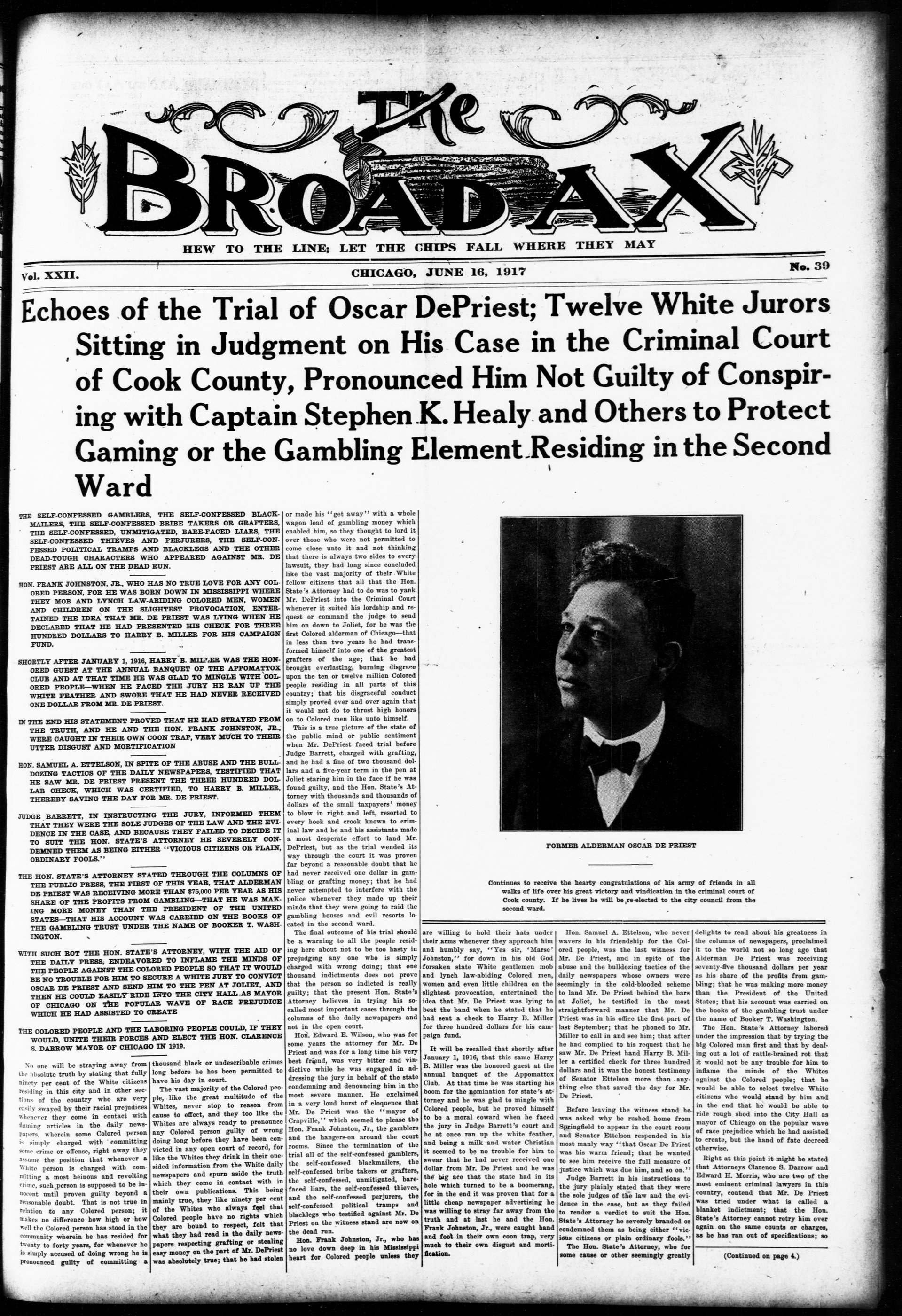
Echoes of the Trial of Oscar DePriest; Twelve White Jurors Sitting in Judgment on His Case in the Criminal Court of Cook County, Pronounced Him Not Guilty of Conspir ing with Captain Stephen K. Healy and Others to Protect Gaming or the Gambling Element Residing in the Second Ward
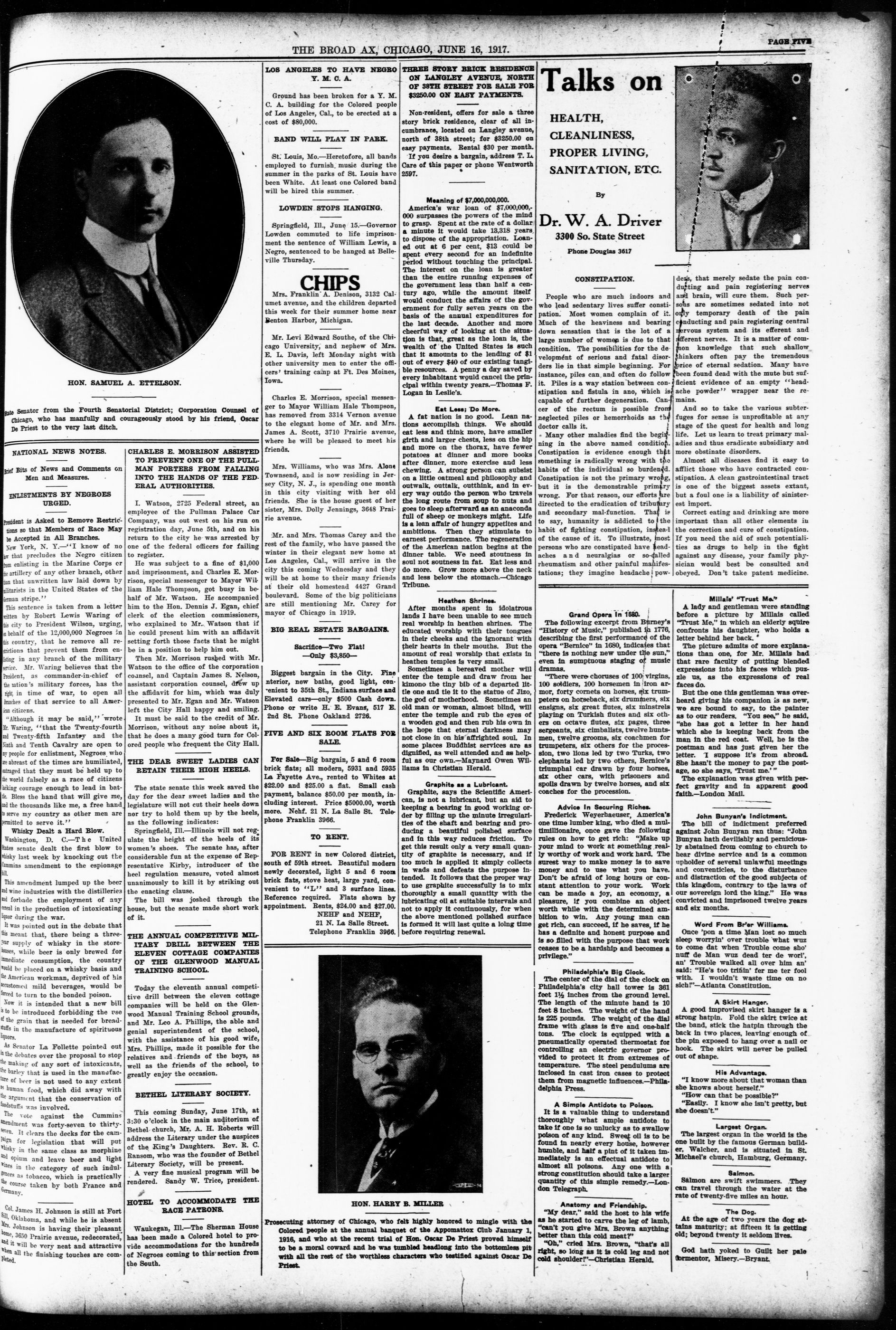
HON. SAMUEL A. ETTELSON, IN SPITE OF THE ABUSE AND THE BULL-DOZING TACTICS OF THE DAILY NEWSPAPERS, TESTIFIED THAT HE SAW MR. DE PRIEST PRESENT THE THREE HUNDRED DOLLAR CHECK, WHICH WAS CERTIFIED, TO HARRY B. MILLER, THEREBY SAVING THE DAY FOR MR. DE PRIEST.
JUDGE BARRETT, IN INSTRUCTING THE JUBY, INFORMED THEM THAT THEY WERE THE SOLE JUDGES OF THE LAW AND THE EVIDENCE IN THE CASE, AND BECAUSE THEY FAILED TO DECIDE IT TO SUIT THE HON. STATE'S ATTORNEY HE SEVERELY CONDEMNED THEM AS BEING EITHER "VICIOUS CITIZENS OR PLAIN, ORDINARY FOOLS."
THE HON. STATE'S ATTORNEY STATED THROUGH THE COLUMNS OF THE PUBLIC PRESS, THE FIRST OF THIS YEAR, THAT ALDERMAN DE PRIEST WAS RECEIVING MORE THAN $75,000 PER YEAR AS HIS SHARE OF THE PROFITS FROM GAMBLING—THAT HE WAS MAKING MORE MONEY THAN THE PRESIDENT OF THE UNITED STATES—THAT HIS ACCOUNT WAS CARRIED ON THE BOOKS OF THE GAMBLING TRUST UNDER THE NAME OF BOOKER T. WASHINGTON.
WITH SUCH ROT THE HON. STATE'S ATTORNEY, WITH THE AID OF THE DAILY PRESS, ENDEAVORED TO INFLAME THE MINDS OF THE PEOPLE AGAINST THE COLORED PEOPLE SO THAT IT WOULD BE NO TROUBLE FOR HIM TO SECURE A WHITE JUBY TO CONVICT OSCAR DE PRIEST AND SEND HIM TO THE PEN AT JOLIET, AND THEN HE COULD EASILY RIDE INTO THE CITY HALL AS MAYOR OF CHICAGO ON THE POPULAR WAVE OF RACE PREJUDICE WHICH HE HAD ASSISTED TO CREATE
THE COLORED PEOPLE AND THE LABORING PEOPLE COULD, IF THEY WOULD, UNITE THEIR FORCES AND ELECT THE HON. CLARENCE S. DARBOW MAYOR OF CHICAGO IN 1919.
Vol. XXII.
Echoes of Sitting of Coing with Gaming Ward
THE SELF-CONFESSED GAMBLERS MAILERS, THE SELF-CONFESSED, UNMITTED SELF-CONFESSED THIEVES A FESSED POLITICAL TRAMPS A DEAD-TOUGH CHARACTERS WHO PRIEST ARE ALL ON THE DEAD.
HON. FRANK JOHNSTON, JR., WHO ORED PERSON, FOR HE WAS BORN THEY MOB AND LYNCH LAWY AND CHILDREN ON THE SITE TAINED THE IDEA THAT MR. DECLARED THAT HE HAD PREHUNDDOLLARS TO HARRY FUND.
SHORTLY AFTER JANUARY 1, 1916, ORED GUEST AT THE ANNUAL CLUB AND AT THAT TIME HE ORED PEOPLE—WHEN HE FAILED FEATHER AND SWORE ONE DOLLAR FROM MR. DE PRIDE.
IN THE END HIS STATEMENT PROVED THE TRUTH, AND HE AND THE WERE CAUGHT IN THEIR OWN UTTER DISGUST AND MORTIFIES.
HON. SAMUEL A. ETTELSON, IN SPIRIT DOZING TACTICS OF THE DAID HE SAW MR. DE PRIEST PRESIDER CHECK, WHICH WAS CE THEREBY SAVING THE DAY FOUL.
JUDGE BARRETT, IN INSTRUCTION THAT THEY WERE THE SOLE JUDGE IN THE CASE, AND BEFORE TO SUIT THE HON. STATE'S DEMNED THEM AS BEING EITHER ORDINARY FOOLS."
THE HON. STATE'S ATTORNEY STATES THE PUBLIC PRESS, THE FIRST DE PRIEST WAS RECEIVING MORE MONEY THAN THE STATES—THAT HIS ACCOUNT TO THE GAMBLING TRUST UNDEEKINGTON.
WITH SUCH ROT THE HON. STATES THE DAILY PRESS, ENDEAVOR THE PEOPLE AGAINST THE COBENE NO TROUBLE FOR HIM TO SUSCAR DE PRIEST AND SEND THEN HE COULD EASILY RIDE OF CHICAGO ON THE POPULATION WHICH HE HAD ASSISTED TO O
THE COLORED PEOPLE AND THE INWOULD, UNITE THEIR FORCES. S. DARROW MAYOR OF CHICAGO.
No one will be straying away from the absolute truth by stating that fully ninety per cent of the White citizens residing in this city and in other sections of the country who are very easily swayed by their racial prejudices whenever they come in contact with flaming articles in the daily newspapers, wherein some Colored person is simply charged with committing some crime or offense, right away they assume the position that whenever a White person is charged with committing a most heinous and revolting crime, such person is supposed to be innocent until proven guilty beyond a reasonable doubt. That is not true in relation to any Colored person; it makes no difference how high or how well the Colored person has stood in the community wherein he has resided for twenty to forty years, for whenever he is simply accused of doing wrong he is pronounced guilty of committing a
thousand black or undescribable crimes long before he has been permitted to have his day in court.
The vast majority of the Colored people, like the great multitude of the Whites, never stop to reason from cause to effect, and they too like the Whites are always ready to pronounce any Colored person guilty of wrong doing long before they have been convicted in any open court of record, for like the Whites they drink in their one-sided information from the White daily newspapers and spurn aside the truth which they come in contact with in their own publications. This being mainly true, they like ninety per cent of the Whites who always feel that Colored people have no rights which they are bound to respect, felt that what they had read in the daily newspapers respecting grafting or stealing easy money on the part of Mr. DePriest was absolutely true; that he had stolen
CHICAGO. JUNE 16, 1917
or made his “get away” with a whole wagon load of gambling money which enabled him, so they thought to lord it over those who were not permitted to come close unto it and not thinking that there is always two sides to every lawsuit, they had long since concluded like the vast majority of their White fellow citizens that all that the Hon. State's Attorney had to do was to yank Mr. DePriest into the Criminal Court whenever it suited his lordship and request or command the judge to send him on down to Joliet, for he was the first Colored alderman of Chicago—that in less than two years he had transformed himself into one of the greatest grafters of the age; that he had brought everlasting, burning disgrace upon the ten or twelve million Colored people residing in all parts of this country; that his disgraceful conduct simply proved over and over again that it would not do to thrust high honors on to Colored men like unto himself.
This is a true picture of the state of the public mind or public sentiment when Mr. DePriest faced trial before Judge Barrett, charged with grafting, and he had a fine of two thousand dollars and a five-year term in the pen at Joliet staring him in the face if he was found guilty, and the Hon. State's Attorney with thousands and thousands of dollars of the small taxpayers' money to blow in right and left, resorted to every hook and crook known to criminal law and he and his assistants made a most desperate effort to land Mr. DePriest, but as the trial wended its way through the court it was proven far beyond a reasonable doubt that he had never received one dollar in gambling or grafting money; that he had never attempted to interfere with the police whenever they made up their minds that they were going to raid the gambling houses and evil resorts located in the second ward.
The final outcome of his trial should be a warning to all the people residing here about not to be too hasty in prejudging any one who is simply charged with wrong doing; that one thousand indictments does not prove that the person so indicted is really guilty; that the present Hon. State's Attorney believes in trying his so-called most important cases through the columns of the daily newspapers and not in the open court.
Continues to receive the hearty congratulations of his army of friends in all walks of life over his great victory and vindication in the criminal court of Cook county. If he lives he will be re-elected to the city council from the second ward.
are willing to hold their hats under their arms whenever they approach him and humbly say, "Yes sir, 'Marse' Johnston," for down in his old God forsaken state White gentlemen mob and lynch law-abiding Colored men, women and even little children on the slightest provocation, entertained the idea that Mr. De Priest was lying to beat the band when he stated that he had sent a check to Harry B. Miller for three hundred dollars for his campaign fund.
It will be recalled that shortly after January 1, 1916, that this same Harry B. Miller was the honored guest at the annual banquet of the Appomattox Club. At that time he was starting his boom for the nomination for state's attorney and he was glad to mingle with Colored people, but he proved himself to be a moral coward when he faced the jury in Judge Barrett's court and he at once ran up the white feather, and being a milk and water Christian it seemed to be no trouble for him to swear that he had never received one dollar from Mr. De Priest and he was the big ace that the state had in its hole which turned to be a boomerang, for in the end it was proven that for a little cheap newspaper advertising he was willing to stray far away from the truth and at last he and the Hon. Frank Johnston, Jr., were caught hand and foot in their own coon trap, very much to their own disgust and mortification.
Hon. Samuel A. Ettelson, who never wavers in his friendship for the Colored people, was the last witness for Mr. De Priest, and in spite of the abuse and the buldozing tactics of the daily newspapers whose owners were seemingly in the cold-blooded scheme to land Mr. De Priest behind the bars at Joliet, he testified in the most straightforward manner that Mr. De Priest was in his office the first part of last September; that he phoned to Mr. Miller to call in and see him; that after he had complied to his request that he saw Mr. De Priest hand Harry B. Miller a certified check for three hundred dollars and it was the honest testimony of Senator Ettelson more than anything else that saved the day for Mr. De Priest.
Before leaving the witness stand he was asked why he rushed home from Springfield to appear in the court room and Senator Ettelson responded in his most manly way "that Oscar De Priest was his warm friend; that he wanted to see him receive the full measure of justice which was due him, and so on."
Judge Barrett in his instructions to the jury plainly stated that they were the sole judges of the law and the evidence in the case, but as they failed to render a verdict to suit the Hon. State's Attorney he severely branded or condemned them as being either "vicious citizens or plain ordinary fools." The Hon. State's Attorney, who for some cause or other seemingly greatly
No.39
White Jurors
final Court
of Conspir-
to Protect
the Second
y of friends in all
the criminal court of
y council from the
delights to read about his greatness in the columns of newspapers, proclaimed it to the world not so long ago that Alderman De Priest was receiving seventy-five thousand dollars per year as his share of the profits from gambling; that he was making more money than the President of the United States; that his account was carried on the books of the gambling trust under the name of Booker T. Washington. The Hon. State's Attorney labored under the impression that by trying the big Colored man first and that by dealing out a lot of rattle-brained rot that it would not be any trouble for him to inflame the minds of the Whites against the Colored people; that he would be able to select twelve White citizens who would stand by him and in the end that he would be able to ride rough shod into the City Hall as mayor of Chicago on the popular wave of race prejudice which he had assisted to create, but the hand of fate decreed otherwise.
Right at this point it might be stated that Attorneys Clarence S. Darrow and Edward H. Morris, who are two of the most eminent criminal lawyers in this country, contend that Mr. De Priest was tried under what is called a blanket indictment; that the Hon. State's Attorney cannot retry him over again on the same counts or charges, as he has ran out of specifications; so
(Continued on page 4.)
Dan M. Jackson
Geo. T. Kersey
David A. McGowan
Ahmed A. Rayner
The Emanuel Jackson Undertaking Co., Inc.
2959-61 South State St.
Reliable Service Courteous Treatment
Reasonable Prices
FREE CHAPEL IN CONNECTION
Complete line of Funeral Goods. Automobiles for hire
FREE
STYLE BOOK
HAIR
To Colored Women
We are the largest
manufacturers of
Colored Women's
Hair. Our latest
book showing new
style in hair
dressing sent free.
Every colored wom-
man should have
We will throw
sands our hair and
toilet articles. Satis-
faction guaranteed
or money back.
We make the best
solid Brass STRAIGHT-
ENING combs, with extra heavy back, fully
guaranteed. With each comb we give lamp cap
FREE. Send money order or stamps. MONEY
BACK IF NOT SATISFACTORY. See postpaid.
POSTPAID 89c
Haircuts, hairstyles, combs and toled articles
manufacturer's prices. Send two-cent stamp.
Agents Wanted. Address as follows:
HUMANIA HAIR COMPANY,
181-187 Park Row,
New York City.
Address Dept. 84
THEU.S.REDCROSS
Wife of One Time Minister to Belgium Serves With Zest.
ON MRS. WILSON'S COMMITTEE
Mrs. Anderson, Aided by Great Wealth, Social Popularity and Many Friends, Is Zealously Aiding Red Cross Work on the Local Committee.
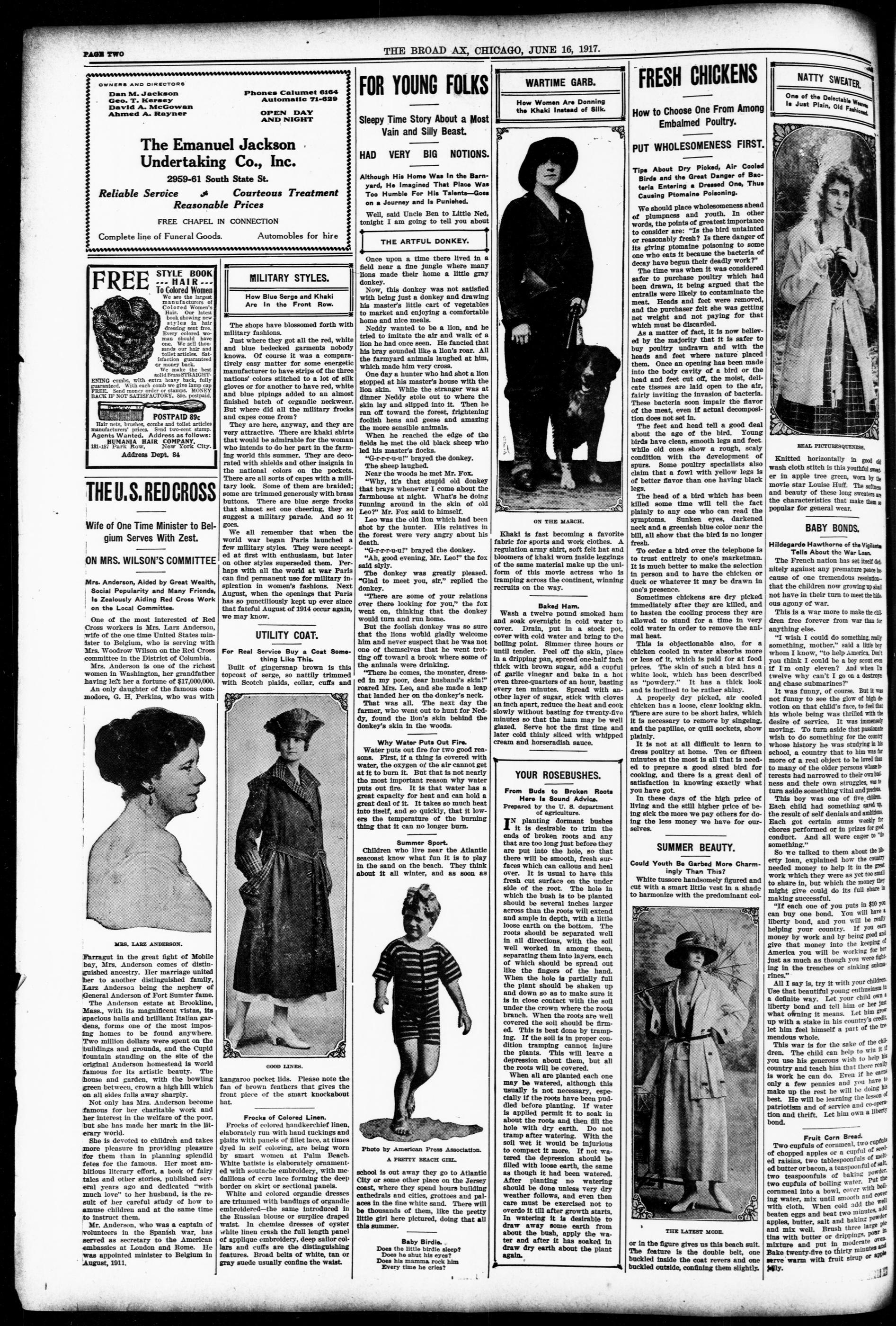
One of the most interested of Red Cross workers is Mrs. Larz Anderson, wife of the one time United States minister to Belgium, who is serving with Mrs. Woodrow Wilson on the Red Cross committee in the District of Columbia.
Mrs. Anderson is one of the richest women in Washington, her grandfather having left her a fortune of $17,000,000.
An only daughter of the famous commodore, G. H. Perkins, who was with
P
MRS. LAZE ANDERSON.
Farragut in the great fight of Mobile bay, Mrs. Anderson comes of distinguished ancestry. Her marriage united her to another distinguished family, Larz Anderson being the nephew of General Anderson of Fort Sumter fame. The Anderson estate at Brookline, Mass., with its magnificent vistas, its spacious halls and brilliant Italian gardens, forms one of the most imposing homes to be found anywhere. Two million dollars were spent on the buildings and grounds, and the Cupid fountain standing on the site of the original Anderson homestead is world famous for its artistic beauty. The house and garden, with the bowling green between, crown a high hill which on all sides falls away sharply.
Not only has Mrs. Anderson become famous for her charitable work and her interest in the welfare of the poor, but she has made her mark in the literary world.
She is devoted to children and takes more pleasure in providing pleasure for them than in planning splendid fetes for the famous. Her most ambitious literary effort, a book of fairy tales and other stories, published several years ago and dedicated "with much love" to her husband, is the result of her careful study of how to amuse children and at the same time to instruct them.
Mr. Anderson, who was a captain of volunteers in the Spanish war, has served as secretary to the American embassies at London and Rome. He was appointed minister to Belgium in August, 1911.
---
PAGE TWO
#
Phones Calumet 6164
Automatic 71-629
OPEN DAY
AND NIGHT
s. Automobles for hire
MILITARY STYLES.
How Blue Serge and Khaki Are In the Front Row.
The shops have blossomed forth with military fashions.
Just where they got all the red, white and blue bedecked garments nobody knows. Of course it was a comparatively easy matter for some energetic manufacturer to have strips of the three nations' colors stitched to a lot of silk gloves or for another to have red, white and blue pipings added to an almost finished batch of organdie neckwear. But where did all the military frocks and capes come from?
They are here, anyway, and they are very attractive. There are khaki shirts that would be admirable for the woman who intends to do her part in the farming world this summer. They are decorated with shields and other insignia in the national colors on the pockets. There are all sorts of capes with a military look. Some of them are braided; some are trimmed generously with brass buttons. There are blue serge frocks that almost set one cheering, they so suggest a military parade. And so it goes.
We all remember that when the world war began Paris launched a few military styles. They were accepted at first with enthusiasm, but later on other styles superseded them. Perhaps with all the world at war Paris can find permanent use for military inspiration in women's fashions. Next August, when the openings that Paris has so punctiliously kept up ever since that fateful August of 1914 occur again, we may know.
UTILITY COAT.
For Real Service Buy a Coat Something Like This.
Built of gingersnap brown is this topcoat of serge, so nattily trimmed with Scotch plaids, collar, cuffs and
THE COAT
GOOD LINES.
kangaroo pocket lids. Please note the fan of brown feathers that gives the front piece of the smart knockabout hat.
Frocks of Colored Linen.
Frocks of colored handkerchief linen, elaborately run with hand tuckings and plaits with panels of fillet lace, at times dyed in self coloring, are being worn by smart women at Palm Beach. White batiste is elaborately ornamented with soutache embroidery, with medallions of ceru lace forming the deep border on skirt or sectional panels. White and colored organdle dresses are trimmed with bandings of organdle embroidered—the same introduced in the Russian blouse or surplice draped waist. In chemise dresses of oyster white linen crash the full length panel of applique embroidery, deep sailor collars and cuffs are the distinguishing features. Broad belts of white, tan or gray suede usually confine the waist.
---
THE BROAD AX. CHICAGO, JUNE 16, 1917.
FOR YOUNG FOLKS
Sleepy Time Story About a Most Vain and Silly Beast.
Although His Home Was In the Barn-yard, He Imagined That Place Was Too Humble For His Talents—Goes on a Journey and Is Punished.
Well, said Uncle Ben to Little Ned, tonight I am going to tell you about
THE ARTFUL DONKEY.
Once upon a time there lived in a field near a fine jungle where many lions made their home a little gray donkey.
Now, this donkey was not satisfied with being just a donkey and drawing his master's little cart of vegetables to market and enjoying a comfortable home and nice meals.
Neddy wanted to be a lion, and he tried to imitate the air and walk of a lion he had once seen. He fancied that his bray sounded like a lion's roar. All the farmyard animals laughed at him, which made him very cross.
One day a hunter who had shot a lion stopped at his master's house with the lion skin. While the stranger was at dinner Neddy stole out to where the skin lay and slipped into it. Then he ran off toward the forest, frightening foolish hens and geese and amazing the more sensible animals.
When he reached the edge of the fields he met the old black sheep who led his master's flocks.
"G-r-r-u-u!" brayed the donkey.
The sheep laughed.
Near the woods he met Mr. Fox.
"Why, it's that stupid old donkey that brays whenever I come about the farmhouse at night. What's he doing running around in the skin of old Leo?" Mr. Fox said to himself.
Leo was the old lion which had been shot by the hunter. His relatives in the forest were very angry about his death.
"G-r-r-u-u!" brayed the donkey.
"Ah, good evening, Mr. Leo!" the fox said slyly.
The donkey was greatly pleased.
"Glad to meet you, sir," replied the donkey.
"There are some of your relations over there looking for you," the fox went on, thinking that the donkey would turn and run home.
But the foolish donkey was so sure that the lions would gladly welcome him and never suspect that he was not one of themselves that he went trotting off toward a brook where some of the animals were drinking.
"There he comes, the monster, dressed in my poor, dear husband's skin!" roared Mrs. Leo, and she made a leap that landed her on the donkey's neck.
That was all. The next day the farmer, who went out to hunt for Neddy, found the lion's skin behind the donkey's skin in the woods.
Why Water Puts Out Fire.
Water puts out fire for two good reasons. First, if a thing is covered with water, the oxygen of the air cannot get at it to burn it. But that is not nearly the most important reason why water puts out fire. It is that water has a great capacity for heat and can hold a great deal of it. It takes so much heat into itself, and so quickly, that it lowers the temperature of the burning thing that it can no longer burn.
Summer Sport.
Children who live near the Atlantic seacount know what fun it is to play in the sand on the beach. They think about it all winter, and as soon as
```markdown
```
Photo by American Press Association.
A PRETTY BEACH GIRL.
school is out away they go to Atlantic City or some other place on the Jersey coast, where they spend hours building cathedrals and cities, grottoes and palaces in the fine white sand. There will be thousands of them, like the pretty little girl here pictured, doing that all this summer.
Baby Birdie.
Does the little birdie sleep?
Does he shut his eyes?
Does his mamma rock him
Every time he cries?
How Women Are Donning the Khaki Instead of Silk.
N.Y.C.
ON THE MARCH.
Khakl is fast becoming a favorite fabric for sports and work clothes. A regulation army shirt, soft felt hat and bloomers of khakl worn inside leggings of the same material make up the uniform of this movie actress who is tramping across the continent, winning recruits on the way.
Baked Ham.
Wash a twelve pound smoked ham and soak overnight in cold water to cover. Drain, put in a stock pot, cover with cold water and bring to the boiling point. Simmer three hours or until tender. Peel off the skin, place in a dripping pan, spread one-half inch thick with brown sugar, add a cupful of garlic vinegar and bake in a hot oven three-quarters of an hour, basting every ten minutes. Spread with another layer of sugar, stick with cloves an inch apart, reduce the heat and cook slowly without basting for twenty-five minutes so that the ham may be well glazed. Serve hot the first time and later cold thinly sliced with whipped cream and horseradish sauce.
YOUR ROSEBUSHES.
From Buds to Broken Roots Here Is Sound Advice. Prepared by the U. S. department of agriculture.
IN planting dormant bushes it is desirable to trim the ends of broken roots and any that are too long just before they are put into the hole, so that there will be smooth, fresh surfaces which can callous and heal over. It is usual to have this fresh cut surface on the under side of the root. The hole in which the bush is to be planted should be several inches larger across than the roots will extend and ample in depth, with a little loose earth on the bottom. The roots should be separated well in all directions, with the soil well worked in among them, separating them into layers, each of which should be spread out like the fingers of the hand. When the hole is partially full the plant should be shaken up and down so as to make sure it is in close contact with the soil under the crown where the roots branch. When the roots are well covered the soil should be firmed. This is best done by tramping. If the soil is in proper condition tramping cannot injure the plants. This will leave a depression about them, but all the roots will be covered.
When all are planted each one may be watered, although this usually is not necessary, especially if the roots have been puddled before planting. If water is applied permit it to soak in about the roots and then fill the hole with dry earth. Do not tramp after watering. With the soil wet it would be injurious to compact it more. If not watered the depression should be filled with loose earth, the same as though it had been watered. After planting no watering should be done unless very dry weather follows, and even then care must be exercised not to overdo it till after growth starts. In watering it is desirable to draw away some earth from about the bush, apply the water and after it has soaked in draw dry earth about the plant again.
FRESH CHICKENS
FRESH CHICKENS
How to Choose One From Among Embalmed Poultry.
PUT WHOLESOMENESS FIRST.
Tips About Dry Picked, Air Cooled Birds and the Great Danger of Bacteria Entering a Dressed One, Thus Causing Ptomaine Poisoning.
We should place wholesomeness ahead of plumness and youth. In other words, the points of greatest importance to consider are: "Is the bird untainted or reasonably fresh? Is there danger of its giving ptomaine poisoning to some one who eats it because the bacteria of decay have begun their deadly work?"
The time was when it was considered safer to purchase poultry which had been drawn, it being argued that the entrails were likely to contaminate the meat. Heads and feet were removed, and the purchaser felt she was getting net weight and not paying for that which must be discarded.
As a matter of fact, it is now believed by the majority that it is safer to buy poultry undrawn and with the heads and feet where nature placed them. Once an opening has been made into the body cavity of a bird or the head and feet cut off, the moist, delicate tissues are laid open to the air, fairly inviting the invasion of bacteria. These bacteria soon impair the flavor of the meat, even if actual decomposition does not set in.
The feet and head tell a good deal about the age of the bird. Young birds have clean, smooth legs and feet. while old ones show a rough, scaly condition with the development of spurs. Some poultry specialists also claim that a fowl with yellow legs is of better flavor than one having black legs. The head of a bird which has been killed some time will tell the fact plainly to any one who can read the symptoms. Sunken eyes, darkened neck and a greenish blue color near the bill, all show that the bird is no longer fresh. To order a bird over the telephone is to trust entirely to one's marketman. It is much better to make the selection in person and to have the chicken or duck or whatever it may be drawn in one's presence.
Sometimes chickens are dry picked immediately after they are killed, and to hasten the cooling process they are allowed to stand for a time in very cold water in order to remove the animal heat.
This is objectionable also, for a chicken cooled in water absorbs more or less of it, which is paid for at food prices. The skin of such a bird has a white look, which has been described as "powdery." It has a thick look and is inclined to be rather shiny.
A properly dry picked, air cooled chicken has a loose, clear looking skin. There are sure to be short hairs, which it is necessary to remove by singing, and the papillae, or quill sockets, show plainly.
It is not at all difficult to learn to dress poultry at home. Ten or fifteen minutes at the most is all that is needed to prepare a good sized bird for cooking, and there is a great deal of satisfaction in knowing exactly what you have got.
In these days of the high price of living and the still higher price of being sick the more we pay prices for doing the less money we have for ourselves.
SUMMER BEAUTY.
Could Youth Be Garbed More Charmingly Than This?
White tussle handsomely figured and cut with a smart little vest in a shade to harmonize with the predominant col
THE WORLD'S FASHIONIST
THE LATEST MODE.
or in the figure gives us this beach suit.
The feature is the double belt, one buckled inside the coat revers and one buckled outside, confining them slightly.
NATTY SWEATER.
One of the Delectable Weavers
Is Just Plain, Old Fashioned.
REAL PICTURESQUENESS.
Knitted horizontally in good old wash cloth stitch is this youthful sweater in apple tree green, worn by the movie star Louise Huff. The softness and beauty of these long sweaters are the characteristics that make them so popular for general wear.
BABY BONDS.
Hildegarde Hawthorne of the Vigilant
Tells About the War Loan.
The French nation has set itself defi-
nately against any premature peace be-
cause of one tremendous resolution-
that the children now growing up shall
not have in their turn to meet the hide-
ous agony of war.
This is a war more to make the child-
ren free forever from war than for
anything else.
"I wish I could do something, really
something, mother," said a little boy
whom I know, "to help America. Don't
you think I could be a boy scout even
if I am only eleven? And when I
twelve why can't I go on a destro-
ge and chase submarines?"
It was funny, of course. But it was not funny to see the glow of high devotion on that child's face, to feel that his whole being was thrilled with the desire of service. It was immensely moving. To turn aside that passionate wish to do something for the country whose history he was studying in his school, a country that to him was far more of a real object to be loved than to many of the older persons whose interests had narrowed to their own business and their own struggles, was to turn aside something vital and precious. This boy was one of five children. Each child had something saved up, the result of self denials and ambitions. Each got certain sums weekly for chores performed or in prizes for good conduct. And all were eager to "something."
So we talked to them about the liberty loan, explained how the country needed money to help it in the great work which they were as yet too small to share in, but which the money they might give could do its full share in making successful.
"If each one of you puts in $10 you can buy one bond. You will have a liberty bond, and you will be really helping your country. If you earn money by work and by being good and give that money into the keeping of America you will be working for her just as much as though you were fighting in the trenches or sinking submarines."
All I say is, try it with your children. Use that beautiful young enthusiasm in a definite way. Let your child own a liberty bond and tell him or her just what owning it means. Let him grow up with a stake in his country's credit. let him feel himself a part of the treemouth whole.
This war is for the sake of the children. The child can help to win it if you use his generous wish to help his country and teach him that there really is work he can do. Even if he earns only a few pennies and you have to make up the rest he will be doing his best. He will be learning the lesson of patriotism and of service and co-operation and thrift. Let him own a liberty bond.
Fruit Corn Bread.
Two cupfuls of cornmeal, two cupfuls of chopped apples or a cupful of seeded raisins, two tablespoonfuls of melted butter or bacon, a teaspoonful of salt two teaspoonfuls of baking powder, two cupfuls of boiling water. Put the cornmeal into a bowl, cover with boiling water, mix until smooth and cover with cloth. When cold add the well beaten eggs and beat two minutes, add apples, butter, salt and baking powder and mix well. Brush three large pits with butter or drippings, pour in mixture and put in moderate oven. Bake twenty-five to thirty minutes and serve warm with fruit stirrup or apple salty.
Unusual Opportunities Are Offered For Advancement.
Those Assigned to Flying Corps,
Whether Trained as Pilots or Not,
Receive 50 Per Cent Increase In Their
Pay and 50 Cents Per Day For Extra
Duty.
BY FIRST LIEUTENANT ALFRED A.
CUNNINGHAM, U. S. M. C.
Washington.-The last congress
established a navy flying corps, which
consists of officers and men detailed
from the navy and marine corps in the
proportion of four of the navy to one
of the marine corps. Civilians will be
taken in as acting ensigns and second
intentions.
Numbers of men do not win promotion readily as soldiers because they lack that military bearing and manner so essential to good soldiers, but who are intelligent and have mechanical ability and can be readily trained as good aviation mechanics. For such men the flying corps is their best chance for promotion. Discipline in aviation is as important as in any other branch of the service, but a man's military smartness can be subordinated to
AIRCRAFT AVIATOR
LEUTENANT A. A. CUNNINGHAM, UNITED STATES MARINE CORPS AVIATOR.
some extent to his technical ability. The man, whether he has marked mechanical ability or not, who has an intelligent mind, is willing to work without having tasks assigned him and is above all so thoroughly careful and reliable that an aviator can feel perfectly confident while flying an aeroplane he has been working on is desirable for the flying corps. On account of the nature of the work it becomes imperative to remove a man who shows the slightest signs of carelessness.
Qualifications for an enlisted pilot are mainly physical and psychological, and men for this position will be chosen for their suitable qualities. In general the man should be absolutely perfect as regards heart, eyesight, digestion, sense of equilibrium and nervous system. He should not be over thirty years old. There should be no question as to the quality of his "nerve." This does not mean recklessness. The man who has undermined his constitution with dissipation will not be chosen.
Marines assigned to the flying corps, whether trained as pilots or not, receive 50 per cent increase on their pay and 50 cents per day for extra duty as aviation mechanics. The crew of each aeroplane consists of the chief mechanic, with rank of gunnery sergeant or sergeant; one noncommissioned officer as motor man, one noncommissioned officer as plane and wire man and two privates as helpers. From this it can be seen that the flying corps needs comparatively few men who are not suitable for noncommissioned officers. Enlisted men in the navy flying corps have unusual opportunities not only for advancement in rank, but they receive an excellent mechanical course of training which will fit them for a good position in civil life.
Enlisted men assigned to aviation, regardless of their rank, are treated as students until they have been given a thorough course of training in handling, cleaning and repairing aeroplanes and motors on the ground. They are then trained in assembling aeroplanes and lining them up properly. Next they are given a thorough course in disassembling, cleaning, assembling and making all adjustments to each type of aeroplanet motor used at the station.
CALLED "THE WAR OF 1917."
Present Struggle So Designated In Documents on Pension Claims.
Washington.—In the annals of the pension bureau, which already has on file two applications for pensions on account of deaths since the declaration of war, the present struggle will go down to posterity in America as "the war of 1917."
Announcing the official designation the bureau said that it was decided on for use in the records because no other suitable name could be found.
The applications came from Ruth Thomas of Annapolis, widow of Lieutenant Clarence C. Thomas, killed on the Vacuum, and Mrs. Hannah Hallberg of Jamestown, N. Y., whose son, Frankie Hallberg, a member of the national guard, was killed by a train when guarding a bridge.
YOUTH STOPS PLOWING WHEN HE HEARS OF WAR
YOUTH STOPS PLOWING WHEN HE HEARS OF WAR
Makes His Way to City to Enlist In the Navy.
Little Rock, Ark.—When knowledge that the United States wanted men to join the army and navy for defense of the country against a foreign power reached Harvey Ethridge, eighteen years old, of Conway county, he stopped his plow in the midst of a furrow and made his way to this city to enlist in the navy.
He arrived on the very day that a preparedness meeting had been arranged to take place under the auspices of the chamber of commerce and attended that meeting. When enthusiasm was at its height the chairman of the patriotic gathering summoned Harvey to the platform. The distinction almost took the breath of the country youth, and he hesitated.
Finally he was induced to stand before the audience, and when invited to state his reasons for promptly offering his services to the country could do so only in halting language that could be heard only by those nearest him.
Nevertheless the crowd cheered him long and loud as one who, although clearly not a fluent orator, had shown himself ready to do his bit in a way that counts more strongly than a mastery of public speaking.
DR. FARRAND TO FIGHT PLAGUE IN FRANCE
DR. FARRAND TO FIGHT PLAGUE IN FRANCE
Gets Year's Leave of Absence to Conduct Campaign of Education There.
New York.-The Rockefeller foundation announced that Dr. Livingston Farrand, president of the University of Colorado, had been granted a year's leave of absence to undertake a campaign against tuberculosis in France under the auspices of the international health board of the foundation.
Dr. Farrand, formerly for many years secretary of the National Association For the Study and Prevention of Tuberculosis, with one or two assistants, expects to sail for France within the next few weeks. The plans outlined by the foundation include:
The maintenance of a central organization which will have general supervision of the work under the French government and which will undertake the preparation of literature and exhibit material and will carry out a comprehensive plan of education for the control of tuberculosis.
The organization of four mobile units, which, moving from place to place, will carry on a campaign of education and publicity. Demonstration of dispensary methods and organization of local committees under whose auspices permanent dispensaries will be established. The establishment of at least four centers for the training of nurses and others who will have charge of the dispensary work.
SQUIRRELS HIDE POTATOES.
Oregon Man Will Increase His Plantings of Tubers by Three Pecks.
Hood River, Ore.—Luhr Jensen will increase his plantings of potatoes by three pecks.
Recently Mr. Jensen scattered polished wheat around the burrows and runways of a colony of troublesome digger squirrels near his barn. The poison was apparently fatal, for all of the squirrels disappeared. Mr. Jensen out of curiosity decided to investigate the underground tunnels of the rodents.
As his excavations progressed he unearthed seven dead diggers and three pecks of fine seed potatoes that the squirrels, forewarned perhaps of the impending food shortage, had stolen from the rancher's granary and had hoarded in the storage retreats of their underground home.
BOY. PLAYING SPY, DIES.
His Mother Finds Him Hanged to Bedpost.
New York.—Joseph Heissner, ten, a lieutenant in the cadet corps of Public school 4, Long Island City, indulged in many games while alone in his home at 90 Sunswick street, Long Island City. His favorite pastime of late has been to capture spies and deal with them as all spies and traitors deserve to be treated.
In the absence of his mother recently the boy was practicing with rope and noose and slipped the loop about his neck, with the other end made fast to the bedpost. The game was more realistic than little Joseph intended it to be, for when his mother returned she found her son strangled to death and fast to the bedpost.
GERMAN NAME PREVENTS HIM FROM BEING HERO.
Syracuse, N. Y. — Christopher Schlacher, gridiron hero of Syracuse university, has learned "what's in a name." Merely the Teutonic flavor of his appellation was enough to keep Schlacher out of the university ambulance unit soon to go to France, although the All American player put in an application.
THE BROAD AX, CHICAGO, JUNE 16, 1917.
MAKING SOLDIERS
Daily Life at Plattsburg Camp Interestingly Told.
CAPTAIN GETS ATTENTION.
Under His Spell Slack Minded, Careless Habited Men From Every Conceivable Corner of Civil Life Are Getting on Toward the Beginning of a Regeneration.
Plattsburg, N. Y.—My captain is a worker of magic—all colors. There are 167 of us upon whom his necromancy has descended and upon whom it is working its changes, says John M. Oskison of the Vigilantes.
In our day to day life, before we stepped into this atmosphere of bugle call and policing of cantonments, we not merely wanted what we wanted when we wanted it, but did what we had to do when we wanted to. Darn independent Americans we were—with that sign over our desks which reminded us that if we didn't care for a man our privilege was to tell him to go to—However, I started out to tell about our captain. At our first formation he came before us, a slender man, in smooth strides, stopped abruptly and said very distinctly, "At ease." Whereupon he looked us over, running his black eyes slowly along our ranks. We were not at ease under that scrutiny—believe me. Then: "Tenshun!" We made ourselves more rigid—if such an achievement were possible.
"Rest!" We relaxed then, for we had not altogether neglected our drill books in the days of hurry and planning for this training camp. Again:
"Tenshun!" We simulated in our several strange fashions the well known ramrod. Then from our captain:
"When you come to the position of 'attention' you snap into it, heels together or as near together as the conformation of the body will permit." There was a pause, a slight twitching of our captain's face muscles. I knew we would like him as soon as I saw that fragment of a grin and reflected that his eyes were caught by the bandy legged little Irishman, whom I will call Casey. We'd known Casey nearly ten hours—and were convinced. The army needs him, even though his heels are three inches apart as he takes the position of the soldier.
Again, I am getting away from the text of this little piece and the man who furnishes the illustration. Thinking of our captain and his immediate appreciation of Casey probably accounts for my diversion. "This is the way it is done," said our captain, facing first right and then left and coming to "attention." "It is not a position of strain. It is one of alertness—of readiness. "Now, 'tenshun! At ease! Next time snap into it. 'Tenshun! That's better.' And so on. Snapping into it was established as the company ideal. A quality of crisp decision marks our captain as of the younger generation of American army men. He isn't the kind that "catts his young"—fierce and terrifying. We say in cantonment comment that our captain knows. If he ever had a period of fumbling adolescence it must have been long, long ago. Now he knows and can tell what he knows.
Under his magic spell we slack minded, careless habited men from every conceivable corner of civil life are getting on toward the beginning of a regeneration. We are cutting off our corners sharply at "Column right!" and "Column left!" As the fellow next me parodies the Billy Sunday hymn, "Cut off the Corners! Cut off the Corners! Cut off the Corners as You Turn!" We are learning to stand at a balance —weight equally distributed between the balls and heels of the feet. The ramrod effect is passing. We are beginning to sense the real meaning of "Attention!" It is 100 per cent alertness, from toe to the last convolution of gray matter in the headpiece. As I said, we are victims of our captain's magic. Need I add, willing victims? You just naturally snap into it for the man that knows.
AVIATOR BALL IS DEAD.
British Announce Missing Flier Was Fatally Hurt May 7.
London.—The war office has received information that Captain Albert Ball, who had made a brilliant record in the aviation corps and who had been missing since May 7, is dead. He was twenty-one years old.
Captain Ball was engaged in a fight with three German planes on the evening of May 7 near Lens. When he did not return to his base it was reported that he had been captured by the enemy.
At the time of his death Captain Ball had a record of bringing down forty German machines. He had received the medal for distinguished service and the military cross. He lived in Nottingham.
OLD WOUND REMAINS.
Civil War Veteran's Pierced Leg Gives Way In Half Century.
Greensburg, Pa. — More than fifty years after he was injured by a bullet in the civil war, a bone in the left leg of Louis Osterwise gave way, and the old soldier fell helpless in his chair.
When he was taken to the Westmoreland hospital physicians found that the bone had broken off at the point where the bullet had struck. Mr. Osterwise is seventy-three years old. His condition is critical.
RECLUSE HAD FORTUNE
Gold Coin and Certificates of Deposit Found After His Death.
Pendleton, Ore.—In an investigation of the death of Johnson W. Willard, an aged recluse of the farming district southeast of Milton, Coroner Brown discovered gold coin and certificates of deposit amounting to more than $16,000. They were tucked away in every conceivable place. An old vest hanging in a closet yielded several hundred dollars in gold.
Three or four purses were found packed with coin. In addition to this, Mr. Willard owned the ranch where he lived, valued at $50,000. One daughter, Mrs. Hill, survives. Her home is in Montana.
Mr. Willard lived entirely to himself since the death of his wife three years ago, and the room she used to occupy had been locked. It was there, in the bottom of a trunk, that several of the certificates of deposit were found.
During the past few years Mr. Willard leased his ranch, retaining only the house and a bit of ground, where he raised a small garden. He settled on a homestead in 1860, just after the war, and in the typhoid epidemic of 1878 lost all his children but the one daughter. Mr. Willard was eighty-six.
CARNEGIE IN NEW MANSION.
Estate at Lenox Said to Be Equaled Only by Biltmore.
Lenox, Mass.—Into Shadow Brook entered its new owner, Andrew Carnegie. It is said that for size, elegance and beauty of natural surroundings no private residence in the United States, with the exception of Mrs. Vanderbilt's Biltmore, bears comparison with Shadow Brook.
With Mrs. Carnegie and Miss Margaret Carnegie he arrived at Lenox in Charles M. Schwab's private car. With the party were Mr. Carnegie's physician, his valet and other attendants. He was assisted from the car to an automobile and was driven immediately to Shadow Brook, three miles from the station.
His apartments are on the second floor of the great house and have a beautiful outlook on Lake Mahkeenac. The house was elaborately decorated in spring flowers from the gardens of the estate. Mrs. Carnegie and Miss Carnegie have rooms on the same floor. There are twenty large rooms with fireplaces on this floor and many other rooms. Mr. Carnegie expects to pass seven months at his new American home.
WILSON ON JOB EARLY.
President Adopts Early Rising Permanently to Keep In Touch With War. Washington.—While a majority of the 50,000 government clerks were still asleep the president was working in his office early. He reached his desk at 6 o'clock, and it became known he is determined to adopt this hour as the daily beginning of his work. Government clerks go to work at 9 o'clock and finish at 4:30. The president frequently is in his office at night. The president's determination to get up early is not prompted wholly by a desire to avoid the hot hours of the day. The fact is that he is keeping in the closest touch with the details of the war making activities of the administration, and longer working hours are necessary if he is to have time for the recreation prescribed by Rear Admiral Cary T. Grayson, his physician.
SEES ALL AMERICAS IN WAR
John Barrett Predicts Western Hemisphere Will Be United.
Baltimore.—Within a year all Americas will be fighting together against Germany was the prediction made here before a liberty loan mass meeting by John Barrett.
"If Brazil enters the conflict, as today seems imminent," he said, "two-thirds of the entire population and five-eighths of the total area of the western hemisphere will be at war with the common enemy. Can the remaining one-third of the population and three-eighths of area stand against the psychological, sympathetic and economic appeal of their sister peoples and countries having similar interests, similar institutions, similar governments and similar destiny?"
LIONS KILL BURROS.
Hoofs No Match For Pointed Teeth and Sharp Claws.
Mentone, Cal. — Hunger has driven mountain lions and wildcats closer to the settlements than in many years, say old timers. One night recently two big lions made their appearance at the Edison power house at the mouth of Mill Creek canyon and killed two burros kept in a corral there.
One burro was killed outright by the lions. The other burro fought and attracted the men at the plant, but it was so badly torn by teeth and claws of the lions that it had to be shot.
The tracks showed the mountain lions to be of great size, and the men kept a close watch in the hope that hunger would drive them out again.
Calf Grazes With Wooden Leg.
Kansas City, Mo.—Probably the only Missouri calf with a wooden leg is browsing on the farm of W. D. Brown in Ray county. The calf belonged to a neighbor and last winter stuck a nail in its hoof, sustaining injuries promising to be fatal. Craig Brown saw the calf and had an idea. He bought the animal and sent for a veterinary, who amputated the calf's leg. Later a wooden leg was substituted, and the calf is now only a little slower than he other cattle in the pasture.
QUEEN GETS REST
Elizabeth Broken Down by Destitution of Belgians.
RECUPERATES IN FLORENCE.
Florentines Had Never Seen Her Before, and In Street Her Frail Figure Attracted No Attention—None Permitted to Do Her Homage as Queen of Stricken Land.
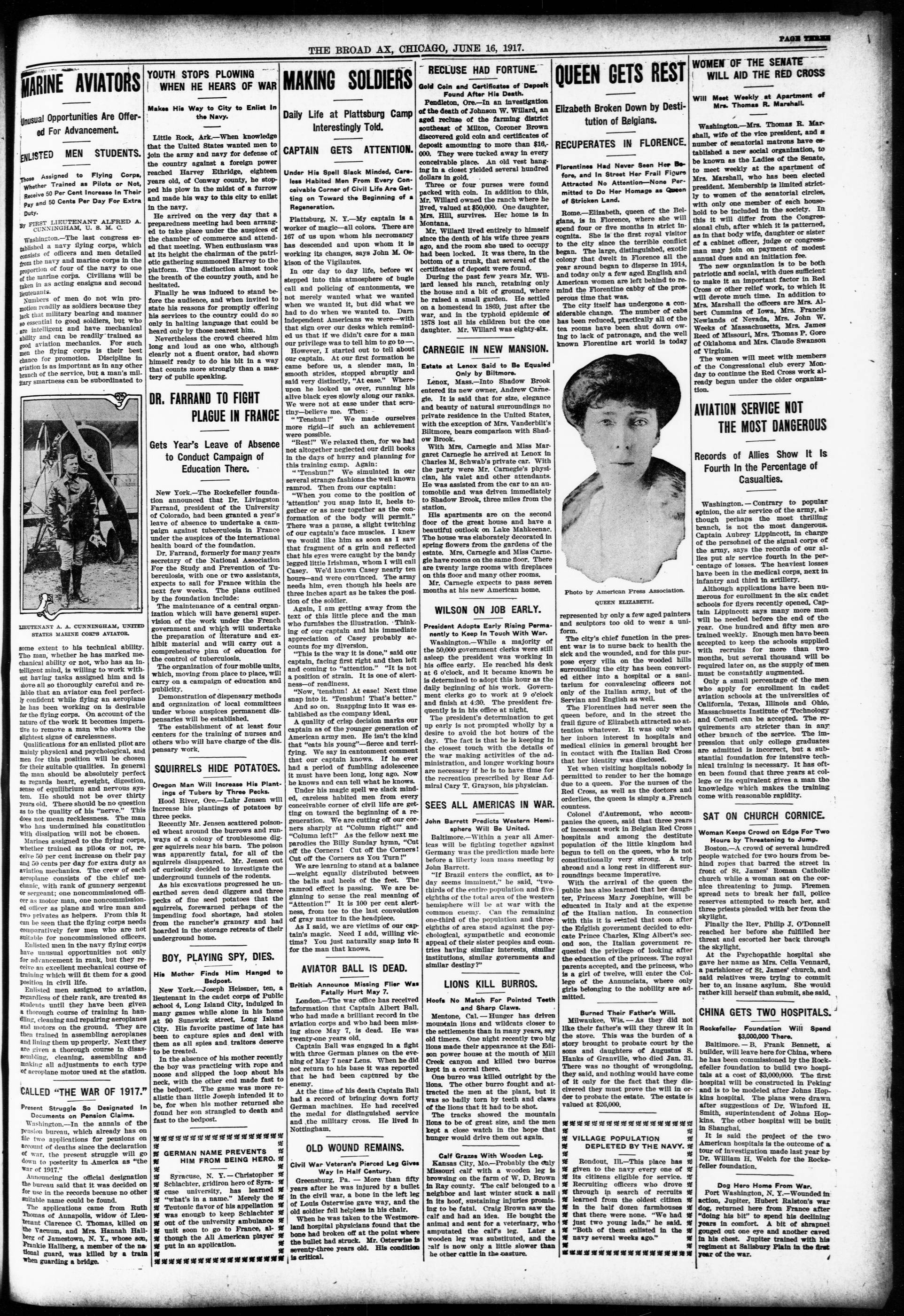
Rome.—Elizabeth, queen of the Belgians, is in Florence, where she will spend four or five months in strict incognita. She is the first royal visitor to the city since the terrible conflict began. The large, distinguished, exotic colony that dwelt in Florence all the year around began to disperse in 1914, and today only a few aged English and American women are left behind to remind the Florentine cabby of the prosperous time that was.
The city itself has undergone a considerable change. The number of cabs has been reduced, practically all of the tea rooms have been shut down owing to lack of patronage, and the well known Florentine art world is today
[Name]
Photo by American Press Association.
QUEEN ELIZABETH.
represented by only a few aged painters and sculptors too old to wear a uniform.
The city's chief function in the present war is to nurse back to health the sick and the wounded, and for this purpose every villa on the wooded hills surrounding the city has been converted either into a hospital or a sanitarium for convalescing officers not only of the Italian army, but of the Servian and English as well.
The Florentines had never seen the queen before, and in the street the frail figure of Elizabeth attracted no attention whatever. It was only when her inborn interest in hospitals and medical clinics in general brought her in contact with the Italian Red Cross that her identity was disclosed.
Yet when visiting hospitals nobody is permitted to render to her the homage due to a queen. For the nurses of the Red Cross, as well as the doctors and orderlies, the queen is simply a French countess. Colonel d'Autremont, who accompanies the queen, said that three years of incessant work in Belgian Red Cross hospitals and among the destitute population of the little kingdom had begun to tell on the queen, who is not constitutionally very strong. A trip abroad and a long rest in different surroundings became imperative.
With the arrival of the queen the public has also learned that her daughter, Princess Mary Josephine, will be educated in Italy and at the expense of the Italian nation. In connection with this it is related that soon after the English government decided to educate Prince Charles, King Albert's second son, the Italian government requested the privilege of looking after the education of the princess. The royal parents accepted, and the princess, who is a girl of twelve, will enter the College of the Annunciata, where only girls belonging to the nobility are admitted.
Burned Their Father's Will.
Milwaukee, Wis.—As they did not like their father's will they threw it in the stove. This was the burden of a story brought to probate court by the sons and daughters of Augustus S. Hanks of Granville, who died Jan. 31. There was no thought of wrongdoing, they said, and nothing would have come of it only for the fact that they discovered they must prove the will in order to probate the estate. The estate is valued at $26,000.
VILLAGE POPULATION DEPLETED BY THE NAVY.
Rondout, Ill.-This place has given to the navy every one of its citizens eligible for service. Recruiting officers who drove through in search of recruits learned from the oldest citizen in the half dozen farmhouses that there were none. "We had just two young lads," he said. "Both of them enlisted in the navy several weeks ago."
PAGE THREE
WOMEN OF THE SENATE WILL AID THE RED CROSS
Will Meet Weekly at Apartment of
Mrs. Thomas R. Marshall.
Washington.—Mrs. Thomas R. Marshall, wife of the vice president, and a number of senatorial matrons have established a new social organization, to be known as the Ladies of the Senate, to meet weekly at the apartment of Mrs. Marshall, who has been elected president. Membership is limited strictly to women of the senatorial circles, with only one member of each household to be included in the society. In this it will differ from the Congressional club, after which it is patterned, as in that body wife, daughter or sister of a cabinet officer, judge or congressman may join on payment of modest annual dues and an initiation fee.
The new organization is to be both patriotic and social, with dues sufficient to make it an important factor in Red Cross or other relief work, to which it will devote much time. In addition to Mrs. Marshall the officers are Mrs. Albert Cummins of Iowa, Mrs. Francis Newlands of Nevada, Mrs. John W. Weeks of Massachusetts, Mrs. James Reed of Missouri, Mrs. Thomas P. Gore of Oklahoma and Mrs. Claude Swanson of Virginia.
The women will meet with members of the Congressional club every Monday to continue the Red Cross work already begun under the older organization.
AVIATION SERVICE NOT THE MOST DANGEROUS
Records of Allies Show It Is Fourth In the Percentage of Casualties.
Washington. — Contrary to popular opinion, the air service of the army, although perhaps the most thrilling branch, is not the most dangerous. Captain Aubrey Lippincott, in charge of the personnel of the signal corps of the army, says the records of our allies put air service fourth in the percentage of losses. The heaviest losses have been in the medical corps, next in infantry and third in artillery. Although applications have been numerous for enrollment in the six cadet schools for fliers recently opened, Captain Lippincott says many more men will be needed before the end of the year. One hundred and fifty men are trained weekly. Enough men have been accepted to keep the schools supplied with recruits for more than two months, but several thousand will be required later on, as the supply of men must be constantly augmented.
Only a small percentage of the men who apply for enrollment in cadet aviation schools at the universities of California, Texas, Illinois and Ohio, Massachusetts Institute of Technology and Cornell can be accepted. The requirements are stricter than in any other branch of the service. The impression that only college graduates are admitted is incorrect, but a substantial foundation for intensive technical training is necessary. It has often been found that three years at college or its equivalent gives a man the knowledge which makes the training come with reasonable rapidity.
SAT ON CHURCH CORNICE.
Woman Keeps Crowd on Edge For Two Hours by Threatening to Jump.
Boston.—A crowd of several hundred people watched for two hours from behind ropes that barred the street in front of St. James' Roman Catholic church while a woman sat on the cornice threatening to jump. Firemen spread nets to break her fall, police reserves attempted to reach her, and three priests pleaded with her from the skylight.
Finally the Rev. Philip J. O'Donnell reached her before she fulfilled her threat and escorted her back through the skylight.
At the Psychopathic hospital she gave her name as Mrs. Celia Vennard, a parishioner of St. James' church, and said relatives were trying to commit her to, an insane asylum. She would rather kill herself than submit, she said.
CHINA GETS TWO HOSPITALS
Rockefeller Foundation Will Spend $3,000,000 There.
Baltimore. — B. Frank Bennett, a builder, will leave here for China, where he has been commissioned by the Rockefeller foundation to build two hospitals at a cost of $3,000,000. The first hospital will be constructed in Peking and is to be modeled after Johns Hopkins hospital. The plans were drawn after suggestions of Dr. Winford H. Smith, superintendent of Johns Hopkins. The other hospital will be built in Shanghai.
It is said the project of the two American hospitals is the outcome of a tour of investigation made last year by Dr. William H. Welch for the Rockefeller foundation.
Dog Hero Home From War
Port Washington, N, Y.-Wounded in action, Jupiter, Hubert Ralston's war dog, returned here from France after "doing his bit" to spend his declining years in comfort. A bit of shrapnel gouged out one eye and another caved in his chest. Jupiter trained with his regiment at Salisbury Plain in the first year of the war.
W. H.
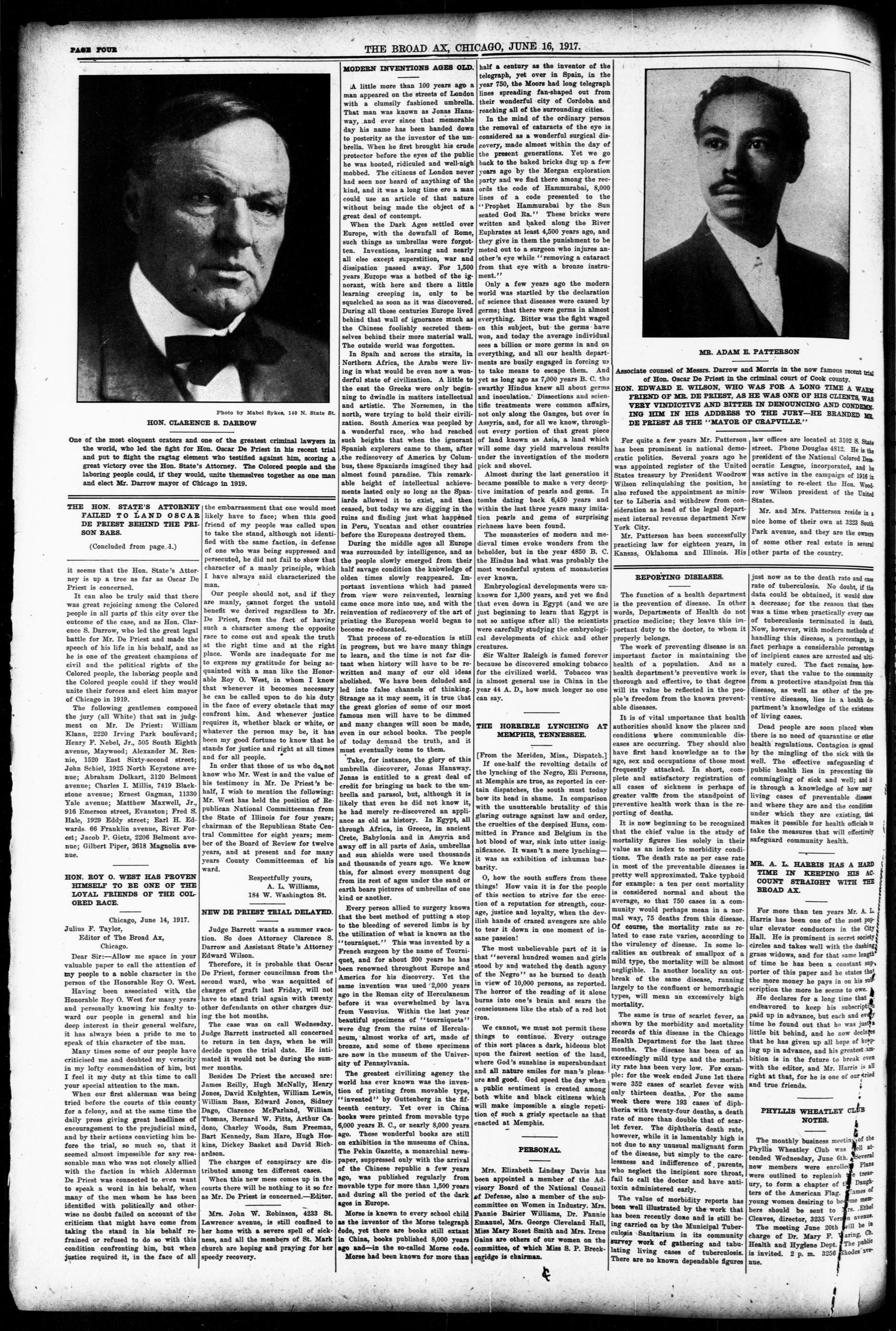
HON. CLARENCE S. DARROW
One of the most eloquent orators and one of the greatest criminal lawyers in the world, who led the fight for Hon. Oscar De Priest in his recent trial and put to flight the ragtag element who testified against him, scoring a great victory over the Hon. State's Attorney. The Colored people and the laboring people could, if they would, unite themselves together as one man and elect Mr. Darrow mayor of Chicago in 1919.
PAGE FOUR
HON. CLAREN
One of the most eloquent orators and the world, who led the fight for H and put to flight the ragtag element great victory over the Hon. State's laboring people could, if they would and elect Mr. Darrow mayor of Ch
THE HON. STATE'S ATTORNEY
FAILED TO LAND OSCAR
DE PRIEST BEHIND THE PRISON BARS.
(Concluded from page 4.)
it seems that the Hon. State's Attorney is up a tree as far as Oscar De Priest is concerned. It can also be truly said that there was great rejoicing among the Colored people in all parts of this city over the outcome of the case, and as Hon. Clarence S. Darrow, who led the great legal battle for Mr. De Priest and made the speech of his life in his behalf, and as he is one of the greatest champions of civil and the political rights of the Colored people, the laboring people and the Colored people could if they would unite their forces and elect him mayor of Chicago in 1919.
The following gentlemen composed the jury (all White) that sat in judgment on Mr. De Priest: William Klann, 2220 Irving Park boulevard; Henry F. Nebel, Jr., 505 South Eighth avenue, Maywood; Alexander M. Rennie, 1520 East Sixty-second street; John Schiel, 1925 North Keystone avenue; Abraham Dolkart, 3120 Belmont avenue; Charles I. Millis, 7419 Blackstone avenue; Ernest Gagman, 11330 Yale avenue; Matthew Maxwell, Jr., 916 Emerson street, Evanston; Fred S. Hale, 1929 Eddy street; Earl H. Edwards. 66 Franklin avenue, River Forest; Jacob P. Gietz, 2206 Belmont avenue; Gilbert Piper, 2618 Magnolia avenue.
HON. ROY O. WEST HAS PROVEN
HIMSELF TO BE ONE OF THE
LOYAL FRIENDS OF THE COL-
ORED BAGE.
Chicago, June 14, 1917.
Dear Sir;--Allow me space in your valuable paper to call the attention of my people to a noble character in the person of the Honorable Roy O. West. Having been associated with the Honorable Roy O. West for many years and personally knowing his fealty toward our people in general and his deep interest in their general welfare, it has always been a pride to me to speak of this character of the man. Many times some of our people have criticised me and doubted my veracity in my lofty commendation of him, but I feel it my duty at this time to call your special attention to the man.
When our first alderman was being tried before the courts of this county for a felony, and at the same time the daily press giving great headlines of encouragement to the prejudicial mind, and by their actions convicting him before the trial, so much so, that it seemed almost impossible for any reasonable man who was not closely allied with the faction in which Alderman De Priest was connected to even want to speak a word in his behalf, when many of the men whom he has been identified with politically and otherwise no doubt failed on account of the criticism that might have come from taking the stand in his behalf refrained or refused to do so with this condition confronting him, but when justice required it, in the face of all
---
the embarrassment that one would most likely have to face; when this good friend of my people was called upon to take the stand, although not identified with the same faction, in defense of one who was being suppressed and persecuted, he did not fail to show that character of a manyly principle, which I have always said characterized the man.
Our people should not, and if they are manly, cannot forget the untold benefit we derived regardless to Mr. De Priest, from the fact of having such a character among the opposite race to come out and speak the truth at the right time and at the right place. Words are inadequate for me to express my gratitude for being acquainted with a man like the Honorable Roy O. West, in whom I know that whenever it becomes necessary he can be called upon to do his duty in the face of every obstacle that may confront him. And whenever justice requires it, whether black or white, or whatever the person may be, it has been my good fortune to know that he stands for justice and right at all times and for all people.
In order that those of us who do not know who Mr. West is and the value of his testimony in Mr. De Priest's behalf, I wish to mention the following: Mr. West has held the position of Republican National Committeeman from the State of Illinois for four years; chairman of the Republican State Central Committee for eight years; member of the Board of Review for twelve years, and at present and for many years County Committeeman of his ward.
Respectfully yours,
A. L. Williams,
184 W. Washington St
NEW DE PRIEST TRIAL DELAYED
Judge Barrett wants a summer vacation. So does Attorney Clarence S. Darrow and Assistant State's Attorney Edward Wilson. Therefore, it is probable that Oscar De Priest, former councilman from the second ward, who was acquitted of charges of graft last Friday, will not have to stand trial again with twenty other defendants on other charges during the hot months. The case was on call Wednesday. Judge Barrett instructed all concerned to return in ten days, when he will decide upon the trial date. He intimated it would not be during the summer months.
Besides De Priest the accused are: James Reilly, Hugh McNally, Henry Jones, David Knighten, William Lewis, William Bass, Edward Joncs, Sidney Dago, Clarence McFarland, William Thomas, Bernard W. Fitts, Arthur Cadozo, Charley Woods, Sam Freeman, Bart Kennedy, Sam Hare, Hugh Hoskins, Dickey Basket and David Richardson.
The charges of conspiracy are distributed among ten different cases.
When this new mess comes up in the courts there will be nothing to it so far as Mr. De Priest is concerned—Editor.
Mrs. John W. Robinson, 4233 St. Lawrence avenue, is still confined to her home with a severe spell of sickness, and all the members of St. Mark church are hoping and praying for her speedy recovery.
THE BROAD AX, CHICAGO, JUNE 16, 1917.
MODERN INVENTIONS AGES OLD
A little more than 100 years ago a man appeared on the streets of London with a clumsily fashioned umbrella. That man was known as Jonas Hanaway, and ever since that memorable day his name has been handed down to posterity as the inventor of the umbrella. When he first brought his crudeprotector before the eyes of the public he was hooted, ridiculed and well-nigh mobbed. The citizens of London never had seen nor heard of anything of the kind, and it was a long time ere a man could use an article of that nature without being made the object of a great deal of contempt.
When the Dark Ages settled over Europe, with the downfall of Rome, such things as umbrellas were forgotten. Inventions, learning and nearly all else except superstition, war and dissipation passed away. For 1,500 years Europe was a hotbed of the ignorant, with here and there a little learning creeping in, only to be squelched as soon as it was discovered. During all those centuries Europe lived behind that wall of ignorance much as the Chinese foolishly secreted themselves behind their more material wall. The outside world was forgotten.
In Spain and across the straits, in Northern Africa, the Arabs were living in what would be even now a wonderful state of civilization. A little to the east the Greeks were only beginning to dwindle in matters intellectual and artistic. The Norsemen, in the north, were trying to hold their civilization. South America was peopled by a wonderful race, who had reached such heights that when the ignorant Spanish explorers came to them, after the rediscovery of America by Columbus, these Spaniards imagined they had almost found paradise. This remarkable height of intellectual achievements lasted only so long as the Spaniards allowed it to exist, and then ceased, but today we are digging in the ruins and finding just what happened in Peru, Yucatan and other countries before the Europeans destroyed them.
During the middle ages all Europe was surrounded by intelligence, and as the people slowly emerged from their half savage condition the knowledge of olden times slowly reappeared. Important inventions which had passed from view were reinvented, learning came once more into use, and with the reinvention of rediscovery of the art of printing the European world began to become re-educated.
That process of re-education is still in progress, but we have many things to learn, and the time is not far distant when history will have to be rewritten and many of our old ideas abolished. We have been deluded and led into false channels of thinking. Strange as it may seem, it is true that the great glories of some of our most famous men will have to be dimmed and many changes will soon be made, even in our school books. The people of today demand the truth, and it must eventually come to them.
Take, for instance, the glory of this umbrella discoverer, Jonas Hanaway. Jonas is entitled to a great deal of credit for bringing us back to the umbrella and parasol, but, although it is likely that even he did not know it, he had merely re-discovered an appliance as old as history. In Egypt, all through Africa, in Greece, in ancient Crete, Babylonia and in Assyria and away off in all parts of Asia, umbrellas and sun shields were used thousands and thousands of years ago. We know this, for almost every monument dug from its rest of ages under the sand or earth bears pictures of umbrellas of one kind or another.
Every person allied to surgery knows that the best method of putting a stop to the bleeding of severed limbs is by the utilization of what is known as the "tourniquet." This was invented by a French surgeon by the name of Tourniquet, and for about 200 years he has been renowned throughout Europe and America for his discovery. Yet the same invention was used 2,000 years ago in the Roman city of Herculaneum before it was overwhelmed by lava from Vesuvius. Within the last year beautiful specimens of "tourniquets" were dug from the ruins of Herculaneum, almost works of art, made of bronze, and some of these specimens are now in the museum of the University of Pennsylvania.
The greatest civilizing agency the world has ever known was the invention of printing from movable type, "invented" by Guttenberg in the fifteenth century. Yet over in China books were printed from movable type 6,000 years B. C., or nearly 8,000 years ago. These wonderful books are still on exhibition in the museums of China. The Pekin Gazette, a monarchial newspaper, suppressed only with the arrival of the Chinese republic a few years ago, was published regularly from movable type for more than 1,500 years and during all the period of the dark ages in Europe.
Morse is known to every school child as the inventor of the Morse telegraph code, yet there are books still extant in China, books published 8,000 years ago and—in the so-called Morse code. Morse had been known for more than
half a century as the inventor of the telegraph, yet over in Spain, in the year 750, the Moors had long telegraph lines spreading fan-shaped out from their wonderful city of Cordoba and reaching all of the surrounding cities.
In the mind of the ordinary person the removal of cataracts of the eye is considered as a wonderful surgical discovery, made almost within the day of the present generations. Yet we go back to the baked bricks dug up a few years ago by the Morgan exploration party and we find there among the records the code of Hammurabai, 8,000 lines of a code presented to the "Prophet Hammurabai by the Sun seated God Ra." These bricks were written and baked along the River Euphrates at least 4,500 years ago, and they give in them the punishment to be meted out to a surgeon who injures another's eye while "removing a cataract from that eye with a bronze instrument."
Only a few years ago the modern world was startled by the declaration of science that diseases were caused by germs; that there were germs in almost everything. Bitter was the fight waged on this subject, but the germs have won, and today the average individual sees a billion or more germs in and on everything, and all our health departments are busily engaged in forcing us to take means to escape them. And yet as long ago as 7,000 years B. C. the swarthy Hindus knew all about germs and inoculation. Dissections and scientific treatments were common affairs, not only along the Ganges, but over in Assyria, and, for all we know, throughout every portion of that great piece of land known as Asia, a land which will some day yield marvelous results under the investigation of the modern pick and shovel.
Almost during the last generation it became possible to make a very deceptive imitation of pearls and gems. In tombs dating back 6,450 years and within the last three years many imitation pearls and gems of surprising richness have been found.
The monasteries of modern and medieval times evoke wonders from the beholder, but in the year 4850 B. C. the Hindus had what was probably the most wonderful system of monasteries ever known.
Embryological developments were unknown for 1,500 years, and yet we find that even down in Egypt (and we are just beginning to learn that Egypt is not so antique after all) the scientists were carefully studying the embryological developments of chick and other creatures.
Sir Walter Raleigh is famed forever because he discovered smoking tobacco for the civilized world. Tobacco was in almost general use in China in the year 44 A. D., how much longer no one can say.
THE HORIBIBLE LYNCHING AT
MEMPHIS, TENNESSEE.
[From the Meriden, Miss., Dispatch.]
If one-half the revolting details of the lynching of the Negro, Eli Persons, at Memphis are true, as reported in certain dispatches, the south must today bow its head in shame. In comparison with the unutterable brutality of this glaring outrage against law and order, the cruelties of the despised Huns, committed in France and Belgium in the hot blood of war, sink into utter insignificance. It wasn't a mere lynching—it was an exhibition of inhuman barbarity.
O, how the south suffers from these things! How vain it is for the people of this section to strive for the erection of a reputation for strength, courage, justice and loyalty, when the devilish hands of crazed avengers are able to tear it down in one moment of insane passion!
The most unbelievable part of it is that "several hundred women and girls stood by and watched the death agony of the Negro" as he burned to death in view of 10,000 persons, as reported. The horror of the reading of it alone burns into one's brain and sears the consciousness like the stab of a red hot iron.
We cannot, we must not permit these things to continue. Every outrage of this sort places a dark, hideous blot upon the fairest section of the land, where God's sunshine is superabundant and all nature smiles for man's pleasure and good. God speed the day when a public sentiment is created among both white and black citizens which will make impossible a single repetition of such a grisly spectacle as that enacted at Memphis.
PERSONAL
Mrs. Elizabeth Lindsay Davis has been appointed a member of the Advisory Board of the National Council of Defense, also a member of the subcommittee on Women in Industry. Mrs. Fannie Bairier Williams, Dr. Fannie Emanuel, Mrs. George Cleveland Hall, Miss Mary Rozet Smith and Mrs. Irene Gains are others of our women on the committee, of which Miss S. P. Breckenridge is chairman.
M. A. B.
MR. ADAM E. PATTESON
Associate counsel of Messrs. Darrow and Morris in the now famous recent trial of Hon. Oscar De Priest in the criminal court of Cook county.
HON. EDWARD E. WILSON, WHO WAS FOR A LONG TIME A WARM FRIEND OF M. DE PRIEST, AS HE WAS ONE OF HIS CLIENTS, WAS VERY VINDICTIVE AND BITTER IN DENOUNCING AND CONDEMNING HIM IN HIS ADDRESS TO THE JURY—HE BRANDED MR. DE PRIEST AS THE "MAYOR OF CRAPVILLE."
For quite a few years Mr. Patterson has been prominent in national democratic politics. Several years ago he was appointed register of the United States treasury by President Woodrow Wilson relinquishing the position, he also refused the appointment as minister to Liberia and withdrew from consideration as head of the legal department internal revenue department New York City.
law offices are located at 3102 S. State street. Phone Douglas 4812. He is the president of the National Colored Democratic League, incorporated, and he was active in the campaign of 1916 in assisting to re-elect the Hon. Woodrow Wilson president of the United States.
Mr. and Mrs. Patterson reside in a nice home of their own at 3223 South
Mr. Patterson has been successfully practicing law for eighteen years, in Kansas, Oklahoma and Illinois. His
REPORTING DISEASES
The function of a health department is the prevention of disease. In other words, Departments of Health do not practice medicine; they leave this important duty to the doctor, to whom it properly belongs. The work of preventing disease is an important factor in maintaining the health of a population. And as a health department's preventive work is thorough and effective, to that degree will its value be reflected in the people's freedom from the known preventable diseases.
It is of vital importance that health authorities should know the places and conditions where communicable diseases are occurring. They should also have first hand knowledge as to the age, sex and occupations of those most frequently attacked. In short, complete and satisfactory registration of all cases of sickness is perhaps of greater value from the standpoint of preventive health work than is the reporting of deaths.
It is now beginning to be recognized that the chief value in the study of mortality figures lies solely in their value as an index to morbidity conditions. The death rate as per case rate in most of the preventable diseases is pretty well approximated. Take typhoid for example: a ten per cent mortality is considered normal and about the average, so that 750 cases in a community would perhaps mean in a normal way, 75 deaths from this disease. Of course, the mortality rate as related to case rate varies, according to the virulency of disease. In some localities an outbreak of smallpox of a mild type, the mortality will be almost negligible. In another locality an outbreak of the same disease, running largely to the confluent or hemorrhagic types, will mean an excessively high mortality.
The same is true of scarlet fever, as shown by the morbidity and mortality records of this disease in the Chicago Health Department for the last three months. The disease has been of an exceedingly mild type and the mortality rate has been very low. For example: for the week ended June 1st there were 352 cases of scarlet fever with only thirteen deaths. For the same week there were 193 cases of diphtheria with twenty-four deaths, a death rate of more than double that of scarlet fever. The diphtheria death rate, however, while it is lamentably high is not due to any unusual malignant form of the disease, but simply to the carelessness and indifference of parents, who neglect the incipient sore throat, fail to call the doctor and have antitoxin administered early.
The value of morbidity reports has been well illustrated by the work that has been recently done and is still being carried on by the Municipal Tuberculosis Sanitarium in its community survey work of gathering and tabulating living cases of tuberculosis. There are no known dependable figures
and Morris in the now famous recent trial criminal court of Cook county.
WAS FOR A LONG TIME A WARM HE WAS ONE OF HIS CLIENTS, WAS IN DENOUNCING AND CONDEMN TO THE JURY—HE BRANDED MR. OF CRAPVILLE."
law offices are located at 3102 S. State street. Phone Douglas 4812. He is the president of the National Colored Democratic League, incorporated, and he was active in the campaign of 1916 in assisting to re-elect the Hon. Woodrow Wilson president of the United States.
Mr. and Mrs. Patterson reside in a nice home of their own at 3223 South Park avenue, and they are the owners of some other real estate in several other parts of the country.
just now as to the death rate and case rate of tuberculosis. No doubt, if the data could be obtained, it would show a decrease; for the reason that there was a time when practically every case of tuberculosis terminated in death. Now, however, with modern methods of handling this disease, a percentage, in fact perhaps a considerable percentage of incipient cases are arrested and ultimately cured. The fact remains, however, that the value to the community from a protective standpoint from this disease, as well as other of the preventive diseases, lies in a health department's knowledge of the existence of living cases.
Dead people are soon placed where there is no need of quarantine or other health regulations. Contagion is spread by the mingling of the sick with the well. The effective safeguarding of public health lies in preventing this commingling of sick and well; and it is through a knowledge of how many living cases of preventable diseases and where they are and the conditions under which they are existing, that makes it possible for health officials to take the measures that will effectively safeguard community health.
MR. A. L. HARRIS HAS A HARD TIME IN KEEPING HIS ACCOUNT STRAIGHT WITH THE BROAD AX.
For more than ten years Mr. A. L. Harris has been one of the most popular elevator conductors in the City Hall. He is prominent in secret society circles and takes well with the dashing grass widows, and for that same length of time he has been a constant supporter of this paper and he states that the more money he pays in on his subscription the more he seems to owe.
He declares for a long time that endeavored to keep his subscription paid up in advance, but each and every time he found out that he was just a little bit behind, and he now declares that he has given up all hope of keeping up in advance, and his greatest ambition is in the future to break even with the editor, and Mr. Harris is all right at that, for he is one of our tried and true friends.
PHYLLIS WHEATLEY CLUB NOTES.
The monthly business meeting of the Phyllis Wheatley Club was well attended Wednesday, June 6th. Several new members were enrolled. Plans were outlined to replenish the treasury, to form a chapter of the Daughters of the American Flag. Games of young women desiring to become members should be sent to Mrs. Ethel Cleaves, director, 3235 Vernon avenue.
The meeting June 20th will be in charge of Dr. Mary F. Varing, Ch. Health and Hygiene Dept. The public is invited. 2 p. m. 3256 Rithodes avenue.
[Picture of a man in a suit with a white collar and tie].
HON. SAMUEL A. ETTELSON.
State Senator from the Fourth Senatorial District; Corporation Counsel of Chicago, who has manfully and courageously stood by his friend, Oscar De Priest to the very last ditch.
NATIONAL NEWS NOTES.
Brief Bits of News and Comments on
Men and Measures.
ENLISTMENTS BY NEGBOES
URGED.
President is Asked to Remove Restrictions so that Members of Race May be Accepted in All Branches. New York, N. Y.—"I know of no law that precludes the Negro citizen from enlisting in the Marine Corps or the artillery of any other branch, other than that unwritten law laid down by militants in the United States of the German strife."
This sentence is taken from a letter written by Robert Lewis Waring of this city to President Wilson, urging, in behalf of the 12,000,000 Negroes in this country, that he remove all restrictions that prevent them from enlisting in any branch of the military service. Mr. Waring believes that the President, as commander-in-chief of the nation's military forces, has the right, in time of war, to open all branches of that service to all American citizens.
"Although it may be said," wrote Mr. Waring, "that the Twenty-fourth and twenty-fifth Infantry and the North and Tenth Cavalry are open to any people for enlistment, Negroes who are abreast of the times are humiliated, outraged that they must be held up to the world falsely as a race of citizens taking courage enough to lead in battle. Bless the hand that will give me, and the thousands like me, a free hand to serve my country as other men are permitted to serve it." Whisky Dealt a Hard Blow. Washington, D. C.-The United States senate dealt the first blow to whisky last week by knocking out the Cummins amendment to the espionage bill.
This amendment lumped up the beer and wine industries with the distilleries and forbade the employment of any cereal in the production of intoxicating liquor during the war.
It was pointed out in the debate that this meant that, there being a three-year supply of whisky in the store-buses, while beer is only brewed for immediate consumption, the country would be placed on a whisky basis and the American workman, deprived of his accustomed mild beverages, would be forced to turn to the bonded poison. Now it is intended that a new bill is to be introduced forbidding the use of the grain that is needed for breadstuffs in the manufacture of spirituous liquors.
As Senator La Follette pointed out in the debates over the proposal to stop the making of any sort of intoxicants, the barley that is used in the manufacture of beer is not used to any extent as human food, which did away with the argument that the conservation of foodstuffs was involved.
The vote against the Cummins amendment was forty-seven to thirty-seven. It clears the decks for the campaign for legislation that will put whisky in the same class as morphine and opium and leave beer and light wines in the category of such indulgences as tobacco, which is practically the course taken by both France and Germany.
Col. James H. Johnson is still at Fort Still, Oklahoma, and while he is absent Mrs. Johnson is having their pleasant home, 3650 Prairie avenue, redecorated, and it will be very neat and attractive when all the finishing touches are completed.
Social District; Corporation Counsel of courageously stood by his friend, Oscar
CHARLES E. MORRISON ASSISTED TO PREVENT ONE OF THE PULLMAN PORTERS FROM FALLING INTO THE HANDS OF THE FEDERAL AUTHORITIES.
I. Watson, 2725 Federal street, an employee of the Pullman Palace Car Company, was out west on his run on registration day, June 5th, and on his return to the city he was arrested by one of the federal officers for failing to register.
He was subject to a fine of $1,000 and imprisonment, and Charles E. Morrison, special messenger to Mayor William Hale Thompson, get busy in behalf of Mr. Watson. He accompanied him to the Hon. Dennis J. Egan, chief clerk of the election commissioners, who explained to Mr. Watson that if he could present him with an affidavit setting forth those facts that he might be in a position to help him out.
Then Mr. Morrison rushed with Mr. Watson to the office of the corporation counsel, and Captain James S. Nelson, assistant corporation counsel, drew up the affidavit for him, which was duly presented to Mr. Egan and Mr. Watson left the City Hall happy and smiling. It must be said to the credit of Mr. Morrison, without any noise about it, that he does a many good turn for Colored people who frequent the City Hall.
THE DEAR SWEET LADIES CAN
RETAIN THEIR HIGH HEELS.
The state senate this week saved the day for the dear sweet ladies and the legislature will not cut their heels down nor try to hold them up by the heels, as the following indicates:
Springfield, Ill.-Illinois will not regulate the height of the heels of its women's shoes. The senate has, after considerable fun at the expense of Representative Kirby, introducer of the heel regulation measure, voted almost unanimously to kill it by striking out the enacting clause.
The bill was Joshed through the house, but the senate made short work of it.
THE ANNUAL COMPETITIVE MILITARY DRILL BETWEEN THE ELEVEN COTTAGE COMPANIES OF THE GLENWOOD MANUAL TRAINING SCHOOL.
Today the eleventh annual competitive drill between the eleven cottage companies will be held on the Glenwood Manual Training School grounds, and Mr. Leo A. Phillips, the able and genial superintendent of the school, with the assistance of his good wife, Mrs. Phillips, made it possible for the relatives and friends of the boys, as well as the friends of the school, to greatly enjoy the occasion.
BETHEL LITERARY SOCIETY.
This coming Sunday, June 17th, at 3:30 o'clock in the main auditorium of Bethel church, Mr. A. H. Roberts will address the Literary under the auspices of the King's Daughters. Rev. R. C. Ransom, who was the founder of Bethel Literary Society, will be present. A very fine musical program will be rendered. Sandy W. Trice, president.
HOTEL TO ACCOMMODATE THE RACE PATRONS.
Waukegan, Ill.—The Sherman House has been made a Colored hotel to provide accommodations for the hundreds of Negroes coming to this section from the South.
```markdown
```
THE BROAD AX, CHICAGO, JUNE 16, 1917.
LOS ANGELES TO HAVE NEGRO Y. M. C. A.
Ground has been broken for a Y. M. C. A. building for the Colored people of Los Angeles, Cal., to be erected at a cost of $80,000.
THREE STORY BRICK RESIDENCE ON LANGLEY AVENUE, I OF 38TH STREET FOR SALE $3250.00 ON EASY PAYMENT
Non-resident, offers for sale story brick residence, clear of
BAND WILL PLAY IN PARK
St. Louis, Mo.-Heretofore, all bands employed to furnish music during the summer in the parks of St. Louis have been White. At least one Colored band will be hired this summer.
LOWDEN STOPS HANGING.
Springfield, Ill., June 15.—Governor Lowden commuted to life imprisonment the sentence of William Lewis, a Negro, sentenced to be hanged at Belleville Thursday.
CHIPS
Mrs. Franklin A. Denison, 3132 Calumet avenue, and the children departed this week for their summer home near Benton Harbor, Michigan.
Mr. Levi Edward Southe, of the Chicago University, and nephew of Mrs. E. L. Davis, left Monday night with other university men to enter the officers' training camp at Ft. Des Moines, Iowa.
Charles E. Morrison, special messenger to Mayor William Hale Thompson, has removed from 3314 Vernon avenue to the elegant home of Mr. and Mrs. James A. Scott, 3710 Prairie avenue, where he will be pleased to meet his friends.
Mrs. Williams, who was Mrs. Alone Townsend, and is now residing in Jersey City, N. J., is spending one month in this city visiting with her old friends. She is the house guest of her sister, Mrs. Dolly Jennings, 3648 Prairie avenue.
Mr. and Mrs. Thomas Carey and the rest of the family, who have passed the winter in their elegant new home at Los Angeles, Cal., will arrive in the city this coming Wednesday and they will be at home to their many friends at their old homestead 4427 Grand boulevard. Some of the big politicians are still mentioning Mr. Carey for mayor of Chicago in 1919.
BIG REAL ESTATE BARGAINS
Sacrifice—Two Flat
—Only $3,850
Biggest bargain in the City. Fine interior, new baths, good light, convenient to 35th St., Indiana surface and Elevated cars—only $500 Cash down. Phone or write H. E. Evans, 517 E. 2nd St. Phone Oakland 2726.
FIVE AND SIX ROOM FLATS FOR SALE.
For Sale—Big bargain, 5 and 6 room brick flats; all modern, 5931 and 5935 La Fayette Ave., rented to Whites at $2.00 and $2.50 a flat. Small cash payment, balance $50.00 per month, including interest. Price $5000.00, worth more. Nehf. 21 N. La Salle St. Telephone Franklin 3966.
FOR RENT in new Colored district, south of 59th street. Beautiful modern newly decorated, light 5 and 6 room brick flats, stove heat, large yard, convenient to "L" and 3 surface lines. Reference required. Flats shown by appointment. Rents, $24.00 and $27.00. NEHF and NEHF, 21 N. La Salle Street. Telephone Franklin 3966.
44
HON. HARRY B. MILLER
Prosecuting attorney of Chicago, who is Colored people at the annual banquet 1916, and who at the recent trial to be a moral coward and he was to with all the rest of the worthless clerks Priest.
Prosecuting attorney of Chicago, who felt highly honored to mingle with the Colored people at the annual banquet of the Appomattox Club January 1, 1916, and who at the recent trial of Hon. Oscar De Priest proved himself to be a moral coward and he was tumbled headlong into the bottomless pit with all the rest of the worthless characters who testified against Oscar De Priest.
TO RENT.
THREE STORY BRICK RESIDENCE
ON LANGLEY AVENUE, NORTH
OF 38TH STREET FOR SALE FOR
$3250.00 ON EASY PAYMENTS.
Non-resident, offers for sale a three
story brick residence, clear of all
incumbrance, located on Langley avenue,
north of 38th street; for $3250.00 on
easy payments. Rental $30 per month.
If you desire a bargain, address T. L.
Care of this paper or phone Wentworth
2597.
Meaning of $7,000,000,000.
meaning of $7,000,000.
America's war loan of $7,000,000,000 surpasses the powers of the mind to grasp. Spent at the rate of a dollar a minute it would take 13,318 years to dispose of the appropriation. Loaned out at 6 per cent, $13 could be spent every second for an indefinite period without touching the principal. The interest on the loan is greater than the entire running expenses of the government less than half a century ago, while the amount itself would conduct the affairs of the government for fully seven years on the basis of the annual expenditures for the last decade. Another and more cheerful way of looking at the situation is that, great as the loan is, the wealth of the United States is such that it amounts to the lending of $1 out of every $40 of our existing tangible resources. A penny a day saved by every inhabitant would cancel the principal within twenty years.—Thomas F. Logan in Leslie's.
Eat Less: Do More.
A fat nation is no good. Lean nations accomplish things. We should eat less and think more, have smaller girth and larger chests, less on the hip and more on the thorax, have fewer potatoes at dinner and more books after dinner, more exercise and less chewing. A strong person can subsist on a little oatmeal and philosophy and outwalk, outtalk, outthink, and in every way outdo the person who travels the long route from soup to nuts and goes to sleep afterward as an anaconda full of sheep or monkeys might. Life is a lean affair of hungry appetites and ambitions. Then they stimulate to earnest performance. The regeneration of the American nation begins at the dinner table. We need stoutness in soul not soutness in fat. Eat less and do more. Grow more above the neck and less below the stomach.—Chicago Tribune.
Heathen Shrines.
After months spent in idolatrous lands I have been unable to see much real worship in heathen shrines. The educated worship with their tongues in their cheeks and the ignorant with their hearts in their mouths. But the amount of real worship that exists in heathen temples is very small. Sometimes a bereaved mother will enter the temple and draw from her kimono the tiny bib of a departed little one and tie it to the statue of Jizo, the god of motherhood. Sometimes an old man or woman, almost blind, will enter the temple and rub the eyes of a wooden god and then rub his own in the hope that eternal darkness may not close in on his afrightened soul. In some places Buddhist services are as dignified, as well attended and as helpful as our own.—Maynard Owen Williams in Christian Herald.
Graphite as a Lubricant
Graphite, says the Scientific American, is not a lubricant, but an aid to keeping a bearing in good working order by filling up the minute irregularities of the shaft and bearing and producing a beautiful polished surface and in this way reduces friction. To get this result only a very small quantity of graphite is necessary, and if too much is applied it simply collects in wads and defeats the purpose intended. It follows that the proper way to use graphite successfully is to mix thoroughly a small quantity with the lubricating oil at suitable intervals and not to apply it continuously, for when the above mentioned polished surface is formed it will last quite a long time before requiring renewal.
Talks on
HEALTH,
CLEANLINESS,
PROPER LIVING,
SANITATION, ETC.
By
Dr. W. A. Driver
3300 So. State Street
Phone Douglas 3617
CONSTIPATION.
People who are much indoors and who lead sedentary lives suffer constipation. Most women complain of it. Much of the heaviness and bearing down sensation that is the lot of a large number of women is due to that condition. The possibilities for the development of serious and fatal disorders lie in that simple beginning. For instance, piles can and often do follow it. Piles is a way station between constipation and fistula in ano, which is capable of further degeneration. Cancer of the rectum is possible from neglected piles or hemorrhoids as the doctor calls it.
Many other maladies find the beginning in the above named condition. Constipation is evidence enough that something is radically wrong with the habits of the individual so burdened. Constipation is not the primary wrong, but it is the demonstrable primary wrong. For that reason, our efforts are directed to the eradication of tributary and secondary mal-function. That is to say, humanity is addicted to the habit of fighting constipation, instead of the cause of it. To illustrate, most persons who are constipated have headaches and neuralgias or so-called rheumatism and other painful manifestations; they imagine headache pow-
Grand Opera In 1680.
The following excerpt from Burney's "History of Music," published in 1776, describing the first performance of the opera "Bernice" in 1680, indicates that "there is nothing new under the sun," even in sumptuous staging of music dramas.
"There were choruses of 100 virgins, 100 soldiers, 100 horsemen in iron armor, forty cornets on horses, six trumpeters on horseback, six drummers, six ensigns, six great flutes, six minstrels playing on Turkish flutes and six others on octave flutes, six pages, three sergeants, six cimbalists, twelve hunters, twelve grooms, six coachmen for trumpeters, six others for the procession, two lions led by two Turks, two elephants led by two others, Bernice's trumphal car drawn by four horses, six other cars, with prisoners and spolls drawn by twelve horses, and six coaches for the procession.
Advice In Securing Riches.
Frederick Weyerhaeuser, America's one time lumber king, who died a multimillionaire, once gave the following rules on how to get rich: "Make up your mind to work at something really worthy of work and work hard. The surest way to make money is to save money and to use what you have. Don't be afraid of long hours or constant attention to your work. Work can be made a joy, an economy, a pleasure, if you combine an object worth while with the determined ambition to win. Any young man can get rich, can succeed, if he saves, if he has a definite and honest purpose and is so filled with the purpose that work ceases to be a hardship and becomes a privilege."
Philadelphia's Big Clock:
The center of the dial of the clock on Philadelphia's city hall tower is 361 feet $1\frac{1}{2}$ inches from the ground level. The length of the minute hand is 10 feet 8 inches. The weight of the hand is 225 pounds. The weight of the dial frame with glass is five and one-half tons. The clock is equipped with a pneumatically operated thermostat for controlling an electric governor provided to protect it from extremes of temperature. The steel pendulums are inclosed in cast iron cases to protect them from magnetic influences.—Philadelphia Press.
A Simple Antidote to Poison
It is a valuable thing to understand thoroughly what ample antidote to take if one is so unlucky as to swallow poison of any kind. Sweat oil is to be found in nearly every house, however humble, and half a pint of it taken immediately is an effectual antidote to almost all poisons. Any one with a strong constitution should take a larger quantity of this simple remedy.—London Telegraph.
"My dear," said the host to his wife as he started to carve the leg of lamb, "can't you give Mrs. Brown anything better than this cold meat?"
"Oh," cried Mrs. Brown, "that's all right, so long as it is cold leg and not cold shoulder"—Christian Herald.
PAGE FIVE
```markdown
```
des, that merely sedate the pain conducting and pain registering nerves and brain, will cure them. Such persons are sometimes sedated into not only temporary death of the pain conducting and pain registering central nervous system and its efferent and different nerves. It is a matter of common knowledge that such shallow thinkers often pay the tremendous price of eternal sedation. Many have been found dead with the mute but sufficient evidence of an empty "headache powder" wrapper near the remains.
And so to take the various subterfuges for sense is unprofitable at any stage of the quest for health and long life. Let us learn to treat primary maladies and thus eradicate subsidiary and more obstinate disorders.
Almost all diseases find it easy to afflict those who have contracted constipation. A clean gastrointestinal tract is one of the biggest assets extant, but a foul one is a liability of sinisterest import. Correct eating and drinking are more important than all other elements in the correction and cure of constipation. If you need the aid of such potentialities as drugs to help in the fight against any disease, your family physician would best be consulted and obeyed. Don't take patent medicine.
Millais' "Trust Me"
A lady and gentleman were standing before a picture by Millais called "Trust Me," in which an elderly squire confronts his daughter, who holds a letter behind her back. The picture admits of more explanations than one, for Mr. Millais had that rare faculty of putting blended expressions into his faces which puzzle us, as the expressions of real faces do.
But the one this gentleman was overheard giving his companion is as new, we are bound to say, to the painter as to our readers. "You see," he said, "she has got a letter in her hand which she is keeping back from the man in the red coat. Well, he is the postman and has just given her the letter. I suppose it's from abroad. She hasn't the money to pay the postage, so she says. 'Trust me.'"
The explanation was given with perfect gravity and in apparent good faith—London Mail.
John Bunvan's Indictment.
The bill of indictment preferred against John Bunyan ran thus: "John Bunyan hath devilshly and perniciously abstained from coming to church to hear divine service and is a common upholder of several unlawful meetings and conventicles, to the disturbance and distraction of the good subjects of this kingdom, contrary to the laws of our sovereign lord the king." He was convicted and imprisoned twelve years and six months.
Word From Br'er Williams
Once 'pon a time Man lost so much sleep worryin' over trouble what wuz to come dat when Trouble come sho' nuff de Man wuz dead ter de worl', an' Trouble walked all over him an' said: "He's too trifin' fer me ter fool with. I wouldn't waste time on no sich!"—Atlanta Constitution.
A Skirt Hanger
A good improvised skirt hanger is a strong hatpin. Fold the skirt twice at the band, stick the hatpin through the back in two places, leaving enough of the pln exposed to hang over a nail or hook. The skirt will never be pulled out of shape.
His Advantage
"I know more about that woman than she knows about herself."
"How can that be possible?"
"Easily. I know she isn't pretty, but she doesn't"
Largest Organ.
The largest organ in the world is the one built by the famous German builder, Walcher, and is situated in St. Michael's church, Hamburg, Germany.
Salmon are swift swimmers. They can travel through the water at the rate of twenty-five miles an hour.
The Dog.
At the age of two years the dog attains maturity; at fifteen it is getting old; beyond twenty it seldom lives.
God hath yoked to Gullt her pale tormentor, Misery—Bryant.
BARN OLS
THE BROAD AX
Published Weekly
In this city since July 15th, 1890,
without missing one single issue, Rep-
publicans, Democrat, Catholics, Pro-
testants, single Taxenr, Priesta, in-
fidels or anyone else can have their say
as long as their language is proper and
responsibility is fixed.
The Broad Ax is a newspaper whose
platform is broad enough for all, ever
claiming the editorial right to speak its
own mind.
Local communications will receive
attention. Write only on one side of
the paper.
* Subscriptions must be paid in advance.
One Year.....$2.00
Six Months.....1.00
Advertising rates made known on application.
Address all communications to
THE BROAD AX
6418 Champlain Ave., Chicago, Ill.
PHONE WENTWORTH 2597.
JULIUS P. TAYLOR, Editors and Publisher.
Entered as Second-Class Matter Aug
19, 1902, at the Post Office at Chicago
Illinois, under Act of March 8, 1879.
An Expert In Motives.
Cousin Henry is an expert in motives. If you were reading off a list of names and overlooked Henry he would understand. He would know exactly the motive that prompted you to do it. If you don't think to introduce him to the man who is with you he can see through it. He may have to go back four or five years, but he will make a complete case against you. In less than an hour he will know what your motive was. Right now he is angry because his daughter was not selected as valedictorian of her class. You may think that the other girl deserved to be selected, but you don't know all that Henry knows. It is a long story, but he is willing to tell it to you, and after hearing it you will understand the motive--you will understand that it is a case of spite work.—Claude Callan in Fort Worth Star-Telegram.
How David Garrick Made His Fortune.
If David Garrick had had no more than his salary as an actor he would have had little to leave at his death. He made his fortune as joint proprietor, and for a time as sole proprietor, of Drury Lane theater, so that the amount set down to himself as salary was practically nominal. When he retired from the stage in 1776 he sold half his share in the theater for £35,000. He was probably the only actor who consistently made Shakespeare pay, and, like Shakespeare, he was actor, author and proprietor.
It may be recalled that Garrick, who had no enemies outside his own profession, was the grandson of a Frenchman exiled at the revocation of the edict of Nantes and that his father was a captain in the army—London Standard.
Well Balanced Diet
One of the most common faults of the diet is the eating of too much protein foods. In excess this is hard for the body to excrete and is likely to decompose in the intestines with the formation of poisonous waste products. Green vegetables and raw fruit are important elements of the diet. There is little energy in these foods, but they supply mineral salts which the body needs and curious substances called vitamins, which are easily destroyed by cooking. One food expert has suggested a rule for securing a well balanced diet. It is: An ordinary family should spend about as much for milk, vegetables and fruits as for meats, fish and eggs and as much for milk and eggs as for meat and fish.
Follies of Science
The history of science has seven problems which men in all ages more or less have tried to solve, but which have finally been given up by all. Today they are called follies.
The usual list comprises the following: First, squaring the circle; second, duplication of the cube; third, trisection of an angle; fourth, perpetual motion; fifth, transmutation of metals; sixth, fixation of mercury; seventh, elixir of life. Some lists put the philosopher's stone for the last three and then add astrology and magic to make the seven.
Too Much For Him
"I thought he was going to marry that girl?" "Well, he did think of it. But it seems when he called the other night she threw him down." "Well, if she's as good as that at wrestling I don't blame him for quitting."-St. Louis Post-Dispatch
Not That Bill.
"I can't tell a canvasback duck from barnyard specimen."
"Experts say you can tell by the hill."
"How so? The bill for one is always as high as the bill for the other. That's what I'm kicking about."—Louisville Courter-Journal
1
BOY TO GET A MEDAL FOR RESCUING ROBIN
It Was Held In Treetop by String and He Climbed to Free It.
Hartford, Conn. — The Connecticut Humane society, through its president, the Rev. William Delosso Love, has informed ten-year-old Michael Ravoleo of the Second North school, East Hartford, that he is to have a medal for rescuing an imprisoned robin a few days ago.
Little Michael had to climb an elm tree seventy-five to eighty feet high to effect the rescue. The robin had flown to one of the topmost branches with a long string in his bill for nest building. The string caught in a stout twig, and as the robin worked to get it free the string tangled itself into a double hitch about one of its legs. It was then held prisoner and was noticed for two days helplessly trying to work itself loose and squeaking plantively.
Michael's schoolfellows were talking about the bird, and he asked them to lead him to the elm. It took him more than half an hour to work his way to the top at the tree. And at the last of the job it required nerve and coolness, for he was out on very slender and swaying branches.
But he managed to reach the twig to which the string had fastened itself and snapped it off. With this hanging to its leg the robin fluttered to the ground, was released and flew off wildly chirping at its restored freedom.
STRENGTH OF U. S. NAVY
AMAZES COCHEPRAT
STRENGTH OF U. S. NAVY
AMAZES COCHEPRAT
Our Fleet, Second In World, Will Hasten Victory, Says French Admiral.
Washington.-Vice Admiral Cocheprat, representing the ministry of marine in the French mission here, said that he had "every reason to hope that we shall succeed in establishing the closest possible co-operation between the American and the allied navies for the assurance of freedom of the seas, the protection of trade and the triumph of our rights."
"The United States is in possession of the most powerful fleet in the world next to the British, and this is bound to weigh heavily in hastening the day when final victory will be wrung from the foe," he said.
"Your navy is wonderfully equipped, and I really felt amazed when I chanced to see recently some of its units, among them the battleship Pennsylvania and those trim looking destroyers that came out to meet us at sea. There is no need to praise your naval personnel. Throughout my long sea life it has often happened that I have come across American men-of-war, and I am pleased to say that on every such occasion the very high merit of the officers as well as the perfect training of their men has aroused my intense admiration.
"What I have seen here since my air serves only to emphasize my previous impressions. And so I am sure that the American navy is ready to support in the most advantageous fashion the cause of the allies now shaping a course toward victory."
FIND $4,000 IN "HOME BANK."
Money In Small Coin Hidden by Aged Woman.
Manitowoc, Wis.—Over $4,000 in nickels, dimes, quarters and half dollars, the accumulation of years, was found by a woman engaged in cleaning the home of the late Mrs. Fred Pingle, aged eighty-eight, pioneer resident of Manitowoc.
Money was found among rubbish heaps, sewed in mattresses and quilts, under the carpet and in almost inconceivable places all through the house.
The Pingle family at one time lost a fortune through the failure of a bank, which was said to be responsible for the aged lady having secreted her savings about the family home.
MORE REPUBLICS AHEAD.
Spain, Greece and Sweden Moving, London Hears.
London.—Republics in Spain, Greece and Sweden before the end of the war were predicted by a speaker at a conference here of journalists representing the European neutral countries. The speaker, who had returned recently from Sweden, asserted that republican doctrine is becoming popular there.
The conference discussed the political and economic conditions in the neutral countries. The effect the Russian revolution had on the countries named was debated at length. It was declared that republican sentiment had won many converts in the three countries.
HER OWN ATTORNEY.
Mrs. Laura Ella Ruddick In Court Against Brothers.
Columbus, Ind.-Mrs. Laura Ella Ruddick, a wealthy resident of this city, acted as her own attorney in a case where she is plaintiff and her brothers, Marcus Hollowell and Hayes E. Hollowell, are defendants.
She prepared and filed a motion for a new trial in the case without legal advice. The motion covers several typewritten pages and is written in legal phraseology. Mrs. Ruddick recently was ordered to jail for contempt of court by Judge John W Donaker.
THE BROAD AX, CHICAGO, JUNE 16, 1917.
He Locked Concentration.
Speaking of a man who was a failure because of his lack of concentration and his inability to know his own mind five minutes at a time, a captain of industry said he reminded him of a hunting dog he once owned:
"At sunrise the dog would start out on his own hook after deer. He would jump a buck and run him for miles. When the buck was on the point of exhaustion the hound's nostrils would catch the taint in the air-where a fox had crossed the trail, and he would instantly decide that, after all, fox was what he had come for, and he would turn aside to pursue the fox. Perhaps an hour later, when the chase was growing warmer every minute, his keen nose would detect the presence of a rabbit, and he would go after the cottontail, with the inevitable result that by 4 o'clock in the afternoon that hound would be thirty or forty miles away from home in a swamp with a chipmunk treed!"—Saturday Evening Post.
George and His Legs.
Bit by bit the historical grubbers are digging out the truth about our immortal George. We have heretofore been told that he wore false teeth and that at Valley Forge he unblushingly deceived his ragged and despondent troops with the arrival of ample supplies of ammunition, which consisted of powder barrels filled with sand, and now a correspondent of the New York Sun declares that in the full length portraits of Washington by Stuart, of which there is one in the New York public library, the legs were not his own. "I have seen the letter from Stuart thanking the true owner for his kindness in providing a symmetrical foundation for the bust of the great president and presenting one of the smaller portraits in thanks for his kindness."
Free Speech.
An old negro woman had lived with a certain family in the south for many years. One day her mistress had occasion to reprimand her quite sharply for something that had gone wrong. The negress said nothing at the time, but a little later her voice could be heard in the kitchen in shrill vituperation of everything and everybody, with a rattling accompaniment of pans and kettles. So loud became the clamor and so vindictive the exclamations that Mrs. C. went hurriedly down to the kitchen.
"Why, Liza," she began in amazement, "who on earth are you talking to?"
"I ain't talkin' to nobody," the old negress replied, "but I don't keer who in dis house hyars me."—Harper's Magazine.
Misprints and Maxim Guns.
The late Sir Hiram Maxim says in his autobiography that when he organized the United States Electric Lighting company the printer sent home its stationery with the heading, "The United States Electric Lightning company." When he established his new gun company in England he told of this mistake in order to emphasize the importance of getting the stationery printed correctly. When the first sheets were brought to him, however, he found that the English printers had made his concern appear as "The Maxim Gum company."
Easy Generosity.
Mother (to small son)—Bobby, dear,
I hoped you would be unselfish enough
to give little sister the largest piece of
candy. Why, see, even our old hen
gives all the nice big dainties to the
little chicks and only keeps an occasional tiny one for herself.
Bobby thoughtfully watched the hen
and chickens for a time and then said,
"Well, mamma, I would, too, if it was worms."—Rochester Times.
A Generation.
In the long lived patrilarchal age a generation seems to have been computed at 100 years (Genesis xv, 1). Subsequently the reckoning was the same that has been more recently adopted—that is, from thirty to forty years (Job xlii, 16).
Incongruous
Little Alick—What is an incongruity, uncle? Uncle William—An incongruity, child, is a divorce lawyer humming a wedding march.
Vegetation In Polar Regions
The rapid growth of vegetation in
the polar regions is attributed to the
electric currents in the atmosphere.
---
PRACTICAL HEALTH HINT.
Neuralgia.
- Neuralgia means nerve pain.
- Neuritis means inflammation of the nerve. In neuralgia the pain comes and goes. In neuritis the ache is steady and sticks closely to the affected nerve. If the nerve could be taken out and examined we could find nothing abnormal in the case of neuralgia. In neuritis the nerve would be found to be inflamed. The question of what is behind the pain of neuralgia is more important than the answer to the cry for relief. It must be remembered that neuralgia is merely a symptom, not a disease. Sometimes malaria is the underlying cause. Other times it may be due to alcoholism, diabetes, lead poisoning, gout, rheumatism or Bright's disease. A diseased tooth or a diseased ovary may be responsible. In every case treatment must include treatment of the underlying cause.
```markdown
```
Spanish Doubleboons.
Should one find a pirate's buried treasure he would have to dispose of his Spanish gold at its bullion value, for since Aug. 1, 1908, when the common cried maker proclamation from the steps of the Royal Exchange of London that after that date the doubloon would cease to be legal tender in the West Indies, including British Guiana, the doubloon has not been the precious thing it was. In 1730 and for a century after it was worth $8, more or less. It has ceased to be coined in its native country, Spain, and since 1908 it has been unpopular in the West Indies, where for a long time it figured in a mixed circulation, embracing British, United States and Spanish coins. In the interest of romance, however, the name at least must survive. It signifies nothing more than that the coin was double the value of a pistole, but the "doubloon" was never such a mouth filling mockery as "pieces of eight," which suggests great riches, but means only Spanish silver dollars, pieces equivalent to eight reals.—Rochester Post-Express.
A Famous New York Street.
Few of the thousands of people who pass the corner of Nassau and John streets every day know the early history of Nassau street. And yet right at that corner is a bronze tablet which gives in concise form the following historical information:
"Nassau Street, Known Originally as the 'Street That Runs by the Pye Woman,' Was Laid Out About 1635 and Was Named In Honor of the House of Nassau, Whose Head at That Time Was William the Third, King of England and Stadholder of the Dutch Republic. Nassau Street Became Identified With the Jewelry Trade More Than Half a Century Ago."
The bronze tablet is on the exterior of the building at the northwest corner of Nassau and John streets. It was erected by the Malden Lane Historical society in 1916—New York Sun.
William De Morgan.
In spite of himself William De Morgan became famous. He deliberately violated all the rules made for the guidance of novelists who seek to become popular. None of his novels was addressed to the greater public that is avid for the latest thing of the moment in fiction, but nevertheless they reached that public. He was a law unto himself in the novels that he wrote during his marvelous career that spanned only ten years. It is doubtful if in English literature or in any other can be found a writer whose life and literary career are comparable to his. He was an old man when the world of readers came to know him, and his age was an asset toward celebrity. At seventy he was hailed as eagerly as Kipling was hailed at twenty, and in his way he was no less a prodigy than the younger writer.—Bookman.
The Emerald.
The emerald has been known since early times both in Europe and in certain parts of the orient, where its attractive color and rarity have endowed it with the highest rank and a varied lore. Its name may be traced back to an old Persian word which appeared in Greek as "smaragdos," mentioned by Theophrastus over 300 years before the Christian era, and again in Latin as "smaragdus," seen in the writings of Pliny, who particularized somewhat on its properties and supposed medicinal virtues and was even shrewd enough to suspect its identity with the much more common beryl, although eighteen centuries elapsed before this suspicion was verified by scientific proof.
Hia Hard Luck.
A small boy whose record for department at school had always stood at 100 came home one day recently with his standing reduced to 98.
"What have you been doing, my son?" asked his doting mother.
"Been doing?" replied the young hopeful. "Been doing just as I have been doing all along, only the teacher caught me this time." —Philadelphia Inquirer.
Where Is the Profit?
"I understand they sold their house for $3,000 more than they paid for it." "How lucky!" "Lucky nothing! After they'd sold it they discovered that they've got to pay $2,000 more than they received for their house for another home to live in."-Detroit Free Press.
Books In Brazil
In Brazil, as throughout South America, French is almost universally read. Editions of the classics are found in most homes, and bookstores are filled with modern French writers of prose or verse, sometimes in translation and as frequently in the original.
Went Further
"Didn't I tell you that when you met a man in hard luck you ought to greet him with a smile?" said the wise and good counselor. "Yes," replied the flinty souled person. "I went even further than that. I gave him the grand laugh."
Best Way of Taking Iron
When anemic persons have to take iron the best form in which to administer it is spinach, cabbage, green chicory, asparagus, lentils, carrots and peas, all of which contain much iron.
About the Same Thing.
Scribbler—Can you suggest a simile for giving advice? Scrawler—How would pouring water on a duck's back do?—Philadelphia Record.
Let us teach people as much as we can to enjoy, and they will learn for themselves to sympathize. Stevenson.
Necessities of War.
When Lloyd George in England undertook to organize the ministry of munitions a glazer began to stamp out cartridge clips; a manufacturer of music rolls used his equipment to make gauges; a concern engaged before the war in preparing infants' food began delivering plugs for shells; an advertising agency manufactured shell adapters; watchmakers began adjusting fuses; a manufacturer of baking machinery became a contractor for six inch high explosive shells; a jewelry house devoted itself exclusively to periscope; a phonograph concern sent millions of delicate shell parts to the assembling stations; a firm which made nothing but sheep shearing machinery started turning out shell cases; a cream separator factory manufactured shell primers. Among other producers of finished shells were candlemakers, flour mills, tobacco manufacturers, syphonmakers and the manufacturers of sporting goods.—World's Work.
Stocking the National Parks.
Stocking The United States is carrying on a very interesting work in exchanging the wild animals of one region for those of others—transplanting elk and deer and Rocky mountain bighorns from regions in the United States where they are plentiful to others where, so far as known, they have not lived. Some of the animals are being shipped long distances, says the Popular Science Monthly.
Wyoming is full of elk. The herds in the Jackson Hole country are the largest of any of North American wild animals since the days of the countless buffaloes. But the big Yosemite National park of California, with its three-quarters of a million acres, until recently had no elk, or at least only a very few scattered specimens. But the elk shipped in from Wyoming have become very much at home and are breeding and multiplying rapidly, adding to the charm and picturesqueness of this popular national playground.
Love and Marriage
"First love is very apt not to be the lasting love," said Dr. Antoinette Konikow, speaking at the Boston School of Social Science.
"Young lovers try to excuse all the faults of the loved one because they are not in love with the individual, but with love. Hence they may not choose the partner with whom they will find their happiness in later years. Many a man and woman is glad by middle age that the first love was frustrated.
"Marriage should be based on love alone or it is immoral, and some change is necessary if marriage is to be saved from degradation. Real love always makes people better. Romantic love is the source of all the best things in life—the foundation of all the arts. And individual happiness makes up the happiness of the race."—Boston Post.
Use of Bacon Drippings.
Bacon drippings make splendid shortening for light, flaky pie crust. It takes just a little less of the drippings than of ordinary lard or vegetable shortening. Use it for shortening in spice cake, gingerbread or any dark cake and note the delicious flavor. Spread rye bread with a thin layer of the pure drippings and sprinkle a little salt on it. Add to this a thin slice of any salt meat and you will have a delicious and highly nutritious sandwich. The European housewife has long made use of such sandwiches for the between meal snack for growing boys and girls.
The Pygmy Hippopotamus.
One of the animals least known to the outside world is the pygmy hippopotamus of West Africa. This animal is just what its name implies, a pygmy hippopotamus. It is much smaller than the common hippopotamus, being no larger than an ordinary or fair sized hog. It differs somewhat from the common hippo in the character of its teeth, and instead of spending its time in the rivers and lakes in large herds it wanders about through the jungles singly or in pairs, much after the manner of swine in search of mast.—London Spectator.
Just the Time.
"No, I have never played bridge before."
"So I should surmise," said the disgusted partner. "But how came you to enter an important tournament like this?"
"Oh, I thought it would be a good time to learn."—Louisville Courier.
All Wrong.
"Now, look here, Alice, I know everything. You've been carrying on with another man. I even know that his name is Rupert."
"How ridiculous you are! First of all, I haven't flirted with any one, and, secondly, his name isn't Rupert."—Passing Show.
Profitable Writing
"My writings bring in a lot of money every month." "That so? I didn't know you were an author." "I'm not. I'm the man that makes out the bills for our firm."—Detroit Free Press.
Trials of Authors
"You do not know." Saint-Beuve wrote to George Sand, "what it is to remain a whole day with your head in your hands, squeezing your unfortunate brain to find a word."
Silent Heroes.
"Father," asked Tommy, "what are silent heroes?" "Married men, my boy," replied the father.—London Telegraph.
We like to give in the sunlight, to receive in the dark.
The Ultimate.
He—Do you know what I am going to say to you? Drop it!
Nju—Drop what?
He—Everything—happiness and love and work and God knows what else! It is all so provincial. Even our dreams, let them be, what they will, are provincial—yes, even our sufferings.
Nju—And what is there that isn't provincial?
He—What! Art and death? No; art is too! Only death.
Nju—Yes; I understand.
He—You don't love me, Nju.
Nju—I love you very much. Really I do love you, only there is something that is more than love—something still higher.
He—Or—or death?
Nju—No; there is something still higher.
He—Than life, death and love?
Nju-Than all combined. There must surely be something; otherwise the whole thing would be so meaningless. —From the Russian Play "Nin."
Grass on the Lawn
Grass seeds germinate in from fourteen to eighteen days. A quart of seeds is sufficient to cover 300 square feet-15 by 20 feet. Five to six bushels are required per acre. Do not sow grass seeds in hot, dry weather, particularly in July or August. Poa trivialis is good for shady lawns under trees. Festuca rubra is most suitable for hard wear and for dry or sandy soil.
Festive foliage is most suitable for hard wear and for dry or sandy soils. Sharp sea sand applied lightly over lawns in the autumn—that is, over lawns on clay or loam—encourages the growth of fine grasses. Lawns that are frequently watered need more fertilizers than those that are not, as the water washes away much plant food.—New York Sun.
Glengarry's "Treason"
How startling was the difference in the customs of the English and the Scots even less than a century ago is shown in the story of the way in which the famous highland chief, Alastair Macdonell, of Glengarry frightened George IV. out of his wits. In 1822 Glengarry was one of a party of Scottish nobles and gentlemen who banqueted "the first gentleman of Europe" in Holyrood palace. Colonel Macdonell was the last chief to wear the full highland costume, and when the company sat down to dinner he, according to custom, placed a brace of loaded pistols by his plate. The king started up in alarm and was persuaded to remain in the room only on the assurance that Glengarry meant no treason. London Spectator.
Stevenson's Wife
A half caste sailor once said, "Mr. Stevenson is good to me, like my father, and his wife is the same kind of man."
King Tembinoke said of Mrs. Stevenson, "She good; look pretty plenty chench" (sense).
Perhaps they both meant what the poet Edmund Gosse so well expressed when he wrote of her as being "dark and rich hearted, like some wonderful wine-red jewel."
But the best tribute in Mrs. Stevenson's praise came from the pen of her husband—Critie.
Our Coal Supply.
The United States coal supply is nearly one-half that of the entire world. Estimates put the available coal supply of the United States at 3,538,500,000 tons out of a world total estimated at 7,397,533,000,000 tons. China ranks next to the United States in available supply, estimated at 1,500,000,000 tons Great Britain, 180,000,000 tons Germany, 164,000,000,000 and Canada 100,000,000,000 tons.
Too Pushing.
"I had an idea I'd grow up and own this business some day," said the discharged office boy.
"That's just why you were fired," said the boss. "Ever since you started to work here you've been acting as if you already owned the business"—Birmingham Age-Herald.
Forgiveness.
Walter—Beg pardon, sir, but—ah-em
the gents here usually remember my
services. Guest (pocketing all the
change)—Do they? They ought to be
more charitable and forget them!
Clever Sheen Shearers
Averaging everything, from young wethers, which are hard, to old ewes which are easy, experts in Australia will shear about 90 or 100 sheep a day.
PRACTICAL HEALTH HINT.
Diet For the Aged.
Diet For The
o The aged should have food at
o frequent intervals—little and
o often should be the rule—food
o every three or four hours.
o appetite is not as keen in old are
as it is in youth, nor is the di-
gition so good.
o Fresh vegetables are needed
o and relished by elderly persons,
o and they are a valuable addition
o to the dietary if they are troubled with constipation, as they contain fibrous tissue, which
o gives bulk to the contents of the intestinal canal and supplies
o something for the intestines to contract upon. Stewed or raw
fruits are useful, as well as vegetables, and one or the other should be eaten two or three times a day.
Modern Dreadnaughts.
Beyond all doubt modern dreadnaughts represent the highest level of controlled strength that the human race has yet seen. The fact that 25,000 tons or more of metal can be driven through water at the speed of an express train while its big guns hurl shells weighing three-quarters of a ton to a distance of twenty miles is a miracle in mechanism.
During the evolution of the warship to its present state of efficiency marine engineers have been faced with the problem of protecting vital parts of the vessel from the ever increasing hitting power of large shells. In other words, the fighting value depended upon its ability to take as well as give hard knocks. Some idea of the difficulty may be gathered from the fact that a fifteen inch shot strikes a blow at its maximum point of speed capable of lifting 50,000 tons a foot from the ground.-London Standard.
Swamp Lands.
The national chamber of commerce declares that had not the hospital corps of the army definitely determined the status of the mosquito and thus caused menacing swamp lands to be drained it is an open question whether the building of the Panama canal would have been possible.
In following up this work we find that the United States in draining breeding places of the mosquito has reclaimed thousands of acres of land and made them available for agricultural purposes. There are approximately 100,000,000 acres of swamp lands in the country where for years the mosquito has held undisputed sway, of which 75,000,000, or about one-eighth of the total area of the country, can be reclaimed for the plowshare. The only value of swamp land lies in its possibility of reclamation; otherwise it is a serious liability as a breeder of disease—Leslie's.
The Crested Fly Catcher
Why does the crested fly catcher select a dried snake skin to line his nest? Some naturalists believe it is to render the nest waterproof. Others think the dried skin serves as a burglar alarm, to rattle at the approach of a squirrel or other enemy. This bird builds his nest in hollow trees, stumps or posts. Sometimes he rents the abandoned home of the woodpecker. Professor H. A. Surface, Pennsylvania state zoologist, tells of one that usurped a rural mail box for his flat. Of recent years they have been known to inhabit box homes put up for their special benefit.
So if you want to encourage the crested fly catcher, build him a box nest. He'll pay the rent many times over. He eats beetles, flies, grasshoppers, butterflies and moths.—Exchange.
A Dangerous Precedent
The worst case of law versus justice and common sense is one which Montaigne relates as having happened in his own day. Some men were condemned to death for murder. The judges were then informed by the officers of an inferior court that certain persons in their custody had confessed themselves guilty of the murder and had told so circumstantial a tale that the fact was placed beyond all doubt. Nevertheless it was deemed so bad a precedent to revoke a sentence and show that the law could err that the innocent men were delivered over to execution.-London Mail.
Among the Accidents
Amateur Tenor-That's odd. I can't find any account of my singing at the Swellmore's musicale last evening. His Friend-Where did you look for it? Amateur Tenor-Among the musical notes, of course. His Friend-It might be in the paper after all. Why not try some other department-Exchange.
An All Around Boss.
"But," exclaimed the man of delicate sensibilities, "will your conscience permit you to do as you suggest?" "Look here, friend," answered the New York politician, "I am accustomed to be boss even of my own conscience." —Pittsburgh Chronicle-Telegraph
Agriculture.
I know of no pursuit in which more real and important service can be rendered to any country than by improving its agriculture.-George Washington
Modern Machinery.
Not to see poetry in the machinery of this present age is not to see poetry in the life of the age. It is not to believe in the age.—Gerald Stanley Lee.
PRACTICAL HEALTH HINT.
Hardening of the Arteries.
Hardening of the arteries cannot be cured. The vessels have been overstretched day by day and white, inelastic fibers have taken the place of the elastic fibers that have been lost. The elastic fibers can never be restored. But one can regulate himself so that his life may yet be long and comfortable. Temperature in eating, drinking and working must be the unalterable rule of conduct.
The man with arteriosclerosis should have his blood pressure taken periodically. In case of dizziness and a considerable rise in pressure he should guard against apoplexy by starving and purging. When the pressure rises suddenly and sharply he should have his urine examined for albumen, as Bright's disease is even more of a menace than apoplexy.
DAY COACHES FOR TROOPS.
Sleepers Not to Be Provided Under War Conditions.
Washington.—It is announced by the secretary of war that standard Pullman and tourist sleepers will not be used for the transportation of troops under ordinary conditions during the war. Day coaches hereafter will be used on the basis of one officer to each double seat and three men to each two double seats. The new order applies to all cases except journeys of unusual length, covering more than one night and one day, which cases will be separately considered when they arise.
It is explained that the new regulation is necessary owing to the limited number of sleeping cars available for troop movements and to the congestion that would arise on transportation lines if sleepers had to be collected for every large movement of troops. Moreover, by doing away with sleepers, it is declared, the number of cars necessary to handle the movement is decreased by one-quarter.
DE POTESTAD OFFERS SWORD
Son of Ex-Spanish Diplomat Seeks United States Officer's Commission.
Baltimore.—R. E. L. de Potestad, son of the late Marqués de Potestad-Fornarl, formerly Spanish diplomat in the United States, has applied for a commission in the officers' reserve corps from Maryland and has virtually been accepted by the army examining board at Johns Hopkins university.
Leutenant Ellott, chief examining officer, said that although Mr. de Potestad is past fifty-two he is the finest specimen of manhood that has been examined and has the physique of a man of thirty. Mr. de Potestad's father represented the Spanish government during the settlement of the Cuban claims after the Spanish-American war. He died in Switzerland several months ago. His son has a large estate near this city and is an American citizen.
POMEROY CONSENTS TO WORK
Notorious Life Convict at Last Mingles With Other Inmates.
Boston—Jesse Pomeroy, the state's notorious life prisoner, abandoned his objections to the revised terms of his sentence and for the first time in forty years mingled with his fellow inmates. He has been put to work.
When Governor McCall and his council last January commuted that provision of Pomeroy's sentence which stipulated that he should spend his days in solitary confinement Pomeroy objected to the change that made him liable to labor. His refusal to work was punished with twenty-four hours in a dark cell and a diet of bread and water, but he declined to yield until recently.
CURED BY LIGHTNING
Sufferer From Rheumatism Says He Is Well Now.
Indiana, Pa.—A sufferer from rheumatism each winter for the past fifteen years, Walter Loring of Rayne township believes that he was permanently cured of the disease by a stroke of lightning. While sitting in his home during a severe electric storm, the house was struck by lightning, and both he and his wife were rendered unconscious. It was with difficulty that they were revived. Lately he has not been troubled, and he believes the rheumatism was burned out of his system by the electricity which passed through his body.
PROTECTS ENLISTED MEN.
Bill Will Prevent Slight to Uniforms Anywhere In United States.
Washington. — Representative John Jacob Rogers of Lowell, Mass., introduced a bill in the house to prevent discrimination against enlisted men wearing the uniforms of the military or naval forces of the United States in places of public entertainment.
A similar law enacted in 1906 prevents such discrimination in the District of Columbia and in the territorial possessions of the United States. The Rogers proposal would make this law effective in all states as well. The measure will have the support of the administration, it is stated.
MUST HOLD FLAG SACRED.
Aliens Warned Summary Arrest Follows Desecration.
Washington.—Warning against desecration of the American flag by aliens was issued by the department of justice. The following notice was sent to federal attorneys and marshals:
"Any alien enemy tearing down, mutilating, abusing or desecrating the United States flag in any way will be regarded as a danger to the public peace or safety within the meaning of regulation 12 of the proclamation of the president issued April 6, 1917, and will be subject to summary arrest and confinement."
GAINS SIX POUNDS IN DAY.
Eats Four Heavy Meals to Reach
Weight For U.S. Aero Service
Chicago...McMillan Weddell of Hinsdale, a suburb, has been accepted as a recruit to the government aero service after having been refused earlier. Weddell, who is an experienced aviator, tried to enlist, but was found to weigh but 142 pounds. Recently he was accepted, having brought his weight up to the required 148 pounds by eating four very heavy meals during the day, the meals being made up of many eggs and large quantities of other foodstuffs, together with much water.
THE BROAD AX, CHICAGO, JUNE 16, 1917.
PERFECT WOMAN FORTY AND HAS FIVE CHILDREN
Liverpool.—"The perfect woman" has just been defined by a conference here of teachers from girls' schools throughout England. Here is the result of their united efforts:
The perfect woman is forty, is married and is the mother of five children. She is in happy circumstances, living in a beautiful part of the country a few miles from a big town. She is the center of a good home, in which there is a high standard of cleanliness and comfort and where good taste is everywhere visible in furniture, carpets, curtains, wall paper, ornaments, clothes.
The ideal woman is sensible and businesslike, and her home is a place of peace. She is patriotic and interested in politics and does all she can to remove the causes of suffering among the poor. She is a delightful companion and has a gift for friendship. She is religious and tries to fulfill her duty toward God and toward other people. She takes walks, rides bicycles, climbs, swims, dances, skates, rows and plays games. She can ride a horse and drive a motorcar. She is proficient in many branches of practical learning. She can do anything and everything about the house. She has some knowledge of the law, knows how to invest money, can use a typewriter. She is a great reader; every day she reads some serious book as well as a newspaper and a novel. She speaks three languages beside her own and reads foreign books. She is fond of gardening and has learned several crafts—woodcarving, metal work, bookbinding and embroidery.
BOY FARMER A PATRIOT;
SAVES MOTHER A FINE
Cennaro Didn't Go to School, but Cultivated Twenty Acres In. Westchester.
New York.—Mrs. Rosa de Rosa, a widow, missed being fined in the municipal term court for keeping her son Gennaro home from school by just twenty acres. These acres are part of her home at Mill Lane, Westchester, and for the last month they have been plowed and harrowed and fertilized and planted and cultivated by Gennaro alone, and he is only fifteen.
It was his age that got Gennaro into trouble, for the compulsory education law compels parents to keep their children in school until their sixteenth year. That is why Mrs. De Rosa appeared in court, very much frightened and escorted by Attendance Officers Puglileri and Carney.
Magistrate Appleton looked sternly at the little Italian woman until she had explained that she was a widow, that there was a mortgage on her home and that Gennaro was her only support. Then he smiled, and after Publieri and Carney had testified that the twenty acres were under intensive cultivation and that one fifteen-year-old lad was doing all this work the magistrate announced his decision.
"Sentence suspended," he said. "Your son, Mrs. De Rosa, is doing a patriotic duty. He is a real benefit to the community—more so than if he went to school, as the law requires."
Gennaro did not hear this praise. He was up in Westchester, cultivating the twenty acres.
OLD MAN TRIED TO ENLIST.
Wanted to "Help Out" In Any Way, but Was Refused.
Topeka, Kan.—The fact that the United States government does not admit a man over thirty-five years of age to enlist in the army prevented the officers in charge of the local recruiting station from passing on S. L. Palmer, a prosperous Pawnee county farmer, the other afternoon.
Mr. Palmer is sixty-two years of age, but appears to be a man of about forty. He appeared very much grieved when he was told he was too old for the service.
Neither money nor the desire for experience had anything to do with Mr. Palmer's applying for service in the ranks. He owns 700 acres of good Pawnee county land.
His only reason was his desire to "help out," he told the officers. He wanted to be admitted as a telegrapher, a draftsman or a mechanic. He said he had fifteen years' experience as a telegrapher.
LONDON HONORS GEN. SMUTS.
Boer Leader Likely to Be Offered High British Command.
London. — Lieutenant General Jan Smuts, who was relieved of the command of the British forces operating against the Germans in German East Africa to attend the imperial conference here, received the freedom of the city of London. General Smuts in an address said:
"The United States entered the struggle because, like us, she recognized that universal liberty was at stake. The end of the struggle is coming nearer. I have learned the spirit of our armies and know that it is magnificent in its confidence to carry the struggle through to a victorious end."
General Smuts will be offered a high military command, and it is expected he will accept it.
Form of Oath Equivalent to Enlistment Pledge Drawn Up.
New York.—A movement to train New York's immigrant population in readiness for military service was started at a meeting held in the offices of the National Liberal Immigration league. The league has been at work on the situation concerning the part immigrants will take in any national crisis for the last eight years and has the approval of the war department.
This consists of a recruiting campaign on the east side for the Maccabean brigade, as it will be called. The house of the James G. Blaine club has been offered by the president, Dr. J. Levenson, and is open for recruiting. Applicants will enlist without any stipulation and will take an oath which virtually binds them to federal military service for the duration of the war. A form of oath equivalent to the army enlistment pledge has been drawn up by the adjutant general of the eastern department at the league's request.
Recruits will be trained under competent instructors and then will be available either to be mustered into the regular army, the national guard or service as reserve officers if they show progress enough. There will be no stipulation that they be accepted in a body, keeping their racial unity in companies or other units, but will go where assigned.
JAPANESE ARMY TO HOLD SHAM BATTLE OF SOMME
Will Apply Lessons of Great Struggle In Europe to Grand Army Maneuvers.
New York. - The grand army maneuvers in Japan next November will be held in the country adjacent to Lake Blwa. in Shiga prefecture, near Kloto, says the East and West News. Headquarters will be located in the town of Hikone, of which the famous Lord Ll, assassinated on dolls' day many years ago, was the feudal chief. To provide for the final review by the emperor a few rice fields will be cleared for that purpose.
A great feature of the war play will be the conduct of battles after the latest methods adopted by the Germans and the allies in the valley of the Somme, northern France. Geographically the lay of the land about Lake Biwa, the largest lake in Japan, closely resembles that of the Somme war theater. Staff officers familiar with the ground in France will conduct the operations from which the soldiery and underofficers will acquire a knowledge of the latest features of modern warfare. Airplanes and seaplanes will also be actively employed for the first time in Japan. The art of war has advanced a hundred years since the battle of the Marne, two and a half years ago.
NEW U BOAT DESTROYER.
Will Be Turned Over to Government Early In July.
Wilmington, Del.-A submarine destroyer of a new type which is pronounced by experts to be the most efficient conceived is being constructed for Alfred I. du Pont and when completed early in July will be turned over to the government for use against U boats.
The craft, which is being constructed by the Herreshoffs at Bristol, R. I., is of all steel torpedo boat destroyer construction. It is 110 feet long, has a fifteen foot beam and a draft of only four and one-half feet. The latter dimension is so small as to render the boat immune from submarine torpedoes.
The destroyer has a guaranteed speed of twenty-seven miles an hour. The two high pressure steam generators will develop approximately 1,500 horsepower. Oil, which is used as fuel, can be carried for a cruise of 1,200 miles at fifteen knots or 650 miles at full speed.
PREPARES OWN FUNERAL
Thought He Had Cancer—Provides Corpse by Committing Suicide.
Bishop, Cal.—After having prepared carefully for his own funeral John Shortall, a mining man, went out and shot himself through the head.
Death was instantaneous. A month ago he had undergone an operation for a growth on his lip and had become obsessed with the fear that it was a cancer. This led him to self destruction.
Shortall was sixty-four years old and had been long in the Owens valley. His mining property, a promising copper proposition, is located in Mociano, between Benton and Laws.
MUST NOT ABUSE FLAG
Desecrators Will Be Arrested, Says Justice Department.
Washington.—Warning against desecration of the American flag by aliens was issued by the department of justice. The following notice was sent to federal attorneys and marshals: "Any alien enemy tearing down, mutilating, abusing or desecrating the United States flag in any way will be regarded as a danger to the public peace or safety within the meaning of regulation 12 of the proclamation of the president, issued April 6, 1917, and will be subject to summary arrest and confinement."
Can Be Practiced Where Water Is Not Available.
In Missouri, In Drought of 1914, Use of Dry Farming Methods by Only Part of Farmers Largely Increased Yield of Corn Per Acre as Compared With That of 1901.
Washington—With the burden of supplying the world's wartime crop facing this country, the committee on statistics and standards of the Chamber of Commerce of the United States has called attention to the possibilities of dry farming. Such methods, it is declared, can be made to fit the requirements for raising many of our most important products. Dry farming is said to be the only form of agriculture which can be successfully practiced in any region where water is not available for irrigation and where rainfall is not sufficient for humid farming.
The inherent purpose of dry farming, it is pointed out, is to conserve moisture in the soil until needed for growing plants. The dry farmer resorts to methods of timely and proper cultivation, harrowing, disking and plowing, to increase the penetration of water, prevent evaporation and store moisture in the soil for the benefit of the plants.
"Dry farming is not an easy job, nor is the lot of the farmer in the semiarid regions any happier at times than that of the policemen in the 'Pirates of Penzance,'" says Archer Wall Douglas of St. Louis, chairman of the national commerce committee. "It is a business requiring much industry, patience, fortitude and intelligent understanding of the surrounding conditions. Likewise in the beginning it needs some reserve capital against emergencies. For there are years when, through weeks, even months, of rainless heat, the sky is as brass and the earth as iron underneath, and rainfall only a distant memory.
"Yet persevered in and intelligently stuck to, it is apt to record a success and to furnish a great need for the utilization of the vast area of semiarid country. Once exploited as a panacea, then denounced as a fad, it has at last come into its own as an intelligent scientific form of agriculture, absolutely essential to the development of a large section of our country." Of particular interest in meeting war time conditions is the argument that dry farming methods are applicable not only to farming in the semiarid, but likewise humid regions in times of drought. In Missouri in the drought of 1914 the use of dry farming methods by only a part of the farmers largely increased the yield of corn per acre, as compared with similar conditions in 1901.
TRAINING FLEET FOR LAKES.
Eastland, From Which Many Lives Were Lost, Will Be Flagship.
Great Lakes, Ill.—A fleet of training ships shortly will be sailing the great lakes, it was announced at the United States naval training station here. Captain W. A. Moffett, commandant, has planned the mobilization of a number of vessels mounting guns ranging from one pounders to six inch pieces. The fleet will serve to train recruits passing through the training station here, which has been greatly expanded since the outbreak of war, in addition to protecting lake cities.
The steamer Eastland, which turned over in the Chicago river in 1915 with a loss of 812 lives and which is now being rebuilt as a gunboat, will be the flagship. Other vessels in the fleet will be two of the former Spanish gunboats which were captured by Dewey at Manila bay.
SLACKERS NOT WANTED
But This One Enlisted After He Changed His Name.
Newark, N. J.—A heavy set young man walked into the army recruiting office here and told the officers in charge he wanted to enlist.
"What's your name?" asked the lieutenant.
"Slacker," was the reply.
"Nothing doing," shot back the officer. "We don't want any slackers here."
The man later explained that he was Andrew Slacker of Middletown, Sussex county, N. J., and that he wanted to break off diplomatic relations with his name.
He was accepted.
```markdown
```
QUESTIONS ASKED IN WAR REGISTRATION
The questions which are to be answered in the nation wide war department registration involve comparatively few subjects. Here they are: The name in full, the age in years, the home address, the date of birth, the quality of citizenship, natural born, naturalized or the condition of declaration of intention; the place of birth, trade, occupation or office, employment and by whom employed, dependents if any, married or single, race, former military service and where it was rendered and lastly claims of exemption from draft, with the specific grounds therefor.
PAGE SEVEN
The Czar Ferdinand of Bulgaria, notwithstanding his numerous visits to Vienna, never succeeded in making himself welcome to the Austrian aristocracy. For a long time the aged emperor refused to receive him. After much useless scheming to get the ear of Francis Joseph he was advised to obtain the aid of Mme. Schratt, who held at Schoenbrun an influential position.
Ferdinand sent to this favorite a jewel box with a note: "I desire to offer to you the earrings that my mother wore until her death. Deign to accept them and intercede in my favor with the emperor."
Mme. Schratt used her kindly offices, and Francis Joseph consented to receive the king of the Bulgars. Ferdinand had brought a napkin filled with papers that he wished to show to the emperor. After Ferdinand's departure the emperor, turning to his grand chamberlain, said: "It is curious that a king should be so lacking in manners. This fellow has spoken to me as though I were a mere notary!"
Welding Glass.
Welded glass suitable for certain optical instruments and other apparatus is a novel material that is stated to be of great practical value as well as much interest. As the welding process is described by Parker and Dalladay to the Faraday Society of London, the glass surfaces to be joined are placed in good optical contact under pressure and are heated to a carefully predetermined temperature, which, to avoid distortion of optically worked surfaces, must not approach too near what is defined as the "annealing point." This point of appreciable softening is determined for any kind of glass by noting the temperature at which the internal heat stresses seen in the glass with polarized light quite suddenly disappear. Similar glasses unite perfectly well below this point, but with very unlike kinds the softer becomes distorted before the harder is hot enough to make a good weld.
Stewed Apples.
To stew apples so each quarter is unbroken and so clear one can almost see through it is an art, and yet it is a simple thing to do if one only knows how. Peel tart apples very thin, cut them in quarters and remove the cores and seeds. As fast as you can peel and quarter them drop the apples in a saucepan in which you have already placed cold water to the depth of two inches. When the apples are all in put the saucepan over a slow fire, cover it till the water reaches the boiling point, then remove the cover and let the apples simmer almost imperceptibly till you can pierce them easily with a toothpick; then sprinkle the sugar over them and let them just simmer until it is all melted. Remove the saucepan from the fire and let it stand where the apples will get cold before turning them into a dish for the table.
Bumps on the Head.
The lump raised by a blow on the head is due to the resistance offered by the hard skull and its close connection with the movable elastic scalp by many circumscribed bands of connective tissue. The result of a blow when the scalp is not cut is the bruising and laceration of many of the small blood vessels or capillaries. Blood or its fluid constituent, serum, is poured into the meshes of the surrounding connective tissue, which is delicate, spongy, distensible and cellular, and the well known bump or lump is quickly formed. This cannot push inward at all and naturally takes the line of least resistance. Similar bumps may be formed on the shin in exactly the same way, for the shin bone also is covered only by skin and subcutaneous connective tissue.
Wisdom of Persia
Purity is for man, next to life, the greatest good. That purity is procured by the law of Mazda to him who cleanses his own self with good thoughts, words and deeds. Thou shouldst not become presumptuous through any happiness of the world, for the happiness of the world is such like as a cloud that comes on a rainy day, which one does not ward off by any hill.—From the Zend-Avesta, Ancient Persian Scriptures.
Continental Congress
The first session of the continental congress was held in Carpenter's hall, Philadelphia, Sept. 5, 1774, with forty-four members present. All the colonies were represented except Georgia and North Carolina. Peyton Randolph of Virginia was president and Charles Thomson was secretary.
Correct.
"It's easy to find out what time it is," said a married man. "If the hall clock says 5:20, and the drawing room clock says 5:50, and the dining room clock says 6:05, and my watch says 6:15, and my wife's little dinky watch says 6, it's 6 o'clock in our house."—Exchange.
Dad Gets Back.
"So you are going to marry a chorus girl, hay?" "Now, don't kick up a fuss, dad. Two can live as cheaply as one." "I'll give you a chance to prove that. Not a cent increase of allowance do you get."—Louisville Courier-Journal.
Persuasion
Perseverance is more prevailing than violence, and many things which cannot be overcome when they are together yield themselves up when taken little by little.
To know how to wait is the great secret of success.—De Malestre.
TEENAN JO
TEENAN JONES' PLACE
3445 SOUTH STATE STREET
Telephone Douglas 4591
The finest and most UP-TO
BUFFET and CAFE on the
Side. First-Class Entertainers
HENRY "TEENAN" JONES, Prop
Residence 1262 Macalister Place
Telephone Monroe 2714
MILES J. DEVINE
ATTORNEY AT LAW
Suite 313-329 Reaper Block
Clark & Washington Sta.
Phones Central 239
Auto. 41-916
Office Phones: Res.
Oakland 6062, Attn. 73-851
Dr. Theo. R.
DENTIST
4709 S. STATE
CHICAGO
the finest and most UP-TO-DATE FET and CAFE on the South First-Class Entertainers. RY "TEENAN" JONES, Proprietor.
1262 Macalister Place
Phone Monroe 2714
S. J. DEVINE
ATTORNEY AT LAW
313-329 Reaper Block
& Washington Sts.
Office Phones: Res. 5133 Se. Wabash Ave.
Oakland 6662, Astro. 73-658 Phone Drexel 18615
Dr. Theo. R. Mozee
DENTIST
The finest and most UP-TO-DATE BUFFET and CAFE on the South Side. First-Class Entertainers. HENRY "TEENAN" JONES, Proprietor.
PHONES: OFFICE, MAIN 4188
AUTOMATIC 33-736
RESIDENCE, DREXEL 7090
Walter M. Farmer
ATTORNEY AT LAW
SUITE 708, 184 WASHINGTON ST.
NOTARYPUBLIC CHICAGO
36 West Randolph St., Chicago
Suite 708 Delaware Building
Tel. Central 3142
FRANK DUNN} Trustees Established 1877
J. B. McCARRY
TEL. OAKLAND 1850, 1861, 1882
JOHN J. DUNN
MOLLESALE COAL RETAIL
Fifty-First and Armour Avenue
RAILYARDS
Stet St. and L. S. & M. S.
Stet St. and Armour Ave.
CHICAGO
Last Gas Rail
Before War
WE bought several extra o
above, before the first
price, because it has proved in
Hence, the bargain price while
Manufacturers' prices are going
now on hand are sold, our price
it's intelligent economy to ouse
NOW and save both range e
not advanced. At $31.00 (in
shown above is $4.00 under
I. J. DUNN COAL RETAIL A. D. GASH ATTORNEY AT LAW
NOW
$31.00
REDUCED
FROM $35.00
ONLY $3.00
DOWN AND
$2.00 A
MONTH FOR
14 MONTHS
Eclipse
East Gas Range Bargain
Before War Prices Come
WE bought several extra carloads of the range shown
above, before the first advance in manufacturers'
use, because it has proved itself to be highly satisfactory.
Once, the bargain price while they last.
Manufacturers' prices are going still higher. When ranges
on hand are sold, our prices will have to go up. So
intelligent economy to oust the old range (coal or gas)
and save both range cost and fuel; for GAS has
advanced. At $31.00 (in easy payments) the range
own above is $4.00 under the regular price and is—
NOW
$3100
REDUCED
FROM $350
ONLY $30
DOWN AND
$20 A
MONTH
14 MONTHS
WE bought several extra carloads of the range shown above, before the first advance in manufacturers' price, because it has proved itself to be highly satisfactory. Hence, the bargain price while they last.
Manufacturers' prices are going still higher. When ranges now on hand are sold, our prices will have to go up. So it's intelligent economy to oust the old range (coal or gas) NOW and save both range cost and fuel; for GAS has not advanced. At $31.00 (in easy payments) the range shown above is $4.00 under the regular price and is —
$12^{100} or $15^{100} Less Than You Will Probably
Have to Pay for This Range in a Few Months
For, mark you: This is the S
No. 477, in white porcelain
with full standard equipment,
stalled, connected and adjusted.
See it today—down town or at
Phone, call or write for "The La
Helen Ruggles, domestic science exp
THE PEOPLES GAS LIGHT
PEOPLES GAS BUILDING
mark you: This is the Standard Eclipse Composite, 477, in white porcelain enamel, as pictured, and full standard equipment, including self-lighter. In-ced, connected and adjusted without charge—of course. It today—down town or at branch stores.
Phone, call or write for "The Low Cost of Cooking", by Mrs. Helen Ruggles, domestic science expert. It helps cut the cost of living.
THE PEOPLES GAS LIGHT & COKE COMPANY
LES GAS BUILDING - - - - TELEPHONE WABASH 6000
For, mark you: This is the Standard Eclipse Composite, No. 477, in white porcelain enamel, as pictured, and with full standard equipment, including self-lighter. Installed, connected and adjusted without charge—of course. See it today—down town or at branch stores.
Phone, call or write for "The Low Cost of Cooking", by Mrs. Helen Ruggles, domestic science expert. It helps cut the cost of living.
THE PEOPLES GAS LIGHT & COKE COMPANY
PEOPLES GAS BUILDING & TELEPHONE WABASH 6000
KINKY
Hair
Grow: Long,
Soft, Silky
Resident: It am sending you
my picture to be your
EXELENTO
QUININE
Powder
has done for my hair. It has grown to 26 inches
long and is very thick, soft and silky and I can
sure fit my hair any way I want. At the base
hair grower in the world.
LAURA BANKES
Don't be fooled your life by using
some fake preparation which claims
to straighten kinky hair. You are not
fooling yourself by using it. Kinky
hair cannot be made straight. You
must have your first. Now this
EXELENTO QUININE
Powder is a Hair Crowder which feeds the scalp
and roots of the hair and makes kinky
nappy hair grow long, soft and silky.
It cleans dandruff and stops Falling
Hair in once a day by mail on
receipt of stamp or coin.
AGENTS WANTED EVERYWHERE
Write for Particular
EXELENTO MEDICINE CO. ATLANTA, GA.
CAPTURED
---
---
MOR HIGEY
4709 S. STATE STREET
CHICAGO
Hour 9 A. M. to 5 P. M., 7 P. M. to 6 P. M.
Sundays by Appointment
Automatic 32-395
Phone Main 2017
Residence 5548 Jefferson Av.
Phone Midway 5515 Chicago
118 North La Salle St., Chicago
Suite 615 to 616
PHONE MAIN 2214
Small One Way.
Wife-James, do you know you are a very small man? Husband-How ridiculous! I am nearly six feet in height. Wife-That makes no difference. Whenever I ask you for money to go shopping you are always short. -Pittsburgh Chronicle-Telegraph.
Harsh Words Indeed.
"Nothing is so unclean as a used teacup, nothing is so cold as toast which has once been hot, and the concrete expression of dejection is crumbs"—"Selected Tales," by Barry Pain.
A Very Little.
Bob—Before marriage she told me she loved me a little. Rob—Well? Bob—But, my stars, if I had only know how little!—London Answers.
The Right Key.
He-Have you heard my new song,
"The Proposal?" She-No. What key
is it in? He-Be mine-er.-Boston
Transcript.
It is well to moor your bark with
two anchors.-Pubillus Syrus.
THE BROAD AX. CHICAGO, JUNE 16, 1917.
Courtesy to the Flag.
Civilians have all kinds of trouble when visiting a military camp, because they invariably attempt to pass the flag waving at regimental or brigade headquarters without paying it any more recognition than they would an ice wagon or a garbage can. But in such places they are compelled to extend proper courtesy to the flag of their country. There is always a hawk faced colonel roosting in the black depths of his tent just behind the colors, and woe to the soldier on guard if he lets a civilian go past without saluting.
When a civilian starts to pass the colors without removing, his hat the sentry, knowing that the regimental hawk is glaring balefully at him, swoops down on the surprised civilian and sternly says, "Take off your hat."
Women, of course, cannot take off their hats to the colors, but as they pass the colors or the colors are carried by them, they can at least stop talking and keep their eyes fastened on Old Glory.—Chicago Herald.
Fortress. Silence. Gloom!
Fortress, Silence, Gloom.
The fortress of St. Peter and St. Paul is the gloomiest of bastles. It stands on the bank of the Neva in Petrograd, opposite what was the Winter palace of Russia's masters. It is a veritable temple of silence, such as Carlyle signed for in vain. Prince Krapotkin, who spent many weary months within its walls, tells how the officers moved about with silent tread. The floor of his cell was covered with felt, and he found that though the walls had the appearance of being paper the paper was only pasted on canvas, behind which was a wire grating packed with layers of felt. Krapotkin measured his cell and found that ten steps from one corner to the other repeated 150 times was two-thirds of a mile. He desired to walk five miles a day and accomplished his task walking rapidly to the corners, but turning slowly to avoid dizziness.
The Latchstring Is Out
The saying "The latchstring is out" signifies hospitality. It is a standing invitation to visit the party who uses it. In early times throughout New England and other parts of the country the houses were built of logs, and the door fastenings were simply a wooden latch on the inside of the door, which fell into a notched stick in the doorpost. The simple contrivance was owing to the fact that nails and iron were hard to get. On the inside the latch was lifted by the hand easily, but to lift it from the outside a hole was bored in the door, which was made of slabs, and a string passed through, which was fastened to the latch. By pulling the string the latch was lifted and the door opened. To lock the door the string was drawn inside so that a person on the outside could not use it.
He Had To.
If all men were like a colored porter in Frankfort, newspaper men would find the game an extremely easy one. The porter, who is known to every man and boy in the city, recently was divorced from his first wife and within a few days was married again. A reporter happened in the clerk's office just as he was about taking out his license.
"When are you to be married. Frank?" asked the reporter. The porter told him, and the questioning was continued until his wife to be grabbed hold of his arm and whispered, "Don't tell that man all about this."
"I've got to," the porter whispered back. "He's a reporter."—Indianapolis News.
There is plenty in growing herbs.
"Particularly pleasant to grow are herbs," says Grace Tabor in the Woman's Home Companion, "and by a little study of their very special market they may be easily turned into pin money. Every butcher who makes his own sausage is a potential customer, and the large packing houses, of course, use large quantities. Chemists, perfumers and pickle factories also require them. Solicit trade if this line is what you think you would like, offering a sample of your wares, just as any manufacturer shows samples of his goods."
Manila's Name Widely Used.
Manila's Name Widely Used.
Manila has given its name probably to more articles of commerce than any other city in the world. "Manila" to tobacco, cheroots, hemp, hats, paper, matting, bracelets and rings are just a few of the things which remind people in different countries of the capital of the Philippines—London Chronicle.
His Experience.
"That young electrician got an an
swer from the girl he proposed to that
was opposed to all his scientific princi
ples.
"What was it?"
"A decided negative which was also
quite positive."—Baltimore American.
A Wise Boy's Reply.
Willie's Mamma - Come now, Willie,
I am ready to hear you repeat your
history lesson. Willie-Aw, let history
repeat itself - Fuliladelphia Record.
Something Wagnerian:
Mrs. A.—What did your husband say when he saw the bill for your new gown? Mrs. B.—I didn't hear. I started to play on the piano.
Worse Luck.
Fatigued Philip—Did the lady 'trow
bollin' water on youse? Wandering
Walter—Worse'n dat, Phil; worse'n dat.
It was soapsuds!
A man should be upright, not have
to be kept straight—Marcus Aurelius
Eye of the Submarine.
Eye of the Submarine.
Without the periscope the submarine would be a blinded fighter. Its most deadly work is done when it is so far submerged that only a foot or two of the periscope's tip can be seen. The periscope is a long vertical tube of small diameter with prisms at either end and the necessary lenses. It rises eighteen feet above the deck, and below, where the other end pierces the hull, is the eyepiece for the observer. It can be turned in any direction, and when a merchantman trying to run the blockade or an enemy ship comes within its field the submarine is suddenly transformed into a formidable and stealthy sea tiger. The periscope becomes its eyes and the dials, compasses and other instruments of the fire control its brain. The engines that carry it to effective range are its swift, tireless legs, and the destructive charge of 250 pounds of guncotton in the unleashed torpedo is the death dealing jaws and rending claws of the great cat that has seen its prey and steals up on it with the skill of a tiger stalking a buffalo. No tiger is more merciless—Frank E. Evans in St. Nicholas.
A Lost Trade Secret.
It has frequently happened that valuable trade secrets have been lost beyond recovery. For instance, the best watch oil, it appears, cannot be obtained today because the secret process of mixing it perished with the inventor. It is said that the last quart of this famous fluid was sold for $200, and that was thirty-five years ago. Since then every effort has been made to analyze the product in an attempt to reproduce the oil, but without success. The man who made it and who alone knew its composition died, and, it further appears, not even his name or the place of his burial is known. He never revealed to any one the details of his process, and it was not until after his death that the real value of the oil was appreciated.—Los Angeles Times.
The Eskimo Skin Canoe.
The kayak, or skin canoe, of the Eskimo was in use on the coast of northern Russia two or three centuries ago, according to Dr. MacRitchie, F. S. A. (Scot). Evidence of this is obtained from statements made by Burrough in 1556 and from the chronicles of a Danish expedition to Valgatz in 1653. It was further shown that three kayaks were captured off the northern shores of Scotland about the end of the seventeenth century. One of these is still preserved in the museum of Marischal college, Aberdeen. An important fact is the occasional presence of a kayayusing race of Finns or Finnmen in the Orkney islands during the last twenty years of the seventeenth century, as testified to by three writers of that period—Toronto Mall and Empire.
To-kyo.
It is remarkable how many persons, some of whom may lay claim to education and familiarity with Japan, persist in misspelling the name of Japan's capital. Of course if government officials and western diplomats in Japan insist on spelling it To-li-o, western people, ignorant of the Japanese language, cannot be blamed for pronouncing it in three syllables (To-kee-yo), much to the amused disgust of the Japanese. The Japanese ideographs are only two and are best represented by the two romaji syllables To-kyo, pronounced with a very slight emphasis on the first syllable—Japan Magazine.
Her Dear Husband.
"Why," exclaimed a newly married woman to a bunch of friends, "for three months after our marriage my dear husband made me bake hot biscuits for him every meal."
"And yet your husband is a strong, healthy lookin' fellow," answered her friend in astonishment. "Doctors say that such a diet is terrible, and"— "Oh, yes, this husband is healthy! I was referring to my first husband."— Cleveland Plain Dealer.
His Loyalty to Alma Mater
His Loyalty to Alma Water.
"You say Dibling's allegiance to his alma mater has never wavered?"
"Never. Dibling has been out of college more than twenty years, and he still borrows money from his college chums exclusively."—Birmingham Age-Herald.
Useless Advice.
Mrs. Batz—You ought to brace up
and show your wife who is running
things at your house. Cralle (sadly)
—It isn't necessary. She knows.—
Puck.
************************************************************
* *
* PRACTICAL HEALTH HINT. *
Give Your Stomach a Rest. Give your stomach a good rest by eating plain salads or fruits or fresh green stuff, cutting out tea and coffee, soda water and other destroyers, and drink all the water you can pour down and watch the effect. After this internal cleansing you can eat what nature intended you to eat—meats, vegetables, fish, eggs and whatever you really crave. Men cannot make rules that go contrary to nature. Fads are symptoms of diseased stomachs or the outgrowth of some individual idiosyncrasy. There are no brain foods, no muscle building tablets, no nerve strengthens, that can be made to take the place of a varied diet. Every bit of food contains elements which are taken up by the blood and distributed to the body.
IN a Metropolitan City of this size, death knocks every thirty minutes at some door. Too often that man not only brings sorrow, but misfortune as well. Let the price you pay for a funeral be a business proposition you will benefit by it in service, quality and cost in dollars and cents. The result of my campaigns built for me one of the largest and most establishments in the world. A visit will convince you.
Consult me, I can save you Worry, Time. Shipping to all parts of the Country and Funerals a Specialty. Central Display Chapel. Call promptly answered day or night.
Ernest H. William
KENWOOD
455
Undertaker
5028 and 5030 S. State St.,
The Cranford Building. 3600
The finest building ever opened to Steam heat, electric lights, tile-bath.
e you Worry, Time and Money.
of the Country and Automobile
Central Display Rooms and
answered day or night.
S. Williamson,
dertaker AUTOMATIC
73-867
State St., Chicago,
Cranford Apartment
ng. 3600. Wabash Ave.;
ever opened to Colored tenants in Chicago.
lights, tile-baths, marble entrance.
Consult me, I can save you Worry, Time and Money. Shipping to all parts of the Country and Automobile Funerals a Specialty. Central Display Rooms and Chapel. Call promptly answered day or night.
The Cranford Apartment Building. 3600. Wabash Ave.
THE NEW YORK MUSEUM
The finest building ever opened to Colored tenants in Chicago Steam heat, electric lights, tile-baths, marble entrance.
J. W. Casey, Agent
Phone Main 263
133 W. Washington St.
A. F. CODOZOE,
J. H. WHISTON, Proprietors
CHAS. HARRIS, Manager
The Elite
AND BU
3080 STATE STREET
The Elite Cafe
AND BUFFET
STREET CHICAGO
```markdown
```
THE MOST COMPLETE OPTICAL
BEST GOODS AT THE L
Consultation or examination
FREE. We have 28 different
ways of testing the eyes and
guarantee to give satisfaction.
JOHN BLOCKI, President
MOST COMPLETE OPTICAL ROOMS IN THE CITY
BEST GOODS AT THE LOWEST PRICES
tion or examination
We have 28 different
testing the eyes and
to give satisfaction.
3150 S. STATE ST.
Phone Douglas 5308
CHICAGO
BLOCKI, President
F. W. BLOCKI, Treasurer
JOHN BLOCKI & SON
PERFUMERS
JOHN H. BROWN
Phone Main 263
Chicago,
DOUGLAS 6971
Phenes DOUGLAS 9228
AUTO. 72-378
CHICAGO