The Broad Ax
Saturday, June 23, 1917
Chicago, Illinois
Page text (machine-generated)
THE BROAD AX
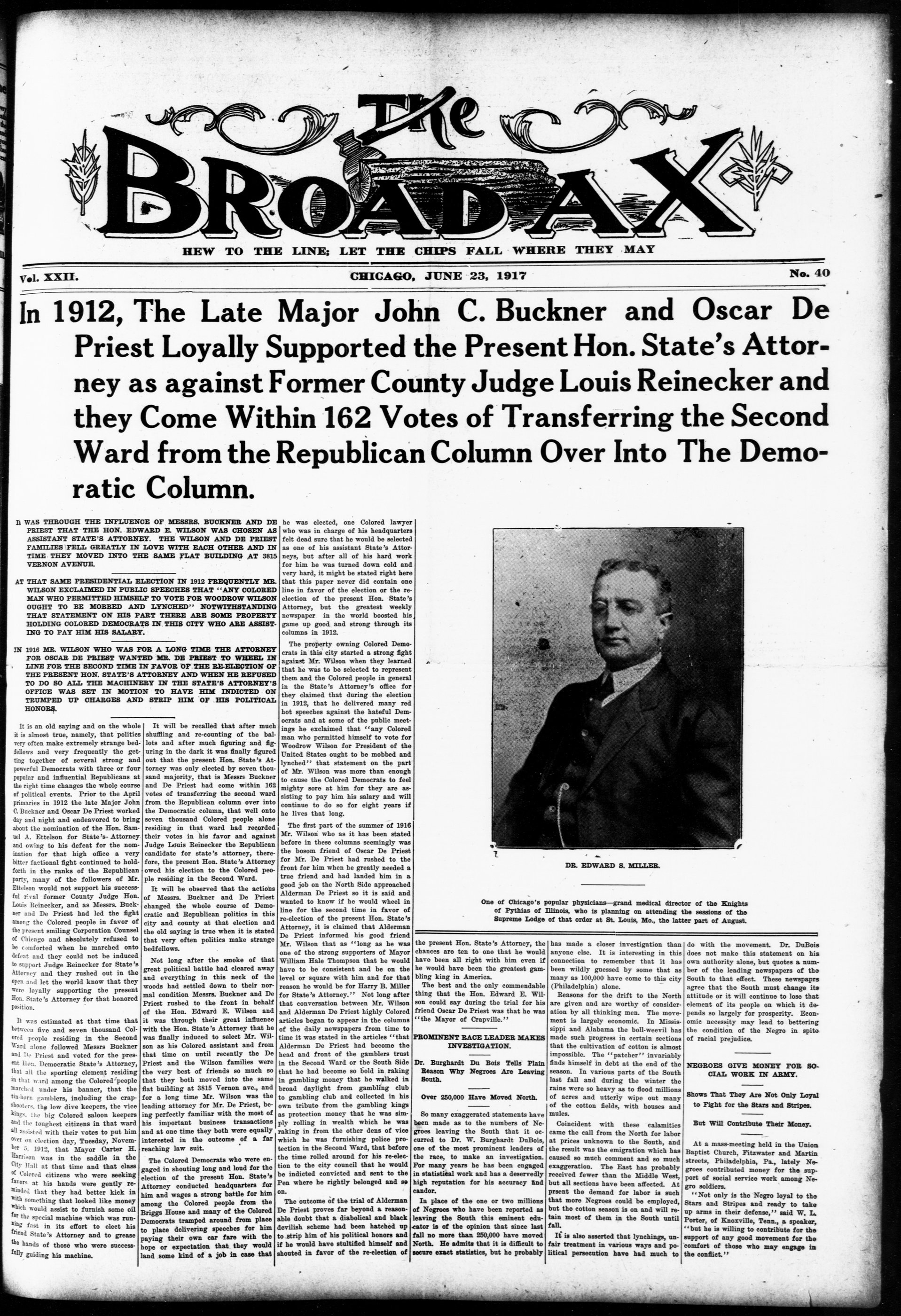
In 1912, The Late Major John C. Buckner and Oscar De Priest Loyally Supported the Present Hon. State's Attorney as against Former County Judge Louis Reinecker and they Come Within 162 Votes of Transferring the Second Ward from the Republican Column Over Into The Democratic Column.
IT WAS THROUGH THE INFLUENCE OF MESSRS. BUCKNER AND DE PRIEST THAT THE HON. EDWARD E. WILSON WAS CHOSEN AS ASSISTANT STATE'S ATTORNEY. THE WILSON AND DE PRIEST FAMILIES FELL GREATLY IN LOVE WITH EACH OTHER AND IN TIME THEY MOVED INTO THE SAME PLAT BUILDING AT 3815 VERNON AVENUE.
AT THAT SAME PRESIDENTIAL ELECTION IN 1912 FREQUENTLY MR. WILSON EXCLAIMED IN PUBLIC SPEECHES THAT "ANY COLORED MAN WHO PERMITTED HIMSELF TO VOTE FOR WOODROW WILSON OUGHT TO BE MOBBED AND LYNCHED" NOTWITHSTANDING THAT STATEMENT ON HIS PART THERE ARE SOME PROPERTY HOLDING COLORED DEMOCRATS IN THIS CITY WHO ARE ASSISTING TO PAY HIM HIS SALARY.
IN 1916 MR. WILSON WHO WAS FOR A LONG TIME THE ATTORNEY FOR OSCAR DE PRIEST WANTED MR. DE PRIEST TO WHEEL IN LINE FOR THE SECOND TIME IN FAVOR OF THE RE-ELECTION OF THE PRESENT HON. STATE'S ATTORNEY AND WHEN HE REFUSED TO DO SO ALL THE MACHINERY IN THE STATE'S ATTORNEY'S OFFICE WAS SET IN MOTION TO HAVE HIM INDICTED ON TRUMPED UP CHARGES AND STRIP HIM OF HIS POLITICAL HONORS.
Vol. XXII.
In 1912, The Priestney and they Ward ratic
It WAS THROUGH THE INFLUENCE PRIEST THAT THE HON. EDWARD ASSISTANT STATE'S ATTORNEY FAMILIES FELL GREATLY IN TIME. THEY MOVED INTO THE VERNON AVENUE.
AT THAT SAME PRESIDENTIAL EWILSON EXCLAIMED IN PUBLI MAN WHO PERMITTED HIMSEE OUGHT TO BE MOBBED AND THAT STATEMENT ON HIS PRESIDENT COLORED DEMOCRACING TO PAY HIM HIS SALARY.
IN 1916 MR. WILSON WHO WAS FOR OSCAR DE PRIEST WANT LINE FOR THE SECOND TIME THE PRESENT HON. STATE'S A TO DO SO ALL THE MACHINE OFFICE WAS SET IN MOTION TRUMPED UP CHARGES AND HONORS.
It is an old saying and on the whole it is almost true, namely, that politics very often make extremely strange bed-fellows and very frequently the getting together of several strong and powerful Democrats with three or four popular and influential Republicans at the right time changes the whole course of political issues. Prior to the April primaries in 1912 the late Major John C. Buckner and Oscar De Priest worked day and night and endeavored to bring about the nomination of the Hon. Samuel A. Ettelson for State's-Attorney and owing to his defeat for the nomination for that high office a very bitter factional fight continued to hold forth in the ranks of the Republican party, many of the followers of Mr. Ettelson would not support his successful rival former County Judge Hon. Louis Reinecker, and as Messrs. Buckner and De Priest had led the fight among the Colored people in favor of the present smiling Corporation Counsel of Chicago and absolutely refused to be comforted when he marched onto defeat and they could not be induced to support Judge Reinecker for State's Attorney and they rushed out in the open and let the world know that they were loyally supporting the present Hon. State's Attorney for that honored position.
It was estimated at that time that between five and seven thousand Colored people residing in the Second Ward alone followed Messrs Buckner and De Priest and voted for the present Hon. Democratic State's Attorney, that all the sporting element residing in that ward among the Colored people marched under his banner, that the tin-horn gamblers, including the crapp shooters, the low dive keepers, the vice kings, the big Colored saloon keepers and the toughest citizens in that ward all assisted with their votes to put him over on election day, Tuesday, November 5, 1912, that Mayor Carter H. Harrison was in the saddle in the City Hall at that time and that class of Colored citizens who were seeking favors at his hands were gently reminded that they had better kick in with something that looked like money which would assist to furnish some oil for the special machine which was running fast in its effort to elect his friend State's Attorney and to grease the hands of those who were successfully guiding his machine.
---
It will be recalled that after much shuffling and re-counting of the ballots and after much figuring and figuring in the dark it was finally figured out that the present Hon. State's Attorney was only elected by seven thousand majority, that is Messrs Buckner and De Priest had come within 162 votes of transferring the second ward from the Republican column over into the Democratic column, that well onto seven thousand Colored people alone residing in that ward had recorded their votes in his favor and against Judge Louis Reinecker the Republican candidate for state's attorney, therefore, the present Hon. State's Attorney owed his election to the Colored people residing in the Second Ward.
It will be observed that the actions of Messrs. Buckner and De Priest changed the whole course of Democratic and Republican politics in this city and county at that election and the old saying is true when it is stated that very often politics make strange bedfellows.
Not long after the smoke of that great political battle had cleared away and everything in this neck of the woods had settled down to their normal condition Messrs. Buckner and De Priest rushed to the front in behalf of the Hon. Edward E. Wilson and it was through their great influence with the Hon. State's Attorney that he was finally induced to select Mr. Wilson as his Colored assistant and from that time on until recently the De Priest and the Wilson families were the very best of friends so much so that they both moved into the same flat building at 3815 Vernon ave., and for a long time Mr. Wilson was the leading attorney for Mr. De Priest, being perfectly familiar with the most of his important business transactions and at one time they both were equally interested in the outcome of a far reaching law suit.
The Colored Democrats who were engaged in shouting long and loud for the election of the present Hon. State's Attorney conducted headquarters for him and wages a strong battle for him among the Colored people from the Briggs House and many of the Colored Democrats tramped around from place to place delivering speeches for him paying their own car fare with the hope or expectation that they would land some kind of a job in case that
CHICAGO, JUNE 23, 1917
he was elected, one Colored lawyer who was in charge of his headquarters felt dead sure that he would be selected as one of his assistant State's Attorneys, but after all of his hard work for him he was turned down cold and very hard, it might be stated right here that this paper never did contain one line in favor of the election or the re-election of the present Hon. State's Attorney, but the greatest weekly newspaper in the world boosted his game up good and strong through its columns in 1912.
The property owning Colored Democrats in this city started a strong fight against Mr. Wilson when they learned that he was to be selected to represent them and the Colored people in general in the State's Attorney's office for they claimed that during the election in 1912, that he delivered many red hot speeches against the hateful Democrats and at some of the public meetings he exclaimed that "any Colored man who permitted himself to vote for Woodrow Wilson for President of the United States ought to be mobbed and lynched" that statement on the part of Mr. Wilson was more than enough to cause the Colored Democrats to feel mighty sore at him for they are assisting to pay him his salary and will continue to do so for eight years if he lives that long.
The first part of the summer of 1916 Mr. Wilson who as it has been stated before in these columns seemingly was the bosom friend of Oscar De Priest for Mr. De Priest had rushed to the front for him when he greatly needed a true friend and had landed him in a good job on the North Side approached Alderman De Priest so it is said and wanted to know if he would wheel in line for the second time in favor of re-election of the present Hon. State's Attorney, it is claimed that Alderman De Priest informed his good friend Mr. Wilson that as "long as he was one of the strong supporters of Mayor William Hale Thompson that he would have to be consistent and be on the level or square with him and for that reason he would be for Harry B. Miller for State's Attorney." Not long after that conversation between Mr. Wilson and Alderman De Priest highly Colored articles began to appear in the columns of the daily newspapers from time to time it was stated in the articles "that Alderman De Priest had become the head and front of the gamblers trust in the Second Ward or the South Side that he had become so bold in raking in gambling money that he walked in broad daylight from gambling club to gambling club and collected in his own tribute from the gambling kings as protection money that he was simply rolling in wealth which he was raking in from the other dens of vice which he was furnishing police protection in the Second Ward, that before the time rolled around for his re-election to the city council that he would be indicted convicted and sent to the Pen where he rightly belonged and so on.
The outcome of the trial of Alderman De Priest proves far beyond a reasonable doubt that a diabolical and black devilish scheme had been hatched up to strip him of his political honors and if he would have stultified himself and shouted in favor of the re-election of
1
One of Chicago's popular physicians—grand medical director of the Knights of Pythias of Illinois, who is planning on attending the sessions of the Supreme Lodge of that order at St. Louis, Mo., the latter part of August.
One of Chicago's popular physicians—grand medical director of the Knights of Pythias of Illinois, who is planning on attending the sessions of the Supreme Lodge of that order at St. Louis, Mo., the latter part of August.
the present Hon. State's Attorney, the chances are ten to one that he would have been all right with him even if he would have been the greatest gambling king in America. The best and the only commendable thing that the Hon. Edward E. Wilson could say during the trial for his friend Oscar De Priest was that he was "the Mayor of Crapyville."
PROMINENT RACE LEADER MAKES INVESTIGATION.
Dr. Burghardt Du Bois Tells Plain Reason Why Negroes Are Leaving South.
Over 250,000 Have Moved North.
So many exaggerated statements have been made as to the numbers of Negroes leaving the South that it occurred to Dr. W. Burghardt DuBois, one of the most prominent leaders of the race, to make an investigation. For many years he has been engaged in statistical work and has a deservedly high reputation for his accuracy and candor. In place of the one or two millions of Negroes who have been reported as leaving the South this eminent educator is of the opinion that since last fall no more than 250,000 have moved North. He admits that it is difficult to secure exact statistics, but he probably
has made a closer investigation than anyone else. It is interesting in this connection to remember that it has been wildly guessed by some that as many as 100,000 have come to this city (Philadelphia) alone.
Reasons for the drift to the North are given and are worthy of consideration by all thinking men. The movement is largely economic. In Mississippi and Alabama the boll-weevil has made such progress in certain sections that the cultivation of cotton is almost impossible. The "patcher" invariably finds himself in debt at the end of the season. In various parts of the South last fall and during the winter the rains were so heavy as to flood millions of acres and utterly wipe out many of the cotton fields, with houses and mules.
Coincident with these calamities came the call from the North for labor at prices unknown to the South, and the result was the emigration which has caused so much comment and so much exaggeration. The East has probably received fewer than the Middle West, but all sections have been affected. At present the demand for labor is such that more Negroes could be employed, but the cotton season is on and will retain most of them in the South until fall.
It is also asserted that lynchings, unfair treatment in various ways and political persecution have had much to
No. 40
do with the movement. Dr. DuBois does not make this statement on his own authority alone, but quotes a number of the leading newspapers of the South to that effect. These newspapers agree that the South must change its attitude or it will continue to lose that element of its people on which it depends so largely for prosperity. Economic necessity may lead to bettering the condition of the Negro in spite of racial prejudice.
NEGROES GIVE MONEY FOR SOCIAL WORK IN ARMY.
Shows That They Are Not Only Loyal to Fight for the Stars and Stripes.
But Will Contribute Their Money.
At a mass-meeting held in the Union Baptist Church, Fitzwater and Martin streets, Philadelphia, Pa., lately Negroes contributed money for the support of social service work among Negro soldiers.
"Not only is the Negro loyal to the Stars and Stripes and ready to take up arms in their defense," said W. L. Porter, of Knoxville, Tenn., a speaker, "but he is willing to contribute for the support of any good movement for the comfort of those who may engage in the conflict."
TEENAN JONES’ PLACE
3445 SOUTH STATE STREET
Telephone Douglas 4591
———
The finest and most UP-TO-DATE
BUFFET and CAFE on the South
Side. First-Class Entertainers.
HENRY “TEENAN” JONES, Proprietor.
EES
Residence 1262 Macalister Place
melebere recess ** eusenene nan es Tuseboaa ions
MILES J. DEVINE
tout ary Dr. Theo. R. Mozee
Gis & Washington Sts. DENTIST
Phones a = 4709 2: STATE eee
AUTOMATIC 33-736 Bowe 9 A.M te SP.M.,7 P.M. to® P. kt.
[ Phone Main 2017 Avtomatie 32395
l A. L. WILLIAMS
ATTORNEY AND COUNSELOR AT LAW \
Suite 706 Firmenich Bldg.
y 184 W. Washington St.
fhe ae |
A. D. GASH
ATTORNEY AT LAW
118 North La Salle St., Chicage
Sulte 18 te 616
PHONE MAIN 8816
SM, fy)
YY YY Wy,
Me" 4///
f aes Specs /7/7///////
[i ss ne ey
fees) OKIE
Vv mere [yn 7255057 57)
My ( ee eer
Ly aly SA aroyspgaty
“ b &p
Ys ASS SS %
yy SN SS Y
Lp 7}
gp Y
y y
Vj : y
/ Last Gas Range Bargain
4 Before War PricesCome 7
,—————
Y WWE bought several extra carloads of the range shown y
y ‘above, before the first advance in manufacturers’
Y price, because it has proved itself to be highly satisfactory. Y
Y Hence, the bargain price while they last. Y
Y, Manufacturers’ prices are going still higher. When ranges]
A now on hand are sold, cur prices will have to goup. So /
4 it’s intelligent economy to oust the old range (coal or gas) 7
Jj NOW and save both range cost and fuel; for GAS has]
Y not. advanced. At $31.00 (in easy payments) the range
H shown above is $4.09 under the regular price and is— J
Y $1200 or $150 Less Than You Will Probably /
! Have to Pav for This Range ina Few Months Yi
errr Yj
Y} For, mark you: This is the Standard Eclipse Composite, }
H No. 477, in white porcelain enamel, as pictured, and 7
4 with full standard equipment, including self-lighter. In- Vj
Yj salled, connected and adjusted without charge—of course. H
Y See.it taday—down town or at branch stores. y
Y Phone, call or awrite for “The Lew Cost of Cooking”, by Mrs. Y
Y Helex Ruggles, domestic science expert. It helps cut the cost of living. Y
} ‘THE PEOPLESGAS LIGHT & COKECOMPANY ff
{PEOPLES GAS RUILDING - - - - ‘TELEPHONE WARASH 6100 Yj
Wife—James, do you know you are
a very small man? Husband—How
ridiculous! I am nearly six feet in
height. Wife—That makes no differ
ence. Whenever I ask you for money
to go shopping you are always short.
—Pittsburgh Chronicle-Telegraph.
“Nothing is so unclean as a used tea-
cup, nothing is so cold as toast which
has once been hot, and the concrete ex-
pression of dejection is crumbs.”—“Se-
lected Tales,” by Barry Pain.
Bob—Before marriage she told me
she loved me a little. Rob—Well? Bob
—But, my stars, if I had only know
how littie!—London Answers.
He—Have you heard my new song,
“The Proposal?” She—No. What key
B& it in? He—Be mineer—Boston
Sranscript.
It ws well to moor your bark with
‘ewe anchors.—Publius Syrus.
Residence 1262 Macalister Place
‘Telephone Menres 2714
MILES J. DEVINE
ATTORNEY AT LAW
Gina Weshington Ste.
Phones Kote t1-si8 cmcace
—yuones: orrice. MAIN ats
"AUTOMATIC. 33-736
RESIDENCE. DREXEL 7008
Walter M. Farmer
ATTORNEY AT LAW;
SUITE 708, 184 WASHINGTON 8T.
NOTARYPUBLIC CHICAG®
Franklin A. Denison
ATTORNEY AT LAW
36 West Randolph St., Chicage
Suite 708 Delaware Building
Tel. Contral 3142
Pr EE
, TEL. CAMLAMD 1660, 1551, 1558
JOHN J. DUNN
vou COn L wu
Pifty-Pieet end Armour Avense
RAMYARDS
Re
euieace
= bg \
ao ri air
yy \Grows Long,
ee / Soft, Silky
YS —
eases a
Y Y sce
an —
Pomace
merch serait
seiroes “ina
Don't be fooled all your life by using
ont ea ocmescradog wich clas
foctraighten Kinky bait: You are just
fooling’ y ourself by using It Kinky
hair cannot be made straight. You
must have hair first. Now this
EXELENTO Pomace
is a Hair Grower which feeds the scalp
mepey baie grow tong, soft and silky.
7 baie : 4
Ke'cleane dandruff and. stope Fall
Halestonce: ‘Price 280 by mallon
Feceiptof stamps or coin.
AGENTS WANTED EVERYWHERE
Write fer Particsters
SXELEWTO MEDICINE CO. ATLANTA, OA.
Small One Way.
Stenia Uteniin Retinal
A Verv Little.
‘The Richt Key.
THE BROAD AX, CHICAGO, JUNE 23, 1917.
———————————
Courtesy to the Flag. 1 Eye of the Submarine,
Civilians have all kinds of trouble] Without the periscope the sub
when visiting a military camp, because | would be a blinded fighter. It
they invariably attempt to pass the} deadly work is done when it is
flag waving at regimental or brigade | submerged that only a foot or
headquarters without paying it any | the periscope’s tip can be seen
more recognition than they would an | periscope is a long vertical t
ice wagon or a garbage can, But in| ‘small diameter, with prisms at
such places they are compelled to ex-| end and the necessary lenses. |
tend proper courtesy to the flag of | eighteen feet above the deck, s
their country. ‘There is always a hawk | low, where the other end pier
faced colonel roosting in the black | hull, is the eyepiece for the ob
depths of his tent just behind the col- | Zt ean be turned in any directi
ors, and woe to the soldier on guard ff | when a merchantman trying to 1
he lets a civilian go past without sa-| blockade or an enemy ship come
luting. 2 in its field the submarine is su
‘When a civilian starts to pass the | transformed into a formidab!
colors without removing his hat the | stealthy sea tiger. The perisc
sentry, knowing that the regimental | comes its eyes and the dials
hawk is glaring balefully at him, | passes and other instruments
swoops down on the surprised civilian | fire control its brain. ‘The engin
and sternly says, “Take off your hat.” | carry it to effective range are it:
‘Women, of course, cannot take off | tireless legs, and the destructive
thelr hats to the colors, but as they | of 250 pounds of guncotton in |
pass the colors or the colors are car-| leashed torpedo is the death «
rled by them, they can at least stop | Jaws and rending claws of the
talking and keep their eyes fastened on | cat that has seen its prey and
Old Glory.—Chicago Herald. up on it with the skill of a tige
SS ing a buffalo. No tiger is more
Sa a cei Jess.—Frank E. Evans in St. Nic
‘The fortress of St. Peter and St. Paul
1s the gloomiest of bastiles. It stands
on the bank of the Neva in Petrograd,
‘opposite what was the Winter palace
of Russia’s masters. It is a veritable
temple of silence, such as Carlyle sigh-
ed for in vain. Prince Krapotkin, who
spent many weary months within its
walls, tells how the officers moved
about with silent tread. The floor af
his cell was covered with felt, and he
found that though the walls had the
appearance of being paper the paper
was only pasted on canvas, behind
which was a wire grating packed with
layers of felt. Krapotkin measured
his cell and found that ten steps from
one corner to the other repeated 150
times was two-thirds of a mile. He
desired to walk five miles a day and
accomplished his task walking rapidly
to the comers, but turning slowly to
avold dizziness,
Tis Rntebeteten to Gud:
The saying “The latchstring ta out"
signifies hospitality, It ta a standing
fnvitation to visit the party who uses
ft, In early times throughout New
Bagland and other parts of the coun
try the houses wore butit of logs, and
the door fustontige were simply a
Wooden latch on the Inside of the door.
which fell into a notched stick in the
doorpost. The simple contrivance was
owing to the fact that nails and tron
were hard to get. On the inside the
latch was lifted by the hand easily, but
to lift it from the outside a hole was
bored in the door, which was made of
slabs, and a string passed through.
which was fastened to the latch. By
pulling the string the latch was Ifted
and the door opened. ‘To lock the door
the string was drawn inside so that a
person on the outside could not use it
ae a
If all men were like a colored porter
im Frankfort, newspaper men would
find the game an extremely easy one.
‘The porter, who is known to ever
man and boy in the city, recently wa:
ivoreed from his first wife and with
im a few days was married again. A
Teporter happened in the clerk’s office
Just as he was about taking out his
Heense.
“When are you to be married
Brank?” asked the reporter.
The porter told him, and the ques
tioning was continued until bis wife
to be grabbed hold of his arm and
‘whispered, “Don't tell that man al
‘about this.”
“['ve got to,” the porter whispered
back. “He's a reporter.”—Indianapolis
News.
Sect Deas Sn Cteuian Stak
“Particularly pleasant to grow are
herbs,” says Grace Tabor in the Wo
man’s Home Companion, “and by a lit
tle study of their very special market
they may be easily turned into pin
money. Every butcher who makes bis
own sausage is a potential customer,
and the large packing houses, of course
use large quantities. Chemists, per
fumers and pickle factories also re
quire them. Solicit trade if this line
is what you think you would like, of.
fering a sample of your wares, just as
any manufacturer shows samples of
his goods.”
Manila's Name Widely Used.
Manila has given its name probably
to more articles of commerce than any
other city in the world. “Manila” to-
bacco, cheroots, hemp, hats, paper,
matting, bracelets and rings are just
a few of the things which remind peo-
ple in different countries of the capital
of the Philippines. —London Chronicle.
His Experience.
“That young electrician got an an-
swer from the girl he proposed to that
‘Was opposed to all his scientific princi-
“What was it?”
“A decided negative which was also
quite positive.”—Baltimore American.
io Sittin Gite ie
Willie's Mamma—Come now, Wil-
He, I am ready to hear you repeat your
history lesson. Willie—Aw, let history
repeat itself—Philadelphia Record.
(cialis: Waa.
Mrs, A.—What did your husband say
when he saw the bill for your new
gown? Mrs. B—I didn't hear. I start
ed to play on the plano.
Worse Luck.
_ Fatigued Philip—Did the lady t'row
‘Doilin’ water on youse? Wandering
‘Walter—Worse'n dat, Phil; worse'n dat.
“It was soapsuds!
_ A man should be upright, not have
‘to be kept straight—Marcus Aurelius.
ai i a
ma As Nese Ae Y our Tee
= ICE IMM, “Pag
ME [Na Mewopoitan iy of ths sae arene
ot thirty minutes at some door. Typ ait Ede
bo not only brings sorrow, but misfortune ,° tat
33 price you pay for a funeral be a buseat WL
you will benefit by it in service, quality Pita
——— cents, The rest of yalony
for me one cape
cblalasts fo the! wat 1 St
A visit will convince you. 4
Consult me ao we Wag.tee ae Money.
Shipping to all parts Country and Automobile (i
Shiooing ° S caly. Cental Deplay Rooms and QQe™
Chapel. Call promptly answered day or night. X SS
Ernest H. Williamson, Ls
ee i
“veo Undertaker “77cr lars
5028 and 5030 S. StateSt, - + - - Ch
Without the periscope the submarine
would be a blinded fighter. Its most
deadly work is done when it is so far
submerged that only a foot or two of
the periscope’s tip can be seen. The
periscope is a long vertical tube of
‘small diameter, with prisms at either
end and the necessary lenses. It rises
eighteen feet above the deck, and be-
low, where the other end pierces the
hull, is the eyepiece for the observer.
It can be turned in any direction, and
when a merchantman trying to run the
‘blockade or an enemy ship comes with-
in its field the submarine is suddenly
transformed into a formidable and
stealthy sea tiger. The periscope be-
comes its eyes and the dials, com-
passes and other instruments of the
fire control its brain. The engines that
carry it to effective range are its swift,
tireless legs, and the destructive charge
of 250 pounds of guncotton in the un-
leashed torpedo is the death dealing
jaws and rending claws of the great
cat that has seen its prey and steals
up on it with the skill of a tiger stalk-
ing a buffalo. No tiger is more merci-
Jess —Frank B. Evans in St. Nicholas.
;
The: Cranford Apartmeit
aaae
Building, 3600. Wabash An,
De ae pS
i ace eee ona ate 2 a Nae
BOR so spel e
BE a toa ee 9 wm eRe
Po ae ee we
a © whe Ee Sacto FI “i Ne |
f = Ae
4 Se te fa 4 ' ,
; ais. «NS if ;
Nie i
* ‘ci Aine
'
The finest building ever opened to Colored tenants in Chicya
Steam heat, electric lights, tile baths, marble entrance.
= J. W. Casey, Agent
Phone Main 263 133 W. Washington&
cece! aaa
Sec cumrnincer nee coe
(CHAS. HARRIS, Manager AUTO. 72-379
Fpcnreneen acer p
The Elite Cafe
AND BUFFET
3030 GTATE STREET CHICAGO
A Lost Trade Secret. .
It has frequently happened that val
uable trade secrets have been lost be
yond recovery. For instance, the best
watch oil, it appears, cannot be ob
tained today because the secret proc
ess of mixing it perished with the in
ventor. It is said that the last quart
of this famous fluid was sold for $200
and that was thirty-five years ago
Since then every effort has been made
to analyze the product in an attempt
to reproduce the oil, but without suc-
cess. The man who made it and who
alone knew its composition died, and,
it further appears, not even his name
or the place of his burial is known. He
never revealed to any one the details
of his process, and it was not until
after his death that the real value of
the oll was appreciated.—Los Angeles
Times.
‘The Eskimo Skin Canoe.
‘The kayak, or akin canoe, of the Ke
imo was in use on the coast of north:
ern Russia two or three centuries ago,
according to Dr, MaeRitehie, F, &. A.
(Bcot), Evidence of this ts obtained
from statements made by Burrough tn
1650 and from the chronicles of a Dan-
tah expedition to Vaigata in 1003, It
was further shown that three kayake
‘were captured off the northern shores
of Scotland about the end of the sev-
enteenth century. One of these is still
Preserved in the museum of Marischal
college, Aberdeen, An important fact
4s the occasional presence of a kayay-
using race of Finns or Finnmen in
the Orkney islands during the last
twenty years of the seventeenth cen-
tury, as testified to by three writers
of that period—Toronto Mail and Em-
pire.
To-kyo.
It is remarkable how many persons
some of whom may lay claim to edu
cation and familiarity with Japan, per
sist in misspelling the name of Japan's
capital. Of course if government off
cials and western diplomats in Japar
insist on spelling it To-Li-o, western
people, ignorant of the Japanese lan
guage, cannot be blamed for pronoune
ing it in three syllables (To-kee-yo)
much to the amused disgust of the Jap
anese. The Japanese ideographs are
only two and are best represented by
the two romaji syllables To-kyo, pro:
nounced with a very slight emphasis
on the first syllable—Japan Magazine.
Her Dear Husband.
“Why,” exclaimed a newly married
woman to a bunch of friends, “for
three months after our marriage my
dear husband made me bake hot bis.
cuits for him every meal.”
“And yet your husband is a strong,
healthy looking felllow,” answered her
friend in astonishment. “Doctors say
that such a diet is terrible, and”—
“Oh, yes, this husband fs healthy! 1
was referring to my first husband.”—
Cleveland Plalin Dealer.
All Eye Trouble
a SEE
‘ Dp. Louie UsseLmul
. The Practical O ticias
——_—
TH MOST COMPLETE OPTICAL ROOMS IN THE ory
2 + BEST GOODS AT THE LOWEST PRICES a
Consattation or examination | 3150 S. STATE ST.
SEES | ee
| guarantee to give satisfaction. CHICAGO
bececusensiecis cannaea ao wuistsiitiinecamaancaouait
His Loyalty to Alma Mater.
“You say Dibling’s allegiance to his
alma mater has never wavered?”
“Never. Dibling has been out of cdi-
lege more than twenty years, and he
still borrows money from his college
chums exclusively.”—Birmingham Age
Herald.
Useless Advice.
‘Mrs. Batz—You ought to brace up
and show your wife who is running
things at your house. Cralle (sadly)
—It isn’t necessary. She knows—
Puck.
COMM BLOCK, Presisent F. W. BLOCK!. Tresser”
JOHN BLOCK! & SON
PERFUMERS
ese GO 10 see
C. E. KREYSSLER, Druggist
5057 South State Street
NOT ON THE CORNER
FOR HIGH GRADE DRUGS, CHEMICALS AND
MEDICINAL PREPARATIONS
All Prescriptions Carefully Compounded
BLOCKI'S IDEAL & BLOCKI'S_FLOWER
IN BOTTLE PERFUM
: PRACTICAL HEALTH HINT. +
— :
‘+ Give Your Stomach a Rest. +
+ Give your stomach a good rest -
‘+ by eating plain salads or fruits -
> or fresh green stuff, cutting out -
tea and coffee, soda water and -
+ other destroyers, and drink all -
‘+ the water you can pour down <
‘+ and watch the effect. After this -
* internal cleansing you can eat «
‘+ what nature intended you to eat -
+ —meats, vegetables, fish, eggs -
and whatever you really crave. -
‘+ Men cannot make rules that go -
+ contrary to nature. Fads are «
+ symptoms of diseased stomachs <
+ or the outgrowth of some indi- <
‘ vidual idiosyncrasy. There are -
no brain foods, no muscle build- -
+ ing tablets, no nerve strength- <
‘+ eners, that can be made to take <
+} the place of a varied diet. Ev- -
‘ ery bit of food contains elements <
‘ which are taken up by the blood <
+ and distributed to the body. ‘
;
TEENAN JONES’ PLACE
3445 SOUTH STATE STREET
Telephone Douglas 4591
The finest and most UP-TO-DATE
BUFFET and CAFE on the South
Side. First-Class Entertainers.
HENRY “TEENAN” JONES, Proprietor.
i Wyn VAY EY),
Ap ammo m 31c°
Gee , ee
q VRE Vy
$ er Vj Upper
PPL \ WW Via MONTHS
ys} { SSS %
/ in |
/ Last Gas Range Bargain }
4 Before War PricesCome j
aS SS ee rd”
\WVE boughs several extra carloads of the range shown Y
Y above, defare the first advance in manufacturers’ Y
4)
Y price, because it has proved itself to be highly satisfactory.
y Hence, the bargain price wile they last. Y
Y} Manufacturers’ prices are going still higher. When ranges YJ
A now on hand are sold, our prices will have to goup. So
fits imelizent economy to oust the old range (coal or gas)
J} NOW and save both range cost and fuel; for GAS Aas J
Y not. advanced. At $31.00 (in easy payments) the range Y
H shown above is $4.0) under the regular price and is—
Y $1200 or $1500 Less Than You Will Probably Y
! Have to Pay for This Range ina Few Months Y
Have to Pay for This Ranges Yj
Y For, mark you: This is the Standard Eclipse Composite, |
Y No. 477, in white porcelain enamel, as pictured, and
with full standard equipment, including selfightr.” Ine y
JJ salled, connected and adjusted without charge—of course. i
Y} Sce.it taday—down town or at branch stores. Y
Y Phone, call or ewrite for “The Low Cost of Cooking”, by Mrs. Y
Y Heles: Ruggles, domestic science expert. It helps cut the cost of living. y
‘THE PEOPLES GAS LIGHT & COKE,COMPANY ff
Yo rronuscasmnonc = 7 = = Teurdoxe wanna Yf
Pee ERT
TEENAN JO
3445 SOUTH
Telephone I
The finest and 1
BUFFET and CA
Side. First-Class
HENRY “TEENAN’
Residence 1262 Macalister Place
“Telephone Menree 2716
MILES J. DEVINE
ATTORNEY AT LAW
Suite 313.329 Reaper Bleck
Clark & Washington Sts.
Phones fore 4i-bi8 cmicace
—yuones: orrice. mam ais
"AUTOMATIC. 33-736
RESIDENCE, DREXEL 7000
Walter M. Farmer
ATTORNEY AT LAW:
SUITE 708, 184 WASHINGTON 8ST.
NOTARYPUBLIC CHICAG®
Franklin A. Denison
ATTORNEY AT LAW
36 West Randolph St., Chicage
Suite 708 Delaware Building
Tel. Central 3142
PERE ree Ronnie
) TEL OAKLAND 1680, 1851, 1882
JOHN J. DUNN
Pitty-Fieet and Armour Avesse
RAUYARDS
ett oc ond
SAS8 SE S85 Temete Mew:
euissae
= ee ai
A aN a it
ys Grows Long,
. a)
Pcdae) Solt, Silky
‘ ) Gentlemen:
A
Y sae
Re EE
Somacs
tas done foe ma bas, ron 038 neh
Berri og, Secomraios
$55 Arty si ny eapt eet isthe n
Eleerciousfeke "haba banks
Don't be fooled all your life by vai
Done hve ereberaton, which cates
foutraighten Kinky baie, You are just
Weicker be made stright. You
Shosthave hats firets Now this
EXELENTO Ponce
is a Hair Grower which feeds the scalp
fepgy hele grow fons, soft and ally.
Tecleans dendruff and. etope Falling
Halratonce, Price 28067 mallos
receipt of stampe or coin.
AGENTS WANTED EVERYWHERE
Write fer Pertiontars
EXELENTo WEDIGINE OO. ATLANTA. GA.
Otties Phenee: Res. SLS3 Se. Wabash Ave.
ous St aes ian 18 Tare Boe as
Dr. Theo. R. Mozee
DENTIST
4709 S. STATE STREET
CHICAGO
Bours 8 A.M. te S P.M. 7 P.M. to® P. i.
pease ecco
| H pee Nain 2007 Avtomatic 32-395
| A.L.WILLIAMS. |
ATTORNEY AND COUNSELOR AT LAW
fl Suite 706 Firmenich Blds.
U 184 W. Washington St.
|
ftps Names S515 Chisago |
A. D. GASH
ATTORNEY AT LAW
118 North La Salle St., Chicage
Suite 615 te 616
PHONE MAIN 22146
‘Small One Way.
Wife—James, do you know you are
very small man? Husband—How
ridiculous! I am nearly six feet in
height. Wife—That makes no differ
ence. Whenever I ask you for money
to go shopping you are always short.
—Pittsburgh Chronicle-Telegraph.
Harsh Words Indeed.
“Nothing is so unclean as a used tea-
cup, nothing is so cold as toast which
has once been hot, and the concrete ex-
Pression of dejection is crumbs.”—“Se-
lected Tales,” by Barry Pain.
A Very Little.
Bob—Before marriage she told me
she loved me a little. Rob—Well? Bob
—But, my stars, if I bad only knowr
bow little!—London Answers.
The Right Key.
He—Have you heard my new song,
‘Tho Proposal?’ She—No. What key
Bb it in? He—Be mine-er—Boston
/Branscript.
‘It well to moor your bark with
ewe anchors—Publius Syrus.
THE BROAD AX, CHICAGO, JUNE 23, 1917.
Si se eee. | Seep Cs ee eee
Civilians have all kinds of trouble
when visiting a military camp, because
they invariably attempt to pass the
flag waving at regimental or brigade
headquarters without paying it any
more recognition than they would an
fee wagon or a garbage can. But in
such places they are compelled to ex-
tend proper’ courtesy to the flag of
their country. ‘There is always a hawk
faced colonel roosting in the black
depths of his tent just behind the col-
ors, and woe to the soldier on guard tf
he lets a civilian go past without se-
luting. ‘
‘When a civilian starts to pass the
colors without removing his hat the
sentry, knowing that the regimental
hawk’ is glaring balefully at him,
swoops down on the surprised civilian
and sternly says, “Take off your hat.”
‘Women, of course, cannot take off
their hats to the colors, but as they
pass the colors or the colors are car-
ried by them, they can at least stop
talking and keep their eyes fastened on
Old Glory—Chicago Herald.
Bartreass. Silence Gleam!
‘The fortress of St. Peter and St. Paul
4s the gloomiest of bastiles. It stands
on the bank of the Neva in Petrograd,
opposite what was the Winter palace
of Russia’s masters. It is a veritable
temple of silence, such as Carlyle sigh-
ed for in vain. Prince Krapotkin, who
spent many weary months within its
walls, tells how the officers moved
about with silent tread. The floor af
his cell was covered with felt, and he
found that though the walls had the
appearance of being paper the paper
was only pasted on canvas, behind
which was a wire grating packed with
layers of felt. Krapotkin measured
his cell and found that ten steps from
‘one corner to the other repeated 150
times was two-thirds of a mile. He
desired to walk five miles a day and
accomplished his task walking rapidly
to the comers, but turning slowly to
avoid dizziness.
The Latchstrina Is Out.
The saying “The latchstring is out”
signifies hospitality. It is a standing
fnvitation to visit the party who uses
it. In early times throughout New
England and other parts of the coun
try the houses were built of logs, and
the door fastenings were simply a
wooden latch on the inside of the door.
which fell into a notched stick in the
doorpost. The simple contrivance was
owing to the fact that nails and trot
were hard to get. On the inside the
latch was lifted by the hand easily, but
to lift it from the outside a hole was
bored in the door, which was made of
slabs, and a string passed through,
which was fastened to the latch. By
pulling the string the latch was Ifted
and the door opened. To lock the door
the string was drawn inside so that a
person on the outside could not use tt
Me Had Ta.
If all men were like a colored porter
tm Frankfort, newspaper men would
find the game an extremely easy one.
‘The porter, who is known to every
man and boy in the city, recently was
Gtvorced from his first wife and with
fn a few days was married again. A
reporter happened in the clerk's office
just as he was about taking out his
Itcense.
“When are you to be married.
Brank?” asked the reporter.
The porter told him, and the ques:
tioning was continued until his wife
to be grabbed hold of his arm and
‘whispered, “Don’t tell that man all
about this.”
“['ve got to,” the porter whispered
back. “He's a reporter.”—Indlanapolis
News.
‘There’s Profit In Growing Herbe.
_ “Particularly pleasant to grow are
herbs,” says Grace Tabor in the Wo
man’s Home Companion, “and by a lit-
tle study of their very special market
they may be easily turned into pin
money. Every butcher who makes his
own sausage is a potential customer,
and the large packing houses, of course,
‘use large quautities. Chemists, per-
fumers and pickle factories also re-
quire them. Solicit trade if this line
4s what you think you would like, of.
fering a sample of your wares, just as
any manufacturer shows samples of
his goods.”
Manila’s Name Widely Used.
Manila has given its name probably
to more articles of commerce than any
other city in the world. “Manila” to-
bacco, cheroots, hemp, hats, paper,
matting, bracelets and rings are just
a few of the things which remind peo-
ple in different countries of the capital
of the Philippines—London Chronicle.
His Experience.
“That young electrician got an an-
swer from the girl he proposed to that
was opposed to all his scientifie princi-
ples.” ~
“What was it?”
“A decided negative which was also
quite positive.”—Baltimore American.
Dae eae aeons
_ Willie's Mamma—Come now, Wil.
‘Ie, I am ready to hear you repeat your
history lesson. Willie—Aw, let history
repent ttself—Piladetphia Record.
y Something Weanerian.
Mrs, A.—What did your husband say
when he saw the bill for your new
gown? Mrs. B—I didn't hear, I start-
ed to play on the piano.
Worse Luck.
Fatigued Philip—Did the lady t'row
bollin’ water on youse? Wandering
Walter—Worse'n dat, Phil; worse'n dat.
Tt was soapsuds!
A man should be upright, not have
to be kept straight—Marcus Aurelius.
Bye of the Gubmerina.
As NearAs Your Telephg,
7 DISTANCE IMMATERIAL ne
e: JN 22 Metropolitan City of this size, death knocks
Eo thirty minutes at some door. Too often that every
fe RIE not only brings sorow, but misfortune as well it
ay price you pay for a funeral be a business propos“
you will benefit by it in service, quality and cot
eee get sae
seme ee a at ia
A visit will convince you. Zz,
Consult me, Ican save you Worry, Time and Money. (44g
Siooine toy <B pete ole Coe at ee —
unerals a Specialty. Display Rooms ——
Chapel. Call promptly answered day or night. =
Ernest H. Williamson, Ns =
“33° Undertaker “W3er Gry
5028 and 5030 S. StateSt, - - - - Chicago,
Without the periscope the submarine
would be a blinded fighter. Its most
deadly. work is done when it is so far
submerged that only a foot or two of
the periscope’s tip can be seen. The
Periscope is a long vertical tube of
‘small diameter, with prisms at elther
end and the necessary lenses. It rises
eighteen feet above the deck, and be.
low, where the other end pierces the
hull, is the eyepiece for the observer.
Tt can be turned in any direction, and
ywhen a merchantman trying to run the
blockade or an enemy ship comes with-
in its field the submarine is suddenly
transformed into a formidable and
stealthy sea tiger. The periscope be-
comes its eyes and the dials, com-
Passes and other instruments of the
fire control its brain. ‘The engines that
carry it to effective range are its swift,
tireless legs, and the destructive charge
of 250 pounds of guncotton in the un-
leashed torpedo is the death dealing
jaws and rending claws of the great
cat that has seen its prey and steals
up on it with the skill of a tiger stalk-
ing a buffalo. No tiger is more merci-
less.—Frank EB, Evans in St. Nicholas.
ee eee
The- Cranford Apartmei
The partment
<3 ae
Building, 3600. Wabash Ave-
Beer a a eee, SE
SR 2 eee oe
oe ee eee ae
Pe sis ages hee
Be re dae Eg = Hi a
Sere oe ice ate 4
es ois a HT ee
> a fs etd I
| aa ae fa 3
s = he iS ;
oe ps _ eg
ae oe ee te
b Ls
ares a
ee ea ee
The finest building ever opened to Colored tenants in Chicas
Steam heat, electric lights, tile baths, marble entrance.
2 J. W. Casey, Agent
Phone Main 263 133 W. Washington St.
| a. F-copezoe. Douptas 6071
2 Ke winstow, Preseietere Prenee DOUBLAS S308
Suna. HARRIS. monecse nuro. 72-37
ee ae
Boe ee
A Lost Trade Secret.
It has frequently happened that val-
‘uable trade secrets have been lost be
yond recovery. For instance, the best
watch oll, it appears, cannot be ob
tained today because the secret proc
ess of mixing it perished with the in-
ventor. It is said that the last quart
of this famous fluid was sold for $200,
and that was thirty-five years ago.
Since then every effort has been made
to analyze the product in an attempt
to reproduce the oil, but without suc-
cess. ‘The man who made {t and who
alone knew its composition died, and,
it further appears, not even his name
or the place of his burial is known. He
never revealed to any one the details
of his process, and it was not until
after his death that the real value of
the oll was appreciated—Los Angeles
‘Times.
The Eakimoe Skin Cance.
‘The kayak, or skin canoe, of the Es-
Kimo was in use on the coast of north.
em Russia two or three centuries ago,
according to Dr. MacRitehie, F. 8. A.
(Scot). Evidence of this is obtained
from statements made by Burrough in
1556 and from the chronicles of a Dan-
ish expedition to Vaigats in 1653. I
was further shown that three kayaks
were captured off the northern shores
of Scotland about the end of the sev.
enteenth century. One of these is still
preserved in the museum of Marischal
college, Aberdeen. An important fact
4s the occasional presence of a kayay.
using race of Finns or Finnmen in
the Orkney islands during the last
twenty years of the seventeenth cen-
tury, as testifled to by three writers
of that period.—Toronto Mail and Em-
pire.
Ta-kva.
It is remarkable how many persons
some of whom may lay claim to edu
cation and familiarity with Japan, per
sist in misspelling the name of Japan's
capital. Of course if government off
cials and western diplomats in Japar
insist on spelling it To-L-o, westerr
people, ignorant of the Japanese lan
guage, cannot be blamed for pronounc
ing it in three syllables (To-kee-yo)
much to the amused disgust of the Jap
anese. The Japanese ideographs are
only two and are best represented by
the two romaji syllables To-kyo, pro
nounced with a very slight emphasis
on the first syllable—Japan Magazine.
Her Dear Husband.
“Why,” exclaimed a newly marrie¢
woman to a bunch of friends, “for
three months after our marriage my
dear husband made me bake hot bis
cuits for him every meal.”
“And yet your husband is a strong
healthy looking fellow,” answered hei
friend in astonishment. “Doctors say
that such a diet is terrible, and”—
“Oh, yes, this husband is healthy! 1
was referring to my first husband.”
Cleveland Plalin Dealer.
All Eye Trouble
ss sal
Da. Louie Ossie. Mant
i The Practical . tician
TMi MOST COMPLETE marae ROOMS IN THR OITY
Ss BEST QCODS AT THE LOWEST PRICES (|
Cousakation or examination | 3150 S. STATE ST.
Te Saas |r ae
Wesrantes to give satisfaction. CHICAGO
1
His Loyalty to Alma Mater.
“You say Dibling’s allegiance to his
alma mater has never wavered?”
“Never. Dibling has been out of cot-
lege more than twenty years, and he
still borrows money from his college
chums exclusively.”—Birmingham Age
Herald.
Useless Advice.
‘Mrs. Batz—You ought to brace up
and show your wife who is running
things at your house. Cralle (sadly)
—It isn’t necessary. She knows—
Puck.
4ONM BLOOK!, Precicont Fw. mLpoK!, tresserw
JOHN BLOCK! & SON|
PERFUMERS \
eee «G0 10 Se -
C. E. KREYSSLER, Druggist
5057 South State Street
NOT ON THE CORNER
FOR HIGH GRADE DRUGS, CHEMICALS AND
MEDICINAL PREPARATIONS
All Preseriptions Carefully Compounded
ALSO CARRY A FULL LINE OF
BLOCKI’S IDEAL & BLOCKI’S FLOWER
IN BOTTLE PERFUMES ®
er? :
: PRACTICAL HEALTH HINT.
+ Give Your Stomach a Rest. -
+ — Give your stomach a good rest
% by eating plain salads or fruits |
or fresh green stuff, cutting out |
+ tea and coffee, soda water and -
+ other destroyers, and drink all -
+ the water you can pour down -
and watch the effect. After this -
internal cleansing you can eat «
+ what nature intended you to eat -
+ —meats, vegetables, fish, eggs -
+ and whatever you really crave. -
+ Men cannot make rules that go -
+ contrary to nature. Fads are.
+ symptoms of diseased stomachs -
+ or the outgrowth of some indi- |
vidual idiosynerasy. There are ;
+ no brain foods, no muscle build-
+ ing tablets, no nerve strength- ;
% eners, that can be made to take ;
the place of a varied diet. Ev- ;
+ ery bit of food contains elements |
+ which are taken up by the blood |
+ and distributed to the body.
Dan M. Jackson
Geo. T. Kersey
David A. McGowan
Ahmed A. Rayner
The Emanuel Jackson Undertaking Co., Inc. 2959-61 South State St.
Reliable Service & Courteous Treatment Reasonable Prices
FREE CHAPEL IN CONNECTION
Complete line of Funeral Goods. Automobiles for hire
Complete line of Funeral Goods. Automobles for hire
FREE
STYLE BOOK
--- HAIR
To Colored Women
We are the largest
manufacturers of
Colored Women's
Hair. Our latest
book showing new
style of Hair
dressing sent free.
Every colored wom-
man should have
one. We sell these
sends our hair and
toilet articles. Satisfaction guaranteed
or money back.
We make the best
solid Brass STRAIGHT-
ENING combs, with extra heavy back, fully
guaranteed. With each comb we give lamp cap
FREE. Send money order or stamps. MONEY
BACK IF NOT SATISFACTORY. See postpaid.
POSTPAID 89c
Hair with browns, combs and toilet articles
manufacturer's prices. Send two-cent stamp.
Agents Wanted. Address as follows:
HUMANIA HAIR COMPANY,
181-187 Park Row,
New York City.
Address Dept. 84
THEU.S.REDCROSS
Wife of One Time Minister to Belgium Serves With Zest.
ON MRS. WILSON'S COMMITTEE
Mrs. Anderson, Aided by Great Wealth, Social Popularity and Many Friends, Is Zealously Aiding Red Cross Work on the Local Committee.
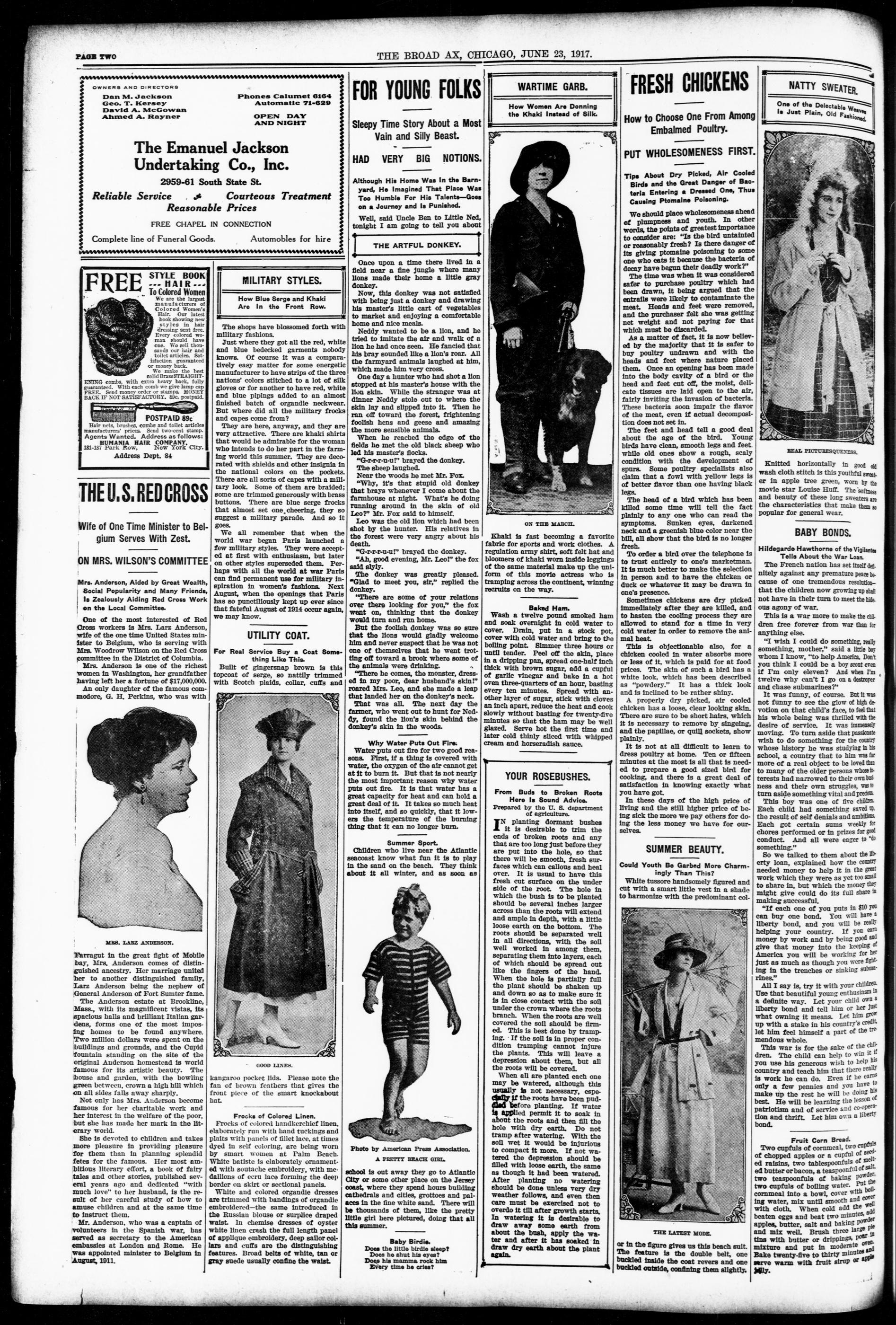
One of the most interested of Red Cross workers is Mrs. Larz Anderson, wife of the one time United States minister to Belgium, who is serving with Mrs. Woodrow Wilson on the Red Cross committee in the District of Columbia.
Mrs. Anderson is one of the richest women in Washington, her grandfather having left her a fortune of $17,000,000. An only daughter of the famous commodore, G. H. Perkins, who was with
P
MRS. LAREZ ANDERSON.
Farragut in the great fight of Mobile bay, Mrs. Anderson comes of distinguished ancestry. Her marriage united her to another distinguished family, Larz Anderson being the nephew of General Anderson of Fort Sumter fame. The Anderson estate at Brookline, Mass., with its magnificent vistas, its spacious halls and brilliant Italian gardens, forms one of the most imposing homes to be found anywhere. Two million dollars were spent on the buildings and grounds, and the Cupid fountain standing on the site of the original Anderson homestead is world famous for its artistic beauty. The house and garden, with the bowling green between, crown a high hill which on all sides falls away sharply.
Not only has Mrs. Anderson become famous for her charitable work and her interest in the welfare of the poor, but she has made her mark in the literary world. She is devoted to children and takes more pleasure in providing pleasure for them than in planning splendid fetes for the famous. Her most ambitious literary effort, a book of fairy tales and other stories, published several years ago and dedicated "with much love" to her husband, is the result of her careful study of how to amuse children and at the same time to instruct them. Mr. Anderson, who was a captain of volunteers in the Spanish war, has served as secretary to the American embassies at London and Rome. He was appointed minister to Belgium in August 1911.
---
PAGE TWO
Phones Calumet 6164
Automatic 71-629
OPEN DAY
AND NIGHT
MILITARY STYLES.
How Blue Serge and Khaki Are In the Front Row.
The shops have blossomed forth with military fashions. Just where they got all the red, white and blue bedecked garments nobody knows. Of course it was a comparatively easy matter for some energetic manufacturer to have strips of the three nations' colors stitched to a lot of silk gloves or for another to have red, white and blue pipings added to an almost finished batch of organdle neckwear. But where did all the military frocks and capes come from?
They are here, anyway, and they are very attractive. There are khaki shirts that would be admirable for the woman who intends to do her part in the farming world this summer. They are decorated with shields and other insignia in the national colors on the pockets. There are all sorts of capes with a military look. Some of them are braided; some are trimmed generously with brass buttons. There are blue serge frocks that almost set one, cheering, they so suggest a military parade. And so it goes.
We all remember that when the world war began Paris launched a few military styles. They were accepted at first with enthusiasm, but later on other styles superseded them. Perhaps with all the world at war Paris can find permanent use for military inspiration in women's fashions. Next August, when the openings that Paris has so punctiliously kept up ever since that fateful August of 1914 occur again, we may know.
UTILITY COAT.
For Real Service Buy a Coat Something Like This.
Bullet of gingernap brown is this topcoat of serge, so nattily trimmed with Scotch plaids, collar, cuffs and
THE COAT
GOOD LINES.
kangaroo pocket lids. Please note the fan of brown feathers that gives the front piece of the smart knockabout hat.
Frocks of Colored Linen.
Frocks of colored handkerchief linen, elaborately run with hand tuckings and plaits with panels of fillet lace, at times dyed in self coloring, are being worn by smart women at Palm Beach. White batiste is elaborately ornamented with soutache embroidery, with medallions of ecru lace forming the deep border on skirt or sectional panels. White and colored organdie dresses are trimmed with bandings of organdie embroidered—the same introduced in the Russian blouse or surplice draped waist. In chemise dresses of oyster white linen crash the full length panel of applque embroidery, deep sailor collars and cuffs are the distinguishing features. Broad belts of white, tan or gray suede usually confine the waist.
THE BROAD AX, CHICAGO, JUNE 23, 1917.
FOR YOUNG FOLKS
Sleepy Time Story About a Most Vain and Silly Beast.
HAD VERY BIG NOTIONS.
Although His Home Was In the Barnyard, He Imagined That Place Was Too Humble For His Talents—Goes on a Journey and Is Punished.
Well, said Uncle Ben to Little Ned, tonight I am going to tell you about
THE ARTFUL DONKEY.
Once upon a time there lived in a field near a fine jungle where many lions made their home a little gray donkey.
Now, this donkey was not satisfied with being just a donkey and drawing his master's little cart of vegetables to market and enjoying a comfortable home and nice meals.
Neddy wanted to be a lion, and he tried to imitate the air and walk of a lion he had once seen. He fancied that his bray sounded like a lion's roar. All the farmyard animals laughed at him, which made him very cross.
One day a hunter who had shot a lion stopped at his master's house with the lion skin. While the stranger was at dinner Neddy stole out to where the skin lay and slipped into it. Then he ran off toward the forest, frightening foolish hens and geese and amazing the more sensible animals.
When he reached the edge of the fields he met the old black sheep who led his master's flocks. "G-r-r-u-u!" brayed the donkey. The sheep laughed. Near the woods he met Mr. Fox.
"Why, it's that stupid old donkey that brays whenever I come about the farmhouse at night. What's he doing running around in the skin of old Leo?" Mr. Fox said to himself. Leo was the old lion which had been shot by the hunter. His relatives in the forest were very angry about his death. "G-r-r-n-u!" braved the donkey.
"Ah, good evening, Mr. Leo!" the fox said slyly.
The donkey was greatly pleased. "Glad to meet you, sir," replied the donkey.
"There are some of your relations over there looking for you," the fox went on, thinking that the donkey would turn and run home.
But the foolish donkey was so sure that the lions would gladly welcome him and never suspect that he was not one of themselves that he went trotting off toward a brook where some of the animals were drinking.
"There he comes, the monster, dressed in my poor, dear husband's skin" roared Mrs. Leo, and she made a leap that landed her on the donkey's neck.
That was all. The next day the farmer, who went out to hunt for Neddy, found the lion's skin behind the donkey's skin in the woods.
Why Water Puts Out Fires:
Water puts out fire for two good reasons. First, if a thing is covered with water, the oxygen of the air cannot get at it to burn it. But that is not nearly the most important reason why water puts out fire. It is that water has a great capacity for heat and can hold a great deal of it. It takes so much heat into itself, and so quickly, that it lowers the temperature of the burning thing that it can no longer burn.
Summer Sport
Children who live near the Atlantic seacount know what fun it is to play in the sand on the beach. They think about it all winter, and as soon as
```markdown
```
Photo by American Press Association.
A PRETTY BEACH GIRL.
school is out away they go to Atlantic City or some other place on the Jersey coast, where they spend hours building cathedrals and cities, grottoes and palaces in the fine white sand. There will be thousands of them, like the pretty little girl here pictured, doing that all this summer.
Baby Birdie.
Does the little birdie sleep?
Does he shut his eyes?
Does his mamma rock him
Every time he cries!
WARTIME GARB.
How Women Are Donning the Khaki Instead of Silk.
W. A. M.
ON THE MARCH.
Khakl is fast becoming a favorite fabric for sports and work clothes. A regulation army shirt, soft felt hat and bloomers of khakl worn inside leggings of the same material make up the uniform of this movie actress who is tramping across the continent, winning recruits on the way.
Baked Ham.
Wash a twelve pound smoked ham and soak overnight in cold water to cover. Drain, put in a stock pot, cover with cold water and bring to the boiling point. Simmer three hours or until tender. Peel off the skin, place in a dripping pan, spread one-half inch thick with brown sugar, add a cupful of garlic vinegar and bake in a hot oven three-quarters of an hour, basting every ten minutes. Spread with another layer of sugar, stick with cloves an inch apart, reduce the heat and cook slowly without basting for twenty-five minutes so that the ham may be well glazed. Serve hot the first time and later cold thinly sliced with whipped cream and horseradish sauce.
YOUR ROSEBUSHES.
From Buds to Broken Roots Here Is Sound Advice. Prepared by the U. S. department of agriculture.
IN planting dormant bushes it is desirable to trim the ends of broken roots and any that are too long just before they are put into the hole, so that there will be smooth, fresh surfaces which can callous and heal over. It is usual to have this fresh cut surface on the under side of the root. The hole in which the bush is to be planted should be several inches larger across than the roots will extend and ample in depth, with a little loose earth on the bottom. The roots should be separated well in all directions, with the soil well worked in among them, separating them into layers, each of which should be spread out like the fingers of the hand. When the hole is partially full the plant should be shaken up and down so as to make sure it is in close contact with the soil under the crown where the roots branch. When the roots are well covered the soil should be firmed. This is best done by tramping. If the soil is in proper condition tramping cannot injure the plants. This will leave a depression about them, but all the roots will be covered.
When all are planted each one may be watered, although this usually is not necessary, especially if the roots have been puddled before planting. If water is applied permit it to soak in about the roots and then fill the hole with dry earth. Do not tramp after watering. With the soil wet it would be injurious to compact it more. If not watered the depression should be filled with loose earth, the same as though it had been watered. After planting no watering should be done unless very dry weather follows, and even then care must be exercised not to overdo it till after growth starts. In watering it is desirable to draw away some earth from about the bush, apply the water and after it has soaked in draw dry earth about the plant again.
FRESH CHICKENS
FRESH CHICKENS
How to Choose One From Among Embalmed Poultry.
PUT WHOLESOMENESS FIRST.
Tips About Dry Picked, Air Cooled Birds and the Great Danger of Bacteria Entering a Dressed One, Thus Causing Pomaine Poisoning.
We should place wholesomeness ahead of plumnness and youth. In other words, the points of greatest importance to consider are: "Is the bird untainted or reasonably fresh? Is there danger of its giving pomaine poisoning to some one who eats it because the bacteria of decay have begun their deadly work?"
The time was when it was considered safer to purchase poultry which had been drawn, it being argued that the entrails were likely to contaminate the meat. Heads and feet were removed, and the purchaser felt she was getting net weight and not paying for that which must be discarded.
As a matter of fact, it is now believed by the majority that it is safer to buy poultry undrawn and with the heads and feet where nature placed them. Once an opening has been made into the body cavity of a bird or the head and feet cut off, the moist, delicate tissues are laid open to the air, fairly inviting the invasion of bacteria. These bacteria soon impair the flavor of the meat, even if actual decomposition does not set in.
The feet and head tell a good deal about the age of the bird. Young birds have clean, smooth legs and feet. while old ones show a rough, scaly condition with the development of spurs. Some poultry specialists also claim that a fowl with yellow legs is of better flavor than one having black legs. The head of a bird which has been killed some time will tell the fact plainly to any one who can read the symptoms. Sunken eyes, darkened neck and a greenish blue color near the bill, all show that the bird is no longer fresh. To order a bird over the telephone is to trust entirely to one's marketman. It is much better to make the selection in person and to have the chicken or duck or whatever it may be drawn in one's presence.
Sometimes chickens are dry picked immediately after they are killed, and to hasten the cooling process they are allowed to stand for a time in very cold water in order to remove the animal heat.
This is objectionable also, for a chicken cooled in water absorbs more or less of it, which is paid for at food prices. The skin of such a bird has a white look, which has been described as "powdery." It has a thick look and is inclined to be rather shiny.
A properly dry picked, air cooled chicken has a loose, clear looking skin. There are sure to be short hairs, which it is necessary to remove by singing, and the papillae, or quill sockets, show plainly.
It is not at all difficult to learn to dress poultry at home. Ten or fifteen minutes at the most is all that is needed to prepare a good sized bird for cooking, and there is a great deal of satisfaction in knowing exactly what you have got.
In these days of the high price of living and the still higher price of being sick the more we pay others for doing the less money we have for ourselves.
SUMMER BEAUTY
Could Youth Be Garbed More Charmingly Than This?
White tussore handsomely figured and cut with a smart little vest in a shade to harmonize with the predominant col-
THE FASHION WEEKLY
THE LATEST MODE.
or in the figure gives us this beach suit.
The feature is the double belt, one buckled inside the coat revers and one buckled outside, confining them slightly.
One of the Delectable Weaves
Is Just Plain, Old Fashioned
A
REAL PICTURESQUENESS.
Knitted horizontally in good old wash cloth stitch is this youthful sweater in apple tree green, worn by the movie star Louise Huff. The softness and beauty of these long sweaters are the characteristics that make them so popular for general wear.
BABY BONDS.
Hildegarde Hawthorne of the Vigilantes
Tells About the War Leap.
The French nation has set itself definitely against any premature peace because of one tremendous resolution—that the children now growing up shall not have in their turn to meet the hideous agony of war.
This is a war more to make the children free forever from war than for anything else.
"I wish I could do something, really something, mother," said a little boy whom I know, "to help America. Don't you think I could be a boy scout even if I'm only eleven? And when I'm twelve why can't I go on a destroyer and chase submarines?"
It was funny, of course. But it was not funny to see the glow of high devotion on that child's face, to feel that his whole being was thrilled with the desire of service. It was immensely moving. To turn aside that passionate wish to do something for the country whose history he was studying in his school, a country that to him was far more of a real object to be loved than to many of the older persons whose interests had narrowed to their own business and their own struggles, was to turn aside something vital and precious. This boy was one of five children. Each child had something saved up, the result of self denials and ambitions. Each got certain sums weekly for chores performed or in prizes for good conduct. And all were eager to "do something."
So we talked to them about the liberty loan, explained how the country needed money to help it in the great work which they were as yet too small to share in, but which the money they might give could do its full share in making successful.
"If each one of you puts in $10 you can buy one bond. You will have a liberty bond, and you will be really helping your country. If you earn money by work and by being good and give that money into the keeping of America you will be working for her just as much as though you were fighting in the trenches or sinking submarines."
All I say is, try it with your children. Use that beautiful young enthusiasm in a definite way. Let your child own a liberty bond and tell him or her just what owning it means. Let him grow up with a stake in his country's credit, let him feel himself a part of the tremendous whole. This war is for the sake of the children. The child can help to win it if you use his generous wish to help his country and teach him that there really is work he can do. Even if he earns only a few pennies and you have to make up the rest he will be doing his best. He will be learning the lesson of patriotism and of service and co-operation and thrift. Let him own a liberty bond.
Fruit Corn Bread
Two cupfuls of cornmeal, two cupfuls of chopped apples or a cupful of seeded raisins, two tablespoonfuls of melted butter or bacon, a teaspoonful of salt, two teaspoonfuls of baking powder, two cupfuls of boiling water. Put the cornmeal into a bowl, cover with boiling water, mix until smooth and cover with cloth. Heat add the well beaten eggs and beat two minutes, add apples, butter, salt and baking powder and mix well. Brush three large pies tins with butter or drippings, pour in mixture and put in moderate oven. Bake twenty-five to thirty minutes and serve warm with fruit stirrup or apple jelly.
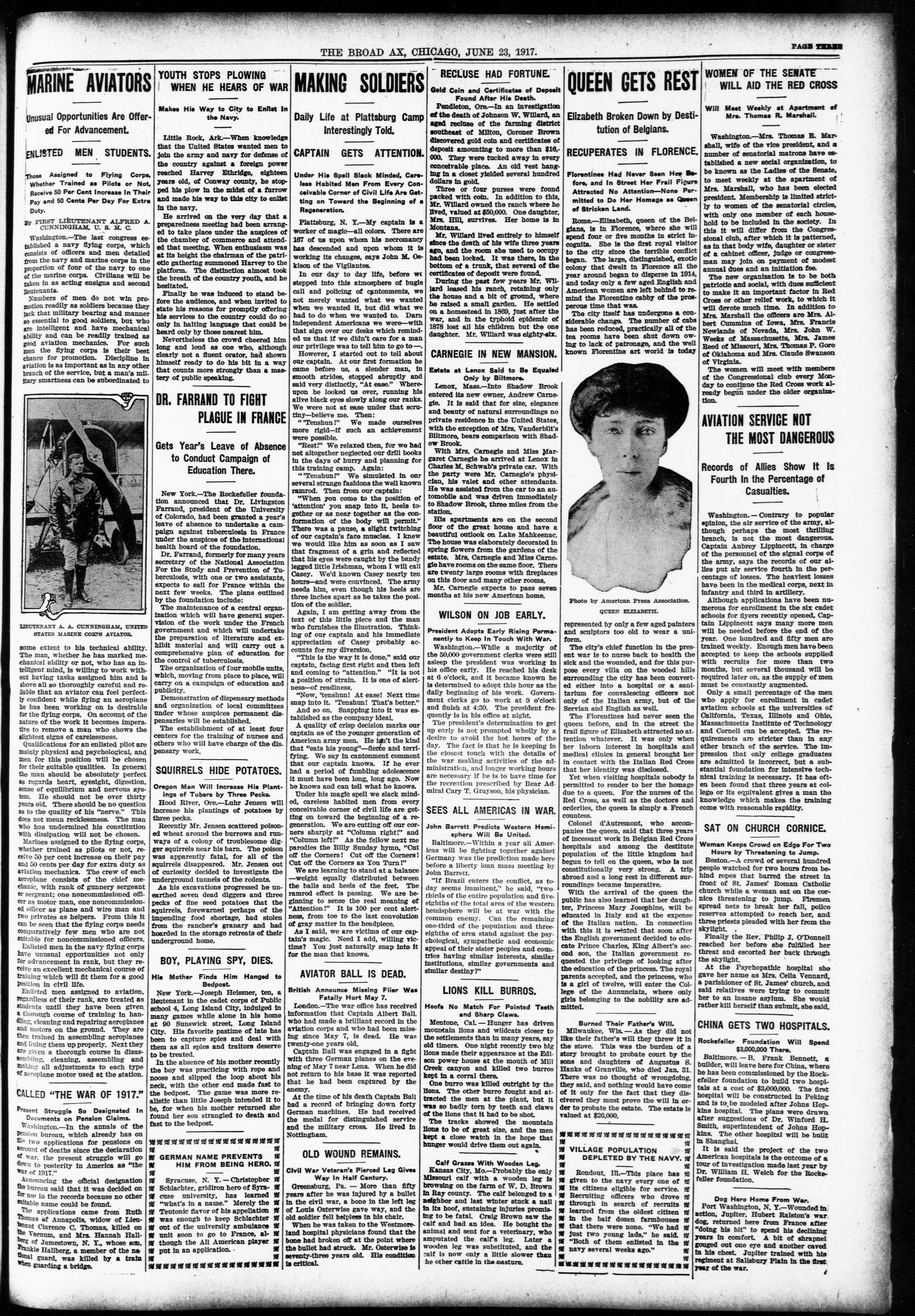
Unusual Opportunities Are Offered For Advancement.
ENLISTED MEN STUDENTS.
Those Assigned to Flying Corps, Whether Trained as Pilots or Not, Receive 50 Per Cent Increase In Their Pay and 50 Cents Per Day For Extra Duty.
By FIRST LIEUTENANT ALFRED A. CUNNINGHAM, U. S. M. C.
Washington.—The last congress established a navy flying corps, which consists of officers and men detailed from the navy and marine corps in the proportion of four of the navy to one of the marine corps. Civilians will be taken in as acting ensigns and second lieutenants.
Numbers of men do not win promotion readily as soldiers because they lack that military bearing and manner so essential to good soldiers, but who are intelligent and have mechanical ability and can be readily trained as good aviation mechanics. For such men the flying corps is their best chance for promotion. Discipline in aviation is as important as in any other branch of the service, but a man's military smartness can be subordinated to
AIRCRAFT AVIATOR
LEUTENANT A. A. CUNNINGHAM, UNITED STATES MARINE CORPS AVIATOR.
some extent to his technical ability. The man, whether he has marked mechanical ability or not, who has an intelligent mind, is willing to work without having tasks assigned him and is above all so thoroughly careful and reliable that an aviator can feel perfectly confident while flying an aeroplane he has been working on is desirable for the flying corps. On account of the nature of the work it becomes imperative to remove a man who shows the slightest signs of carelessness.
Qualifications for an enlisted pilot are mainly physical and psychological, and men for this position will be chosen for their suitable qualities. In general the man should be absolutely perfect as regards heart, eyesight, digestion, sense of equilibrium and nervous system. He should not be over thirty years old. There should be no question as to the quality of his "nerve." This does not mean recklessness. The man who has undermined his constitution with dissipation will not be chosen.
Marines assigned to the flying corps, whether trained as pilots or not, receive 50 per cent increase on their pay and 50 cents per day for extra duty as aviation mechanics. The crew of each aeroplane consists of the chief mechanic, with rank of gunnery sergeant or sergeant; one noncommissioned officer as motor man, one noncommissioned officer as plane and wire man and two privates as helpers. From this it can be seen that the flying corps needs comparatively few men who are not suitable for noncommissioned officers. Elisted men in the navy flying corps have unusual opportunities not only for advancement in rank, but they receive an excellent mechanical course of training which will fit them for a good position in civil life.
Enlisted men assigned to aviation, regardless of their rank, are treated as students until they have been given a thorough course of training in handling, cleaning and repairing aeroplanes and motors on the ground. They are then trained in assembling aeroplanes and lining them up properly. Next they are given a thorough course in disassembling, cleaning, assembling and making all adjustments to each type of aeroplanet motor used at the station.
CALLED "THE WAR OF 1917."
Present Struggle So Designated In Documents on Pension Claims.
Washington.—In the annals of the pension bureau, which already has on file two applications for pensions on account of deaths since the declaration of war, the present struggle will go down to posterity in America as "the war of 1917."
Announcing the official designation the bureau said that it was decided on for use in the records because no other suitable name could be found.
The applications came from Ruth Thomas of Annapolis, widow of Lieutenant Clarence C. Thomas, killed on the Vacuum, and Mrs. Hannah Hallberg of Jamestown, N. Y., whose son, Frankie Hallberg, a member of the national guard, was killed by a train when guarding a bridge.
YOUTH STOPS PLOWING WHEN HE HEARS OF WAR
YOUTH STOPS PLOWING WHEN HE HEARS OF WAR
Makes His Way to City to Enlist in the Navy.
Little Rock, Ark.—When knowledge that the United States wanted men to join the army and navy for defense of the country against a foreign power reached Harvey Ethridge, eighteen years old, of Conway county, he stopped his plow in the midst of a furrow and made his way to this city to enlist in the navy.
He arrived on the very day that a preparedness meeting had been arranged to take place under the auspices of the chamber of commerce and attended that meeting. When enthusiasm was at its height the chairman of the patriotic gathering summoned Harvey to the platform. The distinction almost took the breath of the country youth, and he hesitated.
Finally he was induced to stand before the audience, and when invited to state his reasons for promptly offering his services to the country could do so only in halting language that could be heard only by those nearest him.
Nevertheless the crowd cheered him long and loud as one who, although clearly not a fluent orator, had shown himself ready to do his bit in a way that counts more strongly than a mastery of public speaking.
DR. FARRAND TO FIGHT PLAGUE IN FRANCE
DR. FARRAND TO FIGHT PLAGUE IN FRANCE
Gets Year's Leave of Absence to Conduct Campaign of Education There.
New York.-The Rockefeller foundation announced that Dr. Livingston Farrand, president of the University of Colorado, had been granted a year's leave of absence to undertake a campaign against tuberculosis in France under the auspices of the international health board of the foundation.
Dr. Farrand, formerly for many years secretary of the National Association For the Study and Prevention of Tuberculosis, with one or two assistants, expects to sell for France within the next few weeks. The plans outlined by the foundation include:
The maintenance of a central organization which will have general supervision of the work under the French government and which will undertake the preparation of literature and exhibit material and will carry out a comprehensive plan of education for the control of tuberculosis.
The organization of four mobile units, which, moving from place to place, will carry on a campaign of education and publicity. Demonstration of dispensary methods and organization of local committees under whose auspices permanent dispensaries will be established. The establishment of at least four centers for the training of nurses and others who will have charge of the dispensary work.
SQUIRRELS HIDE POTATOES.
Oregon Man Will Increase His Plantings of Tubers by Three Pecks.
Hood River, Ore.-Luhr Jensen will increase his plantings of potatoes by three pecks.
Recently Mr. Jensen scattered poisoned wheat around the burrows and runways of a colony of troublesome digger squirrels near his barn. The poison was apparently fatal, for all of the squirrels disappeared. Mr. Jensen out of curiosity decided to investigate the underground tunnels of the rodents.
As his excavations progressed he unearthed seven dead diggers and three pecks of fine seed potatoes that the squirrels, forewarned perhaps of the impending food shortage, had stolen from the rancher's granary and had hoarded in the storage retreats of their underground home.
BOY. PLAYING SPY. DIES.
His Mother Finds Him Hanged to Bedpost.
New York.—Joseph Helssner, ten, a lieutenant in the cadet corps of Public school 4, Long Island City, indulged in many games while alone in his home at 90 Sunswick street, Long Island City. His favorite pastime of late has been to capture spies and deal with them as all spies and traitors deserve to be treated.
In the absence of his mother recently the boy was practicing with rope and noose and slipped the loop about his neck, with the other end made fast to the bedpost. The game was more realistic than little Joseph intended it to be, for when his mother returned she found her son strangled to death and fast to the bedpost.
GERMAN NAME PREVENTS
HIM FROM BEING HERO.
Syracuse, N. Y. — Christopher
Schlachter, gridiron hero of Syracuse university, has learned "what's in a name." Merely the Teutonic flavor of his appellation was enough to keep Schlachter out of the university ambulance unit soon to go to France, although the All American player put in an application.
THE BROAD AX. CHICAGO. JUNE 23. 1917.
MAKING SOLDIERS
MAKING SOLDIERS
Daily Life at Plattsburg Camp Interestingly Told.
CAPTAIN GETS ATTENTION.
Under His Spell Slack Minded, Careless Habited Men From Every Conceivable Corner of Civil Life Are Getting on Toward the Beginning of a Regeneration.
Plattsburg, N. Y.—My captain is a worker of magic—all colors. There are 167 of us upon whom his necromancy has descended and upon whom it is working its changes, says John M. Oskison of the Virgilantes.
In our day to day life, before we stepped into this atmosphere of bugle call and policing of cantonments, we not merely wanted what we wanted when we wanted it, but did what we had to do when we wanted to. Darn independent Americans we were—with that sign over our desks which reminded us that if we didn't care for a man our privilege was to tell him to go to—However, I started out to tell about our captain. At our first formation he came before us, a slender man, in smooth strides, stopped abruptly and said very distinctly, "At ease." Whereupon he looked us over, running his alive black eyes slowly along our ranks. We were not at ease under that scrutiny—believe me. Then: "Tenshun!" We made ourselves more rigid—if such an achievement were possible.
"Rest!" We relaxed then, for we had not altogether neglected our drill books in the days of hurry and planning for this training camp. Again:
"Tenshun!" We simulated in our several strange fashionls the well known ramrod. Then from our captain:
"When you come to the position of 'attention' you snap into it, heels together or as near together as the conformation of the body will permit."
There was a pause, a slight twitching of our captain's face muscles. I knew we would like him as soon as I saw that fragment of a grin and reflected that his eyes were caught by the bandy legged little Irishman, whom I will call Casey. We'd known Casey nearly ten hours—and were convinced. The army needs him, even though his heels are three inches apart as he takes the position of the soldier.
Again, I am getting away from the text of this little piece and the man who furnishes the illustration. Thinking of our captain and his immediate appreciation of Casey probably accounts for my diversion.
"This is the way it is done," said our captain, facing first right and then left and coming to "attention." "It is not a position of strain. It is one of alertness—of readiness.
"Now, tshensh! At ease! Next time snap into it. Tenshun! That's better."
And so on. Snapping into it was established as the company ideal.
A quality of crisp decision marks our captain as of the younger generation of American army men. He isn't the kind that "eats his young"—fierce and terrifying. We say in cantonment comment that our captain knows. If he ever had a period of fumbling adolescence it must have been long, long ago. Now he knows and can tell what he knows.
Under his magic spell we slack minded, careless habited men from every conceivable corner of civil life are getting on toward the beginning of a regeneration. We are cutting off our corners sharply at "Column right!" and "Column left!" As the fellow next me parodies the Billy Sunday hymn, "Cut off the Corners! Cut off the Corners! Cut off the Corners as You Turn!" We are learning to stand at a balance —weight equally distributed between the balls and heels of the feet. The ramrod effect is passing. We are beginning to sense the real meaning of "Attention!" It is 100 per cent alertness, from toe to the last convolution of gray matter in the headpiece. As I said, we are victims of our captain's magic. Need I add, willing victims? You just naturally snap into it for the man that knows.
AVIATOR BALL IS DEAD.
British Announce Missing Flier Was Fatally Hurt May 7.
London.—The war office has received information that Captain Albert Ball, who had made a brilliant record in the aviation corps and who had been missing since May 7, is dead. He was twenty-one years old.
Captain Ball was engaged in a fight with three German planes on the evening of May 7 near Lens. When he did not return to his base it was reported that he had been captured by the enemy.
At the time of his death Captain Ball had a record of bringing down forty German machines. He had received the medal for distinguished service and the military cross. He lived in Nottingham.
OLD WOUND REMAINS.
Civil War Veteran's Pierced Leg Gives Way In Half Century.
Greensburg, Pa. — More than fifty years after he was injured by a bullet in the civil war, a bone in the left leg of Louis Osterwise gave way, and the old soldier fell helpless in his chair.
When he was taken to the Westmoreland hospital physicians found that the bone had broken off at the point where the bullet had struck. Mr. Osterwise is seventy-three years old. His condition is critical.
RECLUSE HAD FORTUNE.
Gold Coin and Certificates of Deposit Found After His Death.
Pendleton, Ore.—In an investigation of the death of Johnson W. Willard, an aged recluse of the farming district southeast of Milton, Coroner Brown discovered gold coin and certificates of deposit amounting to more than $16,000. They were tucked away in every conceivable place. An old vest hanging in a closet yielded several hundred dollars in gold.
Three or four purses were found packed with coin. In addition to this, Mr. Willard owned the ranch where he lived, valued at $50,000. One daughter, Mrs. Hill, survives. Her home is in Montana.
Mr. Willard lived entirely to himself since the death of his wife three years ago, and the room she used to occupy had been locked. It was there, in the bottom of a trunk, that several of the certificates of deposit were found. During the past few years Mr. Willard leased his ranch, retaining only the house and a bit of ground, where he raised a small garden. He settled on a homestead in 1869, just after the war, and in the typhoid epidemic of 1878 lost all his children but the one daughter. Mr. Willard was eighty-six.
CARNEGIE IN NEW MANSION.
Estate at Lenox Said to Be Equaled Only by Biltmore.
Lenox, Mass—Into Shadow Brook entered its new owner, Andrew Carnegie. It is said that for size, elegance and beauty of natural surroundings no private residence in the United States, with the exception of Mrs. Vanderblit's Biltmore, bears comparison with Shadow Brook.
With Mrs. Carnegie and Miss Margaret Carnegie he arrived at Lenox in Charles M. Schwab's private car. With the party were Mr. Carnegie's physician, his valet and other attendants. He was assisted from the car to an automobile and was driven immediately to Shadow Brook, three miles from the station.
His apartments are on the second floor of the great house and have a beautiful outlook on Lake Mahkeenac. The house was elaborately decorated in spring flowers from the gardens of the estate. Mrs. Carnegie and Miss Carnegie have rooms on the same floor. There are twenty large rooms with fireplaces on this floor and many other rooms. Mr. Carnegie expects to pass seven months at his new American home.
WILSON ON JOB EARLY.
President Adopts Early Rising Permanently to Keep In Touch With War.
Washington. While a majority of the 50,000 government clerks were still asleep the president was working in his office early. He reached his desk at 6 o'clock, and it became known he is determined to adopt this hour as the daily beginning of his work. Government clerks go to work at 9 o'clock and finish at 4:30. The president frequently is in his office at night.
The president's determination to get up early is not prompted wholly by a desire to avoid the hot hours of the day. The fact is that he is keeping in the closest touch with the details of the war making activities of the administration, and longer working hours are necessary if he is to have time for the recreation prescribed by Rear Admiral Cary T. Grayson, his physician.
SEES ALL AMERICAS IN WAR.
John Barrett Predicts Western Hemisphere Will Be United.
Baltimore—Within a year all Americas will be fighting together against Germany was the prediction made here before a liberty loan mass meeting by John Barrett.
"If Brazil enters the conflict, as today seems imminent," he said, "two-thirds of the entire population and five-eighths of the total area of the western hemisphere will be at war with the common enemy. Can the remaining one-third of the population and three-eighths of area stand against the psychological, sympathetic and economic appeal of their sister peoples and countries having similar interests, similar institutions, similar governments and similar destiny?"
LIONS KILL BURROS.
Hoofs No Match For Pointed Teeth and Sharp Claws.
Mentone, Cal. — Hunger has driven mountain lions and wildcats closer to the settlements than in many years, say old timers. One night recently two big lions made their appearance at the Edison power house at the mouth of Mill Creek canyon and killed two burros kept in a corral there.
One burro was killed outright by the lions. The other burro fought and attracted the men at the plant, but it was so badly torn by teeth and claws of the lions that it had to be shot.
The tracks showed the mountain lions to be of great size, and the men kept a close watch in the hope that hunger would drive them out again.
Kansas City, Mo.—Probably the only Missouri calf with a wooden leg is browsing on the farm of W. D. Brown in Ray county. The calf belonged to a neighbor and last winter stuck a nail in its hoof, sustaining injuries promising to be fatal. Craig Brown saw the calf and had an idea. He bought the animal and sent for a veterinary, who amputated the calf's leg. Later a wooden leg was substituted, and the calf is now only a little slower than the other cattle in the pasture.
QUEEN GETS REST
Elizabeth Broken Down by Destination of Belgians.
RECUPERATES IN FLORENCE
Florentines Had Never Seen Her Before, and In Street Her Frail Figure Attracted No Attention—None Permitted to Do Her Homage as Queen of Stricken Land.
Rome.—Elizabeth, queen of the Belgians, is in Florence, where she will spend four or five months in strict incognita. She is the first royal visitor to the city since the terrible conflict began. The large, distinguished, exotic colony that dwelt in Florence all the year around began to disperse in 1914, and today only a few aged English and American women are left behind to remind the Florentine cabby of the prosperous time that was. The city itself has undergone a considerable change. The number of cabs has been reduced, practically all of the tea rooms have been shut down owing to lack of patronage, and the well known Florentine art world is today
Photo by American Press Association.
QUEEN ELIZABETH.
represented by only a few aged painters and sculptors too old to wear a uniform.
The city's chief function in the present war is to nurse back to health the sick and the wounded, and for this purpose every villa on the wooded hills surrounding the city has been converted either into a hospital or a sanitarium for convalescing officers not only of the Italian army, but of the Servian and English as well.
The Florentines had never seen the queen before, and in the street the frail figure of Elizabeth attracted no attention whatever. It was only when her inborn interest in hospitals and medical clinics in general brought her in contact with the Italian Red Cross that her identity was disclosed.
Yet when visiting hospitals nobody is permitted to render to her the homage due to a queen. For the nurses of the Red Cross, as well as the doctors and orderlies, the queen is simply a French countess. Colonel d'Autremont, who accompanies the queen, said that three years of incessant work in Belgian Red Cross hospitals and among the destitute population of the little kingdom had begun to tell on the queen, who is not constitutionally very strong. A trip abroad and a long rest in different surroundings became imperative.
With the arrival of the queen the public has also learned that her daughter, Princess Mary Josephine, will be educated in Italy and at the expense of the Italian nation. In connection with this it is related that soon after the English government decided to educate Prince Charles, King Albert's second son, the Italian government requested the privilege of looking after the education of the princess. The royal parents accepted, and the princess, who is a girl of twelve, will enter the College of the Annunciata, where only girls belonging to the nobility are admitted.
Milwaukee, Wis. — As they did not like their father's will they threw it in the stove. This was the burden of a story brought to probate court by the sons and daughters of Augustus S. Hanks of Granville, who died Jan. 31. There was no thought of wrongdoing, they said, and nothing would have come of it only for the fact that they discovered they must prove the will in order to probate the estate. The estate is valued at $26,000.
VILLAGE POPULATION DEPLETED BY THE NAVY.
Rondout, IL.—This place has given to the navy every one of its citizens eligible for service. Recruiting officers who drove through in search of recruits learned from the oldest citizen in the half dozen farmhouses that there were none. "We had just two young lads," he said. "Both of them enlisted in the navy several weeks ago."
PAGE THREE
WOMEN OF THE SENATE WILL AID THE RED CROSS
Will Meet Weekly at Apartment of Mrs. Thomas R. Marshall.
Washington.—Mrs. Thomas R. Marshall, wife of the vice president, and a number of senatorial matrons have established a new social organization, to be known as the Ladies of the Senate, to meet weekly at the apartment of Mrs. Marshall, who has been elected president. Membership is limited strictly to women of the senatorial circles, with only one member of each household to be included in the society. In this it will differ from the Congressional club, after which it is patterned, as in that body wife, daughter or sister of a cabinet officer, judge or congressman may join on payment of modest annual dues, and an initiation fee.
The new organization is to be both patriotic and social, with dues sufficient to make it an important factor in Red Cross or other relief work, to which it will devote much time. In addition to Mrs. Marshall the officers are Mrs. Albert Cummins of Iowa, Mrs. Francis Newlands of Nevada, Mrs. John W. Weeks of Massachusetts, Mrs. James Reed of Missouri, Mrs. Thomas P. Gore of Oklahoma and Mrs. Claude Swanson of Virginia.
The women will meet with members of the Congressional club every Monday to continue the Red Cross work already begun under the older organization.
AVIATION SERVICE NOT THE MOST DANGEROUS
Records of Allies Show It Is Fourth In the Percentage of Casualties.
Washington. — Contrary to popular opinion, the air service of the army, although perhaps the most thrilling branch, is not the most dangerous. Captain Aubrey Lippincott, in charge of the personnel of the signal corps of the army, says the records of our allies put air service fourth in the percentage of losses. The heaviest losses have been in the medical corps, next in infantry and third in artillery.
Although applications have been numerous for enrollment in the six cadet schools for flyers recently opened, Captain Lippincott says many more men will be needed before the end of the year. One hundred and fifty men are trained weekly. Enough men have been accepted to keep the schools supplied with recruits for more than two months, but several thousand will be required later on, as the supply of men must be constantly augmented.
Only a small percentage of the men who apply for enrollment in cadet aviation schools at the universities of California, Texas, Illinois and Ohio, Massachusetts Institute of Technology and Cornell can be accepted. The requirements are stricter than in any other branch of the service. The impression that only college graduates are admitted is incorrect, but a substantial foundation for intensive technical training is necessary. It has often been found that three years at college or its equivalent gives a man the knowledge which makes the training come with reasonable rapidity.
SAT ON CHURCH CORNICE.
Woman Keeps Crowd on Edge For Two Hours by Threatening to Jump.
Boston.—A crowd of several hundred people watched for two hours from behind ropes that barred the street in front of St. James' Roman Catholic church while a woman sat on the cornice threatening to jump. Firemen spread nets to break her fall, police reserves attempted to reach her, and three priests pleaded with her from the skylight.
Finally the Rev. Philip J. O'Donnell reached her before she fulfilled her threat and escorted her back through the skylight.
At the Psychopathic hospital she gave her name as Mrs. Cella Vennard, a parishioner of St. James' church, and said relatives were trying to commit her to an insane asylum. She would rather kill herself than submit she said
CHINA GETS TWO HOSPITALS
Rockefeller Foundation Will Spend $3,000,000 There.
Baltimore. — B. Frank Bennett, a builder, will leave here for China, where he has been commissioned by the Rockefeller foundation to build two hospitals at a cost of $3,000,000. The first hospital will be constructed in Peking and is to be modeled after Johns Hopkins hospital. The plans were drawn after suggestions of Dr. Winford H. Smith, superintendent of Johns Hopkins. The other hospital will be built in Shanghai.
It is said the project of the two American hospitals is the outcome of a tour of investigation made last year by Dr. William H. Welch for the Rockefeller foundation.
Port Washington, N. Y.—Wounded in action, Jupiter, Hubert Ralston's war dog, returned here from France after "doing his bit" to spend his declining years in comfort. A bit of shrapnel gouged out one eye and another caved in his chest. Jupiter trained with his regiment at Salisbury Plain in the first year of the war.
94
94
HON. JOSEPH F. HAAS.
One of the big leaders of the Republican of Cook County who would make in 1918.
One of the big leaders of the Republican Party of Illinois—the popular Recorder of Cook County who would make a dandy candidate for State Treasurer in 1918.
HOME CARE OF FOOD
An important factor in keeping the family well lies, not only in the preparation, but also in the care of the food in the home. It is not enough that the food be both palatable and nutritious when served; it must also be properly cared for, or it may become a positive menace instead of a benefit as it should, to the health of the family.
There are foods that spoil quickly, unless kept under proper conditions; while others do not. Various things affect the wholesomeness of foods; for example: air, the dishes in which they are placed, the ice box and other storage places. Among the foods that spoil easily are milk, cream, uncooked, fresh meats, certain fruits, such as berries, peaches and plums and some of the table vegetables.
Fresh meats should not be left in the paper that is about them when delivered from the butcher shop, as the wrapping paper will absorb the juices. Remove the paper and wipe the meat with a clean cloth that has been wrung out in cold water, and then place it in a clean dish. Uncooked fish should not be put in the ice box without being closely covered. As odors rise, all strongly flavored food should be placed on the top shelves of your refrigerator.
Fruit should be kept cool and dry; a cool, dry basement is better than the ice box. Ripe fruits spoil rapidly and should only be bought in small quantities. Vegetables that are eaten raw should always be washed thoroughly before eating. Lettuce should be carefully picked over and washed. If wrapped in cheese cloth and placed in the ice box, it will keep longer than if put in water.
Butter of course, should be kept cool and well wrapped or covered, as it readily absorbs odors from other foods. Eggs should be kept dry and cool. Cooked meats can be kept better, if well covered before being put in the refrigerator. Never put hot or warm meats or food in the ice box, as they rapidly change the temperature and cause an extravagant waste of ice. At this time of the year cereals are likely to spoil and so should be purchased in small quantities and kept in covered glass jars to prevent becoming wormy.
Chicago's back yard and vacant lot gardens are now beginning to produce their first supply of early table vegetables. For the first time no doubt, thousands of our citizens are realizing the extra goodness of lettuce, radishes and onions fresh from the soil to the table. Yes, they are good—no doubt about it. And hasn't it ited for all the work you did? The writer of these lines knows, for he has been having fresh vegetables for the past two weeks. The backyard or vacant lot garden is a great institution. More power to it. Long may it wave. So say we, all of us.
Eternal vigilance is the price we pay for freedom from disease. The community that is indifferent to its health problems pays the toll in both a high sickness and mortality rate. We now have many grave problems pressing upon us; but none is of more importance than that of safe-guarding the public health.
During the European war it has been the birth certificate that has saved many a person, Americans included,
PAGE FOUR
from being killed as traitors. As a matter of fact, it is not safe to travel in any country without this legal evidence of birth and citizenship. It has been predicted that during the reconstruction days after the war, a record of a person's birth will be necessary for his welfare and safety.
THE AMATEUR MINISTREL CLUB
MET AND HAD A JOLLY TIME
LAST SATURDAY EVENING.
Former Alderman Oscar De Priest,
Julius F. Taylor and Alderman Lewis
B. Anderson were the Honored Guests
and the Leading Speakers of the Occasion.
A Check for $789.47 Cents was Turned
Over to Dr. Charles L. Lewis for the
Old Folks Home which was the Net
Proceeds from the Recent Entertainment
Given by the Club.
Last Saturday evening the members of the Amateur Minstrel Club held their first get together meeting or love feast since their late successful entertainment at the Eighth Regiment Armory, the good old fashioned dutch luncheon was served at the lovely home of Mrs. Henrietta Wilson, 3553 South Wabash ave., it was served to the Queen's taste, the following members of the club and their friends were in evidence around the banquet table.
Former Alderman Oscar De Priest, who was loudly given three cheers when he entered the room, Alderman Louis B. Anderson, Howard T. Cornwell, H. Harvey Horsley, David R. Lawrence, Isaac N. Dunlap, R. E. Moore, Jr., W. H. Jackson, F. L. Pleueff, Wm. H. Washington, Clarence Mayo, R. J. Thomasson, Jr., Chas. W. Settles, A. J. Childress, W. G. Carroll, Isaac T. Yarbrough, Chas. S. Washington, Frank B. Waring, Morris Lewis, J. W. Doyle, Dr. Charles L. Lewis, and Julius F. Taylor.
Just before the feasting began the members of the club sang their opening chorus to the great delight of those present, at the end of the feasting President Howard T. Cornwell rapped for order and after a few remarks by Morris Lewis acting President of the Old Folks Home, former Alderman Oscar De Priest was introduced as the first speaker of the evening, Julius F. Taylor the second and Alderman Louis B. Anderson the third, at the conclusion of each speaker the members of the club sang one of their most popular songs which caused each and every one feel that it was good to be there.
Towards the end of the evening Charles S. Washington, secretary of the club passed something over to President Cornwell which turned out to be a check calling for seven hundred eighty-nine dollars and forty seven cents and President Cornwell passed it around so that each and every one present could behold it with their own eyes, then he presented it to Dr. Charles L. Lewis, secretary of the Old Folks Home and in a very clean cut little speech he very gracefully accepted it in behalf of the home, the check received the net proceeds from the recent entertainment lately given by the club at the Eighth Regiment Armory.
Frank B. Waring, H. Harry Horsely and F. L. Cuffee were among the members of the club who delivered short talks just as the very pleasant affair was drawing to a close for one more year. Alderman De Priest very neatly sum-
med the pleasures of the evening in a nut shell when he exclaimed that he always looked forward with much delight to the annual stunt of the Amateur Minstrel Club for there was always plenty of free doings in sight. It is worth your time to read the following report:
ATTORNEY JAMES A, SCOTT MERLY ASSISTANT STATISTORNEY HAS BECOME THE THOR OF A VERY VALLEY LAW BOOK ON "INTERNEXTRADITION."
The first part of this year, M
Report of 1917 Show and Dance
Amateur Minstrel Club.
Receipts June 16, 1917—Advance by Member, $25.00; Sale of tickets to public subscribers, $349.50; Tickets sold by members, $258.75; Sale of programs and flowers, $50.38; Coat room receipts, $71.85; Punch bowl, Mrs. Dent, $58.40; Sale of tickets at door, $482.50; Assessments by members, $32.90; Total receipts, $1329.28; Total disbursements, $539.81; Amount turned over, $789.47.
Disbursements—Rent of hall, $100.00;
Music, $80.00; Printing, $73.50; Rehearsal, $22.00; Carpenter work, building stage, $24.50; Refund to members, $57.90; Rent of piano, $4.50; Slides for theatres, $3.20; Posting cards and distributing folders, $7.50; Expressing chairs, $40.00; Help, coat room, $11.90; Help at hall, $14.00; Secretary's expenses and curtain, $2.75; Flowers, $3.75; Rent of costumes, $34.85; Tamborines, $1.60; Electrician, $4.00; Postage, mailing tickets, $16.00; Incidentals, $5.06; Frappe, $15.30; The Broad Ax, $5.00; Postal card advertising, $12.50; Total disbursements, $539.81.
Signed: HOWARD CORNWELL,
President.
CHAS S. WASHINGTON,
Secretary.
CALL ON THE NATION TO AWARD TO THE COLORED MAN HIS CIVIL AND POLITICAL RIGHTS.
Boston, Massachusetts.
June 19, 1917.
<Special>—History was made by Americans "of African descent" this week in Boston. The New England Suffrage League, for manhood suffrage in the Southern states, founded by Rev. Wm. H. Scott of Woburn, Mass., in 1904, has vindicated its continuance for 13 years. It met in the 12th Baptist church on Tuesday at 11 a.m., and when its sessions closed at midnight with a reception in the vestry to delegates, after two executive sessions attended by nearly 100 delegates from eleven states and a crowded mass meeting that pulsated with earnest enthusiasm for the slogan "A share in this world democracy for which our men must fight," there had been launched a National Colored Liberty Conference to make real that slogan.
Not in years has this New England League had such a largely attended annual meeting, successful in spirit and its work. Editor Trotter was again reelected president. Money enough was secured from the social by the Woman's Auxiliary, nearly 20 dollars, and Tuesday night's collection, 30 dollars, and otherwise to meet expenses for two days, the heaviest items of which were 20 dollars for the church and 15 dollars for Faneuil Hall. Boston extended a royal welcome and the League's spokesman voiced with courage and ability the claims of the race to real democracy at home. Now let all get ready to attend the Colored Liberty Convention at Washington this Fall.
CALL ON NATION TO GIVE COL
ORED MAN HIS RIGHTS
- LEAGUE CONDEMNS CONDITIONS
IN SOUTHERN STATES.
"This country can never succeed under God in establishing democracy over the world while color caste and disfranchisement are so fragrantly practised at home," said William Munroe Trotter, speaking last night at a mass meeting in the Twelfth Baptist Church of Roxbury, where the 13th annual convention of the New England League for Afro-American Suffrage is in session.
"We Colored Americans," continued the speaker, who presided at the all-day session yesterday, "now solemnly call upon the President and Congress and the people of the United States to permit the Colored American to enjoy this world democracy for which the race must fight. We are not willing to help the rest of the world to enjoy liberty and democracy while our race is held in serfdom in the Southern States." Liberty Convention at Washington this Fall. A National Colored Liberty Conference charged with the work of calling a National Colored Liberty Convention at Washington in the Fall was formed with these officers:
President, Rev. Johnson W. Hill of Boston; first vice-president, Rev. A. C. Powell of New York; second vice-president, Rev. I. B. Walters of Worcester; third vice-president, S. S. Crockett of New Jersey; recording secretary, Rev. M. F. Sydes of Rhode Island; assistant, Mrs. M. Cravath Simpson of Massachusetts; corresponding secretary, Rev. D. S. Klough; assistant, Miss Bessie Smith, Hampton, Virginia; treasurer, Mrs. S. J. Allen of Massachusetts, chairman of board of managers, Hubert H. Harrison of New York City; grand organizer Allen W. Whaley of Boston.
ATTORNEY JAMES A, SCOTT, FORMERLY ASSISTANT STATE'S ATTORNEY HAS BECOME THE AUTHOR OF A VERY VALUABLE LAW BOOK ON "INTERSTATE EXTRADITION."
The first part of this year, Mr. James A. Scott, ex-assistant State's Attorney of Cook County, put the finishing touches on his new law book, entitled "Scott's Interstate Extradition" "Reridition, See U. S. Supreme Court report volume 148, page 543." His new book is a thorough practical treatise exhausting the subject, analyzing and digesting all the decisions, setting out the pleading and practice in Habeas Corpus proceedings with such forms as are provided for by the Federal and State Statutes.
Excerpts from the Controlling Decisions.
The work contains the complete statutes pertaining to the arrest of fugitives from the justice of all the states and territories.
This volume is indispensable to all judges, U. S. and State Prosecutors and attorneys practicing criminal law.
It is now almost universally conceded in the light of the decisions of the Supreme Court of the United States, that the two methods of demanding, arresting and surrendering fugitives from justice, foreign and domestic, are widely different in every respect.
The work consists of one large volume in buckram delivered at $7.50 per volume. Limited edition only. Mr. Scott, has exerted himself, in the greatest degree, to bring forth a law publication which will be of the greatest benefit to all progressive lawyers, for many years to come.
The book is for sale by Sherman Hight, publisher and law bookseller, 202 S. Clark street.
THE FILM BILL CHAMPIONED BY MAJOR ROBEET R. JACKSON PASSED BOTH BRANCHES OF THE LEGISLATURE. IT IS PREDICTED THAT GOVERNOR FRANK O. LOWDEN WILL CHEERFULLY SIGN THE MEASURE.
Towards the close of the session of the present legislature the Film Bill, which was gallantly championed by Major Robert R. Jackson, passed through the senate by a vote of 39 to 0 and it was passed by the house by 81 votes in its favor to three against it. His new bill was gotten up to overcome the objections of the first bill vetored by Governor Lowden.
There is no desire on our part to dictate to Governor Lowden, how to run or conduct the affairs of state; but we honestly feel that he would be raising himself very high in the estimation of all of the people throughout the state of Illinois if he would affix his signature to this new film bill, which was so eloquently championed by Major Jackson and permit it to become one of the new laws of this State.
ALDERMAN LOUIS B. ANDERSON TO BE PRESENTED WITH A DIAMOND STUDDED STAR AT THE INSTITUTIONAL CHURCH.
Wednesday evening June 27th, at 8 o'clock; Alderman Louis B. Anderson, will be presented with a diamond studded star, at the Institutional Church, 3825 S. Dearborn street, on which occasion, the following program will be rendered.
Selection, Madame Patti Brown; Concert, 1st Regt. K. of P. Band; Selections and Choruses, Amateur Minstrel Club; Speeches and Presentation.
Committee—Major R. R. Jackson, Chairman; Hon. E. H. Wright; Mr. Wm. L. Ellis; Mr. John F. Armstrong; Mr. Max T. Schmidt; Mr. J. C. Love; Mr. Harry M. Haskin, Mr. Wm. Bottoms; Mr. Charles S. Jackson; Mr. Howard C. Cornwell.
JAMES A. BASTON KICKED BY HIS AUTO SEVERELY SPEAINING HIS RIGHT HAND.
James A. Easton, the popular dealer in wall paper, decorating and house painting at 2619 S. State street, who is also one of the officials of Quinn chapel; lately bought an auto, to use in his business and while tinkering with it, for some cause or other, the thing kicked out in every direction severely spraining his right hand, which he has been compelled to carry in a cast for the past two weeks. It is gradually resuming its normal condition and in the near future, Mr. Easton will be able to work hard and hustle early and late.
PURNISH FIRST CLASS ATTRACTIONS FOR ITS MANY PATRONS.
None of the theaters on the State street stroll, can compare with the old reliable Grand Theater, 3110-3112 S. State street in the way of furnishing the best and the latest attractions, which invariably catch and please the public.
Twice each week, there is a complete change in the program at the Grand, and the ever popular Billy King and Co. have been holding forth at the Grand for sometime and playing to crowded houses all the time.
FORMER ALDERMAN OSCAR DE PRIEST
Continues to receive the hearty congratulations of his army walks of life over his great victory and vindication in the Cook county. If he lives he will be re-elected to the city second ward.
DECLINES TO NAME COLORED OFFICERS.
TO RE
FOR RENT in new
Continues to receive the hearty congratulations of his army of friends in all walks of life over his great victory and vindication in the criminal court of Cook county. If he lives he will be re-elected to the city council from the second ward.
Boston, Mass. (Special)—The action of Col. Warren E. Sweetzer of the Sixth Massachusetts Regiment in not certifying any Colored men to the military training camp at Plattsburg, N.Y., has called forth many protests. Company L, of the regiment is composed of Colored men, but the recommendations of Capt. J. Holman Pryor for the camp were ignored and the company has no representation. Sweetzer gave as his reasons for not naming Colored men that they would not be allowed to command Whites.
CHIPS
Mrs. Geneva Smith, 5363 S. Dearborn street, is enjoying the best of health again after her recent indisposition.
Mrs. D. Ogburn, the fashionable dressmaker, 4346 Forestville avenue; visited La Porte, Ind., the first of this week, where she attended the wedding of Charles Dunn.
Hon. John E. Owens is still being strongly talked about in connection with the nomination for Mayor of Chicago in 1919. He has hosts of warm friends in all parts of this city who are willing to pull off their coats and work very hard for his success in that direction.
Dr. and Mrs. Bradley, 3849 S. State street, expect to beat it to the woods in Northern Michigan and spend their vacation, the first two weeks in August, in the midst of shade trees and the cool breezes in that section of the country.
Mrs. Lenora C. Graves, successfully conducts a neat and well stocked notion store, at 15 W. 36th street. She also carries a well selected stock of candies and plenty of brick ice cream. She is a good business woman and in connection with the news stand she will handle or sell The Broad Ax from on and after this date.
It is a pleasure to state that Mrs Mary Harsh, 2963 Federal street, who is prominently connected with many secret societies is as honest and as straight as a tightly stretched long string. For more than ten years, she has been a constant subscriber to this paper and she never has any fussing, wrangling or jangling when she settles her account once each year. If the majority of men and women were like unto Mrs. Harsh, it would be a great pleasure to do business in this world.
Mrs. Jane Johnson who resided for over thirty years at 1707 S. Dearborn street and who was a charter member of Mt. Zion Temple, No. 21, S. M. T. and a charter member of Household of Ruth, No. 44, has passed on into the next world. Funeral services were held over her remains last Thursday, at Quinn Chapel, Rev. J. C. Anderson, officiating. Interment, Oakwood Cemetery. George T. Kersey, and Dan M. Jackson, of the Emanuel Jackson Undertaking Co., were in charge. Mrs. Mary Harsh, most worthy Princess of Mt. Zion Temple, No. 21, S. M. T., also assisted in conducting the funeral services.
---
tulations of his army of friends in all and vindication in the criminal court of re-elected to the city council from the
FOR RENT in new Colored district, south of 59th street. Beautiful modern newly decorated, light 5 and 6 room brick flats, stove heat, large yard, convenient to "L" and 3 surface lines. Reference required. Flats shown by appointment. Rents, $24.00 and $7.00.
THREE STORY BRICK RESIDENCE
ON LANGLEY AVENUE, NORTH
OF 38TH STREET FOR SALE FOR
$3250.00 ON EASY PAYMENTS.
Non-resident, offers for sale a three
story brick residence, clear of all
in-embryance, located on Langley avenue,
north of 38th street; for $3250.00
on easy payments. Rental $30 per month.
If you desire a bargain, address T. L.
Care of this paper or phone Wentworth
2597.
Eat Less; Do More.
A fat nation is no good. Lean nations accomplish things. We should eat less and think more, have smaller girth and larger chests, less on the hip and more on the thorax, have fewer potatoes at dinner and more books after dinner, more exercise and less chewing. A strong person can subsist on a little oatmeal and philosophy and outwalk, outtalk, outthink, and in every way outdo the person who travels the long route from soup to nuts and goes to sleep afterward as an anaconda full of sheep or monkeys might. Life is a lean affair of hungry appetites and ambitions. Then they stimulate to earnest performance. The regeneration of the American nation begins at the dinner table. We need stoutness in soul not soutness in fat. Eat less and do more. Grow more above the neck and less below the stomach—Chicago Tribune.
Heathen Shrines
After months spent in idolatrous lands I have been unable to see much real worship in heathen shrines. The educated worship with their tongues in their cheeks and the ignorant with their hearts in their mouths. But the amount of real worship that exists in heathen temples is very small. Sometimes a bereaved mother will enter the temple and draw from her kimono the tiny bib of a departed life one and tie it to the statue of Jiao, the god of motherhood. Sometimes an old man or woman, almost blind, will enter the temple and rub the eyes of a wooden god and then rub his own in the hope that eternal darkness may not close in on his affricated soul. In some places Buddhist services are as dignified, as well attended and as helpful as our own.—Maynard Owen Williams in Christian Herald.
Graphite as a Lubricant
Graphite as a lubricant
Graphite, says the Scientific American, is not a lubricant, but an aid to keeping a bearing in good working order by filling up the minute irregularities of the shaft and bearing and producing a beautiful polished surface and in this way reduces friction. To get this result only a very small quantity of graphite is necessary, and if too much is applied it simply collects in wads and defeats the purpose intended. It follows that the proper way to use graphite successfully is to mix thoroughly a small quantity with the lubricating oil at suitable intervals and not to apply it continuously, for when the above mentioned polished surface is formed it will last quite a long time before requiring renewal.
---
TO RENT.
NEHF and NEHF,
21 N. La Salle Street.
Telephone Frankl 3966
JOHN A. BROWN
MR. ADAM E. PATTERSON
Associate counsel of Messrs. Darrow and Morris in the now famous recent trial of Hon. Oscar De Priest in the criminal court of Cook county.
Associate counsel of Messrs. Darrow and Morris in the now famous recent trial of Hon. Oscar De Priest in the criminal court of Cook county.
For quite a few years Mr. Patterson has been prominent in national democratic politics. Several years ago he was appointed register of the United States treasury by President Woodrow Wilson relinquishing the position, he also refused the appointment as minister to Liberia and withdrew from consideration as head of the legal department internal revenue department New York City.
Mr. Patterson has been successfully practicing law for eighteen years, in Kansas, Oklahoma and Illinois. His law offices are located at 3102 S. State street. Phone Douglas 4812. He is the president of the National Colored Democratic League, incorporated, and he was active in the campaign of 1916 in assisting to re-elect the Hon. Woodrow Wilson president of the United States.
Mr. and Mrs. Patterson reside in a nice home of their own at 3223 South Park avenue, and they are the owners of some other real estate in several other parts of the country.
There are several forms of wireless equipment used in warfare, and under favorable conditions a range of from 150 to 200 miles is possible with one of them. The most portable "station," however, is the cavalry type, which weighs 640 pounds and is carried about in equal proportions by four horses. Its range is not a wide one. It works over a distance from twenty-five to thirty miles. The engine and dynamo are mounted on opposite sides of a rigid saddle on the first horse, together with four gallons of petrol and a quart of lubricating oil, tools, spare parts and a telescopic driving shaft. The second horse carries the transformer—which changes the current to a lighter or lower voltage—in a wooden case and in another wooden case the receiver, while the third horse carries the masts, which in some cases are in sections and in others are made on a telescopic principle. The fourth horse carries halyards, stays and the aerial wires, which are wound round drums and pack away in a fiber case.—Pearson's Weekly.
Throwing Heat Overboard.
THROWING HEAT OVERBOARD.
On all seagaping steamers the steam is condensed by sea water pumped through the surface condensers. This circulating water is then discharged overboard. In the process of condensation the cooling water taken in at temperatures varying from 32 degrees to 88 degrees F., according to climatic and other conditions, is raised to temperatures varying from 80 to 120 degrees and then discharged. This great loss of heat is practically unavoidable, says the Popular Science Monthly. Even on comparatively small steamers hundreds of tons of heated water are pumped overboard daily. This constitutes one of the greatest heat losses in the operation of steam machinery, although sometimes a portion of the warm water is used for scrubbing decks and for bath water on passenger ships.
There is no such thing as a loss of matter or force. The so called "conservation" of matter and its forces was demonstrated years ago by Joule and other scientists. When, for instance, a thing "burns up," as we say, the substances that give out the light and heat are changed, not destroyed. The wood or whatever the substance happens to be becomes ashes and gas, and if we could gather up all the products of the burning we should find that they had not lost a particle of their weight and that the form of them only was changed. The eternity of matter was a teaching of the old Greek philosophers, or of some of them at least, and the modern teaching of the conservation or indestructibility of the staff of the universe would seem to corroborate the ancient idea.
Cash Value of Success.
"While I do not think that success is measured by money," says a writer in the American Magazine, "an estimate of success cannot be disassociated from the cash value that is put on our work. It is the only factor of happiness that, granting material necessities, has to be reckoned in dollars. "Success is a variant, and it is impossible to state it in a money limit. I know that the $5,000 that is my father's salary as United States attorney brings with it to him a recognition of his ability that the same salary made in another way would not have. I know that the small checks I sometimes receive for my own work bring a glow that really isn't in the checks."
Wireless In War
Matter and Force
law offices are located at 3102 S. State street. Phone Douglas 4812. He is the president of the National Colored Democratic League, incorporated, and he was active in the campaign of 1916 in assisting to re-elect the Hon. Woodrow Wilson president of the United States.
Mr. and Mrs. Patterson reside in a nice home of their own at 3223 South Park avenue, and they are the owners of some other real estate in several other parts of the country.
Most animals are afraid of fire and will flee from it in terror. To others there is a fascination about a flame, and they will walk into it even though tortured by the heat.
A horse in a burning stable goes mad with fear, but a dog is as cool in a fire as at any time. He keeps his nose down to the floor, where the air is purest, and sets himself calmly to finding his way out. Cats in fire cry pleasously. They hide their faces from the light and crouch in corners. When their rescuer lifts them they are, as a rule, quite docile and subdued, never biting or scratching.
Birds seem to be hypnotized by fire and keep perfectly still. Even the loquacious parrot in a fire has nothing to say. Cows, like dogs, do not show alarm. They are easy to lead forth and often find their way out themselves—London Answers.
Even the most sophisticated professional tiller of the soil must be surprised that the once despised carrot, used principally as food for stock, is now among the vegetables recommended by government and other experts as an important human food product. Under the modern practice of food analysis for the purpose of determining energy values it is found that this humble bird of field and garden ranks high. Dieticians have also discovered that, when properly cooked, it is not only valuable as a food adjunct, but is of extremely delicate flavor.-Rochester Democrat and Chronicle.
Antiquity of the Bracelet
Antiquity of the Bracelet
Few wearers of bracelets know that they were once used to distinguish the insane. Before lunatics were confined to asylums they wore an armlet for distinction. Bracelets for the arms and anklets for the legs—so frequently mentioned as ornaments in the Bible—are still commonly worn by eastern married women of all ranks. They were looked upon as a capital means of investing money, as they could not be taken for debts of the husband.
In three places, in the book of Revelation, Alpha, the first letter of the Greek alphabet, and Omega, the last, are referred to in the phrase, "I am Alpha and Omega, the beginning and the end." Both Greeks and Hebrews employed the letters of the alphabet as numerals.
No Better Than Father Used to Make. Young Husband—Still sitting up, dear? You shouldn't have waited for me. I was detained downtown by important business, and—Young Wife—Try some other excuse, George. That's the kind father used to make—Chicago Tribune.
Three Kinds of Men.
There are three kinds of men in the world—those (the best) who make jokes, those who can enjoy jokes and those (the worst kind) who attempt to explain jokes.—G. K. Chesterton.
Linen breeches were worn by men in 1491 B. C. They also at that period wore embroidered coats, besides bonnets "for glory and for beauty."
Little Willie—Say, pa, what is a diplomat? Pa—A diplomat, my son, is a person who can prove a man a liar without calling him one.
Animals In Fire
Evolution of the Carrot
Alpha and Omega.
Three Kinds of Men
Linen Breaches.
A. Diplomat.
THE BROAD AX. CHICAGO. JUNE 23. 1917.
Charles E. Stump has Ended His Travels Through The South For The Present In order to Spend some of his Time on his Truck Farm in Kansas. He will also Hang around Chicago for a short while.
Waco, Texas.—I have seen something new or I have been dreaming. I am not prepared to say what it is. Have my eyes and ears deceived me? If they have I am going to get rid of them right now and if possible get hold of some more, for I will need them. I am in Waco now, and I am here attending the annual session of the Grand Lodge of Knights of Pythias, North America, South America, Europe, Asia, Africa and Australia, and more if you can find it. This is one of the greatest meetings I have ever attended. I went down in the bushes and paid a man to initiate me. He dipped me in a mud puddle three times, put a new song in my mouth, and told me to get off to the grand lodge, and knock at the door twenty times, and when a man came to look him right in the eye and say to him "liver and onions" and he would admit me to the meeting.
I did not remember the signs, but I got here, and in getting in town I met Prof. W. S. Willis, a young man, a scholar and a gentleman, and then I met one of the greatest men in the African Methodist Episcopal church, Prof. A. S. Jackson, who is in charge of all the educational work being done by the church, and he himself is some pumpkins. He was connected with Paul Quinn college until he was called up higher, and then he just looks after the educational work. I want to congratulate the church for selecting the right man, and then I am sure that they are proud that they have such a man as that. He is a man every inch of him, and then he is not too educated to get close to the common people. He just received me like I was one of them educated men, and I just went right along with him in his automobile. He has one of the latest style.
He recognized me, and introduced me to many of the Pythians, hence I had some one to vouch for me when the time came and had no trouble in getting into the affair. The Grand Lodge opened Tuesday, and I heard them do what they did do and then Wednesday I heard the Grand Chancellor deliver his address. He is the man who is at the head of affairs, his real name was Dr. A. N. Prince, one of the best doctors in the country, saying nothing about race or color. He is polite, friendly, and believe me honey he is a real presiding officer.
Now this brings me to that something new. Dr. Prince has been at the head for 11 years, and he could keep on being elected, but in the closing of his address notified the people that he was not in for reelection, and would not stand for it. He thanked them for keeping him there so long. There were many regrets expressed at this and some declared that they were going to elect him, but he told them that he would not serve, but felt that it was his duty to look after those who needed the services of a doctor. He is indeed a great doctor.
Time will not permit me to tell you all the big men I met and what went on each session of the grand lodge, but there was something doing. I will come along, and tell you that when Dr. Prince announced that he was not before them for reelection then others got busy. Men who felt they were divinely called to the office, told God that they wanted to be used, and others told the men that they were best fitted for the place. Among the candidates were the vice grand Chancellor Simpson, then Undertaker Frierson, Editor W. E. King, and the secretary and treasurer of the endowment. Each man felt that he was going to be elected on the first ballot because God was in the plans. Meetings were held at night doing what they called line-up work, and getting the ducks in the pond. Time came for election, and then I tell you there was some speeching and speechifying. I don't know when I have heard such oratory. Them fellows who have been dead hundreds of years, the men who almost brought oratory into the world, must have turned over in their grave.
Prof. L. B. Kincheon, of Belton, a scholar, a teacher and a man placed in nomination, Prof. W. S. Willis, and I tell you it was a speech, that would have been a credit to placing in nomination a man for president of the
United States. When I listened to him, I said "Willis is elected right now, and no sooner." Then Rev. McPherson, placed his candidates, and another one his, and on they went until lawyer Wells of Dallas, named Editor King. His nominating speech just killed his client, as a result King only got 25 votes. Willis came within 4 votes of election on the first ballot followed by Simpson. King withdrew in favor of Simpson, but that speech still lingering on the ears of the men, as soon as Frierson withdrew in favor of Willis, it was then that the question was decided and Willis was elected. Men picked him up and toted him all around on their shoulders. Knowing him to be an educated man, I said to him: "Dumpterum, intlectum sinceritem smioliturecustireakus." I wish you could have seen him look at me and I don't blame him.
Hon. S. W. Green, Supreme Chancellor, of the Supreme Lodge of Knights of Pythias, came up from New Orleans to be at the meeting and to see what was going on. Have you ever seen him? He is one small man, and I am told that he is all brains. He is a scholar and the leader of men. He is highly respected by the men of Texas. He lives in their hearts. He is as friendly as a man can be and as deep as the ocean itself. He runs along smoothly and justly. It was to me a source of pleasure to see these great men and to talk with them.
Prof. M. M. Rodgers was here, and he is still the Grand Keeper of Records and seal which means that he is a secretary. I believe that he was just born to be secretary. He is one good one I admired all I met, and must now turn my attention to some of the other things.
I have been from Georgia to Texas, and from Texas to Louisiana and back into Texas since I wrote you this letter, and my mail is now going to 5922 Aberdeen street, Chicago, for I will be there next week, or by the time you get through reading this letter, but will stop over in Kansas to see about my food stuff.
While in Atlanta, I had the pleasure of meeting one of the greatest physicians of our race, Dr. G. R. Dwellie. Now she is a real woman, but believe me honey she knows her business when it comes to being a doctor. She can just cut you in pieces and then put you together again. I am delighted to know such a woman. I had just gotten over seeing her when I went to Shreveport and met another one, Dr. S. S. Turner, who runs an infirmary and other things. She is one busy woman with her trained nurses and her knives of all kind to cut you up.
Where are we going to end? I am not prepared to say to you these things. Time will not permit me to have more to say.
Yes, I must say a word or two about Texarkana, for it was there where I had the pleasure of seeing Mrs. S. A. Marthes, and her children. She has a daughter in Provident hospital in Chicago getting ready to become a trained nurse. She graduated from the Arkansas Baptist college, and from there went right to Chicago to continue her work.
Mrs. Duckie Kennedy is one more busy child. Now then there was Rev. J. M. Harris, and his people. I think I shall come to a stop with this letter.
BIG REAL ESTATE BARGAINS.
Biggest bargain in the City. Fine interior, new baths, good light, convenient to 35th St., Indiana surface and Elevated cars—only $500 Cash down. Phone or write H. E. Evans, 517 E. 2nd St. Phone Oakland 2726.
FIVE AND SIX ROOM FLATS FOR SALE.
For Sale--Big bargain, 5 and 6 room
brick flats; all modern, 5931 and 5935
La Fayette Ave., rented to Whites at
$22.00 and $25.00 a flat. Small cash
payment, balance $50.00 per month,
including interest. Price $5000.00, worth
more. Nehf. 21 N. La Salle St. Tele-
phone Franklin 3966.
Talks on
HEALTH,
CLEANLINESS,
PROPER LIVING,
SANITATION, ETC.
Dr. W. A. Driver
3300 So. State Street
Phone Douglas 3617
AUTOINTOXICATION.
By autointoxication is meant the production of injurious products in the intestines which interfere with health and shorten physical life. Autointoxication is in reality what the name implies. It is self intoxication, a self poisoning by means of improper quantity or inferior quality of food.
A great ancient philosopher taught that "man does not die but that he kills himself." He meant that man by his habits destroys his physical body. Take for instance the habit of eating enormous quantities of food of even good quality. Almost all persons are agreed that such a habit long followed is not productive of long life. On the other hand take into consideration those who are in the habit of eating defective foods and we would not predict for them long life. Healthy living for those who eat defective foods is not to be expected.
To live long and to live healthily the food must be chosen with utmost care if we are to be guided by the
Money and Happiness.
A contribution in the American Magazine says:
"The amount of money one needs to be happy is enough to maintain an established environment.
"It differs vastly, and, with men progressing, it changes constantly. It is folly to set some particular amount, like a $5,000 income. That infers that all men who earn less—perhaps 95 per cent of all families are necessarily unhappy.
"Most successful men find happiness all the way up. I remember when $50 a month seemed a fortune to me. I distinctly remember that a roommate receiving $800 yearly seemed a plutocrat.
"I believe that I could have remained happy on today's equivalent for that $50 monthly. I saved money then, as always, and I started to build a home.
"I have been happy financially at every step since. I remember when I first afforded a thirty-five dollar flat. It seemed a mansion to me. When I later afforded a $100 flat I remarked, 'This is as fine a home as any man could ever want.' And I meant it."
Pamous Statue of Liberty.
The statue of Liberty Enlightening the World, which stands in New York harbor, was a gift from France to the United States. Shortly after the establishment of a republic in France, in 1970, a movement was started there in favor of erecting some kind of permanent memorial of the fraternal feeling between France and the United States. In 1874 an organization was formed there called the French-American union, and a popular subscription was begun, which realized a very large sum, many prominent Frenchmen contributing. The statue was done by Frederic Barthelmel. The United States government set apart an island for its location, and Americans contributed money to build its pedestal, thus making it a distinctly international affair. It is of bronze, 111 feet in height, weighs 200,000 pounds and was unveiled Oct. 28, 1886.
Artesian Wells
For over 1,000 years the Chinese have obtained water through means of artesian wells. One of the most famous wells in existence is that at Grenelle, on the outskirts of Paris, where the water is brought from a depth of 1,798 feet. A well in Pesth was sunk to the depth of 3,100 feet in the seventies.
Goliath
Gollish, the giant of Gath, who "morning and evening for forty days" defied the armies of Israel (I Samuel xvii) and was slain by David, who "six cubits and a span" in height. Taking the cubit at twenty-one inches would make him ten and one-half feet high.
Tit For Tat.
He-These biscuits are not like those which mother used to make. She-Of course they are not. These are intended to be eaten, not talked about. Richmond Times-Dispatch
Quick Growing Cress
It is said that cress is the quickest growing of plants. Under perfect conditions it may be made to flower and seed within eight days of planting.
His Trouble
Grimby—Does Brown understand the purchasing power of a dollar? Blinks -Yes. What troubles him is the purchasing power of his wife!
PAGE FIVE
```markdown
```
advice of the authorities in such matters. The stomach and intestines are oftener involved in disease than any other organs. The poisons of intestinal origin are generally derived from a certain unsuitable article of diet. Of all such articles of diet the chief offender is meat. The flesh of animals produces toxine which act upon the bodily organs as poisons. Nervousness, headaches, drowsiness, and many other afflictions have been traced to the absorption of toxins that are elaborated in the body of those who eat the flesh of friendly animals. It is an interesting phenomena that only the meat of friendly animals appeals to those who must have meat.
Autointoxication can be avoided by proper diet for a certainty. It can be limited by hygienic measures such as physical exercise, baths, cleanliness generally and the drinking of a plenty of water. Buttermilk and lactic acid producing germs, called friendly germs are aids in producing long and healthy lives. Avoid meats and thereby avoid autointoxication.
How to Make Them Without Puckers or Scallops.
Home dressmakers frequently find it difficult to put in the hem of a woolen frock smoothly. This can be done with little trouble by means of shrinking. Place a damp cloth over the hem and press from the lower edge of the skirt toward the top. All the extra fullness can be entirely shrunk out, providing the hem is not too wide.
This method does away with small plats usually found in a hem, the lines of which are almost sure to show on the outside of the skirt when the hem is pressed.
In finishing the edge of the hem do not turn the cloth in. Baste the raw edge flat to the other part of the skirt and over this edge lay a flat piece of seam binding. Sew the edge that does not go through the right side with silk or cotton thread, but the top edge should be sewed with a thread of the fabric drawn from a lengthwise piece of the material, not crosswise.
Sewing or hemming with a thread of the material is a little secret that even few dressmakers know of, and its practice will give the most satisfactory results.
This method makes the stitches as invisible as the weave of the cloth and should be used in every part of the suit or dress where invisible sewing is desired. Of course some fabrics will not permit of the raveling of the threads, but wherever possible this method should be tried out.
Citron Tart.
Cover an open tart tin with good pastry, upon which lay thin slices of citron, orange and lemon peel. Fill up with the following mixture: Four ounces of fine sugar, two ounces of butter and a little grated lemon rind, well beaten together, with a teaspoonful of flour and two well whisked eggs. Bake in a moderate oven.
Bella Not In Favor.
Greek monks are called to prayer in a fashion of their own. Bells are not regarded with too much favor in the Levant. The fact that they are an innovation borrowed, albeit in the tenth century, from schismatic Venice makes the orthodox doubt their appeal, while the Turks object to them even more strongly lest they disturb wandering spirits, says the National Geographic Magazine. For all ordinary purposes the monks use in their stead a hanging wooden plank or sometimes a smaller metal bar of which the necessary concomitant is a stout mallet.
One Chic Design
A charming little summer frock of rose color chiffon volle boasts an apron of the material almost covered with conventionalized pansies in rose color floss. A deep-band of embroidery finishes the skirt, and the bodice and sleeves are trimmed with it. Such a frock could be reproduced very inexpensively by the home seamstress, and it is delightfully pretty and summery in the sheer, soft volle.
Rest and Sleep.
We can rest our bodies and our muscles by lying down and relaxing, but our brains must have sleep for perfect rest. So long as we are awake the brain will be active to a greater or less degree, and it is only sleep that will restore the brain cells. Keep this in mind and see to it that your brain has the benefit of eight hours sleep each night.
ee OO OO
THE BROAD AX
In this city aiteo July ERD, 1890,
without missing pne single issue, Be
wublicans, Democrats, Oathelies, Pro
testants, single Taxers, Priests, inf-
dels or anyone else can have their sey
sassy oe ck Maceags WGase os
responsibility is fixed,
The Broad Axis 0 newspaper whose
Platform is broad enough fev all, ever
aiming the editorial night te apenk its
owa mind
Leeal communications will ressive
attention, Write only om one aide of
the paper. *
Subscriptions must be pail in ad-
vance. :
One Year.......ecceeeeeeeeree #200
Bix Months.........-.sc0ccecee- LOD
Advertising Sates mate mown om oy
plication
Address aDysommnaientions
Bk BROAD 4x
6418 Champlfin Ave, Chicago, DL
PHONE} WENTWORTH mer.
:———
JULIUS ¥. RAYLOR, Malton and Pad
& Maher,
Entered s§ Sceond-Clase Matter Aug.
19, 1908, atthe Post Office at Chicage,
Llinois, under Act of Mareh 3, 1879,
An Expert In Motives.
Cousin Henry is an expert in mo-
fives. If you were reading off a list
of names and overlooked Henry he
‘would understand. He would know
‘exactly the motive that prompted you
to do it. If you don’t think to intro-
@uce him to the man who is with you
be can see through it He may have
te go back four or five years, but he
will make a complete case against you.
In less than an hour he will know
what your motive was Right now he
is angry because his daughter was not
selected as valedictorian of her class.
You may think that the other girl de-
served to be selected, but you don’t
know all that Henry knows. It is a
long story, but he is willing to tell it
to you, and after hearing it you will
understand the motive—you will un-
derstand that it is a case of spite work.
—Claude Callan in Fort Worth Star-
Telegram. |
How David Garrick Made His Fortune.
If David Garrick had had no more
‘than his salary as an actor he would
Rave had little to leave at his death.
‘He made his fortune as joint proprie-
tor, and for a time as sole proprietor,
of Drury Lane theater, so that the
amount set down to himself as salary
‘was practically nominal When he re-
tired from the stage in 1776 he sold
half his share in the theater for £35,-
000. He was probably the only actor
who consistently made Shakespeare
Day, and, like Shakespeare, he was
actor, author and proprietor.
It may be recalled that Garrick, who
had no enemies outside his own pro-
fession, was the grandson of a French-
man exiled at the revocation of the
edict of Nantes and that his father
was a captain in the army.—London
Standard.
Well Balanced Diet.
One of the most common faults of
the diet 1s the eating of too much pro-
tein foods. In excess this is hard for
the body to excrete and is likely to de-
compose in the intestines with the
formation of poisonous waste products.
Green vegetables and raw fruit are
important elements of the diet. ‘There
ia little energy in these foods, but they
supply mineral salts which the body
needs and curious substances called
vitamins, which are easily destroyed
by cooking.
‘One food expert has suggested a rule
for securing a well balanced diet. It
4s: An ordinary family should spend
about as much for milk, vegetables
and fruits as for meats, fish and eggs
and as much for milk and eggs as for
meat and fish.
Follies of Science.
‘The history of science has seven
problems which men in all ages more
‘or less have tried to solve, but which
have finally been given up by all To-
day they are called follies.
‘The usual list comprises the follow-
ing: First, squaring the circle; second,
@nplication of the cube; third, trisec-
tion of an angle; fourth, perpetual mo-
tion; fifth, transmutation of metals;
sixth, fixation of mercury; seventh,
elixir of life. Some lists put the phi-
Josopher's stone for the last three and
then add astrology and magic to make
‘the seven.
‘Too Much For Him.
“I thought be was going to marry
that girl?”
“Well, he did think of tt But it
seems when he called the other night
the threw him down.”
“Well, if she's as good as that at
wrestling I don’t blame him for quit-
ting.”—St. Louis Post-Dispatch.
Not That Bill.
“I can't tell a canvasback duck from
& barnyard specimen.”
“Experts say you can tell by the
=”
“How so? The bill for one is al-
ways as high as the bill for the other.
‘That's what I'm kicking about"—
Louisville Courier-Journal,
Wess,
BOY TO GETA MEDAL ~~
FOR RESCUING ROBIN
Ht Was Held In Treetop by String and
He Climbed to Free it.
Hartford, Conn.—The Connecticut
Humane society, through its president,
the Rev. William Deloss Love, has in:
‘formed ten-year-old Michael Ravolefe
of the Second North school, Hast Hart.
ford, that he is to have a medal for
rescuing an imprisoned robin a few
days ago.
Little Michael had to climb an elm
tree seventy-five to eighty feet high to
effect the rescue. The robin had flown
to one of the topmost branches with a
Jong string in his bill for nest building.
‘The string caught in a stout twig, and
as the robin worked to get it free the
string tangled itself into a double hitch
about one of its legs. It was then held
prisoner and was noticed for two days
helplessly trying to work itself Idose
and squeaking plaintively.
Michael's schoolfellows were talking
about the bird, and he asked them to
lead him to the elm. It took him more
than half an hour to work his way to
the top at the tree. And at the last of
the Job it required nerve and coolness,
for he was out on very slender and
swaying branches.
But he managed to reach the twig to
which the string had fastened itself
and snapped it off. With this hanging
to its leg the robin fluttered to the
ground, was released and flew off wild-
ly chirping at its restored freedom.
STRENGTH OF U. S, NAVY
AMAZES COCHEPRAT
Our Fleet, Second In World, Will
Hasten Victory, Says French
Admiral.
Washington.—Vice Admiral Coche-
rat, representing the ministry of ma-
rine in the French mission here, said
that he had “every reason to hope that
we shall succeed in establishing the
closest possible co-operation between
the American and the allied navies for
the assurance of freedom of the seas,
the protection of trade and the tri-
umph of our rights.”
“The United States is in possession
of the most powerful fleet in the world
next to the British, and this is bound
to weigh heavily in hastening the day
when final victory will be wrung from
the foe,” he said.
“Your navy is wonderfully equipped,
and I really felt amazed when I chane-
ed to see recently some of its units,
among them the battleship Pennsyl-
vania and those trim looking destroy-
ers that came oct to meet us at sca.
There is no need to praise your naval
personnel. Throughout my long sea
life it has often happened that I have
come across American men-of-war, and
I am pleased to say that on every such
occasion the very high merit of the
officers as well as the perfect training
of their men has aroused my intense
admiration.
“What I have seen here since my ar-
rical serves only to emphasize my pre-
vious impressions. And so I am sure
that the American navy is ready to
support in the most advantageous fash-
ion the cause of the allies now shaping
5 course toward victory.”
FIND $4,000 IN “HOME BANK.”
Money In Small Coin Hidden by Aged
ieee
Manitowoc, Wis.—Over $4,000 in nick-
els, dimes, quarters and half dollars,
the accumulation of years, was found
by a woman engaged in cleaning the
home of the late Mrs. Fred Pingle,
aged eighty-eight, pioneer resident of
Manitowoc.
Money was found among rubbish
heaps, sewed in mattresses and quilts,
under the carpet and in almost incon-
celvable places all through the house.
‘The Pingle family at one time lost a
fortune through the failure of a bank,
which was sald to be responsible for
the aged Indy having secreted her sav-
ings about the family home.
MORE REPUBLICS AHEAD.
Spain, Greece and Sweden Moving,
London Hears.
London.—Republics in Spain, Greece
and Sweden before the end of the war
were predicted by a speaker at a con-
ference here of journalists representing
the Buropean neutral countries. The
speaker, who had returned recently
from Sweden, asserted that republican
doctrine is becoming popular there.
‘The conference discussed the political
and economic conditions in the neutral
countries. ‘The effect the Russian revo-
lution had on the countries named was
debated at length. It was declared
that republican sentiment had won |
many converts in the three countries.
HER OWN ATTORNEY.
Mrs, Laura Ella Ruddick In Court
Against Brothers.
Columbus, Ind—Mrs Laura Ella
Ruddick, a wealthy resident of this
city, acted as her own attorney in a
case where she is plaintiff and her
brothers, Mareus Hollowell and Hayes
B. Hollowell, are defendants.
Bho prepared and filed a motion for
@ new trial in the case without legal
advice. The motion covers several
typewritten pages and is written in
legal phraseology. Mrs Ruddick re-
cently was ordered to jail for con-
tempt of court by Judge John W.
Donaker. °
THE BROAD AX, CHICAGO, JUNE 23, 1917.
—_——$$$——$————————
He Lacked Concentration. Spanish Doubloons.
| Speaking of a man who wasa failure | Should one find a pirate's
because of his lack of concentration | treasure he would have to dis
and his inability to know his own mind | bis Spanish gold at its bullion
five minutes at a time, a captain of in- | for since Aug. 1, 1908, when tt
dustry said he reminded him of a hunt. | mon crier made proclamation f
ing dog he once owned: steps of the Royal Exchange «
“At sunrise the dog would start out | don that after that date the d
on his own hook after deer. He would | would cease to be legal tender
jump a buck and run him for miles. | West Indies, including British |
‘When the buck was on the point of ex- | the doubloon kas not been the p
hanstion the hound's nostrils would | thing it was In 1780 and for
catch the taint in the alr where a fox | tury after it was worth $8, 1
had crossed the trail, and he would in- | lees. It has ceased to be coine
stantly decide that, after all, fox was | native country, Spain, and sin
what he had come for, and he would | {t has been unpopular in the W
turn aside to pursue the fox. Perhaps | dies, where for a long time it
an hour later, when the chase was | in a mixed circulation, embracin
growing warmer every minute, his keen | sh, United States and Spanish
nose would detect the presence of a| In the interest of romance, hc
rabbit, and he would go after the cot-| the name at least must survi
tontaii, with the inevitable result that | signifies nothing more than th
by 4 o'clock in the afternoon that | coin was double the value of a |
hound would be thirty or forty miles | but the “doubloon” was never |
away from home in a swamp with a| mouth filling mockery as “ple
chipmunk treed!”—Saturday Evening | elght,” which suggests great
Post, but means only Spanish silver ¢
aera valent to eight reals.-
ee a Dieces equivalent te
_ Bit by bit che historical grubbers are
digging out the truth about our im-
mortal George. We have heretofore
been told that he wore false teeth
and that at Valley Forge he unblush-
ingly deceived his ragged and despond.
ent troops with the arrival of ample
supplies of ammunition, which consist-
ed of powder barrels filled with sand,
and now a correspondent of the New
York Sun declares that in the full
length portraits of Washington by
Stuart, of which there is one in the
New York public library, the legs were
not his own. “I have seen the letter
from Stuart thanking the true owner
for his kindness in providing a sym-
metrical foundation for the bust of the
great president and presenting one of
the smaller portraits in thanks for his
kindness.”
Bree @necch
An old negro woman had lived with
certain family in the south for many
years, One day her mistress had occa.
sion to reprimand her quite sharply for
something that lad gone wrong. The
negress said nothing at the time, but
@ little later her voice could be beard
in the kitchen in shrill vituperation of
everything and everybody, with a rat-
tling accompaniment of pans and ket-
tles. So loud became the clamor and
so vindictive the exclamations that
Mrs, C. went hurriedly down to the
kitchen.
“Why, Liza,” she began in amaze-
ment, “who on earth are you talking
to?”
“I ain't talkin’ to nobody,” the old
negress replied, “but I don't keer who
in dis house hyars me.”—Harper’s Mag-
azine.
Bileerinte ond Qhauies Gunn.
The late Sir Hiram Maxim says in
his autobiography that when he organ.
ized the United States Electric Light-
ing company the printer sent home its
stationery with the beading, “The
United States Electric Lightning com-
pany.” When he established his new
gun company in England he told of
this mistake in order to emphasize the
importance of getting the stationery
Printed correctly. When the first
sheets were brought to him, however,
‘he found that the English printers had
made his concern appear as “The Max-
im Gum company.”
Easy Generosity.
Mother (to small son)—Bobby, dear,
T hoped you would be unselfish enough
to give little sister the largest piece of
candy. Why, see, even our old hen
gives all the nice big dainties to the
little chicks and only keeps an occa-
sional tiny one for herself.
Bobby thoughtfully watched the hen
and chickens for a time and then said,
“Well, mamma, I would, too, if it was
‘worms.”—Rochester Times.
A Generation.
In the long lived patriarchal age a
generation seems to have been com-
puted at 100 years (Genesis xv, 1).
Subsequently the reckoning was the
same that has been more recently
adopted—that is, from thirty to forty
years (Job xill, 16).
Incongruous.
Little Alick—What is an incongruity,
uncle? Uncle William—An incongruity,
child, is a divorce lawyer humming a
wedding march.
Vegetation In Polar Regions.
The rapid growth of vegetation in
the polar regions is attributed to the
electric currents in the atmosphere.
©00000000000000000
° °
© PRACTICAL HEALTH HINT. ©
° — °
° (iat oe!
© Neuralgia means nerve pain. ‘
© Neuritis means inflammation of «
© the nerve. In neuralgia the pain «
© comes and goes. In neuritis the «
© ache is steady and sticks closely «
© to the affected nerve. If the «
© nerve could be taken out and ex- «
© amined we could find nothing «
© abnormal in the case of neural- «
© gia. In neuritis the nerve would «
© be found to be inflamed. The «
© question of what is behind the «
© pain of neuralgia is more impor- <
© tant than the answer to the ery
© for relief. It must be remem-
© bered that neuralgia is merely a ¢
2 symptom, not a disease. Some- c
@ times malaria is the underlying
> cause. Other times it may be
9 due to alcoholism, diabetes, lead c
> poisoning, gout, rheumatism or
> Bright's disease. A diseased
> tooth or a diseased ovary may ©
> be responsible. In every case 0
> treatment must include treat
9 ment of the underlying cause. 0
> ©
Spanish Doubloons,
Should one find a pirate’s buried
treasure he would have to dispose of
his Spanish gold at its bullion value.
for since Aug. 1, 1908, when the com-
mon crier made proclamation from the
steps of the Royal Exchange of Lon-
don that after that date the doubloon
would cease to be legal tender in the
‘West Indies, including British Guiana,
the doubloon kas not been the precious
thing it was. In 1780 and for a cen-
tury after it was worth $8, more or
less. It has ceased to be coined in its
native country, Spain, and since 1908
it has been unpopular in the West In-
dies, where for a long time it figured
in a mixed circulation, embracing Brit-
ish, United States and Spanish coins.
In the interest of romance, however,
the name at least must survive. It
signifies nothing more than that the
coin was double the value of a pistole,
but the “doubloon” was never such a
mouth filling mockery as “pieces of
eight,” which suggests great riches,
but means only Spanish silver dollars,
pieces equivalent to eight reals —Roch-
ester Post-Express.
‘D Damesna Chas Vests Greek
Few of the thousands of people whe
pass the corner of Nassau and John
streets every day know the early his
tory of Nassau street. And yet right
at that corner is a bronze tablet which
gives in concise form the following
historical information:
“Nassau Street, Known Originally
as ‘the Street That Runs by the Pye
Woman,’ Was Laid Out About 1695 and
Was Named In Honor of the House of
Nassau, Whose Head at That Time
Was William the Third, King of Eng-
land and Stadholder of the Dutch Re
public. Nassau Street Became Identi-
fied With the Jewelry Trade More
Than Half a Century Ago.”
‘The bronze tablet is on the exterior
of the building at the northwest cor-
ner of Nassau and John streets. It
was erected by the Maiden Lane His
torical society in 1910.—New York Sun.
a as
In spite of himself William De Mor
gan became famous. He deliberately
Violated all the rules made for the
‘guidance of novelists who seek to be-
‘come popular. None of his novels was
addressed to the greater public that is
avid for the latest thing of the moment
in fiction, but nevertheless they reach-
ed that public. He was a law unto
himself in the novels that he wrote
during his marvelous career that span-
ned only ten years. It 1s doubtful if
in English literature or in any other
can be found a writer whose life and
Uterary career are comparable to his.
He was an old man when the world of
readers came to know him, and his aze
was an asset toward celebrity. At
seventy he was hailed as eagerly as
Kipling was hailed at twenty, and in
his way he was no less a prodigy than
the younger writer—Bookman.
The Emerald.
The emerald has been known since
early times both in Europe and in cer-
tain parts of the orlent, where its at-
tractive color and rarity have endowed
it with the highest rank and a varied
lore. Its name may be traced back to
an old Persian word which appeared
in Greek as “smaragdos,” mentioned
by Theophrastus over 300 years before
the Christian era, and again in Latin
as “smaragdus,” seen in the writings
of Pliny, who particularized somewhat
n its properties and supposed me-
dicinal virtues and was even shrewd
enough to suspect its identity with the
much more common beryl, although
eighteen centuries elapsed before this
suspicion was verified by scientific
Proof.
His Hard Luck,
A small boy whose record for de-
Portment at school had always stood
at 100 came home one day recently
with his standing reduced to 98
“What have you been doing, my
son?” asked his doting mother.
“Been doing?” replied the young
hopeful. “Been doing just as I have
Deen doing all along, only the teacher
caught me this time.” — Philadelphia
Inquirer.
ee a a ey
“I understand they sold their house
for $3,000 more than they paid for it.”
“How lucky!”
“Lucky nothing! After they'd sold
it they discovered that they've got to
ay $2,000 more than they recelved
‘for thelr house for another home to
live in.”—Detroit Free Press.
Books In Brazil,
In Brazil, as throughout South Amer-
tea, French is almost universally read.
Eaditions of the classics are found in
most homes, and bookstores are filled
‘with modern French writers of prose
or verse, sometimes in translation and
‘as frequently in the original.
Went Further,
“Didn't I tell you that when you
met a man in hard luck you ought to
greet him with a smile?” said the wise
and good counselor.
“Yes,” replied the filnty souled per-
son. “I went even further than that.
I gave him the grand laugh.”
Best War ef Tobias tenn
‘When anemic persons have to take
fron the best form in which to admin-
tater it is spinach, cabbage, green chic.
ery, asparagus, lentils, carrots and
eas, all of which contain much fron.
About the Same Thing.
Seribbler—Can you suggest a simile
for giving advice? Scrawler—How
would pouring water on a duck’s back
do?Philadelphia Record.
Let us teach people as much as we
ean to enjoy, and they will learn for
themselves to sympathize.—Stevenson.
i Necessities of War.
‘When Lloyd George in England wh-
@ertook to organize the ministry of
munitions a glazier began to stamp
out cartridge clips; @ manufacturer of
music rolls used his equipment to make
gauges; a concern engaged before the
war in preparing infants’ food began
delivering plugs for sbells; an adver-
tising agency manufactured shell ad-
apters; watchmakers began adjusting
fuses; a manufacturer of baking ma-
chinery became ® contractor for six
inch high explosive shells; a jewelry
house devoted itself exclusively to
periscopes; a phonograph concern sent
millions of delicate shell parts to the
assembling stations; a firm which
made nothing but sheep shearing ma-
chinery started turning out shell cases;
a cream separator factory manufactur-
ed shell primers, Among other pro-
ducers of finished shells were candle-
makers, flour mills, tobacco manufac-
turers, syphonmakers and the manu-
facturers of sporting goods. —World’y
Work.
Qteckina the Matione! Paria.
‘The United States is carrying on s
very interesting work in exchanging
the wild animals of one region for those
of others—transplanting elk and deer
and Rocky mountain bighorns from
regions in the United States where
they are plentiful to others where, so
far as known, they have nof lived.
Some of the antmals are being shipped
long distances, says the Popular Sct
ence Monthly.
‘Wyoming is full of elk The herds
in the Jackson Hole country are the
largest of any of North American wild
animals since the days of the countless
buffaloes, But the big Yosemite Na-
tional park of Californie, with its
three-quarters of a million acres, un-
til recently had no elk, or at least only
a very few scattered specimens. But
the eli ahipped in from Wyoming have
become very much at home and are
breeding and multiplying rapidly, add-
ing to the charm and plicturesqueness
of this popular national playground.
Leva and Marstiess
“Firat love is very apt not to be the
lasting love,” said Dr. Antoinette Koni-
kow, speaking at the Boston School of
Social Science.
“Young lovers try to excuse all the
faults of the loved one because they
are not in love with the individual, but
with love. Hence they may not choose
the partner with whom they will find
their happiness in later years. Many a
man and woman is glad by middle age
that the first love was frustrated,
“Marriage should be based on love
alone or it is immoral, and some change
is necessary if marriage is to be saved
from degradation, Real love always
makes people better. Romantic love is
the source of all the best things in life
—the foundation of all the arts. And
individual happiness makes up the hap.
piness of the race.”—Boston Post.
ee en ee
Bacon drippings make splendid short.
ming for light, daky ple crust. It
takes just a little less of the drippings
than of ordinary lard or vegetable
shortening. Use it for shortening in
spice cake, gingerbread or any dark
cake and note the delicious flavor.
Spread rye bread: with a thin layer
of the pure drippings and sprinkle a
Uttle salt on it. Add to this a thin
slice of any salt meat and you will
have a delicious and highly nutritious
sandwich. The European ‘housewife
has long maeie use of such sandwiches
for the between meal snack for grow-
ing boys and girls. .
‘The Pygmy Hippopotamus,
One of the animals least known to
the outside world is the pygmy hippo-
Dotamus of West Africa.
‘This animal is just.what its name
implies, a pysmy hippopotamus. It is
much smaller than the common hippo-
potamus, being no larger than an ordi.
nary or fair sized hog. It differs some-
what from the common hippo in the
character of its teeth, and instead of
spending its time in’ the rivers and
lakes in large herds it wanders about
through the jungles singly or in pairs,
much after the manner of swine in
search of mast—London Spectator.
Juet the Time
“No, I have never played bridge be
tore.”
“So I should surmise,” said the dis
gusted partner. “But how came you
to enter an important tournament ilice
this?”
“Ob, I thought it would be a good
time to learn.”—Louisville Courier,
All Wronc.
“Now, look here, Alice, I know every-
thing. You've been carrying on with
another man. I even know that his
nayee is Rupert.”
“How ridiculous you are! First of
all, I haven't flirted with any one, and,
secondly, his name isn't Rupert."—Pass.
ing Show.
es
imate: aiecaes
pee Bea AL Gh etl ee
“My writings bring in a lot of money
every month,”
“That so? 1 didn't know you were
an author.”
“I'm not. ['m the man that makes
gut the bills for our tirm.”—Detroit
Free Press.
——————
Trials of Authors.
“You do not know,” Saint-Beuve
Wrote to George Sand, “what it is to
remain a whole day with sour head
fn your hands, squeezing your unfortu-
nate brain to find a word.”
Silent Heroes,
“Father,” asked Tommy, “what are
‘silent heroes?”
“Married men, my boy,” replied the
father.—London Telegraph.
We like to rive in the sunlight, to re
celve in the dark.
|
'
so were Ultimats ~~
pts De rou kao “iat
te say to you
Niu—Drop whaty? My
Ho—Everything
and work and ea Tee Sy
Itis all so provincia, po”
let them be what they wan
etal—yes, even our suas S™
Njo—And what is thet
provincial? he
He—Whatt Art and deus
ts too! Only death. Mig
Njo—Yes; I understang
Seis
He—You don’t ove me yg” *
Nja—I love you rere
I do love you, only there ts gy.208
that is more than loveseat
higher. 9
He—What's that—itter
Nju—I don’t know.
He—Or—or death?
Nju—No; there is
higher. Something iy
He—Than life, death and ogy
Niohan all combined, Theyay
eurely be someting: eter
whole thing would be ss
—From the Russian Pay «yt
——_—__
Cites
Grass seeds germinate in fron
teen to elghteen days. 4 quan
4s sufficient to cover 00 squary fat
15 by 20 feet. Fivo to atx bn
required per acre. 2
Do not sow STAss seeds in ig
Weather, particularly in July q ¢
Poa trivalis is good
for
under trees. sn8dy amy
Festuca Fubra 15 most suttahiy
hard wear and for dry or sandy ait
Sharp sea sand applied Lghty om
lawns in tho autumn—that ig oe
lawns on clay or loam—encourags
growth of fine grasses te
Lawns that are frequently
need more fertilizers than the me
aro not, as the water washes im
much plant food—New York Sax
——_—
Glengarry’s “Trescan”
Stow startling was the differ)
the customs of the English ai t
Scots even less than a century apy
shown in the story of the way in wig
the famous highland chief, sleet
Macdonell, of Glengarry fisting
George IV. out of his wits. In i
Glengarry was one of a party of see
tish nobles and gentlemen who te.
queted “the first gentleman of Euyy
in Holyrood palace. Colonel Macisaa
was the last chief to wear the ty
highland costume, and when the ax
pany sat down to dinner he, accuniag
to custom, placed a brace of lou
Pistols by his plate. The king stumi
up in alarm and was persuaded ty
main in the room only on thease
‘that Glengarry meant no tretsm—le.
don Spectator.
Stevenson's Wife
A half caste sailor once seid, “th
Stevenson is good to me, like my fr
ther, and his wife is the sume kid of
man.”
King Tembinoke sald of Mrs Steves
son, “She good; look pretty platy
ehench” (sense).
Perhaps they both meant what the
Poet Edmund Gosse so well expres!
when he wrote of her as beg ‘w
dark and rich hearted, like some we
derful wine-red Jewel.”
But the best tribute in Mrs Steree
son's praise came from the pen tht
husband.—Critic.
Our Coal Supply.
‘The United States coal supply ime
ly one-half that of the entire wil
Estimates put the available coal saat
of the United States at 3,533,500.
tons out of a world total estima!
7,397,583,000,000 tons. China ranksset
to the United States in available =
ply, estimated at 1,500,000,000.00 tas
Great Britain, —180,000,000000; Ge
many, 164,000,000,000, and Cand
+100,000,000,000 tons.
Too Pushing.
“I had an idea I'd grow up and om
this business some day,” said the d+
charged office boy. ~
“That's just why you were fret
said the boss. “Ever since you srt
to work here you've been activg #1!
You already owned the busizes’
Birmingham Age-Herald.
Forgiveness.
Waiter—Beg pardon, sir, but—aher-
the gents here usually remember 5
services. Guest (pocketing all
ehange)—Do they? They oueht 10 *
more charitable and forget them!
Clever Sheep Shearers.
‘Averaging eversthing, from Joa
wethers, which are bard, to old es
which are easy, experts in Austr
will shear about 90 or 109 sheep # Hf
PO EI i
@ PRACTICAL HEALTH HINT:
° Diet For the Ased-
© ‘The aged should have food #
© frequent intervals—iittle 4
© often should be the rule-foed
© every three or four hours. Te
© appetite is not as keen in old #s¢
© as it is in youth, nor 's the &
© gestion so good.
© Fresh vegetables are needed
© and relished by elderly persone
© and they are a valuable addition
© to the dietary if they are So
© bled with constipation, #8 ‘Se
© contain fibrous tissue, Fie
© gives bulk to the contents of |
© intestinal canal and supe
© something for the intestines 1
© contract upon. Stewed oF 7"
© frutts are useful, as well 85
> etables, and one or the OM ;
© should be eaten two or Ore
© times a day. °
° age
PAWN OLE.
THE BROAD AX
Published Weekly
In this city since July 18th, 1890 without missing one single issue, Republicans, Democrats, Catholics, Protestants, single Taxers, Priests, infidels or anyone else can have their say as long as their language is proper and responsibility is fixed.
The Broad Ax is a newspaper whose platform is broad enough for all, ever claiming the editorial might to speak its own mind.
Local communications will receive attention. Write only on one side of the paper.
Subscriptions must be paid in advance.
One Year.....$2.00
Six Months.....1.00
Advertising rates made known on application.
Address all communications to
THE BROAD AX
6418 Champlain Ave., Chicago, Ill.
PHONE WENYWORTH 6207.
JULIUS P. TAYLOR, Editor and Publisher.
Entered as Second-Class Matter Aug. 19, 1902, at the Post Office at Chicago, Illinois, under Act of March 3, 1879.
An Expert In Motives
Cousin Henry is an expert in motives. If you were reading off a list of names and overlooked Henry he would understand. He would know exactly the motive that prompted you to do it. If you don't think to introduce him to the man who is with you he can see through it. He may have to go back four or five years, but he will make a complete case against you. In less than an hour he will know what your motive was. Right now he is angry because his daughter was not selected as valedictorian of her class. You may think that the other girl deserved to be selected, but you don't know all that Henry knows. It is a long story, but he is willing to tell it to you, and after hearing it you will understand the motive—you will understand that it is a case of spite work. —Claude Callan in Fort Worth Star-Telegram.
How David Garrick Made His Fortune
If David Garrick had had no more than his salary as an actor he would have had little to leave at his death. He made his fortune as joint proprietor, and for a time as sole proprietor of Drury Lane theater, so that the amount set down to himself as salary was practically nominal. When he retired from the stage in 1776 he sold half his share in the theater for £35,000. He was probably the only actor who consistently made Shakespeare pay, and, like Shakespeare, he was actor, author and proprietor.
It may be recalled that Garrick, who had no enemies outside his own profession, was the grandson of a Frenchman exiled at the revocation of the edict of Nantes and that his father was a captain in the army.-London Standard.
Well Balanced Diet
One of the most common faults of the diet is the eating of too much protein foods. In excess this is hard for the body to excrete and is likely to decompose in the intestines with the formation of poisonous waste products. Green vegetables and raw fruit are important elements of the diet. There is little energy in these foods, but they supply mineral salts which the body needs and curious substances called vitamins, which are easily destroyed by cooking. One food expert has suggested a rule for securing a well balanced diet. It is: An ordinary family should spend about as much for milk, vegetables and fruits as for meats, fish and eggs and as much for milk and eggs as for meat and fish.
Follies of Science
The history of science has seven problems which men in all ages more or less have tried to solve, but which have finally been given up by all. Today they are called follies. The usual list comprises the following: First, squaring the circle; second, duplication of the cube; third, trisection of an angle; fourth, perpetual motion; fifth, transmutation of metals; sixth, fixation of mercury; seventh, elixir of life. Some lists put the philosopher's stone for the last three and then add astrology and magic to make the seven.
Too Much For Him
"I thought he was going to marry that girl?" "Well, he did think of it. But it seems when he called the other night she threw him down." "Well, if she's as good as that at wrestling I don't blame him for quitting."-St Louis Post-Dispatch
Not That Bill.
"I can't tell a canvasback duck from barnyard specimen."
"Expert's say you can tell by the bill."
"How so? The bill for one is always as high as the bill for the other. That's what I'm kicking about"—Louisville Courier-Journal
It Was Held In Trestop by String and He Climbed to Free It.
Hartford, Conn. — The Connecticut Humane society, through its president, the Rev. William Delosse Love, has informed ten-year-old Michael Ravolefe of the Second North school, East Hartford, that he is to have a medal for rescuing an imprisoned robin a few days ago.
Little Michael had to climb an elm tree seventy-five to eighty feet high to effect the rescue. The robin had flown to one of the topmost branches with a long string in his bill for nest building. The string caught in a stout twig, and as the robin worked to get it free the string tangled itself into a double hitch about one of its legs. It was then held prisoner and was noticed for two days helplessly trying to work itself loose and squeaking plainly.
Michael's schoolfellows were talking about the bird, and he asked them to lead him to the elm. It took him more than half an hour to work his way to the top at the tree. And at the last of the job it required nerve and coolness, for he was out on very slender and swaying branches. But he managed to reach the twlg to which the string had fastened itself and snapped it off. With this hanging to its leg the robin fluttered to the ground, was released and flew off wildly chirping at its restored freedom.
STRENGTH OF U. S. NAVY
AMAZES COCHEPRAT
Our Fleet, Second In World, Will Hasten Victory, Says French Admiral.
Washington.-Vice Admiral Cocheprat, representing the ministry of marine in the French mission here, said that he had "every reason to hope that we shall succeed in establishing the closest possible co-operation between the American and the allied navies for the assurance of freedom of the seas, the protection of trade and the triumph of our rights."
"The United States is in possession of the most powerful fleet in the world next to the British, and this is bound to weigh heavily in hastening the day when final victory will be wring from the foe," he said.
"Your navy is wonderfully equipped, and I really felt amazed when I chanced to see recently some of its units, among them the battleship Pennsylvania and those trim looking destroyers that came out to meet us at sea. There is no need to praise your naval personnel. Throughout my long sea life it has often happened that I have come across American men-of-war, and I am pleased to say that on every such occasion the very high merit of the officers as well as the perfect training of their men has aroused my intense admiration.
"What I have seen here since my arical serves only to emphasize my previous impressions. And so I am sure that the American navy is ready to support in the most advantageous fashion the cause of the allies now shaping a course toward victory."
FIND $4,000 IN "HOME BANK."
Money In Small Coin Hidden by Aged Woman.
Manitowoc, Wis. -Over $4,000 in nickels, dimes, quarters and half dollars, the accumulation of years, was found by a woman engaged in cleaning the home of the late Mrs. Fred Pingle, aged eighty-eight, ploneer resident of Manitowoc.
Money was found among rubbish heaps, sewed in mattresses and quilts, under the carpet and in almost inconceivable places all through the house.
The Pingle family at one time lost a fortune through the failure of a bank, which was said to be responsible for the aged lady having secreted her savings about the family home.
MORE REPUBLICS AHEAD
Spain, Greece and Sweden Moving, London Hears.
London.—Republics in Spain, Greece and Sweden before the end of the war were predicted by a speaker at a conference here of journalists representing the European neutral countries. The speaker, who had returned recently from Sweden, asserted that republican doctrine is becoming popular there.
The conference discussed the political and economic conditions in the neutral countries. The effect the Russian revolution had on the countries named was debated at length. It was declared that republican sentiment had won many converts in the three countries.
HER OWN ATTORNEY
Mrs. Laura Ella Ruddick In Court Against Brothers.
Columbus, Ind.—Mrs. Laura Ella Ruddick, a wealthy resident of this city, acted as her own attorney in a case where she is plaintiff and her brothers, Marcus Hollowell and Hayes E. Hollowell, are defendants.
She prepared and filed a motion for a new trial in the case without legal advice. The motion covers several typewritten pages and is written in legal phraseology. Mrs. Ruddick recently was ordered to jail for contempt of court by Judge John W. Donaker.
THE BROAD AX. CHICAGO. JUNE 23. 1917
He Lacked Concentration.
Speaking of a man who was a failure because of his lack of concentration and his inability to know his own mind five minutes at a time, a captain of industry said he reminded him of a hunting dog he once owned:
"At sunrise the dog would start out on his own hook after deer. He would jump a buck and run him for miles. When the buck was on the point of exhaustion the hound's nostrils would catch the taint in the air where a fox had crossed the trail, and he would instantly decide that, after all, fox was what he had come for, and he would turn aside to pursue the fox. Perhaps an hour later, when the chase was growing warmer every minute, his keen nose would detect the presence of a rabbit, and he would go after the cottontail, with the inevitable result that by 4 o'clock in the afternoon that hound would be thirty or forty miles away from home in a swamp with a chipmunk treed!"—Saturday Evening Post.
George and His Legs.
Bit by bit the historical grubbers are digging out the truth about our immortal George. We have heretofore been told that he wore false teeth and that at Valley Forge he unblushingly deceived his ragged and despondent troops with the arrival of ample supplies of ammunition, which consisted of powder barrels filled with sand, and now a correspondent of the New York Sun declares that in the full length portraits of Washington by Stuart, of which there is one in the New York public library, the legs were not his own. "I have seen the letter from Stuart thanking the true owner for his kindness in providing a symmetrical foundation for the bust of the great president and presenting one of the smaller portraits in thanks for his kindness."
Free Speech.
An old negro woman had lived with a certain family in the south for many years. One day her mistress had occasion to reprimand her quite sharply for something that had gone wrong. The negress said nothing at the time, but a little later her voice could be heard in the kitchen in shrill vituperation of everything and everybody, with a rattling accompaniment of pans and kettles. So loud became the clamor and so vindictive the exclamations that Mrs. C. went hurriedly down to the kitchen.
"Why, Liza," she began in amazement, "who on earth are you talking to?"
Misprints and Maxim Guns
The late Sir Hiram Maxim says in his autobiography that when he organized the United States Electric Lighting company the printer sent home its stationery with the heading, "The United States Electric Lightning company." When he established his new gun company in England he told of this mistake in order to emphasize the importance of getting the stationery printed correctly. When the first sheets were brought to him, however, he found that the English printers had made his concern appear as "The Maxim Gum company."
Easy Generosity
Mother (to small son)—Bobby, dear,
I hoped you would be unselfish enough
to give little sister the largest piece of
candy. Why, see, even our old hen
gives all the nice big dainties to the
little chicks and only keeps an occasional thy one for herself.
Bobby thoughtfully watched the hen
and chickens for a time and then said,
"Well, mamma, I would, too, if it was worms."—Rochester Times.
A Generation.
In the long lived patrilarchal age a generation seems to have been computed at 100 years (Genesis xv, 1). Subsequently the reckoning was the same that has been more recently adopted—that is, from thirty to forty years (Job xil, 16).
Incongruous.
Little Allck—What is an incongruity, uncle? Uncle William—An incongruity, child, is a divorce lawyer humming a wedding march.
The rapid growth of vegetation in the polar regions is attributed to the electric currents in the atmosphere.
PRACTICAL HEALTH HINT.
Neuralgia.
Neuralgia means nerve pain. Neuritis means inflammation of the nerve. In neuralgia the pain comes and goes. In neuritis the ache is steady and sticks closely to the affected nerve. If the nerve could be taken out and examined we could find nothing abnormal in the case of neuralgia. In neuritis the nerve would be found to be inflamed. The question of what is behind the pain of neuralgia is more important than the answer to the cry for relief. It must be remembered that neuralgia is merely a symptom, not a disease. Sometimes malaria is the underlying cause. Other times it may be due to alcoholism, diabetes, lead poisoning, gout, rheumatism or Bright's disease. A diseased tooth or a diseased ovary may be responsible. In every case treatment must include treatment of the underlying cause.
```markdown
```
Spanish Doubleoona.
Spanish Doubloons.
Should one find a pirate's buried treasure he would have to dispose of his Spanish gold at its bullion value, for since Aug. 1, 1908, when the common crier made proclamation from the steps of the Royal Exchange of London that after that date the doubloon would cease to be legal tender in the West Indies, including British Gulana, the doubloon has not been the precious thing it was. In 1730 and for a century after it was worth $8, more or less. It has ceased to be coined in its native country, Spain, and since 1908 it has been unpopular in the West Indies, where for a long time it figured in a mixed circulation, embracing British, United States and Spanish coins. In the interest of romance, however, the name at least must survive. It signifies nothing more than that the coin was double the value of a pistole, but the "doubloon" was never such a mouth filling mockery as "pieces of eight," which suggests great riches, but means only Spanish silver dollars, pieces equivalent to eight reals.—Rochester Post-Express.
A Famous New York Street
Pew of the thousands of people who pass the corner of Nassau and John streets every day know the early history of Nassau street. And yet right at that corner is a bronze tablet which gives in concise form the following historical information:
"Nassau Street, Known Originally as the 'Street That Runs by the Pye Woman,' Was Lald Out About 1695 and Was Named In Honor of the House of Nassau, Whose Head at That Time Was William the Third, King of England and Stadtholder of the Dutch Republic. Nassau Street Became Identified With the Jewelry Trade More Than Half a Century Ago."
The bronze tablet is on the exterior of the building at the northwest corner of Nassau and John streets. It was erected by the Malden Lane Historical society in 1916—New York Sun.
William De Morgan.
In spite of himself William De Morgan became famous. He deliberately violated all the rules made for the guidance of novelists who seek to become popular. None of his novels was addressed to the greater public that is avid for the latest thing of the moment in fiction, but nevertheless they reached that public. He was a law unto himself in the novels that he wrote during his marvelous career that spanned only ten years. It is doubtful if in English literature or in any other can be found a writer whose life and literary career are comparable to his. He was an old man when the world of readers came to know him, and his age was an asset toward celebrity. At seventy he was hailed as eagerly as Kipling was hailed at twenty, and in his way he was no less a prodigy than the younger writer—Bookman.
The Emerald.
The emerald has been known since early times both in Europe and in certain parts of the orient, where its attractive color and rarity have endowed it with the highest rank and a varied lore. Its name may be traced back to an old Persian word which appeared in Greek as "smaragdos," mentioned by Theophrastus over 300 years before the Christian era, and again in Latin as "smaragdus," seen in the writings of Pliny, who particularized somewhat on its properties and supposed medicinal virtues and was even shrewd enough to suspect its identity with the much more common beryl, although eighteen centuries elapsed before this suspicion was verified by scientific proof.
Hia Hard Luck
A small boy whose record for department at school had always stood at 100 came home one day recently with his standing reduced to 98.
"What have you been doing, my son?" asked his doting mother.
"Been doing?" replied the young hopeful. "Been doing just as I have been doing all along, only the teacher caught me this time." —Philadelphia Inquirer.
Where Is the Profit?
"I understand they sold their house for $3,000 more than they paid for it." "How lucky!" "Lucky nothing! After they'd sold it they discovered that they've got to pay $2,000 more than they received for their house for another home to live in."-Detroit Free Press.
Books In Brazil.
In Brazil, as throughout South America, French is almost universally read. Editions of the classics are found in most homes, and bookstores are filled with modern French writers of prose or verse, sometimes in translation and as frequently in the original.
Went Further
"Didn't I tell you that when you met a man in hard luck you ought to greet him with a smile?" said the wise and good counselor.
"Yes," replied the flinty souled person. "I went even further than that. I gave him the grand laugh."
Best Way of Taking Iron
When anemic persons have to take iron the best form in which to administer it is spinach, cabbage, green chicory, asparagus, lentils, carrots and peas, all of which contain much iron.
About the Same Thing
Scribbler—Can you suggest a simile for giving advice? Scrawler—How would pouring water on a duck's back do?-Philadelphia Record.
Let us teach people as much as we can to enjoy, and they will learn for themselves to sympathize. Stavenson
Necessities of War
When Lloyd George in England undertook to organize the ministry of munitions a glazier began to stamp out cartridge clips; a manufacturer of music rolls used his equipment to make gauges; a concern engaged before the war in preparing infants' food began delivering plugs for shells; an advertising agency manufactured shell adapters; watchmakers began adjusting fuses; a manufacturer of baking machinery became a contractor for six inch high explosive shells; a jewelry house devoted itself exclusively to periscopes; a phonograph concern sent millions of delicate shell parts to the assembling stations; a firm which made nothing but sheep shearing machinery started turning out shell cases; a cream separator factory manufactured shell primers. Among other producers of finished shells were candlemakers, four mills, tobacco manufacturers, syphonmakers and the manufacturers of sporting goods.—World's Work.
Stocking the National Parks.
The United States is carrying on a very interesting work in exchanging the wild animals of one region for those of others—transplanting elk and deer and Rocky mountain bighorns from regions in the United States where they are plentiful to others where, so far as known, they have not lived. Some of the animals are being shipped long distances, says the Popular Science Monthly.
Wyoming is full of elk. The herds in the Jackson Hole country are the largest of any of North American wild animals since the days of the countless buffaloes. But the big Yosemite National park of California, with its three-quarters of a million acres, until recently had no elk, or at least only a very few scattered specimens. But the elk shipped in from Wyoming have become very much at home and are breeding and multiplying rapidly, adding to the charm and picturesqueness of this popular national playground.
Love and Marriage
"First love is very apt not to be the lasting love," said Dr. Antoinette Konikow, speaking at the Boston School of Social Science.
"Young lovers try to excuse all the faults of the loved one because they are not in love with the individual, but with love. Hence they may not choose the partner with whom they will find their happiness in later years. Many a man and woman is glad by middle age that the first love was frustrated.
"Marriage should be based on love alone or it is immoral, and some change is necessary if marriage is to be saved from degradation. Real love always makes people better. Romantic love is the source of all the best things in life—the foundation of all the arts. And individual happiness makes up the happiness of the race."—Boston Post.
Use of Bacon Drippings
Bacon drippings make splendid shortening for light, flaky pie crust. It takes just a little less of the drippings than of ordinary lard or vegetable shortening. Use it for shortening in spice cake, gingerbread or any dark cake and note the delicious flavor. Spread rye bread with a thin layer of the pure drippings and sprinkle a little salt on it. Add to this a thin slice of any salt meat and you will have a delicious and highly nutritious sandwich. The European housewife has long made use of such sandwiches for the between meal snack for growing boys and girls.
The Pygmy Hippopotamus
One of the animals least known to the outside world is the pygmy hippopotamus of West Africa. This animal is just what its name implies, a pygmy hippopotamus. It is much smaller than the common hippopotamus, being no larger than an ordinary or fair sized hog. It differs somewhat from the common hippo in the character of its teeth, and instead of spending its time in the rivers and lakes in large herds it wanders about through the jungles singly or in pairs, much after the manner of swine in search of mast—London Spectator.
Just the Time
"No, I have never played bridge before."
"So I should surmise," said the disgusted partner. "But how came you to enter an important tournament like this?"
"Oh, I thought it would be a good time to learn."—Louisville Courier
All Wrong.
"Now, look here, Alice, I know everything. You've been carrying on with another man. I even know that his name is Rupert."
"How rldiculous you are! First of all, I haven't flirted with any one, and, secondly, his name isn't Rupert."—Passing Show.
Profitable Writing
"My writings bring in a lot of money every month." "That so? I didn't know you were an author." "I'm not. I'm the man that makes out the bills for our firm."—Detroit Free Press.
Trials of Authors
"You do not know," Saint-Beuve wrote to George Sand, "what it is to remain a whole day with your head In your hands, squeezing your unfortunate brain to find a word."
Silent Heroes
"Father," asked Tommy, "what are 'silent heroes?'"
"Married men, my boy," replied the father.—London Telegraph.
We like to give in the sunlight, to receive in the dark.
The Ultimate.
He—Do you know what I am going to say to you? Drop it!
Nju—Drop what?
He—Everything—happiness and love and work and God knows what else! It is all so provincial. Even our dreams, let them be what they will, are provincial—yes, even our sufferings.
Nju—and what is there that isn't provincial?
He—What! Art and death? No; art is too! Only death.
Nju—Yes; I understand.
* * * * * *
He—You don't love me, Nju.
Nju—I love you very much. Really
I do love you, only there is something
that is more than love—something still
higher.
He—What's that—life?
Nju—I don't know.
He—Or—or death?
Nju—No; there is something still
higher.
He—Than life, death and love?
Nju—Than all combined. There must
surely be something; otherwise the
whole thing would be so meaningless.
—From the Russian Play “Nju.”
Grase on the Lawn
Grass seeds germinate in from fourteen to eighteen days. A quart of seeds is sufficient to cover 300 square feet-15 by 20 feet. Five to six bushels are required per acre. Do not sow grass seeds in hot, dry weather, particularly in July or August. Poa trivallis is good for shady lawns under trees. Festuca rubra is most suitable for hard wear and for dry or sand soils. Sharp sea sand applied lightly over lawns in the autumn—that is, over lawns on clay or loam—encourages the growth of fine grasses. Lawns that are frequently watered need more fertilizers than those that are not, as the water washes away much plant food.-New York Sun.
Glengarry's "Treason."
How startling was the difference in the customs of the English and the Scots even less than a century ago is shown in the story of the way in which the famous highland chief, Alashtin Macdonell, of Glengarry frightened George IV, out of his wits. In 1822 Glengarry was one of a party of Scottish nobles and gentlemen who banqueted "the first gentleman of Europe" in Holyrood palace. Colonel Macdonell was the last chief to wear the full highland costume, and when the company sat down to dinner he, according to custom, placed a brace of loaded pistols by his plate. The king started up in alarm and was persuaded to remain in the room only on the assurance that Glengarry meant no treason.—London Spectator.
Stevenson's Wife
A half caste sailor once said, "Mr. Stevenson is good to me, like my father, and his wife is the same kind of man."
King Temblinoke said of Mrs. Stevenson, "She good; look pretty plenty chench" (sense).
Perhaps they both meant what the poet Edmund Gosse so well expressed when he wrote of her as being "so dark and rich hearted, like some wonderful wine-red jewel."
But the best tribute in Mrs. Stevenson's praise came from the pen of her husband.—Critic.
Our Coal Supply.
The United States coal supply is nearly one-half that of the entire world. Estimates put the available coal supply of the United States at 3,538,500,000 tons out of a world total estimated at 7,387,533,000,000 tons. China ranks next to the United States in available supply, estimated at 1,500,000,000,000 tons Great Britain, 180,000,000,000; Germany, 164,000,000,000; and Canada, 100,000,000,000 tons.
Too Pushing.
"I had an idea I'd grow up and own this business some day," said the discharged office boy.
"That's just why you were fired." said the boss. "Ever since you started to work here you've been acting as if you already owned the business."-Birmingham Age-Herald.
Forgiveness.
Waiter—Beg pardon, sir, but—hem—the gents here usually remember my services. Guest (pocketing all the change)—Do they? They ought to be more charitable and forget them!
Clever Sheep Shearers
Averaging everything, from young wethers, which are hard, to old ewes, which are easy, experts in Australia will shear about 90 or 100 sheep a day.
```markdown
```
Diet For the Aged.
o The aged should have food at
o frequent intervals—little and
o often should be the rule—food
o every three or four hours. The
o appetite is not as keen in old age
o as it is in youth, nor is the dig
o gestion so good.
o Fresh vegetables are needed
o and relished by elderly persons,
o and they are a valuable addition
o to the dietary if they are trou
o bled with constipation, as they
o contain fibrous tissue, which
o gives bulk to the contents of the
o intestinal canal and supplies
o something for the intestines to
o contract upon. Stewed or raw
o fruits are useful, as well as ve
o etables, and one or the other
o should be eaten two or three
o times a day.
T medern Dreadnaughts,
ai] doubt modern dread.
sent present the highest level of
eid strength that the human
pas set seen. ‘The fact ‘that 25,000
seb pore of metal can be driven
15 © water at the speed of an ex-
got) Ts while its big guns burl
os weighing three-quarters of a
vs a distance of twenty miles is a
oo ie in mechanism,
Srrng the evolution of the warship
wis present state of efflelency marine
rs bave been faced with the
Cee of protecting Vital parts of the
ee from the ever increasing hitting
porer of 18rse shells. In other words,
Rrggiting value depended upon its
ty to take as well as give hard
wiess. Some idea of the difficulty
Sir be gathered from the fact that a
cree inch shot strikes a blow at its
sssimum point of speed capable of
Sing 0.000 tons a foot from the
pond London Standard,
Swamp Lande.
nt oS < oee
genres that bad not the hospital
Sos of the army definitely determin.
Gibe status of the mosquito and thus
Scal menacing swamp lands to be
fained it is an open question whether
$e building of the Panama canal
yoold have been possible.
‘in following up this work we find
gst the United States in draining
jreding places of the mosquito has
jeisimed thousands of acres of land
pi made them available for agricul-
fal purposes, ‘There are approxi-
pately 100,000,000 acres of swamp
{ads in the country where for years
be mosquito has held undisputed
gray, of Which 75,000,000, or about
mecichth of the total area of the
country, can be reclaimed for the plow-
gure. ‘The only value of swamp land
ies in its possibility of reclamation;
itherwise it is a serious Mability as a
reeder of disease.—Leslie’s.
‘The Crested Fly Catcher.
Why does the crested fly catcher se-
ket a dried snake skin to line his nest?
Some naturalists believe it is to ren-
der the nest waterproof. Others think
the dried skin serves as a burglar
sarm, to rattle at the approach of a
suirrel or other enemy.
‘This bird builds bis nest in hollow
trees, stumps or posts. Sometimes he
reats the abandoned home of the wood-
pecker. Professor H. A. Surface, Penn-
givania state zoologist, tells of one
that usurped a rural mail box for his
fat. Of recent years they have been
inown to inhabit bos homes put up for
their special benefit. *
So if you want to encourage the
qested fly catcher, build him @ box
nest. He'll pay the rent many times
rer. He eats beetles, flies, grasshop-
pers, butterflies and moths —Exchange.
A Denmnerous Precedent.
The worst case of law versus justice
2d common sense is one which Mon-
tuigme relates as having happened in
ys own day. Some men were con-
temed to death for murder. The
faiges were then informed by the offi-
x of an inferior court that certain
persons in their custody had confessed
themselves guilty of the murder and
hed told so circumstantial a tale that
the fact was placed beyond all doubt.
Nevertheless it was deemed so bad a
Precedent to revoke a sentence and
show that the law could err that the
fanocent men were delivered over to
tecution.—London Mail.
Among the Accidents.
Amateur Tenor—That's odd. I can’t
fad any account of my singing at the
Swellmore's musicale last evening. His
Frend—Where did you look for it?
Amateur Tenor—Among the musical
otes, of course. His Friend—It might
bein the paper after all. Why not try
tome other department?-Exehange.
An All Around Boss.
“But,” exclaimed the man of delicate
sensibilities, “will your conscience per-
nit you to do as you suggest?”
“Look here, friend,” answered the
‘New York politician, “I am accustomed
tobe boss even of my own conscience.”
~Pittsburgh Chronicle-Telegraph.
Acriculture.
I know of no pursuit in which more
teal and important service can be ren-
dered to any country than by improv-
hag its ugriculture—George Washing-
Modern Machinery.
Not to see poetry in the machinery
of this present age is not to see poetry
4a the life of the age. It is not to be-
leve in the age—Gerald Stanley Lee.
PRACTICAL HEALTH HINT.
Sicha ait ace Maia
» Hardening of the arteries can- |
> not be cured. ‘The vessels have
b Leer overstretched day by day
) and white, inelastic fibers have
y taken the place of the elastic
» fibers that have been lost. ‘The
p clastic fibers can never be re-—
stored. But one can regulate |
> himself so that his life may yet
be long and comfortable. Tem-
> Perance in eating, drinking and
Working must be the unalterable
¥ rule of conduct,
» The man with arterlosclero-
sis shonld have his blood pres-
® sure taken periodically. In case
of dizziness and a considerable
® rise in pressure he should guard
® arainst apoplexy by starving
* and purging. When the pressure
® rises suddenly and sharply he
* should have his urine examined
® for albumen, as Bright's disease
* is even more of a menace than
® apoplexy.
“DAY COACHES ‘FOR TROOPS:
Sleepers Not to Be Provided Under
Wear Conditions.
‘Wasbington.—It is announced by the
secretary of war that standard Pull-
man and tourist sleepers will not be
used for the transportation of troops
under ordinary conditions during the
war. Day coaches hereafter will be
used on the basis of one officer to each
double seat and three men to each two
double seats. The new order applies to
all cases except journeys of unusual
length, covering more than one night
and one day, which cases will be sep-
arately considered when they arise.
It is explained that the new regula-
ton is necessary owing to the limited
number of sleeping cars available for
troop movements and to the congestion
that would arise on transportation
Ines ff sleepers had to be collected for
every large movement of troops. More-
over, by doing away with sleepers, it
4s declared, the number of cars neces-
sary to handle the movement is de-
creased by one-quarter.
DE POTESTAD OFFERS SWORD
United States Officer's Commission.
Baltimore.—R. E. L, de Potestad, son
of the Inte Marquis de Potestad-For-
nari, formerly Spanish diplomat in the
United States, has applied for a com-
mission in the officers’ reserve corps
from Maryland and has virtually been
accepted by the army examining board
at Johns Hopkins university.
Lieutenant Elliott, chief examining
officer, said that although Mr. de Pote-
stad is past fifty-two he is the finest
specimen of manhood that has been
examined here and has the physique of
aman of thirty. Mr. de Potestad’s fa-
ther represented the Spanish govern-
ment during the settlement of the Cu-
ban claims after the Spanish-American
war. He died in Switzerland several
months ago. His son has a large estate
near this city and 1s an American
citizen.
POMEROY CONSENTS TO WORK
Notorious Life Convict at Last Mingles
With Other Inmates.
Boston.—Jesse Pomeroy, the state's
notorious life prisoner, abandoned his
‘objections to the revised terms of his
sentence and for the first time in forty
years mingled with his fellow inmates.
He has been put to work.
‘When Governor McCall and his coun-
fl last January commuted that pro-
vision of Pomeroy’s sentence which
stipnlated that he should spend his
days in solitary confinement Pomeroy
objected to the change that made him
Mable to labor. His refusal to work
was punished with twenty-four hours
in a dark cell and a diet of bread and
water, but he declined to yield until
recently.
CURED BY LIGHTNING.
‘Sufferer From Rheumatism Says He Is
/ ‘Well Now,
Indiana, Pa.—A sufferer from rheu-
matism each winter for the past fifteen
years, Walter Loring of Rayne town-
ship believes that he was permanently
cured of the disease by a stroke of
lightning. While sitting in his home
during a severe electric storm, the
house was struck by lightning, and
both he and his wife were rendered un-
conscious. It was with difficulty that
they were revived.
Lately he has not been troubled, and
he believes the rheumatism was burned
out of his system by the electricity
which passed through his body.
PROTECTS ENLISTED MEN.
Bill Will Prevent Slight to Uniforms
‘Anywhere In United States.
Washington. — Representative John
Jacob Rogers of Lowell, Mass., intro-
duced a bill in the house to prevent
discrimination against enlisted men
wearing the uniforms of the military
or naval forces of the United States in
places of public entertainment.
‘A similar law enacted in 1906 pre-
vents such discrimination in the Dis-
trict of Columbia and in the territorial
possessions of the United States. The
Rogers proposal would make this law
effective in all states as well. The
measure will have the support of the
administration, it is stated.
MUST HOLD FLAG SACRED.
Aliens Warned Summary Arrest Fol-
lows Desecration.
‘Washington.—Warning against dese-
eration of the American flag by aliens
was issued by the department of Jus-
tice. The following notice was sent to
federal attorneys and marshals:
“Any allen encmy tearing down, mu-
tilating, abusing or desecrating the
United ‘States flag in any way will be
regarded as a danger to the public
peace or safety within the meaning of
regulation 12 of the proclamation of
the president issued April 6, 1917, and
‘will be subject to summary arrest and
confinement.”
GAINS SIX POUNDS IN DAY.
Eats Four Heavy Meals to Reach
‘Weight For U. 8. Aero Service.
Chicago.—McMillan Weddel! of Hins-
dale, a suburb, has been accepted as a
recruit to the government aero service
after having been refused earller.
‘Weddell, who is an experienced avia-
tor, tried to enlist, but was found to
welgh but 142 pounds.
Recently he was accepted, having
brought his welght up to the required
148 pounds by eating four very heavy
meals during the day, the meals being
made up of many eggs and large quan-
tities of other foodstuffs, together with
‘much water.
THE BROAD AX, CHICAGO, JUNE 23, 1917.
PERFECT WOMAN FORTY’ LEAGUE WILL START”
AND HAS FIVE CHILDREN TO TRAIN IMMIGRA
She Is Athletic, Mechanical, Pious, Pa-| goem of Oath Equivalent to E
trietic and a Politician. ak Diodes Seene Uo.
Liverpool.—“The perfect woman” has
Just been defined by a conference here
of teachers from girls’ schools through.
out England. Here is the result of
thelr united efforts:
‘The perfect woman is forty, is mar-
‘tied and is the mother of five children.
She is in happy circumstances, living
Po epe porie hel eee
few miles from a big town. She is the
center of a good home, in which there
1s a high standard of cleanliness and
comfort and where good taste 1s every-
| where visible in furniture, carpets, cur-
tains, wall paper, ornaments, clothes.
‘The ideal woman is sensible and
businesslike, and her home is a place
of peace. She is patriotic and inter-
ested in politics and does all she can to
remove the causes of suffering among
the poor. She is a delightful compan-
fon and has a gift for friendship. She
is religious and tries to fulfill her duty
toward God and toward other peo-
ple. She takes walks, rides bicycles,
climbs, swims, dances, skates, rows
and plays games, She can ride a horse
and drive a motorcar. She is proficient
in many branches of practical learning.
She cau do anything and everything
about the house. She has some knowl-
edge of the law, knows how to invest
‘money, can use a typewriter. She is a
great reader; every day she reads some
serious book as well as a newspaper
and a novel. She speaks three lan-
guages beside ber own and reads for-
eign booiss, She is fond of gardening
and has learned several crafts—wood-
carving, metal work, bookbinding and
embroidery.
BOY FARMER A PATRIOT;
SAVES MOTHER A FINE
Cennaro Didn’t Go to School, but
Cultivated Twenty Acres
In Westchester.
New York.—Mrs. Rosa de Rosa, a
widow, missed being fined in the mu-
nicipal term court for keeping her son
Gennaro home from school by just
twenty acres. These acres are part of
her home at Mill Lane, Westchester,
and for the last month they have been
plowed and harrowed and fertilized
and planted and cultivated by Gennaro
alone, and he is only fifteen.
It was his age that got Gennaro into
trouble, for the compulsory education
law compels parents to keep their chil-
dren in school until their sixteenth
year. ‘That is why Mrs. De Rosa ap-
peared in court, very much frightened
and escorted by Attendance Officers
Puglieri and Carney.
Magistrate Appleton looked sternly
at the little Italian woman until she
had explained that she was a widow,
that there was a mortgage on her home
and that Gennaro was her only sup-
port. Then he smiled, and after Publi-
eri and Carney had testified that the
twenty acres were under intensive cul-
tivation and that one fifteen-year-old
lad was doing all this work the magis-
trate announced his decision.
“Sentence suspended,” he said. “Your
son, Mrs. De Rosa, is doing a patriotic
duty. He is a real benefit to the com-
munity—more so than if he went to
school, as the law requires.”
Gennaro did not hear this praise. He
was up in Westchester, cultivating the
twenty acres.
OLD MAN TRIED TO ENLIST.
Wanted to “Help Out” In Any Way,
but Was Refused.
‘Topeka, Kan.—The fact that the Unit-
ed States government does not admit a
man over thirty-five years of age to en-
Uist in the army prevented the officers
in charge of the local recruiting station
from passing on S. L. Palmer, a pros-
perous Pawnee county farmer, the oth-
er afternoon. 4
‘Mr. Palmer is sixty-two years of age,
but appears to be a man of about forty.
‘He appeared very much grieved when
he was told he was too old for the serv-
ico.
Neither money nor the desire for ex-
perience had anything to do with Mr.
Palmer's applying for service in the
ranks. He owns 700 acres of good
Pawnee county land.
‘His only reason was his desire to
“help out,” he told the officers. He
wanted to be admitted as a telegra-
pher, a draftsman or a mechanic. He
said he had fifteen years’ experience
as a telegrapher.
LONDON HONORS GEN. SMUTS.
British Command.
London. — Lieutenant General Jan
Smuts, who was relieved of the com-
mand of the British forces operating
against the Germans in German East
Africa to attend the mperial confer-
ence here, received the freedom of the
city of London. General Smuts in an
address said:
“The United States entered the strug-
gle because, like us, she recognized
that universal liberty was at stake,
The end of the struggle is coming near
ex. I have learned the spirit of oar
armies and know that it is magnif-
cent in its confidence to carry the
straggle throvgh to a victorious end.”
General Suuts wil be offered a Rich
military command, end it ts expected
‘ee will accept it.
LEAGUE WILL START” =~
TO TRAIN IMMIGRANTS
Form of Oath Equivalent to Enliet-
ment Pledge Drawn Up.
New York.—A movement to train
New York's immigrant population in
readiness for military service was start.
ed at = meeting held in the offices of the
National Liberal Immigration league.
‘The league has been at work on the
situation concerning the part immi-
grants will take in any national crisis
for the last eight years and has the
approval of the war department.
‘This consists of a recruiting cam-
paign on the east side for the Macca-
bean brigade, as it will be called. The
house of the James G. Blaine club has
been offered by the president, Dr. J.
‘Levenson, and is open for recruiting.
Applicants will enlist without any
stipulation and wi take an oath
which virtually binds them to federal
military service for the duration of
the war. A form of oath equivalent
to the army enlistment pledge has
been drawn up by the adjutant gen-
eral of the eastern department at the
league's request.
Recruits will be trained under com-
petent instructors and then will be
available ether to be mustered into
the regular army, the national guard
or service as reserve officers if they
show progress enough. There will be
no stipulation that they be accepted
im a body, keeping their racial unity
in companies or other units, but will
go where assigned.
JAPANESE ARMY TO HOLD
SHAM BATTLE OF SOMME
Will Apply Lessons of Great
Struggle In Europe to Grand
Army Maneuvers.
New York.—The grand army ma-
neurers in Japan next November will
be held in the country adjacent to
Lake Biwa, in Shiga prefecture, near
Kioto, says the East and West News.
Headquarters will be located in the
town of Hikone, of which the famous
Lord Li, assassinated on dolls’ day
many years ago, was the feudal chief.
To provide for the tinal review by the
emperor a few rice fields will be clear-
ed for that purpose.
‘A great feature of the war play will
be the conduct of battles after the
Intest methods adopted by the Ger-
mans and the allies in the valley of
the Somme, northern France. Geo-
graphically the lay of the land about
Lake Biwa, the largest lake in Japan,
closely resembles that of the Somme
war theater. Staff officers familiar
with the ground in France will con-
uct the operations from which the
soldiery and underofficers will acquire
a knowledge of the latest features of
modern warfare. Airplanes and sea-
planes will also be actively employed
for the first time in Japan.
‘The art of war has advanced a
hundred years since the battle of the
‘Marne, two and a half years ago.
NEW U BOAT DESTROYER.
‘Will Be Turned Over to Government
Early In July.
Wilmington, Del—A submarine de-
stroyer of a new type which is pro-
nounced by experts to be the most effi
clent conceived is being constructed
for Alfred I. du Pont and when com-
ploted early in July will be tuned over
to the government for use against U
oats.
‘The craft, which is being constructed
by the Herreshoffs at Bristol, B. L, is
of all steel torpedo boat destroyer con-
struction. It 1s 110 feet long, has a
fifteen foot beam and a draft of only
four and one-half feet. The latter dl-
mension is so small as to render the
oat immune from submarine torpe-
does.
‘The destroyer has a guaranteed speed
of twenty-seven miles an hour. The
two high pressure steam generators
will develop approximately 1,500 horse-
power. Oil, which is used as fuel, can
be carried for a cruise of 1,200 miles
at fifteen knots or 650 miles at full
speed.
PREPARES OWN FUNERAL.
Thought He Had Cancer—Provides
Corpse by Committing Suicide.
Bishop, Cal.—After having prepared
carefully for his own funeral John
Shortall, a mining man, went out and
shot himself through the head.
Death was instantaneous. A month
ago he had undergone an operation for
@ growth on his lip and had become
obsessed with the fear that it was a
cancer, This led him to self destruction.
Shortall was sixty-four years old and
had been long in the Owens valley. His
mining property, a promising copper
proposition, is located in Moclano, be-
tween Benton and Laws,
MUST NOT ABUSE FLAG.
Desecrators Will Be Arrested, Says
Justice Department.
Washington.—Warning against dese-
eration of the American flag by aliens
‘was issued by the department of jus-
tice. The following notice was sent
to federal attorneys and marshals:
“Any alien enemy tearing down, mu-
tMlating, abusing or desecrating the
‘United States flag in any way wil be
regarded as 2 danger to the public
peace or safety within the meaning of
regulation 12 of the proclamation of
the president, issued April 6, 1917, and
‘wil be subject to summary arrest and
‘eunfinement.”
FOR DRY FARMING
Can Be Practiced Where Water
Is Not Available.
REQUIRES MUCH PATIENCE.
In Missouri, In Drought of 1914, Use of
Dry Farming Methods by Only Part
of Farmers Largely Increased Yield
‘ef Corn Per Acre as Compared With
‘That of 1901,
Washington—With the burden of
supplying the world’s wartime crop
facing this country, the committee on
statistics and standards of the Chamber
of Commerce of the United States has
called attention to the possibilities
of dry farming. Such methods, it is
declared, can be made to fit the re-
quirements for raising many of our
most important products, Dry farm-
ing is said to be the only form of agri-
culture which can be successfully prac-
ticed in any region where water is not
available for irrigation and where
rainfall is not sufficient for humid
farming.
‘The inherent purpose of dry farming,
it is pointed out, is to conserve mois-
ture in the soll until needed for grow-
ing plants. The dry farmer resorts to
methods of timely and proper cultiva-
tion, harrowing, disking and plowing,
to increase the penctration of water,
prevent evaporation and store mois-
ture in the soil for the benefit of the
plants.
“Dry farming is not an easy Job, nor
is the lot of the farmer in the semt-
arid regions any happier at times than
that of the policemen in the ‘Pirates
of Penzance,” says Archer Wall Doug-
Jas of St. Louis, chairman of the na-
tional commerce committee. “It is a
business requiring much industry, pa-
tlence, fortitude and intelligent under-
standing of the surrounding conditions.
Likewise in the beginning it needs
some reserve capital against emergen-
cles. For there are years when, through
weeks, even months, of rainless heat,
the sky is as brass and the earth as
fron underneath, and rainfall only a
distant memory.
“Yet persevered in and intelligently
stuck to, it is apt to record a success
and to furnish a great need for the
utilization of the vast area of semi-
arid country. Once exploited as a
panacea, then denounced as a fad, it
has at last come into its own as an in-
telligent scientific form of agriculture,
absolutely essential to the development
of a large section of our country.”
Of particular interest in meeting war
time conditions is the argument that
ary farming methods are applicable
not only to farming in the semiarid,
but likewise humid regions in times of
drought. In Missouri in the drought
of 1914 the use of dry farming methods
by only a part of the farmers largely
increased the yield of corn per acre, as
compared with similar conditions in
TRAINING FLEET FOR LAKES.
Eastland, From Which Many Lives
Were Lost, Will Be Flagship.
Great Lakes, IIL—A fleet of training
ships shortly will be sailing the great
lakes, it was announced at the United
States naval training station here.
Captain W. A. Moffett, commandant,
has planned the mobilization of a num-
ber of vessels mounting guns ranging
from one pounders to six inch pieces.
‘The fleet will serve to train recruits
passing through the training station
here, which has been greatly expanded
since the outbreak of war, in addition
to protecting lake cities.
‘The steamer Eastland, which turned
over in the Chicago river in 1915 with
2 loss of 812 lives and which is now
being rebuilt as a gunboat, will be the
flagship. Other vessels in the fleet
will be two of the former Spanish gun-
boats which were captured by Dewey
at Manila bay.
SLACKERS NOT WANTED.
But This One Enlisted After He
Changed His Name.
Newark, N. J.—A heavy set young
man walked into the army recruiting
office here and told the officers in
charge he wanted to enlist,
“What's your name?” asked the len.
tenant,
“Slacker,” was the reply.
“Nothing doing,” shot back the off-
cer, “We don't want any slackers here.”
‘The man later explained that he was
Andrew Slacker of Middletown, Sussex
county, N. J., and that he wanted to
break off diplomatic relations with his
name.
He was accepted.
fl =
> QUESTIONS ASKED IN .
> WAR REGISTRATION <
> — .
® The questions which are to be ¢
® answered in the nation wide war ¢
® department registration involve ¢
® comparatively few subjects. ¢
® Here they are: The name in full, ¢
® the age in years, the home ad- ¢
® dress, the date of birth, the 4
® quality of citizenship, natural ¢
® born, naturalized or the condi- ¢
® tion of declaration of intention; ¢
® the place of birth, trade, occupa- ¢
® tion or office, employment and by
® whom employed, dependents if ¢
® any, married or single, race, for ¢
® mer military service and where ¢
® it was rendered and lastly claims ¢
® of exemption from draft, with ¢
@ the specific grounds therefor. a
PAGE SEVEN
‘The Czar Ferdisund of Bulgaria, not-
withstanding his numerous visits to
Vienna, never succeeded in making
himself welcome to the Austrian aris-
tocracy. For a long time the aged em-
peror refused to receive him. After
much useless scheming to get the ear
of Francis Joseph he was advised to
obtain the aid of Mme. Schratt, who
held at Schoenbrun an influential po-
sition.
Ferdinand sent to this favorite a
jewel box with a note: “I desire to
offer to you the earrings that my moth-
er wore until her death. Deign to ac-
cept them and intercede in my favor
with the emperor.”
‘Mme. Schratt used her kindly of-
fices, and Francis Joseph consented to
receive the king of the Bulgars. Fer-
dinand had brought a napkin filled
with papers that he wished to show to
the emperor. After Ferdinand’s de-
parture emperor, turning to his
pared chanberiain, said: “Tt ts curious
that a king should be so lacking in
manners. This fellow has spoken to
me as though I were @ mere notary!”
Welding Glass.
‘Welded glass suitable for certain op-
tical instruments and other apparatus
fs a novei material that is stated to be
of great practical value as well as
much interest. As the welding proc-
ess is described by Parker and Dalla-
day to the Faraday Society of Lon-
don, the glass surfaces to be joined
are placed in good optical contact
under pressure and are heated to a
carefully predetermined temperature,
which, to avold distortion of optically
worked surfaces, must not approach
too near what 1s defined as the “an-
nealing point.” This point of appreci-
able softening 1s determined for any
kind of glass by noting the tempera-
ture at which the internal heat stresses
seen in the glass with polarized light
quite suddenly disappear. Similar
glasses unite perfectly well below this
point, but with very unlike kinds the
softer becomes distorted before the
harder is hot enough to make a good
weld.
Stewed Apples.
To stew apples so each quarter is un-
broken and so clear one can almost see
through it is an art, and yet it is a sim-
ple thing to do if one only knows how.
Peel tart apples very thin, cut them in
quarters and remove the cores and
seeds, As fast as you can peel and
quarter them drop the apples in a
saucepan in which you have already
placed cold water to the depth of two
inches. When the apples are all in put
the saucepan over a slow fire, cover it
till the watcr reaches the boiling point,
then remove the cover and let the ap-
ples simmer almost imperceptibly till
you can pierce them easily with a
toothpick; then sprinkle the sugar
over them and let them just simmer
until it is all melted. Remove the
saucepan from the fire and let it stand
where the apples will get cold before
turning them into a dish for the table.
Stic ae in eel.
‘The lump raised by a blow on the
head is due to the resistance offered
by the hard skull and its close connec-
tion with the movable elastic scalp by
many circumscribed bands of connec-
tive tissue. The result of a blow when
the scalp is not cut 1s the bruising and
laceration of many of the small blood
vessels or capillaries. Blood or its
fluid constituent, serum, is poured into
the meshes of the surrounding con-
nective tissue, which 1s delicate,
spongy, distensible and cellular, and
the well known bump or lump fs quick-
ly formed. This cannot push inward
at all and naturally takes the line of
least resistance. Similar bumps may
be formed on the shin in exactly the
same way, for the shin bone also is
covered only by skin and subcutaneous
connective tissue.
Wisdom of Persia.
Purity is for man, next to life, the
greatest good. That purity is procured
by the law of Mazda to him who
cleanses his own self with good
thoughts, words and deeds.
‘Thou shouldst not become presump-
tuous through any happiness of the
world, for the happiness of the world
fs such like as a cloud that comes on a
rainy day, which one does not ward
off by any hill_—From the Zend-Avesta,
Ancient Persian Scriptures.
Gantinnaiel Gianna
The first session of the continental
congress was held in Carpenter's hall,
Philadelphia, Sept. 5, 1774, with forty-
four members present. All the colonies
were represented except Georgia and
North Carolina. Peyton Randolph of
Virginia was president and Charles
‘Thomson was secretary.
Correct.
“It’s easy to find out what time it
is,” said a married man. “If the hall
clock says 5:20, and the drawing room
clock says 5:50, and the dining room
clock says 6:05, and my watch says
6:15, and my wife's Uttle dinky watch
says 6, it's 6 o'clock in our house.”—
Exchange.
Dad Gets Back.
“So you are going to marry a chorn=
girl, bay?”
“Now, don’t kick up a fuss, dad. Two
ean live as cheaply as one.”
“Tl give you a chance to prove that.
Not a cent increase of allowance do
you get.”"—Louisville Courier-Journal.
| a
Perseverance is more prevailing
than violence, and many things which
cannot be overcome when they are to-
gether yield themselves up when taken
ttle by little.
‘Te know how to wait is the great
secret of success.—De Maistre.
Modern Dreadnaughts
Modern Dreadnaughts.
Beyond all doubt modern dreadnaughts represent the highest level of controlled strength that the human race has yet seen. The fact that 25,000 tons or more of metal can be driven through water at the speed of an express train while its big guns hurl shells weighing three-quarters of a ton to a distance of twenty miles is a miracle in mechanism.
During the evolution of the warship to its present state of efficiency marine engineers have been faced with the problem of protecting vital parts of the vessel from the ever increasing hitting power of large shells. In other words, the fighting value depended upon its ability to take as well as give hard knocks. Some idea of the difficulty may be gathered from the fact that a fifteen inch shot strikes a blow at its maximum point of speed capable of lifting 50,000 tons a foot from the ground.—London Standard.
Swamp Lands.
The national chamber of commerce declares that had not the hospital corps of the army definitely determined the status of the mosquito and thus caused menacing swamp lands to be drained it is an open question whether the building of the Panama canal would have been possible.
In following up this work we find that the United States in draining breeding places of the mosquito has reclaimed thousands of acres of land and made them available for agricultural purposes. There are approximately 100,000,000 acres of swamp lands in the country where for years the mosquito has held undisputed away, of which 75,000,000, or about one-eighth of the total area of the country, can be reclaimed for the plowshare. The only value of swamp land lies in its possibility of reclamation; otherwise it is a serious liability as a breeder of disease.—Leslie's.
The Crested Fly Catcher.
Why does the crested fly catcher select a dried snake skin to line his nest? Some naturalists believe it is to render the nest waterproof. Others think the dried skin serves as a burglar alarm, to rattle at the approach of a squirrel or other enemy. This bird builds his nest in hollow trees, stumps or posts. Sometimes he rents the abandoned home of the woodpecker. Professor H. A. Surface, Pennsylvania state zoologist, tells of one that usurped a rural mail box for his flat. Of recent years they have been known to inhabit box homes put up for their special benefit.
So if you want to encourage the crested fly catcher, build him a box nest. He'll pay the rent many times over. He eats beetles, flies, grasshoppers, butterflies and moths.—Exchange.
A Dangerous Precedent:
The worst case of law versus justice and common sense is one which Montagne relates as having happened in his own day. Some men were condemned to death for murder. The judges were then informed by the officers of an inferior court that certain persons in their custody had confessed themselves guilty of the murder and had told so circumstantial a tale that the fact was placed beyond all doubt. Nevertheless it was deemed so bad a precedent to revoke a sentence and show that the law could err that the innocent men were delivered over to execution — London Mail.
Among the Accidents
Amateur Tenor-That's odd. I can't find any account of my singing at the Swellmore's musicale last evening. His Friend-Where did you look for it? Amateur Tenor-Among the musical notes, of course. His Friend-It might be in the paper after all. Why not try some other department?-Exchange.
An All Around Boss
"But," exclaimed the man of delicate sensibilities, "will your conscience permit you to do as you suggest?" "Look here, friend," answered the New York politician, "I am accustomed to be boss even of my own conscience."-Pittsburgh Chronicle-Telegraph.
Agriculture
I know of no pursuit in which more real and important service can be rendered to any country than by improving its agriculture.—George Washington
Modern Machinery
Not to see poetry in the machinery of this present age is not to see poetry in the life of the age. It is not to be believe in the age.—Gerald Stanley Lee.
PRACTICAL HEALTH HINT.
Hardening of the Arteries.
Hardening of the arteries cannot be cured. The vessels have been overstretched day by day and white, inelastic fibers have taken the place of the elastic fibers that have been lost. The elastic fibers can never be restored. But one can regulate himself so that his life may yet be long and comfortable. Temperance in eating, drinking and working must be the unalterable rule of conduct.
The man with arteriosclerosis should have his blood pressure taken periodically. In case of dizziness and a considerable rise in pressure he should guard against apoplexy by starving and purging. When the pressure rises suddenly and sharply he should have his urine examined for albumen, as Bright's disease is even more of a menace than apoplexy.
DAY COACHES FOR TROOPS.
Sleepers Not to Be Provided Under War Conditions.
Washington.—It is announced by the secretary of war that standard Pullman and tourist sleepers will not be used for the transportation of troops under ordinary conditions during the war. Day coaches hereafter will be used on the basis of one officer to each double seat and three men to each two double seats. The new order applies to all cases except journeys of unusual length, covering more than one night and one day, which cases will be separately considered when they arise.
It is explained that the new regulation is necessary owing to the limited number of sleeping cars available for troop movements and to the congestion that would arise on transportation lines if sleepers had to be collected for every large movement of troops. Moreover, by doing away with sleepers, it is declared, the number of cars necessary to handle the movement is decreased by one-quarter.
DE POTESTAD OFFERS SWORD
Son of Ex-Spanish Diplomat Seeks United States Officer's Commission.
Baltimore.—R. E. L. de Potestad, son of the late Marquis de Potestad-Fornarl, formerly Spanish diplomat in the United States, has applied for a commission in the officers' reserve corps from Maryland and has virtually been accepted by the army examining board at Johns Hopkins university.
Lieutenant Ellott, chief examining officer, said that although Mr. de Potestad is past fifty-two he is the finest specimen of manhood that has been examined here and has the physique of a man of thirty. Mr. de Potestad's father represented the Spanish government during the settlement of the Cuban claims after the Spanish-American war. He died in Switzerland several months ago. His son has a large estate near this city and is an American citizen.
POMEROY CONSENTS TO WORK
Notorious Life Convict at Last Mingles With Other Inmates.
Boston.—Jesse Pomeroy, the state's notorious life prisoner, abandoned his objections to the revised terms of his sentence and for the first time in forty years mingled with his fellow inmates. He has been put to work.
When Governor McCall and his council last January commuted that provision of Pomeroy's sentence which stipulated that he should spend his days in solitary confinement Pomeroy objected to the change that made him liable to labor. His refusal to work was punished with twenty-four hours in a dark cell and a diet of bread and water, but he declined to yield until recently.
CURED BY LIGHTNING.
Sufferer From Rheumatism Says He Is Well Now.
Indiana, Pa.—A sufferer from rheumatism each winter for the past fifteen years, Walter Loring of Rayne township believes that he was permanently cured of the disease by a stroke of lightning. While sitting in his home during a severe electric storm, the house was struck by lightning, and both he and his wife were rendered unconscious. It was with difficulty that they were revived. Lately he has not been troubled, and he believes the rheumatism was burned out of his system by the electricity which passed through his body.
PROTECTS ENLISTED MEN.
Bill Will Prevent Slight to Uniforms Anywhere In United States.
Washington. -- Representative John Jacob Rogers of Lowell, Mass., introduced a bill in the house to prevent discrimination against enlisted men wearing the uniforms of the military or naval forces of the United States in places of public entertainment.
A similar law enacted in 1906 prevents such discrimination in the District of Columbia and in the territorial possessions of the United States. The Rogers proposal would make this law effective in all states as well. The measure will have the support of the administration, it is stated.
MUST HOLD FLAG SACRED.
Allens Warned Summary Arrest Follows Desecration.
Washington.—Warning against desecration of the American flag by allens was issued by the department of justice. The following notice was sent to federal attorneys and marshals:
"Any alien enemy tearing down, mutilating, abusing or desecrating the United States flag in any way will be regarded as a danger to the public peace or safety within the meaning of regulation 12 of the proclamation of the president issued April 6, 1917, and will be subject to summary arrest and confinement."
GAINS SIX POUNDS IN DAY.
Eats Four Heavy Meals to Reach Weight For U. S. Aero Service.
Chicago.—McMillan Weddell of Hinsdale, a suburb, has been accepted as a recruit to the government aero service after having been refused earlier. Weddell, who is an experienced aviator, tried to enlist, but was found to weigh but 142 pounds.
Recently he was accepted, having brought his weight up to the required 148 pounds by eating four very heavy meals during the day, the meals being made up of many eggs and large quantities of other foodstuffs, together with much water.
THE BROAD AX, CHICAGO, JUNE 23. 1917.
PERFECT WOMAN FORTY AND HAS FIVE CHILDREN
She Is Athletic, Mechanical, Pious, Patriotic and a Politician.
Liverpool.—"The perfect woman" has just been defined by a conference here of teachers from girls' schools throughout England. Here is the result of their united efforts:
The perfect woman is forty, is married and is the mother of five children. She is in happy circumstances, living in a beautiful part of the country a few miles from a big town. She is the center of a good home, in which there is a high standard of cleanliness and comfort and where good taste is everywhere visible in furniture, carpets, curtains, wall paper, ornaments, clothes.
The ideal woman is sensible and businesslike, and her home is a place of peace. She is patriotic and interested in politics and does all she can to remove the causes of suffering among the poor. She is a delightful companion and has a gift for friendship. She is religious and tries to fulfill her duty toward God and toward other people. She takes walks, rides bicycles, climbs, swims, dances, skates, rows and plays games. She can ride a horse and drive a motorcar. She is proficient in many branches of practical learning. She can do anything and everything about the house. She has some knowledge of the law, knows how to invest money, can use a typewriter. She is a great reader; every day she reads some serious book as well as a newspaper and a novel. She speaks three languages beside her own and reads foreign books. She is fond of gardening and has learned several crafts—woodcarving, metal work, bookbinding and embroidery.
BOY FARMER A PATRIOT;
SAVES MOTHER A FINE
Cennaro Didn't Go to School, but Cultivated Twenty Acres In Westchester.
New York.—Mrs. Rosa de Rosa, a widow, missed being fined in the municipal term court for keeping her son Gennaro home from school by just twenty acres. These acres are part of her home at Mill Lane, Westchester, and for the last month they have been plowed and harrowed and fertilized and planted and cultivated by Gennaro alone, and he is only fifteen.
It was his age that got Gennaro into trouble, for the compulsory education law compels parents to keep their children in school until their sixteenth year. That is why Mrs. De Rosa appeared in court, very much frightened and escorted by Attendance Officers Puglieri and Carney.
Magistrate Appleton looked sternly at the little Italian woman until she had explained that she was a widow, that there was a mortgage on her home and that Gennaro was her only support. Then he smiled, and after Publieri and Carney had testified that the twenty acres were under intensive cultivation and that one fifteen-year-old lad was doing all this work the magistrate announced his decision.
"Sentence suspended," he said. "Your son, Mrs. De Rosa, is doing a patriotic duty. He is a real benefit to the community—more so than if he went to school, as the law requires."
Gennaro did not hear this praise. He was up in Westchester, cultivating the twenty acres.
OLD MAN TRIED TO ENLIST.
Wanted to "Help Out" In Any Way, but Was Refused.
Topeka, Kan.—The fact that the United States government does not admit a man over thirty-five years of age to enlist in the army prevented the officers in charge of the local recruiting station from passing on S. L. Palmer, a prosperous Pawnee county farmer, the other afternoon.
Mr. Palmer is sixty-two years of age, but appears to be a man of about forty. He appeared very much grieved when he was told he was too old for the service.
Neither money nor the desire for experience had anything to do with Mr. Palmer's applying for service in the ranks. He owns 700 acres of good Pawnee county land.
His only reason was his desire to "help out," he told the officers. He wanted to be admitted as a telegrapher, a draftman or a mechanic. He said he had fifteen years' experience as a telegrapher.
LONDON HONORS GEN. SMUTS.
Boer Leader Likely to Be Offered High British Command.
London. — Lieutenant General Jan Smuts, who was relieved of the command of the British forces operating against the Germans in German East Africa to attend the imperial conference here, received the freedom of the city of London. General Smuts in an address said:
"The United States entered the struggle because, like us, she recognized that universal liberty was at stake. The end of the struggle is coming nearer. I have learned the spirit of our armies and know that it is magnificent in its confidence to carry the struggle through to a victorious end."
General Smuts will be offered a high military command, and it is expected he will accept it.
LEAGUE WILL START TO TRAIN IMMIGRANTS
Form of Oath Equivalent to Enlistment Pledge Drawn Up.
New York. - A movement to train New York's immigrant population in readiness for military service was started at a meeting held in the offices of the National Liberal Immigration league. The league has been at work on the situation concerning the part immigrants will take in any national crisis for the last eight years and has the approval of the war department.
This consists of a recruiting campaign on the east side for the Maccabean brigade, as it will be called. The house of the James G. Blaine club has been offered by the president, Dr. J. Levenson, and is open for recruiting. Applicants will enlist without any stipulation and will take an oath which virtually blinds them to federal military service for the duration of the war. A form of oath equivalent to the army enlistment pledge has been drawn up by the adjutant general of the eastern department at the league's request. Recruits will be trained under competent instructors and then will be available either to be mustered into the regular army, the national guard or service as reserve officers if they show progress enough. There will be no stipulation that they be accepted in a body, keeping their racial unity in companies or other units, but will go where assigned.
JAPANESE ARMY TO HOLD SHAM BATTLE OF SOMME
JAPANESE ARMY TO HOLD SHAM BATTLE OF SOMME
Will Apply Lessons of Great Struggle In Europe to Grand Army Maneuvers.
New York.—The grand army maneuvers in Japan next November will be held in the country adjacent to Lake Biwa, in Shiga prefecture, near Kloto, says the East and West News. Headquarters will be located in the town of Hikone, of which the famous Lord Li, assassinated on dolls' day many years ago, was the feudal chief. To provide for the final review by the emperor a few rice fields will be cleared for that purpose.
A great feature of the war play will be the conduct of battles after the latest methods adopted by the Germans and the allies in the valley of the Somme, northern France. Geographically the lay of the land about Lake Biwa, the largest lake in Japan, closely resembles that of the Somme war theater. Staff officers familiar with the ground in France will conduct the operations from which the soldiery and underofficers will acquire a knowledge of the latest features of modern warfare. Airplanes and seaplanes will also be actively employed for the first time in Japan. The art of war has advanced a hundred years since the battle of the Marne, two and a half years ago.
NEW U BOAT DESTROYER.
Will Be Turned Over to Government Early In July.
Wilmington, Del.-A submarine destroyer of a new type which is pronounced by experts to be the most efficient conceived is being constructed for Alfred I. du Pont and when completed early in July will be turned over to the government for use against U boats.
The craft, which is being constructed by the Herreshoffs at Bristol, R. I., is of all steel torpedo boat destroyer construction. It is 110 feet long, has a fifteen foot beam and a draft of only four and one-half feet. The latter dimension is so small as to render the boat immune from submarine torpedoes.
The destroyer has a guaranteed speed of twenty-seven miles an hour. The two high pressure steam generators will develop approximately 1,500 horsepower. Oil, which is used as fuel, can be carried for a cruise of 1,200 miles at fifteen knots or 650 miles at full speed.
PREPARES OWN FUNERAL
Thought He Had Cancer—Provides Corpse by Committing Suicide.
Bishop, Cal.—After having prepared carefully for his own funeral John Shortall, a mining man, went out and shot himself through the head.
Death was instantaneous. A month ago he had undergone an operation for a growth on his lip and had become obsessed with the fear that it was a cancer. This led him to self destruction. Shortall was sixty-four years old and had been long in the Owens valley. His mining property, a promising copper proposition, is located in Mocano, between Benton and Laws.
MUST 'NOT ABUSE FLAG.
Desecrators Will Be Arrested, Says Justice Department.
Washington.—Warning against desecration of the American flag by aliens was issued by the department of justice. The following notice was sent to federal attorneys and marshals:
"Any alien enemy tearing down, mutilating, abusing or desecrating the United States flag in any way will be regarded as a danger to the public peace or safety within the meaning of regulation 12 of the proclamation of the president, issued April 6, 1917, and will be subject to summary arrest and confinement."
FOR DRY FARMING
Can Be Practiced Where Water Is Not Available.
REQUIRES MUCH PATIENCE. In Missouri, In Drought of 1914, Use of Dry Farming Methods by Only Part of Farmers Largely Increased Yield of Corn Per Acre as Compared With That of 1901.
Washington.—With the burden of supplying the world's wartime crop facing this country, the committee on statistics and standards of the Chamber of Commerce of the United States has called attention to the possibilities of dry farming. Such methods, it is declared, can be made to fit the requirements for raising many of our most important products. Dry farming is said to be the only form of agriculture which can be successfully practiced in any region where water is not available for irrigation and where rainfall is not sufficient for humid farming.
The inherent purpose of dry farming, it is pointed out, is to conserve moisture in the soil until needed for growing plants. The dry farmer resorts to methods of timely and proper cultivation, harrowing, disking and plowing, to increase the penetration of water, prevent evaporation and store moisture in the soil for the benefit of the plants.
"Dry farming is not an easy job, nor is the lot of the farmer in the semiarid regions any happier at times than that of the policemen in the 'Pirates of Penzance,'" says Archer Wall Douglas of St. Louis, chairman of the national commerce committee. "It is a business requiring much industry, patience, fortitude and intelligent understanding of the surrounding conditions. Likewise in the beginning it needs some reserve capital against emergencies. For there are years when, through weeks, even months, of rainless heat, the sky is as brass and the earth as iron underneath, and rainfall only a distant memory.
"Yet persevered in and intelligently stuck to, it is apt to record a success and to furnish a great need for the utilization of the vast area of semiarid country. Once exploited as a panacea, then denounced as a fad, it has at last come into its own as an intelligent scientific form of agriculture, absolutely essential to the development of a large section of our country." Of particular interest in meeting war time conditions is the argument that dry farming methods are applicable not only to farming in the semiarid, but likewise humid regions in times of drought. In Missouri in the drought of 1914 the use of dry farming methods by only a part of the farmers largely increased the yield of corn per acre, as compared with similar conditions in 1901.
TRAINING FLEET FOR LAKES.
Eastland, From Which Many Lives Were Lost, Will Be Flagship.
Great Lakes, Ill.—A fleet of training ships shortly will be sailing the great lakes, it was announced at the United States naval training station here. Captain W. A. Moffett, commandant, has planned the mobilization of a number of vessels mounting guns ranging from one pounders to six inch pieces. The fleet will serve to train recruits passing through the training station here, which has been greatly expanded since the outbreak of war, in addition to protecting lake cities.
The steamer Eastland, which turned over in the Chicago river in 1915 with a loss of 812 lives and which is now being rebuilt as a gunboat, will be the flagship. Other vessels in the fleet will be two of the former Spanish gunboats which were captured by Dewey at Manila bay.
SLACKERS NOT WANTED.
But This One Enlisted After He
Changed His Name.
Newark, N. J.—A heavy set young
man walked into the army recruiting
office here and told the officers in
charge he wanted to enlist.
“What’s your name?” asked the lieutenant.
“Slacker,” was the reply.
“Nothing doing,” shot back the officer.
“We don’t want any slackers here.”
The man later explained that he was
Andrew Slacker of Middletown, Sussex
county, N. J., and that he wanted to
break off diplomatic relations with his
name.
He was accepted.
The questions which are to be answered in the nation wide war department registration involve comparatively few subjects. Here they are: The name in full, the age in years, the home address, the date of birth, the quality of citizenship, natural born, naturalized or the condition of declaration of intention; the place of birth, trade, occupation or office, employment and by whom employed, dependents if any, married or single, race, former military service and where it was rendered and lastly claims of exemption from draft, with the specific grounds therefor.
PAGE SEVEN
Emperor and Czar.
The Czar Ferdinand of Bulgaria, notwithstanding his numerous visits to Vienna, never succeeded in making himself welcome to the Austrian aristocracy. For a long time the aged emperor refused to receive him. After much useless scheming to get the ear of Francis Joseph he was advised to obtain the aid of Mme. Schratt, who held at Schoenbrun an influential position.
Ferdinand sent to this favorite a jewel box with a note: "I desire to offer to you the earrings that my mother wore until her death. Deign to accept them and intercede in my favor with the emperor."
Mme. Schritt used her kindly offices, and Francis Joseph consented to receive the king of the Bulgars. Ferdinand had brought a napkin filled with papers that he wished to show to the emperor. After Ferdinand's departure the emperor, turning to his grand chamberlain, said: "It is curious that a king should be so lacking in manners. This fellow has spoken to me as though I were a mere notary!"
Welding Glass.
Welded glass suitable for certain optical instruments and other apparatus is a novel material that is stated to be of great practical value as well as much interest. As the welding process is described by Parker and Dalladay to the Faraday Society of London, the glass surfaces to be joined are placed in good optical contact under pressure and are heated to a carefully predetermined temperature, which, to avoid distortion of optically worked surfaces, must not approach too near what is defined as the "annealing point." This point of appreciable softening is determined for any kind of glass by noting the temperature at which the internal heat stresses seen in the glass with polarized light quite suddenly disappear. Similar glasses unite perfectly well below this point, but with very unlike kinds the softer becomes distorted before the harder is hot enough to make a good weld.
Stewed Apples.
To stew apples so each quarter is unbroken and so clear one can almost see through it is an art, and yet it is a simple thing to do if one only knows how. Peel tart apples very thin, cut them in quarters and remove the cores and seeds. As fast as you can peel and quarter them drop the apples in a saucepan in which you have already placed cold water to the depth of two inches. When the apples are all in put the saucepan over a slow fire, cover it till the water reaches the boiling point, then remove the cover and let the apples simmer almost imperceptibly till you can pierce them easily with a toothpick; then sprinkle the sugar over them and let them just simmer until it is all melted. Remove the saucepan from the fire and let it stand where the apples will get cold before turning them into a dish for the table.
Bumps on the Head.
The lump raised by a blow on the head is due to the resistance offered by the hard skull and its close connection with the movable elastic scalp by many circumscribed bands of connective tissue. The result of a blow when the scalp is not cut is the bruising and laceration of many of the small blood vessels or capillaries. Blood or its fluid constituent, serum, is poured into the meshes of the surrounding connective tissue, which is delicate, spongy, distensible and cellular, and the well known bump or lump is quickly formed. This cannot push inward at all and naturally takes the line of least resistance. Similar bumps may be formed on the shin in exactly the same way, for the shin bone also is covered only by skin and subcutaneous connective tissue.
Wisdom of Persia
Purity is for man, next to life, the greatest good. That purity is procured by the law of Mazda to him who cleanses his own self with good thoughts, words and deeds. Thou shouldst not become presumptuous through any happiness of the world, for the happiness of the world is such like as a cloud that comes on a rainy day, which one does not ward off by any hill.—From the Zend-Avesta, Ancient Persian Scriptures.
Continental Congress
The first session of the continental congress was held in Carpenter's hall, Philadelphia, Sept. 5, 1774, with forty-four members present. All the colonies were represented except Georgia and North Carolina. Peyton Randolph of Virginia was president and Charles Thomson was secretary.
Correct.
"It's easy to find out what time it is," said a married man. "If the hall clock says 5:20, and the drawing room clock says 5:50, and the dining room clock says 6:05, and my watch says 6:15, and my wife's little dinky watch says 6, it's 6 o'clock in our house."—Exchange.
Dad Gets Back.
"So you are going to marry a chorna girl, hay?" "Now, don't kick up a fuss, dad. Two can live as cheaply as one." "Till give you a chance to prove that. Not a cent increase of allowance do you get."—Louisville Courier-Journal
Perseverance.
Perseverance is more prevailing than violence, and many things which cannot be overcome when they are together yield themselves up when taken little by little.
To know how to wait is the great secret of success—De Maistre.