The Broad Ax
Saturday, July 21, 1917
Chicago, Illinois
Page text (machine-generated)
THE BROAD AX
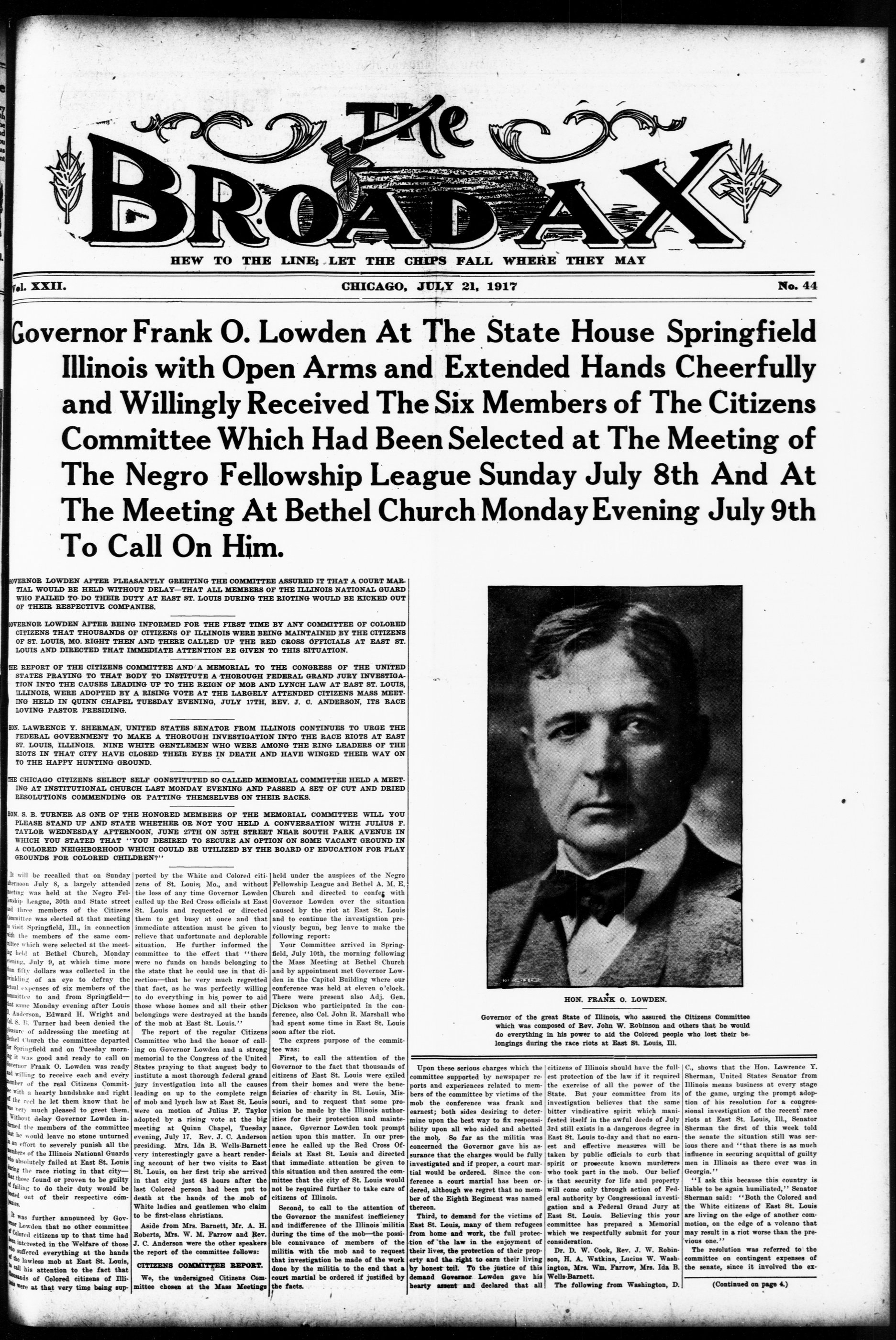
Governor Frank O. Lowden At The State House Springfield Illinois with Open Arms and Extended Hands Cheerfully and Willingly Received The Six Members of The Citizens Committee Which Had Been Selected at The Meeting of The Negro Fellowship League Sunday July 8th And At The Meeting At Bethel Church Monday Evening July 9th To Call On Him.
GOVERNOR LOWDEN AFTER PLEASANTLY GREETING THE COMMITTEE ASSURED IT THAT A COURT MARTIAL WOULD BE HELD WITHOUT DELAY—THAT ALL MEMBERS OF THE ILLINOIS NATIONAL GUARD WHO FAILED TO DO THEIR DUTY AT EAST ST. LOUIS DURING THE RIOTING WOULD BE KICKED OUT OF THEIR RESPECTIVE COMPANIES.
GOVERNOR LOWDEN AFTER BEING INFORMED FOR THE FIRST TIME BY ANY COMMITTEE OF COLORED CITIZENS THAT THOUSANDS OF CITIZENS OF ILLINOIS WERE BEING MAINTAINED BY THE CITIZENS OF ST. LOUIS, MO. RIGHT THEN AND THERE CALLED UP THE RED CROSS OFFICIALS AT EAST ST. LOUIS AND DIRECTED THAT IMMEDIATE ATTENTION BE GIVEN TO THIS SITUATION.
THE REPORT OF THE CITIZENS COMMITTEE AND A MEMORIAL TO THE CONGRESS OF THE UNITED STATES PRAYING TO THAT BODY TO INSTITUTE A THOROUGH FEDERAL GRAND JURY INVESTIGATION INTO THE CAUSES LEADING UP TO THE REIGN OF MOB AND LYNCH LAW AT EAST ST. LOUIS, ILLINOIS, WERE ADOPTED BY A RISING VOTE AT THE LARGELY ATTENDED CITIZENS MASS MEETING HELD IN QUINN CHAPEL TUESDAY EVENING, JULY 17TH, REV. J. C. ANDERSON, ITS RACE LOVING PASTOR PRESIDING.
HON. LAWRENCE Y. SHERMAN, UNITED STATES SENATOR FROM ILLINOIS CONTINUES TO URGE THE FEDERAL GOVERNMENT TO MAKE A THOROUGH INVESTIGATION INTO THE RACE RIOTS AT EAST ST. LOUIS, ILLINOIS. NINE WHITE GENTLEMEN WHO WERE AMONG THE RING LEADERS OF THE RIOTS IN THAT CITY HAVE CLOSED THEIR EYES IN DEATH AND HAVE WINGED THEIR WAY ON TO THE HAPPY HUNTING GROUND.
THE CHICAGO CITIZENS SELECT SELF CONSTITUTED SO CALLED MEMORIAL COMMITTEE HELD A MEETING AT INSTITUTIONAL CHURCH LAST MONDAY EVENING AND PASSED A SET OF CUT AND DRIED RESOLUTIONS COMMENDING OR PATTING THEMSELVES ON THEIR BACKS.
HON. S. B. TURNER AS ONE OF THE HONORED MEMBERS OF THE MEMORIAL COMMITTEE WILL YOU PLEASE STAND UP AND STATE WHETHER OR NOT YOU HELD A CONVERSATION WITH JULIUS F. TAYLOR WEDNESDAY AFTERNOON, JUNE 27TH ON 35TH STREET NEAR SOUTH PARK AVENUE IN WHICH YOU STATED THAT "YOU DESIRED TO SECURE AN OPTION ON SOME VACANT GROUND IN A COLORED NEIGHBORHOOD WHICH COULD BE UTILIZED BY THE BOARD OF EDUCATION FOR PLAY GROUNDS FOR COLORED CHILDREN?"
Vol. XXII.
GOVERNOR OF ILLINOIS and W. Comm. The M. The M. To C.
GOVERNOR LOWDEN AFTER PLEASE TIAL WOULD BE HELD WITH WHO FAILED TO DO THEIR DIV OF THEIR RESPECTIVE COMPANY.
GOVERNOR LOWDEN AFTER BEING CITIZENS THAT THOUSANDS OF ST. LOUIS, MO. RIGHT THE LOUIS AND DIRECTED THAT THE REPORT OF THE CITIZENS OF STATES PRAYING TO THAT E TION INTO THE CAUSES LEADED ILLINOIS, WERE ADOPTED BY ING HELD IN QUINN CHAPEN LOVING PASTOR PRESIDING.
BON. LAWRENCE Y. SHERMAN, U. FEDERAL GOVERNMENT TO ST. LOUIS, ILLINOIS. NINE RIOTS IN THAT CITY HAVE TO THE HAPPY HUNTING GROUND.
THE CHICAGO CITIZENS SELECTING AT INSTITUTIONAL CHURCH RESOLUTIONS COMMENDING.
BON. S. B. TURNER AS ONE OF THE PLEASE STAND UP AND STATELY TAYLOR WEDNESDAY AFTER WHICH YOU STATED THAT A COLORED NEIGHBORHOOD W GROUNDS FOR COLORED CHILDREN.
It will be recalled that on Sunday afternoon July 8, a largely attended meeting was held at the Negro Fellowship League, 30th and State street and three members of the Citizens Committee was elected at that meeting to visit Springfield, Ill., in connection with the members of the same committee which were selected at the meeting held at Bethel Church, Monday evening, July 9, at which time more than fifty dollars was collected in the wrinkling of an eye to defray the actual expenses of six members of the committee to and from Springfield—that same Monday evening after Louis B. Anderson, Edward H. Wright and Col. S. B. Turner had been denied the pleasure of addressing the meeting at Bethel Church the committee departed for Springfield and on Tuesday morning it was good and ready to call on Governor Frank O. Lowden was ready and willing to receive each and every member of the real Citizens Committee with a hearty handshake and right of the reel he let them know that he was very much pleased to greet them. Without delay Governor Lowden informed the members of the committee that he would leave no stone unturned in an effort to severely punish all the members of the Illinois National Guards who absolutely failed at East St. Louis during the race rioting in that city—that those found or proven to be guilty of failing to do their duty would be booted out of their respective companies.
It was further announced by Governor Lowden that no other committee of Colored citizens up to that time had been interested in the Welfare of those who suffered everything at the hands of the lawless mob at East St. Louis, to call his attention to the fact that thousands of Colored citizens of Illinois were at that very time being sup-
HEW TO THE LINE; LET THE CHIPS FALL WHERE THEY MAY
ported by the White and Colored citizens of St. Louis; Mo., and without the loss of any time Governor Lowden called up the Red Cross officials at East St. Louis and requested or directed them to get busy at once and that immediate attention must be given to relieve that fortunate and deplorable situation. He further informed the committee to the effect that "there were no funds on hands belonging to the state that he could use in that direction—that he very much regretted that fact, as he was perfectly willing to do everything in his power to aid those whose homes and all their other belongings were destroyed at the hands of the mob at East St. Louis."
The report of the regular Citizens Committee who had the honor of calling on Governor Lowden and a strong memorial to the Congress of the United States praying to that august body to institute a most thorough federal grand jury investigation into all the causes leading on up to the complete reign of mob and lynch law at East St. Louis were on motion of Julius F. Taylor adopted by a rising vote at the big meeting at Quinn Chapel, Tuesday evening, July 17. Rev. J. C. Anderson presiding. Mrs. Ida B. Wells-Barnett very interestingly gave a heart rendering account of her two visits to East St. Louis, on her first trip she arrived in that city just 48 hours after the last Colored person had been put to death at the hands of the mob of White ladies and gentlemen who claim to be first-class christians. Aside from Mrs. Barnett, Mr. A. H. Roberts, Mrs. W. M. Farrow and Rev. J. C. Anderson were the other speakers the report of the committee follows:
CITIZENS COMMITTEE REPORT.
We, the undersigned Citizens Committee chosen at the Mass Meetings
CHICAGO, JULY 21, 1917
held under the auspices of the Negro Fellowship League and Bethel A. M. E. Church and directed to confer with Governor Lowden over the situation caused by the riot at East St. Louis and to continue the investigation previously begun, beg leave to make the following report:
Your Committee arrived in Springfield, July 10th, the morning following the Mass Meeting at Bethel Church and by appointment met Governor Lowden in the Capitol Building where our conference was held at eleven o'clock. There were present also Adj. Gen. Dickson who participated in the conference, also Col. John R. Marshall who had spent some time in East St. Louis soon after the riot.
The express purpose of the committee was:
First, to call the attention of the Governor to the fact that thousands of citizens of East St. Louis were exiled from their homes and were the beneficiaries of charity in St. Louis, Missouri, and to request that some provision be made by the Illinois authorities for their protection and maintenance. Governor Lowden took prompt action upon this matter. In our presence he called up the Red Cross Offices at East St. Louis and directed that immediate attention be given to this situation and then assured the committee that the city of St. Louis would not be required further to take care of citizens of Illinois.
Second, to call to the attention of the Governor the manifest inefficiency and indifference of the Illinois militia during the time of the mob—the possible connivance of members of the militia with the mob and to request that investigation be made of the work done by the militia to the end that a court martial be ordered if justified by the facts.
107
Governor of the great State of Illinois, who assured the Citizens Committee which was composed of Rev. John W. Robinson and others that he would do everything in his power to aid the Colored people who lost their belongings during the race riots at East St. Louis, Ill.
Upon these serious charges which the committee supported by newspaper reports and experiences related to members of the committee by victims of the mob the conference was frank and earnest; both sides desiring to determine upon the best way to fix responsibility upon all who aided and abetted the mob. So far as the militia was concerned the Governor gave his assurance that the charges would be fully investigated and if proper, a court martial would be ordered. Since the conference a court martial has been ordered, although we regret that no member of the Eighth Regiment was named thereon.
Third, to demand for the victims of East St. Louis, many of them refugees from home and work, the full protection of the law in the enjoyment of their lives, the protection of their property and the right to earn their living by honest toil. To the justice of this demand Governor Lowden gave his hearty assent and declared that all
Great State of Illinois, who assured the aposed of Rev. John W. Robinson and in his power to aid the Colored people the race riots at East St. Louis, Ill.
citizens of Illinois should have the fullest protection of the law if it required the exercise of all the power of the State. But your committee from its investigation believes that the same bitter vindicative spirit which manifested itself in the awful deeds of July 3rd still exists in a dangerous degree in East St. Louis to-day and that no earnest and effective measures will be taken by public officials to curb that spirit or prosecute known murderers who took part in the mob. Our belief is that security for life and property will come only through action of Federal authority by Congressional investigation and a Federal Grand Jury at East St. Louis. Believing this your committee has prepared a Memorial which we respectfully submit for your consideration.
Dr. D. W. Cook, Rev. J. W. Robinson, H. A. Watkins, Lucius W. Washington, Mrs. Wm. Farrow, Mrs. Ida B. Wells-Barnett.
The following from Washington, D.
No. 44
Springfield Cheerfully
the Citizens
Meeting of
Both And At
ing July 9th
Citizens Committee
others that he would
who lost their be-
C., shows that the Hon. Lawrence Y. Sherman, United States Senator from Illinois means business at every stage of the game, urging the prompt adoption of his resolution for a congressional investigation of the recent race riots at East St. Louis, Ill., Senator Sherman the first of this week told the senate the situation still was serious there and "that there is as much influence in securing acquittal of guilty men in Illinois as there ever was in Georgia." "I ask this because this country is liable to be again humiliated," Senator Sherman said: "Both the Colored and the White citizens of East St. Louis are living on the edge of another commotion, on the edge of a volcano that may result in a riot worse than the previous one." The resolution was referred to the committee on contingent expenses of the senate, since it involved the ex-
(Continued on page 4.)
Dan M. Jackson
Geo. T. Kersey
David A. McGowan
Ahmed A. Rayner
The Emanu
Undertaking
2959-61 South State St.
Reliable Service Courteous Treatment
Reasonable Prices
FREE CHAPEL IN CONNECTION
Complete line of Funeral Goods
DEE & COM
LACE CLEANERS DRY
26 East 35th Street
Tel. Dou
Become a Stockholder
$10.00 Sh
DIRE
DEE & COMPANY, Inc.
Tel. Douglas 1261 Become a Stockholder and Get 20% off
CHARLES A. STEINMANN
MAJOR ROBERT R. JACKSON
MORRIS LEWIS
MRS. ROSA STEINMANN
ADOLPHUS C. HARRIS.
FRATERNAL HOTEL
RENTING
0165
FRATERNAL HOTEL
CHICAGO
6155 WENTWORTH AVE.
PHONE 3465 ENGLEWOOD
ROOMS 25c PER NIGHT AND UP
ROOMS $1.00 PER WEEK AND UP
Plaint of an Artist
"How was the big political meeting?" "It should have been better," replied the leader of the band. "If the speakers hadn't kept getting up and interrupting the music it would have been a fine concert."—Washington Star.
Odd Marriage Ceremony
Polynesia is probably the only place in the world where the marriage feast takes place without the presence of the bridegroom. For some unexplained reason the young man is "sent into the bush" when negotiations are opened with the family of his bride, and he remains there during the subsequent festivities. It is only when the guests have departed and the girl is left alone with his parents that messengers are dispatched for him.
Spikenard, or nard, mentioned by St John xil, 3, and St. Mark xiv, 3, was a highly aromatic plant growing largely in the Indies. From this plant was made the valuable extract or unguent or favorite perfume used at ancient baths and feasts.
"How did Blanche happen to marry an optician?"
"It was an optician that asked her."
—Puck.
Hateful.
The Woman—I hate to think of my thirtieth birthday! The Man—Let's not bring up the past.—Exchange.
The high impulse should be followed at any risk.
PAGE TWO
Spikenard.
Of Course.
Hateful.
Phones Calumet 6164
Automatic 71-629
uel Jackson
g Co., Inc.
COMPANY, Inc.
CLEANERS LAUNDERERS
3456 Wabash Avenue
Dglas 1261
der and Get 20% off
ares $10.00
CTORS
FREE
STYLE BOOK
HAIR
To Colored Women
We are the largest
manufacturers of
Colored Women's
Hair. Our latest
book showing new
styles in hair
dressing and face.
Every colored wo-
man should have
one. We sell thou-
sands our hair and
toilet articles.
Isfaction guaranteed
or money back.
We make the best
solid Brass STRAIGHT-
ENING combs, with each comb fully
guaranteed. With each comb we give lamp cap
FREE. Send money order or stamps. MONEY
BACK IF NOT SATISFACTORY. 89c. postpaid.
POSTPAID 89c
Hair nets, brushes, combs and toilet articles
manufacturer's prices. Send two-cent stamp.
Agents Wanted. Address as follows:
HUMANIA HAIR COMPANY.
181-157 Park Row,
New York City.
Address Dept. 84
Cheap and Dear Men.
In an interview with Darwin P. Kingsley a writer in the American Magazine reports:
"Suppose you explain, Mr. Kingsley, some of the differences between the $1,000 a year and the $5,000 a year man."
"Punch, faithfulness, capacity for work and inclination for it," returned the life insurance president, "make up the yardstick which measures most differences in salary. It's not at all difficult to spot the youth who has the makings of a winner.
"The $5,000 a year man, to begin with, is always on the job. He is too busy to watch the clock. He is likely to be quicker at his work than the man at the next desk, and he is always looking for more things to do. In a roomful of clerks the man who is always holloping for heavier tasks doesn't have to ask for promotions."
Counting Seconds
An easy method of counting seconds that is sufficiently accurate for photographic purposes is to repeat a phrase that it takes one second to pronounce. The majority of people will require one second of time to pronounce the words one hundred and one as rapidly as clear enunciation will permit. The last word of the second should always indicate the number of seconds that have been counted. Six seconds, for instance, should be counted one hundred and one, one hundred and two, one hundred and three, one hundred and four, one hundred and five, one hundred and six. Many who use this method can count from thirty to sixty seconds without varying more than one or two seconds from the time recorded by a watch.
Butter From Bird Fat.
A queer sort of butter is obtained in Trinidad, where cows and cream are scarce. This butter is the bolled down fat of a bird called the guacharo. This bird lives in the darkest caves and seldom is seen in the daylight. The young birds are extremely plump, and from them is obtained the rich fat. The birds are taken from their nests when two or three weeks old. After they are killed they are put on to boll, not in water, but in their own fat. The natives experience some difficulty in getting at the nests of the guacharo, for they must creep through caves and wade through stagnant pools to reach their prey. The full grown guacharo is so timid that no one ever has been able to photograph a living specimen.
Just Like a Woman
"I understand your wife has been quite ill, but is now convalescent."
"Yes."
"How was she looking when you left the hospital?"
"In the hand mirror."—Florida Times-Union.
Shares
OPEN DAY AND NIGHT
THE BROAD AX. CHICAGO. JULY 21. 1917.
Courtesay to the Flag.
Courtsey to the Flag.
Civilians have all kinds of trouble when visiting a military camp, because they invariably attempt to pass the flag waving at regimental or brigade headquarters without paying it any more recognition than they would an ice wagon or a garbage can. But in such places they are compelled to extend proper courtesy to the flag of their country. There is always a hawk faced colonel roosting in the black depths of his tent just behind the colors, and woe to the soldier on guard if he lets a civilian go past without saluting.
When a civilian starts to pass the colors without removing his hat the sentry, knowing that the regimental hawk is glaring balefully at him, swoops down on on the surprised civilian and sternly says, "Take off your hat."
Women, of course, cannot take off their hats to the colors, but as they pass the colors or the colors are carried by them, they can at least stop talking and keep their eyes fastened on Old Glory-Chicago Herald.
Fortress, Silence, Gloom!
Fortress, silence, gloum
The fortress of St. Peter and St. Paul is the gloomiest of bastles. It stands on the bank of the Neva in Petrograh, opposite what was the Winter palace of Russia's masters. It is a veritable temple of silence, such as Carlyle sighed for in vain. Prince Krapotkin, who spent many weary months within its walls, tells how the officers moved about with silent tread. The floor of his cell was covered with felt, and he found that though the walls had the appearance of being paper the paper was only pasted on canvas, behind which was a wire grating packed with layers of felt. Krapotkin measured his cell and found that ten steps from one corner to the other repeated 150 times was two-thirds of a mile. He desired to walk five miles a day and accomplished his task walking rapidly to the corners, but turning slowly to avoid dizziness.
The Latchstring Is Out.
The saying "The latchstring is out" signifies hospitality. It is a standing invitation to visit the party who uses it. In early times throughout New England and other parts of the country the houses were built of logs, and the door fastenings were simply a wooden latch on the inside of the door, which fell into a notched stick in the doorpost. The simple contrivance was owing to the fact that nails and iron were hard to get. On the inside the latch was lifted by the hand easily, but to lift it from the outside a hole was bored in the door, which was made of slabs, and a string passed through, which was fastened to the latch. By pulling the string the latch was lifted and the door opened. To lock the door the string was drawn inside so that a person on the outside could not use it.
He Had To.
If all men were like a colored porter in Frankfort, newspaper men would find the game an extremely easy one. The porter, who is known to every man and boy in the city, recently was divorced from his first wife and within a few days was married again. A reporter happened in the clerk's office just as he was about taking out his license.
"When are you to be married, Frank?" asked the reporter. The porter told him, and the questioning was continued until his wife to be grabbed hold of his arm and whispered, "Don't tell that man all about this."
"I've got to," the porter whispered back. "He's a reporter."—Indianapolis News.
There's Profit In Growing Herbs.
There is plenty in growing herbs.
"Particularly pleasant to grow are herbs," says Grace Tabor in the Woman's Home Companion, "and by a little study of their very special market they may be easily turned into pin money. Every butcher who makes his own sausage is a potential customer, and the large packing houses, of course, use large quantities. Chemists, perfumers and pickle factories also require them. Solicit trade if this line is what you think you would like, offering a sample of your wares, just as any manufacturer shows samples of his goods."
Manila's Name Widely Used:
Manila has given its name probably to more articles of commerce than any other city in the world. "Manila" tobacco, cheroots, hemp, hats, paper, matting, bracelets and rings are just a few of the things which remind people in different countries of the capital of the Philippines—London Chronicle.
His Experience.
"That young electrician got an answer from the girl he proposed to that was opposed to all his scientific principles."
"What was it?"
"A decided negative which was also quite positive."—Baltimore American.
A Wise Boy's Reply.
Wille's Mamma — Come now, Willie, I am ready to hear you repeat your history lesson. Wille—Aw, let history repeat itself.—Philadelphia Record.
Something Wagnerian
Mrs. A.—What did your husband say when he saw the bill for your new gown? Mrs. B.—I didn't hear. I started to play on the piano.
Worse Luck.
Fatigued Philip—Did the lady 'trow
bollin' water on youse? Wandering
Walter—Worse'n dat, Phil; worse'n dat.
It was soapsuds!
A man should be upright, not have
to be kept straight—Marcus Aurelius.
Eye of the Submarine.
Without the periscope the submarine would be a blinded fighter. Its most deadly work is done when it is so far submerged that only a foot or two of the periscope's tip can be seen. The periscope is a long vertical tube of small diameter with prisms at either end and the necessary lenses. It rises eighteen feet above the deck, and below, where the other end pierces the hull, is the eyepiece for the observer. It can be turned in any direction, and when a merchantman trying to run the blockade or an enemy ship comes within its field the submarine is suddenly transformed into a formidable and stealthy sea tiger. The periscope becomes its eyes and the dials, compasses and other instruments of the fire control its brain. The engines that carry it to effective range are its swift, tireless legs, and the destructive charge of 250 pounds of guncotton in the unleashed torpedo is the death dealing jaws and rending claws of the great cat that has seen its prey and steals up on it with the skill of a tiger stalking a buffalo. No tiger is more merciless—Frank E. Evans in St. Nicholas.
A Lost Trade Secret
It has frequently happened that valuable trade secrets have been lost beyond recovery. For instance, the best watch oil, it appears, cannot be obtained today because the secret process of mixing it perished with the inventor. It is said that the last quart of this famous fluid was sold for $200, and that was thirty-five years ago. Since then every effort has been made to analyze the product in an attempt to reproduce the oil, but without success. The man who made it and who alone knew its composition died, and, it further appears, not even his name or the place of his burial is known. He never revealed to any one the details of his process, and it was not until after his death that the real value of the oil was appreciated.—Los Angeles Times.
The Eskimo Skin Canoe.
The kayak, or skin canoe, of the Eskimo was in use on the coast of northern Russia two or three centuries ago, according to Dr. MacRitchle, F. 8. A. (Scot). Evidence of this is obtained from statements made by Burrough in 1556 and from the chronicles of a Danish expedition to Valgatz in 1653. It was further shown that three kayaks were captured off the northern shores of Scotland about the end of the seventeenth century. One of these is still preserved in the museum of Marischal college, Aberdeen. An important fact is the occasional presence of a kayayusing race of Finns or Finnmen in the Orkney islands during the last twenty years of the seventeenth century, as testified to by three writers of that period.-Toronto Mall and Empire.
To-kyo.
It is remarkable how many persons, some of whom may lay claim to education and familiarity with Japan, persist in misspelling the name of Japan's capital. Of course if government officials and western diplomats in Japan insist on spelling it To-ki-o, western people, ignorant of the Japanese language, cannot be blamed for pronouncing it in three syllables (To-kee-yo), much to the amused disgust of the Japanese. The Japanese ideographs are only two and are best represented by the two romaji syllables To-kyo, pronounced with a very slight emphasis on the first syllable—Japan Magazine.
Her Dear Husband.
"Why," exclaimed a newly married woman to a bunch of friends, "for three months after our marriage my dear husband made me bake hot biscuits for him every meal."
"And yet your husband is a strong, healthy looking fellow," answered her friend in astonishment. "Doctors say that such a diet is terrible, and"— "Oh, yes, this husband is healthy! I was referring to my first husband."— Cleveland Plain Dealer.
His Loyalty to Alma Mater
His Loyalty to Alma Mater.
"You say Dibling's allegiance to his alma mater has never wavered?"
"Never. Dibling has been out of college more than twenty years, and he still borrows money from his college chums exclusively."—Birmingham Age-Herald.
Useless Advice.
Mrs. Batz—You ought to brace up and show your wife who is running things at your house. Cralle (sadly)
—It isn't necessary. She knows.—Puck.
******************
Give Your Stomach a Rest.
Give your stomach a good rest
by eating plain salads or fruits
or fresh green stuff, cutting out
tea and coffee, soda water and
other destroyers, and drink all
the water you can pour down
and watch the effect. After this
internal cleansing you can eat
what nature intended you to eat
—meats, vegetables, fish, eggs
and whatever you really crave.
Men cannot make rules that go
contrary to nature. Fads are
symptoms of diseased stomachs
or the outgrowth of some individual idiosyncrasy. There are
no brain foods, no muscle building tablets, no nerve strengthers, that can be made to take
the place of a varied diet. Every bit of food contains elements
which are taken up by the blood
and distributed to the body.
**************************
Talks on
HEALTH,
CLEANLINESS,
PROPER LIVING,
SANITATION, ETC.
Dr. W. A. Driver
3300 So. State Street
Phone Douglas '3617
CONSUMPTION CAN BE CURED.
Many people do not know that tuberculosis can be cured. It is surprising how some persons are depressed when informed that they have even beginning consumption. The distressful picture of advanced, far advanced and even fatal tuberculosis must be uppermost in the mind of such. No wonder if such a picture is in mind, that they become panicstrecken when their disease is diagnosed as tuberculosis.
Many times the fear of the disease is so great that the patient will request the doctor to conceal the facts. The folly of such a request is so evident that to discuss it seems a waste of time, space and energy. The person who has tuberculosis should know it as early as possible in order to take proper measures to cure it. Early tuberculosis is more easily cured than the moderately advanced case; the moderately advanced case is more easily cured than the far advanced. Those facts are so evident that there should be no question.
When people know the signs of early
WEALTHY WOMAN MINISTER.
Countess Sophie Will Help Charitable and Social Institutions. Petrograd.-In a workman's blouse and a leather skirt Countess Sophie Panin has already taken up the office of assistant minister of social tutelage, a department of state with the function of administering the charitable and social institutions and also the care of children. The countess is the world's first woman minister. She is forty-five years old and wealthy. She resides in a palace, which she transformed into a people's house, a combination of recreation place and popular university.
As an active worker of the Constitutional Democratic party the countess recently was elected a member of one of the newly created subdistricts. She declared that her staff of officials will consist for the most part of women. She hopes that her appointment will be the signal for the transfer of social institutions in other countries into the hands of women.
RAVEN CATCHES COINS.
London Miserly Bird Seizes Money and Afterward Hides It.
London.—Even a raven has his likes and dislikes. At the Cardiff barracks there is one sergeant for whom the bird (sent home by the Second Welsh regiment some years ago) bears a positive dislike.
When the gentleman in khakl with three stripes comes along the raven retires with a hop, a skip and a jump to a safe distance of twenty yards. When the sergeant moves off the raven returns to the spot he retreated from, but if his pet aversion should turn he gets ready to move off again. The dislike was evidently created by teasing, for the sergeant often gives the sable bird his dinner.
The raven is very fond of playing with a coin. If a person drops, say, a shilling it is caught in the bird's beak before the coin can reach the ground. Then, having secured his money, the black old miser seeks an early opportunity to hide it.
ENLISTED AS PRIVATE
Former Congressman Quickly. Earned Promotion to Rank of Corporal. Detroit.-Edwin Denby, aged forty-seven, probably the most distinguished American to enlist in the ranks at the first call to arms, was promoted to the rank of corporal in the United States marine corps. Mr. Denby was a member of congress from 1004 to 1911, former president of the local board of commerce and a prominent attorney of this city. Corporal Denby, who is undergoing military training at Port Royal, S. C., headed the list in a competitive examination open to all members of his company. His enlistment as a private in the marine corps caused considerable comment when he expressed the belief that he could serve his country best as an enlisted man.
Monahan Dies at 110 Years
Watertown, Mass.-James Monahan, who came to this country from Ireland in 1848, is dead at his home here at the age of 110 years. He was forty-one years old when he came here.
A.
tuberculosis they will proceed to get rid of them. Follow the good old sensible rules that are a powerful aid in curing consumption and most symptoms will disappear. Those that fail to vanish will best be gotten rid of by your family physician's constant care, treatment and supervision.
There is a wide circle of earnest workers in every progressive city teaching the people to prevent consumption and the way to cure it. They are pointing out the errors that help to make consumption so that such may be avoided. The way to prevent the disease and the method of cure have much in common. Common sense is the basis of both.
Irregular eating, going to work or to school without breakfast, insufficient food during the day, overeating at one meal, bad air, dirty and dusty living rooms, not enough sleep, frequenting overerowed and poorly ventilated buildings, drinking beer, gin, rum and whisky or other alcoholic beverages smoking and spitting and snuff dipping help to produce consumption. Avoid those evils also to cure the disease.
Washington. — Senator William E. Borah of Idaho lost his watch recently, and President Wilson found it. The senator was riding his horse in Rock Creek park when he looked at his watch, the present of Coeur d'Alene miners. Then he shoved it into the fool pocket of his riding breeches-or thought he did. When some time later he reached for the watch it was missing. Recalling the spot where he last had looked at it, he galloped back, dismounted and, leading his horse by the reins, scanned the bridle path.
Just then President and Mrs. Wilson, attended by a cavalry sergeant, cantered up the path, and the president stopped when he saw the senator.
"Lost anything, senator?" asked the president.
The president dismounted and joined in the search. After ten minutes he suggested that perhaps the senator had missed the fob pocket and that the watch had dropped inside his riding breeches. Sitting down on a log, the senator pulled off his right riding boot and found the watch.
As the president turned to remount he said with whimsical blandness: "Why don't you wear a wrist watch, senator?"
CENSUS FACTS SACRED.
Detectives, Collectors and Relatives Turned Away Disappointed.
New York.—Ever since the announcement was made that registration under the state military census law was practically complete the offices of the city director of census and the tabulating division have been the objective points for private detectives, bill collectors and relatives looking for missing persons.
No single item of information was given out nor will be, for the state officials say that all facts gathered by the census takers are sacred and be void the reach of subpoenas.
SHARK CAUGHT IN SOUND.
Makes Hard Fight, but Goes to Chinese Cafe For Food.
New London, Conn. — Sharks, that terrorized bathers along the Atlantic coast last summer, have reappeared this season.
A seven foot man eater was towed into this harbor by the fishing smack Ellen. The big fish was caught in the trawling nets a short way out in Long Island sound. It was alive when brought here and put up a hard struggle before being landed.
The shark was taken to a Chinese restaurant in Bank street, where it was utilized for food.
```markdown
```
GERMANY'S AIRSHIP
MOTORS UNCERTAIN
Paris.—Owing to the lack of material Germany's newest, highest powered aeroplanes are less reliable than the older ones, being equipped with smaller motors, because iron has been substituted for brass. This information comes from an aviator prisoner who was flying in a repaired English machine which had fallen behind the German lines.
PARIS MESSAGE
What a Prima Donna Writes From Real Experience.
ENTERTAINS BETWEEN SONGS
Our Mary Garden, Between Singing at the Comique and Taking Needed Rests, Entertains and Cheers Poilus From the Trenches In Her Home.
Stage women are long since organised to give their services to country wide preparation both in performances to raise money for Red Cross purposes and to assist in recruiting. Indeed, one actress is walking across the continent, accompanied by her faithful dog, winning army recruits on her way. Aid for Scottish soldiers wounded on the continent has been the special care of Mary Garden, so long prima donna of French operas. And now she writes from Paris:
"I have heard 'The Star Spangled Banner' played on every conceivable
THE FASHION WEEKLY
MARY GARDEN.
occasion, by musicians who know our national air and by many others who obviously did not know it. I have heard it hummed and sung and whistled to the accompaniment of applause and cheers.
"Dixie' challenges the Parisian ear almost as quickly as it does our good Tankees in America. This favorite air of the south is frantically applauded daily by French auditors, who accept it as one of our national airs rather than a musical contribution of one of the sections of our nation. 'Suwanee River' and Sousa's marches are other airs now immensely popular in Paris.
"Between the nights when I sing here at the Comique and the time that I must take for rest between performances I still find time to give attention to the hospital and relief work with which I have identified myself since the war began.
"France rightly persists in giving her fighting soldiers respites and furboughs. Men who have been under heavy fire at the front are withdrawn and have the opportunity to steady their nerves for a few days before going back into battle.
"So the work we have undertaken is to entertain the men home on furboughs—not the officers, but the so-called common soldiers. A group of my friends decided with me that we would take only those privates whose families are in exile, having been driven into Germany from the French towns and territory occupied by the Germans.
"I imagine their state of mind. I have five of these in my home today and will have as many more tomorrow. They are brave and stoical, but utterly and absolutely alone. Whether their wives and children are alive they do not know, for their families have been herded like cattle and driven into an enemy country to work at whatever tasks their captors designate."
Ginger Snaps.
Cream one-half cupful butter and one-half cupful lard and add one cupful sugar, one cupful molasses and one-half cupful water. To two cupfuls of flour add one teaspoonful soda, one tablespoonful ginger, one tablepoonful cinnamon and one teaspoonful cloves. Add this flour to butter and sugar mixture and put in enough more flour to make a stiff dough. Chill in ice and roll very thin. This makes a large number of cookies, but they keep well. When cut with small cutter they are excellent to serve with afternoon teas.
Concerning Screens
If you live so near the public pavement that passersby can look into your house try painting the screen doors with a very thin coat of white paint, and you can look out, but people painting cannot see into your living rooms.
If you rub the screens of windows and doors with kerosene the files will come near as long as the odor lasts.
NAVAL STYLES.
What Feminine Yeomen Will Wear on Duty.
The many women who will enter the navy and take service in the clerical force as yeomen, releasing the regular yeomen for sea duty, will wear navy uniforms. The bids for the contracts of making the uniforms closed, quite recently, and the awards will soon be made. The navy women's uniforms must be out in one week after the contract is given.
Bids are made on the following items: One thousand suits of blue serge (skirt and coat), 2,000 suits of white drill (skirt and coat), 2,000 skirts of white drill, 3,000 waists of beach cloth or similar material, 1,000 hats of navy blue felt and 1,000 hats of white rough flat straw.
The garments Uncle Sam's navy girls will wear will be strictly navy tailor made. Here are the specifications. The coats, of navy serge or white bleached drill, will be slightly shaped to the figure, as long as to the knuckles of the hand when hanging, with plain seams and single breasted. There will be four navy gilt buttons, six inches apart, as usually worn, sleeve cuffs to have three navy gilt buttons. On each hip will be an outside patch pocket, the top of each to be abreast of the fourth button. The lower corners are slightly rounded, with shield shaped flap at top. Plains two inches wide will run from the shoulder, both front and back. Norfolk style. The belt, one and three-quarters inches wide, running under plains, is fastened with a gilt button in front. The lining of the serge coat will be dark blue sateen; the white will be skeleton.
Skirts will be plain navy blue serge or white drill, stricly tailor made, full at the bottom, to fit the figure over the hips, belting with a re-enforced waistband. There will be a placket fastened with invisible snappers and two patch pockets, each with flap and gilt button. The skirts will be four inches above the ankle joint in length. Waists will be tailor made of beach cloth or similar material, front and back plain to top shoulder seam, all seams flat. There will be one seam sleeves, set plain into the armhole, slightly gathered into the cuff, which fastens at the outer wrist bone with two buttons. The collar is made to be worn unbuttoned and folded back or buttoned high, turning over two and a half inches at the top, the corners slanting away from the center front. There will be a plain patch pocket on the left side of the waist, and the buttons will be of plain pearl.
The hat will be the straight brimmed sailor of navy blue felt or white rough flat straw. It is to be made to dimensions and to be ordered to fit the person. The brim will be two and three-fourths inches from crown to outer edge, crown three and three-fourths inches high, six and one-fourth inches wide at top and six and three-fourths inches at bottom, three and three-fourths inches long at top and eight and one-fourth inches at bottom.
REALLY FEMININE.
Boudoir Caps Still Appeal Despite War's Wild Alarms. This graceful bit of flesh colored liberty satin and ecu fillet lace is further enhanced by clusters and stream
A.
FOR THE BRIDE
ers of baby ribbon nattily placed. The
under frill, below the lace, is a bit of
ruche put up in georgette crape.
How to Pack a Trunk
When packing for a trip always remember to put all the heaviest things at the bottom of the trunk. Evening dresses, perishable waists and all such dainty things should be put on top, where you can reach them. Hang them up as soon as your trunks arrive at your destination. A hat trunk is not a necessity. Put your hat on the top tray of your trunk and secure it with push pins to the bottom. Unless the brim is wide this will do no harm. Stuff the bodices of waists, light dresses, etc., with tissue paper. Roll the paper into light balls, never tightly. The result should look like an article just sent from the cleaner's.
Hop Beer.
Take four pounds of malt, two pounds of brown sugar, one pint of molasses, one-half pound of hops to eight gallons of water. Steep this in a boiler all night (don't boll it). Put it in a keg and when lukewarm add one yeast cake and let it work eight to ten hours. Then put the faucet and bung in.
THE BROAD AX, CHICAGO, JULY 21. 1917.
FOR YOUNG FOLKS
FOR YOUNG FOLKS
Sleepy Time Story About Some Very Intelligent Animals
DOINGS AT A DINNER PARTY.
Feeding the Wild Creatures In a Well Managed Zoo—Children Enjoy Seeing Them Eat Their Food—Some of the Animals Have Good Manners.
Well, said Uncle Ben to Little Ned and Polly Ann, I am going to tell you about
THE MONKEYS' PARTY.
Recently I went to the city and while there visited the park to see the animals. As I wandered about, feeling lonesome and out of place, as uncles are apt to do when they go to a place like that without any little boy or girl to keep them company, I noticed two little chaps trotting along in front of me.
"Hurry up!" one called, looking back of him. "You miss it if you don't hurry up."
An older lad, walking along with a book under his arm, smiled at me, and I smiled back.
"What is it the little fellows are so anxious to see?" I asked him.
"The big monks," replied the tall brother. "They feed 'em at a table about this time every day."
They were such nice, friendly lads that I asked if I might go with them to see this sight. They said "Of course" so cordially that I felt myself quite at home with them.
We reached the monkeys' cages after a short walk, and the little boys climbed up to some seats built for the little folks.
In this zoo the animals are made as comfortable as wild creatures shut up in cages can be made.
In the outdoor cage in front of which we sat we several small tables and some chairs. At a certain time a man—the keeper—in uniform came into this cage and, opening a door into the next one, called to the big monkeys in there. They came trooping into his cage, and seated themselves in the chairs at the table.
Then one monkey, wearing a white coat and trousers, passed the plates to the monkeys at the table. Then he gave them forks. Next the keeper passed the food—fruit neatly cut into pieces.
The monkeys began to eat it with their forks, and the way some of those monkeys could handle their forks and their manners at table were a lesson for some boys and girls. When he had eaten his fruit each monkey was given a cup of milk, out of which he drank with great enjoyment.
One monkey was naughty and had his ears boxed by the keeper. This monkey sat with his hand on his head for the rest of the meal. He thought if he covered his ears the keeper could not box them again.
When the meal was over the monkeys were ready to go back to their cage. The children cheered as they climbed down from the high seats. So did Uncle Ben.
Be Kind to Animals
Boy and girl scouts, Bands of Mercy and such organizations are already pledged to be kind to all creatures. Every youngster ought to be so minded, equally determined in the matter, because of the civilizing influences of the age and education. Two things are to be considered—simple humanity and the better opportunity to get along with and have control over the pets and wild creatures that come within your experiences.
A Junior Patriot.
The battleship Recruit, recently built in Union square, New York city, has been a center of patriotism for
A boy stands on a skateboard, pointing to the right. He is wearing a white shirt and pants. The background is a blurred outdoor scene with a fence and trees.
Photo by American Press Association
old and young. The photograph shows George Lee Yon, Chinese member of the junior naval and marine scouts, making a speech from the bat tship to the assembled crowd.
From Paris Comes This Graceful) Frock of Charm.
THE FASHION WEEKLY
THE DEMURE ONE.
The popular combination of soft gray and navy blue is here materialized in crepe de chine, with dull gold employed to embroider the lacy points, one of which so charmingly picks out the front of the blouse.
FRUIT SIRUPS.
Juices For Jelly Making Kept Without Sugar Till Need For Them Arises. Fruit juices for use later in jelly making can be sterilized and bottled without sugar and made into jellies at the housewife's convenience. This enables her to do with fewer jelly glasses and to distribute her purchases of sugar for jelly making through the year. Moreover, with the bottled juice she can make a greater variety of jellies, as juices which will not jell can be put up when the fruit is ripe and combined later with fruits that will jell, or fruit ripening at different seasons can be combined. For example, the juice of strawberries, cherries or pineapples can be kept without sugar and later, when apples are plentiful, can be made into combination jelly.
From the unsugared sterilized juices of currants, apples, crabapples and grapes, kept from nine to eighteen months, the bureau of chemistry, United States department of agriculture, recently made jellies of excellent texture, flavor and color
To put up unsugared fruit juices for jelly making proceed exactly as if jelly were to be made at the time. Cook the fruits until they are soft and strain out the juice through a flannel bag. Heat and pour while hot into bottles previously scalded. Fill the bottles full, leaving no air space between juice and cork or seal. Place the filled sealed bottles on their sides in water near the boiling point and keep them in the bath for about thirty minutes. Make sure that the corked or sealed end is under the hot water. As soon as the bottles are cool cover the cork with a paraffin seal. Thorough sterilization and sealing are absolutely essential to success.
To make jelly from the sterilized juice test its jelling quality, add the proper amount of sugar and proceed as in making jelly from freshly expressed juice.
Wedding Cake.
One pound of butter, one pound of black sugar, one and one-fourth pounds of flour, twelve eggs, six pounds of raisins, five pounds of currants, one and one-half pounds of citron, two teacupfuls of black molasses, two teacupfuls of wine, one cupful of brandy, two grated nutmegs, two tablespoonfuls of cloves, two tablespoonfuls of allspice, one tablespoonful of cinnamon. Before cutting the citron boil it, then use the water the citron was boiled in to put in the cake. The one-quarter of a pound of flour is used to roll the fruit in. At the last add one gill of milk and two tablespoonfuls of baking powder.
Plaster For Cracks
Use vinegar instead of water to mix your plaster of paris. The resultant mass will be like putty and will not "set" for twenty or thirty minutes, whereas if you use water the plaster will become hard almost immediately, before you have time to use it. Push into the cracks and smooth it off nicely with a table knife.
Paraffined Paint Can
After housecleaning, if one has partly used cans of paint or varnish left over, which would soon dry up and become useless, try putting them into small cans and cover with melted paraffin. They will keep indefinitely and can be used as needed.
SAVE EVERY BIT
Don't Let a Pound of Food Rot on the Ground.
REDUCE YOUR GROCERY BILL
Here Are the Points You Need to Know About Canning Vegetables and Fruits For the Wintry Days Ahead of Us All In Wartime.
[Prepared by National Emergency Food Garden Commission.]
Select sound vegetables and fruit. If possible, can them the same day they are picked. Wash clean and prepare them.
Have ready on the stove a can or pail of boiling water.
Place the vegetables or fruits in cheesecloth or in some other porous receptable—a wire basket is excellent—for dipping and blanching them in boiling water.
Put them whole into the boiling water. After the water begins to boil begin to count the blanching time.
The blanching time varies from one to twenty minutes, according to the vegetable or fruit. When the blanching is complete remove the vegetables or fruits from the boiling water and plunge them a number of times into cold water to harden the pulp and check the flow of coloring matter. Do not allow to stand in cold water. The containers should be thoroughly clean. It is not necessary to sterilize them in steam or boiling water before filling them, for the reason that in the cold pack process both the insides of containers and the contents are sterilized. The jars should be heated before the cold product is put in them. Pack the product into the containers, leaving about a quarter of an inch of space at the top. With vegetables add one level teaspoonful of salt to each quart container and fill with boiling water. With fruits use sirups.
With a glass jar always use a new rubber. Test the rubber by stretching or turning inside out. Fit on the rubber and put the lid in place. If the container has a screw, turn as hard as possible, but use only the thumb and little finger in tightening it. This makes it possible for steam generated within to escape and prevents breakage. If a glass top jar is used, snap the top ball only, leaving the lower ball loose during sterilization. Tin cans should be completely sealed.
Place the filled and capped containers on the rack in the sterilizer. If the homemade or commercial hot water bath outfit is used some authorities insist that enough water should be in the boiler to come at least one inch above the tops of the containers and that the water in boiling out should never be allowed to drop to the level of these tops. Begin to count processing time when the water begins to boil.
At the end of the sterilizing period remove the containers from the sterilizer. Fasten covers on tightly at once; tip each container over to test for leakage, and store. Be sure that no draft is allowed to blow on glass jars, as it may cause breaking.
If jars are to be stored where there is strong light, wrap them in paper, preferably brown, as light will fade the color of products canned in glass jars and sometimes ruin food value.
THE FEMININE SCOUT.
All Over the Country Girls Are Donning This Rig.
Cotton khakl cut just like a soldier boy's is the uniform adopted by girls who are learning to use firearms for
A young woman in a military uniform, holding a rifle.
READY TO SERVE
home defense. Leggings over tan boots
and a red silk bandanna kerchief as
necktie give a picturesque dash to the
somber khaki.
Timely Suggestion
To make the old lids of fruit jars look like new boll them in weak vinegar twenty minutes and then scrub with soap and a brush.
PAGE THREE
For Stout Women Is This of Longitudinal Build.
THE WOMEN'S WORLD
AUTUMN SUIT.
Long, straight lines loosely girded by a stringy sash belt are the idea for women no longer sylphlike. The material is beige wool jersey cloth, cut with patch pockets huge in ratio to the size of the lady herself. The tailored lisse straw hat is also smart.
TUB FROCKS.
How to Wash Them Without Running Their Colors.
When washing colored summer frocks at home remember these hints:
To prevent the color running add to the rinsing water a little vinegar for mauve or heliotrope, ox gall for brown, alum for green, methylated spirits for all shades of lemon or yellow and salt for blue.
A handful of salt in the rinsing water nearly always acts as a preservative for any shade or color.
Brown holland frocks always present a better appearance if washed in bran water without any soap being used. Boil a pound of bran in two quarts of clean warm water and wash the dress is as many changes of water as necessary.
Rinse through cold water and when half dry iron on the wrong side with a hot iron.
Silk summer blouses want washing quickly and carefully, one at a time. Do not wring the blouses, but squeeze through two bowls of soapsuds, then rinse through clear warm water. Pale colored silks improve by being given a second rinsing through blue water. Roll in a towel and iron before quite dry with a fairly hot iron, keeping a piece of muslin between the silk and the iron. A good tip is this latter. Many home laudresses ruin silk blouses, making them yellow, by washing in very hot water.
Homemade Soda Water.
Boll together in a granite saucepan two pounds granulated sugar, three pints hot water and two ounces tartaric acid. At the end of five minutes put it where it will get cool. When cold stir in the beaten whites of three eggs and one ounce wintergreen or sarsaparilla. Bottle. When ready to use put a tablespoonful in a glass half full of water (cold), add a scant quarter teaspoonful soda, beat and drink while foaming. This is a staple product for children's lemonade, a delicious summer drink yielding a nickel harvest for some pet charity or small boy's private exchequer.
Almost a Closet.
Persons living in apartments or furnished rooms will find this a useful device for increasing closet capacity: Fasten one end of a heavy wire (picture wire works well) to a hook in the closet, thread the other end through the spring of a patent clothespin, wind the wire about the second hook, and so on around the closet until there is a clothespin between each pair of hooks. This is an excellent way of holding skirts or waists and can be removed easily.
One Egg Spice Cake
Cream one-half cupful of butter and add one cupful of sugar and one egg. To two cupfuls of flour add one teaspoonful of soda, one teaspoonful of cinnamon, one-half teaspoonful of nutmeg, one-quarter teaspoonful of cloves. Combine with sugar mixture alternately with one cupful of sour milk. Add one cupful of chopped raisins. Spread about the thickness of gingerbread in a large tin. Bake in a moderate oven. Good warm.
[Name]
[Name not visible]
HON. LAWRENCE Y. SHERMAN
United States Senator from Illinois, w Colored race; stood up in the U actions of the mob at East St. into that body, calling for a the causes which led up to the lawless
United States Senator from Illinois, who is proving himself friendly to the Colored race; stood up in the United States Senate and denounced the actions of the mob at East St. Louis. He has introduced a resolution into that body, calling for a thorough Federal investigation into the causes which led up to the lawlessness in that city.
HON. FRANK O. LOWDEN HEART-
ILY RECEIVED THE COLORED
CITIZENS COMMITTEE FROM
CHICAGO.
(Concluded from page 1.)
penditure of money in making the investigation. The Illinois senator said he would do all he could to get favorable action upon it this week. It does seem to us that the United States Semate should aid Senator Sherman in that direction and without delay order an investigation into the late race riots in the grand old State of Illinois. It appears that some of the Colored people were also able to do some shooting and killing at East St. Louis, as well as the White, men for nine White gentlemen who were the ring leaders of the mob and were the chief ginks of the bloody affair in that city have closed their eyes in death and they have successfully winged their way to the happy hunting ground for they laid down their lives in the noble attempt to defend and uphold moll and lynch law.
The Chicago citizens select or self-constituted so-called memorial committee held forth at Institutional Church, Monday evening, the Rev. Hon. Archibald Jackson Carey, Ph. D. D. D. turned on his regular prayer and was the presiding officer. Edward H. Wright read the report of the trip of the committee to Springfield. Louis B. Anderson read the memorial address. Col. R. S. Abbott, Col. S. B. Turner and B. H. Lucas delivered the set speeches; some policeman by the name of Armstrong was secretary of the meeting. Attorney William L. Martin read the cut and dried resolutions which were gotten up for the express purpose of patting each committee on their political backs.
Right here we loudly call upon the Hon. S. B. Turner to please stand up and state whether or not you held a conversation with Julius F. Taylor Wednesday afternoon, June 27th, 1917, on 35th street near South Park Ave., in which conversation you stated that "you were looking for some vacant ground—that you desired to secure an option on it—that it must be located in a Colored district or neighborhood—that the Board of Education wanted to use it for play grounds for Colored children and did not the writer in the presence of a White gentleman state to the effect that "there was some vacant ground on Calumet Ave. Just north of the home of Col. John R. Marshall and that there was also some on Forest Ave. south of the Eighth Regiment Armory and some on Prairie Ave. south of 33rd street. Mr. Turner we pause for a reply?
DAMAGES RECOVERED FREE.
Notice is hereby given to all persons who suffered injury, loss of property or any damage whatsoever, in the riot in East St. Louis, Ill., on or about July 2, 1917, to apply at the office of Atty. Homer G. Phillips, 2335 Market St., St. Louis, Mo., IMMEDIATELY, and proper steps will be taken to protect their interest and recover damages for their loss without any charges whatsoever.
Legal Committee of the National Association for the Advancement of Colored People.
(Other papers please copy.)
PAGE FOUR
(Other papers please copy.)
FIRST PRIZE FOR CLEAN UP
WEEK GOES TO ATLANTA,
GEORGIA.
Salisbury, North Carolina and New
Madrid, Missouri Gets Second and
Third Prizes. Cups to be Presented
at Chattanooga Meeting of National
Negro Business League.
Tuskegee Institute, Alabama, July. The three silver cups which were offered by Mr. Allen W. Clark, Chairman of the National "Clean Up and Paint Up" Bureau of St. Louis, Missouri, for the most effective clean up work done during the National Negro Health Week, which was observed April 21-28, will be awarded to Atlanta, Georgia; Salisbury, North Carolina, and New Madrid, Missouri. These beautifully engraved cups will be presented to representatives of these respective cities during the next annual meeting of the National Negro Business League, which is to be held at Chattanooga, Tennessee, August 15, 16, 17, 1917.
The Atlanta Committee to which the first prize has been awarded presented a most interesting report, which shows how they worked with the aid of twenty-five local organizations and employed 211 active workers. Mr. H. H. Pace, Secretary of the Standard Life Insurance Company, is president of the Atlanta Committee, and Mrs. John Hope, General Chairman.
The campaign in Salisbury, North Carolina, was conducted under the general direction of the Salisbury Colored Civic League, of which Mrs. W. F. Kelsey is president. The work of the New Madrid Committee was conducted under the direction of the Colored Home Protection League, of which Rev. J. W. D. Mayes is president.
The reports from Nashville, Tennessee; Calhoun, Alabama, and Evansville, Indiana, deserve special mention and it is the hope of the officers in charge that the reports of the committees named by the judges for prizes and for special mention may be put into booklet form, as guides for the observance of future Clean Up Weeks. The judges in the contest were as follows:
Dr. Robert E. Jones, Editor Southwestern Christian Advocate, New Orleans, Louisiana; Dr. A. M. Curtis, Physician and Surgeon, former Surgeon-in-Chief, Freedmen's Hospital, Washington, D. C.; Hon. J. C. Napier, President, National Negro Business League, Nashville, Tennessee; Dr. Robert R. Moton, Principal, Tuskegee Normal and Industrial Institute, Tuskegee, Alabama; Mr. Heman E. Perry, President, Standard Life Insurance Company, Atlanta, Georgia; Mr. C. C. Spaulding, North Carolina Mutual and Provident Association, Durham, North Carolina; Mr. M. N. Work, Editor, Negro Year Book, Tuskegee Institute, Alabama; Dr. D. W. Byrd, President National Medical Association, Norfolk, Virginia; Mrs. Mary B. Talbert, President National Federation of Colored Women's Clubs, Buffalo, New York; Miss Nannie H. Burroughs, Principal National Training School for Women and Girls, Washington, D. C.; Mr. Eugene Kinckle Jones, Executive Secretary, National League on Urban Conditions Among Negroes, New York City; Dr. A. Wilberforce Williams, Physician and Surgeon, Chicago, Illinois.
Chattanooga is wide awake with in-
terest and activity preparing for the next meeting of the League, and the program which is now nearing completion, includes a long list of successful business men and women, whose stories of struggle and success will make the session one of inspiration to all who may be present.
they sat down and folded the supine indifference, the liberty so dearly purchased would away from them.
We must do something to a slumbering millions of our necessity of vigilance and ac
Various communities are already arranging for special delegations and the railroads are cooperating by offering reduced rates and arranging for the special care and accommodation of the delegates and officers. For detailed information write to J. C. Napier, President, Nashville, Tennessee; T. J. Elliott, Chairman of the Executive Committee, Muskogee, Oklahoma; or Emmett J. Scott, Secretary, Tuskegee Institute, Alabama.
EXTRACTS FROM THE SOUND AND LOGICAL ORATION DELIVERED BY ATTORNEY WALTER M. FARMER AT THE RECENT GREAT MEETING AT BETHEL CHURCH.
The shocking display of lawlessness and brutality that has recently disgraced the great State of Illinois is the result of a base conspiracy.
This riot was not a clash between contending forces of white and black labor. Every white man in East St. Louis who wanted work had all he could do. There is abundant work for every Colored laborer in East St. Louis that will not bring him in competition with White labor.
The fact is, the South is helpless without Negro labor. The whole industrial fabric of the South is built upon Negro labor. It is cheap. It is submissive. It is long suffering. The aim of the White man of the South is to impress the Colored people who have recently left that section with the fact that conditions are as intolerable for them in the North and East as those from which he is fleeing.
They have sought this method of discouraging him with the hope of inducing him to return to the cotton fields and plantations.
The Colored people who have recently been driven out of East St. Louis should return to their homes and resume their labor. We must live somewhere and if we permit ourselves to be driven from one place to another there is no telling whither they will drive us. The Colored man must make up his mind to raise his ebenezer somewhere and there stand or fall by it.
As a race we must pass through the same difficulties, encounter the same besetments and stand the same tests that other races have confronted in their march of progress.
The course of progress and civilization is not strewn with flowers or scented with the fragrance of the violet and the rose. No, my friends, it is marked by fallen empires, broken oaths, prostrate forms and seas of blood. Such is the record of man's struggles upward, from the Garden of Eden. Any race or people that expects to attain any enduring and permanent success without encountering these tests, expects what never was and never will be.
It is impossible for man to make progress without the blessings of liberty. It is no wonder then that man in every age and in every clime has been willing to sacrifice so much for liberty. For without liberty, ambition is dead, aspiration is limited, remorse takes the seat of reason and man becomes a miserable slave. It was for liberty that Toussaint L'Ouverture armed the blacks of Santo Domingo and by intrepid military daring and skill drove the enemies of their freedom, the despoilers of their homes from the Queen of the Antilles. But these blacks knew as well as anyone should know, that eternal vigilance is the price of liberty. They knew as well as anyone should know that if
HON. WILLIAM E. MASON.
Congressman at large from Illinois, in lamenting the late race riot at East St. Louis, Senator Mason declared in the presence of Julius F. Taylor that "such things are liable to occur at any time, or as long as certain newspapers in Chicago contend that United States Senators and congressmen through the columns of their papers should be mobbed and lynched for failing to suit their owners.
they sat down and folded their arms in supine indifference, the liberty they had so dearly purchased would be taken away from them.
We must do something to arouse the slumbering millions of our race to the necessity of vigilance and action.
The greatest benefactor of the race will be that person who can mould these diverse, inharmonious millions into a homogeneous, courageous, active people.
THE REAL REMEDY
An investigation of the East St. Louis horror has been begun under military auspices. Let us hope it may be thorough, and yield something of profit to the country. The report is to be made to Gen. Bliss of the Central Department, with headquarters at Chicago.
The city is small, containing less than a hundred thousand inhabitants. In no account of the hideous work done by the mob has any mention appeared of masks. Men and women in their fury seem to have proceeded barefaced, and to have reveled in it. It was not a sudden flare-up and as suddenly over, but a calculated orgy of blood lasting for long hours.
Sure many of the participants were recognized. Shall we see them named, and later presented for prosecution by the civil authorities? Or, as has so often happened since lynching became a pastime in this country, shall we see the mob go free of punishment, and thus encouragement lent to the mob spirit elsewhere? That spirit, long coddled, is widely disseminated in these United States.
In the days—not at all remote—when the trust evil was flourishing and its victims numerous it was said that the putting of one "malefactor of great wealth" into stripes would do more toward suppressing the evil than all the fines that could be imposed. Fines were nothing. The trusts paid without protest, and collected the money from customers. But no trust magnate ever saw the inside of a prison because of his trust activities.
So it may be said of the mob evil. The execution of one prominent member of the mob clan for his part in a mob atrocity would have a better effect for law and order than all the sermons, stump speeches or newspaper editorials that could be delivered. In fact, both writers and speakers have exhausted themselves without result. The mob spirit has continued to grow; and America is now the only nation in the world preaching civilization where lynching statistics are kept, and human beings roasted alive at the stake in the presence of applauding multitudes.
But, as yet, no mob leader or humble follower has paid such a penalty. Few have even been prosecuted. Inquiries have been instituted, and a great pother for justice indulged in; but justice has remained not only blind, but helpless. Mobs have multiplied and their practices increased in ferocity until the country stands branded with savagery.—From the Washington Star.
NOTES OF THE CLUBS.
Negro girls for telephone operators was the plea of speakers at a meeting on the committee of Colored Women in Industry of which Miss Sophonisba P. Breckinridge is chairman. According to a Negro member of the committee, Mrs. Irene Goins, the hundreds of young Colored women who have come to Chicago find it almost impossible to get work except in the most menial positions, and with low wages. Miss Mary Anderson of the Woman's Trades Union league, explained this by saying that the Negro women did not come to the union. She said that if they would come to the Woman's Trades unions at once instead of underbidding the White girls in the labor field and then seeking the protection of the union, they would fare better.
The Mob.
JOHN H. HARRIS
REV. W. SAMPSON BROOKS
The eloquent and far famed hustling p more, Md., who raised almost five that church.
The eloquent and far famed hustling pastor of Bethel A. M. E. Church, Balti more, Md., who raised almost five thousand dollars at his recent rally in that church.
REV. W. SAMPSON BROOKS THE NEW PASTOR AT BETHEL A. M. E. CHURCH, BALTIMORE, MARYLAND, RAISED ALMOST FIVE THOUSAND DOLLARS AT ONE RALLY.
church Monday night, many of whom remained until early Tuesday morning when the last of the reports were made. For the purposes of the rally the workers had been divided into groups called annual conferences, the leader
Baltimore, July 19—(Special to The Broad Ax)—The whole city is talking about the big financial rally pulled off at Bethel A. M. E. Church, Monday night, in which over $4,300 was reported, with the prospect of $5,000 being reached when additional reports are made this Sunday.
The rally was planned by the pastor of the church, the Rev. Dr. W. Sampson Brooks, who raised over $7,500 in one rally while pastoring at St. Paul A. M. E. Church, St. Louis. The reputation of Dr. Brooks as a money raiser caused a big crowd to assemble at the
THE DOINGS OR THE MOVEMENTS OF THE RED CAP MEN AT THE 12TH STREET STATION OF THE ILLINOIS CENTRAL RAILROAD.
Mr. Jas. Robinson and Mr. M. D. Roach are spending a six weeks' trip in Portsmouth, N. H., on the car of Mr. C. F. Parker, Vice Pres., I. C. R. R.
Mr. Saul Shields, one of our hustling ushers will spend the next ten days in Iowa and Nebraska towns. We expect him to return next Saturday or Sunday.
Any one wishing to find Wm. Ferguson Sunday afternoons between the hours of three and five, call Yards 6830, American Giants Ball Park. He'll be there.
We were surprised when our ambulance man and co-usher, Mr. James Ferguson announced his marriage, Good luck, old boy.
Mr. Wm. Clifton, one of our Senior Ushers, has been promoted to Captain. The boys all like "The Brother," and will heartily cooperate with him.
Mr. Sandy W. Trice, Chief Usher, Illinois Central, and President of Bethel Literary, extends an invitation to the ushers here as well as Polk St. and the Northwestern, to attend the Literary, Sunday, July 29th at 4 o'clock. Thanks, Chief, we'll be there.
Mr. Fred Saunders and wife are visiting their home in Windsor. We expect them to return soon.
Rev. Wm. Y. Bell, brother of Usher J. W. Bell, returned to the city last week, having just completed his course at Yale College with honors. His wife and boy will soon leave for their country home near Grand Junction, Mich.
On July 12th, an article appeared in the Tribune under the heading, "Lack of Work a Large Factor in Negro Troubles." Among other things it stated: "It is reported that at the stockyards alone 1,000 Negroes who apply for work each morning are turned away." Further it stated: "If there are any considerable number of Negroes recently come to Chicago who would be willing to go back home. The Tribune knows how the journey could be arranged without cost to them." The Illinois Central being in need of men, one of the officials called up the stockyards to know if it was true that they were turning away men. This official was informed that the stockyards
---
church Monday night, many of whom remained until early Tuesday morning when the last of the reports were made. For the purposes of the rally the workers had been divided into groups called annual conferences, the leader of each of which was called a bishop "Bishop" John Williams, of Thousand dollar Conference secured the highest amount, reporting over $600.
The other "bishops" were: Theodore White, A. N. Peck, Edward P. Barnett, Daniel W. Lee, William B. Hamer, Robert Sorrell, George Palmer, Jacob Heath and Thaddeus Copeland. Dr. Brooks has been pastor at the church since the latter part of April when he left a charge at Kansas City Kan. Since coming here the attendance and collections have increased and the general belief is the big debt on the church will be materially reduced during his regime.
was much in need of men, showing plainly that there is no necessity for the Negro to return South for lack of work.”
Captain Geo. W. Trice and Captain Wm. Clifton are making good.
Dr. M. A. Majors, Mr. A. L. Williams and Attorney M. L. Barclay, spoke last Sunday to a very attentive audience at Bethel Literary. Numerous of the hearers are anxious to again hear these able speakers.
Mr. E. G. Gordon, one of the ushers of the Illinois Central Railroad, is a very active church member, being chairman of Stewards Board and President of choir of St. Paul's C. M. E. church, 4644 S. Dearborn St. The officers and members of the C. M. E. church are planning to erect a magnificent building in the near future; having received plans and specifications of same. They expect to break ground the last of August or early in September; for the new building. The Rt. Rev. Bishop M. F. Jamison, D.D. of Leigh, Texas, is in the city in the interest of said church. Bishop Jamison preached to a crowded congregation last Sunday morning (July 15th) at St. Paul.
The Rt. Rev. Bishop R. A. Carter, of Georgia, also of the C. M. E. Church will preach at St. Paul C. M. E. church Sunday, July 22nd, at 11 a. m. The Rev. J. A. Winters, pastor of St. Paul extends a welcome invitation to all visitors and friends.
MOVE TO COMBAT NEGRO H08
TILITY
New York, July, Special.—A wide spread plan to forestall repetitions in other cities of the recent Negro disturbances in East St. Louis, Ill., was announced here tonight by L. Hollingsworth Wood, chairman of the National League on Urban Conditions Among Negroes.
Mayors and other responsible citizens in industrial centers throughout the north are being asked by letter to give organized consideration to problems arising out of the migration of Negroes.
MEETING OF THE KANSAS CLUB
Those who were not present at the last meeting of the Kansas Club missed a most excellent address by Lawyer Warren Douglas. The next meeting will be July 22 at the residence of Mrs. Hattie Arrant, 3230 Calumet ave. A delightful program has been arranged. A Overton, pres.; M. Railey, Sec.
[Image of a man in a suit with a white shirt and black tie].
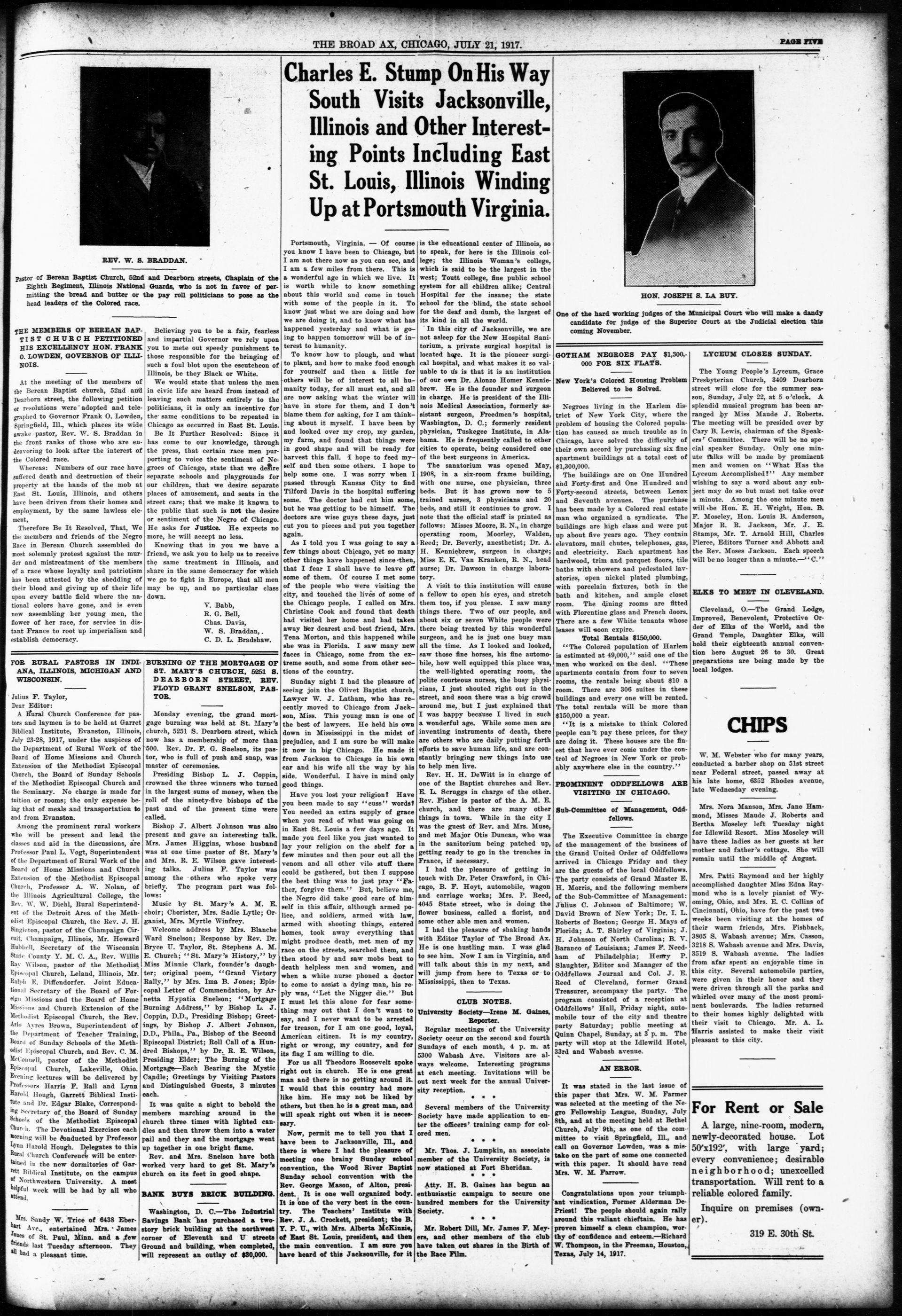
REV. W. S. BRADDAN.
Pastor of Berean Baptist Church, 52nd and Dearborn streets, Chaplain of the Eighth Regiment, Illinois National Guards, who is not in favor of permitting the bread and butter or the pay roll politicians to pose as the head leaders of the Colored race.
Pastor of Berean Baptist Church, 52nd and Dearborn streets, Chaplain of the Eighth Regiment, Illinois National Guards, who is not in favor of permitting the bread and butter or the pay roll politicians to pose as the head leaders of the Colored race.
THE MEMBERS OF BEREAN BAPTIST CHURCH PETITIONED HIS EXCELLENCY HON. FRANK O. LOWDEN, GOVERNOR OF ILLINOIS.
At the meeting of the members of the Berean Baptist church, 52nd and Dearborn street, the following petition or resolutions were adopted and telegraphed to Governor Frank O. Lowden, Springfield, Ill., which places its wide awake pastor, Rev. W. S. Braddan in the front ranks of those who are endeavoring to look after the interest of the Colored race.
Whereas: Numbers of our race have suffered death and destruction of their property at the hands of the mob at East St. Louis, Illinois, and others have been driven from their homes and employment, by the same lawless element,
Therefore Be It Resolved, That, We the members and friends of the Negro Race in Berean Church assembled do most solemnly protest against the murder and mistreatment of the members of a race whose loyalty and patriotism has been attested by the shedding of their blood and giving up of their life upon every battle field where the national colors have gone, and is even now assembling her young men, the flower of her race, for service in distant France to root up imperialism and establish democracy.
FOR RURAL PASTORS IN INDIANA, ILLINOIS, MICHIGAN AND WISCONSIN.
A Rural Church Conference for pastors and laymen is to be held at Garret Biblical Institute, Evanston, Illinois July 23-28, 1917, under the auspices of the Department of Rural Work of the Board of Home Missions and Church Extension of the Methodist Episcopal Church, the Board of Sunday Schools of the Methodist Episcopal Church and the Seminary. No charge is made for tuition or rooms; the only expense being that of meals and transportation to and from Evanston.
Mrs. Sandy W. Trice of 6438 Eberhart Ave., entertained Mrs. James Jones of St. Paul, Minn. and a few friends last Tuesday afternoon. They all had a pleasant time.
Julius F. Taylor,
Dear Editor:
Believing you to be a fair, fearless and impartial Governor we rely upon you to mete out speedy punishment to those responsible for the bringing of such a foul blot upon the escutcheon of Illinois, be they Black or White.
We would state that unless the men in civic life are heard from instead of leaving such matters entirely to the politicians, it is only an incentive for the same conditions to be repeated in Chicago as occurred in East St. Louis. Be It Further Resolved: Since it has come to our knowledge, through the press, that certain race men purporting to voice the sentiment of Negroes of Chicago, state that we desire separate schools and playgrounds for our children, that we desire separate places of amusement, and seats in the street cars; that we make it known to the public that such is not the desire or sentiment of the Negro of Chicago. He asks for Justice. He expects no more, he will accept no less.
Knowing that in you we have a friend, we ask you to help us to receive the same treatment in Illinois, and share in the same democracy for which we go to fight in Europe, that all men may be up, and no particular class down.
BURNING OF THE MORTGAGE OF
ST. MARY'S CHURCH, 5251 S.
DEARBORN STREET, REV.
FLOYD GRANT SNELSON, PASTOR.
Monday evening, the grand mortgage burning was held at St. Mary's church, 5251 S. Dearborn street, which now has a membership of more than 500. Rev. Dr. F. G. Snelson, its pastor, who is full of push and snap, was master of ceremonies.
Presiding Bishop L. J. Coppin, crowned the three winners who turned in the largest sums of money, when the roll of the ninety-five bishops of the past and of the present time were called.
Bishop J. Albert Johnson was also present and gave an interesting talk. Mrs. James Higgins, whose husband was at one time pastor of St. Mary's and Mrs. R. E. Wilson gave interesting talks. Julius F. Taylor was among the others who spoke very briefly. The program part was follows: Music by St. Mary's A. M. E. choir; Chorister, Mrs. Sadie Lytle; Organist. Mrs. Myrtle Winfrey.
Welcome address by Mrs. Blanche Ward Snelson; Response by Rev. Dr. Bryce U. Taylor, St. Stephens A. M. E. Church; "St. Mary's History," by Miss Minnie Clark, founder's daughter; original poem, "Grand Victory Rally," by Mrs. Ima B. Jones; Episcopal Letter of Commendation, by Arnetta Hypatia Snelson; "Mortgage Burning Address," by Bishop L. J. Coppin, D.D., Presiding Bishop; Greetings, by Bishop J. Albert Johnson, D.D., Phila, Pa., Bishop of the Second Episcopal District; Roll Call of a Hundred Bishops," by Dr. R. E. Wilson, Presiding Elder; The Burning of the Mortgage—Each Bearing the Mystic Candle; Greetings by Visiting Pastors and Distinguished Guests, 3 minutes each.
It was quite a sight to behold the members marching around in the church three times with lighted candles and then throw them into a water pail and they and the mortgage went up together in one bright flame. Rev. and Mrs. Snelson have both worked very hard to get St. Mary's church on its feet in good shape.
BANK BUYS BRICK BUILDING
Washington, D. C.—The Industrial Savings Bank has purchased a two-story brick building at the northwest corner of Eleventh and U streets Ground and building, when completed, will represent an outlay of $30,000.
V. Babb,
R. G. Bell,
Chas. Davis,
W. S. Braddan,
C. D. L. Bradshaw
THE BROAD AX, CHICAGO, JULY 21, 1917.
Charles E. Stump On His Way South Visits Jacksonville, Illinois and Other Interesting Points Including East St. Louis, Illinois Winding Up at Portsmouth Virginia.
Portsmouth, Virginia. — Of course you know I have been to Chicago, but I am not there now as you can see, and I am a few miles from there. This is a wonderful age in which we live. It is worth while to know something about this world and come in touch with some of the people in it. To know just what we are doing and how we are doing it, and to know what has happened yesterday and what is going to happen tomorrow will be of interest to humanity.
To know how to plough, and what to plant, and how to make food enough for yourself and then a little for others will be of interest to all humanity today, for all must eat, and all are now asking what the winter will have in store for them, and I don't blame them for asking, for I am thinking about it myself. I have been by and looked over my crop, my garden, my farm, and found that things were in good shape and will be ready for harvest this fall. I hope to feed myself and then some others. I hope to help some one. I was sorry when I passed through Kansas City to find Tilford Davis in the hospital suffering some. The doctor had cut him some, but he was getting to be himself. The doctors are wise guys these days, just cut you to pieces and put you together again.
As I told you I was going to say a few things about Chicago, yet so many other things have happened since then, that I fear I shall have to leave off some of them. Of course I met some of the people who were visiting the city, and touched the lives of some of the Chicago people. I called on Mrs. Christine Cook and found that death had visited her home and had taken away her dearest and best friend, Mrs. Tena Morton, and this happened while she was in Florida. I saw many new faces in Chicago, some from the extreme south, and some from other sections of the country.
Sunday night I had the pleasure of seeing join the Olivet Baptist church, Lawyer W. J. Latham, who has recently moved to Chicago from Jackson, Miss. This young man is one of the best of lawyers. He held his own down in Mississippi in the midst of prejudice, and I am sure he will make it now in big Chicago. He made it from Jackson to Chicago in his own car and his wife all the way by his side. Wonderful. I have in mind only good things.
Have you lost your religion? Have you been made to say "cuss" words? You needed an extra supply of grace when you read of what was going on in East St. Louis a few days ago. It made you feel like you just wanted to lay your religion on the shelf for a few minutes and then pour out all the venom and all other vile stuff there could be gathered, but then I suppose the best thing was to just pray "Father, forgive them." But, believe me, the Negro did take good care of himself in this affair, although armed police, and soldiers, armed with law, armed with shooting things, entered homes, took away everything that might produce death, met men of my race on the streets, searched them, and then stood by and saw mobs beat to death helpless men and women, and when a white nurse phoned a doctor to come to assist a dying man, his reply was, "Let the Nigger die." But I must let this alone for fear something may out that I don't want to say, and I never want to be arrested for treason, for I am one good, loyal, American citizen. It is my country, right or wrong, my country, and for its flag I am willing to die.
For us all Theodore Roosevelt spoke right out in church. He is one great man and there is no getting around it. I would that this country had more like him. He may not be liked by others, but then he is a great man, and will speak right out when it is necessary.
Now, permit me to tell you that I have been to Jacksonville, Ill., and there is where I had the pleasure of meeting one brainy Sunday school convention, the Wood River Baptist Sunday school convention with the Rev. George Mason, of Alton, president. It is one well organized body. It is one of the very best in the country. The Teachers' Institute with Rev. J. A. Crockett, president; the B. Y. P. U., with Mrs. Alberta McKinzie, of East St. Louis, president, and then the main convention. I am sure you have heard of this Jacksonville, for it
is the educational center of Illinois, so to speak, for here is the Illinois college; the Illinois Woman's college, which is said to be the largest in the west; Toutt college, fine public school system for all children alike; Central Hospital for the insane; the state school for the blind, the state school for the deaf and dumb, the largest of its kind in all the world.
In this city of Jacksonville, we are not asleep for the New Hospital Sanitarium, a private surgical hospital is located here. It is the pioneer surgical hospital, and what makes it so valuable to us is that it is an institution of our own Dr. Alonzo Homer Kenniebrew. He is the founder and surgeon in charge. He is president of the Illinois Medical Association, formerly assistant surgeon, Freedmen's hospital, Washington, D. C.; formerly resident physician, Tuskegee Institute, in Alabama. He is frequently called to other cities to operate, being considered one of the best surgeons in America.
The sanatorium was opened May, 1908, in a six-room frame buildings, with one nurse, one physician, three beds. But it has grown now to 5 trained nurses, 3 physicians and 20 beds, and still it continues to grow. I note that the official staff is printed as follows: Misses Moore, R. N., in charge operating room, Moorley, Walden, Reed; Dr. Beverly, anesthetist; Dr. A. H. Kenniebrew, surgeon in charge; Miss E. K. Van Kranken, R. N., head nurse; Dr. Dawson in charge laboratory.
A visit to this institution will cause a fellow to open his eyes, and stretch them too, if you please. I saw many things there. Two of our people, and about six or seven White people were there being treated by this wonderful surgeon, and he is just one busy man all the time. As I looked and looked, saw those fine horses, his fine automobile, how well equipped this place was, the well-lighted operating room, the polite courteous nurses, the busy physicians, I just shouted right out in the street, and soon there was a big crowd around me, but I just explained that I was happy because I lived in such a wonderful age. While some men are inventing instruments of death, there are others who are daily putting forth efforts to save human life, and are constantly bringing new things into use to help men live.
Rev. H. H. DeWitt is in charge of one of the Baptist churches and Rev. E. L. Seruggs in charge of the other. Rev. Fisher is pastor of the A. M. E. church, and there are many other things in town. While in the city I was the guest of Rev. and Mrs. Muse, and met Major Otis Duncan, who was in the sanitorium being patched up getting ready to go in the trenches in France, if necessary. I had the pleasure of getting in touch with Dr. Peter Crawford, in Chicago, B. F. Hoyt, automobile, wagon and carriage works; Mrs. P. Reed, 4045 State street, who is doing the flower business, called a florist, and some other able men and women.
I had the pleasure of shaking hands with Editor Taylor of The Broad Ax. He is one hustling man. I was glad to see him. Now I am in Virginia, and will talk about this in my next, and will jump from here to Texas or to Mississippi, then to Texas.
CLUB NOTES.
University Society—Irene M. Gaines
Reporter
Regular meetings of the University Society occur on the second and fourth Sundays of each month, 4 p. m. at 5300 Wabash Ave. Visitors are always welcome. Interesting programs at each meeting. Invitations will be out next week for the annual University reception.
Several members of the University Society have made application to enter the officers' training camp for colored men.
Mr. Thos. J. Lumpkin, an associate member of the University Society, is now stationed at Fort Sheridan.
Atty. H. B. Gaines has begun an enthusiastic campaign to secure one hundred members for the University Society.
Mr. Robert Dill, Mr. James F. Meyers, and other members of the club have taken out shares in the Birth of the Race Film.
3
HON. JOSEPH S. LA BUY. One of the hard working judges of the Municipal Court who will make a dandy candidate for judge of the Superior Court at the Judicial election this coming November.
One of the hard working judges of the Municipal Court who will make a dandy candidate for judge of the Superior Court at the Judicial election this coming November.
GOTHAM NEGROES PAY $1,300,
000 FOR SIX FLATS.
New York's Colored Housing Problem Believed to be Solved.
Negroes living in the Harlem district of New York City, where the problem of housing the Colored population has caused as much trouble as in Chicago, have solved the difficulty of their own accord by purchasing six fine apartment buildings at a total cost of $1,300,000.
The buildings are on One Hundred and Forty-first and One Hundred and Forty-second streets, between Lenox and Seventh avenues. The purchase has been made by a Colored real estate man who organized a syndicate. The buildings are high class and were put up about five years ago. They contain elevators, mail chutes, telephones, gas, and electricity. Each apartment has hardwood, trim and parquet floors, tile baths with showers and pedestalized lavatories, open nickel plated plumbing, with porcelain fixtures, both in the bath and kitchen, and ample closet room. The dining rooms are fitted with Florentine glass and French doors. There are a few White tenants whose leases will soon expire.
Total Rentals $150,000.
"The Colored population of Harlem is estimated at 49,000," said one of the men who worked on the deal. "These apartments contain from four to seven rooms, the rentals being about $10 a room. There are 306 suites in these buildings and every one will be rented. The total rentals will be more than $150,000 a year.
"It is a mistake to think Colored people can't pay these prices, for they are doing it. These houses are the finest that have ever come under the control of Negroes in New York or probably anywhere else in the country."
PROMINENT ODDPELLOWS ARE
VISITING IN CHICAGO.
Sub-Committee of Management, Odd fellows.
The Executive Committee in charge of the management of the business of the Grand United Order of Oddfellows arrived in Chicago Friday and they are the guests of the local Oddfellows. The party consists of Grand Master E. H. Morris, and the following members of the Sub-Committee of Management: Julius C. Johnson of Baltimore; W. David Brown of New York; Dr. I. L. Roberts of Boston; George H. Mays of Florida; A. T. Shirley of Virginia; J. H. Johnson of North Carolina; B. V. Baranco of Louisiana; James F. Needham of Philadelphia; Henry P. Slaughter, Editor and Manager of the Oddfellows Journal and Col. J. E. Reed of Cleveland, former Grand Treasurer, accompany the party. The program consisted of a reception at Oddfellows' Hall, Friday night, automobile tour of the city and theatre party Saturday; public meeting at Quinn Chapel, Sunday, at 3 p. m. The party will stop at the Idlewild Hotel, 33rd and Wabash avenue.
It was stated in the last issue of this paper that Mrs. W. M. Farmer was selected at the meeting of the Negro Fellowship League, Sunday, July 8th, and at the meeting held at Bethel Church, July 9th, as one of the committee to visit Springfield, Ill., and call on Governor Lowden, was a mistake on the part of some one connected with this paper. It should have read Mrs. W. M. Farrow.
Congratulations upon your triumphant vindication, Former Alderman DePriest! The people should again rally around this valiant chieftain. He has proven himself a clean champion, worthy of confidence and esteem.-Richard W. Thompson, in the Freeman, Houston, Texas, July 14, 1917.
AN ERROR.
Municipal Court who will make a dandy for Court at the Judicial election this
LYCEUM CLOSES SUNDAY.
The Young People's Lyceum, Grace Presbyterian Church, 3409 Dearborn street will close for the summer season, Sunday, July 22, at 5 o'clock. A splendid musical program has been arranged by Miss Maude J. Roberts. The meeting will be presided over by Cary B. Lewis, chairman of the Speakers' Committee. There will be no special speaker Sunday. Only one minute talks will be made by prominent men and women on "What Has the Lyceum Accomplished?" Any member wishing to say a word about any subject may do so but must not take over a minute. Among the one minute men will be Hon. E. H. Wright, Hon. B. F. Moseley, Hon. Louis B. Anderson, Major R. R. Jackson, Mr. J. E. Stamps, Mr. T. Arnold Hill, Charles Pierce, Editors Turner and Abbott and the Rev. Moses Jackson. Each speech will be no longer than a minute.—"C."
ELKS TO MEET IN CLEVELAND
Cleveland, O.—The Grand Lodge, Improved, Benevolent, Protective Order of Elks of the World, and the Grand Temple, Daughter Elks, will hold their eighteenth annual convention here August 26 to 30. Great preparations are being made by the local lodges.
CHIPS
W. M. Webster who for many years, conducted a barber shop on 51st street near Federal street, passed away at his late home, 6352 Rhodes avenue, late Wednesday evening.
Mrs. Nora Manson, Mrs. Jane Hammond, Misses Maude J. Roberts and Bertha Moseley left Tuesday night for Idlewild Resort. Miss Moseley will have these ladies as her guests at her mother and father's cottage. She will remain until the middle of August.
Mrs. Patti Raymond and her highly accomplished daughter Miss Edna Raymond who is a lovely pianist of Wyoming, Ohio, and Mrs. E. C. Collins of Cincinnati, Ohio, have for the past two weeks been visiting at the homes of their warm friends, Mrs. Fishback, 3805 S. Wabash avenue; Mrs. Casson, 3218 S. Wabash avenue and Mrs. Davis, 3519 S. Wabash avenue. The ladies from afar spent an enjoyable time in this city. Several automobile parties, were given in their honor and they were driven through all the parks and whirled over many of the most prominent boulevards. The ladies returned to their homes highly delighted with their visit to Chicago. Mr. A. L. Harris assisted to make their visit pleasant to this city.
---
For Rent or Sale
A large, nine-room, modern, newly-decorated house. Lot 50'x192', with large yard; every convenience; desirable neighborhood; unexcelled transportation. Will rent to a reliable colored family.
Inquire on premises (owner).
319 E. 30th St.
PAGE FIVE
319 E. 30th St.
3 AWG OLA
THE BROADAX
Published Weekly
In this city since July 15th, 1890,
without missing one single issue, Rep-
ublicans, Democrats, Catheles, Pro-
testants, single Taxers, Priests, in-
fidels or anyone else can have their say
as long as their language is proper and
responsibility is fixed.
The Broad Ax is a newspaper whose
platform is broad enough for all, ever
claiming the editorial right to speak its
own mind.
Local communications will receive
attention. Write only on one side of
the paper.
Subscriptions must be paid in ad-
vance.
One Year.....$2.00
Six Months.....1.00
Advertising rates made known on application.
Address all communications to
THE BROAD-AX
6418 Champlain Ave., Chicago, Ill.
PHONE WENTWORTH 2507.
JULIUS F. TAYLOR, Editors and Publisher.
Entered as Second-Class Matter Aug.
19, 1902, at the Post Office at Chicago
Illinois, under Act of March 3, 1879.
Testing Aero Engines.
In testing an aeroplane engine of 200 horsepower a Detroit company mounted it upon a heavy motor truck, and the aerial propeller sent the truck flying along a boulevard at the rate of over forty miles an hour, says the Popular Mechanics Magazine. This was a speed that the truck could not begin to develop under its own motor power, and the method furnished a better practical test of the twelve cylinder aeroplane engine than was possible in the testing laboratory or in any stationary trial on blocks. As an additional test the rear wheels of the two ton truck were locked, so that they could not revolve, and in this condition it was driven across a ball park by the aeroplane engine and propeller through heavy drifts of snow and over ice. The motor weighs 800 pounds and develops power sufficient to drive a twelve passenger aeroplane at forty miles an hour.
Lord Brougham's Dream.
Lord Brougham was one of the most stubborn believers in the "common sense" explanation of ghostly appearances as dreams. At Edinburgh university he and an intimate friend drew up an agreement written with their blood that whichever of them died first should appear to the survivor. Years passed; the friend was in India, and Brougham had almost forgotten his existence. Arriving late one night at an inn in Sweden, Brougham had a hot bath and was going to get out of it when he looked toward the chair on which he had left his clothes and saw his friend sitting on it. Brougham seems then to have fainted. On getting home he received a letter announcing that the other had died in India at the very time. Yet this incident, which most people would put down to telepathy at least, was dismissed by Brougham as a mere dream and pure coincidence.
Encouraging to Dullards.
Like Newton, Herbert Spencer in his schoolboy days showed no aptitude for study. Hugh Elliot, his biographer, says of him that "he was very backward as a boy in the ordinary subject of children's lessons. * * * Morally he was extremely disobedient and contemptuous of authority." At thirteen he "found the discipline of his school more severe than he cared about, and he ran away home to Derby again, walking forty-eight miles the first day." Yet as a man, "without money, without special education, without health," says his biographer, "he produced eighteen large volumes of philosophy and science of many diverse kinds, published a variety of mechanical inventions, and on endless other subjects, great and small, he set forth a profusion of new and original ideas."
The No Breakfast Plan.
The breakfast eating habit often creates an abnormal stomach condition. If one is in perfect health and arises with a keen appetite for breakfast there will be no occlusion for omitting the meal. There are, however, but few in perfect health, and the omission of breakfast gives the stomach a chance to adjust itself. It has an opportunity to develop a keen appetite for the particular character of purishment most needed by the body at that time. The no breakfast plan is a splendid means of properly adjusting one's appetite, both as to quantity and character of food.—Physical Culture.
Quite Contented.
"He told her if she consented to an engagement she must be prepared to make all kinds of sacrifices and to be treated with the greatest neglect and even face cruelty and desertion."
"Was the woman in her senses to agree to such an outrageous proposition?"
"Oh, yes, for the engagement was to play the wronged and deserted wife in a melodramatic picture play."—Baltimore American.
FOR PROTECTION OF SHIPS.
Owners Seek Safeguarding of Merchant Vessels From Submarines. New York. After a series of meetings, attended by a number of the leading ship owners, shippers and underwriters in the United States, an association was formed to co-operate with the government in seeking devices for the protection of merchant ships against the submarine menace. The following resolution was adopted: Resolved, That a voluntary association be formed under the name of the "Submarine Defense association" to co-operate with the United States government in seeking devices for the protection of merchant ships against attack by submarines and particularly to bring to the attention of ship owners and underwriters devices which have been approved by the advisers of the government or other experts with a view to the protection of them as promise to be of value in protecting merchant ships against attack by submarines.
Since the United States entered the war many devices to protect ships have been suggested, and so far as they could do so the advisers of the government have considered these suggestions and have approved some of them. In so far as these devices have related to naval vessels or campaigns against the submarine, they could be considered only by the navy department. But devices have also been brought forward which may be found available for the protection of merchant and passenger ships. Many of these have been considered by the government, but in so far as privately owned vessels are concerned the government's action was mainly advisory in its nature.
EX-CONVICT A HERO.
Led Attack Which Inspired Whole Russian Division to Fight.
Petrograd.—The hero of the army in the woody Carpathians is a former convict from Siberia, who, by his example, inspired an attack by forces which heretofore had obdurately refused to charge. The ex-convict, whose rank is sergeant, led fifty volunteers in a rush on a German blindage.
The attacking party, confused by heavy fire, wavered, whereupon the sergeant alone climbed a breastwork and hurled a bomb among the enemy. Attacked by three Germans, he sabered and shot two of them. Then with only eighteen followers several strongly held blindages were rushed. This produced general panic among the enemy and resulted in the capture of many prisoners.
The sergeant was promoted to an officer's commission, two regiments invited him to take command, and the whole of his division resolved immediately to participate in an offensive.
U BOATS WITH CUTTERS
Heavy Circular Knives Have Been Attached to Steel Hawers.
Base of the American Flotilla in British Waters. The captain of a torpedoed merchantman has turned over to the naval authorities here a sketch of a new type of German submarine equipped with a wire cutting device designed to release it from nets. The sketch shows several strands of stout steel hawers stretched from the bow through the conning tower to the stern. Attached to these is a series of heavy circular knives a foot in diameter and placed about a yard apart. The captain made the drawing while in a small boat after his ship had been torpedoed. The theory of the captain is that a boat so equipped would have hope of being able to cut its way through any steel nets in which it might become enmeshed.
ABSINTH UNDER CITY BAN.
Health Board Forbids Manufacture or Sale of Cordial.
New York.-The directors of the board of health passed an amendment to the sanitary code forbidding the manufacture or sale of absinth in this city. Dr. Haven Emerson, health commissioner, said that this action had been taken because absinth is a harmful adulterant equivalent to a habit forming drug.
Dr. Emerson gave out this analysis of the cordial:
"Absinth ordinaire contains 47.66 per cent of alcohol, the demi-fine 50 per cent and the fine 68 per cent. Absinth is composed of oils of wormwood, angelica, anise and marjoram. This combination is an intense poison rather than a tonic and an aid to digestion, as supposed by many."
WORE LID IN COURT; FINED
Told to Remove Head Article, Thermopoulous Only Saluted.
New York—His failure to remove a $1.50 hat in the men's night court cost Thomas Thermopoulous $.
He was seated among the spectators.
A court attendant ordered him to remove his headgear. Instead, Thermopoulous saluted. The attendant repeated the order. The spectator's top cover remained firm. He walked out of the courtroom saluting.
“Bring that man back and charge him with disorderly conduct,” directed Magistrate Corrigan.
Thermopoulous explained he thought the salute sufficient. The magistrate differed.
Eat English Sparrows
Columbus, O. — "When starvation threatens eat English sparrows," advises Claude Meeker, a local broker. Meeker was emphatic in his assertion that the noisy little birds, after proper culinary treatment, are as well tasting as they are noisy.
THE BROAD AX. CHICAGO. JULY 21. 1917.
As originally made up the supreme court consisted of a chief justice and five associate justices. In 1807 a sixth associate was added when a new district had been created to take in the new western territory comprising the states of Ohio, Tennessee and Kentucky. In 1837 the expansion of the nation westward again called for an increase in the court, and two more associate justices were added. In 1863 a ninth associate justice was needed, but five years later, when approaching vacancies made it likely that President Andrew Johnson might have the appointment of the new members, congress, then in open antagonism to the chief executive, reduced the number to seven, thus preventing him from making an appointment.
This number two years later, after the inauguration of President Grant, was increased to eight associate justices and a chief justice, and as then constituted the court has remained.
Her Secret of Success
"How is it that you are able to do so much more than other people?" asked a tired, nervous woman who stopped Mrs. Palmer for a word at the close of one of her lectures.
"Because," she answered with the sudden gleam of a smile, "I haven't any nerves or any conscience, and my husband says I haven't any backbone."
It was true that she never worried. She had early learned to live one day at a time, without "looking before and after." And nobody knew better than Alice Freeman Palmer the renewing power of joy. She could romp with some of her very small friends in the half hour before an important meeting, go for a long walk or ride along country lines when a vexing problem confronted her, or spend a quiet evening by the fire reading aloud from one of her favorite poets at the end of a busy day.—Mary R. Parkman in St. Nicholas.
Poisonous Snakes
Poisonous snakes have a diamond shaped head, about four times larger at the jawbone than at the neck, and sharp talis. All snakes, however, are poisonous during the "shedding" period of seven days. They go blind two days before shedding. The Gila (pronounce hee-la) monster is so called on account of being found near the Gila river in Arizona and New Mexico. Its bite is deadly, and it is much feared by the Indians, as no remedy is known for the bite. They are peculiar creatures, having the shape of a large lizard, with feet marked like those of a monkey. Some scientists say that the bite of the Gila monster is not poisonous in itself, but that if its breath is blown on a person with a weak heart, the person will faint away for an indefinite time. In captivity the Gila monster is fed on warm milk and chopped meat every six weeks.-Wide World Magazine.
Life Saving Aeroplanes
Aeroplanes may in time be a part of the regular equipment used by the United States life saving service. There are numerous cases in which it is impossible for small boats to reach a stranded steamer in heavy weather. Upon some occasions even the line throwing guns cannot get a hawser aboard. It is argued that aeroplanes in any but exceptional circumstances would be able to carry a line to vessels in distress, making it possible to use a breeches buoy and get passengers and crew to shore. Should congress approve this plan it would open a new field to aviators more hazardous than any other branch of flying, not excepting war work. They would be compelled to make ascents in the worst possible weather, requiring skill and courage of the highest order.—Exchange.
Purely Business.
Little Bobble, aged five, was one of those who permitted few things to escape his attention and consequently was always asking questions. Some of the members of the family were talking about life insurance, and Bobble had to know what that was. He was told it was a provision whereby, when his father died, the family would receive a certain sum of money. This seemed clear to the youngster, but it was noticed he seemed to be engaged in deep thought. Finally he said, "But, mamma, how soon will we have to kill him?"—Indianapolis News.
Equal Division
"It's a good thing for man and wife to have tastes in common." "True to some extent. But you can divide the newspaper more amicably when she's satisfied with the society news and doesn't want to take the sporting section away from you."—Louisville Courter-Journal
Their Opportunity
Miss Fluffy-I made quite an impression at the reception, didn't I? Everybody seemed to be talking about me. Candid Friend-They talked still more about you after you had gone.
Mean.
"What did the lady say when you told her I was out?" "She smiled and said, 'Friday's not always an unlucky day.'"
A body weighing one pound on earth would weigh twenty-seven and a half pounds upon the sun.
Men shut their doors against a setting sun—Timon of Athens.
Wanted to Help Him:
His kindness to his men once placed Dr. William H. Nichols in a predicament which caused him the worst-mortification in his whole life, says a writer in Leslie's. The head of one of the concern's largest customers came to and complained that he had been systematically cheated by short weighing of carboids containing acid. Dr. Nichols could not believe the allegation, but on going to the consumer's plant fifty carboids were weighed, and each was found ten pounds short. He promised to make an immediate investigation.
One employee was pointed out to Dr. Nichols as the man responsible for seeing that every carboy contained the proper quantity of acid. This employee Dr. Nichols would have trusted with his own money. But when questioned he colored up and stammered. Finally he blurted out:
"Mr. Nichols, the boys is very fond of you, and we wanted to help you."
The Dipkthong
Answering the question, "Why was the diphthong devised and why has it disappeared from general use?" the New York Sun says:
A diphthong is any two vowels that come together in the spelling of a word. Diphthongs were not deliberately devised any more than English spelling was deliberately invented. They have not disappeared from general use except in a few instances. In a "proper diphthong" the sounds of both vowels are retained, though merged in one syllable, as in "noise." An "improper diphthong" is one in which the sound of only one of the vowels is heard. "Do" in "people" is an illustration. Such changes as have been made in diphthongs have aimed at keeping the vowel sounded. That is why some prefer to write "manoeuvre" in place of "maneuver." Then there is the simplified speller's favorite "thru."
- Woman and Her Beauty.
Woman is the master stroke of beauty. Woman is the jewel in the crown. No chisel ever carved such lines of softness; no painter ever put such luster in the eye. Nature molded cliffs and gave us twilights, gave us the horizon in the east and west; gave us the flowing, shimmering river that travels toward the sea; let the moonbeams glimmer on the tranquil ocean; gave us flowers with their fluffy petals, some soft and snowy white, others tinted all the colors of the rainbow. Yet when all has been looked upon, when all the landscapes have been viewed with wonder, man turns back to something stronger, turns back to that which soothes and heals, back to that which satisfies the eye and heartstrings—woman, the crowning glory of all revealed.—St. Louis Post-Dispatch.
Start of Our Navy.
The United States navy has the distinction of being somewhat older than the government itself, for nine months before the actual Declaration of Independence congress authorized the construction of two "national" cruisers and appointed a committee to purchase vessels to form the nucleus of a fleet. Within three months of its appointment this committee got together fourteen armed vessels and appointed a personnel of officers, among whom was the famous old sea dog, John Paul Jones. During the war of the Revolution the infant navy captured as many as 800 prizes, but suffered so heavily that by the time peace was declared it had almost ceased to exist. A new start on a more ambitious scale was made in 1794.
The "Tawdry Saint."
St. Ethelreda has been unfortunate, inasmuch as her memory is perpetuated in the disagreeable adjective "tawdry," and she is sometimes even referred to as the "tawdry saint." In the Isle of Ely, where she died, a fair was formerly held in her honor, at which a peculiar kind of cheap but showy lace was sold, which, as St. Ethelreda's or St. Audrey's lace soon became proverbial and tawdry, an easy corruption of the saint's abbreviated name, was used to denote all things more gaudy than valuable. — London Chronicle.
The Use of Names
Judge Giegerich of New York in denying the petition of a foreigner desiring to use an American name recently said: "I have the greatest objection to foreigners who take up their residence in this country assuming the names of old American families of New York. It causes embarrassment to men who are of high standing in the community and take pride in their family names."
Solomon's Servants
Solomon's servants (Ezra ii, 55-58; Nehemiah vii, 57-60) were the descendants of the Canaanites reduced by Solomon to the state of slaves. They were compelled to work in the king's stone quarries and in building his palaces and cities.
Corrected.
Wife—I really believe you married me simply because I have money. Hub—You're wrong. I married you because I thought you'd let me have some of it.
Alwava Picking.
Yeast--My wife used to play the banjo beautifully before we were married. Crimsonbeak--Now she picks on you, I suppose--Yonkers Statesmen.
Galilei's Telescope
The telescope with which Galilel discovered the satellites of Jupiter in 1610 is preserved in a Florence museum.
"Stop worrying" is a physician's best prescription and the hardest to take.
Fighting the Fly.
An excellent remedy for the fly pest is formaldehyde. The correct strength may be secured by adding three teaspoonfuls of the concentrated formaldehyde solution to a pint of water. The solution should be kept in such a way that the files can drink it. A good way is to take an ordinary thin walled tumbler and fill it partly full of the solution. Place on a saucer or small plate a piece of white blotting paper and cut it to the size of the dish. Then place it over the glass and turn the glass bottom up on the dish. As the solution dries out of the saucer the tumbler should be slightly raised up, so that the liquid will again flow over the entire surface.
Another simple remedy to keep files out of the house is by means of an odor unpleasant to files. Any odor pleasing to man is offensive to the fly and will drive them away, as, for instance, oil of lavender, diluted; geranium, mignonette or hellotrope.
Cows' Milk and Casein.
It has been proved that casein, which forms over 3 per cent of the total weight of cows' milk, is an important commercial product and may be profitably employed in the manufacture of glue, combs, buttons, linoleum, hairpins, toys, paints and even shoe polish. In the preparation of casein for commercial purposes about 700 gallons of skimmilk are put into a great vat and heated to about 135 degrees F. Then very dilute sulphuric acid is added to precipitate the casein or curd. The whey is drawn off, and the curd is drained and cut into chunks, after which streams of cold water are played on it to wash out the acid. The curd is then dried with rotary fans and ground into powder, in which form it is placed on the market. One hundred pounds of skimmilk will yield about three and one-half pounds of casein powder.-Popular Science Monthly.
Value of Thunderstorms.
"Thunderstorms," says Professor Ward in Science, "bring us much that is of benefit. To them we owe much, in parts of our country even most of our spring and summer rainfall. Without these beneficent thunderstorms our great staple crops east of the Rocky mountains would never reach maturity. One good thunderstorm over a considerable area at a critical crop stage is worth hundreds of thousands of dollars to American farmers. Our stock markets time and again show the favorable reaction of such conditions upon the price of cereals and also of railroad and other stocks. Thundershowers break our summer droughts, cleanse our dusty air, refresh our parched earth, replenish our failing streams and brooks, bring us cool evenings and nights after sultry and oppressive days."
Kindergartens.
"The first kindergarten in our country," said an educator, "were conducted for the children of the well to do. The remarkable value of this training for the children of the poor was soon recognized, and mission kindergarten became numerous. Then the more progressive cities and towns tried them experimentally in their public schools. That their worth has been abundantly proved is clearly shown by the spread of the kindergarten, and the general introduction of kindergarten training departments into state normal schools and city training schools.
"At present 1,228 cities have an aggregate of 8,463 kindergarten in their public schools, with an enrollment of 434,000 children."
A. Browning Face
"A nasty jolt," said Senator Penrose at the Philadelphia club, discussing a political betrayal; "a nasty and an unexpected jolt. It reminds me of the octogenarian banker who said to Gobsa Golde:
"Your beautiful girl wife declares that your face is like a poem.'
"Yes? Gobsa chuckled. 'Have a cigar. So my wife says my face is like a poem, does she?"
"Yes, answered the banker, with a loud, harsh laugh. 'She says your face is like a poem by Browning because it's got so many deep lines.'"—Philadelphia Bulletin.
Man and Pie.
"Ple is all you need give any man for dessert," said Mrs. Helen E. McLane, the food expert. "He thinks that pie is all there is to dessert anyway, and the more you give him of it the better he likes it. So give it to him, but be sure to give him the best, most nourishing kinds of pie, for there is a great difference.
"Mince pie is the best because it has more food value. But it is also the most expensive. Prune pie properly draped and trimmed is a favorite with my men, and they know good pie when they see it."—Exchange.
Effective Threat.
"Having any more trouble with that temperamental ingenuue?"
"No," replied the manager. "I contrived to get hold of a photograph of her son, who is now thirty-six years old, and the last time she got huffy I threatened to show it to a newspaper man."-Birmingham Ake-Herald.
Common Economic Mistake
A Common Economic Mistake.
The type of man who feels he has discharged his obligations as a husband when he provides his wife with a place to do housework for her board is not uncommon.-Topeka Capital
No Reason Assigned.
Vicar (at village Red Cross concert)
—Miss Jones will sing again "I Can not Tell You Why."—London Opinion.
He who is everywhere is nowhere—Seneca.
Three Rescued From Flaming Zeppelin, One Uninjured.
SURVIVORS NOW PRISONERS.
One Saved Himself by Making Parachute of Overcoat—Burning Ship Slipped Diagonally, Retaining Sufficient Buoyancy to Consume Full Five Minutes In Downward Flight.
London. — It is just disclosed that when Zeppelin L-48 was brought down in one of the eastern countries on June 17 one of its officers and two of its crew were found alive.
The officer was uninjured. One of the men had both legs broken, besides internal injuries, and both were taken to a hospital apparently in a dying condition, but have since recovered.
One of the survivors, it is reported, saved himself by making a parachute of his overcoat.
Part of the wreckage caught in a tree. This was at first thought to have broken the fall and saved the men's lives, but a subsequent explanation is that the burning ship slipped diagonally through the air in falling, retaining sufficient buoyancy to consume a full five minutes in its downward flight. This is the first occasion any survivors have been found of the crew of a Zeppelin brought down in flames. The ship was destroyed at a height estimated at 13,000 feet. A naval petty officer, who was one of the first to reach the burning wreckage, says:
"Just as I jumped a hedge and started toward the Zeppelin I saw one of her crew walking toward me. He was a tall, clean shaven man, wearing a fur collared overcoat and thick boots and leggings. He was very pale and seemed terribly shaken. I called to him, and he came on. I pulled a piece of paper out of my pocket and made signs to him that I wanted any papers he might have, but he simply threw up his hands and shook his head.
"I asked him how many men were on board the Zeppelin, and he held out his hands with thumbs and fingers outstretched twice, which I took to mean twenty."
INDIANS CLAIM HUGE
SUM FROM GOVERNMENT
Three Pacific Coast Tribes, Reviving Old Treaty, Ask $12,000,000.
Marshfield, Ore.-On the spot where the treaty of Empire was signed Aug. 30, 1855, between the United States government and the coast Indians, including the Coos, Umpqua and Siuslaw tribes, the remnants of those aborigines met at Empire and sat in council to consider the settlement of their claims against the United States government
The council was called to provide a chief for the Indians of the tribes mentioned, the last recognized chief, Bob Burns, who was a Coos, having died five or six years ago. Until the attempt by George Wasson, a Coos descendant and a graduate of Carlisle, to secure for the coastal tribes a settlement of their claims, there has been no apparent reason for a chief, for the remnants of the tribes were scattered and without concentration.
When the treaty of Empire was dug from the dusty tomes of the Congressional library and department of the interior, congressmen who were fair minded toward Indian claims ordered an investigation, which, to be presented in legal form, demanded the election of a chief and credentials for the three tribes who were signatories to the treaty.
The government after twenty years sent a special agent to their last government "corral" at Yachats to sign another treaty, but the Indians are insisting upon their rights under the original treaty. The claims set up by the three tribes represent something over $12,000,000. They believe that they can effect a settlement within the next two years.
The word "aristocracy" comes from the Greek "aristos" (best) and "archo" (rule), meaning the rule of the best. Literally aristocrat means the "best man."
```markdown
```
```markdown
```
Kidney Diseases and Diet.
Nearly all diseases of the kidneys are due to salt. If you are suffering with or from your kidneys the first thing to do is to smash all your medicine bottles cut out salt and sugar from your meals and go on the fruit-cereal diet. Steamed asparagus is the best thing in the world for your kidneys and bladder. Parsley is good for victims of kidney diseases, so also is water cress in the form of salad—but no salt. One should not eat too freely of parsley. Parsley will aid the eyesight by restoring the kidneys to their proper functions, but overdoses of parsley damage the vision. Pears are the very best of fruit for victims of kidney disease. But no matter the nature or the name of your kidney disease, you can get over it by following the instructions—Los Angeles Times.
```markdown
```
DAY COACHES FOR TROOPS.
Sleepers Not to Be Provided Under War Conditions.
Washington.—It is announced by the secretary of war that standard Pullman and tourist sleepers will not be used for the transportation of troops under ordinary conditions during the war. Day coaches hereafter will be used on the basis of one officer to each double seat and three men to each two double seats. The new order applies to all cases except journeys of unusual length, covering more than one night and one day, which cases will be separately considered when they arise.
It is explained that the new regulation is necessary owing to the limited number of sleeping cars available for troop movements and to the congestion that would arise on transportation lines if sleepers had to be collected for every large movement of troops. Moreover, by doing away with sleepers, it is declared, the number of cars necessary to handle the movement is decreased by one-quarter.
DE POTESTAD OFFERS SWORD
Son of Ex-Spanish Diplomat Seeka United States Officer's Commission.
Baltimore—R. E. L. de Potestad, son of the late Marquis de Potestad-Fornart, formerly Spanish diplomat in the United States, has applied for a commission in the officers' reserve corps from Maryland and has virtually been accepted by the army examining board at Johns Hopkins university.
Lieutenant Elliott, chief examining officer, said that although Mr. de Potestad is past fifty-two he is the finest specimen of manhood that has been examined here and has the physique of a man of thirty. Mr. de Potestad's father represented the Spanish government during the settlement of the Cuban claims after the Spanish-American war. He died in Switzerland several months ago. His son has a large estate near this city and is an American citizen.
POMEROY CONSENTS TO WORK
Notorious Life Convict at Last Mingles With Other Inmates.
Boston.—Jesse Pomeroy, the state's notorious life prisoner, abandoned his objections to the revised terms of his sentence and for the first time in forty years mingled with his fellow inmates. He has been put to work.
When Governor McCall and his council last January commuted that provision of Pomeroy's sentence which stipulated that he should spend his days in solitary confinement Pomeroy objected to the change that made him liable to labor. His refusal to work was punished with twenty-four hours in a dark cell and a diet of bread and water, but he declined to yield until recently.
CURED BY LIGHTNING.
Sufferer From Rheumatism Says He Is Well Now.
Indiana, Pa.—A sufferer from rheumatism each winter for the past fifteen years, Walter Loring of Rayne township believes that he was permanently cured of the disease by a stroke of lightning. While sitting in his home during a severe electric storm, the house was struck by lightning, and both he and his wife were rendered unconscious. It was with difficulty that they were revived.
Lately he has not been troubled, and he believes the rheumatism was burned out of his system by the electricity which passed through his body.
PROTECTS ENLISTED MEN.
Bill Will Prevent Slight to Uniforms
Anywhere In United States.
Washington. - Representative John Jacob Rogers of Lowell, Mass., introduced a bill in the house to prevent discrimination against enlisted men wearing the uniforms of the military or naval forces of the United States in places of public entertainment.
A similar law enacted in 1906 prevents such discrimination in the District of Columbia and in the territorial possessions of the United States. The Rogers proposal would make this law effective in all states as well. The measure will have the support of the administration, it is stated.
MUST HOLD FLAG SACRED.
Aliens Warned Summary Arrest Follows Desecration.
Washington.—Warning against desecration of the American flag by aliens was issued by the department of justice. The following notice was sent to federal attorneys and marshals:
"Any alien enemy tearing down, mutilating, abusing or desecrating the United States flag in any way will be regarded as a danger to the public peace or safety within the meaning of regulation 12 of the proclamation of the president issued April 6, 1917, and will be subject to summary arrest and confinement."
GAINS SIX POUNDS IN DAY.
Eats Four Heavy Meals to Reach
Weight Healthy Average Service
Weight For U. S. Aero Service.
Chicago.—McMillan Weddell of Hinsdale, a suburb, has been accepted as a recruit to the government aero service after having been refused earlier. Weddell, who is an experienced aviator, tried to enlist, but was found to weigh but 142 pounds.
Recently he was accepted, having brought his weight up to the required 148 pounds by eating four very heavy meals during the day, the meals being made up of many eggs and large quantities of other foodstuffs, together with much water.
PERFECT WOMAN FORTY AND HAS FIVE CHILDREN
She is Athletic, Mechanical, Pious, Patriotic and a Politician.
Liverpool.—"The perfect woman" has just been defined by a conference here of teachers from girls' schools throughout England. Here is the result of their united efforts:
The perfect woman is forty, is married and is the mother of five children. She is in happy circumstances, living in a beautiful part of the country a few miles from a big town. She is the center of a good home, in which there is a high standard of cleanliness and comfort and where good taste is everywhere visible in furniture, carpets, curtains, wall paper ornaments, clothes.
The ideal woman is sensible and businesslike, and her home is a place of peace. She is patriotic and interested in politics and does all she can to remove the causes of suffering among the poor. She is a delightful companion and has a gift for friendship. She is religious and tries to fulfill her duty toward God and toward other people. She takes walks, rides bicycles, climbs, swims, dances, skates, rows and plays games. She can ride a horse and drive a motorcar. She is proficient in many branches of practical learning. She can do anything and everything about the house. She has some knowledge of the law, knows how to invest money, can use a typewriter. She is a great reader; every day she reads some serious book as well as a newspaper and a novel. She speaks three languages beside her own and reads foreign books. She is fond of gardening and has learned several crafts—woodcarving, metal work, bookbinding and embroidery.
BOY FARMER A PATRIOT;
SAVES MOTHER A FINE
BOY FARMER A PATRIOT;
SAVES MOTHER A FINE
Gennaro Didn't Go to School, but Cultivated Twenty Acres In Westchester.
New York.—Mrs. Rosa de Rosa, a widow, missed being fined in the municipal term court for keeping her son Gennaro home from school by just twenty acres. These acres are part of her home at Mill Lane, Westchester, and for the last month they have been plowed and harrowed and fertilized and planted and cultivated by Gennaro alone, and he is only fifteen.
It was his age that got Gennaro into trouble, for the compulsory education law compels parents to keep their children in school until their sixteenth year. That is why Mrs. De Rosa appeared in court, very much frightened and escorted by Attendance Officers Puglieri and Carney.
Magistrate Appleton looked sternly at the little Italian woman until she had explained that she was a widow, that there was a mortgage on her home and that Gennaro was her only support. Then he smiled, and after Pubileri and Carney had testified that the twenty acres were under intensive cultivation and that one fifteen-year-old lad was doing all this work the magistrate announced his decision.
"Sentence suspended," he said. "Your son, Mrs. De Rosa, is doing a patriotic duty. He is a real benefit to the community—more so than if he went to school, as the law requires."
Gennaro did not hear this praise. He was up in Westchester, cultivating the twenty acres.
OLD MAN TRIED TO ENLIST.
Wanted to "Help Out" In Any Way, but Was Refused.
Topeka, Kan.—The fact that the United States government does not admit a man over thirty-five years of age to enlist in the army prevented the officers in charge of the local recruiting station from passing on S. L. Palmer, a prosperous Pawnee county farmer, the other afternoon.
Mr. Palmer is sixty-two years of age, but appears to be a man of about forty. He appeared very much grieved when he was told he was too old for the service.
Neither money nor the desire for experience had anything to do with Mr. Palmer's applying for service in the ranks. He owns 700 acres of good Pawnee county land.
His only reason was his desire to "help out," he told the officers. He wanted to be admitted as a telegrapher, a draftsman or a mechanic. He said he had fifteen years' experience as a telegrapher.
LONDON HONORS GEN. SMUTS.
Boer Leader Likely to Be Offered High British Command.
London. — Lleutenant General Jan Smuta, who was relieved of the command of the British forces operating against the Germans in German East Africa to attend the imperial conference here, received the freedom of the city of London. General Smuts in an address said:
General Smuts will be offered a high military command, and it is expected he will accept it.
THE BROAD AX, CHICAGO, JULY 21, 1917.
Emperor and Czar.
The Czar Ferdinand of Bulgaria, not withstanding his numerous visits to Vienna, never succeeded in making himself welcome to the Austrian aristocracy. For a long time the aged emperor refused to receive him. After much useless scheming to get the ear of Francis Joseph he was advised to obtain the aid of Mme. Schratt, who held at Schoenbrun an influential position.
Ferdinand sent to this favorite a jewel box with a note: "I desire to offer to you the earrings that my mother wore until her death. Delign to accept them and intercede in my favor with the emperor."
Mme. Schratt used her kindly offices, and Francis Joseph consented to receive the king of the Bulgars. Ferdinand had brought a napkin filled with papers that he wished to show to the emperor. After Ferdinand's departure the emperor, turning to his grand chamberlain, said: "It is curious that a king should be so lacking in manners. This fellow has spoken to me as though I were a mere notary!"
Welding Glass.
Welded glass suitable for certain optical instruments and other apparatus is a novel material that is stated to be of great practical value as well as much interest. As the welding process is described by Parker and Dalladay to the Faraday Society of London, the glass surfaces to be joined are placed in good optical contact under pressure and are heated to a carefully predetermined temperature, which, to avoid distortion of optically worked surfaces, must not approach too near what is defined as the "annealing point." This point of appreciable softening is determined for any kind of glass by noting the temperature at which the internal heat stresses seen in the glass with polarized light quite suddenly disappear. Similar glasses unite perfectly well below this point, but with very unlike kinds the softer becomes distorted before the harder is hot enough to make a good weld.
Stewed Apples.
To stew apples so each quarter is unbroken and so clear one can almost see through it is an art, and yet it is a simple thing to do if one only knows how. Peel tart apples very thin, cut them in quarters and remove the cores and seeds. As fast as you can peel and quarter them drop the apples in a saucepan in which you have already placed cold water to the depth of two inches. When the apples are all in put the saucepan over a slow fire, cover it till the water reaches the boiling point, then remove the cover and let the apples simmer almost imperceptibly till you can pierce them easily with a toothpick; then sprinkle the sugar over them and let them just simmer until it is all melted. Remove the saucepan from the fire and let it stand where the apples will get cold before turning them into a dish for the table.
Bumps on the Head.
The lump raised by a blow on the head is due to the resistance offered by the hard skull and its close connection with the movable elastic scalp by many circumscribed bands of connective tissue. The result of a blow when the scalp is not cut is the bruising and laceration of many of the small blood vessels or capillaries. Blood or its fluid constituent, serum, is poured into the meshes of the surrounding connective tissue, which is delicate, spongy, distensible and cellular, and the well known bump or lump is quickly formed. This cannot push inward at all and naturally takes the line of least resistance. Similar bumps may be formed on the shin in exactly the same way, for the shin bone also is covered only by skin and subcutaneous connective tissue.
Wisdom of Persia
Purity is for man, next to life, the greatest good. That purity is procured by the law of Mazda to him who cleanses his own self with good thoughts, words and deeds. Thou shouldst not become presumptuous through any happiness of the world, for the happiness of the world is such like as a cloud that comes on a rainy day, which one does not ward off by any hill.—From the Zend-Avesta, Ancient Persian Scriptures.
Continental Congress
The first session of the continental congress was held in Carpenter's hall, Philadelphia, Sept. 5, 1774, with forty-four members present. All the colonies were represented except Georgia and North Carolina. Peyton Randolph of Virginia was president and Charles Thomson was secretary.
Correct.
"It's easy to find out what time it in," said a married man. "If the hall clock says 5:20, and the drawing room clock says 5:50, and the dining room clock says 6:05, and my watch says 6:15, and my wife's little dinky watch says 6, it's 6 o'clock in our house."—Exchange
Dad Gets Back:
"So you are going to marry a chorus girl, hay?" "Now, don't kick up a fuss, dad. Two can live as cheaply as one." "Till give you a chance to prove that. Not a cent increase of allowance do you get."—Louisville Courier-Journal
Perseverance.
Perseverance is more prevailing than violence, and many things which cannot be overcome when they are together yield themselves up when taken little by little.
To know how to wait is the great secret of success.—De Maistre.
He—Do you know what I am going to say to you? Drop it!
Nju—Drop what?
He—Everything—happiness and love and work and God knows what else! It is all so provincial. Even our dreams, let them be what they will, are provincial—yes, even our sufferings.
Nju—And what is there that isn't provincial?
He—What! Art and death? No; art is too! Only death.
Nju—Yes; I understand.
• • • • •
He—You don't love me, Nju.
Nju—I love you very much. Really
I do love you, only there is something
that is more than love—something still
higher.
He—What's that—life?
Nju—I don't know.
He—Or—or death?
Nju—No; there is something still
higher.
He—Than life, death and love?
Nju—Than all combined. There must
surely be something; otherwise the
whole thing would be so meaningless.
—From the Russian Play “Nju.”
Grass on the Lawn
Grass seeds germinate in from fourteen to eighteen days. A quart of seeds is sufficient to cover 300 square feet—15 by 20 feet. Five to six bushels are required per acre. Do not sow grass seeds in hot, dry weather, particularly in July or August. Poa trivalis is good for shady lawns under trees. Festuca rubra is most suitable for hard wear and for dry or sandy soils.
hard wear and for dry or sandy soils.
Sharp sea sand applied lightly over lawns in the autumn—that is, over lawns on clay or loam—encourages the growth of fine grasses.
Lawnns that are frequently watered need more fertilizers than those that are not, as the water washes away much plant food.—New York Sun.
Glengarry's "Treason."
How startling was the difference in the customs of the English and the Scots even less than a century ago is shown in the story of the way in which the famous highland chief, Alastrir Macdonell, of Glengarry frightened George IV. out of his wits. In 1822 Glengarry was one of a party of Scottish nobles and gentlemen who banqueted "the first gentleman of Europe" in Holyrood palace. Colonel Macdonell was the last chief to wear the full highland costume, and when the company sat down to dinner he, according to custom, placed a brace of loaded pistols by his plate. The king started up in alarm and was persuaded to remain in the room only on the assurance that Glengarry meant no treason.—London Spectator.
Stevenson's Wife
A half caste sailor once said, "Mr. Stevenson is good to me, like my father, and his wife is the same kind of man."
King Tembinoke said of Mrs. Stevenson, "She good; look pretty plenty chench" (sense).
Perhaps they both meant what the poet Edmund Gosse so well expressed when he wrote of her as being "so dark and rich hearted, like some wonderful wine-red jewel."
But the best tribute in Mrs. Stevenson's praise came from the pen of her husband.-Critic
Our Coal Supply.
The United States coal supply is nearly one-half that of the entire world. Estimates put the available coal supply of the United States at 3,538,580,000,000 tons out of a world total estimated at 7,387,533,000,000 tons. China ranks next to the United States in available supply, estimated at 1,500,000,000,000 tons; Great Britain, 180,000,000,000; Germany, 164,000,000,000, and Canada, 100,000,000,000 tons.
Too Pushing.
"I had an idea I'd grow up and own this business some day," said the discharged office boy.
"That's just why you were fired," said the boss. "Ever since you started to work here you've been acting as if you already owned the business."—Birmingham Age-Herald.
Forgiveness.
Waiter—Beg pardon, sir, but—ahem—the gents here usually remember my services. Guest (pocketing all the change)—Do they? They ought to be more charitable and forget them!
Clever Sheep Shearers.
Averaging everything, from young
wethers, which are hard, to old ewes,
which are easy, experts in Australia
will shear about 90 or 100 sheep a day.
PRACTICAL HEALTH HINT.
Diet For the Aged.
The aged should have food at frequent intervals—little and often should be the rule—food every three or four hours. The appetite is not as keen in old age as it is in youth, nor is the digestion so good.
Fresh vegetables are needed and relished by elderly persons, and they are a valuable addition to the dietary if they are troubled with constipation, as they contain fibrous tissue, which gives bulk to the contents of the intestinal canal and supplies something for the intestines to contract upon. Stewed or raw fruits are useful, as well as vegetables, and one or the other should be eaten two or three times a day.
FOR DRY FARMING
Can Be Practiced Where Water Is Not Available.
REQUIRES MUCH PATIENCE.
In Missouri, In Drought of 1914, Use of Dry Farming Methods by Only Part of Farmers Largely Increased Yield of Corn Per Acre as Compared With That of 1901.
Washington—With the burden of supplying the world's wartime crop facing this country, the committee on statistics and standards of the Chamber of Commerce of the United States has called attention to the possibilities of dry farming. Such methods, it is declared, can be made to fit the requirements for raising many of our most important products. Dry farming is said to be the only form of agriculture which can be successfully practiced in any region where water is not available for irrigation and where rainfall is not sufficient for humid farming.
The inherent purpose of dry farming, it is pointed out, is to conserve moisture in the soil until needed for growing plants. The dry farmer resorts to methods of timely and proper cultivation, harrowing, disking and plowing, to increase the penetration of water, prevent evaporation and store moisture in the soil for the benefit of the plants.
"Dry farming is not an easy job, nor is the lot of the farmer in the semi-arid regions any happier at times than that of the policemen in the 'Pirates of Penzance,'" says Archer Wall Douglas of St. Louis, chairman of the national commerce committee. "It is a business requiring much industry, patience, fortitude and intelligent understanding of the surrounding conditions. Likewise in the beginning it needs some reserve capital against emergencies. For there are years when, through weeks, even months, of rainless heat, the sky is as brass and the earth as iron underneath, and rainfall only a distant memory.
"Yet persevered in and intelligently stuck to, it is apt to record a success and to furnish a great need for the utilization of the vast area of semiarid country. Once exploited as a panacea, then denounced as a fad, it has at last come into its own as an intelligent scientific form of agriculture, absolutely essential to the development of a large section of our country." Of particular interest in meeting war time conditions is the argument that dry farming methods are applicable not only to farming in the semiarid, but likewise humid regions in times of drought. In Missouri in the drought of 1914 the use of dry farming methods by only a part of the farmers largely increased the yield of corn per acre, as compared with similar conditions in 1901.
TRAINING FLEET FOR LAKES.
Eastland, From Which Many Lives Were Lost, Will Be Flagship.
Great Lakes, Ill.-A fleet of training ships shortly will be sailing the great lakes, it was announced at the United States naval training station here.
Captain W. A. Moffett, commandant, has planned the mobilization of a number of vessels mounting guns ranging from one pounders to six inch pieces.
The fleet will serve to train recruits passing through the training station here, which has been greatly expanded since the outbreak of war, in addition to protecting lake cities.
The steamer Eastland, which turned over in the Chicago river in 1915 with a loss of 812 lives and which is now being rebuilt as a gunboat, will be the flagship. Other vessels in the fleet will be two of the former Spanish gunboats which were captured by Dewey at Manila bay.
SLACKERS NOT WANTED.
But This One Enlisted After He Changed His Name.
Newark, N. J.-A heavy set young man walked into the army recruiting office here and told the officers in charge he wanted to enlist.
"What's your name?" asked the lieutenant.
"Slacker," was the reply.
"Nothing doing," shot back the officer. "We don't want any slackers here."
The man later explained that he was Andrew Slacker of Middletown, Sussex county, N. J., and that he wanted to break off diplomatic relations with his name.
He was accepted.
QUESTIONS ASKED IN
WAR REGISTRATION
The questions which are to be answered in the nation wide war department registration involve comparatively few subjects.
Here they are: The name in full, the age in years, the home address, the date of birth, the quality of citizenship, natural born, naturalized or the condition of declaration of intention; the place of birth, trade, occupation or office, employment and by whom employed, dependents if any, married or single, race, former military service and where it was rendered and lastly claims of exemption from draft, with the specific grounds therefor.
PAGE SEVER
Necessities of War.
When Lloyd George in England undertook to organize the ministry of munitions a glazier began to stamp out cartridge clips; a manufacturer of music rolls used his equipment to make gauges; a concern engaged before the war in preparing infants' food began delivering plugs for shells; an advertising agency manufactured shell adapters; watchmakers began adjusting fuses; a manufacturer of baking machinery became a contractor for six inch high explosive shells; a jewelry house devoted itself exclusively to periscope; a phonograph concern sent millions of delicate shell parts to the assembling stations; a firm which made nothing but sheep shearing machinery started turning out shell cases; a cream separator factory manufactured shell primers. Among other producers of finished shells were candlemakers, flour mills, tobacco manufacturers, syphonmakers and the manufacturers of sporting goods.—World's Work.
Stocking the National Parks.
The United States is carrying on a very interesting work in exchanging the wild animals of one region for those of others—transplanting elk and deer and Rocky mountain bighorns from regions in the United States where they are plentiful to others where, so far as known, they have not lived. Some of the animals are being shipped long distances, says the Popular Science Monthly.
Wyoming is full of elk. The herds in the Jackson Hole country are the largest of any of North American wild animals since the days of the countless buffaloes. But the big Yosemite National park of California, with its three-quarters of a million acres, until recently had no elk, or at least only a very few scattered specimens. But the elk shipped in from Wyoming have become very much at home and are breeding and multiplying rapidly, adding to the charm and picturesqueness of this popular national playground.
Love and Marriage
"First love is very apt not to be the lasting love," said Dr. Antoinette Konikow, speaking at the Boston School of Social Science.
"Young lovers try to excuse all the faults of the loved one because they are not in love with the individual, but with love. Hence they may not choose the partner with whom they will find their happiness in later years. Many a man and woman is glad by middle age that the first love was frustrated.
"Marriage should be based on love alone or it is immoral, and some change is necessary if marriage is to be saved from degradation. Real love always makes people better. Romantic love is the source of all the best things in life—the foundation of all the arts. And individual happiness makes up the happiness of the race."—Boston Post.
Use of Bacon Drippings.
Bacon drippings make splendid shortening for light, flaky pie crust. It takes just a little less of the drippings than of ordinary lard or vegetable shortening. Use it for shortening in spice cake, gingerbread or any dark cake and note the delicious flavor. Spread rye bread with a thin layer of the pure drippings and sprinkle a little salt on it. Add to this a thin slice of any salt meat and you will have a delicious and highly nutritious sandwich. The European housewife has long made use of such sandwiches for the between meal snack for growing boys and girls.
The Pygmy Hippopotamus.
One of the animals least known to the outside world is the pygmy hippopotamus of West Africa. This animal is just what its name implies, a pygmy hippopotamus. It is much smaller than the common hippopotamus, being no larger than an ordinary or fair sized hog. It differs somewhat from the common hippo in the character of its teeth, and instead of spending its time in the rivers and lakes in large herds it wanders about through the jungles singly or in pairs, much after the manner of swine in search of mast—London Spectator.
Just the Time.
"No, I have never played bridge before."
"So I should surmise," said the disgusted partner. "But how came you to enter an important tournament like this?"
"Oh, I thought it would be a good time to learn."—Louisville Courier.
All Wrong.
"Now, look here, Alice, I know everything. You've been carrying on with another man. I even know that his name is Rupert."
"How ridiculous you are! First of all, I haven't flirted with any one, and, secondly, his name isn't Rupert."—Passing Show.
"My writings bring in a lot of money every month."
"That so? I didn't know you were an author."
"I'm not. I'm the man that makes out the bills for our firm."—Detrott Free Press.
Trials of Authors
"You do not know," Saint-Beuve wrote to George Sand, "what it is to remain a whole day with your head in your hands, squeezing your unfortunate brain to find a word."
"Father," asked Tommy, "what are 'silent heroes?'"
"Married men, my boy," replied the father.—London Telegraph.
We like to give in the sunlight, to receive in the dark.
TEENAN JO
TEENAN JONES' PLACE
3445 SOUTH STATE STREET
Telephone Douglas 41591
The finest and most UP-TO BUFFET and CAFE on the Side. First-Class Entertainer
HENRY "TEENAN" JONES, Prop
Residence 1262 Macalister Place
Telephone Moore 2714
MILES J. DEVINE
ATTORNEY AT LAW
Suite 313-329 Reaper Block
Clark & Washington Sta.
A. D. G
ATTORNEY A
118 North La Salle
Suite 615 te
finest and most UP-TOC ET and CAFE on the First-Class Entertainers BY "TEENAN" JONES, Prop
62 Macalister Place
Monroe 2714
J. DEVINE
ATTORNEY AT LAW
A. D. G
The finest and most UP-TO-DATE BUFFET and CAFE on the South Side. First-Class Entertainers. HENRY "TEENAN" JONES. Proprietor.
Phone: Central 230
Auto. 41-910 CHICAGO
PHONES: OFFICE, MAIN 4188
AUTOMATIC 32-730
RESIDENCE, DREXEL 7090
Walter M. Farmer
ATTORNEY AT LAW
SUITE 708, 184 WASHINGTON ST.
NOTARYPUBLIC CHICAGO
Franklin A. Denison
ATTORNEY AT LAW
36 West Randolph St., Chicago
Suite 708 Delaware Building
Tel. Central 3142
FRANK DUNN} Trustees Established 1877
I. B. McCHEY
TEL. OAKLAND 1850, 1851, 1852
JOHN J. DUNN
NEWBLEA COAL RETAIL
Pifty-Pirst and Armour Avenue
RAILYARDS
Stet St. and L. S. & M. S.
Stet St. and Armour Ave.
ONIOAGO
KINKY
Hair
Grown: Long,
Soft, Silky
Gentlemen:
I am sending you
my picture to let
you see what your
EXELENTO
Quinine
Pomade
has done for my hair. It has grown to 28 inches
long and is very thick, soft and silky and I can
fairly keep it long and dry if the best
hair grower in the world.
Don't be fooled all your life by using
some fake preparation which claims
to straighten kinky hair. You are just
fooling yourself by using it. Kinky
hair cannot be made straight. You
must have hair first. Now this
EXELENTO QUININE
POMADE
And Armour Avenue
ALYARDS
and L. S. & M. S.
and Armour Ave.
CHICAGO
Office Phone: Rev. B
Cokland 6082, Auto. 73-658 P
Dr. Theo. R.
DENTIST
is a Hair Grower which feeds the scalp and roots of the hair and makes kinky nappy hair grow long, soft and silky. It cleans, shampoo and stops Falling Hair at once. Price 25c by mail on receipt of stamps or coin.
AGENTS WANTED EVERYWHERE
Write for Particulars
EXELENTO MEDICINE CO. ATLANTA, GA.
COPYRIGHTED
NO
$31
REDU
FROM
NOW
$3100
REDUCED
FROM $350
ONLY $30
DOWN AND
$200 A
MONTH
for
14 MONTHS
Last Gas Range Bargain
Before War Prices Come
WE bought several extra carloads of the range shown above, before the first advance in manufacturers' price, because it has proved itself to be highly satisfactory. Hence, the bargain price while they last.
Manufacturers' prices are going still higher. When ranges now on hand are sold, our prices will have to go up. So it's intelligent economy to oust the old range (coal or gas) NOW and save both range cost and fuel; for GAS has not advanced. At $31.00 (in, easy payments) the range shown above is $4.00 under the regular price and is—
$1200 or $1500 Less Than You Will Probably
Have to Pay for This Range in a Few Months
For, mark you: This is the Standard Eclipse Composite, No. 477, in white porcelain enamel, as pictured, and with full standard equipment, including self-lighter. Installed, connected and adjusted without charge—of course. See it today—down town or at branch stores.
Phone, call or write for "The Low Cost of Cooking", by Mrs. Helen Ruggles, domestic science expert. It helps cut the cost of living.
THE PEOPLES GAS LIGHT & COKE COMPANY
PEOPLES GAS BUILDING
TELEPHONE WABASH 6000
PAGE EIGHT
most UP-TO-DATE
AFE on the South
Entertainers.
' JONES, Proprietor.
A. D. GASH
ATTORNEY AT LAW
118 North La Salle St., Chicago
Suite 615 to 616
PHONE MAIN 2314
Phone Maip 2017 Automatic 32-395
A. L. WILLIAMS
ATTORNEY AND COUNSELOR AT LAW
Suite 706 Firmeniich Bldg.
184 W. Washington St.
Residence 5548 Jefferson Av.
Phone Midway 5515 Chicago
PHONES: OFFICE CENTRAL 6583
AUTOMATIC 42590
RESIDENCE, 508 E. 36TH STREET
PHONE DOUGLAS 4397
J. Gray Lucas
ATTORNEY AT LAW
Suite 815 Hartford Bldg.
8 S. Dearborn St. CHICAGO
Office Phones: Res. 5133 So. Wabash Ave.
Oakland 4062, Astro. 73-658 Phone Dresel 18815
Dr. Theo. R. Mozee
DENTIST
4709 S. STATE STREET
CHICAGO
Hours 9 A. M. to 5 P. M., 7 P. M. to 9 P. M.
Sundays by Appointment
Tired Tropical Trees.
The condition of life in a tropical forest is sunlight, and to get to the top, where alone there is sunlight, is the constant aim of every tree. They have no winter's rest in the tropics, and they are so hard at work all day long that at night the trees seem quite tired out. From dawn to sunset the trees are hard at work. You can almost see some of them growing, and, as may naturally be supposed, they must have a little rest at night. The tree is thoroughly exhausted, its branches lose their stiffness, while the leaves droop and fold themselves together. Unlike those of temperate climates, the trees of the tropics all, more or less, show signs of exhaustion toward sunset.
New South Wales devotes 5,138,000 acres to wheat growing.
NOW
$31.00
REDUCED
FROM $35.00
THE BROAD AX, CHICAGO, JULY 21, 1917.
IS SOLE EXPLORER
Stefansson Left Alone In·North Since MacMillan's Return.
Hopes to Sail Up the St. Lawrence River by November, Completing Four Year Journey From Vancouver—Ship Karluk Wrecked—Fourteen Members of Party Have Perished.
Seattle, Wash.—The arrival in Greenland of the MacMillan expedition, which left New York in July, 1913, to explore Crocker Land and which reported that this supposed continent, whose mountain tops Rear Admiral Robert E. Peary believed he had seen in 1906, did not exist leaves Vilhjalmur Stefansson the only explorer in the Arctic seas. It is believed that Stefansson and his twenty-four white men and eighteen Eskimos already are or soon will be heading eastward for Melville island on board the motor vessel Polar Bear in an attempt to make the Northwest passage from the Pacific to the Atlantic ocean.
Stefansson and his expedition left Victoria, B. C. on June 17, 1913, over
PETER H.
Photo by American Press Association. VILHJALMUR STEFANSSON. four years ago, in the steam whaler Karluk. At Nome, Alaska, the expedition was divided into northern and southern parties, Stefansson, on the Karluk, taking command of the former, which was to seek new land north of the mouth of the Mackenzie river, and Dr. Rudolph M. Anderson, with two small vessels, proceeding toward the Coronation gulf country, east of the Mackenzie delta, to make a geological, botanical and biological survey of the country, besides charting channels and studying the Eskimos, some of which are blue eyed, it is supposed, from an admixture of blood from the lost Scandinavian colony of Greenland.
Dr. Anderson, who returned from the arctic in 1916, brought news that Stefansson purposed to pass the winter of 1916-17 at Winter Harbor, Melville island. It was his purpose as soon as the ice broke to head eastward with the Polar Bear in an effort to accomplish the northeast passage and end his adventures with an ascent of the St. Lawrence river to Montreal. Stefansson at last accounts had a large number of dogs and was in the best of health.
In a letter to Rear Admiral Peary dated Cape Kellett, Banks island, Jan. 11, 1916, Stefansson said: "Should you not hear from us by November, 1917, it is to be presumed that something beyond our control has delayed us. I am of the opinion that in the spring of 1918 a ship or ships should be sent north from the Atlantic to look for us if we have not been heard from then." In this letter Stefansson expressed hope of co-operating with the MacMillan party in demonstrating the existence or nonexistence of Crocker Land. Fourteen men of the Canadian expedition have died from exposure, suicide and disease, twelve having perished on the ice on Wrangell island after the wreck of the Karuk.
ONE MORE MONGOLIA VICTIM.
New South Wales Legislator Dies In Bombay Hospital.
Bombay, India.—A New South Wales legislator named Winchcombe, who was a passenger on the Peninsular and Oriental line steamship Mongolia, which sank with the loss of twenty-three passengers after striking a mine on June 23 off Bombay, died in a hospital here.
He suffered from exposure and overstrain in rowing toward shore.
Topeka.—A cow that more than paid for itself was recently the possession of Dave Johnson of Republic, Kan. Johnson bought the animal, a 1,200 pound specimen, in 1895 for $15. The other day he sold the hide for $15.57, making 57 cents on his investment, besides having had the use of the cow for twenty-two years.
The Fireless Cooker.
The freeless cooker has come to stay. Its usefulness is no longer a question, but a fact. It is one of the modern conveniences and, unlike many of them, it does not keep running up bills after it is installed. Buy it, and the cost is ended. It does not get out of repair unless greatly abused. It does save fuel bills and labor. It cooks many things better than they can be cooked in any other way.
There are many kinds of fireless cookers on the market. In choosing among them one may select the kind best adapted for the particular conditions it is to meet, and the space in the kitchen which it is to occupy. Of course a factory made cooker is best, but any one who cannot afford to buy one will find it worth while to use a home made one. A person with only a little mechanical skill, by following the directions which can be procured from the department of agriculture at Washington, can make a cooker that will fulfill most of the needs.—Woman's Home Companion.
Kissing the Black Stone.
As well die a Jew or a Christian as not make the pilgrimage to Mecca, said Mohammed, and no obligation of Islam is more plausely discharged. It is believed that the ritual connected with the visit to the Ka'aba—the "square building"—and the kissing of the black stone go back to days of idolatry, the "time of ignorance" before the new faith bloomed.
The black stone, which measures about six inches by eight, is believed to have fallen from paradise, to have been guarded during the deluge and handed to Abraham by Gabriel when the Ka'aba was built. Certain parts of the ceremonial—the throwing of stones at the devil and the imitation of Hagar's distracted wanderings in the desert—are supposed to have had significance for the pre-Mohammed times as well as for Islam—London Chronicle.
Sailors' Signs.
Strange signs frequently hang from ships which puzzle even dwellers in seaport towns. A basket slung from the mainmast head is a sailor's sign to notify that the cargo has been loaded or discharged, as the case may be, and that the ship is ready to start on her next trip. A generally mysterious emblem is a broom lashed to a mainmast or bridge railing. This is to signify that the vessel is for sale. Occasionally a dark blue stripe may be seen running fore and aft on a vessel. As a matter of fact, this is a sign of recent bereavement. Blue is the sailor's mourning, and the stripe of this color takes the place of the black margin or band used by the landsmans as a notification of death—Exchange.
The Sundial.
The sundial is an instrument of great antiquity, for it is referred to in the Bible (Isaiah xxxviii, 8), and it has been estimated that the date of this sundial would be about 700 years before the beginning of the Christian era.
The first sundial of which history distinctly tells us is that of the Chaldean astronomer Berossus, who probably lived about 300 B. C.
Then and for many years afterward the art of constructing sundials to suit any place and situation was an important branch of mathematical study.
The sundial as invented by this Berossus remained in use for many centuries, four of these having been found in Italy in modern times. One which was discovered at Tivoll in 1746 is believed by some to have belonged to Cicero.
Very Funny.
"Cause my father told mother that if he were your husband he'd make you sit up!"—Exchange.
Mean Comment
Grace—Don't tell anybody for the world. See this ring? George slipped it on my finger last night. Ethel—Yes, it's nice looking, but it will make a black circle round your finger before you've worn it a week. It did on mine.—London Tit-Bits.
The Jury.
Citizen—What possible excuse did you fellows have for acquiring that murderer? Juryman—Insanity. Citizen—What! The whole ten of you?
PRACTICAL HEALTH HINT.
Proper Posture.
A proper position of the body is a greater factor in maintaining good health than is generally realized. A simple test suggested for discovering whether the carriage of a child is correct is the passing of one's hand over its back when it happens to be standing naturally and easily. If the ends of the shoulder blades can be felt it is proof that the child is not standing correctly. The habit of standing on one foot should be corrected at once, as it causes one hip to grow out more than the other, while a common fault in walking is that of carrying the head a little to one side. When sitting the head and back should always be drawn up and the body never allowed to loll.
As Near As Your Telephone DISTANCE IMMATERIAL
In a Metropolitan City of this size, death knocks every thirty minutes at some door. Too often that death not only brings sorrow, but misfortune as well. Let the price you pay for a funeral be a business proposition and you will benefit by it in service, quality and cost to you in dollars and cents. The result of my campaign has built for me one of the largest and most magnificent establishments in the world.
Consult me, I can save you Worry, Time. Shipping to all parts of the Country and Funerals a Specialty. Central Display Chapel. Call promptly answered day or night.
Ernest H. William
KENWOOD
455
Undertaker
5028 and 5030 S. State St.,
The Cranford Building. 360
The finest building ever opened to Steam heat, electric lights, tile ba
Consult me, I can save you Worry, Time and Money. Shipping to all parts of the Country and Automobile Funerals a Specialty. Central Display Rooms and Chapel. Call promptly answered day or night.
ford Apartment
, 3600. Wabash Ave..
opened to Colored tenants in Chicago.
ts, tile baths, marble entrance.
The-Cranford Apartment Building. 3600. Wabash Ave.
THE BROADWAY
The finest building ever opened to Colored tenants in Chicago. Steam heat, electric lights, tile baths, marble entrance. J. W. Casey, Agent Phone Main 263 133 W. Washington St.
A. F. CODOZOE,
J. H. WHISTON, Proprietors
CHAS. HARRIS, Manager
The Elite
AND BU
3080 STATE STREET
DOUGLAS 5971
Phones DOUGLAS 3256
AUTO. 72-379
A. F. CODOZOE,
J. H. WHISTON, Proprietors
CHAS. HARRIS, Manager
DOUGLAS 5971
Phones DOUGLAS 3258
AUTO. 72-379
The Elite Cafe
AND BUFFET
3030 STATE STREET
CHICAGO
All Eye Troubl
SEE
DR. LOUIE USSELMAN
The Practical Optician
THE MOST COMPLETE OPTICAL ROOMS IN THE CITY
BEST GOODS AT THE LOWEST PRICES
JOHN BLOCKI, President
JOHN BLOCK
PERFUME
GO TO
C. E. KREYSSI
JOHN BLOCKI, President
P. W. BLOCKI, Treasurer
JOHN BLOCKI & SON
PERFUMERS
GO TO
C. E. KREYSSLER, Druggist
5057 South State Street
NOT ON THE CORNER
FOR HIGH GRADE DRUGS, CHEMICALS AND
MEDICINAL PREPARATIONS
All Prescriptions Carefully Compounded
ALSO CARRY A FULL LINE OF
BLOCKI'S·IDEAL & BLOCKI'S FLOWER
IN BOTTLE PERFUMES
JOHN H. HARRIS
Phone Main 263
Consultation or examination FREE. We have 28 different ways of testing the eyes and guarantee to give satisfaction.
LAUREL WREATH
tment
h Ave..
nants in Chicago.
entrance.
DOUGLAS 5971
as DOUGLAS 3256
AUTO. 72-379