The Broad Ax
Saturday, July 28, 1917
Chicago, Illinois
Page text (machine-generated)
THE BROAD AX
HEW TO THE LINE; LET THE CHIPS FALL WHERE THEY MAY
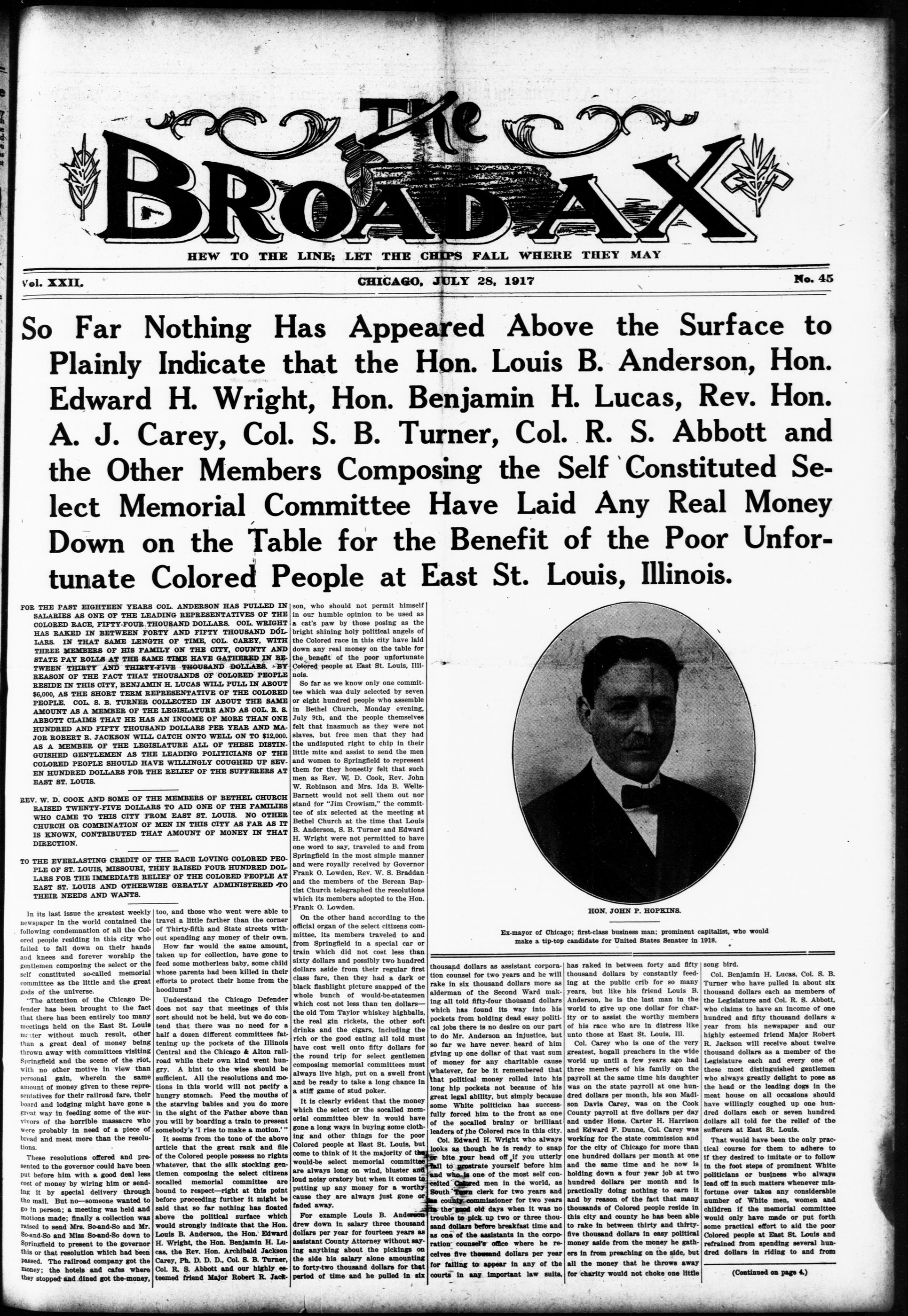
So Far Nothing Has Appeared Above the Surface to Plainly Indicate that the Hon. Louis B. Anderson, Hon. Edward H. Wright, Hon. Benjamin H. Lucas, Rev. Hon. A. J. Carey, Col. S. B. Turner, Col. R. S. Abbott and the Other Members Composing the Self Constituted Select Memorial Committee Have Laid Any Real Money Down on the Table for the Benefit of the Poor Unfortunate Colored People at East St. Louis, Illinois.
FOR THE PAST EIGHTEEN YEARS COL. ANDERSON HAS PULLED IN SALARIES AS ONE OF THE LEADING REPRESENTATIVES OF THE COLORED RACE, FIFTY-FOUR, THOUSAND DOLLARS. COL. WRIGHT HAS RAKED IN BETWEEN PORTY AND FIFTY THOUSAND DOLLARS. IN THAT SAME LENGTH OF TIME, COL. CAREY, WITH THREE MEMBERS OF HIS FAMILY ON THE CITY, COUNTY AND STATE PAY ROLLS AT THE SAME TIME HAVE GATHERED IN BETWEEN THIRTY AND THIRTY-FIVE THOUSAND DOLLARS. BY REASON OF THE PACT THAT THOUSANDS OF COLORED PEOPLE RESIDE IN THIS CITY, BENJAMIN H. LUCAS WILL PULL IN ABOUT $6,000, AS THE SHORT TERM REPRESENTATIVE OF THE COLORED PEOPLE. COL. S. B. TURNER COLLECTED IN ABOUT THE SAME AMOUNT AS A MEMBER OF THE LEGISLATURE AND AS COL. R. S. ABBOTT CLAIMS THAT HE HAS AN INCOME OF MORE THAN ONE HUNDRED AND FIFTY THOUSAND DOLLARS PER YEAR AND MAJOR ROBERT R. JACKSON WILL CATCH ONTO WELL ON TO $12,000. AS A MEMBER OF THE LEGISLATURE ALL OF THESE DISTINGUISHED GENTLEMEN AS THE LEADING POLITICIANS OF THE COLORED PEOPLE SHOULD HAVE WILLINGLY COUGHED UP SEVEN HUNDRED DOLLARS FOR THE RELIEF OF THE SUFFERERS AT EAST ST. LOUIS.
REV. W. D. COOK AND SOME OF THE MEMBERS OF BETHEL CHURCH RAISED TWENTY-FIVE DOLLARS TO AID ONE OF THE FAMILIES WHO CAME TO THIS CITY FROM EAST ST. LOUIS. NO OTHER CHURCH OR COMBINATION OF MEN IN THIS CITY AS PAR AS IT IS KNOWN, CONTRIBUTED THAT AMOUNT OF MONEY IN THAT DIRECTION.
TO THE EVERLASTING CREDIT OF THE RACE LOVING COLORED PEOPLE OF ST. LOUIS, MISSOURI, THEY RAISED FOUR HUNDRED DOLLARS FOR THE IMMEDIATE RELIEF OF THE COLORED PEOPLE AT EAST ST. LOUIS AND OTHERWISE GREATLY ADMINISTERED TO THEIR NEEDS AND WANTS.
Vol. XXII.
So Far M
Plainly
Edward
A. J. O
the Other
lect Mo
Down o
tunate
FOR THE PAST EIGHTEEN YEARS,
SALARIES AS ONE OF THE LE
COLORED RACE, FIFTY-FOUR. T
HAS RAKED IN BETWEEN FO
LARS. IN THAT SAME LENG
THREE MEMBERS OF HIS FA
STATE PAY ROLLS AT THE SAI
TWEEN THIRTY AND THIRTE
REASON OF THE FACT THAT
RESIDE IN THIS CITY, BENJAM
$6,000, AS THE SHORT TERM R
PEOPLE. COL. S. B. TURNER
AMOUNT AS A MEMBER OF THE
ABBOTT CLAIMS THAT HE HA
HUNDRED AND FIFTY THOUS
JOR ROBERT R. JACKSON WILL
AS A MEMBER OF THE LEG
GUISHED GENTLEMEN AS THE
COLORED PEOPLE SHOULD HA
EN HUNDRED DOLLARS FOR THE
EAST ST. LOUIS.
REV. W. D. COOK AND SOME OF THE
RAISED TWENTY-FIVE DOLLAR
WHO CAME TO THIS CITY FI
CHURCH OR COMBINATION OF
IS KNOWN, CONTRIBUTED THE
DIRECTION.
TO THE EVERLASTING CREDIT OF
PLE OF ST. LOUIS, MISSOURI, T
LARS TO THE IMMEDIATE RE
EAST ST. LOUIS AND OTHERV
THEIR NEEDS AND WANTS.
In its last issue the greatest weekly newspaper in the world contained the following condemnation of all the Colored people residing in this city who failed to fall down on their hands and knees and forever worship the gentlemen composing the select or the self constituted so-called memorial committee as the little and the great gods of the universe.
"The attention of the Chicago Defender has been brought to the fact that there has been entirely too many meetings held on the East St. Louis matter without much result, other than a great deal of money being thrown away with committees visiting Springfield and the scene of the riot, with no other motive in view than personal gain, wherein the same amount of money given to these representatives for their railroad fare, their board and lodging might have gone a great way in feeding some of the survivors of the horrible massacre who were probably in need of a piece of bread and meat more than the resolutions.
These resolutions offered and presented to the governor could have been put before him with a good deal less cost of money by wiring him or sending it by special delivery through the mail. But no—someone wanted to go in person; a meeting was held and motions made; finally a collection was raised to send Mrs. So-and-So and Mr. So-and-So and Miss So-and-So down to Springfield to present to the governor this or that resolution which had been passed. The railroad company got the money; the hotels and cafes where they stopped and dined got the money,
too, and those who went were able to travel a little farther than the corner of Thirty-fifth and State streets without spending any money of their own. How far would the same amount, taken up for collection, have gone to feed some motherless baby, some child whose parents had been killed in their efforts to protect their home from the hoodlums?
Understand the Chicago Defender does not say that meetings of this sort should not be held, but we do contend that there was no need for a half a dozen different committees fattening up the pockets of the Illinois Central and the Chicago & Alton railroad while their own kind went hungry. A hint to the wise should be sufficient. All the resolutions and motions in this world will not pacify a hungry stomach. Feed the mouths of in the sight of the Father above than you will by boarding a train to present somebody's 'I rise to make a motion.'"
It seems from the tone of the above article that the great rank and file of the Colored people possess no rights whatever, that the silk stocking gentlemen composing the select citizens socalled memorial committee are bound to respect—right at this point before proceeding further it might be said that so far nothing has floated above the political surface which would strongly indicate that the Hon. Louis B. Anderson, the Hon. Edward H. Wright, the Hon. Benjamin H. Lucas, the Rev. Hon. Archibald Jackson Carey, Ph. D. D. D., Col. S. B. Turner, Col. R. S. Abbott and our highly esteemed friend Major Robert R. Jack-
CHICAGO, JULY 28, 1917
son, who should not permit himself in our humble opinion to be used as a cat's paw by those posing as the bright shining holy political angels of the Colored race in this city have laid down any real money on the table for the benefit of the poor unfortunate Colored people at East St. Louis, Illinois.
So far as we know only one committee which was duly selected by seven or eight hundred people who assemble in Bethel Church, Monday evening, July 9th, and the people themselves felt that inasmuch as they were not slaves, but free men that they had the undisputed right to chip in their little mite and assist to send the men and women to Springfield to represent them for they honestly felt that such men as Rev. W. D. Cook, Rev. John W. Robinson and Mrs. Ida B. Wells-Barnett would not sell them out nor stand for "Jim Crowism," the committee of six selected at the meeting at Bethel Church at the time that Louis B. Anderson, S. B. Turner and Edward H. Wright were not permitted to have one word to say, traveled to and from Springfield in the most simple manner and were royally received by Governor Frank O. Lowden, Rev. W. S. Braddan and the members of the Berean Baptist Church telegraphed the resolutions which its members adopted to the Hon. Frank O. Lowden.
On the other hand according to the official organ of the select citizens committee, its members traveled to and from Springfield in a special car or train which did not cost less than sixty dollars and possibly two hundred dollars aside from their regular first class fare, then they had a dark or black flashlight picture snapped of the whole bunch of would-be-statesmen which cost not less than ten dollars—the old Tom Taylor whiskey highballs, the real gin rickets, the other soft drinks and the cigars, including the rich or the good eating all told must have cost well onto fifty dollars for the round trip for select gentlemen composing memorial committees must always live high, put on a swell front and be ready to take a long chance in a stiff game of stud poker.
It is clearly evident that the money which the select or the socalled memorial committee blew in would have gone a long ways in buying some clothing and other things for the poor Colored people at East St. Louis, but come to think of it the majority of the would-be select memorial committee are always long on wind, bluster and loud noisy oratory but when it comes to putting up any money for a worthy cause they are always just gone or faded away.
For example Louis B. Anderson drew down in salary three thousand dollars per year for fourteen years as assistant County Attorney without saying anything about the pickings on the side his salary alone amounting to forty-two thousand dollars for that period of time and he pulled in six
[Name not visible]
Ex-mayor of Chicago; first-class business man; prominent capitalist, who would make a tip-top candidate for United States Senator in 1918.
thousand dollars as assistant corporation counsel for two years and he will rake in six thousand dollars more as alderman of the Second Ward making all told fifty-four thousand dollars which has found its way into his pockets from holding dead easy political jobs there is no desire on our part to do Mr. Anderson an injustice, but so far we have never heard of him giving up one dollar of that vast sum of money for any charitable cause whatever, for be it remembered that that political money rolled into his long hip pockets not because of his great legal ability, but simply because some White politician has successfully forced him to the front as one of the so-called brainy or brilliant leaders of the Colored race in this city. Col. Edward H. Wright who always looks as though he is ready to snap or bite your head off if you utterly fall to prostrate yourself before him and who is one of the most self-conceited Colored men in the world, as South Town clerk for two years and as county commissioner for two years in the good old days when it was no trouble to pick up two or three thousand dollars before breakfast time and as one of the assistants in the corporation counsel's office where he receives five thousand dollars per year for failing to appear in any of the courts in any important law suits,
surface to
erson, Hon.
Rev. Hon.
abbott and
stituted Se-
gal Money
or Unfor-
bis.
capitalist, who would
1918.
song bird.
song bird.
Col. Benjamin H. Lucas, Col. S. B. Turner who have pulled in about six thousand dollars each as members of the Legislature and Col. R. S. Abbott, who claims to have an income of one hundred and fifty thousand dollars a year from his newspaper and our highly esteemed friend Major Robert R. Jackson will receive about twelve thousand dollars as a member of the Legislature each and every one of these most distinguished gentlemen who always greatly delight to pose as the head or the leading dogs in the meat house on all occasions should have willingly coughed up one hundred dollars each or seven hundred dollars all told for the relief of the sufferers at East St. Louis.
That would have been the only practical course for them to adhere to if they desired to imitate or to follow in the foot steps of prominent White politicians or business who always lead off in such matters whenever misfortune over takes any considerable number of White men, women and children if the memorial committee would only have made or put forth some practical effort to aid the poor Colored people at East St. Louis and refrained from spending several hundred dollars in riding to and from
(Continued on page 4.)
has raked in between forty and fifty thousand dollars by constantly feeding at the public crib for so many years, but like his friend Louis B. Anderson, he is the last man in the world to give up one dollar for charity or to assist the worthy members of his race who are in distress like unto those at East St. Louis, Ill.
Col. Carey who is one of the very greatest, hogall preachers in the wide world up until a few years ago had three members of his family on the payroll at the same time his daughter was on the state payroll at one hundred dollars per month, his son Madison Davis Carey, was on the Cook County payroll at five dollars per day and under Hons. Carter H. Harrison and Edward F. Dunne, Col. Carey was working for the state commission and for the city of Chicago for more than one hundred dollars per month at one and the same time and he now is holding down a four year job at two hundred dollars per month and is practically doing nothing to earn it and by reason of the fact that many thousands of Colored people reside in this city and county he has been able to rake in between thirty and thirty-five thousand dollars in easy political money aside from the money he gathers in from preaching on the side, but all the money that he throws away for charity would not choke one little
No. 45
Dan M. Jackson
Geo. T. Kersey
David A. McGowan
Ahmed A. Rayner
The Emmanuel
Undertaking
2959-61 So
Reliable Service
Reasona
Reliable Service Courteous Treatment Reasonable Prices FREE CHAPEL IN CONNECTION
Complete line of Funeral Good
DEE & CO
LACE CLEANERS DRY
26 East 35th Street
Tel. Do
Become a Stockholo
$10.00 Sh
DIRE
DEE & COMPANY, Inc.
Become a Stockholder and Get 20% off
CHARLES A. STEINMANN
MAJOR ROBERT R. JACKSON
MORRIS LEWIS
MRS. ROSA STEINMANN
ADOLPHUS C. HARRIS.
FRATERNAL HOTEL
FRIENDSHIP
ROOMS 25. Fri. to Sat. 8:00AM to 7:00 PM
RENTING
8165
FRATERNAL HOTEL
CHICAGO
6155 WENTWORTH AVE.
PHONE 3465 ENGLEWOOD
ROOMS 25c PER NIGHT AND UP
ROOMS $1.00 PER WEEK AND UP
Doctor's Money Returned After Going Through Laundry Processes.
Danville, Ill.-Dr. W. A. Surratt of this city is broken of the habit of putting money in his sock, following the temporary loss of $55 in currency a few days ago.
He is now of the opinion that the "women's national" is not a safe place, despite the testimony of hundreds of women to the contrary. The money disappeared in some mysterious manner, and he inserted an advertisement in a newspaper in the faint hope of obtaining some trace of it.
He was surprised when called up on the telephone and informed by the proprietor of a laundry that his money had been found after it had gone through all the processes of the laundry.
FINGER PRINTS LEGAL
Court Holds They Are but Tracings of Lines Upon the Fingers.
New York.—It is not unconstitutional to finger print a person convicted of a crime, according to a decision by Judge Wadhams in general sessions, upholding the finger printing statute. The decision was given in the case of Anna Sallow, convicted recently of disorderly conduct. After reviewing the history of the case and the previous decisions on the question the court says:
"Finger prints are but the tracings of physical characteristics or the lines upon the fingers. Nothing further is required in finger printing than has been sustained heretofore by the courts in making proofs of identification."
PAGE TWO
Phones Calumet 6164 Automatic 71-629
Uuel Jackson
ing Co., Inc.
South State St.
Courteous Treatment
table Prices
COMPANY, Inc.
CLEANERS LAUNDERERS
3456 Wabash Avenue
Douglas 1261
order and Get 20% off
hares $10.00
CTORS
FREE STYLE BOOK
HAIR
To Colored Women
We are the largest
manufacturers of
Colored Women's
Hair. Our latest
book showing new
styles in hair
dressing sent free.
Every colored wom-
man should have
crown. We will take
sands our hair and
toilet articles. Satis-
faction guaranteed
or money back. We
make the best
solid Brass STRAIGHT-
ENING combs, with extra heavy back, fully
guaranteed. With each comb we give lamp cap
FREE. Send money order or stamp. MONEY
BACK IF NOT SATISFACTORY. Sec. postpaid.
POSTPAID 89c
Hair netts, brushes, combs and toilet articles
manufacturer's prices. Send two-cent stamp.
Agents Wanted. Address as follows:
HUMANIA HAIR COMPANY,
181-187 Park Row,
New York City.
Address Dept. 84
FACED DANGERS TO REGISTER
Oil Man Walked Eleven Miles and Swam Flooded Streams.
Ellsworth, Kan.—Heavy rains and swollen streams almost compelled Carl Holt of this city to miss registering. Holt is a tool dresser for the Shamrock-Cushing oil drill, eleven miles southeast of Ellsworth. He was required to register here.
When Holt, late in the afternoon, started to drive into Ellsworth with his car he found himself cut off by streams which had flooded and washed out the bridges.
He promptly discarded the car, swam the creek and started to walk the eleven miles to Ellsworth. In the course of his walk he found it necessary to navigate other streams in a like manner. Fifteen minutes before 9, wet, muddy and tired, he rushed into the registration hall and signed his name to the card.
TOWN KEEPS UNTO ITSELF.
Loudville, Me., Seceded From Union In '61 and Never Came Back.
Augusta, Me.-Loudville, the home of 150 persons living on Loud's island, enjoys an anomalous distinction as an American town.
Loudville is legally part of Maine and the United States, but it won't admit it.
Loudville seceded from the United States when the south did and never came back.
When a federal officer went to Loudville to enforce the civil war draft he was met with a shower of hot potatoes. He went away.
Loudville pays no taxes, has no streets, no sewers, no lights, no boat landings and pays for no mail. It merely permits mail to be thrown ashore twice a week.
Loudville claims it is neutral in the war.
WILL PROTECT TENANTS.
Way Found to Keep Tradesmen Away From Apartment Dwellers.
Milwaukee. — Tradesmen, including the butcher, the baker and the candlestick maker, will not swarm about apartment houses to the annoyance of tenants if the recommendations devised by the management of one of Milwaukee's most modern establishments are generally adopted.
In brief, patrons are urged to do their trading with but one grocer, one milkman, one iceman, one laundryman and the like. The quality of service rendered is expected to determine the selection of favorites. By this means the leaseholder, it is expected, will not be awakened at an unseemly hour by the merry rattle of cans or clink of bottles as squad after squad of milkmen go trooping over the premises.
Shares
OPEN DAY AND NIGHT
THE BROAD AX, CHICAGO, JULY 28, 1917.
WARNING AUTOISTS
WARNING AUTOISTS
New York State Is Reducing Number of Accidents.
Circular Impresses Upon Reader That It Is Far Better to "Stop, Look and Listen" When Approaching Grade Crossings Than to Take a Chance Which May Cost a Life.
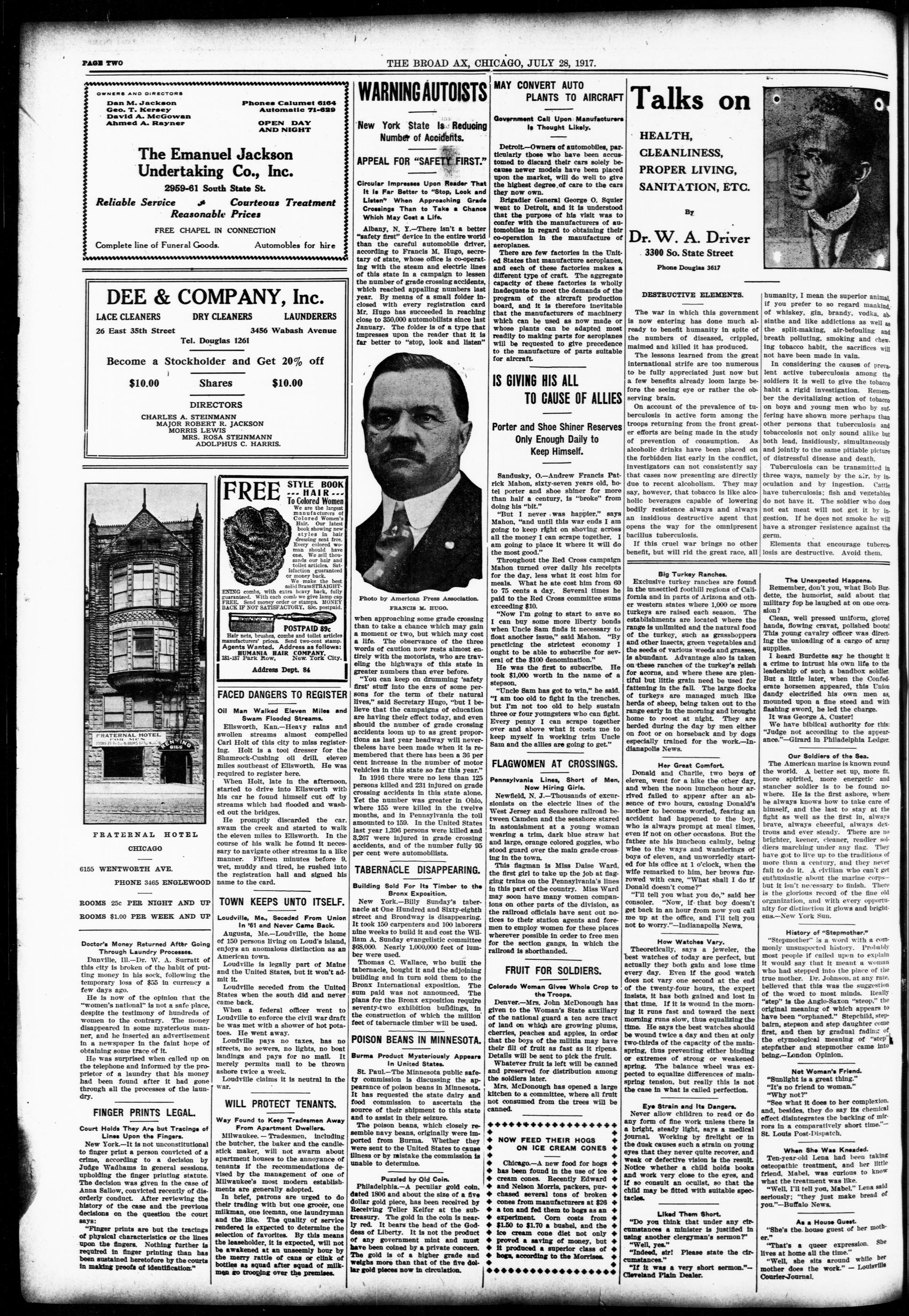
Albany, N. Y.-There isn't a better "safety first" device in the entire world than the careful automobile driver, according to Francis M. Hugo, secretary of state, whose office is co-operating with the steam and electric lines of this state in a campaign to lessen the number of grade crossing accidents, which reached appalling numbers last year. By means of a small folder enclosed with every registration card Mr. Hugo has succeeded in reaching close to 350,000 automobilists since last January. The folder is of a type that impresses upon the reader that it is far better to "stop, look and listen"
[Name]
Photo by American Press Association.
FRANCIS M. HUGO.
when approaching some grade crossing than to take a chance which may gain a moment or two, but which may cost a life. The observance of the three words of caution now rests almost entirely with the motorists, who are traveling the highways of this state in greater numbers than ever before.
"You can keep on drumming 'safety first' stuff into the ears of some persons for the term of their natural lives," said Secretary Hugo, "but I believe that the campaigns of education are having their effect today, and even should the number of grade crossing accidents loom up to as great proportions as last year headway will nevertheless have been made when it is remembered that there has been a 36 per cent increase in the number of motor vehicles in this state so far this year."
In 1916 there were no less than 125 persons killed and 231 injured on grade crossing accidents in this state alone. Yet the number was greater in Ohio, where 155 were killed in the twelve months, and in Pennsylvania the toll amounted to 159. In the United States last year 1,396 persons were killed and 3,267 were injured in grade crossing accidents, and of the number fully 95 per cent were automobilists.
TABERNACLE DISAPPEARING.
Building Sold For Its Timber to the Bronx Exposition.
New York.-Billy Sunday's tabernacle at One Hundred and Sixty-eighth street and Broadway is disappearing. It took 150 carpenters and 100 laborers nine weeks to build it and cost the William A. Sunday evangelistic committee $68,000. Nearly 1,000,000 feet of lumber were used.
Thomas C. Wallace, who built the tabernacle, bought it and the adjoining building and in turn sold them to the Bronx International exposition. The sum paid was not announced. The plans for the Bronx exposition require seventy-two exhibition buildings, in the construction of which the million feet of tabernacle timber will be used.
POISON BEANS IN MINNESOTA
Burma Product Mysteriously Appears In United States.
St. Paul. The Minnesota public safety commission is discussing the appearance of poison beans in Minnesota. It has requested the state dairy and food commission to ascertain the source of their shipment to this state and to assist in their seizure.
The poison beans, which closely resemble navy beans, originally were imported from Burma. Whether they were sent to the United States to cause illness or by mistake the commission is unable to determine.
Puzzled by Old Coin
Philadelphia.—A peculiar gold coin, dated 1806 and about the size of a five dollar gold piece, has been received by Receiving Teller Keifer at the subtreasury. The gold in the coin is nearly red. It bears the head of the Goddess of Liberty. It is not the product of any government mint and must have been coloned by a private concern. The gold is of a higher grade and weighs more than that of the five dollar gold pieces now in circulation.
MAY CONVERT AUTO
PLANTS TO AIRCRAFT
Government Call Upon Manufacturers Is Thought Likely.
Detroit—Owners of automobiles, particularly those who have been accustomed to discard their cars solely because newer models have been placed upon the market, will do well to give the highest degree, of care to the cars they now own.
Brigadier General George O. Squier went to Detroit, and it is understood that the purpose of his visit was to confer with the manufacturers of automobiles in regard to obtaining their co-operation in the manufacture of aeroplanes.
There are few factories in the United States that manufacture aeroplanes, and each of these factories makes a different type of craft. The aggregate capacity of these factories is wholly inadequate to meet the demands of the program of the aircraft production board, and it is therefore inevitable that the manufacturers of machinery which can be used as now made or whose plants can be adapted most readily to making parts for aeroplanes will be requested to give precedence to the manufacture of parts suitable for aircraft.
IS GIVING HIS ALL TO CAUSE OF ALLIES
Porter and Shoe Shiner Reserves Only Enough Daily to Keep Himself.
Sandusky, O.—Andrew Francis Patrick Mahon, sixty-seven years old, hotel porter and shoe shiner for more than half a century, is "broke" from doing his "bit." "But I never was happier," says Mahon, "and until this war ends I am going to keep right on shoving across all the money I can scrape together. I am going to place it where it will do the most good." Throughout the Red Cross campaign Mahon turned over daily his receipts for the day, less what it cost him for meals. What he ate cost him from 60 to 75 cents a day. Several times he paid to the Red Cross committee sums exceeding $10.
"Now I'm going to start to save so I can buy some more liberty bonds when Uncle Sam finds it necessary to float another issue," said Mahon. "By practicing the strictest economy I ought to be able to subscribe for several of the $100 denomination."
He was the first to subscribe. He took $1,000 worth in the name of a stepson.
"Uncle Sam has got to win," he said. "I am too old to fight in the trenches, but I'm not too old to help sustain three or four youngsters who can fight. Every penny I can scrape together over and above what it costs me to keep myself in working trim Uncle Sam and the allies are going to get."
FLAGWOMEN AT CROSSINGS.
Pennsylvania Lines, Short of Men, Now Hiring Girls.
Newfield, N. J.-Thousands of excursionists on the electric lines of the West Jersey and Seashore railroad between Camden and the seashore stared in astonishment at a young woman wearing a trim, dark blue straw hat and large, orange colored goggles, who stood guard over the main grade crossing in the town.
This flagman is Miss Daise Ward, the first girl to take up the job at flagging trains on the Pennsylvania's lines in this part of the country. Miss Ward may soon have many women companions on other parts of the division, as the railroad officials have sent out notices to their station agents and foremen to employ women for these places wherever possible in order to free men for the section gangs, in which the railroad is shorthanded.
FRUIT FOR SOLDIERS.
Colorado Woman Gives Whole Crop to the Troops.
Denver.—Mrs. John McDonough has given to the Woman's State auxiliary of the national guard a ten acre tract of land on which are growing plums, cherries, peaches and apples, in order that the boys of the militia may have their fill of fruit as fast as it ripens. Details will be sent to pick the fruit.
Whatever fruit is left will be canned and preserved for distribution among the soldiers later.
Mrs. McDonough has opened a large kitchen to a committee, where all fruit not consumed from the trees will be canned.
NOW FEED THEIR HOGS
ON ICE CREAM CONES
Chicago.—A new food for hogs has been found in the use of ice cream cones. Recently Edward and Nelson Morris, packers, purchased several tons of broken cones from manufacturers at $26 a ton and fed them to hogs as an experiment. Corn costs from $1.50 to $1.70 a bushel, and the ice cream cone diet not only proved a saving of money, but it produced a superior class of hogs, according to the Morrises.
Talks on
HEALTH,
CLEANLINESS,
PROPER LIVING,
SANITATION, ETC.
Dr. W. A. Driver
3300 So. State Street
Phone Douglas 3617
DESTRUCTIVE ELEMENTS.
The war in which this government is now entering has done much already to benefit humanity in spite of the numbers of diseased, crippled, maimed and killed it has produced. The lessons learned from the great international strife are too numerous to be fully appreciated just now but a few benefits already loom large before the seeing eye or rather the observing brain.
On account of the prevalence of tuberculosis in active form among the troops returning from the front greater efforts are being made in the study of prevention of consumption. As alcoholic drinks have been placed on the forbidden list early in the conflict, investigators can not consistently say that cases now presenting are directly due to recent alcoholism. They may say, however, that tobacco is like alcoholic beverages capable of lowering bodily resistance always and always an insidious destructive agent that opens the way for the omnipresent bacillus tuberculosis. If this cruel war brings no other benefit, but will rid the great race, all
Big Turkey Ranches
Exclusive turkey ranches are found in the unsettled foothill regions of California and in parts of Arizona and other western states where 1,000 or more turkeys are raised each season. The establishments are located where the range is unlimited and the natural food of the turkey, such as grasshoppers and other insects, green vegetables and the seeds of various weeds and grasses, is abundant. Advantage also is taken on these ranches of the turkey's relish for acorns, and where these are plentiful but little grain need be used for fattening in the fall. The large flocks of turkeys are managed much like herds of sheep, being taken out to the range early in the morning and brought home to roost at night. They are herded during the day by men either on foot or on horseback and by dogs especially trained for the work—Indianapolis News.
Her Great Comfort.
Donald and Charlie, two boys of eleven, went for a hike the other day, and when the noon luncheon hour arrived failed to appear after an absence of two hours, causing Donald's mother to become worried, fearing an accident had happened to the boy, who is always prompt at meal times, even if not on other occasions. But the father ate his luncheon calmly, being wise to the ways and wanderings of boys of eleven, and unworriedly started for his office at 1 o'clock, when the wife remarked to him, her brows furrowed with care, "What shall I do if Donald doesn't come?"
"I'll tell you what you do," said her consoler. "Now, if that boy doesn't get back in an hour from now you call me up at the office, and I'll tell you not to worry." - Indianapolis News.
How Watches Vary.
Theoretically, says a jeweler, the best watches of today are perfect, but actually they both gain and lose time every day. Even if the good watch does not vary one second at the end of the twenty-four hours, the expert insists, it has both gained and lost in that time. If it is wound in the morning it runs fast and toward the next morning runs slow, thus equalizing the time. He says the best watches should be wound twice a day and then at only two-thirds of the capacity of the mainspring, thus preventing either binding or extremes of strong or weakened spring. The balance wheel was expected to equalize differences of mainspring tension, but really this is not the case in what is called perfection.
Eye Strain and Its Dangers.
Never allow children to read or do any form of fine work unless there is a bright, steady light, says a medical journal. Working by firelight or in the dusk causes such a strain on young eyes that they never quite recover, and weak or defective vision is the result. Notice whether a child holds books and work very close to the eyes, and if so consult an oculist, so that the child may be fitted with suitable spectacles.
Liked Them Short.
"Do you think that under any circumstances a minister is justified in using another clergyman's sermon?"
"Well, yes."
"Indeed, sir! Please state the circumstances."
"If it was a very short sermon."—Cleveland Plain Dealer.
```markdown
```
humanity, I mean the superior animal, if you prefer to so regard mankind, of whiskey, gin, brandy, vodka, absinthe and like addictions as well as the split-making, air-befouling and breath polluting, smoking and chewing tobacco habit, the sacrifices will not have been made in vain.
In considering the causes of prevalent active tuberculosis among the soldiers it is well to give the tobacco habit a rigid investigation. Remember the devitalizing action of tobacco on boys and young men who by suffering have shown more perhaps than other persons that tuberculosis and tobaccolosis not only sound alike but both lead, insidiously, simultaneously and jointly to the same pitiable picture of distressful disease and death.
Tuberculosis can be transmitted in three ways, namely by the air, by inoculation and by ingestion. Cattle have tuberculosis; fish and vegetables do not have it. The soldier who does not eat meat will not get it by ingestion. If he does not smoke he will have a stronger resistance against the germ. Elements that encourage tuberculosis are destructive. Avoid them.
Remember, don't you, what Bob Burdette, the humorist, said about that military fop he laughed at on one occasion?
Clean, well pressed uniform, gloved hands, flowing cavat, polished boots! This young cavalry officer was directing the unloading of a cargo of army supplies.
I heard Burdette say he thought it a crime to intrust his own life to the leadership of such a bandbox soldier. But a little later, when the Confederate horsemen appeared, this Union dandy electrified his own men as, mounted upon a fine steed and with flashing sword, he led the charge.
It was George A. Custer!
We have biblical authority for this:
"Judge not according to the appearance."
-Girard in Philadelphia Ledger.
Our Soldiers of the Sea.
The American marine is known round the world. A better set up, more fit, more sprited, more energetic and stander soldier is to be found nowhere. He is the first ashore, where he always knows how to take care of himself, and the last to stay at the fight as well as the first in, always brave, always cheerful, always dextrous and ever steady. There are no brighter, keener, cleaner, readier soldiers marching under any flag. They have got to live up to the traditions of more than a century, and they never fail to do it. A civilian who can't get enthusiastic about the marine corps—but it isn't necessary to finish. There is the glorious record of the fine old organization, and with every opportunity for distinction it glows and brightens—New York Sun.
History of "Stepmother."
"Stepmother" is a word with a commonly unsuspected history. Probably most people if called upon to explain it would say that it meant a woman who had stepped into the place of the true mother. Dr. Johnson, at any rate, believed that this was the suggestion of the word to most minds. Really "step" is the Anglo-Saxon "steep," the original meaning of which appears to have been "orphaned." Stepchild, stepbairn, stepson and step daughter come first, and then by gradual fading of the etymological meaning of "step" stepfather and stepmother came into being—London Opnlin.
Not Woman's Friend.
"See what it does to her complexion, and, besides, they do say its chemical effect disintegrates the backing of mirrors in a comparatively short time."- St. Louis Post-Dispatch.
When She Was Kneaded.
Ten-year-old Lena had been taking osteopathic treatment, and her little friend, Mabel, was curious to know what the treatment was like. "Well, I'll tell you, Mabel." Lena said seriously; "they just make bread of you"—Buffalo News.
"She's the house guest of her mother."
"That's a queer expression. She lives at home all the time."
"Well, she sits around while her mother does the work." — Loulsville Courter-Journal.
HEADS THE ANTIS
Senator's Wife Says It Is Her Duty to Accept.
LEADERSHIP IN HER HANDS.
Is Daughter of the Late John Hay, Formerly Secretary of State; Sister of Mrs. Harry Payne Whitney and Wife of United States Senator.
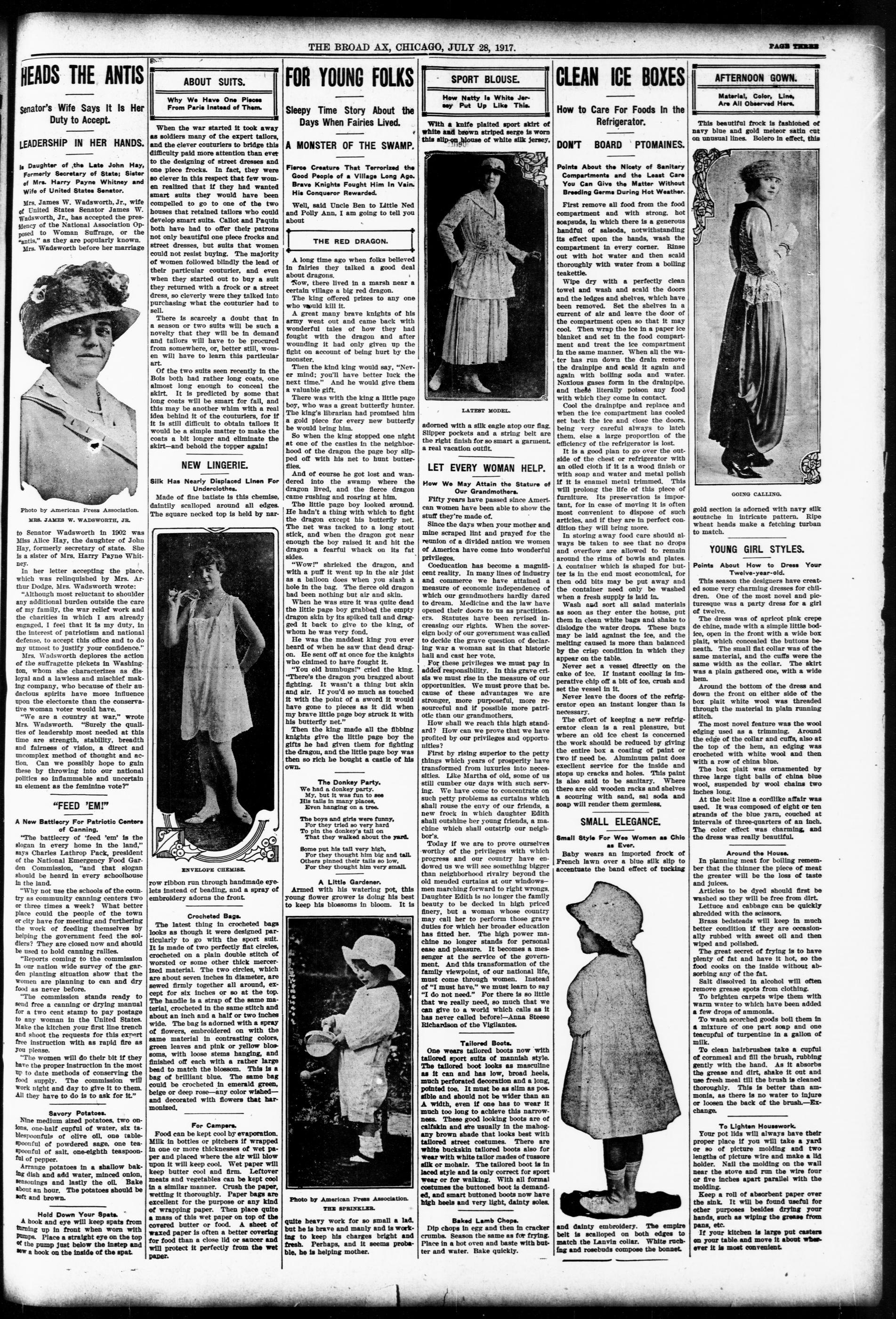
Mrs. James W. Wadsworth, Jr., wife of United States Senator James W. Wadsworth, Jr., has accepted the presidency of the National Association Opposed to Woman Suffrage, or the "antis," as they are popularly known. Mrs. Wadsworth before her marriage
Mrs.
Photo by American Press Association.
MRS. JAMES W. WADSWORTH, JR.
to Senator Wadsworth in 1902 was Miss Alice Hay, the daughter of John Hay, formerly secretary of state. She is a sister of Mrs. Harry Payne Whitney.
In her letter accepting the place, which was relinquished by Mrs. Arthur Dodge, Mrs. Wadsworth wrote:
"Although most reluctant to shoulder any additional burden outside the care of my family, the war relief work and the charities in which I am already engaged, I feel that it is my duty, in the interest of patriotism and national defense, to accept this office and to do my utmost to justify your confidence."
Mrs. Wadsworth deplores the action of the suffragette pickets in Washington, whom she characterizes as disloyal and a lawless and mischief making company, who because of their audacious spirits have more influence upon the electorate than the conservative woman voter would have.
"We are a country at war," wrote Mrs. Wadsworth. "Surely the qualities of leadership most needed at this time are strength, stability, breadth and fairness of vision, a direct and uncomplex method of thought and action. Can we possibly hope to gain these by throwing into our national politics so inflammable and uncertain an element as the feminine vote?"
"FEED 'EM!"
A New Battlecry For Patriotic Centers of Canning.
"The battlecry of 'feed 'em' is the slogan in every home in the land," says Charles Lathrop Pack, president of the National Emergency Food Garden Commission, "and that slogan should be heard in every schoolhouse in the land.
"Why not use the schools of the country as community canning centers two or three times a week? What better place could the people of the town or city have for meeting and furthering the work of feeding themselves by helping the government feed the soldiers? They are closed now and should be used to hold canning rallies.
"Reports coming to the commission in our nation wide survey of the garden planting situation show that the women are planning to can and dry food as never before.
"The commission stands ready to send free a canning or drying manual for a two cent stamp to pay postage to any woman in the United States. Make the kitchen your first line trench and shoot the requests for this expert free instruction with as rapid fire as you please.
"The women will do their bit if they have the proper instruction in the most up to date methods of conserving the food supply. The commission will work night and day to give it to them. All they have to do is to ask for it."
Savory Potatoes.
Nine medium sized potatoes, two onions, one-half cupful of water, six tablespoonfuls of olive oil, one tablespoonful of powdered sage, one teaspoonful of salt, one-eighth teaspoonful of pepper.
Arrange potatoes in a shallow baking dish and add water, minced onion, seasonings and lastly the oil. Bake about an hour. The potatoes should be soft and brown.
Hold Down Your Spate
A hook and eye will keep spats from turning up in front when worn with pumps. Place a straight eye on the top of the pump just below the instep and sew a hook on the inside of the spat.
Why We Have One Pieces From Paris Instead of Them.
When the war started it took away as soldiers many of the expert tailors, and the clever courtiers to bridge this difficulty paid more attention than ever to the designing of street dresses and one piece frocks. In fact, they were so clever in this respect that few women realized that if they had wanted smart suits they would have been compelled to go to one of the two houses that retained tailors who could develop smart suits. Callot and Paquin both have had to offer their patrons not only beautiful one piece frocks and street dresses, but suits that women could not resist buying. The majority of women followed blindly the lead of their particular courtier, and even when they started out to buy a suit they returned with a frock or a street dress, so cleverly were they talked into purchasing what the courtier had to sell.
There is scarcely a doubt that in a season or two suits will be such a novelty that they will be in demand and tailors will have to be procured from somewhere, or, better still, women will have to learn this particular art.
Of the two suits seen recently in the Bots both had rather long coats, one almost long enough to conceal the skirt. It is predicted by some that long coats will be smart for fall, and this may be another whim with a real idea behind it of the couturiers, for if it is still difficult to obtain tailors it would be a simple matter to make the coats a bit longer and eliminate the skirt—and behold the topper again!
NEW LINGERIE
Silk Has Nearly Displaced Linen For Underclothes.
Made of fine batiste is this chemise, daintily scalloped around all edges. The square necked top is held by nar-
THE BATHROOM
ENVELOPE CHEMISE.
row ribbon run through handmade eyelts instead of beading, and a spray of embroidery adorns the front.
Crocheted Bags
The latest thing in crocheted bags looks as though it were designed particularly to go with the sport suit. It is made of two perfectly flat circles, crocheted on a plain double stitch of worsted or some other thick mercerized material. The two circles, which are about seven inches in diameter, are sewed firmly together all around, except for six inches or so at the top. The handle is a strap of the same material, crocheted in the same stitch and about an inch and a half or two inches wide. The bag is adorned with a spray of flowers, embroidered on with the same material in contrasting colors, green leaves and pink or yellow blossoms, with loose stems hanging, and finished off each with a rather large bead to match the blossom. This is a bag of brilliant blue. The same bag could be crocheted in emerald green, beige or deep rose—any color wished—and decorated with flowers that harmonized.
For Campera.
Food can be kept cool by evaporation. Milk in bottles or pitchers if wrapped in one or more thicknesses of wet paper and placed where the air will blow upon it will keep cool. Wet paper will keep butter cool and firm. Leftover meats and vegetables can be kept cool in a similar manner. Crush the paper, wetting it thoroughly. Paper bags are excellent for the purpose or any kind of wrapping paper. Then place quite a mass of this wet paper on top of the covered butter or food. A sheet of waxed paper is often a better covering for food than a close lid or saucer and will protect it perfectly from the wet paper.
THE BROAD AX. CHICAGO. JULY 28. 1917.
FOR YOUNG FOLKS
Sleepy Time Story About the Days When Fairies Lived.
A MONSTER OF THE SWAMP.
Fierce Creature That Terrorized the Good People of a Village Long Ago. Brave Knights Fought Him In Vain. His Conqueror Rewarded.
Well, said Uncle Ben to Little Ned and Polly Ann, I am going to tell you about
THE RED DRAGON.
A long time ago when folks believed in fairies they talked a good deal about dragons. Now, there lived in a marsh near a certain village a big red dragon. The king offered prizes to any one who would kill it. A great many brave knights of his army went out and came back with wonderful tales of how they had fought with the dragon and after wounding it had only given up the fight on account of being hurt by the monster. Then the kind king would say, "Never mind; you'll have better luck the next time." And he would give them a valuable gift. There was with the king a little page boy, who was a great butterfly hunter. The king's librarian had promised him a gold piece for every new butterfly he would bring him.
So when the king stopped one night at one of the castles in the neighborhood of the dragon the page boy slipped off with his net to hunt butterflies.
And of course he got lost and wandered into the swamp where the dragon lived, and the fierce dragon came rushing and roaring at him.
The little page boy looked around. He hadn't a thing with which to fight the dragon except his butterfly net. The net was tacked to a long stout stick, and when the dragon got near enough the boy raised it and hit the dragon a fearful whack on its fat sides.
"Wow!" shrieked the dragon, and with a puff it went up in the air just as a balloon does when you slash a hole in the bag. The fierce old dragon had been nothing but air and skin.
When he was sure it was quite dead the little page boy grabbed the empty dragon skin by its spiked tall and dragged it back to give to the king, of whom he was very fond.
He was the maddest king you ever heard of when he saw that dead dragon. He sent off at once for the knights who claimed to have fought it.
"You old humbugs!" cried the king. "There's the dragon you bragged about fighting. It wasn't a thing but skin and air. If you'd so much as touched it with the point of a sword it would have gone to pieces as it did when my brave little page boy struck it with his butterfly net."
Then the king made all the fibbing knights give the little page boy the gifts he had given them for fighting the dragon, and the little page boy was then so rich he bought a castle of his own.
The Donkey Party.
We had a donkey party.
My, but it was fun to see
His tails in many places,
Even hanging on a tree.
The boys and girls were funny,
For they tried so very hard
To pin the donkey's tail on
That they walked about the yard.
Some put his tail very high.
For they thought him big and tall.
Others pinned their tails so low.
For they thought him very small
A. Little Gardener.
Armed with his watering pot, this young flower grower is doing his best to keep his blossoms in bloom. It is
THE CHILDREN'S WEEKLY NEWS
Photo by American Press Association.
THE SPRINKLER.
quite heavy work for so small a lad,
but he is brave and manly and is working to keep his charges bright and fresh. Perhaps, and it seems probable, he is helping mother.
SPORT BLOUSE.
How Natty Is White Jersey Put Up Like This.
With a knife plaited sport skirt of white and brown striped serge is worn this slip-on blouse of white silk jersey,
FASHION
adorned with a silk eagle atop our fg
Slipper pockets and a string belt are
the right finish for so smart a garment
a real vacation outfit.
LET EVERY WOMAN HELP.
How We May Attain the Stature of Our Grandmothers.
Fifty years have passed since American women have been able to show the stuff they're made of.
Since the days when your mother and mine scraped lint and prayed for the reunion of a divided nation we women of America have come into wonderful privileges.
Coeducation has become a magnificent reality. In many lines of industry and commerce we have attained a measure of economic independence of which our grandmothers hardly dared to dream. Medicine and the law have opened their doors to us as practitioners. Statutes have been revised increasing our rights. When the sovereign body of our government was called to decide the grave question of declaring war a woman sat in that historic hall and cast her vote.
For these privileges we must pay in added responsibility. In this grave crisis we must rise in the measure of our opportunities. We must prove that because of these advantages we are stronger, more purposeful, more resourceful and if possible more patriotic than our grandmothers.
How shall we reach this high standard? How can we prove that we have profited by our privileges and opportunities?
First by rising superior to the petty things which years of prosperity have transformed from luxuries into necessities. Like Martha of old, some of us still cumber our days with such serving. We have come to concentrate on such petty problems as curtains which shall rouse the envy of our friends, a new frock in which daughter Edith shall outshine her young friends, a machine which shall outstrip our neighbor's.
Today if we are to prove ourselves worthy of the privileges with which progress and our country have endowed us we will see something bigger than neighborhood rivalry beyond the old mended curtains at our windowsmen marching forward to right wrongs. Daughter Edith is no longer the family beauty to be decked in high priced finery, but a woman whose country may call her to perform those grave duties for which her broader education has fitted her. The high power machine no longer stands for personal ease and pleasure. It becomes a messenger at the service of the government. And this transformation of the family viewpoint, of our national life, must come through women. Instead of "I must have," we must learn to say "I do not need." For there is so little that we really need, so much that we can give to a world which calls as it has never called before!-Anna Steese Richardson of the Vigilantes.
Tailored Boots
One wears tailored boots now with tailored sport suits of mannish style. The tailored boot looks as masculine as it can and has low, broad heels, much perforated decoration and a long, pointed toe. It must be as slim as possible and should not be wider than an A width, even if one has to wear it much too long to achieve this narrowness. These good looking boots are of calfskin and are usually in the mahogany brown shade that looks best with tailored street costumes. There are white buckskin tailored boots also for wear with white tailor mades of tussor silk or mohair. The tailored boot is in laced style and is only correct for sport wear or for walking. With all formal costumes the buttoned boot is demanded, and smart buttoned boots now have high heels and very light, dainty soles.
Baked Lamb Chops.
Dip chops in egg and then in cracker crumbs. Season the same as for frying. Place in a hot oven and baste with butter and water. Bake quickly.
CLEAN ICE BOXES
How to Care For Foods In the Refrigerator.
Points About the Nicety of Sanitary Compartments and the Least Care You Can Give the Matter Without Breeding Germs During Hot Weather. First remove all food from the food compartment and with strong, hot soapsuds, in which there is a generous handful of salsoda, notwithstanding its effect upon the hands, wash the compartment in every corner. Rinse out with hot water and then scald thoroughly with water from a boiling teakettle.
Wipe dry with a perfectly clean towel and wash and scald the doors and the ledges and shelves, which have been removed. Set the shelves in a current of air and leave the door of the compartment open so that it may cool. Then wrap the ice in a paper ice blanket and set in the food compartment and treat the ice compartment in the same manner. When all the water has run down the drain remove the drainpipe and scald it again and again with boiling soda and water. Noxious gases form in the drainpipe, and these literally poison any food with which they come in contact. Cool the drainpipe and replace and when the ice compartment has cooled set back the ice and close the doors, being very careful always to latch them, else a large proportion of the efficiency of the refrigerator is lost.
It is a good plan to go over the outside of the chest or refrigerator with an oiled cloth if it is a wood finish or with soap and water and metal polish if it is enamel metal trimmed. This will prolong the life of this piece of furniture. Its preservation is important, for in case of moving it is often most convenient to dispose of such articles, and if they are in perfect condition they will bring more.
In storing away food care should always be taken to see that no drops and overflow are allowed to remain around the rims of bowls and plates. A container which is shaped for butter is in the end most economical, for then odd bits may be put away and the container need only be washed when a fresh supply is laid in.
Wash and sort all salad materials as soon as they enter the house, put them in clean white bags and shake to dislodge the water drops. These bags may be laid against the ice, and the melting caused is more than balanced by the crisp condition in which they appear on the table. Never set a vessel directly on the cake of ice. If instant cooling is imperative chip off a bit of ice, crush and set the vessel in it. Never leave the doors of the refrigerator open an instant longer than is necessary.
The effort of keeping a new refrigerator clean is a real pleasure, but where an old ice chest is concerned the work should be reduced by giving the entire box a coating of paint or two if need be. Aluminum paint does excellent service for the inside and stops up cracks and holes. This paint is also said to be sanitary. Where there are old wooden racks and shelves a scouring with sand, sal soda and soap will render them germless.
SMALL ELEGANCE
Small Style For Wee Women as Chic as Ever.
Baby wears an imported frock of French lawn over a blue silk slip to accentuate the band effect of tucking
```markdown
```
and dainty embroidery. The empire belt is scalloped on both edges to match the Lanvin collar. White ruching and rosebuds compose the bonnet.
and dainty embroidery. The empire belt is scalloped on both edges to match the Lanvin collar. White ruching and rosebuds compose the bonnet.
PAGE THREE
This beautiful frock is fashioned of navy blue and gold meteor satin cut on unusual lines. Bolero in effect, this
THE FASHION OF THE TWENTIETH CENTURY
GOING CALLING.
gold section is adorned with navy silk
soutache in intricate pattern. Ripe
wheat heads make a fetching turban
to match.
YOUNG GIRL STYLES.
Points About How to Dress Your Twelve-year-old.
This season the designers have created some very charming dresses for children. One of the most novel and picturesque was a party dress for a girl of twelve.
The dress was of apricot pink crepe de chine, made with a simple little bodice, open in the front with a wide box plait, which concealed the buttons beneath. The small flat collar was of the same material, and the cuffs were the same width as the collar. The skirt was a plain gathered one, with a wide hem.
Around the bottom of the dress and down the front on either side of the box plait white wool was threaded through the material in plain running stitch.
The most novel feature was the wool edging used as a trimming. Around the edge of the collar and cuffs, also at the top of the hem, an edging was crocheted with white wool and then with a row of china blue.
The box plait was ornamented by three large tight balls of china blue wool, suspended by wool chains two inches long.
At the belt line a cordlike affair was used. It was composed of eight or ten strands of the blue yarn, couched at intervals of three-quarters of an inch. The color effect was charming, and the dress was really beautiful.
Around the House.
In planning meat for boiling remember that the thinner the piece of meat the greater will be the loss of taste and juices.
Articles to be dyed should first be washed so they will be free from dirt. Lettuce and cabbage can be quickly shredded with the scissors.
Brass bedsteads will keep in much better condition if they are occasionally rubbed with sweet oil and then wiped and polished.
The great secret of frying is to have plenty of fat and have it hot, so the food cooks on the inside without absorbing any of the fat.
Salt dissolved in alcohol will often remove grease spots from clothing.
To brighten carpets wipe them with warm water to which have been added a few drops of ammonia.
To wash scorched goods boll them in a mixture of one part soap and one teacupful of turpentine in a gallon of milk.
To clean hairbrushes take a cupful of cornmeal and fill the brush, rubbing gently with the hand. As it absorbs the grease and dirt, shake it out and use fresh meal till the brush is cleaned thoroughly. This is better than ammonia, as there is no water to injure or loosen the back of the brush.—Exchange.
To Lighten Housework
Your pot lids will always have their proper place if you will take a yard or so of picture molding and two lengths of picture wire and make a lid holder. Nail the molding on the wall near the stove and run the wire four or five inches apart parallel with the molding.
Keep a roll of absorbent paper over the sink. It will be found useful for other purposes besides drying your hands, such as wiping the grease from pans, etc.
If your kitchen is large put casters on your table and move it about whenever it is most convenient.
```markdown
```
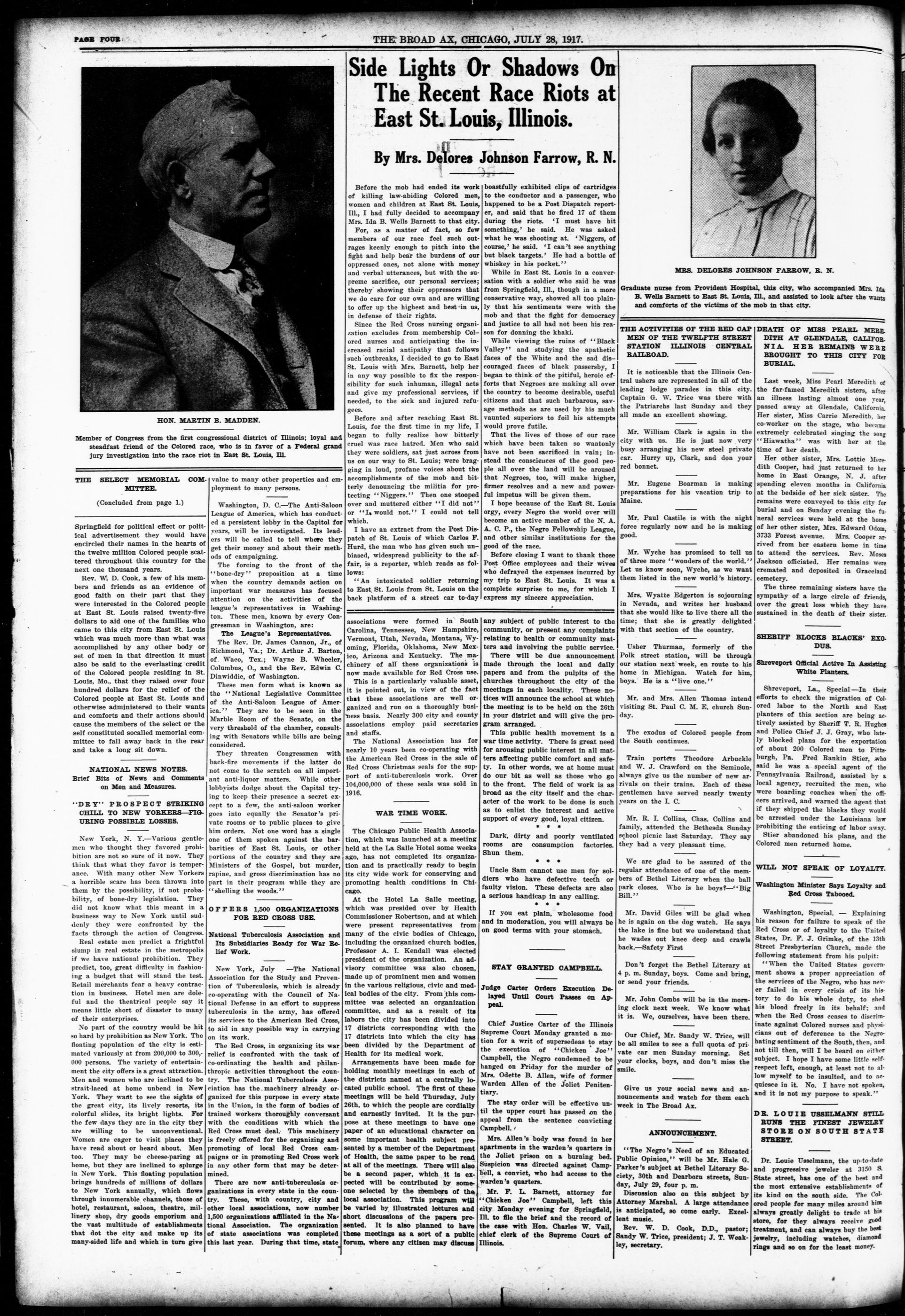
HON. MARTIN B. MADDEN.
Member of Congress from the first con steadfast friend of the Colored ra jury investigation into the race ri
Member of Congress from the first congressional district of Illinois; loyal and steadfast friend of the Colored race, who is in favor of a Federal grand jury investigation into the race riot in East St. Louis, Ill.
THE SELECT MEMORIAL COM
MITTEE.
(Concluded from page 1.)
Springfield for political effect or political advertisement they would have encircled their names in the hearts of the twelve million Colored people scattered throughout this country for the next one thousand years.
Rev. W. D. Cook, a few of his members and friends as an evidence of good faith on their part that they were interested in the Colored people at East St. Louis raised twenty-five dollars to aid one of the families who came to this city from East St. Louis which was much more than what was accomplished by any other body or set of men in that direction it must also be said to the everlasting credit of the Colored people residing in St. Louis, Mo., that they raised over four hundred dollars for the relief of the Colored people at East St. Louis and otherwise administered to their wants and comforts and their actions should cause the members of the select or the self constituted so-called memorial committee to fall away back in the rear and take a long sit down.
NATIONAL NEWS NOTES.
Brief Bits of News and Comments
on Men and Measures.
"DRY" PROSPECT STRIKING
CHILL TO NEW YORKERS—FIG
URING POSSIBLE LOSSES.
New York, N. Y.—Various gentlemen who thought they favored prohibition are not so sure of it now. They think that what they favor is temperance. With many other New Yorkers a horrible scare has been thrown into them by the possibility, if not probability, of bone-dry legislation. They did not know what this meant in a business way to New York until suddenly they were confronted by the facts through the action of Congress. Real estate men predict a frightful slump in real estate in the metropolis if we have national prohibition. They predict, too, great difficulty in fashioning a budget that will stand the test. Retail merchants fear a heavy contraction in business. Hotel men are doleful and the theatrical people say it means little short of disaster to many of their enterprises.
No part of the country would be hit so hard by prohibition as New York. The floating population of the city is estimated variously at from 200,000 to 300,000 persons. The variety of entertainment the city offers is a great attraction. Men and women who are inclined to be strait-laced at home unbend in New York. They want to see the sights of the great city, its lively resorts, its colorful slides, its bright lights. For the few days they are in the city they are willing to be unconventional. Women are eager to visit places they have read about or heard about. Men too. They may be cheese-paring at home, but they are inclined to splurge in New York. This floating population brings hundreds of millions of dollars to New York annually, which flows through innumerable channels, those of hotel, restaurant, saloon, theatre, millinery shop, dry goods emporium and the vast multitude of establishments that dot the city and make up its many-sided life and which in turn give
---
PAGE FOUR
value to many other properties and employment to many persons.
Washington, D. C.—The Anti-Saloon League of America, which has conducted a persistent lobby in the Capitol for years, will be investigated. Its leaders will be called to tell where they get their money and about their methods of campaigning.
The forcing to the front of the "bone-dry" proposition at a time when the country demands action on important war measures has focused attention on the activities of the league's representatives in Washington. These men, known by every Congressman in Washington, are:
The Rev. Dr. James Cannon, Jr., of Richmond, Va.; Dr. Arthur J. Barton, of Waco, Tex.; Wayne B. Wheeler, Columbus, O., and the Rev. Edwin C. Dinwiddie, of Washington.
These men form what is known as the "National Legislative Committee of the Anti-Saloon League of America." They are to be seen in the Marble Room of the Senate, on the very threshold of the chamber, consulting with Senators while bills are being considered.
They threaten Congressmen with back-fire movements if the latter do not come to the scratch on all important anti-liquor matters. While other lobbyists dodge the Capital trying to keep their presence a secret except to a few, the anti-saloon worker goes into equally the Senator's private rooms or to public places to give him orders. Not one word has a single one of them spoken against the barbarities of East St. Louis, or other portions of the country and they are Ministers of the Gospel, but murder, rapine, and gross discrimination has no part in their program while they are "shelling the woods."
OFFERS 1,500 ORGANIZATIONS
FOR RED CROSS USE.
National Tuberculosis Association and Its Subsidiaries Ready for War Relief Work.
New York, July —The National Association for the Study and Prevention of Tuberculosis, which is already co-operating with the Council of National Defense in an effort to suppress tuberculosis in the army, has offered its services to the American Red Cross, to aid in any possible way in carrying on its work.
The Red Cross, in organizing its war relief is confronted with the task of co-ordinating the health and philanthropic activities throughout the country. The National Tuberculosis Association has the machinery already organized for this purpose in every state in the Union, in the form of bodies of trained workers thoroughly conversant with the conditions with which the Red Cross must deal. This machinery is freely offered for the organizing and promoting of local Red Cross campaigns or in promoting Red Cross work in any other form that may be determined.
There are now anti-tuberculosis organizations in every state in the country. These, with country, city and other local associations, now number 1,500 organizations affiliated in the National Association. The organization of state associations was completed this last year. During that time, state
THE: BROAD AX. CHICAGO. JULY 28. 1917.
Side Lights Or Shadows On The Recent Race Riots at East St. Louis, Illinois.
Before the mob had ended its work of killing law-abiding Colored men, women and children at East St. Louis, Ill., I had fully decided to accompany Mrs. Ida B. Wells Barnett to that city. For, as a matter of fact, so few members of our race feel such outrages keenly enough to pitch into the fight and help bear the burdens of our oppressed ones, not alone with money and verbal utterances, but with the supreme sacrifice, our personal services; thereby showing their oppressors that we do care for our own and are willing to offer up the highest and best in us, in defense of their rights.
Since the Red Cross nursing organization excludes from membership Colored nurses and anticipating the increased racial antipathy that follows such outbreaks, I decided to go to East St. Louis with Mrs. Barnett, help her in any way possible to fix the responsibility for such inhuman, illegal acts and give my professional services, if needed, to the sick and injured refugees.
Before and after reaching East St. Louis, for the first time in my life, I began to fully realize how bitterly cruel was race hatred. Men who said they were soldiers, sat just across from us on our way to St. Louis; were bragging in loud, profane voices about the accomplishments of the mob and bitterly denouncing the militia for protecting "Niggers." Then one stooped over and muttered either "I did not" or "I would not." I could not tell which.
I have an extract from the Post Dispatch of St. Louis of which Carlos F. Hurd, the man who has given such unbiased, widespread publicity to the affair, is a reporter, which reads as follows:
"An intoxicated soldier returning to East St. Louis from St. Louis on the back platform of a street car to-day
associations were formed in South Carolina, Tennessee, New Hampshire, Vermont, Utah, Nevada, Montana, Wyoming, Florida, Oklahoma, New Mexico, Arizona and Kentucky. The machinery of all these organizations is now made available for Red Cross use. This is a particularly valuable asset, it is pointed out, in view of the fact that these associations are well organized and run on a thoroughly business basis. Nearly 300 city and county associations employ paid secretaries and staffs. The National Association has for nearly 10 years been co-operating with the American Red Cross in the sale of Red Christmas seals for the support of anti-tuberculosis work. Over 104,000,000 of these seals was sold in 1916.
WAR TIME WORK
The Chicago Public Health Association, which was launched at a meeting held at the La Salle Hotel some weeks ago, has not completed its organization and is practically ready to begin its city wide work for conserving and promoting health conditions in Chicago.
At the Hotel La Salle meeting, which was presided over by Health Commissioner Robertson, and at which were present representatives from many of the civic bodies of Chicago, including the organized church bodies, Professor A. I. Kendall was elected president of the organization. An advisory committee was also chosen, made up of prominent men and women in the various religious, civic and medical bodies of the city. From this committee was selected an organization committee, and as a result of its labors the city has been divided into 17 districts corresponding with the 17 districts into which the city has been divided by the Department of Health for its medical work.
Arrangements have been made for holding monthly meetings in each of the districts named at a centrally located public school. The first of these meetings will be held Thursday, July 26th, to which the people are cordially and earnestly invited. It is the purpose at these meetings to have one paper of an educational character on some important health subject presented by a member of the Department of Health, the same paper to be read at all of the meetings. There will also be a second paper, which it is expected will be contributed by someone selected by the members of the local association. This program will be varied by illustrated lectures and short discussions of the papers presented. It is also planned to have these meetings as a sort of a public forum, where any citizen may discuss
boastfully exhibited clips of cartridges to the conductor and a passenger, who happened to be a Post Dispatch reporter, and said that he fired 17 of them during the riots. 'I must have hit something,' he said. He was asked what he was shooting at. 'Niggers, of course,' he said. 'I can't see anything but black targets.' He had a bottle of whiskey in his pocket.' While in East St. Louis in a conversation with a soldier who said he was from Springfield, Ill., though in a more conservative way, showed all too plainly that his sentiments were with the mob and that the fight for democracy and justice to all had not been his reason for donning the khaki.
While viewing the ruins of "Black Valley" and studying the apathetic faces of the White and the sad discouraged faces of black passersby, I began to think of the pitiful, heroic efforts that Negroes are making all over the country to become desirable, useful citizens and that such barbarous, savage methods as are used by his much vaunted superiors to foil his attempts would prove futile.
That the lives of those of our race which have been taken so wantonly have not been sacrificed in vain; instead the consciences of the good people all over the land will be aroused that Negroes, too, will make higher, firmer resolves and a new and powerful impetus will be given them.
I hope because of the East St. Louis orgy, every Negro the world over will become an active member of the N. A. A. C. P., the Negro Fellowship League, and other similar institutions for the good of the race.
Before closing I want to thank those Post Office employees and their wives who defrayed the expenses incurred by my trip to East St. Louis. It was a complete surprise to me, for which I express my sincere appreciation.
any subject of public interest to the community, or present any complaints relating to health or community matters and involving the public service. There will be due announcement made through the local and daily papers and from the pulpits of the churches throughout the city of the meetings in each locality. These notices will announce the school at which the meeting is to be held on the 26th in your district and will give the program arranged.
This public health movement is a war time activity. There is great need for arousing public interest in all matters affecting public comfort and safety. In other words, we at home must do our bit as well as those who go to the front. The field of work is as broad as the city itself and the character of the work to be done is such as to enlist the interest and active support of every good, loyal citizen.
* * *
Dark, dirty and poorly ventilated rooms are consumption factories. Shun them.
* * *
Uncle Sam cannot use men for soldiers who have defective teeth or faulty vision. These defects are also a serious handicap in any calling.
If you eat plain, wholesome food and in moderation, you will always be on good terms with your stomach.
STAY GRANTED CAMPBELL
Judge Carter Orders Execution Delayed Until Court Passes on Appeal.
Chief Justice Carter of the Illinois Supreme Court Monday granted a motion for a writ of supersedeas to stay the execution of "Chicken Joe" Campbell, the Negro condemned to be hanged on Friday for the murder of Mrs. Odette B. Allen, wife of former Warden Allen of the Joliet Penitentiary.
The stay order will be effective until the upper court has passed on the appeal from the sentence convicting Campbell.
Mrs. Allen's body was found in her apartments in the warden's quarters in the Joliet prison on a burning bed. Suspicion was directed against Campbell, a convict, who had access to the warden's quarters.
Mr. F. L. Barnett, attorney for "Chicken Joe" Campbell, left this city Monday evening for Springfield, Ill. to file the brief and the record of the case with Hon. Charles W. Vail, chief clerk of the Supreme Court of Illinois.
Mary
MRS. DELORES JOHNSON FARROW, R. N.
Graduate nurse from Provident Hospital, this city, who accom-
B. Wells Barnett to East St. Louis, Ill., and assisted to look
and comforts of the victims of the mob in that city.
Graduate nurse from Provident Hospital, this city, who accompanied Mrs. Ida B. Wells Barnett to East St. Louis, Ill., and assisted to look after the wants and comforts of the victims of the mob in that city.
THE ACTIVITIES OF THE RED CAP MEN OF THE TWELFTH STREET STATION ILLINOIS CENTREAL RAILROAD.
It is noticeable that the Illinois Central ushers are represented in all of the leading lodge parades in this city. Captain G. W. Trice was there with the Patriarchs last Sunday and they all made an excellent showing.
Mr. William Clark is again in the city with us. He is just now very busy arranging his new steel private car. Hurry up, Clark, and don your red bonnet.
Mr. Eugene Boarman is making preparations for his vacation trip to Maine.
Mr. Paul Castile is with the night force regularly now and he is making good.
Mr. Wyche has promised to tell us of three more "wonders of the world." Let us know soon, Wyche, as we want them listed in the new world's history.
Mrs. Wyatte Edgerton is sojourning in Nevada, and writes her husband that she would like to live there all the time; that she is greatly delighted with that section of the country.
Usher Thurman, formerly of the Polk street station, will be through our station next week, en route to his home in Michigan. Watch for him, boys. He is a "live one."
Mr. and Mrs. Allen Thomas intend visiting St. Paul C. M. E. church Sunday.
The exodus of Colored people from the South continues.
Train porters Theodore Arbuckle and W. J. Crawford on the Seminole, always give us the number of new arrivals on their trains. Each of these gentlemen have served nearly twenty years on the I. C.
Mr. R. I. Collins, Chas. Collins and family, attended the Bethesda Sunday school picnic last Saturday. They say they had a very pleasant time.
We are glad to be assured of the regular attendance of one of the members of Bethel Literary when the ball park closes. Who is he boys?—‘Big Bill.’
Mr. David Giles will be glad when he is again on the dog watch. He says the lake is fine but we understand that he wades out knee deep and crawls back.—Safety First
Don't forget the Bethel Literary at 4 p. m. Sunday, boys. Come and bring, or send your friends.
Mr. John Combs will be in the morning clock next week. We know what it is. We, ourselves, have been there.
Our Chief, Mr. Sandy W. Trice, will be all smiles to see a full quota of private car men Sunday morning. Set your clocks, boys, and don't miss the smile.
Give us your social news and announcements and watch for them each week in The Broad Ax.
ANNOUNCEMENT
"The Negro's Need of an Educated Public Opinion," will be Mr. Hale G. Parker's subject at Bethel Literary Society, 30th and Dearborn streets, Sunday, July 29, four p. m. Discussion also on this subject by Attorney Marshal. A large attendance is anticipated, so come early. Excellent music. Rev. W. D. Cook, D.D., pastor; Sandy W. Trice, president; J. T. Weakley, secretary.
DEATH OF MISS PEARL MEREDITH AT GLENDALE, CALIFORNIA. HER REMAINS WERE BROUGHT TO THIS CITY FOR BURIAL.
Last week, Miss Pearl Meredith of the far-famed Meredith sisters, after an illness lasting almost one year, passed away at Glendale, California. Her sister, Miss Carrie Meredith, her co-worker on the stage, who became extremely celebrated singing the song "Hiawatha" was with her at the time of her death.
Her other sister, Mrs. Lottie Meredith Cooper, had just returned to her home in East Orange, N. J. after spending eleven months in California at the bedside of her sick sister. The remains were conveyed to this city for burial and on Sunday evening the funeral services were held at the home of her other sister, Mrs. Edward Odom, 3733 Forest avenue. Mrs. Cooper arrived from her eastern home in time to attend the services. Rev. Moses Jackson officiated. Her remains were cremated and deposited in Graceland cemetery.
The three remaining sisters have the sympathy of a large circle of friends, over the great loss which they have sustained in the death of their sister
SHERIFF BLOCKS BLACKS' EX0
DUS.
Shreveport Official Active In Assisting White Planters
Shreveport, La., Special—In their efforts to check the migration of Colored labor to the North and East planters of this section are being actively assisted by Sheriff T. R. Hughes and Police Chief J. J. Gray, who later blocked plans for the exportation of about 200 Colored men to Pittsburgh, Pa. Fred Rankin Stier, who said he was a special agent of the Pennsylvania Railroad, assisted by a local agency, recruited the men, who were boarding coaches when the officers arrived, and warned the agent that if they shipped the blacks they would be arrested under the Louisiana law prohibiting the enticing of labor away. Stier abandoned his plans, and the Colored men returned home.
WILL NOT SPEAK OF LOYALTY.
Washington Minister Says Loyalty and Red Cross Tahooed.
Washington, Special. — Explaining his reason for failure to speak of the Red Cross or of loyalty to the United States, Dr. F. J. Grimke, of the 13th Street Presbyterian Church, made the following statement from his pulpit:
"When the United States government shows a proper appreciation of the services of the Negro, who has never failed in every crisis of its history to do his whole duty, to shed his blood freely in its behalf; and when the Red Cross ceases to discriminate against Colored nurses and physicians out of deference to the Negro-hating sentiment of the South, then, and not till then, will I be heard on either subject. I hope I have some little self-respect left, enough, at least not to allow myself to be insulted, and to acquiesce in it. No. I have not spoken, and it is not my purpose to speak."
DR. LOUIE USSELMANN STILL RUNS THE FINEST JEWELRY STORE ON SOUTH STATE STREET.
Dr. Louie Usselmann, the up-to-date and progressive jeweler at 3150 S. State street, has one of the best and the most extensive establishments of its kind on the south side. The Colored people for many miles around him always greatly delight to trade at his store, for they always receive good treatment, and can always buy the best jewelry, including watches, diamond rings and so on for the least money.
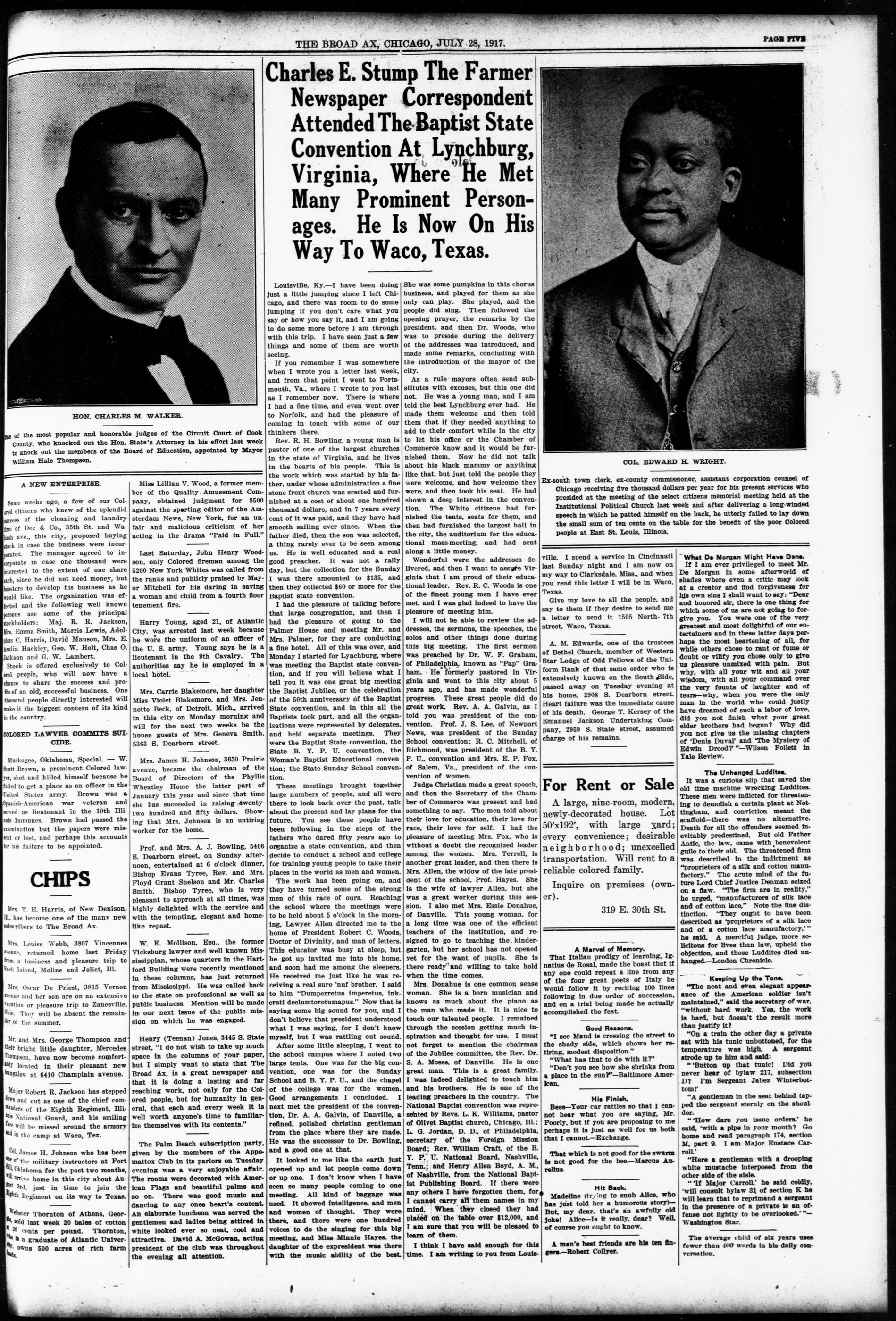
PEU 101
HON. CHARLES M. WALKER.
One of the most popular and honorable judges of the County, who knocked out the Hon. State's Attorney to knock out the members of the Board of Educati William Hale Thompson.
one of the most popular and honorable judges of the Circuit Court of Cook County, who knocked out the Hon. State's Attorney in his effort last week to knock out the members of the Board of Education, appointed by Mayor william Hale Thompson.
A NEW ENTERPRISE
Some weeks ago, a few of our Colleged citizens who knew of the splendid success of the cleaning and laundry firm of Dee & Co., 35th St. and Walash ave., this city, proposed buying stock in case the business were incorporated. The manager agreed to incorporate in case one thousand were interested to the extent of one share each, since he did not need money, but boosters to develop his business as he would like. The organization was effected and the following well known persons are some of the principal stockholders: Maj. R. R. Jackson, Mrs. Emma Smith, Morris Lewis, Adolphus C. Harris, David Manson, Mrs. E. Azalia Hackley, Geo. W. Holt, Chas O. Jackson and G. W. Lambert.
Stock is offered exclusively to Colored people, who will now have a chance to share the success and profits of an old; successful business. One thousand people directly interested will make it the biggest concern of its kind in the country.
COLORED LAWYER COMMITTS SUICIDE.
Muskogee, Oklahoma, Special. — W. Scott Brown, a prominent Colored lawyer, shot and killed himself because he failed to get a place as an officer in the United States army. Brown was a Spanish-American war veteran and served as lieutenant in the 10th Illinois Immunes. Brown had passed the examination but the papers were missent or lost, and perhaps this accounts for his failure to be appointed.
Mrs. T. E. Harris, of New Denison, III. has become one of the many new subscribers to The Broad Ax.
Mrs. Louise Webb, 3807 Vincennes avenue, returned home last Friday from a business and pleasure trip to Rock Island, Moline and Joliet, III.
Mrs. Oscar De Priest, 3815 Vernon avenue and her son are on an extensive vacation or pleasure trip to Zanesville, Ohio. They will be absent the remainder of the summer.
Mr. and Mrs. George Thompson and their bright little daughter, Mercedes Thompson, have now become comfortably located in their pleasant new bungalow at 6410 Champlain avenue.
Major Robert R. Jackson has stepped down and out as one of the chief commanders of the Eighth Regiment, Illinois National Guard, and his smiling face will be missed around the armory and in the camp at Waco, Tex.
Col. James H. Johnson who has been one of the military instructors at Fort Sill, Oklahoma for the past two months, will arrive home in this city about August 3rd, just in time to join the Eighth Regiment on its way to Texas.
Webster Thornton of Athens, Georgia, sold last week 20 bales of cotton at 26 cents per pound. Thornton, who is a graduate of Atlantic University, owns 500 acres of rich farm lands.
```markdown
```
CHIPS
Miss Lillian V. Wood, a former member of the Quality Amusement Company, obtained judgment for $500 against the sporting editor of the Amsterdam News, New York, for an unfair and malicious criticism of her acting in the drama "Paid in Full."
Last Saturday, John Henry Woodson, only Colored fireman among the 5200 New York Whites was called from the ranks and publicly praised by Mayor Mitchell for his daring in saving a woman and child from a fourth floor tenement fire.
Harry Young, aged 21, of Atlantic City, was arrested last week because he wore the uniform of an officer of the U. S. army. Young says he is a lieutenant in the 9th Cavalry. The authorities say he is employed in a local hotel.
Mrs. Carrie Blakemore, her daughter Miss Violet Blakemore, and Mrs. Jennette Beck, of Detroit, Mich., arrived in this city on Monday morning and will for the next two weeks be the house guests of Mrs. Geneva Smith, 5363 S. Dearborn street.
Mrs. James H. Johnson, 3650 Prairie avenue, became the chairman of the Board of Directors of the Phyllis Wheatley Home the latter part of January this year and since that time she has succeeded in raising twenty-two hundred and fifty dollars. Showing that Mrs. Johnson is an untiring worker for the home.
Prof. and Mrs. A. J. Bowling, 5406 S. Dearborn street, on Sunday afternoon, entertained at 6 o'clock dinner, Bishop Evans Tyree, Rev. and Mrs. Floyd Grant Snelson and Mr. Charles Smith. Bishop Tyree, who is very pleasant to approach at all times, was highly delighted with the service and with the tempting, elegant and home-like repast.
W. E. Mollison, Esq., the former Vicksburg lawyer and well known Mississippi, whose quarters in the Hartford Building were recently mentioned in these columns, has just returned from Mississippi. He was called back to the state on professional as well as public business. Mention will be made in our next issue of the public mission on which he was engaged.
Henry (Teenan) Jones, 3445 S. State street, "I do not wish to take up much space in the columns of your paper, but I simply want to state that The Broad Ax, is a great newspaper and that it is doing a lasting and far reaching work, not only for the Colored people, but for humanity in general, that each and every week it is well worth anyone's time to familiarize themselves with its contents."
The Palm Beach subscription party given by the members of the Appomattox Club in its parliars on Tuesday evening was a very enjoyable affair. The rooms were decorated with American Flags and beautiful palms and so on. There was good music and dancing to any one heart's content. An elaborate luncheon was served the gentlemen and ladies being attired in white looked ever so neat, cool and attractive. David A. McGowan, acting president of the club was throughout the evening all attention.
一
THE BROAD AX. CHICAGO, JULY 28, 1917
Charles E. Stump The Farmer Newspaper Correspondent Attended The Baptist State Convention At Lynchburg, Virginia, Where He Met Many Prominent Personages. He Is Now On His Way To Waco, Texas.
Louisville, Ky.-I have been doing just a little jumping since I left Chicago, and there was room to do some jumping if you don't care what you say or how you say it, and I am going to do some more before I am through with this trip. I have seen just a few things and some of them are worth seeing.
If you remember I was somewhere when I wrote you a letter last week, and from that point I went to Portsmouth, Va., where I wrote to you last as I remember now. There is where I had a fine time, and even went over to Norfolk, and had the pleasure of coming in touch with some of our thinkers there.
Rev. R. H. Bowling, a young man is pastor of one of the largest churches in the state of Virginia, and he lives in the hearts of his people. This is the work which was started by his father, under whose administration a fine stone front church was erected and furnished at a cost of about one hundred thousand dollars, and in 7 years every cent of it was paid, and they have had smooth sailing ever since. When the father died, then the son was selected, a thing rarely ever to be seen among us. He is well educated and a real good preacher. It was not a rally day, but the collection for the Sunday I was there amounted to $135, and then they collected $60 or more for the Bantist state convention.
I had the pleasure of talking before that large congregation, and then I had the pleasure of going to the Palmer House and meeting Mr. and Mrs. Palmer, for they are conducting a fine hotel. All of this was over, and Monday I started for Lynchburg, where was meeting the Baptist state convention, and if you will believe what I tell you it was one great big meeting the Baptist Jubilee, or the celebration of the 50th anniversary of the Baptist State convention, and in this all the Baptists took part, and all the organizations were represented by delegates, and held separate meetings. They were the Baptist State convention, the State B. Y. P. U. convention, the Woman's Baptist Educational convention; the State Sunday School convention
These meetings brought together large numbers of people, and all were there to look back over the past, talk about the present and lay plans for the future. You see these people have been following in the steps of the fathers who dared fifty years ago to organize a state convention, and then decide to conduct a school and college for training young people to take their places in the world as men and women.
The work has been going on, and they have turned some of the strong men of this race of ours. Reaching the school where the meetings were to be held about 5 o'clock in the morning, Lawyer Allen directed me to the home of President Robert C. Woods, Doctor of Divinity, and man of letters. This educator was busy at sleep, but he got up invited me into his home, and soon had me among the sleepers. He received me just like he was receiving a real sure 'nuf brother. I said to him "Dumperetrus imperetus, inkerati deelumotumapus." Now that is saying some big sound for you, and I don't believe that president understood what I was saying, for I don't know myself, but I was rattling out sound.
After some little sleeping, I went to the school campus where I noted two large tents. One was for the big convention, one was for the Sunday School and B. Y. P. U., and the chapel of the college was for the women. Good arrangements I concluded. I next met the president of the convention, Dr. A. A. Galvin, of Danville, a refined, polished christian gentleman from the place where they are made. He was the successor to Dr. Bowling, and a good one at that.
It looked to me like the earth just opened up and let people come down or up one. I don't know when I have seen so many people coming to one meeting. All kind of baggage was used. It showed intelligence, and men and women of thought. They were there, and there were one hundred voices to do the singing for this big meeting, and Miss Minnie Hayes. the daughter of the expresident was there with the music ability of the best.
#
She was some pumpkins in this chorus business, and played for them as she only can play. She played, and the people did sing. Then followed the opening prayer, the remarks by the president, and then Dr. Woods, who was to preside during the delivery of the addresses was introduced, and made some remarks, concluding with the introduction of the mayor of the city.
As a rule mayors often send substitutes with excuses, but this one did not. He was a young man, and I am told the best Lynchburg ever had. He made them welcome and then told them that if they needed anything to add to their comfort while in the city to let his office or the Chamber of Commerce know and it would be furnished them. Now he did not talk about his black mammy or anything like that, but just told the people they were welcome, and how welcome they were, and then took his seat. He had shown a deep interest in the convention. The White citizens had furnished the tents, seats for them, and then had furnished the largest hall in the city, the auditorium for the educational mass-meeting, and had sent along a little money.
Wonderful were the addresses delivered, and then I want to assure Virginia that I am proud of their educational leader. Rev. R. C. Woods is one of the finest young men I have ever met, and I was glad indeed to have the pleasure of meeting him.
I will not be able to review the addresses, the sermons, the speeches, the solos and other things done during this big meeting. The first sermon was preached by Dr. W. F. Graham, of Philadelphia, known as "Pap" Graham. He formerly pastored in Virginia and went to this city about 5 years ago, and has made wonderful progress. These great people did do great work. Rev. A. A. Galvin, as I told you was president of the convention. Prof. J. S. Lee, of Newport News, was president of the Sunday School convention; R. C. Mitchell, of Richmond, was president of the B. Y. P. U., convention and Mrs. E. P. Fox of Salem, Va., president of the convention of women.
Judge Christian made a great speech, and then the Secretary of the Chamber of Commerce was present and had something to say. The men told about their love for education, their love for race, their love for self. I had the pleasure of meeting Mrs. Fox, who is without a doubt the recognized leader among the women. Mrs. Terrell, is another great leader, and then there is Mrs. Allen, the widow of the late president of the school, Prof. Hayes. She is the wife of lawyer Allen, but she was a great worker during this session. I also met Mrs. Essie Donahue, of Danville. This young woman, for a long time was one of the efficient teachers of the institution, and resigned to go to teaching the kindergarten, but her school has not opened yet for the want of pupils. She is there ready and willing to take hold when the time comes.
Mrs. Donahue is one common sense woman. She is a born musician and knows as much about the piano as the man who made it. It is nice to touch our talented people. I remained through the session getting much inspiration and thought for use. I must not forget to mention the chairman of the Jubilee committee, the Rev. Dr. S. A. Moses, of Danville. He is one great man. This is a great family. I was indeed delighted to touch him and his brothers. He is one of the leading preachers in the country. The National Baptist convention was represented by Revs. L. K. Williams, pastor of Olivet Baptist church, Chicago, Ill.; L. G. Jordan, D. D., of Philadelphia, secretary of' the Foreign Mission Board; Rev. William Craft, of the B. Y. P. U. National Board, Nashville, Tenn.; and Henry Allen Boyd, A. M., of Nashville, from the National Baptist Publishing Board. If there were any others I have forgotten them, for I cannot carry all them names in my mind. When they closed they had placed on the table over $12,000, and I am sure that you will be pleased to learn of them.
I think I have said enough for this time. I am writing to you from Louis-
[Portrait of a man in formal attire, wearing a suit and tie, with a serious expression. The background is plain and dark, emphasizing the subject.]
COL. EDWARD H. WRIGHT.
Ex-south town clerk, ex-county commissioner, assistant Chicago receiving five thousand dollars per year for presided at the meeting of the select citizens mem Institutional Political Church last week and after speech in which he patted himself on the back, he the small sum of ten cents on the table for the be people at East St. Louis, Illinois.
Ex-south town clerk, ex-county commissioner, assistant corporation counsel of Chicago receiving five thousand dollars per year for his present services who presided at the meeting of the select citizens memorial meeting held at the Institutional Political Church last week and after delivering a long-winded speech in which he patted himself on the back, he utterly failed to lay down the small sum of ten cents on the table for the benefit of the poor Colored people at East St. Louis, Illinois.
ville. I spend a service in Cincinnati last Sunday night and I am now on my way to Clarksdale, Miss., and when you read this letter I will be in Waco, Texas.
Give my love to all the people, and say to them if they desire to send me a letter to send it 1505 North-7th street, Waco, Texas.
A. M. Edwards, one of the trustees of Bethel Church, member of Western Star Lodge of Odd Fellows of the Uniform Rank of that same order who is extensively known on the South Side, passed away on Tuesday evening at his home, 2908 S. Dearborn street. Heart failure was the immediate cause of his death. George T. Kersey of the Emanuel Jackson Undertaking Company, 2959 S. State street, assumed charge of his remains.
For Rent or Sale
A large, nine-room, modern, newly-decorated house. Lot 50'x192', with large yard; every convenience; desirable neighborhood; unexcelled transportation. Will rent to a reliable colored family.
Inquire on premises (owner).
319 E. 30th St.
A Marvel of Memory.
That Italian prodigy of learning, Ignatius de Rosal, made the boast that if any one could repeat a line from any of the four great poets of Italy he would follow it by reciting 100 lines following in due order of succession, and on a trial being made he actually accomplished the feat.
"I see Maud is crossing the street to the shady side, which shows her retiring, modest disposition."
"What has that to do with it?"
"Don't you see how she shrinks from a place in the sun?"—Baltimore American.
Bess—Your car rattles so that I cannot hear what you are saying, Mr. Poorly, but if you are proposing to me perhaps it is just as well for us both that I cannot—Exchange.
That which is not good for the swarm is not good for the bee.—Marcus Aurellus.
Madeline (trying to snub Alice, who has just told her a humorous story)—But, my dear, that's an awfully old joke! Alice—Is it really, dear? Well, of course you ought to know.
A man's best friends are his ten fingers.—Robert Collyer.
Good Reasons.
His Finish.
Hit Back.
[Image of a man in a suit with a tie and a serious expression].
Sioner, assistant corporation counsel of
tars per year for his present services who
at citizens memorial meeting held at the
week and after delivering a long-winded
at the back, he utterly failed to lay down
table for the benefit of the poor Colored
What De Morgan Might Have Done. If I am ever privileged to meet Mr. De Morgan in some afterworld of shades where even a critic may look at a creator and find forgiveness for his own sins I shall want to say: "Dear and honored sir, there is one thing for which some of us are not going to forgive you. You were one of the very greatest and most delightful of our entertainers and in these latter days perhaps the most heartening of all, for while others chose to rant or fume or doubt or vilify you chose only to give us pleasure unmixed with pain. But why, with all your wit and all your wisdom, with all your command over the very founts of laughter and of tears—why, when you were the only man in the world who could justly have dreamed of such a labor of love, did you not finish what your great elder brothers had begun? Why did you not give us the missing chapters of 'Denis Duval' and 'The Mystery of Edwin Drood?'—Wilson Follett in Yale Review.
The Unhanged Luddites.
It was a curious slip that saved the old time machine wrecking Luddites. These men were indicted for threatening to demolish a certain plant at Nottingham, and conviction meant the scaffold—there was no alternative. Death for all the offenders seemed inevitably predestined. But old Father Antic, the law, came with benevolent guile to their aid. The threatened firm was described in the indictment as "proprietors of a silk and cotton manufactory." The acute mind of the future Lord Chief Justice Denman seized on a flaw. "The firm are in reality," he urged, "manufacturers of silk lace and of cotton lace." Note the fine distinction. "They ought to have been described as 'proprietors of a silk lace and of a cotton lace manufactory,'" he said. A merciful judge, more solicitous for lives than law, upheld the objection, and those Luddites died unhanged—London Chronicle.
Keeping Up the Tone.
"The neat and even elegant appearance of the American soldier isn't maintained," said the secretary of war, "without hard work. Yes, the work is hard, but doesn't the result more than justify it?
"On a train the other day a private sat with his tunic unbuttoned, for the temperature was high. A sergeant strode up to him and said:
"Button up that tunic! Did you never hear of bylaw 217, subsection D? I'm Sergeant Jabez Winterbottom!
"A gentleman in the seat behind tapped the sergeant sternly on the shoulder.
"How dare you issue orders," he said, "with a pipe in your mouth? Go home and read paragraph 174, section M, part 9. I am Major Eustace Carroll."
"Here a gentleman with a drooping white mustache interposed from the other side of the aisle.
"If Major Carroll,' he said coldly, 'will consult bylaw 31 of section K he will learn that to reprimand a sergeant in the presence of a private is an offense not lightly to be overlooked.'"—Washington Star.
The average child of six years uses fewer than 400 words in his daily conversation.
PAGE FIVE
BARN OLA
THE BROADAX
Published Weekly
In this city since July 15th, 1890,
without missing one single issue, Rep-
publicans, Democrats, Catholics, Pro-
testants, single Taxers, Priests, in-
fidels or anyone else can have their say
as long as their language is proper and
responsibility is fixed.
The Broad Ax is a newspaper whose
platform is broad enough for all, ever
claiming the editorial right to speak its
own mind.
Local communications will receive
attention. Write only on one side of
the paper.
Subscriptions must be paid in ad-
vance.
One Year.....$2.00
Six Months.....1.00
Advertising rates made known on application.
Address all communications to
THE BROAD AX
6418 Champlain Ave., Chicago, Ill.
PHONE WENTWORTH 2507.
JULIUS P. TAYLOR, Editor and Publisher.
Entered as Second-Class Matter Aug
19, 1902, at the Post Office at Chicago,
Illinois, under Act of March 3, 1879.
Fur Bearing Animals.
The fur trade in this country has grown to such proportions as regards its business value that naturally the concern of those engaged in it is directed to its permanency. Curiously enough, the prevalent opinion that fur bearing animals are fast decreasing in numbers is not correct as regards those animals which furnish the bulk of the fur business.
There are a number of fur bearing animals which cannot exist in civilized and thickly settled countries and which consequently are fast dying out. But muskrats, coons, skunks and some others seem to thrive and multiply in spite of civilization, for such old and thickly settled states as New York, Pennsylvania and Ohio still contribute largely to the fur trade, especially in muskrat skins. Should the time come when these animals cannot be had plentifully in their wild state it is not unlikely that they will be bred especially for their furs—New York Times.
Wit of Joseph Choate
Joseph Choate had a decidedly nasal voice, but it was a beautiful voice, resonant as some big gong, and his rather unkind wit was as genuine as his courage. Every now and then his wit was touched with beauty, as when he said of the freshmen dormitories at Harvard that all they needed to make them rivals of the Oxford college buildings was ivy and time. Mr. Choate took a playful satisfaction in suddenly chilling auditors whom he had carefully warmed. Speaking once at a boys' school, three of whose graduates had acted as his secretaries when he was ambassador, he delighted his audience by his praise of these secretaries. After enjoying the pleasure of masters and boys Mr. Choate wound up by saying something like this, "Perhaps I ought to add that all I ask of a secretary is that he shall keep out of my way and shave every day."—New Republic.
Surmounting the Impossible.
It has been the experience of every forester as he goes about the country to be told that a certain mountain is impassable, that a certain trail cannot be traveled, that a certain stream cannot be crossed and to find that mountain, trail and stream can all be passed with little serious difficulty by a man who is willing to try. Most things said to be impossible are so only in the mind of the man whose timidity or inertness keeps him from making the attempt. The whole story of the establishment and growth of the United States forest service is a story of the doing of things which the men who did them were warned in advance would be impossible. Usually the thing which "cannot be done" is well worth trying.-Gifford Pinchot.
Eccentric Place Names
There are one or two place names in England which for eccentricity it would be hard to beat. Cornwall boasts of a village called Drunkards All and of a tithing called London Apprentice. The name of another Cornish village, Grumzia, sounds worse when spoken than it looks in print. The same may be said of the neighboring village of St. Eval, which is pronounced "Sandeval." Bishop Philpotts asked a candidate for ordination where he came from. "St. Eval." was the reply. "Dear me," remarked the bishop, "I know that Cornishmen venerate St. Tudy, St. Cuby, St. Uny and other salts unknown to the calendar, but I was not aware they had canonized the devil!" -London Mirror.
A Generous Empress
It is said that one morning at breakfast a general related to Napoleon III, the misfortunes of a bro, her officer, who, "because he had not 15,000 francs, must be dishonored." While the emperor questioned further particulars Eugene flew to her room and, returning with a package of banknotes, said, "Take them, general, and never tell me his name." And his name the generous empress never knew.
He Lacked Concentration.
Speaking of a man who was a failure because of his lack of concentration and his inability to know his own mind five minutes at a time, a captain of industry said he reminded him of a hunting dog he once owned:
"At sunrise the dog would start out on his own hook after deer. He would jump a buck and run him for miles. When the buck was on the point of exhaustion the hound's nostril would catch the taint in the air where a fox had crossed the trail, and he would instantly decide that, after all, fox was what he had come for, and he would turn aside to pursue the fox. Perhaps an hour later, when the chase was growing warmer every minute, his keen nose would detect the presence of a rabbit, and he would go after the cottontail, with the inevitable result that by 4 o'clock in the afternoon that hound would be thirty or forty miles away from home in a swamp with a chipmunk treed!"—Saturday Evening Post.
George and His Legs.
Bit by bit the historical grubbers are digging out the truth about our immortal George. We have heretofore been told that he wore false teeth and that at Valley Forge he unblushingly deceived his ragged and despondent troops with the arrival of ample supplies of ammunition, which consisted of powder barrels filled with sand, and now a correspondent of the New York Sun declares that in the full length portraits of Washington by Stuart, of which there is one in the New York public library, the legs were not his own. "I have seen the letter from Stuart thanking the true owner for his kindness in providing a symmetrical foundation for the bust of the great president and presenting one of the smaller portraits in thanks for his kindness."
Free Speech.
An old negro woman had lived with a certain family in the south for many years. One day her mistress had occasion to reprimand her quite sharply for something that had gone wrong. The negress said nothing at the time, but a little later her voice could be heard in the kitchen in shrill vituperation of everything and everybody, with a rattling accompaniment of pans and kettles. So loud became the clamor and so vindictive the exclamations that Mrs. C. went hurriedly down to the kitchen.
"Why, Liza," she began in amazement, "who on earth are you talking to?
"I ain't talkin' to nobody," the old negress replied, "but I don't keer who in dis house hyars me."—Harper's Magazine.
Misprints and Maxim Guns
The late Sir Hiram Maxim says in his autobiography that when he organized the United States Electric Lighting company the printer sent home its stationery with the heading, "The United States Electric Lighting company." When he established his new gun company in England he told of this mistake in order to emphasize the importance of getting the stationery printed correctly. When the first sheets were brought to him, however, he found that the English printers had made his concern appear as "The Maxim Gum company."
Easy Generosity.
Mother (to small son)—Bobby, dear,
I hoped you would be unselfish enough
to give little sister the largest piece of
candy. Why, see, even our old hen
gives all the nice big dainties to the
little chicks and only keeps an occasional thy one for herself.
Bobby thoughtfully watched the hen and chickens for a time and then sald,
"Well, mamma, I would, too, if it was worma."—Rochester Times.
A. Generation.
In the long lived patrilarchal age a generation seems to have been computed at 100 years (Genesis xv, 1). Subsequently the reckoning was the same that has been more recently adopted—that is, from thirty to forty years (Job xlii, 16).
Incongruous.
Little Allck-What is an incongruity, uncle? Uncle William-An incongruity, child, is a divorce lawyer humming a wedding march.
The rapid growth of vegetation in the polar regions is attributed to the electric currents in the atmosphere.
PRACTICAL HEALTH HINT.
Neuralgia.
Neuralgia means nerve pain. Neuritis means inflammation of the nerve. In neuralgia the pain comes and goes. In neuritis the ache is steady and sticks closely to the affected nerve. If the nerve could be taken out and examined we could find nothing abnormal in the case of neuralgia. In neuritis the nerve would be found to be infamed. The question of what is behind the pain of neuralgia is more important than the answer to the cry for relief. It must be remembered that neuralgia is merely a symptom, not a disease. Sometimes malaria is the underlying cause. Other times it may be due to alcoholism, diabetes, lead poisoning, gout, rheumatism or Bright's disease. A diseased tooth or a diseased ovary may be responsible. In every case treatment must include treatment of the underlying cause.
```markdown
```
THE BROAD AX. CHICAGO. JULY 28. 1917.
Spanish Doubloons.
Should one find a pirate's buried treasure he would have to dispose of his Spanish gold at its bullion value, for since Aug. 1, 1908, when the common crier made proclamation from the steps of the Royal Exchange of London that after that date the doubloon would cease to be legal tender in the West Indies, including British Guiana, the doubloon has not been the precious thing it was. In 1730 and for a century after it was worth $ more or less. It has ceased to be coined in its native country, Spain, and since 1908 it has been unpopular in the West Indies, where for a long time it figured in a mixed circulation, embracing British, United States and Spanish coins. In the interest of romance, however, the name at least must survive. It signifies nothing more than that the coin was double the value of a pistole, but the "doubloon" was never such a mouth filling mockery as "pieces of eight," which suggests great riches, but means only Spanish silver dollars, pieces equivalent to eight reals.—Rochester Post-Express.
A Famous New York Street.
Few of the thousands of people who pass the corner of Nassau and John streets every day know the early history of Nassau street. And yet right at that corner is a bronze tablet which gives in concise form the following historical information:
"Nassau Street, Known Originally as the 'Street That Runs by the Pye Woman,' Was Lald Out About 1095 and Was Named In Honor of the House of Nassau, Whose Head at That Time Was William the Third, King of England and Stadholder of the Dutch Republic. Nassau Street Became Identified With the Jewelry Trade More Than Half a Century Ago."
The bronze tablet is on the exterior of the building at the northwest corner of Nassau and John streets. It was erected by the Malden Lane Historical society in 1916—New York Sun.
William De Morgan.
In spite of himself William De Morgan became famous. He deliberately violated all the rules made for the guidance of novelists who seek to become popular. None of his novels was addressed to the greater public that is avid for the latest thing of the moment in fiction, but nevertheless they reached that public. He was a law unto himself in the novels that he wrote during his marvelous career that spanned only ten years. It is doubtful if in English literature or in any other can be found a writer whose life and literary career are comparable to his. He was an old man when the world of readers came to know him, and his age was an asset toward celebrity. At seventy he was hailed as eagerly as Klipling was hailed at twenty, and in his way he was no less a prodigy than the younger writer.—Bookman.
The Emerald.
The emerald has been known since early times both in Europe and in certain parts of the orient, where its attractive color and rarity have endowed it with the highest rank and a varied lore. Its name may be traced back to an old Persian word which appeared in Greek as "smaragdos," mentioned by Theophrastus over 300 years before the Christian era, and again in Latin as "smaragdus," seen in the writings of Pliny, who particularized somewhat on its properties and supposed medicinal virtues and was even shrewd enough to suspect its identity with the much more common beryl, although eighteen centuries elapsed before this suspicion was verified by scientific proof.
His Hard Luck
A small boy whose record for department at school had always stood at 100 came home one day recently with his standing reduced to 08.
"What have you been doing, my son?" asked his doting mother.
"Been doing?" replied the young hopeful. "Been doing just as I have been doing all along, only the teacher caught me this time." — Philadelphia Inquirer.
Where Is the Profit?
"I understand they sold their house for $3,000 more than they paid for it." "How lucky!" "Lucky nothing! After they'd sold it they discovered that they've got to pay $2,000 more than they received for their house for another home to live in."-Detroit Free Press
Books In Brazil.
In Brazil, as throughout South America, French is almost universally read. Editions of the classics are found in most homes, and bookstores are filled with modern French writers of prose or verse, sometimes in translation and as frequently in the original.
Went Further.
"Didn't I tell you that when you met a man in hard luck you ought to greet him with a smile?" said the wise and good counselor.
"Yes," replied the flinty souled person. "I went even further than that. I gave him the grand laugh."
Best Way of Taking Iron:
When anemic persons have to take iron the best form in which to administer it is spinach, cabbage, green chicory, asparagus, lentils, carrots and peas, all of which contain much iron.
About the Same Thing
Scribbler—Can you suggest a simile for giving advice? Scrawler—How would pouring water on a duck's back do?—Philadelphia Record.
Let us teach people as much as we can to enjoy, and they will learn for themselves to sympathise.—Stevenson.
WOMEN OF THE SENATE WILL AID THE RED CROSS
Will Meet Weekly at Apartment of Mrs. Thomap R. Marshall.
Washington.—Mrs. Thomas R. Marshall, wife of the vice president, and a number of senatorial matrons have established a new social organization, to be known as the Ladies of the Senate, to meet weekly at the apartment of Mrs. Marshall, who has been elected president. Membership is limited strictly to women of the senatorial circles, with only one member of each household to be included in the society. In this it will differ from the Congressional club, after which it is patterned, as in that body wife, daughter or sister of a cabinet officer, judge or congressman may join on payment of modest annual dues and an initiation fee.
The new organization is to be both patriotic and social, with dues sufficient to make it an important factor in Red Cross or other relief work, to which it will devote much time. In addition to Mrs. Marshall the officers are Mrs. Albert Cummins of Iowa, Mrs. Francis Newlands of Nevada, Mrs. John W. Weeks of Massachusetts, Mrs. James Reed of Missouri, Mrs. Thomas P. Gore of Oklahoma and Mrs. Claude Swanson of Virginia.
The women will meet with members of the Congressional club every Monday to continue the Red Cross work already begun under the older organization.
AVIATION SERVICE NOT THE MOST DANGEROUS
Records of Allies Show It Is Fourth In the Percentage of Casualties
Washington. - Contrary to popular opinion, the air service of the army, although perhaps the most thrilling branch, is not the most dangerous. Captain Aubrey Lippincott, in charge of the personnel of the signal corps of the army, says the records of our allies put air service fourth in the percentage of losses. The heaviest losses have been in the medical corps, next in infantry and third in artillery.
Although applications have been numerous for enrollment in the six cadet schools for flyers recently opened, Captain Lippincott says many more men will be needed before the end of the year. One hundred and fifty men are trained weekly. Enough men have been accepted to keep the schools supplied with recruits for more than two months, but several thousand will be required later on, as the supply of men must be constantly augmented.
Only a small percentage of the men who apply for enrollment in cadet aviation schools at the universities of California, Texas, Illinois and Ohio, Massachusetts Institute of Technology and Cornell can be accepted. The requirements are stricter than in any other branch of the service. The impression that only college graduates are admitted is incorrect, but a substantial foundation for intensive technical training is necessary. It has often been found that three years at college or its equivalent gives a man the knowledge which makes the training come with reasonable rapidity.
SAT ON CHURCH CORNICE.
Woman Keeps Crowd on Edge For Two Hours by Threatening to Jump.
Boston.—A crowd of several hundred people watched for two hours from behind ropes that barred the street in front of St. James' Roman Catholic church while a woman sat on the cornice threatening to jump. Firemen spread nets to break her fall, police reserves attempted to reach her, and three priests pleaded with her from the skylight.
Finally the Rev. Philip J. O'Donnell reached her before she fulfilled her threat and escorted her back through the skylight.
At the Psychopathic hospital she gave her name as Mrs. Cella Vennard, a parishioner of St. James' church, and said relatives were trying to commit her to an insane asylum. She would rather kill herself than submit, she said.
CHINA GETS TWO HOSPITALS
Rockefeller Foundation Will Spend $3,000,000 There.
Baltimore.—B. Frank Bennett, a builder, will leave here for China, where he has been commissioned by the Rockefeller foundation to build two hospitals at a cost of $3,000,000. The first hospital will be constructed in Peking and is to be modeled after Johns Hopkins hospital. The plans were drawn after suggestions of Dr. Winford H. Smith, superintendent of Johns Hopkins. The other hospital will be built in Shanghai.
It is said the project of the two American hospitals is the outcome of a tour of investigation made last year by Dr. William H. Welch for the Rockefeller foundation.
Dog Hero Home From War
Port Washington, N. Y.—Wounded in action, Jupiter, Hubert Ralston's war dog, returned here from France after "doing his bit" to spend his declining years in comfort. A bit of shrapnel gouged out one eye and another caved in his chest. Jupiter trained with his regiment at Salisbury Plain in the first year of the war.
RECLUSE HAD FORTUNE
Gold Coin and Certificates of Deposit Found After His Death.
Pendleton, Ore.—In an investigation of the death of Johnson W. Willard, an aged recluse of the farming district southeast of Milton, Coroner Brown discovered gold coin and certificates of deposit amounting to more than $18,000. They were tucked away in every conceivable place. An old vest hanging in a closet yielded several hundred dollars in gold.
Three or four purses were found packed with coin. In addition to this, Mr. Willard owned the ranch where he lived, valued at $50,000. One daughter, Mrs. Hill, survives. Her home is in Montana.
Mr. Willard lived entirely to himself since the death of his wife three years ago, and the room she used to occupy had been locked. It was there, in the bottom of a trunk, that several of the certificates of deposit were found. During the past few years Mr. Willard leased his ranch, retaining only the house and a bit of ground, where he raised a small garden. He settled on a homestead in 1869, just after the war, and in the typhoid epidemic of 1878 lost all his children but the one daughter. Mr. Willard was eighty-six.
CARNEGIE IN NEW MANSION.
Estate at Lenox Said to Be Equaled Only by Biltmore.
Lenox, Mass.-Into Shadow Brook entered its new owner, Andrew Carnegie. It is said that for size, elegance and beauty of natural surroundings no private residence in the United States, with the exception of Mrs. Vanderbilt's Biltmore, bears comparison with Shadow Brook.
With Mrs. Carnegie and Miss Margaret Carnegie he arrived at Lenox in Charles M. Schwab's private car. With the party were Mr. Carnegie's physician, his valet and other attendants. He was assisted from the car to an automobile and was driven immediately to Shadow Brook, three miles from the station.
His apartments are on the second floor of the great house and have a beautiful outlook on Lake Mahkeenac. The house was elaborately decorated in spring flowers from the gardens of the estate. Mrs. Carnegie and Miss Carnegie have rooms on the same floor. There are twenty large rooms with fireplaces on this floor and many other rooms. Mr. Carnegie expects to pass seven months at his new American home.
WILSON ON JOB EARLY.
President Adopta Early Rising Permanently to Keep In Touch With War. Washington.-While a majority of the 50,000 government clerks were still asleep the president was working in his office early. He reached his desk at 6 o'clock, and it became known he is determined to adopt this hour as the daily beginning of his work. Government clerks go to work at 9 o'clock and finish at 4:30. The president frequently is in his office at night. The president's determination to get up early is not prompted wholly by a desire to avoid the hot hours of the day. The fact is that he is keeping in the closest touch with the details of the war making activities of the administration, and longer working hours are necessary if he is to have time for the recreation prescribed by Rear Admiral Cary T. Grayson, his physician.
SEES ALL AMERICAS IN WAR.
John Barrett Predicts Western Hemisphere Will Be United.
Baltimore—Within a year all Americas will be fighting together against Germany was the prediction made here before a liberty loan mass meeting by John Barrett.
"If Brazil enters the conflict, as today seems imminent," he said, "two-thirds of the entire population and five-eighths of the total area of the western hemisphere will be at war with the common enemy. Can the remaining one-third of the population and three-eighths of area stand against the psychological, sympathetic and economic appeal of their sister peoples and countries having similar interests, similar institutions, similar governments and similar destiny?"
LIONS KILL BURROS.
Hoofs No Match For Pointed Teeth and Sharp Claws.
Mentone, Cal. — Hunger has driven mountain lions and wildcats closer to the settlements than in many years, say old timers. One night recently two big lions made their appearance at the Edison power house at the mouth of Mill Creek canyon and killed two burros kept in a corral there.
One burro was killed outright by the lions. The other burro fought and attracted the men at the plant, but it was so badly torn by teeth and claws of the lions that it had to be shot.
The tracks showed the mountain lions to be of great size, and the men kept a close watch in the hope that hunger would drive them out again.
Calf Grazes With Wooden Lag.
Kansas City, Mo.—Probably the only Missouri calf with a wooden leg is browsing on the farm of W. D. Brown in Ray county. The calf belonged to a neighbor and last winter stuck a nail in its hoof, sustaining injuries promising to be fatal. Craig Brown saw the calf and had an idea. He bought the animal and sent for a veterinary, who amputated the calf's leg. Later a wooden leg was substituted, and the calf is now only a little slower than the other cattle in the pasture.
PREACHERS ON FARMS
An Organization Proposes That They Work In Rush Season.
Topeka, Kan.-If the plan adopted by the Clay county Ministers' union is put into action in the counties throughout the state of Kansas it will put 8,000 skilled laborers into the fields during the rush season. The plan outlined in Clay county is set out in a letter to Governor Capper by the Rev. J. Ashton Davies of Clay Center. Mr. Davies says:
"During the month of July and August the ministers are to work on farms, going out to that work Monday mornings and returning Saturday evenings, just as our boys are doing at the officers' camp at Fort Riley.
"We may arrange to leave one minister in town, a different one each week, who shall devote his time to the interest of all the churches. The churches will, of course, continue to pay the ministers' salaries, and the wage received from the farmers will be turned over to the benevolent boards of the churches or to the Red Cross society. "If this plan could be adopted through out the state it would send 8,000 skilled laborers into the fields."
MAKE BEARS FEEL AT HOME
Reproduction of Cliffs and Bowlers in City Park Pits.
Denver.—Not satisfied with having mountain scenery within a few miles of the city, Denver has sent out into the Rockies and brought it into the city limits by the cartload.
The scenery is not paintings or photographs, but actual reproductions of rugged cliffs and majestic bowlers selected for bear pits at City park.
Agents of the city spread a gelatinous material over the most striking cliffs during the day and removed it in the cool of the morning, thus retaining an accurate impression. This was converted into plaster of paris casts, in which form the reproductions have been brought to Denver. The molds will be constructed in concrete and shot, with cement guns, in colors and tints to simulate the original rocks from which they were taken.
FARMERS CAN INSURE CROPS
Massachusetts Plan Guarantees 10 Per Cent Profit.
Worcester, Mass.—The first general farm crop insurance ever afforded the farmers of the United States was put into effect by the Worcester county farm bureau. Farmers who take out policies will be assured of a clean profit of 10 per cent over and above the cost of production on all of their 1917 crop which exceeds in volume the crop of 1916.
Business men have subscribed a fund of $100,000 to guarantee the insurance. The farmer must maintain certain standards. The insurance applies to all winter staples. The crop must be marketed in Worcester county.
SHAVING FUND BUYS BOND
Travelers' Joke Sixteen Years Ago Results in Saving $3,000.
Waterloo, Ia.-At the grand council of the Iowa United Commercial Travelers sixteen years ago, F. W. Houch of Sheldon lost his wallet. His friend as a practical joke, instructed all the banks not to cash a draft for him. He was in need of a shave.
A fund was raised for this purpose, but meanwhile Houck succeeded in cashing his draft. The fund was turned into the treasury and maintained by annual contributions of a penny from each member. It now has passed the $3,000 mark. The council voted to invest the fund in the liberty loan.
DOG CATCHES DESERTER.
Holds Man by Trouser's Leg Until Officers Arrive.
Leavenworth, Kan.—James Thompson, special officer here, owns a police dog whose abilities as an apprehender of criminals frequently has been scuffed at by Thompson's friends. The dog has vindicated himself.
William Payne, a deserter last summer from the Missouri national guard while stationed on the Mexican border, had escaped from the disciplinary barracks at the army post here.
The dog captured the fleeing trusty, holding to the man's trousers leg and impeding his flight until officers subdued him.
LYNN JUDGE FINES MAYOR
School Board Also Punished For Vi-
lating Labor Law.
Lynn, Mass.—Mayor George H. New-
hall, Dr. Nathaniel P. Breed, Elmer E.
Boyer, Mial W. Chase and S. Waltes
McDonough, members of the Lynn
school board, were fined $5 each by
Judge Henry T. Lummus. The mem-
bers were charged with a violation of
the eight hour law in allowing janitors
of schoolhouses to work more than
that time daily.
Assistant City Sollicitor Jacobs ap-
pealed in their behalf, and they were
held in their own recognition by Judge
O'Brien for the superior court.
Many Blossoms on Twig.
many blossoms of Topeka, Kan.—If all the twigs on an apple tree on the farm of George H. Krelder, near Lydon, had as many blossoms as one twig had, and, if any blossom became an apple, the tree would have supplied an apple a day for several thousand persons. The "freek twig" has put forth half a dozen blossoms instead of the customary one Krelder declares it a "freek of nature" and states that in all his experience as a fruit raiser he never before saw so many blossoms on a twig.
About the Welsh.
Wales has plenty of coal, slate, greener and consonants, but very few surnames. If a Welsh schoolmaster should say, "Jones, you may go home now for being a good boy," the whole school would quit.
People who are not called Jones are called Williams, or Evans, or Hughes, or Lloyd. They divide these names between them and make the best of it. They do not follow the English method of taking their surnames from towns and villages. They felt that to do so would cut them off from the rest of mankind. Nobody could possibly call on Mrs. Llanymynech. Dislocation of the jaw is a great drawback to oral intercourse.
The Welshman has the Celtic imagination, says London Answers. He never calls a spade a spade. When he has done describing this implement of agriculture the stolid Englishman thinks he has been listening to a story from the "Arabian Nights;" hence the Englishman says the Welshman is an "untruth." He isn't really. It's only a difference of method.
Knots In Boards
We find knots in the boards which we notice in a lumber pile or in any other place where boards happen to be because the smaller limbs which grow away from the larger limbs of trees grow from the inside as well as the outside of the tree.
When you see a knot in a board it means that before the tree was cut down and the log sawed up into boards a limb was growing out from the inside of the tree at the spot where the knot occurs, says the Book of Wonders.
You will also find that the wood in the knot is harder generally than the rest of the board. This is because more strength is required at the base of a limb and in the part of the limb which grew inside the tree than in other parts, for the limb must be strong enough to support not only the limb itself, but also the smaller limbs which grow out of it.
The Winner.
The difficulties of crossing Broadway at Forty-second street can be exaggerated. The fent is usually accomplished by born New Yorkers without loss of more than one limb. But to the visitor from Boeotia or some other suburb it presents itself as as a difficulty which, once overcome, is to be looked back at with horror and remembered with gratitude for a providential escape. One such visitor had just crossed Broadway. He wore long white whiskers and a black hat such as may be seen on senators from Mississippi. He was on the safe side of Broadway. He puffed agitatedly as he turned to survey the maelstrom of traffic he had passed through. "Every time I cross Broadway," he said, "I feel as if I had won a bet."—New York Post.
Salt.
Superstitions concerning salt are among the earliest known to maukind. There is much evidence in holy writ about the ceremonial uses of it, and the old Mosaic law commands that every sacrifice of a meat offering shall be seasoned with it. Homer calls it divine, and many of the old Teuton races looked on salt springs as holy and worshiped at them. The origin of this superstition seems to be that since salt cannot corrupt it should be regarded as a symbol of immortality.
Keeping a Secret
Little Marion, in a state of much agitation, begged her mother not to let remarks be made about her doll when it was present, "Because," explained the little miss, "I've been trying all her life to keep dollie from knowing that she is not alive."—Harper's Magazine.
Second Sight.
"Do you believe in second sight?" "No, but my wife does. When I go shopping with her she always says to the salesman, 'I'll come in and look at these again.'"—London Telegraph.
Women Workers
It was in the manufacture of textiles that woman first appeared in industry outside of the home.
PRACTICAL HEALTH HINT.
For the Anaemic
- Never go to work nor stay at work with an empty stomach.
- The anaemic woman particularly should avoid parsimony in nutrition.
- Correct a sluggish digestion, and appetite will grow more brisk with increased assimilation.
Take chest expanding exercises daily. A simple one is to walk slowly through an ordinary doorway, pressing the advanced hands to the inner surface of the door frame with some force and holding them there as the chest expands and fills with air until you have passed the threshold. This exercise, taken in a well ventilated room and combined with deep breathing, will force the residual air from the pulmonary tissue and suck in oxygen to the most remote and starving air cell. The exercise also develops the bust in women and the muscular tissue of shoulders and upper arm in both men and women. Anaemia spells impaired efficiency, impaired resistance to disease and impaired zest in living.
---
A Duel In Balloons.
It was in 1808 that Mile. Trevit graced the footlights of the Imperial Opera at Paris. She attracted many men, especially one M. de Grandpère and another, M. le Pique. They became jealous of each other and decided that a duel was the only way out of their predicament. It was to be a duel without hatred, and so they postponed the great event for one month.
Meanwhile they came to the conclusion that an ordinary duel wouldn't do at all and hit upon the idea of fighting in the air. So they ordered two balloons constructed exactly alike and on the night of June 22 settled their affairs in anticipation of the great event upon the morrow. At the appointed hour each man entered his balloon armed with a blunderbuss, and at a signal the ropes were cut, and up they went. They were to fire at the balloons, not at each other. At a height of half a mile in the air M. de Grandpre sent a ball through M. le Plque's balloon, and the latter was dashed to pieces. The other landed safely several hours later.
Bad For the Burglar
It would be a sad gang of robbers who tried to break into the railway car invented by George W. Meyers of the United States army. They would be greeted with clouds of poisonous gas fumes. Meyers' robber proof car works with extreme simplicity. Two tanks, in which fumes of cyanide of potassium are stored under pressure, are fitted inside of the car at each end. These are connected with a perforated pipe which extends all around the door of the car just in back of the outer framework. Should the train be held up the locomotive engineer would telephone the guards within the car, who would immediately open the valves of the tank. The fumes would stream out through the pipe perforations and into the robbers' faces. The door being gas tight, the deadly gas could not penetrate into the car.—Popular Science Monthly.
Doing Things.
"As a soldier," said Goethals, "I have always considered 'Do an essential element of duty. In analyzing men for detail duty on the canal I found that the man with military training had an advantage in knowing how to obey. Service is nothing more than obedience in a broad sense. If you escape duty you avoid action. Stern duties do not require harsh commands. Knowledge of our duties is the most essential part of the philosophy of life." Goethals once remarked: "The world demands results. It is recorded that Lord Kitchener, when a subordinate during the South African war began to explain a failure to obey orders, said: 'Your reasons for not doing it are the best I ever heard. Now go and do it! That is what the world demands today."—B. C. Forbes in Leslie's.
Modern Muslo.
Modern music is music. Before it there was no harmony. The first attempts at harmony were naturally crude. Guldo of Arezzo devised notation by lines and spaces. Franco of Cologne first indicated the duration of notes by diverse forms. Bars were introduced later and modern music developed more decided rhythm, though at first guided by the ear and not by science. Joaquin Dupres of Flanders began the blending of musical art in the fifteenth century, which was continued in the seventeenth century by Palestrina of Rome. The opera greatly extended music in the sixteenth century, and the honor of perfecting the opera and orchestral music is divided between Italian and German composers.
A Rose Cake.
To be able to make a rose cake was an accomplishment coveted by little girls some decades ago. The first step was to spread a layer of freshly gathered rose petals in a bowl or deep dish. A layer of brown sugar followed, then another of petals, and so on until the dish was full. Cinnamon or some other spice was sifted over the top, and the dish was covered with a plate, placed in a tn box or securely wrapped in brown paper and buried in the ground overnight. When it was withdrawn it was a toothsome morsel, dear to the heart of childhood—Youth's Companion.
Exceptional Case.
"You should never laugh at another's misfortune."
"But the man who just now stumbled over a dog while chasing his hat is a notorious practical joker."
"Oh, if that's the case, I'll join in a hearty laugh. Hah, hah, hah!"—Exchange.
Too Enthusiastic
"No, that salesman could not interest me in his car after the unfortunate remark that he dropped."
"What was that?"
"He said that his car was a winner, and then he added that it would win in a walk."-Chicago Herald.
Taking No Chances.
"Is that dog of yours dangerous?" "Not if you approach him in the right way." "Well, I haven't time to do any rehearsing. Just hold him a minute, will you, until I get by?" — Birmingham Age-Herald.
Successful.
Bess—Bo she set her cap for him? Do it cleverly? Belle—Oh, very. Now he's paying for all her clothes, including the cap—Exchange.
Happiness grows at our own firesides and is not to be picked up in strangers' galleries—Douglas Jerrold.
THE BROAD AX. CHICAGO, JULY 28, 1917.
VICTORY IN THE AIR
Ten Thousand Planes Would Demoralize German Army.
AIRSHIPS EYES OF TROOPS.
Americans Make Best Aviators In World—Command of Air Means Best Defense Yet Found Against Submarines—United States Has Big Chance to Win War.
Washington. — Aeroplanes are the eyes of an army. Without aeroplanes the guns cannot see where to fire, the soldiers where to go. Without aeroplanes the enemies' forces and the distribution thereof, their reserves and their supplies, their lines of communication and their railroads are alike unknown. Consequently, without aeroplanes our troops will fight in darkness, as blind men would fight. They will be killed in darkness, as blind men would be killed, says Porter Emerson Browne of the Vigilantes.
It is no more fair to ask soldiers to go out and fight without aeroplanes than it would be to send them out without guns, or ammunition, or food, or shoes, or hospitals, or surgeons. Aeroplanes have become perhaps the most important part of the equipment of an army today. This France and England and Germany alike have recognized. If the United States should fail to recognize this, it will pay dearly in men, in blood and in defeat for its ignorance and its obstinacy. And this is not all. As aeroplanes are the eyes of an army, so are they becoming, with every tick of the clock, to mean more.
England may still control the seas. But for this control Germany is making her and all her allies pay a bitter price. Like it or like it not, we must admit that so far the German submarine in its sphere is supreme. Checked it can be, but it cannot as yet be scotched.
On land armies can be locked for months, even for years. A stunning preponderance of heavy artillery may mean a mile or so advance. But every mile of such advance means months of preparation and the careful hoarding of munitions.
On one frontier, and one frontier alone, is Germany unprotected, open and vulnerable. That is the air.
And it is to this frontier that the United States, struggling into war unready and unequipped, should turn its face.
For, as scouting aeroplanes have become the eyes of an army, so have bombing and machine gun planes grown to be the weapons with which it can reach a foe protected by defenses on land and sea. The air alone is the unguarded element. And it will not be unguarded long. Soldiers and guns and supplies will be long in reaching our allies. But aeroplanes and aviators we can send them, and swiftly, and Americans make the best aviators in the world.
It is possible and more than possible that victory on land and sea lies with victory in the air. The command of the air means that we see while the Germans become blind. It means the best defense yet found against the depredations of the submarines. And, developed to its possible limits, it means a great, new weapon that lies to our hands ready to use. Ten thousand aeroplanes, properly manned and equipped, would insure the utter demoralization of the Germans on the western front.
FIRE WHISTLE BRINGS BOY.
Little One Was Lost, but He Came In to Inquire.
Logansport, Ind.—Jimmy Slagle, aged four, had been missing from his home here all day. Neighbors joined in the search, and later Mrs. Slagle notified the police.
The siren whistle at the electric light plant, which is blown when a fire alarm is turned in to notify people to shut off the water, was used in an effort to arouse the citizens.
Soon the newspaper offices and police headquarters were swamped with calls to know the meaning of the extended blowing of the whistle. They were notified that the Slagle boy was lost, and a general search of the city began.
Toward evening Jimmy walked into a fire station in the business part of the city, pulling a wagon behind him. He said he heard the whistle and wanted to know about the fire.
SHOE FOOLS BOOTBLACKS.
Trio of Wounded Tommies Has One Leg Left to Stand on.
London.—Three invalid soldiers in wheel chairs propelled themselves rapidly through a crowded railway station here to a bootblack stand and demanded that their shoes be shined in a hurry. Three bootblacks rushed forward, pulled aside the coats thrown over the laps of the soldiers and found that two of the men had no legs, while the third had only one.
The soldiers laughed uproariously, the crowd joining in the demonstration of mirth.
Auto Turns Turtle: Rider Unhurt
Wright, Kan.-L W. Steinmate of Macksville was traveling along a road west of here in his new six cylinder auto and smoking a corncb pipe when a rear tire on the car exploded. The machine turned turtle, burying the driver beneath. When Steinmate crawled out he still held his pipe in his mouth. The body of the auto was femlised.
SMASH SUBMARINE
Marconi Says Mechanical Invention Offers No Cure.
HE URGES SHARP VIGILANCE.
Declares That It Is Fortunate That Germany Has No Seaboard Like France or England or Italy In Mediterranean—Odds Would Be Terrible to Combat.
Washington.—That there is no cure in the powers of mechanical invention to check the submarine menace and that the only way to meet it is by continual fighting and constant vigilance, is the ophion of Signor Guglielmo Marconi, inventor of the wireless and member of the Italian war mission.
Signor Marconi denied that he himself had been working on any invention for the destruction of submarines.
"The submarine menace will be worse later in the year, when the nights are long and the weather is favorable for the activities of the sub
V
Photo by American Press Association.
SIGNOR MARCONI.
mersibles," he said. "Now the nights in Europe are short, which does not give the submarine commander more than two or three hours to come up to the surface to refill his accumulators and do other necessary things which cannot be performed under the sea. An overcast sky and a little white crest on the wave to hide the periscope is the best for the submarine.
"It is fortunate for our side that Germany has no seaboard like France or England, or Italy in the Mediterranean. If she had the odds against the allies would be terrible to combat. The submarine is like consumption and is as difficult to eradicate.
"I traveled across the Atlantic on a British transport which was well armed with six inch guns and smaller quick fireers, and we were attacked by submarines three times. The gunners fired at them point blank by day and by night, and our ship was not injured, as we were steaming too fast for the torpedoes to hit us. I do not know if our gunners got the submarines or not. It seemed to be the customary thing to our officers, who took the attack of the submarines as a matter of course.
"I do not think that the statements given out by the allies as to the number of ships that enter or leave port mean anything. If the number of merchant ships sunk in the week decreases then we know that we are controlling the submarine, but if it drops one week and jumps up the next it is another thing entirely."
FINDS PICTURE WRITINGS.
Ranchman Wandered Into Canyon Looking For Lost Cow.
Las Cruces, N. M.-J. L. Ford, a ranchman of the Pecacho neighborhood on the west side of the Rio Grande, near this city, reports what may be an important archaeological find.
In hunting for a lost cow he was led into a deep canyon, where his attention was attracted by picture writing on the canyon walls. These were done in a yellow pigment and were apparently very old. They represented a lightning bolt, deer and spearheads.
Several mortars were also found, in two of which the pestles still remained.
This canyon is near the cave from which several years ago Dan Reid of this place took the mummified remains of a man, supposedly that of an Indian, with an arrow protruding from his chest.
```markdown
```
HILL'S SON REFUSES
TO WEAR SILK TILE
St. Paul.—Louis W. Hill, son of the late railroad magnate and president of the Great Northern, is a friend of King Albert of Belgium. He was made chairman of the committee to meet the Belgian mission, but he wouldn't wear a tall hat. If he had to wear one he wouldn't serve. He bought eight, however, and put them on policemen's heads until the eight were exhausted. Then he wore his old slouch and took the visitors over his railroad and to his home, and they didn't seem to mind the missing hat at all.
Our Friends the Birds
Our FRIENDS the BIRDS.
Birds are the friends of mankind. Were it not for their kindly offices, so ill required, men could not live upon the earth more than a year or two. Insect life would sweep over the earth in a devastating flood. Every green thing would disappear as insects great and small, flying, creeping, swimming, boring and omnivorous, swept over the land. The birds, and the birds alone, are our guardians and keepers, and yet we make senseless war upon them. Because a few birds that guard our peas and cherries take tribute of the fruit they preserve we make senseless war upon them until by sad experience we are taught that it is a choice between plenty of birds and fewer cherries, and without the birds no cherries at all. The hawks and owls rid us of pestiferous vermin and now and then take a chicken for tribute. Therefore we make war upon hawks and owls, and by and by we have no clover, because the mice have eaten the eggs of the bumblebee, and so the clover is not fertilized.—Christian Register.
The Phantom Pool.
The Ozark mountains, which divide Arkansas from Missouri, are wonderfully picturesque, and one of their features, which has come to be known as "The Phantom Pool," is quite a curiosity. Adventurous visitors have been bringing back from time to time the story of the mysterious deception it practices upon the human vision, but there are always skeptics. Recently a party of Nebraskans set out for the place with the purpose of removing all doubt.
The rains had been very heavy and streams and ponds in the mountains were everywhere overflowing their banks. All conditions were favorable to upsetting the claim that the pool was always empty. The members of the group were overjoyed upon looking down from an eminence to find that the pool appeared to be full to the brim. Coming to its edge, however, they found it empty. And now they are encountering skepticism themselves.—Christian Science Monitor.
Peter the Great and Lawyers
Peter the Great and Lawyers
In Russia during the reign of Peter the Great private litigants might have their suits prosecuted free of cost by lawyers paid by the state. The emperor, discovering that his subjects were being imposed upon by their legal agents, who contrived to delay trials until they had sucked their clients dry, enacted that sufficient solicitors and attorneys should be employed at handsome yearly salaries to officiate for the public in every matter of law. He ordered further that these men should insert in a register written up daily the dates of applications to them and should proceed with the suits in the order in which they were received without respect of persons. If they failed to do so, if they accepted any bribe or fee or if they were dilatory these lawyers were to be knouted and sent to Siberia.
Buying Furniture.
If you are going to put a lot of money into a piece of furniture—and please remember that the important pieces can never, if really good, be cheap—make sure it is right before it is too late. Be sure that it is the kind of a piece that you will not only want to live with the rest of your life, but that you will love the more as time goes on, for that is what invariably happens if a chair or a table is built in the right way, on the right lines, of the right things. And such are the investments which we never regret.
Especially must one be ever watchful in the buying of upholstered furniture lest a piece which looks good be suspiciously cheap, too cheap to warrant its being as good in its unseen parts as it appears on the surface.—Philadelphia Ledger.
Markets of Paris.
The first markets of Paris were established more than a thousand years ago in the Isle de la Cite. The booths were hereditary property, and their descent was generally from mother to daughter, who held them directly from the monarch. During the stormy times of the revolution these market women were conspicuous by their qualities of arm and tongue, both grown strong by centuries of sturdy exercise. These characteristics, however, do not appear in their successors, who trust to their cleverness and coquettish charm to fight their battles.
Long Winded Discussion.
"Pa, what is meant by filbusterling?"
"Talking against time, my son."
"Do you ever filbuster, pa?"
"No, my boy. With the exception of that imposed by physical exhaustion, there is no limit to the debates in this particular house."—Birmingham Age-Herald.
Oh, to Be Free!
"Just think, Bobby," said his mother, "those poor little children are orphans and have no papa or mamma to care for them. You wouldn't like to be a lone orphan, would you?" "I feel like it sometimes, ma," was Bobby's reply.-Pearson's Weekly.
Road to Happiness
The road to happiness is the continuous effort to make others happy. The chief aim of life ought to be usefulness, not happiness. But happiness always follows usefulness. -Talmage.
Fast.
Dad can easily believe that daughter and her beau are fast friends—in fact, the way they stick to it he says he believes they are fast to the sofa.—Florida Times-Union.
If thou hast a loitering servant send him of the errand just before his dinner.—Fuller.
PAGE SEVEN
SEARCH FOR A STOLEN
GREEK MARBLE HEAD
Supposed to Be Hidden In Railroad Laborers' Camp.
Lincoln, Neb.—In a box car camp of Greek railroad laborers somewhere along the line of the Union Pacific railroad there is a priceless marble head of the Greek goddess of health, carved by a Greek sculptor of the fourth century B. C., and stolen from the museum at Tegea, Greece, where the balance of the statue of the goddess still stands. The governors of Nebraska and Wyoming have been asked to investigate and see if they cannot locate the missing head. The request comes from Secretary of State Lansing and is made at the request of the Greek government at Athens.
There are thousands of Greek laborers on western railroads, and some one of these is thought to have stolen the head of the goddess before he left Greece. The request from the state department does not give the details of the theft. The head is thirty centimeters in height, according to the description inclosed in the request that a search of the railroad camps be made.
HALF OF U. S. DOCTORS ARE UNFIT FOR ARMY
More Than 70,000 Will Be Eliminated by the Standardization Process.
Washington.-Of the 140,000 physicians in the United States less than one-half are available or desirable for medical duty in the military service. in the opinion of the New York committee of the medical section of the Council of National Defense. Therefore it proposes drafting of physicians selectively upon a basis of federal classification by a medical census. These views have been laid before the general medical board by Major Karl Connell and other members of the New York committee. The committee also set forth that there is a decided shortage of physicians ready to volunteer for war work.
The committee on standardization of medical and surgical supplies and equipment, which has been at work on the problem of overcoming the shortage in surgical supplies and instruments due to the large percentage of this material which has heretofore been imported from Germany, reported that through co-operation among American manufacturers substantial progress had been made in increasing the output for war purposes. The committee is rapidly perfecting a complete standardization of all medical instruments and apparatus, through which the simplest type and the smallest number of styles of instruments consistent with scientific performance will be turned out by all manufacturers.
INDICT BERKMAN FOR MURDER
Anarchist Accused of Plotting Fatal Bomb Explosion.
San Francisco.—Alexander Berkman, anarchist, was indicted by the grand jury here for murder in connection with the bomb explosion here last July, in which ten lives were lost. He is accused of taking part in the conspiracy, which, the state charges, culminated in the explosion. Mena Mooney was put on trial here for one of the bomb murders, and her husband, Thomas, and Warren K. Billings are under sentence of death and life imprisonment respectively for murder, growing out of the explosion.
Berkman, now serving two years in the federal prison at Atlanta, Ga., for conspiracy to defeat the draft law in New York city, with the aid of Emma Goldman, also sentenced to two years' imprisonment, published an anarchist paper called the Blast about the time of the explosion.
District Attorney Fickert said efforts will be made to bring Berkman here for trial before the expiration of his sentence.
REMOVES MEN'S HATS.
Patriotic Young Woman Member of Band Adopts Forcible Methods. Defiance, O.-Miss June Speiser, a member of the Girls' band of Defiance, took an unusual method to teach respect for the national anthem to an audience at Florida the other evening. The band was playing "The Star Spangled Banner" in a street in Florida when Miss Speiser noticed that the men in the audience did not remove their hats. She put down her horn in the middle of the selection, walked toward the audience and removed the hat from the head of the first man she met. Several others were treated to the same dose, and finally all hats came off, and there was great applause for the patriotic little lady, who is sixteen years of age.
Hone of Red, White and Blue.
Hutchinson, Kan—One Hutchinson swine raiser, L. E. Griffeth, is patriotic to the limit. All of his hogs are red, white and blue. He has Duroc Reds, Chester Whites and the new breed of blue hogs, known to breeders as the Sapphires. Griffeth, who is nicknamed Red for obvious reasons, declares that there is nothing blue about him, although he is shipping in corn at $1.65 a bushel to feed to his red, white and blue hogs.
TEENAN JO
TEENAN JONES' PLACE
3445 SOUTH STATE STREET
Telephone Douglas 4591
The finest and most UP-TOC BUFFET and CAFE on the Side. First-Class Entertainer
HENRY "TEENAN" JONES, Prop
finest and most UP-TO-DATE CT and CAFE on the South First-Class Entertainers. Y "TEENAN" JONES, Proprietor.
The finest and most UP-TO-DATE BUFFET and CAFE on the South Side. First-Class Entertainers. HENRY "TEENAN" JONES, Proprietor.
Residence 1262 Macallister Place
Telephone Monroe 2714
MILES J. DEVINE
ATTORNEY AT LAW
Suite 313-329 Reaper Block
Clark & Washington Sts.
A. D. GASH
ATTORNEY AT LAW
118 North La Salle St., Chicago
Suite 615 to 616
Central
MILES J. DEVINE
ATTORNEY AT LAW
Suite 313-329 Reaper Block
Clark & W. Stuart
PHONES: OFFICE. MAIN 4188
AUTOMATIC 33-736
RESIDENCE, DREXEL 7090
Walter M. Farmer
ATTORNEY AT LAW
SUITE 708, 184 WASHINGTON ST.
NOTARYPUBLIC CHICAGO
Franklin A. Denison
ATTORNEY AT LAW
36 West Randolph St., Chicago
Suite 708 Delaware Building
Tel. Central 3142
FRANK DUNN
J. B. McCAHEY
Trustees
Established 1877
THE OAKLAND 1860, 1861, 1862
JOHN J. DUNN
HOLESALE COAL RETAIL
Fifty-First and Armour Avenue
RAILYARDS
51st St. and L. S. & M. S.
51st St. and Armour Ave.
OHIOAGO
KINKY
has done for my hair. It has grown to 28 inches long and is very thick, soft and silky and I can wear it. It has grown to 28 inches hair grower in the world, LAURA BANKS. Don't be fooled all your life by using some fake preparation which claims to straighten kinky hair. You are just fooling yourself by using Kinky hair grower in the world. Straight You must have hair first. Now this EXELENTO QUININE POMADE is a Hair Grower which feeds the scalp and roots of the hair and makes kinky nappy hair grow long, soft and silky. It cleans dandruff and stops Falling Hair at once. Price 25c by mail on receipt of stamps or coloured paper.
AGENTS WANTED WHERE
Written For Particular
EXELENTO MEDICINE CO. ATLANTA, GA.
COPYRIGHTED
NOW
$31.00
REDUCED
FROM $3.50
NOW
$3100
REDUCED FROM $350
ONLY $300
DOWN AND
$200 A
MONTH
ON
14 MONTHS
Last Gas Range Bargain
Before War Prices Come
WE bought several extra carloads of the range shown
above, before the first advance in manufacturers'
price, because it has proved itself to be highly satisfactory.
Hence, the bargain price while they last.
Manufacturers' prices are going still higher. When ranges
now on hand are sold, our prices will have to go up. So
it's intelligent economy to oust the old range (coal or gas)
NOW and save both range cost and fuel; for GAS has
not advanced. At $31.00 (in easy payments) the range
shown above is $4.00 under the regular price and is—
$1200 or $1500 Less Than You Will Probably
Have to Pay for This Range in a Few Months
For, mark you: This is the Standard Eclipse Composite,
No. 477, in white porcelain enamel, as pictured, and
with full standard equipment, including self-lighter. Installed, connected and adjusted without charge—of course.
See it today—down town or at branch stores.
Phone, call or write for "The Low Cost of Cooking", by Mrs.
Helen Ruggles, domestic science expert. It helps cut the cost of living.
THE PEOPLES GAS LIGHT & COKE COMPANY
PEOPLES GAS BUILDING
TELEPHONE WARASH 6000
PAGE EIGHT
WILLIAM H.
PHONE MAIN 2214
Phone Main 2017 Automatic 32-395
A. L. WILLIAMS
ATTORNEY AND COUNSELOR AT LAW
Suite 706 Firmenich Bldg.
184 W. Washington St.
Residence 5548 Jefferson Av.
Phone Midway 5515 Chicago
PHONES: OFFICE CENTRAL 6583
AUTOMATIC 42500
RESIDENCE, 508 E. 36TH STREET
PHONE DOUGLAS 4397
J. Gray Lucas
ATTORNEY AT LAW
Suite 815 Hartford Bldg.
8 S. Dearborn St. CHICAGO
Office Phones: Res. 5133 S. Wahaveah Ave.
Oakland 4026, Ata-82, 706 Phones Dresel 18815
4709 S. STATE STREET
CHICAGO
Hours 9 A. M. to 5 P. M., 7 P. M. to 9 P. M.
Sundays by Appointment
Tired Tropical Trees.
The condition of life in a tropical forest is sunlight, and to get to the top, where alone there is sunlight, is the constant aim of every tree. They have no winter's rest in the tropics, and they are so hard at work all day long that at night the trees seem quite tired out. From dawn to sunset the trees are hard at work. You can almost see some of them growing, and, as may naturally be supposed, they must have a little rest at night. The tree is thoroughly exhausted, its branches lose their stiffness, while the leaves droop and fold themselves together. Unlike those of temperate climates, the trees of the tropics all, more or less, show signs of exhaustion toward sunset.
New South Wales devotes 5.138,000 acres to wheat growing.
THE BROAD AX, CHICAGO, JULY 28, 1917.
IS SOLE EXPLORER
IS SOLE EXPLORER
Stefansson Left Alone In North Since MacMillan's Return.
TRIES NORTHWEST PASSAGE.
Hopes to Sail Up the St. Lawrence River by November, Completing Four Year Journey From Vancouver—Ship Karluk Wrecked—Fourteen Members of Party Have Perished.
Seattle, Wash.—The arrival in Greenland of the MacMillan expedition, which left New York in July, 1913, to explore Crocker Land and which reported that this supposed continent, whose mountain tops Rear Admiral Robert E. Peary believed he had seen in 1906, did not exist leaves Vilhjalmur Stefansson the only explorer in the Arctic seas. It is believed that Stefansson and his twenty-four white men and eighteen Eskimos already are or soon will be heading eastward for Melville island on board the motor vessel Polar Bear in an attempt to make the Northwest passage from the Pacific to the Atlantic ocean. Stefansson and his expedition left Victoria, B. C., on June 17, 1913, over
The following is a list of the names of the people who were killed in the 1916 attack on the US embassy in Paris.
four years ago, in the steam whaler Karluk. At Nome, Alaska, the expedition was divided into northern and southern parties. Stefansson, on the Karluk, taking command of the former, which was to seek new land north of the mouth of the Mackenzie river, and Dr. Rudolph M. Anderson, with two small vessels, proceeding toward the Coronation gulf country, east of the Mackenzie delta, to make a geological, botanical and biological survey of the country, besides charting channels and studying the Eskimos, some of which are blue eyed, it is supposed, from an admixture of blood from the lost Scandinavian colony of Greenland.
Dr. Anderson, who returned from the arctic in 1916, brought news that Stefansson purposed to pass the winter of 1916-17 at Winter Harbor, Melville island. It was his purpose as soon as the ice broke to head eastward with the Polar Bear in an effort to accomplish the northeast passage and end his adventures with an ascent of the St. Lawrence river to Montreal. Stefansson at last accounts had a large number of dogs and was in the best of health.
In a letter to Rear Admiral Peary dated Cape Kellett, Banks island, Jan. 11, 1916, Stefansson said: "Should you not hear from us by November, 1917, it is to be presumed that something beyond our control has delayed us. I am of the opinion that in the spring of 1918 a ship or ships should be sent north from the Atlantic to look for us if we have not been heard from then." In this letter Stefansson expressed hope of co-operating with the MacMillan party in demonstrating the existence or nonexistence of Crocker Land. Fourteen men of the Canadian expedition have died from exposure, suicide and disease, twelve having perished on the ice on Wrangell island after the wreck of the Karuk.
ONE MORE MONGOLIA VICTIM
New South Wales Legislator Dies in Bombay Hospital.
Bombay, India.—A New South Wales legislator named Winchcombe, who was a passenger on the Peninsular and Oriental line steamship Mongolia, which sank with the loss of twenty-three passengers after striking a mine on June 23 off Bombay, died in a hospital here.
He suffered from exposure and overstrain in rowing toward shore.
Topeka.—A cow that more than paid for itself was recently the possession of Dave Johnson of Republic, Kan. Johnson bought the animal, a 1,200 pound specimen, in 1805 for $15. The other day he sold the hide for $15.57, making 57 cents on his investment, besides having had the use of the cow for twenty-two years.
The Fireless Cooker.
The fireless cooker has come to stay. Its usefulness is no longer a question, but a fact. It is one of the modern conveniences and, unlike many of them, it does not keep running up bills after it is installed. Buy it, and the cost is ended. It does not get out of repair unless greatly abused. It does save fuel bills and labor. It cooks many things better than they can be cooked in any other way.
There are many kinds of fireless cookers on the market. In choosing among them one may select the kind best adapted for the particular conditions it is to meet, and the space in the kitchen which it is to occupy. Of course a factory made cooker is best, but any one who cannot afford to buy one will find it worth while to use a home made one. A person with only a little mechanical skill, by following the directions which can be procured from the department of agriculture at Washington, can make a cooker that will fulfill most of the needs.—Woman's Home Companion.
Kissing the Black Stone.
As well die a Jew or a Christian as not make the pilgrimage to Mecca, said Mohammed, and no obligation of Islam is more plouply discharged. It is believed that the ritual connected with the visit to the Ka'aba—the "square building"—and the kissing of the black stone go back to days of idolatry, the "time of ignorance" before the new faith bloomed. The black stone, which measures about six inches by eight, is believed to have fallen from paradise, to have been guarded during the deluge and handed to Abraham by Gabriel when the Ka'aba was built. Certain parts of the ceremonial—the throwing of stones at the devil and the imitation of Hagar's distracted wanderings in the desert—are supposed to have had significance for the pre-Mohammed times as well as for Islam.-London Chronicle.
Sailors' Signs.
Strange signs frequently hang from ships which puzzle even dwellers in seaport towns. A basket slung from the mainmast head is a sailor's sign to notify that the cargo has been loaded or discharged, as the case may be, and that the ship is ready to start on her next trip.
A generally mysterious emblem is a broom lashed to a mathmast or bridge railing. This is to signify that the vessel is for sale.
Occasionally a dark blue stripe may be seen running fore and aft on a vessel. As a matter of fact, this is a sign of recent bereavement. Blue is the sailor's mourning, and the stripe of this color takes the place of the black margin or band used by the landsman as a notification of death—Exchange.
The Sundial.
The sundial is an instrument of great antiquity, for it is referred to in the Bible (Isaiah xxxviii, 8), and it has been estimated that the date of this sundial would be about 700 years before the beginning of the Christian era.
The first sundial of which history distinctly tells us is that of the Chaldean astronomer Berossus, who probably lived about 300 B. C.
Then and for many years afterward the art of constructing sundials to suit any place and situation was an important branch of mathematical study.
The sundial as invented by this Berossus remained in use for many centuries, four of these having been found in Italy in modern times. One which was discovered at Tivoli in 1746 is believed by some to have belonged to Cicero.
Very Funny.
Tommy—Do you go to bed very early, Mrs. Peck?
Mrs. Peck—Yes, Tommy, sometimes—when I feel tired.
"You wouldn't go so early if you were married to my father, would you?"
"Oh, Tommy, you funny boy! Why not?"
"Cause my father told mother that if he were your husband he'd make you sit up!"—Exchange.
Mean Comment
Grace—Don't tell anybody for the world. See this ring? George slipped it on my finger last night. Ethel—Yes, it's nice looking, but it will make a black circle round your finger before you've worn it a week. It did on mine—London Tit-Bits.
The Jury.
Citizen—What possible excuse did you fellows have for acquitting that murderer? Jurryman—Insanity. Citizen—What! The whole twelve of you?
PRACTICAL HEALTH HINT.
A proper position of the body is a greater factor in maintaining good health than is generally realized. A simple test suggested for discovering whether the carriage of a child is correct is the passing of one's hand over its back when it happens to be standing naturally and easily. If the ends of the shoulder blades can be felt it is proof that the child is not standing correctly. The habit of standing on one foot should be corrected at once, as it causes one hip to grow out more than the other, while a common fault in walking is that of carrying the head a little to one side. When sitting the head and back should always be drawn up and the body never allowed to loll.
In a Metropolitan City of this size, death knocks every thirty minutes at some door. Too often that death not only brings sorrow, but misfortune as well. Let the price you pay for a funeral be a business proposition and you will benefit by it in service, quality and cost to you in dollars and cents. The result of my campaign has built for me one of the largest and most magnificent establishments in the world. A visit will convince you.
Consult me, I can save you Worry, Time. Shipping to all parts of the Country and Funerals a Specialty. Central Display Chapel. Call promptly answered day or night.
Ernest H. William
KENWOOD
455
Undertaker
5028 and 5030 S. State St.,
The Cranford Building. 3600
The finest building ever opened to Steam heat, electric lights, tile basement.
J. W.
Phone Main 263
Consult me, I can save you Worry, Time and Money. Shipping to all parts of the Country and Automobile Funerals a Specialty. Central Display Rooms and Chapel. Call promptly answered day or night.
The Cranford Apartment Building. 3600. Wabash Ave.
THE NEW YORK MUSEUM
The finest building ever opened to Colored tenants in Chicago Steam heat, electric lights, tile baths, marble entrance.
A. F. CODOZOE.
J. M. WHISTON, Proprietors
CHAS. MARRIS, Manager
The Elite Cafe AND BUFFET
3030 STATE STREET
All Eye
DR. LOUIE U
The Practica
THE MOST COMPLETE OPTIC
BEST GOODS AT THE L
Consultation or examination
FREE. We have 28 different
ways of testing the eyes and
guarantee to give satisfaction.
315
THE MOST COMPLETE OPTICAL ROOMS IN THE CITY
BEST GOODS AT THE LOWEST PRICES
JOHN BLOCKI & SON PERFUMERS
A. B.
Chicago
artment
bash Ave..
ed tenants in Chicago
ble entrance.
asey, Agen
. Washington S
DOUGLAS 5091
Phones DOUGLAS 3288
AUTO. 72-378
CHICAGO
Eye Trouble
SEE