The Broad Ax
Saturday, August 4, 1917
Chicago, Illinois
Page text (machine-generated)
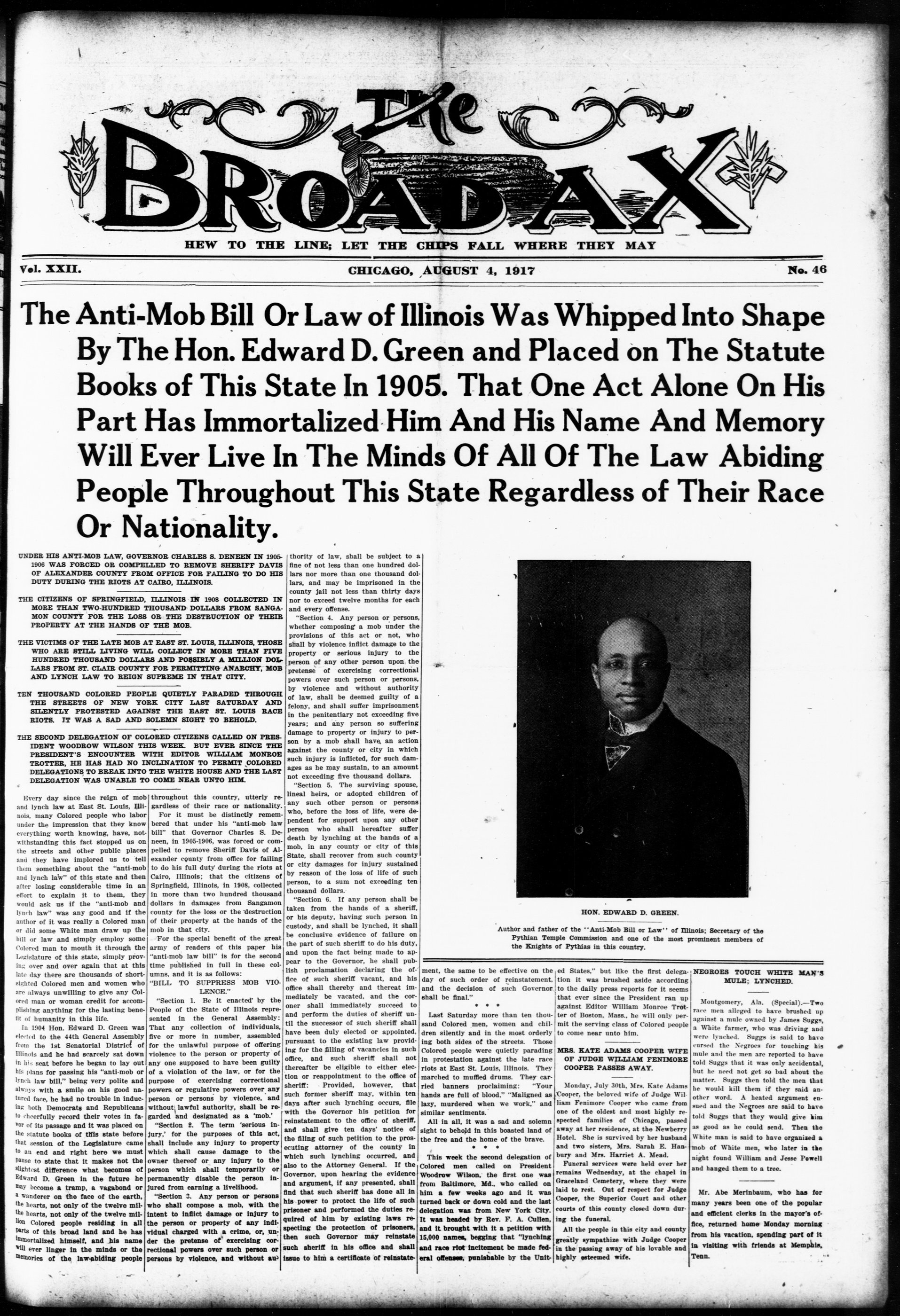
THE BROAD AX
HEW TO THE LINE; LET THE CHIPS FALL WHERE THEY MAY
Vol. XXII. CHICAGO, AUGUST 4, 1917 No. 46
The Anti-Mob Bill Or Law of Illinois Was Whipped Into Shape By The Hon. Edward D. Green and Placed on The Statute Books of This State In 1905. That One Act Alone On His Part Has Immortalized Him And His Name And Memory Will Ever Live In The Minds Of All Of The Law Abiding People Throughout This State Regardless of Their Race Or Nationality.
UNDER HIS ANTI-MOB LAW, GOVERNOR CHARLES S. DENEEN IN 1905-1906 WAS FORCED OR COMPELLED TO REMOVE SHERIFF DAVIS OF ALEXANDER COUNTY FROM OFFICE FOR FAILING TO DO HIS DUTY DURING THE RIOTS AT CAIRO, ILLINOIS.
THE CITIZENS OF SPRINGFIELD, ILLINOIS IN 1908 COLLECTED IN MORE THAN TWO-HUNDRED THOUSAND DOLLARS FROM SANGAMON COUNTY FOR THE LOSS OR THE DESTRUCTION OF THEIR PROPERTY AT THE HANDS OF THE MOB.
THE VICTIMS OF THE LATE MOB AT EAST ST. LOUIS, ILLINOIS, THOSE WHO ARE STILL LIVING WILL COLLECT IN MORE THAN FIVE HUNDRED THOUSAND DOLLARS AND POSSIBLY A MILLION DOLLARS FROM ST. CLAIR COUNTY FOR PERMITTING ANARCHY, MOB AND LYNCH LAW TO REIGN SUPREME IN THAT CITY.
TEN THOUSAND COLORED PEOPLE QUIETLY PARADED THROUGH THE STREETS OF NEW YORK CITY LAST SATURDAY AND SILENTLY PROTESTED AGAINST THE EAST ST. LOUIS RACE RIOTS. IT WAS A SAD AND SOLEMN SIGHT TO BEHOLD.
THE SECOND DELEGATION OF COLORED CITIZENS CALLED ON PRESIDENT WOODROW WILSON THIS WEEK. BUT EVER SINCE THE PRESIDENT'S ENCOUNTER WITH EDITOR WILLIAM MONROE TROTTER, HE HAS HAD NO INCLINATION TO PERMIT COLORED DELEGATIONS TO BREAK INTO THE WHITE HOUSE AND THE LAST DELEGATION WAS UNABLE TO COME NEAR UNTO HIM.
Every day since the reign of mob and lynch law at East St. Louis, Illinois, many Colored people who labor under the impression that they know everything worth knowing, have, notwithstanding this fact stopped us on the streets and other public places and they have implored us to tell them something about the "anti-mob and lynch law" of this state and then after losing considerable time in an effort to explain it to them, they would ask us if the "anti-mob and lynch law" was any good and if the author of it was really a Colored man or did some White man draw up the bill or law and simply employ some Colored man to mouth it through the Legislature of this state, simply proving over and over again that at this late day there are thousands of short-sighted Colored men and women who are always unwilling to give any Colored man or woman credit for accomplishing anything for the lasting benefit of humanity in this life.
In 1904 Hon. Edward D. Green was elected to the 44th General Assembly from the 1st Senatorial District of Illinois and he had scarcely sat down in his seat before he began to lay out his plans for passing his "anti-mob or lynch law bill," being very polite and always with a smile on his good natured face, he had no trouble in inducing both Democrats and Republicans to cheerfully record their votes in favor of its passage and it was placed on the statute books of this state before that session of the Legislature came to an end and right here we must pause to state that it makes not the slightest difference what becomes of Edward D. Green in the future he may become a tramp, a vagabond or a wanderer on the face of the earth, the hearts, not only of the twelve mil the hearts, not only of the twelve million Colored people residing in all parts of this broad land and he has immortalized himself, and his name will ever linger in the minds or the memories of the law abiding people
throughout this country, utterly regardless of their race or nationality. For it must be distinctly remembered that under his "anti-mob law bill" that Governor Charles S. Deneen, in 1905-1906, was forced or compelled to remove Sheriff Davis of Alexander county from office for failing to do his full duty during the riots at Cairo, Illinois; that the citizens of Springfield, Illinois, in 1908, collected in more than two hundred thousand dollars in damages from Sangamon county for the loss or the destruction of their property at the hands of the mob in that city.
For the special benefit of the great army of readers of this paper his "anti-mob law bill" is for the second time published in full in these columns, and it is as follows:
"BILL TO SUPPRESS MOB VIO-LENCE."
"Section 1. Be it enacted by the People of the State of Illinois represented in the General Assembly: That any collection of individuals, five or more in number, assembled for the unlawful purpose of offering violence to the person or property of any one supposed to have been guilty of a violation of the law, or for the purpose of exercising correctional powers or regulative powers over any person or persons by violence, and without lawful authority, shall be regarded and designated as a 'mob.' "Section 2. The term 'serious injury,' for the purposes of this act, shall include any injury to property which shall cause damage to the owner thereof or any injury to the person which shall temporarily or permanently disable the person injured from earning a livelihood.
"Section 3. Any person or persons who shall compose a mob, with the intent to inflict damage or injury to the person or property of any individual charged with a crime, or, under the pretense of exercising correctional powers over such person or persons by violence, and without au
thority of law, shall be subject to a fine of not less than one hundred dollars nor more than one thousand dollars, and may be imprisoned in the county jail not less than thirty days nor to exceed twelve months for each and every offense.
"Section 4. Any person or persons, whether composing a mob under the provisions of this act or not, who shall by violence inflict damage to the property or serious injury to the person of any other person upon the pretense of exercising correctional powers over such person or persons, by violence and without authority of law, shall be deemed guilty of a felony, and shall suffer imprisonment in the penitentiary not exceeding five years; and any person so suffering damage to property or injury to person by a mob shall have an action against the county or city in which such injury is inflicted, for such damages as he may sustain, to an amount not exceeding five thousand dollars.
"Section 5. The surviving spouse, lineal heirs, or adopted children of any such other person or persons who, before the loss of life, were dependent for support upon any other person who shall hereafter suffer death by lynching at the hands of a mob, in any county or city of this State, shall recover from such county or city damages for injury sustained by reason of the loss of life of such person, to a sum not exceeding ten thousand dollars:
"Section 6. If any person shall be taken from the hands of a sheriff or his deputy, having such person in custody, and shall be lynched, it shall be conclusive evidence of failure on the part of such sheriff to do his duty, and upon the fact being made to appear to the Governor, he shall publish proclamation declaring the office of such sheriff vacant, and his office shall thereby and thereat immediately be vacated, and the coroner shall immediately succeed to and perform the duties of sheriff until the successor of such sheriff shall have been duly elected or appointed, pursuant to the existing law providing for the filling of vacancies in such office, and such sheriff shall not thereafter be eligible to either election or reappointment to the office of sheriff: Provided, however, that such former sheriff may, within ten days after such lynching occurs, file with the Governor his petition for reinstatement to the office of sheriff, and shall give ten days' notice of the filing of such petition to the prosecuting attorney of the county in which such lynching occurred, and also to the Attorney General. If the Governor, upon hearing the evidence and argument, if any presented, shall find that such sheriff has done all in his power to protect the life of such prisoner and performed the duties required of him by existing laws respecting the protection of prisoners, then such Governor may reinstate such sheriff in his office and shall issue to him a certificate of reinstate-
[Name]
Author and father of the "Anti-Mob Bill or Law" of Illinois; Secretary of the Pythian Temple Commission and one of the most prominent members of the Knights of Pythias in this country.
Author and father of the "Anti-Mob Bill or Law" of Illinois; Secretary of the Pythian Temple Commission and one of the most prominent members of the Knights of Pythias in this country.
ment, the same to be effective on the day of such order of reinstatement and the decision of such Governor shall be final."
***
Last Saturday more than ten thousand Colored men, women and children silently and in the most orderly ing both sides of the streets. Those Colored people were quietly parading in protestation against the late race riots at East St. Louis, Illinois. They marched to muffled drums. They carried banners proclaiming: "Your hands are full of blood," "Maligned as lazy, murdered when we work," and similar sentiments.
All in all, it was a sad and solemn sight to behold in this boasted land of the free and the home of the brave.
* * *
This week the second delegation of Colored men called on President Woodrow Wilson, the first one was from Baltimore, Md., who called on him a few weeks ago and it was turned back or down cold and the last delegation was from New York City. It was headed by Rev. F. A. Cullen, and it brought with it a petition with 15,000 names, begging that "lynching and race riot incitement be made federal offenses, punishable by the Unit-
HON. EDWARD D. GREEN.
mer of the "Anti-Mob Bill or Law"' of the People Commission and one of the most of Pythias in this country.
ed States," but like the first delegation it was brushed aside according to the daily press reports for it seems that ever since the President ran up against Editor William Monroe Trotter of Boston, Mass., he will only permit the serving class of Colored people to come near unto him.
MRS. KATE ADAMS COOPER WIFE
OF JUDGE WILLIAM FENIMORE
COOPER PASSES AWAY.
Monday, July 30th, Mrs. Kate Adams Cooper, the beloved wife of Judge William Fenimore Cooper who came from one of the oldest and most highly respected families of Chicago, passed away at her residence, at the Newberry Hotel. She is survived by her husband and two sisters, Mrs. Sarah E. Hanbury and Mrs. Harriet A. Mead.
Funeral services were held over her remains Wednesday, at the chapel in Graceland Cemetery, where they were laid to rest. Out of respect for Judge Cooper, the Superior Court and other courts of this county closed down during the funeral.
All the people in this city and county greatly sympathize with Judge Cooper in the passing away of his lovable and highly esteemed wife.
NEGROES TOUCH WHITE MAN'S
MULE: LYNCHED.
Montgomery, Ala. (Special).—Two race men alleged to have brushed up against a mule owned by James Suggs, a White farmer, who was driving and were lynched. Suggs is said to have cursed the Negroes for touching his mule and the men are reported to have told Suggs that it was only accidental, but he need not get so bad about the matter. Suggs then told the men that he would kill them if they said another word. A heated argument ensued and the Negroes are said to have told Suggs that they would give him as good as he could send. Then the White man is said to have organized a mob of White men, who later in the night found William and Jesse Powell and hanged them to a tree.
Mr. Abe Merinbaum, who has for many years been one of the popular and efficient clerks in the mayor's office, returned home Monday morning from his vacation, spending part of it in visiting with friends at Memphis, Tenn.
Dan M. Jackson
Geo. T. Kersey
David A. McGowan
Ahmed A. Rayner
The Eman
Undertaki
2959-61 South State St.
Reliable Service Courteous Treatment
Reasonable Prices
FREE CHAPEL IN CONNECTION
Complete line of Funeral Good
DEE & CO
LACE CLEANERS DRY
26 East 35th Street
Tel. Do
Become a Stockhol
$10.00
Complete line of Funeral Goods. Automobles for hire
DEE & COMPANY, Inc.
Tel. Douglas 1261 Become a Stockholder and Get 20% off
DIRECTORS
CHARLES A. STEINMANN
MAJOR ROBERT R. JACKSON
MORRIS LEWIS
MRS. ROSA STEINMANN
ADOLPHUS C. HARRIS.
"WE BUILI
Buy a Lot
WE PUT UP
LOTS $25.00 Cas
Buy a Lot for $200.00
WE PUT UP YOUR HOUSE
LOTS $25.00 Cash, $10.00 per Month
Full Particulars at
Fraternal In Real Estate, Phone Englewood 3465
FREE
STYLE BOOK
--- HAIR---
To Colored Women
We are the largest
manufacturers of
Colored Women's
Hair. Our latest
book showing new
styles in hair
dressing sent free.
Every colored woman
should have one. We sell thousands our hair and
toilet articles. Satifaction guaranteed or money back.
We make the best
solid Brass STRAIGHT-
ENING combs, with extra heavy back, fully
guaranteed, with each comb we give lamp cap
FREE. Send money order or stamps. MONEY
BACK IF NOT SATISFACTORY. $8c. postpaid.
POSTPAID 89c
Hair nets, brushes, combs and toilet articles
manufacturer's prices. Send two-cent stamp.
Agent Manted: Address: HUMANIA HAIR COMPANY,
181-187 Park Row, New York City.
Address Dept. 84
Doctor's Money Returned After Going Through Laundry Processes. Danville, Ill.-Dr. W. A. Surratt of this city is broken of the habit of putting money in his sock, following the temporary loss of $55 in currency a few days ago. He is now of the opinion that the "women's national" is not a safe place, despite the testimony of hundreds of women to the contrary. The money disappeared in some mysterious manner, and he inserted an advertisement in a newspaper in the faint hope of obtaining some trace of it.
He was surprised when called up on the telephone and informed by the proprietor of a laundry that his money had been found after it had gone through all the processes of the laundry.
FINGER PRINTS LEGAL
Court Holds They Are But Tracings of Lines Upon the Fingers.
New York.—It is not unconstitutional to finger print a person convicted of a crime, according to a decision by Judge Wadhams in general sessions, upholding the finger printing statute. The decision was given in the case of Anna Sallow, convicted recently of disorderly conduct. After reviewing the history of the case and the previous decisions on the question the court says:
"Finger prints are but the tracings of physical characteristics or the lines upon the fingers. Nothing further is required in finger printing than has been sustained heretofore by the courts in making proofs of identification."
---
PAGE TWO
$10.00
Phones Calumet 6164
Automatic 71-629
uel Jackson ng Co., Inc.
Automobles for hire
COMPANY, Inc.
CLEANERS LAUNDERERS
3456 Wabash Avenue
Duglas 1261
order and Get 20% off
mares $10.00
D FOR YOU"
for $200.00
YOUR HOUSE
n, $10.00 per Month
Investment Co.
enting & Loans
6155 Wentworth Ave.
FACED DANGERS TO REGISTER
Oil Man Walked Eleven Miles and Swam Flooded Streams.
Ellsworth, Kan.—Heavy rains and swollen streams almost compelled Carl Holt of this city to miss registering. Holt is a tool dresser for the Shamrock-Cushing oil drill, eleven miles southeast of Ellsworth. He was required to register here.
When Holt, late in the afternoon, started to drive into Ellsworth with his car he found himself cut off by streams which had flooded and washed out the bridges.
He promptly discarded the car, swam the creek and started to walk the eleven miles to Ellsworth. In the course of his walk he found it necessary to navigate other streams in a like manner. Fifteen minutes before 9, wet, muddy and tired, he rushed into the registration hall and signed his name to the card.
TOWN KEEPS UNTO ITSELF.
Loudville, Me., Seceded From Union In '61 and Never Came Back.
Augusta, Me.-Loudville, the home of 150 persons living on Loud's island, enjoys an anomalous distinction as an American town.
Loudville is legally part of Maine and the United States, but it won't admit it.
Loudville seceded from the United States when the south did and never came back.
When a federal officer went to Loudville to enforce the civil war draft he was met with a shower of hot potatoes. He went away.
Loudville pays no taxes, has no streets, no sewers, no lights, no boat landings and pays for no mail. It merely permits mail to be thrown ashore twice a week.
Loudville claims it is neutral in the war.
WILL PROTECT TENANTS.
Way Found to Keep Tradesmen Away From Apartment Dwellers.
Milwaukee. — Tradesmen, including the butcher, the baker and the candle-stick maker, will not swarm about apartment houses to the annoyance of tenants if the recommendations devised by the management of one of Milwaukee's most modern establishments are generally adopted.
In brief, patrons are urged to do their trading with but one grocer, one milkman, one iceman, one laundryman and the like. The quality of service rendered is expected to determine the selection of favorites. By this means the leaseholder, it is expected, will not be awakened at an unseemly hour by the merry rattle of cans or clink of bottles as squad after squad of milkmen go trooping over the premises.
---
Shares
OPEN DAY AND NIGHT
$10.00
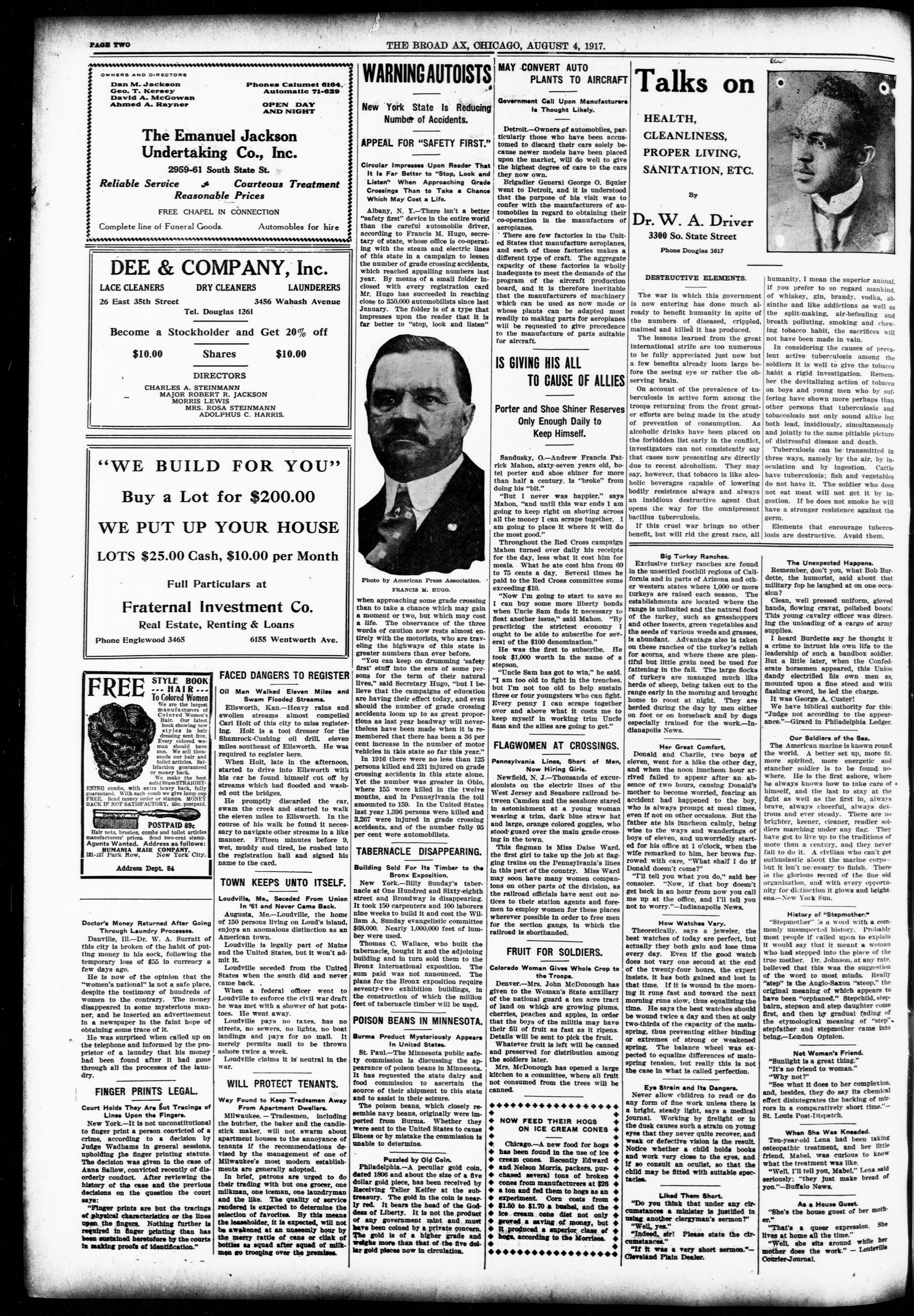
THE BROAD AX. CHICAGO. AUGUST 4. 1917.
WARNING AUTOISTS
WARNING AUTOISTS
New York State Is Reducing Number of Accidents.
APPEAL FOR "SAFETY FIRST."
Circular Impresses Upon Reader That It Is Far Better to "Stop, Look and Listen" When Approaching Grade Crossings Than to Take a Chance Which May Cost a Life.
Albany, N. Y.—There isn't a better "safety first" device in the entire world than the careful automobile driver, according to Francis M. Hugo, secretary of state, whose office is co-operating with the steam and electric lines of this state in a campaign to lessen the number of grade crossing accidents, which reached appalling numbers last year. By means of a small folder enclosed with every registration card Mr. Hugo has succeeded in reaching close to 350,000 automobilists since last January. The folder is of a type that impresses upon the reader that it is far better to "stop, look and listen"
PETER H. BURKE
when approaching some grade crossing than to take a chance which may gain a moment or two, but which may cost a life. The observance of the three words of caution now rests almost entirely with the motorists, who are traveling the highways of this state in greater numbers than ever before. "You can keep on drumming 'safety first' stuff into the ears of some persons for the term of their natural lives," said Secretary Hugo, "but I believe that the campaigns of education are having their effect today, and even should the number of grade crossing accidents loom up to as great proportions as last year headway will nevertheless have been made when it is remembered that there has been a 36 per cent increase in the number of motor vehicles in this state so far this year."
In 1916 there were no less than 125 persons killed and 231 injured on grade crossing accidents in this state alone. Yet the number was greater in Ohio, where 155 were killed in the twelve months, and in Pennsylvania the toll amounted to 159. In the United States last year 1,396 persons were killed and 3,267 were injured in grade crossing accidents, and of the number fully 95 per cent were automobilists.
TABERNACLE DISAPPEARING.
Building Sold For Its Timber to the Bronx Exposition.
New York.-Billy Sunday's tabernacle at One Hundred and Sixty-eighth street and Broadway is disappearing. It took 150 carpenters and 100 laborers nine weeks to build it and cost the William A. Sunday evangelistic committee $68,000. Nearly 1,000,000 feet of lumber were used.
Thomas C. Wallace, who built the tabernacle, bought it and the adjoining building and in turn sold them to the Bronx International exposition. The sum paid was not announced. The plans for the Bronx exposition require seventy-two exhibition buildings, in the construction of which the million feet of tabernacle timber will be used.
POISON BEANS IN MINNESOTA
Burma Product Mysteriously Appears in United States.
St. Paul.—The Minnesota public safety commission is discussing the appearance of poison beans in Minnesota. It has requested the state dairy and food commission to ascertain the source of their shipment to this state and to assist in their seizure.
The poison beans, which closely resemble navy beans, originally were imported from Burma. Whether they were sent to the United States to cause illness or by mistake the commission is unable to determine.
Puzzled by Old Coin
Philadelphia.—A peculiar gold coin, dated 1806 and about the size of a five dollar gold piece, has been received by Receiving Teller Keifer at the subtreasury. The gold in the coin is nearly red. It bears the head of the Goddess of Liberty. It is not the product of any government mint and must have been coloned by a private concern. The gold is of a higher grade and weighs more than that of the five dollar gold pieces now in circulation.
MAY CONVERT AUTO
PLANTS TO AIRCRAFT
Government Call Upon Manufacturers Is Thought Likely.
Detroit.-Owners of automobiles, particularly those who have been accustomed to discard their cars solely because newer models have been placed upon the market, will do well to give the highest degree of care to the cars they now own.
Brigadier General George O. Squier went to Detroit, and it is understood that the purpose of his visit was to confer with the manufacturers of automobiles in regard to obtaining their co-operation in the manufacture of aeroplanes.
There are few factories in the United States that manufacture aeroplanes, and each of these factories makes a different type of craft. The aggregate capacity of these factories is wholly inadequate to meet the demands of the program of the aircraft production board, and it is therefore inevitable that the manufacturers of machinery which can be used as now made or whose plants can be adapted most readily to making parts for aeroplanes will be requested to give precedence to the manufacture of parts suitable for aircraft.
IS GIVING HIS ALL TO CAUSE OF ALLIES
IS GIVING HIS ALL TO CAUSE OF ALLIES
IS
Porter and Shoe Shiner Reserves Only Enough Daily to Keep Himself.
Sandusky, O.—Andrew Francis Patrick Mahon, sixty-seven years old, hotel porter and shoe shiner for more than half a century, is "broke" from doing his "bit." "But I never was happier," says Mahon, "and until this war ends I am going to keep right on shoving across all the money I can scrape together. I am going to place it where it will do the most good." Throughout the Red Cross campaign Mahon turned over daily his receipts for the day, less what it cost him for meals. What he ate cost him from 60 to 75 cents a day. Several times he paid to the Red Cross committee sums exceeding $10.
"Now I'm going to start to save so I can buy some more liberty bonds when Uncle Sam finds it necessary to float another issue," said Mahon. "By practicing the strictest economy I ought to be able to subscribe for several of the $100 denomination." He was the first to subscribe. He took $1,000 worth in the name of a stepson. "Uncle Sam has got to win," he said. "I am too old to fight in the trenches, but I'm not too old to help sustain three or four youngsters who can fight. Every penny I can scrape together over and above what it costs me to keep myself in working trim Uncle Sam and the allies are going to get."
FLAGWOMEN AT CROSSINGS.
Pennsylvania Lines, Short of Men, Now Hiring Girls.
Newfield, N. J.-Thousands of excursionists on the electric lines of the West Jersey and Seashore railroad between Camden and the seashore stared in astonishment at a young woman wearing a trim, dark blue straw hat and large, orange colored goggles, who stood guard over the main grade crossing in the town.
This flagman is Miss Daise Ward, the first girl to take up the job at flagging trains on the Pennsylvania's lines in this part of the country. Miss Ward may soon have many women companions on other parts of the division, as the railroad officials have sent out notices to their station agents and foremen to employ women for these places wherever possible in order to free men for the section gangs, in which the railroad is shorthanded.
FRUIT FOR SOLDIERS
Colorado Woman Gives Whole Crop to the Troops.
Denver.—Mrs. John McDonough has given to the Woman's State auxiliary of the national guard a ten acre tract of land on which are growing plums, cherries, peaches and apples, in order that the boys of the militia may have their fill of fruit as fast as it ripens. Details will be sent to pick the fruit.
Whatever fruit is left will be canned and preserved for distribution among the soldiers later.
Mrs. McDonough has opened a large kitchen to a committee, where all fruit not consumed from the trees will be canned.
NOW FEED THEIR HOGS
ON ICE CREAM CONES
Chicago.—A new food for hogs
has been found in the use of ice
cream cones. Recently Edward
and Nelson Morris, packers, purchased
several tons of broken
cones from manufacturers at $28
a ton and fed them to hogs as an
experiment. Corn costs from
$1.50 to $1.70 a bushel, and the
ice cream cone diet not only
proved a saving of money, but
it produced a superior class of
hogs, according to the Morrises.
Talks on
HEALTH,
CLEANLINESS,
PROPER LIVING,
SANITATION, ETC.
By
Dr. W. A. Driver
3300 So. State Street
Phone Douglas 3617
DESTRUCTIVE ELEMENTS.
The war in which this government is now entering has done much already to benefit humanity in spite of the numbers of diseased, crippled, maimed and killed it has produced. The lessons learned from the great international strife are too numerous to be fully appreciated just now but a few benefits already loom large before the seeing eye or rather the observing brain.
On account of the prevalence of tuberculosis in active form among the troops returning from the front greater efforts are being made in the study of prevention of consumption. As alcoholic drinks have been placed on the forbidden list early in the conflict, investigators can not consistently say that cases now presenting are directly due to recent alcoholism. They may say, however, that tobacco is like alcoholic beverages capable of lowering bodily resistance always and always an insidious destructive agent that opens the way for the omnipresent bacillus tuberculosis. If this cruel war brings no other benefit, but will rid the great race, all
Big Turkey Ranches.
Exclusive turkey ranches are found in the unsettled foothill regions of California and in parts of Arizona and other western states where 1,000 or more turkeys are raised each season. The establishments are located where the range is unlimited and the natural food of the turkey, such as grasshoppers and other insects, green vegetables and the seeds of various weeds and grasses, is abundant. Advantage also is taken on these ranches of the turkey's relish for acorns, and where these are plentiful but little grain need be used for fattening in the fall. The large flocks of turkeys are managed much like herds of sheep, being taken out to the range early in the morning and brought home to roost at night. They are herded during the day by men either on foot or on horseback and by dogs especially trained for the work.-Indianapolis News.
Her Great Comfort
Donald and Charlie, two boys of eleven, went for a hike the other day, and when the noon luncheon hour arrived failed to appear after an absence of two hours, causing Donald's mother to become worried, fearing an accident had happened to the boy, who is always prompt at meal times, even if not on other occasions. But the father ate his luncheon calmly, being wise to the ways and wanderings of boys of eleven, and unworriedly started for his office at 1 o'clock, when the wife remarked to him, her brows furrowed with care. "What shall I do if Donald doesn't come?"
"I'll tell you what you do," said her consoler. "Now, if that boy doesn't get back in an hour from now you call me up at the office, and I'll tell you not to worry."-Indianapolis News.
How Watches Vary.
Theoretically, says a jeweler, the best watches of today are perfect, but actually they both gain and lose time every day. Even if the good watch does not vary one second at the end of the twenty-four hours, the expert insists, it has both gained and lost in that time. If it is wound in the morning it runs fast and toward the next morning runs slow, thus equalizing the time. He says the best watches should be wound twice a day and then at only two-thirds of the capacity of the mainspring, thus preventing either binding or extremes of strong or weakened spring. The balance wheel was expected to equalize differences of mainspring tension, but really this is not the case in what is called perfection.
Eye Strain and Its Dangers.
Never allow children to read or do any form of fine work unless there is a bright, steady light, says a medical journal. Working by firelight or in the dusk causes such a strain on young eyes that they never quite recover, and weak or defective vision is the result. Notice whether a child holds books and work very close to the eyes, and if so consult an oculist, so that the child may be fitted with suitable spectacles.
Liked Them Short
"Do you think that under any circ- cumstances a minister is justified in using another clergyman's sermon?"
"Well, yes."
"Indeed, sir! Please state the circ- cumstances."
"If it was a very short sermon."— Cleveland Plain Dealer.
A. B.
humanity, I mean the superior animal, if you prefer to so regard mankind, of whiskey, gin, brandy, vodka, absinthe and like addictions as well as the split-making, air-befouling and breath polluting, smoking and chewing tobacco habit, the sacrifices will not have been made in vain.
In considering the causes of prevalent active tuberculosis among the soldiers it is well to give the tobacco habit a rigid investigation. Remember the devitalizing action of tobacco on boys and young men who by suffering have shown more perhaps than other persons that tuberculosis and tobaccocolosis not only sound alike but both lead, insidiously, simultaneously and jointly to the same pitiable picture of distressful disease and death.
Tuberculosis can be transmitted in three ways, namely by the air, by inoculation and by ingestion. Cattle have tuberculosis; fish and vegetables do not have it. The soldier who does not eat meat will not get it by ingestion. If he does not smoke he will have a stronger resistance against the germ. Elements that encourage tuberculosis are destructive. Avoid them.
Remember, don't you, what Bob Burdette, the humorist, said about that military fop he laughed at on one occasion?
Clean, well pressed uniform, gloved hands, flowing cavat, polished boots! This young cavalry officer was directing the unloading of a cargo of army supplies.
I heard Burdette say he thought it a crime to intrust his own life to the leadership of such a bandbox soldier. But a little later, when the Confederate horsemen appeared, this Union dandy electrified his own men as, mounted upon a fine steed and with flashing sword, he led the charge.
It was George A. Custer!
We have biblical authority for this: "Judge not according to the appearance." - Girard in Philadelphia Ledger.
Our Soldiers of the Sea.
The American marine is known round the world. A better set up, more fit, more spirited, more energetic and stander soldier is to be found nowhere. He is the first ashore, where he always knows how to take care of himself, and the last to stay at the fight as well as the first in, always brave, always cheerful, always dextrous and ever steady. There are no brighter, keener, cleaner, readier soldiers marching under any flag. They have got to live up to the traditions of more than a century, and they never fail to do it. A civilian who can't get enthusiastic about the marine corps—but it isn't necessary to finish. There is the glorious record of the fine old organization, and with every opportunity for distinction it glows and brightens—New York Sun.
History of "Stepmother."
"Stepmother" is a word with a commonly unsuspected history. Probably most people if called upon to explain it would say that it meant a woman who had stepped into the place of the true mother. Dr. Johnson, at any rate, believed that this was the suggestion of the word to most minds. Really "step" is the Anglo-Saxon "steep," the original meaning of which appears to have been "orphaned." Stepchild, stepbairn, stepson and step daughter come first, and then by gradual fading of the etymological meaning of "step" stepfather and stepmother came into being.—London Opinion.
Not Woman's Friend.
"Sunlight is a great thing."
"It's no friend to woman."
"Why not?"
"See what it does to her complexion, and, besides, they do say its chemical effect disintegrates the backing of mirrors in a comparatively short time."—St. Louis Post-Dispatch.
When She Was Kneaded.
Ten-year-old Lena had been taking osteopathic treatment, and her little friend, Mabel, was curious to know what the treatment was like. "Well, I'll tell you, Mabel," Lena said seriously; "they just make bread of you."-Buffalo News.
"She's the house guest of her mother."
"That's a queer expression. She 'loves' you, that's true."
HEADS THE ANTIS
Senator's Wife Says It Is Her Duty to Accept.
LEADERSHIP IN HER HANDS.
Is Daughter of the Late John Hay, Formerly Secretary of State; Sister of Mrs. Harry Payne Whitney and Wife of United States Senator.
Mrs. James W. Wadsworth, Jr., wife of United States Senator James W. Wadsworth, Jr., has accepted the presidency of the National Association Opposed to Woman Suffrage, or the "antis," as they are popularly known. Mrs. Wadsworth before her marriage.
Mary
Photo by American Press Association.
MRS. JAMES W. WADSWORTH, JR.
to Senator Wadsworth in 1902 was Miss Alice Hay, the daughter of John Hay, formerly secretary of state. She is a sister of Mrs. Harry Payne Whitney.
In her letter accepting the place, which was relinquished by Mrs. Arthur Dodge, Mrs. Wadsworth wrote:
"Although most reluctant to shoulder any additional burden outside the care of my family, the war relief work and the charities in which I am already engaged, I feel that it is my duty, in the interest of patriotism and national defense, to accept this office and to do my utmost to justify your confidence."
Mrs. Wadsworth deplores the action of the suffragette pickets in Washington, whom she characterizes as disloyal and a lawless and mischief making company, who because of their audacious spirits have more influence upon the electorate than the conservative woman voter would have.
"We are a country at war," wrote Mrs. Wadsworth. "Surely the qualities of leadership most needed at this time are strength, stability, breadth and fairness of vision, a direct and uncomplex method of thought and action. Can we possibly hope to gain these by throwing into our national politics so inflammable and uncertain an element as the feminine vote?"
"FEED 'EM!"
A New Battlecry For Patriotic Centers of Canning.
"The battlecy of 'feed 'em' is the slogan in every home in the land," says Charles Lathrop Pack, president of the National Emergency Food Garden Commission, "and that slogan should be heard in every schoolhouse in the land.
"Why not use the schools of the country as community canning centers two or three times a week? What better place could the people of the town or city have for meeting and furthering the work of feeding themselves by helping the government feed the soldiers? They are closed now and should be used to hold canning rallies.
"Reports coming to the commission in our nation wide survey of the garden planting situation show that the women are planning to can and dry food as never before."
"The commission stands ready to send free a canning or drying manual for a two cent stamp to pay postage to any woman in the United States. Make the kitchen your first line trench and shoot the requests for this expert free instruction with as rapid fire as you please.
"The women will do their bit if they have the proper instruction in the most up to date methods of conserving the food supply. The commission will work night and day to give it to them. All they have to do is to ask for it."
Savory Potatoes.
Nine medium sized potatoes, two onions, one half cupful of water, six tablespoonful of olive oil, one tablespoonful of powdered sage, one teaspoonful of salt, one eighth teaspoonful of pepper.
Arrange potatoes in a shallow baking dish and add water, minced onion, seasonings and lastly the oil. Bake about an hour. The potatoes should be soft and brown.
Hold Down Your Spata
A hook and eye will keep spats from turning up in front when worn with pumps. Place a straight eye on the top of the pump just below the instep and sew a hook on the inside of the spat.
ABOUT SUITS.
Why We Have One Pieces
From Paris Instead Of Them.
When the war started it took away as soldiers many of the expert tailors, and the clever courtiers to bridge this difficulty paid more attention than ever to the designing of street dresses and one piece frocks. In fact, they were so clever in this respect that few women realized that if they had wanted smart suits they would have been compelled to go to one of the two houses that retained tailors who could develop smart suits. Callot and Paquin both have had to offer their patrons not only beautiful one piece frocks and street dresses, but suits that women could not resist buying. The majority of women followed blindly the lead of their particular courtier, and even when they started out to buy a suit they returned with a frock or a street dress, so cleverly were they talked into purchasing what the courtier had to sell.
There is scarcely a doubt that in a season or two suits will be such a novelty that they will be in demand and tailors will have to be procured from somewhere, or, better still, women will have to learn this particular art.
Of the two suits seen recently in the Bois both had rather long coats, one almost long enough to conceal the skirt. It is predicted by some that long coats will be smart for fall, and this may be another whim with a real idea behind it of the couturiers, for if it is still difficult to obtain tailors it would be a simple matter to make the coats a bit longer and eliminate the skirt—and behold the toper again!
NEW LINGERIE.
Silk Has Nearly Displaced Linen For Underclothes.
Made of fine batiste is this chemise, daintily scalloped around all edges. The square necked top is held by nar-
THE BATHROOM
ENVELOPE CHEMISE.
row ribbon run through handmade eyelets instead of beading, and a spray of embroidery adorns the front.
Crocheted Bags.
The latest thing in crocheted bags looks as though it were designed particularly to go with the sport suit. It is made of two perfectly flat circles, crocheted on a plain double stitch of worsted or some other thick mercerized material. The two circles, which are about seven inches in diameter, are sewed firmly together all around, except for six inches or so at the top. The handle is a strap of the same material, crocheted in the same stitch and about an inch and a half or two inches wide. The bag is adorned with a spray of flowers, embroidered on with the same material in contrasting colors, green leaves and pink or yellow blossoms, with loose stems hanging, and finished off each with a rather large bead to match the blossom. This is a bag of brilliant blue. The same bag could be crocheted in emerald green, belge or deep rose—any color wished—and decorated with flowers that harmonized.
For Campers.
Food can be kept cool by evaporation. Milk in bottles or pitchers if wrapped in one or more thicknesses of wet paper and placed where the air will blow upon it will keep cool. Wet paper will keep butter cool and firm. Leftover meats and vegetables can be kept cool in a similar manner. Crush the paper, wetting it thoroughly. Paper bags are excellent for the purpose or any kind of wrapping paper. Then place quite a mass of this wet paper on top of the covered butter or food. A sheet of waxed paper is often a better covering for food than a close lid or saucer and will protect it perfectly from the wet paper.
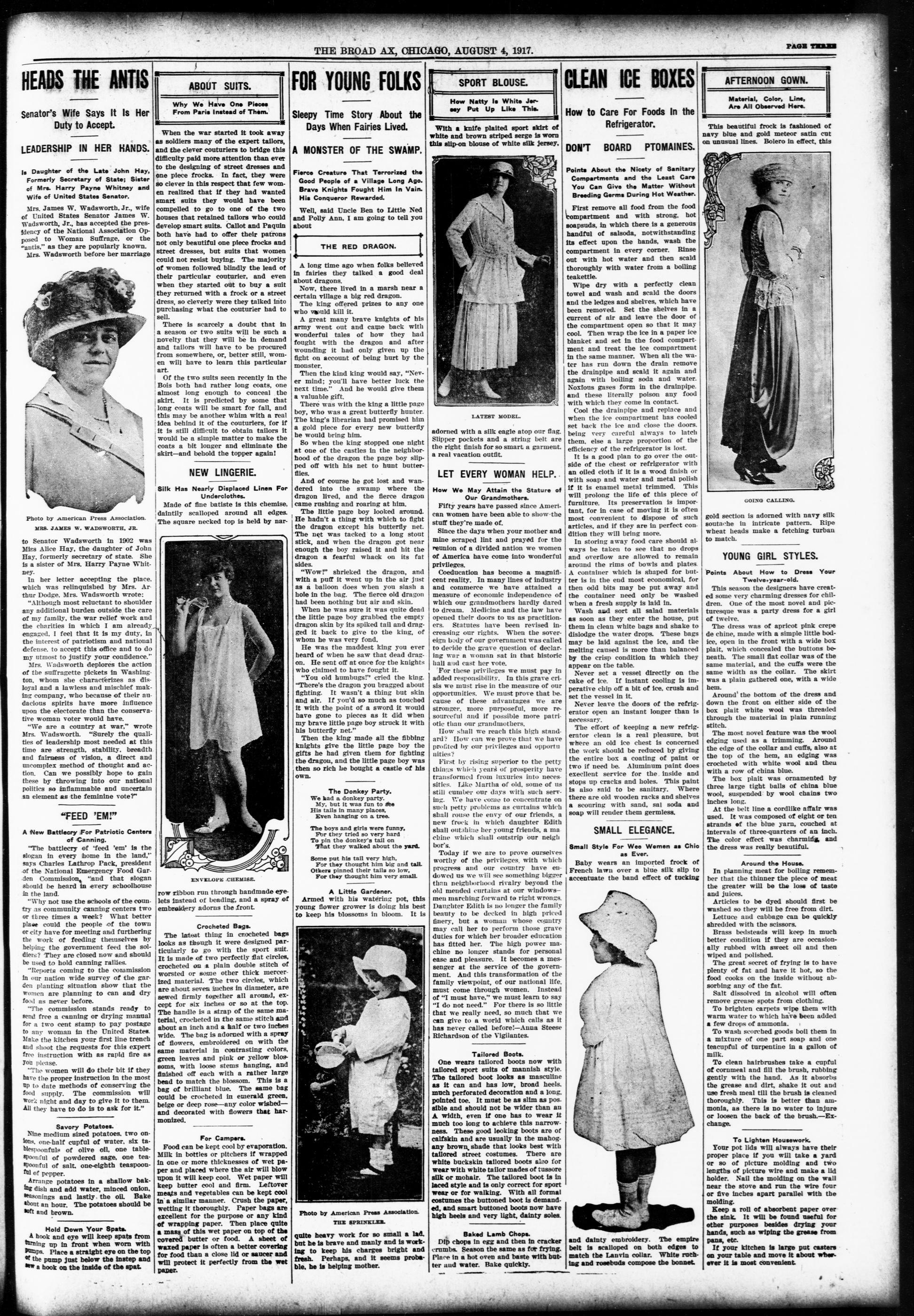
THE BROAD AX. CHICAGO. AUGUST 4. 1917.
FOR YOUNG FOLKS
FOR YOUNG FOLKS
Sleepy Time Story About the Days When Fairies Lived.
A MONSTER OF THE SWAMP.
Fierce Creature That Terrorized the Good People of a Village Long Ago. Brave Knights Fought Him In Vain. His Conqueror Rewarded.
Well, said Uncle Ben to Little Ned and Polly Ann, I am going to tell you about
THE RED DRAGON.
A long time ago when folks believed in fairies they talked a good deal about dragons.
Now, there lived in a marsh near a certain village a big red dragon.
The king offered prizes to any one who would kill it.
A great many brave knights of his army went out and came back with wonderful tales of how they had fought with the dragon and after wounding it had only given up the fight on account of being hurt by the monster.
Then the kind king would say, "Never mind; you'll have better luck the next time." And he would give them a valuable gift.
There was with the king a little page boy, who was a great butterfly hunter. The king's librarian had promised him a gold piece for every new butterfly he would bring him.
So when the king stopped one night at one of the castles in the neighborhood of the dragon the page boy slipped off with his net to hunt butterflies.
And of course he got lost and wandered into the swamp where the dragon lived, and the fierce dragon came rushing and roaring at him.
The little page boy looked around. He hadn't a thing with which to fight the dragon except his butterfly net. The net was tacked to a long stout stick, and when the dragon got near enough the boy raised it and hit the dragon a fearful whack on its fat sides.
"Wow!" shrieked the dragon, and with a puff it went up in the air just as a balloon does when you slash a hole in the bag. The fierce old dragon had been nothing but air and skin.
When he was sure it was quite dead the little page boy grabbed the empty dragon skin by its spiked tail and dragged it back to give to the king, of whom he was very fond.
He was the maddest king you ever heard of when he saw that dead dragon. He sent off at once for the knights who claimed to have fought it.
"You old humbugs!" cried the king, "There's the dragon you bragged about fighting. It wasn't a thing but skin and air. If you'd so much as touched it with the point of a sword it would have gone to pieces as it did when my brave little page boy struck it with his butterfly net."
Then the king made all the fibbing knights give the little page boy the gifts he had given them for fighting the dragon, and the little page boy was then so rich he bought a castle of his own.
The Donkey Party.
We had a donkey party.
My, but it was fun to see
His tails in many places.
Even hanging on a tree.
The boys and girls were funny.
For they tried so very hard
To pin the donkey's tail on
That they walked about the yard.
Some put his tail very high.
For they thought him big and tall.
Others pinned their tails so low.
For they thought him very small.
A. Little Gardener
Armed with his watering pot, this young flower grower is doing his best to keep his blossoms in bloom. It is
THE CHILDREN'S WEEKLY NEWS
Photo by American Press Association.
THE SPRINKLER.
quite heavy work for so small a lad,
but he is brave and manly and is working to keep his charges bright and fresh. Perhaps, and it seems probable, he is helping mother.
SPORT BLOUSE.
How Natty Is White Jersey Put Up Like This.
With a knife plaited sport skirt of white and brown striped serge is worn this slip-on blouse of white silk jersey.
THE FASHION OF THE TWENTIES
LATEST MODEL.
adorned with a silk eagle atop our flag. Slipter pockets and a string belt are the right finish for so smart a garment, a real vacation outfit.
LET EVERY WOMAN HELP.
How We May Attain the Stature of Our Grandmothers.
Fifty years have passed since American women have been able to show the stuff they're made of.
Since the days when your mother and mine scraped lint and prayed for the reunion of a divided nation we women of America have come into wonderful privileges.
Coeducation has become a magnificent reality. In many lines of industry and commerce we have attained a measure of economic independence of which our grandmothers hardly dared to dream. Medicine and the law have opened their doors to us as practitioners. Statutes have been revised increasing our rights. When the sovereign body of our government was called to decide the grave question of declaring war a woman sat in that historic hall and cast her vote.
For these privileges we must pay in added responsibility. In this grave crisis we must rise in the measure of our opportunities. We must prove that because of these advantages we are stronger, more purposeful, more resourceful and if possible more patriotic than our grandmothers.
How shall we reach this high standard? How can we prove that we have profited by our privileges and opportunities?
First by rising superior to the petty things which years of prosperity have transformed from luxuries into necessities. Like Martha of old, some of us still cumber our days with such serving. We have come to concentrate on such petty problems as curtains which shall rouse the envy of our friends, a new frock in which daughter Edith shall outshine her young friends, a machine which shall outstrip our neighbor's.
Today if we are to prove ourselves worthy of the privileges, with which progress and our country have endowed us we will see something bigger than neighborhood rivalry beyond the old mended curtains at our windowsmen marching forward to right wrongs. Daughter Edith is no longer the family beauty to be decked in high priced finery, but a woman whose country may call her to perform those grave duties for which her broader education has fitted her. The high power machine no longer stands for personal ease and pleasure. It becomes a messenger at the service of the government. And this transformation of the family viewpoint, of our national life, must come through women. Instead of "I must have," we must learn to say "I do not need." For there is so little that we really need, so much that we can give to a world which calls as it has never called before!-Anna Steese Richardson of the Vigilantes.
Tailored Boots.
One wears tailored boots now with tailored sport suits of mannish style. The tailored boot looks as masculine as it can and has low, broad heels, much perforated decoration and a long, pointed toe. It must be as slim as possible and should not be wider than an A width, even if one has to wear if much too long to achieve this narrowness. These good looking boots are of calfskin and are usually in the mahogany brown, shade that looks best with tailored street costumes. There are white buckskin tailored boots also for wear with white tailor mades of tussor silk or mohair. The tailored boot is in laced style and is only correct for sport wear or for walking. With all formal costumes the buttoned boot is demanded, and smart buttoned boots now have high heels and very light, dainty soles.
Baked Lamb Chops.
Dip chops in egg and then in cracker crumbs. Season the same as for frying. Place in a hot oven and baste with butter and water. Bake quickly.
CLEAN ICE BOXES
How to Care For Foods In the Refrigerator.
DON'T BOARD PTOMAINES.
BOARD
DON'T BOARD PTOMAINES.
Points About the Nicety of Sanitary Compartments and the Least Care You Can Give the Matter Without Breeding Germs During Hot Weather.
First remove all food from the food compartment and with strong, hot soapsuds, in which there is a generous handful of salsoda, notwithstanding its effect upon the hands, wash the compartment in every corner. Rinse out with hot water and then scald thoroughly with water from a boiling teakettle.
Wipe dry with a perfectly clean towel and wash and scald the doors and the ledges and shelves, which have been removed. Set the shelves in a current of air and leave the door of the compartment open so that it may cool. Then wrap the ice in a paper ice blanket and set in the food compartment and treat the ice compartment in the same manner. When all the water has run down the drain remove the drainpipe and scald it again and again with boiling soda and water. Noxious gases form in the drainpipe, and these literally poison any food with which they come in contact. Cool the drainpipe and replace and when the ice compartment has cooled set back the ice and close the doors, being very careful always to latch them, else a large proportion of the efficiency of the refrigerator is lost.
It is a good plan to go over the outside of the chest or refrigerator with an oilled cloth if it is a wood finish or with soap and water and metal polish if it is enamel metal trimmed. This will prolong the life of this piece of furniture. Its preservation is important, for in case of moving it is often most convenient to dispose of such articles, and if they are in perfect condition they will bring more. In storing away food care should always be taken to see that no drops and overflow are allowed to remain around the rims of bowls and plates. A container which is shaped for butter is in the end most economical, for then odd bits may be put away and the container need only be washed when a fresh supply is laid in.
Wash and sort all salad materials as soon as they enter the house, put them in clean white bags and shake to dislodge the water drops. These bags may be laid against the ice, and the melting caused is more than balanced by the crisp condition in which they appear on the table.
Never set a vessel directly on the cake of ice. If instant cooling is imperative chip off a bit of ice, crush and set the vessel in it.
Never leave the doors of the refrigerator open an instant longer than is necessary.
The effort of keeping a new refrigerator clean is a real pleasure, but where an old ice chest is concerned the work should be reduced by giving the entire box a coating of paint or two if need be. Aluminum paint does execlent service for the inside and stops up cracks and holes. This paint is also said to be sanitary. Where there are old wooden racks and shelves a scouring with sand, sal soda and soap will render them germless.
SMALL ELEGANCE
Small Style For Wee Wemen as Chio as Ever.
Baby wears an imported frock of French lawn over a blue silk slip to accentuate the band effect of tucking
```markdown
```
and dalty embroidery. The empire belt is scalloped on both edges to match the Lanvin collar. White rushing and rosebuds compose the bonnet.
and dalty embroidery. The empire belt is scalloped on both edges to match the Lanvin collar. White rushing and rosebuds compose the bonnet.
PAGE THREE
AFTERNOON GOWN.
Material, Color, Line Are All Observed Here. This beautiful frock is fashioned of navy blue and gold meteor satin cut on unusual lines. Bolero in effect, this
THE FASHION OF THE TIME
GOING CALLING.
gold section is adorned with navy silk
soutache in intricate pattern. Ripe
wheat heads make a fetching turban
to match.
YOUNG GIRL STYLES.
Points About How to Dress Your Twelve-year-old.
This season the designers have created some very charming dresses for children. One of the most novel and picturesque was a party dress for a girl of twelve.
The dress was of apricot pink crepe de chine, made with a simple little bodice, open in the front with a wide box plait, which concealed the buttons beneath. The small flat collar was of the same material, and the cuffs were the same width as the collar. The skirt was a plain gathered one, with a wide hem.
Around the bottom of the dress and down the front on either side of the box plait white wool was threaded through the material in plain running stitch.
The most novel feature was the wool edging used as a trimming. Around the edge of the collar and cuffs, also at the top of the hem, an edging was crocheted with white wool and thea with a row of china blue.
The box plait was ornamented by three large tight balls of china blue wool, suspended by wool chains two inches long.
At the belt line a cordlike affair was used. It was composed of eight or ten strands of the blue yarn, couched at intervals of three-quarters of an inch. The color effect was charming, and the dress was really beautiful.
Around the House
In planning meat for boiling remember that the thinner the piece of meat the greater will be the loss of taste and juices.
Articles to be dyed should first be washed so they will be free from dirt.
Lettuce and cabbage can be quickly shredded with the scissors.
Brass breadsteads will keep in much better condition if they are occasionally rubbed with sweet oil and then wiped and polished.
The great secret of frying is to have plenty of fat and have it hot, so the food cooks on the inside without absorbing any of the fat.
Salt dissolved in alcohol will often remove grease spots from clothing.
To brighten carpets wipe them with warm water to which have been added a few drops of ammonia.
To wash scorched goods boil them in a mixture of one part soap and one teacupful of turpentine in a gallon of milk.
To clean hairbrushes take a cupful of cornmeal and fill the brush, rubbing gently with the hand. As it absorbs the grease and dirt, shake it out and use fresh meal till the brush is cleaned thoroughly. This is better than ammonia, as there is no water to injure or loosen the back of the brush.—Exchange.
To Lighten Housework
Your pot lids will always have their proper place if you will take a yard or so of picture molding and two lengths of picture wire and make a lid holder. Nail the molding on the wall near the stove and run the wire four or five inches apart parallel with the molding.
Keep a roll of absorbent paper over the sink. It will be found useful for other purposes besides drying your hands, such as wiping the grease from pans, etc.
If your kitchen is large put casters on your table and move it about wherever it is most convenient.
1910
M. H.
HON. W. E. MOLLISON.
Prominent Republican politician, able b in the estimation of the people in h is bound to forge his way to the f
Prominent Republican politician, able lawyer, property holder who stands high in the estimation of the people in his late home town Wickburg, Miss., who is bound to forge his way to the front in his chosen profession in Chicago.
Hon. W. E. Mollison, the subject of the following sketch, gathered from a number of clippings, and from the "Who's Who," is a native of Mississippi, where he was a prominent figure in all walks of life, and now enjoys a wide popularity among both races.
power and influence over juries under the most adverse conditions would have won him renown any where.
His office is suite 815 Hartford building, in the heart of the loop, and is up to the last minute. He is prepared to attend to all classes of law
He has for a quarter of a century been a member of the bar of the city of Vicksburg and during that period has been engaged in some of the largest and most important cases tried in that forum. He has met with great success in the many branches of the profession in which a practicing lawyer in a smaller city must be engaged. As an advocate he held a place as high as any man in his state. His
Brief Bits of News and Comments on Men and Measures.
SOCIAL WORK OF TWO RACES.
Corporation of Whites and Negroes Discussed With a View to Advancing the Interests of All Classes.
Hampton, Va.—What social service really needs to be rendered? How can we best do our common work? How can we learn of one another? How can we gain better racial cooperation?
These questions were recently discussed frankly and sympathetically, when some 20 White southern secretaries of charities and correction (or social workers) met a group of representative Colored social workers, in an informal conference on racial cooperation, during the Pittsburgh meeting of the National Conference of Charities and Correction.
Miss Margaret Laing, of Columbia, S. C., who was directly responsible for the conference, stated that the social service work for Colored people in Columbia, S. C., originated through the efforts of a White university student who had received his inspiration from Prof. Josiah Morse, a firm believer in the Negro's self-reliance, whose service on the university commission on the southern race question is widely known and respected. Miss Laing has found that Colored workers take more interest in social cases than can White workers.
Dean George W. Cook, of Howard University, an experienced worker, declared that the idea of race cooperation must prevail. "White and Colored people can work together on social service boards. Throughout the South, including the City of Washington, mixed boards have been and are doing fine social uplift work. Christian charity demands that more should be done for Negroes, whose wage scale is low compared with that of Whites doing similar work."
BREAD WILL RISE ON YEAST
SHORTAGE.
Representative Longworth Presents Statement from Large Manufacturer.
Washington, D. C.—If the breweries of the country are closed down, in accordance with provisions of the Food Control bill as it passed the House, it will increase the price of bread, Representative Nicholas Longworth told the House of Representatives. Mr. Long-
PAGE FOUR
power and influence over juries under the most adverse conditions would have won him renown anywhere. His office is suite 815 Hartford building, in the heart of the loop, and is up to the last minute. He is prepared to attend to all classes of law business in Illinois, Tennessee and Mississippi. As a platform entertainer he is in great demand all over the country and his making his home in this city is a distinct addition to the life of our people in Chicago. His interesting family is now located in their new home at 3353 South Park Boulevard. He can be reached by phone Central 6583 or Douglas 5389.
worth said he had made a careful study of the question, and was convinced that prohibition of beer manufacture would result in a shortage of not less than forty per cent in the supply of yeast in the country.
In support of his statement Mr. Longworth had printed in the Record a statement from George W. Lester, vice president of the Fleischmann Company, that "the sudden unadjusted application of prohibition would result in insufficiency of yeast in our cities for a considerable period of time, in some places so extreme as to make it impossible for the bakers to supply their normal trade."
"To sum up briefly," continued Mr. Longworth, "the situation seems to be indisputably this:—Malt sprouts under modern processes of yeast making are an absolute necessity, forming as they do one-third of the contents of the mash from which yeast is developed.
Mr. Longworth said that personally he was opposed to the prohibition of manufacturing beer for other reasons, one because it reduced revenues, and another because it deprived the poor man of his drink.
"No matter what one's views may be upon prohibition as an ethical question," he finished, "it seems to me that our highest duty as members of Congress is to see to it that through no action of ours may a shortage be caused in the bread supply of the country while we are at war."
U. S. NEGROES TO FRANCE
Hundreds of Americans Flock to Work on Docks at Base Ports for "Uncle Sam."
American Training Camp in France (Special). — Attracted by the high wages being paid by "Uncle Sam," hundreds of American Negroes are flocking to France, especially to the base ports, where they are being employed as dock laborers.
The average wage paid is $48 a month, and in addition the Negroes receive free board, lodging and washing. The Negroes make good workers and are given the status of civilians. The French colonials (Negroes from French territory in Africa) all are engaged in the war, which probably is the chief reason why the American Negroes are received as equals by the French soldiers and civilians. The French cannot understand the attitude of the average White American towards his black fellow countryman.
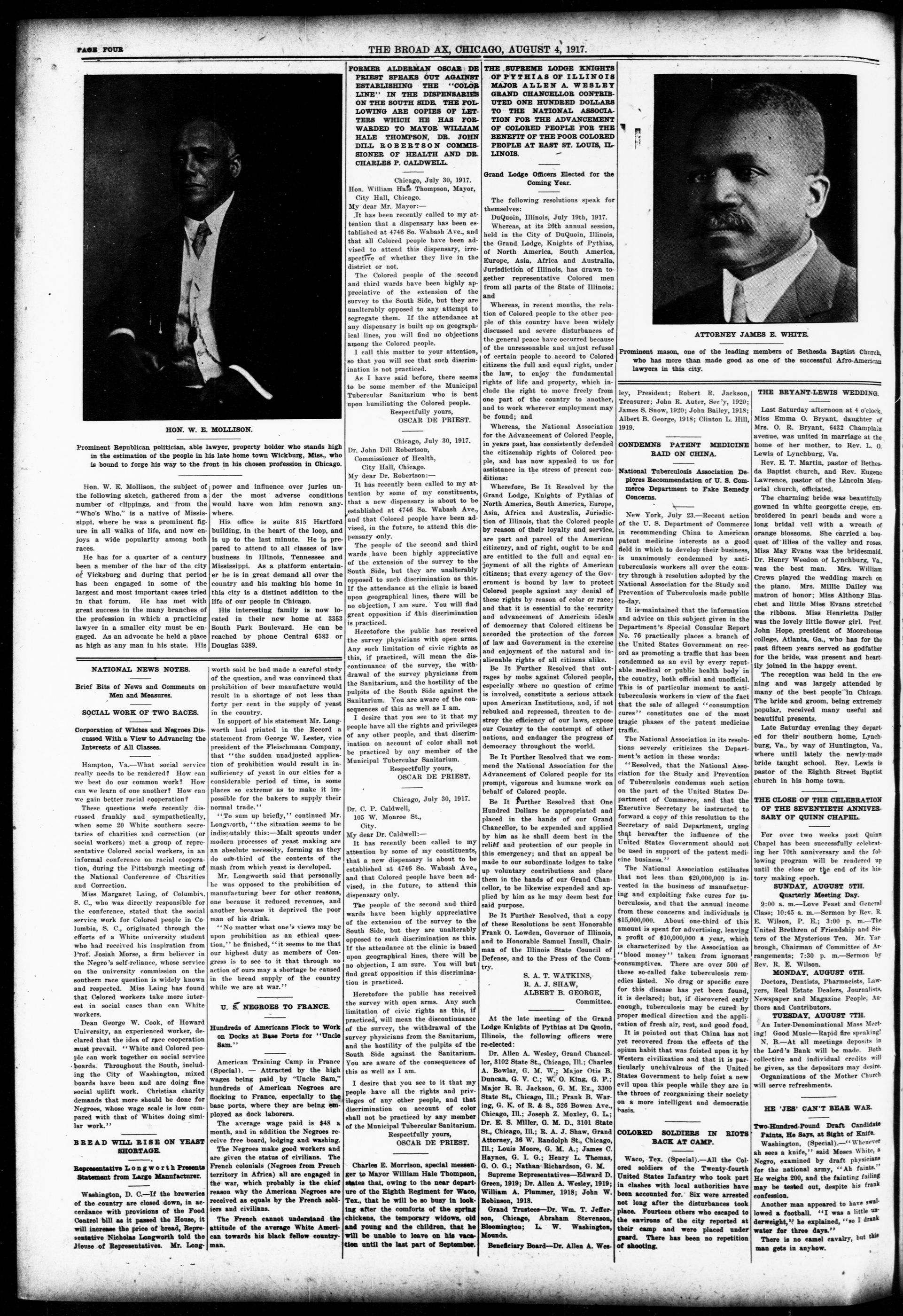
THE BROAD AX, CHICAGO, AUGUST 4, 1917.
FORMER ALDERMAN OSCAR DE PRIEST SPEAKS OUT AGAINST ESTABLISHING THE "COLOR LINE" IN THE DISPENSARIES ON THE SOUTH SIDE. THE FOLLOWING ARE COPIES OF LETTERS WHICH HE HAS FORWARDED TO MAYOR WILLIAM HALE THOMPSON, DR. JOHN DILL ROBERTSON COMMISSIONER OF HEALTH AND DR. CHARLES P. CALDWELL.
Chicago, July 30, 1917.
Hon. William Hale Thompson, Mayor, City Hall, Chicago.
THE SUPREME LODGE KING OF PYTHIAS OF ILLINOIS. MAJOR ALLEN A. WEIR GRAND CHANCELLOR COUNTED ONE HUNDRED DO TO THE NATIONAL ACTION FOR THE ADVANCEMENT OF COLORED PEOPLE FOR BENEFIT OF THE POOR PEOPLE AT EAST ST. LINOIS.
Grand Lodge Officers Elected Coming Year.
The following resolutions sp
It has been recently called to my attention that a dispensary has been established at 4746 So. Wabash Ave., and that all Colored people have been advised to attend this dispensary, irrespective of whether they live in the district or not.
The Colored people of the second and third wards have been highly appreciative of the extension of the survey to the South Side, but they are unalterably opposed to any attempt to segregate them. If the attendance at any dispensary is built up on geographical lines, you will find no objections among the Colored people.
I call this matter to your attention, so that you will see that such discrimination is not practiced.
As I have said before, there seems to be some member of the Municipal Tubercular Sanitarium who is bent upon humiliating the Colored people.
Respectfully yours,
OSCAR DE PRIEST.
Chicago, July 30, 1917.
Dr. John Dill Robertson,
Commissioner of Health,
City Hall, Chicago.
My dear Dr. Robertson:—
It has recently been called to my attention by some of my constituents, that a new dispensary is about to be established at 4746 So. Wabash Ave. and that Colored people have been advised, in the future, to attend this dispensary only.
The people of the second and third wards have been highly appreciative of the extension of the survey to the South Side, but they are unalterably opposed to such discrimination as this. If the attendance at the clinic is based upon geographical lines, there will be no objection, I am sure. You will find great opposition if this discrimination is practiced.
Heretofore the public has received the survey physicians with open arms. Any such limitation of civic rights as this, if practiced, will mean the discontinuance of the survey, the withdrawal of the survey physicians from the Sanitarium, and the hostility of the pulpits of the South Side against the Sanitarium. You are aware of the consequences of this as well as I am.
I desire that you see to it that my people have all the rights and privileges of any other people, and that discrimination on account of color shall not be practiced by any member of the Municipal Tubercular Sanitarium.
Chicago, July 30, 1917.
Dr. C. P. Caldwell,
105 W. Monroe St.,
City.
My dear Dr. Caldwell:—
It has recently been called to my attention by some of my constituents, that a new dispensary is about to be established at 4746 So. Wabash Ave.,
and that Colored people have been advised, in the future, to attend this dispensary only.
The people of the second and third wards have been highly appreciative of the extension of the survey to the South Side, but they are unalterably opposed to such discrimination as this. If the attendance at the clinic is based upon geographical lines, there will be no objection, I am sure. You will but find great opposition if this discrimination is practiced.
Heretofore the public has received the survey with open arms. Any such limitation of civic rights as this, if practiced, will mean the discontinuance of the survey, the withdrawal of the survey physicians from the Sanitarium, and the hostility of the pulpits of the South Side against the Sanitarium. You are aware of the consequences of this as well as I am.
I desire that you see to it that my people have all the rights and privileges of any other people, and that discrimination on account of color shall not be practiced by any member of the Municipal Tubercular Sanitarium. Respectfully yours, OSCAR DE PRIEST.
Charles E. Morrison, special messenger to Mayor William Hale Thompson, states that, owing to the near departure of the Eighth Regiment for Waco, Tex., that he will be so busy in looking after the comforts of the spring chickens, the temporary widows, old and young and the children, that he will be unable to leave on his vacation until the last part of September.
THE SUPREME LODGE KNIGHTS OF PYTHIAS OF ILLINOIS
MAJOR ALLEN A. WESLEY
GRAND CHANCELLOR CONTRIBUTED ONE HUNDRED DOLLARS TO THE NATIONAL ASSOCIATION FOR THE ADVANCEMENT OF COLORED PEOPLE FOR THE BENEFIT OF THE POOR COLORED PEOPLE AT EAST ST. LOUIS, ILLINOIS.
Grand Lodge Officers Elected for the Coming Year.
The following resolutions speak for themselves:
DuQuoin, Illinois, July 19th, 1917.
Whereas, at its 26th annual session, held in the City of DuQuoin, Illinois, the Grand Lodge, Knights of Pythias, of North America, South America, Europe, Asia, Africa and Australia, Jurisdiction of Illinois, has drawn together representative Colored men from all parts of the State of Illinois; and
Whereas, in recent months, the relation of Colored people to the other people of this country have been widely discussed and severe disturbances of the general peace have occurred because of the unreasonable and unjust refusal of certain people to accord to Colored citizens the full and equal right, under the law, to enjoy the fundamental rights of life and property, which include the right to move freely from one part of the country to another, and to work wherever employment may be found; and
Whereas, the National Association for the Advancement of Colored People, in years past, has consistently defended the citizenship rights of Colored people, and has now appealed to us for assistance in the stress of present conditions:
Wherefore, Be It Resolved by the Grand Lodge, Knights of Pythias of North America, South America, Europe, Asia, Africa and Australia, Jurisdiction of Illinois, that the Colored people by reason of their loyalty and service are part and parcel of the American citizenry, and of right, ought to be and are entitled to the full and equal enjoyment of all the rights of American citizens; that every agency of the Government is bound by law to protect Colored people against any denial of these rights by reason of color or race; and that it is essential to the security and advancement of American ideals of democracy that Colored citizens be accorded the protection of the forces of law and Government in the exercise and enjoyment of the natural and inalienable rights of all citizens alike.
Be It Further Resolved that outrages by mobs against Colored people, especially where no question of crime is involved, constitute a serious attack upon American Institutions, and, if not rebuked and repressed, threaten to destroy the efficiency of our laws, expose our Country to the contempt of other nations, and endanger the progress of democracy throughout the world.
Be It Further Resolved that we commend the National Association for the Advancement of Colored people for its prompt, vigorous and humane work on behalf of Colored people.
Be It Further Resolved that One Hundred Dollars be appropriated and placed in the hands of our Grand Chancellor, to be expended and applied by him as he shall deem best in the relief and protection of our people in this emergency; and that an appeal be made to our subordinate lodges to take up voluntary contributions and place them in the hands of our Grand Chancellor, to be likewise expended and applied by him as he may deem best for said purpose.
Be It Further Resolved, that a copy of these Resolutions be sent Honorable Frank O. Lowden, Governor of Illinois, and to Honorable Samuel Insull, Chairman of the Illinois State Council of Defense, and to the Press of the Country.
At the late meeting of the Grand Lodge Knights of Pythias at Du Quot, Illinois, the following officers were re-elected:
Dr. Allen A. Wesley, Grand Chancellor, 3102 State St., Chicago, Ill.; Charles A. Bowlar, G. M. W.; Major Otis B. Duncan, G. V. C.; W. O. King, G. P.; Major R. R. Jackson, G. M. Ex., 3300 State St., Chicago, Ill.; Frank B. Waring, G. K. of R. & S., 526 Bowen Ave., Chicago, Ill.; Joseph Z. Moxley, G. L.; Dr. E. S. Miller, G. M. D., 3101 State St., Chicago, Ill.; R. A. J. Shaw, Grand Attorney, 36 W. Randolph St., Chicago, Ill.; Louis Moore, G. M. A.; James C. Haynes, G. I. G.; Henry L. Thomas, G. O. G.; Nathan Richardson, G. M.
Supreme Representatives—Edward D. Green, 1919; Dr. Allen A. Wesley, 1919; William A. Plummer, 1918; John W. Robinson, 1918.
Grand Trustees—Dr. Wm. T. Jefferson, Chicago, Abraham Stevenson, Bloomington; L. W. Washington, Mounds.
Beneficiary Board—Dr. Allen A. Wes-
[Name]
ATTORNEY JAMES E. WHITE.
Prominent mason, one of the leading members of Bethesda Baptist Church, who has more than made good as one of the successful Afro-American lawyers in this city.
Prominent mason, one of the leading members of Bethesda Baptist Church, who has more than made good as one of the successful Afro-American lawyers in this city.
ley, President; Robert R. Jackson, Treasurer; John R. Auter, Sec'y; 1920; James S. Snow, 1920; John Bailey, 1918; Albert B. George, 1918; Clinton L. Hill, 1919.
CONDEMNS PATENT MEDICINE
RAID ON CHINA.
National Tuberculosis Association Deplores Recommendation of U. S. Commerce Department to Fake Remedy Concerns.
New York, July 23.—Recent action of the U. S. Department of Commerce in recommending China to American patent medicine interests as a good field in which to develop their business, is unanimously condemned by antituberculosis workers all over the country through a resolution adopted by the National Association for the Study and Prevention of Tuberculosis made public to-day.
It is-maintained that the information and advice on this subject given in the Department's Special Consular Report No. 76 practically places a branch of the United States Government on record as promoting a traffic that has been condemned as an evil by every reputable medical or public health body in the country, both official and unofficial. This is of particular moment to antituberculosis workers in view of the fact that the sale of alleged "consumption cures" constitutes one of the most tragic phases of the patent medicine traffic.
The National Association in its resolutions severely criticizes the Department's action in these words:
"Resolved, that the National Association for the Study and Prevention of Tuberculosis condemns such action on the part of the United States Department of Commerce, and that the Executive Secretary be instructed to forward a copy of this resolution to the Secretary of said Department, urging that hereafter the influence of the United States Government should not be used in support of the patent medicine business."
The National Association estimates that not less than $20,000,000 is invested in the business of manufacturing and exploiting fake cures for tuberculosis, and that the annual income from these concerns and individuals is $15,000,000. About one-third of this amount is spent for advertising, leaving a profit of $10,000,000 a year, which is characterized by the Association as "blood money" taken from ignorant consumptives. There are over 500 of these so-called fake tuberculosis remedies listed. No drug or specific cure for this disease has yet been found, it is declared; but, if discovered early enough, tuberculosis may be cured by proper medical direction and the application of fresh air, rest, and good food.
It is pointed out that China has not yet recovered from the effects of the opium habit that was foisted upon it by Western civilization and that it is particularly unchivalrous of the United States Government to help foist a new evil upon this people while they are in the throes of reorganizing their society on a more intelligent and democratic basis.
COLORED SOLDIERS IN BIOTS
BACK AT CAMP.
Waco, Tex. (Special).—All the Colored soldiers of the Twenty-fourth United States Infantry who took part in clashes with local authorities have been accounted for. Six were arrested not long after the disturbances took place. Fourteen others who escaped to the environs of the city reported at their camp and were placed under guard. There has been no repetition of shooting.
THE BRYANT-LEWIS WEDDING.
Last Saturday afternoon at 4 o'clock, Miss Emma O. Bryant, daughter of Mrs. O. R. Bryant, 6432 Champlain avenue, was united in marriage at the home of her mother, to Rev. L. O. Lewis of Lynchburg, Va.
Rev. E. T. Martin, pastor of Bethesda Baptist church, and Rev. Eugene Lawrence, pastor of the Lincoln Memorial church, officiated.
The charming bride was beautifully gowned in white georgette crepe, embroidered in pearl beads and wore a long bridal veil with a wreath of orange blossoms. She carried a bouquet of lilies of the valley and roses. Miss May Evans was the bridesmaid. Dr. Henry Weedon of Lynchburg, Va., was the best man. Mrs. William Crews played the wedding march on the piano. Mrs. Millie Dailey was matron of honor; Miss Althony Blanchet and little Miss Evans stretched the ribbons. Miss Henrietta Dailey was the lovely little flower girl. Prof. John Hope, president of Moorehouse college, Atlanta, Ga., who has for the past fifteen years served as godfather for the bride, was present and heartily joined in the happy event.
The reception was held in the evening and was largely attended by many of the best people in Chicago. The bride and groom, being extremely popular, received many useful and beautiful presents.
Late Saturday evening they departed for their southern home, Lynchburg, Va., by way of Huntington, Va., where until lately the newly-made bride taught school. Rev. Lewis is pastor of the Eighth Street Baptist church in his home town.
THE CLOSE OF THE CELEBRATION OF THE SEVENTIETH ANNIVERSARY OF QUINN CHAPEL.
For over two weeks past Quinn Chapel has been successfully celebrating her 70th anniversary and the following program will be rendered up until the close or the end of its history making epoch.
SUNDAY. AUGUST 5TH.
9:00 a. m.—Love Feast and General Class; 10:45 a. m.—Sermon by Rev. R. E. Wilson, P. E.; 3:00 p. m.—The United Brethren of Friendship and Sisters of the Mysterious Ten. Mr. Yarbrough, Chairman of Committee of Arrangements; 7:30 p. m.—Sermon by Rev. R. E. Wilson.
MONDAY, AUGUST 6TH.
Doctors, Dentists, Pharmacists, Lawyers, Real Estate Dealers, Journalists, Newspaper and Magazine People, Authors and Contributors.
TUESDAY, AUGUST 7TH.
An Inter-Denominational Mass Meeting! Good Music—Rapid fire speaking! N. B.—At all meetings deposits in the Lord's Bank will be made. Both collective and individual credits will be given, as the depositors may desire.
Organizations of the Mother Church will serve refreshments
HE 'JES' CAN'T BEAR WAR
Two-Hundred-Pound Draft Candidate Paints, He Says, at Sight of Knife.
Washington, (Special)—"Whenever ah sees a knife," said Moses White, a Negro, examined by draft physicians for the national army, "Ah faints."
He weighs 200, and the fainting failing may be tested out, despite his frank confession.
Another man appeared to have swallowed a football. "I was a little underweight," he explained, "so I drank water for three days."
There is no camel cavalry, but this man gets in anyhow.
A
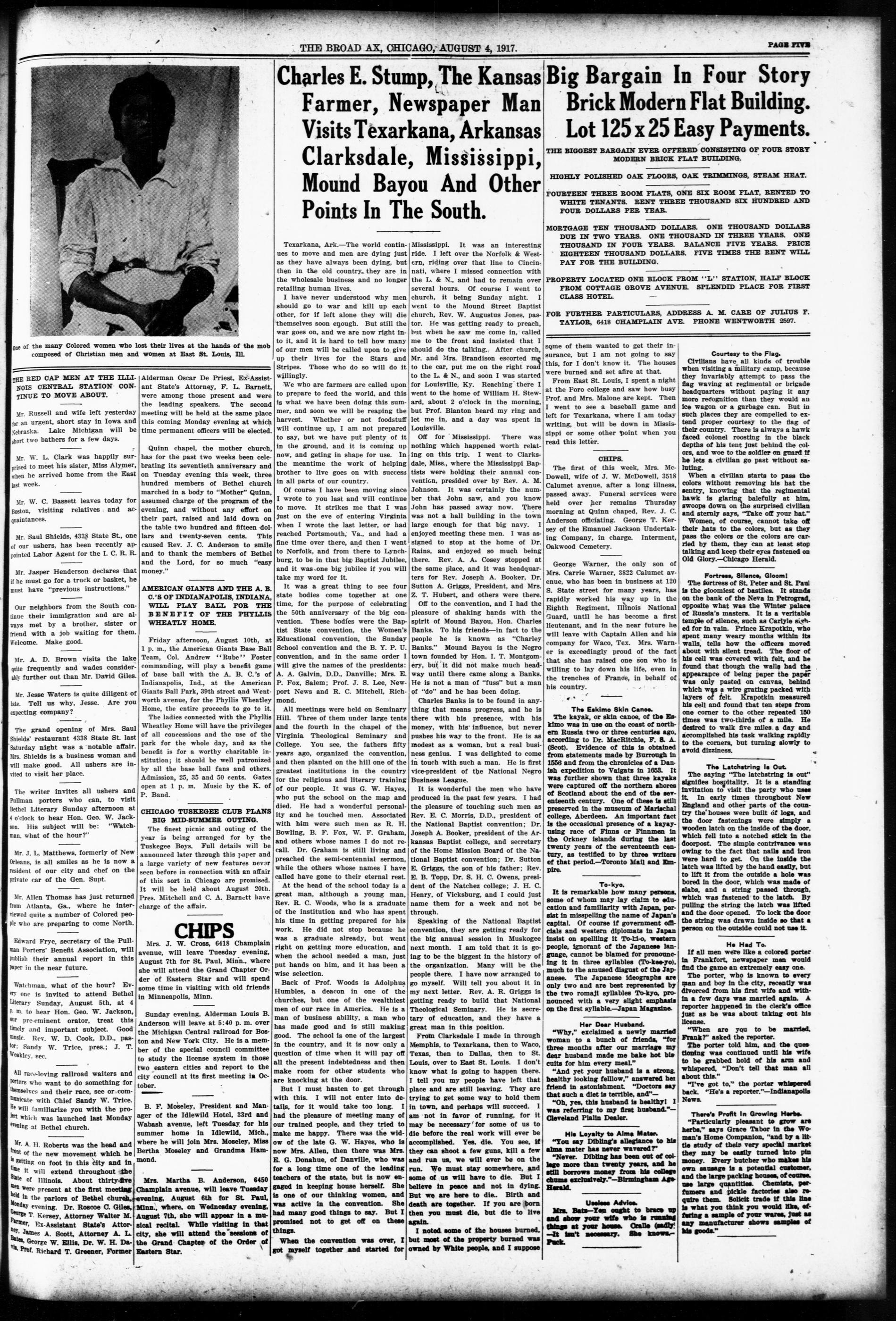
One of the many Colored women who lost their lives at the hands of the mob composed of Christian men and women at East Louis, Ill.
THE RED CAP MEN AT THE ILLINOIS CENTRAL STATION CONTINUE TO MOVE ABOUT.
Mr. Russell and wife left yesterday for an urgent, short stay in Iowa and Nebraska. Lake Michigan will be short two bathers for a few days.
Mr. W. L. Clark was happily surprised to meet his sister, Miss Alymer, when he arrived home from the East last week.
Mr. W. C. Bassett leaves today for Boston, visiting relatives and acquaintances.
Mr. Saul Shields, 4338 State St., one of our ushers, has been recently appointed Labor Agent for the I. C. R. R.
Mr. Jasper Henderson declares that if he must go for a truck or basket, he must have "previous instructions."
Our neighbors from the South continue their immigration and are always met by a brother, sister or friend with a job waiting for them. Welcome. Make good.
Mr. A. D. Brown visits the lake quite frequently and wades considerably further out than Mr. David Giles.
Mr. Jesse Waters is quite diligent of late. Tell us why, Jesse. Are you expecting company?
The grand opening of Mrs. Saul Shields' restaurant 4338 State St. last Saturday night was a notable affair. Mrs. Shields is a business woman and will make good. All ushers are invited to visit her place.
The writer invites all ushers and Pullman porters who can, to visit Bethel Literary Sunday afternoon at 4 o'clock to hear Hon. Geo. W. Jackson. His subject will be: "Watchman, what of the hour?"
Mr. J. L. Matthews, formerly of New Orleans, is all smiles as he is now a resident of our city and chef on the private car of the Gen. Supt.
Mr. Allen Thomas has just returned from Atlanta, Ga., where he interviewed quite a number of Colored people who are preparing to come North.
Edward Frye, secretary of the Pullman Porters' Benefit Association, will publish their annual report in this paper in the near future.
Watchman, what of the hour? Every one is invited to attend Bethel Literary Sunday, August 5th, at 4 p.m. to hear Hon. Geo. W. Jackson, our pre-eminent orator, treat this timely and important subject. Good music. Rev. W. D. Cook, D.D., pastor; Sandy W. Trice, pres.; J. T. Weakley, sec.
All race-loving railroad waiters and porters who want to do something for themselves and their race, see or communicate with Chief Sandy W. Trice. He will familiarize you with the project which was launched last Monday evening at Bethel church.
Mr. A. H. Roberts was the head and front of the new movement which he is getting on foot in this city and in time it will extend throughout the State of Illinois. About thirty-five men were present at the first meeting held in the parlors of Bethel church, Monday evening. Dr. Roscoe C. Giles, George T. Kersey, Attorney Walter M. Farmer, Ex-Assistant State's Attorney, James A. Scott, Attorney A. L. Bates, George W. Ellis, Dr. W. H. Davis, Prof. Richard T. Greener, Former
Alderman Oscar De Priest, Ex-Assistant State's Attorney, F. L. Barnett, were among those present and were the leading speakers. The second meeting will be held at the same place this coming Monday evening at which time permanent officers will be elected.
Quinn chapel, the mother church has for the past two weeks been celebrating its seventieth anniversary and on Tuesday evening this week, three hundred members of Bethel church marched in a body to "Mother" Quinn, assumed charge of the program of the evening, and without any effort on their part, raised and laid down on the table two hundred and fifteen dollars and twenty-seven cents. This caused Rev. J. C. Anderson to smile and to thank the members of Bethel and the Lord, for so much "easy money."
AMERICAN GIANTS AND THE A. B. C.'S OF INDIANAPOLIS, INDIANA, WILL PLAY BALL FOR THE BENEFIT OF THE PHYLLIS WHEATLY HOME.
Friday afternoon, August 10th, at 1 p. m., the American Giants Base Ball Team, Col. Andrew "Rube" Foster commanding, will play a benefit game of base ball with the A. B. C.'s of Indianapolis, Ind., at the American Giants Ball Park, 39th street and Wentworth avenue, for the Phyllis Wheatley Home, the entire proceeds to go to it. The ladies connected with the Phyllis Wheatley Home will have the privileges of all concessions and the use of the park for the whole day, and as the benefit is for a worthy charitable institution; it should be well patronized by all the base ball fans and others. Admission, 25, 35 and 50 cents. Gates open at 1 p. m. Music by the K. of P. Band.
CHICAGO TUSKEGE CLUB PLANS
RIG, MID-SUMMER OUTTING
The finest picnic and outing of the year is being arranged for by the Tuskegee Boys. Full details will be announced later through this paper and a large variety of new features never seen before in connection with an affair of this sort in Chicago are promised. It will be held about August 20th. Pres. Mitchell and C. A. Barnett have charge of the affair.
CHIPS
Mrs. J. W. Cross, 6418 Champlain avenue, will leave Tuesday evening, August 7 for St. Paul, Minn., where she will attend the Grand Chapter Order of Eastern Star and will spend some time in visiting with old friends in Minneapolis, Minn.
Sunday evening, Alderman Louis B. Anderson will leave at 5:40 p. m. over the Michigan Central railroad for Boston and New York City. He is a member of the special council committee to study the license system in those two eastern cities and report to the city council at its first meeting in October.
B. F. Moseley, President and Manager of the Idlewild Hotel, 33rd and Wabash avenue, left Tuesday, for his summer home in Idlewild, Mich., where he will join Mrs. Moseley, Miss Bertha Moseley and Grandma Hammond.
Mrs. Martha B. Anderson, 6450 Champlain avenue, will leave Tuesday evening, August 6th for St. Paul, Minn., where, on Wednesday evening, August 7th, she will appear in a musical recital. While visiting in that city, she will attend the sessions of the Grand Chapter of the Order of Eastern Star.
THE BROAD AX. CHICAGO. AUGUST 4. 1917.
Charles E. Stump, The Kansas Farmer, Newspaper Man Visits Texarkana, Arkansas Clarksdale, Mississippi, Mound Bayou And Other Points In The South.
Texarkana, Ark.—The world continues to move and men are dying just as they have always been dying, but then in the old country they are in the wholesale business and no longer retailing human lives.
I have never understood why men should go to war and kill up each other, for if left alone they will die themselves soon enough. But still the war goes on, and we are now right into it, and it is hard to tell how many of our men will be called upon to give up their lives for the Stars and Stripes. Those who do so will do it willingly.
We who are farmers are called upon to prepare to feed the world, and this is what we have been doing this summer, and soon we will be reaping the harvest. Whether or not foodstuff will continue up, I am not prepared to say, but we have put plenty of it in the ground, and it is coming up now, and getting in shape for use. In the meantime the work of helping brother to live goes on with success in all parts of our country.
Of course I have been moving since I wrote to you last and will continue to move. It strikes me that I was just on the eve of entering Virginia when I wrote the last letter, or had reached Portsmouth, Va., and had a fine time over there, and then I went to Norfolk, and from there to Lynchburg, to be in that big Baptist Jubilee, and it was one big jubilee if you will take my word for it.
It was a great thing to see four state bodies come together at one time, for the purpose of celebrating the 50th anniversary of the big convention. These bodies were the Baptist State convention, the Women's Educational convention, the Sunday School convention and the B. Y. P. U convention, and in the same order I will give the names of the presidents: A. A. Galvin, D.D., Danville; Mrs. E. P. Fox, Salem; Prof. J. S. Lee, Newport News and R. C. Mitchell, Richmond.
All meetings were held on Seminary Hill. Three of them under large tents and the fourth in the chapel of the Virginia Theological Seminary and College. You see, the fathers fifty years ago, organized the convention, and then planted on the hill one of the greatest institutions in the country for the religious and literary training of our people. It was G. W. Hayes, who put the school on the map and died. He had a wonderful personality and he touched men. Associated with him were such men as R. H. Bowling, B. F. Fox, W. F. Graham, and others whose names I do not recall. Dr. Graham is still living and preached the semi-centennial sermon, while the others whose names I have called have gone to their eternal rest.
At the head of the school today is a great man, although a young man, Rev. R. C. Woods, who is a graduate of the institution and who has spent his time in getting prepared for his work. He did not stop because he was a graduate already, but went right on getting more education, and when the school needed a man, just put hands on him, and it has been a wise selection.
Back of Prof. Woods is Adolphus Humbles, a deacon in one of the churches, but one of the wealthiest men of our race in America. He is a man of business ability, a man who has made good and is still making good. The school is one of the largest in the country, and it is now only a question of time when it will pay off all the present indebtedness and then make room for other students who are knocking at the door.
But I must hasten to get through with this. I will not enter into details, for it would take too long. I had the pleasure of meeting many of our trained people, and they tried to make me happy. There was the widow of the late G. W. Hayes, who is now Mrs. Allen, then there was Mrs. E. G. Donahue, of Danville, who was for a long time one of the leading teachers of the state, but is now engaged in keeping house herself. She is one of our thinking women, and was active in the convention. She had many good things to say. But I promised not to get off on these things.
When the convention was over, I got myself together and started for
Mississippi. It was an interesting ride. I left over the Norfolk & Western, riding over that line to Cincinnati, where I missed connection with the L. & N., and had to remain over several hours. Of course I went to church, it being Sunday night. I went to the Mound Street Baptist church, Rev. W. Augustus Jones, pastor. He was getting ready to preach, but when he saw me come in, called me to the front and insisted that I should do the talking. After church, Mr. and Mrs. Brandon escorted me to the car, put me on the right road to the L. & N., and soon I was started for Louisville, Ky. Reaching there I went to the home of William H. Steward, about 2 o'clock in the morning, but Prof. Blanton heard my ring and let me in, and a day was spent in Louisville.
Off for Mississippi. There was nothing which happened worth relating on this trip. I went to Clarksdale, Miss., where the Mississippi Baptists were holding their annual convention, presided over by Rev. A. M. Johnson. It was certainly the number that John saw, and you know John has passed away now. There was not a hall building in the town large enough for that big navy. I enjoyed meeting these men. I was assigned to stop at the home of Dr. Rains, and enjoyed so much being there. Rev. A. A. Cosey stopped at the same place, and it was headquarters for Rev. Joseph A. Booker, Dr. Sutton A. Griggs, President, and Mrs. Z. T. Hubert, and others were there. Off to the convention, and I had the pleasure of shaking hands with the spirit of Mound Bayou, Hon. Charles Banks. To his friends—in fact to the people he is known as "Charley Banks." Mound Bayou is the Negro town founded by Hon. I. T. Montgomery, but it did not make much headway until there came along a Banks. He is not a man of "fuss" but a man of "do" and he has been doing.
Charles Banks is to be found in anything that means progress, and he is there with his presence, with his money, with his influence, but never pushes his way to the front. He is as modest as a woman, but a real business genius. I was delighted to come in touch with such a man. He is first vice-president of the National Negro Business League.
It is wonderful the men who have produced in the past few years. I had the pleasure of touching such men as Rev. E. C. Morris, D.D., president of the National Baptist convention; Dr. Joseph A. Booker, president of the Arkansas Baptist college, and secretary of the Home Mission Board of the National Baptist convention; Dr. Sutton E. Griggs, the son of his father; Rev. E. B. Topp, Dr. S. H. C. Owens, president of the Natchez college; J. H. C. Henry, of Vicksburg, and I could just name them for a week and not be through.
Speaking of the National Baptist convention, they are getting ready for the big annual session in Muskogee next month. I am told that it is going to be the biggest in the history of the organization. Many will be the people there. I have now arranged to go myself. Will tell you about it in my next letter. Rev. A. R. Griggs is getting ready to build that National Theological Seminary. He is secretary of education, and they have a great man in this position.
From Clarksdale I made in through Memphis, to Texarkana, then to Waco, Texas, then to Dallas, then to St. Louis, over to East St. Louis. I don't know what is going to happen there. I tell you my people have left that place and are still leaving. They are trying to get some way to hold them in town, and perhaps will succeed. I am not in favor of running, for it may be necessary for some of us to die before the real work will ever be accomplished. Yes, die. You see, if they can shoot a few guns, kill a few and run us, we will ever be on the run. We must stay somewhere, and some of us will have to die. But I believe in peace and not in dying. But we are here to die.. Birth and death are together. If you are born then you must die, but die to live arain.
I noted some of the houses burned, but most of the property burned was owned by White people, and I suppose
Big Bargain In Four Story Brick Modern Flat Building. Lot 125 x 25 Easy Payments.
THE BIGGEST BARGAIN EVER OFFERED CONSISTING OF FOUR STORY MODERN BRICK FLAT BUILDING.
HIGHLY POLISHED OAK FLOORS, OAK TRIMMINGS, STEAM HEAT.
FOURTEEN THREE ROOM FLATS, ONE SIX ROOM FLAT, RENTED TO WHITE TENANTS. RENT THREE THOUSAND SIX HUNDRED AND FOUR DOLLARS PER YEAR.
MORTGAGE TEN THOUSAND DOLLARS. ONE THOUSAND DOLLARS DUE IN TWO YEARS. ONE THOUSAND IN THREE YEARS. ONE THOUSAND IN FOUR YEARS. BALANCE FIVE YEARS. PRICE EIGHTEEN THOUSAND DOLLARS. FIVE TIMES THE RENT WILL PAY FOR THE BUILDING.
PROPERTY LOCATED ONE BLOCK FROM "L" STATION, HALF BLOCK FROM COTTAGE GROVE AVENUE. SPLENDID PLACE FOR FIRST CLASS HOTEL.
FOR FURTHER PARTICULARS, ADDRESS A. M. CARE OF JULIUS F. TAYLOR 6418 CHAMPLAIN AVE. PHONE WENTWORTH 2597.
sqme of them wanted to get their insurance, but I am not going to say this, for I don't know it. The houses were burned and set afire at that. From East St. Louis, I spent a night at the Poro college and saw how busy Prof. and Mrs. Malone are kept. Then I went to see a baseball game and left for Texarkana, where I am today writing, but will be down in Mississippi or some other point when you read this letter.
CHIPS.
The first of this week, Mrs. McDowell, wife of J. W. McDowell, 3518 Calumet avenue, after a long illness, passed away. Funeral services were held over her remains Thursday morning at Quinn chaped, Rev. J. C. Anderson officiating. George T. Kersey of the Emanuel Jackson Undertaking Company, in charge. Interment, Oakwood Cemetery.
George Warner, the only son of Mrs. Carrie Warner, 3822 Calumet avenue, who has been in business at 120 S. State street for many years, has rapidly worked his way up in the Eighth Regiment, Illinois National Guard, until he has become a first lieutenant, and in the near future he will leave with Captain Allen and his company for Waco, Tex. Mrs. Warner is exceedingly proud of the fact that she has raised one son who is willing to lay down his life, even in the trenches of France, in behalf of his country.
The Eskimo Skin Cancer
The kayak, or skin canoe, of the Eskimo was in use on the coast of northern Russia two or three centuries ago according to Dr. MacRitchie, F. S. A. (Scot). Evidence of this is obtained from statements made by Burrough in 1556 and from the chronicles of a Danish expedition to Valgats in 1653. It was further shown that three kayaks were captured off the northern shores of Scotland about the end of the seventeenth century. One of these is still preserved in the museum of Marischal college, Aberdeen. An important fact is the occasional presence of a kayak using race of Finns or Finnmen in the Orkney islands during the last twenty years of the seventeenth century, as testified to by three writers of that period.—Toronto Mall and Empire.
To-kyo.
It is remarkable how many persons some of whom may lay claim to education and familiarity with Japan, persist in misspelling the name of Japan's capital. Of course if government officials and western diplomats in Japan insist on spelling it To-ki-o, western people, ignorant of the Japanese language, cannot be blamed for pronouncing it in three syllables (To-kee-yo) much to the amused disgust of the Japanese. The Japanese ideographs are only two and are best represented by the two romaji syllables To-kyo, pronounced with a very slight emphasis on the first syllable—Japan Magazine.
Her Dear Husband.
"Why," exclaimed a newly married woman to a bunch of friends, "for three months after our marriage my dear husband made me bake hot biscuits for him every meal."
"And yet your husband is a strong, healthy looking fellow," answered her friend in astonishment. "Doctors say that such a diet is terrible, and"—"Oh, yes, this husband is healthy! I was referring to my first husband."—Cleveland Plain Dealer.
His Loyalty to Alma Mater
"You say Dibbing's allegiance to his alma mater has never wavered." "Never. Dibbing has been out of college more than twenty years, and he still borrows money from his college chums exclusively."—Birmingham Age-Herald.
Unclease Advice.
Mrs. Batz—Yen ought to brace up
and show your wife who is running
things at your house. Cralle (sadly)
-It isn't necessary. She known-
Puck.
PAGE FIVE
In Four Story
in Flat Building.
Easy Payments.
SERED CONSISTING OF FOUR STORY
FLAT BUILDING.
OAK TRIMMINGS, STEAM HEAT.
ONE SIX ROOM FLAT, RENTED TO
ONE THOUSAND SIX HUNDRED AND
DOLLARS. ONE THOUSAND DOLLARS
THOUSAND IN THREE YEARS. ONE
BALANCE FIVE YEARS. PRICE
S. FIVE TIMES THE RENT WILL
FROM "L" STATION, HALF BLOCK
VE. SPLENDID PLACE FOR FIRST
ADDRESS A. M. CARE OF JULIUS F.
E. PHONE WENTWORTH 2597.
Courtesy to the Flag.
Civilians have all kinds of trouble when visiting a military camp, because they invariably attempt to pass the flag waving at regimental or brigade headquarters without paying it any more recognition than they would an ice wagon or a garbage can. But in such places they are compelled to extend proper courtesy to the flag of their country. There is always a hawk faced colonel roosting in the black depths of his tent just behind the colors, and woe to the soldier on guard if he lets a civilian go past without saluting.
When a civilian starts to pass the colors without removing his hat the sentry, knowing that the regimental hawk is glaring balefully at him, swoops down on the surprised civilian and sternly says "Take off your hat."
Women, of course, cannot take off their hats to the colors, but as they pass the colors or the colors are carried by them, they can at least stop talking and keep their eyes fastened on Old Glory-Chicago Herald.
Fortress, Silence, Gloom!
The fortress of St. Peter and St. Paul is the gloomiest of bastles. It stands on the bank of the Neva in Petrograd, opposite what was the Winter palace of Russia's masters. It is a veritable temple of silence, such as Carlyle signed for in vain. Prince Krapotkin, who spent many weary months within its walls, tells how the officers moved about with silent tread. The floor of his cell was covered with felt, and he found that though the walls had the appearance of being paper the paper was only pasted on canvas, behind which was a wire grating packed with layers of fabric. Krapotkin measured his cell and found that ten steps from one corner to the other repeated 150 times was two-thirds of a mile. He desired to walk five miles a day and accomplished his task walking rapidly to the corners, but turning slowly to avoid dizziness.
The Latchstring Is Out:
The saying "The latchstring is out" signifies hospitality. It is a standing invitation to visit the party who uses it. In early times throughout New England and other parts of the country the 'houses were built of logs, and the door fastenings were simply a wooden latch on the inside of the door, which fell into a notched stick in the doorpost. The simple contrivance was owing to the fact that nails and iron were hard to get. On the inside the latch was lifted by the hand easily, but to lift it from the outside a hole was bored in the door, which was made of slabs, and a string passed through, which was fastened to the latch. By pulling the string the latch was lifted and the door opened. To lock the door the string was drawn inside so that a person on the outside could not use it.
He Had To.
If all men were like a colored porter in Frankfort, newspaper men would find the game an extremely easy one. The porter, who is known to every man and boy in the city, recently was divorced from his first wife and within a few days was married again. A reporter happened in the clerk's office just as he was about taking out his license.
"When are you to be married, Frank?" asked the reporter.
The porter told him, and the questioning was continued until his wife to be grabbed hold of his arm and whispered, "Don't tell that man all about this."
"I've got to," the porter whispered back. "He's a reporter."—Indianapolis News
There's Profit In Growing Herbs
"Particularly pleasant to grow are herbs," says Grace Tabor in the Woman's Home Companion, "and by a little study of their very special market they may be easily turned into pin money. Every butcher who makes his own sausage is a potential customer, and the large packing houses, of course, use large quantities. Chemists, perfumers and pickle factories also require them. Solicit trade if this line is what you think you would like, offering a sample of your wares, just as any manufacturer shows samples of his goods."
---
BANGLADI
THE BROADAX
Published Weekly
In this city since July 15th, 1899 without missing one single issue, Republicans, Democrats, Catholics, Protestants, single Taxers, Priests, infidels or anyone else can have their say as long as their language is proper and responsibility is fixed.
The Broad Ax is a newspaper whose platform is broad enough for all, ever claiming the editorial right to speak its own mind.
Local communications will receive attention. Write only on one side of the paper.
Subscriptions must be paid in advance.
One Year.....$2.00
Six Months.....1.00
Advertising rates made known on application.
Address all communications to
THE BROAD AX
6418 Champlain Ave., Chicago, Ill.
PHONE WENTWORTH 2597.
JULIUS F. TAYLOR, Editor and Publisher.
Entered as Second-Class Matter Aug. 19, 1902, at the Post Office at Chicago, Illinois, under Act of March 3, 1879.
Fur Bearing Animals.
The fur trade in this country has grown to such proportions as regards its business value that naturally the concern of those engaged in it is directed to its permanency. Curiously enough, the prevalent opinion that fur bearing animals are fast decreasing in numbers is not correct as regards those animals which furnish the bulk of the fur business.
There are a number of fur bearing animals which cannot exist in civilized and thickly settled countries and which consequently are fast dying out. But muskrats, coons, skunks and some others seem to thrive and multiply in spite of civilization, for such old and thickly settled states as New York, Pennsylvania and Ohio still contribute largely to the fur trade, especially in muskrat skins. Should the time come when these animals cannot be had plentifully in their wild state it is not unlikely that they will be bred especially for their furs—New York Times.
Wit of Joseph Choate.
Joseph Choate had a decidedly nasal voice, but it was a beautiful voice, resonant as some big gong, and his rather unkind wit was as genuine as his courage. Every now and then his wit was touched with beauty, as when he said of the freshmen dormitories at Harvard that all they needed to make them rivals of the Oxford college buildings was ivy and time. Mr. Choate took a playful satisfaction in suddenly chilling auditors whom he had carefully warmed. Speaking once at a boys' school, three of whose graduates had acted as his secretaries when he was ambassador, he delighted his audience by his praise of these secretaries. After enjoying the pleasure of masters and boys Mr. Choate wound up by saying something like this, "Perhaps I ought to add that all I ask of a secretary is that he shall keep out of my way and shave every day."—New Republic.
Surmounting the Impossible
It has been the experience of every forester as he goes about the country to be told that a certain mountain is impassable, that a certain trail cannot be traveled, that a certain stream cannot be crossed and to find that mountain, trail and stream can all be passed with little serious difficulty by a man who is willing to try. Most things said to be impossible are so only in the mind of the man whose timidity or inertness keeps him from making the attempt. The whole story of the establishment and growth of the United States forest service is a story of the doing of things which the men who did them were warned in advance would be impossible. Usually the thing which "cannot be done" is well worth trying. -Gifford Pinchot.
Eccentric Place Names
There are one or two place names in England which for eccentricity it would be hard to beat. Cornwall boasts of a village called Drunkards All and of a tithing called London Apprentice. The name of another Cornish village, Grumzia, sounds worse when spoken than it looks in print. The same may be said of the neighboring village of St. Eval, which is pronounced "Sandeval." Bishop Philpottles asked a candidate for ordination where he came from. "St. Eval." was the reply. "Dear me," remarked the bishop. "I know that Cornishmen venerate St. Tudy, St. Cuby, St. Uny and other saints unknown to the calendar, but I was not aware they had canonized the devil!"—London Mirror.
A Generous Empress.
It is said that one morning at breakfast a general related to Napoleon III, the misfortunes of a brother officer, who, "because he had not 15,000 francs must be dishonored." While the emperor questioned further particulars Eugene flew to her room and, returning with a package of banknotes, said, "Take them, general, and never tell me his name." And his name the generous empress never knew.
He Lacked Concentration.
Speaking of a man who was a failure because of his lack of concentration and his inability to know his own mind five minutes at a time, a captain of industry said he reminded him of a hunting dog he once owned:
"At sunrise the dog would start out on his own hook after deer. He would jump a buck and run him for miles. When the buck was on the point of exhaustion the hound's nostrils would catch the taint in the air where a fox had crossed the trail, and he would instantly decide that, after all, fox was what he had come for, and he would turn aside to pursue the fox. Perhaps an hour later, when the chase was growing warmer every minute, his keen nose would detect the presence of a rabbit, and he would go after the cottontail, with the inevitable result that by 4 o'clock in the afternoon that hound would be thirty or forty miles away from home in a swamp with a chipmunk treed!"—Saturday Evening Post.
George and His Legs.
Bit by bit the historical grubbers are digging out the truth about our immortal George. We have heretofore been told that he wore false teeth and that at Valley Forge he unblushingly deceived his ragged and despondent troops with the arrival of ample supplies of ammunition, which consisted of powder barrels filled with sand, and now a correspondent of the New York Sun declares that in the full length portraits of Washington by Stuart, of which there is one in the New York public library, the legs were not his own. "I have seen the letter from Stuart thanking the true owner for his kindness in providing a symmetrical foundation for the bust of the great president and presenting one of the smaller portraits in thanks for his kindness."
Free Speech.
An old negro woman had lived with a certain family in the south for many years. One day her mistress had occasion to reprimand her quite sharply for something that had gone wrong. The negress said nothing at the time, but a little later her voice could be heard in the kitchen in shrill vituperation of everything and everybody, with a rattling accompaniment of pans and kettles. So loud became the clamor and so vindictive the exclamations that Mrs. C. went hurriedly down to the kitchen.
"Why, Liza," she began in amazement, "who on earth are you talking to?"
"I ain't talkin' to nobody," the old negress replied, "but I don't keer who in dis house hyars me."—Harper's Magazine.
Misprints and Maxim Guns
The late Sir Hiram Maxim says in his autobiography that when he organized the United States Electric Lighting company the printer sent home its stationery with the heading, "The United States Electric Lightning company." When he established his new gun company in England he told of this mistake in order to emphasize the importance of getting the stationery printed correctly. When the first sheets were brought to him, however, he found that the English printers had made his concern appear as "The Maxim Gum Company."
Easy Generosity.
Mother (to small son)—Bobby, dear.
I hoped you would be unselfish enough to give little sister the largest piece of candy. Why, see, even our old hen gives all the nice big dainties to the little chicks and only keeps an occasional tiny one for herself.
Bobby thoughtfully watched the hen and chickens for a time and then sald, "Well, mamma, I would, too, if it was worms."—Rochester Times.
A. Generation.
In the long lived patrilarchal age a generation seems to have been computed at 100 years (Genesis xv, 1). Subsequently the reckoning was the same that has been more recently adopted that is, from thirty to forty jobs (Job xxii, 16).
Incongruous.
Little Alick—What is an incongruity,
uncle? Uncle William—An incongruity,
child, is a divorce lawyer humming a
wedding march.
The rapid growth of vegetation in the polar regions is attributed to the electric currents in the atmosphere.
PRACTICAL HEALTH HINT.
Neuralgia
Neuralgia means nerve pain. Neuritis means inflammation of the nerve. In neuralgia the pain comes and goes. In neuritis the ache is steady and sticks closely to the affected nerve. If the nerve could be taken out and examined we could find nothing abnormal in the case of neuralgia. In neuritis the nerve would be found to be inflamed. The question of what is behind the pain of neuralgia is more important than the answer to the cry for relief. It must be remembered that neuralgia is merely a symptom, not a disease. Sometimes malaria is the underlying cause. Other times it may be due to alcoholism, diabetes, lead poisoning, gout, rheumatism or Bright's disease. A diseased tooth or a diseased ovary may be responsible. In every case treatment must include treatment of the underlying cause.
```markdown
```
THE BROAD AX. CHICAGO. AUGUST 4. 1917
Spanish Doubleons.
Spanish Doubloons.
Should one find a pirate's buried treasure he would have to dispose of his Spanish gold at its bullion value, for since Aug. 1, 1908, when the common crier made proclamation from the steps of the Royal Exchange of London that after that date the doubloon would cease to be legal tender in the West Indies, including British Guiana, the doubloon has not been the precious thing it was. In 1730 and for a century after it was worth $8, more or less. It has ceased to be coined in its native country, Spain, and since 1908 it has been unpopular in the West Indies, where for a long time it figured in a mixed circulation, embracing British, United States and Spanish coins. In the interest of romance, however, the name at least must survive. It signifies nothing more than that the coin was double the value of a pistole, but the "doubloon" was never such a mouth filling mockery as "pieces of eight," which suggests great riches, but means only Spanish silver dollars. pieces equivalent to eight reals.—Rochester Post-Express.
A Famous New York Street.
Few of the thousands of people who pass the corner of Nassau and John streets every day know the early history of Nassau street. And yet right at that corner is a bronze tablet which gives in concise form the following historical information:
"Nassau Street, Known Originally as the 'Street That Runs by the Pye Woman,' Was Laid Out About 1655 and Was Named In Honor of the House of Nassau, Whose Head at That Time Was William the Third, King of England and Stadholder of the Dutch Republic. Nassau Street became Identified With the Jewelry Trade More Than Half a Century Ago."
The bronze tablet is on the exterior of the building at the northwest corner of Nassau and John streets. It was erected by the Malden Lane Historical society in 1916—New York Sun.
William De Morgan.
In spite of himself William De Morgan became famous. He deliberately violated all the rules made for the guidance of novelists who seek to become popular. None of his novels was addressed to the greater public that is avid for the latest thing of the moment in fiction, but nevertheless they reached that public. He was a law unto himself in the novels that he wrote during his marvelous career that spanned only ten years. It is doubtful if in English literature or in any other can be found a writer whose life and literary career are comparable to his. He was an old man when the world of readers came to know him, and his age was an asset toward celebrity. At seventy he was hailed as eagerly as Klipling was hailed at twenty, and in his way he was no less a prodigy than the younger writer.—Bookman
The Emerald.
The emerald has been known since early times both in Europe and in certain parts of the orient, where its attractive color and rarity have endowed it with the highest rank and a varied lore. Its name may be traced back to an old Persian word which appeared in Greek as "smaragdos," mentioned by Theophrastus over 300 years before the Christian era, and again in Latin as "smaragdus," seen in the writings of Pliny, who particularized somewhat on its properties and supposed medicinal virtues and was even shrewd enough to suspect its identity with the much more common beryl, although eighteen centuries elapsed before this suspicion was verified by scientific proof.
Hia Hard Luck
A small boy whose record for department at school had always stood at 100 came home one day recently with his standing reduced to 98.
"What have you been doing, my son?" asked his doting mother.
"Been doing?" replied the young hopeful. "Been doing just as I have been doing all along, only the teacher caught me this time." — Philadelphia Inquirer.
Where Is the Profit?
"I understand they sold their house for $3,000 more than they paid for it." "How lucky!" "Lucky nothing! After they'd sold it they discovered that they've got to pay $2,000 more than they received for their house for another home to live in."-Detroit Free Press.
Books In Brazil.
In Brazil, as throughout South America, French is almost universally read. Editions of the classics are found in most homes, and bookstores are filled with modern French writers of prose or verse, sometimes in translation and as frequently in the original.
Went Further:
"Didn't I tell you that when you met a man in hard luck you ought to greet him with a smile?" said the wise and good counselor. "Yes," replied the flinty souled person. "I went even further than that. I gave him the grand laugh."
Best Way of Taking Iron
When anemic persons have to take iron the best form in which to administer it is spinach, cabbage, green chicory, asparagus, lentils, carrots and peas, all of which contain much iron.
About the Same Thing
Scribler—Can you suggest a simile for giving advice? Scrawler—How would pouring water on a duck's back do?—Philadelphia Record.
Let us teach people as much as we can to enjoy, and they will learn for themselves to sympathize. Stavenson
WOMEN OF THE SENATE WILL AID THE RED CROSS
Will Meet Weekly at Apartment of Mrs. Thomas R. Marshall.
Washington.—Mrs. Thomas R. Marshall, wife of the vice president, and a number of senatorial matrons have established a new social organization, to be known as the Ladies of the Senate, to meet weekly at the apartment of Mrs. Marshall, who has been elected president. Membership is limited strictly to women of the senatorial circles, with only one member of each household to be included in the society. In this it will differ from the Congressional club, after which it is patterned, as in that body wife, daughter or sister of a cabinet officer, judge or congressman may join on payment of modest annual dues and an initiation fee.
The new organization is to be both patriotic and social, with dues sufficient to make it an important factor in Red Cross or other relief work, to which it will devote much time. In addition to Mrs. Marshall the officers are Mrs. Albert Cummins of Iowa, Mrs. Francis Newlands of Nevada, Mrs. John W. Weeks of Massachusetts, Mrs. James Reed of Missouri, Mrs. Thomas P. Gore of Oklahoma and Mrs. Claude Swanson of Virginia.
The women will meet with members of the Congressional club every Monday to continue the Red Cross work already begun under the older organization.
AVIATION SERVICE NOT
THE MOST DANGEROUS
Records of Allies Show It Is Fourth In the Percentage of Casualties.
Washington. — Contrary to popular opinion, the air service of the army, although perhaps the most thrilling branch, is not the most dangerous. Captain Aubrey Lippincott, in charge of the personnel of the signal corps of the army, says the records of our allies put air service fourth in the percentage of losses. The heaviest losses have been in the medical corps, next in infantry and third in artillery.
Although applications have been numerous for enrollment in the six cadet schools for fliers recently opened, Captain Lippincott says many more men will be needed before the end of the year. One hundred and fifty men are trained weekly. Enough men have been accepted to keep the schools supplied with recruits for more than two months, but several thousand will be required later on, as the supply of men must be constantly augmented.
Only a small percentage of the men who apply for enrollment in cadet aviation schools at the universities of California, Texas, Illinois and Ohio, Massachusetts Institute of Technology and Cornell can be accepted. The requirements are stricter than in any other branch of the service. The impression that only college graduates are admitted is incorrect, but a substantial foundation for intensive technical training is necessary. It has often been found that three years at college or its equivalent gives a man the knowledge which makes the training come with reasonable rapidity.
SAT ON CHURCH CORNICE.
Woman Keeps Crowd on Edge For Two Hours by Threatening to Jump.
Boston.—A crowd of several hundred people watched for two hours from behind ropes that barred the street in front of St. James' Roman Catholic church while a woman sat on the cornice threatening to jump. The men spread nets to break her fall, police reserves attempted to reach her, and three priests pleaded with her from the skylight.
Finally the Rev. Philip J. O'Donnell reached her before she fulfilled her threat and escorted her back through the skylight.
At the Psychopathic hospital she gave her name as Mrs. Cella Vennard, a parishioner of St. James' church, and said relatives were trying to commit her to an insane asylum. She would rather kill herself than submit, she said.
CHINA GETS TWO HOSPITALS
Rockefeller Foundation Will Spend $3,000,000 There.
Baltimore. — B. Frank Bennett, a builder, will leave here for China, where he has been commissioned by the Rockefeller foundation to build two hospitals at a cost of $3,000,000. The first hospital will be constructed in Peking and is to be modeled after Johns Hopkins hospital. The plans were drawn after suggestions of Dr. Winford H. Smith, superintendent of Johns Hopkins. The other hospital will be built in Shanghai.
It is said the project of the two American hospitals is the outcome of a tour of investigation made last year by Dr. William H. Welch for the Rockefeller foundation.
Dog Hero Home From War
Port Washington, N. Y.—Wounded in action, Jupiter, Hubert Ralston's war dog, returned here from France after "doing his bit" to spend his declining years in comfort. A bit of shrapnel gouged out one eye and another caved in his chest. Jupiter trained with his regiment at Salisbury Plain in the first year of the war.
RECLUSE HAD FORTUNE
Gold Coin and Certificates of Deposit
Found After His Death.
Pendleton, Ore.—In an investigation
of the death of Johnson W. Willard,
an aged recluse of the farming district
southeast of Milton, Coroner Brown
discovered gold coin and certificates of
deposit amounting to more than $16,
000. They were tucked away in every
conceivable place. An old vest hanging
in a closet yielded several hundred
dollars in gold.
Three or four purses were found
packed with coin. In addition to this,
Mr. Willard owned the ranch where he
lived, valued at $50,000. One daughter,
Mrs. Hill, survives. Her home is in
Montana.
Mr. Willard lived entirely to himself since the death of his wife three years ago, and the room she used to occupy had been locked. It was there, in the bottom of a trunk, that several of the certificates of deposit were found. During the past few years Mr. Willard leased his ranch, retaining only the house and a bit of ground, where he raised a small garden. He settled on a homestead in 1869, just after the war, and in the typhoid epidemic of 1878 lost all his children but the one daughter. Mr. Willard was eighty-six.
CARNEGIE IN NEW MANSION.
Estate at Lenox Said to Be Equaled Only by Biltmore.
Lenox, Mass.—Into Shadow Brook entered its new owner, Andrew Carnegie. It is said that for size, elegance and beauty of natural surroundings no private residence in the United States, with the exception of Mrs. Vanderbilt's Biltmore, bears comparison with Shadow Brook.
With Mrs. Carnegie and Miss Margaret Carnegie he arrived at Lenox in Charles M. Schwab's private car. With the party were Mr. Carnegie's physician, his valet and other attendants. He was assisted from the car to an automobile and was driven immediately to Shadow Brook, three miles from the station.
His apartments are on the second floor of the great house and have a beautiful outlook on Lake Mahkeenac. The house was elaborately decorated in spring flowers from the gardens of the estate. Mrs. Carnegie and Miss Carnegie have rooms on the same floor. There are twenty large rooms with fireplaces on this floor and many other rooms. Mr. Carnegie expects to pass seven months at his new American home.
WILSON ON JOB EARLY.
President Adopta Early Rising Permanently to Keep In Touch With War. Washington...While a majority of the 50,000 government clerks were still asleep the president was working in his office early. He reached his desk at 6 o'clock, and it became known he is determined to adopt this hour as the daily beginning of his work. Government clerks go to work at 9 o'clock and finish at 4:30. The president frequently is in his office at night. The president's determination to get up early is not prompted wholly by a desire to avoid the hot hours of the day. The fact is that he is keeping in the closest touch with the details of the war making activities of the administration, and longer working hours are necessary if he is to have time for the recreation prescribed by Rear Admiral Cary T. Grayson, his physician.
SEES ALL AMERICAS IN WAR
John Barrett Predicts Western Hemisphere Will Be United.
Baltimore—Within a year all Americas will be fighting together against Germany was the prediction made here before a liberty loan mass meeting by John Barrett.
"If Brazil enters the conflict, as today seems imminent," he said, "two-thirds of the entire population and five-eighths of the total area of the western hemisphere will be at war with the common enemy. Can the remaining one-third of the population and three-eighths of area stand against the psychological, sympathetic and economic appeal of their sister peoples and countries having similar interests, similar institutions, similar governments and similar destiny?"
LIONS KILL BURROS
Hoofs No Match For Pointed Teeth and Sharp Claws.
Mentone, Cal. — Hunger has driven mountain lions and wildcats closer to the settlements than in many years, say old timers. One night recently two big lions made their appearance at the Edison power house at the mouth of Mill Creek canyon and killed two burros kept in a corral there.
One burro was killed outright by the lions. The other burro fought and attracted the men at the plant, but it was so badly torn by teeth and claws of the lions that it had to be shot.
The tracks showed the mountain lions to be of great size, and the men kept a close watch in the hope that hunger would drive them out again.
Galf Graze With Wooden Leg
Kansas City, Mo.—Probably the only Missouri calf with a wooden leg is browsing on the farm of W. D. Brown in Bay county. The calf belonged to a neighbor and last winter stuck a nail in its hoof, sustaining injuries promising to be fatal. Craig Brown saw the calf and had an idea. He bought the animal and sent for a veterinary, who amputated the calf's leg. Later a wooden leg was substituted, and the calf is now only a little slower than the other cattle in the pasture.
PREACHERS ON FARMS
An Organization Proposes That They Work In Rush Season.
Topeka, Kan.-If the plan adopted by the Clay county Ministers' union is put into action in the counties throughout the state of Kansas it will put 8,000 skilled laborers into the fields during the rush season. The plan outlined in Clay county is set out in a letter to Governor Capper by the Rev. J. Ashton Davies of Clay Center. Mr. Davies says:
"During the month of July and August the ministers are to work on farms, going out to that work Monday mornings and returning Saturday evenings, just as our boys are doing at the officers' camp at Fort Riley.
"We may arrange to leave one minister in town, a different one each week, who shall devote his time to the interest of all the churches. The churches will, of course, continue to pay the ministers' salaries, and the wage received from the farmers will be turned over to the benevolent boards of the churches or to the Red Cross society. "If this plan could be adopted through out the state it would send 8,000 skilled laborers into the fields."
MAKE BEARS FEEL AT HOME
Reproduction of Cliffs and Bowlers in City Park Pits. Denver.—Not satisfied with having mountain scenery within a few miles of the city, Denver has sent out into the Rockies and brought it into the city limits by the cartload. The scenery is not paintings or photographs, but actual reproductions of rugged cliffs and majestic bowlers selected for bear pits at City park. Agents of the city spread a gelatinous material over the most striking cliffs during the day and removed it in the cool of the morning, thus retaining an accurate impression. This was converted into plaster of paris casts, in which form the reproductions have been brought to Denver. The molds will be constructed in concrete and shot, with cement guns, in colors and tints to simulate the original rocks from which they were taken.
FARMERS CAN INSURE CROPS
Massachusetts Plan Guarantees 10 Per Cent Profit
Worcester, Mass.—The first general farm crop insurance ever afforded the farmers of the United States was put into effect by the Worcester county farm bureau. Farmers who take out policies will be assured of a clean profit of 10 per cent over and above the cost of production on all of their 1917 crop which exceeds in volume the crop of 1916.
Business men have subscribed a fund of $100,000 to guarantee the insurance. The farmer must maintain certain standards. The insurance applies to all winter staples. The crop must be marketed in Worcester county.
SHAVING FUND BUYS BOND
Travelers' Joke Sixteen Years Ago Results In Saving $3,000.
Waterloo, Ia.—At the grand council of the Iowa United Commercial Travelers sixteen years ago, F. W. Houch of Sheldon lost his wallet. His friends as a practical joke, instructed all the banks not to cash a draft for him. He was in need of a shave.
A fund was raised for this purpose, but meanwhile Houck succeeded in cashing his draft. The fund was turned into the treasury and maintained by annual contributions of a penny from each member. It now has passed the $3,000 mark. The council voted to invest the fund in the liberty loan.
DOG CATCHES DESERTER.
Holds Man by Trouser's Leg Until Officers Arrive.
Leavenworth, Kan.—James Thompson, special officer here, owns a police dog whose abilities as an apprehender of criminals frequently has been soffed at by Thompson's friends. The dog has vindicated himself.
William Payne, a deserter last summer from the Missouri national guard while stationed on the Mexican border, had escaped from the disciplinary barracks at the army post here.
The dog captured the fleeing trusty, holding to the man's trousers leg and impeding his flight until officers subdued him.
LYNN JUDGE FINES MAYOR
School Board Also Punished For Violating Labor Law.
Lynn, Mass.—Mayor George H. New hall, Dr. Nathaniel P. Breed, Elmer E. Boyer, Mial W. Chase and S. Walter McDonough, members of the Lynn school board, were fined $5 each by Judge Henry T. Lummus. The members were charged with a violation of the eight hour law in allowing jailers of schoolhouses to work more than that time daily.
Assistant City Solicitor Jacobs appealed in their behalf, and they were held in their own recognition by Judge O'Brien for the superior court.
Many Blossoms on Twigs
Topeka, Kan.—If all the twigs on an apple tree on the farm of George H Krelder, near Lyndon, had as many blossoms as one twig had, and, if every blossom became an apple, the tree would have supplied an apple a day for several thousand persons. The "freak twig" has put forth half a dozen blossoms instead of the customary one. Krelder declares it a "freak of nature" and states that in all his experience as a fruit raiser he never before saw so many blossoms on a twig.
About the Welsh
Wales has plenty of coal, slate, scenery and consonants, but very few surnames. If a Welsh schoolmaster should say, "Jones, you may go home now for being a good boy," the whole school would quit.
People who are not called Jones are called Williams, or Evans, or Hughes, or Lloyd. They divide these names between them and make the best of it. They do not follow the English method of taking their surnames from towns and villages. They felt that to do so would cut them off from the rest of mankind. Nobody could possibly call on Mrs. Llanymynech. Dislocation of the jaw is a great drawback to social intercourse.
The Welshman has the Celtic imagination, says London Answers. He never calls a spade a spade. When he has done describing this implement of agriculture the stolid Englishman thinks he has been listening to a story from the "Arabian Nights;" hence the Englishman says the Welshman is an "unruther." He isn't really. It's only a difference of method.
Knots In Boards
We find knots in the boards which we notice in a lumber pile or in any other place where boards happen to be because the smaller limbs which grow away from the larger limbs of trees grow from the inside as well as the outside of the tree.
When you see a knot in a board it means that before the tree was cut down and the log sawed up into boards a limb was growing out from the inside of the tree at the spot where the knot occurs, says the Book of Wonders.
You will also find that the wood in the knot is harder generally than the rest of the board. This is because more strength is required at the base of a limb and in the part of the limb which grew inside the tree than in other parts, for the limb must be strong enough to support not only the limb itself, but also the smaller limbs which grow out of it.
The Winner.
The difficulties of crossing Broadway at Forty-second street can be exaggerated. The font is usually accomplished by born New Yorkers without loss of more than one limb. But to the visitor from Boeotia or some other suburb it presents itself as as a difficulty which, once overcome, is to be looked back at with horror and remembered with gratitude for a providential escape. One such visitor had just crossed Broadway. He wore long white whiskers and a black hat such as may be seen on senators from Mississippi. He was on the safe side of Broadway. He puffed agitatedly as he turned to survey the maelstrom of traffic he had passed through. "Every time I cross Broadway," he said, "I feel as if I had won a bet."—New York Post.
Salt.
Superstitions concerning salt are among the earliest known to mankind. There is much evidence in holy writ about the ceremonial uses of it, and the old Mosaic law commands that every sacrifice of a meat offering shall be seasoned with it. Homer calls it divine, and many of the old Teuton races looked on salt springs as holy and worshiped at them. The origin of this superstition seems to be that since salt cannot corrupt it should be regarded as a symbol of immortality.
Keeping a Secret.
Little Marion, in a state of much agitation, begged her mother not to let remarks be made about her doll when it was present, "Because," explained the little miss, "I've been trying all her life to keep dollie from knowing that she is not alive."—Harper's Magazine.
Second Sight.
"Do you believe in second sight?" "No, but my wife does. When I go shopping with her she always says to the salesman, 'I'll come in and look at these again.'"—London Telegraph.
Women Workers
It was in the manufacture of textiles that woman first appeared in industry outside of the home.
PRACTICAL HEALTH HINT.
* Never go to work nor stay at
* work with an empty stomach.
* The anaemic woman particularly should avoid parsimony in
* nutrition.
* Correct a sluggish digestion,
* and appetite will grow more
* brisk with increased assimilation.
Take chest expanding exercises daily. A simple one is to walk slowly through an ordinary doorway, pressing the advanced hands to the inner surface of the door frame with some force and holding them there as the chest expands and fills with air until you have passed the threshold. This exercise, taken in a well ventilated room and combined with deep breathing, will force the residual air from the pulmonary tissue and suck in oxygen to the most remote and starving air cell. The exercise also develops the bust in women and the muscular tissue of shoulders and upper arm in both men and women. Anaemia spells impaired efficiency, impaired resistance to disease and impaired zest in living.
---
It was in 1808 that Mile. Threvit graced the footlights of the Imperial Opera at Paris. She attracted many men, especially one M. de Grandpère and another, M. le Pique. They became jealous of each other and decided that a duel was the only way out of their predicament. It was to be a duel without hatred, and so they postponed the great event for one month.
Meanwhile they came to the conclusion that an ordinary duel wouldn't do at all and hit upon the idea of fighting in the air. So they ordered two balloons constructed exactly alike and on the night of June 22 settled their affairs in anticipation of the great event upon the morrow. At the appointed hour each man entered his balloon armed with a blunderbuss, and at a signal the ropes were cut, and up they went. They were to fire at the balloons, not at each other. At a height of half a mile in the air M. de Grand-pre sent a ball through M. le Pique's balloon, and the latter was dashed to pieces. The other landed safely several hours later.
Bad For the Burglars
It would be a sad gang of robbers who tried to break into the railway car invented by George W. Meyers of the United States army. They would be greeted with clouds of poisonous gas fumes. Meyers' robber proof car works with extreme simplicity. Two tanks, in which fumes of cyanide of potassium are stored under pressure, are fitted inside of the car at each end. These are connected with a perforated pipe which extends all around the door of the car just in back of the outer framework. Should the train be held up the locomotive engineer would telephone the guards within the car, who would immediately open the valves of the tank. The fumes would stream out through the pipe perforations and into the robbers' faces. The door being gas tight, the deadly gas could not penetrate into the car—Popular Science Monthly.
Doing Things.
"As a soldier," said Goethals, "I have always considered 'Do an essential element of duty. In analyzing men for detail duty on the canal I found that the man with military training had an advantage in knowing how to obey. Service is nothing more than obedience in a broad sense. If you escape duty you avoid action. Stern duties do not require harsh commands. Knowledge of our duties is the most essential part of the philosophy of life." Goethals once remarked: "The world demands results. It is recorded that Lord Kitchener, when a subordinate during the South African war began to explain a failure to obey orders, said: 'Your reasons for not doing it are the best I ever heard. Now go and do it! That is what the world demands today."—B. C. Forbes in Leele's.
Modern Music.
Modern music is music. Before it there was no harmony. The first attempts at harmony were naturally crude. Guido of Arezzo devised notation by lines and spaces. Franco of Cologne first indicated the duration of notes by diverse forms. Bars were introduced later and modern music developed more decided rhythm, though at first guided by the ear and not by science. Joaquin Dupres of Flanders began the blending of musical art in the fifteenth century, which was continued in the seventeenth century by Palestrina of Rome. The opera greatly extended music in the sixteenth century, and the honor of perfecting the opera and orchestral music is divided between Italian and German composers.
A Rose Cake.
To be able to make a rose cake was an accomplishment coveted by little girls some decades ago. The first step was to spread a layer of freshly gathered rose petals in a bowl or deep dish. A layer of brown sugar followed, then another of petals, and so on until the dish was full. Cinnamon or some other spice was sifted over the top, and the dish was covered with a plate, placed in a tin box or securely wrapped in brown paper and buried in the ground overnight. When it was withdrawn it was a toothsome morsel, dear to the heart of childhood.—Youth's Companion.
Exceptional Case.
"You should never laugh at another's misfortune."
"But the man who just now stumbled over a dog while chasing his hat is a notorious practical joker."
"Oh, if that's the case, I'll join in a hearty laugh. Hah, hah, hah!"—Exchange.
Too Enthusiastic.
"No, that salesman could not interest me in his car after the unfortunate remark that he dropped."
"What was that?"
"He said that his car was a winner, and then he added that it would win in a walk."—Chicago Herald.
Taking No Chances
"Is that dog of yours dangerous?"
"Not if you approach him in the right way."
"Well, I haven't time to do any rehearsing. Just hold him a minute, will you, until I get by?" — Birmingham Are-Herald.
Successful.
Bess—So she set her cap for him? Do it cleverly? Belle—Oh, very. Now he's paying for all her clothes, including the cap.—Exchange.
Happiness grows at our own firesides and is not to be picked up in strangers' galleries.—Douglas Jerrold.
THE BROAD AX. CHICAGO. AUGUST 4. 1917
Ten Thousand Planes Would Demoralize German Army.
AIRSHIPS EYES OF TROOPS.
Americans Make Best Aviators In World—Command of Air Means Best Defense Yet Found Against Submarines—United States Has Big Chance to Win War.
Washington. -- Aeroplanes are the eyes of an army. Without aeroplanes the guns cannot see where to fire, the soldiers where to go. Without aeroplanes the enemies' forces and the distribution thereof, their reserves and their supplies, their lines of communication and their railroads are alike unknown. Consequently, without aeroplanes our troops will fight in darkness, as blind men would fight. They will be killed in darkness, as blind men would be killed, says Porter Emerson Browne of the Vigilantes.
It is no more fair to ask soldiers to go out and fight without aeroplanes than it would be to send them out without guns, or ammunition, or food, or shoes, or hospitals, or surgeons. Aeroplanes have become perhaps the most important part of the equipment of an army today. This France and England and Germany allike have recognized. If the United States should fail to recognize this, it will pay dearly in men, in blood and in defeat for its ignorance and its obstinacy. And this is not all. As aeroplanes are the eyes of an army, so are they becoming, with every tick of the clock, to mean more.
England may still control the seas. But for this control Germany is making her and all her allies pay a bitter price. Like it or like it not, we must admit that so far the German submarine in its sphere is supreme. Checked it can be, but it cannot as yet be scotched.
On land armies can be locked for months, even for years. A stunning preponderance of heavy artillery may mean a mile or so advance. But every mile of such advance means months of preparation and the careful hoarding of munitions.
On one frontier, and one frontier alone, is Germany unprotected, open and vulnerable. That is the air.
And it is to this frontier that the United States, struggling into war unready and unequipped, should turn its face.
For, as scouting aeroplanes have become the eyes of an army, so have bombing and machine gun planes grown to be the weapons with which it can reach a foe protected by defenses on land and sea. The air alone is the unguarded element. And it will not be unguarded long.
Soldiers and guns and supplies will be long in reaching our allies. But aeroplanes and aviators we can send them, and swiftly, and Americans make the best aviators in the world.
It is possible and more than possible that victory on land and sea lies with victory in the air. The command of the air means that we see while the Germans become blind. It means the best defense yet found against the depredations of the submarines. And, developed to its possible limits, it means a great, new weapon that lies to our hands ready to use. Ten thousand aeroplanes, properly manned and equipped, would insure the utter demoralization of the Germans on the western front.
FIRE WHISTLE BRINGS BOY.
Little One Was Lost, but He Came In to Inquire.
Logansport, Ind.—Jimmy Slagle, aged four, had been missing from his home here all day. Neighbors joined in the search, and later Mrs. Slagle notified the police.
The siren whistle at the electric light plant, which is blown when a fire alarm is turned in to notify people to shut off the water, was used in an effort to arouse the citizens.
Soon the newspaper offices and police headquarters were swamped with calls to know the meaning of the extended blowing of the whistle. They were notified that the Slagle boy was lost, and a general search of the city began.
Toward evening Jimmy walked into a fire station in the business part of the city, pulling a wagon behind him. He said he heard the whistle and wanted to know about the fire.
SHOE FOOLS BOOTBLACKS
Trio of Wounded Tommies Has One Leg Left to Stand on.
London.—Three invalid soldiers in wheel chairs propelled themselves rapidly through a crowded railway station here to a bootblack stand and demanded that their shoes be shined in a hurry. Three bootblacks rushed forward, pulled aside the coats thrown over the laps of the soldiers and found that two of the men had no legs, while the third had only one.
The soldiers laughed uproarously, the crowd joining in the demonstration of mirth.
Auto Turns Turtle; Rider Unhurt.
Wright, Kan.-L. W. Steinmatee of Macksville was traveling along a road west of here in his new six.cylinder auto and smoking a corncob pipe when a rear tire on the car exploded. The machine turned turtle, burying the driver beneath. When Stelmatee crawled out he still held his pipe in his mouth. The body of the auto was lemmolized.
SMASH SUBMARINE
Marconi Says Mechanical Invention Offers No Cure.
HE URGES SHARP VIGILANCE.
Declares That It Is Fortunate That Germany Has No Seaboard Like France or England or Italy In Mediterranean—Odds Would Be Terrible to Combat.
Washington.—That there is no cure in the powers of mechanical invention to check the submarine menace and that the only way to meet it is by continual fighting and constant vigilance, is the opinion of Signor Guglielmo Marconi, inventor of the wireless and member of the Italian war mission.
Signor Marconi denied that he himself had been working on any invention for the destruction of submarines, "The submarine menace will be worse later in the year, when the nights are long and the weather is favorable for the activities of the sub
M. H.
Photo by American Press Association.
SIGNOR MARCONL
mersibles," he said. "Now the nights in Europe are short, which does not give the submarine commander more than two or three hours to come up to the surface to refill his accumulators and do other necessary things which cannot be performed under the sea. An overcast sky and a little white crest on the wave to hide the periscope is the best for the submarine.
"It is fortunate for our side that Germany has no seaboard like France or England, or Italy in the Mediterranean. If she had the odds against the allies would be terrible to combat. The submarine is like consumption and is as difficult to eradicate.
"I traveled across the Atlantic on a British transport which was well armed with six inch guns and smaller quick firers, and we were attacked by submarines three times. The gunners fired at them point blank by day and by night, and our ship was not injured, as we were steaming too fast for the torpedoes to hit us. I do not know if our gunners got the submarines or not. It seemed to be the customary thing to our officers, who took the attack of the submarines as a matter of course.
"I do not think that the statements given out by the allies as to the number of ships that enter or leave port mean anything. If the number of merchant ships sunk in the week decreases then we know that we are controlling the submarine, but if it drops one week and jumps up the next it is another thing entirely."
FINDS PICTURE WRITINGS.
Ranchman Wandered Into Canyon Looking For Lost Cow.
Las Cruces, N. M.-J. L. Ford, a ranchman of the Pecacho neighborhood on the west side of the Rio Grande, near this city, reports what may be an important archaeological find.
In hunting for a lost cow he was led into a deep canyon, where his attention was attracted by picture writing on the canyon walls. These were done in a yellow pigment and were apparently very old. They represented a lightning bolt, deer and spearheads.
Several mortars were also found, in two of which the pestles still remained.
This canyon is near the cave from which several years ago Dan Reld of this place took the mummified remains of a man, supposedly that of an Indian, with an arrow protruding from his chest.
HILL'S SON REFUSES
TO WEAR SILK TILE
St. Paul.—Louls W. Hill, son of
the late railroad magnate and
president of the Great Northern.
is a friend of King Albert of Belgium. He was made chairman
of the committee to meet the
Belgian mission, but he wouldn't
wear a tail hat. If he had to
wear one he wouldn't serve. He
bought eight, however, and put
them on policemen's heads until
the eight were exhausted. Then
he wore his old slouch and took
the visitors over his railroad
and to his home, and they didn't
seem to mind the missing hat at all.
Our Friends the Birds.
Birds are the friends of mankind. Were it not for their kindly offices, so ill required, men could not live upon the earth more than a year or two. Insect life would sweep over the earth in a devastating flood. Every green thing would disappear as insects great and small, flying, creeping, swimming, boring and omnivorous, swept over the land. The birds, and the birds alone, are our guardians and keepers, and yet we make senseless war upon them. Because a few birds that guard our peas and cherries take tribute of the fruit they preserve we make senseless war upon them until by sad experience we are taught that it is a choice between plenty of birds and fewer cherries, and without the birds no cherries at all. The hawks and owls rid us of pestiferous vermin and now and then take a chicken for tribute. Therefore we make war upon hawks and owls, and by and by we have no clover, because the mice have eaten the eggs of the bumblebee, and so the clover is not fertilized.—Christian Register.
The Phantom Pool
The Ozark mountains, which divide Arkansas from Missouri, are wonderfully picturesque, and one of their features, which has come to be known as "The Phantom Pool," is quite a curiosity. Adventurous visitors have been bringing back from time to time the story of the mysterious deception it practices upon the human vision, but there are always skeptics. Recently a party of Nebraskans set out for the place with the purpose of removing all doubt.
The rains had been very heavy and streams and ponds in the mountains were everywhere overflowing their banks. All conditions were favorable to upsetting the claim that the pool was always empty. The members of the group were overjoyed upon looking down from an eminence to find that the pool appeared to be full to the brim. Coming to its edge, however, they found it empty. And now they are encountering skepticism themselves.—Christian Science Monitor.
Peter the Great and Lawyers.
Peter the Great and Lawyers.
In Russia during the reign of Peter the Great private litigants might have their suits prosecuted free of cost by lawyers paid by the state. The emperor, discovering that his subjects were being imposed upon by their legal agents, who contrived to delay trials until they had sucked their clients dry, enacted that sufficient solicitors and attorneys should be employed at handsome yearly salaries to officiate for the public in every matter of law. He ordered further that these men should insert in a register written up daily the dates of applications to them and should proceed with the suits in the order in which they were received without respect of persons. If they failed to do so, if they accepted any bribe or fee or if they were dilatory these lawyers were to be knouted and sent to Siberia.
Buying Furniture.
If you are going to put a lot of money into a piece of furniture—and please remember that the important pieces can never, if really good, be cheap—make sure it is right before it is too late. Be sure that it is the kind of a piece that you will not only want to live with the rest of your life, but that you will love the more as time goes on, for that is what invariably happens if a chair or a table is built in the right way, on the right lines, of the right things. And such are the investments which we never regret.
Especially must one be ever watchful in the buying of upholstered furniture lest a piece which looks good be suspiciously cheap, too cheap to warrant its being as good in its unseen parts as it appears on the surface.—Philadelphia Ledger.
Markets of Paris.
The first markets of Paris were established more than a thousand years ago in the Isle de la Cite. The booths were hereditary property, and their descent was generally from mother to daughter, who held them directly from the monarch. During the stormy times of the revolution these market women were conspicuous by their qualities of arm and tongue, both grown strong by centuries of sturdy exercise. These characteristics, however, do not appear in their successors, who trust to their cleverness and coquettish charm to fight their battles.
Long Winded Discussion.
"Pa, what is meant by filibustering?"
"Talking against time, my son."
"Do you ever filibuster, pa?"
"No, my boy. With the exception of that imposed by physical exhaustion, there is no limit to the debates in this particular house."—Birmingham Age Herald.
Oh, to Be Free!
"Just think, Bobby," said his mother, "those poor little children are orphans and have no papa or mamma to care for them. You wouldn't like to be a lone orphan, would you?" "I feel like it sometimes, ma," was Bobby's reply.-Pearson's Weekly.
Road to Happiness
The road to happiness is the continuous effort to make others happy. The chief aim of life ought to be usefulness, not happiness. But happiness always follows usefulness. -Talmage.
Fast
Dad can easily believe that daughter and her beau are fast friends—in fact, the way they stick to it he says he believes they are fast to the sofa.—Florida Times-Union.
If thou hast a loitering servant send him of the errand just before his dinner.—Fuller.
PAGE SEVER
SEARCH FOR A STOLEN
GREEK MARBLE HEAD
SEARCH FOR A STOLEN
GREEK MARBLE HEAD
Supposed to Be Hidden In Railroad Laborers' Camp.
Lincoln, Neb.—In a box car camp of Greek railroad laborers somewhere along the line of the Union Pacific railroad there is a priceless marble head of the Greek goddess of health, carved by a Greek sculptor of the fourth century B. C., and stolen from the museum at Tegea, Greece, where the balance of the statue of the goddess still stands. The governors of Nebraska and Wyoming have been asked to investigate and see if they cannot locate the missing head. The request comes from Secretary of State Lansing and is made at the request of the Greek government at Athens.
There are thousands of Greek laborers on western railroads, and some one of these is thought to have stolen the head of the goddess before he left Greece. The request from the state department does not give the details of the theft. The head is thirty centimeters in height, according to the description inclosed in the request that a search of the railroad camps be made.
HALF OF U. S. DOCTORS ARE UNFIT FOR ARMY
zation Process.
Washington.—Of the 140,000 physicians in the United States less than one-half are available or desirable for medical duty in the military service. in the opinion of the New York committee of the medical section of the Council of National Defense. Therefore it proposes drafting of physicians selectively upon a basis of federal classification by a medical census. These views have been laid before the general medical board by Major Karl Connell and other members of the New York committee. The committee also set forth that there is a decided shortage of physicians ready to volunteer for war work.
The committee on standardization of medical and surgical supplies and equipment, which has been at work on the problem of overcoming the shortage in surgical supplies and instruments due to the large percentage of this material which has heretofore been imported from Germany, reported that through co-operation among American manufacturers substantial progress had been made in increasing the output for war purposes. The committee is rapidly perfecting a complete standardization of all medical instruments and apparatus, through which the simplest type and the smallest number of styles of instruments consistent with scientific performance will be turned out by all manufacturers.
INDICT BERKMAN FOR MURDER
Anarchist Accused of Plotting Fatal Bomb Explosion.
San Francisco.—Alexander Berkman, anarchist, was indicted by the grand jury here for murder in connection with the bomb explosion here last July, in which ten lives were lost. He is accused of taking part in the conspiracy, which, the state charges, culminated in the explosion. Mrs. Rena Mooney was put on trial here for one of the bomb murders, and her husband, Thomas, and Warren K. Billings are under sentence of death and life imprisonment respectively for murder, growing out of the explosion.
Berkman, now serving two years in the federal prison at Atlanta, Ga., for conspiracy to defeat the draft law in New York city, with the aid of Emma Goldman, also sentenced to two years' imprisonment, published an anarchist paper called the Blast about the time of the explosion.
District Attorney Fickert said efforts will be made to bring Berkman here for trial before the expiration of his sentence.
REMOVES MEN'S HATS.
Patriotic Young Woman Member of Band Adopts Forcible Methods. Defiance. O.-Miss June Speiser, a member of the Girls' band of Defiance, took an unusual method to teach respect for the national anthem to an audience at Florida the other evening. The band was playing "The Star Spangled Banner" in a street in Florida when Miss Speiser noticed that the men in the audience did not remove their hats. She put down her horn in the middle of the selection, walked toward the audience and removed the hat from the head of the first man she met. Several others were treated to the same dose, and finally all hats came off, and there was great applause for the patriotic little lady, who is sixteen years of age.
Hogs of Red, White and Blue
Hutchinson, Kan.-One Hutchinson swine raiser, L. E. Griffith, is patriotic to the limit. All of his hogs are red, white and blue. He has Duroc Reds, Chester Whites and the new breed of blue hogs, known to breeders as the Sapphires. Griffith, who is nicknamed Red for obvious reasons, declares that there is nothing blue about him, although he is shipping in corn at $1.65 a bushel to feed to his red, white and blue hogs.
TEENAN JO
TEENAN JONES' PLACE
The finest and most UP-TO BUFFET and CAFE on the Side. First-Class Entertainer HENRY "TEENAN" JONES, Prop
The finest and most UP-TO-DATE BUFFET and CAFE on the South Side. First-Class Entertainers. HENRY "TEENAN" JONES, Proprietor.
Residence 1262 Macalister Place
Telephone Monroe 2714
MILES J. DEVINE
ATTORNEY AT LAW
Suite 313-329 Reaper Block
Clark & Washington Sta.
PHONES: OFFICE, MAIN 4188
AUTOMATIC 33-736
RESIDENCE, DREXEL 7090
Walter M. Farmer
ATTORNEY AT LAW
SUITE 708, 184 WASHINGTON ST.
NOTARYPUBLIC CHICAGO
Franklin A. Denison
ATTORNEY AT LAW
36 West Randolph St., Chicago
Suite 708 Delaware Building
FRANK DUNN Trustees Established 1877
J. B. McCAHEY
TEL. OAKLAND 1860. 1851. 1852
JOHN J. DUNN
SUGGLESALE COAL RETAIL
Fifty-First and Armour Avenue
RAILYARDS
1st St. and L. S. A. M. S.
1st St. and Armour Ave.
OMICAGO
XELENTO
Quinine Pomade
Copyrighted
JANIE RAND and MARGARET BURKE wrote us
that they had hardly say hair, but after using
Xelento you can see the results on their pictures
Kinky Hair cannot be made straight.
You have to have hair before it can be
straightened. Now this
EXELENTO QUININE
POMADE
is a Hair Grower which feeds the scalp and roots of the hair and makes kinky, nappy hair grow long, soft and silky, nappy hair grow long and stop biking Hair at once. Price 25c by mail on envelopes of stamps or coin.
AGENTS WANTED EVERYWHERE.
Write For Particulars at Once
EKELENTO MEDICINE CO., Atlanta, Ga.
The Jerusalem Chamber
One of the rooms in Westminster abbey that are of peculiar interest is the Jerusalem chamber, which was built more than 500 years ago and was probably at one time the abbot's withdrawing room. It was in this chamber that Henry IV. died, in curious fulfillment of a prophecy that he should die in Jerusalem;
It hath been prophesied me many a year I shall not die but in Jerusalem, Which vainly I suppose the Holy Land, But bear me to that chamber. There I'll in. That Jerusalem shall Harry die.
And in the same chamber Addison, Congreve and Prior lay in state before their splendid interment in the abbey.
Dorothy, aged 4, was present at dinner the other evening when a number of guests were being entertained by her parents, and during the lull in the conversation she began to talk very earnestly: "Why do you talk so much, Dorothy?" asked her father. "Tause I's dot suffin' to say," was the reply.—Kansas City Star.
The brakeman doesn't carry a lantern any more, the train "butch" tries to sell the passengers De Morgan instead of Bertha M. Clay, the conductor refuses to carry bables for fear the auditor may object, and the coaches are so light that spooning couples fail to amuse.—Sailna Journal.
Bonehead.
"G'wan, nigger, you all ain't got no sense nobow."
"Ain't got no sense? What's dis yere held for?"
"Dat thing? Dat ain't no haid, nigger; dat's jes er button on top er yo' body ter keep yer backbone from unravelin'."—Lamb.
the Result Expected
Not the Result Expected.
Cashier—I cannot possibly live on the salary you are paying me. Employer—Him! Just as I thought. You'll have to give us a bond tomorrow for $5,000.
—Boston Transcript.
The Artist's Touch.
Mistress—How do you manage to make such a noise here in the kitchen?
Cook—Well, just you try to break four plates without making a noise.—Ideas.
BACK KIGEY
Had a Good Excuse.
Modern Travel.
Bonehead.
The Artist's Touch
Gas Users
Take Notice!
The Peoples Gas Light & Coke Company hereby offers to give two (2) Junior mantle lights to each and every consumer of gas in the City of Chicago who is wholly dependent upon flat flame burners for illumination, and to install them free of charge.
Please read carefully the instructions given below for taking advantage of this offer and promptly securing—
FREE—Two Junior Mantle Gas Lights
At the right hand side of the first gas bill you receive on and after August 10, 1917, you will find a coupon headed, "To The Peoples Gas Light & Coke Co."
If you have no incandescent mantle gas lights or electric lights in your home, sign that coupon on the line marked X.
Do not tear off the coupon; just sign it and it will come to us, when you pay your gas bill, as your application for the two Junior mantle lights. We will then furnish and install the lights FREE—provided, as specified by City Ordinance, you are wholly dependent upon flat flame burners for illumination.
The Peoples Gas Light & Coke Company
Peoples Gas Building
Telephone Wabash 6000
A. D. GASH
ATTORNEY AT LAW
118 North La Salle St., Chicago
Suite 615 to 616
PHONE MAIN 2214
Phone Main 2017 Automatic 32-395
A. L. WILLIAMS
ATTORNEY AND COUNSELOR AT LAW
Suite 706 Firmenich Bldg.
184 W. Washington St.
Residence 5548 Jefferson Av.
Phone Midway 5515 Chieago
PHONES: OFFICE CENTRAL 6583
AUTOMATIC 42590
RESIDENCE, 508 E. 36TH STREET
PHONE DOUGLAS 4397
J. Gray Lucas
ATTORNEY AT LAW
Suite 815 Hartford Bldg.
8 S. Dearborn St. CHICAGO
PHONE: CENTRAL 6583
RESIDENCE, 3353 South Park Ave.
PHONE DOUGLAS 5389
W. E. MOLLISON
ATTORNEY and COUNSELOR
Suite 815 Hartford Bldg.
CHICAGO
Office Phone: Res. 5133 Se. Wabash Ave.
Oakland 4602. Auto. 73-658 Phone Drexel 18815
Dr. Theo. R. Mozee
DENTIST
4709 S. STATE STREET
CHICAGO
Houre 9 A. M. to 5 P. M., 7 P. M. to 9 P. M.
Sundays by Appointment
THE BROAD AX, CHICAGO, AUGUST 4, 1917.
Where Lost Gold Goes.
Within the last 500 years one thousand million pounds' worth of gold has vanished.
Where have the missing millions gone?
About one-third lies at the bottom of the sea. The treasure of lost vessels which strews the route from England to India alone has been estimated at eighty million sterling.
In 1798 the British frigate De Brook, wrecked off the American coast, took with her into the depths of the ocean gold worth £2,400,000, the spoils of an intercepted Spanish treasure fleet. Another British warship, the Hussar, went down with over a million sterling in gold in 1780, and another million was lost in the Lutine in 1799.
The sundial is an instrument antiquity, for it is referred to Bible (Isaiah xxxvill, S), and been estimated that the date sundial would be about 700 years before the beginning of the Christ. The first sundial of which his tinctly tells us is that of the astronomer Berossus, who lived about 800 B. C.
Then and for many years at the art of constructing sundials any place and situation was an important branch of mathematical science. The sundial as invented by the rossus remained in use for many riles, four of these having been in Italy in modern times. One who discovered at Tivoli in 1746 is by some to have belonged to Ch
Much gold, too, is lost through wear and tear. It is a soft metal in its natural state, and despite the alloys used to make it harder it wears away comparatively quickly when coined into money. It is the same with jewelry. In these ways and a hundred others the gold gained by men through sweat and blood finds its way back to the earth whence it came.—London Opinton.
Royal Names.
Nicholas Romanoff is the name by which the late czar is mentioned in the Russian papers. But it may be doubted whether this is a correct use of the word Romanoff, for monarchs, who sign by their Christian names only, are not supposed to have surnames. In the early days, when both surnames and customs were in the making, they did not need them, and (except in case of dethronement, and not always then) they have never needed them since. Contrary to popular belief, Plantagenet was not a surname. Tudor may have been one, and Stuart certainly was. But Guelph was not, and so good an authority as Mr. Fox-Davies holds that the present king of England has no surname at all. Less learned authorities have been perplexed to know whether the descendants of Queen Victoria did not inherit the surname of their father, the prince consort.
A Queen Off Duty.
The neatness of her figure was accentuated by a dress of the vogue, and she bore herself with the graceful freedom of an unspoiled queen of the period when royalty did not wear corsets. She was half a block ahead of me when I first noted her unaffected stateliness, continues a writer in the New York Sun. Perhaps my attention was drawn to her by the admiration of everybody within periscopic range, the concentrated worship of the hypnotized multitude impelling me to follow its example. I walked faster and, as the saifors say, was soon abeam of her. I passed her, and as I did so I fear I violated polite precedents by viewing her askance.
I recognized her instantly. She is my married sister's cook, and, as my brother-in-law has remarked, "She is some cook!"—Detroit Free Press.
The sundial is an instrument of great antiquity, for it is referred to in the Bible (Isaiah xxviii, 8), and it has been estimated that the date of this sundial would be about 700 years before the beginning of the Christian era. The first sundial of which history distinctly tells us is that of the Chaldean astronomer Berossus, who probably lived about 300 B. C. Then and for many years afterward the art of constructing sundials to suit any place and situation was an important branch of mathematical study. The sundial as invented by this Berossus remained in use for many centuries, four of these having been found in Italy in modern times. One which was discovered at Tivoll in 1746 is believed by some to have belonged to Cicero.
Very Funny.
Tommy—Do you go to bed very early, Mrs. Peck?
Mrs. Peck—Yes, Tommy, sometimes—when I feel tired.
"You wouldn't go so early if you were married to my father, would you?"
"Oh, Tommy, you funny boy! Why not?"
"'Cause my father told mother that if he were your husband he'd make you sit up!"—Exchange.
Mean Comment.
Grace—Don't tell anybody for the world. See this ring? George slipped it on my finger last night. Ethel—Yes, it's nice looking, but it will make a black circle round your finger before you've worn it a week. It did on mine.—London Tit-Bits.
The Jury.
Citizen—What possible excuse did you fellows have for acquitting that murderer? Juryman—Insanity. Citizen—What! The whole twelve of you?
PRACTICAL HEALTH HINT.
Proper Posture.
A proper position of the body
is a greater factor in maintaining good health than is generally realized. A simple test suggested for discovering whether the carriage of a child is correct is the passing of one's hand over its back when it happens to be standing naturally and easily.
If the ends of the shoulder blades can be felt it is proof that the child is not standing correctly. The habit of standing on one foot should be corrected at once, as it causes one hip to grow out more than the other, while a common fault in walking is that of carrying the head a little to one side. When sitting the head and back should always be drawn up and the body never allowed to loll.
As Near As Your Telephone DISTANCE IMMATERIAL IN a Metropolitan City of this size, death knocks every thirty minutes at some door. Too often that death not only brings sorrow, but misfortune as well. Let the price you pay for a funeral be a business proposition and you will benefit by it in service, quality and cost to you in dollars and cents. The result of my campaign has built for me one of the largest and most magnificent establishments in the world.
A visit will convince
Consult me, I can save you Worry, Time,
Shipping to all parts of the Country, and
Funerals a Specialty. Central Display
Chapel. Call promptly answered day or n
Ernest H. William
KENWOOD
455
Undertaker
5028 and 5030 S. State St.,
The Cranford
Building. 3600
The finest building ever opened to
Steam heat, electric lights, tile ba
Consult me, I can save you Worry, Time and Money. Shipping to all parts of the Country and Automobile Funerals a Specialty. Central Display Rooms and Chapel. Call promptly answered day or night.
Ernest H. Williamson,
KENWOOD
455
Undertaker
AUTOMATIC
73-867
ford Apartment
3600. Wabash Ave.
opened to Colored tenants in Chicago,
its, tile baths, marble entrance.
The Cranford Apartment Building. 3600. Wabash Ave.
THE NEW YORK MUSEUM
The finest building ever opened to Colored tenants in Chicago. Steam heat, electric lights, tile baths, marble entrance. J. W. Casey, Agent Phone Main 263 133 W. Washington St.
Phone Main 263
A. F. CODOZOE,
J. H. WHISTON, Proprietare
CHAS. HARRIS, Manager
The Elite Cafe
AND BUFFET
3030 STATE STREET
ATE STREET
All Eye Trouble SEE
```markdown
```
THE MOST COMPLETE OPTIC
BEST GOODS AT THE L
Consultation or examination
FREE. We have 28 different
ways of testing the eyes and
guarantee to give satisfaction.
JOHN BLOCKI, President
COMPLETE OPTICAL ROOMS IN BEST GOODS AT THE LOWEST PRICES or examination 3150 S. STA have 28 different Phone Douglas the eyes
THE MOST COMPLETE OPTICAL ROOMS IN THE CITY
BEST GOODS AT THE LOWEST PRICES
PETER H. HARRIS
DOUGLAS 5971
Phones DOUGLAS 3288
AUTO. 72-378
Chicago, III
CHICAGO