The Broad Ax
Saturday, August 18, 1917
Chicago, Illinois

Page text (machine-generated)
THE BROAD AX
HEW TO THE LINE; LET THE CHIPS FALL WHERE THEY MAY
Governor Frank O. Lowden Has Amply Proven That His Heart Beats In Sympathy With all of the People throughout The State of Illinois, For after A Hard Fight he has Secured Great Reductions In The Price Of Coal.
THE GOVERNOR HAS SELECTED CHIEF JUSTICE ORRIN N. CARTER OF THE SUPREME COURT OF ILLINOIS TO ASSUME THE DUTIES OF FUEL DIRECTOR, WHO WILL SIT IN JUDGMENT AS TO THE PRICES THAT THE MINE OWNERS AND DEALERS CAN REASONABLY CHARGE FOR COAL.
THE LATEST DOPE FROM THE WAR DEPARTMENT WASHINGTON, D.C., SEEMS TO INDICATE THAT TEN REGIMENTS WILL FORM ONE UNIT OR DIVISION; THAT ONE REGIMENT OUT OF THE TEN WILL BE COMPOSED OF COLORED SOLDIERS; THAT THEY WILL BE ASSIGNED TO THE SAME ENCAMPMENT WITH THE WHITE SOLDIERS AND RECEIVE THE SAME TREATMENT OR TRAINING.
THE GRAND JURY OF ST. CLAIR COUNTY, ILLINOIS, HAS RETURNED INDICTMENTS AGAINST ONE HUNDRED AND FIVE MEN AND WOMEN WHO WERE MIXED UP IN THE RACE RIOTS AT EAST ST. LOUIS, MANY OF THEM BEING COLORED MEN.
DR. LEROY N. BUNDY, WHO ADVISED THE COLORED PEOPLE TO DEFEND THEMSELVES AGAINST MOB AND LYNCH LAW, HAS BEEN INDICTED FOR MURDER AND EVERYTHING SEEMS TO INDICATE THAT HE WILL BECOME THE FALL GUY OR GOAT. IF HE IS WISE HE WILL NEVER STAND TRIAL IN SOUTHERN ILLINOIS.
THE NARROW CONSTRUCTED POSTMASTER AT RICHMOND, VIRGINIA, BEING OPPOSED TO FREE SPEECH ON THE PART OF COLORED EDITORS, BARRED THE PLANET, JOHN MITCHELL'S PAPER OF THAT CITY FROM THE UNITED STATES MAILS.
Vol. XXII.
Governor
Heart B
The Sta
Great R
THE GOVERNOR HAS SELECTED C
THE SUPREME COURT OF ILL
FUEL DIRECTOR, WHO WILL S
THAT THE MINE OWNERS A
CHARGE FOR COAL.
THE LATEST DOPE FROM THE W
C., SEEMS TO INDICATE THAT
UNIT OR DIVISION; THAT ONE
BE COMPOSED OF COLORED SO
SIGNED TO THE SAME ENCAM
AND RECEIVE THE SAME TRE
THE GRAND JURY OF ST. CLAIR O
INDICTMENTS AGAINST ONE
WOMEN WHO WERE MIXED U
LOUIS, MANY OF THEM BEING
DR. LEROY N. BUNDY, WHO ADVIE
PEND THEMSELVES AGAINST
INDICTED FOR MURDER AND
THAT HE WILL BECOME THE B
HE WILL NEVER STAND TRIAL
THE NARROW CONSTRUCTED POST
BEING OPPOSED TO FREE SPE
ITORS, BARRED THE PLANET, S
CITY FROM THE UNITED STAT
In these piping times of war when everything which is required to keep body and soul together is out of sight, and all kinds of good things to eat which are necessary to cause anyone to grow fat and sleek, hang so high that the tallest man with the longest pocketbook is unable to reach up after them, it is well indeed that Governor Frank O. Lowden has rushed to the front or out in the open and has at last succeeded in forcing the heartless and the cold-blooded coal mine owners and dealers throughout this State to come to time and after a very hard fought battle with them they have finally agreed to lower the prices of coal all along the line, which plainly shows that the heart of Governor Lowden more than beats in sympathy with all the people, rich and poor alike, residing throughout the grand old State of Illinois.
Governor Lowden, who is already headed for the White House at Washington, D. C. in 1920, displayed a very large amount of rare wisdom in selecting the Hon. Orrin N. Carter, the present Chief Justice of the Supreme Court of Illinois to assume and faithfully discharge all the far-reaching and responsible duties of fuel director and as all of the people throughout this State have the most unbounded faith in his pre-eminent legal ability and in his fair-mindedness at all times they one and all feel that he is the right and one of the most distinguished and honorable citizens in the right place—that he will see to it that the mine owners and the large and small dealers will accept reasonable prices for their coal this coming winter.
The very latest inside dope from the war department at Washington, D.C. indicates that ten regiments will be stationed at the various cantonments or training camps—that one regiment out of every ten will be a Colored regiment—that each Colored regiment will receive the same treatment and training which will be showered down upon the White soldiers—that about seventy-five thousand Colored men will become a part of the National army from the first drafting—that before the end of the drafting more than five hundred thousand Colored men will become a part of the new army. Right here it can be truthfully said that no one has fought in the halls of Congress for fair treatment for the Colored soldiers like unto Congressman Martin B. Madden. It was through his untiring efforts that the training camp was established at Des Moines, Iowa, where Colored men
with at least some education could freely receive military training which would fit them to become officers in the new national army. On several occasions recently Congressman Madden addressed the Colored people in their churches in Washington, D. C., along this line.
Just before the bill was completed authorizing the President to increase temporarily the military establishment of the United States, the following clause was placed or inserted in it by Congressman Madden: "Provided, that notwithstanding the exemptions enumerated herein, each State, Territory, and the District of Columbia shall be required to supply its quota in the proportion that its population bears to the population of the United States."
It will be observed that nothing is said in this clause about Colored people—that Congressman Madden has boldly contended all the time that they are American citizens—that they must be placed on the same level or plan with other American citizens.
***
The grand jury of St. Clair county, this state, this week returned indictments against 105 men and women who headed the mob at East St. Louis the first part of July and among that number are 26 Colored men, including Dr Leroy N. Bundy, whom it is claimed advised the Colored people to manfully defend themselves against mob and lynch law and not to stand still and permit lawless bands of White Christians, both ladies and gentlemen to murder them in cold blood and burn their homes down over their heads. There is no desire on our part to be too hasty in jumping at a speedy conclusion, but it appears to us that an effort will be made to prove that Dr. Bundy and the Colored people started the riots at East St. Louis and that its White citizens were its innocent victims, and if Dr. Bundy and his,friends are wise, he and they should demand that his trial should be held in some other county of this state outside of Southern Illinois, for the chances are ten to one that he will become the fallguy or the goat of the East St. Louis riots.
Last week Hay T. Thornton, the narrow-minded postmaster at Richmond, Va., who hates all Colored people who think and act for themselves barred The Planet published in that city, and for many years owned and edited by John Mitchell, from the use of the United States mails and so far it is the first Colored newspaper to be held
CHIGAGO, AUGUST 18, 1917
up since the beginning of the European war. Mr. Mitchell was forced to get in fast communication with the post-office department at Washington, D.C., before he succeeded in securing the release of his paper.
The postmaster at Richmond who does not believe in free speech on the part of Colored people was very much offended at the following article which was contributed to The Planet by Uzziah Miner, former editor of the Howard University Journal.
Mr. Miner, who spoke for himself, declared that the Negro should not enter volunteer army service until the rioters at East St. Louis were brought to justice by the federal authorities, and President Wilson, like Col. Theodore Roosevelt, speaks out bravely against the unspeakable atrocities perpetrated upon my despised and ill-treated race."
Start Democracy Here.
"Unless I am assured," the article continues, "that the glorious flag which I love so dearly, will offer protection in the future to the twelve millions peace loving people in this country; unless I am convinced that this 'world democracy' includes Black men as well as White men, I shall consider myself a disgrace to my race and country by freely volunteering for a fight across the seas, because, I firmly believe and maintain that democracy, like, charity, should begin at home and spread abroad."
PROVES TO BE A NEGRO.
White Man Fooled his Race—Shows How the Colored Race is Mixed Up—Furnished Food for Thought.
White men who dwell loud and long upon the morals of our race have some occasions to regret the familiarity and affiliation of some of the men of their race with some of the characterless Colored women. The following press dispatch reveals an alarming and perplexing situation.
Jackson, Tenn., (Special.)—Extreme surprise was manifested late Saturday afternoon when a telephone message from the chief of police at Columbus, Miss., revealed the fact that Eugene Moody, the 25-year old man killed here Saturday by falling from a through freight was a Negro. Railroad officials and undertakers thought he was White, as did all those who viewed the body. Undertakers were preparing to move the prepared body into the White morgue, when the telephone message stating that he was a Negro was received. The remains will be shipped to Columbus, Miss.
The White men who seem called of God to teach us high lessons in morality should not continue to overlook the fact that more than two millions of our people are the sons and daughters of men of their race. We grant that the moral inability of some of our women aggravates our guilt; that lessons in the moral virtues are a grave necessity. But we might profit more by such advice if it did not come from lewd and lascivious White men who are the fathers of many of the children of this unlawful and unholy alliance. There should be some mode of punishing White men who ally themselves with Colored women; the ratio of bastardy would then decrease among our people, and the White reformers' eloquent and pathetic plea for a higher standard of living on our part would be more acceptable, more persuasive, and more effective.
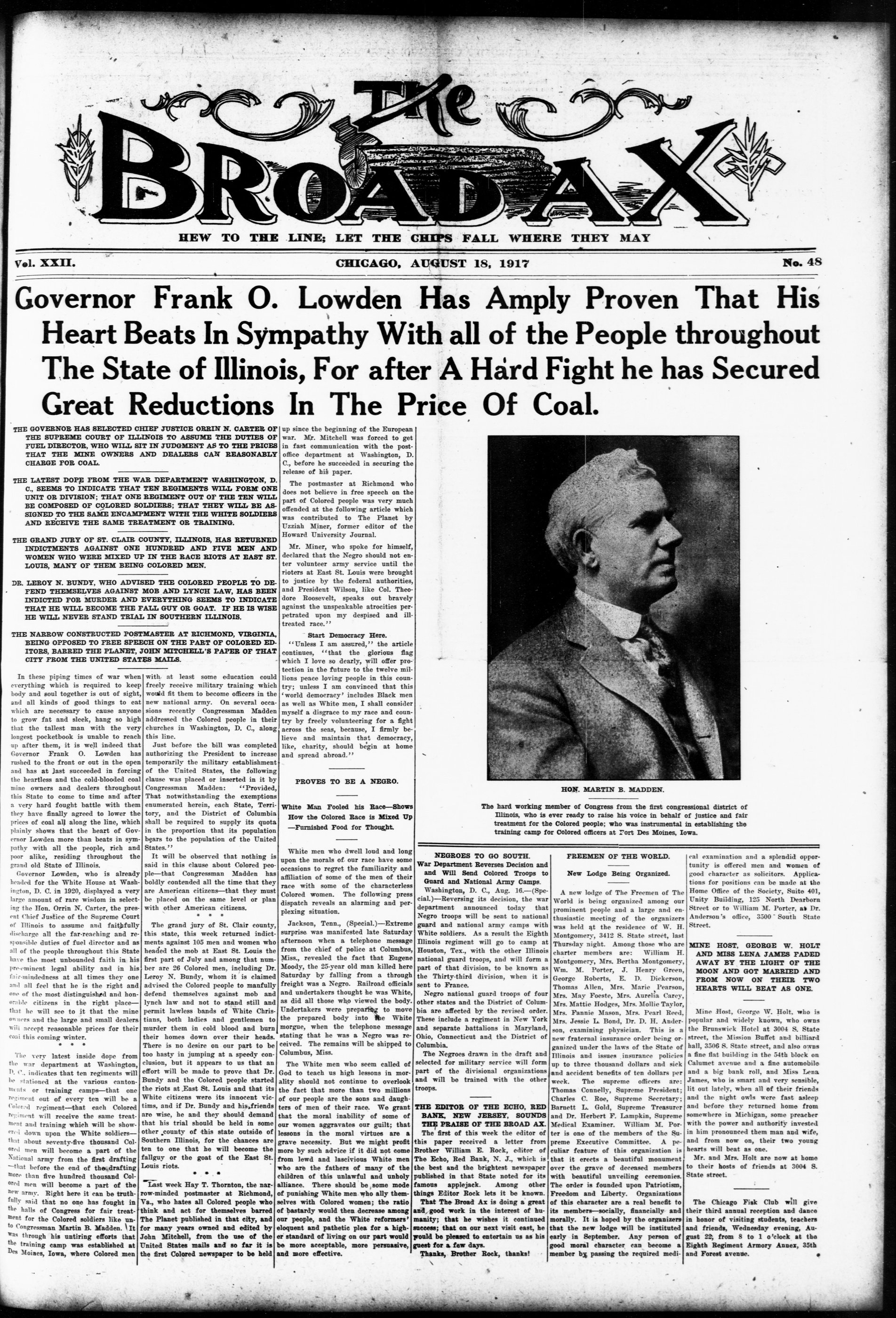
The hard working member of Congress from the first congressional district of Illinois, who is ever ready to raise his voice in behalf of justice and fair treatment for the Colored people; who was instrumental in establishing the training camp for Colored officers at Fort Des Moines, Iowa.
NEGROES TO GO SOUTH. War Department Reverses Decision and Will Send Colored Troops to Guard and National Army Camps. Washington, D. C., Aug. 16.—(Special.)—Reversing its decision, the war department announced today that Negro troops will be sent to national guard and national army camps with White soldiers. As a result the Eighth Illinois regiment will go to camp at Houston, Tex., with the other Illinois national guard troops, and will form a part of that division, to be known as the Thirty-third division, when it is sent to France. Negro national guard troops of four other states and the District of Columbia are affected by the revised order. These include a regiment in New York and separate battalions in Maryland, Ohio, Connecticut and the District of Columbia. The Negroes drawn in the draft and selected for military service will form part of the divisional organizations and will be trained with the other troops.
THE EDITOR OF THE ECHO. RED
BANK, NEW JERSEY, SOUNDS
THE PRAISE OF THE BROAD AX.
The first of this week the editor of
this paper received a letter from
Brother William E. Rock, editor of
The Echo, Red Bank, N. J., which is
the best and the brightest newspaper
published in that State noted for its
famous applejack. Among other
things Editor Rock lets it be known.
That The Broad Ax is doing a great
and good work in the interest of humanity; that he wishes it continued
success; that on our next visit east, he
would be pleased to entertain us as his
guest for a few days.
Thanks, Brother Rock, thanks!
HON. MARTIN B. MADDEN.
member of Congress from the first congress
ever ready to raise his voice in behalf
the Colored people; who was instrumental
for Colored officers at Fort Des Moines, I
FREEMEN OF THE WORLD
New Lodge Being Organized
A new lodge of The Freemen of The World is being organized among our prominent people and a large and enthusiastic meeting of the organizers was held at the residence of W. H. Montgomery, 3412 S. State street, last Thursday night. Among those who are charter members are: William H. Montgomery, Mrs. Bertha Montgomery Wm. M. Porter, J. Henry Green George Roberts, E. D. Dickerson Thomas Allen, Mrs. Marie Pearson Mrs. May Foester, Mrs. Aurelia Carey Mrs. Mattie Hodges, Mrs. Mollie Taylor Mrs. Fannie Mason, Mrs. Pearl Reed, Mrs. Jessie L. Bond, Dr. D. H. Anderson, examining physician. This is a new fraternal insurance order being organized under the laws of the State of Illinois and issues insurance policies up to three thousand dollars and sick and accident benefits of ten dollars per week. The supreme officers are: Thomas Connelly, Supreme President; Charles C. Roe, Supreme Secretary; Barnett L. Gold, Supreme Treasurer and Dr. Herbert F. Lampkin, Supreme Medical Examiner. William M. Porter is one of the members of the Supreme Executive Committee. A peculiar feature of this organization is that it erects a beautiful monument over the grave of deceased members with beautiful unveiling ceremonies. The order is founded upon Patriotism, Freedom and Liberty. Organizations of this character are a real benefit to its members—socially, financially and morally. It is hoped by the organizers that the new lodge will be instituted early in September. Any person of good moral character can become a member by passing the required medi-
---
No.48
That His throughout was Secured
professional district of of justice and fair in establishing the Iowa.
cal examination and a splendid opportunity is offered men and women of good character as solicitors. Applications for positions can be made at the Home Office of the Society, Suite 401, Unity Building, 125 North Dearborn Street or to William M. Porter, at Dr. Anderson's office, 3500 South State Street.
MINE HOST, GEORGE W. HOLT AND MISS LENA JAMES FADED AWAY BY THE LIGHT OF THE MOON AND GOT MARRIED AND FROM NOW ON THEIR TWO HEARTS WILL BEAT AS ONE.
Mine Host, George W. Holt, who is popular and widely known, who owns the Brunswick Hotel at 3004 S. State street, the Mission Buffet and billiard hall, 3506 S. State street, and also owns a fine flat building in the 54th block on Calumet avenue and a fine automobile and a big bank roll, and Miss Lena James, who is smart and very sensible, lit out lately, when all of their friends and the night owls were fast asleep and before they returned home from somewhere in Michigan, some preacher with the power and authority invested in him pronounced them man and wife, and from now on, their two young hearts will beat as one.
Mr. and Mrs. Holt are now at home to their hosts of friends at 3004 S. State street.
The Chicago Fisk Club will give their third annual reception and dance in honor of visiting students, teachers and friends, Wednesday evening, August 22, from 8 to 1 o'clock at the Eighth Regiment Armory Annex, 35th and Forest avenue.
Dan M. Jackson
Geo. T. Kersey
David A. McGowan
Ahmed A. Rayner
The Eman
Undertaking
2959-61 S
Reliable Service
Reasona
FREE CHAPEL
Complete line of Funeral Good
"WE BUILI
Buy a Lot
WE PUT UP
LOTS $25.00 Cas
Reliable Service Courteous Treatment Reasonable Prices
Buy a Lot for $200.00
WE PUT UP YOUR HOUSE LOTS $25.00 Cash, $10.00 per;Month
Full Particulars at
Fraternal In
Real Estate,
Phone Englewood 3465
FREE
STYLE BOOK
... HAIR
To Colored Women
We are the largest
manufacturers of
Colored Women's
Hair. Our latest
book showing new
styles in hair
dressing and paint.
Every colored woman
should have
one. We sell thou-
sands our hair and
toilet articles.
Safiation guaranteed
or money back.
We make the best
solid Brass STRAIGHT
ENING combs, with extra heavy back, fully
guaranteed. With each combe give lamp or
FREE. Send money order or stamps. MONEY
BACK IF NOT SATISFACTORY. 88c. postpaid.
POSTPAID 89c
Hair nets, brushes, combs and toilet articles
manufacturers' prices. Send two-cent stamp.
Agents Wanted. Address as follows:
HUMANIA HAIR COMPANY,
181-187 Park Row,
New York City.
Address Dept. 84
What we call music is well described as a trinity. The three components are rhythm, melody and harmony. Rhythm is to music what the will is to the individual. The rhythm of music is its physical side, just like the body or flesh of the human being. Melody in music parallels the heart (or blood), a component part of the individual. Harmony is the soul of music just as feeling is the soul of the human being (also possessed of a three fold nature.) The triple elements in music are represented in the history of the world first by the drum (rhythm); second, by the lute (melody), and third, by the lyre (music). Music lays its first hold on the human understanding by its rhythm. All men are influenced by it (even savages). And every soldier (with or without an ear for music) can appreciate the tap, tap of a drum boy's drum and can march longer and better for it. -Philadelphia Record.
Home preparedness—cans loaded with food.
That rubber ring you put on a preserving jar helps you to stretch your income.
The awful question "What shall I have for dinner?" is easily answered if your shelves are full of home canned products.
Can't eat 'em all in summer? Not enough in winter? Home canning is the answer.
You put a lid on waste every time you seal a preserving jar.
Canned berries are bird proof.
Frost doesn't nip canned vegetables.
Canned green peas and yellow peaches help fight the blues—New York Globe.
We find knots in the boards which we notice in a lumber pile or in any other place where boards happen to be because the smaller limbs which grow away from the larger limbs of trees grow from the inside as well as the outside of the tree.
When you see a knot in a board it means that before the tree was cut down and the log sawed up into boards a limb was growing out from the inside of the tree at the spot where the knot occurs, says the Book of Wonders.
You will also find that the wood in the knot is harder generally than the rest of the board. This is because more strength is required at the base of a limb and in the part of the limb which grew inside the tree than in other parts, for the limb must be strong enough to support not only the limb itself, but also the smaller limbs which grow out of it.
---
PAGE TWO
Music and Its Trinity:
Be Canny.
Canned berries are bird proof.
Knots In Boards
Samuel Jackson
Eng Co., Inc.
South State St.
Courteous Treatment
TABLE Prices
IN CONNECTION
Hands. Automobiles for hire
O FOR YOU"
for $200.00
YOUR HOUSE
h, $10.00 per Month
Investment Co.
Renting & Loans
6155 Wentworth Ave.
The difficulties of crossing Broadway at Forty-second street can be exaggerated. The feat is usually accomplished by born New Yorkers without loss of more than one limb. But to the visitor from Boeotia or some other suburb it presents itself as as a difficulty which, once overcome, is to be looked back at with horror and remembered with gratitude for a providential escape. One such visitor had just crossed Broadway. He wore long white whiskers and a black hat such as may be seen on senators from Mississippi. He was on the safe side of Broadway. He puffed agitatedly as he turned to survey the maelstrom of traffic he had passed through. "Every time I cross Broadway," he said, "I feel as if I had won a bet."—New York Post.
Superstitions concerning salt are among the earliest known to mankind. There is much evidence in holy writ about the ceremonial uses of it, and the old Mosaic law commands that every sacrifice of a meat offering shall be seasoned with it. Homer calls it divine, and many of the old Teuton races looked on salt springs as holy and worshiped at them. The origin of this superstition seems to be that since salt cannot corrupt it should be regarded as a symbol of immortality.
Little Marion, in a state of much agitation, begged her mother not to let remarks be made about her doll when it was present, "Because," explained the little miss, "I've been trying all her life to keep dollie from knowing that she is not alive."—Harper's Magazine.
"No, but my wife does. When I go shopping with her she always says to the salesman. 'I'll come in and look at these again.'" - London Telegraph.
It was in the manufacture of textiles that woman first appeared in industry outside of the home.
PRACTICAL HEALTH HINT.
Never go to work nor stay at work with an empty stomach. The anaemic woman particularly should avoid parsimony in nutrition. Correct a sluggish digestion, and appetite will grow more brisk with increased assimilation.
Take chest expanding exercises daily. A simple one is to walk slowly through an ordinary doorway, pressing the advanced hands to the inner surface of the door frame with some force and holding them there as the chest expands and fills with air until you have passed the threshold. This exercise, taken in a well ventilated room and combined with deep breathing, will force the residual air from the pulmonary tissue and suck in oxygen to the most remote and starving air cell. The exercise also develops the bust in women and the muscular tissue of shoulders and upper arm in both men and women. Anaemia spells impaired efficiency, impaired resistance to disease and impaired zest in living.
---
OPEN DAY AND NIGHT
The Winner.
Salt
Keeping a Secret.
Second Sight.
Women Workers
For the Anaemic
THE BROAD AX, CHICAGO, AUGUST 18, 1917.
Valuable Black Walnut.
Black walnut is the ideal wood for gun stocks, but it is scarce and high in price, and there are few of the trees left in this country. A single tree of this species can be sold for a good price, and a grove of black walnut trees represents a small fortune.
About the only black walnut trees available now are those on farms and private estates, and they are fast disappearing. The wood is hard and takes a high polish, qualities which make it desirable for the use to which it is put. Manufacturers have not found a wood to take its place satisfactorily.
Origin of the Matines.
Whether or not we have to look to the fifties for the first matinee at least little doubt that the inns had not attained any general priority when the seventies were ripe. I am reminded that the Bancrofts were responsible for many innings that have since become the vogue not institute afternoon performances until 1876, after they had been a agement eleven years. The Bar if not the inventors of the mats were certainly the first to pay theirs to those who took part in it.
Not until 1878 did the matinee
Some of the black walnut used is obtained from old furniture or walnscoting, stairways and interior trim of dwellings or churches. Many years ago black walnut was used extensively in the manufacture of the best grades of furniture, and in old churches pews and pulpits made of it can be found today. The demand for the wood is gradually causing them to disappear.—New York Sun.
Carelessness and Fires
Little Horace, whose father thinks he is a second Edison, and his mother, who would like to use electricity for everything from curling her hair to stoking the furnace, do more to keep the fire engines busy than mice ever did in all the years they chewed matches.
Washington Devereux, chief of the electrical department of the Philadelphia Fire Underwriters' association, said 54,000 fires were caused last year by overheated electrical devices. The fault wasn't with the devices, he said, but with the human equation—the woman who turned on the "juice" in her electric iron and then went out for a social afternoon without turning it off. He made the statement that no father had a right to buy his ten-year-old son a ten cent book on "How to Wire the House In Your Spare Moments" unless he was prepared to see the place go up in smoke some bright afternoon—Philadelphia Ledger.
Keep Up With the Present.
Success and happiness depend upon the way in which we adapt ourselves to the realities of the objective life. If we fight against change—and change we must meet at every turn and in every department of life—we soon become exhausted, wear ourselves out and sink back into ourselves—into the subconscious—and fall and grow old before our time. If we cling to past experiences, refuse to live in the present, let our faith die when disappointments come, the results are the same. The life forces ebb and we sink into the great sea of the unconscious and are on the road to being submerged. Desire, will, concentration, purpose, faith—these can be applied to keep us living in the present, to keep our enthusiasms active and our creativeness expressing—Nautilus.
What's the Answer?
Old elephant hunters who have hunted their quarry in India, Siam and the wilds of the Malay peninsula are agreed upon the following fact: Bury the carcass of a full grown tusker in any spot in Asia—it matters not whether the location be high and dry or low and damp—one year from the date of burial not a shred of hide nor a silver of bone can be found by digging. Neither disintegration nor ants can be an explanation, for the phenomenon has been noted in the highlands of Nepal, where buried carcasses of other animals than the elephant undergo little or no change within a year and elephants' bones disappear in localities where ants are unknown. So far the scientists have failed to come forward with an answer.
The "Crowned Republic."
It was Tennyson who gave to England the phrase "Our crowned republic." It was the bill of rights, by which parliament voted "Dutch William" and his wife, Mary, joint sovereigns of England, which made Great Britain a "crowned republic." From the moment the bill of rights gave the house of commons the sole right to levy taxes and that house resolved only to grant the crown annual supplies the backbone of absolutism was broken and the nerve centers of tyranny were paralyzed. Henceforth we were a "crowned republic."—London Answers.
Safety First.
"What is your objection to me as a son-in-law?"
"I haven't any objection to you," replied Mr. Cumrox. "But I have trouble enough maintaining my own position in this household without assuming the slightest responsibility for anybody else."—Washington Star.
Life.
"Young man, there is nothing worse than high life on a low salary," said the wise man who who is always giving advice.
"Oh, I don't know," replied the young man who knew a thing or two himself.
"It's no worse than low life on a high salary."-Florida Times-Union.
Her Choice.
"Does your daughter play Mozart?" we asked, displaying unusual erudition. "I believe so," she replied deprecatingly, "but I think she prefers euchre." -Philadelphia Ledger.
Mediclory is excellent to the eyes of mediocre people.-Joubert.
Origin of the Matines.
Origin of the matinees.
Whether or not we have to look back to the fifties for the first matinee, there is at least little doubt that the invention had not attained any general popularity when the seventies were reached. I am reminded that the Bancrofts, who were responsible for many innovations that have since become the vogue, did not institute afternoon performances until 1874, after they had been in management eleven years. The Bancrofts, if not the inventors of the matinee, were certainly the first to pay full salaries to those who took part in them.
Not until 1878 did the matinee become a fixed and regular feature of even the Bancroft management. It was a byproduct of "Diplomacy," the success of which made any means of providing additional performances acceptable. Sir Squire Bancroft has put it on record that at the beginning the matinee was a much more costly affair than it is now, as frequent and separate advertisements and announcements were necessary to make it known.—Westminster Gazette.
A Defect In Higher Education
A Defect in Higher Education.
It must be said that the higher education of the United States is at present in a condition where it may readily drop backward rather than improve. The college student of today and in some cases even the university student is permitted to sprawl over so large and so varied an area of intellectual interest that he loses the discipline in concentration, in hard work, and in the mastery of some relatively small field that comes from pursuing a better and older method. There is just now, however, a marked tendency among the better colleges to aid and to guide the student toward concentrating his interests and his energies upon a small group of subjects that have some common center of interest and some well marked relationship. This movement is a sound and hopeful one and should be encouraged and aided.—President Butler in Youth's Companion.
Salt Means Much to Health.
"If the human race should be deprived of salt even for a period of a few months," said a physician, "we would not only lose a natural healthful incentive for our food, but disease, with all its attendant miseries, would spread with such relentless speed as to defy the efforts of the most skillful doctors of the land. Ailing persons frequently refuse sugar, but they seldom turn up their noses at common salt. That is because there is in the body a deficiency of chloride of sodium, and nature intuitively excites the desire for it. Salt is essential to health and life and is as much a food as bread or flesh. If there is no wish for salt in a person doctors uniformly conclude that disease in some form is lurking unsuspected in the system."
Obliterating Class Distinctions
Obittering Class Distinctions.
Modern and cultured persons, I believe, object to their children seeing kitchen company or being taught by a woman like Peggotty. But surely it is more important to be educated in a sense of human dignity and equality than in anything else in the world. And a child who has once had to respect a kind and capable woman of the lower classes will respect the lower classes forever. The true way to overcome the evil in class distinctions is not to denounce them as revolutionists denounce them, but to ignore them as children ignore them.-G. K. Chesterton.
The Spanish Alcalde
In former times in Spain the alcalde de corte was a judge of the palace court, having jurisdiction in and about the residence of the king. The office is now obsolete in this sense, but "alcalde" is still used to designate the mayor of a town exercising the functions of a justice of the peace.
Why He Looked Sour
Dusty Dennis—Why do you look so sour, pard? Gritty George—Why, one of dem comic artists wanted me to sit on de fence and let him sketch me. Dusty Dennis—What of dat? Gritty George—It was a barb wire fence.—Exchange.
News to Her.
"What was the farmer talking about?" asked the first city girl.
"A whiffletree," said the other.
"Well, I've studied botany, but I never heard of a whiffletree. Sounds like his idea of a joke."—Louisville Courier-Journal.
Flat Foot.
A treatment suitable, with but slight modification, for all cases of static foot trouble (flat foot), from the early cases which are often described as "weak ankles" to the most severe cases, where there is old standing structural change, is described by Dr. P. B. Rath in the Lancet. The treatment consists of attention to footwear, attention to position in standing and walking and regular daily exercises. Whether boots or shoes are worn, whether they button or lace, they must be the shape of the feet. The inner side of the boot where the big toe lies is kept straight, so that the end of the boot is opposite the big toe and not opposite the second or third toe. This is to insure that the big toe is not pushed out against the other toes and has plenty of room in which to act. The soles should be a sixth to a fourth of an inch thick, the heels broad, an inch or less in height.
```markdown
```
Talks on
HEALTH,
CLEANLINESS,
PROPER LIVING,
SANITATION, ETC.
By
Dr. W. A. Driver
3300 So. State Street
Phone Douglas 3617
CONSTIPATION
On account of the choking of the gastro-intestinal tract nutrition is arrested or impeded and metabolism is disturbed. How far a habit of constipation can go in the production of various diseases of slow growth but of terrible consequences is a question of the greatest magnitude.
The retained poisonous products are absorbed into the blood stream and other body fluids causing autointoxication which is manifested by symptoms of wide variation. The clogging of the liver and its peculiar system produces congestion of the lower bowel resulting in hemorrhoids called by the laity piles. Certain organic disorders are easily traced to constipation as a first line of offense. On the other hand many functional maladies are admitted to have their fountain and origin in a sluggish bowel metabolism.
Women are more subject to this disorder because of the habit of closer confinement indoors and a more sedentary life. Mental and bodily diseases of grave consequences are frequently developed though slowly from constipation resultant from the violation of hygienic laws. Pelvic diseases are
About the Welsh
Wales has plenty of coal, slate, scenery and consonants, but very few surnames. If a Welsh schoolmaster should say, "Jones, you may go home now for being a good boy," the whole school would quit.
People who are not called Jones are called Williams, or Evans, or Hughes, or Lloyd. They divide these names between them and make the best of it. They do not follow the English method of taking their surnames from towns and villages. They felt that to do so would cut them off from the rest of mankind. Nobody could possibly call on Mrs. Llanymnech. Dislocation of the jaw is a great drawback to social intercourse.
The Welshman has the Celtic imagination, says London Answers. He never calls a spade a spade. When he has done describing this implementation of agriculture the stolid Englishman thinks he has been listening to a story from the "Arabian Nights;" hence the Englishman says the Welshman is an "untruther." He isn't really. It's only a difference of method.
Unter den Linden.
Unter Den Linden is the famous street in Berlin which extends from the Brandenburg gate eastward about three-fifths of a mile. Bordering it are the princely and imperial palaces, the university, the academy, the statue of Frederick the Great, etc. It means "under the lindens."
A. Solamp Duty:
"Why did Bangs change his iron gray hair to black?"
"Because his fiancée thought the gray in his hair made him look too old for her, and he thought it was his duty to obey his sweetheart's dyeing request."
—Exchange.
Where There Was No Change.
"Don't you think I'm thinner than when you saw me last?"
"Well, you may be thinner, but to me you're just as thick as ever."—Chicago Tribune.
PRACTICAL HEALTH HINT.
Causes of Disease
Many diseases are largely due to defective elimination or chronic accumulation of toxins in our body, due to one or more of the following causes:
Overeating, especially of meat and highly seasoned foods after middle life. As some one has aptly expressed it, we too often dig our graves with our teeth.
Insufficient exercise or too much or too strenuous exercise.
The use of alcoholics and the excessive use of tobacco. In fact, intemperance of any kind. Probably the greatest determining factor is "the strenuous life." The mad rush for the almighty dollar and undue worry and anxiety interfere more or less with all the normal functions of the body. Worry is ten times more disastrous than work. — Health Bulletin.
A.
aided if not sometimes caused as many claim by the colon bacillus and other factors associated with sluggishness of bowel function.
Some of the causes of constipation are the habitual use of patent medicines, the misuse of enemas, the abuse of epom salts and other drugs, simple laziness, failure to heed nature's warnings and calls promptly, tight lacing, defective innervation, meat diet, tuberculosis, intestinal tumors, the abuse of suppositories, failure to drink sufficient water or sufficient fluid, improper dress and others.
To correct constipation drink a plenty of water each day; if an adult drink at least three pints of fluid daily. Hot water should be sipped slowly immediately on rising in the morning. Sip at least two or three wineglassfuls morning and night. Tea should never be taken strong and should be used sparingly, if at all. Laxative articles of food should be taken such as fruit, jam, honey, and fruit juices. Prune juice and figs are excellent and should be eaten every day. Abdominal massage should be carried out regularly by the patient for ten minutes before arising every morning.
Just Like a Woman.
"I understand your wife has been quite ill, but is now convalescent."
"Yes."
"How was she looking when you left the hospital?"
"In the hand mirror."—Florida Times-Union.
Baseball Tactics.
Stealing third is, as a general proposition, a bad play, though it comes in handy now and then. I would suggest that all young players avoid it. If the man is thrown out trying to steal third you have tossed away a possible chance for a run, and if he succeeds he hasn't improved his scoring chances very much, because he would go home from second on a clean single anyway.
My personal opinion is that there is entirely too much changing of pitchers in professional baseball. The custom is so prevalent in certain clubs that every man that starts a game does so in fear, trembling lest he be removed as soon as he allows a couple of hits or is a little wild. He is prone to become nervous under these conditions and begins to fume and fret as soon as he gets in a hole. On the other hand, if he were assured before the game started that he would be allowed to finish it he would in many cases work out his own salvation. A pitcher learns through being beaten, and if he is taken out as soon as he has any trouble he will never get the right kind of experience to develop his mind and his courage.—Ty Cobb in American Boy.
London In a Fog.
London is more or less noted for the dense fogs that obscure it at times, and a recent specimen that was in its prime a couple of hours before midnight, was a particularly fine one.
In a space that a good aerodrome could have inclosed I found a chaufeur looking with a lantern for landmarks, so that he could discover in which direction his car was heading. I saw a telegraph messenger fall off his bicycle in the middle of a quiet road, apparently from sheer perplexity, and I found three motor buses that came to rest with their bonnets close together in such a way as to suggest that each had been charging the other two and had only stopped just in time.
In the small hours of the morning I found another bus standing helpless by the roadside, with the driver slumbering within, but the driver of a motor bus is a remarkable man in many ways.
—London Spectator.
A. Person's Adviser
Old Neale, the parish clerk of Toddington, was a great character. He occupied the lowest tier of the "three decker" pulpit and rectified the responses in so loud a tone that there was nothing left for the congregation to do.
In my first week at Toddington the whole Wednesday evening service devolved on me. Neale, having taken stock of the new curate, remarked:
"There are two baptisms tonight."
This was sufficiently alarming, but my nervousness was increased when he added: "Take care you don't brain the children against the corner of the seat. It's been done afore now."
When I reached the font I perceived that the corner of the semihigh pew was indeed in dangerous proximity—"Lively Recollections," by Canon Shearne.
Proposed to Increase Force by 1,500 Men.
HUNDREDS ALREADY ADDED.
Secretary Daniels' Recommendation For $7,500,000 Contemplates Building and Machinery, and Large Number of Experts Is Expected to Be Called For if Money Is Granted.
Washington.—This city's greatly augmented number of government employees since the beginning of war preparations is to be still further added to should congress grant an appropriation for $7,500,000 asked for by Secretary Daniels to increase the capacity of the naval gun factory at the Washington navy yard. While the immediate need of this appropriation is for buildings and machinery, the necessary men to operate the machines will be required in due time, and it is estimated that from 1,000 to 1,500 expert machinists will be added to the present force.
To date more than 500 men have been added to the force at the Washington navy yard since the United States declared a state of war to exist between this country and Germany, and Secretary Daniels' request for a larger gun factory means that a much larger force of men will be needed here.
Guns, mounts, torpedoes, mines, telescopes, sights, optical instruments and miscellaneous ordnance supplies are to be made at this gun factory in large numbers.
The proposed work includes the construction of a six story machine shop for mines, mounts and torpedoes, a five story pattern and wood working shop, an extension to the power plant, a new brass foundry, an extension of the steel forging plant, an optical shop, range finding towers, administration buildings, quarters for enlisted personnel under instruction and the extension of the yard service system to supply adequately these new structures. Buildings are estimated to cost $5,000,000 and equipment needed will amount to $2,500,000.
Daniels Discusses Plan.
Discussing his recommendation for the appropriation, Secretary Daniels said: "The naval gun factory, possessing as it does a complete organization and a large working force, is readily adapted to increasing its facilities for delivery of guns, mounts and other munitions. To develop any other source is not only expensive, but involves a matter of long delay. It is therefore considered to the best interests of the government to increase at once the capacity of the Washington navy yard."
LOCKED DOG IN TOWER.
He Stopped the Clock, and There Was No Time.
Rome, Ga.—The big city clock in the 600 foot tower on College hill here was stopped by a dog. When City Timekeeper Williamson went to wind the clock two days before, as he does every week, a dog followed him on the winding stairway, and when the timekeeper left he did not notice that he had locked the dog in the clock when he closed the door that leads to it.
For two days, without water or food, the dog whined and barked 600 feet above the city, but of course was not heard. Then people of the city looking at the clock saw that it had stopped, and some one notified the timekeeper, who went to see what was the matter. He saw the dog lying against the big pendulum, snarling savagely. A policeman brought the animal safely to earth. It was almost starved by its two days' fast, but has recovered.
DRAFT NUMBERS TO BE SOLD.
Red Cross Will Get Proceeds From Sale
Of Souvenirs.
Washington.-The original numbers used in drawing the new national army have been turned over to the Red Cross by Provost Marshal General Crowder for sale as souvenirs, the proceeds to be turned into the Red Cross fund.
The first eight numbers and the last one, however, will be put back in the bowl and placed in Independence hall, Philadelphia, beside the Liberty bell. The bowl has been donated for this purpose by its owner, Charles R. Morris, a veteran war department clerk.
FAMILY IN SCHOOLHOUSE.
Could Not Rent Any Other Place and So Moved In.
Smith Center, Kan.—In nearly every town in northwest Kansas an overcrowded condition prevails, and many families are unable to find homes to rent.
So acute became the lack of houses to rent in this city that a newly arrived family, after importing the school board, was allowed to begin housekeeping in one of the six rooms of the schoolhouse. Now other families seek the same privilege, and the school board may have to yield.
Belice of Old Indian Camp
Pierre, S. D.-Between four and eight feet under the surface of the ground C. E. Deland has found pumpkin seeds in good condition, also a piece of pumpkin rind and evidence of an Indian camp at least 100 years old. The soil was windblown and it required many decades to cover the relics. The Indians of the period indicated were agriculturists, not warriors, like the later Sloux.
DO YOU HOARD?
Some Foodstuffs Should Be Treasured, but Not Flour.
ADVICE FROM UNCLE SAM.
Certain Kinds of the Staff of Life Will Bear Heat and Moisture of Summer, but It Is Risky Work to Keep Them From Mustiness.
[Prepared by the office of information, department of agriculture.]
Buy flour in small quantities and protect it carefully from spoilage. Sound flour milled from standard wheat exhibits very little tendency to decompose when stored in a proper manner. Nevertheless there is a considerable loss of flour through spoilage as a result of improper storage, particularly during the summer months. Housekeepers on the farm and in the city should purchase flour in accordance with their needs only. It is false economy for the housekeeper to purchase larger amounts of flour than can be used within a reasonable length of time. This may be a barrel for a large family. More often it will be the fifty pound sack. Any storage of flour in excess of the consumer's needs constitutes boarding, which under present circumstances is an unethical and reprehensible practice, of no profit to the individual who practices it, but injurious to the best interests of the people.
Since it is the duty of every one in the present situation particularly to avoid all waste it is incumbent upon each one so to store the normal stock of flour as to eliminate all waste whatsoever. The precautions that are required have been well worked out in practice and are stated as follows:
There are three cardinal principles of flour storage. Flour should not be stored in the cellar, since the cellar is rarely free from dampness, even though special flour bins have been built in. It is common to find odors in a cellar, and flour absorbs odors and is contaminated by them. The cellar is cool, but is usually too damp. Flour should not be stored in the attic of the usual type. The temperature is too high in summer, there is no circulation of air, and the flour is likely to acquire a musty odor. Flour should not be stored in the pantry or kitchen except in small quantities, since the temperature is certain to be uneven and the flour is likely to be contaminated by odors
If practicable every household should possess a small room for storage of nonodorous commodities. Such a room is best located on the north side of the building. It should be ventilated, and a cool and even temperature should be maintained. Where such a room is not available a closet may fit the requirements well. The bins or containers should be kept clean, and when an old stock of flour is exhausted the container should be carefully cleaned before a new stock is placed. Naturally the flour must be guarded from vermin. Flour should be examined occasionally to see that decomposition has not begun. Conserved in this manner, the sack of flour in the household and the larger stores of the retailer can be utilized practically to the exclusion of any waste through spoilage.
HERE'S A NEW BAG.
Oriental as Possible is This Fascinating Reticule.
Oriental silk banded with a strip of embroidery, piece of a mandarin's coat.
```markdown
```
CHINESE BEAUTY.
hung on two jade bracelets and finished with a gorgeous silk tassel, hung from two Chinese "cash," makes a handsome accessory for pongue frocks.
A Reminder.
You will never forget to give your whole order to the grocer if you follow this suggestion: Have a list of everything you use in the kitchen, paste the list on a flat board and put it in the pantry, or, if preferred, hang the list on the wall. This will be a reminder to you when the grocer comes.
THE BROAD AX. CHICAGO. AUGUST 18. 1917.
HE WALKS MILES TO ENLIST IN CAVALRY
National Guardsman, Broke, Couldn't Arrange For His Final Discharge.
San Antonio, Tex.—Grover C. Weems, twenty-one years of age, a member of Company M, Second Florida regiment of the national guard, reached San Antonio the other day on foot, having walked all the way from Miami, Fla., to secure his final discharge from the militia and join the regular army.
He walked, he said, because he wanted to transfer to the regular army, was broke and couldn't arrange for his final discharge from the company without coming here.
He was arrested four times on the road—at Monroe, La.; at Jewett, Tex.; near Gulfport, Miss., and at Pascagoula, La. While he wore his national guard uniform, he was arrested twice on suspicion that he had deserted. He was arrested twice for failure to register.
He was released each time after showing that he was a member of Company M, Second Florida infantry, mustered out March 17 and held in reserve. He had the misfortune to be arrested once at Jewett, Tex., while stopping there to visit a young lady to whose father he was persona non grata.
The people along the way, he said, treated him right. He was well fed and frequently given a lift by autoists.
SOLDIER RISKS LIFE,
WINS NURSE AS BRIDE
New York.—His heroism in rushing into a burning building and extinguishing the blaze may result in causing Leo Heck, member of Company H, Seventy-first regiment, national guard, to undergo an operation at Bellevue hospital, but it also brought him a bride. The girl in the case is Miss Helen Maud Lymer, a nurse, of Toronto. They were married at Hamilton, Ontario.
Heck was in a military camp up state when he saw a fire in a big dwelling house. While he was fighting the blaze in the third story the floor gave way and he fell to the floor below. He was taken to a hospital near by, where Miss Lymer, who was employed there, was assigned to nurse him.
Before he left the hospital the patient and his nurse had fallen in love.
Heck recently came to Bellevue hospital on furough to consult doctors and was told that an operation probably would be necessary. While awaiting an X ray examination he learned that his fiancee had gone to Hamilton to serve as nurse in a hospital for wounded British soldiers. Heck left for Hamilton on the first train, and the pair were married by the Rev. W. B. Figle of the Hamilton Baptist church. Heck has returned here for the X ray examination.
COWBELLS SAVE CHERRIES.
Farmer Rigged a Water Wheel on Wife's Churn to Ring Them.
Redding, Cal.-W. A. Bull of Igo has saved his big cherry crop with cowbells operated by a waterwheel. Bull has an orchard up South Fork creek. His cherries ripened, but as fast as they matured birds picked them off. Bull rigged up some ordinary scarecrows. They did well enough for a day or so, or until the wise birds detected the fraud. As a last resort Bull tied several cowbells in the treetops and to the tinklers attached strings, which he jerked from his front porch. The cowbells jangling scared the birds away all right and bid fair to save the cherry crop, but Bull got tired of jerking the strings all day long.
Now, he has a water wheel that runs his wife's churn. So Bull attached the strings to the churn dasher. As the water wheel went its rounds the churn dasher bobbed up and down, and the cowbells kept up their jangling in the treetops all day long. The birds were scared away effectually, and Bull saved his cherry crop.
COAL MINE IN BACK YARD.
This Man Doesn't Have to Worry About Next Winter's Prices.
Roanoke, Va.-With the promise of winter coal being around $10 a ton, how would you like to have a coal mine right in your back yard? That's what P. H. Rover of Bluefield has just discovered.
Mr. Rover's back yard runs north in the same way that north appeared to the little boy at school-toward the top of the page-or it is just a mountainside. A coal seam had been discovered on the opposite side of the ridge, and Mr. Rover thought it would be worth investigating on his side. But little digging was needed to reveal the seam, which was four feet in thickness.
Old Man Climbs Windmill.
Hiawatha, Kan.-Though Henry Adams of this city is eighty-two years old, he doesn't have to call in help when a little something goes wrong with his windmill. Recently he climbed to the top of a forty foot windmill and made some needed repairs.
TO BANISH EGG SHAMPOOS.
Barbers Say Plan Would Save 250,000,
000 a Year.
South Bend, Ind.-J. D. Kimerer; a barber of this city, has a scheme to save 250,000,000 eggs a year for the consumption of the people. He has put his plan before National Food Director Hoover and received from him assurance of its consideration. Kimerer would do away with the egg shampoo during the war. He says that on an average, which is considered low, each barber in the United States gives three egg shampoos a week, using two eggs. Recent statistics show that there are 300,000 barbers.
Thus if the government placed a ban on egg shampoos for men it would mean the saving of 93,600,000 eggs each year, provided each barber averaged but three shampoos. But other barbers in the city say the average of three is too low and that it would be nearer six or eight. Figured at that rate, more than 200,000,000 eggs could be saved. It is a hard matter to get at the number of eggs used by women for shampooing, inasmuch as many do their own work. However, a hairdresser estimates that 50,000,000 eggs are used each year.
UNUSUAL RELICS FOUND.
New Light Cast on Pueblo Civilization by Discovery.
Santa Fe, N. M.-An extraordinary find of historic pottery and relics has been made by Earl Morris, excavating Pueblo ruins at Aztec, San Juan county, with a force of twenty-five men for the American Museum of Natural History.
The discovery includes sixty pieces of rare pottery, over 20,000 carved red and black stone heads, baskets, matting, knives, battleaxes and other stone implements. The turquoise beads, mosaics and shell ornaments are classed as among the finest ever excavated in the southwest.
Grains of corn with cobs, tassels and husks were found intact, as were also beans and bean pods, pumpkin seeds, pine cones, cotton fiber, yucca leaves, rushes, cotton yarn and cloth, sandals, snowshoes, beaver teeth and bones of animals and human beings. One skeleton in a sitting position indicated the man had been decapitated. The find was made in an underground communal dwelling buried for centuries.
BEES MAKE HOME IN HOUSE.
Store Honey Unmolested For Three Years In Doctor's Residence.
St. Louis.—A swarm of bees has lived and made honey for three years in the brick wall at the home of Dr. Allen Wilson, Wagoner place. Dr. Wilson has never interfered with the bees, and they have never harmed him, nor has he ever eaten any of the honey.
The bees' improvised hive is a cavity in the wall about halfway to the top of the two story house on the kitchen side. The entrance is a small hole apparently left by the bricklayer when placing the bricks around the anchor of an iron wall brace.
Dr. Wilson said he had investigated and found that the cavity now extends into the wall about a foot, apparently having been hollowed out by the bees themselves. The swarm is not a very large one, and Dr. Wilson thinks it has not produced more honey than it needed. He does not expect to try to remove the bees.
TRANSPLANTING BONE.
That of Stockman's Leg Now In His Arm.
Ringling, Okla.—Ten inches of bone that supported his leg between the knee and ankle now is filling that amount of space in the forearm of Jim Herring, stockman, of Grady, having been transplanted there by a surgeon as the only remedy that would save the arm. The leg, now bearing a silver plate, has healed, and the arm promises to be as good as new before long.
Ten months ago Herring sprained his arm. Not having ready access to a surgeon and, thinking the injury slight, he set the member himself. At length a bone trouble developed and continued to grow more and more malignant for eight months. Taking out the impaired bone was the surgical cure decided upon, and the space was filled with bone from his leg.
COMES FROM A BIG FAMILY.
Recruit is Six Feet Four and a Half. Brother, Taller, Also to Enlist.
Springfield, Mo.-John F. Haley, a twenty-three-year-old farmer near Ozark, Christian county, holds the record for the tallest man accepted at the United States army recruiting station here since the declaration of war. He is six feet four and one-half inches in his bare feet. He had to stoop when he entered the door of the recruiting station to enlist.
"You fellows may think I'm big," he told the recruiting force, "but just wait till you see my brother. He's two inches taller than I. He'll be here in two or three days to enlist too. He hasn't quite finished helping dad with the planting."
Wife Beater Ducked.
Kansas City. Mo.-A new form of punishment has been devised by Judge Herrod of the city court for wife beaters. After sentencing George Martin to a hundred days on the rock pile Judge Herrod ordered the patrolmen who escorted him to the "farm" to stop on their way past the Missouri river and duck their prisoner three times. Martin beat his wife because she could not make the baby stop crying.
BEAUTIFUL DRAPE.
Evening Gown of Rare
Distinction Is This One.
THE FASHION WEEKLY
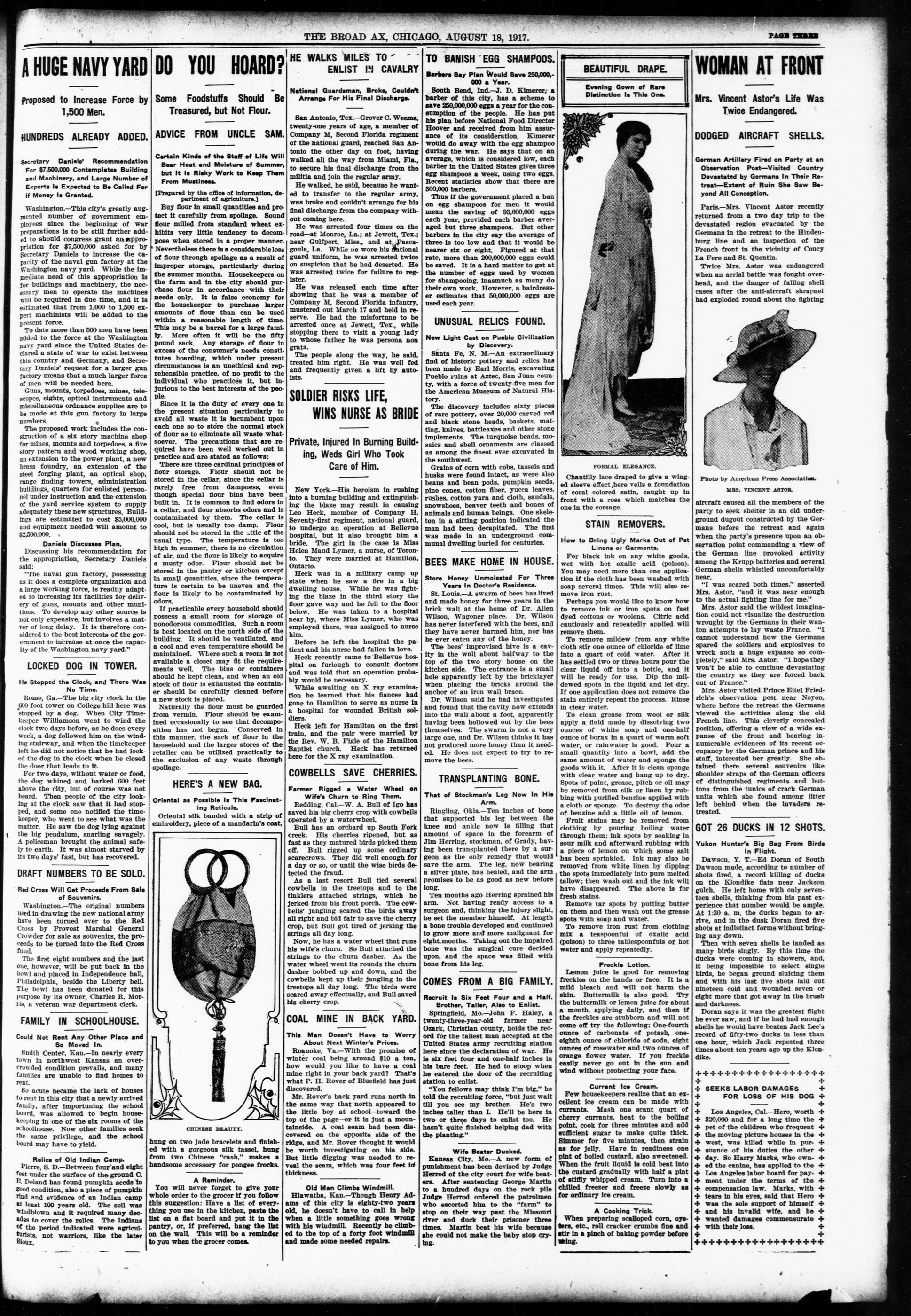
FORMAL ELEGANCE.
Chantilly lace draped to give a winged sleeve effect,here veils a foundation of coral colored satin, caught up in front with a rose which matches the one in the corsage.
STAIN REMOVERS.
How to Bring Ugly Marks Out of Pet Linens or Garments.
For black ink on any white goods, wet with hot oxalic acid (polson). You may need more than one application if the cloth has been washed with soap several times. This will also remove iron rust.
Perhaps you would like to know how to remove ink or iron spots on fast dyed cottons or woolens. Citric acid cautiously and repeatedly applied will remove them.
To remove mildew from any white cloth stir one ounce of chloride of lime into a quart of cold water. After it has settled two or three hours pour the clear liquid off into a bottle, and it will be ready for use. Dip the mildew spots in the liquid and let dry. If one application does not remove the stain entirely repeat the process. Rinse in clear water.
To clean grease from wool or silk apply a fluid made by dissolving two ounces of white soap and one-half ounce of borax in a quart of warm soft water, or rainwater is good. Pour a small quantity into a bowl, add the same amount of water and sponge the goods with it. After it is clean sponge with clear water and hang up to dry. Spots of paint, grease, pitch or oil may be removed from silk or linen by rubbing with purified benzine applied with a cloth or sponge. To destroy the odor of benzine add a little oil of lemon. Fruit stains may be removed from clothing by pouring boiling water through them; ink spots by soaking in sour milk and afterward rubbing with a piece of lemon on which some salt has been sprinkled. Ink may also be removed from white linen by dipping the spots immediately into pure melted tallow; then wash out and the ink will have disappeared. The above is for fresh stains.
Remove tar spots by putting butter on them and then wash out the grease spots with soap and water.
To remove iron rust from clothing mix a teaspoonful of oxalic acid (polson) to three tablespoonfuls of hot water and apply repeatedly.
Freckle Lotion.
Lemon juice is good for removing freckles on the hands or face. It is a mild bleach and will not harm the skin. Buttermilk is also good. Try the buttermilk or lemon juice for about a month, applying daily, and then if the freckles are stubborn and will not come off try the following: One-fourth ounce of carbonate of potash, one-eighth ounce of chloride of soda, eight ounces of rosewater and two ounces of orange flower water. If you freckle easily never go out in the sun and wind without protecting your face.
Currant Ice Cream.
Few housekeepers realize that an excellent ice cream can be made with currants. Mash one scant quart of cherry currants, heat to the bolling point, cook for three minutes and add sufficient sugar to make quite thick. Simmer for five minutes, then strain as for jelly. Have in readiness one pint of boiled custard, also sweetened. When the fruit liquid is cold beat into the custard gradually with half a pint of stiffly whipped cream. Turn into a chilled freezer and freeze slowly as for ordinary ice cream.
A Cooking Trick.
When preparing scalloped corn, oysters, etc., roll cracker crumbs fine and stir in a pinch of baking powder before using.
PAGE THREE
WOMAN AT FRONT
Mrs. Vincent Astor's Life Was Twice Endangered.
DODGED AIRCRAFT SHELLS.
German Artillery Fired on Party at an Observation Post—Visited Country Devastated by Germans In Their Retreat—Extent of Ruin She Saw Beyond All Conception.
Paris.-Mrs. Vincent Astor recently returned from a two day trip to the devastated region evacuated by the Germans in the retreat to the Hindenburg line and an inspection of the French front in the vicinity of Coucy La Fere and St. Quentin.
Twice Mrs. Astor was endangered when an aerial battle was fought overhead, and the danger of failing shell cases after the anti-aircraft shrapnel had exploded round about the fighting
Photo by American Press Association.
MRS. VINCENT ASTOR.
aircraft caused all the members of the party to seek shelter in an old underground dugout constructed by the Germans before the retreat and again when the party's presence upon an observation point commanding a view of the German line provoked activity among the Krupp batteries and several German shells whistled uncomfortably near.
"I was scared both times," asserted Mrs. Astor, "and it was near enough to the actual fighting line for me."
Mrs. Astor said the wildest imagination could not visualize the destruction wrought by the Germans in their wanton attempts to lay waste France. "I cannot understand how the Germans spared the soldiers and explosives to wreck such a huge expanse so completely," said Mrs. Astor. "I hope they won't be able to continue devastating the country as they are forced back out of France."
Mrs. Astor visited Prince Eitel Friedrich's observation post near Noyon, where before the retreat the Germans viewed the activities along the old French line. This cleverly concealed position, offering a view of a wide expanse of the front and bearing innumerable evidences of its recent occupancy by the German prince and his staff, interested her greatly. She obtained there several souvenirs like shoulder straps of the German officers of distinguished regiments and buttons from the tunics of crack German units which she found among litter left behind when the invaders retreated.
GOT 26 DUCKS IN 12 SHOTS.
Yukon Hunter's Big Bag From Birds In Flight.
Dawson, Y. T.-Ed Doran of South Dawson made, according to number of shots fired, a record killing of ducks on the Klondike flats near Jackson gulch. He left home with only seventeen shells, thinking from his past experience that number would be ample. At 1:30 a. m. the ducks began to arrive, and in the dusk Doran fired five shots at indistinct forms without bringing any down.
Then with seven shells he landed as many birds singly. By this time the ducks were coming in showers, and, it being impossible to select single birds, he began ground sluicing them and with his last five shots laid out nineteen cold and wounded seven or eight more that got away in the brush and darkness.
Doran says it was the greatest flight
he ever saw, and if he had had enough
shells he would have beaten Jack Lee's
record of fifty-two ducks in less than
one hour, which Jack repeated three
times about ten years ago up the Klondike.
**************************************************************
* Los Angeles, Cal.—Hero, worth
* $20,000 and for a long time the
* pet of the children who frequent
* the moving picture houses in the
* west, was killed while in pur-
suance of his duties the other
* day. So Harry Marks, who own-
ed the canine, has applied to the
* Los Angeles labor board for pay-
ment under the terms of the
* compensation law. Marks, with
* tears in his eyes, said that Hero
* was the sole support of himself
* and his invalid wife, and he
* wanted damages commensurate
* with their loss.
[Image of a man in a suit with a tie, facing slightly to the right].
THE LIFE OF JOHN H. HARRIS
HON. KICKHAM SCANLAN.
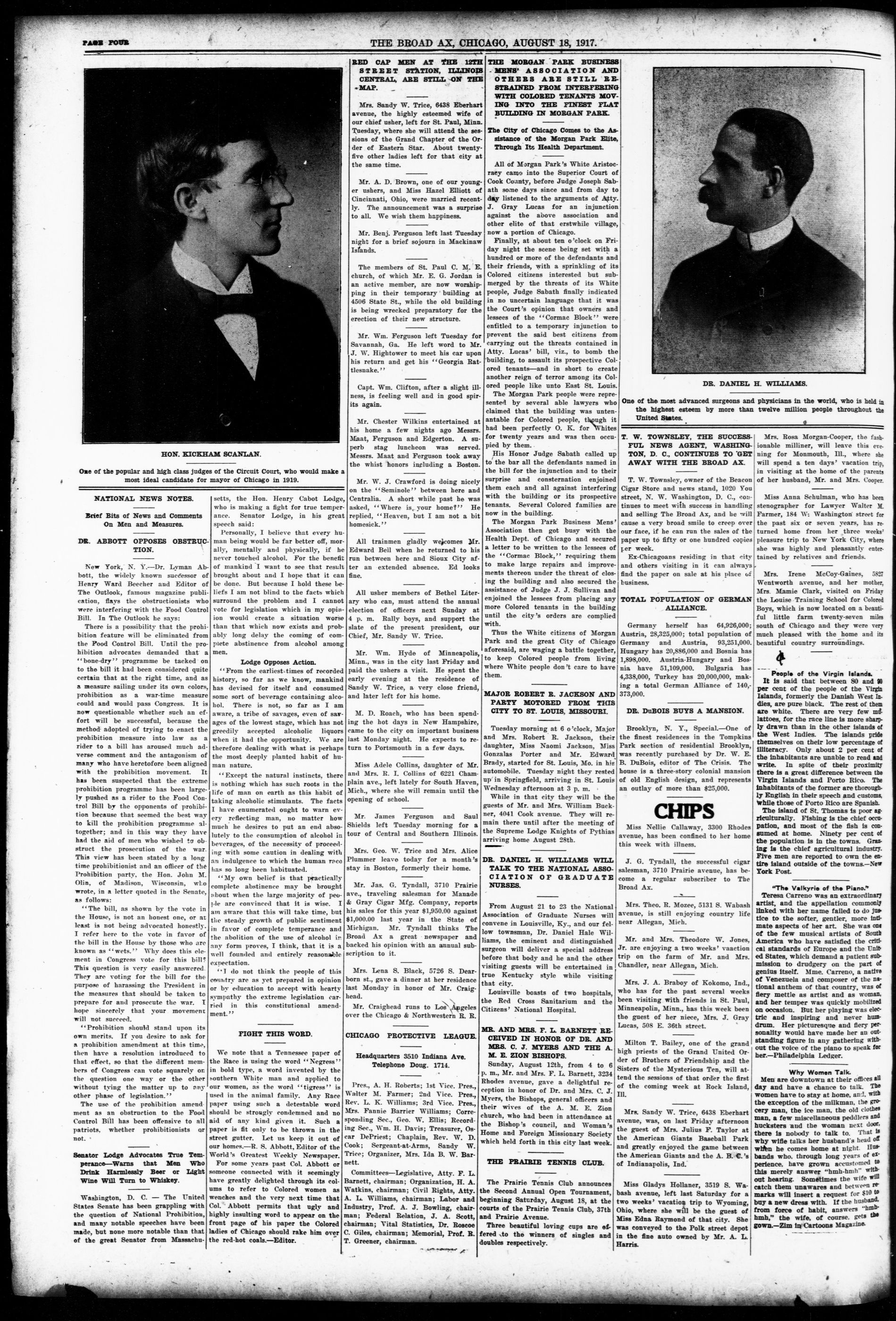
One of the popular and high class judges of the Circuit Court, who would make a most ideal candidate for mayor of Chicago in 1919.
One of the popular and high class judges of the Circuit Court, who would make a most ideal candidate for mayor of Chicago in 1919.
NATIONAL NEWS NOTES.
Brief Bits of News and Comments On Men and Measures.
DR. ABBOTT OPPOSES OBSTRUCTION.
New York, N. Y.-Dr. Lyman Abbott, the widely known successor of Henry Ward Beecher and Editor of The Outlook, famous magazine publication, flays the obstructionists who were interfering with the Food Control Bill. In The Outlook he says:
There is a possibility that the prohibition feature will be eliminated from the Food Control Bill. Until the prohibition advocates demanded that a "bone-dry" programme be tacked on to the bill it had been considered quite certain that at the right time, and as a measure sailing under its own colors, prohibition as a war-time measure could and would pass Congress. It is now questionable whether such an effort will be successful, because the method adopted of trying to enact the prohibition measure into law as a rider to a bill has aroused much adverse comment and the antagonism of many who have heretofore been aligned with the prohibition movement. It has been suspected that the extreme prohibition programme has been largely pushed as a rider to the Food Control Bill by the opponents of prohibition because that seemed the best way to kill the prohibition programme altogether; and in this way they have had the aid of men who wished to obstruct the prosecution of the war. This view has been stated by a long time prohibitionist and an officer of the Prohibition party, the Hon. John M. Olin, of Madison, Wisconsin, who wrote, in a letter quoted in the Senate, as follows:
"The bill, as shown by the vote in the House, is not an honest one, or at least is not being advocated honestly. I refer here to the vote in favor of the bill in the House by those who are known as "wets." Why does this element in Congress vote for this bill? This question is very easily answered. They are voting for the bill for the purpose of harassing the President in the measures that should be taken to prepare for and prosecute the war. I hope sincerely that your movement will not succeed.
"Prohibition should stand upon its own merits. If you desire to ask for a prohibition amendment at this time, then have a resolution introduced to that effect, so that the different members of Congress can vote squarely on the question one way or the other without tying the matter up to any other phase of legislation." The use of the prohibition amendment as an obstruction to the Food Control Bill has been offensive to all patriots, whether prohibitionists or not.
Senator Lodge Advocates True Temperance—Warns that Men Who Drink Harmlessly Beer or Light Wine Will Turn to Whiskey.
Washington, D. C. — The United States Senate has been grappling with the question of National Prohibition, and many notable speeches have been made, but none more notable than that of the great Senator from Massachu-
PAGE FOUR
setts, the Hon. Henry Cabot Lodge who is making a fight for true temperature. Senator Lodge, in his great speech said:
Personally, I believe that every human being would be far better off, morally, mentally and physically, if he never touched alcohol. For the benefit of mankind I want to see that result brought about and I hope that it can be done. But because I hold these beliefs I am not blind to the facts which surround the problem and I cannot vote for legislation which in my opinion would create a situation worse than that which now exists and probably long delay the coming of complete abstinence from alcohol among men.
Lodge Opposes Action.
"From the earliest-times of recorded history, so far as we know, mankind has devised for itself and consumed some sort of beverage containing alcohol. There is not, so far as I am aware, a tribe of savages, even of savages of the lowest stage, which has not greedily accepted alcoholic liquors when it had the opportunity. We are therefore dealing with what is perhaps the most deeply planted habit of human nature.
"Except the natural instincts, there is nothing which has such roots in the life of man on earth as this habit of taking alcoholic stimulants. The facts I have enumerated ought to warn every reflecting man, no matter how much he desires to put an end absolutely to the consumption of alcohol in beverages, of the necessity of proceeding with some caution in dealing with an indulgence to which the human reco has so long been habituated.
"My own belief is that practically complete abstinence may be brought about when the large majority of people are convinced that it is wise. I am aware that this will take time, but the steady growth of public sentiment in favor of complete temperance and the abolition of the use of alcohol in any form proves, I think, that it is a well founded and entirely reasonable expectation.
"I do not think the people of this country are as yet prepared in opinion or by education to accept with hearty sympathy the extreme legislation carried in this constitutional amendment."
FIGHT THIS WORD.
We note that a Tennessee paper of the Race is using the word "Negress" in bold type, a word invented by the southern White man and applied to our women, as the word "tigress" is used in the animal family. Any Race paper using such a detestable word should be strongly condemned and no aid of any kind given it. Such a paper is fit only to be thrown in the street gutter. Let us keep it out of our homes.—R. S. Abbott, Editor of the World's Greatest Weekly Newspaper. For some years past Col. Abbott or someone connected with it seemingly have greatly delighted through its columns to refer to Colored women as wenches and the very next time that Col. Abbott permits that ugly and highly insulting word to appear on the front page of his paper the Colored ladies of Chicago should rake him over the red-hot coals.—Editor.
RED CAP MEN AT THE 12TH STREET STATION, ILLINOIS CENTRAL, ARE STILL ON THE MAP.
Mrs. Sandy W. Trice, 6438 Eberhart avenue, the highly esteemed wife of our chief usher, left for St. Paul, Minn. Tuesday, where she will attend the sessions of the Grand Chapter of the Order of Eastern Star. About twenty-five other ladies left for that city at the same time.
Mr. A. D. Brown, one of our younger ushers, and Miss Hazel Elliott of Cincinnati, Ohio, were married recently. The announcement was a surprise to all. We wish them happiness.
THE MORGAN PARK BUS MENS' ASSOCIATION OTHERS ARE STILL STRAINED FROM INTERP WITH COLORED TENANTS ING INTO THE FINEST BUILDING IN MORGAN PARK.
The City of Chicago Comes to the assistance of the Morgan Park Through Its Health Department.
All of Morgan Park's White Arayey came into the Superior Cook County, before Judge Joseph at some days since and from a day listened to the arguments of J. Gray Lucas for an injury against the above association.
Mr. Benj. Ferguson left last Tuesday night for a brief sojourn in Mackinaw Islands.
The members of St. Paul C. M. E. church, of which Mr. E. G. Jordan is an active member, are now worshipping in their temporary building at 4506 State St., while the old building is being wrecked preparatory for the erection of their new structure.
Mr. Wm. Ferguson left Tuesday for Savannah, Ga. He left word to Mr. J. W. Hightower to meet his car upon his return and get his "Georgia Rattlesnake."
Capt. Wm. Clifton, after a slight illness, is feeling well and in good spirits again.
Mr. Chester Wilkins entertained at his home a few nights ago Messrs. Maat, Ferguson and Edgerton. A superb stag luncheon was served. Messrs. Maat and Ferguson took away the whist honors including a Boston.
Mr. W. J. Crawford is doing nicely on the “Seminole” between here and Centralia. A short while past he was asked, “Where is, your home?” He replied, “Heaven, but I am not a bit homesick.”
All trainmen gladly welcomes Mr. Edward Bell when he returned to his run between here and Sioux City after an extended absence. Ed looks fine.
All usher members of Bethel Literary who can, must attend the annual election of officers next Sunday at 4 p. m. Rally boys, and support the slate of the present president, our Chief, Mr. Sandy W. Trice.
Mr. Wm. Hyde of Minneapolis, Minn., was in the city last Friday and paid the ushers a visit. He spent the early evening at the residence of Sandy W. Trice, a very close friend, and later left for his home.
M. D. Roach, who has been spending the hot days in New Hampshire, came to the city on important business last Monday night. He expects to return to Portsmouth in a few days.
Miss Adele Collins, daughter of Mr.
and Mrs. R. I. Collins of 6221 Champlain ave., left lately for South Haven,
Mich., where she will remain until the
opening of school.
Mr. James Ferguson and Saul
Shields left Tuesday morning for a
tour of Central and Southern Illinois.
Mrs. Geo. W. Trice and Mrs. Alice
Plummer leave today for a month's
stay in Boston, formerly their home.
Mr. Jas. G. Tyndall, 3710 Prairie ave., traveling salesman for Manade & Gray Cigar Mfg. Company, reports his sales for this year $1,950.00 against $1,000.00 last year in the State of Michigan. Mr. Tyndall thinks The Broad Ax a great newspaper and backed his opinion with an annual subscription to it.
Mrs. Lena S. Black, 5726 S. Dearborn st., gave a dinner at her residence last Monday in honor of Mr. Craighead.
Mr. Craighead runs to Los Angeles over the Chicago & Northwestern R. R.
CHICAGO PROTECTIVE LEAGUE.
Headquarters 3510 Indiana Ave.
Telephone Doug. 1714.
Pres., A. H. Roberts; 1st Vice, Pres., Walter M. Farmer; 2nd Vice, Pres., Rev. L. K. Williams; 3rd Vice, Pres., Mrs. Fannie Barrier Williams; Corresponding Sec., Geo. W. Ellis; Recording Sec., Wm. H. Davis; Treasurer, Oscar DePriest; Chaplain, Rev. W. D. Cook; Sergeant-at-Arms, Sandy W. Trice; Organizer, Mrs. Ida B. W. Barnett.
Committees—Legislative, Atty. F. L. Barnett, chairman; Organization, H. A. Watkins, chairman; Civil Rights, Atty. A. L. Williams, chairman; Labor and Industry, Prof. A. J. Bowling, chairman; Federal Relation, J. A. Scott, chairman; Vital Statistics, Dr. Roscoe C. Giles, chairman; Memorial, Prof. R. T. Greener, chairman.
---
THE MORGAN PARK BUSINESS MENS' ASSOCIATION AND OTHERS ARE STILL RESTRAINED FROM INTERFERING WITH COLORED TENANTS MOVING INTO THE FINEST FLAT BUILDING IN MORGAN PARK.
The City of Chicago Comes to the Assistance of the Morgan Park Elite, Through Its Health Department.
All of Morgan Park's White Aristocracy came into the Superior Court of Cook County, before Judge Joseph Sabath some days since and from day to day listened to the arguments of Atty. J. Gray Lucas for an injunction against the above association and other elite of that erstwhile village, now a portion of Chicago.
Finally, at about ten o'clock on Friday night the scene being set with a hundred or more of the defendants and their friends, with a sprinkling of its Colored citizens interested but submerged by the threats of its White people, Judge Sabath finally indicated in no uncertain language that it was the Court's opinion that owners and lessees of the "Cormac Block" were entitled to a temporary injunction to prevent the said best citizens from carrying out the threats contained in Atty. Lucas' bill, viz., to bomb the building, to assault its prospective Colored tenants—and in short to create another reign of terror among its Colored people like unto East St. Louis.
The Morgan Park people were represented by several able lawyers who claimed that the building was untenantable for Colored people, though it had been perfectly O. K. for Whites for twenty years and was then occupied by them.
His Honor Judge Sabath called up to the bar all the defendants named in the bill for the injunction and to their surprise and consternation enjoined them each and all against interfering with the building or its prospective tenants. Several Colored families are now in the building.
The Morgan Park Business Mens' Association then got busy with the Health Dept. of Chicago and secured a letter to be written to the lessees of the "Cormac Block," requiring them to make large repairs and improvements thereon under the threat of closing the building and also secured the assistance of Judge J. J. Sullivan and enjoined the lessees from placing any more Colored tenants in the building until the city's orders are complied with.
Thus the White citizens of Morgan Park and the great City of Chicago aforesaid, are waging a battle together, to keep Colored people from living where White people don't care to have them.
MAJOR ROBERT R. JACKSON AND PARTY MOTORED FROM THIS CITY TO ST. LOUIS, MISSOURI
Tuesday morning at 6 o'clock, Major and Mrs. Robert R. Jackson, their daughter, Miss Naomi Jackson, Miss Gonzalas Porter and Mr. Edward Brady, started for St. Louis, Mo. in his automobile. Tuesday night they rested up in Springfield, arriving in St. Louis Wednesday afternoon at 3 p. m.
While in that city they will be the guests of Mr. and Mrs. William Buckner, 4041 Cook avenue. They will remain there until after the meeting of the Supreme Lodge Knights of Pythias arriving home August 28th.
DR. DANIEL H. WILLIAMS WILL TALK TO THE NATIONAL ASSOCIATION OF GRADUATE NURSES.
From August 21 to 23 the National Association of Graduate Nurses will convene in Louisville, Ky., and our fellow townsmans, Dr. Daniel Hale Williams, the eminent and distinguished surgeon will deliver a special address before that body and he and the other visiting guests will be entertained in true Kentucky style while visiting that city. Louisville boasts of two hospitals, the Red Cross Sanitarium and the Citizens' National Hospital.
MR. AND MRS. F. L. BARNETT RECEIVED IN HONOR OF DR. AND MRS. C. J. MYERS AND THE A. M. E. ZION BISHOPS.
Sunday, August 12th, from 4 to 6 p.m., Mr. and Mrs. F. L. Barnett, 3234 Rhodes avenue, gave a delightful reception in honor of Dr. and Mrs. C. J. Myers, the Bishops, general officers and their wives of the A. M. E. Zion church, who had been in attendance at the Bishop's council, and Woman's Home and Foreign Missionary Society which held forth in this city last week.
THE PRAIRIE TENNIS CLUB
The Prairie Tennis Club announces the Second Annual Open Tournament, beginning Saturday, August 18, at the courts of the Prairie Tennis Club, 37th and Prairie Avenue. Three beautiful loving cups are offered to the winners of singles and doubles respectively.
[Name]
DR. DANIEL H. WILLIAMS
One of the most advanced surgeons and the highest esteem by more than United States.
T. W. TOWNSLEY, THE SUCCESSFUL NEWS AGENT, WASHINGTON, D. C., CONTINUES TO 'GET AWAY WITH THE BROAD AX.
T. W. Townsley, owner of the Beacon Cigar Store and news stand, 1020 You street, N. W. Washington, D. C., continues to meet with success in handling and selling The Broad Ax, and he will cause a very broad smile to creep over our face, if he can run the sales of the paper up to fifty or one hundred copies per week.
Mrs. Rosa Morgan-Cooper, the fashionable milliner, will leave this evening for Monmouth, Ill., where she will spend a ten days' vacation trip, in visiting at the home of the parents of her husband, Mr. and Mrs. Cooper.
Miss Anna Schulman, who has been stenographer for Lawyer Walter M. Farmer, 184 W: Washington street for the past six or seven years, has returned home from her three weeks' pleasure trip to New York City, where she was highly and pleasantly enter-
Ex-Chicagoans residing in that city and others visiting in it can always find the paper on sale at his place of business.
TOTAL POPULATION OF GERMAN ALLIANCE.
Germany herself has 64,926,000; Austria, 28,325,000; total population of Germany and Austria, 93,251,000. Hungary has 20,886,000 and Bosnia has 1,898,000. Austria-Hungary and Bosnia have 51,109,000. Bulgaria has 4,338,000, Turkey has 20,000,000, making a total German Alliance of 140,373,000.
DR. DuBOIS BUYS A MANSION.
Brooklyn, N. Y., Special.—One of the finest residences in the Tompkins Park section of residential Brooklyn, was recently purchased by Dr. W. E. B. DuBois, editor of The Crisis. The house is a three-story colonial mansion of old English design, and represents an outlay of more than $25,000.
Miss Nellie Callaway, 3300 Rhodes avenue, has been confined to her home this week with illness.
J. G. Tyndall, the successful cigar salesman, 3710 Prairie avenue, has become a regular subscriber to The Broad Ax.
Mrs. Theo. R. Mozee, 5131 S. Wabash avenue, is still enjoying country life near Allegan, Mich.
Mr. and Mrs. Theodore W. Jones, Jr. are enjoying a two weeks' vaaction trip on the farm of Mr. and Mrs. Chandler, near Allegan, Mich.
Mrs. J. A. Braboy of Kokomo, Ind., who has for the past several weeks been visiting with friends in St. Paul, Minneapolis, Minn., has this week been the guest of her niece, Mrs. J. Gray Lucas, 508 E. 36th street.
Milton T. Bailey, one of the grand high priests of the Grand United Order of Brothers of Friendship and the Sisters of the Mysterious Ten, will attend the sessions of that order the first of the coming week at Rock Island, Ill.
Mrs. Sandy W. Trice, 6438 Eberhart avenue, was, on last Friday afternoon the guest of Mrs. Julius F. Taylor at the American Giants Baseball Park and greatly enjoyed the game between the American Giants and the A. B. C.'s of Indianapolis, Ind.
Miss Gladys Hollaner, 3519 S. Wabash avenue, left last Saturday for a two weeks' vacation trip to Wyoming, Ohio, where she will be the guest of Miss Edna Raymond of that city. She was conveyed to the Polk street depot in the fine auto owned by Mr. A. L. Harris.
```markdown
```
CHIPS
Mrs. Rosa Morgan-Cooper, the fashionable milliner, will leave this evening for Monmouth, Ill., where she will spend a ten days' vacation trip, in visiting at the home of the parents of her husband, Mr. and Mrs. Cooper.
Miss Anna Schulman, who has been stenographer for Lawyer Walter M. Farmer, 184 W: Washington street for the past six or seven years, has returned home from her three weeks' pleasure trip to New York City, where she was highly and pleasantly entertained by relatives and friends.
Mrs. Irene McCoy-Gaines, 5827 Wentworth avenue, and her mother, Mrs. Mamie Clark, visited on Friday the Louise Training School for Colored Boys, which is now located on a beautiful little farm twenty-seven miles south of Chicago and they were very much pleased with the home and its beautiful country surroundings.
People of the Virgin Islands. It is said that between 80 and 90 per cent of the people of the Virgin Islands, formerly the Danish West Indies, are pure black. The rest of them are white. There are very few mild lattes, for the race line is more sharply drawn than in the other islands of the West Indies. The islands pride themselves on their low percentage of illiteracy. Only about 2 per cent of the inhabitants are unable to read and write. In spite of their proximity there is a great difference between the Virgin Islands and Porto Rico. The inhabitants of the former are thoroughly English in their speech and customs, while those of Porto Rico are Spanish.
The island of St. Thomas is poor agriculturally. Fishing is the chief occupation, and most of the fish is consumed at home. Ninety per cent of the population is in the towns. Grazing is the chief agricultural industry. Five men are reported to own the entire island outside of the towns.—New York Post.
"The Valkyrie of the Piano."
Teresa Carreno was an extraordinary artist, and the appellation commonly linked with her name failed to do justice to the softer, gentler, more intimate aspects of her art. She was one of the few musical artists of South America who have satisfied the critical standards of Europe and the United States, which demand a patient submission to drudgery on the part of genius itself. Mme. Carreno, a native of Venezuela and composer of the national anthem of that country, was of fiery mettle as artist and as woman, and her temper was quickly mobilized on occasion. But her playing was electric and inspiring and never humdum. Her picturesque and fiery personality would have made her an outstanding figure in any gathering without the voice of the piano to speak for her.—Philadelphia Ledger.
Why Women Talk
Men are downtown at their offices all day and have a chance to talk. The women have to stay at home, and, with the exception of the milkman, the grocery man, the ice man, the old clothes man, a few miscellaneous peddlers and hucksters and the woman next door, there is nobody to talk to. That is why wife talks her husband's head off when he comes home at night. Husbands who, through long years of experience, have grown accustomed to this merely answer "hmh-hmh" without hearing. Sometimes the wife will catch them unawares and between remarks will insert a request for $10 to buy a new dress with. If the husband, from force of habit, answers "hmh-hmh", the wife, of course, gets the gown—Zim in Cartoons Magazine.
Moffitt
HON. HUGO PAM.
One of the most popular citizens in this city and county—one of the honorable and straightforward judges of the Superior Court who will be re-elected to his present honored position at the judicial election this coming November.
Ten Thousand Planes Would Demoralize German Army.
AIRSHIPS EYES OF TROOPS.
Americans Make Best Aviators In World—Command of Air Means Best Defense Yet Found Against Submarines—United States Has Big Chance to Win War.
Washington. — Aeroplanes are the eyes of an army. Without aeroplanes the guns cannot see where to fire, the soldiers where to go. Without aeroplanes the enemies' forces and the distribution thereof, their reserves and their supplies, their lines of communication and their railroads are alike unknown. Consequently, without aeroplanes our troops will fight in darkness, as blind men would fight. They will be killed in darkness, as blind men would be killed, says Porter Emerson Browne of the Vizilantes.
It is no more fair to ask soldiers to go out and fight without aeroplanes than it would be to send them out without guns, or ammunition, or food, or shoes, or hospitals, or surgeons. Aeroplanes have become perhaps the most important part of the equipment of an army today. This France and England and Germany alike have recognized. If the United States should fail to recognize this, it will pay dearly in men, in blood and in defeat for its ignorance and its obstinacy. And this is not all. As aeroplanes are the eyes of an army, so are they becoming, with every tick of the clock, to mean more.
England may still control the seas. But for this control Germany is making her and all her allies pay a bitter price. Like it or like it not, we must admit that so far the German submarine in its sphere is supreme. Checked it can be, but it cannot as yet be scotched.
On land armies can be locked for months, even for years. A stunning preponderance of heavy artillery may mean a mile or so advance. But every mile of such advance means months of preparation and the careful hoarding of munitions.
On one frontier, and one frontier alone, is Germany unprotected, open and vulnerable. That is the air.
And it is to this frontier that the United States, struggling into war unready and unequipped, should turn its face.
For, as scouting aeroplanes have become the eyes of an army, so have bombing and machine gun planes grown to be the weapons with which it can reach a foe protected by defenses on land and sea. The air alone is the unguarded element. And it will not be unguarded long. Soldiers and guns and supplies will be long in reaching our allies. But aeroplanes and aviators we can send them, and swiftly, and Americans make the best aviators in the world.
It is possible and more than possible that victory on land and sea lies with victory in the air. The command of the air means that we see while the Germans become blind. It means the best defense yet found against the depreciations of the submarines. And, developed to its possible limits, it means a great, new weapon that lies to our hands ready to use. Ten thousand aeroplanes, properly manned and equipped, would insure the utter denialization of the Germans on the western front.
A Duel In Balloons.
It was in 1808 that Mile. Thewit graced the footlights of the Imperial Opera at Paris. She attracted many men, especially one M. de Grandpère and another, M. le Pique. They became jealous of each other and decided that a duel was the only way out of their predicament. It was to be a duel without hatred, and so they postponed the great event for one month.
Meanwhile they came to the conclusion that an ordinary duel wouldn't do at all and hit upon the idea of fighting in the air. So they ordered two balloons constructed exactly alike and on the night of June 22 settled their affairs in anticipation of the great event upon the morrow. At the appointed hour each man entered his balloon armed with a blunderbuss, and at a signal the ropes were cut, and up they went. They were to fire at the balloons, not at each other. At a height of half a mile in the air M. de Grand-pre sent a ball through M. le Pique's balloon, and the latter was dashed to pieces. The other landed safely several hours later.
It would be a sad gang of robbers who tried to break into the railway car invented by George W. Meyers of the United States army. They would be greeted with clouds of poisonous gas fumes. Meyers' robber proof car works with extreme simplicity. Two tanks, in which fumes of cyanide of potassium are stored under pressure, are fitted inside of the car at each end. These are connected with a perforated pipe which extends all around the door of the car just in back of the outer framework. Should the train be held up the locomotive engineer would telephone the guards within the car, who would immediately open the valves of the tank. The fumes would stream out through the pipe perforations and into the robbers' faces. The door being gas tight, the deadly gas could not penetrate into the car.—Popular Science Monthly.
"As a soldier," said Goethals, "I have always considered 'Do' an essential element of duty. In analyzing men for detail duty on the canal I found that the man with military training had an advantage in knowing how to obey. Service is nothing more than obedience in a broad sense. If you escape duty you avoid action. Stern duties do not require harsh commands. Knowledge of our duties is the most essential part of the philosophy of life." Goethals once remarked: "The world demands results. It is recorded that Lord Kitchener, when a subordinate during the South African war began to explain a failure to obey orders, said: 'Your reasons for not doing it are the best I ever heard. Now go and do it!' That is what the world demands today."—B. C. Forbes in Leeleis.
Modern music is music. Before it there was no harmony. The first attempts at harmony were naturally crude. Guldo of Arezzo devised notation by lines and spaces. Franco of Cologne first indicated the duration of notes by diverse forms. Bars were introduced later and modern music developed more decided rhythm, though at first guided by the ear and not by science. Joaquin Dupres of Flanders began the blending of musical art in the fifteenth century, which was continued in the seventeenth century by Palestrina of Rome. The opera greatly extended music in the sixteenth century, and the honor of perfecting the opera and orchestral music is divided between Italian and German composi-
Bad For the Burglars
Doing Things.
Modern Music
THE BROAD AX. CHICAGO. AUGUST 18. 1917.
Charles E. Stump, in His Tour Through The South Visits Mobile, Alabama, Savannah, Georgia and Other Points In that Section of the Country. He will Arrive In St. Louis, Missouri In Time to attend The Sessions of the Supreme Lodge Knights Of Pythias.
Mobile, Ala.—Getting a foothold in this country is not such an easy thing after all, yet as one looks over the country and sees the number of men and women who have gotten that foothold and are standing flat-footed they are making the world take notice of them, then we must conclude that there must be a rabbit foot somewhere.
But then why should you think that a hand has been secured or a fellow is using the left hind foot of a graveyard rabbit caught on Friday night the 13th of the month, and on the dark of the moon by a cross-eyed man. The man who has been trained, the man who knows how to handle great problems and grapple with men, can make it. There seems to be an opportunity for every man, woman and child with a vision and push behind that vision.
So I get over the country I touch men and women of worth, men and women who have been able to touch the world and can measure arms with the best. You note I have been doing some riding and as I have gone over the country my eyes have been open and both eyes at that.
When I wrote to you last I had been to St. Louis, and even to East St. Louis at that, and I am glad to report to you that things are getting normal again, and I believe the men have declared that they are going to live together in peace and happiness. Most of the families have gotten together, and some of those who were injured have been restored to health and others have died. It is my desire that all shall be well.
I am glad to report to you that Mrs. Frank Admans, who was sick is now on her road to health, but will not return to East St. Louis until September. She is in Alton at home with her parents, while her husband is looking after his home and goes up every few days to see his wife. I was much concerned about them, for I remember when the first trouble was he was one of the men whose shooting gun was taken from him. He had just gone into court and showed that he was a law-abiding citizen and did not carry the revolver concealed about him, but kept it at home for self-protection. He was one of the thinkers, and I did not want that he should get hurt, and he was not hurt.
Speaking of St. Louis reminds me that the Malones are getting ready to entertain their friends during the session of the National Supreme Lodge of the Knights of Pythias. They are expecting many, and some of her agents will be there. This Poro college is a great institution, and there are none like it in all the world. If you can graduate from that school you are prepared to go right to work and make you an independent support. I see all over the country as I go "Poro Treatment Here.
I found Rev. S. A. Mosely as busy as could be getting ready for the big meeting in Muskogee, Okla. You see the National Baptist convention is going to meet there September 5, and they are going to take some people there. It seems that every man in Missouri who can get hold of money enough is going to make the trip, and women are going in wholesale lots. That is to say they are going there in such numbers as to make the world know that Missouri is on the map. Then you may put it down that Illinois is going to join them. I wish you could see the crowd that is going there from Chicago alone, headed by Rev. L. K. Williams, pastor of Olivet Baptist church; Rev. I. A. Thomas from Evanston, Rev. E. T. Martin and many others. These men and women will join with the crowd from St. Louis and there they expect to make a full train and go over the Missouri Pacific to the convention.
I have been to Muskogee and find that great preparation has been made by Rev. E. Arlington Wilson and his committee for this army of people. Every thing is convenient and all will have good homes. Muskogee people
are going to entertain, and there is no question about this. It will have the great religious organization in the country, and they are going to treat them accordingly.
I have been to Little Rock, since I wrote to you last and there I touched the Secretary of the Home Mission Board of the National Baptist convention, Dr. Joseph A. Booker, who is one great man. He is going to have one more report for his convention this year. He was busy as could be. You see he has charge of all the missionary work in this country for the Baptists, and in this he is being assisted by the Southern Baptist convention with the Rev. Dr. Gray, of Atlanta, secretary. These two men are pulling together for the betterment of the people, and they are meeting with great success.
I did not do much getting around in Little Rock, but soon had myself together, and headed for Marianna, Ark. I did get to shake the hands of Bishop J. M. Conner, of the A. M. E. church. He is putting things through in his part of the work, and if you will give him just two years, you will not know Shorter college. Wonderful things are being done there, and I am real proud of the success of that great institution. I will not be able to say all I desire about it this week. He will soon be in his fall conferences, and they promise to be great.
Away from Shorter, then to Mariana where the Phillips, Lee Monroe and Desha Baptist District Association met. This is a great organization and is doing much educational work in that section of the state of Arkansas. Of course you know that the people in Arkansas are in great trim, and they are not leaving. This is the Association to which Dr. E. C. Morris belongs, and was absent this year on account of sickness. The first time in 38 years. Special prayer was offered for his restoration to health. He was one great man, and all are sorry of his illness. I am glad to report that he is better I went to Helena to see him myself.
Death has been at work. Two great men have been taken from us within one week. I am sure that all lovers of education will regret to learn of the death of our great friend, Dr. Frissell, principal of Hampton Institute, Hampton, Virginia. I do not need to say a word about Hampton as such, for it is well known to you. That is the Institution that furnished us Booker T. Washington, Dr. Robert R. Moton, Major Allen Washington, and many others who are filling prominent places in the hearts of the American people.
Dr. Frissell was a White man, and yet he lost sight of his race and color and his whole aim was to serve humanity. He realized the Fatherhood of God and the Brotherhood of Man, and looked upon all men as his brothers. He was ever ready to serve, and did serve. To him a man was a man, and received such treatment. To our boys and girls he held up the higher manhood and womanhood. He showed them that to be a man and to take a place among men, you had to be a thinker. What more could he do?
I am of the opinion that there was never a time in the history of our people when such a friend was needed as today, yet God has claimed him, and we must bow, and believe that there is another friend who has put himself where God can use him, and will come to the front. I don't know where he is or who he is, but God has him for us. The great work planted by General Armstrong will go on.
Then God hath taken from us Dr. W. Bishop Johnson of Washington, D. C., the man of the hour, the scholar, the logical preacher. It was at the last session of the National Baptist held in Savannah, Ga., that he was appointed to write the history of the Baptists. His work was not finished. Some other will take it up and on it will go.
I must here stop. It is hard to tell who will be the next.
Big Bargain In Four Story Brick Modern Flat Building. Lot 125 x 25 Easy Payments.
THE BIGGEST BARGAIN EVER OFFERED CONSISTING OF FOUR STORY MODERN BRICK FLAT BUILDING.
HIGHLY POLISHED OAK FLOORS, OAK TRIMMINGS, STEAM HEAT.
FOURTEEN THREE ROOM FLATS, ONE SIX ROOM FLAT, RENTED TO WHITE TENANTS. RENT THREE THOUSAND SIX HUNDRED AND FOUR DOLLARS PER YEAR.
MORTGAGE TEN THOUSAND DOLLARS. ONE THOUSAND DOLLARS DUE IN TWO YEARS. ONE THOUSAND IN THREE YEARS. ONE THOUSAND IN FOUR YEARS. BALANCE FIVE YEARS. PRICE EIGHTEEN THOUSAND DOLLARS. FIVE TIMES THE RENT WILL PAY FOR THE BUILDING.
PROPERTY LOCATED ONE BLOCK FROM "L" STATION, HALF BLOCK FROM COTTAGE GROVE AVENUE. SPLENDID PLACE FOR FIRST CLASS HOTEL.
FOR FURTHER PARTICULARS, ADDRESS A. M. CARE OF JULIUS F. TAYLOR. 6418 CHAMPLAIN AVE. PHONE WENTWORTH 2597.
Battles In the Mud.
The "wilderness of mud," as Sir Douglas Haig called it, that bothered the troops at the battle of the Somme was not quite so bad as that which provoked Napoleon's famous jest that Poland had revealed mud to him as a new element. It is reported that some of his guns absolutely disappeared in the clayey mire, and Marbot says that several men and horses were actually drowned in the mud. The utmost that infantry could cover with infinite labor was one and a quarter miles an hour, and double and quadruple teams could not enable the guns to keep up with them. When Marbot returned to Silesia with Augereau, both being wounded, their carriage was drawn at a walk by twelve and sometimes sixteen horses.
Once the Home of Pirates.
Margarita, the mountainous island off the coast of Venezuela, has a reputation that ill matches its pleasing name. It was discovered by Columbus in 1498 and got its name from its pearl fisheries, for the Spanish word for pearl is the old Greek margarites. For generations it was the headquarters of the pirates—and especially of the slave traders—of the Spanish Main and the prison of slaves who were awaiting transportation.
Etiquette.
Originally the word etiquette meant a ticket, label or slip of paper attached to a bag or object to indicate its contents. It then came to be used of a ticket given to a person taking part in a ceremony to tell him what he should do; hence the modern meaning.
Word From Bre'r Williams
Word From Bre'r Williams.
De folks what find fault wid wde world God made can't map out a better one ter save dey lives.
De day's work ain't well done onless you kin make a pillow of yo' conscience an' sleep out de night.—Atlanta Constitution.
Joyous Funerals.
At funerals of the military nobility in Siam gayety instead of sorrow reigns supreme. The funeral pyre is lighted by the king himself, and this is followed by sports and the lotus dance.
He Did It.
She (romantically)—The man I marry must be willing to go through fire for me. He—Then I'm your man. The boss has fired me for telephoning you so often—Boston Transcript.
Pa Knew.
"Pa, how long can a man live on water?"
"It depends, Willie, on whether he is aboard a ship that won't sink."—Cleveland Plain Dealer.
Rare.
"It's a very rare disease."
"What has he?"
"Something brought on by overwork."—Detroit Free Press.
To give up of your own will what would cost too much in time and strength is not failure—it is success.
CARP WAR ON JAPANESE.
Truck Farmer Harvests Immature
Crop to Save It.
Hood River, Ore.-T. Matsumoto,
Japanese truck gardener whose acres
were inundated when the Columbia
freshet broke over his dikes, is con-
ducting the most unique harvest ever
witnessed in Hood River.
Pushing a flatboat along his water
covered truck rows, the Japanese is
cutting off immature cabbage heads
three feet under water.
The Japanese is having to hurry
this operation in order to save any of
his crop, for swarms of carp have
come in at the break in the dike and
are ravenously eating the gardener's
fresh vegetables.
Infant's Secret Railroad Ride
Warsaw, Ind.—Unknown to her parents, Helen, three-year-old daughter of Mr. and Mrs. Roscoe Keplinger of Silver Lake, boarded a Big Four train at Silver Lake and rode to North Manchester. Five hours later the little girl arrived in Warsaw on another Big Four train, having been sent here by railroad men at North Manchester.
PAGE FIVE
In Four Story
in Flat Building.
Easy Payments.
BERED CONSISTING OF FOUR STORY
FLAT BUILDING.
OAK TRIMMINGS, STEAM HEAT.
ONE SIX BOOM FLAT, RENTED TO
THE THOUSAND SIX HUNDRED AND
DEARS. ONE THOUSAND DOLLARS
OUSAND IN THREE YEARS. ONE
BALANCE FIVE YEARS. PRICE
S. FIVE TIMES THE RENT WILL
FROM "L" STATION, HALF BLOCK
QUE. SPLENDID PLACE FOR FIRST
ADDRESS A. M. CARE OF JULIUS F.
E. PHONE WENTWORTH 2597.
HIGH CLASS THREE-FLAT BUILDING FOR SALE ON EASY PAYMENTS.
FOR SALE.—5518 Dorchester ave., 3 flat building one 6 room and 2 7 room steam heated flats in splendid condition. Will sell for $9,000, $500 cash and balance same as rent. Apply to J. Worthington, Room 1012 No. 8 South Dearborn st.
Ephemeral Slang.
A man in middle life recalls the slang of his boyhood with some such indulgent wonder as that with which an elderly woman looks at the fashion plates of her early youth—"snide," "cheese it," "straw Katy," "spoony," "chestnut" or even those of more recent coinage—"snap," "skiddoo," "twenty-three," "30 cents." They were artificially charged with meaning, and their effervescence is irretrievably gone. "Lemon" and "lobster" are nearly as fast. With disappearance of a certain kind of early Victorian prudery has gone the vogue of such terms as "inexpressibles" for trousers. Du Maurier's once famous novel has almost reached the vanishing point in the perspective of time, and we no longer speak of feet as "Triblys." It is not safe, however, to prophesy that because a word comes from a proper name it will fade as fades the fame or notoriety of the person. We have forgotten what "Edgarism" is, but "Fletcherize" may yet make Fletcher immortal, even as "derrick" preserves in the dictionaries the name of a once famous hangman—Robert P. Utter in Harper's Magazine.
Not a Word Waster.
Sir William Grant, the learned master of the rolls, was a native of the county of Banff and for a considerable time represented that county in parliament. Though a forcible and easy speaker, scarcely inferior to any of his time at the bar or in parliament, he was a remarkably silent man, says the Farm and Home. He was the most patient of judges. The story is well known of his hearing an elaborate argument for two days on the meaning of an act of parliament and when the counsel finished simply saying, "Gentleman, the act is repealed." On one of his visits to Banff he rode out a few miles into the country, accompanied by a few friends. The only observation that escaped from him was in passing a field of peas. "Very fine peas!" Next day he rode out with the same cortege and was equally silent, but on passing the same spot he muttered, "And very finely padded too!"
The Unadorned Truth
"Pa, what is temperament?
"Just a fancy name for cussedness."
—Detroit Free Press.
Work is activity for an end; play is activity as an end!
A Little Help Wanted.
Old Financier—Young man, you must remember that there's always room at the top of the ladder. Applicant For Job—Um! Would you mind giving me a boost, so I can see for myself?
PRACTICAL HEALTH HINT.
Bad Combinations With Meat. Dr. Fenton B. Turck says that "the use of meat has been shown to favor intestinal autointoxication; hence many advise total abstinence from the eating of meat." When meat is eaten alone or with a food that is nearly compatible, such as bread, the results are less undesirable than when eaten with a meal consisting largely of fruits, green vegetables, rice or milk, since these foods, being digested principally in the intestine, hasten the passage of the meat from the stomach, where it is best digested. Pork, for instance, requires five hours in the stomach; rice, milk, apples, uncooked cabbage, toast, potatoes average less than two hours, so that such a combination would not be as good as a larger quantity of beef or pork with bread alone.
---
FARE ALL
THE BROADAX
Published Weekly
In this city since July 15th, 1899,
without missing one single issue, Republi-
cane, Democrata, Catholics, Protestants, single Taxerz, Priesta, infidels or anyone else can have their say as long as their language is proper and responsibility is fixed.
The Broad Ax is a newspaper whose platform is broad enough for all, ever claiming the editorial might to speak its own mind.
Local communications will receive attention. Write only on one side of the paper.
Subscriptions must be paid in advance.
One Year.....$2.00
Six Months.....1.00
Advertising rates made known on application.
Address all communications to
THE BROAD AX
6418 Champlain Ave., Chicago, Ill.
PHONE WENTWORTH 6207.
JULIUS P. TAYLOR, Editors and Publisher.
Entered as Second-Class Matter Aug
19, 1902, at the Post Office at Chicago
Illinois, under Act of March 8, 1870.
Fur Bearing Animals
The fur trade in this country has grown to such proportions as regards its business value that naturally the concern of those engaged in it is directed to its permanency. Curiously enough, the prevalent opinion that fur bearing animals are fast decreasing in numbers is not correct as regards those animals which furnish the bulk of the fur business.
There are a number of fur bearing animals which cannot exist in civilized and thickly settled countries and which consequently are fast dying out. But muskrats, coons, skunks and some others seem to thrive and multiply in spite of civilization, for such old and thickly settled states as New York, Pennsylvania and Ohio still contribute largely to the fur trade, especially in muskrat skins. Should the time come when these animals cannot be had plentifully in their wild state it is not unlikely that they will be bred especially for their furs—New York Times.
Wit of Joseph Choate
Joseph Choate had a decidedly nasal voice, but it was a beautiful voice, resonant as some big gong, and his rather unkind wit was as genuine as his courage. Every now and then his wit was touched with beauty, as when he said of the freshmen dormitories at Harvard that all they needed to make them rivals of the Oxford college buildings was ivy and time. Mr. Choate took a playful satisfaction in suddenly chilling auditors whom he had carefully warmed. Speaking once at a boys' school, three of whose graduates had acted as his secretaries when he was ambassador, he delighted his audience by his praise of these secretaries. After enjoying the pleasure of masters and boys Mr. Choate wound up by saying something like this, "Perhaps I ought to add that all I ask of a secretary is that he shall keep out of my way and shave every day."—New Republic.
Surmounting the Impossible.
It has been the experience of every forester as he goes about the country to be told that a certain mountain is impassable, that a certain trail cannot be traveled, that a certain stream cannot be crossed and to find that mountain, trail and stream can all be passed with little serious difficulty by a man who is willing to try. Most things said to be impossible are so only in the mind of the man whose timidity or inertness keeps him from making the attempt. The whole story of the establishment and growth of the United States forest service is a story of the doing of things which the men who did them were warned in advance would be impossible. Usually the thing which "cannot be done" is well worth trying—Gifford Pinchot.
Eccentric Place Names
There are one or two place names in England which for eccentricity it would be hard to beat. Cornwall boasts of a village called Drunkkards All and of a tithing called London Apprentice. The name of another Cornish village, Gunzmla, sounds worse when spoken than it looks in print. The same may be said of the neighboring village of St. Eval, which is pronounced "Sandeval." Bishop Philpotts asked a candidate for ordination where he came from. "St. Eval." was the reply. "Dear me," remarked the bishop, "I know that Cornishmen venerate St. Tudy, St. Cuby, St. Uny and other saints unknown to the calendar, but I was not aware they had canonized the devil!"—London Mirror.
A Generous Empress.
It is said that one morning at breakfast a general related to Napoleon III, the misfortunes of a brother officer, who, "because he had not 15,000 francs, must be dishonored." While the emperor questioned further particulars Eugene flew to her room and, returning with a package of banknotes, said, "Take them, general, and never tell me his name." And his name the generous empress never knew.
He Lacked Concentration.
Speaking of a man who was a failure because of his lack of concentration and his inability to know his own mind five minutes at a time, a captain of industry said he reminded him of a hunting dog he once owned:
"At sunrise the dog would start out on his own hook after deer. He would jump a buck and run him for miles. When the buck was on the point of exhaustion the hound's nostrils would catch the taint in the air where a fox had crossed the trail, and he would instantly decide that, after all, fox was what he had come for, and he would turn aside to pursue the fox. Perhaps an hour later, when the chase was growing warmer every minute, his keen nose would detect the presence of a rabbit, and he would go after the cottontail, with the inevitable result that by 4 o'clock in the afternoon that hound would be thirty or forty miles away from home in a swamp with a chipmunk treed!"—Saturday Evening Post.
George and His Legs
Bit by bit the historical grubbers are digging out the truth about our immortal George. We have heretofore been told that he wore false teeth and that at Valley Forge he unblushingly deceived his ragged and despondent troops with the arrival of ample supplies of ammunition, which consisted of powder barrels filled with sand, and now a correspondent of the New York Sun declares that in the full length portraits of Washington by Stuart, of which there is one in the New York public library, the legs were not his own. "I have seen the letter from Stuart thanking the true owner for his kindness in providing a symmetrical foundation for the bust of the great president and presenting one of the smaller portraits in thanks for his kindness."
Free Speech.
An old negro woman had lived with a certain family in the south for many years. One day her mistress had occasion to reprimand her quite sharply for something that had gone wrong. The negress said nothing at the time, but a little later her voice could be heard in the kitchen in shrill vituperation of everything and everybody, with a rattling accompaniment of pans and kettles. So loud became the clamor and so vindictive the exclamations that Mrs. C. went hurriedly down to the kitchen.
"Why, Llza," she began in amazement, "who on earth are you talking to?"
"I ain't talkin' to nobody," the old negress replied, "but I don't keer who in dis house hyars me."—Harper's Magazine.
Misprints and Maxim Guns
The late Sir Hiram Maxim says in his autobiography that when he organized the United States Electric Lighting company the printer sent home its stationery with the heading, "The United States Electric Lightning company." When he established his new gun company in England he told of this mistake in order to emphasize the importance of getting the stationery printed correctly. When the first sheets were brought to him, however, he found that the English printers had made his concern appear as "The Maxim Gum company."
Easy Generosity.
Mother (to small son)—Bobby, dear,
I hoped you would be unselfish enough
to give little sister the largest piece of
candy. Why, see, even our old hen
gives all the nice big dainties to the
little chicks and only keeps an occasional tiny one for herself.
Bobby thoughtfully watched the hen and chickens for a time and then said,
"Well, mamma, I would, too, if it was worma."—Rochester Times.
A. Generation:
In the long lived patrilarchal age a generation seems to have been computed at 100 years (Genesis xv, 1). Subsequently the reckoning was the same that has been more recently adopted—that is, from thirty to forty years (Job xil, 16).
Incongruous.
Little Alick—What is an incongruity, uncle? Uncle William—An incongruity, child, is a divorce lawyer humming a wedding march.
The rapid growth of vegetation in the polar regions is attributed to the electric currents in the atmosphere.
PRACTICAL HEALTH HINT.
Neuralgia.
Neuralgia means nerve pain. Neuritis means inflammation of the nerve. In neuralgia the pain comes and goes. In neuritis the ache is steady and sticks closely to the affected nerve. If the nerve could be taken out and examined we could find nothing abnormal in the case of neuralgia. In neuritis the nerve would be found to be inflamed. The question of what is behind the pain of neuralgia is more important than the answer to the cry for relief. It must be remembered that neuralgia is merely a symptom, not a disease. Sometimes malaria is the underlying cause. Other times it may be due to alcoholism, diabetes, lead poisoning, gout, rheumatism or Bright's disease. A diseased tooth or a diseased ovary may be responsible. In every case treatment must include treatment of the underlying cause.
```markdown
```
THE BROAD AX. CHICAGO. AUGUST 18. 1917.
Spanish Doubloons.
Should one find a pirate's buried treasure he would have to dispose of his Spanish gold at its bullion value, for since Aug. 1, 1908, when the common crer made proclamation from the steps of the Royal Exchange of London that after that date the doubloon would cease to be legal tender in the West Indies, including British Guiana, the doubloon has not been the precious thing it was. In 1730 and for a century after it was worth $8, more or less. It has ceased to be colined in its native country, Spain, and since 1908 it has been unpopular in the West Indies, where for a long time it figured in a mixed circulation, embracing British, United States and Spanish coins. In the interest of romance, however, the name at least must survive. It signifies nothing more than that the coin was double the value of a pistole, but the "doubloon" was never such a mouth filling mockery as "pieces of eight," which suggests great riches, but means only Spanish silver dollars, pieces equivalent to eight reals.—Rochester Post-Express.
A Famous New York Street
Few of the thousands of people who pass the corner of Nassau and John streets every day know the early history of Nassau street. And yet right at that corner is a bronze tablet which gives in concise form the following historical information:
"Nassau Street, Known Originally as the Street That Runs by the Pye Woman," Was Laid Out About 1695 and Was Named In Honor of the House of Nassau, Whose Head at That Time Was William the Third, King of England and Stadholder of the Dutch Republic. Nassau Street became Identified With the Jewelry Trade More Than Half a Century Ago.
The bronze tablet is on the exterior of the building at the northwest corner of Nassau and John streets. It was erected by the Malden Lane Historical society in 1916.—New York Sun.
William De Morgan.
In spite of himself William De Morgan became famous. He deliberately violated all the rules made for the guidance of novelists who seek to become popular. None of his novels was addressed to the greater public that is avid for the latest thing of the moment in fiction, but nevertheless they reached that public. He was a law unto himself in the novels that he wrote during his marvelous career that spanned only ten years. It is doubtful if in English literature or in any other can be found a writer whose life and literary career are comparable to his. He was an old man when the world of readers came to know him, and his age was an asset toward celebrity. At seventy he was hailed as eagerly as Kipling was hailed at twenty, and in his way he was no less a prodigy than the younger writer.—Bookman.
The Emerald.
The emerald has been known since early times both in Europe and in certain parts of the orient, where its attractive color and rarity have endowed it with the highest rank and a varied lore. Its name may be traced back to an old Persian word which appeared in Greek as "smaragdos," mentioned by Theophrastus over 300 years before the Christian era, and again in Latin as "smaragdus," seen in the writings of Pilny, who particularized somewhat on its properties and supposed medicinal virtues and was even shrewd enough to suspect its identity with the much more common beryl, although eighteen centuries elapsed before this suspicion was verified by scientific proof.
Hia Hard Luck.
A small boy whose record for department at school had always stood at 100 came home one day recently with his standing reduced to 98.
"What have you been doing, my son?" asked his doting mother.
"Been doing?" replied the young hopeful. "Been doing just as I have been doing all along, only the teacher caught me this time." — Philadelphia Inquirer.
Where Is the Profit?
"I understand they sold their house for $3,000 more than they paid for it." "How lucky!" "Lucky nothing! After they'd sold it they discovered that they've got to pay $2,000 more than they received for their house for another home to live in."-Detroit Free Press.
Books In Brazil.
In Brazil, as throughout South America, French is almost universally read. Editions of the classics are found in most homes, and bookstores are filled with modern French writers of prose or verse, sometimes in translation and as frequently in the original.
Went Further.
"Didn't I tell you that when you met a man in hard luck you ought to greet him with a smile?" said the wise and good counselor. "Yes," replied the flinty souled person. "I went even further than that. I gave him the grand laugh."
Best Way of Taking Iron
When anemic persons have to take iron the best form in which to administer it is spinach, cabbage, green chicory, asparagus, lentils, carrots and peas, all of which contain much iron.
About the Same Thing:
Scribler-Can you suggest a simile for giving advice? Scrawler-How would pouring water on a duck's back do?-Philadelphia Record.
Let us teach people as much as we can to enjoy, and they will learn for themselves to sympathize-Stevenson.
WOMEN OF THE SENATE WILL AID THE RED CROSS
Will Meet Weekly at Apartment of Mrs. Thomas R. Marshall.
Washington.—Mrs. Thomas R. Marshall, wife of the vice president, and a number of senatorial matrons have established a new social organization, to be known as the Ladies of the Senate, to meet weekly at the apartment of Mrs. Marshall, who has been elected president. Membership is limited strictly to women of the senatorial circles, with only one member of each household to be included in the society. In this it will differ from the Congressional club, after which it is patterned, as in that body wife, daughter or sister of a cabinet officer, judge or congressman may join on payment of modest annual dues and an initiation fee.
The new organization is to be both patriotic and social, with dues sufficient to make it an important factor in Red Cross or other relief work, to which it will devote much time. In addition to Mrs. Marshall the officers are Mrs. Albert Cummins of Iowa, Mrs. Francis Newlands of Nevada, Mrs. John W. Weeks of Massachusetts, Mrs. James Reed of Missouri, Mrs. Thomas P. Gore of Oklahoma and Mrs. Claude Swanson of Virginia.
The women will meet with members of the Congressional club every Monday to continue the Red Cross work already begun under the older organization.
AVIATION SERVICE NOT THE MOST DANGEROUS
AVIATION SERVICE NOT THE MOST DANGEROUS
Records of Allies Show It Is Fourth In the Percentage of Casualties.
Washington. — Contrary to popular opinion, the air service of the army, although perhaps the most thrilling branch, is not the most dangerous. Captain Aubrey Lippincott, in charge of the personnel of the signal corps of the army, says the records of our allies put air service fourth in the percentage of losses. The heaviest losses have been in the medical corps, next in infantry and third in artillery.
Although applications have been numerous for enrollment in the six cadet schools for flyers recently opened, Captain Lippincott says many more men will be needed before the end of the year. One hundred and fifty men are trained weekly. Enough men have been accepted to keep the schools supplied with recruits for more than two months, but several thousand will be required later on, as the supply of men must be constantly augmented.
Only a small percentage of the men who apply for enrollment in cadet aviation schools at the universities of California, Texas, Illinois and Ohio, Massachusetts Institute of Technology and Cornell can be accepted. The requirements are stricter than in any other branch of the service. The impression that only college graduates are admitted is incorrect, but a substantial foundation for intensive technical training is necessary. It has often been found that three years at college or its equivalent gives a man the knowledge which makes the training come with reasonable rapidity.
SAT ON CHURCH CORNICE.
Woman Keeps Crowd on Edge For Two Hours by Threatening to Jump.
Boston.—A crowd of several hundred people watched for two hours from behind ropes that barred the street in front of St. James' Roman Catholic church while a woman sat on the cornice threatening to jump. Firemen spread nets to break her fall, police reserves attempted to reach her, and three priests pleaded with her from the skylight.
Finally the Rev. Philip J. O'Donnell reached her before she fulfilled her threat and escorted her back through the skylight.
At the Psychopathic hospital she gave her name as Mrs. Celia Vennard, a parishioner of St. James' church, and said relatives were trying to commit her to an insane asylum. She would rather kill herself than submit, she said.
CHINA GETS TWO HOSPITALS.
Rockefeller Foundation Will Spend $3,000,000 There.
Baltimore. — B. Frank Bennett, a builder, will leave here for China, where he has been commissioned by the Rockefeller foundation to build two hospitals at a cost of $3,000,000. The first hospital will be constructed in Peking and is to be modeled after Johns Hopkins hospital. The plans were drawn after suggestions of Dr. Winford H. Smith, superintendent of Johns Hopkins. The other hospital will be built in Shanghai.
It is said the project of the two American hospitals is the outcome of a tour of investigation made last year by Dr. William H. Welch for the Rockefeller foundation.
Dog Hero Home From War
Port Washington, N. Y.—Wounded in action, Jupiter, Hubert Ralston's war dog, returned here from France after "doing his bit" to spend his declining years in comfort. A bit of shrapnel gouged out one eye and another caved in his chest. Jupiter trained with his regiment at Salisbury Plain in the first year of the war.
RECLUSE HAD FORTUNE.
Gold Coin and Certificates of Deposit Found After His Death.
Pendleton, Ore.-In an investigation of the death of Johnson W. Willard, an aged recluse of the farming district southeast of Milton, Coroner Brown discovered gold coin and certificates of deposit amounting to more than $16,000. They were tucked away in every conceivable place. An old vest hanging in a closet yielded several hundred dollars in gold. Three or four purses were found packed with coin. In addition to this, Mr. Willard owned the ranch where he lived, valued at $50,000. One daughter, Mrs. Hill, survives. Her home is in Montana. Mr. Willard lived entirely to himself since the death of his wife three years ago, and the room she used to occupy had been locked. It was there, in the bottom of a trunk, that several of the certificates of deposit were found.
During the past few years Mr. Willard leased his ranch, retaining only the house and a bit of ground, where he raised a small garden. He settled on a homestead in 1869, just after the war, and in the typhoid epidemic of 1878 lost all his children but the one daughter. Mr. Willard was eighty-six.
CARNEGIE IN NEW MANSION.
Estate at Lenox Said to Be Equaled Only by Biltmore.
Lenox, Mass.-Into Shadow Brook entered its new owner, Andrew Carnegie. It is said that for size, elegance and beauty of natural surroundings no private residence in the United States, with the exception of Mrs. Vanderbilt's Biltmore, bears comparison with Shadow Brook.
With Mrs. Carnegie and Miss Margaret Carnegie he arrived at Lenox in Charles M. Schwab's private car. With the party were Mr. Carnegie's physician, his valet and other attendants. He was assisted from the car to an automobile and was driven immediately to Shadow Brook, three miles from the station.
His apartments are on the second floor of the great house and have a beautiful outlook on Lake Mahkeenac. The house was elaborately decorated in spring flowers from the gardens of the estate. Mrs. Carnegie and Miss Carnegie have rooms on the same floor. There are twenty large rooms with fireplaces on this floor and many other rooms. Mr. Carnegie expects to pass seven months at his new American home.
WILSON ON JOB EARLY.
President Adopta Early Rising Permanently to Keep In Touch With War. Washington.—While a majority of the 50,000 government clerks were still asleep the president was working in his office early. He reached his desk at 6 o'clock, and it became known he is determined to adopt this hour as the daily beginning of his work. Government clerks go to work at 9 o'clock and finish at 4:30. The president frequently is in his office at night. The president's determination to get up early is not prompted wholly by a desire to avoid the hot hours of the day. The fact is that he is keeping in the closest touch with the details of the war making activities of the administration, and longer working hours are necessary if he is to have time for the recreation prescribed by Rear Admiral Cary T. Grayson, his physician.
SEES ALL AMERICAS IN WAR.
John Barrett Predicts Western Hemisphere Will Be United.
Baltimore.—Within a year all Americas will be fighting together against Germany was the prediction made here before a liberty loan mass meeting by John Barrett.
"If Brazil enters the conflict, as today seems imminent," he said, "two-thirds of the entire population and five-eighths of the total area of the western hemisphere will be at war with the common enemy. Can the remaining one-third of the population and three-eighths of area stand against the psychological, sympathetic and economic appeal of their sister peoples and countries having similar interests, similar institutions, similar governments and similar destiny?"
LIONS KILL BURROS
Hoofs No Match For Pointed Teeth and Sharp Claws.
Mentone, Cal.—Hunger has driven mountain lions and wildcats closer to the settlements than in many years, say old timers. One night recently two big lions made their appearance at the Edison power house at the mouth of Mill Creek canyon and killed two burros kept in a corral there.
One burro was killed outright by the lions. The other burro fought and attracted the men at the plant, but it was so badly torn by teeth and claws of the lions that it had to be shot.
The tracks showed the mountain lions to be of great size, and the men kept a close watch in the hope that hunger would drive them out again.
Calf Grazea With Wooden Leg.
Kansas City, Mo.—Probably the only Missouri calf with a wooden leg is browsing on the farm of W. D. Brown in Ray county. The calf belonged to a neighbor and last winter stuck a nail in its hoof, sustaining injuries promising to be fatal. Craig Brown saw the calf and had an idea. He bought the animal and sent for a veterinary, who amputated the calf's leg. Later a wooden leg was substituted, and the calf is now only a little slower than the other cattle in the pasture.
PREACHERS ON FARMS
An Organization Proposes That They Work in Rush Season.
Topeka, Kan.—If the plan adopted by the Clay county Ministers' union is put into action in the counties throughout the state of Kansas it will put 8,000 skilled laborers into the fields during the rush season. The plan outlined in Clay county is set out in a letter to Governor Capper by the Rev. J. Ashton Davies of Clay Center. Mr. Davies says:
"During the month of July and August the ministers are to work on farms, going out to that work Monday mornings and returning Saturday evenings, just as our boys are doing at the officers' camp at Fort Riley.
"We may arrange to leave one minister in town, a different one each week, who shall devote his time to the interest of all the churches. The churches will, of course, continue to pay the ministers' salaries, and the wage received from the farmers will be turned over to the benevolent boards of the churches or to the Red Cross society. "If this plan could be adopted through out the state it would send 8,000 skilled laborers into the fields."
MAKE BEARS FEEL AT HOME
Reproduction of Cliffs and Bowlers in City Park Pits. Denver.—Not satisfied with having mountain scenery within a few miles of the city, Denver has sent out into the Rockies and brought it into the city limits by the cartload. The scenery is not paintings or photographs, but actual reproductions of rugged cliffs and majestic bowlers selected for bear pits at City park. Agents of the city spread a gelatinous material over the most striking cliffs during the day and removed it in the cool of the morning, thus retaining an accurate impression. This was converted into plaster of paris casts, in which form the reproductions have been brought to Denver. The molds will be constructed in concrete and shot, with cement guns, in colors and tints to simulate the original rocks from which they were taken.
FARMERS CAN INSURE CROPS
Massachusetts Plan Guarantees 10 Per Cent Profit.
Worcester, Mass.—The first general farm crop insurance ever afforded the farmers of the United States was put into effect by the Worcester county farm bureau. Farmers who take out policies will be assured of a clean profit of 10 per cent over and above the cost of production on all of their 1917 crop which exceeds in volume the crop of 1916.
Business men have subscribed a fund of $100,000 to guarantee the insurance. The farmer must maintain certain standards. The insurance applies to all winter staples. The crop must be marketed in Worcester county.
SHAVING FUND BUYS BOND
Travelers' Joke Sixteen Years Ago Results In Saving $3,000.
Waterloo, Ia.—At the grand council of the Iowa United Commercial Travelers sixteen years ago, F. W. Houck of Sheldon lost his wallet. His friends, as a practical joke, instructed all the banks not to cash a draft for him. He was in need of a shave.
A fund was raised for this purpose, but meanwhile Houck succeeded in cashing his draft. The fund was turned into the treasury and maintained by annual contributions of a penny from each member. It now has passed the $8,000 mark. The council voted to invest the fund in the liberty loan.
DOG CATCHES DESERTER.
Holds Man by Trouser's Leg Until Officers Arrive.
Leavenworth, Kan.-James Thompson, special officer here, owns a police dog whose abilities as an apprehender of criminals frequently has been scuffed at by Thompson's friends. The dog has vindicated himself.
William Payne, a deserter last summer from the Missouri national guard while stationed on the Mexican border had escaped from the disciplinary barracks at the army post here.
The dog captured the fleeing trusty, holding to the man's trousers leg and impeding his flight until officers subdued him.
LYNN JUDGE FINES MAYOR.
School Board Also Punished For Violating Labor Law.
Lynn, Mass.-Mayor George H. Newhall, Dr. Nathaniel P. Breed, Elmer E. Boyer, Mial W. Chase and S. Walter McDouough, members of the Lynn school board, were fined $5 each by Judge Henry T. Lummus. The members were charged with a violation of the eight hour law in allowing janitors of schoolhouses to work more than that time daily.
Assistant City Sollicitor Jacobs appealed in their behalf, and they were held in their own recognition by Judge O'Brien for the superior court.
Many Blossoms on Twig.
Topeka, Kan.—If all the twigs on an apple tree on the farm of George H Kreider, near Lyndon, had as many blossoms as one twig had, and, if any blossom became an apple, the tree would have supplied an apple a day for several thousand persons. The "freek twig" has put forth half a dozen blossoms instead of the customary one Kreider declares it a "freek of nature" and states that in all his experience as a fruit raiser he never before saw so many blossoms on a twig.
EVERYBODY SHOULD DO
HIS PART IN THE WAR
Should Set For Himself the Highest Standard of Efficiency.
Washington. — When you ask the average man how he thinks the war is being handled he will answer:
“Oh, we're doing a lot. We're getting along all right.”
It's an easy answer. But is it the truth? What is “getting along all right”? says Porter Emerson Browne of the Vigilantes.
In war there is no such thing as getting along all right. There is only one thing that is all right—that is, perfection.
Perfection is not human. Humanity has always and will always make mistakes. In war mistakes cost blood and suffering and human lives. Consequently to say we're getting along all right is to condone error and to condone suffering.
A senator quibbling over some political advantage may cause delays that will mean the death of his own son. A representative too narrow minded to grasp the public weal may squabble over some silly prerogative that will mean the widowing of his own daughter. A cabinet member or department head wavering in the winds of indecision may postpone and put off and procrastinate until the price will be the orphaning of his own grandchildren. It is for every man and every woman in the United States of America to set himself the highest standard of efficiency possible and then do his and her utmost to live up to that standard. When mistakes must be paid for in the blood of those we love, the best that is in us is none too good.
WRECK OF EXPRESS IS AVERTED BY HER HAT
Headgear of Woman Is Found Beside Split Rail, and Warning Is Given.
Greenwich, Conn. — The next time your wife breaks the news to you that she has bought a new hat it might be wise not to call the hat any names until it has had time to prove what sort of hat it is.
There is a remote possibility it might be a heroine hat like the one that Mrs. M. Fillmore Bowen, Christian Science reader of this town, bought. She did not buy it for a heroine hat, but the hat revealed its abilities when she wore it for the first time by preventing the wreck of an express train on the New Haven railroad near Port Chester.
Mrs. Bowen boarded a train for New York. At Port Chester she walked through the train looking for a friend. The hat blew off when she was crossing a platform. She notified the conductor. He telegraphed back, and before the Grand Central terminal was reached informed Mrs. Bowen that the hat was waiting for her in the freight station in Port Chester.
When on her return Mrs. Bowen got the hat she was told that a bootback at the station had found the hat on the ties beside a split rail. He had run back, she was informed, and reported the split rail. An approaching express train was switched to another track. The split rail was replaced.
TO AID WAR DOCTORS.
Physicians Taking Their Practice to Give one-third of Fees.
Indianapolis.-The Indianapolis Medical society has passed resolutions recommending that one-third of all fees collected for professional work by physicians who remain in Marlon county during the war from families who were formerly served by physicians in active service of the government be turned over to the absent physician on his return or to his family during his absence. An effort will be made to make the new movement national in its scope.
The society has 336 members, and at least fifty of them are expected to be called soon. A number of others expect to go later.
DIVORCES QUOTED HIGHER.
War Makes Lawyers Agree to Increase Their Fees.
Canton, O.—Divorce decrees in Stark county are now quoted higher. Feeling the pinch of war prices, the County Bar association has boosted the price of nearly every kind of legal work.
Formerly a matrimonially disappointed husband or wife could get a divorce for $25. Now the same kind of a decree will cost $35 if there is no contest. If a fight is made the seeker for marital liberty will have to pay $50.
* San Francisco.—Mountain lions * evidently have found the high * cost of living a hard proposition * in the places about Mentone, * Cal. Two of them came down * from their haunts the other day * and killed a couple of burros near * the Edison power plant at Mill * Spring. One of the jacks was * torn to pieces, but the other put * up a stiff fight before he became * a table d'hote for the itinerant * and hungry mountain lions. *
Enemy of Progress Mortally Wounded, Says Painleve.
FRENCH HAIL UNITED STATES
Declare That Entry of America Is Companion Piece to Marne Victory In Assuring Defeat of Germans—Finances of France In Splendid Shape, Says Joseph Thierry.
Paris—Militarism, the great enemy of progress, actually has been mortally wounded by war itself. This summarizes the progress of the last three years, according to Paul Painleve, the minister of war, in reviewing the war. Minister Painleve's summary follows: "Three years of war! Imagination at first conjures up mourning and demonstration. However, we dare to say that humanity has progressed during these three years. The great enemy of all progress, militarism, actually has been wounded mortally by war itself. The ideal of the nations of peace expresses itself very precisely against the brutality of nations of conquest
M.
Photo by American Press Association.
PAUL PAINLEVE.
and gains little throughout the entire world. Despite the vicissitudes this ideal will triumph.
"While the curve of German force has sunk, the curve of the strength of the allies has risen year by year, and the entrance of the United States into the war has given it a sudden and formidable impetus. Germany's fate is determined.
"Henceforth France particularly can show with elation its balance of the last three years. Bleeding, still invaded, she is not only greater and more glorious, but she is stronger militarily and politically than on Aug. 2, 1914. If Germany, stripped of its hegemony, ruined in its commerce and reduced to an alliance with several groups of adventurers, today compares itself to France it will show what three years of war have cost it."
Joseph Thierry, minister of finance, said:
"On the third year of its entry into the war France has the right to assert that it has maintained and is maintaining its financial situation in a shape that no one would in advance have considered possible had one been able to foresee the duration and development of the conflict.
"In addition to maintaining a military effort without precedent in history and without analogy in present times, in addition to the mobilization of its active population in larger proportion than any other people, in addition to having submitted and submitting still to the invasion of parts of its territory, it has raised its fiscal receipts to a point which at present constantly exceeds its peace time product."
FINDS BOYHOOD WEALTH.
Oregon Farmer Digs Up Coin Buried Sixty-five Years.
Salem, Ore. - Sixty-five years ago when John Carpenter, now a farmer east of this city, was five years old, he had hoarded together $1.85. His parents, needing some ready money, borrowed a dollar from the boy. Fearing they might want more, he buried the other 85 cents—a half dollar, a quarter and a dime—in a field on the farm. But he forgot where he buried the money, and all his boyish searches proved futile.
The other day while plowing Mr. Carpenter turned over the half dollar, and a little search revealed the other two coins. He is in Salem displaying the long buried treasure. One of the pieces was coined in 1774 and another in 1830. The third is so badly worn the date is obliterated.
Makes Bomb of Pencil, Loses Hand.
Lorain, O.-Aspirations to be a real munition worker just like some of his grown up companions, cost fourteen-year-old John Katonak his right hand and lacerated his knee. Johnny took the lead from a pencil, filled the hollow tube with powder and plugged it with a dynamite cap in each end. He attached electric wires to set off the charge, and when the wires became crossed the explosion followed.
THE BROAD AX. CHICAGO. AUGUST 18, 1917.
FALL HATS.
Points About the Very Newest of New Millinery.
There are no between season hats. One does not trim one's spring sailor with a bunch of bittersweet berries or a scarlet ribbon, as was the custom of the nineties when autumn came around. A new hat it must be, of a sort that could face February gales unabashed and shine at the Labor day festivity.
In the four shapes which share favor for early autumn exploitation—namely, sailors, mushrooms, tams and turbans—analysis will reveal military influences in some form or other. Sometimes there is found the high, indented crown. Again, the military note is sounded by a visor, and there are dozens of picturesque adaptations of soldierly headgear made of velvet, of silk, of ribbon, of leather and of feathers. Pasted coq is a favored feather trimming, the tiny, downy feather sprays applied like small flowers all over a hat crown reminding one of little Easter chicks. It is almost impossible to resist the impulse to stroke these hat crowns and find out if they are as soft as they look. Most of the new hats have very high crowns—high, that is, in proportion to the brim.
These tall crowns are dignified rather than dashing, and the new headgear sits straight instead of aslant or askew on the head, another element of dignity. Very often the dash of a millinery model is due entirely to the sweep of a brim. Were the same brim an inch narrower at one side or its slope a very little more moderate the hat would be quite ordinary and unworthy of note. There is a great deal of art in the placing of a hat brim, its "movement" and its size in proportion to the crown it accompanies.
It is quite surprising how many of the new French hats are of felt, and chamols colored felt is a particular favorite. A smart little turban, tremendously high of crown and with a tiny, upturned brim, is of chamols felt. A rich curled ostrich feather in navy blue is held against the front of the hat by a twisted blue and tan cord.
Some of these felt turbans are lovely in coloring. Besides chamois, one notes olive drab, puritan gray and rust gold. Very often the trimming is merely a band of grosgrain ribbon with a tailored bow. There is infinite art in the making of these French tailored bows, rosettes and cockades.
TRIG MODEL
For General Wear and Mornings Emulate This.
Jade green poplin (all shades of green are modish) gives this full skirt and blouse so attractively picked out with
1
SWAGGER EFFECT.
patches of Hawaiian embroidery.
Barrel buttons on the left side and a bow tie are distinctive points easy to acquire. This is a frock for youth.
Footwear.
Footwear has resolved itself into low black patent slippers with steel buckles. With these are worn neutral gray or black silk stockings. Drop stitch stockings also are worn, but it takes a remarkably well turned ankle to look well in them.
The long, slender, slipper-like pump seems to be the accepted shoe to wear with the new dresses, which come nearly or to the ankle. Just enough stocking is revealed to show that it matches the low shoe, is the gown's color or contrasts prettily in a dull, quiet shade of steel gray silk. While the majority seen worn by smart women seem to be pumps of black patent leather with cut steel buckles, there are many other individual styles for the woman whose dress or suit is of a color that does not look well contrasted with black.
FOR YOUNG FOLKS A REAL ORGANIZER
Sleepy Time Story About a Romance of Bygone Times.
Marvelous Manner In Which She Was Saved From a Horrible Death—She Was Willing to Sacrifice Her Life For the Benefit of Others.
Tonight, said Uncle Ben to little Ned and Polly Ann, I am going to tell you about
THE CHAINED PRINCESS.
If you will look out of the window you can see in a group of stars the lovely lady of the rock.
"But we don't see any lady," they objected after looking.
Have a little patience until you can pick out the stars. They form a sort of skeleton around which you must see the lovely lady in your mind's eye. I'll make a picture of the lady for you.
"Oh, my," exclaimed the children as they watched him, "she's got chains on her arms and feet! What are they for?"
The chains were put on to hold the lovely lady to the rock. But I may as well tell you the story.
According to this, there once lived in faroff Africa a king named Cepheus. His wife, Queen Cassiopela, was a very beautiful lady, but she was very vain. One day she boasted that she was handsome than the daughters of the sea king. One of the ocean nymphs heard Cassiopela and told her father, old King Neptune.
He was very proud of his lovely daughters, and to punish vain Queen Cassiopela he turned loose a fierce sea monster on the shores of King Cepheus and Queen Cassiopela's country.
Queen Cassiopela was overcome with grief when she learned that the trouble was because of her foolish boast about her good looks. King Neptune let it be known that the monster would stay right there, frightening and killing people and upsetting ships until King Cepheus and Queen Cassiopela gave their own daughter to it.
Of course the king and queen said at first they could never think of such a thing. When Princess Andromeda, their daughter, heard of it she begged to die instead of the poor people. So they chained her to a rock on the seashore. Her parents and friends, weeping, watched as the monster came swimming in from sea. But there suddenly swept down from the sky on a winged horse a beautiful youth clad in armor that shone like gold. With a few strokes of his magic sword he killed the beast and set the lovely princess free. He was the hero Perseus, and he married the lovely princess Andromeda, and they lived together long and happily ever afterward.
When the two died their memory was honored. People named a group of stars after each of them. In the eastern heavens about this time of the year you will always see the Andromeda star cluster rising slowly in the sky.
The Boy Scouts
The Boy Scouts of America performed a notable service to the country in their campaign for the sale of the liberty loan bonds. Through their efforts more than $25,000,000 of the bonds were sold directly. How many sales were due indirectly to their activity cannot be known. The boy scouts worked systematically and thoroughly and with an earnestness that was inspiring. They covered fields that could not have been well covered by other agencies and effected sales that would not have been made without their efforts.
A Proud Master
Not long ago there was held in a town on Long Island, New York, a dog show at which only dogs of the Pom-
S
Photo by American Press Association.
BOY AND HIS DOG.
erianan breed were admitted. The boy shown in the picture was the youngest exhibitor and he won a prize. His son's name is Black Princess.
Lady Londonderry Is President of British Women's Legion.
IS DIRECT AND EFFECTUAL.
This Organization, Which Knows Neither Rank Nor Class, Is Doing Great Work by Releasing Thousands of Men For the Fighting Front.
The Marchioness of Londonderry is president of the British Women's legion, and the motto in that legion is not "Play and Shirk," as that of the legion of society women is supposed to be (by those who do not know), but "Pray and Work." In the legion one finds housemaids as well as marchionesses and cooks as well as countesses. And the marchioness works quite as hard as the housemaid, while the countess very likely is a better cook than she who registers as such. And what may be the object of this organization which links distinguished
THE LADY
MARCHIONESS OF LONDONDERRY.
women, who before the war were principally famous for their social power, with Mary Smith and Sally Jones—the women organized to "pray and work?" Here it is, as they themselves tersely set it forth:
"To provide a capable and efficient body of women whose services can be offered to the state as may be required to take the place of men needed in the firing line or in other capacities."
The men who must be replaced if they go to the war are drawn from farms, from shops, from factories, from stables, from motor vehicles—from everywhere. And to all these places these distinguished women go themselves or send their sisters with an enthusiasm and a democracy which are hardly equaled in our own democratic United States.
The mighty band (for the membership is very large) "is entirely nonpolitical and without class distinctions or religious restrictions."
This is absolutely true. One glance at its rolls will show that. "The colonel's lady and Judy O'Grady are sisters" in the Women's legion, for it is war born and war needed. But it is sure to be of immense influence in the days to come after the great war shall have ended.
"My personal sections," said the really very beautiful Marchioness of Londonderry, "are cooks and canteens."
When asked what effect she thought all this useful work would have upon the cause of suffrage in Great Britain the marchioness replied:
"It seems to me that the most striking result of our work will be to prove that men and women's working together upon equal terms is of the greatest advantage to the nation at large."
For the Children's Picnic
Sandwiches with sliced tender meat for filling, baked apples, cookies or a few lumps of sugar.
Slices of meat loaf or bean loaf, bread and butter sandwiches, stewed fruit, small frosted cake.
Crisp rolls, hollowed out and filled with chopped meat or fish, moistened and seasoned or mixed with salad dressing; orange, apple, a mixture of sliced fruits, cake.
Lettuce or celery sandwiches, cup custard, jelly sandwiches.
Hard bolled eggs, crisp baking powder biscuits, celery or radishes, brown sugar or maple sugar sandwiches.
Bottle of milk, thin corn bread and butter, dates, apple.
Baisin or nut bread with butter, cheese, orange, maple sugar.
Baked bean and lettuce sandwiches, apple sauce, sweet chocolate.
A WORD TO PARENTS.
Teach your children that the waste of food is sinful, and,
above all else, impress upon them to protect rather than plunder
the foodstuffs now being grown
in the thousands of little wartime gardens that dot every community. To steal or to destroy food is this year no less than a crime.
PAGE SEVEN
The Kind of Suit We May Expect to See Soon.
THE FASHION OF THE TIME
JAUNTY LINES.
Navy serge for service, and here we have it put up in picturesque effect, toward which soutache braid and bone buttons add much. Deep collars of white satin, poplin or pique are still the thing for suit coats.
HOW TO GROW PLUMP.
Hygiene Tips For Her Who Fears Scrawniness.
If you would grow plump eat lots of eggs, drink milk and put butter on everything that you can. Don't be afraid of a little meat now and then. Eat cereals with cream and food made with milk, eggs and butter. Go to bed early and get full eight or nine hours' sleep every night, and, above all, don't worry.
To fatten the face whenever the opportunity offers try blowing out the cheeks as you sometimes see little children do, holding them in this position for the space of a minute or so. Do this night and morning and several times during the day.
To make the cheeks plump the following is another good way: Rub a good skin food in with the following movement: To treat the right cheek place the thumb of the left hand just beyond the corner of the mouth of the left cheek as a brace. Make rotary movements upward and outward, beginning at the corner of the mouth and making three diverging lines of manipulation over the cheek. Then with the right hand treat the left cheek. In three months your face will show a decided improvement.
Herbs For Soups.
One woman states: "For herbs and such things or soups and tartar sauce I get parsley, mint, sage and summer savory in their season from large meat markets in the city. Celery seed, whole cloves, English mixed pickling spices you can buy at the grocery store, also capers and gherkins in small bottles. Garlic, bay leaves, thyme, sweet marjoram and shallots at the drug store. The last supply of summer savory I had the good fortune to gather from a garden about four years ago. It is still fine.
"To dry herbs they should be gathered on a dry day just before flowering, when they are in their highest state of perfection. Cleanse thoroughly from dust and dirt, cut off the roots, spread on brown paper and put in warm oven that they may dry quickly to preserve their flavor. Care must be taken that they do not burn. When dry rub the leaves from the stems, put in pint glass jars and keep tightly covered. The parsley I dry and keep whole in a box to serve with meat or fish in winter, for I cannot get the fresh parsley in this place. When needed to serve freshen the dry parsley by dipping in hot water containing a lump of baking soda. I use mixed pickling spices (a half teaspoonful) once in awhile in stews or soups for a change."
Save wisely, but not too well. Don't turn patriotism into parsimony.
Substitute rather than starve; eat less meat, but more fish; eat less wheat bread, but more corn bread.
TEENAN JO
TEENAN JONES' PLACE
3445 SOUTH STATE STREET
Telephone Douglas 4591
The finest and most UP-TO BUFFET and CAFE on the Side. First-Class Entertainer
HENRY "TEENAN" JONES, Prop
Residence 1262 Macallister Place
Telephone Monroe 2714
MILES J. DEVINE
ATTORNEY AT LAW
Suite 213-329 Reaper Block
Clark & Washington Ste.
Phones Central 239
Auto. 41-816
A. D. G.
ATTORNEY A
118 North La Salle
Suite 615 to
PHONE MAIL
The finest and most UP-TO-DATE BUFFET and CAFE on the South Side. First-Class Entertainers. HENRY "TEENAN" JONES, Proprietor.
PHONES: OFFICE, MAIN 4588
AUTOMATIC 33-786
RESIDENCE, DREXEL 7000
SUITE 708, 184 WASHINGTON ST.
NOTARYPUBLIC CHICAGO
Franklin A. Denison
ATTORNEY AT LAW
36 West Randolph St., Chicago
Suite 708 Delaware Building
Tel. Central 3142
FRANK DUNN
J. B. McCAHEY
Trustees
Established 1877
TEL. OAKLAND 1560, 1551, 1562
JOHN J. DUNN
SOLARIS GOAL METAL
Fifty-First and Armour Avenue
RALLYARDS
Dist St. and L. B. & B. B.
Dist St. and Armour Ave.
OHICAGO
Phone Kenwood 7730
A. D. CECIL
CONTRACTOR
PAINTING & DECORATING
5229 S. Wabash Ave.
CHICAGO, ILL.
XELENTO
Quinine Pomade
Copyrighted
JANIE RAND and MAEGARET BERRY wrote us that they had hardly any hair, but after turing Reseleto you can see the results on their pictures
Kinky Hair cannot be made straight. You have to have hair before it can be straightened. Now this
EXELENTO QUININE POMADE
is a Hair Grower which feeds the scalp and roots of the hair and makes kinky, nappy hair grow long, soft and silky. It clears dandruff and stops Falling Hair at once. Price £25c by mail on receipt of stamps or coin.
AGENTS WANTED EVERYWHERE. Write For Particulars at Once EXELENTO MEDICINE CO., Atlanta, Ga.
From Private to Private Life. A little known episode in the career of the dethroned czar, Nicholas II., was his period of service in the Russian army as a common soldier. He submitted to all the restrictions placed on an ordinary private, saluting his officers and carrying his full equipment with the rest. On the regimental roll he figured as "Private Nicholas Romanoff, of the Orthodox faith, coming from Tsarskoe Selo."
"Why do you weep over the sorrows of people in whom you have no interest when you go to the theater?" asked the man.
"I don't know," replied the woman.
"Why do you cheer wildly when a man with whom you are not acquainted slides to second base?"—Exchange.
An Evident Alternative.
"She married him in spite of great opposition, didn't she?"
"Yes. If her marriage doesn't turn out well she'll only have herself to blame."
"Good gracious! Why? What's to prevent her blaming him?"
PAGE NIGHT
Two Questions.
most UP-TO-DATE DATE on the South Entertainers. JONES, Proprietor.
A. D. GASH ATTORNEY AT LAW
118 North La Salle St., Chicago
Suite 615 to 616
PHONE MAIN 2214
Phone Main 2017 Automatic 32-395
A. L. WILLIAMS
ATTORNEY AND COURSELOR AT LAW
Suite 706 Firmenich Bldg.
184 W. Washington St.
Residence 5548 Jefferson Av.
Phone Midway 5515 Chicago
PHONES: OFFICE CENTRAL 6583
AUTOMATIC 42590
RESIDENCE, 508 E. 306TH STREET
PHONE DOUGLAS 4397
J. Gray Lucas
ATTORNEY AT LAW
Suite 815 Hartford Bldg.
8 S. Dearborn St. CHICAGO
PHONE: CENTRAL 6583
RESIDENCE, 3353 South Park Ave.
PHONE DOUGLAS 5389
W. E. MOLLISON
ATTORNEY and COUNSELOR
Suite 815 Hartford Bldg.
CHICAGO
Dr. Theo. R. Mozee
DENTIST
4709 S. STATE STREET
CHICAGO
Hours 9 A. M. to 5 P. M., 7 P. M. to 9 P. M.
Sundays by Appointment
Gas Users
Take Notice!
The Peoples Gas Light & Coke Company hereby offers to give two (2) Junior mantle lights to each and every consumer of gas in the City of Chicago who is wholly dependent upon flat flame burners for illumination, and to install them free of charge.
Please read carefully the instructions given below for taking advantage of this offer and promptly securing—
FREE—Two Junior Mantle Gas Lights
At the right hand side of the first gas bill you receive on and after August 10, 1917, you will find a coupon headed, "To The Peoples Gas Light & Coke Co."
If you have no incandescent mantle gas lights or electric lights in your home, sign that coupon on the line marked X.
Do not tear off the coupon; just sign it and it will come to us, when you pay your gas bill, as your application for the two Junior mantle lights. We will then furnish and install the lights FREE—provided, as specified by City Ordinance, you are wholly dependent upon flat flame burners for illumination.
The Peoples Gas Light & Coke Company
Peoples Gas Building
Telephone Wabash 6000
THE BROAD AX, CHICAGO, AUGUST 18, 1917.
This Monster Does. Exist.
The dingonek is a huge, unclassified aquatic monster. It resembles in many of its characteristics the extinct dinosaur, a huge reptile of the Mesozoic period, fossils of which have been discovered by paleontologists in the sandstone strata both of the African and American continents.
Barometer Paper.
Barometer paper, that changes color according as the weather is or dry, may be made under a formula, according to the color want. One formula is: Cobalt cl one part; gelatin, ten parts; water parts. In this the normal color
It lives in Lake Victoria Nyanza and its numerous tributaries, and there is no record of the monster having been seen in any other part of the world. Whether it is a descendant of one of the huge prehistoric saurians that has by a process of adaptation—living as it does in impenetrable regions far away from the encroachments of civilized man—continued with but slight modifications through prodigious ages to the present time, or whether it is an unclassified reptile or amphibian, it is equally impossible to say, as no specimen exists either of its bones or of its skin. That this monster does exist, however, there can be no particle of doubt, as the testimony of authoritative eyewitnesses cannot be reasonably discredited.—Wide World.
De and Think.
If you wish to be or do anything great in this world you will find every hour and every day an opportunity in some way. If nothing else the hull in routine is opportunity to study up for future reference and use.
If your mind is full of plans and ideas for carrying them out you can make almost any situation or circumstance work in to help you.
It is not so much how you go at a thing as to get at it.
Begin by doing something. Do and think at the same time. That think will help in the next do, and by always doing what you know how to do, first, you will find the next step easier.
It is not the talkers and the arguers who accomplish the most in this world.
Try some plan while the next one is talking about it, and you will be surprised at how easy it is to keep in the front row of the procession—Minneapolis Tribune.
Historic Walking Caves
In the New York Historical society in New York city is a small but choice collection of historic walking canes. The most valuable of the lot is a stout, serviceable cane used by Benjamin Franklin. It afterward came into possession of Dr. John W. Francis, the eminent physician of three-quarters of a century ago. Next in interest is one said to have been used by Henry Clay and Abraham Lincoln. There are also two canes made from timber of Commodore Oliver Hazard Perry's flagship at the battle of Lake Erie. Of a more curious nature is a thick cane made from the tusk of a walrus presented by Howland Pell and a quaintly carved cane of hardwood made by a Mandan Indian.—New York Times.
Barometer Paper.
Barometer paper, that changes its color according as the weather is wet or dry, may be made under several formulas, according to the color you want. One formula is: Cobalt chloride, one part; gelatin, ten parts; water, 100 parts. In this the normal color is pink. This color changes to violet in medium humid weather and to blue in wet weather. Another formula that makes yellow in dry weather calls for cupric chloride, one part; gelatin, ten parts; water, 100 parts. Still another formula is cobalt chloride, one part; gelatin, twenty parts; nickel oxide, seventy-five parts; water, 200 parts. This gives a green in dry weather. Immerse paper or muslin in either solution.—Brooklyn Eagle.
Too Liberal.
A London taxi driver had an elderly lady as his fare the other day. On arriving at her home she gave him the legal fare—one shilling—along with a food economy pamphlet headed "How to Live on Sipkence a Day." "Excuse me, miss," said he, handing back the pamphlet. "I couldn't think of taking this from you, because in the absence of the information it contains you might be tempted to live beyond your hincome."
Two Speedy Classes
"Are there more than one?"
"Yes; two. There's the class that spend their money faster than they make it and the other crowd that make their money faster than they can spend it."—Detroit Free Press.
An Impromptu Joke
"Where are my tennis things?" demanded the wife of the professional humorist.
"Look in the nursery. You will generally find a racket and bawl there," replied the professional humorist, making a note on his cuff—Town Topics.
Two Worries.
The Other Woman—Poor Henry Cash is always worrying about the money market! The Other Man—And Mrs. Cash is always worrying about the market money.
Fat Pickings.
Burglar—The lawyer got me acquitted, but he took every cent I had. Pal—What are you going to do now? Burglar—I guess I'd better rob the lawyer—Lamb.
Naturally.
After a man has raised a family of grown daughters every time mother speaks to him he involuntarily asks. "How much?"—Houston Post.
If a man is forever telling you what he is going to do tomorrow it is a waste of time to ask him what he did yesterday.
In a Metropolitan City of this size, death knocks every thirty minutes at some door. Too often that death not only brings sorrow, but misfortune as well. Let the price you pay for a funeral be a business proposition and you will benefit by it in service, quality and cost to you in dollars and cents. The result of my campaign has built for me one of the largest and most magnificent establishments in the world.
Consult me, I can save you Worry, Time. Shipping to all parts of the Country and Funerals a Specialty. Central Display Chapel. Call promptly answered day or night.
Ernest H. William
KENWOOD
455
Undertaker
5028 and 5030 S. State St.,
The Cranford Building. 3600
The finest building ever opened to Steam heat, electric lights, tile ba
Consult me, I can save you Worry, Time and Money.
Shipping to all parts of the Country and Automobile
Funerals a Specialty. Central Display Rooms and
Chapel. Call promptly answered day or night.
Ernest H. Williamson,
KENWOOD
455
Undertaker
AUTOMATIC
73-867
St., Chicago, Ill.
ford Apartment
3600. Wabash Ave.
opened to Colored tenants in Chicago.
its, tile baths, marble entrance.
The Cranford Apartment Building. 3600. Wabash Ave.
THE NEW YORK MUSEUM
The finest building ever opened to Colored tenants in Chicago. Steam heat, electric lights, tile baths, marble entrance.
J. W. Casey, Agent
Phone Main 263
133 W. Washington St.
Phone Main 263
A. F. CODOZOE,
J. H. WHISTON, Proprietors
CHAS. HARRIS, Manager
E.
1. Proprietors
Phones
Manager
A
E, DOUGLAS 5971
N, Proprietors Phenes DOUGLAS 3258
S, Manager AUTO. 72-379
The Elite Cafe
AND BUFFET
3080 STATE STREET
ATE STREET
REET CHICAGO All Eye Trouble SEE
```markdown
```
OPTICAL ROOMS IN THE CITY
S AT THE LOWEST PRICES
3150 S. STATE ST.
Phone Douglas 5308
CHICAGO
THE MOST COMPLETE OPTICAL ROOMS IN THE CITY
BEST GOODS AT THE LOWEST PRICES
Consultation or examination
FREE. We have 28 different
ways of testing the eyes and
guarantee to give satisfaction.
3150 S. STATE ST
Phone Douglas 5308
CHICAGO
JOHN BLOOKI, President
JOHN BLOCK
PERFUME
GO TO
C. E. KREYSSI
---
A. B.
DR. LOUIE USSELMANN The Practical Optician
LAUREL WREATH