The Broad Ax
Saturday, September 1, 1917
Chicago, Illinois

Page text (machine-generated)
THE BROAD AX
Echoes of The Race Riot At Fort Logan Houston, Texas. The Police and The Unregenerated And The Unreconstructed Red Necked Rebels of that City Were Responsible For The Members of The Twenty Fourth Regiment In Shooting Up The Town and Killing Fifteen or Twenty White Citizens.
CAPTAIN J. W. MATTES WAS NOT CONNECTED IN ANY WAY WHATEVER WITH THE TWENTY-FOURTH INFANTRY AND HIS LIFE WAS ENDED BECAUSE HE PERMITTED HIMSELF TO RIDE AROUND IN AN AUTOMOBILE WITH ONE OF THE POLICEMEN WHO HAD BEEN EXCEEDINGLY BRUTAL IN HIS TREATMENT OF THE COLORED SOLDIERS.
THAT SAME POLICEMAN SLAPPED THE FACE OF THE COLORED WOMAN BEFORE HE ATTEMPTED TO ARREST HER AND WITH HIS REVOLVER HE BEAT IN THE FACE THE COLORED SOLDIER WHO REMONSTRATED WITH HIM FOR SLAPPING THE WOMAN HE WALKING WITH. THEN TO SHOW HIS AUTHORITY THE POLICEMAN FIRED FOUR OR FIVE SHOTS AT THE COLORED SOLDIER WHO RAN TO SAVE HIS LIFE ENTERING THE HOME OF A COLORED FAMILY AND HIDING UNDER THE BED. THE POLICEMAN STILL PURSUING HIM, DRAGGED HIM OUT FROM UNDER THE BED, GIVING HIM ANOTHER GOOD BEATING IN THE FACE WITH HIS REVOLVER AND THEN LOCKING HIM UP IN PRISON, FOR NO OTHER REASON THAN THAT HE ATTEMPTED TO PROTECT THE COLORED WOMAN HE WAS WALKING WITH WHO WAS NOT CHARGED WITH COMMITTING ANY CRIME.
THAT WAS THE CAUSE OR THE FOUNDATION OF THE UNFORTUNATE RACIAL TROUBLES WHICH CAUSED LOSS OF SO MANY LIVES. AS PORT LOGAN IS FIVE OR SIX MILES FROM HOUSTON, THE POLICE OF THAT CITY HAVE NO SUPERVISION OVER THE COLORED SOLDIERS AS LONG AS THEY REMAIN ON THE MILITARY RESERVATION.
THE WHITE CITIZENS OF HOUSTON NOW ADMIT THAT THEY ARE WILLING TO PERMIT THE EIGHTH INFANTRY TO ENTER CAMP LOGAN IF ITS COLORED OFFICERS COULD BE CHANGED FOR WHITE OFFICERS; SHOWING THAT THEY ARE FULL OF RANK AND BITTER RACE PREJUDICE.
FAST TRIP OF JULIUS F. TAYLOR TO SPRINGFIELD, ILL., WHERE HE HAD THE PLEASURE OF MEETING GOVERNOR FRANK Q. LOWDEN AND ADJUTANT GENERAL FRANK S. DICKSON.
WEDNESDAY EVENING THOSE TWO HIGH STATE OFFICIALS VISITED THE EIGHTH REGIMENT ARMORY AND THEY WERE HIGHLY DELIGHTED AND PLEASED WITH IT, WITH COL. DENISON AND HIS OFFICERS AND WITH THE SOLDIERLY CONDUCT AND APPEARANCE OF THE RANK AND FILE OF THE MEN COMPOSING THE EIGHTH REGIMENT.
Vol. XXII.
Echoes of the Policized Riot For the Shoot White
CAPTAIN J. W. MATTES WAS NO EVER WITH THE TWENTY-FOUR ENDED BECAUSE HE PERMITTED AN AUTOMOBILE WITH ONE OR EXCEEDINGLY BRUTAL IN HIS SOLDIERS.
THAT SAME POLICEMAN SLAPED WOMAN BEFORE HE ATTEMPTED REVOLVER HE BEAT IN THE REMONSTRATED WITH HIM FALLING WITH. THEN TO SOME MAN FIRED FOUR OR FIVE WHO RAN TO SAVE HIS LIFE ORED FAMILY AND HIDING STILL PURSUING HIM, DRAGGED, GIVING HIM ANOTHER HIS REVOLVER AND THEN LOOKING OTHER REASON THAN THAT COLORED WOMAN HE WAS CHARGED WITH COMMITTING.
THAT WAS THE CAUSE OR THE FRACTUAL TROUBLES WHICH OWAS PORT LOGAN IS FIVE OR SIX LICE OF THAT CITY HAVE NO SOLDIERS AS LONG AS THEY VATION.
THE WHITE CITIZENS OF HOUSTON WILLING TO PERMIT THE LOGAN IF ITS COLORED OFF WHITE OFFICERS; SHOWING AND BITTER RACE PREJUDICION.
FAST TRIP OF JULIUS F. TAYLOR HAD THE PLEASURE OF MEETING AND ADJUTANT GENERAL PREJUDICION.
WEDNESDAY EVENING THOSE TWENTY EIGHTH REGIMENT ARMED LIGHTED AND PLEASED WITH OFFICERS AND WITH THE SOURCE OF THE RANK AND FIRE EIGHTH REGIMENT.
So much has been said in connection with the race riots at Fort Logan, Houston, Texas in which well onto twenty White and Colored people lost their lives, mostly White, that it is almost useless to enter into all of the details or causes leading up to the riot on the part of the soldiers belonging to the 24th Regiment whose record for so many years in the past has always been a good one and from all that we have been able to learn concerning it the unregenerated and the unreconstructed red necked rebels residing in Houston, including its police officers were solely responsible for the riot and for the shedding of so much human blood.
For sometime prior to the out break on the part of the Colored soldiers belonging to the 24th Infantry the White citizens of Houston and the police officers highly delighted to call them or refer to them as the "Niger" soldiers and in every other way they felt that they had the undisputed right to insult and roughly abuse them to their heart's content.
It seems that Captain J. W. Mattes of this city was in accord with sentiments entertained by the vast majority of the White citizens of Houston in relation to the Colored soldiers and as he was not connected with the 24th Regiment in any way whatever and was not responsible for the conduct of any of its members it was very sad indeed to think that he would permit himself to ride around town and out near Fort Logan, in an automobile late in the evening, with the same police-
man who had been so horroribly brutal in his treatment of the Colored soldiers and not being able to distinguish him from the policeman his life was ended in the same manner as that of the policeman who labored under the impression that he was sent from on high to this earth for no other purpose than to beat up or club up Colored soldiers wearing the blue uniform of Uncle Sam, and a Colored woman who had not been charged with committing any crime other than walking with a Colored soldier who was at that time five miles away from the city limits of Houston.
These incidents were the forerunners of the reign of blood shed which followed on Thursday evening for the Colored soldiers had continued to brood over the brutish treatment which had been accorded to them in the past on the part of the majority of the White citizens of Houston and the many insults they had endured and it seems that they were willing to blow to the winds their past unattained record and under the leadership of Sargeant Vida Henry, Co 24th Infantry all told about one hundred men armed to the teeth and in the twinkling of an eye fifteen or twenty White citizens were shot to death, at the same time Sargeant Henry and one other Colored soldier lost their lives.
Within a few days from that time all of the members of the 24th Infantry were removed from Fort Logan back to Columbus, New Mexico and it is very hard to tell just what will be the fate of those members of that
CHICAGO, SEPTEMBER 1, 1917
famous regiment who lead off in the shooting of White citizens who entertain the idea that Colored United States soldiers have no rights whatever that White gentlemen are bound to respect, until after the United States government conducts and finishes its investigation into all of the causes leading on up to the latest racial troubles in one of the hell-holes of the South, in which so many White gentlemen lost their race prejudice lives.
The White citizens of Houston after so many of them had been shot down in cold blood for their continued insults of the Colored soldiers prayed unto President Wilson not to send any more Colored troops to Fort Logan and especially the Eighth Illinois Infantry, whose Co. G. was at Fort Logan at the time of the riot and conducted themselves like true soldiers for they took no part whatever in the bloody affair, but now the White citizens of that 40th rate town say that they are willing to permit the Eighth Infantry to locate at Camp Logan if its Colored officers are all discharged and White officers are selected in their place, simply showing or proving that after all that, they are full of the most bitter race prejudice—that all White gentlemen have been created for the sole purpose of ruling over Colored people.
Monday evening, the writer, boarded the midnight flyer, over the Chicago and Alton, which runs between this city and St. Louis, Mo., bound for Springfield, Ill., arriving in that city safe and sound early on Tuesday morning and before returning home, we paid our respects to Governor Frank O. Lowden and Gen. Frank S. Dickson.
On Wednesday evening, those two state high officials visited the Eighth Regiment Armory and after thoroughly inspecting it, they showered their highest commendation, upon Col. Franklin A. Denison, his officers and expressed their gratification over the fine soldierly appearance of the rank and file of the regiment.
THE MEMBERS OF THE EIGHTH ILLINOIS INFANTRY LOUDLY CHEERED AT THE WHITE SOX BALL PARK.
Last Saturday afternoon the National Guard soldiers of this city, held forth at the White Sox Ball Park and the Eighth Illinois Infantry, Col. Franklin A. Denison commanding received their full share of the applause and the honors.
In the order of their reviewal the units were Second Illinois Infantry, Col. Garrity, with band; Eighth Illinois Infantry, Col. Denison, with band; naval volunteers from Grant park, Capt. Evers, with band; field hospital corps with buglers; Second Illinois field artillery, Col. Foreman, with band; Seventh Illinois Infantry, Col. Moriarity, with band.
At the conclusion of the review a picked company of the Second Infantry gave an exhibition drill on the field, concluding with the full series of setting up exercises to music by their band. This was followed by a similar exhibition drill by the students of the Glenwood Training school with their band. The youngsters, who aver-
M.
The popular Sheriff of Cook County, who believes in honestly administering all of the duties connected with his office and who would make a splendid candidate for State Treasurer in 1918 or Mayor of Chicago in 1919.
aged 12 years old, gave the guardsmen a tough battle for excellence in drilling and were applauded heartily.
Negro Troops Cheered.
The Eighth regiment had seven companies on hand, all their members who are not in Houston. The Colored soldiers were given a remarkably warm welcome by the spectators and the other soldiers in recognition of the loyalty of their comrades during the Houston riots.
The Seventh and Eighth regiment bands occupied adjoining sections of the stand and several times joined forces by playing marches in unison, first under one leader and then the other. With the Second artillery band to lead them the White Sox and Senators marched out and raised the Stars and Stripes while everybody stood at attention.
WILL SEPARATE NEGROES FROM
WHITES IN CAMP.
Negroes will be separated from White men in the camps during the training period, according to messages received this week from Adjt Gen. Dickson. For a week or more the exemption boards have been receiving many inquiries as to whether there would be any mixture of Whites and Negroes in the same companies and regiments
at the cantonments.
Answer to their questions came yesterday in the form of a message to the appeal boards from Adjt. Gen. Dickson transmitting an order from Provost Marshal Crowder to the governors of all states. It is as follows, the reference to state laws requiring the races to travel in separate cars applying to the states south of Mason and Dixon's line:
"In order to provide for the segregation of races into regiments and other organizations and to arrange for compliance with state laws requiring the races to travel in separate coaches, it has been found that it will be necessary for the adjutant general of each state to know the number of Colored and White men certified from district boards and adjutants general.
Certify by Color.
"Hereafter the notation 'White' or 'Colored' will be made opposite the name of any person certified from local to district boards or from district boards to local boards and adjutant general.
"Adjutants general should call on local boards for a statement of the number of White and Colored men contained on the lists already certified. This information should be gathered promptly and be kept up to date, to the end that the adjutant general will always know the number of Colored
No. 50
men and the number of White men who are on the available lists of selected men in each local board in the state who have not yet been sent to mobilization camps."
SOCIALISTS SELECT FULL BENCH
TICKET
The Socialist party has put a full judicial ticket in the field, and has promulgated a war platform for the Fall election.
The convention was held at Fleiner's Hall, 1618. North Halsted street last Sunday.
The following are the nominees for the Superior Court bench: Seymour Stedman, Samuel Block, Daniel Uretz, Leopold Saltiel, Samuel Holland, Otto Christensen, Carl Strover, Swan Johnson, Walter Baird, Frank L. Woods, M. Schulman. The executive committee was empowered to name the twelfth nominee for the Superior bench and to name the candidates for the two vacancies.
ILLINOIS NOW HAS 315,079 MOTOR CARS.
Illinois has licensed for 1917, 315,079 motor cars and trucks up to August 24, according to adresses received from Secretary of State Emmerson.
Reliable Service Courteous Treatment Reasonable Prices
LOTS $25.00 Cash, $10.00 per Month
Full Particulars at Fraternal Investment Co. Real Estate, Renting & Loans Phone Englewood 3465 6155 Wentworth Ave.
PAGE TWO
Dan M. Jackson
Geo. T. Kersey
David A. McGowan
Ahmed A. Rayner
The Eman
Undertaking
2959-61 S
Reliable Service
Reasona
FREE CHAPEL
Complete line of Funeral Good
"WE BUILD
Buy a Lot
WE PUT UP
LOTS $25.00 Cash
Full Par
Fraternal In
Real Estate,
Phone Englewood 3465
FREE
STYLE BOOK
--- HAIR
To Colored Women
We are the largest
manufacturers of
Colored Women's
Hair. Our latest
book shows
styles in hair
dressing sent free.
Every colored wom-
en hair with each hair,
gave me. We tell the
sands our hair and
toilet articles. Sati-
faction guaranteed
or money back.
We make the best
solid Brass STRAIGHT-
curved. With each coat,
FREE. Send money order or stamps. MONEY
BACK IF NOT SATISFACTORY. $8c. postpaid.
POSTPAID 89c
Hair nets, brushes, combs and toilet articles
manufacturers' prices. Send two-cent stamp.
Agents Wanted. Address as follows:
HUMANIA HAIR COMPANY,
181-157 Park Row,
New York City.
Address Dept. 84
Lions Fear Mice.
Large beasts of prey have a strong antipathy to rats and mice, says the London Tit-Bits. When a mouse was thrown into a cage where there were two lions the animals leaped away, roaring, apparently with fright, and making efforts to get away from the tiny creature. A tiger roared with rage when first introduced to a mouse. Then he lowered his muzzle to smell it, but would have no more to do with it and made violent efforts to break from his cage.
Elephants screamed and trumpeted when mice were introduced, shrinking from them as far as their chains allowed. One elephant, however, more knowing than the rest, when a couple of mice were placed on the ground before him quietly placed his foot on them.
Steel Ships.
Steel ships differ from those of wood in that their hulls are made of steel plates riveted together instead of the old method of using wooden planking. They are enabled to float because, being hollow, they have what is called buoyancy. A steel ship displaces a volume of water equal in weight to its own. The principle of buoyancy may be tested by floating an iron pall in a bathtub full of water.
Sense of Security.
"Do you find that your constituents agree with you?" "No," replied Senator Sorghum, "But that doesn't cause me any apprehension. If they refuse to be guided, there is plenty of time for me to come around and agree with them."—Washington Star.
Hang Up the Broom.
Brooms should always hang when not in use. Have a hole bored through the handle four inches from the end and large enough to slip over an ordinary nail. When left on the floor a broom soon loses its shape and will not do good work.
Truly Grateful.
Footpad—And now I'll trouble you to take off that suit of clothes. Jones—Thanks awfully. Only for you my wife would have made me wear it for two years more—Boston Globe.
No Last Word.
Have you seen Bill's new writer?
"Yes, and they do say she's the last word in wives."
"Nonsense! There isn't any such thing."—St. Louis Post-Dispatch.
The man with a new idea is a crank until the idea succeeds.—Mark Twain.
OPEN DAY AND NIGHT
Juel Jackson
Eng Co., Inc.
South State St.
Courteous Treatment
Variable Prices
IN CONNECTION
ds. Automobles for hire
DO FOR YOU"
for $200.00
BY YOUR HOUSE
h, $10.00 per Month
Particulars at
Investment Co.
Penting & Loans
6155 Wentworth Ave.
Whistler's Retort
Whistler made many enemies, notably the critic John Ruskin. This did not deter him from being indefatigably independent as an artist, however. It is said his mots were quoted everywhere. The following letter to the editor of the London Observer is characteristic of his attitude:
Sir—In your report of the Graham sale of pictures at Messra, Christie & Manson's rooms I read the following: "The next work put upon the easel was a nocurne in blue and silver, by J. M. Whistler. It was received with hisses."
May I beg, through your widely spread newspaper, to acknowledge the distinguished, though I fear unconscious, complaint of the painter. If I were to recognition so complete is made during the lifetime of the painter, and I would wish to have recorded my full sense of this flattering exception in my favor.
The Sea Otter.
The sea otter is nearly twice the size of the common river otter, and the fur, without finishing or preparation of any kind, is more beautiful as it is stripped from the animal than the richest seal-skin, which has to be scraped, plucked of the long upper hairs and then dyed before it could be recognized as the beautiful object which the finished fur undoubtedly is. In the sea otter's fur the soft undercoat, the true fur, is as thick as that of the seal and nearly twice as long, while the long outer hairs are as soft as a sable's tall and often a pale gray, which gives to the whole coat an appearance as of dark fur slightly frosted over.
The Traitors' Gate
One of the most famous entrances in the world is doubtless the ancient Traitors' gate in the Tower of London. It was through this portal for several centuries that traitors were conducted from the banks of the river Thames into the tower. To Americans probably the most familiar of these unfortunates was Sir Walter Raleigh.
Coral Builders
Coral reefs and islands are formed by the coral building polyps. These animals live only in clear water, the depth of which is not greater than about twenty-five fathoms and the temperature of which does not sink below 68 degrees F.
PRACTICAL HEALTH HINT.
St. Vitus' Dance.
Chorea, or St. Vitus' dance, is a nervous disease characterized by irregular and perfectly involuntary muscular contractions. The disease occurs most commonly in childhood and is probably caused in most cases by the action of some bacterial polson on the nervous system. It often follows one of the infectious diseases of childhood and is especially frequent after attacks of acute rheumatism. The treatment of chorea calls for as much quiet and seclusion as possible, for an ample diet with plenty of fat and for tonics. The patient must avoid muscular exercise and nervous excitement. He will get much benefit from rest in bed for several hours each day.
In very severe cases death may occur from exhaustion, but as a rule recovery takes place in from six weeks to six months. Since the movements cannot be controlled by the will, admonitions to stop them are cruel and tend only to increase the trouble. The medical treatment must, of course, be prescribed by a physician.
THE BROAD AX, CHICAGO, SEPTEMBER 1, 1917
Passing of the Livery Stable. Buggies are not often seen now in the big cities, but in the rural districts a great many buggies still are sold, it being suspected that for general courting purposes they are vastly superior to anything in the vehicle line yet invented.
Liszt and Helgoland. Of Helgoland one has an unexpect glimpse in Rudolf Lehmann's relicsences, published over twenty years ago. The artist went to Helgoland in 1917 and found Liszt, the great plan staying in "that most bracing of
But certainly the livery stable must by this time find business dull. Thus passes a great institution where the wits were wont to gather and discuss horses, men, politics and crops, but especially horses. In many a small town the livery stable office was really public opinion. The traveling men who came to engage a rig were always willing to discuss the affairs of the outside world; the farmers who left their horses to be fed while in town were as likely as not to loaf about the barn while their wives did the shopping, there to discuss crops and the weather, and of course no young man could hire a narrow seated rig without revealing, either by his actions or his speech, the progress of his affairs of the heart—Indianapolis News.
Fall of the Bastille.
The famous French prison known as the Bastille was originally the Castle of Paris and was built by order of Charles V. between 1370 and 1383 as a defense against the English. When it came to be used as a state prison it was provided with vast bulwarks and ditches. The Bastille had four towers, of five stories each, on each of its larger sides, and it was partly in these towers and partly in underground cellars that the prisons were situated. It was capable of containing from seventy to eighty persons, a number frequently reached during the reigns of Louis XIV. and Louis XV., the majority of them being persons of the highest rank. The Bastille was destroyed by the mob on July 15, 1789, and the governor and a number of his officers were killed. On its site now stands the column of July, erected in memory of the patriots of 1789 and 1830.
A Touch of Nature
Just a dirty little yellow curl! I called him homeless until I heard a dirtier little urchin yelling, "aW, gowan home!" and pelting him with stones. The youngster sore, and I felt sorry for the dog. I wanted to wring the urchin's neck and save the dog. Just as I was about to put my thought into action a big black limousine came swerving down the street. The child darted before it, grabbed the little yellow cur to his heart, and the two came rolling from beneath the whirring wheels. As I helped them from the gutter the boy was moaning.
"Where are you hurt-boy?" I asked excitedly, turning him around on his sturdy bare legs.
"Dey didn't hurt me—but—dey dern near got my dog!" walled the urchin between dry sobs.—Columbus (O.) Dispatch.
Military Digits.
Men with long, tapering "piano" fingers are apt to desert after short service, while those having stubby digits, denoting stability of character and utter lack of the artistic temperament, usually stand by their boats and make the best marines.
Although desertions from the marine corps are light at times, it has been said that actors, sign writers and, strange to say, waiters furnish the largest number of deserters.
Records, including finger prints, of all men enlisted in the corps are kept at headquarters for purposes of identification, and there are cases on record where bodies, with finger tips intact, have been positively identified through the finger print medium—Philadelphia Press.
The Word "Expire"
"Expire" in its literal sense is breathing out. Inspiration and expiration together constitute respiration. Izaak Walton observed that "if the inspiring or expiring organ of any animal be stopped it suddenly dies/" The Romans spoke of "breathing out" the breath of life instead of "dying" by way of euphemism, just as they said "vivit" (he has lived) instead of "he is dead." In all languages the reluctance frankly to say "dead" or "die" appears; hence such words and phrases as "pass away," "decease," "demise," "the departed," "the late," "no more," "if anything should happen to me."
His Answer.
"Now, Captain Wilson," said a certain brigadier general, according to a story which is told in London, "suppose you found your company cut off from the rest of the battalion, hopelessly outnumbered and surrounded on every side. What would you do?" "By Jove, sir, you are a pessimist!" replied Captain Wilson.
A Modern Escape
When asked how he got out of prison a witty rogue replied, "I got out of my cell with ingenuity, ran upstairs with agility, crawled out the back window in secrecy, slid down the lightning rod with rapidity, walked out of the town with dignity and am now basking in the sunshine of liberty."—Exchange.
Justice.
Country Justice—The constable says you were speeding.
Motorist—What! On such rotten roads as you have here?
Justice—Five dollars for speeding and ten for contempt of our roads.—Exchange.
The Reckless Informant
"In't Gabbleton one of those people who tell everything they know?"
who ten everything they know?
"He doesn't wait that long. He rushes in and tells things before he has time to find them out."—Exchange.
Heaven never helps the man who will not act.—Sophoclea.
Map Showing Proposed Hard Road System for Illinois
SYNOPSIS.
House Bill 559 passed by the 50th General Assembly of the State of Illinois, May 2, 1917, provides for $60,000,000 bond issue drawing 8½% interest due in 20 years.
About 4800 miles of hard roads are to be built in Illinois as outlined on this map, in 5 years after the first construction contracts are awarded.
The question of issuing the bonds to build these reads is to be decided by the people at the General Election in November, 1918.
Illinois State Fair
Springfield, Sept. 7 to 15
There will be attractions day and night. Amateur Automobile Races, Sept. 7. Professional Automobile Races Sept. 15.
Motorcycle Races, September 8.
A $28,000 Speed Program Harness and Running Races September 10, 11, 12, 13 and 14.
Public Sales, Pure Bred Live Stock will be held for the benefit of the AMERICAN RED CROSS SOCIETY.
Liberati's Celebrated Band and Grand Opera Pageant of 16 Grand Opera Singers Afternoons and evenings.
A Wonderful Firework Spectacle at night: "Modern Warfare" or an attack on the Trenches showing the mighty and sweeping changes in manner and methods of waging war, with Aeroplanes, Zeppelins, Automobiles, high explosives, bombs, tanks and other war energy. Bombardment of Cities, Destruction of Ammunition Plants, Blowing up of Forts, also Costumed Troops of all Warring Nations in Grand Review. Night Horse Show, evenings of September 11, 12 and 13, in the Coliseum. The best exhibit of horse flesh in the world. Patterson's Animal Shoes will be open Day and Night. A Tented City adjoins the Fair Grounds. Come with your family, camp out and see the Fair. All equipment can be rented at a nominal cost.
PREPARE FOR THE BIG CENTENNIAL STATE FAIR IN 1918
Liazt and Helgoland
Of Helgoland one has an unexpected glimpse in Rudolf Lehmann's reminiscences, published over twenty years ago.
The artist went to Helgoland in 1849 and found Liszt, the great planist. staying in "that most bracing of watering places—a barren rock some 100 feet high and scarcely two miles in circumference in the midst of the North sea."
There were, besides Liszt, half a dozen well known people staying in Helgoland, and Lehmann calls it "this enchanted island." He says it is formed of bright red sandstone, so soft that the sea, washing away some of its base, is dyed red for some distance.
Since Lord Salisbury ceded the little island to Germany at least £20,000,000 were spent in fortifying Helgoland—London Chronicle.
Here's Your Hat: Stay Awhile
It is the Nunc Dimitris—the art of the peaceful departure. To know when to go and how to let go after "mine eyes have seen"—yes, that is a fine art indeed. Learn the art of terminal facility and save a world of apologies and regrets afterward. Learn not to linger over anything, even a telephone. Long conversations, long explanations, long letters, long farewells, long prayers in public, sermons or speeches and long spun out stories—pray avoid them. Come to the point on time. Depart gracefully. Peace will then pursue you. Leave a wish and longing because you have gone. Learn to let go of little things today and you will be ready to decide quickly at tomorrow's crisis and to depart in peace.—Christian Advocate.
Important Trifles
The most trifling actions that affect a man's credit are to be regarded. The sound of your hammer at 5 in the morning or 9 at night, heard by a creditor, makes him easier six months longer. But if he sees you at a billiard table or hears your voice at a tavern when you should be at work he sends for his money the next day.—Benjamin Franklin.
Good Policy.
"I never interfere with other people's affairs."
"No?"
"No; I stopped that years ago, when I checked up and found that all the money I had ever made came from minding my own business."—Detroit Free Press.
Talks on
HEALTH,
CLEANLINESS,
PROPER LIVING,
SANITATION, ETC.
Dr. W. A. Driver
3300 So. State Street
Phone Douglas 3617
THE MIND IN HEALTH AND DISEASE.
The power of the mind in the production of disease or the promotion of health has been occupying the thought of the people from time immemorial. It is logical to expect a healthy mind to reside in a sound body. The same care should be exerted to guard both mind and body. There are those who would undervalue the power of the mind in the matter of health and disease. It is a well known fact that there are those who not only neglect the care of the body but who even deny bodily existence. Such denial is made in the hope of accomplishing good and for that reason is tolerated charitably.
The mind of a well person is doubtless the cause of bodily well being. The desire for clean living which is essential to a healthy body is the fruit of the mind. Good health is the reward of proper thought and by the same process of reasoning disease is the result of some kind of thinking. The healthy individual is so by reason of the action that is sure to follow the processes generated by proper mentality. Cleanliness follows proper cerebral processes as the oak from the
J. E. TAGGART, President
Freeport
Proposed Hard Road Sy
A. E.
acorn grows. Intelligent people love the bath, ventilate their bedrooms during the hours dedicated to sleep as well as at other times, eat proper quantity and quality of food, keep their teeth clean by the daily washing of the teeth and keep well by proper personal hygiene generally. The mind dictates; all the body is subservient to the mind and bodily condition reflects and represents the original and primary master. Keep the mind, then, honest, clean, pure, active and healthy so that the body will reflect the same attributes as a plumb line.
Mental processes are influenced to a great extent by association. For that reason it is of prime importance to select companions with the utmost care. One of the oldest and best proverbs tells of the danger and certainty of corruption by evil associations.
Disease is the resultant accumulation of unclean and illogical cerebration. For instance some think that it is impossible to contract disease from the use of tobacco, coffee and the like but experience proves that those habits, though popular, ultimately produce abnormal functions which may be mild or severe. Disease is insidious and is announced sometimes only when death is imminent.
Americans Will Establish School For Boys Abroad.
IN LAFAYETTE'S BIRTHPLACE
Old Chateau Where Famous General Saw Light of Day Will Accommodate Fifty Youngsters, Who Will Later Be Brought to This Country to Be Fitted For Business Careers.
Paris.—To promote a deep and lasting understanding between England, France and the United States is the aim of the Lafayette school recently established in the old Lafayette chateau (Chateau Chavinac) in Auverne, France, which will open early in October with fifty French boys as pupils.
The quaint and historic Lafayette chateau has been purchased by friends of the American Fund For French Heroes, of which Mrs. William Astor Chanler is chairman. About $20,000 a year will be needed to run the school for fifty boys, and it is hoped that the response to appeals to the public will bring enough money so that the institution can be enlarged to accommodate 200 boys and can be endowed as a permanent international center of instruction.
For the present the sons of Frenchmen who have fallen in battle will be received, carefully selected from lists submitted by French prefects. No boy older than twelve or younger than six is taken. Until he is eighteen he receives the best education that can be given him by French and English masters, and when he reaches eighteen he comes to the United States to study for three or four years in an American university or in some branch of business or industry which will fit him to take back American ideas and ideals to be used in the rebuilding of his country. As the plan progresses it is expected that the sons of British and American soldiers will receive similar education in France.
The school has been indorsed by the highest French authorities and will be under the same system of inspection
Mary
MRS. WILLIAM ASTOR CHANLER. as government institutions. On the American committee are men prominent in many phases of national life, who will see that the French students who come to this country have every opportunity to learn the best of the United States.
John McGee has offered to place two boys in the coal industry and two in railroad offices; Professor Henry Fairchild Osborn will see that two fitted to study natural science have their chance; Clarence Mackay will see that two more learn the organization of the transatlantic cable system and that one studies in a university; two more will be cared for by engineering societies and two by a New York daily newspaper. While the boys are in this country they are expected to be self supporting. Their guarantors will see that they have proper facilities for study and make themselves responsible for their personal welfare.
Now a number of French boys are on probation in the Lafayette chateau, and from these and scores of other applicants the first year's quota will be chosen. During the first year or two a few older boys of fourteen and fifteen are taken, so that some of them will be fitted to come to this country in two or three years.
"We met the most amazing response from every one," said Mrs. Chanler. "Our list of French patrons includes most of the members of the French cabinet. Where we have needed materials at once the government has requisitioned a car and had them sent to us. The French teachers who teach in our school are the only teachers who retain their place on the pension list when they leave the public institutions to teach in a private organization."
Find Petrified Oaks
Fremont, Neb.—Petrified trunks of oak trees have been found thirty feet underground in sand pits here. A theory advanced is that the trees were buried several centuries ago when the stream that is now the Platte river cut its channel through here. There are now oak trees in the Platte river valley except transplanted specimens.
LETTER OVERCOMES FATHER.
Son He Thought Dead Writes From
Wales Hospital.
Verona, N. J.—Charles B. Canfield of Hanford place, Caldwell, received a letter from his son, Harry C. Canfield, written from a hospital at Carnetton, Wales. Mr. Canfield received a letter in April from England saying that his son either had been killed or taken prisoner in an engagement on the French front. No news had been received since that time, and Mr. Canfield had practically given his son up as dead.
Mr. Canfield was on a ladder painting his house when his daughter told him the letter had arrived. The father was so overcome that he fell from the ladder. He then staggered into the house. It was several minutes before he could open the letter.
In the letter Harry Canfield wrote that his left arm had been shattered, that shrapnel wounds in the head had affected his hearing and that his sight was impaired. The letter said that the writer was overcome with gas and for more than three weeks lay unconscious. He said he had been longing to hear from home. The writer did not explain how he had reached Wales. The only comment by the writer on the war itself is contained in two sentences: "The Germans are bending, but they will keep it up. What happened in France is unspeakable."
WILD MAN OF GEORGIA SPEAKS UNKNOWN TONGUE
"Understands Nothing Said and Says Nothing I Understand," Says Linguist.
Atlanta, Ga.—A strange, wild, hairy creature, bearing some semblance of a man and some semblance of a wild creature, who was captured on the banks of the Chattahoochee river by Sheriff Taylor of Heard county, has been brought to Atlanta and turned over to the federal authorities, but they have no use for him and do not want him, and it looks as if Sheriff Taylor will have to take him back and feed him at the expense of Heard county. So far as Atlanta's leading linguists can discover, he speaks no language. Dr. F. E. May, the French consul, who is able to converse in most of the civilized tongues, has tried him out with no success.
"He understands nothing I speak; he speaks nothing I understand," says Dr. May.
The stranger is little and bent and carries a cane. His head and face are matted with hair. He looks like a wild man, but he appears to be perfectly harmless.
"The government doesn't want him, I don't want him, and he won't run rabbits, so what am I going to do with him?" asks Sheriff Taylor.
SAND INSTEAD OF SOCIALISM.
Returning Russians Say Our Police
Substituted It For "Literature."
Substitute it for Literature.
Yokohama.—Nineteen boxes brought here by Russians from the United States which were destined for Russia were found when opened to be filled with sand instead of Socialistic literature, as the immigrants had supposed. The Russians said that they had intended to take the literature home for the enlightenment of their fellow citizens, and they alleged that the American police had substituted sand for the pamphlets in the course of the journey across the American continent. There is a steady stream through Japan of Russian workers returning to their fatherland from the, United States. They are forwarded in batches of fifty to Harbin, where they are turned over to the Russian authorities.
TWO YEAR MAN HUNT ENDS
Mounted Police Bring Out Eskimos Accused of Priest' Murder.
Edmonton, Alberta.-The end of a 8,000 mile journey over ice covered rivers and snow crusted plains was reached by a party of mounted police officers who arrived here with two Eskimos named Simnislak and Wlusuk, said to be wanted in connection with the deaths of Fathers Rouvier and Leroux, who were slain at Bloody Falls in the arctic regions in 1913.
Inspector J. D. Lanouse headed the police party on the trip, which took more than two years.
WOMEN MAY WATCH
VOTING IN FRANCE
Albany, N. Y.-When the soldiers from New York state cast their votes in France next November nurses and other women residents of the state who happen to be on French soil may act as watchers at the polls. Governor Whitman and the legislative leaders have been asked to change the pending bill providing an easier method for canvassing the soldier vote so that women may act in this capacity. "Our request is a very reasonable one and should be granted," said Mrs. Helen Leavitt of the New York State Woman Suffrage party. "Comparatively few women may be able to act as watchers in France, but hundreds will be able to serve in that capacity at the various camps where the national army is to be trained."
```markdown
```
THE BROAD AX. CHICAGO. SEPTEMBER 1. 1917
ALFONSO'S PLIGHT
ALFONSO'S PLIGHT
King of Spain Has Overplayed His Popularity.
ONCE STOOD WELL WITH ALL
His Youth, Physical Energy and Genuine Interest In Welfare of His Country Made a Great Appeal to the Popular Imagination, but Recent Events Have Changed Opinion.
Barcelona, Spain.-Five years ago a Spanish republic was but a wild dream in the minds of a few irreconcilable extremists. The Republican leaders had no prestige whatever in the country at large, and their following was being reduced to a mere handful. The causes of this were, of course, many, but everybody agreed that among them the personal influence of the king was paramount. That young sovereign seemed to be chosen by fate or Providence to gather around him all sections of his people and lead them united to great destinies. Today things have altogether changed. This is no exaggeration, but the naked truth plainly stated.
A little retrospect is necessary for the better understanding of the present
1939
KING ALFONSO OF SPAIN.
situation. As soon as he was able to move about unfettered King Alfonso appeared and to a certain extent proved himself to be a ruler with an open mind, a keen perception of realities, a genuine interest in the welfare of the country and an earnest desire to promote it by all means in his power. His youth and physical energy appealed to the popular imagination as symbols of hope and power, but his achievements as a polo player and a crack shot and his undeniable qualities as an all round sportsman were perhaps more praised abroad than appreciated at home.
The high water mark of popularity was reached when, two years before the breaking out of the war, King Alfonso called to counsel several prominent men of the Spanish political Left. Among other representative personalities there went to the royal palace Professor Azcarate. Although no publicity was given to the interviews, both these men admitted privately that the king had made on them the best of impressions. Simultaneously with this royal move the right wing of the republican party detached itself from the old fold, made clear its acceptance of the monarchical regime and formed a new political party, which was styled the Reformist party. Everything then seemed to point toward a future of close cooperation and understanding between the crown and the democracy.
The king, however, if not unwilling, was at any rate unable to follow energetically the path of liberalism and reform, and as far back as three years ago the disappointment of the Spanish people had already begun. Then came the war and the sharp division of the country into pro-Germans and pro-alies. The king was credited with pro-ally leanings. He devoted himself to the relief of prisoners of war of all nationalities and did very good work, particularly in locating prisoners believed to have been killed. He has been in personal communication with thousands of families in all belligerent countries. But when all is said it must be recognized that kind heartedness and willingness to oblige are poor substitutes for statesmanship.
GIVES A DRIED LUNCHEON.
Mrs. Lasing Demonstrates Palatability of Evaporated Food.
Washington.-The "dried luncheon" made its appearance among the household war economies of official life when Mrs. Robert Lansing, wife of the secretary of state, served to her luncheon guests a six course meal composed entirely of dried foods.
Dried vegetable bouillon, dried chicken, dried vegetables of many kinds, dried salad, dried fruit and dried mint were on the menu, and the guests said afterward that the combination was unusually appetizing. It more than demonstrated, they said, that the department of agriculture experts were right in advocating the use of more dried food. Those present were Mrs. Josephus Daniels, Mrs. William C. Redfield, Mrs. Champ Clark, Mrs. Atlee Pomerene and Mrs. Hugh L. Scott.
GERMAN USE OF POLICE DOGS.
Story of Their Value In Detection and Capture of Food Smugglers.
Capture of Food smugglers. Berlin, via London. — Germany's trained police dogs are proving of value in running down violators of the food laws. Near Berlin the dogs located a man who had been pliering from vegetable patches of truck gardeners, leading officials to the house where the stolen vegetables were hidden.
In Munich a constable attempted to seize a man caught with fifty pounds of meat from an illegal slaughter house. The man escaped, leaving the burden behind, but was tracked to a haylift by police dogs. When the officer returned to the spot where the meat was left he found the meat gone. The police dogs were again summoned and located it in a house where it had been hidden by a woman. When brought to court the meat speculator pleaded he was without funds. The court was inclined to doubt the story and, suspecting the meat smuggler had hidden his purse in the haylift, again requisitioned the police dogs, which found the man's pocketbook well filled with currency hidden in the hay.
PRESIDENT BEARS HIS WAR WORRIES WELL
Takes Mild Exercise and Reads Detective Stories For Diversion.
Washington.—If you have pictured President Wilson careworn, haggard and breaking under the strain of his tremendous war problems, change the portrait. It's wrong.
On one of his unannounced strolls from the White House to Secretary Baker's office in the state, war and navy building he gave press men an opportunity of a good close-up of Woodrow Wilson in war mood.
Swinging out from Secretary Baker's room and down the tiled corridor, the president had more the manner of a man who had just concluded a pleasant chat with an old crony about nothing in particular than of a nation's leader who had just discussed a vital world problem.
Clad in snowy linen coat and trousers, a fat tipped, broad brimmed straw hat set squarely on his head, the president moved at a brisk pace toward the stairway. There was spring in his step. His smile was genial, his cheeks ruddy with the glow of health.
Realizing the vital importance of keeping himself fit, the president is exceedingly careful 'to play with his work. Early every morning, long before most Washingtonians are so much as turning over for their pre-getting up nap, the president is out in his knickerbockers and off around the golf course. Mrs. Wilson usally accompanies him.
Golf, walking and other mild forms of exercise take care of the president's physical health. For mental diversion and rest he turns from the prolems of war to intricate, complex and quite thrilling detective stories.
BIG BROTHERS FOR SOLDIERS
Every Boy In Khaki of New Jersey Will Be Cared For.
Trenton, N. J.-A movement to provide every soldier from Jersey going abroad with a "big brother" to look after his interests at home has been begun by the New Jersey State Committee on Public Safety. Appeals to help carry out the plan have been sent to mayors and other city officials throughout the state.
The "big brother" is expected to look after the soldier's dependents, keep his job open, send him reading matter and tobacco and see that he is kept informed through regular correspondence of happenings at home.
STATE SOCIALISM IN SHOES
Italian Government Will Manufacture 300,000 Pairs a Month.
Rome.-In view of the great increase in the price of footwear, the Italian government has decided to manufacture a standard shoe of stout make and at a reasonable price.
Three hundred thousand pairs. will be turned out monthly in Italy, and another 200,000 pairs will be imported.
Fly Menaces Army Health
London.—The medical correspondent of the London Times writes:
"A discovery of importance is described in the Journal of the Royal Army Medical Service. It is to the effect that amoebic dysentery is carried about by the housefly.
"One has only to remember the descriptions of the fly plague at Gallpool to understand how the dysentery outbreak there was propagated. The authors conclude that an efficient system of fly and sewage destruction and arrangements for preventing files from getting into the sewage at all would reduce if not entirely eradicate dysentery as well as many other intestinal disorders."
Paper Balloon Goes 600 Miles
Anderson, Ind.—Miss Helen Beck of this place said she sent up a seven foot paper balloon from her home in Indianapolis on July 4. Miss Beck attached a small strip of paper to the balloon bearing her name and requesting the finder to notify her where the balloon descended. She has received a letter from W. D. Stoddard of 416 Central avenue, Hot Springs, Ark., saying he had found the balloon. The previous record flight of a paper balloon is said to have been 400 miles. The distance from Indianapolis to Hot Springs is about 600 miles.
WOMEN FIGHTERS
Valiant Americans Who Would Go to War With Men.
COMPLETE REGIMENT READY.
Colonel N. J. Boardman, One of the Leaders of the Woman Warriors, Thinks if They Can't Go With Our Men to France They Should Help Their Sisters In Russia.
New York.-The American Woman's League For Self Defense has organized an American regiment of women and plans to send it to the eastern front to serve beside the Russian women's Legion of Death.
"If the government is sending our men to fight in France we'll go and fight in Russia," valliant declares Colonel N. J. Boardman of the woman's regiment.
"It would not surprise me if as time goes on American women did the same thing. American women are just as capable and noble as those of Russia. And when the call comes, and I would not be surprised if it should, we, too, will see women giving their blood on the field of battle."
"American women are as patriotic, as brave and as physically fit for the trenches as are the women of Russia," General Ida Powell Priest, leader of the league, said. "If the need arises our woman's regiment is ready to go to the front and endure all the perils of the bafflefield. My sister said to me the other day, 'You won't go abroad, will you, when I have nobody but you?' I answered, 'I have offered my services to my country, and if I am called I shall go.'"
"At least 2,000 American women have been given war training by our organ-
Mary E.
COLONEL N. J. BOARDMAN.
ization since it started, and we now can mobilize a woman's regiment numbering between 1,500 and 1,600. At the beginning of hostilities we put our services at the disposal of the government. Our league has twelve branches fully organized and headquarters in six states—New York, New Jersey, Pennsylvania, Ohio, Wisconsin and California.
"And as to the amount of military training the women of the regiment receive, they have the infantry and cavalry drill in uniform under officers of the United States army, and they have gun practice," General Priest explained. "You should see the rifle scores made by some of our girls. We have not yet given them bayonet drill, but that will come if necessary.
"The discipline of our organization is strictly military, and members are subject to court martial for infractions of our rules or for any act committed in uniform that merits comment or adverse criticism."
"We are a true blue American regiment." Colonel Boardman emphasized when asked about the membership of her force. "No woman is allowed to join unless she is an American citizen or can show her first papers. She must take the oath of allegiance to the United States and sign allegiance to the American Woman's League For Self Defense.
"Every girl in the regiment receives military training and military discipline. In addition, she may take a course in wireless telegraphy, first aid, motor driving, motorcycling, signaling, swimming or jujitsu. A number of members of our regiment already have been detached on special duty in France with the Red Cross and the United States military forces."
BUNGALOW ON WHEELS.
Couple Travels on an Auto on Their Way East.
Marysville, Ore. — Traveling in a "home on wheels." Mr. and Mrs. J. H. Basel of Milton Junction, Wis., arrived here recently on their way home.
Mr. and Mrs. Basel are comfortably quartered in a neat little house built on a motorcar chassis. The house is 6 by 6 by 13 feet, contains a cooking galley, lavatory, table, chairs and bed. There are three windows on each side of the house and one in the rear. The house is built of basswood and covered with canvas. The floor is covered with rugs and the windows curtained. They have traveled 4,750 miles in their nomadic home.
PAGE THREE
HAS A GROWING FLAG.
Red, White and Blue In His Yard Plot Now.
Shelbyville, Ind.—A growing American flag is the attraction which Alonzo Leora Rice, Shelby county poet, has in the yard of his home in Union township.
The flag has been seen by hundreds of persons from several counties, and Mr. Rice says it is a floral conception which he has had for several years.
The flag is formed by three varieties of clematis—red, white and blue planted in the order named and growing on a wire trellis. The flag is four feet wide and twelve feet long. The colored flowers form the stripes and field of blue, while the stars are formed by the white flowers, which are shaped similarly to the star. The clematis is hardy and blooms until frost.
OUR MEN AT FRONT PUT BAN ON NAME "SAMMY"
Officers and Privates In France Resent Use of Name and Urge It Be Forgotten.
American Training Camp In France. Not until the recent arrival in camp of certain American newspapers did the soldiers of the American expeditionary forces become aware that efforts were being made in certain quarters to fix upon them the name "Sammy."
That name never is heard on this side. Within the past few days the newspaper correspondents have been approached by great numbers of the officers and men asking that something be sent home telling the people there how the standard bearers of the American army really resent what they consider an inapt, undignified and irritating name.
It can also be stated that the resentment does not rest alone with the officers and men of the army, but that it extends to all Americans resident in Paris and other parts of France, many having written in to say that they consider "Sammy" most unsuitable for men who have come to France seriously and earnestly to fight for the liberties of the peoples of the world.
"Please hit the 'Sammy' propaganda as hard as you can," said an officer of distinguished rank to a correspondent.
"The men and officers would be proud to have an appropriate nickname, but there is not one among us who thinks 'Sammy' is in any way suitable, and it certainly is not desired.
"The name does not in any way suit a fighting man. We recognize, of course, that it is an effort to play upon the name of Uncle Sam. But who would think of calling Uncle Sam Uncle Sammy? It is ridiculous."
COLLEGE GIRL TO HERD SHEEP
Theresa Tromp at One Time Cared For the Insane.
Spokane, Wash.-The theories of the classroom applied to the practical world is the system of education being pursued by Theresa Tromp, a senior of the university of Washington. She resides at Lyden, Wash.
Some of the experiences which Miss Tromp has sought in order to test her theories of philosophy have been obtained in the insane hospital at Medical Lake, where she was employed for a few weeks as an attendant. Having finished her observations there, the young student will proceed to North Yakima, where she expects to herd sheep.
"I am going to devote my summer to all sorts of strange experiences in order to test out my theory of philosophy," said Miss Tromp.
POILUS CRAVE FOR TANGO.
Convalescents In France Object to Law Which Says They Must Not Dance. Paris. — Wounded soldiers convalescing at Deauville indorse the project to permit dancing at the watering place and object to the authorities' enforcing the law forbidding it. The soldiers enjoy the music and watching the Parisiennes now there tanguing with the officers who have recovered sufficiently. Hotel keepers of Paris assert that per cent of the soldiers on furlough sleep on the floor instead of in beds, as they find the softness of mattresses and the yielding springs uncomfortable after three years of sleeping on the ground.
Will Train Girl Farmers
Canton, O.—Mrs. Will C. Green, wife of a Canton merchant, is planning to turn her large estate, Glen Ardens, near here, into a school farm, where Canton girls will be given intensive training in farming that will enable them in a few weeks to hire out as farm hands. Overalls and straw hats will be adopted as a uniform, and the girls will work in squads, with a captain over each squad. Most of the girls are about sixteen. They will work four days a week, seven hours a day. The girls will don their overalls at their homes and be taken to and from the estate in autos.
Hen Mothers Kittens
Milton, Ind.-An old hen belonging to Mrs. Will Huddleston, near Abington, wished to sit. She found in a manger a neat nest containing young kittens and began covering them. Now when the mother cat comes it crawls under the wings of the hen, which remains on the nest. When the cat goes it leaves the kittens to the motherly care of the hen.
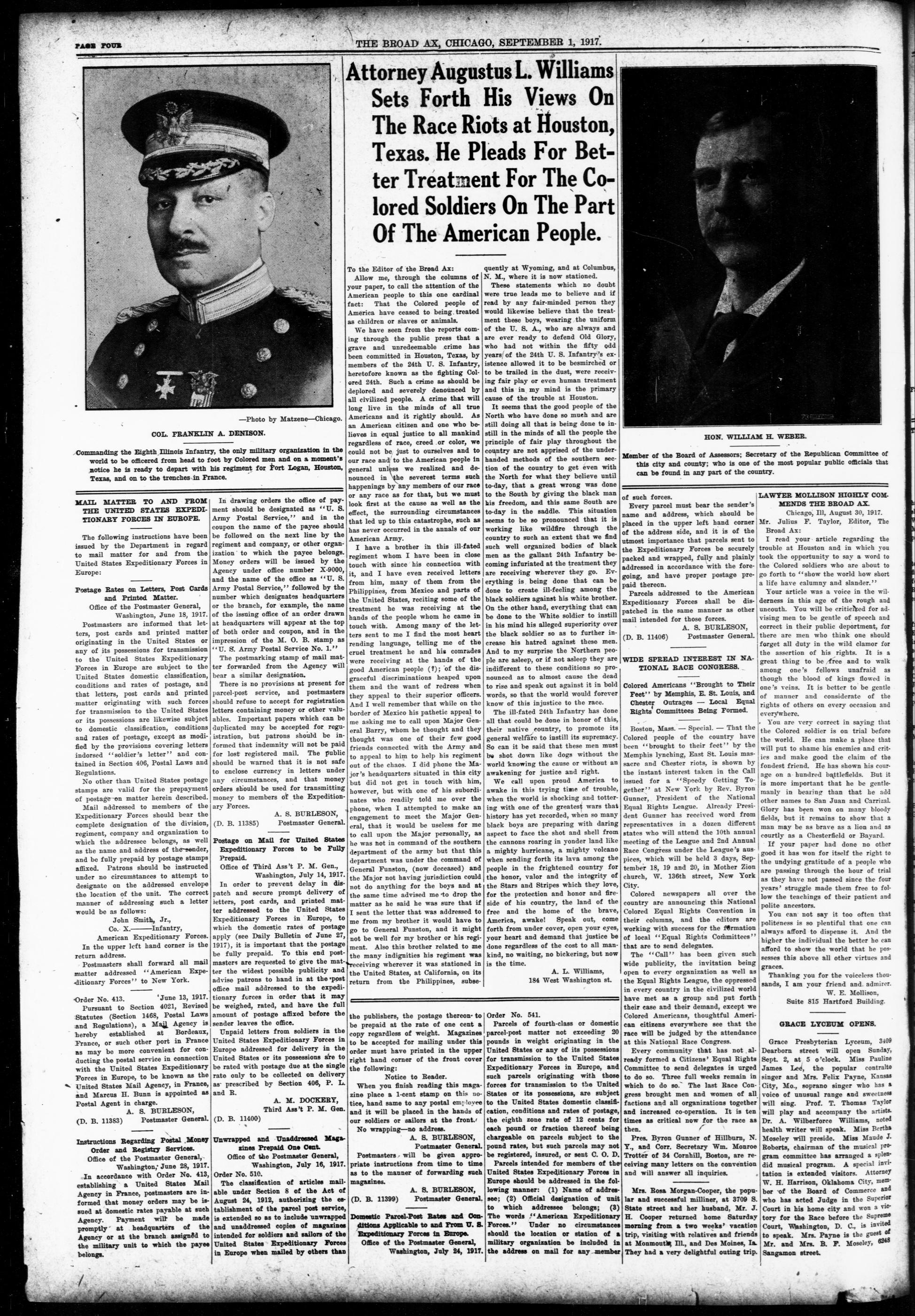
Commanding the Eighth Illinois Infantry, the only military organization in the world to be officered from head to foot by Colored men and on a moment's notice he is ready to depart with his regiment for Fort Logan, Houston, Texas, and on to the trenches in France.
PAGE FOUR
COL. FRANKLIN
Commanding the Eighth Illinois Infantry world to be officered from head to foot notice he is ready to depart with Texas, and on to the trenches in Fr
MAIL MATTER TO AND FROM THE UNITED STATES EXPEDITIONARY FORCES IN EUROPE.
The following instructions have been issued by the Department in regard to mail matter for and from the United States Expeditionary Forces in Europe:
Postage Rates on Letters, Post Cards and Printed Matter.
Washington, June 16, 1911.
Postmasters are informed that letters, post cards and printed matter originating in the United States or any of its possessions for transmission to the United States Expeditionary Forces in Europe are subject to the United States domestic classification, conditions and rates of postage, and that letters, post cards and printed matter originating with such forces for transmission to the United States or its possessions are likewise subject to domestic classification, conditions and rates of postage, except as modified by the provisions covering letters indorsed "soldier's letter" and contained in Section 406, Postal Laws and Regulations.
No other than United States postage stamps are valid for the prepayment of postage on matter herein described.
Mail addressed to members of the Expeditionary Forces should bear the complete designation of the division, regiment, company and organization to which the addresssee belongs, as well as the name and address of the sender, and be fully prepaid by postage stamps affixed. Patrons should be instructed under no circumstances to attempt to designate on the addressed envelope the location of the unit. The correct manner of addressing such a letter would be as follows:
American Expeditionary Forces.
In the upper left hand corner is the return address.
Postmasters shall forward all mail matter addressed "American Expeditionary Forces" to New York.
Order No. 413. 'June 13, 1917.
Pursuant to Section 4021, Revised Statutes (Section 1468, Postal Laws and Regulations), a Mail Agency is hereby established at Bordeaux, France, or such other port in France as may be more convenient for conducting the postal service in connection with the United States Expeditionary Forces in Europe, to be known as the United States Mail Agency, in France, and Marcus H. Bunn is appointed as Postal Agent in charge.
A. S. BURLESON,
(D. B. 11383) Postmaster General.
Instructions Regarding Postal Money
Order and Registry Services.
Office of the Postmaster General,
Washington, June 28, 1917.
In accordance with Order No. 413,
establishing a United States Mail
Agency in France, postmasters are
informed that money orders may be
issued at domestic rates payable at such
Agency. Payment will be made
promptly at headquarters of the
Agency or at the branch assigned to
the military unit to which the payee
belongs.
---
In drawing orders the office of payment should be designated as "U. S. Army Postal Service," and in the coupon the name of the payee should be followed on the next line by the regiment and company, or other organization to which the payee belongs. Money orders will be issued by the Agency under office number X-9000, and the name of the office as "U. S. Army Postal Service," followed by the number which designates headquarters or the branch, for example, the name of the issuing office of an order drawn at headquarters will appear at the top of both order and coupon, and in the impression of the M. O. B. stamp as "U. S. Army Postal Service No. 1." The postmarking stamp of mail matter forwarded from the Agency will bear a similar designation.
There is no provisions at present for parcel-post service, and postmasters should refuse to accept for registration letters containing money or other valuables. Important papers which can be duplicated may be accepted for registration, but patrons should be informed that indemnity will not be paid for lost registered mail. The public should be warned that it is not safe to enclose currency in letters under any circumstances, and that money orders should be used for transmitting money to members of the Expeditionary Forces.
Postage on Mail for United States Expeditionary Forces to be Fully Prepaid.
Office of Third Ass't P. M. Gen. Washington, July 14, 1917. In order to prevent delay in dispatch and secure prompt delivery of ietters, post cards, and printed matter addressed to the United States Expeditionary Forces in Europe, to which the domestic rates of postage apply (see Daily Bulletin of June 27, 1917), it is important that the postage be fully prepaid. To this end post-masters are requested to give the matter the widest possible publicity and advise patrons to hand in at the post office mail addressed to the expeditionary forces in order that it may be weighed, rated, and have the full amount of postage affixed before the sender leaves the office.
Unpaid letters from soldiers in the United States Expeditionary Forces in Europe addressed for delivery in the United States or its possessions are to be rated with postage due at the single rate only to be collected on delivery as prescribed by Section 406, P. L. and R.
A. M. DOCKERY,
Third Ass't P. M. Gen.
(D. B. 11400)
Unwrapped and Unaddressed Maga-
gines Prepaid One Cent.
Office of the Postmaster General, Washington, July 16, 1917. Order No. 510. The classification of articles maillable under Section 8 of the Act of August 24, 1912, authorizing the establishment of the parcel post service, is extended so as to include unwrapped and unaddressed copies of magazines intended for soldiers and sailors of the United States Expeditionary Forces in Europe when mailed by others than
THE BROAD AX, CHICAGO, SEPTEMBER 1, 1917.
Attorney Augustus L. Williams Sets Forth His Views On The Race Riots at Houston, Texas. He Pleads For Better Treatment For The Colored Soldiers On The Part Of The American People.
To the Editor of the Bread Ax:
Allow me, through the columns of your paper, to call the attention of the American people to this one cardinal fact:
That the Colored people of America have ceased to being treated as children or slaves or animals.
We have seen from the reports coming through the public press that a grave and unredeemable crime has been committed in Houston, Texas, by members of the 24th U. S. Infantry, heretofore known as the fighting Colored 24th. Such a crime as should be deplored and severely denounced by all civilized people. A crime that will long live in the minds of all true Americans and it rightly should. As an American citizen and one who believes in equal justice to all mankind regardless of race, creed or color, we could not be just to ourselves and to our race and to the American people in general unless we realized and denounced in the severest terms such happenings by any members of our race or any race as for that, but we must look first at the cause as well as the effect, the surrounding circumstances that led up to this catastrophe, such as has never occurred in the annals of our American Army.
I have a brother in this ill-fated regiment whom I have been in close touch with since his connection with it, and I have even received letters from him, many of them from the Philippines, from Mexico and parts of the United States, reciting some of the treatment he was receiving at the hands of the people whom he came in touch with. Among many of the letters sent to me I find the most heart rending language, telling me of the cruel treatment he and his comrades were receiving at the hands of the good American people (?); of the disgraceful discriminations heaped upon them and the want of redress when they appeal to their superior officers. And I well remember that while on the border of Mexico his pathetic appeal to me asking me to call upon Major General Barry, whom he thought and they thought was one of their few good friends connected with the Army and to appeal to him to help his regiment out of the chaos. I did phone the Major's headquarters situated in this city but did not get in touch with him, however, but with one of his subordinates who readily told me the phone, when I attempted to make an engagement to meet the Major General, that it would be useless for me to call upon the Major personally, as he was not in command of the southern department of the army but that this department was under the command of General Funston, (now deceased) and the Major not having jurisdiction could not do anything for the boys and at the same time advised me to drop the matter as he said he was sure that if I sent the letter that was addressed to me from my brother it would have to go to General Funston, and it might not be well for my brother or his regiment. Also this brother related to me the many indignities his regiment was receiving wherever it was stationed in the United States, at California, on its return from the Philippines, subse-
the publishers, the postage thereon to be prepaid at the rate of one cent a copy regardless of weight. Magazines to be accepted for mailing under this order must have printed in the upper right hand corner of the front cover the following:
Notice to Reader.
When you finish reading this magazine place a 1-cent stamp on this notice, hand same to any postal employee and it will be placed in the hands of our soldiers or sailors at the front.
No wrapping—no address.
Postmasters will be given appropriate instructions from time to time as to the manner of forwarding such magazines.
Domestic Parcel-Post Rates and Conditions Applicable to and From U. S. Expeditionary Forces in Europe. Office of the Postmaster General, Washington, July 84, 1917
73
Member of the Board of Assessors; Secretary of the Republican Committee of this city and county; who is one of the most popular public officials that can be found in any part of the country.
Member of the Board of Assessors; Secretary of the Republican Committee of this city and county; who is one of the most popular public officials that can be found in any part of the country.
of such forces.
Every parcel must bear the sender's name and address, which should be placed in the upper left hand corner of the address side, and it is of the utmost importance that parcels sent to the Expeditionary Forces be securely packed and wrapped, fully and plainly addressed in accordance with the foregoing, and have proper postage prepaid thereon.
Parcels addressed to the American Expeditionary Forces shall be dispatched in the same manner as other mail intended for those forces.
A. S. BURLESON,
(D. B. 11406) Postmaster General.
WIDE SPEAD INTEREST IN NATIONAL RACE CONGRESS.
Colored Americans "Brought to Their Feet" by Memphis, E. St. Louis, and Chester Outrages — Local Equal Rights Committees Being Formed.
Boston, Mass. — Special. — That the Colored people of the country have been "brought to their feet" by the Memphis lynching, East St. Louis massacre and Chester riots, is shown by the instant interest taken in the Call issued for a "Speedy Getting Together" at New York by Rev. Byron Gunner, President of the National Equal Rights League. Already President Gunner has received word from representatives in a dozen different states who will attend the 10th annual meeting of the League and 2nd Annual Race Congress under the League's auspices, which will be held 3 days, September 18, 19 and 20, in Mother Zion church, W. 136th street, New York City.
Colored newspapers all over the country are announcing this National Colored Equal Rights Convention in their columns, and the editors are working with success for the formation of local "Equal Rights Committees" that are to send delegates.
The "Call" has been given such wide publicity, the invitation being open to every organization as well as the Equal Rights League, the oppressed in every country in the civilized world have met as a group and put forth their case and their demand, except we Colored Americans, thoughtful American citizens everywhere see that the race will be judged by the attendance at this National Race Congress.
Every community that has not already formed a Citizens' Equal Rights Committee to send delegates is urged to do so. Three full weeks remain in which to do so. The last Race Congress brought men and women of all factions and all organizations together and increased co-operation. It is ten times as critical now for the race as then.
Pres. Byron Gunner of Hillburn, N. Y., and Corr. Secretary Wm. Monroe Trotter of 34 Cornhill, Boston, are receiving many letters on the convention and will answer all inquiries.
Mrs. Rosa Morgan-Cooper, the popular and successful milliner, at 3709 S. State street and her husband, Mr. J. H. Cooper returned home Saturday morning from a two weeks' vacation trip, visiting with relatives and friends at Monmouth, Ill., and Des Moines, Ia. They had a very delightful outing trip.
quently at Wyoming, and at Columbus, N. M., where it is now stationed. These statements which no doubt were true leads me to believe and if read by any fair-minded person they likewise believe that the treatment these boys, wearing the uniform of the U. S. A., who are always and are ever ready to defend Old Glory, who had not within the fifty odd years/ of the 24th U. S. Infantry's existence allowed it to be besmirched or to be trailed in the dust, were receiving fair play or even human treatment and this in my mind is the primary cause of the trouble at Houston.
It seems that the good people of the North who have done so much and are still doing all that is being done to instill in the minds of all the people the principle of fair play throughout the country are not apprised of the underhanded methods of the southern section of the country to get even with the North for what they believe until-to-day, that a great wrong was done to the South by giving the black man his freedom, and this same South are to-day in the saddle. This situation seems to be so pronounced that it is working like wildfire through the country to such an extent that we find such well organized bodies of black men as the gallant 24th Infantry becoming infuriated at the treatment they are receiving wherever they go. Everything is being done that can be done to create ill-feeling among the black soldiers against his white brother. On the other hand, everything that can be done to the White soldier to instill in his mind his alleged superiority over the black soldier so as to further increase his hatred against these men. And to my surprise the Northern people are asleep, or if not asleep they are indifferent to these conditions so pronounced as to almost cause the dead to rise and speak out against it in bold words, so that the world would forever know of this injustice to the race.
The ill-fated 24th Infantry has done all that could be done in honor of this, their native country, to promote its general welfare to instill its supremacy. So can it be said that these men must be shot down like dogs without the world knowing the cause or without an awakening for justice and right.
We call upon proud America to awake in this trying time of trouble, when the world is shocking and tootering with one of the greatest wars that history has yet recorded, when so many black boys are preparing with daring aspect to face the shot and shell from the cannons roaring in yonder land like a mighty hurricane, a mighty volcano when sending forth its lava among the people in the frightened country for the honor, valor and the integrity of the Stars and Stripes which they love, for the protection and honor and fireside of his country, the land of the free and the home of the brave, America, awake! Speak out, come forth from under cover, open your eyes, your heart and demand that justice be done regardless of the cost to all mankind, no waiting, no bickering, but now is the time.
A. L. Williams, 184 West Washington st.
Parcels of fourth-class or domestic parcel-post matter not exceeding 20 pounds in weight originating in the United States or any of its possessions for transmission to the United States Expeditionary Forces in Europe, and such parcels originating with those forces for transmission to the United States or its possessions, are subject to the United States domestic classification, conditions and rates of postage, the eighth zone rate of 12 cents for each pound or fraction thereof being chargeable on parcels subject to the pound rates, but such parcels may not be registered, insured, or sent C. O. D.
Parcels intended for members of the United States Expeditionary Forces in Europe should be addressed in the following manner: (1) Name of addresse; (2) Official designation of unit to which addressee belongs; (3) The words "American Expeditionary Forces." Under no circumstances should the location or station of a military organization be included in the address on mail for any-member
HON. WILLIAM H. WEBER.
LAWYER MOLLISON HIGHLY COMMENDS THE BROAD AX.
Chicago, Ill, August 30, 1917.
Mr. Julius F. Taylor, Editor, The Broad Ax:
I read your article regarding the trouble at Houston and in which you took the opportunity to say a word to the Colored soldiers who are about to go forth to "show the world how short a life have calumny and slander."
Your article was a voice in the wilderness in this age of the rough and unceuth. You will be criticized for advising men to be gentle of speech and correct in their public deportment, for there are men who think one should forget all duty in the wild clamor for the assertion of his rights. It is a great thing to be free and to walk among one's fellows unafraid as though the blood of kings flowed in one's veins. It is better to be gentle of manner and considerate of the rights of others on every occasion and everywhere.
You are very correct in saying that the Colored soldier is on trial before the world. He can make a place that will put to shame his enemies and critics and make good the claim of the fondest friend. He has shown his courage on a hundred battlefields. But it is more important that he be gentlemanly in bearing than that he add other names to San Juan and Carrilal. Glory has been won on many bloody fields, but it remains to show that a man may be as brave as a lion and as courtly as a Chesterfield or Bavard.
If your paper had done no other good it has won for itself the right to the undying gratitude of a people who are passing through the hour of trial as they have not passed since the four years' struggle made them free to follow the teachings of their patient and polite ancestors.
You can not say it too often that politeness is so plentiful that one can always afford to dispense it. And the higher the individual the better he can afford to show the world that he possesses this above all other virtues and graces.
Thanking you for the voiceless thousands, I am your friend and admirer. W. E. Mollison, Suite 815 Hartford Building.
GRACE LYCEUM OPENS.
Grace Presbyterian Lyceum, 3409 Dearborn street will open Sunday, Sept. 2, at 5 o'clock. Miss Pauline James Lee, the popular contralto singer and Mrs. Felix Payne, Kansas City, Mo., soprano singer who has a voice of unusual range and sweetness will sing. Prof. T. Thomas Taylor will play and accompany the artists. Dr. A. Wilberforce Williams, noted health writer will speak. Miss Bertha Moseley will preside. Miss Maude J. Roberts, chairman of the musical program committee has arranged a splendid musical program. A special invitation is extended visitors. Attorney W. H. Harrison, Oklahoma City, member of the Board of Commerce and who has acted Judge in the Superior Court in his home city and won a victory for the Race before the Supreme Court, Washington, D. C., is invited to speak. Mrs. Payne is the guest of Mr. and Mrs. B. F. Moseley, 6248 Sangamon street.
1920
JOSEPH E. BIDWELL JR.
First class business man who is success and who would make a dandy Rep bate Court in 1918.
who is successfully engaged in the printing business e a dandy Republican candidate for clerk of the Pro-
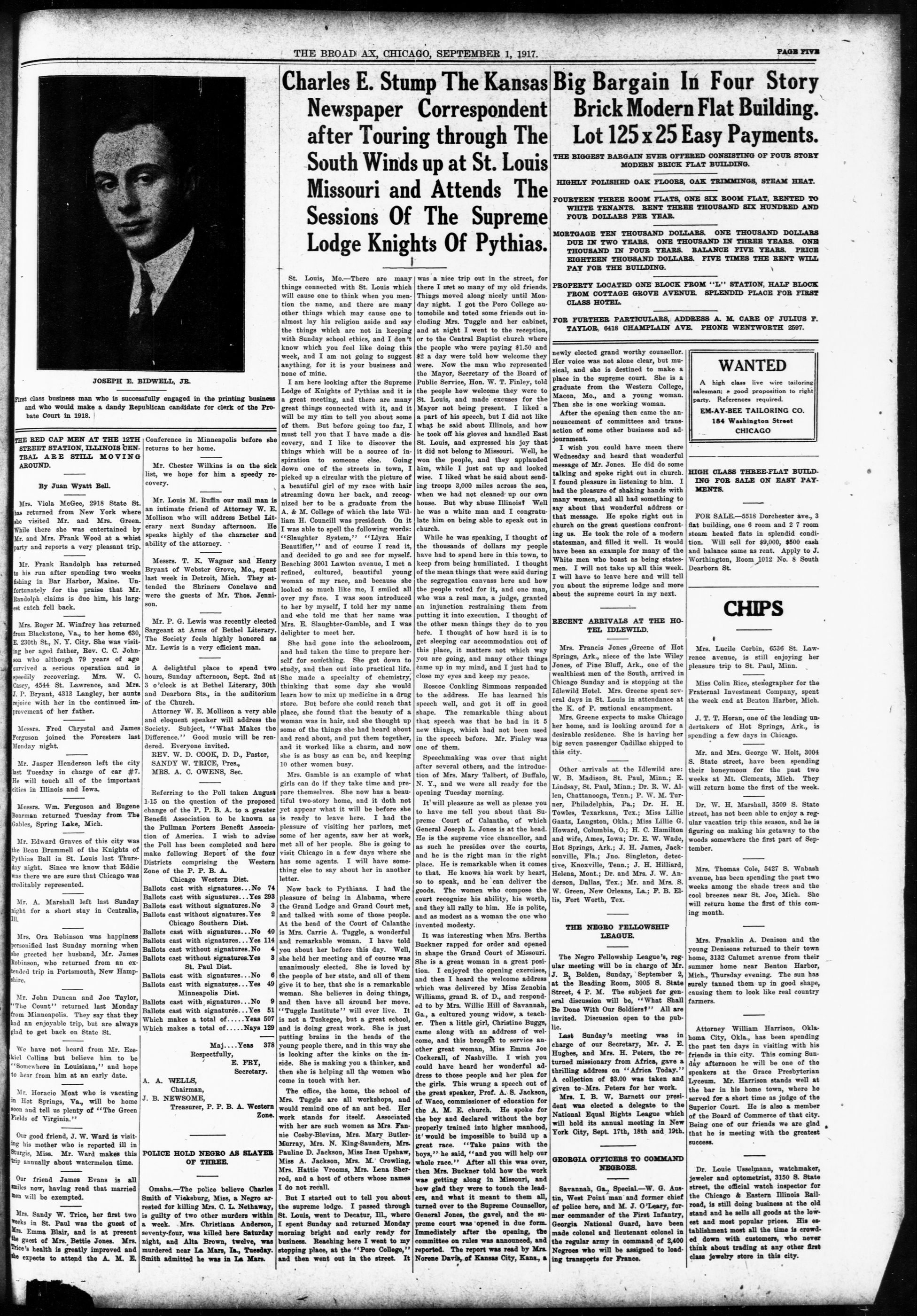
First class business man who is successfully engaged in the printing business and who would make a dandy Republican candidate for clerk of the Probate Court in 1918.
First class business man who is successfully engaged in the printing business and who would make a dandy Republican candidate for clerk of the Probate Court in 1918.
THE RED CAP MEN AT THE 12TH STREET STATION, ILLINOIS CENTRAL ARE STILL MOVING ABOUND.
Mrs. Viola McGee, 2918 State St. has returned from New York where she visited Mr. and Mrs. Green. While there she was entertained by Mr. and Mrs. Frank Wood at a whist party and reports a very pleasant trip.
Mr. Frank Randolph has returned to his run after spending two weeks fishing in Bar Harbor, Maine. Unfortunately for the praise that Mr. Randolph. claims is due him, his largest catch fell back.
Mrs. Roger M. Winfrey has returned from Blackstone, Va., to her home 630, E 230th St, N. Y. City. She was visiting her aged father, Rev. C. C. Johnson who although 79 years of age survived a serious operation and is speedily recovering. Mrs. W. C. Casey, 4544 St. Lawrence, and Mrs. J. P. Bryant, 4313 Langley, her aunt rejoice with her in the continued improvement of her father.
Messrs. Fred Chrystal and James Ferguson joined the Foresters last Monday night.
Mr. Jasper Henderson left the city last Tuesday in charge of car #7. He will touch all of the important cities in Illinois and Iowa.
Messrs. Wm. Ferguson and Eugene Boarman returned Tuesday from The Gables, Spring Lake, Mich.
Mr. Edward Graves of this city was the Beau Brummell of the Knights of Pythias Ball in St. Louis last Thursday night. Since we know that Eddie was there we are sure that Chicago was creditably represented.
Mr. A. Marshall left last Sunday night for a short stay in Centralia, Ill.
Mrs. Ora Robinson was happiness personified last Sunday morning when she greeted her husband, Mr. James Robinson, who returned from an extended trip in Portsmouth, New Hampshire.
Mr. John Duncan and Joe Taylor, "The Count" returned last Monday from Minneapolis. They say that they had an enjoyable trip, but are always glad to get back on State St.
We have not heard from Mr. Ezekiel Collins but believe him to be "Somewhere in Louisiana," and hope to hear from him at an early date.
Mr. Horacio Moat who is vacating in Hot Springs, Va., will be home soon and tell us plenty of "The Green Fields of Virginia."
Our good friend, J. W. Ward is visiting his mother who is reported ill in Sturgis, Miss. Mr. Ward makes this trip annually about watermelon time.
Our friend James Evans is all smiles now, having read that married men will be exempted.
Mrs. Sandy W. Trice, her first two weeks in St. Paul was the guest of Mrs. Emma Blair, and is at present the guest of Mrs. Bettie Jones. Mrs. Trice's health is greatly improved and she expects to attend the A. M. E.
---
```markdown
```
By Juan Wyatt Bell.
Conference in Minneapolis before she returns to her home.
Mr. Chester Wilkins is on the sick list, we hope for him a speedy recovery.
Mr. Louis M. Ruffin our mail man is an intimate friend of Attorney W. E. Mollison who will address Bethel Literary next Sunday afternoon. He speaks highly of the character and ability of the attorney.
Messrs. T. K. Wagner and Henry Bryant of Webster Grove, Mo., spent last week in Detroit, Mich. They attended the Shriners Conclave and were the guests of Mr. Thos. Jennison.
Mr. P. G. Lewis was recently elected Sargeant at Arms of Bethel Literary. The Society feels highly honored as Mr. Lewis is a very efficient man.
A delightful place to spend two hours, Sunday afternoon, Sept. 2nd at 3 o'clock is at Bethel Literary, 30th and Dearborn Sts., in the auditorium of the Church.
Attorney W. E. Mollison a very able and eloquent speaker will address the Society. Subject, "What Makes the Difference." Good music will be rendered. Everyone invited.
REV. W. D. COOK, D. D., Pastor, SANDY W. TRICE, Pres., MRS. A. C. OWENS. Sec.
Referring to the Poll taken August 1-15 on the question of the proposed change of the P. P. B. A. to a greater Benefit Association to be known as the Pullman Porters Benefit Association of America. I wish to advise the Poll has been completed and here make following Report of the four Districts comprising the Western Zone of the P. P. B. A.
Chicago Western Dist.
Ballots cast with signatures...No 74
Ballots cast with signatures...Yes 293
Ballots cast without signatures.No 3
Ballots cast without signatures.Yes 2
Chicago Southern Dist.
Ballots cast with signatures...No 40
Ballots cast with signatures...Yes 114
Ballots cast without signatures.No 4
Ballots cast without signatures.Yes 3
St. Paul Dist.
Ballots cast with signatures...No 6
Ballots cast with signatures...Yes 49
Minneapolis Dist.
Ballots cast with signatures...No 9
Ballots cast with signatures...Yes 51
Which makes a total of.....Yeas 507
Which makes a total of.....Nays 129
Maj....Yeas 378
Respectfully,
E. FRY,
Secretary.
A. A. WELLS.
Treasurer, P. P. B. A. Western Zone
POLICE HOLD NEGRO AS SLAYER OF THREE.
Omaha.—The police believe Charles Smith of Vicksburg, Miss, a Negro arrested for killing Mrs. C. L. Nethaway, is guilty of two other murders within a week. Mrs. Christiana Anderson, seventy-four, was killed here Saturday night, and Alta Brown, twelve, was murdered near La Mars, Ia., Tuesday. Smith admitted he was in La Mars.
THE BROAD AX, CHICAGO, SEPTEMBER 1, 1917.
Charles E. Stump The Kansas Newspaper Correspondent after Touring through The South Winds up at St. Louis Missouri and Attends The Sessions Of The Supreme Lodge Knights Of Pythias.
St. Louis, Mo.—There are many things connected with St. Louis which will cause one to think when you mention the name, and there are many other things which may cause one to almost lay his religion aside and say the things which are not in keeping with Sunday school ethics, and I don't know which you feel like doing this week, and I am not going to suggest anything, for it is your business and none of mine.
I am here looking after the Supreme Lodge of Knights of Pythias and it is a great meeting, and there are many great things connected with it, and it will be my aim to tell you about some of them. But before going too far, I must tell you that I have made a discovery, and I like to discover the things which will be a source of inspiration to someone else. Going down one of the streets in town, I picked up a circular with the picture of a beautiful girl of my race with hair streaming down her back, and recognized her to be a graduate from the A. & M. College of which the late William H. Council was president. On it I was able to spell the following words: "Slaughter System," "Llyra Hair Beautifier," and of course I read it, and decided to go and see for myself. Reaching 3001 Lawton avenue, I met a refined, cultured, beautiful young woman of my race, and because she looked so much like me, I smiled all over my face. I was soon introduced to her by myself, I told her my name and she told me that her name was Mrs. E. Slaughter-Gamble, and I was delighter to meet her.
She had gone into the schoolroom, and had taken the time to prepare herself for something. She got down to study, and then out into practical life, she made a specialty of chemistry, thinking that some day she would learn how to mix up medicine in a drug store. But before she could reach that place, she found that the beauty of a woman was in hair, and she thought up some of the things she had heard about and read about, and put them together, and it worked like a charm, and now she is as busy as can be, and keeping 10 other women busy.
Mrs. Gamble is an example of what girls can do if they take time and prepare themselves. She now has a beautiful two-story home, and it doth not yet appear what it will be before she is ready to leave here. I had the pleasure of visiting her parlors, met some of her agents, saw her at work, met all of her people. She is going to visit Chicago in a few days where she has some agents. I will have something else to say about her in another letter.
Now back to Pythians. I had the pleasure of being in Alabama, where the Grand Lodge and Grand Court met, and talked with some of those people. At the head of the Court of Calanthe is Mrs. Carrie A. Tuggle, a wonderful and remarkable woman. I have told you about her before this day. Well, she held her meeting and of course was unanimously elected. She is loved by the people of her state, and all of them give it to her, that she is a remarkable woman. She believes in doing things, and then have all around her move. "Tuggle Institute" will ever live. It is not a Tuskegee, but a great school, and is doing great work. She is just putting brains in the heads of the young people there, and in this way she is looking after the kinks on the inside. She is making you a thinker, and then she is helping all the women who come in touch with her.
The office, the home, the school of Mrs. Tuggle are all workshops, and would remind one of an ant bed. Her work stands for itself. Associated with her are such women as Mrs. Fannie Cosby-Blevins, Mrs. Mary Butler-Murray, Mrs. N. King-Saunders, Mrs. Pauline D. Jackson, Miss Inez Upshaw, Miss A. Jackson, Mrs. M. Crowling, Mrs. Hattie Vrooms, Mrs. Lena Sherrod, and a host of others whose names I do not recall.
But I started out to tell you about the supreme lodge. I passed through St. Louis, went to Decatur, Ill., where I spent Sunday and returned Monday morning bright and early ready for business. Reaching here I went to my stopping place, at the "Poro College," and then went out in the street. It
was a nice trip out in the street, for there I met so many of my old friends. Things moved along nicely until Monday night. I got the Poro College automobile and toted some friends out including Mrs. Tuggle and her cabinet, and at night I went to the reception, or to the Central Baptist church where the people who were paying $1.50 and $2 a day were told how welcome they were. Now the man who represented the Mayor, Secretary of the Board of Public Service, Hon. W. T. Finley, told the people how welcome they were to St. Louis, and made excuses for the Mayor not being present. I liked a part of his speech, but I did not like what he said about Illinois, and how he took off his gloves and handled East St. Louis, and expressed his joy that it did not belong to Missouri. Well, he won the people, and they applauded him, while I just sat up and looked wise. I liked what he said about sending troops 3,000 miles across the sea, when we had not cleaned up our own house. But why abuse Illinois? Well he was a white man and I congratulate him on being able to speak out in church.
While he was speaking, I thought of the thousands of dollars my people have had to spend here in this town, to keep from being humiliated. I thought of the mean things that were said during the segregation canvass here and how the people voted for it, and one man, who was a real man, a judge, granted an injunction restraining them from putting it into execution. I thought of the other mean things they do to you here. I thought of how hard it is to get sleeping car accommodation out of this place, it matters not which way you are going, and many other things came up in my mind, and I just had to close my eyes and keep my peace.
Roscoe Conkling Simmons responded to the address. He has learned his speech well, and got it off in good shape. The remarkable thing about that speech was that he had in it 5 new things, which had not been used in the speech before. Mr. Finley was one of them.
Speechmaking was over that night after several others, and the introduction of Mrs. Mary Talbert, of Buffalo, N. Y., and we were all ready for the opening Tuesday morning.
It will pleasure as well as please you to have me tell you about that Supreme Court of Calanthe, of which General Joseph L. Jones is at the head. He is the supreme vice chancellor, and as such he presides over the courts, and he is the right man in the right place. He is remarkable when it comes to that. He knows his work by heart, so to speak, and he can deliver the goods. The women who compose the court recognize his ability, his worth, and they all rally to him. He is polite, and as modest as a woman the one who invented modesty.
It was interesting when Mrs. Bertha Buckner rapped for order and opened in shape the Grand Court of Missouri. She is a great woman in a great position. I enjoyed the opening exercises, and then I heard the welcome address which was delivered by Miss Zenobia Williams, grand R. of D., and responded to by Mrs. Willie Hill of Savannah, Ga., a cultured young widow, a teacher. Then a little girl, Christine Buggs, came along with an address of welcome, and this brought to service another great woman, Miss Emma Joe Cockerall, of Nashville. I wish you could have heard her wonderful address to those people and her plea for the girls. This wring a speech out of the great speaker, Prof. A. S. Jackson, of Waco, commissioner of education for the A. M. E. church. He spoke for the boy and declared without the boy properly trained into higher manhood, it would be impossible to build up a great race. "Take pains with the boys," he said, "and you will help our whole race." After all this was over, then Mrs. Buckner told how the work was getting along in Missouri, and how glad they were to touch the leaders, and what it meant to them all, turned over to the Supreme Counsellor, General Jones, the gavel, and the supreme court was opened in due form. Immediately after the opening, the committee on rules was announced, and reported. The report was read by Mrs. Norene Davis, of Kansas City, Kans., a
Big Bargain In Four Story Brick Modern Flat Building. Lot 125 x 25 Easy Payments.
THE BIGGEST BARGAIN EVER OFFERED CONSISTING OF FOUR STORY MODERN BRICK FLAT BUILDING.
HIGHLY POLISHED OAK FLOORS, OAK TRIMMINGS, STEAM HEAT.
FOURTEEN THREE ROOM FLATS, ONE SIX ROOM FLAT, RENTED TO WHITE TENANTS. RENT THREE THOUSAND SIX HUNDRED AND FOUR DOLLARS PER YEAR.
MORTGAGE TEN THOUSAND DOLLARS. ONE THOUSAND DOLLARS DUE IN TWO YEARS. ONE THOUSAND IN THREE YEARS. ONE THOUSAND IN FOUR YEARS. BALANCE FIVE YEARS. PRICE EIGHTEEN THOUSAND DOLLARS. FIVE TIMES THE RENT WILL PAY FOR THE BUILDING.
PROPERTY LOCATED ONE BLOCK FROM "L" STATION, HALF BLOCK FROM COTTAGE GROVE AVENUE. SPLENDID PLACE FOR FIRST CLASS HOTEL.
FOR FURTHER PARTICULARS, ADDRESS A. M. CARE OF JULIUS F. TAYLOR 6418 CHAMPLAIN AVE. PHONE WENTWORTH 2597.
newly elected grand worthy counsellor. Her voice was not alone clear, but musical, and she is destined to make a place in the supreme court. She is a graduate from the Western College, Macon, Mo., and a young woman. Then she is one working woman. After the opening then came the announcement of committees and transaction of some other business and adjournment.
I wish you could have meen there Wednesday and heard that wonderful message of Mr. Jones. He did do some talking and spoke right out in church. I found pleasure in listening to him. I had the pleasure of shaking hands with many women, and all had something to say about that wonderful address or that message. He spoke right out in church on the great questions confronting us. He took the role of a modern statesman, and filled it well. It would have been an example for many of the White men who boast as being statesmen. I will not take up all this week. I will have to leave here and will tell you about the supreme lodge and more about the supreme court in my next.
RECENT ARRIVALS AT THE HOT
TEL IDLEWILD.
Mrs. Francis Jones Greene of Hot Springs, Ark., niece of the late Wiley Jones, of Pine Bluff, Ark., one of the wealthiest men of the South, arrived in Chicago Sunday and is stopping at the Idlewild Hotel. Mrs. Greene spent several days in St. Louis in attendance at the K. of P. national encampment. Mrs. Greene expects to make Chicago her home, and is looking around for a desirable residence. She is having her big seven passenger Cadillac shipped to this city.
Other arrivals at the Idlewild are: W. B. Madison, St. Paul, Minn.; E. Lindsay, St. Paul, Minn.; Dr. R. W. Ailen, Chattanooga, Tenn.; P. W. M. Turner, Philadelphia, Pa.; Dr. H. H Towles, Texarkana, Tex.; Miss Lillie Gantz, Langston, Okla.; Miss Lillie G Howard, Columbia, O.; H. C. Hamilton and wife, Ames, Iowa; Dr. E. W. Wade, Hot Springs, Ark.; J. H. James, Jacksonville, Fla.; Juo, Singleton, detective, Knoxville, Tenn.; J. H. Hilliard, Helena, Mont.; Dr. and Mrs. J. W. Anderson, Dallas, Tex.; Mr. and Mrs. S. W. Green, New Orleans, La.; F. B. Ellis, Fort Worth, Tex.
THE NEGRO FELLOWSHIP
LEAGUE.
The Negro Fellowship League's, regular meeting will be in charge of Mr. J. R. $ _{2} $ Bolden, Sunday, September 2, at the Reading Room, 3005 S. State Street, 4 P. M. The subject for general discussion will be, "What Shall Be Done With Our Soldiers?" All are invited. Discussion open to the public.
Last Sunday's meeting was in charge of our Secretary, Mr. J. E. Hughes, and Mrs. H. Peters, the returned missionary from Africa, gave a thrilling address on "Africa Today." A collection of $3.00 was taken and given to Mrs. Peters for her work.
Mrs. I. B. W. Barnett our president was elected a delegate to the National Equal Rights League which will hold its annual meeting in New York City, Sept. 17th, 18th and 19th.
GEORGIA OFFICERS TO COMMAND
NEGROES.
Savannah, Ga. $ _{2} $ Special—W. G. Austin, West Point man and former chief of police here, and M. J. O'Leary, former commander of the First Infantry, Georgia National Guard, have been made colonel and lieutenant colonel in the regular army in command of 2,400 Negroes who will be assigned to loading transports for France.
PAGE FIVE
In Four Story
in Flat Building.
Easy Payments.
BERED CONSISTING OF FOUR STORY
FLAT BUILDING.
OAK TRIMMINGS, STEAM HEAT.
ONE SIX ROOM FLAT, RENTED TO
THE THOUSAND SIX HUNDRED AND
DOLLARS. ONE THOUSAND DOLLARS
THOUSAND IN THREE YEARS. ONE
BALANCE FIVE YEARS. PRICE
RS. FIVE TIMES THE RENT WILL
FROM "L" STATION, HALF BLOCK
QUE. SPLENDID PLACE FOR FIRST
ADDRESS A. M. CARE OF JULIUS F.
E. PHONE WENTWORTH 2597.
WANTED
A high class live wire tailoring salesman: a good proposition to right party. References required.
EM-AY-BEE TAILORING CO.
184 Washington Street
CHICAGO
HIGH CLASS THREE-FLAT BUILDING FOR SALE ON EASY PAYMENTS.
FOR SALE.--5518 Dorchester ave., 3 flat building, one 6 room and 2 7 room steam heated flats in splendid condition. Will sell for $9,000, $500 cash and balance same as rent. Apply to J. Worthington, Room 1012 No. 8 South Dearborn St.
CHIPS
Mrs. Lucile Corbin, 6536 St. Lawrence avenue, is still enjoying her pleasure trip to St. Paul, Minn.
Miss Colin Rice, stenographer for the Fraternal Investment Company, spent the week end at Benton Harbor, Mich.
J. T. T. Horan, one of the leading undertakers of Hot Springs, Ark., is spending a few days in Chicago.
Mr. and Mrs. George W. Holt, 3004 S. State street, have been spending their honeymoon for the past two weeks at Mt. Clements, Mich. They will return home the first of the week.
Dr. W. H. Marshall, 3509 S. State street, has not been able to enjoy a regular vacation trip this season, and he is figuring on making his getaway to the woods somewhere the first part of September.
Mrs. Thomas Cole, 5427 S. Wabash avenue, has been spending the past two weeks among the shade trees and the cool breezes near St. Joe, Mich. She will return home the first of this coming month.
Mrs. Franklin A. Denison and the young Denisons returned to their town home, 3132 Calumet avenue from their summer home near Benton Harbor, Mich., Thursday evening. The sun has surely tanned them up in good shape, causing them to look like real country farmers.
Attorney William Harrison, Oklahoma City, Okla., has been spending the past ten days in visiting with his friends in this city. This coming Sunday afternoon he will be one of the speakers at the Grace Presbyterian Lyceum. Mr. Harrison stands well at the bar in his home town, where he served for a short time as judge of the Superior Court. He is also a member of the Board of Commerce of that city. Being one of our friends we are glad that he is meeting with the greatest success.
Dr. Louie Usselmann, watchmaker, jeweler and optometrist, 3150 S. State street, the official watch inspector for the Chicago & Eastern Illinois Railroad, is still doing business at the old stand and he sells all goods at the lowest and most popular prices. His establishment most all the time is crowded down with customers, who never think about trading at any other first class jewelry store in this city.
SAVE ALL
THE BROADAX
Published Weekly
In this city since July 15th, 1899
without missing one single issue, Republicans, Democrates, Catholics, Protestants, single Taxers, Priests, infidels or anyone else can have their say as long as their language is proper and responsibility is fixed.
The Broad Ax is a newspaper whose platform is broad enough for all, ever claiming the editorial right to speak its own mind.
Local communications will receive attention. Write only on one side of the paper.
Subscriptions must be paid in advance.
One Year.....$2.00
Six Months.....1.00
Advertising rates made known on application.
Address all communications to
PHONE WENTWORTH 8507.
JULIUS P. TAYLOR, Editor and Publisher.
Entered as Second-Class Matter August 19, 1902, at the Post Office at Chicago, Illinois, under Act of March 3, 1870.
Treasures of the Tiber's Bed.
Treasures of the Tiber's Bed.
Father Tiber must be trembling in his bed over the quest for the gold supposed to lie in the foundations of the old temple of Jove, for the river has more than once been threatened. Lecky holds that its periodical flooding and bequest of marshes and malaria have been the salvation of Italy in preventing the Italian parliament, for reasons of health, from sitting long in session. Garibaldi had other views. He meant to fling the old river from Rome to Tivoli, so sent for that of prince of engineers, Sir John Fowler. Fowler made the necessary surveys for diversion of the Tiber into the Anio, to canalize the malarial area and drain it into the sea. It would have been a great and romantic feat of engineering, but honest John loved Garibaldi as faithfully as did the red shirted Thousand. "It will cost you nine millions for the work and as much again for compensation. Don't think of it," he bluntly said. "Oh, you stubborn English!" laughed the hero. "Americans here would do the work for nothing merely to get the antiquities in the Tiber bed." But he took Fowler's advice—London Chronicle.
The Misunderstood Shark
There seems to be some misunderstanding concerning the way in which sharks attack victims. Some claim that they turn over as they attack so as to bite more readily with their receding underjaw. Others claim, according to the Popular Science Monthly, that they attack head on, swimming to their victim in a straight line. According to J. E. Williamson, whose work in photographing the shark under water for motion picture plays has been notably successful, the "head-on" description of attack is the correct one.
"I can prove by my pictures that a shark does not turn over to bite," states Mr. Williamson. "If a shark wants to pick up anything from the bottom of the sea he goes right down to it as a pounces on a bone and picks it up. A shark does not turn over to bite any more than any other fish does."
Dealing In Diamonds.
There is no other form in which human wealth is so compact and so durable as in diamonds. A paper three inches long and an inch and a half wide will hold a king's ransom in a form that a million years will not harm and that not even fire itself, except the heat of the electric furnace and of the Bunsen burner, will destroy. You would think that anything so precious would be hedged about with a host of precautions. Just the opposite is true. Men go into the offices of wholesale diamond dealers, slip packages of uncut stones worth thousands of dollars into their pockets and go away with no record of the transaction except a "memorandum." Half the business of many dealers in precious stones is done by letting goods go out "on memorandum." The one thing that the men in the trade guard more carefully than their diamonds is their credit - Youth's Companion.
The Authority
"Tell me, my man, do you exercise your marital prerogative and dominate your wife?"
"Better ask her. She's the boss."-Baltimore American.
Disadvantages
"Here's a man died from the effects of chewing phosphorus on matches."
"That is what comes from putting oneself too much on a light diet."—Baltimore American.
Punishment.
Caller—Here are some verses I wrote.
What ought I to get for them? Editor
(after glancing over lines)—I am an editor,
not a magistrate—Boston Transcript.
Man sinks beneath his load when fear rises in his heart; drive away his fear and you will divide his load.
Filipinos Are Lazy.
The Filipino strikes me as unbearably lazy. He has had roads built for him, schools run for him, good government and peace secured to him and an unusual measure of confidence placed in him. He has graduated from almost no clothes into spotless white, with patent leather "kicks," a clean shirt and a resplendent tie, so that he looks like the swell member of a pair of black face comedians. He has had "sitting down" jobs created or discovered for him and has taken with remarkable alacrity to the ice cream soda habit, just like any other cultured being. He has learned to speak English very well and has been trained into a really good athlete. But, as far as I can see so far, he is not much changed since the days when he dawled into school, followed by a servant to carry his books and ink bottle. I doubt very much whether he will work as hard or as intelligently to make something of himself, and the islands as Uncle Sam has worked for him.—Christian Herald.
Northcliffe's Test
In Everybody's Magazine Isaac F. Marcosson furnishes a concrete incident which explains in a manner Lord Northcliffe's wonderful success as a journalist. It shows why Northcliffe and his ramified interests have forged ahead:
He once met a subeditor in the corridor of the London Mall building and asked him how he was getting along.
"Splendidly, thank you," was the reply.
"How long have you been with me?"
"Six months, my lord."
"What money are you getting?"
"Seven pounds a week."
"Are you happy and contented?"
"Yes, but I have lots of leisure."
"Then you are not the man for me. I don't want any member of my staff to be happy and contented on £7 a week." He himself has never been content with man or machine when he could get a better one.
Gadets of Switzerland.
Although no Swiss is legally liable for military service until the year in which he reaches the age of twenty, nevertheless a very large number of boys begin at the age of twelve to train as cadets and learn to carry and use rifles and to drill. These boys are supplied with their rifles by the government, but keep them at home and are responsible for having them always in proper condition. Should a rifle be found on inspection not to have been properly cleaned the boy's parents are liable to a heavy fine, and should this neglect occur a second time the boy may be punished by being dismissed from the cadet corps, this naturally being a disgrace from which every boy shrinks. These cadets all wear uniforms, which are supplied by the parents or, if the latter be in poor circumstances, then by the cadet corps association. Some of these Swiss cadets now have even light artillery.
The Girl Who Fuzzes
The fussy girl sat next us in the car this morning. And she fussed and she fussed and she fussed. She settled herself three times, hunched up her right shoulder, took off her right glove and patted her hair, pulled the back of her collar into shape, shrugged up her left shoulder, pulled off her left glove and patted her hair, pushed her hat a little more to one side and put on both gloves, patted her hair and crossed her right ankle over her left, squared both shoulders and patted her hair, settled herself in a new position and pulled her coat down at the waist, patted her hair, surveyed her nose in the tiny glass at the bottom of her bag and patted her hair, pulled her hat a wee bit more to one side and reversed her ankles, then began at the top of her program and repeated it.-Worcester Post.
Her View of It.
A certain lady attempted to open an account at a department store. The store asked her for a reference, and she named Coutts' bank. Coutts' bank, on being appealed to, replied that as a credit proposition the lady was an uncertain and even dangerous risk, and accordingly the department store wrote to her: Madam-We regret to say your reference is unsatisfactory.
To this the lady wrote back:
You certainly surprise me. I always considered Coutts' bank a most respectable and solid institution.
—Philadelphia Bulletin.
Virtue and Immortality
Men passionately desire to live after death, but they often pass away without noticing the fact that the memory of a really good person always lives. It is impressed upon the next generation and is transmitted again to the children. Is not that an immortality worth striving for?—Kropotkin.
Grease on White Goods
To remove cream spots from embroidered centerpieces or dolls dampen the spot with liquid ammonia, then lay a fresh piece of blotting paper over it and iron lightly. This treatment will remove any grease from white goods.
You've Been There.
Invalid Down For a Rest Cure—Is this a restful place, boatman? Boatman—It used to be, sir, after folks came 'ere to rest.—Philadelphia Ledger.
The Hire the Higher
Teacher—What is the difference between "I will hire a taxi and I have hired a taxi?" Kid—About $6.50.—New Orleans Times-Democrat.
We would willingly have others perfect and yet amend not our own faults.—Thomas a Kempis.
THE BROAD AX, CHICAGO, SEPTEMBER 1, 1917.
Valuable Black Walnut.
Black walnut is the ideal wood for gun stocks, but it is scarce and high in price, and there are few of the trees left in this country. A single tree of this species can be sold for a good price, and a grove of black walnut trees represents a small fortune.
About the only black walnut trees available now are those on farms and private estates, and they are fast disappearing. The wood is hard and takes a high polish, qualities which make it desirable for the use to which it is put. Manufacturers have not found a wood to take its place satisfactorily.
Origin of the Matines.
Whether or not we have to look back to the fifteens for the first matinee, the is at least little doubt that the inventor had not attained any general popularity when the seventies were reached. I am reminded that the Bancrofts, we were responsible for many innovations that have since become the vogue, not institute afternoon performance until 1876, after they had been in management eleven years. The Bancroft if not the inventors of the matinee were certainly the first to pay full salaries to those who took part in them, not until 1878 did the matinee.
Some of the black walnut used is obtained from old furniture or walnscoting, stairways and interior trim of dwellings or churches. Many years ago black walnut was used extensively in the manufacture of the best grades of furniture, and in old churches pews and pulpits made of it can be found today. The demand for the wood is gradually causing them to disappear.—New York Sun.
Carelessness and Fires.
Little Horace, whose father thinks he is a second Edison, and his mother, who would like to use electricity for everything from curling her hair to stoking the furnace, do more to keep the fire engines busy than mice ever did in all the years they chewed matches.
Washington Devereux, chief of the electrical department of the Philadelphia Fire Underwriters' association, said 54,000 fires were caused last year by overheated electrical devices. The fault wasn't with the devices, he said, but with the human equation—the woman who turned on the "juice" in her electric iron and then went out for a social afternoon without turning it off. He made the statement that no father had a right to buy his ten-year-old son a ten cent book on "How to Wire the House In Your Spare Moments" unless he was prepared to see the place go up in smoke some bright afternoon. Philadelphia Ledger.
Keep Up With the Present.
Success and happiness depend upon the way in which we adapt ourselves to the realities of the objective life. If we fight against change—and change we must meet at every turn and in every department of life—we soon become exhausted, wear ourselves out and sink back into ourselves—into the subconscious—and fail and grow old before our time. If we cling to past experiences, refuse to live in the present, let our faith die when disappointments come, the results are the same. The life forces ebb and we sink into the great sea of the unconscious and are on the road to being submerged. Desire, will, concentration, purpose, faith—these can be applied to keep us living in the present, to keep our enthusiasm active and our creativeness expressing—Nautilus.
What's the Answer?
Old elephant hunters who have hunted their quarry in India, Siam and the wilds of the Malay peninsula are agreed upon the following fact: Bury the carcass of a full grown tusker in any spot in Asia—it matters not whether the location be high and dry or low and damp—one year from the date of burial not a shred of hide nor a silver of bone can be found by digging. Neither disintegration nor ants can be an explanation, for the phenomenon has been noted in the highlands of Nepal, where buried carcasses of other animals than the elephant undergo little or no change within a year and elephants' bones disappear in localities where ants are unknown. So far the scientists have failed to come forward with an answer.
The "Crowned Republic"
It was Tennyson who gave to England the phrase "Our crowned republic." It was the bill of rights, by which parliament voted "Dutch William" and his wife, Mary, joint sovereigns of England, which made Great Britain a "crowned republic." From the moment the bill of rights gave the house of commons the sole right to levy taxes and that house resolved only to grant the crown annual supplies the backbone of absolutism was broken and the nerve centers of tyranny were paralyzed. Henceforth we were a "crowned republic."-London Answers.
Safety First
"What is your objection to me as a son-in-law?"
"I haven't any objection to you," replied Mr. Cumrox. "But I have trouble enough maintaining my own position in this household without assuming the slightest responsibility for anybody else."—Washington Star.
Life.
"Young man, there is nothing worse than high life on a low salary," said the wise man who who is always giving advice.
"Oh, I don't know," replied the young man who knew a thing or two himself.
"It's no worse than low life on a high salary."—Florida Times-Union.
Her Choice.
"Does your daughter play Mozart?" we asked, displaying unusual erudition. "I believe so," she replied deprecatingly, "but I think she prefers euchre." —Philadelphia Ledger.
If Useless, Quit.
"Oh, stop whining. Is whining going to mend matters?" "I suppose not." "Then if not, whine not."—Exchange
Fusav.
"You're to be shot at sunrise.
"That'll spill the whole day for me.
Make it sunset."—Lamb.
Mediocrity is excellent to the eyes of mediocre people—Joubert.
Origin of the Matines.
Whether or not we have to look back to the fifties for the first matinee, there is at least little doubt that the invention had not attained any general popularity when the seventies were reached. I am reminded that the Bancrofts, who were responsible for many innovations that have since become the vogue, did not institute afternoon performances until 1876, after they had been in management eleven years. The Bancrofts, if not the inventors of the matinee, were certainly the first to pay full salaries to those who took part in them.
Not until 1878 did the matinee become a fixed and regular feature of even the Bancroft management. It was a byproduct of "Diplomacy," the success of which made any means of providing additional performances acceptable. Sir Squire Bancroft has put it on record that at the beginning the matinee was a much more costly affair than it is now, as frequent and separate advertisements and announcements were necessary to make it known—Westminster Gazette.
A Defect In Higher Education.
It must be said that the higher education of the United States is at present in a condition where it may readily drop backward rather than improve. The college student of today and in some cases even the university student is permitted to sprawl over so large and so varied an area of intellectual interest that he loses the discipline in concentration, in hard work, and in the mastery of some relatively small field that comes from pursuing a better and older method. There is just now, however, a marked tendency among the better colleges to aid and to guide the student toward concentrating his interests and his energies upon a small group of subjects that have some common center of interest and some well marked relationship. This movement is a sound and hopeful one and should be encouraged and aided.—President Butler in Youth's Companion.
Salt Means Much to Health
"If the human race should be deprived of salt even for a period of a few months," said a physician, "we would not only lose a natural healthful incentive for our food, but disease, with all its attendant miseries, would spread with such relentless speed as to defy the efforts of the most skillful doctors of the land. Alling persons frequently refuse sugar, but they seldom turn up their noses at common salt. That is because there is in the body a deficiency of chloride of sodium, and nature intuitively excludes the desire for it. Salt is essential to health and life and is as much a food as bread or flesh. If there is no wish for salt in a person doctors uniformly conclude that disease in some form is lurking unsuspected in the system."
Obliterating Class Distinctions
Modern and cultured persons, I believe, object to their children seeing kitchen company or being taught by a woman like Peggotty. But surely it is more important to be educated in a sense of human dignity and equality than in anything else in the world. And a child who has once had to respect a kind and capable woman of the lower classes will respect the lower classes forever. The true way to overcome the evil in class distinctions is not to denounce them as revolutionists denounce them, but to ignore them as children ignore them.—G, K. Chesterton.
The Spanish Alcalde.
In former times in Spain the alcalde de corte was a judge of the palace court, having jurisdiction in and about the residence of the king. The office is now obsolete in this sense, but "alcalde" is still used to designate the mayor of a town exercising the functions of a justice of the peace.
Why He Looked Sour
Dusty Dennis—Why do you look so sour, pard? Gritty George—Why, one of dem comic artists wanted me to sit on de fence and let him sketch me. Dusty Dennis—What of dat? Gritty George—It was a barb wire fence.—Exchange.
News to Her.
"What was the farmer talking about?" asked the first city girl.
"A whiffletree," said the other.
"Well, I've studied botany, but I never heard of a whiffletree. Sounds like his idea of a joke."—Louisville Courier-Journal.
PRACTICAL HEALTH HINT.
Flat Foot
- A treatment suitable, with but slight modification, for all cases of static foot trouble (flat foot), from the early cases which are often described as "weak ankles" to the most severe cases, where there is old standing structural change, is described by Dr. P. B. Rath in the Lancet. The treatment consists of attention to footwear, attention to position in standing and walking and regular daily exercises. Whether boots or shoes are worn, whether they button or lace, they must be the shape of the feet. The inner side of the boot where the big toe lies is kept straight, so that the end of the boot is opposite the big toe and not opposite the second or third toe. This is to insure that the big toe is not pushed out against the other toes and has plenty of room in which to act. The soles should be a sixth to a fourth of an inch thick, the heels broad, an inch or less in height.
```markdown
```
There Are None.
During his visit to the United States General Joffre was hurled through subways, jerked into skyscrapers, flung from New York to Chicago on a fast train and in general taken care of with the breathless assiduity which characterizes American hospitality. On the eve of his departure for Montreal he was asked by a reporter to state freely and frankly which one of our national characteristics had most impressed him during his stay. "Well, since you put it that way," replied Joffre, "I have been chiefly impressed by your blunt outspokenness and, if I may venture to say so, your lack of respect to your superiors." "Our superiors!" exclaimed the reporter in blank amazement. "But we haven't any!"
"And," remarked Joffre in telling the story, "after making acquaintance with their wonderful country and its still more wonderful inhabitants I have come to the conclusion that what that reporter said was about right."
The Mighty Amazon.
The Amazon, which flows through Brazil from west to east, is the mightiest river in the world. It rises in the Andes, and its course to the Atlantic is over 4,000 miles. It has more than 1,100 tributaries, the chief being the Madeira, which is 1,800 miles long, and the Rio Negro, 1,350 miles long. The extent of the waters of this majestic river is the largest in the world, over 30,000 miles of its surface being of a navigable natu . It drains nearly 3,000,000 square miles of territory. There are something like 1,200 different kinds of birds which are exclusive to the valleys of this wonderful river and thousands of varieties of animal life which are unknown in any other part of the world. The soil of the basin of the Amazon is so rich that for every bushel of maize planted it is estimated that 800 can be harvested.
Tone Quality In Music.
Tone quality is a great factor in music. Vibrations in their multiples and relations determine tone. Various instruments vary in tone quality just as does the human voice. A bell, once cast, remains the same in tone, somber or clear, to the end of its usefulness. A violin is more than a bell, and on fine violins the most subtle nuances of tone quality can be produced. The higher the harmonics, or overtones, the higher the multiples, and the more elaborate and delicate the combinations the more exquisite the tone quality of the instrument.
The human voice is greatest in tone quality, excelling the instrument, because the singer's harmonics are based not alone upon physical proportions, but also upon the heart and soul of the individual—Exchange.
Coveted Feathers
Mamo is the name of a beautiful bird of the Hawaiian Islands, now believed to be extinct, having been destroyed for the sake of its golden yellow feathers, used in former days to decorate the state robes of chiefs.
The coveted feathers of the mamo bird were a small tuft about an inch long beneath each wing. The royal cloak of the Hawaiian King Kamehameha I., made of these rare feathers, was four feet long and eleven and a half feet wide at the bottom. This cloak of mamo tufts is said to have been buried with one of the later Hawaiian kings. The plumage of the namo was generally black, excepting the lower back and parts of the wings, which were yellow.
Tropical Rains
Tropical rains are of relatively short duration by reason of the small number of cyclonic storms in the tropics, and this duration is fairly uniform throughout the year. The heaviest general rainfalls in Porto Rico are associated with West Indian hurricanes. The historic hurricane of Aug. 8, 1899, precipitated rainfall equivalent to 1,113 tons per acre.
Crossed Eyes.
Squint is caused by an unequal action of the muscles of the eyeball. If the muscles which move the eyeball outward are shorter than those which move it inward, divergent squint results. If the internal muscles are the stronger the result is convergent squint.
Just Like the Box
"Errand boys are very scarce. I can
furnish you with an office girl."
"These innovations disturb me. I
can't get used to 'em."
"You won't notice the difference.
This girl can whistle." — Pittsburgh
Post.
******************
* *
* PRACTICAL HEALTH HINT.
Remedies For Scurvy.
The juices of fruit-oranges. lemons, prunes—are well known remedies for scurvy, but it has been found that the white potato has proved just as useful. For young children a small portion of the potato is required—one tablespoonful of mashed potato to one pint of water and added to twenty-fours' feeding of milk (instead of the usual cereal). Care must be taken to pare the potato very thin. An average sized potato (boiled) will provide the amount needed. The vitamins may be retained by adding the mashed potato to the water in which it was boiled. This is a very simple and easy cure and one which a child will willingly take without objecting.
TO BANISH EGG SHAMPoos
Barbers Say Plan Would Save 250,000,000 a Year.
South Bend, Ind.-J. D. Kimerer, a barber of this city, has a scheme to save 250,000,000 eggs a year for the consumption of the people. He has put his plan before National Food Director Hoover and received from him assurance of its consideration. Kimerer would do away with the egg shampoo during the war. He says that on an average, which is considered low, each barber in the United States gives three egg shampoos a week, using two eggs. Recent statistics show that there are 300,000 eggs.
Thus if the government placed a ban on egg shampoos for men it would mean the saving of 93,600,000 eggs each year, provided each barber averaged but three shampoos. But other barbers in the city say the average of three is too low and that it would be nearer six or eight. Figured at that rate, more than 200,000,000 eggs could be saved. It is a hard matter to get at the number of eggs used by women for shampooing, inasmuch as many do their own work. However, a hardresser estimates that 50,000,000 eggs are used each year.
UNUSUAL RELICS FOUND
New Light Cast on Pueblo Civilization by Discovery.
Santa Fe, N. M.—An extraordinary find of historic pottery and relics has been made by Earl Morris, excavating Pueblo ruins at Aztec, San Juan county, with a force of twenty-five men for the American Museum of Natural History.
The discovery includes sixty pieces of rare pottery, over 20,000 carved red and black stone heads, baskets, matting, knives, battleaxes and other stone implements. The turquoise beads, malasics and shell ornaments are classed as among the finest ever excavated in the southwest.
Grains of corn with cobs, tassels and husks were found intact, as were also beans and bean pods, pumpkin seeds pine cones, cotton fiber, yucca leaves rushes, cotton yarn and cloth, sandals snowshoes, beaver teeth and bones of animals and human beings. One skeleton in a sitting position indicated the man had been decapitated. The find was made in an underground communal dwelling buried for centuries.
BEES MAKE HOME IN HOUSE
Store Honey Unmolested For Three Years In Doctor's Residence.
St. Louis.—A swarm of bees has lived and made honey for three years in the brick wall at the home of Dr. Allen Wilson, Wagoner place. Dr. Wilson has never interfered with the bees, and they have never harmed him, nor has he ever eaten any of the honey.
The bees' improvised hive is a cavity in the wall about halfway to the top of the two story house on the kitchen side. The entrance is a small hole apparently left by the bricklayer when placing the bricks around the anchor of an iron wall brace.
Dr. Wilson said he had investigated and found that the cavity now extends into the wall about a foot, apparently having been hollowed out by the bees themselves. The swarm is not a very large one, and Dr. Wilson thinks it has not produced more honey than it needed. He does not expect to try to remove the bees.
TRANSPLANTING BONE
That of Stockman's Leg Now In His Arm.
Ringling, Okla.—Ten inches of bone that supported his leg between the knee and ankle now is filling that amount of space in the forearm of Jim Herring, stockman, of Grady, having been transplanted there by a surgeon as the only remedy that would save the arm. The leg, now bearing a silver plate, has healed, and the arm promises to be as good as new before long.
Ten months ago Herring sprained his arm. Not having ready access to a surgeon and, thinking the injury slight, he set the member himself. At length a bone trouble developed and continued to grow more and more mallignant for eight months. Taking out the impaired bone was the surgical cure decided upon, and the space was filled with bone from his leg.
COMES FROM A BIG FAMILY.
Recruit Is Six Feet Four and a Half Brother, Taller, Also to Enlist. Springfield, Mo.-John F. Haley, a twenty-three-year-old farmer near Ozark, Christian county, holds the record for the tallest man accepted at the United States army recruiting station here since the declaration of war. He is six feet four and one-half inches in his bare feet. He had to stoop when he entered the door of the recruiting station to enlist.
"You fellows may think I'm big," he told the recruiting force, "but just wait till you see my brother. He's two inches taller than I. He'll be here in two or three days to enlist too. He hasn't quite finished helping dad with the planting."
Wife Beater Ducked
Kansas City. Mo.—A new form of punishment has been devised by Judge Herrod of the city court for wife beaters. After sentencing George Martin to a hundred days on the rock pile Judge Herrod ordered the patrolmen who escorted him to the "farm" to stop on their way past the Missouri river and duck their prisoner three times. Martin beat his wife because she could not make the baby stop crying.
A KINDERGARTNER
How One Woman Got Legislation Under Way.
FROM MAINE TO THE WEST.
Mothers and Clubwomen of Five of the United States Have Already Succeeded in Getting Better Laws For Early Education Passed.
During the past few years mothers and clubwomen all over the country have been growing more and more alive to the need of more kindergarteners, and this year they have been successful in five states in getting better kindergarten laws passed.
The women of Maine, Texas and Washington have the greatest cause for rejoicing, because their new laws authorize school boards to open kindergarten when parents petition for them. By having the matter regulated by law mothers and fathers in these three states will now have some guarantee of success when they ask to have a kindergarten started in the public school in their neighborhood.
Miss Nellie Brown of the Federation of Women's Clubs was largely responsible for the success of the legislative campaign in Maine, but it is safe to say she could have done nothing without the support which she received from the clubwomen and kindergartners of Bangor and from the kinder-
A. E.
MRS. GEORGE W. STEERE.
garten children themselves. A number of these tiny tots drew, colored and cut American flags for the 182 senators and representatives of the state. Ten of the children were present at the hearing on the bill before the education committee and sang "America" and saluted the flag. As they turned to march out there was a volume of applause, and when the room was again quiet the chairman of the committee said, his face wreathed in smiles, "Miss Brown, I guess you've won your hearing."
In Texas both the Congress of Mothers and the women's clubs were influential in getting their law passed. Under the leadership of Mrs. Griffith of the federation and Mrs. Steere of the congress a sentiment for kindergarteners was aroused all over the state. The result was that when it came time to think of introducing a bill the state superintendent of education framed it and college presidents and professors were glad to speak in its behalf. This wealth of public support not only made it easy to put the bill through, but is now helping the Texan workers in their efforts to put the law into effect.
Mrs. George W. Steere of Fort Worth, Tex., was at the forefront of the work in her state to obtain a good kindergarten law, and the governor's signature to the bill was hardly dry before she was launched on a campaign reaching from El Paso to Galveston to interest parents in petitioning for classes.
Some of the arguments she used successfully with legislators were:
The early years are the most impressionable, and in a wise educational system these years should not be left unprovided for.
Little children are given a good start not only in school, but in life, through the excellent training which the kindergarten gives.
The majority of parents who want kindergarten training for their children cannot afford to pay tuition at private kindergarten.
The kindergarten is democratic in that it brings educational advantages to all children before any must leave school to go to work.
Vegetable Coloring
A very dainty green color for candies or leaping is quickly obtained from lettuce leaves. Simply macerate the leaves between saucer and spoon and add the juice to the cooking sugar until dark enough. This has the advantage over spinach as a coloring agent of being obtainable at all seasons and is not so expensive as the liquid vegetable color.
To Remove Chewing Gum.
Should you happen to sit down on a piece of chewing gum do not try to scrape it off and risk spoiling your skirt. Simply take a piece of ice and hold it tightly over the gum for a few minutes. This hardens the gum and crushes it to crumble. It may then be brushed off with no injury to the cloth.
New Autumn Frocks Even Have Names.
It is not difficult to make a snap prophecy at what the new French gowns will incorporate as special features when one hears some of their names.
Kerensky and Pershing are the names to be given to two new coats; Bruslöff, Verdun, Petalm, Victoire and Louvain are others, and among these it is rather interesting to see Peter Pan and La Tosca.
It is said that the highlander's costume is still a source of delightful inspiration to the French designers, and that they will not relinquish the idea of plated skirts, checks and tartan plaids, curious shoulder draperies and short, belted jackets.
Another bit of information about the new fashions concerns the linings of coats. Last spring the French introduced colored linen as a substitute for silk in the jackets that belonged to suits. This autumn they will introduce corduroy. A buyer who has just returned from Paris says that this corduroy is called a trench lining, but one who is "fed up" with stories of the trenches and their communicating roads might say that the name corduroy indicated the road over which the "trenches" have to come and go.
One is quite sure that France will adopt something from the uniforms of our army, to which she has been giving such happy approval during the month. The milliners will have an excellent chance in the picturesque hat which our troops wear, and one has already arrived in this country made of satin and velvet. It may be, however, that the American woman is too familiar with the swaggering brim and punched in crown to warrant an expensive milliner making an appeal with it to her purse.
No doubt the Frenchwomen will adopt the hat with enthusiasm. Surely the milliners will find an easier sale for the attractive and rolllicking hat of the United States troops, than they did for the French marine cap and the queer hat of the Grenadier guards.
The poncho, the sombrero and the Pershing overcoat may become rivals of the Russian boot. the Cossack cap and the Alzerian skirt.
ABOUT PLAYTHINGS.
The Great Value of Letting a Child Amuse Himself.
[Prepared by the Kansas state board of health.]
Play material of a sort which best pleases children is at hand in nearly every home. The baby often finds more pleasure in a string of empty spools or a few clothespins than in the rattles and balls which have come from an expensive toy shop. As the child grows articles and materials at hand will, if properly utilized, give the greatest joy. All sorts of paper may be used for folding and cutting or for scrap books. Magazines furnish a wealth of pictures to cut out or to paint.
Wooden boxes make stores, doll houses and forts, while chairs and tables readily become horses, steamboats, stages and a thousand other things by the use of a little imagination. Old cotton cloth torn into two inch strips and sewed together end to end will make yards of reins, enough to drive the coach and four which is so easily created out of the dining room chairs.
When toys are to be bought or made for children they should be the material out of which the child may construct his own amusements rather than something which he is merely to watch. It is a well known fact that many of the expensive mechanical toys are discarded after a brief acquaintance or ruined in the attempt to find out what makes them go, because the child wants to do something rather than to be amused or entertained. Among the mechanical toys, however, railroads and trains of all sorts have a perennial joy for all small boys, because, with the tracks in sections and the different kinds of cars and engines, they are able to construct their own systems according to their own ideas.
Toy figures and toy dogs, cats and other animals lend themselves readily to many uses. All sorts of vehicles, such as wagons, carts, tricycles and carriages, garden tools, small brooms and carpet sweepers and all sorts of articles for doll housekeeping are adapted to play in which the imaginative element is most important. Books and drawing, sewing, writing and building materials all have their place, and many of these are at hand in every home.
Smart Fads.
Japanese embroideries are seen even on sports coats of jersey.
Girdles made of beads are a pretty addition to the straight frock.
Ecru tinted Irish lace is to be seen on afternoon and evening gowns.
Georgette crape combinations are trimmed with bands of liberty satin.
Long blouses suggesting smocks are made of sheer handkerchief linen.
Princess slips to wear under lingerie dresses are made of pink organdle
Fabric Gloves.
Fabric gloves have gained a great vogue since the beginning of the European war. One sees women wearing them for all but evening occasions. Some of the fabric weaves are so fine and so cleverly made that one cannot tell them from suede at a short distance, and they are shaped to the hand with a care that was never before bestowed on this kind of glove. Gray is most effective, as are some shades of suede and tan.
THE BROAD AX, CHICAGO, SEPTEMBER 1, 1917
FOR YOUNG FOLKS
FOR YOUNG FOLKS
Sleepy Time Story About Some Interesting Insects.
SET TRAPS FOR THE UNWARY
How One of These Creatures Caught a Prize That He Was Very Pleased to Get Rid Of—What Happens When the Clouds Pour Down Rain.
Well, said Uncle Ben to Little Ned and Polly Ann, I am going to tell you about
WEBS IN THE GRASS.
This morning while I was walking in the field I saw in the grass the tents of a bold robber band.
I thought I heard Mrs. Fly say as she flew by me: "There are those spider webs stretched out on the grass. Well, the spiders won't catch me this time. It was very kind of Fairy Dewdrop to sprinkle the webs with drops of water so that we may see them and keep out of trouble."
But as it got warmer the drops were drunk up by the hot sun and went sailing up into the sky to make clouds. Then unless you had sharp eyes and looked closely you could not see the lacey tents, which were, after all, traps in which the sly spider hoped to catch dinner, breakfast and tea.
One spider caught a little brown skliper butterfly. As soon as he felt the web shake from the struggles of the insect up he darted through his funnel shaped stairway and pounced upon the butterfly.
Once a big brown wasp came buzzing across the garden and in flying too near the ground struck a spider's web.
The minute the spider saw what he had caught he was so frightened he was most ready to run downstairs again, but he feared for his precious web. It had taken a whole hour to spin it.
So the spider hurried to the edge of the web and began cutting away the threads that held the prisoner.
In a minute the wasp was free and dropped to the grass. Soon he was able to fly away, and then the spider came out of his hole and mended the broken web.
But the little dewdrops that had gone up to the sky and joined the nice big clouds must have told tales, for after awhile the clouds rolled over the sky till the sun was hidden, and a host of big raindrops came pattering to the ground.
They battered at the spider webs till they were torn to bits, and the spiders crawled away into holes under stones or in the ground, waiting for the rain to stop.
And, of course, there was no supper for the spiders and no breakfast the next day, for it kept right on raining.
But as tomorrow promises to be a sunshine day perhaps you may notice whether they have set their traps again in the grass.
A Fine Sand Fort.
6
Photo by American Press Association.
WATCHING THE ENEMY.
With the aid of a discarded life buoy
the young soldier in the picture has
constructed a fort in the sand. The
enemy must be in front of him, as he is
intently watching something in the line
of his vision. No fear that the enemy
can approach the fort, without being
seen. Keen eyes are guarding every
approach. The fort cannot be sur-
prised.
Queer Bodies.
Remember.
Have, when you cough or sneeze a sneezes
Your karchief ready if you please.
Then turn your face and screen your nose
Before the cough or sneeze goes.
Record
The Kind of Coat That Sport Girls Need.
THE WOOL COAT
SWAGGER OUTFIT.
Worn with a white serge sport suit is this natty coat of striped jersey, green striped with white. The cut is the thing, though the white satin tippet is smart as anything made.
PHILIPPINE EMBROIDERY.
It is Supplanting the French, Being Both Pretty and Cheap.
At last women are discovering the beauty of Philippine embroidery. That statement is hardly true, for they have known of the beauty of Philippine embroidery for years. But the Philippine women have been embroidering garments that could not possibly be transformed to suit American demands.
There is some tale that the Filipino women, when they were taught to wear our clothes, asked for American patterns. That happened to be in the day when the never to be forgotten but never lamented Mother Hubbard was in the height of its power. Hence the Filipinos were given, it is said, a Mother Hubbard pattern. And that has remained the foundation pattern of their shapeless costume ever since.
In the same way, when the Filipino women first began to do embroidery for the Americans must have been some time shortly after the close of the Spanish war—just when American women were wearing their first "lingerde waists." They were white blouses in their least attractive form—with high, tight collars, and they fastened down the back. And so the Filipino women have since then been giving us "waist patterns," nicely embroidered, to be sure, but one and all on cut those old fashioned lines—lines that could not be reconciled with the present mode.
Recently somebody with clothes sense must have gone down to the Philippine Islands and told somebody there that American women changed their mode of dress with the passing years. For recently there have been wholly wearable garments, hand embroidered by the Philippine women, cut on fashionable lines.
There is really very attractive underwear embroidered in the Philippines. It is cheaper than the French work, and it is equally attractive, although it is different. Let us all be grateful to the enterprising soul who changed the current of Filipino industry from those endless and useless blouses that came in just after American acquisition of the islands.
Delicious Salad Dressing.
Daunty and oriental in flavor is a salad dressing made with white wine vinegar, one-half cupful of vinegar boiled with two tablespoonfuls of sugar, one-half stick chinnamon, five cloves. Chill this sirup on ice and when quite cold pour in, drop by drop, one-half cupful best grade of olive oil. Beat it while mixing and continue until it assumes a creamy appearance. When done add a pinch of salt and a liberal supply of Hungarian paprika; no black pepper.
This sirup should be so finely blended that no flavor predominates. Do not have it too sweet. Use it on vegetables or fruit salads. Save the juice left over, provided you have served it from a large dish instead of individual dishes, and the flavor of fruit or vegetables makes richer the oil, which can be used in potato salad or deviled eggs.
Clean Mirrors.
If glass mirrors should become very dirty it is easy to wash them with warm white soapsuds and rinse immediately with warm ammonia water or water to which a little alcohol has been added. After this go over with a fine chamois skin.
THRIFT SLOGANS
How to Save Foods, Labor and Gas by Planning.
DOUBLE PORTIONS THE IDEA
An Expert Tells Us How to Conserve Odd Ends Instead of Enriching the Garbage Pail with Leftovers—A Role For the "Tail End" of Steaks.
In these days when "thrift" is the housewives' national slogan it is well to consider methods which will enable the last fragments to be utilized.
In many homes a leftover is an accident, but the better way is to make a "planned over" which shall be put to really wider use. For instance, when buying a steak with a tail end have this end chopped by the butcher. But do not stop there. Buy at the same time enough chuck or lower round steak to make enough of the meat so that when all chopped together there will be enough for a second meal two days later, whereas the small tail alone would not have been enough.
In cooking rice for luncheon cook enough more so that there will be sufficient for rice cakes for breakfast, not merely a small saucerful with which hardly anything can be done. Similarly with many other foods, which by cooking about one-third more the first time will prove sufficient for a second meal, rather than have left such a small portion that it will likely be thrown out and considered not worth saying.
In cooking vegetables it is easy to cook at one time a double portion, to be divided into two days' use. For instance, carrots or spinach or asparagus can be cooked with one using of fuel, then used one day hot, one day cold. The water must be saved in which it was cooked. This, when combined with cream, will make a delicious cream soup for luncheon of the third day. It is in the water of the vegetables that the most valuable mineral salts are to be found, so that by saving them we are also saving food values.
In making pie crust make sufficient extra to have for tarts or small cheese crackers by adding old grated cheese to the paste before it is cooked. In preparing any kind of cornchurst or tapioca pudding make it in small molds instead of in a large one. The small molds will serve just one person, and there is likely to be little waste, where if a large mold is used the portions will not come out even, and there is likely to be waste.
Everywhere that the "double cooking" can be given and fuel thus saved there is economy. Very many families cook separate meat, potatoes and vegetables over separate burners every day, when by the double cooking they could not only save time, but fuel and material, if more were cooked at once and the remainder of the dish made a "planned over" instead of a "left over."
In cooking cereal there is always a little left over, which in many homes is thrown out or put on a saucer, expecting to be warmed, but which never is. Why not, instead, cook more and then pour the excess into muffin rings, where it can be made into cakes to fry for lunch or next day's breakfast? Or enough can be saved to form the basis of griddelcakes, muffins and similar dishes. If fish is used buy enough so that the second amount can be made into cakes or scalloped forms, etc. The bones and waste can be used in a soup, which, if well seasoned and strained and combined with rice, will conserve the most nourishing values of the fish.
MILITARY MODEL.
Most Millinery For the Fall Copies the Army Caps.
JACKSON
A LA BUSSE.
Black satin covered, this turban makes its hit by line, the craze for fall hats being mostly for national shapes of the different armies. The scroll veil does an amazing lot of trimming too. A stunning hat for service.
To Prevent Graining.
Often maple sirup and other sugar sirups grain when left standing for some time. This can be prevented, however, if a teaspoonful of cream of tartar is added to the sirup and the contents brought to a boil before it is set aside.
Taking Out Stains
Camphorated oil will clean the marks made by hot dishes on the polished table. Rub grass stains with molasses and wash.
PAGE SEVEN
Youth Looks Well In This Kind of Model.
THE FASHION OF THE TWENTIETH CENTURY
MODISH LINES.
Beige color still holds its own and when it comes in a georgette crape, fashioned with huge deep tucks and adorned with a deep girdle and disks of beige soutache, the effect is charming indeed for maidens.
ANOTHER ECONOMY.
How to Make Attractive and Fadeless Kitchen Curtains.
One woman states: "Every week when the laundry was returned it was a fresh reminder that the children's clothing was wearing out and that I needed new towels, tablecloths and curtains.
"I purchased first of all necessary clothing for the children and a few pieces of household linen. My kitchen curtains were threadbare, but every time I planned to purchase new ones a more pressing need swallowed the money.
"Curtains do not last forever, and when mine were positively hopeless I suddenly remembered reading about unbleached muslin curtains. Now, unbleached muslin curtains did not have an attractive sound, and I had never seen curtains of this material, but having such a tiny allowance I decided that I could do what others had done and make muslin curtains for my kitchen.
"So I purchased the material, made the curtains and hemstitched them on the sewing machine. I had just finished making one of the kiddies a gingham dress, and scraps of the material were lying about. As an experiment I picked up a small diamond shaped piece and placed it near the hem of the curtain, and as it was rather effective I tried another piece, and this gave me an idea which I proceeded to work out.
"Just above the hem of the curtain I placed six diamond shaped pieces of gingham about four inches apart. After basting them in place I stitched them around the edge (using the sewing machine), and at the top I made a casing for the curtain rod by sewing a narrow strip of gingham on the muslin."
Autumn Colors.
Already Paris is busy planning fall fashions, and the very first thing to be decided is the question of colors, so that manufacturers of materials may set to work. After that there will be time enough to arrange about styles and silhouettes.
Decidedly rusty is the shade that promises to be most fashionable next fall. It is called rouille, which, in fact, means rust.
There are two rust shades, both reddish brown, but one very much brighter than the other. All the new grays are metallic grays—nothing so soft as smoke.
Silver, nickel, gun metal and iron gray are represented. There is platinum gray, too, and there is pewter.
Even aluminum gray is not forgotten.
Quite appropriately for autumn time, the new greens are called duck greens, and the browns are known as pheasant browns. Most of the new blues are called army blue, and the shades number as many as there are kinds of blue uniforms in the world. Of course the choice of Paris is the French uniform blue.
Practical Sewing Kit.
One of the small wicker suit cases, the size that children carry, can be turned into a practical sewing kit. It would be convenient for veranda sewing and vacation days, as it can easily be carried about and so fitted up that all the materials for mending, sewing or embroidery would be at hand.
Soft Blankets.
When washing wool blankets do not rinse in clear water to keep the softness. Rinse in warm water in which has been dissolved just enough soap to make the water soft.
TEENAN JO
TEENAN JONES' PLACE
3445 SOUTH STATE STREET
Telephone Douglas 4591
The finest and most UP-TO
BUFFET and CAFE on the
Side. First-Class Entertainer
HENRY "TEENAN" JONES, Prop
Residence 1262 Macalister Place
Telephone Monroe 2714
MILES J. DEVINE
ATTORNEY AT LAW
Suite 313-329 Reaper Block
Clark & Washington Ste.
A. D. G
ATTORNEY A
118 North La Salle
Suite 615 te
The finest and most UP-TO-DATE BUFFET and CAFE on the South Side. First-Class Entertainers. HENRY "TEENAN" JONES, Proprietor.
Phones Central 239
Auto. 41-916 CHICAGO
PHONES: OFFICE, MAIN 4188
AUTOMATIC 33-786
RESIDENCE, DREXEL 7990
Walter M. Farmer
ATTORNEY AT LAW
SUITE 708, 184 WASHINGTON ST.
NOTARYPUBLIC CHICAGO
Franklin A. Denison
ATTORNEY AT LAW
36 West Randolph St., Chicago
Suite 708 Delaware Building
Tel. Central 3142
OFFICE PHONE: CAUUMET 875
RESIDENCE. 3419 South Park Ave.
PHONE DOUGLAS 6823
WM. J. LATHAM
ATTORNEY AT LAW
SUITE 7
2 East 31st Street
CHICAGO
JOHN J. DUNN
NORTHERN GOAL RETAIL
Fifty-First and Armour Avenue
RAILYARDS
51st St. and L. S. & M. S.
51st St. and Armour Ave.
OHICAGO
Phone Kenwood 7730
A. D. CECIL
CONTRACTOR
PAINTING & DECORATING
5229 S. Wabash Ave.
CHICAGO, ILL.
XELENTO
Quinine Pomade
Copyrighted
JANIE RAND and MARGARET BERRY wrote us
that you can hardly say that, but the writing
Belento you can see the results on their pictures
Kinky Hair cannot be made straight.
You have to have hair before it can be
straightened. Now this
EXELENTO QUININE
POMADE
is a Hair Grower which feeds the scalp and roots of the hair and makes kinky, hairy hair. Write for Particulars on cleans dandruff and stops Falling Hair at once. Price 25c by mail on receipt of stamps or coin.
AGENTS WANTED EVERYWHERE.
Write For Particulars at Once
EXELENTO MEDICINE CO., Atlanta, Ga.
"Picking Up Speed."
A favorite recommendation in selling a car is that it will pick up speed very rapidly, but it would seem that both dealers and manufacturers are working against their own interests in suggesting such methods of operation to users of cars. To accelerate a car weighing more than a ton from five miles an hour to forty miles in fifteen to twenty seconds means a tremendous strain on every portion of the machine and is especially destructive of tires. Moreover, there is no reasonable advantage in the procedure, for the time gained thereby could hardly be measured with a stop watch in a day's run. The result is attained by supplying a much greater power than the user has any need for, and the principal use made of it is to jump across the track in front of trolley cars and railroad trains. Once a year it might save a man's life, but even then it would not be necessary if ordinary precaution were observed in driving. In the meantime the car owner is paying for a lot of gasoline consumed by the excessively large engine, which has been of no benefit to him.—Scientific American.
---
PAGE EIGHT
most UP-TO-DATE
SAFE on the South
Entertainers.
JONES, Proprietor.
A. D. GASH
ATTORNEY AT LAW
118 North La Salle St., Chicago
Suite 615 to 616
PHONE MAIN 2814
Phone Main 2017 Automatic 32-395
A. L. WILLIAMS
ATTORNEY AND COUNSELOR AT LAW
Suite 706 Firmenich Bldg.
184 W. Washington St.
Residence 5548 Jefferson Av.
Phone Midway 5515 Chicago
PHONES: OFFICE CENTRAL 6583
AUTOMATIC 42590
RESIDENCE, 508 E. 36TH STREET
PHONE DOUGLAS 4397
J. Gray Lucas
ATTORNEY AT LAW
Suite 815 Hartford Bldg
8 S. Dearborn St. CHICAGO
PHONE: CENTRAL 6583
RESIDENCE, 3353 Park Ave.
PHONE DOUGLAS 2773
W. E. MOLLISON
ATTORNEY and COUNSELOR
Sulte 815 Hartford Bldg.
CHICAGO
Office Phone: Rea. 5138 Br. Wabash Ava.
Oakland 6082, Auto. 75-650 Phone Dresel 18315
Dr. Theo. R. Mozee
DENTIST
Hours 9 A. M. to 5 P. M., 7 P. M. to 6 P. M.
Sundays by Appointment
H
"and only $3.00 down; then $1.00 a month to make $20.00."
It is the Lion No. 1—a standard gas water heater—quick, efficient, economical. Heats the water as it runs through a double copper coil. Heats a tankful or only a little at a time, if you please. Just the thing for the family of three or four.
The manufacturer's price on this heater has gone up 35 per cent. The retail price must follow. While our present stock lasts—not longer—we sell them for only $20.00—$3.00 down and the rest at $1.00 a month. Order yours today.
The Peoples Gas Light & Coke Company
Peoples Gas Building Telephone Wabash 6000
THE BROAD AX, CHICAGO, SEPTEMBER 1, 1917.
Truth About a "Monster."
According to the ancient writers, the basilisk—sometimes called cockatrice—was a monster to be greatly dreaded. Its breath filled the air with a deadly poison and burned up vegetation, and the glance of its eye was fatal to both man and beast. The only creature that could face it and live, they said, was the cock, and travelers were advised to take loudly crowing cocks with them as a protection against the monster. So much for superstition. As a matter of fact, the basilisk is a harmless lizard living a quiet life in the woods and feeding on insects. Its appearance, however, is formidable, and it is this, perhaps, that gave it a bad name. It grows to a length of twenty-five to thirty inches, including its tail, which is much longer than its body. Rising from its head and inclining backward is a broad, wing-like expansion which gives it some resemblance to the flying lizard. The crest of this expansion is formed somewhat like a crown, and that gave the basilisk its name, which is from the Greek word meaning king—Exchange.
Reels With Jeweled Bearings.
Without a doubt jeweled bearings on the reel make it run more smoothly and add to its life. The lengthened life of a reel, due to the fact that it is jeweled, more than overbalances the added cost over the ordinary kind. As a general thing, the jewels are set in removable caps at the end of the bearings, which makes it easy to keep them clean and oiled. Of course the jeweled reel nicks you deeper in the bank roll, but after a fellow has put in practice work on the lower priced reels and feels like investing in one that will last forever, if handled right, then the jeweled reel is the only one to buy. Right down to cases, as it were, the jeweled reel is one that acts best in the hands of the angler who knows how to handle it. It spins with such freedom and speed that it is conducive to back lashes with the beginner, who has not the thumb work to control it.—From "Lake and Stream Game Fishing," by Dixie Carroll.
An Impromptu Joke
"Where are my tennis things?" demanded the wife of the professional humorist.
"Look in the nursery. You will generally find a racket and bawl there," replied the professional humorist, making a note on his cuff—Town Topics.
Two Worries.
The Other Woman—Poor Henry Cash is always worrying about the money market! The Other Man—And Mrs Cash is always worrying about the market money.
Fat Pickings
Burglar—The lawyer got me acquitted, but he took every cent I had. Pal—What are you going to do now? Burglar—I guess I'd better rob the lawyer—Lamb.
Naturally.
After a man has raised a family of grown daughters every time mother speaks to him he involuntarily asks. "How much?"—Houston Post.
If a man is forever selling you what he is going to do tomorrow it is a waste of time to ask him what he did yesterday.
HE WALKS MILES TO ENLIST IN CAVALRY
National Guardsman, Broke, Couldn't Arrange For His Final Discharge.
San Antonio, Tex.—Grover C. Weems, twenty-one years of age, a member of Company M, Second Florida regiment of the national guard, reached San Antonio the other day on foot, having walked all the way from Miami, Fla., to secure his final discharge from the militia and join the regular army.
He walked, he said, because he wanted to transfer to the regular army, was broke and couldn't arrange for his final discharge from the company without coming here.
He was arrested four times on the road-at Monroe, La.; at Jewett, Tex.; near Gulfport, Miss., and at Pascagoula, La. While he wore his national guard uniform, he was arrested twice on suspicion that he had deserted. He was arrested twice for failure to register.
He was released each time after showing that he was a member of Company M, Second Florida infantry, mustered out March 17 and held in reserve. He had the misfortune to be arrested once at Jewett, Tex., while stopping there to visit a young lady to whose father he was persona non grata. The people along the way, he said, treated him right. He was well fed and frequently given a lift by autoists.
SOLDIER RISKS LIFE,
WINS NURSE AS BRIDE
SOLDIER RISKS LIFE,
WINS NURSE AS BRIDE
Private, Injured In Burning Building, Weds Girl Who Took Care of Him.
New York.—His heroism in rushing into a burning building and extinguishing the blaze may result in causing Leo Heck, member of Company H, Seventy-first regiment, national guard, to undergo an operation at Bellevue hospital, but it also brought him a bride. The girl in the case is Miss Helen Maud Lymer, a nurse, of Toronto. They were married at Hamilton, Ontario.
Heck was in a military camp up state when he saw a fire in a big dwelling house. While he was fighting the blaze in the third story the floor gave way and he fell to the floor below. He was taken to a hospital near by, where Miss Lymer, who was employed there, was assigned to nurse him.
Before he left the hospital the patient and his nurse had fallen in love.
Heck recently came to Bellevue hospital on furlough to consult doctors and was told that an operation probably would be necessary.
While awaiting an X ray examination he learned that his fiancée had gone to Hamilton to serve as nurse in a hospital for wounded British soldiers.
Heck left for Hamilton on the first train, and the pair were married by the Rev. W. B. Figle of the Hamilton Baptist church. Heck has returned here for the X ray examination.
COWBELLS SAVE CHERRIES.
Farmer Rigged a Water Wheel on Wife's Churn to Ring Them.
Redding, Cal.-W. A. Bull of Igo has saved his big cherry crop with cowbells operated by a waterwheel.
Bull has an orchard up South Fork creek. His cherries ripened, but as fast as they matured birds picked them off. Bull rigged up some ordinary scarecrows. They did well enough for a day or so, or until the wise birds detected the fraud.
As a last resort, Bull tied several cowbells in the treetops and to the tinklers attached strings, which he jerked from his front porch. The cowbells jangling scared the birds away all right and bid fair to save the cherry crop, but Bull got tired of jerking the strings all day long.
Now, he has a water wheel that runs his wife's churn. So Bull attached the strings to the churn dasher. As the water wheel went its rounds the churn dasher bobbed up and down, and the cowbells kept up their jangling in the treetops all day long. The birds were scared away effectually, and Bull saved his cherry crop.
COAL MINE IN BACK YARD.
This Man Doesn't Have to Worry About Next Winter's Prices.
Roanoke, Va.—With the promise of winter coal being around $10 a ton, how would you like to have a coal mine right in your back yard? That's what P. H. Rover of Bluefield has just discovered.
Mr. Rover's back yard runs north in the same way that north appeared to the little boy at school—toward the top of the page—or it is just a mountainside. A coal seam had been discovered on the opposite side of the ridge, and Mr. Rover thought it would be worth investigating on his side. But little digging was needed to reveal the seam, which was four feet in thickness.
Old Man Climbs Windmill.
Hiawatha, Kan.-Though Henry Adams of this city is eighty-two years old, he doesn't have to call in help when a little something goes wrong with his windmill. Recently he climbed to the top of a forty foot windmill and made some needed repairs.
As Near As Your Telephone DISTANCE IMMATERIAL
IN a Metropolitan City of this size, death knocks every thirty minutes at some door. Too often that death not only brings sorrow, but misfortune as well. Let the price you pay for a funeral be a business proposition and you will benefit by it in service, quality and cost to you in dollars and cents. The result of my campaign has built for me one of the largest and most magnificent establishments in the world.
Consult me, I can save you Worry, Time. Shipping to all parts of the Country and Funerals a Specialty. Central Display Chapel. Call promptly answered day or night.
Ernest H. William
KENWOOD
455
Undertaker
5028 and 5030 S. State St.,
The Cranford Building. 3600
The finest building ever opened to Steam heat, electric lights, tile ba
J. W.
Consult me, I can save you Worry, Time and Money.
Shipping to all parts of the Country and Automobile
Funerals a Specialty. Central Display Rooms and
Chapel. Call promptly answered day or night.
Ernest H. Williamson,
KENWOOD
455
Undertaker
AUTOMATIC
73-867
5028 and 5030 S. State St.,
ford Apartment
3600. Wabash Ave..
opened to Colored tenants in Chicago,
s, tile baths, marble entrance.
The Cranford Apartment Building. 3600. Wabash Ave.
THE NEW YORK MUSEUM
The finest building ever opened to Colored tenants in Chicago Steam heat, electric lights, tile baths, marble entrance.
J. W. Casey, Agent
Phone Main 263
133 W. Washington St.
Phone Main 263
---
---
A. J. F. COOZOE,
J. H. WHISTON, Propliers
CHAS. HARRIS, Manager
The Elite Cafe AND BUFFET
3030 STATE STREET
---
All Eye Trouble SEE
All Eye Trouble
SEE
DR. LOUIE USSELMAN
The Practical Optician
THE MOST COMPLETE OPTICAL ROOMS IN THE CITY
BEST GOODS AT THE LOWEST PRICES
Consultation or examination
FREE. We have 28 different
ways of testing the eyes and
guarantee to give satisfaction.
3150 S. STATE ST
Phone Douglas 5308
CHICAGO
---
---
---
JOHN BLOCKI, President
JOHN BLOCK
PERFUME
GO TO
C. E. KREYSSI
5057 South St
NOT ON THE
FOR HIGH GRADE DRUGS
MEDICINAL PREMI
All Prescriptions Carefu
ALSO CARRY A FU
BLOCKI'S IDEAL &
LOCKI & SON
PERFUMERS
GO TO
YSSLER, Druggist
South State Street
THE CORNER
THE DRUGS, CHEMICALS AND
TICAL PREPARATIONS
Carefully Compounded
JOHN BLOCKI & SON PERFUMERS
BLOCKI'S IDEAL & BLOCKI'S FLOWER IN BOTTLE PERFUMES
JOHN H. HARRIS
DCUGLAS 6571
[Phones] DCUGLAS 3268
AUTO. 72-379
DR. LOUIE USGELMANN The Practical Optician
3150 S. STATE ST.
Phone Douglas 5308
CHICAGO
F. W. BLOCKI, Treasurer
LAUREL WREATH
CHICAGO