The Broad Ax
Saturday, December 22, 1917
Chicago, Illinois
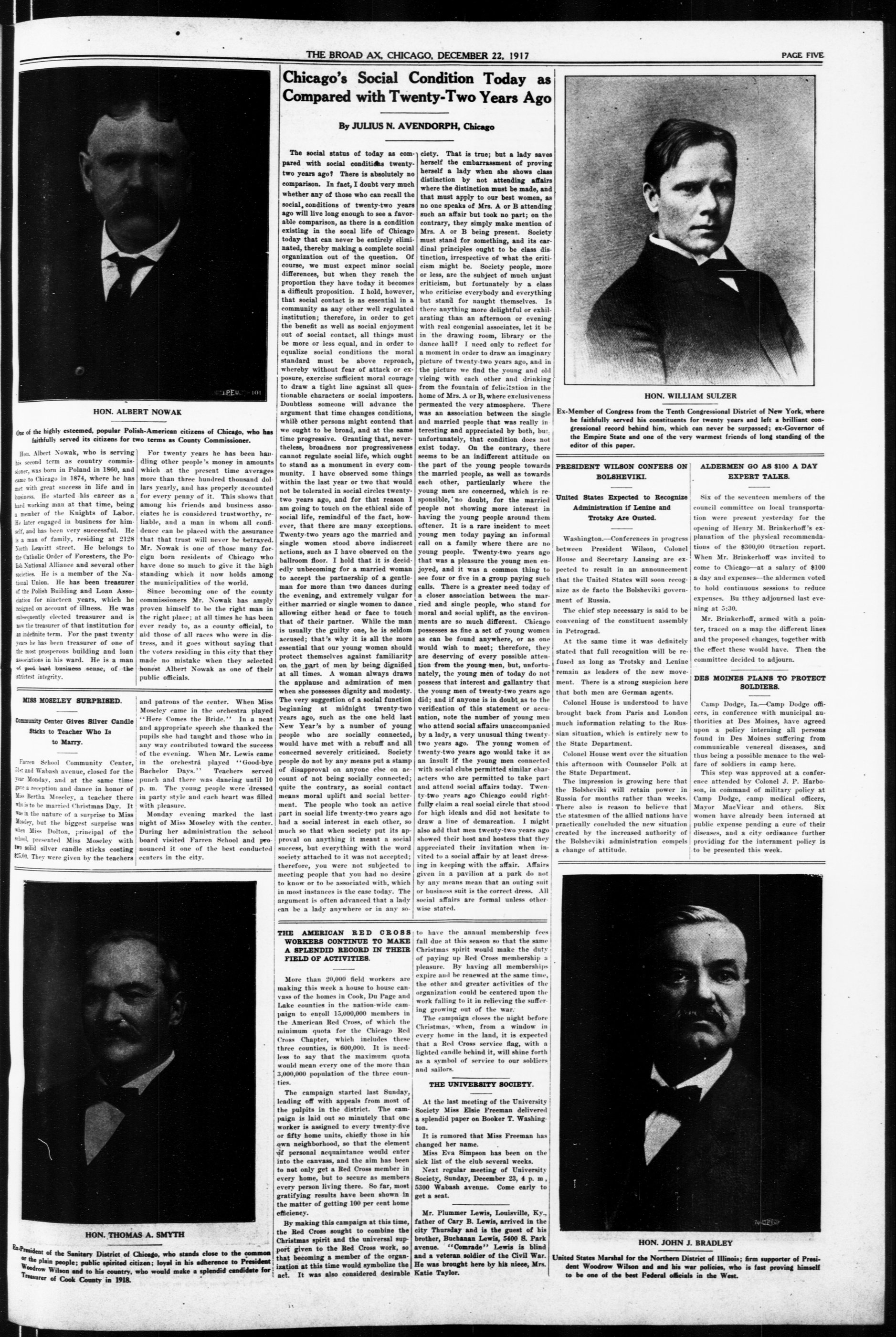
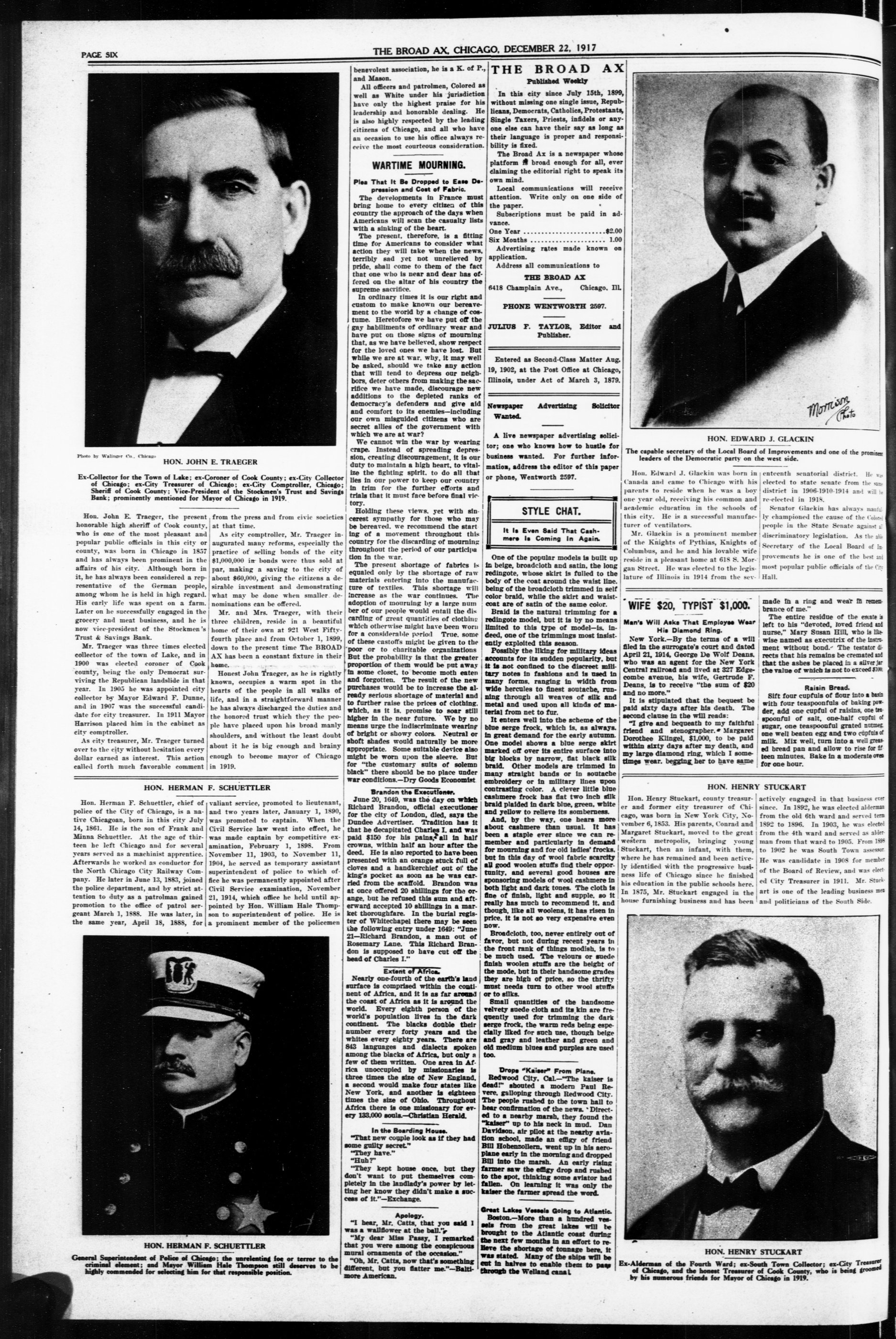
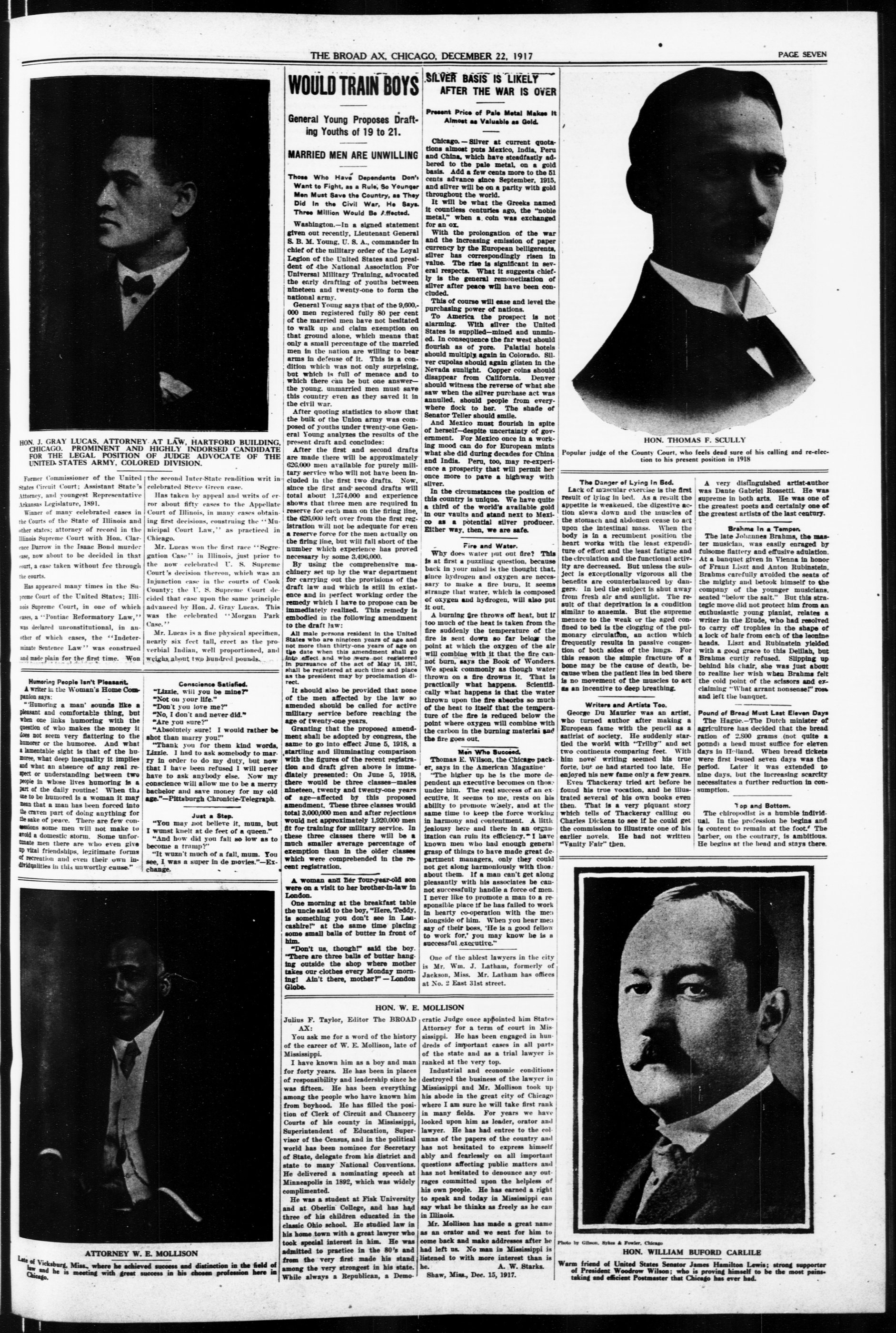
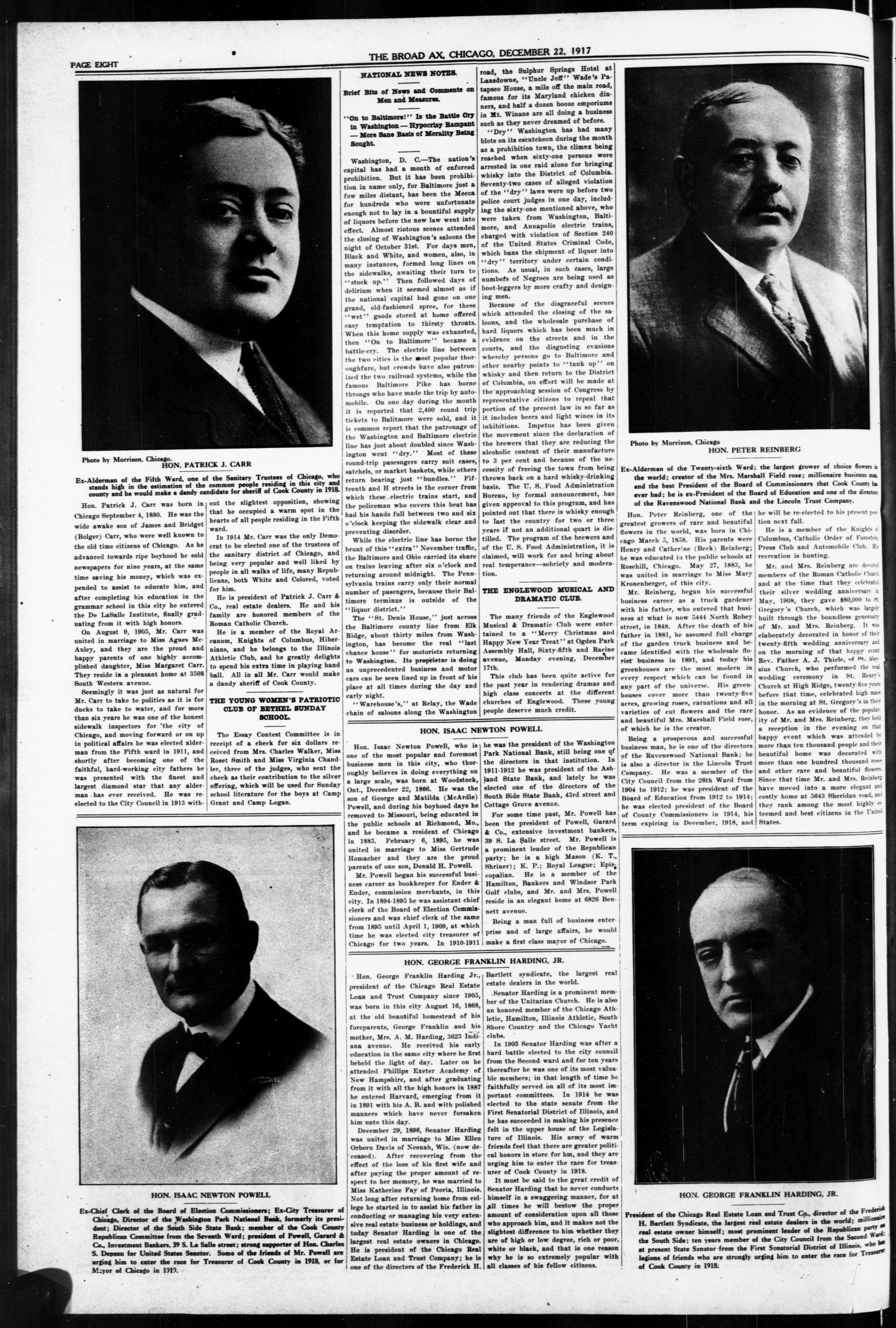
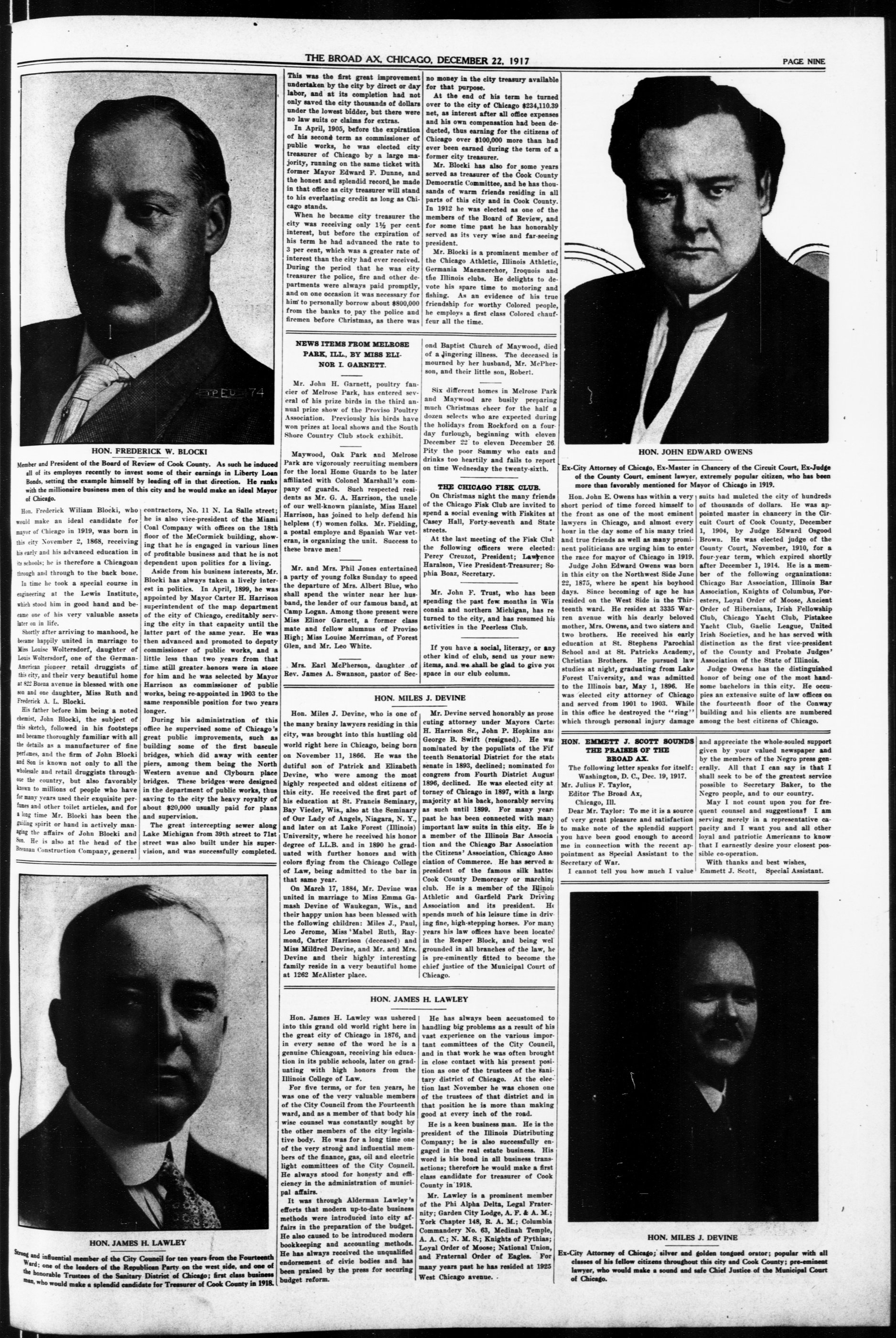
Page text (machine-generated)
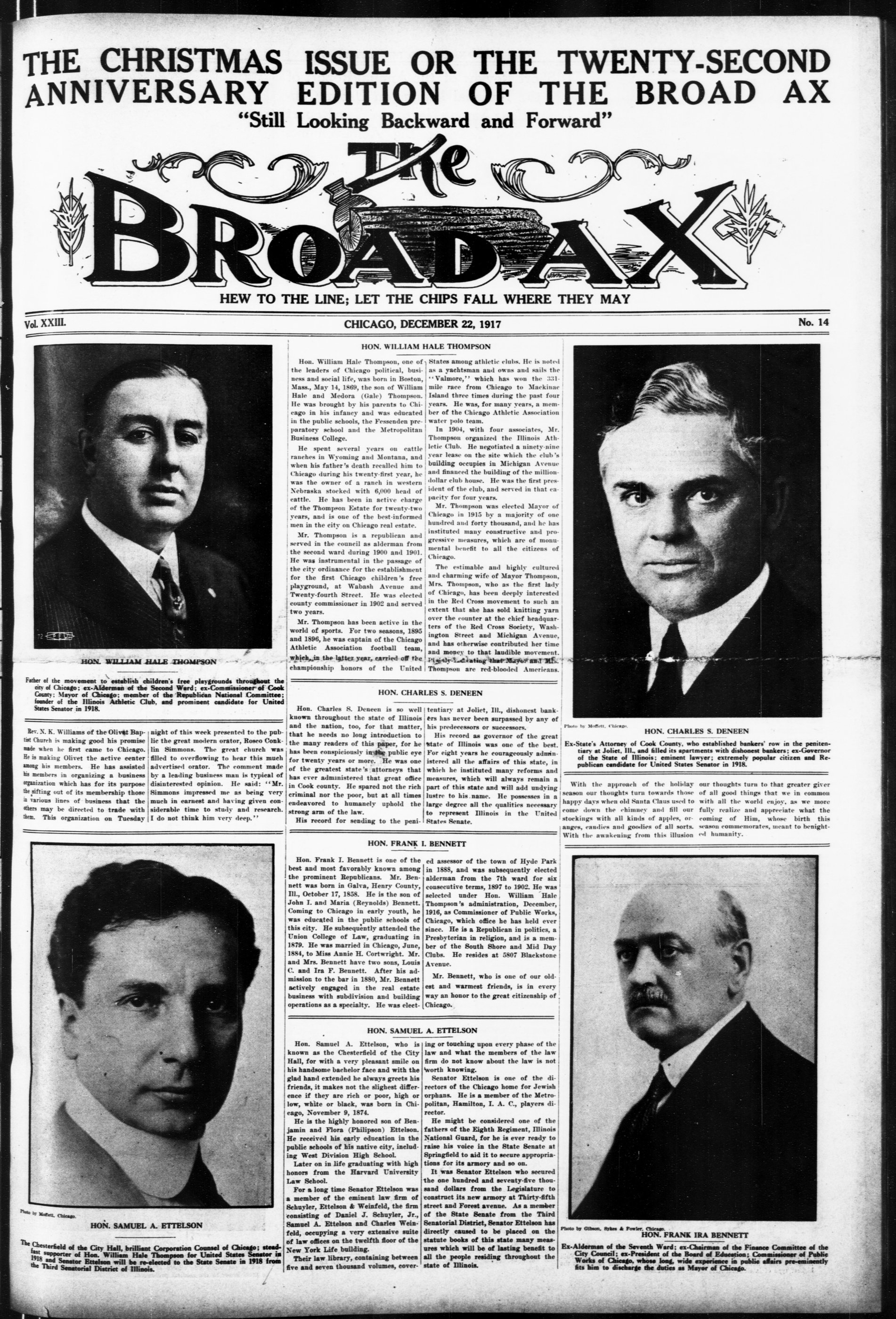
THE CHRISTMAS ISSUE OR THE TWENTY-SECOND ANNIVERSARY EDITION OF THE BROAD AX "Still Looking Backward and Forward"
BROAD AX
Father of the movement to establish city of Chicago; ex-Alderman of the County; Mayor of Chicago; member founder of the Illinois Athletic C States Senator in 1918.
72
Father of the movement to establish children's free playgrounds throughout the city of Chicago; ex-Alderman of the Second Ward; ex-Commissioner of Cook County; Mayor of Chicago; member of the Republican National Committee; founder of the Illinois Athletic Club, and prominent candidate for United States Senator in 1918.
Rev. N.K. Williams of the Olivet Baptist Church is making good his promise made when he first came to Chicago. He is making Olivet the active center among his members. He has assisted his members in organizing a business organization which has for its purpose the sifting out of its membership those in various lines of business that the others may be directed to trade with them. This organization on Tuesday
Photo by Moffett, Chicago.
1930
M.
HON. SAMUEL A. ETTELSON
The Chesterfield of the City Hall, brilliant Corporation Co. fast supporter of Hon. William Hale Thompson for U. 1918 and Senator Ettelson will be re-elected to the St. the Third Senatorial District of Illinois.
City Hall, brilliant Corporation Co
tion. William Hale Thompson for U
ittelson will be re-elected to the St
ural District of Illinois.
the Chesterfield of the City Hall, brilliant Corporation Counsel of Chicago; steadfast supporter of Hon. William Hale Thompson for United States Senator in 1918 and Senator Ettelson will be re-elected to the State Senate in 1918 from the Third Senatorial District of Illinois.
Vol. XXIII.
night of this week presented to the publie the great modern orator, Roseo Conklin Simmons. The great church was filled to overflowing to hear this much advertised orator. The comment made by a leading business man is typical of disinterested opinion. He said: "Mr Simmons impressed me as being much in earnest and having given considerable time to study and research. I do not think him very deep."
P
at Corporation Counsel of Chicago; stead- a Thompson for United States Senator in elected to the State Senate in 1918 from is.
HEW TO THE LINE: LET THE CHIPS FALL WHERE THEY MAY
CHICAGO. DECEMBER 22. 1917
HON. WILLIAM HALE THOMPSON
Hon. William Hale Thompson, one of the leaders of Chicago political, business and social life, was born in Boston, Mass., May 14, 1869, the son of William Hale and Medora (Gale) Thompson. He was brought by his parents to Chicago in his infancy and was educated in the public schools, the Fessenden preparatory school and the Metropolitan Business College.
He spent several years on cattle ranches in Wyoming and Montana, and when his father's death recalled him to Chicago during his twenty-first year, he was the owner of a ranch in western Nebraska stocked with 6,000 head of cattle. He has been in active charge of the Thompson Estate for twenty-two years, and is one of the best-informed men in the city on Chicago real estate.
Mr. Thompson is a republican and served in the council as alderman from the second ward during 1900 and 1901. He was instrumental in the passage of the city ordinance for the establishment for the first Chicago children's free playground, at Wabash Avenue and Twenty-fourth Street. He was elected county commissioner in 1902 and served two years.
Mr. Thompson has been active in the world of sports. For two seasons, 1895 and 1896, he was captain of the Chicago Athletic Association football team, which, in the latter year, carried off the championship honors of the United
HON. CHARLES S. DENEEN
Hon. Charles S. Deneen is so well known throughout the state of Illinois and the nation, too, for that matter, that he needs no long introduction to the many readers of this paper, for he has been conspicuously in the public eye for twenty years or more. He was one of the greatest state's attorneys that has ever administered that great office in Cook county. He spared not the rich criminal nor the poor, but at all times endeavored to humanely uphold the strong arm of the law. His record for sending to the peni- tentiary at J. ers has never his predecessor. His record state of Illin for eight year sistered all the which he inst measures, whi part of this st lure to his large degree s to represent States Senate
HON. FRANK I. BENNETT
Hon. Frank I. Bennett is one of the best and most favorably known among the prominent Republicans. Mr. Bennett was born in Galva, Henry County, Ill., October 17, 1858. He is the son of John I. and Maria (Reynolds) Bennett. Coming to Chicago in early youth, he was educated in the public schools of this city. He subsequently attended the Union College of Law, graduating in 1879. He was married in Chicago, June, 1884, to Miss Annie H. Cortwright. Mr. and Mrs. Bennett have two sons, Louis C. and Ira F. Bennett. After his admission to the bar in 1880, Mr. Bennett actively engaged in the real estate business with subdivision and building operations as a specialty. He was elect-
HON. SAMUEL A. ETTELSON
Hon. Samuel A. Ettelson, who is known as the Chesterfield of the City Hall, for with a very pleasant smile on his handsome bachelor face and with the glad hand extended he always greets his friends, it makes not the slighest difference if they are rich or poor, high or low, white or black, was born in Chicago, November 9, 1874.
He is the highly honored son of Benjamin and Flora (Philippson) Ettelson. He received his early education in the public schools of his native city, including West Division High School.
Later on in life graduating with high honors from the Harvard University Law School.
For a long time Senator Ettelson was a member of the eminent law firm of Schuyler, Ettelson & Weinfeld, the firm consisting of Daniel J. Schuyler, Jr., Samuel A. Ettelson and Charles Weinfeld, occupying a very extensive suite of law offices on the twelfth floor of the New York Life building.
Their law library, containing between fire and seven thousand volumes, cover-
States among athletic clubs. He is noted as a yachtsman and owns and sails the "Valmore," which has won the 331-mile race from Chicago to Maekinae Island three times during the past four years. He was, for many years, a member of the Chicago Athletic Association water polo team.
In 1904, with four associates, Mr. Thompson organized the Illinois Athletic Club. He negotiated a ninety-nine year lease on the site which the club's building occupies in Michigan Avenue and financed the building of the million-dollar club house. He was the first president of the club, and served in that capacity for four years.
Mr. Thompson was elected Mayor of Chicago in 1915 by a majority of one hundred and forty thousand, and he has instituted many constructive and progressive measures, which are of monumental benefit to all the citizens of Chicago.
The estimable and highly cultured and charming wife of Mayor Thompson, Mrs. Thompson, who as the first lady of Chicago, has been deeply interested in the Red Cross movement to such an extent that she has sold knitting yarn over the counter at the chief headquarters of the Red Cross Society, Washington Street and Michigan Avenue, and has otherwise contributed her time and money to that laudible movement. Precisely relating that Mayor and Mrs. Thompson are red-blooded Americans
tentinary at Joliet, Ill., dishonest bankers has never been surpassed by any of his predecessors or successors. His record as governor of the great state of Illinois was one of the best. For eight years he courageously administered all the affairs of this state, in which he instituted many reforms and measures, which will always remain a part of this state and will add undying lustre to his name. He possesses in a large degree all the qualities necessary to represent Illinois in the United States Senate.
ed assessor of the town of Hyde Park in 1888, and was subsequently elected alderman from the 7th ward for six consecutive terms, 1897 to 1902. He was selected under Hon. William Hale Thompson's administration, December, 1916, as Commissioner of Public Works, Chicago, which office he has held ever since. He is a Republican in politics, a Presbyterian in religion, and is a member of the South Shore and Mid Day Clubs. He resides at 5807 Blackstone Avenue.
Mr. Bennett, who is one of our oldest and warmest friends, is in every way an honor to the great citizenship of Chicago.
ing or touching upon every phase of the law and what the members of the law firm do not know about the law is not worth knowing.
Senator Ettelson is one of the directors of the Chicago home for Jewish orphans. He is a member of the Metropolitan, Hamilton, I. A. C., players director.
He might be considered one of the fathers of the Eighth Regiment, Illinois National Guard, for he is ever ready to raise his voice in the State Senate at Springfield to aid it to secure appropriations for its armory and so on.
It was Senator Ettelson who secured the one hundred and seventy-five thousand dollars from the Legislature to construct its new armory at Thirty-fifth street and Forest avenue. As a member of the State Senate from the Third Senatorial District, Senator Ettelson has directly caused to be placed on the statute books of this state many measures which will be of lasting benefit to all the people residing throughout the state of Illinois.
```markdown
```
Ex-State's Attorney of Cook County, who established bankers' row in the penitentiary at Joliet, Ill., and filled its apartments with dishonest bankers; ex-Governor of the State of Illinois; eminent lawyer; extremely popular citizen and Republican candidate for United States Senator in 1918.
M.
Photo by Gibson, Sykes & Fowler, Chicago.
HON. FRANK IRA BENNETT
Ex-Alderman of the Seventh Ward; ex-Chairman of the Finance Committee of the City Council; ex-President of the Board of Education; Commissioners of Public Works of Chicago, whose long, wide experience in public affairs pre-eminently fits him to discharge the duties as Mayor of Chicago.
With the approach of the holiday season our thoughts turn towards those happy days when old Santa Claus used to come down the chimney and fill our stockings with all kinds of apples, oranges, candies and goodies of all sorts. With the awakening from this illusion
No.14
our thoughts turn to that greater giver of all good things that we in common with all the world enjoy, as we more fully realize and appreciate what the coming of Him, whose birth this season commemorates, meant to benighted humanity.
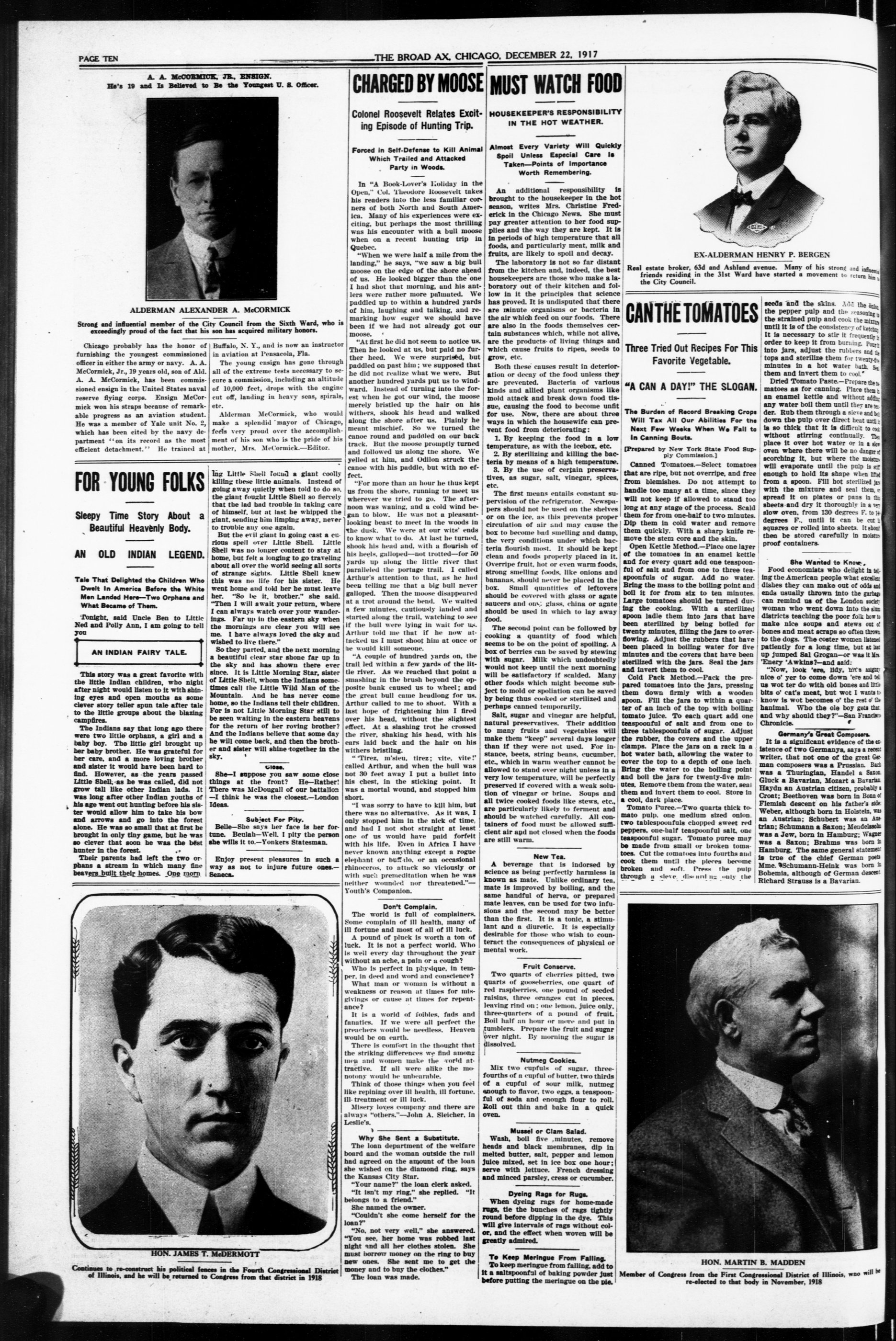
A. A. McCORMICK, JR., ENSIGN.
He's 19 and Is Believed to Be the Youngest U. S. Officer.
1910
ALDERMAN ALEXANDER A. McCORMICK
Strong and influential member of the City Council from the Sixth Ward, who is exceedingly proud of the fact that his son has acquired military honors.
Chicago probably has the honor of furnishing the youngest commissioned officer in either the army or navy. A. A. McCormick, Jr., 19 years old, son of Ald. A. A. McCormick, has been commissioned ensign in the United States naval reserve flying corps. Ensign McCormick won his straps because of remarkable progress as an aviation student. He was a member of Yale unit No. 2, which has been cited by the navy department "on its record as the most efficient detachment." He trained at
Buffalo, N. Y., and is now an instructor in aviation at Pensaeola, Fla.
The young ensign has gone through all of the extreme tests necessary to secure a commission, including an altitude of 10,000 feet, drops with the engine cut off, landing in heavy seas, spirals, etc.
Alderman McCormick, who would make a splendid mayor of Chicago, feels very proud over the accomplishment of his son who is the pride of his mother, Mrs. McCormick.-Editor.
FOR YOUNG FOLKS
Sleepy Time Story About a Beautiful Heavenly Body.
AN OLD INDIAN LEGEND.
Tale That Delighted the Children Who Dwelt in America Before the White Men Landed Here—Two Orphans and What Became of Them.
Tonight, said Uncle Ben to Little Ned and Polly Ann, I am going to tell you
AN INDIAN FAIRY TALE.
This story was a great favorite with the little Indian children, who night after night would listen to it with shining eyes and open mouths as some clever story teller spun tale after tale to the little groups about the blazing campfires.
The Indians say that long ago there were two little orphans, a girl and a baby boy. The little girl brought up her baby brother. He was grateful for her care, and a more loving brother and sister it would have been hard to find. However, as the years passed Little Shell, as he was called, did not grow tall like other Indian lads. It was long after other Indian youths of his age went out hunting before his sister would allow him to take his bow and arrows and go into the forest alone. He was so small that at first he brought in only tiny game, but he was so clever that soon he was the best hunter in the forest.
Their parents had left the two orphans a stream in which many fine beavers built their homes. One moor
---
HON. JAMES T. MCDERMOTT
Continues to re-construct his political fences in the Fourth Congressional District of Illinois, and he will be returned to Congress from that district in 1918.
PAGE TEN
Buffalo, N. Y., and is now an instructor in aviation at Pensacola, Fla.
The young ensign has gone through all of the extreme tests necessary to secure a commission, including an altitude of 10,000 feet, drops with the engine cut off, landing in heavy seas, spirals, etc.
Alderman McCormick, who would make a splendid mayor of Chicago, feels very proud over the accomplishment of his son who is the pride of his mother, Mrs. McCormick.—Editor.
ing Little Shell found a giant coolly killing these little animals. Instead of going away quietly when told to do so, the giant fought Little Shell so fiercely that the lad had trouble in taking care of himself, but at last he whipped the giant, sending him limping away, never to trouble any one again.
But the evil giant in going cast a curious spell over Little Shell. Little Shell was no longer content to stay at home, but felt a longing to go traveling about all over the world seeing all sorts of strange sights. Little Shell knew this was no life for his sister. He went home and told her he must leave her. "So be it, brother," she said.
"Then I will await your return, where I can always watch over your wanderings. Far up in the eastern sky when the mornings are clear you will see me. I have always loved the sky and wished to live there."
So they parted, and the next morning a beautiful clear star shone far up in the sky and has shown there ever since. It is Little Morning Star, sister of Little Shell, whom the Indians sometimes call the Little Wild Man of the Mountain. And he has never come home, so the Indians tell their children. For is not Little Morning Star still to be seen waiting in the eastern heavens for the return of her roving brother? And the Indians believe that some day he will come back, and then the brother and sister will shine together in the sky.
Close.
She—I suppose you saw some close things at the front? He—Rather? There was McDougall of our battalion—I think he was the closest.—London Ideas.
Subject For Pity:
Belle--She says her face is her fortune. Beulah--Well. I pity the person she wills it to.-Yonkers Statesman.
Enjoy present pleasures in such a way as not to injure future ones.-Seneca.
Close.
-THE BROAD AX, CHICAGO, DECEMBER 22, 1917
Colonel Roosevelt Relates Exciting Episode of Hunting Trip.
Forced in Self-Defense to Kill Animal Which Trailed and Attacked Party in Woods.
In "A Book-Lover's Holiday in the Open," Col. Theodore Roosevelt takes his readers into the less familiar corners of both North and South America. Many of his experiences were exciting, but perhaps the most thrilling was his encounter with a bull moose when on a recent hunting trip in Quebec.
"When we were half a mile from the landing," he says, "we saw a big bull moose on the edge of the shore ahead of us. He looked bigger than the one I had shot that morning, and his antlers were rather more palmated. We paddled up to within a hundred yards of him, laughing and talking, and remarking how eager we should have been if we had not already got our moose.
"At first he did not seem to notice us. Then he looked at us, but paid no further heed. We were surprised, but paddled on past him; we supposed that he did not realize what we were. But another hundred yards put us to windward. Instead of turning into the forest when he got our wind, the moose merely bristled up the hair on his withers, shook his head and walked along the shore after us. Plainly he meant mischief. So we turned the canoe round and paddled on our back track. But the moose promptly turned and followed us along the shore. We yelled at him, and Odilon struck the canoe with his paddle, but with no effect.
"For more than an hour he thus kept us from the shore, running to meet us wherever we tried to go. The afternoon was waning, and a cold wind began to blow. He was not a pleasant-looking beast to meet in the woods in the dusk. We were at our wits' ends to know what to do. At last he turned, shook his head and, with a flourish of his heels, galloped—not trotted—for 50 yards up along the little river that paralleled the portage trail. I called Arthur's attention to that, as he had been telling me that a big bull never galloped. Then the moose disappeared at a trot around the bend. We waited a few minutes, cautiously landed and started along the trail, watching to see if the bull were lying in wait for us. Arthur told me that if he now attacked us I must shoot him at once or he would kill someone.
"A couple of hundred yards on, the trail led within a few yards of the little river. As we reached that point a smashing in the brush beyond the opposite bank caused us to wheel; and the great bull came headlong for us, Arthur called to me to shoot. With a last hope of frightening him I fired over his head, without the slightest effect. At a slashing trot he crossed the river, shaking his head, with his ears laid back and the hair on his withers bristling.
"Tirez, m'sieu, tirez; vite, vite!" called Arthur, and when the bull was not 30 feet away I put a bullet into his chest, in the sticking point. It was a mortal wound, and stopped him short.
"I was sorry to have to kill him, but there was no alternative. As it was, I only stopped him in the nick of time, and had I not shot straight at least one of us would have paid forfelt with his life. Even in Africa I have never known anything except a rogue elephant or buffalo, or an occasional rhinoceros, to attack so viciously or with such premeditation when he was neither wounded nor threatened."—Youth's Companion.
Don't Complain
The world is full of complainers. Some complain of ill health, many of ill fortune and most of all of ill luck. A pound of pluck is worth a ton of luck. It is not a perfect world. Who is well every day throughout the year without an ache, a pain or a cough? Who is perfect in physique, in temper, in deed and word and conscience? What man or woman is without a weakness or reason at times for misgivings or cause at times for repentance? It is a world of foibles, fads and fanatics. If we were all perfect the preachers would be needless. Heaven would be on earth. There is comfort in the thought that the striking differences we find among men and women make the world attractive. If all were alike the monotony would be unbearable. Think of those things when you feel like repining over ill health, ill fortune, ill treatment or ill luck.
Misery loves company and there are always "others."—John A. Sieicher, in Leslie's.
Why She Sent a Substitute.
The loan department of the welfare board and the woman outside the rail had agreed on the amount of the loan she wished on the diamond ring, says the Kansas City Star.
"Your name?" the loan clerk asked.
"It isn't my ring," she replied. "It belongs to a friend."
She named the owner.
"Couldn't she come herself for the loan?"
"No, not very well," she answered.
"You see, her home was robbed last night and all her clothes stolen. She must borrow money on the ring to buy new ones. She sent me to get the money and to buy the clothes."
MUST WATCH FOOD
HOUSEKEEPER'S RESPONSIBILITY IN THE HOT WEATHER.
Almost Every Variety Will Quickly Spoil Unless Especial Care Is Taken—Points of Importance Worth Remembering.
An additional responsibility is brought to the housekeeper in the hot season, writes Mrs. Christine Frederick in the Chicago News. She must pay greater attention to her food supplies and the way they are kept. It is in periods of high temperature that all foods, and particularly meat, milk and fruits, are likely to spoil and decay.
The laboratory is not so far distant from the kitchen and, indeed, the best housekeepers are those who make a laboratory out of their kitchen and follow in it the principles that science has proved. It is undisputed that there are minute organisms or bacteria in the air which feed on our foods. There are also in the foods themselves certain substances which, while not alive, are the products of living things and which cause fruits to ripen, seeds to grow, etc.
Both these causes result in deterioration or decay of the food unless they are prevented. Bacteria of various kinds and allied plant organisms like mold attack and break down food tissue, causing the food to become unfit for use. Now, there are about three ways in which the housewife can prevent food from deteriorating:
1. By keeping the food in a low temperature, as with the icebox, etc.
2. By sterilizing and killing the bacteria by means of a high temperature.
3. By the use of certain preservatives, as sugar, salt, vinegar, spices, etc.
The first means entails constant supervision of the refrigerator. Newspapers should not be used on the shelves or on the ice, as this prevents proper circulation of air and may cause the box to become bad smelling and damp, the very conditions under which bacteria flourish most. It should be kept clean and foods properly placed in it. Overripe fruit, hot or even warm foods, strong smelling foods, like onions and bananas, should never be placed in the box. Small quantities of leftovers should be covered with glass or agate saucers and one glass, china or agate should be used in which to lay away food.
The second point can be followed by cooking a quantity of food which seems to be on the point of spoiling. A box of berries can be saved by stewing with sugar. Milk which undoubtedly would not keep until the next morning will be satisfactory if scalded. Many other foods which might become subject to mold or spoilage can be saved by being thus cooked or sterilized and perhaps canned temporarily.
Salt, sugar and vinegar are helpful natural preservatives. Their addition to many fruits and vegetables will make them "keep" several days longer than if they were not used. For instance, beets, string beans, cucumber, etc., which in warm weather cannot be allowed to stand over night unless in a very low temperature, will be perfectly preserved if covered with a weak solution of vinegar or brine. Soups and all twice cooked foods like stews, etc., are particularly likely to ferment and should be watched carefully. All containers of food must be allowed sufficient air and not closed when the foods are still warm.
New Tea.
A beverage that is indorsed by science as being perfectly harmless is known as mate. Unlike ordinary tea, mate is improved by boiling, and the same handful of herva, or prepared mate leaves, can be used for two infusions and the second may be better than the first. It is a tonic, a stimulant and a diuretic. It is especially desirable for those who wish to counteract the consequences of physical or mental work.
Fruit Conserve.
Two quarts of cherries pitted, two quarts of gooseberries, one quart of red raspberries, one pound of seeded raisins, three oranges cut in pieces, leaving rind on; one lemon, juice only, three-quarters of a pound of fruit. Boil half an hour or more and put in tumblers. Prepare the fruit and sugar over night. By morning the sugar is dissolved.
Mix two cupfuls of sugar, three-fourths of a cupful of butter, two thirds of a cupful of sour milk, nutmeg enough to flavor, two eggs, a teaspoonful of soda and enough flour to roll. Roll out thin and bake in a quick oven.
Mussel or Clam Salad
Wash, boll five minutes, remove heads and black membranes, dip in melted butter, salt, pepper and lemon juice mixed, set in ice box one hour; serve with lettuce. French dressing and minced parsley, cress or cucumber.
Dyeing Rags for Rugs.
When dyeing rags for home-made rugs, tie the bunches of rags tightly round before dipping in the dye. This will give intervals of rags without color, and the effect when woven will be greatly admired.
To Keep Meringue From Falling.
To keep meringue from falling, add to it a saltspoonful of baking powder just before putting the meringue on the pile.
C. E. B.
EX-ALDERMAN HENRY P. BERGEN
Real estate broker, 63d and Ashland avi friends residing in the 31st Ward h the City Council.
Real estate broker, 63d and Ashland avenue. Many of his strong and influential friends residing in the 31st Ward have started a movement to return him to the City Council.
CANTHETOMATOES
Three Tried Out Recipes For This Favorite Vegetable.
"A CAN A DAY!" THE SLOGAN
The Burden of Record Breaking Crops Will Tax All Our Abilities For the Next Few Weeks When We Fall to In Canning Bouts.
[Prepared by New York State Food Supply Commission.]
Canned Tomatoes.—Select tomatoes that are ripe, but not overripe, and free from blemishes. Do not attempt to handle too many at a time, since they will not keep if allowed to stand too long at any stage of the process. Scald them for from one-half to two minutes. Dip them in cold water and remove them quickly. With a sharp knife remove the stem core and the skin.
Open Kettle Method.—Place one layer of the tomatoes in an enamel kettle and for every quart add one teaspoonful of salt and from one to three teaspoonfuls of sugar. Add no water. Bring the mass to the boiling point and boll it for from six to ten minutes. Large tomatoes should be turned during the cooking. With a sterilized spoon ladle them into jars that have been sterilized by being boiled for twenty minutes, filling the jars to overflowing. Adjust the rubbers that have been placed in boiling water for five minutes and the covers that have been sterilized with the jars. Seal the jars and invert them to cool.
Cold Pack Method.—Pack the prepared tomatoes into the jars, pressing them down firmly with a wooden spoon. Fill the jars to within a quarter of an inch of the top with boiling tomato juice. To each quart add one teaspoonful of salt and from one to three tablespoonfuls of sugar. Adjust the rubber, the covers and the upper clamps. Place the jars on a rack in a hot water bath, allowing the water to cover the top to a depth of one inch. Bring the water to the boiling point and boil the jars for twenty-five minutes. Remove them from the water, seal them and invert them to cool. Store in a cool, dark place.
Tomato Purée--Two quarts thick tomato pulp, one medium sized onion, two tablespoonfuls chopped sweet red peppers, one-half teaspoonful salt, one teaspoonful sugar. Tomato purée may be made from small or broken tomatoes. Cut the tomatoes into fourths and cook them until the pieces become broken and soft. Press the pulp through a sleeve, disarming only the
HON. MARTIN B. MADDEN
Member of Congress from the First Congressional District re-elected to that body in November,
Member of Congress from the First Congressional District of Illinois, who will be re-elected to that body in November, 1918
venue. Many of his strong and influencers have started a movement to return him to
seeds and the skins. Add the onion, the pepper pulp and the seasoning to the strained pulp and cook the mixture until it is of the consistency of ketchup. It is necessary to stir it frequently in order to keep it from burning. Pour it into jars, adjust the rubbers and the tops and sterilize them for twenty-five minutes in a hot water bath. Seal them and invert them to cool.
Dried Tomato Paste.—Prepare the tomatoes as for canning. Place them in an enamel kettle and without adding any water boll them until they are tender. Rub them through a sieve and down the pulp over direct heat until it is so thick that it is difficult to cook without stirring continually. Place it over hot water or in a slow oven where there will be no danger of scorching it, but where the moisture will evaporate until the pulp is still enough to hold its shape when lifted from a spoon. Fill hot sterilized oil with the mixture and seal them, spread it on plates or pans in the sheets and dry it thoroughly in a very slow oven, from 130 degrees F. to 180 degrees F., until it can be cut in squarea or rolled into sheets. It should then be stored carefully in moisture proof containers.
She Wanted to Know
Food economists who delight in taking the American people what excellent dishes they can make out of odds and ends usually thrown into the garbage can remind us of the London society woman who went down into the slum districts teaching the poor folk how to make nice soups and stews out of bones and meat scraps so often thrown to the dogs. The coster women listened patiently for a long time, but at last up jumped Sal Grogan—or was it Mr. 'Enery 'Awkins'?—and said: "Now, look 'ere, lldy, mts' migrate nice o' yer to come down 'ere and tell us wot to do with old bones and little bits o' cat's meat, but wot I want to know is wot becomes o' the rest o' the animal. The ole boy gets that and why should they?"—San Francisco Chronicle.
Germany's Great Composers
Germany is great composer.
It is a significant evidence of the existence of two Germans, says a recent writer, that not one of the great German composers was a Prussian. Back was a Thuringian, Handel a Saxon Gluck a Bavarian, Mozart a Bavarian Haydn an Austrian citizen, probably Croat; Beethoven was born in Bona a Flemish descent on his father's side Weber, although born in Holstein, was an Austrian; Schubert was an Austrian; Schumann a Saxon; Mendelssohn was a Jew, born in Hamburg; Wagner was a Saxon; Brahms was born in Hamburg. The same general statement is true of the chief German poets Mme. Schumann-Helink was born in Bohemia, although of German descent. Richard Strauss is a Bavarian.
[Image of a man in a suit with a tie and a white shirt, looking slightly to the right. The background is a dark, indistinct area.]
ressional District of Illinois, who will be lay in November, 1918
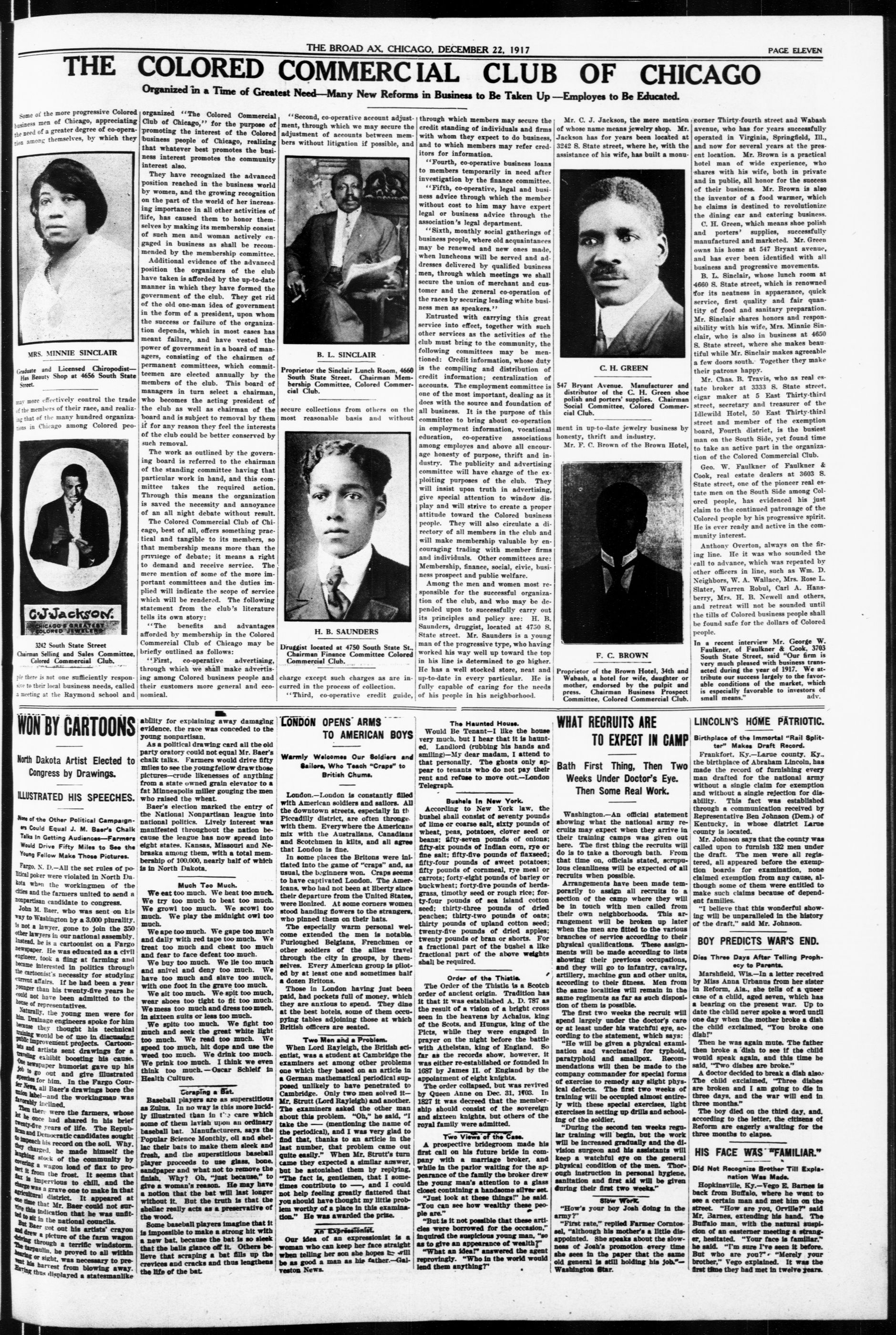
THE COLORED COMMERCIAL CLUB OF CHICAGO
Some of the more progressive Colored business men of Chicago, appreciating the need of a greater degree of co-operation among themselves, by which they
M. E.
MRS. MINNIE SINCLAIR Graduate and Licensed Chiropodist Has Beauty Shop at 4656 South State Street. may more effectively control the trade of the members of their race, and realizing that of the many hundred organizations in Chicago among Colored peo-
C.J. Jackson.
CHICAGO'S GREATEST
COLORED JEWELERS
Chairman Selling and Sales Committee, Colored Commercial Club. there is not one sufficiently responsive to their local business needs, called a meeting at the Raymond school and
WON BY CARTOONS
North Dakota Artist Elected to Congress by Drawings.
ILLUSTRATED HIS SPEECHES:
None of the Other Political Campaigners Could Equal J. M. Baer's Challies Talks in Getting Audiences—Farmers Would Drive Fifty Miles to See the Young Fellow Make Those Pictures. Fargo, N. D.—All the set rules of political poker were violated in North Dakota when the workingmen of the cities and the farmers united to send a nonpartisan candidate to congress
John M. Baer, who was sent on his way to Washington by a 3,000 plurality, is not a lawyer, gone to join the 350 other lawyers in our national assembly. Instead, he is a cartoonist on a Fargo newspaper. He was educated as a civil engineer, took a fling at farming and became interested in politics through the cartoonist's necessity for studying current affairs. If he had been a year younger than his twenty-five years he could not have been admitted to the house of representatives.
Naturally, the young men were for him. Drainage engineers spoke for him because they thought his technical training would be of use in discussing public improvement projects. Cartoonists and artists sent drawings for a traveling exhibit boosting his cause. One newspaper humorist gave up his job to go out and give illustrated speeches for him. In the Fargo Courrier News, all Baer's drawings bore the union label—and the workingman was favored inclined.
Then there were the farmers, whose lot he once had shared in his brief twenty-five years of life. The Republican and Democratic candidates sought to impeach his record on the soil. Why, they charged, he made himself the laughing stock of the community by covering a wagon load of flax to protect it from the frost. It seems that fax is impervious to chill, and the charge was a grave one to make in that agricultural district. It appeared at one time that Mr. Baer could not survive this indication that he was unfit to sit in the national councils. But Baer not out his artists' crayon and drew a picture of the farm wagon driving through a terrific windstorm. The tarpaulin, he proved to all within hearing or sight, was necessary to prevent his harvest from blowing away. Having thus displayed a state-artite
organized "The Colored Commercial Club of Chicago," for the purpose of promoting the interest of the Colored business people of Chicago, realizing that whatever best promotes the business interest promotes the community interest also.
They have recognized the advanced position reached in the business world by women, and the growing recognition on the part of the world of her increasing importance in all other activities of life, has caused them to honor themselves by making its membership consist of such men and woman actively engaged in business as shall be recommended by the membership committee.
"Second, co-operative account adjustment, through which we may secure the adjustment of accounts between members without litigation if possible, and through which members may secure the credit standing of individuals and firms with whom they expect to do business, and to which members may refer creditors for information.
"Fourth, co-operative business loans to members temporarily in need after investigation by the finance committee.
"Fifth, co-operative, legal and business advice through which the member without cost to him may have expert legal or business advice through the association's legal department.
"Sixth, monthly social gatherings of business people, where old acquaintances may be renewed and new ones made, Mr. C. J. Jackson, the mere mention of whose name means jewelry shop. Mr. Jackson has for years been located at 3242 S. State street, where he, with the assistance of his wife, has built a more
Additional evidence of the advanced position the organizers of the club have taken is afforded by the up-to-date manner in which they have formed the government of the club. They get rid of the old one-man idea of government in the form of a president, upon whom the success or failure of the organization depends, which in most cases has meant failure, and have vested the power of government in a board of managers, consisting of the chairmen of permanent committees, which committee are elected annually by the members of the club. This board of managers in turn select a chairman, who becomes the acting president of the club as well as chairman of the board and is subject to removal by them if for any reason they feel the interests of the club could be better conserved by such removal.
The work as outlined by the governing board is referred to the chairman of the standing committee having that particular work in hand, and this committee takes the required action. Through this means the organization is saved the necessity and annoyance of an all night debate without result. The Colored Commercial Club of Chicago, best of all, offers something practical and tangible to its members, so that membership means more than the privilege of debate; it means a right to demand and receive service. The mere mention of some of the more important committees and the duties implied will indicate the scope of service which will be rendered. The following statement from the club's literature tells its own story:
"The benefits and advantages afforded by membership in the Colored Commercial Club of Chicago may be briefly outlined as follows:
"First, co-operative advertising, through which we shall make advertising among Colored business people and their customers more general and economical.
ability for explaining away damaging evidence, the race was conceded to the young nonpartisan. As a political drawing card all the old party oratory could not equal Mr. Baer's chalk talks. Farmers would drive fifty miles to see the young fellow draw those pictures—crude likenesses of anything from a state owned grain elevator to a fat Minneapolis mill gouging the men who raised the wheat. Baer's election marked the entry of the National Nonpartisan league into national politics. Lively interest was manifested throughout the nation because the league has now spread into eight states. Kansas, Missouri and Nebraska among them, with a total membership of 100,000, nearly half of which is in North Dakota.
Much Too Much.
We eat too much. We heat too much.
We try too much to beat too much.
We growl too much. We scowl too much.
We play the midnight owl too much.
Weape too much. We gape too much and daily with red tape too much. We treat too much and cheat too much and fear to face defeat too much.
We buy too much. We lie too much and snivel and deny too much. We have too much and slave too much, with one foot in the grave too much.
We sit too much. We spit too much, wear shoes too tight to fit too much.
We mess too much and dress too much, in sixteen suits or less too much.
We spite too much. We fight too much and seek the great white light too much. We read too much. We speed too much, hit dope and use the weed too much. We drink too much. We prink too much. I think we even think too much.—Oscar Schleif in Health Culture.
Craping a Bat.
Baseball players are as superstitious as Zulus. In no way is this more lucidly illustrated than in the care which some of them lavish upon an ordinary baseball bat. Manufacturers, says the Popular Science Monthly, oil and shellac their bats to make them sleek and fresh, and the superstitious baseball player proceeds to use glass, bone, sandpaper and what not to remove the finish. Why? Oh, "just because," to give a woman's reason. He may have a notion that the bat will last longer without it. But the truth is that the shellac really acts as a preservative of the wood.
Some baseball players imagine that it is impossible to make a strong hit with a new bat, because the bat is so sleek that the balls glance off it. Others believe that scraping a bat fills up the crevices and cracks and thus lengthens the life of the bat.
THE BROAD AX, CHICAGO, DECEMBER 22, 1917
"Second, co-operative account adjustment, through which we may secure the adjustment of accounts between members without litigation if possible, and
A. B.
B. L. SINCLAIR
Proprietor the Sinclair Lunch Room, 4660 South State Street. Chairman Membership Committee, Colored Commercial Club.
secure collections from others on the most reasonable basis and without
[Name]
H. B. SAUNDERS
Druggist located at 4750 South State St.
Chairman Finance Committee Colored
Commercial Club.
charge except such charges as are incurred in the process of collection.
*Third, co-operative credit guide.*
LONDON OPENS ARMS TO AMERICAN BOYS
LONDON OPENS ARMS TO AMERICAN BOYS
Warmly Welcomes Our Soldiers and Sailors, Who Teach "Craps" to British Chums.
London.—London is constantly filled with American soldiers and sailors. All the downtown streets, especially in the Plecadilly district, are often thronged with them. Everywhere the Americans mix with the Australians, Canadians and Scotchmen in kilts, and all agree that London is fine.
In some places the Britons were initiated into the game of "craps" and, as usual, the beginners won. Craps seems to have captivated London. The Americans, who had not been at liberty since their departure from the United States, were lionized. At some corners women stood handing flowers to the strangers, who planned them on their hats.
The especially warm personal welcome extended the men is notable. Furloughed Belgians, Frenchmen or other soldiers of the allies travel through the city in groups, by themselves. Every American group is piloted by at least one and sometimes half a dozen Britons. Those in London having just been paid, had pockets full of money, which they are anxious to spend. They dine at the best hotels, some of them occupying tables adjoining those at which British officers are seated.
Two Men and a Problem.
When Lord Rayleigh, the British scientist, was a student at Cambridge the examiners set among other problems one which they based on an article in a German mathematical periodical supposed unlikely to have penetrated to Cambridge. Only two men solved it—Mr. Strutt (Lord Rayleigh) and another. The examiners asked the other man about this problem. "Oh," he said, "I take the — (mentioning the name of the periodical), and I was very glad to find that, thanks to an article in the last number, that problem came out quite easily." When Mr. Strutt's turn came they expected a similar answer, but he astonished them by replying, "The fact is, gentlemen, that I sometimes contribute to —, and I could not help feeling greatly flattered that you should have thought my little problem worthy of a place in this examination." He was awarded the prize.
An Exhibitionist
Our idea of an expressionist is a woman who can keep her face straight when telling her son she hopes will be as good a man as his father.—Galveston News.
through which members may secure the credit standing of individuals and firms with whom they expect to do business, and to which members may refer creditors for information.
"Fourth, co-operative business loans to members temporarily in need after investigation by the finance committee.
"Fifth, co-operative, legal and business advice through which the member without cost to him may have expert legal or business advice through the association's legal department.
"Sixth, monthly social gatherings of business people, where old acquaintances may be renewed and new ones made, when luncheons will be served and addresses delivered by qualified business men, through which meetings we shall secure the union of merchant and customer and the general co-operation of the races by securing leading white business men as speakers."
Entrusted with carrying this great service into effect, together with such other services as the activities of the club must bring to the community, the following committees may be mentioned: Credit information, whose duty is the compiling and distribution of credit information; centralization of accounts. The employment committee is one of the most important, dealing as it does with the source and foundation of all business. It is the purpose of this committee to bring about co-operation in employment information, vocational education, co-operative associations among employees and above all encourage honesty of purpose, thrift and industry. The publicity and advertising committee will have charge of the exploiting purposes of the club. They will insist upon truth in advertising, give special attention to window display and will strive to create a proper attitude toward the Colored business people. They will also circulate a directory of all members in the club and will make membership valuable by encouraging trading with member firms and individuals. Other committees are: Membership, finance, social, civie, business prospect and public welfare.
Among the men and women most responsible for the successful organization of the club, and who may be depended upon to successfully carry out its principles and policy are: H. B. Saunders, druggist, located at 4750 S. State street. Mr. Saunders is a young man of the progressive type, who having worked his way well up toward the top in his line is determined to go higher. He has a well stocked store, neat and up-to-date in every particular. He is fully capable of caring for the needs of his people in his neighborhood.
The Haunted House.
Would Be Tenant—I like the house very much, but I hear that it is haunted. Landlord (rubbing his hands and smiling)—My dear madam, I attend to that personally. The ghosts only appear to tenants who do not pay their rent and refuse to move out—London Telegraph.
Bushels In New York.
According to New York law, the bushel shall consist of seventy pounds of lime or coarse salt, sixty pounds of wheat, peas, potatoes, clover seed or beans; fifty-seven pounds of onions; fifty-six pounds of Indian corn, rye or fine salt; fifty-five pounds of flaxseed; fifty-four pounds of sweet potatoes; fifty pounds of cornmeal, rye meal or carrots; forty-eight pounds of barley or buckwheat; forty-five pounds of herdsgrass, timothy seed or rough rice; forty-four pounds of sea island cotton seed; thirty-three pounds of dried peaches; thirty-two pounds of oats; thirty pounds of upland cotton seed; twenty-five pounds of dried apples; twenty pounds of bran or shorts. For a fractional part of the bushel a like fractional part of the above weights shall be required.
Order of the Thistle
The Order of the Thistle is a Scotch order of ancient origin. Tradition has it that it was established A. D. 787 as the result of a vision of a bright cross seen in the heavens by Achalus, king of the Scots, and Hungus, king of the Plcts, while they were engaged in prayer on the night before the battle with Athelstan, king of England. So far as the records show, however, it was either re-established or founded in 1087 by James II. of England by the appointment of eight knights. The order collapsed, but was revived by Queen Anne on Dec. 31, 1603. In 1827 it was decreed that the membership should consist of the sovereign and sixteen knights, but others of the royal family were admitted.
Two Views of the Case
A prospective bridegroom made his first call on his future bride in company with a marriage broker, and while in the parlor waiting for the appearance of the family the broker drew the young man's attention to a glass closet containing a handsome silver set. "Just look at these things!" he said. "You can see how wealthy these people are." "But is it not possible that these articles were borrowed for the occasion," inquired the suspicious young man, "so as to give an appearance of wealth?" "What an idea?" answered the agent reprovingly. "Who in the world would lead them anything?"
Mr. C. J. Jackson, the mere mention of whose name means jewelry shop. Mr. Jackson has for years been located at 3242 S. State street, where he, with the assistance of his wife, has built a monu-
[Name]
C. H. GREEN
547 Bryant Avenue. Manufacturer and distributor of the C. H. Green shoe polish and porters' supplies. Chairman Social Committee, Colored Commercial Club.
ment in up-to-date jewelry business by honesty, thrift and industry.
Mr. F. C. Brown of the Brown Hotel.
M.
F. C. BROWN
Proprietor of the Brown Hotel, 34th and Wabash, a hotel for wife, daughter or mother, endorsed by the pulpit and press. Chairman Business Prospect Committee, Colored Commercial Club.
WHAT RECRUITS ARE TO EXPECT IN CAMP
Bath First Thing, Then Two Weeks Under Doctor's Eye. Then Some Real Work.
Washington-An official statement showing what the national army recruits may expect when they arrive in their training camps was given out here. The first thing the recruits will do is to take a thorough bath. From that time on, officials stated, scrupulous cleanliness will be expected of all recruits when possible.
Arrangements have been made temporarily to assign all recruits to a section of the camp where they will be in touch with men called from their own neighborhoods. This arrangement will be broken up later when the men are fitted to the various branches of service according to their physical qualifications. These assignments will be made according to lists showing their previous occupations, and they will go to infantry, cavalry, artillery, machine gun and other units, according to their fitness. Men from the same localities will remain in the same regiments as far as such disposition of them is possible.
The first two weeks the recruit will spend largely under the doctor's care or at least under his watchful eye, according to the statement, which says:
"He will be given a physical examination and vaccinated for typhoid, paratyphoid and smallpox. Recommendations will then be made to the company commander for special forms of exercise to remedy any slight physical defects. The first two weeks of training will be occupied almost entirely with these special exercises, light exercises in setting up drills and schooling of the soldier.
"During the second ten weeks regular training will begin, but the work will be increased gradually and the division surgeon and his assistants will keep a watchful eye on the general physical condition of the men. Through instruction in personal hygiene, sanitation and first aid will be given during their first two weeks."
Slow Work
"How's your boy Josh doing in the army?"
"First rate," replied Farmer Corntosel, "although his mother's a little disappointed. She speaks about the slowness of Josh's promotion every time she sees in the paper that the same old general is still holding his job."—Washington Star.
PAGE ELEVEN
corner Thirty-fourth street and Wabash avenue, who has for years successfully operated in Virginia, Springfield, Ill., and now for several years at the present location. Mr. Brown is a practical hotel man of wide experience, who shares with his wife, both in private and in public, all honor for the success of their business. Mr. Brown is also the inventor of a food warmer, which he claims is destined to revolutionize the dining car and catering business. C. H. Green, which means shoe polish and porters' supplies, successfully manufactured and marketed. Mr. Green owns his home at 547 Bryant avenue, and has ever been identified with all business and progressive movements.
B. L. Sinclair, whose lunch room at 4660 S. State street, which is renowned for its neatness in appearance, quick service, first quality and fair quantity of food and sanitary preparation. Mr. Sinclair shares honors and responsibility with his wife, Mrs. Minnie Sinclair, who is also in business at 4650 S. State street, where she makes beautiful while Mr. Sinclair makes agreeable a few doors south. Together they make their patrons happy. Mr. Chas. B. Travis, who as real estate broker at 3333 S. State street, cigar maker at 5 East Thirty-third street, secretary and treasurer of the Idlewild Hotel, 50 East Thirty-third street and member of the exemption board, Fourth district, is the busiest man on the South Side, yet found time to take an active part in the organization of the Colored Commercial Club.
Geo. W. Faulkner of Faulkner & Cook, real estate dealers at 3603 S. State street, one of the pioneer real estate men on the South Side among Colored people, has evidenced his just claim to the continued patronage of the Colored people by his progressive spirit. He is ever ready and active in the community interest.
Anthony Overton, always on the firing line. He it was who sounded the call to advance, which was repeated by other officers in line, such as Wm. D. Neighbors, W. A. Wallace, Mrs. Rose L. Slater, Warren Robul, Carl A. Hansberry, Mrs. H. B. Newell and others, and retreat will not be sounded until the tills of Colored business people shall be found safe for the dollars of Colored people.
In a recent interview Mr. George W. Faulkner, of Faulkner & Cook, 3703 South State Street, said "Our firm is very much pleased with business transacted during the year of 1917. We attribute our success largely to the favorable conditions of the market, which is especially favorable to investors of small means." adv.
LINCOLN'S HOME PATRIOTIC.
Birthplace of the Immortal "Rail Splitter" Makes Draft Record.
Frankfort, Ky.-Larue county, Ky., the birthplace of Abraham Lincoln, has made the record of furnishing every man drafted for the national army without a single claim for exemption and without a single rejection for disability. This fact was established through a communication received by Representative Ben Johnson (Dem.) of Kentucky, in whose district Larue county is located.
Mr. Johnson says that the county was called upon to furnish 132 men under the draft. The men were all registered, all appeared before the exemption boards for examination, none claimed exemption from any cause, although some of them were entitled to make such claims because of dependent families.
"I believe that this wonderful showing will be unparalleled in the history of the draft." said Mr. Johnson.
BOY PREDICTS WAR'S END.
Dies Three Days After Telling Prophecy to Parents.
Marshfield, Wils.-In a letter received by Miss Anna Urbanus from her sister in Reform, Ala., she tells of a queer case of a child, aged seven, which has a bearing on the present war. Up to date the child never spoke a word until one day when the mother broke a dish the child exclaimed, "You broke one dish!" Then he was again mute. The father then broke a dish to see if the child would speak again, and this time he said, "Two dishes are broke." A doctor decided to break a dish also. The child exclaimed, "Three dishes are broken and I am going to die in three days, and the war will end in three months." The boy died on the third day, and, according to the letter, the citizens of Reform are eagerly awaiting for the three months to elapse.
HIS FACE WAS "FAMILIAR."
Did Not Recognize Brother Till Explanation Was Made.
Hopkinsville, Ky.-Vego E. Barnes is back from Buffalo, where he went to see a certain man and met him on the street. "How are you, Orville?" said Mr. Barnes, extending his hand. The Buffalo man, with the natural suspicion of an eastern meeting a stranger, hesitated. "Your face is familiar," he said. "I'm sure I've seen it before. But who are you?" - "Merely your brother," Vego explained. It was the first time they had met in twelve years.
WILLIAM H.
HON. JOHN MeGILLEN
Chief Clerk of the Sanitary District of Woodrow Wilson and his war measu ocratic Party of Cook County.
nitary District of Chicago. Warm and his war measures. One of the Book County.
Chief Clerk of the Sanitary District of Chicago. Warm Supporter of President Woodrow Wilson and his war measures. One of the big leaders of the Democratic Party of Cook County.
By Attorney Harris B. Gaines
This column is open to readers of THE BROAD AX for legal questions of general interest. All questions are to be addressed to the Editor of the Legal Helps Department by Wednesday of each week. H. B. Gaines, 6221 South Halsted street, National Theater Building.
Chicago, Dec. 13, 1917.—To Editor of Legal Helps: At the time my son was drafted I was well and working, but am now ill and unable to work. Can I obtain a portion of the salary paid to my son, who is an officer at Camp Grant? L. M.
Report the matter to your local board. Your son will be compelled to send you a portion of his pay.
Chicago, Dec. 14, 1917.—To Editor of Legal Helps: I was drafted and exempted in the last draft. Will I have to answer the questionnaire? Am I still subject to be drafted? W. B. Yes. All exemptions granted by the Exemption Boards are revoked.
Chicago, Dec. 15, 1917.—To Legal Helps Editor: What is the law in Illinois as to common law marriages?
Common law marriages consummated previous to 1905 are legal. All common law marriages made subsequent to 1905 are invalid.
Chicago, Ill., Dec. 16, 1917.—To Editor of Legal Helps: In 1915 I loaned a sum of money, taking a promissory note for same, which was made out in my maiden name. I was married in June
1930
PETER H. HARRIS
Major General of the Uniform Rank Knights of Pythias three regular Republican organization candidate for Aldermen who was lately endorsed by the Cornell Charity Club President; the Retail Coal and Ice Dealers' Protective Woods, President, unanimously selected him as their The Teamsters' union, composed of both white and col for alderman on Thursday evening.
Uniform Rank Knights of Pythias three organization candidate for Aldermen horsed by the Cornell Charity Club Coal and Ice Dealers' Protective unanimously selected him as their son, composed of both white and coloured Thursday evening.
Major General of the Uniform Rank Knights of Pythias throughout the world. The regular Republican organization candidate for Alderman of the Second Ward, who was lately endorsed by the Cornell Charity Club, Mrs. Rena Williams, President; the Retail Coal and Ice Dealers' Protective Association, Mr. Orange Woods, President, unanimously selected him as their aldermanic candidate. The Teamsters' union, composed of both white and colored, raised his banner for alderman on Thursday evening.
PAGE TWELVE
LEGAL HELPS.
Chicago. Warm Supporter of President res. One of the big leaders of the Dem-
of this year. Will the note have to be changed to my married name to make it legal? In case of death could the note be collected under my married name?
M. D.
The note is good without making any changes in the name. The note could be collected by the administrator of your estate.
THE THEOSOPHICAL SOCIETY.
Through the American Theosophical Society the western world is receiving the ancient wisdom of the east. Theosophy is shedding the light that is so much needed on the path during this world crisis. Its fundamental and only doctrine, if doctrine it is, is brotherhood of all mankind, regardless of race, creed, caste or color. Reincarnation, the study of philosophy and science, and other teachings are merely incidental, but brotherhood must be believed and felt in order to become a true Theosophist.
The public is cordially invited to attend all meetings of the Theosophical Society which meets every first and third Sunday at the home of Attorney and Mrs. H. B. Gaines, 5827 Wentworth avenue, at 7 o'clock p. m. At each meeting a teacher from the Central Theosophical Society speaks.
Come out and hear of the coming of the great world teacher who now lives, and is preparing to make himself known to the world in a few years.
THE PEERLESS CLUB
The young men of the Peerless Club are planning a big Christmas for the "Jackies" of their club. Three cheers for them'
```markdown
```
ights of Pythias throughout the world. The date for Alderman of the Second Ward, nell Charity Club, Mrs. Rena Williams, sealers' Protective Association, Mr. Orage ted him as their aldermanic candidate. both white and colored, raised his banner
THE BROAD AX, CHICAGO, DECEMBER 22, 1917
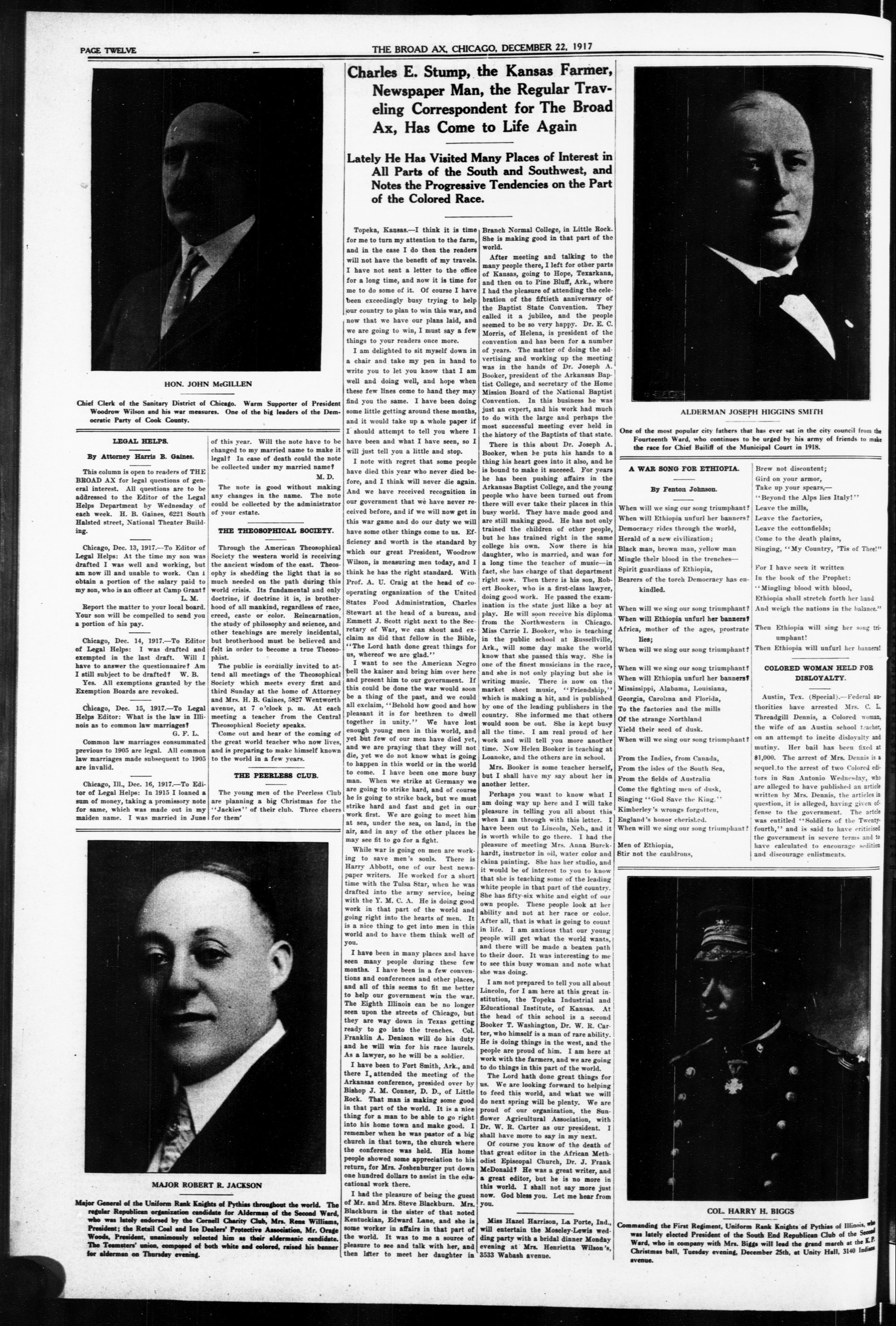
Charles E. Stump, the Kansas Farmer, Newspaper Man, the Regular Traveling Correspondent for The Broad Ax, Has Come to Life Again
Lately He Has Visited Many Places of Interest in All Parts of the South and Southwest, and Notes the Progressive Tendencies on the Part of the Colored Race.
Topeka, Kansas.—I think it is time for me to turn my attention to the farm, and in the case I do then the readers will not have the benefit of my travels. I have not sent a letter to the office for a long time, and now it is time for me to do some of it. Of course I have been exceedingly busy trying to help our country to plan to win this war, and now that we have our plans laid, and we are going to win, I must say a few things to your readers once more.
I am delighted to sit myself down in a chair and take my pen in hand to write you to let you know that I am well and doing well, and hope when these few lines come to hand they may find you the same. I have been doing some little getting around these months, and it would take up a whole paper if I should attempt to tell you where I have been and what I have seen, so I will just tell you a little and stop.
I note with regret that some people have died this year who never died before, and I think will never die again. And we have received recognition in our government that we have never received before, and if we will now get in this war game and do our duty we will have some other things come to us. Efficiency and worth is the standard by which our great President, Woodrow Wilson, is measuring men today, and I think he has the right standard. With Prof. A. U. Craig at the head of cooperating organization of the United States Food Administration, Charles Stewart at the head of a bureau, and Emmett J. Scott right next to the Secretary of War, we can shout and exclaim as did that fellow in the Bible, "The Lord hath done great things for us, whereof we are glad."
I want to see the American Negro bell the kaiser and bring him over here and present him to our government. If this could be done the war would soon be a thing of the past, and we could all exclaim, "Behold how good and how pleasant it is for brethren to dwell together in unity." We have lost enough young men in this world, and yet but few of our men have died yet, and we are praying that they will not die, yet we do not know what is going to happen in this world or in the world to come. I have been one more busy man. When we strike at Germany we are going to strike hard, and of course he is going to strike back, but we must strike hard and fast and get in our work first. We are going to meet him at sea, under the sea, on land, in the air, and in any of the other places he may see fit to go for a fight.
While war is going on men are working to save men's souls. There is Harry Abbott, one of our best newspaper writers. He worked for a short time with the Tulsa Star, when he was drafted into the army service, being with the Y. M. C. A. He is doing good work in that part of the world and going right into the hearts of men. It is a nice thing to get into men in this world and to have them think well of you.
I have been in many places and have seen many people during these few months. I have been in a few conventions and conferences and other places, and all of this seems to fit me better to help our government win the war. The Eighth Illinois can be no longer seen upon the streets of Chicago, but they are way down in Texas getting ready to go into the trenches. Col. Franklin A. Denison will do his duty and he will win for his race laurels. As a lawyer, so he will be a soldier.
I have been to Fort Smith, Ark., and there I. attended the meeting of the Arkansas conference, presided over by Bishop J. M. Conner, D. D., of Little Rock. That man is making some good in that part of the world. It is a nice thing for a man to be able to go right into his home town and make good. I remember when he was pastor of a big church in that town, the church where the conference was held. His home people showed some appreciation to his return, for Mrs. Joshenburger put down one hundred dollars to assist in the educational work there.
I had the pleasure of being the guest of Mr. and Mrs. Steve Blackburn. Mrs. Blackburn is the sister of that noted Kentuckian, Edward Lane, and she is some worker in affairs in that part of the world. It was to me a source of pleasure to see and talk with her, and then later to meet her daughter in
Branch Normal College, in Little Rock. She is making good in that part of the world.
After meeting and talking to the many people there, I left for other parts of Kansas, going to Hope, Texarkana, and then on to Pine Bluff, Ark., where I had the pleasure of attending the celebration of the fiftieth anniversary of the Baptist State Convention. They called it a jubilee, and the people seemed to be so very happy. Dr. E. C. Morris, of Helena, is president of the convention, and has been for a number of years. The matter of doing the advertising and working up the meeting was in the hands of Dr. Joseph A. Booker, president of the Arkansas Baptist College, and secretary of the Home Mission Board of the National Baptist Convention. In this business he was just an expert, and his work had much to do with the large and perhaps the most successful meeting ever held in the history of the Baptists of that state.
There is this about Dr. Joseph A. Booker, when he puts his hands to a thing his heart goes into it also, and he is bound to make it succeed. For years he has been pushing affairs in the Arkansas Baptist College, and the young people who have been turned out from there will ever take their places in this busy world. They have made good and are still making good. He has not only trained the children of other people, but he has trained right in the same college his own. Now there is his daughter, who is married, and was for a long time the teacher of music—in fact, she has charge of that department right now. Then there is his son, Robert Booker, who is a first-class lawyer, doing good work. He passed the examination in the state just like a boy at play. He will soon receive his diploma from the Northwestern in Chicago. Miss Carrie I. Booker, who is teaching in the public school at Russellville, Ark., will some day make the world know that she passed this way. She is one of the finest musicians in the race, and she is not only playing but she is writing music. There is now on the market sheet music, "Friendship," which is making a hit, and is published by one of the leading publishers in the country. She informed me that others would soon be out. She is kept busy all the time. I am real proud of her work and will tell you more another time. Now Helen Booker is teaching at Loanoke, and the others are in school.
Mrs. Booker is some teacher herself, but I shall have my say about her in another letter.
Perhaps you want to know what I am doing way up here and I will take pleasure in telling you all about this when I am through with this letter. I have been out to Lincoln, Neb., and it is worth while to go there. I had the pleasure of meeting Mrs. Anna Burekhardt, instructor in oil, water color and china painting. She has her studio, and it would be of interest to you to know that she is teaching some of the leading white people in that part of the country. She has fifty-six white and eight of our own people. These people look at her ability and not at her race or color. After all, that is what is going to count in life. I am anxious that our young people will get what the world wants, and there will be made a beaten path to their door. It was interesting to me to see this busy woman and note what she was doing.
I am not prepared to tell you all about Lincoln, for I am here at this great institution, the Topeka Industrial and Educational Institute, of Kansas. At the head of this school is a second Booker T. Washington, Dr. W. R. Carter, who himself is a man of rare ability. He is doing things in the west, and the people are proud of him. I am here at work with the farmers, and we are going to do things in this part of the world.
The Lord hath done great things for us. We are looking forward to helping to feed this world, and what we will do next spring will be plenty. We are proud of our organization, the Sunflower Agricultural Association, with Dr. W. R. Carter as our president. I shall have more to say in my next.
Of course you know of the death of that great editor in the African Methodist Episcopal Church, Dr. J. Frank McDonald? He was a great writer, and a great editor, but he is no more in this world. I shall not say more just now. God bless you. Let me hear from you.
Miss Hazel Harrison, La Porte, Ind., will entertain the Moseley-Lewis wedding party with a bridal dinner Monday evening at Mrs. Henrietta Wilson's, 3533 Wabash avenue.
12
ALDERMAN JOSEPH HIGGINS SMITH
One of the most popular city fathers that has ever sat in the c Fourteenth Ward, who continues to be urged by his army the race for Chief Bailiff of the Municipal Court in 1918.
popular city fathers that has ever sat in the c ard, who continues to be urged by his army chief Bailiff of the Municipal Court in 1918.
One of the most popular city fathers that has ever sat in the city council from the Fourteenth Ward, who continues to be urged by his army of friends to make the race for Chief Bailiff of the Municipal Court in 1918.
A WAR SONG FOR ETHIOPIA.
When will we sing our song triumphant?
When will Ethiopia unfurl her banners?
Democracy rides through the world,
Herald of a new civilization;
Black man, brown man, yellow man
Mingle their blood in the trenches—
Spirit guardians of Ethiopia,
Bearers of the torch Democracy has on
[Image of a military officer in uniform, wearing a cap and a decorated uniform].
1939
COL. HARRY H. BIGGS
Commanding the First Regiment, Uniform was lately elected President of the S Ward, who in company with Mrs. Big Christmas ball, Tuesday evening, De avenue.
First Regiment, Uniform Rank Knights of Pytha
ted President of the South End Republican C
ompany with Mrs. Biggs will lead the grand
Tuesday evening, December 25th, at Unity
Commanding the First Regiment, Uniform Rank Knights of Pythias of Illinois, who was lately elected President of the South End Republican Club of the Second Ward, who in company with Mrs. Bigga will lead the grand march at the K.P. Christmas ball, Tuesday evening, December 25th, at Unity Hall, 3140 Indiana avenue.
Commanding the First Regiment, Uniform Rank Knights of Pythias of Illinois, who was lately elected President of the South End Republican Club of the Second Ward, who in company with Mrs. Bigga will lead the grand march at the K.P. Christmas ball, Tuesday evening, December 25th, at Unity Hall, 3140 Indiana avenue.
Men of Ethiopia,
Stir not the cauldron.
it has ever sat in the city council from the
be urged by his army of friends to make
national Court in 1918.
Brew not discontent;
Gird on your armor,
Take up your spears,—
"Beyond the Alps lies Italy!"
Leave the mills,
Leave the factories,
Leave the cottonfields;
Come to the death plains,
Singing, "My Country, 'Tis of Thee!"
For I have seen it written
In the book of the Prophet:
"Mingling blood with blood,
Ethiopia shall stretch forth her hand
And weigh the nations in the balance."
Then Ethiopia will sing her song triumphant!
Then Ethiopia will unfurl her banners!
COLORED WOMAN HELD FOR DISLOYALTY.
Austin, Tex. (Special).—Federal authorities have arrested Mrs. C. L. Threadgill Dennis, a Colored woman, the wife of an Austin school teacher, on an attempt to incite disloyalty and mutiny. Her bail has been fixed at $1,000. The arrest of Mrs. Dennis is a sequel to the arrest of two Colored editors in San Antonio Wednesday, who are alleged to have published an article written by Mrs. Dennis, the articles in question, it is alleged, having given offense to the government. The article was entitled "Soldiers of the Twenty-fourth," and is said to have criticised the government in severe terms and to have calculated to encourage sedition and discourage enlistments.
[Image of a person in a military uniform with a badge on the shoulder].
A Rank Knights of Pythias of Illinois, who South End Republican Club of the Second legs will lead the grand march at the K.P. December 25th, at Unity Hall, 3140 Indiana
THE MAYOR OF BROOKLYN IS SHOWN WITH THE MAYOR OF BROOKLYN AND THE MAYOR OF BROOKLYN.
Rev. Snelson and two officers of his church. Messrs. Cecil and Clark.
SERMON, "THE FALL OF
JERUSALEM."
Art: Matthew, 23rd Chapter, 37th
Verse. "Oh, Jerusalem, Jerusalem."
This Wail of Love is the Cry of Jesus for Jerusalem, the Holy City of the Great King. Jesus has so often been disappointed in us, as well as in the cities of the Earth; and Jesus has wept over us in our disobedience and in our sins. O JERUSALEM.
Many an earthly father has wept over us unglibly son; many a broken-hearted mother has wailed, as Jesus does in our Text this morning, for her wayward daughter. "My Child, my Child. How often would I have gathered thee, even as a hen gathereth her chickens under her wings, and ye would not." this is the outtery of Love-in-Grief, disappointed and discouraged.
Jesus expected better things of Jerusalem, but lo, Jerusalem has fallen, and becomes a murderous nation, a Godless people, a sinful race.
FIRST SINS OF JERUSALEM.
Killing the Prophets and Stoning the messengers of the Gospel are first among the sins of the Human Race. Away with Him, Away with Him," shoes from the Judgment-Seat of Piute. "Release unto us Barabas;" but if Jesus the Christ they shouted: Crucify Him, Crucify Him." OH, St. Mary's, when the hearts of so-called Christians become so depraved and kicked as that, Jesus weeps and cries over them, "O, Jerusalem, Jerusalem." are there any Jerusalem Characters in the Church this morning? Remember that Jesus is really looking for you—actually cring over your sins. In its connection we are not talking alone about the Jews, perse; but concerning all of us who have gone away to our kids and crucified Jesus afresh.
SINS OF MODERN JERUSALEM.
What are the Sins of Modern Jerusalem? "Thou shalt have no other gods before ME." And yet in their defiance if this eminent Law in God's First commandment, Modern Jerusalem has been worshipping MOHAMET INTEAD OF JESUS THE CHRIST—have exalted the KORAN OF MOHAMEDANISM INSTEAD OF THE BIBLE OF OUR LORD AND SAVIOR, JESUS CHRIST. O, my people, Jesus says, "He that is not with Me is against Me. Ye cannot serve God and fammon. And Elijah unto his people, "How long halt ye between two opinions! If the Lord be God follow him; but if Baal then follow him." the gods of Baal were powerless to send fire. Then steps forth Elijah, the Man of God, repaired the Altar, took Twelve stones—according to the Tribes of the sons of Jacob, and with these stones Elijah built an Altar in the Name of the Lord, and Heaven answered The prayer of Elijah. And they fell on their faces shouting, "The Lord, He is God." How complete is the overthrow of the enemies of God, His Christ and his Church.
CHRISTIANITY CAPTURES
JERUSALEM
The recent Fall of Jerusalem, which last Sunday, after being in the hands of the Turks and under the control of Mohammedans for 1,200 years, hands out as perhaps the most notable cent of the present "World-War." It is a mere Military Accomplishment of
[Family Portrait of a Group of Individuals]
On the Sunday before the departure of the Eighth Regiment for Camp Logan, Houston, Tex., breaking family ties in hundreds of Chicago homes, the above group picture was made of the Barnett family. Reading from left to right: Top row—Hulote M. Barnett, Herman Kohlsaet Barnett, Regt. Supply Sergt. F. L. Barnett, Jr., Ida B. Wells Barnett, Jr., Charles Aked Barnett and Albert G. Barnett. Lower row—F. L. Barnett, Ida B. Wells Barnett, Alfreda H. Barnett and grandchildren Hulote E., Beatrice J., Audrey V. and Florence B. Barnett.
Ferdinand L. Barnett, the founder of the above branch of the Barnett family in Chicago, was born in Virginia and came to Chicago in 1869. Graduating from the North Western University Law School in 1880, he has been active in the practice of his profession in the state and federal courts here ever since.
For fourteen years Mr. Barnett served as assistant state’s attorney and during this time represented the state’s attorney’s office in all habeas corpus cases before the Supreme Court of Illinois. He is now an authority on habeas corpus procedure. One of his cases appealed from an order of Judge Landis to the United States Supreme Court, is cited as a controlling case in all habeas corpus procedure.
Mr. Barnett has always resisted oppressive and unjust prosecution against Colored men. Very frequently he has done this wholly without compensation and often at actual cost to himself. Take, for example, the famous “Chicken Joe” Campbell case, which is still fresh in the minds of us all, and is still pending in the Supreme Court of Illinois.
Mr. Barnett has assisted many persons who have been imprisoned to take new steps in life. He has had paroled to him from the Illinois State Penitentiary seven of the inmates and from the Illinois State Reformatory more than fifty young Colored men. All these persons he has personally assisted in their efforts to obtain work during parole.
Mr. Barnett was nominated by the Republican party as one of the first candidates for judge in the Municipal Court. By the early returns he appeared to have been elected by a small majority. Later and more complete returns, however, showed that he had lost. Believing that he had been robbed of the election, immediate steps were taken to contest the official count, and a committee of Negro citizens with E. H. Wright as attorney took charge of the contest. This contest was heard before Judge Rinker, who decided that Mr. Barnett had been defeated.
Mr. Barnett has always been foremost in promoting all progressive movements for the benefit of the people. He succeeded in having endowed the Young Men’s Library Association until the funds contributed by H. H. Kohlsaet had been turned over to the Provident Hospital fund and Mr. Barnett became one of its first trustees.
Aside from owning other property in this city Mr. and Mrs. Barnett, who dearly love each and every member of their family, reside in a nice home at 3234 Rhodes avenue.
Christianity's British Forces, led by General Allenby, the Capture of Jerusalem has a pre-eminent value, in that this Victory will stimulate Jews and Christians to hasten their return and come again to Zion, singing with joy and everlasting praises upon their lips the Triumph of Christ. The Re-occupation of this old blood-stained Sanctuary at Jerusalem makes the hearts of God's chosen people thrill together as never before in the history of the Church; for Jerusalem is our ancient and honorable City of Salem, the Vision of Peace, the Religious Capital of Bible Palestine, the City of Peace.
TOUCHES OF JERUSALEM
HISTORY.
The First particular mention of the name "Jerusalem" occurs in Joshua, 10 Chapter. But previous to this reference, Jerusalem is spoken of as "SALEM," JERUS," "JERBUS," "BETH OLAMIM," or "House of Ages," and finally "JERUSALEM," the "Abode of Peace."
King David captured Jerusalem and made it the Seat of his throne. In like manner, the Most High God gave Melchizedek, king of Salem, both the person and goods of the King of Sodom in victory. Jerusalem was indeed the proper place for the ARK OF THE COV-
THE BROAD AX, CHICAGO, DECEMBER 22, 1917
"BREAKING HOME TIES"
cited as a controlling case in all habeas corpus procedure.
Mr. Barnett has always resisted oppressive and unjust prosecution against Colored men. Very frequently he has done this wholly without compensation and often at actual cost to himself.
Take, for example, the famous "Chicken Joe" Campbell case, which is still fresh in the minds of us all, and is still pending in the Supreme Court of Illinois.
Mr. Barnett has assisted many persons who have been imprisoned to take new steps in life. He has had paroled to him from the Illinois State Penitentiary seven of the inmates and from the
ENANT to rest. "And the King brought up the Ark of God into the City of David with gladness, with shoutings, and with the sound of the trumpets." Jerusalem was the seat of Solomon's Temple, etc. Around Jerusalem Nehemiah built and re-dedicated the Walls of the City. The Life of Jesus the Christ hovers continually upon Jerusalem. His Great Sermons were delivered among this people. Here was enacted His Triumphal Entry, The Scenes of the awful Trial, the Sentence, the Scourging, the Crucifixion, the Burial, the Resurrection and Triumph of Our Lord. Jerusalem was the Holy Place in which the assembled Disciples were all filled with the Holy Ghost, and commisisoned the Disciples, two by two, to evangelize the World. "Lo, I am with you alway, even unto the end of the world." Yes, Jerusalem's Fall signifies the return of God's People to Christ the Lord, and we look forward to the gathering of His Children with greatest assurance that the World shall yet be saved from the power of Sin and Death.
REV. SNELSON ENJOYED HIS
BIRTHDAY ANNIVISARY
A grand surprise party, in commemoration of his birthday anniversary, was tendered to the Rev. Dr. Floyd Grant Snelson, Ph.D., F. R. G. S., pastor of St. Mary's A. M. E. Church, on Wednesday night, December 19, 1917, by the members and friends of the popular pastor, which was led by the members of the St. Mary's Brotherhood, by the Pastor's Aid Society and by the Stewartess Board No. 2. Trustee W. A. Dotson called the house to order and introduced Exhorter Jathard David Coston as master of ceremonies, who made fulsome remarks, praising Dr. and Mrs. Snelson for their great constructive and efficient work in building up St. Mary's Church. Other addresses were made by Trustee A. D. Cecil, Secretary Terrell W. White, of the official board; Mrs. Mary Freeman, president Pastor's Aid Society; Mrs. Carrie Williams, president Stewardess Board No. 2; W. A. Dotson, president St. Mary's Brotherhood; Steward Frank Thomas, and responses by Rev. Dr. and Mrs. Snelson. Many birthday gifts, letters and tokens were received by Dr. Snelson, among them he a handsome overcoat from Mrs. Dr. Snelson, a lovely bathrobe from the Pastor's Aid, a five dollar bill from Mrs. Emma Carey Robinson and scarfs, handkerchiefs, purse, etc., from others. Among those present and contributing to the joys of the evenning were Rev. Dr. R. E. Wilson, presiding elder; Rev. Wm. Dawkins of Ohio, John Buckner, Josephine Buckner, Fannie Winstead, Mary B. Hickerson, Roxie Dotson, Jethro Henderson, Mary Freeman, Mary Ames, Helen Riley, Mollie Clarke, Alma Lee, Delia Stradder, Primrose Summerville, Julia Armstrong, Madeline Ganaway, Mary Thomas, Emma Pemis, Etty Byrd, Nellie Piper, Clara Fisher, Carrie Williams, Lula Williams, Hattie Epps, Legree T. Thomas, Susie Thomas, Mahala Kidd,
Illinois State Reformatory more than fifty young Colored men. All these persons he has personally assisted in their efforts to obtain work during parole.
Mr. Barnett was nominated by the Republican party as one of the first candidates for judge in the Municipal Court. By the early returns he appeared to have been elected by a small majority. Later and more complete returns, however, showed that he had lost. Believing that he had been robbed of the election, immediate steps were taken to contest the official count, and a committee of Negro citizens with E. H. Wright as attorney took charge of
Castella Ward, J. J. Freeman, Mabel Lee, J. W. Snowden, Emma Carey Robinson, LaUrsa W. Snelson, Arnetta Hypatia Snelson, Rev. A. J. Bowling and Mrs. Mary J. Ward. A lovely repast was served, consisting of five assortments of sandwiches, coffee, ice cream and cake, mints, raisins and assorted fruits, all in abundance. Dr. Snelson's exceptionally great work at St. Mary's is being more highly appreciated every day, and the church is growing greater each day. Additions to membership are being registered each week and St. Mary's bids fair to take second rank to no church in efficient service in Chicago.
By La Ursa W. Snelson.
Last Wednesday afternoon there passed through Chicago the Naval Base Hospital Corps, No. 3, headed by Lieut. Commander Rae Smith, U. S. N. R. F., in which there are eighteen race men with a unit of 266 others from Southern California. Among them is Floyd Grant Snelson, Jr., the only son of Dr. F. G. Snelson of St. Mary's A. M. E. Church, who visited his father and sisters, bringing eight of his comrades to bid his family adieu. Mrs. Snelson spread a hasty, but delicious supper before the young men, Christmas cake and other dainties were served and a service of prayer was held, which I am sure shall never be forgotten by the departing heroes, or the ones that were left behind. Addresses were made by Dr. Snelson, Prof. A. J. Bowling and Mrs. Snelson. Those present were F. G. Snelson, Jr., Geo. Baber, Oscar D. Jones, Claybourne H. Stovall, S. M. Adkins, F. L. Patterson, Jesse Williams Walker, Earl Morris, Alfred McDowell, all of Los Angeles. Cal.
St. Mary's A. M. E. Church, 5251 Dearborn St., Dr. F. G. Snelson, Pastor. The Pastor will preach the Christmas Sermon at 11 o'clock. Theme, "The Government Shall Be Upon His Shoulders." Fine services all day, and special music will be rendered by the Choir at night. Sermon by Mrs. Evangelist Elizabeth Howard. Mrs. Nora Taylor will preach the Missionary Sermon at 3 o'clock. All welcome.
On Tuesday of the present week Chicago University conferred upon Miss Lydia Wells Mollison, daughter of Mr. and Mrs. W. E. Mollison of South Park Ave., the degree of Ph.B. Miss Mollison was the only person of color in the class of seventy who received various degrees. There were representatives from many lands representing three of the great races of mankind. Miss Mollison had already received the degree of A.B. from Tougaloo University, and had taken a post-graduate course at the University of Michigan. Her parents are being congratulated upon her success.
SOCIAL ITEMS
ive group picture
nett, Jr., Ida B.
dren Hulette E.,
HO
By Mrs.
the contest. This contest was heard before Judge Rinaker, who decided that Mr. Barnett had been defeated.
Mr. Barnett has always been foremost in promoting all progressive movements for the benefit of the people. He succeeded in having endowed the Young Men's Library Association until the funds contributed by H. H. Kohlsaft had been turned over to the Provident Hospital fund and Mr. Barnett became one of its first trustees.
Aside from owning other property in this city Mr. and Mrs. Barnett, who dearly love each and every member of their family, reside in a nice home at 3234 Rhodes avenue.
J. B. CLITHERO & CO. ARE MAKING GOOD IN THE REAL ESTATE BUSINESS.
The first part of 1915 J. B. Clithero & Co., branched out in the real estate business at No. 7 W. 51st Street. Mr. Clithero himself, head of the firm, owns considerable good income property, and from that day to the present they have made good in the real estate business. It is a pleasure to state that the writer has transacted business with Mr. Clithero and has found him to be honest and straightforward in his business dealings and his chief clerk, Mr. Van Petten, is the right man in the right place.
Mr. O. F. Smith, President of the Citizens' Trust and Savings Bank, State and Garfield Boulevard, is one of the leading bankers on the south side. By reason of Mr. Smith's square dealing and up-to-date banking methods, he has secured a large number of the thrifty and industrious Colored People in the community as depositors. Mr. Smith extends a cordial welcome and the best services that his bank affords to his Colored patrons as well as White.
[Name]
[Name]
[Name]
HON. OSCAR DE PRIEST
Prominent Republican politician; ex-Commissioner of real estate dealer; who with thousands of his warm he will be re-elected to the City Council in 1918.
politician; ex-Commissioner of with thousands of his warm to the City Council in 1918.
Prominent Republican politician; ex-Commissioner of Cook County; successful real estate dealer; who with thousands of his warm friends feels dead sure that he will be re-elected to the City Council in 1918.
MRS. BLANCHE WARD SNELSON
HOPE AND TRUST.
By Mrs. Blanche Ward Snelson.
What matter if the year be long,
And your pathway fail of joy and
delight,
Tho' you sing not a continual song,
Just hope and trust, and all will be
right.
2 Do your task from day to day,
Do it with all your might;
It matters not what folks may say,
Just hope and trust and all will be
right.
3 Work for the uplift of mankind,
Strive to climb the highest heights;
Do whatever your hands may find,
Just hope and trust and all will be
right.
4 Finish whate'er you undertake,
Be vigilant while the day is bright;
Do this for Jesus name's sake,
Just hope and trust and all will be
right.
5 If this pathway you pursue,
Tho' the day be dark or bright,
There'll be no deed for you to rue,
Just hope and trust and all will be
right.
DEATH OF MRS. DEBORAH
PRITCHARD.
Last Saturday evening, Mrs. Deborah Pritchard, who was one of the oldest citizens in this city and one of the oldest members of Quinn chapel, passed away at the home of her daughter, Mrs. John B. Hart, 4841 Federal Street. Mrs. Pritchard was in her ninety-second year. Funeral services were held over her remains Tuesday at Quinn Chapel, Rev. J. C. Anderson officiating. Interment Oakwood Cemetery. Mrs. Hart has the sympathy of a host of warm friends over the loss of her dear mother.
```markdown
```
PAGE THIRTEEN
1.
```markdown
```
THE MASTER
ev. Snelson and two officers of his church. Messrs. Cecil and Clark.
HERMON, "THE FALL OF
JERUSALEM."
Mr. Matthew, 23rd Chapter, 37th
eem. "Oh, Jerusalem, Jerusalem."
This Wail of Love is the Cry of Jesus
near Jerusalem, the Holy City of the
Great King. Jesus has so often been
appointed in us, as well as in the
disease of the Earth; and Jesus has wept
up us in our disobedience and in our
sins. O JERUSALEM.
Many an earthly father has wept over
us ungrudely son; many a broken-heart-
d mother has wailed, as Jesus does in
her text this morning, for her way-
ward daughter. "My Child, my Child,
he often would I have gathered thee,
once as a hen gathereth her chickens
he makes her wings, and ye would not."
This is the outey of Love-in-Grief, dis-
spoiled and discouraged.
Jesus expected better things of Jeru-
susalem, but lo, Jerusalem has fallen, and
increases a murderous nation, a Godless
people, a siful race.
FIRST SINS OF JERUSALEM.
Killing the Prophets and Stoning the Messengers of the Gospel are first among the sins of the Human Race.
"Jew with Him, Away with Him," throws from the Judgment-Seat of Pisha "Release unto us Barabas;" but of Jesus the Christ they shouted: "Crucify Him, Crucify Him." OH, St. Mary, when the hearts of so-called Christians become so depraved and acted as that, Jesus weeps and cries over them, "O, Jerusalem, Jerusalem." Is there any Jerusalem Characters in the church this morning? Remember that Jesus is really looking for you—actually cring over your sins. In this connection we are not talking alone about the Jews, perse; but concerning all of us who have gone away to our hide and crucified Jesus afresh.
SINS OF MODERN JERUSALEM.
What are the Sins of Modern Jeru-
sion? "Thou shalt have no other gods
before ME." And yet in their defiance
this eminent Law in God's First
commandment, Modern Jerusalem has
worshipping MOHAMET IN-
SEAD OF JESUS THE CHRIST—
have exalted the KORAN OF MOHAM-
MADANISM INSTEAD OF THE
SIN OF OUR LORD AND SAVIOR,
JESUS CHRIST. O, my people, Jesus
says, "He that is not with Me is
asymptomatic Me. Ye cannot serve God
and Mammon. And Elijah said unto his
people, "How long halt ye between two
opinions? If the Lord be God follow
him; but if Baal then follow him."
The gods of Baal were powerless to send
them. Then steps forth Elijah, the Man
of God, repaired the Altar, took Twelve
stones according to the Tribes of the
Sin of Jacob, and with these stones
Elijah built an Altar in the Name of
the Lord, and Heaven answered The
cower of Elijah. And they fell on
their faces shouting, "The Lord, He is
God." How complete is the overthrow
of the enemies of God, His Christ and
His Church.
CHRISTIANITY CAPTURES
JERUSALEM
The recent Fall of Jerusalem, which came last Sunday, after being in the hands of the Turks and under the control of Mohammedans for 1,200 years, stands out as perhaps the most notable event of the present "World-War." As a mere Military Accomplishment of
[Family Portrait of a Group of Individuals]
On the Sunday before the departure of the Eighth Regiment for Camp Logan, Houston, Tex., breaking family ties in hundreds of Chicago homes, the above group picture was made of the Barnett family. Reading from left to right: Top row—Hulette M. Barnett, Herman Kohlsaat Barnett, Regt. Supply Sergt. F. L. Barnett, Jr., Ida B. Wells Barnett, Jr., Charles Aked Barnett and Albert G. Barnett. Lower row—F. L. Barnett, Ida B. Wells Barnett, Alfreda H. Barnett and grandchildren Hulette E., Beatrice J., Audrey V. and Florence B. Barnett.
Ferdinand L. Barnett, the founder of the above branch of the Barnett family in Chicago, was born in Virginia and came to Chicago in 1869. Graduating from the North Western University Law School in 1880, he has been active in the practice of his profession in the state and federal courts here ever since.
For fourteen years Mr. Barnett served as assistant state's attorney and during this time represented the state's attorney's office in all habeas corpus cases before the Supreme Court of Illinois. He is now an authority on habeas corpus procedure. One of his cases appealed from an order of Judge Landis to the United States Supreme Court, is cited as a controlling case in all habeas corpus procedure.
Mr. Barnett has always resisted oppressive and unjust prosecution against Colored men. Very frequently he has done this wholly without compensation and often at actual cost to himself. Take, for example, the famous "Chicken Joe" Campbell case, which is still fresh in the minds of us all, and is still pending in the Supreme Court of Illinois.
Mr. Barnett has assisted many persons who have been imprisoned to take new steps in life. He has had paroled to him from the Illinois State Penitentiary seven of the inmates and from the Illinois State Reformatory more than fifty young Colored men. All these persons he has personally assisted in their efforts to obtain work during parole.
Mr. Barnett was nominated by the Republican party as one of the first candidates for judge in the Municipal Court. By the early returns he appeared to have been elected by a small majority. Later and more complete returns, however, showed that he had lost. Believing that he had been robbed of the election, immediate steps were taken to contest the official count, and a committee of Negro citizens with E. H. Wright as attorney took charge of the contest. This contest was heard before Judge Rinker, who decided that Mr. Barnett had been defeated.
Mr. Barnett has always been foremost in promoting all progressive movements for the benefit of the people. He succeeded in having endowed the Young Men's Library Association until the funds contributed by H. H. Kohlsaat had been turned over to the Provident Hospital fund and Mr. Barnett became one of its first trustees.
Aside from owning other property in this city Mr. and Mrs. Barnett, who dearly love each and every member of their family, reside in a nice home at 3234 Rhodes avenue.
Christianity's British Forces, led by General Allenby, the Capture of Jerusalem has a pre-eminent value, in that this Victory will stimulate Jews and Christians to hasten their return and come again to Zion, singing with joy and everlasting praises upon their lips the Triumph of Christ. The Re-occupation of this old blood-stained Sanctuary at Jerusalem makes the hearts of God's chosen people thrill together as never before in the history of the Church; for Jerusalem is our ancient and honorable City of Salem, the Vision of Peace, the Religious Capital of Bible Palestine, the City of Peace.
TOUCHES OF JERUSALEM
HISTORY.
The First particular mention of the name "Jerusalem" occurs in Joshua, 10 Chapter. But previous to this reference, Jerusalem is spoken of as "SALEM," JERUS," "JERBUS," "BETH OLAMIM," or "House of Ages," and finally "JERUSALEM," the "Abode of Peace."
King David captured Jerusalem and made it the Seat of his throne. In like manner, the Most High God gave Melehizedek, king of Salem, both the person and goods of the King of Sodom in victory. Jerusalem was indeed the proper place for the ARK OF THE COV.
THE BROAD AX, CHICAGO, DECEMBER 22, 1917
"BREAKING HOME TIES"
cited as a controlling case in all habeas corpus procedure.
Mr. Barnett has always resisted oppressive and unjust prosecution against Colored men. Very frequently he has done this wholly without compensation and often at actual cost to himself.
Take, for example, the famous "Chicken Joe" Campbell case, which is still fresh in the minds of us all, and is still pending in the Supreme Court of Illinois.
Mr. Barnett has assisted many persons who have been imprisoned to take new steps in life. He has had paroled to him from the Illinois State Penitentiary seven of the inmates and from the
ENANT to rest. "And the King brought up the Ark of God into the City of David with gladness, with shoutings, and with the sound of the trumpets." Jerusalem was the seat of Solomon's Temple, etc. Around Jerusalem Nehemiah built and re-dedicated the Walls of the City. The Life of Jesus the Christ hovers continually upon Jerusalem. His Great Sermons were delivered among this people. Here was enacted His Triumphal Entry, The Scenes of the awful Trial, the Sentence, the Scourging, the Crucifixion, the Burial, the Resurrection and Triumph of Our Lord. Jerusalem was the Holy Place in which the assembled Disciples were all filled with the Holy Ghost, and commisisoned the Disciples, two by two, to evangelize the World. "Lo, I am with you alway, even unto the end of the world." Yes, Jerusalem's Fall signifies the return of God's People to Christ the Lord, and we look forward to the gathering of His Children with greatest assurance that the World shall yet be saved from the power of Sin and Death.
REV. SNELSON ENJOYED HIS
BIRTHDAY ANNIVIERARY.
A grand surprise party, in commemoration of his birthday anniversary, was tendered to the Rev. Dr. Floyd Grant Snelson, Ph.D., F. R. G. S., pastor of St. Mary's A. M. E. Church, on Wednesday night, December 19, 1917, by the members and friends of the popular pastor, which was led by the members of the St. Mary's Brotherhood, by the Pastor's Aid Society and by the Stewart ardess Board No. 2. Trustee W. A. Dotson called the house to order and introduced Exhorter Jathard David Coston as master of ceremonies, who made fulsome remarks, praising Dr. and Mrs. Snelson for their great constructive and efficient work in building up St. Mary's Church. Other addresses were made by Trustee A. D. Cecil, Secretary Terrell W. White, of the official board; Mrs. Mary Freeman, president Pastor's Aid Society; Mrs. Carrie Williams, president Stewardess Board No. 2; W. A. Dotson, president St. Mary's Brotherhood; Steward Frank Thomas, and responses by Rev. Dr. and Mrs. Snelson. Many birthday gifts, letters and tokens were received by Dr. Snelson, among them he handsome overcoat from Mrs. Dr. Snelson, a lovely bathrobe from the Pastor's Aid, a five dollar bill from Mrs. Emma Carey Robinson and scarfs, handkerchiefs, purse, etc., from others. Among those present and contributing to the joys of the evenning were Rev. Dr. R. E. Wilson, presiding elder; Rev. Wm. Dawkins of Ohio, John Buckner, Josephine Buckner, Fannie Winstead, Mary B. Hickerson, Roxie Dotson, Jethro Henderson, Mary Freeman, Mary Ames, Helen Riley, Mollie Clarke, Alma Lee, Delia Stradder, Primrose Summerville, Julia Armstrong, Madeline Ganaway, Mary Thomas, Emma Pettis, Amly Byrd, Nellie Piper, Clara Fisher, Carrie Williams, Lula Williams, Hattie Epps, Legree T. Thomas, Susie Thomas, Mahala Kidd,
Illinois State Reformatory more than fifty young Colored men. All these persons he has personally assisted in their efforts to obtain work during parole.
Mr. Barnett was nominated by the Republican party as one of the first candidates for judge in the Municipal Court. By the early returns he appeared to have been elected by a small majority. Later and more complete returns, however, showed that he had lost. Believing that he had been robbed of the election, immediate steps were taken to contest the official count, and a committee of Negro citizens with E. H. Wright as attorney took charge of
Castella Ward, J. J. Freeman, Mabel Lee, J. W. Snowden, Emma Carey Robinson, LaUrsa W. Snelson, Arnetta Hypatia Snelson, Rev. A. J. Bowling and Mrs. Mary J. Ward. A lovely repast was served, consisting of five assortments of sandwiches, coffee, ice cream and cake, mints, raisins and assorted fruits, all in abundance.
Dr. Snelson's exceptionally great work at St. Mary's is being more highly appreciated every day, and the church is growing greater each day. Additions to membership are being registered each week and St. Mary's bids fair to take second rank to no church in efficient service in Chicago.
By La Ursa W. Snelson
Last Wednesday afternoon there passed through Chicago the Naval Base Hospital Corps, No. 3, headed by Lieut. Commander Rae Smith, U. S. N. R. F., in which there are eighteen race men with a unit of 266 others from Southern California. Among them is Floyd Grant Snelson, Jr., the only son of Dr. F. G. Snelson of St. Mary's A. M. E. Church, who visited his father and sisters, bringing eight of his comrades to bid his family adieu. Mrs. Snelson spread a hasty, but delicious supper before the young men, Christmas cake and other dainties were served and a service of prayer was held, which I am sure shall never be forgotten by the departing heroes, or the ones that were left behind. Addresses were made by Dr. Snelson, Prof. A. J. Bowling and Mrs. Snelson. Those present were F. G. Snelson, Jr., Geo. Baber, Oscar D. Jones, Claybourne H. Stovall, S. M. Adkins, F. L. Patterson, Jesse Williams Walker, Earl Morris, Alfred McDowell, all of Los Angeles. Cal.
St. Mary's A. M. E. Church, 5251 Dearborn St., Dr. F. G. Snelson, Pastor. The Pastor will preach the Christmas Sermon at 11 o'clock. Theme, "The Government Shall Be Upon His Shoulders." Fine services all day, and special music will be rendered by the Chair at night. Sermon by Mrs. Evangelist Elizabeth Howard. Mrs. Nora Taylor will preach the Missionary Sermon at 3 o'clock. All welcome.
On Tuesday of the present week Chicago University conferred upon Miss Lydia Wells Mollison, daughter of Mr. and Mrs. W. E. Mollison of South Park Ave., the degree of Ph.B. Miss Mollison was the only person of color in the class of seventy who received various degrees. There were representatives from many lands representing three of the great races of mankind. Miss Mollison had already received the degree of A.B. from Tougaloo University, and had taken a post-graduate course at the University of Michigan. Her parents are being congratulated upon her success.
SOCIAL ITEMS
love group picture
arnett, Jr., Ida B.
children Hulette E.,
HO
By Mrs.
the contest. This contest was heard before Judge Rinaker, who decided that Mr. Barnett had been defeated.
Mr. Barnett has always been foremost in promoting all progressive movements for the benefit of the people. He succeeded in having endowed the Young Men's Library Association until the funds contributed by H. H. Kohlsaat had been turned over to the Provident Hospital fund and Mr. Barnett became one of its first trustees.
Aside from owning other property in this city Mr. and Mrs. Barnett, who dearly love each and every member of their family, reside in a nice home at 3234 Rhodes avenue.
J. B. CLITHERO & CO. ARE MAKING GOOD IN THE REAL ESTATE BUSINESS
The first part of 1915 J. B. Clithero & Co., branched out in the real estate business at No. 7 W. 51st Street. Mr. Clithero himself, head of the firm, owns considerable good income property, and from that day to the present they have made good in the real estate business. It is a pleasure to state that the writer has transacted business with Mr. Clithero and has found him to be honest and straightforward in his business dealings and his chief clerk, Mr. Van Petten, is the right man in the right place.
Mr. O. F. Smith, President of the Citizens' Trust and Savings Bank, State and Garfield Boulevard, is one of the leading bankers on the south side. By reason of Mr. Smith's square dealing and up-to-date banking methods, he has secured a large number of the thrifty and industrious Colored People in the community as depositors. Mr. Smith extends a cordial welcome and the best services that his bank affords to his Colored patrons as well as White.
[Name]
[Name]
[Name not provided]
HON. OSCAR DE PRIEST
Prominent Republican politician; ex-Commissioner of real estate dealer; who with thousands of his warm he will be re-elected to the City Council in 1918.
politician; ex-Commissioner of
with thousands of his warm
to the City Council in 1918.
Prominent Republican politician; ex-Commissioner of Cook County; successful real estate dealer; who with thousands of his warm friends feels dead sure that he will be re-elected to the City Council in 1918.
MRS. BLANCHE WARD SNELSON
What matter if the year be long,
And your pathway fail of joy and
delight,
Tho' you sing not a continual song,
Just hope and trust, and all will be
right.
2 Do your task from day to day,
Do it with all your might;
It matters not what folks may say,
Just hope and trust and all will be
right.
3 Work for the uplift of mankind,
Strive to climb the highest heights;
Do whatever your hands may find,
Just hope and trust and all will be
right.
4 Finish whate'er you undertake,
Be vigilant while the day is bright;
Do this for Jesus name's sake,
Jesus will be vigilant will be
Just hope and trust and all will be right.
5 If this pathway you pursue,
Tho' the day be dark or bright,
There'll be no deed for you to rue,
Just hope and trust and all will be right.
DEATH OF MRS. DEBORAH
PRITCHARD.
Last Saturday evening, Mrs. Deborah Pritchard, who was one of the oldest citizens in this city and one of the oldest members of Quinn chapel, passed away at the home of her daughter, Mrs. John B. Hart, 4841 Federal Street. Mrs. Pritchard was in her ninety-second year. Funeral services were held over her remains Tuesday at Quinn Chapel, Rev. J. C. Anderson officiating, Interment Oakwood Cemetery. Mrs. Hart has the sympathy of a host of warm friends over the loss of her dear mother.
```markdown
```
missioner of Cook County; successful of his warm friends feels dead sure that acil in 1918.
PAGE THIRTEEN
```markdown
```
HOPE AND TRUST.
Mary
Registered nurse, graduate of Provident Broad Ax.
MRS. W. M. FARROW
Registered nurse, graduate of Provident Hospital and special contributor to The Broad Ax.
SAFETY-FIRST SUGGESTIONS
Zero weather in Chicago, when it comes, always means hardship and suffering to many people. The sudden "cold snap" always finds those unprepared to meet it.
In many instances the hardships and inconveniences caused by cold weather are unavoidable; that is those affected are unable to make the provisions in advance which would insure both comfort and safety in any time of storm or stress. There are, however, many things that can be done to avoid trouble, waste, danger of sickness and expense, caused by or due to excessive cold. Among these may be mentioned the proper care of heating plants and plumbing fixtures.
It always happens that immediately following a season of zero weather, the Department of Health gets a great many complaints from people whose plumbing fixtures have frozen up, leaving them with no water supply; and from others who are suffering because of a broke lown or inefficient heating plant.
It would seem to be a good safety-first suggestion that plumbing fixtures should be properly protected against frost and that heating plants should be overhauled and needed repairs made during the mild weather months and before zero weather sets in.
The breaking down of the heating plant in the home during a prolonged cold spell is not only a great discomfort, but a serious menace to the health of the family. And none the less are
Mrs. Tellephaero, of 530 E. Thirty-seventh street, is regarded by the leading politicians of the 2nd Ward as one of the most aggressive and successful lady workers. She has been the most valuable asset to many political campaigns. She is now assisting Mr. De Priest, and may be depended upon to carry her precinct, and that she never loses.
DR. GEORGE CLEVELAND HALL
Dr. George Cleveland Hall has been prominently in the public eye throughout this country for many years and it is freely admitted on all sides that he is one of the most distinguished physicians and surgeons that can be found in any part of this country in many days' travel. For more than twenty years Dr. Hall has been the attending surgeon of Provident Hospital and for some time past he has freely devoted much of his valuable time to the holding of surgical clinics and the establishment of infirmaries in many of the leading cities throughout the southern states.
Many of the very best people in this city are numbered among his patients.
1
DR. GEORGE CLEVELAND HALL
Extensive property holder; eminent phys
Hospital; member of the executive co
League; chairman of the Board of M
Y. M. C. A.
Extensive property holder; eminent physician and surgeon; trustee of Provident Hospital; member of the executive committee of the National Negro Business League; chairman of the Board of Managers of the South Side branch of the Y. M. C. A.
PAGE FOURTEEN
frozen water pipes and lack of water for household purposes a source of danger and disease.
So it will be a good plan then to make an inspection of your plumbing pipes and water pipes and see to it that they are properly protected. They may not have frozen up this time, but the next cold spell may get them. A little bit of labor and expense now will save more later on.
The season of short daylight which is now here means that the people of Chicago will be compelled to do much work by the aid of artificial instead of natural light. This also means largely increase eye strain. It frequently happens that under natural light the conditions are poor; but more often it is found that artificial lights are so placed and arranged as to be a positive menace rather than an aid to the eyes.
It is well known that a light which is too strong and which hits the eyes with a glare is bad, and if not remedied soon seriously interferes with the efficiency both in quantity and the quality of the work turned out by employees compelled to work under such conditions.
Eyesight is precious and priceless. It should be most carefully conserved. So far as possible lights should be arranged with their rays to fall on the work in front of the workers from behind and over their shoulders. The well lighted shop or work room means that the work benches or work desks are so placed and the lights so arranged as to enable those to whom it is supplied to work with comfort.
Mr. J. N. Blackshear, one of the leading men of the city, has for many years been clerk in the Local Board of Improvements of the city of Chicago. Mr. Blackshear numbers among his friends many of the leading men, both white and Colored, and is one of the most popular clerks in the Board of Improvement's office.
which is ample proof that he is a high or first class M. D. Dr. Hall is interested in every thing for the advancement and building up of the Afro-American race. He is a member of the National Association for the Advancement of the Colored People; he is a member of the National Negro Business League, the Frederick Douglass Center, being its President, and the Wabash Avenue Department of the Young Men's Christian Association. Lately he has assisted to raise thousands of dollars to aid Provident Hospital. Dr. Hall is full of race pride and enterprise and the rest of his family reside in one of the most beautiful homes in Chicago at 3408 Park avenue.
[Name]
ician and surgeon; trustee of Provident committee of the National Negro Business Managers of the South Side branch of the
THE BROAD AX. CHICAGO. DECEMBER 22, 1917
Mrs. W. M. Farrow Elaborates on How to Prepare and Enjoy Christmas Dinner This Coming Tuesday, December 25th, Without Serving Meat, Turkey, Chickens or Ducks
"HOOVERIZING."
In Tuesday's issue of the Daily News there appeared an article which stated that as usual the coming Tuesday would be observed as a meatless day even though 'twas Christmas.
Thereupon I began considering ways and means of mitigating what to some would be considered a vicious blow—Christmas dinner with no meat, presuming that turkeys, chickens, ducks and geese are prohibitive in cost. Now let us see if we cannot get a wholesome, savory, well balanced Christmas dinner without the use of any of the meats or fowl and at a cost not half so great as your turkey or expensive roast alone would have been, thereby lessening the chances of causing any of the common alimentary troubles so prevalent just after the Christmas feast.
To begin, instead of the expensive meat or milk soups, let us substitute the very inexpensive, toothsome potato soup, made by boiling white potatoes until very well done in as much water as you will need to serve your family, run all through a fine sieve, season with salt, oleomargarine and parsley to taste; set all on back of range to serve piping hot after all have been seated. With this course serve croutons made by browning evenly cut cubes of stale bread, in equal parts of nut oleomargarine and bacon fat.
For the second course we will serve baked white fish with any of your favorite dressings, stewed canned tomatoes, fresh home made rolls (using just plain water, yeast flour, salt and a pinch of sugar as ingredients), jelly or jam, butter, celery, coffee for adults, water for children, and sliced oranges unsweetened if not too sour.
Now if you have bought the above named articles judiciously you will have enough money remaining to buy still another dinner and at less cost than the price of one of the main articles had been in former years. In order to preserve the usual happiness on this occasion which the saerife of the turkey or other luxuries might have caused, let us take the money we have saved on this dinner, purchase the materials for a like one, with instructions for preparing, pack them neatly in a box with some holly here and there and send it to the family of the little bow-legged boy or girl who passes your home every day on his or her way to the bakery to buy the popular sweet roll that is so inadequate for the fuel requirements of the growing child, especially when it constitutes as it often does in these families, the chief article of diet, while the mother must often remain away all day
THE RED CAP MEN AT THE 12TH STREET ILLINOIS CENTRAL RAILROAD STATION.
By Juan Wyatt Bell.
Mr. J. O. Davis entertained at a smoker Messrs. Wyatt Edgerton, Chester Wilkins and Samuel White. Mr. Edgerton and Mr. Wilkins also entertained Mr. Davis and Mr. White at whist. J. O. will give you the score.
"The Fighting Cook," W. L. Clark, has returned from Louisville, where he spent the last month profitably. As the fistic season is nearing its close, he will resume his duties as chef between this city, Dubuque, Sioux City and Omaha.
Mr. James Robinson, chief arbiter of the emigrant room, recently returned from the Crescent City. All subjects for debate are requested to be sent to him by the participant ushers not later than Monday, December 24th.
Messrs. Allen Thomas and Jos. Taylor, who left for Cincinnati last Sunday, decided to attend the races in New Orleans. They will return, we know, for their Christmas turkey.
"Allegre Natividad," says Mr. Horacio Maat from Venezuela to his many acquaintances, which, being interpreted, is "Happy Christmas."
Mr. A. E. Clements, after noticing how much "the fighting chef" had reduced in his training, requested him to bring him either more flesh or another uniform. She chef is figuring which will be the less expensive.
We, the ushers, private car men and trainmen, who responded to the call of Provident Hospital for aid, feel that we did only our duty and are not seeking any unmerited praise. Our first remittance by our chief usher, Sandy W. Trice, was $160.60, and several days later, $18, totaling $178.60. We would have preferred the officials of the hospital to have announced all that they received from us and not to have added
to support the family, or if more fortunate simply to augment the too small income. Our dinners are now complete and adequate, but let us go a little farther and see if a little more self-denial can be practiced without injury to our well being and happiness.
Perhaps the taxi you had intended to call to take you to the party of Mrs. Smith, since it is within comfortable walking distance could be dispensed with, or if not, possibly you could wear a little simpler dress, take the democratic street car or “L<sub>1</sub>” and take the difference in the cost and spend it on mittens, gloves, stockings or underwear for this same family. Or perhaps the beautiful, expensive slippers you had intended to buy for the annual Christmas dance could be supplanted without detection by the same ones you wore last year on a similar occasion, and if the sacrifice is not too great spend the price of them on the shabbily dressed father or mother of this family.
To the young man, who usually spends this day in dissipating, I would suggest a sainer day. Use the money you spend so wantonly in such dangerous, expensive hilarities and send it to father or mother whose confidence and admiration for you are rapidly waning, make yourself happier by your picture of them raising the heads that your misdemeanors and irresolute life have caused to droop in shame and disappointment. Remove the despairing, evasive look in their eyes when the friends of your boyhood who have remained at home and made good inquire about you. Make them unafraid and proud to tell them about your efforts and achievements. Or if you have no such responsibilities maybe you know of a manly little chap in your neighborhood who is making a supreme effort to finish a course in high school or college; he needs clothing, books, advice, recreation, comfort, or inspiration; cultivate his friendship, and after you have looked after his most essential needs, take him with you to a good theater occasionally, urge going to Sunday-school, direct him to the good social centers of the city, in definite form be a Big Brother to him and you will find when you have time to think it over you have not only had the happiest holiday of your life, you have rendered a very fine piece of social service and at the same time you have made yourself a true patriot, for no doubt our boys at the front left just such dependents as these and will wonder many, many times whilst they are enjoying their gifts from friends at home and abroad whether or not the ones they left behind have been forgotten.
the $18 to the credit of some other contributors. Of course, this was an oversight, but should later have been corrected.
Mr. Benj. Hunt gives us in uniform what time and aid he can, his office duties being very urgent.
---
Pleasant Sunday Afternoon tomorrow, at Bethel Church, presented by Prof. Mundy, the eminent christian, promises to be an A No. 1 entertainment. Prof. Mundy extends a special invitation to the ushers of all the stations.
A lasting smile adorns the face of Chief Sandy W. Trice when he notes displayed by the ushers deep interest in their work. Mr. Jesse Waters receives this daily as he comes down to assist in the noon hour rush.
Usher E. G. Jordan joins the pastor of St. Paul C. M. E. Church in thanks to the Masons, Odd Fellows and Elks, who turned out at the cornerstone laying of their new church, which promises to be the most spacious and beautiful modern Colored church in this connection.
Interesting, and of importance to all aspiring Colored people, was the address delivered by Mrs. Lenora Meeder at Bethel Literary last Sunday afternoon. Mrs. Meeder promises us a return early next year. The date will be announced in this column later.
Mr. and Mrs. F. W. Rowan, 1618 West Lake street, Mr. and Mrs. Wm. Miles, 4 West 45th street, Miss Amelia Marks of Englewood and Mr. Samuel Addams, 57th and Wabash avenue, will be the guests of Mr. and Mrs. Jos. C. Evans, 3422 Wabash avenue, at dinner Christmas day.
Mr. Joseph H. Huddlun, a member of one of the oldest families in Chicago, is by inheritance, the chief man at the Chicago Board of Trade. Mr. Hudlin employs several men of the race as assistants. He is an extensive property owner and an all round highly desirable citizen.
THE MUSICIAN
M. ABRAHAM L. HARRIS
Prominent in Secret Society Circles, Who is Popular With All the City Father and With All of the Politicians Who Frequent the City Hall
Mr. A. L. Harris, one of the most prominent secret order men, has been employed by the city of Chicago since 1897. Mr. Harris is a progressive member of the Knight Templars, a member of Godfrey Commandery No. 5, of Harim Lodge No. 14, A. F. & M., member of St. Luke's Chapter No. 5, Royal Arch Masons. He is Past Guard and Ex-Secretary of Godfrey Commandery. He is also a high K. of P., being a member of Western Star Lodge 1443. He is also a prominent Odd Fellow. Mr. Harris is a straightforward manly
The golden wedding anniversary of Mr. and Mrs. Moses M. MeGowan was appropriately celebrated at their residence, 243 North Campbell avenue, Thursday evening, December 20th. They were among the first Colored settlers on the West Side.
Rev. Samuel J. Ross, B. D., M. D. and Mrs. Ross, who before her marriage was Miss Pearl Thomasson, were entertained by a number of ladies last Thursday at
MR. ANDREW A. TODD
Mr. Todd was born in Owensboro, Ky., January 3, 1887, graduated from the Western High School in 1905 with high honors, moved to Blue Island, Ill., and immediately entered the postal service, starting to work as a clerk in the postoffice at Chicago, Ill.
After leaving the government service he entered the clerical service of the city of Chicago, working in the Engineers' Bureau of Architect, Business Agents' Office.
Agent's office.
An ex-employee of County Treasurer office, he is now employed as a clerk in the Recorder of Deeds' office.
Recently he was married to Miss Lillian Fay Hill, a graduate of Western
[Name]
MR. ANDREW A. TODD
MR. ANDREW A. TODD
Clerk in the County Recorder's office and candidate for Third Senatorial District.
Clerk in the County Recorder's office and candidate for the Legislature from the Third Separational District.
character, and good citizenship for the many years he has lived in the 2nd War makes him highly respected by his neighbors and business associates. He has also many friends among the various nationalities with whom he comes in contact in the course of his employment. Mr. Harris's position, while one of honor, is not a political appointment he having won his position by competitive examination. Out of three hundred candidates he stood twenty-second. Mr. Harris extends the compliments of the season to his many friends.
the Wendell Phillips Settlement. Dr. and Mrs. Ross are spending a short time in the city visiting the latter's family and other friends before going to Liberia as missionaries under the auspices of the Methodist Episcopal Church. They plan to leave the latter part of this month. The doctor delivered a very forceful lecture on the temperance question before the Brotherhood of Fulton Street Church, Dr. J. Frank Armstrong, president, on last Tuesday evening.
Reserve University, Quindare, Kan, the charming daughter of Mrs. Lillie Lavern, of Dallas, Tex.
Was elected Assistant Secretary of Louisville Lodge No. 20 of the U. B. F. for the year of 1918.
As a prospective candidate for the legislature of the Third Senatorial District, he is ready and willing to meet all comers.
Mr. Todd is not addicted to using bad or loud language and by always co-dueting himself like a manly man and attending strictly to his duties during hours he is held in the hghest estimation of the Hon. Joseph F. Haas, Recorder of Cook County, and his assistants.
```markdown
```
and candidate for the Legislature from the
Mural District.
KING JEFFERSON
Poet of the middle west
[Name]
By King Jefferson.
Above the holocaust of war
That devastated fair Europe's glen,
There steals a message faint and far,
Of "Peace on earth, good-will to men."
Above the cold, deliberate,
Fixed murder of our manhood brood
A ferror, freed of blood and hate,
Seeks Christman weal and gratitude.
And brighter than the sparkling gem
Of Venus on her stella call,
The world-famed Star of Bethlehem
Is lustre sheds about us all.
From longitude of all degrees,
From latitude to latitude,
Our Christian gifts and Christman trees
Spell Christman love and gratitude.
Not steel-hewn guns, not dynamite,
Nor high explosive shells that kill
In lessen our religious light,
Nor dim December's Christman thrill.
The mantled snow on hill and rill,
The rage old Borealis brews,
Bornusic'd by the snow-bird's trill,
Lends finish to the yuletide views.
The ringing vespers' sacred din,
The mistletoe and cedar green
Hide our home to usher in
The birthday of the Nazarene.
We consecrate with song and pray'r,
And alter many common ways,
We celebrate with humble air
This holiest of holidays.
The Prince of Peace—the young Messiah,
A host of votaries rehearse,
The evening star, the morning choir,
Etol a Saviour's annverse.
The heraldies and mingling chime,
Whose rythmic flow inspire with mirth,
Proclaim an event most sublime
Down all the annals of the earth.
Our paens of ectesty, our theme
Of thanksgiving, the fete and feast,
Selects like some familiar dream,
The Wise Men's journey through the East.
and how the fair Madonna found
A manger refuge for her tryst,
Where costly gifts were poured around
The birthplace of the infant Christ.
And Santa Claus, whose mythic arts
The sweep of centuries survive,
Makes merry all the children's hearts
And keeps their Christmas faith alive.
Master of fate, whose breath decrees
This universe of war and woe,
grant to us all our Christman trees,
And fan our Christman fires aglow.
BIG MASS MEETING OF CHICAGO
PEECHERS WILL BE HELD
MONDAY MORNING, DECEMBER
24th AT THE FIRST METHODIST
CHURCH, WASHINGTON AND
CLARK STREETS
There is to be a great mass meeting of Chicago clergymen, Colored and white, Jew and gentile, priest and breacher, in the Methodist Church, Clark and Washington streets, Monday morning, December 24th, at 10:30 a.m., to be addressed by Dr. John Dill Robertson.
Dr. Robertson will exhibit the charts which give the result of that great surgery which has recently been made, showing the prevalence and distribution of tuberculosis throughout Chicago. Dr. W. A. Evans, formerly Health Commissioner, says it is the most monumental intrum in the drive against the White Pingue," which has ever been accomplished.
There will be a flash taken of the meeting and sent all over the world on motion pictures. Admission free, everybody welcome.
Dr. J. N. Harper, the well known successful dentist, is still holding forth at 8 East Thirty-seventh street, where he is well equipped to care for the dental needs of both old and new patrons.
THE WOMAN'S COMMITTEE OF THE COUNCIL OF NATIONAL DEFENSE AND THE WOMAN'S COMMITTEE STATE COUNCIL OF DEFENSE ARE STILL DOING GREAT WORK.
Protect Illinois Mothers
Miss Julia C. Lathrop of the Children's Bureau of the Department of Labor at Washington has asked the cooperation of Illinois women in her program to protect women and save the children of the country during the war. The bureau has made an extensive study of the problems of child birth both here and abroad during the war. She says, "Last year 15,000 mothers and 300,000 children under 5 years of age died. Most of the deaths were preventable.
"The understanding is growing in the U. S. that permanent success in reducing infant mortality can be achieved only in connection with the protection of mothers."
A program for the U. S. should include no less than:
Public health nurses who should be available for instruction and service as are the public school teachers and other public officials.
Instruction in schools and universities covering the field of hygiene for mothers and children.
Conference centers at county seats or elsewhere, affording convenient opportunity to secure examination of well children and expert advice as to their best development.
Adequate confinement care.
Hospital facilities made available for mothers and children.
Miss Lathrop, who is herself an Illinois woman, has asked that the Woman's Committee of the State Council give publicity to this matter and assist in every way possible in carrying out this program in Illinois.
To Keep Churches Open During Cold Weather
The Social Service Department of the Woman's Committee of the State Council is exerting every effort to have the churches kept open during the cold weather. A great deal of suffering was reported to the Executive Council because families were not able to keep their homes warm on account of the shortage of coal. It seemed advisable, therefore, to make arrangements to keep the schools and other community centers open, especially during the holidays when the children are not spending a large part of their time in the heated school houses.
War Savings Certificates.
Mr. Martin Ryerson, chairman of the War Savings Certificate work for Illinois, has asked the co-operation of the women in the Liberty Loan drive. The War Savings Certificate is to be handled by the same machinery as the Liberty Loan, augmented and completed. The object of these certificates is to encourage saving among the people of America for their own benefit. Savings stamps will be on sale at any post office at 25c. Five dollars' worth of these stamps may be exchanged for a War Savings Certificate. These will be issued in amounts up to $1,000. They will be redeemable in cash in any post office at any time.
Draft Questionnaires
A questionnaire of sixteen pages of printed matter is bewildering to a man who does not understand English very well, yet such a questionnaire has been sent by the Government to every one of the men who have been called in the next draft and must be filled out. The Social Service Department of the Women's Committee, has secured a good many volunteers who do understand English to help the foreign men make out their questionnaires, and with such success that the department recommends that this be done all over the state. "This work," said Mrs. Charlotte Kuh of the Social Service department, "not only assists the government in getting these questionnaires, which are so important in the intelligent carrying out of the draft plan, correctly answered, but also offers an opportunity of interpreting America to the foreign inhabitants, and makes the men feel sure that they are getting their rights under the law."
Loyalty Christmas Candy.
Wednesday, the twelfth, was the day on which the three prizes were awarded for the best recipes for candy made without cane or beet sugar. The first prize was awarded to Mrs. Stella M. Hubbell, Englewood High School, Chicago, and is as follows:
*Honey Caramels.*—1 cup of milk, $ \frac{1}{4} $ cup of honey, $ \frac{3}{4} $ cup of corn syrup, one teaspoon corn oil, a speck of salt.
Heat the honey, corn syrup and salt to the boiling point. Add the milk gradually, stiring constantly. When the corn mixture becomes thick, add the corn oil and cook until it forms a firm, soft ball when tested in cold water. Turn into a buttered pan and cut in squares when cold. Any kinds of nut meats can be added just before taking from the fire.
The second prize was given to Mrs. John D. Wild, 5344 Dorchester avenue, Chicago, for Pecan Brittle.—1 cup maple syrup, pecan meats. Boil until it crackles in cold water. Pour enough over nuts placed in greased tins to hold them together. The third prize was awarded Miss
THE BROAD AX, CHICAGO, DECEMBER 22, 1917
DR. LOUIE USSELMANN
M. B.
DR. LOUIE USSELMANN, THE LEADING STATE STREET JEWELER, HAS HIS STORE BEAUTIFULLY DECORATED FOR THE HOLIDAY SEASON.
DR. LOUIE USSELMANN, THE LEADING STATE STREET JEWELER, HAS HIS STORE BEAUTIFULLY DECORATED FOR THE HOLIDAY SEASON.
Dr. Louie Usselmann, who conducts one of the finest jewelry stores on the South Side at 3150 S. State street, has for the past two weeks been busily engaged in having all the furnishings and fixings in his store repolished and brightened up from end to end and on Saturday evening the Christmas or the holiday decorations were completed, which causes his establishment, with its hanging Christmas bells and with other trappings which are pleasing to the eye, to look like a thing of beauty, and when it is illuminated in the evenings, with its many beautiful electric lamps, one almost feels that they are in fairyland.
Dr. Louie carries a large and varied stock of high-class jewelry of every description, including diamonds, which cannot be surpassed for Christmas or holiday presents. Everything will be sold at the very lowest possible figures and whether you buy or not, he heartily invites you to call in and inspect his stock.
Dr. Louie, has donated free of charge, as has been his custom for the past eight years, the two beautiful diamond rings which will be given away at the eighth annual essay contest, which will be held at St. Mark M. E. church, 50th and S. Wabash avenue, Sunday afternoon, December 16, at 2:30 o'clock, subject: "What Will be the Status of the Negro in the World's Democracy!"
Dr. Louie desires at this time to extend the holiday greetings to his many friends and customers.
Alice Reddemann, 2636 Lake View avenue, Chicago, for Maple Sugar Candy.—1 pound maple sugar, $ \frac{1}{2} $ cup milk, 1 cup ground nut meats.
Chop sugar. Boil in milk and sugar together until it will form a ball in cold water. Take off stove and beat it until it starts to cream. Add the nuts, stirring them in thoroughly. Serve plain or roll in coconut.
These recipes and others of merit, about thirty in all, will be printed and will be sent to anyone who wishes them for 15 cents and postage. Address Miss Lucy Smith, Woman's Committee, C. N. D., 120 West Adams St., Chicago.
THE JACKSON JEWELRY SHOP.
Mr. C. J. Jackson, proprietor of the Jackson Jewelry Shop at 3242 South State street, is a brilliant example of what a Colored man can do in any line of business that he devotes his time and attention to. There can be seen at Mr. Jackson's place the finest display of holiday goods to be seen on the South Side, and their window display equals that of the best jewelers in the loop district. It is a well known and acknowledged fact on the part of both dealers and patrons that Mr. Jackson carries the largest line of diamonds of any Colored dealer in the state. Mr. Jackson employs a watchmaker and jeweler and a clerk who assists himself and wife in the sales department. Mr. Jackson has contributed more prizes to individuals and organizations for worthy effort than all other jewelers on the South Side combined. He is in every way one of the leading progressive business men, who takes part in all progressive movements for the betterment of race and community.
JOSEPH O. LANE, THE OLD RE-LIABLE JEWELER, AT 76 E. 31ST STREET, NEAR MICHIGAN AVENUE.
Joseph O. Lane, the practical watchmaker and jeweler, 76 E. 31st Street, near Michigan Avenue, phone Calumet 3664, who makes a specialty of fine watch and jewelry repairing, including all kinds of engraving, carries a fine stock of ladies' and gents' diamond rings, gold watches and other jewelry and ornamentations, which are suitable for Christmas or New Year's presents, which he sells at the lowest possible prices.
For fair treatment and honest dealings, Joseph O. Lane's place is where you want to drop in and spend some of your money for holiday presents.—Adv.
THE MIDDLE EAST MIDDLE EAST
MORTGAGE GUARANTEE 33 EAST 43d STREET FUNDING and SECURITIES
PHONE DREXEL 7812
ESSAY CONTEST AT ST. MARK'S
LARGELY ATTENDED.
By Wiliam H. Clark.
"What Will Be the Status of the Negro in the World's Democracy?" was the subject of the eighth annual essay contest by the colored literary societies of this city on last Sunday afternoon at St. Mark's M. E. Church, 50th street and Wabash avenue. The program was rendered under the auspices of St. Mark's Lyceum, the literary department of this church.
The occasion proved to be the event of the season in the literary activities of the Colored people of Chicago. It was attended by an overflow audience. Long before the program was well under way the house was packed to full capacity and the doors had to be closed against a large number still clamoring for admission to listen to the eloquent oration of some of Chicago's most brilliant minds descanting upon a topic of national import, and especially of great interest to the more than ten million Colored sons and daughters of America. The subject was accepted by many as a kind of prophecy of the ultimate outcome of the bloody conflict between democracy and autocracy and furnished food for sane and serious thought upon the question of whether material or moral ideals shall be the controlling factor in shaping man's destiny.
Men, women, boys and girls from every walk of life turned out, gowned in their best, to honor the affair with their presence, and add their bit to the advancement of movements for human righteousness. Every age, from grandfathers to babies, and from courtiers down to pages, turned out and feasted upon the intellectual dainties served by the participants. The program began with the song, "All Hail the Power of Jesus' Name" and closed with the national anthem, "America." The musical part of the program was rendered by Miss Alpha Bratton, Mrs. J. W. Thomas, Mr. Harrison Emanuel, Prof. Gossette and Miss Virginia Murry. Each acquitted themselves with distinction.
The participants in the essay contest were Mrs. Johanna Snowden-Porter, Mr. Henry Edward Humphrey, Miss Pearl Tate, Mr. Irvin A. Jackson, Mrs. H. A. Watkins, Mr. David H. Bowen, Mrs. Clara M. Bramlette and Mr. W. L. Sherrill.
Prizes were awarded to Mrs. H. A. Watkins and Mr. W. L. Sherrill, which consisted of diamond rings, donated by Dr. Louie Usselmann, one of Chicago's leading jewelers.
Each of the papers contained an elaborate review of the part played by the Negro in the advancement of civilization in every line of activity. His struggles and achievements were dealt with in detail and his present status was portrayed in a manner that brought sunbeams of brightest hope for his future welfare.
The Fortnightly Ten, a woman's club of the West Side, presented living pictures and a musical program at the Fulton Street M. E. Church, Rev. H. M. Carroll, pastor, on Monday evening, December 17th, for Christmas boxes for West Side soldiers at Camp Logan and Camp Grant. The program was a great success, and was well attended. A sufficient sum was realized so all of the boys of the old Eighth Regiment and of the new army at the two camps mentioned will receive something at Christmas time to remind them that they are remembered by the folks at home.
"A Woman's Honor," a beautiful drama in four acts, was rendered at the Fulton Street M. E. Church recently for the benefit of Provident Hospital. The drama was largely attended, the people of the West Side demonstrating that they are interested in helping a good cause, and $46 was realized for the hospital. Previously the members of Fulton Street Church had subscribed more than $40 for the same cause.
CITIZENS
TRUST & SAVINGS
BANK
55TH & STATE STS,
CHICAGO
The Bank Where You Feel at Home
We have a savings plan by which
weekly payments may be made
Will be glad to explain it to you
We have a savings plan by which weekly payments may be made Will be glad to explain it to you
We have a savings plan by which weekly payments may be made. Will be glad to explain it to you.
A New Year's Resolution—
"Save Something Every Week"
DIRECTORS
Ossian Cameron, Attorney B. J. Hagaman
J. P. Smyth, Chief Medical Examiner, The Forests
A. E. Zuber, President Chicago Wholesale Drug C
Oliver F. Smith, President
DIRECTORS
Ameron, Attorney B. J. Hagama
P. Smyth, Chief Medical Examiner, The Forest
E. Zuber, President Chicago Wholesale Drug
Oliver F. Smith, President
ONE 7877 OSCAR D.
O. S. I.
DEPRIEST & DEPRIEST
REAL ESTATE AND RENTING
3439 S. STATE STREET
CHICAGO
DIRECTORS
Ossian Cameron, Attorney B. J. Hagaman, Jeweler
J. P. Smyth, Chief Medical Examiner, The Foresters
A. E. Zuber, President Chicago Wholesale Drug Co.
Oliver F. Smith, President
DEPRIEST
REAL ESTATE
3439 S. ST.
CHI
PHONES
Calumet 6274 Automatic 74-292
THE BRUNSWICK
DEPRIEST & DEPRIEST REAL ESTATE AND RENTING 3439 S. STATE STREET CHICAGO
Hotel & Buffet Buffet & Billiard
Hotel & Buffet
3004 South State Street
GEO. W. HOLT, Prop.
HONE'CALUMET 2123
BENJ. H
REAL
LIFE, HEALTH, AV
INSU
2357 SOUTH STAT
BENJ. H. LUCAS REAL ESTATE LIFE, HEALTH, ACCIDENT AND FIRE INSURANCE SOUTH STATE STREET, CH
REAL ESTATE
LIFE, HEALTH, ACCIDENT AND FIRE
INSURANCE
2357 SOUTH STATE STREET, CHICAGO
Notary Public
The Season's Greetings
Alderman LOUIS B. ANDERSON in the midst of the Holidays takes this occasion to heartily extend the Season's Greetings to his constituents and many friends residing in the Second Ward, in other parts of the city and throughout the country:
TELEPHONE
DOUGLAS 7877
R
SURANCE
FUNDING and SECURITIES
plan by which may be made. plain it to you.
ORS
B. J. Hagaman, Jeweler
Examiner, The Foresters
Mago Wholesale Drug Co.
, President
DEPRIEST
AND RENTING
THE STREET
AGO
PHONES
Douglas 8629 Automatic 71-382
THE MISSION Buffet & Billiards
3504 South State Street CHICAGO, ILL.
OPEN EVENINGS
LUCAS
STATE
PRESIDENT AND FIRE
ANCE
STREET, CHICAGO
public
PAGE, FIFTEEN
In Its Own Bank Building
OSCAR DE PRIEST
O. 8. DE PRIEST
The CRANFORD Apartment Building 3600 Wabash Avenue
WEST 10TH ST.
The finest building ever opened to Colored tenants in Chicago. Steam heat, electric lights, tile baths, marble entrance.
PAGE SIXTEEN
The CR
Apartmen
3600 Wak
The finest building ever open
cago. Steam heat, electric light
Phone Main 263
FREE
STYLE BOOK
--- HAIR---
To Colored Women
We are the largest
manufacturer of
Colored Women's
Hair. Our latest
book showing new
styles in hair
dressing and weave.
Every colored woman
should have
one. We sell thou-
sands our hair and
toilet articles. Sat-
ifaction guaranteed
or money back.
We make the best
solid Brass STRAIGHT-
ENING combs, with extra heavy back, fully
guaranteed. With each combs we give stamp
egy FREE. Send money order or stamps. MONEY
BACK IF NOT SATISFACTORY. 88c. postpaid.
POSTPAID 89c
Hair nets, brushes, combs and toilet articles
manufacturer' prices. Send two-cent stamp.
Agents Wanted. Address as follows:
HUMANIA HAIR COMPANY,
181-187 Park Row,
New York City.
Address Dept. 84
Dr. Mac Enery J. Brown
Physician and Surgeon
Practice Limited to
Diseases of the
Eye, Ear, Nose and Throat
10 EAST 35th STREET
Hours:
9 to 12 A.M. 2 to 9 P.M. CHICAGO
RESIDENCE 3419 South Park Avenue
PHONE DOUGLAS 9356
WM. J. LATHAM
ATTORNEY AT LAW
OFFICE PHONE: CALUMET 875
2 East 31st Street
Suite 7
CHICAGO
Frank Dunn, J. B. McCahey, Trustees
Telephones: Oakland 1552, 1551, 1550
JOHN J. DUNN
ESTABLISHED 1877
Wholesale and Retail
COAL
Fifty-First and Federal Streets
CHICAGO
KINKY HAIR
Alkana, Co.
Buckingham, Co.
Gentleman.
My picture shows
you're a man of
excellence
REXELSTOE
QUININE
POMADE
has done for my
hair. Before I used
his hair, I had
short and oval,
and now it is 34
and it looks that
I might do it by my
way I want.
JANIE RAND.
Don't let some fake Kink Remover fool you. You really can't straighten your hair until it's nice and long. That's what EXELENTO QUININE POMADE does, removes Dandruff, feeds the Roots of the hair, and makes it shine. After using a few times you can tell the difference, and after a while it will be so pretty and long that you can fix it up to suit you. If EXELENTO don't do so, you will still die from a broken neck. 25¢ by mail on receipt of stamp or coin.
AGENTS WANTED EVERYWHERE.
Write For Particulars.
EXELENTO MEDICINE CO., ATLANTA, GA.
J. W. CASEY, Agent
133 W. Washington Street
Residence, 1262 Macalister Place
Telephone Monroe 2714
MILES J. DEVINE
Attorney at Law
Suite 313-329 Reaper Block
Clark and Washington Sts.
Phones, Central 238; Auto. 41-916
A. D. GASH
Attorney at Law
118 North La Salle Street
Suite 615 to 616
CHICAGO
RESIDENCE, 5548 JEFFERSON AVE.
Phone Midway 5515
A. L. WILLAMS
Attorney and
Counselor at Law
Phone Main 2017 Automatic 32-395
Suite 706 Firmenick Building
184 W. Washington St.
CHICAGO
RESIDENCE: 508 E. 36th STREET
PHONE DOUGLAS 4397
J. Gray Lucas
Attorney at Law
Suite 815 Hartford Bldg.
8 S. Dearborn St. CHICAGO
PHONES: OFFICE, CENTRAL 6583
AUTOMATIC 42-590
Residence, 4533 Prairie Avenue
Res., Kenwood 8530
WALTER M. FARMER
ATTORNEY AND
COUNSELOR AT LAW
NOTARY PUBLIC
Suite 794
184 W. Washington St.
Phones, Office, Main 4153 Auto., 33726
CHICAGO
RESIDENCE: 3353 South Park Ave.
PHONE DOUGLAS 2773
W. E. MOLLISON
ATTORNEY and COUNSELOR
Suite 815 Hartford Bldg.
PHONE: CENTRAL 6583
CHICAGO
TELEPHONE OAKLAND 246
C. E. KREYSSLER
DRUGGIST
Prescriptions carefully compounded. Mr. Kreyasler extends the greetings of the holi-
day season to his many friends and customers.
5057 South State Street
Near 51st Street Not on the Corner
CHICAGO
TELEPHONE WEST 4598
NIGHT CALLS GIVEN PROMPT ATTENTION
J. Frank Armstrong, B. S., M. D.
THE BROAD AX, CHICAGO, DECEMBER 22, 1917
The New Year's Ball of the Catholic Order of Foresters
DO YOUR BIT
EXTEND the First Annual GRAND NEW YEAR'S BALL
AT THE
Exum Annex, January 1st,
Given by St. Monica Court, 279,
Catholic Order of Foresters
Music by Prof. Stewart's Orchestra
Students Served ADMISSION FIFTY
Annual Christmas Bash
GIVEN BY THE
St. Regiment, Uniform Rank, K. of
UNITY CLUB HOUSE
3140 Indiana Avenue
Ses Night, Tues., Dec. 25, 1
Music by 1st Regiment K. of P. Band
Admission 50 Cents
Attend the First Annual
GRAND NEW YEAR'S BALL
AT THE
Coliseum Annex, January 1st, 1918
Given by St. Monica Court, 279,
Catholic Order of Foresters
Music by Prof. Stewart's Orchestra
Refreshments Served ADMISSION FIFTY CENTS
Annual Christmas Ball
First Regiment, Uniform Rank, K. of P.
at
UNITY CLUB HOUSE
3140 Indiana Avenue
Xmas Night, Tues., Dec. 25, 1917
Music by 1st Regiment K. of P. Band
Admission 50 Cents
Telephone Douglas 2344
RATERNAL PRES
MAJOR R. R. JACKSON, President
BOOK and JOB PRINTING
ENGRAVING and BOOKBINDING
The Store That Saves You Money
State Street Furniture C
3131-35 South State Street
CASH OR CREDIT
State Street Furniture Co.
3131-35 South State Street
CASH OR CREDIT
HENRY P. BERGEN REAL ESTATE 6244 South Ashland Avenue With JAMES H. RYAN & CO. CHICAGO
J. B. CLITHERO & CO.
REAL ESTATE
RENTING INSURANCE MORTGAGE LOANS
7 West 51st Street
NOTARY PUBLIC CHICAGO
Consult me, I can save you Worry, Time and Money. Shipping to all parts of the Country and Automobile Funerals a Specialty. Central Display Rooms and Chapel. Call promptly answered day or night.
LOUIE USSELMANN
maker, Jeweler and Optometrist
3150 South State Street
ass 5308 CHICAGO
arch Inspector for the Chicago & Eastern Illinois R. R.
DATE GIVE SERVICE LOW RENT
H. A. WATKINS
REAL ESTATE AND INSURANCE
RENTING A SPECIALTY
3510 Indiana Avenue
GLAS 1714 CHICAGO
OWNERS AND DIRECTORS
Phones Calumet 6164
Automatic 71-629
OPEN DAY AND NIGHT
DR. LOUIE USSELMANN
Watchmaker, Jeweler and Optometrist
Watch Inspector for the Chicago & Eastern Illinois R. R.
H. A. WATKINS REAL ESTATE AND INSURANCE RENTING A SPECIALTY 3510 Indiana Avenue
The Emanuel Jackson Undertaking Co., Inc.
2959-61 South State Street
Service Courteous Treatment
Reasoanble Prices
FREE CHAPEL IN CONNECTION
of Funeral Goods Automobiles for Hire
NAN JONES' PLACE
TEENAN JONES' PLACE
3445 SOUTH STATE STREET
TELEPHONE DOUGLAS 4591
finest and most UP-TO-DATE
FFET and CAFE on the South
e. First-Class Entertainers.
"TEENAN" JONES, Proprietor
The finest and most UP-TO-DATE BUFFET and CAFE on the South Side. First-Class Entertainers. HENRY "TEENAN" JONES, Proprietor
The Elite Cafe
AND BUFFET
STE STREET CHICAGO
52 Rhodes Avenue
e Douglas 8097
RESIDENCE:
4230 CHAMPLAIN AVE.
PHONE KENWOOD 5466
Residence 3352 Rhodes Avenue
Res. Phone Douglas 8097
Dr. J. H. PLUMMER
DENTIST
3801 State Street, Corner 38th Street
CHICAGO
Hours, 9 a. m. to 6 p. m.
BOULEVARD 6497
PHONES:
Office Douglas 7337
Res. Wentworth 4540
RESIDENCE 6339 EBERHART AVE.
Dr. J. A. HARPER
DENTIST
8 EAST 37TH STREET
N. E. Cor. State and 37th St.
Hours, 9 a. m. to 4:30 p. m.; 8:30 p. m. to 8:30 p. m.
Sundays by Appointment
RESIDENCE:
4229 CHAMPLAIN AVE.
PHONE KENWOOD 5466
H. Reginald Smith, M. H.
Physician and Surgeon
3801 South State Street
Chicago
OFFICE HOURS:
11 A. M. TO 5 P. M. AND 7 TO 8 P. M.
PHONE BOULEVARD 6497
Dr. Law. Blanche
Office: 3558 South State Street
Office Phone Douglas 4481
Hours: 2 to 4 P. M., 6 to 8 P. M. and
Appointment
Sundays by Appointment Only
Residence: 6501 Rhodes Avenue
PHONE WENT. 7455. Hours: 9 to 10 a.
JOHN H. HARRIS
Consult me, I can save you
Shipping to all parts of the
Funerals a Specialty. C
Chapel. Call promptly and
Ernest H.
KENWOOD
455
Unde
5028 and 5030 S.
DR. LOU
Watchmaker
Phone Douglass 5308
Watch Inspecto
I DECORATE
H. A
REAL ESTATE
REN
PHONE DOUGLAS 1714
DAN M. JACKSON
GEO. T. KERSEY
DAVID A. McGOWAN
AHMED A. RAYNER
298
Reliable Service
FREE
Complete Line of Funerals
TEENAN
The finest BUFFET Side. F
HENRY "TEE
A. F. CODOZOE
J. H. WHISTON, Proprietors
CHAS. HARRIS, Manager
The
3030 STATE STR
Residence 3352 Rhodes A
Res. Phone Douglas S
IN a Metropolitan City of this size, death knocks every thirty minutes at some door. Too often that death not only brings sorrow, but misfortune as well. Let the price you pay for a funeral be a business proposition and you will benefit by it in service, quality and cost to you in dollars and cents. The result of my campaign has built for me one of the largest and most magnificent establishments in the world.
LAURENCE
LMANN
Optometrist
CHICAGO
Illinois R. R.
LOW RENT
INS
DRANCE
CITY
Oma Avenue
CHICAGO
ones Calumet 6164
Automatic 71-629
teous Treatment
ON
Automobiles for Hire
PLACE
SEET
-DATE
The South
Curtainers.
Proprietor
DOUGLAS M
Phones DOUGLAS M
AUTO.
RESIDENCE:
SAMPLAIN AVE.
KENWOOD 5046
Old Smith, M. M.
and Surgeon
State Street Chicago
ICE HOURS:
P. M. AND 7 TO P. M.
BOULEVARD 6407
CHICAGO
Re ey
i, AC
é ciate . a.
i
= E - & ;
} ——-
F
ee ™
a
’ \
Photo by Mabel Sykes, 14 N. State St., Chicago.
MRS. CARRIE WARNER
One of the keenest, practical, and most popular Afro-American business women in
‘Chicago; since 1902 she has successfully conducted a fine chiropody and mani-
cure parlor, in the downtown district.
Along about the first part of 1902 Mr.) and chiropody parlor in the downtown
and Mrs. George Warner decided a district, located at 120 8. State street.
save some of their earnings and to pro-| In her earlier days, Mrs. Warner, in
vide for a rainy day by investing some | order to earn an honest living, assisted
of their money in a home, and in 1903) her mother in the very humblest oceu-
‘they bought a place at 5223 Dearborn | pations, and as a result of her early
street, which they have since that time | training along that line she was taught
transformed into one of the loveliest thrift and economy which has enabled
homes in Chicago. her not only to own property on South
Mr. Warner is a member of the Cath-| Dearborn street, already referred to,
olie order of Foresters, member of the | but also a beautiful home in which she
Appomattox Club and for years he wal pee resides at 3822 Calumet avenue.
been in the service of the Lake Shore | She spends her leisure time in eultivat-
and Michigan Southern Railroad, being ing her intellectual and musical talents.
one of its oldest men. She is taking instruction on the piano
‘He runs on its crack train, the 20th| and rapidly acquiring the art of singing,
century limited, between Chicago and| and she has appeared recently in re-
‘New York. citals. She is now learning to be a
‘Mr. and Mrs, Warner are devout and| chauffeur. We are proud to state that
eo members of St. Monica’s, Ro-| Mrs. ee mage her success in
Catholie Church, 36th and Dear-| busing@Py ygheting strictly to honesty
orn streets. in all business transactions, and we feel
Ever since 1902 Mrs, Warner has very | honored to claim her as one of our oldest
successfully conducted a fine manicure| and staunchest friends.
DE. H REGINALD SMITH, WHO
PURSUED A SPECIAL COURSE
IN MEDICINE AT THE LONDON
UNIVERSITY, LONDON, ENG.
LAND, FEELS HIGHLY GRATI-
FIED WITH THE SUCCESS HE IS
MEETING WITH IN HIS CHOSEN
PROFESSION.
Dr. H. Reginald Smith, who occupies
a nice suite of offices at 3801 South
State street, who is the president of the
Chicago Medical Society, who several
Fears ago studied advanced instruction
in medicine at the London University,
London, England, takes pleasure in ex-
tending the holiday greetings to his
many friends and patrons.
ie
mo
a ae
he pe ne
A : pee
ag - bor
[to F ae ae Pe 2 se
[ee A Seg
ii Cre
/ : pak:
Aes <r
: aes
, Sees ss
Fete So e van = a
P ERE a
iN ee : +
: Pe
5 aia
3 ent et /
Bog oe.
Ae a Myer
~
MRS. BE. AZALIA HACKLEY
‘One of the highest accomplished musical instructors in this country. Her “Folk
Song” Festivals have made ber famous in all parts of it. She represents the
highest type of intellectual Afro-American womanhood.
PAGE TWO
and chiropody parlor in the downtown
district, located at 120 8. State street,
In her earlier days, Mrs. Warner, in
order to earn an honest living, assisted
her mother in the very humblest oceu
pations, and as a result of her early
training along that line she was taught
thrift and economy which has enabled
her not only to own property on South
Dearborn street, already referred to,
but also a beautiful home in which she
now resides at 3822 Calumet avenue.
She spends her leisure time in cultivat-
ing her intellectual and musical talents.
She is taking instruction on the piano
and rapidly acquiring the art of singing,
and she has appeared recently in re-
citals. She is now learning to be a
chauffeur. We are proud to state that
Mrs. eS mage her success in
busing Py gheting strictly to honesty
in all business transactions, and we feel
honored to claim her as one of our oldest
and staunchest friends.
UHLIR TO :NVESTIGATE EITEL
CASE QUASHING.
Investigation of the disappearance of
Dorothy Crosby, principal _ witnes:
against Karl Eitel, charged with selling
drinks to a minor in the Bismarék
Hotel's former Bluebird room, was de
manded by Morals Judge Uhlir.
Eitel’s case was dismissed Monday
when the seventeen-year-old girl failed
to appear. She was under $500 bond:
furnished by Frank B. Rodkey, 412:
Prairie avenue, said to be a distant
relative.
Rodkey was mystified at her disap
pearance. -‘‘Just because the Eitel:
have money,’? said the judge, ‘‘is nc
reason why they should evade proseeu
tion on a serious charge.’’
THE BROAD AX, CHICAGO, DECEMBER 22, 1917
Short,Review of the Annual Report of
the National League on Urban Con-
ditions Among Negroes. The Report
Shows Year of Big Achievements
The National League on Urban Con.
ditions among Negroes, composed of
representative white and Colored citi
“rens, held its sixth annual meeting on
last Wednesday at the offices of its na
tional headquarters, 2303 Seventh ave
nue, New York City.
Mr. L, Hollingsworth Wood, president
of the organization, presided.
A summary of the report for the fiseal
year ending September 30, 1917, was
‘made by the executive secretary, Eu
gene K. Jones, which showed that the
‘work had grown by leaps and bounds,
‘and that there are now twenty-six cities
‘working either directly under Urban
League supervision or as a result of the
inspiration furnished by the success of
the League in other centers; that during
the past year the cost of conducting the
League’s work through its headquar-
ters in New York City has amounted to
$30,884.47; that the total amount han:
dled through the various affiliated
groups of the League has amounted to
$61,000.
Broadly speaking, the report shows:
That the past year of the League's
work, from a national standpoint, has
consisted mainly of efforts to arouse
local communities to the demands for
social work among the Negro residents
with a view to adjusting them to the
requirements of city life.
Among the national features is men.
tioned that the League furnished ma-
terial from the files of six of the
northern organizations for special
United States Government report on
Negro migration. That because of the|
numerous social problems growing out
of the migration of more than 300,000
Negroes to cities of the North during
the year preceding January, 1917, the
League held a national conference on
Negro migration in New York City,
January 26, 1917, at which both white
and Colored representatives from na-
tional and local organizations from the
principal cities of twenty states north
and south were present. Especial em-
phasis is placed on the adjustment of
the Negro migrants to local city con-
ditions.
A national Negro health week was
observed in the effort to reduce the
high rate of mortality among Colored
people. In Atlanta, Ga. some 40,000
people were touched directly, and the
stlanta organization won the first gize
awarded by the National Negro Busi-
NEGROES CO-OPERATE.
By Wm. Anthony Aery.
Portsmouth, Va., Dee. —<‘It is the
duty of the Negro Organization Society
to use every possible means to see that
the Negro not only has his chance, but
that, having it, he will use it in the
wisest possible way for the good of his
race and his country.’
Dr. Robert R. Moton, principal of
Tuskegee Institute, who is the Society’s
honorary president, spoke these words
at the closing session of the Fifth An
nual Meeting of the Negro Organization
Society of Virginia.
For the first time the Society and the
Negro State Teachers’ Association of
Virginia met at the same place and
time, “because so many of the same in-
dividuals,”” to quote D. G. Jacox, “are
interested in both organizations and
each organization is in part trying to
better the schools and conditions for the
Magen?
Officers of the Negro Organization
Society, elected for the coming year, in-
clude Robert R. Moton, Honorary Presi-
dent; Allen W. Washington, President;
John M. Gandy, Executive Secretary;
W. T. B. Williams, Treasurer; E. A.
Long, Recording Secretary; George W.
DR. EDWARD S. MILLER
Dr. Edward 8. Miller, who by his
upright and honorable conduct in all
the affairs of life has made a lasting
name for himself in Chieago and
throughout the country, was born
August 31, 1858, on a farm in Garrard
county, Ky. In the course of time he
attended the public schools of Danville
and after rounding out his education
in its schools he removed to Meadville
Pa, in 1880, and further laid a strong
foundation in the way of receiving a
good education by taking a two-year
literary course in the best college in
Meadville, and while doing so he sup
ported himself by working around at
odd jobs.
From Meadville, Dr. Miller came to
Chieago, to pursue the study of medi.
cine, and on arriving in this city he
entered the Chicago Homeopathie Medi.
cal College, graduating from it with
high honors in 1893. In 1897 he took s
post-graduate in the Harvey Medical
College. Within a very short time after
finishing his medical edueation Dr.
Miller established himself in the prac
tice of his chosen profession, and know.
ing how to make friends right and left
he met with success without going
through that long period of starvation
like the most of the doctors and lawyer
do when they first hang out thei
shingles.
pao eee for the best organized and
most productive health week conducted
in any locality during that campaign.
‘The largest centers in which complete
organizations with employed staffs have
been perfected are New York, Brooklyn,
Philadelphia, Detroit, Chicago, Pitts
burgh, Nashville, Tenn., Savannah, Ga.,
“Atlanta, Ga., and Newark, N. J., al-
though special mention should be made
Ee White Plains, N. ¥., Englewood, N.
J., Trenton, N. J., St. Louis, Mo., and
Memphis, Tenn., where good, substan-
tial groups of white and Colored citizens
are banded together to work for better
communities under the League’s em-
blem, ‘Not Alms, but Opportunity.’
‘Travelers’ Aid work has been con-
dueted at Norfolk, Va., where 5,199 per-
sons were met, and 623 assisted.
Special work, either in the form of
summer Bible schools, boys’ camps, out-
ings for children, mothers and babies,
and playground work has been con-
ducted in New York, Brooklyn, Phila-
delphia, Detroit, Chieago, Louisville,
Nashville, Augusta, Atlanta and Savan-
nah.
In each of these cities the work has
been divided up under a number of
different heads, such as Industrial,
Housing, Reereation, Prevention of
Crime, Co-operation, Investigation, ete.,
and under each of these heads practi-
cal work is being done to adjust condi-
tions between the races and to help the
Negro to a better understanding of his
status in the community.
The following persons were re-elected
as members and officers of the Executive
Board: L. Hollingsworth Wood, presi-
lent; R. R. Moton, vice president;
Kelly Miller, viee president; John T.
Emlen, vice president; Wiliam H. Bald-
win, IIT, secretary; A. 8. Frissell, treas.
arer; Victor H. MeCuteheon, assistant
treasurer; Roger N. Baldwin, William
H. Brooks, Miss Edith Campbell, Abra-
ham Lefkowitz, Paul J. Sachs, George
W. Seligman and George C. Hall. |
Dr. Bruce R. Payne and Rev. A. Clay-
son Powell were added as new members
to the board.
The other board members are: Mrs.
H. L. Schmelz, Mrs. A. 8. Reed, Dr. E.
p. Roberts, E. R. A. Seligman, Miss
Elizabeth Walton, John Hope, Miss Ella
Sachs, Felix Adler, Mrs. Booker T.
Washington, Paul D. Cravath, James H.
Dillard, Mrs. E. B. Leaf, Fred R. Moore
and William G. Wilcox.
Blount, Corresponding Secretary; T. C.
Erwin and T. C. Walker, Field Agents;
and the following Vice-Presidents: L.
L. Downing; Mrs. Ora B. Stokes; Mrs.
Maggie L. Walker; W. E. Robinson;
‘Mrs. Ida N. Paey; R. E. Clay; RB. C.
‘Yancy; A. T. Shirley; G. E. Read; W. H.
Salley; M. E. Davis; J. M. Jeffress and
W. M. Reid.
‘The program included hopeful reports
from school leagues, clubs for boys and
girls, men and women; addresses by
white friends; timely talks on ‘‘Negro
Music’? by Mrs. W. T. B. Williams,
«Education and Farming,” by John B.
‘Pierce, ‘‘World War and the Negro”?
by W. T. B. Williams, ‘Aim and Spirit
of the Negro Organization Society,”
ty Messrs. J. M. Gandy, T. C. Erwin,
and A. A. Graham, and ‘‘Getting to
‘Be Fit,”” by Dr. James H. Dillard.
‘The Committee on Resolutions recom-
mended that the Society continue its ef-
‘forts to unify the race along the lines
of education, health, home-building, and
agriculture; that special emphasis be
placed on making farm life more attrae-
tive; that all the colored people of Vir-
ginia participate in the buying of Gov-
ernment bonds and stamps; that high
schools be provided for colored youth;
that the rigors of segregation and jim-
exew laws be reduecd.
On the breaking out of the Spanish-
American war in 1898, Dr. Miller joined
the Eighth Regiment Illinois National
Guards, and became first lieutenant and
assistant surgeon. Prior to the depar-
ture of the Eighth Regiment for Cuba,
the first part of July, 1898, and while
it was in camp at Springfield, IIL, with
its officers and men all lined up ready
to go to the front and to battle to the
death for their country, Dr. Miller was
united in marriage to Miss Mamie
Evans, who was the reigning belle of
Winchester, Ky.
While doing service with his regi-
ment in Cuba, Dr. Miller wa~ in charge
of the field hospital at Camp Marshall,
and by treating those falling under his
medical care with kindness he beeame
popular with the rank and file of the
regiment and was held in high esteem
by each and every one of them.
On the return of the Eighth Regiment
from Cuba Dr. Miller resumed the
practice of medicine, his office being
located at 3101 South State street.
He is prominent in lodge affairs. He
is supreme representative and grand
medical director of the Knights of Py.
thias of Ilinois, member of Great Lakes
Lodge of Elks; member of the Provident
Hospital staff’; member of the Physi
cians’ Club, and all in all he is @ good
‘and popular citizen.
So oS GORA os SE cami
ae oe ei
4 ‘So
: ;
: i
‘ . 3
is. — e |
wae, eo |
=. ~~, |
” eR =
ee OSS 2 ]
ka i. ®
Pues go Cneaeee >< aN ,
Seas Rss os SA 3
SSS
Photo by Mabel Sykes, 14 N. State St., Chicago.
ATTORNEY AUGUSTUS L. WILLIAMS
Successful business man, owner of valuable real estate in both United States and
im Canada, and one of the Deneen leaders in the Second Ward.
He was born in a small country town
in South Carolina, on a farm, attended
Benedict College for some time, came
to Chicago in 1892, entered the Athe-
‘neaum Business College and completed
his course, afterwards entered the Illi.
nois College of Law in 1901, finished in
1904 with degree of A. B.
Soon after coming to Chicago, Mr.
Williams entered the politieal arena in
the township of Hyde Park, and for
years he held a distinguished position
as deputy collector of Cook County in
the treasurer's office.
It can be said of him that he has
made the most marvelous suecess since
coming to this eity in polities, business
and law, which profession he is now
actively engaged in, located in one of
the most cozy suites of offices of any
member of the race in Chicago, at 184
W. Washington street.
Mr. Williams has the distinction of
retaining the same stenographer for a
period of ten years, and remaining in
the same suite for the same period. He
has a magnificent practice which runs
into thousands per year, and among his
clientele are many white people. He
represents one white client, a florist
and real estate dealer, who is reputed
to be worth a half million dollars, and
he has given such explicit satisfaction
that this client has retained him for the
last five years, and pays him more than
one thousand dollars per year.
In business Mr. Williams has many
connections. He owns large numbers of
shares of stock and owns more than
$30,000 worth of real estate which is
loeated in Chicago, Michigan and
Canada.
In polities he has affiliated with Hon.
R. 0. West for the last fifteen years,
and it ean be said that his association
has been of the highest class, so much
so that when he decided to take up his
> eve
P=)
H :
i.
DR. EDWARD S. MILLER
Grand medical director of the Knights of Pythias of Ilin
dent of the south side branch of the committee of
/ @ ffreat honor to the medical profession.
Grand medical director of the Knights of Pythias of Illinois, popular citizen: pret
‘dent of the south side branch of the committee of ten thousand and who *
‘a great honor to the medical profession.
| residence in 1915 im the Second want,
he was put in complete control of the
Deneen forees of that ward among his
people, notwithstanding the howling
protest of the leaders of this territory
and here Mr. Williams has not betrave
the trust, but instead hax accomplisie!
a wonderful success in his leadersiy
“He knows the game from all of it:
angles; he is shrewd, active and lil
| erate; never jumps into a thing quickly.
but waits patiently for results, aul we
= frankly say that if he is given the
continued support which no doubt lc
| will get from this faction, he will show
a decided trend of sentiment in favor
of the ex-governor in his fight for the
United States Senate.
Upon inquiry as to who he was for
in the present aldermanie contest in the
Second ward he threw up both hanis
and his only answer was, “+I am not in
terested in that yet."”
Attorney Williams has developed inte
what ye call a real ‘*Big Man,”* sul bis
efforts should be emulated by other
young men of the race.
Mr. Williams has many friends whe
predict that he has a chance of lamiing
in the lower halls of Congress within
the next two or three years.
‘The Broad Ax acknowledges an invi
tation from the ladies of the Appomat-
tox Club to be present at a book shower
given in honor of Miss Bertha 1. Mos
ley Saturday, December 22nd, 3 until 5.
The hostesses are Mrs. D. A. Metiowan,
Mrs. H. 8. Goins, and Mrs. M. C. Cowan,
Mrs. 8. A. T. Watkins, Mra. PE. Ander
son and Mrs. Frank Brown
HON. JOSEPH F. HAAS
The genial and smiling Recorder of Cook County and warm contender for Hon. Charles S. Deneen for United States Senator.
Hon. John A. Cervenka, the most popular and painstaking Clerk of the Probate Court, who is one of the very best public officials in Cook County, is finishing his second term and as he has conducted the affairs of his office in apple pie order at all times and is affable and very courteous to all those whom he comes in contact with he has thousands of friends who are anxious to see him succeed himself in 1918.
fully canvassing the political situation in an effort to find a suitable or available candidate to make the race for clerk of the probate court, one who would square on all fours, one who was a vote getter, the big chiefs of the Democratic party in this city and county hit upon Mr. Cervenka as the logical and the proper candidate, and time proved that they had acted very wisely for at the November election that year
Mr. Cervenka was born in Bohemia, February 5, 1870. In 1882 he came to America with his father and mother, Mr. John and Mrs. Marie Cervenka. For some time after arriving in this great big country he worked hard at his trade, that of a cabinet maker, or until 1897, and from that year until 1899 he served as the business agent of the Amalgamated Woodworkers' Council of Chicago. In that year, we in 1899, he engaged in the retail liquor business. In 1903 he assisted to promote and organize the Pilsen Brewing Company, a co-operative corporation, and he was selected as its president and general manager. For some years he has been a member of the executive and the political action committees of the United Societies for Local Self Government.
Mr. Cervenka has for many years been a strong factor in Democratic politics; in fact, he is one of the most prominent leaders of his party on the great West Side, and in 1910, after care Dr. J. H. Plummer, of 3801 South State street, wishes his many friends a Merry Christmas and Happy New Year! And invites both patrons and prospective patrons to use his office and skill for consultation and dentistry work.
```markdown
```
[Picture of a man in a suit with a bow tie].
HON. JOHN A. CERVENKA
The highly honorable and popular clerk friends feel sure of his re-calling and tion at the expiration of his present
the highly honorable and popular clerk of the Probate Court, whose many warm friends feel sure of his re-calling and re-election to his present responsible position at the expiration of his present term of office.
fully canvassing the political situation in an effort to find a suitable or available candidate to make the race for clerk of the probate court, one who would square on all fours, one who was a vote getter, the big chiefs of the Democratic party in this city and county hit upon Mr. Cervenka as the logical and the proper candidate, and time proved that they had acted very wisely, for at the November election that year he was elected with both hands down or with a handsome majority at his back. He is at his desk in the County Building bright and early every morning, and he is ever ready to discharge his official duties in the most pleasant manner.
It must be cheerfully said to his great credit that he has always entertained a warm spot in his heart for decent and respectable Afro-Americans, and not long after he assumed the duties of his office he kept his word which he had given to a delegation of his Colored supporters who had called on him for the purpose of urging him to place one Colored man in his office as one of its clerks, and without any wavering he complied to the request of the delegation and a Colored clerk is still in evidence in his office.
Mr. and Mrs. Cervenka and their two bright and interesting children reside in a fine home at 2438 S. Lawndale avenue.
Mrs. R. Morgan, of 3709 South State street, one of the leading milliners on the South side, by her business ability, tact and congeniality, has developed a business which is an example of what determined effort can do. Mrs. Morgan extends holiday greetings to her many customers and friends.
[Image of a man in a suit with a bow tie].
of the Probate Court, whose many warm re-election to his present responsible posi-erm of office.
THE BROAD AX, CHICAGO, DECEMBER 22, 1917
"WOMAN AND THE WAR" Fine Essay Delivered at Bethel Church, Sunday Afternoon, December 9 By MISS LA URSA W. SNELSON
"WOMAN AND THE WAR."
Woman's universal interest has ever been in those things for which men live, labor and die to achieve.
What is war? War is the clash and conflict of men in the exposition, defense or support of certain human principles. Men are the actual participants of warfare. Thus, at first sight, war is the concern chiefly of men, but when it is considered that every soldier who goes to the front leaves behind him a mother, wife or sister, war is as much the concern of women as it is of men.
It may be worth while to review, briefly, the part played by woman in previous wars. In Babylonian times woman played very little part while the war was raging, for in that remote time woman was a factor, not so much in caring for the wounded soldiers, as most of the soldiers were left on the battle field to die, nor was woman engaged in knitting useful articles for the soldier, but woman was considered a part of the spoils of battle and was sold into slavery by the warring victors. This elimination of woman from the actual concern of war was in vogue down to the Middle Ages, during which period little is recorded concerning the part played by women in war.
Such women as Joan of Arc, with the nobility of her purpose and genuineness of her belief in her chosen mission combined with the purity of her character and simple patriotism, stand out clearly; and Charlotte Corday, the heroine of the French Revolution, who through her noble and exalted persistence murdered Marat; and Florence Nightingale, who lived a life consecrated to the higher ideals and symbolizing to us the power to move mountains of the passionate womanly sympathy, discerning judgment and magnificent organizing genius, which together made her the Crimean heroine and the reformer of military hygiene of the Victorian Age.
The sufferings and sacrifices made and endured by woman has apparently increased from time immemorial, for with the rise of civilization came increased familial and womanly devotion and stronger ties between soldier husband and wife, between chivalric brother and sister, between hero son and mother.
It was not until the beginning of the Civil War, 1861-65, that woman was considered a vital factor in warfare. We read during the Civil War of the agonizing moments experienced by women whose sons or husbands had been wounded on the battlefields; of the nursing back to life of wounded soldiers and numerous other ways in which woman did her part for her nation. Their names are legion and a grateful nation has lavished in bountiful blessings continual tributes to the Florence Nightingales who spent the noblest in their being for the suffering soldier.
After the close of the Civil War woman began to take her place in the civil, commercial, intellectual and political life of the nation, and her activities have increased and broadened until the present time.
At the outbreak of the present world war it was the first expectation that the part played by woman in it would be to suffer, as has always been her lot in wars, and to succor the wounded. This latter task was attempted in a larger way than ever before in the history of the world, through the influence of a movement started a few years ago in
HON. JOSEPH F. HAAS
Hon. Joseph F. Haas, whose fair and honorable name is a household word throughout this city, Cook County and throughout the state of Illinois, was born in Chicago, November 13, 1857, and was educated in the public schools of this city. He was employed by Jameson & Morse Printing Co. in 1873-74. He entered the employ of J. S. Barnes & Co. (hatters and furriers) as errand boy and became a partner in 1890. He continued in business until elected Clerk of the Sanitary District of Chicago in 1898. He resigned on June 11, 1900, on account of the illness of his partner. Mr. Haas was elected State Senator from the 25th Senatorial District in 1902-1906. As State Senator he introduced and was instrumental in passing many important measures. He was chairman of the Chicago Charter Committee of the 44th General Assembly.
Among the important bills which he introduced, which are now laws, were the bills creating the Municipal Courts of Chicago, which abolished the old Police Justice System; the bill creating Forest Preserve which is making possible the conservation of woodlands in the County for Public Park systems, and
Washington, D. C., which is none other than the American Red Cross, whose honorary head is the President of the United States, Woodrow Wilson. The beneficial work of this organization can scarcely be estimated. The Red Cross reaches every country and is of great assistance to every government. But woman has been called upon to do even more than this—she has been called upon to turn the wheels of Industry, without which a successful modern warfare is impossible.
In the language of the sacred kingly Psalmist, "What is man, that thou art mindful of him? And the son of man, that thou visitest him? For thou hast made him a little lower than 'the angels and hast crowned him with glory and honor.' What is woman? Is God mindful of her? Has He made her a little lower than the angels? Will she be crowned with glory and honor? What are her capabilities? Are not her tasks in the war full as important as those of man?
Not alone in material things, as in the factory, in the mines, on the railroad, on the farm, in needle handicraft, is woman taking her place of service and patriotism, but in her unswerving faith and devotion and undying love for a boy, a brother or a companion is woman making her supreme sacrifice and universal contribution to her country. Woman go on go on! You are not here
Woman, go on, go on! You are not here to play, to dream, to drift:
to play, to dream, to drift;
You have work to do and loads to lift
Shun not the struggles; face them,
For they are God's gift.
several other bills giving to the park boards power to maintain and govern the Parks and Boulevards under their control; a bill fixing the date limit on time which persons could sue a municipality for personal injuries, a law which has saved Chicago and other cities hundreds of thousands of dollars. Mr. Haas also voted for amendments to the Torrens System which has broadened its scope. Mr. Haas was elected County Clerk in 1906 and conducted the business of that office in an efficient manner.
The Recorder is the official custodian of all the records affecting the title of every piece of property in this county. He conducts big business, requiring the attention of a man of considerable business experience. For 30 years Chicagoans have known me as a business man. If elected Recorder I promise to give that office the benefit of my years of experience. Mr. Haas is a member of many fraternal, society and other organizations. Chief among them are Maplewood Council No. 1024, Royal Arcanum; Enterprise Council No. 50, Royal League, Kilwinning Lodge No. 311. A. F. & A. M.
A
MISS LA URSA W. SNELSON
One of the most striking examples of the race in this city in the way of surme tellectually inclined she had no trous Lavalliere in the essay contest at Be
One of the most striking examples of the younger hustling element of the Colored race in this city in the way of surmounting all kind of obstacles and being intellectually inclined she had no trouble in winning the beautiful diamond set Lavalliere in the essay contest at Bethel church, December 9.
Miss La Ursa W. Snelson was born in Atlanta, Ga. She received her grammar school instructions in San Francisco, Cal., Topeka, Kans., Boston, Mass., and Lockland, Ohio. She was graduated from the Commercial College of Wilberforce University in 1913. She taught stenography in the high school department of the Training School for Girls, Daytona, Fla., for three consecutive years, of which Mrs. Mary McLeod
Bethune is principal. She was last winter a teacher in the Boys' Training School of Englewood, of which Mrs. Elizabeth McDonald is superintendent and for the past nine months has followed her profession as secretary and stenographer at 3801 S. State street.
Miss Snelson is the highly accomplished daughter of Rev. Floyd G. Snelson, pastor of St. Mary's A. M. E. Church at 5251 S. Dearborn street.
JOYOUS TIMES WILL BE PROVIDED DURING THE HOLIDAY SEASON FOR THE POOR LITTLE CHILDREN ON THE SOUTH SIDE BY THE CHILDREN'S AID SOCIETY UNDER THE DIRECTION OF DR. MARY F. WARING.
The Children's Aid Society are preparing to give Christmas cheer to the South Side children whose parents are unable to make such provision for them. The work is under the direction of Dr. Mary F. Waring. The cheer will be given during the holidays at Douglas Center. Besides candy and nuts, stockings and shoes will be distributed to those in need. Packages of shoes or clothing your children have outgrown will be gratefully received at 3032 Wabash avenue.
The Red Cross units being organized throughout the state are proving a wonderful help in the work of meeting the demands of the soldiers. Dr. Mary F. Waring is doing a great deal of good in dispelling the wrong impressions that are in circulation. One of the latest is an effort to make a feeling of race
1920
[Picture of a man in a tuxedo].
ALDERMAN HUGH NORRIS
Successful South Side Coal Merchant, desi constituents residing in the Second V of the city and Cook County are urging Criminal Court in 1918.
Successful South Side Coal Merchant, desires to extend the season's greetings to his constituents residing in the Second Ward and many of his friends in all parts of the city and Cook County are urging him to enter the race for Clerk of the Criminal Court in 1918.
Successful South Side Coal Merchant, desires to extend the season's greetings to his constituents residing in the Second Ward and many of his friends in all parts of the city and Cook County are urging him to enter the race for Clerk of the Criminal Court in 1918.
. . .
THE THEATRE
younger hustling element of the Coloredunting all kind of obstacles and being inule in winning the beautiful diamond sethel church, December 9.
Bethune is principal. She was last winter a teacher in the Boys' TrainingSchool of Englewood, of which Mrs. Elizabeth McDonald is superintendent and for the past nine months has followed her profession as secretary and stenographer at 3801 S. State street.
Miss Snelson is the highly accomplished daughter of Rev. Floyd G. Snelson, pastor of St. Mary's A. M. E. Church at 5251 S. Dearborn street.
prejudice among the knitters. This is not worthy of American patriots, and as Dr. Waring stated last Sunday at a patriotic meeting: "The sooner we learn to do things to help and stop talking about things we do not know the quicker we will win the war. This is not a nation's war; not a race's war; but a world war and America is t win."
Mrs. Lena Kattlett, 1730 Carroll avenue, received her diploma from the Moody Bible Institute at the fall term graduating exercises held at Moody Church Thursday evening of this week. This fact is worthy of special mention, as it shows what a woman with a will and determination can do if she will apply herself, striving to succeed. Mrs. Kattlett, a widow who does laundry work daily for the support of herself and small son, has attended the Moody school at night during the past three years, and now has received her well-earned reward.
John L. Slaughter, who is in the real estate business at 33 East 43rd street, handles some of the choicest property in the city for Colored people.
1910
res to extend the season's greetings to his ward and many of his friends in all parts ag him to enter the race for Clerk of the
PAGE. THREE
THE FOOT
DR. JOHN DILL ROBERTSON
The able and resourceful Health Commissioner of Chicago, who ranks with that brainy class of citizens who are constructed of the proper material for Mayor of Chicago.
Dr. John Dill Robertson, health commissioner of Chicago, was born in Mechanicsburg, Indiana county, Pennsylvania, on the 8th of March, 1871. His father was Thomas Sanderson Robertson, who served with distinction as a lieutenant of the Sixty-seventh Pennsylvania Volunteers in the Civil War. The elder Robertson had married Miss Malinda McCurdy, who was left a widow by the untimely death of her husband when young John Dill Robertson was but ten months old. The childhood of the man who is now one of the foremost surgeons in the United States ran along in much the same channels as that of the average boy of his years in the Pennsylvania town.
It is worthy of note that at the age of twelve years he was cast upon his own resources and, responding to the call of fate, set out to make his own way in life.
migrated to Chicago, where he decided to take up the study and practice of medicine and surgery for his life work. Pursuing the regular course of studies he graduated from the Bennett Medical College, now the medical department of the Loyola University. In 1896 he entered the Cook County Hospital as an interne, in which well-known institution he served for a period of one year and a half. From this time on the career of Dr. Robertson has been one constant succession of milestones on the roadway of successful attainment.
Among the many various achievements which must be directly attributed to the enormous energy and aggressive spirit of Doctor Robertson are the establishment of the Frances Willard Hospital, the building of the Jefferson Park Hospital and of the American Medical College, now known under the name of the Chicago College of Medi
The vicissitudes and struggles of his early encounter with the stern realities of the world served in no slight measure to mold the excellent inherent qualities of the youth and give him that element of firmness and decision so essential to those who have it in them to do and dare. The first position taken by the young John was in the capacity of a clerkship in a combination drug store and grocery, these institutions being quite common in the East at that time. He remained in this connection for about three years, at the expiration of which time he took up telegraphy. Within a comparatively short space of time he was holding a position as operator on the C., B. & Q. Railroad, later being promoted to the post of dispatcher on the same system.
In 1893 the subject of this sketch, well tested by his actual contact with the world of cold fact and experience,
[Name]
M. B.
HON. THOMAS CAREY
President of the Carey Brick Company; the business world, whose vast arm him to enter the running for Mayor
President of the Carey Brick Company; extensive real estate owner; influential in the business world, whose vast army of friends are endearing to persuade him to enter the running for Mavor of Chicago in 1919.
PAGE FOUR
migrated to Chicago, where he decided to take up the study and practice of medicine and surgery for his life work. Pursuing the regular course of studies, he graduated from the Bennett Medical College, now the medical department of the Loyola University. In 1896 he entered the Cook County Hospital as an interne, in which well-known institution he served for a period of one year and a half. From this time on the career of Dr. Robertson has been one constant succession of milestones on the roadway of successful attainment. Among the many various achievements which must be directly attributed to the enormous energy and aggressive spirit of Doctor Robertson are the establishment of the Frances Willard Hospital, the building of the Jefferson Park Hospital and of the American Medical College, now known under the name of the Chicago College of Medicine and Surgery.
In 1908 Dr. Robertson took over the Bennett Medical College, Loyola University, which, from various causes, was now in a run-down condition, and becoming president of this institution, set about at once to improve it and bring it up to the standard set by the most modernly equipped schools of the country. So successful were his efforts in this direction that the Bennett Medical College now ranks second in Chicago in number of students.
Dr. John Dill Robertson is a member of the State Board of Agriculture of Illinois, in charge of education, and was the founder of the State Fair School for Boys, and is professor of surgery at the Bennett Medical College, of which he is president, and has filled, at other periods in his professional career, the chairs of chemistry and pathology.
Dr. Robertson's star rose quickly in
PETER H. HARRIS
extensive real estate owner; influential in
y of friends are endeavoring to persuade
of Chicago in 1919.
the world of medicine and surgery, in a comparatively short space of time he became known as Chicago's foremost surgeon. Few indeed have met with the phenomenal success which has attended him in his professional pursuits. His success has been attained only by his tremendous physical energy, his unbounded devotion to the study of medicine and surgery which has become to him a life passion.
rectly from Brig.-Gen. Barnum, who proud of his Colored boys. He cited fact that thousands of Christmas would come to Camp Grant from a people, and while there would be discrimination between soldiers in general distribution, still in the of special donations the Colored might not fare so well. He was an for churches, societies and indiv among Colored people to do some
LOOKING BACKWARD AND FOR
WARD.
In each successive anniversary edition The BROAD AX has been able to note wonderful advancement of the Afro-American in many and various ways. In this our twenty-second anniversary and the fifty-fourth year of the emancipation, we emphasize with we think, pardonable pride and an increasing sense of gratitude, our advancement along all lines and most especially along business, commercial and industrial lines.
Social conditions have created demands which the thrifty members of the race have taken advantage of and have engaged in almost every business and profession necessary to meet the needs, comforts and pleasures of the race.
The great political upheaval which has not only set race against race, but nation is pitted against nation in the most intense struggle the world has ever known, brings the Colored American into industrial prominence and responsibility heretofore undreamed of and not as yet fully realized by those most vitally affected.
Because of the war emigration from Europe has ceased and many of those that were here have returned, and national policy bars the Asiatic, which policy should be continued, the call from California notwithstanding. So that the chief source of supply of mechanic, laborer and domestic must in the future, in an increasing degree, come from the ranks of the Colored people. Lucrative positions of responsibility and trust are now held by Colored people and more are opening daily, from which they have been barred by ignorance and prejudice in the past. Thousands and millions of dollars are now being paid to Colored workers that formerly went to aliens. We rejoice in the fact that these blessings which are coming to the Colored American are not due to any mere accident of good fortune, but is the demonstration of divine law pointing the way of infinite justice and truth.
Have we not given many years of unrequited toil? Born patiently the ravishment of our women; seen their virtue sacrificed on the altar of the brutish lust of the so-called superior races, who, not yet satisfied, have hanged and burned our men in a vain attempt to appease a guilty conscience. Are we not now denied political rights in order that we may not be able to demand social and economic rights? Yet amid it all we are still, as we ever shall be, giving our best, a sacrifice on the altar of patriotism that the principle of democracy shall be upheld, and the right to life, liberty and pursuit of happiness shall be vouchsafed to all peoples. Shall these sacrifices be made in vain? No! God is just.
We will live up to every responsibility industrial and economic conditions may place upon us, and by thrift and industry do our share to feed and clothes the nation and the nation's allies, thereby again proving our worth and re-establishing our right to demand and receive at least an equal opportunity in the future.
REMEMBERING OUR BOYS AT
CAMP GRANT.
Chicago Colored Citizens Send Christ mas Kits to Colored Soldiers at Rockford.
There will be twelve hundred happy Colored soldiers at Camp Grant on Christmas, for Santa Claus will "slip over" 1,200 Christmas kits—one for each man who has answered his country's call to "do his bit somewhere in France"—and each soldier will know that each kit is a token of the love, appreciation and prayers of Chicago Colored people for our boys who go to serve the nation and make history for our race.
And those who have sent these tokens deserve credit for their thoughtful work. They have done their "bit" to make Christmas cheerful for those who have said goodbye to home and friends to go to the trenches in the far away struggle for a world democracy.
This Christmas movement started late, but it made rapid headway. On the first Sunday in December distressing rumors reached Chicago that the soldiers at Camp Grant were suffering from bad weather, lack of clothes, poor food and preventable illness. The rumors were discussed at several meetings, and at the Negro Fellowship League the president, Mrs. Ida B. Wells-Barrett, was delegated to visit Camp Grant to learn the truth. The next Sunday she reported the result of her visit, showing that the rumors were entirely untrue; that the soldiers were well and happy, full of "pep," in love with their officers and winning high praise for their good work. But she did more than that, for she had a message to Chicago citizens di-
rectly from Brig.-Gen. Barnum, who is proud of his Colored boys. He cited the fact that thousands of Christmas kits would come to Camp Grant from white people, and while there would be no discrimination between soldiers in the general distribution, still in the case of special donations the Colored boys might not fare so well. He was anxious for churches, societies and individuals among Colored people to do something to make the Colored soldiers feel that they, too, had friends at home who took special interest in them. He gave Mrs. Barnett a splendid letter to that effect, and as soon as she came home she began the good workl.
The Negro Fellowship League presented the matter to Colored organizations, and the City Federation of Woman's Clubs appointed a committee to act. Rapid fire work was carried on with the result that Sant Claus had his back weighted down with Christmas kits, containing cigarettes, cards, candy and other evidences of our love for the boys at Camp Grant, who dare to "do and die" for our country. Next week a detailed account of the donation and donors will be published. The Civic Federation committee was as follows:
SENATE ORDERS SHIP BOARD
INVESTIGATION.
Delays Cause Storm of Denunciation Lewis Defends Navy Officials; Favor One-Man Control.
Washington, Dec. 22.—"No more clash of authority. No more admirals. A general manager now." Chairman Edward N. Hurley today announced this as the rallying cry of the shipping board and the emergency fleet corporation, following another reorganization. Confidence was expressed that the result would be the fulfillment of the announced program to complete 6,000,000 tons of shipping within another eighteen months. The offices of vice-president and general manager of the emergency fleet corporation have been merged. Charles A. Piez of Chicago, vice president of the corporation, will fill the usual position. The shake-up was the direct outcome of the voluntary resignation of Rear Admiral Frederick Harris, who had held the assignment only nine days. He announced that he had been unable to put through plans he believed necessary and asked for his former position as chief of the bureau of vards and docks.
Parks Is Named.
Secretary Daniels, after conference with President Wilson, forwarded to the Senate the name of Captain C. Wellman Parks, as chief of yards and docks, and the name of Admiral Harris was dropped.
The Senate, stirred by this evidence of continued friction, authorized an investigation of the shipping board and the fleet corporation. The inquiry is expected to be thorough and will be designed to bring to light the work accomplished, the work under way and the prospects of the board being able to live up to the announced program.
Charles A. Piez, who will become the national shipbuilder, following the successive withdrawals of Major General George W. Goethals, Real Admiral Capps and Rear Admiral Harris, will, according to Chairman Hurley, make good or follow the path of his predecessors.
Hurlev Commends Piez.
Mr. Hurley said:
"Mr. Piez's grasp on the whole ship-building problem has been so strong and his knowledge of actual conditions in the yards so definite as the result of his study of the fields that best results can best be obtained by combining his functions as vice-president with those of general manager."
He was apparently unruffled by the ordered inquiry.
He predicted that under Mr. Piez the ship building in 1918 would surpass official estimates. He inferred that new tonnage approximating 6,000,000 tons was in sight for the coming year.
He said:
"The result of the reorganization already is apparent in all the yards. Lloyds has just made a report which has been carefully checked up, and which shows that there is a better basis for optimism than there has been at any time since the emergency program was launched. Conditions on the Pacific coast have so improved that records are being broken in the speed with which ships are being turned out.
"The carefully checked figures of Admiral Bowles show 8,395,308 dead weight tons under construction and under contract.
"All Pacific Coast plants are working on two shifts and those on the Great Lakes and Atlantic Coast will, we expect, soon be doing the same."
[Image of a man in a suit with a tie].
HON. CHARLES ALEXANDER McCULLOCH
President and General Manager of the Frank Parmelee Transfer Co
the Shaw Livery and Yellow Cab Company, Treasurer and D
R. Thompson Company, millionaire yachtman, high-class busi
has been favorably mentioned for Mayor in 1919.
General Manager of the Frank Parmelee Transfer Co Livery and Yellow Cab Company, Treasurer and Dison Company, millionaire yachtman, high-class busi favorably mentioned for Mayor in 1919.
President and General Manager of the Frank Parmellee Transfer Co., Director of the Shaw Livery and Yellow Cab Company, Treasurer and Director of John R. Thompson Company, millionaire yachtman, high-class business man, who has been favorably mentioned for Mayor in 1919.
Hon. Charles Alexander McCulloch, president and general manager of the Frank M. Parmellee Transfer Company, is a native Chiegoan. He was born in Chicago, December 2, 1875. He is the son of William W. and Agnes (Alexander) McCulloch. He was educated in the public schools of Chicago and in 1892 became circulating manager of the Chicago Evening Journal and Evening Post, which position he held until 1898, when he became general manager of the Frank Parmellee Transfer Company. Mr. McCulloch is treasurer and the director of the John A. Thompson Company (restaurants). He is a director of the Shaw Livery Company, Yellow Cab Company and is a member of the Board of Inspectors, House of Correction, Chicago, since 1908. He is a Republican in politics, is a Mason, member of the K. P., and Royal League. He is a member of the Chicago Athletic Club, Chicago Yacht Club, South Shore Country Club and the Forty Club. He is also a member of the Eagle River Fishing and Shooting Club. He resides at 2644 Lake View Avenue, and has offices at 111 West Adams Street.
The following strong and well known Republicans who are with him teeth and toe nail for mayor of Chicago in 1919: Coroner Peter M. Hoffman, Judges Hebel, Foell, Crowe, and Barasa, D. A. Campbell, John M. Smyth, George K. Schmidt, Ald. W. J. Healy, Walter P. Schmidt, LeRoy Milner, Charles A. Williams, David W. Clark, Emil J. Wentzlaf, Louis J. Behan, Col. August W. Miller, John Kjellander and George F. Nye.
THOMAS COLE
Mr. and Mrs. Thomas Cole came to this city from Louisville, Ky., five or six years ago and they bought a fine two-flat building at 5427 S. Wabash avenue, and Mr. Cole owns and conducts The C. C. Hotel at 3449 S. State street. They are the owner of a fine automobile, and in every way Mr. and Mrs. Cole are good citizens of Chicago.
Mein Host, George W. Holt, is proprietor of the up-to-date hotel at 30th and State Street, also of the Mission Buffet and Billiard Hall at 3504 South State Street. Mr. Holt's places are the headquarters for many of the high class
1920
1920
HON. JOHN TOMAN
The License Committee of the City Council; one of the
trial leaders of that body, who would make a tip-top
legal Court, extends the season's greetings to his thou-
and Cook County.
Chairman of the License Committee of the City Council; one of the most popular and influential leaders of that body, who would make a tip-top Chief Clerk of the Municipal Court, extends the season's greetings to his thousands of friends in this city and Cook County.
Frank Parmelee Transfer Co., Director of Company, Treasurer and Director of John yachtman, high-class business man, who衣 in 1919.
P., and Royal League. He is a member of the Chicago Athletic Club, Chicago Yacht Club, South Shore Country Club and the Forty Club. He is also a member of the Eagle River Fishing and Shooting Club. He resides at 2644 Lake View Avenue, and has offices at 111 West Adams Street.
The following strong and well known Republicans who are with him teeth and toe nail for mayor of Chicago in 1919: Coroner Peter M. Hoffman, Judges Hebel, Foell, Crowe, and Barasa, D.A. Campbell, John M. Smyth, George K. Schmidt, Ald. W. J. Healy, Walter F. Schmidt, LeRoy Milner, Charles A. Williams, David W. Clark, Emil J. Wentzlaf, Louis J. Behan, Col. August W. Miller, John Kjellander and George F. Nye.
railroad and traveling men who come into Chicago. Mr. Holt extends the greetings of the season to his many friends and patrons.
Mrs. Franklin A. Dennison and Mrs. John H. Patten will spend the Christmas holidays at Camp Logan, Fort Houston, Texas, with Col. Franklin A. Dennison and officers of the 5th.
Miss Beulah W. Day, the popular little Southside Pharmist, has just returned from a five weeks' visit in Springfield and St. Louis, Mo. Her many friends are glad to welcome her home again.
```markdown
```
the City Council; one of the most popular who would make a tip-top Chief Clerk of son's greetings to his thousands of friends
J.PEU 101
HON. ALBERT NOWAK
One of the highly esteemed, popular Polish-American citizens of Chicago, who has faithfully served its citizens for two terms as County Commissioner.
Hon. Albert Nowak, who is serving his second term as country commissioner, was born in Poland in 1860, and came to Chicago in 1874, where he has met with great success in life and in business. He started his career as a hard working man at that time, being a member of the Knights of Labor. He later engaged in business for himself, and has been very successful. He is a man of family, residing at 2128 North Leavitt street. He belongs to the Catholic Order of Foresters, the Polish National Alliance and several other societies. He is a member of the National Union. He has been treasurer of the Polish Building and Loan Association for nineteen years, which he resigned on account of illness. He was subsequently elected treasurer and is now the treasurer of that institution for an indefinite term. For the past twenty years he has been treasurer of one of the most prosperous building and loan associations in his ward. He is a man of good hard business sense, of the strictest integrity.
MISS MOSELEY SURPRISED.
Community Center Gives Silver Candle Sticks to Teacher Who Is
Farren School Community Center, Olist and Wabash avenue, closed for the year Monday, and at the same time gave a reception and dance in honor of Miss Bertha Moseley, a teacher there who is to be married Christmas Day. It was in the nature of a surprise to Miss Moseley, but the biggest surprise was when Miss Dolton, principal of the school, presented Miss Moseley with two solid silver candle sticks costing $5.00. They were given by the teachers
[Name]
[Name]
Ex-President of the Sanitary District of Chicago, who st or the plain people; public spirited citizen; loyal in Woodrow Wilson and to his country, who would make Treasurer of Cook County in 1918.
President of the Sanitary District of Chicago, who stands close to the common or the plain people; public spirited citizen; loyal in his adherence to President Woodrow Wilson and to his country, who would make a splendid candidate for Treasurer of Cook County in 1918.
For twenty years he has been handling other people's money in amounts which at the present time averages more than three hundred thousand dollars yearly, and has properly accounted for every penny of it. This shows that among his friends and business associates he is considered trustworthy, reliable, and a man in whom all confidence can be placed with the assurance that that trust will never be betrayed. Mr. Nowak is one of those many foreign born residents of Chicago who have done so much to give it the high standing which it now holds among the municipalities of the world.
Since becoming one of the county commissioners Mr. Nowak has amply proven himself to be the right man in the right place; at all times he has been ever ready to, as a county official, to aid those of all races who were in distress, and it goes without saying that the voters residing in this city that they made no mistake when they selected honest Albert Nowak as one of their public officials.
and patrons of the center. When Miss Moseley came in the orchestra played "Here Comes the Bride." In a neat and appropriate speech she thanked the pupils she had taught and those who in any way contributed toward the success of the evening. When Mr. Lewis came in the orchestra played "Good-bye Bachelor Days." Teachers served punch and there was dancing until 10 p.m. The young people were 'dressed in party style and each heart was filled with pleasure.
Monday evening marked the last night of Miss Moseley with the center. During her administration the school board visited Farren School and pronounced it one of the best conducted centers in the city.
1930
Chicago, who stands close to the common citizen; loyal in his adherence to President who would make a splendid candidate for
THE BROAD AX, CHICAGO, DECEMBER 22, 1917
Chicago's Social Condition Today as Compared with Twenty-Two Years Ago
By JULIUS N. AVENDORPH, Chicago
THE AMERICAN RED CROSS
WORKERS CONTINUE TO MAKE
A SPLENDID RECORD IN THEIR
FIELD OF ACTIVITIES.
More than 20,000 field workers are making this week a house to house canvass of the homes in Cook, Du Page and Lake counties in the nation-wide campaign to enroll 15,000,000 members in the American Red Cross, of which the minimum quota for the Chicago Red Cross Chapter, which includes these three counties, is 600,000. It is needless to say that the maximum quota would mean every one of the more than 3,000,000 population of the three counties.
The campaign started last Sunday, leading off with appeals from most of the pulpits in the district. The campaign is laid out so minutely that one worker is assigned to every twenty-five or fifty home units, chiefly those in his own neighborhood, so that the element of personal acquaintance would enter into the canvass, and the aim has been to not only get a Red Cross member in every home, but to secure as members every person living there. So far, most gratifying results have been shown in the matter of getting 100 per cent home efficiency.
By making this campaign at this time, the Red Cross sought to combine the Christmas spirit and the universal support given to the Red Cross work, so that becoming a member of the organization at this time would symbolize the set. It was also considered desirable
ciety. That is true; but a lady saves herself the embarrassment of proving herself a lady when she shows class distinction by not attending affairs where the distinction must be made, and that must apply to our best women, as no one speaks of Mrs. A or B attending such an affair but took no part; on the contrary, they simply make mention of Mrs. A or B being present. Society must stand for something, and its cardinal principles ought to be class distinction, irrespective of what the criticism might be. Society people, more or less, are the subject of much unjust criticism, but fortunately by a class who criticise everybody and everything but stand for naught themselves. Is there anything more delightful or exhilarating than an afternoon or evening with real congenial associates, let it be in the drawing room, library or the dance hall? I need only to reflect for a moment in order to draw an imaginary picture of twenty-two years ago, and in the picture we find the young and old vieing with each other and drinking from the fountain of felicitation in the home of Mrs. A or B, where exclusiveness permeated the very atmosphere. There was an association between the single and married people that was really interesting and appreciated by both, but unfortunately, that condition does not exist today. On the contrary, there seems to be an indifferent attitude on the part of the young people towards the married people, as well as towards each other, particularly where the young men are concerned, which is responsible, no doubt, for the married people not showing more interest in having the young people around them oftener. It is a rare incident to meet young men today paying an informal call on a family where there are no young people. Twenty-two years ago that was a pleasure the young men enjoyed, and it was a common thing to see four or five in a group paying such calls. There is a greater need today of a closer association between the married and single people, who stand for moral and social uplift, as the environments are so much different. Chicago possesses as fine a set of young women as can be found anywhere, or as one would wish to meet; therefore, they are deserving of this statement or accusation, note the number of young men who attend social affairs unaccompanied by a lady, a very unusual thing twenty-two years ago. The young women of twenty-two years ago would take it as an insult if the young men connected with social clubs permitted similar characters who are permitted to take part and attend social affairs today. Twenty-two years ago Chicago could rightfully claim a real social circle that stood for high ideals and did not hesitate to draw a line of demareation. I might also add that men twenty-two years ago showed their host and hostess that they appreciated their invitation when invited to a social affair by at least dressing in keeping with the affair. Affairs given in a pavilion at a park do not by any means mean that an outing suit or business suit is the correct dress. All social affairs are formal unless otherwise stated.
to have the annual membership fees fall due at this season so that the same Christmas spirit would make the duty of paying up Red Cross membership a pleasure. By having all memberships expire and be renewed at the same time, the other and greater activities of the organization could be centered upon the work falling to it in relieving the suffering growing out of the war.
The campaign closes the night before Christmas, when, from a window in every home in the land, it is expected that a Red Cross service flag, with a lighted candle behind it, will shine forth as a symbol of service to our soldiers and sailors.
THE UNIVERSITY SOCIETY
At the last meeting of the University Society Miss Elsie Freeman delivered a splendid paper on Booker T. Washington.
It is rumored that Miss Freeman has changed her name.
Miss Eva Simpson has been on the sick list of the club several weeks.
Next regular meeting of University Society, Sunday, December 23, 4 p. m., 5300 Wabash avenue. Come early to get a seat.
Mr. Plummer Lewis, Louisville, Ky., father of Cary B. Lewis, arrived in the city Thursday and is the guest of his brother, Buchanan Lewis, 5400 S. Park avenue. "Comrade" Lewis is blind and a veteran soldier of the Civil War. He was brought here by his niece, Mrs. Katie Taylor.
[Picture of a man in a dark suit with a white shirt and a black bow tie. He has a serious expression on his face. The background is a light, neutral color.]]
HON. WILLIAM SULZER
Ex-Member of Congress from the Tenth he faithfully served his constituents gressional record behind him, which the Empire State and one of the ver editor of this paper.
from the Tenth Congressional D
his constituents for twenty ye
und him, which can never be
one of the very warmest fries
Ex-Member of Congress from the Tenth Congressional District of New York, where he faithfully served his constituents for twenty years and left a brilliant congressional record behind him, which can never be surpassed; ex-Governor of the Empire State and one of the very warmest friends of long standing of the editor of this paper.
PRESIDENT WILSON CONFERS ON
BOLSHEVKI.
United States Expected to Recognize Administration if Lenine and Trotsky Are Ousted.
Washington.—Conferences in progress between President Wilson, Colonel House and Secretary Lansing are expected to result in an announcement that the United States will soon recognize as de facto the Bolsheviki government of Russia.
The chief step necessary is said to be convening of the constituent assembly in Petrograd.
At the same time it was definitely stated that full recognition will be refused as long as Trotsky and Lenine remain as leaders of the new movement. There is a strong suspicion here that both men are German agents.
Colonel House is understood to have brought back from Paris and London much information relating to the Russian situation, which is entirely new to the State Department.
Colonel House went over the situation this afternoon with Counselor Polk at the State Department.
The impression is growing here that the Bolsheviki will retain power in Russia for months rather than weeks. There also is reason to believe that the statesmen of the allied nations have practically concluded the new situation created by the increased authority of the Bolsheviki administration compels a change of attitude.
1
M. B.
79
HON. JOHN J. BRADLEY
United States Marshal for the Northern District of Illinois
dent Woodrow Wilson and and his war policies, w
to be one of the best Federal officials in the West
the Northern District of Illinois and and his war policies, which Federal officials in the West
United States Marshal for the Northern District of Illinois; firm supporter of President Woodrow Wilson and his war policies, who is fast proving himself to be one of the best Federal officials in the West.
[Image of a man in formal attire with a serious expression].
Congressional District of New York, where for twenty years and left a brilliant concan never be surpassed; ex-Governor of a warmest friends of long standing of the
ALDERMEN GO AS $100 A DAY
EXPERT TALKS.
Six of the seventeen members of the council committee on local transportation were present yesterday for the opening of Henry M. Brinkerhoff's explanation of the physical recommendations of the $300,000 traction report. When Mr. Brinkerhoff was invited to come to Chicago—at a salary of $100 a day and expenses—the aldermen voted to hold continuous sessions to reduce expenses. But they adjourned last evening at 5:30. Mr. Brinkerhoff, armed with a pointer, traced on a map the different lines and the proposed changes, together with the effect these would have. Then the committee decided to adjourn.
DES MOINES PLANS TO PROTECT
SOLDIERS
Camp Dodge, Ia.—Camp Dodge officers, in conference with municipal authorities at Des Moines, have agreed upon a policy interning all persons found in Des Moines suffering from communicable venereal diseases, and thus being a possible menace to the welfare of soldiers in camp here. This step was approved at a conference attended by Colonel J. P. Harboson, in command of military policy at Camp Dodge, camp medical officers, Mayor MaeVicar and others. Six women have already been interned at public expense pending a cure of their diseases, and a city ordinance further providing for the internment policy is to be presented this week.
T. H. P.
District of Illinois; firm supporter of Presi- lar policies, who is fast proving himself s in the West.
PAGE FIVE
Ex-Collector for the Town of Lake; ex-Coroner of Cook County; ex-City Collector of Chicago; ex-City Treasurer of Chicago; ex-City Comptroller, Chicago; Sheriff of Cook County; Vice-President of the Stockmen's Trust and Savings Bank; prominently mentioned for Mayor of Chicago in 1919.
Hon. John E. Traeger, the present honorable high sheriff of Cook county, who is one of the most pleasant and popular public officials in this city or county, was born in Chicago in 1857 and has always been prominent in the affairs of his city. Although born in it, he has always been considered a representative of the German people, among whom he is held in high regard. His early life was spent on a farm. Later on he successfully engaged in the grocery and meat business, and he is now vice-president of the Stockmen's Trust & Savings Bank.
from the press and from civic societies at that time.
As city comptroller, Mr. Traeger inaugurated many reforms, especially the practice of selling bonds of the city $1,000,000 in bonds was thus sold at par, making a saving to the city of about $60,000, giving the citizens a desirable investment and demonstrating what may be done when smaller denominations can be offered.
Mr. and Mrs. Traeger, with their three children, reside in a beautiful home of their own at 921 West Fifty-fourth place and from October 1, 1899
Mr. Traeger was three times elected collector of the town of Lake, and in 1900 was elected coroner of Cook county, being the only Democrat surviving the Republican landslide in that year. In 1905 he was appointed city collector by Mayor Edward F. Dunne, and in 1907 was the successful candidate for city treasurer. In 1911 Mayor Harrison placed him in the cabinet as city comptroller. As city treasurer, Mr. Traeger turned over to the city without hesitation every dollar earned as interest. This action called forth much favorable comment
HON. HERMAN F. SCHUETTLER
Hon. Herman F. Schuettler, chief of police of the City of Chicago, is a native Chicagoan, born in this city July 14, 1861. He is the son of Frank and Minna Schuettler. At the age of thirteen he left Chicago and for several years served as a machinist apprentice. Afterwards he worked as conductor for the North Chicago City Railway Company. He later in June 13, 1883, joined the police department, and by strict attention to duty as a patrolman gained promotion to the office of patrol sergeant March 1, 1888. He was later, in the same year, April 18, 1888, for
COK
TOKYO
General Superintendent of Police of Chicago; the unrelenting criminal element; and Mayor William Hale Thompson highly commended for selecting him for that responsible
General Superintendent of Police of Chicago; the unrelenting foe or terror to the criminal element; and Mayor William Hale Thompson still deserves to be highly commended for selecting him for that responsible position.
PAGE SIX
from the press and from civic societies at that time.
As city comptroller, Mr. Traeger inaugurated many reforms, especially the practice of selling bonds of the city $1,000,000 in bonds were thus sold at par, making a saving to the city of about $60,000, giving the citizens a desirable investment and demonstrating what may be done when smaller denominations can be offered.
Mr. and Mrs. Traeger, with their three children, reside in a beautiful home of their own at 921 West Fifty-fourth place and from October 1, 1899, down to the present time The BROAD AX has been a constant fixture in their home.
Honest John Traeger, as he is rightly known, occupies a warm spot in the hearts of the people in all walks of life, and in a straightforward manner he has always discharged the duties and the honored trust which they the people have placed upon his broad manly shoulders, and without the least doubt about it he is big enough and brainy enough to become mayor of Chicago in 1919.
valiant service, promoted to lieutenant, and two years later, January 1, 1890, was promoted to captain. When the Civil Service law went into effect, he was made captain by competitive examination, February 1, 1898. From November 11, 1903, to November 11, 1904, he served as temporary assistant superintendent of police to which office he was permanently appointed after Civil Service examination, November 21, 1914, which office he held until appointed by Hon. William Hale Thompson to superintendent of police. He is a prominent member of the policemen
A
ago; the unrelenting foe or terror to the
am Hale Thompson still deserves to be
or that responsible position.
benevolent association, he is a K. of P., and Mason.
All officers and patrolmen, Colored as well as White under his jurisdiction have only the highest praise for his leadership and honorable dealing. He is also highly respected by the leading citizens of Chicago, and all who have an occasion to use his office always receive the most courteous consideration.
THE BROAD
Published Weekly
In this city since July 15th without missing one single issue, licens, Democrats, Catholics, Pro Single Taxes, Priests, infidels one else can have their say as their language is proper and nibility is fixed.
WARTIME MOURNING.
Plea That It Be Dropped to Ease Depression and Cost of Fabric.
The developments in France must bring home to every citizen of this country the approach of the days when Americans will scan the casualty lists with a sinking of the heart.
The present, therefore, is a fitting time for Americans to consider what action they will take when the news, terribly sad yet not unrelieved by pride, shall come to them of the fact that one who is near and dear has offered on the altar of his country the supreme sacrifice.
In ordinary times it is our right and custom to make known our bereavement to the world by a change of costume. Heretofore we have put off the gay habiliments of ordinary wear and have put on those signs of mourning that, as we have believed, show respect for the loved ones we have lost. But while we are at war, why, it may well be asked, should we take any action that will tend to depress our neighbors, deter others from making the sacrifice we have made, discourage new additions to the depleted ranks of democracy's defenders and give aid and comfort to its enemies—including our own misguided citizens who are secret allies of the government with which we are at war?
We cannot win the war by wearing crape. Instead of spreading depression, creating discouragement, it is our duty to maintain a high heart, to vitalize the fighting spirit, to do all that lies in our power to keep our country in trim for the further efforts and trials that it must face before final victory. Holding these views, yet with sincerest sympathy for those who may be bereaved, we recommend the starting of a movement throughout this country for the discarding of mourning throughout the period of our participation in the war.
The present shortage of fabrics is equaled only by the shortage of raw materials entering into the manufacture of textiles. This shortage will increase as the war continues. The adoption of mourning by a large number of our people would entail the discarding of great quantities of clothing which otherwise might have been worn for a considerable period. True, some of these castoffs might be given to the poor or to charitable organizations. But the probability is that the greater proportion of them would be put away in some closet, to become moth eaten and forgotten. The result of the new purchases would be to increase the already serious shortage of material and to further raise the prices of clothing, which, as it is, promise to soar still higher in the near future. We by no means urge the indiscriminate wearing of bright or shiny colors. Neutral or shoff shades would naturally be more appropriate. Some suitable device also might be worn upon the sleeve. But for "the customary suits of solemn black" there should be no place under war conditions.—Dry Goods Economist
Brandon the Executor
June 20, 1649, was the day on which Richard Brandon, official executioner for the city of London, died, says the Dundee Advertiser. Tradition has it that he decapitated Charles I. and was paid $150 for his pains, all in half crowns, within half an hour after the deed. He is also reported to have been presented with an orange stuck full of cloves and a handkerchief out of the king's pocket as soon as he was carried from the scaffold. Brandon was at once offered 20 shillings for the orange, but he refused this sum and afterward accepted 10 shillings in a market thoroughfare. In the burial register of Whitechapel there may be seen the following entry under 1649: "June 21—Richard Brandon, a man out of Rosemary Lane. This Richard Brandon is supposed to have cut off the head of Charles I."
Extent of Africa
Nearly one-fourth of the earth's land surface is comprised within the continent of Africa, and it is as far around the coast of Africa as it is around the world. Every eighth person of the world's population lives in the dark continent. The blacks double their number every forty years and the whites every eighty years. There are 843 languages and dialects spoken among the blacks of Africa, but only a few of them written. One area in Africa unoccupied by missionaries is three times the size of New England, a second would make four states like New York, and another is eighteen times the size of Ohio. Throughout Africa there is one missionary for every 133,000 souls.-Christian Herald.
In the Boarding House
"That new couple look as if they had some guilty secret."
"They have."
"Huh?"
"They kept house once, but they don't want to put themselves completely in the landlady's power by letting her know they didn't make a success of it."-Exchange.
Apology.
"I hear, Mr. Catts, that you said I was a wallflower at the ball."r
"My dear Miss Passy, I remarked that you were among the conspicuous mural ornaments of the occasion."
"Oh, Mr. Catts, now that's something different, but you flatter me."—Baltimore American.
In this city since July 15th, 1899, without missing one single issue, Republicans, Democrats, Catholics, Protestants, Single Taxers, Priests, infidels or anyone else can have their say as long as their language is proper and responsibility is fixed. The Broad Ax is a newspaper whose platform broad enough for all, ever claiming the editorial right to speak its own mind. Local communications will receive attention. Write only on one side of the paper. Subscriptions must be paid in advance. One Year ..... $2.00 Six Months ..... 1.00 Advertising rates made known on application. Address all communications to
6418 Champlain Ave., Chicago. Ill.
JULIUS F. TAYLOB, Editor and Publisher.
Entered as Second-Class Matter Aug. 19, 1902, at the Post Office at Chicago, Illinois, under Act of March 3, 1879.
Newspaper Advertising Solicitor Wanted.
A live newspaper advertising solicitor; one who knows how to hustle for business wanted. For further information, address the editor of this paper or phone, Wentworth 2597.
STYLE CHAT.
It Is Even Said That Cash-mere Is Coming In Again.
One of the popular models is built up in beige, broadcloth and satin, the long redingote, whose skirt is fulled to the body of the coat around the waist line, being of the broadcloth trimmed in self color braid, while the skirt and waist-coat are of satin of the same color. Braid is the natural trimming for a redingote model, but it is by no means limited to this type of model-is, indeed, one of the trimmings most insistently exploited this season. Possibly the liking for military ideas accounts for its sudden popularity, but it is not confined to the discreet military notes in fashions and is used in many forms, ranging in width from wide hercules to finest sutache, running through all weaves of silk and metal and used upon all kinds of material from net to fur.
It enters well into the scheme of the blue serge frock, which is, as always, in great demand for the early autumn. One model shows a blue serge skirt marked off over its entire surface into big blocks by narrow, flat black silk braid. Other models are trimmed in many straight bands or in soutache embroidery or in military lines upon contrasting color. A clever little blue cashmere frock has flat two inch silk braid plaid in dark blue, green, white and yellow to relieve its sorbness.
And, by the way, one hears more about cashmere than usual. It has been a staple ever since we can remember and particularly in demand for mourning and for old ladies' frocks, but in this day of wool fabric scarcity all good woolen stuffs find their opportunity, and several good houses are sponsoring models of wool cashmere in both light and dark tones. The cloth is fine of finish, light and supple, so it really has much to recommend it, and though, like all woolens, it has risen in price, it is not so very expensive even now.
Broadcloth, too, never entirely out of favor, but not during recent years in the front rank of things modish, is to be much used. The velours or suede finish woolen stuffs are the height of the mode, but in their handsome grades they are high of price, so the thrifty must needs turn to other wool stuffs or to silks.
Small quantities of the handsome velvet suede cloth and its kin are frequently used for trimming the dark serge frock, the warm reds being especially liked for such use, though belge and gray and leather and green and old medium blues and purples are used too.
Drops "Kaiser" From Plane
Redwood City, Cal.-"The kaiser is dead!" abouted a modern Paul Revere, galloping through Redwood City. The people rushed to the town hall to hear confirmation of the news. Directed to a nearby marsh, they found the "kaiser" up to his neck in mud. Dan Davidson, air pilot at the nearby aviation school, made an effigy of friend Bill Hobenzollern, went up in his aeroplane early in the morning and dropped Bill into the marsh. An early rising farmer saw the effigy drop and rushed to the spot, thinking some aviator had fallen. On learning it was only the kaiser the farmer spread the word.
Great Lakes Vessels Going to Atlantic. Boston.—More than a hundred vessels from the great lakes will be brought to the Atlantic coast during the next few months in an effort to relieve the shortage of tonnage here, it was stated. Many of the ships will be cut in halves to enable them to pass through the Welland canal.
Morrison
Photo
HON. EDWARD J. GLACKIN
The capable secretary of the Local Board of Improvements and one of the prominent leaders of the Democratic party on the west side.
Hon. Edward J. Glackin was born in Canada and came to Chicago with his parents to reside when he was a boy one year old, receiving his common and academic education in the schools of this city. He is a successful manufacturer of ventilators.
Mr. Glackin is a prominent member of the Knights of Pythias, Knights of Columbus, and he and his lovable wife reside in a pleasant home at 618 S. Morgan Street. He was elected to the legislature of Illinois in 1914 from the sev-
enteenth senatorial district. He was elected to state senate from the same district in 1906-1910-1914 and will be re-elected in 1918.
Senator Glackin has always manifestly championed the cause of the Colored people in the State Senate against a discriminatory legislation. As the old Secretary of the Local Board of Improvements he is one of the best and most popular public officials of the City Hall.
WIFE $20. TYPIST $1,000.
Man's Will Asks That Employee Wear His Diamond Ring.
New York.—By the terms of a will filed in the surrogate's court and dated April 21, 1914, George De Wolf Deans, who was an agent for the New York Central railroad and lived at 327 Edgecombe avenue, his wife, Gertrude F. Deans, is to receive "the sum of $20 and no more."
It is stipulated that the bequest be paid sixty days after his death. The second clause in the will reads:
"I give and bequeath to my faithful friend and stenographer. • Margaret Dorothee Klingel, $1,000, to be paid within sixty days after my death, and my large diamond ring, which I sometimes wear, begging her to have same
HON. HENRY STUCKART
Hon. Henry Stuckart, county treasurer and former city treasurer of Chicago, was born in New York City, November 6, 1853. His parents, Conrad and Margaret Stuckart, moved to the great western metropolis, bringing young Stuckart, then an infant, with them, where he has remained and been actively identified with the progressive business life of Chicago since he finished his education in the public schools here. In 1875, Mr. Stuckart engaged in the house furnishing business and has been
[Image of a man with a mustache and a bow tie].
[Name]
HON. HENRY STUCKART
Ex-Alderman of the Fourth Ward; ex-South Town Co
of Chicago, and the honest Treasurer of Cook Coun
by his numerous friends for Mayor of Chicago in 191
Ex-Alderman of the Fourth Ward; ex-South Town Collector; ex-City Treasurer of Chicago, and the honest Treasurer of Cook County, who is being groomed by his numerous friends for Mayor of Chicago in 1919.
ententeenth senatorial district. He was elected to state senate from the same district in 1906-1910-1914 and will be re-elected in 1918.
Senator Glueckin has always manifestly championed the cause of the Colored people in the State Senate against a discriminatory legislation. As the able Secretary of the Local Board of In-provements he is one of the best and most popular public officials of the City Hall.
made in a ring and wear in remembrance of me."
The entire residue of the estate is left to his "devoted, loved friend and nurse," Mary Susan Hill, who is likewise named as executrix of the instrument without bond. The testator directs that his remains be cremated and that the ashes be placed in a silver jar the value of which is not to exceed $100
Sift four cupfuls of flour into a basin with four teaspoonfuls of baking powder, add one cupful of raisins, one tea spoonful of salt, one-half cupful of sugar, one teaspoonful grated nutmeg one well beaten egg and two cupfuls of milk. Mix well, turn into a well greased bread pan and allow to rise for fifteen minutes. Bake in a moderate oven for one hour.
actively engaged in that business ever since. In 1892, he was elected alderman from the old 6th ward and served term 1892 to 1896. In 1903, he was elected from the 4th ward and served as alderman from that ward to 1905. From 1896 to 1902 he was South Town assessor. He was candidate in 1908 for member of the Board of Review, and was elected City Treasurer in 1911. Mr. Stuck art is one of the leading business men and politicians of the South Side.
[Name]
South Town Collector; ex-City Treasurer of Cook County, who is being groomed Chicago in 1919.
Raisin Bread.
[Name]
HON. J. GRAY LUCAS, ATTORNEY AT LAW, HARTFORD BUILDING
CHICAGO, PROMINENT AND HIGHLY INDORSED CANDIDATE
FOR THE LEGAL POSITION OF JUDGE ADVOCATE OF THE
UNITED STATES ARMY, COLORED DIVISION.
```markdown
```
ate of Vicksburg, Miss., where he achieved success and distinction in the field of law and he is meeting with great success in his chosen profession here in Chicago.
Former Commissioner of the United States Circuit Court; Assistant State's Attorney, and youngest Representative Arkansas Legislature, 1891.
Winner of many celebrated cases in the Courts of the State of Illinois and other states; attorney of record in the Illinois Supreme Court with Hon. Clarence Darrow in the Isaac Bond murder case, now about to be decided in that court, a case taken without fee through the courts.
Has appeared many times in the Supreme Court of the United States; Illinois Supreme Court, in one of which cases, a "Pontiac Reformatory Law," was declared unconstitutional, in another of which cases, the "Indeterminate Sentence Law" was construed and made plain for the first time. Won
Humming People Isn't Pleasant
A writer in the Woman's Home Companion says:
"Humorizing a man' sounds like a pleasant and comfortable thing, but when one links humoring with the question of who makes the money it does not seem very flattering to the humorer or the humorer. And what a lamentable sight is that of the humorer, what deep inequality it implies and what an absence of any real respect or understanding between two people in whose lives humoring is a part of the daily routine! When the one to be humored is a woman it may mean that a man has been forced into the craven part of doing anything for the sake of peace. There are few confessions some men will not make to avoid a domestic storm. Some unfortunate men there are who even give up vital friendships, legitimate forms of recreation and even their own individualities in this unworthy cause."
the second Inter-State rendition writ in celebrated Steve Green case.
Has taken by appeal and writs of error about fifty cases to the Appellate Court of Illinois, in many cases obtaining first decisions, construing the "Municipal Court Law," as practiced in Chicago.
Mr. Lucas won the first race "Segregation Case" in Illinois, just prior to the now celebrated U. S. Supreme Court's decision thereon, which was an Injunction case in the courts of Cook County; the U. S. Supreme Court decided that case upon the same principle advanced by Hon. J. Gray Lucas. This was the celebrated "Morgan Park Case."
Mr. Lucas is a fine physical specimen, nearly six feet tall, erect as the proverbial Indian, well proportioned, and weighs about two hundred pounds.
Conscience Satisfied.
"Don't you love me?"
"Absolutely sure! I would rather be shot than marry you!"
"Thank you for them kind words, Lizzie. I had to ask somebody to marry in order to do my duty, but now that I have been refused I will never have to ask anybody else. Now my conscience will allow me to be a merry bachelor and save money for my old age."-Pittsburgh Chronicle-Telegraph.
Just a Step.
"You may not believe it, mum, but I wunst knelt at de feet of a queen."
"And how did you fall so low as to become a tramp?"
"It wuzn't much of a fall, mum. You see, I was a super in de movies."—Exchange.
THE BROAD AX, CHICAGO, DECEMBER 22, 1917
WOULD TRAIN BOYS
General Young Proposes Drafting Youths of 19 to 21.
MARRIED MEN ARE UNWILLING
Those Who Have Dependents Don't Want to Fight, as a Rule, So Younger Men Must Save the Country, as They Did In the Civil War, He Says. Three Million Would Be Affected.
Washington.—In a signed statement given out recently, Lieutenant General S. B. M. Young, U. S. A., commander in chief of the military order of the Loyal Legion of the United States and president of the National Association For Universal Military Training, advocated the early drafting of youths between nineteen and twenty-one to form the national army.
General Young says that of the 9,600, 000 men registered fully 80 per cent of the married men have not hesitated to walk up and claim exemption on that ground alone, which means that only a small percentage of the married men in the nation are willing to bear arms in defense of it. This is a condition which was not only surprising, but which is full of menace and to which there can be but one answer—the young, unmarried men must save this country even as they saved it in the civil war.
After quoting statistics to show that the bulk of the Union army was composed of youths under twenty-one General Young analyzes the results of the present draft and concludes:
After the first and second drafts are made there will be approximately G26,000 men available for purely military service who will not have been included in the first two drafts. Now, since the first and second drafts will total about 1,374,000 and experience shows that three men are required in reserve for each man on the firing line, the G26,000 left over from the first registration will not be adequate for even a reserve force for the men actually on the firing line, but will fall short of the number which experience has proved necessary by some 3,496,000.
By using the comprehensive machinery set up by the war department for carrying out the provisions of the draft law and which is still in existence and in perfect working order the remedy which I have to propose can be immediately realized. This remedy is embodied in the following amendment to the draft law:
All male persons resident in the United States who are nineteen years of age and not more than thirty-one years of age on the date when this amendment shall go into effect and who were not registered in pursuance of the act of May 18, 1817, shall be registered at such time and place as the president may by proclamation direct.
It should also be provided that none of the men affected by the law so amended should be called for active military service before reaching the age of twenty-one years.
Granting that the proposed amendment shall be adopted by congress, the same to go into effect June 5, 1918, a startling and illuminating comparison with the figures of the recent registration and draft given above is immediately presented: On June 5, 1918 there would be three classes—males nineteen, twenty and twenty-one years of age—affected by this proposed amendment. These three classes would total 3,000,000 men and after rejections would net approximately 1,920,000 men fit for training for military service. In these three classes there will be a much smaller average percentage of exemption than in the older classes which were comprehended in the recent registration.
A woman and her four-year-old son were on a visit to her brother-in-law in London.
One morning at the breakfast table the uncle said to the boy, "Here, Teddy, is something you don't see in Lancashire!" at the same time placing some small balls of butter in front of him.
"Don't us, though!" said the boy.
"There are three balls of butter hanging outside the shop where mother takes our clothes every Monday morning! Aln't there, mother?" — London Globe.
HON. W. E. MOLLISON
Julius F. Taylor, Editor The BROAD AX:
You ask me for a word of the history of the career of W. E. Mollison, late of Mississippi.
I have known him as a boy and man for forty years. He has been in places of responsibility and leadership since he was fifteen. He has been everything among the people who have known him from boyhood. He has filled the position of Clerk of Circuit and Chancery Courts of his county in Mississippi, Superintendent of Education, Supervisor of the Census, and in the political world has been nominee for Secretary of State, delegate from his district and state to many National Conventions.
He delivered a nominating speech at Minneapolis in 1892, which was widely complimented.
He was a student at Fisk University and at Oberlin College, and has had three of his children educated in the classic Ohio school. He studied law in his home town with a great lawyer who took special interest in him. He was admitted to practice in the 80's and from the very first made his stand among the very strongest in his state. While always a Republican, a Demo-
Present Price of Pale Metal Makes it Almost as Valuable as Gold.
Chicago. — Silver at current quotations almost puts Mexico, India, Peru and China, which have steadfastly adhered to the pale metal, on a gold basis. Add a few cents more to the 51 cents advance since September, 1915, and silver will be on a parity with gold throughout the world.
It will be what the Greeks named it countless centuries ago, the "noble metal," when a coin was exchanged for an ox.
With the prolongation of the war and the increasing emission of paper currency by the European belligerents, silver has correspondingly risen in value. The rise is significant in several respects. What it suggests chiefly is the general remonetization of silver after peace will have been concluded.
This of course will ease and level the purchasing power of nations.
To America the prospect is not alarming. With silver the United States is supplied-mined and unmined. In consequence the far west should flourish as of yore. Palatial hotels should multiply again in Colorado. Silver cupolas should again glisten in the Nevada sunlight. Copper coins should disappear from California. Denver should witness the reverse of what she saw when the silver purchase act was annulled, should people from everywhere flock to her. The shade of Senator Teller should smile.
And Mexico must flourish in spite of herself—despite uncertainty of government. For Mexico once in a working mood can do for European mints what she did during decades for China and India. Peru, too, may re-experience a prosperity that will permit her once more to pave a highway with silver.
In the circumstances the position of this country is unique. We have quite a third of the world's available gold in our vaults and stand next to Mexico as a potential silver producer. Either way, then we are safe.
Why does water put out fire? This is at first a puzzling question, because back in your mind is the thought that, since hydrogen and oxygen are necessary to make a fire burn, it seems strange that water, which is composed of oxygen and hydrogen, will also put it out.
A burning fire throws off heat, but if too much of the heat is taken from the fire suddenly the temperature of the fire is sent down so far below the point at which the oxygen of the air will combine with it that the fire cannot burn, says the Book of Wonders. We speak commonly as though water thrown on a fire drowns it. That is practically what happens. Scientifically what happens is that the water thrown upon the fire absorbs so much of the heat to itself that the temperature of the fire is reduced below the point where oxygen will combine with the carbon in the burning material and the fire goes out.
Men Who Succeed.
Thomas E. Wilson, the Chicago packer, says in the American Magazine:
"The higher up he is the more dependent an executive becomes on those under him. The real success of an executive, it seems to me, rests on his ability to promote wisely, and at the same time to keep the force working in harmony and contentment. A little jealousy here and there in an organization can ruin its efficiency. I have known men who had enough general grasp of things to have made great department managers, only they could not get along harmoniously with those about them. If a man can't get along pleasantly with his associates he cannot successfully handle a force of men. I never like to promote a man to a responsible place if he has failed to work in hearty co-operation with the men alongside of him. When you hear me say of their boss, 'He is a good fellow to work for,' you may know he is a successful executive."
One of the ablest lawyers in the city is Mr. Wm. J. Latham, formerly of Jackson, Miss. Mr. Latham has offices at No. 2 East 31st street.
cratic Judge once appointed him States Attorney for a term of court in Mississippi. He has been engaged in hundreds of important cases in all parts of the state and as a trial lawyer is ranked at the very ton.
Industrial and economic conditions destroyed the business of the lawyer in Mississippi and Mr. Mollison took up his abode in the great city of Chicago where I am sure he will take first rank in many fields. For years we have looked upon him as leader, orator and lawyer. He has had entree to the columns of the papers of the country and has not hesitated to express himself ably and fearlessly on all important questions affecting public matters and has not hesitated to denounce any outrages committed upon the helpless of his own people. He has earned a right to speak and today in Mississippi can say what he thinks as freely as he can in Illinois.
Mr. Mollison has made a great name as an orator and we sent for him to come back and make addresses after he had left us. No man in Mississippi is listened to with more interest than is he. A. W. Starks.
Fire and Water.
Men Who Success.
[Name not provided]
Popular judge of the County Court, who feels dead sure of his calling and re-election to his present position in 1918
Photo by Gibson, Sykes & Fowler, Chicago
HON. WILLIAM BUFORD CARLILE
Warm friend of United States Senator James Hamilton Lewis; strong supporter of President Woodrow Wilson; who is proving himself to be the most painstaking and efficient Postmaster that Chicago has ever had.
The Danger of Lying In Bed. Lack of muscular exercise is the first result of lying in bed. As a result the appetite is weakened, the digestive action slows down and the muscles of the stomach and abdomen cease to act upon the intestinal mass. When the body is in a recumbent position the heart works with the least expenditure of effort and the least fatigue and the circulation and the functional activity are decreased. But unless the subject is exceptionally vigorous all the benefits are counterbalanced by dangers. In bed the subject is shut away from fresh air and sunlight. The result of that deprivation is a condition similar to anaemia. But the supreme menace to the weak or the aged confined to bed is the clogging of the pulmonary circulation, an action which frequently results in passive congestion of both sides of the lungs. For this reason the simple fracture of a bone may be the cause of death, because when the patient lies in bed there is no movement of the muscles to act as an incentive to deep breathing.
Writers and Artists Too.
George Du Maurier was an artist, who turned author after making a European fame with the pencil as a satirist of society. He suddenly startled the world with "Trilby" and set two continents comparing feet. With him novel writing seemed his true forte, but he had started too late. He enjoyed his new fame only a few years. Even Thackeray tried art before he found his true vocation, and he illustrated several of his own books even then. That is a very pliant story which tells of Thackeray calling on Charles Dickens to see if he could get the commission to illustrate one of his earlier novels. He had not written "Vanity Fair" then.
PAGE SEVEN
AS F. SCULLY
feels dead sure of his calling and re-elect
position in 1918
A very distinguished artist-author was Dante Gabriel Rossetti. He was supreme in both arts. He was one of the greatest poets and certainly one of the greatest artists of the last century.
Brahma In a Temper
The late Johannes Brahms, the master musician, was easily enraged by fulsome flattery and effusive adulation. At a banquet given in Vienna in honor of Franz Liszt and Anton Rubinstein, Brahms carefully avoided the seats of the mighty and betook himself to the company of the younger musicians, seated "below the salt." But this strategic move did not protect him from an enthusiastic young pianist, relates a writer in the Etude, who had resolved to carry off trophies in the shape of a lock of hair from each of the leonine heads. Liszt and Rubinstein yielded with a good grace to this DeLLah, but Brahms curly refused. Slipping up behind his chair, she was just about to realize her wish when Brahms felt the cold point of the scissors and exclaiming "What arrant nonsense" rose and left the banquet.
Pound of Bread Must Last Eleven Days
The Hague.-The Dutch minister of agriculture has decided that the bread ration of 2,800 grams (not quite a pound) a head must suffice for eleven days in Holland. When bread tickets were first issued seven days was the period. Later it was extended to nine days, but the increasing scarcity necessitates a further reduction in consumption.
Top and Bottom:
The chiropodist is a humble individual. In the profession he begins and is content to remain at the foot.' The barber, on the contrary, is ambitious. He begins at the head and stays there.
THE FEDERAL NATIONAL PRESIDENT
Photo by Morrison, Chicago.
HON. PATRICK J. CARR
Ex-Alderman of the Fifth Ward, one of the Sanitary Trustees of Chicago, who stands high in the estimation of the common people residing in this city and county and he would make a dandy candidate for sheriff of Cook County in 1918.
Ex-Alderman of the Fifth Ward, one of the Sanitary Trustees of Chicago, who stands high in the estimation of the common people residing in this city and county and he would make a dandy candidate for sheriff of Cook County in 1918. Hon. Patrick J. Carr was born in out the slightest opposition, showing that he occupied a warm spot in the hearts of all people residing in the Fifth ward.
Hon. Patrick J. Carr was born in Chicago September 4, 1880. He was the wide awake son of James and Bridget (Bolger) Carr, who were well known to the old time citizens of Chicago. As he advanced towards ripe boyhood he sold newspapers for nine years, at the same time saving his money, which was expended to assist to educate him, and after completing his education in the grammar school in this city he entered the De LaSalle Institute, finally graduating from it with high honors.
In 1914 Mr. Carr was the only Democrat to be elected one of the trustees of the sanitary district of Chicago, and being very popular and well liked by people in all walks of life, many Republicans, both White and Colored, voted for him.
He is president of Patrick J. Carr & Co., real estate dealers. He and his family are honored members of the Roman Catholic Church.
He is a member of the Royal Arcanum, Knights of Columbus, Hibernians, and he belongs to the Illinois Athletic Club, and he greatly delights to spend his extra time in playing hand ball. All in all Mr. Carr would make a dandy sheriff of Cook County.
On August 9, 1905, Mr. Carr was united in marriage to Miss Agnes McAuley, and they are the proud and happy parents of one highly accomplished daughter, Miss Margaret Carr. They reside in a pleasant home at 3508 South Western avenue. Seemingly it was just as natural for Mr. Carr to take to politics as it is for ducks to take to water, and for more than six years he was one of the honest sidewalk inspectors for 'the city of Chicago, and moving forward or on up in political affairs he was elected alderman from the Fifth ward in 1911, and shortly after becoming one of the faithful, hard-working city fathers he was presented with the finest and largest diamond star that any alderman has ever received. He was reelected to the City Council in 1913 with
THE YOUNG WOMEN'S PATRIOTIC CLUB OF BETHEL SUNDAY SCHOOL.
The Essay Contest Committee is in receipt of a check for six dollars received from Mrs. Charles Walker, Miss Roset Smith and Miss Virginia Chandler, three of the judges, who sent the check as their contribution to the silver offering, which will be used for Sunday school literature for the boys at Camp Grant and Camp Logan.
[Image of a man in a suit with a bow tie].
M.
A. C. 1922
92
HON. ISAAC NEWTON POWELL
Ex-Chief Clerk of the Board of Election Commissioners; Chicago, Director of the Washington Park National Bent; Director of the South Side State Bank; member Republican Committee from the Seventh Ward; preside Co., Investment Bankers, 39 S. La Salle street; strong su S. Deneen for United States Senetor. Some of the fried urging him to enter the race for Treasurer of Cook to Mayor of Chicago in 1919.
The Board of Election Commissioners, of the Washington Park National Bank, the South Side State Bank; member committee from the Seventh Ward; preside bankers, 39 S. La Salle street; strong supporter the race for Treasurer of Cook County in 1912.
ation Commissioners; Ex-City Treasurer of
on Park National Bank, formerly its presi-
State Bank; member of the Cook Coun-
enth Ward; president of Powell, Garard &
alle street; strong supporter of Hon. Charles
r. Some of the friends of Mr. Powell are
Treasurer of Cook County in 1918, or for
Ex-Chief Clerk of the Board of Election Commissioners; Ex-City Treasurer of Chicago, Director of the Washington Park National Bank, formerly its president; Director of the South Side State Bank; member of the Cook County Republican Committee from the Seventh War; president of Powell, Garard & Co., Investment Bankers, 39 S. La Salle street; strong supporter of Hon. Charles S. Depeen for United States Senetor. Some of the friends of Mr. Powell are urging him to enter the race for Treasurer of Cook County in 1918, or for Mxor of Chicago in 1919.
PAGE EIGHT
THE BROAD AX, CHICAGO, DECEMBER 22, 1917
NATIONAL NEWS NOTES. road, the Sulphur Springs Hot
Sulfur Springs Hot
Brief Bits of News and Comments or Men and Measures.
"On to Baltimore!" Is the Battle Cry in Washington — Hypocrisy Rampant — More Sane Basis of Morality Being Sought.
Washington, D. C.—The nation's capital has had a month of enforced prohibition. But it has been prohibition in name only, for Baltimore just a few miles distant, has been the Mecca for hundreds who were unfortunate enough not to lay in a bountiful supply of liquors before the new law went into effect. Almost riotous scenes attended the closing of Washington's saloons the night of October 31st. For days men, Black and White, and women, also, in many instances, formed long lines on the sidewalks, awaiting their turn to "stock up." Then followed days of delirium when it seemed almost as if the national capital had gone on one grand, old-fashioned spree, for these "wet" goods stored at home offered easy temptation to thirsty throats. When this home supply was exhausted, then "On to Baltimore" became a battle-ery. The electric line between the two cities is the most popular thoroughfare, but crowds have also patronized the two railroad systems, while the famous Baltimore Pike has borne throngs who have made the trip by automobile. On one day during the automobile. On one day during the automobile it is reported that 2,400 round trip tickets to Baltimore were sold, and it is common report that the patronage of the Washington and Baltimore electric line has just about doubled since Washington went "dry." Most of these round-trip passeggers carry suit cases, satchels, or market baskets, while others return bearing just "bundles." Fifteenth and H streets is the corner from which these electric trains start, and the policemen who covers this beat has had his hands full between two and six o'clock keeping the sidewalk clear and preventing disorder.
While the electric line has borne the brunt of this "extra" November traffic, the Baltimore and Ohio carried its share on trains leaving after six o'clock and returning around midnight. The Pennsylvania trains carry only their normal number of pasengers, because their Baltimore terminus is outside of the "liquor district."
The "St. Denis House," just across the Baltimore county line from Elk Ridge, about thirty miles from Washington, has become the real "last chance house" for motorists returning to Washington. Its proprietor is doing an unprecedented business and motor cars can be seen lined up in front of his place at all times during the day and early night.
"Warehouse's," at Relay, the Wade chain of saloons along the Washington
HON. ISAAC NEWTON POWELL
Hon. Isaac Newton Powell, who is one of the most popular and foremost business men in this city, who thoroughly believes in doing everything on a large scale, was born at Woodstock, Ont., December 22, 1866. He was the son of George and Matilda (McArdle) Powell, and during his boyhood days he removed to Missouri, being educated in the public schools at Richmond, Mo., and he became a resident of Chicago in 1885. February 6, 1895, he was united in marriage to Miss Gertrude Homacher and they are the proud parents of one son, Donald H. Powell.
Mr. Powell began his successful business career as bookkeeper for Ender & Ender, commission merchants, in this city. In 1894-1895 he was assistant chief clerk of the Board of Election Commissioners and was chief clerk of the same from 1895 until April 1, 1909, at which time he was elected city treasurer of Chicago for two years. In 1910-1911
HON. GEORGE FRANKLIN HARDING, JR.
Hon. George Franklin Harding Jr., president of the Chicago Real Estate Loan and Trust Company since 1905, was born in this city August 16, 1868, at the old beautiful homestead of his foreparents, George Franklin and his mother, Mrs. A. M. Harding, 3623 Indiana avenue. He received his early education in the same city where he first beheld the light of day. Later on he attended Phillips Exeter Academy of New Hampshire, and after graduating from it with all the high honors in 1887 he entered Harvard, emerging from it in 1891 with his A. B. and with polished manners which have never forsaken him unto this day.
December 29, 1896, Senator Harding was united in marriage to Miss Ellen Orborn Davis of Neenah, Wis. (now deceased). After recovering from the effect of the loss of his first wife and after paying the proper amount of respect to her memory, he was married to Miss Katherine Fay of Peoria, Illinois. Not long after returning home from college he started in to assist his father in conducting or managing his very extensive real estate business or holdings, and today Senator Harding is one of the largest real estate owners in Chicago. He is president of the Chicago Real Estate Loan and Trust Company; he is one of the directors of the Frederick H.
road, the Sulphur Springs Hotel at Lansdowne, "Unele Jeff" Wade's Patapsco House, a mile off the main road, famous for its Maryland chicken dinners, and half a dozen booze emporiums in Mt. Winans are all doing a business such as they never dreamed of before.
"Dry" Washington has had many blots on its escutecheon during the month as a prohibition town, the climax being reached when sixty-one persons were arrested in one raid alone for bringing whisky into the District of Columbia. Seventy-two cases of alleged violation of the "dry" laws were up before two police court judges in one day, including the sixty-one mentioned above, who were taken from Washington, Baltimore, and Annapolis electric trains, charged with violation of Section 240 of the United States Criminal Code, which bans the shipment of liquor into "dry" territory under certain conditions. As usual, in such cases, large numbers of Negroes are being used as boot-leggers by more crafty and designing men.
Because of the disgraceful scenes which attended the closing of the saloons, and the wholesale purchase of hard liquors which has been much in evidence on the streets and in the courts, and the disgusting evasions whereby persons go to Baltimore and other nearby points to "tank up" on whisky and then return to the District of Columbia, an effort will be made at the approaching session of Congress by representative citizens to repeal that portion of the present law in so far as it includes beers and light wines in its inhibitions. Impetus has been given the movement since the declaration of the brewers that they are reducing the alcoholic content of their manufacture to 3 per cent and because of the necessity of freeing the town from being thrown back on a hard whisky-drinking basis. The U. S. Food Administration Bureau, by formal announcement, has given approval to this program, and has pointed out that there is whisky enough to last the country for two or three years if not an additional quart is distilled. The program of the brewers and of the U. S. Food Administration, it is claimed, will work for and bring about real temperance—sobriety and moderation.
THE ENGLEWOOD MUSICAL AND DRAMATIC CLUB.
The many friends of the Englewood Musical & Dramatic Club were entertained to a "Merry Christmas and Happy New Year Treat" at Ogden Park Assembly Hall, Sixty-fifth and Racine avenue, Monday evening, December 17th. This club has been quite active for the past year in rendering dramas and high class concerts at the different churches of Englewood. These young people deserve much credit.
he was the president of the Washington Park National Bank, still being one of the directors in that institution. In 1911-1912 he was president of the Ashland State Bank, and lately he was elected one of the directors of the South Side State Bank, 43rd street and Cottage Grove avenue.
For some time past, Mr. Powell has been the president of Powell, Garard & Co., extensive investment bankers, 39 S. La Salle street. Mr. Powell is a prominent leader of the Republican party; he is a high Mason (K. T. Shriner); K. P.; Royal League; Episcopalian. He is a member of the Hamilton, Bankers and Windsor Park Golf clubs, and Mr. and Mrs. Powell reside in an elegant home at 6826 Bennett avenue.
Being a man full of business enterprise and of large affairs, he would make a first class mayor of Chicago.
Bartlett syndicate, the largest real estate dealers in the world.
Senator Harding is a prominent member of the Unitarian Church. He is also an honored member of the Chicago Athletic, Hamilton, Illinois Athletic, South Shore Country and the Chicago Yacht clubs.
In 1905 Senator Harding was after a hard battle elected to the city council from the Second ward and for ten years thereafter he was one of its most valuable members; in that length of time he faithfully served on all of its most important committees. In 1914 he was elected to the state senate from the First Senatorial District of Illinois, and he has succeeded in making his presence felt in the upper house of the Legislature of Illinois. His army of warm friends feel that there are greater political honors in store for hm, and they are urging him to enter the race for treasurer of Cook County in 1918.
It must be said to the great credit of Senator Harding that he never conduces himself in a swaggering manner, for at all times he will bestow the proper amount of consideration upon all those who approach him, and it makes not the slightest difference to him whether they are of high or low degree, rich or poor, white or black, and that is one reason why he is so extremely popular with all classes of his fellow citizens.
Photo by Morrison, Chicago
HON. PETER REINBERG
Ex-Alderman of the Twenty-sixth Ward; the largest g
the world; creator of the Mrs. Marshall Field rose
and the best President of the Board of Commission
ever had; he is ex-President of the Board of Educat
of the Ravenswood National Bank and the Lincoln
at the largest grower of choice flowers in small Field rose; millionaire business man of Commissioners that Cook County has board of Education and one of the directors and the Lincoln Trust Company.
Ex-Alderman of the Twenty-sixth Ward; the largest grower of choice flowers in the world; creator of the Mrs. Marshall Field rose; millionaire business man and the best President of the Board of Commissioners that Cook County has ever had; he is ex-President of the Board of Education and one of the directors of the Ravenswood National Bank and the Lincoln Trust Company.
Hon. Peter Reinberg, one of the he will be re-elected to his present post greatest growers of rare and beautiful next fall.
Hon. Peter Reinberg, one of the greatest growers of rare and beautiful flowers in the world, was born in Chicago March 5, 1858. His parents were Henry and Catherine (Beck) Reinberg; he was educated in the public schools at Rosehill, Chicago. May 27, 1883, he was united in marriage to Miss Mary Kronenberger, of this city.
He is a member of the Knights of Columbus, Catholic Order of Forester Press Club and Automobile Club. He recreation is hunting.
Mr. and Mrs. Reinberg are devoted members of the Roman Catholic Church and at the time that they celebrated their silver wedding anniversary in May, 1908, they gave $80,000 to St. Gregory's Church, which was largely built through the boundless generosity of Mr. and Mrs. Reinberg. It was elaborately decorated in honor of their twenty-fifth wedding anniversary and on the morning of that happy event Rev. Father A. J. Thiele, of St. Alexius Church, who performed the real wedding ceremony in St. Henry's Church at High Ridge, twenty-five years before that time, celebrated high mass in the morning at St. Gregory's in their honor. As an evidence of the popularity of Mr. and Mrs. Reinberg, they held a reception in the evening on that happy event which was attended by more than ten thousand people and their beautiful home was decorated with more than one hundred thousand rose and other rare and beautiful flowers Since that time Mr. and Mrs. Reinberg have moved into a more elegant and costly home at 5643 Sheridan road, and they rank among the most highly esteemed and best citizens in the United States.
Mr. Reinberg, began his successful business career as a truck gardener with his father, who entered that business at what is now 5444 North Robey street, in 1848. After the death of his father in 1881, he assumed full charge of the garden truck business and became identified with the wholesale florist business in 1891, and today his greenhouses are the most modern in every respect which can be found in any part of the universe. His greenhouses cover more than twenty-five acres, growing roses, carnations and all varieties of cut flowers and the rare and beautiful Mrs. Marshall Field rose, of which he is the creator.
Being a prosperous and successful business man, he is one of the directors of the Ravenswood National Bank; he is also a director in the Linecoln Trust Company. He was a member of the City Council from the 26th Ward from 1904 to 1912; he was president of the Board of Education from 1912 to 1914; he was elected president of the Board of County Commissioners in 1914, his term expiring in December, 1918, and
```markdown
```
WILLIAM H.
M.
President of the Chicago Real Estate Loan and Trust Co., director of H. Bartlett Syndicate, the largest real estate dealers in the world real estate owner himself; most prominent leader of the Rep. the South Side; ten years member of the City Council from the present State Senator from the First Senatorial District of the legions of friends who are strongly urging him to enter the re- of Cook County in 1918.
ian and Trust Co., director of the Frederic real estate dealers in the world; milliona prominent leader of the Republican party of the City Council from the Second War first Senatorial District of Illinois, who bursting him to enter the race for Treasu
President of the Chicago Real Estate Loan and Trust Co., director of the Frederick H. Bartlett Syndicate, the largest real estate dealers in the world; millionaire real estate owaer himself; most prominent leader of the Republican party on the South Side; ten years member of the City Council from the Second Ward; at present State Senator-from the First Senatorial District of Illinois, who has legions of friends who are strongly urging him to enter the race for Treasurer of Cook County in 1918.
President of the Chicago Real Estate Loan and Trust Co., director of the Frederick H. Bartlett Syndicate, the largest real estate dealers in the world; millionaire real estate owaer himself; most prominent leader of the Republican party on the South Side; ten years member of the City Council from the Second Ward; at present State Senator-from the First Senatorial District of Illinois, who has legions of friends who are strongly urging him to enter the race for Treasurer of Cook County in 1918.
IPEU 74
HON. FREDERICK W. BLOCKI
Member and President of the Board of Rall all of its employees recently to invest Bonds, setting the example himself with the millionaire business men of t of Chicago.
Member and President of the Board of Review of Cook County. As such he induced all of its employees recently to invest some of their earnings in Liberty Loan Bonds, setting the example himself by leading off in that direction. He ranks with the millionaire business men of this city and he would make an ideal Mayor of Chicago.
Hon. Frederick William Blocki, who would make an ideal candidate for mayor of Chicago in 1919, was born in this city November 2, 1868, receiving his early and his advanced education in its schools; he is therefore a Chicagoan through and through to the back bone. In time he took a special course in engineering at the Lewis Institute, which stood him in good hand and became one of his very valuable assets later on in life.
contractors, No. 11 N. La Salle street; he is also vice-president of the Miami Coal Company with offices on the 18th floor of the McCormick building, showing that he is engaged in various lines of profitable business and that he is not dependent upon politics for a living. Aside from his business interests, Mr. Blocki has always taken a lively interest in politics. In April, 1899, he was appointed by Mayor Carter H. Harrison superintendent of the map department of the city of Chicago, creditably serving the city in that capacity until the
Shortly after arriving to manhood, he became happily united in marriage to Miss Louise Woltersdorf, daughter of Louis Woltersdorf, one of the German-American pioneer retail druggists of this city, and their very beautiful home at 822 Buena avenue is blessed with one son and one daughter, Miss Ruth and Frederick A. L. Blocki
His father before him being a noted chemist, John Blocki, the subject of this sketch, followed in his footsteps and became thoroughly familiar with all the details as a manufacturer of fine perfumes, and the firm of John Blocki and Son is known not only to all the wholesale and retail druggists throughout the country, but also favorably known to millions of people who have for many years used their exquisite perfumes and other toilet articles, and for a long time Mr. Blocki has been the guiding spirit or hand in actively managing the affairs of John Blocki and Son. He is also at the head of the Brennan Construction Company, general
```markdown
```
[Image of a man in a suit with a tie].
Strong and influential member of the City Council for ten Ward; one of the leaders of the Republican Party of the honorable Trustees of the Sanitary District of C man, who would make a splendid candidate for Treasu
strong and influential member of the City Council for ten years from the Fourteenth Ward; one of the leaders of the Republican Party on the west side, and one of the honorable Trustees of the Sanitary District of Chicago; first class business man, who would make a salendid candidate for Treasurer of Cook County in 1918.
view of Cook County. As such he induced it some of their earnings in Liberty Loan by leading off in that direction. He ranks his city and he would make an ideal Mayor contractors, No. 11 N. La Salle street; he is also vice-president of the Miami Coal Company with offices on the 18th floor of the McCormick building, showing that he is engaged in various lines of profitable business and that he is not dependent upon politics for a living.
Aside from his business interests, Mr. Blocki has always taken a lively interest in politics. In April, 1899, he was appointed by Mayor Carter H. Harrison superintendent of the map department of the city of Chicago, creditably serving the city in that capacity until the latter part of the same year. He was then advanced and promoted to deputy commissioner of public works, and a little less than two years from that time still greater honors were in store for him and he was selected by Mayor Harrison as commissioner of public works, being re-appointed in 1903 to the same responsible position for two years longer.
During his administration of this office he supervised some of Chicago's great public improvements, such as building some of the first bascule bridges, which did away with center piers, among them being the North Western avenue and Clybourn place bridges. These bridges were designed in the department of public works, thus saving to the city the heavy royalty of about $20,000 usually paid for plans and supervision.
The great intercepting sewer along Lake Michigan from 39th street to 71st street was also built under his supervision, and was successfully completed.
THE BROADWAY
Council for ten years from the Fourteenth Public Party on the west side, and one of District of Chicago; first class business late for Treasurer of Cook County in 1918.
This was the first great improvement undertaken by the city by direct or day labor, and at its completion had not only saved the city thousands of dollars under the lowest bidder, but there were no law suits or claims for extras. In April, 1905, before the expiration of his second term as commissioner of public works, he was elected city treasurer of Chicago by a large majority, running on the same ticket with former Mayor Edward F. Dunne, and the honest and splendid record he made in that office as city treasurer will stand to his everlasting credit as long as Chicago stands.
no money in the city treasury is for that purpose.
At the end of his term he over to the city of Chicago $2, net, as interest after all office and his own compensation had ducted, thus earning for the city Chicago over $100,000 more than ever been earned during the time former city treasurer.
Mr. Blocki has also for some served as treasurer of the Cook Democratic Committee, and he lands of warm friends residing parts of this city and in Cook. In 1912 he was elected as
When he became city treasurer the city was receiving only $1\frac{1}{2}$ per cent interest, but before the expiration of his term he had advanced the rate to 3 per cent, which was a greater rate of interest than the city had ever received. During the period that he was city treasurer the police, fire and other departments were always paid promptly, and on one occasion it was necessary for him to personally borrow about $800,000 from the banks to pay the police and firemen before Christmas, as there was
NEWS ITEMS FROM MELROSE
PARK, ILL., BY MISS ELI-
NOR L. GARNET.
Mr. John H. Garnett, poultry fancier of Melrose Park, has entered several of his prize birds in the third annual prize show of the Proviso Poultry Association. Previously his birds have won prizes at local shows and the South Shore Country Club stock exhibit.
Maywood, Oak Park and Melrose Park are vigorously recruiting members for the local Home Guards to be later affiliated with Colonel Marshall's company of guards. Such respected residents as Mr. G. A. Harrison, the uncle of our well-known pianiste, Miss Hazel Harrison, has joined to help defend his helpless (?) women folks. Mr. Fielding, a postal employee and Spanish War veteran, is organizing the unit. Success to these brave men!
Mr. and Mrs. Phil Jones entertained a party of young folks Sunday to speed the departure of Mrs. Albert Blue, who shall spend the winter near her husband, the leader of our famous band, at Camp Logan. Among those present were Miss Elinor Garnett, a former class mate and fellow alumnus of Proviso High; Miss Louise Merriman, of Forest Glen, and Mr. Leo White.
Mrs. Earl McPherson, daughter of Rev. James A. Swanson, pastor of Sec-
HON. MILES J. DEVINE
Hon. Miles J. Devine, who is one of the many brainy lawyers residing in this city, was brought into this hustling old world right here in Chicago, being born on November 11, 1866. He was the dutiful son of Patrick and Elizabeth Devine, who were among the most highly respected and oldest citizens of this city. He received the first part of his education at St. Francis Seminary, Bay Vieder, Wis., also at the Seminary of Our Lady of Angels, Niagara, N. Y., and later on at Lake Forest (Illinois) University, where he received his honor degree of LLB. and in 1890 he graduated with further honors and with colors flying from the Chicago College of Law, being admitted to the bar in that same year.
On March 17, 1884, Mr. Devine was united in marriage to Miss Emma Gamash Devine of Waukegan, Wis., and their happy union has been blessed with the following children: Miles J., Paul, Leo Jerome, Miss Mabel Ruth, Raymond, Carter Harrison (deceased) and Miss Mildred Devine, and Mr. and Mrs. Devine and their highly interesting family reside in a very beautiful home at 1262 McAlister place.
HON. JAMES H. LAWLEY
Hon. James H. Lawley was ushered into this grand old world right here in the great city of Chicago in 1876, and in every sense of the word he is a genuine Chicagoan, receiving his education in its public schools, later on graduating with high honors from the Illinois College of Law.
For five terms, or for ten years, he was one of the very valuable members of the City Council from the Fourteenth ward, and as a member of that body his wise counsel was constantly sought by the other members of the city legislative body. He was for a long time one of the very strong and influential members of the finance, gas, oil and electric light committees of the City Council.
He always stood for honesty and efficiency in the administration of municipal affairs.
It was through Alderman Lawley's efforts that modern up-to-date business methods were introduced into city affairs in the preparation of the budget. He also caused to be introduced modern bookkeeping and accounting methods. He has always received the unqualified endorsement of civic bodies and has been praised by the press for securing budget reform.
no money in the city treasury available for that purpose.
At the end of his term he turned over to the city of Chicago $234,110.39 net, as interest after all office expenses and his own compensation had been deducted, thus earning for the citizens of Chicago over $100,000 more than had ever been earned during the term of a former city treasurer.
Mr. Blocki has also for some years served as treasurer of the Cook County Democratic Committee, and he has thousands of warm friends residing in all parts of this city and in Cook County. In 1912 he was elected as one of the members of the Board of Review, and for some time past he has honorably served as its very wise and far-seeing president.
Mr. Blocki is a prominent member of the Chicago Athletic, Illinois Athletic, Germania Maennerchor, Iroquois and the Illinois elubs. He delights to devote his spare time to motoring and fishing. As an evidence of his true friendship for worthy Colored people, he employs a first class Colored chauffeur all the time.
ond Baptist Church of Maywood, died of a lingering illness. The deceased is mourned by her husband, Mr. McPherson, and their little son, Robert.
Six different homes in Melrose Park and Maywood are busily preparing much Christmas cheer for the half a dozen selects who are expected during the holidays from Rockford on a four-day furlough, beginning with eleven December 22 to eleven December 26. Pity the poor Sammy who eats and drinks too heartily and fails to report on time Wednesday the twenty-sixth.
THE CHICAGO FISK CLUB
On Christmas night the many friends of the Chicago Fisk Club are invited to spend a social evening with Fiskites at Casey Hall, Forty-seventh and State streets.
At the last meeting of the Fisk Club the following officers were elected: Percy Creuzot, President; Lawrence Haralson, Viee President-Treasurer; Sophia Boaz, Secretary.
Mr. John F. Trust, who has been spending the past few months in Wisconsin and northern Michigan, has returned to the city, and has resumed his activities in the Peerless Club.
If you have a social, literary, or any other kind of club, send us your news items, and we shall be glad to give you space in our club column.
Mr. Devine served honorably as prosecuting attorney under Mayors Carter H. Harrison Sr., John P. Hopkins and George B. Swift (resigned). He was nominated by the populists of the Fifteenth Senatorial District for the state senate in 1893, declined; nominated for congress from Fourth District August 1896, declined. He was elected city attorney of Chicago in 1897, with a large majority at his back, honorably serving as such until 1899. For many years past he has been connected with many important law suits in this city. He is a member of the Illinois Bar Association and the Chicago Bar Association the Citizens' Association, Chicago Association of Commerce. He has served as president of the famous silk hatter Cook County Demoracy or marching club. He is a member of the Illinois Athletic and Garfield Park Driving Association and its president. He spends much of his leisure time in driving fine, high-stopping horses. For many years his law offices have been located in the Reaper Block, and being well grounded in all branches of the law, he is pre-eminently fitted to become the chief justice of the Municipal Court of Chicago.
He has always been accustomed to handling big problems as a result of his vast experience on the various important committees of the City Council, and in that work he was often brought in close contact with his present position as one of the trustees of the sanitary district of Chicago. At the election last November he was chosen one of the trustees of that district and in that position he is more than making good at every inch of the road.
He is a keen business man. He is the president of the Illinois Distributing Company; he is also successfully engaged in the real estate business. His word is his bond in all business transactions; therefore he would make a first class candidate for treasurer of Cook County in 1918.
Mr. Lawley is a prominent member of the Phi Alpha Delta, Legal Fraternity; Garden City Lodge, A. F. & A. M.; York Chapter 148, R. A. M.; Columbia Commandery No. 63, Medinah Temple, A. A. C.; N. M. S.; Knights of Pythias; Loyal Order of Moose; National Union, and Fraternal Order of Eagles. For many years past he has resided at 1925 West Chicago avenue.
M.
HON. JOHN EDWARD OWENS
Ex-City Attorney of Chicago, Ex-Master in Chancery of the Circuit Court, Ex-Judge of the County Court, eminent lawyer, extremely popular citizen, who has been more than favorably mentioned for Mayor of Chicago in 1919.
Hon. John E. Owens has within a very short period of time forced himself to the front as one of the most eminent lawyers in Chicago, and almost every hour in the day some of his many triumph and true friends as well as many prominent politicians are urging him to enter the race for mayor of Chicago in 1919.
suits had mutuled the city of hundreds of thousands of dollars. He was appointed master in chancery in the Circuit Court of Cook County, December 1, 1904, by Judge Edward Osgood Brown. He was elected judge of the County Court, November, 1910, for a four-year term, which expired shortly
Judge John Edward Owens was born in this city on the Northwest Side June 22, 1875, where he spent his boyhood days. Since becoming of age he has resided on the West Side in the Thirteenth ward. He resides at 3335 Warren avenue with his dearly beloved mother, Mrs. Owens, and two sisters and two brothers. He received his early education at St. Stephens Parochial School and at St. Patricks Academy, Christian Brothers. He pursued law studies at night, graduating from Lake Forest University, and was admitted to the Illinois bar, May 1, 1896. He was elected city attorney of Chicago and served from 1901 to 1903. While in this office he destroyed the "ring" which through personal injury damage
HON. EMMETT J. SCOTT SOUNDS THE PRAISES OF THE BROAD AX.
The following letter speaks for itself:
Washington, D. C., Dec. 19, 1917.
Mr. Julius F. Taylor,
Editor The Broad Ax,
Chicago, Ill.
Dear Mr. Taylor: To me it is a source of very great pleasure and satisfaction to make note of the splendid support you have been good enough to accord me in connection with the recent appointment as Special Assistant to the Secretary of War.
I cannot tell you how much I value
The image provided is too blurry to accurately recognize any text. It appears to be a blank or heavily blurred screen with no discernible content.
```markdown
```
HON. MILES J. DEVINE
Ex-City Attorney of Chicago; silver and golden tongue classes of his fellow citizens throughout this city and lawyer, who would make a sound and safe Chief Just of Chicago.
Ex-City Attorney of Chicago; silver and golden tongued orator; popular with all classes of his fellow citizens throughout this city and Cook County; pre-eminent lawyer, who would make a sound and safe Chief Justice of the Municipal Court of Chicago.
Editor The Broad Ax,
Chicago. Ill.
THE NEW
suits had mutected the city of hundreds of thousands of dollars. He was appointed master in chancery in the Circuit Court of Cook County, December 1, 1904, by Judge Edward Osgood Brown. He was elected judge of the County Court, November, 1910, for a four-year term, which expired shortly after December 1, 1914. He is a member of the following organizations: Chicago Bar Association, Illinois Bar Association, Knights of Columbus, Foresters, Loyal Order of Moose, Ancient Order of Hibernians, Irish Fellowship Club, Chicago Yacht Club, Pistakee Yacht Club, Gaelic League, United Irish Societies, and he has served with distinction as the first vice-president of the County and Probate Judges' Association of the State of Illinois.
Judge Owens has the distinguished honor of being one of the most handsome bachelors in this city. He occupies an extensive suite of law offices on the fourteenth floor of the Conway building and his clients are numbered among the best citizens of Chicago.
and appreciate the whole-souled support given by your valued newspaper and by the members of the Negro press generally. All that I can say is that I shall seek to be of the greatest service possible to Secretary Baker, to the Negro people, and to our country.
May I not count upon you for frequent counsel and suggestions? I am serving merely in a representative capacity and I want you and all other loyal and patriotic Americans to know that I earnestly desire your closest possible co-operation. With thanks and best wishes, Emmett J. Scott, Special Assistant.
SPECIAL EDITION
golden tongued orator; popular with all this city and Cook County; pre-eminent safe Chief Justice of the Municipal Court
PAGE NINE