The Broad Ax
Saturday, January 5, 1918
Chicago, Illinois
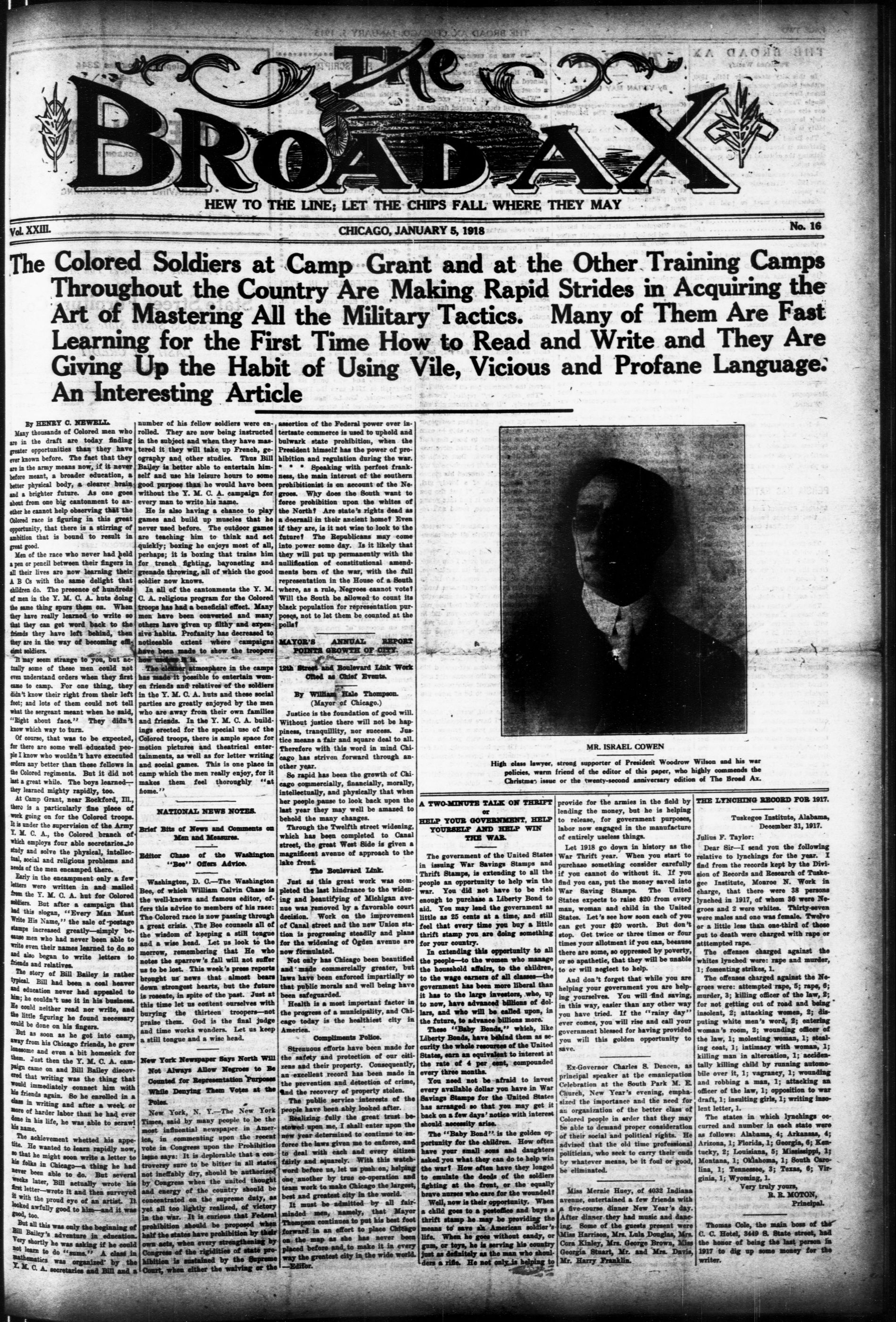
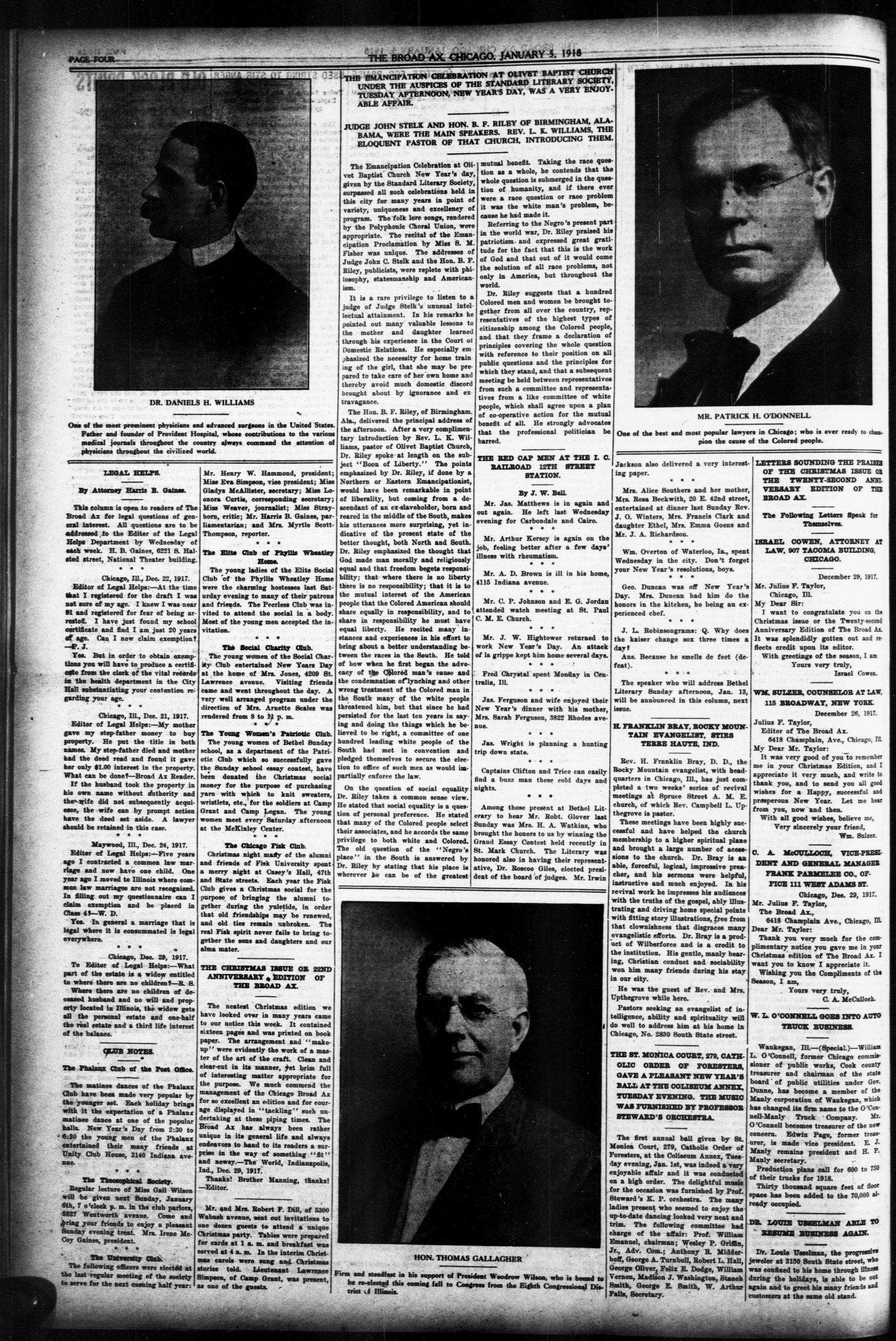
Page text (machine-generated)
THE BROAD AX
HEW TO THE LINE: LET THE CHIPS FALL WHERE THEY MAY
The Colored Soldiers at Camp Grant and at the Other Training Camps Throughout the Country Are Making Rapid Strides in Acquiring the Art of Mastering All the Military Tactics. Many of Them Are Fast Learning for the First Time How to Read and Write and They Are Giving Up the Habit of Using Vile, Vicious and Profane Language. An Interesting Article
Many thousands of Colored men who are in the draft are today finding greater opportunities than they have ever known before. The fact that they are in the army means now, if it never before meant, a broader education, a better physical body, a clearer brain and a brighter future. As one goes about from one big cantonment to another he cannot help observing that the Colored race is figuring in this great opportunity, that there is a stirring of ambition that is bound to result in great good.
Men of the race who never had held a pen or pencil between their fingers in all their lives are now learning their A B Cs with the same delight that children do. The presence of hundreds of men in the Y. M. C. A. huts doing the same thing spurs them on. When they have really learned to write so that they can get word back to the friends they have left behind, then they are in the way of becoming efficient soldiers.
It may seem strange to you, but actually some of these men could not even understand orders when they first came to camp. For one thing, they didn't know their right from their left foot; and lots of them could not tell what the sergeant meant when he said, "Eight about face." They didn't know which way to turn.
Of course, that was to be expected, for there are some well educated people I know who wouldn't have executed orders any better than these fellows in the Colored regiments. But it did not last a great while. The boys learned—they learned mighty rapidly, too.
At Camp Grant, near Rockford, Ill., there is a particularly fine piece of work going on for the Colored troops. It is under the supervision of the Army Y. M. C. A., the Colored branch of which employs four able secretaries to study and solve the physical, intellectual, social and religious problems and needs of the men encamped there.
Early in the encampment only a few letters were written in and mailed from the Y. M. C. A. hut for Colored soldiers. But after a campaign that had this slogan, "Every Man Must Write His Name," the sale of postage stamps increased greatly—simply because men who had never been able to write even their names learned to do so and also began to write letters to friends and relatives.
The story of Bill Bailey is rather typical. Bill had been a coal heaver and education never had appealed to him; he couldn't use it in his business. He could neither read nor write, and the little figuring he found necessary could be done on his fingers.
But as soon as he got into camp, away from his Chicago friends, he grew lonesome and even a bit homesick for them. Just then the Y. M. C. A. campaign came on and Bill Bailey discovered that writing was the thing that would immediately connect him with his friends again. So he enrolled in a class in writing and after a week or more of harder labor than he had ever done in his life, he was able to scrawl his name.
The achievement whetted his appetite. He wanted to learn rapidly now, so that he might soon write a letter to his folks in Chicago—a thing he had never been able to do. But several weeks later, Bill actually wrote his first letter—wrote it and then surveyed it with the proud eye of an artist. It looked awfully good to him—and it was good, too.
But all this was only the beginning of Bill Bailey's adventure in education. Very shortly he was asking if he could not learn to do "sums." A class in mathematics was organized by the Y. M. C. A. secretaries and Bill and a
number of his fellow soldiers were enrolled. They are now being instructed in the subject and when they have mastered it they will take up French, geography and other studies. Thus Bill Bailey is better able to entertain himself and use his leisure hours to some good purpose than he would have been without the Y. M. C. A. campaign for every man to write his name.
He is also having a chance to play games and build up muscles that he never used before. The outdoor games are teaching him to think and act quickly; boxing he enjoys most of all, perhaps; it is boxing that trains him for trench fighting, bayonetting and grenade throwing, all of which the good soldier now knows.
In all of the cantonments the Y. M. C. A. religious program for the Colored troops has had a beneficial effect. Many men have been converted and many others have given up filthy and expensive habits. Profanity has decreased to noticeable extent where campaigns have been made to show the troopers how useful it is.
The cleaner atmosphere in the camps has made it possible to entertain women friends and relatives of the soldiers in the Y. M. C. A. huts and these social parties are greatly enjoyed by the men who are away from their own families and friends. In the Y. M. C. A. buildings erected for the special use of the Colored troops, there is ample space for motion pictures and theatrical entertainments, as well as for letter writing and social games. This is one place in camp which the men really enjoy, for it makes them feel thoroughly "at home."
NATIONAL NEWS NOTES
Brief Bits of News and Comments on Men and Measures.
Editor Chase of the Washington "Bee" Offers Advice.
Washington, D. G.—The Washington Bee, of which William Calvin Chase is the well-known and famous editor, offers this advice to members of his race: The Colored race is now passing through a great crisis. The Bee counsels all of the wisdom of keeping a still tongue and a wise head. Let us look to the morrow, remembering that He who notes the sparrow's fall will not suffer us to be lost. This week's press reports brought us news that almost bears down strongest hearts, but the future is roseate, in spite of the past. Just at this time let us content ourselves with burying the thirteen troopers—not praise them. God is the final judge and time works wonders. Let us keep a still tongue and a wise head.
New York Newspaper Says North Will Not Always Allow Negroes to Be Counted for Representation Purposes While Denying Them Votes at the Poles.
New York, N. Y.-The New York Times, said by many people to be the most influential newspaper in America, in commenting upon the recent vote in Congress upon the Prohibition issue says: It is deplorable that a controversy sure to be bitter in all states not ineffectly dry, should be authorized by Congress when the united thought and energy of the country should be concentrated on the supreme duty, as yet all too lightly realized, of victory in the war. It is curious that Federal prohibition should be proposed when half the states have prohibition by their own acts, when every strengthening by Congress of the rigidities of state prohibition is sustained by the Supreme Court when either the waiving or the
CHICAGO, JANUARY 5, 1918
Camp Grant and the Country Are Making Full the Military Tactics First Time How to Rear it of Using Vile, Vehicle
assertion of the Federal power over intersite commerce is used to upheld and bulwark state prohibition, when the President himself has the power of prohibition and regulation during the war.
Speaking with perfect frankness, the main interest of the southern prohibitionist is on account of the Negroes. Why does the South want to force prohibition upon the whites of the North? Are state's rights dead as a doornail in their ancient home? Even if they are, is it not wise to look to the future? The Republicans may come into power some day. Is it likely that they will put up permanently with the nullification of constitutional amendments born of the war, with the full representation in the House of a South where, as a rule, Negroes cannot vote? Will the South be allowed to count its black population for representation purposes, not to let them be counted at the polls?
MAYOR'S ANNUAL REPORT POINTS GROWTH OF CITY.
12th Street and Boulevard Link Work Offered as Chief Events.
By William Hale Thompson
(Mayor of Chicago.)
Justice is the foundation of good will. Without justice there will not be happiness, tranquillity, nor success. Justice means a fair and square deal to all. Therefore with this word in mind Chicago has striven forward through another year. So rapid has been the growth of Chicago commercially, financially, morally, intellectually, and physically that when her people pause to look back upon the last year they may well be amazed to behold the many changes. Through the Twelfth street widening, which has been completed to Canal street, the great West Side is given a magnificent avenue of approach to the lake front.
The Boulevard Link.
Just as this great work was completed the last hindrance to the widening and beautifying of Michigan avenue was removed by a favorable court decision. Work on the improvement of Canal street and the new Union station is progressing steadily and plans for the widening of Ogden avenue are now formulated.
Not only has Chicago been beautified and made commercially greater, but laws have been enforced impartially so that public morals and well being have been safeguarded.
Health is a most important factor in the progress of a municipality, and Chicago today is the healthiest city in America.
Compliments Police.
Strenuous efforts have been made for the safety and protection of our citizens and their property. Consequently, an excellent record has been made in the prevention and detection of crime, and the recovery of property stolen.
The public service interests of the people have been ably looked after.
Realizing fully the great trust bestowed upon me, I shall enter upon the new year determined to continue to enforce the laws given me to enforce, and to deal with each and every citizen fairly and squarely. With this watchword before us, let us push on, helping one another by true co-operation and team work to make Chicago the largest, best and greatest city in the world.
It must be admitted by all fair-minded men, namely, that Mayor Thompson continues to put his best foot forward in an effort to place Chicago on the map as she has never been placed before and, to make it in every way the greatest city in the wide world.
—Edifor.
at and at the making Rapid easy Tactics. How to Read at Vile, Vicious
High class lawyer, policies, warm Christmas issue
A TWO-MINUTE TALK ON THRIFT
or
HELP YOUR GOVERNMENT, HELP
YOURSELF AND HELP WIN
THE WAR.
The government of the United States in issuing War Savings Stamps and Thrift Stamps, is extending to all the people an opportunity to help win the war. You did not have to be rich enough to purchase a Liberty Bond to aid. You may lend the government as little as 25 cents at a time, and still feel that every time you buy a little thrift stamp you are doing something for your country.
In extending this opportunity to all the people—to the women who manage the household affairs, to the children, to the wage earners of all classes—the government has been more liberal than it has to the large investors, who, up to now, have advanced billions of dollars, and who will be called upon, in the future, to advance billions more.
These "Baby Bonds," which, like Liberty Bonds, have behind them as security the whole resources of the United States, earn an equivalent to interest at the rate of 4 per cent, compounded every three months.
You need not be afraid to invest every available dollar you have in War Savings Stamps for the United States has arranged so that you may get it back on a few days' notice with interest should necessity arise.
The "Baby Bond" is the golden opportunity for the children. How often have your small sons and daughters saked you what they can do to help win the war? How often have they longed to emulate the deeds of the soldiers fighting at the front, or the equally brave nurses who care for the wounded?
Well, now is their opportunity. When a child goes to a postoffice and buys a thrift stamp he may be providing the means to save an American soldier's life. When he goes without candy, or gum, or toys, he is serving his country just as definitely as the man who shoulders a rifle. He not only is helping to
M.
High class lawyer, strong supporter of President Woodrow Wilson and his war policies, warm friend of the editor of this paper, who highly commends the Christmas issue or the twenty-second anniversary edition of The Broad Ax.
MR. ISRAEL COWEN
provide for the armies in the field by lending the money, but he is helping to release, for government purposes, labor now engaged in the manufacture of entirely useless things.
Let 1918 go down in history as the War Thrift year. When you start to purchase something consider carefully if you cannot do without it. If you find you can, put the money saved into War Saving Stamps. The United States expects to raise $20 from every man, woman and child in the United States. Let's see how soon each of you can get your $20 worth. But don't stop. Get twice or three times or four times your allotment if you can, because there are some, so oppressed by poverty, or so apathetic, that they will be unable to or will neglect to help.
And don't forget that while you are helping your government you are helping yourselves. You will find saving, in this way, easier than any other way you have tried. If the "rainy day" ever comes, you will rise and call your government blessed for having provided you will this golden opportunity to save.
Ex-Governor Charles S. Dencen, as principal speaker at the emanicipation Celebration at the South Park M. E. Church, New Year's evening, emphasized the importance and the need for an organization of the better class of Colored people in order that they may be able to demand proper consideration of their social and political rights. He advised that the old time professional politician, who seek to carry their ends by whatever means, be it foul or good, be eliminated.
Miss Mernie Huey, of 4032 Indiana avenue, entertained a few friends with a five-course dinner New Year's day. After dinner they had music and dancing. Some of the guests present were Miss Harrison, Mrs. Lula Douglas, Mrs. Cora Kinley, Mrs. George Brown, Miss Georgina Stant, Mr. and Mrs. Davis, Mr. Harry Franklin.
No.16
THE LYNCHING RECORD FOR 1917.
Tuskegee Institute, Alabama
December 31, 1917.
Julius F. Taylor:
Dear Sir—I send you the following relative to lynchings for the year. I find from the records kept by the Division of Records and Research of Tuskegee Institute, Monroe N. Work in charge, that there were 38 persons lynched in 1917, of whom 36 were Negroes and 2 were whites. Thirty-seven were males and one was female. Twelve or a little less than one-third of those put to death were charged with rape or atttempted rape.
The offenses charged against the whites lynched were: rape and murder, 1; fomenting strikes, 1.
The offenses charged against the Negroes were: attempted rape, 5; rape, 6; murder, 3; killing officer of the law, 2; for not getting out of road and being insolent, 2; attacking women, 2; disputing white man's word, 2; entering woman's room, 2; wounding officer of the law, 1; molesting woman, 1; stealing coat, 1; intimacy with woman, 1; killing man in altercation, 1; accidentally killing child by running automobile over it, 1; vagrancy, 1; wounding and robbing a man, 1; attacking an officer of the law, 1; opposition to war draft, 1; insulting girls, 1; writing insolent letter, 1.
The states in which lynchings occurred and number in each state were as follows: Alabama, 4; Arkansas, 4; Arizona, 1; Florida, 1; Georgia, 6; Kentucky, 2; Louisiana, 5; Mississippi, 1; Montana, 1; Oklahoma, 1; South Carolina, 1; Tennessee, 3; Texas, 6; Virginia, 1; Wyoming, 1.
Thomas Cole, the main boss of the C. C. Hotel, 3449 S. State street, had the honor of being the last person in 1917 to dig up some money for the writer.
Entered as Second-Class Matter Aug.
19, 1902, at the Post Office at Chicago,
Illinois, under Act of March 3, 1879.
Newspaper Advertising Soliciter
Wanted.
A live newspaper advertising solicitor; one who knows how to hustle for business wanted. For further information, address the editor of this paper or phone, Wentworth 2597.
PERSIA HAS NATIONAL DRINK
Sherbet, Plentiful and of Many Varieties, is Most Popular-Beverage of That Country.
The great beverage in Persia is sherbet, which is plentifully supplied and of which there are many varieties, from the bowl of water with a squeeze of lemon to the clear, concentrated juice of any sort of fruit to which water is added to dilute it.
The preparation of sherbet, observes the Boston Transcript, which is done with the greatest care, is a very important point in so thirsty a country as Persia, and one to which much time is devoted. It may be offered pressed from the juice of fruit recently gathered or from the preserved extract of pomegranates, cherries or lemons, mixed with sugar and submitted to a certain degree of heat to preserve it for winter consumption.
Another sherbet much drunk is called guzangebben. It is made from the honey of the tamarisk tree. This honey is not the work of the bee, but the product of a small insect or worm living in vast numbers under the leaves of the shrub. During the months of August and September the Insects are collected and the honey is preserved. When used for sherbet it is mixed with vinegar, and, although not so delicious as that made from fruit, it makes an excellent temperance beverage.
Only among the rich and fashionable are glasses used. In all other cases sherbet is served in china bowls and drunk from deep wooden spoons carved in pear wood.
BETWEEN FRIENDS
M. BONNIE
Daley—Listen to Erma reciting the "Wreck of the Heasperus." How terrible it must have been!
Mabel—Yes, and some people can make it more terrible than it was.
Oatmeal Nut Crisps.
One egg, one-half tablespoonful butter, one-half cupful sugar, one-quarter teaspoonful salt, one teaspoonful vanilla, one and one-half cupfuls rolled oats, one teaspoonful baking powder. Beat together until light the egg, butter, sugar, salt and vanilla. Then stir in the oatmeal and baking powder mixed together. Drop half teaspoonful portions of this mixture a couple of inches apart in a shallow, well-grassed baking pan and bake in a moderate oven until light brown. Remove to plates at once to become cool and crisp.
Barry Trescott read the name with a retrospective expression of face. He unwittingly allowed the newspaper to slip to the floor. He glanced at the pile of manuscript lying on the desk at which he had been writing, and picked up the fountain pen beside it, glancing at it reflectively, as though in some way it connected with the announcement he had just read.
"I would like to see Mr. Bartelme," he solloquized, "but it would hardly do," and he looked down at his rather threadbare attire. "Besides, he has probably long since forgotten me." In the past, however, he had remembered him. Trescott had been his stenographer for a year, had been pleasantly enough treated by the dilustrate millionis and had been paid fairly for his labors. About a month after this employment had ceased, Mr. Bartelme happened to come into a stationer's where Trescott was buying some copy paper.
"Glad to see you, Trescott," he spoke pleasantly. "I've missed you since I let you go—miss the work I frittered away my time on."
"You don't mean that you have abandoned that splendid theme that so engrossed you" involuntarily exclaimed Trescott.
"I fear I am given to fleeting fads," observed the time killer, with a careless shrug of the shoulders. "By the way, help me pick out a fountain pen." Trescott did so. He flushed with pleasure as his former employer, having decided on what suited him, purchased also its counterpart and presented it to Trescott.
Then Trescott had come to the city to try his fortune. He had heard of his employer and patron ever and anon. There was a distant relative of Mr. Burstine, Page Wetmore, who was supposed to be a prospective heir. About a year after Trescott had come to Chicago Wetmore sought him out and borrowed ten dollars from him. He promised to return the money next day, but had never come near the donor, who could poorly afford to lose the money. Trescott learned casually that Wetmore had broken with his relative and had become dissipated and worthless.
His thoughts wandering over all these phases of his experience and history, Trescott spung to his feet, fully startled, as the door opened with a quick swing. A man slammed it shut, placed his back against it and, pale and trembling, grated out hoarsely:
"From above like me."
"Page Wetmore!" cried Trescott, in consternation and amusement. "Save you from what? Hide you—why?"
"From the police. I came to the city because I learned that Mr. Bartelme was to be here, and I have been seen and am wanted! The officers are close on my track. For the sake of our past friendship help me!"
"Here—quick!" and Trescott lifted a curtain in front of an open cupboard, thrust the fugitive in, dropped the curtain, swung open the hall door and, as two officers accompanied by the landlord came up the stairs, was seated at his writing desk, apparently deeply engrossed in his work.
"Don't disturb him. Mr. Trescott is not likely to be connected with criminals." Trescott heard his landlord say, and the officers simply peered into the room and passed on, shortly after leaving the house, unsuccessful in their quest. Trescott drew the shades, secured the door and Wetmore came out from covert.
"You will help me, won't you, Trescott?" he pleaded. "Tm in a terrible mess! They can send me to jail and disgrace the family. I must leave at once for South America or some other distant country."
"What do you want me to do?" inquired Trescott, with genuine pity, viewing this wreck of a promising young man.
"Go to Mr. Bartelme. He is at the Belleview hotel."
"Yes I know."
"Appeal to him strongly in my interest. He utterly discarded me months ago, but surely he will help me escape the lasting ignominy of a convicted criminal!" "Put out the lights and keep the door locked," directed Trescott. "I will see Mr. Bartelme and try to have him help you." Mr. Bartelme regarded Trescott with surprise and then with a cordial grasp of the hand. His brow grew dark as Trescott simply and clearly told him of the object of his visit. "Help that scoundrel!" he almost shouted. "Never!"
"But, sir, at least see him. Give him one more chance," and, while Mr. Barteime's face still retained its sternness, he agreed to grant Wetmore one last interview. He called a taxicab and they were soon back at Trescott's boarding house. Trescott led his companion up the stairs, pawned at the door of his room and knocked. In a low voice he announced, "All right."
THE BROAD AX. CHICAGO, JANUARY 5, 1918
"Why, he is not here!" exclaimed Trescott, and then he stared fixedly at a small tin box lying open and empty on the floor. Near to it were some small coins.
"Aha!" bristled up his eagledened visitor. "He has robbed you as he did me!"
"I fear it is so," acquiesced Trescott gravely.
"How much was there in the box?"
"Oh, let it go," responded Trescott, striving to appear indifferent.
"I insist."
"There was over a hundred dollars. I have been saving it for a special purpose."
"I will not see you lose it," declared Mr. Bartelme. "The villain! A fine return for your kindly hospitality!"
"Perhaps—"
"Don't try to mitigate the wickedness of a thoroughly conscienceless secondhand. I am through with him. I forbid you to even mention his name again. So here is where you live," he continued, taking In the sparsely furnished room critically, but changing his whole manner and slaking into a chair as though inclined to stay for a while.
"Hello!—that's not the poor gift I made you once!" he added, as he observed the fountain pen on the desk.
"The same, sir," replied Trescott animatedly. "It was a famous gift and brought me good luck. It started me scribbling verses, and then newspaper articles, so I have been able to earn an income sufficient to keep the wolf from the door while I tried more pretentious literary work. Best of all, it brought me the rarest happiness of my life," and Trescott directed his glance at the photograph of a lovely girl, framed, on his desk. "I lost the pen once, advertised for it and that young lady, now my fiancee, found and returned it." "H'm! Quite a romance," commented his guest. "What's all this manuscript—a novel?"
"Why, no," replied Trescott. "It is a book I am laboring over. I can thank you, Mr. Bartelme, for its inspiration. Some large land companies wish to attempt the publicity of the standardization of land to crowd out unworthy realty propositions. You told me you had abandoned the work you did in that direction when I was with you, and I have ventured to reinvade the field."
He had set the old man on fire with enthusiasm over his pet hobby. For an hour Mr. Bartelme expounded his theories, examined the manuscript and overwhelmed Trescott with praise for an honest endeavor to be of some use to his fellow men.
"Trescott," he said, warmly, almost affectionately, "I have underestimated you. I will make you a proposition! Let me collaborate with you on this work and I'll pay handsomely, just for the opportunity to interest myself in something worth while!"
"Why, is it really worth your while?" questioned Trescott, dubiously.
"What! to make waste time worth something; to get back into genuine working harness? See here—I've got a big, lonely house. Marry that sweet girl and make a home for me. I let you slip once; I won't again. Literary partners, is it? Yes! All right, and the money end, too."
And thus came happiness, fame and fortune to a really worthy young man.
A
"What's the use? The postman will whistle when he delivers it."
To Remove Fish Odor
Fish usually leaves a strong odor on the utensil in which it has been cooked and the knives and forks as well. Put the silverware into a bowl of cold tea and allow them to stand several minutes. Then wash in clear water and polish. Do not throw the tea away, but put it in the pan in which the fish was cooked.
Among the new automobile fenders is one which automatically spreads apart and pushes out of the way a person or animal it hits.
A mounting for street car headlights has been invented which so turns them that the light is kept on the track as a car rounds a curve.
Holst screws at each corner operated by an electric motor raise the body of a new six-ton automobile coal truck to a height of ten feet.
FIRST TELEGRAPH IN 1774
Wire Used for Each Letter of the Alphabet—Equipment Placed in Trough Underground.
The first electric telegraph of which we have historic record, and also that on which most writers and authorities agree, is that of George Louis Le Sage, a Frenchman living in Geneva, Switzerland, and who built his first telegraph in 1774, says the Electrical Experimenter. The Le Sage telegraph system employed 24 wires, placed in a trough in the ground, the wires being suitably spaced and insulated by means of glass partitions at frequent intervals. Each wire represented a certain letter of the alphabet. As is known, gold leaf is extremely sensitive to minute electric impulses, and so we find that Le Sage placed a small piece of gold leaf at the end of each wire. To send a signal over any particular wire corresponding to a certain letter of the alphabet, a small static charge was sent through the wire by touching it at the transmitting station with a glass rod which had previously been electrically excited by rubbing it with alk. This system was rather limited in its application, as it is very difficult to insulate a static charge for any great distance.
Fur Farming.
Fine furs have reached fabulous values on account of growing scarcity, and this gives financial importance to the conclusion of Ned Dearborn of the United States bureau of biological survey that the problem of a future supply has only one solution—fur farming. Of the score or more of different fur-bearing animals native to North America, about a dozen seem to be suitable for domestication. The skunk, mink and silver fox have been successfully bred in captivity, and the marten, fisher, otter, blue fox, raccoon and beaver have given promise in partial tests. Minks first bred in Oneida county, New York, seem to have been the first wild fur bearers domesticated in the United States, the breeding having begun 50 years ago. The skunk is the most easily and commonly domesticated, and has more breeders in the United States than all other fur bearers combined.
Beating the Post Office.
A stranger, accompanied by his wife, walked into a cigar store and asked for a stamp. The clerk told him that he did not have stamps for sale, but that he could get them at the post office, two blocks away, or at a drug store on a nearby corner. The wife proposed that they go to the post office, but the husband insisted that the purchase be made at the drug store. "I know what I'm about," he proudly proclaimed. "Tve been readin' the newspapers and I saw the other night where the post office had raised its rates. They won't ketch me nappin'. We'll just go to the drug store. They've got one of them machines there and I know I can get two two's and a one-cent stamp fur a nickel, out of it. Then we'll drop the letter in the box on the corner."
"A feller's got to watch his corners these days," he said, as he left, for the drug store.
Sweet Scones.
Cream together one cupful of butter and three-quarters of a cupful of sugar, add one well-beaten egg, one tablespoonful of cream and, very gradually, four cupfuls of flour. Knead the flour in thoroughly, then turn onto a floured pastry board, knead until smooth and roll out in a large round. Cut out in eight triangular pieces, mark all over with a fork and lay on a well-buttered baking tin. Bake in a moderate oven 15 minutes.
When Ironing Kerchlefs.
When ironing handkerchiefs the middle should be ironed first. To iron the edges first causes the middle to swell out like a balloon and makes it difficult to iron satisfactorily.
Telephone Douglas 2344
FRATERNAL PR
MAJOR R. R. JACKSON, Preside
ATERNAL PRE
MAJOR R. R. JACKSON, President
BOOK and JOB PRINTING
ENGRAVING and BOOKBINDING
107 East 35th Street
The Store That S
State Street R
3131-35 South
CASH OR
At 35th Street CHICAGO,
The Store That Saves You More
The Street Furniture
3131-35 South State Street
CASH OR CREDIT
107 East 35th Street CHICAGO, ILLINOIS
The Store That Saves You Money
State Street Furniture Co.
3131-35 South State Street
CASH OR CREDIT
Phones: Prospect 179 and 427
HENRY P.
REAL EST
6244 South As
With
JAMES H. RYAN & CO.
HENRY P. BERGER
REAL ESTATE
6244 South Ashland Avenue
I & CO.
TELEPHONE KENWOOD 1233
J. B. CLITHIE
REAL E
RENTING INSURANCE
7 West 51
NOTARY PUBLIC
B. CLITHERO & C
REAL ESTATE
INSURANCE MORTGAGE
7 West 51st Street
PUBLIC
J. B. CLITHERO & CO.
REAL ESTATE
RENTING INSURANCE MORTGAGE LOANS
7 West 51st Street
NOTARY PUBLIC CHICAGO
Phones: Douglas 883, and Douglas 6162
C. C. Hotel and Buffet
THOS. COLE, Proprietor
3449 South State Street
SOWING TREE SEED IN SNOW
National Forests of the Country Are
Planted Each Year to Make
Bare Land Productive.
To keep the national forests of the
United States, which are scattered
from Alaska to Porto Rico, up to
standard, 12,000 to 15,000 acres have
to be reforested or planted each year.
The bare lands must be made productive and the thin stands of wood must be improved. To do this requires an immense amount of labor.
Companies of men travel over these forests, sowing the seed broadcast over the snow in the various barren sections. As the snow melts the seed sinks deeper and deeper and when the snow disappears entirely the seed is already covered over with sufficient dirt to give it a bed in which to grow. The chief disadvantage of the method, according to a contributor to one of the scientific publications, is that the seed is conspicuous on snow and likely to be eaten by birds. After a few days of sunshine it soon disappears from view.
Charlemagne Was a Gérman.
According to his friend and secretary, Charlemagne was a full-blooded German, an Austrian Frank, with yellow hair, fair skin and large, keen, blue eyes. He was unusually tall, but exceedingly well proportioned and graceful, so that his great height did not at first strike the observer. His appearance was always manly and stately, and his countenance, open and cheerful, but, when roused to anger, his eyes blazed with a fire that few men cared to stand. He was fond of all forms of exercise and during most of his life was amazingly strong. He was temperate in eating and drinking. He spoke Latin as fluently as his native German and understood Greek when it was spoken. Late in life he learned to write, but was never able to do much more than sign his name. In his age, however, he was an educated man. At table he liked to have some one read to him and was very fond of history. He surrounded himself with scholars and encouraged edu-
---
---
AL PRESS
ACKSON, President
CHICAGO, ILLINOIS
Saves You Money
Furniture Co.
State Street
CREDIT
Res. Phone: Prospect 532
BERGEN
ESTATE
Shland Avenue
ERO & CO.
ESTATE
MORTGAGE LOANS
1st Street
CHICAGO
cation. He is classed as one of the most remarkable men that ever lived.
Sounds Baffling Science.
Mystery still attaches to certain explosive sounds, heard in various parts of the world and known to science as "brontides." On the coast of Belgium, says Popular Science Monthly, these sounds seem to come from the sea and are called locally "mistpoeffer." In the Ganges delta of India similar sounds are called "Barisal gun." Brontides are well known in some parts of Italy, where they bear a great variety of names. In Haytai a sound of this character is known as the "goutfre," while in parts of Australia it is called the "desert sound." Brontides mostly take the form of muffled detonations, of indefinite direction. Probably they are of subterranean origin. Studies of eccentricities in the transmission of sound through the atmosphere lead to the conclusion that some of the sounds hitherto reported as brontides were really due to cannonading or blasting.
Fine Example for Others.
The manager of an English north country firm, Joseph Thomson, J. P. was one of the few who, in the early days of Ruskin's social reform schemes, put Ruskin's ideals into practice in the organization of his wooled manufacturing business, observes Christian Science Monitor. A definite minimum wage was fixed for the workers, and they were given shares which carried full voting powers at company meetings. Both men and women enjoyed this privilege. Ruskin, on hearing of Mr. Thompson's experiment, wrote to him expressing deep appreciation. "I cannot sufficiently thank you," he said, "for the completely foundational step which you have taken in the establishment of just and right relationships between yourself and your employees." The experiment gave most satisfactory results.
So to Speak. "That lets me out," said the prisoner as the governor signed his pardon.
CHICAGO
Automatic 72-746
Chicago, Ill.
First Instance Dates From 409, When Effort Was Made to Arrange Peace With Goth Leader.
From the earliest time of papacy, popes, as the religious heads of the Catholic church, have considered it their task to intercede as mediators in temporal disputes, observes a historian. Following are a few instances: As early as 400, when Alaric I declared he would withdraw from Rome only on condition that the Romans should arrange a peace favorable to him, S. Innocent I went with an embassy of the Romans to Emperor Honerus at Ravenna, to try, if possible, to make peace with him and the Goths, but failed in his endeavors to bring about peace. More successful was Gregory I, who played the same part on the occasion of the invasion of Italy by the Lombards. Owing to his friendship with the Lombardian queen Theudulinda, he actually mediated a favorable peace. When northern Italy was devastated by Attila the venerable bishop of Rome, Leo I—the first of the great popes—by a personal encounter with the king of the Huns, prevented him from marching upon Rome. He went in 452 to upper Italy, and met Attila at Mincio, in the vicinity of Mantua, obtaining from him the promise that he would withdraw from Italy and negotiate peace with the emperor. This pope also succeeded in obtaining another favor for the inhabitants of Rome. When in 455 the city was captured by the Vandals under Geneseric the "scourge of God," Leo's intercession obtained a promise that the city should not be injured and the lives of the inhabitants should be spared.
Another pope, Benedict the Twelfth, who from 1334 to 1342 occupied the holy see, was as unsuccessful as a mediator as the present supreme pontiff. At that time Charles IV of France had died without leaving an heir, and when his cousin, Philip VI, put the crown on his head, his right to do so was contested by Edward III of England. Benedict XII, who wanted to mediate, was not listened to, and there ensued hostilities lasting, with some interruptions, for a hundred years. The pope mediated successfully between Christian opponents in cases where it was important to unite them in the common cause of Christianity against Turkey.
Pope Gregory (1271-1276), for the sake of a crusade against the Turks, worked indefatigably upon a recollection of the princes in Italy and Germany, and Paul III (1534-1549), nearly three centuries later, tried to prevent a war between Spain and France. Clement XI aided Venice against the Turks by mediating the peace between Louis XIV and Spain, etc.
What You've Been Waiting For. Masculine readers are not usually interested in pictures showing feminine fashions, notes the Outlook, but certain haltones in a Brooklyn furrier's catalogue are calculated to awaken a semolent intellectual activity in the man who has been leisurely conning the rise in coal and milk bills. On the first page is shown an evening wrap made of chinchilla; its price is $10,000. The next page illustrates a wrap which is made up in various furs to suit different sized purses. The humber seeker for borrowed warmth may get this moleskin for the trifle of $850; more fastidious tastes may call for one of ermine at $2,000; those who prefer Hudson Bay sable may secure their choice for $15,000; while the lady who desires "the real thing" may have her wrap made of Russian sable at a cost of $75,000. An inferior garment of Russian sable, it may be added, will be furnished at $25,000 for anyone of economical tastes.
Overalla and Petticosta
The bloomer idea is going out among the French women employed in factories, especially munition works, according to a letter from one of the industrial centers over there, and return has been made to the skirt that ever has been made to the skirt that ever where working close to certain machinery would make skirts dangerous have they been discarded for bloomers, or, in most instances, overalls. What was taken up as a fad, says a correspondent, has given way to the older and stronger dictates of modesty. And after work, in spite of the fact that it has been work amid grease and dirt of the exceptional sort—or perhaps because of it—there is recourse to the powder puff and the other appurtenances of frill that in some form or other are synonymous with woman the world over.
Paper Monarda Nickner
Now that paper money is a permanent part of our pocket currency, we await the inevitable nickname for the notes, which is sure to come; says the London Chronicle.
If we follow the precedent set across the Atlantic in 1862, when "greenbacks" first made their appearance, we might be satisfied with "Westminster," with reference to the very admirable lithograph of the palace which adorns the reverse of the new notes. Something better than that is sure to come along. In the army the notes are known as "USs," in jocular allusion to the remarkably narrow chest which the artist has given St. George, who is in conflict with a very robust dragon.
THINGS THAT ARE NOT SEEN Much That Cannot Be Explained of Understated—People Have to Look On From the Outside.
"To speak frankly, uncle, I can't bring myself to bank much on a world that's all out of sight," said Howard Cranston with jaunty decisiveness. "I think I can understand the point of view of the Bible—just a little, anyhow. It was the natural thing to 'walk by faith' in those days, for there wasn't much else you could walk by. The primitive mind peoples the shadows with supernatural powers, but science has let in so much light that there aren't many shadows left. That's why faith seems to me like an anachronism. The only way to keep it untouched is to get back to the old, forgotten point of view, and look out on the world just as if nothing had been learned in the last thousand years or more."
"I was thinking about Culver this morning," Doctor Gresham said, and his nephew raised his eyebrows inquiringly at the sudden change of topic. "There must have been a weak streak in Culver somewhere, although I was his chum in college four years and never suspected it. He was one of the half dozen fellows in our class whom I expected to make their mark in the world. He didn't—as you know, I've talked with some of his intimate friends, but Ive never been able to discover the reason. And yet there must be a reason—one of those subtle, intangible things that seem often to make or unmake a life, but that the keen probe of science can't quite reach."
"I begin to see what you're aiming at." There was an accent of constraint in the young voice. "Of course there's a lot we can't explain or understand. We're handicapped by having to look on from the outside."
The doctor nodded.
"Again," he said, "there's a whole world open to you as an educated man that has no existence for Jerry Lomax. It's not only open to you, but you've entered into it, and, in a measure, possessed it. It's very real to you, and you've found it engrossing and enjoyable. You haven't a doubt about this world of thought, as we may call it, being just as real as the grosser world of sense perception. And yet you'd find it hard to convince Jerry that there is such a thing. The words wouldn't mean anything to him. He'd have to go in at the basement door and climb up, step by step, to where you stand before he'd understand.
"I remember the case of an old lady, a patient of mine, who was as sure of the love of God as you are of the law of gravitation. She'd been a bed-ridden invalid for 12 years, but she had lived so close to God that every doubt had vanished. She didn't have to get back to the old, forgotten point of view, or make a shadow land for her God to dwell in, or forget the wonderful things that have happened since the Bible was written. She just found God sometime when she especially needed him, perhaps, and then kept close at his side till she came to know him. I have often thought that God's presence was just as real to her as mine was—possibly more so. That's when I first began to see that I was an outsider. I was a professing Christian, but I hadn't got into the inner circle."
"One can't afford to miss a whole world, and think it isn't itifere, if—if the fault is all with his own eyesight," the young man replied soberly.—Youth's Companion.
Walfe Who Make Good.
Everybody has read stories of waits who got a chance and made good, we mean in fiction. That they also make good in real life, says the New Orleans Daily States, is proved by the annual report of the Children's Aid society of New York. For some time the society has been diligently searching the country for reliable testimony regarding strays who made their mark in the world, and it has made up this list of successful men rescued as children from the street or taken from an asylum or corrective institution.
One state governor, one territorial governor, two congressmen, two district attorneys, two sheriffs, two mayors, a justice of the supreme court, four other judges, two college professors, two dozen clergymen, seven high school principals, an auditor general, nine members of state legislatures, two artists, 34 bankers, 19 physicians, 35 lawyers, 12 postmasters, 97 teachers, many business and professional men, farmers and clerks, besides 7,000 sailors and soldiers.
Much has been said and written at various times concerning "the long arm of coelcidence," but surely a record in this direction, relates a correspondent, was established in connection with an amusing little episode in the career of the countess of Dudley, the enthusiastic Red Cross worker who organized the first voluntary hospital corps to cross the Channel on the outbreak of the present world war. When, exactly ten years ago, her ladyship presented her husband with twin sons, one of her first visits on her recovery was to a village church near where she was staying at the time.
The officiating clergyman was quite unaware of the presence of Lady Dudley among his congregation. Nevertheless, by an extraordinary coincidence, he chose as his text the words, "Two are better than one"—greatly to the amusement, need it be added, of the countens and some friends who were with her.
THE BROAD AX, CHICAGO, JANUARY 5. 1918
Theorising about war conditions has grown quite as tiresome, no doubt, to the people who read newspapers as it has to most of the people who write for them. Yet, now and then, you meet a man who theorizes from the facts of experience and knowledge and who points something out that gives food for thought. Such a case, it seemed to several of us, when a quiet little chap, son of a Canadian millionaire, told us his view of the war in its present stage, a New York correspondent of the Cincinnati Times-Star writes. His brother was killed at the Marne and he himself is home to recover from shrapnel wounds received when he was flying a naval airplane some thousands of feet above a town on the Belgian coast.
"The outstanding fact, just now," he said, "is that the German U-boats are doing pretty nearly as much as they were expected to do and that we have no effective defense against them. The Germans are almost justified in believing that they are on the way toward starving England into submission. If we don't find a new and successful way to combat the U-boats the situation in England will soon be very critical. Of course, I fancy a way will be found. But it must be something entirely new in warfare. For my part, I am convinced that success can be obtained only by the apparently desperate undertaking of assaults by sea upon the U-boat bases. I say 'apparently desperate.' By any known or tried method such assaults would be simply useless and suicidal.
"The German harbors are mined, netted from end to end and fortified with tremendous shore batteries of heavy and aircraft guns. How can the bases be attacked? Well, of course, that will be settled by some one else than I, but I have heard a theoretical plan of attack proposed by one of our naval men which made a great impression on me. He said we must build thousands of small submarines—something like the 'sea jitneys' which manufacturers have talked about—and go into the German harbors with swarms of them, at the risk of losing ninety-nine out of every hundred boats and crews. Barrage fire and bombing have been the new and successful things in land fighting.
"This officer's proposal is for something like an undersea duplication of this plan of attack. Most of the little boats would be lost, no doubt, but most of them would succeed in doing material damage with one or two torpedoes. Nets would be blown away, mines exploded, guard ships sunk and such other disorganization of the harbor defenses accomplished as to give the big ships a chance to complete the work. Yes, it's true that a man would hardly need to worry about his return trip if he went in on one of these little boats. It would be work for volunteers. But the volunteers would be plentiful enough. That I am sure of. "If such attacks promised to win the fight against the U-boats, men would be willing to go. It would be enough for them to know that they were striking the sea murderers at their home, and that some of them might possibly get back."
German Schooling.
German schooling has proved antagonistic to co-operation, although demanding unity of action through mass obedience. It has failed to foster real co-operation, for co-operation is a method by which persons of their own volition and by no compulsion may work together harmoniously, writes Winthrop Talbot in the Century Magazine. Only when training and schooling are the common privilege of all is that state of civic development possible which permits society to become cooperative in its action. In other words, a socialized society becomes more and more possible only as all individual members acquire each the widest vision, and thus the power to co-operate harmoniously.
The Crow.
I have seen no bird walk the ground with just the same air the crow does. It is not exactly pride; there is no strut or swagger in it, though perhaps just a little condescension; it is the contented and self-possessed gait of a lord over his domains. All these acres are mine, he says, and all these crops; men plow and sow for me, and I stay here or go there, and find life sweet and good wherever I am. The hawk looks awkward and out of place on the ground; the game birds hurry and skulk, but the crow is at home and treads the earth as if there were none to molest or make him afraid—John Burroughs.
The Mystery of Love
The Mystery of Love. Love is the great mystery of life. It may be the growth of years, months or an instant, says the Christian Herald. Man sees a million beautiful faces; he hears a million sweet voices; he meets a million women with flowers at their breasts and light in their eyes—and they do not touch him. Then he sees the one, and she holds him for life and death. She is no nobler, better or more beautiful than were those he passed by, and yet his world is empty without her. Assuredly there is far more than fashion in this universal force we call love.
It is a human frailty to want praise. We begin young to crave the approving notice of others. "There is none like to me," says the cub in the pride of his earliest kill. "But the jungle is large, and the cub he is small; let him think and be still." Children brought up in school can generally be told from those who have been trained solitarily, says a writer in the Philadelphia Ledger, for the children thrown much with other children are less likely to develop arrogance, selfishness and conceit. They do not find their schoolmates in a frame of mind to put them on a pedestal or crown their brows with laurel. They are not regarded as little tin gods on wheels; they are lost to sight in the shuffle of the classroom and the playground. Nobody defers to their opinions; nobody minds when they stamp the foot and shout angrily.
Children of a larger growth often crave an admiration which they do not get. They think to draw an audience by harping on the theme of self, and they find that the audience for that kind of recital is likely to be limited to the performer. To knock the "T" out of one's conversation is not necessarily to make it interesting. Many times a narrative loses greatly in pith and pungency by the impersonality in which it is couched. A story of adventure greatly gains by the sense of the first-hand participation of the narrator in the incidents he describes. When the first person is introduced for the sake of the edification of the reader, there need be no apology; when it is introduced for the glorification of the speaker, it is odious altogether.
A man must do his work as well as he can, whether he is praised for it or not. The taste of publicity is likely to be what the taste of blood is to tiger or lion; it whets the desire for more of the same thing. There are some who rarely do a good deed without rushing to neighbor or newspaper to let it be known. To others the "free advertising" is abhorrent. They are made happy by a glowing consciousness that the right thing was done, and that auto-satisfaction of virtue is their reward. But most of us have not reached that lofty pinnacle wherson we can abide serenely independent of what others think or say. We want a kind word new and then to keep us going. We hunger for appreciation, even when we tell ourselves we are not worth it. Who has not known the lift a letter of encouragement, a sentence of commendation, has brought? The day is brighter for it, and we feel refreshed, renewed. Blessed are they who speak in time the heartening, quickening word.
Goats' Milk - la Favorited.
Everyone who is at all acquainted with the milk goat knows of the value of the milk for infants' and invalids' use—one of the first points about the milk goat that presents itself, asserts a writer. The goat is practically free from tuberculosis. According to the annual reports of the bureau of animal industry (U. S.), covering federal inspection of animals slaughtered for food, there were inspected during the eight years, 1907 to 1914, inclusive, 579,617 goats, of which not a single animal was condemned for tuberculosis. This fact alone should be the strongest argument in favor of the milk of the goat. The cream globules of the milk of the goat are smaller than those of cows' milk, and because of this milk being condensed the cream globules are contained in a more perfect state of emulsion than the cow's milk. An argument in favor of sterilized milk is that authorities agree it is actually more easily digested than is the fresh milk, this referring to goats' and cows' milk alike.
Field Crops of Canada.
The census and statistics office has issued its preliminary estimate of the total value of the field crops of Canada for the past year, as compared with the finally revised estimates of 1916 and 1915. The estimated values for 1917 represent the prices received by farmers and are calculated from current market quotations. According to this preliminary estimate, the total value of all field crops for 1917 is placed at $1,089,087,000, as compared with $888,494,900 in 1916 and $825,370,600 in 1915. The items making up this total are as follows: Wheat, $451,374,000; oats, $236,142,000; hay, clover, and alfalfa, $145,561,000; potatoes, $81,355,000; other grain crops, $134,006,700, and root and fodder crops, $40,974,700.
In the year 1916 the crops were as follows: Wheat, $344,096,400; oats, $210,657,500; hay, clover and alfalfa, $171,618,900; potatoes, $20,982,300; other grain crops, $84,679,000; other root and fodder crops, $84,165,000
Kornsky, Real, Diplomat.
Here is a Kerensky story told by a man lately returned from Petrograd. Kerensky was summoned from his hotel after midnight to the headquarters of the provisional government. A fellow guest at the hotel met Kerensky as he was going out and, learning of the summons Kerensky had received, enclosed:
The next day his fellow guest asked Kerenaky what had been the trouble which had brought him out so late the previous evening.
Kerenaky smiled.
"I had forgotten to sign a letter," he replied.
The conversation turned on the wonderful pungency and power of invective of the old-time London cabby as narrated by Charles Dickens in "Pickwick Papers" and by other authors of that and a subsequent time.
"A few years ago," said Dr John H. Oliver, in the Indianapolis News, "I paid my second visit to London. The cabby and his horse had passed away. The horse-drawn omnibus was no more, the petrol-driven bus having taken its place. I told a Briton whom I met over there that I liked to sit on the outside next the driver, that I found him a most interesting character.
"So do I," said my British acquaintance, but he is not at all as interesting as his predecessor of the old fashion. I was seated beside one of these old-time drivers going through a street crowded with vehicles when a bus coming from the opposite direction was in collision with our bus. The wheels of the two locked and then the highly ornate invective between the two drivers began. It was the perfect flower, yes, the full fruitage I thought of profanity and abuse.
"But I was mistaken. There was more and worse to come. When the wheels had become unlocked and we were slowly moving away, my friend, the driver, drew from his pocket a bit of string and holding it above his head swung it slowly to and fro.
"The other driver at once jumped down from his bus and, whip in hand, struck at the string-shaker. The wealth of epithet he then used showed that all that had preceded it was as mild and kindly as the softest bachatter. Our driver answered not a word, but as he drove slowly on continued the string shaking.
"I wondered what there could be in this simple bit of dumb-show to make the other busman so frantically angry. Then my driver gave the explanation: "E didn't like it, did e?' It was honely a bit of joke, don't y' see. Is brother 'anged last Friday.'"
Church Givea Every Man.
Church of the Holy Trinity
There is a little French church in the heart of Philadelphia which has given and given to the great world strife, ever since the war began, life blood and widows' mites, and in the face of poverty is still giving, giving, according to a Philadelphia correspondent.
Not one man between seventeen and fifty years old remains in the membership of the little church of St. Sauveur. All are at the front, some are with the French army, some are with the United States forces, but all have gone. All are fighting for the same great world ideal.
They have left mothers, wives and little ones who do not complain, but give to the last penny, not only for those they love, but for the relief of all suffering.
Nearly all of them are working people, but, in addition to the struggle for bread and butter, they have found the way to adopt and support four orphans in France. In addition to the incessant knitting and sewing for the little war orphans here these brave women have also found time to make and send countless woolen comforts and relief supplies to the war victims in France and Belgium, the orphans and the wounded. They also subscribed to the starving Armenians.
War Curba Suicide.
Sir Bernard Mullet, registrar general of the British empire, announced recently that suicide had fallen off strikingly in England since the beginning of the war. The explanation is that the national unity of feeling, the subordination of self and the sharing of sympathy on all sides makes the individual's personal injuries less important and induces him to forget his own desperation. Personal indulgences and excesses of immorality, causes of insanity and melancholia, are curbed and minimized naturally by the economies enforced upon the populace. Discipline in eating, dressing, working has also a beneficial effect in keeping the mind sane and free from morbid broodings.
Would Take Glass Eve Back.
Paul Gary of Anderson, Ind., is all American, with the exception of a glass eye. The substitute optic is allen.
Gary tried to enlist in the United States marine corps at their recruiting station in Louisville, Ky., but was rejected when his infirmity was discovered by Sergt. G. C. Wright.
"Didn't you know that the loss of an eye would prevent your enlisting?" asked the sergeant.
"I thought it might," explained Gary, "but this glass blinker is the only part of me that was made in Germany, and I want to take it back."
Crop and Drug Plants.
One of the projects outlined by the committee on botany of the national research council is the search for wild plants which may be used as wartime substitutes for the more costly crop plants. During the Civil war Dr. John Porcher, a Southerner, published a book giving a list of plants of the South which could be substituted for much-needed food and drug plants. It is suggested that information might be obtained from hunters, trappers, woodmen, farmers, Indians and the foreigners, who pick up considerable food from the countryside. Similar information is desired concerning plants that can be used in medicine.
PAGE THREE
Printing from blocks is said to have been invented in China in 592 A. D. during the enlightened reign of Yank Chien, the founder of the progressive but short-lived fai dynasty. Printed books, however, asserts a writer in the Oriental News and Comment, did not compete with manuscripts until the middle of the tenth century. From that time block printing developed very rapidly, resulting in a great cheapening and wide diffusion of books and the consequent rapid decline of the copyist's trade. No doubt the rapid dissemination of learning this entailed had much to do with the great intellectual progress made in China during the Sung dynasty, from 900 to 1280 A. D., which has been called the "protracted Angustan age of Chinese literature."
Disregarding the manuscript works of the great Tang dynasty (618-007 A.D.), which were doubtless tenfold more numerous and more important than the contemporaneous literary works of the whole western world, the printed books of the Sung Yuan and the early part of the Ming dynasties up to the middle of the fifteenth century have no counterpart at all in Europe. They existed in countless thousands of volumes. In 1406 the Imperial Ming library contained printed works to the extent of more than 300,000 chuan (books) and more than twice as many manuscripts, and already many printed works of the Sung dynasty had been lost during the disorders incident to the protracted wars with the Mongols. Undoubtedly more books were printed in China than in all the rest of the world up to the middle of the seventeenth or the beginning of the eighteenth century.
The great bulk of Chinese works, aside from the Confucian classics, is historical or literary, the latter being mostly essays, short poems, or critiques. There exists also a vast Buddhistic literature and very many Taoist works.
Novels are not even classed as literature, although famous ones exist and some of them have been translated into European languages. There are also many famous dramas, some dating from the Yuan dynasty, but these, too, are excluded from literature proper by Chinese bibliographers. The historical records of the Chinese are of vast bulk and represent a conscientious and painstaking record of the political and sociological experiences of the oldest civilised nation on earth. In close connection with these records proper we should consider the vast number of geographic treatises and especially the so-called gazeettes. These latter are official publications issued by the empire, province, district, or even township, and treat not only geography and topography proper, but also the antiquities, natural and manufactured products, and even the biographies of famous men, population, taxes, astrology, marvelous happenings, etc.
Antiquity of Jerusalem
The wonderful antiquity of Jerusalem has only been appreciated in recent years. Up to 50 years ago, observes the Chicago Examiner, it was thought that Jerusalem was of little importance as a city until it became the "City of David," king of Israel. But with the discovery of the Tel-el-Amarna tablets in Egypt new light was shed upon the history of the sacred city. There were found six letters written by the king of Jerusalem to the Pharaoh of Egypt, dating from the fifteenth century B. C. The name of this king of Jerusalem was Abd-hiba, or, as some scholars read the cuneiform, Abd-sadak, and he writes to the Pharaoh beseeching him to send soldiers, almost as the Turks must have sent messages to Germany asking for re-enforcements that they might save the day.
Pioneers Lived on Corn
We ought to be proud of corn. The corn-fed critter, human and otherwise, always has been strong, vigorous and of high vitality.
In serving corn dishes on its dining cars the Southern Pacific railway distributes a small card giving recipes and other interesting information, as follows:
"The government desires that wheat be used as sparingly as possible and that corn be substituted.
"America was pioneered on corn; the Pilgrim Fathers almost lived on it. Corn was the first crop planted in all the virgin soil as it was settled, from the Atlantic out across the Alleghenies; upon the broad prairies, and beyond.
The schoolmaster was giving the boys a lecture on thrift and pointed out how squirrels stored up nuts for the winter. Then he asked for another illustration of thrift in animals, and one boy cried out:
P.
DR. DANIELS H. WILLIAMS
One of the most prominent physicians and Father and founder of Provident Medical journals throughout the co physicians throughout the civilized
One of the most prominent physicians and advanced surgeons in the United States. Father and founder of Provident Hospital, whose contributions to the various medical journals throughout the country always command the attention of physicians throughout the civilized world.
By Attorney Harris B. Gaines.
This column is open to readers of The Broad Ax for legal questions of general interest. All questions are to be addressed to the Editor of the Legal Helps Department by Wednesday of each week. H. B. Gaines, 6221 S. Halsted street, National Theater building.
Chicago, Ill., Dec. 22, 1917.
Editor of Legal Helps:—At the time that I registered for the draft I was not sure of my age. I knew I was near 91 and registered for fear of being arrested. I have just found my school certificate and find I am just 20 years of age. Can I now claim exemption?
—P. J.
Yes. But in order to obtain exemptions you will have to produce a certificate from the clerk of the vital records in the health department in the City Hall substantiating your contention regarding your age.
Chicago, Ill., Dec. 21, 1917.
Editor of Legal Helps:—My mother gave my step-father money to buy property. He put the title in both names. My step-father died and mother had the deed read and found it gave her only $1.00 interest in the property. What can be done?—Broad Ax Reader.
If the husband took the property in his own name without authority and the wife did not subsequently acquiesce, the wife can by prompt action have the deed set aside. A lawyer should be retained in this case.
Editor of Legal Helps:-Five years ago I contracted a common law marriage and now have one child. One year ago I moved to Illinois where common law marriages are not recognized. In filling out my questionnaire can I claim exemption and be placed in Class 49—W. D. Yes. In general a marriage that is legal where it is consummated is legal everywhere.
To Editor of Legal Helps: What part of the estate is a widow entitled to where there are no children—R. S. Where there are no children of deceased husband and no will and property located in Illinois, the widow gets all the personal estate and one-half the real estate and a third life interest of the balance.
The matinee dances of the Phalanx Club have been made very popular by the younger set. Each holiday brings with it the expectation of a Phalanx matinee dance at one of the popular halls. New Year's Day from 2:30 to 6:30 the young men of the Phalanx entertained their many friends at Unity Club House, 3140 Indiana avenue.
The Theosophical Society
The Theoretical Society.
Regular lecture of Miss Gail Wilson will be given next Sunday, January 6th, 7 o'clock p. m. in the club parlors, 6827 Wentworth avenue. Come and bring your friends to enjoy a pleasant Sunday evening treat. Mrs. Irene McCoy Gaines, president.
The University Club.
The following officers were elected at the last regular meeting of the society to serve for the next ensuing half year:
LEGAL HELPS
. . .
---
CLUB NOTES
Mr. Henry W. Hammond, president; Miss Eva Simpson, vice president; Miss Gladys McAllister, secretary; Miss Leonora Curtis, corresponding secretary; Miss Weaver, journalist; Miss Strayhorn, critic; Mr. Harris B. Gaines, parliamentarian; and Mrs. Myrtle Scott-Thompson, reporter.
The Elite Club of Phyllis Wheatley Home
The young ladies of the Elite Social Club of the Phyllis Wheatley Home were the charming hostesses last Saturday evening to many of their patrons and friends. The Peerless Club was invited to attend the social in a body. Most of the young men accepted the invitation.
The Social Charity Club.
The young women of the Social Charity Club entertained New Years Day at the home of Mrs. Jones, 4209 St. Lawrence avenue. Visiting friends came and went throughout the day. A very well arranged program under the direction of Mrs. Arnette Scales was rendered from 8 to 11 p. m.
The Young Woman's Patriotic Club.
The young women of Bethel Sunday school, as a department of the Patriotic Club which so successfully gave the Sunday school essay contest, have been donated the Christmas social money for the purpose of purchasing yarn with which to knit sweaters, wristlets, etc., for the soldiers at Camp Grant and Camp Logan. The young women meet every Saturday afternoon at the McKinley Center.
The Chicago Fisk Club
Christmas night many of the alumni and friends of Fisk University spent a merry night at Casey's Hall, 47th and State streets. Each year the Fisk Club gives a Christmas social for the purpose of bringing the alumni together during the yuletide, in order that old friendships may be renewed, and old ties remain unbroken. The real Fisk spirit never fails to bring together the sons and daughters and our alma mater.
THE CHRISTMAS ISSUE OR 22ND
ANNIVERSARY EDITION OF
THE BROAD AX.
The neatest Christmas edition we have looked over in many years came to our notice this week. It contained sixteen pages and was prioted on book paper. The arrangement and "makeup" were evidently the work of a master of the art of the craft. Clean and clear-cut in its manner, yet brim full of interesting matter appropriate for the purpose. We much commend the management of the Chicago Broad Ax for so excellent an edition and for courage displayed in "tackling" such undertaking at these piping times. The Broad Ax has always been rather unique in its general life and always endeavors to hand to its readers a surprise in the way of something "fit" and newsy.—The World, Indianapolis, Ind., Dec. 29, 1917.
Thanks! Brother Manning, thanks!
—Editor.
Mr. and Mrs. Robert F. Dill, of 5300 Wabash avenue, sent out invitations to one dozen guests to attend a unique Christmas party. Tables were prepared for cards at 1 a. m. and breakfast was served at 4 a. m. In the interim Christmas carols were sung and Christmas stories told. Lieutenant Lawrence Simpson, of Camp Grant, was present, as one of the guests.
THE BROAD AX, CHICAGO, JANUARY 5, 1918
THE EMANCIPATION CELEBRATION AT OLIVET BAPTIST CHURCH UNDER THE AUSPICES OF THE STANDARD LITERARY SOCIETY, TUESDAY AFTERNOON, NEW YEAR'S DAY, WAS A VERY ENJOYABLE AFFAIR.
JUDGE JOHN STELK AND HON. B. F. RILEY OF BIRMINGHAM, ALABAMA, WERE THE MAIN SPEAKERS. REV. L. K. WILLIAMS, THE BLOOQUENT PASTOR OF THAT CHURCH, INTRODUCING THEM.
The Emancipation Celebration at Olivet Baptist Church New Year's day, given by the Standard Literary Society, surpassed all such celebrations held in this city for many years in point of variety, uniqueness and excellence of program. The folk lore songs, rendered by the Polyphonic Choral Union, were appropriate. The recital of the Emancipation Proclamation by Miss S. M. Fisher was unique. The addresses of Judge John C. Stelk and the Hon. B. F. Riley, publicists, were replete with philosophy, statesmanship and Americanism.
It is a rare privilege to listen to a judge of Judge Stelk's unusual intellectual attainment. In his remarks he pointed out many valuable lessons to the mother and daughter learned through his experience in the Court of Domestic Relations. He especially emphasized the necessity for home training of the girl, that she may be prepared to take care of her own home and thereby avoid much domestic discord brought about by ignorance and extravagance.
The Hon. B. F. Riley, of Birmingham Ala., delivered the principal address of the afternoon. After a very complimentary introduction by Rev. L. K. Williams, pastor of Olivet Baptist Church, Dr. Riley spoke at length on the subject "Boon of Liberty." The points emphasized by Dr. Riley, if done by a northern or Eastern Emancipationist, would have been remarkable in point of liberality, but coming from a descendant of an ex-slaveholder, born and reared in the middle of the South, makes his utterances more surprising, yet indicative of the present state of the better thought, both North and South. Dr. Riley emphasized the thought that God made man morally and religiously equal and that freedom begets responsibility; that where there is no liberty there is no responsibility; that it is to the mutual interest of the American people that the Colored American should share equally in responsibility, and to share in responsibility he must have equal liberty. He recited many instances and experiences in his effort to bring about a better understanding between the races in the South. He told of how when he first began the advocacy of the Colored man's cause and the condemnation of lynching and other wrong treatment of the Colored man in the South many of the white people threatened him, but that since he had persisted for the last ten years in saying and doing the things which he believed to be right, a committee of one hundred leading white people of the South had met in convention and pledged themselves to secure the election to office of such men as would impartially enforce the law.
On the question of social equality Dr. Riley takes a common sense view. He stated that social equality is a question of personal preference. He stated that many of the Colored people select their associates, and he accords the same privilege to both white and Colored. The old question of the "Negro's place" in the South is answered by Dr. Riley by stating that his place is wherever he can be of the greatest
THE NEW YORK TIMES
[Name]
HON. THOMAS GALLAGHER
Firm and steadfast in his support of President Woodrow he re-elected this coming fall to Congress from the E trict of Illinois.
Firm and steadfast in his support of President Woodrow Wilson, who is bound to be re-elected this coming fall to Congress from the Eighth Congressional District of Illinois
mutual benefit. Taking the race question as a whole, he contends that the whole question is submerged in the question of humanity, and if there ever were a race question or race problem it was the white man's problem, because he had made it.
Referring to the Negro's present part in the world war, Dr. Riley praised his patriotism- and expressed great gratitude for the fact that this is the work of God and that out of it would come the solution of all race problems, not only in America, but throughout the world.
Dr. Riley suggests that a hundred Colored men and women be brought together from all over the country, representatives of the highest types of citizenship among the Colored people, and that they frame a declaration of principles covering the whole question with reference to their position on all public questions and the principles for which they stand, and that a subsequent meeting be held between representatives from such a committee and representatives from a like committee of white people, which shall agree upon a plan of co-operative action for the mutual benefit of all. He strongly advocates that the professional politician be barred.
THE RED CAP MEN AT THE I. C. RAILROAD 12TH STREET STATION.
Mr. Jas. Matthews is in again and out again. He left last Wednesday evening for Carbondale and Cairo.
Mr. Arthur Kersey is again on the job, feeling better after a few days' illness with rheumatism.
Mr. A. D. Brown is ill in his home, 4115 Indiana avenue.
Mr. C. P. Johnson and E. G. Jordan attended watch meeting at St. Paul C. M. E. Church.
Mr. J. W. Hightower returned to work New Year's Day. An attack of la grippe kept him home several days.
Fred Chrystal spent Monday in Centralia, Ill.
Jas. Ferguson and wife enjoyed their New Year's dinner with his mother, Mrs. Sarah Ferguson, 3822 Rhodes avenue.
Jas. Wright is planning a hunting trip down state.
Captains Clifton and Trice can easily find a buzz man these cold days and nights.
Among those present at Bethel Literary to hear Mr. Robt. Glover last Sunday was Mrs. H. A. Watkins, who brought the honors to us by winning the Grand Essay Contest held recently in St. Mark Church. The Literary was honored also in having their representative, Dr. Roscoe Giles, elected president of the board of judges. Mr. Irwin
M F d e o f S L u t t e E
ident Woodrow Wilson, who is bound to press from the Eighth Congressional Dis-
By J. W. Bell
THE TANK SEMINARY
MR. PATRICK H. O'DONNELL
One of the best and most popular lawyers in Chicago; who is ever ready to champion the cause of the Colored people.
One of the best and most popular lawyers in Chicago; who is ever ready to champion the cause of the Colored people.
Jackson also delivered a very interesting paper.
* * *
Mrs. Alice Southers and her mother, Mrs. Rosa Beckwith, 20 E. 42nd street, entertained at dinner last Sunday Rev. J. O. Winters, Mrs. Francis Clark and daughter Ethel, Mrs. Emma Goens and Mr. J. A. Richardson.
* * *
Wm. Overton of Waterloo, Ia., spent Wednesday in the city. Don't forget your New Year's resolutions, boys.
* * *
Geo. Duncan was off New Year's Day. Mrs. Duncan had him do the honors in the kitchen, he being an experienced chef.
J. L. Robinsonggrams: Q. Why does the kaiser change sox three times a day!
Ans. Because he smells de feet (defeat).
* * * *
The speaker who will address Bethel Literary Sunday afternoon, Jan. 15, will be announced in this column, next issue.
H. FRANKLIN BRAY, BOOKY MOUN
TAIN EVANGELIST, STIRS
TERRE HAUTE, IND.
Rev. H. Franklin Bray, D. D., the Rocky Mountain evangelist, with headquarters in Chicago, Ill., has just completed a two weeks' series of revival meetings at Spruce Street A. M. E. church, of which Rev. Campbell L. Upthorgove is pastor.
These meetings have been highly successful and have helped the church membership to a higher spiritual plane and brought a large number of accessions to the church. Dr. Bray is an able, forceful, logical, impressive preacher, and his sermons were helpful, instructive and much enjoyed. In his revival work he impresses his audiences with the truths of the gospel, ably illustrating and driving home special points with fitting story illustrations, free from that clownishness that disgraces many evangelistic efforts. Dr. Bray is a product of Wilberforce and is a credit to the institution. His gentle, manly bearing, Christian conduct and sociability won him many friends during his stay in our city.
He was the guest of Rev. and Mrs. Upthegrove while here.
Pastors seeking an evangelist of intelligence, ability and spirituality will do well to address him at his home in Chicago, No. 2830 South State street.
THE ST. MONICA COURT, 279, CATHOLIC ORDER OF FORESTERS, GAVE A PLEASANT NEW YEAR'S BALL AT THE COLISEUM ANNEX, TUESDAY EVENING. THE MUSIC WAS FURNISHED BY PROFESSOR STEWARD'S ORGUESTRA.
The first annual ball given by St. Monica Court, 279, Catholic Order of Foresters, at the Coliseum Annex, Tuesday evening, Jan. 1st, was indeed a very enjoyable affair and it was conducted on a high order. The delightful music for the occasion was furnished by Prof. Steward's K. P. orchestra. The many ladies present who seemed to enjoy the up-to-date dancing looked very neat and trim. The following committee had charge of the affair: Prof. William Emanuel, chairman; Wesley P. Griffin, Jr., Adv. Com.; Anthony E. Midderhoff, George A. Turunbil, Robert L. Hall, George Oliver, Felix E. Dodge, William Vernon, Madison J. Washington, Stanch Smith, George E. Smith, W. Arthur Falls, Secretary.
LETTERS SOUNDING THE PRAISES
OF THE CHRISTMAS ISSUE OF
THE TWENTY-SECOND ANNI-
VERSARY EDITION OF THE
BROAD AX.
The Following Letters Speak for
Themselves.
ISRAEL COWEN, ATTORNEY AT
LAW, 907 TACOMA BUILDING,
CHICAGO.
December 29, 1917.
Mr. Julius F. Taylor,
Chicago, Ill.
My Dear Sir:
I want to congratulate you on the Christmas issue or the Twenty-second Anniversary Edition of The Broad Art. It was splendidly gotten out and reflects credit upon its editor.
With greetings of the season, I am Yours very truly,
Israel Cowen.
WM, SULZER, COUNSELOB AT LAW.
Julius F. Taylor,
Editor of The Broad Ax.
6418 Champlain, Ave., Chicago, Ill.
My Dear Mr. Taylor:
It was very good of you to remember me in your Christmas Edition, and I appreciate it very much, and write to thank you, and to send you all good wishes for a Happy, successful and prosperous New Year. Let me hear from you, now and then.
With all good wishes, believe me,
Very sincerely your friend,
Wm. Sulzer.
C. A. McCULLOCH, VICE-PRESIDENT AND GENERAL MANAGER
Chicago, Dec. 29, 1917.
Mr. Julius F. Taylor,
The Broad Ax.,
6418 Champlain Ave., Chicago, IL.
Dear Mr. Taylor:
Thank you very much for the complimentary notice you gave me in your Christmas edition of The Broad Ax. I want you to know I appreciate it.
Wishing you the Compliments of the Season, I am,
Yours very truly,
C. A. McCulloch.
W. L. O'CONNELL GOES INTO AUTO TRUCK BUSINESS.
Waukegan, Ill.—(Special.)—William L. O'Connell, former Chicago commissioner of public works, Cook county treasurer and chairman of the state board of public utilities under Gov. Dunne, has become a member of the Manly corporation of Waukegan, which has changed its firm name to the O'Connell-Manly Truck Company. Mr. O'Connell becomes treasurer of the new concern. Edwin Page, former treasurer, is made vice president. E. J. Manly remains president and H. P. Manly secretary. Production plans call for 600 to 750 of their trucks for 1918. Thirty thousand square feet of floor space has been added to the 70,000 already occupied.
DR. LOUIE USSELMAN ABLE TO
RESUME BUSINESS AGAIN.
Dr. Louie Usselman, the progressive jeweler at 3150 South State street, who was confined to his home through illness during the holidays, is able to be out again and to greet his many friends and customers at the same old stand.
[Name]
MR. EDWARD D. GREEN Strong supporter of Hon. William Hale Thompson for United States Senator, who will enter the race this coming fall for member of the Legislature from the First Senatorial District of Illinois.
Strong supporter of Hon. William Hale Thompson for United States Senator, who will enter the race this coming fall for member of the Legislature from the First Senatorial District of Illinois.
A large number of young men are out of employment as a result of the discontinuing of the Observation-Buffet and Parlor cars. This took effect on the Chicago-Northwestern line December 28th and it is rumored all roads will discontinue these cars, which are considered luxuries and not necessities.
Attorney James E. White, 36 W. Randolph street, who was on last Monday evening re-elected one of the trustees of the Betheda Baptist Church, is ind in declaring that the Christmas issue or the 22nd anniversary edition of The Broad Ax was in every way the finest newspaper that he has ever had the pleasure of reading.
Rev. J. W. Robinson, the progressive pastor of St. Mark's M. E. Church, kept open house New Year's day and received many of his friends and congregation. Rev. Robinson will entertain the annual Lexington conference at his church this coming April. This is the first time the conference has been entertained in Chicago in fifteen years and on the last occasion Dr. Robinson entertained them at the old St. Mark's at 47th and State streets. They will find that St. Mark has made great progress since they were last entertained here and that this same Dr. Robinson is responsible for the change.
Dr. Robert R. Moton, principal of Tuskegee Institute, Ala., Mr. and Mrs. Arthur A. Lowry, Pontiac, Ill., Mr. and Mrs. Leo A. Philips, of the Glenwood Training School, Glenwood, Ill., Mr. and Mrs. Sandy W. Trice, Mr. and Mrs. Cary B. Lewis, Mr. and Mrs. W. M. Farrow, Mrs. L. D. Buckner, Penton Johnson, the young poet and author, Mr. and Mrs. Julius N. Avendorph, and Mrs. Elizabeth McDonald, superintendent of the Louise Training School for Colored Boys, Parish Lawn, Ill., were among those who honored the editor with beautiful Christmas and New Year's cards.
Kansas City, Kan., Jan. 2.—Special to The Broad Ax.
Miss Edna Cook, daughter of Rev. Cook of Bethel A. M. E. Church and secretary of the Young Women's Christian Association of Chicago, was seriously injured here, Wednesday, December, 26th, in an automobile accident while riding with Dr. Murray King. She received a severe cut over the eye and back of the head and many other body bruises, but so far as known no bones were broken. Doctors Perry, Kane and Norwood are in almost constant attendance. Miss Cook is very well known and popular in this city, having at one time had charge of the Young Women's Christian Association work here.
Auxiliary No. 295, Chicago Chapter of the American Red Cross of St. Mark M. E. Church are doing a remarkable service for the country and the Colored soldiers at the front in particular. They have enlisted the active co-operation not only of the members of St. Mark's Church but all the other Colored churches are enthusiastically co-operating with them. Not only are the grown-up ladies knitting and sew-
ing in order that the soldiers may have comfort but the smaller children are doing almost as much as the grown-ups. This chapter packed and sent to Company F, of the 370th U. S. A., formerly the Eighth Illinois, which has been adopted by them, one hundred and seventy Christmas boxes. Mrs. R. B. Jackson is one of the enthusiastic leaders in this chapter.
Rev. G. R. Bryant of the South Park M. E. Church, is one of the most progressive ministers in that denomination. He is successfully organizing the new church which occupies one of the most elegant edifices on the South Side. He has added to his membership since October 15th about two hundred and forty members. He has now about four hundred and fifty members in all. He has established at 3114 South State St., a Social Center and rest room for the newcomers from the South. It is his intention in the near future to organize a Domestic Science and Training School at this number from which he hopes to supply help to fill the many new places being made for Colored People. Dr. Bryant is the District Superintendent of the M. E. Church in the Chicago District of the Lexington Conference. This position corresponds in many particulars to that of the Presiding elder in the A. M. E. Denomination. It is the only position of its kind held by a minister in the M. E. connection.
Springfield, Ill., Jan. 2, 1918.—Special to The Broad Ax.
One of the business landmarks of Springfield recently changed hands. The costuming and beauty culture establishment at 619 E. Capital avenue this city was recently sold by Mrs. Eva Jenifer of Chicago to Mrs. Jessie Lee of this city. Mrs. Lee learned the trade in the establishment which she recently purchased. Mrs. Jenifer, formerly Mrs. Louis, established this business thirty-two years ago, and the family has run the business ever since. It is the largest business of its kind, and in fact the only business carrying as complete a line as it does, between Chicago and St. Louis. They have for years catered to the best class of people in Springfield and throughout central and southern Illinois. For the past two years Mrs. Jenifer ran the business principally through her assistants, Miss India Harris, Miss Hellen Clem, Miss Verna Smith and Miss Edith Richardson, Miss India Harris acting as secretary and manager for her. All of these young ladies learned the trade in the establishment and were experts in their particular line, and each is at the head of a department in the establishment.
Little Rock, Ark—As an example of what an industrious Negro may do for himself in the South, Arkansas points to Scott Bond of Madison, former slave, who now owns 6,000 acres of the most fertile cotton land in the state, several cotton gins, storehouses, hundred of head of live stock, and a large mercantile establishment. Bond was born in Mississippi and moved to Arkansas at the close of the Civil war. For years he has been active in the National Negro Business League, though recently age has prevented him from taking the active part he did on the organization of the society. He has given $200 to the Red Cross and purchased $6,000 worth of Liberty bonds. He says he is negotiating for the sale of property which will permit him to invest $75,000 in the next Liberty loan.
THE BROAD AX CHICAGO JANUARY 5, 1918
When a Woman Wants More Than a Pacifist's Advice
"Someone is always taking the joy out of life by asking me to take sides with them upon some matter that's agitating them," said the Impatient Woman, complainingly, as she stopped pursing her lips into prunes and prisms over her purling and dropped into plain knitting with a sigh of relief.
"But when it comes to taking sides in a matter that concerns apartment house dwellers and riddles all the tenets of the Declaration of Independence impartially, it seems to me that I, for one, should hesitate before galloping in where angels fear to tread.
"Not that I don't think hundreds of women weary of wranglings with owners and janitors over the vexed matter of distributing favors would be plumb tickled to death if some determined individual should take a stand and demand the right to buy her milk and her ice just as impartially as she patronizes the grocers and the dry goods merchants in her locality, for it does sort of send an indignant shiver down one's spinal column to feel that one must submit to dictation or even espionage upon such trifling matters.
"I tried to pacify the friend who came to me with all her feathers ruffled over a little controversy she had just had over taking ice from the janitor and the indifference with which he had repeatedly served her with the smallest pieces of ice, whereas, as a top-floor dweller, she had been paying the highest price and might reasonably have expected she'd be given at least a fair disposition of the spoils.
"And I tried to laugh into good humor another belligerent who had insisted upon changing milkmen, only to find that orders had been given barring other than the favored firm from having access to the building, but I'm not sure yet that I did much to calm the troubled waters. I suggested to the first woman that she contrive some sort of window box and give the iceman the cold shoulder this winter, and I told the other one to give her milk order to her grocer, or else lug home a bottle of the lacteal fluid every night in her knitting bag, but, as I said, I'm not sure but I've gained a reputation of being more than a mediocre Job's comforter, at that. When a woman comes to you good and mad she wants more than a pacifist's advice, I find. Still, it ought to help if I become the willing listener and let her get some pent-up indignation out of her system, don't you think?"
Birds That Are Credited With Bringing Good Luck
Tradition has it that a late swallow brings good luck to the hostel he favors, and many country people still regard the bird as semiconsecrated, and refuse to allow its empty nest to be interfered with during the winter months, observes London Tit-Bita. With the spring, the birds return to their original caves, and it is a sign of impending misfortune if they neglect their former beests. A swallow at sea brings disaster in its train, but a sand swallow is considered a mascot by the surrounding countryside.
Even the humble hedge sparrow may lay claim to some share of notoriety, for illness attacks the occupant of the room into which it gains access. A dead wren is another little treasure, and the superstitious Manx fishermen would never set sail at one time without one. A live wren will not work the same result, but a dead wren can vie with the renowned caul among sea superstititions.
No Promised Land for the Residents of California
In the Pantheon of the Nations, California—"that soft, round, poetic bundle of voluptuous sensibility that bankrupted nature in the making"—reposes upon a couch of gold-hearted mountains and emerald-breasted valleys, and faces the soft wash of a summer sea that is seldom storm-swept and on whose bosom, even from Nome to the antipodes, no iceberg ever floated. We lack one advantage that is possessed by the people of the East, says the Los Angeles Times. We have no California to go to. There is no promised land for us. We are in the promised land already. We cannot pack our Lares and Penates and with them journey toward the sunset, for we are living in its affluent beams.
Airplanes Take Movies of Foe Along Battle Fronts
American pre-eminency in the movies has made itself felt at the front, where United States airplanes equipped with motion picture cameras clicking constantly as the machine whirrs over German positions are rapidly coming into use, writes a correspondent. When the war started both allied and German airmen speedily saw the advantage of photographs of the enemy's defenses, and pocket kodaks came into use. Next the machine carrying a larger camera and defended by a battle plane was brought forth. The camera grew larger and larger and the Italians finally produced a machine which had a large aperture in the bottom, through which a camera took pictures in rapid succession. It remained for the Americans, however, to place a complete motion picture machine in this aperture and to take thousands of feet of film of long lines of Prussian fortifications, trenches and troop movements.
Vestments of the Russian Clergy Are Most Costly
The robes of the Russian clergy are the richest and most costly in the world. They are unattainable under £200. Of course, notes a writer, a priest cannot pay this cash down, so the holy synod advances him the money, and then deducts it from his stipend.
In the House of the Holy Synod, situated inside the Kremlin, may be seen investments of fabulous value. One is embellished with the Nicene creed, embroidered in pearls, estimated to be worth anything between £200,000 and £850,000. There are no fewer than seven miters studded with diamonds, rubles and emeralds; also golden crossers of rare workmanship. The exact value of these treasures has never been divulged, but it is said that if a person offered £45,000,000 for the House of the Holy Synod and secured its contents he would make a great bargain.
Dyes Blue Eyes Brown.
Dyeing her eyes was the way a woman in Berlin evaded capture by the police. She had become known as "the murderess with the colored eyes." To escape detection she applied to her eyes a poison which changed their color. They were originally blue, but were more or less successfully dyed brown. While in jail the dye effects wore off and the prisoner's eyes turned blue again. Her identity is now definitely established. The murderess also made a futile attempt to deceive the police by dyeing her hair black.
Popular Science.
DR. E. S. MARTIN
A man of true race blood, who started out with an aim to show some practical progress of the Colored race.
Among the young business men of the South Side who have made good in the last three years may be mentioned Dr. E. S. Martin, jeweler and optician, at 3338 S. State street. He started in business at 3326½ State street just three years ago. Outgrowing his small quarters he moved to his present location and formed the partnership of Martin & Martin. Dr. Martin is a graduate from the Chicago School of Watchmaking and the Northern Illinois College of Ophthalmology and Otology, class 1914. He is of the class of young progressive Colored men hereofore rare but rapidly increasing in numbers who prepare themselves for their professions or business before beginning. He is a strong advocate of preparedness as is evidenced by the well-stocked, neat-appearing store in which he does business. Their steady growth comes through preparedness and by giving their people a square deal in everything.
When asked to what do you attribute your remarkable success, he replied: "Such success as I have attained I attribute to being prepared by training first, and, secondly, to my policy of handling only the best class of goods. Being a thoroughly qualified watchmaker. I can afford to guarantee my
S. MARTIN
d out with an aim to show some practical
the Colored race.
work, because I know when I turn a
watch or other work out it is alright.
By handling the best goods I know that
they will give satisfaction when I sell
them. It is my intention to make a
reputation for first-class goods and
first-class work that will live after me.
I am a strong advocate of preparedness
and efficiency. I am constantly urging
our boys to take up different trades
and prepare to fill places of responsibility
when needed. It is my opinion that
girls should take business courses and
become efficient so as to be of the greatest possible assistance in business and trade.
It is not our policy to make a show for ourselves only but to show some progress of the race and all we ask of our people is their loyal co-operation and we vouch to stand as a great beacon light to the present and coming generation. Mr. Martin is a stamunch supporter of the Commercial Club and advocates the raising of a fund by monthly contribution of each business man, to be used in an advertising and educational campaign among Colored people to get them to trade more generally with one another. He points out the well-known fact that by trading with one another the Colored people are making a place for their boys and girls in the future.—Adv.
Kansas City, Kan., where she was urgently called to her daughter, Miss Edna Cook, who had been seriously injured in an automobile accident.
Miss India Maxwell, after spending the holidays here, left the city Tuesday night for East St. Louis, where she holds a position as teacher. Miss Maxwell's home is Wilberforce, Ohio.
Announcements have been received of the marriage of Miss Hildred Milton, of this city to Mr. Joseph J. Bailey, of Salt Lake City, Utah. Miss Milton was one of Chicago's leading younger set.
Mr. and Mrs. W. B. Williams, of 1827 Prairie avenue, entertained at dinner Mr. and Mrs. R. B. Jackson, Mr. Thomas B. Banks, Miss Jenett Embry, William Beuford, Miss Caruthers and others.
The Mercy and Health Department of the Epworth League of the St. Mark's M. E. Church, of which Miss Love Lee Jenkins is chairman, gave a number of baskets to the poor during the holidays.
Mrs. Geneva Smith, 5363 S. Dearborn street, spent the past week in visiting with friends in New York City. She is now the guest at the home of Mrs. Alice Dunn, 125 C street S. W., Washington, D. C.
After the program at the Y. W. C. A. Rev. Wood and daughter were entertained at dinner by Rev. and Mrs. Jenifer. Other guests present at the dinner were Mrs. Birtha Thomas and Mrs. George D. Jenifer of Washington, D. C.
Miss Betty Ray of St. Louis, Mo., spent a portion of the holiday season with her sister, Mrs. Carrie Warner, 3822 Calumet avenue, returning to her home in St. Louis the Monday following Christmas.
Capt. Leonard Lemis, formerly recruiting officer for the old Eighth Regiment, now the 370th U. S. A., has been called to Camp Logan, Houston, Texas. It is thought that the old Eighth will soon be removed from Camp Logan, but they do not expect to go to France.
The Excelsior Club of St. Mark, of which Miss Hattie Williams is president, gave a New Year's breakfast from 1 a.m. New Year's morning to 7:30 a.m. at 3529 Vernon avenue. The members of the club are enthusiastic in their praise of the committee who arranged so successfully this breakfast.
Miss J. G. King of La Grange, Ga, was on Christmas Day united in marriage to Dr. S. B. Redmond, Jackson, Miss. Miss King comes from one of the best families of Georgia. She is a graduate of the Clark University and was a teacher for several years in educational institutions in Jacksonville, Fla. At the time of her marriage she was matron of the Clark University. Dr. and Mrs. Redmond will spend a five or six-weeks' honeymoon in Florida and the West Indies.
PAGE FIVE
In the United States the drift of the people to the cities, the drift of farms into operation by tenant farmers, into ownership in large acreage, by absent landlords, has been recognized as a dangerous tendency of the times. But out of the war will grow many new demands from the people. The man on the street will appreciate his rights more clearly and will be more ready to demand them. Among his most probable demands will be his right to the land, asserts Senator Warren G. Harding of Ohio.
Wise is the nation which sees the coming of such a demand and meets it before it becomes a mess.
In New England there are 80,000,000 acres of unused land that might be growing crops. New England is discovering that one great industrial plant after another is moving west, establishing itself in Ohio or Michigan or Illinois. New England has been asking why, and has found that manufacturers believe they can produce more cheaply if they are nearer the regions where food and raw materials are produced. There are 35,000,000 acres in the middle states that might be farmed, but which are lying idle. Much of this land is in the very outskirts of cities where food prices are high and the demand limited. In the Pacific coast states there are 180,000,000 acres of unused but usable land. In all 600,000,000 acres or thereabouts are lying
The more water the hens drink the better off they are both in winter and summer. The water supply is almost as important as the egg-producing ration.
Beginning with the first freezing weather I arrange to keep the fowls' supply of drinking water reasonably warm for them, notes a writer in Farm Progress. In the coldest weather I simply warm the water to a temperature of about body heat, or 98 degrees Fahrenheit. When I place it where the birds can reach it. If out of the wind and under shelter it will take two or three hours for it to get down to freezing temperature again.
It stimulates egg laying by preventing the chill that must follow the drinking of water at low temperatures.
It takes food as well as shelter to keep a hen warm in winter. The colder the weather the more food energy necessary to keep the body temperature where it should be. If a hen drinks water only a few degrees above the freezing point it will take a considerable percentage of the daily ration to keep her temperature normal. A supply of good, clean and moderately cool drinking water should be in reach of the chickens the year round. It takes a good deal of water to soften the rations so they can be properly assimilated and taken up by the blood. The lack of water always checks the digestive operations and this checks the egg-laying activities of the orang-
I manage to supply water of moderate temperature two or three times daily during the cold weather. This amount will keep the hens healthy and keep them laying eggs and putting on flesh if the grain and vegetable ration is satisfactory. Some winters ago I found that water warmed to the right temperature and placed in stone crocks or bowls would retain the heat longer than if placed in pans or iron vessels. The thicker the stoneware the better it will retain the heat. At this time of the year and on until April this task is a most important one. The chickens will be rather closely confined to their scratching sheds and to the poultry houses. Nevertheless, just as much water is necessary for the natural processes of digestion and egg laying as at any other time in the year.
It takes but a few minutes two or three times a day to heat water to a temperature that will make it comfortable for the flock. Unless this is done, the usual slump in winter laying may be expected, no matter how much attention is given to balanced rations guaranteed to produce ergs.
Ancient Lamps.
The candle is in appearance a primitive affair, yet there is little doubt that its predecessor was the lamp. Those old Egyptian tionals, which have unlocked many mysteries, held lamps, and through them evidence of ancient burial customs. Lamps played a part in the solemn feasts of the Egyptians, who on such occasions placed them before their houses, burning them throughout the night. Herodotus, in one of his numerous references to Xerxes, alludes to the hour of lamp lighting, and evidences abound regarding the use of lamps among the ancient Greeks. Lamps, indeed, are pictured upon some of their oldest vases, indicating the symbolic significance which attached to them.
Woman Preacher 107 Years Old.
The oldest woman preacher in the United States is Mrs. Mary Goddard of Brunswick, Me. Mrs. Goddard, though one hundred and seven years old, continues to preach occasionally to congregations of Friends.
idle, to say nothing of that which is inadequately farmed. This would make five-acre farms for a million families. In the nectarine the cities are full of people whose greatest ambition is to own a piece of this waste land and to convert it into productive homes. There is no proper agency to bring these men and the land together. There is only the land agent, whose name has often become one of reproach. His sole object is to sell land for as much money as possible. His responsibilities end there. There is no agency that goes further, that establishes the man on the land, that makes him a success.
Even if the man in the city gets good land and at a fair price, it is practically impossible for him to establish himself and make a success without guidance and co-operation. The machine is not 'built up' that will convert him from a city-dwelling wage earner to an independent farmer. That is exactly the machinery that should be developed. The proper agency to supervise its development is the government. The time is now.
When the two million to be trained for the army come home there will be an unparalleled opportunity. These young men will be unattached. They will have been weaned away from their former tasks and associates. They will be wanting to strike a field for themselves. They should have the opportunity. The nation should prepare the way.
Automobile Industry May Be Bated as Largest by Next Government Census
The automobile industry is rated as the third largest in this country. Those who should know believe the next government census will rate it as our largest industry. Forbes' Magazine states.
There are 1,000,000 wage earners dependent for their bread upon the making of the $1,000,000,000 worth of cars and parts turned out the past year. It has been the despair of the motor makers to take census of how many more are employed in garages, as chauffeurs, as mechanics, in service stations as salesmen, etc. Another 1,000,000 might cover these. So, counting five to the family, there must be dependent upon the industry fully ten per cent of our total population. There are 450 makers of passenger cars and trucks, and 12 of these turn out over 80 per cent of the entire product. There are 825 makers of parts.
The industry consumes about $250,
000,000 worth of iron and steel; $150,
000,000 of lumber; $20,000,000 of brass;
$32,000,000 of copper; $25,000,000
of cotton fabrics; $20,000,000 of coal and
coke; $28,000,000 of tin; $16,000,000 of
lead; $42,000,000 of electrical equipment,
and $24,000,000 hides and hair,
to mention the value of only a few
items. There are over 800,000 trucks
and 4,000,000 passenger cars in operation in this country. The advertising
bill runs well over $23,000,000 annually,
to say nothing of the money spent
for advertising tractors and other gasengined machines, which may be
properly classified as belonging to the industry.
Facts and Fancies.
Virtue that is born of necessity may be all right.
How we poor folks like to find fault with the rich.
True love is responsible for many follies and a few crimes.
Under the classification "married men" are many unknown heroes.
Too many people pray with their fingers crossed.
Successful men believe in luck, backed up by their own efforts.
Lives of great men all remind us how easy it is to be a small man.
Milk for the Poor.
In order to meet the emergency that exists because of the high price of milk, Market Commissioner Moskowitz, says the New York World, has recommended to Mayor Mitchell that the board of estimate appropriate $25,000 to relieve conditions in the poorer sections of the city. The appropriation he wishes to use for the sale—of milk, at prices they can afford to pay, to those families who are certified by the health commissioner or by his authorized agencies as having children under six years old and as not having sufficient income to provide milk in sufficient quantities for such children."
Bread an Aliment.
Bread does not contain a sufficient quantity of albumen needed by the organism. An analysis of bread goes to show that it contains a relatively large amount of water, 1. e., over 40 per cent, but a relatively small quantity of nitrogen compounds, via, seven to eight per cent. Of fats it generally contains very little, but of substances free of nitrogen, such as starch, large quantities. From this it follows, asserts a writer, that bread can by no means be a "food" but at best an aliment.
THE BROAD AX, CHICAGO, JANUARY 5, 1918
To relieve the monotony of a recent homeward voyage, the smoking-eaten habitues of a Cape steamship invented a new sweepstake. The bright idea originated during a debate as to the age of one of the women passengers. "Let's take all the women in the passenger list," suggested the sportman who thought of the sweepstake, "and each of us guess their individual ages, add up the total, and hand his estimate to the purser. The purser has exact information in the age declaration of every passenger. He can add up the true aggregate, and the man who comes nearest to it takes the pool."
The sweepstake was carried out, but, so far from beguing the tedium of a voyage it made it worse, relates a correspondent, for it ended in a certain number of embittered men, a wraithful purser, and a ship's company of suspicious and quarrel women.
First of all, the women saloon passengers could not understand, and much resented, men passengers walking round their chairs, making calculations with penels, studying their hairs and complexions with perturbing curiosity.
Then, when the sweep was drawn, the mean man was embittered who had secretly gone to most of the women passengers and tried to elicit their ages. The mean man's aggregate estimate was 450 years under the winner's guess. The innocent man was also embittered who had gone round to women asking them to give him their judgment as to other women's ages. The innocent man's estimate was 600 years above the winner's guess.
And the purser was most embittered of all, for not one woman passenger would speak to him the rest of the voyage.
WIRELESS FOR ALL TO HEAR
Instrument No Larger Than Fountain Pen Enables One to Pick Up Messages Nearby.
The "fountain pen" wireless receiver is an established fact, for through the use of the audion bulb Dr. Lee De Forest has perfected a little instrument, no larger than some of the extra-size fountain pens in use by men with heavy hands, through which it is possible for a man to pick up wireless messages at distances up to eight or ten miles, says the Illustrated World.
The instrument depends entirely upon the audion bulb for its efficiency. The audion bulb, as most of those interested in wireless knows, made feasible the recent long-distance messages sent out from Washington, and its use for communication by wire also made feasible the now common transcontinental telephoning between New York and San Francisco. The entire principle of the audion bulb is to amplify sound waves, and by making a bulb small enough to be placed in the end of the fountain pen tube Doctor De Forest has literally made it possible for any "man in the street" to pick up whatever wireless communication may be going on in his neighborhood.
The Beer of Borneo.
Beer as made by the natives of Sarawak, in the northwestern region of Borneo varies in its ingredients according to the different tribes who make it, the most intoxicating being that made by the Biselyahs of Limbang. These people make their beer by boiling rice, adding yeast, crushed wild chill and a large lump of wood ash. This is all put into a jar till the jar is two-thirds full, and covered over with bamboo supports; water is poured on till the jar is full, and the beer is then ready for drinking. The drinking is performed by pushing bamboo tubes down to the bottom of the jar and then sucking up the liquid. So that no one shall have more than his fair proportion at a time, a system of floats is arranged whereby the amount of drink consumed by each man is registered.
One Tropical Spot
Only at one place in the United States is there real tropical vegetation, says the Popular Science Monthly. Florida and California have what is called "sub-tropical" vegetation. In the midst of a desert in the extreme southern part of California is a true oasis. The oasis, Palm Springs, lies 250 feet below the sea level. So hot it is there that there is a riot of vegetation all the year round. Enormous fig trees and mammoth grape fruit and oranges are always to be had. The lemons that grow there weigh two and a half, pounds aplice. The responsibility for all this may be laid to a beautiful little stream which is fed by the Colorado river and which flows through the oasis only to disappear into the ground at its end.
Bruin is self-educated, but exceptionally wise in the way of mankind. A prospector proved that. Having suffered the loss of much food, he prepared a particularly tasty morsel for the bear and left it in the cabin, with a notice on it to warn any prospectors or hunters that might enter that it was intended for bruin, and bruin alone. The bear arrived in due course—and ate everything edible and some things that were not, but passed up the meat that had been prepared for him. And it was bacon, too. This prospector declares that the bear must be able to read.
AS THEY SHOP IN GUATEMALA
Visiting Is Principal Feature of Buying Expeditions, Business a Later Consideration.
"Our own way is always the best way," said a philosopher who understood human nature, and why everybody else does not go our way is a cause of constant surprise. For instance, in shopping.
How would you like to shop in Guatemala? They are a very polite people, and on coming into the store, will pass some remark about the weather, and ask how business is. Then comes a string of questions about the health of the proprietor and all his relations and friends; and when all the questions are asked, the proprietor turns around and asks the same questions of you. Then the proprietor gets down to business, and takes down all his stock, which is all examined and priced, and then you say you will go home and think about it.
The next day, you return with the whole family—men, women, children and visitors—all the salutations are repeated, and all the stock displayed again. After two or three hours of this sort of thing, you buy perhaps a yard of muslin, and have it charged on 30 or 60 days' time. This so delights the proprietor, that he follows you to the door, and asks all the questions of your health all over again. It is needless to say that Guatemalan merchants were never known to get rich.
WHAT THUMBS ARE WORTH
Digit Is Estimated to Represent Fully One-Third of the Total Value of the Hand.
One has only to grasp a pen or a tool of some sort to realize that the different fingers are far from having the same value in regard to their usefulness in performing work. The most important, states a writer, is the thumb, for without it seizing or holding would be very imperfect. The hand is no longer pincers, but merely a claw, when deprived of the thumb. It may be estimated that the thumb represents fully a third of the total value of the hand. The total loss of the thumb is estimated by competent authorities as 15 to 35 per cent for the right and 10 to 15 per cent for the left hand, except for workers in art, when 40 to 50 for the right and 25 to 40 per cent for the left hand comes nearer the value.
The total loss of the index finger causes an incapacity estimated at from 10 to 25 per cent for the right hand and 10 to 15 per cent for the left. The middle finger is less important than the index. The ring finger is least important, and the little finger may be compared to its neighbor, except in the professions in which it serves as a point of support for the hand.
Kiss Under the Mistletoe.
The mistletoe was held in great reverence by the Druids. It was believed to be particularly and divinely healing; in fact, it was given this attribute for centuries. It had special significance as the cause of the death of Balder, the Norse Apollo, who was killed by an arrow made from its branches.
Subsequently Balder was restored to life, the mistletoe tree was placed under the care of Frigga, and from that time until it touched the earth was never again to be an instrument of evil.
The present custom of kissing under the mistletoe is the outcome of an old practice of the Druids. Persons of opposite sexes passed under the suspended vine and gave each other the kiss of love and peace, in full assurance that, though it had caused Balder's death, it had lost all its power of doing harm since his restoration.
Churches in Quaer Places.
People at Tunbridge Wells, England, rarely say that it is impossible to be in two places at one time, because if they enter the beautiful old chapel of ease in their town they can stand in two counties and three parishes. This chapel stands partly in Kent and partly in Sussex. This is how the problem is worked out. When the clergymah leaves the vestry he comes out of the parish of Frant, in Sussex. If he is going to officiate at the altar he walks into the parish of Tunbridge, in Kent. If, on the other hand, he is going to preach the sermon, he walks from the parish of Frant to the parish of Speeldhurst on the way to the pulpit. In half a minute he can enter the two counties and the three parishes named. The members of the congregation, however, have to content themselves by sitting in one county and one parish like ordinary folk.
Scaled Mount Ararat
Mount Ararat in Armenia is now generally believed to have been the spot where Noah left the ark. Not until 1829 did a mountain climber succeed in scaling its steep ascent. Doctor Parrot, an Englishman, achieved that distinction. For centuries the mountain had defied the efforts of mountain climbers, and the Christian ecclesiastics of Armenia asserted, as an article of faith, that Jehovah had made the peak his earthly home, and that no human could possibly reach the top and escape divine vengeance. When Doctor Parrot declared that he had accomplished the ascent the priests refused to believe him and they clung to this attitude of skepticism in spite of the fact that dozens of explorers since have stood on the top of the Greater Ararat and gazed out over Armenia from an altitude of 17,000 feet.
In several Western cities "young-old" men have formed an organization that may become nation-wide in its scope, for the purpose of securing employment for men who have passed their prime.
This is decidedly the day of young men, and the man who has passed middle life without having laid up a competency or mastered some special line of work is at a dreadful disadvantage.
But it has always been so. And age, now as always, says the Christian Herald, is not so much a matter of years as of declining enthusiasm.
We have seen men on whose strong shoulders rests the burden of seven, eight and sometimes nine decades, full of unwashed power of spirit and strength when it comes to freshness and joy in the work done and the vision fulfilled.
The great work of the world is being done and always has been done by men of middle life and more. Four-fifths of the business failures are made by young men. It is ripened experience and judgment that count in the business world, as in any other.
In physical work the older man may be outclassed by the younger one; but in lines of work calling for skill, steadiness and reliability the older man has the advantage.
There is something seriously wrong with an economic system that finds a man useless at fifty.
CARE OF THE HUNTING DOGS
Little Washing and Much Brushing Is Regarded Best for the Health of Any Canine.
In the matter of grooming, says Outing, a cardinal principal is expressed in the bench show handler's apogemm "little washing and much brushing." Soap and water are bad for any dog's coat. They wash away the natural oils, making the hair dry and brittle, and consequently the less washing the better the coat will be. The dog, however, must be kept clean. A good stiff brush vigorously and regularly applied will keep a pointer clean as a whistle, and the bristles act as a fine tonic, stimulating the growth of the hair and keeping the skin underneath clean and healthy.
For the setter's long coat the old English recipe is eggs rubbed in, allowed to dry and then brushed out again. The best combination is to use the whites for cleaning and to feed the yellows raw mixed up with bread or biscuits. This is the most effective use, for the whites contain no oil and make the cleaning easier, white the yolks are most valuable food. If the price of eggs, however, is prohibitive, cornmeal (white cornmeal very finely ground is the better) will answer the same purpose.
"Church of Gold."
There is no structure just like St Mark's, in Venice, in the world, notes the Kansas City Journal. Its bulb-shaped domes and minaretlike belfries remind the visitor of the Orient. It seems more like a Mohammedan than a Christian temple. In the facade are scores of variously colored marble columns, each one a monolith and all possessing an eventful history. Some are from Ephesus, others from Symrna, others from Constantinople and more than one even from Jerusalem. St Mark's is the treasure house of Venice, a place of pride as well as prayer. The work of beautifying this old church was carried on for five centuries, and each generation tried to outdo all that had preceded it. The walls and roof are so profusely covered with mosaics and precious marbles that it is easy to understand why St Mark's has been called the "Church of Gold."
Rata Enemies of Birds
The number of useful insect-eating birds nesting on the ground or in low bushes which fall victims to rats is extremely large and is one of the many kinds of injury done by these pernicious animals which cannot be computed, writes E. W. Nelson in the National Geographic Magazine. Probably few frequenters of the countryside have returned to look into a bird's nest to observe its condition without many times finding it destroyed and fragments of egg shells lying about. Unquestionably a large percentage of such nests located in the neighborhood of buildings have been raided by rats. On one of the small Danish islands it has been authentically recorded that the progeny of a single pair of rats, which escaped from captivity, in two years' time exterminated a great colony of birds for which the island had been noted.
Khaki Colors Differ.
Considerable comment is being aroused in official circles and elsewhere over the disparity of the khaki uniforms worn by officers and privates. Some of them are so faded that they look almost white, while others retain original coloring. A few cases have been noted, states the Pathfinder, where the coat and breeches of uniforms have developed different hues. One excuse offered is that the khaki cloth is acquired from many manufacturers and the grades of it differ widely sometimes. Thousands of young men entering the officers' training camps purchase their own uniforms, and this provides an opportunity for a difference in the quality of the goods.
SKELETONS OF STONE AGE
Bones of Early People of Japan Show
They Were Six to Seven Feet
in Height.
Fifteen human skeletons were met
carved in the province of Kawasaki,
near Osaka. This is considered the
birthplace of Japanese civilization. Of
the relics of the Japanese stone age,
discovered by Professor Okushi, a
discovery of the skeletons were in perfect preservation, all bones being intact. East and West News says. It rarely happens,
according to scientific records, that so many perfect skeletons are discovered
in one place.
Among indications that people of that period lived on uncooked food, in the fact that upper and lower teeth are evenly worn down. Decayed teeth are not found. The bony structure of the skeletons are massive; shin bones in most cases, are somewhat flat. Some of these skeletons stand seven feet high; even shorter ones are over six feet! Skeletons were found in a lying position, with knees drawn up. Without doubt, these people belonged to the stone ages in Japan—30,000 years ago, at least.
While making the excavation, stone implements, earthenware and two copper arrowheads were found. Two white jade earrings were discovered which may be of Chinese origin, and of a much later period. It is thought this find may establish a link between the stone and bronze ages in prehistoric Japan. Archaeologists hold that it surely indicates the early people of Japan had intercourse with other parts of Asia. The earthenware patterns are not necessarily Ainu; the bones cannot possibly be those of Ainu. This discovery revolutionizes archeological theories of prehistoric Japan.
WHEN ONE IS STRICKEN DEAR
Affliction Accompanied by Depression
Strangely and Intensely Over-
powering, Says Writer.
The invariable depression that comes
with the beginning of deafness is
strangely and intensely overpowering.
It exists sometimes indefinitely. The
word depression, as commonly used,
admits of varied shapes of meaning,
writes Margaret Baldwin, in the Atl-
tantic. It all but carries with it a
vague impression of lack of will-power,
a more or less voluntary indifference to
moral effect. But let no one suppose
that its use here indicates any mere
dull, displured outlook on life, or any
other voluntary mental view of one's
self or one's future. There is nothing
voluntary about it.
It is a feeling deeply physical as well as mental—a mingled condition of worst sickness and sadness that beggars description. The distress and shock over what has happened to one and the first experience of what it is like, is the initial factor. But considering what it ought to be as compared with the shock of blindness, which, it seems to me, must be sufficient to produce permanent blackest despair, the depression of deafness is out of all proportion.
Marriage or a Career
A woman writer, herself married and twenty-three years of age, states that a woman who expects to follow an intellectual life should marry young. This is a sound view, for the woman who fully appraises the value of her intellectual life realizes that the best years of the mind are those that come after the age of most efficient child bearing. It is a very different view from that of the young women in professions which serve only to bridge the few brief years between school days and marriage, and for whom marriage closes for all time participation in the world's work outside of the home. Clearly we can never have an intellectual emancipation in the world's work on a program that would confine professional life to the remarriage days or make it incompatible with marriage. The first gives too brief a period and must subordinate woman to inferior clerical labor, while the second would win intellectuality at the sacrifice of normal life and confine participation in the world's affairs to a small and abnormal group of women. Physical Culture.
Dialikes of Hena
"Hens are funny sorts of creatures," observes a poultry fancier. "They have their likes and dislikes—especially dislikes. If you move a hen she turns crusty, and won't lay eggs. She likes her old home, and takes an abomable time to get used to the new. "If you wave a cloth within sight of the occupants of your fowl run, you will hear a shocking row. This particular noise is known as the 'danger signal', and sometimes will be indulged in without a single break for as long as 20 minutes. "If you take it into your head to rearrange the nest boxes, depend upon it Biddy will pay you out. She will miss that day with her usual egg.
"Provided they are good, it is wisest to stick to old things in poultry-keeping, and not to shift them unless you are compelled to do so. At least, there's one thing you can change, and that's the fodder. Hens won't object so that at all; in fact, they like it."
Haughty Youngster
James was starting out with his mother and the new baby. The baby was put into the cab which had formerly been used for James. Feeling that it belonged to him, he protested that he should ride, but was told that he must let the baby have the cab. He stopped short and said, "Well, I'll call a taxi."
A woman may clothe herself in each cloth and ashes and pursue her missions of mercy, but when she reaches the friendly confines of her home, she gently flings aside the practical dress of the work-a-day world and gratefully dons the soft, clinging draperies of the majestic or the teagown. It is restful and conducive to a pleasant mental mood to slip into something bewitching and feminine and enjoy one's ease and comfort, if only for a moment, maybe a writer in the New York Post. after all it is refreshing to be a mere woman at times. Most striking color combinations are used in teagowns,
Dearwood & Co.
Tat Gown With Panel Back.
which at times are almost startling in effect. But the color scheme varies, and one may find subdued colors to satify a more quiet taste.
A sumptuous teagown is a remarkable blending of shades. Developed in graceful lines almost Grecian in effect, the undership of blue taffeta brocade is glorified by scattered bunches of American Beauty roses and smaller bunches of violets. Overdraperies in strangely contrasting shades fall from the shoulders. One side frames in a brilliant petunia shade, while from the other shoulder falls chiffon of dull purple line. Both the back and front show these colors, arranged in unusual drapery, which terminates in a trailing line.
The outstanding feature of another unusual teagown is the straight panel down the full length of the back. This indoor costume is charmingly wrought in beige chiffon velvet embroidered in many colors.
HINTS FOR BUSY WOMEN
Tailored jackets are less full.
Satin dresses are in great favor.
Chiffon velvet touches are popular.
Small barrel muffs are still popular.
Tulle vells are banded with velvet.
Green is a favorite color in wool
jersey.
The sleeveless blouse is almost a
negligee.
Beaver fur is lavishly used for trimming.
Baby red is one of the fashionable colors.
There is some velvet on almost every Paris gown.
Mateelasse and broche are in favor among silks.
Waistcoat fronts appear on knee-length coats.
Velvet suits are having a considerable vogue.
Hats are simple in trimming, but elaborate in line.
habb fur is not smart unless it has been clipped.
Colored satin apples are actually used on bridal robes.
Georgette crepe is excellent for semi-evening dressing.
Chinese Design.
For satin blouses the Chinese style is all the rage, and one sees long vests of black satin or marine blue embroidered with large round or square motifs, of gold thread, silk or varicolored wool. Even thy roses are worked in with the design with delightful motifs.
The Chinese blouse may be long and straight or loosely held in by a belt, and while some of them fasten with a button on the shoulder others are closed at the side under the arm. In the latter case the embroidery outlines and extends down the sides in characteristic Oriental fashion. Blouses of this kind are far more harmonious accompaniments of the straight skirt than were the loose blouses of last year.
The pillow roll is particularly interesting because the covering need not very little. Cover the ends with either velvet or silk; this may be the most expensive part of the covering, but as two straight pieces the length of the circumference of the pillow are required, it is almost a forceful conclusion that enough suitable material will be found in the family piece bag, says a writer in an exchange.
From the center of the uncovered pillow end measure back the width of the end covering. Sew the black edge first to the pillow, after having stitched up the seam to fit. Gather the other edge into the pillow end's center and hide by a bit of gimp and a tassel.
The middle of the roll is covered by a course cream-colored linen; the center is ornamented by stencled circles, done with dye to match the colored ends; in each circle yellow and white daisies are embroidered, using the petal stitch; stamping is not necessary.
A cross stitch or filled-in border in a conventional pattern is run midway between this and the edge.
Seam up the linen to fit the circumference, slip it on and tack it in place. Finish the edge which joins the end covers with gimp, and a very attractive pillow is the result.
To make the roll itself, turn over and over an oblong floss pillow, sewing it firmly in shape.
MANY NOVELTIES FROM CHINA
Bits of Embroidery and Brocaded Silk Imported From the Orient Enliven American Costumes.
We are much indebted, just at present, to the Chinese for inspiration in our interior decorating. We have many times acknowledged that fact.
But now we are also indebted to the Chinese for many charming things about our clothes, says a fashion writer. This is partly because the French designers have looked to that part of the Orient for inspiration. It is partly, too, because it seems to be easier now to make imports from China and Japan than from Europe. Hence our shops are filled with lovely bits of Chinese embroidery and brocaded silk—and we must, perforce, make them wearable.
One novelty is the stock collar of rich Chinese embroidery, with a full jabot below $^{1}$ In front of lace or fine muslin, lace trimmed. These jabots are often made to give a sort of one-sided effect that is, they are much fuller on one side than on the other. There are often little cuffs, quite snug, fastening with snappers, to wear with these collars.
Another novelty is made of Chinese silk, embroidered with metallic threads. This consists of three-piece sets, consisting of neck scarf, handbag and cap, all lined with brilliant color, with worsted fringe on the scarfs.
THE FALLING CROWN.
O. W.
The "failing" crown as shown in this smart velvet turban is especially interesting. The narrow cordings are ford the only break and a ball button of skunk fur forms the only trimming
Style designers may wrinkle their brows to decide whether narrow or wide skirts as a part of suits and one-piece dresses shall hold sway; but separate skirt designers go happily along defying rules that apply to other types of outer apparel, and make plaited skirts that are comfortably wide, regardless of season or of fabric employed. True, plain skirts, bustle skirts, spiral and tunic skirts are shown; but the plaited model is a personal favorite, while all other skirt types enjoy a fluctuating popularity.
Yokes are being developed on many small skirts of the season, and where either a plaid or a striped fabric is used this is an admirable plan. The fabric may be cut lengthwise for the skirt proper and crosswise for the yoke if in a striped weave; or if plaid material is employed the yoke may be cut on the bias and a very smart skirt sans other trimming be the finished panel.
THE BROAD AX, CHICAGO, JANUARY 5, 1918
Clever little vests are features of a great many of the smartest dresses now shown, especially the latest numbers that indicate to some extent the style trend for spring. It is interesting also to note that advance spring models that have as yet made their appearance lean strongly to straight-line effects. Some sort of belt or girdle is often noted; but the waistline is merely indicated, not defined, and straight-line simplicity-promises to be the keynote of next season's apparel.
The sketch illustrates a good-looking little utility dress that might be developed now and worn throughout the winter and coming spring. With navy blue serge as the fabric for the dress proper, white satin or white broadcloth may be used for the vest and girdle, with narrow black soutache braid criss-crossing the girdle. The wide girdle extends only across the front of the dress, two and a half inch wide bands of the fabric, braided to
M
match the front, continuing around the back of the bodice.
The long shoulder is a feature of this frock, and, as will be noted, the sleeves are long and close-fitting.
The little one-piece slipover frocks have won what seems to be a permanent place for themselves in the feminine fancy, and their popularity is certainly merited.
This frock might be attractively developed in velveteen in any preferred dark shade, with trimming of white or light-color satin or fallie silk.
A dress of this type may be made by the home dressmaker without much difficulty; but one point that must be borne in mind is that excellent workmanship must be embodied in the development of these very simple garments, if the desired smartness is to be realized.
SIMPLICITY IN NEW MODES
Smart Frank of Today Need Not Be as Costly as That of a Season When Elaborate Trimming Was Used.
There's no denying that the narrow underskirt with long tunic of some kind is more generally becoming than the full faring skirt ever was; and it is largely owing to this fact that women are, on the whole, looking rather better dressed than usual. The modishness of dark and quiet colors contributes to this happy result and the absence of fusy trimming is still another factor.
The clothes of this season are, even at their costliest, likely to be in accordance with the unwritten laws of good taste and many a woman who hasn't sufficient good taste of her own to like elegant simplicity, will submit to it if it is the mode, says a fashion writer in the New York Sun.
Of course, one can put a great deal of money into the quality of materials, but, despite the high prices of materials the smart frock today need not be so costly as the frock of a season when elaborate trimming that called for the time and effort of skilled labor was the keynote of fashion. Given attractive material and the ability to cut and drape it according to the prevailing mode—one should be able to achieve a successful frock for a very reasonable sum.
Grape Workers.
Women who work in crape factories have a curious contract with their employers. They must promise not to engage in any housekeeping after working hours so that their hands will not become too course for the delicate work.
Gold Embroidered Scarf.
A lovely evening scarf is made of black silk net with gold embroidery.
The gold threads form an irregular border at each end, consisting of wavy lines of different depths extending all across the width of the scarf.
HAND TUCKING ON BLOUSES
More Elaborate Models, Imported
From Paris, Show Marked Tux-
eled Toward Collarless Style.
The subject of blouses is one which
arouses parental interest in the minds
of the feminine portion of humanity,
and the recent importations of French
blouses are enough to arouse the
enthusiasm of even the most man,
declares a New York fashion letter. The
great majority of them, even the more
elaborate models, are developed in like
vole, handkerchief linen and buffet.
There are, of course, a number of
designs in Georgette, crepe de chine and
chiffon.
On the whole, less lace and button trimming is being used on the blouses this season than last; hand embroidery is largely supplanting these. Hand tucking is being extensively featured this fall with very good effect, especially on fine white linen blouses designed for wear under a suit. The more elaborate models show a marked tendency toward the new collarless style. In some instances the absence of the collar is covered by the introduction of a hemstitched yoke, in others there is a small collar hung from the shoulder seams.
Some of the more extreme styles show sleeves of the full bishop variety, which are gathered in to a very tight cuff at the wrist. Sports blouses have rather tight sleeves, with deep cuffs reaching almost to the elbow in some cases. Speaking of sports blouses, a great many novelty materials are being pressed into service in their making. Wash satin in all the popular pastel shades perhaps leads the list, the dark taffetas in brilliant stripes are a close second.
COLOR LIKED IN NECKWEAR
Surpilles, Shawl and Tuxedo Shapes are Favorites Although Sailor Type Has Not Been Discarded.
A bit of color is liked in the neckwear as well as in the new handkerchiefs. Indeed, it may be said that several of the mouchoirs can easily be matched up in color, if not in fabric, with the new collars and cuffs.
The neckwear sometimes comes in net, fine lawn, batiste or organdie and the edging is done in colored net finally plaited. Frequently there is no other ornamentation. The surpilles, shawl and Tuxedo shapes are prime favorites, although they have not made the sailor type passe by any means. The latter is liked for young girls and for children and frequently it is used to impart a note of youth to frocks of silk or satin.
Because it has been found more and more difficult to get fine embroideries the prospects are very promising for a vogue of lace of the better sort. For many years lace has been less fashionable than embroidery, particularly in neckwear development. Therefore, there is more good lace to be had and some of it will now be used up for the adornment of smart dresses and blouses. This lace use has reference to varieties other than fillet and vehicle, which have been popular for some time.
LONG TRAIN REAPPEARS.
P
The long train which had practically disappeared from evening gowns but a short time ago is back. Noticeable, too, in this charming black satin gown is the deep square-cut back and the bodice effect. It is trimmed in indestructible tulle with bands of embroidered net in gold and oriental colors.
NOTES ON DRESS
The square decolletage is featured on many of the new evening frocks and in many afternoon gowns the deep V line is filled in with a little square tucker of muslin or white satin.
Checked velvets are much in vogue for smart suits and the results obtained with them are most graftifying. A rather small check made up with diagonal lines gives an interesting effect.
Many of the effects in new frocks are one-sided. Especially is the considered tunic much featured in surge and satin combination frocks.
A French model in black satin shows juicy bows of this material at the turned-back cuffs that terminate the elbow-length sleeves.
Two yards seems to be the favorite width decreed by the masters and mahals of fashion for winter skirts.
New York—Patriotic action is demanded of women in clothes as well as in food. There was an important meeting in New York which consolidated the co-operation of the trade with the commercial economy board, which has its headquarters in Washington. The government knew that it
This suit protects from the cold and conserves wool. The short skirt, which is of belge-colored wool, extends to the bust and is met by a deep yoke and sleeves of chiffon. The velveteen coat has collar and cuffs of petty and huge pockets made from pieces that were left from the skirt.
was useless to appeal to women to save wool in the building of their clothes, under the present commercial circumstances of clothes selling. The great majority of women buy their clothes. They do not make them at home. They buy what they can get, and they do not know the amount of material contained in a garment.
Therefore, the government made its appeal for co-operation, in the conservation of wool to those who make and design women's garments. At this meeting it was resolved and rules were formulated that no man or woman in America would use over 4% yards of wool in any costume, and less, if possible.
The response to these rules was given not only by the dressmakers, but by the manufacturers, the mill people, the ready-to-wear department stores and private dressmakers. The decision was far-reaching. It is now up to the women of America to carry out for the government a continued process of conservation in wool. It will not be a hardship. One will not have to face the charms of doubt and despair that opened up with the conservation of food. The government does not want a standardized uniform for women, such as hosts of unwise but well meaning women advisers have offered as a solution of the clothes question.
All that the women of the country are asked to do is not to make a gown that has over 4 1/2 yards of wool in it, and it is the appeal of the government that a woman should refuse to buy from a tailor, and a retailer should refuse to buy from a manufacturer, garments that have been made in defiance of this urgent appeal.
Long Jackets to Go.
The American tailors and manufacturers of ready-to-wear clothing will cut out the long jacket for women when it is made of wool, no matter how light the weave; they will eliminate fullness in the skirt and cut it as short as decency will permit. Three and a half yards of wool is a good average measurement for the majority of women, but the government will look kindly upon those retailers and dressmakers who must deal with large and stout customers, and even here it is believed that individuality of design and a plentiful use of other materials, rather than wool, will produce a gown of charm and satisfaction.
The alim alhoustie will be accepted between Hudson Bay and Palm Beach and then crosswise. The woman who cries out against a narrow skirt elfier because of tradition or an artifice perception of what her figure needs, need
PAGE SEVEN
not sit in the corner and wall and brush her teeth. All she has to do is to eliminate wool from her gown or suit to combine the governmental measure of wool with another material.
Coming, as the reform does, at the hour when spring and summer fashions are being conceived, the necessity for being careful with worsed material brings less hardship than if the reform had been launched last July. It is true that the great mass of people who do not live in the South and Southwest buy a vast quantity of lightweight worsed clothes for February, March and April; but they are quite willing to have the worsed enlivened by chiffon, satin, silk or georgette crepe.
If the women of this country understand what is behind the new fashions, they will enter into the spirit of conservation with as much eagerness and zealous desire to do right as they have in the saving of meat, wheat, sugar and cereals.
As History Did It.
These men on the commercial economy board need have no fear of obstinacy or rebellion against their decree. The women of other days and other countries entered into the spirit of economy in clothes with as much eagerness as they entered into the extravagance of apparel. The whole thing is in giving women an emotional idea which they are to work out to completion and success among themselves. Obedience does not appeal to them, but co-operation through persuasion sends them into a flame of endeavor. It may be prophesied right here that there will be more novelty shown in clothes than there has been for several years or, possibly, ever before. It may not be shown by the women, but it will be expressed by the dressmakers.
One of the quick ways which has leaped into fashion for women to conserve wool for the army is the use of a short, slim separate skirt with a cutaway coat of velvetteen, heavily lined. Women who have such costumes declare that they will wear these skirts with cordet blouses of soutached silk and satin in the spring, thereby saving cotton for the government.
Hats made of worsted have already been replaced by those of satin and velvet.
Entire coat suits made of worsted have narrow blas flouncees mounted on a taffeta or satin foundation. The short jacket which goes with these skirts is so heavily trimmed with fur and has such a wide waistcoat of satin or mutelasse that it can be considered a bit camouflage.
Much Peltry Used.
One of the very smart gowns made for a bridal trousseau, which used up less than 4½ yards of thin woolen material, had two bliss flouses across a taffeta skirt, with a deep hem of peltry, and a bifoose of embroidered satin with whistles of peltry, over which was a coatze of the wool with wide Chinese sleeves—the only bit of extravagance—edged with peltry and lined with colored satin. There was a sailor collar of peltry and a Japanese bow of satin pulled through two loops in the back of the coat, to flare from the walstline.
There is another coat suit in which less than four yards of wool have been used. The skirt is narrow and alim and extends into a loose corset effect over the waist to the bust. Above that is a chiffon yoke with long sleeves in the same color. The cut-
O
Woolen suit that meets decree. The skirt has two flouncees of wool laid on a silk lining which gets its depth by means of a hem of petry. The short coat shows a waistcoat and sleeves of satin with a Japanese bow pulled oddly through buttonholes at the back, to flare out from the waist.
away top cont, which drops below the knees, is loosely hung from the shoulders and made of dull green velvetteen with an immense cape collar of peltry held closely about the neck with a scarf of velvetteen. As a bit of trickery, to show that the coat and skirt are intended to go together, odd bits of the wool that were left from the cutting of the skirt have been stretched across the hipline of the jacket in the form of loose pockets. These are brilliant lined and held in place with a fur button.
TRANSFER BARRAN STATION
The finest building ever opened to Colored tenants in Chicago. Steam heat, electric lights, tile baths, marble entrance.
PAGE EIGHT
The CR
Apartmen
3600 W
The finest building ever open
eago. Steam heat, electric li
Phone Main 263
FREE
STYLE BOOK
HAIR
To Colored Women
We are the largest
manufacturers of
Colored Women's
Hair. Our latest
book showing new
styles in hair
dressing sent free.
Every colored we
man should have
one. We sell thousands
our hair and
toilet articles. Sat-
titude guaranteed
or money back.
We make the best
solid Brass STRAIGHT-
ENING combs, with extra heavy back, fully
manufactured. With Colored Women's
FREE. Send money order or stamps. MONEY
BACK IF NOT SATISFACTORY. 80c. postpaid.
POSTPAID 89c.
Hair nots, brushes, combs and toilet articles
manufactured' prices. Send two-count stamp.
Agents Wanted. Address as follows:
JUMANIA HAIR COMPANY.
131-137 Park Row,
New York City.
Address Dept. 84
Dr. Mac Enery J. Brown
Physician and Surgeon
Practice Limited to
Diseases of the
Eye, Ear, Nose and Throat
10 EAST 35th STREET
Hours:
9 to 12 A.M., 3 to 9 P.M.
CHICAGO
RESIDENCE 3419 South Park Avenue
PHONE DOUGLAS 9356
WM. J. LATHAM
ATTORNEY AT LAW
OFFICE PHONE: CALUMET 875
2 East 31st Street
Suite 7
CHICAGO
Frank Dunn, J. B. McCahoy, Trustees
Telephones: Oakland 1552, 1551, 1550
JOHN J. DUNN
ESTABLISHED 1877
Wholesale and Retail
COAL
Fifty-First and Federal Streets
CHICAGO
KINKY HAIR
Always, the
Saint Louis Hair.
Couture.
If you really don't
you want your hair,
the
EXELENTO
QUINING
POMADE
has done for my
hair. Before I
wrote this, I
short and smooth,
and now it is
it looks so fine.
Soft and silky
I can do it to say
I am a JANE RAND.
Don't let some fake Kink Remove fool
you. You really can't straighten your hair
until it's done and done.
EXELENTO QUINING
does, removes Dandruff, feeds the Roots of
the hair, and makes it grow long, soft and
silky. After using a few them you can tell
will be no pootty and lusty, that you can fix
it up to suit you. If ExelentO doesn't do
us we claim, we will give your money back.
Also by mail or receipt of stamp or coin.
AGENTS WANTED EVENTUER.
Voice For Postcards.
BROADWAY INSTITUTE 900-420-4200, Attn: Couture, 6th
Floor
```markdown
```
1
A. D. GASH
Attorney at Law
118 North La Salle Street
Suite 615 to 616
CHICAGO
SING THE OLD IRISH SONGS
Popular and Beautiful Melodies Are
Urged in the Home and at Public
Gatherings.
Sing the old Irish songs at the divi-
sion meeting, at the public meeting
and in the home. There is beauty in
them, and as the melody pours forth
from the depths of the emotions there
is a touch of the spirit with the noble
souls whose lips are silent forever.
HALF-SOLED HER SAVING
Shoemaker Finds Eight Hundred
lare and Gems in Woman's S
—Gets Small Reward.
Business was good with Eng-
sh shoemaker. Many persons had be-
many shoes to his shop to be rep-
and his cash drawer was full of a
silver, says the Arizona Repub-
Came a boy early one morning
ing a pair of woman's shoes to be
soled. The boy departed.
Shortly afterward Engle pick
The inherent gift of song is a foremost trait of Irish character, remarks the National Hibernian, Historians and travelers of other races noted this gift many centuries ago. Philosophers have advanced the theory that the music of a nation exhibits its inner feelings as surely as the needle points the way to the pole. Governments have labored to destroy the melodies of a conquered people and striven to educate subject races to sing the songs of the conqueror. So true is the oft-quoted line of the poet, "Let me write the songs of a nation and I care not who makes its laws," that statesmen have molded their policies upon the wise saying.
Let us sing the old Irish songs! Let us recognize that no nation has such songs to sing. The Irish nation has few immortal composers, but its popular melodies have all the genius of immortal compositions.
An Ancient Seaport.
Kavala, the Grecian seaport, which has been frequently mentioned during the present war, was once known as Neapolis, and it was here that St. Paul landed on his way from Samothrace to Philippi, where there was a thriving colony of Christians to whom the Epistle of the Philippians was addressed. Prior to the beginning of the Christian era Neapolis was the seaport of Philippi, whose ruins are to be found some ten miles from shore, on the highway from Kavala to Thessaly. Here the fleet of Brutus and Cassius was at anchor during the famous conflict on the fields of Philippi in 42 B.C., when the assassinators of Julius Caesar met defeat at the hands of the legions commanded by Antony and Octavius. Practically all that remains to connect ancient Neapolis with modern Kavela is a Roman aqueduct whose two-tier arches still convey water from Mount Pangeus to the town and citadel.
FLASHLIGHTS
The road to victory is lined with disagreeable duties.
The lesson every young man ought to learn is that he isn't in this world to have his own way, but to make the best of the other fellow's way.
Every slacker at home makes the battle so much harder for the boys at the front.
Some fellows are perfectly willing to do their duty if they, can select their duty first.
Five Foodless Years.
Just as the ranchman's horse had learned to get along without eating, he unfortunately "up and died." All animal organisms would doubtless ultimately meet a similar fate, but certain small beetles in the larval stage have recently lived without food for something over five years. The experimenter, Prof. J. E. Wodsedalek of the University of Idaho, tells in Science (New York) how a number of specimens were placed in sterilized vials to find out how long they could exist without food. Newly hatched larvae lived over four months without ever having eaten. The others resisted death for periods varying with their size and age, the last one only succumbing after five years, one month and twenty-nine days of starvation. The larvae dwindle in bulk, but are ready to eat at the end of their fast, and then grow again to normal size.
Fewer Lobster Fishermen.
An Augusta (Me.) correspondent says that seven hundred fewer fishermen renewed their licenses to catch lobsters this year than last year, this falling off being due to various causes. Thus far this year Oscar H. Dunbar, the commissioner of sea and shore fisheries, has received the applications from 8,193 men who wish to fish the seas. The high cost of the lumber, lath and twine that go into the traps, together with the increased price of gasoline, has caused many of the fishermen to go out of the business.
To prevent silverware from tarnishing, first warm the pieces to be treated, then paint them over with a thin solution of collodion in alcohol, using a wide, soft brush.
This will not harm silverware in the least, and will save lots of hard labor trying to keep it clean.
HALF-SOLED HER SAVING BANK
Shoemaker Finds Eight Hundred Dollars and Gems in Woman's Shoe
-Gets Small Reward.
Business was good with Engle the shoemaker. Many persons had brought many shoes to his shop to be repaired, and his cash drawer was full of strange silver, says the Arizona Republic.
Shortly afterward Engle picked up the woman's shoes. From the toe of one shoe fell a purse, fat and tightly closed. Before the shoemaker had recovered from his astonishment another purse fell from the toe of the other shoe. Two purses, both fat.
The shoemaker gathered up the bills and the diamonds and put them safely away and turned to his work. Counting the bills or admiring the diamonds wouldn't make money for Engle. Then a frantic woman burst into the shoemaker's shop. No need for Engle to inquire what she wanted or why she was frantic. The shoemaker knew. The shoes belonged to her and so did he bills and diamonds and other gems. She had taken her safety deposit vault to the shoe shop. Almost in hysteria the woman recovered her money and jewelry, more than $800 in all. She clasped the two purses to her and immediately a great relief spread over her. Placing 50 cents in the hands of Engle the shoemaker the woman left the shop. Engle turned to his shoe repairing.
STORMS AND FOREST TREES
Timber Most Firmly Rooted Will Endure Strain Better Than That of Strongest Wood.
It is always interesting to watch the effect of storms anywhere, but in the woods these effects are most varied and remarkable, says a writer. It frequently happens that a tornado or hurricane will follow a certain course and level only the trees in this line, often leaping from place to place. In such cases all trees in its swath suffer or are blown down; but where there is a general very high wind and all trees are hit with about the same force it may be noted that the best rooted ones and not those of the strongest wood survive.
Wind resistance of the whole tree has also something to do with the bending character of the trunk and branches, for where these give before the force of the storm they permit the wind to slide off. The hickory, above all, will not yield, and consequently receives the hardest strain against its entire top, whether full leaved or bare, it may be commonly noticed that in a mixed woodland, where a hard wind has driven, there are more hickories down than any other trees.
His Apparent, Yearn.
"I expect to remain at least two weeks if your accommodations prove satisfactory," said the horse-faced gent. "I wish a room with southern and western exposure. I observe that the railroad runs within half a block of the hotel—you will kindly request the company to refrain from blowing their engine whistles in this vicinity. Persons in adjoining rooms should be cautioned about making unnecessary noises. I wish prompt service at meals, and am especially desirous of having strictly fresh peanut—butter, Eata-Bitta health food, distilled water, and—"
"Uh-huh!" nonchalantly returned the landlord of the Petunia Tavern. "What you want, podner, 'pears to be Oulja board, not plain village board. Well, the—yaw-w-w-wn!—house is full, and I can't accommodate you."—Kansas City Star.
No Crocuses In November.
It should be a consolation to women who have passed thirty to remember that the most beautiful work of human hands—the Venus de Milo—is the statue of a mature woman, comments a writer. All the Venuses, in fact, are represented as mothers. There is not a young girl in the lot. Among the Greek statues only Psyche could qualify as a Broadway beauty, and even Psyche might appear a little plump and mature to the admirers of the human reedbird.
Of course, every woman should fight ugliness to her last hour. She need not lose her beauty at any age. But one does not expect to pick snowdrops or crocuses from the fallen leaves of November, and it is just as futile to hope to look sixteen when you are forty.
DAN M. JACKSON
GEO. T. KERSEY
DAVID A. MCGOWAN
AHMED A. RAYNER
OPEN DAY AND NIGHT The Emanuel Jackson Undertaking Co., Inc.
2959-61 So
Reliable Service
Reasoan
FREE CHAPEL
Complete Line of Funeral Goods
TEENAN JO
2959-61 South State Street
Service Courteous
Reasoanble Prices
FREE CHAPEL IN CONNECTION
Line of Funeral Goods Automo
TEENAN JONES' PLACE
3445 SOUTH STATE STREET
TELEPHONE DOUGLAS 4591
The finest and most UP-TO-DA
BUFFET and CAFE on the S
Side. First-Class Entertain
HENRY "TEENAN" JONES,
the finest and most UP-TO-DATE
UFFET and CAFE on the So-
de. First-Class Entertain
"TEENAN" JONES, P
E
N, Proprietors
B, Manager
Phones
The finest and most UP-TO-DATE BUFFET and CAFE on the South Side. First-Class Entertainers. HENRY "TEENAN" JONES, Proprietor
A. F. CODOZOE
J. H. WHISTON, Propretiers
CHAS. HARRIS, Manager
The Elite Cafe
AND BUFFET
3030 STATE STREET
REV. JAMES E. GREGG IS NEW
PRINCIPAL OF HAMPTON.
PHALANX CLU
The Phalanx Club
REV. JAMES E. GREGG IS NEW PRINCIPAL OF HAMPTON.
New York.—The appointment of the Rev. James E. Gregg of Pittsfield, Mass., as principal of Hampton Institute, Virginia, to succeed the late Dr. G. H. Prissell, was announced here 4o-night. Mr. Gregg is 42 years old and was born in Hartford, Conn. He was graduated from Harvard University and the Yale Divinity School, and for the last five years has been pastor of a leading Congregational Church in Pittsfield.
PHALANX CLUB.
The Phalanx Club's Matinee Dance held Tue. 1, 1918, at Unity Club Ave., was well attended inclemency of the weather of merry dancers who c was in keeping with crowds which general Phalanx dances. The have been from 2 to 6 dancers were on the f whirling to the harmo Brown's Orchestra.
---
---
BELMANN
d Optometrist
eet
CHICAGO
eastern Illinois R. R.
LOW RENT
KINS
INSURANCE
QUALTY
Indiana Avenue
CHICAGO
Phones Calumet 6164
Automatic 71-629
Sreet
Rourteous Treatment
TION
Automobiles for Hire
TO-DATE
the South
entertainers.
ES, Proprietor
ANX CLUB DANCE.
Anx Club's New Year's
pace held Tuesday, January
Unity Club, 3140 Indiana
all attended in spite of the
of the weather. The threer
cars who crowded the hall
ping with the high chap
generally attend the
Chicago
DOUGLAS 185
Phones DOUGLAS 185
AUTO. 72-15
CHICAGO