The Broad Ax
Saturday, January 12, 1918
Chicago, Illinois
Page text (machine-generated)
THE BROAD AX
HEW TO THE LINE; LET THE CHIPS FALL WHERE THEY MAY
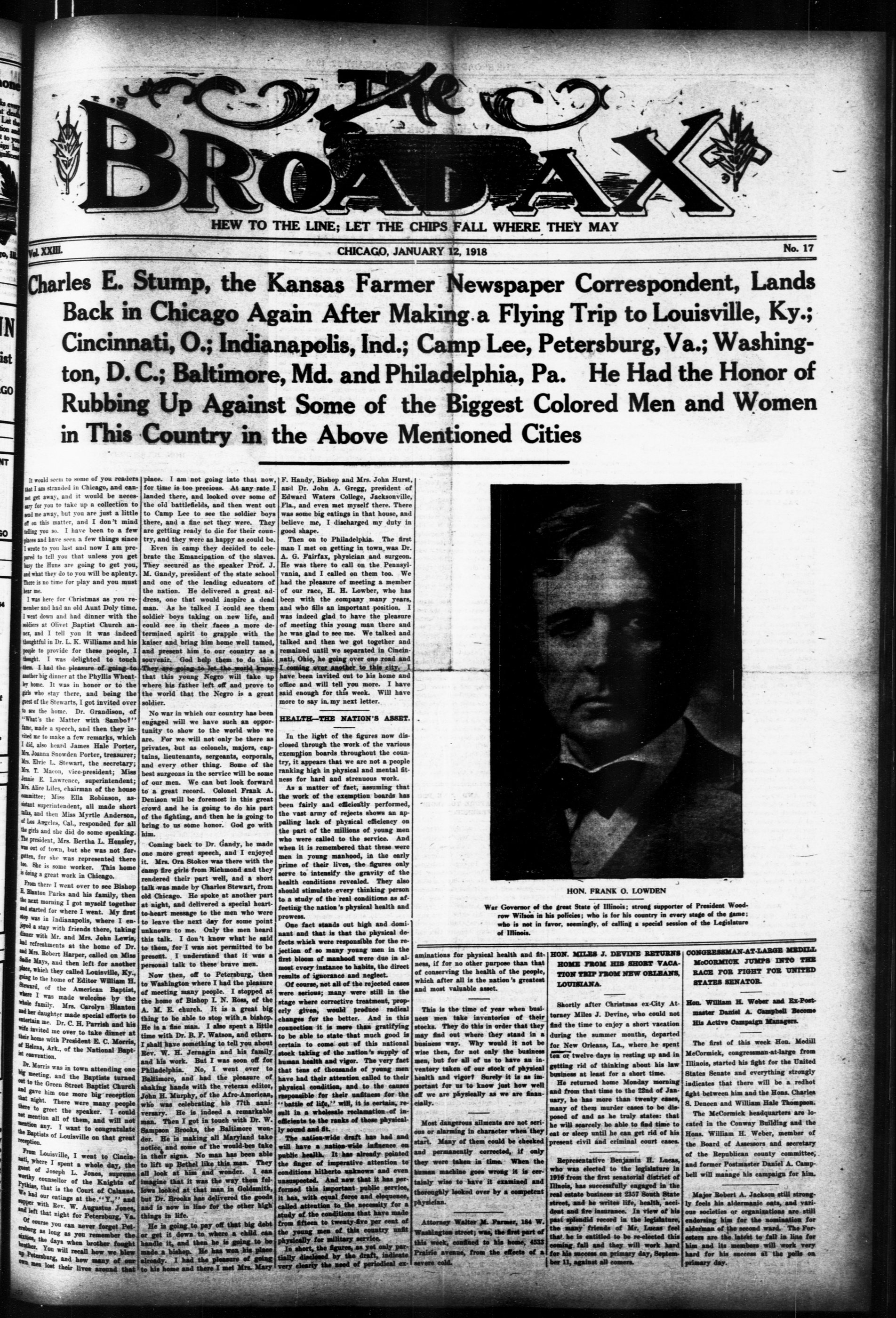
Charles E. Stump, the Kansas Farmer Newspaper Correspondent, Lands Back in Chicago Again After Making a Flying Trip to Louisville, Ky.; Cincinnati, O.; Indianapolis, Ind.; Camp Lee, Petersburg, Va.; Washington, D. C.; Baltimore, Md. and Philadelphia, Pa. He Had the Honor of Rubbing Up Against Some of the Biggest Colored Men and Women in This Country in the Above Mentioned Cities
Vol. XXIII.
It would seem to some of you readers that I am stranded in Chicago, and cannot get away, and it would be necessary for you to take up a collection to send me away, but you are just a little off on this matter, and I don't mind telling you so. I have been to a few places and have seen a few things since I wrote to you last and now I am prepared to tell you that unless you get busy the Huns are going to get you, and what they do to you will be aplenty. There is no time for play and you must hear me.
I was here for Christmas as you remember and had an old Aunt Doly time. I went down and had dinner with the soldiers at Olivet Baptist Church anner, and I tell you it it was indeed thoughtful in Dr. L. K. Williams and his people to provide for these people, I thought. I was delighted to touch them. I had the pleasure of going to another big dinner at the Phyllis Wheatley home. It was in honor or to the girls who stay there, and being the guest of the Stewarts, I got invited over to see the home. Dr. Grandison, of "What's the Matter with Sambo?" fame, made a speech, and then they invited me to make a few remarks, which I did, also heard James Hale Porter, Mrs. Joanna Snowden Porter, treasurer; Mrs. Elvie L. Stewart, the secretary; Mrs. T. Macon, vice-president; Miss Jennie E. Lawrence, superintendent; Mrs. Alice Liles, chairman of the house committee; Miss Ella Robinson, assistant superintendent, all made short talks, and then Miss Myrtle Anderson, of Los Angeles, Cal., responded for all the girls and she did do some speaking. The president, Mrs. Bertha L. Hensley, was out of town, but she was not forgotten, for she was represented there too. She is some worker. This home is doing a great work in Chicago.
From there I went over to see Bishop H. Blanton Parks and his family, then the next morning I got myself together and started for where I went. My first stop was in Indianapolis, where I enjoyed a stay with friends there, taking dinner with Mr. and Mrs. John Lewis, and refreshments at the home of Dr. and Mrs. Robert Harper, called on Miss Sadie Mays, and then left for another place, which they called Louisville, Ky., going to the home of Editor William H. Steward, of the American Baptist, where I was made welcome by the whole family. Mrs. Carolyn Blanton and her daughter made special efforts to entertain me. Dr. C. H. Parrish and his wife invited me over to take dinner at their home with President E. C. Morris, of Helena, Ark., of the National Baptist convention.
Dr. Morris was in town attending one big meeting, and the Baptists turned out to the Green Street Baptist Church and gave him one more big reception that night. There were many people there to greet the speaker. I could not mention all of them, and will not mention any. I want to congratulate the Baptists of Louisville on that great reception.
From Louisville, I went to Cincinnati, where I spent a whole day, the guest of Joseph L. Jones, supreme worthy counselor of the Knights of Pythias, that is the Court of Calanne. We had our catings at the "Y." and supper with Rev. W. Augustus Jones, and left that night for Petersburg, Va. Of course you can never forget Petersburg as long as you remember the sixties, the days when brother fought brother. You will recall how we blew up Petersburg, and how many of our own men lost their lives around that
place. I am not going into that now, for time is too precious. At any rate I landed there, and looked over some of the old battlefields, and then went out to Camp Lee to see the soldier boys there, and a fine set they were. They are getting ready to die for their country, and they were as happy as could be. Even in camp they decided to celebrate the Emancipation of the slaves. They secured as the speaker Prof. J. M. Gandy, president of the state school and one of the leading educators of the nation. He delivered a great address, one that would inspire a dead man. As he talked I could see them soldier boys taking on new life, and could see in their faces a more determined spirit to grapple with the kaiser and bring him home well tamed, and present him to our country as a souvenir. God help them to do this. They are going to let the world know that this young Negro will take up where his father left off and prove to the world that the Negro is a great soldier.
No war in which our country has been engaged will we have such an opportunity to show to the world who we are. For we will not only be there as privates, but as colonels, majors, captains, lieutenants, sergeants, corporals, and every other thing. Some of the best surgeons in the service will be some of our men. We can but look forward to a great record. Colonel Frank A. Denison will be foremost in this great crowd and he is going to do his part of the fighting, and then he is going to bring to us some honor. God go with him.
Coming back to Dr. Gandy, he made one more great speech, and I enjoyed it. Mrs. Ora Stokes was there with the camp fire girls from Richmond and they rendered their part well, and a short talk was made by Charles Stewart, from old Chicago. He spoke at another part at night, and delivered a special heart-to-heart message to the men who were to leave the next day for some point unknown to me. Only the men heard this talk. I don't know what he said to them, for I was not permitted to be present. I understand that it was a personal talk to these brave men.
Now then, off to Petersburg, then to Washington where I had the pleasure of meeting many people. I stopped at the home of Bishop I. N. Ross, of the A. M. E. church. It is a great big thing to be able to stop with a bishop. He is a fine man. I also spent a little time with Dr. B. F. Watson, and others. I shall have something to tell you about Rev. W. H. Jernagin and his family and his work. But I was soon off for Philadelphia. No, I went over to Baltimore, and had the pleasure of shaking hands with the veteran editor, John H. Murphy, of the Afro-American, who was celebrating his 77th anniversary. He is indeed a remarkable man. Then I got in touch with Dr. W. Sampson Brooks, the Baltimore wonder. He is making all Maryland take notice, and some of the would-bes take in their signs. No man has been able to lift up Bethel like this man. They all look at him and wonder. I can imagine that it was the way they fellows looked at that man in Goldsmith, but Dr. Brooks has delivered the goods and is now in line for the other high things in life.
He is going to pay off that big debt or get it down to where a child can handle it, and then he is going to be made a bishop. He has won his place already. I had the pleasure of going to his home and there I met Mr. Mary
F. Handy, Bishop and Mrs. John Hurst, and Dr. John A. Gregg, president of Edward Waters College, Jacksonville, Fla., and even met myself there. There was some big eatings in that house, and believe me, I discharged my duty in good shape.
Then on to Philadelphia. The first man I met on getting in town was Dr. A. G. Fairfax, physician and surgeon. He was there to call on the Pennsylvania, and I called on them too. We had the pleasure of meeting a member of our race, H. H. Lowber, who has been with the company many years, and who fills an important position. I was indeed glad to have the pleasure of meeting this young man there and he was glad to see me. We talked and talked and then we got together and remained until we separated in Cincinnati, Ohio, he going over one road and I coming over another to this city. I have been invited out to his home and office and will tell you more. I have said enough for this week. Will have more to say in my next letter.
HEALTH-THE NATION'S ASSET
In the light of the figures now disclosed through the work of the various exemption boards throughout the country, it appears that we are not a people ranking high in physical and mental fitness for hard and strenuous work. As a matter of fact, assuming that the work of the exemption boards has been fairly and efficiently performed, the vast army of rejects shows an appalling lack of physical efficiency on the part of the millions of young men who were called to the service. And when it is remembered that these were men in young manhood, in the early prime of their lives, the figures only serve to intensify the gravity of the health conditions revealed. They also should stimulate every thinking person to a study of the real conditions as affecting the nation's physical health and prowess.
One fact stands out high and dominant and that is that the physical defects which were responsible for the rejection of so many young men in the first bloom of manhood were due in almost every instance to habits, the direct results of ignorance and neglect.
Of course, not all of the rejected cases were serious; many were still in the stage where corrective treatment, properly given, would produce radical changes for the better. And in this connection it is more than gratifying to be able to state that much good is certain to come out of this national stock taking of the nation's supply of human health and vigor. The very fact that tens of thousands of young men have had their attention called to their physical condition, and to the causes responsible for their unfitness for the "battle of life," will, it is certain, result in a wholesale reclamation of inefficients to the ranks of these physically sound and fit.
The nation-wide draft has had and will have a nation-wide influence on public health. It has already pointed the finger of imperative attention to conditions hitherto unknown and even unsuspected. And now that it has performed this important public service, it has, with equal force and eloquence, called attention to the necessity for a study of the conditions that have made from fifteen to twenty-five per cent of the young men of this country unit physically for military service.
In short, the figures, as yet only partially disclosed by the draft, indicate very clearly the need of periodical ex-
[Image of a man in a suit with a bow tie].
War Governor of the great State of Illinois; strong supporter of President Woodrow Wilson in his policies; who is for his country in every stage of the game; who is not in favor, seemingly, of calling a special session of the Legislature of Illinois.
aminations for physical health and fitness, if for no other purpose than that of conserving the health of the people, which after all is the nation's greatest and most valuable asset.
This is the time of year when business men take inventories of their stocks. They do this in order that they may find out where they stand in a business way. Why would it not be wise then, for not only the business men, but for all of us to have an inventory taken of our stock of physical health and vigor? Surely it is as important for us to know just how well off we are physically as we are financially.
Most dangerous ailments are not serious or alarming in character when they start. Many of them could be cheeked and permanently corrected, if only they were taken in time. When the human machine goes wrong it is certainly wise to have it examined and thoroughly looked over by a competent physician.
Attorney Walter M. Farmer, 184 W. Washington street; was, the first part of this week, confined to his home, 4533 Prairie avenue, from the effects of a severe cold.
the great State of Illinois; strong supporter his policies; who is for his country in eve favor, seemingly, of calling a special sessi
HON. MILES J. DEVINE RETURNS HOME FROM HIS SHORT VACATION TRIP FROM NEW ORLEANS, LOUISIANA.
Shortly after Christmas ex-City Attorney Miles J. Devine, who could not find the time to enjoy a short vacation during the summer months, departed for New Orleans, La., where he spent ten or twelve days in resting up and in getting rid of thinking about his law business at least for a short time.
He returned home Monday morning and from that time to the 22nd of January, he has more than twenty cases, many of them murder cases to be disposed of and as he truly states: that he will scarely be able to find time to eat or sleep until he can get rid of his present civil and criminal court cases.
Representative Benjamin H. Lucas, who was elected to the legislature in 1916 from the first senatorial district of Illinois, has successfully engaged in the real estate business at 2357 South State street, and he writes life, health, accident and fire insurance. In view of his past splendid record in the legislature, the many friends of Mr. Lucas feel that he is entitled to be re-elected this coming fall and they will work hard for his success on primary day, September 11, against all comers.
No.17
CONGRESSMAN-AT-LARGE MEDILL
McCORMICK JUMPS INTO THE
RACE FOR FIGHT FOR UNITED
STATES SENATOR.
Hon. William H. Weber and Ex-Post-
master Daniel A. Campbell Become
His Active Campaign Managers.
The first of this week Hon. Medill
McCormick, congressman-at-large from
Illinois, started his fight for the United
States Senate and everything strongly
indicates that there will be a redhot
fight between him and the Hons. Charles
S. Deneen and William Hale Thompson.
The McCormick headquarters are
located in the Conway Building and the
Hons. William H. Weber, member of
the Board of Assessors and secretary
of the Republican county committee;
and former Postmaster Daniel A. Campbell
will manage his campaign for him.
Major Robert A. Jackson still strongly feels his aldermanic oats, and various societies or organizations are still enduring him for the nomination for alderman of the second ward. The Foresters are the latest to fall in line for him and its members will work very hard for his success at the polls on primary day.
er . - ciara atin LS ee
rare * < =
oe t 4
"1 7
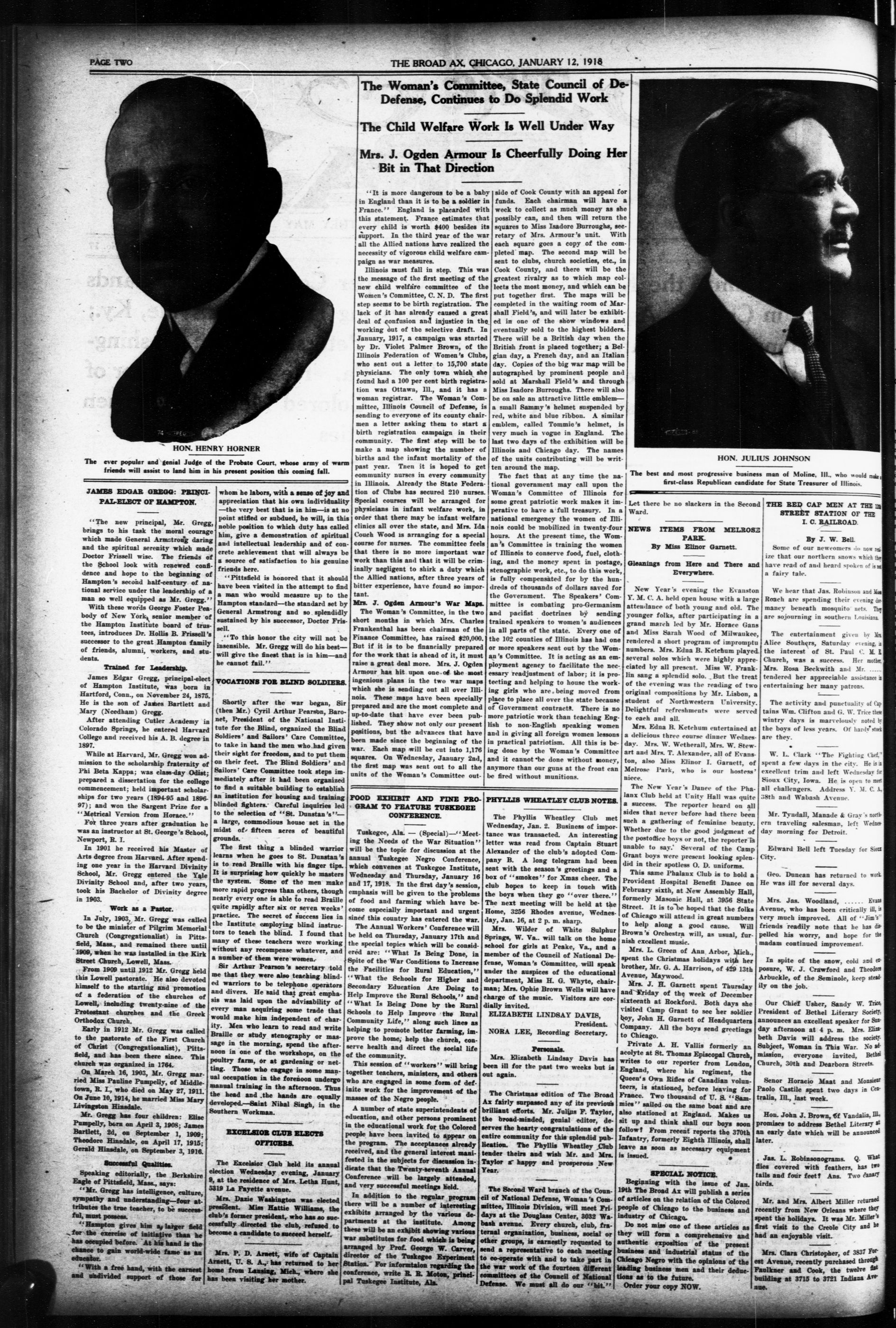
~~ HON. HENRY HORNER
The ever populer and genial Judge of the Probate Court, whose army of warm
friends will assist to land him in his present position this coming fall.
ee
JAMES EDGAR GREGG: PRINCI- | whom he labors, with a sense of joy and
PAL-ELECT OF HAMPTON. appreciation that his own individuality
“The new principal, Mr. Gregg,
brings to his task the moral courage
which made General Armstroug daring
and the spiritual serenity which made
Doctor Frissell wise. The friends of
the Sehool look with renewed conf
dence and hope to the beginning of
Hampton’s second half-century of na-
tional service under the leadership of a
man so well equipped as Mr. Gregg.’’
With these words George Foster Pea-
body of New York, senior member ‘of
the Hampton Institute board of trus-
tees, introduces Dr. Hollis B. Frissell’s
successor to the great Hampton family
of friends, alumni, workers, and stu-
dents. ™:
‘Trained for Leadership.
James Edgar Gregg, principal-elect
of Hampton Institute, was born in
Hartford, Conn., on November 24, 1875.
He is the son of Jahes Bartlett and
Mary (Needham) Gregg.
After attending Cutler Academy in
Colorado Springs, he entered Harvard
College and received his A. B. degree in
1897. :
While at Harvard, Mr. Gregg won ad-
mission to the scholarship fraternity of
Phi Beta Kappa; was clase-day Odist;
Prepared a dissertation for the college
commencement; held important scholar-
ships for two years (1894-95 and 1896-
97); and won the Sargent Prize for a
“‘Metrical Version from Horace.’
Fok three years after graduation he
was an instruetor at St. George's School,
Newport, R. I.
In 1901 he received his Master of
Arts degree from Harvand. After spend-||
ing one year in the Harvard Divinity ||
School, Mr. Gregg entered the Yale],
Divinity School and, after two years, | '
took his Bachelor of Divinity degree | '
in 1903.
. Work as a Pastor. ,
In July, 1903, Mr. Gregg was called |
to be the minister of Pilgrim Memorial ;
Church (Congregationalist) in Pitts-|\
Geld, Mass, and remained there until]
1900, when he was installed in the Kirk ||
Street Church, Lowell, Mass.
From 1909 until 1912 Mr. Gregg held]
this Lowell pastorate. He also devoted |
himself to the starting and promotion |
of_& federation of the churches of |.
Lowell, incinding twenty-nine of the |
Protestant ehurehes and the Greek |.
Orthodox Church. i
Early in 1912 Mr. Gregg was called]
@ the pastorate of the First Chureh| ,
t Christ (Congregationalist), Pitts-| »
icld, and has been there since. This |
hareh was organized in 1764. t
On March 16, 1903, Mr. Gregg mar-|
ied Miss Pauline Pumpelly, of Middle-| ,
own, R. I, who died on May 27, 1911.| ¢
ma June 10, 1914, he married Miss Mary | 4
ivingston Hinsdale. 8
‘Mr. Gregg has four children: Elise
"ampelly, bern on April 3, 1908; James
jartlett, 2d, on September 1, 1909;
theodore Hinsdale, om April 17, 1915;
jerald Hinsdale, on September 3, 1916.
‘Successful Qualities. j
Speaking editorially, the Berkshire
iagle of Pittsficld, Mase, says: P
“Mz. Gregg has intelligence, culture,
ympathy and understanding—four at-
ributes the true teacher, to be suecess-|
ul, must possess, * |
{Bampton gives hint ay lager ‘feta |
or the exercise See
as occupied before. A und is the} |
sance to gain world-wide fame as an
Sl MN gy eae a
pte ok ten sic
a wedivided support of those for| bs
RE Re:
PAGE TWO
whom he labors, with a sense of joy and
appreciation that his own individuality
—the very best that is in him—is at no
point stifled or subdued, he will, in this
noble position to whieh duty has called
him, give « demonstration of spiritual
and intellectual leadership and of con-
crete achievement that will always be
4 souree of satisfaction to his genuine
friends here.
“Pittsfield is honored that it should
have been visited in the attempt to find
@ man who would measure up to the
‘Hampton standard—the standard set by
General Armstrong and so. splendidly
sustained by his successor, Doctor Fris-
sell.
To this honor the city will not be
insensible, Mr. Gregg will do his best—
‘will give the finest that is in him—and
he cannot fail.’
VOCATIONS FOR BLIND SOLDIERS.
Shortly after the war began, 8i
(then Mr.) Cyril Arthur Pearson, Baro
net, President of the National Insti
tute for the Blind, organized the Blind
Soldiers’ and Sailors’ Care Committee
to take in hand the men who.had giver
their sight for freedom, and to put them
‘on their feet. The Blind Soldiers’ and
Sailors’ Care Committee took steps im
mediately after it had been organized
to find 2 suitable building to establish
an institution for housing and training
blinded fighters.’ Careful inquiries led
to the seleetion of St. Dunstan’s’’—
@ large, commodious house set in the
midst of- fifteen acres of beautiful
grounds, 5
The first thing a blinded warrior
learns when he goes to St. Dunstan’s
is to read Braille with his finger tips.
It is surprising how quickly he masters
the system. Some of the men make
more rapid progress than others, though
nearly every one is able fo read Braille
quite rapidly after six or seven weeks’
practice. The secret of success lies in
the Institute employing blind instrue-
tors to teach the blind. I found that
many of these teachers were working
without any recompense whatever, and
a number of them were women-
Sir Arthur Pearson’s seeretary told
me that they were also teaching blind-
ed warriors to be telephone operators
and divers. He said that great empha-
is was laid upon the advisability of
very man aequiring some trade that
would make him independent of char-
ty. Men who learn to read and write
Braille or study stenography or mas-
age in the morning, spend the after-
100n in one of the workshops, on the
oultry farm, or at gardening or net-
ing. Those who engage in some man-
al occupation in the foreioon undergo
sanual training in the afternoon. Thus
he head and the hands are equally
eveloped—Baint Nibal Singh, in the
jouthern Workman.
‘EXCELSIOR CLUB ELECTS
OFFICERS.
The Excelsior Club held its annual
election Wednesday evening, January
&, at the residence of Mrs. Letha Hunt,
5819 La Payette avenue.
‘Mrs. Dazie Washington was elected
President. Miss Hattie Williams, the
elub’s former president, who has 40 suc-
cessfully direeted the elub, refused to
become a candidate to sueceed herself.
Mrs. P. D. Amett, wife of Captain
Amett, U.S. A,:has returned to her
home from Lansing, Mich, where she
has been visiting her mother.
THE BROAD AX, GHICAGO, JANUARY 12, 1918
———————_——————————————————— =
The Woman's Cieieiiton, State Couell of De
| Defense, Continues to Do Splendid Work
The Child Welfare Work Is Well Under Way
Mrs. J. Ogden Armour Is Cheerfully Doing Her
Bit in That Direction
“It is more dangerous to be a babs
in England than it is to be a soldier ir
France.’” England is placarded witt
this statement. France estimates that
every child is worth $400 besides its
support. In the third year of the war
|all the Allied nations have realized the
necessity of vigorous child welfare cam-
paign as war measures.
Illinois must fall in step. This was
the message of the first meeting of the
new child welfire committee of the
Women’s Committee, C..N. D. The first
step seems to be birth registration. The
lack of it has already caused a great
deal of —— and injustice in the
‘working dut of the selective draft. In
January, 1917, a campaign was started
by Dr. Violet Palmer Brown, of the
Illinois Federation of Women’s Clubs,
who sent out a letter to 15,700 state
physicians. The only town which she
found had a 100 per cent birth registra-
tion was Ottawa, IIL, and it has a
woman registrar. The Woman’s Com-
mittee, Illinois Council of Defense, is
sending to everyone of its county chair-
men a letter asking them to start «
birth registration campaign in their
community. The first step will be to
make a map showing the number of
births and the infant mortality of the
past year. Tnen it is hoped to get
community nurses in every community
in Illinois. Already the State Federa-
tion of Clubs has secured 210 nurses.
Special courses will be arranged for
physicians in infant welfare work, in
order that there may be infant welfare
clinies all over the state, and Mrs. Ida
Couch Wood 1s arranging for a special
course for nurses. The committee feels
that there is no more important war
work than this and that it will be crim-
inally negligent to shirk a duty which
the Allied nations, after three years of
pitter experience, have found so impor-
tant.
irs. J. Ogden Armour’s War Maps.
The Woman’s Committee, in the two
hort months in which Mrs. Charles
Prankenthal has been chairman of the
Finance Committee, has raised $20,000.
But if it is to be financially prepared
or the work that is ahead of it, it must
aise @ great deal more. Mrs. J. Ogden
\rmour has hit upon one.of the most
ngenious plans in the two war maps
rhieh she is sending out all over Ili-
ois. These maps have been specially |
repared and are the most complete and |,
p-to-date that have ever been pub-|
shed. They show not only our present |
esitions, but the advances that have,
een made since the beginning of the |
rar. Each map will be cut into 1,176|
quares. On Wednesday, January 2nd, | ;
he first map was sent out to all the:
nits of the Woman’s Committee out- ||
FOOD EXHIBIT AND FINE PRO.
GRAM TO FEATURE TUSKEGEE
CONFERENCE.
Tuskegee, Ala. — (Special) —‘‘ Meet-
ing the Needs of the War Situation”
will be the topie for discussion at the
annual Tuskegee Negro Conference,
which convenes at Tuskegee Institute,
Wednesday and Thursday, January 16
and 17, 1918. In the first day’s session,
emphasis will be given to the problems
of food and farming which have be-
come especially important and urgent
sineé this country has entered the war.
The Annual Workers’ Conference will
be held on Thursday, January 17th and
the special topics which will be consid-
eréd are: ‘What Is Being Done, in
Spite of the War Conditions to Inerease
the Facilities for Rural Edueation,”?
“What the Schools for Higher and
Secondary Education Are Doing to
Help Improve the Rural Sehools,’? and
“What Is Being Done by the Rural
Schools to Help Improve ‘the Rural
Community Life,’ along such linee as
helping to promote better farming, im-
prove the home; help the church, eon-
serve health and direct the social life
of the community.
This session of ‘workers’? will bring
together teachers, ministers, and others
who are engaged in some form of def-
inite work for the improvement of the
masses of the Negro people.
A number of state superintendents of
edueation, and other persons prominent
in the educational work for the Colored
people have been invited to appear on
the program. The acceptances already
received, and the general interest mani-
fested in the subjects for discussion in-
fieate that the Twenty-seventh Annual
Conference will be largely attended,
ind very successful meetings Keld.
In addition to the regular program
here will be a number of interesting
xhibits arranged by the various de-
artments at the institute. Among
hese will be an exhibit showing various
rar substitutes for food whiel is being
ranged by Prof. George W. Carver,
rector of the Tuskegee
tation. For informtaion regarding the |
onference, write R. = .
al Tuskegee Institute, Ala st
‘side of Cook County with an appeal for
fands. Each chairman will have a
‘week to collect as much money as she
possibly can, and then will return the
squares to Miss Isadore Burroughs, sec-
retary of Mrs. Armour’s unit. With
each square goes a copy of the com-
pleted’ map. The seeond map will be
sent to clubs, church societies, ete., in
Cook County, and there will be the
greatest rivalry as to which map col-
lets the most money, and whieh can be
put together first. The maps will be
completed in the waiting room of Mar-
shall Field’s, and will later be exhibit-
ed im one of the show windows and
eventually sold to the highest bidders.
There will be a British day when the
British front is placed together; a Bel-
gian day, a French day, and an Italian
day. Copies of the big war map will be
autographed by prominent people and
sold at Marshall Field's and through
‘Miss Isadore Burroughs. There will also
be on sale an attractive little emblem—
a small Sammy’s helmet suspended by
red, white and blue ribbon. A similar
emblem, called Tommic’s helmet, is
very much in vogue in England. The
last two days of the exhibition will be
Mlinois and Chieago day. The names
of the units contributing will be writ-
ten around the map.
‘The fact that at any time the na-
tional government may call upon the
Woman’s Committee of Illinois for
some great patriotic work makes it im-
perative to have a‘full treasury. In a
national emergency the women of Illi-
nois could be mobilized in twenty-four
hours. At the present time, the Wom-
an’s Committee is training the women
of Illinois to conserve food, fuel, eloth-
ing, and the money spent in postage,
stenographie work, ete., to do this work,
is fully compensated for by the hun-
dreds of thousands of dollars saved for
the Government. The Speakers’ Com-
mittee is combating pro-Germanism
and pacifist doctrines by sending
jrained speakers to women’s audiences
in all parts of the state. Every one of
fhe 102 counties of Ilinois has had one
or more speakers sent out by the Wom- |
un ’s Committee. It is acting as an em-|,
sloyment ageney to facilitate the nee-|,
ssary readjustment of Iabor; it is pro- |)
ecting and helping to house the work- |.
ng girls who are. being moved from].
lace to place all over the state because |
f Government contract’. There is no |
nore patriotic work than teaching Eng-|
ish to non-English speaking women
nd in giving all foreign women lessons |
m practical patriotism. All this is be- |<
mg done by the Woman’s Committee |
nd it cannot “be done without money, | t
nymore than our guns at the front can |}
¢ fired without munitions. "
PHYLLIS WHEATLEY CLUB NOTES
The Phyllis Wheatley Club met
Wednesday, Jan. 2. Business of impor.
tance was transacted. An interesting
letter was read from Captain Stuart
Alexander of the elub’s adopted Com-
pany B. A long telegram had been
sent with the season’s greetings and a
box of ‘‘smokes’? for Xmas cheer. The
club hopes to keep in touch with
the boys when they go ‘‘over there.”?
The next meeting will be held at the
Home, 3256 Rhodes avenue, Wednes-
day, Jan. 16, at 2p. m. sharp.
‘Mrs. Wilder of White Sulphur
Springs, W. Va... will talk on the home
school for girls at Peake, Va, and a
member of the Couneil of National De-
fense, Woman’s Committee, will speak
under the auspices of the educational
department, Miss H. G. Whyte, chair-
man; Mrs. Ophie Brown Wells will have
charge of the music. Visitors are cor-
dially invited.
ELIZABETH LINDSAY DAVIS,
President. |
NORA LEE, Recording Secretary.
Personals. 1
Mrs. Elizabeth Lindsay Davis has
been ill for the past two weeks but is
out again.
‘The Christmas edition of The Broad
Ax fairly surpassed any of its previous
brilliant efforts. Mr. Jolins P. Taylor,
‘the broad-minded, genial editor, de-
serves the hearty congratulations of the
entire community for this splendid pab-
Hieation. The Phyllis Wheatley Club
tender theirs and wish Mr. and Mrs.
Taylor x happy and prosperous New
Year.
‘The Second Ward branch of the Coun-
¢il of National Defense, Womans Com-
mittee, Tilinois Division, will meet Fri-
days at the Douglass Center, 3032 Wa-
bash avenue. Every chureh, club, fra-
ternal organization, business, social or
other groups, is earnestly requested to
send a representative to cach meeting
to co-operate with and to take part in
the war work of the fourteen different
committees of the Council of ¥.
Defense. We must all do our ‘*bit.’?)
ie
“ail
‘- :
. ™ 4
HON. JULIUS JOHNSON
The best and most progressive business man of Moline, Ill., who would mae
first-class Republican candidate for State Treasurer of Illinois.
ESERIES —
Let there be no slackers in the Second| THE BED CAP MEN AT THE 2
Ward. STREET STATION OF TH
—— 1. ©. RAILROAD.
NEWS ITEMS FROM MELROSE ——
PARK. By J. W. Bel.
By Miss Elinor Garnett. Some of our neweomers slo now ra
— ize that our northern snows which the}
Gleanings from Here and There and have read of and hearil spoken of is
Everywhere. a alan Gales
New Year's evening the Evanston
¥. M.C. A. held open house with a large
attendance of both young and old. The
Younger folks, after participating in a
grand march led by Mr. Horace Gans
and Miss Sarah Wood of Milwaukee,
rendered a short program of impromptu
numbers. Mrs. Edna B. Ketehum played
several solos which were highly appre-
ciated by all present. Miss W. Prank-
lin sang a splendid solo. But the treat
of the evening was the reading of two
original compositions by Mr. Lisbon, a
student of Northwestern University.
Delightful refreshments were served
to each and all.
Mrs. Edna B. Ketchum entertained at
4 delicious three course dinner Wednes-
day. Mrs. W. Wetherall, Mrs. W. Stew-
art and Mrs. T. Alexander, all of Evans-
ton, also Miss Elinor I. Garnett, of
Melrose Park, who is our hostess’
niece.
The New Year's Dance of the Pha-
lanx Club held at Unity Hall was quite
& success. The reporter heard on all
sides that never before had there been
sueh a gathering of feminine beauty.
Whether due to the good judgment of
the postoftice boys or not, the reporter is
unable to say.’ Several of the Camp
Grant boys were present looking splen-
did in their spotless O. D. uniforms.
This same Phalanx Club is to hold a
Provident Hospital Benefit Dance on
February sixth, at New Assembly Hall,
formerly Masonic Hall, at 3956 State
Street. It is to be hoped that the folks
of Chieago will attend in great numbers
to help along a good cause. Will
Brown’s Orchestra will, as usual, fur-
mish excellent music.
Mrs. L. Green of Ann. Arbor, Mich.,
spent the Christmas holidays —_ her
brother, Mr. G. A. Harrison, of 499 13th
Avenue, Maywood.
‘Mrs. J. H. Garnett spent Thursday
and“Sriday of the week of December
ixteenth at Rockford. Both days she
risited Camp Grant to see her soldier
ey, John H. Garnett of Headquarters |
ompany. All the boys send greetings |
0 Chieago.
Private A. H. Vallis formerly an |!
colyte at St. Thomas Episcopal Chereb, |
rrites to our reporter from London, |'
England, where his regiment, the
dueen‘s Own Rifles of Canadian volun- ;
cers, is stationed, before leaving for
‘rance. Two thousand of U. 8. ‘‘Sam-|'
nies’? sailed on the same boat and are
iso stationed at England. Makes us
it up and think shall our boys soon |}
ollowt From reeent reports the 370th |
nfantry, formerly Eighth Mlinois, shall |
eave as soon as necessary equipment
s issued. a
Segipuing with the issue of Jan.
19th The Broad Ax will publish a series
of articles on the relation of the Colored
people of Chieago to the business and
industry of Chicaga.
Do not miss one of these articles as
they will form a comprehensive and
authentic exposition of the present
business and industrial status of the
Chicago Negro with the opinions of the
leading business men and their dedue-
tions as to the futare. :
Order your copy NOW.
SPECIAL NOTICE
THE RED CAP MEN AT THE
STREET STATION OF TH
IL. C. RAILROAD.
Some of our neweomers ‘iv now rel}
ize that our northern snows whieh th
have read of and heard spoken of is
a fairy tale.
‘We hear that Jas. Robiusou and
Roach are spending their evening dw
mancy beneath mosquito nets Th
are sojourning in southern louisiana
The entertainment given by Mn
Alice Southers, Saturday evening, a
the interest of St. Paul (. ME
Church, was a success. Her mothe,
Mrs. Rosa Beckwith and Mr. ....
tendered her appreciable assistance
entertaining her many patrons.
The activity and punctuality of Gp
tains Wm. Clifton and G. W. Trice te
wintry days is marvelously noted b
‘the boys of less years. Of haris’ stock
are they.
W. L. Clark ‘‘The Fighting chef”
spent a few days im the city. He isi
exellent trim and left Weinesiay fi
Sioux City, Towa. He is open to met
all challengers. Address Y. M. C
38th and Wabash Avenue.
Mr. Tyndall, Manade & Gray's noth
ern traveling salesman, left Weise
day morning for Detroit. ~
Edward Bell left Tuesday for Siot
City.
Geo. Duncan has returned to wott
‘He was ill for several days.
‘Mrs. Jas. Woodland, ...... Eras
Avenue, who has been critically ill,#
very much improved. All of “Jim's”
friends readily note that he has &
pelled his worry, and hope for tit
madam continued improvement.
In spite of the snow, cold and &
Posure, W. J. Crawford and Theodst
Arbuckle, of the Seminole, keep stest
ily om the job.
Our Chief Usher, Sandy W. Trish
President of Bethel Literary Societh
announces an excellent speaker for Sot
day afternoon at 4 p. m. Mrs. Blit
beth Davis will address the societ?
Subject, Woman in This War. Nos
mission, everyone invited, Bethel
Chureh, 30th and Dearborn Streets.
Senor Horacio Maat and Monsiet
Paolo Castile spent two days in Ce
tralia, IIL, last week.
Hon. John J. Brown, 6f Vandalia, I,
Promises to address Bethel Literary #
‘an early date whieh will be announeél
i
. Jas. L. Robinsonograms. Q. Wht
flies covered with feathers, has '¥?
tails and four feet? Ans. Two (2087
birds. i
‘Mr, and Mrs Albert Miller retorsel
reeently from New Orleans where the!
spent the holidays. It was Mr. Miller’*
first visit to the Creole City asd
had an enjoyable visit.
‘Mrs. Clara Christopher, of 3837 For
est Avenue, recently purchased throat!
Paulkner and Cook, the twelve
building at 3715 to 3721 Indiana Ae
Tree e
By J. W Rell
. nea Ee ae ee es
eS Sere ” ees P eres :
3
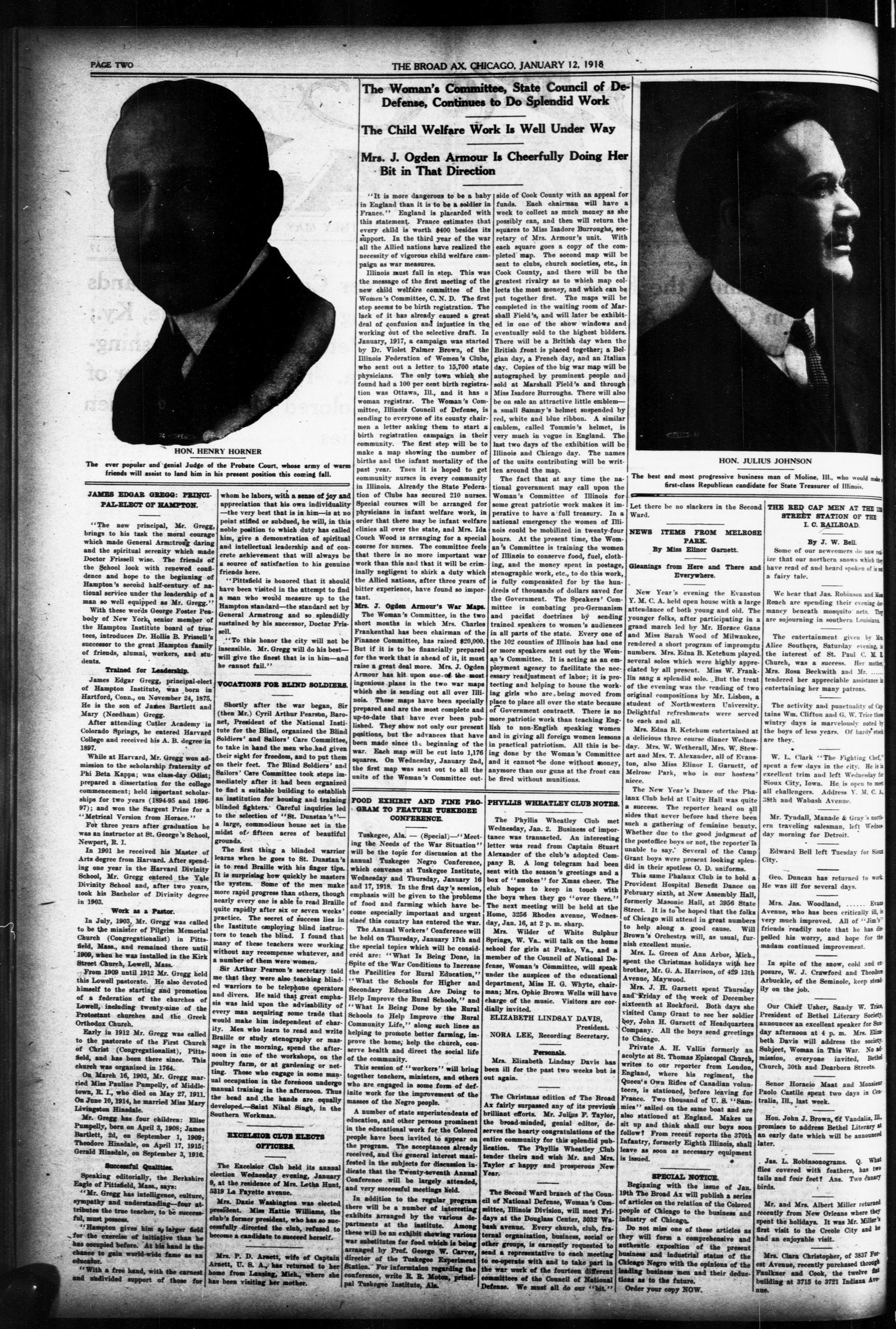
_ HON. HENRY HORNER
The ever popular and genial Judge of the Probate Court, whose army of warm
friends will assist to land him in his present position this coming fall.
———
JAMES EDGAR GREGG: PRINCI. | whom he labors, with a sense of joy and
PAL-ELECT OF HAMPTON. appreciation that his own individuality
“The new principal, Mr. Gregg,
brings to his task the moral courage
which made General Armctroug daring
and the spiritual serenity which made
Doctor Frissell wise. The friends of
the Sehool look with renewed conf
dence and hope to the beginning of
Hampton’s secoind half-century of na-
tional service under the leadership of a
man so well equipped as Mr. Gregg.’?
With these words George Foster Pea-
body of New York, senior member ‘of
the Hampton Institute board of trus-
tees, introduces Dr. Hollis B. Frissell’s
successor to the great Hampton family
of friends, alumni, workers, and stu-
dents. %
‘Trained for Leadership.
James Edgar Gregg, prineipal-elect
of Hampton Institute, was born in
Hartford, Conn., on November 24, 1875.
He is the son of Jabes Bartlett and
Mary (Needham) Gregg.
After attending Cutler Academy ‘in
Colorado Springs, he entered Harvard
College and received his A. B. degree in
1897. s
While at Harvard, Mr. Gregg won ad-
mission to the scholarship fraternity of
Phi Beta Kappa; was class-day Odist;
Prepared a dissertation for the college
commencement; held important scholar-
ships for two years (1894-95 and 1896-
97); and won the Sargent Prize for a
‘‘Metrieal Version from Horace.’”
Fok three years after graduation he
was an instructor at St. George's School,
Newport, R. I. !
In 1901 he received his Master of
Arts degree from Harvard. After spend-||
ing one year in the Harvard Divinity |’
School, Mr. Gregg entered the Ygle|
Divinity Sehool and, after two years, |
took his Bachelor of Divinity degree |'
in 1903. ;
. Work as = Pastor. b
In Jaly, 1903, Mr. Gregg was callea |!
0 be the minister of Pilgrim Memorial |
Churek (Congregationalist) in Pitts-| |
ield, Mass, and remained there untill
1900, when he was installed in the Kirk |
Street Church, Lowell, Mass.
From 1909 until 1912 Mr. Gregg beld|
his Lowell pastorate. He also devoted |
limself to the starting and promotion |,
if a federation of the churches of.
Lowell, including twenty-nine of the |
Protestant churehes and the Greek |,
Yrthedox Church. i
Early in 1912 Mr. Gregg was called|
o the pastorate of the First Chureh| .
f Christ (Congregationalist), Pitts-| ,
eld, and has been there sinee. This | 5
hureh was organized in 1764. r
On Mareh 16, 1903, Mr. Gregg mar-| 4
ied Miss Pauline Pumpelly, of Middie-| »
own, R. I., who died on May 27, 1911. | 4
a Fane 10, 1914, he married Miss Mary | 5
ivingston Hinsdale. 3
‘Mr. Gregg has four children: Elise
umpelly, bora on April 3, 1908; James
artlett, 24, on September 1, 1909;
heodore Hinsdale, on April 17, 1915;
eral Hinsdale, on September 3, 1916.
aes a
Speaking editorially, the Berkshire
agle of Pittfeld, Mase, says: :
“Mr. Grog has intelligence, culture,
rmpathy and understanding—four at.
ibutes the true teacher, to be success-|
i, must possess. * -
“Hampton gives hint ay lager ‘field
= Se ce of ei ane &
coeupied before: “At his hand is the| -
ance to gain world-wide fame as an|
gs: a eae gl
Tm sisoel
Hvided support of those for | hs
a ag es Renae ee gw
PAGE TWO
whom he labors, with a sense of joy and
appreciation that his own individuality
—the very best that is im him—is at nc
point stifled or subdued, he will, in this
noble position to which duty has called
him, give 2 demonstration of spiritual
and intellectual leadership and of con
erete achievement that will always be
4 souree of satisfaction to his genuine
friends here.
“Pittsfield is honored that it should
have been visited in the attempt to find
& man who would measure up to the
‘Hampton standard—the standard set by
General Armstrong and so. splendidly
sustained by his successor, Doctor Fris-
sell.
‘To this honor the city will not be
insensible. Mr. Gregg will do his best—
‘will give the finest that is in him—and
he cannot fail.’”
VOCATIONS FOR BLIND SOLDIERS.
Shortly after the war began, Si
(then Mr.) Cyril Arthur Pearson, Baro
net, President of the National Insti
tute for the Blind, organized the Blini
Soldiers’ and Sailors’ Care Committee
to take in hand the men who.had giver
their sight for freedom, and to put them
‘on their feet. The Blind Soldiers’ ani
Sailors’ Care Committee took steps im
mediately after it had been organized
to find 2 suitable building to establish
an institution for housing and training
blinded fighters” Careful inquiries led
to the selection of “St. Dunstan’s’—
& large, commodious house set in the
midst of fifteen acres of beautiful
grounds.
The first thing a blinded warrior
learns when he goes to St. Dunstan’s
is to read Braille with his finger tips.
It is surprising how quickly he masters
the system. Some of the men make
more rapid progress than others, though
nearly every one is able fo read Braille
quite rapidly after six or seven weeks’
practice. The secret of success lies in
the Institute employing blind instruc-
tors to teach the blind. I found that
many of these teachers were working
without any recompense whatever, and
a number of them were women,
Sir Arthur Pearson’s secretary told
me that they were also teaching blind-
ed warriors to be telephone operators
and divers. He said that great empha-
sis was laid upon the advisability of
every man aequiring some trade that
rould make him independent of ehar-
ity. Men who learn to read and write
Braille or study stenography or mas-
age in the morning, spend the after-
toon in one of the workshops, on the
youltry farm, or at gardening or net-
ing. Those who engage in some man-
ial occupation in the foreiioon undergo
sanual training in the afternoon. Thus
he head and the hands are equally
leveloped—Saint Nihal Singh, in the
jouthern Workman.
EXCELSIOR CLUB ELECTS
: OFFICERS.
The Excelsior Club held its annnal
election Wednesday evening, January
9, at the residence of Mrs. Letha Hunt,
5819 La Fayette avenue.
‘Mrs. Dazie Washington was elected
President. Miss Hattie Williams, the
¢lab’s former president, who has 20 suc-
consfully direeted the elub, refused to
become a candidate to succeed herself.
‘Mrs. P. D. Amett, wife of Csptain
Armett, U. S. A, has returned to her
home from Lansing, Mich, where she
has been visiting ber mother.
THE BROAD AX, 2 RR ts 12, 1918
The Woman's Committee, State Council of De
Defense, Continues to Do Splendid Work
The Child Welfare Work Is Well Under Way
Mrs. J. Ogden Armour Is Cheerfully Doing Her
- Bit in That Direction
“It is more dangerous to be s baby
in England than it is to be a soldier in
France.’? England is placarded wit!
this statement. France estimates that
every child is worth $400 besides its
Support. In the third year of the wat
all the Allied nations have realized the
necessity of vigorous child welfare cam
paign as war measures.
Illinois must fall in step. This was
the message of the first meeting of the
new child welfare committee of the
‘Women’s Committee, ©. N. D. The first
step seems to be birth registration. The
lack of it has already eaused a great
deal of confusion and injustice in the
working dut of the selective draft. In
January, 1917, a eampaign was started
by Dr. Violet Palmer Brown, of the
Illinois Federation of Women’s Clubs,
who sent out a letter to 15,700 state
physicians. The only town which she
found had a 100 per cent birth registra-
tion was Ottawa, IL, and it has a
woman registrar. The Woman’s Com-
mittee, Illinois Couneil of Defense, is
sending to everyone of its county chair-
men a letter asking them to start «
birth registration campaign in their
community. The first step will be to
make a map showing the number of
births and the infant mortality of the
past year. Tnen it is hoped to get
community nurses in every a
in Illinois, Already the State Federa-
tion of Clubs has secured 210 nurses. |
Special courses will be arranged for
physicians in infant welfare work, in
order that there may be infant welfare
clinies all over the state, and Mrs. Ida
Couch Wood 1s arranging for a special
course for nurses. The committee feels
that there is no more important war
work than this and that it will be crim-
inally negligent to shirk a duty which
the Allied nations, after three years of
bitter experience, have found so impor-
tant.
Mrs. J. Ogden Armour’s War Maps.
‘The Woman’s Committee, in the two
short months in which Mrs. Charles
Frankenthal has been chairman of the
Finance Committee, has raised $20,000.
But if it is to be financially prepared
for the work that is ahead of it, it must
aise a great deal more. Mrs. J. Ogden
Armour has hit upon one.of the most
ngenious plans in the two war maps
rhich she is sending out all over Iili-
ois. These maps have been specially
repared and are the most complete and
p-to-date that have ever been pub-
ished. They show not only our present
sitions, but the advances that have],
jeen made since th. beginning of the|
yar. Each map will be cut into 1,176| |
quares. On Wednesday, January 2nd,|,
he first map was sent out to all the |;
nits of the Woman’s Committee out- |
FOOD EXHIBIT AND FINE PRO
GRAM TO FEATURE TUSKEGEE
CONFERENCE.
Tuskegee, Ala. — (Special)—‘‘ Meet.
ing the Needs of the War Situation”
will be the topie for discussion at the
annual Tuskegee Negro Conference,
which convenes at Tuskegee Institute,
Wednesday and Thursday, January 16
and 17, 1918. In the first day’s session,
emphasis will be given to the problems
of food and farming which have be-
come especially important and urgent
sined this country has entered the war.
The Annual Workers’ Conference will
be held om Thursday, January 17th and
the special topies which will be consid-
eréd are: ‘What Is Being Done, in
‘Spite of the War Conditions to Increase
the Facilities for Rural Edueation,’’
‘What the Schools for Higher and
Secondary Education Are Doing to
Help Improve the Rural Sehools,’? and
“What Is Being Done by the Rural
Schools to Help Improve ‘the Rural
Community Life,’’ along such lines as
helping to proinote better farming, im-
prove the home; help the church, con-
serve health and direct the social life
of the community.
This session of ‘workers’? will bring
together teachers, ministers, and others
who are engaged in some form of def-
inite work for the improvement of the
masses of the Negro people.
A number of state superintendents of
education, and other persons prominent
in the educational work for the Colored
people have been invited to appear on
the program. The acceptances already
received, and the general interest mani-
fested im the subjects for discussion in-
dicate that the Twenty-seventh Annual
Conference will be largely attended,
and very successful meetings Held.
In addition to the regular program
here will be a number of interesting
rxhibits arranged by the various de-
yartments at the institute. Among
hese will be an exhjbit showing various
rar substitutes for food whiels is being |
ranged by Prof. George W. Carver,
lireetor of the Tuskegee Experin
kation.” For informtaion regat ing the
onference, write R. B. .
al Tuskegee Institute, Ala =~ it
side of Cook County with an appeal for
funds. Each chairman will have a
week to collect as much money as she
possibly can, and then will return the
squares to Miss Isadore Burroughs, sec-
retary of Mrs. Armour’s unit. With
each square goes a copy of the com-
pleted’ map. The second map will be
sent to clubs, church societies, ete., in
Cook County, and there will be the
greatest rivalry as to which map col-
leets the most money, and whieh can be
put together first. The maps will be
completed in the waiting room of Mar-
shall Field’s, and will later be exhibit-
ed im one of the show windows and
eventually sold to the highest bidders.
There will be a British day when the
British front is placed together; a Bel-
gian day, a French day, and an Italian
day. Copies of the big war map will be
autographed by prominent people and
sold at Marshall Field’s and through
Miss Isadore Burroughs. There will also
be on sale an attractive little emblem—
a small Sammy’s helmet suspended by
red, white and blue ribbon. A similar
emblem, called Tommio’s helmet, is
very mueh in vogue in England. The
last two days of the exhibition will be
Illinois and Chieago day. The names
of the units contributing will be writ-
ten around the map.
‘The fact that at any time the na-
tional government may call upon the
Woman’s Committee of Illinois for
some great patriotic work makes it im-
perative to have a‘full treasury. In a
national emergency the women of Illi-
nois could be mobilized in twenty-four
hours. At the present time, the Wom-
an’s Committee is training the women
of Illinois to conserve food, fuel, eloth-
img, and the money spent in postage,
stenographie work, etc., to do this work,
is fully compensated for by the hun-
dreds of thousands of dollars saved for
the Government. The Speakers’ Com-
mittee is combating pro-Germanism
and pacifist doctrines by sending
trained speakers to women’s audiences
in all parts of the state. Every one of
rhe 102 counties of Ilinois has had one
or more speakers sent out by the Wom-
an’s Committee. It is acting as an em-
ployment agency to facilitate the neec-}.
sssary readjustment of labor; it is pro-}
jecting and helping to house the work- |
ng girls who are,being moved from].
lace to place all over the state because |;
f Government contract’. There is no| |
nore patriotic work than teaching Eng- |
ish to non-English speaking women
nd in giving all foreign women lessons | ;
n practical patriotism. All this is be- |
ng done by the Woman’s Committee |
nd it cannot be done without money, |
nymore than our guns at the front can |
¢ fired without munitions. ,
PHYLLIS WHEATLEY CLUB NOTES.
The Phyllis Wheatley Club met
Wednesday, Jan. 2. Business of impor-
tance was transacted. An interesting
letter was read from Captain Stuart
Alexander of the club’s adopted Com-
pany B. A long telegram had been
sent with the season’s greetings and a
box of “‘smokes’’ for Xmas cheer. The
elub hopes to keep in touch with
the boys when they go ‘over there.”’
The next meeting will be held at the
Home, 3256 Rhodes avenue, Wednes-
day, Jan, 16, at 2 p. m. sharp.
‘Mrs. Wilder of White Sulphur
Springs, W. Va... will talk on the home
sehool for girls at Peake, Va, and s
member of the Council of National De-
fense, Woman’s Committee, will speak
under the auspices of the educational
department, Miss H. G. Whyte, ehair-
man; Mrs. Ophie Brown Wells will have
charge of the musie. Visitors are cor-
dially invited.
ELIZABETH LINDSAY DAVIS,
President.
NORA LEE, Recording Secretary.
‘Personals. t
Mrs. Elizabeth Lindsay Davis has
been ill for the past two weeks but is
out again.
‘The Christmas edition of The Broad
Ax fairly surpassed any of its previous
brilliant efforts. Mr. Julius P. Taylor,
the broad-minded, genial editor, de-
serves the hearty congratulations of the
entire community for this splendid pub-
lieation. ‘The Phyllis Wheatley Club
tender theirs and wish Mr. and Mrs.
Taylor x happy and prosperous New
Year.
‘The Second Ward branch of the Coun-
jeil of National Defense, Woman ’s Com-
mittee, Hinois Division, will meet Fri-
days at the Douglass Center, 3032 Wa-
bash avenue. Every chureh, club, fra-
‘ternal organization, business, social or
other groups, is earnestly requested to
send a representative to each meeting
to co-operate with and to take part in
the war work of the fourteen
scum ofthe Goel of Nal
Defense. We must all do our “a
eet a
Ben +
pee : 7)
oe (
| HON. JULIUS JOHNSON
‘The best and most progressive business man of Moline, TL, who would mak
| first-class Republican candidate for State Treasurer of Illinois.
‘Let there be no slackers in the Second eee oe MEN AT THE 2
Ward. STATION OF THE
—_—_—__—_— I. C. BAILROAD.
NEWS ITEMS FROM MELROSE _—
PARK. By J. W. Bell.
By Miss Elinor Garnett. Some of our neweomers «jo sow 1
— ize that our northern snows which t
Gleanings from Here and There andj have read of and heard spoken of iss
Everywhere. a fairy tale.
New Year's evening the Evanston
Y.M.C. A. held open house with a large
attendance of both young and old. The
Younger folks, after participating in s
grand mareh led by Mr. Horace Gans
and Miss Sarah Wood of Milwaukee,
rendered a short program of impromptu
numbers. Mrs. Edna B. Ketehum played
several solos which were highly appre-
ciated by all present. Miss W. Frank-
lim sang a splendid solo. But the treat
of the evening was the reading of two
original compositions by Mr. Lisbon, a
student of Northwestern University.
Delightful refreshments were served
to each and all.
Mrs. Edna B. Ketchum entertained at
4 delicious three course dinner Wednes-
day. Mrs. W. Wetherall, Mrs. W. Stew-
art and Mrs. T. Alexander, all of Evans-
ton, also Miss Elinor I. Garnett, of
Melrose Park, who is our hostess’
niece.
The New Year's Dance of the Pha-
lanx Club held at Unity Hall was quite
‘@ success. The reporter heard on all
sides that never before had there been
such a gathering of feminine beauty.
Whether due to the good judgment of
the postoftice boys or not, the reporter i
unable to say.” Several of the Camp
Grant boys were present looking splen-
did in their spotless O. D. uniforms.
This same Phalanx Club is to hold a
Provident Hospital Benefit Danee on
February sixth, at New Assembly Hall,
formerly Masonic Hall, at 3956 State
Street. It is to be hoped that the folks
of Chicago will attend in great numbers
to help along a good cause. Will
Brown’s Orchestra will, as usual, fur-
nish excellent music.
Mrs. L. Green of Ann Arbor, Mich,
spent the Christmas holidays _ her
brother, Mr. G. A. Harrison, of 429 13th
Avenue, Maywood.
Mrs. J. H. Garnett spent Thursday
und“Sriday of the week of December
sixteenth at Rockford. Both days she
visited Camp Grant to see her soldier
eoy, John H. Garnett of Headquarters |
fompany. All the boys send greetings
10 Chieago.
Private A. H. Vallis formerly an|
scolyte at St. Thomas Episeopal Chareh, |
rrites to our reporter from London, |
England, where his regiment, the
dueen‘s Own Rifles of Canadian volun-
cers, is stationed, before leaving for ||
"rance. Two thousand of U. §. ‘‘Sam- |
nies”’ sailed on the same boat and are
lso stationed at England. Makes us
it up and think shall our boys soon |
ollow? From recent reports the 370th |
nfantry, formerly Eighth Illinois, shall |!
eave 48 soon as necessary equipment
s issued. eo
Beginning with the issue of Jan
19th The Broad Ax will publish a series
of articles on the relation of the Colored
People of Chicago to the business and
industry of Chicaga.
Do not miss one of these articles a1
they will form a comprehensive and
authentic exposition of the present
business and industrial status of the
Chicago Negro with the opinions of the
leading business men and their dedue-
tions as to the futare. a:
- Order your copy NOW.
THE CAP MEN AT THE i
erauee STATION OF THE
I. ©. RAILROAD.
‘Some of our neweomers sie sow ng
ize that our northern snows whieh te
have read of and heard spoken of is
a fairy tale.
‘We hear that Jas. Robinson and
Roach are spending their evening del
maney beneath mosquito’ nets,
are sojourning in southern louisiana
‘The entertainment given by Ma
Alice Southers, Saturday evening, a
the interest of St. Paul ¢. ME
Chureh, was a success. Her motie,
‘Mrs. Rosa Beckwith ami Mr. ...
tendered her appreciable assistance i
entertaining her many patrons.
The activity and punctuality of (ip
tains Wm. Clifton and G. W. Trice thee
wintry days is marvelously noted
the boys of less years. Of hardy" ste
are they.
W. L. Clark ‘‘The Fighting Chet,”
spent a few days in the city. He isa
exellent trim and left Wednesday fi
Sioux City, Iowa. He is open to met
all challengers. Address Y. M. C4
38th and Wabash Avenue.
Mr. Tyndall, Manade & Gray's not
ern traveling salesman, left Weise
day morning for Detroit. ~
Edward Bell left Tuesday for Siva
City.
Geo. Duncan has returned to Witt
He was ill for several days.
Mrs. Jas. Woodland, ...... Eras
Avenue, who has been critically il, i
very much improved. All of ‘‘Jim's
friends ‘readily note that he has é
pelled his worry, and hope for ti
madam continued improvement.
In spite of the snow, cold and &
Posure, W. J. Crawford and Theodst
Arbuckle, of the Seminole, keep stew!
ily om the job.
Our Chief Usher, Sandy W. Tris
President of Bethel Literary Societh
Announces an excellent speaker for Sot
day afternoon at 4 p.m. Mrs. Bist
beth Davis will address the societf
‘Subject, Woman in This War. Nos
mission, everyone invited, Beth!
Church, 30th and Dearborn Streets.
Senor Horacio Maat and Moasiet
Paolo Castile spent two days in Cer
tralia, IL, last week.
Hon. John J. Brown, 6f Vandalia, IL
Promises to address Bethel Literary *
‘an early date which will be anzounes!
later.
. Jas. L. Robinsonograms. Q Wi!
flies covered with feathers, has ‘¥?
tails and four feet? Ans. Two (asst
birds. ‘
Mr. and Mrs. Albert Miller returssl
recently from New Orleans where th?
spent the holidays. It was Mr. Miller
first visit to the Creole City and
had an enjoyable visit.
‘Mrs. Clara Christopher, of 3837 For
est Avenue, recently purchased throot!
Faulkner and Cook, the twelve i
building at 3715 to 3721 Indians Aw
nue. - ad
By J. W. Bell.
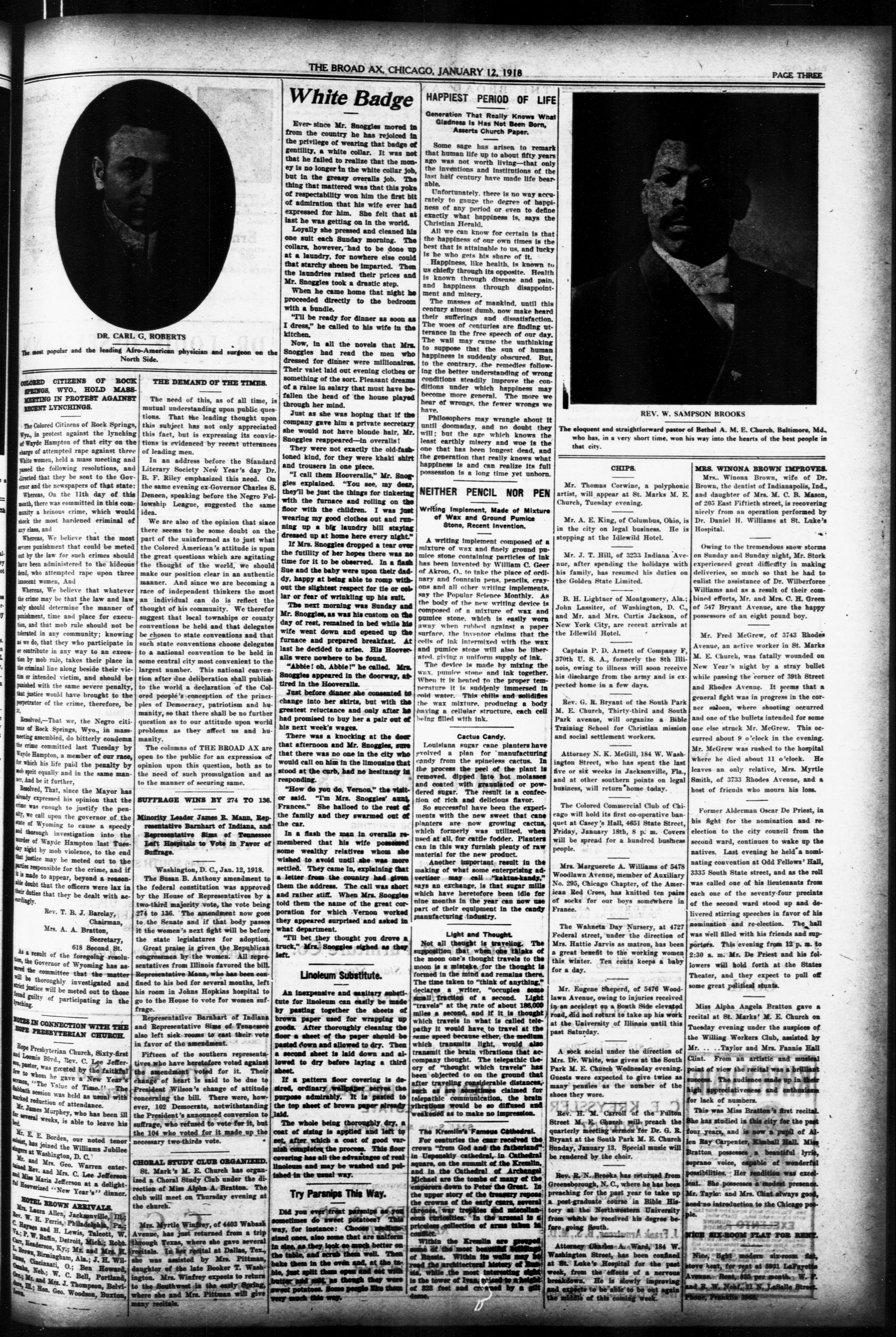
DR. CARL G. ROBERTS
DR. CARL G. ROBERTS The most popular and the leading Afro-American physician and surgeon on the North Side.
COLORED CITIZENS OF ROCK SPRINGS, WYO., HOLD MASS-MEETING IN PROTEST AGAINST RECENT LYNCHINGS.
The Colored Citizens of Rock Springs, WYO, in protest against the lynching of Wayde Hampton of that city on the charge of attempted rape against three White women, held a mass meeting and passed the following resolutions, and directed that they be sent to the Governor and the newspapers of that state: Whereas, On the 11th day of this month, there was committed in this community a heinous crime, which would shock the most hardened criminal of any class, and
THE DEMAND OF THE TIMES.
The need of this, as of all time, is mutual understanding upon public questions. That the leading thought upon this subject has not only appreciated this fact, but is expressing its convictions is evidenced by recent utterances of leading men.
In an address before the Standard Literary Society New Year's day Dr. B. F. Riley emphasized this need. On the same evening ex-Governor Charles S. Deneen, speaking before the Negro Fellowship League, suggested the same idea.
We are also of the opinion that since there seems to be some doubt on the
Whereas, We believe that the most severe punishment that could be meted out by the law for such crimes should have been administered to the hideous head, who attempted rape upon three innocent women, And Whereas, We believe that whatever the crime may be that the law and law only should determine the manner of punishment, time and place for execution, and that mob rule should not be tolerated in any community; knowing as we do, that they who participate in or contribute in any way to an execution by mob rule, takes their place in the criminal line along beside their victim or intended victim, and should be punished with the same severe penalty, that justice would have brought to the perpetrator of the crime, therefore, be it.
Resolved. That we, the Negro citizens of Rock Springs, Wyo., in mass meeting assembled, do bitterly condemn the crime committed last Tuesday by Wayde Hampton, a member of our race, for which his life paid the penalty by mob spirit equally and in the same manner. And be it further.
Resolved, That, since the Mayor has already expressed his opinion that the crime was enough to justify the penalty, we call upon the governor of the state of Wyoming to cause a speedy and thorough investigation into the murder of Wayde Hampton last Tuesday night by mob violence, to the end that justice may be meted out to the parties responsible for the crime, and if it is made to appear, beyond a reasonable doubt that the officers were lax in their duties that they be dealt with accordingly.
Rev. T. B. J. Barelay,
Chairman,
Mrs. A. A. Bratton,
Secretary,
618 Second St.
As a result of the foregoing resolution, the Governor of Wyoming has assured the committee that the matter will be thoroughly investigated and strict justice will be meted out to those found guilty of participating in the leaching.
Hope Presbyterian Church, Sixty-first and Loomis Blvd., Rev. C. Lee Jefferson, pastor, was gected by the faithful few to whom he gave a New Year's sermon, "The Value of Time." The gabbath session was held as usual with marked reduction of attendance.
Mr. James Murhey, who has been ill for several weeks, is able to leave his bed.
Mr. E. E. Borden, our noted tenor musicist, has joined the Williams Jubilee singers at Washington, D. C.
Mr. and Mrs. Geo. Warren entertained Rev. and Mrs. C. Lee Jefferson and Miss Maria Jefferson at a delightful Hooverized "New Year's" dinner.
HOTEL BROWN ARRIVALS
Laura Allen, Jacksonville, Ill.; Rev. W. H. Ferris, Philadelphia, Pa.; C. Haynes and H. Lewis, Talcott, W. Va.; P. W. Bufn, Detroit, Mich.; Robt. Curr, Henderson, Ky.; Mr. and Mrs. H. L. Brown, Birmingham, Al.; A. J. H. Williams, Cincinnati, O.; Ben Howard, Omaha, Neb.; W. C. Bell, Portland, Ore.; Mr. and Mrs. J. Thompson, Belvidere, Ill.; Hon. Geo. Woodson, Buxton, Iowa.
THE DEMAND OF THE TIMES
The need of this, as of all time, is mutual understanding upon public questions. That the leading thought upon this subject has not only appreciated this fact, but is expressing its convictions is evidenced by recent utterances of leading men.
In an address before the Standard Literary Society New Year's day Dr. B. F. Riley emphasized this need. On the same evening ex-Governor Charles S. Deneen, speaking before the Negro Fellowship League, suggested the same idea.
We are also of the opinion that since there seems to be some doubt on the part of the uninformed as to just what the Colored American's attitude is upon the great questions which are agitating the thought of the world, we should make our position clear in an authentic manner. And since we are becoming a race of independent thinkers the most an individual can do is reflect the thought of his community. We therefor suggest that local townships or county conventions be held and that delegates be chosen to state conventions and that such state conventions choose delegates to a national convention to be held in some central city most convenient to the largest number. This national convention after due deliberation shall publish to the world a declaration of the Colored people's conception of the principles of Democracy, patriotism and humanity, so that there shall be no further question as to our attitude upon world problems as they affect us and humanity.
The columns of THE BROAD AX are open to the public for an expression of opinion upon this question, both as to the need of such promulgation and as to the manner of securing same.
SUFFRAGE WINS BY 274 TO 136
Minority Leader James R. Mann, Representative Barnhart of Indiana, and Representative Sims of Tennessee Left Hospitals to Vote in Favor of Suffrage.
Washington, D. C., Jan. 12, 1918.
The Susan B. Anthony amendment to the federal constitution was approved by the House of Representatives by a two-third majority vote, the vote being 274 to 136. The amendment now goes to the Senate and if that body passes it the women's next fight will be before the state legislatures for adoption.
Great praise is given the Republican congressmen by the women. All representatives from Illinois favored the bill. Representative Mann, who has been confined to his bed for several months, left his room in Johns Hopkins hospital to go to the House to vote for women suffrage. Representative Barnhart of Indiana and Representative Sims of Tennessee also left sick rooms to cast their vote in favor of the amendment.
Fifteen of the southern representatives who have heretofore voted against the amendment voted for it. Their change of heart is said to be due to President Wilson's change of attitude concerning the bill. There were, however, 102 Democrats, notwithstanding the President's announced conversion to suffrage, who refused to vote for it, but the 104 who voted for it made up the necessary two-thirds vote.
CHORAL STUDY CLUB ORGANIZED.
St. Mark's M. E. Church has organized a Choral Study Club under the direction of Miss Alpha A. Bratton. The club will meet on Thursday evening at the church.
Mrs. Myrtle Winfrey, of 4403 Wabash Avenue, has just returned from a trip through Texas, where she gave several recitals. In her recital at Dallas, Tex., she was assisted by Mrs. Pittman, daughter of the late Booker T. Washington. Mrs. Winfrey expects to return to the Southwest in the early Spring, where she and Mrs. Pittman will give many recitals.
THE BROAD AX, CHICAGO, JANUARY 12, 1918
White Badge
Ever since Mr. Snoggles moved in from the country he has rejoiced in the privilege of wearing that badge of gentility, a white collar. It was not that he failed to realize that the money is no longer in the white collar job, but in the greasy overalls job. The thing that mattered was that this yoke of respectability won him the first bit of admiration that his wife ever had expressed for him. She felt that at last he was getting on in the world. Loyally she pressed and cleaned his one suit each Sunday morning. The collars, however, had to be done up at a laundry, for nowhere else could that starchy sheen be imparted. Then the laundries raised their prices and Mr. Snoggles took a drastic sten
When he came home that night he proceeded directly to the bedroom with a bundle.
"Till be ready for dinner as soon as I dress," he called to his wife in the kitchen.
Now, in all the novels that Mrs. Snoggles had read the men who dressed for dinner were millionaires. Their valet laid out evening clothes or something of the sort. Pleasant dreams of a raise in salary that must have befallen the head of the house played through her mind.
Just as she was hoping that if the company gave him a private secretary she would not have blonde hair, Mr. Snoggles reappeared—in overalls!
They were not exactly the old-fashioned kind, for they were khaki shirt and trousers in one piece.
"I call them Hooveralls," Mr. Snoggles explained. "You see, my dear, they'll be just the things for tinkering with the furnace and rolling on the floor with the children. I was just wearing my good clothes out and running up a big laundry bill staying dressed up at home here every night." If Mrs. Snoggles dropped a tear over the futility of her hopes there was no time for it to be observed. In a flash Sue and the baby were upon their daddy, happy at being able to romp without the slightest respect for tie or collar or fear of wrinkling up his suit.
The next morning was Sunday and Mr. Snoggles, as was his custom on the day of rest, remained in bed while his wife went down and opened up the furnace and prepared breakfast. At last he decided to arise. His Hooveralls were nowhere to be found.
"Abble! oh, Abble!" he called. Mr. Snoggles appeared in the doorway, attired in the Hooveralls.
Just before dinner she consented to change into her skirts, but with the greatest reluctance and only after he had promised to buy her a pair out of his next week's wages.
There was a knocking at the door that afternoon and Mr. Snoggles, sure that there was no one in the city who would call on him in the limousine that stood at the curb, had no hesitancy in responding.
"How do you do, Vernon," the visit or said. "I'm Mrs. Snoggies' aunt Frances." She halled to the rest of the family and they swarmed out of the car.
In a flash the man in overalls remembered that his wife possessed some wealthy relatives whom she wished to avoid until she was more settled. They came in, explaining that a letter from the country had given them the address. The call was short and rather stiff. When Mrs. Snoggies told them the name of the great corporation for which Vernon worked they appeared surprised and asked in what department.
"Till bet they thought you drove a truck," Mrs. Snoggies sighed as they left.
Linoleum Substitute
An inexpensive and sanitary substitute for linoleum can easily be made by pasting together the sheets of brown paper used for wrapping up goods. After thoroughly cleaning the floor a sheet of the paper should be pasted down and allowed to dry. Then a second sheet is laid down and allowed to dry before laying a third sheet.
Try Parenips This Way.
Did you ever treat parsnips as you sometimes do sweet potatoes? This way, for instance: Choose medium-sized ones, also some that are uniform in size, as they look so much better on the table, and scrub them well. Then bake them in the oven and, at the table, just split them open and eat with butter and salt, on though they were sweet potatoes. Some people like them very much this way.
Generation That Really Knows What Gladness Is Has Not Been Born, Asserts Church Paper.
Some sage has arisen to remark that human life up to about fifty years ago was not worth living—that only the inventions and institutions of the last half century have made life bearable.
Unfortunately, there is no way accurately to gauge the degrees of happiness of any period or even to define exactly what happiness is, says the Christian Herald.
All we can know for certain is that the happiness of our own times is the best that is attainable to us, and lucky is he who gets his share of it.
Happiness, like health, is known to us chiefly through its opposite. Health is known through disease and pain, and happiness through disappointment and misery.
The masses of mankind, until this century almost dumb, now make heard their sufferings and dissatisfaction. The woes of centuries are finding utterance in the free speech of our day. The wall may cause the unthinking to suppose that the sun of human happiness is suddenly obscured. But, to the contrary, the remedies following the better understanding of wrong conditions steadily improve the conditions under which happiness may become more general. The more we hear of wrongs, the fewer wrongs we have.
Philosophers may wrangle about it until doomsday, and no doubt they will; but the age which knows the least earthly misery and woe is the one that has been longest dead, and the generation that really knows what happiness is and can realize its full possession is a long time yet unborn.
NEITHER PENCIL NOR PEN
Writing Implement, Made of Mixture of Wax and Ground Pumice Stone, Recent Invention.
A writing implement composed of a mixture of wax and finely ground pumice stone containing particles of ink has been invented by William C. Geer of Akron, O.. to take the place of ordinary and fountain pens, pencils, crayons and all other writing implements, say the Popular Science Monthly. As the body of the new writing device is composed of a mixture of wax and pumice stone, which is easily worn away when rubbed against a paper surface, the inventor claims that the cells of ink intermixed with the wax and pumice stone will also be liberated, giving a uniform supply of ink.
The device is made by mixing the wax, pumice stone and ink together. When it is heated to the proper temperature it is suddenly immersed in cold water. This chills and solidifies the wax mixture, producing a body having a cellular structure, each cell being filled with ink.
Cactus Candy.
Louisiana sugar cane planters have evolved a plan for manufacturing candy from the spineless cactus. In the process the peel of the plant is removed, dipped into hot molasses and coated with granulated or powdered sugar. The result is a confection of rich and delicious flavor. So successful have been the experiments with the new sweet that cane planters are now growing cactus, which formerly was utilized, when used at all, for cattle fodder. Planters can in this way furnish plenty of raw material for the new product. Another important result in the making of what some enterprising advertiser may call "kaktus-kandy," says an exchange, is that sugar mills which have heretofore been idle for nine months in the year can now use part of their equipment in the candy manufacturing industry.
Light and Thought
Not all thought is traveling. The supposition that when one thinks of the moon one's thought travels to the moon is a mistake, for the thought is formed in the mind and remains there. The time taken to "think of anything," declares a writer, "occupies some small fraction of a second. Light "travels" at the rate of about 188,000 miles a second, and if it is thought which travels in what is called telepathy it would have to travel at the same speed because ether, the medium which transmits light, would also transmit the brain vibrations that accompany thought. The telepathic theory of "thought which travels" has been objected to on the ground that after traveling considerable distances, such as are sometimes claimed for telepathic communication, the brain vibrations would be so diffused and weakened as to make no impression.
The Kremlinia Famous Cathedral.
For centuries the caar received the crown "from God and the Fatherland" in Uspensky cathedral, in Cathedral square, on the summit of the Kremlin, and in the Cathedral of Archangel Michael are the tombs of many of the emperors down to Peter the Great. In the upper story of the treasury repose the crowns of the early caars, several thrones, war trophies and miscellaneous curioes. In the arsenal is a priceless collection of arms taken to conflict.
Within the Kremlinia are grouped some of the most beautiful buildings of Russia. Within its walls may be read the architectural history of Russia, while the most interesting sight is the tower of Ivan paved to a height of $28 feet and crowned by a gilt
[Portrait of a man in formal attire, facing forward, with a serious expression. The background is a dark, solid color. No text or additional details are present.]]
REV. W. SAMPSON BROOKS
The eloquent and straightforward pastor who has, in a very short time, wove that city.
CHIPS.
Mr. Thomas Corwine, a polyphon artist, will appear at St. Marks M. Church, Tuesday evening.
Mr. A. E. King, of Columbus, Ohio, in the city on legal business. He stopping at the Idlewild Hotel.
Mr. J. T. Hill, of 3233 Indiana Avenue, after spending the holidays with his family, has resumed his duties at the Golden State Limited.
B. H. Lightner of Montgomery, Ala. John Lassiter, of Washington, D. C. and Mr. and Mrs. Curtis Jackson, New York City, are recent arrivals at the Idlewild Hotel.
Captain P. D. Arnett of Company of 370th U. S. A., formerly the 8th Nois, owing to illness will soon receive his discharge from the army and is expected home in a few days.
Rev. G. R. Bryant of the South Park M. E. Church, Thirty-third and South Park avenue, will organize a Bible Training School for Christian mission and social settlement workers.
Attorney N. K. MeGill, 184 W. Washington Street, who has spent the last five or six weeks in Jacksonville, Fla. and at other southern points on legal business, will return home today.
The Colored Commercial Club of Chicago will hold its first co-operative banquet at Casey's Hall, 4651 State Street Friday, January 18th, 8 p.m. Cover will be spread for a hundred business people.
Mrs. Marguerete A. Williams of 547 Woodlawn Avenue, member of Auxiliary No. 295, Chicago Chapter, of the American Red Cross, has knitted ten pairs of socks for our boys somewhere in France.
The Wahneta Day Nursery, at 472 Federal street, under the direction of Mrs. Hattie Jarvis as matron, has been a great benefit to the working women this winter. Ten cents keeps a baby for a day.
Mr. Eugene Sheperd, of 5476 Woodlawn Avenue, owing to injuries received in an accident on a South Side elevated road, did not return to take up his work at the University of Illinois until this past Saturday.
A sock social under the direction of Mrs. Dr. White, was given at the South Park M. E. Church Wednesday evening. Guests were expected to give twice as many pennies as the number of the shoes they wore.
Rev. H. M. Carroll of the Fulton Street M. E. Church will preach the quarterly meeting sermon for Dr. G. R. Bryant at the South Park M. E. Church Sunday, January 13. Special music will be rendered by the choir.
Rev. B. N. Brooks has returned from Greensborough, N. C., where he has been preaching for the past year to take up a post-graduate course in Bible History at the Northwestern University from which he received his degree before going South.
forward pastor of Bethel A. M. E
short time, won his way into the he
The eloquent and straightforward pastor of Bethel A. M. E. Church, Baltimore, Md., who has, in a very short time, won his way into the hearts of the best people in that city.
The eloquent and straightforward pastor of Bethel A. M. E. Church, Baltimore, Md., who has, in a very short time, won his way into the hearts of the best people in that city.
Miss Alpha A. recital at St. Ma. Tuesday evening, the Willing Work Mr. ... Taylor Clint. From an point of view the success. The aud high appreciative for lack of numb. This was Miss. She has studied in four years, and in len Ray Carpenter, Bratton possesses soprano voice, or possibilities. Her lent. She possess Mr. Taylor; and M. need no introduction.
NICE SIX-BOOM
side elevated up his work is until this direction of at the South day evening. give twice as number of the the Fulton preach the for Dr. G. R. M. E. Church real music will returned from he has taken up Bible His University degree be-
Attorney Charles A. Ward, 184 W. Washington Street, has been confined at St. Luke's Hospital for the past week, from the effects of a nervous breakdown. He is slowly improving and expects to be able to be out again the middle of this coming week.
THE STATE
of Bethel A. M. E. Church, Baltimore, Md.,
is way into the hearts of the best people in
MRS. WINONA BROWN IMPROVES.
Mrs. Winona Brown, wife of Dr.
Brown, the dentist of Indianapolis, Ind.,
and daughter of Mrs. M. C. B. Mason,
of 205 East Fiftieth street, is recovering
nicely from an operation performed by
Dr. Daniel H. Williams at St. Luke's
Hospital.
Owing to the tremendous snow storms on Sunday and Sunday night, Mr. Stork experienced great difficulty in making deliveries, so much so that he had to enlist the assistance of Dr. Wilberforce Williams and as a result of their combined efforts, Mr. and Mrs. C. H. Green of 547 Bryant Avenue, are the happy possessors of an eight pound boy.
Mr. Fred McGrew, of 3743 Rhodes Avenue, an active worker in St. Marks M. E. Church, was fatally wounded on New Year's night by a stray bullet while passing the corner of 39th Street and Rhodes Avenue. It seems that a general fight was in progress in the corner saloon, where shooting occurred and one of the bullets intended for some one else struck Mr. McGrew. This occurred about 9 o'clock in the evening. Mr. McGrew was rushed to the hospital where he died about 11 o'clock. He leaves an only relative, Mrs. Myrtle Smith, of 3733 Rhodes Avenue, and a host of friends who mourn his loss.
Former Alderman Oscar De Priest, in his fight for the nomination and re-election to the city council from the second ward, continues to wake up the natives. Last evening he held a nominating convention at Odd Fellows' Hall, 3335 South State street, and as the roll was called one of his lieutenants from each one of the seventy-four precints of the second ward stood up and delivered stirring speeches in favor of his nomination and re-election. The hall was well filled with his friends and supporters. This evening from 12 p. m. to 2:30 a. m. Mr. De Priest and his followers will hold forth at the States Theater, and they expect to pull off some great political stunts.
Miss Alpha Angela Bratton gave a recital at St. Marks' M. E. Church on Tuesday evening under the auspices of the Willing Workers Club, assisted by Mr. . . . Taylor and Mrs. Fannie Hall Clint. From an artistic and musical point of view the recital was a brilliant success. The audience made up in their high appreciativeness and enthusiasm for lack of numbers. This was Miss Bratton's first recital. She has studied in this city for the past
PAGE THREE
DR. CARL G. ROBERTS
DR. CARL G. ROBERTS
The most popular and the leading Afro-American physician and surgeon on the North Side.
COLORED CITIZENS OF BOCK
FRIINGS, WYO., HOLD MASS-
MESTING IN PROTEST AGAINST
RECENT LYNCHINGS.
THE DEMAND OF THE TIMES.
The need of this, as of all time, is mutual understanding upon public ques-
The Colored Citizens of Rock Springs, Wyo., in protest against the lynching of Wayde Hampton of that city on the charge of attempted rape against three White women, held a mass meeting and passed the following resolutions, and directed that they be sent to the Governor and the newspapers of that state: Whereas, On the 11th day of this month, there was committed in this community a heinous crime, which would shock the most hardened criminal of any class, and Whereas, We believe that the most severe punishment that could be meted out by the law for such crimes should have been administered to the hideous feud, who attempted rape upon three innocent women. And
Whereas, We believe that whatever the crime may be that the law and law only should determine the manner of punishment, time and place for execution, and that mob rule should not be tolerated in any community; knowing as we do, that they who participate in or contribute in any way to an execution by mob rule, takes their place in the criminal line along beside their victim or intended victim, and should be punished with the same severe penalty, that justice would have brought to the perpetrator of the crime, therefore, be it.
Resolved.—That we, the Negro citizens of Rock Springs, Wyo., in massmeeting assembled, do bitterly condemn the crime committed last Tuesday by Wayde Hampton, a member of our race, for which his life paid the penalty by mob spirit equally and in the same manner. And be it further.
Resolved, That, since the Mayor has already expressed his opinion that the crime was enough to justify the penalty, we call upon the governor of the state of Wyoming to cause a speedy and thorough investigation into the murder of Wayde Hampton last Tuesday night by mob violence, to the end that justice may be meted out to the parties responsible for the crime, and if it is made to appear, beyond a reasonable doubt that the officers were lax in their duties that they be dealt with accordingly.
Rev. T. B. J. Barclay,
Chairman,
Mrs. A. A. Bratton,
Secretary,
618 Second St.
As a result of the foregoing resolution, the Governor of Wyoming has assured the committee that the matter will be thoroughly investigated and strict justice will be meted out to those found guilty of participating in the lynching.
NOTES IN CONNECTION WITH THE HOPE PRESBYTERIAN CHURCH
Hope Presbyterian Church, Sixty-first and Loomis Blvd., Rev. C. Lee Jefferson, pastor, was greeted by the faithful few to whom he gave a New Year's sermon, "The Value of Time." The sabbath session was held as usual with marked reduction of attendance.
Mr. James Murphey, who has been ill for several weeks, is able to leave his bed.
Mr. E. E. Borden, our noted tenor soloist, has joined the Williams Jubilee singers at Washington, D. C.
Mr. and Mrs. Geo. Warren entertained Rev. and Mrs. C. Lee Jefferson and Miss Maria Jefferson at a delightful Hooverized "New Year's" dinner.
HOTEL BROWN ARRIVALS.
Mrs. Laura Allen, Jacksonville, Ill.; Rev. W. H. Ferris, Philadelphia, Pa.; C. Hayes and H. Lewis, Talcott, W. Va.; P. W. Ruffin, Detroit, Mich.; Robt. Carr, Henderson, Ky.; Mr. and Mrs. H. L. Brown, Birmingham, Ala.; J. H. Willimann, Cincinnati, O.; Ben Howard, Omaha, Neb.; W. C. Bell, Portland, Ora.; Mr. and Mrs. J. Thompson, Belvidere, Ill.; Hon. Geo. Woodson, Buxton, Iowa
THE DEMAND OF THE TIMES
The need of this, as of all time, is mutual understanding upon public questions. That the leading thought upon this subject has not only appreciated this fact, but is expressing its convictions is evidenced by recent utterances of leading men.
In an address before the Standard Literary Society New Year's day Dr. B. F. Riley emphasized this need. On the same evening ex-Governor Charles S. Deneen, speaking before the Negro Fellowship League, suggested the same idea.
We are also of the opinion that since there seems to be some doubt on the part of the uninformed as to just what the Colored American's attitude is upon the great questions which are agitating the thought of the world, we should make our position clear in an authentic manner. And since we are becoming a race of independent thinkers the most an individual can do is reflect the thought of his community. We therefore suggest that local townships or county conventions be held and that delegates be chosen to state conventions and that such state conventions choose delegates to a national convention to be held in some central city most convenient to the largest number. This national convention after due deliberation shall publish to the world a declaration of the Colored people's conception of the principles of Democracy, patriotism and humanity, so that there shall be no further question as to our attitude upon world problems as they affect us and humanity.
The columns of THE BROAD AX are open to the public for an expression of opinion upon this question, both as to the need of such promulgation and as to the manner of securing same.
SUFFRAGE WINS BY 274 TO 136.
Minority Leader James R. Mann, Representative Barnhart of Indiana, and Representative Sims of Tennessee Left Hospitals to Vote in Favor of Suffrage.
Washington, D. C., Jan. 12, 1918.
The Susan B. Anthony amendment to the federal constitution was approved by the House of Representatives by a two-third majority vote, the vote being 274 to 136. The amendment now goes to the Senate and if that body passes it the women's next fight will be before the state legislatures for adoption.
Great praise is given the Republican congressmen by the women. All representatives from Illinois favored the bill. Representative Mann, who has been confined to his bed for several months, left his room in Johns Hopkins hospital to go to the House to vote for women suffrage. Representative Barnhart of Indiana and Representative Sims of Tennessee also left sick rooms to cast their vote in favor of the amendment.
Fifteen of the southern representatives who have heretofore voted against the amendment voted for it. Their change of heart is said to be due to President Wilson's change of attitude concerning the bill. There were, however, 102 Democrats, notwithstanding the President's announced conversion to suffrage, who refused to vote for it, but the 104 who voted for it made up the necessary two-thirds vote.
CHORAL STUDY CLUB ORGANIZED.
St. Mark's M. E. Church has organized a Choral Study Club under the direction of Miss Alpha A. Bratton. The club will meet on Thursday evening at the church.
Mrs. Myrtle Winfrey, of 4403 Wabash Avenue, has just returned from a trip through Texas, where she gave several recitals. In her recital at Dallas, Tex., she was assisted by Mrs. Pittman, daughter of the late Booker T. Washington. Mrs. Winfrey expects to return to the Southwest in the early Spring, where she and Mrs. Pittman will give many recitals.
THE BROAD AX, CHICAGO, JANUARY 12, 1918
White Badge
White Badge
Ever since Mr. Snoggles moved in from the country he has rejoiced in the privilege of wearing that badge of gentility, a white collar. It was not that he failed to realize that the money is no longer in the white collar job, but in the greasy overalls job. The thing that mattered was that this yoke of respectability won him the first bit of admiration that his wife ever had expressed for him. She felt that at last he was getting on in the world. Loyally she pressed and cleaned his one suit each Sunday morning. The collars, however, had to be done up at a laundry, for nowhere else could that starchy sheen be imparted. Then the laudries raised their prices and Mr. Snoggles took a drastic step.
When he came home that night he proceeded directly to the bedroom with a bundle.
"Til be ready for dinner as soon as I dress," he called to his wife in the kitchen.
Now, in all the novels that Mrs. Snoggles had read the men who dressed for dinner were millionaires. Their valet laid out evening clothes or something of the sort. Pleasant dreams of a raise in salary that must have befallen the head of the house played through her mind.
Just as she was hoping that if the company gave him a private secretary she would not have blonde hair, Mr. Snoggles reappeared—in overalls!
They were not exactly the old-fashioned kind, for they were khaki shirt and trousers in one piece.
"I call them Hooveralls," Mr. Snoggies explained. "You see, my dear, they'll be just the things for tinkering with the furnace and rolling on the floor with the children. I was just wearing my good clothes out and running up a big laundry bill staying dressed up at home here every night." If Mrs. Snoggies dropped a tear over the futility of her hopes there was no time for it to be observed. In a flash Sue and the baby were upon their daddy, happy at being able to romp without the slightest respect for tie or collar or fear of wrinkling up his suit.
The next morning was Sunday and Mr. Snoggles, as was his custom on the day of rest, remained in bed while his wife went down and opened up the furnace and prepared breakfast. At last he decided to arise. His Hooveralls were nowhere to be found.
"Abble! oh, Abble!" he called. Mr. Snoggles appeared in the doorway, attired in the Hooveralls.
Just before dinner she consented to change into her skirts, but with the greatest reluctance and only after he had promised to buy her a pair out of his next week's wages.
There was a knocking at the door that afternoon and Mr. Snoggles, sure that there was no one in the city who would call on him in the limousine that stood at the curb, had no hesitancy in responding.
"How do you do, Vernon," the visitor or said. "I'm Mrs. Snoggies' aunt, Frances." She halloled to the rest of the family and they swarmed out of the car.
In a flash the man in overalls remembered that his wife possessed some wealthy relatives whom she wished to avoid until she was more settled. They came in, explaining that a letter from the country had given them the address. The call was short and rather stiff. When Mrs. Snoggies told them the name of the great corporation for which Vernon worked they appeared surprised and asked in what department.
"I'll bet they thought you drove a truck," Mrs. Snoggies sighed as they left.
Linoleum Substitute.
An inexpensive and sanitary substitute for linoleum can easily be made by pasting together the sheets of brown paper used for wrapping up goods. After thoroughly cleaning the floor a sheet of the paper should be pasted down and allowed to dry. Then a second sheet is laid down and allowed to dry before laying a third sheet. If a pattern floor covering is desired, ordinary wallpaper serves the purpose admirably. It is pasted to the top sheet of brown paper already laid.
The whole being thoroughly dry, a coat of sizing is applied and left to set, after which a coat of good varnish completes the process. This floor covering has all the advantages of real linoleum and may be washed and polished in the usual way.
Try Parsnips This Way.
Did you ever treat parsnips as you sometimes do sweet potatoes? This way, for instance: Choose medium-sized ones, also some that are uniform in size, as they look so much better on the table, and scrub them well. Then bake them in the oven and, at the table, just split them open and eat with butter and salt, as though they were sweet potatoes. Some people like them very much this way.
Generation That Really Knows What Gladness Is Has Not Been Born, Asserts Church Paper.
Some sage has arisen to remark that human life up to about fifty years ago was not worth living—that only the inventions and institutions of the last half century have made life bearable.
Unfortunately, there is no way accurately to gauge the degree of happiness of any period or even to define exactly what happiness is, says the Christian Herald.
All we can know for certain is that the happiness of our own times is the best that is attainable to us, and lucky is he who gets his share of it.
Happiness, like health, is known to us chiefly through its opposite. Health is known through disease and pain, and happiness through disappointment and misery.
The masses of mankind, until this century almost dumb, now make heard their sufferings and dissatisfaction. The woes of centuries are finding utterance in the free speech of our day. The wall may cause the unthinking to suppose that the sun of human happiness is suddenly obscured. But, to the contrary, the remedies following the better understanding of wrong conditions steadily improve the conditions under which happiness may become more general. The more we hear of wrongs, the fewer wrongs we have.
Philosophers may wrangle about it until doomsday, and no doubt they will; but the age which knows the least earthly misery and woe is the one that has been longest dead, and the generation that really knows what happiness is and can realize its full possession is a long time yet unborn.
NEITHER PENCIL NOR PEN
Writing Implement, Made of Mixture of Wax and Ground Pumice Stone, Recent Invention.
A writing implement composed of a mixture of wax and finely ground pumice stone containing particles of ink has been invented by William C. Geer of Akron, O., to take the place of ordinary and fountain pens, pencils, crayons and all other writing implements, say the Popular Science Monthly. As the body of the new writing device is composed of a mixture of wax and pumice stone, which is easily worn away when rubbed against a paper surface, the inventor claims that the cells of ink intermixed with the wax and pumice stone will also be liberated, giving a uniform supply of ink.
The device is made by mixing the wax, pumice stone and ink together. When it is heated to the proper temperature it is suddenly immersed in cold water. This chills and solidifies the wax mixture, producing a body having a cellular structure, each cell being filled with ink.
Cactus Candy.
Louisiana sugar cane planters have evolved a plan for manufacturing candy from the spineless cactus. In the process the peel of the plant is removed, dipped into hot molasses and coated with granulated or powdered sugar. The result is a confection of rich and delicious flavor. So successful have been the experiments with the new sweet that cane planters are now growing cactus, which formerly was utilized, when used at all, for cattle fodder. Planters can in this way furnish plenty of raw material for the new product.
Another important result in the making of what some enterprising advertiser may call "kaktus-kandy," says an exchange, is that sugar mills which have heretofore been idle for nine months in the year can now use part of their equipment in the candy manufacturing industry.
Light and Thought
Not all thought is traveling. The supposition that when one thinks of the moon one's thought travels to the moon is a mistake, for the thought is formed in the mind and remains there. The time taken to "think of anything," declares a writer, "occupies some small fraction of a second. Light "travels" at the rate of about 188,000 miles a second, and if it is thought which travels in what is called telepathy it would have to travel at the same speed because ether, the medium which transmits light, would also transmit the brain vibrations that accompany thought. The telepathic theory of "thought which travels" has been objected to on the ground that after traveling considerable distances, such as are sometimes claimed for telepathic communication, the brain vibrations would be so diffused and weakened as to make no impression.
The Kremlin's Famous Cathedral.
For centuries the ear received the crown "from God and the Fatherland" in Uspensky cathedral, in Cathedral square, on the summit of the Kremlin, and in the Cathedral of Archangel Michael are the tombs of many of the emperors down to Peter the Great. In the upper story of the treasury repose the crowns of the early cears, several thrones, war trophies and miscellaneous curiosities. In the arena is a priceless collection of arms taken in conflict.
Within the Kremlin are grouped some of the most beautiful buildings of Russia. Within its walls may be read the architectural history of Russia, while the most interesting sight is the tower of Ivan, raised to a height of 228 feet and crowned by a gilt dome.
REV. W. SAMPSON BROOKS
The eloquent and straightforward pastor of Bethel A. M. B who has, in a very short time, won his way into the heart that city.
CHIPS.
MRS. WINON
Mrs., Winon
The eloquent and straightforward pastor of Bethel A. M. E. Church, Baltimore, Md., who has, in a very short time, won his way into the hearts of the best people in that city.
The eloquent and straightforward pastor of Bethel A. M. E. Church, Baltimore, Md., who has, in a very short time, won his way into the hearts of the best people in that city.
Mr. Thomas Corwine, a polyphonic artist, will appear at St. Marks M. E. Church, Tuesday evening.
Mr. A. E. King, of Columbus, Ohio, is in the city on legal business. He is stopping at the Idlewild Hotel.
Mr. J. T. Hill, of 3233 Indiana Avenue, after spending the holidays with his family, has resumed his duties on the Golden State Limited.
B. H. Lightner of Montgomery, Ala.; John Lassiter, of Washington, D. C., and Mr. and Mrs. Curtis Jackson, of New York City, are recent arrivals at the Idlewild Hotel.
Captain P. D. Arnett of Company F, 370th U. S. A., formerly the 8th Illinois, owing to illness will soon receive his discharge from the army and is expected home in a few days.
Rev. G. R. Bryant of the South Park M. E. Church, Thirty-third and South Park avenue, will organize a Bible Training School for Christian mission and social settlement workers.
Attorney N. K. MeGill, 184 W. Washington Street, who has spent the last five or six weeks in Jacksonville, Fla., and at other southern points on legal business, will return home today.
The Colored Commercial Club of Chicago will hold its first co-operative banquet at Casey's Hall, 4651 State Street, Friday, January 18th, 8 p. m. Covers will be spread for a hundred business people.
Mrs. Marguerete A. Williams of 5478 Woodlawn Avenue, member of Auxiliary No. 295, Chicago Chapter, of the American Red Cross, has knitted ten pairs of socks for our boys somewhere in France.
The Wahneta Day Nursery, at 4727 Federal street, under the direction of Mrs. Hattie Jarvis as matron, has been a great benefit to the working women this winter. Ten cents keeps a baby for a day.
Mr. Eugene Sheperd, of 5476 Woodlawn Avenue, owing to injuries received in an accident on a South Side elevated road, did not return to take up his work at the University of Illinois until this past Saturday.
A sock social under the direction of Mrs. Dr. White, was given at the South Park M. E. Church Wednesday evening. Guests were expected to give twice as many pennies as the number of the shoes they wore.
Rev. H. M. Carroll of the Fulton Street M. E. Church will preach the quarterly meeting sermon for Dr. G. R. Bryant at the South Park M. E. Church Sunday, January 13. Special music will be rendered by the choir.
Rey, B. N. Brooks has returned from Greensborough, N. C., where he has been preaching for the past year to take up a post-graduate course in Bible History at the Northwestern University from which he received his degree before going South.
Attorney Charles A. Ward, 184 W. Washington Street, has been confined at St. Luke's Hospital for the past week, from the effects of a nervous breakdown. He is slowly improving and expects to be able to be out again the middle of this coming week.
THE NEW YORK TIMES
Bethel A. M. E. Church, Baltimore, Md., way into the hearts of the best people in
MRS. WINONA BROWN IMPROVES.
Mrs., Winona Brown, wife of Dr. Brown, the dentist of Indianapolis, Ind., and daughter of Mrs. M. C. B. Mason, of 205 Eiftieth street, is recovering nicely from an operation performed by Dr. Daniel H. Williams at St. Luke's Hospital.
Owing to the tremendous snow storms on Sunday and Sunday night, Mr. Stork experienced great difficulty in making deliveries, so much so that he had to enlist the assistance of Dr. Wilberforce Williams and as a result of their combined efforts, Mr. and Mrs. C. H. Green of 547 Bryant Avenue, are the happy possessors of an eight pound boy.
Mr. Fred McGrew, of 3743 Rhodes Avenue, an active worker in St. Marks M. E. Church, was fatally wounded on New Year's night by a stray bullet while passing the corner of 39th Street and Rhodes Avenue. It seems that a general fight was in progress in the corner saloon, where shooting occurred and one of the bullets intended for some one else struck Mr. McGrew. This occurred about 9 o'clock in the evening. Mr. McGrew was rushed to the hospital where he died about 11 o'clock. He leaves an only relative, Mrs. Myrtle Smith, of 3733 Rhodes Avenue, and a host of friends who mourn his loss.
Former Alderman Oscar De Priest, in his fight for the nomination and re-election to the city council from the second ward, continues to wake up the natives. Last evening he held a nominating convention at Odd Fellows' Hall, 3335 South State street, and as the roll was called one of his lieutenants from each one of the seventy-four precints of the second ward stood up and delivered stirring speeches in favor of his nomination and re-election. The hall was well filled with his friends and supporters. This evening from 12 p. m. to 2:30 a. m. Mr. De Priest and his followers will hold forth at the States Theater, and they expect to pull off some great political stunts.
Miss Alpha Angela Bratton gave a recital at St. Marks' M. E. Church on Tuesday evening under the auspices of the Willing Workers Club, assisted by Mr. . . . Taylor and Mrs. Fannie Hall Clint. From an artistic and musical point of view the recital was a brilliant success. The audience made up in their high appreciativeness and enthusiasm for lack of numbers.
This was Miss Bratton's first recital. She has studied in this city for the past four years, and is now a pupil of Allen Ray Carpenter, Klimball Hall. Miss Bratton possesses a beautiful lyric, soprano voice, capable of wonderful possibilities. Her rendition was excellent. She possesses a modest presence. Mr. Taylor and Mrs. Chint always good, need no introduction to the Chicago people.
NICE SIX-BOOM FLAT FOR RENT
Nice, light modern six-room flat.
PAGE. THREE
cna ee a ee re — eS ge 7
pare oh ro” POOAN CLICACO. IANLUAR > 1918
a h y & AW é aU
fs - =
SS ee ee ee
‘The finest building ever Colored tenants in Chi-
Msp attaet Sene ie a take ee ce
J. W. CASEY, Agent
Phone Main 263 133 W. Washington Street
AR STYLE B00
i --- HAIR .-~
To Colored Women
‘We are the largest
manutactorers of
Golores Women's
=e
siziee im. ba
a’ oat eve
cae, We weil thow-
‘Sind oor bait and
foliet articlen Set-
3 or money back.
"We make the best
ENG combs, pith cate henry tacks Pay
Fated sesoey ercerer umpe. MOKET
BACK In NOT SATISFACTORY. She. postpaid.
ee POSTPAID 88
‘Hair nets, combs and toilet articles
‘manufacturers’ prices. Send two-cent stamp.
Agents Wanted. Address as follows:
jamie PO Rows Sew ork City.
‘Address Dept.
PHONE DOOGLAS mss
Dr. Mac Enery J. Brown
Physician and Surgeon
‘Practice Limited to
Diseases of the
Eye, Ber, Nese and Threat
10 EAST 35ch STREET
senaiinsra CHICAGO
OE ats
WM. J. LATHAM
ATTORNEY AT LAW
@FFICR PHONE: CALUMET ©
2 East 3ist Street
Suite 7 =
CHICAGO
Papas kb Gira
JOHN J. DUNN
‘ESTABLISBED WT
= Wholesale end Reteil
COAL
Mer GgicABO
MINKY HAIR
@-
SSE=
Pa
: SE]
[abate
| aaa
Residence, 1262 Macalister Place
MILES J. DEVINE
Attorney at Law
Suite 313.329 Reaper Block
be
| CHICAGO
PHONE MAIN 221¢
Attorney at Law
118 North La Salle Street
‘Suite 425 to os
CHICAGO
ne See Oe
A. L. WILLAMS
Attorney and
Counselor at Law
Phone Main 2017 Antomatic 32-395
jaa we
CHICAGO
RESIDENCE: S08 E. 3éh STREET
PHONE DOUGLAS 4397
J. Gray Lucas
Attorney at Lew
__ Suite 815 Hartford
85. Desriom 80. CHICAGO
iUTOMATIC aoe ba
Residence, 4533 Prairie Avenue
Res, Kepwved om
WALTER M. FARMER
ATTORNEY AND
COUNSELOR AT LAW
NOTARY PUBLIC
Sahe me
3353 South Park Ave.
PHONE DOUGLAS 2773
W. E. MOLLISON
ATTORNEY end COUNSELOR
Suite 815 Hartford Bldg.
PHONE: CENTRAL 6583
SLAMD 266
(C.E.. KREYSSLER
DRUGGIST
Ee ae
5057 South State Street
Nene Bist Soest Map ox tha Cone
pi
‘TELEPHONE WEST 4509
‘XONR CALLA GIVER PROMPT sgTERTION
Frank Armetreng, B.S., M.D.
> Phipeiion suds Sargon,
=
Telephone Douglas 2344
MAJOR R. R. JACKSON, President
BOOK and JOB PRINTING
ENGRAVING and BOOKBINDING
107 East 35th Street CHICAGO, ILLINOIS
| The Store That Saves You Money
State Street Furniture Co.
3131-35 South State Street
; CASH OR CREDIT
Phones: Prospect 179 and 427 , Res. Phone: Prospect S82
HENRY P. BERGEN
REAL ESTATE 7
| sagem a raat. 800. : ‘i CHICAGO
ert 7maruoes KENWOOD123
\ 2 Be CLFTHERO: & CO.
NS Meee Stee Seek.
NOTArPUNIE 2 CHICAGO”
THE BROAD AX
‘Published Weekty
‘In this city since July 15th, 1899,
without missing one single issue, Repub-
leans, Democrats, Catholics, Protestants,
ee ea
ous else can have their say $s long as
their language is proper and responsi-
bility is fixed.
The Broad Ax is « newspaper whose
platform is broad enough for all, ever
claiming the editorial right to speak its
own mind.
Local communications will receive
attention. Write only on one side of
the paper.
Subscriptions must be paid in ad-
vance. .
One Year ...-0.-0ceeeeeeecee sess G200
Bix Months .......++----+.s000++ 100
Advertising rates made known on
application.
Address all communications to
THE BROAD Ax
6418 Champlain Ave, Chicago, TL
PHONE WENTWORTH 2597.
JULIUS F. TAYLOR, Béitor and
Publisher.
Entered as Second-Class Matter Aug.
19, 1902, at the Post Office at Chicago,
Mineis, under Act of March 3, 1879,
es
Newspaper Advertising —_Slictter
‘Wanted.
A live newspaper edvertising selici-
tor; one whe knows how te hustle fer
business wanted. Fer further infer.
mation, address the editor of this paper
or phone, Wentworth 2597.
| ” giakeeaieininen tea
‘The test cnrious walking feat In
Sowtland de tes luck to a former cen-
urs, when Sir Andrew Leith Hay and
Lord Kenuedly did a great walk for a
vet of £42540. Hoy snid he could walk
from Binir hell in Kincardinestitre to
Inverness in less time than Kennedy.
‘They siurted off that very night at
nine o'clock, in their evening clothes,
with their shoes and silk stockings. Sir
Andrew took the coach road via Hunt-
ly and Eigin. Lord Kennedy, with Cap-
tain Ross as umpire, went straight
across the Grampians in pouring rain.
They walked all that night, all next
day, and the following night, and Lord
Kennedy got to Inverness at six o'clock
im the morning of the third day, and
won his bet by four hours,
ONE OF WORLD'S GREAT MEN
Johnny Appleseed, Responsible for
Many Orchards in Wide Range, Will
Net Soon Be Forgotten.
John Chapman's name occaples an
Iniportant place in our American his-
‘tory, for he is known as “Johnny Ap-
pleseed, the Apostle of Apple Grow-
ing.” More than a hindred years have
passed since Johnny Appleseed scat-
tered apple seeds throughout a wide
range of territory from Pennsylvania
to the Mississippi country, and in hv-
mility, yet his name has been immor-
talfzed, and we of future generations
will be a long time forgetting the name
‘Of this great father of the modern
‘ipple-growing Industry, the Christian
Herald states.
Johnny Appleseed was born in
Springfield, Mass., in the year 1775,
eventful in American history in more
ways than one. About the year 1801
he emigrated from Massachusetts, joln-
tng those forces starting for the un-
known western country.
In the territory between Massachu-
setts and Ohio, and as far as Indiana,
Mr. Chapman was a familiar figure.
He foresaw the tide of migration go-
Ing to the West, and seeing the need of
fruit, devoted his life to its culture.
Gathering all the apple seeds he could
secure in his native state he would
make long trips west, planting the
seed and supplying the scattered set-
ters with enough to provide them with
dependable orchards. The result was
thousands of producing apple orchards
throughout this vast territory.
. Make Your Mind Master.
To make your life count you must
‘begin now. The youth who applies him
self has the best advantage. But tt
often happens that bright young folks
have to play the fool for a few years
to learn the value of opportunities.
Some of them never get over It. They
vare the ones who know it all and re-
sent advice from their betters. But
anyone can rise If he wants to. Set
the proper task and see that it's real-
ized. Make your mind master and the
result will be to your credit.
Persian and African Donkeys.
‘Two species of the Caucasian don-
‘ey hall, the one from Persia, the other
from Africa, says a nature student.
Persia ts also responsible for the proud
‘mountaineers’ fondness for chicken;
our European ancestors got their
Foosters at some time during the his-
toric period. Finally the famous Can-
asus Sheep took one day their depar-
thre from the broad plains situated
Detween Persia and the Caspian sea.
Sinan ‘Ciena
No wife's relative ever required
forcible feeding—Ohio State Journal.
Connit me, Ican sive you Wony, Tine snd Money.
Shipping to all parts of the and
oe —
Ernest H. Williamson,
38° Undertaker “75-07
028 and 5030 S. StateSt, - - -
DR: LOUIE USSELMANK
Watchmaker, Jeweler and Optometrist
1 DECORATE GIVE SERVICE LOW RENT
H. A.WATKINS |
REAL ESTATE AND INSURANCE |
RENTING A SPECIALTY |
3510 Indiana Avenue
PHONE DOUGLAS 1714 CHICAGO
SAE... oa
OPEN DAY AND NIGHT
The Emanuel Jackson
Undertaking Co., Inc.
2959-61 South State Street
Reliable Service Courteous Treatment
Reasoanble Prices
FREE CHAPEL IN CONNECTION
Complete Line of Funeral Goods Automobiles fer Hire
TEENAN JONES’ PLACE
3445 SOUTH STATE STREET
The finest and most UP-TO-DATE
BUFFET and CAFE on the South
Side. First-Class Entertainers.
HENRY “TEENAN” JONES, Proprietor
The Elite Cafe
AND BUFFET
| 20390 STATE STREET CHICAGO
. €.C. Hotel
and Buffet
ae eee Chicago, B
FY
AsNear As Your Telephon,
jan ay. ad IMMATERIAL
Jhig Metspston Cay of thse ex Ln,
ie ae sine de. Too often that dg
not only brings somow, but mishortune as well [2
pace you pay for a feral be a business prope
will benefit by it in_service, quality and co
ake ad om ‘The result of my ampaig
buit for me one di Se lepe ai Most magi
estabbshments im the a
3
!
- Chicage »