The Broad Ax
Saturday, February 2, 1918
Chicago, Illinois
Page text (machine-generated)
THE BROAD AX
HEW TO THE LINE; LET THE CHIPS FALL WHERE THEY MAY
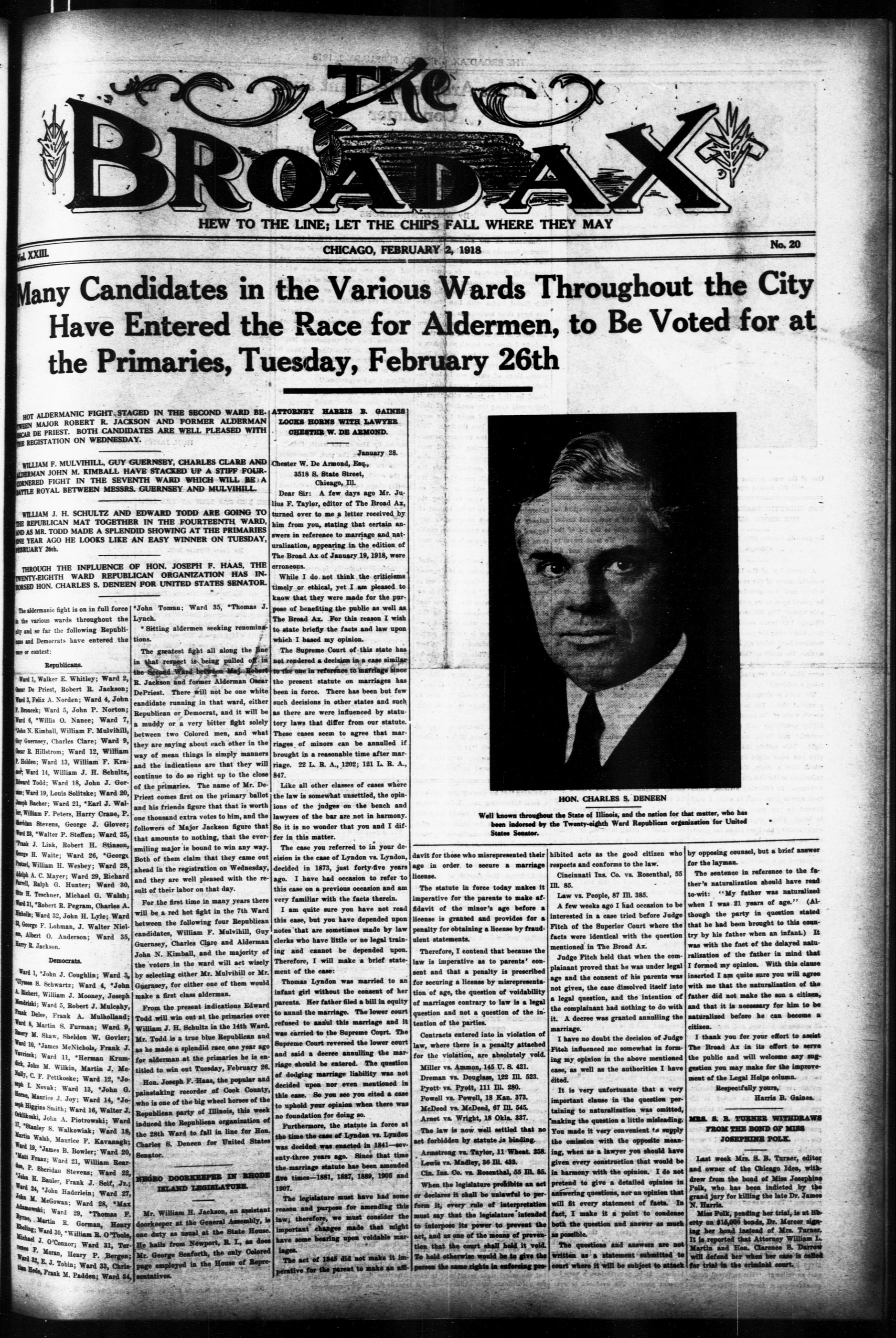
Many Candidates in the Various Wards Throughout the City Have Entered the Race for Aldermen, to Be Voted for at the Primaries, Tuesday, February 26th
HOT ALDERMANIC FIGHT STAGED IN THE SECOND WARD BE
TWEEN MAJOR ROBERT R. JACKSON AND FORMER ALDERMAN
OSCAR DE PRIEST. BOTH CANDIDATES ARE WELL PLEASED WITH
THE REGISTATION ON WEDNESDAY.
WILLIAM F. MULVIHILL, GUY GUERNSEY, CHARLES CLARE AND
ALDERMAN JOHN M. KIMBALL HAVE STACKED UP A STIFF FOUR-
CORNERED FIGHT IN THE SEVENTH WARD WHICH WILL BE A
BATTLE ROYAL BETWEEN MESSRS. GUERNSEY AND MULVIHILL.
WILLIAM J. H. SCHULTZ AND EDWARD TODD ARE GOING TO THE REPUBLICAN MAT TOGETHER IN THE FOURTEENTH WARD, AND AS MR. TODD MADE A SPLENDID SHOWING AT THE PRIMARIES ONE YEAR AGO HE LOOKS LIKE AN EASY WINNER ON TUESDAY, FEBRUARY 26th.
THROUGH THE INFLUENCE OF HON. JOSEPH F. HAAS, THE TWENTY-EIGHTH WARD REPUBLICAN ORGANIZATION HAS INDORSED HON. CHARLES S. DENEEN FOR UNITED STATES SENATOR.
The aldermanic fight is on in full force in the various wards throughout the city and so far the following Republicans and Democrats have entered the race or contest:
*John Toman; Ward 35, *Thomas J. Lynch.
*Sitting aldermen seeking renominations.
The greatest fight all along the line
Republicans.
Ward 1, Walker E. Whitley; Ward 2, Omar De Priest, Robert B. Jackson; Ward 3, Felix A. Norden; Ward 4, John P. Broucek; Ward 5, John P. Norton; Ward 6, *Willis O. Nance*; Ward 7, John N. Kimball, William F. Mulvihill, Gry Guernsey, Charles Clare; Ward 9, Omar R. Hillstrom; Ward 12, William P. Holden; Ward 13, William F. Kraemer; Ward 14, William J. H. Schultz, Edward Todd; Ward 18, John J. Gorman; Ward 19, Louis Solitske; Ward 20, Joseph Bacher; Ward 21, *Earl J. Walker*, William F. Peters, Harry Crane, P. Geridian Stevens, George J. Glover; Ward 23, *Walter P. Steffen*; Ward 25, Frank J. Link, Robert H. Stinson, George H. Waite; Ward 26, *George Pretzel*, William H. Wesbey; Ward 28, Adolph A. C. Mayer; Ward 29, Richard Farrell, Ralph G. Hunter; Ward 30, Otto H. Teschner, Michael G. Walsh; Ward 31, *Robert B. Pegram*, Charles A. Nicholls; Ward 32, John H. Lyle; Ward 23, George P. Lohman, J. Walter Nielsen, Albert O. Anderson; Ward 35, Harry R. Jackson.
Democrats.
Ward 1, *John J. Coughlin; Ward 3,
*Ulysses S. Schwartz; Ward 4, *John
A. Bichert, William J. Mooney, Joseph
Mendiski; Ward 5, Robert J. Mulcahy,
Frank Delee, Frank A. Mulholland;
Ward 8, Martin S. Furman; Ward 9,
Emery M. Shaw, Sheldon W. Govier;
Ward 10, *James McNichols, Frank J.
Vavrieck; Ward 11, *Herman Krumdick,
John M. Wilkin, Martin J. McNally,
C. F. Fettkoske; Ward 12, *Joseph
I. Novak; Ward 13, *John G. Horne,
Maurice J. Joy; Ward 14, *Joseph Higgins Smith; Ward 14, Walter J. Orklikonki, John A. Pitrowski; Ward 11, *Stanley S. Walkowiak; Ward 18,
Martin Walsh, Maurice F. Kavanagh;
Ward 19, *James B. Bowler; Ward 20,
*Matt Franz; Ward 21, William Rearden,
P. Sheridan Stevens; Ward 22,
*John H. Bauler, Frank J. Seif, Jr;
Ward 24, *John Haderlein; Ward 27,
John M. McGowan; Ward 28, *Max
Adamowksi; Ward 29, *Thomas F.
Byrne, Martin B. Gorman, Henry
Ebeling; Ward 30, *William R. O'Toole,
Michael J. O'Connor; Ward 31, Terence
F. Moran, Henry P. Bergen;
Ward 32, E. J. Tobin; Ward 33, Christian Hele, Frank M. Padden; Ward 34
*John Toman; Ward 35, *Thomas J. Lynch.
*Sitting aldermen seeking renominations.
The greatest fight all along the line in that respect is being pulled off in the Second Ward between Maj. Robert E. Jackson and former Alderman Oscar DePriest. There will not be one white candidate running in that ward, either Republican or Democrat, and it will be a muddy or a very bitter fight solely between two Colored men, and what they are saying about each other in the way of mean things is simply manners and the indications are that they will continue to do so right up to the close of the primaries. The name of Mr. DePriest comes first on the primary ballot and his friends figure that that is worth one thousand extra votes to him, and the followers of Major Jackson figure that that amounts to nothing, that the ever-smiling major is bound to win any way. Both of them claim that they came out ahead in the registration on Wednesday, and they are well pleased with the result of their labor on that day.
For the first time in many years there will be a red hot fight in the 7th Ward between the following four Republican candidates, William F. Mulvihill, Guy Guernnsey, Charles Clare and Alderman John N. Kimball, and the majority of the voters in the ward will act wisely by selecting either Mr. Mulvihill or Mr. Guernnsey, for either one of them would make a first class alderman.
From the present indications Edward Todd will win out at the primaries over William J. H. Schultz in the 14th Ward. Mr. Todd is a true blue Republican and as he made a splendid race one year ago for alderman at the primaries he is entitled to win out Tuesday, February 26.
Hon. Joseph F. Haas, the popular and painstaking recorder of Cook County, who is one of the big wheel horses of the Republican party of Illinois, this week induced the Republican organization of the 28th Ward to fall in line for Hon. Charles S. Deneen for United States Senator.
Mr. William H. Jackson, an assistant doorkeeper at the General Assembly, is one duty as usual at the State House. He hails from Newport, R. L., as does Mr. George Seaforth, the only Colored page employed in the House of Representatives.
ATTORNBY HARRIS B. GAINES
LOCKS HORNS WITH LAWYER
CHESTER W. DE ARMOND.
Dear Sir: A few days ago Mr. Julius F. Taylor, editor of The Broad Ax, turned over to me a letter received by him from you, stating that certain answers in reference to marriage and naturalization, appearing in the edition of The Broad Ax of January 19, 1918, were erroneous. While I do not think the criticisms timely or ethical, yet I am pleased to know that they were made for the purpose of benefiting the public as well as The Broad Ax. For this reason I wish to state briefly the facts and law upon which I based my opinion.
The Supreme Court of this state has not rendered a decision in a case similar to the one in reference to marriage since the present statute on marriages has been in force. There has been but few such decisions in other states and such as there are were influenced by statutory laws that differ from our statute. These cases seem to agree that marriages of minors can be annulled if brought in a reasonable time after marriage. 22 L. R. A., 1202; 121 L. R. A., 847.
Like all other classes of cases where the law is somewhat unsettled, the opinions of the judges on the bench and lawyers of the bar are not in harmony. So it is no wonder that you and I differ in this matter.
The case you referred to in your decision is the case of Lyndon vs. Lyndon, decided in 1873, just forty-five years ago. I have had occasion to refer to this case on a previous occasion and am very familiar with the facts therein.
I am quite sure you have not read this case, but you have depended upon notes that are sometimes made by law clerks who have little or no legal training and cannot be depended upon. Therefore, I will make a brief statement of the case:
Thomas Lyndon was married to an infant girl without the consent of her parents. Her father filed a bill in equity to annul the marriage. The lower court refused to annul this marriage and it was carried to the Supreme Court. The Supreme Court reversed the lower court and said a decree annulling the marriage should be entered. The question of dodging marriage liability was not decided upon nor even mentioned in this case. So you see you cited a case to uphold your opinion when there was no foundation for doing so.
Furthermore, the statute in force at the time the case of Lyndon vs. Lyndon was decided was enacted in 1841—seventy-three years ago. Since that time the marriage statute has been amended five times—1881, 1887, 1889, 1905 and 1907.
The legislature must have had some reason and purpose for amending this law; therefore, we must consider the important changes made that might have some bearing upon voidable marriages.
The act of 1845 did not make it imperative for the parent to make an aff
Mr. B. H.
davit for those who misrepresented their age in order, to secure a marriage license.
The statute in force today makes it imperative for the parents to make affidavit of the minor's age before a license is granted and provides for a penalty for obtaining a license by fraudulent statements.
Therefore, I contend that because the law is imperative as to parents' consent and that a penalty is prescribed for securing a license by misrepresentation of age, the question of voidability of marriages contrary to law is a legal question and not a question of the intention of the parties.
Contracts entered into in violation of law, where there is a penalty attached for the violation, are absolutely void.
hibited acts as the good citizen who respects and conforms to the law.
Cincinnati Ins. Co. vs. Rosenthal, 55 Ill. 85.
Law vs. People, 87 Ill. 385.
A few weeks ago I had occasion to be interested in a case tried before Judge Fitch of the Superior Court where the facts were identical with the question mentioned in The Broad Ax.
Judge Fitch held that when the complainant proved that he was under legal age and the consent of his parents was not given, the case dissolved itself into a legal question, and the intention of the complainant had nothing to do with it. A decree was granted annulling the marriage.
I have no doubt the decision of Judge Fitch influenced me somewhat in forming my opinion in the above mentioned by opposing counsel for the layman.
The sentence in their's naturalization to-wit: "My fae when I was 21 yr. though the party that he had been try by his father was with the fectralization of the fae I formed my opinion inserted I am quite with me that the father did not me and that it is no naturalized before citizen.
I thank you for The Broad Ax in the public and w
Dreman vs. Douglas, 122 Ill. 523.
Pyott vs. Pyott, 111 Ill. 280.
Powell vs. Powell, 18 Kan. 373.
McDeed vs. McDeed, 67 Ill. 545.
Arnet vs. Wright, 18 Okla. 337.
The law is now well settled that no act forbidden by statute is binding.
Armstrong vs. Taylor, 11 Wheat. 258.
Lewis vs. Madley, 36 Ill. 433.
Cin. Ina. Co. vs. Rosenthal, 55 Ill. 85.
When the legislature prohibits an act or declares it shall be unlawful to perform it, every rule of interpretation must say that the legislature intended to interpose its power to prevent the act, and as one of the means of prevention that the court shall hold it void.
To hold otherwise would be to give the person the same rights in enforcing pro
HON. CHARLES S. DENEEN
at the State of Illinois, and the nation for the Twenty-eighth Ward Republican organ
hibited acts as the good citizen who respects and conforms to the law.
Cincinnati Ins. Co. vs. Rosenthal, 55
Ill. 85.
Law vs. People, 87 Ill. 385.
A few weeks ago I had occasion to be interested in a case tried before Judge Fitch of the Superior Court where the facts were identical with the question mentioned in The Broad Ax.
Judge Fitch held that when the complainant proved that he was under legal age and the consent of his parents was not given, the case dissolved itself into a legal question, and the intention of the complainant had nothing to do with it. A decree was granted annulling the marriage.
I have no doubt the decision of Judge Fitch influenced me somewhat in forming my opinion in the above mentioned case, as well as the authorities I have cited.
It is very unfortunate that a very important clause in the question pertaining to naturalization was omitted, making the question a little misleading. You made it very convenient to supply the omission with the opposite meaning, when as a lawyer you should have given every construction that would be in harmony with the opinion. I do not pretend to give a detailed opinion in answering questions, nor an opinion that will fit every statement of facts. In fact, I make it a point to condense both the question and answer as much as possible.
The questions and answers are not written as a statement submitted to court where it will be subject to attack
1. Answer 4. Write the name of the capital city of India.
2. Write the name of the capital city of China.
3. Write the name of the capital city of Japan.
4. Write the name of the capital city of South Korea.
by opposing counsel, but a brief answer for the layman.
The sentence in reference to the father's naturalization should have read to-wit: "My father was naturalized when I was 21 years of age." (Although the party in question stated that he had been brought to this country by his father when an infant.) It was with the fact of the delayed naturalization of the father in mind that I formed my opinion. With this clause inserted I am quite sure you will agree with me that the naturalization of the father did not make the son a citizen, and that it is necessary for him to be naturalized before he can become a citizen.
I thank you for your effort to assist The Broad Ax in its effort to serve the public and will welcome any suggestion you may make for the improvement of the Legal Helps column.
Respectfully yours,
Harris B. Gaines.
MRS. S. B. TURNER WITHDRAWS
FROM THE BOND OF MISS
JOSEPHINE POLK.
Last week Mrs. S. B. Turner, editor
and owner of the Chicago Idea, withdrew from the bond of Miss Josephine Polk, who has been indicted by the grand jury for killing the late Dr. James N. Harris.
Miss Polk, pending her trial, is at liberty on $15,000 bonds, Dr. Mereer signing her bond instead of Mrs. Turner. It is reported that Attorney William L. Martin and Elen. Clarences S. Darrow will defend her when her case is called for trial in the criminal court.
1914
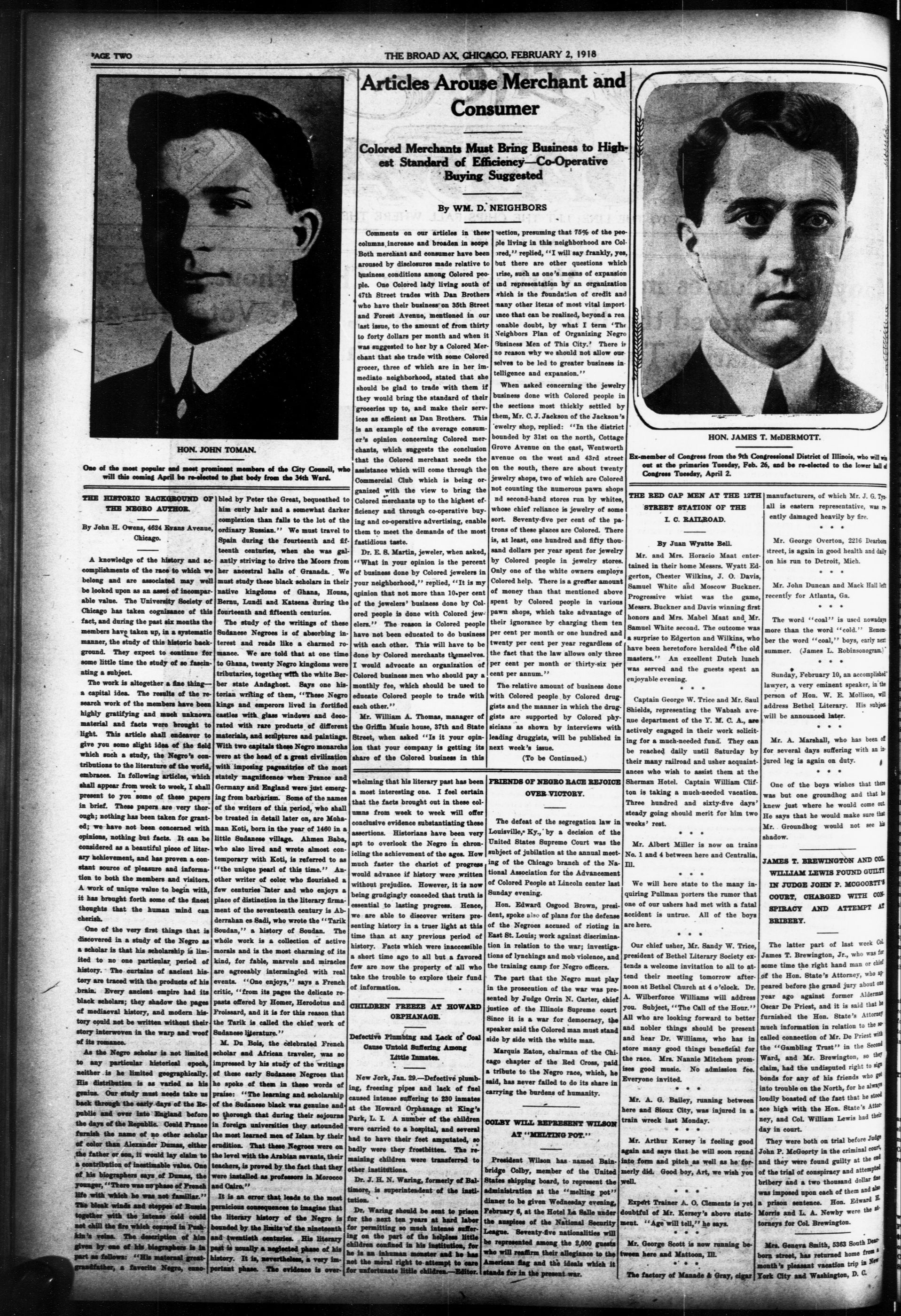
HON. JOHN TOMAN.
One of the most popular and most prominent members of the City Council, who will this coming April be re-elected to that body from the 34th Ward.
A knowledge of the history and accomplishments of the race to which we belong and are associated may well be looked upon as an asset of incomparable value. The University Society of Chicago has taken cognizance of this fact, and during the past six months the members have taken up, in a systematic manner, the study of this historic background. They expect to continue for some little time the study of so fascinating a subject.
The work is altogether a fine thing—a capital idea. The results of the research work of the members have been highly gratifying and much unknown material and facts were brought to light. This article shall endeavor to give you some slight idea of the field which such a study, the Negro's contributions to the literature of the world, embraces. In following articles, which shall appear from week to week, I shall present to you some of these papers in brief. These papers are very thorough; nothing has been taken for granted; we have not been concerned with opinions, nothing but facts. It can be considered as a beautiful piece of literary achievement, and has proven a constant source of pleasure and information to both the members and visitors. A work of unique value to begin with, it has brought forth some of the finest thoughts that the human mind can cherish.
One of the very first things that is discovered in a study of the Negro as a scholar is that his scholarship is limited to no one particular period of history. The curtains of ancient history are traced with the products of his brain. Every ancient empire had its black scholars; they shadow the pages of mediaeval history, and modern history could not be written without their story interwoven in the warp and woof of its romance.
As the Negro scholar is not limited to any particular historical epoch, neither is he limited geographically. His distribution is as varied as his genius. Our study must needs take us back through the early days of the Republic and over into England before the days of the Republic. Could France furnish the name of no other scholar of color than Alexander Dumas, either the father or son, it would lay claim to a contribution of inestimable value. One of his biographers says of Dumas, the younger, "There was no phase of French life with which he was not familiar." The bleak winds and steppes of Russia together with the intense cold could not chill the fire which coursed in Pushkin's veins. The description of him given by one of his biographers is in part as follows: "His maternal great-grandfather, a favorite Negro, enno-
AGE TWO
ominent members of the City Council, who
ted to that body from the 34th Ward.
bled by Peter the Great, bequeathed to
him curly hair and a somewhat darker
complexion than falls to the lot of
ordinary Russian." We must travel to
Spain during the fourteenth and fifteenth centuries, when she was gal-
antly striving to drive the Moors from
her ancestral halls of Granada. We
must study these black scholars in their
native kingdoms of Ghana, Housa,
Bernu, Lundi and Katsena during the
fourteenth and fifteenth centuries.
The study of the writings of these Sudanese Negroes is of absorbing interest and reads like a charmed romance. We are told that at one time to Ghana, twenty Negro kingdoms were tributaries, together with the white Berber state Andaghost. Says one historian writing of them, "These Negro kings and emperors lived in fortified castles with glass windows and decorated with rare products of different materials, and sculptures and paintings. With two capitals these Negro monarchs were at the head of a great civilization with imposing pageantries of the most stately magnificences when France and Germany and England were just emerging from barbarism. Some of the names of the writers of this period, who shall be treated in detail later on, are Mohaman Koti, born in the year of 1460 in a little Sudanese village. Ahmen Baba, who also lived and wrote almost contemporary with Koti, is referred to as "the unique pearl of this time." Another writer of color who flourished a few centuries later and who enjoys a place of distinction in the literary firmament of the seventeenth century is Aberrahan es Sadi, who wrote the "Tarik Tarik Soudan," a history of Soudan. The whole work is a collection of active morals and is the most charming of its kind, for fable, marvels and miracles are agreeably intermingled with real events. "One enjoys," says a French critic, "from its pages the delicate repasts offered by Homer, Herodotus and Froissard, and it is for this reason that the Tarik is called the chief work of Sudanese literature."
M. Du Bois, the celebrated French scholar and African traveler, was so impressed by his study of the writings of these early Sudanese Negroes that he spoke of them in these words of praise: "The learning and scholarship of the Sudanese black was genuine and so thorough that during their sojourns in foreign universities they astounded the most learned men of Islam by their erudition. That these Negroes were on the level with the Arabian savants, their teachers, is proved by the fact that they were installed as professors in Morocco and Cairo."
It is an error that leads to the most pernicious consequences to imagine that the literary history of the Negro is bounded by the limits of the nineteenth and twentieth centuries. His literary past is usually a neglected phase of his history. It in, nevertheless, a very important phase. The evidence is over-
THE BROAD AX, CHICAGO, FEBRUARY 2, 1918
Articles Arouse Merchant and Consumer
Colored Merchants Must Bring Business to Highest Standard of Efficiency—Co-Operative Buying Suggested
By WM. D. NEIGHBORS
Comments on our articles in these columns, increase and broaden in scope. Both merchant and consumer have been aroused by disclosures made relative to business conditions among Colored people. One Colored lady living south of 47th Street trades with Dan Brothers who have their business on 35th Street and Forest Avenue, mentioned in our last issue, to the amount of from thirty to forty dollars per month and when it was suggested to her by a Colored Merchant that she trade with some Colored grocer, three of which are in her immediate neighborhood, stated that she should be glad to trade with them if they would bring the standard of their groceries up to, and make their services as efficient as Dan Brothers. This is an example of the average consumer's opinion concerning Colored merchants, which suggests the conclusion that the Colored merchant needs the assistance which will come through the Commercial Club which is being organized with the view to bring the Colored merchants up to the highest efficiency and through co-operative buying and co-operative advertising, enable them to meet the demands of the most fastidious taste.
Dr. E. S. Martin, jeweler, when asked, "What in your opinion is the percent of business done by Colored jewelers in your neighborhood," replied, "It is my opinion that not more than 10-per cent of the jewelers' business done by Colored people is done with Colored jewelers." The reason is Colored people have not been educated to do business with each other. This will have to be done by Colored merchants themselves. I would advocate an organization of Colored business men who should pay a monthly fee, which should be used to educate Colored people to trade with each other."
Mr. William A. Thomas, manager of the Griffin Music house, 37th and State Street, when asked "Is it your opinion that your company is getting its share of the Colored business in this
whelming that his literary past has been a most interesting one. I feel certain that the facts brought out in these columns from week to week will offer conclusive evidence substantiating these assertions. Historians have been very apt to overlook the Negro in chronicling the achievement of the ages. How much faster the chariot of progress would advance if history were written without prejudice. However, it is now being grudgingly conceded that truth is essential to lasting progress. Hence, we are able to discover writers presenting history in a truer light at this time than at any previous period of history. Facts which were inaccessible a short time ago to all but a favored few are now the property of all who take the trouble to explore their fund of information.
CHILDREN FREEZE AT HOWARD ORPHANAGE.
Defective Plumbing and Lack of Coal Cause Untold Suffering Among
New Jork, Jan. 29.—Defective plumbing, freezing pipes and lack of fuel caused intense suffering to 230 inmates at the Howard Orphanage at King's Park, L. L. A number of the children were carried to a hospital, and several had to have their feet amputated, so badly were they frostbitten. The remaining children were transferred to other institutions.
Dr. J. H. N. Waring, formerly of Baltimore, is superintendent of the institution.
Dr. Waring should be sent to prison for the next ten years at hard labor for permitting so much intense suffering on the part of the helpless little children confined in his institution, for he is an inhuman monster and he has not the moral right to attempt to care for fortunate little children.—Editor
Little Inmates
section, presuming that $75\%$ of the people living in this neighborhood are Colored,' replied, "I will say frankly, yes, but there are other questions which arise, such as one's means of expansion and representation by an organization which is the foundation of credit and many other items of most vital importance that can be realized, beyond a reasonable doubt, by what I term 'The Neighbors Plan of Organizing Negro Business Men of This City.' There is no reason why we should not allow ourselves to be led to greater business intelligence and expansion.'
When asked concerning the jewelry business done with Colored people in the sections most thickly settled by them, Mr. C. J. Jackson of the Jackson's 'ewelry shop, replied: "In the district bounded by 31st on the north, Cottage Grove Avenue on the east, Wentworth avenue on the west and 43rd street on the south, there are about twenty jewelry shops, two of which are Colored not counting the numerous pawn shops and second-hand stores run by whites, whose chief reliance is jewelry of some sort. Seventy-five per cent of the patrons of these places are Colored. There is, at least, one hundred and fifty thousand dollars per year spent for jewelry by Colored people in jewelry stores. Only one of the white owners employs Colored help. There is a greater amount of money than that mentioned above spent by Colored people in various pawn shops, which take advantage of their ignorance by charging them ten per cent per month or one hundred and twenty per cent per year regardless of the fact that the law allows only three per cent per month or thirty-six per cent per annum."
The relative amount of business done with Colored people by Colored druggists and the manner in which the druggists are supported by Colored physicians as shown by interviews with leading druggists, will be published in next week's issue.
(To be Continued.)
FRIENDS OF NEGEO RACE REJOICE OVER VICTORY.
The defeat of the segregation law in Louisville.* Ky., by a decision of the United States Supreme Court was the subject of jubilation at the annual meeting of the Chicago branch of the National Association for the Advancement of Colored People at Lincoln center last Sunday evening.
Hon. Edward Osgood Brown, president, spoke also of plans for the defense of the Negroes accused of rioting in East St. Louis; work against discrimination in relation to the war; investigations of lynchings and mob violence, and the training camp for Negro officers.
The part that the Negro must play in the prosecution of the war was presented by Judge Orrin N. Carter, chief justice of the Illinois Supreme court Since it is a war for democracy, the speaker said the Colored man must stand side by side with the white man.
Marquis Eaton, chairman of the Chicago chapter of the Red Cross, paid a tribute to the Negro race, which he said, has never failed to do its share in carrying the burdens of humanity.
AT "MELTING POT"
President Wilson has named Bainbridge Colby, member of the United States shipping board, to represent the administration at the "melting pot" dinner to be given Wednesday evening, February 6, at the Hotel La Salle under the auspices of the National Security League. Seventy-five nationalities will be represented among the 2,000 guests who will reaffirm their allegiance to the American flag and the ideals which it stands for in the present war.
M.
HON. JAMES T. MeDERMOTT.
Ex-member of Congress from the 9th Con- out at the primaries Tuesday, Feb. Congress Tuesday, April 2.
THE RED CAP MEN AT THE 12TH STREET STATION OF THE I. C. RAILROAD.
Ex-member of Congress from the 9th Congressional District of Illinois, who will win out at the primaries Tuesday, Feb. 26, and be re-elected to the lower hall of Congress Tuesday, April 2.
By Juan Wyatte Bell.
Mr. and Mrs. Horacio Maat entertained in their home Messrs. Wyatt Edgerton, Chester Wilkins, J. O. Davis, Samuel White and Moscow Buckner, Progressive whist was the game, Messrs. Buckner and Davis winning first honors and Mrs. Mabel Maat and Mr. Samuel White second. The outcome was a surprise to Edgerton and Wilkins, who have been heretofore heralded the old masters." An excellent Dutch lunch was served and the guests spent an enjoyable evening.
Captain George W. Trice and Mr. Saul Shields, representing the Wabash avenue department of the Y. M. C. A., are actively engaged in their work soliciting for a much-needed fund. They can be reached daily until Saturday by their many railroad and usher acquaintances who wish to assist them at the Sherman Hotel. Captain William Clifton is taking a much-needed vacation. Three hundred and sixty-five days' steady going should merit for him two weeks' rest.
Mr. Albert Miller is now on trains No. 1 and 4 between here and Centralia, Ill.
We will here state to the many inquiring Pullman porters the rumor that one of our ushers had met with a fatal accident is untrue. All of the boys are here.
Our chief usher, Mr. Sandy W. Trice, president of Bethel Literary Society extends a welcome invitation to all to attend their meeting tomorrow afternoon at Bethel Church at 4 o'clock. Dr. A. Wilberforce Williams will address you. Subject, "The Call of the Hour." All who are looking forward to better and nobler things should be present and hear Dr. Williams, who has in store many good things beneficial for the race. Mrs. Nannie Mitchem promises good music. No admission fee. Everyone invited.
Mr. A. G. Bailey, running between here and Sioux City, was injured in a train wreck last Monday.
Mr. Arthur Kersey is feeling good again and says that he will soon round into form and pitch as well as he formerly did. Good boy, Art, we wish you well.
Expert Trainer A. O. Clements is yet doubtful of Mr. Kersey's above statement. "Age will tell," he says.
Mr. George Scott is now running between here and Mattoon, Ill.
The factory of Manade & Gray, cigar
. . .
. . .
Congressional District of Illinois, who will win 26, and be re-elected to the lower hall of H manufacturers, of which Mr. J. G. Tyler all is eastern representative, was re-ently damaged heavily by fire.
Mr. George Overton, 2216 Dearborn street, is again in good health and daily on his run to Detroit, Mich.
* * *
Mr. John Duncan and Mack Hall left recently for Atlanta, Ga.
The word "coal" is used nowadays more than the word "cold." Remember the word "coal," boys, early next summer. (James L. Robinsonogram.)
Sunday, February 10, an accomplished lawyer, a very eminent speaker, in the person of Hon. W. E. Mollison, will address Bethel Literary. His subject will be announced later.
Mr. A. Marshall, who has been off for several days suffering with an injured leg is again on duty.
One of the boys wishes that there was but one groundhog and that he knew just where he would come out. He says that he would make sure that Mr. Groundhog would not see his shadow.
JAMES T. BREWINGTON AND COL
WILLIAM LEWIS FOUND GUILT
IN JUDGE JOHN P. MCGOORTY'S
COURT, CHARGED WITH CON
SPIRACY AND ATTEMPT AT
BRIBERY.
The latter part of last week Col James T. Brewington, Jr., who was for some time the right hand man or chief of the Hon. State's Attorney, who appeared before the grand jury about one year ago against former Alderman Oscar De Priest, and it is said that he furnished the Hon. State's Attorney much information in relation to the so-called connection of Mr. De Priest with the "Gambling Trust" in the Second Ward, and Mr. Brewington, so they claim, had the undisputed right to sign bonds for any of his friends who got into trouble on the North, for he always loudly boasted of the fact that he stood ace high with the Hon. State's Attorney, and Col. William Lewis had their day in court.
They were both on trial before Judge John P. McGoorty in the criminal court, and they were found guilty at the end of the trial of conspiracy and attempted bribery and a two thousand dollar fine was imposed upon each of them and also a prison sentence. Hon. Edward H. Morris and L. A. Newby were the attorneys for Col. Brewington.
Mrs. Geneva Smith, 5363 South Dearborn street, has returned home from a month's pleasant vacation trip in New York City and Washington, D. C.
AaM
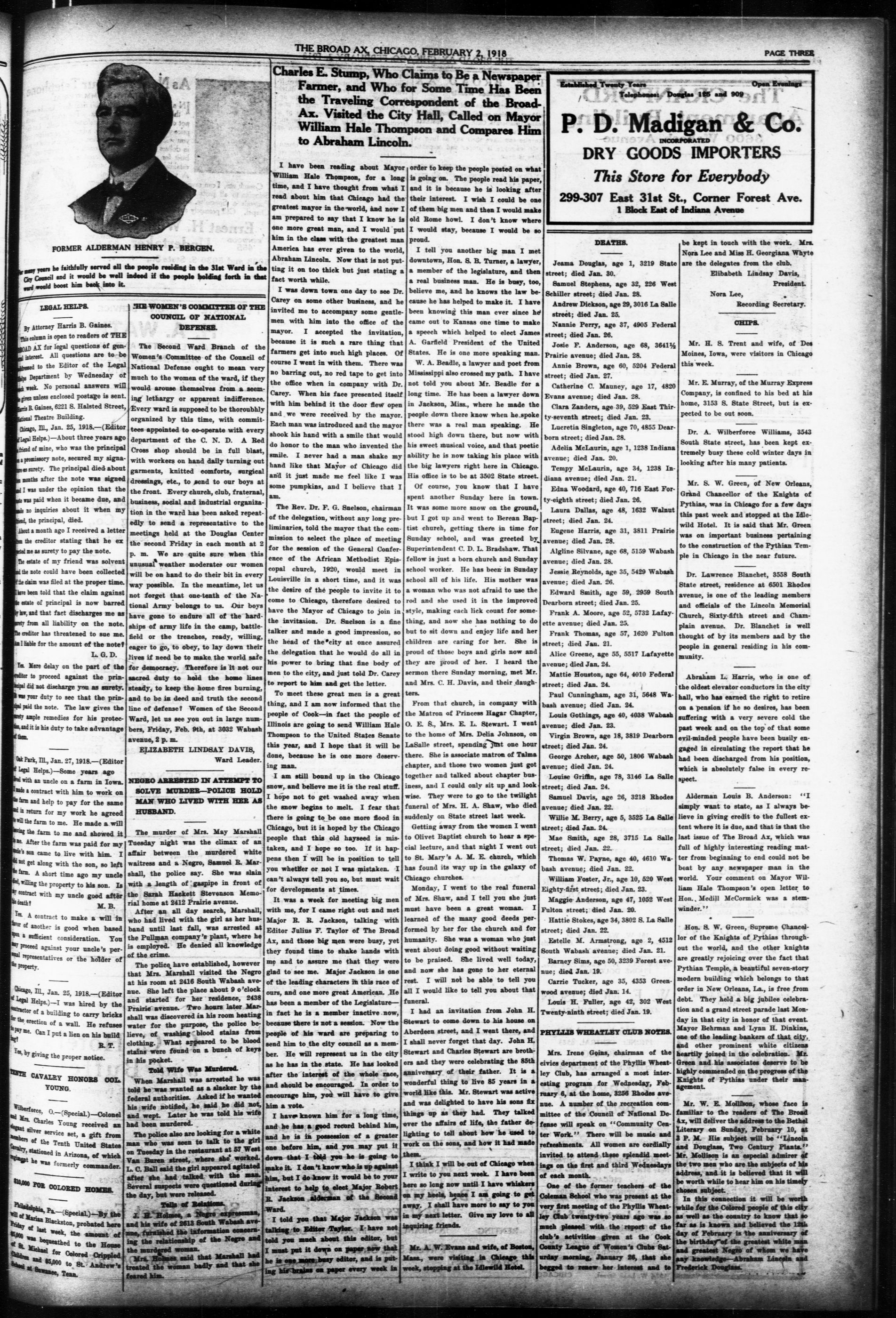
FORMER ALDERMAN HENRY P. BERGEN.
For many years he faithfully served all the people residing in the 31st Ward in the City Council and it would be well indeed if the people holding forth in that ward would boost him back into it.
charles E. Stump, Who Claims to Be a Newspaper Farmer, and Who for Some Time Has Been the Traveling Correspondent of the Broad-Ax. Visited the City Hall, Called on Mayor William Hale Thompson and Compares Him to Abraham Lincoln.
I have been reading about Mayor William Hale Thompson, for a long time, and I have thought from what I read about him that Chicago had the greatest mayor in the world, and now I am prepared to say that I know he is one more great man, and I would put him in the class with the greatest man America has ever given to the world, Abraham Lincoln. Now that is not putting it on too thick but just stating a fact worth while.
I was down town one day to see Dr. Carey on some other business, and he invited me to accompany some gentlemen with him into the office of the mayor. I accepted the invitation, because it is such a rare thing that farmers get into such high places. Of course I went in with them. There was no barring out, no red tape to get into the office when in company with Dr. Carey. When his face presented itself with him behind it the door flew open and we were received by the mayor. Each man was introduced and the mayor shook his hand with a smile that would do honor to the man who invented the smile. I never had a man shake my hand like that Mayor of Chicago did and it just made me feel like I was some pumpkins, and I believe that I am.
The Rev. Dr. F. G. Snelson, chairman of the delegation, without any long preliminaries, told the mayor that the commission to select the place of meeting for the session of the General Conference of the African Methodist Episcopal church, 1920, would meet in Louisville in a short time, and it was the desire of the people to invite it to come to Chicago, therefore desired to have the Mayor of Chicago to join in the invitation. Dr. Snelson is a fine talker and made a good impression, so the head of the city at once assured the delegation that he would do all in his power to bring that fine body of men to the city, and just told Dr. Carey to report to him and get the letter.
To meet these great men is a great thing, and I am now informed that the people of Cook—in fact the people of Illinois are going to send William Hale Thompson to the United States Senate this year, and I hope that it will be done, because he is one more deserving man.
I am still bound up in the Chicago snow, and believe me it is the real stuff. I hope not to get washed away when the snow begins to melt. I fear that there is going to be one more flood in Chicago, but it is hoped by the Chicago people that this old hayseed is mistaken, and I hope so too. If it happens then I will be in position to tell you whetter or not I was mistaken. I can't always tell you so, but must wait for developments at times.
It was a week for meeting big men with me, for I came right out and met Major R. R. Jackson, talking with Editor Julius F. Taylor of The Broad Ax, and those big men were busy, yet they found time to shake hands with me and to assure me that they were glad to see me. Major Jackson is one of the leading characters in this race of ours, and one more great American. He has been a member of the Legislature—in fact he is a member inactive now, because there is not a session. Now the people of his ward are preparing to send him to the city council as a member. He will represent us in the city as he has in the state. He has looked after the interest of the whole race, and should be encouraged. In order to encourage him, you will have to give him a vote.
I have known him for a long time, and he has a good record behind him, and he is in possession of a greater one before him, and you may put it down that I told you he is going to make it. I don't know who is up against him, but I do know it would be to your interest to help to elect Major Robert R. Jackson alderman of the Second Ward.
I told you that Major Jackson was talking to Editor Taylor. I have not told you much about this editor, but I must put it down on paper now that he is one more busy editor, and is putting his brains on paper every week in
order to keep the people posted on what is going on. The people read his paper, and it is because he is looking after their interest. I wish I could be one of them big men and then I would make old Rome howl. I don't know where I would stay, because I would be so proud.
I tell you another big man I met downtown, Hon. S. B. Turner, a lawyer, a member of the legislature, and then a real business man. He is busy, too, believe me, and he knows the law because he has helped to make it. I have been knowing this man ever since he came out to Kansas one time to make a speech which helped to elect James A. Garfield President of the United States. He is one more speaking man.
W. A. Beadle, a lawyer and poet from Mississippi also crossed my path. I have not told you about Mr. Beadle for a long time. He has been a lawyer down in Jackson, Miss., where he made the people down there know when he spoke there was a real man speaking. He stood high down there, but now with his sweet musical voice, and that poetic ability he is now taking his place with the big lawyers right here in Chicago. His office is to be at 3502 State street.
Of course, you know that I have spent another Sunday here in town. It was some more snow on the ground, but I got up and went to Berean Baptist church, getting there in time for Sunday school, and was greeted by Superintendent C. D. L. Bradshaw. That fellow is just a born church and Sunday school worker. He has been in Sunday school all of his life. His mother was a woman who was not afraid to use the rod and she used it in the improved style, making each lick count for something, and now she has nothing to do but to sit down and enjoy life and her children are caring for her. She is proud of those boys and girls now and they are proud of her. I heard the sermon there Sunday morning, met Mr. and Mrs. C. H. Davis, and their daughters.
From that church, in company with the Matron of Princess Hagar Chapter, O. E. S., Mrs. E. L. Stewart. I went to the home of Mrs. Delia Johnson, on LaSalle street, spending just one hour there. She is associate matron of Talma chapter, and those two women just got together and talked about chapter business, and I could only sit up and look wise. They were to go to the twilight funeral of Mrs. H. A. Shaw, who died suddenly on State street last week.
Getting away from the women I went to Olivet Baptist church to hear a special lecture, and that night I went out to St. Mary's A. M. E. church, which has found its way up in the galaxy of Chicago churches.
Monday, I went to the real funeral of Mrs. Shaw, and I tell you she just must have been a great woman. I learned of the many good deeds performed by her for the church and for humanity. She was a woman who just went about doing good without waiting to be praised. She lived well today, and now she has gone to her eternal rest. I will not be able to tell you all I would like to tell you about that funeral.
I had an invitation from John H. Stewart to come down to his house on Aberdeen street, and I went there, and I shall never forget that day. John H. Stewart and Charles Stewart are brothers and they were celebrating the 85th anniversary of their father. It is a wonderful thing to live 85 years in a world like this. Mr. Stewart was active and was delighted to have his sons fix things up as they had. They talked over the affairs of life, the father delighting to tell about how he used to work on the sons, and how it had made them.
I think I will be out of Chicago when I write to you next week. I have been here so long now until I have whiskers on my heels, hence I am going to get away. I shall have more to say to you in my next letter. Give my love to all inquiring friends.
Mr. A. W. Evans and wife, of Boston, Mass., were visiting in Chicago this week, stopping at the Idlewild Hotel.
299-307 East 31st St., Corner Forest Ave. 1 Block East of Indiana Avenue
PHYLLIS WHEATLEY CLUB NOTES.
Mrs. Irene Goins, chairman of the civics department of the Phyllis Wheatley Club, has arranged a most interesting program for Wednesday, February 6, at the home, 3256 Rhodes avenue. A number of the recreation committee of the Council of National Defense will speak on "Community Center Work." There will be music and refreshments. All women are cordially invited to attend these splendid meetings on the first and third Wednesdays of each month.
One of the former teachers of the Coleman School who was present at the very first meeting of the Phyllis Wheatley Club twenty-two years ago was so much pleased with the report of the club's activities given at the Cook County League of Women's Clubs Saturday morning, January 26, that she begged to renew her interest and to
PAGE THREE
be kept in touch with the work. Mrs. Nora Lee and Miss H. Georgiana Whyte are the delegates from the club.
Elibabeth Lindsay Davis, President.
Nora Lee, Recording Secretary.
CHIPS.
Mr. H. S. Trent and wife, of Des Moines, Iowa, were visitors in Chicago this week.
Mr. E. Murray, of the Murray Express Company, is confined to his bed at his home, 3153 S. State Street, but is expected to be out soon.
Dr. A. Wilberforcee Williams, 3543 South State street, has been kept extremely busy these cold winter days in looking after his many patients.
CHIPS
Mr. S. W. Green, of New Orleans, Grand Chancellor of the Knights of Pythias, was in Chicago for a few days this past week and stopped at the Idlewild Hotel. It is said that Mr. Green was on important business pertaining to the construction of the Pythian Temple in Chicago in the near future.
Dr. Lawrence Blanchet, 3558 South State street, residence at 6501 Rhodes avenue, is one of the leading members and officials of the Lincoln Memorial Church, Sixty-fifth street and Champlain avenue. Dr. Blanchet is well thought of by its members and by the people in general residing in his community.
Abraham L. Harris, who is one of the oldest elevator conductors in the city hall, who has earned the right to retire on a pension if he so desires, has been suffering with a very severe cold the past week and on the top of that some evil-minded people have been busily engaged in circulating the report that he had been discharged from his position, which is absolutely false in every respect.
Alderman Louis B. Anderson: "I simply want to state, as I always believe in giving credit to the fullest extent where it is due, and that is that the last issue of The Broad Ax, which was full of highly interesting reading matter from beginning to end could not be beat by any newspaper man in the world. Your comment on Mayor William Hale Thompson's open letter to Hon., Medill McCormick was a stemwinder."
Hon. S. W. Green, Supreme Chancellor of the Knights of Pythias throughout the world, and the other knights are greatly rejoicing over the fact that Pythian Temple, a beautiful seven-story modern building which belongs to that order in New Orleans, La., is free from debt. They held a big jubilee celebration and a grand street parade last Monday in that city in honor of that event. Mayor Behrman and Lynn H. Dinkins, one of the leading bankers of that city, and other prominent white citizens heartily joined in the celebration. Mr. Green and his associates deserve to be highly commended on the progress of the Knights of Pythias under their management.
Mr. W. E. Mollison, whose face is familiar to the readers of The Broad Ax, will deliver the address to the Bethel Literary on Sunday, February 10, at 3 P. M. His subject will be "Lincoln and Douglass, Two Century Plants." Mr. Mollison is an especial admirer of the two men who are the subjects of his address, and it is believed that it will be worth while to hear him on his timely chosen subject.
In this connection it will be worth while for the Colored people of this city as well as the country to know that so far as is known and believed the 12th day of February is the anniversary of the birthday of the greatest white man and greatest Negro of whom we have any knowledge—Abraham Lincoln and Frederick Douglass.
The CRANFORD Apartment Building 3600 Wabash Avenue
Coddy for Enfield
The finest building ever opened to Colored tenants in Chicago. Steam heat, electric lights, tile baths, marble entrance.
J. W. CASEY, Agent
Phone Main 263 133 W. Washington Street
PAGE 4: POUR
The CR
Apartmen
3600 Wak
The finest building ever open
cago. Steam heat, electric light
Phone Main 263
FREE
STYLE BOOK
... HAIR
To Colored Women
We are the largest
market for colored
Women's
Hair. Our latest
book showing new
styles in hair
and women. Every colored
woman should have
one. We sell thou-
sand our hair and
toller articles. Sat-
fiction guaranteed
or money back.
We make the best
polishers/Makeup
ENING combs, with stitching. Back, fully
guaranteed. With each comb we give lamp cap
FREE. Send money order or stamp. MONEY
BACK IF NOT SATISFACTORY. $129 postpaid.
POSTPAID $129
Hair notes, brushes, combs and toilet articles
mammothwear' prices. Send two-cent stamp.
Agents Wanted. Address as follows:
NUMANIA HAIR COMPANY.
121-127 Park Row,
New York City.
Address Dept. 84
Dr. Mac Enery J. Brown
Physician and Surgeon
Practice Limited to
Diseases of the
Eye, Ear, Nose and Threat
10 EAST 35th STREET
Hours:
9 to 12 A.M., 2 to 9 P.M. CHICAGO
RESIDENCE 3419 South Park Avenue
PHONE DOUGLAS 91556
WM. J. LATHAM
ATTORNEY AT LAW
OFFICE PHONE: CALUMET 05
2 East 31st Street
Suite 7
CHICAGO
Frank Dunn, J. B. McCahoy, Trustees
Telephones: Oakland 1552, 1551, 1556
JOHN J. DUNN
ESTABLISHED 1877
Wholesale and Retail
COAL
Fifty-First and Federal Streets
CHICAGO
KINKY HAIR
Don't let some fake Kick Remover feel you. You really can't streamline your look until it's nice and bad. That's what EXELENTO SUNNY does, tomorrow Dayroll, family of the best of the kind, and makes it a very long, soft and sticky. After using a few times you can tell the difference, and often a little while it will be so pretty and long, the you can't do it up to much you. If you don't do so, you can't see you well play your money back. So by mail on, result of stamps or wals, AGENTS WANTED EVERYWHERE. Write For Portfolios.
---
1
MILES J. DEVINE
Attorney at Law
Suite 313-329 Reaper Block
Clark and Washington Sts.
Phones, Central 229; Auto. 41-618
CHICAGO
PHONE MAIN 2214
A. D. GASH
Attorney at Law
118 North La Salle Street
Suite 618 to 618
CHICAGO
A. L. WILLAMS
Attorney and
Counselor at Law
Phone Main 2017 Automatic 32-395
Suite 706 Firmenick Building
184 W. Washington St.
CHICAGO
RESIDENCE: 508 E. 36th STREET
PHONE DOUGLAS 4397
J. Gray Lucas
Attorney at Law
Suite 815 Hartford Bldg.
8 S. Dearborn St. CHICAGO
PHONES: OFFICE, CENTRAL 6583
AUTOMATIC 42-590
Residence, 4533 Prairie Avenue
Roe, Kenwood 2828
WALTER M. FARMER
ATTORNEY AND
COUNSELOR AT LAW
NOTARY PUBLIC
Suite 2828
184 W. Washington St.
Phones, Office, Main 413
Auto., 22726
CHICAGO
W. E. MOLLISON
ATTORNEY and COUNSELOR
Suite 815 Hartford Bldg.
PHONE: CENTRAL 6583
CHICAGO
TELEPHONE OAKLAND 246
C. E. KREYSSLER
DRUGGIST
Prescriptions carefully compounded. Mr. Kreysler extends the greetings of the holiday season to his many friends and customers.
5057 South State Street
Near 51st Street Not on the Corner
CHICAGO
TELEPHONE WEST 4598
NIGHT CALLS GIVEN PROMPT ATTENTION
J. Frank Armstrong, B. S., M. D.
Physician and Surgeon
HOURS:
Until 9:30 A. M., 3 to 1 and 7 to 9 P. M.
SUNDAYS:
1:30 to 2:30 P. M. and by appointment
OFFICE AND RESIDENCE:
1924 W. Lake Street CHICAGO
THE BROAD AX, CHICAGO, FEBRUARY 2, 1918
Entered as Second-Class Matter Aug.
19, 1902, at the Post Office at Chicago,
Illinois, under Act of March 3, 1879.
Newspaper Advertising Solicitor
Wanted.
A live newspaper advertising solicitor; one who knows how to hustle for business wanted. For further information, address the editor of this paper or phone, Wentworth 2597.
THINGS THAT WE LAUGH AT
Inanimate Objects, Because of Association, Used by Comedians to Cause People to Smile.
The intrinsic humor possessed by inanimate objects is a study in itself. A person has but to lift up a string of sausages to make us smile. There must be some curious association of ideas, writes Rob Wagner in the Saturday Evening Post, that has always made of sausages a favorite prop for the comedian. The popularity of spaghetti as a laugh provoker probably lies in the great difficulty of eating it with dignity. Because of some strange significance, lawnmowers and baby carriages are potential of much milrth.
Inanimate objects are not the only facetious things in life; among the fruits and vegetables we find are comedians. We have a complete flora and fauna of comedy that every director is supposed to know. The edible props of pleasantry are the cabbage, prune and onion; while among the animals, the jackass and the mule get the longest laughs, though I believe the goat produces the strongest.
We had a stupid director who thought because a Shetland pony offered such a tremendous contrast to a mule he could hitch the two together and get a lot of laughs. It cost a bunch of money to convince this unanalytical chump that people regard these diminutive horses much as they do beautiful children; they are too sweet and cute to be subjected to the slightest indignity. Sheer beauty is never funny.
OLD CHURCH WITH A HISTORY
St. Martin's-in-the-Fields, Has Pews Permanently Reserved for Sovereign and Prince.
There are many interesting associations with royalty attaching to the historic church of St. Martin's-in-the-Fields, where the king and queen recently attended a special service. It is not generally known, states a London correspondent, that pews are permanently reshered there for the sovereign and the prince of Wales owing to the fact that it is the mother church of all the royal parishes, and the parish church for Buckingham palace.
Phones: Prospect 179 and 427 Res. Phone: P
HENRY P. BERGEN
REAL ESTATE
6244 South Ashland Avenue
With
JAMES H. RYAN & CO.
TELEPHONE KENWOOD 1233
J. B. CLITH
REAL M
RENTING INSURANCE
7 West 5
NOTARY PUBLIC
J. B. CLITHERO & CO.
REAL ESTATE
RENTING INSURANCE MORTGAGE LOANS
7 West 51st Street
NOTARY PUBLIC CHICAGO
Henry VIII built the first church to prevent tunnels passing his palace in Whitehall. The present edifice dates from 1728, and its chief claim to architectural distinction is that it possesses the only perfect example of a Grecian portico in London. In the older church some of the children of Charles II were christened.
George I presented it with an organ. on which Handel frequently played. Nell Gwynne and Jack Sheppard were buried in the ancient vaults. It was opposite the present St. Martin's, where the National Portrait Gallery now stands, that the Merry Monarch, on his way to Drury Lane theater, caught his first glimpse of the famous beauty as she was selling her oranges.
Corn Dumplings.
Make a stew from a cheap cut of meat cut into small pieces, with the desired amount of carrots, onions and potatoes. Pour enough boiling water over a cupful of cornmeal to make a soft dough; let cool; then mix in one cupful of flour sieved with two teaspoonfuls of baking powder; add one egg and mix thoroughly; form into small round balls and put them into the stew for the last 25 minutes of cooking.
Dish up on a hot platter, pour the gravy over all and arrange the dumplings around as a border. These will take the place of bread at the meal. These corn dumplings are especially nice served with chicken potpie accompanied by either jelly or a relish.
New Name for 'Em.
The head of an East End household had no sooner arrived at home the other evening than he was sent forthwith to see "what in the world" was the matter with the furnace, says the Indianapolis News. His derby hat encountered the top of the door leading to the basement with the result that the hat received a good sized "stove" in the front.
As he emerged from the basement after a tussle with the offending heating plant he was met with a shout of laughter by the six-year-old heir to the family fortune.
"Gee, mother!" exclaimed the boy. "Look; dad got a dimple in his hat."
But One Hospital Flag.
There is today but one hospital flag, and the commanding officer who knowingly directs even a stray shot-at a camp with the Red Cross floating over it violates an international agreement.
Woman Suffrage.
It was in the early days of the advanced movement of woman suffrage, muses an exchange, when by the magistrate's orders a number of "enthusiasts" went to Holloway jail. Among them was a most excellent charwoman who was employed at Clement's inn. A sympathetic meeting was held on their release, at which the chairman spoke in eloquent terms. "Here you have," he remarked, "a body of delicately nurtured, earnest-minded women who, for some trifling infraction of the law, find themselves condemned to prison, and there for the first time in their lives—" "Beg pardon, sir, for interrupting," said the charwoman, jumping up hastily, "but I think I ought to tell you that I did once get seven days for banging my old man on the nose!"
Proffitable Reading.
The woman who does not keep abreast with what is taking place is doing herself a serious injustice. There is no possible excuse for ignorance in this day when opportunity is open to all through the public schools, the public library and the newspaper.—Exchange.
Interrupted Solemnity.
Buddy, aged three, was flower carrier at his aunt's wedding. When all was very quiet and the minister was reading the marriage ceremony, Buddy called out in a loud, clear voice, "Mamma, is he reading a story about the bears?"
Res. Phone: Prospect 532
CHICAGO
ERO & CO.
ESTATE
MORTGAGE LOANS
1st Street
CHICAGO
As Near As Your Telephone DISTANCE IMMATERIAL IN A Metropolitan City of this size, death knocks every thirty minutes at some door. Too often that death not only brings sorrow, but misfortune as well. Let the price you pay for a funeral be a business proposition and you will benefit by it in service, quality and cost to you in dollars and cents. The result of my campaign has built for me one of the largest and most magnificent establishments in the world.
Consult me, I can save you Worry. The Shipping to all parts of the Country and Funerals a Specialty. Central Display Chapel. Call promptly answered day or
Ernest H. William
KENWOOD
455
Undertaker
5028 and 5030 S. State St.,
I DECORATE GIVE S
H. A. WA
REAL ESTATE A
RENTING A
Consult me, I can save you Worry, Time and Money. Shipping to all parts of the Country and Automobile Funerals a Specialty. Central Display Rooms and Chapel. Call promptly answered day or night.
OWNERS AND DIRECTORS
OPEN DAY AND NIGHT The Emanuel Jackson Undertaking Co., Inc.
2959-61 South State Street
Service Courteous
Reasoanble Prices
FREE CHAPEL IN CONNECTION
Line of Funeral Goods Automo
Reasoanb
FREE CHAPEL IN
Complete Line of Funeral Goods
TEENAN JON
TEENAN JONES' PLACE
3445 SOUTH STATE STREET
TELEPHONE DOUGLAS 4591
The finest and most UP-TO-DA
BUFFET and CAFE on the S
Side. First-Class Entertain
HENRY "TEENAN" JONES,
the finest and most UP-TO-DATE
UFFET and CAFE on the So-
side. First-Class Entertainm
Y "TEENAN" JONES, P
E
N, Proprietors
B, Manager
The finest and most UP-TO-DATE BUFFET and CAFE on the South Side. First-Class Entertainers. HENRY "TEENAN" JONES, Proprietor
A. F. COBOZOE
J. M. WHISTON, Preprietors
CHAS. HARRIS, Manager
The Elite Cafe
AND BUFFET
3030 STATE STREET
Phones: Douglas 883, and Douglas 6162
C. C. Hotel and Buffet
THOS. COLE
3449 South State Street
The Store That S
State Street F
THOS. COLE, Proprietor
North State Street
The Store That Saves You Money
State Street Furniture Co.
3131-35 South State Street
CASH OR CREDIT
PETER H. BURKE
PHONE DOUGLAS 1714
DAN M. JACKSON
GEQ. T. KERSEY
DAVID A. McGOWAN
AHMED A. RAYNER
Reliable Service
LAURENCE
LOW RENT
KINS
INSURANCE
QUALTY
Indiana Avenue
CHICAGO
Phones Calumet 6164
Automatic 71-629
Street
Marteous Treatment
CTION
Automobiles for Hire
PLACE
TO-DATE
of the South
tertainers.
ES, Proprietor
DOUGLAS 1871
Phones DOUGLAS 1871
AUTO. 12-197
Automatic 72-74
Chicago, Ill.
Money
iture Co.
Street
CHICAGO