The Broad Ax
Saturday, February 9, 1918
Chicago, Illinois
Page text (machine-generated)
THE BROAD AX
HEW TO THE LINE; LET THE CHIPS FALL WHERE THEY MAY
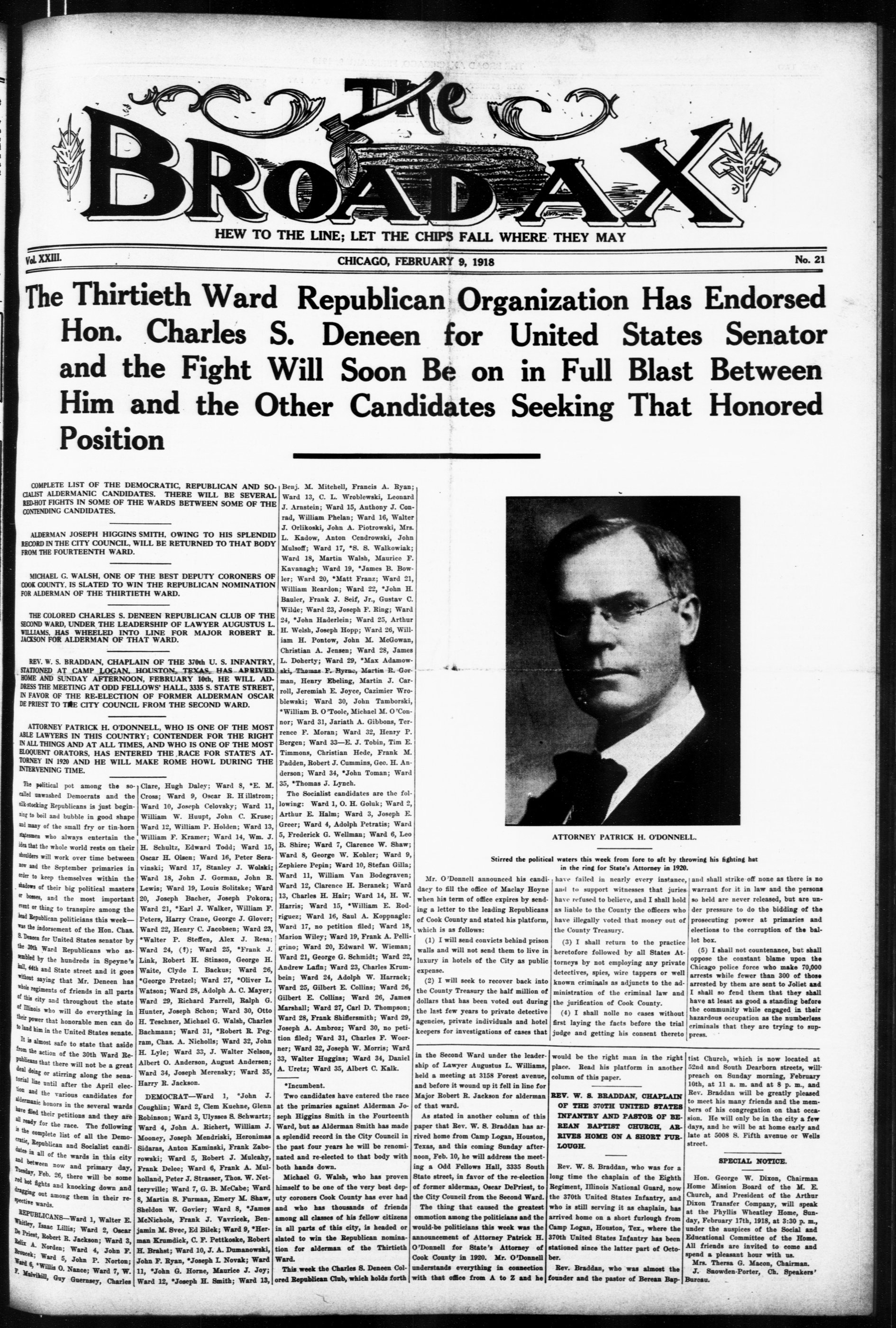
The Thirtieth Ward Republican Organization Has Endorsed Hon. Charles S. Deneen for United States Senator and the Fight Will Soon Be on in Full Blast Between Him and the Other Candidates Seeking That Honored Position
COMPLETE LIST OF THE DEMOCRATIC, REPUBLICAN AND SOCIALIST ALDERMANIC CANDIDATES. THERE WILL BE SEVERAL RED-HOT FIGHTS IN SOME OF THE WARDS BETWEEN SOME OF THE CONTENDING CANDIDATES.
ALDERMAN JOSEPH HIGGINS SMITH, OWING TO HIS SPLENDID RECORD IN THE CITY COUNCIL, WILL BE RETURNED TO THAT BODY FROM THE FOURTEENTH WARD.
MICHAEL G. WALSH, ONE OF THE BEST DEPUTY CORONERS OF COOK COUNTY, IS SLATED TO WIN THE REPUBLICAN NOMINATION FOR ALDERMAN OF THE THIRTIETH WARD.
THE COLORED CHARLES S. DENEEN REPUBLICAN CLUB OF THE SECOND WARD, UNDER THE LEADERSHIP OF LAWYER AUGUSTUS L. WILLIAMS, HAS WHEELED INTO LINE FOR MAJOR ROBERT R. JACKSON FOR ALDERMAN OF THAT WARD.
REV. W. S. BRADDAN, CHAPLAIN OF THE 370th U. S. INFANTRY, STATIONED AT CAMP LOGAN, HOUSTON, TEXAS. HAS APPRIVED HOME AND SUNDAY AFTERNOON, FEBRUARY 10th. HE WILL ADDRESS THE MEETING AT ODD FELLOWS' HALL, 3335 S. STATE STREET, IN FAVOR OF THE RE-ELECTION OF FORMER ALDERMAN OSCAR DE PRIEST TO THE CITY COUNCIL FROM THE SECOND WARD.
ATTORNEY PATRICK H. O'DONNELL, WHO IS ONE OF THE MOST ABLE LAWYERS IN THIS COUNTRY; CONTENDER FOR THE RIGHT IN ALL THINGS AND AT ALL TIMES, AND WHO IS ONE OF THE MOST ELOQUENT ORATORS, HAS ENTERED THE RACE FOR STATE'S ATTORNEY IN 1920 AND HE WILL MAKE ROME HOWL DURING THE INTERVENING TIME.
Vol. XXIII.
The Thirtieth Hon. and the Him and Position
COMPLETE LIST OF THE DECISIONALIST ALDERMANIC CANDIDATE RED-HOT FIGHTS IN SOME OF THE CONTENDING CANDIDATES.
ALDERMAN JOSEPH HIGGINS RECORD IN THE CITY COUNCIL, FROM THE FOURTEENTH WARD.
MICHAEL G. WALSH, ONE OF COOK COUNTY, IS SLATED TO WORK FOR ALDERMAN OF THE THIRTIETH
THE COLORED CHARLES S. D. SECOND WARD, UNDER THE LEAKE WILLIAMS, HAS WHEELED INTO JACKSON FOR ALDERMAN OF THE REV.
REV. W. S. BRADDAN, CHAPEL STATIONED AT CAMP LOGAN, HOME AND SUNDAY AFTERNOON DRESS THE MEETING AT ODD FELT IN FAVOR OF THE RE-ELECTION DE PRIEST TO THE CITY COUNCIL.
ATTORNEY PATRICK H. O'DONALLE LAWYERS IN THIS COUNTY IN ALL THINGS AND AT ALL TIME ELOQUENT ORATORS, HAS ENTERTORNEY IN 1920 AND HE WILL INTERVENING TIME.
The political pot among the so-called unwashed Democrats and the silk-stocking Republicans is just beginning to boil and bubble in good shape and many of the small fry or tin-horn statesmen who always entertain the idea that the whole world rests on their shoulders will work over time between now and the September primaries in order to keep themselves within the shadows of their big political masters or bosses, and the most important event or thing to transpire among the head Republican politicians this week—was the indorsement of the Hon. Chas. S. Deneen for United States senator by the 30th Ward Republicans who assembled by the hundreds in Speyne's hall, 44th and State street and it goes without saying that Mr. Deneen has whole regiments of friends in all parts of this city and throughout the state of Illinois who will do everything in their power that honorable men can do to land him in the United States senate.
It is almost safe to state that aside from the action of the 30th Ward Republicans that there will not be a great deal doing or stirring along the senatorial line until after the April election and the various candidates for aldermanic honors in the several wards have filed their petitions and they are all ready for the race. The following is the complete list of all the Democratic, Republican and Socialist candidates in all of the wards in this city and between now and primary day, Tuesday, Feb. 26, there will be some red hot fights and knocking down and dragging out among them in their respective wards.
REPUBLICANS—Ward 1, Walter E.
Whitley, Isaac Lillis; Ward 2, Oscar
De Priest, Robert R. Jackson; Ward 3,
Belix A. Norden; Ward 4, John F.
Broucek; Ward 5, John P. Norton;
Ward 6, *Willis O. Nance*; Ward 7, W.
P. Malvihill, Guy Guenarse, Charles
Clare, Hugh Daley; Ward 8, *E. M. Cross; Ward 9, Oscar R. Hillstrom; Ward 10, Joseph Celovsky; Ward 11, William W. Huupt, John C. Kruse; Ward 12, William P. Holden; Ward 13, William F. Kramer; Ward 14, Wm. J. H. Schultz, Edward Todd; Ward 15, Oscar H. Olsen; Ward 16, Peter Seravinski; Ward 17, Stanley J. Wolski; Ward 18, John J. Gorman, John R. Lewis; Ward 19, Louis Solitske; Ward 20, Joseph Bacher, Joseph Pokora; Ward 21, *Earl J. Walker, William F. Peters, Harry Crane, George J. Glover; Ward 22, Henry C. Jacobsen; Ward 23, *Walter P. Steffen, Alex J. Resa; Ward 24, (*); Ward 25, *Frank J. Link, Robert H. Stinson, George H. Waite, Clyde I. Backus; Ward 26, *George Pretzel; Ward 27, *Oliver L. Watson; Ward 28, Adolph A. C. Mayer; Ward 29, Richard Farrell, Ralph G. Hunter, Joseph Schon; Ward 30, Otto H. Teschner, Michael G. Walsh, Charles Bachmann; Ward 31, *Robert R. Pegram, Chas. A. Nicholls; Ward 32, John H. Lyle; Ward 33, J. Walter Nelson, Albert O. Anderson, August Andersen; Ward 34, Joseph Merensky; Ward 35, Harry R. Jackson.
DEMOCRAT—Ward 1, *John J. Coughlin; Ward 2, Clem Kuehne, Glenn Robinson; Ward 3, Ulysses S. Schwartz; Ward 4, John A. Richert, William J. Mooney, Joseph Mendriski, Heronimas Sidaras, Anton Kaminski, Frank Zaborowski; Ward 5, Robert J. Muleahy, Frank Delee; Ward 6, Frank A. Mulholland, Peter J. Strasser, Thos. W. Netteryville; Ward 7, G. B. McCabe; Ward 8, Martin S. Furman, Emery M. Shaw, Sheldon W. Govier; Ward 8, *James McNichols, Frank J. Vavrieck, Benjamin M. Svee, Ed Eilek; Ward 9, *Herman Krumdick, C. F. Pettkoske, Robert H. Brahst; Ward 10, J. A. Dumanowski, John F. Ryan, *Joseph I. Novak; Ward 11, *John G. Horne, Maurice J. Joy; Ward 12, *Joseph H. Smith; Ward 13,
All Republican Org. U.S. Deneen for Will Soon Be or Other Candidates
Benj. M. Mitchell, Francis A. Bryan; Ward 13, C. L. Wroblewski, Leonard J. Arnstein; Ward 15, Anthony J. Conrad, William Phelan; Ward 16, Walter J. Orlikoski, John A. Piotrowski, Mrs. L. Kadow, Anton Cendrowski, John Mulsoff; Ward 17, *S. S. Walkowiak; Ward 18, Martin Walsh, Maurice F. Kavanagh; Ward 19, *James B. Bowler; Ward 20, *Matt Franz; Ward 21, William Reardon; Ward 22, *John H. Bauler, Frank J. Seif, Jr., Gustav C. Wilde; Ward 23, Joseph F. Ring; Ward 24, *John Haderlein; Ward 25, Arthur H. Welsh, Joseph Hopp; Ward 26, William H. Pontow, John M. MeGowan, Christian A. Jensen; Ward 28, James L. Doherty; Ward 29, *Max Adamowski, Thomas F. Byrne, Martin R. Gorman, Henry Ebeling, Martin J. Carroll, Jeremiah E. Joyce, Cazimier Wroblewski; Ward 30, John Tamborski, *William B. O'Toole, Michael M. O'Connor; Ward 31, Jariath A. Gibbons, Terrence F. Moran; Ward 32, Henry P. Bergen; Ward 33—E. J. Tobin, Tim E. Timmons, Christian Hede, Frank M. Padden, Robert J. Cummins, Geo. H. Anderson, Ward 34, *John Toman; Ward 35, *Thomas J. Lynch.
The Socialist candidates are the following: Ward 1, O. H. Goluk; Ward 2, Arthur E. Halm; Ward 3, Joseph E. Greer; Ward 4, Adolph Petratis; Ward 5, Frederick G. Wellman; Ward 6, Leo B. Shire; Ward 7, Clarence W. Shaw; Ward 8, George W. Kohler; Ward 9, Zephiere Pepin; Ward 10, Stefan Gilla; Ward 11, William Van Bodegraven; Ward 12, Clarence H. Beranek; Ward 13, Charles H. Hair; Ward 14, H. W. Harris; Ward 15, *William E. Rodriguez; Ward 16, Saul A. Koppnagle; Ward 17, not petition filed; Ward 18, Marion Wiley; Ward 19, Frank A. Pelligrino; Ward 20, Edward W. Wieman; Ward 21, George G. Schmidt; Ward 22, Andrew Lafnn; Ward 23, Charles Krumbein; Ward 24, Adolph W. Harrack; Ward 25, Gilbert E. Collins; Ward 26, Gilbert E. Collins; Ward 26, James Marshall; Ward 27, Carl D. Thompson; Ward 28, Frank Shifersmith; Ward 29, Joseph A. Ambroz; Ward 30, no petition fled; Ward 31, Charles F. Woerner; Ward 32, Joseph W. Morris; Ward 33, Walter Huggins; Ward 34, Daniel A. Uretz; Ward 35, Albert C. Kalk.
Two candidates have entered the race at the primaries against Alderman Joseph Higgins Smith in the Fourteenth Ward, but as Alderman Smith has made a splendid record in the City Council in the past four years he will be renominated and re-elected to that body with both hands down.
Michael G. Walsh, who has proven himself to be one of the very best deputy coroners Cook County has ever had and who has thousands of friends among all classes of his fellow citizens in all parts of this city, is headed or slated to win the Republican nomination for alderman of the Thirtieth Ward.
This week the Charles S. Deneen Colored Republican Club, which holds forth
*Incumbent.
ean Organi
n for Uni
Be on in
idates See
Stirred the politic
Mr. O'Donnell announced his candidacy to fill the office of Maclay Hoyne when his term of office expires by sending a letter to the leading Republicans of Cook County and stated his platform, which is as follows:
(1) I will send convicts behind prison walls and will not send them to live in luxury in hotels of the City as public expense.
(2) I will seek to recover back into the County Treasury the half million of dollars that has been voted out during the last few years to private detective agencies, private individuals and hotel keepers for investigations of cases that
in the Second Ward under the leadership of Lawyer Augustus L. Williams, held a meeting at 3158 Forest avenue, and before it wound up it fell in line for Major Robert R. Jackson for alderman of that ward.
As stated in another column of this paper that Rev. W. S. Braddan has arrived home from Camp Logan, Houston, Texas, and this coming Sunday afternoon, Feb. 10, he will address the meeting a Odd Fellows Hall, 3335 South State street, in favor of the re-election of former alderman, Oscar DePriest, to the City Council from the Second Ward.
The thing that caused the greatest ommotion among the politicians and the would-be politician this week was the announcement of Attorney Patrick H. O'Donnell for State's Attorney of Cook County in 1920. Mr. O'Donnell understands everything in connection with that office from A to Z and he
[Name]
Stirred the political waters this week from fore to aft by throwing his fighting hat in the ring for State's Attorney in 1920.
ATTORNEY PATRICK H. O'DONNELL.
have failed in nearly every instance, and to support witnesses that juries have refused to believe, and I shall hold as liable to the County the officers who have illegally voted that money out of the County Treasury.
(3) I shall return to the practice heretofore followed by all States Attorneys by not employing any private detectives, spies, wire tappers or well known criminals as adjuncts to the administration of the criminal law and the jurification of Cook County.
(4) I shall nole no cases without first laying the facts before the trial judge and getting his consent thereto
would be the right man in the right place. Read his platform in another column of this paper.
REV. W. S. BRADDAN, CHAPLAIN OF THE 370TH UNITED STATES INFANTRY AND PASTOR OF BEREAN BAPTIST CHURCH, ARRIVES HOME ON A SHORT FURLOUGH.
Rev. W. S. Braddan, who was for a long time the chaplain of the Eighth Regiment, Illinois National Guard, now the 370th United States Infantry, and who is still serving it as chaplain, has arrived home on a short furlough from Camp Logan, Houston, Tex., where the 370th United States Infantry has been stationed since the latter part of October.
Rev. Braddan, who was almost the founder and the pastor of Berean Ban-
No.21
and shall strike off none as there is no warrant for it in law and the persons so held are never released, but are under pressure to do the bidding of the prosecuting power at primaries and elections to the corruption of the ballot box.
(5) I shall not countenance, but shall oppose the constant blame upon the Chicago police force who make 70,000 arrests while fewer than 300 of those arrested by them are sent to Joliet and I shall so fend them that they shall have at least as good a standing before the community while engaged in their hazardous occupation as the numberless criminals that they are trying to suppress.
tist Church, which is now located at 52nd and South Dearborn streets, will preach on Sunday morning, February 10th, at 11 a. m. and at 8 p. m., and Rev. Braddan will be greatly pleased to meet his many friends and the members of his congregation on that occasion. He will only be in the city a few days, and he will be at home early and late at 5008 S. Fifth avenue or Wells street.
SPECIAL NOTICE
Hon. George W. Dixon, Chairman Home Mission Board of the M. E. Church, and President of the Arthur Dixon Transfer Company, will speak at the Phyllis Wheatley Home, Sunday, February 17th, 1918, at 3:30 p. m., under the auspices of the Social and Educational Committee of the Home. All friends are invited to come and spend a pleasant hour with us. Mrs. Thersa G. Macon, Chairman. J. Snowden-Porter, Ch. Speakers' Bureau.
K
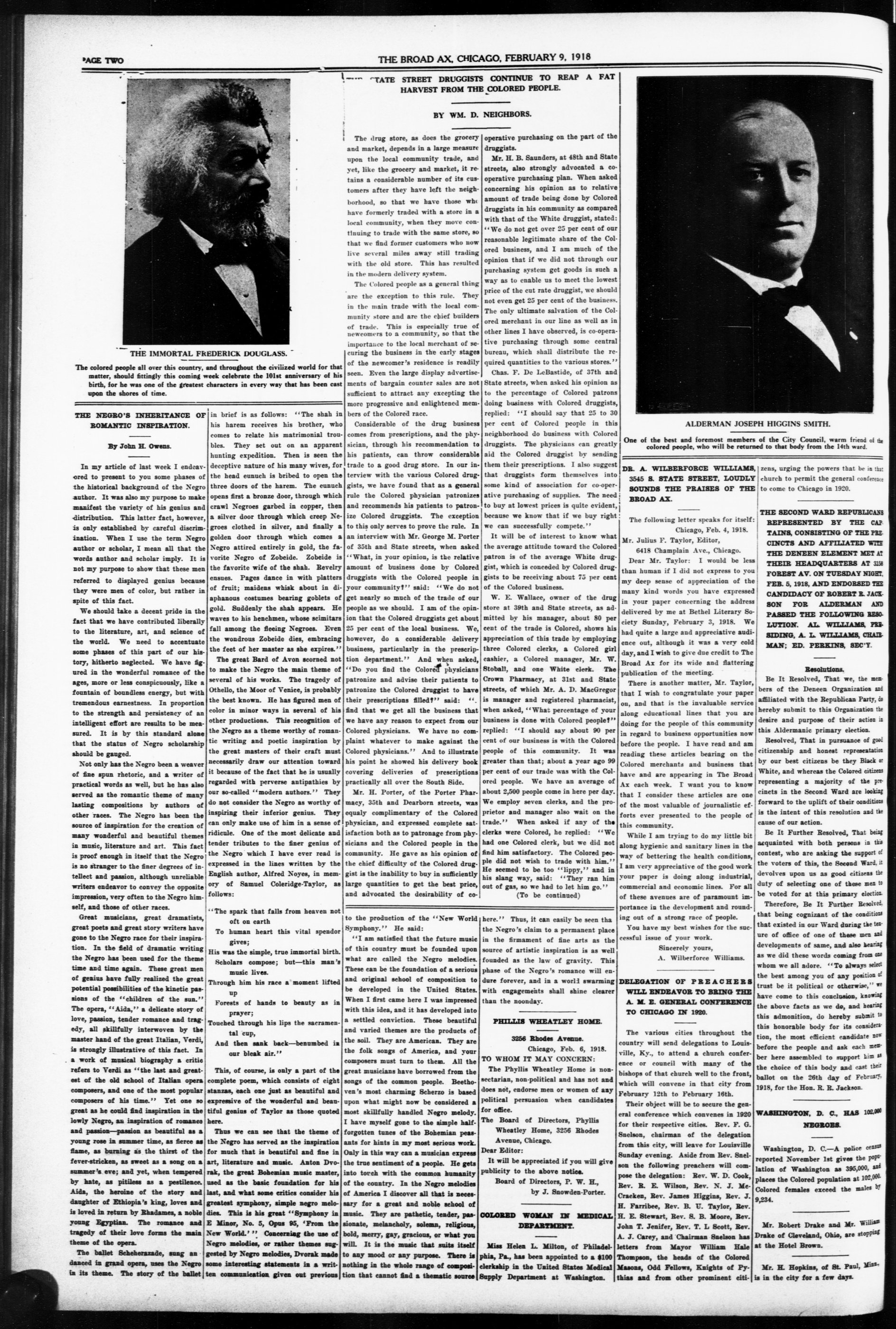
THE IMMORTAL FREDERICK DOUGLASS.
The colored people all over this country, and throughout the civilized world for that matter, should fittingly this coming week celebrate the 101st anniversary of his birth, for he was one of the greatest characters in every way that has been cast upon the shores of time.
THE NEGRO'S INHERITANCE OF ROMANTIC INSPIRATION. in brief is as follows: "The shah in his harem receives his brother, who
By John H. Owens.
In my article of last week I endeavored to present to you some phases of the historical background of the Negro author. It was also my purpose to make manifest the variety of his genius and distribution. This latter fact, however, is only established by careful discrimination. When I use the term Negro author or scholar, I mean all that the words author and scholar imply. It is not my purpose to show that these men referred to displayed genius because they were men of color, but rather in spite of this fact.
We should take a decent pride in the fact that we have contributed liberally to the literature, art, and science of the world. We need to accentuate some phases of this part of our history, hitherto neglected. We have figured in the wonderful romance of the ages, more or less conspicuously, like a fountain of boundless energy, but with tremendous earnestness. In proportion to the strength and persistency of an intelligent effort are results to be measured. It is by this standard alone that the status of Negro scholarship should be gauged.
Not only has the Negro been a weaver of fine spun rhetoric, and a writer of practical words as well, but he has also served as the romantic theme of many lasting compositions by authors of other races. The Negro has been the source of inspiration for the creation of many wonderful and beautiful themes in music, literature and art. This fact is proof enough in itself that the Negro is no stranger to the finer degrees of intellect and passion, although unreliable writers endeavor to convey the opposite impression, very often to the Negro himself, and those of other races.
Great musicians, great dramatists, great poets and great story writers have gone to the Negro race for their inspiration. In the field of dramatic writing the Negro has been used for the theme time and time again. These great men of genius have fully realized the great potential possibilities of the kinetic passions of the "children of the sun." The opera, "Aida," a delicate story of love, passion, tender romance and tragedy, all skillfully interwoven by the master hand of the great Italian, Verdi, is strongly illustrative of this fact. In
a work of musical biography a critic refers to Verdi as "the last and greatest of the old school of Italian opera composers, and one of the most popular composers of his time." Yet one so great as he could find inspiration in the lowly Negro, an inspiration of romance and passion—passion as beautiful as a young rose in summer time, as fierce as flame, as burning as the thirst of the fever-stricken, as sweet as a song on a summer's eve; and yet, when tempered by hate, as pitiless as a pestilence. Aida, the heroine of the story and daughter of Ethiopia's king, loves and is loved in return by Rhadames, a noble young Egyptian. The romance and tragedy of their love forms the main theme of the opera.
The ballet Scheherazade, sung and danced in grand opera, uses the Negro in its theme. The story of the ballet
AGE TWO
in brief is as follows: "The shah in his harem receives his brother, who comes to relate his matrimonial troubles. They set out on an apparent hunting expedition. Then is seen the deceptive nature of his many wives, for the head eunuch is bribed to open the three doors of the harem. The eunuch opens first a bronze door, through which crawl Negroes garbed in copper, then a silver door through which creep Negroes clothed in silver, and finally a golden door through which comes a Negro attired entirely in gold, the favorite Negro of Zobeide. Zobeide is the favorite wife of the shah. Revely ensues. Pages dance in with platters of fruit; maidens whisk about in diaphanous costumes bearing goblets of gold. Suddenly the shah appears. He waves to his henchmen, whose scimitars fall among the fleeing Negroes. Even the wondrous Zobeide dies, embracing the feet of her master as she expires."
The great Bard of Avon scorned not to make the Negro the main theme of several of his works. The tragedy of Othello, the Moor of Venice, is probably the best known. He has figured men of color in minor ways in several of his other productions. This recognition of the Negro as a theme worthy of romantic writing and poetic inspiration by the great masters of their craft must necessarily draw our attention toward it because of the fact that he is usually regarded with perverse antipathies by our so-called "modern authors." They do not consider the Negro as worthy of inspiring their inferior genius. They can only make use of him in a sense of ridicule. One of the most delicate and tender tributes to the finer genius of the Negro which I have ever read is expressed in the lines written by the English author, Alfred Noyes, in memory of Samuel Coleridge-Taylor, as follows:
"The spark that falls from heaven not oft on earth
To human heart this vital spendor gives;
His was the simple, true immortal birth.
Scholars compose; but—this man's music lives.
Through him his race a moment lifted up
Touched through his lips the sacramental cup,
And then sank back—benumbed in our bleak air."
This, of course, is only a part of the complete poem, which consists of eight stanzas, each one just as beautiful and expressive of the wonderful and beautiful genius of Taylor as those quoted here.
Thus we can see that the theme of the Negro has served as the inspiration for much that is beautiful and fine in art, literature and music. Anton Dvorak, the great Bohemian music master, used as the basic foundation for his last, and what some critics consider his greatest symphony, simple negro melodies. This is his great "Symphony in E Minor, No. 5, Opus 95, 'From the New World.'" Concerning the use of Negro melodies, or rather themes suggested by Negro melodies, Dvorak made some interesting statements in a written communication given out previous
THE BROAD AX, CHICAGO, FEBRUARY 9, 1918
STATE STREET DRUGGISTS CONTINUE TO REAP A FAT HARVEST FROM THE COLORED PEOPLE.
BY WM. D. NEIGHBORS.
The drug store, as does the grocery and market, depends in a large measure upon the local community trade, and yet, like the grocery and market, it retains a considerable number of its customers after they have left the neighborhood, so that we have those who have formerly traded with a store in a local community, when they move continuing to trade with the same store, so that we find former customers who now live several miles away still trading with the old store. This has resulted in the modern delivery system.
The Colored people as a general thing are the exception to this rule. They in the main trade with the local community store and are the chief builders of trade. This is especially true of newcomers to a community, so that the importance to the local merchant of securing the business in the early stages of the newcomer's residence is readily seen. Even the large display advertisements of bargain counter sales are not sufficient to attract any excepting the more progressive and enlightened members of the Colored race.
Considerable of the drug business comes from prescriptions, and the physician, through his recommendation to his patients, can throw considerable trade to a good drug store. In our interview with the various Colored druggists, we have found that as a general rule the Colored physician patronizes and recommends his patients to patronize Colored druggists. The exception to this only serves to prove the rule. In an interview with Mr. George M. Porter of 35th and State streets, when asked "What, in your opinion, is the relative amount of business done by Colored druggists with the Colored people in your community?" said: "We do not get nearly so much of the trade of our people as we should. I am of the opinion that the Colored druggists get about 25 per cent of the local business. We, however, do a considerable delivery business, particularly in the prescription department." And when asked, "Do you find the Colored physicians patronize and advise their patients to patronize the Colored druggist to have their prescriptions filled?" said: "find that we get all the business that we have any reason to expect from our Colored physicians. We have no complaint whatever to make against the Colored physicians." And to illustrate his point he showed his delivery book covering deliveries of prescriptions practically all over the South Side.
Mr. H. Porter, of the Porter Pharmacy, 35th and Dearborn streets, was equally complimentary of the Colored physician, and expressed complete satisfaction both as to patronage from physicians and the Colored people in the community. He gave as his opinion of the chief difficulty of the Colored druggist is the inability to buy in sufficiently large quantities to get the best price, and advocated the desirability of co-
to the production of the "New World Symphony." He said:
"I am satisfied that the future music of this country must be founded upon what are called the Negro melodies. These can be the foundation of a serious and original school of composition to be developed in the United States. When I first came here I was impressed with this idea, and it has developed into a settled conviction. These beautiful and varied themes are the products of the soil. They are American. They are the folk songs of America, and your composers must turn to them. All the great musicians have borrowed from the songs of the common people. Beethoven's most charming Scherzo is based upon what might now be considered a most skillfully handled Negro melody. I have myself gone to the simple half-forgotten tunes of the Bohemian peasants for hints in my most serious work. Only in this way can a musician express the true sentiment of a people. He gets into touch with the common humanity of the country. In the Negro melodies of America I discover all that is necessary for a great and noble school of music. They are pathetic, tender, passionate, melancholy, solemn, religious, bold, merry, gay, gracious, or what you will. It is the music that suits itself to any mood or any purpose. There is nothing in the whole range of composition that cannot find a thematic source
operative purchasing on the part of the drugists.
Mr. H. B. Saunders, at 48th and State streets, also strongly advocated a cooperative purchasing plan. When asked concerning his opinion as to relative amount of trade being done by Colored druggists in his community as compared with that of the White druggist, stated: "We do not get over 25 per cent of our reasonable legitimate share of the Colored business, and I am much of the opinion that if we did not through our purchasing system get goods in such a way as to enable us to meet the lowest price of the cut rate druggist, we should not even get 25 per cent of the business. The only ultimate salvation of the Colored merchant in our line as well as in other lines I have observed, is co-operative purchasing through some central bureau, which shall distribute the required quantities to the various stores." Chas. F. De LeBastide, of 37th and State streets, when asked his opinion as to the percentage of Colored patrons doing business with Colored druggists, replied: "I should say that 25 to 30 per cent of Colored people in this neighborhood do business with Colored druggists. The physicians can greatly aid the Colored druggist by sending them their prescriptions. I also suggest that druggists form themselves into some kind of association for co-operative purchasing of supplies. The need to buy at lowest prices is quite evident, because we know that if we buy right we can successfully compete."
It will be of interest to know what the average attitude toward the Colored patron is of the average White druggist, which is conceded by Colored druggists to be receiving about 75 per cent of the Colored business.
W. E. Wallace, owner of the drug store at 39th and State streets, as admitted by his manager, about 80 percent of the trade is Colored, shows his appreciation of this trade by employing three Colored clerks, a Colored girl cashier, a Colored manager, Mr. W. Stoball, and one White clerk. The Crown Pharmacy, at 31st and State streets, of which Mr. A. D. MacGregor is manager and registered pharmacist, when asked, "What percentage of your business is done with Colored people?" replied: "I should say about 90 percent of our business is with the Colored people of this community. It was greater than that; about a year ago 99 per cent of our trade was with the Colored people. We have an average of about 2,500 people come in here per day. We employ seven clerks, and the proprietor and manager also wait on the trade." When asked if any of the clerks were Colored, he replied: "We had one Colored clerk, but we did not find him satisfactory. The Colored people did not wish to trade with him." He seemed to be too "lippy," and in his slang way, said: "They ran him out of gas, so we had to let him go."
here." Thus, it can easily be seen that the Negro's claim to a permanent place in the firmament of fine arts as the source of artistic inspiration is as well founded as the law of gravity. This phase of the Negro's romance will endure forever, and in a world swarming with engagements shall shine clearer than the noonday.
PHILLIS WHEATLEY HOME
TO WHOM IT MAY CONCERN:
The Phyllis Wheatley Home is non-sectarian, non-political and has not and does not, endorse men or women of any political persuasion when candidates for office.
It will be appreciated if you will give publicity to the above notice.
COLORED WOMAN IN MEDICAL DEPARTMENT.
Miss Helen L. Milton, of Philadelphia, Pa., has been appointed to a $100 clerkship in the United States Medical Supply Department at Washington.
(To be continued)
N.
ALDERMAN JOSEPH HIGGINS SMITH.
One of the best and foremost members of the City Council, warm friend of the colored people, who will be returned to that body from the 14th ward.
One of the best and foremost members of the City Council, warm friend of the colored people, who will be returned to that body from the 14th ward.
DR. A. WILBERFORCE WILLIAMS,
3545 S. STATE STREET, LOUDLY
SOUNDS THE PRAISES OF THE
BROAD AX.
The following letter speaks for itself:
Chicago, Feb. 4, 1918.
Mr. Julius F. Taylor, Editor,
6418 Champlain Ave., Chicago.
Dear Mr. Taylor: I would be less than human if I did not express to you my deep sense of appreciation of the many kind words you have expressed in your paper concerning the address delivered by me at Bethel Literary Society Sunday, February 3, 1918. We had quite a large and appreciative audience out, although it was a very cold day, and I wish to give due credit to The Broad Ax for its wide and flattering publication of the meeting.
There is another matter, Mr. Taylor, that I wish to congratulate your paper on, and that is the invaluable service along educational lines that you are doing for the people of this community in regard to business opportunities now before the people. I have read and am reading these articles bearing on the Colored merchants and business that have and are appearing in The Broad Ax each week. I want you to know that I consider these articles are one of the most valuable of journalistic efforts ever presented to the people of this community.
While I am trying to do my little bit along hygienic and sanitary lines in the way of bettering the health conditions, I am very appreciative of the good work your paper is doing along industrial, commercial and economic lines. For all of these avenues are of paramount importance in the development and rounding out of a strong race of people.
You have my best wishes for the successful issue of your work.
Sineerely yours,
A. Wilberforce Williams.
DELEGATION OF PREACHERS WILL ENDEAVOR TO BRING THE A. M. E. GENERAL CONFERENCE TO CHICAGO IN 1920.
The various cities throughout the country will send delegations to Louisville, Ky., to attend a church conference or council with many of the bishops of that church well to the front, which will convene in that city from February 12th to February 16th.
Their object will be to secure the general conference which convenes in 1920 for their respective cities. Rev. F. G. Snelson, chairman of the delegation from this city, will leave for Louisville Sunday evening. Aside from Rev. Snelson the following preachers will compose the delegation: Rev. W. D. Cook, Rev. R. E. Wilson, Rev. N. J. MeCracken, Rev. James Higgins, Rev. J. H. Farribee, Rev. B. U. Taylor, Rev. H. E. Stewart, Rev. S. B. Moore, Rev John T. Jenifer, Rev. T. L Scott, Rev. A. J. Carey, and Chairman Snelson has letters from Mayor William Hale Thompson, the heads of the Colored Masons, Odd Fellows, Knights of Pythias and from other prominent citi-
Sincerely yours.
zens, urging the powers that be in that church to permit the general conference to come to Chicago in 1920.
THE SECOND WARD REPUBLICANS REPRESENTED BY THE CAPTAINS, CONSISTING OF THE PRECINCTS AND AFFILIATED WITH THE DENEEN ELEMENT MET AT THEIR HEADQUARTERS AT 3156 FOREST AV. ON TUESDAY NIGHT. FEB. 5, 1918, AND ENDORSED THE CANDIDACY OF ROBERT R. JACKSON FOR ALDERMAN AND PASSED THE FOLLOWING RESOLUTION. AL. WILLIAMS, PRESIDING, A. L. WILLIAMS, CHAIRMAN; ED. PERKINS, SEC'Y.
Be It Resolved, That we, the members of the Deneen Organization and affiliated with the Republican Party, do hereby submit to this Organization the desire and purpose of their action in this Aldermanic primary election.
Resolved, That in pursuance of good citizenship and honest representation by our best citizens be they Black or White, and whereas the Colored citizens representing a majority of the precincts in the Second Ward are looking forward to the uplift of their conditions is the intent of this resolution and the cause of our action.
Be It Further Resolved, That being acquainted with both persons in this contest, who are asking the support of the voters of this, the Second Ward, it devolves upon us as good citizens the duty of selecting one of these men to be voted for at this primary election.
Therefore, Be It Further Resolved that being cognizant of the conditions that existed in our Ward during the tenure of office of one of these men and developments of same, and also hearing as we did these words coming from one whom we all adore. "To always select the best among you of any position of trust be it political or otherwise," we have come to this conclusion, knowing the above facts as we do, and hearing this admonition, do hereby submit to this honorable body for its consideration, the most efficient candidate now before the people and ask each member here assembled to support him as the choice of this body and cast their ballot on the 26th day of February, 1918, for the Hon. R. R. Jackson.
WASHINGTON, D. C., HAS 102,900
NEGROBS.
Washington, D. C.—A police census reported November 1st gives the population of Washington as 395,000, and places the Colored population at 102,000 Colored females exceed the males by 9,234.
Mr. Robert Drake and Mr. William Drake of Cleveland, Ohio, are stopping at the Hotel Brown.
Mr. H. Hopkins, of St. Paul, Minn. is in the city for a few days.
Resolutiona.
[Name]
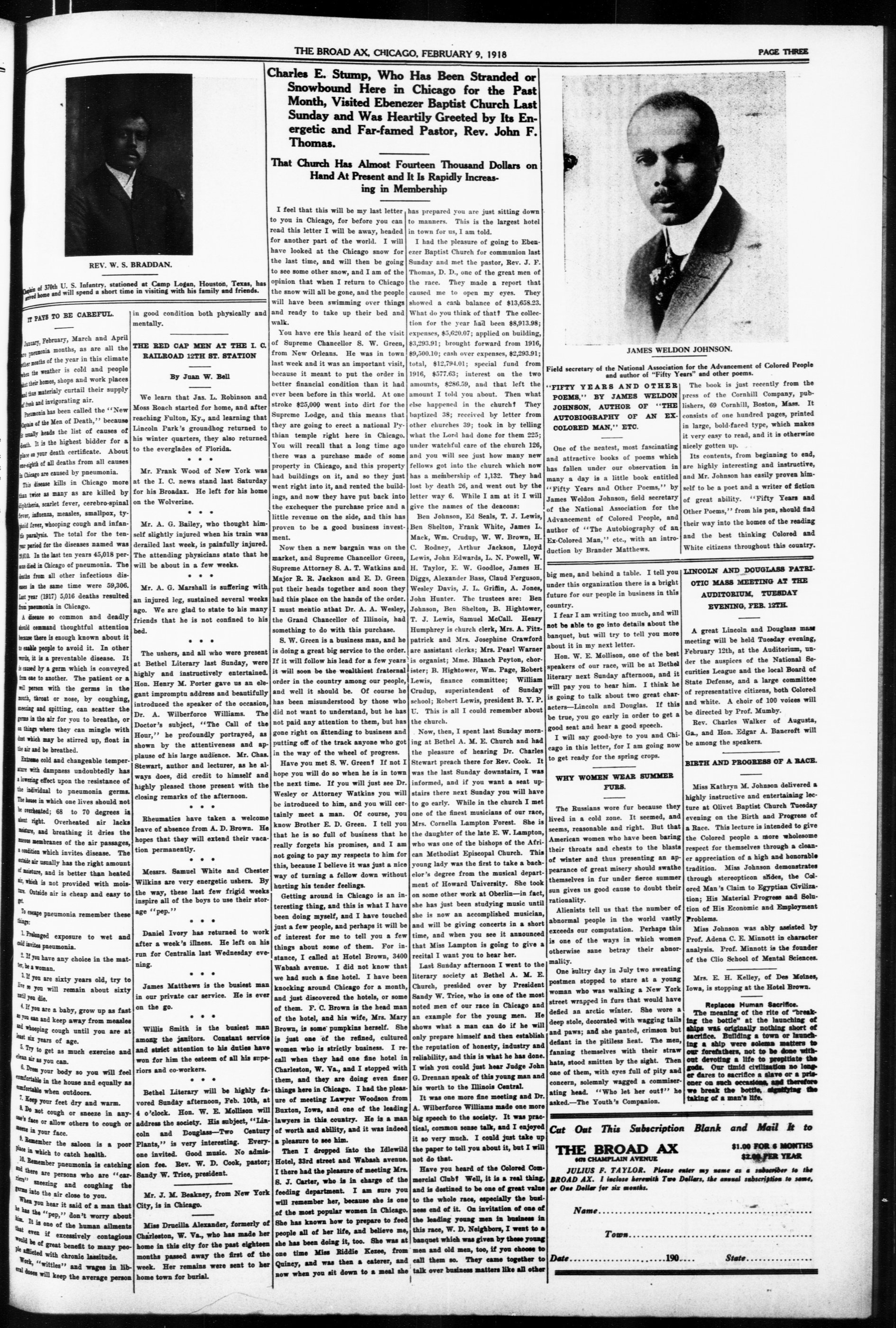
REV. W. S. BRADDAN.
Captain of 370th U. S. Infantry, stationed at Camp Logan, Houston, Texas, has moved home and will spend a short time in visiting with his family and friends.
IT PAYS TO BE CAREFUL.
January, February, March and April are pneumonia months, as are all the other months of the year in this climate when the weather is cold and people think their homes, shops and work places and thus materially curtail their supply and invigorate air.
in good condition both physically and mentally.
THE RED CAP MEN AT THE I. O. RAILROAD 12TH ST. STATION
By Juan W. Bell
We learn that Jas. L. Robinson and
Pneumonia has been called the "New
Captain of the Men of Death," because
it usually heads the list of causes of
death. It is the highest bidder for a
place as your death certificate. About
one-eighth of all deaths from all causes
Cases are caused by pneumonia.
This disease kills in Chicago more than twice as many as are killed by diphtheria, scarlet fever, cerebro-spinal fever, influenza, measles, smallpox, typhoid fever, whooping cough and infantis paralysis. The total for the ten years period for the diseases named was 85,10. In the last ten years 45,018 persons died in Chicago of pneumonia. The deaths from all other infectious diseases in the same time were 59,306. last year (1917) 5,016 deaths resulted from pneumonia in Chicago.
A disease so common and deadly should command thoughtful attention because there is enough known about it to enable people to avoid it. In other words, it is a preventable disease. It is caused by a germ which is conveyed from one to another. The patient or a will person with the germs in the mouth, throat or nose, by coughing, sneezing and spitting, can scatter the germs in the air for you to breathe, or on things where they can mingle with dust which may be stirred up, float in the air and be breathed.
Extreme cold and changeable temperature with dampness undoubtedly has a lowering effect upon the resistance of the individual to pneumonia germs. The house in which one lives should not be overheated; 68 to 70 degrees is about right. Overheated air lacks moisture, and breathing it dries the mucous membranes of the air passages, a condition which invites disease. The outside air usually has the right amount of moisture, and is better than heated air, which is not provided with moisture. Outside air is cheap and easy to get. To escape pneumonia remember these things:
1. Prolonged exposure to wet and cold invites pneumonia.
2. If you have any choice in the matter, be a woman.
3. If you are sixty years old, try to live so you will remain about sixty until you die.
4. If you are a baby, grow up as fast as you can and keep away from measles and whooping cough until you are at least six years of age.
5. Try to get as much exercise and clean air as you can.
6. Dress your body so you will feel comfortable in the house and equally as comfortable when outdoors.
7. Keep your feet dry and warm.
8. Do not cough or sneeze in anyone's face or allow others to cough or sneeze in your face.
9. Remember the saloon is a poor place in which to catch health.
10. Remember pneumonia is catching and there are persons who are "carriers" sneezing and coughing the germs into the air close to you.
When you hear it said of a man that he has the "pep," don't worry about him. It is one of the human ailments that even if excessively contagious would be of great benefit to many people afflicted with chronic lassitude.
Work, "wittles" and wages in liberal doses will keep the average person
BRADDAN.
red at Camp Logan, Houston, Texas, has
e in visiting with his family and friends.
in good condition both physically and
mentally.
THE RED CAP MEN AT THE I. C.
RAILROAD 12TH ST. STATION
We learn that Jas. L. Robinson and Moss Roach started for home, and after reaching Fulton, Ky., and learning that Lincoln Park's groundhog returned to his winter quarters, they also returned to the everglades of Florida.
Mr. Frank Wood of New York was at the I. C. news stand last Saturday for his Broadax. He left for his home on the Wolverine.
Mr. A. G. Bailey, who thought himself slightly injured when his train was derailed last week, is painfully injured. The attending physicians state that he will be about in a few weeks.
Mr. A. G. Marshall is suffering with an injured leg, sustained several weeks ago. We are glad to state to his many friends that he is not confined to his bed.
The ushers, and all who were present at Bethel Literary last Sunday, were highly and instructively entertained. Hon. Henry M. Porter gave us an elegant impromptu address and beautifully introduced the speaker of the occasion, Dr. A. Wilberforce Williams. The Doctor's subject, "The Call of the Hour," he profoundly portrayed, as shown by the attentiveness and applause of his large audience. Mr. Chas Stewart, author and lecturer, as he always does, did credit to himself and highly pleased those present with the closing remarks of the afternoon.
Rheumatics have taken a welcome leave of absence from A. D. Brown. He hopes that they will extend their vacation permanently.
Messrs. Samuel White and Chester Wilkins are very energetic ushers. By the way, these last few frigid weeks inspire all of the boys to use their storage "pep."
Daniel Ivory has returned to work after a week's illness. He left on his run for Centralia last Wednesday evening.
James Matthews is the busiest man in our private car service. He is ever on the go.
* * *
Willis Smith is the busiest man among the janitors. Constant service and strict attention to his duties have won for him the esteem of all his superiors and co-workers.
Bethel Literary will be highly favored Sunday afternoon, Feb. 10th, at 4 o'clock. Hon. W. E. Mollison will address the society. His subject, "Lincoln and Douglass—Two Century Plants," is very interesting. Everyone invited. Good music. No admission fee. Rev. W. D. Cook, pastor; Sandy W. Trice, president.
Mr. J. M. Beakney, from New York City, is in Chicago.
Miss Drucilla Alexander, formerly of Charleston, W. Va., who has made her home in this city for the past eighteen months passed away the first of the week. Her remains were sent to her home town for burial.
By Juan W. Bell
---
. . .
---
. . .
---
---
THE BROAD AX, CHICAGO, FEBRUARY 9, 1918
Charles E. Stump, Who Has Been Stranded or Snowbound Here in Chicago for the Past Month, Visited Ebenezer Baptist Church Last Sunday and Was Heartily Greeted by Its Energetic and Far-famed Pastor, Rev. John F. Thomas.
That Church Has Almost Fourteen Thousand Dollars on Hand At Present and It Is Rapidly Increasing in Membership
I feel that this will be my last letter to you in Chicago, for before you can read this letter I will be away, headed for another part of the world. I will have looked at the Chicago snow for the last time, and will then be going to see some other snow, and I am of the opinion that when I return to Chicago the snow will all be gone, and the people will have been swimming over things and ready to take up their bed and walk.
has prepared you are just sitting down to manners. This is the largest hotel in town for us, I am told.
I had the pleasure of going to Ebenezer Baptist Church for communion last Sunday and met the pastor, Rev. J. F. Thomas, D. D., one of the great men of the race. They made a report that caused me to open my eyes. They showed a cash balance of $13,658.23 What do you think of that? The collection for the year had been $8,913.98
You have ere this heard of the visit of Supreme Chancellor S. W. Green, from New Orleans. He was in town last week and it was an important visit, because it meant to put the order in better financial condition than it had ever been before in this world. At one stroke $25,000 went into dirt for the Supreme Lodge, and this means that they are going to erect a national Pythian temple right here in Chicago. You will recall that a long time ago there was a purchase made of some property in Chicago, and this property had buildings on it, and so they just went right into it, and rented the buildings, and now they have put back into the exchequer the purchase price and a little revenue on the side, and this has proven to be a good business investment.
Now then a new bargain was on the market, and Supreme Chancellor Green, Supreme Attorney S. A. T. Watkins and Major R. R. Jackson and E. D. Green put their heads together and soon they had this place on the hands of the order. I must mentio nthat Dr. A. A. Wesley, the Grand Chancellor of Illinois, had something to do with this purchase.
S. W. Green is a business man, and he is doing a great big service to the order. If it will follow his lead for a few years it will soon be the wealthiest fraternal order in the country among our people, and well it should be. Of course he has been misunderstood by those who did not want to understand, but he has not paid any attention to them, but has gone right on attending to business and putting off of the track anyone who got in the way of the wheel of progress.
Have you met S. W. Green? If not I hope you will do so when he is in town the next time. If you will just see Dr. Wesley or Attorney Watkins you will be introduced to him, and you will certainly meet a man. Of course, you know Brother E. D. Green. I tell you that he is so full of business that he really forgets his promises, and I am not going to pay my respects to him for this, because I believe it was just a nice way of turning a fellow down without horting his tender feelings.
Getting around in Chicago is an interesting thing, and this is what I have been doing myself, and I have touched just a few people, and perhaps it will be of interest for me to tell you a few things about some of them. For instance, I called at Hotel Brown, 3400 Wabash avenue. I did not know that we had such a fine hotel. I have been knocking around Chicago for a month, and just discovered the hotels, or some of them. F. C. Brown is the head man of the hotel, and his wife, Mrs. Mary Brown, is some pumpkins herself. She is just one of the refined, cultured women who is strictly business. I recall when they had one fine hotel in Charleston, W. Va., and I stopped with them, and they are doing even finer things here in Chicago. I had the pleasure of meeting Lawyer Woodson from Buxton, Iowa, and one of the leading lawyers in this country. He is a man of worth and ability, and it was indeed a pleasure to see him.
Then I dropped into the Idlewild Hotel, 33rd street and Wabash avenue. I there had the pleasure of meeting Mrs. S. J. Carter, who is in charge of the feeding department. I am sure you will remember her, because she is one of the most popular women in Chicago. She has known how to prepare to feed people all of her life, and believe me, she has been doing it, too. She was at one time Miss Riddie Kezee, from Quiney, and was then a caterer, and now when you sit down to a meal she
has prepared you are just sitting down to manners. This is the largest hotel in town for us, I am told.
I had the pleasure of going to Ebenezer Baptist Church for communion last Sunday and met the pastor, Rev. J. F. Thomas, D. D., one of the great men of the race. They made a report that caused me to open my eyes. They showed a cash balance of $13,658.23. What do you think of that? The collection for the year had been $8,913.98; expenses, $5,620.07; applied on building, $3,293.91; brought forward from 1916, $9,500.10; cash over expenses, $2,293.91; total, $12,794.01; special fund from 1916, $577.63; interest on the two amounts, $286.59, and that left the amount I told you about. Then what else happened in the church? They baptized 38; received by letter from other churches 39; took in by telling what the Lord had done for them 225; under watchful care of the church 126, and you will see just how many new fellows got into the church which now has a membership of 1,132. They had lost by death 26, and went out by the letter way 6. While I am at it I will give the names of the deacons:
Ben Johnson, Ed Seals, T. J. Lewis, Ben Shelton, Frank White, James L. Mack, Wm. Crudup, W. W. Brown, H. C. Rodney, Arthur Jackson, Lloyd Lewis, John Edwards, L. N. Powell, W. H. Taylor, E. W. Goodloe, James H. Diggs, Alexander Bass, Claud Ferguson, Wesley Davis, J. L. Griffin, A. Jones, John Hunter. The trustees are: Ben Johnson, Ben Shelton, B. Hightower, T. J. Lewis, Samuel McCall. Henry Humphrey is church clerk, Mrs. A. Fitzpatrick and Mrs. Josephine Crawford are assistant clerks; Mrs. Pearl Warner is organist; Mme. Blanch Peyton, chorister; B. Hightower, Wm. Page, Robert Lewis, finance committee; William Crudup, superintendent of Sunday school; Robert Lewis, president B. Y. P. U. This is all I could remember about the church.
Now, then, I spent last Sunday morning at Bethel A. M. E. Church and had the pleasure of hearing Dr. Charles Stewart preach there for Rev. Cook. It was the last Sunday downstairs, I was informed, and if you want a seat upstairs there next Sunday you will have to go early. While in the church I met one of the finest musicians of our race, Mrs. Cornella Lampton Forest. She is the daughter of the late E. W. Lampton, who was one of the bishops of the African Methodist Episcopal Church. This young lady was the first to take a bachelor's degree from the musical department of Howard University. She took on some other work at Oberlin—in fact, she has just been studying music until she is now an accomplished musician, and will be giving concerts in a short time, and when you see it announced that Miss Lampton is going to give a recital I want you to hear her.
Last Sunday afternoon I went to the literary society at Bethel A. M. E. Church, presided over by President Sandy W. Trice, who is one of the most noted men of our race in Chicago and an example for the young men. He shows what a man can do if he will only prepare himself and then establish the reputation of honesty, industry and reliability, and this is what he has done. I wish you could just hear Judge John G. Drennan speak of this young man and his worth to the Illinois Central.
It was one more fine meeting and Dr. A. Wilberforce Williams made one more big speech to the society. It was practical, common sense talk, and I enjoyed it so very much. I could just take up the paper to tell you about it, but I will not do that.
Have you heard of the Colored Commercial Club? Well, it is a real thing, and is destined to be one of great value to the whole race, especially the business end of it. On invitation of one of the leading young men in business in this race, W. D. Neighbors, I went to a banquet which was given by these young men and old men, too, if you choose to call them so. They came together to talk over business matters like all other
[Image of a man in a suit with a tie].
JAMES WELDON JOHNSON.
Field secretary of the National Association for the Advancement of Colored People and author of "Fifty Years" and other poems.
"FIFTY YEARS AND OTHER POEMS," BY JAMES WELDON JOHNSON, AUTHOR OF "THE AUTORIOGRAPHY OF AN EXCOLORED MAN," ETC.
The book is just recently from the press of the Cornhill Company, publishers, 69 Cornhill, Boston, Mass. It consists of one hundred pages, printed in large, bold-faced type, which makes
One of the neatest, most fascinating and attractive books of poems which has fallen under our observation in many a day is a little book entitled "Fifty Years and Other Poems," by James Weldon Johnson, field secretary of the National Association for the Advancement of Colored People, and author of "The Autobiography of an Ex-Colored Man," etc., with an introduction by Brander Matthews.
big men, and behind a table. I tell you under this organization there is a bright future for our people in business in this country.
I fear I am writing too much, and will not be able to go into details about the banquet, but will try to tell you more about it in my next letter.
Hon. W. E. Mollison, one of the best speakers of our race, will be at Bethel literary next Sunday afternoon, and it will pay you to hear him. I think he is going to talk about two great characters—Lincoln and Douglas. If this be true, you go early in order to get a good seat and hear a good speech.
I will say good-bye to you and Chicago in this letter, for I am going now to get ready for the spring crops.
WHY WOMEN WEAR SUMMER
FURS.
The Russians wore fur because they lived in a cold zone. It seemed, and seems, reasonable and right. But that American women who have been baring their throats and chests to the blasts of winter and thus presenting an appearance of great misery should swathe themselves in fur under fierce summer sun gives us good cause to doubt their rationality.
Alienists tell us that the number of abnormal people in the world vastly exceeds our computation. Perhaps this is one of the ways in which women otherwise sane betray their abnormality.
One sultry day in July two sweating postmen stopped to stare at a young woman who was walking a New York street wrapped in furs that would have defied an arctic winter. She wore a deep stole, decorated with wagging tails and paws; and she panted, crimson but defiant in the pitiless heat. The men, fanning themselves with their straw hats, stood smitten by the sight. Then one of them, with eyes full of pity and concern, solemnly wagged a commiserating head. "Who let her out?" he asked. "The Youth's Companion.
JULIUS F. TAYLOR. Please enter my name as a subscriber to the BROAD AX. I inclose herewith Two Dollars, the annual subscription to same, or One Dollar for six months.
THE NO.
The book is just recently from the press of the Cornhill Company, publishers, 69 Cornhill, Boston, Mass. It consists of one hundred pages, printed in large, bold-faced type, which makes it very easy to read, and it is otherwise nicely gotten up.
Its contents, from beginning to end, are highly interesting and instructive, and Mr. Johnson has easily proven himself to be a poet and a writer of fiction of great ability. "Fifty Years and Other Poems," from his pen, should find their way into the homes of the reading and the best thinking Colored and White citizens throughout this country.
LINCOLN AND DOUGLASS PATRIOTIC MASS MEETING AT THE AUDITORIUM, TUESDAY EVENING, FEB. 12TH.
A great Lincoln and Douglass mass meeting will be held Tuesday evening, February 12th, at the Auditorium, under the auspices of the National Securities League and the local Board of State Defense, and a large committee of representative citizens, both Colored and white. A choir of 100 voices will be directed by Prof. Mumby.
Rev. Charles Walker of Augusta, Ga., and Hon. Edgar A. Baneroft will be among the speakers.
BIRTH AND PROGRESS OF A BACE
Miss Kathryn M. Johnson delivered a highly instructive and entertaining lecture at Olivet Baptist Church Tuesday evening on the Birth and Progress of a Race. This lecture is intended to give the Colored people a more wholesome respect for themselves through a cleaner appreciation of a high and honorable tradition. Miss Johnson demonstrates through stereopticon slides, the Colored Man's Claim to Egyptian Civilization; His Material Progress and Solution of His Economic and Employment Problems. Miss Johnson was ably assisted by Prof. Adena C. E. Minnott in character analysis. Prof. Minnott is the founder of the Clio School of Mental Sciences.
Mrs. E. H. Kelley, of Des Moines, Iowa, is stopping at the Hotel Brown.
Replaces Human Sacrifice.
The meaning of the rite of "breaking the bottle" at the launching of ships was originally nothing short of sacrifice. Building a town or launching a ship were solemn matters to our forefathers, not to be done without devoting a life to propitiate the gods. Our timid civilization no longer dares to sacrifice a slave or a prisoner on such occasions, and therefore we break the bottle, signifying the taking of a man's life.
enter my name as a subscriber to the
Dollars, the annual subscription to some,
State.....
PAGE THREE
$1.00 FOR 6 MONTHS
$2.00 PER YEAR
The CRANFORD Apartment Building 3600 Wabash Avenue
100
The finest building ever opened to Colored tenants in Chicago. Steam heat, electric lights, tile baths, marble entrance.
PAGE FOUR
The CR
Apartmen
3600 Wa
The finest building ever open
cago. Steam heat, electric li
Phone Main 263
FREE
STYLE BOOK
--- HAIR ---
To Colored Women
We are the largest
manufacturer of colored
Women's
Hair. Our latest
book showing new
styles in hair
dressing techniques.
Every colored woman
should have
one. We sell thou-
sands on hair and
toilet articles. Sat-
faction guaranteed or
money back.
We make the best
solidBrass STRAIGHT-
ENING combs, with extra hard
guarantee. With each comb we give lamp cap
FREE. Send money order or stamps. MONEY
BACK IF NOT SATISFACTORY. $129 postpaid.
POSTPAID $129
Hair nets, brushes, combs and toilet articles
manufacturer' prices. Send two cent stamp.
Agents Wanted. Address as follow:
HUMANA HAIR COMPANY.
181-187 Park Row,
New York City.
Address Dept. 84
PHONE DOUGLAS 5955
Dr. Mac Enery J. Brown
Physician and Surgeon
Practice Limited to
Diseases of the
Eye, Ear, Nose and Throat
10 EAST 35th STREET
Hours:
9 to 12 A.M. 2 to 9 P.M. CHICAGO
RESIDENCE 3419 South Park Avenue
PHONE DOUGLAS 9356
WM. J. LATHAM
ATTORNEY AT LAW
OFFICE PHONE: CALUMET 875
2 East 31st Street
Suite 7
CHICAGO
Frank Dunn, J. B. McCahey, Trustees
Telephones: Oakland 1552, 1551, 1550
JOHN J. DUNN
ESTABLISHED 1877
Wholesale and Retail
Fifty-First and Federal Streets
CHICAGO
KINKY HAIR
Albany, Ga.
Baskin Roof, Bed, Co.
Glenview, Ga.
My picture shows you what your fine
EXELENTO QUININE POMADE.
has always my hair. Before I all the difference, and now it is 21 inches long, and so much cool and silky that I can do it up any way I want to.
JANIE BANK.
Don't let some fake Kink Remover fool you. You really can't straighten your hair until it's nice and long. The EXELENTO QUININE POMADE does, removes Dandruff, feeds the Roots of the hair, and makes it grow long, soft and silky. After using a few times, you can all the difference, and after a little time it will be so pretty and long that you can fix it up to suit you. If Exelento don't do as we claim, we will give your money back. So by all you need of each AGENTS WANTED EVERYWHERE.
EXELENTO MEDICINE CO., Albany, Ga.
Write For Partnership.
---
?
J. W. CASEY, Agent 133 W. Washington Street
Residence, 1262 Macalister Place
Telephone Monroe 2714
MILES J. DEVINE
Attorney at Law
Suite 313-329 Reaper Block
Clark and Washington Sts.
Phones, Central 229; Auto. 41-516
CHICAGO
PHONE MAIN 2214
A. D. GASH
Attorney at Law
118 North La Salle Street
Suite 615 to 616
CHICAGO
Res. 3655 Prairie Ave. Phone Doug. 9133
PHONES: MAIN 2817
AUTOMATIC 32-395
Attorney and Counselor at Law
Suite 706 FIRMENICH BUILDING
184 West Washington Street CHICAGO
RESIDENCE: 508 E. 36th STREET
PHONE DOUGLAS 4397
J. Gray Lucas
Attorney at Law
Suite 815 Hartford Bldg.
8 S. Dearborn St. CHICAGO
PHONES: OFFICE, CENTRAL 6583
AUTOMATIC 42-590
Residence, 4533 Prairie Avenue
Ros., Kenwood 620
WALTER M. FARMER
ATTORNEY AND
COUNSELOR AT LAW
NOTARY PUBLIC
Suite 706
184 W. Washington St.
Phones, Office, Main 4153
Auto., 33736
CHICAGO
RESIDENCE: 3353 South Park Ave.
PHONE DOUGLAS 2773
ATTORNEY and COUNSELOR
Suite 815 Hartford Bldg.
PHONE: CENTRAL 6583
CHICAGO
TELEPHONE WEST 4598
NIGHT CALLS GIVEN PROMPT ATTENTION
HOURS:
Until 9:30 A. M., 3 to 5 and 7 to 9 P. M.
SUNDAYS:
1:30 to 2:30 P. M. and by appointment
OFFICE AND RESIDENCE:
1924 W. Lake Street, CHICAGO
Discovered "Arabian Nights."
The "Arabian Nights" stories were translated into English from the Arabic by Antonie Galland, a French savant, and traveler, who died in 1715. He obtained them in their original form during his visit to the East as an attache of the French embassy at Constantinople.
More Than Mere Right.
Singleton—"But even a married man has a right to his opinion." Henpek—"My dear fellow, it isn't a question of right; it's a question of courage."—Boston Transcript.
---
THE BROAD AX, CHICAGO, FEBRUARY 9, 1918
In this city since July 15th, 1899, without missing one single issue, Republicans, Democrats, Catholics, Protestants, Single Taxers, Priests, infidels or anyone else can have their say as long as their language is proper and responsibility is fixed.
The Broad Ax is a newspaper whose platform is broad enough for all, ever claiming the editorial right to speak its own mind.
Local communications will receive attention. Write only on one side of the paper.
Subscriptions must be paid in advance.
One Year ..... $2.00
Six Months ..... 1.00
Advertising rates made known on application.
Address all communications to
THE BROAD AX
6418 Champlain Ave., Chicago, Ill.
PHONE WENTWORTH 2597.
JULIUS F. TAYLOR, Editor and
Publisher.
Entered as Second-Class Matter Aug. 19, 1902, at the Post Office at Chicago, Illinois, under Act of March 3, 1879.
Newspaper Advertising Solicitor Wanted.
A live newspaper advertising solicitor; one who knows how to hustle for business wanted. For further information, address the editor of this paper or phone, Wentworth 2597.
Her Saving Habit
By Katherine Howe
(Copyright, 1917, by W. G. Chapman.)
"Yes, come in, Tom. I'd like to sit down and rest a minute."
The bright-eyed girl in the doorway, capped, aproned and broom in hand, smiled invitingly to the young man on the other side of the gate, who had asked if he could enter. He followed her into the house, and she dropped wearily into a chair.
"It isn't so much the work," she went on, "but if I attempt to do a little clearing out of corners and throwing away rubbish, then mother and I get on a war footing at once, and there's great activity on the firing line. I declare, she saves up all kinds of truck, till we might as well start a junk shop, and done with it."
Mrs. Bliss drifted into the room in time to hear the latter remark, and regarded her daughter in good-natured protest. Nodding to Tom Holmes, she sa : notice, Florry, you're pretty glad soon; times to go to that junk for things you need."
"Yes, but why save that wooden laddle; you don't use it in ten years."
"Well, suppose I don't, when I do want it it's there. It isn't so much saving the money, as it is the time it takes to dress and go out to buy some little thing you need, and have to delay what you're doing till you have it. I noticed you were tickled to death to find that cord, those little tassels, and that brocade for your dress, and that was more than eleven years old."
"Yes, I was," admitted Florry. "It gave just the touch I wanted, and I couldn't have bought it in this little town."
"So you see, you'll have to hand it to your mother, after all," said Tom, who, for obvious reasons, thought it tactful to keep on the right side of Mrs. Bliss. "I wish." he went on, "you might find in your collection that Harvard deed we're having so much excitement over. Talk about clearing out corners, I don't believe there's been a half-inch of space in our office that hasn't been ransacked for that missing paper."
"I didn't suppose lawyers ever lost anything—but cases," said Florry. "What is it?"
"Why, haven't you seen the big reward in the newspapers? It's gone up now from five hundred to fifteen hundred. The deed is an old one, but it involves the ownership of all that ground where the big Miles manufacturing plant stands. You see, my office, Myers and Jenks, has had all the Hazard papers in charge for years, and they can't account for the disappearance of that deed. If it was stolen, and we think it must have been, we can't see the motive. Well, it's a mystery. But I just wish I could collar that fifteen hundred. Suppose you look among your keepsakes, Mrs. Bliss, You might find it!" The little woman shook her head doubtfully. "Tm afraid not," she sighed. "No," put in Florry. "That isn't the kind of thing mother saves. It's not likely to be anything worth fifteen
---
CHAPEL ACCOMMODATIONS
SCIENTIFIC EMBALMING
Paducah, Ky. Jan 17 1918
M. Mr. E. H. Williamson
5028-30 S State Chase
TO A. W. WATKINS & CO., DR.
FUNERAL DIRECTORS & EMBALMERS.
701 WASHINGTON STREET.
OFFICE PHONE 241-5
Residence:-
429 S. 7th, Street.
Residence Phones:-
Old 241-w. New 241.
To acknowledge the receipt of the body of Jain Hall whose embalment condition was audited we command your ability to as thoroughly prepare a body. Reciprocity why of course we shall be only too glad to send you any case destined for your city and shall certainly appreciate your affirmations here.
Remember not to Very respectfully
The A. H. Williamson Co.
Bui. A. J. Hammett
hundred dollars. Besides, I don't think she was ever inside Myers and Jenks' office, so she couldn't be accused of stealing it.
Tom Holmes laughed heartily at the idea of the gentle-faced little woman in the role of a robber, and declared he couldn't imagine it even on the screen. After she left the room, he said, seriously: "Florry, do you know what I'd do with that money if I got that reward?"
Florry hadn't the remotest idea.
"I'd buy that Spellman house. It's going to be sold at auction next week, and it will go cheap. If it was fixed up a bit, it would make a beautiful little house. I want it for you, Florry," he whispered, drawing her to him.
"Maybe then you would think we could afford to get married."
"Yes, Tom, I suppose we could; but
not now, at least till you get a raise. We must wait a little."
"Yes," he answered in a disappointed tone. "I know I'm only a clerk in a law office, but I'll be in that firm yet. And while we're waiting you may get tired, and take the fellow that has the house all ready."
"Tom!" she cried reproachfully, "that isn't worthy of you!"
"Oh, well, I know Brooke has—" "Brooke!" she broke in. "Why, he only just comes here in a friendly way."
"Yes, but he has money; he has lots of things I haven't—to give you. Your mother likes him, and—"
"And what I like doesn't count!" she laughed teasingly. "But that Spellman cottage is really a nice little place. I guess I'd better start in praying that you find that deed."
Tom went away downhearted. Her bantering tone hurt him. He was not at all sure that Brooke's visits were only just in "a friendly way."
It was within a few days of the auction sale when Florry met him walking disconsolately home from work.
"You don't look as though you had gathered in that reward," she laughed.
"Your suspicions are well grounded," he retorted. "I haven't."
"Come home, and have dinner with us," she urged. "there will be other houses, even after the Spellman place is sold."
"But not other Florrys," he said.
"I should hope not. Come along, and forget it!"
Tom didn't need urging, and went. Oh, what a dinner it was! Though it was plain and simple, it was well cooked, and Tom, used to a boarding house table, thought it a banquet of the gods, especially every time he looked at Florry opposite him. Then came the homemade jam.
"Florry, dear! Why didn't you open it before you brought it on?" said her mother.
Florry did not explain that Tom had got her slightly "rattled," and proceeded to remove the stout paper cover. It was tightly tied down, and Tom offered his assistance with a pocketknife. He removed the paper and began reading the writing on the other side. Suddenly he gasped and cried out:
"Where's the rest of this paper?"
"On the other jars, I suppose," said Mrs. Bliss, "Why?"
"It's the Hazzard deed!" he cried. Such an opening of jam pots never was seen, and such a piecing together of bits, some of the paper being found intact, and not yet cut into. "Mother, where did you get it?" asked Florry.
"One day a load of waste paper was going by, and some of it blew over in the yard. I thought that was such nice, tough, strong paper it would be just the thing for jellies and jams. It's been up on the shelf for a good while."
"It must have got brushed off into the waste basket," said Tom. Tom bought the Spellman place, and it's being got ready for Florry and her mother. Tom doesn't know whether it was Mrs. Bliss' saving habit or Florry's prayers, but he wants it understood his mother-in-law is to run a junk shop if she wants to.
IN a Metropolitan City of this size, death knocks out thirty minutes at some door. Too often that does not only brings sorrow, but misfortune as well. Let the price you pay for a funeral be a business proposition as you will benefit by it in service, quality and cost in dollars and cents. The result of my campaigns built for me one of the largest and most magnificent establishments in the world. A visit will convince you.
Consult me, I can save you W
Shipping to all parts of the C
Funerals a Specialty. Centr
Chapel. Call promptly answer
Ernest H. W.
KENWOOD
455
Undert
5028 and 5030 S. State
I DECORATE
H. A.
REAL ESTATE
RENTING
Consult me, I can save you Worry, Time and Money. Shipping to all parts of the Country and Automobile Funerals a Specialty. Central Display Rooms and Chapel. Call promptly answered day or night.
I can save you Worry, Time and Money.
all parts of the Country and Automobile
Specialty. Central Display Rooms and
all promptly answered day or night.
West H. Williamson,
Undertaker AUTOMATIC
73-867
5030 S. State St., Chicago,
RATE GIVE SERVICE LOW RENT
H. A. WATKINS
REAL ESTATE AND INSURANCE
RENTING A SPECIALTY
3510 Indiana Avenue
DOUGLAS 1714 CHICAGO
PHONE DOUGLAS 1714
OWN
The Emanuel Jackson Undertaking Co., Inc.
2959-61 South State Street
Service Courteous Treatment
Reasoanble Prices
FREE CHAPEL IN CONNECTION
Line of Funeral Goods Automobiles for Hire
ENAN JONES' PLACE
FREE CH
Complete Line of Funeral Go
TEENAN
FREE CHAPEL IN CONNECTION
Complete Line of Funeral Goods Automobiles for Hire
3445 SOUTH STATE STREET TELEPHONE DOUGLAS 4591
The finest and
BUFFET and
Side. First
HENRY "TEENA
the finest and most UP-TO-DATE
BUFFET and CAFE on the South
side. First-Class Entertainers.
"TEENAN" JONES, Proprietors
E
N, Proprietors
S, Manager
DOUGLAS
Phones DOUGLAS
AUTO.
The finest and most UP-TO-DATE BUFFET and CAFE on the South Side. First-Class Entertainers.
HENRY "TEENAN" JONES, Proprietor
A. F. CODOZOE
J. H. WHISTON, Proprietors
CHAS. HARRIS, Manager
The Elite Cafe AND BUFFET
3030 STATE STREET
MODATIONS.
ALMING
Paducah, Ky.
Williamson
3028-30
WATKINS
DIRECTORS & E
701 WASHINGTON ST
STATEMENT
Inducah, Ky. Jan 17 1918
28-30 State Che
TKINS & CO., DR.
TORS & EMBALMERS.
JOHN H. HARRIS
DAN M. JACKSON
GEO. T. KERSEY
DAVID A. MCGOWAN
AHMED A. RAYNER
Reliable Service
Chicago,
LOW RENT
KINS
INSURANCE
QUALTY
Indiana Avenue
CHICAGO
Phones Calumet 6164
Automatic 71-629
Sweet
Purteous Treatment
TION
Automobiles for Hire
PLACE
NO-DATE
the South
certainers.
IS, Proprietor
DOUGLAS 871
Phones DOUGLAS 228
AUTO. 72-231
CHICAGO
1918
Chee
OWNERS AND DIRECTORS
OPEN DAY AND NIGHT