The Broad Ax
Saturday, February 23, 1918
Chicago, Illinois
Page text (machine-generated)
THE SUPREME COURT OF ILLINOIS HAVE DECREED, THAT "CSICKEN JOE" CAMPBELL MUST HANG ON FRIDAY, APRIL 12th FOR KILLING MRS. ODETTE B. ALLEN. HIS ATTORNEYS WILL PETITION THE COURT FOR RE-HEARING OF THE CASE
AND INFORMATION
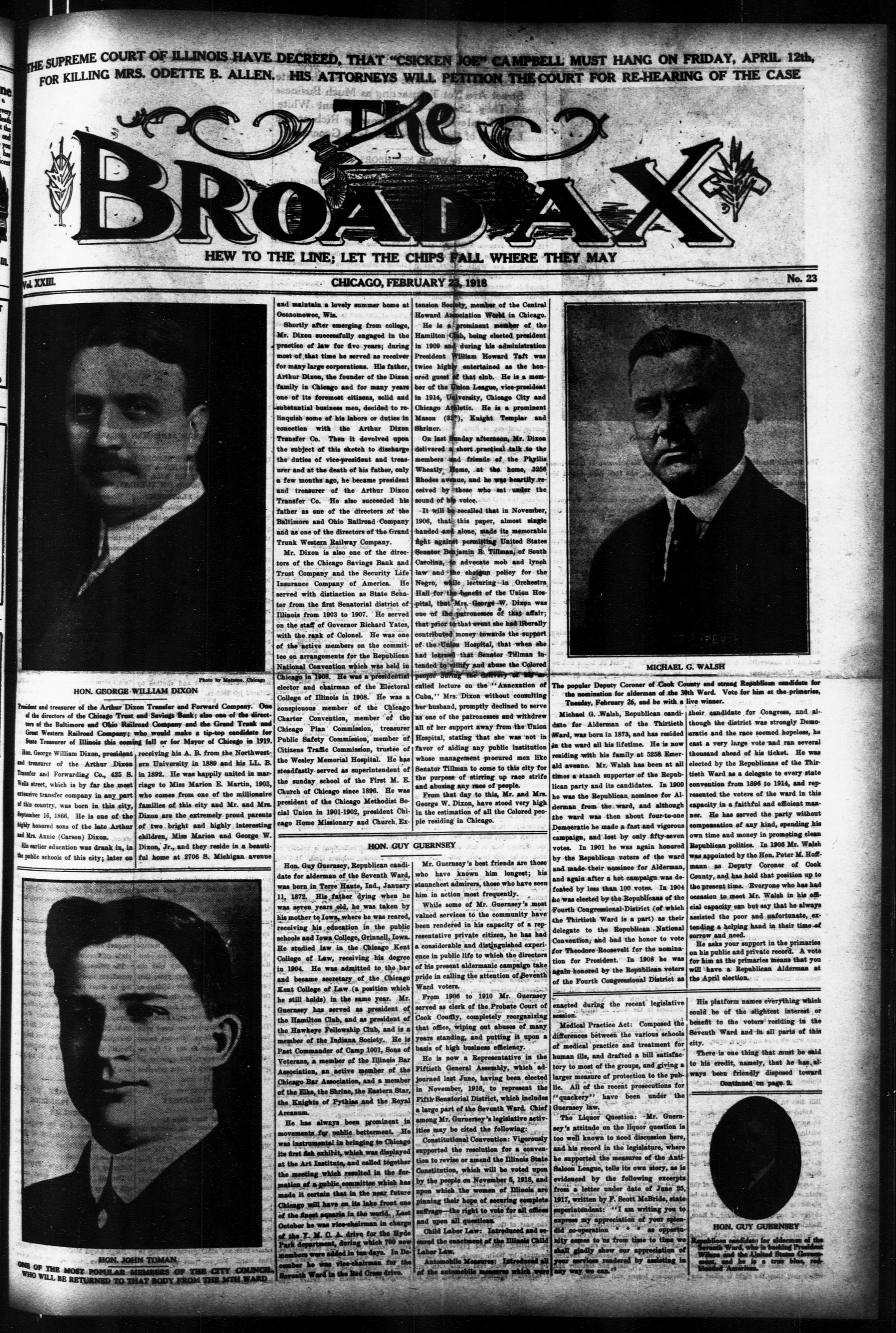
HON. GEORGE WILLIAM DIXON
President and treasurer of the Arthur Dixon Transfer and Forward Company. One of the directors of the Chicago Trust and Savings Bank; also one of the directors of the Baltimore and Ohio Railroad Company and the Grand Trunk and Great Western Railroad Company; who would make a tip-top candidate for State Treasurer of Illinois this coming fall or for Mayor of Chicago in 1919.
1914
Hon. George William Dixon, president and treasurer of the Arthur Dixon Transfer and Forwarding Co., 425 S. Wells street, which is by far the most extensive transfer company in any part of this country, was born in this city, September 16, 1866. He is one of the highly honored sons of the late Arthur and Mrs. Annie (Carson) Dixon. His earlier education was drank in, in the public schools of this city; later on
receiving his A. B. from the Northwestern University in 1889 and his LL. B. in 1892. He was happily united in marriage to Miss Marion E. Martin, 1903, who comes from one of the millionaire families of this city and Mr. and Mrs. Dixon are the extremely proud parents of two bright and highly interesting children, Miss Marion and George W. Dixon, Jr., and they reside in a beautiful home at 2706 S. Michigan avenue
and maintain a lovely summer home at Economowoc, Wis.
Shortly after emerging from college, Mr. Dixon successfully engaged in the practice of law for five years; during most of that time he served as receiver for many large corporations. His father, Arthur Dixon, the founder of the Dixon family in Chicago and for many years one of its foremost citizens, solid and substantial business men, decided to relinquish some of his labors or duties in connection with the Arthur Dixon Transfer Co. Then it devolved upon the subject of this sketch to discharge the duties of vice-president and treasurer and at the death of his father, only a few months ago, he became president and treasurer of the Arthur Dixon Transfer Co. He also succeeded his father as one of the directors of the Baltimore and Ohio Railroad-Company and as one of the directors of the Grand Trunk Western Railway Company.
Mr. Dixon is also one of the directors of the Chicago Savings Bank and Trust Company and the Security Life Insurance Company of America. He served with distinction as State Senator from the first Senatorial district of Illinois from 1903 to 1907. He served on the staff of Governor Richard Yates, with the rank of Colonel. He was one of the active members on the committee on arrangements for the Republican National Convention which was held in Chicago in 1908. He was a presidential elector and chairman of the Electoral College of Illinois in 1908. He was a conspicuous member of the Chicago Charter Convention, member of the Chicago Plan Commission, treasurer Public Safety Commission, member of Citizens Traffic Commission, trustee of the Wesley Memorial Hospital. He has steadfastly served as superintendent of the Sunday school of the First M. E. Church of Chicago since 1896. He was president of the Chicago Methodist Social Union in 1901-1902, president Chicago Home Missionary and Church Ex-
HON. GUY GUERNSEY
Hon. Guy Guernsey, Republican candidate for alderman of the Seventh Ward, was born in Terre Haute, Ind., January 11, 1872. His father dying when he was seven years old, he was taken by his mother to Iowa, where he was reared, receiving his education in the public schools and Iowa College, Grinnell, Iowa. He studied law in the Chicago Kent College of Law, receiving his degree in 1904. He was admitted to the bar and became secretary of the Chicago Kent College of Law (a position which he still holds) in the same year. Mr. Guernsey has served as president of the Hamilton Club, and as president of the Hawkeye Fellowship Club, and is a member of the Indiana Society. He is Past Commander of Camp 1001, Sons of Veterans, a member of the Illinois Bar Association, an active member of the Chicago Bar Association, and a member of the Elks, the Shrine, the Eastern Star, the Knights of Pythias and the Royal Arecanum.
He has always been prominent in movements for public betterment. He was instrumental in bringing to Chicago its first fish exhibit, which was displayed at the Art Institute, and called together the meeting which resulted in the formation of a public committee which has made it certain that in the near future Chicago will have on its lake front one of the finest aquaria in the world. Last October he was vice-chairman in charge of the Y. M. C. A. drive for the Hyde Park department, during which 700 new members were added in ten days. In December he was vice-chairman for the Seventh Ward in the Red Cross drive.
tension Society, member of the Central Howard Association World in Chicago. He is a prominent member of the Hamilton Club, being elected president in 1909 and during his administration President William Howard Taft was twice highly entertained as the honored guest of that club. He is a member of the Union League, vice-president in 1914, University, Chicago City and Chicago Athletic. He is a prominent Mason (33$^{a}$), Knight Templar and Shriner. On last Sunday afternoon, Mr. Dixon delivered a short practical talk to the members and friends of the Phyllis Wheatly Home, at the home, 3256 Rhodes avenue, and he was heartily received by those who sat under the sound of his voice.
It will be recalled that in November, 1906, that this paper, almost single handed and alone, made its memorable fight against permitting United States Senator Benjamin B. Tillman, of South Carolina, to advocate mob and lynch law and she shotgun policy for the Negro, while lecturing in Orchestra Hall for the benefit of the Union Hospital, that Mrs. George W. Dixon was that of the patronesses of that affair; that prior to that event she had liberally contributed money towards the support of the Union Hospital, that when she had learned that Senator Tillman intended to willify and abuse the Colored people during the delivery of his recalled lecture on the "Annexation of Cuba," Mrs. Dixon without consulting her husband, promptly declined to serve as one of the patronesses and withdrew all of her support away from the Union Hospital, stating that she was not in favor of aiding any public institution whose management procured men like Senator Tillman to come to this city for the purpose of stirring up race strife and abusing any race of people.
From that day to this, Mr. and Mrs. George W. Dixon, have stood very high in the estimation of all the Colored people residing in Chicago.
Mr. Guernsey's best friends are those who have known him longest; his staunchest admirers, those who have seen him in action most frequently.
While some of Mr. Guernsey's most valued services to the community have been rendered in his capacity of a representative private citizen, he has had a considerable and distinguished experience in public life to which the directors of his present aldermanic campaign take pride in calling the attention of Seventh Ward voters.
From 1906 to 1910 Mr. Guernsey served as clerk of the Probate Court of Cook County, completely reorganizing that office, wiping out abuses of many years standing, and putting it upon a basis of high business efficiency.
He is now a Representative in the Fiftieth General Assembly, which adjourned last June, having been elected in November, 1916, to represent the Fifth Senatorial District, which includes a large part of the Seventh Ward. Chief among Mr. Gurnsey's legislative activities may be cited the following:
TT LIPEU
Tuesday, February 20, and be with a Michael G. Walsh, Republican candidate for Alderman of the Thirtieth Ward, was born in 1873, and has resided in the ward all his lifetime. He is now residing with his family at 5258 Emerald avenue. Mr. Walsh has been at all times a stanch supporter of the Republican party and its candidates. In 1900 he was the Republican nominee for Alderman from the ward, and although the ward was then about four-to-one Democratic he made a fast and vigorous campaign, and lost by only fifty-seven votes. In 1901 he was again honored by the Republican voters of the ward and made their nominee for Alderman, and again after a hot campaign was defeated by less than 100 votes. In 1904 he was elected by the Republicans of the Fourth Congressional District (of which the Thirtieth Ward is a part) as their delegate to the Republican National Convention, and had the honor to vote for Theodore Roosevelt for the nomination for President. In 1908 he was again honored by the Republican voters of the Fourth Congressional District as
enacted during the recent legislative session.
Medical Practice Act: Composed the differences between the various schools of medical practice and treatment for human ills, and drafted a bill satisfactory to most of the groups, and giving a larger measure of protection to the public. All of the recent prosecutions for "quackery" have been under the Guernsey law.
The Liquor Question: Mr. Guernsey's attitude on the liquor question is too well known to need discussion here, and his record in the legislature, where he supported the measures of the Anti-Saloon League, tells its own story, as is evidenced by the following excerpts from a letter under date of June 25, 1917, written by F. Scott McBride, state superintendent: "I am writing you to express my appreciation of your splendid co-operation * * * as opportunity comes to us from time to time we shall gladly show our appreciation of your services rendered by assisting in any way we can."
their candidate for Congress, and although the district was strongly Democratic and the race seemed hopeless, he cast a very large vote and ran several thousand ahead of his ticket. He was elected by the Republicans of the Thirtieth Ward as a delegate to every state convention from 1896 to 1914, and represented the voters of the ward in this capacity in a faithful and efficient manner. He has served the party without compensation of any kind, spending his own time and money in promoting clean Republican politics. In 1906 Mr. Walsh was appointed by the Hon. Peter M. Hoffmann as Deputy Coroner of Cook County, and has held that position up to the present time. Everyone who has had occasion to meet Mr. Walsh in his official capacity can but say that he always assisted the poor and unfortunate, extending a helping hand in their time of sorrow and need.
He asks your support in the primaries on his public and private record. A vote for him at the primaries means that you will have a Republican Alderman at the April election.
His platform names everything which could be of the slightest interest or benefit to the voters residing in the Seventh Ward and in all parts of this city.
There is one thing that must be said to his credit, namely, that he has always been friendly disposed toward
Continued on page 2.
1930
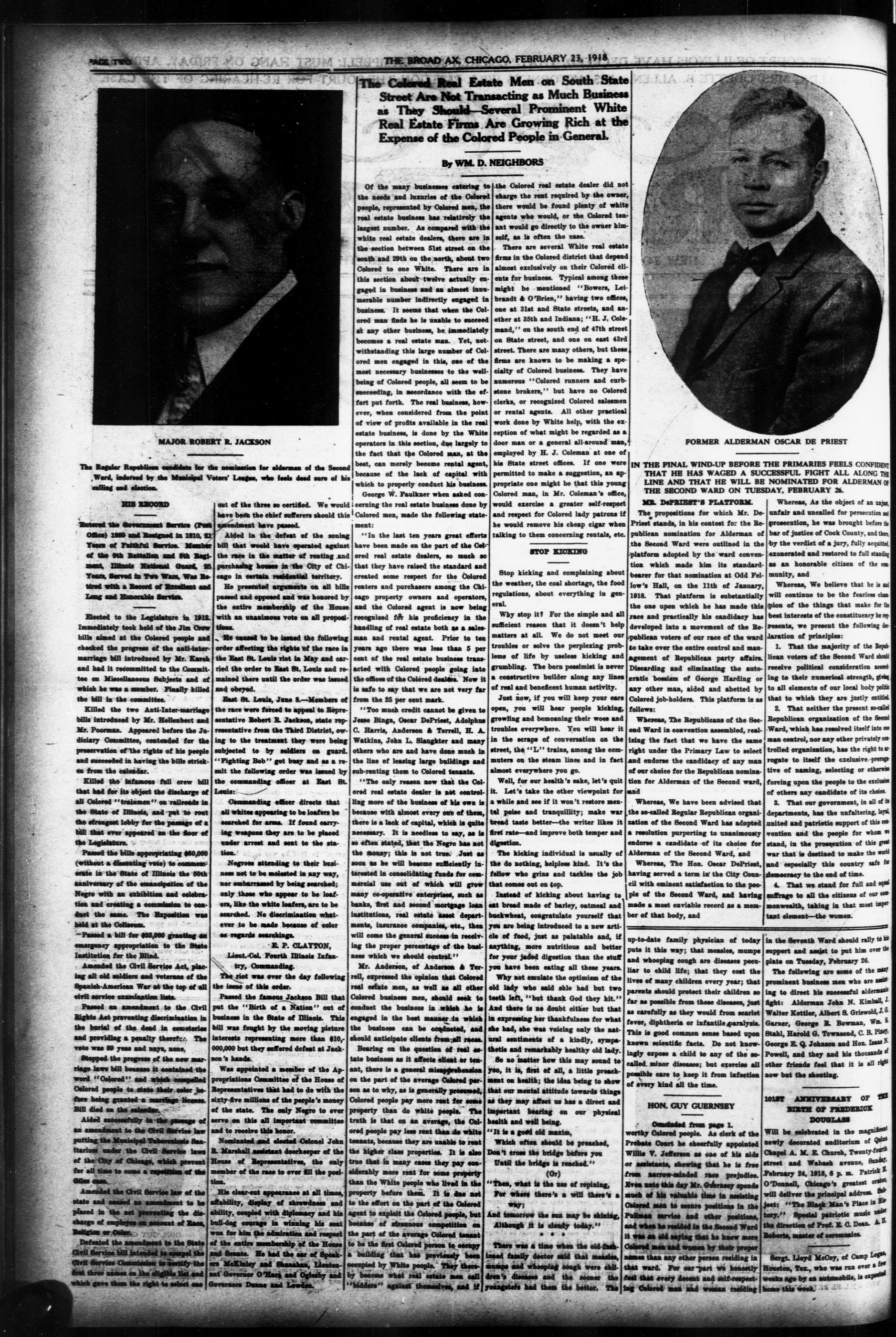
MAJOR ROBERT R. JACKSON
The Regular Republican candidate for the Ward, indorsed by the Municipal V calling and election.
The Regular Republican candidate for the nomination for alderman of the Second Ward, indored by the Municipal Voters' League, who feels dead sure of his calling and election.
Entered the Government Service (Post Office) 1889 and Designated in 1910, 21 Years of Faithful Service. Member of the 9th Battalion and 8th Regiment, Illinois National Guard, 25 Years, Served in Two Wars, Was Retired with a Record of Excellent and Long and Honorable Service.
Elected to the Legislature in 1912. Immediately took hold of the Jim Crow bills aimed at the Colored people and checked the progress of the anti-intermarriage bill introduced by Mr. Kareh and had it recommitted to the Committee on Miscellaneous Subjects and of which he was a member. Finally killed the bill in the committee.
Killed the two Anti-Inter-marriage bills introduced by Mr. Helleuebet and Mr. Poorman. Appeared before the Judiciary Committee, contended for the preservation of the rights of his people and succeeded in having the bills stricken from the calendar.
Killed the infamous full crew bill that had for its object the discharge of all Colored "trainmen" on railroads in the State of Illinois, and put to rout the strongest lobby for the passage of a bill that ever appeared on the floor of the Legislature.
Passed the bill appropriating $50,000 (without a dissenting vote) to commemorate in the State of Illinois the 50th anniversary of the emancipation of the Negro with an exhibition and celebration and creating a commission to conduct the same. The Exposition was held at the Coliseum.
Passed a bill for $25,000 granting an emergency appropriation to the State Institution for the Blind.
Amended the Civil Service Act, placing all old soldiers and veterans of the Spanish-American War at the top of all civil service examination lists.
Passed an amendment to the Civil Rights Act preventing discrimination in the burial of the dead in cemeteries and providing a penalty therefor. The vote was 89 yea and nays, none.
Stopped the progress of the new marriage laws bill because it contained the word "Colored" and which compelled Colored people to state their color before being granted a marriage license. Bill died on the calendar.
Aided successfully in the passage of an amendment to the Civil Service law putting the Municipal Tuberculosis Sanitarium under the Civil Service laws of the City of Chicago, which prevent for all time to come a repetition of the Giles case. Amended the Civil Service law of the state and caused an amendment to be placed in the act preparing the dis
HIS RECORD
-
the nomination for alderman of the Second
Veters' League, who feels dead sure of his
out of the three so certified. We would
have been the chief sufferers should this
amendment have passed.
Aided in the defeat of the zoning
bill that would have operated against
the race in the matter of renting and
purchasing houses in the City of Chicago
in certain residential territory.
He presented arguments on all bills
passed and opposed and was honored by
the entire membership of the House
with an unanimous vote on all propositions.
He caused to be issued the following order affecting the rights of the race in the East St. Louis riot in May and carried the order to East St. Louis and remained there until the order was issued and obeyed.
East St. Louis, June 8.—Members of the race were forced to appeal to Representative Robert R. Jackson, state representative from the Third District, owing to the treatment they were being subjected to by soldiers on guard.
"Fighting Bob" got buay and as a result the following order was issued by the commanding officer at East St. Louis:
Commanding officer directs that all whites appearing to be loafers be searched for arms. If found carrying weapons they are to be placed under arrest and sent to the station.
Negroes attending to their business not to be molested in any way, nor embarrassed by being searched; only those who appear to be loafers, like the white loafers, are to be searched. No discrimination whatever to be made because of color as regards searchings.
The riot was over the day following the issue of this order.
Passed the famous Jackson Bill that put the "Birth of a Nation" out of business in the State of Illinois. This bill was fought by the moving picture interests representing more than $10,000,000 but they suffered defeat at Jackson's hands.
Was appointed a member of the Appropriations Committee of the House of Representatives that had to do with the sixty-five millions of the people's money of the state. The only Negro to ever serve on this all important committee and to receive this honor.
Nominated and elected Colonel John R. Marshall assistant deorkeeper of the House of Representatives, the only member of the race to ever fill the position.
His clear-cut appearance at all times, affability, display of shrewdness and ability, coupled with diplomacy and his bull-dog courage in winning his seat won for him the admiration and respect of the entire membership of the House and Senate. He had the ear of Speakers McKinley and Shanahan, Lieutenant Governor O'Hara and Ogleby and Governors Duane and Lowden.
---
The Colored Real Estate Men on South State Street Are Not Transacting as Much Business as They Should—Several Prominent White Real Estate Firms Are Growing Rich at the Expense of the Colored People in General.
By WM. D. NEIGHBORS
Of the many businesses catering to the needs and luxuries of the Colored people, represented by Colored men, the real estate business has relatively the largest number. As compared with the white real estate dealers, there are in the section between 51st street on the south and 29th on the north, about two Colored to one White. There are in this section about twelve actually engaged in business and an almost innumerable number indirectly engaged in business. It seems that when the Colored man finds he is unable to succeed at any other business, he immediately becomes a real estate man. Yet, notwithstanding this large number of Colored men engaged in this, one of the most necessary businesses to the wellbeing of Colored people, all seem to be succeeding, in accordance with the effort put forth. The real business, however, when considered from the point of view of profits available in the real estate business, is done by the White operators in this section, due largely to the fact that the Colored man, at the best, can merely become rental agent, because of the lack of capital with which to properly conduct his business.
cerning the real estate business done by Colored men, made the following statement:
"In the last ten years great efforts have been made on the part of the Colored real estate dealers, so much so that they have raised the standard and created some respect for the Colored renters and purchasers among the Chicago property owners and operators, and the Colored agent is now being recognized for his proficiency in the handling of real estate both as a salesman and rental agent. Prior to ten years ago there was less than 5 per cent of the real estate business transacted with Colored people going into the offices of the Colored dealers. Now it is safe to say that we are not very far from the 25 per cent mark.
"Too much credit cannot be given to Jesse Binga, Oscar DePriest, Adolphus C. Harris, Anderson & Terrell, H. A. Watkins, John L. Slaughter and many others who are and have done much in the line of leasing large buildings and sub-renting them to Colored tenants.
"The only reason now that the Colored real estate dealer is not controlling more of the business of his own is because with almost every one of them, there is a lack of capital, which is quite necessary. It is needless to say, as is so often stated, that the Negro has not the money; this is not true. Just as soon as he will become sufficiently interested in consolidating funds for commercial use out of which will grow many co-operative enterprises, such as banks, first and second mortgage loan institutions, real estate asset departments, insurance companies, etc., then will come the general success in receiving the proper percentage of the business which we should control."
Mr. Anderson, of Anderson & Terrell, expressed the opinion that Colored real estate men, as well as all other Colored business men, should seek to conduct the business in which he is engaged in the best manner in which the business can be conducted, and should anticipate clients from all races. Bearing on the question of real estate business as it affects client or tenant, there is a general misapprehension on the part of the average Colored person as to why, as is generally presumed, Colored people pay more rent for some property than do white people. The truth is that on an average, the Colored people pay less rent than do white tenants, because they are unable to rent the higher class properties. It is also true that in many cases they pay considerably more rent for some property than the White people who lived in the property before them. It is due not to the effort on the part of the Colored agent to exploit the Colored people, but because of strenuous competition on the part of the average Colored tenant to be the first Colored person to occupy a building that has previously been occupied by White people. They thereby become what real estate men call "bidders" against themselves, and if
---
the Colored real estate dealer did not charge the rent required by the owner, there would be found plenty of white agents who would, or the Colored tenant would go directly to the owner himself, as is often the case.
There are several White real estate firms in the Colored district that depend almost exclusively on their Colored clients for business. Typical among these might be mentioned "Bowers, Leibrandt & O'Brien," having two offices, one at 31st and State streets, and another at 35th and Indiana; "H. J. Colemand," on the south end of 47th street on State street, and one on east 43rd street. There are many others, but these firms are known to be making a specialty of Colored business. They have numerous "Colored runners and curbstone brokers," but have no Colored clerks, or recognized Colored salesmen or rental agents. All other practical work done by White help, with the exception of what might be regarded as a door man or a general all-around man, employed by H. J. Coleman at one of his State street offices. If one were permitted to make a suggestion, an appropriate one might be that this young Colored man, in Mr. Coleman's office, would exercise a greater self-respect and respect for Colored lady patrons if he would remove his cheap cigar when talking to them concerning rentals, etc.
Stop kicking and complaining about the weather, the coal shortage, the food regulations, about everything in general.
Why stop it? For the simple and all sufficient reason that it doesn't help matters at all. We do not meet our troubles or solve the perplexing problems of life by useless kicking and grumbling. The born pessimist is never a constructive builder along any lines of real and beneficient human activity.
Just now, if you will keep your ears open, you will hear people kicking, growling and bemoaning their woes and troubles everywhere. You will hear it in the scraps of conversation on the street, the 'L' trains, among the commuters on the steam lines and in fact almost everywhere you go.
Well, for our health's sake, let's quit it. Let's take the other viewpoint for a while and see if it won't restore mental poise and tranquillity; make war bread taste better—the writer likes it first rate—and improve both temper and digestion.
The kicking individual is usually of the do nothing, helpless kind. It's the fellow who grins and tackles the job that comes out on top.
Instead of kicking about having to eat bread made of barley, oatmeal and buckwheat, congratulate yourself that you are being introduced to a new article of food, just as palatable and, if anything, more nutritious and better for your jaded digestion than the stuff you have been eating all these years.
Why not emulate the optimism of the old lady who said she had but two teeth left, "but thank God they hit." And there is no doubt either but that in expressing her thankfulness for what she had, she was voicing only the natural sentiments of a kindly, sympathetic and remarkably healthy old lady. So no matter how this may sound to you, it is, first of all, a little preachment on health; the idea being to show that our mental attitude towards things as they may affect us has a direct and important bearing on our physical health and well being. "It is a good old maxim,
Which often should be preached,
Don't cross the bridge before you
Until the bridge is reached."
(Or)
"Then, what is the use of repining,
For where there's a will there's a
way;
And tomorrow the sun may be shining,
Although it is cloudy today."
There was a time when the old-fashioned family doctor said that messies, mumps and whooping cough were children's diseases and the sooner the youngsters had them the better. The
STOP KICKING
A. H. H.
FORMER ALDERMAN OSCAR DE PRIEST
IN THE FINAL WIND-UP BEFORE THE PRIMARIES FEELS CONFIDENT
THAT HE HAS WAGED A SUCCESSFUL FIGHT ALL ALONG THE
LINE AND THAT HE WILL BE NOMINATED FOR ALDERMAN OF
THE SECOND WARD ON TUESDAY, FEBRUARY 26.
MR. DOPRIEST'S PLATFORM.
The propositions for which Mr. DePriest stands, in his contest for the Republican nomination for Alderman of the Second Ward were outlined in the platform adopted by the ward convention which made him its standard-bearer for that nomination at Odd Fellow's Hall, on the 11th of January, 1918. That platform is substantially the one upon which he has made this race and practically his candidacy has developed into a movement of the Republican voters of our race of the ward to take over the entire control and management of Republican party affairs.
Discarding and eliminating the autocratic bossism of George Harding or any other man, aided and abetted by Colored job-holders. This platform is as follows:
Whereas, The Republicans of the Second Ward in convention assembled, realizing the fact that we have the same right under the Primary Law to select and endorse the candidacy of any man of our choice for the Republican nomination for Alderman of the Second ward, and Whereas, We have been advised that the so-called Regular Republican organization of the Second Ward has adopted a resolution purporting to unanimously endorse a candidate of its choice for Alderman of the Second Ward, and
Whereas, The Hon. Oscar DePriest, having served a term in the City Council with eminent satisfaction to the people of the Second Ward, and having made a most enviable record as a member of that body, and
up-to-date family physician of today puts it this way; that measles, mumps and whooping cough are diseases peculiar to child life; that they cost the lives of many children every year; that parents should protect their children so far as possible from these diseases, just as carefully as they would from scarlet fever, diphtheria or infantile paralysis. This is good common sense based upon known scientific facts. Do not knowingly expose a child to any of the so-called minor diseases; but exercise all possible care to keep it from infection of every kind all the time.
HON. GUY GUERNSEY
Concluded from page 1. worthy Colored people. As clerk of the Probate Court he cheerfully appointed Willis V. Jefferson as one of his aids or assistants, showing that he is free from narrow-minded race prejudice. Even unto this day Mr. Gurnsey spends much of his valuable time in assisting Colored men to secure positions in the Pullman service and other positions, and when he resided in the Second Ward it was an old saying that he knew more Colored men and women by their proper names than any other person residing in that ward. For our part we honestly feel that every decent and self-respecting Colored man and woman residing
THE PRIMARIES FEELS CONFIDENT
CESSFUL FIGHT ALL ALONG THE
NOMINATED FOR ALDERMAN OF
SDAY, FEBRUARY 26.
Whereas, As the object of an unjust
unfair and uncalled for persecution and
prosecution, he was brought before the
bar of justice of Cook County, and there
by the verdict of a jury, fully acquitted
exonerated and restored to full standing
as an honorable citizen of the com-
munity, and
Whereas, We believe that he is and will continue to be the fearless champion of the things that make for the best interests of the constituency he represents, we present the following declaration of principles:
1. That the majority of the Republican voters of the Second Ward should receive political consideration according to their numerical strength, giving to all elements of our local body politics that to which they are justly entitled
2. That neither the present so-called Republican organization of the Second Ward, which has resolved itself into one man control, nor any other privately controlled organization, has the right to arrogate to itself the exclusive -peregritive of naming, selecting or otherwise forcing upon the people to the exclusion of others any candidate of its choice.
3. That our government, in all of its departments, has the unfaltering, loyal, united and patriotic support of this convention and the people for whom we stand, in the prosecution of this great war that is destined to make the world and especially this country safe for democracy to the end of time.
4. That we stand for full and equal suffrage to all the citizens of our commonwealth, taking in that most important element—the women.
in the Seventh Ward should rally to his support and assist to put him over the plate on Tuesday, February 26.
The following are some of the many prominent business men who are assisting to direct his successful aldermanic fight: Alderman John N. Kimball, J. Walter Kettler, Albert S. Griswold, J. G. Garner, George R. Bowman, Wm. S. Stahl, Harold G. Townsend, C. B. Piney, George E. Q. Johnson and Hon. Isaac N. Powell, and they and his thousands of other friends feel that it is all right now but the shouting.
101ST ANNIVERSARY OF THE BIRTH OF PREFERICK DOUGLASS
Will be celebrated in the magnificent newly decorated auditorium of Quincy Chapel A. M. E. Church, Twenty-fourth street and Wabash avenue, Sunday, February 24, 1913, 8 p. m. Patrick H. O'Donnell, Chicago's greatest orator, will deliver the principal address. Subject: "The Black Man's Place in History." Special patriotic music under the direction of Prof. E. C. Dean. A. H. Roberts, master of ceremonies.
Sergt. I. Lloyd McCoy, of Camp Logan, Houston, Tex., who was run over a few weeks ago by an automobile, is expected home this week.
A
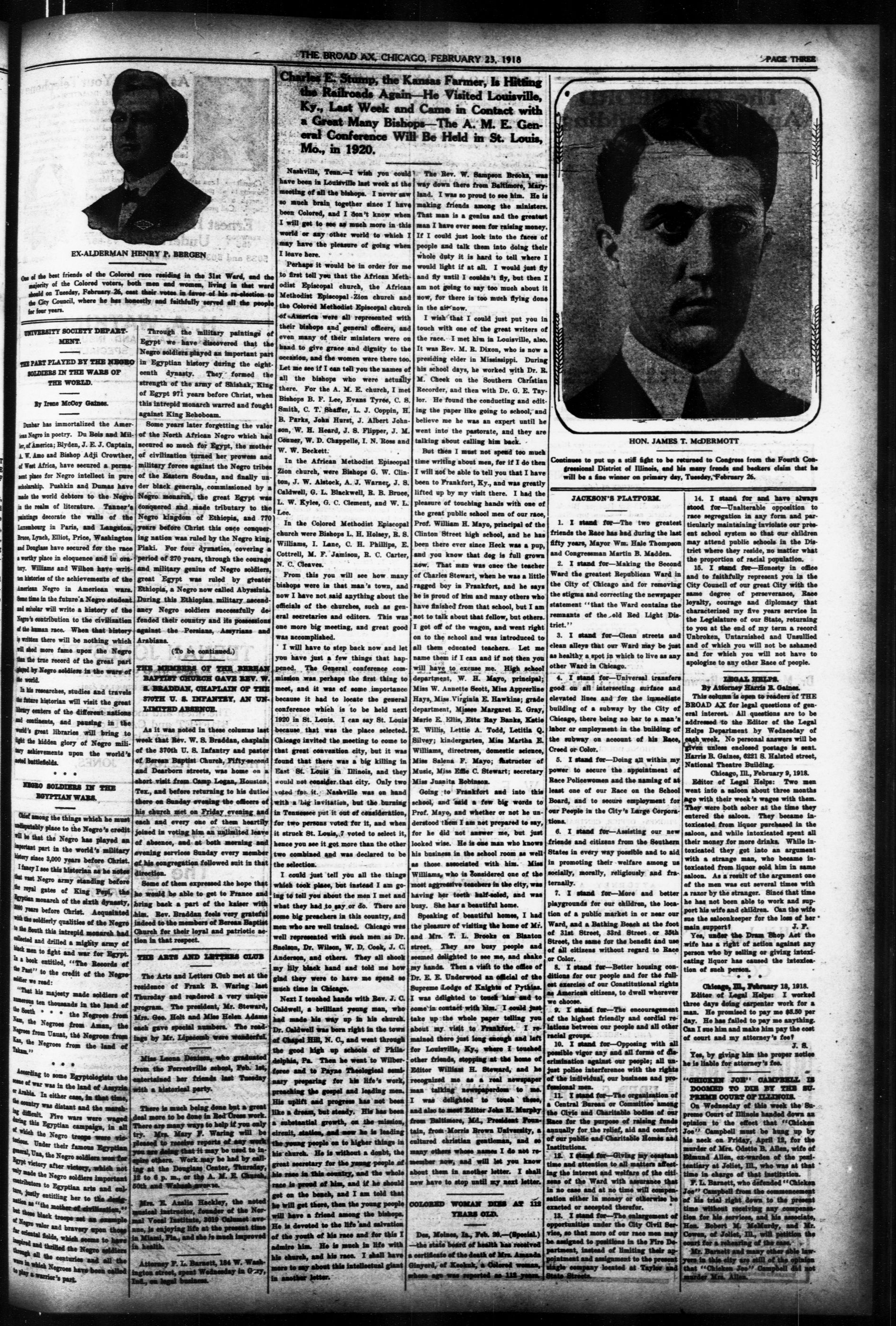
EX-ALDERMAN HENRY P. BERGEN
ends of the Colored race residing in the
Colored voters, both men and women,
day, February 26, cast their votes in favor
il, where he has honestly and faithfully a
and race residing in the 31st Ward, and the both men and women, living in that ward at their votes in favor of his re-election to directly and faithfully served all the people
One of the best friends of the Colored race residing in the 31st Ward, and the majority of the Colored voters, both men and women, living in that ward should on Tuesday, February 26, cast their votes in favor of his re-election to the City Council, where he has honestly and faithfully served all the people for four years.
UNIVERSITY SOCIETY DEPARTMENT.
THE PART PLAYED BY THE NEGRO SOLDIERS IN THE WARS OF THE WORLD.
By Irene McCoy Gaines.
Through the military paintings of Egypt we have discovered that the Negro soldiers played an important part in Egyptian history during the eighteenth dynasty. They formed the strength of the army of Shishak, King of Egypt 971 years before Christ, when this intrepid monarch warred and fought against King Rehoboam.
Some years later forgetting the valor of the North African Negro which had secured so much for Egypt, the mother of civilization turned her prowess and military forces against the Negro tribes of the Eastern Soudan, and finally under black generals, commissioned by a Negro monarch, the great Egypt was conquered and made tributary to the Negro kingdom of Ethiopia, and 770 years before Christ this once conquering nation was ruled by the Negro king, Piaki. For four dynasties, covering a period of 270 years, through the courage and military genius of Negro soldiers, great Egypt was ruled by greater Ethiopia, a Negro now called Abyssinia. During this Ethiopian military second-ance Negro soldiers successfully defended their country and its possessions against the Persians, Assyrians and Arabians.
is upon the Negro
of the great part
iers in the ware of
studies and travels
will visit the great
e different nations
pausing in the
(To be con-
THE MEMBERS OF
BAFTIST CHURCH
S. BRADDAN, CH
370TH U. S. INF
LIMITED ABSEN
(To be continued.)
THE MEMBERS OF THE BERNAN
BAFTIST CHURCH GAVE REV. W.
S. BRADDAN, CHAPLAIN OF THE
370TH U. S. INFANTRY, AN UN-
LIMITED ABSENCE.
As it was noted in these columns last week that Rev. W. S. Braddan, chaplain of the 370th U. S. Infantry and pastor of Borean Baptist Church, Fifty-second and Dearborn streets, was home on a short visit from Camp Logan, Houston, Tex., and before returning to his duties there on Sunday evening the officers of his church met on Friday evening and each and every one of them heartily joined in voting him an unlimited leave of absence, and at both morning and evening services Sunday every member of his congregation followed suit in that direction.
by standing before King Pepl, the sixth dynasty, christ. Acquainted titles of the Negro monarch had a mighty army of war for Egypt. "The Records of
Some of them express he would be able to bring back a part of him. Rev. Braddan f indeed to the members Church for their loyal in that respect.
THE ARTS AND I
Some of them expressed the hope that he would be able to get to France and bring back a part of the kaiser with him. Rev. Braddan feels very grateful indeed to the members of Berean Baptist Church for their loyal and patriotic action in that respect.
THE ARTS AND LETTERS CLUB
---
Charles E. Stump, the Kansas Farmer, Is Hitting the Railroads Again—He Visited Louisville, Ky., Last Week and Came in Contact with a Great Many Bishops—The A. M. E. General Conference Will Be Held in St. Louis, Mo., in 1920.
Nashville, Tennessee.—I wish you could have been in Louisville last week at the meeting of all the bishops. I never saw so much brain together since I have been Colored, and I don't know when I will get to see as much more in this world or any other world to which I may have the pleasure of going when I leave here.
Perhaps it would be in order for me to first tell you that the African Methodist Episcopal church, the African Methodist Episcopal Zion church and the Colored Methodist Episcopal church of America were all represented with their bishops and general officers, and even many of their ministers were on hand to give grace and dignity to the occasion, and the women were there too. Let me see if I can tell you the names of all the bishops who were actually there. For the A. M. E. church, I met Bishops B. F. Lee, Evans Tyree, C. S. Smith, C. T. Shaffer, L. J. Coppin, H. B. Parks, John Hurst, J. Albert Johnson, W. H. Heard, J. S. Flipper, J. M. Conner, W. D. Chappelle, I. N. Ross and W. W. Beckett:
In the African Methodist Episcopal Zion church, were Bishops G. W. Clinton, J. W. Alstock, A. J. Warner, J. S. Caldwell, G. L. Blackwell, R. B. Bruce, L. W. Kyles, G. C. Clement, and W. L. Lee.
In the Colored Methodist Episcopal church were Bishops L. H. Holsey, R. S. Williams, I. Lane, C. H. Phillips, E. Cottrell, M. F. Jamison, R. C. Carter, N. C. Cleaves.
From this you will see how many bishops were in that man's town, and now I have not said anything about the officials of the churches, such as general secretaries and editors. This was one more big meeting, and great good was accomplished.
I will have to step back now and let you have just a few things that happened. The General conference commission was perhaps the first thing to meet, and it was of some importance because it had to locate the general conference which is to be held next 1920 in St. Louis. I can say St. Louis because that was the place selected. Chicago invited the meeting to come to that great convention city, but it was found that there was a big killing in East St. Louis in Illinois, and they would not consider that city. Only two voted for it. Nashville was on hand with a big invitation, but the burning in Tennessee put it out of consideration, for two persons voted for it, and when it struck St. Louis, 7 voted to select it, hence you see it got more than the other two combined and was declared to be the selection.
I could just tell you all the things which took place, but instead I am going to tell you about the men I met and what they had to say or do. There are some big preachers in this country, and men who are well trained. Chicago was well represented with such men as Dr. Snelson, Dr. Wilson, W. D. Cook, J. C. Anderson, and others. They all shook my lily black hand and told me how glad they were to have me spend so much time in Chicago.
Next I touched hands with Rev. J. C. Caldwell, a brilliant young man, who had made his way up in his church. Dr. Caldwell was born right in the town of Chapel Hill, N. C., and went through the good high up schools of Philadelphia, Pa. Then he went to Wilberforce and to Payne Theological seminary preparing for his life's work, preaching the gospel and leading men. His uplift and progress has not been like a dream, but steady. His has been a substantial growth, on the mission, circuit, station, and now he is leading the young people on to higher things in his church. He is without a doubt, the great secretary for the young people of his race in this country, and the whole race is proud of him, and if he should get on the bench, and I am told that he will get there, then the young people will have a friend among the blishops. He is devoted to the life and salvation of the youth of his race and for this I admire him. He is much in life with his church, and his race. I shall have more to say about this intellectual giant in another letter.
The Rev. W. Sampson Brooks, was way down there from Baltimore, Maryland. I was so proud to see him. He is making friends among the ministers. That man is a genius and the greatest man I have ever seen for raising money. If I could just look into the faces of people and talk them into doing their whole duty it is hard to tell where I would light if at all. I would just fly and fly until I couldn't fly, but then I am not going to say too much about it now, for there is too much flying done in the air now.
I wish that I could just put you in touch with one of the great writers of the race. I met him in Louisville, also. It was Rev. M. R. Dixon, who is now a presiding elder in Mississippi. During his school days, he worked with Dr. R. M. Cheek on the Southern Christian Recorder, and then with Dr. G. E. Taylor. He found the conducting and editing the paper like going to school; and believe me he was an expert until he went into the pastorate, and they are talking about calling him back.
But then I must not spend too much time writing about men, for if I do then I will not be able to tell you that I have been to Frankfort, Ky., and was greatly lifted up by my visit there. I had the pleasure of touching hands with one of the great public school men of our race, Prof. William H. Mayo, principal of the Clinton Street high school, and he has been there ever since Heck was a pup, and you know that dog is full grown now. That man was once the teacher of Charles Stewart, when he was a little ragged boy in Frankfort, and he says he is proud of him and many others who have finished from that school, but I am not to talk about that fellow, but others. I got off of the wagon, and went right on to the school and was introduced to all them educated teachers. Let me name them if I can and if not then you will have to excuse me. High school department, W. H. Mayo, principal; Miss W. Annette Scott, Miss Apprerline Hays, Miss. Virginia E. Hawkins; grade department, Misses Margaret E. Gray, Marie E. Ellis, Etta Ray Banks, Katie E. Willis, Lettie A. Todd, Lotitia Q. Silvey; kindergarten, Miss Martha E. Williams, directress, domestic science, Miss Salena F. Mayo; instructor of Music, Miss Eile C. Stewart; secretary Miss Juanita Robinson.
Going to Frankfort and into this school, and said a few big words to Prof. Mayo, and whether or not he understood them I am not prepared to say, for he did not answer me, but just looked wise. He is one man who knows his business in the school room as well as those associated with him. Miss Williams, who is Considered one of the most aggressive teachers in the city, was having her teeth half-scaled, and was busy. She has a beautiful home.
Speaking of beautiful homes, I had the pleasure of visiting the home of Mr. and Mrs. T. L. Brooks on Blanton street. They are busy people and seemed delighted to see me, and shake my hands. Then a visit to the office of Dr. E. E. Underwood an official of the Supreme Lodge of Knights of Pythias. I was delighted to touch him and to come in contact with him. I could just take up the whole paper telling you about my visit to Frankfort. I remained there just long enough and left for Louisville, Ky., where I touched other friends, stopping at the home of Editor William H. Steward, and he recognized me as a real newspaper man talking newspaperdom to me. I was delighted to touch these, and also to meet Editor John H. Murphy from Baltimore, Md., President Fountain, from Morris Brown University, a cultured christian gentleman, and so many others whose names I do not remember now, and will let you know about them in another letter. I shall now have to stop until my next letter.
COLORED WOMAN DIES AT 112 YEARS OLD.
Des, Moines, Ia., Feb. 20.—(Special)—the state board of health has received a certificate of the death of Mrs. Amanda Ginyerd, of Keokuk, a Colored woman, whose age was reported as 112 years.
---
COLORADO
SHERIFF
HON. JAMES T. McDERMOTT
Continues to put up a stiff fight to be regressional District of Illinois, and he will be a fine winner on primary day.
JACKSON'S PLATFORM.
1. I stand for—The two greatest friends the Race has had during the last fifty years, Mayor Wm. Hale Thompson and Congressman Martin B. Madden.
Continues to put up a stiff fight to be returned to Congress from the Fourth Congressional District of Illinois, and his many friends and backers claim that he will be a fine winner on primary day, Tuesday, February 26.
2. I stand for—Making the Second Ward the greatest Republican Ward in the City of Chicago and for removing the stigma and correcting the newspaper statement "that the Ward contains the remnants of the old Red Light District."
3. I stand for—Clean streets and clean alleys that our Ward may be just as healthy a spot in which to live as any other Ward in Chicago.
4. I stand for—Universal transfers good on all intersecting surface and elevated lines and for the immediate building of a subway by the City of Chicago, there being no bar to a man's labor or employment in the building of the subway on account of his Race, Creed or Color.
5. I stand for—Doing all within my power to secure the appointment of Race Policewomen and the naming of at least one of our Race on the School Board, and to secure employment for our People in the City's Large Corporations.
6. I stand for—Assisting our new friends and citizens from the Southern States in every way possible and to aid in promoting their welfare among us socially, morally, religiously and fraternally.
7. I stand for—More and better playgrounds for our children, the location of a public market in or near our Ward, and a Bathing Beach at the foot of 31st Street, 33rd Street or 35th Street, the same for the benefit and use of all citizens without regard to Race or Color.
8. I stand for—Better housing conditions for our people and for the fullest exercise of our Constitutional rights an American citizens, to dwell wherever we choose.
9. I stand for—The encouragement of the highest friendly and cordial relations between our people and all other racial groups.
The
A
m
o
n
e
r
s
returned to Congress for the Fourth Conis many friends and backers claim that he, Tuesday, February 26.
14. I stand for and have always stood for—Unalterable opposition to race segregation in any form and particularly maintaining inviolate our present school system so that our children may attend public schools in the District where they reside, no matter what the proportion of racial population.
15. I stand for—Honesty in office and to faithfully represent you in the City Council of our great City with the same degree of perseverance, Race loyalty, courage and diplomacy that characterized my five years service in the Legislature of our State, returning to you at the end of my term a record Unbroken, Untarnished and Unsullied and of which you will not be ashamed and for which you will not have to apologize to any other Race of people.
By Robert HARRIS B. GALEN.
This column is open to readers of THE BROAD AX for legal questions of general interest. All questions are to be addressed to the Editor of the Legal Helps Department by Wednesday of each week. No personal answers will be given unless enclosed postage is sent. Harris B. Gaines, 6231 S. Halsted street, National Theatre Building.
Chicago, Ill., February 9, 1918.
Editor of Legal Helps: Two men went into a saloon about three months ago with their week's wages with them. They were both sober at the time they entered the saloon. They became intoxicated from liquor purchased in the saloon, and while intoxicated spent all their money for more drinks. While intoxicated they got into an argument with a strange man, who became intoxicated from liquor sold him in same saloon. As a result of the argument one of the men was cut several times with a razor by the stranger. Since that time he has not been able to work and support his wife and children. Can the wife sue the saloonkeeper for the loss of her main support! J. F.
Yes, under the Dram Shop Act the wife has a right of action against any person who by selling or giving intoxicating liquor has caused the intoxication of such person.
Chicago, IL, February 18, 1918.
Editor of Legal Helps: I worked three days doing carpenter work for a man. He promised to pay me $3.50 per day. He has failed to pay me anything. Can I sue him and make him pay the cost of court and my attorney's fee?
J. S.
Yes, by giving him the proper notice he is liable for attorney's fee.
"CHICKEN JOHN" CAMPBELL IS DOOMED TO DIE BY THE SUPREME COURT OF ILLINOIS.
On Wednesday of this week the Supreme Court of Illinois handed down an opinion to the effect that "Chicken Joe" Campbell must be hung up by his neck on Friday, April 12, for the murder of Mrs. Odette R. Allen, wife of Edmund Allen, ex-warden of the poultry-tailor at Joliet, Ill., who was at that time in charge of that institution.
F. L. Barnett, who defended "Chicken
PAGE THREE
THE BROAD AX, CHICAGO, FEBRUARY 23, 1918
PAGE FOUR
The CR
Apartmen
3600 Wal
The finest building ever open
cago. Steam heat, electric li
Phone Main 263
The finest building ever opened to Colored tenants in Chicago. Steam heat, electric lights, tile baths, marble entrance.
J. W. CASEY, Agent
Phone Main 263
133 W. Washington Street
FREE
STYLE BOOK
HAIR
To Colored Women
manufacturer of
Colored Women's
Hair. Our MISS
book showing new
styling and dyeing sent free.
Every colored woman
should have
wavy hair. We
sends our hair and
toilet articles. Satisfaction guaranteed.
We make the best
MISS BESS STRAIGHT
ENGLISH combs, with extra heavy back, fully
dressed. Mail each combs, give
FREE. Send money order, original. MONEY
BACK IF NOT SATISFACTORY. $129 postpaid.
POSTPAID $129
Hair pels, brushes, combs and toilet articles
manufacturer's price. Send two-cart stamps.
Agents Wanted. Address as follow:
HUMAMA HAIR COMPANY.
211-217 Park Bouw.
New York City.
Address Dept. 84
PHONE DOUGLAS 896
Dr. Mac Enery J. Brown
Physician and Surgeon
Practice Limited in
Disease of the
Eye, Ear, Nose and Throat
10 EAST 39TH STREET
Hours:
8 to 12 A.M. 8 to 9 P.M. CHICAGO
RESIDENCE 201 South Park Avenue
PHONE DOUGLAS 896
W. M. J. LATHAM
ATTORNEY AT LAW
OFFICE PHONE: CALUMET WT
2 East 31st Street
Suite 7
CHICAGO
Frank Dunn, J. R. McCahay, Trustees
Telephone: Oakland 1552, 1551, 1550
JOHN J. DUNN
ESTABLISHED 1871
Wholesale and Retail
COAL
Fifty-First and Federal Streets
CHICAGO
KINKY HAIR
EXELENTO SINGLE
KINKY HAIR
LAURENCE
1 DECORATE GIVE SERVICE LOW RENT
H. A. WATKINS
REAL ESTATE AND INSURANCE
RENTING A SPECIALTY
3510 Indiana Avenue
PHONE DOUGLAS 1714 CHICAGO
The finest and most UP-TO-DATE BUFFET and CAFE on the South Side. First-Class Entertainers.