The Broad Ax
Saturday, March 23, 1918
Chicago, Illinois
Page text (machine-generated)
THE BROAD AX
HEW TO THE LINE; LET THE CHIPS FALL WHERE THEY MAY
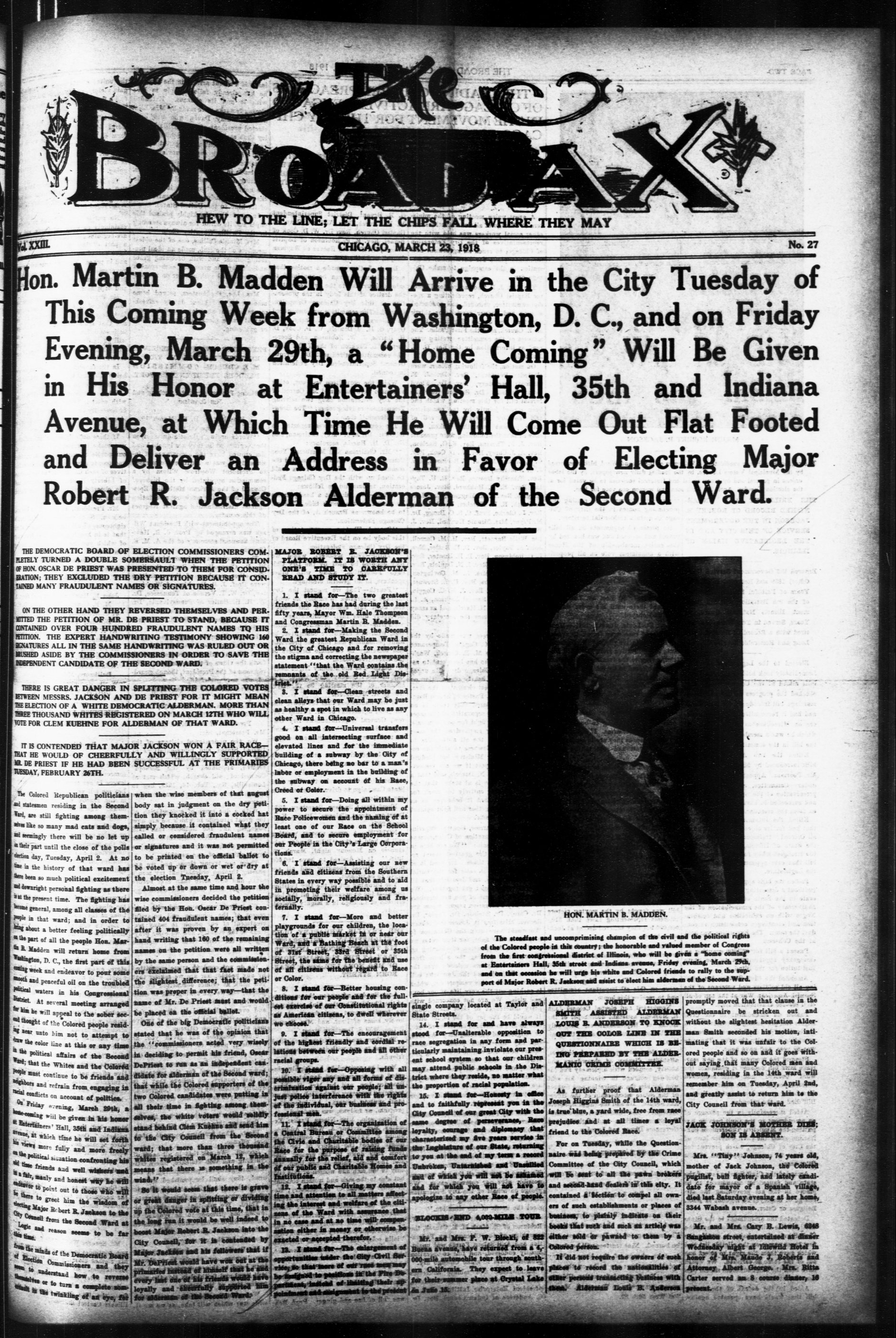
Hon. Martin B. Madden Will Arrive in the City Tuesday of This Coming Week from Washington, D. C., and on Friday Evening, March 29th, a "Home Coming" Will Be Given in His Honor at Entertainers' Hall, 35th and Indiana Avenue, at Which Time He Will Come Out Flat Footed and Deliver an Address in Favor of Electing Major Robert R. Jackson Alderman of the Second Ward.
THE DEMOCRATIC BOARD OF ELECTION COMMISSIONERS COMPLETELY TURNED A DOUBLE SOMERSAULT WHEN THE PETITION OF HON. OSCAR DE PRIEST WAS PRESENTED TO THEM FOR CONSIDERATION; THEY EXCLUDED THE DRY PETITION BECAUSE IT CONTAINED MANY FRAUDULENT NAMES OR SIGNATURES.
ON THE OTHER HAND THEY REVERSED THEMSELVES AND PERMITTED THE PETITION OF MR. DE PRIEST TO STAND, BECAUSE IT CONTAINED OVER FOUR HUNDRED FRAUDULENT NAMES TO HIS PETITION. THE EXPERT HANDWRITING TESTIMONY SHOWING 160 SIGNATURES ALL IN THE SAME HANDWRITING WAS RULED OUT OR BRUSHED ASIDE BY THE COMMISSIONERS IN ORDER TO SAVE THE INDEPENDENT CANDIDATE OF THE SECOND WARD.
THERE IS GREAT DANGER IN SPLITTING THE COLORED VOTES BETWEEN MESSRS. JACKSON AND DE PRIEST FOR IT MIGHT MEAN THE ELECTION OF A WHITE DEMOCRATIC ALDERMAN. MORE THAN THREE THOUSAND WHITES REGISTERED ON MARCH 12TH WHO WILL VOTE FOR CLEM KUEHNE FOR ALDERMAN OF THAT WARD.
IT IS CONTENDED THAT MAJOR JACKSON WON A FAIR RACE—THAT HE WOULD OF CHEERFULLY AND WILLINGLY SUPPORTED MR. DE PRIEST IF HE HAD BEEN SUCCESSFUL AT THE PRIMARIES TUESDAY, FEBRUARY 26TH.
when the wise members of that august body sat in judgment on the dry petition they knocked it into a cocked hat simply because it contained what they called or considered fraudulent names or signatures and it was not permitted to be printed on the official ballot to be voted up or down or wet or dry at the election Tuesday, April 2.
Almost at the same time and hour the wise commissioners decided the petition filed by the Hon. Oscar De Priest contained 404 fraudulent names; that even after it was proven by an expert on hand writing that 160 of the remaining names on the petition were all written by the same person and the commissioners exclaimed that that fact made not the alightest difference; that the petition was proper in every way—that the name of De Priest must and would be placed on the official ballot.
1. I stand for—The two greatest friends the Race has had during the last fifty years, Mayor Wm. Hale Thompson and Congressman Martin B. Madden.
2. I stand for—Making the Second Ward the greatest Republican Ward in the City of Chicago and for removing the stigma and correcting the newspaper statement "that the Ward contains the remnants of the old Bed Light District."
3. I stand for—Clean streets and clean alleys that our Ward may be just as healthy a spot in which to live as any other Ward in Chicago.
4. I stand for—Universal transfers good on all intersecting surface and elevated lines and for the immediate building of a subway by the City of Chicago, there being no bar to a man's labor or employment in the building of the subway on account of his Race, Creed or Color.
5. I stand for—Doing all within my power to secure the appointment of Race Policewomen and the naming of at least one of our Race on the School Board, and to secure employment for our People in the City's Large Corporations.
6. I stand for—Assisting our new friends and citizens from the Southern States in every way possible and to aid in promoting their welfare among us socially, morally, religiously and fraternally.
7. I stand for—More and better playgrounds for our children, the location of a public market in or near our Ward, and a Batting Beach at the foot of 31st Street, 33rd Street or 55th Street, the same for the benefit and use of all citizens without regard to Race or Color.
8. I stand for—Better housing conditions for our people and for the fullest exercise of our Constitutional rights as American citizens, to dwell wherever we choose.
9. I stand for—The encouragement of the highest friendly and cordial relations between our people and all other racial groups.
10. I stand for—Opposing with all possible vigor any and all forms of discrimination against our people; all unjust police interference with the rights of the individual, our business and professional men.
11. I stand for—The organization of a Central Bureau or Committee among the Civic and Charitable bodies of our Base for the purpose of raising funds annually for the relief, aid and comfort of our public and Charitable Homes and Institutions.
12. I stand for—Giving my constant time and attention to all matters affect-
M. H.
The steadfast and uncompromising champion of the civil and the political rights of the Colored people in this country; the honorable and valued member of Congress from the first congressional district of Illinois, who will be given a "home coming" at Entertainers Hall, 35th street and Indiana avenue, Friday evening, March 25th, and on that occasion he will urge his white and Colored friends to rally to the support of Major Robert R. Jackson and assist to elect him alderman of the Second Ward.
14. I stand for and have always stood for—Unalterable opposition to race segregation in any form and particularly maintaining inviolate our present school system so that our children may attend public schools in the District where they reside, no matter what the proportion of racial population.
ALDERMAN JOSEPH HIGGINS
SMITH ASSISTED ALDERMAN
LOUIS B. ANDERSON TO KNOCK
OUT THE COLOR LINE IN THE
QUESTIONNAIRE WHICH IS BEING PREPARED BY THE ALDERMANIC CRIME COMMITTEE.
As further proof that Alderman Joseph Higgins Smith of the 14th ward, is true blue, a yard wide, free from race prejudice and at all times a loyal friend to the Colored Race.
For on Tuesday, while the Questionnaire was being prepared by the Crime Committee of the City Council, which will be sent to all the pawn brokers and second-hand dealers in this city. It contained a Sectio to compel all owners of such establishments or places of business, to plainly indicate on their books that such and such an article was either sold or pawned to them by a Colored person.
It did not require the owners of such places to record the nationalities of other persons transacting business with them. Alderman Louis B. Anderson
promptly moved that that clause in the Questionnaire be stricken out and without the slightest hesitation Alderman Smith seconded his motion, intimating that it was unfair to the Colored people and so on and it goes without saying that many Colored men and women, residing in the 14th ward will remember him on Tuesday, April 2nd, and greatly assist to return him to the City Council from that ward.
JACK JOHNSON'S MOTHER DIES;
SON IS ASSENT.
Mra. "Tiny" Johnson, 74 years old, mother of Jack Johnson, the Colored pugilist, bull fighter, and lately candidate for mayor of a Spanish village, died last Saturday evening at her home, 3344 Wabash avenue.
VG B
M. J.
MAJOR ROBERT R. JACKSON
The regular Republican candidate for Ald by the Municipal Voters League, by unions in general and by many soci the election Tuesday, April 2. Both
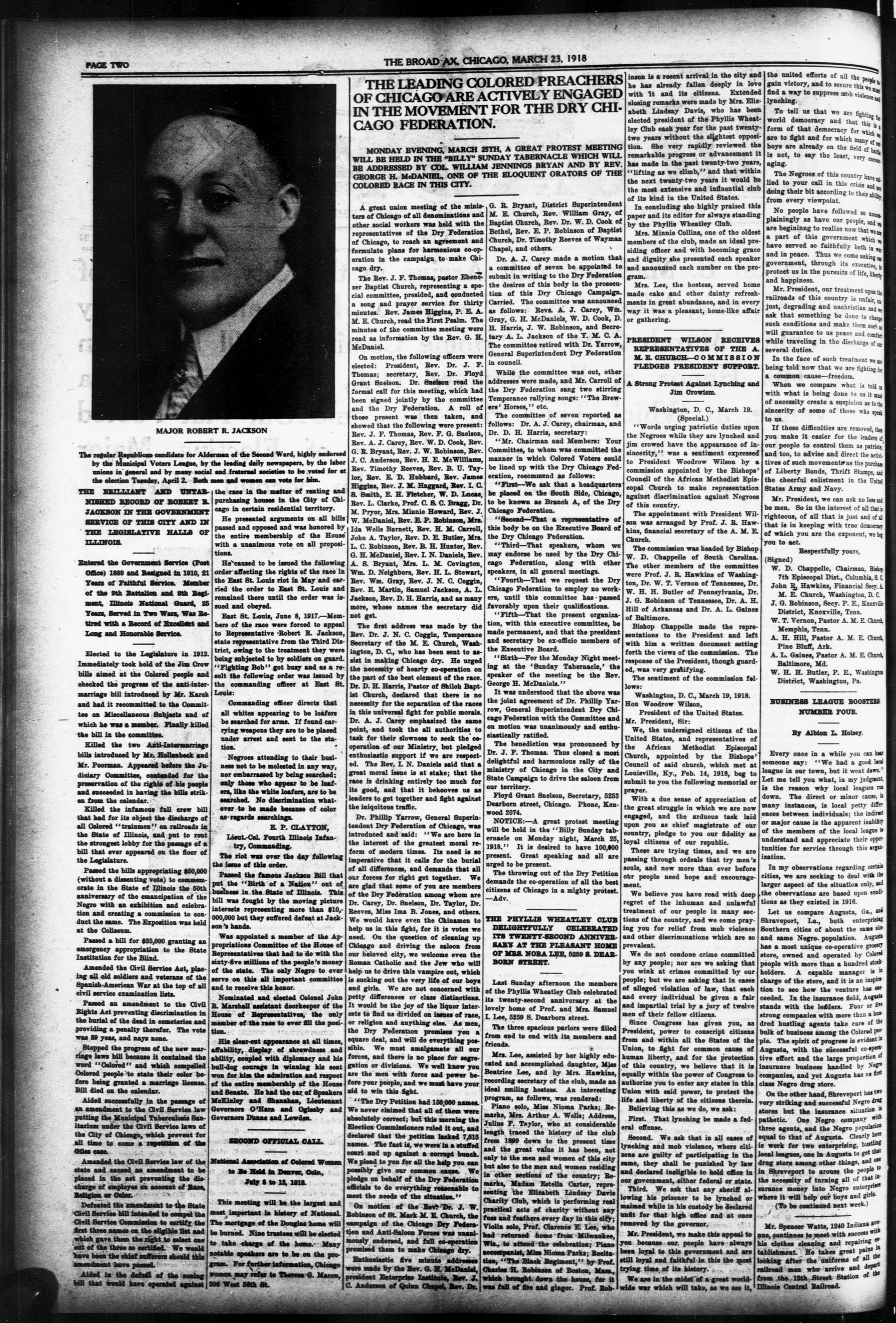
The regular Republican candidate for Alderman of the Second Ward, highly endorsed by the Municipal Voters League, by the leading daily newspapers, by the labor unions in general and by many social and fraternal societies to be voted for at the election Tuesday, April 2. Both men and women can vote for him.
THE BRILLIANT AND UNTARNISHED RECORD OF ROBERT B. JACKSON IN THE GOVERNMENT SERVICE OF THIS CITY AND IN THE LEGISLATIVE HALLS OF ILLINOIS.
Entered the Government Service (Post Office) 1889 and Resigned in 1910, 21 Years of Faithful Service. Member of the 9th Battalion and 8th Regiment, Illinois National Guard, 25 Years, Served in Two Wars, Was Retired with a Record of Excellent and Long and Honorable Service.
the race in the matter of renting and purchasing houses in the City of Chicago in certain residential territory.
He presented arguments on all bills passed and opposed and was honored by the entire membership of the House with a unanimous vote on all propositions.
He caused to be issued the following order affecting the rights of the race in the East St. Louis riot in May and carried the order to East St. Louis and remained there until the order was issued and obeyed.
East St. Louis, June 8, 1917.—Members of the race were forced to appeal to Representative Robert R. Jackson,
Elected to the Legislature in 1912. Immediately took hold of the Jim Crow bills aimed at the Colored people and checked the progress of the anti-intermarriage bill introduced by Mr. Karch and had it recommitted to the Committee on Miscellaneous Subjects and of which he was a member. Finally killed the bill in the committee. Killed the two Anti-Intermarriage bills introduced by Mr. Hollenbeck and Mr. Poorman. Appeared before the Judiciary Committee, contended for the preservation of the rights of his people and succeeded in having the bills striken from the calendar.
Killed the infamous full crew bill that had for its object the discharge of all Colored "trainmen" on railroads in the State of Illinois, and put to ront the strongest lobby for the passage of a bill that ever appeared on the floor of the Legislature.
Passed the bills appropriating $50,000 (without a dissenting vote) to commemorate in the State of Illinois the 50th anniversary of the emancipation of the Negro with an exhibition and celebration and creating a commission to conduct the same. The Exposition was held at the Coliseum.
Passed a bill for $25,000 granting an emergency appropriation to the State Institution for the Blind.
Amended the Civil Service Act, placing all old soldiers and veterans of the Spanish-American War at the top of all civil service examination lists.
Passed an amendment to the Civil Rights Act preventing discrimination in the burial of the dead in cemeteries and providing a penalty therefor. The vote was 89 yeas, and nays none.
Stopped the progress of the new marriage laws bill because it contained the word "Colored" and which compelled Colored people to state their color before being granted a marriage license. Bill died on the calendar.
Aided successfully in the passage of an amendment to the Civil Service law putting the Municipal Tuberculosis Sanitarium under the Civil Service laws of the City of Chicago, which prevent for all time to come a repetition of the Giles case. Amended the Civil Service law of the state and caused an amendment to be placed in the set preventing the discharge of employees on account of Race, Religion or Color.
Defeated the amendment to the State Civil Service bill intended to compel the Civil Service Commission to certify the first three names on the eligible list and which gave them the right to select one out of the three so certified. We would have been the chief sufferers should this amendment have passed. Aided in the default of the zoning bill that would have operated against
PAGE TWO
derman of the Second Ward, highly endorsed the leading daily newspapers, by the labor and fraternal societies to be voted for at men and women can vote for him.
the race in the matter of renting and purchasing houses in the City of Chicago in certain residential territory.
He presented arguments on all bills passed and opposed and was honored by the entire membership of the House with a unanimous vote on all propositions.
He caused to be issued the following order affecting the rights of the race in the East St. Louis riot in May and carried the order to East St. Louis and remained there until the order was issued and obeyed.
East St. Louis, June 8, 1917.—Members of the race were forced to appeal to Representative-Robert R. Jackson, state representative from the Third District, owing to the treatment they were being subjected to by soldiers on guard. "Fighting Bob" got busy and as a result the following order was issued by the commanding officer at East St. Louis:
Commanding officer directs that all whites appearing to be loafers be searched for arms. If found carrying weapons they are to be placed under arrest and sent to the station.
Negroes attending to their business not to be molested in any way, nor embarrassed by being searched; only those who appear to be loafers, like the white loafers, are to be searched. No discrimination whatever to be made because of color as regards searchings.
E. P. CLAYTON,
Lieut.-Col. Fourth Illinois Infantry, Commanding.
The riot was over the day following the issue of this order.
Passed the famous Jackson Bill that put the "Birth of a Nation" out of business in the State of Illinois. This bill was fought by the moving picture interests representing more than $10,000,000 but they suffered defeat at Jackson's hands.
Was appointed a member of the Appropriations Committee of the House of Representatives that had to do with the sixty-five millions of the people's money of the state. The only Negro to ever serve on this all important committee and to receive this honor.
Nominated and elected Colonel John B. Marshall assistant doorkeeper of the House of Representatives, the only member of the race to ever fill the position.
His clear-cut appearance at all times, affability, display of shrewdness and ability, coupled with diplomacy and his bull-dog courage in winning his seat won for him the admiration and respect of the entire membership of the House and Senate. He had the ear of Speakers McKinley and Shanahan, Lieutenant Governors O'Hara and Oglesby and Governors Dunne and Lowden.
SECOND OFFICIAL CALL.
National Association of Colored Women to Be Held in Denver, Colo.,
July 8 to 13, 1912.
This meeting will be the largest and most important in history of National. The mortgage of the Douglas home will be burned. Nine trustees will be elected to take charge of the home. Many notable speakers are to be on the program. For further information, Chicago women may refer to Theresa G. Macon, 506 West 50th St.
E. P. CLAYTON.
THE BROAD AX, CHICAGO, MARCH 23, 1918
THE LEADING COLORED PREACHERS OF CHICAGO ARE ACTIVELY ENGAGED IN THE MOVEMENT FOR THE DRY CHICAGO FEDERATION.
MONDAY EVENING, MARCH 25TH, A GREAT PROTEST MEETING WILL BE HELD IN THE "BILLY" SUNDAY TABERNACLE WHICH WILL BE ADDRESSED BY COL. WILLIAM JENNINGS BRYAN AND BY REV. GEORGE H. McDANIEL, ONE OF THE ELOQUENT ORATORS OF THE COLORED RACE IN THIS CITY.
A great union meeting of the ministers of Chicago of all denominations and other social workers was held with the representatives of the Dry Federation of Chicago, to reach an agreement and formulate plans for harmonious co-operation in the campaign to make Chicago dry.
G. R. Bryant, District Superintendent
M. E. Church, Rev. William Gray, of Baptist Church, Rev. Dr. W. D. Cook of Bethel, Rev. E. P. Robinson of Baptist Church, Dr. Timothy Reeves of Wayman Chapel, and others.
Dr. A. J. Carey made a motion that a committee of seven be appointed to
The Rev. J. F. Thomas, pastor Ebenezer Baptist Church, representing a special committee, presided, and conducted a song and prayer service for thirty minutes. Rev. James Higgins, P. E. A. M. E. Church, read the First Psalm. The minutes of the committee meeting were read as information by the Rev. G. H. McDaniel.
On motion, the following officers were elected: President, Rev. Dr. J. F. Thomas; secretary, Rev. Dr. Floyd Grant Snelson. Dr. Snelson read the formal call for this meeting, which had been signed jointly by the committee and the Dry Federation. A roll of those present was then taken, and showed that the following were present: Rev. J. F. Thomas, Rev. F. G. Snelson. Rev. A. J. Carey, Rev. W. D. Cook, Rev. G. R. Bryant, Rev. J. W. Robinson, Rev. J. C. Anderson, Rev. H. E. McWilliams, Rev. Timothy Reeves, Rev. B. U. T. Taylor, Rev. E. D. Hubbard, Rev. James Higgins, Rev. J. M. Haggard, Rev. I. C. S. Smith, E. H. Fletcher, W. D. Lucas, Rev. L. Clarke, Prof. C. S. C. Bragg, Dr. M. Pryor, Mrs. Minnie Howard, Rev. J. W. McDaniel, Rev. E. P. Robinson, Mrs. Ida Wells Barnett, Rev. H. M. Carroll, John A. Taylor, Rev. D. E. Butler, Mrs. L. C. Robinson, Rev. B. H. Hunter, Rev. G. H. McDaniel, Rev. I. N. Daniels, Rev. A. S. Bryant, Mrs. L. M. Covington, Wm. D. Neighbors, Rev. H. L. Stewart, Rev. Wm. Gray, Rev. J. N. C. Coggin, Rev. E. Martin, Samuel Jackson, A. L. Jackson, Rev. D. H. Harris, and as many more, whose names the secretary did not get.
The first address was made by the Rev. Dr. J. N. C. Coggin, Temperance Secretary of the M. E. Church, Washington, D. C., who has been sent to assist in making Chicago dry. He urged the necessity of hearty co-operation on the part of the best element of the race. Dr. D. H. Harris, Pastor of Shiloh Baptist Church, declared that there is no necessity for the separation of the races in this universal fight for public morals. Dr. A. J. Carey emphasized the same point, and took the all authorities to task for their slowness to seek the cooperation of our Ministry, but pledged enthusiastic support if we are respected. The Rev. I. N. Daniels said that a great moral issue is at stake; that the race is drinking entirely too much for its good, and that it behooves us as leaders to get together and fight against the iniquitous traffic.
Dr. Phillip Yarrow, General Superintendent Dry Federation of Chicago, was introduced and said: "We are here in the interest of the greatest moral reform of modern times. Its need is so imperative that it calls for the burial of all differences, and demands that all our forces for right get together. We are glad that some of you are members of the Dry Federation among whom are Dr. Carey, Dr. Snelson, Dr. Taylor, Dr. Reeves, Miss Ima B. Jones, and others. We would have even the Chinamen to help us in this fight, for it is votes we need. On the question of cleaning up Chicago and driving the saloon from our beloved city, we welcome even the Roman Catholic and the Jew who will help us to drive this vampire out, which is sucking out the very life of our boys and girls. We are not concerned with petty differences or class distinctions. It would be the joy of the liquor interests to find us divided on issues of race, or religion and anything else. As men, the Dry Federation promises you a square deal, and will do everything possible. We must amalgamate all our forces, and there is no place for segregation or divisions. We well know you are the men with force and power before your people, and we must have your aid to win this fight.
"The Dry Petition had 150,000 names. We never claimed that all of them were absolutely correct; but this morning the Election Commissioners ruled it out, and declared that the petition lacked 7,515 names. The fact is, we were in a stuffed court and up against a corrupt bunch. We plead to you for all the help you can possibly give our common cause. We pledge on behalf of the Dry Federation officials to do everything reasonable to meet the needs of the situation." On motion of the Rev. Dr. J. W. Robinson of St. Mark M. E. Church, the campaign of the Chicago Dry Federation and Anti-Saloon Forces was unanimously endorsed, and full co-operation promised them to make Chicago dry.
Enthusiaste five minute addresses were made by the Rev. G. H. McDaniel, president Enterprise Institute, Rev. J. C. Anderson of Quinn Chapel, Dr.
G. R. Bryant, District Superintendent M. E. Church, Rev. William Gray, of Baptist Church, Rev. Dr. W. D. Cook of Bethel, Rev. E. P. Robinson of Baptist Church, Dr. Timothy Reeves of Wayman Chapel, and others.
Dr. A. J. Carey made a motion that a committee of seven be appointed to submit in writing to the Dry Federation the desires of this body in the prosecution of this Dry Chicago Campaign Carried. The committee was announced as follows: Reva. A. J. Carey, Wm. Gray, G. H. McDaniels, W. D. Cook, D. H. Harris, J. W. Robinson, and Secretary A. L. Jackson of the Y. M. C. A. The committee retired with Dr. Yarrow, General Superintendent Dry Federation in council.
While the committee was out, other addresses were made, and Mr. Carroll of the Dry Federation sang two stirring Temperance rallying songs: "The Brewers' Horses," etc.
The committee of seven reported as follows: Dr. A. J. Carey, chairman, and Dr. D. H. Harris, secretary:
"Mr. Chairman and Members: Your Committee, to whom was committed the manner in which Colored Voters could be lined up with the Dry Chicago Federation, recommend as follows:
"First—We ask that a headquarters be placed on the South Side, Chicago, to be known as Branch A, of the Dry Chicago Federation.
"Second—That a representative of this body be on the Executive Board of the Dry Chicago Federation.
"Third—That speakers, whom we may endorse be used by the Dry Chicago Federation, along with other speakers, in all general meetings.
"Fourth—That we request the Dry Chicago Federation to employ no workers, until this committee has passed favorably upon their qualifications.
"Fifth—That the present organization, with this executive committee, be made permanent, and that the president and secretary be ex-officio members of the Executive Board.
"Sixth—For the Monday Night meeting at the 'Sunday Tabernacle,' the speaker of the meeting be the Rev. George H. McDaniels."
It was understood that the above was the joint agreement of Dr. Phillip Yarrow, General Superintendent Dry Chicago Federation with the Committee and on motion was unanimously and enthusiastically ratified.
The benediction was pronounced by Dr. J. F. Thomas. Thus closed a most delightful and harmonious rally of the ministry of Chicago in the City and State Campaign to drive the saloon from our territory.
Floyd Grant Snelson, Secretary, 5253 Dearborn street, Chicago. Phone, Kenwood 2074.
NOTICE:—A great protest meeting will be held in the "Billy Sunday tabernacle on Monday night, March 25, 1918." It is desired to have 100,000 present. Great speaking and all are urged to be present.
The throwing out of the Dry Petition demands the co-operation of all the best citizens of Chicago in a mighty protest.—Adv.
THE PHYLLIS WHEATLEY CLUB DELIGHTFULLY CELEBRATED ITS TWENTY-SECOND ANNIVERSARY AT THE PLEASANT HOME OF MRS. NORA LEE, 5259 S. DEARBORN STREET.
Last Sunday afternoon the members of the Phyllis Wheatley Club celebrated its twenty-second anniversary at the lovely home of Prof. and Mrs. Samuel L. Lee, 5259 S. Dearborn street.
The three spacious parlors were filled from end to end with its members and friends.
Mrs. Lee, assisted by her highly educated and accomplished daughter, Miss Beatrice Lee, and by Mrs. Hawkins, recording secretary of the club, made an ideal smiling hostess. An interesting program, as follows, was rendered:
Piano solo, Miss Nioma Parks; Remarks, Mrs. Arthur A. Wells; Address, Julius F. Taylor, who at considerable length traced the history of the club from 1899 down to the present time and the great value it has been, not only to the men and women of this city but also to the men and women residing in other sections of the country; Remarks, Madam Estella Carter, representing the Elizabeth Lindsey Davis Charity Club, which is performing real practical acts of charity without any fuss and feathers every day in this city; Violin solo, Prof. Clarence E. Lee, who had returned home from Milwaukee, Wis., to attend the celebration; Piano accompanist, Miss Nioma Parks; Recitation, The Black Regiment; by Prof. Charles H. Robinson of Boston, Mass., which brought down the house, for it was full of fire and ginger. Prof. Rob-
inson is a recent arrival in the city and he has already fallen deeply in love with it and its citizens. Extended closing remarks were made by Mrs. Elizabeth Lindsay Davis, who has been elected president of the Phyllis Wheatley Club each year for the past twenty-two years without the slightest opposition. She very rapidly reviewed the remarkable progress or advancement it has made in the past twenty-two years, "lifting as we climb," and that within the next twenty-two years it would be the most extensive and influential club of its kind in the United States.
In concluding she highly praised this paper and its editor for always standing by the Phyllis Wheatley Club.
Mrs. Minnie Collins, one of the oldest members of the club, made an ideal presiding officer and with becoming grace and dignity she presented each speaker and announced each number on the program.
Mrs. Lee, the hostess, served home made cake and other dainty refreshments in great abundance, and in every way it was a pleasant, home-like affair or gathering.
PRESIDENT WILSON RECEIVES REPRESENTATIVES OF THE A. M. E. CHURCH—COMMISSION PLEDGES PRESIDENT SUPPORT.
A Strong Protest Against Lynching and Jim Crowism.
Washington, D. C., March 19. (Special.)
"Words urging patriotic duties upon the Negroes while they are lynched and jim crowed have the appearance of insincerity," was a sentiment expressed to President Woodrow Wilson by a commission appointed by the Bishops' Council of the African Methodist Episcopal Church to make representation against discrimination against Negroes of this country.
The appointment with President Wilson was arranged by Prof. J. R. Hawkins, financial secretary of the A. M. E. Church.
The commission was headed by Bishop W. D. Chappelle of South Carolina. The other members of the committee were Prof. J. R. Hawkins of Washington, Dr. W. T. Vernon of Tennessee, Dr. W. H. H. Butler of Pennsylvania, Dr. J. G. Robinson of Tennessee, Dr. A. H. Hill of Arkansas and Dr. A. L. Gaines of Baltimore.
Bishop Chappelle made the representations to the President and left with him a written document setting forth the views of the commission. The response of the President, though guarded, was very gratifying.
The sentiment of the commission follows:
Washington, D. C., March 19, 1918.
Hon Woodrow Wilson,
President of the United States.
Mr. President. Sir:
We, the undersigned citizens of the United States, and representatives of the African Methodist Episcopal Church, appointed by the Bishops' Council of said church, which met at Louisville, Ky., Feb. 14, 1918, beg to submit to you the following memorial or prayer.
With a due sense of appreciation of the great struggle in which we are now engaged, and the arduous task laid upon you as chief magistrate of our country, pledge to you our fidelity as loyal citizens of our republic.
These are trying times, and we are passing through ordeals that try men's souls, and now more than ever before our people need hope and encouragement.
We believe you have read with deep regret of the inhuman and unlawful treatment of our people in many sections of the country, and we come praying you for relief from mob violence and other discriminations which are so prevalent.
We do not condone crime committed by any people; nor are we asking that you wink at crimes committed by our people; but we are asking that in cases of alleged violation of law, that each and every individual be given a fair and impartial trial by a jury of twelve men of their fellow citizens.
Since Congress has given you, as President, power to conscript citizens from and within all the States of the Union, to fight for common cause of human liberty, and for the protection of this country, we believe that it is equally within the power of Congress to authorize you to enter any states in this Union with said power, to protect the life and liberty of the citizens therein. Believing this as we do, we ask: First. That lynching be made a federal offense. Second. We ask that in all cases of lynching and mob violence, where citizens are guilty of participating in the same, they shall be punished by law and declared ineligible to hold office in our government.
our government, the courts or state.
Third. We ask that any sheriff allowing his prisoner to be lynched or maimed while in his custody be declared unfit for that high office and at once removed by the governor.
Mr. President, we make this appeal to you because our people have always been loyal to this government and are still loyal and faithful in this the most trying time of its history.
We are in the midst of a great worldwide war which will take, as we see it.
the united efforts of all the people to gain victory, and to secure this we must find a way to suppress mbb violence and lynching.
To tell us that we are fighting for world democracy and that this is a form of that democracy for which we are to fight and for which many of our boys are already on the field of battle is not, to say the least, very encouraging.
The Negroes of this country have rallied to your call in this crisis and are doing their bit according to their ability from every viewpoint.
No people have followed so uncomplainingly as have our people, and we are beginning to realize now that we are a part of this government which we have served so faithfully both in war and in peace. Thus we come asking our government, through its executive, to protect us in the pursuits of life, liberty and happiness.
Mr. President, our treatment upon the railroads of this country is unfair, and just, degrading and unchristian and we ask that something be done to change such conditions and make them such as will guarantee to us peace and comfort while traveling in the discharge of our several duties.
In the face of such treatment we are being told now that we are fighting for a common cause—freedom.
When we compare what is told us with what is being done to us it means of necessity create a suspicion as to the sincerity of some of those who speak to us.
If these difficulties are removed, then you make it easier for the leaders of our people to control them as patriots and too, to advise and direct the activities of such movements as the purchase of Liberty Bonds, Thrift Stamps, and the cheerful enlistment in the United States Army and Navy.
Mr. President, we can ask no less and be men. So in the interest of all that is righteous, of all that is just and of all that is in keeping with true democracies of which you are the exponent, we be you to act.
W. D. Chappelle, Chairman, Bishop
7th Episcopal Dist., Columbia, S.C.
John E. Hawkins, Financial Seey, A.
M. E. Church, Washington, D.C.
J. G. Robinson, Seey, P. E., Knorville
District, Knoxville, Tenn.
W. T. Vernon, Pastor A. M. E. Church
Memphis, Tenn.
A. H. Hill, Pastor A. M. E. Church
Pine Bluff, Ark.
A. L. Gaines, Pastor A. M. E. Church
Baltimore, Md.
W. H. H. Butler, P. E., Washington
District, Washington, Pa.
BUSINESS LEAGUE BOOSTERS
NUMBER FOUR.
By Albion L. Holsey.
Every once in a while you can have someone say: "We had a good local league in our town, but it went down." Let me tell you what, in my judgment, is the reason why local leagues run down. The direct or minor cause, in many instances, is local petty differences between individuals; the indirect or major cause is the apparent inability of the members of the local league to understand and appreciate their opportunities for service through this organization.
In my observations regarding certain cities, we are seeking to deal with the larger aspect of the situation only, and the observations are based upon conditions as they existed in 1916.
Let us compare Augusta, Ga., and Shraveport, La., both enterprising Southern cities of about the same size and same Negro population. Augusta has a most unique co-operative grocery store, owned and operated by Colored people with more than a hundred stockholders. A capable manager is in charge of the store, and it is an inspiration to see how the venture has succeeded. In the insurance field, Augusta stands with the leaders. Four or five strong companies with more than a hundred hustling agents take care of the bulk of business among the Colored people. The spirit of progress is evident in Augusta, with the successful co-operative effort and the large proportion of insurance business handled by Negro companies, and yet Augusta has no first class Negro drug store.
On the other hand, Shreveport has two very striking and successful Negro drug stores but the insurance situation is pathetic. One Negro company with three agents, and the Negro population equal to that of Augusta. Clearly here is work for two enterprising, hustling local leagues, one in Augusta to get that drug stores among other things, and one in Shreveport to arouse the people to the necessity of turning all of that insurance money into Negro enterprises where it will help our boys and girls. (To be continued next week.)
Mr. Spencer Watts, 1240 Indiana avenue, continues to meet with success with his clothes cleaning and repairing establishment. He takes great pains in looking after the uniforms of all the railroad men who arrive and depart from the 12th Street Station of the Illinois Central Railroad.
6W A H
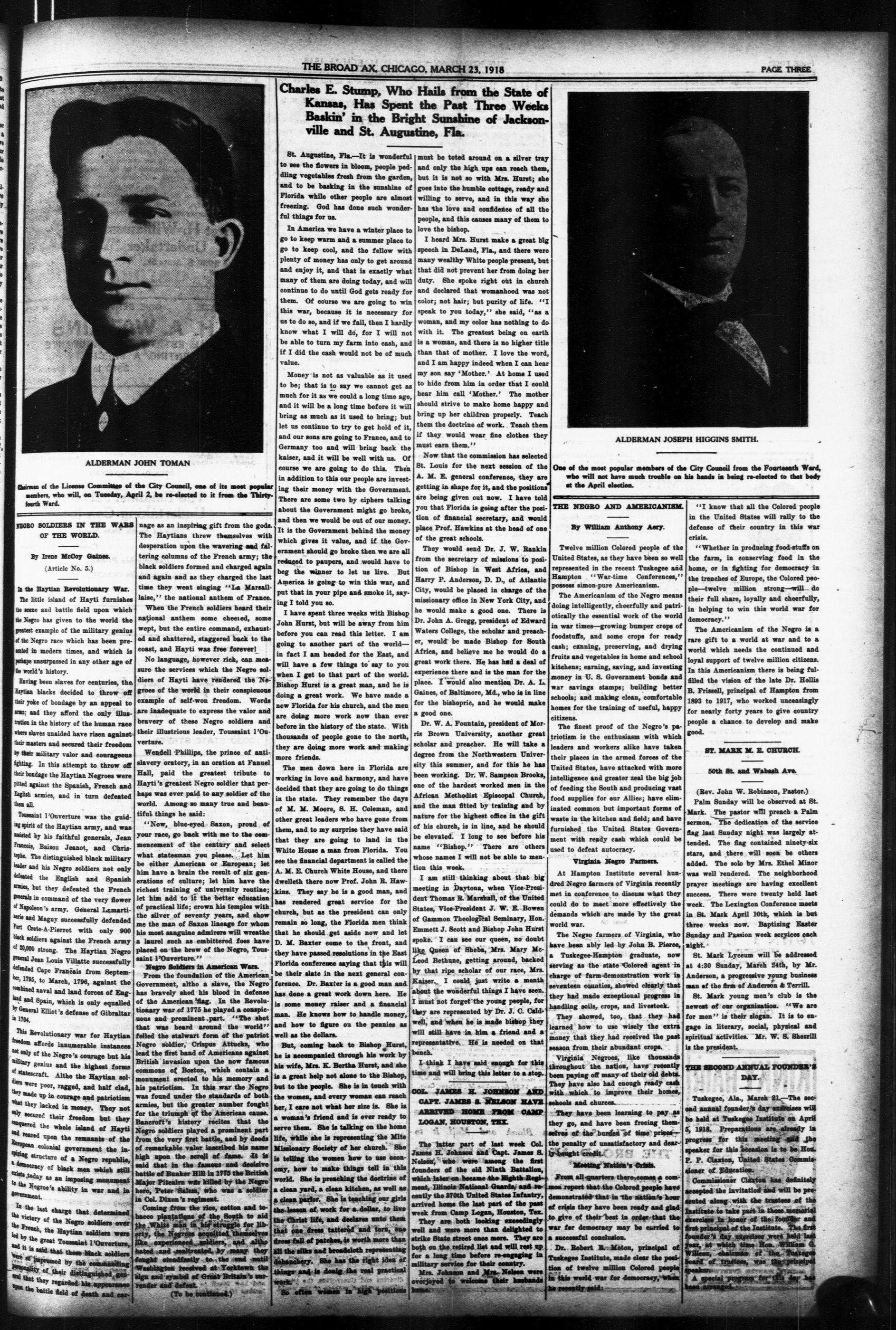
ALDERMAN JOHN TOMAN
Chairman of the License Committee of the City Council, one of its most popular members, who will, on Tuesday, April 2, be re-elected to it from the Thirty-fourth Ward.
Chairman of the License Committee of the City Council, one of its most popular members, who will, on Tuesday, April 2, be re-elected to it from the Thirty-fourth Ward.
NEGRO SOLDIERS IN THE WARS OF THE WORLD. nage as an inspiring gift from the gods. The Haytians threw themselves with
In the Haytian Revolutionary War. The little island of Hayti furnishes the scene and battle field upon which the Negro has given to the world the greatest example of the military genius of the Negro race which has been presented in modern times, and which is perhaps unsurpassed in any other age of the world's history.
Having been slaves for centuries, the Haytian blacks decided to throw off their yoke of bondage by an appeal to arms; and they afford the only illustration in the history of the human race where slaves unaided have risen against their masters and secured their freedom by their military valor and courageous fighting. In this attempt to throw off their bondage the Haytian Negroes were pitted against the Spanish, French and English armies, and in turn defeated them all.
Tousaint 1'Ouverture was the guiding spirit of the Haytian army, and was assisted by his faithful generals, Jean Francois, Baisou Jeanot, and Christophe. The distinguished black military leader and his Negro soldiers not only defeated the English and Spanish armies, but they defeated the French generals in command of the very flower of Napoleon's army. General Lemartinier and Magny successfully defended Fort Crete-A-Pierrot with only 900 black soldiers against the French army of 20,000 strong. The Haytian Negro general Jean Louis Villatte successfully defended Cape Français from September, 1795, to March, 1796, against the combined naval and land forces of England and Spain, which is only equalled by General Elliot's defense of Gibraltar in 1704.
This Revolutionary war for Haytian freedom affords innumerable instances not only of the Negro's courage but his military genius and the highest forms of statescraft. Altho the Haytian soldiers were poor, ragged, and half clad, they made up in courage and patriotism what they lacked in money. They not only secured their freedom but they conquered the whole island of Hayti and reared upon the remnants of the European colonial government the inspiring structure of a Negro republic, a democracy of black men which still exists today as an imposing monument to the Negroe's ability in war and in government.
In the last charge that determined the victory of the Negro soldiers over the French, the Haytian soldiers were led by the great Toussaint l'Ouverture, and it is said that these black soldiers were so impressed by the commanding personality of their distinguished general that they regarded his appearance upon the battle field of death and car-
nage as an inspiring gift from the gods. The Haytians threw themselves with desperation upon the wavering and faltering columns of the French army; the black soldiers formed and charged again and again and as they charged the last time they went singing "La Marsilla laise," the national anthem of France. When the French soldiers heard their national anthem some cheered, some wept, but the entire command, exhausted and shattered, staggered back to the coast, and Hayti was free forever!
No language, however rich, can measure the services which the Negro soldiers of Hayti have rendered the Negroes of the world in their conspicuous example of self-won freedom. Words are inadequate to express the valor and bravery of these Negro soldiers and their illustrious leader, Toussaint l'Ouverture.
Wendell Phillips, the prince of antislavery oratory, in an oration at Fanuel Hall, paid the greatest tribute to Hayti's greatest Negro soldier that perhaps was ever paid to any soldier of the world. Among so many true and beautiful things he said:
"Now, blue-eyed Saxon, proud of your race, go back with me to the commencement of the century and select what statesman you please. Let him be either American or European; let him have a brain the result of six generations of culture; let him have the richest training of university routine; let him add to it the better education of practical life; crown his temples with the silver of seventy years, and show me the man of Saxon lineage for whom his most sanguine admirers will wreathe a laurel such as embittered foes have placed on the brow of the Negro, Toussaint I'Ouverture."
Negro Soldiers in American Wars. From the foundation of the American Government, altho a slave, the Negro has bravely shed his blood in defense of the American flag. In the Revolutionary war of 1775 he played a conspicuous and prominent part. "The shot that was heard around the world" felled the stalwart form of the patriot Negro soldier, Crispus Attucks, who lead the first band of Americans against British invasion upon the now famous commons of Boston, which contain a monument erected to his memory and his patriotism. In this war the Negro was found under the standards of both armies, but the greater number fought for the triumph of the American cause. Bancroft's history recites that the Negro soldiers played a prominent part from the very first battle, and by deeds of remarkable valor inscribed his name high upon the scroll of fame. It is said that in the famous and decisive battle of Bunker Hill in 1775 the British Major Piteaim was killed by the Negro hero, Peter Salem, who was a soldier in Col. Dixon's regiment.
Coming from the rice, cotton and tobacco plantations of the South to aid the White man in his struggle for liberty, the Negroes acquitted themselves like experienced soldiers, and also hated and maltreated, by many they fought steadfastly to the end until Washington received at Yorktown the sign and symbol of Great Britain's surrender and defeat. (To be continued.)
THE BROAD AX. CHICAGO. MARCH 23. 1918
Charles E. Stump, Who Hails from the State of Kansas, Has Spent the Past Three Weeks Baskin' in the Bright Sunshine of Jacksonville and St. Augustine, Fla.
St. Augustine, Fla.—It is wonderful to see the flowers in bloom, people peddling vegetables fresh from the garden, and to be basking in the sunshine of Florida while other people are almost freezing. God has done such wonderful things for us.
In America we have a winter place to go to keep warm and a summer place to go to keep cool, and the fellow with plenty of money has only to get around and enjoy it, and that is exactly what many of them are doing today, and will continue to do until God gets ready for them. Of course we are going to win this war, because it is necessary for us to do so, and if we fail, then I hardly know what I will do, for I will not be able to turn my farm into cash, and if I did the cash would not be of much value.
Money is not as valuable as it used to be; that is to say we cannot get as much for it as we could a long time ago, and it will be a long time before it will bring as much as it used to bring; but let us continue to try to get hold of it, and our sons are going to France, and to Germany too and will bring back the kaiser, and it will be well with us. Of course we are going to do this. Then in addition to this our people are investing their money with the Government. There are some two by ciphers talking about the Government might go broke, and then we would be out of our money. It is the Government behind the money which gives it value, and if the Government should go broke then we are all reduced to paupers, and would have to beg the winner to let us live. But America is going to win this war, and put that in your pipe and smoke it, saying I told you so.
I have spent three weeks with Bishop John Hurst, but will be away from him before you can read this letter. I am going to another part of the world—in fact I am headed for the East, and will have a few things to say to you when I get to that part of the world. Bishop Hurst is a great man, and he is doing a great work. We have made a new Florida for his church, and the men are doing more work now than ever before in the history of the state. With thousands of people gone to the north, they are doing more work and making more friends.
The men down here in Florida are working in love and harmony, and have decided that they are going to do things in the state. They remember the days of M. M. Moore, S. H. Coleman, and other great leaders who have gone from them, and to my surprise they have said that they are going to land in the White House a man from Florida. You see the financial department is called the A. M. E. Church White House, and there dwelleth there now Prof. John R. Hawkins. They say he is a good man, and has rendered great service for the church, but as the president can only remain so long, the Florida men think that he should get aside now and let D. M. Baxter come to the front, and they have passed resolutions in the East Florida conference saying that this will be their slate in the next general conference. Dr. Baxter is a good man and has done a great work down here. He is some money raiser and a financial man. He knows how to handle money, and how to figure on the pennies as well as the dollars.
But, coming back to Bishop Hurst, he is accompanied through his work by his wife, Mrs. K. Bertha Hurst, and she is a great help not alone to the Bishop, but to the people. She is in touch with the women, and every woman can reach her, I care not what her size is. She is a woman's friend and is ever ready to serve them. She is talking on the home life, while she is representing the Mite Missionary Society of her church. She is telling the women how to use economy, how to make things tell in this world. She is preaching the doctrine of a clean yard, a clean kitchen, as well as a clean parlor. She is teaching our girls the lesson of work for a dollar, to live the Christ life, and declares unto them that one dress tattered and torn, one dress full of patches, is worth more than all the silks and broadcloth representing debanchery. She has the right idea of things and is denig the real practical work.
So often women in high positions
must be towed around on a silver tray and only the high ups can reach them, but it is not so with Mrs. Hurst; she goes into the humble cottage, ready and willing to serve, and in this way she has the love and confidence of all the people, and this causes many of them to love the bishop.
I heard Mrs. Hurst make a great big speech in DeLand, Fla., and there were many wealthy White people present, but that did not prevent her from doing her duty. She spoke right out in church and declared that womanhood was not color; not hair; but purity of life. "I speak to you today," she said, "as a woman, and my color has nothing to do with it. The greatest being on earth is a woman, and there is no higher title than that of mother. I love the word, and I am happy indeed when I can hear my son say 'Mother.' At home I used to hide from him in order that I could hear him call 'Mother.' The mother should strive to make home happy and bring up her children properly. Teach them the doctrine of work. Teach them if they would wear fine clothes they must earn them."
Now that the commission has selected St. Louis for the next session of the A. M. E. general conference, they are getting in shape for it, and the positions are being given out now. I have told you that Florida is going after the position of financial secretary, and would place Prof. Hawkins at the head of one of the great schools.
They would send Dr. J. W. Rankin from the secretary of missions to position of Bishop in West Africa, and Harry P. Anderson, D. D., of Atlantic City, would be placed in charge of the missionary office in New York City, and he would make a good one. There is Dr. John A. Gregg, president of Edward Waters College, the scholar and preacher, would be made Bishop for South Africa, and believe me he would do a great work there. He has had a deal of experience there and is the man for the place. I would also mention Dr. A. L. Gaines, of Baltimore, Md., who is in line for the bishopric, and he would make a good one.
Dr. W. A. Fountain, president of Morris Brown University, another great scholar and preacher. He will take a degree from the Northwestern University this summer, and for this he has been working. Dr. W. Sampson Brooks, one of the hardest worked men in the African Methodist Episcopal Church, and the man fitted by training and by nature for the highest office in the gift of his church, is in line, and he should be elevated. I long to see before his name "Bishop." There are others whose names I will not be able to mention this week.
I am still thinking about that big meeting in Daytona, when Vice-President Thomas R. Marshall, of the United States, Vice-President J. W. E. Bowen of Gammon Theological Seminary, Hon. Emmett J. Scott and Bishop John Hurst spoke. I can see our queen, no doubt like Queen of Sheba, Mrs. Mary McLeod Bethune, getting around, backed by that ripe scholar of our race, Mrs. Kaiser. I could just write a month about the wonderful things I have seen. I must not forget the young people, for they are represented by Dr. J. C. Caldwell, and when he is made bishop they will still have in him a friend and a representative. He is needed on that bench.
The latter part of last week Col. James H. Johnson and Capt. James S. Nelson, who were among the first founders of the old Ninth Battalion, which later on became the Eighth Regiment, Illinois National Guards, and recently the 370th United States Infantry, arrived home the last part of the past week from Camp Logan, Houston, Tex. They are both looking exceedingly well and were more than delighted to strike State street once more. They are both on the retired list and will rest up for a long time before re-engaging in military service for their country.
Mrs. Johnson and Mrs. Nelson were overjoyed to welcome their husbands home.
[Name]
ALDERMAN JOSEPH HIGGINS SMITH.
One of the most popular members of the City Council from the who will not have much trouble on his hands in being re-e at the April election.
THE NEGRO AND AMERICANISM.
"I know that all in the United States
One of the most popular members of the City Council from the Fourteenth Ward, who will not have much trouble on his hands in being re-elected to that body at the April election.
One of the most popular members of the City Council from the Fourteenth Ward, who will not have much trouble on his hands in being re-elected to that body at the April election.
By William Anthony Aery.
Twelve million Colored people of the United States, as they have been so well represented in the recent Tuskegee and Hampton "War-time Conferences," possess simon-pure Americanism. The Americanism of the Negro means doing intelligently, cheerfully and patriotically the essential work of the world in war times—growing bumper crops of foodstuffs, and some crops for ready cash; canning, preserving, and drying fruits and vegetables in home and school kitchens; earning, saving, and investing money in U. S. Government bonds and war savings stamps; building better schools; and making clean, comfortable homes for the training of useful, happy citizens.
The finest proof of the Negro's patriotism is the enthusiasm with which leaders and workers alike have taken their places in the armed forces of the United States, have attacked with more intelligence and greater zeal the big job of feeding the South and producing vast food supplies for our Allies; have eliminated common but important forms of waste in the kitchen and field; and have furnished the United States Government with ready cash which could be used to defeat autocracy.
Virginia. Negro Farmers.
At Hampton Institute several hundred Negro farmers of Virginia recently met in conference to discuss what they could do to meet more effectively the demands which are made by the great world war. The Negro farmers of Virginia, who have been ably led by John B. Pierce, a Tuskegee-Hampton graduate, now serving as the state Colored agent in charge of farm-demonstration work in seventeen counties, showed clearly that they had made exceptional progress in handling soils, crops, and livestock.
They showed, too, that they had learned how to use wisely the extra money that they had received the past season from their abundant crops.
Virginia Negroes, like thousands throughout the nation, have recently been paying off many of their old debts. They have also had enough ready cash with which to improve their homes, schools and churches.
They have been learning to pay as they go, and have been freeing themselves of the burden of time prices—the penalty of unsatisfactory and dearly-bought credit.
Meeting Nation's Crisis
From all quarters there, comes a common report that the Colored people have demonstrated that in the nation's hour of crisis they have been ready and glad to give of their best in order that the war for democracy may be carried to a successful conclusion. Dr. Robert B. Meton, principal of Tuskegee Institute, made clear the position of twelve million Colored people in this world war for democracy, when he recently said:
1914
The City Council from the Fourteenth Ward, his hands in being re-elected to that body
"I know that all the Colored people in the United States will rally to the defense of their country in this war crisis.
"Whether in producing food-stuffs on the farm, in conserving food in the home, or in fighting for democracy in the trenches of Europe, the Colored people—twelve million strong—will do their full share, loyally and cheerfully, in helping to win this world war for democracy."
The Americanism of the Negro is a rare gift to a world at war and to a world which needs the continued and loyal support of twelve million citizens. In this Americanism there is being fulfilled the vision of the late Dr. Hollis B. Frissell, principal of Hampton from 1893 to 1917, who worked unceasingly for nearly forty years to give country people a chance to develop and make good.
ST. MARK M. E. CHURCH
50th St. and Wabash Ave.
(Rev. John W. Robinson, Pastor.)
Palm Sunday will be observed at St. Mark. The pastor will preach a Palm sermon. The dedication of the service flag last Sunday night was largely attended. The flag contained ninety-six stars, and there will soon be others added. The solo by Mrs. Ethel Minor was well rendered. The neighborhood prayer meetings are having excellent success. There were twenty held last week. The Lexington Conference meets in St. Mark April 10th, which is but three weeks now. Baptizing Easter Sunday and Passion week services each night.
St. Mark Lyceum will be addressed at 4:30 Sunday, March 24th, by Mr. Anderson, a progressive young business man of the firm of Anderson & Terrill. St. Mark young men's club is the newest of our organization. "We are for men" is their slogan. It is to engage in literary, social, physical and spiritual activities. Mr. W. S. Sherrill is the president.
THE SECOND ANNUAL FOUNDER'S DAY.
Tuskegee, Ala., March 21.—The second annual founder's day exercises will be held at Tuskegee Institute on April 5, 1918. Preparations are already in progress for this meeting and the speaker for this occasion is to be Hon. P. P. Claxton, United States Commissioner of Education.
Commissioner Claxton has definitely accepted the invitation and will be pre-
PAGE THREE
The finest building ever opened to Colored tenants in Chicago. Steam heat, electric lights, tile baths, marble entrance.
J. W. CASEY, Agent
Phone Main 263
133 W. Washington Street
PAGE FOUR
The CR
Apartmen
3600 Wa
The finest building ever opi
eago. Steam heat, electric li
Phone Main 263
FREE
STYLE. BOOK
HAIR
To Colorad Women
We are the largest
manufacturers of
Colored Women's
HAIR. We have
book showing new
styles in hair
dressing sent free.
Every colored we
have is made
use. We sell these
hair and
silent articles. Bat-
tifully manufactured
or money back.
We make the best
BILLIARDS STRAIGHT-
guaranteed. With each coupon we give lamp cup
FREE. Send money order or stamp. MONEY
BACK IF NOT SATISFACTORY. $12 postpaid.
POSTPAID $12?
Hair socks, brushes, combs and toilet articles
manufacturer's prices. Send two-cent stamp.
Agateen Wheaties. Add three cents.
BURANAMA HAIR COMPANY.
123-127 Park Row,
New York City.
PHONE DOUGLAS 303
Dr. Mac Enery J. Brown
Physician and Surgeon
Practice Limited to
Diseases of the
Eye, Ear, Nose and Throat
10 EAST 35th STREET
Hours:
9 to 12 A.M. 2 to 9 P.M. CHICAGO
RESIDENCE 2419 South Park Avenue
PHONE DOUGLAS 9066
W. M. J. LATHAM
ATTORNEY AT LAW
OFFICE PHONE: CALUMET 895
2 East 31st Street
Suite 7
CHICAGO
Prash Dunn, J. B. McCahay, Trustee
Telephones: Oakland 1552, 1551, 1550
JOHN J. DUNN
ESTABLISHED 1877
Wholesale and Retail
COAL
Fifty-First and Federal Streets
CHICAGO
KINKY HAIR
EXELEMENT AUCTION
Auctioneer will sell eight Kinky hairstyles, including a long hairstyle with a large bow, a short hairstyle with a small bow, and a long hairstyle with a large bow. The auction will take place on Saturday, June 15, from 10:00 to 12:00 at the Kinky Hair Store in New York City. The auction will be held at 10:00 a.m. on Saturday, June 15, from 10:00 to 12:00 at the Kinky Hair Store in New York City. The auction will be held at 10:00 a.m. on Saturday, June 15, from 10:00 to 12:00 at the Kinky Hair Store in New York City.
18 WELLS PRODUCING OIL
Gumbers May Come and Gumbers May Go, but Steady
Production Brings Home the "Dough."
Another Producing Well Added to
CAPITOL PETROLEUM COMPANY'S
Holdings in the Famous Wayide Pool, Montgomery County, Kansas.
This is in smaller territory when a steady production is necessary. You pump out oil, consisting of two earths, you have known, family, and full jointly equivalent—a total of 17 pumps—to increase our dividend fund. Now is the time to you invest with a company that has
18 WELLS PRODUCING OIL
—here are selling-ready ready to be started.
You simply cannot limit Capital stock at..... 10c Share
Write and send remittance to Fred S. Burtm, 1837 Arapahoe St., Denver, Colo.
A. D. GASH
Attorney at Law
118 North La Salle Street
Suite 615 to 616
CHICAGO
Res. 2855 Prak'o Ava. Phone Doug. 8123
PHONES: MAIN 2817
AUTOMATIC 32-385
A. L. WILLIAMS
Attorney and Counselor at Law
Suite 708 FIRMENICH BUILDING
184 West Washington Street CHICAGO
RESIDENCE: 508 R. 36th STREET
PHONE DOUGLAS 4397
J. Gray Lucas
Attorney at Law
Suite 815 Hartford Bldg.
8 S. Dearborn St. CHICAGO
PHONES: OFFICE, CENTRAL 6563
AUTOMATIC 42-590
Residence, 4533 Prairie Avenue
Rue, Kawartha 620
WALTER M. BARMER
THE BROAD AX, CHICAGO, MARCH 23, 1918
A Hive newspaper advertising solicitor; one who knows how to hustle for business wanted. For further information, address the editor of this paper or phone, Wentworth 2507.
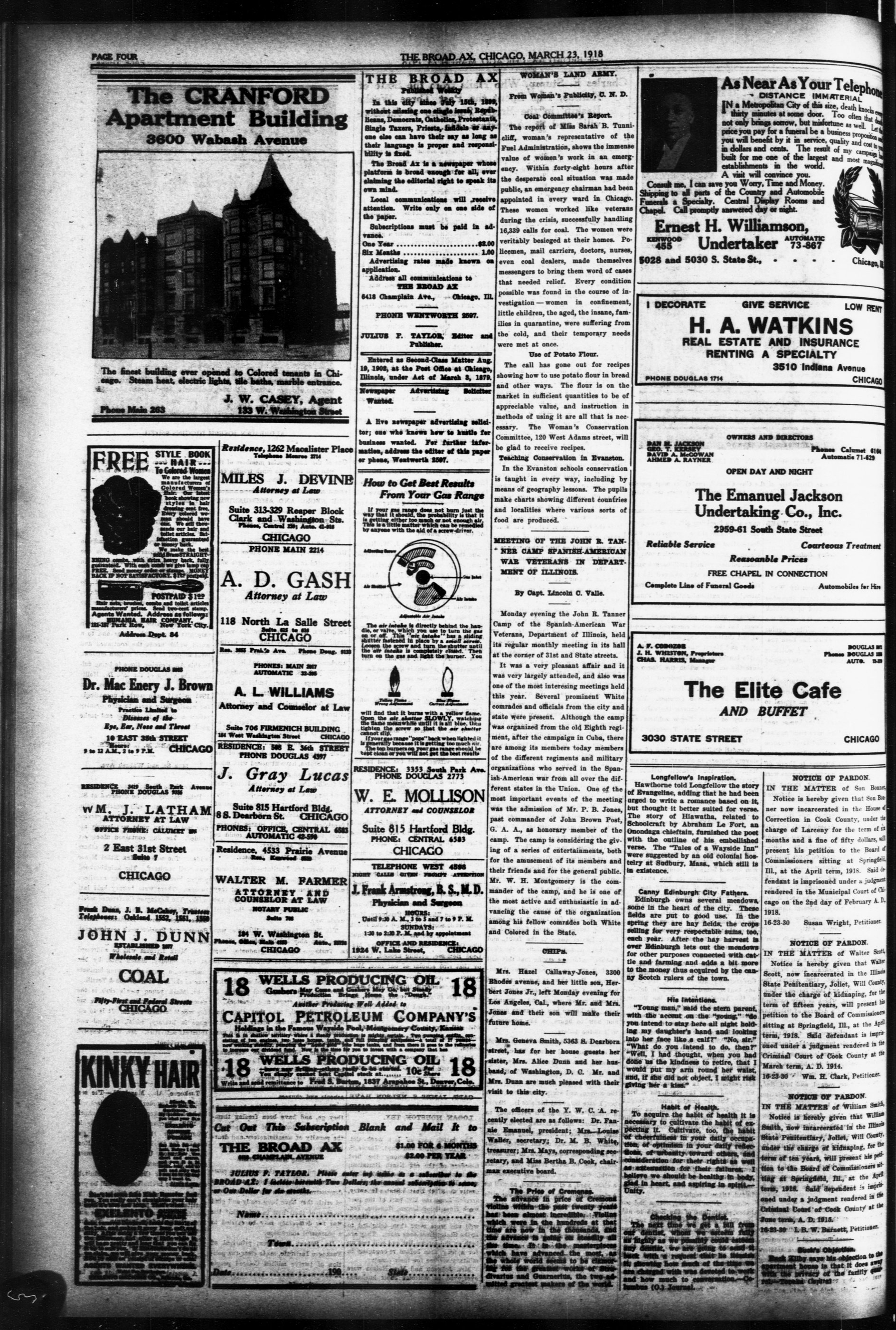
How to Get Best Results
From Your Gas Range
If your gas range does not burn just the way that it should, the probability is that it will burn evenly and not enough air. This is little matter which can be remedied by anyone with the aid of a screwdriver.
Adjusting Curve
Gas Inlet
Air Blast
Air Intake
Adjustable Air Intake
The air intake is directly behind the handle, or valve, which you use to turn the gas shutter. If the air intake "has a sliding shutter fastened in place by a self-seal lever," Loosen the acrew and turn the shutter until the air intake is completely closed. Then turn on the gas and light the burner. You
Tall Flame Pressure Wring Adjustment
Mid Flame Pressure Wring Adjustment
will find that it burns with a yellow flame.
Open the air shatter SLOWLY, watching the flame meanwhile until it is all blue. Then tighten the screw so that the air shatter cannot slip.
If your gas range "pops" back when lighted it is generally because it is getting too much air.
This top burns but your gas range should be bake clean or you will not get the best result
RESIDENCE: 3353 South Park Ave.
PHONE DOUGLAS 2773
W. E. MOLLISON
ATTORNEY and COUNSELOR
Suite 815 Hartford Bldg.
PHONE: CENTRAL 6583
CHICAGO
TELEPHONE WEST 4598
RIGHT CALLS GIVEN PROMPT ATTENTION
L. Frank Armstrong, B. S., M. D.
Physician and Surgeon
HOURS:
Until 9:20 A.M. 3 to 5 and 7 to 9 P.M.
The report of Miss Sarah B. Tunni cliff, woman's representative of the Fuel Administration, shows the immense value of women's work in an emergency. Within forty-eight hours after the desperate coal situation was made public, an emergency chairman had been appointed in every ward in Chicago. These women worked like veterans during the crisis, successfully handling 16,339 calls for coal. The women were veritably besieged at their homes. Policemen, mail carriers, doctors, nurses, even coal dealers, made themselves messengers to bring them word of cases that needed relief. Every condition possible was found in the course of investigation—women in confinement, little children, the aged, the insane, families in quarantine, were suffering from the cold, and their temporary needs were met at once.
Use of Potato Flour.
The call has gone out for recipes showing how to use potato flour in bread and other ways. The flour is on the market in sufficient quantities to be of appreciable value, and instruction in methods of using it are all that is necessary. The Woman's Conservation Committee, 120 West Adams street, will be glad to receive recipes. Teaching Conservation in Evanston In the Evanston schools conservation is taught in every way, including by means of geography lessons. The pupils make charts showing different countries and localities where various sorts of food are produced.
MEETING OF THE JOHN R. TAN-
NER CAMP SPANISH-AMERICAN
WAR VETERANS IN DEPART-
MENT OF ILINOIS.
By Capt. Lincoln C. Valle.
Monday evening the John R. Tanner Camp of the Spanish-American War Veterans, Department of Illinois, held its regular monthly meeting in its hall at the corner of 31st and State streets. It was a very pleasant affair and it was very largely attended, and also was one of the most interesting meetings held this year. Several prominent White comrades and officials from the city and state were present. Although the camp was organized from the old Eighth regiment, after the campaign in Cuba, there are among its members today members of the different regiments and military organizations who served in the Spanish-American war from all over the different states in the Union. One of the most important events of the meeting was the admission of Mr. P. B. Jones, past commander of John Brown Post, G. A. A., as honorary member of the camp. The camp is considering the giving of a series of entertainments, both for the amusement of its members and their friends and for the general public. Mr. W. H. Montgomery is the commander of the camp, and he is one of the most active and enthusiastic in advancing the cause of the organization among his fellow comrades both White and Colored in the State.
Mrs. Hazel Callaway-Jones, 3300 Rhodes avenue, and her little son, Herbert Jones Jr., left Monday evening for Los Angeles, Cal., where Mr. and Mrs. Jones and their son will make their future home.
The officers of the Y. W. C. A. recently elected are as follows: Dr. Fannie Emanuel, president; Mrs. Louise Waller, secretary; Dr. M. B. White, treasurer; Mrs. Mays, corresponding secretary, and Miss Bertha B. Cook, chairman executive board.
The Price of Cremones.
The advance in price of Cremona violins within the past twenty years has been almost incredible. Violin which were in the hundreds at that time are now in the thousands, and the advance is going on steadily all the time. In the masterpieces which have advanced, the most, as the whole world seems to be clamorous for the greatest works of Sibelvarius and Guarnerius, the two admitted greatest makers of the world.
A.
Consult me, I can save you Worry Shipping to all parts of the County Funerals a Specialty. Central D Chapel. Call promptly answered of Ernest H. Willis KENWOOD 455 Undertall 5028 and 5030 S. State St. I DECORATE GIVE H. A. W REAL ESTATE RENTING
H. A. WATKINS
REAL ESTATE AND INSURANCE
RENTING A SPECIALTY
3510 Indiana Avenue
PHONE DOUGLAS 1714
OWNERS
DAN M. JACKSON
GEO. T. KERSEY
DAVID A. McGOWAN
AHMED A. RAYNER
OPEN DAY AND NIGHT
The Emanuel Jackson
Undertaking Co., Inc.
2959-61 South State Street
Reliable Service
Reasona
FREE CHAPEL
Complete Line of Funeral Goods
A. F. COBZOB
J. H. WHISTON, Proprietors
CHAS. HARRIS, Manager
The Elite Cafe AND BUFFET
3030 STATE STREET
Longfellow's Inspiration. Hawthorne told Longfellow the story of Evangeline, adding that he had been urged to write a romance based on it, but thought it better suited for verse. The story of Hiawatha, related to Schoolcraft by Abraham Le Fort, an Onondaga chieftain, furnished the poet with the outline of his embellished verse. The "Tales of a Wayside Inn" were suggested by an old colonial hostelry at Sudbury, Mass., which still is in existence.
Canny Edinburgh City Fathers
Canny Edinburgh City Fathers. Edinburgh owns several meadows, some in the heart of the city. These fields are put to good use. In the spring they are hay fields, the crops selling for very respectable sums, too, each year. After the hay harvest is over Edinburgh lets out the meadows for other purposes connected with cattle and farming and adds a bit more to the money thus acquired by the canny Scotch rulers of the town.
His Intentions.
"Young man," said the stern parent, with the accent on the "young," "do you intend to stay here all night holding my daughter's hand and looking into her face like a calf?" "No, sir." "What do you intend to do, then?" "Well, I had thought, when you had done us the kindness to retire, that I would put my arm round her waist, and, if she did not object, I might risk giving her a kiss."
Habit of Health.
Habit of Health.
To acquire the habit of health it is necessary to cultivate the habit of expecting it. Cultivate, too, the habit of cheerfulness in your daily occupation, of optimism in your daily reflections, of urbanity toward others, and consideration for their rights as well as extension for their failures. I believe we should be healthy in body, glad in heart, and aspiring in spirit—Unity.
Checking the Dentist. The next time we get a bill from our dentist, whom we seeen fully as highly as we plainly could admit any dentist, we are going to send it back with a request that he dismiss it, showing how much of the time we are charged with was devoted to work and how much to conversation—Columbus (Q.) Journal.
E SERVICE LOW RENT
WATKINS
E AND INSURANCE
A SPECIALTY
3510 Indiana Avenue
CHICAGO
AND DIRECTORS
Phones Calumet 6104
Automatic 71-629
Coarteous Treatment
Unble Prices
L IN CONNECTION
Automobiles for Hire
CHICAGO
NOTICE OF PARDON.
IN THE MATTER of Son Bonner
Notice is hereby given that Son Bonner now incarcerated in the House of Correction in Cook County, under the charge of Lareeny for the term of six months and a fine of fifty dollars, will present his petition to the Board of Commissioners sitting at Springfield, Ill., at the April term, 1918. Said defendant is imprisoned under a judgment rendered in the Municipal Court of Chicago on the 2nd day of February A. D. 1918.
16-23-30 Susan Wright, Petitioner.
NOTICE OF PARDON.
IN THE MATTER of Walter Scott
Notice is hereby given that Walter
Scott, now incarcerated in the Illinois
State Penitentiary, Joliet, Will County,
under the charge of kidnapping, for the
term of fifteen years, will present his
petition to the Board of Commissioners
sitting at Springfield, Ill., at the April
term, 1918. Said defendant is imprisoned under a judgment rendered in the Criminal Court of Cook County at the March term, A. D. 1914.
18-23-30 Wm. H. Clark, Petitioner.
NOTICE OF PARDON
IN THE MATTER of William Smith Notice is hereby given that William Smith, now incarcerated in the Illinois State Penitentiary, Jollet, Will County, under the charge of kidnapping, for the term of ten years, will present his petition to the Board of Commissioners meeting at Springfield, Ill., at the April term, 1915. Said dependent is imprisoned under a judgment rendered in the Criminal Court of Cook County at the June term, A. D. 1915.
10-23-80 L.B. W. Burnett, Petitioner.
Susita Objection.
Buck Kelly says his objection to the
apartment house is that it does away
with the privacy of the family quar
103—Tampa Capital
CH
DOUGLAS II
Phone DOUGLAS II
AUTO. II
CHICAGO