The Broad Ax
Saturday, April 13, 1918
Chicago, Illinois
Page text (machine-generated)
BROAD AX
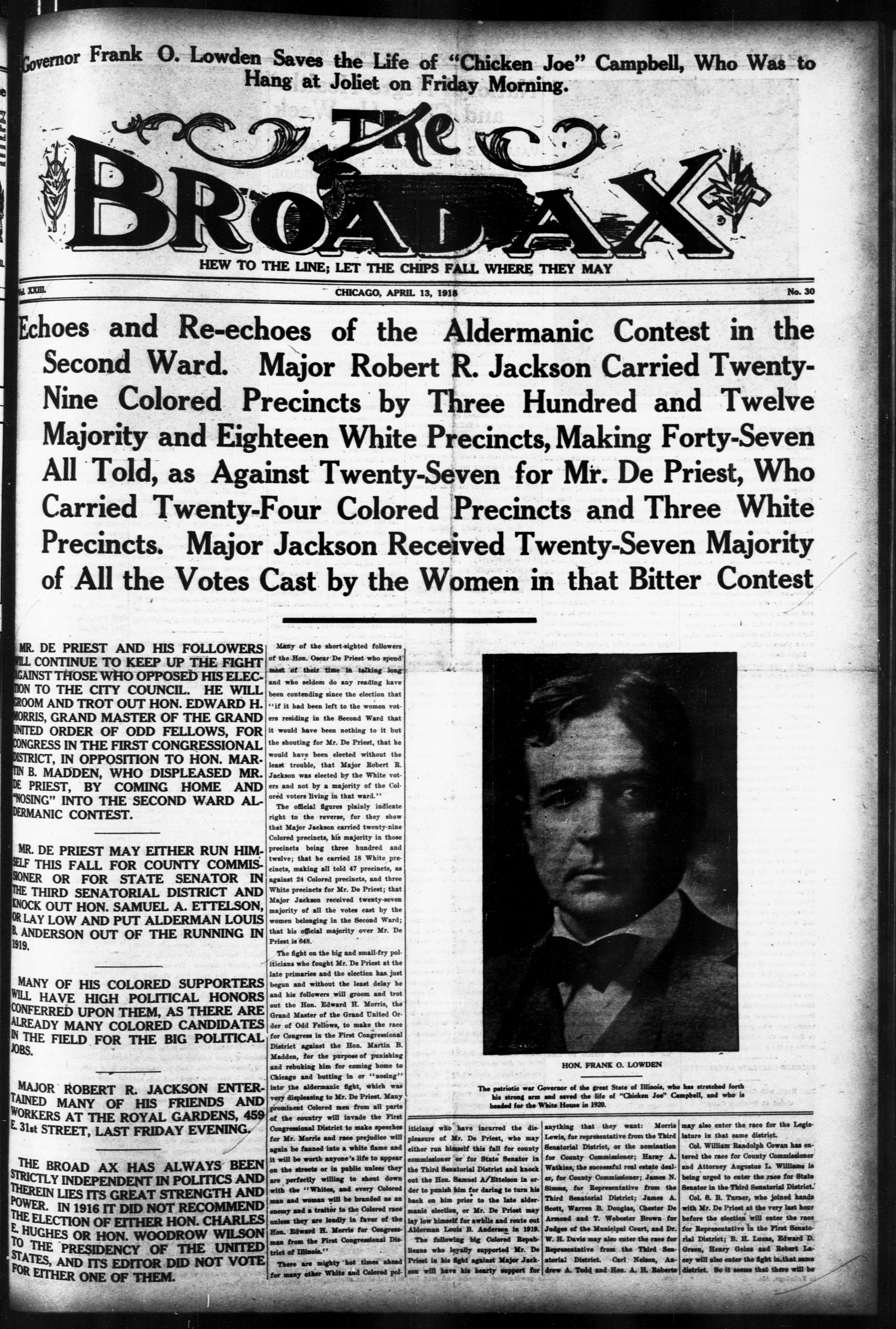
Echoes and Re-echoes of the Aldermanic Contest in the Second Ward. Major Robert R. Jackson Carried Twenty- Nine Colored Precincts by Three Hundred and Twelve Majority and Eighteen White Precincts, Making Forty-Seven All Told, as Against Twenty-Seven for Mr. De Priest, Who Carried Twenty-Four Colored Precincts and Three White Precincts. Major Jackson Received Twenty-Seven Majority of All the Votes Cast by the Women in that Bitter Contest
MR. DE PRIEST AND HIS FOLLOWERS WILL CONTINUE TO KEEP UP THE FIGHT AGAINST THOSE WHO OPPOSED HIS ELECTION TO THE CITY COUNCIL. HE WILL GROOM AND TROT OUT HON. EDWARD H. MORRIS, GRAND MASTER OF THE GRAND UNITED ORDER OF ODD FELLOWS, FOR CONGRESS IN THE FIRST CONGRESSIONAL DISTRICT, IN OPPOSITION TO HON. MARTIN B. MADDEN, WHO DISPLEASED MR. DE PRIEST, BY COMING HOME AND "NOSING" INTO THE SECOND WARD ALDERMANIC CONTEST.
MR. DE PRIEST MAY EITHER RUN HIMSELF THIS FALL FOR COUNTY COMMISSIONER OR FOR STATE SENATOR IN THE THIRD SENATORIAL DISTRICT AND KNOCK OUT HON. SAMUEL A. ETTELSON, OR LAY LOW AND PUT ALDERMAN LOUIS B. ANDERSON OUT OF THE RUNNING IN 1919.
MANY OF HIS COLORED SUPPORTERS WILL HAVE HIGH POLITICAL HONORS CONFERRED UPON THEM, AS THERE ARE ALREADY MANY COLORED CANDIDATES IN THE FIELD FOR THE BIG POLITICAL JOBS.
MAJOR ROBERT R. JACKSON ENTERTAINED MANY OF HIS FRIENDS AND WORKERS AT THE ROYAL GARDENS, 459 E. 31st STREET, LAST FRIDAY EVENING.
THE BROAD AX HAS ALWAYS BEEN STRICTLY INDEPENDENT IN POLITICS AND THEREIN LIES ITS GREAT STRENGTH AND POWER. IN 1916 IT DID NOT RECOMMEND THE ELECTION OF EITHER HON. CHARLES E. HUGHES OR HON. WOODROW WILSON TO THE PRESIDENCY OF THE UNITED STATES, AND ITS EDITOR DID NOT VOTE FOR EITHER ONE OF THEM.
Many of the short-sighted followers of the Hon. Oscar De Priest who spend most of their time in talking long and who seldom do any reading have been contending since the election that "if it had been left to the women voters residing in the Second Ward that it would have been nothing to it but the shouting for Mr. De Priest, that he would have been elected without the least trouble, that Major Robert R. Jackson was elected by the White voters and not by a majority of the Colored voters living in that ward."
The official figures plainly indicate right to the reverse, for they show that Major Jackson carried twenty-nine Colored precincts, his majority in those precincts being three hundred and twelve; that he carried 18 White precincts, making all told 47 precincts, as against 24 Colored precincts, and three White precincts for Mr. De Priest; that Major Jackson received twenty-seven majority of all the votes cast by the women belonging in the Second Ward; that his official majority over Mr. De Priest is 648.
The fight on the big and small-fry politicians who fought Mr. De Priest at the late primaries and the election has just begun and without the least delay he and his followers will groom and trot out the Hon. Edward H. Morris, the Grand Master of the Grand United Order of Odd Fellows, to make the race for Congress in the First Congressional District against the Hon. Martin B. Madden, for the purpose of punishing and rebuking him for coming home to Chicago and butting in or "nosing" into the aldermanic fight, which was very displeasing to Mr. De Priest. Many prominent Colored men from all parts of the country will invade the First Congressional District to make speeches for Mr. Morris and race prejudice will again be fanned into a white flame and it will be worth anyone's life to appear on the streets or in public unless they are perfectly willing to shout down with the "Whites, and every Colored man and woman will be branded as an enemy and a traitor to the Colored race unless they are loudly in favor of the Hon. Edward H. Morris for Congressman from the First Congressional District of Illinois."
There are mighty hot times ahead for many White and Colored pol-
[Image of a man in a suit with a bow tie].
The patriotic war Governor of the great State of Illinois, who has stretched forth his strong arm and saved the life of "Chicken Joe" Campbell, and who is headed for the White House in 1920.
itician who have incurred the displeasure of Mr. De Priest, who may either run himself this fall for county commissioner or for State Senator in the Third Senatorial District and knock out the Hon. Samuel A/Ettelson in order to punish him for daring to turn his back on him prior to the late aldermanie election, or Mr. De Priest may lay low himself for awhile and route out Alderman Louis B. Anderson in 1919. The following big Colored Republicans who loyally supported Mr. De Priest in his fight against Major Jackson will have his hearty support for
may also enter the race for the Legislature in that same district.
Col. William Randolph Cowan has entered the race for County Commissioner and Attorney Augustus L. Williams is being urged to enter the race for State Senator in the Third Senatorial District.
Col. S. B. Turner, who joined hands with Mr. De Priest at the very last hour before the election will enter the race for Representative in the First Senatorial District; B. H. Lucas, Edward D. Green, Henry Goins and Robert Lacey will also enter the fight in that same district. So it seems that there will be
anything that they want: Morris Lewis, for representative from the Third Senatorial District, or the nomination for County Commissioner; Harray A. Watkins, the successful real estate dealer, for County Commissioner; James N. Simms, for Representative from the Third Senatorial District; James A. Scott, Warren B. Douglas, Chester De Armond and T. Webester Brown for Judges of the Municipal Court, and Dr. W. H. Davis may also enter the race for Representative from the Third Senatorial District. Carl Nelson, Andrew A. Todd and Hon. A. H. Roberts
[Name]
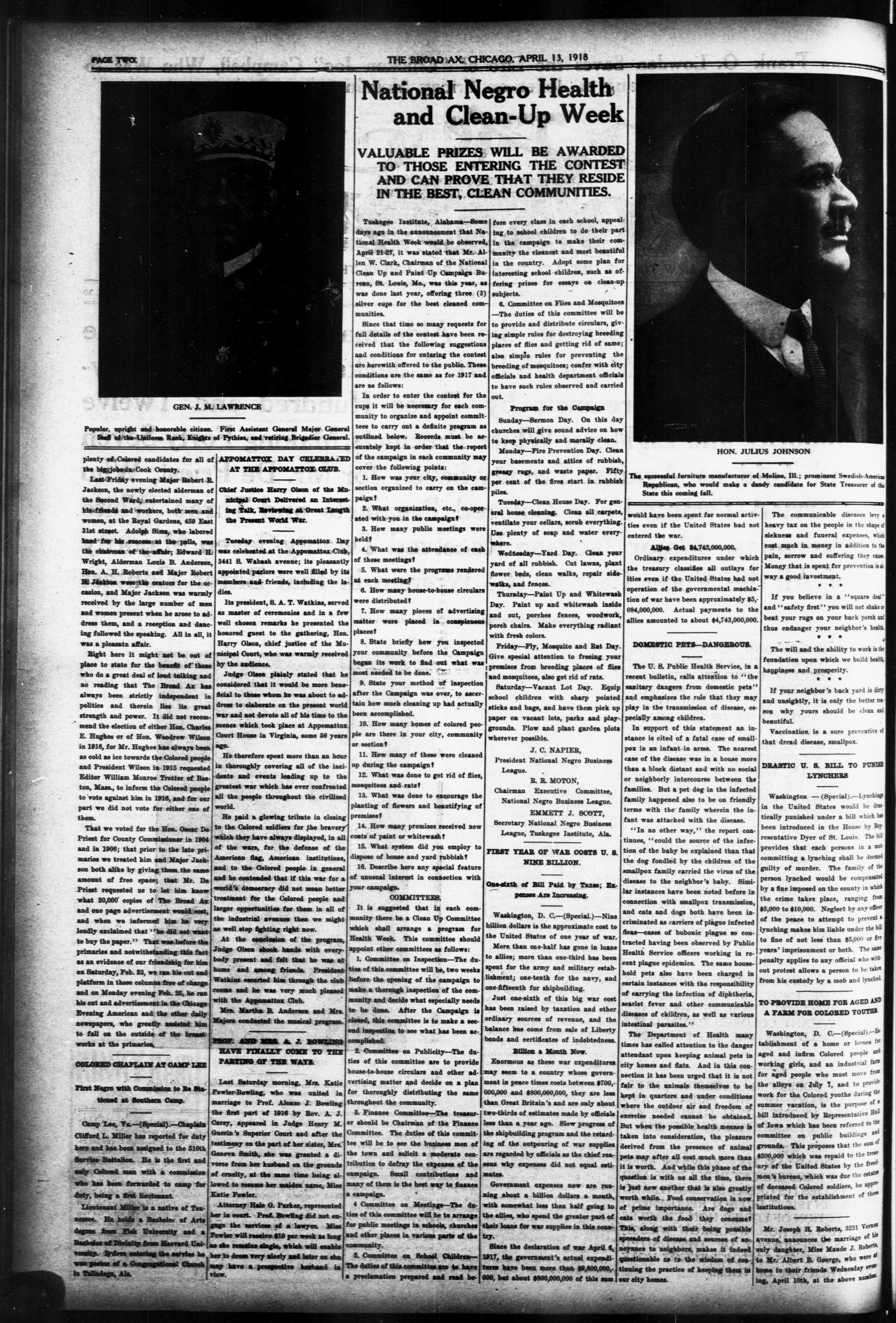
GEN. J. M. LAWRENCE
Popular, upright and honorable citizen. First Assistant General Major General Staff of the Uniform Rank, Knights of Pythias, and retiring Brigadier General.
Popular, upright and honorable citizen. First Assistant General Major General Staff of the Uniform Rank, Knights of Pythias, and retiring Brigadier General. plenty of Colored candidates for all of APPOMATTOX DAY CELEBRATED the blkjobsin Cook County. AT THE APPOMATTOX CLUB.
Last Friday evening Major Robert B. Jackson, the newly elected alderman of the Second Ward, entertained many of his friend and workers, both men and women, at the Royal Gardens, 459 East 31st street. Adolph Sims, who labored hard for his success at the polls, was the chairman of the affair; Edward H. Wright, Alderman Louis B. Anderson, Hon. A. H. Roberts and Major Robert H Jackson were the orators for the occasion, and Major Jackson was warmly received by the large number of men and women present when he arose to address them, and a reception and dancing followed the speaking. All in all, it was a pleasant affair.
Right here it might not be out of place to state for the benefit of those who do a great deal of loud talking and no reading that The Broad Ax has always been strictly independent in politics and therein lies its great strength and power. It did not recommend the election of either Hon. Charles E. Hughes or of Hon. Woodrow Wilson in 1916, for Mr. Hughes has always been as cold as ice towards the Colored people and President Wilson in 1915 requested Editor William Monroe Trotter of Boston, Mass., to inform the Colored people to vote against him in 1916, and for our part we did not vote for either one of them.
That we voted for the Hon. Oscar De Priest for County Commissioner in 1904 and in 1906; that prior to the late primaries we treated him and Major Jackson both alike by giving them the same amount of free space; that Mr. De Priest requested us to let him know what 20,000 copies of The Broad Ax and one page advertisement would cost; and when we informed him he very loudly exclaimed that "he did not want to buy the paper." That was before the primaries and notwithstanding this fact as an evidence of our friendship for him on Saturday, Feb. 23, we ran his cut and platform in these columns free of charge and on Monday evening Feb. 25, he ran his cut and advertisement in the Chicago Evening American and the other daily newspapers, who greatly assisted him to fall on the outside of the breastworks at the primaries.
tioned at Southern Camp.
Camp Lee, Va.—(Special).—Chaplain Clifford L. Miller has reported for duty here and has been assigned to the 510th Services Battalion. He is the first and only Colored man with a commission who has been forwarded to camp for duty, being a first lieutenant.
Lieutenant Miller is a native of Tennessee. He holds a Bachelor of Arts degree from Fluk University and a Bachelor of Divinity from Harvard University. Before entering the service he was pastor of a Congregational Church in Talladega, Ala.
APPOMATTOX DAY CELEBRATED AT THE APPOMATTOX CLUB.
Chief Justice Harry Olson of the Municipal Court Delivered an Interesting Talk, Reviewing at Great Length the Present World War.
Tuesday evening Appomattox Day was celebrated at the Appomattox Club, 3441 S. Wabash avenue; its pleasantly appointed parlors were well filled by its members and friends, including the ladies.
Its president, S. A. T. Watkins, served as master of ceremonies and in a few well chosen remarks he presented the honored guest to the gathering, Hon. Harry Olson, chief justice of the Municipal Court, who was warmly received by the audience.
Judge Olson plainly stated that he considered that it would be more beneficial to those whom he was about to address to elaborate on the present world war and not devote all of his time to the scenes which took place at Appomattox Court House in Virginia, some 50 years ago.
He therefore spent more than an hour in thoroughly covering all of the incidents and events leading up to the greatest war which has ever confronted all the people throughout the civilized world.
He paid a glowing tribute in closing to the Colored soldiers for the bravery which they have always displayed, in all of the wars, for the defense of the American flag, American institutions, and to the Colored people in general and he contended that if this war for a world's democracy did not mean better treatment for the Colored people and larger opportunities for them in all of the industrial avenues then we might as well stop fighting right now.
At the conclusion of the program, Judge Olson shook hands with everybody present and felt that he was at home and among friends. President Watkins escorted him through the club rooms and he was very much pleased with the Appomattox Club. Mrs. Martina B. Anderson and Mrs. Majors conducted the musical program.
PROF. AND MRS. A. J. BOWLING HAVE FINALLY COME TO THE PARTING OF THE WAYS.
Last Saturday morning, Mrs. Katie Fowler-Bowling, who was united in marriage to Prof. Alonzo J. Bowling the first part of 1916 by Rev. A. J. Carey, appeared in Judge Henry M. Guerin's Superior Court and after the testimony on the part of her sister, Mrs. Geneva Smith, she was granted a divorce from her husband on the grounds of cruelty, at the same time being allowed to resume her maiden name, Miss Katie Fowler.
Attorney Hale G. Parker, represented her in court. Prof. Bowling did not engage the services of a lawyer. Miss Fowler will receive $10 per week as long as she remains single, which will enable her to dress very nicely and later on she may have a prospective husband in view.
THE BROAD AX, CHICAGO, APRIL 13, 1918
National Negro Health and Clean-Up Week
VALUABLE PRIZES WILL BE AWARDED TO THOSE ENTERING THE CONTEST AND CAN PROVE THAT THEY RESIDE IN THE BEST, CLEAN COMMUNITIES.
Tuskegee Institute, Alabama—Some days age in the announcement that National Health Week would be observed, April 21-27, it was stated that Mr. Allen W. Clark, Chairman of the National Clean Up and Paint Up Campaign Bureau, St. Louis, Mo., was this year, as was done last year, offering three (3) silver cups for the best cleaned communities.
Since that time so many requests for full details of the contest have been received that the following suggestions and conditions for entering the contest are herewith offered to the public. These conditions are the same as for 1917 and are as follows:
In order to enter the contest for the cups it will be necessary for each community to organize and appoint committees to carry out a definite program as outlined below. Records must be accurately kept in order that the report of the campaign in each community may cover the following points:
1. How was your city, community or section organized to carry on the campaign?
2. What organization, etc., co-operated with you in the campaign?
3. How many public meetings were held?
4. What was the attendance of each of these meetings?
5. What were the programs rendered at each meeting?
6. How many house-to-house circulars were distributed?
7. How many pieces of advertising matter were placed in conspicuous places?
8. State briefly how you inspected your community before the Campaign began its work to find out what was most needed to be done.
9. State your method of inspection after the Campaign was over, to ascertain how much cleaning up had actually been accomplished.
10. How many homes of colored people are there in your city, community or section?
11. How many of these were cleaned up during the campaign?
12. What was done to get rid of flies, mosquitoes and rats?
13. What was done to encourage the planting of flowers and beautifying of premises?
14. How many premises received new coats of paint or whitewash?
15. What system did you employ to dispose of house and yard rubbish?
16. Describe here any special feature of unusual interest in connection with your campaign.
COMMITTEES
It is suggested that in each community there be a Clean Up Committee which shall arrange a program for Health Week. This committee should appoint other committees as follows:
1. Committee on Inspection—The duties of this committee will be, two weeks before the opening of the campaign to make a thorough inspection of the community and decide what especially needs to be done. After the Campaign is closed, this committee is to make a second inspection to see what has been accomplished.
2. Committee on Publicity—The duties of this committee are to provide house-to-house circulars and other advertising matter and decide on a plan for thoroughly distributing the same throughout the community.
3. Finance Committee—The treasurer should be Chairman of the Finance Committee. The duties of this committee will be to see the business men of the town and solicit a moderate contribution to defray the expenses of the campaign. Small contributions and many of them is the best way to finance a campaign.
fore every class in each school, appealing to school children to do their part in the campaign to make their community the cleanest and most beautiful in the country. Adopt some plan for interesting school children, such as offering prizes for essays on clean-up subjects. 6. Committee on Flies and Mosquitoes —The duties of this committee will be to provide and distribute circulars, giving simple rules for destroying breeding places of flies and getting rid of same; also simple rules for preventing the breeding of mosquitoes; confer with city officials and health department officials to have such rules observed and carried out.
Program for the Campaign
Sunday—Sermon Day. On this day churches will give sound advice on how to keep physically and morally clean. Monday—Fire Prevention Day. Clean your basements and attics of rubbish, greasy rugs, and waste paper. Fifty per cent of the fires start in rubbish piles. Tuesday—Clean House Day. For general house cleaning. Clean all carpets, ventilate your cellars, scrub everything. Use plenty of soap and water everywhere. Wednesday—Yard Day. Clean your yard of all rubbish. Cut lawns, plant flower beds, clean walks, repair sidewalks, and fences.
Thursday—Paint Up and Whitewash Day. Paint up and whitewash inside and out, porches fences, woodwork, porch chairs. Make everything radiant with fresh colors.
Friday—Fly, Mosquito and Rat Day. Give special attention to freeing your premises from breeding places of flies and mosquitoes, also get rid of rats.
Saturday—Vacant Lot Day. Equip school children with sharp pointed sticks and bags, and have them pick up paper on vacant lots, parks and playgrounds. Plow and plant garden plots wherever possible.
J. C. NAPIER.
President National Negro Business League
Chairman Executive Committee,
Secretary National Negro Business League, Tuskegee Institute, Ala.
FIRST YEAR OF WAR COSTS U. S.
NINE BILLION.
One-sixth of Bill Paid by Taxes; Expenses Are Increasing.
Washington, D. C.—(Special.)—Nine billion dollars is the approximate cost to the United States of one year of war. More than one-half has gone in loans to allies; more than one-third has been spent for the army and military establishment; one-tenth for the navy, and one-fifteenth for shipbuilding. Just one-sixth of this big war cost has been raised by taxation and other ordinary sources of revenue, and the balance has come from sale of Liberty bonds and certificates of indebtedness.
Billion a Month Now.
Enormous as these war expenditures may seem to a country whose government in peace times costs between $700,000,000 and $800,000,000, they are less than Great Britain's and are only about two-thirds of estimates made by officials less than a year ago. Slow progress of the shipbuilding program and the retarding of the outpouring of war supplies are regarded by officials as the chief reasons why expenses did not equal estimates.
Government expenses now are running about a billion dollars a month, with somewhat less than half going to the allies, who spend the greater part of their loans for war supplies in this country.
Since the declaration of war April 6, 1917, the government's actual expenditures have been more than $9,800,000,000, but about $800,000,000 of this sum
M.
HON. JULIUS JOHNSON
The successful furniture manufacturer of Moline, Ill.; prominent Swedish-American Republican, who would make a dandy candidate for State Treasurer of this State this coming fall.
would have been spent for normal activities even if the United States had not entered the war. The communicable diseases levy a heavy tax on the people in the shape of sickness and funeral expenses, which
Allies Get $4,743,000,000.
Ordinary expenditures under which the treasury classifies all outlays for ities even if the United States had not operation of the governmental machinion of war have been approximately $5,084,000,000. Actual payments to the allies amounted to about $4,743,000,000.
DOMESTIC PETS—DANGEROUS.
The U. 8. Public Health Service, in a recent bulletin, calls attention to "the sanitary dangers from domestic pets" and emphasizes the role that they may play in the transmission of disease, especially among children.
In support of this statement an instance is cited of a fatal case of smallpox in an infant-in arms. The nearest case of the disease was in a house more than a block distant and with no social or neighborly intercourse between the families. But a pet dog in the infected family happened also to be on friendly terms with the family wherein the infant was attacked with the disease.
"In no other way," the report continues, "could the source of the infection of the baby be explained than that the dog fondled by the children of the smallpox family carried the virus of the disease to the neighbor's baby. Similar instances have been noted before in connection with smallpox transmission, and cats and dogs both have been incriminated as carriers of plague infected fleas—cases of bubonic plague so contracted having been observed by Public Health Service officers working in recent plague epidemics. The same household pets also have been charged in certain instances with the responsibility of carrying the infection of diphtheria, scarlet fever and other communicable diseases of children, as well as various intestinal parasites."
The Department of Health many times has called attention to the danger attendant upon keeping animal pets in city homes and flats. And in this connection it has been urged that it is not fair to the animals themselves to be kept in quarters and under conditions where the outdoor air and freedom of exercise needed cannot be obtained. But when the possible health menace is taken into consideration, the pleasure derived from the presence of animal pets may after all cost much more than it is worth. And while this phase of the question is with us all the time, there is just now another that is also greatly worth while. Food conservation is now of prime importance. Are dogs and cats worth the food they consume? This, along with their being possible spreaders of disease and sources of annoyance to neighbors, makes it indeed questionable as to the wisdom of continuing the practice of keeping them in our city homes.
of Moline, Ill.; prominent Swedish-American landy candidate for State Treasurer of this
The communicable diseases levy a heavy tax on the people in the shape of sickness and funeral expenses, which cost much in money in addition to the pain, sorrow and suffering they cause. Money that is spent for prevention is also a way a good investment.
If you believe in a "square deal" and "safety first" you will not shake or beat your rugs on your back porch and thus endanger your neighbor's health.
The will and the ability to work is the foundation upon which we build health, happiness and prosperity.
* * *
If your neighbor's back yard is dirty and unsightly, it is only the better reason why yours should be clean and beautiful.
Vaccination is a sure preventive of that dread disease, smallpox.
DRASTIC U. S. BILL TO PUNIS
LYNCHES
Washington — (Special) — Lynching in the United States would be dramatically punished under a bill which has been introduced in the House by Representative Dyer of St. Louis. The bill provides that each persons in a mob committing a lynching shall be deemed guilty of murder. The family of the person lynched would be compensated by a fine imposed on the county in which the crime takes place, ranging from $5,000 to $10,000. Neglect by any officers of the peace to attempt to prevent a lynching makes him liable under the bill to fine of not less than $5,000 or five years' imprisonment or both. The same penalty applies to any official who without protest allows a person to be taken from his custody by a mob and lynched.
TO PROVIDE HOME FOR AGED AND A FARM FOR COLORED YOUTH
Washington, D. C.—(Special)—Establishment of a home or homes for aged and infirm Colored people and working girls, and an industrial farm for aged people who must move from the alleys on July 1, and to provide work for the Colored youths during the summer vacation, is the purpose of a bill introduced by Representative Hull of Iowa which has been referred to the committee on public buildings and grounds. This proposes that the sum of $200,000 which was repaid to the treasury of the United States by the freedmen's bureau, which was due the estates of deceased Colored soldiers, be appropriated for the establishment of these institutions.
Mr. Joseph H. Roberts, 3231 Vernon avenue, announces the marriage of his only daughter, Miss Maude J. Roberts, to Mr. Albert B. George, who were at home to their friends Wednesday evening, April 10th, at the above number.
M.
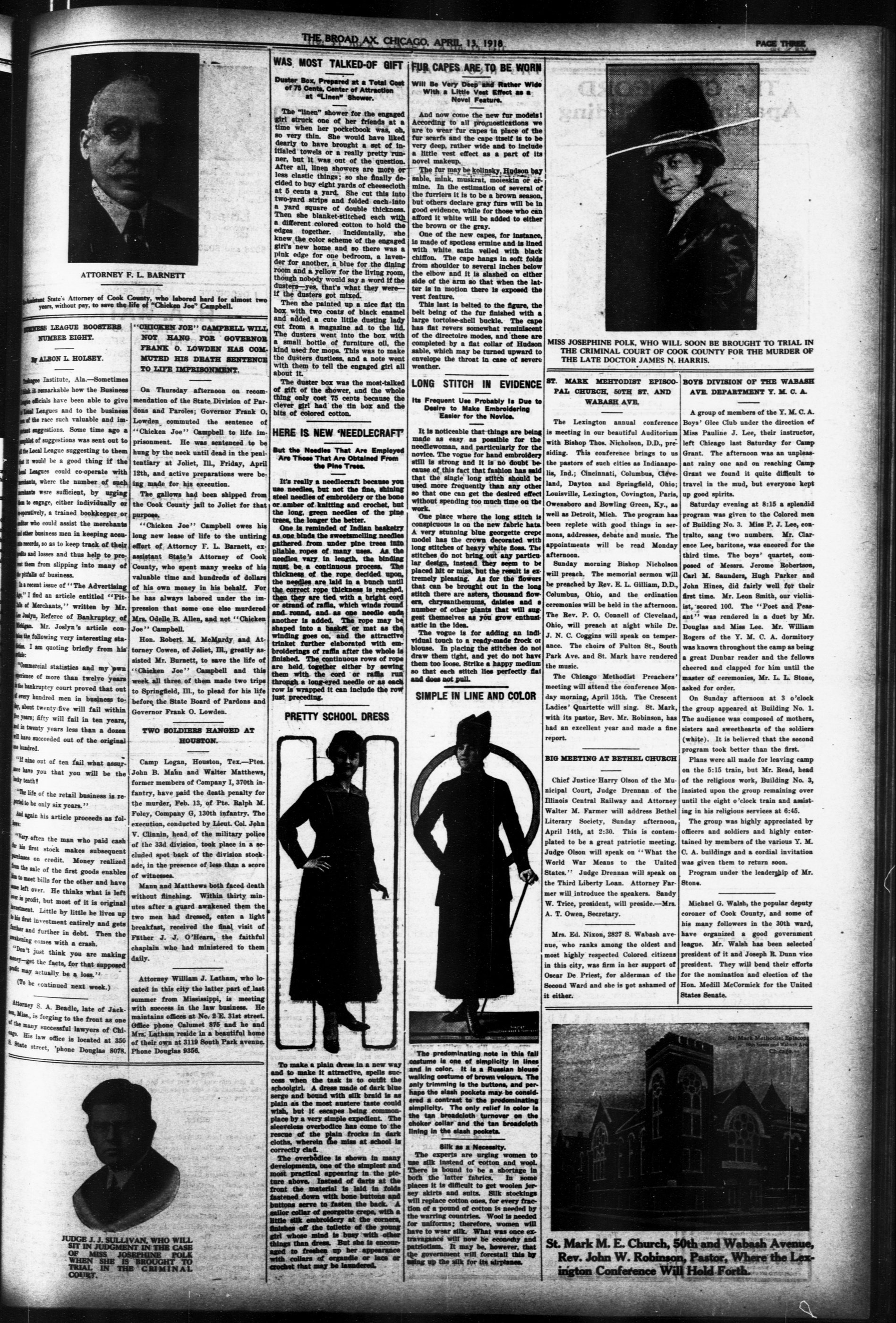
ATTORNEY F. L. BARNETT
Minister State's Attorney of Cook County, who labored hard for almost two years, without pay, to save the life of "Chicken Joe" Campbell.
Bulgee Institute, Ala.—Sometimes think it remarkable how the Business League officials have been able to give a local Leagues and to the business men of the race such valuable and important suggestions. Some time ago a number of suggestions was sent out to the Local League suggesting to them that it would be a good thing if the local Leagues could co-operate with merchants, where the number of such merchants were sufficient, by urging them to engage, either individually or cooperatively, a trained bookkeeper or merchant who could assist the merchants and other business men in keeping accurate records, so as to keep track of their profits and losses and thus help to preempt them from slipping into many of the pitfalls of business.
In a recent issue of "The Advertising Age," I find an article entitled "Pitfall of Merchants," written by Mr. Ian Joslyn, Referee of Bankruptcy of Michigan. Mr. Joslyn's article contains the following very interesting station. I am quoting briefly from his article:
"Commerecial statistics and my own experience of more than twelve years in the bankruptcy court proved that out of every hundred men in business today, about twenty-five will fail within five years; fifty will fail in ten years, and in twenty years less than a dozen will have succeeded out of the original one hundred.
"If nine out of ten fail what assurance have you that you will be the lucky tenth?
"The life of the retail business is reported to be only six years."
And again his article proceeds as follows:
"Very often the man who paid cash for his first stock makes subsequent purchases on credit. Money realized from the sale of the first goods enables him to meet bills for the other and have none left over. He thinks what is left over is profit, but most of it is original investment. Little by little he lives up to his first investment entirely and gets further and further in debt. Then the awakening comes with a crash.
"Don't just think you are making money—get the facts, for that supposed profit may actually be a loss."
(To be continued next week.)
Attorney S. A. Beadle, late of Jackson, Miss., is forging to the front as one of the many successful lawyers of Chicago. His law office is located at 350 R. State street, 'phone Douglas 8078.
A.
JUDGE J. J. SULLIVAN, WHO WILL SIT IN JUDGMENT IN THE CASE OF MISS JOSSEPHINE FOLK WHEN SHE IS BROUGHT TO TRIAL IN THE CRIMINAL COURT.
"CHICKEN JOE" CAMPBELL WILL NOT HANG FOR GOVERNOR FRANK O. LOWDEN HAS COMMUTED HIS DEATH SENTENCE TO LIFE IMPRISONMENT.
On Thursday afternoon on recommendation of the State Division of Pardons and Paroles; Governor Frank O. Lowden commuted the sentence of "Chicken Joe" Campbell to life imprisonment. He was sentenced to be hung by the neck until dead in the penitentiary at Joliet, Ill., Friday, April 12th, and active preparations were being made for his execution.
The gallows had been shipped from the Cook County jail to Joliet for that purpose.
"Chicken Joe" Campbell owes his long new lease of life to the untiring effort of Attorney F. L. Barnett, ex-assistant State's Attorney of Cook County, who spent many weeks of his valuable time and hundreds of dollars of his own money in his behalf. For he has always labored under the impression that some one else murdered Mrs. Odelle B. Allen, and not "Chicken Joe" Campbell.
Hon. Robert M. McMurdy and Attorney Cowen, of Joliet, Ill., greatly assisted Mr. Burnett, to save the life of "Chicken Joe" Campbell and this week all three of them made two trips to Springfield, Ill., to plead for his life before the State Board of Pardons and Governor Frank O. Lowden.
TWO SOLDIERS HANGED AT
Camp Logan, Houston, Tex.-Ptes. John B. Mahn and Walter Matthews, former members of Company I, 370th infantry, have paid the death penalty for the murder, Feb. 13, of Pte. Ralph M. Foley, Company G, 130th infantry. The execution, conducted by Lieut. Col. John V. Clinnin, head of the military police of the 33d division, took place in a secluded spot back of the division stockade, in the presence of less than a score of witnesses.
Mann and Matthews both faced death without flineing. Within thirty minutes after a guard awakened them the two men had dressed, eaten a light breakfast, received the final visit of Father J. J. O'Hearn, the faithful chaplain who had ministered to them daily.
Attorney William J. Latham, who located in this city the latter part of last summer from Mississippi, is meeting with success in the law business. He maintains offices at No. 2 E. 31st street. Office phone Calumet 875 and he and Mrs. Latham reside in a beautiful home of their own at 3119 South Park avenue. Phone Douglas 8356.
THE BROAD AX. CHICAGO. APRIL 13, 1918.
Duster Box, Prepared at a Total Cost of 75 Cents, Center of Attraction at "Linen" Shower.
The "linen" shower for the engaged girl struck one of her friends at a time when her pocketbook was, oh, so very thin. She would have liked dearly to have brought a set of infilated towels or a really pretty runner, but it was out of the question. After all, linen showers are more or less elastic things; so she finally decided to buy eight yards of cheesecloth at 5 cents a yard. She cut this into two-yard strips and folded each into a yard square of double thickness. Then she blanket-stitched each with a different colored cotton to hold the edges together. Incidentally, she knew the color scheme of the engaged girl's new home and so there was a pink edge for one bedroom, a lavender for another, a blue for the dining room and a yellow for the living room, though nobody would say a word if the dusters—yes, that's what they were—if the dusters got mixed.
Then she painted up a nice flat tin box with two coats of black enamel and added a cute little dusting lady cut from a magazine ad to the lid. The dusters went into the box with a small bottle of furniture oil, the kind used for mops. This was to make the dusters dustless, and a note went with them to tell the engaged girl all about it.
The duster box was the most-talked of gift of the shower, and the whole thing only cost 75 cents because the clever girl had the tin box and the bits of colored cotton.
HERE IS NEW 'NEEDLECRAFT
But the Needles That Are Employed Are Those That Are Obtained From the Pine Trees.
It's really a needlecraft because you use needles, but not the fine, shining steel needles of embroidery or the bone or amber of knitting and crochet, but the long, green needles of the pine trees, the longer the better.
One is reminded of Indian basketry as one binds the sweetmelling needles gathered from under pine trees into pliable ropes of many uses. As the needles vary in length, the binding must be a continuous process. The thickness of the rope decided upon, the needles are laid in a bunch until the correct rope thickness is reached, then they are tied with a bright cord or strand of raffia, which winds round and round, and as one needle ends another is added. The rope may be shaped into a basket or mat as the winding goes on, and the attractive trinket further elaborated with embroiderings of raffia after the whole is finished. The continuous rows of rope are held together either by sewing them with the cord or raffia run through a long-eyed needle or as each row is wrapped it can include the row just preceding.
PRETTY SCHOOL DRESS
I
To make a plain dress in a new way and to make it attractive, spells success when the task is to outfit the schoolgirl. A dress made of dark blue serge and bound with silk braid is as plain as the most austere taste could wish, but it escapes being commonplace by a very simple expedient. The sleeveless overbodice has come to the rescue of the plain frocks in dark cloths, wherein the miss at school is correctly clad.
The overbodice is shown in many developments, one of the simplest and most practical appearing in the picture above. Instead of darts at the front the material is laid in folds fastened down with bone buttons and buttons serve to fasten the back. A sailor collar of georgette crepe, with a little silk embroidery at the corner, finishes off the toilette of the young girl whose mind is busy with other things than dress. But she is encouraged to freshen up her appearance with collars of organdie or lace or crochet that may be laundered.
FUR CAPES ARE TO BE WORN
Will Be Very Deep and Rather Wide With a Little Vest Effect as a Novel Feature.
And now come the new fur models! According to all prognostications we are to wear fur capes in place of the fur scars and the cape itself is to be very deep, rather wide and to include a little vest effect as a part of its novel makeup.
The fur may be kolinsky, Hudson bay sable, mink, muskrat, moieskin or eimine. In the estimation of several of the furriers it is to be a brown season, but others declare gray furs will be in good evidence, while for those who can afford it white will be added to either the brown or the gray.
One of the new capes, for instance, is made of spotless ermine and is lined with white satin velled with black chiffon. The cape hangs in soft folds from shoulder to several inches below the elbow and it is slashed on either side of the arm so that when the latter is in motion there is exposed the vest feature. This last is belted to the figure, the belt being of the fur finished with a large tortoise-shell buckle. The cape has flat revers somewhat reminiscent of the directoire modes, and these are completed by a flat collar of Hudson sable, which may be turned upward to envelope the throat in case of severe weather.
LONG STITCH IN EVIDENCE
Its Frequent Use Probably Is Due to Desire to Make Embroidering Easier for the Novice.
It is noticeable that things are being made as easy as possible for the needlewoman, and particularly for the novice. The vogue for hand embroidery still is strong and it is no doubt because of this fact that fashion has said that the single long stitch should be used more frequently than any other so that one can get the desired effect without spending too much time on the work.
One place where the long stitch is conspicuous is on the new fabric hats. A very stunning blue georgette crepe model has the crown decorated with long stitches of heavy white floss. The stitches do not bring out any particular design, instead they seem to be placed hit or miss, but the result is extremely pleasing. As for the flowers that can be brought out in the long stitch there are asters, thousand flowers, chrysanthemums, daisies and a number of other plants that will suggest themselves as you grow enthusiastic in the idea.
The vogue is for adding an individual touch to a ready-made frock or blouse. In placing the stitches do not draw them tight, and yet do not have them too loose. Strike a happy medium so that each stitch lies perfectly flat and does not pull.
SIMPLE IN LINE AND COLOR
Sarah
The predominating note in this fall costume is one of simplicity in lines and in color. It is a Russian blouse walking costume of brown velours. The only trimming is the buttons, and perhaps the slash pockets may be considered a contrast to the predominating simplicity. The only relief in color is the tan broadcloth turnover on the choker collar and the tan broadcloth lining in the slash pockets.
The experts are urging women to use silk instead of cotton and wool. There is bound to be a shortage in both the latter fabrics. In some places it is difficult to get woolen jersey skirts and suits. Silk stockings will replace cotton ones, for every fraction of a pound of cotton is needed by the warring countries. Wool is needed for uniforms; therefore, women will have to wear silk. What was once extravagance will now be economy and patriotism. It may be, however, that the government will forestall this by using up the silk for its airplane.
100
MISS JOSEPHINE POLK, WHO WILL SOON BE BROUGHT TO TRIAL IN THE CRIMINAL COURT OF COOK COUNTY FOR THE MURDER OF THE LATE DOCTOR JAMES N. HARRIS.
MISS JOSEPHINE POLK, WHO WILL SOON BE BROUGHT TO TRIAL IN THE CRIMINAL COURT OF COOK COUNTY FOR THE MURDER OF THE LATE DOCTOR JAMES N. HARRIS.
The Lexington annual conference is meeting in our beautiful Auditorium with Bishop Thos. Nicholson, D.D., presiding. This conference brings to us the pastors of such cities as Indianapolis, Ind.; Cincinnati, Columbus, Cleveland, Dayton and Springfield, Ohio; Louisville, Lexington, Covington, Paris, Owensboro and Bowling Green, Ky., as well as Detroit, Mich. The program has been replete with good things in sermons, addresses, debate and music. The appointments will be read Monday afternoon.
Sunday morning Bishop Nicholson will preach. The memorial sermon will be preached by Rev. E. L. Gilliam, D.D., Columbus, Ohio, and the ordination ceremonies will be held in the afternoon. The Rev. P. O. Connell of Cleveland, Ohio, will preach at night while Dr. J. N. C. Coggins will speak on temperance. The choirs of Fulton St., South Park Ave. and St. Mark have rendered the music.
The Chicago Methodist Preachers' meeting will attend the conference Monday morning, April 15th. The Crescent Ladies' Quartette will sing. St. Mark, with its pastor, Rev. Mr. Robinson, has had an excellent year and made a fine report.
BIG MEETING AT BETHEL CHURCH
Chief Justice Harry Olson of the Municipal Court, Judge Drennan of the Illinois Central Railway and Attorney Walter M. Farmer will address Bethel Literary Society, Sunday afternoon, April 14th, at 2:30. This is contemplated to be a great patriotic meeting. Judge Olson will speak on "What the World War Means to the United States." Judge Drennan will speak on the Third Liberty Loan. Attorney Farmer will introduce the speakers. Sandy W. Trice, president, will preside.—Mrs. A. T. Owen, Secretary.
Mrs. Ed. Nixon, 2827 S. Wabash avenue, who ranks among the oldest and most highly respected Colored citizens in this city, was firm in her support of Oscar De Priest, for alderman of the Second Ward and she is not ashamed of it either.
St. Mark Methodist Episcopal
50th Street and Walnut Ave
Chicago
St. Mark M. E. Church, 50th and Wabash Avenue, Rev. John W. Robinson, Pastor, Where the Lexington Conference Will Hold Forth.
BOYS DIVISION OF THE WABASH
AVE. DEPARTMENT Y. M. C. A.
A group of members of the Y. M. C. A.
Boys' Glee Club under the direction of
Miss Pauline J. Lee, their instructor,
left Chicago last Saturday for Camp
Grant. The afternoon was an unpleasant rainy one and on reaching Camp
Grant we found it quite difficult to
travel in the mud, but everyone kept
up good spirits.
Saturday evening at 8:15 a splendid program was given to the Colored men of Building No. 3. Miss P. J. Lee, contralto, sang two numbers. Mr. Clarence Lee, baritone, was encored for the third time. The boys' quartet, composed of Messrs. Jerome Robertson, Carl M. Saunders, Hugh Parker and John Hines, did fairly well for their first time. Mr. Leon Smith, our violinist, scored 100. The "Poet and Peasant" was rendered in a duet by Mr. Douglas and Miss Lee. Mr. William Rogers of the Y. M. C. A. dormitory was known throughout the camp as being a great Dunbar reader and the fellows cheered and clapped for him until the master of ceremonies, Mr. L. L. Stone, asked for order.
On Sunday afternoon at 3 o'clock the group appeared at Building No. 1. The audience was composed of mothers, sisters and sweethearts of the soldiers (white). It is believed that the second program took better than the first. Plans were all made for leaving camp on the 5:15 train, but Mr. Read, head of the religious work, Building No. 3, insisted upon the group remaining over until the eight o'clock train and assisting in his religious services at 6:45. The group was highly appreciated by officers and soldiers and highly entertained by members of the various Y. M. C. A. buildings and a cordial invitation was given them to return soon.
Program under the leadership of Mr. Stone.
Michael G. Walsh, the popular deputy coroner of Cook County, and some of his many followers in the 30th ward, have organized a good government league. Mr. Walsh has been selected president of it and Joseph R. Dunn vice president. They will bend their efforts for the nomination and election of the Hon. Medill McCormick for the United States Senate.
The CRANFORD Apartment Building 3600 Wabash Avenue
THE FORTY-FOURTH STREET
The finest building ever opened to Colored tenants in Chicago. Steam heat, electric lights, tile baths, marble entrance.
PAGE FOUR
The CR
Apartmen
3600 Wab
The finest building ever open
eago. Steam heat, electric lig
Phone Main 263
FREE
STYLE-BOOK
... HAIR
To Colored Women
We are the largest
market for Colored Women's
Hair. Our latest
book showing new
styles in hair
dressings we use.
Every colored woman
should have one. We sell thou-
sands our hair and
colored women' s
infection guaranteed
or money back.
We make the best:
solid brass STRAIGHT-
guaranteed. With each comb we give lamp cap
FREE. Send money order or stamp. MONEY
BACK IF NOT SATISFACTORY. $129 postpaid.
POSTPAID $129
Hair nets, brushes, combs and toilet articles
manufacturer' s price. Send two-cent stamp.
Agents Wanted. Address as follows:
HUMANIA HAIR COMPANY.
121-127 Park Row,
New York City.
Address Dept. 84
PHONE DOUGLAS 805
Dr. Mac Enery J. Brown
Physician and Surgeon
Practice Limited to
Diseases of the
Eye, Ear, Nose and Throat
10 EAST 35TH STREET
Hours:
9 to 12 A.M. 2 to 9 P.M. CHICAGO
RESIDENCE 3419 South Park Avenue
PHONE DOUGLAS 9356
vv M. J. LATHAM
ATTORNEY AT LAW
OFFICE PHONE: CALUMET 874
2 East 31st Street
Suite 7
CHICAGO
Frank Dunn, J. B. McCahay, Trustees
Telephones: Oakland 1552, 1551, 1550
JOHN J. DUNN
ESTABLISHED 1877
Wholesale and Retail
Fifty-First and Federal Streets
CHICAGO
KINKY HAIR
Albany, Ga.
Broadway Mall, Co.
Gentlemen,
By picture shows
you what your line
EXELENTO QUININE POPADE
has done for my
line, my folk was
died, and covered
it. Also my folk was
bronken long, and so
meth and ally that
I do do my way
my I want to.
JAMIE BARD
Don't let some fake Kink Remover fuel
your line and make it grow long, soft and
silky. After using a few times you can feel
the affinity and feel the life that it will be so pretty and long that you can fix
it up to suit you. If Kinker doesn't do as
we claim, we will give your money back.
2 Do mail on receipt of stamp or coin.
AGENTS WANTED EVERYWHERE.
EXELENTO QUININE POPADE
does, removes Dandruff, feeds the Roots of
the hair, and makes it grow long, soft and
silky. After using a few times you can feel
the affinity and feel the life that it will be so pretty and long that you can fix
it up to suit you. If Kinker doesn't do as
we claim, we will give your money back.
2 Do mail on receipt of stamp or coin.
AGENTS WANTED EVERYWHERE.
EXELENTO QUININE POPADE
does, removes Dandruff, feeds the Roots of
the hair, and makes it grow long, soft and
silky. After using a few times you can feel
the affinity and feel the life that it will be so pretty and long that you can fix
it up to suit you. If Kinker doesn't do as
we claim, we will give your money back.
2 Do mail on receipt of stamp or coin.
JULIUS F. TAYLOR. Please enter my name as a subscriber to the BROAD AX. I inclose herewith Two Dollars, the annual subscription to same, or One Dollar for six months.
J. W. CASEY, Agent 133 W. Washington Street
Residence, 1262 Macalister Place
Telephone Monroe 2774
MILES J. DEVINE
Attorney at Law
Suite 313-329 Reaper Block
Clark and Washington Sts.
Phones, Central 229; Auto. 61-918
CHICAGO
PHONE MAIN 2214
A. D. GASH
Attorney at Law
118 North La Salle Street
Suite 615 to 618
CHICAGO
Req. 3655 Prah's Ava. Phone Doug. 9123
PHONES: MAIN 2017
AUTOMATIC 32-385
A. L. WILLIAMS
Attorney and Counselor at Law
Suite 706 FIRMENICH BUILDING
184 West Washington Street
CHICAGO
RESIDENCE: 588 B. 36th STREET
PHONE DOUGLAS 4397
J. Gray Lucas
Attorney at Law
Suite 815 Hartford Bldg.
8 S. Dearborn St. CHICAGO
PHONES: OFFICE, CENTRAL 6583
Residence, 4533 Prairie Avenue
Ree., Kenwood 4530
WALTER M. FARMER
ATTORNEY AND
COUNSELOR AT LAW
NOTARY PUBLIC
Suite 798
184 W. Washington St.
Phones, Office, Main 413
Auto., 23736
CHICAGO
TELEPHONE WEST 4598
NIGHT CALLS GIVEN PROMPT ATTENTION
J. Frank Armstrong, B. S., M. D.
Physician and Surgeon
HOURS:
Until 9:30 A. M., 3 to 5 and 7 to 9 P. M.
SUNDAYS:
1:30 to 2:30 P. M. and by appointment
OFFICE AND RESIDENCE:
1924 W. Lake Street, CHICAGO
THE BROAD AX, CHICAGO, APRIL 13, 1918
In this city since July 15th, 1889, without missing one single issue, Republi-
cna, Democrats, Catholics, Protestants, Single Taxers, Priests, infidels or any one else can have their say as long as their language is proper and responsibility is fixed.
The Broad Ax is a newspaper whose platform is broad enough for all, over
claiming the editorial right to speak its own mind.
Local communications will receive attention. Write only on one side of the paper.
Subscriptions must be paid in advance.
Address all communications to
THE BROAD AX
6418 Champlain Ave., Chicago, Ill.
PHONE WENTWORTH 2597.
JULIUS F. TAYLOR, Editor and
Publisher.
Entered as Second-Class Matter Aug.
19, 1902, at the Post Office at Chicago,
Illinois, under Act of March 3, 1879.
Newspaper Advertising Soliciter
Wanted.
A live newspaper advertising solicitor; one who knows how to hustle for business wanted. For further information, address the editor of this paper or phone, Wentworth 2597.
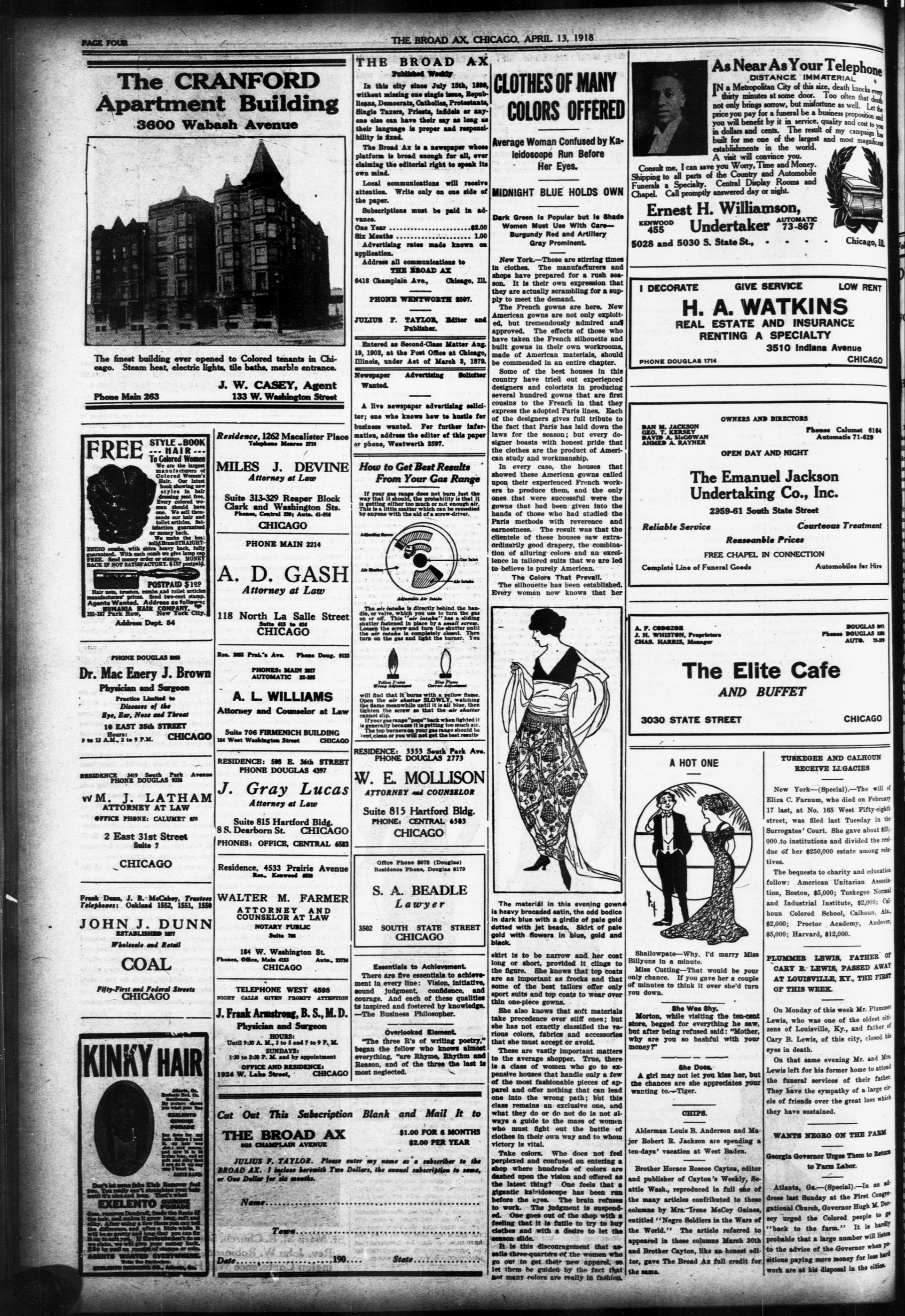
How To Get Best Results
If your gas range does not burn just the way that it should, the probability is that it is getting either too much or not enough air. This is a little matter which can be remedied by anyone with the aid of a screw-driver.
Adjusting Screw
Gas Inlet
Air Shutting
Air Intake
Adjustable Air Intake
The air intake is directly behind the handle, or valve, which you use to turn the gas on or off. This "air intake" has a sliding shutter fastened in place by a small screw. Occasionally the screw is broken in the shutter until the air intake is completely closed. Then turn on the gas and light the burner. You
Yellow Frame
Wrong Adjustment
Blue Frame
Correct Adjustment
will find that it burns with a yellow flame.
Oceans the shatter. SLOWLY, watching
the same meanwhile until it is all blue, then
tighten the screw so that the air shutter
cannot slip.
If your gas range "bops" back when lighted it is generally because "it is getting too much air. The top burners on your gas range should be *clean* or you will and get the best results
RESIDENCE: 3353 South Park Ave.
PHONE: DOUGLAS 2773
W. E. MOLLISON
ATTORNEY and COUNSELOR
Suite 815 Hartford Bldg.
PHONE: CENTRAL 6503
CHICAGO
Office Phone 8078 (Douglas)
Residence Phone, Douglas 8179
S. A. BEADLE
Lawyer
3502 SOUTH STATE STREET
CHICAGO
There are five essentials to achievement in every line: Vision, initiative, sound judgment, confidence, and courage. And each of these qualities is inspired and fostered by knowledge. The Business Philosopher.
"The three R's of writing poetry," began the fellow who knows almost everything, "are Rhyme, Rhythm and Reason, and of the three the last is most neglected.
Blank and Mail It to
$1.00 FOR 6 MONTHS
$2.00 PER YEAR
Enter my name as a subscriber to the
dollars, the annual subscription to same,
CLOTHES OF MANY COLORS OFFERED
Average Woman Confused by Kaleidoscope Run Before Her Eyes.
MIDNIGHT BLUE HOLDS OWN
Dark Green Is Popular but Is Shade Women Must Use With Care—Burgundy Red and Artillery Gray Prominent.
New York.—These are stirring times in clothes. The manufacturers and shops have prepared for a rush season. It is their own expression that they are actually scrambling for a supply to meet the demand.
The French gowns are here. New American gowns are not only exploited, but tremendously admired and approved. The effects of those who have taken the French silhouette and built gowns in their own workrooms, made of American materials, should be commended in an entire chapter. Some of the best houses in this country have tried out experienced designers and colorists in producing several hundred gowns that are first cousins to the French in that they express the adopted Paris lines. Each of the designers gives full tribute to the fact that Paris has laid down the laws for the season; but every designer boasts with honest pride that the clothes are the product of American study and workmanship.
In every case, the houses that showed these American gowns called upon their experienced French workers to produce them, and the only ones that were successful were the gowns that had been given into the hands of those who had studied the Paris methods with reverence and earnestness. The result was that the clientele of these houses saw extraordinarily good drapery, the combination of alluring colors and an excellence in tailored suits that we are led to believe is purely American.
The Colors That Prevail.
The silhouette has been established.
Every woman now knows that her
THE FASHION OF THE TWENTIETH CENTURY
The material in this evening gown is heavy brocaded satin, the odd bodice in dark blue with a girdle of pale gold dotted with jet beads. Skirt of pale gold with flowers in blue, gold and black.
skirt is to be narrow and her coat long or short, provided it clings to the figure. She knows that top coats are as important as frocks and that some of the best tailors offer only sport suits and top coats to wear over thin one-piece gowns.
She also knows that soft materials take precedence over stiff ones; but she has not exactly classified the various colors, fabrics and accessories that she must accept or avoid.
These are vastly important matters to the average shopper. True, there is a class of women who go to expensive houses that handle only a few of the most fashionable pieces of apparel and offer nothing that can lead one into the wrong path; but this class remains an exclusive one, and what they do or do not do is not always a guide to the mass of women who must fight out the battle of clothes in their own way and to whom victory is vital.
Take colors. Who does not feel perplexed and confused on entering a shop where hundreds of colors are dashed upon the vision and offered as the latest thing? One feels that a gigantic kaleidoscope has been run before the eyes. The brain refuses to work. The judgment is suspended. One goes out of the shop with a feeling that it is futile to try to buy clothes and with a desire to let the season slide. It is this discouragement that assails three-quarters of the women who go out to get their new apparel, so let them be guided by the fact that not many colors are really in fashion.
In a Metropolitan City of this size, death knocks every thirty minutes at some door. Too often that death not only brings sorrow, but misfortune as well. Let the price you pay for a funeral be a business proposition and you will benefit by it in service, quality and cost to you in dollars and cents. The result of my campaign has built for me one of the largest and most magnificent establishments in the world.
Consult me, I can save you Worry, The Shipping to all parts of the Country of Funerals a Specialty. Central Disp Chapel. Call promptly answered day
Ernest H. William
KENWOOD
455
Undertake
5028 and 5030 S. State St.,
I DECORATE GIVE TO
H. A. W.
REAL ESTATE
RENTING A
Consult me, I can save you Worry, Time and Money. Shipping to all parts of the Country and Automobile Funerals a Specialty. Central Display Rooms and Chapel. Call promptly answered day or night.
PHONE DOUGLAS 1714
OWNERS AND DIRECTORS
OPEN DAY AND NIGHT
The Emanuel Jackson
Undertaking Co., Inc.
2959-61 South State Street
Reasean
FREE CHAPEL
Complete Line of Funeral Goods
Reasoanble Prices
A. F. COOZOR
J. H. WHISTON, Proprieture
CHAS. HARRIS, Manager
The Elite Cafe AND BUFFET
3030 STATE STREET
A HOT ONE
Shallowpate—Why, I'd marry Miss Billyuns in a minute.
Miss Cutting—That would be your only chance. If you gave her a couple of minutes to think it over she'd turn you down.
She Was Shy.
Morton, while visiting the ten-cent store, begged for everything he saw, but after being refused said: "Mother, why are you so bashful with your money?"
A girl may not let you kiss her, but the chances are she appreciates your wanting to.-Tiger.
Alderman Louis B. Anderson and Major Robert R. Jackson are spending a ten-days' vacation at West Baden.
Brother Horace Roscoe Cayton, editor and publisher of Cayton's Weekly, Seattle Wash., reproduced in full one of the many articles contributed to these columns by Mrs. Trene McCoy Gaines, entitled "Negro Soldiers in the Wars of the World." The article referred to appeared in these columns March 30th and Brother Cayton, like an honest editor, gave The Broad Ax full credit for the same.
PETER B.
DAN M. JACKSON
GEQ. T. KERSEY
DAVID A. MCGOWAN
AHMED A. RAYNER
Reliable Service
She Does.
CHIPS.
SERVICE LOW RENT
ATKINS
AND INSURANCE
SPECIALTY
3510 Indiana Avenue
CHICAGO
Phones Calumet 6164
Automatic 71-829
Courteous Treatment
---
TUSKEGEE AND CALHOUN
RECEIVE LLGACIES
New York—(Special).—The will of Eliza C. Farnum, who died on February 17 last, at No. 165 West Fifty-eighth street, was filed last Tuesday in the Surrogates' Court. She gave about $25,000. to institutions and divided the residue of her $250,000 estate among relatives.
The bequests to charity and education follow: American Unitarian Association, Boston, $5,000; Tuskegee Normal and Industrial Institute, $2,000; Calhoun Colored School, Calhoun, Ala., $2,000; Proctor Academy, Andover, $5,000; Harvard, $12,000.
PLUMMER LEWIS, FATHER OF CARY B. LEWIS, PASSED AWAY AT LOUISVILLE, KY., THE FIRST OF THIS WEEK.
On Monday of this week Mr. Plummer Lewis, who was one of the oldest citizens of Louisville, Ky., and father of Cary B. Lewis, of this city, closed his eyes in death.
On that same evening Mr. and Mrs. Lewis left for his former home to attend the funeral services of their father. They have the sympathy of a large circle of friends over the great loss which they have sustained.
WANTS NEGRO ON THE FARM
Georgia Governor Urges Them to Return to Farm Labor.
Atlanta, Ga.—(Special).—In an address last Sunday at the First Congregational Church, Governor Hugh M. Dorsey urged the Colored people to go "back to the farm." It is hardly probable that a large number will listen to the advice of the Governor when positions paying more money for less hard work are at his disposal in the cities.
A
LOW RENT
Automobiles for Hire
BOUGLAS 1071
Phones BOUGLAS 1208
AUTO. 72-129
CHICAGO