The Broad Ax
Saturday, June 29, 1918
Chicago, Illinois
Page text (machine-generated)
BROAD AX
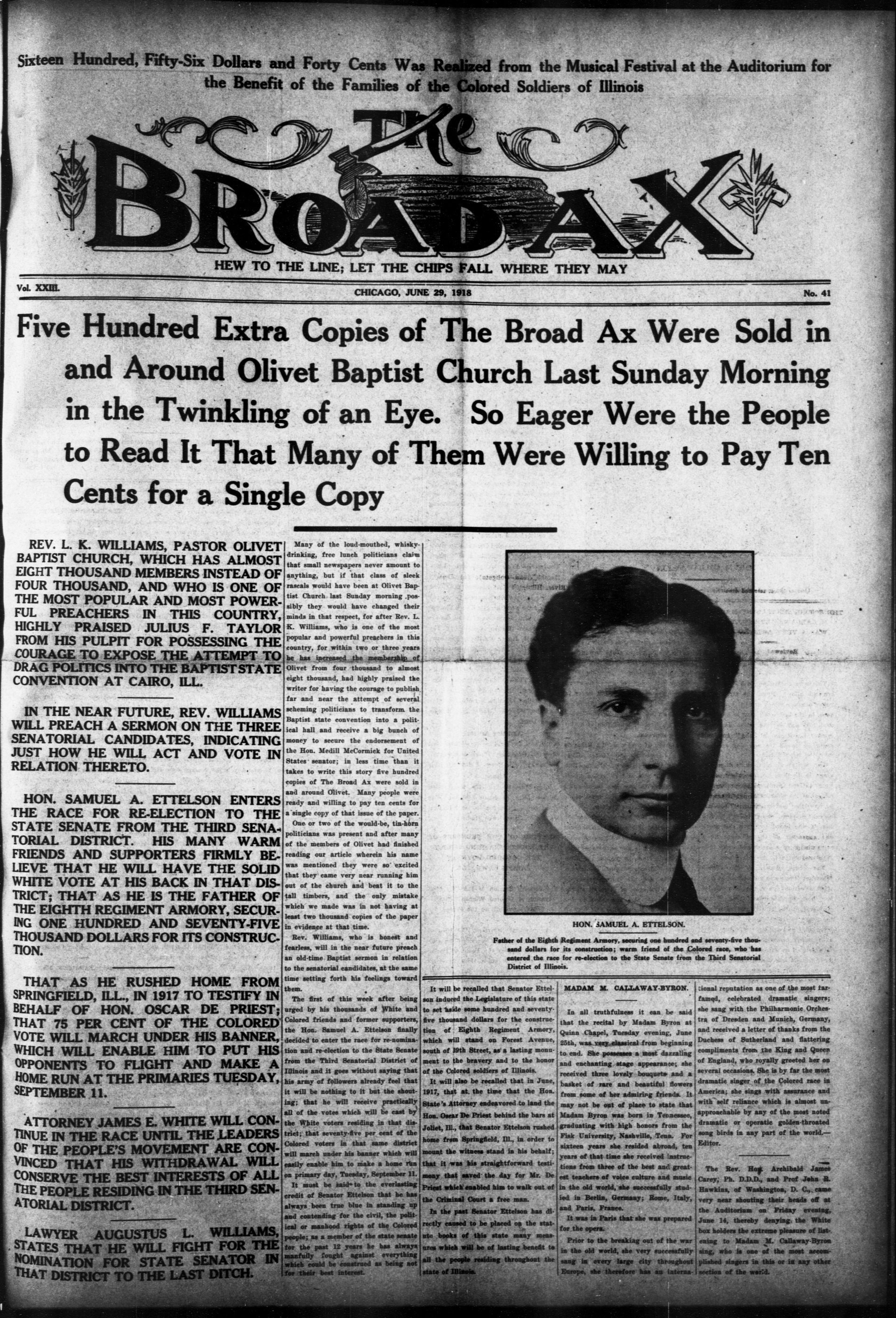
Five Hundred Extra Copies of The Broad Ax Were Sold in and Around Olivet Baptist Church Last Sunday Morning in the Twinkling of an Eye. So Eager Were the People to Read It That Many of Them Were Willing to Pay Ten Cents for a Single Copy
Father of the Eighth Regiment Armory, securing one hundred and seventy-five thousand dollars for its construction; warm friend of the Colored race, who has entered the race for re-election to the State Senate from the Third Senatorial District of Illinois.
REV. L. K. WILLIAMS, PASTOR OLIVET BAPTIST CHURCH, WHICH HAS ALMOST EIGHT THOUSAND MEMBERS INSTEAD OF FOUR THOUSAND, AND WHO IS ONE OF THE MOST POPULAR AND MOST POWERFUL PREACHERS IN THIS COUNTRY, HIGHLY PRAISED JULIUS F. TAYLOR FROM HIS PULPIT FOR POSSESSING THE COURAGE TO EXPOSE THE ATTEMPT TO DRAG POLITICS INTO THE BAPTIST STATE CONVENTION AT CAIRO, ILL.
IN THE NEAR FUTURE, REV. WILLIAMS WILL PREACH A SERMON ON THE THREE SENATORIAL CANDIDATES, INDICATING JUST HOW HE WILL ACT AND VOTE IN RELATION THERETO.
HON. SAMUEL A. ETTELSON ENTERS THE RACE FOR RE-ELECTION TO THE STATE SENATE FROM THE THIRD SENATORIAL DISTRICT. HIS MANY WARM FRIENDS AND SUPPORTERS FIRMLY BELIEVE THAT HE WILL HAVE THE SOLID WHITE VOTE AT HIS BACK IN THAT DISTRICT; THAT AS HE IS THE FATHER OF THE EIGHTH REGIMENT ARMORY, SECURING ONE HUNDRED AND SEVENTY-FIVE THOUSAND DOLLARS FOR ITS CONSTRUCTION.
THAT AS HE RUSHED HOME FROM SPRINGFIELD, ILL., IN 1917 TO TESTIFY IN BEHALF OF HON. OSCAR DE PRIEST; THAT 75 PER CENT OF THE COLORED VOTE WILL MARCH UNDER HIS BANNER, WHICH WILL ENABLE HIM TO PUT HIS OPPONENTS TO FLIGHT AND MAKE A HOME RUN AT THE PRIMARIES TUESDAY, SEPTEMBER 11.
ATTORNEY JAMES E. WHITE WILL CONTINUE IN THE RACE UNTIL THE LEADERS OF THE PEOPLE'S MOVEMENT ARE CONVINCED THAT HIS WITHDRAWAL WILL CONSERVE THE BEST INTERESTS OF ALL THE PEOPLE RESIDING IN THE THIRD SENATORIAL DISTRICT.
LAWYER AUGUSTUS L. WILLIAMS, STATES THAT HE WILL FIGHT FOR THE NOMINATION FOR STATE SENATOR IN THAT DISTRICT TO THE LAST DITCH.
It will be recalled that Senator Ettelson induced the Legislature of this state to set aside some hundred and seventy-five thousand dollars for the construction of Eighth Regiment Armory, which will stand on Forest Avenue, south of 39th Street, as a lasting monument to the bravery and to the honor of the Colored soldiers of Illinois. It will also be recalled that in June, 1917, that at the time that the Hon. State's Attorney endeavored to land the Hon. Oscar De Priest behind the bars at Joliet, Ill., that Senator Ettelson rushed home from Springfield, Ill., in order to mount the witness stand in his behalf; that it was his straightforward testimony that saved the day for Mr. De Priest which enabled him to walk out of the Criminal Court a free man.
In the past Senator Ettelson has directly caused to be placed on the statute books of this state many measures which will be of lasting benefit to all the people residing throughout the state of Illinois.
CHICAGO, JUNE 29, 1918
Many of the loud-mouthed, whisky-drinking, free lunch politicians claim that small newspapers never amount to anything, but if that class of sleek rascals would have been at Olivet Baptist Church last Sunday morning possibly they would have changed their minds in that respect, for after Rev. L. K. Williams, who is one of the most popular and powerful preachers in this country, for within two or three years he has increased the membership of Olivet from four thousand to almost eight thousand, had highly praised the writer for having the courage to publish far and near the attempt of several scheming politicians to transform the Baptist state convention into a political hall and receive a big bunch of money to secure the endorsement of the Hon. Medill MeCormick for United States senator; in less time than it takes to write this story five hundred copies of The Broad Ax were sold in and around Olivet. Many people were ready and willing to pay ten cents for a single copy of that issue of the paper.
One or two of the would-be, tin-horn politicians was present and after many of the members of Olivet had finished reading our article wherein his name was mentioned they were so excited that they came very near running him out of the church and beat it to the tall timbers, and the only mistake which we made was in not having at least two thousand copies of the paper in evidence at that time.
Rev. Williams, who is honest and fearless, will in the near future preach an old-time Baptist sermon in relation to the senatorial candidates, at the same time setting forth his feelings toward them.
The first of this week after being urged by his thousands of White and Colored friends and former supporters, the Hon. Samuel A. Ettelson finally decided to enter the race for re-nomination and re-election to the State Senate from the Third Senatorial District of Illinois and it goes without saying that his army of followers already feel that it will be nothing to it but the shouting; that he will receive practically all of the votes which will be cast by the White voters residing in that district; that seventy-five per cent of the Colored voters in that same district will march under his banner which will easily enable him to make a home run on primary day, Tuesday, September 11.
It must be said to the everlasting credit of Senator Ettelson that he has always been true blue in standing up and contending for the civil, the political or manhood rights of the Colored people; as a member of the state senate for the past 12 years he has always manfully sought against everything which could be construed as being not for their best interest.
THE NEW YORK TIMES
tional reputation as one of the most farfamqd, celebrated dramatic singers; she sang with the Philharmonic Orchestra of Dresden and Munich, Germany, and received a letter of thanks from the Duchess of Sutherland and flattering compliments from the King and Queen of England, who royally greeted her on several occasions. She is by far the most dramatic singer of the Colored race in America; she sings with assurance and with self reliance which is almost unapproachable by any of the most noted dramatic or operatic golden-throated song birds in any part of the world.—Editor.
The Rev. Howl Archibald James Carey, Ph. D.D.D., and Prof John R. Hawkins, of Washington, D. C., came very near shouting their heads off at the Auditorium on Friday evening, June 14, thereby denying the White box holders the extreme pleasure of listening to Madam M. Callaway-Byron sing, who is one of the most accomplished singers in this or in any other section of the world.
MADAM M. CALLAWAY-BYRON.
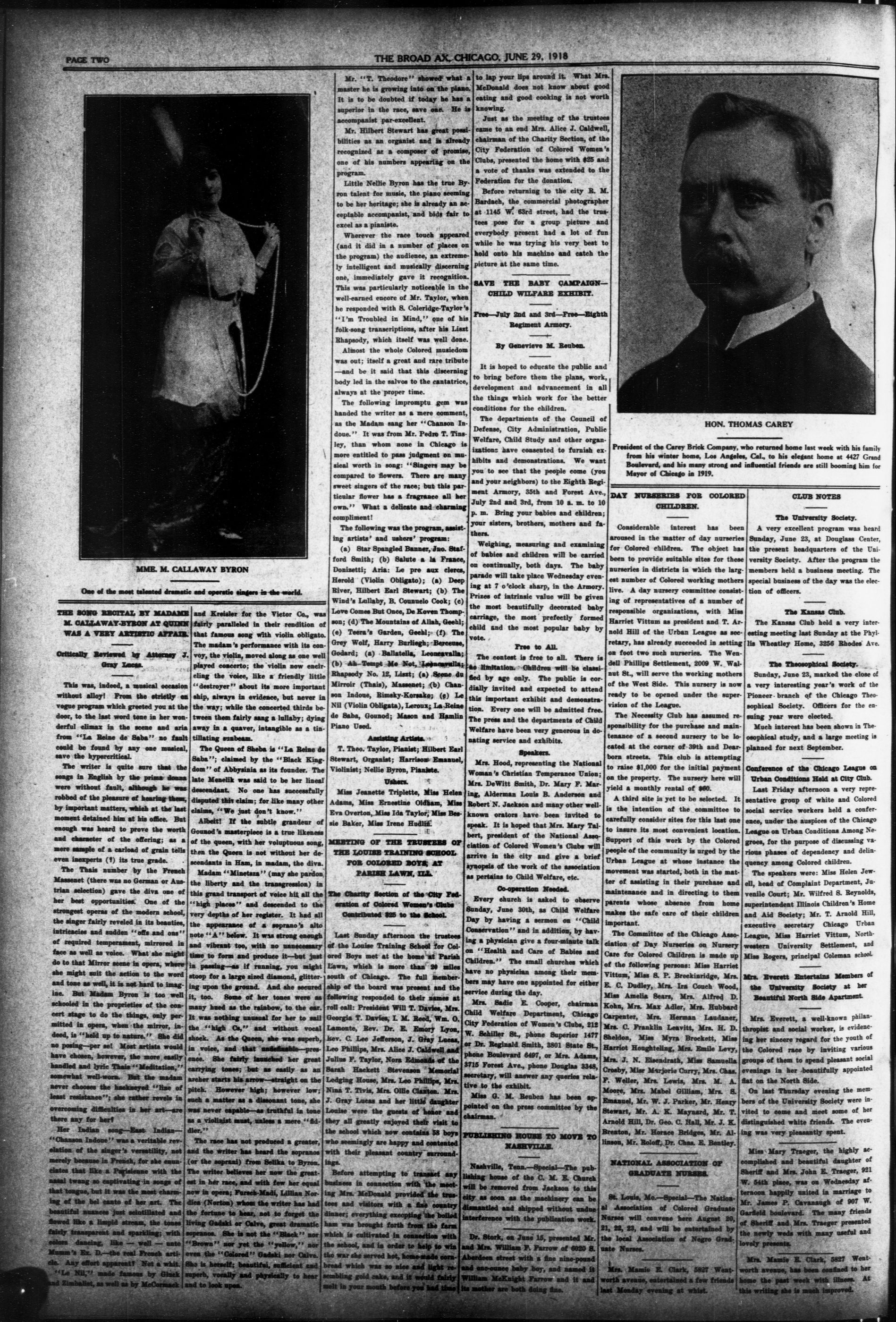
In all truthfulness it can be said that the recital by Madam Byron at Quinn Chapel, Tuesday evening, June 25th, was very classical from beginning to end. She possesses a most dazzling and enchanting stage appearance; she received three lovely bouquets and a basket of rare and beautiful flowers from some of her admiring friends. It may not be out of place to state that Madam Byron was born in Tennessee, graduating with high honors from the Fisk University, Nashville, Tennessee. For sixteen years she resided abroad, ten years of that time she received instructions from three of the best and greatest teachers of voice culture and music in the old world, she successfully studied in Berlin, Germany; Home, Italy, and Paris, France.
It was in Paris that she was prepared for the opera.
Prior to the breaking out of the war in the old world, she very successfully sang in every large city throughout Europe, she therefore has an interna-
10
THE MUSICAL THEATRE
MME. M. CALLAWAY BYRON
One of the most talented dramatic
THE SONG RECITAL BY MADAMIE
M. GALLAWAY-BYEON AT QUINN
WAS A VERY ARTISTIC AFFAIR
Critically Reviewed by Attorney J.
Gray Lucas.
One of the most talented dramatic and operatic singers in the world.
This was, indeed, a musical occasion without alloy! From the strictly en vogue program which greeted you at the door, to the last word tone in her wonderful climax in the scene and aria from "La Reine de Saba" no fault could be found by any one musical, save the hypercritical.
The writer is quite sure that the songs in English by the prima donna were without fault, although he was robbed of the pleasure of hearing them, by important matters, which at the last moment detained him at his office. But enough was heard to prove the worth and character of the offering; as a mere sample of a carload of grain tells even inexperts (!) its true grade.
The Thais number by the French Massenet (there was no German or Austrian selection) gave the diva one of her best opportunities. One of the strongest operas of the modern school, the singer fairly revealed in its beauties, intricacies and sudden "offs and ons" of required temperament, mirrored in face as well as voice. What she might do to that Mirror scene in opera, where she might suit the action to the word and tone as well, it is not hard to ima-
PAGE TWO
and Kreisler for the Victor Co., was fairly paralleled in their rendition of that famous song with violin obligato. The madam's performance with its convoy, the violin, moved along as one well played concerto; the violin now encircling the voice, like a friendly little "destroyer" about its more important ship, always in evidence, but never in the way; while the concerted thirds between them fairly sang a lullaby; dying away in a quaver, intangible as a tintilling sunbeam.
The Queen of Sheba is "La Reine de Saba"; claimed by the "Black Kingdom" of Abbysinia as its founder. The late Menelik was said to be her lineal descendant. No one has successfully disputed this claim; for like many other claims, "We just don't know."
Mr. "T. Theodore" showed what a master he is growing into on the piano. It is to be doubted if today he has a superior in the race, save one. He is accompanist par-excellent.
Mr. Hilbert Stewart has great possibilities as an organist and is already recognized as a composer of promise, one of his numbers appearing on the program.
Little Nellie Byron has the true Byron talent for music, the piano seeming to be her heritage; she is already an acceptable accompanist, and bids fair to excel as a pianist.
to lap your lips around it. McDonald does not know eating and good cooking in knowing.
Just as the meeting of came to an end Mrs. Alice chairman of the Charity Sec City Federation of Colore Clubs, presented the home w a vote of thanks was exte Federation for the donation.
Before returning to the Bardach, the commercial pt at 1145 W. 63rd street, his tees pose for a group
Wherever the race touch appeared (and it did in a number of places on the program) the audience, an extremely intelligent and musically discerning one, immediately gave it recognition. This was particularly noticeable in the well-earned encore of Mr. Taylor, when he responded with S. Coleridge-Taylor's "I'm Troubled in Mind," one of his folk-song transcriptions, after his Liszt Rhapsody, which itself was well done.
Almost the whole Colored musiedom was out; itself a great and rare tribute—and be it said that this discerning body led in the salvos to the cantatrice, always at the proper time.
The following impromptu gem was handed the writer as a mere comment, as the Madam sang her "Chanson Indoue." It was from Mr. Pedro T. Tinsley, than whom none in Chicago is more entitled to pass judgment on musical worth in song: "Singers may be compared to flowers. There are many sweet singers of the race; but this particular flower has a fragrance all her own." What a delicate and charming compliment!
The following was the program, assist ing artists' and ushers' program:
(a) Star Spangled Banner, Jno. Stafford Smith; (b) Salute a la France, Donizetti; Aria: Le pre aux clerces, Herold (Violin Obligato); (a) Deep River, Hilbert Earl Stewart; (b) The Wind's Lullaby, B. Counuelo Cook; (c) Love Comes But Once, De Koven Thompson; (d) The Mountains of Allah, Geehl; (e) Teera's Garden, Geehl; (f) The Grey Wolf, Harry Burliegh; Bercouse, Godard; (a) Ballatella, Leoneavalla; (b) Ah Tempt Me Not, Jeannecwalla, Rhapsody No. 12, Liszt; (a) Seene du Mirroir (Thais), Massenet; (b) Chanson Indoue, Rimsky-Korsake; (g) Le Nil (Violin Obligata), Leroux; La-Reine de Saba, Gounod; Mason and Hamlin Piano Used.
ASSISTING ARTISTS.
T. Theo. Taylor, Pianist; Hilbert Earl Stewart, Organist; Harrison Emanuel, Violinist; Nellie Byron, Pianist.
Ushers.
Miss Jeanette Triplette, Miss Helen Adams, Miss Ernestine Oldham, Miss Eva Overton, Miss Ida Taylor, Miss Bessie Baker, Miss Irene Hudlin.
MEETING OF THE TRUSTERS OF THE LOUISE TRAINING SCHOOL FOR COLORED BOYS, AT PARISH LAWN, ILL.
The Charity Section of the City Federation of Colored Women's Clubs
Last Sunday afternoon the trustees of the Louise Training School for Colored Boys met at the home at Parish Lawn, which is more than 20 miles south of Chicago. The full membership of the board was present and the following responded to their names at roll call: President Will T. Davies, Mrs. Georgia T. Davies, I. M. Reed, Wm. O. Lamonte, Rev. Dr. E. Emory Lyon, kev. C. Lee Jefferson, J. Gray Lucas, Leo Phillips, Mrs. Alice J. Caldwell and Jullus F. Taylor, Nora Edmonds of the Sarah Hackett Stevenson Memorial Ledging House, Mrs. Leo Phillips, Mrs. Nina T. Tivis, Mrs. Ollie Clanton, Mrs. J. Gray Lucas and her little daughter Louise were the guests of honor and they all greatly enjoyed their visit to the school which now contains 88 boys who seemingly are happy and contented with their pleasant country surroundings.
Before attempting to transact any business in connection with the meeting Mrs. McDonald provided the trustees and visitors with a fine country dinner; everything excepting the boiled ham was brought forth from the farm which is cultivated in connection with the school, and in order to help to win the war she served hot, home-made cornbread which was so nice and light resembling gold cake, and it would fairly melt in your mouth before you had time
Before returning to the city R. M.
Bardach, the commercial photographer
at 1145 W. 63rd street, had the trustees pose for a group picture and everybody present had a lot of fun while he was trying his very best to hold onto his machine and catch the picture at the same time.
SAVE THE BABY CAMPAIGN—CHILD WILFARE EXHIBIT.
By Genevieve M. Reuben
It is hoped to educate the public and to bring before them the plans, work, development and advancement in all the things which work for the better conditions for the children.
The departments of the Council of Defense, City Administration, Public Welfare, Child Study and other organizations have consented to furnish exhibits and demonstrations. We want you to see that the people come (you and your neighbors) to the Eighth Regiment Armory, 35th and Forest Ave., July 2nd and 3rd, from 10 a. m. to 10 p. m. Bring your babies and children; your sisters, brothers, mothers and fathers.
Weighing, measuring and examining of babies and children will be carried on continually, both days. The baby parade will take place Wednesday evening at 7 o'clock sharp, in the Armory. Prizes of intrinsic value will be given the most beautifully decorated baby carriage, the most perfectly formed child and the most popular baby by vote.
The contest is free to all. There is no limitation. Children will be classified by age only. The public is cordially invited and expected to attend this important exhibit and demonstration. Every one will be admitted free. The press and the departments of Child Welfare have been very generous in donating service and exhibits.
Mrs. Hood, representing the National Woman's Christian Temperance Union; Mrs. DeWitt Smith, Dr. Mary F. Maring, Alderman Louis B. Anderson and Robert N. Jackson and many other well-known orators have been invited to speak. It is hoped that Mrs. Mary Talbert, president of the National Association of Colored Women's Clubs will arrive in the city and give a brief synopsis of the work of the association as pertains to Child Welfare, etc.
Every church is asked to observe Sunday, June 30th, as Child Welfare Day by having a sermon on "Child Conservation" and in addition, by having a physician give a four-minute talk on "Health and Care of Babies and Children." The small churches which have no physician among their members may have one appointed for either service during the day.
Mrs. Sadie E. Cooper, chairman Child Welfare Department, Chicago City Federation of Women's Clubs, 212 W. Schiller St., phone Superior 1477 or Dr. Reginald Smith, 3801 State St., phone Boulevard 6497, or Mrs. Adams, 3715 Forest Ave., phone Douglas 3348, secretary, will answer any queries relative to the exhibit.
Miss G. M. Reuben has been appointed on the press committee by the chairman.
M.
President of the Carey Brick Company, who returned home last week with his family from his winter home, Los Angeles, Cal., to his elegant home at 4427 Grand Boulevard, and his many strong and influential friends are still booming him for Mayor of Chicago in 1919.
Considerable interest has been aroused in the matter of day nurseries for Colored children. The object has been to provide suitable sites for these nurseries in districts in which the largest number of Colored working mothers live. A day nursery committee consisting of representatives of a number of responsible organizations, with Miss Harriet Vittum as president and T. Arnold Hill of the Urban League as secretary, has already succeeded in setting on foot two such nurseries. The Wendell Phillips Settlement, 2009 W. Walnut St., will serve the working mothers of the West Side. This nursery is now ready to be opened under the supervision of the League.
The Necessity Club has assumed responsibility for the purchase and maintenance of a second nursery to be located at the corner of -39th and Dearborn streets. This club is attempting to raise $1,000 for the initial payment on the property. The nursery here will yield a monthly rental of $60.
A third site is yet to be selected. It is the intention of the committee to carefully consider sites for this last one to insure its most convenient location. Support of this work by the Colored people of the community is urged by the Urban League at whose instance the movement was started, both in the matter of assisting in their purchase and maintenance and in directing to them parents whose absence from home makes the safe care of their children important.
A very excellent program was heard Sunday, June 23, at Douglass Center, the present headquarters of the University Society. After the program the members held a business meeting. The special business of the day was the election of officers.
The Kansas Club.
The Kansas Club held a very interesting meeting last Sunday at the Phyllis Wheatley Home, 3256 Rhodes Ave.
The Theosophical Society.
Sunday, June 23, marked the close of a very interesting year's work of the Pioneer branch of the Chicago Theosophical Society. Officers for the ensuing year were elected.
Much interest has been shown in Theosophical study, and a large meeting is planned for next September.
Conference of the Chicago League on Urban Conditions Held at City Club. Last Friday afternoon a very representative group of white and Colored social service workers held a conference, under the auspices of the Chicago League on Urban Conditions Among Negroes, for the purpose of discussing various phases of dependency and delinquency among Colored children.
The speakers were: Miss Helen Jewell, head of Complaint Department, Juvenile Court; Mr. Wilfred S. Reynolds, superintendent Illinois Children's Home and Aid Society; Mr. T. Arnold Hill, executive secretary Chicago Urban League, Miss Harriet Vittum, Northwestern University Settlement, and Miss Rogers, principal Coleman school.
Mrs. Everett Entertains Members of the University Society at her Beautiful North Side Apartment.
Mrs. Everett, a well-known philanthropist and social worker, is evidencing her sincere regard for the youth of the Colored race by inviting various groups of them to spend pleasant social evenings in her beautifully appointed flat on the North Side.
On last Thursday evening the members of the University Society were invited to come and meet some of her distinguished white friends. The evening was very pleasantly spent.
Miss Mary Traeger, the highly accomplished and beautiful daughter of Sheriff and Mrs. John E. Traeger, 921 W. 54th place, was on Wednesday afternoon happily united in marriage to Mr. James P. Cavanaugh of 907 W. Garfield boulevard. The many friends of Sheriff and Mrs. Traeger presented the newly weds with many useful and lovely presents.
[Name]
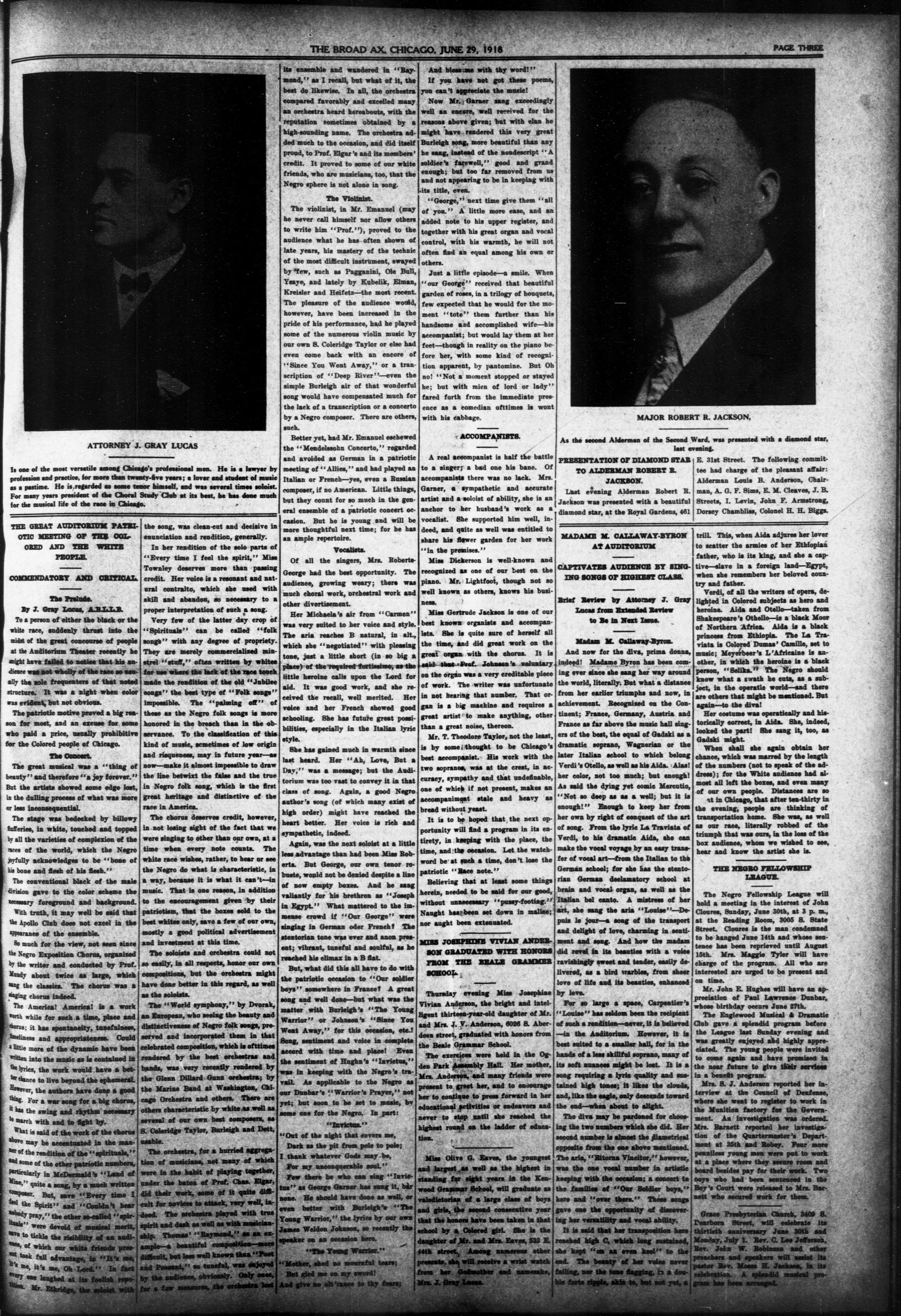
ATTORNEY J. GRAY LUCAS
Is one of the most versatile among Chicago's professional men. He is a lawyer by profession and practice, for more than twenty-five years; a lover and student of music as a pastime. He is, regarded as some tenor himself, and was several times soloist. For many years president of the Choral Study Club at its best, he has done much for the musical life of the race in Chicago.
THE GREAT AUDITORIUM PATRIOTIC MEETING OF THE COLORED AND THE WHITE PEOPLE.
the song, was clean-cut and decisive in enunciation and rendition, generally. In her rendition of the solo parts of "Every time I feel the spirit," Miss
By J. Gray Lucas, A.B.L.L.B.
To a person of either the black or the white race, suddenly thrust into the midst of the great concourse of people at the Auditorium Theater recently he might have failed to notice that his audience was not wholly of the race so usually the sole frequenters of that noted structure. It was a night when color was evident, but not obvious.
The patriotic motive proved a big reason for most, and an excuse for some who paid a price, usually prohibitive for the Colored people of Chicago.
The great musical was a "thing of beauty" and therefore "a joy forever." But the artists showed some edge lost, in the dulling process of what was more or less inconsequential.
The stage was bedecked by billowy suffieries, in white, touched and topped by all the varieties of complexion of the races of the world, which the Negro joyfully acknowledges to be "bone of his bone and flesh of his flesh."
The conventional black of the male division gave to the color scheme the necessary foreground and background.
With truth, it may well be said that the Apollo Club does not excel in the appearance of the ensemble.
So much for the view, not seen since the Negro Exposition Chorus, organized by the writer and conducted by Prof. Mundy about twice as large, which sang the classics. The chorus was a singing chorus indeed.
The America! America! is a work worth while for such a time, place and chorus; it has spontaneity, tunefulness, timeliness and appropriateness. Could a little more of the dynamic have been written into the music as is contained in the lyrics, the work would have a better chance to live beyond the ephemeral. However, the authors have done a good thing. For a war song for a big chorus, it has the swing and rhythm necessary to march with and to fight by.
What is said of the work of the chorus above may be accentuated in the manner of the rendition of the "spirituals," and some of the other patriotic numbers, particularly in McDermaid's "Land of Mine," quite a song, by a much written composer. But, save "Every time I feel the Spirit!" and "Couldn't hear anybody pray," the other so-called "spirituals" were devoid of musical merit, save to tickle the viability of an audience, of which our white friends present took full advantage, in "It's me, it's me, it's me, Oh Lord." In fact every one languaged in its foolish repetition. Mr. Ethridge, the soloist with
the song, was clean-cut and decisive in enunciation and rendition, generally. In her rendition of the solo parts of "Every time I feel the spirit," Miss Townley deserves more than passing credit. Her voice is a resonant and natural contralto, which she used with skill and abandon, so necessary to a proper interpretation of such a song.
Very few of the latter day crop of "Spirituals" can be called "folk songs" with any degree of propriety. They are merely commercialized minstrel "stuff," often written by whites for use where the lack of the race touch made the rendition of the old "Jubilee songs" the best type of "Folk songs" impossible. The "palming off" of these as the Negro folk songs is more honored in the breach than in the observance. To the classification of this kind of music, sometimes of low origin and risqueness, may in future year—as now—make it almost impossible to draw the line betwixt the false and the true in Negro folk song, which is the first great heritage and distinctive of the race in America.
The chorus deserves credit, however, in not losing sight of the fact that we were singing to other than our own, at a time when every note counts. The white race wishes, rather, to hear or see the Negro do what is characteristic, in a way, because it is what it can't—in music. That is one reason, in addition to the encouragement given by their patriotism, that the boxes sold to the best whites only, save a few of our own, mostly a good political advertisement and investment at this time.
The soloists and orchestra could not so easily, in all respects, honor our own compositions, but the orchestra might have done better in this regard, as well as the soloists.
The "World symphony," by Dvorak, an European, who seeing the beauty and distinctiveness of Negro folk songs, preserved and incorporated them in that celebrated composition, which is oftimes rendered by the best orchestras and bands, was very recently rendered by the Glenn Dillard Gunn orchestra; by the Marine Band at Washington, Chicago Orchestra and others. There are others characteristic by white as well as several of our own best composers, as S. Coleridge Taylor, Burleigh and Dett, usable.
The orchestra, for a hurried aggregation of musicians, not many of which were in the habit of playing together, under the baton of Prof. Chas. Elgar, did their work, some of it quite difficult for novices to attack, very well, indeed. The orchestra played with true spirit and dash as well as with musicianship. Thomas' "Raymond," as an example—a beautiful composition—more difficult, but less well known than "Foet and Pessant," so tuneful, was enjoyed by the audience, obviously. Only once, for a few measures, the orchestra lost
its ensemble and wandered in "Ray- mond," as I recall, but what of it, the best do likewise. In all, the orchestra compared favorably and excelled many an orchestra heard hereabouts, with the reputation sometimes obtained by a high-sounding name. The orchestra added much to the occasion, and did itself proud, to Prof. Elgar's and its members' credit. It proved to some of our white friends, who are musicians, too, that the Negro sphere is not alone in song.
And bless me with the If you have not got you can't appreciate the Now Mr. Garner said well an encore, well re- reasons above given; but might have rendered the Burleigh song, more bea- he sang, instead of the soldier'a farewell," go- enough; but too far re- and not appearing to be
The violinist, in Mr. Emanuel (may he never call himself nor allow others to write him "Prof."), proved to the audience what he has often shown of late years, his mastery of the technic of the most difficult instrument, swayed by few, such as Pagganini, Ole Bull, Ysaye, and lately by Kubelik, Elman, Kreisler and Heifetz—the most recent. The pleasure of the audience would, however, have been increased in the pride of his performance, had he played some of the numerous violin music by our own S. Coleridge Taylor or else had even come back with an encore of "Since You Went Away," or a transcription of "Deep River"—even the simple Burleigh air of that wonderful song would have compensated much for the lack of a transcription or a concerto by a Negro composer. There are others, such.
Better yet, had Mr. Emanuel eschewed the "Mendelssohn Concerto," regarded and avoided as German in a patriotic meeting of "Allies," and had played an Italian or French—yes, even a Russian composer, if no American. Little things, but they count for so much in the general ensemble of a patriotic concert occasion. But he is young and will be more thoughtful next time; for he has an ample repertoire.
Vocalists.
Of all the singers, Mrs. Roberts-Gorge had the best opportunity. The audience, growing weary; there was much choral work, orchestral work and other divertissement.
Her Michaela's air from "Carmen" was very suited to her voice and style. The aria reaches B natural, in alt., which she "negotiated" with pleasing tone, just a little short (in so big a place) of the required fortissimo; as the little heroine calls upon the Lord for aid. It was good work, and she received the recall, well merited. Her voice and her French showed good schooling. She has future great possibilities, especially in the Italian lyric style.
She has gained much in warmth since last heard. Her "Ah, Love, But a Day," was a message; but the Auditorium was too vast to convey it in that class of song. Again, a good Negro author's song (of which many exist of high order) might have reached the heart better. Her voice is rich and sympathetic, indeed.
Again, was the next soloist at a little less advantage than had been Miss Roberta. But George, our own tenor robuste, would not be denied despite a line of now empty boxes. And he sang valiantly for his brethren as "Joseph in Egypt." What mattered to the immense crowd if "Our George" were singing in German oder French? The stentorian tone was ever and anon present; vibrant, tuneful and soulful, as he reached his climax in a B flat.
But, what did this all have to do with the patriotic occasion to "Our soldier boys" somewhere in France? A great song and well done—but what was the matter with Burleigh's "The Young Warrior" or Johnson's "Since You Went Away," for this occasion, etc.! Song, sentiment and voice in complete accord with time and place! Even the sentiment of Hughn's "Invictus," was in keeping with the Negro's travail. As applicable to the Negro as our Dunbar's "Warrior's Prayer," not yet; but soon to be set to music, by some one for the Negro. In part:
"Invictus."
"Out of the night that covers me, Dark as the pit from pole to pole; I thank whatever Gods may be, For my unconquerable soul."
Few there be who can sing "Invictus" as George Garner has sung it, bar none. He should have done as well, or even better with Burleigh's "The Young Warrior," the lyrics by our own James Weldon Johnson, so recently the speaker on an occasion here.
"The Young Warrior."
"Mother, shed no mournful tears; But girl me on my sword! And give no alt'rance to thy fears;
And bless me with thy word!"
If you have not got these poems, you can't appreciate the music!
Now Mr. Garner sang exceedingly well an encore, well received for the reasons above given; but with elan he might have rendered this very great Burleigh song, more beautiful than any he sang, instead of the nondescript 'A soldier's farewell,' good and grand enough; but too far removed from us and not appearing to be in keeping with its title, even.
"George," next time give them "all of you." A little more ease, and an added note to his upper register, and together with his great organ and vocal control, with his warmth, he will not often find an equal among his own or others.
Just a little episode—a smile. When "our George" received that beautiful garden of roses, in a trilogy of bouquets, few expected that he would for the moment "tote" them further than his handsome and accomplished wife—his accompanist; but would lay them at her feet—though in reality on the piano before her, with some kind of recognition apparent, by pantomine. But Oh no! "Not a moment stopped or stayed he; but with mien of lord or lady" fared forth from the immediate presence as a comedian offtimes is wont with his cabbage.
ACCOMPANISTS
A real accompanist is half the battle to a singer; a bad one his bane. Of accompanists there was no lack. Mrs. Garner, a sympathetic and accurate artist and a soloist of ability, she is an anchor to her husband's work as a vocalist. She supported him well, indeed, and quite as well was entitled to share his flower garden for her work "in the premises."
Miss Dickerson is well-known and recognized as one of our best on the piano. Mr. Lightfoot, though not so well known as others, knows his business.
Miss Gertrude Jackson is one of our best known organists and accompanists. She is quite sure of herself all the time, and did great work on the great organ with the chorus. It is said that Prof. Johnson's voluntary on the organ was a very credible piece of work. The writer was unfortunate in not hearing that number. That organ is a big machine and requires a great artist to make anything, other than a great noise, thereon.
Mr. T. Theodore Taylor, not the least, is by some thought to be Chicago's best accompanist. His work with the two sopranos, was at the crest, in accuracy, sympathy and that undefinable, one of which if not present, makes an accompaniment stale and heavy as bread without yeast.
It is to be hoped that the next opportunity will find a program in its entirety, in keeping with the place, the time, and the occasion. Let the watchword be at such a time, don't lose the patriotic "Race note."
Believing that at least some things herein, needed to be said for our good, without unnecessary "pussy-footing." Naught has been set down in malice; nor aught been extenuated.
Thursday evening Miss Josephine Vivian Anderson, the bright and intelligent thirteen-year-old daughter of Mr. and Mrs. J. V. Anderson, 6026 S. Aberdeen street, graduated with honors from the Beale Grammar School.
The exercises were held in the Ogden Park Assembly Hall. Her mother, Mrs. Anderson, and many friends were present to greet her, and to encourage her to continue to press forward in her educational activities or endeavors and never to stop until she reached the highest round on the ladder of education.
Miss Olive G. Eaves, the youngest and largest as well as the highest in standing for eight years in the Kenwood Grammar School, will graduate as valedictorian of a large class of boys and girls, the second consecutive year that the honors have been taken in that school by a Colored girl. She is the daughter of Mr. and Mrs. Eaves, 533 E. 44th street. Among numerous other presents, she will receive a wrist watch from her Godmother and namesake, Mrs. J. Gray Lecon.
[Name]
MAJOR ROBERT R. JACKSON.
As the second Alderman of the Second last of
PRESENTATION OF DIAMOND STAR
TO ALDERMAN ROBERT R.
JACKSON.
Last evening Alderman Robert R.
Jackson was presented with a beautiful
diamond star, at the Royal Gardens, 461
As the second Alderman of the Second Ward, was presented with a diamond star, last evening.
MADAME M. CALLAWAY-BYRON
AT AUDITORIUM
CAPTIVATES AUDIENCE BY SING-
ING SONGS OF HIGHEST CLASS.
Brief Review by Attorney J. Gray
Madam M. Galloway-Byron.
And now for the diva, prima donna, indeed! Madame Byron has been coming ever since she sang her way around the world, literally. But what a distance from her earlier triumphs and now, in achievement. Recognized on the Continent; France, Germany, Austria and France as far above the music hall singers of the best, the equal of Gadski as a dramatic soprano, Wagnerian or the later Italian school to which belong Verdi's Otello, as well as his Aida. Alas! her color, not too much; but enough! As said the dying yet comic Mercentio, "Not so deep as as a well; but it is enough!" Enough to keep her from her own by right of conquest of the art of song. From the lyric La Traviata of Verdi, to his dramatic Aida, she can make the vocal voyage by an easy transfer of vocal art—from the Italian to the German school; for she has the stantorian German declamatory school at brain and vocal organ, as well as the Italian bel canto. A mistress of her art, she sang the aria "Louise"—Depuis is jour—a song of the transport and delight of love, charming in sentiment and song. And how the madam did revel in its beauties with a voice ravishingly sweet and tender, easily delivered, as a bird warbles, from sheer love of life and its beauties, enhanced by love.
For so large a space, Carpentier's "Louise" has seldom been the recipient of such a rendition—never, it is believed—in the Auditorium. However, it is best suited to a smaller hall, for in the hands of a less skillful soprano, many of its soft nuances might be lost. It is a song requiring a lyric quality and sustained high tones; it likes the clouds, and, like the eagle, only descends toward the end—when about to alight.
The diva may be pardoned for choosing the two numbers which she did. Her second number is almost the diametrical opposite from the one above mentioned. The aria, "Ritorna Vineitor," however, was the one vocal number in artistic keeping with the occasion; a concert to the families of "Our Soldier boys," here and "over there." These songs gave one the opportunity of discovering her versatility and vocal ability.
It is said that her transposition here reached high C, which long sustained, she kept "on an even keel" to the end. The beauty of her voice never falling, nor the tune flagging, in a double forts ripple, skim to, but not yet, a
1930
E. 31st Street. The following committee had charge of the pleasant affair: Alderman Louis B. Anderson, Chairman, A. G. F. Sims, E. M. Cleaves, J. B. Streets, I. Levin, John F. Armstrong, Dorsey Chambliss, Colonel H. H. Biggs.
trill. This, when Aida adjuces her lover to scatter the armies of her Ethiopian father, who is its king, and she a captive—slave in a foreign land—Egypt, when she remembers her beloved country and father.
Verdi, of all the writers of opera, delighted in Colored subjects as hero and heroine. Aida and Otallo—taken from Shakespeare's Othello—is a black Moor of Northern Africa. Aida is a black princess from Ethiopia. The La Traviata is Colored Dumas' Camille, set to music; Meyerbeer's L'Africaine is another, in which the heroine is a black person, "Selika." The Negro should know what a swath he cuts, as a subject, in the operatic world—and there are others that might be mentioned. But again—to the diva!
Her costume was operatically and historically correct, in Aida. She, indeed, looked the part! She sang it, too, as Gadali might.
When shall she again obtain her chance, which was marred by the length of the numbers (not to speak of the address); for the White audience had almost all left the boxes, and even many of our own people. Distances are so at in Chicago, that after ten-thirty in the evening, people are thinking of transportation home. She was, as well as our race, literally robbed of the triumph that was ours, in the loss of the box audience, whom we wished to see, hear and know the artist she is.
THE NEGRO FELLOWSHIP LEAGUE.
The Negro Fellowship League will hold a meeting in the interest of John Cloures, Sunday, June 30th, at 3 p. m., at the Reading Room, 3005 S. State Street. Cloures is the man condemned to be hanged June 14th and whose sentence has been reprieved until August 15th. Mrs. Maggie Tyler will have charge of the program. All who are interested are urged to be present and on time. Mr. John E. Hughes will have an appreciation of Paul Lawrence Dunbar, whose birthday occurs June 27th. The Englewood Musical & Dramatic Club gave a splendid program before the League last Sunday evening and was greatly enjoyed and highly appreciated. The young people were invited to come again and have promised in the near future to give their services in a benefit program.
Mrs. S. J. Anderson reported her interview at the Council of Denfense, where she went to register to work in the Munition factory for the Government. An investigation was ordered. Mrs. Barnett reported her investigation of the Quartermaster's Department at 35th and Robey. Four more penniless young men were put to work at a place where they secure room and board besides pay for their work. Two boys who had been sentenced in the Boy's Court were released to Mrs. Barnett who secured work for them.
Grace Presbyterian Church, 3409 S. Dearborn Street, will celebrate its thirtieth anniversary June 30th and Monday, July 1. Rev. C. Lee Jefferson, Rev. John W. Robinson and other preachers and speakers will assist its pastor Rev. Moses H. Jackson, in its celebration. A splendid musical program has been arranged.
PAGE THREE
THE FORTY-FOURTH STREET
The finest building ever opened to Colored tenants in Chicago. Steam heat, electric lights, tile baths, marble entrance. J. W. CASEY, Agent Phone Main 263 133 W. Washington Street
PAGE FOUR
The CR
Apartment
3600 Wal
The finest building ever open
eago. Steam heat, electric light
Phone Main 263
FREE STYLE BOOK
... HAIR
To Colored Women
We are the largest
manufacturer of Colored Women's
Hair. Our latest
styles in hair
dressing sent free.
Every colored woman
should have
Women's hair
sends our hair and
toilet articles. Bat-
faction guaranteed
compensation.
We make the best
solnBrass STRAIGHT
ENING combs, with extra heavy back, fully
guaranteed. With each comb we give lamp cap
and brush. Send two-cent stamp.
BACK IF NOT SATISFACTORY. $12 postpaid.
POSTPAID $129
Hair pets, brushes, combs and toilet articles
manufacturer's prices. Send two-cent stamp.
Agents Wanted. Address as follows:
BUMANIA HAIR COMPANY.
131-IN Park Row,
New York City.
Address Dept. 84
PHONE DOUGLAS 001
Dr. Mac Enery J. Brown
Physician and Surgeon
Practice Limited to
Diseases of the
Eye, Ear, Nose and Throat
10 EAST 35th STREET
Hours!
4 to 12 A.M. 2 to 9 P.M.
CHICAGO
RESIDENCE 3419 South Park Avenue
PHONE BOUGLAS 9156
M. J. LATHAM
ATTORNEY AT LAW
OFFICE PHONE: CALUMET 95
2 East 31st Street
Suite 7
CHICAGO
Frank Dunn, J. B. McCahoy, Trustees
Telephones: Oakland 1552, 1551, 1560
JOHN J. DUNN
ESTABLISHED 1877
Wholesale and Retail
COAL
Fifty-First and Federal Streets
CHICAGO
KINKY HAIR
Atlanta, Ga.
Brownsboro Stock Co.
Gardensville
If you really don't want you what you like
EXELENTO GUNNIE PONDAE
has done for my hair before I grew it and then short and curly it is in Indian box and silky that will make it look like my I want to be.
JANE RABA
Don't let mine fake Kink Beauty feel you. You really can't straighten your hair until it's else and long. That's what EXELENTO QUINIE PONDAE does, removes Dandruff, the hair of the hair, and makes it grow long, soft and silky. After whipping a few times you can tell the difference and after a little while it will be so pretty and long that you can fix it to be quite you. If you can't fix it we claim, we will give your manner back. 25s by mail on request of champs or join.
AGENTS WANTED EVERYWHERE.
With Any Pat Guests.
EXELENTO MEDICAL CO., Atlanta, Ga.
Residence, 1262 Macalister Place
Telephone Monroe 2714
MILES J. DEVINE
Attorney at Law.
Suite 313-329 Reaper Block
Clark and Washington Sts.
Phones, Central 229; Auto. 41-816
CHICAGO
PHONE MAIN 2214
A. D. GASH
Attorney at Law
118 North La Salle Street
Suite 615 to 615
CHICAGO
Res. 3055 Prah's Ave. Phone Doug. 9133
PHONES: MAIN 2017
AUTOMATIC 22-305
A. L. WILLIAMS
Attorney and Counselor at Law
Suite 706 FIRMENICH BUILDING
184 West Washington Street CHICAGO
RESIDENCE: 508 E. 36th STREET
PHONE DOUGLAS 4397
J. Gray Lucas
Attorney at Law
Suite 815 Hartford Bldg.
8 S. Dearborn St. CHICAGO
PHONES: OFFICE, CENTRAL 6583
Residence, 4533 Prairie Avenue
Ros., Kenwood 6580
WALTER M. FARMER
ATTORNEY AND
COUNSELOR AT LAW
NOTARY PUBLIC
Suite 705
184 W. Washington St.
Phones, Office, Main 4153 Auto., 35726
CHICAGO
TELEPHONE WEST 4590
NIGHT CALLS GIVEN PROMPT ATTENTION
J. Frank Armstrong, B. S., M. D.
Physician and Surgeon
HOURS:
Until 9:30 A. M., 3 to 5 and 7 to 9 P. M.
SUNDAYS:
1:30 to 2:30 P. M. and by appointment
OFFICE AND RESIDENCE:
1924 W. Lake Street, CHICAGO
Cut Out This Subscription
THE BROAD AX
603 CHAMPLAIN AVENUE
JULIUS P. TAYLOR. Please en
BROAD AX. I include herewith Two D
on One Dollar fee six months
THE BROAD AX, CHICAGO, JUNE 29, 1918
In this city since July 15th, 1899, without missing one single issue, Republicans, Democrats, Catholics, Protestants, Single Taxers, Priests, infidels or anyone else can have their say as long as their language is proper and responsibility is fixed.
The Broad Ax is a newspaper whose platform is broad enough for all, ever claiming the editorial right to speak its own mind.
Local communications will receive attention. Write only on one side of the paper.
Subscription must be paid in advance.
One Year .....$2.00
Six Months .....1.00
Advertising rates made known on application.
Address all communications to
THE BROAD AX
6206 S. Elizabeth Street, Chicago, Ill.
PHONE WENTWORTH 2597.
JULIUS F. TAYLOE, Editor and Publisher.
Entered as Second-Class Matter Aug. 19, 1902, at the Post Office at Chicago, Illinois, under Act of March 3, 1879.
Newspaper Advertising Soliciter Wanted.
A live newspaper advertising soliciter; one who knows how to hustle for business wanted. For further information, address the editor of this paper or phone, Wentworth 2597.
How to Get Best Results From Your Gas Range
If your gas range does not burn just the way that it should, the probability is that it is getting either too much or not enough air. This is a little matter which can be remedied by anyone with the aid of a screwdriver.
Adjusting Burns
Gas Insert
Air Shutoff
Air Intake
Adjusting Air Intake
The air intake is directly behind die, or valve, which you use to turn on or off. This "air intake" has shutter hastened in place by a cam. When the air intake is completely closed the air intake is completely closed on the gas and light the bu
PULL FRAME
Writing Adjustment
BLUE FRAME
Correct Adjustment
will find that it burns with a yellow flame.
Crystalline ash at the bottom glows when
the flame meanwhile until it is all blue, then
tighten the screw so that the air, shutter
cannot slip.
The upper range "poor" back when lighted it
is generally because it is getting too much air.
The top burners on your gas range should be
kept clean or you will not get the best results
RESIDENCE: 3353 South Park Ave.
PHONE DOUGLAS 2773
W. E. MOLLISON
ATTORNEY and COUNSELOR
Suite 815 Hartford Bldg.
PHONE: CENTRAL 6583
CHICAGO
Office Phone 8078 (Douglas)
Residence Phone, Douglas 8178
S. A. BEADLE
Lawyer
3502 SOUTH STATE STREET
CHICAGO
REMOVAL NOTICE.
Dr. Monroe A. Majors has removed his offices from 4714 S. State street to 4700 S. State street, southwest corner of Forty-seventh street, where he will be pleased to meet his many patients. Phone Drexel 1416.
Blank and Mail It to
$1.00 FOR 6 MONTHS
$2.00 PER YEAR
after my name as a subscriber to the
dollars, the annual subscription to same.
It is a human frailty to want praise. We begin young to crave the approving notice of others. "There is none like to me," says the cub in the pride of his earliest kill. "But the jungle is large, and the cub he is small; let him think and be still." Children brought up in school can generally be told from those who have been trained solitarily, says a writer in the Philadelphia Ledger, for the children thrown much with other children are less likely to develop arrogance, selfishness and conceit. They do not find their schoolmates in a frame of mind to put them on a pedestal or crown their brows with laurel. They are not regarded as little tin gods on wheels; they are lost to sight in the shuffle of the classroom and the playground. Nobody defers to their opinions; nobody minds when they stamp the foot and shout angrily.
Children of a larger growth often crave an admiration which they do not get. They think to draw an audience by harping on the theme of self, and they find that the audience for that kind of recital is likely to be limited to the performer. To knock the "T" out of one's conversation is not necessarily to make it interesting. Many times a narrative loses greatly in pith and pungency by the impersonality in which it is couched. A story of adventure greatly gains by the sense of the first-hand participation of the narrator in the incidents he describes. When the first person is introduced for the sake of the edification of the reader, there need be no apology; when it is introduced for the glorification of the speaker, it is odious altogether.
A man must do his work as well as he can, whether he is praised for it or not. The taste of publicity is likely to be what the taste of blood is to tiger or lion; it whets the desire for more of the same thing. There are some who rarely do a good deed without rushing to neighbor or newspaper to let it be known. To others the "free advertising" is abhorrent. They are made happy by a glowing consciousness that the right thing was done, and that auto-satisfaction of virtue is their reward. But most of us have not reached that lofty pinnacle whereon we can ablide serenely independent of what others think or say. We want a kind word new and then to keep us going. We hunger for appreciation, even when we tell ourselves we are not worth it. Who has not known the lift a letter of encouragement, a sentence of commendation, has brought? The day is brighter for it, and we feel refreshed, renewed. Blessed are they who speak in time the heartening, quickening word.
Goats' Milk Is Favored.
Everyone who is at all acquainted with the milk goat knows of the value of the milk for infants' and invalids' use—one of the first points about the milk goat that presents itself, asserts a writer. The goat is practically free from tuberculosis. According to the annual reports of the bureau of animal industry (U. S.), covering federal inspection of animals slaughtered for food, there were inspected during the eight years, 1907 to 1914, inclusive, 579,617 goats, of which not a single animal was condemned for tuberculosis. This fact alone should be the strongest argument in favor of the milk of the goat. The cream globules of the milk of the goat are smaller than those of cows' milk, and because of this milk being condensed the cream globules are contained in a more perfect state of emulsion than the cow's milk. An argument in favor of sterilized milk is that authorities agree it is actually more easily digested than is the fresh milk, this referring to goats' and cows' milk alike.
Field Crops of Canada
The census and statistics office has issued its preliminary estimate of the total value of the field crops of Canada for the past year, as compared with the finally revised estimates of 1916 and 1915. The estimated values for 1917 represent the prices received by farmers and are calculated from current market quotations. According to this preliminary estimate, the total value of all field crops for 1917 is placed at $1,089,687,000, as compared with $886,494,900 in 1916 and $825,370,600 in 1915. The items making up this total are as follows: Wheat. $451,874,000; oats; $236,142,000; hay, clover, and alfalfa. $145,561,600; potatoes, $81,355,000; other grain crops, $184,008,700, and root and fodder crops, $40,974,700.
In the year 1916 the crops were as follows: Wheat, $34,006,400; oats, $210,967,500; hay, clover and alfalfa, $171,613,900; potatoes, $50,982,300; other grain crops, $84,679,800, and other root and fodder crops, $84,165,000.
Kerensky Real Diplomat
Here is a Kerensky story told by a man lately returned from Petrograd. Kerensky was summoned from his hotel after midnight to the headquarters of the provisional government. A fellow guest at the hotel met Kerensky as he was going out and, learning of the summons Kerensky had received, exclaimed:
As Near As Your Telephone DISTANCE IMMATERIAL
IN a Metropolitan City of this size, death knocks every thirty minutes at some door. Too often that death not only brings sorrow, but misfortune as well. Let the price you pay for a funeral be a business proposition and you will benefit by it in service, quality and cost to you in dollars and cents. The result of my campaign has built for me one of the largest and most magnificent establishments in the world.
Consult me, I can save you Worry.
Shipping to all parts of the Country
Funerals a Specialty. Central D
Chapel. Call promptly answered da
Ernest H. Willi
KENWOOD
455
Undertak
5028 and 5030 S. State St.
I DECORATE GIVE
H. A. W
REAL ESTATE
RENTING
PHONE DOUGLAS 1714
Consult me, I can save you Worry, Time and Money. Shipping to all parts of the Country and Automobile Funerals a Specialty. Central Display Rooms and Chapel. Call promptly answered day or night.
OPEN DAY AND NIGHT
The Emanuel Jackson
Undertaking Co., Inc.
2959-61 South State Street
Reasonable
FREE CHAPEL
Complete Line of Funeral Goods
A. F. CODOZOE
J. H. WHISTON, Proprietors
CHAS. HARRIS, Manager
The Eli
AND
3030 STATE STREET
KNOW C
Study Black's Blue Book
ness and professional d
churches, clubs, hotels,
KNOW CHICAGO
Study Black's Blue Book, the Colored people's business and professional directory and guide. Also churches, clubs, hotels, places to visit—everything
Price 25 cents on newsstands or send 35 cents in stamps to
BLACK'S BLUE BOOK COMPANY
6446 ST. LAWRENCE AVE. CHICAGO,
BLACK'S BLUE BOOK COMPANY
6446 ST. LAWRENCE AVE. CHICAGO, ILL.
BAPSTISTS TO PAY TREIBUTE TO
FIRST CHURCH.
By the Rev. W. B. Norton.
Chicago Baptists will meet this evening in the First Baptist church, Thirty-first Street and South Park Avenue, for a city-wide rally in recognition of the long and honorable history of the First Baptist church, which has been sold to the Negroes.
The congregation of the First church has voted to accept the invitation of the Memorial Church of Christ, 729 Oakwood Boulevard, to unite in worship there, and on September 15 the First church and Sunday school will go there in a body. The Memorial church is a union church of Baptists and Disciples of Christ. Prof. Herbert L. Willett is pastor.
The Rev. William Holloway Main, pastor of the First church, said the First church congregation could not build in a new location during the war but the congregation would hold together until some plan was decided on.
The purchaser of the First church is the Olivet Negro Baptist church. It is intended to operate the plant of the First church, the present Olivet church and a new building yet to be erected under one church corporation.
The First Baptist church was built in 1876, costing $125,000, the ground being valued at $40,000 additional. The present sale price was $85,000, the First church giving $10,000 of the amount. The church was organized Oct. 19, 1833. It once occupied the present site of the Chamber of Commerce, Washington and La Salle streets. Later it moved to Wabash Avenue and Hubbard court. Two of its most famous pastors were Dr. George C. Lorimer and Dr. P. S. Henson.
Attorney S. A. Beadle, 3502 S. State street, is meeting with success in the law business in this city. The other day, when he paid for his card, which
PETER H.
DAN M. JACKSON
GEQ. T. KERSEY
DAVID A. MCGOWAN
AHMED K. RAYNER
Reliable Service
CHIPS.
SERVICE LOW RENT
WATKINS
INSURANCE
A SPECIALTY
3510 Indiana Avenue
CHICAGO
AND DIRECTORS
Phones Calumet 6164
Automatic 71-629
Courteous Treatment
Variable Prices
IN CONNECTION
Automobiles for Hire
te Cafe BUFFET CHICAGO CHICAGO the Colored people's busi- directory and guide. Also places to visit—everything
appears in another column of this paper, he displayed a big bundle of money large enough to choke a horse.
Mr. and Mrs. Cruse of 6432 Champlain avenue are the proud parents of a lovely baby girl.
Mrs. Peter Crawford of 2337 West Lake street is enjoying an extended trip to western points of interest.
Mr. Harris B. Gaines, a young attorney of this city, has gone to a farm near Big Rapids, Mich., for his health.
Miss Johanna Harris, school teacher of Okmulgee, Okla., is visiting her sisters and friends of this city. She is the guest of Mrs. Day, 5330 S. Wabash avenue.
On June 26th Miss Ines Ameda McKay was united in marriage to Mr. Eugene Richard Spaulding. The young couple will be at home, 3028 Vernon avenue, after July 10th.
Mrs. Alice Wilson of Los Angeles, Cal., is in the city stopping at the home of Mr. and Mrs. Smith, 6026 S. Aberdeen street. She will remain here for several weeks, until she settles up the estate of her late brother, Frank L. Hamilton.
The Chicago friends of Miss Cecelia Scott of Houston, Texas, will be interested to know that she was recently married to Lieutenant Frank L. Lane of Camp Funston. Mrs. Lane is now in New York with her husband who has been transferred to Camp Upton.
Mrs. N. B. Ross of Madisonville, Ky., are stopping at the home of Mrs. Charles Stewart, 5922 S. Aberdeen street, and for the next several months she will take a special course of instruction at the Chicago Art Institute and the University of Chicago.
Chicago, Ill.
DOUGLAS 2011
Phone DOUGLAS 2016
AUTO. 18-379
CHICAGO