The Broad Ax
Saturday, August 31, 1918
Chicago, Illinois
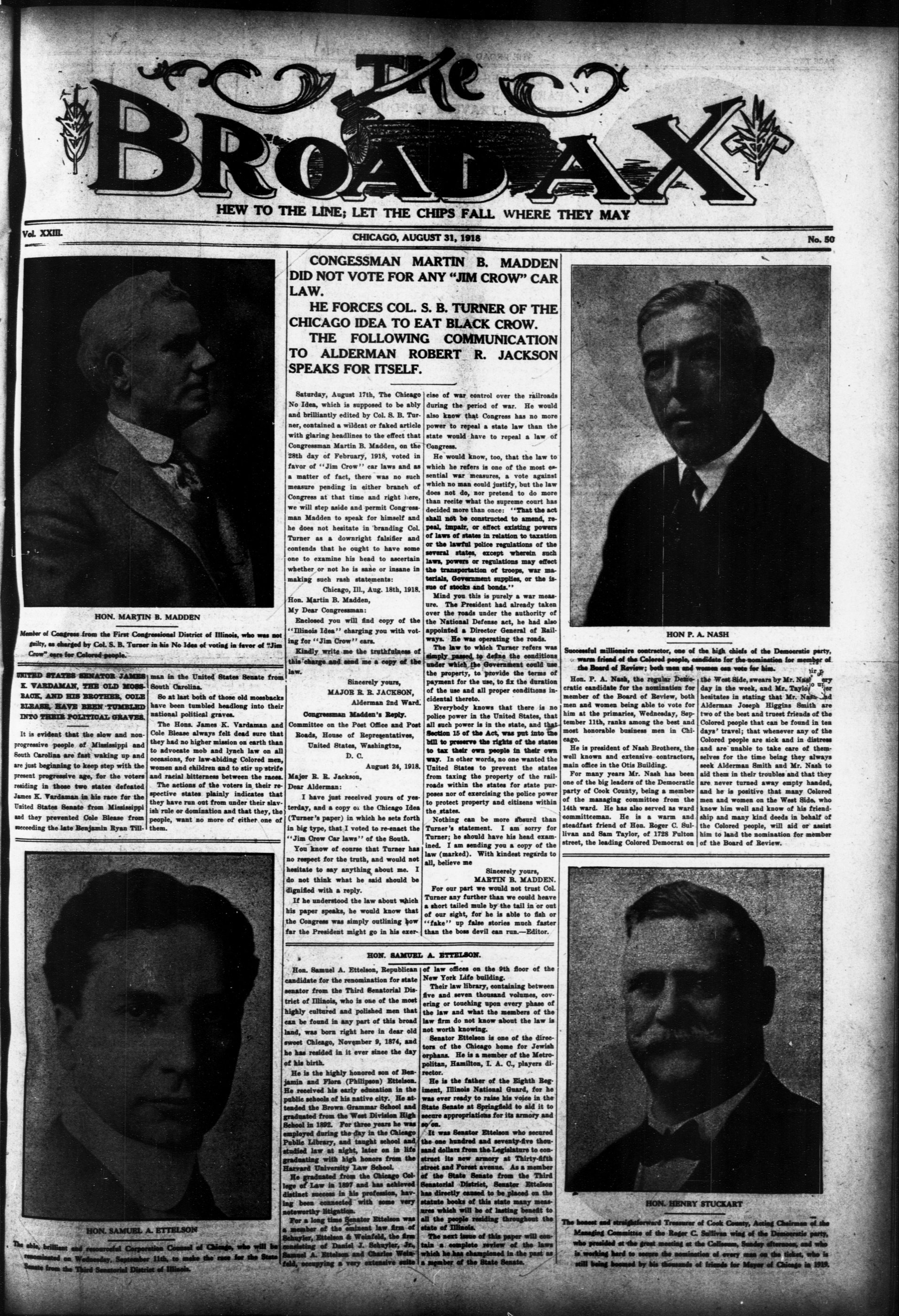
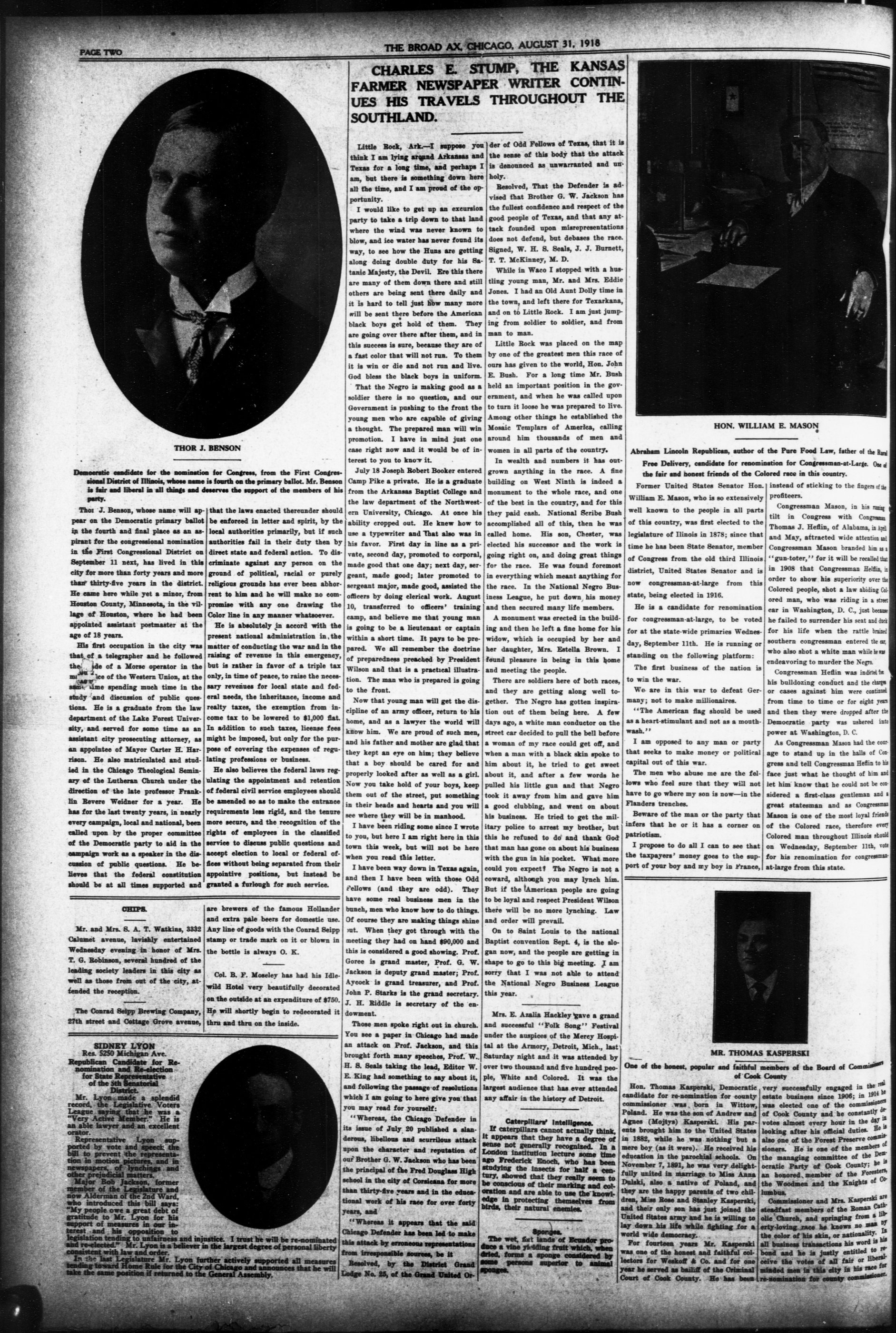
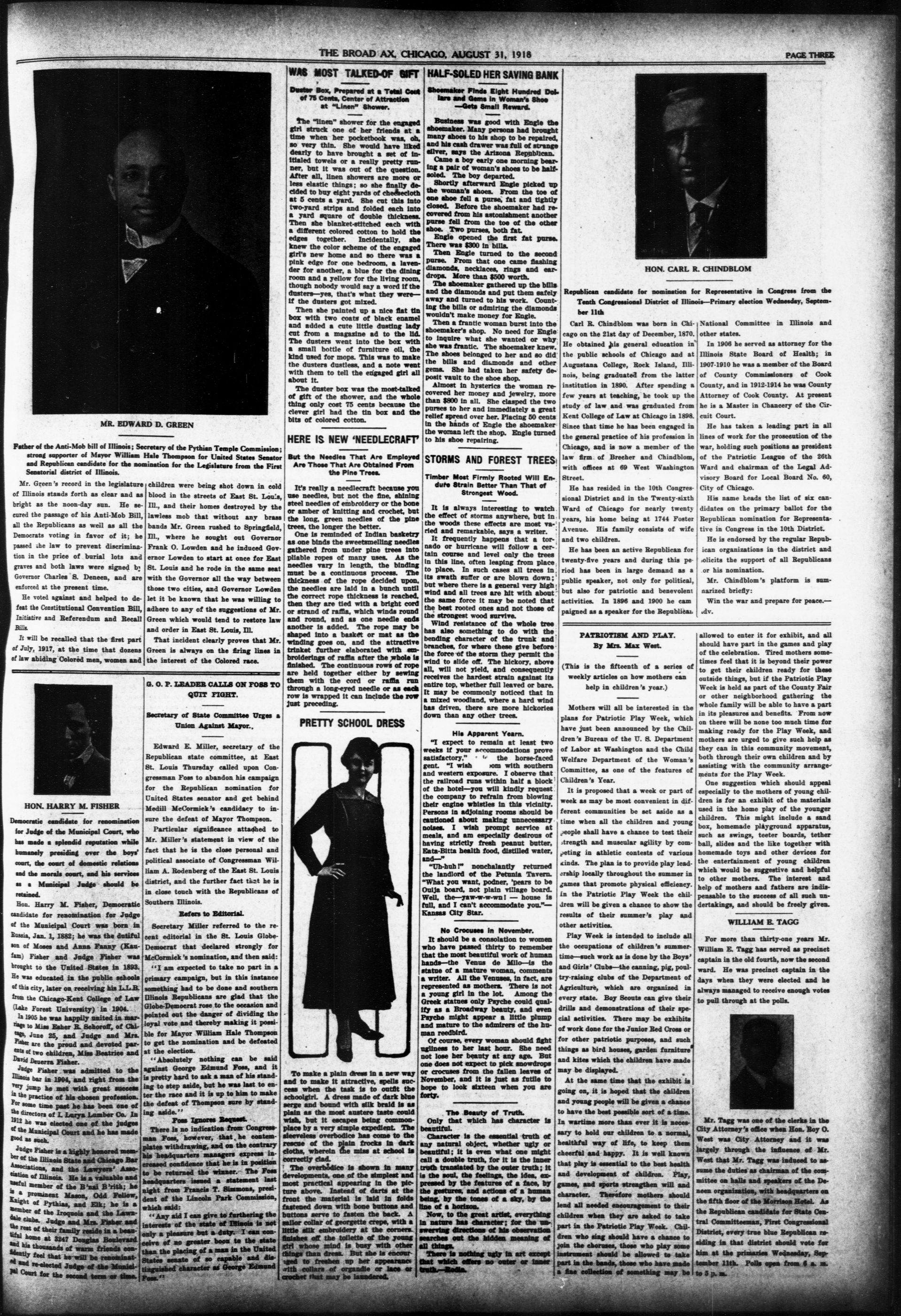
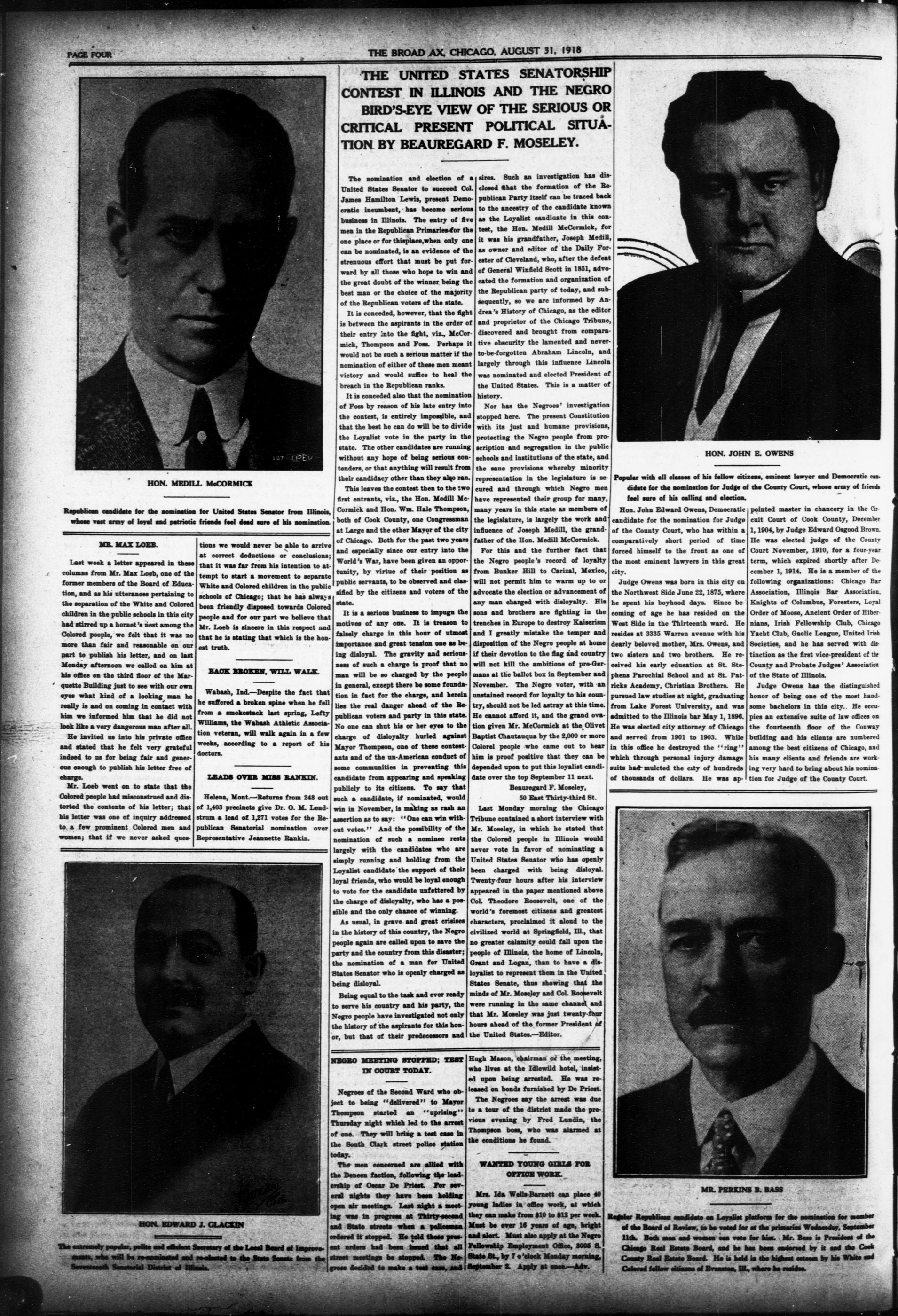
Page text (machine-generated)
[Name not visible in the image]
HON. MARTIN B. MADDEN
Member of Congress from the First Conqu
guilty, as charged by Col. S. B. Turne
Crow" care for Colored people.
UNITED STATES SENATOR JAMES K. VARDAMAN, THE OLD MOSS-BACK, AND HIS BROTHER, COLE BLEARE, HAVE BEEN TUMBLED INTO THEIR POLITICAL GRAVES.
It is evident that the slow and non-progressive people of Mississippi and South Carolina are fast waking up and are just beginning to keep step with the present progressive age, for the voters residing in those two states defeated James K. Vardaman in his race for the United States Senate from Mississippi and they prevented Cole Blease from succeeding the late Benjamin Ryan Till.
man in the United States Senate from South Carolina.
So at last both of those old mossbacks have been tumbled headlong into their national political graves.
The Hons. James K. Vardaman and Cole Blease always felt dead sure that they had no higher mission on earth than to advocate mob and lynch law on all occasions, for law-abiding Colored men, women and children and to stir up strife and racial bitterness between the races.
The actions of the voters in their respective states plainly indicates that they have run out from under their slaveish rule or domination and that they, the people, want no more of either one of them.
M.
ressional District of Illinois, who was not in his No Idea of voting in favor of "Jim man in the United States Senate from South Carolina. So at last both of those old mossbacks have been tumbled headlong into their national political graves. The Hons. James K. Vardaman and Cole Blease always felt dead sure that they had no higher mission on earth than to advocate mob and lynch law on all occasions, for law-abiding Colored men, women and children and to stir up strife and racial bitterness between the races. The actions of the voters in their respective states plainly indicates that they have run out from under their slavish rule or domination and that they, the people, want no more of either one of them.
CONGESSMAN MARTIN B. MADDEN DID NOT VOTE FOR ANY "JIM CROW" CAR LAW. HE FORCES COL. S. B. TURNER OF THE CHICAGO IDEA TO EAT BLACK CROW.
Saturday, August 17th, The Chicago No Idea, which is supposed to be ably and brilliantly edited by Col. S. B. Turner, contained a wildcat or faked article with glaring headlines to the effect that Congressman Martin B. Madden, on the 28th day of February, 1918, voted in favor of "Jim Crow" car laws and as a matter of fact, there was no such measure pending in either branch of Congress at that time and right here, we will step aside and permit Congressman Madden to speak for himself and he does not hesitate in branding Col. Turner as a downright falsifier and contends that he ought to have some one to examine his head to ascertain whether or not he is sane or insane in making such rash statements:
Chicago, Ill., Aug. 18th, 1918. Hon. Martin B. Madden. My Dear Congressman:
Enclosed you will find copy of the "Illinois Idea" charging you with voting for "Jim Crow" cars.
Kindly write me the truthfulness of this charge and send me a copy of the law.
Sincerely yours,
MAJOR R. R. JACKSON,
Alderman 2nd Ward.
Congressman Madden's Reply.
Committee on the Post Office and Post Roads, House of Representatives,
August 24, 1918.
Major R. R. Jackson,
Dear Alderman:
I have just received yours of yesterday, and a copy of the Chicago Idea (Turner's paper) in which he sets forth in big type, that I voted to re-enact the "Jim Crow Car laws" of the South.
You know of course that Turner has no respect for the truth, and would not hesitate to say anything about me. I do not think what he said should be dignified with a reply.
If he understood the law about which his paper speaks, he would know that the Congress was simply outlining how far the President might go in his exer-
HON. SAMUEL A. ETTELSON.
Hon. Samuel A. Ettelson, Republican candidate for the renomination for state senator from the Third Senatorial District of Illinois, who is one of the most highly cultured and polished men that can be found in any part of this broad land, was born right here in dear old sweet Chicago, November 9, 1874, and he has resided in it ever since the day of his birth.
He is the highly honored son of Benjamin and Flora (Phillipson) Ettelson. He received his early education in the public schools of his native city. He attended the Brown Grammar School and graduated from the West Division High School in 1892. For three years he was employed during the day in the Chicago Public Library, and taught school and studied law at night, later on in life graduating with high honors from the Harvard University Law School.
He graduated from the Chicago College of Law in 1897 and has achieved distinct success in his profession, having been connected with some very noteworthy litigation.
For a long time Senator Ettelson was a member of the eminent law firm of Schuyler, Ettelson & Weinfeld, the firm consisting of Daniel J. Schuyler, Jr., Samuel A. Ettelson and Charles Weinfeld, occupying a very extensive suite
cise of war control over the railroads during the period of war. He would also know that Congress has no more power to repeal a state law than the state would have to repeal a law of Congress.
He would know, too, that the law to which he refers is one of the most essential war measures, a vote against which no man could justify, but the law does not do, nor pretend to do more than recite what the supreme court has decided more than once: "That the act shall not be constructed to amend, repeal, impair, or effect existing powers of laws of states in relation to taxation or the lawful police regulations of the several states, except wherein such laws, powers or regulations may effect the transportation of troops, war materials, Government supplies, or the issue of stocks and bonds."
Mind you this is purely a war measure. The President had already taken over the roads under the authority of the National Defense act, he had also appointed a Director General of Railways. He was operating the roads.
The law to which Turner refers was simply passed to define the conditions under which the Government could use the property, to provide the terms of payment for the use, to fix the duration of the use and all proper conditions incidental thereto.
Everybody knows that there is no police power in the United States, that all such power is in the state, and that Section 15 of the Act, was put into the bill to preserve the rights of the states to tax their own people in their own way. In other words, no one wanted the United States to prevent the states from taxing the property of the railroads within the states for state purposes nor of exercising the police power to protect property and citizens within the states.
Nothing can be more absurd than Turner's statement. I am sorry for Turner; he should have his head examined. I am sending you a copy of the law (marked). With kindest regards to all, believe me
For our part we would not trust Col.
Turner any further than we could heave
a short tailed mule by the tail in or out
of our sight, for he is able to fish or
"fake" up false stories much faster
than the boss evil can run--Editor.
of law offices on the 9th floor of the New York Life building. Their law library, containing between five and seven thousand volumes, covering or touching upon every phase of the law and what the members of the law firm do not know about the law is not worth knowing. Senator Ettelson is one of the directors of the Chicago home for Jewish orphans. He is a member of the Metropolitan, Hamilton, I. A. C., players director. He is the father of the Eighth Regiment, Illinois National Guard, for he was ever ready to raise his voice in the State Senate at Springfield to aid it to secure appropriations for its armory and so on. It was Senator Ettelson who secured the one hundred and seventy-five thousand dollars from the Legislature to construct its new armory at Thirty-fifth street and Forest avenue. As a member of the State Senate from the Third Senatorial District, Senator Ettelson has directly caused to be placed on the statute books of this state many measures which will be of lasting benefit to all the people residing throughout the state of Illinois.
The next issue of this paper will contain a complete review of the laws which he has championed in the past as a member of the State Senate.
M.
Successful millionaire contractor, one of the high chiefs of the Democratic party, warm friend of the Colored people, candidate for the nomination for member of the Board of Review; both men and women can vote for him.
Hon. P. A. Nash, the regular Democratic candidate for the nomination for member of the Board of Review, both men and women being able to vote for him at the primaries, Wednesday, September 11th, ranks among the best and most honorable business men in Chicago.
He is president of Nash Brothers, the well known and extensive contractors, main office in the Otis Building.
For many years Mr. Nash has been one of the big leaders of the Democratic party of Cook County, being a member of the managing committee from the 14th ward. He has also served as ward committeeman. He is a warm and steadfast friend of Hon. Roger C. Sullivan and Sam Taylor, of 1728 Fulton street, the leading Colored Democrat on the West Side, swears by Mr. Nash every day in the week, and Mr. Taylor hesitates in stating that Mr. Nash and Alderman Joseph Higgins Smith are two of the best and truest friends of the Colored people that can be found in ten days' travel; that whenever any of the Colored people are sick and in distress and are unable to take care of themselves for the time being they always seek Alderman Smith and Mr. Nash to aid them in their troubles and that they are never turned away empty handed, and he is positive that many Colored men and women on the West Side, who know him well and know of his friendship and many kind deeds in behalf of the Colored people, will aid or assist him to land the nomination for member of the Board of Review.
[Image of a man with a mustache and a bow tie].
1910
HON. HENRY STUCKART
The honest and straightforward Treasurer of Cook County Managing Committee of the Roger C. Sullivan wing who presided at the great meeting at the Coliseum, he is working hard to secure the nomination of every still being boomed by his thousands of friends for
Eward Treasurer of Cook County of the Roger C. Sullivan wing event meeting at the Coliseum, he secure the nomination of every for his thousands of friends for
The honest and straightforward Treasurer of Cook County, Acting Chairman of the Managing Committee of the Roger C. Sullivan wing of the Democratic party, who presided at the great meeting at the Coliseum, Sunday afternoon, and who is working hard to secure the nomination of every man on the ticket, who is still being boomed by his thousands of friends for Mayor of Chicago in 1919.
the West Side, swears by Mr. Nasl. every day in the week, and Mr. Taylor $ ^{10} $ her hesitates in stating that Mr. Nash, and Alderman Joseph Higgins Smith are two of the best and truest friends of the Colored people that can be found in ten days' travel; that whenever any of the Colored people are sick and in distress and are unable to take care of themselves for the time being they always seek Alderman Smith and Mr. Nash to aid them in their troubles and that they are never turned away empty handed, and he is positive that many Colored men and women on the West Side, who know him well and know of his friendship and many kind deeds in behalf of the Colored people, will aid or assist him to land the nomination for member of the Board of Review.
[Image of a man in a suit with a tie].
of Cook County, Acting Chairman of the Sullivan wing of the Democratic party, the Collecum, Sunday afternoon, and who motion of every man on the ticket, who is of friends for Mayor of Chicago in 1919.
Democratic candidate for the nomination
sional District of Illinois, whose name
is fair and liberal in all things and
party.
THOR J. BENSON
THOR J. BENSON
Democratic candidate for the nomination for Congress, from the First Congressional District of Illinois, whose name is fourth on the primary ballot. Mr. Benson is fair and liberal in all things and deserves the support of the members of his party.
Thor J. Benson, whose name will appear on the Democratic primary ballot in the fourth and final place as an aspirant for the congressional nomination in the First Congressional District on September 11 next, has lived in this city for more than forty years and more than thirty-five years in the district. He came here while yet a minor, from Houston County, Minnesota, in the village of Houston, where he had been appointed assistant postmaster at the age of 18 years.
that the laws enacted thereunder should be enforced in letter and spirit, by the local authorities primarily, but if such authorities fail in their duty then by direct state and federal action. To discriminate against any person on the ground of political, racial or purely religious grounds has ever been abhorrent to him and he will make no compromise with any one drawing the Color line in any manner whatsoever.
He is absolutely in accord with the present national administration in the
His first occupation in the city was that of a telegrapher and he followed the side of a Morse operator in the service of the Western Union, at the same time spending much time in the study and discussion of public questions. He is a graduate from the law department of the Lake Forest University, and served for some time as an assistant city prosecuting attorney, as an appointee of Mayor Carter H. Harrison. He also matriculated and studied in the Chicago Theological Seminary of the Lutheran Church under the direction of the late professor Franklin Bevere Weidner for a year. He has for the last twenty years, in nearly every campaign, local and national, been called upon by the proper committee of the Democratic party to aid in the campaign work as a speaker in the discussion of public questions. He believes that the federal constitution should be at all times supported and
Mr. and Mrs. S. A. T. Watkins, 3332 Calumet avenue, lavishly entertained Wednesday evening in honor of Mrs. T. G. Robinson, several hundred of the leading society leaders in this city as well as those from out of the city, attended the reception.
The Conrad Seipp Brewing Company, 27th street and Cottage Grove avenue,
SIDNEY LYON
Res. 5250 Michigan Ave.
Republican Candidate for Renomination and Re-election
for State Representative
of the 5th Senatorial District.
registration seeking to unfairness and impaired be selected." Mr. Lyon is a believer in consistent with law and order. In the last Legislature Mr. Lyon furlong toward Home Rule for the City take the same position if returned to the
PAGE TWO
CHIPS
Mr. Lyon made a splendid record, the Legislative Voters League saying that he was a "Very Active Member." He is an able lawyer and an excellent orator.
Representative Lyon supported by vote and speech, the bill to prevent the representation in motion pictures, and in newspapers, of lynchings and other prejudicial matters.
Major Bob Jackson, former member of the Legislature and now Alderman of the 2nd Ward, who introduced this bill says: "My people owe a great debt of gratitude to Mr. Lyon for his support of measures in our interest, and his opposition to legislation."
9
that the laws enacted thereunder should be enforced in letter and spirit, by the local authorities primarily, but if such authorities fail in their duty then by direct state and federal action. To discriminate against any person on the ground of political, racial or purely religious grounds has ever been abhorrent to him and he will make no compromise with any one drawing the Color line in any manner whatsoever.
He is absolutely in accord with the present national administration in the matter of conducting the war and in the raising of revenue in this emergency, but is rather in favor of a triple tax only, in time of peace, to raise the necessary revenues for local state and federal needs, the inheritance, income and realty taxes, the exemption from income tax to be lowered to $1,000 flat. In addition to such taxes, license fees might be imposed, but only for the purpose of covering the expenses of regulating professions or business.
He also believes the federal laws regulating the appointment and retention of federal civil service employees should be amended so as to make the entrance requirements less rigid, and the tenure more secure, and the recognition of the rights of employees in the classified service to discuss public questions and accept election to local or federal offices without being separated from their appointive positions, but instead be granted a furlough for such service.
are brewers of the famous Hollander
and extra pale beers for domestic use.
Any line of goods with the Conrad Seipp
stamp or trade mark on it or blown in
the bottle is always O. K.
Col. B. F. Moseley has had his Idle-
wild Hotel very beautifully decorated
on the outside at an expenditure of $750.
He will shortly begin to redecorated it
thru and thru on the inside.
[Picture of a man with a mustache and a suit].
THE BROAD AX, CHICAGO, AUGUST 31, 1918
CHARLES E. STUMP, THE KANSAS FARMER NEWSPAPER WRITER CONTINUES HIS TRAVELS THROUGHOUT THE SOUTHLAND.
Little Rock, Ark.-I suppose you think I am lying around Arkansas and Texas for a long time, and perhaps I am, but there is something down here all the time, and I am proud of the opportunity.
I would like to get up an excursion party to take a trip down to that land where the wind was never known to blow, and ice water has never found its way, to see how the Huns are getting along doing double duty for his Satanic Majesty, the Devil. Ere this there are many of them down there and still others are being sent there daily and it is hard to tell just how many more will be sent there before the American black boys get hold of them. They are going over there after them, and in this success is sure, because they are of a fast color that will not run. To them it is win or die and not run and live. God bless the black boys in uniform. That the Negro is making good as a soldier there is no question, and our Government is pushing to the front the young men who are capable of giving a thought. The prepared man will win promotion. I have in mind just one case right now and it would be of interest to you to know it.
July 18 Joseph Robert Booker entered Camp Pike a private. He is a graduate from the Arkansas Baptist College and the law department of the Northwestern University, Chicago. At once his ability cropped out. He knew how to use a typewriter and that also was in his favor. First day in line as a private, second day, promoted to corporal, made good that one day; next day, sergeant, made good; later promoted to sergeant major, made good, assisted the officers by doing clerical work. August 10, transferred to officers' training camp, and believe me that young man is going to be a lieutenant or captain within a short time. It pays to be prepared. We all remember the doctrine of preparedness preached by President Wilson and that is a practical illustration. The man who is prepared is going to the front.
Now that young man will get the discipline of an army officer, return to his home, and as a lawyer the world will know him. We are proud of such men, and his father and mother are glad that they kept an eye on him; they believe that a boy should be cared for and properly looked after as well as a girl. Now you take hold of your boys, keep them out of the street, put something in their heads and hearts and you will see where they will be in manhood.
I have been riding some since I wrote to you, but here I am right here in this town this week, but will not be here when you read this letter.
I have been way down in Texas again, and then I have been with those Odd Fellows (and they are odd). They have some real business men in the bunch, men who know how to do things. Of course they are making things shine out. When they got through with the meeting they had on hand $90,000 and this is considered a good showing. Prof. Goree is grand master, Prof. G. W. Jackson is deputy grand master; Prof. Aycock is grand treasurer, and Prof. John P. Starks is the grand secretary. J. H. Riddle is secretary of the endowment.
Those men spoke right out in church. You see a paper in Chicago had made an attack on Prof. Jackson, and this brought forth many speeches, Prof. W. H. S. Seals taking the lead, Editor W. E. King had something to say about it, and following the passage of resolutions which I am going to here give you that you may read for yourself:
"Whereas, the Chicago Defender in its issue of July 20 published a slanderous, libellous and scurrilous attack upon the character and reputation of our Brother G. W. Jackson who has been the principal of the Fred Douglass High school in the city of Corsicana for more than thirty-five years and in the educational work of his race for over forty years, and
der of Odd Fellows of Texas, that it is the sense of this body that the attack is denounced as unwarranted and unholy. Resolved, That the Defender is advised that Brother G. W. Jackson has the fullest confidence and respect of the good people of Texas, and that any attack founded upon misrepresentations does not defend, but debases the race. Signed, W. H. S. Seals, J. J. Burnett, T. T. McKinney, M. D.
While in Waco I stopped with a hustling young man, Mr. and Mrs. Eddie Jones. I had an Old Aunt Dolly time in the town, and left there for Texarkana, and on to Little Rock. I am just jumping from soldier to soldier, and from man to man.
Little Rock was placed on the map by one of the greatest men this race of ours has given to the world, Hon. John E. Bush. For a long time Mr. Bush held an important position in the government, and when he was called upon to turn it loose he was prepared to live. Among other things he established the Mosaic Templars of America, calling around him thousands of men and women in all parts of the country.
In wealth and numbers it has outgrown anything in the race. A fine building on West Ninth is indeed a monument to the whole race, and one of the best in the country, and for this they paid cash. National Scribe Bush accomplished all of this, then he was called home. His son, Chester, was elected his successor and the work is going right on, and doing great things for the race. He was found foremost in everything which meant anything for the race. In the National Negro Business League, he put down his money and then secured many life members.
A monument was erected in the building and then he left a fine home for his widow, which is occupied by her and her daughter, Mrs. Estella Brown. I found pleasure in being in this home and meeting the people.
There are soldiers here of both races, and they are getting along well together. The Negro has gotten inspiration out of them being here. A few days ago, a white man conductor on the street car decided to pull the bell before a woman of my race could get off, and when a man with a black skin spoke to him about it, he tried to get sweet about it, and after a few words he pulled his little gun and that Negro took it away from him and gave him a good clubbing, and went on about his business. He tried to get the military police to arrest my brother, but this he refused to do and thank God that man has gone on about his business with the gun in his pocket. What more could you expect? The Negro is not a coward, although you may lynch him. But if the American people are going to be loyal and respect President Wilson there will be no more lynching. Law and order will prevail.
On to Saint Louis to the national Baptist convention Sept. 4, is the slogan now, and the people are getting in shape to go to this big meeting. I am sorry that I was not able to attend the National Negro Business League this year.
Mrs. E. Azalia Hackley gave a grand and successful "Folk Song" Festival under the auspices of the Mercy Hospital at the Armory, Detroit, Mich., last Saturday night and it was attended by over two thousand and five hundred people, White and Colored. It was the largest audience that has ever attended any affair in the history of Detroit.
Caterpillars' Intelligence. If caterpillars cannot actually think, it appears that they have a degree of sense not generally recognized. In a London institution lecture some time ago Frederick Enoch, who has been studying the insects for half a century, showed that they really seem to be conscious of their marking and coloration and are able to use the knowledge in protecting themselves from birds, their natural enemies.
Spongee.
The wet, flat lands of Ecuador produce a vine yielding fruit which, when dried, forms a sponge considered by some persons superior to animal spongee.
10
HON. WILLIAM E. MASON
Abraham Lincoln Republican, author of Free Delivery, candidate for renominate the fair and honest friends of the Co
He is a candidate for renomination for congressman-at-large, to be voted for at the state-wide primaries Wednesday, September 11th. He is running or standing on the following platform:
The first business of the nation is to win the war.
We are in this war to defeat Germany; not to make millionaires.
"The American flag should be used as a heart-stimulant and not as a mouthwash."
I am opposed to any man or party that seeks to make money or political capital out of this war.
The men who abuse me are the fellows who feel sure that they will not have to go where my son is now—in the Flanders trenches.
Beware of the man or the party that infers that he or it has a corner on patriotism.
I propose to do all I can to see that the taxpayers' money goes to the support of your boy and my boy in France,
MR. THOMAS KASPERSKI
One of the honest, popular and faithful m
of Cook
Hon. Thomas Kasperski, Democratic candidate for re-nomination for county commissioner was born in Wittow, Poland. He was the son of Andrew and Agnes (Mojtys) Kasperski. His parents brought him to the United States in 1882, while he was nothing but a mere boy (as it were). He received his education in the parochial schools. On November 7, 1891, he was very delightfully united in marriage to Miss Anna Dulski, also a native of Poland, and they are the happy parents of two children, Miss Rose and Stanley Kasperski, and their only son has just joined the United States army and he is willing to lay down his life while fighting for a world wide democracy.
For fourteen years Mr. Kesperski a was one of the honest and faithful collectors for Weskoff & Co. and for one year he served as bailiff of the Criminal Court of Cook County. He has been
instead of sticking to the fingers of the profiteers.
Congressman Mason, in his running tilt in Congress with Congressman Thomas J. Heflin, of Alabama, in April and May, attracted wide attention and Congressman Mason branded him as "gun-toter," for it will be recalled that in 1908 that Congressman Helflin, in order to show his superiority over the Colored people, shot a law abiding Colored man, who was riding in a street car in Washington, D. C., just because he failed to surrender his seat and duck for his life when the rattle brained southern congressman entered the car, who also shot a white man while he was endeavoring to murder the Negro.
Congressman Hedin was indicted for his bulldozing conduct and the charges or cases against him were continued from time to time or for eight years and then they were dropped after the Democratic party was ushered into power at Washington, D. C.
As Congressman Mason had the courage to stand up in the halls of Congress and tell Congressman Heflin to his face just what he thought of him and let him know that he could not be considered a first-class gentleman and a great statesman and as Congressman Mason is one of the most loyal friends of the Colored race, therefore every Colored man throughout Illinois should on Wednesday, September 11th, vote for his renomination for congressman at-large from this state.
very successfully engaged in the real estate business since 1906; in 1914 he was elected one of the commissioners of Cook County and he constantly devotes almost every hour in the day in looking after his official duties. He is also one of the Forest Preserve commissioners. He is one of the members of the managing committee of the Democratic Party of Cook County; he is an honored member of the Foresters, the Woodmen and the Knights of Columbus.
Commissioner and Mrs. Kasperski are steadfast members of the Roman Catholic Church, and springing from a liberty-loving race he knows no man by the color of his skin, or nationality. In all business transactions his word is his bond and he is justly entitled to receive the votes of all fair or liberal-minded men in this city in his race for a nomination for county commissioner.
[Name]
MR. EDWARD D. GREEN
Father of the Anti-Mob bill of Illinois; Secretary of the Pythian Temple Commission; strong supporter of Mayor William Hale Thompson for United States Senator and Republican candidate for the nomination for the Legislature from the First Senatorial district of Illinois.
Mr. Green's record in the legislature of Illinois stands forth as clear and as bright as the noon-day sun. He secured the passage of his Anti-Mob Bill, all the Republicans as well as all the Democrats voting in favor of it; he passed the law to prevent discrimination in the price of burial lots and graves and both laws were signed by Governor Charles S. Deneen, and are enforced at the present time.
He voted against and helped to defeat the Constitutional Convention Bill, Initiative and Referendum and Recall Bills.
children were being shot down in cold blood in the streets of East St. Louis, Ill., and their homes destroyed by the lawless mob that without any brass bands Mr. Green rushed to Springfield, Ill., where he sought out Governor Frank O. Lowden and he induced Governor Lowden to start at once for East St. Louis and he rode in the same seat with the Governor all the way between those two cities, and Governor Lowden let it be known that he was willing to adhere to any of the suggestions of Mr. Green which would tend to restore law and order in East St. Louis Ill.
It will be recalled that the first part of July, 1917, at the time that dozens of law abiding Colored men, women and
HON. HARRY M. FISHER Democratic candidate for renomination for Judge of the Municipal Court, who has made a splendid reputation while humanely presiding over the boys' court, the court of domestic relations and the morals court, and his services as a Municipal Judge should be retained.
Hon. Harry M. Fisher, Democratic candidate for renomination for Judge of the Municipal Court was born in Russia, Jan. 1, 1882; he was the dutiful son of Moses and Anna Fanny (Kaufam) Fisher and Judge Fisher was brought to the United States in 1893. He was educated in the public schools of this city, later on receiving his L.L.B. from the Chicago-Kent College of Law (Lake Forest University) in 1904. In 1805 he was happily united in marriage to Miss Esher R. Sehoroff, of Chicago, June 25, and Judge and Mrs. Fisher are the proud and devoted parents of two children, Miss Beatrice and David Denauer Fisher.
Judge Fisher was admitted to the Illinois bar in 1904, and right from the very jump he met with great success in the practice of his chosen profession. For some time past he has been one of the directors of L Laryn Lumber Co. In 1912 he was elected one of the judges of the Municipal Court and he has made good as such.
Judge Fisher is a highly honored member of the Illinois State and Chicago Bar Associations, and the Lawyers' Association of Illinois. He is a valuable and useful member of the B'nal B'rith; he is a prominent Mason, Odd Fellow, Knight of Pythias, and Elk; he is a member of the Iroquois and the Lawndale clubs. Judge and Mrs. Fisher and the rest of their family reside in a beautiful home at 3247 Douglas Boulevard and his thousands of warm friends confidently feel that he will be reconstituted and re-elected Judge of the Municipal Court for the second term or time.
PETER H. BURKE
children were being shot down in cold blood in the streets of East St. Louis, Ill., and their homes destroyed by the lawless mob that without any brass bands Mr. Green rushed to Springfield, Ill., where he sought out Governor Frank O. Lowden and he induced Governor Lowden to start at once for East St. Louis and he rode in the same seat with the Governor all the way between those two cities, and Governor Lowden let it be known that he was willing to adhere to any of the suggestions of Mr. Green which would tend to restore law and order in East St. Louis, Ill.
That incident clearly proves that Mr. Green is always on the firing lines in the interest of the Colored race.
G. O. P. LEADER CALLS ON FOSS TO QUIT FIGHT.
Secretary of State Committee Urges a Union Against Mayor.
Edward E. Miller, secretary of the Republican state committee, at East St. Louis Thursday called upon Congressman Foss to abandon his campaign for the Republican nomination for United States senator and get behind Medill McCormick's candidacy to insure the defeat of Mayor Thompson. Particular significance attached to Mr. Miller's statement in view of the fact that he is the close personal and political associate of Congressman William A. Rodenberg of the East St. Louis district, and the further fact that he is in close touch with the Republicans of Southern Illinois.
Refers to Editorial
Secretary Miller referred to the recent editorial in the St. Louis Globe-Democrat that declared strongly for McCormick's nomination, and then said: "I am expected to take no part in a primary campaign, but in this instance something had to be done and southern Illinois Republicans are glad that the Globe-Democrat rose to the occasion and pointed out the danger of dividing the loyal vote and thereby making it possible for Mayor William Hale Thompson to get the nomination and be defeated at the election.
"Absolutely nothing can be said against George Edmund Foss, and it is pretty hard to ask a man of his standing to step aside, but he was last to enter the race and it is up to him to make the defeat of Thompson sure by standing aside."
Foss Ignores Request.
There is no indication from Congressman Foss, however, that he contemplates withdrawing, and on the contrary his headquarters managers express increased confidence that he is in position to be returned the winner. The Foss headquarters issued a statement last night from Francis T. Simmons, president of the Lincoln Park Commission, which said:
"Any aid I can give to furthering the interests of the state of Illinois is not only a pleasure but a duty. I can conceive of no greater boon to the state than the placing of a man in the United States senate of so capable and distinguished character as George Edmund Foss."
THE BROAD AX. CHICAGO. AUGUST 31, 1918
Duster Box, Prepared at a Total Cost of 75 Cents, Center of Attraction at "Linen" Shower.
The "linen" shower for the engaged girl struck one of her friends at a time when her pocketbook was, oh, so very thin. She would have liked dearly to have brought a set of initialed towels or a really pretty runner, but it was out of the question. After all, linen showers are more or less elastic things; so she finally decided to buy eight yards of cheesecloth at 5 cents a yard. She cut this into two-yard strips and folded each into a yard square of double thickness. Then she blanket-stitched each with a different colored cotton to hold the edges together. Incidentally, she knew the color scheme of the engaged girl's new home and so there was a pink edge for one bedroom, a lavender for another, a blue for the dining room and a yellow for the living room, though nobody would say a word if the dusters—yes, that's what they were—if the dusters got mixed.
Then she painted up a nice flat tin box with two coats of black enamel and added a cute little dusting lady cut from a magazine ad to the lid. The dusters went into the box with a small bottle of furniture oil, the kind used for mops. This was to make the dusters dustless, and a note went with them to tell the engaged girl all about it.
The duster box was the most-talked of gift of the shower, and the whole thing only cost 75 cents because the clever girl had the tin box and the blits of colored cotton.
HERE IS NEW 'NEEDLECRAFT'
But the Needles That Are Employed Are Those That Are Obtained From the Pine Trees.
It's really a needlecraft because you use needles, but not the fine, shining steel needles of embroidery or the bone or amber of knitting and crochet, but the long, green needles of the pine trees, the longer the better.
One is reminded of Indian basketry as one binds the sweetsmelling needles gathered from under pine trees into pliable ropes of many uses. As the needles vary in length, the binding must be a continuous process. The thickness of the rope decided upon the needles are laid in a bunch until the correct rope thickness is reached, then they are tied with a bright cord or strand of raffia, which winds round and round, and as one needle ends another is added. The rope may be shaped into a basket or mat as the winding goes on, and the attractive trinket further elaborated with embroiderings of raffia after the whole is finished. The continuous rows of rope are held together either by sewing them with the cord or raffia run through a long-eyed needle or as each row is wrapped it can include the row just preceding.
PRETTY SCHOOL DRESS
H
To make a plain dress in a new way and to make it attractive, spells success when the task is to outfit the schoolgirl. A dress made of dark blue serge and bound with silk braid is as plain as the most austere taste could wish, but it escapes being commonplace by a very simple expedient. The sleeveless overbodice has come to the rescue of the plain frocks in dark cloths, wherein the miss at school is correctly clad.
The overbodice is shown in many developments, one of the simplest and most practical appearing in the picture above. Instead of darts at the front the material is laid in folds fastened down with bone buttons and buttons serve to fasten the back. A sailor collar of georgette crepe, with a little silk embroidery at the corners, finishes off the toilette of the young girl whose mind is busy with other things than dress. But she is encouraged to freshen up her appearance with collars of organdle or lace or crochet that may be laundered.
HALF-SOLED HER SAVING BANK
Shoemaker Finds Eight Hundred Dollars and Gems in Woman's Shoe
—Gets Small Reward.
Business was good with Engle the shoemaker. Many persons had brought many shoes to his shop to be repaired, and his cash drawer was full of strange silver, says the Arizona Republican. Came a boy early one morning bearing a pair of woman's shoes to be half-soled. The boy departed. Shortly afterward Engle picked up the woman's shoes. From the toe of one shoe fell a purse, fat and tightly closed. Before the shoemaker had recovered from his astonishment another purse fell from the toe of the other shoe. Two purses, both fat. Engle opened the first fat purse. There was $300 in bills. Then Engle turned to the second purse. From that one came fashing diamonds, necklaces, rings and eardrops. More than $50 worth.
The shoemaker gathered up the bills and the diamonds and put them safely away and turned to his work. Counting the bills or admiring the diamonds wouldn't make money for Engle. Then a frantic woman burst into the shoemaker's shop. No need for Engle to inquire what she wanted or why she was frantic. The shoemaker knew. The shoes belonged to her and so did the bills and diamonds and other gems. She had taken her safety deposit vault to the shoe shop.
Almost in hysterics the woman recovered her money and jewelry, more than $500 in all. She clasped the two purses to her and immediately a great relief spread over her. Placing 50 cents in the hands of Engle the shoemaker the woman left the shop. Engle turned to his shoe repairing.
STORMS AND FOREST TREES
Timber Most Firmly Rooted Will Endure Strain Better Than That of Strongest Wood.
It is always interesting to watch the effect of storms anywhere, but in the woods these effects are most varied and remarkable, says a writer.
It frequently happens that a tornado or hurricane will follow a certain course and level only the trees in this line, often leaping from place to place. In such cases all trees in its swath suffer or are blown down; but where there is a general very high wind and all trees are hit with about the same force it may be noted that the best rooted ones and not those of the strongest wood survive.
Wind resistance of the whole tree has also something to do with the bending character of the trunk and branches, for where these give before the force of the storm they permit the wind to slide off. The hickory, above all, will not yield, and consequently receives the hardest strain against its entire top, whether full leaved or bare. It may be commonly noticed that in a mixed woodland, where a hard wind has driven, there are more hickories down than any other trees.
Hia Apparent Yearn.
"I expect to remain at least two weeks if your accommodations prove satisfactory," the horse-faced gent. "I wish som with southern and western exposure. I observe that the railroad runs within half a block of the hotel—you will kindly request the company to refrain from blowing their engine whistles in this vicinity. Persons in adjoining rooms should be cautioned about making unnecessary noises. I wish prompt service at meals, and am especially desirous of having strictly fresh peanut butter, Eata-Bitta health food, distilled water, and—"
"Uh-huh!" nonchalantly returned the landlord of the Petunia Tavern. "What you want, podner, 'pears to be Oulja board, not plain village board. Well, the—yaw-w-wn! — house is full, and I can't accommodate you."—Kansas City Star.
No Crocuses In November.
It should be a consolation to women who have passed thirty to remember that the most beautiful work of human hands—the Venus de Milo—is the statue of a mature woman, comments a writer. All the Venuses, in fact, are represented as mothers. There is not a young girl in the lot. Among the Greek statues only Payche could qualify as a Broadway beauty, and even Payche might appear a little plump and mature to the admirers of the human reedbird.
Of course, every woman should fight ugliness to her last hour. She need not lose her beauty at any age. But one does not expect to pick snowdrops or crocuses from the fallen leaves of November, and it is just as futile to hope to look sixteen when you are forty.
Only that which has character is beautiful.
Character is the essential truth of any natural object, whether ugly or beautiful; it is even what one might call a double truth, for it is the inner truth translated by the outer truth; it is the soul, the feelings, the idea, expressed by the features of a face, by the gestures, and actions of a human being, by the tones of a sky, by the line of a horizon.
Now, to the great artist, everything in nature has character; for the unswerving directions of his observation searches out the hidden meaning of all things.
There is nothing ugly in art except that which offers no outer or inner truth—Bede.
500 F. W.
HON. CARL R. CHINDBLOM
Republican candidate for nomination for Representative in Congress from the Tenth Congressional District of Illinois—Primary election Wednesday, September 11th
Carl R. Chindblom was born in Chicago on the 21st day of December, 1870. He obtained his general education in the public schools of Chicago and at Augustana College, Rock Island, Illinois, being graduated from the latter institution in 1890. After spending a few years at teaching, he took up the study of law and was graduated from Kent College of Law at Chicago in 1898. Since that time he has been engaged in the general practice of his profession in Chicago, and is now a member of the law firm of Brecher and Chindblom, with offices at 69 West Washington Street.
He has resided in the 10th Congressional District and in the Twenty-sixth Ward of Chicago for nearly twenty years, his home being at 1744 Foster Avenue. His family consists of wife and two children.
He has been an active Republican for twenty-five years and during this period has been in large demand as a public speaker, not only for political, but also for patriotic and benevolent activities. In 1896 and 1900 he campaigned as a speaker for the Republican.
PATRIOTISM AND PLAY. By Mrs. Max West.
(This is the fifteenth of a series of weekly articles on how mothers can help in children's year.)
Mothers will all be interested in the plans for Patriotic Play Week, which have just been announced by the Children's Bureau of the U. S. Department of Labor at Washington and the Child Welfare Department of the Woman's Committee, as one of the features of Children's Year.
It is proposed that a week or part of week as may be most convenient in different communities be set aside as a time when all the children and young people shall have a chance to test their strength and muscular agility by competing in athletic contests of various kinds. The plan is to provide play leadership locally throughout the summer in games that promote physical efficiency. In the Patriotic Play Week the children will be given a chance to show the results of their summer's play and other activities.
Play Week is intended to include all the occupations of children's summertime—such work as is done by the Boys' and Girls' Clubs—the canning, pig, poultry-raising clubs of the Department of Agriculture, which are organized in every state. Boy Scouts can give their drills and demonstrations of their special activities. There may be exhibits of work done for the Junior Red Cross or for other patriotic purposes, and such things as bird houses, garden furniture and kites which the children have made may be displayed.
At the same time that the exhibit is going on, it is hoped that the children and young people will be given a chance to have the best possible sort of a time. In wartime more than ever it is necessary to hold our children to a normal, healthful way of life, to keep them cheerful and happy. It is well known that play is essential to the best health and development of children. Play, games, and sports strengthen will and character. Therefore mothers should lend all needed encouragement to their children when they are asked to take part in the Patriotic Play Week. Children who sing should have a chance to join the choruses, those who play some instrument should be allowed to take part in the bands, those who have made a fine collection of something may be
National Committee in Illinois and other states.
In 1906 he served as attorney for the Illinois State Board of Health; in 1907-1910 he was a member of the Board of County Commissioners of Cook County, and in 1912-1914 he was County Attorney of Cook County. At present he is a Master in Chancery of the Circuit Court.
He has taken a leading part in all lines of work for the prosecution of the war, holding such positions as president of the Patriotic League of the 26th Ward and chairman of the Legal Advisory Board for Local Board No. 60, City of Chicago.
His name heads the list of six candidates on the primary ballot for the Republican nomination for Representative in Congress in the 10th District. He is endorsed by the regular Republican organizations in the district and solicits the support of all Republicans or his nomination. Mr. Chindblom's platform is summarized briefly: Win the war and prepare for peace.—dv.
allowed to enter it for exhibit, and all should have part in the games and play of the celebration. Tired mothers sometimes feel that it is beyond their power to get their children ready for these outside things, but if the Patriotic Play Week is held as part of the County Fair or other neighborhood gathering the whole family will be able to have a part in its pleasures and benefits. From now on there will be none too much time for making ready for the Play Week, and mothers are urged to give such help as they can in this community movement, both through their own children and by assisting with the community arrangements for the Play Week.
One suggestion which should appeal especially to the mothers of young children is for an exhibit of the materials used in the home play of the younger children. This might include a sand box, homemade playground apparatus, such as swings, teeter boards, tether ball, slides and the like together with homemade toys and other devices for the entertainment of young children which would be suggestive and helpful to other mothers. The interest and help of mothers and fathers are indispensable to the success of all such undertakings, and should be freely given.
WILLIAM B. TAGG
For more than thirty-one years Mr. William E. Tagg has served as precinct captain in the old fourth, now the second ward. He was precinct captain in the days when they were elected and he always managed to receive enough votes to pull through at the polls.
Mr. Tagg was one of the clerks in the City Attorney's office when Hon. Boy O. West was City Attorney and it was largely through the influence of Mr. West that Mr. Tagg was induced to assume the duties as chairman of the committee on halls and speakers of the Deneen organization, with headquarters on the fifth floor of the Morrison Hotel. As the Republican candidate for State Central Committeeman, First Congressional District, every true blue Republican residing in that district should vote for him at the primaries Wednesday, September 11th. Polls open from 6 a.m. to 5 p.m.
PAGE THREE
107 IPEU
HON. MEDILL McCORMICK
Republican candidate for the nomination whose vast army of loyal and patriotic
Republican candidate for the nomination for United States Senator from Illinois, whose vast army of loyal and patriotic friends feel dead sure of his nomination.
Last week a letter appeared in these columns from Mr. Max Logb, one of the former members of the Board of Education, and as his utterances pertaining to the separation of the White and Colored children in the public schools in this city had stirred up a hornet's nest among the Colored people, we felt that it was no more than fair and reasonable on our part to publish his letter, and on last Monday afternoon we called on him at his office on the third floor of the Marquette Building just to see with our own eyes what kind of a looking man he really is and on coming in contact with him we informed him that he did not look like a very dangerous man after all.
He invited us into his private office and stated that he felt very grateful indeed to us for being fair and generous enough to publish his letter free of charge.
Mr. Loeb went on to state that the Colored people had misconstrued and distorted the contents of his letter; that his letter was one of inquiry addressed to a few prominent Colored men and women; that if we never asked ques-
Hancock
Oak
MR. MAX LOEB
for United States Senator from Illinois, friends feel dead sure of his nomination.
tions we would never be able to arrive at correct deductions or conclusions; that it was far from his intention to attempt to start a movement to separate White and Colored children in the public schools of Chicago; that he has always been friendly disposed towards Colored people and for our part we believe that Mr. Loeb is sincere in this respect and that he is stating that which is the honest truth.
BACK BROKEN. WILL WALK
Wabash, Ind.—Despite the fact that he suffered a broken spine when he fell from a smokestack last spring, Lefty Williams, the Wabash Athletic Association veteran, will walk again in a few weeks, according to a report of his doctors.
LEADS OVER MISS RANKIN
Helena, Mont.—Returns from 248 out of 1,403 precincts give Dr. O. M. Lendstrum a lead of 1,271 votes for the Republican Senatorial nomination over Representative Jeannette Rankin.
THE BROAD AX, CHICAGO, AUGUST 31, 1918
THE UNITED STATES SENATORSHIP CONTEST IN ILLINOIS AND THE NEGRO BIRD'S-EYE VIEW OF THE SERIOUS OR CRITICAL PRESENT POLITICAL SITUATION BY BEAUREGARD F. MOSELEY.
The nomination and election of a United States Senator to succeed Col. James Hamilton Lewis, present Democratic incumbent, has become serious business in Illinois. The entry of five men in the Republican Primaries for the one place or for this place, when only one can be nominated, is an evidence of the strenuous effort that must be put forward by all those who hope to win and the great doubt of the winner being the best man or the choice of the majority of the Republican voters of the state.
It is conceded, however, that the fight is between the aspirants in the order of their entry into the fight, viz., McCormick, Thompson and Foss. Perhaps it would not be such a serious matter if the nomination of either of these men meant victory and would suffice to heal the breach in the Republican ranks.
It is conceded also that the nomination of Foss by reason of his late entry into the contest, is entirely impossible, and that the best he can do will be to divide the Loyalist vote in the party in the state. The other candidates are running without any hope of being serious contenders, or that anything will result from their candidacy other than they also ran.
This leaves the contest then to the two first entrants, viz., the Hon. Medill McCormick and Hon. Wm. Hale Thompson, both of Cook County, one Congressman at Large and the other Mayor of the city of Chicago. Both for the past two years and especially since our entry into the World's War, have been given an opportunity, by virtue of their position as public servants, to be observed and classified by the citizens and voters of the state.
It is a serious business to impugn the motives of any one. It is treason to falsely charge in this hour of utmost importance and great tension one as being disloyal. The gravity and seriousness of such a charge is proof that no man will be so charged by the people in general, except there be some foundation in fact for the charge, and herein lies the real danger ahead of the Republican voters and party in this state. No one can shut his or her eyes to the charge of disloyalty hurled against Mayor Thompson, one of these contestants and of the un-American conduct of some communities in preventing this candidate from appearing and speaking publicly to its citizens. To say that such a candidate, if nominated, would win in November, is making as rash an assertion as to say: "One can win without votes." And the possibility of the nomination of such a nominee rests largely with the candidates who are simply running and holding from the Loyalist candidate the support of their loyal friends, who would be loyal enough to vote for the candidate unfettered by the charge of disloyalty, who has a possible and the only chance of winning.
As usual, in grave and great crises in the history of this country, the Negro people again are called upon to save the party and the country from this disaster; the nomination of a man for United States Senator who is openly charged as being disloyal.
Being equal to the task and ever ready to serve his country and his party, the Negro people have investigated not only the history of the aspirants for this honor, but that of their predecessors and
NBGRO MEETING STOPPED; TEST
IN COURT TODAY.
Negroes of the Second Ward who object to being "delivered" to Mayor Thompson started an "uprising" Thursday night which led to the arrest of one. They will bring a test case in the South Clark street police station today.
The men concerned are allied with the Deneen faction, following the leadership of Oscar De Priest. For several nights they have been holding open air meetings. Last night a meeting was in progress at Thirty-second and State streets when a policeman ordered it stopped. He told those present orders had been issued that all street meetings be stopped. The Names decided to make a test case.
aires. Such an investigation has disclosed that the formation of the Republican Party itself can be traced back to the ancestry of the candidate known as the Loyalist candidate in this contest, the Hon. Medill McCormick, for it was his grandfather, Joseph Medill, as owner and editor of the Day Forester of Cleveland, who, after the defeat of General Winfield Scott in 1851, advocated the formation and organization of the Republican party of today, and subsequently, so we are informed by Andrea's History of Chicago, as the editor and proprietor of the Chicago Tribune, discovered and brought from comparative obscurity the lamented and never-to-be-forgotten Abraham Lincoln, and largely through this influence Lincoln was nominated and elected President of the United States. This is a matter of history.
Nor has the Negroes' investigation stopped here. The present Constitution with its just and humane provisions, protecting the Negro people from proscription and segregation in the public schools and institutions of the state, and the sane provisions whereby minority representation in the legislature is secured and through which Negro men have represented their group for many, many years in this state as members of the legislature, is largely the work and influence of Joseph Medill, the grandfather of the Hon. Medill McCormick.
For this and the further fact that the Negro people's record of loyalty from Bunker Hill to Carizal, Mexico, will not permit him to warm up to or advocate the election or advancement of any man charged with disloyalty. His sons and brothers are fighting in the trenches in Europe to destroy Kaiserism and I greatly mistake the temper and disposition of the Negro people at home if their devotion to the flag and country will not kill the ambitions of pro-Germans at the ballot box in September and November. The Negro voter, with an unstained record for loyalty to his country, should not be led astray at this time. He cannot afford it, and the grand ovation given Mr. McCormick at the Olivet Baptist Chautauqua by the 2,000 or more Colorel people who came out to hear him is proof positive that they can be depended upon to put this loyalist candidate over the top September 11 next.
Last Monday morning the Chicago Tribune contained a short interview with Mr. Moseley, in which he stated that the Colored people in Illinois would never vote in favor of nominating a United States Senator who has openly been charged with being dialloyal. Twenty-four hours after his interview appeared in the paper mentioned above Col. Theodore Roosevelt, one of the world's foremost citizens and greatest characters, proclaimed it aloud to the civilized world at Springfield, Ill., that no greater calamity could fall upon the people of Illinois, the home of Lincoln, Grant and Logan, than to have a disloyalist to represent them in the United States Senate, thus showing that the minds of Mr. Moseley and Col. Roosevelt were running in the same channel and that Mr. Moseley was just twenty-four hours ahead of the former President of the United States.—Editor.
Hugh Mason, chairman of the meeting, who lives at the Idlewild hotel, insisted upon being arrested. He was released on bonds furnished by De Priest. The Negroes say the arrest was due to a tour of the district made the previous evening by Fred Lundin, the Thompson boss, who was alarmed at the conditions he found.
WANTED YOUNG GIRLS FOR OPTION WORK.
Mrs. Ida Wells-Barnett can place 40 young ladies in office work, at which they can make from $10 to $12 per week. Must be over 16 years of age, bright and alert. Must also apply at the Negro Fellowship Employment Office, 3005 S. State St., by 7 o'clock Monday morning, September 2. Apply at once—Adv.
M.
HON. JOHN E. OWENS
Popular with all classes of his fellow city didate for the nomination for Judge of feel sure of his calling and election.
his fellow citizens, eminent
convention for Judge of the County C
ing and election.
Popular with all classes of his fellow citizens, eminent lawyer and Democratic candidate for the nomination for Judge of the County Court, whose army of friends feel sure of his calling and election.
Hon. John Edward Owens, Democratic candidate for the nomination for Judge of the County Court, who has within a comparatively short period of time forced himself to the front as one of the most eminent lawyers in this great city.
pointed master in chancery in the Circuit Court of Cook County, December 1, 1904, by Judge Edward Osgood Brown. He was elected judge of the County Court November, 1910, for a four-year term, which expired shortly after December 1, 1914. He is a member of the
Judge Owens was born in this city on the Northwest Side June 22, 1875, where he spent his boyhood days. Since becoming of age he has resided on the West Side in the Thirteenth ward. He resides at 3335 Warren avenue with his dearly beloved mother, Mrs. Owens, and two sisters and two brothers. He received his early education at St. Stephens Parochial School and at St. Patricks Academy, Christian Brothers. He pursued law studies at night, graduating from Lake Forest University, and was admitted to the Illinois bar May 1, 1896. He was elected city attorney of Chicago and served from 1901 to 1903. While in this office he destroyed the "ring" which through personal injury damage suits had mulleted the city of hundreds of thousands of dollars. He was ap-
M.
1910
M.
MR. PERKINS B. BASS
Regular Republican candidate on Loyalist platform for
of the Board of Review, to be voted for at the prin-
11th. Both men and women can vote for him.
Chicago Real Estate Board, and he has been on
County Real Estate Board. He is held in the high
Colored fellow citizens of Evanston, Ill., where he
one on Loyalist platform for the
to be voted for at the primary
women can vote for him. Mr.
board, and he has been endor-
d. He is held in the highest
of Evanston, Ill., where he reside
Regular Republican candidate on Loyalist platform for the nomination for member of the Board of Review, to be voted for at the primaries Wednesday, September 11th. Both man and women can vote for him. Mr. Bass is President of the Chicago Real Estate Board, and he has been endorsed by it and the Cook County Real Estate Board. He is held in the highest esteem by his White and Colored fellow citizens of Evanston, Ill, where he resides.
Regular Republican candidate on Loyalist platform for the nomination for member of the Board of Review, to be voted for at the primaries Wednesday, September 11th. Both man and women can vote for him. Mr. Bass is President of the Chicago Real Estate Board, and he has been endorsed by it and the Cook County Real Estate Board. He is held in the highest esteem by his White and Colored fellow citizens of Evanston, Ill, where he resides.
pointed master in chancery in the Circuit Court of Cook County, December 1, 1904, by Judge Edward Osgood Brown. He was elected judge of the County Court November, 1910, for a four-year term, which expired shortly after December 1, 1914. He is a member of the following organizations: Chicago Bar Association, Illinois Bar Association Knights of Columbus, Foresters, Loyal Order of Moose, Ancient Order of Hibernians, Irish Fellowship Club, Chicago Yacht Club, Gaelic League, United Irish Societies, and he has served with distinction as the first vice-president of the County and Probate Judges' Association of the State of Illinois.
Judge Owens has the distinguished honor of being one of the most handsome bachelors in this city. He occupies an extensive suite of law offices on the fourteenth floor of the Conway building and his clients are numbered among the best citizens of Chicago, and his many clients and friends are working very hard to bring about his nomination for Judge of the County Court.
J. C. BENNETT
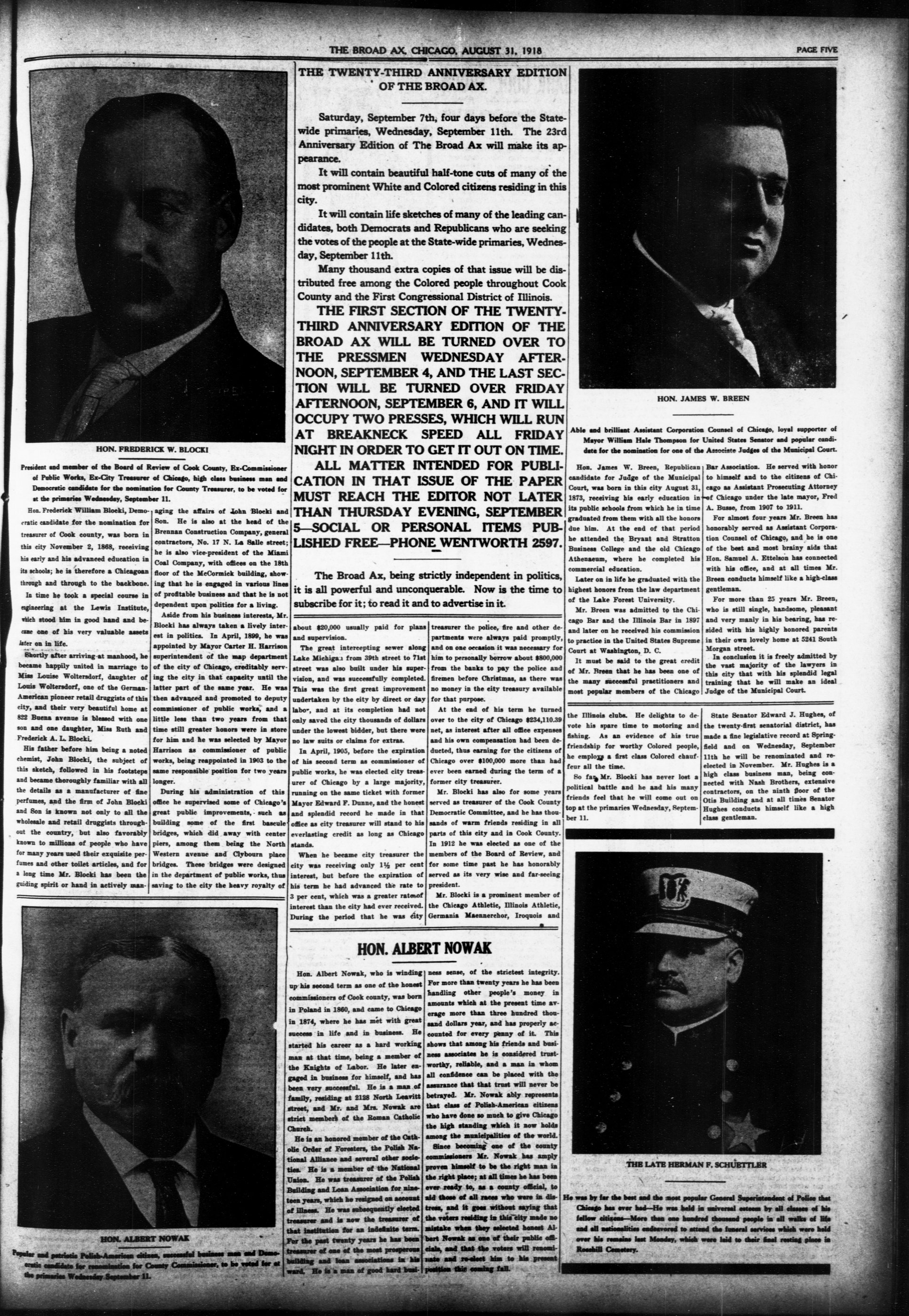
HON. FREDERICK W. BLOCKI President and member of the Board of Review of Cook County, Ex-Commissioner of Public Works, Ex-City Treasurer of Chicago, high class business man and Democratic candidate for the nomination for County Treasurer, to be voted for at the primaries Wednesday, September 11.
Hon. Frederick William Bloeki, Democratic candidate for the nomination for treasurer of Cook county, was born in this city November 2, 1868, receiving his early and his advanced education in its schools; he is therefore a Chicagoan through and through to the backbone. In time he took a special course in engineering at the Lewis Institute, which stood him in good hand and became one of his very valuable assets later on in life.
Shortly after arriving at manhood, he became happily united in marriage to Miss Louise Woltersdorf, daughter of Louis Woltersdorf, one of the German-American pioneer retail druggists of this city, and their very beautiful home at 822 Buena avenue is blessed with one son and one daughter, Miss Ruth and Frederick A. L. Blocki.
His father before him being a noted chemist, John Blocki, the subject of this sketch, followed in his footsteps and became thoroughly familiar with all the details as a manufacturer of fine perfumes, and the firm of John Blocki and Son is known not only to all the wholesale and retail druggists throughout the country, but also favorably known to millions of people who have for many years used their exquisite perfumes and other toilet articles, and for a long time Mr. Blocki has been the guiding spirit or hand in actively man-
M.
HON. ALBERT NOWAK
Popular and patriotic Polish-American citizen, successful business man and Democratic candidate for renomination for County Commissioner, to be voted for at the nomination Wednesday September 11.
aging the affairs of John Blocki and Son. He is also at the head of the Brennan Construction Company, general contractors, No. 17 N. La Salle street; he is also vice-president of the Miami Coal Company, with offices on the 18th floor of the McCormick building, showing that he is engaged in various lines of profitable business and that he is not dependent upon politics for a living.
Aside from his business interests, Mr. Blocki has always taken a lively interest in politics. In April, 1899, he was appointed by Mayor Carter H. Harrison superintendent of the map department of the city of Chicago, creditably serving the city in that capacity until the latter part of the same year. He was then advanced and promoted to deputy commissioner of public works, and a little less than two years from that time still greater honors were in store for him and he was selected by Mayor Harrison as commissioner of public works, being reappointed in 1903 to the same responsible position for two years longer.
During his administration of this office he supervised some of Chicago's great public improvements, such as building some of the first bascule bridges, which did away with center piers, among them being the North Western avenue and Clybourn place bridges. These bridges were designed in the department of public works, thus saving to the city the heavy royalty of
THE BROAD AX, CHICAGO, AUGUST 31, 1918 THE TWENTY-THIRD ANNIVERSARY EDITION OF THE BROAD AX.
Saturday, September 7th, four days before the Statewide primaries, Wednesday, September 11th. The 23rd Anniversary Edition of The Broad Ax will make its appearance. It will contain beautiful half-tone cuts of many of the most prominent White and Colored citizens residing in this city. It will contain life sketches of many of the leading candidates, both Democrats and Republicans who are seeking the votes of the people at the State-wide primaries, Wednesday, September 11th.
Many thousand extra copies of that issue will be distributed free among the Colored people throughout Cook County and the First Congressional District of Illinois.
THE FIRST SECTION OF THE TWENTYTHIRD ANNIVERSARY EDITION OF THE BROAD AX WILL BE TURNED OVER TO THE PRESSMEN WEDNESDAY AFTERNOON, SEPTEMBER 4, AND THE LAST SECTION WILL BE TURNED OVER FRIDAY AFTERNOON, SEPTEMBER 6, AND IT WILL OCCUPY TWO PRESSES, WHICH WILL RUN AT BREAKNECK SPEED ALL FRIDAY NIGHT IN ORDER TO GET IT OUT ON TIME.
ALL MATTER INTENDED FOR PUBLICATION IN THAT ISSUE OF THE PAPER MUST REACH THE EDITOR NOT LATER THAN THURSDAY EVENING, SEPTEMBER 5—SOCIAL OR PERSONAL ITEMS PUBLISHED FREE—PHONE WENTWORTH 2597.
The Broad Ax, being strictly independent in politics, it is all powerful and unconquerable. Now is the time to subscribe for it; to read it and to advertise in it.
about $20,000 usually paid for plans and supervision.
The great intercepting sewer along Lake Michigan from 39th street to 71st street was also built under his supervision, and was successfully completed. This was the first great improvement undertaken by the city by direct or day labor, and at its completion had not only saved the city thousands of dollars under the lowest bidder, but there were no law suits or claims for extras.
In April, 1905, before the expiration of his second term as commissioner of public works, he was elected city treasurer of Chicago by a large majority, running on the same ticket with former Mayor Edward F. Dunne, and the honest and splendid record he made in that office as city treasurer will stand to his everlasting credit as long as Chicago stands.
When he became city treasurer the city was receiving only $1\frac{1}{2}$ per cent interest, but before the expiration of his term he had advanced the rate to 3 per cent, which was a greater rates of interest than the city had ever received. During the period that he was city
HON. ALBERT NOWAK
Hon. Albert Nowak, who is winding up his second term as one of the honest commissioners of Cook county, was born in Poland in 1860, and came to Chicago in 1874, where he has met with great success in life and in business. He started his career as a hard working man at that time, being a member of the Knights of Labor. He later engaged in business for himself, and has been very successful. He is a man of family, residing at 2128 North Leavitt street, and Mr. and Mrs. Nowak are strict members of the Roman Catholic Church.
He is an honored member of the Catholic Order of Foresters, the Polish National Alliance and several other societies. He is a member of the National Union. He was treasurer of the Polish Building and Loan Association for nineteen years, which he resigned on account of illness. He was subsequently elected treasurer and is now the treasurer of that institution for an indefinite term. For the past twenty years he has been treasurer of one of the most prosperous building and loan associations in his ward. He is a man of good hard hustle.
treasurer the police, fire and other departments were always paid promptly, and on one occasion it was necessary for him to personally borrow about $800,000 from the banks to pay the police and firemen before Christmas, as there was no money in the city treasury available for that purpose.
At the end of his term he turned over to the city of Chicago $234,110.39 net, as interest after all office expenses and his own compensation had been deducted, thus earning for the citizens of Chicago over $100,000 more than had ever been earned during the term of a former city treasurer.
Mr. Blocki has also for some years served as treasurer of the Cook County Democratic Committee, and he has thousands of warm friends residing in all parts of this city and in Cook County. In 1912 he was elected as one of the members of the Board of Review, and for some time past he has honorably served as its very wise and far-seeing president. Mr. Blocki is a prominent member of the Chicago Athletic, Illinois Athletic, Germania Maennerechor, Iroquois and
ness sense, of the strictest integrity. For more than twenty years he has been handling other people's money in amounts which at the present time average more than three hundred thousand dollars year, and has properly accounted for every penny of it. This shows that among his friends and business associates he is considered trustworthy, reliable, and a man in whom all confidence can be placed with the assurance that that trust will never be betrayed. Mr. Nowak ably represents that class of Polish-American citizens who have done so much to give Chicago the high standing which it now holds among the municipalities of the world. Since becoming one of the county commissioners Mr. Nowak has amply proven himself to be the right man in the right place; at all times he has been ever ready to, as a county official, to aid those of all races who were in distress, and it goes without saying that the voters residing in this city made no mistake when they selected honest Albert Nowak as one of their public officials, and that the voters will renominate and re-elect him to his present position this coming fall.
[Image of a man in a suit with a bow tie].
HON. JAMES W. BREEN
Able and brilliant Assistant Corporation Mayor William Hale Thompson for date for the nomination for one of the
Able and brilliant Assistant Corporation Counsel of Chicago, loyal supporter of Mayor William Hale Thompson for United States Senator and popular candidate for the nomination for one of the Associate Judges of the Municipal Court.
Hon. James W. Breen, Republican candidate for Judge of the Municipal Court, was born in this city August 31, 1873, receiving his early education in its public schools from which he in time graduated from them with all the honors due him. At the end of that period he attended the Bryant and Stratton Business College and the old Chicago Athenaeum, where he completed his commercial education.
Later on in life he graduated with the highest honors from the law department of the Lake Forest University.
Bar Association. He served with honor to himself and to the citizens of Chicago as Assistant Prosecuting Attorney of Chicago under the late mayor, Fred A. Busse, from 1907 to 1911.
For almost four years Mr. Breen has honorably served as Assistant Corporation Counsel of Chicago, and he is one of the best and most brainy aids that Hon. Samuel A. Ettelson has connected with his office, and at all times Mr. Breen conducts himself like a high-class gentleman.
For more than 25 years Mr. Breen,
Mr. Breen was admitted to the Chicago Bar and the Illinois Bar in 1897 and later on he received his commission to practice in the United States Supreme Court at Washington, D. C.
It must be said to the great credit of Mr. Breen that he has been one of the many successful practitioners and most popular members of the Chicago
the Illinois clubs. He delights to devote his spare time to motoring and fishing. As an evidence of his true friendship for worthy Colored people, he employs a first class Colored chauffeur all the time.
So far Mr. Blocki has never lost a political battle and he and his many friends feel that he will come out on top at the primaries Wednesday, September 11.
C
MK
He was by far the best and the most popular General Superintendent Chicago has ever had—He was held in universal esteem by fellow citizens—More than one hundred thousand people and all nationalities endeavored to attend the funeral service over his remains last Monday, which were laid to their flame Roschill Cemetery.
He was by far the best and the most popular General Superintendent of Police that Chicago has ever had—He was held in universal esteem by all classes of his fellow citizens—More than one hundred thousand people in all walks of life and all nationalities endowed to attend the funeral services which were held over his remains last Monday, which were laid to their final resting place in Roschill Cemetery.
THE NEW YORK TIMES
a Counsel of Chicago, loyal supporter of United States Senator and popular candidate Associate Judges of the Municipal Court.
Bar Association. He served with honor to himself and to the citizens of Chicago as Assistant Prosecuting Attorney of Chicago under the late mayor, Fred A. Busse, from 1907 to 1911.
For almost four years Mr. Breen has honorably served as Assistant Corporation Counsel of Chicago, and he is one of the best and most brainy aids that Hon. Samuel A. Ettelson has connected with his office, and at all times Mr. Breen conducts himself like a high-class gentleman.
For more than 25 years Mr. Breen, who is still single, handsome, pleasant and very manly in his bearing, has resided with his highly honored parents in their own lovely home at 5241 South Morgan street.
In conclusion it is freely admitted by the vast majority of the lawyers in this city that with his splendid legal training that he will make an ideal Judge of the Municipal Court.
State Senator Edward J. Hughes, of the twenty-first senatorial district, has made a fine legislative record at Springfield and on Wednesday, September 11th he will be renominated and reelected in November. Mr. Hughes is a high class business man, being connected with Nash Brothers, extensive contractors, on the ninth floor of the Otis Building and at all times Senator Hughes conducts himself like a high class gentleman.
[Image of a military officer in uniform, wearing a cap and a star insignia on the shoulder.]
ar General Superintendent of Police that a universal oteeam by all classes of his led thousand people in all walks of life and the funeral services which were held were laid to their final resting place in
PAGE FIVE
PAGE SIX
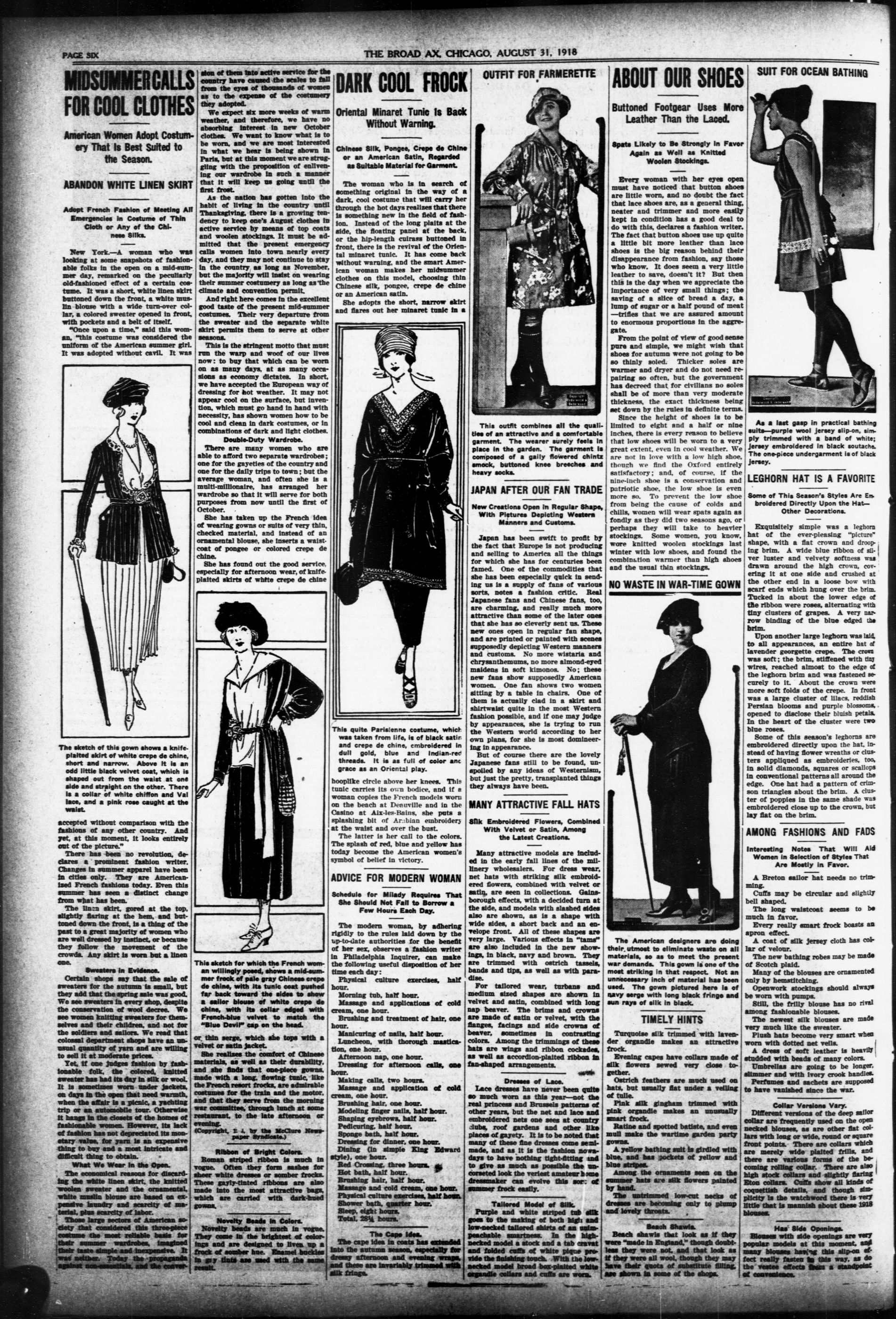
MIDSUMMERCALLS FOR COOL CLOTHES
American Women Adopt Costumery That Is Best Suited to the Season.
ABANDON WHITE LINEN SKIRT
Adopt French Fashion of Meeting All Emergencies in Costume of Thin Cloth or Any of the Chinese Silks.
New York.—A woman who was locking at some snapshots of fashionable folks in the open on a mid-summer day, remarked on the peculiarly old-fashioned effect of a certain costume. It was a short, white linen skirt buttoned down the front, a white muslin blouse with a wide turn-over collar, a colored sweater opened in front, with pockets and a belt of itself.
"Once upon a time," said this woman, "this costume was considered the uniform of the American summer girl. It was adopted without cavil. It was
1
The sketch of this gown shows a knife-plaited skirt of white crepe de chine, short and narrow. Above it is an odd little black velvet coat, which is shaped out from the waist at one side and straight on the other. There is a collar of white chiffon and Val lace, and a pink rose caught at the waist.
accepted without comparison with the fashions of any other country. And yet, at this moment, it looks entirely out of the picture."
There has been no revolution, declares a prominent fashion writer, Changes in summer apparel have been in cities only. They are Americanized French fashions today. Even this summer has seen a distinct change from what has been.
The linen skirt, gored at the top, slightly faring at the hem, and buttoned down the front, is a thing of the past to a great majority of women who are well dressed by instinct, or because they follow the movement of the crowds. Any skirt is worn but a linen one.
Sweaters in Evidence.
Certain shops say that the sale of sweaters for the autumn is small, but they add that the spring sale was good. We see sweaters in every shop, despite the conservation of wool decree. We see women knitting sweaters for themselves and their children, and not for the soldiers and sailors. We read that colossal department shops have an unusual quantity of yarn and are willing to sell it at moderate prices.
Yet, if one judges fashion by fashionable folk, the colored, knitted sweater has had its day in silk or wool. It is sometimes worn under jackets, on days in the open that need warmth, when the affair is a picnic, a yachting trip or an automobile tour. Otherwise it hangs in the closets of the homes of fashionable women. However, its lack of fashion has not depreciated its monetary value, for yarn is an expensive thing to buy and a most intricate and difficult thing to obtain.
What We Wear in the Open.
The economical reasons for discarding the white linen skirt, the knitted woolen sweater and the ornamental, white muslin blouse are based on expensive laundry and scarcity of material, plus scarcity of labor.
Those large sectors of American society that considered this three-piece costume the most reliable basis for their summer wardrobes, imagined their taste simple and inexpensive. It was neither. Today the propaganda against non-essentials and the conver
>
ston of them into active service for the country have caused the scales to fall from the eyes of thousands of women as to the expense of the costumery they adopted.
We expect six more weeks of warm weather, and therefore, we have no absorbing interest in new October clothes. We want to know what is to be worn, and we are most interested in what we hear is being shown in Paris, but at this moment we are struggling with the proposition of enlivening our wardrobe in such a manner that it will keep us going until the first frost.
As the nation has gotten into the habit of living in the country until Thanksgiving, there is a growing tendency to keep one's August clothes in active service by means of top coats and woolen stockings. It must be admitted that the present emergency calls women into town nearly every day, and they may not continue to stay in the country, as long as November, but the majority will insist on wearing their summer costumery as long as the climate and convention permit.
And right here comes in the excellent good taste of the present mid-summer costumes. Their very departure from the sweater and the separate white skirt permits them to serve at other seasons.
This is the stringent motto that must run the warp and woof of our lives now: to buy that which can be worn on as many days, at as many occasions as economy dictates. In short, we have accepted the European way of dressing for hot weather. It may not appear cool on the surface, but invention, which must go hand in hand with necessity, has shown women how to be cool and clean in dark costumes, or in combinations of dark and light clothes.
Double-Duty Wardrobe.
There are many women who are able to afford two separate wardrobes; one for the gayeties of the country and one for the daily trips to town; but the average woman, and often she is a multi-millionaire, has arranged her wardrobe so that it will serve for both purposes from now until the first of October.
She has taken up the French idea of wearing gowns or suits of very thin, checked material, and instead of an ornamental blouse, she inserts a waistcoat of pouce or colored crepe de chine.
She has found out the good service, especially for afternoon wear, of knife-plattened skirts of white crepe de chine
1
This sketch for which the French woman willingly poses, shows a mid-summer frock of pale gray Chinese crepe de chine, with its tunic coat pushed far back toward the sides to show a sailor blouse of white crepe de chine, with its collar edged with French-blue velvet to match the "Blue Devil" cap on the head.
or thin serge, which she tops with a velvet or satin jacket.
She realizes the comfort of Chinese materials, as well as their durability, and she finds that one-piece gowns, made with a long, flowing tunic, like the French resort frocks, are admirable costumes for the train and the motor, and that they serve from the morning war committee, through lunch at some restaurant, to the late afternoon or evening.
(Copyright, 1.4. by the McClure News-
Ribbon of Bright Colors
Ribbon or Bright Colors.
Roman striped ribbon is much in vogue. Often they form sashes for sheer white dresses or somber frocks. These gayly-tinted ribbons are also made into the most attractive bags, which are carried with dark-hued gowns.
Novelty Beads in Colors.
Novelty beads are much in vogue. They come in the brightest of colorings and are designed to liven up a frock of somber hue. Enamel buckles in gray tints are used with the same result.
THE BROAD AX. CHICAGO. AUGUST 31, 1918
DARK COOL FROCK
Oriental Minaret Tunic Is Back Without Warning.
Chinese Silk, Pongee, Crepe de Chine or an American Satin, Regarded as Suitable Material for Garment.
The woman who is in search of something original in the way of a dark, cool costume that will carry her through the hot days realizes that there is something new in the field of fashion. Instead of the long plaits at the side, the floating panel at the back, or the hip-length cuirass buttoned in front, there is the revival of the Oriental minaret tunic. It has come back without warning, and the smart American woman makes her midsummer clothes on this model, choosing thin Chinese silk, pongee, crepe de chine or an American satin.
She adopts the short, narrow skirt and flares out her minaret tunic in a
THE FASHION OF THE TWENTIETH CENTURY
This quite Parisienne costume, which was taken from life, is of black satin and crepe de chine, embroidered in dull gold, blue and Indian-red threads. It is as full of color and grace as an Oriental play.
hooplike circle above her knees. This tunic carries its own bodice, and if a woman copies the French models worn on the beach at Deauville and in the Casino at Aix-les-Bains, she puts a splashing bit of Arabian embroidery at the waist and over the bust.
The latter is her call to the colors. The splash of red, blue and yellow has today become the American women's symbol of belief in victory.
ADVICE FOR MODERN WOMAN
Schedule for Milady Requires That
She Should Not Fail to Borrow a
Few Hours Each Day.
The modern woman, by adhering rigidly to the rules laid down by the up-to-date authorities for the benefit of her sex, observes a fashion writer in Philadelphia Inquirer, can make the following useful disposition of her time each day: Physical culture exercises, half hour.
Brushing and treatment of hair, one hour.
Manicuring of nails, half hour.
Luncheon, with thorough mastication, one hour.
Afternoon nap, one hour.
Dressing for afternoon calls, one hour.
Making calls, two hours.
Massage and application of cold cream, one hour.
Brushing hair, one hour.
Modeling finger nails, half hour.
Shaping eyebrows, half hour.
Pedicuring, half hour.
Sponge bath, half hour.
Dressing for dinner, one hour.
Dining (in simple King Edward style), one hour.
Red Crossing, three hours.
Hot bath, half hour.
Brushing hair, half hour.
Massage and cold cream, one hour.
Physical culture exercises, half hour.
Shower bath, quarter hour.
Sleep, eight hours.
Total, 28% hours.
The Cape Idea.
The cape idea in coats has extended into the autumn season, especially for dreary afternoon and evening wraps, and these are invariably trimmed with milk fringes.
OUTFIT FOR FARMERETTE
CINEMAS
MOVIES
AND
THEATRES
This outfit combines all the qualities of an attractive and a comfortable garment. The wearer surely feels in place in the garden. The garment is composed of a gaily flowered chintz smock, buttoned knee breeches and heavy socks.
JAPAN AFTER OUR FAN TRADE
New Creations Open In Regular Shape, With Pictures Depicting Western Manners and Customs.
Japan has been swift to profit by the fact that Europe is not producing and selling to America all the things for which she has for centuries been famed. One of the commodities that she has been especially quick in sending us is a supply of fans of various sorts, notes a fashion critic. Real Japanese fans and Chinese fans, too, are charming, and really much more attractive than some of the later ones that she has so cleverly sent us. These new ones open in regular fan shape, and are printed or painted with scenes supposedly depicting Western manners and customs. No more wistaria and chrysanthemums, no more almond-eyed maldens in soft kilimonos. No; these new fans show supposedly American women. One fan shows two women sitting by a table in chairs. One of them is actually clad in a skirt and shirtwaist quite in the most Western fashion possible, and if one may judge by appearances, she is trying to run the Western world according to her own plans, for she is most domineering in appearance.
But of course there are the lovely Japanese fans still to be found, unspoiled by any ideas of Westernism, but just the pretty, transplanted things they always have been.
MANY ATTRACTIVE FALL HATS
Sik Embroidered Flowers, Combined With Velvet or Satin, Among the Latest Creations.
Many attractive models are included in the early fall lines of the millinery wholesalers. For dress wear, net hats with striking silk embroidered flowers, combined with velvet or satin, are seen in collections. Gainsborough effects, with a decided turn at the side, and models with slashed sides also are shown, as is a shape with wide sides, a short back and an envelope front. All of these shapes are very large. Various effects in "tams" are also included in the new showings, in black, navy and brown. They are trimmed with ostrich tassels, bands and tips, as well as with paradise.
For tailored wear, turbans and medium sized shapes are shown in velvet and satin, combined with long nap beaver. The brims and crowns are made of satin or velvet, with the flanges, facings and side crowns of beaver, sometimes in contrasting colors. Among the trimmings of these hats are wings and ribbon cockades, as well as accordion-plaited ribbon in fan-shaped arrangements.
Dresses of Lace
Lace dresses have never been quite so much worn as this year—not the real princess and Brussels patterns of other years, but the net and lace and embroidered nets one sees at country clubs, roof gardens and other like places of gayet. It is to be noted that many of these fine dresses come semimade, and as it is the fashion nowadays to have nothing tight-fitting and to give as much as possible the uncorseted look the verlest amateur home dressmaker can evolve this sort: of summer frock easily.
Tailored Model of Silk
Purple and white striped tab slick goes to the making of both high and low-necked tailored shirts of an unimpactable smartness. In the high-necked model a stock and a tab cravat and folded cuffs of white pique provide the finishing touch. With the low-necked model broad box-plasted white ornament collars and cuffs are worn.
ABOUT OUR SHOES
ABOUT OUR SHOES
Buttoned Footgear Uses More Leather Than the Laced.
Spata Likely to Be Strongly In Favor Again as Well as Knitted Woolen Stockings.
Every woman with her eyes open must have noticed that button shoes are little worn, and no doubt the fact that lace shoes are, as a general thing, neater and trimmer and more easily kept in condition has a good deal to do with this, declares a fashion writer. The fact that button shoes use up quite a little bit more leather than lace shoes is the big reason behind their disappearance from fashion, say those who know. It does seem a very little leather to save, doesn't it? But then this is the day when we appreciate the importance of very small things; the saving of a slice of bread a day, a lump of sugar or a half pound of meat — trifles that we are assured amount to enormous proportions in the aggregate.
From the point of view of good sense pure and simple, we might wish that shoes for autumn were not going to be so thinly soled. Thicker soles are warmer and dryer and do not need repairing so often, but the government has decreed that for civilians no soles shall be of more than very moderate thickness, the exact thickness being set down by the rules in definite terms.
Since the height of shoes is to be limited to eight and a half or nine inches, there is every reason to believe that low shoes will be worn to a very great extent, even in cool weather. We are not in love with a low high shoe, thoug we find the Oxford entirely satisfactory; and, of course, if the nine-inch shoe is a conservation and patriotic shoe, the low shoe is even more so. To prevent the low shoe from being the cause of colds and chills, women will wear spats again as fondly as they did two seasons ago, or perhaps they will take to heavier stockings. Some women, you know, wore knitted woolen stockings last winter with low shoes, and found the combination warmer than high shoes and the usual thin stockings.
NO WASTE IN WAR-TIME GOWN
I
The American designers are doing their, utmost to eliminate waste on all materials, so as to meet the present war demands. This gown is one of the most striking in that respect. Not an unnecessary inch of material has been used. The gown pictured here is of navy serge with long black fringe and sun rays of silk in black.
TIMELY HINTS
Turquoise silk trimmed with lavender organdle makes an attractive frock.
Evening capes have collars made of silk flowers sewed very close together.
Ostrich feathers are much used on hats, but usually flat under a velling of tulle.
Pink silk gingham trimmed with pink organdie makes an unusually smart frock.
Ratine and spotted batiste, and even mull make the wartime garden party gowns.
A yellow bathing suit is girdled with blue, and has pockets of yellow and blue stripes.
Among the ornaments seen on the summer hats are silk flowers painted by hand.
The untrimmed low-cut necks of dresses are becoming only to plump and lovely throats.
Beach Shawls.
Beach shawls that look as if they were "made in England," though doubtless they were not, and that look as if they were all wool, though they may have their quotes of substitute filling, are shown in some of the shops.
SUIT FOR OCEAN BATHING
CAROLINA
DELANE & JOHNSON
As a last gasp in practical bathing suits—purple wool jersey slip-on, simply trimmed with a band of white; jersey embroidered in black soutache. The one-piece undergarment is of black jersey.
LEGHORN HAT IS A FAVORITE
Some of This Season's Styles Are Embroidered Directly Upon the Hat—Other Decorations.
Exquisitely simple was a leghorn hat of the ever-pleasing "picture" shape, with a ever-flat crown and drooping brim. A wide blue ribbon of silver luster and velvety softness was drawn around the high crown, covering it at one side and crushed at the other end in a loose bow with scarf ends which hung over the brim. Tucked in about the lower edge of the ribbon were roses, alternating with tiny clusters of grapes. A very narrow binding of the blue edged the brim.
Upon another large leghorn was laid, to all appearances, an entire hat of lavender georgette crepe. The crown was soft; the brim, stiffened with tiny wires, reached almost to the edge of the leghorn brim and was fastened securely to it. About the crown were more soft folds of the crepe. In front was a large cluster of illacs, reddish Persian blooms and purple blossoms, opened to disclose their blush petals. In the heart of the cluster were two blue roses. Some of this season's leghorns are embroidered directly upon the hat, instead of having flower wreaths or clusters applied as embroideries, too, in solid diamonds, squares or scallops in conventional patterns all around the edge. One hat had a pattern of crimson triangles about the brim. A cluster of poppies in the same shade was embroidered close up to the crown, but lay flat on the brim.
AMONG FASHIONS AND FADS
Interesting Notes That Will Aid Women in Selection of Styles That Are Mostly in Favor.
A Breton sailor hat needs no trimming.
Cuffs may be circular and slightly bell shaped.
The long waistcoat seems to be much in favor.
Every really smart frock boasts an apron effect.
A coat of silk jersey cloth has collar of velour.
The new bathing robes may be made of Scotch plaid.
Many of the blouses are ornamented only by hemstitching.
Openwork stockings should always be worn with pumps.
Still, the frilly blouse has no rival among fashionable blouses.
The newest silk blouses are made very much like the sweater. Plush hats become very smart when worn with dotted net vells.
A dress of soft leather is heavily studded with beads of many colors. Umbrellas are going to be longer, slimmer and with ivory crook handles. Perfumes and sachets are supposed to have vanished since the war.
Collar Versions Vary
Different versions of the deep sailor collar are frequently used on the open necked blouses, as are other flat collars with long or wide, round or square front points. There are collars which are merely wide plaited frills, and there are various forms of the becoming rolling collar. There are also high stock collars and slightly flaring Eton collars. Cuffs show all kinds of coquettish details, and though simplicity is the watchword there is very little that is mannish about these 1918 blouses.
Has Side Openings.
Blouses with side openings are very popular models at this moment, and many blouses having this slip-on effect really fasten in this way, as do the venture effects from a standpoint of convenience.
2 Ae iain —
Z : FSS = a =
YANKS BLOGKED “OLD ctoty” aTFRONT SPY ROUNDED UP FEED FOE BY TUNNEL|O-BOATS BALKED [TRACES KIN IN ARMY
5 a “ ’ —_— j
DRIVE ON PARIS|m» wer sos nsrssme] BY TRAP SHOOTER eens somawe oo sve! BY AIR FIGHTERS |20 cons wo roe ast
ee Follow American Fag. : - Border Use Pipe Line. a informed.
havancing Foe Had Surprise of a Former Top Gun Solves Cause freer Airplanes Are of Great Assist | 5 wan ast information Regard
Life When He Found Ameri- | Mother's Gitt to Sergeant tnepires aten | 0 Hi ings in| StrTenean Line From House Acrese ance In Finding Enemy ing Men Wounded, Killed
int to Daring Deeds at Vaire ~~, erst the Frontier le Revealed by Submarines co imading:
1 London—When the Miinols troops pas the mather'et be: ee ‘Washington—The American Red
GUPHIG STORY WH ‘LETTER "secon aint wees | GERMANS WERE TIPPED OFF sins Scems.crs ces = (NECESSARY ALLY OF AVY crs: ets merar Sve
Vatre wood and Hamel, a sergeant of Brent stuggling device which did a of soldiers whe ere tn the Amer-
— the American contingent took into ac- ae Spe booming business until discovered by ee fa sapemmanacy Srcn: tn wales
Tolle of Our ‘Thoope’ Heroic Resist- | tion small American fing, the gift of | Sergeant Sees Pigeons on Wing, ranmoen os eee Great Britain Sees Need of Holding | ocxs these relatives to make inquiries
‘ance in June—Held by Many Om. [his mother. The men under him sur| Dreams of Days at Traps, Grabs harper tte imide Command of Air as Well a2 of | regarding their kin who are io the
cers to Have Saved Paris rounded and destroyed a machinegun| © Shotgun and Bags Five—Have [tr ended te s house rented to Ger.| S@@—Alreraft Elther Attack | army through the Red Cross bureau
From Huns. post hidden among tree trunks just Code Messages Attached. kee iain ih ‘Sides dealin aiiaie or Summon Patrols. of communication in Washington in-
babeerere YT ef er oe
account of the fighting near Chateau-
‘Thierry, in which American divisions,
jncluding the marine brigade, took
part, early in June, was made public
recently by the pavy department. It
{sin the form of a long letter from an.
officer of the marines to Major Gen-
eral Barnett,’ commandant of the
corps, and the story told is of pecoliar
significance, as in the opinion of many
officers here it gras the stand of the
Americans along this line which saved
Paris.
‘The name of the writer is not dis-
closed. The Americans were rushed to
the line in motortrucks to support the
hard-pressed French. On June 1 the
marine brigade deployed in a support
position, the battalion commanded by
‘Maj. Thomas Holcomb hurrying into
the line as the men climbed out of the
trucks. The Germans were coming on,
and June 2 the French dropped back,
passing through the American lines.
“We had installed ourselves in a
house in La Vole Chatel, a little vil-
lage between Champillon and Lucy-le-
Bocage,” the letter says. “From one
side we had observation of the north
and northeast. They came out on @
wonderfully clear day in two columns
across @ wheat field. We could see the
two twin brown columns advancing in
perfect order until two-thirds of the
columns, we judged, were in sight.
Foe Slowed Up by Shrapnel.
“The rifle and machine gun fire was
incessant and, overhead, shrapnel was
bursting. ‘Then the shrapnel came on
the target at each shot. The white
patches would roll away, and we could
see that some of the columns were still
there, slowed up, and it seemed perfect
suicide for them to try.
“Then, under that deadly fire and 2
barrage of rifle and machine-gun fire,
the Boche stopped. It was too much
for any men.
“That men should fire deliberately,
and use their sights and adjust their
range,” he says, “was beyond their ex-
‘perience: It must have had a telling
effect on the morale of the Boche, for
it was something they had not counted
on. Asa matter of fact, after pushing
back the weakened French and then
running up against a stone wall of de
fense, they were literally ‘up in the
air’ and more than stopped. We found
that out later from prisoners, for the
Germans never knew we were in the
front line when they made that at-
tack. They were absolutely mystified
at the manner in which the defense
stiffened up, until they found that our
troops were in line.”
The letter tells in detail of the days
of fighting that followed. It describes
© daylight charge against 2 machine
gun host and of scouting raids up to
June 6, when the whole brigade swung
forward to straighten out the line. This
action resulted in the capture of Bel-
leau wood.
Hit Three Times, Still Fought on.
Major Sibley's battalion of the Sixth
marine regiment led the way here, with
Holcomb in support. The woods were
alive with enemy machine guns. That
night word came back that Robertson,
‘with 20 men of the Ninety-sixth com-
peny, had taken Bouresches, breaking
through a heavy machine gun barrage
to enter the town. Robertson, fighting
with an automatic in either hand, was
hit three times before he would allow
himself to be taken to the rear.
Speaking of individual acts of brav-
ery the writer says Duncan, a com-
Pany commander, “before he was mow-
€¢ down had his pipe in his mouth and
Was carrying © stick.” Later be adds,
“Dental Surgeon Osborne picked up
Duncan and with a hospital corps man
‘had just gained some shelter when &
shell wiped all three out.”
Private Dunlavy, Killed later, esp-
tured an enemy machine gun in Bour-
esches, which he turned on the foe
with great effect, while at another
Point “Young ‘Timmerman charged #
wechine gun at the point of the bayo-
Ret and sent in 17 prisoners at a clip.”
When the enemy made a stand at
ene point im the woods Sibley's bat
‘ullon was withdrawn and for an hour
‘0d fifty minutes American “and
French batteries hammered the wood.
Hughes, with the Tenth company, then
‘Went in, and bis. Srst message was
that the wood hed been cut to. mince
‘mest. Overton, leading the Seventy-
sixth company, finally charged the
Tock plateau, killing or captaring every
funner and capturing ail the guns,
with few casualties.
The Eighty-second company lost all
its officers, and Major Sibley and his
it under dire a
“I wonder if ever an outfit,” the let
ter said, “went up against a more des
, Perate job, stuck to it gamely, with
“OD GLORY” AT FRONT
Minis Men and Australians
| Follow American Fiag.
aenacn ean alesis Susie ose
| te Daring Deeds at Vaire
‘Wood.
London.—When the Mlinols troops
and Australians attacked together at
Vaire wood and Hamel, a sergeant of
the American contingent took into ac-
tion a small American fing, the gift of
his mother. The men under him sur
Tounded and destroyed a machine-gun
Post hidden among tree trunks just
inside the wood. As they went on af-
ter bombing the German crew, the ser
geent brandished the Uttle flag over
his head and shouted, “Come on, fel-
lows; there's another one.” Just ahead
some Australians were fighting around
& shallow pit in which were five Prus-
sians and 2 machine gun. Two or
three Chicago boys dashed up with
‘their bayonets poised. One of them lit-
‘erally fell on a big Rhinelander who
‘was about to throw a bomb and sent
him sprawling with a cracked skull,
0d, with the Australians, pot the re
mainder of the crew out of action and
‘cleared 2 dugout behind of 11 submis-
sive fugitives.
Still following the tiny Stars and
Stripes, a Little bigger than a pocket
handkerchief, but, as one of the men
said afterwards, “looking like a regu-
lar fiag,” the Americans, shoulder to
shoulder with the Australians, passed
through the eastern end of the wood
‘and out Into the open fields again.
“The first time I have ever fought un-
der the American fieg, Yank,” said ®
tall, raw-boned Queenslander with a
first-aid bandage round his head. They
arrived at thelr final objective, a group
af strong, well-sheathed trenches
Unked with the rear defenses of Ham-
1 village, and here the Chicago ser-
geant planted his emblem on a bit of
‘wood and set it on the parapet. Bul-
lets whistled all round it, cutting the
silk into ragged strips and eventually
it was wholly shot away save one uD-
recognizable fragment, which was pre-
served as a precious souvenir of an
historic day.
GUN CREW AT LUNCH
a oe ot ;
Sacer
eer ane
ert ta eee
a ary
Gy ant.
_ ‘ <a eel | =
ty) cee
ree A
crx a H iY po
an.
Pa Vim
eee Pee
ewes Seeman
‘Merely a pause in the day's work
when e Canadian gun crew snatches
& bite to eat and gulps down hot soup
before it resumes its appetite of send-
ing a few more sizzling shells over to
Fritz. The Huns’ meals consist of a
regular diet ‘of shells, samples of
which are seen in the foreground. Note
the strings of foliage in the back-
ground which carefully camouflage the
big gun.
ANCIENT DEED IS RECORDED
Placed on File in County Recorder's
‘Office 100 Years After It Was
Drawn.
‘Lawrenceville, Ind—A deed issued
to Jesse M. Laird by the United States
government in May, 1819, for 65 acres
of land on Wilson creek, Dearborn
county, has been placed on the books
of the county recorder’s office for the
first time. The original tract of land
consisted of 640 acres and was bought
at $125 an acre by Mr. Laird and his
wife, The 65 acres, with the home-
stead, hes not left the family and is
aon oval Wy Smet ee
wife are said to have been the first
white settlers on Wilson creek.
MINISTERS GO TO WAR,
ALL CHURCHES CLOSED
Albany, BN. ¥—With the ex
Bistment of Rev. Wiliam Wal-
Ince Baton, pastor of the Meth-
odist charch, Schoharie church
es are without ministers.
‘Bvery church in the village
has been cloesd up, temporarily
‘at least, for the call of Uncle
‘Rev. Mr. Eaton will soon be
= nae fe Dene Sr ee
with the Y. MC. 4
gdh qe FCT MEO
SPY ROUNDED UP
BY TRAP SHOOTER
Former Top Gun Solves Cause
of Mysterious Happenings in
Toul Sector.
GERMANS WERE TIPPED OFF
Sergeant Sees Pigeons on Wing,
Dreams of Days at Traps, Grabs
‘Shotgun and Bags Five—Have
Code Messages Attached.
By sila toiieatenie FOSTER.
Paris—There ts a certain United
States signal service sergeant up in
the Toul sector at the front who bas
been able of late to combine a Uttle
pleasure with his business. The cen-
sor won't let one tell the sergeant’s
name, but without revealing any mili-
tary information it may be said that
before the war the sergea:.t was rated
‘as one of the top guns at well-known
trap-shooting club in the States.
__ ‘There is not much trap-shooting just
‘now in France. They are not crack-
ing away at live birds, either. But the
sergeant got his pigeon shooting just
the same.
‘The particular front in which the
sergeant operates is infested with Ger-
‘man spies.
All sorts of things were happening.
A “tramp” battery, one of those par
ticular guns that whisks up, slams a
few at the Fritzies, then slides out
‘on the jump, found itself being shelled
the instant It lined up for @ shot.
Again, every time there was a troop
movement, the movement was antici-
pated by the Boche. Beside that, er
ery time a body of our men got to
gether for any purpose whatever, the
Germans shelled them with everything
they had, big guns included.
‘Tipping Off the Hun.
Now, the Hun doesn't use his big
guns unless he knows what he’s shoot-
ing at. How he learned, however, was
pretty evident. Some one back of our
lines was tipping him off.
‘The signal service sergeant was the
first to detect how it was done. His
squad was repairing signal wires back
of the trenches. The sergeant halted
in his work and gazed skywards. A
pigeon was going over bis head. ‘The
sergeant watched it idly, calculating
‘as he stood there how far he'd lead it
with a 12-gauge. Then with a sigh
he went to laying a wire again.
‘A few minutes later the sergeant
stopped again. Another pigeon had
risen from the wood. But a few min-
‘ates Inter, when ‘a third pigeon rose
from the wood, the former trap-shooter
tarried no longer. A half hour later he
bolted into the quartermaster’s depart-
ment, clicked a salute and spoke bur
riedly.
“Gimme a shotgun,” he demanded.
Shotguns are a regular part of cer-
tain quartermaster's supplies, Soon
the sergeant might have been seen
standing behind a hedgerow gazing to-
ward the nearby wood. Presently he
was seen to stiffen, at the same time
murmuring “pull” ‘The 12gauge
swung briefly in an arc; a crack and
a crumpled ball of feathers came tum-
bling toward earth. To make sure, the
sergeant gave it a second barrel Just
before it hit the earth.
Clever Shooting.
‘It was pretty clever shooting. The
bird was high, golng over fast and
quartering. “Kill.” murmured the ser-
geant methodically, as he retrieved the
fallen game.
‘That afternoon the sergeant got four
other birds. Attached to 2 leg of each
pigeon was a code message in German
handwriting.
‘A short time Inter a detachment of
military police got the owner of the
pigeons. In his blouse and sabots he
looked Ike any of the peasants tilling
the fields behind the lines. On belng
stripped, however, he proved to be &
German under officer, Since his cap-
ture the nigntly bombardment of the
“Y" huts and other places where sol
diers congregate has been more or less
haphazard. The Fritzies still chuck
heavy stuff at them, but thanks to the
‘expigeon shot, the sergeant, they are
not scoring as frequently es formerly.
PLAN STREET SERVICE FLAGS
Cleveland Has Banners Showing Num-
ber of Residents on Street
In Service.
Cleveland, O.—Service fiags have
been flown ‘here from homes, clubs,
churches and almost every kind of or
ganization headquarters, but now there
has been introduced the street service
fiag. In a number of the suburbs of
the city, as well as in outlying busi-
ness streets, flags have been raised
showing how many residents of the
street as a whole have joined the col-
ors. The new flags are being flown by
municipalities as well as by business
houses.
——_
Marries. With Broken Neck.
Reston, Pa—Miss Alice Foulks of
Annandale, X. J., and Heary B. Bowlby
of Lebanon, N. J. were married-st *
private hospital. .Five weeks ag°
Mr. Bowlby met with an sccident in
age ayy
‘Beck! Since then his head snd
neck have rested in 2 mold. The
Bata os
re tt yok on of Game
ae... cae ase
FEED FOE BY TUNNEL
German Smugglers on Swiss
‘Subterranean Line From House Across
the Frontier Is Revealed by
; ‘Chanes.
Baste.—Hunger ts the mother of In-
ventions. German hunger invented &
great stuggling device which did ®
booming business until discovered by
customs officers. Some Germans, liv-
ing in Baden, near the Swiss frontier,
built a pipe line across the frontier.
Tt ended in a house rented to a Ger-
man family. What this family con-
sumed in the line of food, clothing,
shoes, soap and other necessaries was
really astounding. However, these
people bought things in the open mar
ket, which is still possible in Switzer-
and, paid cash, never grumbled, n0
‘matter how high the price and no
questions were asked.
One day recently two men were seen
@igging in the ground near the front-
fer. Customs officials became suspl-
cious, and nosing around soon made
& valuable discovery. The two men
were engaged in repairing the pipe
Une, which had been used for smug:
ging. The machinery had become
‘clogged and an opening had to be made
to get at the seat of the trouble.
‘The officials saw an opening had
been made into a spacious tunnel built
of concrete. Inside the pipe were
Jong wires. ‘These wires were wound
round spools at the end stations and
could be pulled either way. Goods,
such as meat, cheese, hams, shoes,
clothing, etc, were tied to the wire
and pulled across the border through
the subterranean channel.
‘The Swiss government is now after
the sinugglers. The flourishing “bust
ness” is killed. .
LADY WILLINGDON
e 2a
Fre eas
et ae
wee
‘The beautiful Lady Willingdon,
daughter of Lord Brassey, and wife of
Lord Freeman Thomas Willingdon,
first baron of Ratton, who has been
governor of Bombay since 1913 and is
first lord in waiting to his majesty,
George V.
PICRIC PLANT WILL STAY
$7,000,000 Establishment in Georgia
‘Will Be Continued After
_ the War.
Brunswick, Ga—Announcement has
been made by officials of the govern-
ment that the $7,000,000 plcric acid
plant now belng constructed in North
Brunswick will be a permanent manu-
facturing plant after the war. In peace
days the plant will make dyes, fer-
tilizer and other by-products of pleric
acid which the government is using
during war times. The dyes, the
process for which has already been
perfected, will be equal or superior to
those made in Germany.
MUSIC KEEPS OFF SNAKES
Berry Picker Plays Mouth Organ as
Protection When He Goes
Into Fields.
Altoona, Pa~—Henry Atherton, «
Frankstown township berry picker,
plays 2 mouth organ as a protection
against snakes when he goes into the
fields. He says that if there are any
copperheads, rattlers or other species
about they raise thelr heads and sway
their bodies in time with the music
and forget all about biting. The
snakes are rendered harmless for some
time by the vibrations and the berry
picker continues his work with se-
curity.
MOURNING SON’S DEATH,
HEAR ANOTHER IS HERO
Fond du Lac, Wis—While rel-
atives here were mourning the
death of Corporal Roy W. Wat-
‘00, who is dead tn France from
‘wounds rectived in action, press
dispatches were recetved telling
of a charge against the Prassian
guards led by Capt. ‘Thomas
en fey ges
Watson. Gead soldier was
2 member of 2 machine gun
‘unit, while Captain Watson com-
U-BOATS BALKED
BY AIR FIGHTERS
Airplanes Are of Great Assist-
ance In Finding Enemy
Submarines.
NECESSARY ALLY OF WAVY
Great Britain Sees Need of Holding
Command of Air as Well as of
Sea—Alreraft Elther Attack
or Summon Patrols.
London.—The measure of the suc-
cess of the antisubmarine campaign is
the safe crossing of the Atlantic by @
million American troops.
‘There is very properly a good deal
of official reticence regarding the
methods by which submarines are de-
stroyed, but it is an open secret that
the royal air force has contributed
largely toward the defeat of the U-
boat campaign.
Just as airplanes have become an
essential auxiliary to the army, so air-
craft have become an indispensable
ally of the navy, making it clear that
ascendancy in the air in future will be
as vital to Britain as her present as-
cendancy at sea.
Airships of two main types, the
smaller known as the submarine scout
and the larger as the coast patrol
type, and seaplanes, are the chief in-
struments for dealing with submarines
from the air. The first business of all
aircraft or submarine offensive is to
find the submarine.
‘See Submerged Boats,
From a certain height in the alr,
submerged U-boats are visible to ob-
servers and their position is communt-
cated to the nearest naval patrol. The
work of aircraft is by no means con-
fined to detecting the U-boats. They
have means of immediately attacking
their prey without waiting for the ar
rival of the naval patrol.
‘Phere is the obvious means of drop
ping bombs, fully effective when the
submarine is caught on or just below
the surface. Modern antisubmarine
aircraft are almost equally at home in
the air or on the water. Should the
U-boat dive through the water, its pur
suer can dive through the air and re
lease depth charges, which have a con
siderable range of action, and are muck
feared by U-boat commanders.
In claiming for the R. A. F. a larg
share in winning the safe landing o
America’s first million the reservatior
must be made that the range of air
craft from thelr bases is limited, bu
their bases are not necessarily on land
and seaplanes and submarine scout
have accommodation on shipboard ant
are carried to the area of their deep
seu patrols.
Where They Are Thickest,
Again, it is naturally in home wa
ters and especially in the North se
that submarines are thickest, outwar
bound from Germany, so that aircraf
patrols are effective from home base
over the sea zone most frequented b;
‘Urboats.
Coast patrol airships accompan;
convoys through home waters “spot
ting” submarines, to be dealt wit
either by themselves or by destroy
ers; and if the U-boat menace is no
yet mastered, it is steadily and uz
Scenes Name Sosa maeee om
Safe landing of # million American
in France is a big fact, the signif
cance of which can hardly be misse
even in Germany, where, according t
neutral witnesses, scepticism has bee
rapidly growing lately concerning th
possibilities of the U-boat campaign.
START COMMUNITY LAUNDRY
Canton, ©., Probably First City in
Country to Make the
Venture.
Canton, O.—This city is probably the
first im the country to have a com
munity laundry. Residents of the
northeast section af the city have
formed an organization for the es
tablishment of the laundry. Shares of
stock were sold at $10 each and more
than 800 stockholders are interested
tm the venture. In connection with
the laundry the community plant will
‘operate a dry cleaning establishment,
hat and shoe cleaning shop and shoe
repair shop. While the plunt will be
& profit sharing concern, the price of
‘work, it is expected, will be held con-
siderably below the regular pricts to
stockholders.
HAS TEN SONS IN SERVICE
Oklahoma Woman Ciaims to Be the
Honor Mother of the
‘State.
Hartshorne, Otla—This city now
claims the “honor mother” of the
state, .Mrs. Mollie Easley has ten sous
tm the army, the youngest having eu-
Usted a few days ago. -
Besides her sons, she has two broth-
ers and two nephews im the service.
‘They are all in army camps in the
United States, but expect soon to be
“over there.” % :
Converted Blacksmith.
Knoxville, Tenn—Celebrating the
thirtieth anniversary of-his conversion,
ae ee
‘one of the be ‘men
i that he
oe rted 12,000 persons in
THAGES KIN IN ARMY
Red Cross Will Keep Relatives
Informed.
cca ingle SSaceccnensonaes
ing Men Wounded, Killed
or Missing,
‘Washington—The American Red
Cross, through its bureau of communl-
cation, fesued a request to the rela-
tives of soldiers who are in the Amer-
fean expeditionary force, in which it
asks these relatives to make inquiries
regarding their kin who are ip the
army through the Red Cross bureau
of communication in Washington in-
stead of, as is the case in numerous
instances, of communicating with
agencies or individuals in Europe. The
request was issued in the name of
Harvey D. Gibson, the American Red
‘Cross commissioner in France.
‘Mr. Gibson points out the fact that
in a majority of cases such inquiries
are merely turned over by the individ-
ual or agency to the Red Cross, which
has charge of such communication with
soldiers’ relatives, and which has de-
‘veloped special facilities for obtaining
information about those reported
killed, wounded, or missing, and those
from whom letters have not been re-
ceived. Congestion of cables and a
loss of time and energy are also oc
casioned by making the request other
than through the Red Cross. It has
been known that as many as four sep-
arate requests have been received
about the same men by different in
stitutions.
‘Edward M. Day, acting director of
the bureau of communication, said:
_“The function of this bureau is to
give relatives all possible information
which will lessen anxiety. Every in
quiry is handled with full realization
that a prompt and full reply is of seri-
cus moment to the happiness, peace of
mind, and not infrequently to the
health of the relatives. By writing to
the bureau, relatives frequently will
get immediately information at hand
and may be sure that search is started
abroad as quickly as the case war
rants.”
MADE $35,000, CAN'T PAY TAX
Soldier Told to Save Pay for Income
Assessments, Says “1
Blew It All”
Washington. —Difficuities of soldiers
‘who formerly were successful business
men, in paying last year’s income tax
‘on this year’s pay, are illustrated by @
story brought to Washington by at
officer serving at one of the southern
cantonments,
Last February, the officer said, be
explained to the men of his command
that all married men would have to
pay a tax on all their last year’s earm
ings over $2,000, while all unmarried
men would have to pay on all income
over $1,000.
‘Coming to him later one of the men,
a private, sald:
“I guess I won't be able to pay that
income tax. I haven't any money.”
“Ob, that's all right,” replied the of
ficer, “you have until June to pay if
and you can save it out of your pay by
that time.”
“Tm afraid I couldn't,” responded
the private, “I made $85,000 last year
and I biew it all in when I was called
into the army.”
RABBITS A PEST NO LONGER
Australia Finds the One-Time Curse
Now a Profitable Source of
Revenue
‘Washington.—Rabbits, which wert
‘once the curse of Australia, as they
have been to a ‘lesser extent in the
southwestern United States, now aré
providing @ profitable source of reve:
nue and at th same time helping to
win the war by increasing the food
supply.
‘Official dispatches received here say
the British board of trade has ordered
€00,000 crates of skinned rabbits,
which will require the killing of 21-
600,000 rabbits, weighing 36,000,000
pounds after dressing. Previously the
rabbits were shipped with the skins
on, but inconvenience was experienced
a aS
fur.
How to dispose of the skins is caus
ing the Australians speculation. There
is a ready market for them in this
country, but tonnage is scarce. _
‘Walks 148 Miles to Entist.
‘Tulsa, Okla—Chester Bunch, twem
ty, of Tonkawa, walked from his home
to Tulsa, a distance of 145 miles, in
order to enlist in the army, but was
ejected because of @ slight physical
defect. The defect can be remedied
by a slight operation.
Bunch bes « desire to become an
aviator. He has gone to work in or
der to earn enough money to pay for
the operation. - :
DRAFTEE GETS TIRED
WAITING; JOINS POLES
‘Tarentum, Pa-—When the
members of the draft board
searched for Alexander Czy~
mon, who failed to show up for
entrainment for Camp Lee, they
Giscovered that he had got tired
of waiting for the call to sere
ice and had joined @ Polish regi<
ment and is now believed to be
om the western front.
The CRANFORD Apartment Building 3600 Wabash Avenue
THE MIDDLE EAST HOME
The finest building ever opened to Colored tenants in Chicago. Steam heat, electric lights, tile baths, marble entrance.
PAGE EIGHT
The CR
Apartmen
3600 Wal
The finest building ever open
eago. Steam heat, electric lig
Phone Main 263
Residence, 4533 Prairie Avenue
Rue., Kenwood 629
WALTER M. FARMER
ATTORNEY AND
COUNSELOR AT LAW
NOTARY PUBLIC
Suite 708
184 W. Washington St.
Phones, Office, Main 4151
Auto., 30736
CHICAGO
Office Phone 8078 (Douglas)
Residence Phone, Douglas 8178
S. A. BEADLE
Lawyer
3502 SOUTH STATE STREET
CHICAGO
Req. 3502 Prhloe Ave. Phone Deng. 9233
PHONES: MAEN 807
AUTOMATICS 22-305
A. L. WILLIAMS
Attorney and Counsel at Law
Suite 706 FIRMENICH BUILDING
124 West Washington Street CHICAGO
RESIDENCE 3419 South Park Avenue
PHONE DOUGLAS 9236
VIVI. J. LATHAM
ATTORNEY AT LAW
OFFICE PHONE: CALFUET 923
2 East 31st Street
Suite 7
CHICAGO
Frank Dunn, J. B. McCahay, Trustees
Telephones: Oakland 1552, 1551, 1550
JOHN J. DUNN
ESTABLISHED 1877
Wholesale and Retail
COAL
Fifty-First and Federal Streets
CHICAGO
PHONE MAIN 2214
A. D. GASH
Attorney at Law
118 North La Salle Street
Suite 010 to 015
CHICAGO
KINKY HAIR
Albany, Ga.
Boston, Ga.
Gentleman.
My picture shows
you picture shows
KINKY HAIR
GENTLEMAN
POURAGE
But don't let some fake Kink Damour feel you. You really can't straighten your hair until it's nice and long. That's what EXELENTO POURAGE does, removes Dandrel, feeds the Roots of the hair, and makes it grow long, soft and silky. After using a few times you can tell it will be so pretty and long that you can fit it on all you. If EXELENTO doesn't do as we claim, we will give your money back. So by mail on receipt of stamps or calls.
AGENTS WANTED EVERYWHERE.
With Pre Invitation
UNIVERSITY OF MASSACHUSETTS, MA, Boston, Ma.
---
-
PRIMARIES WEDNESDAY, SEPTEMBER 11, 1918
Polls Open from 6 A. M. to 5 P. M.
Endorsed at the Republican County Convention Held in the Coliseum, Chicago, July 1st.
DEMOCRATIC CANDIDATE FOR THE NOMINATION
For Member of the Board of Review
MEN AND WOMEN CAN VOTE FOR HIM
PRIMARIES WEDNESDAY, SEPTEMBER 11th, 1918
WILLIAM E. TAGG
Republican Candidate
For State Central Committeeman
First Congressional District of Illinois
PRIMARIES WEDNESDAY, SEPTEMBER 11th, 1918
THOR J. BENSON
DEMOCRATIC CANDIDATE FOR THE NOMINATION
For Member of Congress
From the First Congressional District of Illinois
PRIMARIES WEDNESDAY, SEPTEMBER 11th, 1918
Judge HARRY M. FISHER of the MUNICIPAL COURT Candidate TO SUCCEED HIMSELF AT THE DEMOCRATIC PRIMARIES SEPTEMBER 11th, 1918 Polls open from 6 A. M. to 5 P. M.
J. W. CASEY, Agent 133 W. Washington Street
Durability of Wood.
In a very dry atmosphere the durability of wood is almost incredible. Pieces of wood, wooden caskets and other articles have been taken from Egyptian tombs of an antiquity to antedate the Christian era by two or three thousand years.
PRIMARIES WEDNESDAY
Polls Open from 10
JAMES W.
Regular Republican Candidate
ASSOCIATE JUDGE OF CHIEF
Endorsed at the Republican C
Coliseum, Chi
P. A.
DEMOCRATIC CANDIDATE
For Member of the
MEN AND WOMEN
PRIMARIES WEDNESDAY
WILLIAM
Republican
For State Central
First Congressional
PRIMARIES WEDNESDAY
THOR J.
DEMOCRATIC CANDIDATE
For Member
From the First Congress
PRIMARIES WEDNESDAY
VOTED
Judge HARRY
of the
MUNICIPAL
Candidate TO SUCH
AT THE
DEMOCRATIC PRIMARIES
Polls open from 6
Legislation
PRINT
From to
to Flat
north
out to
THE BROAD AX, CHICAGO, AUGUST 31, 1918
PRIMARY ELECTION, WEDNESDAY, SEPTEMBER 11, 1918 VOTE FOR
EDWARD D. GREEN
REGULAR REPULICAN CANDIDATE
FOR REPRESENTATIVE
Comprising 1st and 2nd Wards
Goat's Milk Popular.
Canned goats' milk is finding an increasing market all over the world, and is said to be a profitable industry. In the course of the year the goat will produce twelve times its weight in milk, while a cow will yield only three times its weight, but the goat is not so reliable as an all-year-round source of supply. Goats' milk is very rich, and is in demand as a food for invalids and many children, and the goat is said further to be free from tuberculosis.
There are two forms of the minor scale, viz., the melodic and harmonic. The former is simetimes called the vocal minor scale, because it is easier to sing than the harmonic. The latter has an augmented second between the sixth and seventh degree, and this is difficult to sing until one has acquired a certain degree of proficiency. The harmonic minor scale is more used-in instrumental than in vocal music.
There are people who go about the world looking out for slights; and they are necessarily miserable, for they find them at every turn, especially the imaginary ones. One has the same pity for such men as for the very poor. They are the morally illiterate. They have had no real education, for they have never learned how to live.
Y, SEPTEMBER 11, 1918
5 A. M. to 5 P. M.
Minor Scales.
Call for Pity.
In this city since July 15th, 1899, without missing one single issue, Republicans, Democrats, Catholics, Protestants, Single Taxers, Priests, insiders or anyone else can have their say as long as their language is proper and responsibility is fixed.
The Broad Ax is a newspaper whose platform is broad enough for all, ever claiming the editorial right to speak its own mind.
Local communications will receive attention. Write only on one side of the paper.
Subscription must be paid in advance.
One Year .....$2.00
Six Months .....1.00
Advertising rates made known on application.
Address all communications to
THE BROAD AX
6206 S. Elizabeth Street, Chicago, Ill.
PHONE WENTWORTH 2597.
JULIUS F. TAYLOR, Editor and Publisher.
Entered as Second-Class Matter Aug.
19, 1902, at the Post Office at Chicago,
illinois, under Act of March 3, 1879.
VOL. XXIII AUGUST 31, 1918 NO. 49
THE NINETEENTH ANNUAL SES
SION OF THE ILLINOIS FED-
ERATION OF COLORED
WOMEN'S CLUBS.
RESIDENCE: 508 E. 36th STREET
PHONE: DOUGLAS 4397
J. Gray Lucas
Attorney at Law
Suite 815 Hartford Building
8 S. DEARBORN STREET, CHICAGO
PHONE: CENTRAL 6888
Residence, 1262 Macalister Place
Telephone Monroe 2814
MILES J. DEVINE
Attorney at Law
Suite 313-329 Reaper Block
Clark and Washington Sta.
Phones, Central 281; Attn: G-910
CHICAGO
P.
As Near As Your Telephone DISTANCE IMMATERIAL IN a Metropolitan City of this size, death knocks every thirty minutes at some door. Too often that death not only brings sorrow, but misfortune as well. Let the price you pay for a funeral be a business proposition and you will benefit by it in service, quality and cost to you in dollars and cents. The result of my campaign has built for me one of the largest and most magnificent establishments in the world. A visit will convince you.
Consult me, I can save you W
Shipping to all parts of the Co
Funerals a Specialty. Central
Chapel. Call promptly answere
Ernest H. Wi
KENWOOD
455
Undert
5028 and 5030 S. State
I DECORATE G
H. A.
REAL ESTATE
RENTING
PHONE DOUGLAS 1714
Consult me, I can save you Worry, Time and Money. Shipping to all parts of the Country and Automobile Funerals a Specialty. Central Display Rooms and Chapel. Call promptly answered day or night.
H. A. WATKINS
REAL ESTATE AND INSURANCE
RENTING A SPECIALTY
3510 Indiana Avenue
PHONE DOUGLAS 1714 CHICAGO
DAN M. JACKSON
GROT, M. KERSEY
DAVID A. McGOWAN
AHMED A. RAYNER
The Emanuel Jackson Undertaking Co., Inc.
2359-61
Reliable Service
Rea
FREE CHA
Complete Line of Funeral Go
2359-61 South State Street
Service Courteous
Reasonable Prices
FREE CHAPEL IN CONNECTION
Line of Funeral Goods Autemol
COB
TON, Proprietors
RIS, Manager
Phones
A. F. COOOZOE
J. H. WHISTON, Propristore
CMAS, HARRIS, Manager
The Elite Cafe AND BUFFET
3030 STATE STREET
PRIMARIES WEDNESDAY
VOT
THOMAS
Candidate for the
For County
MEN AND WOMEN M
PERKIN
Regular Republican
For Board
PRIMARY DAY, WEDN
PRIMARIES, WEDNESDAY
VOT
ALBERT
CANDIDATE FOR THE
For County
FOR
2,4,5 and
Lakeview Bld
RIES WEDNESDAY, SEPTEMBER 11
VOTE FOR
THOMAS KASPEL
Candidate for the Democratic Nomination
For County Commissioners
AND WOMEN MAY VOTE FOR THIS
PERKINS B. BAS
Regular Republican Candidate on Loyalist Platform
For Board of Review
DAY DAY, WEDNESDAY, SEPTEMBER
RIES, WEDNESDAY, SEPTEMBER 11
VOTE FOR
ALBERT NOWAK
DATE FOR THE DEMOCRATIC NOMINATION
For County Commissioners
FOR RENT
2, 4, 5 and 6 Room Flats
Review Bldg., 3100 Ellis A
PRIMARIES WEDNESDAY, SEPTEMBER 11th, 1918
VOTE FOR
THOMAS KASPERSKI
Candidate for the Democratic Nomination
For County Commissioner
MEN AND WOMEN MAY VOTE FOR THIS OFFICE
PRIMARIES, WEDNESDAY, SEPTEMBER 11th, 1918
VOTE FOR
ALBERT NOWAK
CANDIDATE FOR THE DEMOCRATIC NOMINATION
For County Commissioner
Lakeview Bldg., 3100 Ellis Ave.
Steam heat, hot water, electric light, wall beds, and strictly modern in every respect
APPLY AT
Geo. F. Harding, Jr., Real Estate O
Phone Douglas 1 3101 Cottage Grove
APPLY AT
F. Harding, Jr., Real Estate Co
Douglas 1 3101 Cottage Grove
Geo. F. Harding, Jr., Real Estate Office Phone Douglas 1 3101 Cottage Grove Ave.
LOW RENT
KINS
INSURANCE
ALTY
Indiana Avenue
CHICAGO
Phones Calumet 6164
Automatic 71-639
Sreet
Purteous Treatment
TION
Automobiles for Hire
OBER 11th, 1918
PERSKI
Nomination
Sessioner
FOR THIS OFFICE
BASS
list Platform
view
SEPTEMBER 11, 1918
OBER 11th, 1918
WAK
UC NOMINATION
Sessioner
T
ents
Ellis Ave.
state Office
ge Grove Ave.
OPEN DAY AND NIGHT
LAURENCE
DOUGLAS 2011
Phone DOUGLAS 2011
AUTO. 18-30
CHICAGO