The Broad Ax
Saturday, October 19, 1918
Chicago, Illinois
Page text (machine-generated)
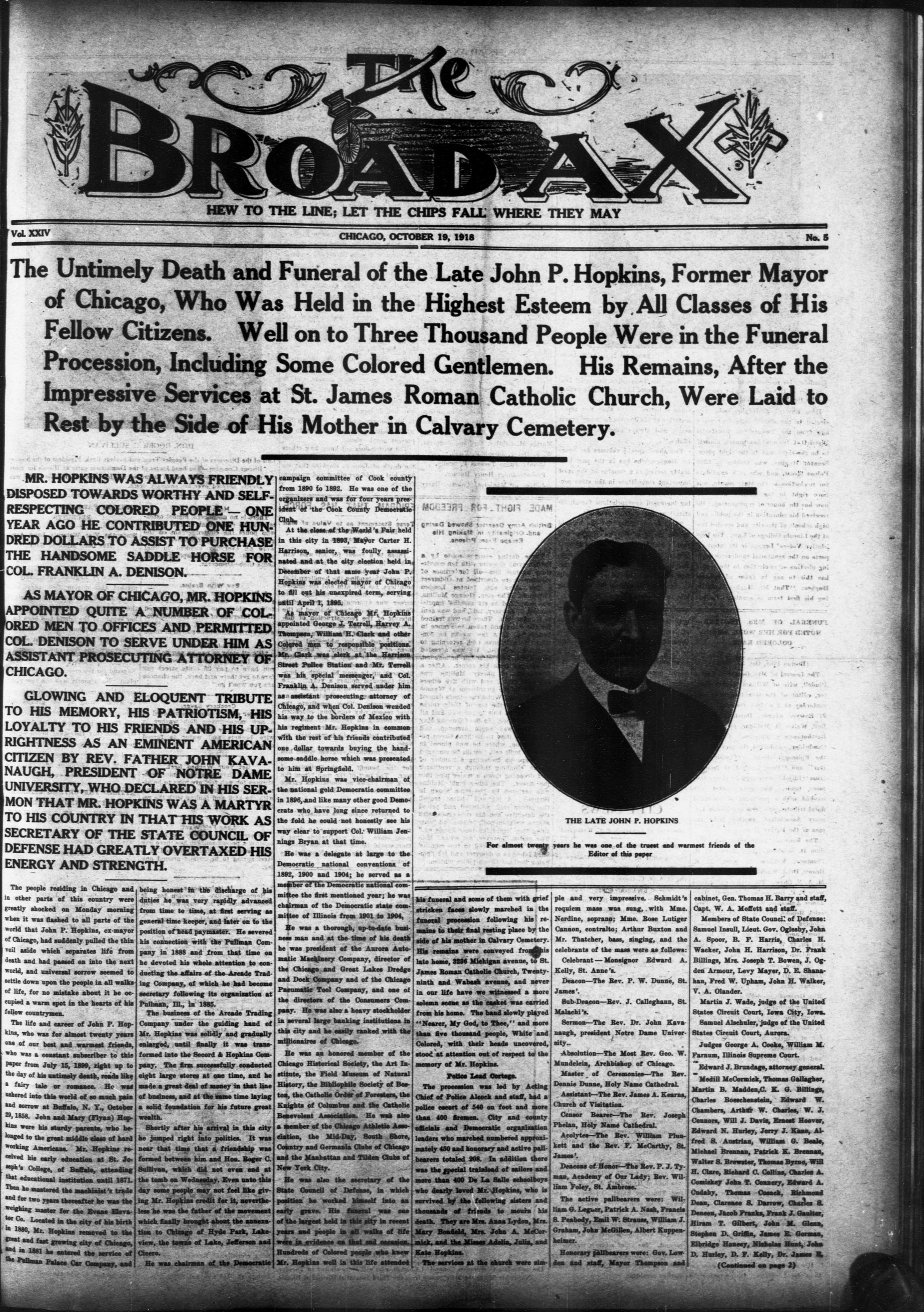
The Untimely Death and Funeral of the Late John P. Hopkins, Former Mayor of Chicago, Who Was Held in the Highest Esteem by All Classes of His Fellow Citizens. Well on to Three Thousand People Were in the Funeral Procession, Including Some Colored Gentlemen. His Remains, After the Impressive Services at St. James Roman Catholic Church, Were Laid to Rest by the Side of His Mother in Calvary Cemetery.
MR. HOPKINS WAS ALWAYS FRIENDLY DISPOSED TOWARDS WORTHY AND SELF-RESPECTING COLORED PEOPLE — ONE YEAR AGO HE CONTRIBUTED ONE HUNDRED DOLLARS TO ASSIST TO PURCHASE THE HANDSOME SADDLE HORSE FOR COL. FRANKLIN A. DENISON.
AS MAYOR OF CHICAGO, MR. HOPKINS APPOINTED QUITE A NUMBER OF COL- ORED MEN TO OFFICES AND PERMITTED COL. DENISON TO SERVE UNDER HIM AS ASSISTANT PROSECUTING ATTORNEY OF CHICAGO.
GLOWING AND ELOQUENT TRIBUTE TO HIS MEMORY, HIS PATRIOTISM, HIS LOYALTY TO HIS FRIENDS AND HIS UPRIGHTNESS AS AN EMINENT AMERICAN CITIZEN BY REV. FATHER JOHN KAVANAUGH, PRESIDENT OF NOTRE DAME UNIVERSITY, WHO DECLARED IN HIS SERMON THAT MR. HOPKINS WAS A MARTYR TO HIS COUNTRY IN THAT HIS WORK AS SECRETARY OF THE STATE COUNCIL OF DEFENSE HAD GREATLY OVERTAXED HIS ENERGY AND STRENGTH.
being honest in the discharge of his duties he was very rapidly advanced from time to time, at first serving as general time keeper, and later on to the position of head paymaster. He severed his connection with the Pullman Company in 1888 and from that time on he devoted his whole attention to conducting the affairs of the Arcade Trading Company, of which he had become secretary following its organization at Pullman, Ill., in 1885.
The business of the Arcade Trading Company under the guiding hand of Mr. Hopkins was solidly and gradually enlarged, until finally it was transformed into the Secord & Hopkins Company. The firm successfully conducted eight large stores at one time, and he made a great deal of money in that line of business, and at the same time laying a solid foundation for his future great wealth.
Shortly after his arrival in this city he jumped right into politics. It was near that time that a friendship was formed between him and Hon. Roger C. Sullivan, which did not even end at the tomb on Wednesday. Even unto this day some people may not feel like giving Mr. Hopkins credit for it, nevertheless he was the father of the movement which finally brought about the annexation to Chicago of Hyde Park, Lakeview, the towns of Lake, Jefferson and Cicero.
He was chairman of the Democratic
He was a delegate at large to the Democratic national conventions of 1892, 1900 and 1904; he served as a member of the Democratic national committee the first mentioned year; he was chairman of the Democratic state committee of Illinois from 1901 to 1904,
THOIR ROE AM
his funeral and some of them with grief stricken faces slowly marched in the funeral procession following his remains to their final resting place by the side of his mother in Calvary Cemetery. His remains were conveyed from his late home, 3236 Michigan avenue, to St. James Roman Catholic Church, Twenty-ninth and Wabash avenue, and never in our life have we witnessed a more solemn scene as the casket was carried from his home. The band slowly played "Nearer, My God, to Thee," and more than five thousand people, White and Colored, with their heads uncovered, stood at attention out of respect to the memory of Mr. Hopkins.
The procession was led by Acting Chief of Police Alecock and staff, had a police escort of 540 on foot and more than 400 firemen. City and county officials and Democratic organization leaders who marched numbered approximately 450 and honorary and active pall-bearers totaled 208. In addition there was the special trainload of sailors and more than 400 De La Salle schoolboys who deeply loved Mr. Hopkins, who is survived by the following sisters and thousands of friends to mourn his death. They are Mrs. Anna Lydon, Mrs. Mary Bonfield, Mrs. John A. McCormick, and the Misses Adelia, Julia, and Kate Hopkins.
The services at the church were sim-
ple and very impressive. Schmidt's requiem mass was sung, with Mme. Nerdine, soprano; Mme. Rose Lutiger Cannon, contralto; Arthur Buxton and Mr. Thatcher, bass, singing, and the celebrants of the mass were as follows: Celebrant — Monsignor Edward A. Kelly, St. Anne's.
cabinet, Gen. Thomas H. Barry and staff,
Capt. W. A. Moffett and staff.
Members of State Council of Defense:
Samuel Insull, Lieut. Gov. Oglesby, John
A. Spoor, B. F. Harris, Charles H.
Wacker, John H. Harrison, Dr. Frank
Billings, Mrs. Joseph T. Bowen, J. Ogden Armour, Levy Mayer, D. E. Shanahan, Fred W. Upham, John H. Walker,
V. A. Olander.
Martin J. Wade, judge of the United
States Circuit Court, Iowa City, Iowa.
Samuel Alschuler, judge of the United
States Circuit Court, Aurora.
Medill McCormick, Thomas Gallagher, Martin B. Madden,C. K. G. Billings, Charles Boschenstein, Edward W. Chambers, Arthur W. Charles, W. J. Connors, Will J. Davis, Ernest Hoever, Edward N. Hurley, Jerry J. Kane, Alfred S. Austrian, William G. Beale, Michael Brennan, Patrick K. Brennan, Walter S. Brewster, Thomas Byrne, Will H. Clare, Bichard C. Collins, Charles A. Comiskey John T. Connery, Edward A. Cudahy, Thomas Cusack, Richmoud Dean, Clarence S. Darrow, Charles S. Deneen, Jacob Franka, Frank J. Gaulter, Hiram T. Gilbert, John M. Glenn, Stephen D. Griffin, James E. Gorman, Elbridge Haneyy, Nicholas Hunt, John D. Hurley, D. F. Kelly, Dr. James E.
```markdown
```
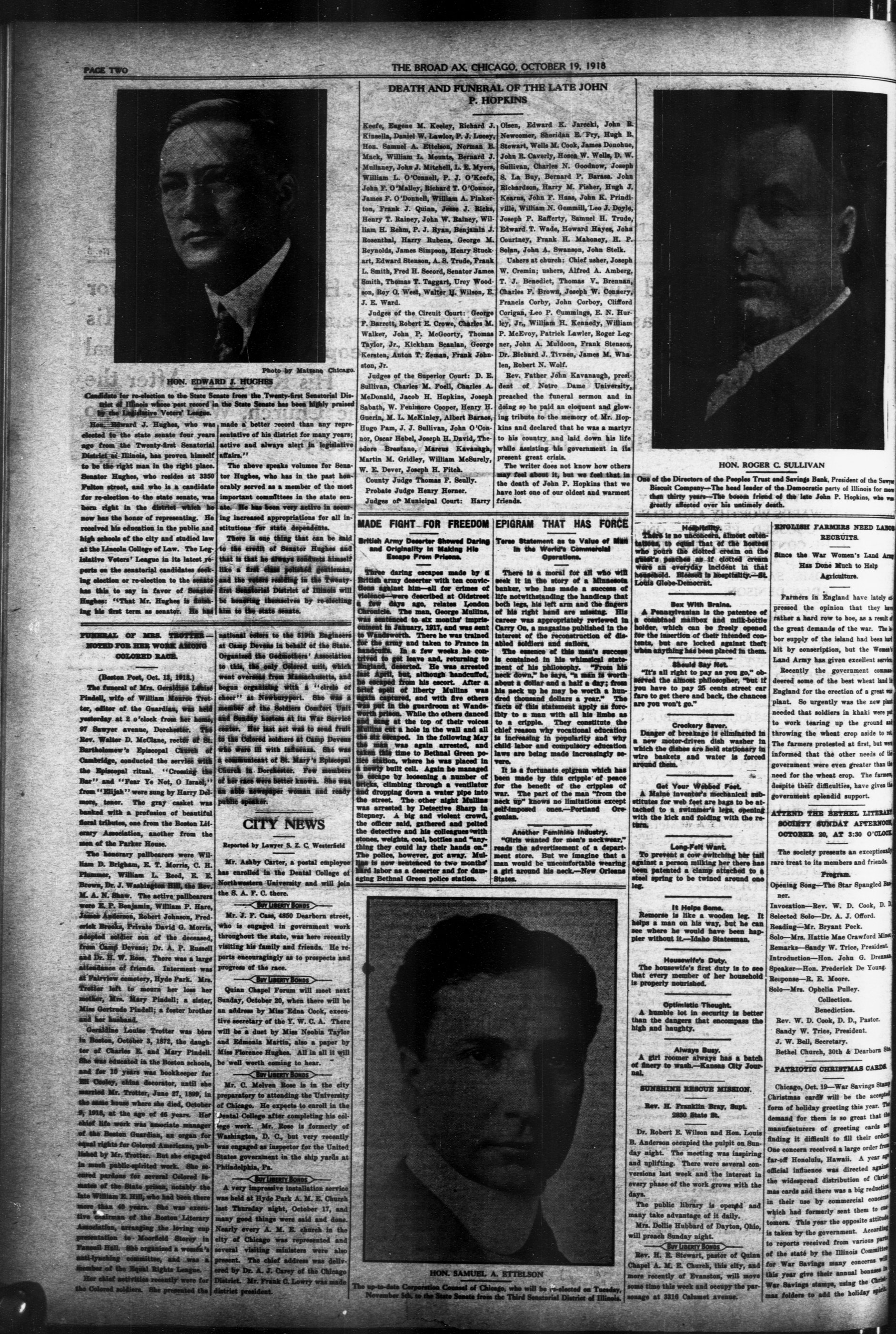
Hon. Edward J. Hughes, who was elected to the state senate four years ago from the Twenty-first Senatorial District at Illinois, has proven himself to be the right man in the right place. Senator Hughes, who resides at 3350 Fulton street, and who is a candidate for re-election to the state senate, was born right in the district which he now has the honor of representing. He received his education in the public and high schools of the city and studied law at the Lincoln College of Law. The Legislative Veter's League in its latest reports on the senatorial candidates seeking election or re-election to the senate has this to say in favor of Senator Hughes: "That Mr. Hughes is finishing his first term as senator. He has
FUMBAL OF MRS. TROTTER NOTED FOR HER WORK AMONG COLORED RACE.
}
made a better record than any representative of his district for many years; active and always alert in legislative affairs. $ ^{11} $ The above speaks volumes for Senator Hughes, who has in the past honorably served as a member of the most important committees in the state senate. He has been very active in securing increased appropriations for all institutions for state dependents.
There is one thing that can be said to the credit of Senator Hughes and that is that he always conducts himself like a first class polished gentleman, and the votes residing in the Twenty-first Senatorial District of Illinois will be honoring themselves by re-electing him to the state senate.
national colors to the 519th Engineers at Camp Devens in behalf of the State. Organized the Godmothers' Association to this, the only Colored unit, which went overseas from Massachusetts, and begun organizing with a "circle of cheer" at Newburyport. She was a member of the Soldiers Comfort Unit and Sunday hostess at its War Service center. Her last act was to send fruit to the Colored soldiers at Camp Devens who were ill with influenza. She was a communicant of St. Mary's Episcopal Church in Dorchester. Few members of her race were better known. She was an able newspaper woman and ready public speaker.
CITY NEWS
Reported by Lawyer S. Z. C. Westerfield
Mr. Ashby Carter, a postal employee has enrolled in the Dental College of Northwestern University and will join the S. A. F. C. there.
BUY LIBERTY BONDS
Mr. J. F. Cass, 4850 Dearborn street, who is engaged in government work throughout the state, was here recently visiting his family and friends. He reports encouragingly as to prospects and progress of the race.
Quinn Chapel Forum will meet next Sunday, October 20, when there will be an address by Miss Edna Cook, executive secretary of the Y. W. C. A. There will be a duet by Miss Neobia Taylor and Edmonin Martin, also a paper by Miss Florence Hughes. All in all it will be well worth coming to hear.
BUY LIBERTY BONDS
Mr. C. Melven Rose is in the city preparatory to attending the University of Chicago. He expects to enroll in the Dental College after completing his college work. Mr. Rose is formerly of Washington, D. C., but very recently was engaged as inspector for the United States government in the ship yards at Philadelphia, Pa.
A very impressive installation service was held at Hyde Park A. M. E. Church last Thursday night, October 17, and many good things were said and done. Nearly every A. M. E. church in the city of Chicago was represented and several visiting ministers were also present. The chief address was delivered by Dr. A. J. Carey of the Chicago District. Mr. Frank C. Lowry was made district president.
THE BROAD AX: CHICAGO, OCTOBER 19, 1918
M.
Judges of the Circuit Court: George P. Barrett, Robert E. Crowe, Charles M. Walker, John P. McGoorty, Thomas Taylor, Jr., Kickham Scanlan, George Kersten, Auton T. Zeman, Frank Johnston, Jr.
Judges of the Superior Court: D. E. Sullivan, Charles M. Foell, Charles A. McDonald, Jacob H. Hopkins, Joseph Sabath, W. Fenimore Cooper, Henry H. Guerin, M. L. McKinley, Albert Barnes, Hugo Pam, J. J. Sullivan, John O'Connor, Oscar Hebel, Joseph H. David, Theodore Brentano, Marcus Kavangh, Martin M. Gridley, William McSurely, W. E. Dever, Joseph H. Fitch.
County Judge Thomas F. Scully
Probate Judge Henry Horner.
Judges of Municipal Court: B
Three daring escapes made by a British army deserter with ten convictions against him—all for crimes of violence—were described at Oldstreet a few days ago, relates London Chronicle. The man, George Mullins, was sentenced to six months' imprisonment in January, 1917, and was sent to Wandsworth. There he was trained for the army and taken to France in handcuffs. In a few weeks he contrived to get leave and, returning to England, deserted. He was arrested last April, but, although handcuffed, he escaped from his escort. After a brief spell of liberty Mullins was again captured, and with five others was put in the guardroom at Wandsworth prison. While the others danced and sang at the top of their voices Mullins cut a hole in the wall and all the six escaped. In the following May the man was again arrested, and taken this time to Bethnal Green police station, where he was placed in a newly built cell. Again he managed to escape by loosening a number of bricks, climbing through a ventilator and dropping down a water pipe into the street. The other night Mullins was arrested by Detective Sharp in Stepney. A big and violent crowd, the officer said, gathered and pelted the detective, coal, bottles and "anything they could lay their hands on." The police, however, got away. Mullins is now sentenced to two months' hard labor as a deserter and for damaging Bethnal Green police station.
Olsen, Edward K. Jareeki, John R. Newcomer, Sheridan E. Fry, Hugh R. Stewart, Wells M. Cook, James Donohue, John R. Caverly, Hosea W. Wells, D. W. Sullivan, Charles N. Goodnow, Joseph S. La Buy, Bernard P. Barasa. John Richardson, Harry M. Fisher, Hugh J. Kearns, John F. Haas, John K. Prindiville, William N. Gemmill, Leo J. Doyle, Joseph P. Rafferty, Samuel H. Trude, Edward T. Wade, Howard Hayes, John Courtney, Frank H. Mahonay, H. P. Solan, John A. Swanson, John Stelk. Usher at church: Chief usher, Joseph W. Cremin; ushers, Alfred A. Amberg, T. J. Benedict, Thomas V. Brennan, Charles F. Brown, Joseph W. Connery, Francis Corby, John Corboy, Clifford Corigan, Leo P. Cummings, E. N. Hurley, Jr., William H. Kennedy, William P. McEvoy, Patrick Lawler, Roger Legner, John A. Muldoon, Frank Stenson, Dr. Richard J. Tivnen, James M. Whalen, Robert N. Wolf.
Rev. Father John Kavanaugh, president of Notre Dame University, preached the funeral sermon and in doing so he paid an eloquent and glowing tribute to the memory of Mr. Hopkins and declared that he was a martyr to his country and laid down his life while assisting his government in its present great crisis. The writer does not know how others may feel about it, but we feel that in the death of John P. Hopkins that we have lost one of our oldest and warmest friends.
There is a moral for all who will seek it in the story of a Minnesota banker, who has made a success of life notwithstanding the handicap that both legs, his left arm and the fingers of his right hand are missing. His career was appropriately reviewed in Carry On, a magazine published in the interest of the reconstruction of disabled soldiers and sailors.
The essence of this man's success is contained in his whimsical statement of his philosophy. "From his neck down," he says, "a man is worth about a dollar and a half a day; from his neck up he may be worth a hundred thousand dollars a year." The facts of this statement apply as forcibly to a man with all his limbs as to a cripple. They constitute the chief reason why vocational education is increasing in popularity and why child labor and compulsory education laws are being made increasingly severe.
It is a fortunate epigram which has been made by this cripple' of peace for the benefit of the cripples of war. The part of the man "from the neck up" knows no limitations except self-imposed ones.—Portland Oregon.
Another Feminine Industry. "Girls wanted for men's neckwear," reads the advertisement of a department store. But we imagine that a man would be uncomfortable wearing a girl around his neck—New Orleans States.
18
HON. ROGER C. SULLIVAN
One of the Directors of the Peoples Trust Biscuit Company—The head leader of than thirty years—The bosom friend greatly affected over his untimely d
One of the Directors of the Peoples Trust and Savings Bank, President of the Sawyer Biscuit Company—The head leader of the Democratic party of Illinois for more than thirty years—The boom friend of the late John P. Hopkins, who was greatly affected over his untimely death.
Hospitality.
There is no unconcern, almost ostentatious, to equal that of the hostess who pours the clotted cream on the guest's panches as if clotted cream were an everyday incident in that household. Blessed is hospitality.—St. Louis Globe-Democrat.
ENGLISH FARMERS NEED LABOR
RECORUITS.
Since the War Women's Land Army Has Done Much to Help Agriculture.
A Pennsylvanian is the patentee of a combined mailbox and milk-bottle holder, which can be freely opened for the insertion of their intended contents, but are locked against theft when anything has been placed in them.
Should Say Not.
"It's all right to pay as you go," observed the almost philosopher, "but if you have to pay 25 cents street car fare to get there and back, the chances are you won't go."
Danger of breakage is eliminated in a new motor-driven dish washer in which the dishes are held stationary in wire baskets and water is forced around them.
Get Your Webbed Feet.
A Maine inventor's mechanical substitutes for web feet are bags to be attached to a swimmer's legs, opening with the kick and folding with the return.
Long-fast Want.
To prevent a cow switching her tail against a person milking her there has been patented a clamp attached to a steel spring to be twined around one leg.
It Helps Some.
Remorse is like a wooden leg. It helps a man on his way, but he can see where he would have been happier without it. -Idaho Statesman.
Housewife's Duty.
The housewife's first duty is to see that every member of her household is properly nourished.
Optimistic Thought.
A humble lot in security is better than the dangers that encompass the high and haughty.
Always Busy.
A girl roomer always has a batch of finery to wash.—Kansas City Journal.
SUNSHINE RESCUE MISSION.
Rev. H. Franklin Bray, Supt.
2830 State St.
Dr. Robert E. Wilson and Hon. Louis B. Anderson occupied the pulpit on Sunday night. The meeting was inspiring and uplifting. There were several conversions last week and the interest in every phase of the work grows with the days.
The public library is opened and many take advantage of it daily.
Mrs. Dollie Hubbard of Dayton, Ohio, will preach Sunday night.
BUY LIBERTY BONDS
Rev. H. E. Stewart, pastor of Quinn
Chapel A. M. E. Church, this city, and
more recently of Evanston, will move
some time this week and occupy the par-
sonage at 3316 Calumet avenue.
Box With Brains
Should Say Not.
Long-Felt Want.
ENGLISH FARMERS NEED LABOR
RECRUITS.
Since the War Women's Land Army
Has Done Much to Help
Agriculture.
Farmers in England have lately pressed the opinion that they have rather a hard row to hoe, as a result the great demands of the war. The labor supply of the island had been hast hit by conscription, but the Womens Land Army has given excellent service.
Recently the government commandeered some of the best wheat land in England for the erection of a great wheat plant. So urgently was the new plant needed that soldiers in khaki were put to work tearing up the ground and throwing the wheat crop aside to rot. The farmers protested at first, but were informed that the other needs of the government were even greater than the need for the wheat crop. The farmers, despite their difficulties, have given the government splendid support.
ATTEND THE RETHEL LITERARY SOCIETY SUNDAY AFTERNOON, OCTOBER 20, AT 3:30 O'CLOCK
Opening Song—The Star Spangled Banner.
Invocation—Rev. W. D. Cook, D. M.
Selected Solo—Dr. A. J. Offord.
Reading—Mr. Bryant Peck.
Solo—Mrs. Hattie Mae Crawford Mine.
Remarks—Sandy W. Trice, President.
Introduction—Hon. John G. Drennan.
Speaker—Hon. Frederick De Young.
Reuponse—R. E. Moore.
Solo—Ophilia Pulley.
Collection.
Benediction.
Rev. W. D. Cook, D. D., Pastor.
Sandy W. Trice, President.
J. W. Bell, Secretary.
Bethel Church, 30th & Dearborn St.
PATRIOTIC CHRISTMAS CARDS
Chicago, Oct. 19—War Savings Stamp Christmas card will be the accepted form of holiday greeting this year. The demand for them is so great that the manufacturers of greeting cards are finding it difficult to fill their orders. One concern received a large order from far-off Honolulu, Hawaii. A year ago official influence was directed against the widespread distribution of Christmas cards and there was a big reduction in their use by commercial concerns which had formerly sent them to customers. This year the opposite attitude is taken by the government. According to reports received from various parts of the state by the Illinois Committee for War Savings many concerns will this year give their annual bonuses in War Savings stamps, using the Christmas folders to add the holiday spirit.
1
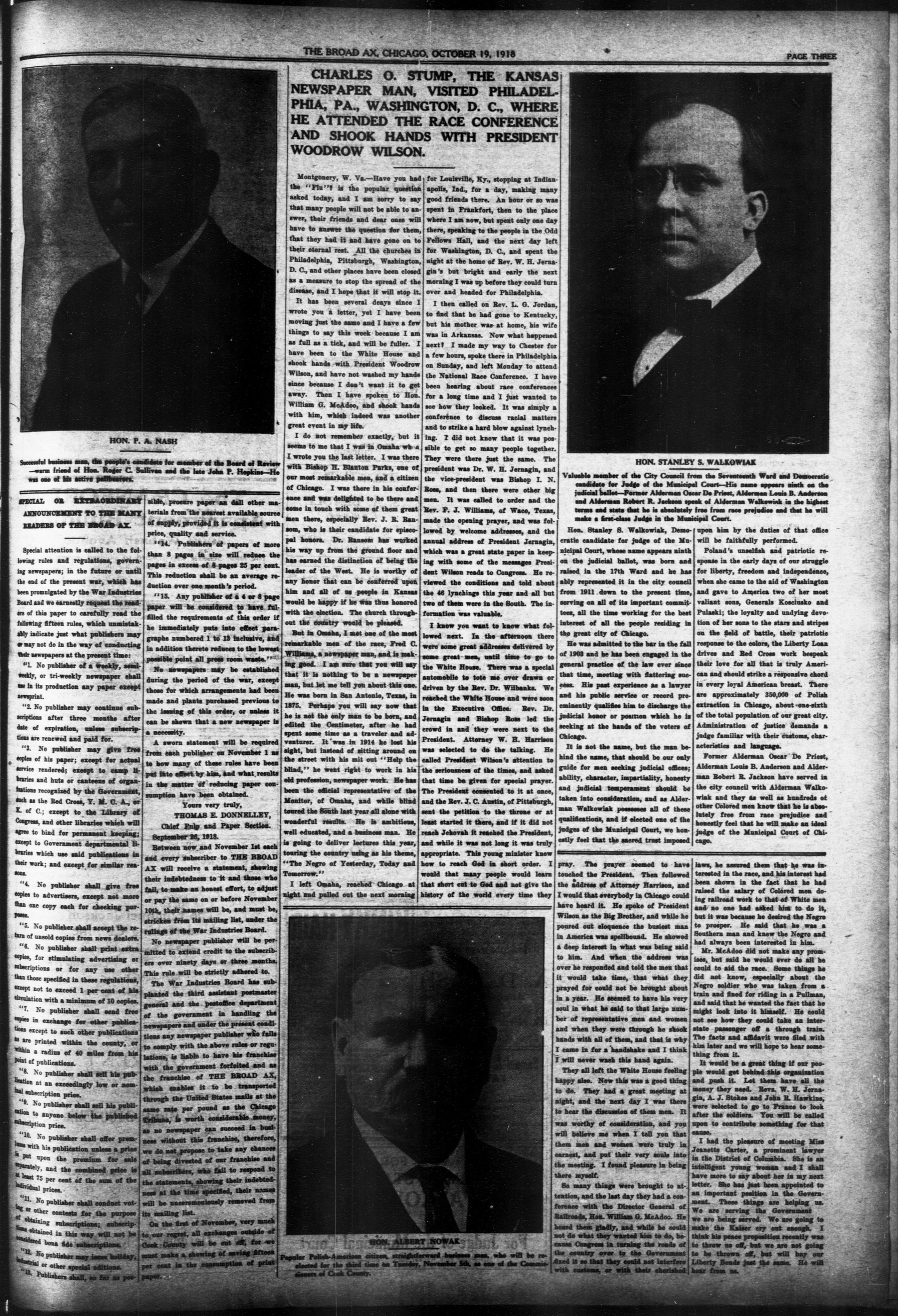
Successful business man, the people's candidate for member of the Board of Review —warm friend of Hon. Roger C. Sullivan and the late John P. Hopkins—He was one of his active pallbearers.
14. Publishers of papers of more than 8 pages in size will reduce the pages in excess of 8 pages 25 per cent. This reduction shall be an average reduction over one month's period.
"15. Any publisher of a 4 or 8 page paper will be considered to have fulfilled the requirements of this order if he immediately puts into effect paragraphs numbered 1 to 13 inclusive, and in addition thereto reduces to the lowest possible point all press room waste." No newspapers may be established during the period of the war, except those for which arrangements had been made and plants purchased previous to the issuing of this order, or unless it can be shown that a new newspaper is a necessity.
A sworn statement will be required from each publisher on November 1 as to how many of these rules have been put into effect by him, and what results in the matter of reducing paper consumption have been obtained.
THOMAS E. DONNELEY,
Chief Pulp and Paper Section.
September 26, 1918.
Between now and November 1st each
and every subscriber to THE BROAD
AX will receive a statement, showing
their indebtedness to it and those who
fail, to make an honest effort, to adjust
or pay the same on or before November
10th, their names will be, and must be,
stricken from its mailing list, under the
rollings of the War Industries Board.
CHARLES O. STUMP, THE KANSAS NEWSPAPER MAN, VISITED PHILADELPHIA, PA., WASHINGTON, D. C., WHERE HE ATTENDED THE RACE CONFERENCE AND SHOOK HANDS WITH PRESIDENT WOODROW WILSON.
HON. ALBERT NOWAK
Popular Polish-American citizen, straightforward business man, who will be re-elected for the third time on Tuesday, November 5th, as one of the Commis-
Montgomery, W. Va.—Have you had the "Flu"? is the popular question asked today, and I am sorry to say that many people will not be able to answer, their friends and dear ones will have to answer the question for them, that they had it and have gone on to their eternal rest. All the churches in Philadelphia, Pittsburgh, Washington, D. C., and other places have been closed as a measure to stop the spread of the disease, and I hope that it will stop it. It has been several deays since I wrote you a letter, yet I have been moving just the same and I have a few things to say this week because I am as full as a tick, and will be fuller. I have been to the White House and shook hands with President Woodrow Wilson, and have not washed my hands since because I don't want it to get away. Then I have spoken to Hon. William G. McAdoo, and shook hands with him, which indeed was another great event in my life.
I do not remember exactly, but it seems to me that I was in Omaha when I wrote you the last letter. I was there with Bishop H. Blanton Parks, one of our most remarkable men, and a citizen of Chicago. I was there in his conference and was delighted to be there and come in touch with some of them great men there, especially Bev. J. R. Ransom, who is their candidate for episcopal honors. Dr. Ransom has worked his way up from the ground floor and has earned the distinction of being the leader of the West. He is worthy of any honor that can be conferred upon him and all of us people in Kansas would be happy if he was thus honored with the election. The church throughout the country would be pleased.
But in Omaha, I met one of the most remarkable men of the race, Fred C. Williams, a newspaper man, and is making good. I am sure that you will say that it is nothing to be a newspaper man, but let me tell you about this one. He was born in San Antonio, Texas, in 1875. Perhaps you will say now that he is not the only man to be born, and edited the Centimeter, after he had spent some time as a traveler and adventurer. It was in 1914 he lost his sight, but instead of sitting on the street with his mit out "Help the blind," he went right to work in his old profession, newspaper work. He has been the official representative of the Monitor, of Omaha, and while blind toured the South last year all alone with wonderful results. He is ambitious, well educated, and a business man. He is going to deliver lectures this year, touring the country using as his theme, "The Negro of Yesterday, Today and Tomorrow."
I left Omaha, reached Chicago at night and pulled out the next morning
for Louisville, Ky., stopping at Indianapolis, Ind., for a day, making many good friends there. An hour or so was spent in Frankfort, then to the place where I am now, but spent only one day there, speaking to the people in the Odd Fellows Hall, and the next day left for Washington, D. C., and spent the night at the home of Rev. W. H. Jernagin's but bright and early the next morning I was up before they could turn over and headed for Philadelphia.
I then called on Rev. L. G. Jordan, to find that he had gone to Kentucky, but his mother was at home, his wife was in Arkansas. Now what happened next? I made my way to Chester for a few hours, spoke there in Philadelphia on Sunday, and left Monday to attend the National Race Conference. I have been hearing about race conferences for a long time and I just wanted to see how they looked. It was simply a conference to discuss racial matters and to strike a hard blow against lynching. I did not know that it was possible to get so many people together. They were there just the same. The president was Dr. W. H. Jernagin, and the vice-president was Bishop I. N. Ross, and then there were other big men. It was called to order and the Rev. F. J. Williams, of Waco, Texas, made the opening prayer, and was followed by welcome addresses, and the annual address of President Jernagin, which was a great state paper in keeping with some of the messages President Wilson reads to Congress. He reviewed the conditions and told about the 46 lynchings this year and all but two of them were in the South. The information was valuable.
I know you want to know what followed next. In the afternoon there were some great addresses delivered by some great men, until time to go to the White House. There was a special automobile to tote me over drawn or driven by the Rev. Dr. Wilbanks. We reached the White House and were soon in the Executive Office. Rev. Dr. Jernagin and Bishop Ross led the crowd in and they were next to the President. Attorney W. H. Harrison was selected to do the talking. He called President Wilson's attention to the seriousness of the times, and asked that time be given for special prayer. The President consented to it at once, and the Rev. J. C. Austin, of Pittsburgh, sent the petition to the throne or at least started it there, and if it did not reach Jehovah it reached the President, and while it was not long it was truly appropriate. This young minister knew how to reach God in short order. I would that many people would learn that short cut to God and not give the history of the world every time they
55
HON. STANLEY S. WALKOWIAK
Valuable member of the City Council from the Seventeenth Ward and Democratic candidate for Judge of the Municipal Court—His name appears ninth on the judicial ballot—Former Alderman Occar De Priest, Alderman Louis B. Anderson and Alderman Robert R. Jackson speak of Alderman Walkowiak in the highest terms and states that he is absolutely free from race prejudice and that he will make a first-class Judge in the Municipal Court.
Hon. Stanley S. Walkowiak, Democratic candidate for judge of the Municipal Court, whose name appears ninth on the judicial ballot, was born and raised in the 17th Ward, and he has ably represented it in the city council from 1911 down to the present time, serving on all of its important committees, all the time working for the best interest of all the people residing in the great city of Chicago.
upon him by the duties of that office will be faithfully performed.
Poland's unselfish and patriotic response in the early days of our struggle for liberty, freedom and independence, when she came to the aid of Washington and gave to America two of her most valiant sons, Generals Kosciusko and Pulaski; the loyalty and undying devotion of her sons to the stars and stripes on the field of battle, their patriotic
He was admitted to the bar in the fall of 1903 and he has been engaged in the general practice of the law ever since that time, meeting with flattering success. His past experience as a lawyer and his public service or record preeminently qualifies him to discharge the judicial honor or position which he is seeking at the hands of the voters of Chicago.
It is not the name, but the man behind the name, that should be our only guide for men seeking judicial offices; ability, character, impartiality, honesty and judicial temperament should be taken into consideration, and as Alderman Walkowiak possesses all of these qualifications, and if elected one of the judges of the Municipal Court, we honestly feel that the sacred trust imposed
pray. The prayer seemed to have touched the President. Then followed the address of Attorney Harrison, and I would that everybody in Chicago could have heard it. He spoke of President Wilson as the Big Brother, and while he poured out eloquence the busiest man in America was spellbound. He showed a deep interest in what was being said to him. And when the address was over he responded and told the men that it would take time, that what they prayed for could not be brought about in a year. He seemed to have his very soul in what he said to that large number of representative men and women and when they were through he shook hands with all of them, and that is why I came in for a handshake and I think I will never wash this hand again.
They all left the White House feeling happy also. Now this was a good thing to do. They had a great meeting at night, and the next day I was there to hear the discussion of them men. It was worthy of consideration, and you will believe me when I tell you that them men and women were truly in earnest, and put their very souls into the meeting. I found pleasure in being there myself.
So many things were brought to attention, and the last day they had a conference with the Director General of Railroads, Hon. William G. McAdoo. He heard them gladly, and while he could not do what they wanted him to do, because Congress in turning the roads of the country over to the Government fixed it so that they could not interfere with customs, or with their cherished
S.
from the Seventeenth Ward and Democratic
Capital Court—His name appears ninth on the
scar De Priest, Alderman Louis B. Anderson
peek of Alderman Walkwick in the highest
y free from race prejudice and that he will
nicipal Court.
upon him by the duties of that office
will be faithfully performed.
Poland's unselfish and patriotic response in the early days of our struggle for liberty, freedom and independence, when she came to the aid of Washington and gave to America two of her most valiant sons, Generals Kosciusko and Pulaski; the loyalty and undying devotion of her sons to the stars and stripes on the field of battle, their patriotic response to the colors, the Liberty Loan drives and Red Cross work bespeak their love for all that is truly American and should strike a responsive chord in every loyal American breast. There are approximately 350,000 of Polish extraction in Chicago, about one-sixth of the total population of our great city. Administration of justice demands a judge familiar with their customs, characteristics and language.
Former Alderman Oscar De Priest, Alderman Louis B. Anderson and Alderman Robert R. Jackson have served in the city council with Alderman Walkowiak and they as well as hundreds of other Colored men know that he is absolutely free from race prejudice and honestly feel that he will make an ideal judge of the Municipal Court of Chicago.
laws, he assured them that he was interested in the race, and his interest had been shown in the fact that he had raised the salary of Colored men doing railroad work to that of White men and no one had asked him to do it, but it was because he desired the Negro to prosper. He said that he was a Southern man and knew the Negro and had always been interested in him.
Mr. McAdoo did not make any promises, but said he would ever do all he could to aid the race. Some things he did not know, especially about the Negro soldier who was taken from a train and fined for riding in a Pullman, and said that he wanted the fact that he might look into it himself. He could not see how they could take an interstate passenger off a through train. The facts and alldavit were filled with him later and we will hope to hear something from it.
It would be a great thing if our people would get behind this organization and push it. Let them have all the money they need. Reva, W. H. Jernagin, A. J. Stokes and John R. Hawkins, were selected to go to France to look after the soldiers. You will be called upon to contribute something for that cause.
I had the pleasure of meeting Miss Jeanette Carter, a prominent lawyer in the District of Columbia. She is an intelligent young woman and I shall have more to say about her is my next letter. She has just been appointed to an important position in the Government. These things are helping us. We are serving the Government we are being served. We are going to make the Kaiser cry out enough. I think his peace proposition recently was to throw us off, but we are not going to be thrown off, but will buy our Liberty Bonds just the same. He will hear from us.
PAGE THREE
THE BROAD AX
‘Pebliched Hecey Seterday
ants, Single Taxers, Priests, infidels or
‘anyone else ‘have their say as long
ae lake Mcgoiae fe pagar nt ceapeues
Dikity is fixed.
_ The Broad Ax is a newspaper whose
platform is broad enough for all, ever
‘aiming the editorial right to speak its
own mind
Toeal ‘will receive
attention. ve ‘ealy on one side of
the paper.
‘Bubseription. must be paid in ad-
vance. '
Qee Wear oes ces scenes sce reenee GB00
‘Advertising rates made known on
application. —~
Address all communications to
‘THE BROAD ax
€206 & Blisadeth Street, Chicago, ML
PHONE WENTWORTH s0e7.
SULIUS YP. TAYLOR, Biter and
‘Publisher. ~
—_———————
‘DR. M. A. MAJORS, 4700 8. STATE.
G2RERT, PHONE DEEXEL 1416,
ASSOCIATE EDITOR.
———
‘Butered «8 Second-Class Matter Aug.
19, 1902, at the Post Office st Chicago,
Minois, under Act of March 3, 1879,
aaa
VOL ARIY OCTOBER 18 Ne. 5
HAVING FALSE IDEAS BOILt UP
ON FALSE SENTIMENT.
ee ee ene tno
thing they Near: "A" gréat many peopld
‘are on the contrary, » great many
people who do not believe only the very
fine-traths, and more of the falsities
of people, and then there are a great
many people who are not eager to bé-
lieve everything they read, and dis-
eredit the cheap sentiment and mouth-
‘ings of the gossiper and the disgruntled.
People do acquaint themselves of our
virtues but they are’slow to extol them
like “Anthony over the grave of grest
Caesar. There is a monkey-wrench in
the running gear of the brain of most of
our best friends. ft is not jealousy,
not quite énvy and it cannot properly
be called selfishness, it is likely that our
language is not quite complete, or else
some one would step forward with the
missing word that is so greatly needed
‘to use when we fail to register up to
the measurement that just suits our
friends, so they need not boast of our
knowing them so Very well, don’t you
knowt
‘Well, it is not good idea to know
too much sbout our friends, nor know
them so very intimately,
hq principle has always been &. good
ene, and to know s few people traly well
is always helpful and inspiring to noble
‘friendship. It. will hardly do for the
present modern day. People regard old
friendships just-28 they do anything
else that may be .shopworn. In. this
‘busy no redk<a ‘baby ers of civiliz-
‘tion, when ‘every follow is after the
or profit, When the commercial struck
mind must meet with the obligations
that embellish the environment and
decorate ths ‘pictare with the git of
erate gold, knowing much or little
about friends, or people neither enter
into the mental process of reasoning or
setting lines of proper or improper #yn-
‘tax about the graces or misconduct
swhother. it is trac or false, if it is
Glander? It is soon forgotten and the
glad’ stone, the imisfortune, or the
‘wretch and reprobate all are cast in
‘the junk heap of oblivion. If this were
‘Rot 80, ye editor might publish in the
columns ef this paper enough of that
character destroying reminiscence of
‘many of the eppareat notables of Chi
See cne
‘and tottered on the very brink
SAO tea Seo
mpen the, 200k of, 0a Yetta: teak decd
ara a ea
elinaibchch enstlaneeiak Sinie eb ania
” peaiaenata ares ia et and i
BUR wee ie od
a ee rad ito Be IS
7 eee een eee
or harm the individual permanent
Ty, ous ean by retarded, and vot beet
temporarily by outside influence and in
ian ata as oe
individual will triumph in the end. Th«
progress of our race abundantly attes:
to this fact. .
People must surely arfive st this
trath. The great White race high on ite
mission “of civilization ean not carry
forward the world work without esrry-
ing along the Negro race, The infamy
of its newspapers, the ugly slings and
scuffs at the prostrate, helpless Negrc
will only arrest temporarily our redemp-
tion. The sickly, maudlin sentiment of
‘White editors, and writers of magazine:
who misstate facts to build up foolish
fancies, ‘and the lying and misrepre-
sentation of individuals now too num
erous who delight in the hilarity of the
mistaken ideas and notions concerning
us will be rua over by the overwhelm
ing surprises of our racial status when
the true facts become fully revealed tc
them.
Bo we: reiterate, a great many peo
ple believe all they read, and a great
many people believe all they hear, while
on the contrary there are a great many
people who believe only the very finc
truths and none of the falsities of
people.
Beene: One State street car between
47th and, 35th,, Car was crowded—
people- standing, young Colored woman
als 2 poet lps sine wal esa
eveupied. whole ses} intended, for twe
‘people... White lady, tried to sit down
bp her; was tebuifed; had te-get up
‘because said young Colored “woman
would not budge an inch, nor give up
the ugly position she was.in. She be-
came the subject of jeers from others
‘who were compelled to stand. Nobody
had the nervé to’/say anything to her
while she sat cross legged in the middle
ofthe seat. Ever and anon she‘ tossed
hor head, rolied her ¥yss, and acted as
if she was mad, She was not sick, not
intoxiéated, and we do not believe she
was really mean, but my, she must have
beeri densely -ignorant—too ignorant,
really, ‘to be~nice, Where could she
have come from? "We have never séen
anything in our lives quite like this.
What isto be said? What can be said!
‘This young Colored woman, or lady,
or something else; is eapable of doing
the entire race lot of harm by: such
foolish “and daredevil nonsense: I
wish I knew her name and might-get
this -writing before her eyes, but it is
Vikely ‘that she could not read it any:
way.
PREJUDICE 18 BORN OF 1G-
‘NORANCE.
‘The civilized world will never know
what the Colored race has to suffer just
Decause it is colored. The cireum-
stanees_and conditions over which our
race has no control multiplies the
anomaly of thé situation. No other
race could fave survived the mying
ordeals, tyranny and oppression with
which we have been wrung through two
and a balf centuries. With sore and
bleeding feet and with only a minimum
of faith in the oppressor, and less en-
couragement to face the future than
any other people on earth, we are burn-
ing all our bridges behind us because we
don’t wish to ever go back over the
pitfalls and ugly chasms wo had to
cross to reach the bigh ground of a
noble humanity, Heresfter we don’t
intend to. suffer say such trestment
which has been given us,,and ws are
not going to bow low to anybody for
the great things we propose to get, and
| we are not going to get,them by asking
for thems, 3... s
‘Hostile sentiment be hanged, prejudice
‘has always been the devil's handmaides
which has ever clouded our pathway,
contemptible; deviltry in every ugly
form, ts ef est poons.ond dep
AR DE SPapt, oe ged He ws
p Sn ape stageetioes
the eee a reg Dat 90
the years of this vile use of race pre}
ot Peeper hee. simply. pared
Se Pe teed VE Hef 952 Fons su
we pre .reap oneeee ae
ewes Tanta
pase Ey Pear: Pee
eee ee aor
hindi aie ales Ss Sika tad anil
coinimer stant rarheapnsem
THE BROAD AX, CHICAGO, OCTOBER 19, 1918
\* VOTE FOR -
| ALDERMAN: STANLEY S.
“Fer bl tap Con
‘ab tedeld-Wost gdh Sou Toliciad atioe
und outside of a dark complexion.
If the mean and ugly disposition of
‘the poor Whites were centered in the
‘accomplishment of their own progress
im ‘the same ratio that the Negro is
concentrating his strength and energy
‘to break ‘ver thé terrible conflict of
racial animosity would die its hundred
deaths and prejudice world become one
‘of the forgotten arts of devilish fools
who think « white skin is all one needs
to have om earth,
Unfortunately prejadice is born of ig-
noranece and while ignorance abounds
and flourishes with audacity respectable
sentiments will necessarily languish.
‘Why race prejadice? Why should peo-
ple be ignorant in this enlightened age!
And why should White people be ig-
‘norant with so many centuries of en-
lightenment?
TRUST GOD.
By Dr. M. A. Majors.
When you've shot at the mark and
missed the bull’seye,
Of course you want to hear the gong.
But by shooting right on if you’re not
too shy, a
‘The bell may ring ’ere long.
Don’t get in your nut that failure ‘is
due,
And that you have done your best.
‘You must think of the guys who will
point at you;
Holy Gee, come poke out your chest.
You ‘are "net all in ‘ill you've closed
‘your eye;
‘Till you've turned up your toes for
‘the sod,
And maybe tot’ then if you’re not too
sty
To play "your ast trump: ‘Trust
~ Goa?”
‘You should never admit that quitting
was wise,
That the game was unlucky and
tough,
That you got a cold deal; if the spark’s
in your eye,
‘You'll win yet, ‘*Trust God,”’ that’s
enough.
SIX-ROOM FLAT FOR RENT.
~For Rent—6 light rooms and bath,
‘all modern, stove heat. New heating
stove mow in flat ean be bought reason-
‘able if wanted. Rent $25.00, at 5935
LaFayette Ave. 2nd flat.
i NEHF.
21 N, LaBalle St.
Phone Franklin 3966. (Aav.)
WANT $2,700.00.
Want to borrow $2,700.00 on 2-story
brick building, 6 years old, all modern
improvements, located at 5935 LaFay-
‘ette Ave.
7 \ Bel senTy Bones >
The Ladies’ Aid Society of St. Mark
M. E. Chureh is to hold « birthday party
in the near future. All members have
been given purses to be filled with coins
according to the age of the holder.
PHONE MAIN 2214
Attorney at Law
118 North La Salle Street
act
Samuel Z. C. Westerfield
; RESIDENCE
GM Bryans Ave, mnt a
g As Near As Your Telepho ‘
CRTANE ROITERIAL a
Poy cede ed te ee
not only brings sorrow, but misfortune as well. Let the
pice you pay for a funeral be a business proposition and
you will benefit by it in service, quality and cost to you
Weecdete ai
establishments in the a Ey
A ‘Wit will convince
mtn anges Saas et
eke © oi ee Cond Tie eee od -
Chapel Call promplly answered day or night.
Ernest H. Williamson,
“GE? Undertaker “#307
5028 and 5030 S. StateSt, - + - ~- Chicago,
‘8 B Sth STREET
J. Gray Lucas
Attorney at Law
Seite 615 Hartiord Building
18.8. DEARBORN STREET, CHICAGO
PHONE: CENTRAL 6583
Residence, 1262 Macalister Place
‘Teleptene Meares 7
MILES J.’ DEVINE
Attorney at Lew
Suite 313-329 Reaper Block
Glark and Washington Sts.
‘Phenes, Control 20; Ante 6-116
oe
TEL. CENTRAL 3142
S. A. T. WATKINS
LAWYER
3% WEST RANDOLPH STREET
CHICAGO
|
wate
‘Residence, 4533 Prairie Avenue
‘Res, Kenwood Sm
WALTER M. FARMER
ATTORNEY AND
COUNSELOR AT LAW
ROTARY PUBLIC
‘Saito 7 §
184 W. Washington St.
Pence, fice, Main 5 Ante, 35738
CHICAGO
| Omes Phone S078 (Deagis)
‘Residence Phone, Dowgias S179
S. A. BEADLE
Lawyer
| sse2 SOUTH STATE STREET
| CHICAGO
~The CRANFORD
Apartment Building
3600 Wabash Avenue
cacw- Seams bent Gectis ghia tle bathe marble tance.
J. W. CASEY, Agent
Phone Main 263 133 W. Washington Street
_ The Elite Cafe
AND BUFFET
3030 STATE STREET CHICAGO
Ree. 205 Prekte Ava Phone Doug. 0
(PHONES: MAIN 3007
AUTOMATIC 32-35
A. L. WILLIAMS
Attorney and Counselor at Law
Suite 706 FIRMENICH BUILDING
tot Weet Washington Street caucaao
2 pieces iar ae ale
be heated oe
wM, J. LATHAM
| ATTORNEY AT LAW
OFFICE PHONE: CALUMET
2 East 31st Street
Suite 7
: CHICAGO
‘H.-A. WATKINS |
REAL, ESTATE AND INSURANCE |
RENTING A ee
fet, Dem 2b Meco, freee
JOHN J. DUNN
RSTABLISHED iT
Wholessie end Retail
COAL
© aig ater Seen
a
ae aees OPEN DAY AND NIGHT
The Emanuel Jackson
Undertaking Co., Inc.
Reliable Service Courteous Treatment
Reasonable Prices
FREE CHAPEL IN CONNECTION
Complete Line of Faneml Goods Axtomebiles for Hire
KINKY HAIR
ogitin®
=
Se
* qqanmeve manrouss oo. hatte, O2
FOR RENT
- 2, 4,5 and 6 Room Flats
Lakeview Bldg., 3100 Ellis Ave.
Steam eat, hot water, electric
. Geo. F. Harding, Jr., Real Estate Office
Phone Douglas 1° — 3101-Cottage Grove Ave.