The Broad Ax
Saturday, October 26, 1918
Chicago, Illinois
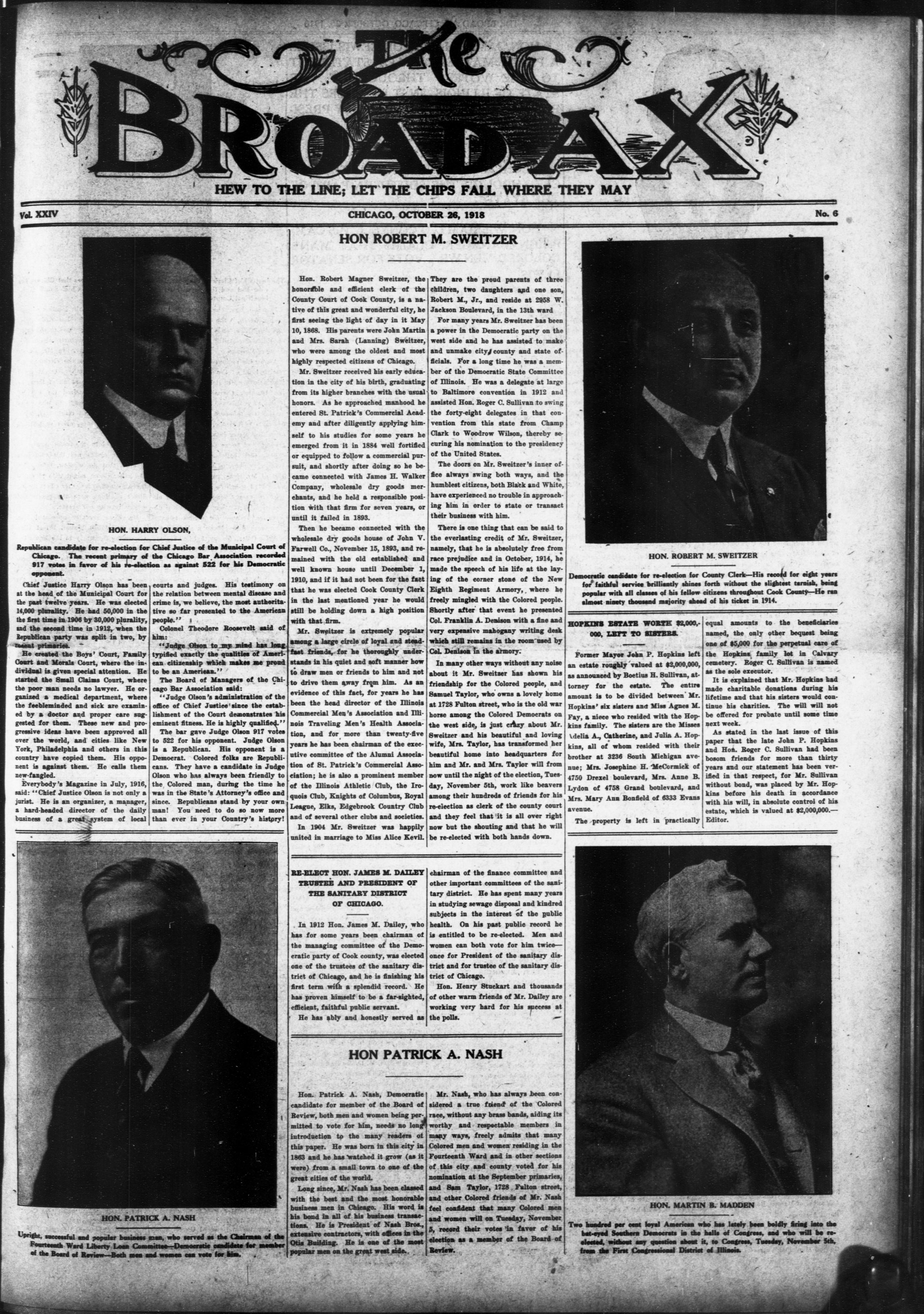
Page text (machine-generated)
A.
Republican candidate for re-election for Chief Justice of the Municipal Court of Chicago. The recent primary of the Chicago Bar Association recorded 917 votes in favor of his re-election as against 522 for his Democratic opponent.
Chief Justice Harry Olson has been at the head of the Municipal Court for the past twelve years. He was elected 14,000 plurality. He had 50,000 in the first time in 1906 by 30,000 plurality, and the second time in 1912, when the Republican party was split in two, by recent primaries.
He created the Boys' Court, Family Court and Morals Court, where the individual is given special attention. He started the Small Claims Court, where the poor man needs no lawyer. He organized a medical department, where the feebleminded and sick are examined by a doctor and proper care suggested for them. These new and progressive ideas have been approved all over the world, and cities like New York, Philadelphia and others in this country have copied them. His opponent is against them. He calls them new-fangled courts and judges. His testimony on the relation between mental disease and crime is, we believe, the most authoritative so far presented to the American people."
Colonel Theodore Roosevelt said of him:
"Judge Olson to my mind has long typified exactly the qualities of American citizenship which makes me proud to be an American."
The Board of Managers of the Chicago Bar Association said:
"Judge Olson's administration of the office of Chief Justice since the establishment of the Court demonstrates his eminent fitness. He is highly qualified."
The bar gave Judge Olson 917 votes to 522 for his opponent. Judge Olson is a Republican. His opponent is a Democrat. Colored folks are Republicans. They have a candidate in Judge Olson who has always been friendly to
Everybody's Magazine in July, 1916, said: "Chief Justice Olson is not only a jurist. He is an organizer, a manager, a hard-headed director of the daily business of a great system of local
M.
Upright, successful and popular business man, who served as the Chairman of the Fourteenth Ward Liberty Loan Committee—Democratic candidate for member of the Board of Review—Both men and women can vote for him.
courts and judges. His testimony on the relation between mental disease and crime is, we believe, the most authoritative so far presented to the American people."
Colonel Theodore Roosevelt said of him:
"Judge Olson to my mind has long typified exactly the qualities of American citizenship which makes me proud to be an American."
The Board of Managers of the Chicago Bar Association said:
"Judge Olson's administration of the office of Chief Justice since the establishment of the Court demonstrates his eminent fitness. He is highly qualified."
The bar gave Judge Olson 917 votes to 522 for his opponent. Judge Olson is a Republican. His opponent is a Democrat. Colored folks are Republicans. They have a candidate in Judge Olson who has always been friendly to the Colored man, during the time he was in the State's Attorney's office and since. Republicans stand by your own man! You need to do so now more than ever in your Country's history!
HON ROBERT M. SWEITZER
Hon. Robert Magner Sweitzer, the honorable and efficient clerk of the County Court of Cook County, is a native of this great and wonderful city, he first seeing the light of day in it May 10, 1868. His parents were John Martin and Mrs. Sarah (Lanning) Sweitzer, who were among the oldest and most highly respected citizens of Chicago.
Mr. Sweitzer received his early education in the city of his birth, graduating from its higher branches with the usual honors. As he approached manhood he entered St. Patrick's Commercial Academy and after diligently applying himself to his studies for some years he emerged from it in 1884 well fortified or equipped to follow a commercial pursuit, and shortly after doing so he became connected with James H. Walker Company, wholesale dry goods merchants, and he held a responsible position with that firm for seven years, or until it failed in 1893.
Then he became connected with the wholesale dry goods house of John V. Farwell Co., November 15, 1893, and remained with the old established and well known house until December 1, 1910, and if it had not been for the fact that he was elected Cook County Clerk in the last mentioned year he would still be holding down a high position with that firm.
Mr. Sweitzer is extremely popular among a large circle of loyal and steadfast friends, for he thoroughly understands in his quiet and soft manner how to draw men or friends to him and not to drive them away from him. As an evidence of this fact, for years he has been the head director of the Illinois Commercial Men's Association and Illinois Traveling Men's Health Association, and for more than twenty-five years he has been chairman of the executive committee of the Alumni Association of St. Patrick's Commercial Association; he is also a prominent member of the Illinois Athletic Club, the Iroquois Club, Knights of Columbus, Royal League, Elks, Edgebrook Country Club and of several other clubs and societies. In 1904 Mr. Sweitzer was happily united in marriage to Miss Alice Kevill.
RE-ELECT HON. JAMES M. DAILEY
TRUSTEE AND PRESIDENT OF
THE SANITARY DISTRICT
OF CHICAGO.
In 1912 Hon. James M. Dailey, who has for some years been chairman of the managing committee of the Democratic party of Cook county, was elected one of the trustees of the sanitary district of Chicago, and he is finishing his first term with a splendid record. He has proven himself to be a far-sighted, efficient, faithful public servant. He has ably and honestly served as
HON PATRICK A. NASH
HON PATRICK A. NASH
Hon. Patrick A. Nash, Democratic candidate for member of the Board of Review, both men and women being permitted to vote for him, needs no long introduction to the many readers of this paper. He was born in this city in 1863 and he has watched it grow (as it were) from a small town to one of the great cities of the world. Long since, Mr. Nash has been classed with the best and the most honorable business men in Chicago. His word is his bond in all of his business transactions. He is President of Nash Bros., extensive contractors, with offices in the Otis Building. He is one of the most popular men on the great west side.
They are the proud parents of three children, two daughters and one son, Robert M., Jr., and reside at 2958 W. Jackson Boulevard, in the 13th ward For many years Mr. Sweitzer has been a power in the Democratic party on the west side and he has assisted to make and unmake city county and state officials. For a long time he was a member of the Democratic State Committee of Illinois. He was a delegate at large to Baltimore convention in 1912 and assisted Hon. Roger C. Sullivan to swing the forty-eight delegates in that convention from this state from Champ Clark to Woodrow Wilson, thereby securing his nomination to the presidency of the United States. The doors on Mr. Sweitzer's inner office always swing both ways, and the humblest citizens, both Black and White, have experienced no trouble in approaching him in order to state or transact their business with him.
There is one thing that can be said to the everlasting credit of Mr. Sweitzer, namely, that he is absolutely free from race prejudice and in October, 1914, he made the speech of his life at the laying of the corner stone of the New Eighth Regiment Armory, where he freely mingled with the Colored people. Shortly after that event he presented Col. Franklin A. Denison with a fine and very expensive mahogany writing desk which still remains in the room used by Col. Denison in the armory.
In many other ways without any noise about it Mr. Sweitzer has shown his friendship for the Colored people, and Samuel Taylor, who owns a lovely home at 1728 Fulton street, who is the old war horse among the Colored Democrats on the west side, is just crazy about Mr. Sweitzer and his beautiful and loving wife, Mrs. Taylor, has transformed her beautiful home into headquarters for him and Mr. and Mrs. Taylor will from now until the night of the election, Tuesday, November 5th, work like beavers among their hundreds of friends for his re-election as clerk of the county court and they feel that it is all over right now but the shouting and that he will be re-elected with both hands down.
chairman of the finance committee and other important committees of the sanitary district. He has spent many years in studying sewage disposal and kindred subjects in the interest of the public health. On his past public record he is entitled to be re-elected. Men and women can both vote for him twice once for President of the sanitary district and for trustee of the sanitary district of Chicago. Hon. Henry Stuckart and thousands of other warm friends of Mr. Dailey are working very hard for his success at the polls.
Mr. Nash, who has always been considered a true friend of the Colored race, without any brass bands, aiding its worthy and respectable members in many ways, freely admits that many Colored men and women residing in the Fourteenth Ward and in other sections of this city and county voted for his nomination at the September primaries, and Sam Taylor, 1728 Fulton street, and other Colored friends of Mr. Nash feel confident that many Colored men and women will on Tuesday, November 5, record their votes in favor of his election as a member of the Board of Review.
1
HON. ROBERT M. SWEITZER
Democratic candidate for re-election for for faithful service brilliantly shines popular with all classes of his fellow almost ninety thousand majority ahe
Democratic candidate for re-election for County Clerk—His record for eight years for faithful service brilliantly shines forth without the slightest tarnish, being popular with all classes of his fellow citizens throughout Cook County—He ran almost ninety thousand majority ahead of his ticket in 1914.
HOPKINS ESTATE WORTH $2,000,
000, LEFT TO SISTERS.
Former Mayor John P. Hopkins left an estate roughly valued at $2,000,000, as announced by Boetius H. Sullivan, attorney for the estate. The entire amount is to be divided between 'Mr. Hopkins' six sisters and Miss Agnes M. Fay, a niece who resided with the Hopkins family. The sisters are the Misses \delia A., Catherine, and Julin A. Hopkins, all of whom resided with their brother at 3236 South Michigan avenue; Mrs. Josephine H. McCormick of 4750 Drexel boulevard, Mrs. Anne B. Lydon of 4758 Grand boulevard, and Mrs. Mary Ann Bonfield of 6333 Evans avenue.
The property is left in practically
Two hundred per cent loyal American who has lately been boldly firing into the bat-eyed Southern Democrats in the halls of Congress, and who will be re-elected, without any question about it, to Congress, Tuesday, November 5th, from the First Congressional District of Illinois.
County Clerk—His record for eight years forth without the slightest tarnish, being citizens throughout Cook County—He ran of his ticket in 1914.
equal amounts to the beneficiaries named, the only other bequest being one of $5,000 for the perpetual care of the Hopkins family lot in Calvary cemetery. Roger C. Sullivan is named as the sole executor.
It is explained that Mr. Hopkins had made charitable donations during his lifetime and that his sisters would continue his charities. The will will not be offered for probate until some time next week.
As stated in the last issue of this paper that the late John P. Hopkins and Hon. Roger C. Sullivan had been bosom friends for more than thirty years and our statement has been verified in that respect, for Mr. Sullivan without bond, was placed by Mr. Hopkins before his death in accordance with his will, in absolute control of his estate, which is valued at $2,000,000.—Editor.
---
M.
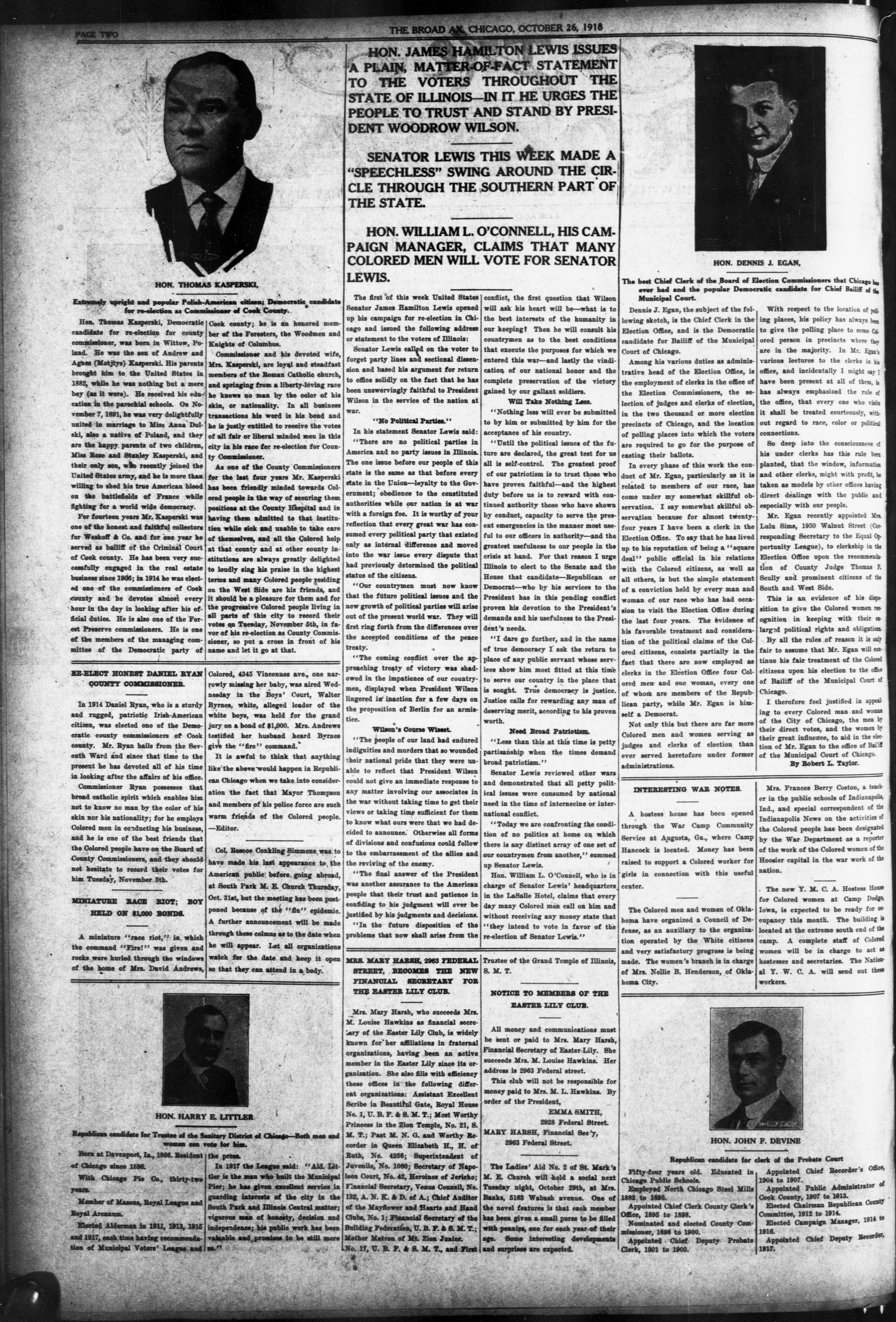
HON. THOMAS KASPERSKI,
Extremely upright and popular Polish-American citizen; Democratic candidate for re-election as Commissioner of Cook County.
Hon. Thomas Kasperski, Democratic candidate for re-election for county commissioner, was born in Wittow, Poland. He was the son of Andrew and Agnes (Motjtys) Kasperski. His parents brought him to the United States in 1882, while he was nothing but a mere boy (as it were). He received his education in the parochial schools. On November 7, 1891, he was very delightfully united in marriage to Miss Anna Dulski, also a native of Poland, and they are the happy parents of two children, Miss Rose and Stanley Kasperski, and their only son, who recently joined the United States army, and he is more than willing to shed his true American blood on the battlefields of France while fighting for a world wide democracy.
For fourteen years Mr. Kasperski was one of the honest and faithful collectors for Weskoff & Co. and for one year he served as bailiff of the Criminal Court of Cook county. He has been very successfully engaged in the real estate business since 1906; in 1914 he was elected one of the commissioners of Cook county and he devotes almost every hour in the day in looking after his official duties. He is also one of the Forest Preserve commissioners. He is one of the members of the managing committee of the Democratic party of
EE-ELECT HONEST DANIEL RYAN
COUNTY COMMISSIONER.
In 1914 Daniel Ryan, who is a sturdy and rugged, patriotic Irish-American citizen, was elected one of the Democratic county commissioners of Cook county. Mr. Ryan hails from the Seventh Ward and since that time to the present he has devoted all of his time in looking after the affairs of his office. Commissioner Ryan possesses that broad catholic spirit which enables him not to know no man by the color of his skin nor his nationality; for he employs Colored men in conducting his business, and he is one of the best friends that the Colored people have on the Board of County Commissioners, and they should not hesitate to record their votes for him Tuesday, November 5th.
A miniature "race riot," in which the command "Fire!" was given and rocks were hurled through the windows of the home of Mrs. David Andrews,
HON. HARRY E. LITTLER
Born at Davenport, In., 1866. Resident of Chicago since 1886.
With Chicago Pie Co., thirty-two years.
Member of Masons, Royal League and Royal Arcanum.
Elected Alderman in 1911, 1913, 1915 and 1917, each time having recommendation of Municipal Voters' League and
PAGE TWO
Cook county; he is an honored member of the Foresters, the Woodmen and Knights of Columbus. Commissioner and his devoted wife, Mrs. Kasperski, are loyal and steadfast members of the Roman Catholic church, and springing from a liberty-loving race he knows no man by the color of his skin, or nationality. In all business transactions his word is his bond and he is justly entitled to receive the votes of all fair or liberal minded men in this city in his race for re-election for County Commissioner.
As one of the County Commissioners for the last four years Mr. Kasperski has been friendly minded towards Colored people in the way of securing them positions at the County Hospital and in having them admitted to that institution while sick and unable to take care of themselves, and all the Colored help at that county and at other county institutions are always greatly delighted to loudly sing his praise in the highest terms and many Colored people residing on the West Side are his friends, and it should be a pleasure for them and for the progressive Colored people living in all parts of this city to record their votes on Tuesday, November 5th, in favor of his re-election as County Commissioner, so put a cross in front of his name and let it go at that.
Colored, 4345 Vincentnes ave., one narrowly missing her baby, was aired Wednesday in the Boys' Court, Walter Byrnes, white, alleged leader of the white boys, was held for the grand jury on a bond of $1,000. Mrs. Andrews testified her husband heard Byrnes give the "fire" command.
It is awful to think that anything like the above would happen in Republican Chicago when we take into consideration the fact that Mayor Thompson and members of his police force are such warm friends of the Colored people.
—Editor.
Col, Roecee Conkling Simmons was to have made his last appearance to the American public before going abroad, at South Park M. E. Church Thursday, Oct. 31st, but the meeting has been postponed because of the "flu" epidemic. A further announcement will be made through these colms as to the date when he will appear. Let all organizations watch for the date and keep it open so that they can attend in a body.
In 1917 the League said: "Ald. Littler is the man who built the Municipal Pier; he has given excellent service in guarding interests of the city in the South Park and Illinois Central matter; vigorous man of honesty, decision and independence; his public work has been valuable and promises to be still more
HON. JAMES HAMILTON LEWIS ISSUES A PLAIN, MATTER-OF-FACT STATEMENT TO THE VOTERS THROUGHOUT THE STATE OF ILLINOIS—IN IT HE URGES THE PEOPLE TO TRUST AND STAND BY PRESIDENT WOODROW WILSON.
SENATOR LEWIS THIS WEEK MADE A "SPEECHLESS" SWING AROUND THE CIRCLE THROUGH THE SOUTHERN PART OF THE STATE.
HON. WILLIAM L. O'CONNELL, HIS CAMPAIGN MANAGER, CLAIMS THAT MANY COLORED MEN WILL VOTE FOR SENATOR LEWIS.
The first of this week United States Senator James Hamilton Lewis opened up his campaign for re-election in Chicago and issued the following address or statement to the voters of Illinois: conflict, the first question that Wilson will ask his heart will be—what is to the best interests of the humanity in our keeping? Then he will consult his countrymen as to the best conditions
Senator Lewis called on the voter to forget party lines and sectional dissension and based his argument for return to office solidly on the fact that he has been unswervingly faithful to President Wilson in the service of the nation at war.
"No Political Parties."
In his statement Senator Lewis said: "There are no political parties in America and no party issues in Illinois. The one issue before our people of this state is the same as that before every state in the Union—leyalty to the Government; obedience to the constituted authorities while our nation is at war with a foreign foe. It is worthy of your reflection that every great war has consumed every political party that existed only as internal difference and moved into the war issue every dispute that had previously determined the political status of the citizens.
"Our countrymen must now know that the future political issues and the new growth of political parties will arise out of the present world war. They will first ring forth from the differences over the accepted conditions of the peace treaty.
"The coming conflict over the approaching treaty of victory was shadowed in the impatience of our countrymen, displayed when President Wilson lingered in inaction for a few days on the proposition of Berlin for an armistice.
Wilson's Course Wisest.
"The people of our land had endured indignities and murders that so wounded their national pride that they were unable to reflect that President Wilson could not give an immediate response to any matter involving our associates in the war without taking time to get their views or taking time sufficient for them to know what ours were that we had decided to announce. Otherwise all forms of divisions and confusions could follow to the embarrassment of the allies and the reviving of the enemy.
"The final answer of the President was another assurance to the American people that their trust and patience in confiding to his judgment will ever be justified by his judgments and decisions.
"In the future disposition of the problems that now shall arise from the
MRS. MARY HARSE, 2963 FEDERAL STREET, BEGOMES THE NEW FINANCIAL SECRETARY FOR THE EASTER LILY CLUB.
Mrs. Mary Harsh, who succeeds Mrs. M. Louise Hawkins as financial secretary of the Easter Lily Club, is widely known for her affiliations in fraternal organizations, having been an active member in the Easter Lily since its organization. She also fills with efficiency these offices in the following different organizations: Assistant Excellent Scribe in Beautiful Gate, Royal House No. 1, U. B. F. & S. M. T.; Most Worthy Princess in the Zion Temple, No. 21, S. M. T.; Past M. N. G. and Worthy Recorder in Queen Elizabeth H., H. of Ruth, No. 4256; Superintendent of Juvenile, No. 1080; Secretary of Napoleon Court, No. 42, Heroes of Jeriehe; Financial Secretary, Venus Council, No. 132, A. N. K. & D. of A.; Chief Auditor of the Mayflower and Hearts and Hand Clubs, No. 1; Financial Secretary of the Building Federation, U. B. F. & S. M. T.; Mother Matron of Mt. Zion Junior. No. 17, U. B. F. & S. M. T., and First
conflict, the first question that Wilson will ask his heart will be—what is to the best interests of the humanity in our keeping? Then he will consult his countrymen as to the best conditions that execute the purposes for which we entered this war—and lastly the vindication of our national honor and the complete preservation of the victory gained by our gallant soldiers.
Will Take Nothing Less.
"Nothing less will ever be submitted to by him or submitted by him for the acceptance of his country.
"Until the political issues of the future are declared, the great test for us all is self-control. The greatest proof of our patriotism is to trust those who have proven faithful—and the highest duty before us is to reward with continued authority those who have shown by conduct, capacity to serve the present emergencies in the manner most useful to our officers in authority—and the greatest usefulness to our people in the crisis at hand. For that reason I urge Illinois to elect to the Senate and the House that candidate—Republican or Democrat—who by his services to the President has in this pending conflict proven his devotion to the President's demands and his usefulness to the President's needs.
"I dare go further, and in the name of true democracy I ask the return to place of any public servant whose services show him most fitted at this time to serve our country in the place that is sought. True democracy is justice. Justice calls for rewarding any man of deserving merit, according to his proven worth.
Need Broad Patriotism.
"Less than this at this time is petty partisanship when the times demand broad patriotism." Senator Lewis reviewed other wars and demonstrated that all petty political issues were consumed by national need in the time of internecine or international conflict. "Today we are confronting the condition of no politics at home on which there is any distinct array of one set of our countrymen from another," summed up Senator Lewis.
Hon. William L. O'Connell, who is in charge of Senator Lewis' headquarters in the LaSalle Hotel, claims that every day many Colored men call on him and without receiving any money state that "they intend to vote in favor of the re-election of Senator Lewis."
Trustee of the Grand Temple of Illinois, S. M. T.
NOTICE TO MEMBERS OF THE
EASTER LILY CLUB.
All money and communications must be sent or paid to Mrs. Mary Harsh, Financial Secretary of Easter Lily. She succeeds Mrs. M. Louise Hawkins. Her address is 2963 Federal street. This club will not be responsible for money paid to Mrs. M. L. Hawkins. By order of the President.
The Ladies' Aid No. 2 of St. Mark's M. E. Church will hold a social next Tuesday night, October 29th, at Mrs. Banks, 5163 Wabash avenue. One of the novel features is that each member has been given a small purse to be filled with pennies, one for each year of their age. Some interesting developments and surprises are expected.
BROOKLYN
HON. DENNIS J. EGAN,
The best Chief Clerk of the Board of Election Commissioners that Chicago has ever had and the popular Democratic candidate for Chief Bailiff of the Municipal Court.
Dennis J. Egan, the subject of the following sketch, is the Chief Clerk in the Election Office, and is the Democratic candidate for Bailiff of the Municipal Court of Chicago.
With respect to the location of polling places, his policy has always been to give the polling place to some Colored person in precincts where they are in the majority. In Mr. Egan's
Among his various duties as administrative head of the Election Office, is the employment of clerks in the office of the Election Commissioners, the selection of judges and clerks of election, in the two thousand or more election precincts of Chicago, and the location of polling places into which the voters are required to go for the purpose of casting their ballots.
In every phase of this work the conduct of Mr. Egan, particularly as it is related to members of our race, has come under my somewhat skillful observation. I say somewhat skillful observation because for almost twenty-four years I have been a clerk in the Election Office. To say that he has lived up to his reputation of being a "square deal" public official in his relations with the Colored citizens, as well as all others, is but the simple statement of a conviction held by every man and woman of our race who has had occasion to visit the Election Office during the last four years. The evidence of his favorable treatment and consideration of the political claims of the Colored citizens, consists partially in the fact that there are now employed as clerks in the Election Office four Colored men and one woman, every one of whom are members of the Republican party, while Mr. Egan is himself a Democrat.
Not only this but there are far more Colored men and women serving as judges and clerks of election than ever served heretofore under former administrations.
INTERESTING WAR NOTES.
A hostess house has been opened through the War Camp Community Service at Augusta, Ga., where Camp Hancock is located. Money has been raised to support a Colored worker for girls in connection with this useful center.
The Colored men and women of Oklahoma have organized a Council of Defense, as an auxiliary to the organization operated by the White citizens and very satisfactory progress is being made. The women's branch is in charge of Mrs. Nellie B. Henderson, of Oklahoma City.
HON. JOHN F. DEVINE
Republican candidate for clerk of the Probate Court
Fifty-four years old. Educated in Chicago Public Schools.
Employed North Chicago Steel Mills 1882 to 1895.
Appointed Chief Clerk County Clerk's Office, 1895 to 1898.
Nominated and elected County Commissioner, 1898 to 1900.
Appointed Chief Deputy Probate Clerk, 1901 to 1903.
With respect to the location of polling places, his policy has always been to give the polling place to some Colored person in precincts where they are in the majority. In Mr. Egan's various lectures to the clerks in his office, and incidentally I might say I have been present at all of them, he has always emphasized the rule of the office, that every one who visits it shall be treated courteously, without regard to race, color or political connections.
So deep into the consciousness of his under clerks has this rule been planted, that the window, information and other clerks, might with profit, be taken as models by other offices having direct dealings with the public and especially with our people.
Mr. Egan recently appointed Mrs. Lulu Sims, 1950 Walnut Street (Corresponding Secretary to the Equal Opportunity League), to clerkship in the Election Office upon the recommendation of County Judge Thomas P. Seully and prominent citizens of the South and West Side.
This is an evidence of his disposition to give the Colored women recognition in keeping with their enlarged political rights and obligations. By all the rules of reason it is only fair to assume that Mr. Egan will continue his fair treatment of the Colored citizens upon his election to the office of Bailiff of the Municipal Court of Chicago.
I therefore feel justified in appealing to every Colored man and woman of the City of Chicago, the men by their direct votes, and the women by their great influence, to aid in the election of Mr. Egan to the office of Bailiff of the Municipal Court of Chicago.
Mrs. Frances Berry Coston, a teacher in the public schools of Indianapolis, Ind., and special correspondent of the Indianapolis News on the activities of the Colored people has been designated by the War Department as a reporter of the work of the Colored women of the Hoosier capital in the war work of the nation.
The new Y. M. C. A. Hostess House for Colored women at Camp Dodge, Iowa, is expected to be ready for occupancy this month. The building is located at the extreme south end of the camp. A complete staff of Colored women will be in charge to act as hostesses and secretaries. The National Y. W. C. A. will send out these workers.
Appointed Chief Recorder's Office, 1904 to 1907.
Appointed Public Administrator of Cook County, 1907 to 1913.
Elected Chairman Republican County Committee, 1912 to 1914.
Elected Campaign Manager, 1914 to 1916.
Appointed Chief Deputy Recorder, 1917.
[Picture of a man with a mustache and a suit].
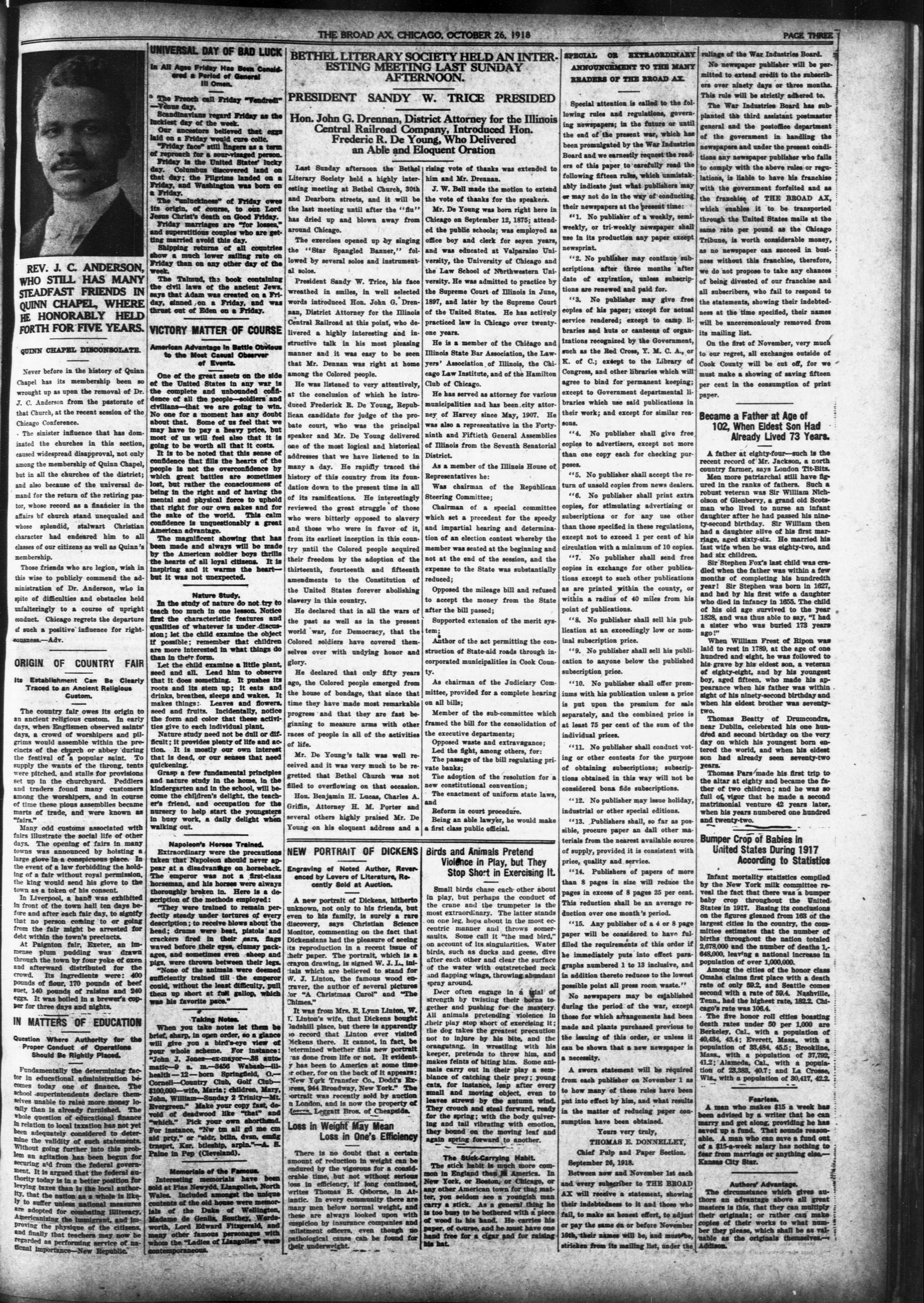
REV. J. C. ANDERSON, WHO STILL HAS MANY STEADFAST FRIENDS IN QUINN CHAPEL, WHERE HE HONORABLY HELD FORTH FOR FIVE YEARS.
QUINN CHAPEL DISCONSOLATE.
Never before in the history of Quinn Chapel has its membership been so wrought up as upon the removal of Dr. J. C. Anderson from the pastorate of that Church, at the recent session of the Chicago Conference.
The sinister influence that has dominated the churches in this section, caused widespread disapproval, not only among the membership of Quinn Chapel, but in all the churches of the district; and also because of the universal demand for the return of the retiring pastor, whose record as a financier in the affairs of church stand unequaled and whose splendid, stalwart Christian character had endeared him to all classes of our citizens as well as Quinn's membership.
Those friends who are legion, wish in this wise to publicly commend the administration of Dr. Anderson, who in spite of difficulties and obstacles held unfalteringly to a course of upright conduct. Chicago regrets the departure of such a positive influence for right-oughtness.—Adv.
ORIGIN OF COUNTRY FAIR
The country fair owes its origin to an ancient religious custom. In early days, when Englismen observed saints' days, a crowd of worshipers and pilgrims would assemble within the precincts of the church or abbey during the festival of a popular saint. To supply the wants of the throng, tents were pitched, and stalls for provisions set up in the churchyard. Peddlers and traders found many customers among the worshipers, and in course of time these pious assemblies became marts of trade, and were known as "fairs."
Many odd customs associated with fairs illustrate the social life of other days. The opening of fairs in many towns was announced by holding a large glove in a conspicuous place. In the event of a law forbidding the holding of a fair without royal permission, the king would send his glove to the town as a token of his consent.
In Liverpool, a hand was exhibited in front of the town hall ten days before and after each fair day, to signify that no person coming to or going from the fair might be arrested for debt within the town's precincts.
At P耿ton fair, Exeter, an immense plum pudding was drawn through the town by four yoke of oxen and afterward distributed for the crowd. Its ingredients were: 400 pounds of flour, 170 pounds of beef suet, 140 pounds of raisins and 240 eggs. It was bolled in a brewer's copper for three days and nights.
IN MATTERS OF EDUCATION
Question Where Authority for the Proper Conduct of Operations Should Be Rightly Placed.
Fundamentally the determining factor in educational administration becomes today one of finance. The school superintendents declare themselves unable to raise more money locally than is already furnished. The whole question of educational finance in relation to local taxation has not yet been adequately considered to determine the validity of such statements. Without going further into this problem an agitation has been begun for securing aid from the federal government. It is argued that the federal authority today is in a better position for levying taxes than is the local authority, that the nation as a whole is likely to suffer unless national measures are adopted for combating illiteracy, Americanizing the immigrant, and improving the physique of the citizens, and finally that teachers may now be regarded as performing service of national importance—New Republic.
In All Ages Friday Has Been Considered a Period of General Ill Omen.
* The French call Friday "Vendredi"
—Venus day.
Scandinavians regard Friday as the luckiest day of the week.
Friday is the United States' lucky day. Columbus discovered land on that day; the Pilgrims landed on a Friday, and Washington was born on a Friday.
The "unluckiness" of Friday owes its origin, of course, to our Lord Jesus Christ's death on Good Friday. Friday marriages are "for losses," and superstitious couples who are getting married avoid this day.
Shipping returns of all countries show a much lower sailing rate on Friday than on any other day of the week.
The Talmud, the book containing the civil laws of the ancient Jews, says that Adam was created on a Friday, sinned on a Friday, and was thrust out of Eden on a Friday.
VICTORY MATTER OF COURSE
American Advantage In Battle Obvious to the Most Casual Observer of Events.
One of the great assets on the side of the United States in any war is the complete and unbounded confidence of all the people—soldiers and civilians—that we are going to win. No one for a moment has any doubt about that. Some of us feel that we may have to pay a heavy price, but most of us will feel also that it is going to be worth all that it costs. It is to be noted that this sense of confidence that fills the hearts of the people is not the overconfidence by which great battles are sometimes lost, but rather the consciousness of being in the right and of having the mental and physical force to uphold that right for our own sakes and for the sake of the world. This calm confidence is unquestionably a great American advantage.
The magnificent showing that has been made and always will be made by the American soldier boys thrills the hearts of all loyal citizens. It is inspiring and it warms the heart—but it was not unexpected.
Nature Study.
In the study of nature do not try to teach too much in one lesson. Notice first the characteristic features and qualities of whatever is under discussion; let the child examine the object if possible; remember that children are more interested in what things do than in their form.
Let the child examine a little plant, seed and all. Lead him to observe that it does something. It pushes its roots and its stem up; it eats and drinks, breathes, sleeps and wakes. It makes things: Leaves and flowers, seed and fruits. Incidentally, notice the form and color that these activities give to each individual plant.
Nature study need not be dull or difficult; it provides plenty of life and action. It is mostly our own interest that is dead, or our senses that need quickening.
Grasp a few fundamental principles and nature study in the home, in the kindergarten and in the school, will become the children's delight, the teacher's friend, and occupation for the nursery to help start the youngsters in busy work, a daily delight when walking out.
Napoleon's Horses Trained.
Extraordinary were the precautions taken that Napoleon should never appear at a disadvantage on horseback. The emperor was not a first-class horseman, and his horses were always thoroughly broken in. Here is a description of the methods employed:
"They were trained to remain perfectly steady under tortures of every description; to receive blows about the head; drums were beat, pistols and crackers fired in their ears, flags waved before their eyes, clumsy packages, and sometimes even sheep and pigs, were thrown between their legs.
"None of the animals were deemed sufficiently trained till the emperor could, without the least difficulty, pull them up short at full gallop, which was his favorite pace."
Taking Notes
When you take notes let them be brief, sharp, in open order, so a glance will give you a bird's-eye view of your whole scheme. For instance: "John J. Jones—ex-mayor—38 automatic—9 a. m—3456 Wabash—ill-health—12—born Springfield, O.—Cornell—Country Club, Golf Club—$100,000—wife, Marla; children, Mary, John, William—Sunday 2 Trinity—Mt. Evergreen." Make your copy fast, devoid of deadwood like "that" and "which." Pick your own shorthand. For instance, "Nw tm all gd me cm ald prty, or "sldr, btln, dvsn, emfg trnsrp, Ksr, btleship, arpln." A. E. Paine in Pep (Cleveland).
Memorials of the Famous.
Interesting memorials have been sold at Plas Newydd, Liangollen, North Wales. Included amongst the unique contents of the old house were memorials of the Duke of Wellington, Madame de Genlis, Southey, Wordsworth, Lord Edward Fitzgerald, and many other famous personages with whom the "Ladies of Liangollen" were
THE BROAD AX, CHICAGO, OCTOBER 26, 1918
BETHEL LITERARY SOCIETY HELD AN INTERESTING MEETING LAST SUNDAY AFTERNOON.
PRESIDENT SANDY W. TRICE PRESIDED
Hon. John G. Drennan, District Attorney for the Illinois Central Railroad Company, Introduced Hon. Frederic R. De Young, Who Delivered an Able and Eloquent Oration
Last Sunday afternoon the Bethel Literary Society held a highly interesting meeting at Bethel Church, 30th and Dearborn streets, and it will be the last meeting until after the "flu" has dried up and blown away from around Chicago.
The exercises opened up by singing the "Star Spangled Banner," followed by several solos and instrumental solos.
President Sandy W. Trice, his face wreathed in smiles, in well selected words introduced Hon. John G. Drennan, District Attorney for the Illinois Central Railroad at this point, who delivered a highly interesting and instructive talk in his most pleasing manner and it was easy to be seen that Mr. Drennan was right at home among the Colored people.
He was listened to very attentively, at the conclusion of which he introduced Frederick R. De Young, Republican candidate for judge of the probate court, who was the principal speaker and Mr. De Young delivered one of the most logical and historical addresses that we have listened to in many a day. He rapidly traced the history of this country from its foundation down to the present time in all of its ramifications. He interestingly reviewed the great struggle of those who were bitterly opposed to slavery and those who were in favor of it, from its earliest inception in this country until the Colored people acquired their freedom by the adoption of the thirteenth, fourteenth and fifteenth amendments to the Constitution of the United States forever abolishing slavery in this country.
He declared that in all the wars of the past as well as in the present world war, for Democracy, that the Colored soldiers have covered themselves over with undying honor and glory.
He declared that only fifty years ago, the Colored people emerged from the house of bondage, that since that time they have made most remarkable progress and that they are fast beginning to measure arms with other races of people in all of the activities of life.
Mr. De Young's talk was well received and it was very much to be regrtted that Bethel Church was not filled to overflowing on that occasion.
Hon. Benjamin H. Lucas, Charles A. Griffin, Attorney H. M. Porter and several others highly praised Mr. De Young on his eloquent address and a
NEW PORTRAIT OF DICKENS
Engraving of Noted Author, Reverenced by Lovers of Literature, Recently Sold at Auction.
A new portrait of Dickens, hitherto unknown, not only to his friends, but even to his family, is surely a rare discovery, says Christian Science Monitor, commenting on the fact that Dickensians had the pleasure of seeing its reproduction in a recent issue of their paper. The portrait, which is a crayon drawing, is signed W. J. L., initials which are believed to stand for W. J. Linton, the famous wood engraver, the author of several pictures for "A Christmas Carol" and "The Chimes."
It was from Mrs. E. Lynn Linton, W. J. Linton's wife, that Dickens bought Badshill place, but there is apparently no record that Linton ever visited Dickens there. It cannot, in fact, be determined whether this new portrait was done from life or not. It evidently has been to America at some time or, for on the back of it appears: New York Transfer Co., Dodd's Express, 944 Broadway, New York." The portrait was recently sold by auction in London, and is now the property of Learns, Leggatt Bros. of Cheapside.
Loss in Weight May Mean Loss in One's Efficiency
There is no doubt that a certain amount of reduction in weight can be endured by the vigorous for a considerable time, but not without serious loss in efficiency, if long continued, writes Thomas B. Osborne, in Atlantic. In every community there are many men below normal weight, and these are always looked upon with suspicion by insurance companies and enlistment officers, even though no pathological cause can be found for their underweight.
rising vote of thanks was extended to him and Mr. Drennan.
J. W. Bell made the motion to extend the vote of thanks for the speakers.
Mr. De Young was born right here in Chicago on September 12, 1875; attended the public schools; was employed as office boy and clerk for seven years, and was educated at Valparaiso University, the University of Chicago and the Law School of Northwestern University. He was admitted to practice by the Supreme Court of Illinois in June, 1897, and later by the Supreme Court of the United States. He has actively practiced law in Chicago over twenty-one years.
He is a member of the Chicago and Illinois State Bar Association, the Lawyers' Association, of Illinois, the Chicago Law Institute, and of the Hamilton Club of Chicago.
He has served as attorney for various municipalities and has been city attorney of Harvey since May, 1907. He was also a representative in the Fortyninth and Fiftieth General Assemblies of Illinois from the Seventh Senatorial District.
As a member of the Illinois House of Representatives he:
Was chairman of the Republican Steering Committee;
Chairman of a special committee which set a precedent for the speedy and impartial hearing and determination of an election contest whereby the member was seated at the beginning and not at the end of the session, and the expense to the State was substantially reduced;
Opposed the mileage bill and refused to accept the money from the State after the bill passed;
Supported extension of the merit system;
Author of the act permitting the construction of State-aid roads through incorporated municipalities in Cook County.
As chairman of the Judiciary Committee, provided for a complete hearing on all bills;
Member of the sub-committee which framed the bill for the consolidation of the executive departments;
The passage of the bill regulating private banks;
The adoption of the resolution for a new constitutional convention;
The enactment of uniform state laws,
and
Reform in court procedure.
Being an able lawyer, he would make a first class public official.
Birds and Animals Pretend Violence in Play, but They Stop Short in Exercising It.
Small birds chase each other about in play, but perhaps the conduct of the crane and the trumpeter is the most extraordinary. The latter stands on one leg, hops about in the most eccentric manner and throws somersaults. Some call it "the mad bird," on account of its singularities. Water birds, such as ducks and geese, dive after each other and clear the surface of the water with outstretched neck and flapping wings, throwing abundant spray around.
Deer often engage in a trial of strength by twisting their horns together and pushing for the mastery. All animals pretending violence in their play stop short of exercising it; the dog takes the greatest precaution not to injure by his bite, and the orangutang, in wrestling with his keeper, pretends to throw him, and makes feints of biting him. Some animals carry out in their play a blamance of catching their prey; young cats, for instance, leap after every small and moving object, even to leaves strewn by the autumn wind. They crouch and steal forward, ready for the spring; with the body quivering and tail vibrating with emotion, they bound on the moving leaf and again spring forward to another.
The stick habit is much more common in England than in America. In New York, or Boston, or Chicago, or any other American town for that matter, you seldom see a youngish man carry a stick. As a general thing he is too busy to be bothered with a piece of wood in his hand. He carries his paper, of course, and he must have one hand free for a cigar and for raising his hat.
SPECIAL OR EXTRAORDINARY ANNOUNCEMENT TO THE MANY READERS OF THE BROAD AX.
Special attention is called to the following rules and regulations, governing newspapers; in the future or until the end of the present war, which has been promulgated by the War Industries Board and we earnestly request the readers of this paper to carefully read the following fifteen rules, which unmistakably indicate just what publishers may or may not do in the way of conducting their newspapers at the present time:
"1. No publisher of a weekly, semi-weekly, or tri-weekly newspaper shall use in its production any paper except newsprint.
"2. No publisher may continue subscriptions after three months after date of expiration, unless subscriptions are renewed and paid for.
"3. No publisher may give free copies of his paper; except for actual service rendered; except to camp libraries and huts or canteens of organizations recognized by the Government, such as the Red Cross, Y. M. C. A., or K. of C.; except to the Library of Congress, and other libraries which will agree to bind for permanent keeping; except to Government departmental libraries which use said publications in their work; and except for similar reasons.
"4. No publisher shall give free copies to advertisers, except not more than one copy each for checking purposes.
"11. No publisher shall conduct voting or other contests for the purpose of obtaining subscriptions; subscriptions obtained in this way will not be considered bona fide subscriptions.
"12. No publisher may issue holiday, industrial or other special editions.
"13. Publishers shall, so far as possible, procure paper an dall other materials from the nearest available source of supply, provided it is consistent with price, quality and service.
"14. Publishers of papers of more than 8 pages in size will reduce the pages in excess of 8 pages 25 per cent. This reduction shall be an average reduction over one month's period.
"15. Any publisher of a 4 or 8 page paper will be considered to have fulfilled the requirements of this order if he immediately puts into effect paragraphs numbered 1 to 13 inclusive, and in addition thereto reduces to the lowest possible point all press room waste."
No newspapers may be established during the period of the war, except those for which arrangements had been made and plants purchased previous to the issuing of this order, or unless it can be shown that a new newspaper is a necessity.
A sworn statement will be required from each publisher on November 1 as to how many of these rules have been put into effect by him, and what results in the matter of reducing paper consumption have been obtained.
Chief Pulp and Paper Section.
September 26, 1918.
Between now and November 1st each
and every subscriber to THE BROAD
AX will receive a statement, showing
their indebtedness to it and those who
fail, to make an honest effort, to adjust
or pay the same on or before November
10th, their names will be, and must be,
stricken from its mailing list, under the
PAGE THREE
rulings of the War Industries Board. No newspaper publisher will be permitted to extend credit to the subscribers over ninety days or three months. This rule will be strictly adhered to. The War Industries Board has subplanted the third assistant postmaster general and the postoffice department of the government in handling the newspapers and under the present conditions any newspaper publisher who fails to comply with the above rules or regulations, is liable to have his franchise with the government forfeited and as the franchise of THE BROAD AX, which enables it to be transported through the United States mails at the same rate per pound as the Chicago Tribune, is worth considerable money, as no newspaper can succeed in business without this franchise, therefore, we do not propose to take any chances of being divested of our franchise and all subscribers, who fail to respond to the statements, showing their indebtedness at the time specified, their names will be unceremoniously removed from its mailing list.
On the first of November, very much to our regret, all exchanges outside of Cook County will be cut off, for we must make a showing of saving fifteen per cent in the consumption of print paper.
Became a Father at Age of 102, When Eldest Son Had Already Lived 73 Years
A father at eighty-four—such is the recent record of Mr. Jackson, a north country farmer, says London Tit-Bits. Men more patriarchal still have figured in the ranks of fathers. Such a robust veteran was Sir William Nicholson of Glenberry, a grand old Scotsman who lived to nurse an infant daughter after he had passed his ninety-second birthday. Sir William then had a daughter alive of his first marriage, aged sixty-six. He married his last wife when he was eighty-two, and had six children.
Sir Stephen Fox's last child was cried when the father was within a few months of completing his hundredth year! Sir Stephen was born in 1627, and had by his first wife a daughter who died in infancy in 1655. The child of his old age survived to the year 1828, and was thus able to say, "I had a sister who was buried 173 years ago!"
When William Frest of Ripon was laid to rest in 1789, at the age of one hundred and eight, he was followed to his grave by his eldest son, a veteran of eighty-eight, and by his youngest boy, aged fifteen, who made his appearance when his father was within sight of his ninety-second birthday and when his eldest brother was seventy-two.
Thomas Beatty of Drumcondra, near Dublin, celebrated his one hundred and second birthday on the very day on which his youngest born entered the world, and when his eldest son had already seen seventy-two years.
Thomas Pars made his first trip to the altar at eighty and became the father of two children; and he was so full of vigor that he made a second matrimonial venture 42 years later, when his years numbered one hundred and twenty-two.
Bumper Crop of Babies in United States During 1917 According to Statistics
Fearless.
A man who makes $15 a week has been advised by a writer that he can marry and get along, providing he has saved up a fund. That sounds reasonable. A man who can save a fund out of a $15-a-week salary has nothing to fear from marriage or anything else—Kansas City Star.
Authors' Advantage
The circumstance which gives authors an advantage above all great masters is this, that they can multiply their originals; or rather can make copies of their works to what number they please, which shall be as valuable as the originals themselves.—Addison.
74 PEG
74 IPEU
HON. HENRY HORNER
The honorable and straightforward and popular Judge o
County and Democratic candidate for re-election
position.
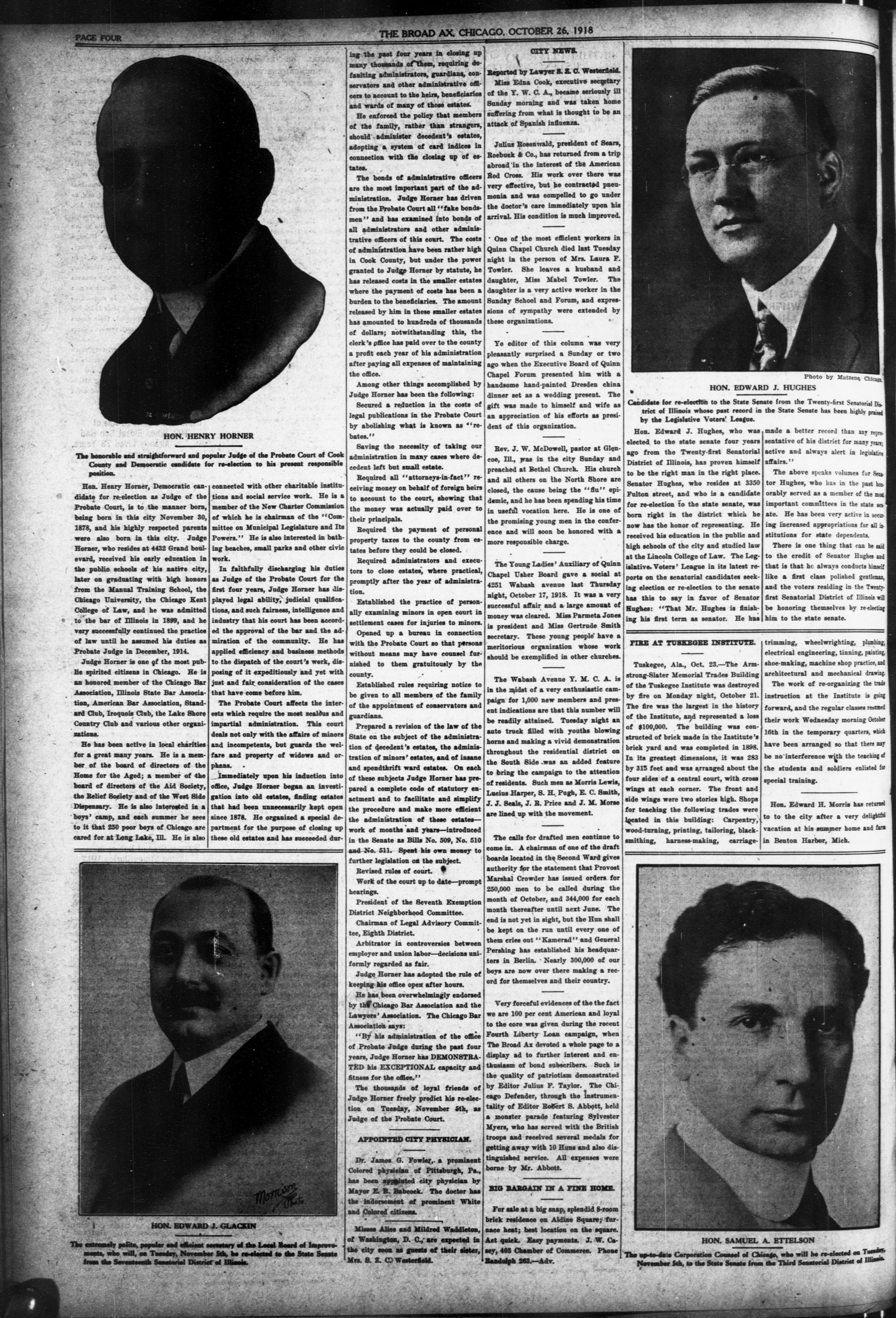
The honorable and straightforward and popular Judge of the Probate Court of Cook County and Democratic candidate for re-election to his present responsible position.
Hon. Henry Horner, Democratic candidate for re-election as Judge of the Probate Court, is to the manner born, being born in this city November 30, 1878, and his highly respected parents were also born in this city. Judge Horner, who resides at 4432 Grand boulevard, received his early education in the public schools of his native city, later on graduating with high honors from the Manual Training School, the Chicago University, the Chicago Kent College of Law, and he was admitted to the bar of Illinois in 1899, and he very successfully continued the practice of law until he assumed his duties as Probate Judge in December, 1914.
Judge Horner is one of the most public spirited citizens in Chicago. He is an honored member of the Chicago Bar Association, Illinois State Bar Association, American Bar Association, Standard Club, Iroquois Club, the Lake Shore Country Club and various other organizations.
He has been active in local charities for a great many years. He is a member of the board of directors of the Home for the Aged; a member of the board of directors of the Aid Society, the Relief Society and of the West Side Dispensary. He is also interested in a boys' camp, and each summer he sees to it that 250 poor boys of Chicago are cared for at Long Lake. Ill. He is also
---
Morrison
Photo
PAGE FOUR
1
connected with other charitable institutions and social service work. He is a member of the New Charter Commission of which he is chairman of the "Committee on Municipal Legislature and Its Powers." He is also interested in bathing beaches, small parks and other civic work.
In faithfully discharging his duties as Judge of the Probate Court for the first four years, Judge Horner has displayed legal ability, judicial qualifications, and such fairness, intelligence and industry that his court has been accorded the approval of the bar and the admiration of the community. He has applied efficiency and business methods to the dispatch of the court's work, disposing of it expeditiously and yet with just and fair consideration of the cases that have come before him.
The Probate Court affects the interests which require the most zealous and impartial administration. This court deals not only with the affairs of minors and incompetents, but guards the welfare and property of widows and orphans. Immediately upon his induction into office, Judge Horner began an investigation into old estates, finding estates that had been unnecessarily kept open since 1878. He organized a special department for the purpose of closing up these old estates and has succeeded dur-
ing the four years in closing up many thousands of them, requiring defaulting administrators, guardians, conservators and other administrative officers to account to the heirs, beneficiaries and wards of many of those estates.
He enforced the policy that members of the family, rather than strangers, should administer decedent's estates, adopting a system of card indices in connection with the closing up of estates.
CITY NEWS.
Reported by Lawyer S. Z. C. Wee
Miss Edna Cook, executive s
of the Y. W. C. A., became seri
Sunday morning and was take
suffering from what is thought
attack of Spanish influenza.
Julius Rosenwald, president of Roebuck & Co., has returned from abroad in the interest of the A
The bonds of administrative officers are the most important part of the administration. Judge Horner has driven from the Probate Court all "fake bondsmen" and has examined into bonds of all administrators and other administrative officers of this court. The costs of administration have been rather high in Cook County, but under the power granted to Judge Horner by statute, he has released costs in the smaller estates where the payment of costs has been a burden to the beneficiaries. The amount released by him in these smaller estates has amounted to hundreds of thousands of dollars; notwithstanding this, the clerk's office has paid over to the county a profit each year of his administration after paying all expenses of maintaining the office.
Among other things accomplished by Judge Horner has been the following:
Secured a reduction in the costs of legal publications in the Probate Court by abolishing what is known as "rebates."
Saving the necessity of taking our administration in many cases where decedent left but small estate.
Required all "attorneys-in-fact" receiving money on behalf of foreign heirs to account to the court, showing that the money was actually paid over to their principals.
Required the payment of personal property taxes to the county from estates before they could be closed.
Required administrators and executors to close estates, where practical, promptly after the year of administration.
Established the practice of personally examining minors in open court in settlement cases for injuries to minors.
Opened up a bureau in connection with the Probate Court so that persons without means may have counsel furnished to them gratuitously by the county.
Established rules requiring notice to be given to all members of the family of the appointment of conservators and guardians.
Prepared a revision of the law of the State on the subject of the administration of decedent's estates, the administration of minors' estates, and of insane and spendthrift ward estates. On each of these subjects Judge Horner has prepared a complete code of statutory enactment and to facilitate and simplify the procedure and make more efficient the administration of these estates—work of months and years—introduced in the Senate as Bills No. 509, No. 510 and No. 511. Spent his own money to further legislation on the subject. Revised rules of court. Work of the court up to date—prompt hearings.
President of the Seventh Exemption District Neighborhood Committee. Chairman of Legal Advisory Committee, Eighth District. Arbitrator in controversies between employer and union labor—decisions uniformly regarded as fair. Judge Horner has adopted the rule of keeping his office open after hours. He has been overwhelmingly endorsed by the Chicago Bar Association and the Lawyers' Association. The Chicago Bar Association says: "By his administration of the office of Probate Judge during the past four years, Judge Horner has DEMONSTRA TED his EXCEPTIONAL capacity and fitness for the office."
The thousands of loyal friends of Judge Horner freely predict his re-election on Tuesday, November 5th, as Judge of the Probate Court.
Dr. James G. Fowler, a prominent Colored physician of Pittsburgh, Pa. has been appointed city physician by Mayor E. B. Babcock. The doctor has the indorsement of prominent White and Colored citizens.
Misses Alice and Mildred Waddleton, of Washington, D. C.; are expected in the city soon as guests of their sister, Mrs. S. Z. C) Westerfield.
Reported by Lawyer S. Z. C. Westerfield.
Miss Edna Cook, executive secretary of the Y. W. C. A., became seriously ill Sunday morning and was taken home suffering from what is thought to be an attack of Spanish influenza.
Julius Rosenwald, president of Sears, Roebuck & Co., has returned from a trip abroad in the interest of the American Red Cross. His work over there was very effective, but he contracted pneumonia and was compelled to go under the doctor's care immediately upon his arrival. His condition is much improved.
One of the most efficient workers in Quinn Chapel Church died last Tuesday night in the person of Mrs. Laura F. Towler. She leaves a husband and daughter, Miss Mabel Towler. The daughter is a very active worker in the Sunday School and Forum, and expressions of sympathy were extended by these organizations.
Ye editor of this column was very pleasantly surprised a Sunday or two ago when the Executive Board of Quinn Chapel Forum presented him with a handsome hand-painted Dresden china dinner set as a wedding present. The gift was made to himself and wife as an appreciation of his efforts as president of this organization.
Rev. J. W. McDowell, pastor at Glencoe, Ill., was in the city Sunday and preached at Bethel Church. His church and all others on the North Shore are closed, the cause being the "flu" epidemic, and he has been spending his time in useful vocation here. He is one of the promising young men in the conference and will soon be honored with a more responsible charge.
The Young Ladies' Auxiliary of Quinn Chapel Usher Board gave a social at 4251 Wabash avenue last Thursday night, October 17, 1918. It was a very successful affair and a large amount of money was cleared. Miss Parmeta Jones is president and Miss Gertrude Smith secretary. These young people have a meritorious organization whose work should be exemplified in other churches.
The Wabash Avenue Y. M. C. A. is in the midst of a very enthusiastic campaign for 1,000 new members and present indications are that this number will be readily attained. Tuesday night an auto truck filled with youths blowing horns and making a vivid demonstration throughout the residential district on the South Side -was an added feature to bring the campaign to the attention of residents. Such men as Morris Lewis, Lucius Harper, S. H. Pugh, E. C. Smith, J. J. Seals, J. R. Price and J. M. Morse are lined up with the movement.
The calls for drafted men continue to come in. A chairman of one of the draft boards located in the Second Ward gives authority for the statement that Provost Marshal Crowder has issued orders for 250,000 men to be called during the month of October, and 344,000 for each month thereafter until next June. The end is not yet in sight, but the Hun shall be kept on the run until every one of them cries out "Kamerad" and General Pershing has established his headquarters in Berlin. Nearly 300,000 of our boys are now over there making a record for themselves and their country.
Very forceful evidences of the fact we are 100 per cent American and loyal to the core was given during the recent Fourth Liberty Loan campaign, when The Broad Ax devoted a whole page to a display ad to further interest and enthusiasm of bond subscribers. Such is the quality of patriotism demonstrated by Editor Julius F. Taylor. The Chicago Defender, through the instrumentality of Editor Robert S. Abbott, held a monster parade featuring Sylvester Myers, who has served with the British troops and received several medals for getting away with 10 Hums and also distinguished service. All expenses were borne by Mr. Abbott.
For sale at a big snap, splendid 8-room brick residence on Aldine Square; furnace heat; best location on the square. Act quick. Easy payments. J. W. Casey, 403 Chamber of Commerce. Phone Randolph 293.-Adv.
HON. EDWARD J. HUGHES Candidate for re-election to the State Senate from the Twenty-first Senatorial District of Illinois whose past record in the State Senate has been highly praised by the Legislative Voters' League.
Hon. Edward J. Hughes, who was elected to the state senate four years ago from the Twenty-first Senatorial District of Illinois, has proven himself to be the right man in the right place. Senator Hughes, who resides at 3350 Fulton street, and who is a candidate for re-election to the state senate, was born right in the district which he now has the honor of representing. He received his education in the public and high schools of the city and studied law at the Lincoln College of Law. The Legislative, Voters' League in its latest reports on the senatorial candidates seeking election or re-election to the senate has this to say in favor of Senator Hughes: "That Mr. Hughes is finishing his first term as senator. He has
FIRE AT TUSKEGEE INSTITUTE.
Tuskegee, Ala., Oct. 23.—The Armstrong-Slater Memorial Trades Building of the Tuskegee Institute was destroyed by fire on Monday night, October 21. The fire was the largest in the history of the Institute, and represented a loss of $100,000. The building was constructed of brick made in the Institute's brick yard and was completed in 1898. In its greatest dimensions, it was 283 by 315 feet and was arranged about the four sides of a central court, with cross wings at each corner. The front and side wings were two stories high. Shops for teaching the following trades were located in this building: Carpentry, wood-turning, printing, tailoring, blacksmithing, harness-making, carriage-
M.
The up-to-date Corporation Counsel of Chicago, who will be re-elected on Tuesday, November 5th, to the State Senate from the Third Senatorial District of Illinois.
made a better record than any representative of his district for many years; active and always alert in legislative affairs. $ ^{2} $ The above speaks volumes for Senator Hughes, who has in the past honorably served as a member of the most important committees in the state seate. He has been very active in securing increased appropriations for all in situtions for state dependents.
There is one thing that can be said to the credit of Senator Hughes and that is that he always conducts himself like a first class polished gentleman and the voters residing in the Twenty-first Senatorial District of Illinois will be honoring themselves by re-electing him to the state senate.
trimming, wheelwrighting, plumbing, electrical engineering, tinning, painting, shoe-making, machine shop practice, and architectural and mechanical drawing. The work of re-organizing the trade instruction at the Institute is going forward, and the regular classes resumed their work Wednesday morning October 16th in the temporary quarters, which have been arranged so that there may be no interference with the teaching of the students and soldiers enlisted for special training.
Hon. Edward H. Morris has returned to to the city after a very delightful vacation at his summer home and farm in Benton Harbor, Mich.
Photo by Matzene Chicago
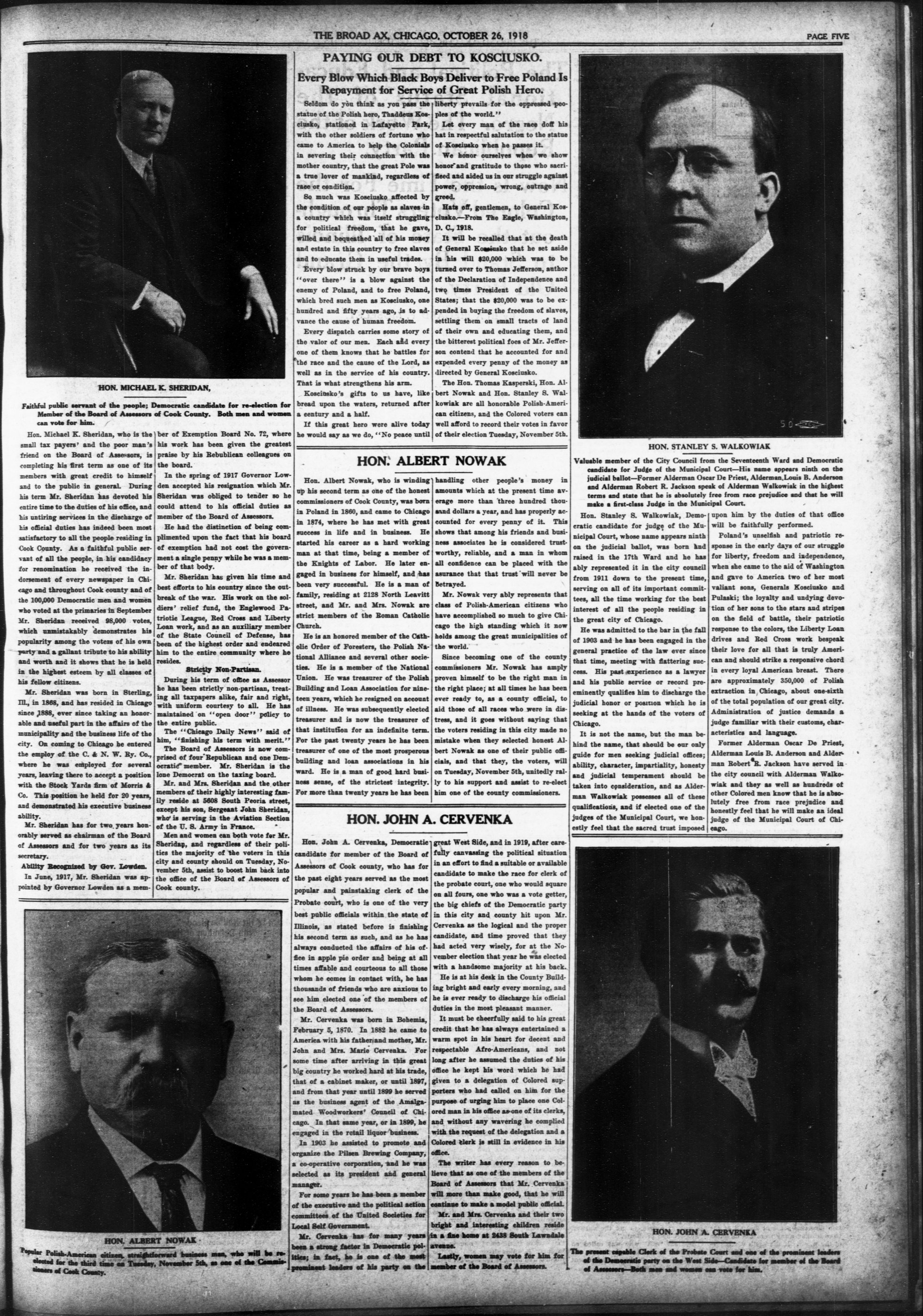
HON. MICHAEL K. SHERIDAN.
Hon. Michael K. Sheridan, who is the small tax payers' and the poor man's friend on the Board of Assessors, is completing his first term as one of its members with great credit to himself and to the public in general. During his term Mr. Sheridan has devoted his entire time to the duties of his office, and his untiring services in the discharge of his official duties has indeed been most satisfactory to all the people residing in Cook County. As a faithful public servant of all the people, in his candidacy for renomination he received the endorsement of every newspaper in Chicago and throughout Cook county and of the 100,000 Democratic men and women who voted at the primaries in September Mr. Sheridan received 98,000 votes, which unmistakably demonstrates his popularity among the voters of his own party and a gallant tribute to his ability and worth and it shows that he is held in the highest esteem by all classes of his fellow citizens.
Mr. Sheridan was born in Sterling, Ill., in 1868, and has resided in Chicago since 1888, ever since taking an honorable and useful part in the affairs of the municipality and the business life of the city. On coming to Chicago he entered the employ of the C. & N. W. By. Co., where he was employed for several years, leaving there to accept a position with the Stock Yards firm of Morris & Co. This position he held for 20 years, and demonstrated his executive business ability.
Mr. Sheridan has for two years honorably served as chairman of the Board of Assessors and for two years as its secretary.
Ability Recognized by Gov. Lowden. In June, 1917, Mr. Sheridan was appointed by Governor Lowden as a mem-
BROOKLYN
Popular Polish-American citizen, straightforward business man, who will be re-elected for the third time on Tuesday, November 5th, as one of the Commissioners of Cook County.
ber of Exemption Board No. 72, where his work has been given the greatest praise by his Rebublican colleagues on the board.
In the spring of 1917 Governor Lowden accepted his resignation which Mr. Sheridan was obliged to tender so he could attend to his official duties as member of the Board of Assessors.
He had the distinction of being complimented upon the fact that his board of exemption had not cost the government a single penny while he was a member of that body.
Mr. Sheridan has given his time and best efforts to his country since the outbreak of the war. His work on the soldiers' relief fund, the Englewood Patriotic League, Red Cross and Liberty Loan work, and as an auxiliary member of the State Council of Defense, has been of the highest order and endeared him to the entire community where he resides.
Strictly Non-Partisan.
During his term of office as Assessor he has been strictly non-partisan, treating all taxpapers alike, fair and right, with uniform courtesy to all. He has maintained on "open door" policy to the entire public.
The "Chicago Daily News" said of him, "finishing his term with merit." The Board of Assessors is now comprised of four Republican and one Democratic member. Mr. Sheridan is the lone Democrat on the taxing board.
Mr. and Mrs. Sheridan and the other members of their highly interesting family reside at 5608 South Peoria street, except his son, Sergeant John Sheridan, who is serving in the Aviation Section of the U. S. Army in France.
Men and women can both vote for Mr. Sheriday, and regardless of their politics the majority of the voters in this city and county should on Tuesday, November 5th, assist to boost him back into the office of the Board of Assessors of Cook county.
THE BROAD AX, CHICAGO, OCTOBER 26, 1918
Every Blow Which Black Boys Deliver to Free Poland Is Repayment for Service of Great Polish Hero.
Seldom do you think as you pass the statue of the Polish hero, Thaddeus Kosciusko, stationed in Lafayette Park, with the other soldiers of fortune who came to America to help the Colonials in severing their connection with the mother country, that the great Pole was a true lover of mankind, regardless of race or condition.
liberty prevails for the oppressed peoples of the world."
Let every man of the race doff his hat in respectful salutation to the statue of Kosciusko when he passes it.
We honor ourselves when we show honor and gratitude to those who sacri-fied and aided us in our struggle against power, oppression, wrong, outrage and
So much was Koseiusko affected by the condition of our people as slaves in a country which was itself struggling for political freedom, that he gave, willed and bequeathed all of his money and estate in this country to free slaves and to educate them in useful trades. Every blow struck by our brave boys "over there" is a blow against the enemy of Poland, and to free Poland, which bred such men as Koseiusko, one hundred and fifty years ago, is to advance the cause of human freedom.
Every dispatch carries some story of the valor of our men. Each and every one of them knows that he battles for the race and the cause of the Lord, as well as in the service of his country. That is what strengthens his arm.
Koscinsko's gifts to us have, like bread upon the waters, returned after a century and a half.
If this great hero were alive today he would say as we do, "No peace until
HON: ALBERT NOWAK
HON: ALBERT NOWAK
Hon. Albert Nowak, who is winding up his second term as one of the honest commissioners of Cook County, was born in Poland in 1860, and came to Chicago in 1874, where he has met with great success in life and in business. He started his career as a hard working man at that time, being a member of the Knights of Labor. He later engaged in business for himself, and has been very successful. He is a man of family, residing at 2128 North Leavitt street, and Mr. and Mrs. Nowak are strict members of the Roman Catholic Church.
He is an honored member of the Catholic Order of Foresters, the Polish National Alliance and several other societies. He is a member of the National Union. He was treasurer of the Polish Building and Loan Association for nineteen years, which he resigned on account of illness. He was subsequently elected treasurer and is now the treasurer of that institution for an indefinite term. For the past twenty years he has been treasurer of one of the most prosperous building and loan associations in his ward. He is a man of good hard business sense, of the strictest integrity. For more than twenty years he has been
HON. JOHN A. CERVENKA
HON. JOHN A. CERVENKA
Hon. John A. Cervenka, Democatic candidate for member of the Board of Assessors of Cook county, who has for the past eight years served as the most popular and painstaking clerk of the Probate court, who is one of the very best public officials within the state of Illinois, as stated before is finishing his second term as such, and as he has always conducted the affairs of his office in apple pie order and being at all times affable and courteous to all those whom he comes in contact with, he has thousands of friends who are anxious to see him elected one of the members of the Board of Assessors.
Mr. Cervenka was born in Bohemia, February 5, 1870. In 1882 he came to America with his father and mother, Mr. John and Mrs. Marie Cervenka. For some time after arriving in this great big country he worked hard at his trade, that of a cabinet maker, or until 1897, and from that year until 1899 he served as the business agent of the Amalgamated Woodworkers' Council of Chicago. In that same year, or in 1899, he engaged in the retail liquor business. In 1903 he assisted to promote and organize the Pilsen Brewing Company, a co-operative corporation, and he was selected as its president and general manager.
For some years he has been a member of the executive and the political action committees of the United Societies for Local Self Government. Mr. Cervenka has for many years been a strong factor in Democratic politics; in fact, he is one of the most prominent leaders of his party on the
liberty prevails for the oppressed peoples of the world.'"
Let every man of the race doff his hat in respectful salutation to the statue of Koseiusko when he passes it.
We honor ourselves when we show honor and gratitude to those who sacrificed and aided us in our struggle against power, oppression, wrong, outrage and greed.
Hats off, gentlemen, to General Koseiusko.—From The Eagle, Washington, D. C. 1918.
It will be recalled that at the death of General Kosciusko that he set aside in his will $20,000 which was to be turned over to Thomas Jefferson, author of the Declaration of Independence and two times President of the United States; that the $20,000 was to be expended in buying the freedom of slaves, settling them on small tracts of land of their own and educating them, and the bitterest political foes of Mr. Jefferson contend that he accounted for and expended every penny of the money as directed by General Kosciusko.
The Hon. Thomas Kasperski, Hon. Albert Nowak and Hon. Stanley S. Walkowiak are all honorable Polish-American citizens, and the Colored voters can well afford to record their votes in favor of their election Tuesday, November 5th.
handling other people's money in amounts which at the present time average more than three hundred thousand dollars a year, and has properly accounted for every penny of it. This shows that among his friends and business associates he is considered trustworthy, reliable, and a man in whom all confidence can be placed with the assurance that that trust will never be betrayed.
Mr. Nowak very ably represents that class of Polish-American citizens who have accomplished so much to give Chicago the high standing which it now holds among the great municipalities of the world.
Since becoming one of the county commissioners Mr. Nowak has amply proven himself to be the right man in the right place; at all times he has been ever ready to, as a county official, to aid those of all races who were in distress, and it goes without saying that the voters residing in this city made no mistake when they selected honest Albert Nowak as one of their public officials, and that they, the voters, will on Tuesday, November 5th, unitedly rally to his support and assist to re-elect him one of the county commissioners.
great West Side, and in 1919, after carefully canvassing the political situation in an effort to find a suitable or available candidate to make the race for clerk of the probate court, one who would square on all fours, one who was a vote getter, the big chiefs of the Democratic party in this city and county hit upon Mr. Cervenka as the logical and the proper candidate, and time proved that they had acted very wisely, for at the November election that year he was elected with a handsome majority at his back. He is at his desk in the County Building bright and early every morning, and he is ever ready to discharge his official duties in the most pleasant manner.
It must be cheerfully said to his great credit that he has always entertained a warm spot in his heart for decent and respectable Afro-Americans, and not long after he assumed the duties of his office he kept his word which he had given to a delegation of Colored supporters who had called on him for the purpose of urging him to place one Colored man in his office as one of its clerks, and without any wavering he complied with the request of the delegation and a Colored clerk is still in evidence in his office.
The writer has every reason to believe that as one of the members of the Board of Assessors that Mr. Cervenka will more than make good, that he will continue to make a model public official. Mr. and Mrs. Cervenka and their two bright and interesting children reside in a fine home at 2438 South Lawndale avenue. Lastly, women may vote for him for member of the Board of Assessors.
50
HON. STANLEY S. WALKOWIAK
Valuable member of the City Council from candidate for Judge of the Municipal judicial ballot—Former Alderman Osse and Alderman Robert R. Jackson spe-terms and state that he is absolutely make a first-class Judge in the Muni
the City Council from the Seventeenth
ledge of the Municipal Court—His name
former Alderman Oscar De Priest, Aldern
bert R. Jackson speak of Alderman Wan
hat he is absolutely free from race prej
Judge in the Municipal Court.
Valuable member of the City Council from the Seventeenth Ward and Democratic candidate for Judge of the Municipal Court—His name appears ninth on the judicial ballot—Former Alderman Oscar De Priest, Alderman, Louis B. Anderson and Alderman Robert R. Jackson speak of Alderman Walkowiak in the highest terms and state that he is absolutely free from race prejudice and that he will make a first-class Judge in the Municipal Court.
Hon. Stanley S. Walkowiak, Democratic candidate for judge of the Municipal Court, whose name appears ninth on the judicial ballot, was born and raised in the 17th Ward and he has ably represented it in the city council from 1911 down to the present time, serving on all of its important committees, all the time working for the best interest of all the people residing in the great city of Chicago.
upon him by the duties of that office will be faithfully performed.
Poland's unselfish and patriotic response in the early days of our struggle for liberty, freedom and independence, when she came to the aid of Washington and gave to America two of her most valiant sons, Generals Kosciuko and Pulaski; the loyalty and undying devotion of her sons to the stars and stripes on the field of battle, their patriotic
He was admitted to the bar in the fall of 1903 and he has been engaged in the general practice of the law ever since that time, meeting with flattering success. His past experience as a lawyer and his public service or record preeminently qualifies him to discharge the judicial honor or position which he is seeking at the hands of the voters of Chicago.
It is not the name, but the man behind the name, that should be our only guide for men seeking judicial offices; ability, character, impartiality, honesty and judicial temperament should be taken into consideration, and as Alderman Walkowiak possesses all of these qualifications, and if elected one of the judges of the Municipal Court, we honestly feel that the sacred trust imposed
```markdown
```
1910
HON. JOHN A. CERVENKA
The present capable Clerk of the Probate Court and one of the Democratic party on the West Side—Candidate of Accessory—Both men and women can vote for him
erk of the Probate Court and one of party on the West Side—Candidate for men and women can vote for him.
The present capable Clerk of the Probate Court and one of the prominent leaders of the Democratic party on the West Side—Candidate for member of the Board of Assessment—Both man and woman can vote for him.
50
am the Seventeenth Ward and Democratic Court—His name appears ninth on the ar De Priest, Alderman, Louis B. Anderson ak of Alderman Walkowiak in the highest free from race prejudice and that he willipal Court. upon him by the duties of that office will be faithfully performed.
Poland's unselfish and patriotic response in the early days of our struggle for liberty, freedom and independence, when she came to the aid of Washington and gave to America two of her most valiant sons, Generals Kosciusko and Pulaski; the loyalty and undying devotion of her sons to the stars and stripes on the field of battle, their patriotic response to the colors, the Liberty Loan drives and Red Cross work bespeak their love for all that is truly American and should strike a responsive chord in every loyal American breast. There are approximately 350,000 of Polish extraction in Chicago, about one-sixth of the total population of our great city. Administration of justice demands a judge familiar with their customs, characteristics and language.
Former Alderman Oscar Do Priest, Alderman Louis B. Anderson and Alderman Robert B. Jackson have served in the city council with Alderman Walkowiak and they as well as hundreds of other Colored men know that he is absolutely free from race prejudice and honestly feel that he will make an ideal judge of the Municipal Court of Chicago.
1920
Court and one of the prominent leaders side—Candidate for member of the Board an vote for him.
PAGE FIVE
NOT NEEDED
District of Columbia Names
Industries Not Essential to War
Industries declared to be nonessential in the District of Columbia, which may be given similar designation elsewhere in the country, have been announced by the community bureau of the United States employment service, under direction of the department of labor.
The following industries were classified as nonessential to war work:
Automobile industries accessories.
Drivers of pleasure cars—cleaning,
repairing and delivery of same.
Sight-seeing cars.
Automobile trucks engaged in work
other than fuel or government work.
Teaming other than delivery of products
for war work.
Bath and barber shop attendants.
Bowling alleys, billiard and pool-
rooms.
Bottlers and bottle supplies.
Bottlers and carpenters.
Candy manufacturers, cigars and tobacco.
Cleaners and dyers.
Clubs.
Confectioners and delicatessen establishments.
Builders and contractors not engaged in the erection of structures for war work.
Junk dealers.
Livery and sales stables.
Pawn brokers.
Peanut venders and establishments
Shoe-shining shops.
Window cleaners.
Soft drink establishments.
Soda fountain supplies.
The men at this time to be released from these establishments, it is explained, are the laborers, porters or janitors and other unskilled workers, who may apply to the United States employment service for work in essential industries.
Price of Clothing and the Supply of Wool Since Under Control of the Government
Somewhat in contrast to repeated declarations that woolen clothes will be scarce is an official announcement from the war industries board, which says that the government control of wool and woolens has reached a stage "which makes possible the assurance to cloth mills and to clothing manufacturers, jobbers and retailers that wool will be equitably distributed to meet both government and civilian requirements. The price will be regulated to assure a fair and reasonable profit to the industry, but a range of prices will not be permitted which will allow abnormal profits with the consequent unjustifiable hardship to the consuming public." It is declared that the present speculative movement in cloth and clothing will undoubtedly compel definite penalizing action if persisted in. Especially does the statement insist that there are ample stocks of woolens and no cause for inflation. No dealer should try to buy beyond his present needs, it is asserted, because there is no reason for it. This significant announcement is made: "There is no official warrant for statements or rumors to the effect that it will soon be impossible to buy woolens or woolen clothing sufficient to meet actual requirements of the civilian population."
All of which ought to bring relief to the people. One of the reasons for an advance in clothing for both men and women is the higher price of findings. Tailors cannot make clothes as cheaply as they could a year or so ago, but there seems no reason for the rumor that woolen clothing is about off the market, and that greatly increased prices are necessary for fall and next spring.-Indianspills News.
OH, FRANCE!
DEAR FRANCE!
Oh, France, dear France,
Could I but give
As longs my heart to give to you
You'd have your dead alive again,
I'd give you back Alsace-Lorraine
And every hill and fertile plain
That is your due!
Oh, France, dear France,
My gift is small
So little is my very all--
But these my hands I offer you,
And all a loving brain may do
And all a heart's desire true,
Whaste'er befall.
Oh, France, dear France,
Full well I see
The hour of your astray
I know your honor, clean and bright,
I know your future crowned with light.
Oh, France, dear France, you are in
the light.
Of Vienna!
—Ethel Watts Mumford of the Vgl- lanten.
Nature makes no mistakes in anchoring trees. When the winds press harder against one side of a tree than another, nature strengthens the roots on the side where the greatest strength is required. In countries where they have pretty constant winds from a certain direction you will find all of the trees leaning away from the direction of the winds. If the south winds prevail for the greater part of the year the trees lean to the north and the greatest root growth is to the south.
1
NO LOBSTER AT THAT MEAL
Good and Distinct Reason Why Man. Teek His Dinner From the Humble Sardine Tin.
A friend of mine is very fond of lobster, but, like many men, has no idea how such food is prepared. His wife had occasion to be absent from home one day last week, and she told the servant girl to broil a lobster for my friend's dinner. She left a note, telling her husband of the treat she had provided for him, and requesting him not to wait dinner for her. He was quite hungry when he reached home and, after regarding the note, said to the servant:
"Is that lobster ready?"
"No, sir, it isn't," said the girl.
"Well, hurry up with it. I'm as hungry as a bear," said he.
"I can't, sir," said the girl. "The mistress said to broil the lobster, and I got him on the gridiron after a dale of fuss. The more I poked the fire the more he walked off, and I thought the baste was haunted and no good would come from cooking a straddle bug like that."
"What did you do with it?" said my friend, getting mad.
"Faith, the last I saw of him he was going out the back door with his tail up, like the maniac he was."
He had sardines for dinner.—London Mail.
ALIBI PROVED FOR PRETZEL
Going Far Back Into Ancient History, It Can Be Proved That It Was Not of German Origin.
Now comes the lowly pretzel before the bar of public opinion in a valorous attempt to remove the stigma of German origin. It has delved deep into ancient history to prove its alibi and upon the face of the evidence presented it has made out a reasonable case for itself. Indignantly does the pretzel deny that it sprang from unhallowed association with German beer; that use it declares is a desecration of its originally high birth, a degradation characteristically Teutonic. The pretzel insists that it is inherently a baked prayer, for in the early day of the Christian church the pretzel was used almost exclusively as a reward of merit given by a priest to children for learning their prayers. In the monasteries of the middle ages the pretzel was considered a rare delicacy, and during lent it was the usual alms offering. Furthermore the very crookedness of the pretzel is a crushing argument against its calumniators, for it represents the arms folded in prayer. Thus stands the case for the sanctity of the humble pretzel.
House Oldest In America.
Tradition, indorsed by the press and the testimony of the oldest inhabitants, gives authority to the statement that the oldest house, No. 54 North St. George street, St. Augustine, Fla., is really the oldest house in America. Built by the Dons in medieval times (1589) on the oldest street of what was the site of the Indian village of Seloe, whose chief was Folomato, this ancient house has never been remodeled or modernized. The architecture is of Moorish design, antedating the Spanish. With its coquina-terrace floors, round carved pillars in the patio, mahogany stairway, hewn red cedar timbers, all pegged together, secret closets and other substantiating hallmarks, it is unlike any other house in St. Augustine, and is truly one of the sights of the ancient city.
Pitt a Spendthrift
The complaint that many of our statesmen will not themselves set the fashion in economical living in wartime is not a new one. Pitt, who preached economy and forced it on the people, was himself a notorious spend-thrift.
For a long time (while warden of the Cinque ports) his income was $10,000 a year, and it never fell below £8,000. Yet he was always hard up, and when he died the nation, in the throes of a great war, had to find some £40,000 to satisfy his creditors.
Examinations of Pitt's household budgets—made from time to time at his own request—showed such items as a hundredweight of butcher's meat consumed in a single week—or, more accurately, charged to Pitt's account.
—London Chronicle.
Wouldn't Mix In That.
"Howdy, 'Squire!" saluted a younger neighbor. "Me and wife have got into a sort of a jangle over naming our baby. It's our first, and I stope we're more particular about it than folks who have a bunch of 'em. Wife, she is set and determined to name him after her side of the house, and I'm sticking and hanging for him to be named after one of my kin. Now, if you'll come over and settle it for us we'll—"
"Now, looky here, Lucas!" interrupted old man Backledafer. "While I hate peace as much as anybody, and more than a good many, I hain't so absolutely senseless and foolhardy as all that!"—Kansas City Sun.
A young ensign, acting as school teacher on the battleship Texas, says Philadelphia Public Ledger, asked the question: "What are the two principal parts of a sentence?" He expected, of course, to get the answer, "Subject and predicate."
The old "salt" who was called on scratched his head in perplexity and at last replied: "Solidary confinement and bread and water."
THE BROAD AX, CHICAGO, OCTOBER 26, 1918
The Political and Educational Status of the Negro. The Work of the Republican Party.
Now Is the Time For the Colored Voters Throughout the State of Illinois to Stand By the Grand Old Party.
By!BEAUREGARD F.!MOSELEY.
Last week we wrote upon Frederick Douglas's declaration, "The Republican Party, the Ship—All Else the Sea." Since that time we have had occasion to note in a certain weekly such headlines as these, "Police Club Citizens Recklessly—two are killed; many injured!" "Obnoxious signs drive men from government work!" etc., as well as an editorial in this same weekly wherein the Negro is tacitly advised to vote the Democratic ticket. In our article of last week we have had occasion to close with these words, "perhaps some who read this article will have reasons to recall their leaving the Southland where the Democratic Party is in full control of every branch of the county, state and national government, for a refuge in Republican Illinois." And it now occurs to us that these headlines in this erstwhile Democratic sheet or weekly is self evident of the cause that has made Republican Illinois the Southern Negro's new found home, for these occurrences heralded by these headlines were all in Democratic territory and performed by Democratic officials against the Negro, and that too in places where the Negro assumes to be a Democrat. Of course all well informed know that there are no Negro Democrats allowed in the South; the Democratic party there is for white men only, and recently in the United States Senate a Democrat from Mississippi opposed woman suffrage solely because it would enfranchise Negro women. A few years ago in New York, a few job hunting Colored men who could not be Democrats in the South because that party does not permit them to be, organized a black Tammany Democratic club last week in this same district where the Tammany Democratic Police clubbed and killed the progeny of these self same black Tammany Democrats; and yet we are advised (!) that
SUPREME IN INSECT MIMICRY
Really Wonderful Act of Caterpillar Shows Nature's Protection Thrown Around Innocents.
I witnessed a quaint little scene on a blackthorn bush in Epping forest a day or two ago, writes "L. F." in Manchester (Eng.) Guardian. It is well known that many species of caterpillars so closely resemble the brown, barked stems, while others, being green, fix themselves to the new green stems of the current year's growth. Among the blackthorn twigs I observed one young member of the darker species sticking out, rigid and motionless, at the orthodox angle of 45 degrees, from apparently a young green shoot. On closer examination I discovered that the young green shoot was itself a caterpillar sticking out at an angle of 45 degrees.
What had happened was obvious. The disgulse of the green caterpillar was so perfect that even another caterpillar—itself a master in the art of twig imitation—had palpably been completely deceived and mistaken the green caterpillar for a twig. Surely this is a triumph of insect mimicry.
Ideal Friendship.
Inducerity may fascinate—but it is not lovable. Only honesty and directness of dealing can win a lasting attachment. Artificial folk are desperately afraid of the picturesque unconventional actions that they think will make them ridiculous. They are so stiff and starched in their unmanneriness that they are hopelessly uninteresting. Sticklers for etiquette and for the observances of all the minor canons of good form, they find so many petty, silly rules to follow that they have no time to give rein to large and generous impulses. A personality that makes itself count ardently and lastingly in other lives and for the world's well being is too hard for spite.
more of us should vote the Democratic ticket. The Republican Party clothed the Negro with freedom and placed in his hands freedom's grandest weapon, THE BALLOT, built school houses and furnished teachers to instruct the Negro, and wrote into law provisions to safeguard and protect him. Is it then the fault of the Republican Party that the Democratic Party violates this law and steals from him his rights, any more than it is the fault of the sheriffs that some one steals your horse or of the lock smith that some one breaks the lock and steals your wardrobe? Sensible men will blame not the sheriff or lock smith, but the thief, and so will the Negro who is really intelligent and unmoved in his judgment by Democratic dollars blame the Democrats for every right denied him which the Republican Party has sought to give him. A resume of all laws introduced, passed or killed in the legislatures and congress of this country intended for the betterment, protection and advancement of the Negro in this country, will be found to have been the work of the Republican Party, and all opposition to these laws, their defeat or failure, the work of the Democratic Party. It is a sad commentation upon the intelligence of the Negro. If driven from his Southern home by rights denied him by the Democratic Party, he shall come here in Republican Illinois where his rights are more secure than anywhere else in all this country, and exercise these rights by following the advice of a few disgruntled Negroes who for a consideration have bargained to deliver the Negro vote to the Democrats. The response on the part of the Negro should be made and will be made, to these Judas Iscariots on November 5, next, by wielding civilization's best weapon upon their unhallowed heads by voting a straight Republican ballot.—Adv.
too noble for most, small ways, too
genuine for intrigue and innuendo and
too faithful to sacrifice a friend.
History of a Star
The history of a star begins with dust and ends with dust. It takes its form out of chaotic nebulae, passes through a period of life, grows cool, then dark and dead, and ultimately dashes into another dark cloud of star dust, and is thus turned back into nebula.
We on earth live our lives in such a short moment that evolution among the stars is not at once apparent. It would require a great many centuries to actually see a blue sun become white, then yellow, then finally red. While it is not possible to watch any one star living its life, yet by noting the characteristics of a great many, a complete and logical chain of evidence may be found, which includes representative stars of every type in the sky.
Society of the Cincinnati.
The historic Society of the Cincinnati, oldest of the American patriotic organizations, was founded by officers of the Continental forces and of the French army and fleet which aided us in gaining our independence at the close of the Revolutionary war, 135 years ago, Washington was its first president general, Hamilton the second, and on its original rolls appear the names of many others who gained fame for their services in the cause of liberty. Its membership, composed of the eldest male descendants of these officers, now numbers about 1,000.
One day my two little nieces were discussing which had been with her mother the longer.
"I've been with mother longer than you have," said the elder.
After thinking a few moments her younger sister answered, "Yeah, but I've been with God longer." — Chicago Tehran
It's as Easy to Run a Tractor as an Auto
Ladies! Did you ever think how much help you can render your Uncle Sam if you know how to run an automobile? Did you know that it is as easy to run a farm tractor as it is to run an automobile? This lady takes frequent rides in her tractor to help raise Uncle Sam's crops.
No Cross of Gold Found When Lake in Moscow Was Drained to Find Treasure.
If all the lakes in the world dried up, what would we find in their beds? The question is raised through a recent allusion to Lake Semlevo, in Moscow, which for a century was said to contain a cross of pure gold 15 feet in height. Napoleon—so the story ran—tried to carry it away with him as a war trophy, but, when disaster came upon him, lost it in the lake.
About seven years ago, relates a writer in Answers, the lake was actually drained, but no cross was found, although the bed was scattered with other relics of Napoleon's retreat—remains of carts, horses, uniforms, etc.
There are many similar stories from other parts. In the depth of a South American lake over $5,000,000 worth of gold is said to have been thrown by Peruvian priests when fleeing from the Spanlards, and the bed of the Danube is the supposed hiding place of Attila's wealth.
Attila ordered that on his death the Danube should be temporarily diverted from its course and that he should be buried under the river bed with his enormous fortune. This was done. And after the river bed had been diverted and then brought back again to its original channel, the slaves who had performed the work were killed, in order that the secret of the location should never be revealed.
How to Prepare Candied Fruits and Vegetables
1. Select products of uniform size and ripeness.
2. Wash.
3. Cut fruits in halves, quarters or smaller sections; cut vegetables in narrow strips about $2\frac{1}{2}$ inches in length.
4. Drop in a sirup cooked until it spins a thread. To prepare a-spiced sirup, boll whole cloves and whole cinnamon in three-fourths of a cupful of water 15 minutes. Strain out spices. Add to strained spiced water one cupful sirup and two teaspoonfuls vinegar. Cook until it spins a thread. To prepare ginger sirup, add a few pieces of dried ginger root, which can be purchased from a grocery or a drug store, to the sirup in which the fruit is cooked.
5. Allow to cook until transparent.
6. Drain.
7. Dry in slow oven; finish drying over kitchen range.
8. Roll in minimum amount of granulated sugar. (May be omitted for fruits.)
Hard to Hit Nail on Head With Definition of Humor
Endless are the definitions of humor, its shading off from wit, the nature of its appeal. But none of them really satisfies. No nice little formulas or prescriptions will guarantee a jest's success. It is as vain to furnish humor unless there be a sense to perceive it, as it is to supply a reason when there is no understanding to give it due weight. Nothing is more precarious—more dangerous—than to recommend a new book of humor. When you expect a laugh you may get only an amazed stare.
Big Grain Crop in England.
England's grain crop this year will be the biggest since 1868, Sir Charles Fielding, director general of food production, informs the Daily Mall. Several thousand soldiers are working on farms, and other harvesters include schoolboys, undergraduates, boy scouts, village and college women and girls of the land army, Belgian and Serbian refugees and German prisoners. City clerks are spending their vacations on farms.
Carnegie Began as Telegrapher.
Andrew Carnegie, the multimillionaire, is a Scotchman. He began his business career in this country as a telegraph operator and during the Civil war was superintendent of military railways and telegraph lines in the East.
JUST FOR A SMILE
Got it From Hearsay.
A group of old ladies were talking and knitting on the veranda. The conversation got around to how much each weighed at birth. One old lady said: "Well, I weighed just 3½ pounds."
The others gasped, and one of them asked: "And did you live?"
"They say I did," answered the other woman. "and done well."
The Real Mark.
A man in a uniform
"And the other is any poor boo who is obliged to stand for the kali's government."
A stranger who stopped recently at a farmhouse in a country town not a hundred miles from Boston to inquire for a boarding place, asked a man if there was any place in the next village where they kept transients.
"Yes, I guess so," said the man, deliberately: "there are two stores."
"Jones doesn't want his wife to go away."
"Feels the separation, no doubt."
"Yes, from the necessary coin."
Summer Engagements.
"Am I the first man you have ever loved?"
"Now don't be absurd. I've been here at the beach six weeks."
"Am I the first man you have ever loved?"
"Now don't be absurd. I've been here at the beach six weeks."
Two Points of View.
"He looks to me like a man who had loved and lost."
"He looks to me more like a man who had loved and won."
Silk-Producing Insects of About 200 Different Kinds
The number of species of silk-producing insects is very large, probably more than 200, very few of which are of any practical value to mankind; while those portions of the caterpillar family which unite their silken tissues to form a family tent have not only defied the ingenuity of man to unravel their handwork, but have made his industry contribute to their support by foraging upon fruit-bearing and ornamental trees. The spider family, notwithstanding many attempts to reel their beautiful threads, still monopolize their products for purposes of locomotion and snakes for unlucky insects.
Deepest Place in Ocean.
The deepest place thus far found in the ocean is off Mindanao, Philippine islands, 32,088 feet, and the highest mountain, Mount Everest, in the Himalayas, 29,002 feet, a difference of about $11\frac{1}{2}$ miles vertically.
.....
An insulated rifle barrel enables the gunner to handle the weapon without regard to the temperature of the barrel.
The presence of submarines has been betrayed by the actions of sea gulls, which follow them as they do other boats.
France suggests that the name "Eau de Cologne," which is claimed as a French product, be shorn of its German character and that this popular perfume be renamed "Eau de Provence."
NEW SILHOUETTE MAY BE ADOPTED
Anzac, Repetition of Musketeer, Is Among the Late Models Worn With the Lengthened and Sweep-
New York.—One approaches the subject of a new silhouette these days with timidity, notes a fashion writer. One feels the shadow of the storm that is about to burst when fashion writers and designers say to the public that the lines of women's clothes have changed, which means that women's wardrobes must change if they remain in the picture of the hour.
When we are in the throes of conservation and economy, the idea of a new silhouette is not altogether pleasing. It is snatched up with avidity by those who sell apparel, for they know it is a lure to the purse. But it is also snatched up by orators, the reformers, and thousands who ask women not to change the style of their clothes during the war. These do not snatch it up with avidity, but jump upon it and try to crush it by argument and vultuation.
The French say, however, that to face a fact and not theorize on a fancy is a far better way to meet life. Therefore, if the new silhouette is here, and if women will accept it by the thousands, it is far better to face it than to ignore it; it is wiser to realize that it must be managed on a basis of economy and conservation.
Argument has never had the slightest effect on fashions. The persuasive tones of the administration, asking that our material be spared by civilians because it is needed for the fighters, has had its result; but this is only in keeping with the uncomplaining attitude of America toward all restrictions during the war. The majority of women feel, and it seems that that feeling is right, that if they do not encroach upon the fabrics and workers needed by the government they can have as many new costumes as they wish, on whatever lines they please.
Long Skirts Replace Short ones.
The fundamental fact in the silhouette is that skirts sweep the ankles and heels. To many women this is the fundamental fact, but to the designers and the reporters there is far more in the change than this.
If women were to continue to wear plaited skirts on straight lines, sweeping the ankles, and straight skirts that reached the toe-tips and
4.9.5
New turban of white angora worn well down over the head. The frock is of dark blue velveteen, with plaited white collar and cuffs and a row of white pearly buttons on each hip. The shoes and stockings are black and white.
New turban of white angora worn well down over the head. The frock is of dark blue velvetsen, with plaited white collar and cuffs and a row of white pearly buttons on each hip. The shoes and stockings are black and white.
were made to look less scanty by ripping tunics that extended to the 'nce, one would still find that the old clothes would do. But the new long skirt is draped; it is draped upward at the back, and it is very, very slender in its outline.
You can easily see that such a skirt will influence the bodice and the waistline. One cannot wear tunics over draped skirts. One cannot wear oriental sashes at the hip-line over draped skirts, as they did in 1890.
There is so much that must go by the board with a skirt that is a graceful revival of the old "pull-back" which was held in place by short, strong elastics placed in the back widths of the skirt to pull it tight across the front of the figure.
The normal waistline will undoubtedly come in with the draped skirt; or the haque, with its pointed front fastened in a straight line up to the collar-bone, may be received. The
corselet bodice is another garment that is possible, as it needs a straight line beneath it to keep the silhouette in harmony. It is said that wide dolman sleeves will be revived with these long draped skirts, as well as flat lace collars resting securely against the tight-fitting neckline.
All in the Future.
All this, mind you, is in the future, as far as fashions for the mass are concerned. But it would be unfair to the women who are buying clothes today not to warn them of this approaching change, and the belief by all those in authority that this silhouette will rule women's clothes as the winter comes on.'
One thing, however, is quite certain in the minds of those who have au-
THE FASHION OF THE TWENTIETH CENTURY
Anzac hat of pale-gray felt. The crown is trimmed with a miniature cartridge belt made of gray fallie ribbon. The ornament is a tiny red, white and blue jeweled flag. The frock is of pale-gray satin and silk volle, and is trimmed with tiny gray silk buttons. There is a string each tied in the back.
thority: All skirts will be lengthened as the season advances under the influence of this new skirt. Women are already ripping out hems or adding new hems of other material to skirts they are renovating.
This is a wise thing for a woman to remember if she is in the throes of altering frocks that will maintain her wardrobe in good style until the actual cold weather demands warmer materials. Don't let her be misled by the fact that the majority of women's clothes worn and sold today have short skirts. All the betting on the racetrack of fashion is against their winning. It is far wiser to renovate a skirt for the future than for the present, if one considers the gown worth the price of money and vitality that clever renovation requires.
Speaking of Skirts, What About Hats?
The first question that a woman asks when she is told that the long, pull-back skirt and the tight basque are arriving, concerns the best hat that will go with such a silhouette.
The answer to her question depends on the nature of the place where she shops. It is probable that the information will be given her that the milliners have amassed a vast variety of head coverings, and that she can take her choice; but if she definitely insists upon what is new, she will be told by those who know that the striking novelty is the revival of a man's hat that has won a picturesque place for itself through several centuries of usage.
Once it was called the Musketeer, because of its upturned brim and its long feather; today it is called the Anzac. Between the two classes of fighters there is no difference, except the progress of time. They fight with much the same principle to guide them, and both fight for the honor and safety of France. Today the Anzac hat comes into high fashion, and at the hour of the Australian fighters' distinction. It is made of white, gray, black and mauve felt. Sometimes it has an insignia of no importance as a method of fastening up the brim to the crown, and again it has a thick, curling ostrich feather. It is the latter trimming that is added to the felt hat when the costume is a slim, draped frock that reaches from collar-bone to tins of toes.
There is a recrudescence of ostrich feathers over the land, and as all the milliners are insisting that hats shall be tripmed, there is every reason to believe that the African plume will be restored to fashion.
So, throughout the warp and woof of the new fashions there runs a thread of economy, for the reason that much is revived which has been shelved and may have been kept.
Quite a little summary, don't you think, of the dead brought back to life?
(Copyright, 1918, by the McChure News paper Syndicate.)
THE BROAD AX. CHICAGO OCTOBER 26 1918
FROCK AND FABRIC
Simple Garments Regarded Best for Present Wear.
Charm of Summer Clothes Has Worn Off and Fall and Winter Plans Receive Attention.
Just now is the betwixt and between season. The newness of summer fashions has worn off, and plans are being carried out for fall and winter clothes. One lives in the present these days, in fashions as well as everything else, and with the simple timely frocks, whose lovely fresh colorings and sheer textures are valuable aids in presenting to the world that "blen solguee" appearance that is the secret of true chic.
There is apparently no limit to the variety of materials. All the old favorites and many new ones have made their appearance. Soft pastel shades and neutral tones with here and there a bright tint for emphasis, reveal a sense of fitness which with women is almost an instinct. Dotted muslin, organdle whose surface is broken by tiny hairline stripes or checks, embroidered batistes and volles, as well as mull which is found in such a wide range of beautiful shades are featured in any number of delightful little frocks whose chic simplicity is accentuated by their lack of trimming. One type of gown is made of pale corn color mull with chemisette, cuffs and sash of crisp white organdle. It would be quite as attractive if developed in fine French volle or dimity.
Every woman to her taste this year, especially in the choice of materials, for happily the set rules of other days have gone by the board. It isn't so long ago that a silk gown was a costume reserved for occasions more or less ceremonious. There is scarcely any time during the day or night when silken garments cannot be worn with the utmost propriety. This summer is decidedly a silk summer, and nothing could be more attractive than the clothes designed for country wear. One dares not think what would happen to some of the startling costumes if they were subjected to only a few, for most of the silk fabrics are made to withstand the effects of rough wear.
The next two months are particularly trying. One does not feel like indulging in more summer clothes, and with the exception of hats, autumn modes are still in the distance. There are some wonderfully alluring veils whose interesting and novel patterns help to create that little air of elusiveness characteristic of a chic Parisienne. Very pretty is a veil that has a large mesh and a delicate tracery undoubtedly inspired by the crackle. work of batik prints. The border is more definite, and while the veil may be worn entirely over the face, a far more piquant effect is given if it is arranged so that the border comes just to the top of the nose. Another veil as chic and most becoming has spiral designs made of graduated chenille dots. A wide border formed of inch-wide squares outlined in chenille, appears on a veil as smart as it is new.
FOR LATE SUMMER MILLINERY
© Western Newspaper Union
Feathers are a popular feature of late summer millinery. Above is shown a Russek hat that has been artistically adorned with two plumes which are especially graceful on this pale blue georgette creation.
USEFUL HINTS TO KNITTERS
Things to Do and Not to Do, According to Advice by an Authority to Beginners.
Here are a few suggestions offered by an authority for beginners knitting socks:
Keep scissors, tape measure and wax in knitting bag and a large-eyed needle plinned on sock, ready to splice yarn, and wax end of yarn before putting in needle.
Stitches are more easily taken up if needle is put in top of stitch, but first time, knitting around knit the lower part of it, or it will be one-sided.
If you drop the loop of a knit stitch, place it on needle back of stitch, insert the needle in stitch, as if to pull, and put over loop; if it is a purled stitch, place loop in front of stitch and bring stitch over loop toward front.
A stitch dropped several rows can be taken up with crochet needle placed in stitch; with hook down, pick up first loop, turn needle and take up another; continue until all are taken up.
COPYRIGHT
COLUMBIA
MUSEUM
The gown pictured is of navy blue satin and exploits the long panel in both back and front. Tiny buttons define the edges of the panel, which is weighted across the hem with heavy twisted silk fringe. The sleeves are long but alightly full from the wrist up and there is a suggestion of drapery at the hips. The normal waistline has a crushed girdle. The V-shaped neck is finished with a white collar.
SHIELD FOR CHIFFON SLEEVES
Protection Need Not Be Disfiguring or Consipulous if Made From Fine Material.
Have you ever had any difficulty with your sheer chiffon and georgette sleeves drawing and wearing into holes across the upper forearms? Or perhaps you have been afraid to risk the danger of their doing this very thing, and for that reason have denied yourself the pleasure and satisfaction of putting transparent sleeves in your silk and serge frocks. In either event, you will be glad to know of a simple little device which is a sure proof against this particular form of annoyance and waste.
The beauty of a transparent sleeve is the lovely soft line it gives the shoulder of a blouse, and so its whole object would be entirely refuted were any bulky sort of lining made for it. But, as in most cases, it absolutely refuses to stand the strain of wear unaided; something must be done to reinforce it. This can be done very easily, and almost invisibly, by cutting a shield-like shape from some soft and pliable material such as indestructible chiffon or china silk, and fastening it into the armhole under the sleeve and across the upper part of the arm. Then the transparent material of the sleeve is tacked lightly to the lower edges of this piece, thus removing all strain from the shoulder to the middle of the forearm. As this is the very area in which the greatest strain is applied, the use of this little device will ensure just about twice as long a period of wear for the sleeve thus safeguarded. And the shield protection need not be at all disfiguring or conspicuous if it is made from fine enough material of just the right shade, and set in carefully without drawing or pulling.
COZY, ARTISTIC LIVING ROOM
Sunshiny, Floor Covered With Neutral Gray Filler Carpet, Walls Blue, Woodwork White.
One of the most beautiful living rooms the writer has ever seen, observes a correspondent, was a bright, sunshiny one, with a floor covered with a neutral gray filler carpet. The walls were in plain old blue, the woodwork white. The dull brick fireplace, with the white overmantel, and the built-in book shelves, were quite noticeable features in the room and decidedly helped the colonial furniture.
For there was a mahogany gateleg table in the center of the room, a large armchair and a wall chair with a rush seat.
A huge wing armchair upholstered in rose and blue chintz was drawn up to the fireplace, and seemed to dominate the room.
The chinz was repeated in the side-drapes at the windows. And the beauty of it is that a room like this is within the reach of almost anyone!
The Buttenless Suits.
Many of the newest suits and long coats show no buttons at all down the front, but if used at all buttons are in long, closely set rows, frequently at the sides of the skirt part of the jacket.
Straight-Line, One-Piece Frock for Fall Wear.
Plan of Construction of This Dress Greatly Simplifies the Work of the Home Dressmaker.
Paris designers have recommended and introduced the straight-line one-piece frock of wool fabric, made without lining, and American designers have accepted and approved the garment. Very attractive frocks are fashioned on these lines for fall, employing serge or wool jersey, or if for very early fall wear, satin or some of the heavy corded silks or silk crepes.
Dresses of this type have much to commend them. They may be slipped on very quickly—in fact, some of the Paris designers have christened them "dress-in-a-hurry" frocks. The elimination of a fitted lining simplifies the work of the home dressmaker.
The sketch illustrates a very graceful smart frock that may be made without lining. Either navy serge or satin may be used for the frock proper, with girdle of self-fabric or of black velvet, and vest and collar of white satin or heavy white crepe. This collar may be worn open, or, as the small sketch indicates, it may be buttoned over so that the throat is covered and protected.
For the early fall days there is none smarter than a dress of this type. A handsome fur scarf, a chic little hat and correct gloves and shoes complete the picture.
The back of the dress is entirely plain, scant gathers holding it in at the waistline. The skirt should not measure more than a yard and a half or a yard and three-quarters at the most.
The hat shown in the sketch has its crown covered with black velvet, and the brim is fashioned of overlapping sections of heavy navy grosgrain ribbon. The hats for fall display many feather "fancies" in trimming, and short, curled ostrich plumes or tips will be strongly featured on hats of
STREETW
One-Piece Liningless Dress.
medium or large size. The small tailored affairs, designed for wear with suits or with one-piece tailored dresses, are rather small.
Many millinery dealers made an earnest effort this year to discourage the wearing of velvet hats in August, and many handsome satin and faille silk hats were offered as a substitute, but women appear to have firmly placed their seal of approval upon fur scarfs and velvet hats, and their insistent demand for them compels milliners to supply the demand.
The Tailor Suit.
The tallor suit, which was rather neglected last winter, has taken on a new lease of life. When as now one is forced to travel with limited luggage there is no more practical costume. A fresh blouse easily changes the appearance of the frock and brightens it in the twinkling of an eye. For tall, slender women this season's ubiquitous striped and checked weaves are smart. She, however, who fears to look about should cling to plain black, navy and elephant gray materials.
About Ladies' Hate
Use wheat (whisper!—but only artificial wheat!) to trim your late summer hat—either above or under the brim. All-chenille hats of brilliant hues to match the silk sweater are smart for sport wear. Sport hats of soft, crushable felt in gay colors are the latent importations from Paris, with all velvet hats of high crown and broad brim for formal wear leading the fashion parade.
PAGE SEVEN
HARRY
Black satin is the incomparable material for an evening gown for the society matron, and as shown in this beautiful model, it is indeed charming. The black bead trimming on the waist and on the tunic add to its attractiveness. The ermine wrap, with its corse lining, is all that is needed to complete this elegant outfit.
NEW KIND OF TAM IN ERMINE
Aids Materially in Tricking Out an Old Gown to Do Service During Early Autumn.
The woman who is looking for smart hats to trick out with bravery an old gown for the early autumn should ask for a certain kind of tam in whiteermine, which is considered very smart in certain selected circles. It is copied in fine white angora and in silk plush, and is worn by Paris women with dark gowns that have white collars. It is guiltless of trimming and fits closely around the head, then goes out into a symmetrical crown, which is not crushed, but retains its stiff lines. It is worn without a vell.
There are modifications of this hat that look somewhat like the bearskin caps of the Grenadiers. These slister looking caps which were created in the old Roman days to terrify the enemy, have been made essentially frivolous and feminine today in their resurrection for woman's heads by the addition of a curious and intriguing veil. It is of black mesh, worn straight over the stiff, high cap, caught slightly to the headband with a long basting thread, and left to fall as it will over the shoulders. So far, it is quite normal, but where it departs from normality, is in the brightly embroidered figure of a sailor wigwagging with his colored signal flag. The mistake made here was in the embroidered of a sailor; the figure should have been taken from the army and not the navy in order to coincide with the shape of the cap. It is not unlike those worn today by our West Point cadets in full dress uniform.
TO USE THE SMALL FEATHERS
Ostrich Tipe Now Being Worked Up Advantageously on Stunning New Fall Millinery.
Almost every woman has put away in her scrap box of millinery odds and ends a number of small ostrich tips, not handsome enough to be used as a hat trimming in the ordinary way, but almost too good to be thrown away. One always plans to have such feathers made over into something sometime—and this is just the time.
One of the stunning new millinery models of early autumn is a big hat of black velvet, with large, crushed velvet crown gathered at one side under a gold rose which seems to hold the folds of velvet in position. The wide velvet brim is edged with a black-and-gold cord and under the brim is a facing a pale blusque georgette over white satin.
Small black ostrich feathers are applied to this facing, radiating from the inside (or head size) of the hat, to the outer edge of the brim. A number of small feathers could be dyed black and used in 's way with very good effect.
About New Winter Wrap
Always the evening coats for a winter season are about the most lavish part of a lavish wardrobe. And this season is no exception. Here there seems to be no attempt made at conservation, for both the capes and wraps are as ample as the law allows. Capes are made usually of velvet, with trimmings of gold galloon and lavish bands of fur. There are some soft satin capes with interlinings of wool, and these, in order to make them have the least semblance of warmth and winter, must be trimmed with fur in big and enfolding patches. The collars obliterate one's features altogether when wrapped about the throat to their full capacity.
Batiste Ruffling.
Some of the very prettiest white ruffling for collars is made of batists of a fine, sheer quality, combined with narrow Val lace gathered on in little frills. Fine tucks are run between the bandings of the lace.
HARRY OLSON
REPUBLICAN CANDIDATE
For Re-election for
Chief Justice of the Municipal Court
OF CHICAGO
ELECTION DAY TUESDAY, NOVEMBER 5th, 1918
Polls open from 6 A. M. to 4 P. M.
HENRY HORNER
Democratic Candidate for Re-election for
JUDGE of the PROBATE COURT
OF COOK COUNTY
ELECTION TUESDAY, NOVEMBER 5th, 1918
EDWARD J. HUGHES
Democratic Candidate for Re-election to the
STATE SENATE
From the First Senatorial District of Illinois
ELECTION DAY TUESDAY, NOVEMBER 5th, 1918
Polls open from 6 A. M. to 4 P. M.
MEN AND WOMEN VOTE FOR
P. A. NASH
Regular Democratic Candidate
For Member of the Board of Review
ELECTION TUESDAY, NOVEMBER 5th, 1918.
VOTE FOR
DENNIS J. EGAN
REGULAR DEMOCRATIC
NOMINEE FOR
BAILIFF MUNICIPAL COURT
ELECTION DAY, NOVEMBER 5, 1918
ELECTION TUESDAY, NOVEMBER 5th, 1918
Polls open from 6 a. m. to 4 p. m.
VOTE FOR
Michael K. Sheridan
DEMOCRATIC CANDIDATE
FOR RE-NOMINATION FOR
MEMBER BOARD OF ASSESSORS
OF COOK COUNTY
WOMEN MAY VOTE FOR THIS OFFICE
ROBT. M. SWEITZER
DEMOCRATIC
CANDIDATE
FOR
COUNTY CLERK
ON HIS RECORD OF FAITHFUL SERVICE
A. F. CODOZOE
J. H. WHISTON, Proprietors
CHAS. HARRIS, Manager
DOUGLAS 8971
Phones DOUGLAS 2291
AUTO. 12-379
The Elite Cafe
AND BUFFET
3030 STATE STREET
CHICAGO
THE BROAD AX, CHICAGO, OCTOBER 26, 1918
THE BROAD AX
Published Every Saturday
In this city since July 15th, 1909, without missing one single issue, Republans, Democrats, Catholics, Protestants, Single Taxers, Priests, infidels or anyone else can have their say as long their language is proper and responsibility is fixed.
The Broad Ax is a newspaper whose platform is broad enough for all, ever aiming the editorial right to speak its on mind.
Local communications will receive attention. Write only on one side of the paper.
Subscription must be paid in advance.
The Year ..... $2.00
X Months ..... 1.00
Advertising rates made known on application.
Address all communications to
THE BROAD AX
106 S. Elizabeth Street, Chicago, Ill.
PHONE WENTWORTH 2597.
BRIUS P. TAYLOR, Editor and Publisher.
DR. M. A. MAJORS, 4700 S. STATE STREET, PHONE DREXEL 1416, SOCIATE EDITOR.
Entered as Second-Class Matter Aug. 1902, at the Post Office at Chicago, Illinois, under Act of March 3, 1879.
L. XXIV OCTOBER 26, 1918 No. 6
Pharaoh's Serpent's Egg Trick.
One of the most amusing tricks in newspapers is the serpent's egg trick, where a little pellet when lighted turns to a horrible snake, many, many times the size of the pellet. How awful it is to the youngsters! Most people have no idea what in the world uses the snake to appear. The examination is simple. Mercury sulphonid burns with a voluminous ash. The little pellet is nothing more than one mercury sulphocyanid. The heat uses the ash to move off so quickly from the burning pellet that it writhes and distorts itself into the shape of a mature snake.
Radium In Sea Salt.
Samples of sea salt collected during a recent voyage in the Pacific and antarctic regions have been examined for their radium content. The amount of radium was found to be slightly small compared with valves that have been found in others collected near land, and this result is in accordance with the prevailing view that the radium content of sea salt diminishes with increase of distance from land.
Ambitious.
Nat Goodwin tells one on a convivial end of his. "I hadn't seen him for several years, and when we met I didn't help commenting on the brilliant redness of his nose.
John, it must have cost you a lot of money to paint your nose so rich I remarked.
RESIDENCE: 508 E. 36th STREET
PHONE: DOUGLAS 6097
J. Gray Lucas
Attorney at Law
Suite 815 Hartford Building
8 S. DEARBORN STREET, CHICAGO
PHONE: CENTRAL 6083
Residence, 1262 Macalister Place
Telephone Monroe 2714
MILES J. DEVINE
Attorney at Law
Suite 313-329 Reaper Block
Clark and Washington Sts.
Phones, Central 229; Auto. G-608
CHICAGO
TEL. CENTRAL 3142
S. A. T. WATKINS
LAWYER
36 WEST RANDOLPH STREET
CHICAGO
Residence, 4533 Prairie Avenue
Res., Kenwood 6829
WALTER M. FARMER
ATTORNEY AND COUNSELOR AT LAW
NOTARY PUBLIC
Suite 706
184 W. Washington St.
Phones, Office, Main 413
Auto., 3373
CHICAGO
Office Phone 8078 (Douglas)
Residence Phone, Douglas 8179
S. A. BEADLE
Lawyer
3502 SOUTH STATE STREET
CHICAGO
Res. 3085 Prah's Ave. Phone Doug. 6133
PHONES: MAIN NET
AUTOMATIC 32-36
A. L. WILLIAMS
Attorney and Counsel at Law
Suite 706 PIRMENICH BUILDING
104 West Washington Street
CHICAGO
RESIDENCE: 3419 South Park Avenue
PHONE DOUGLAS 1938
M. J. LATHAM
ATTORNEY AT LAW
OFFICE PHONE: CALUMET 875
2 East 31st Street
Suite 7
CHICAGO
Frank Dunn, J. B. McCahay, Trustees
Telephones: Oakland 1532, 1581, 1550
JOHN J. DUNN
ESTABLISHED 1877
Wholesale and Retail
COAL
* Fifty-First and Federal Streets
CHICAGO
Fruits, Candies, Cigars and Tobacco
C. S. SMITH, Proprietor
62 EAST 39TH STREET
PHONE MAIN 2214
A. D. GASH
Attorney at Law
8 North La Salle Street
Suite 615 to 618
CHICAGO
Samuel Z. C. Westerfield
LAWYER
OFFICE
Suite 3A-3B Casey Bldg., 4651 S. State St.
Phone: Kenwood 16230
RESIDENCE
14 Evans Ave.
Phone: Kenwood 7739
CHICAGO
KINKY HAIR
Atlanta, Ga.
Embarked Mid. Co.
Gentlemen.
My picture shows you here.
EXELENTO
QUININE
PORADE
has done for my hair. Before I need it, you can short and course, and now it is it in locks, and so soft and silky that I can do it up any way I want to.
JANIE RAND.
Don't let some fake Kink Remover fool you. You really can't straighten your hair until it's nice and hairy.
EXELENTO
QUININE
PORADE
does, removes Dandruff, feeds the Roots of the hair, and makes it grow long, soft and silky. After using a few times you can roll the difference, and after a little time it will be so pretty and long that you can fix it up to suit you. If Exelento don't do as we claim, we will give your money back. 25¢ by mail on receipt of stamps or coin.
AGENTS WANTED EVERYWHERE.
Wrote: Pamela M.
VOTE FOR
ALDERMAN STANLEY S.
WALKOWIAK
(VAL-KO-VE-AK)
THE PEOPLE'S CANDIDATE
For Judge of the Municipal Court
His Name Will Appear 9th on Judicial Ballot
Chicago, IL
THE MIDTOWN MUSEUM
The CRANFORD Apartment Building
3600 Wabash Avenue
The finest building ever opened to Colored tenants in Chicago. Steam heat, electric lights, tile baths, marble entrance.
J. W. CASEY, Agent
Phone Main 263
133 W. Washington Street
ALBERT NOWAK
DEMOCRATIC CANDIDATE
For
Re-election for Commissioner of Cook County
ELECTION TUESDAY, NOVEMBER 5th, 1918
Polls open from 6 A. M. to 4 P. M.
ELECTION TUESDAY, NOVEMBER 5th, 1918 RE-ELECT
THOMAS KASPERSKI
DEMOCRATIC CANDIDATE
FOR
COUNTY COMMISSIONER
JOHN A. CERVENKA
Democratic Candidate for
Member of the Board of Assessors
Both Men and Women Can Vote for Him
ELECTION TUESDAY, NOVEMBER 5th, 1918