The Broad Ax
Saturday, November 16, 1918
Chicago, Illinois
Page text (machine-generated)
THE BROAD AX
HEW TO THE LINE; LET THE CH IPS FALL WHERE THE MAY
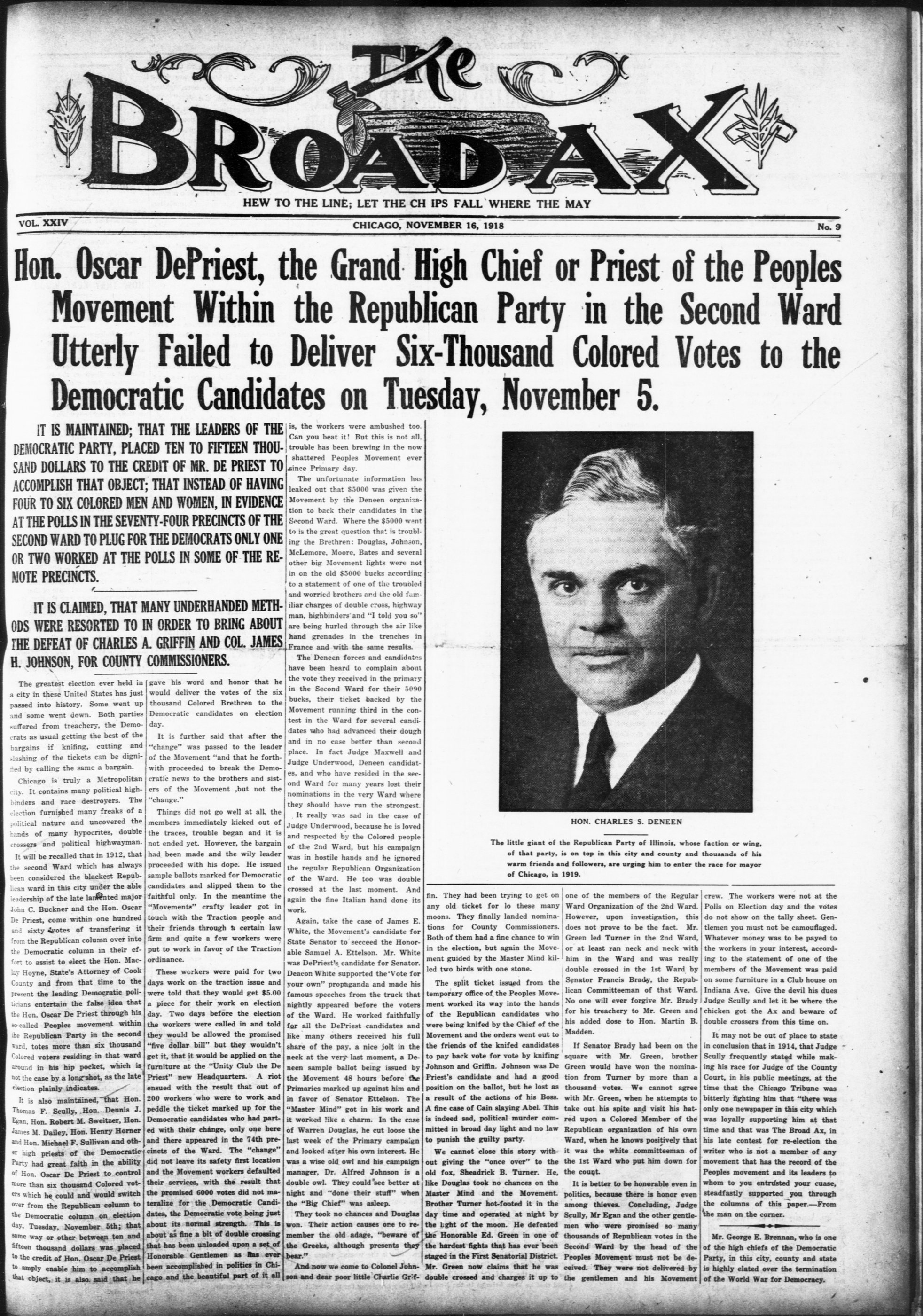
Hon. Oscar DePriest, the Grand High Chief or Priest of the Peoples Movement Within the Republican Party in the Second Ward Utterly Failed to Deliver Six-Thousand Colored Votes to the Democratic Candidates on Tuesday, November 5.
IT IS MAINTAINED; THAT THE LEADERS OF THE DEMOCRATIC PARTY, PLACED TEN TO FIFTEEN THOUSAND DOLLARS TO THE CREDIT OF MR. DE PRIEST TO ACCOMPLISH THAT OBJECT; THAT INSTEAD OF HAVING FOUR TO SIX COLORED MEN AND WOMEN, IN EVIDENCE AT THE POLLS IN THE SEVENTY-FOUR PRECINCTS OF THE SECOND WARD TO PLUG FOR THE DEMOCRATS ONLY ONE OR TWO WORKED AT THE POLLS IN SOME OF THE REMOTE PRECINCTS.
IT IS CLAIMED, THAT MANY UNDERHANDED METHODS WERE RESORTED TO IN ORDER TO BRING ABOUT THE DEFEAT OF CHARLES A. GRIFFIN AND COL. JAMES H. JOHNSON. FOR COUNTY COMMISSIONERS.
VOL. XXIV
Hon. Oscar
Movement
Utterly
Democra
IT IS MAINTAINED; T
DEMOCRATIC PARTY, PLAC
SAND DOLLARS TO THE CH
ACCOMPLISH THAT OBJECT
FOUR TO SIX COLORED MEN
AT THE POLLS IN THE SEVEN
SECOND WARD TO PLUG FOR
OR TWO WORKED AT THE
MOTE PRECINCTS.
IT IS CLAIMED, THAT
ODS WERE RESORTED TO
THE DEFEAT OF CHARLES
H. JOHNSON, FOR COUNTY
The greatest election ever held in a city in these United States has just passed into history. Some went up and some went down. Both parties suffered from treachery, the Democrats as usual getting the best of the bargains if knifing, cutting and slashing of the tickets can be dignified by calling the same a bargain.
Chicago is truly a Metropolitan city. It contains many political highbinders and race destroyers. The election furnished many freaks of a political nature and uncovered the hands of many hypocrites, double crossers and political highwayman. It will be recalled that in 1912, that the second Ward which has always been considered the blackest Republican ward in this city under the able leadership of the late lamented major John C. Buckner and the Hon. Oscar De Priest, come within one hundred and sixty votes of transferring it from the Republican column over into the Democratic column in their effort to assist to elect the Hon. Maclay Hoyne, State's Attorney of Cook County and from that time to the present the leading Democratic politicians entertain the false idea that the Hon. Oscar De Priest through his so-called Peoples movement within the Republican Party in the second ward, totes more than six thousand Colored voters residing in that ward around in his hip pocket, which is not the case by a long shot, as the late election plainly indicates.
It is also maintained, that Hon. Thomas F. Scully, Hon. Dennis J. Egan, Hon. Robert M. Sweitzer, Hon. James M. Dailey, Hon. Henry Horner and Hon. Michael F. Sullivan and other high priests of the Democratic Party had great faith in the ability of Hon. Oscar De Priest to control more than six thousand Colored voters which he could and would switch over from the Republican column to the Democratic column on election day, Tuesday, November 5th; that some way or other between ten and fifteen thousand dollars was placed to the credit of Hon. Oscar De Priest to amply enable him to accomplish that object, it is also said that he
gave his word and honor that he would deliver the votes of the six thousand Colored Brethren to the Democratic candidates on election day.
It is further said that after the "change" was passed to the leader of the Movement "and that he forthwith proceeded to break the Democratic news to the brothers and sisters of the Movement ,but not the "change."
Things did not go well at all, the members immediately kicked out of the traces, trouble began and it is not ended yet. However, the bargain had been made and the wily leader proceeded with his dope. He issued sample ballots marked for Democratic candidates and slipped them to the faithful only. In the meantime the "Movements" crafty leader got in touch with the Traction people and their friends through a certain law firm and quite a few workers were put to work in favor of the Traction ordinance.
These workers were paid for two days work on the traction issue and were told that they would get $5.00 a piece for their work on election day. Two days before the election the workers were called in and told they would be allowed the promised "five dollar bill" but they wouldn't get it, that it would be applied on the furniture at the "Unity Club the De Priest" new Headquarters. A riot ensued with the result that out of 200 workers who were to work and peddle the ticket marked up for the Democratic candidates who had parted with their change, only one here and there appeared in the 74th precincts of the Ward. The "change" did not leave its safety first location and the Movement workers defaulted their services, with the result that the promised 6000 votes did not materialize for the Democratic Candidates, the Democratic vote being just about its normal strength. This is about as fine a bit of double crossing that has been unloaded upon a set of Honorable Gentlemen as has ever been accomplished in politics in Chicago and the beautiful part of it all
the Grand High Ch
the Republican I
Deliver Six-Thous
ates on Tuesday,
is, the workers were ambushed too.
Can you beat it! But this is not all,
trouble has been brewing in the now
shattered Peoples Movement ever
since Primary day.
The unfortunate information has leaked out that $5000 was given the Movement by the Deneen organization to back their candidates in the Second Ward. Where the $5000 went to is the great question that is troubling the Brethren: Douglas, Johnson, McLemore, Moore, Bates and several other big Movement lights were not in on the old $5000 bucks according to a statement of one of the troubled and worried brothers and the old familiar charges of double cross, highway man, highbinders' and "I told you so" are being hurled through the air like hand grenades in the trenches in France and with the same results.
The Deneen forces and candidates have been heard to complain about the vote they received in the primary in the Second Ward for their 5090 bucks, their ticket backed by the Movement running third in the contest in the Ward for several candidates who had advanced their dough and in no case better than second place. In fact Judge Maxwell and Judge Underwood, Deneen candidates, and who have resided in the second Ward for many years lost their nominations in the very Ward where they should have run the strongest. It really was sad in the case of Judge Underwood, because he is loved and respected by the Colored people of the 2nd Ward, but his campaign was in hostile hands and he ignored the regular Republican Organization of the Ward. He too was double crossed at the last moment. And again the fine Italian hand done its work.
Again, take the case of James E. White, the Movement's candidate for State Senator to secee the Honorable Samuel A. Ettelson. Mr. White was DePriest's candidate for Senator. Deacon White supported the 'Vote for your own" propaganda and made his famous speeches from the truck that nightly appeared before the voters of the Ward. He worked faithfully for all the DePriest candidates and like many others received his full share of the pay, a nice jolt in the neck at the very last moment, a Deeen sample ballot being issued by the Movement 48 hours before the Primaries marked up against him and in favor of Senator Ettelson. The "Master Mind" got in his work and it worked like a charm. In the case of Warren Douglas, he cut loose the last week of the Primary campaign and looked after his own interest. He was a wise old owl and his campaign manager, Dr. Alfred Johnson is a double owl. They could see better at night and "done their stuff" when the "Big Chief" was asleep.
They took no chances and Douglas won. Their action causes one to remember the old adage, "beware of the Greeks, although presents they bear."
And now we come to Colonel Johnson and dear poor little Charlie Grif-
The little giant of of that party, warm friends a of Chicago, in
fin. They had been trying to get on any old ticket for lo these many moons. They finally landed nominations for County Commissioners. Both of them had a fine chance to win in the election, but again the Movement guided by the Master Mind killed two birds with one stone.
The split ticket issued from the temporary office of the Peoples Movement worked its way into the hands of the Republican candidates who were being knifed by the Chief of the Movement and the orders went out to the friends of the knifed candidates to pay back vote for vote by knifing Johnson and Griffin. Johnson was De Priest's candidate and had a good position on the ballot, but he lost as a result of the actions of his Boss. A fine case of Cain slaying Abel. This is indeed sad, political murder committed in broad day light and no law to punish the guilty party.
We cannot close this story without giving the "once over" to the old fox, Sheadrick B. Turner. He, like Douglas took no chances on the Master Mind and the Movement. Brother Turner hot-footed it in the day time and operated at night by the light of the moon. He defeated the Honorable Ed. Green in one of the hardest fights that has ever been staged in the First Senatorial District. Mr. Green now claims that he was double crossed and charges it up to
[Image of a man with white hair and a suit and tie].
The little giant of the Republican Party of Illinois, whose faction or wing, of that party, is on top in this city and county and thousands of his warm friends and followers, are urging him to enter the race for mayor of Chicago, in 1919.
HON. CHARLES S. DENEEN
the Republican Party of Illinois, whose is on top in this city and county and followers, are urging him to enter the 1919.
one of the members of the Regular Ward Organization of the 2nd Ward. However, upon investigation, this does not prove to be the fact. Mr. Green led Turner in the 2nd Ward, or at least ran neck and neck with him in the Ward and was really double crossed in the 1st Ward by Senator Francis Brady, the Republican Committeeman of that Ward. No one will ever forgive Mr. Brady for his treachery to Mr. Green and his added dose to Hon. Martin B. Madden.
If Senator Brady had been on the square with Mr. Green, brother Green would have won the nomination from Turner by more than a thousand votes. We cannot agree with Mr. Green, when he attempts to take out his spite and visit his hatred upon a Colored Member of the Republican organization of his own Ward, when he knows positively that it was the white committeeman of the 1st Ward who put him down for the count.
It is better to be honorable even in politics, because there is honor even among thieves. Concluding, Judge Scully, Mr Egan and the other gentlemen who were promised so many thousands of Republican votes in the Second Ward by the head of the Peoples Movement must not be deceived. They were not delivered by the gentlemen and his Movement
crew. The workers were not at the Polls on Election day and the votes do not show on the tally sheet. Gentlemen you must not be camouflaged. Whatever money was to be payed to the workers in your interest, according to the statement of one of the members of the Movement was paid on some furniture in a Club house on Indiana Ave. Give the devil his dues Judge Scully and let it be where the chicken got the Ax and beware of double crossers from this time on.
It may not be out of place to state in conclusion that in 1914, that Judge Scully frequently stated while making his race for Judge of the County Court, in his public meetings, at the time that the Chicago Tribune was bitterly fighting him that "there was only one newspaper in this city which was loyally supporting him at that time and that was The Broad Ax, in his late contest for re-election the writer who is not a member of any movement that has the record of the Peoples movement and its leaders to whom to you entrusted your cuase, steadfastly supported you through the columns of this paper.—From the man on the corner.
Mr. George E. Brennan, who is one of the high chiefs of the Democratic Party, in this city, county and state is highly elated over the termination of the World War for Democracy.
PAGE TWO
HON. JOHN F. DEVINE
The present panistaking Chief Deputy County Recorder, and the newly elected Clerk of the Probate Court.
CITY NEWS
Reported by
Lawyer S. Z. C. Westerfield.
Carlyle Stewart, son of Rev. H. E. Stewart, was a visitor in the city over Sunday. He is stationed at Camp Grant, Rockford, Ill. Just prior to his departure he was ordained a deacon in the A. M. E. Church at the Annual Conference held in Evanston last September. It was thought that he would be commissioned a Chaplain and it is still hoped so.
B. F. Hooks, of Toronto, Ontario, Canada, is in the city, stopping at 3825 Elmwood Avenue. It is said that he contemplates making Chicago his permanent residence.
Bishop Levi J. Coppin, of Philadelphia, Pa., will be in the city about the first of December. While here he will be the guest of Dr. A. J. Carey. His coming signifies the launching of gigantic plans for the celebration of the landing of Negroes in this country three hundred years ago. This celebration will be carried out under the auspices of all A. M. E. churches.
The DuBois Club will meet Sunday, November 24th, at the residence of F. T. Lane, 4913 Champlain Avenue Mr. Lane is Executive Secretary of the Department at the Y. M. C. A. This club is doing splendid community work among its members, and has plans for the development of civic affairs which will be inaugurated soon.
Last Sunday was a great day at Quinn Chapel Church. In the afternoon communion services were held and the lower floor of the edifice was filled to capacity, not a vacant seat being available. The sermon was preached by Dr. J. M. Henderson of Institutional Church and he stirred the emotions of a large number of his hearers. Before the close of administering the communion the entire congregation was afire, with unseen forces at work. A large number of visiting ministers were present among them the Presiding Elder, Dr. A. J. Carey, Dr. F. G. Snelson, Dr. W. D. Cook, Rev. H. W. Griffin, Rev. Kinney, Rev. McDowell, Rev. Timothy Reeves and others. The Presiding Elder paid a high tribute to Rev. H. E. Stewart pastor of Quinn Chapel and to Dr. J. M. Henderson, pastor of Institutional.
An unusually fine program will be rendered at Qinn Chapel Forum next Sunday afternoon. The chief feature will be a debate, Resolved "That Clergymen Should Be Politicians". The affirmative side of the question will be argued by Elmer Davis and Richard Parker( while the negative is defended by Joseph N. Freeman and Harry Howard. An intensely close contest is expected for both sides have made thorough preparations.
Other numbers on the program are a Violin Solo by Felix E. Ross, an instrumental Solo by Walter O'Grady, a selection by a quarter from the El Pro Club, a paper by Leon Peyton. A ten minutes address by Dr. Chas. H. Turner by Prof. Clarence Spears on "Co-operations With the Sunday School". On the whole it will be one of the best programs ever rendered anywhere in the city. Joseph N. Freeman is chairman of the program and Lawyer E. Z. C. Westerfield will preside. The hour of meeting is 3,30 P. M.
The attention of all clubs, lyceums, and literary societies is now being centered on November 26th, when Col. Roscoe Cenkling Simmons will make his last public appearance in Chicago before going abroad.
His subject will be "What We Have Fought For". Among those clubs which will attend in a body are Qinn Chapel Forum, Young People's Lyceum Grace Presbyterian Church, Bethel Literary Society, St. Mark's Lyceum, Bethesda Literary Society, and many others too numerous to mention. The meeting will be held
at the Eighth Regiment Armory in the interest of the Urban League and Mrs Cary B. Lewis is manager. It is especially urged that all Doctors, Lawyers, Business-Men, Pharmacists, and men of all professions be present, for great plans are to be laid on that occasion, looking forward to peace development.
Mrs. R. H. Pollard, 5616 Lafayette Avenucc, is quite ill at the Wesley Memorial Hospital, 2437 Dearborn Street. Last reports are that she is holding her own and if no serious complications set in she will recover. The "Broad Ax" wishes for her a speedy recovery.
Enter your subscription at once for The Broad Ax, a paper always full of news and always found on the right side of every question.
Mail a money order for $2.00 to the Editor and you will receive this splendid paper for one year. If you wish an agent to call, telephone..... Kenwood 10230 and your wants will be supplied. DO IT TODAY.
SUNSHINE RESCUE MISSION.
2830 S. State Street.
Service every night in the year and on Sunday at 3:00 P. M. and 8:00 P. M.
Franklin Bray will preach Sunday night on "The Abundant Life." Rev. Lewis will preach at 3:00 P. M. following the Sunday School which convenes at 2:00 P. M.
The Sunshine Home is preparing to serve a Christmas turkey dinner to the aged. Anyone desiring to assist in this work can call or phone and will be greatly appreciated.
The Sunshine Rescue Mission and Rescue have but one object and that is the Rescuing of the Perishing. In order to do this effectively we find it necessary to feed some, clothe others and shelter still others. A splendid opportunity is offered here to Christians of all denominations to do practical christian work. This Home is purely intedromniational and is a feedr for all churches—"C."
COLORED CATHOLIC PRIEST
Baltimore, Md.—The Rev. J. H. Dorsey, one of the four colored Catholic priests of the country, has been appointed pastor of St. Monica's Catholic Church. He is a native of Baltimore. He received his preliminary training in the Epiphany Apostolic College. He studied for the priesthood at St. Joseph's Seminary, this city. He was ordained to the priesthood at St. Francis Xaxier Church in 1902.
He is eloquent, magnetic and enthusiastic. His work has ever been of great benefit to the mother church of Christianity.
WILL OF WEALTHY PHILADEL
PHIA WOMAN READ.
PHILADELPHIA, Penn. — In the will of the late Mrs. Susan E. Foster Sermon she leaves one-half of her residue to the Mercy Hospital, and-half to the Frederick Douglass Hospital, except one thousand for the Day Nursery and one thousand dollars to the Home for Aged Colored People. Her estate is valued at $60,000. G. Grant Williams, City Editor of "The Philadelphia Tribune," and Andrew Stevens, banker, are the executors.
Attorney and Mrs. S. A. T. Watkins 3332 Calumet Avenue, will on or about December 1, depart for Washington, D. C., on a legal and pleasure trip.
HON. HARRY E. LITTLER
Honest and popular member of the City Council and newly elected Trustee of the Sanitary District of Chicago.
THE BROAD AX. CHICAGO. NOVEMBER 16, 1918
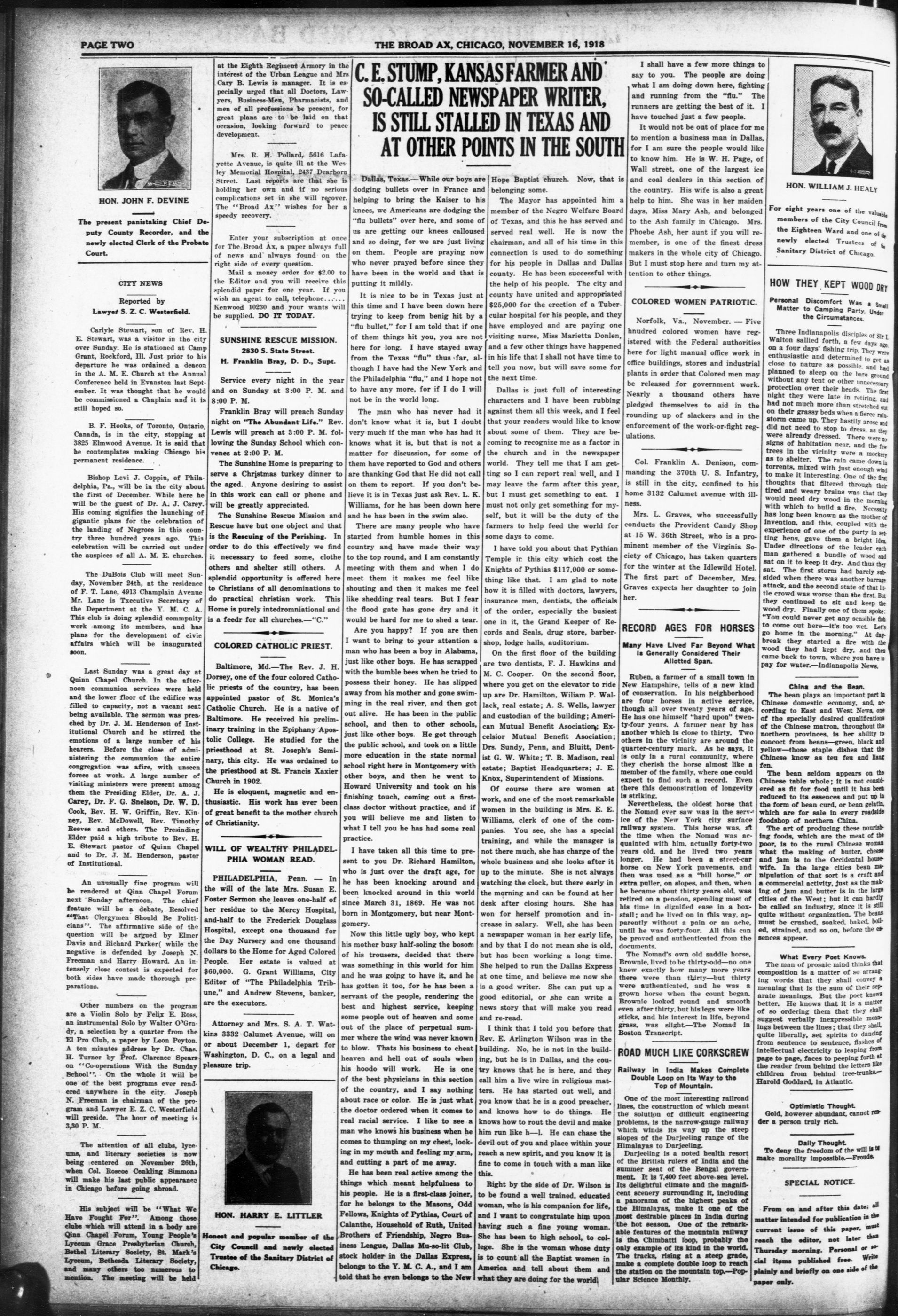
C.E. STUMP, KANSAS FARMER AND SO-CALLED NEWSPAPER WRITER, IS STILL STALLED IN TEXAS AND AT OTHER POINTS IN THE SOUTH
Dallas, Texas. While our boys are dodging bullets over in France and helping to bring the Kaiser to his knees, we Americans are dodging the "flu bullets" over here, and some of us are getting our knees calloused and so doing, for we are just living on them. People are praying now who never prayed before since they have been in the world and that is putting it mildly.
It is nice to be in Texas just at this time and I have been down here trying to keep from benig hit by a "flu bullet," for I am told that if one of them things hit you, you are not here for long. I have stayed away from the Texas "flu" thus far, although I have had the New York and the Philadelphia "flu," and I hope not to have any more, for if I do I will not be in the world long.
The man who has never had it don't know what it is, but I doubt very much if the man who has had it knows what it is, but that is not a matter for discussion, for some of them have reported to God and others are thanking God that He did not call on them to report. If you don't believe it is in Texas just ask Rev. L. K. Williams, for he has been down here and he has been in the swim also.
There are many people who have started from humble homes in this country and have made their way to the top round, and I am constantly meeting with them and when I do meet them it makes me feel like shouting and then it makes me feel like shedding real tears. But I fear the flood gate has gone dry and it would be hard for me to shed a tear.
Are you happy? If you are then I want to bring to your attention a man who has been a boy in Alabama, just like other boys. He has scrapped with the bumble bees when he tried to possess their honey. He has slipped away from his mother and gone swimming in the real river, and then got out alive. He has been in the public school, and then to other schools, just like other boys. He got through the public school, and took on a little more education in the state normal school right here in Montgomery with other boys, and then he went to Howard University and took on his finishing touch, coming out a first-class doctor without practice, and if you will believe me and listen to what I tell you he has had some real practice.
I have taken all this time to present to you Dr. Richard Hamilton, who is just over the draft age, for he has been knocked around and been knocked around in this world since March 31, 1869. He was not born in Montgomery, but near Montgomery.
Now this little ugly boy, who kept his mother busy half-soling the bosom of his trousers, decided that there was something in this world for him and he was going to have it, and he has gotten it too, for he has been a servant of the people, rendering the best and highest service, keeping some people out of heaven and some out of the place of perpetual summer where the wind was never known to blow. Thats his business to cheat heaven and hell out of souls when his hoodo will work. He is one of the best physicians in this section of the country, and I say nothing about race or color. He is just what the doctor ordered when it comes to real racial service. I like to see a man who knows his business when he comes to thumping on my chest, looking in my mouth and feeling my arm, and cutting a part of me away.
He has been real active among the things which meant helpfulness to his people. He is a first-class joiner, for he belongs to the Masons, Odd Fellows, Knights of Pythias, Court of Calanthe, Household of Ruth, United Brothers of Friendship, Negro Business League, Dallas Mu-so-lit Club, stock holder in the Dallas Express, belongs to the Y. M. C. A., and I am told that he even belongs to the New
Hope Baptist church. Now, that is belonging some.
The Mayor has appointed him a member of the Negro Welfare Board of Texas, and this he has served and served real well. He is now the chairman, and all of his time in this connection is used to do something for his people in Dallas and Dallas county. He has been successful with the help of his people. The city and county have united and appropriated $25,000 for the erection of a Tubercular hospital for his people, and they have employed and are paying one visiting nurse, Miss Marietta Donlen, and a few other things have happened in his life that I shall not have time to tell you now, but will save some for the next time.
Dallas is just full of interesting characters and I have been rubbing against them all this week, and I feel that your readers would like to know about some of them. They are becoming to recognize me as a factor in the church and in the newspaper world. They tell me that I am getting so I can report real well, and I may leave the farm after this year, but I must get something to eat. I must not only get something for myself, but it will be the duty of the farmers to help feed the world for some days to come.
I have told you about that Pythian Temple in this city which cost the Knights of Pythias $117,000 or something like that. I am glad to note how it is filled with doctors, lawyers, insurance men, dentists, the officials of the order, especially the busiest one in it, the Grand Keeper of Records and Seals, drug store, barbershop, lodge halls, auditorium.
On the first floor of the building are two dentists. F. J. Hawkins and M. C. Cooper. On the second floor, where you get on the elevator to ride up are Dr. Hamilton, William P. Wallack, real estate; A. S. Wells, lawyer and custodian of the building; American Mutual Benefit Association; Excelsior Mutual Benefit Association; Drs. Sundy, Penn, and Bluitt, Dentist G. W. White; T. B. Madison, real estate; Baptist Headquarters; J. E. Knox, Superintendent of Missions.
Of course there are women at work, and one of the most remarkable women in the building is Mrs. E. E. Williams, clerk of one of the companies. You see, she has a special training, and while the manager is not there much, she has charge of the whole business and she looks after it up to the minute. She is not always watching the clock, but there early in the morning and can be found at her desk after closing hours. She has won for herself promotion and increase in salary. Well, she has been a newspaper woman in her early life, and by that I do not mean she is old, but has been working a long time. She helped to run the Dallas Express at one time, and believe me now she is a good writer. She can put up a good editorial, or she can write a news story that will make you read and re-read.
I think that I told you before that Rev. E. Arlington Wilson was in the building. No, he is not in the building, but he is in Dallas, and the country knows that he is here, and they call him a live wire in religious matters. He has started out well, and you know that he is a good preacher, and knows how to do things. He knows how to rout the devil and make him run like h—l. He can chase the devil out of you and place within your reach a new spirit, and you know it is fine to come in touch with a man like this.
Right by the side of Dr. Wilson is to be found a well trained, educated woman, who is his companion for life, and I want to congratulate him upon having such a fine young woman. She has been to high school, to college. She is the woman whose duty is to count all the Baptist women in America and tell about them and what they are doing for the world.
I shall have a few more things to say to you. The people are doing what I am doing down here, fighting and running from the "flu." The runners are getting the best of it. I have touched just a few people.
It would not be out of place for me to mention a business man in Dallas, for I am sure the people would like to know him. He is W. H. Page, of Wall street, one of the largest ice and coal dealers in this section of the country. His wife is also a great help to him. She was in her maiden days, Miss Mary Ash, and belonged to the Ash family in Chicago. Mrs. Phoebe Ash, her aunt if you will remember, is one of the finest dress makers in the whole city of Chicago. But I must stop here and turn my attention to other things.
COLORED WOMEN PATRIOTIC.
Norfolk, Va., November. Five hnudred colored women have registered with the Federal authorities here for light manual office work in office buildings, stores and industrial plants in order that Colored men may be released for government work. Nearly a thousand others have pledged themselves to aid in the rounding up of slackers and in the enforcement of the work-or-fight regulations.
Col. Franklin A. Denison, commanding the 370th U. S. Infantry, is still in the city, confined to his home 3132 Calumet avenue with illness.
Mrs. L. Graves, who successfully conducts the Provident Candy Shop at 15 W. 36th Street, who is a prominent member of the Virginia Society of Chicago, has taken quarters for the winter at the Idlewild Hotel. The first part of December, Mrs. Graves expects her daughter to join her.
RECORD AGES FOR HORSES
Many Have Lived Far Beyond What Is Generally Considered Their Allotted Span.
Ruben, a farmer of a small town in New Hampshire, tells of a new kind of conservation. In his neighborhood are four horses in active service, though all over twenty years of age. He has one himself "hard upon" twenty-four years. A farmer near by has another which is close to thirty. Two others in the vicinity are around the quarter-century mark. As he says, it is only in a rural community, where they cherish the horse almost like a member of the family, where one could expect to find such a record. Even there this demonstration of longevity is striking.
Nevertheless, the oldest horse that the Nomad ever saw was in the service of the New York city surface railway system. This horse was, at the time when the Nomad was acquainted with him, actually forty-two years old, and he lived two years longer. He had been a street-car horse on New York pavements, and then was used as a "hill horse," or extra puller, on slopes, and then, when he became about thirty years old, was retired on a pension, spending most of his time in dignified ease in a box-stall; and he lived on in this way, apparently without a pain or an ache, until he was forty-four. All this can be proved and authenticated from the documents.
The Nomad's own old saddle horse, Brownie, lived to be thirty-odd—no one knew exactly how many more years there were than thirty—but thirty were authenticated, and he was a grown horse when the count began. Brownie looked round and smooth even after thirty, but his legs were like sticks, and his interest in life, beyond grass, was slight—The Nomad in Boston Transcript.
ROAD MUCH LIKE CORKSCREW
Railway in India Makes Complete Double Loop on Its Way to the Top of Mountain.
One of the most interesting railroad lines, the construction of which meant the solution of difficult engineering problems, is the narrow-gauge railway which winds its way up the steep slopes of the Darjeeling range of the Himalayas to Darjeeling.
Darjeeling is a noted health resort of the British rulers of India and the summer seat of the Bengal government. It is 7,400 feet above sea level. Its delightful climate and the magnificent scenery surrounding it, including a panorama of the highest peaks of the Himalayas, make it one of the most desirable places in India during the hot season. One of the remarkable features of the mountain railway is the Chimbatti loop, probably the only example of its kind in the world. The tracks, rising at a steep grade, make a complete double loop to reach the station on the mountain top—Popular Science Monthly.
HON. WILLIAM J. HEALY
For eight years one of the valuable members of the City Council from the Eighteen Ward and one of the newly elected Trustees of the Sanitary District of Chicago
HOW THEY,KEPT WOOD DRY
Personal Discomfort Was a Small Matter to Camping Party, Under the Circumstances.
Three Indianapolis disciples of Sir Lal Walton saliited forth, a few days ago on a four days' fishing trip. They were enthusiastic and determined to get an close to nature as possible, and had planned to sleep on the bare ground without any tent or other unnecessary protection over their heads. The first night they were late in retiring, and had not much more than stretched out on their grassy beds when a fierce rain storm came up. They hastily arose and did not need to stop to dress, as they were already dressed. There were no signs of habitation near, and the few trees in the vicinity were a mockery as to shelter. The rain came down in torrents, mixed with just enough wind to make it interesting. One of the first thoughts that filtered through their tired and weary brains was that they would need dry wood in the morning with which to build a fire. Necessity has long been known as the mother of invention, and this, coupled with the experience of one of the party in setting hens, gave them a bright idea. Under directions of the leader each man gathered a bundle of wood and sat on it to keep it dry. And thus they sat. The first storm had barely subsided when there was another barrage attack, and the second state of that little crowd was worse than the first. But they continued to sit and keep the wood dry. Finally one of them spoke: "You could never get any sensible fish to come out here—it's too wet. We go home in the morning." At daybreak they started a fire with the wood they had kept dry, and then came back to town, where you have to pay for water.—Indianapolis News.
China and the Bean.
The bean plays an important part in Chinese domestic economy, and, according to East and West News, one of the specially desired qualifications of the Chinese matron, throughout the northern provinces, is her ability to concoct from beans—green, black and yellow—those staple dishes that the Chinese know as teu feu and liang fen.
The bean seldom appears on the Chinese table whole; it is not considered as fit for food until it has been reduced to its essences and put up in the form of bean curd, or bean gelatin, which are for sale in every roadside foodshop of northern China.
The art of producing these nourishing foods, which are the meat of the poor, is to the rural Chinese woman what the making of butter, cheese and jam is to the Occidental housewife. In the large cities bean manipulation of that sort is a craft and a commercial activity, just as the making of jam and butter is in the large cities of the West; but it can hardly be called an industry, since it is still quite without organization. The beans must be crushed, soaked, baked, bolted, strained, and so on, before the essences appear.
What Every Poet Knows
The man of proscale mind thinks that composition is a matter of so arranging words that they shall convey a meaning that is the sum of their separate meanings. But the poet knows better. He knows that it is a matter of so ordering them that they shall suggest verbally inexpressible meanings between the lines; that they shall, quite liberally, set spirits to dancing from sentence to sentence, flashes of intellectual electricity to leaping from page to page, faces to peeping forth at the reader from behind the letters like children from behind tree-trunks.—Harold Goddard, in Atlantic.
Operational Magistrate
boss, honorable man, cannot render
a person, truly rich.
To deny the freedom of the will is to make morality impossible—Frouda
SPECIAL NOTICE.
From on and after this date; all matter intended for publication in the current issue of this paper, must reach the editor, not later than Thursday morning. Personal or social items published free. Write plainly and briefly on one side of the paper only.
HOW SAILORS ARE TRAINED
Naval Academy at Annapolis Gives Students Most Thorough Preparation for Their Life Work.
During the Civil war the Naval academy was moved to Newport, on the historic Constitution, while its former home at Annapolis was used as a base hospital by the army, writes C. H. Foster in Scribner's. On the academy's return to Annapolis, in 1865, Vice Admiral Porter, the superintendent, instituted regular dances, or "hops," and, most important of all his reforms, the honor system, by which a midshipman's word was not to be questioned.
He also encouraged athletics in every way. In the presence of a throng of midshipmen he even boxed with one of them himself and allowed the nose of the vice admiral of the navy to be smartly tapped by his enthusiastic young opponent—to the manifest glee of the assembly and to the shuddering horror of the old navy when it learned of this innovation.
By the end of Porter's superintendency, in 1893, the Naval academy had worked out the system followed to the present day. Since 1851 academic work has not been interrupted by three years at sea. Through drills and summer cruises practical skill and seagoing habits have been acquired without sacrificing progress in the theory and science of the naval profession. During their four years at the academy its graduates have felt its potent spell and have afterward won honor for it and themselves. The results achieved challenge comparison with those of any college, and have made a reputation second to none.
DECLARE HOUSE IS HAUNTED
British Lawmakers Positive They Have Seen Apparitions in Famous Parliament Buildings.
Those who do not believe in ghosts will be surprised to learn that several members of parliament have sworn to the presence of apparitions in the house of commons.
A prime minister, Earl Grey, declared that he saw a death's head appear three times in front of him while delivering his great speech on the introduction of the reform bill and G. Swift MacNeli also swore that he saw T. P. O'Connor sitting in his usual place in the house, while at the time the gentleman was in Ireland. Many members, too, have seen the "White Lady" walking in the corridors of the house.
The "terrace ghost" has often been said to appear. Another known as the "Big Ben" ghost is stated to appear when a member of the royal family is about to die. On December 13, 1861, December 13, 1878, and January 13, 1892, it appeared as an old man rowing a little below Westminster bridge in a rotten skiff and dashing into the terrace wall just as Big Ben commenced to peal midnight. On the following days, respectively, the prince consort, the Princess Alice and the duke of Clarence died. Guy Fawkes and Spencer Perceval are also said to haunt the house in the form of ghosts.
Sound Carried Far
A camp cook whose only means of calling the members of his party was pounding on a pan with a knife handle was unable to make them hear when they were fishing or hunting at any considerable distance from the camp. One of the party to whom he complained thereupon made what he called a "klepalo."
The "klepalo" was merely a piece of well-seasoned oak plank two inches thick, six inches wide, and four feet long. Through the center he bored a hole, passed a rope through it and suspended the plank from the branch of a tree. The cook "rang" the instrument by striking it with a mallet, first on one side and then on the other.
The man who made the "klepalo" had seen similar contrivances in small Bulgarian villages, where they are used instead of church bells to call the people to worship. A test of the instrument used by the campers showed that in ordinary weather conditions it could be heard two miles—Manchester Union.
"Plantations"
The word plantation is used principally in the Southern states, where it originated in old slavery times to designate a farm cultivated by negroes, as a cotton plantation or a sugar plantation. In Maine it has a distinctive meaning, representing a form of government smaller than a township. In that state most of the functions of local government are performed by the town or township. In addition to 17 cities and 396 towns, Maine has 78 plantations and 151 unorganized places under the names of plantations, grants, surpluses and gores. A surplus is a small territorial division consisting of an irregular tract laid off by state authority. A gore is a triangular piece of land smaller than a surplus.
New Copper District in Canada
A great new copper district in Arctic Canada is a possibility pointed out to the Royal Society of Arts, London, by W. Frecheville. The locality is east of Great Bear lake, along the Coppermine river, which runs north from about 65 degrees latitude to Coronation gulf, and the area may extend as far east as Bathurst inlet, and even to Victoria island farther north. The first specimens of native copper were obtained from the Eskimos, who were using the metal in their primitive industries. Explorers have since reported finds of copper, and evidences of large deposits.
TO TRAIN CHILDISH MIND
Parents Can Do Much to Assist Development During the First Six Years of Life.
What definite means can the home adopt for the best development of the child in the first six years of his life? First, with regard to the things which surround the child—furniture, pictures, books, toys, clothes and ornaments. In how far may these lend themselves to his development?
In the room in which the child spends most of his time indoors, the furniture ought to be plain enough so that he can do no great harm in playing freely about. A small kindergarten chair and table to work on are almost indispensable in the child's room. A good blackboard should be hung securely on the wall, for from the hour he can toddle the child will delight in chalk markings, and these even then will have value because of the muscle development afforded the arm and hand.
The pictures on the wall in the child's room ought to be distinctly for him, and hung low enough so that he may take them down and handle them whenever he chooses. Every child likes color and delights in the "story picture," the picture which has a story connected with it.
The child may be taught to discriminate between his own things and those belonging to others by being allowed to visit the family living room where mother's and father's books and their pictures and furniture are used with care and caution. In this way it will also be possible to lead him gradually into an appreciation of the adult's standard of art in pictures, music and literature.
BELOVED OF NEW YORKERS
Washington Square, Gothamites Claim,
Is Without Its Equal in the
World for "Atmosphere."
Here, say the New York men of ascetic faces and the women of soulful eyes, we have what our lives have long sought. Trafalgar: square hasn't got it, the Place de la Concorde is too French, the parks and esplanades of Rio come a little closer. But here, in charming, quaint old Washington square, we have—atmosphere.
Here, says the Philistine, is a nice place to flop while I read the comics in this morning's paper. In the corner is a comfortable bench over which the shade of a full-grown maple stretches soothingly. And there is a kid who will shine my shoes for a pickel.
Here, says the weary one, is a place where the cops might let me alone. Not much chance for a handout, but I might steal a snooze over there by the fountain. Ah, pleasant grass; pretty flowers.
Here, says the mother, is a pretty good place to leave the kids while I sneak down to the avenue for a yard or two of calco. Now, mind, don't stir from this bench. Mike, give the baby his bottle if he gets to crying.
Here, says the visitor, is the Washington arch. How interesting! It must weigh several tons at least. Now will some one tell me how I get to Cooper Union from here?
The Dense Oriental
At a dinner in Edinburgh, says E. V. Lucas, Baron Kickuchi, principal of Tokio university, was a guest. An Englishman present told the story of a Scotsman who went to his dentist's with an aching tooth and was asked if he would have gas; he replied that he would, but should like to count his money first. Everybody laughed but the baron. A Scotsman attempted to explain the joke as to the alleged foibles of his race; the baron remained impassive. Others tried, but the baron said, "I do not understand." Finally he stopped the explanations. "Gentlemen," he said, "you do not understand what I do not understand." His listeners gave rapt attention. "What I do not understand," he went on, "is not why the Scotsman said what he did, but how any Scotsman should not know, at any time, without having to count it, how much money he has in his pocket." The laugh was on the hosts of the "dense" oriental.—From Outlook.
The World's Holidays
According to statistics drawn up by the Guaranty Trust company of New York, during the present year there are only eighty-four days on which banks are open everywhere in the world. On every one of the other 281 days some nation somewhere will be celebrating a civil or religious holiday, or observing the Sabbath. Only one of these holidays is universal. This is New Year's day, and eleven different dates are observed by various countries as the beginning of a new year. Some countries observe more than one during the calendar year. Five Christian countries do not observe Christmas as a legal holiday.
Happiness of Olden Daya.
In the days when a Maypole stood in the Strand, music was one of the great pastimes of the people of merry England. Those were the times of good Queen Bess and her Stuart successors. The cittern was heard in every barber's shop: "Go into a barber's anywhere, no matter in what district, and it is ten to one you will hear the sounds either of a fiddle or a guitar, or see the instruments hanging up somewhere." The barbers or their apprentices were the performers: "If idle, they pass their time in life delighting music." So writes a pamphlet in 1597.
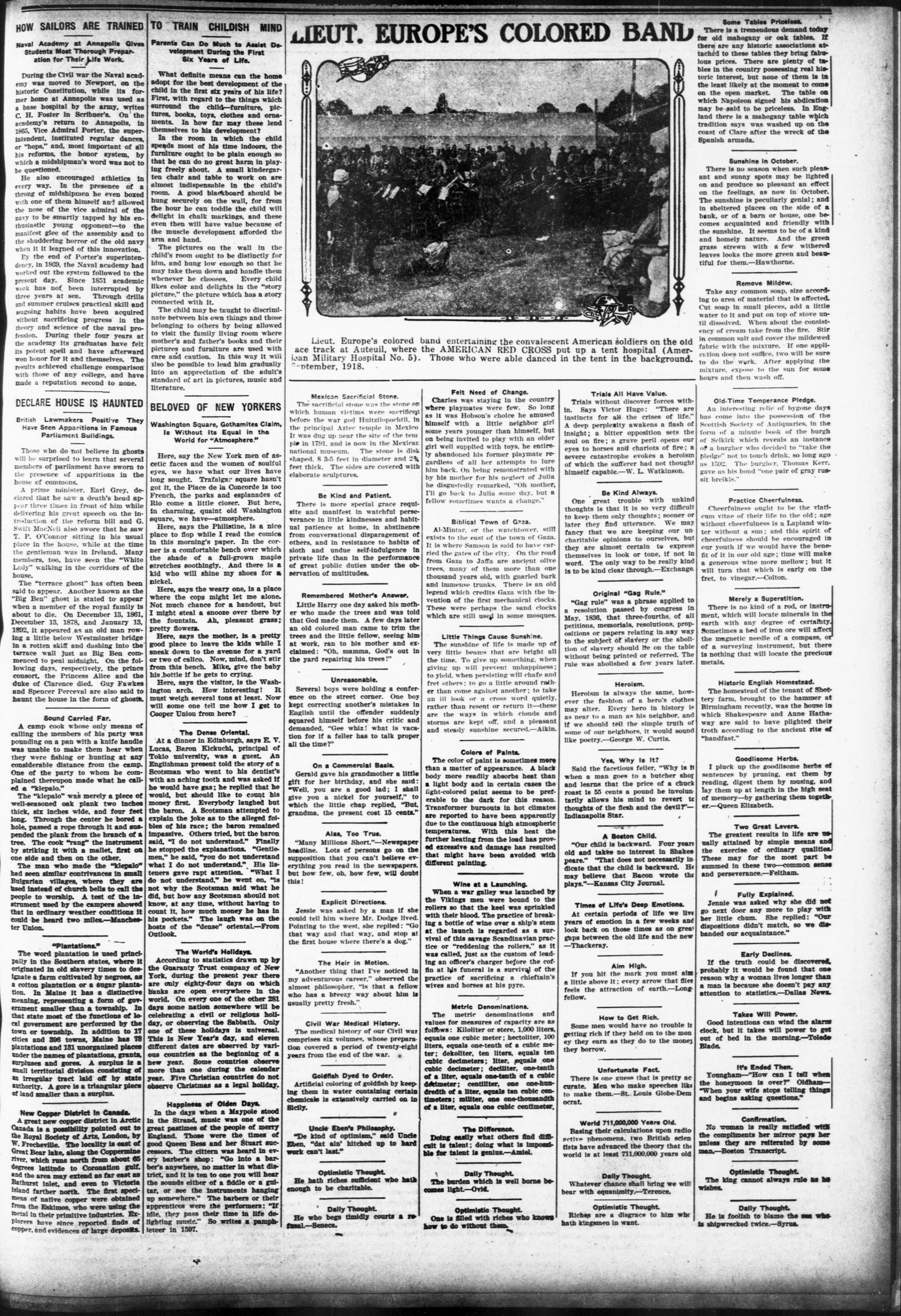
LIEUT. EUROPE'S COLORED BAND
Lieut. Europe's colored band entertaining the convalescent American soldiers on the old ace track at Auteuil, where the AMERICAN RED CROSS put up a tent hospital (American Military Hospital No. 5). Those who were able danced in the tent in the background. September, 1918.
Lieut. Europe's colored band entertaining the convalescent American soldiers on the old ace track at Auteuil, where the AMERICAN RED CROSS put up a tent hospital (American Military Hospital No. 5). Those who were able danced in the tent in the background. September, 1918.
Mexican Sacrificial Stone
The sacrificial stone was the stone on which human victims were sacrificed before the war god Huitzilopochti, in the principal Aztec temple in Mexico. It was dug up near the site of the temple in 1791, and is now in the Mexican national museum. The stone is disk shaped, 8 3-5 feet in diameter and $2\%$ feet thick. The sides are covered with elaborate sculptures.
Be Kind and Patient.
There is more special grace requisite and manifest in watchful perseverance in little kindnesses and habitual patience at home, in abstinence from conversational disagreement of others, and in resistance to habits of sloth and undue self-indulgence in private life than in the performance of great public duties under the observation of multitudes.
Remembered Mother's Answer
Little Harry one day asked his mother who made the trees and was told that God made them. A few days later an old colored man came to trim the trees and the little fellow, seeing him at work, ran to his mother and exclaimed: "Oh, mamma, God's out in the yard repairing his trees."
Unreasonable.
Several boys were holding a conference on the street corner. One boy kept correcting another's mistakes in English until the offender suddenly squared himself before his critic and demanded, "Gee whiz! what is vacation for if a feller has to talk proper all the time?"
On a Commercial Basis
Gerald gave his grandmother a little gift for her birthday, and she said: "Well, you are a good lad; I shall give you a nickel for yourself," to which the little chap replied, "But, grandma, the present cost 15 cents."
Alas. Too True.
"Many Millions Short."—Newspaper headline. Lots of persons go on the supposition that you can't believe everything you read in the newspapers, but how few, oh, how few, will doubt this!
Explicit Directions
Jessie was asked by a man if she could tell him where Mr. Dodge lived. Pointing to the west, she replied: "Go that way and that way, and stop at the first house where there's a dog."
The Heir in Motion
"Another thing that I've noticed in my adventurous career," observed the almost philosopher, "is that a fellow who has a breezy way about him is usually pretty fresh."
Civil War Medical History.
The medical history of our Civil war comprises six volumes, whose preparation covered a period of twenty-eight years from the end of the war.
Goldfish Dyed to Order.
Artificial coloring of goldfish by keeping them in water containing certain chemicals is extensively carried on in Sicily.
Oncle Eben's philosophy.
"De kind of optimism," said Uncle Eben.
"dat ain' hitched up to hard work can't last."
Optimistic Thought.
He hath riches sufficient who hath enough to be charitable.
Daily Thought.
He who begs timidly courts a refusal.—Seneca.
Felt Need of Change.
Charles was staying in the country where playmates were few. So long as it was Hobson's choice he amused himself with a little neighbor girl some years younger than himself, but on being invited to play with an older girl well supplied with toys, he entirely abandoned his former playmate regardless of all her attempts to lure him back. On being remonstrated with by his mother for his neglect of Julia he disgustedly remarked, "Oh mother, I'll go back to Julia some day, but a fellow sometimes wants a change."
Biblical Town of Gaza
Al-Mintar, or the watchtower, still exists to the east of the town of Gaza. It is where Samson is said to have carried the gates of the city. On the road from Gaza to Jaffa are ancient olive trees, many of them more than one thousand years old, with gnarled bark and immense trunks. There is an old legend which credits Gaza with the invention of the first mechanical clocks. These were perhaps the sand clocks which are still used in some mosques.
Little Things Cause Sunshine.
The sunshine of life is made up of very little beams that are bright all the time. To give up something, when giving up will prevent unhappiness; to yield, when persisting will chafe and fret others; to go a little around rather than come against another; to take an ill look or a cross word quietly, rather than resent or return it—these are the ways in which clouds and storms are kept off, and a pleasant and steady sunshine secured.—Alkin.
Colora of Paints
The color of paint is sometimes more than a matter of appearance. A black body more readily absorbs heat than a light body and in certain cases the light-colored paint seems to be preferable to the dark for this reason. Transformer burnouts in hot climates are reported to have been apparently due to the continuous high atmospheric temperatures. With this heat the further heating from the load has proved excessive and damage has resulted that might have been avoided with different painting.
Wine at a Launching
When a war galley was launched by the Vikings men were bound to the rollers so that the keel was sprinkled with their blood. The practice of breaking a bottle of wine over a ship's stem at the launch is regarded as a survival of this savage Scandinavian practice or "reddening the rollers," as it was called, just as the custom of leading an officer's charger before the coffin at his funeral is a survival of the practice of sacrificing a chieftain's wives and horses at his pyre.
Metric Denominations.
The metric denominations and values for measures of capacity are as follows: Kiloliter or stere, 1,000 liters, equals one cubic meter; hectoliter, 100 liters, equals one-tenth of a cubic meter;dekoliter, ten liters, equals ten cubic decimeters; liter, equals one cubic decimeter; deciliter, one-tenth of a liter, equals one-tenth of a cubic decimeter; centiliter, one hundredth of a liter, equals ten cubic centimeters; milliter, one one-thousandth of a liter, equals one cubic centimeter,
The Difference.
Doing easily what others find difficult is talent; doing what is impossible for talent is genius.—Amiel.
Daily Thought
The burden which is well borne becomes light—Ovid.
One is filled with riches who knows how to do without them.
Trials All Have Value.
Trials without discover forces within. Says Victor Hugo: "There are instincts for all the crises of life." A deep perplexity awakens a flash of insight; a bitter opposition sets the soul on fire; a grave peril opens our eyes to horses and charlots of fire; a severe catastrophe evokes a heroism of which the sufferer had not thought himself capable.—W. L. Watkinson.
Be Kind Always.
One great trouble with unkind thoughts is that it is so very difficult to keep them only thoughts; sooner or later they find utterance. We may fancy that we are keeping our uncharitable opinions to ourselves, but they are almost certain to express themselves in look or tone, if not in word. The only way to be really kind is to be kind clear through.—Exchange.
Original "Gag Rule."
"Gag rule" was a phrase applied to a resolution passed by congress in May, 1836, that three-fourths, of all petitions, memorials, resolutions, propositions or papers relating in any way to the subject of slavery or the abolition of slavery should lie on the table without being printed or referred. The rule was abolished a few years later.
Heroism
Heroism is always the same, however the fashion of a hero's clothes may alter. Every hero in history is as near to a man as his neighbor, and if we should tell the simple truth of some of our neighbors, it would sound like poetry.—George W. Curtis.
Yes. Why Is It?
Sald the facetious feller, "Why is it when a man goes to a butcher shop and learns that the price of a chuck roast is 55 cents a pound he involuntarily allows his mind to revert to thoughts of the flesh and the devil?"—Indianapolis Star.
Boston Child
"Our child is backward. Four years old and takes no interest in Shakes peare." "That does not necessarily indicate that the child is backward. He may believe that Bacon wrote the plays."—Kansas City Journal.
Times of Life's Deep Emotions
At certain periods of life we live years of emotion in a few weeks and look back on those times as on great gaps between the old life and the new - Thackeray.
Aim High.
If you hit the mark you must alm a little above it; every arrow that files feels the attraction of earth—Longe fellow.
How to Get Rich.
Some men would have no trouble in getting rich if they held on to the money they earn as they do to the money they borrow.
Unfortunately Fact.
There is one guess that is pretty accurate. Men who make speeches like to make them.—St. Louis Globe-Democrat.
World 711,000,000 Years Old.
Basing their calculations upon radio active phenomena, two British selen tists have advanced the theory that the world is at least 711,000,000 years old
Daily Thought
Whatever chance shall bring we will bear with equanimity -Terence.
Riches are a disgrace to him who hath kingsmen in want.
There is a tremendous demand today for old mahogany or oak tables. If there are any historic associations attached to these tables they bring fabulous prices. There are plenty of tables in the country possessing real historic interest, but none of them is in the least likely at the moment to come on the open market. The table on which Napoleon signed his abdication may be said to be priceless. In England there is a mahogany table which tradition says was washed up on the coast of Clare after the wreck of the Spanish armada.
Sunshine In October
There is no season when such pleasant and sunny spots may be lighted on and produce so pleasant an effect on the feelings, as now in October. The sunshine is peculiarly genial; and in sheltered places on the side of a bank, or of a barn or house, one becomes acquainted and friendly with the sunshine. It seems to be of a kind and homely nature. And the green grass strewn with a few withered leaves looks the more green and beautiful for them.-Hawthorne.
Remove Mildew
Take any common soap, size according to area of material that is affected. Cut soap in small pieces, add a little water to it and put on top of stove until dissolved. When about the consistency of cream take from the fire. Stir in common salt and cover the mildew fabric with the mixture. If one application does not suffice, two will be sure to do the work. After applying the mixture, expose to the sun for some hours and then wash off.
Old-Time Temperance Pledge
An interesting relic of bygone days has come into the possession of the Scottish Society of Antiquaries, in the form of a minute book of the burgh of Selkirk which reveals an instance of a burgher who decided to "take the pledge" not to touch drink, so long ago as 1502. The burgher, Thomas Kerr, gave as his bond "one pair of gray russet breiks."
Practice Cheerfulness
Cheerfulness ought to be the viticum vitae of their life to the old; age without cheerfulness is a Lapland winter without a sun; and this spirit of cheerfulness should be encouraged in our youth if we would have the benefit of it in our old age; time will make a generous wine more mellow; but it will turn that which is early on the fret, to vinegar—Colton.
Merely a Superstition.
There is no kind of a rod, or instrument, which will locate minerals in the earth with any degree of certainty. Sometimes a bed of iron ore will affect the magnetic needle of a compass, or of a surveying instrument, but there is nothing that will locate the precious metals.
Historic English Homestead.
The homestead of the tenant of Shottery farm, brought to the hammer at Birmingham recently, was the house in which Shakespeare and Anne Hathaway are said to have plighted their troth according to the ancient rite of "handfast."
Goodlisome Herbs
I pluck up the goodisome herbs of sentences by pruning, eat them by reading, digest them by musing, and lay them up at length in the high seat of memory—by gathering them together—Queen Elizabeth.
Two Great Levers
The greatest results in life are usually attained by simple means and the exercise of ordinary qualities. These may for the most part be summed in these two—common sense and perseverance—Feltham.
Fully Explained.
Jennie was asked why she did not go next door any more to play with her little chum. She replied: "Our dispositions didn't match, so we disbanded our acquaintance."
Early Declines.
If the truth could be discovered, probably it would be found that one reason why a woman lives longer than a man is because she doesn't pay any attention to statistics.—Dallas News.
Takes Will Power.
Good intentions can wind the alarm clock, but it takes will power to get out of bed in the morning—Toledo Blade.
It's Enough then.
Youngham—"How can I tell when the honeymoon is over?" Oldham—"When your wife stops telling things and begins asking questions."
Confirmation.
No woman is really satisfied with the compliments her mirror pays her unless they are reiterated by some man—Boston Transcript.
Optimistic Thought
The king cannot always rule as he wishes.
He is foolish to blame the sea who is shipwrecked twice.—Syrus.
M.
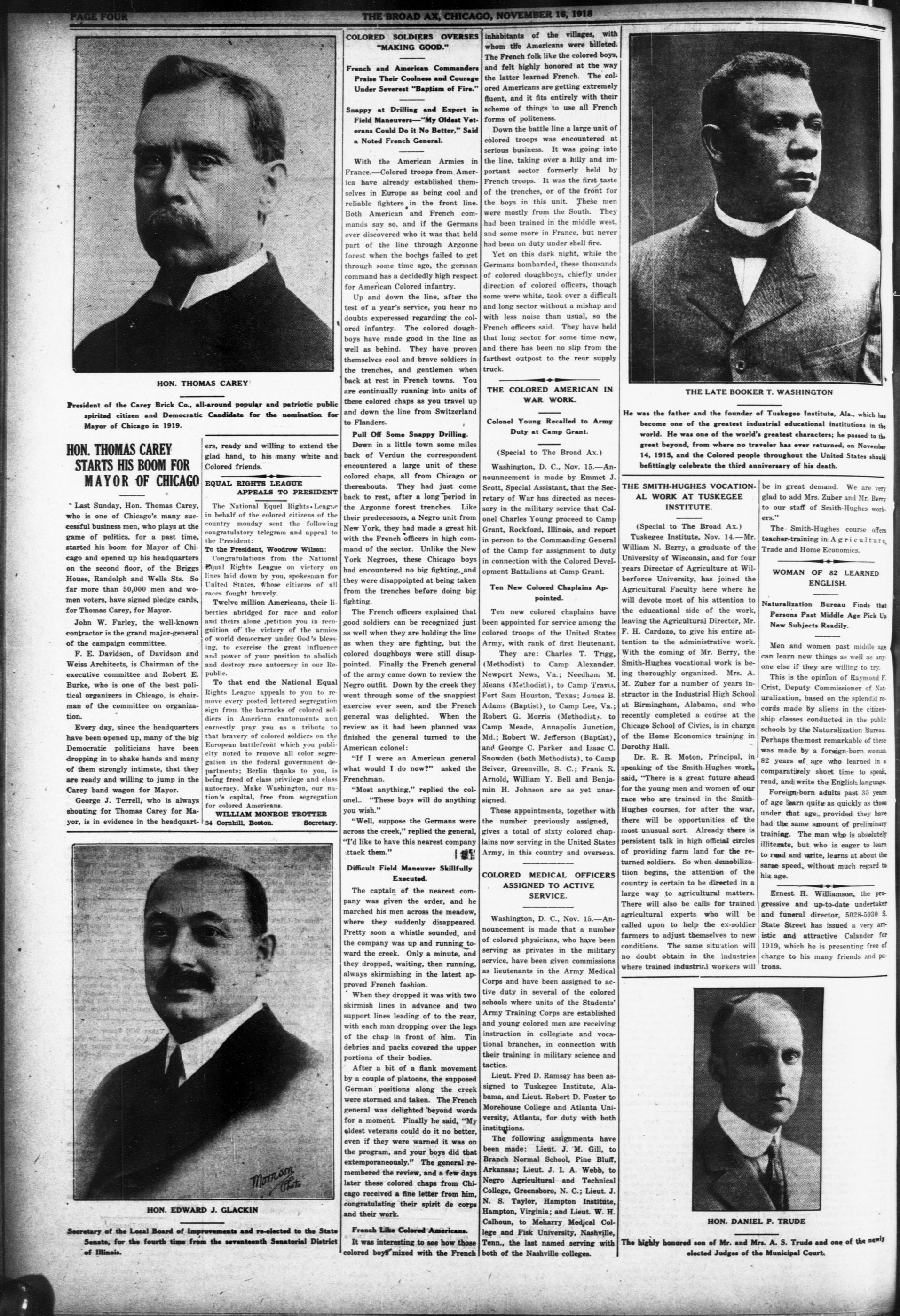
HON. THOMAS CAREY
President of the Carey Brick Co., a spirited citizen and Democratic Mayor of Chicago in 1919.
President of the Carey Brick Co., all-around popular and patriotic public spirited citizen and Democratic Candidate for the nomination for Mayor of Chicago in 1919.
HON. THOMAS CAREY STARTS HIS BOOM FOR MAYOR OF CHICAGO
Last Sunday, Hon. Thomas Carey, who is one of Chicago's many successful business men, who plays at the game of politics, for a past time, started his boom for Mayor of Chicago and opened up his headquarters on the second floor, of the Briggs House, Randolph and Wells Sts. So far more than 50,000 men and women voters, have signed pledge cards, for Thomas Carey, for Mayor. John W. Farley, the well-known contractor is the grand major-general of the campaign committee.
F. E. Davidson, of Davidson and Weiss Architects, is Chairman of the executive committee and Robert E. Burke, who is one of the best political organizers in Chicago, is chairman of the committee on organization.
Every day, since the headquarters have been opened up, many of the big Democratic politicians have been dropping in to shake hands and many of them strongly intimate, that they are ready and willing to jump in the Carey band wagon for Mayor.
George J. Terrell, who is always shouting for Thomas Carey for Mayor, is in evidence in the headquart-
Morrison
Photo
HON. EDWARD J. GLACKIN
Secretary of the Local Board of Imp Senate, for the fourth time from of Illinois.
Secretary of the Local Board of Improvements and re-elected to the State Senate, for the fourth time from the seventeenth Senatorial District of Illinois.
Secretary of the Local Board of Improvements and re-elected to the State Senate, for the fourth time from the seventeenth Senatorial District of Illinois.
i
l-around popular and patriotic public Candidate for the nomination for ers, ready and willing to extend the glad hand, to his many white and Colored friends.
EQUAL RIGHTS LEAGUE
APPEALS TO PRESIDENT
The National Equel Rights League in behalf of the colored citizens of the country monday sent the following congratulatory telegram and appeal to the President:
To the President, Woodrow Wilson:
Congratulations from the National Equel Rights League on victory on lines laid down by you, spokesman for United States, whose citizens of all races fought bravely.
Twelve million Americans, their liberties abridged for race and color and theirs alone, petition you in recognition of the victory of the armies of world democracy under God's blessing, to exercise the great influence and power of your position to abolish and destroy race autocracy in our Republic.
To that end the National Equal Rights League appeals to you to remove every posted lettered segregation sign from the barracks of colored soldiers in American cantonments and earnestly pray you as a tribute to that bravery of colored soldiers on the European battlefront which you publicity noted to remove all color segregation in the federal government departments; Berlin thanks to you, is being freed of class privilege and class autocracy. Make Washington, our nation's capital, free from segregation for colored Americans.
WILLIAM MONROE TROTTER
34 Cornhill, Boston. Secretary
Morrison
Photo
in the seventeenth Senatorial District
COLORED SOLDIERS OVERSES "MAKING GOOD."
French and American Commanders Praise Their Coolness and Courage Under Severest "Baptism of Fire."
Snappy at Drilling and Expert in Field Maneuvers—"My Oldest Veterans Could Do it No Better," Said a Noted French General.
inhabitants of the villages whom the Americans were by The French folk like the colored and felt highly honored at the latter learned French. The ored Americans are getting ext fluent, and it fits entirely with scheme of things to use all forms of politeness.
Down the battle line a large colored troops was encounter
With the American Armies in France.—Colored troops from America have already established themselves in Europe as being cool and reliable fighters in the front line. Both American and French commands say so, and if the Germans ever discovered who it was that held part of the line through Argonne forest when the boches failed to get through some time ago, the german command has a decidedly high respect for American Colored infantry.
Up and down the line, after the test of a year's service, you hear no doubts expressed regarding the colored infantry. The colored doughboys have made good in the line as well as behind. They have proven themselves cool and brave soldiers in the trenches, and gentlemen when back at rest in French towns. You are continually running into units of these colored chaps as you travel up and down the line from Switzerland to Flanders.
Down in a little town some miles back of Verdun the correspondent encountered a large unit of these colored chaps, all from Chicago or thereabouts. They had just come back to rest, after a long period in the Argonne forest trenches. Like their predecessors, a Negro unit from New York, they had made a great hit with the French officers in high command of the sector. Unlike the New York Negroes, these Chicago boys had encountered no big fighting, and they were disappointed at being taken from the trenches before doing big fighting.
The French officers explained that good soldiers can be recognized just as well when they are holding the line as when they are fighting, but the colored doughboys were still disappointed. Finally the French general of the army came down to review the Negro outfit. Down by the creek they went through some of the snappiest exercise ever seen, and the French general was delighted. When the review as it had been planned was finished the general turned to the American colonel:
"If I were an American general what would I do now?" asked the Frenchman.
"Most anything," replied the colonel. "These boys will do anything you wish."
"Well, suppose the Germans were across the creek," replied the general, "I'd like to have this nearest company attack them."
Difficult Field Maneuver Skillfully Executed.
The captain of the nearest company was given the order, and he marched his men across the meadow, where suddenly disappeared. Pretty soon a whistle sounded, and the company was up and running toward the creek. Only a minute, and they dropped, waiting, then running, always skirmishing in the latest approved French fashion. When they dropped it was with two skirmish lines in advance and two support lines leading of to the rear, with each man dropping over the legs of the chap in front of him. Tin debries and packs covered the upper portions of their bodies.
After a bit of a flank movement by a couple of platoons, the supposed German positions along the creek were stormed and taken. The French general was delighted beyond words for a moment. Finally he said, "My oldest veterans could do it no better, even if they were warned it was on the program, and your boys did that extemporaneously." The general remembered the review, and a few days later these colored chaps from Chicago received a fine letter from him, congratulating their spirit de corps and their work.
French Like Colored Americans. It was interesting to see how those colored boys mixed with the French
inhabitants of the villages, with whom the Americans were billeted. The French folk like the colored boys, and felt highly honored at the way the latter learned French. The colored Americans are getting extremely fluent, and it fits entirely with their scheme of things to use all French forms of politeness.
Down the battle line a large unit of colored troops was encountered at serious business. It was going into the line, taking over a hilly and important sector formerly held by French troops. It was the first taste of the trenches, or of the front for the boys in this unit. These men were mostly from the South. They had been trained in the middle west, and some more in France, but never had been on duty under shell fire.
Yet on this dark night, while the Germans bombarded, these thousands of colored doughboys, chiefly under direction of colored officers, though some were white, took over a difficult and long sector without a mishap and with less noise than usual, so the French officers said. They have held that long sector for some time now, and there has been no slip from the farthest outpost to the rear supply truck.
THE COLORED AMERICAN IN WAR WORK.
Colonel Young Recalled to Army Duty at Camp Grant.
(Special to The Broad Ax.)
Washington, D. C., Nov. 15.—Announcement is made by Emmet J. Scott, Special Assistant, that the Secretary of War has directed as necessary in the military service that Colonel Charles Young proceed to Camp Grant, Rockford, Illinois, and report in person to the Commanding General of the Camp for assignment to duty in connection with the Colored Development Battalions at Camp Grant.
Ten New Colored Chaplains Appointed.
Ten new colored chaplains have been appointed for service among the colored troops of the United States Army, with rank of first lieutenant.
They are: Charles T. Trigg, (Methodist) to Camp Alexander, Newport News, Va.; Needham M. Means (Methodist), to Camp Travis, Fort Sam Houston, Texas; James B. Adams (Baptist), to Camp Lee, Va.; Robert G. Morris (Methodist), to Camp Meade, Annapolis Junction, Md.; Robert W. Jefferson (Baptist), and George C. Parker and Isaac C. Snowden (both Methodists), to Camp Seiver, Greenville, S. C.; Frank R. Arnold, William Y. Bell and Benjamin H. Johnson are as yet unassigned.
These appointments, together with the number previously assigned, gives a total of sixty colored chaplains now serving in the United States Army, in this country and overseas.
COLORED MEDICAL OFFICERS ASSIGNED TO ACTIVE SERVICE.
Washington, D. C., Nov. 15.—Announcement is made that a number of colored physicians, who have been serving as privates in the military service, have been given commissions as lieutenants in the Army Medical Corps and have been assigned to active duty in several of the colored schools where units of the Students' Army Training Corps are established and young colored men are receiving instruction in collegiate and vocational branches, in connection with their training in military science and tactics.
Lieut. Fred D. Ramsey has been assigned to Tuskegee Institute, Alabama, and Lieut. Robert D. Foster to Morehouse College and Atlanta University, Atlanta, for duty with both institutions.
The following assignments have been made: Lieut. J. M. Gill, to Branch Normal School, Pine Bluff, Arkansas; Lieut. J. I. A. Webb, to Negro Agricultural and Technical College, Greensboro, N. C.; Lieut. J. N. S. Taylor, Hampton Institute, Hampton, Virginia; and Lieut. W. H. Calhoun, to Meharry Medical College and Fisk University, Nashville, Tenn., the last named serving with both of the Nashville colleges.
He was the father and the founder of Tuskegee Institute, become one of the greatest industrial educational in world. He was one of the world's greatest characters; great beyond, from where no traveler has ever return 14, 1915, and the Colored people throughout the Uni befitingly celebrate the third anniversary of his death
He was the father and the founder of Tuskegee Institute, Ala., which has become one of the greatest industrial educational institutions in the world. He was one of the world's greatest characters; he passed to the great beyond, from where no traveler has ever returned, on November 14, 1915, and the Colored people throughout the United States should befittingly celebrate the third anniversary of his death.
THE SMITH-HUGHES VOCATIONAL WORK AT TUSKEGEE INSTITUTE.
Tuskegee Institute, Nov. 14.—Mr. William N. Berry, a graduate of the University of Wisconsin, and for four years Director of Agriculture at Wilberforce University, has joined the Agricultural Faculty here where he will devote most of his attention to the educational side of the work, leaving the Agricultural Director, Mr. F. H. Cardozo, to give his entire attention to the administrative work. With the coming of Mr. Berry, the Smith-Hughes vocational work is being thoroughly organized. Mrs. A. M. Zuber for a number of years instructor in the Industrial High School at Birmingham, Alabama, and who recently completed a course at the Chicago School of Civics, is in charge of the Home Economics training in Dorothy Hall.
Dr. R. R. Moton, Principal, in speaking of the Smith-Hughes work, said, "There is a great future ahead for the young men and women of our race who are trained in the Smith-Hughes courses, for after the war, there will be opportunities of the most unusual sort. Already there is persistent talk in high official circles of providing farm land for the returned soldiers. So when demobilization begins, the attention of the country is certain to be directed in a large way to agricultural matters. There will also be calls for trained agricultural experts who will be called upon to help the ex-soldier farmers to adjust themselves to new conditions. The same situation will no doubt obtain in the industries where trained industrial workers will
PETER H.
HON. DANIEL P. TRUDE
The highly honored son of Mr. and M elected Judges of t
The highly honored son of Mr. and Mrs. A. S. Trude and one of the newly elected Judges of the Municipal Court.
of Tuskegee Institute, Ala., which has industrial educational institutions in the greatest characters; he passed to theeler has ever returned, on November be throughout the United States should anniversary of his death.
be in great demand. We are very glad to add Mrs. Zuber and Mr. Berry to our staff of Smith-Hughes workers."
The Smith-Hughes course offers teacher-training in Agriculture, Trade and Home Economics.
WOMAN OF 82 LEARNED ENGLISH.
Naturalization Bureau Finds that Persons Past Middle Age Pick Up New Subjects Readily.
Men and women past middle age can learn new things as well as anyone else if they are willing to try.
This is the opinion of Raymond F. Crist, Deputy Commissioner of Naturalization, based on the splendid records made by aliens in the citizenship classes conducted in the public schools by the Naturalization Bureau.
Perhaps the most remarkable of these was made by a foreign-born woman 82 years of age who learned in a comparatively short time to speak, read, and write the English language.
Foreign-born adults past 35 years of age learn quite as quickly as those under that age, provided they have had the same amount of preliminary training. The man who is absolutely illiterate, but who is eager to learn to read and write, learns at about the same speed, without much regard to his age.
Ernest H. Williamson, the progressive and up-to-date undertaker and funeral director, 5028-5030 S. State Street has issued a very artistic and attractive Calander for 1919, which he is presenting free of charge to his many friends and patrons.
rs. A. S. Trude and one of the newly
the Municipal Court.
101
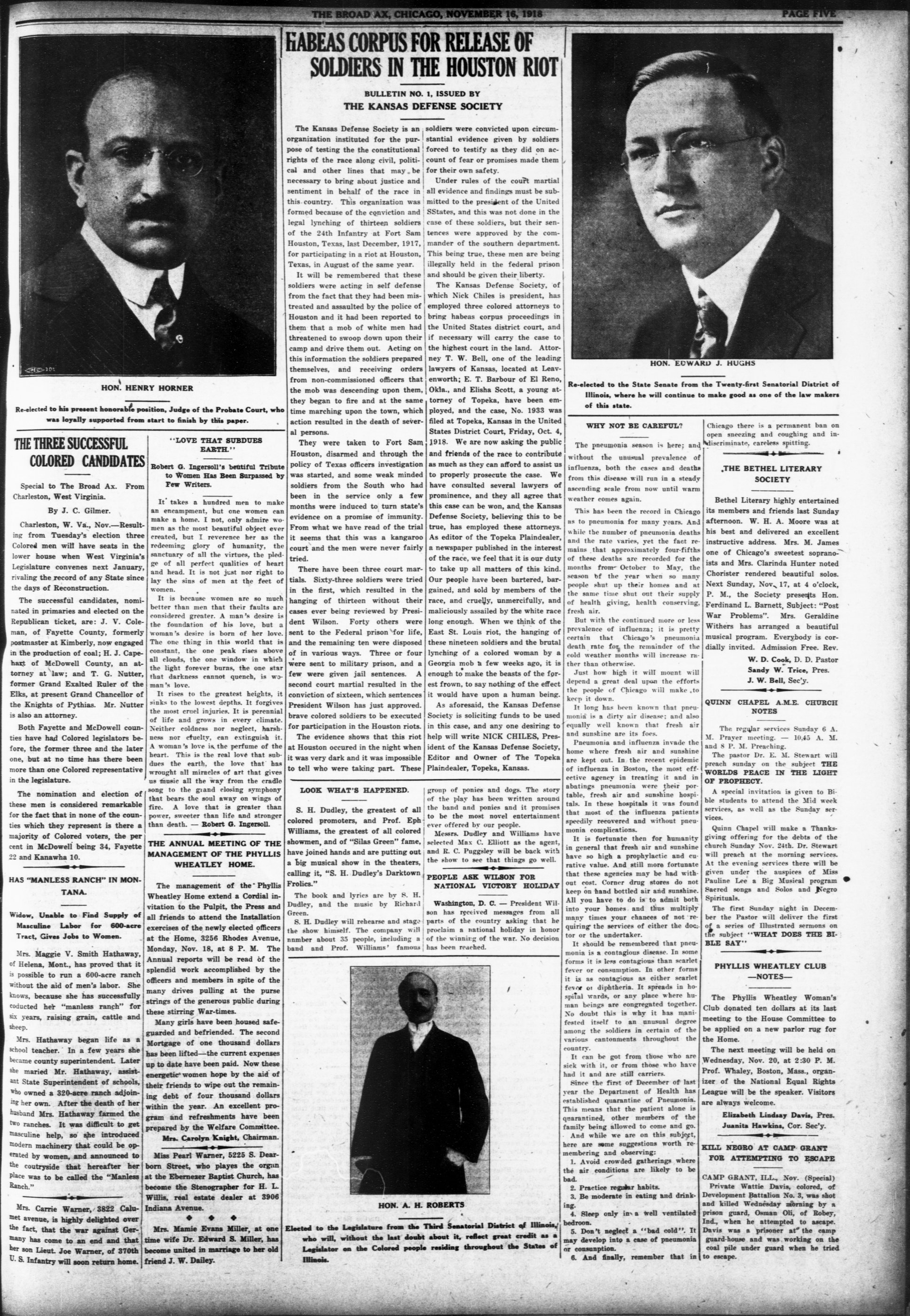
HON. HENRY HORNER
Re-elected to his present honorable position, Judge of the Probate Court, who was loyally supported from start to finish by this paper.
THE THREE SUCCESSFUL COLORED CANDIDATES
THE THREE SUCCESSFUL COLORED CANDIDATES
Special to The Broad Ax. From Charleston, West Virginia.
Charleston, W. Va., Nov.—Resulting from Tuesday's election three Colored men will have seats in the lower house when West Virginia's Legislature convenes next January, rivaling the record of any State since the days of Reconstruction.
The successful candidates, nominated in primaries and elected on the Republican ticket, are: J. V. Coleman, of Fayette County, formerly postmaster at Kimberly, now engaged in the production of coal; H. J. Capehart of McDowell County, an attorney at law; and T. G. Nutter, former Grand Exalted Ruler of the Elks, at present Grand Chancellor of the Knights of Pythias. Mr. Nutter is also an attorney.
Both Fayette and McDowell counties have had Colored legislators before, the former three and the later one, but at no time has there been more than one Colored representative in the legislature.
The nomination and election of these men is considered remarkable for the fact that in none of the counties which they represent is there a majority of Colored voters, the percent in McDowell being 34, Fayette 22 and Kanawha 10.
HAS "MANLESS RANCH" IN MON TANA.
Widow, Unable to Find Supply of Masculine Labor for 600-acre Tract, Gives Jobs to Women.
Mrs. Maggie V. Smith Hathaway, of Helena, Mont., has proved that it is possible to run a 600-acre ranch without the aid of men's labor. She knows, because she has successfully coducted her "manless ranch" for six years, raising grain, cattle and sheep.
Mrs. Hathaway began life as a school teacher. In a few years she became county superintendent. Later she married Mr. Hathaway, assistant State Superintendent of schools, who owned a 320-acre ranch adjoining her own. After the death of her husband Mrs. Hathaway farmed the two ranches. It was difficult to get masculine help, so she introduced modern machinery that could be operated by women, and announced to the countryside that hereafter her place was to be called the "Manless Ranch."
Mrs. Carrie Warner, 3822 Calumet avenue, is highly delighted over the fact, that the war against Germany has come to an end and that her son Lieut. Joe Warner, of 370th U. S. Infantry will soon return home.
By J. C. Gilmer.
"LOVE THAT SUBDUES EARTH."
Robert G. Ingersoll's beautiful Tribute to Women Has Been Surpassed by Few Writers.
It takes a hundred men to make an encampment, but one women can make a home. I not, only admire women as the most beautiful object ever created, but I reverence her as the redeeming glory of humanity, the sanctuary of all the virtues, the pledge of all perfect qualities of heart and head. It is not just nor right to lay the sins of men at the feet of women.
It is because women are so much better than men that their faults are considered greater. A man's desire is the foundation of his love, but a woman's desire is born of her love. The one thing in this world that is constant, the one peak rises above all clouds, the one window in which the light forever burns, the one star that darkness cannot quench, is woman's love.
It rises to the greatest heights, it sinks to the lowest depths. It forgives the most cruel injuries. It is perennial of life and grows in every climate. Neither coldness nor neglect, harshness nor eufulty, can extinguish it. A woman's love is the perfume of the heart. This is the real love that subdues the earth, the love that has wrought all miracles of art that gives us music all the way from the cradle song to the grand closing symphony that bears the soul away on wings of fire. A love that is greater than power, sweeter than life and stronger than death. — Robert G. Ingersoll.
THE ANNUAL MEETING OF THE MANAGEMENT OF THE PHYLLIS WHEATLEY HOME.
The management of the Phyllis Wheatley Home extend a Cordial invitation to the Pulpit, the Press and all friends to attend the Installation exercises of the newly elected officers at the Home, 3256 Rhodes Avenue, Monday, Nov. 18, at 8 P. M. The Annual reports will be read of the splendid work accomplished by the officers and members in spite of the many drives pulling at the purse strings of the generous public during these stirring War-times.
Many girls have been housed safeguarded and befriended. The second Mortgage of one thousand dollars has been lifted—the current expenses up to date have been paid. Now these energetic women hope by the aid of their friends to wipe out the remaining debt of four thousand dollars within the year. An excellent program and refreshments have been prepared by the Welfare Committee. Mrs. Carolyn Knight, Chairman.
Miss Pearl Warner, 5225 S. Dearborn Street, who plays the organ at the Ebernerzer Baptist Church, has become the Stenographer for H. L. Willis, real estate dealer at 3906 Indiana Avenue.
Mrs. Mamie Evans Miller, at one time wife Dr. Edward S. Miller, has become united in marriage to her old friend J. W. Dailey.
HABEAS CORPUS FOR RELEASE OF SOLDIERS IN THE HOUSTON RIOT
BULLETIN NO. 1, ISSUED BY THE KANSAS DEFENSE SOCIETY
The Kansas Defense Society is an organization instituted for the purpose of testing the the constitutional rights of the race along civil, political and other lines that may be necessary to bring about justice and sentiment in behalf of the race in this country. This organization was formed because of the conviction and legal lynching of thirteen soldiers of the 24th Infantry at Fort Sam Houston, Texas, last December, 1917, for participating in a riot at Houston, Texas, in August of the same year.
soldiers were convicted stantial evidence given forced to testify as a count of fear or prompt for their own safety.
Under rules of the all evidence and findin- mitted to the presi- SSstates, and this was case of these soldiers tences were approve mander of the south. This being true, these illegally held in the
It will be remembered that these soldiers were acting in self defense from the fact that they had been mistreated and assaulted by the police of Houston and it had been reported to them that a mob of white men had threatened to swoop down upon their camp and drive them out. Acting on this information the soldiers prepared themselves, and receiving orders from non-commissioned officers that the mob was descending upon them, they began to fire and at the same time marching upon the town, which action resulted in the death of several persons.
They were taken to Fort Sam Houston, disarmed and through the policy of Texas officers investigation was started, and some weak minded soldiers from the South who had been in the service only a few months were induced to turn state's evidence on a promise of immunity. From what we have read of the trial it seems that this was a kangaroo court and the men were never fairly tried.
There have been three court martials. Sixty-three soldiers were tried in the first, which resulted in the hanging of thirteen without their cases ever being reviewed by President Wilson. Forty others were sent to the Federal prison for life, and the remaining ten were disposed of in various ways. Three or four were sent to military prison, and a few were given jail sentences. A second court martial resulted in the conviction of sixteen, which sentences President Wilson has just approved. brave colored soldiers to be executed for participation in the Houston riots.
The evidence shows that this riot at Houston occured in the night when it was very dark and it was impossible to tell who were taking part. These
LOOK WHAT'S HAPPENED.
S. H. Dudley, the greatest of all colored promoters, and Prof. Eph Williams, the greatest of all colored showmen, and of "Silas Green" fame, have joined hands and are putting out a big musical show in the theaters, calling it, "S. H. Dudley's Darktown Frolics."
The book and lyrics are by S. H. Dudley, and the music by Richard Green.
S. H. Dudley will rehearse and stage the show himself. The company will number about 35 people, including a band and Prof. Williams' famous
M.
HON. A. H. ROBERTS
Elected to the Legislature from the Third Senatorial District of Illinois, who will, without the last doubt about it, reflect great credit as a Legislator on the Colored people residing throughout the States of Illinois.
Elected to the Legislature from the Third Senatorial District of Illinois, who will, without the last doubt about it, reflect great credit as a Legislator on the Colored people residing throughout the States of Illinois.
soldiers were convicted upon circumstantial evidence given by soldiers forced to testify as they did on account of fear or promises made them for their own safety. Under rules of the court martial all evidence and findings must be submitted to the president of the United SSates, and this was not done in the case of these soldiers, but their sentences were approved by the commander of the southern department. This being true, these men are being illegally held in the federal prison and should be given their liberty.
The Kansas Defense Society, of which Nick Chiles is president, has employed three colored attorneys to bring habeas corpus proceedings in the United States district court, and if necessary will carry the case to the highest court in the land. Attorney T. W. Bell, one of the leading lawyers of Kansas, located at Leavenworth; E. T. Barbour of El Reno, Okla., and Elisha Scott, a young attorney of Topeka, have been employed, and the case, No. 1933 was filed at Topeka, Kansas in the United States District Court, Friday, Oct. 4, 1918. We are now asking the public and friends of the race to contribute as much as they can afford to assist us to properly prosecute the case. We have consulted several lawyers of prominence, and they all agree that this case can be won, and the Kansas Defense Society, believing this to be true, has employed these attorneys. As editor of the Topeka Plaindealer, a newspaper published in the interest of the race, we feel that it is our duty to take up all matters of this kind. Our people have been bartered, bargained, and sold by members of the race, and cruelly, unmercifully, and maliciously assailed by the white race long enough. When we think of the East St. Louis riot, the hanging of these nineteen soldiers and the brutal lynching of a colored woman by a Georgia mob a few weeks ago, it is enough to make the beasts of the forest frown, to say nothing of the effect it would have upon a human being.
As aforesaid, the Kansas Defense Society is soliciting funds to be used in this case, and any one desiring to help will write NICK CHILES, President of the Kansas Defense Society, Editor and Owner of The Topeka Plaindealer, Topeka, Kansas.
group of ponies and dogs. The story of the play has been written around the band and ponies and it promises to be the most novel entertainment ever offered by our people.
Messrs. Dudley and Williams have selected Max C. Elliott as the agent, and R. C. Puggsley will be back with the show to see that things go well.
PEOPLE ASK WILSON FOR
NATIONAL VICTORY HOLIDAY
Washington, D. C. — President Wilson has received messages from all parts of the country asking that he proclaim a national holiday in honor of the winning of the war. No decision has been reached.
[Picture of a man in a suit with a tie].
HON. EDWARD J. HUGHS
Re-elected to the State Senate from the Twenty-first Senatorial District of Illinois, where he will continue to make good as one of the law makers of this state.
WHY NOT BE CAREFUL?
The pneumonia season is here; and without the unusual prevalence of influenza, both the cases and deaths from this disease will run in a steady ascending scale from now until warm weather comes again.
This has been the record in Chicago as to pneumonia for many years. And while the number of pneumonia deaths and the rate varies, yet the fact remains that approximately four-fifths of these deaths are recorded for the months from October to May, the season of the year when so many people shut up their homes and at the same time shut out their supply of health giving, health conserving, fresh air.
But with the continued more or less prevalence of influenza; it is pretty certain that Chicago's pneumonia death rate for the remainder of the cold weather months will increase rather than otherwise.
Just how high it will mount will depend a great deal upon the efforts the people of Chicago will make to keep it down.
It long has been known that pneumonia is a dirty air disease; and also equally well known that fresh air and sunshine are its foes.
Pneumonia and influenza invade the home where fresh air and sunshine are kept out. In the recent epidemic of influenza in Boston, the most effective agency in treating it and in abatings pneumonia were their portable, fresh air and sunshine hospitals. In these hospitals it was found that most of the influenza patients speedily recovered and without pneumonia complications.
It is fortunate then for humanity in general that fresh air and sunshine have so high a prophylactic and curative value. And still more fortunate that these agencies may be had without cost. Corner drug stores do not keep on hand bottled air and sunshine. All you have to do is to admit both into your homes and thus multiply many times your chances of not requiring the services of either the doctor or the undertaker.
It should be remembered that pneumonia is a contagious disease. In some forms it is less contagious than scarlet fever or consumption. In other forms it is as contagious as either scarlet fever or diphtheria. It spreads in hospital wards, or any place where human beings are congregated together. No doubt this is why it has manifested itself to an unusual degree among the soldiers in certain of the various cantonments throughout the country. It can be got from those who are sick with it, or from those who have had it and are still carriers.
Since the first of December of last year the Department of Health has established quarantine of Pneumonia. This means that the patient alone is quarantined, other members of the family being allowed to come and go. And while we are on this subject, here are some suggestions worth remembering and observing:
1. Avoid crowded gatherings where the air conditions are likely to be bad.
2. Practice regular habits.
3. Be moderate in eating and drinking.
4. Sleep only in a well ventilated bedroom.
5. Don't neglect a "bad cold". It may develop into a case of pneumonia or consumption.
6. And finally, remember that in
2. Practice regular habits.
the Twenty-first Senatorial District of to make good as one of the law makers
Chieago there is a permanent ban on open sneezing and coughing and indiscriminate, careless spitting.
THE BETHEL LITERARY SOCIETY
Bethel Literary highly entertained its members and friends last Sunday afternoon. W. H. A. Moore was at his best and delivered an excellent instructive address. Mrs. M. James one of Chicago's sweetest sopranoists and Mrs. Clarinda Hunter noted Chorister rendered beautiful solos. Next Sunday, Nov. 17, at 4 o'clock, P. M., the Society presents Hon. Ferdinand L. Barnett, Subject: "Post War Problems". Mrs. Geraldine Withers has arranged a beautiful musical program. Everybody is cordially invited. Admission Free. Rev.
QUINN CHAPEL A.M.E. CHURCH
NOTES
The regular services Sunday 6 A. M. Prayer meeting. — 10,45 A. M. and 8 P. M. Preamaching.
The pastor Dr. E. M. Stewart will preach lds on the subject THE WORLDS PEACE IN THE LIGHT OF PROPHECY.
A special invitation is given to Bible students to attend the Mid week services, as well as the Sunday services.
Quinn Chapel will make a Thanksgiving offering for the debts of the church Sunday Nov. 24th. Dr. Stewart will preach at the morning services. At the evening services there will be given under the auspices of Miss Pauline Lee a Big Musical program Sacred songs and Solos and Negro Spirituals.
The first Sunday night in December the Pastor will deliver the first of a series of Illustrated sermons on the subject "WHAT DOES THE BIBLE SAY"
PHYLLIS WHEATLEY CLUB
—NOTES—
The Phyllis Wheatley Woman's Club donated ten dollars at its last meeting to the House Committee to be applied on a new parlor rug for the Home.
The next meeting will be held on Wednesday, Nov. 20, at 2:30 P. M. Prof. Whaley, Boston, Mass., organizer of the National Equal Rights League will be the speaker. Visitors are always welcome.
Elizabeth Lindsay Davis, Pres.
Juanita Hawkins, Cor. Sec'y.
KILL NEGRO AT CAMP GRANT
FOR ATTEMPTING TO ESCAPE
CAMP GRANT, ILL., Nov. (Special)
Private Wattie Davis, colored, of
Development Battalion No. 3, was shot
and killed Wednesday morning by a
prison guard, Osman Oli, of Robey,
Ind., when he attempted to escape.
Davis was a prisoner at the camp
guard-house and was working on the
coal pile under guard when he tried
to escape.
W. D. Cook, D. D. Pastor
Sandy W. Trice, Pres.
J. W. Bell, Sec'y.
BUY WISELY AND WITH MUCH CARE
Avoid the Very Cheap Garments for Winter, Is Advice of an Authority.
SOME STYLES THAT REMAIN
Tendency Is Noticed to Eliminate Excess of Trimming Which Was More Popular at the Beginning of the Season.
New York.—Wherever merchants are foregathered, writes a fashion correspondent, there is talk, interesting talk, concerning the prices that women pay for clothes this season.
One expected the level of prices to be higher, because food, fuel, light and rent have increased beyond the knowledge of man; and there have been flagrant cases of injustice to the public in the amount of money demanded by some dressmakers for building clothes, but there are cases that must be settled with the individual, not the
17-8
The feature of this black velvet frock is the panels back and front, which are of black and gold gauze and fall below the skirt. The bodice is plain and finished at the neck with fur.
mass; the outstanding fact that interests the sellers of clothes, is that women deliberately ask more often for a high-priced gown than ever before and pay the price with seeming willingness. Why? The act is not explained by the word "extravagance." It is level-headed conservation.
It does not take a woman with extraordinary shrewdness to know that cheap materials are not lasting. Nobody ever bought them with the belief that they would carry one with satisfaction throughout the season. They were bought by women who preferred to spread a small income over many cheap costumes; women—and America is filled with them—who like to vary their costume every day or every two months rather than be compelled to wear the same thing throughout the weeks of a settled season. It is their form of getting stimulation.
It is, no doubt, an actual hardship for a large mass of American women to deny themselves the pleasure of a constant procession of clothes at small prices, but they must economize in this, as in food. A cooking expert has said that there are no such garbage pails in the world as here; that the kings of Europe did not have such garbage as the factory woman in the tenement districts of this country discards. This, it is true, has stopped; and ever when garbage is plentiful, showing a spirit that is not unpatriotic but ignorant of thrift, then the government steps in and gets all sorts of things useful to the war out of the pall that once was nosed by the dogs and dumped into outer darkness.
Why Women Buy With Care
So even though the American woman may not wish to wear one good costume throughout the season, her patriotism commands her to do it. This is the kernel of the entire situation. She buys in order that her clothes may last. She does not wish to take the time to constantly mend cheap clothes and renew them at odd moments. She has gone back to the ways of her great-grandmother, who chose material carefully and in many lights, pale a good price for it, and expected it to live up to its reputation.
A woman who goes into a shop this season to buy an every-day gown, pay $30 where she once paid $18 for it. This is as near the average figure as the shops can get. She asks if the material will wear, if it will hold it dye, if the seams and stitchery are good, and when she finds that they are just what they once were, but that they are not up to her modern stand ard of purchasing, she adds $10 or $10 to the price and buys another gown that suits her judgment. No one is happier over the state o affairs than the shopkeepers. The
prefer to sell fewer gowns at good prices, for, while it is not necessary to renew them in a few months they give greater satisfaction to both parties.
Styles That Remain With Us.
The continuance of the chemise frock and the sandwich silhouette has given comfort to many women, because it allows them to wear, for a time, the frocks they possess. Whether or not this silhouette will die out as the season strengthens, no prophet can tell us; but there is uneasiness among those who watch fashions closely.
Everywhere one finds a tendency to widen the hips. We are trying to get a peg-top silhouette as opposed to a planked shad silhouette. If this change comes about, the straight chemise frocks or tunics will not have as much value as they have today.
It is not only the Americans, but also the French, who have proposed this silhouette. It is not universal; one sees a continuance of the straight line on the great majority of French and American clothes, but with more tendency toward the peg-top outline in the home-made things than in the foreign ones, except from houses like Callot.
The reason for this innovation is due to the military and it is strange that it did not occur before the fourth year of war. We have admired the silhouette of mannish wide hips and narrow ankles for many months without thought of introducing it in women's clothes. Now it is here and it is carried out in almost the identical manner that the military tailors use with men's trousers.
Simplicity vs. Ornamentation.
Simplificity vs. Ornamentation.
Another subtle change that has come across the sky of fashions since the first French styles were shown is a tendency to eliminate much of the trimming with which the season began.
There was an overelaboration of rich and massive embroidery, of tassels, of colored facings, of strips of metallic ribbons, and of other strange and capricious gewaws that the mind can invent when large ideas are lacking. The universality of all this ornamentation, such, for instance as miles of fringe, was its own undoing.
It bordered, dangerously, on the ugliest period of mid-Victorianism. It gave one an unpleasant memory, even if a far-off one, of beribboned milk stools and frying pans in the parlor. It was well done; no fault could be found with its quality, but why do it? This was the question asked by those who are apostles and disciples of simplicity.
After awhile, as the majority came to the conclusion that everyone was in danger of being over-ornamented, the dressmakers had calls for quiter frocks.
No matter how severe a suit or cloth frock is, the use of good peltry lifts it out of the commonplace class. We do not need several yards of fringe, splashes of colored embroidery, a half dozen tassels, and a few fur pompons to prove to our neighbor that we know what's what.
Getting Down to Essentials.
Possibly there has not been enough cold weather to justify the usage of the several weavings of the hairy and animal-like fabrics new to the season, but there is a noticeable absence of them in the clothes worn by women who have chosen well among the seasonal offerings. There is beaver, seal, mole a-plenty, but only a few inches of their substitutes which gave the Paris weavers so many anxious and elated moments. They may arrive, and again, their full development may
THE FASHION WEEK
Sapphire blue velvet coat with stole and deep cuffs of beaver.
not come until next winter. New things have a way of holding back and consolidating for a swift offensive the second year.
This condition, therefore, leaves women with smaller choice of materials for their winter wardrobe and more puzzlement as to silhouette. The autumn is done. Our last spring clothes have served their second term. A season faces us in which we must be true to one set of costumes for six months. Don't buy cheaply, nor carelessly. Spend your money as if it belonged to the government.
SLIP-OVER BLOUSE
Device Worn With Choice of Silk or Satin Skirt.
Collarless Garment, Regardless of Becomingness, Promises to Continue Popular During Season.
The blouse shown in the sketch is one of the very smart little panel effects being developed in great numbers for the season. This blouse is a slipover. The neck is sufficiently wide to make it possible to slip the blouse very easily over the head, and it is held in at the waist by a narrow elastic band, which is in turn concealed by the ribbon belt run through openings in the panel, back and front. This is very smart as a suit blouse, or it may be worn with one of the lovely silk or satin skirts, the two forming a very satisfactory afternoon dress for informal occasions.
If women come to realize that the blouse which comes well below the waistline is unquestionably the smartest and most becoming, except for distinctly sport wear, the separate blouse will come into wider use.
The model sketched, as originally designed, was made of navy georgette, with beading in navy and red, the large beads used to outline the panel, neck and wrist being in a vivid red. The ribbon belt may be of navy faille or black velvet. A red belt would be striking, but not advisable, as sharply dividing the figure at the waistline is not becoming to the average figure.
The collarless blouse will almost unquestionably continue to be the most
F.
Panel Blouse of Georgette. popular selection during the season, although a large number of blouses are being shown with moderately high collars. Regardless of becomingness, the collarless blouse is certainly more comfortable, and in these busy days that is a very important consideration.
EASY TO MAKE A LAMPSHADE
Throw a Square Material in Studied Carelessness Over Lined Wire Frame and Start Is Made.
One of the simplest and at the same time most effective lampshades is made by throwing a square material in studied carelessness over a lined wire frame. For the floor lamp this is especially artistic. The frame should be lined with silk, either plain or shirred on, exactly as if it were to be covered with shirred silk or plain panels in the approved lampshade manner of the moment. After that a square of handsome silk, brocade, Japanese embroidery or anything sufficiently valuable to suggest that it remain uncut is thrown over the shade so that the points fall evenly. Heavy fringe may weight the edge, or tassels at the corners will perform the same office. A small hole in the center may have to be worked through the material so that the tip of the electric fixture which holds the shade may work through. The silk could be tacked very lightly here and there to the lined frame to keep it from slipping out of place.
OF INTEREST TO WOMEN
Very lovely is a frock of taffeta and velvet combination, trimmed with silk fringe, the sleeves of which are elbow length and cut kimono fashion in one with the bodice.
Chenille embroidery, combined with beads, is the charmingly effective trimming seen on some lovely frocks of satin.
In millinery the color combination of French blue and black is exceedingly popular, and to a less degree is noted seal brown and henna—the color formerly known as terra cotta.
Frocks of panne velvet trimmed with silk braid are very smart; in fact, velvet frocks, both plain and trimmed in many whys, are a delightfully attractive mode of the moment.
Formiess Blouses and Coats
Cheruit makes extremely wide and formless blouses and coats, and she like Lanvin, uses these long loops which are really slings. Undoubtedly they were suggested by the sight of the wounded in Paris, and the fact that the dressmaking houses in France turned out so much of the essentials for the hospitals.
COTTON
COTTON & COTTON
This chic suit is of navy velours de laine, with collar and facings of tan. A broad girdle, loosely tied at the back, adds a new touch to the likewise new jacket with flare and peplum.
LATE FABRIC FOR LINGERIE
Volle Has Gained Place of Favor and Has an Advantage Over Satin and Silk.
Volle is a fairly new fabric for lingerie, but it has already, in the few months that it has been used for undergarments, gained prestige.
To be sure, volle lingerie ten or twelve years ago would have seemed absurdly unpractical. Volle was too thin, we would have said, too fragile for the hard wear that lingerie must have.
But those statements would have been made in the days before lingerie had had a chance to show its good points. And they would have been been made, too, in the days before we used fur and chiffon, tulle and satin for lingerie. Nowadays, of course, satin is considered one of the most durable of fabrics—one is tempted to say undermuslins—in the good old-fashioned way, but undermuslins are now only a part of the matter, for most of them are made of silk and satin and crepe.
Volle has one advantage over satin and silk in the minds of some women, at least for underwear. They cling to a liking for a regular tubbing fabric for underwear. It matters not to them that satin can be washed in soap and water and ironed; satin does not seem so fresh and clean as cotton of some sort. So to them volle is a welcome addition to the fabrics from which underwear is made.
QUAINT AND PRETTY SWEATER
Short, Sleeveless Garment With Narrow Belt Assists in Solving Problem for Some Makers.
They are undeniably quaint and pretty, those short, sleeveless sweaters, until they start to lose their shape. That happens when the purling begins to give, or where there is no purling at all.
Narrow belts of kid and wee ribbon girdles constitute two answers to this problem of "giving." Still, neither one is especially distinctive or in keeping with the type of garment on which it is used. So a fastidious girl with a bright idea all her own hit upon the plan of the narrow self-girdle. She took quite long strands of the mercerized cotton matching her sweater—six strands, to be exact. These she twisted round and round into some simulation of a monastic cord. Then she weighted the ends snugly once about the sweater, then with self-pompons, tied the girdle again with graceful looseness. The effect was smart to a degree.
And this suggests other things for a clever girl to do along this line. For instance, double strands of the cotton might be loosely plaited, then weighted with long self-tassels. That is certainly an easy thing to do, and such a practical, good-looking thing when done.
Matinee Caps.
Lovely little matinee caps appear out of hardly more than a few inches of lace, ribbon and swansdown; camisoles can be evolved in no time from all kinds of odds and ends which the casual onlooker would never deem fit for the purpose. And this is no time for hestitation. Now, above all others, is the chance to buy while yet we can, so that anything of obviously good value should certainly be snapped up at sight. Quite certainly it can be put to excellent purpose and equally surely it will not soon again be available at anything resembling a reasonable price.
Massaging the scalp with a very small quantity of olive oil has a tendency to make the hair darker.
FRINGE ON VEILS
Season's Vogue Provides for the Popular Trimming.
Arrangement of Border Sometimes Covers Mouth and Chin of Wearer —Some Popular Colors.
The present season's vogue for fringe has extended even to vells. Some of these vells are slip-over affairs. That is, the velling is sewed together and an elastic band arranged at one edge, so that it may be held to the hat. Others are finished at the lower edge and two ends with the fringe, and an elastic band may be used to secure the vell to the hat, or it may be merely draped and pinned.
Fall and winter millinery fashions would, at a mere glance, seem to discourage the wearing of veils. Hats are frequently so oddly shaped and trimmed that draping a veil over one of them would seem to be rather a difficult task. Vells, however, are of generous proportions, and they are so uniformly becoming that women simply will not abandon them, regardless of hat shape or size.
The harem veil is one of the novelties of the season, one-half of it being filmy net or chiffon, while the other half is comparatively heavy, and when draped over the face the lower half of the face is barely visible.
Shetland veilings, always serviceable, are shown this season heavily embroidered in wool. Sometimes the wool embroidery is arranged as a border, covering mouth and chin of the wearer, and again one or two striking flowers are embroidered in wool on the open Shetland mesh. Navy, taupe, brown and purple are popular veil shades for fall and winter wear.
The new hats for fall feature feathers, either fancy feathers of one kind or another, or ostrich as first favorites in the line-up of trimmings, with bows or self-fabric arranged windmill or airplane fashion; second, and from present indications one of the most popular millinery colors of the fall and winter season is to be a brownish red, or reddish brown, christened "henna." The windows of the smart shops are filled with hats featuring this shade, and it also appears frequently as a trimming touch on smart frocks.
BRUSH FOR BUSY KNITTERS
New Contrivance for the Bag Is Used to Remove Scraps of Worsted From the Skirt.
For the knitting bag there is a diminutive clothes brush for removing scraps of worsted from milady's skirt. It is not always convenient to wear an apron when knitting, and tiny shreds of worsted are apt to cling to a tailored suit; the little brush, whisked over one's lap, will remove them instantly. The brush has a short black handle, decorated with bright colored flowers.
Very useful for the knitter are the small tape measures which wind back on a spool the moment the end is released. Ordinary tape measures are bulky things for the knitting bag and are likely to become snarled with the wool; wooden measuring rules are even more bulky for a small knitting bag, but the tiny, self-winding tape lines take up no more room than a 50-cent piece, and the moment a four-inch purling or a six-inch space of plain knitting on a sock foot is measured off back files the tiny tape into its nickel cover.
SPORT HAT OF BROWN BEAVER
For sport wear this attractive hat of brown beaver will appeal to many. A large, soft bow of brown grosgrain is placed effectively at the front.
HINTS OF THE FASHIONS
Blouses of georgette and silk jersey are trimmed with embroidery, and many of these models have choker collars and elbow-length sleeves.
An exquisite hat recently seen had a crown of seal fur and a brim of metal brocade ribbon.
As winter advances the vogue of stocks and jabots increases, and many very smart tailored stocks and daintily frilly jabots are ready in the shops for the assured demand.
Accordion-plaited chiffon velvet combined with plain velvet is used for smart round turbans that are absolutely devoid of trimming.
The ever popular, never out of fashion blue serge dress is with us again this season. One particularly pleasing model is trimmed with embroidery done in green, tan and a blue a trifle lighter than the navy of the dress, combined with black buttons and black soutache banding.
MODEL
Accordion plains and panels are very popular this season. This skirt is of lustrous black satin and the panels are edged with broad silk fringe.
CARE OF SILVER GRAY HAIR
Tonic Containing Glycerin Should Not Be Used—Ornaments Detract More Than They Add.
Gray hair, more than hair of any other color, be beautifully an ranged. The hairdress is three-fourths of the trick of an admirable coiffure. The length, thickness, color and texture of the hair, notes a correspondent do not matter so much, if it is beautifully undulated and becoming coiffed. What the hairdressers nowadays can do with a skimpy little thatch of thought dome roofing is something marvelous. And they will teach you tricks of which you may well be proud.
To gray hair only certain toner should be applied. Any tonic containing glycerin will discolor the silver sheen.
As a rule, hair ornaments detract more than they add. Brilliant ornaments or any elaborate coiffure fresco effects are suitable only for the grand hope-to-die social occasions. Shell pins are out of style. This is the day of the simple effect, of good lines and a deletion of everything that has neither meaning nor place. Hence, beautiful hair is considered sufficient unto itself, without any of the claptrap, stuff for which in times agone we used to exchange our good cash, coin spending change.
HATS MUST BE PRACTICAL
Becomingness, Serviceability, Individuality, Always Figure Prominently in All Headgear.
War has not robbed woman of her natural desire to please, but it has taught her that discrimination is a far better part than display.
At present no hat stands a ghost of a chance of success unless it is practical as well as smart.
The woman with a taste and a talent for dress realizes that a hat, no matter how beautiful or how expensive it may be, is worth to her only its measure of becomingness.
Sc the autumn hat is a combination "bunnit" of chic, serviceability and individuality—just such a combination as will delight the feminine heart.
It is worth noting that velvet is the vogue for all the hours of the day and night, but it is developed in so many ways and allied to such a variety of things that it never falls. It does not now matter half so much what hat one wears as how one wears it, and the head must fit way up into the crown and the hat must droop down well over the eyes if one would not be hopelessly out of the prevailing style.
SAPPHIRE TO SUPPLANT RUBY
Precious Stone Haa Increased in Price on Account of War and Imitations Are Almost Impossible.
According to advices from London jewelers, the sapphire is to supersede the ruby as a fashionable jewel. For a long time the ruby has held first place, having succeeded the sapphire in favor, which was deposed by the fashionable world, despite its magnificence of color, as it had become cheaper in price. It appears now that the ruby, while bringing high prices, is nevertheless the simplest of all stones and can readily be imitated. In fact, it is difficult to detect imitations.
Consequently the sapphire will now be preferred, it having greatly increased in price during the war and it being almost impossible to manufacture imitations.
Diamonds and pearls will, of course, continue to be worn as usual and are always in fashion. Diamonds are now at the highest price in history, and may continue to increase in price.
Residence, 1262 Macalister Place
Tel. Monroe 2714
MILES J. DEVINE
Attorney At Law
Suite 318-320 REAPER BLOCK
Clark and Washington Streets
Phone Central 1239
CHICAGO
Residence: 508 East 36th Street
Phone Douglas 4307
J. GRAY LUCAS
Attorney At Law
Suite 815 Hartford B
8 S. Dearborn St., Chicago.
Phone Central 6583
PHONE MAIN 2214
A. D. GASH
Attorney At Law
118 North La Salle Street
CHICAGO
Tel. Central 3142
S. A. T. WATKINS
LAWYER
36 WEST RANDOLPH STREET
CHICAGO
Residence, 4533 Prairie Avenue
Phone Kenwood 8520
WALTER M. FARMER
ATTORNEY AND
COUNSELOR AT LAW
NOTARY PUBLIC
Suite 708
184 W. Washington St.
Tel., Office, Main 4153 Auto 33736
CHICAGO
Phone Kenwood 10230
Res. Phone Drexel 8021
SAM. Z. C. WESTERFIELD
Office, Suit 3A-3B Casey Bldg.
4651 SOUTH STATE STREET
Res.: 4605 Champlain Ave.
CHICAGO
Office Phone 8078 (Douglas)
Residence Phone, Douglas 8179
S. A. BEADLE
LAWYER
3502 SOUTH STATE ST.
CHICAGO
Res. 3855 Prairie Ave.,
Phone Douglas 9133
Phones: Main 2017, Auto. 32-395
A. L. WILLIAMS
ATTORNEY AND COUNSELOR AT LAW
Suite 706 Firmenich Building
184 W. Washington St., Chicago.
Residence 3419 South Park Ave.
PHONE DOUGLAS 9354
Attorney At Law
OFFICE PHONE: CALUMET 875
2 EAST 31ST STREET
Suite 7
CHICAGO
F. Dunn, J. B. McCahey, Trusees
Tel.: Oakland 1552, 1551, 1550
JOHN J. DUNN
ESTABLISHED 1877
Wholesale and Retail
COAL
Fifty-First and Federal Sts.
CHICAGO
PATRONIZE OUR ADVERTISERS.
MADE OCCASION FOR FESTIVAL
Travelers in Northern Russia Fittingly Celebrate the Crossing of the Arctic Circle.
On the trains running northward across north Russia, the crossing of the arctic circle is made the occasion for a festival similar to that which tourists used to enjoy on shipboard when crossing the equator. The train makes a stop of several hours in the midst of a snow-covered waste on the shores of the White sea. The passengers stretch their legs and take a constitutional out over the frozen surface of the White sea, while a picnic dinner is being prepared.
The exact spot where the railroad crosses the circle is probably not determined with scientific accuracy, but the men who built the railroad apparently agreed on an approximate location, and this is marked with a suitable inscription. At this point also the railroad builders have left a slight gap, probably not more than a quarter of an inch, between the rails, so that, as passengers often notice, "when the train passes over the circle there is a distinct jolt and jar."
Dogs' Teeth as Currency.
"Dogs' teeth are the Papuans' gold, the most valuable of 'colns' in their estimation," says a writer in Wide World. "They purchase weapons, cattle, grain and the crude household utensils with dog's teeth. Only the four canine teeth, however, are of any value, all the others being worthless. These quaint coins are threaded on fibres, and when a wealthy Papuan goes trading he brings with him strings of these teeth.
"The women greatly prize them and make them into necklaces, their wealth and standing in the community being indicated by the number of teeth which compose these ornaments. The wives and daughters of the influential chiefs wear rows upon rows of them around their necks on every festive occasion. They polish them until they shine like ivory, and they certainly make an effective decoration on a glossy black body. One necklet shown to the writer was composed of no fewer than 320 teeth, which means that 80 dogs were sacrificed to obtain them."
Only Barred From One Office.
Only Barred from One Office. As far as legal rights and privileges or holding office are concerned, a native-born citizen of the United States has only one advantage over a naturalized citizen of foreign birth. By a provision in the Constitution of the United States a naturalized person of foreign birth is ineligible to the office of president. A person of foreign birth can be governor of a state, a representative or senator in congress, a cabinet officer, a general in the army, an admiral in the navy, or hold any state or national office except that of president.
Sought to Warn Mother
The mother of five-year-old Mary fell and fractured her wrist and a doctor was called to reset the bone. The youngster, from an adjoining room, heard her mother's cries of pain during the operation. The next day when the physician called Mary opened the front door, and when she saw who it was, shouted with evident disdain: "Oh, mother, here's that same doctor again!"
Pearl Worth a Fortune.
A beautiful pearl, claimed to be the finest drop-shaped pearl yet raised in Australian waters was recently found on the northwest coast of western Australia. It weighs one hundred grains, is the size of a sparrow's egg, and has been named "Star of the West." It is remarkable for its perfect shape and coloring.
Polite Service ♦ High Grade Goods
DOUGLAS 5990
Fresh Line of Fruits, Candies, Cigars and Tobacco C. S. SMITH, Proprietor 762 EAST 39TH STREET
KINKY HAIR
Alberta, Co.
Bannister Knife Co.
Gentlemen.
My picture shows you what your line
EXELENTO
QUININE
POMADE
has done for my hair. I will it, my hair was short an course, and it is hot屡 long, and so rich and silky that it can do up any way I want to.
JANIE BAND.
Don't let some fake Kink Remover fool you. You really can't straighten your hair until it's nice and long. That's what EXELENTO QUININE POMADE does, removes Dandruff, feeds the Roots of the hair, and makes a few times you can tell the difference, and after a little while it will be so pretty and long that you can fix it up to suit you. If Exelento don't do as we claim, we will give you 25% by mail on receipt of stamp or coin.
AGENTS WANTED EVERYWHERE.
Write For Particulars.
EXELENTO MEDICINE CO., Alberta, Co.
THE BROAD AX, CHICAGO, NOVEMBER 16, 1918
NO ONE ENTIRELY SATISFIED
Seems to Be Rule of Life That Man Must Desire Things He Has Not Got.
Wherever we are in this world we want to be somewhere else. I have a letter from a country boy who wants to live in the city, "where things are doing." I know his present setting: a place where the needs and comforts of man are supplied with the slightest effort. His placid, sun-baked village, in its parklike setting, glimpses the idealist's vision of the perfect life in perfect peace. All this seems to have palled on the taste of the young man and he years for the contentious, busy and dirty city.
We all have visions of the peace and contentment of the country; the scent of the woods, the song of the birds, the drone of the bees, the roses, the grateful greenery, and maybe a cowbell tinkling somewhere. We have sensed this all, perhaps, in vacation time and thought it was paradise for two or three days, after which we began to get homesick for the city noise and trouble. This is the goal men speak of as desirable; peace, abundance, quietude—body and mind at rest in nature's setting—yet here is a boy, reared in this elysium, who wants to get away from it and come to the noise and dirt and selfishness of the big city.
Probably the utopia to which so many of us aspire would not be entirely satisfactory if we possessed it. The quietude of a country place or a country town is often very dull. There are no daily sensations, no scandals, no banner heads in the daily newspapers to interest one. The high spot in the day is when you go down to the post office for the mail, or barter with the country store for codfish and matches. The weather is the leading topic of conversation; there are no very rich or very poor persons in the community; the population is, perhaps, at a colorless dead level of mediocrity; there are no millionaires to flaunt their wealth, no liveried coachmen, no "airs," no aristocracy or proletariat.
The rural conditions are what the idealists seem to be driving at, yet here is a boy willing to give it all up for the city. Is it possible that ease and contentment pall on the taste, and that man is better satisfied when he is meeting some discomfort and discouragement in the battle of life?—Seattle Post-Intelligencer.
FOR SUCCESS IN BUSINESS
Interesting List of Requisites Which Men in Commercial Occupations Should Have at Command.
In a recent issue American Magazine draws up an interesting list of requisites for various commercial occupations. For instance, it states that the head of a department should possess the following: Keen sense of justice, sympathy, tactfulness, courtesy, teachableness and knowledge of human nature. The bookkeeper needs most: Accuracy, speed, perseverance, concentration and mathematical ability—figures. To be successful in going after new business, the trade solicitor should have: Tact, courtesy, verbal expression, personality, optimism, self-confidence and knowledge of human nature. An auditor is in danger of proving a misfit, and a failure unless he possesses in marked degree: Love of details, perseverance, patience, judgment, deliberation, calmness, accuracy and analytical ability.
Facta Concerning Red Cross
In 1864 an international conference of 14 nations was held in Geneva, Switzerland, the outcome of which was the Treaty of Geneva, known as the Red Cross treaty. This treaty provided that hospital formations and their personnel should be treated as neutrals; that each nation signing the treaty should have an association of volunteers to assist and supplement the medical service of its army; that the emblem of service common to all nations should be a red cross on a field of white. This emblem, which is the Swiss flag with the colors reversed, was adopted in recognition of the fact that the Red Cross was founded at Geneva, Switzerland.
He Was Puzzled.
An old colored man stepped into the Indiana National bank one day recently, and presented a check to be cashed. It was the window of the discount cage, and the clerk handed back the check.
"Take it to the opposite window," he said, and went on with his work. The old man examined the check carefully, then he walked on. About five minutes later the clerk of the discount cage had the same check presented to him. "Hi, you," the colored man said. "You'll have to fix up this piece of paper for me. I been 'round to all the windows, and ain't none of them marked 'Opposite.'" — Indianapolis News.
Muscular Greek Porters
As porters and laborers, the Greeks of Salonica are unrivaled. You espy a grand piano or a gigantic wardrobe, apparently promenading the streets for its own pleasure, and a search reveals a small Greek of no particular physique supporting it without apparent effort. There seems no limit to the burdens they can shoulder. During a fire, two men were seen go up steep stairs carrying a huge safe that would have needed cranes and pulleys in any other country. They are very useful for road making and on the quays, receiving a fixed rate of $1 a day.
ORIGIN OF THE HOE CAKE
Southern Negroes Credited With Having Started This Delicacy on Its Way to Popularity.
Did you ever hear of hoe cake? If you have ever been in the southern part of the United States of America you have surely heard of it, and perhaps you have eaten it, too, for this dish originated in that part of the world.
Long ago, in the days before the Civil war, when great plantations flourished in the South and many negroes were owned by the planters, the slaves were usually sent out to work all day in the fields and given a lunch to take along with them for their midday meal. Wishing something hot to eat, they acquired the habit of mixing a batter, generally of cornmeal and water, with a little salt stirred in, and baking it upon their hoes on the hot coals of a fire which they built. It was the same thing which the women in their homes cooked on the hearth before the cabin fire, only, in the houses, they usually added about a teaspoonful of butter, lard or bacon drippings. They used just enough water to molsten the meal, so that they could spread it out upon their tins or boards.
Later on, so a Southern woman says, the white people, the plantation owners, made a similar dish, with variations, and liked it very well. They added or, rather, substituted, milk for water, and added baking powder and more shortening, mixed the dough thoroughly, rolled it out, cut it into diamond-shaped pieces and baked it in the oven.—Christian Science Monitor.
WHEN JIM CLAIMED ANNIE
Maid Was Sorry to Leave, but, as She Put It, It Was a Matter of Duty.
Ellis Parker Butler, the well-known humorist, has a story in the American Magazine in which the main character says:
"Well, Jimmy had been with the Burtons six years and Annie, our hired girl, had been with us five years. I guess everybody thought she hadn't any other name at all until one evening when Jimmy came over and knocked at the back door and asked mother if Miss Dornbacher was home. She wasn't, because she had gone to the Evangelical Lutheran church, but after that Jimmy used to come over, and Annie would put two chairs out in the yard under the apple tree and they would sit and talk. Or Jimmy would talk. He would talk and talk and talk, and every once in a while Annie would say, "Yes," and, after she learned it, "No." So, after a couple of years, Jimmy began to hold Annie's hand when he talked to her, and in a couple of years more they got engaged. I guess they liked each other.
"I was in our dining room one day, looking to see if Annie had put any fresh cookies in the jar in the closet, when I heard my mother say, "Oh, Annie!" in the kitchen, as if she was sorry about something. So then Annie said:
"I bin sorry to go avay, too, ma'am, but it is right everybody should get married once or twice."
"I know, my mother said; 'but I don't know what I will ever do without you, Annie.'
"So then Annie cried, and there were no cookies, so I went out."
What Makes Thunder Rumble.
Why does thunder rumble? The path of a lightning flash through the air may be several miles in length. All along this path the sudden expansion of the heated air—a true explosion—sets up an atmospheric wave, which spreads in all directions, and eventually registers in our ears as thunder. Since the lightning discharge is almost instantaneous the sound wave is produced at very nearly the same time along the whole path. But the sound wave travels slowly through the air. Its speed is approximately 1,000 feet per second. Thus the sound from the part of the lightning's path that is nearest to us reaches us first, and that from the other parts of the path afterward, according to their distance. Intermittent crashes and booming effects are due chiefly to irregularities in the shape of the path—Popular Science Monthly.
Eggs One Hundred Years Old.
A strange find was made at Northallerton, Eng., recently. While workers were sawing through a large elm tree they came across in the very heart of the tree five dried-up starling eggs. The eggs were 18 inches from the external bark, and from the concentric ring it is estimated that they must have been deposited about one hundred years ago. It is surmised that when the tree was young a pair of birds had made their nest in a cavity, and for some reason the eggs were forsaken, and in course of time the wood grew around the hollow.
Frogs and Their Eggs
In the manner of disposing of their eggs many species of frogs exhibit remarkable peculiarities. One of the most curious, a tree frog, native of Paragayu, makes its nest in a bush overhanging a pond. The lower ends of a number of leaves are drawn together and fixed in that position by a number of empty egg-capsules. The eggs are also covered with a shield of empty capsules, to protect them from the sun and air. When the eggs are hatched the plug at the bottom appears to fall out and the tadpoles tumble into the water.
As Near As Your Telephone DISTANCE IMMATERIAL
IN a Metropolitan City of this size, death knocks every thirty minutes at some door. Too often that death not only brings sorrow, but misfortune as well. Let the price you pay for a funeral be a business proposition and you will benefit by it in service, quality and cost to you in dollars and cents. The result of my campaign has built for me one of the largest and most magnificent establishments in the world.
Consult me, I can save you Worry Shipping to all parts of the County Funerals a Specialty. Central D Chapel. Call promptly answered d
Ernest H. Willis
KENWOOD
455
Undertale
5028 and 5030 S. State St.
THE CITY
Apartment
3600 WAY
The finest building ever o cago. Steam heat, electric
Consult me, I can save you Worry, Time and Money. Shipping to all parts of the Country and Automobile Funerals a Specialty. Central Display Rooms and Chapel. Call promptly answered day or night.
THE FIRST FLOOR
THE CRANFORD Apartment Building 3600 WABASH AVENUE
The finest building ever opened to Colored tenants in Chicago. Steam heat, electric lights, tile baths, marble entrance
OWNERS
DAN M. JACKSON
GEO. T. KERSEY
DAVID A McGOWAN
AHMED A. RAYNER
OPEN DAY
The Ema
Undertak
2959-61 S
Reliable Service
Reason
FREE CHAPEL
Complete Line of Funeral
OWNERS AND DIRECTORS
JACKSON
MURSEY
GOWAN
RAYNER
Phones Calum
Automatic 7
OPEN DAY AND NIGHT
The Emanuel Jackson
Undertaking Co., Inc.
2959-61 South State Street
Service Courteous
Reasonable Prices
FREE CHAPEL IN CONNECTION
Line of Funeral Goods Automobiles
DAN M. JACKSON
GEO. T. KERSEY
Phones Calumet 6164
DAVID A McGOWAN
Automatic 71-629
AHMED A. RAYNER
OPEN DAY AND NIGHT
The Emanuel Jackson
Undertaking Co., Inc.
2959-61 South State Street
Reliable Service Courteous Treatment
Reasonable Prices
FREE CHAPEL IN CONNECTION
Complete Line of Funeral Goods Automobiles for Hire
A. F. CODOZOE
J. H. WHISTON, Proprietors
CHAS. HARRIS, Manager
The Elite Cafe and Buffet
3030 STATE STREET FOR
3030 STATE STREET
FOR RENT
2, 4, 5 and 6 Room Flats
LAKEVIEW BUILDING, 3100 ELLIS AV
VIEW BUILDING, 3100 ELLIS AV
LAKEVIEW BUILDING, 3100 ELLIS AVENUE
Steam heat, hot water, electric light, wall beds, and strictly modern in every respect
GEO. F. HARDING, J
Phone Douglas 1
PATRONIZE O
APPLY
HARDING, Jr., REAL ESTATE
GEO. F. HARDING, Jr., REAL ESTATE OFFICE Phone Douglas 1 3101 Cottage Grove Ave.
PETER H. HARRIS
Phone Main 263
As Your Telephone
NCE IMMATERIAL
City of this size, death knocks every
some door. Too often that death
ow, but misfortune as well. Let the
funeral be a business proposition and
it in service, quality and cost to you.
The result of my campaign has
of the largest and most magnificent
NFORD
Building
AVENUE
to Colored tenants in Chi-
tile baths, marble entrance
J. W. CASEY, Agent 133 W. Washington Street
DIRECTORS
Phones Calumet 6164
Automatic 71-629
END NIGHT
Al Jackson
Bg Co., Inc.
State Street
Courteous Treatment
Prices
CONNECTION
Automobiles for Hire
AUTO, 72-379
Phones: DOUGLAS 3256
DOUGLAS 5071
ENT
Room Flats
100 ELLIS AVENUE
REAL ESTATE OFFICE
01 Cottage Grove Ave.
ADVERTISERS
PAGE SEVEN
LAUREL
PAGE EIGHT
THE BROAD AX
Published Every Saturday
In the city since July 15th, 1899, without missing one single issue, Republicans, Democrats, Catholics, Protestants, Single Taxers, Priests, infidels or anyone else can have their say as long as their language is proper and responsibility is fixed.
The Broad Ax is a newspaper whose platform is broad enough for all, ever claiming the editorial right to speak its own mind.
Local communications will receive attention. Write only on one side of the paper.
Subscriptions must be paid in advance.
Advertising rates made known on application.
6206 S. Elizabeth Street, Chicago, Ill.
PHONE WENTWORTH 2597.
JULIUS F. TAYLOR, Editor and
Publisher.
DR. M. A. MAJORS, 4700 S. STATE
STREET, PHONE DREXEL 1416,
ASSOCIATE EDITOR.
Entered as Second-Class Matter Aug
19, 1902, at the Post Office at Chicago,
Ill, under Act of March 3, 1879.
Vol, XXIV November 16, 1918 No. 9
IF THEY ARE HUMAN, WHY NOT EQUAL?
After the war it is supposed that there will come many changes that ought to be very favorable to the condition of our race. There never has been real honest reason why conditions are not favorable to the Negro. Of course, being black, or varied in complexion offers no just human reason why rights should be denied, or privileges withheld from us. Being illiterate and helpless it would seem would offer a greater reason for justice and sympathy. Being human should settle every question where there is abundance of intelligence and culture.
So we are projecting our thought waves into the future, after the great world war, feeling that assurance of ample and nobler regard and sturdy humanity among all peoples will result from the hurricane of hate echoed and re-echoed by thunderous shot and shell and raining death until the world is baptized in its own blood. The human impulse has slipped a cog in the world machinery of peace. Jealousy had seen its enemy, avarice, perched too high upon the throne of commerce and desire grew great, and hate grew strong and the Hohenzollerns felt the fury of the hate that was in their blood, and they thought it was the greatness of true power. The greatness of true power is justice and love, The American Attilla will find this out some day. We trust it may not be too late. So the Germans marched to music, and sang the "Watch on the Rhine." Well, we started out to write what is to be, not what has been, and is. We had our mental orbits set like the camera to focus a picture of the future, when we got to telling about shots and jealousy and power.
The picture shows a happier, progressive Negro, with no grin, a real intellectual smile, and a look of sincerity and an earnest determination. He is erect, his head is thrown perpendicular, shoulders straight, chest out. Laughter is hearty, proud, not prolonged and boisterous. His voice is more positive, less solicitious, more contentious, and his speech is commanding, demanding and impelling. He feels that he has progressed beyond the stage of human development to have to be asking for what he has won by his blood and life and what belongs to all free people.
He is not asking for rights and privileges any more, anywhere. And with that same spirit to die on the battle fields of France, he takes his rights and privileges and is just as ready to die for the rights of his people in America as he was to die for America. America had better soon learn this. It will have to learn it some day. Democracy will not be scorned. Democracy that men have
died for had better live, prevailing and triumphant. Our mental orbits are becoming transfixed to a glorious picture that we may describe at a later date.
This is, however, not the time for our interests, rights and privileges to be swallowed up by other races and lost sight of because their power and potentialities happen to be greater and stronger. Human interests should not be bartered nor compromised because of differences in color.
THE NEGRO IS LOOKING FOR
WHAT IS HIS.
The Republican party has once more been given political power and the confidence of the country, in spite of the literary qualifications of our Democratic President, who for more than four years has enjoyed the public ear of the civilized world.
From the trained political mind of the astute politician who, like a barrometer, can guess the ebbs and flows of a nation's status, this great upheaval will and of necessity be ascribed to the aroused sober conscience of the voters of America. This may be true. We are of the opinion that the Republican party in so far as politics concerns our race is the greatest force to bring us rights and justice. Time and again it has been given this opportunity. We have elected presidents and sustained the party, supporting it in and out of season. When it triumphed we rejoiced because we hoped much and longed for more than it seemed willing to grant us as a people. It remained for a Democratic President to unhorse the South on its pleasurable pastimes of lynching Negroes. President Wilson did not mince matters when he told the Bourborn South to stop lynching Negroes and to be noble patriotic citizens.
We have had good Republicans to occupy the White House at Washington, and it is one of the strange wonders that not one of them has been so pronounced on this question as Mr. Wilson, who is a Southern democrat and who has done many things not pleasing to the Negro voters of the land.
The Republicans now have an opportunity to go him one better. If we remember rightly, Mr. Wilson told the rotten South that a man could not claim to be a decent citizen if he in any way took part, or indulged the mob, either by the sin of omission or commission, and that murderers were not citizens whether they had been found guilty by a jury, participation or what not.
Now, ye judges of law and order in the land of the free and the home of the brave, ye watchers and ye men of political responsibility get busy and show the dark hued sons of America what you mean, when you prattle about freedom, justice and equal rights. You have both houses of Congress and may determine if you choose whether or not the states of Georgia, Florida, Mississippi, Alabama and Texas and a few Northern states can trample ruthlessly God's great law under unhallowed feet.
They could if they cared so to do, enact a law making any state answerable to the nation for mob violence. There may not be any precedent, but human life is greater than law, and if the Republican party held true the ideals of Abraham Lincoln it could proceed on the proposition that Negroes are not only citizens of a state, but also citizens of the American Nation. Why may it not be done for a murdered Negro as well as for a murdered German?
The four hundred thousand brave Negro soldiers who are today fighting the virtueless Hun to save the world from destruction, and to champion the cause of Democracy for the whole world will not be fighting in vain if the grand old party of Abraham Lincoln, Frederick Douglass and Charles Sumner do their duty by the Negro race in this great new day of its political triumph which it could not claim without the sturdy, constant, profitable support of the Negro voters.
THE BROAD AX. CHICAGO, NOVEMBER 16, 1918
EDITORIAL PAGE
A HUGE SKY-SCRAPER DEPARTMENT STORE CAN BE OPERATED BY OUR PEOPLE
One hundred thousand Negroes in a large city where every facility is rife and available ought to be operating one collossal department store. A store of many departments giving employment to at least one or two hundred people. It can be done. Where so many men of ability, finance, and general business knowledge is exercised in the operation of banks, insurance, real estate, lawyers, doctors, undertakers, druggists, etc., it ought to be very clear to any casual observer that millions of the dollars our people are turning back into the channels of trade through small stores, and in the loop, that a great store operated by Negroes would prove to be a bonanza.
The day of the saloon is almost gone. We've got to innaugurate something higher, and on a broader scale where we can use our money for a nobler purpose and invest our wages more profitably. The Negro merchant must be our next best step upward and forward.
Our young men and women have got to be given opportunities to cultivate the business instinct so that they will be prepared to hold their own in the coming time of sharp competition in every avenue of commercial life.
It is up to our shrewd business men to make the sacrifice of entering whole heartedly into the busy activities of commerce. A great company could be formed by the leaders in the second ward. Fifty thousand dollars could be subscribed, a charter obtained, stock sold in shares of $10.00 each to twenty thousand or more of our people, a large lot purchased on State street, a huge sky-scraper erected and a vast beginning will have been made. Chicago can do it and should lead and point out the way. Thousands of our young men and women are suffering for lack of incentive; they go to college and prepare themselves for any activity of life and many of them fall by the wayside because of the lack of enterprise among our leaders. All cannot study medicine and law, few care to become preachers, and the result is that many college bred men are compelled to go on the road and become Pullman porters or dining car waiters. Hold; now do not think, please, that this is mentioned as an aspersion, far from that, the Pullman porters and waiters in large measure represent the best we are and have in this great city. We speak of the class of work because it is always open and accessible to the industrious and capable men of our race, tempting, because it pays, and inviting because it gives them a chance they might never get of seeing the country.
This is our apology as well as explanation. Now lete us reiterate, let the men of the race who have the money form a corporation. They have got to be the pilots and guides, the backers and the merchants and lead us who suffer for the need of just such leadership.
Let us begin to do things on the collossal scale. There will not be any failure and there should not be any fear. We possess all the necessary skill and fortitude, patience, as well as energy. Race enthusiasm will do the rest.
BILL. THE KAISER
A man called the Kaiser, who thought he was wiser
Than anyone living or dead;
Drunken with power, stood waiting the hour
To show what he had in his head.
He was anxious to rule the world
At which his army was hurled.
They marched through Belgium right into France
To learn to their sorrow they hadn't a chance.
Civilization has dethroned German Kultur. Democracy is being born in middle Europe. What it will do in America after the war is a mistrust-
---
ful proposition. We have had some kind of Democracy for fifty years, but it has been blind, deaf and dumb in the tenets, and preachments where the Negro is greatly concerned and most especially in the mob-ridden Southern states. We shall see what this thing so many are rampant over will do now that the war is over.
Oiling the Wheels.
No one can afford to let another person exceed in politeness, and there is nothing in the world that will oil the wheels of life like the lubricant of courtesy. Try it in your daily life and see. No one will chide you for not being in good form, even if you should slip in a few obsolete terms. For in this busy age each one is an arbiter of fashion himself. It would be a refreshing thing to introduce a few of the old-fashioned variety of social amenities—at least it would be refreshing to the elders of some of the boys and girls of the period.
"Nemesis.
Nemesis was a goddess of justice and divine retribution./ The word comes from a Greek verb meaning to deal out, distribute, dispense. In Greek mythology Nemesis was a goddess personifying allotment, or the divine distribution to every man of his precise share of fortune, good and bad. It was her special function to see that the proper proportion of individual prosperity was preserved, and that anyone who became too prosperous or was too much uplifted by his prosperity should be reduced or punished.
Like to Be an Alligator?
Alligators have to be fed on meat, but they need no food from September 1 to May 1, for that is their hibernating season, when they do not eat at all. Alligator skins are used for making bags, suitcases, purses, belts, cushion covers, etc., and the teeth and bones are made into cuff links, paper knives, whistles and many forms of cheap jewelry and ornaments. It has been said that the state of Florida receives more than a million dollars a year from trade in alligators.
Answer Letters Promptly
Punctuality is as important in social and business correspondence as it is in personal conduct. Men and women in business learn the importance of replying to letters as soon as received. Formal social notes such as invitations, wedding announcements or death notices should be acknowledged as soon as received and even friendly letters demand a reply within a week after their receipt, if true courtesy is observed.—Biddy Bye.
His Summer Name
One day William, while visiting his grandmother, met the woman across the hall with her little dog. William inquired what she called the dog and she replied: "We call him Zero because we got him in the winter." William then asked: "Well, if you call him Zero in the winter what do you call him in the summer?"
Tools to Make a Rifle.
Nine hundred and ninety-seven cutting tools alone are required in manufacturing a modern rifle. The twins drill is one of the busiest of these. To supply 1,000,000 rifles, 94,000,000 holes must be drilled. Shrapnel, torpedoes machine guns, biplanes, motor trucks and anti-aircraft guns require from 70 to 5,000 holes each.
Why, of Course!
What is that which the postman, the clergyman, the fountains and the wild beasts, all alike say?
Letters, pray.
Let us pray.
Let us spray.
Let us prey.
Makes the Whole World Glad.
Love "thinketh no evil." imputes no motive, sees the bright side, puts the best construction on every action. What a delightful state of mind to live in! What a stimulus and benediction even to meet with it for a day.
Approved by Experience
Approved By Experience.
An eastern clergyman says that kissing is a relic of the dark ages. There are many customs that come down from the dark ages—eating, for one—St. Louis Globe-Democrat.
Knife vs. Wife.
"Most men," began the almost philosopher, "are awake that it is bad manners to eat with their knife, but lots of them also forget that it is sometimes good policy to eat with their wife."
Useful.
An ounce of pulverized borax put into a quart of boiling water and bottled for use will be found useful for taking grease spots from woolen goods.
Truth Above All.
Truth is the secret of eloquence and of virtue, the basis of moral authority; it is the highest summit of art and of life.—Amiel.
Scots All Lovers of Dogs.
Scotland is a great sheep-growing country, yet it loves the dog; gives him his due in life and reveres him in death. At the castle in Edinburgh there is a little plot of ground where the dogs of the Scottish soldiers are buried; it is a charming spot, and on many little tombstones there are tender tributes to departed friends. In front of Saint Giles cathedral in the same noble city, there is a monument to a little skye terrier, and upon it, carved in stone, an inscription to Robbie, who refused to leave the church yard where his master was buried, and died upon his grave.
The True Artist
The artist is always a child in freshness of feeling; in unworldly delight in the things which do not add to one's estate, but which make for inward joy and peace, and that easy possession of the world which brings the sense of freedom, the right to be happy, and the faith that life is greater than its works, and a man more important than his toll. A race, like an individual, must get this consciousness of possession before the work of the day becomes imperative and absorbing.—Hamilton W. Mable.
Aerial Compasses
Many difficulties had to be overcome in the production of a satisfactory compass for aerial work. Chief among these was that of neutralizing the magnetism of the engine (and in particular the magneto) and of preventing the effect of centrifugal force, which caused the card or dial inside the compass to swing in a direction quite independent of north when the airplane was banking on a turn. However, a truly excellent compass is now in use.
Pleasant Old Age:
What blessings are these—that the soul having served its time, so to speak, in the campaigns of desire and ambition, rivalry and hatred, and all the passions, should live in its own thoughts and, as the expression goes, should dwell apart. Indeed, if it has in store any of what I may call the food of study and philosophy, nothing can be pleasanter than an old age of leisure.—Exchange.
Do Your Own Thinking.
You can't become a man of mark, a man of real achievement, so long as you are but an echo of other people. You can't possibly progress as you should in your chosen life work. For the highest success demands vigorous, alert, independent thinking. And your thinking is the opposite of this, as revealed by your blind, uncritical assimilation of other people's ideas.
Wool of the Llama.
The wool of this curious animal is largely in use in Bolivia, where the traveler may see Indian women, sitting before their huts and spinning the wool, while they watch their flocks. These women use hand looms, on which they make blankets and shawls.
Well Called Devil's Belt
Long Island sound, in New York, was known before the revolution, and perhaps later, as the Devil's Belt, as may be seen on Saulther's map of New York in the Revolution. It had Hell gate at one end and the nearly as tumultuous Race at the other.
Down to Earth
Mrs. Peavish says that before they were married Mr. Peavish liked to hear her sing "Home, Sweet Home," and now he Ekes to hear her rattle dishes on the table- Galveston News.
Only One Town.
Previous to the great war, the only town in the old world ever captured by the United States was the town of Derne, in Tripoli, which was taken by an American force under General Eaton in 1804.
French Custom
In France, until the introduction of postage stamps and the rule of double postage for unpaid letters, it was considered ill bred to prepay a letter addressed to a friend.
Portugal Once Usitania
Portugal was formerly known as Lusitania. The present name is derived from Port Callo, the ancient name of the town now known to us as Oporto.
Mean.
Said the almost philosopher, "The fellow who married for money instead of love couldn't be persuaded to do it again for love or money."
Valuable Benproof
The reproof of a good man resembles fuller's earth; it not only removes the spots from our character, but it rubs off when it is dry.—Wiliamson.
Or Chewing Gum.
"No, Willie," explained grandpa, "false teeth are not stuck with toothpaste."
Athleticism in the East
The general athletic awakening is perhaps the most important effect that our occupation of the Philippines has had upon the far East. Just as the old Olympic games, begun by one village, grew to be the great recurring event at which all the Hellenic peoples could meet in peaceful competition, so this modern athletic movement starting from Baglio has spread to other far eastern peoples, and has given them not only a ground for friendly meeting, but also a basis for genuine respect and mutual understanding.
Farmhouses Modernized
As farmhouses become adapted to the taste of the women who are so many cases, taking over their management, it is found that many of the old institutions of the farmhouses the parlor, the many small rooms, the dark halls—are disappearing. Partitions are torn out to make spacious living rooms; porches are added, and everything is arranged for the unused convenience of the housekeeper who is also tender of the fields.—Eyebrows
Nero's Golden Palace
The golden house was the palace of Nero in ancient Rome, which occupied the valley between the Palatine and Equiline, and connected the palaces of the Caesars with the gardens of Maecenas. It was built after the great fire of 64 A. D., and was so large that it contained porticos 2,800 feet long and inclosed a lake where the coliseum now stands. The toscaui contained a colossus of Nero 1200 feet high.
German Title of Honor
"Von" before a name in German denotes a privilege title, either inherited or bestowed by a monarch upon the subject for meritorious services. While formerly this prefix was found in military or feudal families only, many commoners, captains of industry, scientists, financiers and artists were honored by their monarchs. The title is either hereditary or ceases with the death of the distinguished person.
Overcoming Obstacles
Sir George Reid's golden rule for the attainment of old age: "I have almost at health and happiness, and when once fronted by a formidable obstacle I have first tried to knock it over; failing this to get around it; if not, then under it and if all these maneuvers failed I have been content to lie down in its grateful shade, lauding it as a beautiful blessing in discourse."
Paymaster for the Party
As an inducement to Cecil, aged four to attend Sunday school for the first time, she was allowed to carry the pet nies to be put into the collection envelope. When the class monitor came around the teacher and the rest of the class were very much amused to hear her say in her most dignified tones "Here, girls, I will pay the fares."
No Time for That
Kathryn came running to her mother, crying as though her heart would break. Between sobs she said that a dog had frightened her. Her mother trying to divert her attention, said "What kind of a tail did the dog have?" Kathryn sobbed. "Do you spose I stop to look at his tail?"
Valuable New Metal
A white metal, which takes a brittliant polish and holds it on exposures to the atmosphere, and claimed to be possessed by an alloy of bismuth, mercury, tin, zinc and copper, has been covered by a patent.
Water Regulated by Pedal
Pressing one end of a pedal with the foot admits cold water to a new wash stand, pressing the other end allows hot water to flow and pressing the entire pedal mixes the two so that moderately warm water is obtained.
Monasteries
The monasteries once thickly strewn throughout England and much of Europe were called abbeys, from being ruled by abbots—or abbats from abbeys, Syrian for "father"—as those governed by a prior were called priories.
Speaking of Birds
When little Willie's ma used to tell him she had been informed of his misdeeds by a bird, Willie probably had misgivings that either ma was prevailed cating in a good cause or the tale-bearing fowl was a lyre bird.
Ever Think of It?
Electricity can run through very slender wires. And the energies of saving grace can enter the life through the medium of a very unfinished creed. Christian Herald.
Not So Bad After All
Not So Bad After All
A lot of people forget that today is the fatal tomorrow about which they were so worried.—Wilmington Journal
The Better Course.
It is better to fight for the good than to rail at the ill.—Tennyson.