The Broad Ax
Saturday, November 30, 1918
Chicago, Illinois
Page text (machine-generated)
THE CHRISTMAS OR THE SOUVENIR EDITION OF THE BROAD AX WILL APPEAR SATURDAY, DECEMBER 21; AS USUAL IT WILL REACH THE HIGHEST WATER MARK IN ARTISTIC AFRO-AMERICAN JOURNALISM IN THIS COUNTRY.
The BROAD AX
Carter H. Harrison, "The Man of Destiny" Who Feels That He Has A Perpetual Mortgage On the Mayor's Chair; For the Seventh Time Becomes A Candidate For Chief Executive of This City.
MAYOR WILLIAM HALE THOMPSON, SELECTS COL. JOHN J. GARRITY AS CHIEF OF POLICE OF CHICAGO, WHICH WILL ENABLE HIM TO CAPTURE THE IRISH-AMERICAN VOTERS IN HIS RACE FOR RE-ELECTION TO HIS PRESENT STORMY POSITION.
MANY OF THE BIG STIFF-NECKED POLITICIANS AND REFORMERS BORROWED OVER ONE HUNDRED AND FIFTY THOUSAND DOLLARS FROM THE LATE JOHN P. HOPKINS. WHICH THEY NEVER REFUNDED.
VOL. XXIV
Carter
Who Fe
Chair;
Executi
MAYOR WILLIAM HALE THO
J. GARRITY AS CHIEF OF
WILL ENABLE HIM TO
CAN VOTERS IN HIS RA
PRESENT STORMY POS
MANY OF THE BIG STIFF-NE
FORMERS BORROWED
FIFTY THOUSAND DOLL
P. HOPKINS, WHICH TH
Former Mayor Carter H. Harrison who is politically dead but he does not know it, who greatly delights to be known as the "man of destiny" is foolish enough to believe that by some kind of a hocus pocus, or double dealing or juggling that he will always be able to hold a long or a perpetual mortgage on the Mayor's chair of this city and notwithstanding the fact that he is over in France at the present time, nevertheless through some of his close political friends who delight to hang around him for the simple reason that he takes much pride inbuffling them and conducting himself like unto a coldblooded iceberg while browbeating them, causing them to feel that they are nothing more than crawling worms created for no other purpose than to be trampeld under his feet, have started his boom for him, and for the seventh time he and his small army of hungry political followers who are willing to work hard in a mad effort to re-land him back—in the mayor's chair in the City Hall.
It is still fresh in the minds of the Democratic voters in this city how at the city election in 1915, how Mayor Carter H. Harrison and his army of shouters and retainers, to the extent of one hundred and sixty-eight thousand votes, switched from the Democratic column over into the Republican columns, thereby making it more than possible to bring about the election of William Hale Thompson and causing the defeat of Hon. Robert M. Sweitzer, the regular Democratic candidate for mayor.
Many of the big Democratic politicians who were at that time holding down Jobs under Mayor Harrison marched right into the Thompson headquarters in the La Salle Hotel right in broad day light and let it be known that they would support the present so-called Republican mayor and work and vote against Hon. Robert M. Sweitzer.
It will be further re-called that at the election of Mayor Thompson that he retained many Harrison Democrats in office, that Charles Fitzmorris his
HEW TO THE LINE; LET THE CHIPS FALL WHERE THE MAY
Negro hating private secretary who branded the writer as "an old yellow bastard," held his present job under Mayor Harrison and the only way to seperate him from it is to defeat Mayor Thompson in his race for reelection and further politically kill off Carter H. Harrison, who like his creator Charles Fitzmorris who lied to us a million times faster than the boss devil can run and forever prevent the "man of destiny" from entering the City Hall as Mayor of Chicago.
* * *
Mayor William Hale Thompson played politics this week right up to the limit in selecting Col.. John J. Garrity as the new Chief of Police for Chicago, it is no doubt that Mayor Thompson felt that by passing up men who had grown gray in the service and whose long and ripe experience in connection with the police department well fitted them to be promoted to the head of that department and selecting the present new chief who had not up until Tuesday morning of this week never served one day in any capacity as a police officer; that by reason of that fact that the majority of the Irish-American voters in this city will fall in line for his re-election for mayor of Chicago.
* * *
Many of the big politicians borrowed money right and left from the late John P. Hopkins which they failed to pay back before his death as the following indicates.
Hon. Roger C. Sullivan sole executor of the estate of the late John P. Hopkins, former mayor of Chicago, in his schedule recently filed in the Probate Court plainly shows that the following persons borrowed vast sums of money from M. Hopkins which they never refunded, amounting all told to more than one hundred and fifty thousand dollars.
The largest item on the list is a note for $35,000 signed by the late James H. Eckels, one time president of the old Commercial National bank and controller of the currency of the
CHICAGO, NOVEMBER 30, 1918
Harrison, he Has A Perpetual seventh Time Become City.
United States at the height of his career.
The note is dated Oct. 27,1906, and secured by sixty shares capital stock of the Universal Adding Machine company of Missouri of the par value of $100 a share, also by 240 shares of the capital stock of the Fay-Sholes company of Illinois of the par value of $100 a share.
Another item in this category is for $6,500 on a $7,500 note signed by Ben T. Cable, son of the late Ransom R. Cable, one time president of the Chicago, Rock Island and Pacific railroad.
Ben T. Cable was one of the Democratic leaders of Illinois who went with Mr. Hopkins to the gold Democracy in 1896. The note for $7,500 is dated Oct. 2, 1913, due six months at 6 per cent interest. A payment of $1,000 was made. Interest up to Oct. 2, 1918, also was paid.
Other Doubtful Items.
Other items listed as "doubtful or of no value," are:
Eleven notes of W. C. Asay, attorney for the sanitary district and corporation counsel when Mr. Hopkins was mayor, for total of $3,040, dated from April, 1895, to January, 1913, due on demand.
Four notes of Jeanette Bode for total of $1,403, dated from April, 1914, to February, 1918, due on demand, interest 6 per cent.
Note of Daniel L. Cruice, $1,000, dated July 17, 1915; interest 6 per cent; payment of $500 indorsed.
Loans to John R. Walsh.
Fifty shares of capital stock of the Chicago National bank, par value, $5,000.
Note signed by John R. Walsh for $8,000, dated Feb. 3, 1908; due thirty days after demand; interest 6 per cent; secured by ten $1,000 Southern Indiana Railway company first 4s general mortgage bonds, principal of which was due in 1951.
Note signed by John R. Walsh for $10,000; dated Jan. 27, 1908; due on demand; interest 6 per cent.
Note of William R. Kerr, former city health commissioner, $350, dated Dec. 29, 1913, due one year from date, interest 6 per cent, secured by forty shares of capital stock of the Luck Sure mine, Marquette, Mich.
Note of Mrs. Margaret Mannion, $3,335; dated May 16, 1908, due to demand; interest 6 per cent.
Three nots of Mrs. Josephine Mueller; total, $2,500; dated in 1914 and 1916.
Note signed by James A. Bagg for $800, dated Sept. 28, 1907; judgment for $900 entered Jan. 17, 1913.
P. J. O'Keeffe as Borrower.
Note signed by P. J. O'Keeffe for $2,000, dated Sept. 5, 1901, due two
ON, "The
perpetual Mo
becomes A
Ex-Alderman of
torial District
high chiefs
didate for C
years from date, interest 6 per cent, payment of $200 indorsed. "Value doubtful," is notation following this item.
Note signed by Isabelle O'Keeffe and indorsed by Patrick J. O'Keeffe, for $25,000, dated Nov. 12, 1909, due one year after date, interest 5 per cent, two payments of $5,500 total, indorsed, secured by trust deed, signed by Isabelle O'Keeffe and Patrick J. O'Keeffe, to various parcels of real estate. Notation following this item is as follows:
"Note considered of no value. The parcel of land on which there is a first mortgage may possibly be worth $3,000. The liens and equities of the deceased in the other parcels of land are of doubtful value."
Loans Listed as Good.
Among the personal property items listed as "good" are the following:
Note signed by Upham & Alger,
$3,000, dated May 1917, due on demand interest 4 per cent; payments amounting to $2,100 indorsed; interest paid to Oct. 2, 1918.
Note of Mary E. Quinlan, $12,000;
dated Nov. 17, 1900; due five years after date. Time of payment extended to Nov. 17, 1910; interest 5
M. K. C.
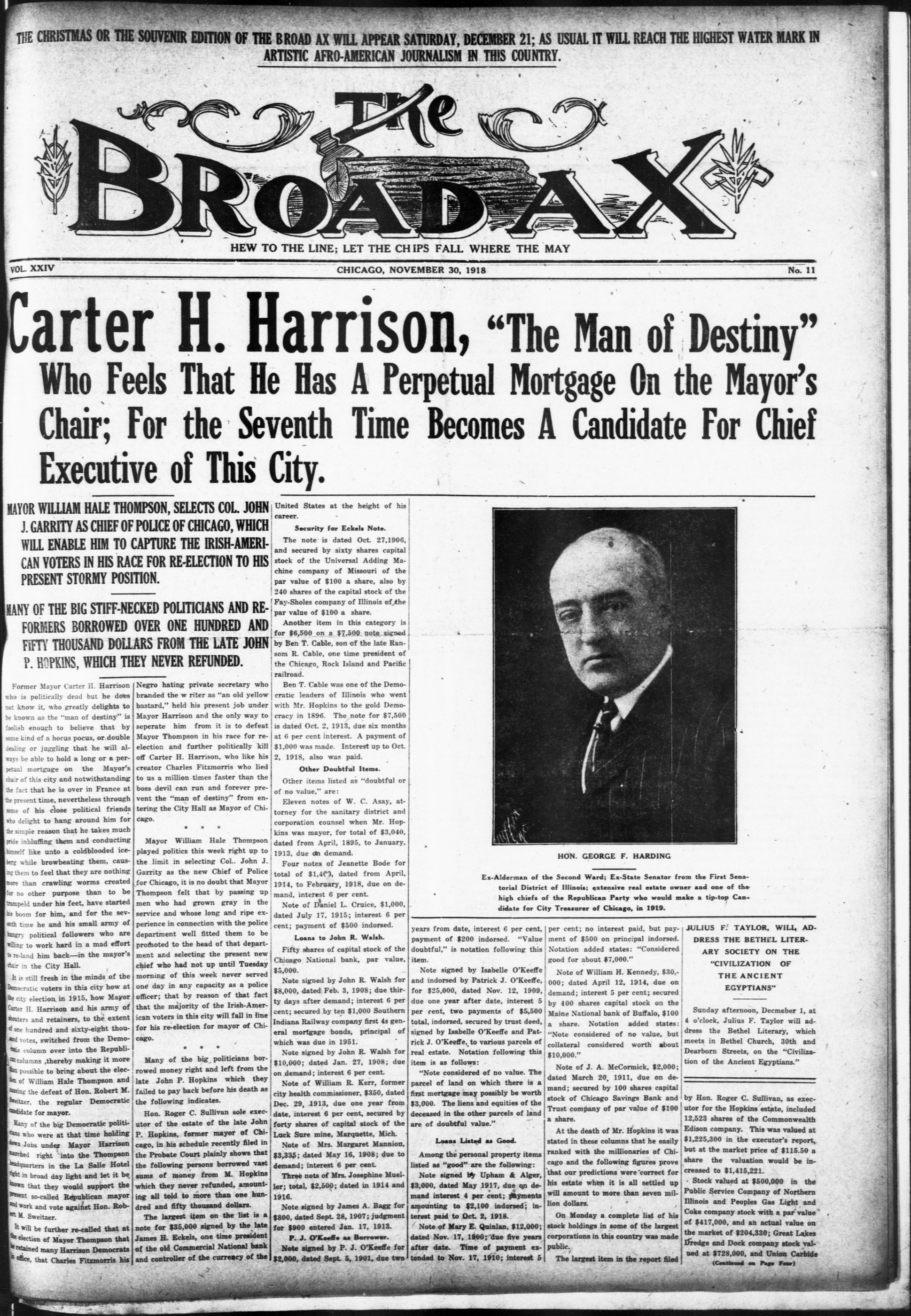
Ex-Alderman of the Second Ward; Ex-State Senator from the First Senatorial District of Illinois; extensive real estate owner and one of the high chiefs of the Republican Party who would make a tip-top Candidate for City Treasurer of Chicago, in 1919.
HON. GEORGE F. HARDING
the Second Ward; Ex-State Senator from Illinois; extensive real estate owner of the Republican Party who would mity Treasurer of Chicago, in 1919.
per cent; no interest paid, but payment of $500 on principal indorsed. Notation added states: "Considered good for about $7,000."
Note of William H. Kennedy, $30,000; dated April 12, 1914, due on demand; interest 5 per cent; secured by 400 shares capital stock on the Maine National bank of Buffalo, $100 a share. Notation added states: "Note considered of no value, but collateral considered worth about $10,000."
Note of J. A. McCormick, $2,000; dated March 20, 1911, due on demand; secured by 100 shares capital stock of Chicago Savings Bank and Trust company of par value of $100 a share.
At the death of Mr. Hopkins it was stated in these columns that he easily ranked with the millionaries of Chicago and the following figures prove that our predictions were correct for his estate when it is all settled up will amount to more than seven million dollars.
On Monday a complete list of his stock holdings in some of the largest corporations in this country was made public.
The largest item in the report filed
JULIUS F. TAYLOR, WILL, ADDRESS THE BETHEL LITERARY SOCIETY ON THE "CIVILIZATION OF THE ANCIENT EGYPTIANS"
Sunday afternoon, Decmeber 1, at 4 o'clock, Julius F. Taylor will address the Bethel Literary, which meets in Bethel Church, 30th and Dearborn Streets, on the "Civilization of the Ancient Egyptians."
by Hon. Roger C. Sullivan, as executor for the Hopkins estate, included 12,523 shares of the Commonwealth Edison company. This was valued at $1,225,300 in the executor's report, but at the market price of $115.50 a share the valuation would be increased to $1,415,221. Stock valued at $500,000 in the Public Service Company of Northern Illinois and Peoples Gas Light and Coke company stock with a par value of $417,000, and an actual value on the market of $204,330; Great Lakes Dredge and Dock company stock valued at $728,000, and Union Carbide (Continued on Page Four)
PAGE TWO
THE BROAD AX
Published Every Saturday
In this city since July 15th, 1899,
without missing one single issue. Republicans, Democrats, Catholics, Protestants, Single Taxers, Priests, infidels or anyone else can have their say as long as their language is proper and responsibility is fixed.
The Broad Ax is a newspaper whose platform is broad enough for all, ever claiming the editorial right to speak its own mind.
Local communications will receive attention. Write only on one side of the paper.
Subscriptions must be paid in advance.
Advertising rates made known on application.
Address all communications to
THE BROAD AX
6206 So. Elizabeth St., Chicago, Ill.
Phone Wentworth 2597.
JULIUS F. TAYLOR
Editor and Publisher
DR. M. A. MAJORS
Associate Editor
4700 South State Street
Phone Drexel 1416
Vol. XXIV November 30, 1918 No. 11
Entered as Second-Class Matter, August 19,
1902, at the Post Office at Chicago,
Ill., under Act of March 3, 1879
THE COLOLRED AMERICAN IN WAR WORK.
More Colored Chaplains Assigned for Army Service.
Nine colored chaplains, graduates of the class of September-October at the Army Chaplains' Training School, Camp Zachary Taylor, Louisville, Ky. have been appointed and assigned as follows: American Expeditionary Force (overseas service), Matthew W. Clair, Jr., and Lewis A. McGee; John W. E. Bowen, Jr., 159th Depot Brigade, Camp Taylor, Ky.; Frank W. Brown, 155th Depot Brigade, Camp Lee, Va.; Ellis A. Christian, 165th Depot Brigade, Camp Travis; Eugene H. Hamilton and Frederick D. L. McDonald, 11th Division, Camp Meade, Md.; A. Huntington Hatwood, Camp Taylor, Ky., and Max Yergen, Camp Lee, Va. These are included in the total of sixty colored chaplains announced as now in the service of the United States Army in this country and overseas.
Pleasant Conditions at Camp Lee.
Conditions at Camp Lee, Petersburg, Virginia, are quite satisfactory to the ten thousand colored soldiers now stationed there, according to a statement made by Rev. Arthur G. C. Randall, a representative of the Y. M. C. A. work at that point. The 13th Infantry replacement battalion at Camp Lee has four colored captains and there is also the 155th Depot.
sisting them in their letter-writing and taking the lead in their athletic diversions. "Abraham Lincoln Club" Organized In Cuba.
The colored people of Havana, Cuba, have organized an "Abraham Lincoln Club" for war work. Sergeant H. Thomas is president; Clifford C. Hancock, director; and Henry H. Sellers, treasurer. Ex-Sergeant John P. Thomas, formerly of the 10th United States Cavalry, now confidential messenger to President Mario G. Menocal, of the Republic of Cuba, is the founder of the organization. At Blenco 8 the club has handsome quarters, with large audience room, palm garden on roof, with a clear sweep for the breezes from the Gulf of Mexico, with fine dancing floor and provision for all kinds of recreation. Connected with the club is a ladies' auxiliary, an employment agency, physical culture department and classes for instruction in Spanish and English, and a club hospital is in contemplation. President Menocal is chairman of the board of trustees. The membership is upward of 200.
At a meeting of the employees of the National Baptist Publishing House, Nashville, Tenn., held in the chapel of the plant, the office staff subscribed for $5,000 worth of Fourth Liberty Bonds. Henry Allen Boyd addressed the meeting and made very clear the war aims of the Government in their especial application to colored Americans. He also held a successful meeting at Columbia, Tennessee, to push the sale of liberty bonds.
Durning the recent campaign for the Fourth Liberty loan in Dallas and Marengo counties of Alabama, Dr. A. F. Owens, dean of the Theological Department of Selma University, delivered some effective speeches. Both counties went "over the top" and five hundred and one thousand dollar subscribers among the colored people were numerous. Several Alabama dailies are carrying the war news relating to Negroes and both white and colored readers find it most interesting.
* * *
The Nashville Globe is to issue a special "Patriotic Number" during the first week in December, under the direction of Henry Allen Boyd, and the A.M.E. Church Review, of which Dr. Beverdy C. Ransom is editor, is to put out a 'Patriotic Number' some time during the same month. Although the armistice with Germany has been signed and peace is on its way, there is no diminution in the patriotic spirit on the part of the colored press or the people in general. They regard the new labor that must bring to the Negro race the fruits of the great victory for democracy as important as the work they have just put into the winning of the war itself. The 12,000,000 colored Americans in this land are keenly alive to the tremendous service that is called for by the future to guarantee to them the liberty and opportunity for which they have fought, side by side with other branches of the American family.
. . .
The Charleston American invites attention to the fact that out of the $260,000 taken at Chraleston (S. C.) Navy Yard, 1,200 colored employees, many of them only in temporary service, recently bought bonds to the value of $66,700, over one-fourth of the total.
Capt. Joseph E. Trigg, who has made an enviable record with the 368th Infantry, "Somewhere in France," formerly in command of Company A, has been transferred to the staff and placed in charge of munitions. Capt. Trigg took an active and creditable part in the reduction of the St. Mihiel salient, one of the decisive battles of the war.
It is stated that there are now 325 Y. M. C. A. secretaries engaged in work among the colored troops in this country and overseas, laboring under the supervision of Dr. J. E. Moorland, International Secretary and in charge of the colored division of Y. M. C. A, war work, conducted through the National War Work Council of the Y. M. C. A., of the United States, with headquarters at 347 Madison Avenue, New York City. John M. Wright, former Deputy County Treasurer of Shawnee Coun-
THE BROAD AX, CHI@AGO, NOVEMBER 30, 1918
RESIDENT WOODROW WILSON IS CALLED UPON TO APPOINT COMMISSION ON COLOR QUESTION, HE IS ALSO REQUESTED TO CONTEND FOR LAWS AGAINST LYNCHING AND MILITARY DISCRIMINATION.
Boston Herald, Nov. 23.—An assemblage of Colored citizens in Tremont Temple yesterday, which had gathered to hold a service commemorative of the life of the late Mrs. Geraldine Louise Trotter, passed a resolution in her name, appealing to President Wilson to ask Congress for an anti-lynching law, and for measures to end discrimination against their race in the army, navy and in civil life.
"When the world," the resolution said, "is acclaiming the magnificent victory for democracy in which this nation, under your wise leadership, shares so gloriously, 12,000,00 of our Colored American citizens are saddened because of rights still denied them. By the side of the press report announcing peace there appeared an account of the lynching of a Colored citizen.
"Colored men and women responded to your call to the colors with such patriotic fervor as to win your commendation of 'the splendid loyalty of the race'; yet these men, after all they have sacrificed, are proscribed in the army and denied enlistment—except as servants—in the navy. Disfranchisement and segregation continue, while American women, many wives, mothers and sisters of these soldiers, suffer humiliating indignities on account of color."
Commission is Called For.
A commission, with adequate powers, and composed in part of Colored men, is asked in the resolution to investigate, and report, and the President is urged to make the matter the subject of a special message to Congress. In urging favorable consideration the petitioners quote the President's words, "for the right is more precious than peace."
The resolution was signed by the Rev. Matthew A. N.. Shaw, president, and William Reed, secretary of the committee in charge of the Geraldine Louise Trotter memorial fund, subscriptions to which were received at the meeting.
The gathering was arranged as a tribute to the work of Mrs. Trotter in behalf of equality of rights for ty, Topeka, Kansas, has enlisted in the war service as a Y. M. C.. A. secretary and is stationed at Camp Grant, Rockford, Illinois.
One of the urgent matters to which colored Y. M. C. A. secretaries at the various camps have been addressing themedes earnestly and vigorously, is the reduction of illiteracy among the colored soldiers. In a few of the camps, it is stated, that more than 80 per cent, of the men are unable to read or write. This refers particularly to camps where the colored men come from districts far removed from cities or settlements where educational facilities are available.
A city-wide reception was tendered in honor of Sergeant Needham Roberts, at Trenton, N.J., his home town. Mayor Frederick W. Donnelly took a hearty interest in arranging the affair. This is the members of the "Fighting Fifteenth" of New York, (merged into the 369th Infantry), with Henry Johnson, put a score more of Huns to flight in one of the most terrific encounters of the war in France, and thus saved the lives of thousands of their sleeping comrades in cafp, over which they are assigned as guards.
her race. The Rev. Walter D. McMcClane presided, introduced by the Rev. M. A. Shaw.
Her Work Recalled.
State Treasurer Charles L. Burill recalled Mrs. Trotter's trip to Camp Devens to present a stand of colors to the Colored battalion of the 519th engineers. He spoke hopefully of the new spirit that since the war softening creed and class differences and declared that Mrs. Trotter's soul like John Brown's "is marching on." Moorfield Storey, handicapped by a bad throat, nevertheless said that he could not let the occasion pass without raising his voice in memory of Mrs. Trotter, who has passed away in a struggle not only for her race, but for her country.
John W. Schenck spoke of Mrs. Trotter's work for the Boston-Literary and Historical Association; Emery T. Morris of her work for equal rights organizations: Dr. Horace Bumstead, former president of Atlanta University, of her work for prisoners, dwelling particularly upon her long struggle to procure the pardon of William E. Hill of Stoughton.
Mrs. Lillian Lewis Fuertado, who was secretary of the Godmothers' Association which Mrs. Trotter formed, spoke of her work for the soldiers, particularly the 519th engineers, calling her "the guardian angel of the colored soldiers."
Maurice W. Spencer of Washington, an officer of the National Equal Rights League, delivered a eulogy upon the memory of Mrs. Trotter, and brought with him a contribution of $95 which the Washington local branch of the league made to the memorial fund.
The invocation was uttered by the Rev. B. W. Swain; the benediction by the Rev. Dr. Shaw. Music was furnished by J. Shelton Pollen, organist; Miss Mary Wigglesworth and William Richardson, soloists, and by the audience.
Approximately $1,000 has been paid in toward the memorial fund of $3,000.
Mrs. E. D. Trowbridge is recreation director of the States of Michigan, and W. P. Kemp, editor of the Detroit Leader, is chairman of the auxiliary that looks after Negro work. Plans are being laid for the revival of the colored soldiers' club which discontinued some weeks ago at Detroit. Mr. Kemp is also a member of the Speakers' Committee of 100, under the authority of the War Department and the Committee on Public Information and has been carrying on a vigorous campaign of education throughout the Wolverine State through largely-attended public meetings and the devotion of generous space in the columns of the Detroit Leader.
Film of "Our Colored Fighters" to Be Released.
Announcement is made that the Division of Films of the United States Committee on Public Information has made arrangements for the release of an inspiring patriotic moving picture "Our Colored Fighters" through the Downing Film Company, Astor Theater Building, New, York City. By communication with this corporation colored patriotic organizations can secure this film and give the people of every section of the country an
opportunity to see it and to assist in raising funds for the various war relief agencies that are conducting "drives" for the benefit of our boys at the front. "Our Colored Fighters" is a two-reel picture illustrating graphically the important part the Negro troops have taken in the World War. It pictorializes the enlistment and training of the colored soldiers in the cantonments and also shows them in action in some of the most thrilling combats overseas.
As an illustration of the international interest that the Negro's participation in the war is attracting, a number of striking comments have been made on the war work of the American Negro by "West Africa," an admirably gotten-up weekly newspaper published in London, England, and capably edited by Albert Cartwright. This is the only British weekly devoted exclusively to the Allies' countries in West Africa, the majority of whose people are Africans. Mr. Cartwright, himself a native African, expresses a desire for all possible information as to what the "African-descended people of the United States" are doing for the common cause.
COL. DAN. MORIARTY GOING TO FRANCE FOR AID OF K. OF C
Col. Daniel Moriarty of Chicago and colonel of the Seventh Illinois infantry during the Spanish-American war and colonel of the regiment for eighteen years and its commander at the recent border trouble, has been accepted as a Knights of Clumbus overseas secretary and will probably be assigned to K. of C. service with the American army of occupation. He will sail for France with a party of K. of C. secretaries the latter part of this week. For six years Mr. Moriarty served Cook county as commissioner. He received his honorable discharge from his regiment last December while in charge of mobilization of troops at Camp Logan, near Houston, Tex.
As Col. of the old fighting Seventh Regiment Col. Moriarty and his men were always friendly disposed towards the members of the old Eighth Regiment and each and everyone of its members and many other Colored people wish him a safe and pleasant voage and a safe return.
MRS. DELPHIA BOGER-HOLMES INJURED IN A RAILROAD ACCIDENT, WHILE ON HER WAY FROM NEW YORK CITY TO AURORR, ILL., TO ATTEND THE BURIAL OF HER MOTHER,
Mrs. Boger who was a member of one of the oldest and most highly respected Colored families in Aurora, Ill., passed away the latter part of last week and her daughter, Mrs. Delphia Boger-Holmer, who has become one of the most prominent probation officers in New York City, departed from that city last Friday evening, on the New York Central Railroad for Aurora, Ill., and when the train arrived at Waterloo, Ind., it met with an accident and Mrs. Holmes, as well as many of the other passengers, were shook up and some of them severely injured.
Mrs. Holmes, received seventy-five dollars, for the scratches and bruises, which she sustained. Owing to the accident, she was about twelve hours late in arriving in Chicago, but she arrived in Aurora time to attend the funeral of her dearly beloved mother.
SOUTHERN JUDGE SAYS COL- ORED MAN'S AS GOOD AS WHITE'S.
Jackson, Miss., November 27.— "The jury believed the Negro disbelieved the white man," said presiding Justice Cook from the Supreme Court bench today, "and we find no cause for reversal." That remark was brought out on a resume of the testimony in the case of R. J. Jennings, Sr., vs. State, the appellant having been convinced in the Tallahatchie County Court on the charge of pointing a pistol at a crowd of Negroes who were attending a colored church wedding.
The Following Resolution Was Introduced by Alderman Jackson and Unanimously Passed By the City Council, at Its Meeting Last Monday. Whereas, Four bombs within the last two months have been exploded within the territory bounded by 37th street on the north, 43rd street on the south, Cottage Grove avenue on the east and Grand boulevard on the west, resulting in great damage to the property of both the citizens and residents within the above described territory: and
Whereas, None of the perpetrators of these outrages have up to date been apprehended by the Police Department; and Whereas, Oturages of this character when frequently committed without the culprit or culprits being apprehended and brought to justice impair the confidence of the people of the community in the efficiency of the Police Department of the City of Chicago; therefore, be it
Resolved by the City Council of the City of Chicago that the General Superintendent of Police be and he hereby is directed to use every means within his power to apprehend the person or persons guilty of comitting violences of this c character and have the same brought to justice without delay.
EDITORIALS —
THE BETHEL LITERARY
Bethel Literary is honored in receiving the consent of Mr. Julius F Taylor as their Speaker next Sunday afternoon, Dec. 1st at four o'clock Mr. Taylor's subject is "The Cilivization of the Ancient Egyptians" Mr. Taylor is a master student of the history of Ancient peoples and an instructive treat is in store for those who attend. Mrs. Geraldine Witthers offers a fine Musical program. Everybody invited! Free Admittance. Rev. W. D. Cook, D. D. Pastor Sandy W. Trice, President. J. W. Bell, Secretary.
CHIPS
Mrs. Carrie Warner, 3822 Calumet avenue; left Wednesday evening for St. Louis, Mo., where she greatly enjoyed her Thanksgiving dinner, with her mother and sister.
Rev. and Mrs. John W. Robinson and the remainder of their family, have removed from 4233 St. Lawrence avenue to 213 E. 50th street; which brings him much nearer to St. Mark Church.
Hon. A. H. Roberts, one of the clerks of the Municipal Court and lately elected one of the members of the legislature from the Third Senatorial district of Illinois, spent his Thanksgiving, with his father, who is 82 years old, Lawrence, Mich.
Hon. Edward D. Green-left Monday evening for Hot Springs, Ark., where he will spend one month in auditing the books of the K. P. or the Knights of Pythias' Bath House, which is under the supervision of Gen. J. T. T. Warren, the biggest Knights of Pythias in Arkansas.
The Harvest Dance, held at the Appomattox Club, Wednesday evening, was a very pleasant affair. Mrs. J. Gray Lucas, was awarded the punkin prize as the plainest and simplest costumed country girl present. Col. A. L. McBride who was dressed up like a real country farmer and looked like one with his long linen duster; prepared and served the tempting luncheon, which consisted of apple and punkin pie; ginger bread, the best bread pudding that was ever dished up, red apples and cider.
Dancing was in order and everybody voted in favor of having Col. McBride always on hand to prepare luncheon, on such homelike occasions. President and Mrs. S. A. T. Watkins, spared no pains in making it very pleasant for the invited guests and the members of the Club.
SPECIAL NOTICE.
From on and after this date; all matter intended for publication in the current issue of this paper, must reach the editor, not later than Thursday morning. Personal or social items published free. Write plainly and briefly on one side of the paper only.
TWELVE DAYS UTTERLY LOST
Short Period in Which No Record of American History Was Kept, and the Reason.
Twelve days in the history of America are blank, an exchange remarks. If you should try to learn what happened in the period between September 3 and September 13, 1752, you will find no records, for those dates do not exist. Under the old style calendar, September 2, 1752, fell on Wednesday. The next day the Gregorian or new style calendar was adopted by Great Britain and her American colonies, and the date set forward to September 14.
Up to this time the Julian calendar had been followed by the English-speaking world. As reformed by Julius Caesar in 46 B. C. it made the year consist of 365 days and six hours, with an extra day added to February each fourth year to account for the six hours. This was the most accurate calendar year yet devised, but it was 11 minutes and 14 seconds longer than the true solar year of 365 days, 5 hours, 48 minutes and 46 seconds, amounting to a day in 128 years.
Pope Gregory XIII corrected this about 1582 by dropping ten days from the calendar and ordaining that on the one hundredth year in three out of every four centuries the extra day for leap year should not be counted. Sixteen hundred was a leap year and 2000 will be one, but 1700, 1800 and 1900 were not. Even this calendar is 36 seconds too fast, amounting to a year in 3,323 years, so when 4000 comes around it will have to be robbed of its leap year day to correct this difference.
The Gregorian calendar was adopted in Catholic countries, including France, Italy, Spain and Portugal, in 1582, and within a short time by the Germans, Swiss and Hungarians, but not until 1752 by England and her great colonial empire.
TO FILL HOLES IN PLASTER
Ordinary Wire Screen Declared to Be the Best Backing That Can Be Employed.
The electrician is frequently required. in the installation of wires in finished buildings, to cut holes here and there through the plastered walls or ceilings. Before these holes can be replastered some sort of backing must be put in which will take the place of the lath. The majority of men make use of old rags or paper for this purpose. The writer, in replastering holes, uses a backing of ordinary wire screen. The wire should be cut about one-quarter inch larger than the hole to be filled, and when pressed into it will be found to make a good, stiff backing, as the edges hold it firmly in place. Far less plaster will be necessary with this backing than with the others, which will cover the cost of the wire screen, and a more workmanlike and durable job is obtained.—W. F. Perry, in Electric World.
Protection for Birds
Some twenty states of the Union have provided bird sanctuaries, or laws for the protection of migratory birds on their long flights in search of feeding places. The matter has even been made the subject of an international treaty between the United States and Canada affecting practically all birds that regularly migrate between the two countries. The treaty provides, in effect, that no bird important to agriculture because of insect-destroying proclivities shall be shot at any time. Second, that no open game season on any species of game shall extend for a longer period than $3\frac{1}{2}$ months. Third, that both the countries shall so restrict open seasons on game birds as to prevent them from being taken during the breeding season.
Noah's Ark in China
A curious Chinese picture is of great antiquity, and is supposed to represent Noah's ark on the top of Mount Ararat. As is well known, the religious literature of almost every nation and race contains an account of a deluge, but a Chinese manuscript recently unearthed follows very closely the story as recorded in the Bible.
It is particularly interesting in that the roof of the Chinese ark is of the gable variety associated with the Noah's arks which prove such entertaining toys for our youngsters. The Chinese picture, however, shows a double-storied vessel, and, so far from there being only one window in the roof, there are windows in every possible space. It would be interesting if some Chinese scholar or antiquarian could discover the exact date of the drawing.
Literature's Beginning in America.
The North American Review was established in 1815; Bryant's "Thamatopsis" was published in 1817; and when the good-natured Monroe, after a presidency that was called "the era of good feeling," went out of office, although Whittier was still a boy on his father's farm, and Longfellow and Hawthorne were still undergraduates at Bowdin college and Emerson was still a country get-alteacher, American literature was born. The thing was settled—Thomas Wentworth Higginson.
Her French.
"I enjoyed your husband's humor so much. He is always chaffing, isn't he?"
"Yes; I tell him he is qulte-a chauffeur."
DREARY ROUND OF MONOTONY
Sample of Terrible Price That Is Sometimes Demanded by the Moloch of Modern Industry.
His face always wore the same expression—the look of the stoker who comes to the deck for a breath of fresh air. His business was, once every second, to give a certain machine a twist in order that a piece of wire might bend into a circle. He had done this sort of thing so long that two fingers had acquired a peculiar hardened curvature. One shoulder was lower than the other. He knew no other business.
It seems that the man had had an unusual boyhood. While others were at their sport, his hours were spent in passionate reverie. The literature of romantic chivalry, the story of followers of the Cross, the fine heroism of soul-starving deeds for others claimed him and made him tremulous with aspiration. He knew of nothing larger, more captivating for him than a life eked out in some remote field of self-sacrifice for the redemption of the human race. And to this he pledged himself. But then his father died. Ruin was the specter at the funeral feast. An unnamed Nemesis pursued him, try as he might to keep faith with himself and the call of mortal hunger. Self-sacrifice.
Yes, the screw-eye is a very useful article.—Boston Transcript.
FOOD FOR ALL THE WORLD
No Fear of Starvation While the Banana Grows With Its Present Wonderful Prodigality.
Concerning the value of banana flour there is no possible question. Henry M. Stanley, while he was in Darkest Africa, tested that matter thoroughly. For something like two years it was one of the staple foods on which he lived, and his testimony regarding it is both clear and convincing, though the flour he had was made in the most primitive fashion, by the natives among whom he was living, and was not comparable, save in the single particular of cost, with the flour that has been produced and is being produced today in New York city.
The world's available supply of bananas is practically inexhaustible. Growing wild as the banana does with all the excessive prodigality of tropical vegetation, in localities far outside the ken of civilization, there is no way of estimating the possible extent of the annual crop, but it may be said that enough bananas to feed the world grow somewhere each year. Moreover, modern science has discovered the methods by which this banana flour can be made of the partially ripe fruit in such fashion that it will keep almost indefinitely almost anywhere.
Mending a Sagging Door
It ruffled the tidy nature of the handy man to have to pull and jerk at his door to open it, and then to have to coax and push to shut it. A door should fit in its frame, like a stopper in a bottle, he thought. A cursory examination disclosed that it struck at the bottom. Of course, if the swelling had been at the top, it would have been so easy just to plane off the surplus. But, at the bottom! He tried tightening the screws in the upper hinge, which were quite loose, but found the wood so soft that even longer screws would not hold. There seemed to be nothing to do but remove the upper hinge, dig out the soft wood and insert in its place a piece of new wood, which held the hinge screws firmly and prevented the door from sagging.
Maxims for Marksmen
It is strange that the novice will almost invariably try to hit the bull's eye of a swinging target when it is at the center or in the lowest position. This is decidedly the incorrect method. The expert knows that the time to shoot is at the end of the swing. In fact, anyone will arrive ultimately at the same conclusion, for a little thought will convince him that a target is the more easily hit when at a standstill, or at the end of a vibration. The moving target as a rule has the largest bull's eye, and is often one of the easiest to strike, if you happen to know how. Simply aim at the point where the center of the target stops and wait till it returns. Then, bing!
Raven Not Extinct in England.
The assertion, made in some London papers, that the raven is practically extinct in England, has been denied by a dweller on Exmoor. The raven, according to this bird watcher, is by no means rare in Somerset, where he is often seen and heard. The story of his having a dummy nest to mislead mauradars is due to a misunderstanding of the bird's habit of sometimes building a new nest instead of repairing the old one. Ravens have a place in many old legends in Europe, and cannot be spared any more than can the stork of Alsace and Lorraine.
Quite Unprepared.
Conlin (visiting sick friend, solemnly)—Don't think I'm lookin' fr th' worst t' happen, Dinny, but it's fr yer own good I'm asking it—are ye prepared?
Slavin (very deliberately) — 'Tis sorry I am t' say I not, Terence, but av ye'll be good enough t' call ag'in tomorrah I'll guar-rantee t' have a brick handy, ye domb crape hanger—Buffalo Express.
JAPS FULL OF SUPERSTITION
Have More Foolish Beliefs, According to Traveler, Than Any Other People on the Earth.
"When I was a very young man I was filled with superstitions ideas," said a "globe trotter." "They were thoroughly dispelled from my mind, however, after a visit to Japan. In that country there is a superstition surrounding practically everything. The Japanese housewife, for instance, will never sweep out a room immediately after anyone has left it, for fear of driving away the luck. At a Japanese marriage it is not considered wise for either the bride or bridegroom to wear purple. It is held that purple is a color likely to fade and that the marriage will not be of long duration. Perhaps the strangest ideas are those which prevail with regard to finger nails.
"The Japanese believe that the cutting of finger nails before starting on a journey will bring misfortune to the traveler when he reaches his destination. The howling of a dog always causes considerable perturbation, for it signifies death. It is a serious matter for a woman to step over an eggshell. It is the belief of the country that if she does so she will go mad. There is a great fear of ghosts in Japan and many of the natives keep lights burning throughout the night in the belief that the flame will drive them away. One of the superstitions is put to practical use. Japanese children are told that if they tell a lie an imp will pull out their tongues."
CITY IN BEAUTIFUL SETTING
First Sight of Constantinople Cannot Fail to Impress Even the Most Satiated Globe Trotter.
However many descriptions of Constantinople may have been read or heard previously, the actual sight of it must certainly come to every one with a feeling almost of astonishment at the sheer beauty of the place. Certainly it can be a matter of surprise to no one that Constantine chose Byzantium as the spot from which to rule the East, for surely no city ever had a more magnificent situation.
Whether seen from the deck of the steamer, as it nears Constantinople, coming up from the sea of Mamora, or from the head of the Golden Horn, or from the heights of Pera opposite, or even from the Galata bridge, Stamboul, rising from the brilliantly blue waters which surround it on three sides, must always take first place for lovelliness among all the beautiful cities of the world. In May, when all the Judas trees are a mass of pinkish blossom and the wistaria hangs in pendant pale mauve masses above the narrow streets between the old wooden houses, Stamboul is perhaps beautiful above all months in the year.
Mexico Had Printing Press in 1537.
Mexico had a printing press about a hundred years earlier than the United States, or, to be exact, in 1537. The first works printed upon it were naturally by authors born in Spain who had come to America. The claim that the first book by a native-born American was written by a Mexican, and struck from this press, has stood undisputed for many years. Recently a writer of Santo Domingo has been brought forward as the first American author. An article in a recent number of the new monthly magazine, Inter-America, presents a well documented discussion of the relative claims, in which the author concludes that the honor still remains with Mexico.
The first book, in his finding, by a native American author was printed by Juan de Leon, in Sevilla, in the year 1504. There exist copies of this priceless edition in the collection of the Hispanic Society of America, in New York, in that of the Duke de TSerchaes in Sevilla.
When Alchemy Flourished.
The cult of alchemy was at its zenith during the fourteenth, fifteenth, and sixteenth centuries, holding the place with many that religion did with others. People believed implicitly in the existence of the philosopher's stone, and pinned their faith to its potency to an incredible extent. It was, of course, in the great majority of cases, simply a matter of suggestion accepted by those who were on the outlook for the means of increasing wealth. And there were many who drew no distinction between the philosopher's stone, which was supposed to have the power of transmuting the base into the noble metals, and what was called the elixir of life, a substance which would promote and preserve health and increase longevity. Thus the appeal was also made to credulity through the desire for health and the fear of disease.
Measuring the Height of Clouds
A scientist attached to one of the bureaus at Washington has been engaged in measuring the height of clouds by photography. Simultaneous pictures of a cloud were made by two cameras placed 600 feet apart and connected by telegraph wires. From the amount of displacement of the cloud caused by viewing it alternately from each end of the 600-foot base line its height could be calculated. Some of the "mackerel sky" clouds photographed were seven and a quarter miles high. The loftiest clouds whose elevation was thus measured belonged to the type known as cirrus, or "curl cloud," the height of which was a little more than seventeen miles.
Her Influence Is Probably Greater Than In Any Other Country of the World.
The greatness of France lies in her sense of the beauty and importance of living. As life is an art in France, so woman is an artist. She does not teach man, but she inspires him. And as the French woman of the bread-winning class influences her husband, and he regards her judgment and her wishes, the same is similarly true of the French woman of the rich and educated class, the French woman of leisure. But in this world her influence naturally tends much farther.
The more civilized a society is the wider is the range of each woman's influence over men, and of each man's influence over women. Intelligent and cultivated people of either sex will not limit themselves to communing with their own households. Men and women equally, when they have the range of interests that real cultivation gives, need the stimulus of different points of view, the refreshment of new ideas as well as of new faces. No one who has seen French women can doubt that their great influence on French life, French thought, French imagination and French sensibility is one of the strongest elements in the attitude France holds before the world today.-Ladies' Home Journal.
NO OBSTACLE DAUNTS RATS
Rodents in Norway, When Setting Out to Exile, Have Never Been Known to Turn Aside.
The rats of Norway employ a remarkable method to avoid a famine. When starvation threatens, those that are chosen for exile assemble in countless thousands in the mountain valleys leading to the plains and pour across the country in a straight line, which is often more than a mile in length. They devour every green thing in their path, and the country through which they pass looks as if it had been plowed or burned with fire.
They march principally by night and during the morning, resting in the afternoon. No matter how abundant the food may be in any particular locality they do not seek to settle in it, for their destination is the sea, and nothing animate or inanimate, if it can be surmounted, retards the advance.
Foxes, lynxes, weasels, kites and owls hover on the rodents' line of march and destroy them by the hundreds. The fish in the rivers and lakes take their toll of them, too, but the survivors press onward.
Little New in Warfare.
The use of asphyxiating gas is a very ancient device. Smoking out the enemy was one of the regular maneuvers of war in antiquity, says the Scientific Monthly. Polybius relates that at the siege of Ambracia by the Romans under Marius Fulvius Nobilior (B. C. 180) the Aetolians filled jars with feathers, which they set on fire, blowing the smoke with bellows into the faces of the Romans in the countermines. At the great naval battle fought in the waters of Ponza between Alfonso of Aragon and Genoa in 1435 the Genoese carried vessels filled with quicklime and redhot cinders, the smoke from which was blown by the wind against the enemy. Leonardo da Vinci, who among his many other accomplishments was a notable military engineer, suggested the use of poisonous powders, such as yellow arsenic and verdigris, to be thrown from the topmasts of ships so as to choke the enemy. This formed a part of the war instructions given by Leonardo to the republic of Venice in 1490, when the Turks had passed the Isonzo and threatened St. Mark's.
To Renew Land's Fertility.
To Renew Lands' Purity.
In the San Luis valley of Colorado there is an area from 400,000 to 500,000 acres which has almost completely been deprived of fertility in a seemingly mysterious manner. This condition has been investigated by Dr. W. P. Headden of the Colorado agricultural experiment station, and he attributes this condition to the so-called "black alkali," composed largely of sodium carbonate. This carbonate is carried in the waters of the valley, including the rivers and the artesian wells, and the practice of subirrigation has brought it to the surface by capillarity and evaporation. Doctor Headden suggests that the remedy lies in a conversion of the carbonates into sulphates by the use of a liberal amount of gypsum to one pound of black alkali—and downward washing by means of surface irrigation with furrows or by flooding.
Hand Shaking.
The practice of clasping or joining right hands as a pledge of sincerity or as a seal of a promise is of very early origin. The apostle Paul, in his epistle to the Galatians, says: "And when James, Cephas and John, who seemed to be pillars, perceived the grace that was given unto me, they gave to me and to Barnabas the right hands of fellowship; that we should go unto the heathen." In this case, evidently, a friendly agreement was sealed by giving the right hands of fellowship. From this the custom of giving the right hand of fellowship upon suitable occasions spread throughout Christendom and joining right hands became a part of the Christian marriage ceremony. The custom of hand shaking certainly existed before Shakespeare's day, for he refers to it many times as a kind of pledge or social greeting. It is not confined to English-speaking nations.
SUCCESS NOT FOR LEANERS
Man That Wins in Life's Struggle Must Have the Utmost Confidence in Himself.
Power is the goal of every worthy ambition, and only weakness comes from imitation or dependence on others. Power is self-generated. We cannot increase the strength of our muscles by sitting in a gymnasium and letting another exercise for us. Nothing else so destroys the power to stand alone as the habit of leaning upon others. If you lean you will never be strong or original. Stand alone or bury your ambition to be somebody in the world.
The man who tries to give his children a start in the world so that they will not have so hard a time as he has unknowingly bringing disaster upon them. What he calls giving them a start will probably give them a setback in the world. Young people need all the motive power they can get. They are naturally learners,imitators, copiers, and it is easy for them to develop into echoes or imitations. They will not walk alone while you furnish crutches; they will lean upon you just as long as you will let them.
One of the greatest delusions that a human being could ever have is that he is permanently benefited by continued assistance from others.—Orison Swett Marden, in Success.
AIM SHOULD BE PERFECTION
Man Who Is Satisfied With Nothing but the Best Is Man Who Will Make Good in Life.
Don't get into the "that's-good-enough" habit. Nothing short of "perfect" should be your motto. Slovenly habits of mind and hand grow faster than good habits. A slipshod manner of thinking results in slipshod methods of work. You will never become efficient in any one thing till you get it firmly fixed in your mind that if another can do it better than you you are not doing well. Thoroughness and accuracy play a big part in the success or failure of the individual. You may be artistic and temperamental and dreamy, but you will never realize your dreams till you get down to brass tacks and do what you do with precision and dispatch.
There is plenty of time to exercise your artistic moods after you have learned all there is to know of the mechanical and fundamental principles of the work or accomplishment you think you were out to do.
Remember that interpretation comes last.
There must be weeks, months and years of systematic and consistent drill before one is capable of exercising the faculty of interpretation.
Merchant Bar.
Merchant bar, or merchant iron, is the bar iron which has been finished by passing through the merchant rolls. Puddled bars are worked into merchant iron or merchant bar by being cut into pieces of suitable length, which are then piled in packets, heated into welding heat, and then hammered into bars of suitable shape to put on the market. The amount of labor bestowed on this process depends on the quality of the iron it is desired to produce. Puddle bars, which have been rolled a second time are called "No. 2." and this is usually designated as "merchant bar." It is the lowest quality of iron available for the smith's general use. If piled and rolled again the product is called "No. 3." Another repetition of the process furnishes an article known as "best-best," and still another gives "treble-best."
Boy's Instinct True
"Historian of the sky" was the title bestowed on Angelo Secchi, the famous Italian astronomer. A quaint little anecdote is told of him at the time of his first visit to London. Not knowing English, he wondered how he should find his way about, and confided his doubts to his young companion, an Italian boy of fifteen. Finally they decided that the best plan would be to go and look for an Italian. "Our difficulties will then be met," said Secchi, and went straight for the British museum. Entering the reading room, he looked rapidly at the readers and unhesitatingly accosted one of them with, "Bon giorno! Lei e italiano!" He was not mistaken, and the Italian not only directed \Secchi where he wished to go, but became his host during his stay in the British capital.
Quaint French Custom.
A quaint custom with the boys of France, at the time when they are called to the colors, is the wearing, just for a day or two, of a tall silk hat, and falling that, of the tallest felt hat they can procure. Pinning bands of newspaper to the crown, they sally forth thus decorated and parade the streets of towns and villages, as the case may be. Often hats are handed from father to son, or from brother to brother, and worn heedless of size or shape. The boys, having worn the "chapeau de forme" for 24 hours or so, stream into the barracks and become the conscripts, and then the famous "pollus" of France.
Mean Enlightenment
Belle—Will proposed to me last night.
Nell—There! Jack told me they had dared him to do something desperate and he wouldn't pass up a dare.
Once Humble Flower Rapidly Being Brought to High Position by the Master Florists.
The chrysanthemum is not to have everything its own way in the world of flowers. No doubt the chrysanthemum show gets more of the limelight of publicity than a dahila show, but the gorgeous blossom that was once called "the prim old maid of the flower world" is having its "shows" or exhibitions just the same, and the reports have it that they are attended by large crowds. The dahila show has become a regular thing in many cities and it is said that there are persons who can work up quite as much enthusiasm for the dahila as for the "mum." The dahila, from a very simple and home-loving flower, has become somewhat of a social pet.
It was not many years ago that the dahlia bloomed in the yards of small homes. Sometimes it grew in the front yard and sometimes in the back yard. It might be remarked here that the "yard," especially the "front yard," has disappeared. Nobody now has a front yard. Nobody who is anywhere near up to date would have such a thing about the house. The piece of real estate which we used to call the front yard has become the "tawn."
Well, formerly the dahila grew only in the yards of humble homes. It had not broken into what is called "society." Fashionable "grounds" could not think of admitting such a plain, hardy and highly colored citizen of the flower world as a mere dahila. It did not belong to their set. But the merit of this flower and the high state of culture which it has attained under the guidance and tuition of master florists has forced the prousted gardens to open their gates or let down their fences. The dahila now holds up its stately head among the exclusive set of tuberoses, gladiolus, carnations and the like.
"SUB ROSA" IMPLIES SECRECY
Term Had Its Origin Long Ago in a Plot Which Involved Existence of Snarta
The origin of the phrase sub rosa, "under the rose," implies secrecy, and had its origin in the year 477 B. C., at which time Pausanias, the commander of the confederate fleet of the Spartans and Athenians, was engaged in intrigues with Xerxes for the subjugation of Greece to the Persian rule, and for the hand of the monarch's daughter in marriage. The negotiations were carried on in a building attached to the temple of Minerva, called the Brazen house, the roof of which was a garden forming a bower of roses; so that the plot, which was conducted with the utmost secrecy, was literally matured under the roses. Pausanias, however, was betrayed by one of his emissaries, who, by a concerted plan with the overseers and counselors of state, five in number, gave them a secret opportunity to hear from the lips of Pausanias the acknowledgment of his treason. To escape arrest, he fled to the temple of Minerva, and as the sanctity of the place forade intrusion, the people walled up the edifice so that he might die of starvation.
The Welcome Guest
There is scarcely anyone who does not wish to be a welcome guest, yet everyone knows that some persons possess the ability to make themselves far more desirable in the home than others. The visitor who brings a sunny, fresh point of view with her is always sure of a cordial reception, providing she is careful to carry out certain other requisites which a successful guest is wise enough to follow, whether she has ever analyzed them in this cold fashion or not. It might be safe to guess that she has never thought about it all, but, guided simply by her sincere desire to express real fellowship, has instinctively fulfilled her obligations. Yet when considered, perhaps the one thing more than another which insures one's renewed welcome may be summed up in the single word, adaptability.
Cane Is Mark of High Office.
It has been the custom of the surgeon of the king of England to carry a "gold-headed cane." This cane has been handed down to the various incumbents of the office since the days of Dr. John Radcliffe, who was the first "holder of the cane." It has been used for 200 years or more by the greatest physicians and surgeons in the world, who succeeded to it. The "gold-headed cane" was adorned by a cross-bar at the top instead of a knob. The fact is explained by Munk, in that Radcliffe, the first owner, was a rule unto himself, and probably preferred this device as a mark of distinction from the knob used by physicians in general.
Life of Congress.
Each congress lasts two years and under the Constitution must assemble at least once each year. Two regular sessions are held, both beginning on the first Monday in December. The long session lasts from December of each odd year until congress adjourns, generally on the following June, or July, and the short session, beginning in December of each even year, ends at noon on the following March 4. The long session may last until the next session begins, while the short session is ended by the expiration of the two years' term for which the congress is elected on March 4, following its meeting.
A.
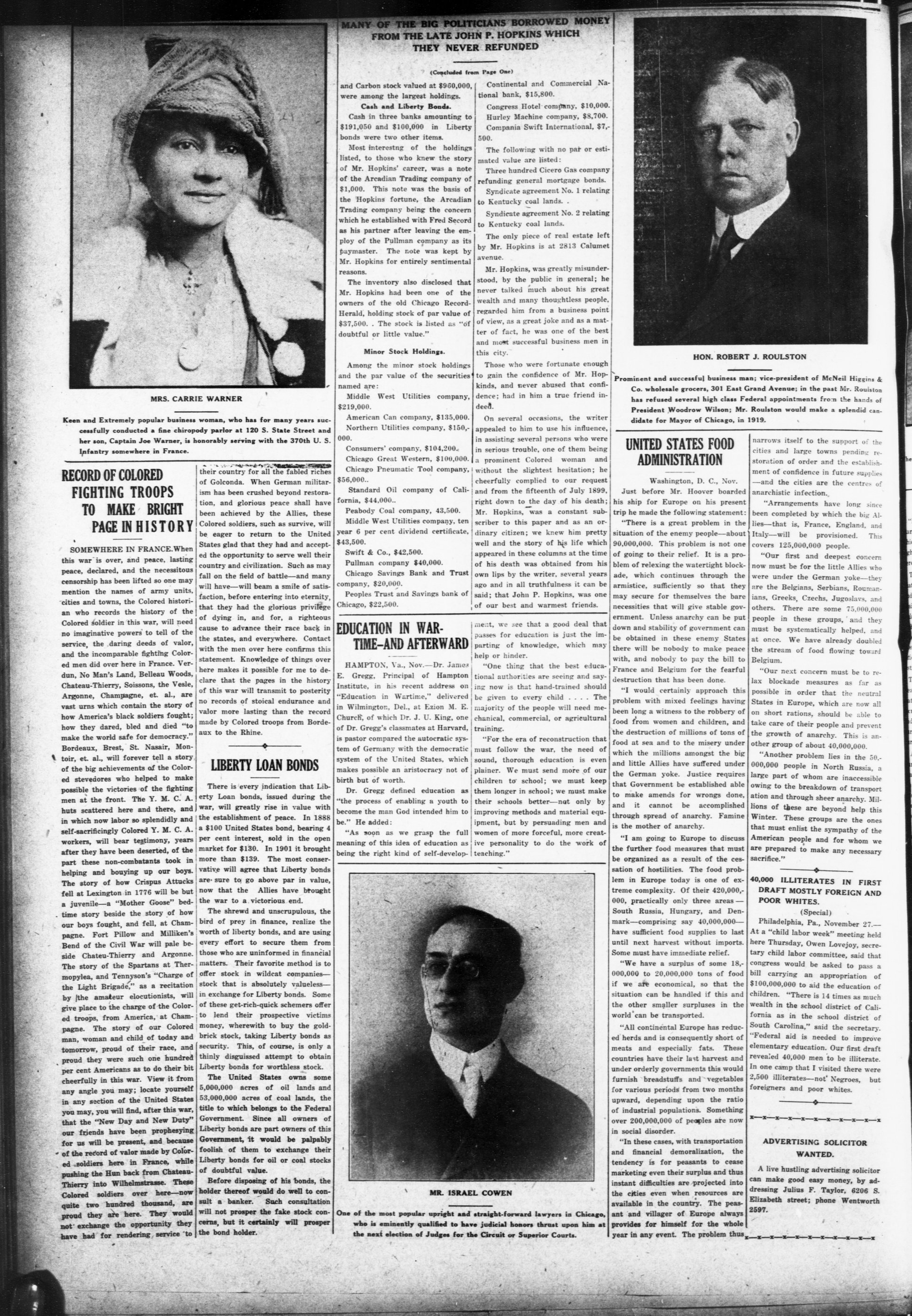
MRS. CARRIE WARNER
Keen and Extremely popular business woman, who has for many years successfully conducted a fine chiropody parlor at 120 S. State Street and her son, Captain Joe Warner, is honorably serving with the 370th U. S. Infantry somewhere in France.
RECORD OF COLORED FIGHTING TROOPS TO MAKE BRIGHT PAGE IN HISTORY
SOMEWHERE IN FRANCE. When this war is over, and peace, lasting peace, declared, and the necessitous censorship has been lifted so one may mention the names of army units, cities and towns, the Colored historian who records the history of the Colored soldier in this war, will need no imaginative powers to tell of the service, the daring deeds of valor, and the incomparable fighting Colored men did over here in France. Verdun, No Man's Land, Belleau Woods, Chateau-Thierry, Soissons, the Vesle, Argonne, Champagne, et. al., are vast urns which contain the story of how America's black soldiers fought; how they dared, bled and died "to make the world safe for democracy." Rodegoux, Brest, St. Nassair, Mon-
toir, et. al., will forever tell a story of the big achievements of the Colored stevedores who helped to make possible the victories of the fighting men at the front. The Y. M. C. A. huts scattered here and there, and in which now labor so splendidly and self-sacrificingly Colored Y. M. C. A. workers, will bear testimony, years after they have been deserted, of the part these non-combatants took in helping and buoying up our boys. The story of how Crispus Attucks fell at Lexington in 1776 will be but a juvenile—a "Mother Goose" bedtime story beside the story of how our boys fought, and fell, at Champagne. Fort Pillow and Milliken's Bend of the Civil War will pale beside Chateau-Thierry and Argonne. The story of the Spartans at Thermopylea, and Tennyson's "Charge of the Light Brigade," as a recitation by the amateur elocationists, will give place to the charge of the Colored troops, from America, at Champagne. The story of our Colored man, woman and child of today and tomorrow, proud of their race, and proud they were such one hundred per cent Americans as to do their bit cheerfully in this war. View it from any angle you may; locate yourself in any section of the United States you may, you will find, after this war, that the "New Day and New Duty" our friends have been prophesying for us will be present, and because of the record of valor made by Colored soldiers here in France, while pushing the Hun back from Chateau-Thierry into Wilhelmstrasse. These Colored soldiers over here—now quite two hundred thousand, are proud they are here. They would not exchange the opportunity they have had for rendering service to
their country for all the fabled riches of Golconda. When German militarism has been crushed beyond restoration, and glorious peace shall have been achieved by the Allies, these Colored soldiers, such as survive, will be eager to return to the United States glad that they had and accepted the opportunity to serve well their country and civilization. Such as may fall on the field of battle—and many will have—will beam a smile of satisfaction, before entering into eternity, that they had the glorious privilege of dying in, and for, a righteous cause to advance their race back in the states, and everywhere. Contact with the men over here confirms this statement. Knowledge of things over here makes it possible for me to declare that the pages in the history of this war will transmit to posterity no records of stoical endurance and valor more lasting than the record made by Colored troops from Bordeaux to the Rhine.
LIBERTY LOAN BONDS
There is every indication that Liberty Loan bonds, issued during the war, will greatly rise in value with the establishment of peace. In 1888 a $100 United States bond, bearing 4 per cent interest, sold in the open market for $130. In 1901 it brought more than $139. The most conservative will agree that Liberty bonds are sure to go above par in value, now that the Allies have brought the war to a victorious end.
The shrewd and unscrupulous, the bird of prey in finance, realize the worth of liberty bonds, and are using every effort to secure them from those who are uninformed in financial matters. Their favorite method is to offer stock in wildcat companies—stock that is absolutely valueless—in exchange for Liberty bonds. Some of these get-rich-quick schemers offer to lend their prospective victims money, wherewith to buy the gold-brick stock, taking Liberty bonds as security. This, of course, is only a thinly disguised attempt to obtain Liberty bonds for worthless stock.
The United States owns some 5,000,000 acres of oil lands and 53,000,000 acres of coal lands, the title to which belongs to the Federal Government. Since all owners of Liberty bonds are part owners of this Government, it would be palpably foolish of them to exchange their Liberty bonds for oil or coal stocks of doubtful value. Before disposing of his bonds, the holder thereof would do well to consult a banker. Such consultation will not prosper the fake stock concerns, but it certainly will prosper the bond holder.
MANY OF THE BIG POLITICIANS BORROWED MONEY FROM THE LATE JOHN P. HOPKINS WHICH THEY NEVER REFUNDED
(Concluded from Page One)
and Carbon stock valued at $960,000,
were among the largest holdings.
Cash and Liberty Bonds.
Cash in three banks amounting to
$191,050 and $100,000 in Liberty
bonds were two other items.
Contine
tional bar
Congres
Hurley
Compan
500.
Most interesting of the holdings listed, to those who knew the story of Mr. Hopkins' career, was a note of the Arcadian Trading company of $1,000. This note was the basis of the Hopkins fortune, the Arcadian Trading company being the concern which he established with Fred Secord as his partner after leaving the employ of the Pullman company as its paymaster. The note was kept by Mr. Hopkins for entirely sentimental reasons.
The inventory also disclosed that Mr. Hopkins had been one of the owners of the old Chicago Record-Herald, holding stock of par value of $37,500. The stock is listed as "of doubtful or little value."
Minor Stock Holdings.
Among the minor stock holdings
and the par value of the securities
named are:
Middle West Utilities company,
$219,000.
American Can company, $135,000.
Northern Utilities company, $150,
000.
Consumers' company, $104,200.
Chicago Great Western, $100,000.
Chicago Pneumatic Tool company,
$56,000.
Standard Oil company of Cali-
fornia, $44,000.
Peabody Coal company, 43,500.
Middle West Utilities company, ten
year 6 per cent dividend certificate,
$43,500.
Chicago Savings Bank and Trust company, $20,000.
Peoples Trust and Savings bank of Chicago, $22,500.
EDUCATION IN WAR- TIME-AND AFTERWARD
HAMPTON, Va., Nov.—Dr. James E. Gregg, Principal of Hampton Institute, in his recent address on "Education in Wartime," delivered in Wilmington, Del., at Ezion M. E. Church, of which Dr. J. U. King, one of Dr. Gregg's classmates at Harvard, is pastor compared the autocratic system of Germany with the democratic system of the United States, which makes possible an aristocracy not of birth but of worth.
Dr. Gregg defined education as "the process of enabling a youth to become the man God intended him to be." He added:
"As soon as we grasp the full meaning of this idea of education as being the right kind of self-develop-
[Name]
MR. ISRAEL COWEN
MR. ISRAEL COWEN
One of the most popular upright and straight-for-
who is eminently qualified to have judicial
the next election of Judges for the Circuit of
One of the most popular upright and straight-forward lawyers in Chicago, who is eminently qualified to have judicial honors thrust upon him at the next election of Judges for the Circuit or Superior Courts.
Swift & Co., $42,500.
Pullman company $40,000.
Continental and Commercial National bank, $15,800.
Congress Hotel company, $10,000.
Hurley Machine company, $8,700.
Compania Swift International, $7,500.
The following with no par or estimated value are listed:
Three hundred Cicero Gas company refunding general mortgage bonds.
Syndicate agreement No. 1 relating to Kentucky coal lands.
Syndicate agreement No. 2 relating to Kentucky coal lands.
The only piece of real estate left by Mr. Hopkins is at 2813 Calumet avenue.
Mr. Hopkins, was greatly misunderstood, by the public in general; he never talked much about his great wealth and many thoughtless people, regarded him from a business point of view, as a great joke and as a matter of fact, he was one of the best and most successful business men in this city.
Those who were fortunate enough to gain the confidence of Mr. Hopkinds, and never abused that confidence; had in him a true friend indeed.
On several occasions, the writer appealed to him to use his influence, in assisting several persons who were in serious trouble, one of them being a prominent Colored woman and without the slightest hesitation; he cheerfully complied to our request and from the fifteenth of July 1899, right down to the day of his death; Mr. Hopkins, was a constant subscriber to this paper and as an ordinary citizen; we knew him pretty well and the story of his life which appeared in these columns at the time of his death was obtained from his own lips by the writer, several years ago and in all truthfulness it can be said; that John P. Hopkins, was one of our best and warmest friends.
ment, we see that a good deal that passes for education is just the imparting of knowledge, which may help or hinder.
"One thing that the best educational authorities are seeing and saying now is that hand-trained should be given to every child . . . The majority of the people will need mechanical, commercial, or agricultural training.
"For the era of reconstruction that must follow the war, the need of sound, thorough education is even plainer. We must send more of our children to school; we must keep them longer in school; we must make their schools better—not only by improving methods and material equipment, but by persuading men and women of more forceful, more creative personality to do the work of teaching."
[Name]
HON. ROBERT J. ROULSTON Prominent and successful business man; vice-president of McNeil Higgins & Co. wholesale grocers, 301 East Grand Avenue; in the past Mr. Roulston has refused several high class Federal appointments from the hands of President Woodrow Wilson; Mr. Roulston would make a splendid candidate for Mayor of Chicago, in 1919.
UNITED STATES FOOD ADMINISTRATION
UNITED STATES FOOD ADMINISTRATION
Washington, D. C., Nov. Just before Mr. Hoover boarded his ship for Europe on his present trip he made the following statement:
his ship for Europe on his present trip he made the following statement: "There is a great problem in the situation of the enemy people—about 90,000,000. This problem is not one of going to their relief. It is a problem of relexing the watertight blockade, which continues through the armistice, sufficiently so that they may secure for themselves the bare necessities that will give stable government. Unless anarchy can be put down and stability of government can be obtained in these enemy States there will be nobody to make peace with, and nobody to pay the bill to France and Belgium for the fearful destruction that has been done.
"I would certainly approach this problem with mixed feelings having been long a witness to the robbery of food from women and children, and the destruction of millions of tons of food at sea and to the misery under which the millions amongst the big and little Allies have suffered under the German yoke. Justice requires that Government be established able to make amends for wrongs done, and it cannot be accomplished through spread of anarchy. Famine is the mother of anarchy.
"I am going to Europe to discuss the further food measures that must be organized as a result of the cessation of hostilities. The food problem in Europe today is one of extreme complexity. Of their 420,000,000, practically only three areas—South Russia, Hungary, and Denmark—comprising say 40,000,000 have sufficient food supplies to last until next harvest without imports. Some must have immediate relief.
"We have a surplus of some 18,000,000 to 20,000,000 tons of food if we are economical, so that the situation can be handled if this and the other smaller surpluses in the world can be transported."
"All continental Europe has reduced herds and is consequently short of meats and especially fats. These countries have their last harvest and under orderly governments this would furnish breadstuffs and vegetables for various periods from two months upward, depending upon the ratio of industrial populations. Something over 200,000,000 of peoples are now in social disorder.
"In these cases, with transportation and financial demoralization, the tendency is for peasants to cease marketing even their surplus and thus instant difficulties are projected into the cities even when resources are available in the country. The peasant and villager of Europe always provides for himself for the whole year in any event. The problem thus
an; vice-president of McNeil Higgins & Grand Avenue; in the past Mr. Roulston federal appointments from the hands of Roulston would make a splendid can-1919.
narrows itself to the support of the cities and large towns pending restoration of order and the establishment of confidence in future supplies—and the cities are the centres of anarchistic infection.
"Arrangements have long since been completed by which the big Allies—that is, France, England, and Italy—will be provisioned. This covers 125,000,000 people.
"Our first and deepest concern now must be for the little Allies who were under the German yoke—they are the Belgians, Serbians, Roumanians, Greeks, Czechs, Jugoslavs, and others. There are some 75,000,000 people in these groups,' and they must be systematically helped, and at once. We have already doubled the stream of food flowing toward Belgium.
"Our next concern must be to relax blockade measures as far as possible in order that the neutral States in Europe, which are now all on short rations, should be able to take care of their people and prevent the growth of anarchy. This is another group of about 40,000,000.
"Another problem lies in the 50,000,000 people in North Russia, a large part of whom are inaccessible owing to the breakdown of transportation and through sheer anarchy. Millions of these are beyond help this Winter. These groups are the ones that must enlist the sympathy of the American people and for whom we are prepared to make any necessary sacrifice."
40,000 ILLITERATES IN FIRST DRAFT MOSTLY FOREIGN AND POOR WHITES.
Philadelphia, Pa., November 27. At a "child labor week" meeting held here Thursday, Owen Lovejoy, secretary child labor committee, said that congress would be asked to pass a bill carrying an appropriation of $100,000,000 to aid the education of children. "There is 14 times as much wealth in the school district of California as in the school district of South Carolina," said the secretary. "Federal aid is needed to improve elementary education. Our first draft revealed 40,000 men to be illiterate. In one camp that I visited there were 2,500 illiterates—not' Negroes, but foreigners and poor whites.
x-x-x-x-x-x-x-x-x-x-x
ADVERTISING SOLICITOR WANTED.
A live hustling advertising solicitor can make good easy money, by addressing Julius F. Taylor, 6206 S. Elizabeth street; phone Wentworth 2597.
(Special)
1920
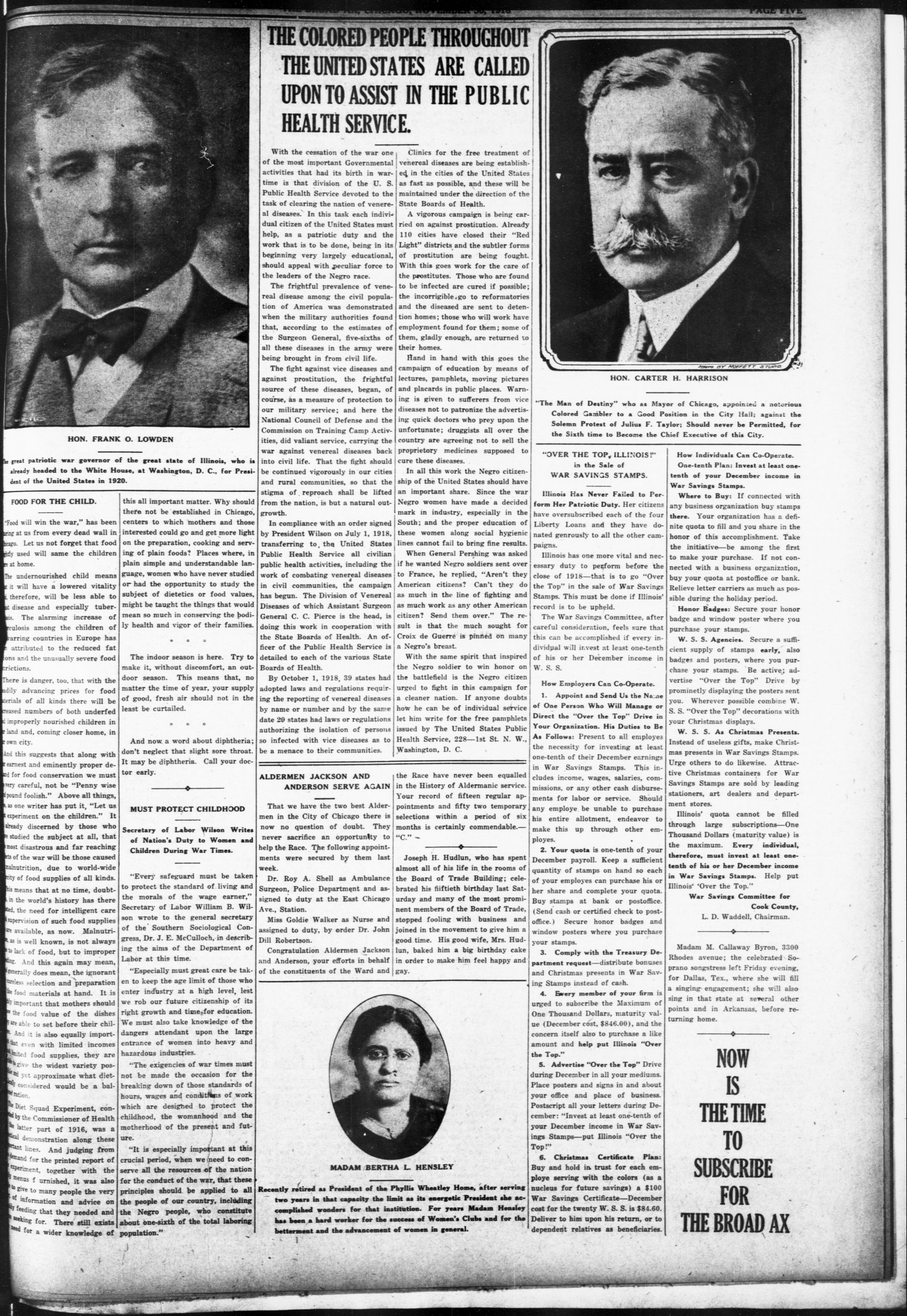
HON. FRANK O. LOWDEN
The great patriotic war governor of the great state of Illinois, who is already headed to the White House, at Washington, D. C., for President of the United States in 1920.
FOOD FOR THE CHILD.
"Food will win the war," has been caring at us from every dead wall in shirago. Let us not forget that food tightly used will same the children are at home.
The undernourished child means it will have a lowered vitality and therefore, will be less able to eat disease and especially tuberculosis. The alarming increase of circulosis among the children of warring countries in Europe has been attributed to the reduced fatcons and the unusually severe food restrictions.
There is danger, too, that with the radily advancing prices for food materials of all kinds there will be increased numbers of both underfed and improperly nourished children in irland and, coming closer home, in crown city.
And this suggests that along with breastest and eminently proper demand for food conservation we must every careful, not be "Penny wise pound foolish." Above all things, as one writer has put it, "Let us experiment on the children." It already discerned by those who are studied the subject at all, that most disastrous and far reaching acts of the war will be those caused malnutrition, due to world-widearity of food supplies of all kinds. This means that at no time, doubtless in the world's history has there been, the need for intelligent care and supervision of such food supplies are available, as now. Malnutrition, as is well known, is not always due to lack of food, but to improper feeding. And this again may mean, and generally does mean, the ignorant careless selection and preparation of the food materials at hand. It is really important that mothers should know the food value of the dishes they are able to set before their children. And it is also equally important that even with limited incomes limited food supplies, they are able to give the widest variety possible and yet approximate what dietically considered would be a balanced ration.
The Diet Squad Experiment, conducted by the Commissioner of Health the latter part of 1916, was a medical demonstration along these current lines. And judging from demand for the printed report of experiment, together with the menu s f urnished, it was also to give to many people the very of information and advice on only feeding that they needed and seeking for. There still exists need for a wider knowledge of
this all important matter. Why should there not be established in Chicago, centers to which mothers and those interested could go and get more light on the preparation, cooking and serving of plain foods? Places where, in plain simple and understandable language, women who have never studied or had the opportunity to study the subject of dietetics or food values, might be taught the things that would mean so much in conserving the bodily health and vigor of their families.
The indoor season is here. Try to make it, without discomfort, an outdoor season. This means that, no matter the time of year, your supply of good, fresh air should not in the least be curtailed.
And now a word about diphtheria; don't neglect that slight sore throat. It may be diphtheria. Call your doctor early.
MUST PROTECT CHILDHOOD
Secretary of Labor Wilson Writes of Nation's Duty to Women and Children During War Times.
"Every safeguard must be taken to protect the standard of living and the morals of the wage earner," Secretary of Labor William B. Wilson wrote to the general secretary of the Southern Sociological Congress, Dr. J. E. McCulloch, in describing the aims of the Department of Labor at this time.
"Especially must great care be taken to keep the age limit of those who enter industry at a high level, lest we rob our future citizenship of its right growth and time for education. We must also take knowledge of the dangers attendant upon the large entrance of women into heavy and hazardous industries.
"The exigencies of war times must not be made the occasion for the breaking down of those standards of hours, wages and conditions of work which are designed to protect the childhood, the womanhood and the motherhood of the present and future.
"It is especially important at this crucial period, when we need to conserve all the resources of the nation for the conduct of the war, that these principles should be applied to all the people of our country, including the Negro people, who constitute about one-sixth of the total laboring population."
---
* 4 4
☆ ☆ ☆
THE COLORED PEOPLE THROUGHOUT THE UNITED STATES ARE CALLED UPON TO ASSIST IN THE PUBLIC HEALTH SERVICE.
With the cessation of the war one of the most important Governmental activities that had its birth in wartime is that division of the U. S. Public Health Service devoted to the task of clearing the nation of venereal diseases. In this task each individual citizen of the United States must help, as a patriotic duty and the work that is to be done, being in its beginning very largely educational, should appeal with peculiar force to the leaders of the Negro race.
The frightful prevalence of venealreal disease among the civil population of America was demonstrated when the military authorities found that, according to the estimates of the Surgeon General, five-sixths of all these diseases in the army were being brought in from civil life.
The fight against vice diseases and against prostitution, the frightful source of these diseases, began, of course, as a measure of protection to our military service; and here the National Council of Defense and the Commission on Training Camp Activities, did valiant service, carrying the war against venereal diseases back into civil life. That the fight should be continued vigorously in our cities and rural communities, so that the stigma of reproach shall be lifted from the nation, is but a natural outgrowth.
In compliance with an order signed by President Wilson on July 1, 1918, transferring to, the United States Public Health Service all civilian public health activities, including the work of combating venereal diseases in civil communities, the campaign has begun. The Division of Venereal Diseases of which Assistant Surgeon General C. C. Pierce is the head, is doing this work in cooperation with the State Boards of Health. An officer of the Public Health Service is detailed to each of the various State Boards of Health.
By October 1, 1918, 39 states had adopted laws and regulations requiring the reporting of venereal diseases by name or number and by the same date 29 states had laws or regulations authorizing the isolation of persons so infected with vice diseases as to be a menace to their communities.
ALDERMEN JACKSON AND
That we have the two best Aldermen in the City of Chicago there is now no question of doubt. They never sacrifice an opportunity to help the Race. The following appointments were secured by them last week.
Dr. Roy A. Shell as Ambulance Surgeon, Police Department and assigned to duty at the East Chicago Ave., Station.
Miss Goldie Walker as Nurse and assigned to duty, by order Dr. John Dill Robertson.
Congratulation Aldermen Jackson and Anderson, your efforts in behalf of the constituents of the Ward and
MADAM/BERTHA L. HENSLEY
Recently retired as President of the Phyllis Wheatley Home, after serving two years in that capacity the limit as its energetic President she accomplished wonders for that institution. For years Madam Hensley has been a hard worker for the success of Women's Clubs and for the betterment and the advancement of women in general.
Clinics for the free treatment of venereal diseases are being established in the cities of the United States as fast as possible, and these will be maintained under the direction of the State Boards of Health.
A vigorous campaign is being carried on against prostitution. Already 110 cities have closed their "Red Light" districts and the subtler forms of prostitution are being fought. With this goes work for the care of the prostitutes. Those who are found to be infected are cured if possible; the incorrigible go to reformatories and the diseased are sent to detention homes; those who will work have employment found for them; some of them, gladly enough, are returned to their homes.
Hand in hand with this goes the campaign of education by means of lectures, pamphlets, moving pictures and placards in public places. Warning is given to sufferers from vice diseases not to patronize the advertising quick doctors who prey upon the unfortunate; druggists all over the country are agreeing not to sell the proprietory medicines supposed to cure these diseases.
In all this work the Negro citizenship of the United States should have an important share. Since the war Negro women have made a decided mark in industry, especially in the South; and the proper education of these women along social hygienic lines cannot fail to bring fine results. When General Pershing was asked if he wanted Negro soldiers sent over to France, he replied, "Aren't they American citizens? Can't they do as much in the line of fighting and as much work as any other American citizen? Send them over." The result is that the much sought for Croix de Guerre is pinned on many a Negro's breast.
With the same spirit that inspired the Negro soldier to win honor on the battlefield is the Negro citizen urged to fight in this campaign for a cleaner nation. If anyone doubts how he can be of individual service let him write for the free pamphlets issued by The United States Public Health Service, 228—1st St. N. W., Washington, D. C.
the Race have never been equalled in the History of Aldermanic service. Your record of fifteen regular appointments and fifty two temporary selections within a period of six months is certainly commendable.— "C."
Joseph H. Hudlun, who has spent almost all of his life in the rooms of the Board of Trade Building; celebrated his fifteenth birthday last Saturday and many of the most prominent members of the Board of Trade, stopped fooling with business and joined in the movement to give him a good time. His good wife, Mrs. Hudlun, baked him a big birthday cake in order to make him feel happy and gay.
PHOTO BY MOFFETT STUDIO
HON. CARTER H. HARRISON
"The Man of Destiny" who as Mayor of Chicago, appointed a notorious Colored Gambler to a Good Position in the City Hall; against the Solemn Protest of Julius F. Taylor; Should never be Permitted, for the Sixth time to Become the Chief Executive of this City.
"OVER THE TOP, ILLINOIS!" in the Sale of
WAR SAVINGS STAMPS.
Illinois Has Never Failed to Perform Her Patriotic Duty. Her citizens have oversubscribed each of the four Liberty Loans and they have donated genrously to all the other campaigns.
Illinois has one more vital and necessary duty to perform before the close of 1918—that is to go "Over the Top" in the sale of War Savings Stamps. This must be done if Illinois' record is to be upheld.
The War Savings Committee, after careful consideration, feels sure that this can be accomplished if every individual will invest at least one-tenth of his or her December income in W. S. S.
How Employers Can Co-Operate.
1. Appoint and Send Us the Name of One Person Who Will Manage or Direct the "Over the Top" Drive in Your Organization. His Duties to Be As Follows: Present to all employees the necessity for investing at least one-tenth of their December earnings in War Savings Stamps. This includes income, wages, salaries, commissions, or any other cash disbursements for labor or service. Should any employee be unable to purchase his entire allotment, endeavor to make this up through other employees.
2. Your quota is one-tenth of your December payroll. Keep a sufficient quantity of stamps on hand so each of your employees can purchase his or her share and complete your quota. Buy stamps at bank or postoffice. (Send cash or certified check to postoffice.) Secure honor badges and window posters where you purchase your stamps.
3. Comply with the Treasury Department request—distribute bonuses and Christmas presents in War Saving Stamps instead of cash.
4. Every member of your firm is urged to subscribe the Maximum of One Thousand Dollars, maturity value (December cost, $846.00), and the concern itself also to purchase a like amount and help put Illinois "Over the Top."
5. Advertise "Over the Top" Drive during December in all your mediums. Place posters and signs in and about your office and place of business. Postscript all your letters during December: "Invest at least one-tenth of your December income in War Savings Stamps—put Illinois "Over the Top!"
6. Christmas Certificate Plan: Buy and hold in trust for each employee serving with the colors (as a nucleus for future savings) a $100 War Savings Certificate—December cost for the twenty W. S. S. is $84.60. Deliver to him upon his return, or to dependent relatives as beneficiaries.
of Chicago, appointed a notorious position in the City Hall; against the ylar; Should never be Permitted, for chief Executive of this City.
How Individuals Can Co-Operate.
One-tenth Plan: Invest at least one-tenth of your December income in War Savings Stamps.
Where to Buy: If connected with any business organization buy stamps there. Your organization has a definite quota to fill and you share in the honor of this accomplishment. Take the initiative—be among the first to make your purchase. If not connected with a business organization, buy your quota at postoffice or bank. Relieve letter carriers as much as possible during the holiday period.
Honor Badges: Secure your honor badge and window poster where you purchase your stamps.
W. S. S. Agencies. Secure a sufficient supply of stamps early, also badges and posters, where you purchase your stamps. Be active; advertise "Over the Top" Drive by prominently displaying the posters sent you. Wherever possible combine W. S. S. "Over the Top" decorations with your Christmas displays.
W. S. S. As Christmas Presents. Instead of useless gifts, make Christmas presents in War Savings Stamps. Urge others to do likewise. Attractive Christmas containers for War Savings Stamps are sold by leading stationers, art dealers and department stores.
Illinois' quota cannot be filled through large subscriptions—One Thousand Dollars (maturity value) is the maximum. Every individual, therefore, must invest at least one-tenth of his or her December income in War Savings Stamps. Help put Illinois' 'Over the Top.' War Savings Committee for Cook County, L. D. Waddell, Chairman.
Madam M. Callaway Byron, 3300 Rhodes avenue; the celebrated Soprano songstress left Friday evening, for Dallas, Tex., where she will fill a singing engagement; she will also sing in that state at several other points and in Arkansas, before returning home.
NOW IS THE TIME TO SUBSCRIBE FOR THE BROAD AX
---
THE FASHION OF THE TWENTIES
TWO AFTERNOON FROCKS TRIMMED WITH EUR.
On the left is one showing a short, loose tunic of terra cotta chiffon, trimmed with skunk and embroidered in black. There is a narrow skirt of black satin and a long chain of jet. The large hat is of fur. On the right is a black velvet frock fastened in back and trimmed with narrow bands of ermine. There is a sash of black and silver brocaded ribbon.
CAN YOU DRESS ON $125 YEAR?
Question Is Answered in Figures by the Federal Bureau of Labor Statistics.
FASTEN DOWN SPINAL COLUMN
New Fashion for Frocks and Coats Re-
vived From an Old One—Skirt
Lines Must Follow Lines
of the Body.
New York.—Since the days of the
Roosevelt administration in Wash-
ington depressing statements have come
from the social center anent the cost
of being well dressed. Depressing for
the reason that they were so appla-
ingly low. Nothing so produces dis-
couragement in humans, writes a fash-
ion authority, as to be told that they
should and can accomplish a desired
result on a sum of money that they
consider almost too small for the pre-
liminaries.
You as a woman know that full well. What would reduce you to greater rage or a feeling of utter hopelessness than to be told by the head of the family of the amazing achievements of another woman in regard to money, to clothes, and to food?
You have done your best with your allowance, of that you are sure. Such is the feeling that surges in every woman's mind and heart when Washington informs us, infrequently, what can be done in our own chosen line of work at a slight expenditure of money.
Now, when Washington—through the bureau of labor statistics, not through the White House—gives as the average cost of being well dressed the following figures, one feels like giving up the whole problem of how to look well on little. The total yearly allowance for dress of these women
TWO AFTERNOON FROCK
On the left is one showing a short trimmed with skunk and embroidered of black satin and a long chain of jeans right is a black velvet frock fastened bands of ermine. There is a sash of
who make a smart appearance (the phrase belongs with the statistics) is $125 a year. Can you do it?
Here Are the Figures.
Outside clothing (suits, coats, sweaters, dresses, waist, dress skirts).
$57.58; hats, $11.59; shoes, $14.20; gloves, $3.32; stockings, $5.53; corsets, $3.41; underwear, $7.18, and miscellaneous, $14.27.
"As regards external clothing, it would appear that the average wage-earning woman who is well dressed usually chooses these items of her wardrobe from the following priced articles: Suit or coat (alternate years), $25 to $30; shirtwaists, $6 to $15; one-piece dress, $15; wool skirt, $5 to $10; summer skirts, $3 to $5; party dress (worn for two years), $25.
"If close economy is necessary, a skirt at about $5 may be worn with separate waists in lieu of a $15 one-piece dress, or a dress waist worn with a suit may be substituted for an evening dress, or a winter coat may be worn for three seasons, or an evening dress for three or four years. In view of the range of choice, it appears that a woman may reasonably be expected to secure outside clothing for a good appearance at an expenditure of from $70 to $75.
"As regards articles of dress other than outside clothing, the necessary expenditures would be distributed roughly as follows: Hats, $10 to $15; shoes, $12 to $17; gloves, $2.50 to $5; stockings, $3 to $7; corsets, $2 to $5; underwear, $5 to $10; and miscellaneous, approximately $10. Allowing for individual variation in prices and choice, this means an annual expendi-
---
ture of from $50 to $60 for these articles, which as a rule have to be replaced each year.
"Combining these two amounts—outside clothing $70 to $75, and other articles of dress $50 to $60—the total yearly expenditure would range from $120 to $135, averaging approximately, say, $125."
True, these are wage-earning women, the story points out; but it adds that they are as well dressed as the immense majority of women who have no more, and often not nearly as much as the wage-earner to spend on clothes; and furthermore, as idlers are rare these days, the budget may be taken as intended for the average woman. No one includes the millionaire in any form of appeal, information or advice to women on the matter of clothes.
That Uncorseted Figure.
Figures belong to the individual, but fashions to the multitude; therefore it is easier to be dictatorial about the latter than the former. The law is better established; the mathematical average has no part. Fashions are, or they are not. They are launched even if they do not succeed; and the exceeding interest in them is often caused by the great gamble which is connected with them.
The directoire inspiration in the uncorrupted figure is a gamble, roughly speaking. It was launched some months ago, but the public thought it one of those revivals that rarely get beyond the salons of the extreme designers. Yet this inspiration has survived the months, and it grows in fashion, if not in grace. We call it directoire merely because that epoch in dress exploited it, along with a host of other fashions that were taken up in the name of "classic." It started as a reaction from the furbelows of the pre-Revolutionary time, as worn by Marie Antolinette. It was called the Greek costume, and the historians tell us that it came about through the attempt of two famous young sculptors to cut a pattern for such a robe for a stout and matronly "mere de famille," who insisted upon it.
The clinging effect of the skirts is as strongly accentuated now as then, and we, like the women of that day.
KS TRIMMED WITH FUR.
short, loose tunic of terra cotta chiffon,
ed in black. There is a narrow skirt
set. The large hat is of fur. On the
ed in back and trimmed with narrow
of black and silver brocaded ribbon.
have discarded the chemise; yet if must be quickly said that we use a substitute. We are not going in for the transparent drapery without a lining. No scandals like those of Mme Hamellin's day for us!
All Skirts Must Cilng.
No imposed drapery on the skirt of this winter is permitted to give it bulk or bulging curves. Lines must follow those of the body. In so much have we adopted the classic. Therefore soft materials are preferred. Satin, panne velvet and chiffon velvet are chosen more than other fabrics for those frocks.
Chiffon itself has taken a second or third place, and dyed lace is pushed forward as a substitute. Even cream lace is revived for entire frocks, but it does not have the prestige of gray or brown. Both these colors are draped over tulle or satin in the same or a contrasting color.
The odd feature about this revival of an old, old style of fastening is that the exclusive tailors have applied it to coats. In that touch we get something novel. Jackets of petry are fashioned in this manner, and there are combinations of velours and soft fur that are put together like a culrass blouse, in a very loose fashion, to go with skirts of the cloth, but they rank as coats and not blouses.
Heavy furs are worn that give sufficient protection in the open. And this verdict for petry placed on petry pleases the public. Some women look like pack-mules with an overload.
(Copyright 1988, by the McClure News)
(Copyright, 1918, by the McClure Newspaper Syndicate.)
CHIC DANCE DRESS
Frock May Be Made of White Chiffon or Other Material.
Garment Is Trimmed Very Simply With Rows of Inch-Wide Glossy Ribbon in Color.
The little dance dress shown in the sketch may be made of white chiffon, net geogette or silk tissue, and it is trimmed very simply with rows of inch-wide glossy ribbon in color. Rainbow colors may be selected for the ribbon, two or three of these dainty pale
1920s
Ribbon-Trimmed Dance Frock
shades being used with very good effect. If desired, the fabric of the gown may also be in color, and the frock be a genuine rainbow affair.
A foundation of sheer silk should be used for the dress, and it may be made a slipover by running an elastic in at the waistline. Two or three ribbon straps hold it in place over the shoulder, and a ribbon girdle with long ends circles the waist.
A dress of this kind is easy to make and may be very inexpensive. Spending a great deal of money on a dance or evening dress is never really necessary and at present it is poor taste. There will be few formal evening functions during the coming winter season, and the simple dances scheduled call for simple costuming.
Allover lace dress is always pretty, and many lace dresses are being featured for the coming season. Extreme simplicity is the rule in designing these frocks. Frequently the bodice is merely a wide girdle of silk or satin topped by a frill or yoke of lace and with short lace sleeves. The skirt may be a single length of lace, or it may be formed of two or three lace flouces. A ribbon sash or girdle finishes the dress. Ribbon trimming is extremely popular this season. Plain bands of ribbon are used on frocks for both daytime and evening wear, and ribbon flowers, bowknots, etc., appear on innumerable evening dresses of sheer materials.
Very narrow "baby" ribbon is often knitted to form cuffs and collar for a street suit or frock, and the knitted ribbon sweater has been worn for months. During the summer it was merely a sweater, now it appears as a sleeveless vest to be worn underneath the suit jacket.
APRON DRAPERIES ARE SMART
Tablier Is Really Only a Panel—Arrangement to Be Much in Evidence This Winter.
Apron draperies appear on so many things that they may be considered a distinct fashion. They may be short or long and they may or may not have the slightest connection with the dress proper. It is as if one had really added an apron of brocade or marquisette or satin to the dress one is wearing.
Sometimes they begin at the neck and hang straight down well below the hips and are caught in only with the narrowest of string belts. Again a hem is folded back on the bottom of the drapery, as in a peasant's apron and bright-hued embroidery is added in criss-cross stitches.
In effect the tablier is really only a panel such as appeared on summer frocks. As this arrangement is to be much in evidence this winter it is well to note that any sort of fabric can be used to develop it. With velvet the gold and silver brocades, with a banding of fur, are very smart. As no fullness is seen on the bodices this season, most of them being of the basquelike plainness of the Civil war, the apron tunic may begin at the collar as a waistcoat, spreading out at the waistline, from which it falls free. Now and then the tunic tablier buttons in the back or, again it is set in quite apart from any relations to either back or front.
LACE ON THE CURVED EDGE
How to Overcome the Perplexing Task of Putting the Straight Material in Place.
Have you often been troubled in putting straight lace on a curved edge?
You have been if you have ever tried putting cluny, for instance, on the outside edge of a big round centerpiece.
This is an easy way to overcome the difficulty. Roll the lace in a little tight roll. Wind it tightly about the center with a stout thread. Then dip the straight edge in water to about half the width of the lace. Let it dry and you will find a piece of lace ready shaped to your liking. You see what happens is that the straight edge, being wetted, shrinks, and so can be easily adjusted to the curved edge of the centerpiece.
If you have any new table linen—or cotton, mayhap—to hem, try this method. Trim such edges as need trimming and then run them through the machine hemmer, with a fine needle, unthreaded. This will crease the hems with perfect evenness and will also punch holes through the fabric with the unthreaded needle. Then you can turn the hem back and overhand the hems through the little holes with the least expenditure of effort.
Remember in many heavy materials that must be laid in plaits and then pressed that pins can be used to fasten the plaits into position until they are pressed. Then, as you press, take out the pins and press the material into position. You can do this with less marking than basting thread heavy enough to hold the fabric makes. Of course if you want to you can use the heavy basting thread and snip it and pull it as you go along.
METAL AND COTTON THREAD
Combination Is Effective and Affords Charming Variations; Suggestions for the Needlewoman.
There is an increasing vogue for combining metal thread with silk, wool, or cotton embroidery. It is tremendously effective and capable of such charming variations. Here are some suggestions for the needleworker who is interested in the unusual.
Say, suppose, you have some "solid" work in silk, cotton or wool. You don't know how very effective it can be made by an outlining in either gold or silver thread. The idea can be further carried out by adding French knot centers to the flowers of the same.
Where the embroidery is done entirely in outline, and particularly if it be the heavy wool or cotton kind, couching in metal is a mighty successful addition. In fact, if the wool or cotton embroidery isn't already done, try couching it on with the metallic stuff and just see if it isn't vastly more decorative.
Another suggestion for introducing the metal is to "whip stitch" the other thread with it. Wool whipped on the blas, spiral effect is the most fascinating thing ever.
Davallis:
Oudsworn &
Bodsworn
All the way from France comes this extremely chic coattee with gray velvet vest. With it it is worn a small triangular hat of mole, ornamented by silver flowers.
Narrow Ribbons on Hats
Not only are narrow ribbons—usually half an inch to an inch wide—being used more or less in making hats for women, but on both popular-priced and expensive models gold or silver ribbons of the same widths are employed as trimming. Either they are drawn around the crown and finished off in soft bows or streamers or they are fashioned into flowers laid flat on the brims or around the crown. These trimming are said to be especially effective when worn on dark hats.
FROCKS OF PELTRY
Gowns for Street and Evening Entirely of Fur
Soft Kind of Material, Superimposed on Silk or Satin—Kinship to Ancient Costumes.
In Paris they delight in medieval gowns of peltry. In such costumery there is not only the determination to be unique, but to be warm. We, at the apex of scientific civilization and hygiene, observes a fashion writer, have been cast down into the depths of medieval discomfort and disease through the failure of mechanical organization during the war. We thought the world forever free from plagues, but we have been visited by one which spread over a world and gathered in its victims as did the dread plagues of a century ago. We who had ceased to think that hunger and cold—both elemental disasters—could ravage our health, have been face to face with both, over three continents. No longer did only the poor and dirty, those easy victims of all disasters, pay the final penalty; but those who had for over a century considered themselves immune through the adoption of all that science and health demanded.
Was it not natural, then, that, under the accumulation of the catastrophes, women should turn to the kind of apparel that kept their far-away ancestors comfortable? At least the French women must think along this line, for they have provided themselves with evening gowns and street gowns made entirely of peltry. It is a soft kind of fur which is used, and it is superimposed on silk or satin; but it produces a strong kinship to the costumes of the year one.
When the gown of fur is not worn there is a new kind of huge fur hat which is supposed to furnish the warm touch. It has a cart-wheel brim and is usually devoid of trimming. Only the oval, slim face can permit it. It is not the hat for the average woman, but it is new, and therefore desirable.
There are also wraps that give more weight than warmth—a high quality in a covering—and which are fashioned somewhat like the dolmans of Victorian days. They have obliterated the ugliness of that period and developed a smart appearance. They contribute to the need for economy in apparel, for they allow the usage of a one-piece frock, and even the fall or spring tailored suit. In sealskin, beaver, moleskin, they are at their best. A collar of another peltry can be added if it is considered desirable. There are women who are not happy in a garment that is left unadorned.
BITING NAILS, CHEWING LIPS
Disfiguring Habits Easily Acquired, Young Girls and Older Women Being Among Offenders.
One of the most unwholesome and disfiguring habits is the biting of the nails and chewing the lips. All ages, too, are represented, since wee children, young girls and older women are among the frequent offenders.
Chewing the lips, extracting bits of skin from the lips, or biting them is a habit which tends to disfigure the mouth by making it larger and pulling it out of shape. Thus the expression of the face changes for the worse. This habit is easily acquired and grows apace. Some persons immediately start to bite their lips as soon as they are engrossed in a book or with work in hand. Facial distortions are often grotesque, though the offender is totally unconscious of the attention he is attracting.
While this practice of drawing the lips about does not improve the face, it is not in the same class with biting the nails, which admits thousands of germs directly into the mouth, hence to the stomach and intestines, and so on into the blood.
FASHIONS IN BRIEF
The newest veils are of tulle, chiffon or chantilly lace. Stitching of silk or wool makes a very attractive trimming.
A beautiful cape is of cerise wool jersey, lined with gray silk. There is a tendency to place wings at the back of a hat. Boots will measure eight inches from the breast of the heel. Millinery colorings are dull and one-tone effects are favored.
[ ]
This is an exceptionally interesting hat of black panne velvet. A large flat bow threaded in gold is laid across the front of the rose brim, adding charm to its lines.
© Western Newspaper USA
This charming afternoon gown of navy blue velvet comes from Lady Duff Gordon. It is fastened high on the neck with an interesting array of steel buttons on the waist and the sleeves.
NO EXTREME FEATURES USED
New Fall and Winter Clothes Are Marked by a General Air of Simplicity.
In viewing the new clothes for fall and winter one is struck by the absence of extreme features, and also by the general air of simplicity displayed. Colors are quiet, browns, blues and black predominating, with here and there a demure costume carried out gray or taupe. Even embroidery has been subdued, and although in a few cases bright-colored wool or silk is used, the general tendency is toward gray and beige, or a soft coppery color that is new and most attractive.
As inevitable as the season itself the serge street frock, and its variations are many; so, while at first glance there is a slightly monotonous effect in the costuming of the women now throng the smart restaurants and shops, a closer inspection reveals individuality in the arrangement of certain new details of trimming, the cut of the neck or fashion sleeve. To keep to the fad of using little wool as possible there are many clever combinations of fabrics and so is inclined to feel that this rule, stead of hindering, has been an aid to the creative abilities of designers.
NEWEST FASHIONS ARE CHN
Late Styles Are Regarded as More Practical Than They Have Been in Recent Years.
Taking it all in all, the new fashion are more attractive and at the same time more practical than they have been in years. Here are a few salient characteristics:
Belts are either soft and draped on flat and straight. One Paris frost has a belt made of a strip of inch-wide braid with the ends crossed and falling in short tabs. The most graceful sash is of satin, with fringed ends.
The new color is henna, sometimes called rust color. All the browns will be fashionable and certain shades of green. Gray is much liked for street costumes and taupe and gray makes smart combination. Every other dress gown is black.
A yard and twelve inches will
enough width for the fall skirt—if one
wishes to be extremely smart. More
conservative taste may increase the
width as far as a yard and three-gu-
ters—no more than that is permit-
by fashion.
Sleeves must be tight as one can
stand them, with small armholes
and the wrist provided with buttons
and loops or other fastening devices
that one may get into the sleeve with
out a struggle.
MILLINERY HINTS
Although one occasionally sees a bright red or horizon blue hat, the fall it is the fur tones, brown and gray, that lead in millinery. This means a range of some extent, for the brown furs are rather numerous and there are several shades in the gray grouping. Sometimes a feather fance in contrasting shade is used for trimming, but more often the one color scheme is maintained.
Fringed silk ribbon is the trimming nowtily and on some of the model from Paris it resembles an ostrid feather band.
The minimum of trimming is the rule and often a narrow band of grow grain ribbon is the sole decoration of a turban or sailor shape of velvet, velour or hatter's plush.
A dainty handkerchief has one corner cut off and remade by a triangle of white net on which is one's monogram.
Residence, 1262 Macalister Place
Tel. Monroe 2714
MILES J. DEVINE
Attorney At Law
Suite 318-320 REAPER BLOCK
Clark and Washington Streets
Phone Central 1239
CHICAGO
Residence: 508 East 36th Street
Phone Douglas 4307
J. GRAY LUCAS
Attorney At Law
Suite 815 Hartford B
S. Dearborn St., Chicago.
Phone Central 6583
PHONE MAIN 2214
A. D. GASH
Attorney At Law
118 North La Salle Street
CHICAGO
S. A. T. WATKINS
LAWYER
36 WEST RANDOLPH STREET
CHICAGO
Residence, 4533 Prairie Avenue
Phone Kenwood 8520
WALTER M. FARMER
ATTORNEY AND
COUNSELOR AT LAW
NOTARY PUBLIC
Suite 708
184 W. Washington St.
Tel., Office, Main 4153 Auto 33736
CHICAGO
Phone Kenwood 10230
Res. Phone Drexel 8021
SAM. Z. C. WESTERFIELD
Attorney At Law
Office, Suit 3A-3B Casey Bldg.
4651 SOUTH STATE STREET
Res.: 4605 Champlain Ave.
CHICAGO
Office Phone 8078 (Douglas)
Residence Phone, Douglas 8179
S. A. BEADLE
LAWYER
3502 SOUTH STATE ST.
CHICAGO
Res. 3855 Prairie Ave.,
Phone Douglas 9133
Phones: Main 2017, Auto. 32-395
A. L. WILLIAMS
ATTORNEY AND COUNSELOR AT LAW
Suite 706 Firmenich Building
184 W. Washington St., Chicago.
Residence 3419 South Park Ave.
PHONE DOUGLAS 9354
WM. J. LATHAM
Attorney At Law
OFFICE PHONE: CALUMET 875
2 EAST 31ST STREET
Suite 7
CHICAGO
F. Dunn, J. B. McCahey, Trusees
Tel.: Oakland 1552, 1551, 1550
JOHN J. DUNN
ESTABLISHED 1877
Wholesale and Retail
COAL
Fifty-First and Federal Sts.
CHICAGO
PATRONIZE OUR ADVERTISERS.
---
Novel House-Boat
A desirable residence, which commands an excellent sea-view, is a fishing boat which has been converted into a dwelling house, and is now the home of a family living somewhere on the north coast of England. The situation of the dwelling suggests good facilities for indulgence in sea-bathing during the summer months.
Siamese Musical Instruments. The Siamese have an instrument which they call the ranat, a species of harmonicon, with 17 different wooden keys, united by cords and resting upon a stand, each strip of wood giving a different note. The instrument is played with two wooden hammers.
Foul Play.
Lady (who has given a tramp a plate of scraps): "You must feel the humiliation of begging for food." Tramp: "It's not that so much mum. What hurts me is that I'm depriving the pore innermate fowls of a feed."
Sharing the Joy of Life
The only real happiness in this life springs from doing things for others, and nothing gives us greater pleasure than bringing our loved ones a box of candy, of which we are very fond.—Columbus Ohio State Journal
Plurality Didn't Elect
In all of the three times that he ran for president Grover Cleveland polled a plurality of the popular vote. In his second race, when he was defeated, his plurality over Harrison was 98.017
Uncle Eben.
"A lazy man," said Uncle Eben, "wouldn't be so bad if he didn't allus want a lot of other folks to knock off foh de sake of sociability."
Force of Habit
"Ruth! I'm really surprised at you, putting, out your tongue at people." "It was all right, mother; it was only the doctor going past."
The Times That Are No More.
Old memories fade—but many a man can remember the time he helped move an old-fashioned square piano up or down stairs.
An Atchison man has figured in so many church rows his wife has put a service flag in the window.—Ithaca Globe.
Secret of Peace.
It doesn't matter how much a man and his wife disagree as long as he doesn't let her know it.—Boston Transcript.
Daily Thought.
There is no virtue so truly great and
Godlike as justice.—Addison.
The Once Over.
Life is a book. Read it carefully,
for you can only read it once.—Boston
Transcript.
Reputation.
A man's reputation is like his shadow, which is sometimes larger and sometimes shorter than the man.—Punxsutawney Spirit.
Change While You Look.
By moving a single lever a new automobile body is converted into an open car or a two-seated vehicle.
Optimistic Thought.
The highest virtue of all is victory over ourselves.
Polite Service ♥ High Grade Goods
DOUGLAS 5990
THE PALACE
ICE CREAM PARLOR
Fresh Line of
Fruits, Candies, Cigars
and Tobacco
C. S. SMITH, Proprietor
762 EAST 39TH STREET
KINKY HAIR
Atlanta, Ga.
Boston, Hed. Co.
Gentleman.
My picture show
you what your fin
EXELENTO
QUININE
POMADE
has done-or he
has done-or he
it my hair we
short and coarse
we have
lash long, and a
soft and silly that
I can do it up an
way I want to
JANIE RAND
Don't let some fake Kink Remover fool
you. You really can't straighten your hair
until it's nice and long. The
EXELENTO
QUININE
POMADE
doe, removes Dandruff, feeds the Roots of the hair, and makes it grow long, soft and silky. After using a few times you can tell the difference, and after a little it will be so peaty, and long that you can fix it up to suit you. If Exelento don't do as we claim, we will give your money back. 25c by mail on receipt of stamps or coin.
AGENTS WANTED EVERYWHERE.
Write For Particulars.
EXELENTO MEDICINE CO., Atlantic, Co.
THE BROAD AX, CHICAGO, NOVEMBER 30, 1918
To Consumers of Gas:
About Gas Bill Errors
Complaints of errors in gas bills have been unusually frequent during the past month. Mistakes will happen in any business that has to send out between 650,000 and 700,000 bills per month, as we do. The total complaints of customers filed with us are but a small percentage of bills rendered. Practically all of the gas bill mistakes happening lately are due to the following conditions: Since the war began, the army and navy have taken nearly 600 of our employes. War industries have drawn away a still larger number. Vacancies have been filled in harmony with the U.S. Government recommendations—women in place of men where possible.
The personnel in many departments has been entirely changed in the sixteen months—in some of them several times. Green help has had to be broken in. We have now nearly 300 more employees than we had before the war, with practically no more business to care for; but many departments are still short-handed because inexperienced help does less work, no matter how willing. Every business that has a large clerical force has had similar experience.
The recent influenza epidemic aggravated the situation. Our meter-reading and book-keeping departments, which get out the bills, have been hit the hardest. A consequence of all this has been the errors in bills of the past month.
These errors are being promptly and carefully corrected as soon as detected, and everything that can be done to prevent errors is being done. In the meantime:
Under the rules of the Illinois Public Utilities Commission, our customers do not lose their discount privileges during the investigation of complaints filed with us.
We do not gain by inconveniencing our customers. We are working under abnormal conditions. We ask only that our customers extend to us a little of the patience which the times demand. As war conditions pass, our service will be restored to the highest possible degree of efficiency.
The Peoples Gas Light & Coke Company
SAMUEL INSULL, Chairman
The SMARTER SET HEADED BY
Salem Tutt Whitney and J. Homer Tutt MATINEE WEDS. AND SATS., 2:15 ALSO THANKSGIVING DAY 1 SHOW NIGHTLY, EXCEPT SUN., 8:15; 2 SHOWS SUN. AND HOL., 6 AND 9 P. M. 3 WEEKS STARTING, MONDAY NIGHT, NOV. 25TH GRAND THEATER STATE AT 31ST STREET
Overheard at a county fair: (Intoxicated Man gazing in open-mouthed astonishment at an incubator just placed in floral hall and in which the chicks are beginning to hatch)—"These here incubators just beat anything I ever saw. I give you my word them eggs haven't been in here an hour and they are hatching already."
Go forth into the busy world and love it, interest yourself in its life; mingle kindly with its joys and sorrows; try what you can do for men rather than what you can make them do for you, and you will know what it is to have men yours, better than if you were their king or master.—Brooke Herford.
On fairly long journeys, say to 100 miles or more, the carrier pigeon will average a speed of from 37 to 43 miles an hour. The best horse in the world can only keep up a speed approximate to that for six or seven minutes at most. The pigeon's speed is about 33 yards a second.
An Ohio man has invented a doorknob that when grasped in the hand illuminates an electric bulb placed just above the keyhole. A genius such as he deserves to be rewarded with a seat in the United States senate—Rochester Post Express.
Exclusive of the engine, the average airplane contains 4,326 nails, 3,277 screws, 920 steel clampings, 798 forings, 276 turnbuckles, 65 pounds of aluminum and relative quantities of varnish, rubber, linen, wood, etc.
Should Be Surrounded by Water
Should Be Surrounded by Water,
First Class Scout—"Why, Johnny
Smith, your neck is simply covered
with mud!" Tenderfoot—"Say, Jim,
do you suppose that what's our teacher
meant by a neck of land?"—Boys'
Life.
To prevent an automobile spattering mud upon pedestrians there has been invented a flexible metal ring to be attached close to a tire.
Quick Work.
To Have Men Yours
Speed of Carrier Pigeons
Deserves Preferment
Materials in Airplane
Quit Your Spattering
About 70 miles northwest of Mount Sinal—where, as you remember, Moses received the Commandments—is a butter factory, the machinery of which has not been improved since his day. It consists of a bag of goat skin suspended from a tripod of poles. The Bedouin women partly fill the bag with goats' milk and then have plenty of time to discuss the neighbors as they patiently rock the bag until the butter is separated from the whey.—Popular Science Monthly.
A Nap on a 40-Mile Wind
It was not so long ago that a ten-mile breeze would upset all flying plans for a day at any airdrome or exhibition field. Now nothing short of a hurricane can keep the machines on the ground. As far as the ability to make good weather of it is concerned the airman of today can laugh at a gale and fairly take a nap sitting on a 40-mile wind.—William A. Bishop, V. C., S. O., M. C., in Saturday Evening Post.
From the Ancient Greeks.
"To throw dust in one's eyes" is a saying derived from the ancient Greeks. Epanaiondias, wishing to surprise the Laodemonians, is said to have caused 1.000 cavalrymen to advance in front, kicking up a great dust which the wind blew into the faces of the enemy, thus blinding them to a flank movement he was executing with a view to taking the coveted heights in the rear.
Marmoset's Rival.
Mrs. Ellen Walker of Philadelphia keeps as her mascot a land turtle which she has had for twenty-five years, since it first wandered into the yard of her home. The turtle is carried with her on all her travels in a basket made for the purpose. During the summer it spends its time in the garden at the Walker home. In the winter it is kept in the basement.
His Former Occupation.
The customer in the barber shop suffered in silence a long while, but there are limits to patience even in such places. He asked: "What made you take to haircutting?" The barber blandly replied: "Good money sir. Pays a sight better than hedge trimming, which was my last job."—London Answer.
As Near As Your Telephone DISTANCE IMMATERIAL
In a Metropolitan City of this size, death knocks every thirty minutes at some door. Too often that death not only brings sorrow, but misfortune as well. Let the price you pay for a funeral be a business proposition and you will benefit by it in service, quality and cost to you in dollars and cents. The result of my campaign has built for me one of the largest and most magnificent establishments in the world.
Consult me, I can save you Worry Shipping to all parts of the Country Funerals a Specialty. Central D Chapel. Call promptly answered da
Ernest H. Willi
KENWOOD
455
Undertak
5028 and 5030 S. State St.,
THE CR
Apartment
3600 WAB
The finest building ever op cago. Steam heat, electric l
Consult me, I can save you Worry, Time and Money. Shipping to all parts of the Country and Automobile Funerals a. Specialty. Central-Display Rooms and Chapel. Call promptly answered day or night.
THE FORTY-FOURTH STREET
The finest building ever opened to Colored tenants in Chicago. Steam heat, electric lights, tile baths, marble entrance
OWNERS AND DIRECTORS
DAN M. JACKSON
GEO. T. KERSEY
DAVID A McGOWAN
AHMED A. RAYNER
OPEN DAY
The Ema
Undertak
2959-61 S
Reliable Service
Reason
FREE CHAPE
Complete Line of Funeral
ACKSON
MURSEY
GOWAN
RAYNER
Phones Calum
Automatic
OPEN DAY AND NIGHT
The Emanuel Jackson
Undertaking Co., Inc.
2959-61 South State Street
Service Courteous
Reasonable Prices
FREE CHAPEL IN CONNECTION
line of Funeral Goods Automo
DAN M. JACKSON
GEO. T. KERSEY Phones Calumet 6164
DAVID A McGOWAN Automatic 71-629
AHMED A. RAYNER
OPEN DAY AND NIGHT
2959-61 South State Street
Reliable Service Courteous Treatment
Reasonable Prices
FREE CHAPEL IN CONNECTION
Complete Line of Funeral Goods Automobiles for Hire
A. F. CODOZOE
J. H. WHISTON, Proprietors
CHAS. HARRIS, Manager
The E
and
3030 STATE STREET
FOR
2, 4, 5 and
LAKEVIEW BUILDING
The Elite Cafe and Buffet
TE STREET
FOR RENT
2,4,5 and 6 Room Flats VIEW BUILDING, 3100 ELLIS AVE
LAKEVIEW BUILDING, 3100 ELLIS AVENUE
Steam heat, hot water, electric light, wall beds, and strictly modern in every respect
GEO. F. HARDING, J
Phone Douglas 1
PATRONIZE OU
APPLY
HARDING, Jr., REAL ESTATE
GEO. F. HARDING, Jr., REAL ESTATE OFFICE Phone Douglas 1 3101 Cottage Grove Ave.
JOHN H. HARRIS
Phone Main 263
As Your Telephone
NCE IMMATERIAL
City of this size, death knocks every
some door. Too often that death
now, but misfortune as well. Let the
mercal be a business proposition and
it in service, quality and cost to you.
The result of my campaign has
of the largest and most magnificent
NFORD
Building
AVENUE
to Colored tenants in Chi-
tile baths, marble entrance
J. W. CASEY, Agent 133 W. Washington Street
Phones Calumet 6164
Automatic 71-629
END NIGHT
Michael Jackson
G Co., Inc.
State Street
Courteous Treatment
Prices
CONNECTION
Automobiles for Hire
AUTO. 72-379
Phones: DOUGLAS 3256
DOUGLAS 5071
e Cafe
uffet
CHICAGO
ENT
Room Flats
100 ELLIS AVENUE
REAL ESTATE OFFICE
01 Cottage Grove Ave.
APPLY
PAGE SEVEN
Chicago, Ill.
THE BR
THE BROAD AX
PUBLISHED EVERY SATURDAY
In this city since July 15th, 10
Republicans, Democrats, Catholics
infidels or anyone else can have the
proper and responsibility is fixed.
The Broad Ax is a newspaper
all, ever claiming the editorial re
Local communications will re
on one side of the paper.
Subscriptions must be paid in
One Year
Six Months
Advertising rates made known
Vol. XXIV NOVEMBER
Address all co
THE B
6206 South Elizabeth
Phone Wen
JULIUS F. TAYLOR
DR. M. A. MAJORS
In this city since July 15th, 1899, without missing one single issue. Republicans, Democrats, Catholics, Protestants, Single Taxers, Priests, infidels or anyone else can have their say as long as their language is proper and responsibility is fixed.
The Broad Ax is a newspaper whose platform is broad enough for all, ever claiming the editorial right to speak its own mind. Local communications will receive attention. Write plainly, only
One Year $2.00
Six Months 1.00
Advertising rates made known on application.
Vol. XXIV NOVEMBER 30, 1918 No. 11
4700 South State Street,
Phone Drexel 1416
IMPORTANT
For resolutions, obituary no special announcements of events a sion is made, and the opening of cents per line; 6 words or fraction.
Personal or social items such everything of a general interest,
Entered as Second-Class Matter, August Under Act of
IMPORTANT NOTICE
For resolutions, obituary notices, cards of thanks, write-ups, special announcements of events to happen, when a charge of admission is made, and the opening of new business enterprises, etc., 15 cents per line; 6 words or fraction makes one line. Personal or social items such as marriages, births, deaths and everything of a general interest, published free of charge.
Entered as Second-Class Matter, August 19, 1902, at the Post Office at Chicago, Ill., Under Act of March 3, 1879.
WHY WE SHOULD DO BIG
THINGS.
Some of the reasons why the Negroes of Chicago should operate a Negro Department store.
We as a race use everything needed by civilized peoples. It is not consistent that we must spend our money for our needs where the consideration of employment is out of the question and does not enter it.
We deem it one of the expediencies of any people to sell everything that, that people must use, must eat, must wear, must have.
Business training of Negroes cannot be gotten other than by operating Negro business. Other people will not give us employment so that we can acquire such training.
The Negro is progressive and aggressive other people have developed large lucrative corporations giving employment to only people with white faces, why may we not incorporate, co-operate and establish lurative business and employ our young men and women who are intellectually fitted to do other work than mere drudgery and who have dark faces?
Are we not a part of the people comprising the nation? Why then may we not help make democracy for ourselves.
We are by reason of our status as civilized people impelled by the law of progress to eat, dress, and embellish our homes according to our ability, why then may we not sell such things that make for our comfort and progress?—For our success? Our permanence?
We are ambitious, have aspirations and dreams of wealth and all that it means to be independent, since merchants have grown wealthy, from small stores to huge whole block Department stores, why may not commercial economics be a good thing by way of business enterprise for Negroes? Our wants are the same, our desire for comfort is the same, and poverty is just as foreboding and hurtful to us as it is to people of white faces?—We eat the best the market affords.—We dress in all the latest styles, and furnish our homes with the best material, why may we not make, and trade and supply our wants just as other people do?
There is not a reason to be found after the most searching scrutiny, capable of our ablest mind to impeamh the foregoing statements, and there never can be a sensible reason to back up any argument against the Negro operating a large Department store on the south side in the heart of a segrogated Negro population.
DETERMINING FACTORS
Above all things else I besech you bretheren in this day of world freedom to close up ranks, present a united front and build a strong foundation for a strong superstructure, a dream no doubt of a half million brave black troops who crossed the sea and bore the brunt of battle for a better human light and
PAGE EIGHT
in whose platform is broad enough for
right to speak its own mind.
receive attention. Write plainly, only
on advance.
$2.00
1.00
on application.
BER 30, 1918 No. 11
communications to
ROAD AX
North Street, Chicago, Ill.
Detworth 2597.
Editor and Publisher
Associate Editor
optices, cards of thanks, write-ups,
to happen, when a charge of admis-
sion new business enterprises, etc., 15
makes one line.
th as marriages, births, deaths and
published free of charge.
19, 1902, at the Post Office at Chicago, Ill.
March 3, 1879.
love to guide mankind to brighter
days ahead.
Mix well your earnest heart with a growing determination equal in quantity to belliocose resolutions, fortify the mixture with truth ad libertin, courage and force.of character to beautify th mixture. Save your money, and spend judiciously, investing it in-safe business, and keep a clean mind and body, and this remedy taken regularly in large doses will stimulate you while you work and make you strong to hear the vissiscisitudes of regular life.
A resolute determined will to work and save, keeping mind and body clean are the things that help largely in character building. A day of great proportions is about here.—The hiddeous form of hypocrisy is sulking to the rear.—People who appreciate the conduct of Negro soldiers "over there" are not low and vile enough to keep acutely and alive their hellish prejudices. — People whose faces are white do not need black hearts any more to animate them. Color is blotted off the face of the earth and the map of the world.—Today all blood is red red.
The present high prices of chicken, duck and turkey are supplying the Negro with information these days, that that old "gag" about the Negro and chicken is buncombe.—Chicken and water melon would go out of fashion if it were not for the commercial aspect of the white man's nature, and his stomach.—And he eats o'ppossum too, and his lips get just as greasy and his jaw works just as joyously as any Negro who ever plowed a mule, or skinned a jackrabbit.—Humanity is very much alike.—"Fleecy locks and black complexion cannot forfeit natures claim, skins may differ but affection dwells in black an white the same."
Do not forget to save a little every day.—Spend a little while you are spending with the colored men and women in business.—These principles carried forward mean vastly more to the race than a few political jobs.—But get the jobs too.—Do not forget that we must make, and sell as well as to buy what other people have made.—It takes more than smiles and satisfied feeling to get a rating in Bradstreet & Dunn.—Brace up and try to be somebody.
So much has been done to us, it might seem that we never could laugh aloud, grow happy over imaginary joys and delight in a quandom emotionalism that is misleading.—People without the needed comforts of life do not consistently get happy and shout, over a forlorn condition, especially if they have sense enough to realize what poverty is, and can readily estimate disadvantages.
The Negro need not mimic a tame lion that behaves satisfactorily, because he does not realize his power.
THE BROAD AX. CHICAGO. NOVEMBER 30, 1918
EDITORIAL PAGE
There are some elements in Negro philosophy it would be well for highly enlightened peoples to copy.—All is not strange and grotesque.—May be joy is greatest, because sorrow has been heaviest.—A wee light falling upon a diamond may grow into a lumination. So may a little joy.afford great splendor in the human heart.
Talking loud, and grinning atticlo found often among very intelligent savages, should not be indulged any more by a people waring for centuries through torents of race hatred.
Cheese Easily Digested.
Contrary to opinion held by many people, cheddar or "store" cheese is not unusually indigestible or constipating. Extensive digestion experiments conducted by the department of agriculture have demonstrated that more than 95 per cent of the protein in cheese is digested and that 90 per cent of its energy is available. One person who ate cheese as the chief source of protein and energy, eating an average of 9.27 ounces daily for more than two years, did a fair amount of muscular work and remained in good health.
The Good Done Unto Us
We speak much of the duty of doing good to others, but too often we forget to count the good that others are continually doing to us. Intentionally or unintentionally, in kindness, in selfishness, in carelessness, they press upon us on every hand, and our lives are shaped and molded by those about us. Even the unreasonable and uncongenial—where we fancy the benefit is all of our bestowing—may be wonderful teachers of sanity and patience.
Useless Contention
Sooner or later one is measured with the rule that is straight and true. There is one thing that we all find hard to learn, but once learned life is very much simpler and easier to live —contention does not help matters of any kind. Constant aggressiveness, frequent complaining, daily defending of one's position wears away patience and places one in an atmosphere of antagonism which invariably reacts.
Great Mystery Solved.
Doctor Hirschberg says one of the most common causes of stammering is the temporary interruption of speech. You know it is one of the compensations of human existence to have the mystery of a lifetime solved in a jiffy. We ascertained some time back that hunger is frequently caused by a prolonged interruption of the movement of victuals to the stomach.—Houston Post.
Unnecessary Risk
"Brother Philander," said I to our head deacon the other day, "don't you believe a man can get to heaven without even dropping a cent into the contribution box?" "I suppose so," answered old Philander, "and when you are sick with typhoid fever or any other disease you can doctor yourself. You are taking the chances."—Osborne Farmer.
Egyptian "Kissar"
The kisser is one of the most ancient of Egyptian instruments. It is found represented in monuments anedating the birth of Christ by 2,000 years. It consists of a circular body with a large triangular frame above, from the cross-bar of which five strings pass to the bottom of the frame. It is tuned to the pentatonic scale.
Some Job
For the first time in 50 years an election is shortly to be held in the London Guildhall for the post of "city aleconner." The position carries a good salary but apparently no particular duties. The "aleconner" was originally an officer who inspected and tested any new brands of ale.
Another Shakespearean Quesfion
The fact that Shakespeare made one of his characters in "Twelfth Night" say: "But I am a great enter of beef, and I believe that it does harm to my will," has caused the claim to be set up that/Shakespeare was a fishmonger on the side.—Seattle Post-Intelligencer.
And He Was Annoved!
The Proprietor—"What made that customer walk out without buying anything? You didn't offend him, I suppose?" Shopman—"I don't think I did, sir. He asked me to show him a hat to, suit his head and I showed him some of our soft felts."—Pearson's Weekly.
Told in a Few Words
A Brunswick soldier, who was taken prisoner by Americans in the war, sald: "Ah! America is a fine free country; it is worth people fighting for; I know the difference by knowing my own; in my country, if prince say, 'Eat straw,' we eat straw."—Thomas Palne.
Castaneta
Castanets are musical instruments of percussion in the form of two hollow nut-shells, which are bound together by a band fastened on the thumb, and struck by the fingers to produce a thrilling sound in keeping with the rhythm of the music. The castanets were introduced into Spain by the Moors, where they retain the name of castanulas, from their resemblance to the form of the chestnut. The castanets were once much used in the ballet and in the opera.
Never Suffer From Overwork.
People who keep their minds clear and cool, who take things philosophically as they come; who discipline their wills to look on the cheerful side of things; who eat what they need, proportioned to their physical activity; who take* stimulants-not at all or, if they ever do, never take them to whip their flagging strength—such people can do a prodigious amount of work and never dream of such a thing as "overwork."
Welsh "Stafell."
Reference to a "stafell" in a recent West Wales breach of promise case puzzled the court. The "stafell" is the household linen usually brought by a Welsh bride to her new home. The custom, still practiced, is one of great antiquity. In early times a girl was not allowed to get married until she had spun the linen, and from it comes the term spinster. "Stafell" is now bought at the shop, to the old folks a degenerate innovation.
Didn't Mean to Fail Next Time
This story comes from British East Africa. A hunter met a magnificent lion almost face to face. With a terrible roar the beast sprang at the man, but missed his aim by jumping 2 feet too high. Disappointed, it dashed away into the woods. The next day a party set out to track the beast down, and at last came upon it in an open space in the jungle practicing low jumps.
Wedding Cake
The wedding cake has from time immemorial formed among us an important item in the matrimonial banquet. This is a relic of the Roman period, when the pagan marriage ceremony consisted principally of the contracting parties partaking of a cake made of flour, salt and water, in the presence of the Pontifex Maximus of high priest and ten witnesses.
Origin of "Lawyer"
The word lawyer is said by authorities to be a modification of the old English "law-wer," literally "lawman," the second portion of the word being a corruption of the Latin "vir," man.
Destructive Grasshoppers
Nowendoc, N. S. W., is periodically plagued with grasshoppers, and during their visits the local hen eggs cannot be eaten. Yolk and white are blood-red, a result of the fowls swallowing the insects.
A Morning Breeze.
The Jokesmith's Wife (2 a. m.)— "Aw, c'm on to bed, you! Want to sit up all night knocking the weather and us poor girls?" Well, what though the temperature was 100 degrees in the dark, the little remark caused a temporary coolness.
All Is Not Lost.
Boys no longer have the opportunity to learn their lessons by the light of a pine knot. But opportunities to master draw poker in a quiet loft, and by the light of a smudged lantern still are available in many rural communities.—Topeka Capital.
Hughes—Yuzoyka
The first successful iron and steel mill in southern Russia having been established forty years ago by a man named Hughes, one of the largest steel centers in Ukraine bears the name Yuzovka—in his honor—Gas Logic.
Do Present Work Well
Some people hunt more important work to do instead of doing the work they find to do. Any work well done opens the way to some task of importance.
Begin Today.
Each one must work out his own salvation in conquering the habit of idle thought, and today is a good time to start the work.—Agnes Greene Faster.
Health and Wealth.
The dollar mark is a sign of wealth,
but not health. Health without wealth
is better than wealth without health.
It is possible for a man to have both.
Popular Kind of Freedom
"Freedom to do what they ought not do," remarked the man on the car, "is the only kind of liberty that appeals to some fellows."—Toledo Blade,
Optimistic Thought Self-adoration is the stock in trade of a tool.
Eider Ducks.
Elder ducks are numerous everywhere in Norway. Being the producers of the valuable elderdown, a staple article of trade in Norway, they are rigorously protected by law, and are in consequence so tame as in many places to approximate a domestic fowl. The birds are regarded with far from friendly eyes by the fishermen, by reason of the damage they work among the spawning beds of the fish. Lobsters in particular suffer severely from their devastations.
British Urged to Keep Goats.
"Goat getting" is coming right along as a national sport in England, says a London dispatch. Everyone who knows anything about Nannie is writing to the papers urging everyone to get one goat at least and more if possible and keep them. The right kind of goat yields about two quarts of milk daily and the gentlemen of the species—the boys with the Farmer Brown whiskers—are said to produce first-class mutton.
Famous Blarney Castle.
The ruins of old Blarney castle are a few miles outside of Cork, surrounded by pleasant Irish fields and gorgeous hawthorne hedges. The huge square tower stands as firm and true now as in the days when old Cormac McCarthy ruled over the land of Munster. The old chieftain built his castle to withstand English guns and English diplomacy and Blarney castle has kept the trust.
World's Coal Areas
A good authority gives the coal area of the world in square miles as follows: United States, 192,000; British America, 18,000; Great Britain, 12,000; Spain, 4,000; France, 2,000; Germany, 1,800; Belgium, 518; rest of Europe, 100,000; China, 2,000; Japan, 5,000. Coal is found in commercial quantities in 27 of the states and territories of the United States and Alaska.
Bully for Bill.
There was a city lady visiting some relatives in the country and as she was walking down the lane she saw some calves. Thinking to display her knowledge, she remarked: "Oh what pretty little cowlets." Bill, the farm boy, came up about that time, heard her remarks, and said: "Excuse me, miss, but them's bullets."-Boys' Life,
Preserving Frescoes
A novel method of preserving frescoes, recently discovered by a Japanese, consists in coating them with thin glass, which is made to adhere through the agency of specially prepared chemicals. The new method is said to make the frescoes proof against the injurious action of the atmosphere.
The Better World.
If I had to choose between a world in which millions of people had things to believe that they would die for and run the risk of dying for, and a cold, weak, safety first world jacked up by lawyers. I should prefer a world I could die in.—Gerald Stanley Lee in Saturday Evening Post.
Physical Exertion and Heart Trouble
Physical Exertion and Heart Trouble The only way of surely determining whether a sufferer from an irritable heart can bear extensive exertion is to put him through a series of gradually increasing exercises, states British Medical Journal, with careful examination after exercise.
Rice in United States.
There are five varieties of rice grown in the United States. The so-called Japanese varieties are planted almost exclusively in California, a kind known as the Wateribune being the one principally grown.
No Meat for Her.
Mother gave the children an apple each. In little Marion's there was a worm hole that obviously had a tenant. "You take this one, Tommy," she said; "Tse a vegetarian."—Boston Transcript.
Defying the Coal Man
Pneumatic regulation of the temperature of residences is provided by a new thermostat that switches electricity to a motor to open or close drafts in the heating apparatus.
Should Think He Was.
The temperance advocate who declared that "drunkenness is folly," and found himself reported in the papers as having said "drunkenness is jolly," must have been annoyed.
One Grand. Sweet Song
Composer Baronl, gallant cuss, says: "Every woman is a song," which we move to amend to read: "Every woman is a popular song."—Buffalo News.
For the Baby.
The lung motor is an air pump which is good to start the breathing process in newly born babies.
Optimize thought
Observe thyself as thy greatest enemy would do; so shalt thou be th; greatest friend.
The Social Fabric
To uphold the social system women submit to uncounted tests of their constancy. They endure physical discomfort, ennui, the peril of cold drafts and damp places, hours of weariness and makes of acute annoyance for the sake of what, to a man, is an unimportant social matter. And even though at times she feels that it would matter little if the whole social scheme of things should perish—and that instantly with fire and bloodshed if be—rather than require so much of her, she stands to her colors.
Warm Though Far North
It is difficult to realize, but it is none the less true, that the Murman coast of Russia is as far north as King William Land, where Sir John Franklin and his men abandoned the Erebus and the Terror. But the Gulf stream makes all the climatic difference. For that reason it is possible for Quebec to be much further south than London, and New York to be on the parallels of latitude of Spain and yet have winters of great severity. Christian Science Monitor
Flower Friends
Flowers cost so little and they mean so much. We need not go to fashionable florists for our messengers. One rose bought from a tray on the street may mean more than the hand-somest design on Fifth avenue. It is these little things, these beautiful personal expressions, that make our flowers worth while. But they must have a message or they cannot deliver it. Remember that.—New York Telegram
Wanted Full Particulars
Before little Bill and his mother reached auntie's home he was cautioned to be on his good behavior and to be nice to "mother's friends." But he was such a little boy to be good all the time, and a few hours after his arrival he apparently sized up the situation and asked, "Well, who else do I have to be nice to besides mother's friends, and Aunt Mary's friends, and Aunt Margaret's friends?"
Glanders in the Cat Family
Glanders is an afflictment usually associated with horses, but an outbreak of this disease among the lions and tigers of the Rome zoological garden is reported in the Annuli d'Igiene. The disease is known to have been transmitted from horses to lions, tigers and leopards, and the domestic cat was shown susceptible by laboratory inoculation.
Bestow Your Roses Now
What a happy world this would be if only love and friendship would put their debts as they go along! If the words of appreciation could come new while they are due, and the little gift brighten the way while it is hard, how much more they would be worth than when held back to become a part of the estate.—Exchange.
Incongruities
A St. Louis man, who was arrested, had a picture of his Sunday school teacher and one of a burlesque actress on his person. The Philadelphia Telegram has discovered a man whose diet is cream puffs and pig's feet. We know of a baseball writer whose hobby is Shakespeare—Buffalo News.
Chinese Mouth Organ
The Chinese have a singular instrument called cheng or mouth-organ. It is a circular bundle of small reeds of different lengths, pierced with fingerholes at proper distances, and communicating with a common air chamber beneath. The notes are produced by stopping the holes with the fingers.
Just to Oblige
"Why did you put up your city hall to look like an ancient castle?" "Well, the movie people pay a good bit of taxes here, and they said it would be a great help in filming medieval scenes."—Louisville Courier-Journal.
Self-Denial
You must practice self-denial if you would get well and keep well. There is no other way—no short cut or royal road to health. Do not permit yourself to be deluded on this subject.
And the "Wise" Do It
Perhaps one reason why fools are always rushing into trouble is because they seem to know they can always call to the wise to come and help them out—Detroit Free Press.
Rather the Reverse.
To see some small soul pirouetting throughout life on a single text, and judging all the world because it cannot find a partner, is not a Christian sight—Professor Drummond.
Lots of Tin.
Most of the world's sources of tin ore are either stationary or receding in output, Bolivia, of all countries, giving promise of permanency and future growth.
Impossible.
You could not persuade a man that a homely girl is a good manicurist.— Memphis Commercial Appeal.