The Broad Ax
Saturday, January 11, 1919
Chicago, Illinois
Page text (machine-generated)
THE BROAD AX
HEW TO THE LINE; LET THE CHIPS FALL WHERE THEY MAY
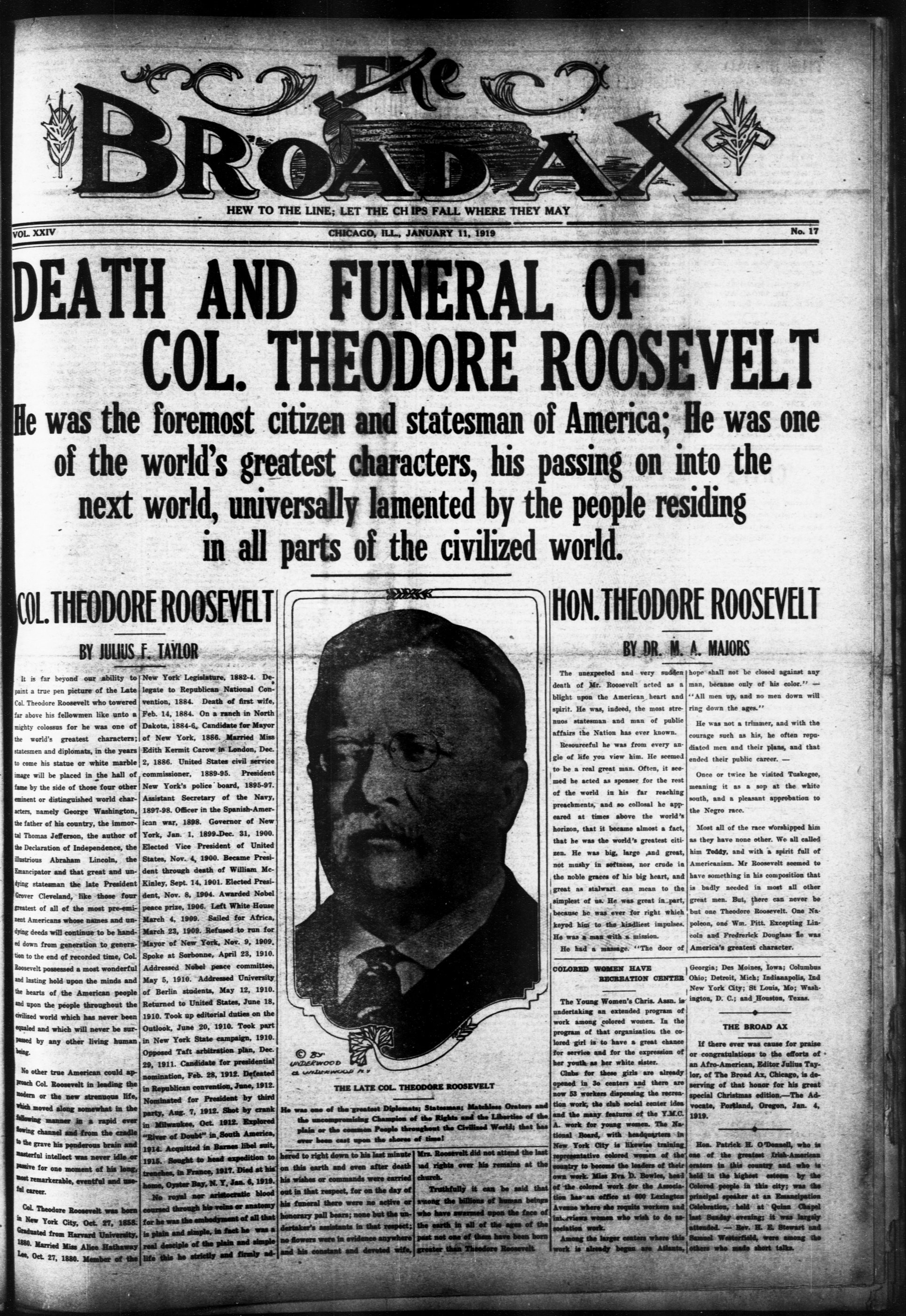
DEATH AND FUNERAL OF COL. THEODORE ROOSEVELT He was the foremost citizen and statesman of America; He was one of the world's greatest characters, his passing on into the next world, universally lamented by the people residing in all parts of the civilized world.
COL. THEODORE ROOSEVELT
BY JULIUS F. TAYLOR
It is far beyond our ability to paint a true pen picture of the Late Col. Theodore Roosevelt who towered far above his fellowmen like unto a mighty colossus for he was one of the world's greatest characters; statesmen and diplomats, in the years to come his statue or white marble image will be placed in the hall of fame by the side of those four other eminent or distinguished world characters, namely George Washington, the father of his country, the immortal Thomas Jefferson, the author of the Declaration of Independence, the illustrious Abraham Lincoln, the Emancipator and that great and undying statesman the late President Grover Cleveland, like those four greatest of all of the most pre-eminent Americans whose names and undying deeds will continue to be handed down from generation to generation to the end of recorded time, Col. Roosevelt possessed a most wonderful and lasting hold upon the minds and the hearts of the American people and upon the people throughout the civilized world which has never been equaled and which will never be surpassed by any other living human being.
No other true American could approach Col. Roosevelt in leading the modern or the new strenuous life, which moved along somewhat in the following manner in a rapid ever flowing channel and from the cradle to the grave his ponderous brain and masterful intellect was never idle or passive for one moment of his long, most remarkerable, eventful and useful career.
Col. Theodore Roosevelt was born in New York City, Oct. 27, 1858. Graduated from Harvard University, 1880. Married Miss Alice Hathaway Lee, Oct. 27, 1880. Member of the
New York Legislature, 1882-4. Delegate to Republican National Convention, 1884. Death of first wife, Feb. 14, 1884. On a ranch in North Dakota, 1884-6. Candidate for Mayor of New York, 1886. Married Miss Edith Kermit Carow in London, Dec. 2, 1886. United States civil service commissioner, 1889-95. President New York's police board, 1895-97. Assistant Secretary of the Navy, 1897-98. Officer in the Spanish-American war, 1898. Governor of New York, Jan. 1, 1899-Dec. 31, 1900. Elected Vice President of United States, Nov. 4, 1900. Became President through death of William McKinley, Sept. 14, 1901. Elected President, Nov. 8, 1904. Awarded Nobel peace prize, 1906. Left White House March 4, 1909. Sailed for Africa, March 23, 1909. Refused to run for Mayor of New York, Nov. 9, 1909. Spoke at Sorbonne, April 23, 1910. Addressed Nobel peace committee, May 5, 1910. Addressed University of Berlin students, May 12, 1910. Returned to United States, June 18, 1910. Took up editorial duties on the Outlook, June 20, 1910. Took part in New York State campaign, 1910. Opposed Taft arbitration plan, Dec. 29, 1911. Candidate for presidential nomination, Feb. 28, 1912. Defeated in Republican convention, June, 1912. Nominated for President by third party, Aug. 7, 1912. Shot by crank in Milwaukee, Oct. 1912. Explored "Biver of Doubt" in South America, 1914. Acquitted in Barnes libel suit, 1915. Sought to head expedition to trenches, in France, 1917. Died at his home, Oyster Bay, N. Y, Jan. 6, 1919. No royal nor aristocratic blood coursed through his veins or anatomy for he was the embodyment of all that is plain and simple, in fact he was a real desigle of the plain and simple life this he strictly and firmly ad-
© BY
UNDERWOOD
& UNDERWOOD NV
HON.THEODORE ROOSEVELT
BY DR. M. A. MAJORS
The unexpected and very sudden death of Mr. Roosevelt acted as a blight upon the American heart and spirit. He was, indeed, the most strenuos statesman and man of public affairs the Nation has ever known.
Resourceful he was from every angle of life you view him. He seemed to be a real great man. Often, it seemed he acted as sponsor for the rest of the world in his far reaching preachments, and so collosal he appeared at times above the world's horizon, that it became almost a fact, that he was the world's greatest citizen. He was big, large and great, not mushy in softness, nor crude in the noble graces of his big heart, and great as stalwart can mean to the simplest of us. He was great in part, because he was ever for right which keyed him to the kindliest impulses. He was a man with a mission.
He had courage (1) The door of
The Young Women's Chris. Assn. is undertaking an extended program of work among colored women. In the program of that organization the colored girl is to have a great chance for service and for the expression of her youth as her white sister.
Clubs for these girls are already opened in 30 centers and there are now 53 workers dispensing the recreation work, the club social center idea and the many features of the Y.M.C. A. work for young women. The National Board, with headquarters in New York City is likewise training representative colored women of the country to become the leaders of their own work. Miss Eva D. Bowles, head of the colored work for the Association has an office at 600 Lexington Avenue where she recruits workers and interviews women who wish to do association work.
Among the larger centers where this work is already begun are Atlanta
hope shall not be closed against any man, because only of his color." — "All men up, and no men down will ring down the ages."
He was not a trimmer, and with the courage such as his, he often repudiated men and their plans, and that ended their public career. —
Once or twice he visited Tusakeege, meaning it as a sop at the white south, and a pleasant approbation to the Negro race.
Most all of the race worshipped him as they have none other. We all called him Teddy, and with a spirit full of Americanism. Mr Roosevelt seemed to have something in his composition that is badly needed in most all other great men. But, there can never be but one Theodore Roosevelt. One Napoleon, one Wm. Pitt. Excepting Lincoln and Fredrerick Douglass he was America's greatest character.
Georgia; Des Moines, Iowa; Columbus Ohio; Detroit, Mich; Indianapolis, Ind New York City; St Louis, Mo; Washington, D. C.; and Houston, Texas.
THE BROAD AX
If there ever was cause for praise or congratulations to the efforts of an Afro-American, Editor Julius Taylor, of The Broad Ax, Chicago, is deserving of that honor for his great special Christmas edition.—The Advocate, Portland, Oregon, Jan. 4, 1919.
Hon. Patrick H. O'Donnell, who is one of the greatest Irish-American orators in this country and who is held in the highest esteem by the Colored people in this city; was the principal speaker at an Emancipation Celebration, held at Quinn Chapel last Sunday evening; it was largely attended. — Rev. H. E. Stewart and Samuel Wetterfield, were among the witnesses to what tell
PAGE TWO
THE BROAD AX
In this city since July 15th, 1899, without missing one single issue. Republicans, Democrats, Catholics, Protestans, Single Taxers, Priests, infidels or anyone else can have their say as long as their language is proper and responsibility is fixed.
The Broad Ax is a newspaper whose platform is broad enough for all, ever claiming the editorial right to speak its own mind.
Local communications will receive attention. Write only on one side of the paper.
Subscriptions must be paid in advance.
One Year.....$2.00
Six Months.....1.00
Advertising rates made known on application.
Address all communications to
THE BROAD AX
6206 So. Elizabeth St., Chicago, Ill
JULIUS F. TAYLOR
Editor and Publisher
DR. M. A. MAJORS
Associate Editor
470Q South State Street
Phone Drexel 1416
Vol. XXIV Jan. 11, 1919 No. 17
Entered as Second-Class Matter, August 19
1902, at the Post Office at Chicago,
Ill., under Act of March 3, 1879
CHIPS
Attorney James E. White returned home Sunday morning from Washington, D. C. and from N. C. where he prent the holiday season with relatives and friends.
The Appomattox Club under the administration of Lawyer S. A. T. Watkins seems to breathe new, well nourished social life. Our friend Watkins is becoming genial and knows a few social angles, that are very pleasing to the Chicago people.
Samuel J. Carter who was an old time railroader and who in later years assisted his wife Mrs. Rettia Carter to conduct the Carter villa at 3256 Rhodes avenue and who for a short time had charge of the dinning room in the Idlewild Hotel, passed away the first part of this week, after a long unsuccessful fight against sickness.
State conferences of representatives of Negro wage-earners, white employers, and white workmen have been held by the Department of Labor in Michigan and Missouri. Discussions of relations of white and colored workers and of employers and Negro wage-earners resulted in cooperative advisory committees and plans for work to improve relations between white and Negro wage-earners and their working conditions.
Mrs. John Brakenridge, of White Cloud Kan, spent the holiday week in this City, visiting at the home of her daughters Mrs Daisy Anderson and Miss. Maymie Harrison 6026 S. Aberdeen street. Mrs. Brakenridge, was greatly delighted with her visit to this City and she returned to her Kansas home Monday morning.
Mr. W. H. A. Moore was the recipient of rare attention from a thousand or more white citizens of Lawndale, where he spoke on the subject of eDmocracy of Walt Whitman, last Sunday evening. (Judge) William Moore is a man of fine intellectual quality, and is about to become distinguished as a brilliant advocate of justice and fair play. His exposition of the very keenest intelligence on all the sober principles of our day make him, indeed, a very interesting speaker.
speaker.
ROOSEVELT DIES AT OYSTER BAY
Great American Succumbs to Complication of Diseases.
RESULT OF BRAZILIAN TRIP
Sketch of the Former President's Remarkable Career as Rancher, Statesman, Soldier, Explorer and Author—Lest One Son in War.
New York—Col. Theodore Roosevelt died at his home 'in Oyster Bay early Monday morning.
The immediate cause of death, it was stated by one of his physicians, was pulmonary embolism, or lodgment in the lung of a clot from a broken vein.
Colonel Roosevelt's last illness may he said to date from last February. On February 5, it was announced that he had been removed from his home in Oyster Bay to the Roosevelt hospital in this city, following an operation on one of his ears. Soon after his arrival at the hospital he underwent two more operations for the removal of diseased tissue in his infected ear, and it was admitted at the time that he was seriously ill. He remained at the hospital until March 3.
During May and June the colonel made a number of addresses, speaking at Springfield, Mass., and in New York. In June he made a tour of the West, during which he suffered a slight attack of erysipelas in one of his legs.
Early in November the colonel was taken to Roosevelt hospital in this city for the treatment of rheumatism and sciatica. While in the hospital reports became current that the colonel was more seriously ill than his physicians would admit. Colonel Roosevelt returned to his home in Oyster Bay on Christmas day.
Was Typical American.
Theodore Roosevelt, who was known as "the most typical American" throughout his career, had been famous for "setting records." He was the youngest president the nation ever had, succeeding to the office on William McKinley's death at the age of forty-two. He set a high mark for service to the public, having been New York state legislator, national convention delegate, United States civil service commissioner, president of the New York police board, assistant secretary of the navy, colonel in the Spanish war, governor of New York, vice president of the United States and president.
Colonel Roosevelt is held to have had as diverse interests and as wide acquaintance with all phases of life as any man in history. In addition to his immense political activities, he was the author of many books on travel, sport, history, politics and other subjects, was a fighter for reform from the moment he first appeared in city politics in New York, a holder of many university degrees, an orator, a lecturer, great hunter, athlete, international peacemaker and militant leader of his followers at all times, whether in or out of office.
Was Born in New York City.
Theodore Roosevelt was born October 27, 1858, in New York city. His father was Theodore Roosevelt and his mother before her marriage was Martha Bullock. The boy began life with a small, frail body and not robust health. His ambition from youth was to be strong, an athlete, a doer of great deeds and a scholar as well. His remarkable mental endowment was shown in the way he accomplished the dual object in life, so that after seven years and a half as president, during which he promulgated innumerable reforms and national issues, he went to Africa and for nearly a year was a hunter in the jungles, undergoing hardships, but coming out more robust and active than ever.
It was predicted that Africa would kill Roosevelt, but in a few days' time he had changed the hunting shirt for the clothes of the diplomat and was being idolized and showered with honors in the courts of Europe.
Starts His Political Career
Roosevelt completed his education at Harvard university in 1880, and the same year married Alice Hathaway Lee, daughter of George Cabot Lee of New York. She lived only four years and was the mother of the present Mrs. Alice Roosevelt Longworth, wife of Congressman Nicholas Longworth of Cincinnati, O.
Colonel Roosevelt's interest in politics dates from the year after his marriage to Miss Lee. Some of the Republican district leaders in New York had taken an interest in him. He seemed a likely young fellow, with vigor, ambition and some money. Two years later he was sent to the state assembly at Albany and began a career which marked him out as a man devoted to the public interest.
After three years of assembly, however, Roosevelt thought he had enough and for a time withdrew from public life. He stepped out cordially hated by the corrupt politicians, disliked by many wealthy New Yorkers and already hailed as the acknowledged leader of the reform element in his party. The death of his wife also was a factor in his temporary retirement, and he went to a ranch in North Dakota where he was introduced as "that four eyed tenderfoot." The tenderfoot, however, put in practice some fundamental rules for hop
THE BROAD AX, CHICAGO, JANUARY 11, 1919
esty in the conduct of the ranch he had purchased and the names of derision were soon dropped. He became popular, a noted hunter, a good shot and provided himself during his years of roughing it with a good constitution which was to prove invaluable to him later in life. In 1886 Roosevelt became a candidate for mayor of New York, but ran third. His reputation was enhanced, however, and President Harrison named him for a place on the national civil service commission. He dominated the body and later became its president. It was in 1886 that Mr. Roosevelt married Miss Edith Kermit Carow while in London. She was the daughter of Charles Carow of New York.
In the Spanish War.
In 1893 Roosevelt resigned from the civil service commission and began a fight on Tammy hall. He served two years as police commissioner of New York city, stirring up the corruptionists, and then President McKinley made him assistant secretary of the navy. When the Maine was blown up he resigned and helped raise the first volunteer regiment of cavalry for the war with Spain. It was the famous rough riders, of which Leonard Wood was made colonel. Colonel-Wood was later given a brigade and Roosevelt promoted to command of the Rough Riders. Colonel Roosevelt was commended for heroic conduct at the battles of Las Guaymas and San Juan hill.
Governor and President
Coming back from the war, Roosevelt was elected governor of New York. But he would not be bossed by the politicians, so instead of giving him a second term they persuaded him to take the nomination for vice president on the ticket with McKinley. When President McKinley, shot by an assassin, died on September 14, 1901, Roosevelt became president.
President Roosevelt served out McKinley's unexpired term and was elected president in 1904 by the largest majority ever given a candidate for the office. In his seven and a half years in the White House he had ample opportunity to show the stuff that was in him. He lived deeply and broadly and was at once the accomplished man of the world, the student of national problems, as well as of books, the adroit politician, the forceful writer of books and eloquent public speaker.
He had the happy knack of inventing or reviving phrases that stayed in the memory of his hearers and those who heard him usually carried away with them an apt summary of conditions so cleverly worded as to be not easily forgotten.
Colonel Roosevelt's stand, from his first cry for the "square deal" to his fight for a second elective term in 1912, was always on the basis of social justice and on the platform of elevating the condition of the working and middle classes. Along this line developed his demand for the initiative, the referendum, and the recall of judges and judicial decisions.
As president, Roosevelt's activities and scope of endeavor were immense; he became a great international figure through his many negotiations with foreign powers and took in hand many problems at home seldom touched by a president.
Booms Taft for Presidency
Roosevelt declined a second elective term in 1908 and fostered the candidacy of his secretary of war, William H. Taft, who was elected president. When he left office, March 4, 1909, Roosevelt was the unquestioned leader of his party. Taft was his close friend. Roosevelt went to Africa to secure specimens for museums and also, it is understood, to be out of the country and escape possible accusations of attempting to influence the conduct of the new administration.
Colonel Roosevelt was a mighty hunter. His exploits in killing big game in equatorial Africa are well known through the book which he wrote on the subject.
It was in the summer of 1910 that Colonel Roosevelt traveled through the country promulgating his doctrine of of the "new nationalism," and the next year he editorially attacked arbitration treaties with Great Britain and France, proposed by President Taft.
Candidate of Progressives
At the Republican convention in Chicago, beginning June 18, 1912, Taft was nominated by 21 votes over a majority, but a few hours before the nomination Roosevelt had withdrawn his name as a candidate, and that night at a meeting in Orchestra hall, Chicago, the Progressive party was given its first real impetus in a demonstration for Roosevelt and at which he was named for president by the new party. A formal convention was held later and he ran as the regular candidate of the third party, drawing support from Republicans and Democrats alike. Woodrow Wilson, the Democrat, was elected, however, and the colonel had to be content with defending Mr. Taft for second place.
In 1914 Colonel Koosevelt led a party of exploration in South America, especially in the interior of Brazil. Then he made another tour of Europe. In 1916 he was again considered as a candidate for the presidential nomination by the Progressives, but at the last minute he declined the honor, declaring his intention of supporting Mr. Hughes, the Republican nominee. Since that time he had devoted his efforts largely to the task of teaching the need of military preparedness and to helping, with his pen, in the war against the central powers. He sought a chance to serve in the army, but was rejected. His three sons were officers in active service, and one, Quentin, was killed in an airplane combat.
ALL PAY TRIBUTE TO COL. ROOSEVELT
PUBLIC OFFICIALS AND PRIVATE CITIZENS JOIN IN PRAISE OF THE DEAD LEADER.
GREAT LOSS TO THE NATION
Pure Patriotism, Unfailing Courage and Illustrious Service of Former President Extolled by His Countrymen, Regardless of Party.
Americans of all shades of political opinion have joined in paying warm tribute to the fearless Americanism of Col. Theodore Roosevelt and to the great service the dead leader rendered to his country and to all mankind. Here are some of the expressions of public men and private citizens telling of the loss the nation has sustained:
SECRETARY OF STATE LANSING—The death of Col. Roosevelt removes from our national life a great American. His vigor of mind and ceaseless energy made him a consipuous figure in public affairs. Friends and enemies alike recognized the force of his personality and the great influence he had in molding public thought and purpose. His patriotism and devotion to his country will long be remembered by all his fellow citibens, while his sturdy Americanism will be an inspiration to future generations.
SECRETARY OF STATE FRANK L. POPE was one of the most striking figures in the history of this country, and, in fact, of his time. It is impossible to measure today what he did to arouse the political conscience of the American people.
NEWTON D. BAKER, Secretary of War—His relations to the navy and to the army are, of course, a part of the history of those two services, and during his terms as president he brought his powerful nationality and energy to ensure economic prosperity at the greatest moment. I do not know of any career which combines so many diversified and intensively pursued activities—frontiersman, explorer, naturalist, seaman, soldier, executive and publicist. In each of these relations he has been able to left his mark. JOSEPHUS DANIELS. THE Navy he has blazed new paths and refused to be fettered by conventions that other distinguished men recognized. Original, forceful, courageous, he was the monitor of millions of his fellow countrymen, who will miss his inspiring leadership. Believing in him, he was courageous. He threw himself into every conflict with every power of mind and body.
FRANKLIN K. LANE. Secretary of the Interior—Colonel Roosevelt was a great man, a very great man—great in his soul, great in his personality, great in his conception of America's place in the world. He will sit at one of the high tables.
CARTER GLASS. Secretary of the Treasury—Colonel Roosevelt was an extraordinary figure and leaves a legacy of patriotic endeavor and useful achievement of which those who most need it and honored him will always be proud.
DIRECTOR GENERAL MADOO—Colonel Roosevelt's prodigious activities made him one of the most conspicuous figures in publii life. We are too near the event to place a just estimate on his life and career, but he will always be dignified for one great achievement—the construction of the Panama canal.
FORMER PRESIDENT TAFT—The country can ill afford in this critical period of history. to lose one who has done and could in the next decade have done so much for it and humanity. We have lost a great patriotic American, a great world figure, the most commanding personality in our public life since Lincoln. I mourn his going as a personal loss. I regard Colonel ROOSEVELT of Wisconsin I regard Colonel ROOSEVELT's desire a very great calamity for the nation His usefulness is familiar to all, but I believe that his greatest usefulness might have been in the future.
SENATOR LEWIS of Illinois—The death of Colonel Roosevelt is the loss of a great man, of a great force, and the loss of a great benefit to America. Whatever differences men may have with Colonel Roosevelt on party lines or political principles, all must certify that his fight for cleanliness and integrity in public life did much to rid the man of corruption in public affairs. All must recognize his labors to force corporate monopoly to private welfare and personal rights started this country upon the course of time.
SENATOR HARDING of Ohio — He was one of the foremost citizens of the world, in a most extraordinary era, and he was the most vigorous and courageous American of his time. There is no direct legatee to his vast potential with respect to diplomatic chaos. In my judgment he was the greatest American since Abraham Lincoln.
SENATOR NEW of Indiana — Intellectually he was in the first rank among those who have figured in our history with versatility and application he was with versatility equal. He was a true patriot, a thorough American at all times and in all respects.
SENATOR MARTIN of Virginia — He met all the responsibilities of citizenship in the most courageous manner. A characteristic of nls life was his unqualified courage. He never had a conviction in the matter and did not have the courage to follow it. He was a man of unlimited courage, of limited resources, and of unbounded patriotism.
SENATOR LODGE of Massachusetts—He was a great patriot, a great American, a great man. He was devoted throughout his life to his country. He tried always to be a servant of human beings. SENATOR KELLOGG of Minnesota—He was a great commoner, who in his heart charished the causes of the masses—a man of the most intense patriotism who placed the advancement of humanity and the cause of his country above all other considerations.
SENATOR JOHNSON of California—The American of our generation has passed away with a truer vision, a higher courage, a wiser spirit, than any man of our time. I cannot speak of him in ordinary terms. To me he had no parallel—none approached him in virility or force or profound knowledge of varied subjects.
SENATOR CHAMBERLAIN of Oregon—Theurer, more loyal American never lived.
SENATOR KNOX of Pennsylvania—His life was so abundant, so open, and so familiar that observations at this time upon his career as a statesman would be super-
duous if not misplaced. He was America's greatest living human asset.
REPRESENTATIVE MEDILL M'CORMICK—He was the greatest American of our time. We are his debtors for his tremendous laborers in the regeneration of our public life, for the quickening of our national spirit, for the reanimation of our representative JAMES R. MANN—I think Roosevelt was the most wonderful individual character in the world. He was a student of mankind and so prodigiously active that his influence was tremendous and his loss will be deeply felt here and in our country.
REPRESENTATIVE PESS, chairman of the Republican congressional committee. His death at this moment is a national calamity. Never were his talents so much needed as now.
FORMER SPEAKER CANNON—Colonel Roosevelt's place in history will be as one of the great presidents of the republic as one of the touch with any other representative department than any other president I have known.
REPRESENTATIVE GILLETTE of Massachusetts - Colonel Roosevelt was the most remarkable man America has produced since the Civil war. His general knowledge was unbounded, his personal magnetism extraordinary.
REPRESENTATIVE SHALLENBERGER of Nebraska - It is inexpressibly sorrowful that he should be taken away at this crisis in the affairs of government and mankind.
REPRESENTATIVE SHERLEY, chairman of the house appropriations committee - Mr. Roosevelt was one of the really great men of his age and above all else was wholly an American.
CHARLES EVANS HUGHES - The death of Colonel Roosevelt is an irreparable loss to the nation. His virility and courage were a constant inspiration. He personified the Americanism of which he was the most doughty champion. He demanded the recognition and performance of our national obligation in the war. Back of all that was done in the war was the pressure to be a patriotic instigator. In response to his patriotic call to the safety of civilization and in this hour of complete victory the whole world is his debtor.
SAMUEL GOMFERS, president of the American Federation of Labor-I regard the death of Colonel Roosevelt a very great loss. He rendered service of incalculable benefit to the world. I knew him for thirty-five years in all his public activities. I worked with him and every one, even those who differed with him, had his sincerity of purpose, his high motives and his anxiety to serve the people.
WILLIAM JENNINGS BRYAN-The rare qualities which won for Colonel Roosevelt a multitude of devoted followers naturally arrayed against him a host of openings, but his death puts an end to controversy and he will be mourned by foe as well as an by friend. He was a great American and made a profound impression on his colleagues. His picturesque career will form a fascinating chapter in our nation's history.
CHIEF JUSTICE WHITE-Mr. Roosevelt's death brings to me a sense of deep sorrow, of personal loss. While he was president his kindly consideration never failed and many opportunities were afforded to him. He has inspired his innate ideals and his courage, all of which combined to make him the distinguished, not to say phenomenal, man he was.
ASSOCIATE JUSTICE WILLIAM R. DAY—Every one appreciates that we have lost one of the greatest Americans, one of the greatest Americans, one of the greatest time when we can ill afford to lose him.
ASSOCIATE JUSTICE WILLIAS VAN DEVANTRY — The death of Colonel Roosevelt is a great loss to the country.
ASSOCIATE JUSTICE JOSEPH McKENNA—The country has suffered a great loss in the death of Colonel Roosevelt. He was a man of very great qualities.
MAJ. GEN. LEONARD WOOD-The death of my friend, Theodore Roosevelt, brings to me great personal loss and sorrow, but keen and deep as these are, they are but the sorrow and loss of an individual. The national loss is irreparable, for his death comes at a time when his services to this nation can ill be spared. He is a man of great frankness and courage, his honest criticism, and farseeing wisdom than at present. Uniselfish loyalty, honest and fearless criticism always characterized the life and work of Theodore Roosevelt and he lived and worked always for his country's best interest. While we shall not have the living life and presence, we shall always have the example of his life.
PRESIDENT POINCARE of France-Friend of liberty, friend of France, Roosevelt, with without comfort and daughters, his energy that liberty lives. We are grateful to him. We wish to express to Mrs. Roosevelt our most sincere condolence.
J. J. JUSSERAND, French ambassador to the United States-The unexpected death of one who has upheld all his life the principles of virile manhood, straightforward honesty and fearlessness will be mourned all over the world, nowhere more because of Prince Peter, whose cause he upheld in her worst crisis in a way that shall never be forgotten.
HENRY WHITE, one of the American peace commissioners-I have heard of Mr. Roosevelt's death with deep sorrow because of the loss to the nation of a great public servant and to myself of a lifelong friend.
HERBERT C. HOOVER - America is poorer for the loss of a great citizen, the world for the loss of a great man. His virility and Americanism has been one of our national treasures.
COL. E. M. HOUSE-The entire world will share the grief which will be felt in the United States over the death of Theodore Roosevelt. He was the one virile and courageous leader of his genius in history as one of our greatest presidents.
GOVERNOR LOWDEN of Illinois—The nation has suffered a loss it cannot well afford at this time. Theodore Roosevelt has been a dominant force in American life for thirty years. During all his life he has sought and striven for a better, juster society. His robust and fearless Americanism was a bug to the countrymen, whenever danger threatened within or without. Whether in office or private life, he was a leader of thought and an inspirer of action.
GOVERNOR SLEEPER of Michigan—Colonel Roosevelt was especially beloved in Michigan, and the state, which always gave him its support and honored him when he was living, will certainly mourn his death and cherish his memory.
FEDERAL JUDGE GEORGE A. CARPENTER—I believe that the great man of the american people feel as I do that our country could not suffer a greater loss than by the death of Colonel Roosevelt.
JANE ADDAMS—Colonel Roosevelt was in many ways the most outstanding figure in America. I always admired him very much and had the greatest respect for the tenacity with which he tried to his principles and ideas. While I was not always agree with him in some things, everyone had to admire him.
JACOB M. DICKINSON, former Secretary of War—He was one of the greatest men of the world, a great patriot, and his death is a great loss to the country. He had served the nation during the dark hours of war with his men, and unloved Americanism. He will be unashrined in the heart of America forever.
Shakespeare Standa Alone.
Admitting to the fullest that the present age cannot forestall the judgment of posterity, it seems unlikely that a copy of the work of any contemporary dramatist will ever sell for $28,000. Such a thing happened recently in the case of four Shakespeare folios; but Shakespeare was Shakespeare, even when his contemporaries took him as a matter of course, and since then the judgment of time has made him a standard by which the during genius of later playwrights can be reasonably estimated.
The London Times
The London Times was founded on January 1, 1788, by John Walter, who started a small newspaper, originally called The Daily Universal Register, the first number of which was issued on January 1, 1785. This was really though not in name, the first number of The Times. The 940th number which appeared on January 1, 1785 was for the first time entitled The Times, or Daily Universal Register, but the second title was dropped on March 15 of that year, since which the page has been known as The Times.
Danger Everywhere
Little Millie's father and grandfather were Republicans, and, as elephant drew near, they spoke of the opponents with ever-increasing warmth, never heeding Millie's attentive ears. One night as the little man was preparing for bed she cast a fearful glance across the room and who pered in a frightened little voice: "Mamma, I'm afraid to go to bed. I afraid there's a Democrat in the closet."—Organizer.
"Side Line" All Right
Those women who can do something should not be ashamed to be up and doing it. There is a dignity attached to all honest labor, no matter how ordinary or commonplace it may be, and those of us who are qualified to help out at home will feel better and stronger—providing, of course, our family will in no way suffer as a result be up and at our honest little "line."—New York Evening Telegram
Seagulla Foretell Weather
It is a widespread belief, both in Scotland and in Ulster, that "Seagull seagull, sit on the sand. It's never good weather while you're on the land," alludes to the fact that when the birds fly out early and far to seward, or remain on the sand, far weather may be looked for; while they take a contrary course storm most frequently follow.
Saw Her Limitations
Edward's highest ambition was to some day be an engineer. He delighted in the workings of his electrical engines, and one day he undertook to explain the various parts to Jane. She listened indifferently and finally he became exasperated and said, "Oh, well, go on and play. I don't suppose you will ever be anything more than a mother, anyway."
Good Ends Require Good Means
Let no man turn aside, ever so slightly, from the broad path of honor on the plausible pretense that be justified by the goodness of his end. All good ends can be worked out by good means. Those that cannot, and bad; and may be counted so at once, and left alone.—Charles Dickens in "Barnsby Rudge."
Mother's Poor "Rememberer."
Mother had been searching for her purse. Having found it she shortly afterwards mislaid her eyeglasses and asked Doris, who was playing nicely with kitty, to hunt for them. Doris poutingly obeyed, but said: "You is always losing somefing, muver; I wish to dooodness you had as good a rememberer as anuity has."
Good Speaking.
Discretion in speech is more than eloquence; and to speak agreeably to him with whom we deal is more than to speak in good words or in good order—Bacon.
Raining "Cats and Dogs."
Raining "Cats and Dogs.
In England the male blossoms of the willows are called "cats and dogs" and a rainstorm would shake them off and strew them on the ground. Hence are the expression "raining cats and dogs."
Columbus Boasted
"These latest passengers needn't be so stuck up," he cried. "I was the first man to cross the ocean in three ships."—New York Sun.
Bobby's Version
Asked to define "lunch," Bobby re
plied: "Lunch is what you have for
dinner when your father is away."
Newspapers Run by Women.
More than a score of daily news
papers in the United States are owned
and actively managed by women.
Equally Hard.
In many cases it is as difficult to stay at the top of the ladder as it is to get there.
Daily Thought.
Innocence in genius and candor is power are both noble qualities—Madame de Stael.
Attractions of Treves.
It is as an ecclesiastical city that Treves is particularly interesting. In that famous cathedral are the remains of 25 archbishops and electors and four bishops. Among its treasures is a legendary nail from the Cross, and the famous Holy Coat, given the cathedral by St. Helena. In 1891 an exhibition of the Coat attracted more than 200,000 pilgrims. Another attraction for pilgrims is the grave of St. Matthias in one of the ancient churches—the only grave of an apostle in Germany.
Roller Bearings.
Experiments to perfect a bearing that would withstand the heavy strains of a heavy cane mill led to the discovery of the principle, and to the development of the Hyatt roller bearing, by John Wesley Hyatt, the inventor, who also invented celluloid in his search for substitute material for tivoed in billiard balls. His studies in flexibility along the billiard ball line preceded and led up to his invention of the first flexible roller bearing.
Motor Driven Potato Peeler.
A machine which will peel 40 pounds of potatoes in three or four minutes was described and illustrated in Popular Mechanics Magazine, the peeling being done by a revolving drum driven by a one-third horse-power motor. The inner surface of the drum has been roughened by making numerous perforations in the metal. When filled it is lowered into a wooden container and set to running.
Full Explanation
Arnold could not bear to have anything that smacked of femininity applied to himself or his tiny baby brother. One day Arnold was keeping his eye on the baby carriage while the mother stepped into the apartment. A woman passing looked into the carriage and seeing the infant said: "Isn't she a sweet child?" Arnold, indignant replied: "He ain't no she; it's a him."
Nature's Great Wisdom
There is something so sublimely positive in nature. She never kills for the mere sake of killing; but every death is but one step in the vast weaving of the web of life. She has no process of destruction which, as you turn it to the other side and look at it in what you know to be its truer light, you do not see to be the process of construction.-Phillips Brooks.
Devolved From Passing Idea.
It was a passing idea which gave to the world the discovery of galvanic electricity, so useful in transmitting vocal or written language. Mme. Galvani simply happened to notice the contraction of the muscles of a skinned traget accidentally touched at the moment her husband took a spark from an electrical machine, and that was the whole thing!
Snakes in Ireland
There are snakes in Ireland, but only two or three species. The popular idea that Ireland is snakeless arose from an error made by a composer in the translation of Horebrow's "History of Ireland" in 1758. The compositor made "Iceland" into "Ireland," and the sentence has remained. Iceland is too cold for snakes.
Learned Great Truth Early:
Son has just begun to go to school and has much to say about the new little girls he meets, but every few days it is a different girl that attracts him. His mother said, "I'm afraid, son, that you are changeable." He answered, "Tain't me that changes; it's them, when you know them better."
Out of Self
Blessed are they who have the gift of making friends, for it is one of God's best gifts. It involves many things, but above all, the power of going out of one's self, and appreciating whatever is noble and loving in another.—Thomas Hughes.
Proud Boast Belongs to Spain:
The saying that the "sun never sets on the empire" did not originate with England, but with Spain. It was in 1623 that the sentence was applied to Spain, which at that period was a great empire.
Uncle Eben.
"By the time a man has lived long enough to know how to give advice," said Uncle Eben. "he's done lived long enough to know dat 'tain' no use wastin'd de time."
Happiness Follows Good Work.
Do good work. Give your first thought and your best effort to the improvement of your work. Happiness, success and plenty must follow.
In Both Senses
When we see a man on the opposite side of the street who owes us a dollar we wish he'd come across.—Boston Transcript.
Merry Meat Man.
Sign in butcher's shop, attached to a pig's tail: "This Is the End of Our Pork This Week."—Boston Transcript.
Optimistic Thought.
It is honorable to be accused by those who deserve to be accused.
Magic Guard Against Rattlesnakes.
Camping out in a rattlesnake-infested district with no other protection for one's bed than an encircling horsehair rope would not give the average tenderfoot a feeling of security. A photograph in Popular Mechanics Magazine showed two campers making their bed on the Western plains, surrounded by nothing more stable than one of these ropes, as it is well known in that region that rattlesnakes have an unconquerable aversion for crawling over a rope of this kind.
"Old Clothes to Mend."
Chinese merchants who want a bit of mending done never have to go very far, for there are needlewomen seated along the street ready to sew and mend. Sometimes these workers sit on low stools and sometimes on the sidewalks, but there they sit sewing away hard, for they never are short of patrons. These women are generally the wives of fishermen or boatmen and are glad to get the little "odds and ends" of work to help increase the family income.
Progress.
Material progress is of value only in so far as it assists toward the realization of human possibilities. Industry and commerce and the social conditions, which are in a large degree depending upon them, must be regarded from the point of view of the individual member of society, and if they cramp the life of the individual, no amount of economic argument will suffice to justify them.
Salary of Chief Executive
The compensation of the president of the United States is fixed by congress, and may not be increased or diminished during the existing presidential term, that is, any increase or reduction of the salary or endowments of the office can only take effect at the next term. The original salary of the office was $25,000 a year, increased in 1873 to $50,000, and in 1909 to $75,000.
Spiritual Princes
There were Christians in Treves as early as the second century, and it had a bishop as early as 314. The archbishops of Treves became one of the leading spiritual princes of the early German empire. The Treves of today is a rich and active city of possibly 75,000 souls, a show city, a shrine city, and one in which the Yankee tourists should find much to interest them.
French "Immortals"
The French academy is the oldest of five academies constituting the Institute of France, having been founded in 1635. It is composed of 40 members, elected for life and known as the "Forty Immortals." They rank as the leading Frenchmen of their time in literature. Their judgment and decisions in all disputed literary matters are final.
The Real "Butterfly."
The name for the butterfly did not originate from "flutter," but from low German and Hollandish. Over in Holland there is a butterfly that lives whenever possible on butter and milk. He is and always has been a nuisance to the Dutch wives and has always been called the "butterfliege," or butterfly.
Halibut.
The name "halibut" is composed of two-Scandinavian words meaning flatfish of the deep. That derivation is found in the dictionaries, but the term first appears in the ancient legends as "haligbuta," which signifies a holy messenger, one who is sent to relieve suffering or save either body or soul.
How Phrase Originated.
The English-speaking people frequently, when they see somebody doing something they like, exclaim: "That's the ticket," meaning that it is the proper method of procedure. The real saying is, "That is the etiquette," or the right and proper way of doing.
Letter Boxes in the Heights.
In the Alps there is one letter box at an elevation of nearly 10,000 feet above the sea level from which there are collections four times a day. There are several letter receptacles at an elevation of between 6,000 and 7,000 feet.
Egyptians Invented Bells.
The invention of bells is attributed to the Egyptians, who are credited with having made use of percussion instruments to announce the sacred fetes of Ogiris.
Detects Far-Off Storms.
Using a modified wireless receiving instrument, a French scientist has been able to detect thunder storms more than 300 miles distant.
Correct Your mistakes.
It is only an error in judgment to make a mistake, but it shows infirmity of character to adhere to it when discovered.
Wise Words.
"Love yoh enemies," said Uncle Eben, "but don't give 'em no chance to mark de deck or use loaded dice."
Locust Trees.
The locust tree was one of the first American trees to be taken to Europe.
THE BROAD AX, CHICAGO, JANUARY 11, 1919
Easy Immobilization. In birds and mammals immobilization can be occasioned at will. In the seventh century Kircher immobilized fowls merely by turning them upon their backs. The experiment can be successfully made with any kind of bird. I have performed it with sparrows, with a wryneck and with the finch immediately after their capture, thus excluding all idea of training. The same result can be obtained with various mammals, especially with mice.—Exchange.
Big Apiary. An interesting picture of a apiary on a precipitous mountain was shown in Popular Mechanicazine. The slope has been cut in races twelve to fifteen feet in which more than 300 swarms are housed, each hive being placed a concrete foundation. The lace to this profitable use would be little for any other purpose. hives, being high up, are fanned summer breezes and are warm the sun in winter.
An Improvement
A young guardsman called the other day on a certain financier, who insisted on showing him over his magnificent private house, informing him not only where he purchased every article in it but the price he paid for it. When he had finished he asked his visitor if he could suggest any improvement in the arrangement of the house. "Well," was the reply, "if you were to mark all the goods in plain figures it would save you a good deal of trouble."
For the Fish Pan
My family is very fond of broiled mackerel, but the pleasure is lost for the cook with the thought of washing the ill-smelling broiler. My husband suggested laying the fish on a common wooden picnic plate and then in turn on the broiler. The result was a whole fish, unbroken in taking it off the broiler, and no disagreeable task after the meal, since the wooden plate can be burned when the meal is finished.—Good Housekeeping.
World's Deaf-Mutes
The amateur student of statistics will find plenty to ponder over in the figures as to the distribution of deaf-mutes throughout the world. A recent report on this phase of the census of the United States gives the proportion as 42.8 per 100,000, and shows that in the group of countries whose figures is 50 or less all are English-speaking except Holland.-Oregonian
Warm Combination.
On a cold winter day Dr. Horatio C. Wood, Sr., noted specialist and medical writer, was chatting with his friend, the late Dr. Horace Howard Furness, the eminent Shakespearean scholar. A third man approached, whereupon, with a laugh, Doctor Wood said: "Doctor Furness, let me present Mr. Cole. Surely the three of us can now forget the cold."
Animals and Toes
No living representative of the animal kingdom has more than five toes, digits or claws to each foot, hand or limb. The horse is the type of the one-toed creation, the camel of the two-toed, the rhinoceros of the three-toed, the hippopotamus of the four-toed, and the elephant and hundreds of other animals of the five-toed.
So We Will Find It.
Happy little Bell, sitting on the floor, was heard soliloquizing in a sing-song tone thus: "And Heavenly Father will take care of us . . . if we are good . . . but then . . . we're not always good . . . and so . . . we have to take care of ourselves pretty much."—New Century Journal.
Multiplying and Progressing.
The most progressive element in Colombia is said to be, not the Spanish population or the natives, but a Jewish people called Antioquians, who have Old Testament names, raise large families and are fast becoming the dominant power in financial and political influence.
City Life.
City life is a fierce, mental struggle between neighbors, each of whom is trying to shove the other into the country to raise more produce and lessen the demand for city conveniences, so that living in the city will be cheaper and better.—Chicago News.
A Possible Cure
Mrs. Lott—"Is there no way you can break yourself of that habit of talking in your sleep?" Mr. Lott, tremulously but hopefully—"Do you think it would help at all, my dear, if you'd let me talk more when I'm awake?"
Life's Jesters.
"It seems very strange," observed the almost-philosopher, "that the persons who regard this life as a huge joke are the ones who say they can see no point to it."
Death Rate in Europe
In normal times Stockholm, Christiana, Berlin and London, in the order named, have the lowest death rates among the European cities.
Paradox.
Said the facetious observer; "After all there are few things that make a girl's heart warm toward you like ice cream."
Concerning Minds.
Minds, bouillon cubes and flavoring extracts are very much alike. They become stronger by concentration.
Optimistic Thought.
Advice after mischief is like medicine after death.
Bg Aplary.
An interesting picture of a large aplary on a precipitous mountain side was shown in Popular Mechanics Magazine. The slope has been cut into terraces twelve to fifteen feet high on which more than 300 swarms of bees are housed, each hive being placed on a concrete foundation. The land put to this profitable use would be worth little for any other purpose. The hives, being high up, are fanned by the summer breezes and are warmed by the sun in winter.
Friendship
No one is so poor as the person who is going through life without friends. None of us needs to be in this sad plight, for all around us are those who need love and sympathy—those for whom we can make life less difficult. And that is what friendship means: spending oneself for those one loves and asking nothing in return. It is "only he who is unwilling to love without being loved" who is likely to feel that there is no such thing as true friendship.
Laughter.
"Laughter is man's own attribute," says Rabelais, and from the time man began to think of other matters than eating and waging war he has wooed laughter in some form or other according to his ideas of what is comical. The early pictured jokes on canvas, stone and paper are not conducive to wild hilarity at this day and age, but they amused the people of the time and in making men laugh helped to civilize the race.
Christmas Gifts
The custom of giving Christmas gifts is not traceable to its beginnings. The Encyclopedia Britannica says that "in Britain the 25th of December was a festival long before the conversion to Christianity, for Bede (de temp. rat. ch. 13) relates that 'the ancient peoples of Angli began the year on the 25th of December.'" The custom also prevailed in the Germanic countries.
Modified Form of Slavery
There is no legal and formal slavery in any Christian country. It survives in a mild form in most Mohammedan countries. The peonage system of Latin-American countries is not much different from slavery, but rests upon a different theory. The peon is not supposed to be owned as property; he is supposed to be working to pay a debt which he owes the master.
Natural Lightning Conductor.
The astronomical observatory at Mount Etna does not need at any time the protection of a lightning rod. The observatory is near the summit of the volcano, and the stream of vapor constantly rising from the crater acts as a natural conductor, draining the electricity out of the clouds, so that the lightning is seldom seen there.
City in Mountain.
In southern Tunisia is a mountain of considerable size called Doulrat, which once upon a time was an active volcano. Bubbles of volcanic gases made it a veritable honeycomb of caves, which in these days are inhabited. In fact, the whole mountain is a city—a human ant-hill, densely populated.
Why Delay?
"Take this medicine," said the young doctor. "If it doesn't cure you, come back in a few days and I shall give you something that will." The patient pocketed the dope reluctantly. In a few moments he returned. "If you don't mind, doc, I'll take some of that that will cure me right away."
Sponges Strangely Colored.
Five scarlet sponges have been picked up in Lake Biwa, Japan. The authorities of the lake laboratory at Otsu, attached to the Kyoto Imperial university, are quoted as saying that similar sponges have never been discovered anywhere in the world.
Alibi for the Doctor.
A Mexican by the name of Braille Hernandez, aged twenty-three years, died in a little carhouse down by the depot. The man never had a doctor and so no one knows what killed him. —San Miguel (Cal.) Examiner.
The Touch That Helps
Kind looks, kind words, kind acts, and warm handshakes—these are the secondary means of grace when men are in trouble and are fighting their unseen battles.
Comforting Thought
You may fail to shine in the opinion of others, both in your conversation and actions, from being superior as well as inferior to them.
The Dentist's Showcase
"Oh, look at grandma's bite, Aunt Emily," whispered the baby, eyes fixed on the array of false teeth in the glass case.
Thinking First
If thou thinkest twice before thou
speakest once, thou wilt speak twice
the better for it.—William Penn.
Daily Thought.
Fame is the perfume of heroic deeds.
—Socrates.
Assuring Heredity
Assisting Hersipity.
A man's instincts, intuitions, sensations and perceptions, and especially his habits, are changed, improved and made to overcome his hereditary tendencies by the proper training of the muscles. With the impressions shot into the other senses, mentally and physically, impressions of the corrective, helpful, improving sort, there is no reason in the world why the hereditary nature of certain weak or unstable individuals cannot be aided and lifted out of their possibly unhappy state.
Fellow:Feeling
As a well-known Scottish divine was entering a car he noticed that some of the passengers were trying to eject a drunken man. The minister promptly interposed in his behalf and soothed him into respectability for the rest of his journey. Before leaving, however, the disturber again muttered angry words to the other passengers; then, seizing the reverend doctor's hands, he exclaimed: "Good day my fren"; I see you ken what it is to be drunk!"
New Note in Street Music.
A new note in street music is struck in the Strand, where a performer on a piano-organ exhibits a placard stating that he is an ex-convict who has done four years. There are also statements as to police supervision and the instrumentalist's desire to do well; and, as a guarantee of good faith, the placard concludes with the address of his firm of solicitors and of his medical attendant—London Chronicle.
Use Your Knowledge.
It is a self-evident fact that the people who know the most do not always accomplish the most. And that is because many do not know how to use their knowledge. It is like gold buried in the ground instead of being invested and bearing a good interest. Do not trust for your success to knowing things, for it depends instead on your knowing how to use what you know.
Signs of Mourning.
In Italy the women wear white garments to show their grief, and the men clothes of brown hue. In China white is used for mourning by both sexes. In Turkey, Syria, Cappadocia and Armenia celestial blue is the usual tint. In Egypt yellowish brown, the hue of the dead leaf, is deemed proper; and in Ethiopia the natives wear gray as the emblem of mourning.
Stone for Rosaries
The rosaries sold at Kandahar are extensively manufactured from soft, crystallized silicate of magnesia. This is quarried from a hill about thirty miles northwest of the city, where soapstone and antimony are also obtained in considerable abundance. The stone varies in color from a light yellow to a bluish white, and is generally opaque.
Chinese as Rice Growers.
The Chinese introduced rice culture to Hawaii, and they are still the chief rice growers of the islands. They first planted sugar cane at the "Crossroads of the Pacific" and manufactured sugar, and when the Hawaiians began to cease the cultivation of taro it was the Chinese who became the taro planters.
Vital Statistics of Japan.
According to statistics recently published the population of Japan proper on December 31, 1917, was 57,998,373 distributed among 10,241,851 dwellings or 5.7 per cent habitation. Compared with the census of 1916, a growth in population of 790,096 is seen. This rate of increase exceeds 14 per cent.
Removing Paint From Glass.
Ordinary commercial ammonia is a quite efficient remover of paint, especially from glass. Apply with a cloth swab. Within 15 or 20 minutes the point will be so softened that it may easily be rubbed off with a putty-knife or a coarse fabric.
Two Bites and a Sup.
While many of our familiar comparisons have been scrapped by modern conditions, new comparisons are taking their places—for example: "As quickly over as a movie meal."—Boston Transcript.
Fact and Fancy.
Said the facetious observer: "One of the principal differences between the frugal woman and the fat one is that one tries to reduce expenses and the other expenses."
One Definition of Envy.
"Envy," said Uncle Eben, "is one of de unpleasant symptoms 'sperenced by folks dat has been tryin' to git somehain' foh nothin'."
It Depends.
Whether a woman is good-looking depends largely on whether you are speaking of her face or to her face.—Wilmington News.
"I was single, and had a dog's life," said the widower. "I married and had a cat and dog's."—Exchange.
In a Restaurant.
"Walter, bring me a glass of water. I want to strengthen this soup."
PAGE THREE
The singing of telegraph wires is sometimes regarded as a weather prognostic, though opinions differ as to the kind of weather it foretells. There has been much discussion as to the cause of this sound. Probably it is simply the neolian harp effect, and its occurrence depends chiefly upon the direction of the wind in relation to the direction in which the wires run. Variations in the pitch of the sound depend upon changes in the tension of the wires with varying temperature.
Jack of All Trades
Edinburgh once enjoyed the distinction of possessing the most prolix signboard on record: "John Main, Stationer. Bibles, Testaments, Psalms, Hymns, Prayer Books, Catechisms, Proverbs, Books, new and old, in various branches of literature. Money or exchange for old Books; Papers, Pens, and Ink; Wax and Wafers; Black-heads, Hair and Hair Pencils; Coloured Books, Memorandum Books, Religious Tracts. Books neatly bound, on moderate terms."
True Version of Cinderella
Cinderella never had a glass shoe. This is sad but true. The pretty story of the Cinder Girl came from the French and the author made Cinderella wear a "pantouflie en valr," a slipper made of "valr," a word which means fur. There is a French word "verre" which means glass, and the translator mistook "vaire" for "verre" and consequently history records Cinder Ella as wearing a glass slipper.
Great Britain.
In 1707, on the union of Scotland, Great Britain became the official name of the British kingdom, and so constituted until the union with Ireland in 1801. Since January 1, 1801, the official name of the kingdom, including England, Wales, Ireland and Scotland, and the neighboring smaller islands, is the United Kingdom of Great Britain and Ireland.
Science.
Only things in nature proved, not beyond a reasonable doubt, but beyond any doubt, can be classed under the majestic word science. The slightest trace, or even suspicion, of doubt will exclude instantly any assertion, statement or hypothesis from being placed in a list of laws of nature, and shift them all over to the extensive catalogue of theories.
This Rooster a Veteran.
The rooster now twisting as a whenthercock on the clock tower of the First National bank building in Portland is 130 years old, his first roosting place having been the top of the old courthouse in Portland in 1778. He weighs more than sixty pounds and is said to have been made of oak. Now he shines with a new coat of gilt paint.
Poor Buddy!
Carroll had two pet rabbits of which he was fond, so when one of them was killed by a neighbor's dog he felt bad indeed. Not long after this the other bunny acted droopy and sick. When Carroll noticed that the rabbit was not as usual, he went to his mother and said, "I think the bunny has sadded itself sick."
For Employers' Consideration.
Men can have no hope in their work while they live purely from hand to mouth, and you cannot spread habits of intelligence among the laboring class if their means are too poor or their leisure too short to enable them to participate in the culture that is going on around them.—Exchange
So Mote It Be.
Sayeth the Apostle of Horsesense of Potato Hill, Kan., in his latest exposition: "I, too, believe in human brotherhood; but a good many of the brothers must be policemen, and do their duty without fear or 'favor.'"—Rocky Mountain News.
Putty Substitute.
A cheap and effective substitute for putty, to stop the cracks in floors and woodwork, may be obtained by soaking newspapers in a paste made of a pound of flour in three quarts of water and adding a teaspoonful of alum.
Alternative.
Wife—"Richard, are we going to the Blank's dance or not? If we are, it's time for me to dress. If not, I must put a mustard plaster on my chest and go straight to bed."
Speak Up. Then.
Said the facetious feller, "You've all heard that old wheeze about hearing. Pike Speak; but did any of you ever hear Jack and the Beans Talk?"
When a man is looking for trouble he doesn't have to go to the dictionary to find it. He can get it in the telephone directory.
Do Justice Promptly.
When it is our duty to do an act of justice it should be done promptly. To delay is injustice.—La Bruyere.
Daily Thought.
A religious life is a struggle and set a hymn.—Madame de Stack.
1078
HON. THOMAS CAREY
Successful business man; extensive real estate owner; who is extremely popular with all classes of his fellow citizens and many Colored men and women in all parts of this city are already marching under his banner for Mayor of Chicago.
DE. MOTON ADDRESSES NEWS-
PAPER CORRESPONDENTS WHILE
ENROUTE TO FRANCE.
Tuskegee, Ala., Jan.
Dr. R. R. Moton, successor to Booker T. Washington as Principal of the Tuskegee Institute, was called upon to speak to the party of correspondents on the steamer "Orizaba" while enroute to France. After referring to the contribution the Negro has made to the development of America by his cheerful, forgiving and happy disposition and his ability to laugh amid adversity, Dr. Moton emphasized especially the economic value of the Negro to the development of the country. He said among other things that "through the unbounded resources of the South, agriculturally and otherwise, with its abundant rainfall and wonderful climate and with an increased demand for the industrial renaissance which is sweeping all over the South, the Negro is absolutely indispensable to any large Southern development, for we must remember that 10 per cent of the land tilled in the South is owned by Negroes, and that 70 per cent of all the agricultural products raised in the South is done by Negroes either as landowners themselves, or renters or croppers, not to mention the large number included among those who work as hired labor. No one knows and appreciates this more than do the Southern white people themselves and with the growing feeling of friendship between the races and with the desire and efforts on the part of Southern white people generally; notwithstanding the all too frequent outbreaks racial misunderstanding and bitterness; the outlook for the South and the North for sympathetic cooperation between the races and success of the highest development of our beloved country was never more encouraging than it is today." He also said, that the South had been heroic in its efforts for the education of colored and white children, notwithstanding the fact that the schools are yet very inadequate; generally due to the poverty of this section as compared with the North, and along with the industrial renaissance there was a very significant educational renaissance sweeping over the South, manifesting itself in a determined effort to have adequate educational facilities for all the children of the South, black even as white. He mentioned the fact that Alabama and Virginia had already anacted compulsory education laws, and he predicted that others would fellow. "The time has come"; said Dr. Moton "when the United States should give adequate financial aid in educating the children of the United States; that business of the National Government should be to judiciously see to it by money and advice that every child is trained for citizenship. Only thus can
America come to its highest development and oly thus can democracy be really genuine and lasting."
GEORGE H. WHITE LAST RACE MEMBER OF CONGRESS DIES IN PHILADELPHIA HOME
Philadelphia, Pa.—Hon. George H. White, a member of the Fifty-fifth and Fifty-sixth Congress from North Carolina, died here last Saturday. He was sixty-six years old and had been practicing law in Philadelphia for 12 years. Prior to his service in Congress, he had served several terms in the North Carolina Legislature and had been solicitor in his judicial district, embracing five counties in Eastern No. Carolina. At the expiration of his term in Congress, he declined to go South because of the disfranchisement laws of his State.
He was born in Columbus county, North Carolina, and removed to Craven, which was then in the Second district, now represented by Claude Kitchin, who succeeded him.
He was Assistant City Solicitor of the City of Philadelphia, Grand Master of the Negro Grand Lodge of Masons of North Carolina and President of the White Lumber Company, at the time of his death.
He is survived by two children, George H. White of Pittsburgh and one daughter.
MADAM BERTHA L. HENSLEY DELIGHTFULLY ENTERTAINED THE OFFICERS AND MEMBERS OF THE IDEAL WOMEN'S CLUB.
The middle of last week, the husbands and friends of the members of the Ideal Women's Club, attended the installation of its new officers for the coming year.
The pleasant affair was held at the lovely home of Madam Bertha L. Hensley, 3528 Vernon avenue, at which time an interesting program was rendered and a tempting supper was served to forty-nix guests. Mrs. Fanny Turner, installed the new officers in her whole hearted and most able manner and made each one feel that they were the right person in the right place; when the guests departed for their homes at twelve o'clock, they voted Madam Hensley, an ideal hostess.
Miss Violet Anderson, 3528 Vernon avenue; entertained the Elite Social Charity Club, last week, at a 5 course dinner and a theater party in the evening.
There were several very pleasing features and unique variations in connection with the very pleasant af-
THE BROAD AX, CHICAGO, JANUARY 11, 1919
EMANCIPATION CELEBRATION AND GREAT PEACE MEETING HELD AT BETHEL CHURCH UNDER THE AUSPICES OF THE BETHEL LITERARY SOCIETY.
BISHOP SAMUEL FALLOWS PRESIDED OVER THE MEETING. HON. JOHN G. DRENNAN AND HON. MARTIN B. MADDEN WERE THE PRINCIPAL SPEAKERS. MAJOR JOHN R. LYNCH, READ THE RESOLUTIONS WHICH WERE ADOPTED WITH ENTHUSIASM WHICH ARE FULL OF SNAP AND PATRIOTISM.
BISHOP H. B. PARKS, DELIVERED THE KEYNOTE SPEECH OF THE EVENING; HE DECLARED THAT IT IS ALL FOOLISHNESS FOR THE COLORED PEOPLE IN THIS COUNTRY TO SPEND ONE TO TEN THOUSAND DOLLARS TO SEND DELEGATES TO THE PEACE CONFERENCE IN EUROPE; THAT THEY HAD BETTER SPEND THAT SUM AND PILE SEVERAL HUNDRED THOUSAND DOLLARS ON TOP OF IT TO CONTEST THE LEGALITY OF THE "JIM CROW" CAR LAWS AND THE DISFRANCHISEMENT LAWS WHICH HAVE BEEN PLACED ON THE STATUTE BOOKS IN MOST OF THE SOUTHERN STATES.
THAT IT MAKES NOT THE SLIGHTEST DIFFERENCE, HOW MANY COLORED SOLDIERS LAID DOWN THEIR LIVES ON THE FRENCH BATTLEFIELDS IN AN EFFORT TO ESTABLISH A WORLD WIDE DEMOCRACY; THAT THE COLORED PEOPLE IN THIS COUNTRY MUST ORGANIZE; AGITATE, EDUCATE AND FIGHT TO THE DEATH TO RETAIN OR MAINTAIN THEIR CIVIL AND POLITICAL RIGHTS.
Tuesday evening a big Emancipation celebration and Peace meeting was held at Bethel Church under the auspices of the Bethel Literary Society and the following program was rendered:
were eagerly drank in by those who sat under the sound of their voices and at their conclusion the following resolutions were read by Major John R. Lynch, which were adopted by a rising vote.
Opening Song, America; Invocaciton, Rev. A. J. Carey; Song, "Home Road", Carpenter; Introductory Remarks, Introducing Bishop Fallows, Att y Walter M. Farmer; Solo, Mrs. Pulley; Address, Hon. John G. Drennan; Mixed Quartette; Address, Hon. Martin B. Madden; Anthem, Choir, Collection; "Praise The Lord", Choir; Short Address, Rev. W. D. Cook, D.D. Star Spangled Banner, Choir; Benediction., Rev. Cook.
Officers: Sandy W. Trice, Pres.; J. W. Bell, Sec'y; Mrs. Anna P. Owen, Vice-Pres.; Geo. T. Kersey, Critic; Mrs. Geraldine Withers, Musical Director; Mrs. Lizzie Robinson, Treas.; Mrs. Hattie Champion, Chaplain; P. G. Lewis, Sergeant-at-Arms; Irwye Jackson, Reporter. Committee on resolutions: John R. Lynch, Chairman; Dr. Chas. E. Bentley, Dr. Geo, Cleveland Hall; Att'y Walter M. Farmer. R. E. Moore. Rev. W. D. Cook, Pastor.
It was one of the most noted meetings ever held in Bethel Church, and Bishop Samuel Fallows, who marched with Sherman from Atlanta to the sea and bravely fought for the freedom of the slaves and the preservation of the union: seemed to be ever so happy in being honored to preside over the meeting.
Rev. W. D. Cook; S. W. Trice; Hon. Walter M. Farmer; Bishop Samuel Fallows; Hon. John G. Drennan; Hon. Martin B. Madden, who made a rapid trip from Washington, D. C., in order to be present and deliver the principal address. Col. Edward H. Wright; Bishop H. B. Parks; Rev. A. J. Carey; Alderman Louis B. Anderson; Alderman Robert R. Jackson; Julius F. Taylor; Lawyer W. E. Mollison; M. T. Bailey; Chas. A. Griffin; Atty A. L. Williams; Major John R. Lynch and Richard E. Moore were among those who occupied seats on the platform.
As stated before that Mr. Dremnan and Congressman Madden delivered the principal orations or the set speeches of the evening and their views as to the best re-construction policy that this country should adhere to at the present time, pertaining to the great crisis incident to the sudden ending of the greatest world war that mankind has ever known
were eagerly drank in by those who sat under the sound of their voices and at their conclusion the following resolutions were read by Major John R. Lynch, which were adopted by a rising vote.
RESOLUTIONS
The successful termination of the great European war in favor of the allied governments is a source of national and international congratulation. We rejoice at this result, not only on account of the brilliant part taken in it by our country and government, but on account of the opportunity thus given to our colored fellow citizens to again demonstrate and attest their loyalty, attachment, and devotion to their country, its flag, and its institutions.
The Colored American is faithful, and loyal to his country, and government, not because the form of government in which he firmly believes is thus full typified and exemplified, but because it furnishes the best and surest foundation upon which such a government can and eventually, will be erected. But, even as it is, imperfect in many respects as we admit, and know it to be, we claim and assert that it is better than any other of which we have any knowledge, and in which we can have any interest. This is the only government upon which the Colored American has any claim or upon which he has a right to make any demands. With very few exceptions every colored person who lives upon American soil is an American, not by naturalization or adoption, but from birth. He is, therefore, justly entitled by inheritance to the exercises and enjoyment of every public right and privilege claimed by, and conceded to all other races and groups of which our citizenship is composed. That this is not true in some sections of our country can not, and will not be denied. In some of the states Colored Americans, in violation of the letter and spirit of the constitution and laws of the land are excluded from the ballot box, or if allowed to vote their votes are suppressed through questionable and illegal methods. They are also excluded from the jury box in some localities. In some localities if colored men attempt to protect the sacredness of their own homes, and shield their families against the invasion and trespass of criminal men of the white race, they thus become the victims of mob violence. Then again, upon the slightest
HON. MARTIN B. MADDEN
Member of Congress from the First Congressional District of Illinois; make a special trip from Washington, D. C., to deliver the principal address at the Emancipation Celebration, held at Bethel Church, Tuesday evening.
alleged provocation, Colored Americans of both sexes are, in many localities the victims of the most cruel and inhuman mob violence. Then again, Colored Americans, when traveling in some sections of our country are made the subject of humiliating discrimination simply on account of race identity. In addition to these they are sometimes, and in some places subject to discrimination and segregation even as employees of the government. In other words, Colored Americans in many respects are the subjects of taxation without representation.
We admit that evils and wrongs herein pointed out and complained of, are due largely, if not wholly, to several unfortunate decisions rendered by the federal supreme court, which resulted in a curtailment of the power and authority of the general government and an enlargement of that of the several states. The National administration is thus without the power, even if it should have the disposition, to protect an American citizen against domestic violence and in the exercise and enjoyment of life, liberty and property.
We admit that what ever may be the grounds of complaint on the part of our Colored citizens, or any other race, group or class of Americans, they are of a domestic nature, and are, therefore, not subjects for international consideration and adjustment. They can, should and we firmly hope and believe will eventually be adjusted by our own government and the American people upon a basis that will be equitable, fair, and just to all.
As Colored Americans we neither ask, expect, nor desire recognition in any capacity as a separate race, group, or class, separate and distinct from other American citizens. What we ask, demand, and insist upon is that the Colored American be recognized upon terms of absolute equality, and that he be allowed, and be protected by the national government, if necessary, in the exercise and enjoyment of all of his rights and privileges as an American citizen, including the right to life, liberty, property and the pursuit of happiness.
COL. THEODORE ROOSEVELT.
Since this meetings was called, the civilized world has been shocked by the announcement that the cruel hand of death has fallen upon and claimed our country's foremost citizen statesman and soldier in the sudden death of Col. Theodore Roosevelt.
The death of this great and brilliant American is both a National and International calamitly; which we deeply and sincerely regret and deplore.
In his death we have not only retained an unbounded loss as Americans, but the cause of human rights has lost one of its strongest advocates and defenders. No one we fear can take his place or fill the void caused by his death.
Resolved that a copy of these resolutions be forwarded to the be reaved family of the deceased.
Respectfully submitted,
John R. Lynch, Dr. George C. Hall
Dr. Charles E. Bentley, Mr. Richard E. Moore, and Mr. Walter M. Farmer
Near the close of the meeting which was then well onto 12 o'clock. Bishop Fallows announced that as Rev. W. D. Cook—the eloquent and faithful Pastor of Bethel Church was down for a short talk that he would cut it off real short. Rev. Cook let it be known that the people of Bethel could hear him talk at any time that he was going to give or yield his time to a very distinguished citizen who was present on the platform who was far more eloquent than he, then without the least aid he introduced Bishop H. B. Parks who took the crowd by an electric storm in fact he delivered the keynote speech of the evening; right off of the reel he declared that the Colored people should absolutely refrain from being so foolish to spend one or two thousand dollars for the purpose of sending Colored delegates to the Peace Conference in Europe, that the present; peace delegates represent him and every other loyal American at that conference; that the great questions affecting the political and civil status of the Colored people in this country, such as "Jim Crow" car laws, disfranchisement measures and local or domestic; that they will never be settled by international arbitration nor by an International Peace Conference; that the Colored people, must organize in every precinct, town and city throughout the United States and collect a large fund together consisting of several hundred thousand dollars and employ it to secure the best legal talent to contest the legality of the "Jim Crow" car laws and disfranchising measures, placed on the status books in most of the southern states that the best Colored men, the best white men, the best Colored women and the best white women, must all stand shoulder to shoulder and make one grand and determined effort to surpress, Anarchy, Mob and Lynch Law, crimes and all forms of lawlessness; eradicate race prejudice, so that all American citizens, white or black, rich or poor, high or low, will be permitted to freely enjoy all of the fruits of this world wide "New Democracy."
CHICAGO'S 8TH FIRST FIGHTING UNIT HOME
COLORED REGIMENT, WITH NOTABLE RECORD FOR VALOR AT FRONT, READY TO SAIL; GETS MANY WAR CROSSES
BY JUNIUS B. WOOD.
Copyright, 1919, by—The Chicago Daily News, Co.—
Tours, France. — Chicago's 370th regiment of infantry (the old 8th) with The Chicago Daily News flag proudly flying at its head, is scheduled to be the first combatant unit in France to reach America and possibly it will be on the seas before this is published. In the neighborhood of 60,000 men in khaki have already sailed from France, but with the exception of wounded men and scattered casual from different organizations none thus far sent back has seen fighting at the front. The 370th ,unless present plans go away, will be the first to reach the home shores.
Yesterday I saw the regiment at the embarkation camp near Le Mans being renovated and re-equipped preparatory to its final train journey before leaving for America. Since arriving in France the regiment has cheerfully borne its task of fighting and working and yesterday it was busily erecting barracks in anticipation of other regiment following through the same embarkation center.
Had Only One White Officer
The regiment has the unique distinction of being the only one to go virtually through the entire war with only one white officer, Col. Thomas A. Roberts, who succeeded Col. Denison on July 12. When the question of the fighting ability of colored soldiers comes up the record of this regiment will play a prominent part. Col. Roberts, though a veteran cavalryman, hails from Springfield, Ill., and so does Lieut.-Col. Otis B. Duncan, the second in command. In the latter days of the fighting Capt. John Prout of 69 Lexington Avenue, New York, commanded the 1st battalion. Since the armistice Maj. William S. Roberts of the Straus building, Chicago, a brother of the colonel, and Capt. M. Singleton of 22 City Hall place, New York, have been attached to the regiment and these have been the only white officers with it.
With the 369th and 372 regiment from South Carolina, the 372d. regiment from Washington, Ohio, Maryland, Mississippi, Tennessee, and Connecticut, the 370th. was a part of the 93d. division, which was always attached to a French corps. The men do not want their fighting record to be confused with, that of the 92nd. division, whose infantry regiments were part of the American 1st. army in the Argonne gifting.
Lost Only 65 Men Killed
Out of 2,881 officers and men the 370th. lost sixty-five killed and 483 wounded, gassed and missing. Second Lieutenant George L. iGles of 3832 Calumet Avenue, Chicago, a route man for the Paris laudry, was the only officer killed. He was struck by a direct hit from a shell at Grandlut on Nov. 1 while he was heroically getting his men into shelter. A few days earlier while entering Laon a German time mine exploded and a heavy railroad rail flying in the air like a ribbon killed three men. Only four men died of illness during the campaign.
The regiment's last stretch of fighting began Oct. 24, when it moved through Laon to Chateau Chambery. On Nov. 3 it was in rapid pursuit of the Germans and two days later the senior battalion commander, Capt. J. H. Patton of 508 East 37th street, Chicago, fought his way across the Hirson railroad and stormed the heights of Aubeton. On Nov. 8 attacking by daylight between Baume and Aubeton, the battalion waded the river waist deep and drove back the Germans three kilometers (1,8 miles). They were at Pont Douai when the armistice was signed.
Battalion Crosses Hindenburg Line.
In the meantime the 3d battalion, commanded by Lieut. Col. Duncan, starting at 5 o'clock on the morning of Nov. 5, crossed the Hindenburg
line and after brisk fighting captured on St. Pierre Mont three 77's and two machine guns. Cap. James H. Smith of 3267 Vernon avenue, Chicago, commanded the company and Lieut. Samuel S. Gordon of 3842 Prairie avenue Chicago, the assault battallion making the capture. The battallion continued across the Sarre river and when the armistice was signed was at a small place in Belgium.
Earlier in the fighting Capt. Singleton's men underwent extremely heavy artillery and machine gun fire. Before the final advance they held their own sector of one kilometer (0.6 mile) along the front of the Ailette-Oise canal.
Highly Praised by French
On parting with the regiment the French officers gave them many letters of praise and on Thanksgiving day a stand of American colors was presented by it to the French general, Vincendeon, Lieut-Col. Duncan being delegated by Col. Roberts to make the speech. Gen. Vincendeon shed tears and kissed the flag when he responded. —
Many, of the men received American and French decorations. Col. Roberts was awarded the cross of war, with the following citation: "A commander entirely devoted to duty, he succeeded by dint of working day and night in holding with his regiment a difficult sector, though the officers and men were without experience under heavy shelling. He personally took charge of a battalion on the front line on Oct. 12 and led it to the objectives assigned at the crossing of the Ailette canal."
Many Received War Crosses
Those receiving war crosses were (the addresses referring to Chicago unless otherwise noted):
OFFICERS
Lieut.-Col. Otis B. Duncan, Springfield, Ill.
Maj. James R. White, 5908 South Michigan avenue.
Caut. John H. Patton, 508 East 37th street.
Capt. John Preut and Capt. Samuel R. Gwynne of 1711 11th, street N. W. Washington, D. C.
Capt. Devere J. Warner, 3822 Calumet avenue.
Capt. George M. Allen, 3520 Forest avenue.
Capt. James C. Hall, 4212 South Wabash avenue.
Capt. Stewart Alerander, 440 East 31st street.
Capt. Matthew Jackson of Honolulu. —
Capt. Chester Sanders, 209 South street, Washington, D. D.
Lieut. Samuel S. Cordon.
Lieut. Harry N. Shelton, 3449 Prairie avenue.
Lieut. George C. Lacey, 103 Est 143d. street New York.
Lieut. Park Tancil, 3106 Rhodes avenue.
Lieut. Osceola Browning, 636 East 38th, street.
Lieut. Frank Robinson, Quincy, Ill.
Lieut. Claudius Ballard, 1424 West Adams street, Los Angeles, Cal.
Lieuet. Charles C. Jackson, Akron, Ohio.
Lieut. William Warfield 3517 Prairie avenue.
Lieut. Robert Herd, 4312 Langley avenue.
Second Lieutenant Henry P. Cheatham, Oxford, N. C.
Second Lieut. Stanley B. Nervill, 619 West 61st Place.
Second Lieut. Lawson Pine, 3554 Vernon avenue.
Second Lieut. Lincoln D. Reid, 205 West 135th. street, New York city.
Second Lieut. Roy D. Tisdell, Peoria Illinois.
Second Lieut. Elmer J. Meyers, 3424 Vernon avenue.
Second Lieut. Thomas A. Painter, Okmulgee, Okla.
NONCOMMISSIONED OFFICERS
Sergt. Howard Templeton, 4320 Maryland avenue.
THE BROAD AX, CHICAGO, JANUARY 11, 1919
Sergt. Matthew Jenkins 4320 Vernon avenue.
Sergt. Cecil D. Nelson, Champaign, Illinois.
Sergt. Jerry Brown, 3220 Calumet avenue.
Sergt. Charles L. Munro, Seneca Va.
Corporal Emile Laurent, 5302 South Dearborn street.
Corporal Warner C. Lewis, 3151 Rho des avenue.
Corporal William Stephenson, Houston Tex.
Corporal Maceo Tervalon 3719 Forest avenue.
Corporal B. E. McKissie, Murphysboro, Ill.
PRIVATES
Rufus Pitts, 2347 Fulton street.
Arthur Johnson, Uniontown, Pa.
Hugh Gibens, Stannton, Va.
George B. White, 522 East 38th place.
Ira J. Taylor, Peoria, Ill.
Paul Johnson Chicago.
William M. Robinson, 1517 Wylie avenue. Pittsburg, Pa.
Joseph Henderson, 3143 Forest ave.
Robert Pryor, 613 East 37th street.
Reed Jones 3969 Vernon avenue.
Jesse Ferguson, 3251 South Park avenue.
Lavern Massey, Paducah, Ky.
Jonah Novels, 15044 South Wood street.
Alonzo Kellar, 4100 South State Str.
Howard Schoufield, Segun, Tex.
Ulysses Sayless 3249 Forest avenue.
Reed J. Brown, 245 6th, street, Milwaukee, Wis.
Leroy Lindsay, 42 West 29th street.
William Cuff, deceased, 3414 Calumet avenue.
Jonas Paxton, Peoria, Ill.
Willie Hurdle, Driver, Va.
Harry Pearson, Decatur, Ill.
Dorsey Olbert, Waco, Tex.
It was the ambition of officers in other colored regiments to join the 370th, Lieut. Cheatham, Second Lieut.
Noble Sissell of 67 West 131st street
New York city, part owner of Europe's band, and Capt. Charles Gilmore a Spanish-American war veteran and organizer of the 15th New York regiment, were transfered from the 369th to the 370th regiment.
U. S. Department of Labor
INFORMATION AND EDUCATION
SERVICE
EDUCATIONAL DIVISION
Washington
NEGRO STATE CONFERENCES OF DEPARTMENT OF LABOR HELD AT DETROIT AND ST. LOUIS
PRIVATES
The Michigan Negro Workers' advisory Committee of the Department of Labor under the direction of Mr. William Jennifer, Supervisor of Negro Economics for that State, recently held its first conference at Detroit. Eighteen industrial centers in the state and in the city of Detroit sent representatives to this conference.
The speakers for the first session of the conference were Mr. J. V. Cunningham, Federal State Director, U.S. Employment Service; Dr. George E Haynes, Director of Negro Economics Department of Labor, who spoke of the work of the Department of Labor for the Negro in Industry; and Mr. Carl Young, President of the State Federation of Labor. Mr. Cunningham was the presiding officer for this session.
Committees on Organization, Plan of Work, and Woman's Work made their reports which were discussed and approved; a constitution was drawn up and adopted for the State work and the State Committee was formally appointed.
After an open and very lively discussion on the industrial situation as is relates to the Negro wage-earner, Mr. M. M. Nesbit, Assistant State Federal Director, and Mr. A. A. Poole of the American Federation of Labor spoke on the present day industrial conditions and needs, and Mr. W. L. Sledge spoke on "Racial Adjustment". The women of the A. M. E. church served a good dinner for the delegates. The conference was decidedly helpful and each delegate left filled with inspiration for the betterment of the industrial condition of the State. The conference was a re-echo of the fine work being done by Mr. William Jennifer.
At night a banquet was given by some of the leading Negroes of De-
---
troit in honor of Dr. Haynes, who made a remarkable speech on the industrial racial situation.
The Missouri State Conference was similiar to that of the Michigan conference, - The attendance was good and delegates from different sections of the State told of the industrial situation in their respective sections. Mr. Forrester B. Washington, Supervisor of Negro Economics in Illinois, gave an account of the work of the Illinois Negro Workers' Advisory Committee, and Mrs Helen B. Irvin, Special Assistant in the Woman-in-Industry Service, spoke on the function of the Woman-in-Industry Service. Mr. Paul W. Moseley, Examiner-in-Charge of the St. Louis Employment Office, made his report.
SUNSHINE RESCUE MISSION
2830 S. State Street.
H. Franklin Bray, D. D. Supt.
Service every night in the year.
A hearty welcome to all.
Four precious souls were gathered within His fold last week.
The Mission kept Open House New Year's day and served light refreshments free to all who came.
Rrs Hattie Jones will preach at 3 P. M. next Sunday.
Every night now, thanks to our Heavenly Father and interested friends, there rings out through the big horn at the entrance, "Rescue the Perishing," — "If your heart keeps right." "Britghten the corner", and many other soul stirring songs. The songs can be heard distinctly for more than a block. Listen as you pass.
OLD EIGHTH ILLINOIS GIVES
A letter received yesterday from Maj. W. H. Roberts of the Three Hundred and Seventieth infantry, the former Eighth Illinois infantry, told of a presentation by the regiment of the American colors to Gen. Joseph Marie Vincendon, commanding the Fifty-ninth division of the French army, with which the Three Hundred and Seventieth was brigaded. Maj. Roberts is a brother of Col. Thomas A. Roberts, who has commanded the regiment since Col. Franklin A. Denison was invalided home. Members of the regiment have been decorated for valor three times.
WOMAN SHOOTS MAN. THEN
Harry Franklin, 3740 S. State st., was shot in the abdomen the first of this week, by Miss Bessie Savoy, 2444 Wabash ave., as they talked at Thirty first and State sts. Both are Colored. The woman said Franklin slashed her with a razor last November, but she was willing to "let bygones be bygones." However, she told the police, he caught her by the arm and would have beaten her if she had not fired. Hundreds of persons witnessed the shooting. The woman stood waiting for the police.
MAN 72 YEARS OLD FATHER
OP TWINS
Benton, Ill, — Rev. David Sneed has become the father of another set of twins, making the third set coming to his home. Rev. David Sneed, who is 72, is now living with his second wife. Eight children have been born to this union and fourteen to the first making twenty-two in all, most of whom are living.
It seems that Rev. Sneed, like most of the preachers dearly loves the fair Ladies and he is really doing his part to assist to replinish the earth since the close of the world war for democracy. — Editor.
BETHEL LITERARY SOCIETY
On next Sunday, Jan. 12, at 4 p. m. the Society presents Major John R. Lynch and Att'y A. L. Williams. A cordial invitation is extended to every body. Mra. Geraldine Withers will furnish good music. Admission free. Sandy W. Trice, Press., Rev. W. D. Cook, Paster, J. W. Bell, See'y.
TROOPS OF 92ND DIVISION WIN DECORATION OF HONOR
ENTIRE UNITED AND INDIVIDUALS CITED FOR BRAVERY UNDER FIRE OF HUN FOE. CASUALTY LIST COMPARATIVELY SMALL. 1476 TAKE THE "LONG TRAIL."
By RALPH W. TYLER
With the American Army in France.
With the American Army in France.
Marbach, Dec. 6. — By command of General Martin, Commanding the 92nd. Division, General Orders have just been issued commending a number of Colored officers noncommissioned officers and privates of the 365th. Infantry for meritorious conduct in action at Bois Frehaut, near Pont-a-Mousson, November 10th, and 11th, during the drive on Metz. Those named in this General Order were Capt. John H. Allen, First Lieutenants Leon F. Stewart, Frank L. Drye, Walter Lyons, David W. Harris, Benj. F. Ford Second Lieutenants George L. Gaines, and Russell C. Atkins, Sergeants Richard W. White, John Simpson, Robert Townsend, Solomon D. Colton, Ransom Elliott, and Charles Jackson; Corporals Thomas B. Coleman, Albert Taylor, Charles Reed, and James Conlev, and Privates Earl Swanson, Jesse Cole James hill, Charles White and George Chaney.
In the same General Orders the following were cited for bravery in action: Sergent Isaac Hill, bravery displayed at Frapelle; First Lieut. John Q. Lindsey for bravery at Lesseux, both of the 366th Infantry, and First Lieut. Edward Bates of the 368th Ambulance Corps, and Sergeant Walter L. Gross of the 366th. Infantry, for distinguished service near Heminville.
In another General Order Second Lieutenant Nathan O. Goodloe, of the 368th. Machine Gun Company, was commended for excellent work and meritorious conduct. — During the operation in the Forest D'Argonne Lieut. Goodloe was attached to the 3rd Battalion. During the course of the action it became necessary to reorganize the battalion and withdraw part of it to a secondary position. He carried out the movement under a continual machine gun fire from the enemy. General Martin said: "Lieut. Goodloe's calm courage set an example that inspired confidence in his men." General Martin, the new commander of the 92nd. Division, also cited, for meritorious conduct near Vienne le Chateau, Tom Brown, a wagoner, who as driver of an ammunition wagon, displayed remarkable courage, coolness and devotion to duty under fire. Brown hauled his wagon, even after his horse had been hurled into a ditch by shells and dispite his own painful wounds, worked until he had extricated his horses from the ditch, refusing to quit until he had completed his work, even though covered with blood, from a painful wound.
ENTIRE UNITS CITED FOR
BRAVRY IN BATTLE—LINE
THE entire first battalion of the 367th. (Buffalo) Infantry has just been cited for bravery, and awarded the Croix de Guerre, thus entitling every officers and man in the battalion to wear this distinguished French decoration. This citation was made by the French Commission because of the splendid service and bravery shown by this battalion in the last engagement of the war, Sunday and Monday November 10th and 11th., in the drive to Metz. This battalion went into action through a valley commanded by the heavy German guns of Metz, and held the Germans at bay while the 56th. regiment retreated, but not until it had suffered a heavy loss. The 1st. Battalion was commanded by Major Charles L. Appleton, of New York, with company commanders and lieutenants Colored.
In the 92nd. Division, of the American Army, 14 Colored officers and 43 Colored enlisted men have been cited for bravery in action and awarded the Distinguished Service Cross.—This is a splendid showing, and especially when it is considered that prior to the drive on to Metz, Sunday morning November 10th, this division.
---
with the exception of the 368th. Infantry, had been in no big engagement. Up until November the 10th with the exception of the 368th. which got into action in the Argonne, the 92nd. had to content itself with muking daily and nightly raids on the German front line trenches to capture prisoners. This, however; required daring and courage, and, in some ways, was more trying and more dangerous than being in a big engagement. A total of 57 citations for meritorious service, with report from one brigade not yet in, is a splendid showing for the 92nd. Division.
92nd. HAS COMPARATIVELY
SMALL CASUALTY LIST.
The total casualties suffered by the 92nd. (Colored Division since being in France have just been obtained by me). The Division suffered a total of 1478 casualties. Among the killed were six officers, and one officer died from wounds received in action, while 31 enlisted men died from wounds. 40 enlisted men died from diseases; 28 enlisted men were listed as missing, 16 officers and 543 enlisted men were wounded; and 39 officers and 661 enlisted men were gassed. The division's number of gassed is unusually large. A reason is, perhaps, that the Colored soldiers in the front line trenches of this division were unusually daring in making raids into the enemy's territory.
Considering, especially, the desperate advance the Colored soldiers of this division made out from Pont-a-Moussion the morning of November 10th, through a valley swept by the heavy German guns of Metz, and nests of German machine guns, the causality is slight; for on the morning I saw them make the advance, and knowing the dangerous ground they were to cover to make their objective it appeared miraculous that the division was not wiped out. The causality in that advance was, perhaps, as light as it was because of the rapidity with which their oine advanced. Officers could not hold them back, and the German guns and soldiers could not stop them. They plunged on to Preny and Pagny, and they rushed into the Bois Frehart, and held, for 36 hours, after they took it, this place from which picked Morrocean and Senegalese troops were forced to retreat in ten minutes after they had entered it. Occupying this Boise Frehut for 36 hours against a murderous fire from the enemy, remaining there until hostilities ceased, it is surprising — a miracle, that the casualty list of the 92nd. Division did not mount to many times 1478.
DEATH OF SAMUEL TAYLOR
Saturday, January 4, Samuel Taylor, who was the leading Colored Democrat on the west side; passed away at his home, 1728 Fulton street after a long illness.
He was born at Canton, Mo. Aug. 4, 1852. He leaves a widow, two daughters, four grand children and two great grand children.
Funeral services were held over his remains, Tuesday morning, from his late home. Interment Oakwood Cemetery. Alderman George M. Maypole; Alderman Joseph Higgins Smith and other white friends and politicians attended the funeral services.
Mr. Taylor owned his own home at the above number, consisting of a brick three flat building. He had the fullest confidence of Hon. Robert M. Sweitzer, Hon. P. A. Nash and the two aldermen of the fourteenth ward, Messrs. Maypole and Smith. All in all, Mr. Taylor was a good honest fellow and he will be greatly missed by those who knew him best.
PAGE FIVE
PAGE SIX
Flashily Dressed Women Flitter Out Into the Sunshine of Welcome Peace.
SOME STYLES FOR THE SOUTH
Season Affords Especially Good Chance to Show One's Self Off In Right Hues—Influence of Orient
New York.—There is no doubt that the signing of the armistice opened the lid to a box of butterflies, writes a fashion authority. In the form of gayly dressed women, they have fluttered out into the sunshine of peace, and the vivid colorings splash about in social life in a way that enhances the exhilaration of the hour.
No woman is proof against the seduction of alluring clothes. Mind you, there are thousands of women who think they are and who argue, and reason, and protest against this seduc-
THE FASHION OF THE TWENTIETH CENTURY
One-piece frock of gray jersey, embroidered in dark-blue wool, with a sash of crepe de chine.
One-piece frock of gray jersey, embroidered in dark-blue wool, with a sash of crepe de chine.
tion. But it is there. Have you ever known a woman who said that she cared nothing for good-looking clothes and yet spent two hours on her toilet and found several hours a week in which to overlook gowns?
It is foolish to deny the pleasurable impeachment that women care for clothes. Nothing if this world is so unwise as to create illusions about one's self and one's race. There are women who do not carry out their secret desires; there are hundreds who, whenever they try to carry them out make a dismal failure; there are others who, in the press and whirl of activities, have no time to permit their minds to dwell upon what they like in costumery and no time to change their wishes into frocks. But the feeling remains in every woman's heart that she would like to be well dressed, and when she represses with false argument her delight in, and her desire for clothes, it is like seating the little colored boy on the steam valve of the boiler of a Mississippi steamboat.
Cyril Maude, the English actor, expatiated upon this subject at lunch the other day and told two stories to illustrate it. He said that Mrs. Pankhurst said to him: "Mr. Maude, you realize that I am a hard-working woman, don't you? You have a firm belief that no woman has been more strenuously active in the world's activities than I have. And yet, here is my secret desire. I want to be a butterfly. When this war is over, I want to be dressed like a butterfly and flitter to and fro in pleasure."
Mr. Maude went on to say that Mrs. Pankhurst added the last part of it in the most whimsical manner, showing that she was a true woman to the core.
The second story was that no one could realize, in the work of munitions in England, why it was that over a thousand girls applied for work to one factory in a day, while none could be gotten to go to another factory. Upon investigation of the matter, the women, who all spoke out at once, said that it was because the successful mutation factory had the most becoming caps in their uniforms! Mr. Maude added that it was necessary to change the caps and costumes in the other places before they could get the women to apply there for work.
So runs human nature. Why try to make out that it is different? It's a very glorious thing, after all, this human nature, and it doesn't hurt us to acknowledge the defects and cracks in it. Who was it said that, humanity was far more fascinating and lovable than it was human?
.
Well, Mrs. Parkhurst is not the only woman who wanted to be a butterfly in so ardent a way that she burst from the chrysallis as soon as the armistice went into effect and turned herself out into the sunshine in radiant colors. At this season of the year there is an especially good chance to show one's self off in bright hues, for the Southern season beckons, and even those who have not the money, the time or the inclination to drive in the Georgia woods, to dance at night in the Georgia clubs, to swim in Palm Beach waters, or to frivol in its coconut grove, can still follow the trend of fashion that is launched for these resorts.
There is nothing startlingly new in the silhouette that need frighten one away from the clothes one possesses, but all the signs of the moment induce one to believe that the Orient will again rule in the contour of the figure. Nothing else could explain this definite change in the drapery of the skirt. It has tilted upward in back for a year; it now tilts up in front. American and French designers joined hands in making gowns that were reminiscent of the 1890 periods, and even though our insteps were covered, our heels were exposed. Today, even our street frocks wrinkle against our heels and show our insteps. Evening gowns show the ankle and a segment of the leg in front.
Splendid Evening Gowna Go South. It did not need the impetus of the revival of Southern gayety to bring about the recrudescence of splendid evening frocks. They sprang into being as soon as peace opened the lid of the box. They were the first real butterflies that fluttered into the sunshine.
There is one frock in red, green and gold brocade that shines like some of the pieces of medieval armor found in European museums. There are other brocades in white that are embossed with crystals and jewels, and there are midnight blue, dull silver and deep red brocades that look as though they belong to a fifteenth century canvas in the Louvre. Probably they were made before war broke out and were then submerged by the demand for simple materials. None but an expert in the manufacture of cloth could tell from whence they came, but it was an interesting spectacle connected with the coming of peace—this leaping into the light of brocades that we have never seen.
There is a peacock brocade which has been superbly handled in a gown that gives one an instant thought of a proud peacock sunning itself on an ancient garden wall. By this time the gown is well known in Europe, if not in America, for it was made to see the brilliant light that falls upon a high place.
Boxlike Effect.
It is obvious that the Americans will try to exploit the boxlike silhouette launched by Paris last season, for many of the new gowns arranged for the South, as alleged, or really to start women into a new trend of fashion at the turn of the season, are cut on these square, shepeless lines that Callot, Cheruit and Doucet strove to make popular six months ago.
The sport suits which are sent South have the square Cheruit coat with its many pockets and loose, unconfining sleeves, and there are one-piece frocks cut after the manner of the Callot gown which resembles nothing so much as a coffee sack. Some of these
1
Biscuit-colored silk crepe trimmed with brown angora and a pussy willow design done in wool. Skirt gathered into a band in front, left loose in back.
robes are beltless, as the house of Caliot intended its gown to be, but that is too difficult a fashion for the tall, broadshouldered American. If she does wear it, one has a ridiculous desire to slash the hem of it, gather the two parts into a ruffle at the ankles, and behind a circus clown. With the ruffled collar at the slightly round neck, and the painted lips of so many of our women, the illusion would be quite complete.
(Copyrighted, 1919, by the McClure News-
THE BROAD AX, CHICAGO, JANUARY 11, 1919
SELECTING A HAT
Profile View More Important, Advises Fashion Critic.
Use of Hand Mirror Will Ald When Buying Headgear—More Get Side Than Front Glance.
Why do some women wear unbecoming hats, when for exactly the same price they can get one that will bring out all the good points of the face and throw the defects into shadow so that they will be scarcely noticeable? There are several reasons for this, states an authority, and the first is that many people do not seem to know just how they look in anything and are perfectly happy as long as the style is up to date; and another, and by far the most common, is that they are bewildered by a multiplicity of models. After they have tried on dozens of the wrong kinds of hats they are so tired and discouraged that they decide on the one that seems the most inoffensive of the lot. But if they understood a little more about the shapes that were suitable for them they would not need to waste all this time, but could select with more intelligence and decidedly less effort. Now it is certain that no one shape is suited to all faces. All women cannot wear large hats any more than all can wear the fashionable close-fitting styles that are so becoming to a good many. But somewhere there is a shape that was made for just your kind of face.
A hat that is long and narrow in shape should never be worn by a woman whose face is of the long, oval type, or, in other words, is long and thin. Neither should such a woman wear a hat with a very wide brim, especially if she has delicate features.
Deggie Mc
Dearwood & Dearwood
An Early Spring Fashion.
for this will make her face look very commonplace and her cheeks almost emaciated. She can very becomingly wear the round turban effect, especially if it has a brim that rolls up; she can wear the continental shape; for this, though pointed in the front, is wide at the sides and thus gives her face the needed breath. She can also wear becomingly all kinds of medium-sized sailor shapes, but as a rule does not look well in irregular hats, that is, hats that are wider on one side than the other.
The round-faced woman, on the contrary, usually finds that a toque that fits quite closely at the sides suits her best. She can wear a big hat very becomingly, and if her face is a little too broad and fat such a hat will make it look more slender. It is a mistake also for a fat woman to wear a hat so small that it makes her face look like a full moon, when if she had chosen a little bigger shape her fat cheeks would not have been brought so much into prominence.
When you buy your next hat don't stare straight at yourself in the mirror. Take a hand mirror and look carefully at yourself from all sides and be sure to get a profile view—a dozen people regard your hat from the side where one looks at it from the front. Some hats that look well on the head when one is sitting down are not nearly so becoming when one stands up, so it is well to stand before a full-length mirror to get the real effect of a hat.
HINTS FOR THE HOUSEWIFE
A little care in washing is all that is necessary to preserve the brightness of scarlet, pink and blue fannels for a long time. All these colors require a nice warm lather; dry soap must never be used on them, and a teaspoonful of salt should be added both to the suds and the rinsing water for scarlet and pink, and the same quantity of ammonia for blue. They should then be well shaken and hung out at once to dry. Articles of a delicate blue that must be washed are often ruined by careless washing. Shoes that have become stiff and uncomfortable by being worn in the rain, or that have been lying unused for some time, can be made soft and pliable by vaseline well rubbed in with a cloth and rubbed off with a dry one.
When cooking turbits, drop a small lump of sugar among them. It improves them wonderfully.
Do not allow the tea to brow for more than five minutes.
© Western Newspaper Union
This smart gown is of beige duvet- tyn, embroidered in the same shade. Particularly noteworthy is the draped basque waist fastened at the side by large cloth buttons. The collar and cuffs are of Hudson seal, which also adds a touch of richness to the nobby little tie.
HOW TO WORK WITH VELVET
Material With Pile Should Be Made With the Smooth Way of Nap Running Up.
With the great vogue for velvets and velveteens still raging there are sure to be women who are not familiar with the sewing-room knowledge of these materials. For instance, a good dressmaker knows that all goods with a pile should be made with the smooth way of the nap running up, so that when the made-up velvet hangs from the figure, the pile will fall out and give a richer effect. For this reason it is always necessary when buying velvet or velveteen to buy more than for a plain material, as the pattern can be laid on it only one way.
Velvet seams are never pressed, but always steamed. This is best done by turning a hot iron on its side, covering it with several thicknesses of damp cloth and pulling the flattened-out seam gently over the steaming cloth. Facings are more apt to give a better appearance to velvet edges than hems, which in heavier materials are inclined to be bulky and awkward. This is particularly true for the hems of the new narrow skirts. The upturned velvet hem has a tendency to catch on the stockings and impede the progress of the wearer. Try instead to face it with a soft satin, so that it will slide easily over the stockings or sheetops.
ABOUT MODERATE SHOE HEEL
Louis Quinze Type Regarded as One of the Conspicuous Frivolities of Feminine Dress.
One of the conspicuous frivolities of feminine dress is the extreme Louis Quinze heel. These tall, curved heels are worn on slippers and on formal footwear of a dainty, dressup character; but street shoes have almost invariably sturdy, sensible heels in the military or so-called college style. The college heel is very low and flat—like the mannish heel—and when the rest of the shoe is smart the flat heel is very smart; but a flat heel on a poorly shaped shoe makes the foot clumsy. Most women prefer the military heel, which is something like the old style Cuban heel except that it is not quite as heavy, in outline or in actual weight.
The proper shoe for street wear with tailored costumes, notes a fashion correspondent, is of mohagany tan or black Russia calf with the new low heel and a long toe, attractively stitched and perforated—though wing tips and extra strappings of leather are omitted to conserve material. Formal footwear is slightly more dainty in type, with thinner sole and higher heel, and such boots have usually a top of buckskin or cloth in pale gray or fawn color.
Natural Nutria.
Natural nutria is much used on childish costumes this season. It is a pretty fur, something like natural beaver, but not nearly as expensive. It is made up into fetching little cravats, collars and caps—with round childish muffs to match, of course. A muff is just the indispensable completing touch to any wee mald's winter costume. Little caps in the rakish fore- and-aft shape of the overseas army service cap are made of nutria and are matched by collars and muffs.
ROSES ON FROCKS
ROSES ON FROCKS
Big Worsted Posies of Prim Days for Woolen Gowns.
Interior Decorations Have Revived the Fashion and Now the Dress-makers Are Using Them.
All the Victorian roses are not on fa cushions. Some of them ornament frocks. This is a new idea, cribbing a colorful trick from the interior decorators and applying it to open air clothes.
The result is effective, observes a correspondent. Every woman does not like it, but those who do care for it carry it off with skill and receive admiration.
It was Bulloz, one of the masters of Parisienne designing, who started the idea of padded colored roses on blue serge frocks. His scheme for coloration was followed in a more or less hearty manner in this country, until jet appeared as the best ornamentation for serge gowns, and then the colored roses fell out. There is no question in the minds of many who take dress seriously as to whether it is good taste to put either jet or roses on so common a garden cloth as serge; but if the world takes up a fashion with sufficient enthusiasm to popularize it, criticism against it dies out. People become accustomed to the sight of it, and we rarely criticize the thing with which we are very familiar.
Now, the roses of Bulloz were of satin and possibly that is why the fashion did not get a good grip on the public. The new roses are of wool, and their juxtaposition to serge, velours and velveteen is beyond criticism.
Colored roses may be made from odds and ends of crewel. They cost little in the beginning, but the dressmakers had no conscience in asking a good price for them in the end. Sometimes they are used in fantastic ways. A hedge of woolen hollyhocks in green and red growing around the border of a blue serge frock gives the observer a start, but a group of red, blue and yellow roses at the back of a bell-shaped coat sleeve, or above the waistline on a black velveten waistcoat, is very attractive.
We are tired of those woolen roses on our hats, so few milliners would be so conscienceless as to advise that type of ornament to an unwary woman; but on frocks they have the same prestige that they have today on sofa cushions. And you know, that is quite a good deal, if you have seen any of the bits of interior decoration which are offered to the public as the last thing in art.
FOR HOUSEWIFE'S SCRAPBOOK
To give a pleasant flavor to chicken add a piece of onion while stewing it. As groceries are put away they should be checked up to see that everything came in good condition. Take two parts pork sausage to one part raw white potatoes, grind, season with salt and bake in a hot oven. The discolorations on enamelware that result from cooking can be removed by rubbing the utensil with a paste formed by vinegar and coarse salt. Soak gelatin in a saucepan, then, if it doesn't dissolve, it can be easily heated.
L.
The Japanese kimono is popular this season. The one pictured is of navy blue novelty crepe de chine. The embroidery is in varied shades of orange, yellow and beige, with lining of beige puffy yellow.
CHIC FOR AFTERNOON WEAR
Burroughs
Delmont & Inman
This is a dignified and graceful al-
ernoon gown. The material is tern-
cotta crepe de meteor, which is drape-
most effectively to form the skirt. A
collar of tucked white organdie makes
a charming finishing touch.
FOR A PRETTY LIGHT SCREEN
Peacock Feathers Figure Companionously in Formation of Artistic Decoration for Tables.
You can't be superstitious and artistic at the same time, or else you will have to forego the pleasure of using one of the gorgeous peacock feathers in the prettiest light screen you ever saw. These small screens which are being stood on tables to shade the eyes from a lamp, or hung from side wall brackets for the same purpose, can be made from embroidery hoops. The screen that used the feather had a piece of dull blue silk caught between the hoops on the under side, and over this was curled the long length of feather an nature. On the upper side of the hoops was a layer of gold net. The hoops themselves were treated to a coat of old gold paint.
When this screen is placed before the light you can imagine the effect that the gold and peacock coloring give.
SOME OF THE POPULAR FURS
Seal and Moleskin Continue to Hold First Place—Muskrat Dyed or in Natural Color.
The long-tailed monkey and the spotted tiger may or may not be in fashion, but the humble muskrat all ways has the entree into good circles. If fads are the order of the day, it may show itself undyed in its natural color, but by its side will be shown plain old-fashioned sealskin dark and velvety. For it's not the kind of fur so much as the way it used, and this is the reason that sealskin and moleskin are always in demand. No fur can be draped with better results than these, and few as well, says a writer in the New York Herald.
The sealskin scarf, long and wide after a few months of disuse, has come back into the best of society as well received as ever. The cost of seal also continues to be worn if it has appeared in some of the most attractive models and would be hard to resist.
HAT-MUFF-AND-COLLAR SETS
Neckwear Considered by American Women as Distinctive item of the Fashionable Wardrobe.
American women have learned to value neckwear as a distinctive item in the wardrobe. Paris taught them this. But they have not yet learned the value of these hat-muff-and-collar sets, the winter "fixings" that render the same service to a simple costume that beautiful neckwear accessories do in summer time.
Paris sets great store by these dalty fur "fixings," but somehow or other very few of them seem to find a way to this country and the few that do come are snapped up immediately and remain but a brief time in the shops.
Several of the cap-muff-and-collar sets are of sealskin. One cannot help suspecting that many a good sealskin coat of, say, three seasons ago style, has been cut up to make a smart three-piece set for this winter. Most of the seal sets have scarfs or stoles instead of a round collar, and the fur scarf is worn with ends pulled down under a seal belt to match.
Chicago Title and Trust Company
OUR BUSINESS SINCE 1847 has been that of showing the condition of real estate titles.
The millions upon millions required to build and rebuild Chicago have been furnished relying on the accuracy of our ABSTRACTS and TITLE POLICIES.
No man has lost a dollar by so relying.
This is our past.
Wise men judge future action by past behavior
CHICAGO TITLE AND TRUST COMPANY
69 W. Washington Street
Assets exceed $12,000,000.00
No deposits or demand liabilities.
As Near As Your Telephone DISTANCE IMMATERIAL
IN a Metropolitan City of this size, death knocks every thirty minutes at some door. Too often that death not only brings sorrow, but misfortune as well. Let the price you pay for a funeral be a business proposition and you will benefit by it in service, quality and cost to you in dollars and cents. The result of my campaign has built for me one of the largest and most magnificent establishments in the world. A visit will convince you.
Consult me, I can save you Worry, Time and Money. Shipping to all parts of the Country and Automobile Funerals a Specialty. Central Display Rooms and Chapel. Call promptly answered day or night.
THE FORTY-FOURTH STREET
THE CRANFORD Apartment Building
3600 WABASH AVENUE
The finest building ever opened to Colored tenants in Chicago. Steam heat, electric lights, tile baths, marble entrance
J. W. CASEY, Agent
Phone Main 263 133 W. Washington Street
When a boy or young man gets into a "scrape" he is supposed to have gotten into some kind of deviltry, but the old meaning is somewhat different. A "scrape" is a hole which deer dig in the ground at certain seasons of the year, and the man who fell into one of these holes was usually lucky to get out with a broken bone.
Shields Protect Propellers.
Because of the great number of salmon nets spread in the Columbia river and in the sea near its mouth, boats plying those waters are provided with propeller and rudder shields. These enable the boats to run over a net without becoming entangled.
One Possibility.
He—"Nothing could ever come between us, could it, dear?" She—"I can't think of a single thing, unless I should happen to become engaged to some other man before we get married."—Pearson's Weekly.
We Wouldn't, You May.
"Would you call the lady you sing with in the church choir a chants acquaintance?"—Boston Transcript.
Flying Fish.
Flying fish are chiefly found along the trade path of the North Atlantic.
Safe Proposition.
Abuse the public all you like; no one considers it a personal affront.
Chicago Title and
STATED
OUR BUSINESS
been that of showing
real estate titles.
The millions upo
to build and rebuild
furnished relying on
ABSTRACTS and
No man has lost a
This is our past.
Wise men judge f
behavior
CHICAGO TITLE AND
69 W. Wash
Assets exceed
No deposits or d
JOHN H. HARRIS
A visit will come
Consult me, I can save you Worry, The
Shipping to all parts of the Country as
Funerals a Specialty. Central Display
Chapel. Call promptly answered day of
Ernest H. William
KENWOOD
455
Undertaker
5028 and 5030 S. State St.,
A boy who is a firm believer in the "raise-a-pig" plan has a porter which he has christened "Ink." because he says the pig runs so freely from the pen.
Pacific Deepest Ocean.
It is believed that the Pacific is fully a mile deeper than any other ocean.
Daily Thought.
Wine to resolve and patient to reform.—Homer.
Good Stain Mixture.
Take an ounce of sal-ammoniac and salt of tartar, mix and pour over them a pint of soft water. Dip into it those parts of a white article stained with wine, fruit or mildew. After the stains have thus been removed, wash in the usual manner.
Marriage Custom.
For women to take their husbands' names on the marriage day was a Roman custom. For example, we have Octavia of Cicero, meaning Octavia, wife of Cicero. Now we omit the "of."
Slipper Styles.
In the east, as a general rule, Turks wear yellow slippers, Armenians red and Jews blue.
Optimistic Thought.
It is a bad cause that cannot be talked over in public.
Trust Company
BRIEFLY:
SINCE 1847 has
being the condition of
in millions required
Chicago have been
the accuracy of our
TITLE POLICIES.
dollar by so relying.
future action by past
TRUST COMPANY
Bington Street
$12,000,000.00
demand liabilities.
As Your Telephone
INSTANCE IMMATERIAL
an City of this size, death knocks every
at some door. Too often that death
now, but misfortune as well. Let the
a funeral be a business proposition and
buy it in service, quality and cost to you
ents. The result of my campaign has
of the largest and most magnificent
LAURENCE
Chicago, Ill.
THE BROAD AX, CHICAGO, JANUARY 11, 1919
ELITE No.2
Special Dinner from 5 to 9:30 P.M. on First Floor Dancing and Entertaining on Second Floor
PHONE CALUMET 2123
BENJ. H
REAL
Life, Health, A
INSU
2357 SOUTH STATE ST
Notar
OWNERS AND DIRECTORS
DAN M. JACKSON
GEO. T. KERSEY
Phones Calumet 6164
DAVID A McGOWAN
Automatic 71-629
AHMED A. RAYNER
OPEN DAY AND NIGHT
DAN M. JACKSON
GEO. T. KERSEY
DAVID A McGOWAN
AHMED A. RAYNER
OPEN DAY
The Emmanuel
Undertaki
2959-61 South
Reliable Service
Reasona
FREE CHAPEL
Complete Line of Funeral Go
Residence: 508 East 36th Street
Phone Douglas 4307
The Emanuel Jackson Undertaking Co., Inc.
2959-61 South State Street
Reliable Service Courteous Treatment
Reasonable Prices
FREE CHAPEL IN CONNECTION
Complete Line of Funeral Goods Automobiles for Hire
J. GRAY LUCAS
Attorney At Law
Suite 815 Hartford Building
8 S. Dearborn St., Chicago.
Phone Central 6583
Office Phone 8078 (Douglas)
Residence Phone, Douglas 8179
S. A. BEADLE
LAWYER
3502 SOUTH STATE ST.
CHICAGO
Tel. Central 3142
S. A. T. WATKINS
LAWYER
36 WEST RANDOLPH STREET
CHICAGO
Residence, 4533 Prairie Avenue
Phone Kenwood 8520
WALTER M. FARMER
ATTORNEY AND
COUNSELOR AT LAW
NOTARY PUBLIC
Suite 708
184 W. Washington St.
Tel., Office, Main 4153 Auto 33736
CHICAGO
MILES J. DEVINE
Attorney At Law
Suite 318-320 REAPER BLOCK
Clark and Washington Streets
Phone Central 1239
CHICAGO
PHONE MAIN 2214
A. D. GASH
Attorney At Law
118 North La Salle Street
CHICAGO
Res. 3855 Prairie Ave.,
Phone Douglas 9183
Phones: Main 2017, Auto. 32-395
A. L. WILLIAMS
ATTORNEY AND
COUNSELOR AT LAW
Suite 706 Firmenich Building
184 W. Washington St., Chicago.
LUCAS
ESTATE
Accident and Fire
INSURANCE
SEET, CHICAGO
Public
PHONES Calumet 6164
Automatic 71-629
AND NIGHT
Michael Jackson
Bung Co., Inc.
North State Street
Courteous Treatment
Table Prices
IN CONNECTION
Foods Automobiles for Hire
Residence 3419 South Park Ave.
PHONE DOUGLAS 9354
WM. J. LATHAM
Attorney At Law
OFFICE PHONE: CALUMET 875
2 EAST 31ST STREET
Suite 7
CHICAGO
F. Dunn, J. B. McCahey, Trusees
Tel.: Oakland 1552, 1551, 1550
JOHN J. DUNN
ESTABLISHED 1877
Wholesale and Retail
COAL Fifty-First and Federal Sts. CHICAGO
KINKY HAIR
Atlanta, Ga.
Exelento Med. Co.
Gentlemen.
My picture shows you what your fine
EXELENTO
QUININE
POMADE
has done for my hair. Before I used it, my hair was short and course, and it looked inexhausted, long, and so each and silky that I could say any way I want to.
JANIE BAND.
Don't let some fake Kink Damour feel you. You really can't straighten your hair until it's nice and long. That's what EXELENTO QUININE POMADE does, removes Dandruff, feeds the Roots of the hair, and makes growth dense and silky. After using a few times you can tell the difference, and after a little while it will be so pretty and long that you can fix it to its soft you. If Damour does so we claim, we will give your money back. 25c by mail on receipt of stamps or coin.
AGENTS WANTED EVERYWHERE.
Write For Particulars.
EXELENTO MEDICINE CO., Atlanta, Ga.
NOW IS THE TIME TO SUBSCRIBE FOR THE BROAD AX
---
OPEN EVENINGS
A. F. CODOZOE AUTO. 72-379
J. H. WHISTON, Proprietors Phones: DOUGLAS 3256
CHAS. HARRIS, Manager DOUGLAS 5071
The Elite Cafe
and Buffet
3030 STATE STREET CHICAGO
National
4300 So
Space for Offices,
Lodge and Assemble
Spacious Dance H
Halls in Chicago
J. L. Slaugh
4300 So. STATE STR
National Hall Blvd
4300 So. State St.
for Offices, Professional and O
e and Assembly Halls. ... Larger
Dance Hall. ... Best Vent
in Chicago for Rent. :: ::
National Hall Bldg. 4300 So. State St.
Space for Offices, Professional and Others Lodge and Assembly Halls. .. Large and Spacious Dance Hall. .. Best Ventilated Halls in Chicago for Rent. :: :: ::
Slaughter Real E
STATE STREET TEL. DREX
J. L. Slaughter Real Estate 4300 So. STATE STREET TEL. DREXEL 7812
Telephone Calumet 602-3572
HUGH NORRIS, Pres.
15, Pres. KIRBY
GEORGE F. HARDING, JR.
Up-to-Date or Modern Houses Apartments and Stores to Rent
3101 Cottage Grove Avenue Corner 31st Street, Chicago
JOHNSON EXPRESS, STORAGE AND VAN CO.
EXPERT PIANO MOVERS—AUTO SERVICE
Packers, Shippers and Storage
TRUNKS TO AND FROM ALL DEPOTS
Main Office: 1431 East 67th Street
Branch Office: 444 E. 39th St., near Vernon Ave. CHICAGO, ILL
—APPLY—
PAGE SEVEN
AUTO. 72-379
OUGLAS 3256
OUGLAS 5071
CHICAGO
THE BROAD AX
THE BROAD AX
PUBLISHED EVERY SATURDAY
or whose platform is broad enough for
right to speak its own mind.
receive attention. Write plainly, only
in advance.
.....$2.00
1.00
own on application.
MARY 11, 1919 No. 17
In this city since July 15th, 1899, without missing one single issue. Republicans, Democrats, Catholics, Protestants, Single Taxers, Priests, infidels or anyone else can have their say as long as their language is proper and responsibility is fixed.
The Broad Ax is a newspaper whose platform is broad enough for all, ever claiming the editorial right to speak its own mind.
Local communications will receive attention. Write plainly, only on one side of the paper.
VOL. XXIV JANUARY 11, 1919 No. 17
Address all communications to
THE BROAD AX
6206 South Elizabeth Street, Chicago, Ill.
Phone Wentworth 2597.
JULIUS F. TAYLOR Editor and Publisher
DR. M. A. MAJORS Associate Editor
4700 South State Street,
Phone Drexel 1416
JULIUS F. TAYLOR Editor and Publisher
DR. M. A. MAJORS Associate Editor
IMPORTANT NOTICE
otices, cards of thanks, write-ups, to happen, when a charge of admis-
f new business enterprises, etc., 15 in makes one line.
such as marriages, births, deaths and published free of charge.
19, 1902, at the Post Office at Chicago, Ill.,
March 3, 1879.
For resolutions, obituary notices, cards of thanks, write-ups, special announcements of events to happen, when a charge of admission is made, and the opening of new business enterprises, etc., 15 cents per line; 6 words or fraction makes one line.
Personal or social items such as marriages, births, deaths and everything of a general interest, published free of charge. Entered as Second-Class Matter, August 19, 1902, at the Post Office at Chicago, Ill., Under Act of March 3, 1879.
BUY WHAT YOU MUST FROM
NEGROES.
We are anxious to see a fine race spirit take hold of our people this year 1919. Spend more of the money that you must spend with your own people in business. We are the only people on earth that will let other stores than our own flourish in our localities. Let a Negro open a store in a white neighborhood and see what White people will do. Try it yourself. We ought to sell to our own race most of the things we have to eat, wear and supply our homes with. And we ought to buy what we need when it can be had from our own race in business.
We have a few good groceries, milliner shops, drug stores, several good dentists, a host of Negro doctors and lawyers, and there is not any excuse at all unless we are just a dpowright lot of chumps, without ambition, and cannot see two feet into the future.
ACTIONS TELL
Loud talking anywhere is taken to mean that there is very little refinement, absence of good character and ignorance. Certainly we do our share of loud talking in this old windy city, and a great deal of it is windy, too.
It is always encouraging to see our people observe the best of manner, speaking softly, so that the people near them cannot hear what they are talking about.
It is very strange that our ministers who have the ear of vast congregations, do not admonish the race on manners and general deportment. Then they would be doing a lot of permanent good for the progress of our people. It is true we are a child race and capable of receiving the best instruction along the sober line of the best behavior.
STOP IT. FOR GOD'S SAKE
The church is not the place for political meetings. The minister of the gospel and his church officers are making fun of Jesus Christ when for a few paltry dollars they rent to politicians God's sanctuary, where men grow eloquent in praise of the candidate for office. The church is the holy place where people assemble for His bountiful love and mercy and where the preacher runs rallies to promote the church cause.
It should not become the place of political bedlam and chaos, and where often half intoxicated men of the world grow bellicose over the goodness of some fellow that wants an office. The Negro has got to stop such things in the very house of God. Sacrilege and favors are both extremely bad. We must stop this low stooping merely for political fa-
YOYS.
PACE FIGHT
GREAT WELCOME TO THE EIGHT
When the boys come home they should be given such a welcome that would make them feel proud of what they have contributed to the war.—Chicago can do it. She has perhaps a greater number of distinguished Negroes than can be found in any other large city, many of whom are vastly rich in the world's goods, and can afford to contribute largely of such of their means as will cause no mistake in such a welcome, many of them are eloquent speakers, who from the oratorical point of view can inspire and stimulate the race for the great sacrifice made, numbers are able writers, and many, should they wish to do so, give the matter engrossing and extensive publicity. For a certainly the boys of the Eighth, that come back ought to be given the most rousing welcome every put over in this, their home town, for the Negro with a gun has never brought his country shame.
A GREAT BOOK TO BE
REPUBLISED
"Noted Negro Women" which was published some years ago, and reviewed by The Chicago Inter-Ocean, and other leading daily papers throughout the country, endorsed and commented on by the late Hon. Fredrick Douglass, who suggested its title will be re-published some time during the present year, this announcement is made because with in recent years a great number of our sisters have portrayed beautiful characters, and shown themselves in every way worthy of a place in our new publication. It is the hope of the author that the work can be enlarged by the sketches of a hundred prominent women, who have become generally known as leaders in their several activities. Such we invite to correspond with us.
M. A. MAJORS, M.D.
Autor "Noted Negro Women"
'T ISN'T COLOR
As a people we should be upright, noble in every act, determined in all our dealings with people of the opposite race that they shall not feel themselves better than we are, because of a difference in color. Ignorance is yet rampant and it makes us all suffer, but we must not lose heart; we are making steady progress. Things are getting better all the time. Let each one do his or her part in establishing a propaganda that fosters clean living, noble acting, and teach our children the principles of truth, predicted upon the fact that color has nothing to do with making one race good, the other bad; one race superior, the other inferior; sense alone, and dignity of old will mark wisdom.
THE BROAD AX. CHICAGO, JANUARY 11, 1919
EDITORIAL PAGE
Good In Strawberry Wine
Good in Strawberry Wine.
Regarded medically, strawberry wine is held to be superior to grape wine. Spanish doctors who have investigated the matter report that strawberry wine gives the greater strength to a weakened constitution. The strawberry wine industry is said to be assuming some importance in Spain.
Why Delay?
"Take this medicine," said the young doctor. "If it doesn't cure you, come back in a few days and I shall give you something that will." The patient pocketed the dope reluctantly. In a few moments he returned. "If you don't mind, doc, I'll take some of that that will cure me right away."
Retribution.
When the man who invented the slide trombone grew old and crippled and could not get away, retribution bound him in the form of a neighbor who practiced on one of the blamed things every night. An evil deed is always repaid with an evil deed.
Baker's Dozen.
Years ago when a heavy penalty was inflicted for short weight, it was customary for bakers to give a surplus number of loaves, called "inbread," to avoid risk of fine. The thirteenth was known as the "vantage loaf," it is said.
Drawing the Line.
"The fresh young man who always wants to 'start something,'" remarked the Observer of Events and Things, "draws the line when it comes to the morning fire in the stove."—Yonkers Statesman.
To Keep Pens From Corroding.
Steel pens are destroyed by corrosion from acid in the ink. Put in the ink some nails or old steel pens, and the acid will exhaust itself on them, and the pen in use will not corrode.
Indirect Action
Said the almost philosopher, "It may sound like a paradox, but when a fellow has a weight lifted off his mind it makes his heart light."
Not Knocking the Doctor, Either. Sometimes it looks like the doctor is the only person in the community who hasn't a sure cure for bad colds. —Galveston News.
Want of Perception.
The devil has no stancher ally than want of perception.—Philip H. Wickstead.
Daily Thought.
Be wise worldly, but not worldly
wise --Quarles.
Made Early Use of Coal
Though wood and turf formed the fuel of our early ancestors, investigations have proved that the Britons, even prior to the Roman occupation, made use of coal. But as it was possible to utilize only such coal as lay at or near the surface, the practice did not make headway for many centuries.
Probably of Some Age.
Clarence was always doing things that brought exclamations of surprise from his mother. This seemed to puzzle the little fellow. One day he asked: "How old will I have to be, mother, before I quit doing things that your are surprised at?"
Really "Quake Doctors."
A quack doctor is not a goose, but was originally a "quake doctor." The ague was called the quake and the undeducated persons who served as doctors in certain parts of England used to charm the ague away; hence arose the expression.
Oldtime Fire Alarms
Fire alarms came into use in medieval times. It was the custom in many of the towns to have a watchman stationed on a high building whose duty it was to look for fires. As soon as he saw one he gave warning by blowing a horn, firing a gun or ringing a bell.
Initial Step to Victory
There is a courage which is only another name for faith. Many a battle is lost before the soldier leaves his tent. The first step to victory is to believe that the battle need not be lost at all—Rev. Hugh Black, M. A.
Advantage Found at Last.
The Columbus Citizen has made a real discovery. "A short man looking up," it remarks, "sees farther than a tall man looking down."—Boston Transcript.
Nothin's Never Perfect.
The one big shortcoming of having Willie wash the dishes is that it doesn't get his necken cars clean, too.
Daily Thought.
Religion has nothing more to fear than not being sufficiently understood—Staunslau, King of Poland.
Dutch Form of Golf.
Where and when golf started nobody knows of a certainty; whether or not it comes from Holland or Scotland matters little, perhaps, except to the seeker after the truth and nothing but the truth. To him we would say that some sort of a game resembling golf was played in Holland oftentimes on the ice with stakes instead of holes. No rules for such play have ever been discovered, but from pictures we learn that the finish of this Hollandish form was somewhat after the fashion of croquet, with the ball being hit between two sticks.
Wisdom of Solomon
In the proverbs of Solomon there is this bit of wisdom: "Though thou shouldst bray a fool in a mortar among whet with a pestle, yet will not his foolishness depart from him." More than two thousand years of world experience sustains the accuracy of the Biblical proverb. Braying the fool in a mortar may not cure him, but it is sometimes the only way of ridding the community of pernicious fools intent upon spreading the contagion of their own folly.
Portuquese Cemeteries
Instead of headstones and monuments, the cemetery of Lisbon shows rows and rows of tiny chapels ranged in long avenues bordered by cypress trees. The Portuguese are reluctant to bury their dead out of sight, and these chapels serve as mortuaries for the coffins, which are placed on the shelves within. Through the iron grills the eye discerns small altars and flowers gleaming through the subdued light of the interiors.
"A Little Learning."
The following are some of the answers recently given in a school examination on "general knowledge:" "Gravitation is when an apple falls on the floor." "Benjamin Franklin invented lightning." "The place where they keep all kinds of wild animals is called a theological garden." "One of the most important inventions of modern times is the North Pole."
"Take It Easy."
A great many young folks make hard work of things that should be perfectly easy, and as long as there are plenty of really hard duties to be done, it seems a pity to make hard work of the rest. One of the arts of life is to learn to do our work in the easiest way, saving on the simple tasks strength to apply to the hard duties.
Ammonia.
Ammonia is found in minute quantity in air, and is a natural product of the decay of animal substances. It is procured artificially by the destructive distillation of nitrogen organic matters, such as bones, hair, horns and hoofs, and is largely obtained as a byproduct in the manufacture of illuminating gas from coal.
Denaturing Alcohol
Alcohol is denatured by the addition thereto of an element which renders it unfit to drink and which may not be removed from the spirit by any process short of destruction. The term arose as a convenient designation of alcohol whose nature had been altered, and its standing was made official by legislation in congress.
The World's Diamonds
Diamonds of the weight of 28 25 tons, of a value of $1,000,000,000, have been taken from the earth from the earliest time to the present day. These figures, however, only concern the stones before cutting, which reduce their weight by half, but multiplies their value by five.
This May Help a Little
If you live in a place where the landlord was looking the other way, when they were handing out closets, you need not permanently despair. Take down the old piano box, turn it on its side, doll it up and there you are. Turn the front of it into a door. Imagination hath no bounds for the decorating possibilities of the well-known plano box when it turns turtle in your bed chamber. You can cover it with burlap, cloth, wall paper or the pictures of your best friends in loving remembrance.—Thrift Magazine.
"Yankee Doodle."
The tune, or jingle, is very old and the author or authors were of the dim long ago. The tune under different names can be found among the peasant dances and nursery rhymes of England long before 1600. In Ireland in those days it was a jig tune; in Spain a sword dance; in Holland a song of labor and nursery rhyme; in Germany a folk song and dance; in Poland a folk song and dance.
Wonderful Automatic Clock
Wonderful Automatic Clock. The dials of the world's largest pedestal clock, erected in the center of the new $10,000,000 wholesale terminal at Los Angeles, can be seen from any part of the 20 acres covered by the market place. The clock, which is 35 feet high, automatically operates its own lighting system, turns it on at undown and shuts it off at daylight and winds and sets itself.
BEST TREATMENT FOR "COLD"
Inhalation of Steam Declared to Be a Remedy Superior to Administration of Drugs.
"What medicine may I give my baby when he has a cold?" This is a question which is asked repeatedly. My answer is, "None." Not that the least sign of a cold should be lightly regarded, but because there are other and better remedies than medicine. Most drugs given for colds upset the stomach, more or less, so much so that a few doses will seriously harm that organ; and when an infant's or small child's stomach and digestion are disturbed not enough nourishment is retained to keep up the child's strength and combat the infection—for almost every so-called "cold" is caused by an infectious germ.
The most sane and effectual method of treating children's colds is by the inhaling of steam, plain or medicated, and by the application of mustard or some other equally good counter-irritant. The steam lubricates and soothes the irritated and inflamed passages which lead down into the lungs, as well as the air cells of the lungs themselves. The mustard paste affords relief by drawing the blood from the congested air cells in the lungs to the surface of the skin. Either one of these methods is more sure and acts more quickly in giving relief than any treatment with drugs. - Marianna Wheeler in People's Home Journal.
LONG BUSY PLACE OF TRADE
For Centuries, as Today, All Eastern Roads and Caravan Routes Meet at Aleppo.
From time immemorial Aleppo has been a meeting place of roads and caravan routes, alike from the West and from the uttermost East. Figuratively and literally, all roads still, today, in Asia Minor, and from the South, lead to Aleppo, while in its greatest bazars is to be found merchandise from the ends of the earth. Brass and silver work from India; Chinese ivories and porcelain; lacquered bowls from Japan; carpets and rugs from everywhere where carpets and rugs are woven, from China to the Bosporus, and so on, almost indefinitely. Nothing else, as one writer justly remarks, gives such an idea of Aleppo's importance as one of the great clearing houses of the East as these enormous, unending, vaulted bezars, lined with shops and thronged with people. The grand bazar of Stambul is great of its kind, but the Aleppo bazar is altogether greater. "You may wander in it for a couple of hours and never seem to go over the same ground twice; always fresh ramifications come into view and give a choice of fresh turnings to be taken."
Each One's Success
One's success or failure is determined largely by the manner in which the individual spends his or her leisure. It seems that many of us are prone "to ride our hobbies" to the ultimate. One plays cards every evening; another shoots balls on a green table; another is a movie devotee, and some one else a dance crank night after night. All these things are good or bad in proportion to the degree in which they rest us or improve us. We need a more harmonious development. It is obvious that the supreme purpose of life is to have a goal ahead and to use every effort to attain the great objective. He or she who has found his or her work in the scheme of things is quite happy. We should devote our leisure time to the acquiring of greater efficiency, with a certain amount of play and recreation to refresh us. The pursuit of pleasure merely "to kill time" is a mistake. Too much frivolity will make us satiated and blase. In this busy world, let us "get in the game" and use more team play in the area of human activities. So, let us fit ourselves for greater efficiency and usefulness by a more discreet use of our leisure time.—Grit.
A Practical Test
A shrewd old countryman was being questioned by the vicar on his religious tenets. He had heard the old man was a Baptist, and although he had nothing to say against the belief of this sect he implied that perhaps the established church was the better road to salvation. The old man, after listening to the vicar's fears on his behalf, said: "From this village to the market town there are three roads. There's the straight road along the valley, the old coach road over the hills and the main road running alongside the park wall. When I get my wheat to the market town they don't say to me, 'Hulo, John, which road did you come by?' but 'What's your wheat like?'
Start Cheerfulness Within
Cheerfulness is hard work when it has to soak in from the outside. A person may be surrounded by innumerable blessings and yet wear a gloomy face, and keep a sullen heart, for it takes a long time for these external benefits to filter through to the springs of life and change the bitter waters to sweet. Cheerfulness, to be easy and natural and spontaneous, must start inside. Inborn good cheer will transform all our surroundings much more readily than our external blessings can transform our outlook on life.
In flowers of the common marmor
tum the low sun of the early morning
developed yellow matter, the
middle sun brought out the reds and
the midday sun stimulated the vien-
blues and purples, according to ober-
vations by Col. R. E. Rawson, in a
port to the Royal Microscopical
clay.
Novel Experiences
Did you ever chance to see a swarm fish, a bottle fly, a stone fence, a crab nip, a bed spring, a mill race, crows prick up its ears or a potato wipe up eyes? or have you ever had the most experience of hearing a birch bark, a pillow tick, or a tree top hum? a Gas Logic.
Ink Stains
To remove black ink stains, the article should be washed immediately in several waters and then in milk, letting it soak in the milk for several hours; the stain will disappear. Washing the article immediately in vinegar and water, and then in soap and water, will remove all ordinary ink stains.
Biblical "Propheta"
The numerous "prophets" of the Bible were not persons who foretold the future, but in the original the more means story writer. It will be found by a short examination that this is true.
The "Seven Seas"
The phrase "seven seas" is just a general reference to the ocean. A man said to have traveled the "seven seas" is one who has been much on the waters of the globe.
Wolves!
Tempering the wind to the shiny wolf is not scriptural, not even verbal doctrine. Let any reader make the application for himself-Brooklyn Eagle.
Extort Sympathy
"Some folks," said Uncle Ebben. "you up act so dat de fus' thing you know dey begins to get a little sympathe foh beln so mean an 'unpopular.'
Daily Thought
Thought is the wind. knowledge the sail and mankind the vessel.-J. C. Harv.
FROM THIS DATE ONWARD THE BROAD AX CAN AL WAYS BE FOUND ON SALE AT THE FOLLOWING NEWS STANDS:
Mrs. L. Graves, The Provident Candy Shop, Notion Store and New Stand, 15 W. 36th Street, near State
George I. Martin, Cigar, Notions
Store and News Stand, 18 W. 31st
St., near State.
Edward Felix, Notions, Cigars and
News Stand, 3002 S. Dearborn St.
F. Bishop, Cigars, Tobacco and
News Stand, 8 W. 27th Street, near
State.
A. D. Hayes, Cigars, Tobacco, Notion, Stationery and News Stand, 3640 S. State Street.
Dodson's Shoe Shining Parlors and News Stand, So. West Corner 35th and State Streets.
Lawrence M. Heard, Traveling News Agent, with news stands at 3129 S. State St. and So. East Corner 35th and State Streets.
Charles F. Mallory's Barber Shop and News Stand, 313 E. 35th Street.
W. D. Scott's Lunch Room and Restaurant, 248 E. 35th Street.
Louis Wimbley's Shoe Shining Parlors and News Stand, 2946 South State Street.
Mrs. F. A.- Peyton, News Stand, Confectionary Store, 5012 S. State Street.
News item left with any of the above news agents prior to Wednesday mornings of each week, will find their way into the columns of The Broad Ax.