The Broad Ax
Saturday, January 25, 1919
Chicago, Illinois
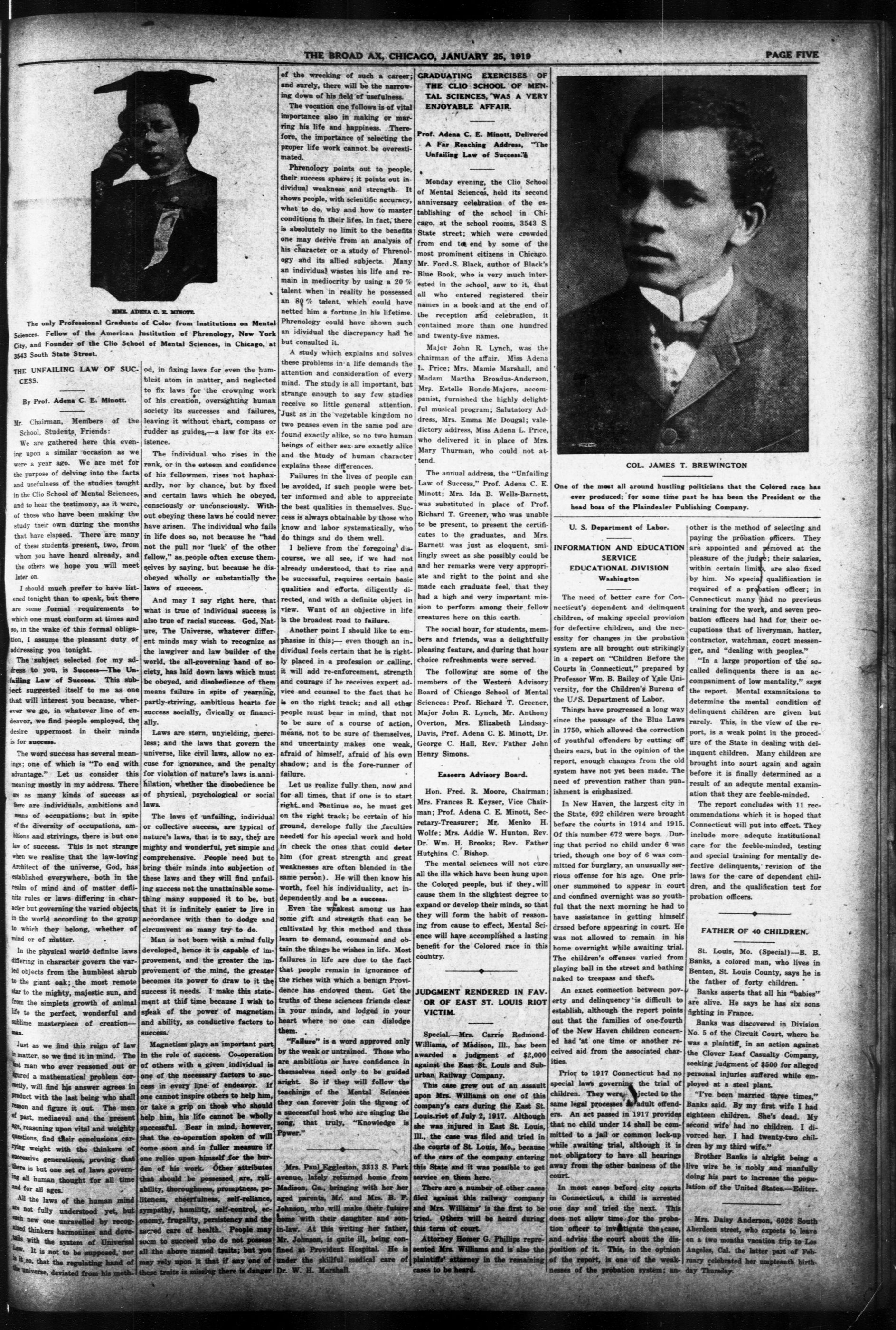
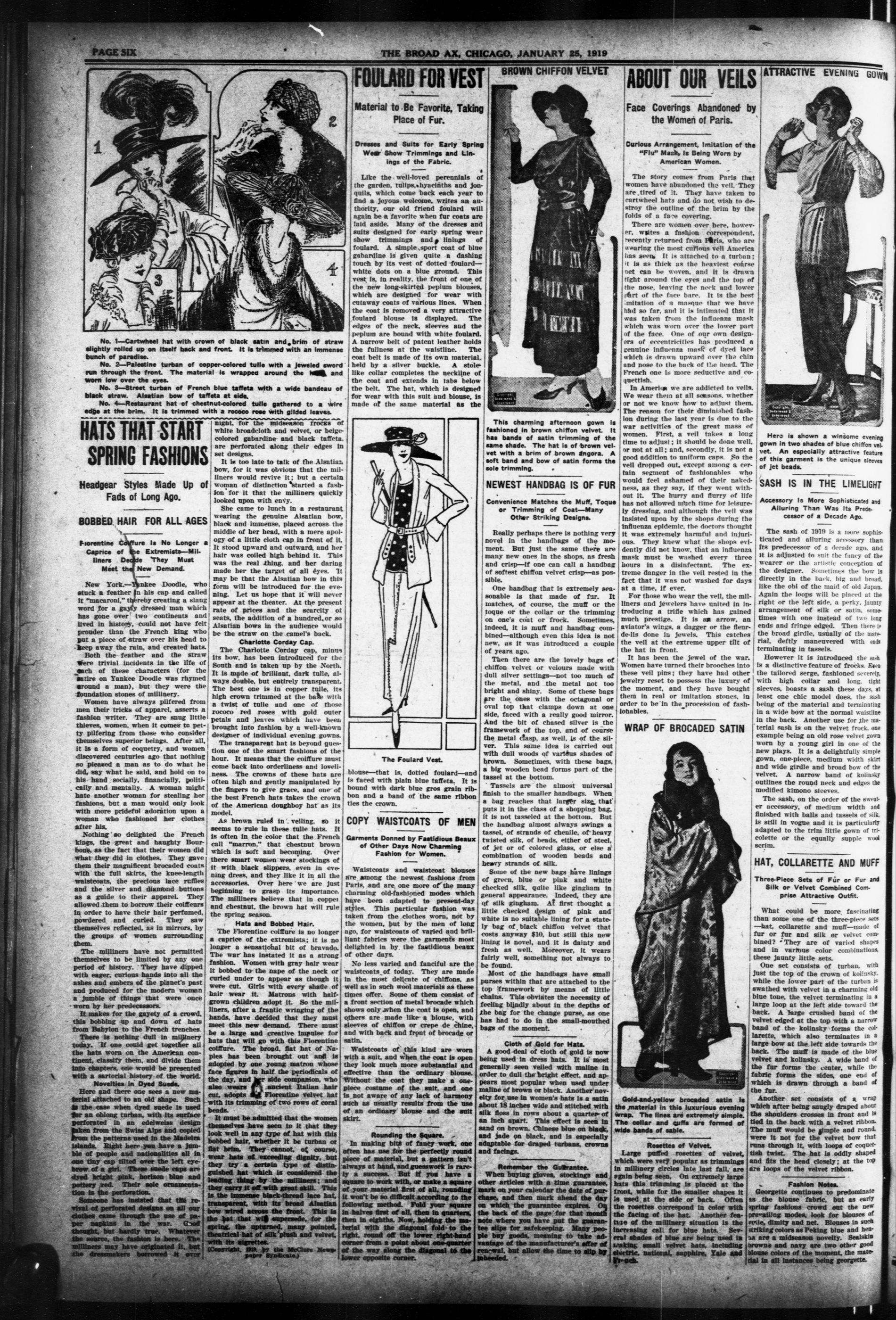
Page text (machine-generated)
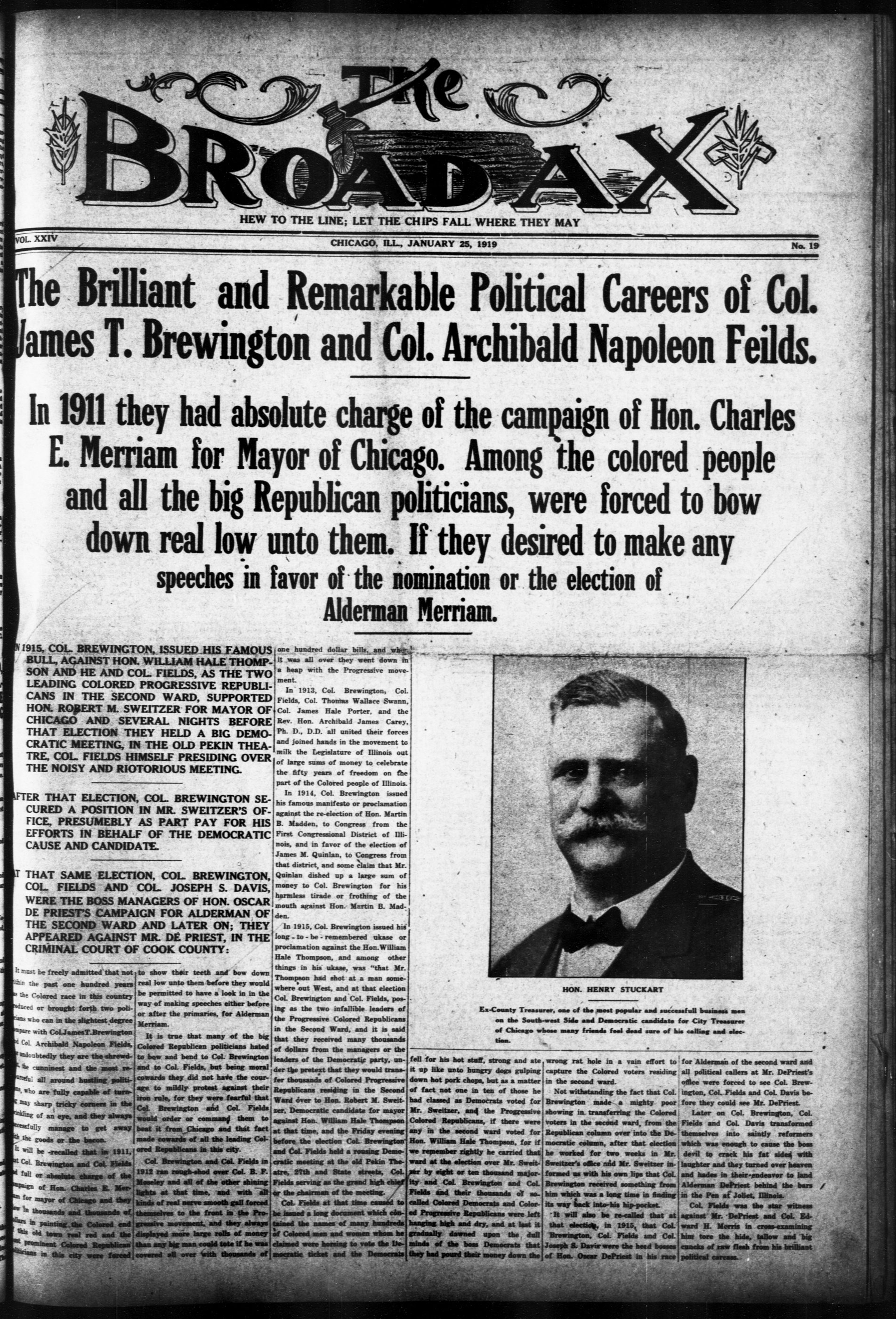
The Brilliant and Remarkable Political Careers of Col. James T. Brewington and Col. Archibald Napoleon Feilds.
In 1911 they had absolute charge of the campaign of Hon. Charles E. Merriam for Mayor of Chicago. Among the colored people and all the big Republican politicians, were forced to bow down real low unto them. If they desired to make any speeches in favor of the nomination or the election of Alderman Merriam.
[Picture of a man in a suit with a bow tie].
Ex-County Treasurer, one of the most popular and successful business men on the South-west Side and Democratic candidate for City Treasurer of Chicago whose many friends feel dead sure of his calling and elec-
fell for his hot stuff, strong and ate it up like unto hungry dogs gulping down hot pork chops, but as a matter of fact not one in ten of those he had classed as Democrats voted for Mr. Sweitzer, and the Progressive Colored Republicans, if there were any in the second ward voted for Hon. William Hale Thompson, for if we remember rightly he carried that ward at the election over Mr. Sweitzer by eight or ten thousand majority and Col. Brewington and Col. Fields and their thousands of so-called Colored Democrats and Colored Progressive Republicans were left hanging high and dry, and at last it gradually dawned upon the dull minds of the boss Democrats that they had poured their money down the
1915, COL. BREWINGTON, ISSUED HIS FAMOUS BULL, AGAINST HON. WILLIAM HALE THOMPSON AND HE AND COL. FIELDS, AS THE TWO LEADING COLORED PROGRESSIVE REPUBLICANS IN THE SECOND WARD, SUPPORTED HON. ROBERT M. SWEITZER FOR MAYOR OF CHICAGO AND SEVERAL NIGHTS BEFORE THAT ELECTION THEY HELD A BIG DEMOCRATIC MEETING, IN THE OLD PEKIN THEATRE, COL. FIELDS HIMSELF PRESIDING OVER THE NOISY AND RIOTORIOUS MEETING.
one hundred dollar bills, and when it was all over they went down in a heap with the Progressive movement.
In 1913, Col. Brewington, Col. Fields, Col. Thomas Wallace Swann, Col. James Hale Porter, and the Rev. Hon. Archibald James Carey, Ph. D., D.D. all united their forces and joined hands in the movement to milk the Legislature of Illinois out of large sums of money to celebrate the fifty years of freedom on the part of the Colored people of Illinois.
In 1914, Col. Brewington issued his famous manifesto or proclamation against the re-election of Hon. Martin B. Madden, to Congress from the First Congressional District of Illinois, and in favor of the election of James M. Quinlan, to Congress from that district, and some claim that Mr. Quinlan dished up a large sum of money to Col. Brewington for his harmless tirade or frothing of the mouth against Hon. Martin B. Madden.
AFTER THAT ELECTION, COL. BREWINGTON SECURED A POSITION IN MR. SWEITZER'S OFFICE, PRESUMEBLY AS PART PAY FOR HIS EFFORTS IN BEHALF OF THE DEMOCRATIC CAUSE AND CANDIDATE.
THAT SAME ELECTION, COL. BREWINGTON, COL. FIELDS AND COL. JOSEPH S. DAVIS, WERE THE BOSS MANAGERS OF HON. OSCAR DE PRIEST'S CAMPAIGN FOR ALDERMAN OF THE SECOND WARD AND LATER ON; THEY APPEARED AGAINST MR. DE PRIEST, IN THE CRIMINAL COURT OF COOK COUNTY:
In 1915, Col. Brewington issued his long- to- be- remembered ukase or proclamation against the Hon.William Hale Thompson, and among other things in his ukase, was "that Mr. Thompson had shot at a man somewhere out West, and at that election Col. Brewington and Col. Fields, posing as the two infallible leaders of the Progressive Colored Republicans in the Second Ward, and it is said that they received many thousands of dollars from the managers or the leaders of the Democratic party, under the pretext that they would transfer thousands of Colored Progressive Republicans residing in the Second Ward over to Hon. Robert M. Sweitzer, Democratic candidate for mayor against Hon. William Hale Thompson at that time, and the Friday evening before the election Col. Brewington and Col. Fields held a rousing Democratic meeting at the old Pekin Theatre, 27th and State streets, Col. Fields serving as the grand high chief or the chairman of the meeting. Col. Fields at that time caused to be issued a long document which contained the names of many hundreds of Colored men and women whom he claimed were horsing to vote the Democratic ticket and the Democrats
---
HON. HENRY STUCKART
wrong rat hole in a vain effort to capture the Colored voters residing in the second ward.
Not withstanding the fact that Col. Brewington made a mighty poor showing in transferring the Colored voters in the second ward, from the Republican column over into the Democratic column, after that election he worked for two weeks in Mr. Sweitzer's office and Mr. Sweitzer informed us with his own lips that Col. Brewington received something from him which was a long time in finding its way back into his hip-pocket.
It will also be re-called that at that election, in 1915, that Col. Brewington, Col. Fields and Col. Joseph S. Davir were the head bosses of Hon. Oscar DePriest in his race
PAGE TWO
THE BROAD AX
Published Every Saturday
In this city since July 15th, 1899, without missing one single issue. Republicans, Democrats, Catholics, Protestants, Single Taxers, Priests, infidels or anyone else can have their say as long as their language is proper and responsibility is fixed.
The Broad Ax is a newspaper whose platform is broad enough for all, ever claiming the editorial right to speak its own mind.
Local communications will receive attention. Write only on one side of the paper.
Subscriptions must be paid in advance.
One Year.....$2.00
Six Months.....1.00
Advertising rates made known on application.
Address all communications to
THE BROAD AX
6206 So. Elizabeth St., Chicago, Ill.
Phone Wentworth 2597.
JULIUS F. TAYLOR
Editor and Publisher
DR. M. A. MAJORS
Associate Editor
4700 South State Street
Phone Drexel 1416
Vol. XXIV Jan. 25, 1919 No. 19
Entered as Second-Class Matter, August 19,
1902, at the Post Office at Chicago,
Ill., under Act of March 3, 1879
HEALTH NOTES.
No one would think of employing a blacksmith to repair and put in order a valuable watch. Yet many of us take a neighbor's advice to use a remedy he thinks would be good for an ailment we know nothing about. Thus we tamper with our bodies, which are more wonderfully and delicately constructed than the finest time piece that was ever made. When your machine is in need of repair, try to get an expert to examine it and put it in running order
Providence does not fix a city or community death rate. When babies die needlessly human ignorance or carelessness are responsible. An all wise God gives life, but He does not needlessly destroy it.
Out of twenty-one prosecutions bought against North Carolina physicians for violating the State law requiring the prompt reporting of cases of communicable diseases, twenty convictions were secured and fines imposed and twenty good doctors now know a little law along with their previously acquired knowledge of medicine.
Don't give the baby patent medicine. If you feel you must use advertised remedies try them on yourself or better still, the dog. Let your family doctor attend to the baby.
Sunshine coming into your home through open or unshaded windows may fade the colors in the rugs, but il will help to put the bloom of health into the children's cheeks.
A long face shortens friendships and promotes distrust; while the cheerful countenance wins friends.
and invites confidence. Look happy.
If you smile easily and know how to laugh heartily, the chances are you will not suffer much from indigestion.
Breathe freely and fully; the more you expand your chest, the less likely you will be to contract a cold.
Dry, hot air is not good for the person who is compelled to breathe it.
It cocts less to keep well than to get well.
Trust in the Lord and keep your feet dry.
Dry sweeping moves dust, but does not remove it.
WHAT THE Y. M. C. A. MEANS TO THE GIRL IN THE SMALL TOWN.
And the boys come home, and khaki turns to blue serge and the little town settles down into the regular routine of little-town life.
But the little-town girl, whose every thought has been of big things for the last two or three years, who has thrown herself into Red Cross work, Liberty Loan drives, who has done all kinds of things to release men for the army—what of her? She has become a citizen of the world; must she go back to the small-town interests of ante-bellum days? Must the end of the tumult and the shouting bring her a dead calm—a vacuum? Must she become an unhappy, restless member of her community? Not if new interests can be given her. And that is what the Y. W. C. A. tries to do and in which it needs the co-operation of the community. The interests of the Y. W. C. A. are the interests of girls and young women all over the world; and some of that breath communicates itself to the local groups. At the Y. W. Centre, a girl may study stenography and fit herself for business. She may study French. She may attend the most popular classes of all, those in domestic science and learn to cook as well—almost—as mother; to sew, to can the fruit and vegetables she raised in her garden. She may come to the gymnasium and develop physically in some particular line, or just in the way of general health. If her community is thoughtful enough in its financial provisions, she may have a place to learn to swim, to play basket-ball and tennis and hockey, and thus become robust in these days of too little exercise. She may have a cafeteria, where she can obtain cost. She may attend Bible study the best food at little more than classes.
The Y. W. C. A. is waiting to hold out its hands to her, to fill her life with whatever will be most helpful to her, her family and her town. All three of these must co-operate with the Association, must bring financial assistance and sympathy to make possible the things which will enrich the life of the small-town girl, when the captains and the kings depart from the world-stage.
SUNSHINE RESCUE MISSION.
2830 S. State Street.
H. FRANKLIN BRAY, D. D. Supt.
Service Every Night in the Year.
Rev. Mr. Augustus of the evangelistic department of the Chicago conference will preach on Sunday night. Special music will be rendered.
Mrs. Nattie B.. Williams one of the founders of the Rescue Mission was buried from Quinn Chapel last Wednesday afternoon. She was faithful to both Quinn Chapel and the Mission until her death.
Dr. Bray has been looking after the sick and burying the dead of Bethel Church during the illness of the pastor. Dr. W. D. Cook.
Mrs. Hattie Jones an evangelist of Wayman Chapel preached a very acceptable sermon last Sunday night following the memorial services in honor of Mrs. Hattie B. Williams. Assistant Superintendent, Rev. P. H. Lewis has been on the sick list for several days."C."
COLORED MAN SERVES FIVE
Cincinnati, O., (Special). —Capt. S. T. Sneed has been installed for the fifth term as Deputy Sheriff of Hamilton County under the Republican Administration. He is fifty-eight years old. As a fraternal man he has but few equals being a member and a past officer in the following lodges: Mason, Odd Fellows, Knights of Pythias, Elks and United Brothers of Friendship. President of the Ohio Board of K. of P. He is a 32nd degree Mason. And Commander of the Famous Co. E., the undefeated champions of the World Drill Team.
THE BROAD AX, CHICAGO, JANUARY 25, 1919
Washington( D. C.—Word has been received that the commission composed of Prof. John R. Hawkins, Judge Wm. H. Harrison, Rev. Jernagis, Rev. Stokes and Dr. J. M. Waldron, who were delegated to attend the conference for Smaller and Weaker Nations in Paris, have received their passports and they are on their way to France.
Prof. Hawkins, like the most of the big Colored people who are looking for free doings, wanted the A. M. E. Church or Bishops to put up the money for his expenses, but the Bishops could not see it that way and he had to dig up his own money, which was perfectly right and proper, for there is no use in posing as big leaders of the Colored race unless you are willing to spend some of your own money.—Editor.
Unwise Giving.
It is a very easy thing to toss a copper to a beggar on the street; it is generally an easier thing than not to do it. Yet love is just as often in the withholding. We purchase relief from the sympathetic feelings roused by the spectacle of misery, at a copper's cost. It is too cheap—too cheap for us, and often too dear for the beggar. If we really loved him we would either do more for him, or less.—Henry Drummond.
Symptoms of Death
The usual procedure at the front to determine whether death has occurred is to inject fluorescine, according to the method of Dr. S. Icard of Marseilles. In the living the eyes will take a vivid green color as though an emerald had been set in the socket. If no coloration is observed within an hour or two after injection, it may be stated positively that the person is dead.
Old Rivers and New.
Henry praised to me lately the manners of an old-established, calm, well-behaved river, as perfectly distinguished from those of a new river. A new river is a torrent; an old one slow and steadily supplied. What happens in any part of the old river relates to what befalls in every other part of it. "Tis full of compensations, resources and reserve funds."-Emerson's Journal.
Public Virtue.
That patriotism which, catching its inspiration from on high, and leaving at an immeasurable distance below all lesser, groveling, personal interests and feelings, animates and prompts to deeds of self-sacrifice, of valor, of devotion. . . . that is public virtue; that is the noblest, the sublimest of all public virtues!—Clay.
Pizarro's Famous Voyage.
December 28 is the anniversary of the fifth start of Pizarro, in 1530, from Panama for Peru. The daring voyager refused to give up his dream of finding gold in the Andean kingdom. The success of his enterprise from a money standpoint astounded the world and resulted in the conquest of the Incas.
A Georgia Philosopher
We're all great on sayin' "The devil's to pay," an 'never payin' him. A feller wouldn't have to walk across the street to settle with him, as he's always close enough to gice us a dig in the ribs, or pat us on the back, an tell us we're the finest he ever made! Atlanta Constitution.
Ladybugs to Fight Aphides.
Ladybugs will be collected by forest service men in Oregon before the period of hibernation is ended and freed in the wheat fields of the state to fight the apides, of which the ladybug is the natural enemy. The ladybugs hibernate on mountain tops and in protected canyons.
Turn About.
Pocahontas Star—Fred Jones, our worthy postman, has purchased an auto in which he carries the mails on weekdays and the females on Sunday. —Boston Transcript.
Life's Minor Worries
Life's Minor Worries.
Frequently a woman worries a great deal over the question of calling on another woman who doesn't care in the least whether she calls or not—Boston Transcript.
Judging Materials
When buying woolen materials hold them up to the light and look through them; the best qualities are free from uneven and broken threads.
Water Protections Coal.
An interesting result of recent experiments with coal is the demonstration of the benefits of submerging the mineral in water. Coal deteriorates in the air, and there is the danger of spontaneous combustion, while when submerged not only was the fire danger eliminated, but scarcely any deterioration was shown. Experimentally, coal kept in the air showed from 2 to 10 per cent of loss in nine months, while when submerged there was scarcely any loss at all.
The New Puritan
The new puritan is instructed in cleanliness, believes in it, practices it. As a good apical guided by an enlightened mind, he purposes to make the best of his body, not to poison it with alcohol or to pollute it with disease. For his own sake and for the sake of the future of the race, he conducts himself morally. His philosopher, guide and friend, however, is the physician and science is his inspiration and his teacher.
... When the Baboon Calls
Baboons have been a sore trouble lately to many South African folk, and poison clubs have been founded to keep them away and reduce their numbers. Baboons recently raided a farm in Robertson, and, ignoring all efforts to drive them away, rode the donkeys in the back yard. In Laingsburg, driven by hunger, they raided gardens in broad daylight.
Fought Unnecessary Battle
Very dramatic was the conclusion of the Peninsular war. Wellington had just won his triumph at Toulouse, the casualties on both sides numbering some 15,000, and the armies were rejoicing or sorrowing, when a tired courier rode up to announce that Napoleon had abdicated five days before, and the war was over.
Diogenes Knew
Diogenes held his lantern before the face of a woman. It was Christmas morning and she was remarking: "How darling! It was just what I wanted!" Whereent, the old fellow shook his head in despair and passed on. "She is counting at this very moment." mused Diog, "on what she can exchange it for."
Admired His Pluck.
"Well," said Uncle Si Bruggins after a solo by a fashionable church choir tenor. "if that ain't the rudest thing I ever saw. Just as soon as that young man began to sing, every other member of the choir stopped. *But he went through with it, and I must say I admire his spunk."—Boston Transcript.
Chinese Influence in Hawaii
The Chinese first planted sugarcane at the "Crossroads of the Pacific" and manufactured sugar, and when the Hawaiians began to cease the cultivation of taro it was the Chinese who became the taro planters and the makers of pol—the staff of life of the native Hawaiian.
Some Should Be Broken
"These talking machines at $50.95," advertises a Chicago music house, "break all records." After listening to some records one simply can't shake off the conviction that there cannot be too many such machines in constant use—Springfield Union.
Ancient Union.
The Cutters' company of Sheffield, England, was incorporated by act of parliament in 1624 and invested with powers "for the good order and government of makers of knives, scissors, shears, sickles and other cutlery wares."
Almost a Panacea.
Apples are useful in nervous dyspepsia, they are nutritious, medicinal, and vitalizing, they aid digestion, clear the voice, correct the acidity of the stomach, are valuable in rheumatism, insomnia and liver troubles.
A combination of telephone, microphone and phonograph has been invented in France for transmitting sounds to distant points or to several points at once.
Linoleum Ingredients
The two main ingredients in the manufacture of linoleum are cork and linseed oil, to which are added smaller quantities of tauri gum, rosin and pigments of various kinds.
Militant Orbs.
From a story: "Her unyielding glance went fiercely over the top and grappled in mortal combat with his domineering sneer."—Boston Transcript.
Interpreted.
When an obituary states that the dead man had the courage of his conviction that means he was a stubborn as a goat.—Atchinson Globe.
Do Right Things Rightly.
We must take care to do right things rightly; for a just sentence may be unjustly executed.—William Penn.
Daily Thought.
Maintain your post; that's all the fame you need.—Dryden.
Speaking of doubtful compliments, a subscriber writes: "I wish to offer the following as one of the best examples I have ever seen. An accomplished musician was invited by a friend to a church service in order to hear the chorus choir render a special selection. The friend, highly pleased with the rendition, was awaiting with much interest her companion's verdict. It came thus, in a whisper: 'They sit well.'" -From the Outlook.
Night Air Not Dangerous.
There is still a prejudice among some against night air. For that reason some foolish people sleep with their windows closed. Night air is not dangerous. On the average it is more pure than that of the day. In malarious sections exposure at night may be dangerous, not because the air is bad but because malarial mosquitoes bite only at night. The danger is in the mosquitoes, not the air.
Health Improvement in Brazil.
The famous saying "Brazil is a vast hospital" is in a fair way to being outlawed. Yellow fever is stamped out and the government has made an immense appropriation for supplying quine to the entire community. To these achievements must be added the labors of the Oswaldo Cruz institute in the realms of scientific prevention of communicable diseases of all kinds.—Brazil-Medico.
Armageddon.
Armageddon, mentioned in Revelation 10:16, was the plain of Esdraelon, the scene of Israeliish victories, and hence the term is used to signify the scene of a momentous test of any kind, especially of a decisive battle. It was used by the Progressive national convention in 1912, and has been frequently used in connection with the war.
Valuable African Tree
A tree known as the shea is beginning to attract commercial attention in Western Africa. It supplies the natives not only with nuts, which they highly prize, but with a butter that may become an article of commercial importance. It is already exported to Europe, where makers of artificial butter find use for it.
How Man's Strength Fluctuates
The strength of males increases rapidly from twelve to nineteen years, and more slowly and regularly up to thirty years, after which it declines. The strength of females increases at a more uniform rate from nine to nineteen years, more slowly to thirty, after which it falls off.
Something Worse.
"Remember, son. Garfield drove mules on a tow path and Lincoln split ralls." "I know, dad; but, say, did any of these presidents ever crank a cold motor in a blizzard for half an hour before he discovered that he didn't have any gasoline?"—Richmond Times-Dispatch.
Much Wastage of Potatoes.
The annual potato crop of the United States is around 400,000,000 bushels. Government statistics show that of this at least 75,000,000 bushels are lost. This wastage is due to the culls, rotting and freezing of potatoes in shipment and the lack of nearby markets.
Dangerous Natural Gas
One of the disadvantages of natural gas localities is that the filtered gas has practically no odor and leakages are, therefore, undetected. Gas has been discovered to be nearly always present in buildings fronting on asphalted streets.
Stray electric currents from a railroad are supposed to cause the trees on one side of a Brussels street to bud again and sometimes blossom after they once have shed their leaves every fall.
George'e Discovery
Little George said the other day at the table. "Now, when I sit in my chair my feet won't touch the floor, but when I walk around they touch the floor just as well as anybody's."
An Example.
"Small eyes." says a physlognist,
"denote a cunning and evasive nature."
Just so. Notice how a small-eyed needle evades one's efforts to thread it—Boston Transcript.
Don't Breathe Either. Girls.
Don't Breathe Either, Girls. Cynicus - The average girl can keep her engagement secret just about as long as she can the fact that she's been eating, onions. - Boston Transcript.
To Polish Amber.
To Polish Amber,
Amber may be polished by friction
with whiting and water, and finally
with a little olive oil well rubbed on
the surface with a piece of flannel.
The World and Life.
The world is not a playground; n
is a schoolroom. Life is not a holiday,
but an education.—Henry Drummond.
Opti-matic Thought!
There is no one that does not once
in his life do a silly act.
Petrarch and Laura
Petrarch's romance with Laura is one of the curiosities of literature. He first saw her on Good Friday, April 6, 1327. Whether or not his devotion to her, which inspired all his love poetry and set a standard for ages to come, was inspired by any passion of the heart is firmly disputed. In fact many believe that Petrarch and Laura never met. That she appeared to him, however, as the perfect woman no one can deny after reading his impassioned lines. -Christian Science Monitor
Tit for Tat.
Stevie and Robbie were cousins, and although very fond of each other, did not always agree. One day Robbie's mother entered the room where the lit tite ones were playing, and was immediately appealed to by her son. "Mamma, mayn't Stevie tell me my faults?" "What do you want Stevie to tell your faults for?" asked Robbie's mother in astonishment. "So that I can tell Stevie his," was the unexpected reply.
Proper Care of Cellar
Cellars will acquire a musty odor after being closed for some time. To remove dampness as well as to disinfect the cellar, sprinkle chloride of lime on the floor and close up the cellar for a few days. Then open the windows and let in the air until the chloride of lime odor disappears and your cellar will be ready for storing vegetables.
Served Him Right.
A Bangor newspaper man, bringing from his garden at Hampden a lot of potatoes in an old suitcase, was stopped by a deputy sheriff, who insisted that he should open the suitcase. When he did so all the potatoes rolled out on the sidewalk. The crowd made the unwilling deputy pick all the potatoes up and pack them in again.
Futility of Lying
Whatever convenience may be thought to be in falsehood and dissimulation is soon over; but the inconvenience of it is perpetual, because it brings a man everlasting jealousy and suspicion, so that he is not believed when he speaks the truth, nor trusted when perhaps he means honestly.—Wisconsin News.
Our Gifts.
As the Magi came bearing gifts, so do we also bear gifts that relieve want; gifts that are sweet and fragrant with friendship; gifts that breathe love; gifts that mean service; gifts inspired still by the star which shone over the City of David two thousand years ago. -Kate Douglas Wiggish.
Political Corruption
Corruption in political life is really skepticism. It is a distrust, a disuse which has lasted so long that it has grown into disbelief of political principles, of the first fundamental truths of the sacredness of government and the necessity of righteousness.—Phillips Brooks.
Breathing Cold Air.
A person breathing cold air obtains as much oxygen in six inhalations as he would in seven taken in hot weather. This increase of oxygen is a matter of great consequence to sufferers from lung trouble and also to the person enjoying good health.
Insects and Forest Fires
Insects cause the destruction of more timber that would otherwise be available for building purposes than do forest fires, according to investigations made by the bureau of entomology at Washington.-People's Home Journal.
Miners as Gardeners.
The growing of leeks is a favorite occupation of the miners of Northumberland, England. They are skillful gardeners and particulaly proud of their leeks, in the cultivation of which there is keen competition.
Good Motto.
Phillips Brooks once said, "Come take that task of yours which you have been hesitating before and shrinking and walking around, and on this very day lift it up and do it."
Chinese and Telephones
In spite of the fact that the average Chinese is fond of using the telephone, it has been found difficult to obtain enough subscribers to support local lines in that country.
A Change for Them.
"What do professional fishermen do when they take a vacation?" asks the writer of a sport column. Maybe they tell the truth, brother.—Boston Transcript.
No Chance for Him.
When you see a man who is willing to let well enough alone you see one who will never occupy any of the room at the top.
Generally Has That Idea.
"De man dat says: 'Let de bes' man win,'" said Uncle Eben, "mos' always thinks dat he's de bes' man himself."
What's gone and what's past help
should be past grief — Shakespeare.
Reasons Advanced Why It Would Be Well If Its Study Should Be Made More General.
Phonetics in its broadest sense is a study of the whole range of sounds, articulate, musical and otherwise. In its restricted sense it is confined to articulate sounds of human speech. Even in this restricted sense it is still broad enough to include the subject of the acoustic or mechanical side and the anthropological or philological side. It may discuss simply the speech vibrations that cause any particular sensations on the human ears, or it may include an investigation of the manner and causes of the changes the articulate sounds of a language undergo as it develops. The study of phonetics is widely advocated by philologists and by many of the most thoughtful teachers for three reasons: (1) That persons may speak their mother tongue correctly through thus learning to know the proper valuation of its sounds; (2) that they may learn successfully the pronunciation of other languages, to which a knowledge of their own is the best introduction; (3) that those who wish to study philology may have a key to that science. And the sounds of our language cannot be successfully studied or explained without some use of phonetic spelling. Hundreds of phonetic alphabets have been proposed, but the only one that has made progress and bids fair to become general (naturally with some modifications) is that of the Association Internationale Phonetique. This alphabet took form between 1885 and 1889 in proposals made by Paul Edouard Passy, a noted French phonetician.
Mysterious Happening With Which, of Course, the Owner Could Have Had Nothing to Do.
This road burner was betting on a sure thing. "If my car will make 32 miles an hour," said an indignant owner of a flivver, who was haled into court for fracturing the speed law, "I'll make this policeman a present of it." And the magistrate took the speeder at his word by ordering the cop to take a joy ride. "But bear in mind," were the parting words of the magistrate. "that if your automobile is capable of that speed you automatically admit that the officer is right about the speed you were making, and you will not only lose your car, but will pay a $25 fine besides." "You're on, judge," said the automobilist, at which the court pounded the gavel, but the cop didn't win the auto. Half an hour later he was back with his prisoner. "Your honor," said the policeman, "that car, in its present condition, wouldn't go a mile in a month. We went over to the garage to get it and it puffed, sneezed, whistled and went one block under protest. Mechanically, about everything is missing but the windshield. Somebody must have kicked the soul out of it since I saw it. The car has been tampered with and there is no mistake about it." The owner of the flivver was fined $25 and made a brief speech, in which he allowed that justice had fed from the earth.
Shooting Into Space
The question of whether it would ever be possible to shoot a projectile into space, that is to say entirely off the earth, has long been the subject of discussion. In a detailed scientific paper on the German long-ranged gun which bombarded Paris last spring, Major J. Maitland-Addison, writing in the Journal of the Royal Artillery, says the requisite velocity of such a gun is not so very much higher than what has already been achieved; viz. a muzzle velocity of a mile per second. When we are able to increase this to five miles per second, the projectile, if fired at a suitable angle, will travel around the earth as a grazing satellite, completing its orbit between 17 and 18 times daily. With a velocity of about seven miles a second, it will move off into space, never to return.
Hidden Beauties
The hidden beauties of standard authors break upon the mind by surprise. It is like discovering the hilden spring in an old jewel. You take up the book in an idle moment, as you may have done a thousand times before, perhaps wondering as you turn over the leaves what the world finds in it to admire; when suddenly as you read your fingers press closely upon the covers, your frame thrills, and the passage you have lighted on chains you like a spell. It is so vividly true and beautiful. Milton's "Conus" finished upon me in this way.—N. P. Willis.
Doing Nicely.
"I hear you have a new lady clerk."
"Tep."
"How is she doing in the office?"
"Doing very well. Half the clerks seem to be willing to do her work for her."—Louisville Courier-Journal.
BIRD IS WORTH PRESERVING
The upland plover, one of the most beneficial birds of all the winged host that once abounded in North America, has been bunted and shot to the verge of extermination, says Dumb Animals. With the passing of the passenger pigeons, which even now so many friends of all birds find it hard to believe and of which a great many are not convinced, the plovers were marked for wholesale destruction. They were candidates for oblivion along with more than a score of other useful and beautiful species that could be ill spared from our vast and valuable native fauna.
There is a ray of hope that these birds may not be pursued to complete annihilation. The federal law for the protection of migratory birds makes it possible for the plover species to rehabilitate itself, provided the closed season be fixed to continue throughout the year. The upland plover is a migratory bird and an insectivorous bird. Its food consists of 97 per cent of animal forms which are chiefly the worst enemies to agriculture. The federal law fixes a closed season on migratory insectivorous birds to continue throughout the year with the exception of the bobolink or ricebird, but under the law the plover is classed as a migratory game bird and so its fate is precarious. These birds should not be shot.
GRANT REFUSED TO ANSWER
When President, He Declined to Tell House Where He Had Been During Absence.
During President Grant's administration a movement was started to call Grant to account for having been absent from Washington. The house asked him by resolution to inform it what official acts he had performed while away, says an exchange. The hero of Anomattox replied:
"I freely inform the house that from the time of my entrance upon my office, I have been in the habit, as were all of my predecessors, of absenting myself at times from the seat of government, and that during such absences I did not neglect or forego the obligations or duties of my office, but continued to discharge all of the executive offices, acts and duties which were required of me as president of the United States. I am not aware that a failure occurred in any one instance of my exercising the functions and powers of my offices in every case requiring their discharge, or of my exercising all necessary executive acts in whatever part of the United States I may at the time have been."
Waxing Wooden Dishes.
If wooden dishes are to be waxed to render them impervious, they should be made of a good quality of pine or deal with an even grain, and the inside should be sandpapered quite smooth. Then, says "Camera Craft," while the dish is being made thoroughly warm, to just a little short of the scorching point, using an ordinary kitchen oven, the wax should be melted and heated in a water bath on top of the fire. With both the dish and the wax as hot as can be conveniently handled, the coating is applied with a brush that is not too stiff, as evenly as possible, working in a warm atmosphere. When the fire has gone out the dish pay be put back in the oven, so that the wood will absorb more of the wax than it otherwise would, leaving it there until the next morning. With a little practice one is able to make a workmanlike job; and such dishes, particularly for large sizes, make a great saving in expense.
A Sad World.
I am cursed for good manners. I cannot grab for food. I cannot take the choice morsel of a dish. I instinctively choose the most uncomfortable seat. I make way for others at the ticket office. I let everyone push ahead of me to secure the remaining seats of a subway coach. I suffer when forced to take a proffered seat. I do not interfere with the conversation of shopiris behind the counter. I wait. I accept invitations from "persons" desirous of showing off their homes or their cash in restaurants. I listen patiently to platitudes of the young, or to the discoverers of Oscar Wilde and Bernard Shaw. I agree that men are vainer than women. I smile upon annoying children. I admire the costuming of all the women I know. Unless hysterical, I never inquire of my love where he has been, whither going, or whom he has seen. I give everyone the preference of liberty. I lose up opportunities.—G. Vere Taylor in Judge
THE BROAD AX. CHICAGO. JANUARY 25. 1919
Men of the Cloth Have Their Troubles, Just as Have Their Lower-Placed Brethren.
I have met a number of types in my ministerial meanderings. Let me quote you a few:
Those hard-headed gentlemen who call upon me to "display my backbone" by giving them my active support in their pet quarrels.
The backsliding member who fears lest I be not religious-minded enough for his people.
The loud and insistent propagandist who thinks I am insincere because I do not shout our common beliefs from every street corner.
The man who never attends a service, who wonders if my sermons are up to the mark.
The person who sees me only during meals, and who therefore assumes that I have nothing to do but eat.
The fastidious critic but slovenly dresser who objects to the shape of my shoe and the length of my coat.
Those who believe they have the right to give me orders, on the ground that they supply some of the money that pays my salary.
The mothers who think it undignified of me to seat myself near girls other than their own daughters.
The near-flatterer who thinks my sermons good—and wonders where I got them—Indianapolis Star.
WAS ONCE "WASTE LAND"
Present Site of Great Bank in New York City So Described in King's Grant.
In the office of George F. Baker, in the First National bank of New York city, there hangs on the wall the original patent from James II, king of England, dated February 4, 1685, for the land on which the First National bank now stands, therein designated as "waste land" outside the city gate of New York. It was issued to one Thomas Dougan, "late governor and now admiral of New York." There is attached a small sketch of the property, showing Wall street with its fence, and the city gate, through which leads "Broad way." When one considers that this "waste land" now represents one of the most valuable spots in the world one realizes what changes a little more than two centuries have wrought in New York city.
What would Thomas Dougan have said if he had been told that on this "waste land" would one day stand a banking institution returning its stockholders over 80 per cent a year?—Wall Street Journal.
"Trompe."
The old French word "trompe" meant a pipe or tuba, and the term trompe was applied to the apparatus by which the blast is produced in the Catalan forge. It is a simple, effective and ingenious contrivance for producing a continuous and equable blast, but its use is restricted to localities where a fall of water from a height of several yards can be obtained. The principle is that water can be made to fall through a pipe in such a way that it will draw in through side openings a considerable amount of air, which by a simple and ingenious arrangement can be utilized as a constant current or blast, and which has the merit of costing almost nothing. It has been utilized to a limited extent elsewhere than in the department of Ariege, in the South of France, where it was formerly very generally employed. Iron has been made in that district for more than 600 years, but the use of the trompe blast was not introduced until the end of the seventeenth century.
Chinese Lanterns.
Particularly gay and attractive are the shops of the lantern venders in the Chinese cities. All varieties of lanterns are to be seen—the large silken ones three and four feet high, gorgeously painted with variegated colors, embroidered in gold and silver or decorated with deep fringe of the same material, costing from $100 to $200 and used by the wealthy mandarins and others; and common small horn and paper lanterns, used by the coolies which cost one-sixteenth of a dollar. The mode of making horn lanterns is very ingenious; the horns are cut into remarkably thin slices which, by means of heat and pressure, are joined together and formed into various shapes; round, square, hexagon, octagon, and some shaped to resemble an hour glass
The Piston.
"The piston is in the form of a solid iron rod that enters the cylinder through a hole pierced in the middle of one of the ends," writes Henri Fubre, "and just large enough to give free passage to the rod, without letting the steam escape. This rod is bound to another iron piece, called a crank, and finally the crank is attached to the neighboring wheel. . . . The piston, advancing and retreating in turn in the cylinder, pushes the crank forward and back, and the crank thus makes the great wheel turn. On the other side of the locomotive, the same things are taking place by means of a second cylinder. Then the two great wheels turn at the same time and the locomotive moves forward."
Really Sisterly.
Hortense—I can only be a sister to you. Alphonse.
Alphonse—Then give me back my presents.
Hortense—Why. Alphonse! Who ever heard of a sister being so silly?
It was an American, Heman Jones of Erie, Pa., who first conceived the idea of the construction of an oil pipe line. It was to be of wood four inches in diameter, but was not executed. A year later, in 1862, a bill was introduced into the legislature authorizing a pipe line from Oil Creek to Kittanning, Pa., (the state in which oil was first discovered), but it got no further, through the opposition of 4,000 teamsters. In fact, for some years the teamsters made impossible the success of the pipe lines. They were doing very well out of the existing methods of transportation, earning $10 to $30 a day, and they viewed with vindictive disfavor the loss of dollars and weekly revelries. Both in 1863 and in 1865 the teamsters wrought havoc on the two pipe lines constructed in those years. Eventually progress gained the day, and many lines were infid, including one 102 miles long in 1880. It was not, however, till John D. Rockefeller and his associates took the matter in hand, eliminating all the old-fashioned methods of production and transportation, that petroleum began to be the power and profit it is today. In 1860 the United States production of petroleum was 21,000,000 gallons. In 1917 it had risen to 13,440,000,000 gallons. Gasoline is still the chief derivative, but fuel oil has a great future.
BELGIANS PROUD OF CITIES
In Their Centers of Industry They See Embodied the Glorious History of the Past.
No man shall say we love our land less than a Frenchman loves France, less than a Belgian loves his native land. We have our holy cities, Winchester and Canterbury, and a hundred more whose old names are dear to speak. Yet I believe, writes "Londoner" in the London Evening News, that the Belgian has a patriotism of the city, of the town, which we never had.
The story of that love for the city is all the history of Belgium. The history of the freedom and the wealth and the ancient arts of Belgium is in the history of Antwerp and Bruges, of Brussels and Ghent, and Louvain and Ypres. It begins with the building of the town wall, with the market that grows up behind the shelter of walls and armed gates, with the raising of the tall belfry, the town's pride, and the hanging of the bells.
If you were a tourist who could see the glory of old Flanders and Brabant, you would look not at the cathedral or the church, although Belgium has many noble old churches, but at the town hall and the belfry. The like of them is not in any other country.
First to Teach Deaf Mutes.
The first American institution for the education of the deaf and dumb was founded in Hartford in 1917 by Dr. Thomas H. Gallaudet, who was born in Philadelphia 131 years ago. He was educated at Yale and at Andover Theological seminary, and it was his intention to enter the ministry. Before leaving Andover, however, he had decided to devote his life to the instruction of deaf mutes, for whom no provision had been made anywhere in America. He remained at the head of the Hartford institution from 1817 until 1830, when ill health forced his retirement. The first systematic attempt to instruct the deaf and dumb in Europe was made in 1570 by Pedro de Ponce, a Benedictine monk of Spain. The first British institution of this kind was opened in Edinburgh in 1773.
Influence of Good Books.
When you find a child who loves good books, the noxious weeds of envy, hatred, jealousy and malice are not so likely to grow in his mind and choke out the exquisite blossoms of love, tenderness, unselfishness, gratitude and the desire to do unto others as he would be done by. The love of good books is one foundation for good character, observes a writer in the Oklahoman. It is the exception, not the rule, to encounter sordidity, greed or insensibility in the man or woman who knows and loves good books. Robert Louis Stevenson once said that so long as a man had a friend he had something to live for. Is it not true so long as one can love a good and beautiful book that life never will be without hope?
California Burglar's Original Methods
Burglaries attempted to open the safe of the Western Mechanical company. Falling to dislodge the safe doors after burning off the hinges, they broke into the company's garage, took out a truck, hoisted the safe through a skylight with the company's tackle, hauled it to a canyon and rifled it of $1,500 cash and Liberty bonds.—Los Angeles Times.
The Right Man
"They say Miss Highstrung is going to marry an army officer."
"Well, I should think that a man who makes a business of war might be able to get along with her."—Boston Evening Transcript.
Used Constantly.
Yeast—Do you think your wife has got a wonderful voice?
Crimsonbeak—Yes. It's wonderful it hasn't given out before this.
Yonkers Statesman.
Cats have a passion for fish and will hover about a room plaintively mewing long after the plsicle substance has gone and only the smell is left; but it is not generally known that they are expert anglers, says a writer in the Family Journal (London). A Hampshire sportsman whose garden bordered on a well-stocked stream stated that his cat takes more trout out of it than he does. All fish love to bask in the sun and, taking advantage of this on fine summer days, Mr. Tom lies in ambush, concealed in the reedy grass bordering some bright pebble shallow. He needs neither röd nor line; unlimited patience is his whole stock in trade. Not a move does he make, his quivering tall merely rustling the slender bents as it stirred with the gentlest southern breeze. Presently there is a splash and a flounder, and a fine, fat trout, bursting with condition, comes flapping up to the shallow for its morning sun bath. For an instant only it lies there contentedly gasping in the soft, warm air, but in that instant the four-footed angler has made his spring and fastened his claws firmly in the fish's shimmering back.
WHY AVERAGE MAN WORKS
Labor May Be Its Own Reward, but the Home Is Thing That Inspires Him.
The 8:10 Sausalito boat was disgorging its crowd of Marin county commuters in the morning. Said one commuter to another, according to the San Francisco Bulletin: "I've timed this crowd getting off the boats. It takes more than twice as long to get them off at the ferry, when they are on their way to work, as it does to hand them at Sausalito at night, when then are on their way home."
In spite of sundry wholesome precepts about labor being its own reward, the fact is that we do not live to work, but that we work to live. The little brown house back in the manzanita trees, with the porch lights burning, the rush of little feet, the welcoming arms, the good dinner, the books and the pipe—this is life. These are the things eternal to which the eager shuffling feet are hastening. They make and motivate the things temporal toward which move the lagard footsteps of the morning.
Joy in your work? Of course, but the fact remains that you wouldn't build those skyscrapers and string those railroads around the world and send big ships into far seas if it wasn't for the "wife and kids."
Mark Twain's Toast to "Babies"
Responding to the toast of "Babies" at the memorial Chicago banquet in honor of General Grant in 1879, Mark Twain concluded with a sentence that set the gathering in an uproar. In his imitative drawing voice he said: "In his cradle, somewhere under the flag, the future illustrious commander-in-chief of the American armies is so little burdened with his approaching grandeurs and responsibilities as to be giving his whole strategic mind, at this moment, to trying to find some way to get his own big toe into" his mouth, an achievement which (meaning no disrespect) the illustrious guest of this evening also turned his attention to some fifty-six years ago. And if the child is but the father of the man there are mighty few who will doubt that he succeeded."
At that conclusion the audience broke into cheers and roars of laughter in which even the reserved Grant loomed.
King John's Bath.
As to the washing habits of royalty in former times, there is one thing, at least, to be remembered to King John's credit. His accounts show that that constantly traveling king nearly always had a bath at his resting places during his journeys.
His "water man" could generally reckon upon getting the bath fee of fivepence. For to our early king, as to the modern sojourners in most hotels, a bath was officially accounted as an extra, to be paid for as such.
The royal water man obtained his special fee every time his majesty demanded a bath—except upon the three great church festivals. — London Chronicle.
When Did Civil War End?
Ask anybody the date of the Civil war's end. The answer will invariably be: "April, 1865." But, in a literal sense, that answer is all wrong.
The supreme court declared that the Civil war came to an end "at the period designated in the proclamation of the president-of-the United States."
That proclamation was dated April 2, 1866. Thus the Civil war came to a formal conclusion on that date, not in April of 1865.
"Up to and before that date" (April 2, 1866), says Secretary of State Bayard's decision, "the insurrection in those (the confederate) states was held to exist. After that date it was held to be at an end."
Edith—So Mr. Bronson proposed to you. Did you accept him?
you. Did you accept him?
Ethel—Mercy, no! He's too awfully matter of fact. Why, he proposed by asking me if I felt favorably disposed toward a unification of interests.—Boston Transcript.
PAGE THREE
It Is Said to Have Sprung From "School Pieces" of Middle of Nineteenth Century.
The Christmas card is the legitimate descendant of the "school pieces" or "Christmas pieces" which were popular from the beginning to the middle of the nineteenth century. These were sheets of writing paper, sometimes surrounded with those hideous and elaborate pen flourishes forming birds, scrolls, etc., so unnaturally dear to the hearts of writing masters, and sometimes beaded with copper plate engravings, plain or colored. These were used by schoolboys at the approach of the holidays for carefully written letters exploiting the progress they had made in composition and chirography. Charity boys were large purchasers of these pieces, says one writer, and at Christmas time used to take them around their parish to show and at the same time solicit a trifle.
The Christmas card proper had its tentative origin in 1854. Joseph Cundall, a London artist, claims to have issued the first in that year. It was printed in lithography, colored by hand and was of the usual size of a lady's card.
Not until 1862, however, did the custom obtain any foothold. Then experiments were made with cards of the size of an ordinary carte de visite, inscribed simply "A Merry Christmas" and "A Happy New Year." After that came to be added robins and holly branches, embossed figures and landscapes.
NEVER DEIGN TO EXPLAIN
Japanese Have a Peculiar Philosophy Which Westerners Find It Rather Hard to Understand.
A Philadelphia lady, now resident in Japan, has written to a friend in her home city a letter which the Public Ledger reproduces in part, because it is "so fine in its reading from within of the Japanese nation and nature." Mrs. Nitobe says:
"I am hoping that the light may soon dawn upon the uninformed mind of America in reference to the true thought of Japan.
"It is part of the Samurai training not to explain. 'If you are wrong, show that you acknowledge your error by changing your conduct. No amount of explanation can set the wrong Night. If you are right and your accuser is mistaken, time will make manifest the justice of your cause.' This is the underlying thought of this particular teaching. It is, I believe, often carried too far—certainly, it may prove misleading to an impatient westerner, and I do not hesitate to say that I have at times resented the situation it has created.
"On the other hand, it is impossible to bare one's soul to the unsympathetic or curiously minded.
"Every man or woman of fine feeling knows that, and the Japanese are singularly sensitive to a sympathetic or an unsympathetic, a coarse or an understanding probing."
Rare Book's Price
Collectors of rare books and manuscripts were very much interested in the announcement that a first edition of Shakespeare's works, published in 1623, was sold at auction in London a few weeks ago for 1,150 pounds sterling. The volume is said to be in excellent condition, though the binding is considerably worn.
This costly book has increased in price by bounds. At the beginning of the eighteenth century the volume was bought for five pounds-from a book dealer. In 1800 it was valued at fifty pounds, and in the year 1890 240 pounds was paid for it. This was a record price until 1890, when its value again increased. The indications are that with the years the price of 1,150 pounds will again be advanced, as the value of the volume will be more and more enhanced as time passes.
Good Slogan.
An imposing cemetery was opened in a young and thriving town in the Middle West. The mayor, who had charge of the laying out of the grounds, was puzzled for an appropriate inscription to be placed over the gate. Riding along in his car one day he was cogitating over different holy texts, which were not entirely satisfactory; so he explained his difficulty to his chauffeur, an intensely practical man. Without hesitation the chauffeur suggested:
"We have come to stay."—Harper's Magazine.
Choice of Voices.
Edith—Mr. Boreleigh? Oh, dear!
I'll have Ninette tell him I'm out.
Alice—Won't the still, small voice reproach you?
Edith—Maybe, but I'd much rather hear the still, small voice than Mr Boreleigh's.—Boston Evening Transcript.
Sad Blow to Pride.
"Mr. and Mrs. Whifter put on a great many airs since they have returned from Europe."
"Yes, they do, but while they were away several people mistook the caretaker and his wife for Mr. and Mrs Whifter."—Brooklyn Citizen.
Proper Acknowledgment.
"You are what they call a self-made man."
"No," replied Mr. Dustin Stax; "my wife and family helped with advice and encouragement. I'm not self-made. I'm home-made."
M.
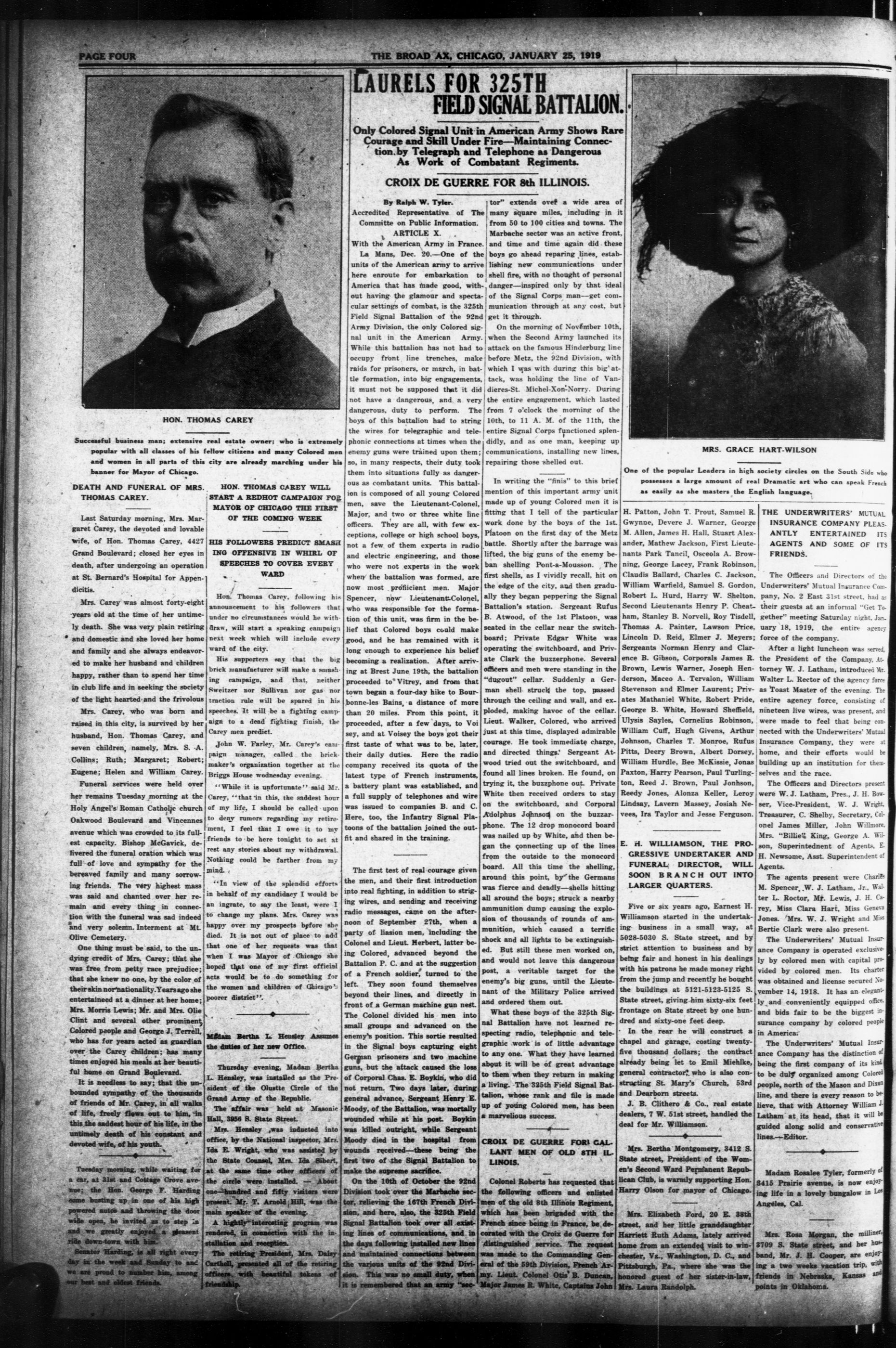
HON. THOMAS CAREY
Successful business man; extensive real estate owner; who is extremely popular with all classes of his fellow citizens and many Colored men and women in all parts of this city are already marching under his banner for Mayor of Chicago.
DEATH AND FUNERAL OF MRS. THOMAS CAREY.
Last Saturday morning, Mrs. Margaret Carey, the devoted and lovable wife, of Hon. Thomas Carey, 4427 Grand Boulevard; closed her eyes in death, after undergoing an operation at St. Bernard's Hospital for Appendicitis.
HON. THOMAS CAREY WILL START A REDHOT CAMPAIGN FOR MAYOR OF CHICAGO THE FIRST OF THE COMING WEEK
HIS FOLLOWERS PREDICT SMASHING OFFENSIVE IN WHIRL OF SPEECHES TO COVER EVERY WARD
Mrs. Carey was almost forty-eight years old at the time of her untimely death. She was very plain retiring and domestic and she loved her home and family and she always endeavored to make her husband and children happy, rather than to spend her time in club life and in seeking the society of the light hearted and the frivolous Mrs. Carey, who was born and raised in this city, is survived by her husband, Hon. Thomas Carey, and seven children, namely, Mrs. S. A. Collins; Ruth; Margaret; Robert; Eugene; Helen and William Carey.
Funeral services were held over her remains Tuesday morning at the Holy Angel's Roman Catholic church Oakwood Boulevard and Vincennes avenue which was crowded to its fullest capacity. Bishop McGavick, delivered the funeral oration which was full of love and sympathy for the bereaved family and many sorrowing friends. The very highest mass was said and chanted over her remain and every thing in connection with the funeral was sad indeed and very solemn. Interment at Mt. Olive Cemetery.
One thing must be said, to the undying credit of Mrs. Carey; that she was free from petty race prejudice; that she knew no one, by the color of their skin nor nationality. Years ago she entertained at a dinner at her home; Mrs. Morris Lewis; Mr. and Mrs. Olie Clint and several other prominent Colored people and George J. Terrell, who has for years acted as guardian over the Carey children; has many times enjoyed his meals at her beautiful home on Grand Boulevard.
It is needless to say; that the unbounded sympathy of the thousands of friends of Mr. Carey, in all walks of life, freely flows out to him, in this the saddest hour of his life, in the untimely death of his constant and devoted wife, of his youth.
Tuesday morning, while waiting for a car, at 31st and Cottage Grove avenue; the Hon. George F. Harding some busting up in one of his high powered autos and throwing the door wide open, he invited us to step in and we greatly enjoyed a pleasant ride down-town with him.
Senator Harding, is all right every day in the week and Sunday to and we are proud to number him, among our best and oldest friends.
real estate owner; who is extremely fellow citizens and many Colored men city are already marching under his HON. THOMAS CAREY WILL START A REDHOT CAMPAIGN FOR MAYOR OF CHICAGO THE FIRST OF THE COMING WEEK
HIS FOLLOWERS PREDICT SMASH IN OFFENSIVE IN WHIRL OF SPEECHIES TO COVER EVERY
Hon. Thomas Carey, following his announcement to his followers that under no circumstances would he withdraw, will start a speaking campaign next week which will include every ward of the city.
His supporters say that the big brick manufacturer will make a smashing campaign, and that, neither Sweitzer nor Sullivan nor gas nor traction rule will be spared in his speeches. It will be a fighting campaign to a dead fighting finish, the Carey men predict.
John W. Farley, Mr. Carey's campaign manager, called the brickmaker's organization together at the Briggs House Wednesday evening.
"While it is unfortunate" said Mr. Carey, "that in this, the saddest hour of my life, I should be called upon to deny rumors regarding my retirement, I feel that I owe it to my friends to be here tonight to set at rest any stories about my withdrawal. Nothing could be farther from my mind.
"In view of the splendid efforts in behalf of my candidacy I would be an ingrate, to say the least, were I to change my plans. Mrs. Carey was happy over my prospects before she died. It is not out of place to add that one of her requests was that when I was Mayor of Chicago she hoped that one of my first official acts would be to do something for the women and children of Chicago's poorer district".
Msdam Bertha L. Hensley Assumes the duties of her new Office.
Thursday evening, Madam Bertha L. Hensley, was installed as the President of the Olustte Circle of the Grand Army of the Republic.
The affair was held at Masonic Hall, 3956 S. State Street.
Mrs. Hensley, was inducted into office, by the National inspector, Mrs. Ida E. Wright, who was assisted by the State Counsel, Mrs. Ida Sibert, at the same time other officers of the circle were installed. — About one-hundred and fifty visitors were present. Mr. T. Arnold Hill, was the main speaker of the evening.
A highly interesting program was rendered, in connection with the installation and reception.
The retiring President, Mrs. Daley Carthell, presented all of the retiring officers, with beautiful tokens of friendship.
---
THE BROAD AX, CHICAGO, JANUARY 25, 1919
LAURELS FOR 325TH FIELD SIGNAL BATTALION.
Only Colored Signal Unit in American Army Shows Rare Courage and Skill Under Fire—Maintaining Connection. by Telegraph and Telephone as Dangerous As Work of Combatant Regiments.
CROIX DE GUERRE FOR 8th ILLINOIS.
By Ralph W. Tyler.
Accredited Representative of The Committee on Public Information.
ARTICLE X.
With the American Army in France La Mans, Dec. 20.—One of the units of the American army to arrive here enroute for embarkation to America that has made good, without having the glamour and spectacular settings of combat, is the 325th Field Signal Battalion of the 92nd Army Division, the only Colored signal unit in the American Army While this battalion has not had to occupy front line trenches, make raids for prisoners, or march, in battle formation, into big engagements, it must not be supposed that it did not have a dangerous, and a very dangerous, duty to perform. The boys of this battalion had to string the wires for telegraphic and telephonic connections at times when the enemy guns were trained upon them; so, in many respects, their duty took them into situations fully as dangerous as combatant units. This battalion is composed of all young Colored men, save the Lieutenant-Colonel, Major, and two or three white line officers. They are all, with few exceptions, college or high school boys, not a few of them experts in radio and electric engineering, and those who were not experts in the work when the battalion was formed, are now most proficient men. Major Spencer, now Lieutenant-Colonel, who was responsible for the formation of this unit, was firm in the belief that Colored boys could make good, and he has remained with it long enough to experience his belief becoming a realization. After arriving at Brest June 19th, the battalion proceeded to Vitrey, and from that town began a four-day hike to Bourbon-lees Bains, a distance of more than 20 miles. From this point, it proceeded, after a few days, to Voisey, and at Voisey the boys got their first taste of what was to be, later, their daily duties. Here the radio company received its quota of the latest type of French instruments, a battery plant was established, and a full supply of telephones and wire was issued to companies B. and C. Here, too, the Infantry Signal Platoons of the battalion joined the outfit and shared in the training.
The first test of real courage given the men, and their first introduction into real fighting, in addition to striging wires, and sending and receiving radio messages, came on the afternoon of September 27th, when a party of liaison men, including the Colonel and Lieut. Herbert, latter being Colored, advanced beyond the Battalion P. C. and at the suggestion of a French soldier, turned to the left. They soon found themselves beyond their lines, and directly in front of a German machine gun nest. The Colonel divided his men into small groups and advanced on the enemy's position. This sortie resulted in the Signal boys capturing eight German prisoners and two machine guns, but the attack caused the loss of Corporal Chas. E. Boykin, who did not return. Two days later, during general advance, Sergeant Henry E. Moody, of the Battalion, was mortally wounded while at his post. Boykin was killed outright, while Sergeant Moody died in the hospital from wounds received—these being the first two of the Signal Battalion to make the supreme sacrifice.
On the 10th of October the 92nd Division took over the Marbache sector, relieving the 167th French Division, and here, also, the 325th Field Signal Battalion took over all existing lines of communications, and in the days following installed new lines and maintained connections between the various units of the 92nd Division. This was no small duty, when it is remembered that an army "see-
tor" extends over a wide area of many square miles, including in it from 50 to 100 cities and towns. The Marbache sector was an active front, and time and time again did these boys go ahead repairing lines, establishing new communications under shell fire, with no thought of personal danger—inspired only by that ideal of the Signal Corps man—get communication through at any cost, but get it through.
On the morning of November 10th, when the Second Army launched its attack on the famous Hinderburg line before Metz, the 92nd Division, with which I was with during this big attack, was holding the line of Vandieres-St. Michel-Xon-Norry. During the entire engagement, which lasted from 7 o'clock the morning of the 10th, to 11 A. M. of the 11th, the entire Signal Corps functioned splendidly, and as one man, keeping up communications, installing new lines, repairing those shelled out.
In writing the "finis" to this brief mention of this important army unit made up of young Colored men it is fitting that I tell of the particular work done by the boys of the 1st Platoon on the first day of the Metz battle. Shortly after the barrage was lifted, the big guns of the enemy beban shelling Pont-a-Mousson. The first shells, as I vividly recall, hit on the edge of the city, and then gradually they began peppering the Signal Battalion's station. Sergeant Rufus B. Atwood, of the 1st Platoon, was seated in the cellar near the switchboard; Private Edgar White was operating the switchboard, and Private Clark the buzzerphone. Several officers and men were standing in the "dugout" cellar. Suddenly a German shell struck the top, passed through the ceiling and wall, and exploded, making havoc of the cellar. Lieut. Walker, Colored, who arrived just at this time, displayed admirable courage. He took immediate charge, and directed things.' Sergeant Atwood tried out the switchboard, and found all lines broken. He found, on trying it, the buzzphone out. Private White then received orders to stay on the switchboard, and Corporal Adolphus Johnson on the buzzphone. The 12 drop monocord board was nailed up by White, and began the connecting up of the lines from the outside to the monocord board. All this time the shelling, around this point, by the Germans was fierce and deadly—shells hitting all around the boys; struck a nearby ammunition dump causing the explosion of thousands of rounds of ammunition, which caused a terrific shock and all lights to be extinguished. But still these men worked on, and would not leave this dangerous post, a veritable target for the enemy's big guns, until the Lieutenant of the Military Police arrived and ordered them out.
What these boys of the 325th Signal Battalion have not learned respecting radio, telephonic and telegraphic work is of little advantage to any one. What they have learned about it will be of great advantage to them when they return in making a living. The 325th Field Signal Battalion, whose rank and file is made up of young Colored men, has been a marvelous success.
CROIX DE GUERRE FORI GAL-LANT MEN OF OLD 8TH IL-LINOIS.
Colonel Roberts has requested that the following officers and enlisted men of the old 8th Illinois Regiment, which has been brigaded with the French since being in France, be decorated with the Croix de Guerre for distinguished service. The request was made to the Commanding General of the 59th Division, French Army. Lieut. Colonel Otis' B. Duncan, Major James R. White, Captains John
M.
MRS. GRACE HART-WILSON
One of the popular Leaders in high possesses a large amount of re as easily as she masters the E
One of the popular Leaders in high society circles on the South Side who possesses a large amount of real Dramatic art who can speak French as easily as she masters the English language.
H. Patton, John T. Prout, Samuel R. Gwynne, Devere J. Warner, George M. Allen, James H. Hall, Stuart Alex ander, Mathew Jackson, First Lieutenants Park Tancil, Osceola A. Browning, George Lacey, Frank Robinson Claudis Ballard, Charles C. Jackson William Warfield, Samuel S. Gordon Robert L. Hurd, Harry W. Shelton Second Lieutenants Henry P. Cheatham, Stanley B. Norvell, Roy Tisdell Thomas A. Painter, Lawson Price, Lincoln D. Reid, Elmer J. Meyers; Sergeants Norman Henry and Clarence B. Gibson, Corporals James R. Brown, Lewis Warner, Joseph Henderson, Maceo A. Tervalon, William Stevenson and Elmer Laurent; Privates Mathaniel White, Robert Pride, George B. White, Howard Sheffield, Ulysis Sayles, Cornelius Robinson, William Cuff, Hugh Givens, Arthur Johnson, Charles T. Monroe, Rufus Pitts, Deery Brown, Albert Dorsey, William Hurdle, Bee McKissie, Jonas Paxton, Harry Pearson, Paul Turlington, Reed J. Brown, Paul Jonhson, Reedy Jones, Alonza Keller, Leroy Lindsay, Lavern Massey, Josiah Nevees, Ira Taylor and Jesse Ferguson.
E. H. WILLIAMSON, THE PROGRESSIVE UNDERTAKER AND FUNERAL DIRECTOR, WILL SOON BRANCH OUT INTO LARGER QUARTERS.
Five or six years ago, Earnest H. Williamson started in the undertaking business in a small way, at 5028-5030 S. State street, and by strict attention to business and by being fair and honest in his dealings with his patrons he made money right from the jump and recently he bought the buildings at 5121-5123-5125 S. State street, giving him sixty-six feet frontage on State street by one hundred and sixty-one feet deep. In the rear he will construct a chapel and garage, costing twenty-five thousand dollars; the contract already being let to Emil Miehlke, general contractor, who is also constructing St. Mary's Church, 53rd and Dearborn streets.
J. B. Clithero & Co., real estate dealers, 7 W. 51st street, handled the deal for Mr. Williamson.
Mrs. Bertha Montgomery, 3412 S. State street, President of the Women's Second Ward Permanent Republican Club, is warmly supporting Hon. Harry Olson for mayor of Chicago.
Mrs. Elizabeth Ford, 20 E. 38th street, and her little granddaughter Harriett Ruth Adams, lately arrived home from an extended visit to winchester, Vs., Washington, D. C., and Pittsburgh, Pa., where she was the honored guest of her sister-in-law, Mrs. Laura Randolph.
```markdown
```
THE UNDERWRITERS' MUTUAL INSURANCE COMPANY PLEASANTLY ENTERTAINED ITS AGENTS AND SOME OF ITS FRIENDS.
The Officers and Directors of the Underwriters' Mutual Insurance Company, No. 2 East 31st street, had as their guests at an informal "Get Together" meeting Saturday night, January 18, 1919, the entire agency force of the company.
After a light luncheon was served, the President of the Company, Attorney W. J. Latham, introduced Mr. Walter L. Rector of the agency force as Toast Master of the evening. The entire agency force, consisting of nineteen live wires, was present, and were made to feel that being connected with the Underwriters' Mutual Insurance Company, they were at home, and their efforts would be building up an institution for them selves and the race.
The Officers and Directors present were W. J. Latham, Pres., J. H. Bowser, Vice-President, W. J. Wright, Treasurer, C. Shelby, Secretary, Colonel James Miller, John Willmore Mrs. "Billie" King, George A. Wilson, Superintendent of Agents, E.H. Newsome, Asst. Superintendent of Agents.
The agents present were Charles M. Spencer, W. J. Latham, Jr., Walter L. Roctor, Mr. Lewis, J. H. Carey, Miss Clara Hart, Miss Geneva Jones. /Mrs. W. J. Wright and Miss Bertie Clark were also present.
The Underwriters' Mutual Insurance Company is operated exclusively by colored men with capital provided by colored men. Its charter was obtained and license secured November 14, 1918. It has an elegantly and conveniently equipped office and bids fair to be the biggest insurance company by colored people in America.
The Underwriters' Mutual Insurance Company has the distinction of being the first company of its kind to be duly organized among Colored people, north of the Mason and Dixon line, and there is every reason to be lieve, that with Attorney William J. Latham at its head, that it will be guided along solid and conservative lines.-Editor.
Madam Rosalee Tyler, formerly of 3415 Prairie avenue, is now enjoying life in a lovely bungalow in Los Angeles, Cal.
Mrs. Rosa Morgan, the milliner, 3709 S. State street, and her husband, Mr. J. H. Cooper, are enjoying a two weeks vacation trip, with friends in Nebraska, Kansas and points in Oklahoma.
MME. ADENA C. E. MINOTT.
The only Professional Graduate of Color from Institutions on Mental Sciences. Fellow of the American Institution of Phrenology, New York City, and Founder of the Clio School of Mental Sciences, in Chicago, at 3543 South State Street.
THE UNFAILING LAW OF SUCCESS.
od, in fixing laws for even the humblest atom in matter, and neglected
Mr. Chairman, Members of the School, Students, Friends:
We are gathered here this evening upon a similar occasion as we were a year ago. We are met for the purpose of delving into the facts and usefulness of the studies taught in the Clio School of Mental Sciences, and to hear the testimony, as it were, of those who have been making the study their own during the months that have elapsed. There are many of these students present, two, from whom you have heard already, and the others we hope you will meet later on.
I should much prefer to have listened tonight than to speak, but there are some formal requirements to which one must conform at times and so, in the wake of this formal obligation, I assume the pleasant duty of addressing you tonight.
The subject selected for my address to you, is Success—The Unfailing Law of Success. This subject suggested itself to me as one that will interest you because, wherever we go, in whatever line of endeavor, we find people employed, the desire uppermost in their minds is for success.
The word success has several meanings; one of which is "To end with advantage." Let us consider this meaning mostly in my address. There are as many kinds of success as there are individuals, ambitions and means of occupations; but in spite of the diversity of occupations, ambitions and strivings, there is but one law of success. This is not strange when we realize that the law-loving Architect of the universe, God, has established everywhere, both in the realm of mind and of matter definite rules or laws differing in character but governing the varied objects in the world according to the group to which they belong, whether of mind or of matter.
In the physical world definite laws differing in character govern the varied objects from the humblest shrub to the giant oak; the most remote star to the mighty, majestic sun, and from the simplets growth of animal life to the perfect, wonderful and sublime masterpiece of creation—man.
Just as we find this reign of law in matter, so we find it in mind. The first man who ever reasoned out or mathematical problem correctly, will find his answer agrees in product with the last being who shall reason and figure it out. The men of past, mediaeval and the present age, reasoning upon vital and weighty questions, find their conclusions carrying weight with the thinkers of successive generations, proving that there is but one set of laws governing all human thought for all time and for all ages.
All the laws of the human mind are not fully understood yet, but each new one unravelled by recognized thinkers harmonizes and dove-tails with the system of Universal Law. It is not to be supposed, nor is it so, that the regulating hand of the universe, deviated from his meth.
od, in fixing laws for even the humblest atom in matter, and neglected to fix laws for the crowning work of his creation, oversighting human society its successes and failures, leaving it without chart, compass or rudder as guides,—a law for its existence.
The individual who rises in the rank, or in the esteem and confidence of his fellowmen, rises not haphaxardly, nor by chance, but by fixed and certain laws which he obeyed, consciously or unconsciously. Without obeying these laws he could never have arisen. The individual who fails in life does so, not because he "had not the pull nor 'luek' of the other fellow," as people often excuse themselves by saying, but because he disobeyed wholly or substantially the laws of success.
And may I say right here, that what is true of individual success is also true of racial success. God, Nature. The Universe, whatever different minds may wish to recognize as the lawgiver and law builder of the world, the all-governing hand of society, has laid down laws which must be obeyed, and disobedience of them means failure in spite of yearning, partly-striving, ambitious hearts for success socially, civically or financially.
Laws are stern, unyielding, merciless; and the laws that govern the universe, like civil laws, allow no excuse for ignorance, and the penalty for violation of nature's laws is annihilation, whether the disobedience be of physical, psychological or social laws.
The laws of unfailing, individual or collective success, are typical of nature's laws, that is to say, they are mighty and wonderful, yet simple and comprehensive. People need but to bring their minds into subjection of these laws and they will find unfailing success not the unattainable something many supposed it to be, but that it is infinitely easier to live in accordance with than to dodge and circumvent as many try to do.
Man is not born with a mind fully developed, hence it is capable of improvement, and the greater the improvement of the mind, the greater becomes its power to draw to it the success it needs. I make this statement at this time because I wish to speak of the power of magnetism and ability, as conductive factors to success.
Magnetism plays an important part in the role of success. Co-operation of others with a given individual is one of the necessary factors to success in every line of endeavor. If one cannot inspire others to help him, or take a grip on those who should help him, his life cannot be wholly successful. Bear in mind, however, that the co-operation spoken of will come soon and in fuller measure if one relies upon himself for the burden of his work. Other attributes that should be possessed are, reliability, thoroughness, promptness, politeness, cheerfulness, self-reliance, sympathy, humility, self-control, economy, frugality, persistency and the sacred care of health. People may seem to succeed who do not possess all the above named traits; but you may rely upon it that if any one of these traits is missing there is danger
of the wrecking of such a career; and surely, there will be the narrowing down of his field of usefulness. The vocation one follows is of vital importance also in making or marring his life and happiness. Therefore, the importance of selecting the proper life work cannot be overestimated.
GRADUATING EXERCISES
THE CLIO SCHOOL OF METAL SCIENCES, WAS A VENJOYABLE AFFAIR.
Prof. Adena C. E. Minott, Deliver A Far Reaching Address, Unfailing Law of Success.
Phrenology points out to people, their success sphere; it points out individual weakness and strength. It shows people, with scientific accuracy, what to do, why and how to master conditions in their lifes. In fact, there is absolutely no limit to the benefits one may derive from an analysis of his character or a study of Phrenology and its allied subjects. Many an individual wastes his life and remain in mediocrity by using a 20% talent when in reality he possessed an 80% talent, which could have netted him a fortune in his lifetime. Phrenology could have shown such an individual the discrepancy had he but consulted it.
A study which explains and solves these problems in a life demands the attention and consideration of every mind. The study is all important, but strange enough to say few studies receive so little general attention. Just as in the vegetable kingdom no two peasen even in the same pod are found exactly alike, so no two human beings of either sex are exactly alike and the study of human character explains these differences.
Failures in the lives of people can be avoided, if such people were better informed and able to appreciate the best qualities in themselves. Success is always obtainable by those who know and labor systematically, who do things and do them well.
I believe from the foregoing discourse, we all see, if we had not already understood, that to rise and be successful, requires certain basic qualities and efforts, diligently directed, and with a definite object in view. Want of an objective in life is the broadest road to failure.
Another point I should like to emphasise in this;— even though an individual feels certain that he is rightly placed in a profession or calling, it will add re-enforcement, strength and courage if he receives expert advice and counsel to the fact that he is on the right track; and all other people must bear in mind, that not to be sure of a course of action, means, not to be sure of themselves, and uncertainty makes one weak, afraid of himself, afraid of his own shadow; and is the fore-runner of failure.
Let us realize fully then, now and for all times, that if one is to start right and continue so, he must get on the right track; be certain of his ground, develope fully the faculties needed for his special work and hold in check the ones that could deter him (for great strength and great weaknesses are often blended in the same person). He will then know his worth, feel his individuality, act independently and be a success.
Even the weakest among us has some gift and strength that can be cultivated by this method and thus learn to demand, command and obtain the things he wishes in life. Most failures in life are due to the fact that people remain in ignorance of the riches with which a benign Providence has endowed them. Get the truths of these sciences friends clear in your minds, and lodged in your heart where no one can dislodge them.
Mrs. Paul Eggleston, 3813 S. Park avenue, lately returned home from Madison, Ga., bringing with her her aged parents, Mr. and Mrs. B. F. Johnson, who will make their future home with their daughter and son-in-law. At this writing her father, Mr. Johnson, is quite ill, being confined at Provident Hospital. He is under the skillful medical care of Dr. W. H. Marshall.
GRADUATING EXERCISES OF THE CLIO SCHOOL OF MENTAL SCIENCES, WAS A VERY ENJOYABLE AFFAIR.
Prof. Adena C. E. Minott, Delivered A Far Reaching Address, "The Unfailing Law of Success."
Monday evening, the Clio School of Mental Sciences, held its second anniversary celebration of the establishing of the school in Chicago, at the school rooms, 3543 S. State street; which were crowded from end to end by some of the most prominent citizens in Chicago. Mr. Ford.S. Black, author of Black's Blue Book, who is very much interested in the school, saw to it, that all who entered registered their names in a book and at the end of the reception and celebration, it contained more than one hundred and twenty-five names.
Major John R. Lynch, was the chairman of the affair. Miss Adena L. Price; Mrs. Mamie Marshall, and Madam Martha Broadus-Dougal, Mrs. Estelle Bonds-Majors, accompanist, furnished the highly delightful musical program; Salutatory Address, Mrs. Emma Mc Dougal; valedictory address, Miss Adena L. Price, who delivered it in place of Mrs. Mary Thurman, who could not attend.
The annual address, the "Unfailing Law of Success," Prof. Adena C. E. Minott; Mrs. Ida B. Wells-Barnett, was substituted in place of Prof. Richard T. Greener, who was unable to be present, to present the certificates to the graduates, and Mrs. Barnett was just as eloquent, smilingly sweet as she possibly could be and her remarks were very appropriate and right to the point and she made each graduate feel, that they had a high and very important mission to perform among their fellow creatures here on this earth.
The social hour, for students, members and friends, was a delightfully pleasing feature, and during that hour choice refreshments were served.
The following are some of the members of the Western Advisory Board of Chicago School of Mental Sciences: Prof. Richard T. Greener, Major John R. Lynch, Mr. Anthony Overton, Mrs. Elizabeth Lindsay-Davis, Prof. Adena C. E. Minott, Dr. George C. Hall, Rev. Father John Henry Simons.
Easeern Advisory Board.
Hon. Fred. R. Moore, Chairman; Mrs. Frances R. Keyser, Vice Chairman; Prof. Adena C. E. Minott, Secretary-Treasurer; Mr. Menko H. Wolfe; Mrs. Addie W. Hunton, Rev. Dr. Wm. H. Brooks; Rev. Father Hutchins C. Bishop.
The mental sciences will not cure all the ills which have been hung upon the Colored people, but if they will cause them in the slightest degree to expand or develop their minds, so that they will form the habit of reasoning from cause to effect, Mental Science will have accomplished a lasting benefit for the Colored race in this country.
JUDGMENT RENDERED IN FAV-
OR OF EAST ST. LOUIS RIOT
VICTIM.
Special.—Mrs. Carrie Redmond, Williams, of Madison, Ill., has been awarded a judgment of $2,000 against the East St. Louis and Suburban Railway Company.
This case grew out of an assault upon Mrs. Williams on one of this company's cars during the East St. Louis. riot of July 2, 1917. Although she was injured in East St. Louis, Ill., the case was filed and tried in the courts of St. Louis, Mo., because of the cars of the company entering this State and it was possible to get service on them here.
There are a number of other cases filed against this railway company and Mrs. Williams' is the first to be tried. Others will be heard during this term of court.
Attorney Homer G. Phillips represented Mrs. Williams and is also the plaintiff's attorney in the remaining cases to be heard.
COL. JAMES T. BREWINGTON
One of the most all around hustling politicians that the Colored race has ever produced; for some time past he has been the President or the head boss of the Plaindealer Publishing Company.
INFORMATION AND EDUCATION
SERVICE
EDUCATIONAL DIVISION
Washington
The need of better care for Connecticut's dependent and delinquent children, of making special provision for defective children, and the necessity for changes in the probation system are all brought out strikingly in a report on "Children Before the Courts in Connecticut," prepared by Professor Wm. B. Bailey of Yale University, for the Children's Bureau of the U.S. Department of Labor.
Things have progressed a long way since the passage of the Blue Laws in 1750, which allowed the correction of youthful offenders by cutting off theirs ears, but in the opinion of the report, enough changes from the old system have not yet been made. The need of prevention rather than punishment is emphasized.
In New Haven, the largest city in the State, 692 children were brought before the courts in 1914 and 1915. Of this number 672 were boys. During that period no child under 6 was tried, though one boy of 6 was committed for burglary, an unusually serious offense for his age. One prisoner summoned to appear in court and confined overnight was so youthful that the next morning he had to have assistance in getting himself drressed before appearing in court. He was not allowed to remain in his home overnight while awaiting trial. The children's offenses varied from playing ball in the street and bathing naked to trespass and theft.
An exact connection between poverty and delinquency is difficult to establish, although the report points out that the families of one-fourth of the New Haven children concerned had 'at one time or another received aid from the associated charities.
Prior to 1917 Connecticut had no special laws governing the trial of children. They were subjected to the same legal processes as adult offenders. An act passed in 1917 provides that no child under 14 shall be committed to a jail or common lock-up while awaiting trial, although it is not obligatory to have all hearings away from the other business of the court.
In most cases before city courts in Connecticut, a child is arrested one day and tried the next. This does not allow time for the probation officer to investigate the case, and advise the court about the disposition of it. This, in the opinion of the report, is one of the weaknesses of the probation system; an-
```markdown
```
politicians that the Colored race has past he has been the President or the publishing Company. other is the method of selecting and paying the probation officers. They are appointed and removed at the pleasure of the judge; their salaries, within certain limits, are also fixed by him. No special qualification is required of a probation officer; in Connecticut many had no previous training for the work, and seven probation officers had had for their occupations that of liveryman, hatter, contractor, watchman, court messenger, and "dealing with peoples."
"In a large proportion of the so-called delinquents there is an accompaniment of low mentality," says the report. Mental examinations to determine the mental condition of delinquent children are given but rarely. This, in the view of the report, is a weak point in the procedure of the State in dealing with delinquent children. Many children are brought into sourt again and again before it is finally determined as a result of an adequate mental examination that they are feeble-minded. The report concludes with 11 recommendations which it is hoped that Connecticut will put into effect. They include more adequate institutional care for the feeble-minded, testing and special training for mentally defective delinquents, revision of the laws for the care of dependent children, and the qualification test for probation officers.
FATHER OF 40 CHILDREN
St. Louis, Mo. (Special)—B. B. Banks, a colored man, who lives in Benton, St. Louis County, says he is the father of forty children.
Banks asserts that all his "babies" are alive. He says he has six sons fighting in France.
Banks was discovered in Division No. 5 of the Circuit Court, where he was a plaintiff, in an action against the Clover Leaf Casualty Company, seeking judgment of $500 for alleged personal injuries suffered while employed at a steel plant.
"I've been married three times," Banks said. By my first wife I had eighteen children. She's dead. My second wife had no children. I divorced her. I had twenty-two children by my third wife."
Brother Banks is alright being a live wire he is nobly and manfully doing his part to increase the population of the United States—Editor.
Mrs. Daisy Anderson, 6026 South Aberdeen street, who expects to leave on a two months vacation trip to Los Angeles, Cal. the latter part of February celebrated her umpteenth birthday Thursday.
PAGE FIVE
1
2
3
4
No. 1—Cartwheel hat with crown of black satin and brim of straw slightly rolled up on itself back and front. It is trimmed with an immense bunch of paradise.
No. 2—Palestine turban of copper-colored tulle with a Jeweled sword run through the front. The material is wrapped around the knee and worn low over the eyes.
No. 3—Street turban of French blue taffeta with a wide bandeau of black straw. Alsatian bow of taffeta at side.
No. 4—Restaurant hat of chestnut-colored tulle gathered to a wire edge at the brim. It is trimmed with a rococe rose with glided leaves.
PAGE SIX
No. 1—Cartwheel hat with crown slightly rolled up on itself back and bunch of paradise.
No. 2—Palestine turban of cop run through the front. The material worn low over the eyes.
No. 3—Street turban of French black straw. Alsatian bow of taf.
No. 4—Restaurant hat of chest edge at the brim. It is trimmed w
HATS THAT START SPRING FASHIONS
Headgear Styles Made Up of Fads of Long Ago.
BOBBED HAIR FOR ALL AGES
Fiorentine Colfure Is No Longer a Caprice of the Extremists—Milliners Decide They Must Meet the New Demand.
New York.—Yankee Doodle, who stuck a feather in his cap and called it "macaroni," thereby creating a slang word for a gayy dressed man which has gone over two continents and lived in history, could not have felt prouder than the French king who put a piece of straw over his head to keep away the rain, and created hats.
Both the feather and the straw were trivial incidents in the life of each of these characters (for the satire on Yankee Doodle was rhymed around a man), but they were the foundation stones of millinery.
Women have always pilfered from men their tricks of apparel, asserts a fashion writer. They are snug little thieves, women, when it comes to petty pilfering from those who consider themselves superior beings. After all, it is a form of coquetry, and women discovered centuries ago that nothing so pleased a man as to do what he did, say what he said, and hold on to his hand socially, financially, politically and mentally. A woman might hate another woman for stealing her fashions, but a man would only look with more prideful adoration upon a woman who fashioned her clothes after his.
Nothing so delighted the French kings, the great and haughty Bourbon, as the fact that their women did what they did in clothes. They gave them their magnificent brocaded coats with the full skirts, the knee-length waistcoats, the precious lace ruffles and the silver and diamond buttons as a guide to their apparel. They allowed them to borrow their colfeurs in order to have their hair perfumed, powdered and curled. They saw themselves reflected, as in mirrors, by the groups of women surrounding them.
The milliners have not permitted themselves to be limited by any one period of history. They have dipped with eager, curious hands into all the ashes and embers of the planet's past and produced for the modern woman a jumble of things that were once worn by her predecessors.
It makes for the gayety of a crowd, this bobbing up and down of hats from Babylon to the French trenches. There is nothing dull in millinery today. If one could get together all the hats worn on the American continent, classify them, and divide them into chapters, one would be presented with a sartorial history of the world. Novelties in Dyed Suede. Here and there one sees a new material attached to an old shape. Such is the case when dyed suede is used for an oblong turban, with its surface perforated in an edelweiss design taken from the Swiss Alps and copied from the patterns used in the Madeira islands. Right here you have a jumble of people and nationalities all in one tiny cap tilted over the left eyebrow of a girl. These suede caps are dyed bright pink, horizon blue and pottery red. Their sole ornamentation is the perforation.
Someone has insisted that the revival of perforated designs on all our clothes came through the use of paper napkins in the war. Good thought, but hardly true. Whatever the source, the fashion is here. The milliners may have originated it, but the dressmakers borrowed it over
night, for the midseason frocks of white broadcloth and velvet, or beige-colored gabardine and black taffeta, are perforated along their edges in set designs. It is too late to talk of the Alsatian bow, for it was obvious that the milliners would revive it; but a certain woman of distinction started a fashion for it that the milliners quickly looked upon with envy.
She came to lunch in a restaurant wearing the genuine Alsatian bow, black and immense, placed across the middle of her head, with a mere apology of a little cloth cap in front of it. It stood upward and outward, and her hair was coiled high behind it. This was the real thing, and her daring made her the target of all eyes. It may be that the Alsatian bow in this form will be introduced for the evening. Let us hope that it will never appear at the theater. At the present rate of prices and the scarcity of seats, the addition of a hundred, or so Alsatian bows in the audience would be the straw on the camel's back.
Charlotte Corday Cap.
The Charlotte Corday cap, minus its bow, has been introduced for the South and is taken up by the North. It is made of brilliant, dark tulle, always double, but entirely transparent. The best one is in copper tulle, its high crown trimmed at the base with a twist of tulle and one of those rococo red roses with gold outer petals and leaves which have been brought into fashion by a well-known designer of individual evening gowns. The transparent hat is beyond question one of the smart fashions of the hour. It means that the collarure must come back into orderliness and loveliness. The crowns of these hats are often high and gently manipulated by the fingers to give grace, and one of the best French hats takes the crown of the American doughboy hat as its model.
As brown rules in' velling, so it seems to rule in these tulle hats. It is often in the color that the French call "marron," that chestnut brown which is soft and becoming. Over there smart women wear stockings of it with black slippers, even in evening dress, and they like it in all the accessories. Over here we are just beginning to grasp its importance. The milliners believe that in copper and chestnut, the brown hat will rule the spring season.
Hats and Bobbed Hair
Hats and Bobbed Hair.
The Florentine collure is no longer a caprice of the extremists; it is no longer a sensitious bit of bravado. The war has instated it as a strong fashion. Women with gray hair wear it bobbed to the nape of the neck or curled under to appear as though it were cut. Girls with every shade of hair wear it. Matrons with half-grown children adopt it. So the millers, after a frantic wringing of the hands, have decided that they must meet this new demand. There must be a large and creative impulse for hats that will go with this Florentine collure. The broad, flat hat of Naples has been brought out and is adopted by one young matron whose face figures in half the periodicals of the day, and her side companion, who also wears an ancient Italian hair cut, adopts the Florentine velvet hat with its trimming of two rows of coral beads.
It must be admitted that the women themselves have seen to it that they look well in any type of hat with this bobbed hair, whether it be turban or flat brim. They cannot, of course, wear hats of exceeding dignity, but they try a certain type of distinguished hat which is considered the leading thing by the milliners; and they carry it off with great skill. This is the immense black-thread lace hat, transparent, with its broad Alasian bow wired across the front. This is the hat that will supersede, for the spring, the upturned, many pointed, theatrical hat of silk plush and velvet, with its algestres.
(Copyright 1919, by the MyClure Newspaper Syndicate.)
THE BROAD AX, CHICAGO, JANUARY 25, 1919
FOULARD FOR VEST
FOULARD FOR VEST
Material to Be Favorite, Taking Place of Fur.
Dresses and Suits for Early Spring
Wear Show Trimmings and Lin-
ings of the Fabric.
Like the well-loved perennials of the garden, tulips, hyacinths and jonquils, which come back each year to find a joyous welcome, writes an authority, our old friend foulard will again be a favorite when fur coats are laid aside. Many of the dresses and suits designed for early spring wear show trimmings and linings of foulard. A simple, sport coat of blue gabardine is given quite a dashing touch by its vest of dotted foulard—white dots on a blue ground. This vest is, in reality, the front of one of the new long-skirted peplum blouses, which are designed for wear with cutaway coats of various lines. When the coat is removed a very attractive foulard blouse is displayed. The edges of the neck, sleeves and the peplum are bound with white foulard. A narrow belt of patent leather holds the fullness at the waistline. The coat belt is made of its own material, held by a silver buckle. A stole like collar completes the neckline of the coat and extends in tabs below the belt. The hat, which is designed for wear with this suit and blouse, is made of the same material as the
1
The Foulard Vest.
blouse—that is, dotted foulard—and is faced with plain blue taffeta. It is bound with dark blue gros grain ribbon and a band of the same ribbon ties the crown.
Garments Donned by Fastidious Beaux of Other Days Now Charming Fashion for Women.
Waistcoats and waistcoat blouses are among the newest fashions from Paris, and are one more of the many charming old-fashioned modes which have been adapted to present-day styles. This particular fashion was taken from the clothes worn, not by the women, but by the men of long ago, for waistcoats of varied and brilliant fabrics were the garments most delighted in by the fastidious beaux of other days.
No less varied and fanciful are the waistcoats of today. They are made in the most delicate of chiffons, as well as in such wool materials as these times offer. Some of them consist of a front section of metal brocade which shows only when the coat is open, and others are made like a blouse, with sleeves of chiffon or crepe de chine, and with back and front of brocade or satin.
Waistcoats of this kind are worn with a suit, and when the coat is open they look much more substantial and effective than the ordinary blouse. Without the coat they make a one-piece costume of the suit, and one is not aware of any lack of harmony such as usually results from the use of an ordinary blouse and the suit skirt.
Rounding the Square.
In making bits of fancy work, one often has use for the perfectly round piece of material, but a pattern isn't always at hand, and guesswork is rarely a success. But if you have a square to work with, or make a square of your material first of all, rounding it won't be so difficult according to the following method. Fold your square in halves first of all, then in quarters, then in eighths. Now, holding the material with the diagonal fold to the right, round off the lower right-hand corner from a point about one-quarter of the way along the diagonal to the lower opposite corner.
BROWN CHIFFON VELVET
Copyright
Dark wood &
Cottonwood
This charming afternoon gown is fashioned in brown chiffon velvet. It has bands of satin trimming of the same shade. The hat is of brown velvet with a brim of brown dingora. A soft band and bow of satin forms the sole trimming.
NEWEST HANDBAG IS OF FUR
Convenience Matches the Muff, Toque or Trimming of Coat—Many Other Striking Designs.
Really perhaps there is nothing very novel in the handbags of the moment. But just the same there are many new ones in the shops, as fresh and crisp—if one can call a handbag of softest chiffon velvet crisp—as possible.
One handbag that is extremely seasonable is that made of fur. It matches, of course, the muff or the toque or the collar or the trimming on one's coat or frock. Sometimes, indeed, it is muff and handbag combined—although even this idea is not new, as it was introduced a couple of years ago.
Then there are the lovely bags of chiffon velvet or velours made with dull silver settings—not too much of the metal, and the metal not too bright and shiny. Some of these bags are the ones with the octagonal or oval top that clamps down at one side, faced with a really good mirror. And the bit of chased silver is the framework of the top, and of course the metal clasp, as well, is of the silver. This same idea is carried out with dull woods of various shades of brown. Sometimes, with these bags, a big wooden bead forms part of the tassel at the bottom.
Tassels are the almost universal finish to the smaller handbags. When a bag reaches that larger size that puts it in the class of a shopping bag, it is not tasseled at the bottom. But the handbag almost always swings a tassel, of strands of chenile, of heavy twisted silk, of beads, either of steel, of jet or of colored glass, or else a combination of wooden beads and heavy strands of silk.
Some of the new bags have linings of green, blue or pink and white checked silk, quite like gingham in general appearance. Indeed, they are of silk gingham. At first thought a little checked design of pink and white is no suitable lining for a stately bag of black chiffon velvet that costs anyway $10, but still this new lining is novel, and it is dainty and fresh as well. Moreover, it wears fairly well, something not always to be found.
Most of the handbags have small purses within that are attached to the top framework by means of little chains. This obviates the necessity of feeling blindly about in the depths of the bag for the change purse, as one has had to do in the small-mouthed bags of the moment.
Cloth of Gold for Hats
A good deal of cloth of gold is now being used in dress hats. It is most generally seen veiled with maline in order to dull the bright effect, and appears most popular when used under maline of brown or black. Another novelty for use in women's hats is a satin about 18 inches wide and stitched with silk floss in rows about a quarter of an inch apart. This effect is seen in sand on brown, Chinese blue on black, and jade on black, and is especially adaptable for draped turbans, crowns and facings.
Remember the Guarantee
When buying gloves, stockings and other articles with a time guarantee, mark on your calendar the date of purchase, and then mark ahead the day on which the guarantee expires. On the back of the page for that month note where you have put the guarantee slips for safekeeping. Many people buy goods, meaning to take advantage of the manufacturer's offer of renewal, but allow the time to slip by tethered.
ABOUT OUR VEILS
Face Coverings Abandoned by the Women of Paris.
Curious Arrangement, Imitation of the "Flu" Mask, Is Being Worn by American Women.
The story comes from Paris that women have abandoned the veil. They are tired of it. They have taken to cartwheel hats and do not wish to destroy the outline of the brim by the folds of a face covering.
There are women over here, however, writes a fashion correspondent, recently returned from Paris, who are wearing the most curious vell America has seen. It is attached to a turban; it is as thick as the heaviest course net can be woven, and it is drawn tight around the eyes and the top of the nose, leaving the neck and lower part of the face bare. It is the best imitation of a masque that we have had so far, and it is intimated that it was taken from the influenza mask which was worn over the lower part of the face. One of our own designers of eccentricities has produced a genuine influenza mask of dyed lace which is drawn upward over the chin and nose to the back of the head. The French one is more seductive and coquettish.
In America we are addicted to vells. We wear them at all seasons, whether or not we know how to adjust them. The reason for their diminished fashion during the last year is due to the war activities of the great mass of women. First, a veil takes a long time to adjust; it should be done well, or not at all; and, secondly, it is not a good addition to uniform caps. So the veil dropped out, except among a certain segment of fashionables who would feel ashamed of their nakedness, as they say, if they went without it. The hurry and flurry of life has not allowed much time for leisurely dressing, and although the veil was insisted upon by the shops during the influenza epidemic, the doctors thought it was extremely harmful and injurious. They knew what the shops evidently did not know, that an influenza mask must be washed every three hours in a disinfectant. The extreme danger in the veil rested in the fact that it was not washed for days at a time, if ever.
For those who wear the veil, the milliners and jewelers have united in introducing a trifle which has gained much prestige. It is an arrow, an aviator's wings, a dagger or the fleur-de-lis done in jewels. This catches the veil at the extreme upper tilt of the hat in front.
It has been the jewel of the war. Women have turned their brooches into these veil pins; they have had other jewelry reset to possess the luxury of the moment, and they have bought them in real or imitation stones, in order to be 'in the procession of fashionables.
TOMORROW'S WEEKEND
Gold-and-yellow brocaded satin is the material in this luxurious evening wrap. The lines are extremely simple. The collar and cuffs are formed of wide bands of sable.
Rosettes of Velvet.
Large puffed rosettes of velvet, which were very popular as trimmingss in millinery circles late last fall, are again being seen. On extremely large hats this trimming is placed at the front, while for the smaller shapes it is used at the side or back. Often the rosettes correspond in color with the facing of the hat. Another feature of the millinery situation is the increasing call for blue hats. Several shades of blue are being used in making small velvet hats, including electric, national, sapphire, Yale and Dynech.
Copyright
Bentwood J.
Bentwood
Hero is shown a winsome evening gown in two shades of blue chiffon velvet. An especially attractive feature of this garment is the unique sleeves of jet beads.
SASH IS IN THE LIMELIGHT
Accessory Is More Sophisticated and Alluring Than Was Its Predecessor of a Decade Ago.
The sash of 1919 is a more sophisticated and alluring accessory than its predecessor of a decade ago, and it is adjusted to suit the fancy of the wearer or the artistic conception of the designer. Sometimes the bow is directly in the back, big and broad like the obi of the maid of old Japan. Again the loops will be placed at the right or the left side, a perky, jaunty arrangement of silk or satin, sometimes with one instead of two long ends and fringe edged. Then there is the broad girdle, usually of the material, deftly maneuvered with ends terminating in tassels.
However it is introduced the sash is a distinctive feature of frocks. Even the tailored serge, fashioned severely, with high collar and long, tight sleeves, boasts a sash these days, at least one chic model does, the sash being of the material and terminating in a wide bow at the normal waistline in the back. Another use for the material sash is on the velvet frock, one example being an old rose velvet gown worn by a young girl in one of the new plays. It is a delightfully simple gown, one-piece, medium width skirt and wide girdle and broad bow of the velvet. A narrow band of kolinsky outlines the round neck and edges the modified kimono sleeves.
The sash, on the order of the sweater accessory, of medium width and finished with balls and tassels of silk. is still in vogue and it is particularly adapted to the trim little gown of tricolette or the equally supple wool scrim.
HAT, COLLARETTE AND MUFF
Three-Piece Sets of Fur or Fur and Silk or Velvet Combined Comprise Attractive Outfit.
What could be more fascinating than some one of the three-piece sets—hat, collarette and muff—made of fur or fur and silk or velvet combined? They are of varied shapes and in various color combinations, these lauity little sets.
One set consists of turban, with just the top of the crown of kolinsky, while the lower part of the turban is swathed with velvet in a charming old blue tone, the velvet terminating in a large loop at the left side toward the back. A large crushed band of the velvet edged at the top with a narrow band of the kolinsky forms the collarette, which also terminates in a large bow at the left side towards the back. The muff is made of the blue velvet and kolinsky. A wide band of the fur forms the center, while the fabric forms the sides, one end of which is drawn through a band of the fur.
Another set consists of a wrap which after being snugly draped about the shoulders crosses in front and is tied in the back with a velvet ribbon. The muff would be simple and round, were it not for the velvet bow that runs through it, with loops of coquettish twist. The hat is oddly shaped and fits the head closely; at the top are loops of the velvet ribbon.
Georgette continues to predominate as the blouse fabric, but as early spring fashions crowd out the new prevailing modes, look for blouses of rocie, dimity and net. Blouses in such striking colors as Peking blue and henna are a midseason novelty. Sealskin browns and navy are two other good blouse colors of the moment, the material in all instances being georgette.
Velocity of Light.
The velocity of light was obtained by the Danish astronomer Roemer in 1876, by observing the eclipses of Jupiter's moons. When the earth was nearest to Jupiter, the eclipse appeared about eight and one-half minutes too soon for the calculations, and when the earth was most remote from Jupiter, they were about eight and one-half minutes too late. Roemer concluded the reason to be that it required 17 minutes for light from the planet to traverse the diameter of the earth's orbit which measured the difference of the distances of the earth from Jupiter. This calculation has since been verified, and proves that light travels about 188,000 miles a second.
Canadian Money Orders
Canadian money orders are issued on blanks of various denominations, each with the amount of money for which the order is issued printed on it. A lady living in Ontario, sending a bunch of 30-cent money orders to make up a remittance to a Boston firm, apologizes thus: "I apologize for all these post office orders. It seems that the local postmaster got in a stock six years ago, and the 30-cent orders were the slowest to sell. He has no others on hand now."
"The Psalm of Life."
Many years ago, when Professor Kneeland was leaving Iceland, the people said to him: "Tell Longfellow that we love him; tell him we read and rejoice in his poems; tell him that Iceland knows him by heart." And, at about this same time, they were using in China a fan, which was most popular there, on account of the "Psalm of Life" being printed on it in Chinese.
Chicago Title and
STATED IN
OUR BUSINESS
been that of showing
real estate titles.
The millions upon
to build and rebuild
furnished relying on
ABSTRACTS and
No man has lost a
This is our past.
Wise men judge f
behavior
CHICAGO TITLE AND
69 W. Washi
Assets exceed $
No deposits or de
PHONE CALUMET 2123
BENJ. H.
REAL EST
CAGO TITLE and TRUST COMPANY
STATED BRIEFLY:
OUR BUSINESS SINCE 1847
en that of showing the condition
real estate titles.
The millions upon millions requi
rebuild and rebuild Chicago have be
finished relying on the accuracy of
ABSTRACTS and TITLE POLICY.
No man has lost a dollar by so rely
This is our past.
Wise men judge future action by
behavior
CAGO TITLE AND TRUST COMPANY
69 W. Washington Street
Assets exceed $12,000,000.00
No deposits or demand liabilities.
CALUMET 2123 OPEN E
ENJ. H. LUCA
REAL ESTATE
OUR BUSINESS SINCE 1847 has been that of showing the condition of real estate titles. The millions upon millions required to build and rebuild Chicago have been furnished relying on the accuracy of our ABSTRACTS and TITLE POLICIES.
Wise men judge future action by past behavior
CHICAGO TITLE AND TRUST COMPANY
Life, Health, Accident and Fire INSURANCE
2357 SOUTH STATE STREET,
Notary Public
TH STATE STREET,
Notary Public
THE FORTY-FOURTH STREET
THE CRANFORD Apartment Building 3600 WABASH AVENUE The finest building ever opened to Colored tenants in Chicago. Steam heat, electric lights, tile baths, marble entrance J. W. CASEY, Agent Phone Main 263 133 W. Washington Street
Life's Great Lesson
The lesson that life dins into us
with such ceaseless iteration that it
seems impossible that any of us could
ever fail to bear it is: To make haste
to be kind.-Rhoda Broughton.
Find the Right Handle
Find the Right Handle.
Everything, as Epictetus once said, has two handles. Taking hold of it by one, we find it unbearable; taking hold by the other, we discover it to be easily and pleasantly borne.
Competitive Accomplishment.
"My daughter is taking fecping lessons, and you should see how she can feint." "That's nothing. You ought to see how mine can throw a fit."
Elephant Hunting
In Ceylon elephants are hunted chiefly for sport, as they do not bear so much ivory as the elephants of Africa and elsewhere.
Putting It in Clothes.
"Har, har," said the facetious feller, as he styly dropped a dime in his waistcoat pocket. "here is where I invest a little money."
The world owes you a living, but it takes work to identify yourself as the fellow it's coming to.—Boston Transcript.
What is defeat? Nothing but education; the first step to something better.—Wendell Phillips.
Making of Hand Grenades.
It has been found that one pound of ammonia will make 20 hand grenades.
BRIEFLY:
SINCE 1847 has
ing the condition of
in millions required
Chicago have been
the accuracy of our
TITLE POLICIES.
dollar by so relying.
future action by past
TRUST COMPANY
ington Street
12,000,000.00
mand liabilities.
OPEN EVENINGS
LUCAS STATE
T. CHICAGO Public
THE BROAD AX, CHICAGO, JANUARY 25, 1919
PATRONIZE OUR ADVERTISERS
As Near As Your Telephone DISTANCE IMMATERIAL
IN a Metropolitan City of this size, death knocks every thirty minutes at some door. Too often that death not only brings sorrow, but misfortune as well. Let the price you pay for a funeral be a business proposition and you will benefit by it in service, quality and cost to you in dollars and cents. The result of my campaign has built for me one of the largest and most magnificent establishments in the world.
A visit will convince you.
Consult me, I can save you Worry, Time and Money. Shipping to all parts of the Country and Automobile Funerals a Specialty. Central Display Rooms and Chapel. Call promptly answered day or night.
Ernest H. Williamson,
KENWOOD
455
Undertaker
AUTOMATIC
73-867
5028 and 5030 S. State St., Chicago, Ill.
OWNERS AND DIRECTORS
DAN M. JACKSON
GEO. T. KERSEY
Phones Calumet 6164
DAVID A McGOWAN
Automatic 71-629
AHMED A. RAYNER
OPEN DAY AND NIGHT
2959-61 South State Street
Reliable Service Courteous Treatment
Reasonable Prices
FREE CHAPEL IN CONNECTION
Complete Line of Funeral Goods Automobiles for Hire
JOHN H.
Consult me, I can save you Worry.
Shipping to all parts of the Country
Funerals a Specialty. Central Dis
Chapel. Call promptly answered day
Ernest H. William
KENWOOD
455
Undertake
5028 and 5030 S. State St.,
OWNERS A
DAN M. JACKSON
GEO. T. KERSEY
DAVID A McGOWAN
AHMED A. RAYNER
OPEN DAY
The Emmanuel
Undertake
2959-61 South
Reliable Service
Reasona
FREE CHAPEL
Complete Line of Funeral G
Residence: 508 East 36th Street
Phone Douglas 4307
J. GRAY LUCAS
Attorney At Law
Suite 815 Hartford Building
8 S. Dearborn St., Chicago.
Phone Central 6583
Office Phone 8078 (Douglas)
Residence Phone, Douglas 8179
S. A. BEADLE
LAWYER
3502 SOUTH STATE ST.
CHICAGO
S. A. T. WATKINS
36 WEST RANDOLPH STREET
CHICAGO
Residence, 4533 Prairie Avenue
Phone Kenwood 8520
WALTER M. FARMER
ATTORNEY AND
COUNSELOR AT LAW
NOTARY PUBLIC
Suite 708
184 W. Washington St.
Tel., Office, Main 4153 Auto 33736
CHICAGO
Residence, 1262 Macalister Place
Tel. Monroe 2714
MILES J. DEVINE
Attorney At Law
Suite 318-320 REAPER BLOCK
Clark and Washington Streets
Phone Central 1239
CHICAGO
PHONE MAIN 2214
A. D. GASH
Attorney At Law
118 North La Salle Street
CHICAGO
Res. 3855 Prairie Ave.,
Phone Douglas 9133
Phones: Main 2017, Auto. 32-395
A. L. WILLIAMS
ATTORNEY AND
COUNSELOR AT LAW
Suite 706 Firmenich Building
184 W. Washington St., Chicago.
LAUREL
AND DIRECTORS
Phones Calumet 6164
Automatic 71-629
AND NIGHT
Michael Jackson
Bing Co., Inc.
On State Street
Courteous Treatment
Tale Prices
IN CONNECTION
Ads Automobiles for Hire
Residence 3419 South Park Ave.
PHONE DOUGLAS 9354
WM. J. LATHAM
Attorney At Law
OFFICE PHONE: CALUMET 875
2 EAST 31ST STREET
Suite 7
CHICAGO
JOHN J. DUNN
ESTABLISHED 1877
Wholesale and Retail
Fifty-First and Federal Sts. CHICAGO
KINKY HAIR
Atlanta, Ga.
Easlenote Med. Co.
Gatlinburg.
My picture shows
you what your fine
EXELENTO
QUININE
POMADE
has done for my
hair. Before I used
it I had hair that
short and course,
and now it is 34
free and it also soft
and silly that
I can do it up any
way I want.
JANIE RAND.
Don't let some fake Kink Remover fool
you. You really can't straighten your hair
until it's also long. The best way to
EXELENTO
QUININE
POMADE
doe, removes Dandruff, feeds the Roots of the hair, and makes it grow long, soft and silky. After using a few times you can tell the difference and other little skills it will be so pretty and long that, you can fix it up to suit you. If Excelsior don't do as we claim, we will give your money back. 25c by mail on receipt of stamps or coin.
AGENTS WANTED EVERYWHERE.
Write For Particulars.
EXCELENTS MEDICINE CO., Atlanta, Ga.
A. F. CODOZOE
J. H. WHISTON, Proprietors
CHAS. HARRIS, Manager
The E and
The Elite Car and Buffet
3030 STATE STREET
National
4300 So
Space for Offices, L
Lodge and Assemble
Spacious Dance H
Halls in Chicago f
—A
J. L. Slaught
4300 So. STATE STRE
National Hall
1000 So. State
Office Offices, Professional a
nd Assembly Halls. ... L
Dance Hall. ... Best W
Chicago for Rent.
National Hall Bldg.
Space for Offices, Professional and Others
Lodge and Assembly Halls. .. Large and
Spacious Dance Hall. .. Best Ventilated
Halls in Chicago for Rent. .. .. ..
laughter Real
ATE STREET TEL. D
J. L. Slaughter Real Estate
4300 So. STATE STREET TEL. DREXEL 7812
Telephone Calumet 602-3572
HUGH NORRIS, Pres.
Pres. KI
GEORGE F. HARDING, JR.
Up-to-Date or Modern Houses Apartments and Stores to Rent
3101 Cottage Grove Avenue Corner 31st Street, Chicago
JOHNSON EXPRESS, STORAGE AND VAN CO.
EXPERT PIANO MOVERS—AUTO SERVICE
Packers, Shippers and Storage
TRUNKS TO AND FROM ALL DEPOTS
Main Office: 1431 East 67th Street
APPLY
PAGE SEVE
AUTO. 72-379
Phones: DOUGLAS 3256
DOUGLAS 5071
Cafe
et
CHICAGO
All Bldg.
te St.
Normal and Others
... Large and
Best Ventilated
Real Estate
EL. DREXEL 7812
KIRBY WARD, Sec'y
THE BR
PUBLISHED EVER
In this city since July 15th, 1891, Republicans, Democrats, Catholics, infidels or anyone else can have the proper and responsibility is fixed.
The Broad Ax is a newspaper all, ever claiming the editorial right. Local communications will run on one side of the paper.
Subscriptions must be paid in
One Year
Six Months
Advertising rates made known
Vol. XXIV JANUARY
Address all co.
THE BR
6206 South Elizabeth
Phone Wen
JULIUS F. TAYLOR
DR. M. A. MAJORS
4700 South
Phone D.
IMPORTANT
For resolutions, obituary new special announcements of events or sion is made, and the opening of cents per line; 6 words or fraction.
Personal or social items such everything of a general interest,
Entered as Second-Class Matter, August
Under Act of
THE BROAD AX
THE BROAD AX
In this city since July 15th, 1899, without missing one single issue. Republicans, Democrats, Catholics, Protestants, Single Taxers, Priests, infidels or anyone else can have their say as long as their language is proper and responsibility is fixed.
IMPORTANT NOTICE
For resolutions, obituary notices, cards of thanks, write-ups, special announcements of events to happen, when a charge of admission is made, and the opening of new business enterprises, etc., 15 cents per line; 6 words or fraction makes one line.
Personal or social items such as marriages, births, deaths and everything of a general interest, published free of charge.
Entered as Second-Class Matter, August 19, 1902, at.the Post Office at Chicago, Ill., Under Act of March 3, 1879.
LET US UNITE AND BUILD FOR FUTURE GENERATIONS.
It may seem strenuous, sound funny and at the slightest thought given it, appears to be unnecessary, and yet it is the most worth-while thing we may do, as a race suffering the horrors of the ages.
Read the proposition over and over again.—Here it is.
The people's movement is a process of race unity. It should spread all over Chicago, over the state, and finally over the nation.
It or something like it, meaning an organization, should conserve the race's best interests—racial welfare from every conceivable angle. Politics is all right, but not the chief asset, nor our best principle for race betterment, and yet do not exclude it. Let it be one of our values. Now, let there be public meetings every night in some large hall, where the race can assemble and hear the best speakers of the race on some leading topic on some subject that is pulsating and vital to our very life. Let there be a standing committee that will reach out in the researches of the rich treasure of our history, dig down and bring up our hidden racial resources and report them at each meeting, give us points of law, information as to the proper care of our health, our commercial status, information and light upon our literary strivings and culture. What our children are learning in school. What the race is doing in matters of condemning the criminal and how we stand on the anti-liquor laws, and for the prevention of the manufacture of intoxicants. Let our lawyers inform us on the bills before the legislature appertaining to laws that keep or hinder our progress. Keep ourselves informed upon the doings and sayings of our enemies, and to advise us upon the public questions affecting racial interests.
We have here in Chicago the big military leaders, the great lawyers, the eminent physicians and surgeons; the great dentist; the great manufacturers; leading inventors; bankers; merchants; milliners; authors; literary contributors to the press; poets; leading weekly newspapers; all upon a large scale, and hardly possible to be found more excellent anywhere, great churches; eminent preachers; leading politicians; a score or more of wealthy men. All as individuals working independently it seems, trying to do something big. This effort should be united.
...The places of pleasure are running every night. The peoples interested leave out nothing that will bring them the crowds, and the patronage, and the thoughtless ones are spending their money, losing their sleep, making people rich that have no interests outside of getting rich off of our foolish derelection and cheap nations of life.
```markdown
```
PAGE EIGHT
By M. A. Majors, M. D.
otices, cards of thanks, write-ups,
to happen, when a charge of admis-
f new business enterprises, etc., 15
makes one line.
th as marriages, births, deaths and
published free of charge.
19, 1902, at. the Post Office at Chicago, Ill.
March 3, 1879.
The Broad Ax is blowing the bugle
call that we may get together. We
know what we want to do, and we
are not satisfied to sit still any more
under the soothing eloquence of the
politician and the shout producer in
the church.
We've got to eliminate the monkey wrench form the running gear of our race mechanism. We've got to get right down to the sober consideration of the proper relation of things, and quit this worship of any body, and let the other races take us seriously, instead of as a huge joke, easily the prey of the tricksters. Organization will prove to be our salvation.
THE CHIEF AIM OF THE RACE
THIS 1919 SHOULD BE TO PAT-
RONIZE THE NEGRO IN BUSINESS.
Read books, good books, up to date
magazines of the race and the best
Negro newspapers. Keep your mind
sharpened upon the keen edge of all
that is best and grandest in your own
race. You are not wasting your time,
nor losing anything when you post
yourself upon the progress of your
people, you are gaining much.
Learn to be pleasant and agreeable, not grinning, but decently agreeable. Don't cultivate a sour disposition and imagine everyone who looks at you thinks you are an angel, or a devil. Do your bit to make the world a clean and sweet place to live in.
Mr. C. M. White
mander of The American Woodman, made his annual visit to Chicago last week. The organization is in a flourishing condition and will soon invade the State of Indiana.
Mr. Henry Davis Middleton has returned to Chicago. Six weeks ago he was called to Charleston, S. C., to attend the funeral of his father, who had been a minister of the M. E. Church. Mr. Middleton is looking fine after his sojourn among hospitable friends.
Mr. W. H. A. Moore was the literary attraction on the occasion of a large gathering of the literary people of Chicago, at the City Club. It was the monthly meeting of the Ethical Culture Society of Chicago. The Negro poet, literary people of the Negro race, and a number of original poems composed the program. Every one was highly elated and Mr. Moore scored heavily.
Four Flushing
Do you know what four flushing is? Do you know when you are four flushing? We do. All of us do it. Strange tho, it is done in such a fanciful manner. Of course, if you really mean it, it is not four flushing. For instance, some very important thing is about to come off, an affair which requires grave and serious con
THE BROAD AX, CHICAGO, JANUARY 18, 1919
EDITORIAL PAGE
sideration, and sometimes money. Here is where you are most likely to see the game played by the supposedly big ones, but you had better not go back into their private life a few years, or else they don't loom so large to you. You may find four flushing in all the ranks and stations in life, from the king, the president down to the bottblack, and sometimes to the baby in his cradle. Dressing beyond ones income or station in life is the crudest kind of four flushing. Using big and pretentious words, that you hardly know the meaning of, or showing the bills in your bill-fold biting off more than you can chew. Renting very pretentious houses or flats, and knowing everybody's business and most of their secrets. Making big promises that you can only half way carry out. Building large church edifices, taxing the life of the congregation, and pretending to know more than the small head can hold. Carrying on in a hundred other insidious ways to have people wonder at the great efforts you seem to be making to outdo some one else. Fooling yourself and others, along a thousand by-paths of cuteness and trickery, and deception. Can't you see now what four flushing is? Do you ever see much of it? We do.
HE WANTED TO GO TO WAR
By M. A. Majors, M. D.
I am sorry I didn't go to war because
I use a gun,
There'd be war crosses all over my
chest and I'd be having fun.
The fact is man I shoot some gun, for
when I take my aim
I'd make a mark and this old world
would be talking of my fame.
When a fellow wants to go to war,
he wants to go to war,
And just because my name was
missed it proves a mighty bar,
The Huns were shot alright by men
of our neglected race,
But if I'd gone to war we'd been
given a bigger place.
The day my questionnaire came, next day the Armistice
But it has got upon my nerves, this war and I can fight,
So what can a fellow do whose purposes are right?
Oh, I am sick, and sore, and said, I've missed an awful chance,
They needed me on the fighting front in the trenches of old France.
But dear old Uncle Sam somehow has overlooked my name
And left me out of what the world has called the fighting game.
But should there be another war, I guess I'll have to go.
I've got the grit and vim it takes to give the Huns a blow.
But that ain't it, I lost my chance to play what was my part.
And, sakes alive, it gives me fits and hurts my very heart.
A GREAT BOOK TO BE PUBLISHED.
"Noted Negro Women", which was published some years ago, and reviewed by The Chicago Inter-Ocean, and other leading daily papers throut the country, endorsed and commented on by the late Hon. Frederick Douglass, who suggested its title will be re-published some time during the present year, this announcement is made because within recent years a great number of our sisters have portrayed beautiful characters, and shown themselves in every way worthy of a place in our new publication. It is the hope of the author that the work can be enlarged by the sketches of a hundred prominent women, who have become generally known as leaders in their several activities. Such we invite to correspond with us.
M. A. Majers, M.D.
Autor "Noted Negro Women"
At the Lincoln Memorial Congregationalist Church, 65th st. & Champlain ave., there assembled a very interesting group of literary people, who received their education from some of the A. M. A. Schools in the South.
For several years there has been in existence a Fisk Club. The promoters of this coming together have in mind more then merely the organization of persons coming from just one of the schools. They hope to bring together all such of these scattered forces, and weld them into one vast organization, so that persons who, altho they may not have graduated from an A. M. A. school, may avail themselves of membership, if at any time they have attended one of the many A. M. A. colleges, or universities. A committee on organization was formed, consisting of Drs. Blanchet, Majors, Mrs. Cohn and Mrs. Williams. There was given a very interesting program.
Did you ever stop to think that people are very much alike? Color has no bearings on the situation if the heart is not prompted by the just and true things of life. Same shape and form, same tastes, same wants, likes and dislikes, same nature, how then can ones color enter into the equation, when bad is bad, good is good, when one is unworthy that is all there is to consider, the color of the skin can not make differences.
Stop saying I heard so and so, and did you hear so and so. The very ones you are misjudging may be misjudging you. The people you hear so much about, evidently must be somebody, or else no one would care to be talking about them. Rest assured that whatever evil or wrong you say about some one else, some may be saying or thinking that same wrong of you. It is so easy to make a mountain out of a mole hill.
It is a good idea always to cherish kind thoughts of people, and to act friendly, in spite of the fact, that you feel yourself a little better than they are. Often they think the same thing, and act indifferently toward you. The chief principle that should rule in matters of this kind is of the human and neighborly kind. All have thir fine quality, however little there is of it, and it is human.
Secret of Concentration.
One reason for the remarkable powers of concentration possessed by some is the intense love of their work, into which they throw themselves with such ardor as to forget everything else about them. And this, after all, is the secret of all success—to forget oneself in one's work and to become a part of that work itself and so achieve "forgetting and forgot" of all about except the one task to which force, physical and mental, has been brought.
Remember the Golden Rule.
Perhaps the person isn't living who hasn't certain little peculiarities, but that is no reason why some narrow-minded individual should take it upon herself to weave into whole cloth those tiny, discordantravelings and then pass on her "discovery" to anyone who will listen. If the listener is a believer in the Golden Rule she will not only turn a deaf ear to such a recital, but dismiss her uncharitable informant as quickly as possible.—Exchange.
What Canals Can Do
There are 400 miles of navigable waterways in Britain, yet the actual percentage of craft on them at the moment is less than one per mile. On the other hand, Germany owes much to her highly efficient and economical canal system. Her water roads link up 700 industrial centers, and goods sent by canal route cost much less than by rail.
Saved to Some Effect.
In Greenville, N. H., a man who believes in saving copper and nickels paid his taxes with $119.55 in buffalo nickels, $11.80 in old-style nickels, $6 in Lincoln cents and Indian-head cents. Buying a buggy, nearly at auction, he paid for it in copper, and he also paid $27 in cents for a purchase made away from home.
. Crude Tools. Artistic Work.
The natives of Torres straits, Queensland, make numerous ornaments out of tortoise and pearl shells. Hair combs, earrings, finger rings, shains and brooches made of tortoise shell and inlash with mother-of-pearl are given an artistic finish. And often the only tool used is a knife or a piece of broken glass.
Plant Changes
Some remarkable variations in plant structure and color from exposure to the sun at different hours of the day have been brought to the notice of the Royal Microscopical Society of England by Col. R. E. Rawson. In flowers of the common nasturtium—trepaeolum majus—the low sun of the early morning developed yellow coloring matter, the middle sun of midday stimulated the violets, blues and purples. The color of the foliage and lobing of the leaves also changed
Vain Pursuit.
"So Nibiltz is dead?" "Yes." "Did he leave any property?" "Nothing to speak of. Nibiltz was the kind of man who had an idea that fortune was always just around the corner." "But he never succeeded in overtaking her?" "No. He has either miltaken in the location of the corner or he lingered in the middle of the block until fortune moved on to some other corner." "Birmingham Age-Herdal
* Animals in Hedges
Those quaint box hedges, which one sometimes sees nowadays in the British isles, cut out on the top into curious little shapes of birds and animals, are of exceedingly ancient lineage. Pliny the Younger, in describing the garden of one of his villas, mentions "animals in box, facing each other," and this was, perhaps, in about the year 100 A. D.
Be It Ever So Humble
The heart goes out on leaden wings in hopeless longing. The pent-up heat of unspent love fevers the displitted soul. The mind's eye narrows its concentrated energy on a single spot. Anguish, sweetly bitter, slows the beat of a downcast heart. A vell passes over the world—and again is gone. Such is homesickness. — Milwaukee Journal.
When You Are Chilled
Chilled hands or feet should not be put near the fire or in hot water, as this causes the blood vessels to dilate too rapidly and chillblains result. The chilled members may be put in tepid water and a little hot water added from time to time, but the best plan is to warm by exercise and by rubbing.
History of Silk Production
Silk was first made by Si Ling, wife of Hoang-Ti, emperor of China, 2600 B. C. Among the Greeks Aristotle (384-322 B. C.) is the first who mentions it. It was not until A. D. 530, however, that it began to be cultivated in Europe. the first eggs being then brought from India by some monks.
Venetian Gondolas
It was not until the end of the seventeenth century that the Venetian gondola assumed its present simplicity and somberness of color. A vain attempt has been made to introduce it in other countries, but it has apparently resisted all efforts at acclimatization.
The Lobster.
Unlike most other marine animals, the lobster is not truly migratory in its habits. It remains on about the same ground, it is believed, from year to year, coming into shallower water in spring and returning to the less accessible depths in autumn.
Cotton Gears.
Cotton which has been put under hydraulic pressure of from 6,000 to 8,000 pounds and made into gears, produces an article superior to that made of steel. Softer than steel, the cotton gear yields where the steel gear wears under friction.
The Romaika.
The Romaika is a modern Greek dance, dignified in character, and although not as popular as other forms of the Terpsichorean art, is much affected by certain sections of the populace.
Hard to Classify
Coming Author—"Well, they are sort of betwixt and between. They are too sensible for nonsense verses and too nonsensical for sensible verses."—Boston Evening Transcript.
To Wax Paper
If one needs some waxed paper quickly and there is none handy, melt some paraffin in a shallow pan and put strips of thin paper (tissue paper is good) through it.
Daily Thought.
He who is false to present duty breaks a thread in the loom, and will find the flaw when he may have forgotten the cause.—Henry Ward Beecher.
Speed.
With ten pairs of revolving disks a static electric machine has been built in Paris that has developed 820,000 volts between its terminals.
Man and the Lower Animals.
Only about 5 per cent of the lower animals are defective at birth, a much lower ratio than among human beings.
Be a Good Loser
Don't be afraid of being on the losing side. Defend in a good cause is infinitely better than helping to win a victory for a cause in which you do not believe. Stand by your convictions. One who surrenders them in order to win is really off the losing side.
Musical Glasses
Musical glasses are ordinary drinking glasses so tuned by their size and thickness that a damp finger passed round their brims produces the notes of the scale. Almost any ordinary diatonic air can be produced on them also simple harmonies.
Any King Would Do
"I can trace my descent in a direct line from one of the early kings of England," she said, "Which one?" she asked. "I don't recall the name. What kings did England have?"—Springfield (Ohio) News.
Patriotism.
Patriotism, magical emotion, which makes you rise superior to all obstacles, support all weariness, willingly accept all necessary discipline and joyfully face all dangers...lofroe
The Legal Way.
"What's the matter with that lawyer?" "Huh?" "Why does he keep yawping about the learned judge?" "That's the only way you can take a slam at a judge."
Politeness Pays
A mathematician has figured out that the telephone company loses 123 hours of work every day through the use of the word "please" by operators, and yet it pays.
Items of Interest
Ping—"Does the comedian strike you as funny?" Pong—"Nary a bit. He struck me for a ten yesterday and I couldn't see the joke."
Uncle Eben
"Many a man." said Uncle Eben,
"turns over a new leaf an' den puts
de same 'ol writin' on it."
RIGHT.
So far as anyone shameless, so far
he does, good.-S Swedenborg.
FROM THIS DATE ONWARD THE BROAD AX CAN ALWAYS BE FOUND ON SALE AT THE FOLLOWING NEWS STANDS:
Mrs. L. Graves, The Provident Candy Shop, Notion Store and News Stand, 15 W. 36th Street, near State.
George I. Martin, Cigar, Notion Store and News Stand, 18 W. 31st St., near State.
Edward Felix, Notions, Cigars and News Stand, 3002 S. Dearborn St.
F. Bishop, Cigars, Tobacco and News Stand, 8 W. 27th Street, near State.
A. D. Hayes, Cigars, Tobacco, Notion, Stationery and News Stand, 3640 S. State Street.
Dodson's Shoe Shining Parlors and News Stand, So. West Corner 35th and State Streets.
Lawrence M. Heard, Traveling News Agent, with news stands at 3129 S. State St. and East Cor. 35th and State Streets.
Charles F. Mallory's Barber Shop and News Stand, 313 E. 35th Street.
W. D. Scott's Lunch Room and Restaurant, 248 E. 35th Street.
Louis Wimbley's Shoe Shining Parlors and News Stand, 2946 South State Street.
Mrs. F. A. Peyton, News Stand, Confectionary Store, 5012 S. State Street.
Samuel Taylor, 1728 Fulton St.
News item left with any of the above news agents prior to Wednesday mornings of each week, will find their way into the columns of The Broad Ax.