The Broad Ax
Saturday, February 1, 1919
Chicago, Illinois
Page text (machine-generated)
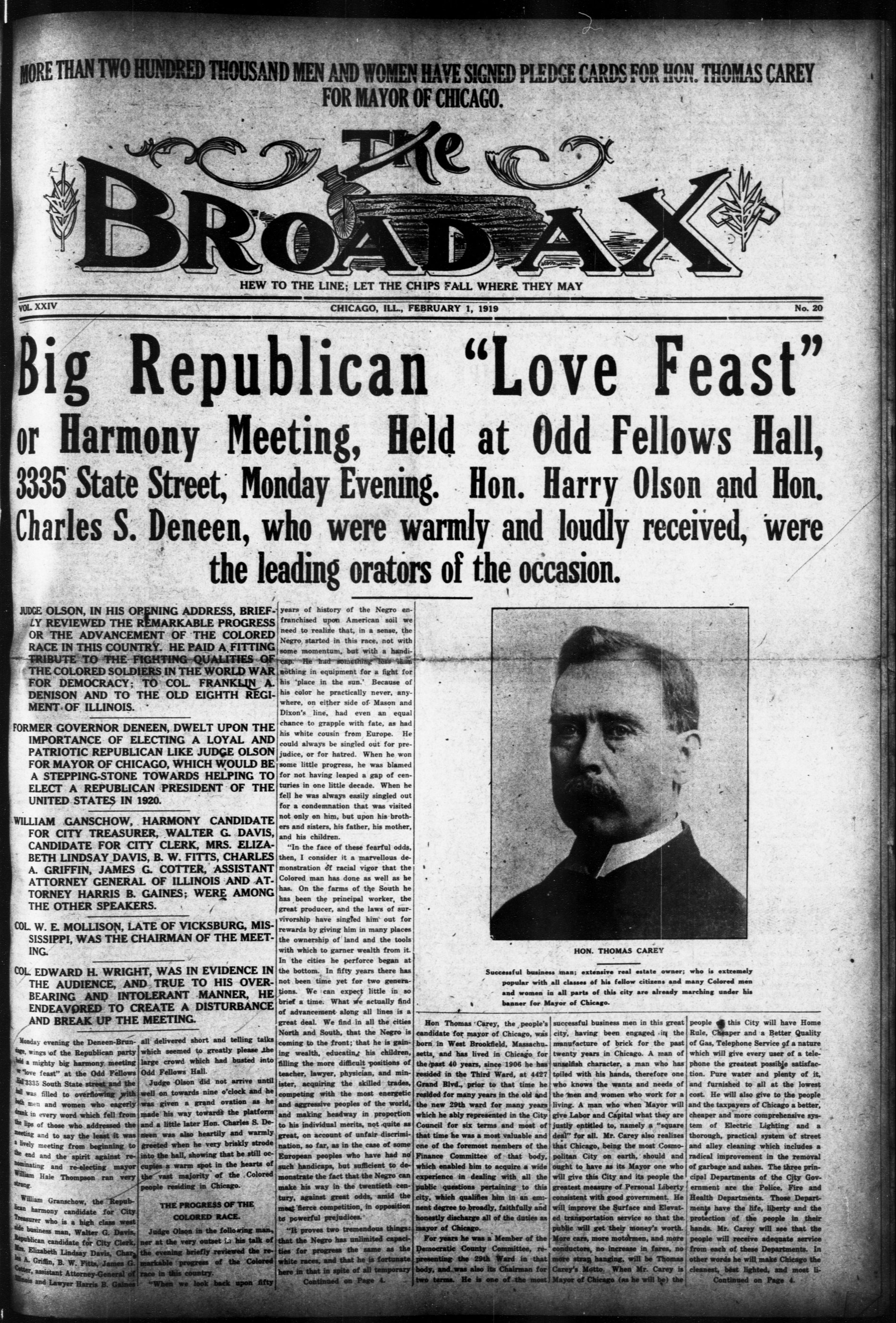
MORE THAN TWO HUNDRED THOUSAND MEN AND WOMEN HAVE SIGNED PLEDGE CARDS FOR HON. THOMAS CAREY FOR MAYOR OF CHICAGO.
The BROAD AX
HEW TO THE LINE; LET THE CHIPS FALL WHERE THEY MAY
Big Republican "Love Feast" or Harmony Meeting, Held at Odd Fellows Hall, 3335 State Street, Monday Evening. Hon. Harry Olson and Hon. Charles S. Deneen, who were warmly and loudly received, were the leading orators of the occasion.
JUDGE OLSON, IN HIS OPENING ADDRESS, BRIEFLY REVIEWED THE REMARKABLE PROGRESS OR THE ADVANCEMENT OF THE COLORED RACE IN THIS COUNTRY. HE PAID A FITTING TRIBUTE TO THE FIGHTING QUALITIES OF THE COLORED SOLDIERS IN THE WORLD WAR FOR DEMOCRACY; TO COL. FRANKLIN A. DENISON AND TO THE OLD EIGHTH REGIMENT OF ILLINOIS.
FORMER GOVERNOR DENEEN, DWELT UPON THE IMPORTANCE OF ELECTING A LOYAL AND PATRIOTIC REPUBLICAN LIKE JUDGE OLSON FOR MAYOR OF CHICAGO, WHICH WOULD BE A STEPPING-STONE TOWARDS HELPING TO ELECT A REPUBLICAN PRESIDENT OF THE UNITED STATES IN 1920.
WILLIAM GANSCHOW, HARMONY CANDIDATE FOR CITY TREASURER, WALTER G. DAVIS, CANDIDATE FOR CITY CLERK, MRS. ELIZABETH LINDSAY DAVIS, B. W. FITTS, CHARLES A. GRIFFIN, JAMES G. COTTER, ASSISTANT ATTORNEY GENERAL OF ILLINOIS AND ATTORNEY HARRIS B. GAINES; WERE AMONG THE OTHER SPEAKERS.
COL. W. E. MOLLISON, LATE OF VICKSBURG, MISSISSIPPI, WAS THE CHAIRMAN OF THE MEETING.
COL. EDWARD H. WRIGHT, WAS IN EVIDENCE IN THE AUDIENCE, AND TRUE TO HIS OVERBEARING AND INTOLERANT MANNER, HE ENDEAVORED TO CREATE A DISTURBANCE AND BREAK UP THE MEETING.
years of history of the Negro enfranchised upon American soil we need to realize that, in a sense, the Negro started in this race, not with some momentum, but with a handicap. He had something less than nothing in equipment for a fight for his 'place in the sun.' Because of his color he practically never, anywhere, on either side of Mason and Dixon's line, had even an equal chance to grapple with fate, as had his white cousin from Europe. He could always be singled out for prejudice, or for hatred. When he won some little progress, he was blamed for not having leaped a gap of centuries in one little decade. When he fell he was always easily singled out for a condemnation that was visited not only on him, but upon his brothers and sisters, his father, his mother, and his children.
"In the face of these fearful odds, then, I consider it a marvellous demonstration of racial vigor that the Colored man has done as well as he has. On the farms of the South he has been the principal worker, the great producer, and the laws of survivorship have singled him out for rewards by giving him in many places the ownership of land and the tools with which to garner wealth from it. In the cities he perforce began at the bottom. In fifty years there has not been time yet for two generations. We can expect little in so brief a time. What we actually find of advancement along all lines is a great deal. We find in all the cities North and South, that the Negro is coming to the front; that he is gaining wealth, educating, his children, filling the more difficult positions of teacher, lawyer, physician, and minister, acquiring the skilled trades, competing with the most energetic and aggressive peoples of the world, and making headway in proportion to his individual merits, not quite as great, on account of unfair discrimination, so far, as in the case of some European peoples who have had no such handicaps, but sufficient to demonstrate the fact that the Negro can make his way in the twentieth century, against great odds, amid the most fierce competition, in opposition to powerful prejudices.
"It proves two tremendous things: that the Negro has unlimited capacities for progress the same as the white races, and that he is fortunate here in that in spite of all temporary Continued on Page 4.
M.
Successful business man; extensive real estate owner; who is extremely popular with all classes of his fellow citizens and many Colored men and women in all parts of this city are already marching under his banner for Mayor of Chicago.
Hon Thomas Carey, the people's candidate for mayor of Chicago, was born in West Brookfield, Massachusetts, and has lived in Chicago for the past 40 years, since 1906 he has resided in the Third Ward, at 4427 Grand Blvd., prior to that time he resided for many years in the old and the new 29th ward for many years which he ably represented in the City Council for six terms and most of that time he was a most valuable and one of the foremost members of the Finance Committee of that body, which enabled him to acquire a wide experience in dealing with all the public questions pertaining to this city, which qualifies him in an eminent degree to broadly, faithfully and honestly discharge all of the duties as mayor of Chicago.
For years he was a Member of the Democratic County Committee, representing the 29th Ward in that body, and was also its Chairman for two terms. He is one of the most
people in this City will have Home Rule, Cheaper and a Better Quality of Gas, Telephone Service of a nature which will give every user of a telephone the greatest possible satisfaction. Pure water and plenty of it, and furnished to all at the lowest cost. He will also give to the people and the taxpayers of Chicago a better, cheaper and more comprehensive system of Electric Lighting and a thorough, practical system of street and alley cleaning which includes a radical improvement in the removal of garbage and ashes. The three principal Departments of the City Government are the Police, Fire and Health Departments. Those Departments have the life, liberty and the protection of the people in their hands. Mr. Carey will see that the people will receive adequate service from each of these Departments. In other words he will make Chicago the cleanest, best lighted, and most li- Continued on Page 4.
successful business men in this great city, having been engaged in the manufacture of brick for the past twenty years in Chicago. A mean of unselfish character, a man who has toiled with his hands, therefore one who knows the wants and needs of the men and women who work for a living. A man who when Mayor will give Labor and Capital what they are justly entitled to, namely a "square deal" for all. Mr. Carey also realizes that Chicago, being the most Cosmopolitan City on earth, should and ought to have as its Mayor one who will give this City and its people the greatest measure of Personal Liberty consistent with good government. He will improve the Surface and Elevated transportation service so that the public will get their money's worth. More cars, more motormen, and more conductors, no increase in fares, no more strap hanging, will be Thomas Carey's Motto. When Mr. Carey is Mayor of Chicago (as he will be) the
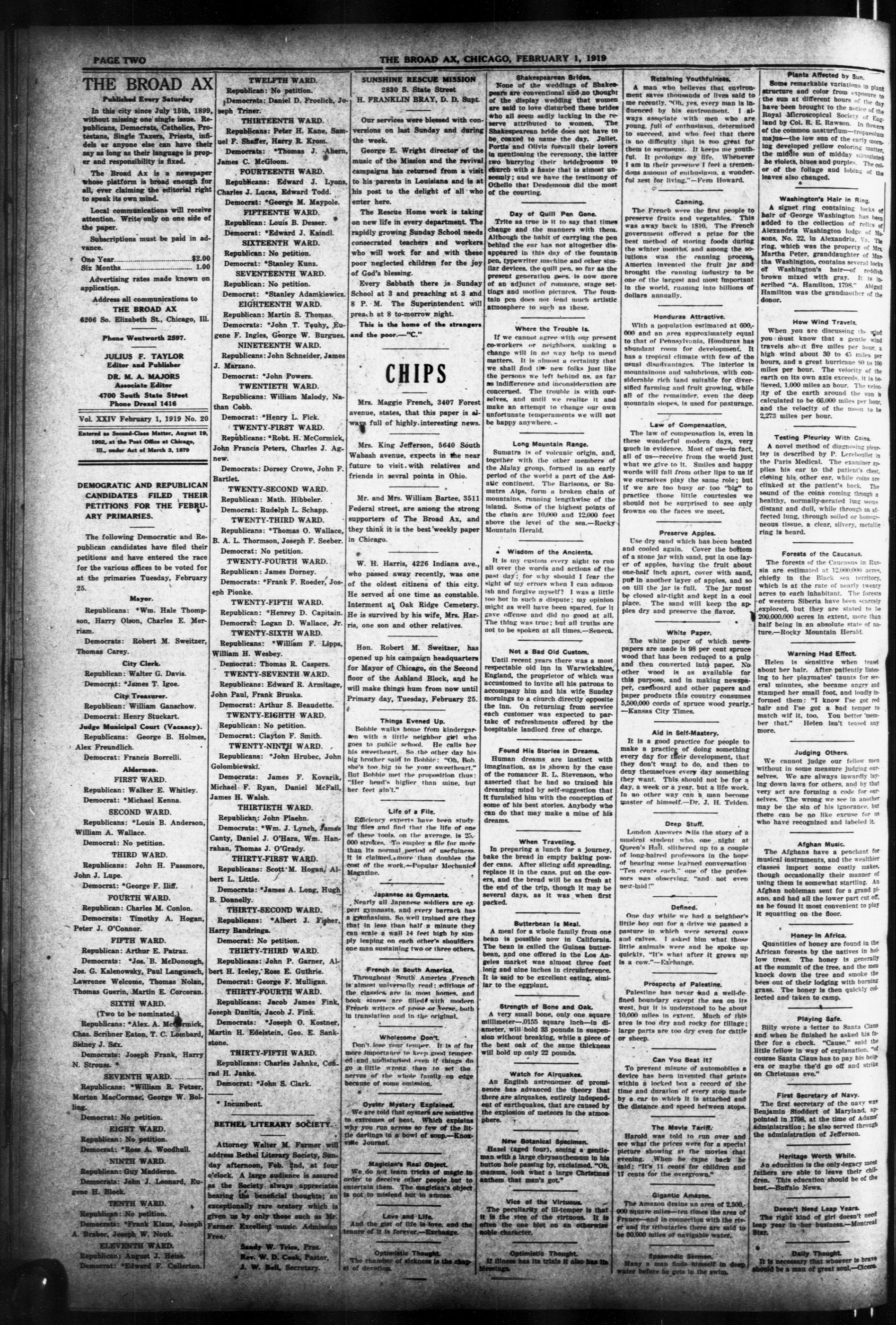
PAGE TWO
THE BROAD AX
In this city since July 15th, 1899, without missing one single issue. Republicans, Democrats, Catholics, Protestants, Single Taxers, Priests, infidels or anyone else can have their say as long as their language is proper and responsibility is fixed.
The Broad Ax is a newspaper whose platform is broad enough for all, ever claiming the editorial right to speak its own mind.
Local communications will receive attention. Write only on one side of the paper.
Subscriptions must be paid in advance.
One Year.....$2.00
Six Months.....1.00
Advertising rates made known on application.
Address all communications to
THE BROAD AX
6206 So. Elizabeth St., Chicago, Ill.
Phone Wentworth 2597.
JULIUS F. TAYLOR
Editor and Publisher
DR. M. A. MAJORS
Associate Editor
4700 South State Street
Phone Drexel 1416
Vol. XXIV February 1, 1919 No. 20
Entered as Second-Class Matter, August 19,
1902, at the Post Office at Chicago,
Ill., under Act of March 3, 1879
DEMOGRATIC AND REPUBLICAN CANDIDATES FILED THEIR PETITIONS FOR THE FEBRUARY PRIMARIES.
The following Democratic and Republican candidates have filed their petitions and have entered the race for the various offices to be voted for at the primaries Tuesday, February 25.
Mayor.
Republicans: *Wm. Hale Thompson, Harry Olson, Charles E. Merriam.
Democrats: Robert M. Sweitzer, Thomas Carey.
City Clerk.
Republican: Walter G. Davis.
Democrat: *James T. Igoe.
City Treasurer.
Republican: William Ganschow.
Democrat: Henry Stuckart.
Judge Municipal Court (Vacancy).
Republicans: George B. Holmes, Alex Freundlich.
Democrat: Francis Borrelli.
Aldermen.
FIRST WARD.
Republican: Walker E. Whitley.
Democrat: *Michael Kenna.
SECOND WARD.
Republicans: *Louis B. Anderson,
William A. Wallace.
Democrat: No petition.
THIRD WARD.
Republicans: John H. Passmore,
John J. Lupe.
Democrat: *George F. Iliff.
FOURTH WARD.
Republican: Charles M. Conlon.
Democrats: Timothy A. Hogan,
Peter J. O'Connor.
FIFTH WARD.
Republican: Arthur E. Patraz.
Democrats: *Jos. B. McDonough,
Jos. G. Kalenowsky, Paul Languesch,
Lawrence Welcome, Thomas Nolan,
Thomas Guerin, Martin E. Corcoran.
SIXTH WARD.
(Two to be nominated.)
Republicans: *Alex. A. McCormick,
Chas. Scribner Eaton, T. C. Lombard,
Sidney J. Sax.
Democrats: Joseph Frank, Harry
N. Strouss. *
SEVENTH WARD. .....
Republicans: *William R. Fetzer,
Morton MacCormac, George W. Bolling.
Democrat: No petition.
EIGHT WARD.
Republican: No petition.
Democrat: *Ross A. Woodhull.
NINTH WARD.
Republican: Guy Madderon.
Democrats: John J. Leonard, Eugene H. Block.
TENTH WARD.
Republican: No petition.
Democrat: *Michael K. Lewis
SEVENTEENTH WARD.
Republican: No petition.
Democrat: *Stanley Adamkiewicz.
EIGHTEENTH WARD.
Republican: Martin S. Thomas.
Democrats: *John T. Tøuhy, Eugene F. Ingles, George W. Burgues.
NINETEENTH WARD.
Republicans: John Schneider, James J. Marzano.
Democrat: *John Powers.
TWENTIETH WARD.
Republicans: William Malody, Nathan Cobb.
Democrat: *Henry L. Fick.
TWENTY-FIRST WARD.
Democrats: Dorsey Crowe, John F.
Bartlet.
TWENTY-SECOND WARD.
Republican: Math. Hibbeler.
Democrat: Rudelph L. Schapp.
TWENTY-THIRD WARD.
Republicans: *Thomas O. Wallace,
B. A. L. Thornson, Joseph F. Seeber.
Democrat: No petition.
TWENTY-FOURTH WARD.
Republican: James Dorney.
Democrats: *Frank F. Roeder, Joseph
Pionke.
TWENTY-FIFTH WARD.
Republican: *Henrey D. Capitain.
Democrat: Logan D. Wallace, Jr.
TWENTY-SIXTH WARD.
Republicans: *William F. Lipps,
William H. Wesbey.
Republicans: Edward R. Armitage,
John Paul, Frank Bruska.
Democrat: Arthur S. Beaudette.
TWENTY-EIGHTH WARD.
Republican: No petition.
Democrat: Clayton F. Smith.
TWENTY-NINTH WARD.
Republicans: *John Hrubec, John
Golombiewski.
Republicans: *John Hrubec, John Golombiewski.
Democrats: James F. Kovarik, Michael F. Ryan, Daniel McFall, James H. Walsh.
THIRTIETH WARD.
Republican: John Plaehn.
Democrats: *Wm. J. Lynch, James Canty, Daniel J. O'Hara, Wm. Hanrahan, Thomas J. O'Grady.
THIRTY-FIRST WARD.
Republicans: Scott M. Hogan, Albert L. Little.
Democrats: *James A. Long, Hugh B. Donnelly.
THIRTY-SECOND WARD.
Republicans: *Albert J. Fisher, Harry Bandringa.
THIRTY-THIRD WARD.
Republicans: John P. Garner, Albert H. Iceley, Ross E. Guthrie.
Democrat: George F. Mulligan.
THIRTY-FOURTH WARD.
Republicans: Jacob James Fink, Joseph Danitis, Jacob J. Fink.
Democrats: *Joseph O. Kostner, Martin H. Edelstein, Geo. E. Sankstone.
THIRTY-FIFTH WARD.
Republicans: Charles Jahnke, Conrad H. Janke.
Democrat: *John S. Clark.
* Incumbent.
BETHEL LITERARY SOCIETY.
Attorney Walter M. Farmer will address Bethel Literary Society, Sunday afternoon, Feb. 2nd, at four o'clock. A large audience is assured as the Society always appreciates hearing the beneficial thoughts; an exceptionally rare oratory which is given us by only those such as Mr. Farmer. Excellent music. Admission Free:
Sandy W. Trice, Pres.
Rev. W. D. Cook, Faster,
J. W. Bell, Secretary.
---
SUNSHINE RESCUE MISSION
2830 S. State Street
H. FRANKLIN BRAY, D. D. Supt.
Our services were blessed with conversions on last Sunday and during the week.
George E. Wright director of the music of the Mission and the revival campaigns has returned from a visit to his parents in Louisiana and is at his post to the delight of all who enter here.
Shakespearean Bride.
None of the weddings of Shakespeare are conventional and no those of the display wedding that women are said to love disturbed these brides who all seem sadly lacking in the serve attributed to women.
Shakespearean bride does not have be, coaxed to name the day. Ju Portia and Olivia forstall their love in mentioning the ceremony, the last two hurrying their bridegrooms church with a haste that is almost seemly; and we have the testimony Othello that Desdemona did the m of the courting.
The Rescue Home work is taking on new life in every department. The rapidly growing Sunday School needs consecrated teachers and workers who will work for and with these poor neglected children for the joy of God's blessing.
Every Sabbath there is Sunday School at 3 and preaching at 3 and 8 P. M. The Superintendent will preach at 8 to-morrow night.
This is the home of the strangers and the poor—"C."
CHIPS
Mrs. Maggie French, 3407 Forest avenue, states, that this paper is always full of highly interesting news.
Mrs. King Jefferson, 5640 South Wabash avenue, expects in the near future to visit with relatives and friends in seval points in Ohio.
Mr. and Mrs. William Bartee, 3511 Federal street, are among the strong supporters of The Broad Ax, and they think it is the best weekly paper in Chicago.
W. H. Harris, 4226 Indiana ave. who passed away recently, was one of the oldest citizens of this city. He served at one time as constable. Interment at Oak Ridge Cemetery. He is survived by his wife, Mrs. Harris, one son and other relatives.
Hon. Robert M. Sweitzer, has opened up his campaign headquarters for Mayor of Chicago, on the Second floor of the Ashland Block, and he will make things hum from now until Primary day, Tuesday, February 25.
Things Evened Up.
Bobbie walks home from kindergarten with a little neighbor girl who goes to public school. He calls her his sweetheart. So the other day his big brother said to Bobbie: "Oh, Bob, she's too big to be your sweetheart." But Bobbie met the proposition thus: "Her head's higher than mine, but her feet ain't."
Life of a File.
Efficiency experts have been studying files and find that the life of one of these tools, on the average, is 25,000 strokes. To employ a file for more than its normal period of usefulness, it is claimed, more than doubles the cost of the work.—Popular Mechanic Magazine.
Japanese as Gymnasts.
Nearly all Japanese soldiers are expert gymnasts, and every barrack has a gymnasium. So well trained are they that in less than half a minute they can scale a wall 14 feet high by simply leaping on each other's shoulders one man sustaining two or three others.
French in South America
Throughout South Amerien French is almost universally read; editions of the classles, are in most homes, and book stores are filled with modern French writers of prose or verse, both in translation and in the original.
Wholesome Don't
Don't lose your temper. It is of far more importance to keep good tempered and undisturbed even if things do go a little wrong than to set the nerves of the whole family on edge because of some omission.
Oyster Mystery Explained.
We are told that oysters are sensitive to extremes of heat. Which explains why you run across so few of the little darlings in a bowl of soup.—Knoxville Journal.
Shakespearean Brides.
None of the weddings of Shakespeare are conventional and no thought of the display wedding that women are said to love disturbed these brides who all seem sadly lacking in the reserve attributed to women. The Shakespearean bride does not have to be coaxed to name the day, Juliet, Portia and Olivia forstall their lovers in mentioning the ceremony, the latter two hurrying their bridegrooms to church with a haste that is almost unseemly; and we have the testimony of Othello that Desdemona did the most of the courting.
Day of Quill Pen Gone
Day of Quill Pen Gone.
Trite as is true is it to say that times change and the manners with them. Although the habit of carrying the pen behind the ear has not altogether disappeared in this day of the fountain pen, typewriter machine and other similar devices, the quill pen, so far as the present generation goes, is now more of an adjunct of romance, stage settings and motion pictures. The fountain pen does not lend much artistic atmosphere to such as these.
Where the Trouble Is
If we cannot agree with our present co-workers or neighbors, making a change will in no way help to mend matters. It is almost a certainty that we shall find new folks just like the persons we left behind as, as far as indifference and inconsideration are concerned. The trouble is with ourselves, and until we realize it and make an attempt to change our own unfortunate temperaments we will not be happy anywhere. -
Long Mountain Range.
Sumatra is of volcanic origin, and, together with the other members of the Malay group, formed in an early period of the world a part of the Asiatic continent. The Barisons, or Sumatra Alps, form a broken chain of mountains, running lengthwise of the island. Some of the highest points of the chain are 10,000 and 12,000 feet above the level of the sea.—Rocky Mountain Herald.
- Wisdom of the Ancients
It is my custom every night to run all over the words and actions of the past day; for why should I fear the sight of my errors when I can admonish and forgive myself? I was a little too hot in such a dispute; my opinion might as well have been spared, for it gave offense and did no good at all. The thing was true; but all truths are not to be spoken at all times.—Seneca.
Not a Bad Old Custom.
Until recent years there was a most respectable old inn in Warwickshire, England, the proprietor of which was accustomed to invite all his patrons to accompany him and his wife Sunday mornings to a church directly opposite the inn. On returning from service each customer was expected to partake of refreshments offered by the hospitable landlord free of charge.
Found His Stories in Dreams.
Human dreams are instinct with imagination, as is shown by the case of the romancer R. L. Stevenson, who asserted that he had so trained his dreaming mind by self-suggestion that it furnished him with the conception of some of his best stories. Anybody who can do that may make a mine of his dreams.
When Traveling.
In preparing a lunch for a journey, bake the bread in empty baking powder cans. After slicing and spreading, replace it in the cans, put on the covers, and the bread will be as fresh at the end of the trip, though it may be several days, as it was when first packed.
Butterbean Is Meal
A meal for a whole family from one bean is possible now in California. The bean is called the Guinea butterbean, and one offered in the Los Angeles market was almost three feet long and lime inches in circumference. It is said to be excellent eating, similar to the eggplant.
Strength of Bone and Oak
A very small bone, only one square millimeter-.0155 square inch—in diameter, will hold 33 pounds in suspension without breaking, while a piece of the best oak of the same thickness will hold up only 22 pounds.
Watch for Airquakes.
Watch for Airquakes.
An English astronomer of prominence has advanced the theory that there are airquakes, entirely independent of earthquakes, that are caused by the explosion of meteors in the atmosphere.
New Botanical Specimen.
Hazel (aged four), seeing a gentleman with a large chrysanthemum in his button hole passing by, exclaimed, "Oh, mamma, look what a large Christmas anthem that man's got."
Vice of the Virtuous.
The peculiarity of ill-temper is that
it is the vice of the virtuous. It is
often the one blot on an otherwise
noble character.
Optimistic Thought.
If illness has its trials it also has its blessings.
A man who believes that environment saves thousands of lives said to me recently, "Oh, yes, every man is influenced by his environment. I always associate with men who are young, full of enthusiasm, determined to succeed, and who feel that there is no difficulty that is too great for them to surmount. It keeps me youthful. It prolongs my life. Whenever I am in their presence I feel a tremendous amount of enthusiasm, a wonderful zest for living."—Fem Howard.
Canning
The French were the first people to preserve fruits and vegetables. This was away back in 1810. The French government offered a prize for the best method of storing foods during the winter months, and among the solutions was the canning process. America invented the fruit jar and brought the canning industry to be one of the largest and most important in the world, running into billions of dollars annually.
Honduras Attractive
With a population estimated at 600,000 and an area approximately equal to that of Pennsylvania, Honduras has abundant room for development. It has a tropical climate with few of the usual disadvantages. The interior is mountainous and salubrious, with considerable rich land suitable for diversified farming and fruit growing, while all of the remainder, even the deep mountain slopes, is used for pasturage.
Law of Compensation
The law of compensation is, even in these wonderful modern days, very much in evidence. Most of us—in fact, all of us—receive from the world just what we give to it. Smiles and happy words will fall from other lips to us if we ourselves play the same role; but if we are too busy or too "big" to practice those little courtesies we should not be surprised to see only frowns on the faces we meet.
Preserve Apples.
Use dry sand which has been heated and cooled again. Cover the bottom of a stone jar with sand, put in one layer of apples, having the fruit about one-half inch apart, cover with sand, put in another layer of apples, and so on till the jar is full. The jar must be closed air-tight and kept in a cool place. The sand will keep the apples dry and preserve the flavor.
White Paper.
The white paper of which newspapers are made is 98 per cent spruce wood that has been reduced to a pulp and then converted into paper. No other wood is as available for this purpose, and in making newspaper, cardboard and other papers and paper products this country consumes 5,500,000 cords of spruce wood yearly. -Kansas City Times.
Aid in Self-Mastery.
It is a good practice for people to make a practice of doing something every day for their development, that they don't want to do, and then to deny themselves every day something they want. This should not be for a day, a week or a year, but a life work. In no other way can a man become master of himself.—Dr. J. H. Telden.
Deep Stuff.
London Answers tells the story of a musical student who, one night at Queen's Hall, silenced up to a couple of long-haired professors in the hope of hearing some learned conversation "Ten cents each." one of the professors was observing, "and not even new-haired."
Defined
One day while we had a neighbor's little boy out for a drive we passed a pasture in which were several cows and calves. I asked him what those little animals were and he spoke up quickly. "It's what after it grows up is a cow."—Exchange.
Prospects of Palestine
Palestine has never had a well-defined boundary except the sea on its west, but it is understood to be about 10,000 miles in extent. Much of this area is too dry and rocky for tillage; large parts are too dry even for cattle or sheep.
Can You Beat It?
To prevent misuse of automobiles a device has been invented that prints within a locked box a record of the time and duration of every stop made by a car to which it is attached and the distance and speed between stones.
The Movie Tariff:
Harold was told to run over and see what the prices were for a special picture showing at the movies that evening. When he came back he said: "It's 11 cents for children and 17 cents for the overgrown."
Gigantic Amazon
The Amazon drains an area of 2,500. 000 square miles—ten times the area of France—and in connection with the river and its tributaries there are said to be 50,000 miles of navigable water.
Spasmodic Sermon.
Many a man finds himself in deep water before he gets in the swim.
Plants Affected by Sun
Some remarkable variations in plant structure and color from exposure to the sun at different hours of the day have been brought to the notice of the Royal Microscopical Society of England by Col. R. E. Rawson. In flowers of the common nasturtium - tropaeolum majus - the low sun of the early morning developed yellow coloring matter, the middle sun of midday stimulated the violets, blues and purples. The color of the foliage and lobing of the leaves also changed.
Washington's Hair in Ring
A signet ring containing locks of hair of George Washington has been added to the collection of relics of Alexandria Washington lodge of Masons, No. 22, in Alexandria, Va. The ring, which was the property of Mrs Martha Peter, granddaughter of Martha Washington, contains several locks of Washington's hair—of reddish brown mixed with gray. It is inscribed "A. Hamilton, 1798." Abigail Hamilton was the grandmother of the donor.
How Wind Travels
When you are discussing the wind you must know that a gentle wind travels over five miles per hour, a high wind about 30 to 45 miles per hour, and a great hurricane 80 to 100 miles per hour. The velocity of the earth on its own axis exceeds, it is believed, 1,000 miles an hour. The velocity of the earth around the sun is calculated to be 66,000 miles per hour, and the velocity of the moon to be 2,273 miles per hour.
Testing Pleurisy With Coins
A novel method of diagnosing pleurisy is described by P. Lereoubillet in the Paris Medical. The examiner applies his ear to the patient's chest, closing his other ear, while coins are clinked at the patient's back. The sound of the coins coming through a healthy, normally-aerated lung seems distant and dull, while through an affected lung, through soiled or homogeneous tissue, a clear, silvery, metallic ring is heard.
Forests of the Caucasus.
The forests of the Caucasus in Russia are estimated at 12,000,000 acres chiefly in the Black sea territory, which is at the rate of nearly twenty acres to each inhabitant. The forests of western Siberia have been scarcely explored, but they are stated to be 200,000,000 acres in extent, more than half being in an absolute state of nature—Rocky Mountain Herald.
Warning Had Effect
Helen is sensitive when teased about her hair. After patiently listening to her playmates' taunts for several minutes, she became angry and stamped her small foot, and loudly informed them: "I know I've got red hair and I've got a bad temper to match wif it, too. You better 'member that." Helen isn't teased any more.
Judging Others
We cannot judge our fellow men without in some measure judging ourselves. We are always inwardly laying down laws for others, and by that very act are forming a code for ourselves. The wrong we see in another may be the sin of his ignorance, but there can be no like excuse for us who have recognized and labeled it.
Afghan Music
The Afghan have a penchant for musical instruments, and the wealthier classes import some costly makes, though occasionally their manner of using them is somewhat startling. An Afghan nobleman sent for a grand piano, and had all the lower part cut off, as he found it most convenient to play it squatting on the floor.
Honey in Africa.
Quantities of honey are found in the African forests by the natives in low trees. The honey is generally at the summit of the tree, and the men knock down the tree and smoke the bees out of their lodging with burning grass. The honey is then quickly collected and taken to camp.
Playing Safe.
Billy wrote a letter to Santa Claus and when he finished he asked his father for a check. "Cause." said the little fellow in way of explanation. "of course Santa Claus has to pay his helpers or maybe the'd go off and strike on Christmas eve."
First Secretary of Navy
The first secretary of the navy was Benjamin Stoddert of Maryland, appointed in 1798, at the time of Adams' administration; he also served through the administration of Jefferson.
Heritage Worth While.
An education is the only-legacy most fathers are able to leave their children. This education should be of the best.—Buffalo News.
Doesn't Need Leap Years.
The right kind of girl doesn't need leap year in her business.—Montreal Star.
Daily Thought.
It is necessary that whoever is brave should be a man of great soul.—Cicero.
But Galileo Was the First to Perceive Its Possibilities in the Study of Astronomy.
The name of the man who first framed and used a telescope for the observation of the heavenly bodies is Galileo Galilei, though little known in that form. It was this scientist, who died January 8, 1642, who, it may be said, first gave stability and force to the theory which places the sun in the center of the planetary system. In April or May, 1600, Galileo heard at Venice of a little tubular instrument made by Hans Libbershey of Middleburg, which made distant objects appear nearer, and he immediately applied himself to experimentation on the means by which such an instrument could be produced. Procuring a couple of spectacle glasses, each plain on one side, but one convex and the second concave on the other side, and applying his eye to the concave glass, he found that objects were magnified three times, and brought apparently nearer. Soon after having made one which could magnify 930 times, Galileo commenced observations on the surface of the moon, which he discovered to be irregular, like that of the earth, and on Jupiter, which, in 1610, he ascalined to be attended by four men, as he called them, which after proved to be its satellites.
CRUSADERS WON AND LOST
In the End Nothing Was Gained by Attempted Conquest of the Holy Land.
During the four centuries from the Moslem conquest of Palestine until the crusades Christian, Jew and Moslem lived together in peace. Then along came Peter the Hermit and the Crusaders. The second coming of Christ had been forecast for the year 1000. The passing of that year without any catastrophe awakened an era of Christian plety that held the world safe through the year 1033, the anniversary of the crucifixion.
Peter the Hermit prevailed upon Pope Urban II to sanction the first crusade. It proved a successful venture, for Jerusalem was captured July 14, 1039, and Godfrey of Bouillon elected king of Jerusalem.
Saladin became master of Egypt and Syria toward the end of the twelfth century, after defeating the Crusaders at the battle of Hattin in 1186, capturing the most treasured of relics a piece of the true Cross. This promised the third crusade, led by Edward Coeur de Lion and commemorated in Scott's novel, "The Tallisane." The Crusaders captured Connimople for the Venetians, but failed of the entire conquest of Palese.
Are You a Barometer?
Undoubtedly there is a great relation between the elements and certain complaints in the same way that some seasons of the year render certain people liable to illness more than others. The lower we investigate in the animal world the more prone are its subjects to be affected by the weather. A cat for as much as three days beforehand feels a coming storm; a horse's fine nostrils can sniff approaching rain in an uncanny manner. The birds of the air have but to be watched to see the way in which they seek their nests at a hint of danger in the air. The very trees and plants tremble in a peculiar manner before a severe storm. Many human beings are just as sensitive to the march of the elements, but do not always realize the significance of their sensitivity. People who suffer from pustu, rheumatism or neuralgia know at once when bad weather is approaching. Old wounds make themselves felt certain times, and the stumps of numbers long since amputated give pain. Medical men have never satisfactorily explained these strange phenomena, neither can they tell why some people instinctively become restless and excited or moody, or sullen before thunderstorms.
Wilson Not the Only One
one other president than Wilson traced his line to Carlisle, England; for Zachary Taylor was fifth in descent from James Taylor of Carlisle; he emigrated to this country in 1638. Considering the fairly uniform British extraction of our presidents, few indeed could have gone to the homes of really near ancestors in the British Isles. Andrew Jackson is the only one whose father was born there, the elder Jackson having come from Carrickfergun, Ireland, a decade before the Revolution. Grant is not particularly distinguished in that his family had been American in all its branches for eight incursions; as much could be said of others. It seems appropriate that the first president in office to visit the mother country felt so intimately the ties of blood that originally gave it the name of mother country.—New York Post.
Rumor
The character of that sort of information that is generally known as news is changing with vertiginous rapidity. Once news was generally supposed to be a narration of something that had happened or was possibly going to happen, with, of course, due allowances for errors and mistaken judgments. Now, however, news seems to be made up of reporting what somebody alleges might have happened. Rumor, of itself, has a news value. The fact that a rumor existed is sufficient of itself, aside from the truth or falsity of the rumor, its probability or its possibility.
The Spaniards of early days were most adventurous explorers, but, for all their discoveries of distant lands, very poor navigators. After coming upon the Solomon islands in the western Pacific, they could not find them again, and they were lost for 150 years.
The water supply of their ship was kept in big earthen jars. As it was impossible to provide in this way enough to drink for a long voyage, they took to sea many large mats, which when it rained were spread to catch the drops. From the mats the water was drained off into the jars.
Probably it was no fault of Columbus, but his first voyage to America, which occupied two months' time, was mainly a drift. When he landed in Cuba he thought he had reached Asia, and sent an expedition inland to treat with the great khan of Tartary. Later his flagship, the Santa Maria, ran aground off the coast of Haiti, the natives of which island welcomed him most hospitably. He noticed three or four of them whose naked bodies showed scars which they attributed to bites inflicted by man-eating savages of another island called Cuba. Whence the origin of the word cannibal—the island inhabited by these anthropohabi being Porto Rico.
Less than 100 years ago Spain still claimed ownership of the whole Pacific ocean, declaring it a Spanish lake on the strength of Balboa's discovery in 1513. Acting upon this idea, the Spanish government ordered the commandante of San Francisco to seize the Columbia, the first vessel that carried the American flag around Cape Horn.
JUDGED BY SKILL AT POKER
Business Man Estimated Another's Qualifications by His Actions at the Card Table.
After all, there is something to be learned from cards, even if the average gambler, who plays for the passion of the game and for the money he expects, does not always learn it. A Los Angeles business man recently asked an acquaintance, "What do you think about Smith? Do you think he would be a good man to take into our firm?" His friend looked him straight in the eye and replied, "Yes, I think he'd be a first-class man to tie to and I'll tell you why. I played poker with him last night and I discovered that he plays safe. He is what religious-minded people call 'good,' what cautious, conservative people call 'wise,' and what the world in general, especially the bold ones, call a coward—but a man whom nearly every one secretly respects, envies and almost fears. He never takes a chance. He doesn't gamble. When he bets on a hand he's got the cards. When he doesn't get the cards he lays his hand down with a smile and walts until they 'come to him,' and then he plays 'em to the limit. Yes, I think he's safe, all right. He could play with my money at a card table or in the field of business."—Los Angeles Times.
Familiar Quotations
the quotation worthy of the high title of "familiar" must have stood the test of time and passed unhurt through the shifting tastes and fashions of centuries. In its lofty or in its humble way it must show that, like Shakespeare, it "was not for an age, but for all time." I use the word "humble" because the rhymes of childhood, of the nursery, fulfill the requirement of age in a quotation worthy to be called familiar. Their intrinsic, their abstract merits may appear slight, they may even seem to be sheer nonsense, but they are passed on by mothers and nurses and by the "children themselves from generation to generation. We may be assured that they would not thus have lived and prospered if they had not possessed some quality, however slender, of genuine worth, of real humor or imagination, which gave them permanence—Henry Cabot Lodge in Scribner's.
Neutral Nations In War Time
James Mill, the English economist, as early as 1821, almost a century before ruthless submarine warfare was introduced by Germany, advocated a commercial world traffic under free tariff rules, so far as concerns the property of individuals in time of war. In this way, he thought, an end would be put to the difficulties and disputes about the maritime traffic of neutrals. In advocating this principle he was of the conviction that all nations gain by the free operations of commerce. Mill was also of the opinion that what justifies a nation to enter a war also determines when a war ought to cease. He maintained that if the legitimate object of a war is compensation for an injury received and security against future injury, then a successful war ought to terminate immediately on the attainment of the object.
Spitzbergen's Mineral Wealth.
Spitbiterberg mineral
The enormous coal and iron beds in Spitbiterberg belonging to the British company, the Northern Exploration company, Ltd., have been investigated by experts who declare that the iron beds are without exception the largest in Europe. Whole mountains of massive iron ore are said to have been observed, covering a distance of over 17 miles and situated on good harbors, in which ships of any size can enter. One of the English coal beds is stated to be working already.
THE BRQAD AX, CHICAGO, FEBRUARY 1, 1919
OBSERVE STARS IN DAYTIME
If One Is Sufficiently Interested They Can Be Seen From Bot- tom of Weil.
Not only have the astronomers devised, a means whereby they may observe the stars in the daytime, but anyone may, if he choose, see them at such time if he will go to the trouble to do so. At the bottom of a deep well an observer on looking up will see the stars if the sky is clear and the sun does not happen to be shining directly into the well.
Why cannot the stars be seen from the surface of the ground in the daytime? They certainly give forth their usual amount of light, and it will be remembered that the moon is frequently seen during the day.
The question resolves itself into the capacity of the human eye. During the day the sun shines on particles suspended in the atmosphere itself, and its rays are reflected in every direction from the different particles. We thus have diffused light by means of which one can see objects, not directly in the sunlight. If it were not for this diffusion of light, or irregular refraction, as it is called we could not possibly see anything not in the direct sunlight. Now, these rays irregularly reflected enter the eye in enormous numbers, so the intensity is comparatively great with starlight.
But to a person in a deep well or mine shaft only the perpendicularly reflected rays enter the eye, and from only those particles directly over the mouth of the shaft. Thus comparatively little light enters the eye, and any starlight that comes down at that time is easily perceived and the presence of the star is recognized.
DON'T LIFT RABBITS BY EARS
Expert Condemns Practice Which Has Always Been More or Less in General Use.
Some people seem to think that because rabbits' ears are so long it is a good reason to use them as handles. They have told me that "the mother rabbit carries her young around by the ears."
I have had a pretty good opportunity to observe such a feat, but I have never seen such a performance. It is all right to hold them by the ears, but I always put my hand or arm under their hind legs to lift them up, and then I know I am not hurting them.
One peculiarity I have always noticed about rabbits is their apparent lack of clear vision. If you will notice their eyes you will see that they scarcely, if ever, move the eyeball to look up or down or at either side, as a cat does. You can't tell when they are looking directly at you, as you can with a cat.
If you throw a carrot to them they will not sight it and go directly to it, but will smell about with nose to the ground till they find it, and they may go six inches past it a few times before they strike it.
Put a rabbit on a chair, table or box, and he will go carefully to the edge leaning his head over and seemingly wondering how far he is from the ground, whereas a cat would think nothing of springing down from such a height.—Boys' Life.
Towns and Their Trades
Some towns are famous for the industries they carry on, either because they are favorably situated for their work, or else because some leader of the industry has started a model factory which has grown larger with the lapse of time. Perth with its climate especially suited for dyeing, and Belfast, with its linen manufacture, are examples of the former, while Port Sunlight, famous the wogld over for soap, and Salttaire, with its manufacture of mohair and alpacas, owe their prosperity in each case to one man. Keighley makes a specialty of textile machinery and Brighouse is said to spin more silk waists than any town in England, while the Rossendale valley provided half the world with felt slippers. Stapleford, in Cambridge, makes a specialty of parchment; Daventry whips were once considered better than any, while Wymondham, in Norfolk, was noted for its wooden tops.
Animal Faces.
The likeness of certain human types to familiar animals is a matter of common observation. Caricaturists from the days of the Greeks and Romans down have made use of its suggestions. In our daily speech we naturally describe men as rat-faced, hoggish or foxy in appearance, or say of a noble looking old man that he possesses a leonine head. Still other persons we pronounce slimian, and although few of us would care to merit a personal application of that adjective, it need not be wholly uncomplimentary, as one would imagine. The diggified and venerable Charles Darwin accepted it as applied so himself with no resentment.
Many Films in Preparation.
Many films in preparation.
Films are also being prepared as part of the campaign which the forest service is ranking in co-operation with the fuel administration for increased wood fuel production and the substitution of cordwood for coal in regions where coal will be scarce during the winter.
Many features of the department's work which received little or no emphasis during the war, such as game preservation and the development of recreation on national forests, will also be featured in new films to be released during the winter month.
FAMOUS ROCK OF GIBRALTAR
Great Britain Has So Strongly Fortified It That It Is Rightly Considered Impregnable.
Since the day, more than 200 years ago, when the flag of Great Britain was flung out over Gibraltar, the strongest fortress in the world, that country has won many triumphs in commerce and has become mistress of the seas. The rock of Gibraltar is 1,400 feet high and across the narrow bay may be seen the coast of Africa only nine miles away. The rock is nearly three miles long and about half a mile broad. On the eastern side the cliff is so steep that nothing but a monkey can scale it, and there is a colony of monkeys living there, the only animals of their kind living wild in Europe.
The only possible approach to the rock is by land from the north, or from the sea on the western side. As viewed from the ocean the Rock of Ghibaltar is impressive, strong, gloomy and forbidding. But flowers grow about the steep walls. The great Victoria batteries, occasionally fired, are screened and sheltered by acacia blossoms. Here are concealed 100-ton guns, sinister, threatening. The north and northwest sides are honeycombed by fortifications. There is a town and harbor on the west, protected by batteries and forts rising from the base to the summit of the rock. Modern guns of the most formidable pattern frown from the heights. The town is inhabited by a British colony of about 25,000 people. Everything is under strict military regulation.
JEWS NOT EASILY CONVERTED
Sermon to Which They Were Annually Forced to Listen Failed of Its Purpose.
In John Evelyn's diary of January 7, 1645, there is a notation of a peculiar ceremony which seems to have been of annual occurrence at Rome. It was a sermon preached, to a compulsory congregation of Jews, with a view to their conversion. Mr. Evelyn says "they are constrained to sit till the hour is done, but it is with so much malice in their countenances, spitting, humming, coughing and motion, that it is almost impossible they should hear a word from the preacher. A conversion is very rare."
The Zionist movement, which has gone on for years and received a new impetus by the changes made in middle Europe as a result of the world war, was outlined in a poem written by Robert Browning during his residence in Italy, probably about the middle of the nineteenth century. He calls it "Holy Cross Day."
"Father of the Short Story."
The father of the short story was Giovanni Boccaccio, an Italian novelist and poet, who died at Certaldo 543 years ago. His "Decameron," a collection of short tales, each complete in itself, practically marked the beginning of the short story. Boccaccio was born about 1313, and his words reflect the immoral—or unmoral—spirit of the times in which he lived, and a majority of his tales are of a character which would now land the author in jail, if he could find a publisher to offer his works for sale. Despite their immorality—possibly because of it—the "Decameron" has been translated into nearly every language and is still widely read. Literary critics ranked the work as a masterpiece. Balzac and many other modern authors have found inspiration in the works of the celebrated Italian. His faults were those of his time—and for the matter of that, of a much later time, for as recently as a century ago stories were told in mixed company which would now scarcely be toled by a "stag party."
Duty.
It has been asked what is at the present day the Duty of which we have spoken so much? A complete reply would require a volume, but I may suggest it in a few words. Duty consists of that love of God and man which renders the life of the individual the representation and expression of all that he believes to be the truth, absolute or relative. Duty is progressive, as the evolution of truth; it is modified and enlarged with the ages; it changes its manifestations according to the requirement of times and circumstances. . . . One period claims the pen of the sage, another requires the sword of the hero. But here, and everywhere, the source of this Is God and his law—its object, humanity—its guarantee, the mutual responsibility of men—its measure, the intellect of the individual and the demands of the period—its limits, power—Mazzini.
To North Pole by Airplane
An expedition to be led by Caph Robert A. Bartlett, explorer and navigator of Peary's ship Roosevelt, will be sent to the polar regions next June to survey the North pole by airplane. The plan was conceived by Rear Admiral Peary, discoverer of the pole.
Bartlett is a Newfoundlander, forty-three years of age. He began explorations 22 years ago, wintering with Peary in the Kane basin in 1897. He commanded the Roosevelt in its famous trip of 1905-9, reaching the eighty-eighth parallel. He was with the Canadian government arcite expedition in 1913-14; his vessel was crushed by the ice, and Bartlett, with 17 others, reached Wrangel Island. He left 15 there, and with one Eskimo crossed to Siberia on the ice and returned with a rescuing party.
NOW WE MAY KNOW BOSWELL
How pleasant it is to know that Boswell, we who have always thought was merely a kind of animated notebook, was a droll, vain, bibulous, warm-hearted creature, a good deal of a Pepys, in fact, says Collier's Weekly. A. Edward Newton's entertaining "Amenities of Book Collecting," a volume of essays which shows that a business man can write better literature than a hundred professors mulled into one, makes Boswell very human! How jolly to hear that Boswell wrote press notices about himself! Here is one of his own blurbs, which we quote from Mr. Newton's book:
"Boswell, the author, is a most excellent man; he is of an ancient family in the west of Scotland, upon which he values himself not a little. At his nativity there appeared omens of his future greatness. His parts are bright, and his education has been good. He has traveled in post chaleses miles without number. He is fond of seeing much of the world. He eats of every good dish, especially apple pie. He drinks old hock. He has a very fine temper. He is somewhat of a humorist and a little tinctured with pride. He has a good, manly countenance, and he owns himself to be amorous. He has infinite vlasyity, yet is observed at times to have a melancholy cast. He is rather fat than lean, rather short than tall, rather young than old. His shoes are neatly made, and he never wears spectacles."
This brings the excellent Roswell very very close to us indeed; he might almost be a member of the Authors' league. Especially apple pie, bless his heart.
WORRY "CONDIMENT OF LIFE"
A Little of It Excellent, but It Must Not Be Enduring or Excessive.
Unless a man has a little worry apathy, indifference and the mechanical physical disinclination to do your utmost without stint will be lacking. Without this condiment of life, this salt of the human cosmos, "we see to what absurd yet tragic physical lengths he is driven by the whip of that still vigorous tyrant, his self-instinct to fight." This thrilling force, which one time had been used squarely and successfully against the real world enemy, is now absorbed in trivial and self-debasing skirmishes with the grotesque bolshevik of his imagination.
In other words, if a man has a variety of anxious explosive outlets via his muscles and intellect, such as driving, tennis, swimming, dancing, competition, golf and the like, these act as safety valves for the multitude of impulses and reactions which habit and custom have compressed out of his external activities.
Worry is one of these, if not enduring or excessive. For the average man set in society, in work and in his family circle it takes the place of larger and better outlets for his destroyed initiative.
Chinese Woman Encoffined Alive.
An unusual case of filial ingratitude is reported from Huchow, China, in the Tokyo (Japan) Advertiser. A very aged woman lived with her son's family, who were so poor that they did not have necessary food. To reduce expenses, the son, forgetting his country's traditions regarding filial piety, conceived of disposing of his aged mother. He secured a coffin, placed his mother therein, without protest on her part, nailed on the cover and deposited the coffin in a vacant lot. Neighbors informed the police, and the coffin was taken to the station house, where it was opened. The woman was still breathing, and when removed asked: "Why did you disturb me? I am a burden to my son and do not want to live. Please put me back in the box and let me die." The request was refused, and officials are detaining both mother and son in the yamen awaiting a judicial disposition of the case.
Algerian Grain Production.
Methods of grain production used in Algeria are very similar to those used in Utah, Idaho and eastern Washington. Owing to the light rainfall much of the land is cropped only alternate years, a clean fallow being maintained during the summer preceding the sowing of the crop. In more favorable situations it is often customary to produce two or three grain crops in successive years, allowing the land to lie fallow one year in four or one year in five.
Speaking generally, the soils of the grain-growing regions are rather heavy and are very productive when the rainfall is adequate. Some of the lands are underlain by calcareous hardpan, which it is sometimes necessary to break up by an occasional deep plowing in order to secure maximum production.
Making Arrangement.
A stray but friendly cat wandered to the front door of a home where lived Charles, an only child. The little fellow was pleased with his new visitor, and was endeavoring to welcome him by bringing him into the house, when the mother appeared on the scene. She told the child that the cat was not allowed in the house. Immediately after the cautioning and while the cat was on the front porch Charles went to the door and said: "Say, kitty, you come around to the back door and I'll meet you there."
PAGE THREE
WENT COLONEL ONE BETTER
Occasion When Talkative Old Bore Met More Than His Match at the Club.
Several and various were the uncomplimentary exclamations heard when the talkative Col. Cholmondeley Fitz-Fulke strolled into the Back-to-Nature club one evening just in time to hear a discussion going on about the crowds in the corwfels and their part in the winning of the war.
"Haw!" laughed the colonel reminiscently. "Speaking of crows reminds me of the time my father made a scarecrow out of me, eagd!"
"Was it your father that did it, colonel?" asked Charlie Smithers, smilingly, followed by a snicker among the members.
"Er-ah-yes. You see, the crows in our cornfield became so used to our regular scarecrow that they grew quite fond of him. And they used to bring him grains of corn and deposit them in his pockets and corncob pipe. It was quite a beautiful and heart-melting sight, gentlemen." and the colonel flicked a sentimental tear from his eyeglass.
"Well, I conceived the idea of making a scarecrow that would smite the crows and chase them away, donche-know. So father decided to dress me up in some old tattered rings and have me smite them. And, bah Jove, I frightened them so bally bad that they didn't return for a year, and then it was after they had seen me go abroad!" concluded the colonel, picking up Charlie Smithers' glass and emptying its contents.
"Huh! That's nothing." said Charlie. "My father made a scarecrow so fierce looking that seven of our crows that had stolen ten bushels of corn cree back the next day and put every one back."
It was several minutes before the colonel could control himself sufficiently to walk out amid the roar that arose.
CORTEZ' HOUR OF TRIUMPH
Impressive Scene When the Spanish Adventurer Met Emperor Montezuma of Mexico.
On the morning of November 8, 1519, the Spaniards were on the causeway which was one of the three to connect Teochoitlan with the mainland, and so wide that eight of the Spanish cavalry could ride abreast on it. On all sides, in the road and in canoes on the lake, a crowd of Aztecs gazed at the descendants of the god who had at last, as they believed, carried out his promise. At the entrance to the city they were greeted by 1,000 principal citizens with salutations and kissing of hands to the bare earth; and then, after crossing a drawbridge, they saw approaching in a gorgeous litter none other than the great Montezuma, escorted by 200 of his courtiers.
Never has there been a more impressive scene in the history of the American continent than this meeting between the emperor of all Mexico and the Spanish adventurer. The picturesque surroundings, the silver-towered city rising from the gleaming lake, the countless hosts of gayy dressed subjects watching in awed silence, the magnificence of Montezuma and his train, the bronze, war-worn yet fiery appearance of the Spaniards—all these seem like a page from the "Arabian Nights" rather than sober history. The Spaniards, we may be sure, realized they were living a romance of the first order, and their hearts beat high with triumph, as with swords clanking and horses prancing they advanced into this city of legend—From "Mexico," by Louise S. Hasbrouck.
Helpful Home Library.
"I like to pass my books on." said the friendly woman. "When I get a new book I begin a 'roster' of readers on the flyleaf. If the book proves to be a good and helpful one, it is a delight to multiply its usefulness by passing it on. The penalty assessed is that the reader sign the roster. I have one book that has been loaned to 23 different readers, and another that almost as many have read. The flyleaf bears a request that the book be returned.
"In time the books get broken backs, of course, but you learn to love books, as you love people, that get crippled in a good cause. The plan enables me to encourage my friends to read good books, and the list of readers is interesting to others to whom the book is offered."
A Little Tree.
I never see a little tree peeping confidingly up among the withered leaves without wondering what trials and triumphs it will have. I hope it will live with rapture in the flower opening days of spring; that it will be a home for birds; and that it will find life worth living and live long to better and to beautify the earth. If it is cut down may it become the ridge log of a cabin where love will abide, or if it must be burned, I hope it will blaze on the heartstone of a home where children play in the firelight on the floor.—Enos A. Mills.
Plenty of Pine.
Deliveries of southern pine to the government from July 1, 1917, to May 28, 1918, were 2,600,000,000 feet, which it is estimated, would require a solid train of cars extending from the gulf of Mexico to the Canadian border, and would make a board walk three feet wide extending six times around the world, or build a solid board fence 59 feet high that would circle the geographical borders of the United States.
1914
HON. HA
Chief Justice of the Municipal Court
Republican Candidate for Mayo
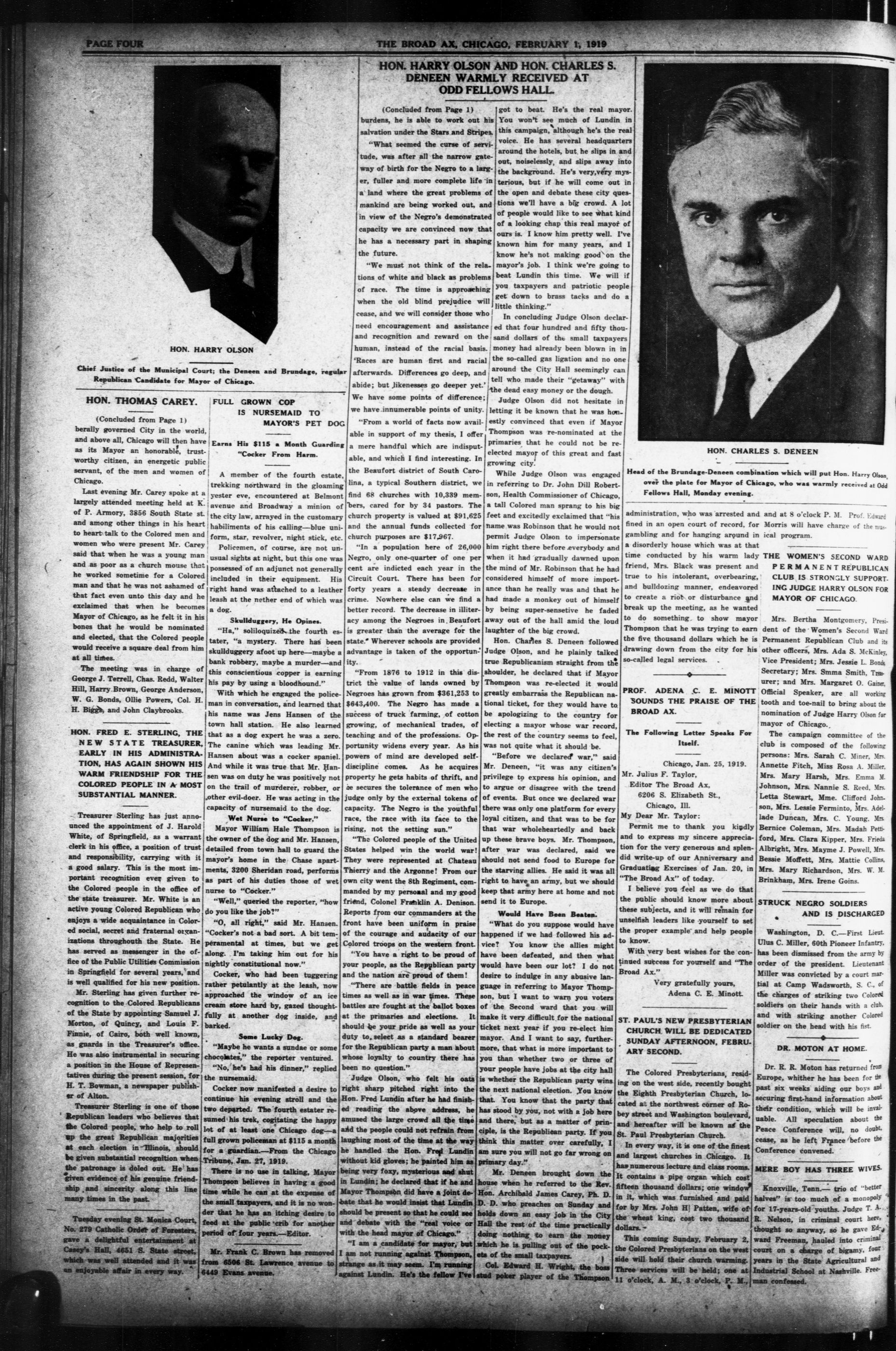
HON. HARRY OLSON Chief Justice of the Municipal Court; the Deneen and Brundage, regular Republican Candidate for Mayor of Chicago.
HON. THOMAS CAREY.
(Concluded from Page 1) berally governed City in the world, and above all, Chicago will then have as its Mayor an honorable, trustworthy citizen, an energetic public servant, of the men and women of Chicago.
Last evening Mr. Carey spoke at a largely attended meeting held at K. of P. Armory, 3856 South State st. and among other things in his heart to heart talk to the Colored men and women who were present Mr. Carey said that when he was a young man and as poor as a church mouse that he worked sometime for a Colored man and that he was not ashamed of that fact even unto this day and he exclaimed that when he becomes Mayor of Chicago, as he felt it in his bones that he would be nominated and elected, that the Colored people would receive a square deal from him at all times.
The meeting was in charge of George J. Terrell, Chas. Redd, Walter Hill, Harry Brown, George Anderson, W. G. Bonds, Ollie Powers, Col. H. H. Biggs, and John Claybrooks.
HON. FRED E. STERLING, THE NEW STATE TREASURER, EARLY IN HIS ADMINISTRATION, HAS AGAIN SHOWN HIS WARM FRIENDSHIP FOR THE COLORED PEOPLE IN A MOST SUBSTANTIAL MANNER.
Treasurer Sterling has just announced the appointment of J. Harold White, of Springfield, as a warrant clerk in his office, a position of trust and responsibility, carrying with it a good salary. This is the most important recognition ever given to the Colored people in the office of the state treasurer. Mr. White is an active young Colored Republican who enjoys a wide acquaintance in Colored social, secret and fraternal organizations throughout the State. He has served as messenger in the office of the Public Utilities Commission in Springfield for several years, and is well qualified for his new position.
Mr. Sterling has given further recognition to the Colored Republicans of the State by appointing Samuel J. Morton, of Quincy, and Louis F. Finnie, of Cairo, both well known, as guards in the Treasurer's office. He was also instrumental in securing a position in the House of Representatives during the present session, for H. T. Bowman, a newspaper publisher of Alton.
Treasurer Sterling is one of those Republican leaders who believes that the Colored people, who help to roll up the great Republican majorities at each election in Illinois, should be given substantial recognition when the patronage is doled out. He has given evidence of his genuine friendship and sincerity along this line many times in the past.
Tuesday evening St. Monica Court, No. 279 Catholic Order of Foresters, gave a delightful entertainment at Casey's Hall, 4651 S. State street, which was well attended and it was an enjoyable affair in every way.
```markdown
```
PAGE FOUR
-
Earns His $115 a Month Guarding "Cocker From Harm.
A member of the fourth estate, trekking northward in the gloaming yester eve, encountered at Belmont avenue and Broadway a minion of the city law, arrayed in the customary habiliments of his calling—blue uniform, star, revolver, night stick, etc.
Policemen, of course, are not unusual sights at night, but this one was possessed of an adjunct not generally included in their equipment. His right hand was attached to a leather leash at the nether end of which was a dog.
Skullduggery, He Opines.
"Ha," soliloquized the fourth estater, "a mystery. There has been skullduggery afoot up here—maybe a bank robbery, maybe a murder—and this conscientious copper is earning his pay by using a bloodhound."
With which he engaged the policeman in conversation, and learned that his name was Jens Hansen of the town hall station. He also learned that as a dog expert he was a zero. The canine which was leading Mr. Hansen about was a cocker spaniel. And while it was true that Mr. Hansen was on duty he was positively not on the trail of murderer, robber, or other evil-doer. He was acting in the capacity of nursemaid to the dog.
Mayor William Hale Thompson is the owner of the dog and Mr. Hansen, detailed from town hall to guard the mayor's home in the Chase apartments, 3200 Sheridan road, performs as part of his duties those of wet nurse to "Cocker."
"Well," queried the reporter, "how do you like the job?"
"O, all right," said Mr. Hansen.
"Cocker's not a bad sort. A bit temperamental at times, but we get along. I'm taking him out for his nightly constitutional now."
Cocker, who had been tuggering rather petulantly at the leash, now approached the window of an ice cream store hard by, gazed thoughtfully at another dog inside, and barked.
Some Lucky Dog.
"Maybe he wants a sundae or some chocolates," the reporter ventured.
"No, he's had his dinner," replied the nursemaid.
Cocker now manifested a desire to continue his evening stroll and the two departed. The fourth estater resumed his trek, cogitating the happy lot of at least one Chicago dog—a full grown policeman at $115 a month for a guardian.—From the Chicago Tribune, Jan. 27, 1919.
There is no use in talking, Mayor Thompson believes in having a good time while he can at the expense of the small taxpayers, and it is no wonder that he has an itching desire to feed at the public crib for another period of four years.—Editor.
Mr. Frank C. Brown has removed from 6506 St. Lawrence avenue to 6449 Ersong avenue
THE BROAD AX, CHICAGO, FEBRUARY 1, 1919
HON. HARRY OLSON AND HON. CHARLES S. DENEEN WARMLY RECEIVED AT ODD FELLOWS HALL.
(Concluded from Page 1) burdens, he is able to work out his salvation under the Stars and Stripes, "What seemed the curse of servitude, was after all the narrow gateway of birth for the Negro to a larger, fuller and more complete life in a land where the great problems of mankind are being worked out, and in view of the Negro's demonstrated capacity we are convinced now that he has a necessary part in shaping the future.
"We must not think of the relations of white and black as problems of race. The time is approaching when the old blind prejudice will cease, and we will consider those who need encouragement and assistance and recognition and reward on the human, instead of the racial basis. 'Races are human first and racial afterwards. Differences go deep, and abide; but likenesses go deeper yet.' We have some points of difference; we have innumerable points of unity.
"From a world of facts now available in support of my thesis, I offer a mere handful which are indisputable, and which I find interesting. In the Beaufort district of South Carolina, a typical Southern district, we find 68 churches with 10,393 members, cared for by 34 pastors. The church property is valued at $91,625 and the annual funds collected for church purposes are $17,967.
"In a population here of 26,000 Negro, only one-quarter of one percent are indicted each year in the Circuit Court. There has been for forty years a steady decrease in crime. Nowhere else can we find a better record. The decrease in illiteracy among the Negroes in Beaufort is greater than the average for the state." Wherever schools are provided advantage is taken of the opportunity.
"From 1876 to 1912 in this district the value of lands owned by Negroes has grown from $361,253 to $643,400. The Negro has made a success of truck farming, of cotton growing, of mechanical trades, of teaching and of the professions. Opportunity widens every year. As his powers of mind are developed self-discipline comes. As he acquires property he gets habits of thrift, and he secures the tolerance of men who judge only by the external tokens of capacity. The Negro is the youthful race, the race with its face to the rising, not the setting sun."
"The Colored people of the United States helped win the world war! They were represented at Chateau Thierry and the Argonne! From our own city went the 8th Regiment, commanded by my personal and my good friend, Colonel Franklin A. Denison. Reports from our commanders at the front have been uniform in praise of the courage and audacity of our Colored troops on the western front.
"You have a right to be proud of your people, as the Republican party and the nation are proud of them!"
"There are battle fields in peace times as well as in war times. These battles are fought at the ballot boxes at the primaries and elections. It should be your pride as well as your duty to, select as a standard bearer for the Republican party a man about whose loyalty to country there has been no question."
Judge Olson, who felt his oats right sharp pitched right into the Hon. Fred Lundin after he had finished reading the above address, he amused the large crowd all the time and the people could not refrain from laughing most of the time at the way he handled the Hon. Fred Lundin without kid gloves; he painted him as being very foxy, mysterious and shut in Lundin; he declared that if he and Mayor Thompson did have a joint debate that he would insist that Lundin should be present so that he could see and debate with the "real voice or with the head mayor of Chicago."
"I am a candidate for mayor, but I am not running against Thompson, strange as it may seem. I'm running against Lundin. He's the fellow Ive
got to beat. He's the real mayor. You won't see much of Lundin in this campaign, although he's the real voice. He has several headquarters around the hotels, but he slips in and out, noiselessly, and slips away into the background. He's very,very mysterious, but if he will come out in the open and debate these city questions we'll have a big crowd. A lot of people would like to see what kind of a looking chap this real mayor of ours is. I know him pretty well. I've known him for many years, and I know he's not making good on the mayor's job. I think we're going to beat Lundin this time. We will if you taxpayers and patriotic people get down to brass tacks and do a little thinking."
In concluding Judge Olson declared that four hundred and fifty thousand dollars of the small taxpayers money had already been blown in in the so-called gas ligation and no one around the City Hall seemingly can tell who made their "getaway" with the dead easy money or the dough. Judge Olson did not hesitate in letting it be known that he was honestly convinced that even if Mayor Thompson was re-nominated at the primaries that he could not be re-elected mayor of this great and fast growing city.
While Judge Olson was engaged in referring to Dr. John Dill Robertson, Health Commissioner of Chicago, a tall Colored man sprang to his big feet and excitedly exclaimed that "his name was Robinson that he would not permit Judge Olson to impersonate him right there before everybody and when it had gradually dawned upon the mind of Mr. Robinson that he had considered himself of more importance than he really was and that he had made a monkey out of himself by being super-sensetive he faded away out of the hall amid the loud laughter of the big crowd.
Hon. Charles S. Deneen followed Judge Olson, and he plainly talked true Republicanism straight from the shoulder, he declared that if Mayor Thompson was re-elected it would greatly embarrass the Republican national ticket, for they would have to be apologizing to the country for electing a mayor whose war record, the rest of the country seems to feel, was not quite what it should be.
"Before we declared war," said Mr. Deneen, "it was any citizen's privilege to express his opinion, and to argue or disagree with the trend of events. But once we declared war there was only one platform for every loyal citizen, and that was to be for that war wholeheartedly and back up these brave boys. Mr. Thompson, after war was declared, said we should not send food to Europe for the starving allies. He said it was all right to have an army, but we should keep that army here at home and not send it to Europe.
Would Have Been Beaten.
Would Have Been Beaten.
"What do you suppose would have happened if we had followed his advice? You know the allies might have been defeated, and then what would have been our lot? I do not desire to indulge in any abusive language in referring to Mayor Thompson, but I want to warn you voters of the Second ward that you will make it very difficult for the national ticket next year if you re-elect him mayor. And I want to say, furthermore, that what is more important to you than whether two or three of your people have jobs at the city hall is whether the Republican party wins the next national election. You know that. You know that the party that has stood by you, not with a job here and there, but as a matter of principle, is the Republican party. If you think this matter over carefully, I am sure you will not go far wrong on primary day."
Mr. Deneen brought down the house when he referred to the Rev. Hon. Archibald James Carey, Ph. D. D. D. who preaches on Sunday and holds down an easy job in the City Hall the rest of the time practically doing nothing to earn the money which is pulling out of the pockets of the small taxpayers.
Col. Edward H. Wright, the boss stud poker player of the Thompson
M. B.
HON. CHARLES S. DENEEN
Head of the Brundage-Deneen combine over the plate for Mayor of Chi Fellows Hall, Monday evening.
Head of the Brundage-Deneen combination which will put Hon. Harry Olson over the plate for Mayor of Chicago, who was warmly received at Odd Fellows Hall, Monday evening.
administration, who was arrested and fined in an open court of record, for gambling and for hanging around in a disorderly house which was at that time conducted by his warm lady friend, Mrs. Black was present and true to his intolerant, overbearing, and bulldozing manner, endeavored to create a riot or disturbance and break up the meeting, as he wanted to do something to show mayor Thompson that he was trying to earn the five thousand dollars which he is drawing down from the city for his so-called legal services.
PROF. ADENA C. E. MINOTT SOUNDS THE PRAISE OF THE BROAD AX.
The Following Letter Speaks For Itself.
Chicago, Jan. 25, 1919.
Mr. Julius F. Taylor,
Editor The Broad Ax,
6206 S. Elizabeth St.,
Chicago, Ill.
My Dear Mr. Taylor:
Permit me to thank you kindly and to express my sincere appreciation for the very generous and splendid write-up of our Anniversary and Graduating Exercises of Jan. 20, in "The Broad Ax" of today.
I believe you feel as we do that the public should know more about these subjects, and it will remain for unselfish leaders like yourself to set the proper example and help people to know.
With very best wishes for the continued success for yourself and "The Broad Ax."
Very gratefully yours,
Adena C. E. Minott.
ST. PAUL'S NEW PRESBYTERIAN CHURCH. WILL BE DEDICATED SUNDAY AFTERNOON, FEBRUARY SECOND.
The Colored Presbyterians, residing on the west side, recently bought the Eighth Presbyterian Church, located as the northwest corner of Robey street and Washington boulevard, and hereafter will be known as the St. Paul Presbyterian Church.
In every way, it is one of the finest and largest churches in Chicago. It has numerous lecture and class rooms. It contains a pipe organ which cost fifteen thousand dollars; one window in it, which was furnished and paid for by Mrs. John H] Patten, wife of the wheat king, cost two thousand dollars.
This coming Sunday, February 2, the Colored Presbyterians on the west side will hold their church warming. Three services will be held; one at 11 o'clock, A. M., 3 o'clock, P. M.,
```markdown
```
ination which will put Hon. Harry Olson, Chicago, who was warmly received at Odd
and at 8 o'clock P. M. Prof. Edward Morris will have charge of the musical program.
at
THE WOMEN'S SECOND WARD
PERMANENT REPUBLICAN CLUB IS STRONGLY SUPPORT-ING JUDGE HARRY OLSON FOR MAYOR OF CHICAGO.
Mrs. Bertha Montgomery, President of the Women's Second War Permanent Republican Club and its other officers, Mrs. Ada S. McKinley, Vice President; Mrs. Jessie L. Bonds Secretary; Mrs. Smma Smith, Treasurer; and Mrs. Margaret O. Gainer, Official Speaker, are all working tooth and toe-nail to bring about the nomination of Judge Harry Olson for mayor of Chicago.
The campaign committee of the club is composed of the following persons: Mrs. Sarah C. Miner, Mrs. Annette Fitch, Miss Rosa A. Miller, Mrs. Mary Harsh, Mrs. Emma M. Johnson, Mrs. Nannie S. Reed, Mrs. Letta Stewart, Mme. Clifford Johnson, Mrs. Lessie Fermino, Mrs. Adelade Duncan, Mrs. C. Young, Mrs. Bernice Coleman, Mrs. Madah Petiford, Mrs. Clara Kipper, Mrs. Frieda Albright, Mrs. Mayme J. Powell, Mrs. Bessie Moffett, Mrs. Mattie Collins, Mrs. Mary Richardson, Mrs. W. M. Brinkham, Mrs. Irene Goins.
STRUCK NEGRO SOLDIERS
Washington, D. C.—First Lieut. Ulus C. Miller, 60th Pioneer Infantry has been dismissed from the army by order of the president. Lieutenant Miller was convicted by a court martial at Camp Wadsworth, S. C., of the charges of striking two Colored soldiers on their hands with a club, and with striking another Colored soldier on the head with his fist.
DR. MOTON AT HOME.
Dr. R. R. Moton has returned from Europe, whither he has been for the past six weeks aiding our boys and securing first-hand information about their condition, which will be invaluable. All speculation about the Peace Conference will, no doubt, cease, as he left France before the Conference convened.
Knoxville, Tenn.—trio of "better halves" is too much of a monopoly for 17-years-old youths. Judge T. A. R. Nelson, in criminal court here, thought so anyway, so he gave Edward Freeman, hauled into criminal court on a charge of bigamy, four years in the State Agricultural and Industrial School at Nashville. Freeman confessed.
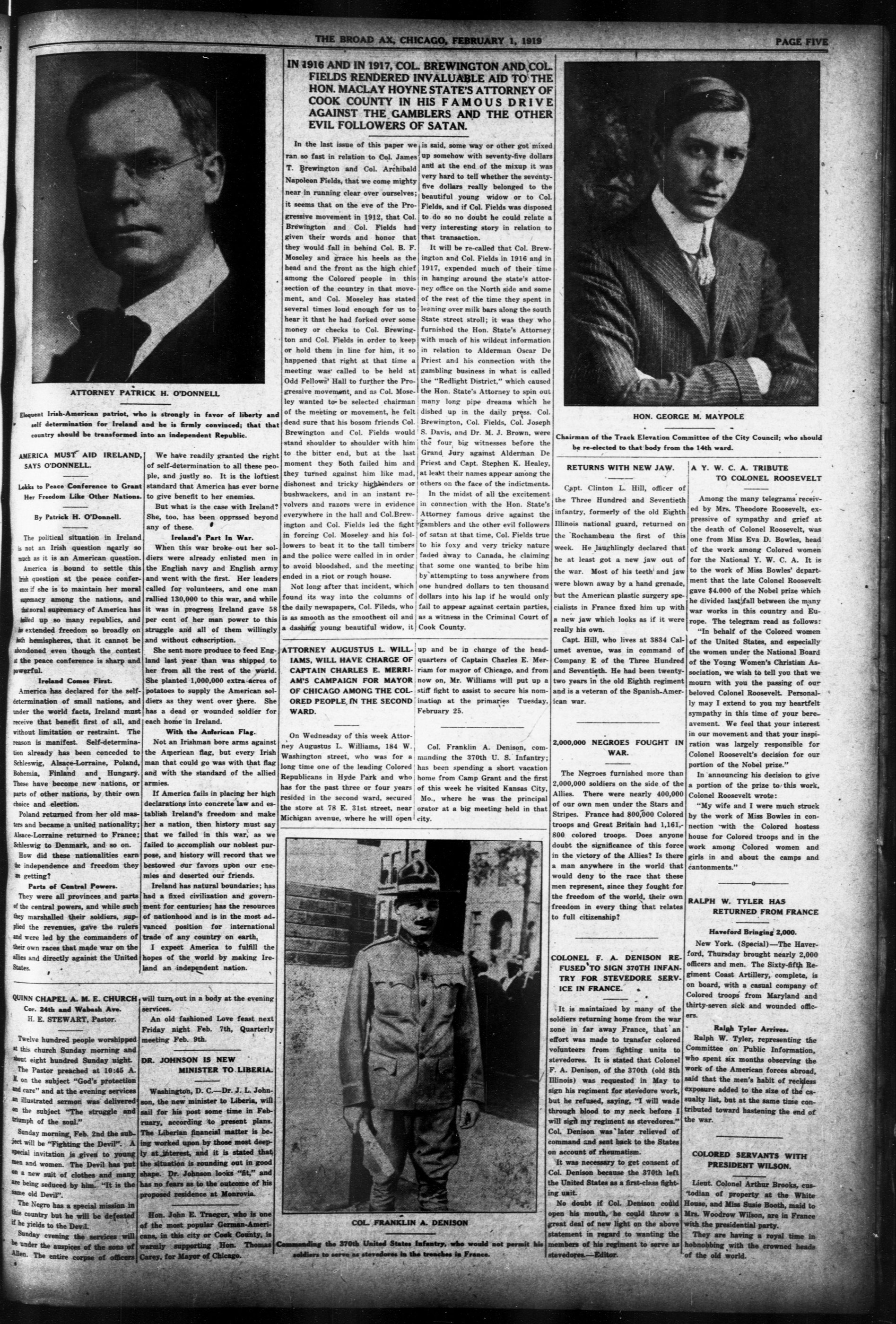
ATTORNEY PATRICK H. O'DONNELL
Eloquent Irish-American patriot, who is strongly in favor of liberty and self determination for Ireland and he is firmly convinced; that that country should be transformed into an independent Republic.
AMERICA MUST AID IRELAND, SAYS O'DONNELL.
Lokks to Peace Conference to Grant Her Freedom Like Other Nations.
We have readily granted the right of self-determination to all these people, and justly so. It is the loftiest standard that America has ever borne to give benefit to her enemies.
By Patrick H. O'Donnell.
The political situation in Ireland is not an Irish question nearly so much as it is an American question. America is bound to settle this Irish question at the peace conference if she is to maintain her moral supremacy among the nations, and that moral supremacy of America has fulfilled up so many republics, and extended freedom so broadly on both hemispheres, that it cannot be abandoned even though the contest at the peace conference is sharp and powerful.
Ireland Comes First.
America has declared for the self-determination of small nations, and under the world facts, Ireland must receive that benefit first of all, and without limitation or restraint. The reason is manifest. Self-determination already has been conceded to Schleswig, Alsace-Lorraine, Poland, Bohemia, Finland and Hungary. These have become new nations, or parts of other nations, by their own choice and election.
Poland returned from her old masters and became a united nationality; Alsace-Lorraine returned to France; Schleswig to Denmark, and so on. How did these nationalities earn the independence and freedom they are getting?
Parts of Central Powers.
They were all provinces and parts of the central powers, and while such they marshalled their soldiers, supplied the revenues, gave the rulers and were led by the commanders of their own races that made war on the allies and directly against the United States.
QUINN CHAPEL A. M. E. CHURCH
Cor. 24th and Wabash Ave.
H. E. STEWART, Pastor.
Twelve hundred people worshipped at this church Sunday morning and about eight hundred Sunday night. The Pastor preached at 10:45 A.M. on the subject "God's protection and care" and at the evening services an illustrated sermon was delivered on the subject "The struggle and triumph of the soul."
Sunday morning, Feb. 2nd the subject will be "Fighting the Devil". A special invitation is given to young men and women. The Devil has put on a new suit of clothes and many are being seduced by him. "It is the same old Devil".
The Negro has a special mission in this country but he will be defended if he yields to the Devil.
Sunday evening the services will be under the auspices of the sons of Allen. The entire corps of officers
We have readily granted the right of self-determination to all these people, and justly so. It is the loftiest standard that America has ever borne to give benefit to her enemies.
But what is the case with Ireland? She, too, has been oppressed beyond any of these.
When this war broke out her soldiers were already enlisted men in the English navy and English army and went with the first. Her leaders called for volunteers, and one man rallied 130,000 to this war, and while it was in progress Ireland gave 58 per cent of her man power to this struggle and all of them willingly and without conscription.
She sent more produce to feed England last year than was shipped to her from all the rest of the world. She planted 1,000,000 extra acres of potatoes to supply the American soldiers as they went over there. She has a dead or wounded soldier for each home in Ireland.
Not an Irishman bore arms against the American flag, but every Irish man that could go was with that flag and with the standard of the allied armies.
If America fails in placing her high declarations into concrete law and establish Ireland's freedom and make her a nation, then history must say that we failed in this war, as we failed to accomplish our noblest purpose, and history will record that we bestowed our favors upon our enemies and deserted our friends.
Ireland has natural boundaries; has had a fixed civilization and government for centuries; has the resources of nationhood and is in the most advanced position for international trade of any country on earth. I expect America to fulfill the hopes of the world by making Ireland an independent nation.
will turn out in a body at the evening services. An old fashioned Love feast next Friday night Feb. 7th, Quarterly meeting Feb. 9th.
DR. JOHNSON IS NEW
MINISTER TO LIBERIA.
Washington, D. C.—Dr. J. L. Johnson, the new minister to Liberia, will sail for his post some time in February, according to present plans. The Liberian financial matter is being worked upon by those most deeply at interest, and it is stated that the situation is rounding out in good shape. Dr. Johnson looks "fit," and has no fears as to the outcome of his proposed residence at Monrovia.
Hon. John E. Traeger, who is one of the most popular German-Americans, in this city or Cook County, is warmly supporting Hon. Thomas Carew, for Mayor of Chicago.
THE BROAD AX, CHICAGO, FEBRUARY 1, 1919
N 1916 AND IN 1917, COL. BREWINGTON AND COL. FIELDS RENDERED INVALUABLE AID TO THE HON. MACLAY HOYNE STATE'S ATTORNEY OF COOK COUNTY IN HIS FAMOUS DRIVE AGAINST THE GAMBLERS AND THE OTHER EVIL FOLLOWERS OF SATAN.
In the last issue of this paper we ran so fast in relation to Col. James T. Brewington and Col. Archibald Napoleon Fields, that we come mighty near in running clear over ourselves; it seems that on the eve of the Progressive movement in 1912, that Col. Brewington and Col. Fields had given their words and honor that they would fall in behind Col. B. F. Moseley and grace his heels as the head and the front as the high chief among the Colored people in this section of the country in that movement, and Col. Moseley has stated several times loud enough for us to hear it that he had forked over some money or checks to Col. Brewington and Col. Fields in order to keep or hold them in line for him, it so happened that right at that time a meeting was called to be held at Odd Fellows Hall to further the Progressive movement, and as Col. Moseley wanted to be selected chairman of the meeting or movement, he felt dead sure that his bosom friends Col. Brewington and Col. Fields would stand shoulder to shoulder with him to the bitter end, but at the last moment they both failed him and they turned against him like mad, dishonest and tricky highhanders or bushwackers, and in an instant revolvers and razors were in evidence everywhere in the hall and Col.Brewington and Col. Fields led the fight in forcing Col. Moseley and his followers to beat it to the tall timbers and the police were called in in order to avoid bloodshed, and the meeting ended in a riot or rough house.
Not long after that incident, which found its way into the columns of the daily newspapers, Col. Fileds, who is as smooth as the smoothest oil and a dashing young beautiful widow, it
ATTORNEY AUGUSTUS L. WILLIAMS, WILL HAVE CHARGE OF CAPTAIN CHARLES E. MERRIAM'S CAMPAIGN FOR MAYOR OF CHICAGO AMONG THE COLORED PEOPLE, IN THE SECOND WARD.
On Wednesday of this week Attorney Augustus L. Williams, 184 W. Washington street, who was for a long time one of the leading Colored Republicans in Hyde Park and who has for the past three or four years resided in the second ward, secured the store at 78 E. 31st street, near Michigan avenue, where he will open
is said, some way or other got mixed up somehow with seventy-five dollars and at the end of the mixup it was very hard to tell whether the seventy-five dollars really belonged to the beautiful young widow or to Col. Fields, and if Col. Fields was disposed to do so no doubt he could relate a very interesting story in relation to that transaction.
It will be re-called that Col. Brewington and Col. Fields in 1916 and in 1917, expended much of their time in hanging around the state's attorney office on the North side and some of the rest of the time they spent in leaning over milk bars along the south State street stroll; it was they who furnished the Hon. State's Attorney with much of his wildcat information in relation to Alderman Oscar De Priest and his connection with the gambling business in what is called the "Redlight District," which caused the Hon. State's Attorney to spin out many long pipe dreams which he dished up in the daily press. Col. Brewington, Col. Fields, Col. Joseph S. Davis, and Dr. M. J. Brown, were the four big witnesses before the Grand Jury against Alderman De Priest and Capt. Stephen K. Healey, at least their names appear among the others on the face of the indictments.
In the midst of all the excitement in connection with the Hon. State's Attorney famous drive against the gamblers and the other evil followers of satan at that time, Col. Fields true to his foxy and very tricky nature faded away to Canada, he claiming that some one wanted to bribe him by attempting to toss anywhere from one hundred dollars to ten thousand dollars into his lap if he would only fail to appear against certain parties, as a witness in the Criminal Court of Cook County.
up and be in charge of the headquarters of Captain Charles E. Merriam for mayor of Chicago, and from now on, Mr. Williams will put up a stiff fight to assist to secure his nomination at the primaries Tuesday, February 25.
Col. Franklin A. Denison, commanding the 370th U. S. Infantry; has been spending a short vacation home from Camp Grant and the first of this week he visited Kansas City, Mo., where he was the principal orator at a big meeting held in that city.
HON. GEORGE M. MAYPOLE
Chairman of the Track Elevation Com be re-elected to that body from t
Chairman of the Track Elevation Committee of the City Council; who should be re-elected to that body from the 14th ward.
RETURNS WITH NEW JAW.
Capt. Clinton L. Hill, officer of the Three Hundred and Seventieth infantry, formerly of the old Eighth Illinois national guard, returned on the Rochambeau the first of this week. He laughingly declared that he at least got a new jaw out of the war. Most of his teeth and jaw were blown away by a hand grenade, but the American plastic surgery specialists in France fixed him up with a new jaw which looks as if it were really his own.
Capt. Hill, who lives at 3834 Calumet avenue, was in command of Company E of the Three Hundred and Seventieth. He had been twenty-two years in the old Eighth regiment and is a veteran of the Spanish-American war.
2,000,000 NEGROES FOUGHT IN WAR.
The Negroes furnished more than 2,000,000 soldiers on the side of the Allies. There were nearly 400,000 of our own men under the Stars and Stripes. France had 800,000 Colored troops and Great Britain had 1,161,800 colored troops. Does anyone doubt the significance of this force in the victory of the Allies? Is there a man anywhere in the world that would deny to the race that these men represent, since they fought for the freedom of the world, their own freedom in every thing that relates to full citizenship?
COLONEL F. A. DENISON REFUSED TO SIGN 370TH INFANTRY FOR STEVEDORE SERVICE IN FRANCE.
It is maintained by many of the soldiers returning home from the war zone in far away France, that an effort was made to transfer colored volunteers from fighting units to stevedores. It is stated that Colonel F. A. Denison, of the 370th (old 8th Illinois) was requested in May to sign his regiment for stevedore work, but he refused, saying, "I will wade through blood to my neck before I will sign my regiment as stevedores." Col. Denison was later relieved of command and sent back to the States on account of rheumatism.
It was necessary to get consent of Col. Denison because the 370th left the United States as a first-class fighting unit.
No doubt if Col. Denison could open his mouth, he could throw a great deal of new light on the above statement in regard to wanting the members of his regiment to serve as stevedores.—Editor.
```markdown
```
THE NEW YORK TIMES
committee of the City Council; who should the 14th ward.
A Y. W. C. A. TRIBUTE TO COLONEL ROOSEVELT
Among the many telegrams received by Mrs. Theodore Roosevelt, expressive of sympathy and grief at the death of Colonel Roosevelt, was one from Miss Eva D. Bowles, head of the work among Colored women for the National Y. W. C. A. It is to the work of Miss Bowles' department that the late Colonel Roosevelt gave $4.000 of the Nobel prize which he divided last fall between the many war works in this country and Europe. The telegram read as follows:
"In behalf of the Colored women of the United States, and especially the women under the National Board of the Young Women's Christian Association, we wish to tell you that we mourn with you the passing of our beloved Colonel Roosevelt. Personally may I extend to you my heartfelt sympathy in this time of your bereavement. We feel that your interest in our movement and that your inspiration was largely responsible for Colonel Roosevelt's decision for our portion of the Nobel prize."
In announcing his decision to give a portion of the prize to this work, Colonel Roosevelt wrote:
"My wife and I were much struck by the work of Miss Bowles in connection with the Colored hostess house for Colored troops and in the work among Colored women and girls in and about the camps and cantonments."
RALPH W. TYLER HAS RETURNED FROM FRANCE
Haveford Bringing 2,000.
New York. (Special)—The Haverford, Thursday brought nearly 2,000 officers and men. The Sixty-fifth Regiment Coast Artillery, complete, is on board, with a casual company of Colored troops from Maryland and thirty-seven sick and wounded officers.
Ralph Tyler Arrives
Ralph W. Tyler, representing the Committee on Public Information, who spent six months observing the work of the American forces abroad, said that the men's habit of reckless exposure added to the size of the casualty list, but at the same time contributed toward hastening the end of the war.
COLORED SERVANTS WITH
PRESIDENT WILSON.
Lieut. Colonel Arthur Brooks, custodian of property at the White House, and Miss Susie Booth, maid to Mrs. Woodrow Wilson, are in France with the presidential party.
They are having a royal time in hobnobbing with the crowned heads of the old world.
PAGE FIVE
FASHION
Spring suit for young girl, on the left. It is of tan-colored covert cloth, made with the new length of coat which is left open from neckline, in the Charles Stuart fashion. It is trimmed below the waist with brass buttons, and the lower sleeve is linked together with brass buttons. There is a cavat of the material. On the right is a tunic suit for a young girl, of red wool jersey trimmed with bands of cream-colored jersey embroidered in red and black. The large hat is of cream jersey faced with red straw and trimmed with a red cord and tassel.
PAGE SIX
Spring suit for young girl, on the left made with the new length of coat the Charles Stuart fashion. It buttons, and the lower sleeve is There is a cravat of the material young girl, of red wool jersey tr jersey embroidered in red and bl faced with red straw and trimme
GAY FROCKS FOR THE YOUNG GIRL
Increased Brilliance of Wardrobes in Honor of Returning Soldiers.
BEST GOWNS FOR "FLAPPERS"
Street Clothes Proclaim Victory Like Trumpets, With Their Scarlet Coloration and Embroideries in Red and Black.
New York.—America, has not yet found a fitting name for the girl of sixteen. The English call her the "flapper," and the Anglo-Saxon world uses the expression, whether or not it approves of it. In America it is not liked, but no one has risen to put this type of young person in a niche and give her a name.
And she is quite important, proclaims a fashion writer. She deserves a strong appellation—a quick, vibrant, significant name for her class, her type and her virility. We have buried under the cobwebs of oblivion the "sweet sixteen" phrase. Booth Tarkington has made the one word "seventeen" classify, at least for America, the youth of our land, with its awkward, stumbling tendencies toward manhood, its budding emotionalism sternly suppressed through pride and shame, its desire for girls' company, and its contempt for that desire. But if we applied the single word "sixteen" to that gay, ecstatic, poised, self-assured, highly educated, superintelligent, adventurous class of tall, slim things that spread over the land, usually setting the pace for their mothers' fashions, it would be puerile.
It is difficult to be pessimistic if one keeps close to the side of girls of that age. Their outlook on life, their faith in themselves and the world, their unbounded ability to find pleasure unadled by anyone else, renews youth in middle age. They are no longer creatures held on a leash. They are rarely asked to obey; they are constantly consulted by their mothers, and they usually take an intelligent part in the management of their home, its social environments, its financial expenditures, its ideals, and its ambitions.
Granting these things—and everyone does grant them who has had any close companionship with the typical American girl, it is natural that her interest in clothes should be strong, and not only strong but usually exceedingly good. She dresses herself, as a rule, better than her mother can dress her.
Many Cater to Girls.
Working downward—or upward, rather—through these psychological phases of girlhood among the Angle-Saxons, and especially the North Americans, one finds the reason for the establishments of many successful dressmaking houses which cater to young girls. Few of the great establishments here or abroad neglect the "flapper." From the time she is twelve until she makes her bow to society at eighteen she is catered to by houses that expend much ingenuity and brilliance of workman ship on her especial type of clothing.
Two of the important financial successes in the dressmaking world of New York started with the schoolgirl. Fifth avenue houses which cater to dowagers and sensational young muurs have determined this year to
---
.
place young girls' clothes in their salons. Youngsters who try to look like Mary Pickford are often used as mannequins, but they have not been a success, because the sixteen-year-old doesn't wish to look like Mary Pickford. She wouldn't be caught with curls down her back, a sweet smile, and chubby legs below a short skirt. She often produces the most extreme fashions, which her older sister and her mother copy. She is the type, one might claim, for all the fashions of the civilized world today. That's a sweeping statement, but just run over the gamut of fashionable clothes for the last five years and see if you don't come to that conclusion. The bobbed hair, the short skirt, the round neck, the baby sleeves, the sashes, the buttoned-down-the-back frocks, the short coats—these are the fashions that have ruled the world and have begun in the schoolroom.
What She Wears Today.
The youngster of sixteen chooses materials for her own clothes that are the same as those worn by her elders, whom she envises little these days, because she rules a world of her own, that everyone acknowledges. She doesn't have to dress herself up in long clothes and high head dresses and play that she is old. She has been known to grudgingly loan some of her clothes to her young married sister for an especially smart affair! She likes georgette crepe for her evening gowns, and therefore she wears a good deal of it. Velvetengly has found her approval, and she orders school frocks and afternoon dance frocks in it.
She has a tailored suit which was especially designed for her judgment, and which she accepted. It has a coat that covers her hips, is cut on a straight line with a slight flare out at the back, and does not fasten. She ties it at the neck with a stiff cravat made of ribbon, peltry, Chinese brocade, or the material of the coat. She may have six or eight of these cravats in her bureau drawer, or she hangs them on the electric light at the side of the bureau, in imitation of her brother. She likes her coat unfastened, for she never admits that she is cold. She has just escaped the hardening process of bare legs, bare arms and a cold nursery. The winter has no terrors for her and she dresses as she wishes, no matter what the thermometer.
The "flapper" who is tall enough to carry a big fox around her neck is sure to come into possession of one. When her judgment goes against a big animal she chooses instead a coachman's collar of sealskin or squirrel, which rises about her face like the olyx of a flower and spreads downward over her shoulders, hugging them in the flat Victorian manner.
She has appropriated for her own use many accessories in petry that the older woman has neglected. She knows the cleverness of a fur cravat and the medieval splendor of a fur girdle.
And, by the way, the "fappers" have no idea of being left out of the procession of those wearing Victory clothes. They have no shrinking about their costumery and what it signifies; they are instinctively psychological, and they wish to proclaim the side they took in the war by every manner of clothes that the dressmakers and milliners have thrown into the fashions to proclaim the day of peace.
So the "fapper" wears red—bright glowing, triumphant red. She doesn't heate it a second in choosing several garments of it. She is not weighted down by the anxieties of her elders that certain colors must be taboo because age is drawing a map on the face.
THE BROAD AX, CHICAGO, FEBRUARY 1, 1919
FOR SPRING WEAR
Garments Being Made Fancier, Will Require a Greater Amount of Material Than Formerly.
Following the convention of the National Cloak, Suit and Skirt Manufacturers' association in Cleveland, O., the committee on designs prepared styles for the coming spring which are of great import to the manufacturers of dress and coat fabrics and dealers in trimmings and other accessories. The designs outlined for the coming season were prepared without the necessary wartime thought which called for conservation in every possible way. This means that greater yardage will, in most instances, be consumed, and as the garments are made fancier, getting away from the former straight, plain lines, the additional trimmings needed will result in materially increasing their many unusual touches of color; of such merchandise. For suits, braid will be extensively used. Belts will be quite commonly worn.
The report of the design and model committee reads in the main as follows:
"Suits—There is such a variety of suit styles for spring that women will be able to find expression of their own individuality. Smart and youthful are the short, loose-hanging box models.
"Many of these suits are gracefully trimmed with braid, cording or embroidery; others are more simple of outline and are worn with white or bright colored vests or vestees, making a most attractive contrast." One of the predominating features of these tallor-made suits is a graceful, long-rolling collar so fashioned to display smart vestes or blouses, which are so becoming and fascinating. As sport clothes are timely, much dash and smartness is given in novelty belts and partial belts, making an attractive means of fastening. Large pockets and convertible collars add beauty and distinction to this type of garment.
"Skirts—The skirts for spring will be built on youthful lines, not too tight and having the appearance of tapering at the footline. There are many smart, novel cuts that accentuate this effect. These skirts are worn about seven inches from the floor.
"Coats—A new silhouette has made its appearance. This silhouette finds its expression in the dolman coats and capes, which are built on loose-hanging lines, tapering slightly at the bottom.
"Many other new and attractive means of fastening are being displayed, also many new belted effects. The collars are especially noteworthy with their many unusual touches of color. collars that fasten over artistically, scarf collars, shawl collars, each type charming in outline and design."
SMART HAT AND SCARF SET
$
This smart hat and scarf set is in mauve velvet. Gray and yellow checked velvet forms a striking trimming.
Hot Iron and Steady Hand Necessary, as Material Must Be Stroked on Right Side.
Mirrored velvet is so much in vogue that a word of explanation as to the home process may be helpful. Any ordinary piece of velvet may be mirrored with the proper care. All that is necessary is a hot iron and a steady hand; for the velvet must be stroked with the iron, on the right side, at regular intervals. The iron must be kept moving quickly and in the same direction, in order to insure a smooth and mirror-like surface. The amateur would do well to practice for a few moments with an old piece of velvet, before attempting to work with her actual materials. The process is not difficult and, if carefully done, will save the extra expense charged for the finished product. Mirrored velvet hats are pretty, when trimmed with chenille or ostrich feather trimming, and a fancy braid of crocheted chenille is another attractive finish in the mirrored hat.
Copyright
Museum and
Downtown
The new victory color combination is shown in this Lady Duff Gordon model by draping the finely crossed tucked navy georgette over deep cherry cashmere cloth (soft satin). Cherry colored wood beads emphasize the crossing of the tucks and finish the hem. Same two combinations are used for the girdle and sash.
NAVY BLUE FOR SPRING WEAR
Brilliant Linings, Striped Vests, Braid and Buttons in Gay Array Among Things Forecast.
It is said that fully 90 per cent of the spring suits will be in that favored color of all well-dressed women—navy blue. It is further prophesied, however, states a writer in the Philadelphia Record, that gay touches in the way of colorful linings and bright overcollars will relieve any somberness. Many of them will be in wash materials, chiefly stripes.
Braid trimmings will be in evidence, as will also buttons covered with the fabric. Link buttons, by the way, fabric covered or bone, will be used in the cuffs, quite an odd and refreshing idea for suits.
The lines, it is prophesied, will be little different from the present silhouette, except, perhaps, the box lines of some of the hip-length models. Straight and box lines will predominate generally. A few "chicken" models, disrespectfully so-called, will appear, those having high waistlines and an emphasized flare.
Collars, when they exist, will be of the long shawl variety, suggesting the tuxedo. The collarless square neck will appear on some of the more extreme jackets. Semi-belts will appear at the back and front, but not at the sides. On the average suit the waistline will be normal. There will be a few coats on the wrap order. These will have fitted vests to give them tightness.
TO MAKE CLOTH LOOK NEW
Sizing Is Important and Too Much Stiffening Will Spoil Appearance of the Material.
To have fabrics, after laundering, possess their original appearance, care must be taken with colored materials that they do not fade, and with white materials that they remain snow-white. Aside from this, suggests the department of agriculture, much depends on the sizing of cloth. Too much stiffening spoils its appearance and too little is quite as bad.
Most housekeepers use starch for stiffening ordinary clothing. Starch keeps the clothes clean longer and also acts as an absorbent for stain, thus saving wear on the fiber by making excess friction in laundering unnecessary. Manufacturers add other substances besides starch to their finished mixture and their practices have been adopted in home laundry work with success.
For instance, borax gives smoothness; paraffin, wax or turpentine gives gloss; and alum a certain degree of pliability. The substance used to whiten is bluing, which counteracts the yellow tinge. To use any finishing process successfully the mixture must be carefully worked into the fabric to insure uniform finish. This is done by dipping in and out of the starch and bluing and rubbing well between the hands.
The following will be found an excellent washing mud: Five pounds of washing soda, one gallon of cold water, put to boil. While bolling add one pound of chloride of lime and stir well; set aside to settle. Strain through a cloth and cork up in a jug. Put your soiled clothes in ten quarts of water, or enough to cover them, with two haudruls of chipped soap and one pint of mud.
BLOUSE IS COSTLY
Garment Almost as Expensive as Entire Frock.
Model Is So Simple That the Making at Home Would Not Be a Difficult Task.
It is impossible to eliminate the peplum or costume blouse from style discussions and reviews at the present time, because this garment is one of the most interesting and most talked-of items of the wardrobe. When an out-of-the-ordinary style is introduced it is usually taken up by the cheapest manufacturers and dressmakers, and developed in such inferior material and with such poor workmanship that it quickly loses caste.
This has not been the case with the long blouse. It seems safe to say, writes a correspondent, that for the present at least the woman who wishes one of these blouses must either buy material and make it or have it made, or else pay a very high price for it. Most of these blouses shown in the shops cost as much as an entire frock. Undoubtedly this accounts for the fact that up to the present time they are worn only by very well-dressed and smartly groomed women.
The blouse shown in the sketch is extremely good-looking and at the same time it is so simple that making it at home would not be difficult. The foundation of the blouse, which is a little longer than the overblouse, is satin. Either black, white or colored lace may be used over this. The garment would be lovely made of white or maize-colored satin with overblouse of black lace, a skirt of soft black satin to accompany it. A narrow bead fringe finishes the edges of the blouse. The satin foundation is sleeveless. The blouse can
Costume Blouse of Satin and Lace.
be more easily made and more easily slipped on if the two sections are made separate.
For very early spring wear some of the clever designers are showing long blouses of figured foulard to be worn with white satin or silk jersey cloth skirts.
A blouse such as the one shown in the sketch, worn with a handsome silk or satin skirt, makes a costume sufficiently dressy for any afternoon function.
SHAPE AND COLOR OF SHOES
Footwear Dealers in Annual Convention Limit Height of Shoe Heels to Two and One-Eighth Inches.
Simplicity in shape as well as in color will be the predominating style in footwear for the coming season, big dealers declared at the recent convention of the National Shoe Retailers' association at St. Louis.
Styles will conform largely to the standards set by the war industries board, for shoe manufacturers had advanced far into the output of 1919 goods when the government lifted shoe regulations.
Many of the postwar problems were taken up at the initial session of the eighth annual convention, which was the largest gathering of manufacturers, jobbers, wholesale and retail shoe men ever assembled. More than 3,000 delegates attended.
The association determined to hold styles for the coming season to rigid simplicity and few colors. The style committee recommended not more than three tones of brown, two shades of gray and the black and white. The height of the high shoes is not to exceed eight and one-half inches. Lace will be the prevailing mode. For spring wear oxfords and pumps will predominate. Oxfords will serve for both street and dress wear. Women's shoes will have low heels of one and one-half inches and high heels of one and seven-eighths to two and one-eighth inches.
Western Newspaper Union
This very smart spring suit is made in a leather shade and tuxedo cut. This is a chic suit and promises to be an exceptionally strong favorite.
FOR NEW CUSHION COVERINGS
Ratine, Crash, Monk's Cloth and Velvet Are Among the Attractive Materials Being Used.
The sofa pillow will probably always be one of the essential elements in home-making, because it combines real comfort with its attractive appearance. As a result of its popularity, however, it is not infrequently in need of a fresh covering, so that it may retain its decorative value in the room of which it is a part. Round pillows have been particular favorites many being made of gay-colored silks, trimmed with gold braid and occasional tassels. These cushions are usually shirred at the outside edge and bound with braiding. Beginning near the center, circular bands of tiny gold braid have been sewed on at regular intervals, to hold the shirring in place over the sides of the pillow.
In contrast to these delicate covers, a number of more practical pillows are being made of ratine, crash monk's cloth and velvet materials. Very attractive are those which are embroidered with bright-colored worsteds in flower clusters, finished with a row of black wooden beads around the edge. The beads are sewed on with several worsted threads, to match the design work. These pillows vary in shape, round, square and oblong, to suit the design worked upon them.
An artist has a striking couch cover of black satin, splashed with several large disks of emerald green, applied at points to break up the spacing into good composition, and her pillows are of solid black and green with cords and tassels of the contrasting color.
HOUSEHOLD HINTS
Water in which rice has been boiled is a capital thing to use for mixing cake.
Always keep your gas stove perfectly clean. Gas cannot give out full heat through dirty burners.
To bake potatoes quickly, let them stand in boiling water for a few minutes before putting them in the oven.
Egg stains in linen should be soaked in cold water—never in hot, which would make them almost impossible to remove.
Equal quantities of paraffin and vinegar make a good and cheap furniture polish; be sure to shake the bottle before using.
When dishes used for cooking have become discolored, rub them with damp salt until all stain is removed.
A marble bolled in milk, porridge, custards, etc., will automatically do the stirring as the liquid cooks, and so prevent burning.
Scatter salt on a carpet when sweeping, and you will not only find it has a cleansing effect, but that it also keeps away moths.
Liquid ammonia is invaluable for washing silver, softening bath water and producing a good lather when washing woolens.
Change in Favors
According to manufacturers of favors and novelties for social affairs and other similar purposes, the demand seems to be for those along patriotic lines. With the recent change of events, however, it is thought that the call will be for more staple articles.
Round Neckline.
It seems that the round semidecollete neckline is the favored one for the winter's dressy blouses. For tailored blouses, the high turnover collar of lace or material like the blouse and worn with a dark tie or ribbon, is the best style.
Chicago Title and Trust Company
OUR BUSINESS SINCE 1847 has been that of showing the condition of real estate titles. The millions upon millions required to build and rebuild Chicago have been furnished relying on the accuracy of our ABSTRACTS and TITLE POLICIES.
Wise men judge future action by past behavior
THE FORTY-FOURTH STREET
THE CRANFORD Apartment Building
3600 WABASH AVENUE
The finest building ever opened to Colored tenants in Chicago. Steam heat, electric lights, tile baths, marble entrance
J. W. CASEY, Agent
Phone Main 263 133 W. Washington Street
Minnie and her little dog, Patty, were playing in the kitchen. Minnie's mamma was cooking supper and stumbed over Patty, causing her to drop an egg on the freshly scrubbed floor. She put Patty out on the porch and seated Minnie in a corner. In a few moments Patsy scratched on the door and began barking. Minnie said to her mother: "Mamma, can Patty come in now? He's sorry. Don't you bear him 'pologizing?'
Try to Be Agreeable.
We should wisely cultivate the art of being agreeable, not only in the company of our business associates or those persons whom we meet socially, but in our own homes as well. By thus deporting ourselves we shall find life more pleasant and people in general—the home folks in particular—more considerate. On the other hand, if we continue to think only of ourselves we shall find life a trying affair—Exchange.
Rugby Football.
At the famous school of Rugby, England, originated that form of football, new bearing the name of the school, inscription, at Rugby reads: "This name commemorates the exploit of William Webb Ellis, who, with a fine disregard for the rules of football, as played in his time, first took the ball in his arms and ran with it, thus originating the distinctive feature of the rugby game. A. D. 1823."
Frogs as Wasp Eaters.
The common green frog has been discovered to possess an insatiate greed for wasps. This extraordinary appetite does not seem to be in the least checked by an occasional sting. The protecting color of the frog, which sits motionless upon leaves, no doubt deludes the most wary of insects into a sense of security.—Nyack Evening Journal.
Commerce and Art United.
The period of Antwerp's great rise to commercial prosperity was also that of the city's chief artistic production. The names of Quentin Matsys and of Rubens are specially connected with the city, for Rubens was essentially an antwerp man, although he was not. Like Tenniers and elder, and Van Dyke, a native of the place.
Competitive Accomplishment.
"My daughter is taking fencing lessons, and you should see how she can feint." "That's nothing. You ought to see how mine can throw a fit."
Elephant Hunting
Elephant Hunting.
In Ceylon elephants are hunted chiefly for sport, as they do not bear so much ivory as the elephants of Africa and elsewhere.
Putting it in Clothosa.
"Har, har," said the facetious feller, as he slyly dropped a dime in his waistcoat pocket, "here is where I invest a little money."
The world owes you a living, but it takes work to identify yourself as the fellow it's coming to.—Boston Transcript.
Defeat
What is defeat? Nothing but education; the first step to something better.—Wendell Phillips.
Making of Hand Grenades
Making of Hand Grenades. It has been found that one pound of ammonia will make 20 hand grenades.
Canadian Money Orders.
Canadian money orders are issued on blanks of various denominations, each with the amount of money for which the order is issued printed on it. A lady living in Ontario, sending a bunch of 30-cent money orders to make up a remittance to a Boston firm, apologizes thus: "I apologize for all these post office orders. It seems that the local postmaster got in a stock six years ago, and the 30-cent orders were the slowest to sell. He has no others on hand now."
Time Fiddling.
There is a lot of time fiddled away in this world, one way and another, by good people who have the best of intentions. We will venture to assert, along this line, that more time is fiddled away by folks who peck at languages than in any other manner. Almost everybody is seized at some stage in his life with a desire, to add another tongue to his own, but it usually results in nothing more than time wasted.
THE BROAD AX, CHICAGO, FEBRUARY 1, 1919
PATRONIZE OUR ADVERTISERS
As Near As Your Telephone DISTANCE IMMATERIAL
IN a Metropolitan City of this size, death knocks every thirty minutes at some door. Too often that death not only brings sorrow, but misfortune as well. Let the price you pay for a funeral be a business proposition and you will benefit by it in service, quality, and cost to you in dollars and cents. The result of my campaign has built for me one of the largest and most magnificent establishments in the world. A visit will convince you.
Consult me, I can save you Worry, Time and Money. Shipping to all parts of the Country and Automobile Funerals a Specialty. Central Display Rooms and Chapel. Call promptly answered day or night.
OWNERS AND DIRECTORS
DAN M. JACKSON
GEO. T. KERSEY
Phones Calumet 6164
DAVID A McGOWAN
Automatic 71-629
AHMED A. RAYNER
OPEN DAY AND NIGHT
The Emanuel Jackson Undertaking Co., Inc.
2959-61 South State Street
Reliable Service Courteous Treatment
Reasonable Prices
FREE CHAPEL IN CONNECTION
Complete Line of Funeral Goods Automobiles for Hire
PETER H.
Consult me, I can save you Worry, T
Shipping to all parts of the Country
Funerals a Specialty. Central Disp
Chapel. Call promptly answered day
Ernest H. William
KENWOOD
455
Undertake
5028 and 5030 S. State St.,
OWNERS ARE
DAN M. JACKSON
GEO. T. KERSEY
DAVID A McGOWAN
AHMED A. RAYNER
OPEN DAY
The Emmanuel
Undertake
2959-61 South
Reliable Service
Reasona
FREE CHAPEL
Complete Line of Funeral G
Residence: 508 East 36th Street
Phone Douglas 4307
J. GRAY LUCAS
Attorney At Law
Suite 815 Hartford Building
8 S. Dearborn St., Chicago.
Phone Central 6583
Office Phone 8078 (Douglas)
Residence Phone, Douglas 8179
S. A. BEADLE
LAWYER
3502 SOUTH STATE ST.
CHICAGO
Tel. Central 3142
S. A. T. WATKINS
LAWYER
36 WEST RANDOLPH STREET
CHICAGO
Residence, 4533 Prairie Avenue
Phone Kenwood 8520
WALTER M. FARMER
ATTORNEY AND
COUNSELOR AT LAW
NOTARY PUBLIC
Suite 708
184 W. Washington St.
Tel., Office, Main 4153 Auto 33736
CHICAGO
MILES J. DEVINE
Attorney At Law
Suite 318-320 REAPER BLOCK
Clark and Washington Streets
Phone Central 1239
CHICAGO
A. D. GASH
Attorney At Law
118 North La Salle Street
CHICAGO
Res. 3855 Prairie Ave.,
Phone Douglas 9133
Phones: Main 2017, Auto. 32-395
A. L. WILLIAMS
ATTORNEY AND
COUNSELOR AT LAW
Suite 706 Firmenich Building
184 W. Washington St., Chicago.
Chicago, Ill.
DIRECTORS
Phones Calumet 6164
Automatic 71-629
BAND NIGHT
Michael Jackson
Gig Co., Inc.
State Street
Courteous Treatment
Prices
CONNECTION
Automobiles for Hire
Residence 3419 South Park Ave.
PHONE DOUGLAS 9354.
WM. J. LATHAM
Attorney At Law
OFFICE PHONE: CALUMET 875
2 EAST 31ST STREET
Suite 7
CHICAGO
F. Dunn, J. B. McCahey, Trusees
Tel.: Oakland 1552, 1551, 1550
JOHN J. DUNN
ESTABLISHED 1877
Wholesale and Retail
COAL
Fifty-First and Federal Sts.
CHICAGO
KINKY HAIR
Alhats, Ga.
Rose Med, Ga.
Gentlemen.
My picture shows you what your fine
EXELENTO QUININE POMADE
has done for my hair about it, my hair was short and coarse, and now it is inches long, and so soft and silky that it can do it any way I want to.
JANIE BAND.
Don't let some fake Kink Remover fool you. If you make it straighten your hair until it's nice and long. That's what EXELENTO QUININE POMADE does, removes Dandruff, feeds the Roots of the hair, and makes it grow long, soft and silky. After using a few times, all it will be so pretty and long that you can fix it up to suit you. If Exelento don't do as we claim, we will give your money back. 28c by mail on receipt of stamps or coin.
AGENTS WANTED EVERYWHERE.
Write For Particulars.
EXELENTO MEDICINE CO., Atlanta, Ga.
NOW IS THE TIME TO SUBSCRIBE FOR THE BROAD AX
---
A. F. CODOZOE
J. H. WHISTON, Proprietors
CHAS. HARRIS, Manager
The Elite Cafe and Buffet
3030 STATE STREET
National
4300 So
Space for Offices,
Lodge and Assemble
Spacious Dance H
Halls in Chicago
J. L. Slaugh
4300 So. STATE STR
National Hall Bldg. 4300 So. State St. for Offices, Professional and Ou and Assembly Halls. ... Largerous Dance Hall. ... Best Vent in Chicago for Rent. :: :
National Hall Bldg. 4300 So. State St.
Space for Offices, Professional and Others Lodge and Assembly Halls. .. Large and Spacious Dance Hall. .. Best Ventilated Halls in Chicago for Rent. .. .. ..
Slaughter Reall STATE STREET TEL. DRE
J. L. Slaughter Real Estate
Telephone Calumet 602-3572
HUGH NORRIS, Pres.
IS, Pres. KIRBY
GEORGE F. HARDING, JR.
Real Estate Up-to-Date or Modern Houses Apartments and Stores to Rent
3101 Cottage Grove Avenue Corner 31st Street, Chicago
JOHNSON EXPRESS, STORAGE AND VAN CO.
EXPERT PIANO MOVERS—AUTO SERVICE
Packers, Shippers and Storage
TRUNKS TO AND FROM ALL DEPOTS
Main Office: 1431 East 67th Street
Branch Office: 444 E. 39th St., near Vernon Ave. CHICAGO, IL
AUTO. 72-379
Phones: DOUGLAS 3256
DOUGLAS 5071
-APPLY-
PAGE SEVER
CHICAGO
THE BR
THE BROAD AX
THE BROAD AX
PUBLISHED EVERY SATURDAY
In this city since July 15th, I
Republicans, Democrats, Catholics
infidels or anyone else can have a
proper and responsibility is fixed.
The Broad Ax is a newspaper
all, ever claiming the editorial
Local communications will run
on one side of the paper.
Subscriptions must be paid to
One Year
Six Months
Advertising rates made known
Vol. XXIV FEBRUARY
In this city since July 15th, 1899, without missing one single issue. Republicans, Democrats, Catholics, Protestants, Single Taxers, Priests, infidels or anyone else can have their say as long as their language is proper and responsibility is fixed.
The Broad Ax is a newspaper whose platform is broad enough for all, ever claiming the editorial right to speak its own mind. Local communications will receive attention. Write plainly, only on one side of the paper.
Address all communications to
THE BROAD AX
6206 South Elizabeth Street, Chicago, Ill.
Phone Wentworth 2597.
JULIUS F. TAYLOR.....Editor and Publisher
DR. M. A. MAJORS.....Associate Editor
4700 South State Street,
Phone Drexel 1416
IMPORTANT NOTICE
For resolutions, obituary notices, cards of thanks, write-ups,
special announcements of events to happen, when a charge of admission is made, and the opening of new business enterprises, etc., 15 cents per line; 6 words or fraction makes one line.
Personal or social items such as marriages, births, deaths and everything of a general interest, published free of charge.
Entered as Second-Class Matter, August 19, 1902, at the Post Office at Chicago, Ill.,
Under Act of March 8, 1879.
IMPORTANT NOTICE
For resolutions, obituary notices, cards of thanks, write-ups, special announcements of events to happen, when a charge of admission is made, and the opening of new business enterprises, etc., 15 cents per line; 6 words or fraction makes one line.
Personal or social items such as marriages, births, deaths and everything of a general interest, published free of charge.
Entered as Second-Class Matter, August 19, 1902, at the Post Office at Chicago, Ill., Under Act of March 3, 1879.
PEACE. A' POLITICAL JOKE.
Will there really be a peace when all the allied powers have met and held peace caucuses, and smiled at each other, grown jealous of the wisdom of each other, discussed every crevice of the peace fabric, and listened to a thousand phrases of rhetoric, gilded logic with the fine flourish of oratory, and joyous human touches of maudlin sentimentality? Well, I hardly think not. There isn't going to be any peace, altho 1900 years ago the Angel of Peace came down from the swirling clouds out of the transparent ether of heaven, saying, "Peace on earth, good will to mend."
"The purification of politics is but an irredescent dream," said John J. Ingalls. Politics is ruling the world today, and is holding high carnival at the Peace table in gay old Paris, and talk as they will, conjuring up those rich graces of friendship, cutting the world garment of peace to satisfy the wishes, hopes and aims of the several governments 'greatly interested, is the mad action of fools.
There is too little of that homogeneity in either of the old world nations to abide by any rule of action set up at a table surrounded by the leading politicians of the world, to approach or arrive at satisfactory conclusions appertaining to a multiplicity of principles governing each separate nation.
Pretend as statesmen may that they love each other, and can much a common ground on which all may stand, seriously and sincerely wishing and hoping for each every coveted blessing, is but one of the ugly forms of their human nature, gloved and festoned by a wreaking putrid hypocrasy as old as mankind.
The probability of peace is giving the statesmen of the world some exercise in their portrayal of excellent intentions, behind which they camouflage a heterogenious mass of mans inhumanity.
Their words are like gold, yet, but reinforced by every wretched invention of death.dealing, the mechanical facility of man may devise or human intellect contrive, we are absolutely incapable of understanding how it all may come to pass. Already we hear much of what this and that nation has determined shall stand as law and gospel. One big nation wants something it does not want another nation to have, and it seems that a principle in human nature is to dominate the whole affair, that shall take who have the power, let others keep who can."
Denying, defying, and defiling are the mad consequences of modern statemanship run rampant.
The Dove of Peace may light there around that Peace table in France, but I am sure my knowledge of human nature does not mislead me to hope it will be given a very long life.
The world will scarcely ever be
PAGE EIGHT
1899, without missing one single issue.
Protestants, Single Taxers, Priests,
their say as long as their language is
a whose platform is broad enough for
right to speak its own mind.
receive attention. Write plainly, only
on advance.
$2.00
1.00
own on application.
ARY 1, 1919 No. 20
EDITOR AND PUBLISHER
Associate Editor
State Street,
Prefexel 1416
PENT NOTICE
notices, cards of thanks, write-ups,
to happen, when a charge of admin-
sion new business enterprises, etc., 15
makes one line.
such as marriages, births, deaths and
published free of charge.
19, 1902, at the Post Office at Chicago, Ill.
March 8, 1879.
safe for any righteous principle as long as men are lynched without the tribunal of courts and judges, as long as one man on earth shall be second because of his color, and as long as the principles for which Lincoln and Sumner, John Brown and Lovejoy died are not respected and not regarded as the Gibraltar Rock, of the Golden Rule, we cannot hope, nor even anticipate the law and order of a nobler hour to come to the nations.
Jim Crow, Klu Klux, redneck outlawry, burning human beings alive, wrapped in the meshes of red hot wire. Black women lynched by the feet, their eyes pierced with red hot pokers, while amid mournful screams of agony stabbed until their bowels protrude to the ground, then worse than all infamy and all crime, the unborn infants head, crushed by the heel of a devil who never knew the decency of motherhood. This awful orgy of finds, worse than the reaches of brutes! What a sample of civilization this presents, and they tell us we may go to Europe and foster propaganda of Peace and upstartishly contend for a safety of Democracy. Elements in our nations life absolutely denied the rights of petition, denied to be heard, while the slaughter continues. There won't ever be any peace until the races of mankind take the sense they have and use it. There won't be any peace until the spirit grows large to meet the oppressor and give him a few lessons on reciprocity, and keep on giving him such lessons of reciprocity.
RAMPANT SAVAGERY
Lynching any one or a dozen men and women has become quite a fad in the South, and sometimes it is done in the North on a large scale. What is it that arouses men to such madness? This is asked because lynching is not done nowadays only, for some ugly accusation against some helpless Negro. Someone some day will take the pains to go to the very root of, this mad folly. Should one take the real facts that cause this perversion of lawlessness against Negroes, he would find that some Negro has struck a white man, or disputed some white man, or that some white man has meddled around some colored man's home, or with his daughters, or that some colored man's son has whipped some white man's son, or that some Negro has accumulated property, educated his children and by the process of frugal living has got on in life better than hundreds of his white neighbors. In fact, there are at least one thousand reasons why the thousands of Negroes have been lynched in the South, no one of which could not have escaped by being tried by law for doing nothing, or the little something to create a turbulency in the heart of devils.
Lynching seems to be getting worse all over the South. People
THE BROAD AX. CHICAGO, FEBRUARY 1, 1919
EDITORIAL PAGE
seem to have become brutal and resort to brute force in the burning of Negroes for the excitement and the pleasure only brutes can have. We do not believe the Negro will very much longer tolerate the mob. Already there seems to be a spirit among Negroes to die fighting for the privilege of living.
It is a great wonder that the torch has not been lighted in a thousand cities of the South by Negro men, who smart under the misrule and prosecution of the infamous mob fool. The Negro has stood what no other race of men would stand, and it is not to their credit that they have exercised toleration and patience in the face of this fury of hellish outlawry.
The Italians would have burned the South down to ashes. The Jews would have bankrupted the South with fines and damage executions of financial judgment. A hundred potential forces would be operating day and night to bring the lawless brutes to justice, but the Negro has so infernal much of the wrong kind of religious piety and zeal, that he abides his time by long suffering.
The standard of the Negro is rising steadily. Young Negroes do not think the peacefulness their fathers boasted of is worth a farthing. They are beginning to believe that an eye for an eye, and a tooth for a tooth is righteous gospel and to practice it on the oppressor's head is the only remedy.
The redneck brutes of the southern states will ere long find that their houses are ashes, and their stomachs empty, because migration is the beginning of their ills, and vacant fields produce nothing to feed the lustful cunning of a cruel death-ridden land wreaking with the cowardice of fiends in human form.
When once the torch has lighted up the seven hills of seven southern cities, night after night, and fire has destroyed their citdels, it will confuse their counselors, and councils, and sage wisdom will get its first chance in many years to advocate race peace and kindlier spirit, and nobler humane hearts foward the Negro. It is up to the Negro himself.
Many will lose their lives, yes, but in a noble cause of great humane concern to twelve millions of people running and frightened merely because they refuse to stop and fight. Men have been fighting and dying ever since creation for principles. We've got to lay down a hundred thousand lives, and redden every southern city with the blood of the two races before the bewhiskered devil of the redneck region will be brought to his senses. The virtue and honor of our girls are worth a million lives.
REWARD.
Are you to be paid for the good you do? Well, yes, you certainly will be paid. If you do good here, you will be paid for your good work here, and maybe hereafter. But the reward while you live is very worthwhile. Tune your mental acumen to the needs of your environment and sharpen your personal interest, keep alive and awake the spirit of the times, and allow your alert disposition to co-ordinate with the needs as you see them, then go to it with all your heart, and your reward is sure. If it is money you seek it shall be paid you, if it is honor your seek it will come when you least expect it, if it is favor you will deserve it, if it is a good name you will find it four-fold better than riches and fine raiment.
The justness of things knows no one by what he calls himself, but by his good works. Don't imagine that a future reward is laid up for you unless you can throw off the robe of selfishness, and self-righteousness. God is just as patent on earth as He is in Heaven.
Do not lean too much upon others counsel. Frequently one is advised to do what they should not, and what their adviser would not think of doing. Never lean upon one one also
in matters of right or wrong, in help, and helplessness. It is always the noblest idea to be interested, alive, and awake to the work of improving, saving and making yourself necessary and needed, then you only need to be guided by your higher impulses, and then you won't have to lean on others.
Crusoe Overlooked a Bet
That Robinson Crusoe, in spite of his well known resourcefulness, overlooked a fine business opportunity is shown by the fact that the island of his adventures. Mas-a-Tierra off the Juan Fernandez group off the coast of Chile, is now the seat of a large lobster-canning industry. Crusoe seemed to think he was doing remarkably well to pick up the necessities of life on that island—and most of them were washed ashore from a wreck at that—but its modern inhabitants do a rushing business in the export of luxuries.
Teach Children to Love Books.
Happy are the children of this day and age in that they have so many good books; in that if they cannot buy, they certainly can borrow from the public libraries. Here is one truth, a very simple truth, that all parents are under obligation to teach their children--that if they can learn to love books they can always forget the irritations of men and things; they can lay aside cares and still their passions; they can put their worries and disappointments to sleep.
Importation of Intestines
Intestines are imported into the United States from China to the extent of nearly $400,000 worth a year. They are used by packing houses for sausage casings. The intestines are prepared for shipping at Shanghai, Hankow, or Tientsin by being scraped, cleaned and preserved with salt and salt water, and packed in oak barrels having a capacity of 2,500 to 3,000 bundles with about 30 per cent salt. Pig intestines are exported in a dried condition.
Environment Counts
It is well to remember that environment has much to do with achievement. Associate only with those who are full of enthusiasm and determined to succeed. Keep close to people who encourage you. Create peace in the home. Make of it a harbor of refuge, a means of escape from a work-a-day world. If you will do this, you will soon find yourself well on the road to success.—Fern Howard.
Skilled in Fine Work
One of the trades calling for the greatest skill is the making of compasses. This work had never been undertaken by women until dilution of labor became necessary. Of the infinite number of delicate parts demanding absolute accuracy, women have succeeded in making all but two or three and even these will shortly be to their credit.
The Lucky Horseshoe
The superstitious use of horseshoes as emblems of good luck originated in England in the seventeenth century. They were at first deemed a protection against witches and evil spirits, and were nalled on doors of houses with the curve uppermost. The custom of nailing horseshoes to ships and other sailing craft is still in vogue.
Simply Couldn't Be Done.
Mother know several practical gifts were to be given Daniel, so she was preparing him in advance by telling him he was to be appreciative of practical gifts as well as toys. "But, mother," said the little fellow, "my appreciator isn't so big that I can be glad for shoes and such things."—Chicago Tribune.
Recognize Value of Canals
The canal system in China is the most extensive in the world, with the possible exception of Holland. Wherever the lay of the land permits the Chinese have made a canal. Thus they are enabled to carry the product of their labor to market at a minimum expense.
Costs Money to Use Chair
There is a "public house" in Dumfries where may he be seen an old armchair alleged to have been invariably used by the poet Burns when he visited the place. All who sit in this chair are required to "trent" all who may be in the room at the time.
Aztec Emeralds
Among the Aztec treasures of Mexico were found many fine emeralds. They were exquisitely cut, and it is from this source that the magnificent emeralds now forming part of the royal collection of Spain are supposed to have been taken.
Its a Lifetime Business.
The contents of the widow's cruise had quite a reputation in their day, but probably nothing else ever tasted as long as the settlement of a large estate in the hands of a competent executor.—Otto State Journal.
To Remove Grease
The following method, described in Popular Science Monthly, has been substituted for the use of gasoline and other light oils: Boil the parts in caustic soda lye; one pound to a gallon of water; then brush while the articles are hot. Caustic soda is recommended as better than ordinary soda, since it causes the fat or grease to dissolve more quickly.
Taboo.
When anything is forbidden, or its exclusion is ordered, English-speaking people sometimes say it is "taboo." The word is derived from a custom once common in Polynesia and New Zealand. It signifies something set apart or prohibited because of its being either sacred or accursed. The system originated in a superstitious dread of the invisible powers of evil.
For-Outdoor Chess Games
Chessmen, which range from two to three and one-half feet in height, made of aluminum, collapsible, and packed in a special trunk, have been given to the library of the University of Wisconsin. A Milwaukee man, now dead, designed them for use in public contests, en large indoor or outdoor chess boards, with a view to increasing popular interest in the game.
Step Higher Up.
If all our actions and motives in daily life could be actuated by a subconscious and all-pervading idea of fitting ourselves as we go along step by step for figurative letters of recommendation as to our ability to capably hold the next trench ahead, how surely would our foes of slackness, dilatiorness and incompetence be routed.
Easily Arranged.
A woman invited Ed to come and see her. He asked if she had a little boy to play with him, and she said no. He then asked if she would like to have a little boy, and when she said yes Ed replied: "My mamma will tell stork that brought me to her to bring you a little boy."
Give Plants Air and Light
If potted plants are set in jardinieres, be sure no water stands in them and that the jardiniere is large enough to permit circulation of air around it. Plants need light, pure air, and cleanliness as much as human belings.
Fidelity in Small Things.
Fidelity in small things is at the base of every great achievement. We too often forget this, and yet no truth needs more to be kept in mind, particularly in the troubled eras of history and in the crises of individual life.—Charles Wagner.
Presidents in Country's History. Martin Van Buren, the eighth president, was the first president born after we had declared our independence of England, and John Tyler was the first born after the formation of the United States.
Think It Over
Upon the basis that every grain of wheat will produce 50. a German mathematician has figured that the thirdey progeny of a single grain would feed 300 men.
1.000.000 Gallons a Day.
The daily consumption of gasolene and distillate by the 344,000 motor vehicles operated in California is approximately 1,000,000 gallons.—Indianapolis News.
Roman Pears
Pliny tells us that, in his day, the Romans cultivated 32 varieties of pears.
Velocity of Light
The velocity of light was obtained by the Danish astronomer Roemer in 1676, by observing the eclipses of Jupiter's moons. When the earth was nearest to Jupiter, the eclipse appeared about eight and one-half minutes too soon for the calculations, and when the earth was most remote from Jupiter, they were about eight and one-half minutes too late. Roemer concluded the reason to be that it required 17 minutes for light from the planet to traverse the diameter of the earth's orbit, which measured the difference of the distances of the earth from Jupiter. This calculation has since been verified, and prove that light travels about 186,000 miles a second.
It Would Be a Picture
It Would Be a Picture.
Picture—if you can—the baffled and cregifallen expression on the face of a plumber who has just received his first bill for automobile repairs from a confirmed garage man—Buffalo Express.
What a Great Man Wrote.
Jacob A. Rits, the great man of a few years ago, once said that some defeats are merely installments of victory. Look upon defeats in this way and take fresh courage to begin again.
Daily Thought.
Nothing great was ever achieved without enthusiasm—Emerson.
The Profitable Nocket
Like the humble cent, the increased collage of which was recently mentioned in this column, the nickel is in greater demand than ever. That is fortunate, for the face value of those "token coins" is so much greater than the value of the metal they contain that the profit in manufacturing them, together with a slight profit in manufacturing the minor silver coins, more than meets the entire running expenses of the mint. Youth's Companion.
Why Diamond Is Prized
Of practical uses the diamond is not quite desititute—it is, for instance, the best of all abrasives—but these practical uses have almost or quite nothing to do with its popular esteem. That rests first on the poor claims established by cost and scarcity, and, second, on the survival in human beings of the ancient and savage delight in hanging about and fastening to the body bits of stone and metal that are brightly colored or shiny.
Australian Pearls
Pearls that come from the coast of Australia are of many shapes and colors. Those under ten grains are sold by the ounce, above that by the grain Color in a deal to do with the value The white pearls go mostly to Europe and the yellow ones to India. In Australia an ounce of good white pearls will fetch up to $100, but sometimes realize only a fifth of that amount. The yellow pearls may be rated on an average of about half the value of the white ones.
Politeness Pays
A mathematician has figured out that the telephone company loses 125 hours of work every day through the use of the word "please" by operators, and yet it pays.
Items of Interest
Ping—"Does the comedian strike you as funny?" Pong—"Nary a bit. He struck me for a ten yesterday and I couldn't see the joke."
Uncle Eben
"Many a man," said Uncle Eben,
"turns over a new leaf an' den puts
de same 'ol writin' on it."
Daily Thought
So far as anyone shuns evil, so far
he does good.-Swedenborg.
FROM THIS DATE ONWARD THE BROAD AX CAN ALWAYS BE FOUND ON SALE AT THE FOLLOWING NEWS STANDS:
Mrs. L. Graves, The Provident
Candy Shop, Notion Store and News
Stand, 15 W. 36th Street, near State.
George I. Martin, Cigar, Notion
Store and News Stand, 18 W. 31st
St.; near State.
Edward Felix, Notions, Cigars and
News Stand, 3002 S. Dearborn St.
F. Bishop, Cigars, Tobacco and News Stand, 8 W. 27th Street, near State.
A. D. Hayes, Cigars, Tobacco, Notion, Stationery and News Stand, 3640 S. State Street.
Dodson's Shoe Shining Parlors and News Stand, So. West Corner 35th and State Streets.
Lawrence M. Heard, Traveling News Agent, with news stands at 3129 S. State St. and So. East Cor. 35th and State Streets.
Charles F. Mallory's Barber Shop and News Stand, 313 E. 35th Street.
W. D. Scott's Lunch Room and Restaurant, 248 E. 35th Street.
Louis Wimbley's Shoe Shining Parlors and News Stand, 2946 South State Street.
Mrs. F. A. Peyton, News Stand, Confectionary Store, 5012 S. State Street.
Samuel Taylor, 1728 Fulton St.
News item left with any of the above news agents prior to Wednesday mornings of each week, will find their way into the columns of The Broad Ax.