The Broad Ax
Saturday, February 15, 1919
Chicago, Illinois
Page text (machine-generated)
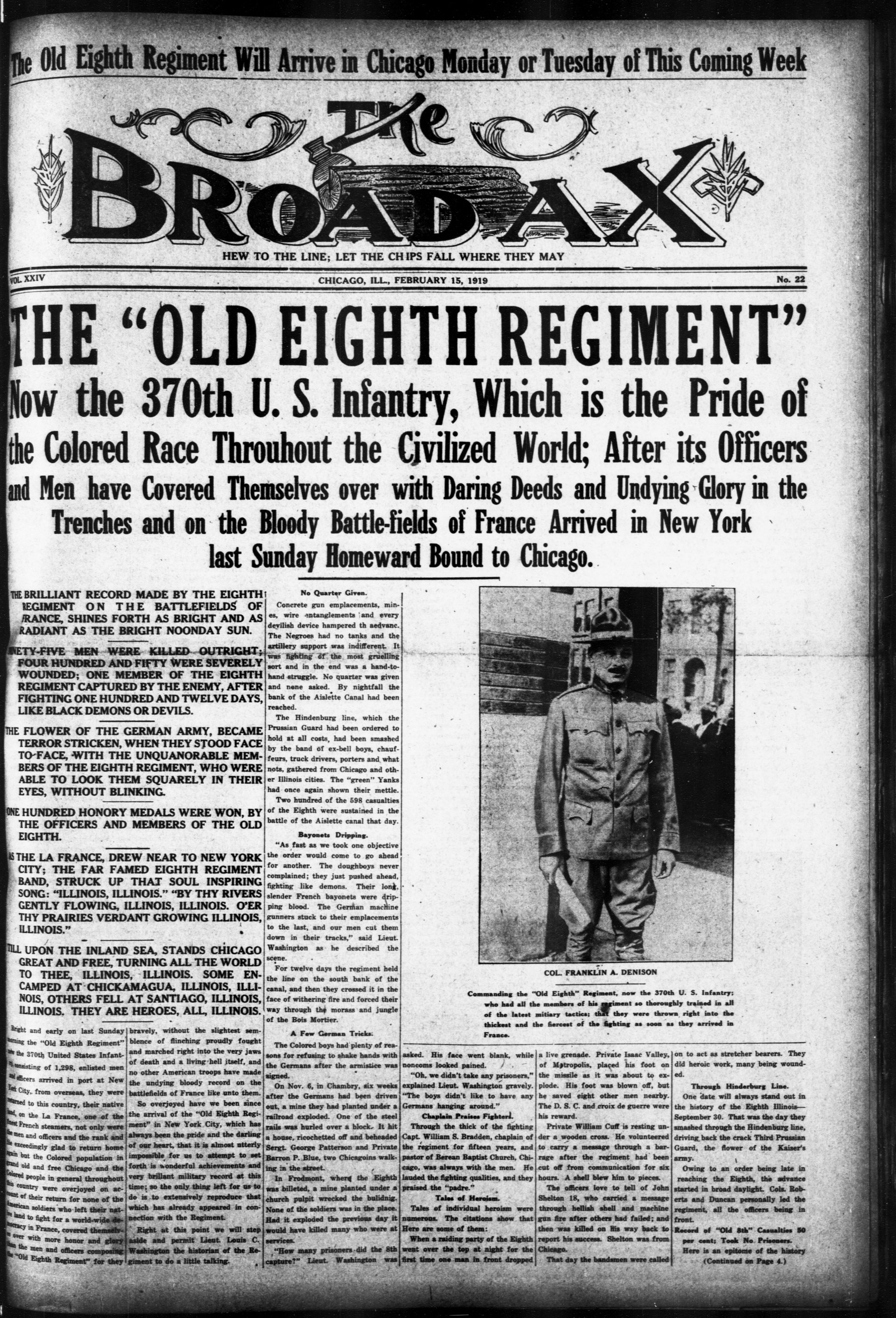
THE "OLD EIGHTH REGIMENT" Now the 370th U. S. Infantry, Which is the Pride of the Colored Race Throuhout the Civilized World; After its Officers and Men have Covered Themselves over with Daring Deeds and Undying Glory in the Trenches and on the Bloody Battle-fields of France Arrived in New York last Sunday Homeward Bound to Chicago.
THE BRILLIANT RECORD MADE BY THE EIGHTH REGIMENT ON THE BATTLEFIELDS OF RANCE, SHINES FORTH AS BRIGHT AND AS RADIANT AS THE BRIGHT NOONDAY SUN.
NETY-FIVE MEN WERE KILLED OUTRIGHT; FOUR HUNDRED AND FIFTY WERE SEVERELY WOUNDED; ONE MEMBER OF THE EIGHTH REGIMENT CAPTURED BY THE ENEMY, AFTER FIGHTING ONE HUNDRED AND TWELVE DAYS, LIKE BLACK DEMONS OR DEVILS.
THE FLOWER OF THE GERMAN ARMY, BECAME TERROR STRICKEN, WHEN THEY STOOD FACE TO FACE, WITH THE UNQUANORABLE MEMBERS OF THE EIGHTH REGIMENT, WHO WERE ABLE TO LOOK THEM SQUARELY IN THEIR EYES, WITHOUT BLINKING.
ONE HUNDRED HONORY MEDALS WERE WON, BY THE OFFICERS AND MEMBERS OF THE OLD EIGHTH.
AS THE LA FRANCE, DREW NEAR TO NEW YORK CITY; THE FAR FAMED EIGHTH REGIMENT BAND, STRUCK UP THAT SOUL INSPIRING SONG: "ILLINOIS, ILLINOIS." "BY THY RIVERS GENTLY FLOWING, ILLINOIS, ILLINOIS. O'ER THY PRAIRIES VERDANT GROWING ILLINOIS, ILLINOIS." TILL UPON THE INLAND SEA, STANDS CHICAGO GREAT AND FREE, TURNING ALL THE WORLD TO THEE, ILLINOIS, ILLINOIS. SOME ENCAMPED AT CHICKAMAGUA, ILLINOIS, ILLINOIS, OTHERS FELL AT SANTIAGO, ILLINOIS, ILLINOIS. THEY ARE HEROES, ALL, ILLINOIS.
bravely, without the slightest semblance of flinching proudly fought and marched right into the very jaws of death and a living hell itself, and no other American troops have made the undying bloody record on the battlefields of France like unto them. So overjoyed have we since the arrival of the "Old Eighth Regiment" in New York City, which has always been the pride and the darling of our heart, that it is almost utterly impossible for us to attempt to set forth is wonderful achievements and very brilliant military record at this time; so the only thing left for us to do is to extensively reproduce that which has already appeared in connection with the Regiment.
Right at this point we will step aside and permit Lieut. Louis C. Washington the historian of the Regiment to do a little talking.
CHICAGO, ILL., FEBRUARY 15, 1919
EIGHT
U. S. Infan
ouhout the
mselves over v
Bloody Battle-fi
unday Homewa
No Quarter Given.
IGHTH Infantry, W ut the Civilized es over with Darin Battle-fields of F Homeward Bound Quarter Given.
Concrete gun emplacements, mines, wire entanglements and every devilish device hampered th aedvance. The Negroes had no tanks and the artillery support was indifferent. It was fighting of the most gruelling sort and in the end was a hand-to-hand struggle. No quarter was given and none asked. By nightfall the bank of the Aislette Canal had been reached.
The Hindenburg line, which the Prussian Guard had been ordered to hold at all costs, had been smashed by the band of ex-bell boys, chaufeurs, truck drivers, porters and what nots, gathered from Chicago and other Illinois cities. The "green" Yanks had once again shown their mettle.
Two hundred of the 598 casualties of the Eighth were sustained in the battle of the Aislette canal that day.
Bayonets Dripping.
"As fast as we took one objective the order would come to go ahead for another. The doughboys never complained; they just pushed ahead, fighting like demons. Their long, slender French bayonets were dripping blood. The German machine gunners stuck to their emplacements to the last, and our men cut them down in their tracks," said Lieut. Washington as he described the scene.
"As fast as we took one objective the order would come to go ahead for another. The doughboys never complained; they just pushed ahead, fighting like demons. Their long, slender French bayonets were dripping blood. The German machine gunners stuck to their emplacements to the last, and our men cut them down in their tracks," said Lieut. Washington as he described the scene.
For twelve days the regiment held the line on the south bank of the canal, and then they crossed it in the face of withering fire and forced their way through the morass and jungle of the Bois Mortier.
A Few German Tricks:
The Colored boys had plenty of reasons for refusing to shake hands with the Germans after the armistice was signed.
On Nov. 6, in Chambry, six weeks after the Germans had been driven out, a mine they had planted under a railroad exploded. One of the steel rails was hurled over a block. It hit a house, ricochetted off and beheaded Sergt. George Patterson and Private Barron P. Blue, two Chicagois walking in the street.
In Frodmont, where the Eighth was billeted, a mine planted under a church pulpit wrecked the bulldign. None of the soldiers was in the place. Had it exploded the previous day it would have killed many who were at services.
"How many prisoners did the 8th capture?" Lieut. Washington was
---
Commanding the who had all the of the latest thickest and France.
asked. His face went blank, while noncoms looked pained.
"Oh, we didn't take any prisoners," explained Lieut. Washington gravely.
"The boys didn't like to have any Germans hanging around."
Chaplain Praises Fighterl.
Through the thick of the fighting Capt. William S. Bradden, chaplain of the regiment for fifteen years, and pastor of Berean Baptist Church, Chicago, was always with the men. He lauded the fighting qualities, and they praised the "padre."
Tales of Heroism.
Tales of individual heroism were numerous. The citations show that Here are some of them:
When a raiding party of the Eighth went over the top at night for the first time one man in front dropped
THE FIREMAN
Commanding the "Old Eighth" Regiment, now the 370th U. S. Infantry; who had all the members of his regiment so thoroughly trained in all of the latest mitiary tactics; that they were thrown right into the thickest and the fiercest of the fighting as soon as they arrived in France.
COL. FRANKLIN A. DENISON
Old Eighth" Regiment, now the 3700
the members of his regiment so thorough
military tactics; that they were thro
he fiercest of the fighting as soon a
a live grenade. Private Isaac Valley,
of Metropolis, placed his foot on
the missile as it was about to explode. His foot was blown off, but
he saved eight other men nearby. The D. S. C. and croix de guerre were
his reward.
Private William Cuff is resting under a wooden cross. He volunteered to carry a message through a barrage after the regiment had been cut off from communication for six hours. A shell blew him to pieces.
on to act as stretcher bearers. They did heroic work, many being wounded.
Through Hinderburg Line.
One date will always stand out in the history of the Eighth Illinois—September 30. That was the day they smashed through the Hindenburg line, driving back the crack Third Prussian Guard, the flower of the Kaiser's army.
Owing to an order being late in reaching the Eighth, the advance started in broad daylight. Cols. Roberts and Duncan personally led the regiment, all the officers being in front.
Record of "Old 8th" Casualties 50 per cent; Took No Prisoners.
Here is an epitome of the history (Continued on Page 4.)
```markdown
```
M.
HON. MARTIN B. MADDEN
Member of Congress, from the First has ably prepared and introduc "Jim Crowism" and racial discrout the United States.
Member of Congress, from the First Congressional district of Illinois; who has ably prepared and introduced a bill in Congress, to knock out "Jim Crowism" and racial discrimination on all the railroads throughout the United States.
BETHEL LITERARY SOCIETY.
Next Sunday afternoon, February 16th at four o'clock Bethel Literary Society will observe Abraham Lincoln and Frederick Douglass Memorial and excellent program has been arranged which is in part as follows: Abraham Lincoln, Atty Walter M. Farmer, Frederick Douglass, Wm. A Wallace; Mrs. Geraldine Withers has arranged an excellent musical program. Solo by Mrs. Willa Thomas of St. Paul C. M. E. Choir; Solo by Miss Glasgow; Duet by Mrs. B. Anderson and Mrs. B. Dickerson of St. Paul C. M. E. Choir, Mrs. Ollie Guy accompanist. Everybody invited. Admission Free.
Sandy W. Trice, Pres.,
Rev. W. D. Cook, D.D. Pastor
J. W. Bell, Sec'y.
SUNSHINE RESCUE MISSION.
2830 S. State St.
Service Every Night in the Year.
Last week witnessed several conversions and a great blessing from God. Many poor lost boys and men
1927 IBEL
PAGE TWO
Congressional district of Illinois; who
secured a bill in Congress, to knock out
elimination on all the railroads through
were clothed and sheltered and tenderly ministered unto in Jesus's name.
Dr. Bray and the workers have
spent some time assisting in the Union revival meetings being held in Quinn Chapel. The fire is burning and many precious souls are being saved nightly.
Brther George E. Wright, who directs the chorus and does the solo work in the revival meetings of Dr. H. Franklin Bray, left this week to prepare for the next campaign. Evangelist Bray will leave one-week later. Dr. J. O. Morely of Milwaukee, Wis., assisted in the services on Monday night. You will receive a hearty welcome to all our services, especially on Sunday afternoon and night.—"C.".
Mrs. Allice Dunn and her husband Mr. Dunn, are now light housekeeping at 6113 S. Morgan street.
Noah D. Thompson, who is well and favorably known in Chicago, and who has become quite prominent in civic and social affairs in Los Angeles, Cal. and Capt. F. H. Crumley, were selected as the two Colored members, of the Roosevelt Memorial Day Committee, by the Mayor of Los Angeles.
THE BROAD AX, CHICAGO, FEBRUARY 15, 1919
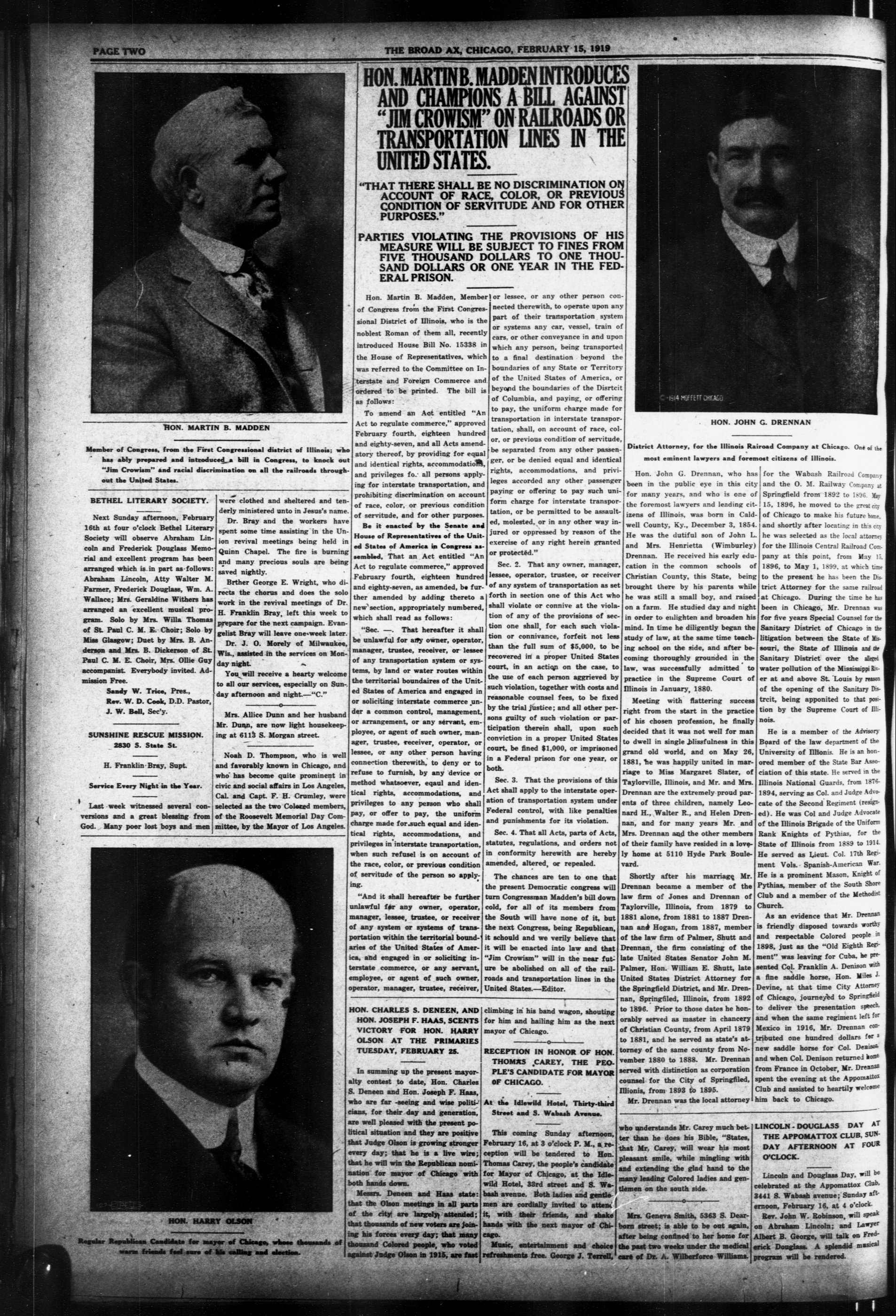
HON. MARTIN B. MADDEN INTRODUCES AND CHAMPIONS A BILL AGAINST "JIM CROWISM" ON RAILROADS OR TRANSPORTATION LINES IN THE UNITED STATES.
"THAT THERE SHALL BE NO DISCRIMINATION ON ACCOUNT OF RACE, COLOR, OR PREVIOUS CONDITION OF SERVITUDE AND FOR OTHER PURPOSES."
PARTIES VIOLATING THE PROVISIONS OF HIS MEASURE WILL BE SUBJECT TO FINES FROM FIVE THOUSAND DOLLARS TO ONE THOUSAND DOLLARS OR ONE YEAR IN THE FEDERAL PRISON.
Hon. Martin B. Madden, Member of Congress from the First Congressional District of Illinois, who is the noblest Roman of them all, recently introduced House Bill No. 15338 in the House of Representatives, which was referred to the Committee on Interstate and Foreign Commerce and ordered to be printed. The bill is as follows:
To amend an Act entitled "An Act to regulate commerce," approved February fourth, eighteen hundred and eighty-seven, and all Acts amendatory thereof, by providing for equal and identical rights, accommodations, and privileges for all persons applying for interstate transportation, and prohibiting discrimination on account of race, color, or previous condition of servitude, and for other purposes.
Be it enacted by the Senate and House of Representatives of the United States of America in Congress assembled, That an Act entitled "An Act to regulate commerce," approved February fourth, eighteen hundred and eighty-seven, as amended, be further amended by adding thereto a new section, appropriately numbered, which shall read as follows:
"Sec. —. That hereafter it shall be unlawful for any owner, operator manager, trustee, receiver, or lessee of any transportation system or systems, by land or water routes within the territorial boundaires of the United States of America and engaged in or soliciting interstate commerce under a common control, management, or arrangement, or any servant, employee, or agent of such owner, manager, trustee, receiver, operator, or lesee, or any other person having connection therewith, to deny or to refuse to furnish, by any device or method whatsoever, equal and identical rights, accommodations, and privileges to any person who shall pay, or offer to pay, the uniform charge made for such equal and identical rights, accommodations, and privileges in interstate transportation, when such refusel is on account of the race, color, or previous condition of servitude of the person so applying.
"And it shall hereafter be further unlawful for any owner, operator, manager, lessee, trustee, or receiver of any system or systems of transportation within the territorial boundaries of the United States of America, and engaged in or soliciting interstate commerce, or any servant, employee, or agent of such owner, operator, manager, trustee, receiver,
HON. CHARLES S. DENEEN, AND
HON. JOSEPH F. HAAS, SCENTS
VICTORY FOR HON. HARRY
OLSON AT THE PRIMARIES
TUESDAY, FEBRUARY 25.
In summing up the present mayoralty contest to date, Hon. Charles S. Deneen and Hon. Joseph F. Haas, who are far-seeing and wise politicians, for their day and generation, are well pleased with the present political situation and they are positive that Judge Olson is growing stronger every day; that he is a live wire; that he will win the Republican nomination for mayor of Chicago with both hands down. Messra. Deneen and Haas state: that the Olson meetings in all parts of the city are largely attended; that thousands of new voters are joining his forces every day; that many thousand Colored people, who voted against Judge Olson in 1915, are fast
or lessee, or any other person connected therewith, to operate upon any part of their transportation system or systems any car, vessel, train of cars, or other conveyance in and upon which any person, being transported to a final destination beyond the boundaries of any State or Territory of the United States of America, or beyond the boundaries of the District of Columbia, and paying, or offering to pay, the uniform charge made for transportation in interstate transportation, shall, on account of race, color, or previous condition of servitude, be separated from any other passenger, or be denied equal and identical rights, accommodations, and privileges accorded any other passenger paying or offering to pay such uniform charge for interstate transportation, or be permitted to be assaulted, molested, or in any other way injured or oppressed by reason of the exercise of any right herein granted or protected."
Sec. 2. That any owner, manager, lessee, operator, trustee, or receiver of any system of transportation as set forth in section one of this Act who shall violate or connive at the violation of any of the provisions of section one shall, for each such violation or connivance, forfeit not less than the full sum of $5,000, to be recovered in a proper United States court, in an action on the case, to the use of each person aggrieved by such violation, together with costs and reasonable counsel fees, to be fixed by the trial justice; and all other persons guilty of such violation or participation therein shall, upon such conviction in a proper United States court, be fined $1,000, or imprisoned in a Federal prison for one year, or both.
Sec. 3. That the provisions of this Act shall apply to the interstate operation of transportation system under Federal control, with like penalties and punishments for its violation. Sec. 4. That all Acts, parts of Acts, statutes, regulations, and orders not in conformity herewith are hereby amended, altered, or repealed.
The chances are ten to one that the present Democratic congress will turn Congressman Madden's bill down cold, for all of its members from the South will have none of it, but the next Congress, being Republican, it should and we verily believe that it will be enacted into law and that "Jim Crowism" will in the near future be abolished on all of the railroads and transportation lines in the United States.—Editor.
climbing in his band wagon, shouting for him and hailing him as the next mayor of Chicago.
RECEPTION IN HONOR OF HONOR
THOMAS CAREY, THE PEOPLE'S CANDIDATE FOR MAYOR
OF CHICAGO.
At the Idlewild Hotel, Thirty-third
Street and S. Wabash Avenue.
This coming Sunday afternoon, February 16, at 3 o'clock P. M., a reception will be tendered to Hon. Thomas Carey, the people's candidate for Mayor of Chicago, at the Idlewild Hotel, 33rd street and S. Wabash avenue. Both ladies and gentlemen are cordially invited to attend it, with their friends, and shake hands with the next mayor of Chicago. Music, entertainment and choice refreshments free. George J. Terrell,
C-1914 MOFFETT CHICAGO
HON. JOHN G. DRENNAN
District Attorney, for the Illinois Railroad Company at Chicago. One of the most eminent lawyers and foremost citizens of Illinois.
Hon. John G. Drennan, who has been in the public eye in this city for many years, and who is one of the foremost lawyers and leading citizens of Illinois, was born in Caldwell County, Ky., December 3, 1854. He was the dutiful son of John L. and Mrs. Henrietta (Wimburley) Drennan. He received his early education in the common schools of Christian County, this State, being brought there by his parents while he was still a small boy, and raised on a farm. He studied day and night in order to enlighten and broaden his mind. In time he diligently began the study of law, at the same time teaching school on the side, and after becoming thoroughly grounded in the law, was successfully admitted to practice in the Supreme Court of Illinois in January, 1880.
Meeting with flattering success right from the start in the practice of his chosen profession, he finally decided that it was not well for man to dwell in single blissfulness in this grand old world, and on May 26, 1881, he was happily united in marriage to Miss Margaret Slater, of Taylorville, Illinois, and Mr. and Mrs. Drennan are the extremely proud parents of three children, namely Leonard H., Walter R., and Helen Drennan, and for many years Mr. and Mrs. Drennan and the other members of their family have resided in a lovely home at 5110 Hyde Park Boulevard.
Shortly after his marriage Mr. Drennan became a member of the law firm of Jones and Drennan of Taylorville, Illinois, from 1879 to 1881 alone, from 1881 to 1887 Drennan and Hogan, from 1887, member of the law firm of Palmer, Shutt and Drennan, the firm consisting of the late United States Senator John M. Palmer, Hon. William E. Shutt, late United States District Attorney for the Springfield District, and Mr. Drennan, Springfiled, Illinois, from 1892 to 1896. Prior to those dates he honorably served as master in chancery of Christian County, from April 1879 to 1881, and he served as state's attorney of the same county from November 1880 to 1888. Mr. Drennan served with distinction as corporation counsel for the City of Springfiled, Illionis, from 1893 to 1895.
who understands Mr. Carey much better than he does his Bible, "States,
that Mr. Carey, will wear his most pleasant smile, while mingling with
and extending the glad hand to the many leading Colored ladies and gentlemen on the south side.
Mrs. Geneva Smith, 5363 S. Dearborn street; is able to be out again,
after being confined to her home for
the past two weeks under the medical care of Dr. A. Wilberforce Williams.
for the Wabash Railroad Company and the O. M. Railway Company at Springfield from 1892 to 1896. May 15, 1896, he moved to the great city of Chicago to make his future home, and shortly after locating in this city he was selected as the local attorney for the Illinois Central Railroad Company at this point, from May 15, 1896, to May 1, 1899, at which time to the present he has been the District Attorney for the same railroad at Chicago. During the time he has been in Chicago, Mr. Drennan was for five years Special Counsel for the Sanitary District of Chicago in the litigation between the State of Missouri, the State of Illinois and the Sanitary District over the alleged water pollution of the Mississippi River at and above St. Louis by reason of the opening of the Sanitary District, being appointed to that position by the Supreme Court of Illinois.
He is a member of the Advisory Board of the law department of the University of Illinis. He is an honored member of the State Bar Association of this state. He served in the Illinois National Guards, from 1876-1894, serving as Col. and Judge Advocate of the Second Regiment (resigned). He was Col and Judge Advocate of the Illinois Brigade of the Uniform Rank Knights of Pythias, for the State of Illinois from 1889 to 1914. He served as Lieut. Col. 17th Regiment Vols. Spanish-American War. He is a prominent Mason, Knight of Pythias, member of the South Shore Club and a member of the Methodist Church.
As an evidence that Mr. Drennan is friendly disposed towards worthy and respectable Colored people in 1898, just as the "Old Eighth Regiment" was leaving for Cuba, he presented Col. Franklin A. Denison with a fine saddle horse, Hon. Miles J. Devine, at that time City Attorney of Chicago, journeyed to Springfield to deliver the presentation speech, and when the same regiment left for Mexico in 1916, Mr. Drennan contributed one hundred dollars for a new saddle horse for Col. Denison, and when Col. Denison returned home from France in October, Mr. Drennan spent the evening at the Appomattox Club and assisted to heartily welcome him back to Chicago.
LINCOLN- DOUGLASS DAY AT THE APPOMATTOX CLUB, SUNDAY AFTERNOON AT FOUR O'CLOCK.
Lincoln and Douglass Day, will be celebrated at the Appomattox Club, 3441 S. Wabash avenue; Sunday afternoon, February 16, at 4 o'clock.
Rev. John W. Robinson, will speak on Abraham Lincoln; and Lawyer Albert B. George, will talk on Frederick Douglass. A splendid musical program will be rendered.
NEW BLOUSE HAS CALL FOR FAVOR
Peplum. Model in the Limelight Among Many Designs Be ing Shown.
Pottery Ornamentation and Other Colors Add to Features of Garment—Fabrics That Have Never Been Considered.
New York.—The blouse is a sartorial robin. It heralds the approach of spring. It is the kind of accessory to a costume that both pleases and irritates. That it is usually wrong is the verdict of most women. When it is right it is very, very right, and that is the best that can be said for it, observes a prominent fashion writer. Its possibilities for evil are not limited. Those who recognize that the online governs the appearance 'of the face know full well the chances of good and evil that rest in the collar of a separate waist.
There is no end to the making of
houses, as of books. No one can
evil at the paucity of these garments.
Are shop in any town, at any time, is
American Indian blouse of dull-blue kid embroidered in a pottery design of red and silver. The sash of red satin is knotted in front.
get to confuse a woman with the multiple offerings hurled at her across the counter the moment she asks to look at blouses.
These bits of the costume are the small change of the shopkeeper. They are taken in and out of stock, off and on the counter, throughout the different months of the year. They fill in spaces. They break the monotony of business which arrives between the periods of high pressure. It is not true that what a woman wants she can always get in this department of stress, but it is overwhelmingly true that whatever she says she wants is answered by an avalanche of designs, offered to her as the best and the latest.
Evil Possibilities of Blouses.
Of course, there are new fashions in the blouses this spring. They have been shown to women; they have been purchased for the unusually large numbers to the South, and they will appeal to the majority of women during the next four weeks, when one's thoughts turn to the rehabilitation of the winter wardrobe, or the acquisition of a new one. $^*$
There is no more paucity of invention in blouses this year than last. France and America have both done their best—and it is in this vast variety that evil possibilities lie. If women could be trained to regard the blouse as something fatal, unless well chosen, they would go about the business of getting together a half dozen with the precaution and precision necessary when walking on ice. They would not buy georgette because it is fashionable, tomato-red because it was the style, nor would they choose gallon embroidery, shoe-lace braiding or brass buttons because the designers had chosen to exploit these caprices. They would go among all the masses of waists with the precision of a bird trying to its nest. They would take the nearest straight line to what they want. If they did not find it they would go elsewhere; if it was not to be found in the shops they would have it made by a specialist or a seamstress, from a well-considered pattern.
The part of a blouse that is very often fatal is the collar. There are few women who can stand more than two types of neckline. A woman should not rebel against this verdict. She should accept it and thus eliminate trouble. She should experiment with blouses that do not carry either one of these necklines. She must remember that no blouse is worth its price if it hasn't the kind of collar that offsets the neckline of her cont. She must also take well into consideration the difference between a blouse which is to be worn as a part of a costume topped by a fur or cloth cont. and one that is merely a shirtwist and part of a tailored suit. These are not all the requirements.
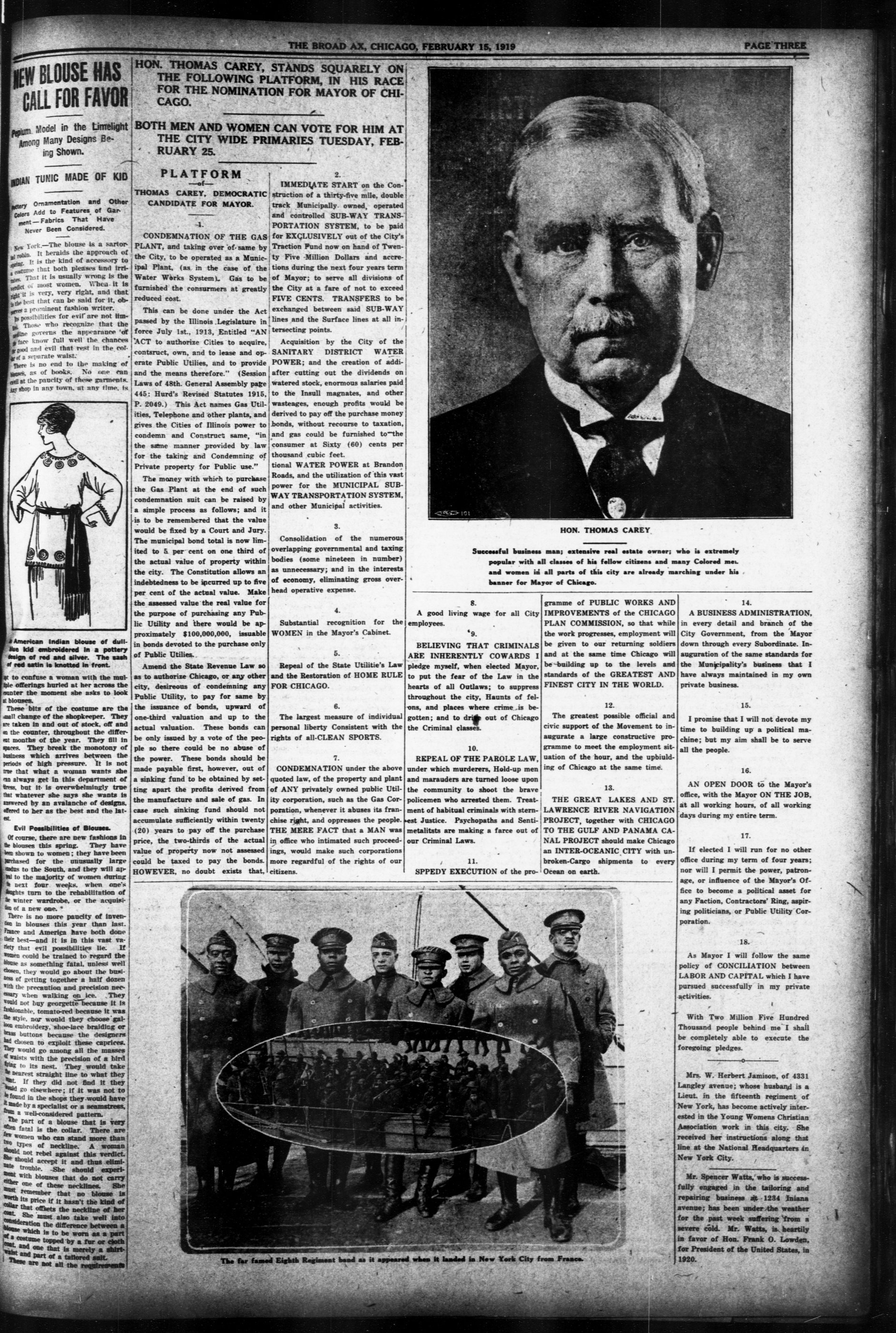
HON. THOMAS CAREY, STANDS SQUARELY ON THE FOLLOWING PLATFORM, IN HIS RACE FOR THE NOMINATION FOR MAYOR OF CHICAGO.
BOTH MEN AND WOMEN CAN VOTE FOR HIM AT THE CITY WIDE PRIMARIES TUESDAY, FEBRUARY 25.
THE MILITARY CORPS
PLATFORM
THOMAS CAREY, DEMOCRATIC
CANDIDATE FOR MAYOR.
CONDEMNATION OF THE GAS PLANT, and taking over of same by the City, to be operated as a Municipal Plant, (as in the case of the Water Works System). Gas to be furnished the consumers at greatly reduced cost.
This can be done under the Act passed by the Illinois Legislature in force July 1st., 1913, Entitled "AN ACT to authorize Cities to acquire, construct, own, and to lease and operate Public Utilities, and to provide and the means therefore." (Session Laws of 48th. General Assembly page 445: Hurd's Revised Statutes 1915, P. 2049.) This Act names Gas Utilities, Telephone and other plants, and gives the Cities of Illinois power to condemn and Construct same, "in the same manner provided by law for the taking and Condemning of Private property for Public use."
The money with which to purchase the Gas Plant at the end of such condemnation suit can be raised by a simple process as follows; and it is to be remembered that the value would be fixed by a Court and Jury. The municipal bond total is now limited to 5 per cent on one third of the actual value of property within the city. The Constitution allows an indebtedness to be incurred up to five per cent of the actual value. Make the assessed value the real value for the purpose of purchasing any Public Utility and there would be approximately $100,000,000, issuable in bonds devoted to the purchase only of Public Utilities.
Amend the State Revenue Law so as to authorize Chicago, or any other city, desireous of condemning any Public Utility, to pay for same by the issuance of bonds, upward of one-third valuation and up to the actual valuation. These bonds can be only issued by a vote of the people so there could be no abuse of the power. These bonds should be made payable first, however, out of a sinking fund to be obtained by setting apart the profits derived from the manufacture and sale of gas. In case such sinking fund should not accumulate sufficiently within twenty (20) years to pay off the purchase price, the two-thirds of the actual value of property now not assessed could be taxed to pay the bonds. HOWEVER, no doubt exists that,
THE BROAD AX. CHICAGO. FEBRUARY 15. 1919
IMMEDIATE START on the Construction of a thirty-five mile, double track Municipally, owned, operated and controlled SUB-WAY TRANSPORTATION SYSTEM, to be paid for EXCLUSIVELY out of the City's Traction Fund now on hand of Twenty Five Million Dollars and accretions during the next four years term of Mayor; to serve all divisions of the City at a fare of not to exceed FIVE CENTS. TRANSFERS to be exchanged between said SUB-WAY lines and the Surface lines at all intersecting points.
Acquisition by the City of the SANITARY DISTRICT WATER POWER; and the creation of addiafter cutting out the dividends on watered stock, enormous salaries paid to the Insull magnates, and other wasteages, enough profits would be derived to pay off the purchase money bonds, without recourse to taxation, and gas could be furnished to the consumer at Sixty (60) cents per thousand cubic feet. tional WATER POWER at Brandon Roads, and the utilization of this vast power for the MUNICIPAL SUBWAY TRANSPORTATION SYSTEM, and other Municipal activities.
Consolidation of the numerous overlapping governmental and taxing bodies (some nineteen in number) as unnecessary; and in the interests of economy, eliminating gross overhead operative expense.
Substantial recognition for the WOMEN in the Mayor's Cabinet.
Repeal of the State Utilitie's Law and the Restoration of HOME RULE FOR CHICAGO.
The largest measure of individual personal liberty Consistent with the rights of all-CLEAN SPORTS.
CONDEMNATION under the above quoted law, of the property and plant of ANY privately owned public Utility corporation, such as the Gas Corporation, whenever it abuses its franchise right, and oppresses the people. THE MERE FACT that a MAN was in office who intimated such proceedings, would make such corporations more regardful of the rights of our citizens.
TROPHY
101
Successful business man; extensive real estate owner; who is extremely popular with all classes of his fellow citizens and many Colored men and women in all parts of this city are already marching under his banner for Mayor of Chicago.
A good living wage for all City employees.
9.
BELIEVING THAT CRIMINALS ARE INHERENTLY COWARDS I pledge myself, when elected Mayor, to put the fear of the Law in the hearts of all Outlaws; to suppress throughout the city, Haunts of felons, and places where crime is begotten; and to drive out of Chicago the Criminal classes.
10.
REPEAL OF THE PAROLE LAW, under which murderers, Hold-up men and maududers are turned loose upon the community to shoot the brave policemen who arrested them. Treatment of habitual criminals with sternest Justice. Psychopaths and Sentimentalists are making a farce out of our Criminal Laws.
SPPEDY EXECUTION of the pro-
HON. THOMAS CAREY
man; extensive real estate owner; all classes of his fellow citizens and m all parts of this city are already ma yor of Chicago.
gramme of PUBLIC WORKS AND IMPROVEMENTS of the CHICAGO PLAN COMMISSION, so that while the work progresses, employment will be given to our returning soldiers and at the same time Chicago will be-building up to the levels and standards of the GREATEST AND FINEST CITY IN THE WORLD.
12.
The greatest possible official and civic support of the Movement to inaugurate a large constructive programme to meet the employment situation of the hour, and the upbuiding of Chicago at the same time.
13.
THE GREAT LAKES AND ST. LAWRENCE RIVER NAVIGATION PROJECT, together with CHICAGO TO THE GULF AND PANAMA CANAL PROJECT should make Chicago an INTER-OCEANIC CITY with unbroken-Cargo shipments to every Ocean on earth.
PAGE'THREE
who is extremely
many Colored men.
arching under his
A BUSINESS ADMINISTRATION, in every detail and branch of the City Government, from the Mayor down through every Subordinate. Inauguration of the same standards for the Municipality's business that I have always maintained in my own private business.
15.
I promise that I will not devote my time to building up a political machine; but my aim shall be to serve all the people.
16.
AN OPEN DOOR to the Mayor's office, with the Mayor ON THE JOB, at all working hours, of all working days during my entire term.
17.
If elected I will run for no other office during my term of four years; nor will I permit the power, patronage, or influence of the Mayor's Office to become a political asset for any Faction, Contractors' Ring, aspiring politicians, or Public Utility Corporation.
18.
As Mayor I will follow the same policy of CONCILIATION between LABOR AND CAPITAL which I have pursued successfully in my private activities.
With Two Million Five Hundred Thousand people behind me I shall be completely able to execute the foregoing pledges.
Mrs. W. Herbert Jamison, of 4331 Langley avenue; whose husband is a Lieut. in the fifteenth regiment of New York, has become actively interested in the Young Womens Christian Association work in this city. She received her instructions along that line at the National Headquarters in New York City.
Mr. Spencer Watts, who is successfully engaged in the tailoring and repairing business at 1234 Iniana avenue; has been under the weather for the past week suffering from a severe cold. Mr. Watts, is heartily in favor of Hon. Frank O. Lowden, for President of the United States, in 1920.
THE MILITARY COMMANDER OF THE UNION ARMY IN THE PHILIPPINES
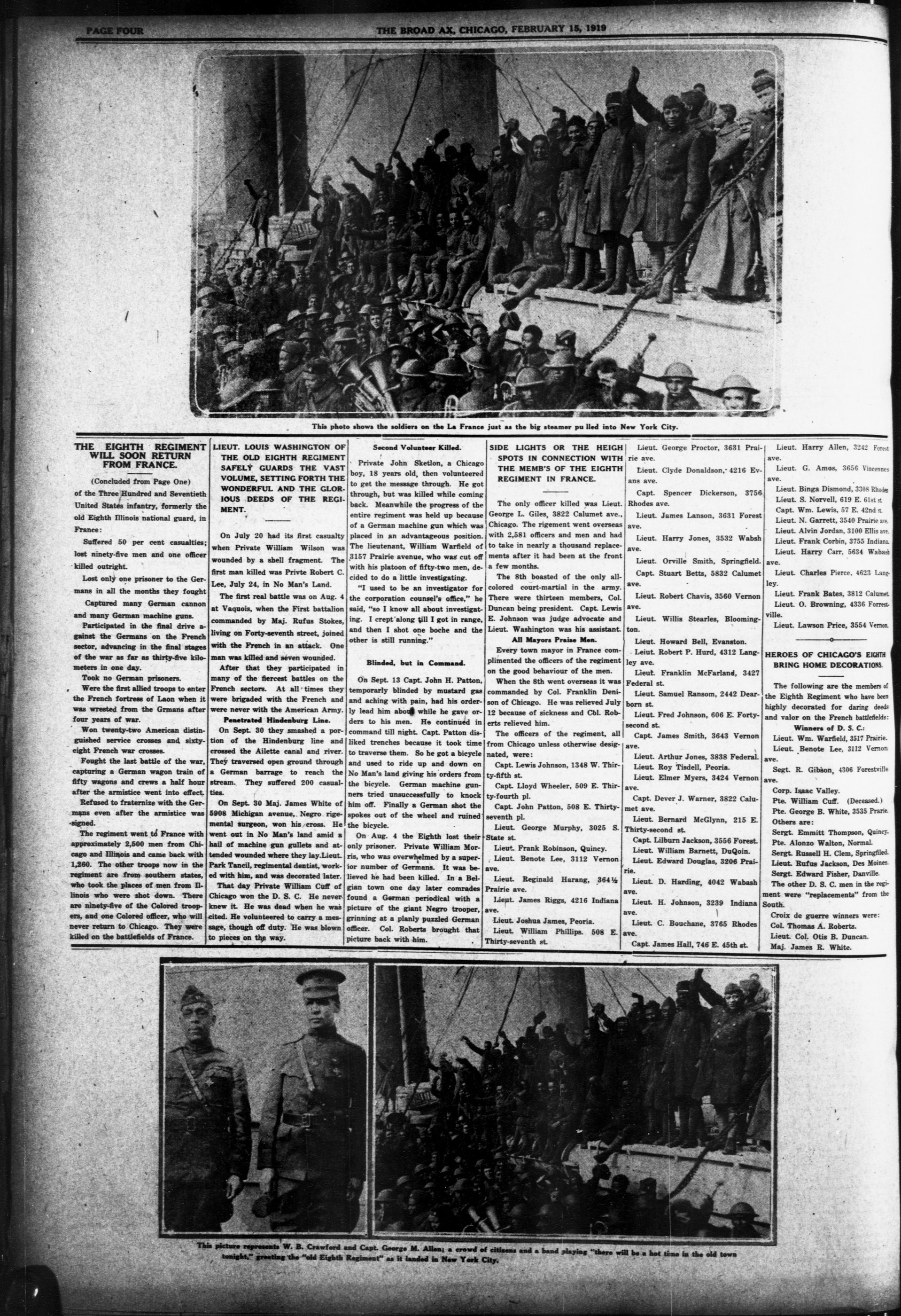
THE EIGHTH REGIMENT WILL SOON RETURN FROM FRANCE.
(Concluded from Page One) of the Three Hundred and Seventieth United States infantry, formerly the old Eighth Illinois national guard, in France:
Suffered 50 per cent casualties; lost ninety-five men and one officer killed outright.
Lost only one prisoner to the Germans in all the months they fought
Captured many German cannon and many German machine guns.
Participated in the final drive against the Germans on the French sector, advancing in the final stages of the war as far as thirty-five kilometers in one day. Took no German prisoners. Were the first allied troops to enter the French fortress of Laon when it was wrested from the Germans after four years of war.
Won twenty-two American distinguished service crosses and sixty-eight French war crosses. Fought the last battle of the war, capturing a German wagon train of fifty wagons and crews a half hour after the armistice went into effect. Refused to fraternize with the Germans even after the armistice was signed.
The regiment went to France with approximately 2,500 men from Chicago and Illinois and came back with 1,260. The other troops now in the regiment are from southern states, who took the places of men from Illinois who were shot down. There are ninety-five of the Colored troopers, and one Colored officer, who will never return to Chicago. They were killed on the battlefields of France.
}
THE BATTLE OF THE BAY OF BALTIMORE
This photo shows the soldiers on the La France just as the big steamer pulled into New York City.
This picture represents W. B. Crawford and Capt. George M. Allen; a crowd of citizens and a band playing "there will be a hot time in the old town tonight," greeting the "old Eighth Regiment" as it landed in New York City.
LIEUT. LOUIS WASHINGTON OF THE OLD EIGHTH REGIMENT SAFELY GUARDS THE VAST VOLUME, SETTING FORTH THE WONDERFUL AND THE GLORIOUS DEEDS OF THE REGIMENT.
On July 20 had its first casualty when Private William Wilson was wounded by a shell fragment. The first man killed was Privte Robert C. Lee, July 24, in No Man's Land. The first real battle was on Aug. 4 at Vaquois, when the First battalion commanded by Maj. Rufus Stokes, living on Forty-seventh street, joined with the French in an attack. One man was killed and seven wounded. After that they participated in many of the fiercest battles on the French sectors. At all times they were brigaded with the French and were never with the American Army.
Penetrated Hindenburg Line.
On Sept. 30 they smashed a portion of the Hindenburg line and crossed the Ailette canal and river. They traversed open ground through a German barrage to reach the stream. They suffered 200 casualties.
On Sept. 30 Maj. James White of 5908 Michigan avenue, Negro rigemental surgeon, won his cross. He went out in No Man's land amid a hail of machine gun gullets and attended wounded where they lay.Lieut. Park Tancil, regimental dentist, worked with him, and was decorated later.
That day Private William Cuff of Chicago won the D. S. C. He never knew it. He was dead when he was cited. He volunteered to carry a message, though off duty. He was blown to pieces on the way.
THE BROAD AX, CHICAGO, FEBRUARY 15, 1919
THE FIGHT FOR THE GREAT BRITAIN
Second Volunteer Killed.
Private John Sketlon, a Chicago boy, 18 years old, then volunteered to get the message through. He got through, but was killed while coming back. Meanwhile the progress of the entire regiment was held up because of a German machine gun which was placed in an advantageous position. The lieutenant, William Warfield of 3157 Prairie avenue, who was cut off with his platoon of fifty-two men, decided to do a little investigating.
"I used to be an investigator for the corporation counsel's office," he said, "so I know all about investigating. I crept along till I got in range, and then I shot one boche and the other is still running."
Blinded, but in Command.
On Sept. 13 Capt. John H. Patton, temporarily blinded by mustard gas and aching with pain, had his orderly lead him about while he gave orders to his men. He continued in command till night. Capt. Patton disliked trenches because it took time to traverse them. So he got a bicycle and used to ride up and down on No Man's land giving his orders from the bicycle. German machine gunners tried unsuccessfully to knock him off. Finally a German shot the spokes out of the wheel and ruined the bicycle.
On Aug. 4 the Eighth lost their only prisoner. Private William Morris, who was overwhelmed by a superior number of Germans. It was believed he had been killed. In a Belgian town one day later comrades found a German periodical with a picture of the giant Negro trooper, grinning at a planly puzzled German officer. Col. Roberts brought that picture back with him.
SIDE LIGHTS OR THE HEIGH SPOTS IN CONNECTION WITH THE MEMB'S OF THE EIGHTH REGIMENT IN FRANCE.
The only officer killed was Lieut. George L. Giles, 3822 Calumet ave. Chicago. The rigement went overseas with 2,581 officers and men and had to take in nearly a thousand replacements after it had been at the front a few months.
The 8th boasted of the only all-colored court-martial in the army. There were thirteen members, Col. Duncan being president. Capt. Lewis E. Johnson was judge advocate and Lieut. Washington was his assistant.
All Mayors Praise Men.
Every town mayor in France complimented the officers of the regiment on the good behaviour of the men.
When the 8th went overseas it was commanded by Col. Franklin Denison of Chicago. He was relieved July 12 because of sickness and Cbl. Roberts relieved him.
Lieut. Harry Allen, 3242 Forest
ave.
Lieut. G. Amos, 3656 Vincennes
ave.
Lieut. Binga Dismond, 3308 Rhodes
Lieut. S. Norvell, 619 E. 61st st.
Capt. Wm. Lewis, 57 E. 42nd st.
Lieut. N. Garrett, 3540 Prairie ave.
Lieut. Alvin Jordan, 3100 Ellis ave.
Lieut. Frank Corbin, 3755 Indiana
Lieut. Harry Carr, 5634 Wabash
ave.
Lieut. Charles Pierce, 4623 Lang ley.
Lieut. Frank Bates, 3812 Calumet
Lieut. O. Browning, 4336 Forrest ville.
Lieut. Lawson Price, 3554 Vernon.
HEROES OF CHICAGO'S EIGHTH BRING HOME DECORATIONS.
The following are the members of the Eighth Regiment who have been highly decorated for daring deeds and valor on the French battlefields:
Winners of D. S. C:
Lieut. Wm. Warfield, 3517 Prairie.
Lieut. Benote Lee, 3112 Vernon ave.
Segt. R. Gibson 4306 Forestville
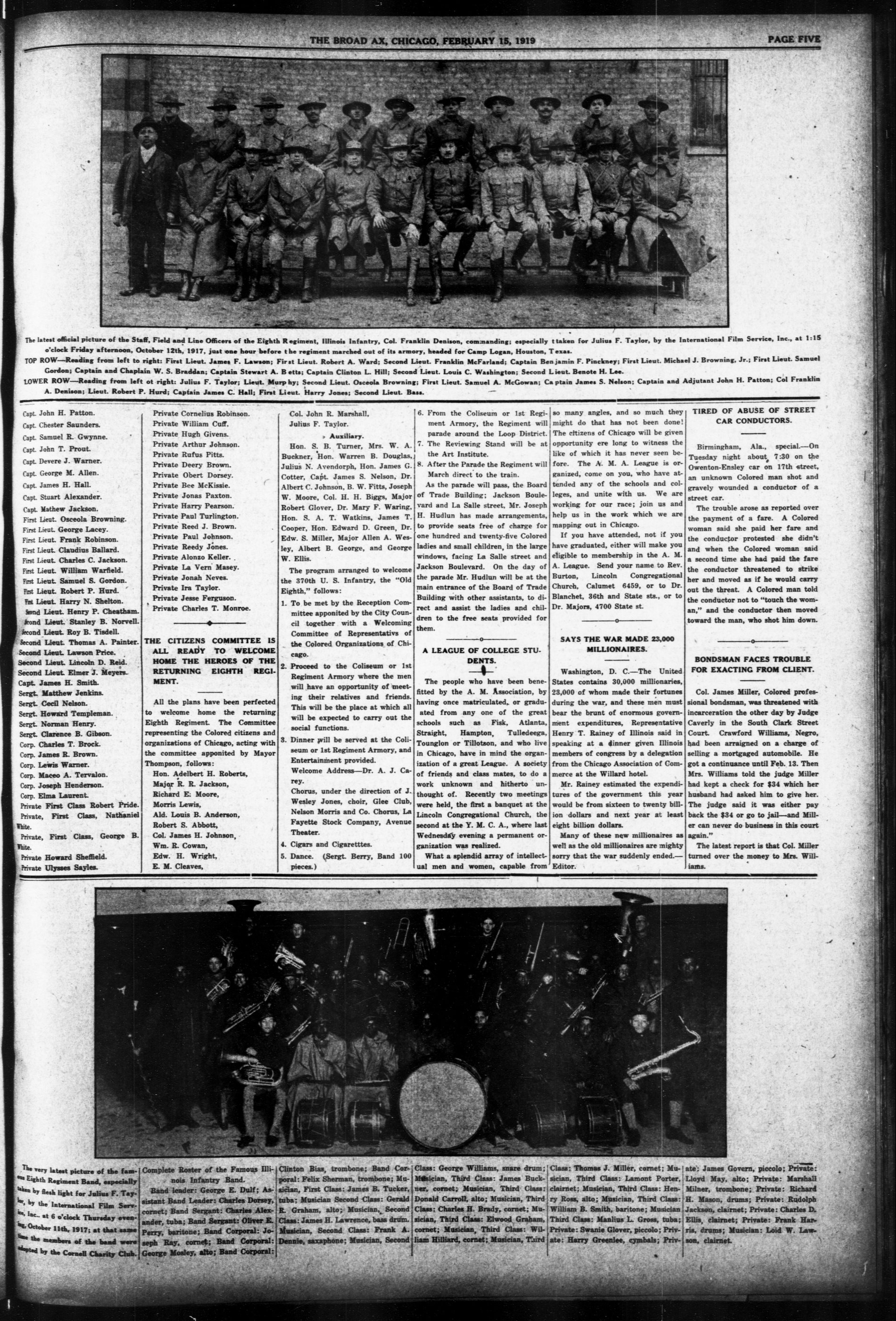
The latest official picture of the Staff, Field and Line Officers of the Eighth Regiment, Illinois Infantry, Col. Franklin Denison, commanding; especially t taken for Julius F. Taylor, by the International Film Service, Inc., at 1:15 o'clock Friday afternoon, October 12th, 1917, just one hour before the regiment marched out of its armory, headed for Camp Logan, Houston, Texas.
TOP ROW—Reading from left to right: First Lieut. James F. Lawson; First Lieut. Robert A. Ward; Second Lieut. Franklin McFarland; Captain Benjamin F. Pinckney; First Lieut. Michael J. Browning, Jr.; First Lieut. Samuel Gordon; Captain and Chaplain W. S. Braddan; Captain Stewart A. Betts; Captain Clinton L. Hill; Second Lieut. Louis C. Washington; Second Lieut. Benote H. Lee.
LOWER ROW—Reading from left to right: Julius F. Taylor; Lieut. Murphy; Second Lieut. Osceola Browning; First Lieut. Samuel A. McGowan; Captain James S. Nelson; Captain and Adjutant John H. Patton; Col Franklin A. Denison; Lieut. Robert P. Hurd; Captain James C. Hall; First Lieut. Harry Jones; Second Lieut. Bass.
THE MUSIC BAND
Capt. John H. Patton.
Capt. Chester Saunders.
Capt. Samuel R. Gwynne.
Capt. John T. Prout.
Capt. Devere J. Warner.
Capt. George M. Allen.
Capt. James H. Hall.
Capt. Stuart Alexander.
Capt. Mathew Jackson.
First Lieut. Osceola Browning.
First Lieut. George Lacey.
First Lieut. Frank Robinson.
First Lieut. Claudius Ballard.
First Lieut. Charles C. Jackson.
First Lieut. William Warfield.
First Lieut. Samuel S. Gordon.
First Lieut. Robert P. Hurd.
First Lieut. Harry N. Shelton.
Second Lieut. Henry P. Cheatham.
Second Lieut. Stanley B. Norvell.
Second Lieut. Roy B. Tisdell.
Second Lieut. Thomas A. Painter.
Second Lieut. Lawson Price.
Second Lieut. Lincoln D. Reid.
Second Lieut. Elmer J. Meyers.
Capt. James H. Smith.
Sergt. Matthew Jenkins.
Sergt. Cecil Nelson.
Sergt. Howard Templeman.
Sergt. Norman Henry.
Sergt. Clarence B. Gibson.
Corp. Charles T. Brock.
Corp. James R. Brown.
Corp. Lewis Warner.
Corp. Maceo A. Tervalon.
Corp. Joseph Henderson.
Corp. Elma Laurent.
Private First Class Robert Pride.
Private, First Class, Nathaniel White.
Private, First Class, George B. White.
Private Howard Sheffield.
Private Ulysses Sayles.
1
The very latest picture of the famous Eighth Regiment Band, especially taken by flesh light for Julius F. Taylor, by the International Film Service, Inc.. at 6 o'clock Thursday evening, October 11th, 1917; at that same time the members of the band were adopted by the Cornell Charity Club.
Private Cornelius Robinson.
Private William Cuff.
Private Hugh Givens.
Private Arthur Johnson.
Private Rufus Pitts.
Private Deery Brown.
Private Obert Dorsey.
Private Bee McKissie.
Private Jonas Paxton.
Private Harry Pearson.
Private Paul Turlington.
Private Reed J. Brown.
Private Paul Johnson.
Private Reedy Jones.
Private Alonzo Keller.
Private La Vern Masey.
Private Jonah Neves.
Private Ira Taylor.
Private Jesse Ferguson.
Private Charles T. Monroe.
THE CITIZENS COMMITTEE IS ALL READY TO WELCOME HOME THE HEROES OF THE RETURNING EIGHTH REGIMENT.
All the plans have been perfected to welcome home the returning Eighth Regiment. The Committee representing the Colored citizens and organizations of Chicago, acting with the committee appointed by Mayor Thompson, follows:
Hon. Adelbert H. Roberts,
Major R. R. Jackson,
Richard E. Moore,
Morris Lewis,
Ald. Louis B. Anderson,
Robert S. Abbott,
Col. James H. Johnson,
Wm. R. Cowan,
Edw. H. Wright,
E. M. Cleaves,
THE BAND
Complete Roster of the Famous Illinois Infantry Band.
Band leader: George E. Dulf; Assistant Band Leader: Charles Dorsey, cornet; Band Sergant: Charles Alexander, tuba; Band Sergant: Oliver E. Perry, baritone; Band Corporal: Joseph Ray, cornet; Band Corporal: George Mosley, alto; Band Corporal:
THE BROAD AX, CHICAGO, FEBRUARY 15, 1919
Col. John R. Marshall,
Julius F. Taylor.
Auxiliary.
Hon. S. B. Turner, Mrs. W. A. Buckner, Hon. Warren B. Douglas,
Julius N. Avendorph, Hon. James G. Cotter, Capt. James S. Nelson, Dr.
Albert C. Johnson, B. W. Fits, Joseph
W. Moore, Col. H. H. Biggs, Major
Robert Glover, Dr. Mary F. Waring,
Hon. S. A. T. Watkins, James T.
Cooper, Hon. Edward D. Green, Dr.
Edw. S. Miller, Major Allen A. Wesley, Albert B. George, and George
W. Ellis.
The program arranged to welcome
the 370th U. S. Infantry, the "Old
Eighth." follows:
1. To be met by the Reception Committee appointed by the City Council together with a Welcoming Committee of Representatives of the Colored Organizations of Chicago.
2. Proceed to the Coliseum or 1st Regiment Armory where the men will have an opportunity of meeting their relatives and friends. This will be the place at which all will be expected to carry out the social functions.
3. Dinner will be served at the Coliseum or 1st Regiment Armory, and Entertainment provided.
Welcome Address—Dr. A. J. Carey.
Chorus, under the direction of J. Wesley Jones, choir, Glee Club, Nelson Morris and Co. Chorus, La Fayette Stock Company, Avenue Theater.
4. Cigars and Cigarettes.
5. Dance. (Sergt. Berry, Band 100 pieces.)
THE BAND
Clinton Bias, trombone; Band Corporal: Felix Sherman, trombone; Musician, First Class: James B. Tucker, tuba; Musician Second Class: Gerald R. Graham, alto; Musician, Second Class: James H. Lawrence, bass drum. Musician, Second Class: Frank A. Dennie, saxaphone; Musician, Second
6. From the Coliseum or 1st Regiment Armory, the Regiment will parade around the Loop District.
7. The Reviewing Stand will be at the Art Institute.
8. After the Parade the Regiment will March direct to the train.
As the parade will pass, the Board of Trade Building; Jackson Boulevard and La Salle street, Mr. Joseph H. Hudlun has made arrangements, to provide seats free of charge for one hundred and twenty-five Colored ladies and small children, in the large windows, facing La Salle street and Jackson Boulevard. On the day of the parade Mr. Hudlun will be at the main entrance of the Board of Trade Building with other assistants, to direct and assist the ladies and children to the free seats provided for them.
A LEAGUE OF COLLEGE STU. DENTS.
The people who have been benefitted by the A. M. Association, by having once matriculated, or graduated from any one of the great schools such as Fisk, Atlanta, Straight, Hampton, Tulledeega, Tounglon or Tillotson, and who live in Chicago, have in mind the organization of a great League. A society of friends and class mates, to do a work unknown and hitherto unthought of. Recently two meetings were held, the first a banquet at the Lincoln Congregational Church, the second at the Y. M. C. A., where last Wednesday evening a permanent organization was realized.
What a splendid array of intellectual men and women, canable from
THE BAND
so many angles, and so much they might do that has not been done! The citizens of Chicago will be given opportunity ere long to witness the like of which it has never seen before. The A. M. A. League is organized, come on you, who have attended any of the schools and colleges, and unite with us. We are working for our race; join us and help us in the work which we are mapping out in Chicago.
If you have attended, not if you have graduated, either will make you eligible to membership in the A. M. A. League. Send your name to Rev. Burton, Lincoln Congregational Church, Calumet 6459, or to Dr. Blanchet, 36th and State sts., or to Dr. Maiors, 4700 State st.
SAYS THE WAR MADE 23,000
MILLIONAIRES.
Washington, D. C.—The United States contains 30,000 millionaries, 23,000 of whom made their fortunes during the war, and these men must bear the brunt of enormous government expenditures, Representative Henry T. Rainey of Illinois said in speaking at a dinner given Illinois members of congress by a delegation from the Chicago Association of Commerce at the Willard hotel.
Mr. Rainey estimated the expenditures of the government this year would be from sixteen to twenty billion dollars and next year at least eight billion dollars.
Many of these new millionaires as well as the old millionaires are mighty sorry that the war suddenly ended.— Editor.
THE BAND
Class: Thomas J. Miller, cornet; Musician, Third Class: Lamont Porter, clairnet; Musician, Third Class: Henry Ross, alto; Musician, Third Class: William B. Smith, baritone; Musician Third Class: Manlius L. Gross, tuba; Private: Swanie Glover, piccolo; Private: Harry Greenlee, cymbals; Priv-
PAGE FIVE
International Film Service, Inc., at 1:15
Del J. Browning, Jr.; First Lieut. Samuel
Adjutant John H. Patton; Col Franklin
ce, Inc., at 1:15 at Lieut. Samuel en; Col Franklin
TIRED OF ABUSE OF STREET CAR CONDUCTORS.
Birmingham, Ala., special.—On Tuesday night about 7:30 on the Owenton-Ensley car on 17th street, an unknown Colored man shot and gravely wounded a conductor of a street car.
The trouble arose as reported over the payment of a fare. A Colored woman said she paid her fare and the conductor protested she didn't and when the Colored woman said a second time she had paid the fare the conductor threatened to strike her and moved as if he would carry out the threat. A Colored man told the conductor not to "touch the woman," and the conductor then moved toward the man, who shot him down.
BONDSMAR FACES TROUBLE
FOR EXACTING FROM CLIENT.
Col. James Miller, Colored professional bondsman, was threatened with incarceration the other day by Judge Caverly in the South Clark Street Court. Crawford Williams, Negro, had been arraigned on a charge of selling a mortgaged automobile. He got a continuance until Feb. 13. Then Mrs. Williams told the judge Miller had kept a check for $34 which her husband had asked him to give her. The judge said it was either pay back the $34 or go to jail—and Miller can never do business in this court again."
The latest report is that Col. Miller turned over the money to Mrs. Williams.
100
---
ate; James Govern, piccolo; Private: Lloyd May, alto; Private: Marshall Milner, trombone; Private: Richard H. Mason, drums; Private: Rudolph Jackson, clairnet; Private: Charles D. Ellis, clairnet; Private: Frank Harris, drums; Musician: Loid W. Lawson, clairnet.
```markdown
```
BEGINS WORK ON T. R. MEMORIAL
Committee Issues Call for Contributions and Suggestions for Permanent and "Dynamic" Monument to the Colonel.
NEW YORK, Feb. 14.—The permanent memorial to be erected by nation-wide popular subscription to the memory of Theodore Roosevelt must "not be merely a thing of stone and bronze," but, "like Theodore Roosevelt himself, it must be dynamic."
PAGE SIX
BEGINS WORK ON
Committee Issues Call for C
for Permanent and 't
to the
NEW YORK, Feb. 14.—The p
nation-wide popular subscription to
must "not be merely a thing of st
Roosevelt himself, it must be dynami
Such is the aim voiced by the Roosevelt Permanent Memorial National Committee, which has opened offices on the twenty-ninth floor of 1 Madison avenue.
In a statement issued by the committee it was made clear that the members of the committee will remain open minded for many months on the exact form to be taken by the memorial and promise to give all suggestions from sources outside the committee the most careful consideration. It was further explained that the administration expenses of the committee would be borne by separate subscriptions, and that "every penny given for the memorial will be spent for a memorial."
Contributions to the memorial fund are solicited and will be promptly acknowledged and deposited with the treasurer, Albert H. Wiggin of the Chase National Bank.
Committee's Statement.
The statement issued by the committee says in part:
"The Roosevelt Permanent Memorial National Committee consists exclusively of men and women who were in one way or another closely associated with Col. Roosevelt. They knew him in public life and at home; they knew better than any one else outside his immediate family what he loved and what he hated, what he stood for and what he stood firmly against; among them they represent every phase of his extraordinary and many-sided career. If any group therefore can say what would be the wish of Theodore Roosevelt in regard to a national memorial to him, this committee should be able to do it.
"Theodore Roosevelt believed in the people; that means that he believ-
Frank Comment.
Robert was a great admirer of soldiers and having attended a military wedding, he was loud in praise. Soon after he was taken to see another wedding where all were in civilian clothes. At the wedding dinner he received a dish of ice cream full of fruit, ralsins, etc. He especially disliked ralsins, so he said in loud tones, "Iink this wedding and this ice cream is wotten—no soldiers or nothin!"
Fast Travel in Air
By merely modifying wing curvature, airplanes of today could be made to fly at a speed of 250 miles an hour, according to a British captain who is considered an aeronautical authority. The obstacle that this would present, however, would be a minimum landing speed of about 150 miles an hour. Greater speed in the air is much to be desired, but no pilot is particularly anxious to bring his machine to earth at a rate such as that indicated.
Lack of Training
Katherine's parents are trying to teach her politeness, although she is only four years old. As a result she watches opportunities to use "Scuse me" and "Please." The other day she watched mother as she rocked her year-old brother. Finally little brother hiccoughed. Katherine waited expectantly but in vain. Finally she could stand it no longer. "Mudder," she said, indignantly, "Bub ought to be sense enough to say 'Scuse me'."
Are Judges of Own Membership.
Are Judges of Own Membership.
The Constitution gives each house of the national congress the right to expel a member, and makes each house the sole judge in the matter. Any charge would suffice, if two-thirds of the members deemed it cause for expulsion. Neither house has anything to do with expelling a member of the other house.
The "Anvil" Bird
The anvil-bird of Australia is a very rare and exceedingly shy creature. Its clear metallic note rings out, "Kling, kling, kling, kling, kling a ling." It is the hardest of all bush birds to locate, as it mostly does its blacksmithing in the topmost branches of the dense brushwoods.
What Is It?
A small girl was visiting her aunt's room for the first time. She walked about and scrutinized everything with interest. Finally she stopped before an attractive picture frame which was standing on the table, but was empty. After a puzzled moment she said: "Auntie Ethel, what is it I don't see?"
ed in sound horse sense of the average American. It is only just to his memory, therefore, that the American people whom he implicitly trusted and who trusted and followed him should have every opportunity to express their preference concerning the form that their memorial to him should take.
"The committee has no idea what that form will be. It knows only this, that the memorial which the American people ultimately dedicate to Theodore Roosevelt must not be merely a thing of stone and bronze. Like Theodore Roosevelt himself, it must be dynamic. Roosevelt never stood still, and it would be treason to his spirit if this memorial should not have in it tsome of the creative energy of the man it seeks to honor. In some way it must help to build the new and better America.
"Roosevelt the man is dead, but Roosevelt the energizing spirit is very much alive. It is the aim of the memorial committee, with the aid of Col. Roosevelt's friends and supporters all over the country, to find some effective way of putting that spirit to work."
First Contributor Capt. Bourke.
The honor of making the first contribution to the memorial fund fell to Capt. Edward F. Bourke of the Thirty-third precinct police station, who served under Col. Roosevelt when the latter was Police Commissioner of New York city, and who accompanied a $10 contribution with a letter expressing his appreciation of the Americanism of the former President.
The little town of Greenfield Hill, three miles north of Failfield, Conn., won the distinction of forming the first local branch of the committee.
When Masble Breaks.
To mend broken marble, mix some Portland cement with water to a very stiff paste. See that the edges of the marble are quite clean. Then put some cement on both sides, press together very lightly and tie until the cement has dried.
Not as a Rule.
Sometimes two slang expressions may sound much alike, yet have very different meanings. For example, when a man tumbles to a thing he does not fall for it.—Youth's Companion.
Fish Oil Made Palatable
By treating fish oil with hydrogen a chemist has produced an oil suitable for food purposes, and a solid substance closely resembling lard, which is tasteless.-Indianapolis News.
Optimistic Thought
A judicious silence is always better than truth spoken without charity.
Rebuffed.
"Dat's a hard woman in dat house," said the ragged wayfarer. "Did she threaten to sic die dog on youse?" asked his comrade. "Naw, but when I said I'd seen better days an' a lump came in my throat because I had to beg for a bite to eat, she told me to swaller de lump an' maybe I wouldn't be so hungry."—Birmingham Age-Herald.
Salt and Superstition
The superstitions with regard to salt are endless. That spilling salt is unlucky is perhaps the commonest of all superstitions beliefs, and prevails in the kitchen as well as at the table. There are Scottish households where salt is still held in such reverence that the salt cellar used at the family table is invariably kept standing on the family Bible.
Wise to Conceal Injuries.
If a bee stings you, will you go to the hive-and destroy it? Would not a thousand come upon you? If you receive a trifling injury, do not go about proclaiming it, or be anxious to avenge it. Let it drop. It is wisdom to say little respecting the injuries you may have received—Anon.
Do Your Best
The map who does not seek each day to do his very level best, no matter what his task, is doing himself an injury and increasing his debt to humanity. Life is a serious business.—From the New Ern. Federal Penitentiary, Leavenworth, Kan.
THE BROAD AX, CHICAGO, FEBRUARY 15, 1919
MAY TRAIN WOMEN
Plan to Develop Them Same as Men in War Camps.
Government Cantonments to Be Used and the Work Extended to Every Part of Country.
Women will be trained in government cantonments if plans of the United States training corps for women are carried out. The corps, organized for women war workers in Washington, under the direction of Miss Susanna Cocroft of Chicago, has been turned into a permanent organization for building up women physically and fitting them for the places they are taking in business, industry and in the work of the nation generally.
Admiral Cary T. Grayson will act as medical director of the corps. On the board of directors with Miss Cocroft are Surgeon General Rupert Blue, Gen. Enoch Crowder, Brig. Gen. J. F. Kerr, Mrs. Robert Lansing, wife of the secretary of state; Miss Mabel T. Boardman of the American Red-Cross, Mrs. Franklin K. Lane, wife of the secretary of interior; Miss Gertrude Lane, well known magazine editor, and Julius Kahn, chairman of the military affairs committee of the house of representatives.
Permission has been asked of the war department for the use of a part of the cantonments when they are released from military service for use as training camps where women can be trained as teachers of setting-up exercises and semi-military drills. These teachers will be equipped to give training in industrial plants and public schools. The corps has also asked for the release of a part of the cantonments for recreation camps, where physicians can send women and children who do not need medicine so much as they need conditioning.
The original training corps in Washington numbered more than 3,500 warworking women. It was organized on the White House lot and the war department detailed 75 army officers to assist Miss Crocott.
The work will be extended to every part of the country, modeled after the system which has developed the men in the war training camps, except that it will be made specially suited for the training of women.
In announcing the purpose of the corps, Miss Cocroft, its organizer and director, said: "We wish to utilize the knowledge of what the camps have done for men, mentally and physically, and to apply this same knowledge to the conditioning of women while the public mind is quickened to this utility, so that all men and women, the young, the middle-aged, the old, may be given an opportunity to benefit by outdoor life regularly supervised and trained under semi-military discipline and under the supervision of competent medical and nursing assistance."
GRACEFUL FOR THE BALLROOM
UNDERWEAR
UNDERWEAR
UNDERWEAR
This rich gown is carried out entirely of gold brocaded metal cloth draped into long, graceful lines.
Protect Lace.
Many of the black gowns are of lace—and sometimes black chantilly is mounted over white satin. This is very distinguished when the lace is new, but chantilly which is an heirloom should never be put over white or any light tint. The old, if rare, lace tears easily, and any mending of the fabric, however delicately done, shows up unpleasantly against the light lining. It is always best to mount valuable old laces over a "drop" of tulle or to vell the lace frock with tulle if this can be done without spoiling the design and the lines.
FOR ADVANCED SPRING WEAR
Copyright
Underwood &
Dickson
An attractive blue duvetyn trotteur costume with chenille embroidered vest and sleeve of henna crepe.
BLACK AND WHITE REVIVED
Magpie Combination Part of New Craze for Bright Colors—French Blue Is Popular.
The revived interest in the black and white or magpie combination is really part of this new craze for bright colors, for as far as the effect is concerned black and white in combination has nothing to do either with all black or all white, and it is sure to come to the foreground only in seasons when women of fashion go in for bright, high colors.
During the war of it was seen. It was too vivid, too striking, too gay. But with the new interest in bright hues it has come to its own and is bound to be seen in many of the new frocks and may find acceptance in some of the midseason millinery.
Because of the sentiment connected with French blue and the actual fact that it is very becoming to most women, the dressmakers are bringing out accessories in this color. There are French blue handkerchiefs, slippers and stockings; there are blouses of it made of handkerchief linen; and one of the foremost designers of tailored suits in the country uses French blue blouses frilled from neck to waist under suits of covert cloth.
BORROWED FROM RUSSIAN
Table Linen Designs Showing Semi-
Barbaric, but Pleasing, Popular
in Needlework World.
A vogue for table linen showing the semi-barbaric, but wholly pleasing, designs used by Russian peasants is making itself felt in the needlework world. The stitches are simple in the extreme, something like our own attractive cross-stitch, outlining squares, triangles, etc. They are used for conventional borders and small all-over patterns which resemble woven figured material.
As for the color, it is usually a monotone, a dark red, for instance, or a blue, while the background is a looseweave linen. Often they are worked with a punched-work background done with a thread to match the linen. A little black worked in with either the red or the blue is pleasing but not quite so true to the original Russian scheme. Often a dark green is combined with the red. The edges of the pieces are hemmed and a buttonhole stitch taken over the entire hem.
NEW SLIPS OF SILVER CLOTH
Popular Garment, Very Decollete and Sleeveless, Kept on by Faith and Tiny Ribbon.
Some new slips to be worn in these petticoatless times are made of silver cloth, very decollete, and sleeveless, of course. Faith, hope and a tiny narrow ribbon across the shoulders keep them in place. Anyway, they are distinctly desirable, as they fall from the shoulders to the knee and serve as camisole and petticoat, too.
One of black shadow lace will be welcomed for wear with the fashionable black evening gown, and one of real Brussels lace is charming for a white dancing frock or for a bride.
Until the laundry situation returns to normal, the cotton crepe undergarment will enjoy deserved popularity. A camisole and a robe de nuit of white cotton crepe make a useful and attractive set. Just at the front of the yoke of each is appliqued a pink satin rose. Neither garment has sleeves and both have pointed shoulders.
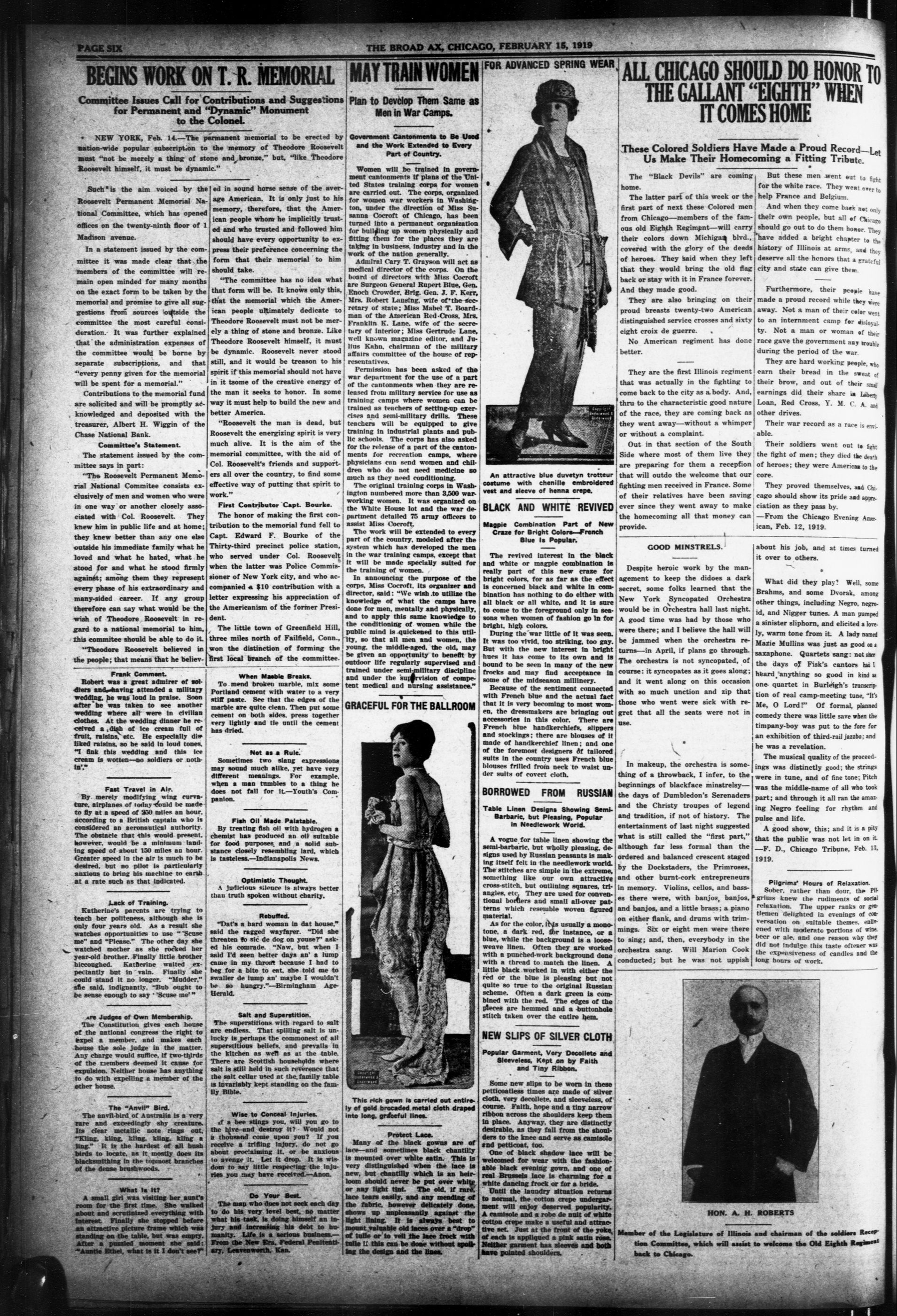
ALL CHICAGO SHOULD DO HONOR TO THE GALLANT "EIGHTH" WHEN IT COMES HOME
These Colored Soldiers Have Made a Proud Record—Let Us Make Their Homecoming a Fitting Tribute.
The "Black Devils" are coming home.
The latter part of this week or the first part of next these Colored men from Chicago—members of the famous old Eighth Regiment—will carry their colors down Michigan blvd., covered with the glory of the deeds of heroes. They said when they left that they would bring the old flag back or stay with it in France forever. And they made good.
But these men went out to fight for the white race. They went over to help France and Belgium.
And when they come back not only their own people, but all of Chicago should go out to do them honor. They have added a bright chapter to the history of Illinois at arms, and they deserve all the honors that a grateful city and state can give them.
Furthermore, their people have
They are also bringing on their proud breasts twenty-two American distinguished service crosses and sixty eight croix de guerre.
No American regiment has done better.
They are the first Illinois regiment that was actually in the fighting to come back to the city as a body. And, thru to the characteristic good nature of the race, they are coming back as they went away—without a whimper or without a complaint.
Out in that section of the South Side where most of them live they are preparing for them a reception that will outdo the welcome that our fighting men received in France. Some of their relatives have been saving ever since they went away to make the homecoming all that money can provide.
GOOD MINSTRELS.
Despite heroic work by the management to keep the didoes a dark secret, some folks learned that the New York Syncopated Orchestra would be in Orchestra hall last night. A good time was had by those who were there; and I believe the hall will be jammed when the orchestra returns—in April, if plans go through. The orchestra is not syncopated, of course: it syncopates as it goes along; and it went along on this occasion with so much unction and zip that those who went were sick with regret that all the seats were not in use.
In makeup, the orchestra is something of a throwback, I infer, to the beginnings of blackface minstrelsy—the days of Dumbledon's Serenaders and the Christy troupes of legend and tradition, if not of history. The entertainment of last night suggested what is still called the "first part," although far less formal than the ordered and balanced crescent staged by the Dockstaders, the Primroses, and other burnt-cork entrepreneurs in memory. Violins, cellos, and basses there were, with banjos, banjos, and banjos, and a little brass; a piano on either flank, and drums with trimmings. Six or eight men were there to sing; and, then, everybody in the orchestra sang. Will Marion Cook conducted; but he was not uppish
M. B.
HON. A. H. ROBERTS
Member of the Legislature of Illinois and chairman of the soldiers Reception Committee, which will assist to welcome the Old Eighth Regiment back to Chicago.
But these men went out to fight for the white race. They went over to help France and Belgium.
And when they come back not only their own people, but all of Chicago should go out to do them honor. They have added a bright chapter to the history of Illinois at arms, and they deserve all the honors that a grateful city and state can give them.
Furthermore, their people have made a proud record while they were away. Not a man of their color went to an internment camp for disloyalty. Not a man or woman of their race gave the government any trouble during the period of the war.
They are hard working people, who earn their bread in the sweat of their brow, and out of their small earnings did their share in Liberty Loan, Red Cross, Y. M. C. A. and other drives.
Their war record as a race is enviable.
Their soldiers went out to fight the fight of men; they died the death of heroes; they were Americans to the core.
They proved themselves, and Chicago should show its pride and appreciation as they pass by.
—From the Chicago Evening American, Feb. 12, 1919.
about his job, and at times turned it over to others.
What did they play? Well, some Brahms, and some Dvorak, among other things, including Negro, negroid, and Nigger tunes. A man pumped a sinister sliphorn, and elicited a lovely, warm tone from it. A lady named Mazie Mullins was just as good on a saxaphone. Quartet sang: not since the days of Fisk's cantors had I heard anything so good in kind as one quartet in Burleigh's transcription of real camp-meeting tune, "It's Me, O Lord!" Of formal, planned comedy there was little save when the timpany-boy was put to the fore for an exhibition of third-rail jazzbo; and he was a revelation.
The musical quality of the proceedings was distinctly good; the strings were in tune, and of fine tone; Pitch was the middle-name of all who took part; and through it all ran the amazing Negro feeling for rhythm and pulse and life.
A good show, this; and it is a pity that the public was not let in on it.
—F. D., Chicago Tribune, Feb. 13, 1919.
Pilgrima' Hours of Relaxation.
Pilgrima's Hours of Relaxation. Sober, rather than dour, the Pilgrims knew the rudiments of social relaxation. The upper ranks or gentlemen delighted in evenings of conversation on suitable themes, enlivened with moderate portions of wine, beer or ale, and one reason why they did not indulge this taste ofteener was the expensiveness of candles and the long hours of work.
OUR BUSINESS SINCE 1847 has been that of showing the condition of real estate titles. The millions upon millions required to build and rebuild Chicago have been furnished relying on the accuracy of our ABSTRACTS and TITLE POLICIES.
THE FORTY-FOURTH STREET
THE CRANFORD Apartment Building
3600 WABASH AVENUE
The finest building ever opened to Colored tenants in Chicago. Steam heat, electric lights, tile baths, marble entrance
J. W. CASEY, Agent
Phone Main 263 133 W. Washington Street
Cat's Value Regulated.
There are many legends concerning the Manx cat. One of them tells that, long ago, when the isle was ruled by the Cambrian princes, the value of a cat was set by law. One of these old laws reads as follows: "The price of a kitten before it can see is a penny; after it can see, before it catches a mouse, two pence; and after it catches a mouse, four pence."
No Your Boy's Comrade.
ALL little fellows are ambitious to be comrades of the "big boys." Be a big boy yourself and get some fun out of life. And at the same time you will be building a future for your son that will be a more glorious memorial, a more effective monument to yourself than could be raised by all the marble and granite in the hills of the whole world.
First United States Currency. Immediately after the battle of Bunker Hill $2,000,000 in American currency was issued, and by 1779 the amount had grown to $241,000,000, and the various states had issued nearly as much. In 1792 the mint at Philadelphia was established. Thus the use of American money gradually supplanted the foreign.
Apt Description.
Jimmy's father is a tailor, so he has his own ideas about outline and design. A man came along the other day when Jimmy was out on the front porch and inquired where a certain man lived. "Just in the next block," said Jimmy, "in that real tailored-looking stucco house."
Best of Stimulants
There is only one stimulant that never fails, and yet never intoxicates—duty. Duty puts a blue sky over every man—up in his heart maybe—into which the skylark, Happiness, always goes singing.—George D. Prentice.
Necessity Makes Prosperity.
A people never fairly begins to prosper till necessity is treading on its heels. The growing want of room is one of the sources of civilization. Population is power, but it must be a population that, in growing, is made daily apprehensive of the mercy.—Sinms.
Recognition Among Bees. Naturalists for a long time were at a loss to understand how it was that insects were enabled to so quickly recognize an intruder among their family or settlement. It has been determined that in most cases they recognize each other by smell. Among the bees each distinctive class of workers—the guard, the fanner, the pollen carrier, the waxmaker, the architect, etc.-has its own distinctive odor. And besides each bee has its own separate hive odor, which it its passport into its own particular home.
Gun Barrels.
A rather interesting side light on the question of gun barrel life is a determination of the actual length of time to which a good shotgun barrel is subjected to the force and burning effect of the powder charge during its lifetime. If 100,000 shots are fired from a shotgun the inside of the barrel is actually exposed to the flame of the powder charge for about four minutes.
Hardly an Ideal Citizen.
There is a story told of an ancient dandy in London who, taking, one sunny afternoon, his accustomed stroll down Bond street, met an acquaintance hurrying in the direction of Westminster. "Whither away so fast this hot day?" murmured the dandy. "To the house of common," cried his strenuous friend, brushing past him. "What?" said the dandy, with a yawn. "does that go on still?"—Exchange.
Copper's Great Value.
Next after gold and silver, copper is to us the most interesting of all the metals. Fresh and free of corrosion (as seen in a new-minted cent) it is really more l useful than gold, having a more colorful and brilliant luster. It is incomparably more useful than gold, serving as it does a vast number of employments for which there is no satisfactory substitute.
Bridging Suez.
Three bridges have been built across the Suez canal at Kantara. thus linking Egypt and Palestine by railroad and road.
Daily Thought.
Chance is a word void of sense;
nothing can exist without a cause.—
Voltare.
THE BROAD AX. CHICAGO. FEBRUARY 15. 1919
PATRONIZE OUR ADVERTISERS
PATRONIZE OUR ADVERTISERS
As Near As Your Telephone DISTANCE IMMATERIAL
In a Metropolitan City of this size, death knocks every thirty minutes at some door. Too often that death not only brings sorrow, but misfortune as well. Let the price you pay for a funeral be a business proposition and you will benefit by it in service, quality and cost to you in dollars and cents. The result of my campaign has built for me one of the largest and most magnificent establishments in the world.
OWNERS AND DIRECTORS
DAN M. JACKSON
GEO. T. KERSEY
Phones Calumet 6164
DAVID A McGOWAN
Automatic 71-629
AHMED A. RAYNER
OPEN DAY AND NIGHT
The Emanuel Jackson
Undertaking Co., Inc.
2959-61 South State Street
Reliable Service Courteous Treatment
Reasonable Prices
FREE CHAPEL IN CONNECTION
Complete Line of Funeral Goods Automobiles for Hire
JOHN B. HARRIS
Consult me, I can save you Worry. T Shipping to all parts of the Country Funerals a Specialty. Central Disp Chapel. Call promptly answered day
Ernest H. William
KENWOOD
455
Undertake
5028 and 5030 S. State St.,
OWNERS AND
DAN M. JACKSON
GEO. T. KERSEY
DAVID A McGOWAN
AHMED A. RAYNER
OPEN DAY
The Emanuel Undertaking
2959-61 South
Reliable Service
Reasona
FREE CHAPEL
Complete Line of Funeral Go
Consult me, I can save you Worry, Time and Money. Shipping to all parts of the Country and Automobile Funerals a Specialty. Central Display Rooms and Chapel. Call promptly answered day or night.
Residence: 508 East 36th Street
Phone Douglas 4307
J. GRAY LUCAS
Attorney At Law
Suite 815 Hartford Building
8 S. Dearborn St., Chicago.
Phone Central 6583
Tel. Central 3142
S. A. T. WATKINS
LAWYER
36 WEST RANDOLPH STREET
CHICAGO
Residence, 4533 Prairie Avenue
Phone Kenwood 8520
WALTER M. FARMER
ATTORNEY AND
COUNSELOR AT LAW
NOTARY PUBLIC
Suite 708
184 W. Washington St.
Tel., Office, Main 4153 Auto 33736
CHICAGO
Residence, 1262 Macalister Place
Tel. Monroe 2714
MILES J. DEVINE
Attorney At Law
Suite 318-320 REAPER BLOCK
Clark and Washington Streets
Phone Central 1239
CHICAGO
PHONE MAIN 2214
A. D. GASH
Attorney At Law
118 North La Salle Street
CHICAGO
Res. 8855 Prairie Ave.,
Phone Douglas 9133
Phones: Main 2017, Auto. 32-395
A. L. WILLIAMS
ATTORNEY AND
COUNSELOR AT LAW
Suite 706 Firmanich Building
184 W. Washington St., Chicago.
A. F. CODOZOE AUTO. 72-379
J. H. WHISTON, Proprietors Phones: DOUGLAS 3256
CHAS. HARRIS, Manager DOUGLAS 5071
National Hall Bldg. 4300 So. State St.
Space for Offices, Professional and Others
Lodge and Assembly Halls. .. Large and
Spacious Dance Hall. .. Best Ventilated
Halls in Chicago for Rent. :: :: ::
J. L. Slaughter Real Estate 4300 So. STATE STREET TEL. DREXEL 7812
Telephone Calumet 602-3572
HUGH NORRIS, Pres. KIRBY WARD, Seed
Norris-Ward
Coal Co.
Incorporated
2545 SOUTH PARK AVENUE
Chicago
GEORGE F. HARDING, JR.
JOHNSON EXPRESS, STORAGE AND VAN CO.
EXPERT PIANO MOVERS-AUTO SERVICE
Packers, Shippers and Storage
TRUNKS TO AND FROM ALL DEPOTS
Main Office: 1431 East 67th Street
Chicago Ill
WM. J. LATHAM
Attorney At Law
OFFICE PHONE: CALUMET 875
2 EAST 31ST STREET
Suite 7
CHICAGO
F. Dunn, J. B. McCahey, Trusees
Tel.: Oakland 1552, 1551, 1550
JOHN J. DUNN
ESTABLISHED 1877
Wholesale and Retail
COAL
Fifty-First and Federal Sts.
CHICAGO
KINKY HAIR
Alibaba, Co.
Eskalto Bed, Co.
Gent Gemen.
My pluckers show
you that your fine
EXELENTO QUININE
POMADE
has done for my
hair. Before I used it,
my hair was wet and
golden and now it is it
silky and all silky that
I can do it any
way I want.
JANIE BAND.
Don't let some fake Kink Remove fool
you. You really can't straighten your hair
until it's nice and long. That's what
EXELENTO QUININE
POMADE
does, removes Dandruff, feeds the Roots of
the hair, and makes it grow long, soft and
silky. After using a few times you can tell
the difference, and after a little while it
will be no pretty and soft. If Exelento don't do
as we claim, we will give your money back.
25¢ by mail on receipt of stamps or coin.
AGENTS WANTED EVERYWHERE.
Write For Particulars.
EXELENTO MEDICINE Co., Atlanta, Ga.
NOW IS THE TIME TO SUBSCRIBE FOR THE BROAD AX
Branch Office: 444 E. 39th St., near Verm
PAGE SEVEN
-APPLY-
THE BRAD
PUBLISHED EVERY
In this city since July 15th, the Republicans, Democrats, Catholics infidels or anyone else can have proper and responsibility is fixed.
The Broad Ax is a newspaper all, ever claiming the editorial local communications will not on one side of the paper.
Subscriptions must be paid
One Year
Six Months
Advertising rates made known
7ol. XXIV FEBRUARY
Address all co.
THE B
6206 South Elizabetht
Phone Wei
JULIUS F. TAYLOR
DR. M. A. MAJORS
4700 South
Phone D
IMPORTANT
For resolutions, obituary not special announcements of events is made, and the opening of cents per line; 6 words or fraction.
Personal or social items such everything of a general interest,
Entered as Second-Class Matter, August
Under Act of
THE BROAD AX
THE BROAD AX
In this city since July 15th, 1899, without missing one single issue. Republicans, Democrats, Catholics, Protestants, Single Taxers, Priests, infidels or anyone else can have their say as long as their language is proper and responsibility is fixed.
The Broad Ax is a newspaper whose platform is broad enough for all, ever claiming the editorial right to speak its own mind. Local communications will receive attention. Write plainly, only on one side of the paper.
4700 South State Street
Phone Drexel,1416
IMPORTANT NOTICE
For resolutions, obituary notices, cards of thanks, write-ups, special announcements of events to happen, when a charge of admission is made, and the opening of new business enterprises, etc., 15 cents per line; 6 words or fraction makes one line.
Personal or social items such as marriages, births, deaths and everything of a general interest, published free of charge.
Entered as Second-Class Matter, August 19, 1902, at the Post Office at Chicago, Ill., Under Act of March 3, 1879.
LINCOLN AND DOUGLASS
Today, tomorrow, next year, and a hundred years hence, this month men and women will bow, and bare their heads, and some will speak eloquent language, some prize essays everywhere men breath and women cherish goodness, the great deeds of these two colossal characters will be reverberated, and re-echoed, and because of them, and the good they wrought, men will seek to become better, and strive to be noblemen.
Lincoln and Douglass came forth at a time when the world was in great need of real manly men. Not automatons, men who in the early making shied at every ugly menace that threatened their honor. Then there was virtue in men, built of rustic parts, formed to serve the storms of every kind, and keep the solace of intellectual grandness free from the ugly touches of marouders. Nature bequeathed that rugged, uncouth means to reach the end that each of these great men should know the simplest life. Professors could never boast of teaching Lincoln nor Douglass. Great Nature had long ago set these two men in time jeweled epochs to do a work no other men could do. The one white, the other colored, both to do what celestial hearts and minds might do.
These men got their wisdom from Him who trusts what He makes, and leaves nothing to base hands. The Negro in chains arrested their attention in their younger days, and how to break those chains. God was teaching them for decades. Finally they learned their lesson and alighted. Pine knot and thumb-worn books became implements of power.
Both achieved preminent distinction in the noblest things man has ever been commissioned to do, and perhaps God knew best when He cast these two great images in the same mould, the one to help the other and without which neither possibly could have done quite so much. Both seem crowned with the wisdom of the sage, the power of the times given them to use, all be it by God who would have no fumbling, and bungling.
Here is inspiration for the world a thousand years remote to longest time. A work to do, well and good, they grew through the crudest days to lustrous manhood, with single eyes to the work which inspired their clean hearts, strong heads and willing hands, without scholarly knowledge such as books give, they foraged along the road of wisdom far beyond the aim of colleges and left their human mark away up near the eternal gates of immortality.
WORSE THAN HELL AND MORE FEARFUL.
The South, The New South, Dixie Below the Line, down south, str., are
The South, The New South, Dixie Below the Line, down south, etc., are terms generally applied to the southern states, but murder and lynching
PAGE EIGHT
By Dr. M. A. Majors.
.
notices, cards of thanks, write-ups,
to happen, when a charge of admis-
f new business enterprises, etc., 15
makes one line.
such as marriages, births, deaths and
published free of charge.
19, 1902, at the Post Office at Chicago, Ill.
March 3, 1879.
have, become so very common that it might seem that the South should suffer an odious name, a name that would apply with equal force to both its spirit and its inordinate greed for bluster and general cussness. This we suggest need not be a reproach to the white woman of the South, who is without any doubt as far beyond her male king in decency and those high reaches of goodness as Jupiter is from our earth.
She has grace, charming manners and some virtue, but the red-neck man veneered with a white or transparent skin is a superlative devil from any angle you view him.
We could call it hell, but it isn't that quite, hell isn't as bad as Mississippi, Alabama, Georgia, Florida, Texas, Arkansas and the two Carolinas. We are at a loss to name the place, but we know it needs new naming all right.
WHOOP IT UP FOR THE EIGHTH
By Dr. M. A. Majors.
The boys are in old New York town, Camp Upton, and soon to meet their mothers, wives and sweethearts in dear old Chi. Gee, but I'll bet they are glad to set foot on Uncle Sam's doorstep again, coming home to loved ones is the thought, the central thought. But won't old Chicago get hoarse yelling for the "Black Devils" of Illinois? Say, they've done for us all what needed to be done, and since you could not go and help them do it, fall in line you of all the races living in Illinois, and test your lungs on Michigan Boul.
We've got to give them the time of their lives, and you who are prejudiced against colored people, if you don't want to be sneezed at, laughed at, and jeered at, you had better take your dear old mangy carcass into the country, because, believe me, we are going to sound the loud tymbal. The Eighth are coming. The Eighth are coming, coming, yes, coming from over there in France.
We are not inclined to believe that President Wilson had any such intention as many claim, when he appointed Dr. R. R. Moton of Tuskegee and Dr. Dubois to go to France. We have a nobler opinion of what it takes to constitute a president of the United States, besides our respect and high regard for these two big Negroes makes it impossible to entertain anything less than dignified thought of them.
Gossip, and surmising, and guessing is the merest nonsense and the race should pay no heed to jealous mouthings of men who could they have gone to France on any kind of mission would have been ready to do any shallawag act of the monkey if only it had been them chosen to go.
We must be careful and pay less heed to gossip, and "they said," "he said," "she said," etc., which all amounts to nothing but jealousy.
THE BROAD AX. CHICAGO. FEBRUARY 15, 1919
EDITORIAL PAGE
THE GALLANT EIGHTH OF
Our boys are coming home from the fearful, dreadful war.
We'll be very glad to see them, they won the world's new star.
They've fought with gun and bayonet and driven off the Hun,
And they are back in the U. S. A., for Hindenburg is done.
The trenches and the coties are left behind in France,
And foreign hell so hot to them to cool will have a chance.
But if the thing breaks out again somewhere near the Rhine,
Just give us ships, then'll sail the main and heat the German line.
They are coming back to homes and hearts that love them ever true. For us they've borne the brunt and carried stars that are blue. And won their honors in a fight that was a fight indeed. And showed the world how valiant men can let their bodies bleed.
Don't let the red-neck galivant, and flaunt his prejudice. Let Uncle Sam just show his pride; they brought the armistice. Speak to the South, that hole of hell, that crucify and hang. To cut it out, or let the Eighth go down there with its gang.
We're glad the boys are home again, we just can't tell it right. We love our boys who had the dash to go through hell and fight. Our pride, our hearts, our homes, our hopes, our all and everything Ain't good enough for our boys who made the Germans wing.
So here's to the gallant Eighth,
"black devils" of Illinois.
The Partridges the Frenchmen called
our gallant soldier boys.
May the whole heart love of a noble
world be commensurate,
For they have nobly won their s spurs,
and linked themselves to Fate.
Brightening a Room.
The yellow gleam of brass always adds light to any dark nook and used with dark furniture, is most artistic. A pair of brass candlesticks on the mantel, andirons before an open fire, or even a brass jardiniere for ferns, are all especially attractive in a dark room.
Boston's Famous Church.
There were only 3,000 houses in Boston when the North church was built and many members of the congregation came from outlying districts. The corner stone was laid in April, 1723, and the first meeting was held in December of the same year.
Much in Lump of Coal
The fragrance of jasmine, musk, hyacinth, the perfumes for scenting most expensive soaps, originally began in a coal mine. Creosote, pitch, oils carbolic acid, antiseptics and high explosives are all hidden away in a lump of coal.
The Poor in Italy
The majority of the poorer class in Italy are noted for their general good health. This is to some extent attributed to the fact that the working people of Italy eat less meat than those of any other European nation.
Labor Savers.
Both time and trouble are saved by placing an ordinary three-arm towel rack above the right end of the sewing machine. On this rack can be hung the sewing tape, etc., and pieces of unfinished goods which otherwise slip on the floor beneath the machine. From Good Housekeeping.
Health in Outdoor Sports
The great increase in the number of inmates at asylums for the insane is to be taken as a sign of the worry and uncertainty of our times. The resumption of outdoor play as soon as possible will restore equilibrium. Did an old base ball player ever become insane?
The Name Rose
The name "rose" varies only slightly among different nations. The Romans called it rosa—a form adhered to in Italian, Portuguese, Spanish and Russian. In Polish it is roza; in Dutch, roos; in Swedish, roa, and in French, German and Danish, rosa.
The Library.
Consider what you have in the smallest chosen library. A company of the wisest and wittiest men that could be picked out of all civilized countries, in 1,000 years, have set in best order the results of their learning and wisdom. The men themselves were hid and inaccessible, solitary, impatient of interruption, fenced by etiquette; but the thought which they did not uncover to their bosom friend is here written out in transparent words to us, the strangers of another age.—Emerson.
Purpose in Life
Have a purpose in living. Aim to be somebody and to do something, and to know just what it is you mean to be and do. Some people pity those who fall short of their ideals—the inventor who fails, the statesman who is so far in advance of his constituents that he receives consure instead of praise. But these are not the ones who need your sympathy. Save your pity for those who are driving through life without a goal, who are living without a purpose.
Best Work at Seventy
Rosa Bonheur finished at seventy her "Horses Threshing Corn," the largest animal picture ever painted, and which was sold for $00,000. In 1896, on her seventy-fourth birthday, she finished a painting representing the historical combat between two stallions to which Lord Godolphin invited his friends in 1734.
For Mending China.
Mix a teaspoonful of alum and a tablespoonful of water and place in a hot oven until it is quite transparent. Wash the broken pieces in hot water and, while warm, coat the broken edges thinly and quickly, as it sticks instantly. Your china thus mended will bear hot water and ordinary usage.
Ink Stains on Furniture.
To remove ink stains from mahogany, rosewood or black walnut furniture, put half a dozen drops of spirits of niter in a spoonful of water and touch the stain with a feather wet with the mixture. As soon as the stain disappears, rub with a cloth dampened with cold water.
Cold Water as a Purifier
Fresh cold water is a powerful absorbent of gases, therefore it should be greatly used in a sick room or in one which cannot be frequently ventilated. A bowl of cold water kept in such a room and changed daily is of great assistance in purifying the air.
Two Discredited Prophets
Among other nineteenth-century false prophets might be mentioned the ex-naval officer, Richard Brothers, who predicted that he would be king of Jerusalem, and Private James White, who founded a religious sect known as the Jezreelites.
What Hurts
Sometimes a man doesn't mind being hempacked a little, just so the chickens don't laugh at him.—Cincinnati Enquirer.
Socrates II.
A lot of us think that freedom of speech is all right until the other fellow starts taking advantage of it.
Must Take the Risk.
Do not expect the ship to return loaded with precious treasures without being exposed to dangers.
Explained.
Said the facetious feller: "A cynic is merely a philosopher with chronic indigestion."
Height of Clouds
Clouds are very variable in height—from 500 to 2,000 feet. The clouds in thunderstorms may be very deep—from two to five miles and more—hence the appearance as to distance is very deceptive. Cumulus clouds are intermediate.
No Separation in Sight
Mrs. Mark—"Mrs. Skauner tells me that her husband is an ardent lover of books." Mr. Mark—"I wish he'd prove fickle to two volumes of mine which he enticed away more than five years ago."—Buffalo Express.
crofts by Experience.
Of course others may do as they please. but, personally, we never expect to invest in another oil well until it proves able to grease its own machinery.—Dallas News.
Gelatin golf tees have been invented, the idea being that they soon are dissolved by the atmosphere and will not litter up a golf course if forgotten.
"De man dat kain't do no work his ownse't," said Uncle Eben; "generally averages up by makin' a whole lot of trouble foh other people."
MEYERS, BRENNAN & CO.
Room 208-106 N. Clark Street
Opposite County Bldg.
Tel. Majestic 7999. Hours: 8 to 5:30.
High-Priced Goats
High-Priced Goats. Oregon is noted as a breeding state for goats, pure-bred sires often bringing prices in excess of $500.
Daily Thought
I will be as harsh as truth and as uncompromising as Justice.—William Lloyd Garrison.
Simple Rule for Success.
The path of success in business is invariably the path of common sense. Notwithstanding all that has been said about "lucky hits" the best kind of success in any man's life is not that which comes by accident; the only good fortune we are justified in hoping for is that which we are capable of making for ourselves. And we can only attain success by constantly thinking success.
Xmas B. C.
Xmas was celebrated many hundred years before Christ was born. It was in honor of Tammus, one of the Babylonian sun gods. They had three, Baal, Ashtaroth and Tammus, and built many temples in their honor. The letter "T" was changed to "X," as this was considered a sign of the holy entrance into the temple of the gods of the sun.
Greedy for Waspa.
The common green frog has been discovered to possess an insatiable greed for wasps. This extraordinary appetite does not seem to be in the least checked-by an occasional sting. The protecting color of the frog, which sits motionless upon leaves, no doubt deludes the most wary of insects into sense of security.—Louisville Courier-Journal.
How Great Poems Were Written
Two of the greatest poems in the language were written by chums competing against each other in friendly rivalry. They undertook to work at these poems for six months and then compare results. Keats went to the Isle of Wight and wrote "Endymion," and Shelley went to Marlow and, lying in a boat on the Thames, wrote "The Revolt of Islam."
Babylon in Its Prime
At the time the priests betrayed Nebuchadrezzar and permitted Cyrus to enter the city of Babylon. the students were learned in astrology, kept time with sun dials, and a water clock by night, fashioned rude telescopes; and the rich had perfected a system of entertainment never equaled in lavishness.
An Awful Break.
Squiggs—“Well, I see that porch climber finally escaped from jail. Broke out, I understand.” Squiggs—“Say, now, for the love of blyclubs and badges, don't hand us that old stuff about measles.” Squiggs—“Wouldn't think of such a thing; this fellow broke out with chickenpox.”
Broague.
Brogue occurs when an entire population of alien blood or tongue acquires the tongue language of its conquerors or its subjects or its neighbors, as the case may be; and acquires it, naturally, with a difference, importing into the foreign speech many of its own native peculiarities.
Maintains Equal Humidity
The air in all parts of a cigar case, vault or other place where moisture is needed is kept equally humid by a new device in which an electric fan drives its breezes through a box filled with absorbent material soaked in water.
The Second Cheshire Cheese
The celebrated little old tavern in London, just off Fleet street, so often associated with Doctor Johnson and his friends, is not the original building, that having been destroyed by the great fire of 1666.
Electricity on the Farm
Electricity is now equal to nearly all kinds of farm work, from irrigation to churning. So far it has not attacked plowing and cultivating, but electricity is not yet through with the farm.
The Right Word.
A couple of deaf mutes were married the other day. The wedding was truly described as "a quiet affair."—Boston Transcript.
Optimistic Thought.
We lose what is certain while we are seeking shadows.
Torrent and Lakelet
The stream of modern literature represented by the books and periodicals on the crowded counters is a turbulent and clamorous torrent, dashing along among the rocks of criticism, over the pebbles of the world's daily events; trying to make itself heard and seen amidst the house cries of the politicians and the rumbling wheels of traffic. The classic is a still lakeet, a mountain turn, fed by springs that never fail, its surface never ruffled by storms—always smiling a welcome to its visitor—Holmes
American Newspaper History
Benjamin Franklin contributed much to the development of journalism in colonial days. An editor at the age of sixteen, and a prolific writer, he was identified at some time or another in his life with many of the newspapers which flourished during this period. The oldest newspaper in the United States, which has been continued without interruption of issue or change of name, is the New Hampshire Gazette. It was first published in Portsmouth, N. H., in 1756.
To Whiten Floors
To whiteen wooden floors add two tablespoonfuls of paraffin to the soapy water used for washing a floor
A Font of Type.
A font of our type weighs 50 pounds and costs $5; a font of Chinese type weighs half a ton and costs $100
Thorough Mourning
The Sitka widow, when she has to put on mourning, paints the upper part of her face a deep black.
Daily Thought
Hast thou attempted greatneat Then go on; back-turning slackens resolution—Herrick.
Interesting Experiment
A distinguished scientist has revived an after-image artificially by means of the following experiment: After remaining in darkness for some minutes, he flashed a light onto his hand. He then went to bed in total darkness and slept through the night. Before opening his eyes in the morning he again flashed a light, but this time on his eyes. By this means he revived the after-image of his hand in front of him, although he had not seen it since the previous night.—San Francisco Chronicle.
FROM THIS DATE ONWARD THE BROAD AX CAN ALWAYS BE FOUND ON SALE AT THE FOLLOWING NEWS STANDS:
Mrs. L. Graves, The Provident
Candy Shop, Notion Store and News
Stand, 15 W. 36th Street, near State.
George I. Martin, Cigar, Notion
Store and News Stand, 18 W. 31st
St., near State.
Edward Felix, Notions, Cigars and
News Stand, 3002 S. Dearborn St.
F. Bishop, Cigars, Tobaeco and
News Stand, 8 W. 27th Street, near
State.
A. D. Hayes, Cigars, Tobacco, Notion,
Stationery and News Stand,
3640 S. State Street.
Dodson's Shoe Shining Parlors and News Stand, So. West Corner 35th and State Streets.
Lawrence M. Heard, Traveling News Agent, with news stands at 3129 S. State St. and So. East Cor. 35th and State Streets.
Charles F. Mallory's Barber Shop and News Stand, 313 E. 35th Street.
W. D. Scott's Lunch Room and Restaurant, 248 E. 35th Street.
Louis Wimbley's Shoe Shining
Parlors and News Stand, 2946 South
State Street.
Mrs. F. A. Peyton, News Stand,
Confectionary Store, 5012 S. State
Street.
News item left with any of the above news agents prior to Wednesday mornings of each week, will find their way into the columns of The Broad Ax.