The Broad Ax
Saturday, March 8, 1919
Chicago, Illinois
Page text (machine-generated)
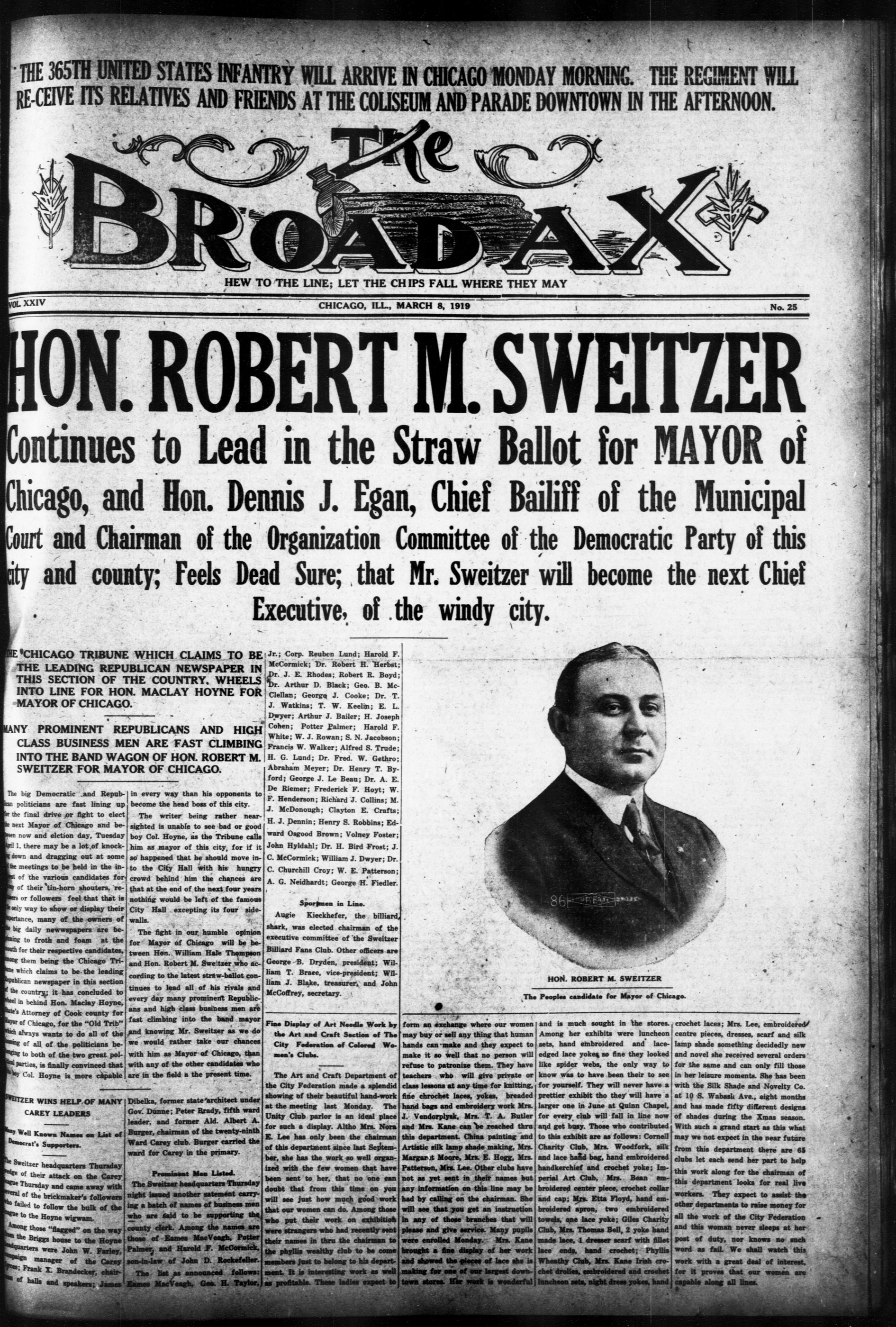
THE 365TH UNITED STATES INFANTRY WILL ARRIVE IN CHICAGO MONDAY MORNING. THE REGIMENT WILL RE-CEIVE ITS RELATIVES AND FRIENDS AT THE COLISEUM AND PARADE DOWNTOWN IN THE AFTERNOON.
The Broad AX
HEW TO THE LINE; LET THE CHIPS FALL WHERE THEY MAY
HON. ROBERT M. SWEITZER Continues to Lead in the Straw Ballot for MAYOR of Chicago, and Hon. Dennis J. Egan, Chief Bailiff of the Municipal Court and Chairman of the Organization Committee of the Democratic Party of this city and county; Feels Dead Sure; that Mr. Sweitzer will become the next Chief Executive, of the windy city.
86 PEIJ
HON. ROBERT M. SWEITZER
THE CHICAGO TRIBUNE WHICH CLAIMS TO BE THE LEADING REPUBLICAN NEWSPAPER IN THIS SECTION OF THE COUNTRY, WHEELS INTO LINE FOR HON. MACLAY HOYNE FOR MAYOR OF CHICAGO.
Jr.; Corp. Reuben Lund; Harold F. McCormick; Dr. Robert H. Herbst; Dr. J. E. Rhodes; Robert R. Boyd; Dr. Arthur D. Black; Geo. B. McClellan; Georgq J. Cooke; Dr. T. J. Watkins; T. W. Keelin; E. L. Dwyer; Arthur J. Bailer; H. Joseph Cohen; Potter Palmer; Harold F. White; W. J. Rowan; S. N. Jacobson; Francis W. Walker; Alfred S. Trude; H. G. Lund; Dr. Fred. W. Gethro; Abraham Meyer; Dr. Henry T. Byford; George J. Le Beau; Dr. A. E. De Riemer; Frederick F. Hoyt; W. F. Henderson; Richard J. Collins; M. J. McDonough; Clayton E. Crafts; H. J. Dennin; Henry S. Robbins; Edward Osgood Brown; Volney Foster; John Hyldahl; Dr. H. Bird Frost; J. C. McCormick; William J. Dwyer; Dr. C. Churchill Croy; W. E. Patterson; A. G. Neidhardt; George H. Fiedler.
MANY PROMINENT REPUBLICANS AND HIGH CLASS BUSINESS MEN ARE FAST CLIMBING INTO THE BAND WAGON OF HON. ROBERT M. SWEITZER FOR MAYOR OF CHICAGO.
Augie Kieckhefer, the billiard shark, was elected chairman of the executive committee of the Sweitzer Billiard Fans Club. Other officers are George B. Dryden, president; William T. Braee, vice-president; William J. Blake, treasurer, and John McCoffrey, secretary.
Fine Display of Art Needle Work by the Art and Craft Section of The City Federation of Colored Women's Clubs.
The Art and Craft Department of the City Federation made a splendid showing of their beautiful hand-work at the meeting last Monday. The Unity Club parlor is an ideal place for such a display. Altho Mrs. Nora E. Lee has only been the chairman of this department since last September, she has the work so well organized with the few women that have been sent to her, that no one can doubt that from this time on you will see just how much good work that our women can do. Among those who put their work on exhibition were strangers who had recently sent their names in thru the chairman to the phyllis wealthy club to be come members just to belong to his department. It is interesting work as well as profitable. These ladies expect to
form an exchange where our women may buy or sell any thing that human hands can make and they expect to make it so well that no person will refuse to patronize them. They have teachers who will give private or class lessons at any time for knitting, fine crochet laces, yokes, breaded hand bags and embroidery work Mrs. J. Vendorplysk, Mrs. T. A. Butler and Mrs. Kane can be reached thru this department. China painting and Artistic silk lamp shade making, Mrs. Margaret Moore, Mrs. E. Hogg, Mrs. Patterson, Mrs. Lee. Other clubs have not as yet sent in their names but any information on this line may be had by calling on the chairman. She will see that you get an instruction in any of those branches that will please and give service. Many pupils were enrolled Monday. Mrs. Kane brought a fine display of her work and showed the pieces of lace she is making for one of our largest downtown stores. Her work is wonderful
and is much sought in the stores. Among her exhibits were luncheon sets, hand embroidered and lace-edged lace yokes so fine they looked like spider webs, the only way to know was to have been their to see for yourself. They will never have a prettier exhibit the they will have a larger one in June at Quinn Chapel, for every club will fall in line now and get busy. Those who contributed to this exhibit are as follows: Cornell Charity Club, Mrs. Woodfork, silk and lace hand bag, hand embroidered handkerchief and crochet yoke; Imperial Art Club, Mrs. Bean embroidered center piece, crochet collar and cap; Mrs. Etta Floyd, hand embroidered apron, two embroidered towels, one lace yoke; Giles Charity Club, Mrs. Thomas Bell, 2 yoke hand made lace, 1 dresser scarf with fillet lace ends, hand crochet; Phyllis Wheathy Club, Mrs. Kane Irish crochet drolies, embroidered and crochet luncheon sets, night dress yokes, hand
crochet laces; Mrs. Lee, embroidered centre pieces, dresses, scarf and silk lamp shade something decidedly new and novel she received several orders for the same and can only fill those in her leisure moments. She has been with the Silk Shade and Novelty Co. at 10 S. Wabash Ave., eight months and has made fifty different designs of shades during the Xmas season. With such a grand start as this what may we not expect in the near future from this department there are 65 clubs let each send her part to help this work along for the chairman of this department looks for real live workers. They expect to assist the other departments to raise money for all the work of the City Federation and this woman never sleeps at her post of duty, nor knows no such word as fail. We shall watch this work with a great deal of interest, for it proves that our women are capable along all lines.
PAGE TWO
THE BROAD AX
In this city since July 15th, 1899, without missing one single issue. Republicans, Democrats, Catholics, Protestans, Single Taxers, Priests, infidels or anyone else can have their say as long as their language is proper and responsibility is fixed.
The Broad Ax is a newspaper whose platform is broad enough for all, ever claiming the editorial right to speak its own mind.
Local communications will receive attention. Write only on one side of the paper.
Subscriptions must be paid in advance.
Advertising rates made known on application.
Address all communications to
THE BROAD AX
6206 So. Elizabeth St., Chicago, Ill.
Phone Wentworth 2597.
JULIUS F. TAYLOR
Editor and Publisher
DR. M. A. MAJORS
Associate Editor
4700 South State Street
Phone Drexel 1416
Vol. XXIV March 8, 1919 No. 2
Entered as Second-Class Matter, August 15
1902, at the Post Office at Chicago,
Ill., under Act of Mareh 3, 1879
Putting Off the Dark Moment
Putting On the Dark Moment Robert had been arriving home late from school. At noontime his mother told him if he repeated the offense she would punish him. When he came home that evening it was five o'clock and supper was ready. Upon seeing his mother he thought he might coerce her into forgetting, and sald, "Mamma, I is nearly starved—let's eat first and talk business later."
Probably Astonished Pussy
A cat has been in the habit of sleeping on a rubber mat under a dynamo in Cleveland's power house. Somebody removed the mat and the cat slept on an iron plate. It didn't seem to hurt the cat, but her fur became so charged with electricity that ever since it has stood stiff on end like the bristles of a hairbrush.
Evidently Hera
Alice is interested in the sayings printed each day. A few days ago she read one that was signed with initials the same as her own. The small miss was excited and, bringing the paper so her mother might see also, she joyfully explained: "Mamma, here's a saying that must be mine, 'cause it's got my 'initials' broidered right on the paper."
Strange Plant.
A little plant called the noxoa or meschatel is often found in Welsh hedgerows, and is (writes a naturalist) the only species of its genera in that country. The leaves have this peculiarity that whilst they emit a delightful musk-like odor, when handled or crushed they become absolutely creentless.
Learn to Use Both Hands
You have noticed perhaps that left-handed people seem to have an advantage over right-handed people in being able to use the right hand with greater ease than right-handed people can use their untrained hand. It is a good thing to practice writing and drawing with the left hand.
Seek Truth Even in Error.
There is no error so crooked but it hath in it some lines of truth, nor is any poison so deadly that it serveth not some wholesome use. Spurn not a seeming error, but dig below its surface for the truth.—Tupper.
Good In Discontent
A lot is said about contentment, but discontent has its value, 100. It is the mainspring of progress. A man must be discontented with what he has before he will try to better his circumstances.
World's Best Climber.
The world knows no better climber than the Rocky mountain sheep.—Chicago Daily Journal.
Big Dye Factories.
Japan has 80 dye factories, with an annual capacity in excess of 10,000,000 pounds.
And They Come High.
"It sounds funny," said the facctionseller, "but most deep thinkers have lofty thoughts."
Optimistic Thought.
Faint-not, God-reward, Sarth, Meek, Repentance, Kill-stn, Be faithful, More fruit, Seek-wisdom, Accepted, Return, Hope-for, Weep-not; Fly-debate, and Stand-fast-on-high! Yes, these were all perfectly good front names in Mayflower times. They represent some of the flower of the a Puritan jury. But think what an awful time the wives and sweethearts of these gentlemen must have had finding nick-names for them!
Well Preserved Stakes
Some of the piles in use in Amsterdam are three to four hundred years old. That part which is not in the ground in salt water is often bored by a pile worm near the surface, but is preserved by driving in nails with very large heads, so as to give the pile an iron coating. This coating is then transformed by the water into a layer of rust, which protects the wood from the pile worm. This process must be repeated every fifteen years.
To Save Pencils.
A great saving of lead pencils may be effected by using metallic pencil holders which can be bought at the stationer's for 10 or 15 cents. In this way you will get the use of almost the entire length of the pencil. Ordinarily about one-third of the pencil goes to waste. An ordinary stenographer or clerk will by this plan save about 30 pencils a year.—Thrift Magazine.
Goethe Memorial at Weimar.
The genius of Goethe and Schiller characterize Welmar in many forms of civic beauty. Goethe, some years before his death, laid out a large public park in the form of a garden and without an enclosure of any kind. There a quaint relic of its originator remains in the stone altar round which a serpent climbs to eat the votive bread. Upon the altar is an inscription to the "genius hulas locl."
Lucky Youth.
A boy was up before an English magistrate for stealing gooseberries. The clerk was absent, so the magistrate had to look in an alphabetical law book to see what he ought to do. Presently he turned to the boy and said: "My dad, it's lucky for you it's gooseberries, and not a goose. For a goose it's a month without the option, but—I can't find any reference to gooseberries. You are discharged."
First Wedding Veil.
The first wedding veil was called the "flammeum." It was a large yellow veil that completely covered the Greek and Roman brides during the marriage ceremony. The bridal wreath of orange blossoms, which is the conventional thing today, was introduced into Europe by the Crusaders, and is a Christian substitute for the gift cornet worn by the Jewish brides.
Copper of the Ancients
Metallurgists who have examined specimens of the so-called hardened copper of the ancients have found not pure copper, but usually an alloy either natural—that is, the two-metals existed in one ore so that in reduction an alloy was formed—or an artificial alloy made by melting the two ores together, the one copper, the other zinc.
Law of Progress
Let us then be of good cheer. From the great law of progress we may derive at once our duties and our encouragements. Humanity has ever advanced; thwarted sometimes by obstacles which have caused, it for a time—a moment only; in the immensity of ages—to deviate from its true lines, or seem to retreat; but still ever onward—Charles Sumner.
You Win!
The man who is riding sixty miles per hour in a big machine is no haplier than the man who is riding thirty miles per hour in a fliver, because the man in the fliver thinks he is going sixty.-Cincinnati Enquirer.
But It's Always There
But it's always there. Every man has embedded somewhere in his nature an instinct to dodge. And in many cases it remains dormant until he comes a taxpayer.
Many Times.
Haven't you observed that most of the world's mistakes are due to the circumstances that it refrains from doing things as you would have them done?—Houston Post.
THE BOAD AX, CHICAGO, MARCH 1, 1919
The Order of the Bath.
A very youthful British tourist, arrived at an old-fashioned hostelry, had the imprudence to order a bath in his room for the next morning. Very early he was awakened by sounds of hammering somewhere overhead. Then followed much bumping on the stairs; evidently a large and cumbrous weight was being brought down. The noise ceased outside his own door, which flew open, and in staggered two strong men bearing the big bath from the public bathroom, dismounted for his morning ablutions!
Pamous Buildings in Wet Conspicuous public building mar are the Wittumspalals, ducal dower house, contain ler's famous mural painting Odyssey; the Goethe-Schiller an imposition edifice on an above the river Uim. in w treasured manuscripts by fam man writers; the Liszt mus gymnasium; a Realschule, o for girls, founded by the Grassess Sophia; a grand ducal art; technical, commercial and schools, geographical institute
Phonograph in Photography.
A photographer has found a phonograph a valuable aid in obtaining the desired facial expression in a subject. After studying the face of the person whose likeness he is to obtain he decides whether he wishes an animated, reserved, sad or pensive expression. He then places a record in the phonograph likely to stimulate the expression desired. For animation he will play such a tune as "Dixie," while to produce a sad or thoughtful expression "My Old Kentucky Home" may be played.
It Couldn't Be Done
There was a hard boiled sergeant who delighted in "picking on" the men just from civilian life. One day he was giving the command "Right dress," and one of the fellows was napping and did not do as commanded, after the sergeant had called it out several times. Then the sergeant was furious and shouted to the fellow: "Hey, you dress right!" And somebody else hollowed: "How can you dress right on $30 a month?"
Two Things Seemed Evident
An Irishman was brought up for stealing ducks. The evidence against him was overwhelming, yet witnesses followed on each other's heels to testify to his white and blameless life and his stainless character. "Gentlemen of the Jury;" the judge summed up, "I think you will agree with me that the prisoner stole the ducks, and that he is the most popular-man in the county."
Paths of Democracy
To accustom oneself to disregard the accidents of manner and, station sufficiently to see the than as he is, to have a clear sight for genuine character under any of the disguises of unfamiliarity and prejudice, to know how simple and how common are the elements that go to the making of manhood, are the paths that lead to belief in democracy.—George E. Woodberry.
Puzzle for Marines
Friends of the citizen "sea soldiers" are telling them that a marine not regularly a marine, although coached in the signals and likely to be called upon to "pinch hit" for a regular marine, must necessarily be a submarine. The "rookies" themselves say that Nonh Webster overlooked this knotty problem, when he wrote his best seller, and they are calling on sports editors to decide the question.
Learn to Talk.
All very well, to quote the old saying about speech being silvern, but silence golden. Learn to talk, if you want to get on in the world. There are some folk who talk too much, it's true, but they are better than those who are mute and wrapped up in themselves. A wall of reserve isn't at all a pleasant thing to come, up against.
Rushing to the Grave
Everything hurries in New York, including the undertakers. If the mourners will consent to the vehicle moving at a trot on the way to the cemetery, the charge is about half of that for a walking funeral.—Emporia Gazette
A Golden Feather
The feathers of the "golden peasant" are a source of profit, being used in the manufacture of artificial files for salmon fishing. These birds, natives of China, are the hardest of the peasant tribe, and are not at all troublesome to rear in this country.
Not What He Meant
"The paths up this mountain are too steep for even an ass to climb; therefore I did not attempt the ascent" were the words in a lecture which aroused untimely mirth.
Banana Facta.
Bananas should not be put into a refrigerator. They should never be allowed to get colder than 60 degrees. A chill turns bananas black and prevents proper ripening.
The outcome of a proposal frequently depends upon the income of the proposer.—Boston Transcript.
Pamous Buildings in Welmar.
Consplucuous public buildings in Wetmar are the Wittumspalais, the told ducal dower house, containing Preller's famous mural paintings of the Odyssey; the Goethe-Schiller archive, an imposing edifice on an eminence above the river Ulm, in which are treasured manuscripts by famous German writers; the Liszt museum; gymnasium; a Realschule, or school for girls, founded by the Grand Duchess Sophia; a grand ducal school of art; technical, commercial and music schools, geographical institute, teachers' seminaries and other institutions of learning.
Almost Forgotten Author.
"Lambert Lilly, Schoolmaster," was one of the pen names of the Rev. Francis Lister Hawkes, an eminent Episcopalian divine of New York. Dr. Hawkes was born in New Berne, N. C., in 1788, and died in that city in 1866. He also used the pseudonyms of "Frater, a Protestant Episcopalian," and "Uncle Philip." He wrote "The Early History of the Southern States," and had it published under the pen name "Lambert Lilly, Schoolmaster," in 1832.
Standard of Taste.
One of my fellow wage-slaves (relates Louge) is the proud possessor of an exceedingly noisy shirt—white, with wide orange and purple stripes, if you will believe it. One evening, he was calling on some friends who have a five-year-old daughter. The youngster guzed wide-eyed at the screaming combination, then, rubbing her hand over the shirt front, inquired: "What kind of a flag is that?"—Cleveland Plain Dealer.
Improved Lightship Bell
A new lightship also has a bell, which is made to ring automatically by means of a highly ingenious device which utilizes the gas as it passes from the tanks to the lantern, to actuate the bell clapper. The light is not interfered with in the slightest degree by the operation of the bell-striking device. It is only set in motion, however, in very foggy weather, when the light cannot be distinguished at any great distance.
Formalin for Ingrowing Toenail
Suldey advises application of a solution of formaldehyde (formalin) for the relief of ingrowing toenail. A pledget of cotton wet with formalin is swapped over the granulations once every day. The pain is relieved almost immediately, the inflammation is rapidly reduced and the cure is practically complete in four or five days. Journal de Medecine et de Chirurgie Practiques.
Would Be a Nuisance
Chairs so mounted that they can be raised and lowered two feet or more by the occupants, for use in motion picture and other theaters, are shown in Popular Mechanics Magazine. The advantage of these seats is that they lift the users high enough to give them a view of the stage unobstructed by persons passing to and fro in front of them—a frequent occurrence at the "movies."
Honey Found in Tree Tops
Quantities of honey are found in the African forests by the natives in hollow trees. The honey is generally at the summit of the tree, and the men knock down the tree, and smoke the bees out of their lodging with burning grass. The honey is then quickly collected and taken to camp.
Differing Fears.
When it is a man getting a set of false teeth, he is afraid he is not going to be able to eat with them; if it is a woman, she is afraid she will not be able to talk.
Willie, to talkative caller—"Well, now that you come, I suppose I shall have to go for the doctor." Talkative Caller—"Why, Willie?" Willie—"Father says you always make him ill!"
Dream Tears
Far better to dream of crying than of laughter, for tears in a dream mean joy and merriment in real life; while laughter, when it is dream laughter. presages difficult circumstances.
Awful to Think Of.
The whale is said to yield a barrel of milk at a milking. But what happens to the milker if she gets careless with her tail?
Pack Trunk Tight
The secret of successful packing of a trunk is tight packing. The inexperienced fear of crushing gives articles room to slide and slip.
To Platinize Silver.
Place some platinum in a small quantity of aqua regia or nitro-muriatic acid, and keep it in a warm place a few days; it will dissolve. As soon as it has dissolved, evaporate the liquid at a gentle heat until it is as thick as honey, so as to get rid of the excess of the nitric and muriatic acids. Add a little water, and it is ready for use. A dozen drops of this solution goes a long way in platinizing silver. The operation is performed in a small glass or beaker, covered with a watchglass to keep in the fumes, and placed in a little sand in a saucer, to equalize the heat.
Wild Goose Hides Eggs
The domestic goose is derived from wild species. The pioneer settlers saw their domestic geese, run wild in bushes and almost revert to their primitive state. Now, the goose constructs a very pretentious nest on the ground. The eggs are so large and white that they would attract unfriendly notice at a considerable distance. To avoid this dangerous publicity the eggs are carefully covered over when the owner leaves them even for a short time.
Browning's High Ideals
Probably the writer who most frequently refused money was Robert Browning the poet. During the last 25 years of his life editors offered large sums for a short poem from his pen. But Browning said "No." He told his friends when they pointed out the unwisdom of this course that he was determined not to 'thrust his poems down the throats of the people; that if they wanted to read them they could buy his books.
Nell Gwynne Custom.
The custom of placing an orange on a plate near the door of Savoy chapel, London, the Sunday after Christmas is probably a survival of the custom which prevailed at this chapel after the death of Nell Gwynne. In those days it was usual, in memory of the orange-girl, who was notably large-hearted and a kindly giver of alms, to place an orange on the plate whenever alms were distributed.
Island Scene of Fierce Fighting.
Mand scene of Pierce fighting.
The Isle of Wight, indeed, has had a checkered history as far as wars are concerned. Romans, Jutes, Saxons, Danes all descended upon it in their time, and from the fourteenth to the sixteenth centuries the islanders lived under the almost continuous threat of invasion by the French, who, in 1377, burnt Yarmouth, and so devastated Newport that it "lay uninhabited for two years."
Didn't Lose Any Time.
Ruth was left to watch baby brother in his bed while mother prepared dinner. In a few minutes followed a thump and then a wall. Running upstairs mother said, "I thought I left you to take care of brother?" "Well, mother. I did call you the very minute he hit the floor," was the comforting response.
Puzzle for the Jury.
Here is a summing up which is hard to beat for suicinecture: "Gentlemen of the jury: #n this case the counsel on both sides are unintelligible, the witnesses incredible, and the plaintiffs and defendants are both such bad characters that to me it is a matter of indifference how you give your verdict."
Minneboohoo.
Governor Saunders of Nebraska once spoke at Lincoln of a little settlement on a stream called Weeping Water. Lincoln checked: "Well, they say that Minnehaha means laughing water, so Minneboooho must be Indian for weeping water."
To Whiten Wax.
The wax should be boiled in water, spread out into thin layers, and then exposed to the light and air. Repeat this process until all the color is gone, and the wax will remain pure and white.
A thought, good or evil; an act, in time a habit, so runs life's law; what you live in your thought world, that, sooner or later, you will find objectified in your life." Waldo Waldo Trine.
Long Day and Night.
The north pole has six months day and six months night, the sun apparently traveling in a circle around it from the time it appears in March until it disappears in September.
The world may owe every man a living, but some fellows are convinced that the world has been holding out back pay on 'em for a long time.
Next.
"It may seem a little strange, said the facetious feller, "but ice is a lot smoother before it is shaved."
Dumas Phenomenal Writer.
The elder Dumas, in one phenomenal year, actually turned-out volumes at the rate of one a week.
Daily Thought.
That inward eye, which is the bliss of solitude.—Wordsworth.
Words That Mean Much
The sonorous opening of Lincoln's Gettysburg speech, "Four score and seven years ago," is not equivalent to eighty-seven years ago. Prose harkens her harmonies, no less than poetry. It is such subtleties that make up the full effect of literary expression. "Victuals" is not equivalent to "food," "deathlessness" is not the same as "immortality"—as Lowell showed when he suggested that we try converting Wordsworth's title, "Infirmations of Immortality" into "Hints of Deathlessness."—North American Review.
Provide Playground
The truly normal, mischief-loving youngster (and all healthy children are both) simply cannot live without play. If this is denied him he will droop like a flower transplanted into unhealthy soil. However, if he finds it difficult to keep up friendly terms with his small neighbors his mother must see to it that he has his own playground at home. It won't cost much to fit up such a fairyland, and it will prove an investment that will pay back undreamed of returns—New York Evening Telegram.
The Apocrypha
All the Old Testament apocryphra fourteen in number, have been translated into English and are included in apocryphal books in some editions of the Bible. They were formerly printed under a distinctive heading between the Old and the New Testaments, and in that form can still be found in many old family Bibles. They are always included in the so-called Septuagint, a version of the Bible used by the Greek church.
Would Elevate Business
The barbers of Osaka, Japan, who number 4,500, have approached local authorities with a proposal to establish a training school for the knights of the razor. It has been complained that "many barbers in Osaka have not that elementary knowledge of surgery absolutely necessary for their vocation." and the better qualified wish to compel all intending to enter this profession to pu final examinations at the special school.
Ancient Needlework
The early Britons were expert in needlework, and the earliest (British Church of England before the fifth century won fame from its "hand maids of the church," who dress lines and altar frontals for numberless churches in Europe. Tapestry, the work of queens like Matilda and noble ladies in olden times was purely needlework.
Unaccountably Absent Minded.
A friend of mine was being married and a host of friends were present during the ceremony, which the minister was performing most impressive ly. The bridegroom alone was initative and seemed unaccompanied ab minded, when suddenly he bawled out: "Gee, I forgot to bring along the wedding ring"—(Chicago Tribune).
Flowers.
Flowers grow in the garden to be given away. Everybody feels that they appeal to finer senses than his own, and looks wistfully around in hope that possibly this friend or that may be nobler furnished than he see and read them. -Emerson.
Dependability
The ability to be dependable gathers up all the flowers of virtue in the human soul and brings their essence into daily use. It turns the watch dog into a spiritual companion, and paints the most humble heart with lines of beauty.
It's the Truth That Hurts.
An item is going the rounds of the Canadian press to the effect that a New York state paper is being sued because a comp made an obituary conclude, "May he roast in peace"—Fourth Estate.
To. Patch. Shoes.
When a shoe becomes scarred or a piece is scuffed up from walking on rough ground, apply fresh mucilage and press down firmly with finger. After polishing you can't discover the rent.
A Classic.
What is a classic, if it be not a book that forever delights, inspires, and surprises, in which and in ourselves, by its help, we make new discoveries every day.—Lowell.
There Are Furs and Furs.
In considering the romance of furs one thinks always of the wild, free life of the woodland, but the common alley cat of the cities could tell a different story.
Shows Smallness of Soul.
The man who cannot forgive a wrong, like a dog oppressed of a brutal master, cannot claim superiority of soul.
Swift For a Short Distance.
Sparrows can fly short distances at the rate of eighty miles an hour.
Optimistic Thought.
Better have an open enemy than a sneering friend.
MUCH LIKE OLD-WORLD CITY
Capital of State of Washington Has
Retained Impression Given it by
Its Builders.
Those who had the naming of mountains and cities of the Northwest chose with a lavish hand from the names of gods and goddesses of mythology, and Indian tribes. The Olympic mountains might well have been those from which Jove hurled his thunder. And the sylvan town of Olympia, the capital of the state of Washington, seems more fitting for the temples of Greece than for those of lawmaking of an ancient state.
American society. With the exception, possibly, of Annapolis, Maryland, no state in the Union has chosen such an old-world-appearing hamlet for its capital, a town almost segregated from the outside world. At the end of a wonderfully beautiful waterway, deep-seated in the hills and forests, Olympia has none of the atmosphere of politics and the business.
The town is a very small one, so small indeed that the average overland train would not even hesitate as it passed through. Its water front uninterrupted recently, has been adorned with pleasure craft, fishing fleets and canyons. The fjords of Puget sound unlimited opportunities for fishing and pleasure excursions.
Here loggers and lawmakers have met in the past to solve the mighty problems of legislation and lumbering. Here cannery boats tied up in winter for overhauling. Here in time long past men trumped in from Tacoma and Seattle with supplies which they could not wrest from nature, on their backs. The town climbs a short distance into the surrounding hills from the water front, and then stops. The state capitol resembles a dignified seat of learning in northern Europe; in fact nearly all Northwest buildings bear the stamp of the home of their builders, the Scandinavians, Scottish and English settlers.
FINE TREES IN PHILIPPINES
Nowhere Are There More Enormous Trunks Than in the Lowlands of the Islands.
Until we felt heir to the Philippine islands we had no dense virgin tropical forests belonging to the United States. The Hawaiian islands are well within the tropics, but the topography of the islands is not such as to induce the gigantic growth of trees. There are no denser or more enormous tree-greets anywhere in the world, however, than are to be found over great areas of the Philippine lowlands. Thesis of excessive richness, the rain is heavy, and the climate combines a induce a riotous tangle of vegetation which is unimaginable to those who have not actually seen it or are familiar only with the orderly and usually comparatively scant growths of the temperate zone. Even the great forests of the far West, which cut more board feet to the acre than any other forest lands in the world, cannot compare for a moment in luxuriance and profligacy of growth with the tropical forest. They impress you, it is true with having been many centuries in the making, but on the other hand the rank and enormous growths of the lowland tropics make you feel that they have always been there since the world commenced. The northern forests are reposeful; the tropical jungle is savage, overwhelming.—Exchange.
Outclassed Joseph's Coat.
If a prize were given at Essex Market police court for variety in costume, it would have been awarded to a man who appeared in court the other day to account for a missing overcoat, writes the New York correspondent of the Pittsburgh Dispatch. He came before the judge a brilliant rainbow. He had tan shoes, pink socks, a gray checked suit and a green bow tie, also red hair. In reviewing the case the court attendants agreed that the east side Beau Brummel not only carried off the first honors but that he surpassed any multicolored display that had appeared for many moons. The famous coat of Joseph had nothing on the complainant, even without the overcoat. The brief manner in which the case was dismissed made the court attendants believe that such a screeching regalia was warm enough to combat any kind of weather, even without an overcoat.
The First "White Way."
The First "White Way."
When William Niblo opened his new theater at Broadway and Prince street, back on Independence day, 1922, he celebrated the double occasion by a patrotic display of gas lights which flaunted the name of "Niblo" far and wide and immortalized it in stage as well as gas history. An admiring public gasped from a respectful distance, watching the red, white and blue shadows cast by the rows of gas jets spelling the proprietor's name.
Gas had been used for the first time in New York city five years before, first to the owner of Niblo's garden goes the credit of first using gas for illuminating a theater—Gas Lotte.
Significant.
"Do you know, George," remarked Mr. Ray. "I should say the Browns' marriage was an ideal one. I couldn't help but notice it tonight. Really, there wasn't one word of disagreement. I believe they both think absolutely allike."
"They are a charming couple, my dear, perfectly charming," said her husband, "but as to their thinking allike, Madge, did you notice that she always thought first."
At Kandy, Ceylon, the entire method of planting, reaping and grinding grain is conducted as a religious ceremony. The work of carrying the sheaves is allotted to the women, and it is a picturesque sight to see them bearing away the huge bundles of sheaves on their heads. At eventide teams of buffalo as innocent of muzzles as though subject to Mosaic law, are brought to the threshing floor and driven over this paddy to the accompaniment of a community chorus. When well trodden by the herd, the buffaloes are driven away to their respective swamp wallows. The straw is now removed by the women from the paddy, and the latter fanned free of rubbish. The grain is next tossed and fanned on winnowing trays, entirely by hand. The method takes some days. When completed, and ready for the "granary" it is stored in large urns called "bissa," which are protected by a thick coating of mortar. The "bissa" looks like a small thatched cottage, but it is really a miniature sito. When needed for breads or curry, the grain is ground by the women on huge flat stones much like the "metate" of the Mexicans, another round stone resembling a rolling pin in shape, being used to crush the grain. It is then cooked in various ways.
EACH HAS INDIVIDUAL COLOR
Cities by No Means Allike in Hues Which Attract the Eye of the Traveler.
"Have you ever noticed how cities sometimes seem to have their own special colors?" asks Julian Street in "American Adventures," the book in which he and Wallace Morgan recorded, in words and pictures, what they think is the most picturesque part of our country—the South.
"Paris is white and green—even more so, I think, than Washington," Mr. Street continues.
"Chicago is gray; so is London usually, though I have seen it buff at the beginning of a heavy fog. New York used to be a brown sandstone city, but is now turning to one of cream-colored brick and tile; Naples is brilliant with pink and blue and green and white and yellow; while as for Baltimore, her old houses and her new are, as Baedeker put it, of 'cheerful brick'—not always, of course, but often enough to establish the color of red brick as the city's predominating hue. And with the red-brick house—particularly the older ones—go clean white marble' steps, on the bottom one of which, at the side, may usually be found an old-fashioned iron 'scraper,' doubtless left over from the time (not very long ago) when the city pavements had not reached their present excellence."
Turn Between the Acts
One night the father of Kltty Stephens, who afterwards became countess of Essex, went on the stage between the acts, and was standing close to the drop scene, with his back to it, when the stage manager gave the signal for the raising of the curtain. Slowly the cloth went up, and as it rose the coat-tails of Mr. Stephens became involved in the roller, and feeling himself caught, he began to struggle for freedom. His efforts were unavailing, however, and when the roller reached the top there was he in full view of the audience, suspended by his coat-tails, his head and feet downward, his figure resembling a half-open knife. Then the stage hands became alive to the situation, and the drop-scene was lowered again and amid the boisterous merriment of the audience, the sounds of hilarity increasing as the victim, almost black in the face, landed on his hands and knees on the stage and crept into the wing.
Use Preventives.
Loss of time, money and health often can be prevented by the use of some simple, inexpensive preventive measure. At all times, especially during these days of influenza you should never allow yourself to remain in a run-down physical condition. If attacked by disease, while your resistance is low you may pay for it with a long illness or possibly with life itself.
Most people think a doctor's only use is to be sent for in case of emergency, like a fireman, and be brought running with his pillbox in hand just in the nick of time to cheat the undertaker. Many a first-class funeral could have been prevented by a pill taken at the right time. Go to a doctor once in a while. Let him thump your chest bone, gaze on the scenic mysteries of your tongue, count your pulse and telephone your lungs. Neglect of health is a common form of thriftlessness.—Thrift Magazine.
Wonderful Chinese Altar
There is no altar on earth which vies in marble majesty with the altar of heaven—Tien Tian—in the south of the Chinese city of Peking, which Emperor Yung-le of the Ming dynasty reared in A. D. 1420, with its triple balustrades, stairs and platforms of pure white marble carved miraculously, its great circle covering a wide area in the midst of a vast incloust. There the emperor knelt once a year and worshiped "the only being in the universe he could look up to"—Shangti—the emperor of the world above, whose court was in the sky and the spear tips of whose soldiers were the dwarf.
THE BOAD AX. CHICAGO. MARCH 1. 1919
Theodore Roosevelt's first book, like many of his fifty-old later ones, dealt with natural history, but, unlike his later works, it was written entirely in pencil in an old notebook, an exchange states. Theodore was nine years old at the time. The title of the book is on the first page: "Natural History on Insects. By Theodore Roosevelt, Jr." Under it comes the "preface:" "All these insects are native of North America. Most of the insects are not in other books. I will write about ants first." He did, and what he had to say about them is decidedly entertaining:
"Ants are divided into three sorts for every species. These kinds are officer, soldier and worker. There are about one officer to ten soldiers and one soldier to two workers." He tells about the common black ant and the brown path ant and varius other kinds of ants; he tells about spiders and lady-bugs and fireflies and horned beetles and dragon files and "mi squeto" hawks. "All the insects that write about in this book," he adds, "inhabit North America. Now and then a friend has told me something about them, but mostly I have gained their habits from observa-tion."
The author of "natural history on insects" added to his volume a note or a crayfish. "I need not describe the form of a crayfish to you," he writes. "Look at a lobster and you will have its form."
SLOW GROWTH OF GRAMMAR
Interesting to Note Its Progress Since the Days of Chaucer and Shakespeare.
In the days of Chaucer there were undoubtedly differences among writers which made their grammar and spelling seem singular to us; yet crude though they were, the'art of literary composition was well advanced.
That, however, was not the greatest age; it came in the Elizabethan period; and while the literary peculiarities of Shakespeare's style were strongly defined, it could not be said in any sense that they revealed lack of knowledge in either grammar or spelling, the standards of that day being suited to the culture of the time.
And a great advance had been made over the days of Chaucer. In the days of Addison, Johnson, Swift, Congreve and Goldsmith we find a great advance with more unity in both grammar and spelling.
The authorized version of the Bible in the line of literary workmanship noted the greatest advance of all and reached a point which has not been surpassed if, indeed, equaled. There was a certain latitude in spelling, it is true, to which we today look back with interested curiosity; but even that was not the result of ignorance, but rather of custom, which allowed the latitude, and it was in no sense a literary disfigurement.—Christian Herald.
Salvation Army.
The Salvation Army is an organization formed upon a quasi-military pattern, for the revival of religion among the masses. It was founded in England by the Methodist evangelist William Booth, about 1865, under the name of the Christian Mission, the present name and organization being adopted about 1878. It has extended to the continent of Europe, to India, Australia and other British possessions, to the United States, South America and elsewhere. Its work is carried on by means of processions, street singing and preaching, and the like, under the direction of officers entitled generals, majors and captains. Both sexes participate in the services and direction of the body on equal terms. Besides its religious work, it engages in various reformatory and philanthropic enterprises. It has no formulated creed, but its doctrines bear a general resemblance to those common to all Protestant evangelical churches, and especially to those of Methodism.
Just Passing the Time.
It was during a season of hard times at Cripple Creek, the streets, were crowded with idle miners, and the city authorities, taking advantage of the fact, had a good amount of work done putting in sewers and paving streets. Mulligan, who tolled in the mines at other times, was not above earning a little extra money whenever possible, and had taken over a job at digging ditches. One morning his friend chanced to pass him as he was laboriously shoveling earth: "Hello, Mulligan! What are yez doin' there?" The workman leaned on his spade and made a long pause before answering: "Oh, Ol fought Ol would work just whole Ol was oldie, boy."
Rain Parasol
Parasols are of ancient lineage, but before umbrellas became common an article resembling a parasol was used by the ladies to keep off the rain. These were called "quitasola," a name derived from the Spanish; they were of oiled musth, were of various colors and were imported from India by way of England. After these came umbrellas, which were also made of oiled linen, but the linen was coarse and the umbrella large and bulky. In 1771 a noted doctor and a famous preacher tried to introduce the fashion of using umbrellas, to keep off the sun, but "they were scouted in the public papers as a ridiculous attenuator."
WANTED HIS "MONEYS PACK"
German Drummer Balked When He Started to Cross Old Bridge at Troy, New York.
Albany, N. Y., has a historical museum that contains, among other treasure, a bass drum dating back to the great infux of German immigrants which followed the revolution of 1848 in Germany, says Cartoons. This instrument was owned by the first of the wandering "hungry five" bands which appeared in this country after Marx and Engels, the industrious collaborators wrote the communist manifesto.
The bass drummer was called "Thick Head" Schultz. According to a music teacher now living in Albany, who heard Schultz perform in the 'Sos, he could play in three different rhythms at once without making the band mad. At Troy, ten miles up the Hudson river from Albany, was one of those long, old-fashioned inclosed wooden bridges, unlightened within, like a tunnel. Looking through it, as one approached, one saw a tiny spot of light at the far end, as if gazing through a telescope wrong end to. One day the hungry brass band start ed across the bridge to play at a barn raising along the road westward. Schultz had paid the nickel toll when he happened to look through the long black space ahead. Then he balked. "I want my moneys pack," he insisted. "By tam, dere is no use my tryin' to dake dis drum through little hole."
BRIGHT COLORS GIVE RELIEF
Simple Method by Which Desk Workers May Avoid Incalculable Injury to the Eyes.
The constant use of the eyes on white paper will in time weaken them and make it necessary to seek other employment, or resort to some remedy.
Bookkeepers, proofreaders and those compelled to gaze for hours at a stretch on a white surface, should have a number of bright colors on their desk or near at hand upon which the gaze should be allowed to rest at short periods when the mind is busy with some mental struggle.
The bright colors will give a relief to the long, constant strain on the eye, and it will be astonishing to those who have never resorted to any such remedy to note the relief secured.
Green should predominate. Yellow and red with shades of pink should be used. Bright-colored blotters and bright-tinted mottoes or picture cards with birds and flowers as well as scroll designs will produce the most relief to weary eyes. Even a bouquet with green foliage combined with the flowers will give satisfactory results, but this is not as permanent as brightly colored prints that will not fade for a long time.
Advice With Exceptions.
"Take the first job that offers. Do it with all your might. Your worth will soon be recognized by your employer, who will reward you with a 'raise' and with his daughter's hand, and you'll live happily ever after." The returning soldier is already being fed upon this trilastic advice which successful old age delights to hand out as it were the sole "secret of success," which it isn't by a jugful. The wise young man, accepting the good will of counsel, discounts in his planning three counter-possibilities: (1) that the first job offered may not be one for which the applicant is adapted; (2) that the employer may not be the all-wise, sagacious, broad-minded person which the success books invariably post him as being; (3) that there either (a) may be no daughter or (b) she may prefer somebody else. With these and other similar qualifications the spirit of the work-hard-and-you'll-prosper wheeze still stands as admirable. Lowell Courier-Citizen.
How to Braze Metals.
In brazing brass, copper, wrought iron and steel, clean the metal thoroughly at and near the joint to be brazed, by scraping or filing. Be sure to fit the edges closely together. If greater strength is required, lap the edges over each other about a quarter of an inch. A good plan is to rivet the edges together to hold them in place. Place brazing material along the joint. Take finely powdered borax, wet it with water and place a little along the seam. Put the article over a charcoal fire, joint down. Heat it slowly and evenly, holding it about an inch above the charcoal. When the brazing material is all melted, rap the part with a hammer, to induce the material to flow all through the joint. If the article is brass or copper, it should be plunged into cold water, and if steel or iron it should be allowed to cool slowly.
The New Wonder Bug
The New Wonder Bug.
Queer, is it not, that germs that cannot be seen with the finest microscope, and cannot be measured with the finest measurement, are so disposed? They live in street cars and omnibuses, and not in steam cars or sidewalks. They thrive in barbershops and not in dentists' offices. They inhabit churches and theaters alike, but not restaurants nor cafeterias. Queer, is it not, that these little bugs, so very little that they cannot be detected with the microscope, and that they can go through cement and even glazed dishes, are yet so large that they can be held back by the thin meshes of a handkerchief, or the thin stuff that goes into a mask?
FOUND IT HARD TO ANSWER
Missionary Must Have Been Somewhat Staggered by Keen Logic of Kafir Chief.
Among the former chieftains of the black tribes of the Transvaal Magatain maintained absolute independence during his reign over the Magatees, and it was not until after his death that the Boers succeeded in collecting the hut tax from his people. An incident that illustrates his character is told in "Secret Service in-South Africa."
About 1894 the Boer government sent General Joubert with a small escort to persuade the truculent old chief to acknowledge its overlordship, or at least to pay something on account of the arrears of the hut tax.
"Are you Paul Kruger?" Magato demanded.
The general explained that he was a sort of chief induna to the president of the republic.
"Go back and tell your chief that I am as great a chief as he is, and that if he wishes to have a discussion he must come himself to see me. I do not talk to indunas."
That was all the general got, and he had to be content.
The Kafr starts life at the point most white men only attain with old age. Independence and a competency are his natural heritage; therefore, why should he toll?
Magato summed up the position to the missionary who was vainly endeavoring to inculcate the European theory of the necessity and dignity of labor.
"Why do you white men work so hard?" he inquired.
"To earn money."
"Why do you want money?"
"That we may have no need to work."
"That is a roundabout way of getting to the position that my young men already occupy. You say work is a good thing, and that all good white men enjoy work. Why is it that when you send bad men to prison you make them work as a punishment?"—Youth's Companion.
WORDS ONE SELDOM HEARS
Knowledge of These Definitions May Some Day Save You a Search Through Dictionary.
Amphiscians are the people who inhabit the tropics, whose shadows in one part of the year are cast to the north and in the other to the south, according as the sun is north or south of their zenith. The Antiscians are the inhabitants of the earth living on different sides of the equator, whose shadows at noon are cast in contrary directions. Those living north of the equator are antiscians to those living south of that line, and vice versa. The shadows on one side are cast toward the north and upon the other toward the south. The Ascians are the people who live in a land where, at a certain time of each year, they have no shadows at noon. All the inhabitants of the torrid zone are Ascians, they having a vertical sun twice a year.
The Perisclans are the inhabitants of the polar circle, whose shadows during some portions of the summer must in the course of the day move entirely around and fall toward every point of the compass.
Must Have Smelled to Heaven.
Throughout Italy of the sixteenth century the passion for perfumes amounted to a mania, according to Pompeo Molmenti, the historian. From cap on the head to the shoes on the feet, gloves—to such an extent that at Milan the guild of glovers and perfumers was one and the same—socks, shirts, even money, all were scented. And as if that were, not enough, patrician ladies carried on their persons pounce-t-boxes filled with scented unguents, and held in their hands chaplets of amber and smelling bottles. One finds in the inventories hairpins of amber. They put musk in their baths and amber, and aloes, and myrrh, peppermint, jonquil, Indian plum, cinnamon, ammonium and other scents. The patrician ladies, whose luxury in dress was imitated even by, their servants, set the fashion for the wives of the wealthy citizens and their influence was nation-wide.
Largest Earth Embankment
The Belle Esurche irrigation dam in South Dakota is the largest earth embankment in the world. Its construction was authorized by congress at a cost of $5,000,000. From an engineering standpoint this project is one of the most interesting which the government has fet undertaken. Its principal structure is the earthen dam. This dike, which closes the lowest depression in the rim of a natural basin, is 6,200 feet long, 20 feet wide on top and 15 feet high in the highest place. The inside face of this structure, which has a slope of one to two, is protected from wind and wave action by two feet of screened gravel, on which are placed concrete blocks each four by six feet. The cubical contents of this dike are 42,000,000 feet, or about half of the famous pyramids of Cheops in Egypt. The reservoir created by this dam covers about 9,000 acres and will be the largest lake in the state.
Makes a Good Doughnut.
"Won't you please give me a dime mister," plued the professional messicant. "I've got to eat something, you know."
"So you have, my poor fellow; but a dime is so small I am afraid it wouldn't satisfy your appetite. Here is a nice, large iron washer. You will find it much more filling."
PAGE THREE
Writer Who Has Traveled in the Far North Found Them Friendly and Affectionate.
Eskimo dogs are supposed to be the direct descendants of the northern gray, or white wolf, which they greatly resemble. They are of various colors—black, white, brown, brindle and gray—and they weigh from 60 to 100 pounds. In the far North a team consists of from 8 to 12, each attached to the sledge by a 16-foot rawhide trace. The advantages of this arrangement are obvious. Seated on the sledge with a 25-foot whip, one can reach out and touch the back of every dog, thereby keeping him in his place and exerting him to keep his trace right. The disadvantages are the indirect pull of the dogs at the tips of the fan and the inevitable braiding of the traces into a rope as large as one's arm, the untangling of which at low temperature necessitates hours and hours of extreme discomfort.
"In my five years' work among these dogs I have failed to find the specie described by some writers as 'treacherous' or 'vicious' or 'ugly brute,' writes Donald B. MacMillan, in his book, "Four Years in the White North." "On the contrary, the full-blooded Eskimo dog is one of the most affectionate in the world. A hundred or more were often about our door. My men passed in and out among them without the least fear. Two hundred and fifty were berthed on the deck of the Roosevelt. To walk for'ard it was often necessary to push them aside with the knees. No man, woman or child in the far North has ever been attacked, and not more than three or four of the whole tribe have ever been bliten."
ALPINE "SPORT" IN ENGLAND
Little Spot in Cumbrian Mountains Which Offers an Imitation of the Real Thing.
Few travelers, even those familiar with the by-ways, will think of England in connection with the sport of mountain climbing. Yet there is a bit of tumbled country in the west of England where a coterie of devotees of this perilous sport foregather annually at the Christmas season to get a taste of alpine work near home. The village of Wastdale Head, in the Cumbrian mountains, is the base of operations for these outdoorsmen who find their joy in scaling preciples with a forty foot rope about their waists and a hundred-yard drop below.
The village itself is one of the picturesque bits of old England which have not changed much in the last 500 years. Here you can attend services in what is probably the smallest church in the world—a tiny building with seats for twenty people. There is an inn, of course, with a battered signboard, which might have been modeled after a description from Dickens, except that it was flourishing some centuries before Dickens was born. For eleven months in the year, neither the inn nor the church at Westdale Head are crowded. But the landlord at the inn has booked his little rooms with their low ceilings eight months ahead for the cold days of December. This is the season when the climbers gather, and the chance tourist who arrives at this time will probably sleep on the floor under the billiard table.
Mouse at the Wedding.
A friend of mine, hysterically afraid of mice, had often declared that wherever she went one was sure to follow. She did not figure on one attending her wedding, however. She was married at home and during the ceremony a mouse scampered across the carpet at the feet of the bride. As she was about to say "Yes," she screamed "O." and, jerking her hand from the bridegroom's, she caught up her skirts and vell and mounted the nearest chair. Nothing could induce her to come down. There she remained until the ceremony was finished and the bridegroom lifted her from her perch. I witnessed the wedding, but, like the rest of the guests, I heard little of the marriage service on account of the laughter, which was general. The parson gave them a certificate, so I suppose they must be married.—Exchange.
Wood Ash As a Polish.
Someone has pointed out that the consumption of wood as fuel is attended with a by-product which has excellent polishing qualities. The writer recommends wood ash for polishing steel, pewter, brass, and copper in this way: That soft white, flaky ash is, as our careful grandmother's well knew, the best thing in the world as a cleaner and polisher. It will make the poor neglected fender shine like silver, put the wonted polish on the dulled luster of the brass candlesticks, fetch the soot off your enamel and aluminum kettles and pans, and clean them inside as well, without any of that unpleasant oily odor remaining behind which so many cleaning preparations leave in their wake. And—best of all—it costs nothing!—a recipe worth trying.—Scientific American.
"Go on, nigger! You can't kid me—
darn' one ob. de books ohi de Bible."—
Ideas.
HON. H.
One of the most eminent citizens of esteem by a vest majority of the long since proven himself one Judges of the Superior Court.
J. M. H.
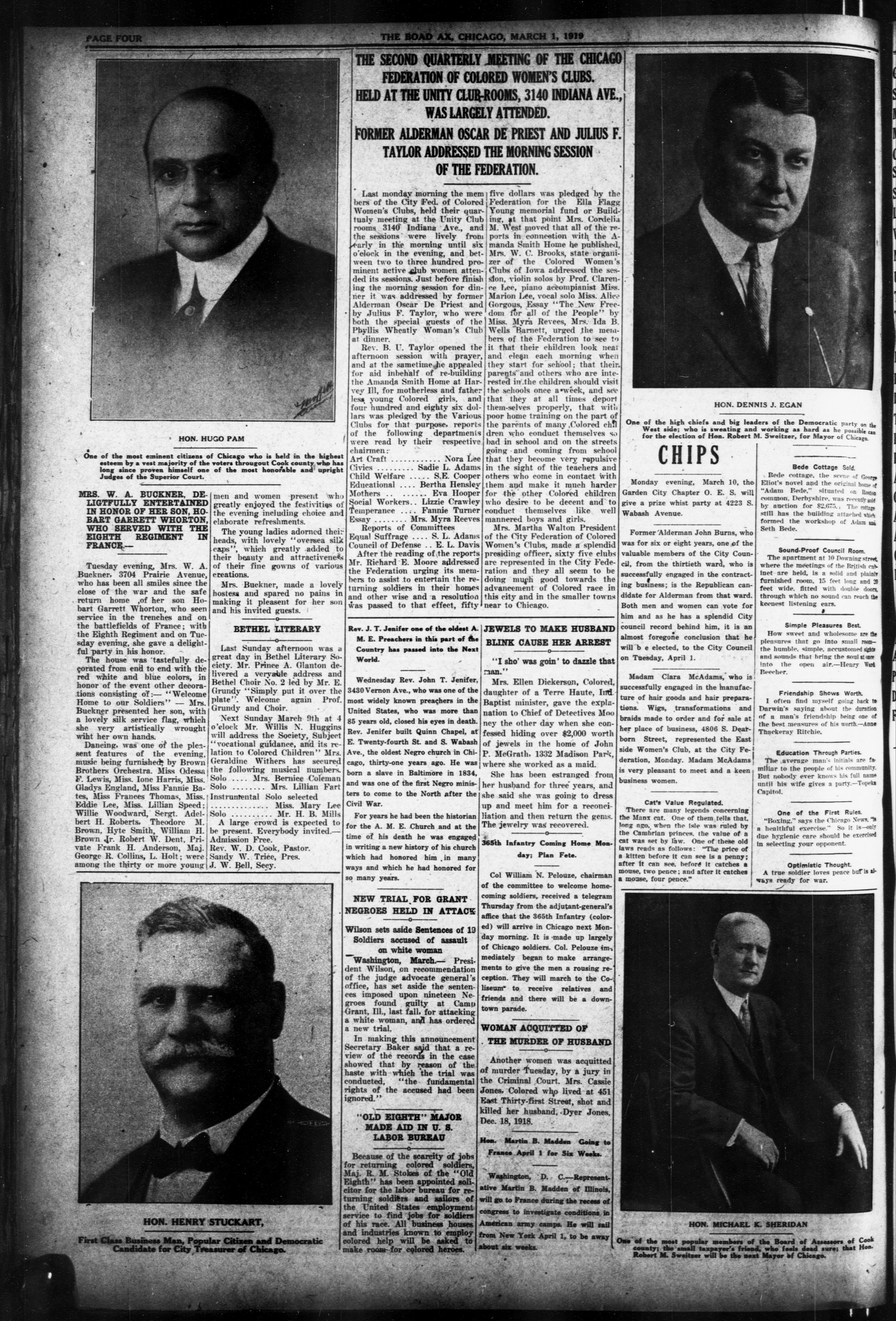
HON. HUGO PAM
One of the most eminent citizens of Chicago who is held in the highest esteem by a vast majority of the voters throughout Cook county who has long since proven himself one of the most honorable and upright Judges of the Superior Court.
MRS. W. A. BUCKNER, DELIGTFULLY ENTERTAINED IN HONOR OF HER SON, HOBART GARRETT WHORTON, WHO SERVED WITH THE EIGHTH REGIMENT IN FRANCE—
men and women present who greatly enjoyed the festivities of the evening including choice and elaborate refreshments.
The young ladies adorned their heads, with lovely "oversea silk" which greatly added to
Tuesday evening, Mrs. W. A. Buckner, 3704 Prairie Avenue, who has been all smiles since the close of the war and the safe return home, of her son Hobart Garrett Whorton, who seen service in the trenches and on the battlefields of France; with the Eighth Regiment and on Tuesday evening, she gave a delightful party in his honor.
The house was 'tastefully decorated from end to end with the red white and blue colors, in honor of the event other decorations consisting of:— "Welcome Home to our Soldiers" — Mrs. Buckner presented her son, with a lovely silk service flag, which she very artistically wrought wih her own hands.
Dancing, was one of the pleasant features of the evening; music being furnished, by Brown Brothers Orchestra. Miss Odessa F. Lewis, Miss. Ione Harris, Miss. Gladys England, Miss Fannie Bates, Miss Frances Thomas, Miss. Eddie Lee, Miss. Lillian Speed; Willie Woodward, Sergt. Adelbert H. Roberts, Theodore M. Brown, Hyte Smith, William H. Brown Jr. Robert W. Dent, Private Frank H. Anderson, Maj. George R. Collins, L. Holt; were among the thirty or more young
---
HON. HENRY STUCKART,
PAGE FOUR
men and women present who greatly enjoyed the festivities of the evening including choice and elaborate refreshments. The young ladies adorned their heads, with lovely "oversea silk caps", which greatly added to their beauty and attractiveness of their fine gowns of various creations. Mrs. Buckner, made a lovely hostess and spared no pains in making it pleasent for her son and his invited guests.
Last Sunday afternoon was a great day in Bethel Literary Society. Mr. Prince A. Glanton delivered a veryable address and Bethel Choir No. 2 led by Mr. E. Grundy "Simply put it over the plate". Welcome again Prof. Grundy and Choir.
Next Sunday March 9th at 4 o'clock Mr. Willis N. Huggins will address the Society, Subject "vocational guidance, and its relation to Colored Children" Mrs. Geraldine Withers has secured the following musical numbers. Solo .... Mrs. Bernice Coleman Solo .... Mrs. Lillian Fart Instrumental Solo selected
Miss. Mary Lee
Solo Mr. H. B. Mills
A large crowd is expected to be present. Everybody invited.—
Admission Free.
Rev. W. D. Cook, Pastor.
Sandy W. Trier, Pres.
J. W. Bell, Seey.
BETHEL LITERARY
THE BOAD AX, CHICAGO, MARCH 1, 1919
THE SECOND QUARTERLY MEETING OF THE CHICAGO FEDERATION OF COLORED WOMEN'S CLUBS. HELD AT THE UNITY CLUR-ROOMS, 3140 INDIANA AVE., WAS LARGELY ATTENDED. FORMER ALDERMAN OSCAR DE PRIEST AND JULIUS F. TAYLOR ADDRESSED THE MORNING SESSION OF THE FEDERATION.
Last monday morning the members of the City Fed. of Colored Women's Clubs, held their quartualy meeting at the Unity Club rooms 3140 Indiana Ave., and the sessions were lively from early in the morning until six o'clock in the evening, and between two to three hundred prominent active club women attended its sessions. Just before finishing the morning session for dinner it was addressed by former Alderman Oscar De Priest and by Julius F. Taylor, who were both the special guests of the Phyllis Wheatly Woman's Club at dinner.
Rev. B. U. Taylor opened the afternoon session with prayer, and at the sametime he appealed for aid inbehalf of re-building the Amanda Smith Home at Harvey Ill, for motherless and fatherless young Colored girls, and four hundred and eighty six dollars was pledged by the Various Clubs for that purpose, reports of the following departments were read by their respective chairmen: Art Craft . . . Nora Lee Civics . . . Sadie L. Adams Child Welfare . . . S.E. Cooper Educational . . . Bertha Hensley Mothers . . . Eva Hooper Social Workers. Lizzie Crawley Temperance . . Fannie Turner Essay . . . Mrs. Myra Reeves Reports of Committees
Reports of Committees
Equal Suffrage . . . S. L. Adams
Council of Defense . . . E. L. Davis
After the reading of the reports
Mr. Richard E. Moore addressed
the Federation urging its members to assist to entertain the returning soldiers in their homes and other wise and a resolution was passed to that effect, fifty
Rev. J. T. Jenifer one of the oldest A. M. E. Preachers in this part of the Country has passed into the Next World.
Wednesday Rev. John T. Jenifer, 3430 Vernon Ave., who was one of the most widely known preachers in the United States, who was more than 85 years old, closed his eyes in death. Rev. Jenifer built Quinn Chapel, at E. Twenty-fourth St. and S. Wabash Ave., the oldest Negro church in Chicago, thirty-one years ago. He was born a slave in Baltimore in 1834, and was one of the first Negro ministers to come to the North after the Civil War.
For years he had been the historian for the A. M. E. Church and at the time of his death he was engaged in writing a new history of his church which had honored him in many ways and which he had honored for so many years.
NEW TRIAL, FOR GRANT NEGROES HELD IN ATTACK
Washington, March. President Wilson, on recommendation of the judge advocate general's office, has set aside the sentences imposed upon nineteen Negroes found guilty at Camp Grant, Ill., last fall, for attacking a white woman, and has ordered a new trial. In making this announcement Secretary Baker said that a review of the records in the case showed that by reason of the haste with which the trial was conducted, "the fundamental rights of the accused had been ignored."
'OLD EIGHTH' MAJOR
MADE AID IN U. S.
LABOR BUREAU
Because of the scarcity of jobs for returning colored soldiers, Maj. R. M. Stokes of the "Old Eighth" has been appointed solicitor for the labor bureau for returning soldiers and sailors of the United States employment service to find jobs for soldiers of his race. All business houses and industries known to employ colored help will be asked to make room for colored heroes.
five dollars was pledged by the Federation for the Ella Flagg Young memorial fund or Building, at that point Mrs. Cordelia M. West moved that all of the reports in connection with the Amanda Smith Home he published, Mrs. W. C. Brooks, state organizer of the Colored Women's Clubs of Iowa addressed the session, violin solos by Prof. Clarence Lee, piano accompianist Miss. Marion Lee, vocal solo Miss. Alice Gorgous, Essay "The New Freedom for all of the People" by Miss. Myra Revees, Mrs. Ida B. Wells Barnett, urged the members of the Federation to see to it that their children look neat and clean each morning when they start for school; that their parents and others who are interested in the children should visit the schools once a week, and see that they at all times deport them-selves properly, that with poor home training on the part of the parents of many Colored children who conduct themselves so bad in school and on the streets going and coming from school that they become very repulsive in the sight of the teachers and others who come in contact with them and make it much harder for the other Colored children who desire to be decent and to conduct themselves like well mannered boys and girls.
Mrs. Martha Walton President of the City Federation of Colored Women's Clubs, made a splendid presiding officer, sixty five clubs are represented in the City Federation and they all seem to be doing much good towards the advancement of Colored race in this city and in the smaller towns near to Chicago.
JEWELS TO MAKE HUSBAND BLINK CAUSE HER ARREST
"I sho' was goin' to dazzle that man."
Mrs. Ellen Dickerson, Colored, daughter of a Terre Haute, Irrl. Baptist minister, gave the explanation to Chief of Detectives Mooney the other day when she confessed hiding over $2,000 worth of jewels in the home of John P. MeGrath, 1332 Madison Park, where she worked as a maid.
She has been estranged from her husband for three years, and she said she was going to dress up and meet him for a reconciliation and then return the gems. The jewelry was recovered.
Col William N. Pelouze, chairman of the committee to welcome homecoming soldiers, received a telegram Thursday from the adjutant-general's office that the 365th Infantry (colored) will arrive in Chicago next Monday morning. It is made up largely of Chicago soldiers. Col. Pelouze immediately began to make arrangements to give the men a rousing reception. They will march to the Coliseum to receive relatives and friends and there will be a downtown parade.
WOMAN ACQUITTED OF
Another women was acquitted of murder Tuesday, by a jury in the Criminal Court. Mrs. Cassie Jones. Colored who lived at 451 East Thirty-first Street, shot and killed her husband, Dyer Jones, Dec. 18, 1918.
Hon. Martin B. Madden Going to France April 1 for Six Weeks.
Washington, D. C.—Representative Martin B. Madden of Illinois, will go to France during the recess of congress to investigate conditions in American army camps. He will sail from New York April 1, to be away about six weeks.
M.
HON. DENNIS J. EGAN
One of the high chiefs and big leaders of the Democratic party on the West side; who is sweating and working as hard as he possible can for the election of Hon. Robert M. Sweitzer, for Mayor of Chicago.
Monday evening, March 10, the Garden City Chapter O. E. S. will give a prize whist party at 4223 S. Wabash Avenue.
Former Alderman John Burns, who was for six or eight years, one of the valuable members of the City Council, from the thirtieth ward, who is successfully engaged in the contracting business; is the Republican candidate for Alderman from that ward. Both men and women can vote for him and as he has a splendid City council record behind him, it is an almost foregone conclusion that he will be elected, to the City Council on Tuesday, April 1.
Madam Clara McAdams, who is successfully engaged in the manufacture of hair goods and hair preparations. Wigs, transformations and braids made to order and for sale at her place of business, 4806 S. Dearborn Street, represented the East side Women's Club, at the City Federation, Monday. Madam McAdams is very pleasant to meet and a keen business women.
There are many legends concerning the Manx cat. One of them tells that, long ago, when the Isle was ruled by the Cambrian princes, the value of a cat was set by law. One of these old laws reads as follows: "The price of a kitten before it can see is a penny; after it can see, before it catches a mouse, two pence; and after it catches a mouse, four pence."
HON. MICHAEL K. SHERIDAN
One of the most popular members of the Board of Assessors of Cook county; the small taxpayer's friend, who feels dead sure; that Hon. Robert M. Sweitzer will be the next Mayor of Chicago.
CHIPS
Cat's Value Regulated.
aders of the Democratic party on the
d working as hard as he possible can
M. Sweitzer, for Mayor of Chicago.
Bede Cottage Sold.
Bede cottage, the scene of George
Eliot's novel and the original home of
"Adam Bede," situated on Boston
common, Derbyshire, was recently sold
by auction for $2,675. The cottage
still has the building attached which
formed the workshop of Adam and
Seth Bede.
Sound-Proof Council Room
The apartment at 10 Downing street, where the meetings of the British cabinet are held, is a solid and plainly furnished room, 15 feet long and 20 feet wide, fitted with double doors, through which no sound can reach the keenest listening ears.
Simple Pleasures Best
How sweet and wholesome are the pleasures that go into small room—the humble, simple, accustomed sights and sounds that bring the soul at once into the open air.—Henry Ward Beecher.
Friendship Shows Worth
I often find myself going back to Darwin's saying about the duration of a man's friendship being one of the best measures of his worth.—Anne Thackeray Ritchie.
Education Through Parties
The average man's initials are familiar to the people of his community. But nobody ever knows his full name until his wife gives a party. -Topeka Capitol.
One of the First Rules.
"Boxing," says the Chicago News, "is a healthful exercise." So it is only due hygienic care should be exercised in selecting your opponent.
Optimistic Thought.
A true soldier loves peace but is always ready for war.
Bede Cottage Sold
Optimistic Thought.
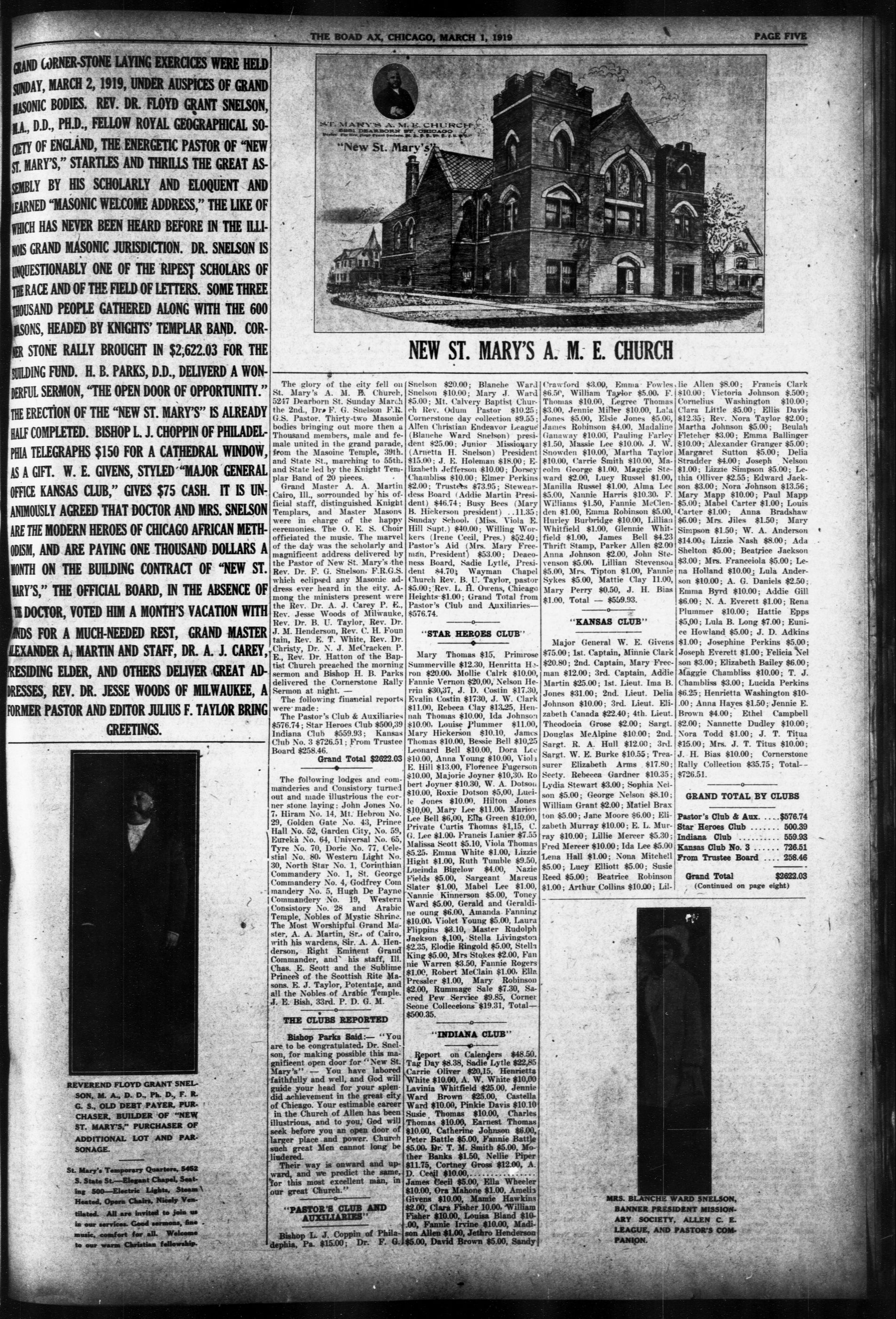
ST. MARY'S A. M. E. CHURCH
6851 DEARBORN ST. CHICAGO
Parklet For Hire, Fargo Saint Paulson, M. L. P. B. V. B. P. U. W.
"New St. Mary's"
GRAND CORNER-STONE LAYING EXERCICES WERE HELD SUNDAY, MARCH 2, 1919, UNDER AUSPICES OF GRAND MASONIC BODIES. REV. DR. FLOYD GRANT SNELSON, M.A., D.D., PH.D., FELLOW ROYAL GEOGRAPHICAL SOCIETY OF ENGLAND, THE ENERGETIC PASTOR OF "NEW ST. MARY'S," STARTLES AND THRILLS THE GREAT ASSEMBLY BY HIS SCHOLARLY AND ELOQUENT AND LEARNED "MASONIC WELCOME ADDRESS," THE LIKE OF WHICH HAS NEVER BEEN HEARD BEFORE IN THE ILLINOIS GRAND MASONIC JURISDICTION. DR. SNELSON IS UNQUESTIONABLY ONE OF THE RIPEST SCHOLARS OF THE RACE AND OF THE FIELD OF LETTERS. SOME THREE THOUSAND PEOPLE GATHERED ALONG WITH THE 600 MASONS, HEADED BY KNIGHTS' TEMPLAR BAND. CORNER STONE RALLY BROUGHT IN $2,622.03 FOR THE BUILDING FUND. H. B. PARKS, D.D., DELIVERD A WONDERFUL SERMON, "THE OPEN DOOR OF OPPORTUNITY." THE ERECTION OF THE "NEW ST. MARY'S" IS ALREADY HALF COMPLETED. BISHOP L. J. CHOPPIN OF PHILADELPHIA TELEGRAPHS $150 FOR A CATHEDRAL WINDOW, AS A GIFT. W. E. GIVENS, STYLED "MAJOR GENERAL OFFICE KANSAS CLUB," GIVES $75 CASH. IT IS UNANIMOUSLY AGREED THAT DOCTOR AND MRS. SNELSON ARE THE MODERN HEROES OF CHICAGO AFRICAN METHODISM, AND ARE PAYING ONE THOUSAND DOLLARS A MONTH ON THE BUILDING CONTRACT OF "NEW ST. MARY'S," THE OFFICIAL BOARD, IN THE ABSENCE OF THE DOCTOR, VOTED HIM A MONTH'S VACATION WITH WONDS FOR A MUCH-NEEDED REST, GRAND MASTER LEXANDER A, MARTIN AND STAFF, DR. A. J. CAREY, PRESIDING ELDER, AND OTHERS DELIVER GREAT ADDRESSES, REV. DR. JESSE WOODS OF MILWAUKEE, A FORMER PASTOR AND EDITOR JULIUS F. TAYLOR BRING
[Picture of a man in a dark suit and hat, with a mustache and a goatee, standing in a dark room with a light source behind him.]
REVEREND FLOYD GRANT SNELSON, M. A., D. D., Ph. D., F. R. G. S., OLD DEBT PAYER, PURCHASER, BUILDER OF "NEW ST. MARY'S," PURCHASER OF ADDITIONAL LOT AND PARSONAGE.
St. Mary's Temporary Quarters, 5452 S. State St—Elegant Chapel, Seating 500—Electric Lights, Steam Heated, Opera Chairs, Nically Ventilated. All are invited to join us in our services. Good sermons, fine music, comfort for all. Welcome to our warm Christian fellowship.
THE BOAD AX, CHICAGO, MARCH 1, 1919
The glory of the city fell on St. Mary's A. M. B. Church, 5247 Dearborn St. Sunday March the 2nd, Dr F. G. Snelson F.R. G.S. Pastor. Thirty-two Masonic bodies bringing out more then a Thousand members, male and female united in the grand parade, from the Masoine Temple, 39th and State St., marching to 55th. and State led by the Knight Templar Band of 20 pieces.
Grand Master A. A. Martin Cairo, Ill., sorrounded by his official staff, distinguished Knight Templars, and Master Masons were in charge of the happy ceremonies. The O. E. S. Choir officiated the music. The marvel of the day was the scholarly and magnificent address delivered by the Pastor of New St. Mary's the Rev. Dr. F. G. Shelson, F.R.G.S. which eclipsed any Masonic address ever heard in the city. Among the ministers present were the Rev. Dr. A. J. Carey P. E., Rev. Jesse Woods of Milwaukee, Rev. Dr. B. U. Taylor, Rev. Dr. J. M. Henderson, Rev. C. H. Fountain, Rev. E. T. White, Rev. Dr. Christy, Dr. N. J. McCracken P. E., Rev. Dr. Hatton of the Baptist Church preached the morning sermon and Bishop H. B. Parks delivered the Cornerstone Rally Sermon at night. —
The following financial reports were made:
The Pastor's Club & Auxiliaries $576.74; Star Heroes Club $500.39
Indiana Club $559.93; Kansas Club 3 $726.51; From Trustee
Board No. 558.46
Grand Total $2622.03
The following lodges and commanderies and Consistory turned out and made illustrious the corner stone laying: John Jones No. 7, Hiram No. 14, Mt. Hebron No. 29, Golden Gate No. 43, Prince Hall No. 52, Garden City, No. 59, Eureka No. 64, Universal No. 65, Tyre No. 70, Dorie No. 77, Celestial No. 80, Western Light No. 30, North Star No. 1, Corinthian Commandery No. 1, St. George Commandery No. 4, Godfrey Commandery No. 5, Hugh De Payne Commandery No. 19, Western Consistory No. 28 and Arabic Temple, Nobles of Mystic Shrine. The Most Worshipful Grand Master, A. A. Martin, Sr., of Cairo, with his wardens, Sir. A. A. Henderson, Right Eminent Grand Commander, and his staff, Ill. Chas. E. Scott and the Sublime Princes of the Scottish Rite Masons. E. J. Taylor, Potentate, and all the Nobles of Arabic Temple. J. E. Bish, 33rd. P. D. G. M.
THE CLUBS REPORTED
Bishop Parks Said:—"You are to be congratulated. Dr. Snelson, for making possible this magnificent open door for "New St. Mary's" — You have labored faithfully and well, and God will guide your head for your splendid achievement in the great city of Chicago. Your estimable career in the Church of Allen has been illustrious, and to you, God will seek before you an open door of larger place and power. Church such great Men cannot long be liudered. Their way is onward and upward, and we predict the same, for this most excellent man, in our great Church."
"PASTOR'S CLUB AND AUXHIARIES"
NEW ST. MARY'S A. M. E. CHURCH
Snelson $20.00; Blanche Ward
Snelson $10.00; Mary J. Ward
$5.00; Mt. Calvery Baptist Church
Rev. Odum Pastor $10.25;
Cornerstone day collection $9.55;
Allen Christian Endeavor League
(Blanche Ward Snelson) president
$25.00; Junior Missionary
(Arnetta H. Snelson) President
$15.00; J. E. Holeman $18.00; Elizabeth Jefferson $10.00; Dorsey
Chanbliss $10.00; Elmer Perkins
$2.00; Trustees $73.95; Stewardess
Board (Addie Martin President)
$46.74; Busy Bees (Mary
B. Hickerson president) ..11.35;
Sunday School. (Miss. Viola E.
Hill Supt.) $40.00; Willing Workers
(Irene Cecil, Pres.) $52.40;
Pastor's Aid (Mrs. Mary Freeman,
President) $53.00; Deaconess
Board, Sadie Lytle, President
$4.70; Wayman Chapel
Church Rev. B. U. Taylor, pastor
$5.00; Rev. L. H. Owens, Chicago
Heights $1.00; Grand Total from
Pastor's Club and Auxiliaries—
$576.74.
"STAR HEROES CLUB"
Mary Thomas $15, Primrose
Summerville $12.30, Henritta Heron $20.00, Mollie Calrk $10.00, Fannie Vernon $20.00, Nelson Herrin $30.37, J. D. Costin $17.30, Evalin Costin $17.30, J. W. Clark $11.00, Rebecca Clay $13.25, Henah Thomas $10.00, Ida Johnson $10.00, Louise Plummer $11.00, Mary Hickerson $10.10, James Thomas $10.00, Bessie Bell $10.25
Leonard Bell $10.00, Dora Lee $10.00, Anna Young $10.00, Viola E. Hill $13.00, Florence Fugerson $10.00, Majorie Joyner $10.30, Robert Joyner $10.30, W. A. Dotson $10.00, Roxie Dotson $5.00, Lucile Jones $10.00, Hilton Jones $10.00, Mary Lee $11.00, Marion Lee Bell $6.00, Ella Green $10.00, Private Curtis Thomas $1.15, C. G. Lee $1.00, Francis Lanier $7.55
Malissa Scott $5.10, Viola Thomas $5.25. Emma White $1.00, Lizzie Hight $1.00, Ruth Tumble $9.50, Lueinda Bigelow $4.00, Nazie Fields $5.00, Sargeant Mareus Slater $1.00, Mabel Lee $1.00, Nannie Kinnersion $5.00, Toney Ward $5.00, Gerald and Geraldine oung $6.00, Amanda Fanning $10.00, Violet Young $5.00, Laura Flippins $3.10, Master Rudolph Jackson $1.00, Stella Livingston $2.35, Elodie Ringold $5.00, Stella King $5.00, Mrs Stokes $2.00, Fannie Warren $3.50, Fannie Rogers $1.00, Robert MeClain $1.00, Ella Pressler $1.00, Mary Robinson $2.00, Rummage Sale $7.30, Sacred Pew Service $9.85, Corner Seone Colleceions $19.31, Total—$500.35.
"INDIANA CLUB"
Report on Calenders $48.50.
Tag Day $8.38, Sadie Lytle $22.85
Carrie Oliver $20.15, Henrietta
White $10.00, A. W. White $10.00
Lavinia Whitfield $25.00, Jennie
Ward Brown $25.00, Castella
Ward $10.00, Pinkie Davis $10.10
Susie Thomas $10.00, Charles
Thomas $10.00, Earnest Thomas
$10.00, Catherine Johnson $6.00,
Peter Battle $5.00, Fannie Battle
$5.00, Dr. T. M. Smith $5.00, Mother
Banks $1.50, Nellie Piper
$11.75, Cortney Gross $12.00, A. D.
Cecil $10.00.
James Cecil $5.00, Ella Wheeler
$10.00, Ora Mahone $1.00, Amelia
Givens $10.00, Mamie Hawkins
$2.00, Clara Fisher 10.00, William
Fisher $10.00, Louisa Bland $10.00,
Fannie Irvine $10.00, Madison
Allen $1.00, Jethro Henderson
$5.00, David Brown $5.00, Sandy
Crawford $3.00, Emma Fowles
$6.50, William Taylor $5.00, F.
Thomas $10.00, Legree Thomas
$3.00, Jennie Miller $10.00, Lala
Jones $5.00, Elsie Jones $5.00,
James Robinson $4.00, Madaline
Ganaway $10.00, Pauling Farley
$1.50, Massie Lee $10.00, J. W.
Snowden $10.00, Martha Taylor
$10.00, Carrie Smith $10.00,
Macolm George $1.00, Maggie Steward
$2.00, Lucy Russel $1.00,
Manilla Russel $1.00, Alma Lee
$5.00, Nannie Harris $10.30, F.
Williams $1.50, Fannie McClenden
$1.00, Emma Robinson $5.00,
Hurley Burbridge $10.00, Lillian
Whitfield $1.00, Glennie Whitfield
$1.00, James Bell $4.23
Thrift Stamp, Parker Allen $2.00
Anna Johnson $2.00, John Stevenson $5.00, Lillian Stevenson $5.00, Mrs. Tipton $1.00, Fannie Sykes $5.00, Mattie Clay 11.00,
Mary Perry $0.50, J. H. Bias
$1.00, Total — $559.93.
"KANSAS CLUB"
Major General W. E. Givens $75.00; 1st. Captain, Minnie Clark $20.80; 2nd. Captain, Mary Freeman $12.00; 3rd. Captain, Addie Martin $25.00; 1st. Lieut. Ima B. Jones $31.00; 2nd. Lieut. Delia Johnson $10.00; 3rd. Lieut. Elizabeth Canada $22.40; 4th. Lieut. Theodocia Grose $2.00; Sargt. Douglas McAlpine $10.00; 2nd. Sargt. R. A. Hull $12.00; 3rd. Sargt. W. E. Burke $10.55; Treasurer Elizabeth Arms $17.80; Secty. Rebecca Gardner $10.35; Lydia Stewart $3.00; Sophia Nelson $5.00; George Nelson $8.10; William Grant $2.00; Matiel Braxton $5.00; Jane Moore $6.00; Elizabeth Murray $10.00; E. L. Murray $10.00; Lillie Mercer $5.30; Fred Mercer $10.00; Nola Lee $5.00 Lena Hall $1.00; Nona Mitchell $5.00; Lucy Elliott $5.00; Susie Reed $5.00; Beatrice Robinson $1.00; Arthur Collins $10.00; Lil-
The image provided is too blurry and low-resolution to accurately recognize any text or content. It appears to be a blank or heavily pixelated area with no discernible features. Therefore, no text can be extracted from this image.
```markdown
```
MRS. BLANCHE WARD SNELSON,
BANNER PRESIDENT MISSIONARY SOCIETY, ALLEN C. E.
LEAGUE, AND PASTOR'S COMPANION.
lie Allen $8.00; Francis Clark $10.00; Victoria Johnson $5.00; Cornelius Washington $10.00; Clara Little $5.00; Ellis Davis $12.35; Rev. Nora Taylor $2.00; Martha Johnson $5.00; Beulah Fletcher $3.00; Emma Ballinger $10.00; Alexander Granger $5.00; Margaret Sutton $5.00; Delia Stradder $4.00; Joseph Nelson $1.00; Lizzie Simpson $5.00; Lethia Olliver $2.55; Edward Jackson $3.00; Nora Johnson $13.56; Mary Mapp $10.00; Paul Mapp $5.00; Mabel Carter $1.00; Louis Carter $1.00; Anna Bradshaw $5.00; Mrs. Jiles $1.50; Mary Simpson $1.50; W. A. Anderson $14.00; Lizzie Nash $8.00; Ada Shelton $5.00; Beatrice Jackson $3.00; Mrs. Franceiola $5.00; Lena Holland $10.00; Lula Anderson $10.00; A. G. Daniels $2.50; Emma Byrd $10.00; Addie Gill $6.00; N. A. Everett $1.00; Rena Plummer $10.00; Hattie Epps $5.00; Lula B. Long $7.00; Eunice Howland $5.00; J. D. Adkins $1.00; Joseph Perkins $5.00; Joseph Everett $1.00; Felicia Nelson $3.00; Elizabeth Bailey $6.00; Maggie Chambliss $10.00; T. J. Chambliss $3.00; Lucea Perkins $6.25; Henrietta Washington $10.00; Anna Hayes $1.50; Jennie E. Brown $4.00; Ethel Campbell $2.00; Nannette Dudley $10.00; Nora Todd $1.00; J. T. Titua $15.00; Mrs. J. T. Titus $10.00; J. H. Bias $10.00; Cornerstone Rally Collection $35.75; Total--$726.51.
GRAND TOTAL BY CLUBS
Pastor's Club & Aux. . . $576.74
Star Heroes Club . . . 500.39
Indiana Club . . . 559.93
Kansas Club No. 3 . . . 726.51
From Trustee Board . . . 258.46
Grand Total $2622.03
(Continued on page eight)
The image provided is too blurry to accurately recognize any text. It appears to be a blank or heavily pixelated area with no discernible content.
```markdown
```
LOSE FAVOR FOR SERGE AND SATIN
Women Shew Partiality to Fabrics That Are More Suitable to the Season.
SILK JERSEY IN LIMELIGHT
Popular Demand Will Be Met and Indications Are That the Material May Be Substituted
New York—The world seems to have made up its mind to wear in summer the clothes that are suggestive of summer.
This may sound like a familiar condition to women in those sectors of the country that prepare for the heat in April and do not think of warm clothes until November; but in the large majority of these United States, observes a fashion writer, there has been a tendency to dress in summer in a way that seems to defy the cal-
1
Foulard frock, with petticoat and plaited ruffles of taffeta.
endar. Hundreds of these women buy thin serge frocks and suits, gowns with strong silk linings, chiffon or satin bodices that do not wash, and there is always a bit of fur hanging in the closet ready to, be used with or without excuse.
There was a time when even the women of the cooler states permitted themselves to look upon lingerie gowns with favor. This was done in Paris, where there has always been a tendency to avoid cool simplicity, even though July and August demand clothes that will give comfort. The average Paris woman, even though she may be a young girl working for her living, never appears in the street or at a shop in a separate white shirt-walst without a coat, and none of the Paris women go about the streets in muslin or linen frocks. It was this French custom in summer clothes that governed the American output for the last decade or so.
Be Warned in Time.
The woman who is watching out for her spring wardrobe and is being guided by the clothes going to pleasure resorts, which are, after all, forerunners of what we will adopt, had best be warned in time that she will regret it if she puts money into sweaters, separate skirts and plenty of shirt-walts. We are coming into a new phase of summer clothes. It is really an old, old one, and it has been brought back through the mental somersault we were compelled to turn during the war days. We have a yearning for clothes that are sensible. Nonessentials have rather weared us. We think it especially silly to wear a serge gown on warm, moist days when we could be comfortable in taffeta, foulard, Shantung and printed chiffon. We know that muslin is not an easy fabric to possess, and cotton has been needed for things more grim and serious than a woman's summer afternoon; but the other fabrics fall as thick as leaves in Vallambrosa. One can attach them for the asking. A vast amount of them are American made, and one does not have to pay an import price on them. There is a certain quality of chiffon which has been put out by France and which we have not been able to achieve, but of the foulards, the Shantungs and the various types of Chinese crepe and silk, our own markets supply our own needs.
The French designers inaugurated taffeta as far back as December, and the American importers offered Southern frocks of this material the first of January, but it was a taffeta that was a close rival to satin, even thinner and more comfortable for warm days. When the American women attempt the fashionable draping of the hour with taffeta that is not exquisitely supple, it may be that the fabric will have a setback, leaving the way clear
.
for Shantung, Chinese crepe, and foulard.
These are the materials that will come back to fashion, but they need not be twisted and turned into complex and expensive frocks unless the wearer so desires. Many of them are made up like muslins
Insistence Upon Silk Jersey.
No summary of the fabrics that are to flash forth after the frost is over, is genuinely good unless one brings in jersey. The worsted weave of this fabric is still used, but the heavy silk weave, plain or fanciful, is doing its best to come in ahead of the others on the race track of fashions. The American mills have turned out this French product with more or less success. There is the drop-stitch kind, another weave that has a thick and a thin square, and still another that has a twisted end a plain contrasting design.
This fabric has taken unto itself the air of a conqueror, for it aspires to a formal place in society. It appears in the guise of an evening gown, not for formal occasions, it is true, but for dinner at a restaurant and the theater afterward. It is handled by the dressmakers in the same way as satin. It has long lace sleeves, sometimes a hip-scarf of Spanish lace with a deep, pendant panel in front; again, it has an upper bodice of white chiffon with square Spanish sleeves to match. It is used for coat suits and offers itself as a rival to Shantung, for it does not wrinkle easily. It comes in the majority of good colors, and in belge and biseut it still flows along at high tide.
It is felt, more than said, that satin may have had its day as a spring fabric. There is a strong tendency away from it, just as there is from sergee. No one who dabbles among clothes can fail to notice this avoidance of the two fabrics in orders for new frocks. Satin is still good for evening, but it is draped with chiffon or tulle. When brilliant colors are used, as in one of the new gowns named after General Pershing, American beauty red satin is velled in an oriental manner with long festoons of mauve chiffon, each corner weighted with an amethyst necklace that drops to the knees in front, outlines the sharply cut decouletage over the shoulders and drops in two straight lines below the waist at the back, each end finished with a tassel of the amethyst. This type of gown is chosen everywhere among smart people, when satin is used. It permits the orientalization of a gown, which is the dear desire of dressmakers.
As for serge, exactly what the public has against it, one cannot find out. Perhaps it is just weary of it and wants something that does not suggest the somber, conservative clothes of war days. There is a very soft cloth that looks like serge which the tailors are using for coat suits, but even with the model as ordered women choose another material. They do not want even a semblance of serge.
Covert Cloth Worn Again.
It might be claimed that the leading fabric for coat suits, and even frocks,
THE FASHION OF THE TWENTIETH CENTURY
Afternoon frock of blue and green foulard, with Chinese design. Girdle of green georgette, and green jade earrings.
is covert cloth. It came into fashion through its usage at Thanksgiving by a few very smart women in New York, and the same houses that introduced it then have put it forth as a novelty for early spring.
The American people know covert cloth quite well. They had much to do with it during a preceding generation. Its tone today is not as muddy and brown as then; there is a sparkling touch of tan about it which makes it quite becoming. Cost suits made of it, the new ones that are trailing along in genial climates, worn by women bent on amusing themselves, have the surface tucked in squares or lattice work, according to an ancient and honorable trick of ornamentation. The coats of these suits are left open after the fastening of three or four buttons at the neck; this is to show a frilled blouse, usually in a pale color. By the way, these frilled, pastel-colored muslin blouses may be the forerunners of a wide revival of colored muslin frocks.
Copyright 1995, by the McClure Moun-
mentary Syndicate.
THE BOAD AX. CHICAGO, MARCH 1, 1919
STYLES ARE MANY
Various Periods Shown in Waistline or Sleeve; Skirts Are Long and Draped.
Great activity prevails in all the large dressmaking establishments and an interesting fashion display is promised for the openings, which will be held soon.
Shall we have a new silhouette? That is the important question. So far there is little if any indication of it, but one never knows what turn the invention of the leaders of fashion may take, now that their minds are relieved of the anxieties of war. History does not help us much. After Waterloo there were no sudden shifts in the modes, but a gradual development from the styles of 1815 through the seasons until a definite change was crystallized in the fashions of 1820. There was a marked change in fashion, including that of hairdressing, just preceding the French revolution.
The question of the silhouette is no longer so important as it used to be. Modern women are less obedient to the dictates of a few designers than were their mothers and grandmothers. The bustle mode returned, but not every woman adopted it, as was the case in the eighties. The majority preferred the tunic or short skirt, or the slightly barrel effect. This is an indication that women now have independent opinions on the subject of dress.
One sees today a variety of styles. There is in evidence at one and the same time the empire waistline, the moyenage or the oriental line dropped below the hips, and the so-called normal waistline. As for sleeves there is the long, tight sleeve, the sleeve of 1840, with its underpuff of lighter material; the Gregorian sleeve and the Eastern sleeve slit along its length and tied about the wrist. These are but a few of the varieties which one may see in every gathering of well-dressed women. Then there is the realm of the skirt. There is the long, draped skirt, the narrow slit skirt, the narrow straight skirt, the kilt skirt and the tunic skirt, either draped or plaited. One sees a great diversity of style among the evening frocks.
There is an exceedingly attractive model of black velvet made in princess effect, draped in rather clinging lines and completed with a long train, the train beginning at the decollete at the back and extending in panel effect. The right side of the bodice is of flesh-colored tulle. The left side is formed of the velvet, draped and crossing over and fastened at the waistline at the right side with a cluster of flowers.
MANY USES FOR PAPER YARN
Combined With Wool, Shoddy, Cotton and Waste, Enlarging Supply of Fabrics for Clothing.
The use of paper yarn has been largely extended during the past half year. The importance of the industry may be judged by the increased production now amounting to about 88,000,000 pounds a year, says the Frankfurter Zeitung.
The manufacturing processes are constantly being improved, and as the matter stands now paper yarn can be used successfully in the manufacture of various fabrics and garments, excepting only body linen and the better sorts of outside garments. Workingmen's clothes, bed and table linen, curtains, sail cloth, imitation leather and many other articles of good quality can now be made.
In many fabrics the paper yarn is combined with wool, shoddy, cotton waste, etc., and the supply of fabrics for the clothing industry is thus enlarged. It is not to be supposed that all these articles will disappear immediately upon the return of peace. The demand for them will continue undiminished for some time, and some of them may retain their place in the market permanently. The use of paper yarn for sewing thread is also increasing, owing chiefly to the scarcity of cotton and linen thread. The preparation, twisting, etc., have been improved to such an extent that the paper threads are strong and durable enough to be used in the manufacture of coarse clothing and sacks.
FASHION NOTES OF INTEREST
Fluted Pierrette collars, some of them with scallops or points to relieve the roundness, are to be popular.
Flower toques, always charming, are being shown a bit this year. Most times they have a body of georgette or straw with just the top bepetaled.
A pretty little sport hat for southern winter is of bands of oyster white grosgrain ribbon a half-inch wide. A bit of long white fringe lounges over the side.
A gorgeous evening coat for warmer climes is of apricot crepe meteor, made in cape fashion with long points over the arms and widely banded about the bottom with chinchilla.
A dancing frock of yellow-green satin suits a slender style of maid by being made with tight, old fashioned bodice and ruffled, full tunic with just a peeping of narrow skirt beneath. Many of the new blue serges and tricolores have wool in gray, embroidered in large designs over part of the skirt.
THE WORLD'S FINEST ACTRESS
With the same originality that gained for Paris the supremacy of the fashion world in pre-war times, Paris has again come into its own. This chic creation is a blue straw hat, artistically trimmed with wings of blue.
ART OF SELECTING DRAPERIES
Wise Choosing and Placing of Lamps
Lends an Air of Coziness to
While the selection of draperies and curtains is, possibly, the most obvious method of lending an air of coziness to the home, the wise choosing and placing of lamps is a factor which is equally important; though too infrequently taken advantage of. To be thoroughly comfortable and practical during the evening hours, the home should be equipped with a variety of lamps, to meet the particular needs of the moment. The fact that one does not want the same kind of lighting at all times becomes an important item in the selection and arrangement of fixtures, for, while a soft, mellow glow is highly desirable for conversational purposes, it is usually insufficient for reading or other close work. The living room should therefore be furnished with both types of lamps, so that it will be satisfactory at all times. Proper illumination of this room will do much toward keeping the family together in the evening, for it makes it possible for several people to do their different work in comfort.
NEW PATTERN PRINTS SHOWN
Fabric Is Entirely English in Design and Manufacture; Firm Like Percale; Dyes Warranted.
Some new English prints are in the market. They are entirely English in design and manufacture, the material is of a firm quality like percale and the dyes are warranted. They come in all colors—rose, pink, greens, blues, terra cotta, or really the new henna—with the little old-fashioned designs in purple or lavender. The patterns are small, delicate roses on the different grounds, small conventional patterns, and little leaf patterns combined with a small round figure of some kind. There are a few patterns with the ever recurrent polka dot of moderate size, set rather far apart on white or colored grounds. Another old-time one revived is the tiny, pinhead dot in white on navy blue. These, however, are exceptions, most of the prints being in small, sometimes very tiny, all-over designs set closely. The only thing in a way of a stripe is indefinite, formed of lines of the dots. The prints make up into very simple gowns for women, children and young girls.
CHARMING NEGLIGEE MODEL
© Western Newspaper Union
VELVET FOR GIRLS
Simplicity Is a Good Rule to Follow in Development of Garments for Children.
Black velvet or a good quality of velvetteen makes a very handsome dress for a little girl of six to twelve years. Simplicity is a good rule to follow in the development of all garments for children. It is especially important when a rich, heavy material such as velvet, velvetteen or velours is chosen. The design shown in the sketch is an excellent one. It is so simple that the average home dressmaker can make her own pattern. The dress is a modified Russian blouse, waist and skirt being gathered in simply at back and sides, while the front shows a wide box plait or panel. The dress buttons at the left front, and a narrow belt of kid or patent leather gives a smart touch to the frock. This belt may be in black, white, or color, according to choice. Neck and sleeves are finished with a frill of fine white ordle and geor
A
Black Velvet Frock for Small Girl.ette. The cap is of velvet, trimmed inermine, and the young lady may carry a muff and wear a scarf of this fur,this completing an extremely smart street outfit.
ART OF CONSTRUCTING A HAT
Secret Lies in Pinning All Materials Securely Before Sewing Them—The Blind Stitch.
The secret of making a successful hat lies in pinning all materials securely before sewing them. Where the bliss facing is used as a finishing to the edges of the brim, the covering of the top and the facing should be sewed and the fold pinned all around, first on one side and then on the other, before the blind stitching is begun. One should be no more sparing with the quantity of pins used in millinery than those needed in dressmaking.
The amateur milliner has often discovered to her sorrow that, although her hat was smartly designed and the colors well put together, the finished product showed unmistakable evidence of home manufacture, because here and there the stitches were plainly visible. For those women who have not learned to use the blind stitch, a simple explanation may be valuable: The needle should be slipped into a fold of the material and worked through it, so as to catch the folds together without piercing the top of the material. The needle is drawn out from behind the fold and again inserted from the back and the needle run along as before.
FOR AN EFFECTIVE TRIMMING
Embellishment Easily Produced, Affording Charming Decoration for Collars, Cuffs or Skirt.
An effective mode of trimming frocks of organdle or other sheer cotton or linen fabrics is by means of what is known as double work, and this is something that can be accomplished at home as well as by the professional dressmaker. The effect is produced by turning back the material or applying it over the body of the frock in a simple design and then joining it by a line of hemstitching of fancy stitchery and cutting it close along this line, thus producing the design in the double thickness of the material.
It is an effective way to finish collar and cuffs, and a charming skirt trimming can be produced by turning up the hem in a Wall of Troy or other design and stitching it back along that line. One need not, of course, work this hemstitching by hand, but it can be done so much a yard at the shop where you have plaiting done and button molds covered.
Through the Looking Glass By EVELYN NESBIT
Have you ever seen a chicken fly
Or a waddling duck look longingly in
to the sky and try
been wings?
7
Try as they may, they cannot reach the clouds. They cannot do what every saucy sparrow and every black crow can do.
All of which goes to prove that if you are a chicken don't try to be a sparrow. And if you are a duck, don't try to be a crow. A chicken cannot even be a duck. The chicken has this fact brought
this fact brought forcibly to mind every time it tries to swim.
It is good to have ambitions, but nature has imposed certain limitations on every human being. You cannot have Mary Jones' nose, no matter how much you despise your own button of a nose. You console yourself with the fact that Mary Jones could not have your beautiful curls and your sweet disposition if she augued after them for a century.
It is waste of time for a woman to long to be a sparrow if she is a duck. Let her make the most of her duck-like qualities, and she will beat the sparrow anyway.
Be as ambitious as you can be. Ambition is the axle grease that makes the world go round. But misdirected ambition is like pride—it "goeth be fore a fall." It fills the world with grumpy, discontented fools, who do not realize how well off they are.
LINEN TEA CLOTHS CHARMING
Table Spread Combined With Fletch Crochet on Quaint Mahogany Furniture is Greatly Advised.
A linen tea cloth combined with fillet crochet on a quaint old mahogany table was recently the subject of comment and praise at an afternoon tea and the hostess said: "My store o' the linen was small—just a roll or two—but it was homespun by my two grand mothers. Both these dear ladies loved to tell tales of their early days. One had spun her linen in New England and the other in Old England, and I determined to enhance my heirlooms with my own handwork.
"This tea table cover has only a 12 inch square of linen in its center, but the filet lace is broad enough to make it seem of considerable size. The lace motif is the crown and scepter in honor of my British ancestry. Another cover I value is made from the ends of an old homespun sheet. I re-forced it on the under side with fine stitching before I made it into a dinner cloth. It has some insects of fillet and wherever it had to be cut or punched I strengthened the linen by running a little embroidery stitch around it. This made-over linen has been re-created in odd moments and is a treasure to me, and I know my daughters will appreciate it and add to it as I have done."
BEAUTIFUL AFTERNOON FROCK
© Western Newspaper Union
This is a dainty afternoon Trock of gray chiffon with chenille striped satin of same shade used as banding.
Furniture Cleaner.
To save time and labor while doing housecleaning try putting some olive oil in a pan of lukewarm water which has been made slightly soapy with a pure soap. Use this to wash furniture, then polish with a dry soft cloth. Woodwork, leather and all will look like new, for the olive oil feeds, while the soapy water cleans, and there are no injurious chemicals to eat the vanish
IT PAYS TO ADVERTISE IN THE BROAD AX
Stop Thief!
THE "Jumbo" gas burner shown here at the right, (actual size) is a robber on any gas lighting fixture in Chicago. If you have one, get rid of it! It makes high gas bills and causes a great many of the complaints that come to us.
Claims that a "Jumbo" will give more light without using more gas are false.
Use mantle burners to get more light with less gas. Burning five hours a day for a month, the "Jumbo" consumes $2.30 worth of gas; a "Junior" mantle burner, in the same time, consumes only 39 cents worth, or $1.91 less, and gives much more light.
2545 SOUTH PARK AVENUE Chicago
THE FORTY-FOURTH STREET
THE CRANFORD Apartment Building
3600 WABASH AVENUE
The finest building ever opened to Colored tenants in Chicago. Steam heat, electric lights, tile baths, marble entrance
J. W. CASEY, Agent
Phone Main 263 133 W. Washington Street
Use mantle burners Burning five hours a consumes $2.30 worth in the same time, co $1.91 less, and gives
This Is the
"JUNIOR MANTLE"
Telephone
HUGH NORRIS, Pres.
NORR
Co
---
```markdown
```
We sell "Junior Mantle" lights complete for only fifteen cents, (which is less than "Jumbos" usually cost) or give one free, in exchange for a "Jumbo," at our main office or any of these stores:
West Side 3643 Irving Park Blvd.
2142 West Madison St. 408 West North Ave.
1709 West 12th St. South Side
1641 Milwaukee Ave. 731 West 63rd St.
3221 Ogden Ave. 3478 Archer Ave.
4033 West Madison St. 163-5 East 35th St.
North Side 9051 Commercial St.
3071 Lincoln Ave. 11025 Michigan Ave.
KIRBY WARD, See
THE BOAD AX, CHICAGO, MARCH-1, 1919
PATRONIZE OUR ADVERTISERS
As Near As Your Telephone DISTANCE IMMATERIAL
IN a Metropolitan City of this size, death knocks every thirty minutes at some door. Too often that death not only brings sorrow, but misfortune as well. Let the price you pay for a funeral be a business proposition and you will benefit by it in service, quality and cost to you in dollars and cents. The result of my campaign has built for me one of the largest and most magnificent establishments in the world. A visit will convince you.
Consult me, I can save you Worry, Time and Money. Shipping to all parts of the Country and Automobile Funerals a Specialty. Central Display Rooms and Chapel. Call promptly answered day or night.
The Emanuel Jackson Undertaking Co., Inc.
2959-61 South State Street
Reliable Service Courteous Treatment
Reasonable Prices
FREE CHAPEL IN CONNECTION
Complete Line of Funeral Goods Automobiles for Hire
W. E. H.
J. GRAY LUCAS
Attorney At Law
Suite 815 Hartford Building
8 S. Dearborn St., Chicago.
Phone Central 6583
S. A. T. WATKINS
LAWYER
36 WEST RANDOLPH STREET
CHICAGO
Residence, 4533 Prairie Avepue
Phone Kenwood 8520
WALTER M. FARMER
ATTORNEY AND
COUNSELOR AT LAW
NOTARY PUBLIC
Suite 708
184 W. Washington St.
Tel., Office, Main 4153 Auto 33736
CHICAGO
MILES J. DEVINE
Attorney At Law
Suite 318-320 REAPER BLOCK
Clark and Washington Streets
Phone Central 1239
CHICAGO
PHONE MAIN 2214
A. D. GASH
Attorney At Law
118 North La Salle Street
CHICAGO
LAUREL
WM. J. LATHAM
Attorney At Law
OFFICE PHONE: CALUMET 875
2 EAST 31ST STREET
Suite 7
CHICAGO
JOHN J. DUNN
ESTABLISHED 1877
Wholesale and Retail
Fifty-First and Federal Sts. CHICAGO
KINKY HAIR
Atlanta, Ga.
Ensalo Med. Co.
Gentlemen.
My friend shows you what your fine
EXELENTO QUININE POMADE
has done for my hair. Before I used it, I had it in short and course, and now it is 14 inch length and silky and it can do it up any way I want to.
JANE RAND.
Don't let some fake Kink Remover fool you. You really can't strangle your hair until it's also nice and short. That's what EXELENTO QUININE POMADE does. removes Dandruff, feeds the Roots of the hair, and makes it grow long, soft and silky. After using a few times, all it will the difference is that little while it will be so pretty and long that you can fix it up to suit you. If Exelento don't do as we claim, we will give your money back.
25c by mail on receipt of stamp or coin
AGENTS WANTED EVERYWHERE.
Write For Us.
EXELENTO MEDICINE CO., Atlanta, Ga.
NOW IS THE TIME TO SUBSCRIBE FOR THE BROAD AX
The Elite Cafe and Buffet
National Hall Bldg
4300 So. State St.
National Hall Bldg. 4300 So. State St.
Space for Offices, Professional and Others Lodge and Assembly Halls. .. Large and Spacious Dance Hall. .. Best Ventilated Halls in Chicago for Rent. :: :: ::
APPLY
L. L. Slaughter Real Estate
100 So. STATE STREET TEL. DREXEL 78
Chicago Title and Trust Company
STATED BRIEFLY:
J. L. Slaughter Real Estate
4300 So. STATE STREET TEL. DREXEL 7812
Chicago Title and Trust Company
OUR BUSINESS SINCE 1847 has been that of showing the condition of real estate titles.
The millions upon millions required to build and rebuild Chicago have been furnished relying on the accuracy of our ABSTRACTS and TITLE POLICIES.
No man has lost a dollar by so relying.
This is our past.
Wise men judge future action by past behavior
CHICAGO TITLE AND TRUST COMPANY
69 W. Washington Street
Assets exceed $12,000,000.00
No deposits or demand liabilities.
TELEPHONE DOUGLAS 1
GEORGE F. HARDING, J.
Real Estate
GEORGE F. HARDING, JR.
Up-to-Date or Modern Houses Apartments and Stores to Rent
3101 Cottage Grove Avenue
Corner 31st Street, Chicago
a-office Phone Blacksone 459 :: Branch-office Phone Douglas
JOHNSON EXPRESS
STORAGE AND VAN CO.
JOHNSON EXPRESS, STORAGE AND VAN CO.
EXPERT PIANO MOVERS-AUTO SERVICE
Packers, Shippers and Storage
TRUNKS TO AND FROM ALL DEPOTS
Main Office: 1431 East 67th Street
Branch Office: 444 E. 39th St., near Vernon Ave. CHICAGO, IL
A. F. CODOZOE
J. H. WHISTON, Proprietors
CHAS. HARRIS, Manager
The E
and
3030 STATE STREET
National
4300 S
J. L. Slaugh
4300 So. STATE STR
Chicago Title a
STATE
TELEPHON
GEORGE F.
Real
Main-office Phone Blacksone 4
JOHNSON
STORAGE
PAGE SEVEN
AUTO. 72-379
Phones: DOUGLAS 3256
DOUGLAS 8071
Cafe
et
CHICAGO
ll Bldg. te St.
Real Estate
EL. DREXEL 7812
ust[Company
LY:
RDING, JR. state
office Phone Douglas 3426
EXPRESS,
VAN CO.
THE BRIDGE
PUBLISHED HERE
In this city since July 15th, the Republicans, Democrats, Catholics, infidels or anyone else can have proper and responsibility is fixed.
The Broad Ax is a newspaper all, ever claiming the editorial local communications will run on one side of the paper.
Subscriptions must be paid
One Year
Six Months
Advertising rates made known
Vol. XXIV. M
Address all co.
THE B
6206 South Elizabeth
Phone Wet
JULIUS F. TAYLOR
DR. M. A. MAJORS
4700 South
Phone D
IMPORTANT
For resolutions, obituary not special announcements of events is made, and the opening of cents per line; 6 words or fraction.
Personal or social items such everything of a general interest,
Entered as Second-Class Matter, August
Under Act of
THE BROAD AX
THE BROAD AX
In this city since July 15th, 1899, without missing one single issue. Republicans, Democrats, Catholics, Protestants, Single Taxers, Priests, infidels or anyone else can have their say as long as their language is proper and responsibility is fixed.
The Broad Ax is a newspaper whose platform is broad enough for all, ever claiming the editorial right to speak its own mind. Local communications will receive attention. Write plainly, only on one side of the paper.
IMPORTANT NOTICE
For resolutions, obituary notices, cards of thanks, write-ups, special announcements of events to happen, when a charge of admission is made, and the opening of new business enterprises, etc., 15 cents per line; 6 words or fraction makes one line.
Personal or social items such as marriages, births, deaths and everything of a general interest, published free of charge.
Entered as Second-Class Matter, August 19, 1902, at the Post Office at Chicago, Ill., Under Act of March 3, 1879.
THE DOOR OF HOPE
The year 1919 swings the door of hope ajar and the man or woman of the race need not pass up the opportunities of the moment as they come trooping before them. They will have much to do with keeping the door of hope ajar just in that proportion as they help themselves to enter fields of usefulness and service
The old order is rapidly being out grown, the garment must be cut differently to fit the live, wide awake Negro, who has his heart set upon nobler and better things in life. The probation period has been long and arduous, time has grown into impatient, restlessness and uneasy misgivings have almost appalled him on the struggling way upward. The sun light of a beautiful morning finds him up and fit to appreciate its golden splendor, radiant as it sparkles in the morning dew drop. The clock is about to strike the hour. The hour for which he has struggled, watched, and waited. The business, bustle, and whirl of the city street tells him many things.
The whistles blow, and the noisy hum of industry tells him that men who think and dream evolves new truths, truths worked out into living form, and actuality. The factory tells him that a practical problem is being worked out, people thrive by employment, and the financial prospect enunciates the fundamental stimulus. Profit looms large to the sensible investor of small means when the comodity is a necessary one in spite of competition.
We are to enter in at this door of hope and do our part of the making and selling of needed articles of commerce, as well as forever and eternally doing only the buying and no more.
We cannot hope to create large individuals among us, men and women who by commercial rating can have a voice in the chambers of commerce, the trade unions etc., just by voicing our approval. we must with our mean co-operate to-gether our heart and race feeling and build larger and greater things than we have ever built.
We suffer deprivations of our own making. We may not hope as long as we will not unite our little forces and carry forward the principles that make other races rich and powerful.
Progress means aggressive action going forward not backward. At this day and hour we cannot stand still. Patent force is in our hands. In active we are impotent, and our hands fall to our sides. The shining diadem is worth our effort and our spirit. All other races rub heads on all other lines of action that requires thought and investigation.
We must not continue to carry all our power and pile it up in some others cash register. The day is bristling, with business enterprise, no other period in history has offered us so much. The strength of united forces is the power that has long operated to keep us back and belated. We must project far away into the future after we have laid well our deep concrete foundation for a lasting super-structure. Incomes should interest us far greater
hat outgoing.
PAGE EIGHT
notices, cards of thanks, write-ups,
to happen, when a charge of admis-
f new business enterprises, etc., 15
m makes one line.
such marriages, births, deaths and
published free of charge.
19, 1992, at the Post Office at Chicago, Ill.
March 3, 1879.
Have you a business? Are you
building up yourself or are you
giving the best that is in you to
make power for others? — Do
you ever hope to enter the busi-
ness door for which you carry
a key? — Are you striving for
to-day or for a greater future
for your dependent ones?
TAKE ADVANTAGE OF SENTRY
How South African Farmers Repel Invasion of Their Corn Fields by Bands of Baboons.
Apropos of a statement in the newspapers that the baboons in South Africa were easy victims of the Spanish "flu," very few people realize how human these animals are. They are very like men in some respects, observes a writer in London Answers.
For instance, a troop of baboons—for it has been proved that they nearly always go about in large companies—always post a sentry. He is placed in some prominent position, so that he can give immediate warning in the event of any hostile attack.
The baboon's cry somewhat resembles a German "Hoch!" shouted through a megaphone, and it is possible to talk to them by means of it.
A baboon is said to be able to count up to two, and not beyond that; and as they come in large numbers and carry off the ripe mealies, steps have to be taken to repel them. And so, when the mealies get ripe, three men walk into the field with their guns and lie down.
After a time one of them gets up and goes out and the baboon sentry counts—one. Later on another goes out, and as the sentry only counted two men coming in, he concludes that there is nobody left in the field and accordingly gives the signal, whereupon the whole troop swarms over the fence and begins to gather the corn. As soon as they are near enough the third man shoots them down with a repeating rifle, and if he is a fairly good shot their numbers are greatly diminished.
SUCCESSFUL WAR ON WEEVIL
Australian Grain Growers Used Poison Gas to Combat Deadly Enemy of Their Crops.
The weevil is a well-known curse to the grain-growing farmer. He is a member of a very large group, rejoicing in the family name of curchunidae. There are some other members which live to spoil nuts, some which ravage apple orchards, while others make war upon clover and legumes generally. One variety is threatening the very existence of the cotton plantations of the southern states, another lives to make difficult—at times impossible—Egyptian agriculture. The weevil's eggs are laid in immature grains and the creature develops itself through the larva stage at their expense. Wherever grain is taken, the weevil goes along and so discovers new countries for its habitation. Everywhere it is at home, and grows with the growing grain. Australia has suffered, and its unsold grain accumulated through the war years, during which the length of the voyage made it impossible to obtain transportation to Europe, was found to deteriorate through its ravages. But our fellow citizens on the other side of the world are notoriously hard to beat, and set to work vigorously to war against these resilient grubs. A leaf was taken from the German book, and the use of poison gas was resorted to with apparently deadly effect.
Neighbor Women Note.
Among the senses that of overhear ing seems to be the most acute.—To edo Blade.
THE BOAD AX, CHICAGO, MARCH 1,1919
EDITORIAL PAGE
The Laying of the Corner Stone of New St. Mary's Church, Sunday, March 1, 1919
B. Philadelphia Pa. 28
Rev. F. G. Snelson
5251 Dearborn St. Chicago. Ill
I am just home credit me with
one hundred and fifty donation
for window sorry I cannot be
with you am glad Bishop Parks
can I wish you abundant success
you and your great people are
equal to the task check follows.
L. J. Corpoin.
Philadelphia Pa. March 1. 19.
Dear Dr. Snelson;
I wired you donation that it might be in time for the Cornerstone Rally. I now enclose check for $150.00.
I am glad that you are getting on-so nicely with your monthly payments. To put up a new building such as you have planned, especially now, when labor and material are so high, is quite an undertaking, it requires FAITH?
COURAGE, and a STRONG WORKING FORCE to make good All of these you have. Go ahead and SUCCESS TO YOU.
L. J. Coppin.
THE QUEEN OF WALES
MRS. MOLLIE CLARKE, TREASURER "STAR HERO CLUB" AND "QUEEN" CORNER-STONE RALLY.
After the Masons had concluded the Comerstone Laying, the Rev. Dr. A. J. Carey presiding Elder( on behalf of the presiding Bishop Coppin, and on behalf of the Chicago District delivered an eloquent address of greetings and congratulations.
Dr Carey said: "Chicago a friend Methodism will ever owe you Dr. Snelson a lasting debt of gratitude for this beautiful structure dedicated to the cause of Jesus Christ in this community. You have labored long and earnestly, and most successfully and the entire City and the Brethren of the Chicago Conference hail you to-day with profound and sincere congratulation. The Families of our heroic Eighth Regiment now just returned from France, will rejoice in what you have here done for them and their children, and the Church will honor you as one of their very noblest sons.
God bless St. Mary's Church and her splendid people that they may live to see the happy completion of this beautiful Temple"
Clouds are very variable in height—from 500 to 2,000 feet. The clouds in thunderstorms may be very deep—from two to five miles and more—hence the appearance as to distance is very deceptive. Cumulus clouds are intermediate.
No Separation is Sight
No Separation in Sight.
Mrs. Mark—"Mrs. Skanner tells me that her husband is an ardent lover of books." Mr. Mark—"I wish he'd prove fickle to two volumes of mine which be enticed away more than five years ago."—Buffalo Express.
Profeits by Experience.
Of course others may do as they please, but personally, we never expect to invest in another oil well until it proves able to grease its own machinery.—Dallas News.
Height of Clouds
CORNER-STONE OF THE
"ST. MARY'S"
Contains an A.M.E. discipline and Hyn book; a copy of "Christian Recorder" "Southern Christian Recorder", "Voice of Missions"; The Broad Ax, and other race papers of Chicago; 5 issues of "St. Mary' Church Bell", a Crucifix from Mrs. Lizzie Nash, Chicago Annual Conference Minutes, and a souvenir coin medal of the Masonic Temple of Chicago; and the following Coins: 1 cent piece of 1897, representing the year St. Mary's Church was founded as a Mission. $1.00 piece year 1900, representing the year Dr. Snelson returned from Sierra—Leone as an African Missionary and a Fellow of the Royal Geograical Society of England.
5 cents piece year 1904, the year of the Chicago General Conference Session.
1 cent piece year 1917, representing the year the 8th. regiment of Chicago left for France.
1 cent piece, year 1914, representing the year Dr. and Mrs. E. G. Snelson were married and came to Chicago on their Wedding Tour.
5 cents piece, year 1918, representing Dec. 3, 1918 when the Contractor began work on building "New St. Mary's." 25 cents piece, year 1918, representing the visit of our own Bishop L. J. Coppin to St. Mary's for the Ground — Breaking exercises.
"Organized in June 1897" St. Mary's A. M. E. Church
W. A. Dotson, Set'y; A. D. Cecil Tres.; Hurley Burbridge; Parker Allen Jr; Nelson Reed; A. G. Daniels; A. W. White; Cornelius L. Washington; J. W. Clark." The Corner—Stone is of magnificent size — as tall as a man, and engraved faultlessly. The Dedication and dedication rally will probably be held about the first Sunday in July 1919.
More or Less?
Hickop had decided to turn over a new leaf, and he couldn't help resenting everybody know. "I have resented for the New Year," he said, feeling if his halo was on straight, "that I shall not drink any more." "But, my dear fellow," protested a Doubting Thomas. "you couldn't drink any more. The point is have you resolved to drink any less?"—London Answers.
Understanding Each Other
Understanding Each Other.
Those who fancy themselves not understood by the people with whom they have to associate might find some consolation in the fact that they themselves are not taking any great troble to understand others. We are really not so complex or peculiar as we often imagine, and perhaps we are not worth so much study as we demand—Exchange.
Trustees.
Monarch's Compliment.
A pretty compliment was that Philip IV of Spain, himself a painter, tendered to a greater artist, Velasquez. When Velasquez had finished his famous picture "Las Meninas," which includes not only Philip and his queen, but the artist himself, brush in hand, he asked of the king, "Is anything wanting?" "One thing only," answered Philip; and taking the palette from Velasquez's hands, he painted on the breast of the artist's figure in the picture the Cross of the Order of Santiago, the most distinguished in Spain.
Animal's Strong Instinct.
Some animals are remarkable, indeed, for the wonderful development of love and devotion they possess and show toward men. They are so acute in the sense of their affections that they seem to perceive the feelings of their master in advance of his expressions. Masters of dumb animals have often been heard to declare that their animals were quicker to detect In them a spirit of anger than were their fellow men.
Trinidad Lizard Farm.
On the island of Trinidad there is today a veritable lizard farm which has all the equipment for the successful breeding of these none too numerous members of the reptile family which are nqw known to be indispensable to the sugar planters. In addition to this enterprise a wider search is being made for toads to help increase the world's sugar output.
Custom Hard to Down.
Pens made of feathers were common in the seventh century, but so inveterate was the old habit of writing with reeds on parchment and paper that it continued a long time after the first use of quills. The custom of carryin a pen behind the ear is ancient, as may be seen in the life of St. Odo: "He saw a pen sticking in his ear in the manner of a writer."
Poor Relative's Figure.
She said with a sigh, "My, how glad I am that I have a poor relative's figure! I can wear anything from the frocks made for Cousin Anne, who is nearly six feet and looks like a clothespin, to the suits built for Cousin Jane, who is five feet and weighs one hundred and eighty."
Black Marble.
Black marble may be cleaned with a mixture of equal parts of pearlash and soft soap. Apply this with a flannel and let it remain on for some minutes. Then rinse, first with warm and then with cold water. When dry polish with a paraffin cloth until it shines.
New Word.
One of our exchanges tells about a man who "unthoughtedly" left his pocketbook, containing $5, on a counter in a railway station. As an addition to the English language we maintain that unthoughtedly is unthinkable.—St. Louis Republic.
Now You'll Take Better.
Because flashlight powders are not swift enough for the most rapid photography an electrical device has been invented which lights the powder and then snaps the camera shutter when the burning powder is at its greatest brilliancy.
The "Classic."
Perhaps the best definition of classa is that given by Lowell: "Something that can be simple without being vulgar, elevated without being distant, that is neither ancient nor modern, always new and incapable of growing old."
Seeing as Well:
By a Frenchman's invention as a language student hears a word spoken by a phonograph he also sees it appear on a printed roll in conjunction with its translation in his own tongue.
Keep Children Erect
Keep Children Direct.
To make a child maintain an erect position while writing at a school desk a German has invented a rod to be attached to a desk, terminating in a cup against the child's chin.
Keeps Hands and Feet Out.
Keeps Hands.and Feet Out.
A Greek inventor has produced a machine which automatically cleans and packs more than 150 cases of currants an hour without contact of human hand or foot.
Relieves Pain of Sting.
Reveals Palm of Sting.
The Savoyards rub a crushed clove of garlic upon a spot that has been stung by a wasp or bee. This makes the swelling go down and drives away the pain.
A species of cacao growing prolifically in Algeria has been made by French scientists to yield 14 per cent of sugar and about 60 per cent alcohol.
Internationality.
Make this our conviction: "I am not born for one corner of the earth; my country is this world."—Seneca.
The Hottest City.
The city of Hyderabad, on the great Sind desert of India, has the reputation of being the hottest place in the world, having a shade temperature of 127 degrees during the summer months! Even the natives find it —and that is saying something
In order to cool their houses as much as possible, the people make use of curious ventilators very much like those on shipboards' "setting" them so as to convey a breeze to the dwellers in the hot rooms below. Every residential building has several of these queer airshafts leading down to the principal living rooms, and especially to the bedrooms. Even so, it is practically impossible, during the terrible heat of summer, to get to sleep until two or three o'clock in the morning, and then one only gets a couple of hours' rest, as the rays of the Indian sun are specially strong early in the morning, and soon raise the temperature again to an unbearable extent.
Papal Guard a Picked Body
Service in the papal guard has become an hereditary honor in many prominent families in the cantons of Zurich and Lucerne, handed down from father to son through generations. Its requirements are of the highest, and few military organizations have a strict discipline. Every candidate for the corps must be a Swiss citizen, at least 5 feet 8 inches tall, unmarried, in good health and free from all bodily disfigurements. He must present his baptismal certificate, a certificate or pass from his home and a testimonial of good character from his parish authorities. After one year of good conduct the cost of his journey from Switzerland to Rome is refunded.
How Flying-Fish Fly
The popular notion that flying fish beat their "wings" is a mistake. If one is to rely upon the results of studies of these fish by an authority, Capt. Barrett Hamilton.
It appears that the wings are not true organs of flight, but rather play the part of a parachute or an airplane. The whole motive power is supplied by the tail, which acts as a propeller, and the vibration or quivering of the wings in the air currents and their occasional shift of inclination are not phenomena connected with the propulsion of the fish in its aerial flights.
FROM THIS DATE ONWARD THE BROAD AX CAN ALWAYS BE FOUND ON SALE AT THE FOLLOWING NEWS STANDS:
Mrs. L. Graves, The Provident
Candy Shop, Notion Store and News
Stand, 15 W. 36th Street, near State.
George I. Martin, Cigar, Notion
Store and News Stand, 18 W. 31st
St., near State.
Edward Felix, Notions, Cigars and
News Stand, 3002 S. Dearborn St.
F. Bishop, Cigars, Tobacco and
News Stand, 8 W. 27th Street, near
State.
A. D. Hayes, Cigars, Tobacco, Notion, Stationery and News Stand, 3640 S. State Street. Dodson's Shoe Shining Parlors and News Stand, So. West Corner 35th and State Streets.
Lawrence M. Heard, Traveling News Agent, with news stands at 3129 S. State St. and So. East Cor. 35th and State Streets.
Charles F. Mallory's Barber Shop and News Stand, 313 E. 35th Street.
W. D. Scott's Lunch Room and Restaurant, 248 E. 35th Street.
Louis Wimbley's Shoe Shining Parlors and News Stand, 2946 South State Street.
Mrs. F. A. Peyton, News Stand,
Confectionary Store, 5012 S. State
Street.
Samuel Taylor, 1728 Fulton St.
News item left with any of the
above news agents prior to Wednesday mornings of each week, will find
their way into the columns of The Broad Ax.