The Broad Ax
Saturday, March 15, 1919
Chicago, Illinois
Page text (machine-generated)
The Three Hundred and Sixty-fifth U. S. INFANTRY who are Heroes in Every Sense of the word, Warmly Received by the Citizens of Chicago. Vast throngs all along the line of march, loudly cheered and greeted them. Their marching was absolutely perfect or machine like in precission.
The soldiers were in charge of Major William A. Ross and he and his fighting men were met at the doors of the Coliseum by Col. William Nelson Pelouze, and by other members of Mayor Thompson's, Soldiers Reception Committee and by the members of the Citizens Reception Committee. The soldiers, their relatives and friends were so overjoyed for the time being that they did not pay much attention to those who attempted to orate to them.
The regimental band, conducted by Lieut. Arthur T. Steward and featuring Jess Cash, 250 pounds drum major, blended marital strains with the chatter at the Coliseum. The Red Cross and Solution Army had united in the preparation of the two meals served.
THE REGIMENT WON ITS UNDYING HONOR AND ITS SPURS ON THE FRENCH BATTLE FIELDS
The regiment, under its white commander Maj. William A. Ross saw three months of fighting service, distinguishing itself in the Voyages. Argonne and Toul sectors. The day before the armistice was signed it went into action with orders to take a hill, made almost unapproachable by German machine gun nests.
In this action most of the casualties were suffered. The regiment lost more men — seventy-five killed, 500 wounded and nine missing in action — than any other unit of the Buffalo division, of which it is a part.
GREAT FIGHT AT BOIS
FREHAUT
Their greatest victory came at Bois Frehant, one of the key position to Metz. On Nov. 10 — the day before the signing of the armistice — Maj, Ross was ordered to take the second battalion of the rigiment and capture a steep hill strongly held by the boche.
"We moved forward in wave formation", related the commander, "the men five meters apart. Our drive started at daylight in full view of the enemy machine guns and automatics.
"Three hours later, advancing under the terrific fire of the Germans, taking shelter behind stumps of trees, dirt mounds or when there was neither, digging ourselves in, we covered the 300 meters to our objective, breaking through the barbed wire entanglements and capturing all the enemy's guns and the Huns who were left.
Many of the soldiers still limped as they endeavored to keep pace with their fellow marchers, aside from that their marching and drilling was almost machine like in perfection or precision. Promptly at 2 o'clock, the soldiers started from the Coliseum on their march through the down town district. The parade was headed by a squad of mounted police and with many policemen on foot in every direction much better order was maintained then when the Eighth Regiment paraded over the same ground less than a month ago.
The parade was reviewed at the Art Institute by Major General Leonard Wood, where a Jackie band was stationed which discoursed the "Star Spanglad Banner," "Illinois", and other patriotic selections, as the fighting heroes, passed the reviewing stand; the streets were crowded with people all along the line of march, who marm'v greeted them, as they passed oy. Many of the leading business houses, were decorated with the National Colors including Old Glory, or the American Flag, in honor of the occasion. Shortly after 3 o'clock, the re-
where it will be mustered out of service. The friendly and patriotic spirit, displayed by the people in general over the home coming of the 365th Regiment simply proves; that the citizens of Chicago and of Ill., are ever ready to honor their soldiers, regardless of their race or nationality.
Jack Says He and Willard Framed Title Bout; Jess Retorts "Crude Joke"
HAVANA, Cuba.—Jack Johnson, former heavyweight champion, in a signed statement given to the Associated Press last night, declared that his fight with Jess Willard in this city, four years ago was a prearranged affair and that he allowed Willard to win.
In addition to the sum of $30,000, entire rights to the moving picture films in Europe and 33 1-3 per cent of the proceeds from their exhibition in the United States and Canada are mentioned by Johnson being given him, together with the promise of aid to settle Johnson's difficulties with the federal authorities in Chicago, so that the colored pugilist might return there to reclaim his property.
Johnson declares in his statement that it was arranged that he should lose in the tenth round, provided Willard's showing were such as to justify it, but that as Willard was practically nothing he was forced to wait.
The signal agreed upon was given in the twentieth round, Johnson states, but to give Willard an opportunity to make a good showing.
The former champion declares that unless Willard agrees to fight him within a reasonable time he will claim the world's title. He signed his statement: Jack Johnson, champion."
The statement in part follows:
How the Frameup Went
"To arrange the match, Jack Curley came to London from New York. Willard and I said I would if he gave me my price. I thought I could beat his man for him. Curley said he didn't He asked me if I were willing to fight want that. I told Curley I would make the match.
"When ready to leave London I wired Curley for a certain sum of money, which he readily sent. Well, it went on and began to bother me and I spoke to my wife, who advised me not to do it, but I told her that if I were going to lose I'd send her word in time to get out. The reason I said
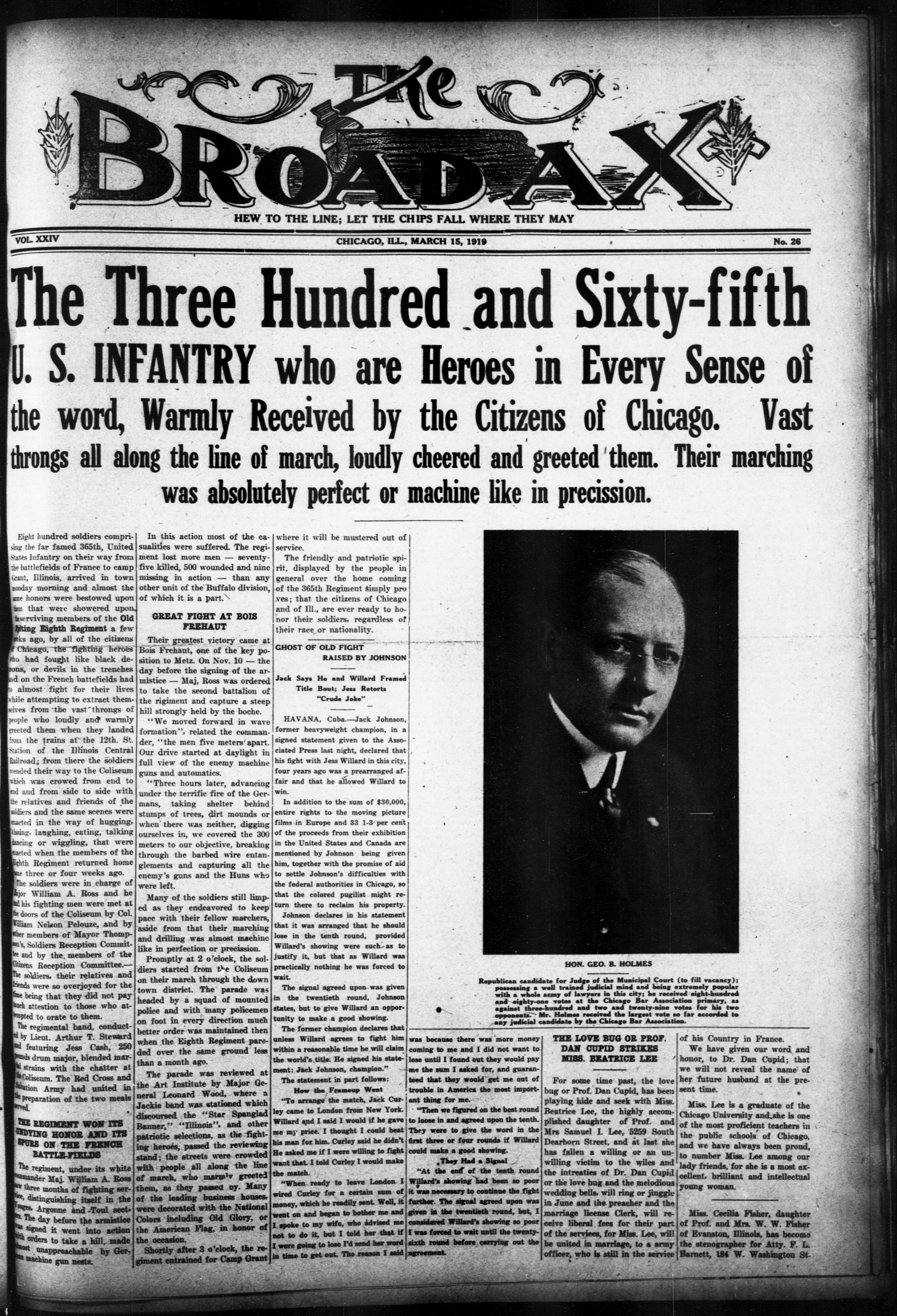
[Portrait of a man in a suit with a tie and a badge on his lapel. The background is dark, and the man's face is clearly visible.]
Republican candidate for Judge of the Municipal Court (to fill vacancy); possessing a well trained judicial mind and being extremely popular with a whole army of lawyers in this city; he received eight-hundred and eighty-one votes at the Chicago Bar Association primary, as against three-hundred and two and twenty-nine votes for his two opponents. Mr. Holmes received the largest vote so far accorded to any judicial candidate by the Chicago Bar Association.
was because there was more money coming to me and I did not want to lose until I found out they would pay me the sum I asked for, and guaranteed that they would get me out of trouble in America the most important thing for me.
"Then we figured on the best round to loose in and agreed upon the tenth. They were to give the word in the first three or four rounds if Willard could make a good showing.
They Had a Signal
"At the end of the tenth round Willard's showing had been so poor it was necessary to continue the fight further. The signal agreed upon was given in the twentieth round, but, I considered Willard's showing so poor I was forced to wait until the twenty-sixth round before carrying out the agreement.
HON. GEO. B. HOLMES
state for Judge of the Municipal Court
well trained judicial mind and being
army of lawyers in this city; he recei
the votes at the Chicago Bar Associ
-hundred and two and twenty-nine
fr. Holmes received the largest vote
candidate by the Chicago Bar Associat
THE LOVE BUG OR PROF
DAN CUPID STRIKES
MISS. BEATRICE LEE
For some time past, the love bug or Prof. Dan Cupid, has been playing hide and seek with Miss. Beatrice Lee, the highly accomplished daughter of Prof. and Mrs Samuel I. Lee, 5259 South Dearborn Street, and at last she has fallen a willing or an unwilling victim to the wiles and the intreaties of Dr. Dan Cupid or the love bug and the melodious wedding bells, will ring or jingle in June and the preacher and the marriage license Clerk, will receive liberal fees for their part of the services, for Miss. Lee, will be united in marriage, to a army officer, who is still in the service
of his Country in France.
We have given our word and honor, to Dr. Dan Cupid; that we will not reveal the name of her future husband at the present time.
Miss. Lee is a graduate of the Chicago University and,she is one of the most proficient teachers in the public schools of Chicago, and we have always been proud, to number Miss. Lee among our lady friends, for she is a most excellent, brilliant and intellectual young woman.
Miss. Cecilia Fisher, daughter of Prof. and Mrs. W. W. Fisher of Evanston, Illinois, has become the stenographer for Atty. F. L. Barnett, 184 W. Washington St.
PAGE TWO
THE BROAD AX
Published Every Saturday
In this city since July 15th, 1899, without missing one single issue. Republicans, Democrats, Catholics, Protestans, Single Taxers, Priests, infidels or anyone else can have their say as long as their language is proper and responsibility is fixed.
The Broad Ax is a newspaper whose platform is broad enough for all, ever claiming the editorial right to speak its own mind.
Local communications will receive attention. Write only on one side of the paper.
Subscriptions must be paid in advance.
One Year.....$2.00
Six Months.....1.00
Advertising rates made known on application.
Address all communications to
THE BROAD AX
$206 So. Elizabeth St., Chicago, Ill.
Phone Wentworth 2597.
JULIUS F. TAYLOR
Editor and Publisher
DR. M. A. MAJORS
Associate Editor
4700 South State Street
Phone Drexel 1416
Entered as Second-Class Matter, August 19,
1902, at the Post Office at Chicago,
Ill., under Act of March 3, 1879
CHICAGO TROOPS GET
$7,186,860 BY ARMY BONUS
ZONE FINANCE OFFICER
GIVES ESTIMATE OF
TOTAL HERE
Washington, D. C., March (Special) — The United States government will pay a bonus of $7,186.860 to Chicago men who wore khaki, the navy blue, or the forest green of the marines during the war with Germany. It will pay an additional $771,900 to Cook county men outside Chicago. To the entire state of Illinois will go $16,334,100.
This is the estimate today at the office of the zone finance officer here, which is paying the $60 bonus to each man honorably discharged prior to Feb. 24, when the revenue bill carrying the bonus provision went into effect. Officers and men in the Thirty-third and Eighty-sixth division will not receive their bonus from the zone finance officer, but will be given it when they are discharged.
272.235 Claims in State
The estimate of the sum to go to illinoisans is based on the expectation that 272,235 from the state at large will claim the bonus. Of course, 119,786 are from the eighty-six local selection boards in Chicago and from voluntary enlistments there for the regular army, national guard, navy, and marines. Desplaines, Evanston, Wilmette Maywood, Oak Park, Cieero, Blue Island, Harvey, Chicago Heights, and other towns and communities in Cook county outside of Chicago have 12,865 men who will receive the bonus.
Only two states stand ahead of Illinois in the amount to be received out of the division of $242,084,580 among 4,034,743 men. New York will receive $24,634,140 and Pennsylvania $18,797,820. Ohio will take $12,351,120 and Texas $10,443,660. These complete the big five in number of men furnished to the army. 40,000 Cheeks Daily
To discharge this big debt to American fighting men checks are now going forward from the office of Col. P. L. Smith, zone finance officer here, at the rate of 10,000 a day, and it is excepted to increase the rate to 40,000 a day shortly.
Of the 119,786 Chicago men to share in the bonus 65.19 per cent were in the national army. 22.75 per cent in the regular army, 10.38 in the navy, and 1.6 in the marine corps.
Selected men from the eighty-six Chicago draft boards num-
#
---
bering 79,262 will receive $4,755,
720. For Cook county outside of
Chicago 8,548 men who were
drafted will receive $512.880. Chicago
board No. 1, county building,
has $93.000 due to men it
sent into the army, and board
No. 67, Cornell Square park field
house, Fifty-first and Wood St.
which was the second largest Chicago
board, has $84,180 due its
men. Board No. 45, 2000 Canal-
port Avenue, the smallest board
in the city, has $29.020 due its
drafted men.
LAKE PARK HOSPITAL
The opening of the Lake Park Hospital at 4147 Lake Park Ave., is a great blessing to the colored people. As the population grows the facilities for the care, protection and education must progress. At this time when a trained nurse in the home means the expenditure of more money than the average man earns, the hospital fills the need by caring for the same patient in the best possible manner at one fourth the expense. The Lake Park Hospital is now open for patients. On its staff are many of our best physicians.
The nursing is under the direction of Miss. Adah D. Murray of Lincoln Hospital. New York, assisted by Miss. L. A. Avery of Montreal, Canada and graduate nurses from local hospitals. Applications for nurse training are issued on request.
The childrens' ward will be directly in charge of Dr. Geo W. Prince who specialized in diseases of children while studying abroad with the co-operation of such physicians as Doctor S. A. Smith, Dr. Floyd W. Willis, Dr. I. H. Holloway, Dr. A. W. Mercer, D. C. D. Trice, Dr. Leonard Pratt and others makes success assured. Dr. Danl. H. Williams, who has done more than any colored doctor in the world in fostering hospitals and nurses' training schools has always maintained that the clinic is invaluable in development of young physicians.
This hospital hopes to have the best clinical facilities in the city and to do the work for the masses that will make toward better physical, mental and moral conditions. There will be a chance for philanthropists asd boosters to aid in this work and whatever may have been your former policy, remember we are constructionists today. This is no colored hospital, but just another place in America where patients will get all that modern science can give. M.F. Warring
CHIPS
Madam Bertha L. Hensley, 3528 Vernon, Avenue; has been confined to her home the past week with a severe sore throat which almost prevents her from talking above a whisper. But at this writing she is gradually improving.
Hon. S. A. T. Watkins, left the City Monday morning for Detroit, Mich., where he appeared in an important law suit on the side of the Orangemen of that City. From there he visited Montreal Canada, returning home the first of the week.
Major Adam E. Patterson, who served as Judge Advocate with the famous ninety second Division in France; has received his discharge papers and returned to Chicago to make his future home. He will resume the practice of law. — At 3102 S. State Street; Maj. Patterson, states: that he is glad to get back; that there is no country like America and no city like old Chicago.
THE BROAD AX, CHICAGO, MARCH 15, 1919
Let Action Follow Thought.
A philosopher once said that there is no value to any thought, no matter how fine or noble, unless it is transformed into action. If you feel uplifted by beautiful music, do something that will tally with your mood, and then the music has been worth while. If you read something that is inspiring, at once do something, no matter how small, that is a little different and a little superior to your routine. The theory applies with equal truth to the reading of books as more than a pastime.—Chicago American.
Relic Queerly Preserved.
A steel ladle seven inches long posed to have been used by I in melting lead for bullets many ago, was found imbedded in the of a red oak tree sawed up for wood at South Altoona, Pa. RI the tree indicate it was more the hundred years old. The ladle, of the finest charcoal steel, hewed to have been driven in tree when it was a sapling.
Reading Useless Without Act
Sacrillege.
The Kansas Industrialist says skunk oil and rattlesnake oil are worthless as hallmarks for rheumatism and kindred ills. Just how far should college papers be allowed to go in interference with free beliefs founded on the traditions of centuries? Pretty soon these young whippersnappers will be telling us that asafoetida amulets ward off neither germs nor devils, and that red beads around the neck won't stop nosebleed.-Grit.
Labor-Saving Devices.
Water is used to transport fine coal through pipes, and in Oregon a blast of air is used to load hay in freight cars. The hay is drawn up to a deck or float beside the car to be loaded, a crane then lifts the hay to this platform, and a blower, driven by a gasoline engine, hurls the hay forcibly into the car, packing it better than can be done with old-fashioned hand fork.
Substitutes for Hickory
Specifications for handles for intrenching tools were prepared during the war by the forest products laboratory at Madison, allowing seven substitute species in place of hickory and also certain minor defects, thereby making possible greatly increased production for this class of material and at the same time giving satisfactory handles.—University Bulletin.
Look Descent
Bobby's father was a photographer, and the little fellow had often seen him take pictures and heard him admonish the people to "Look pleasant, please." One day he obtained a small, wormout camera and pretended to take his little playmate's picture. Getting her to stand for a snapshot, he directed: "Now, Hazel, stand still and look decent, please."
Lime Water.
Slack one-half cupful of lime with about one-half pint of water, slowly added; when slacked well add one quart of water and stir thoroughly, allow it to settle, decant closely and pour the water away, then add one gallon of fresh, clear distilled water or rain water to the washed lime; shake often for a day or two and let settle.
Shark-Food.
In Bermuda small ground sharks are used for food and much appreciated by all classes. The fish average from eight to ten pounds and sell for 12 cents each. In Honolulu the hammerhead shark is frequently seen in the markets and its flesh is considered very nourishing and is extensively salted.
Lake With No Outlet
Lake Chad, in the heart of East Africa, has no known outlet for the many rivers pouring into it. Its waters rise and fall with great rapidity. The Alexander expedition records that frequently spaces over which they had sailed in the morning had by evening become stretches of dried mud.
Peanuts or Steak?
An article on nutritious foods says: "There is about as much nourishment in a quart of peanuts as there is in three pounds of steak." But—no gravy—nothing for the dog, and no hash the next day.
Seek to Retain Youthfulness
As I approve a youth that has something of the old man In him, so I am no less pleased with an old man that has something of the youth. He that follows this rule may be old in body, but never can be so in mind—Cicero.
Dates of Western Trading Companies.
The Hudson's Bay company was chartered in 1670 by Prince Rupert and others. The North West Fur company of Montreal was formed in 1779, and the two joined forces in 1821.
Mental Strain for the Kid.
We must not expect too much of the child and probably all that we can reasonably ask is that he see that the safety pin is closed before swallowing it. Ohio State Journal.
He Understood
Mrs. Henpeck—"She's very pretty, but she hardly says a word. I can't understand why so many men propose to her." Mr. Henpeck—"I can."—London Answers.
How Do You Find It, Neighbor?
Said the facetious feller, "The hardest thing after you make a payment down is to keep the others up."
Optimistic Thought.
A true soldier never bends his sword to cruel slaughter.
Relic Querely Preserved.
A steel ladle seven inches long, supposed to have been used by Indians in melting lead for bullets many years ago, was found imbedded in the heart of a red oak tree sawed up for firewood at South Altoona, Pa. Rings on the tree indicate it was more than one hundred years old. The ladle, made of the finest charcoal steel, is believed to have been driven into the tree when it was a sapling.
Reading Useless Without Action.
If you want to get value out of a book, however, don't lean on it as though you were a cripple. A book can't take you by sheer force and project you into a good job, or put more money in your pay envelope, or make you industrious or patient when you are otherwise. All you can expect of a book is that it tells you how these things can be accomplished. The real job lies with you.
The Predicament
Teddy had the usual nine o'clock sickness and did not have to go to school as a result. But at ten o'clock he found that he had recovered, and after dressing sought his mother in the kitchen. "I'm well, mother," he announced, "but I can't go to school till noon. You see it's too late now just to be counted tardy and too early to be counted absent."
Why Hena Cackle
Hens cackle when they lay for the same reason that the doing of anything which human belings are meant to do gives them pleasure. It is an instinctive action. For the same reason a dog wags his tail when it is pleased. Even humans, when pleased with themselves, want to sing, or whistle or dance, or express their emotions in some way.
Mischievousness of Youth
A young wife put down her book with a sigh. "What is it, darling?" her husband asked. "Ah, dearest, I am so happy!" she replied. "Yes, but you had such a sad look in your eyes just now." "I know, I've been reading about the unhappiness that the wives of men of genius have always had to bear. Oh, Alfred, dear, I'm so glad you're just an ordinary sort of fellow!"
May Have Been Lincoln's
Abraham Lincoln had the habit of carrying in his pocket four or five cents each with a hole so that they were strung on a string. One of them he lost. Recently Mrs. J. L. Underwood of Newcastle, Pa., found such a cent bearing date 1818 in a field near Lincoln City, and she has refused $250 for it.
Cleaning Photographs
Dirty photographs are so unsightly that you will be glad to know there is a way to clean them. Moisten a soft cloth with warm water to which a little ammonia has been added; wring the cloth out well and wipe the photographs very lightly, drying them immediately with a soft, dry cloth.
Clever.
"What makes you think Windyman's wife is such a clever woman? She never says anything particularly interesting." "No, but she always manages to monopolize the conversation so that her husband won't have a chance to make a fool of himself."—Boston Transcript.
No Time for Sadness
Away with sadness! She often raps at my door, and while I try not to be rude, I always pretend to be very busy. Just a light word o' recognition by way o' common politeness! Then laugh if you can, an' do it quickly, lad, an' she will pass on.—Exchange.
Ideals
Ideals are like stars; you will not succeed in touching them with your hands, but like the sea-faring man on the desert of waters, you choose them as your guides, and, following them, you reach your destiny.
Ever Notice It?
Said the near-cynic: "Did you ever notice that the fellow who is chivalrous enough to remove his hat in an elevator where there are ladies has no compunction about filling the air with a cloud of tobacco smoke?"
Chalk Substitute for Cement
Ordinary chalk, treated by a new European process, becomes a cheap substitute for cement, strong enough for house-building use. It sets in water and resists the action of moisture. —Popular Mechanics Magazine.
The Scoffer
Maybe one girl in fifty has two men to choose between, but we don't believe the girl ever lived who had her pick of three.-Topeka Capital.
He is the best teacher of others who is best taught himself; that which we know and love we cannot but communicate—Dr. Arnold.
Tommy (laid up from eating too much dinner)—"I feel awfully sick, ma, but it was worth it."—Boston Transcript.
Best When Fully Ripe
The exuberance of beauty in woman does not reach its climax before the age of 35 or 40. Helen, the great Greek beauty, was 48 years old when she came to Troy. Aspasin did not become the friend of Pericles before the age of 37, and long after that she was admired as the most beautiful woman of her time. Cleopatra was over 30 when Antenius fell in love with her, and Diana de Politiers over 36 when she won the heart of Henry II.
Where Blame Lies
Life starts most of us out with an excellent endowment of strength. It is our own abuse of this strength that brings about our allments. Life starts most of us out with courage and will. It is our own neglect of these qualities that sets courge and will dwindling. Life starts most of us with very good looks or with looks that are good enough. It is our own neglect of personal care that makes us plain looking.
From Day to Day.
Don't imagine that the doctor can cure your ills when it depends on you to care for yourself. It is not fair to the doctor to ask him to do the whole thing with a few little pills. What you do from day to day has more to do with your health than any medicine can possibly have, and plenty of substantial food, sleep and air constitute a daily dose that should never be overlooked.
Couldn't "Unthink."
Elizabeth had broken her precious dolly and was inconsolable. The entire family united in trying to cheer her up and make her forget her sorrow. One day soon after the catastrophe her mother found her in tears and, putting her arms about her, said: "I tell mother what's the trouble, dear." To which the little one mide answer: "Oh, mother, I can't unthink about my dolly."
Mankind Suspicious
The flesh of the shark is said to resemble that of the sturgeon—the fish that "goes to the Caesar's dish," but its cannibalistic reputation, firmly fixed in the popular mind, is against it. Man's dread of the gastronomically untried is only equaled by his curiosity, which after all gets the better of his fears. Truly he is a brave man who first swallowed a raw oyster.
Quite Simple Remedy.
Men who are compelled to work at night frequently are heard to complain that they are unable to sleep in the daytime. We have suffered from that affliction while working on a morning newspaper. We know of but one sure cure. That is to get a job working days. The desire to sleep in the daytime then becomes as natural as breathing—Kansas City Star.
Discovers Heat Insulation.
A new heat insulating material composed of a mixture of a special clay and cork has been discovered by a Norwegian engineer. The clay and cork mixture is burned, and the result is the formation of a very light substance that is said to be eminently suitable for all heat insulating purposes.
Tigera Like Water
Tigers are extremely fond of bathing. In a zoo, if a tub be provided, they will eagerly make use of its facilities for ablation. They are firstrate swimmers, and in former days it was reckoned at Singapore that they "ate a Chinaman a night," swimming across from the mainland to get him.
Full Directions
"Can you tell me where Mrs. Clark lives?" I asked. "Sure," answered the little fellow. "Just go down this street to the next corner, turn to the right, and stop at the first house where there's a bull dog."
Positive Insult
"Here—take this back to the kitchen!" snarled the grouchy boarder. "What do you mean, bringing me a burned piece of liver? Why, it's not fit even to set before a king!"—Kansas City Star.
Explanation
"You were a very long time going on that errand, Tommie." "Yes, mother; but, you see, I'm entered in a race at school tomorrow and I wanted to save my speed."—Pearson's Weekly.
Time Is Money There
Time is money. There. According to a Paris mathematician the adoption of Greenwich time as the standard for France increased the lighting expense of every French household about 1 per cent.
Little Things.
If we suffer little things to have great hold upon us, we shall be as much transported for them as if they deserved it.-William Penn.
Nary a blush.
Said the faceted feller: "Strange as it may seem, there is no blush following financial embarrassment."
Honesty is the best policy, and the next policy is a life insurance one.—Louisville Courier-Journal.
Camouflage in Reverse
Reversal of the camouflage principle, greatly increasing the visibility of its subjects instead of concealing them by blending them with the background is declared a possible peace development by the naval officer who developed that particular nature-faking system. Since every positive has its negative, color applications opposite to those used for confusing the eye are being studied for a possible standardized system of making distant objects conspicuous.—Popular Mechanics Magazine.
Extracting Salt From Ocean
Experiments in Norway with a view to extracting salt from ocean water by means of electricity have been successful, and two salt factories will be started for this purpose in the near future. Each factory is calculated to produce 50,000 tons of salt a year for a start, but they will be so built that the production can be brought up to double the quantity, if necessary. Besides the salt, different by-products will be made.
Chinese Superstition
Superstition is rampant in China and when Chen Yin Yin, a tracer in Straits Settlements, after his return to Kaping, his own village, proposed to open the fands along Fei Ngo mountain as a field for grazing, his suppression could hardly be carried out as his villagers bitterly protested against the project on account of their belief in "Fung Sui," a superstition relating to the locations of places.
Goat Good Milk Producer
Mr. Winthrop Howland of Redlands, Cal., last year had a Swiss Toggenger goat, kept on the University of California farm, which broke the world's record as a milk producer, by over 300 pounds. For the period of one year this doe produced 2.941 pounds of rich sweet milk, or more than 24 times her own weight. The period of lactation for a good doe should be from seven to eight months.
Antiquity of the Jews
Armenian and Georgian historians of southern Russia record that the Jew had settled among them in remote antiquity. They have evidence to prove that the children of Israel had lived round the Black and Caspian seas prior to the destruction of the first temple—587 B. C—trading in poules and horses with Acco, Tyre, Sion and other Phoenician cities.
Too Cool for Comfort
The coldest place on earth inhabited by man is Verkhyansk, above the arctic circle, in northeastern Siberia. The thermometer there drops to 30 degrees below zero in January, but sometimes rises to 86 degrees above zero in the shade in July, dropping. However, to the freezing point on the warmest summer night.
Easy Window Washing
To clean windows simply hold a newspaper under the water faucet long enough to dampen it. crush together and rub on the window pane. The window will be cleaned, washed and dried instantly. Should lint remain brush off with a dry cloth. Cotton gloves may be worn to protect the hands.
Evolution of Heroes
Great men need to be lifted upon the shoulders of the whole world. In order to conceive their great ideas or perform their great deeds; that is there must be an atmosphere of greatness round about them. A hero can not be a hero unless in a heroic world—Hawthorne.
Effective Treatment
Mrs. 'Arris—Yer want ter take care o that cold, Mrs. Green. Yer ought to git a pennorth of kleruptius from the chemist, put it in a jug o' boiling water, 'old yer 'end over it, and ignore it—Pearson's Weekly.
Dangerous Practice
Little Willie would hate to see his mother have to take in washing, but there is no telling what her faculty for religiously taking in his ears every time she washes his face may lead to
We're Willing, if the Voters are.
For a man who wants to live to good old age the best profession to pick is that of president of the United States. Their average life is seventy years—Columbia State.
Fish Values.
By treating fish oil with hydrogen a chemist has produced an oil suitable for food purposes and a solid substance closely resembling lard which is tasteless.
Eliminated.
When a young man advises a girl to take boxing lessons she need not wait her time in figuring on a proposal from him—Detroit News.
Not Hain, Either.
Said the facetious feller, "According to popular fancy a good many husbands go out just to sit in."—Indianapolis Star.
Daily Thought.
In books lies the soul of the whole past time.—Carlyle.
In All Ages the Belief In "Crystal Gazing" Has Been More or Less Strongly Held.
Crystal gazing, or "scrying," as writers on the subject term it, has been practiced pretty well over the world from ancient times to the present. In early times they used to s cry in springs and bowls of water. In the British museum there is a crystal ball said to have been used by Dr. Dee, a wizard of the time of Queen Bess, Cagliostro, that sublime humbug of the eighteenth century, used to place a pall of water on the stage and request some child to come out of the audience and gaze into it. The child would babble of castles, pageants and other marvelous pictures he could see in the clear liquid. The society for psychical research, certain of whose members, one would almost conclude, are ready to swallow whole superstition in any shape, has done some crystal gazing and at last accounts had glass bulls for sale at its headquarters in London. The late Andrew Lang stated his belief that some people have the faculty of seeing faces, places, persons in motion in glass ball, in water, ink or any clear deep," but scouts the notion that scrying can accomplish anything in the way of finding lost property or in foretelling the future, as has been claimed for it by crystal gazing enthusiasts. As a crystal ball is not absolutely necessary, by all accounts, and a glass pitcher of water will do just as well, almost anybody may make experiments in scrying. The liquid first turns black, it is claimed, then come the pictures. Some of us may feel that it would require a wait of at least a hundred years before anything could be seen.
HOW ROMANS GOT THE NEWS
Bulletin Boards Furnished Information to the Citizens of the "Capital of the World."
Calus Julius Caesar knew the value of publicity. As far back as when he was consul (60 B. C.) he ordered the publication of senate acts and discussions. These "Acta Senatus" were published on a whitened wooden board called "album," the neuter of "albus," which means white. In imperial days, at least as early as 29 A. D., there was an official publisher, "Curator Actorum." This news corresponded to what we get in our Congressional Record, and contained—as our record once did—the interruptions and the applause. h 60 B. C., Caesar also ordered published "in albo" the private news of general interest, "Acta Diurna Populiomanl."
The bulletin boards of the modern newspapers had their precursors in these white tablets ordered to be displayed publicly by Caesar. In New York there are men who haunt the bulletin boards of the metropolitan dalles, jot down the news displayed thereon, and later telegraph the items to the dalles in small cities which do not support so extensive a news service as that furnished by the United or the Associated Press. So in Rome, the writer of news letters or circulars copied the news published "in albo" and sent the most important items to his subscriber out of the city. Scandal was featured in "Acto Diurna," and society news, in modern fashion, was furnished by families concerned.—From the Quill.
First Bottled Beer
One of the funniest of accidental discoveries relates to bottled beer. In the reign of Queen Mary a certain dean of St. Paul's and master of Westminster school had to fly to the continent for his life. He was angling by the silvery Thames at the time the warning reached him. Some years later he returned not only to England, but to the very spot for the very same purpose, with rod and line. Growing thirsty, he remembered that he had left a bottle of beer in the hollow of a neighboring tree when he had suddenly taken flight some years before. The bottle was there, but when he removed the cork it went off with such a bang as to make him think it had been changed by the fairies to a gun.
Time for Politeness
There is nothing chivalrous about the young man who steps aside to allow a woman to enter a car before him and then, in his haste, steps on her heels or on her dress. There is nothing very generous or kindly in the favor of a business man who gives someone an interview, at the same time making the interviewer feel that he is encroaching on the time of a man who earns several dollars an hour. There is no virtue in the hurried hand-shake that is not accompanied by a welcome light in the eye; no affection in the kiss that is given from force of habit or from custom. Every personal touch that does not bear the stamp of genuine courtesy is akin to an insult.
The Ephemeral.
Man loves the thing that doesn't last. He lives on the ephemeral. His newspaper, with its passing quips and rapidly fading scenarios, is his daily Bible reading.
The death of an actor, who will be forgotten the week after his burial, moves a people profoundly. Thousands sit up all night to read a book that they "scrap" the next day.
Man does not seek truth, but variety; he seeks sensation, not permanency. His health lies in his inconsistencies. For to be ephemeral is human; but to be eternal is to be dead.
RAT PROBLEM LOOMS LARGE
Writer Gives Reasons Why Humanity Must Take Steps to Exterminate the Parasite.
A strong, united effort should be made in America now to exterminate rats and mice.
These pests not only mean a loss of hundreds of thousands of dollars annually, but they carry disease germs, thus causing sickness and death.
It has been proved that they are the chief means of perpetuating and transmitting bubonic plague.
It will require vigorous measures to rid the country of these loathsome rodents, for their numbers are growing rapidly.
One pair of common brown rats, breeding uninterrupted and without deaths for three years, will be increased to 359,709,482 rats. Inasmuch as one rat means a loss of at least $2 a year in food alone, the serious proportions of this menace become apparent. One rat will consume from 40 to 50 pounds of food a year. In many parts of rural America there are ten rats for every person and the rat population in our cities is quite equal to the number of humans. Sooner or later America will have to face a serious danger from rats and mice, as a result of their rapid propagation, our public indifference toward their growing numbers and the ever-increasing depredations caused by them.
They are parasites without one redeeming characteristic and should be completely annihilated. In these reconstruction days when thrift and efficiency are so necessary to our national welfare, let us take up the job of ridding this country of its rats and mice with characteristic American vigor and determination.—Thrift Magazine.
LIFE RESEMBLES MAGIC VASE
Each of Us May Confidently Rely on Getting Out of It Just What We Put In.
An eastern legend tells of a wonderful magic vase—known as the vase of life—which was ever full of a mysterious liquid. No one could tell what this liquid was. No chemist could analyze it or tell what entered into its composition. The marvelous thing about it was that whatever one dropped into it would overflow and run down the sides of the vase. That is, the original liquid would not run over, but the thing which was dropped into it would overflow in kind and amount. The depositor would always get out of this magic vase exactly what he put into it.
Life is just such a magic vase. It will run over to you only that you drop into it—nothing more, nothing less, nothing different. If we drop in love, generosity, tolerance, magnanimity, kindness, helpfulness, unselfishness—the life vase will run over to us the same things in the same amount and quality. If, on the other hand, we put in hate, jealousy, envy, cruelty, selfishness, grasping, greed, malicious gossip about our neighbors—it will run over with all of these black devils to torment us and rob us of happiness and success.—O. S. Marden in New Success.
First Middle West Railroad.
The first railroad in the Middle West was built in Michigan and ran between Detroit and Pontiac. The first section, extending as far as Royal Oak, was opened in 1838, and in 1839 it extended as far as Birmingham. It was not until 1843, however, that the Pontiac end of the line was completed. The first passenger coaches were divided into three rooms, benches being run lengthwise and passengers entering through doors 'In the center of the side. The rails were of strap or bar iron, spiked to wooden cross ties, but were so ineffective that they frequently broke, turned up and entered the cars, occasionally causing serious accidents. For this reason it was customary to sheath the bottoms of the cars with iron as a special protection.
A. Lighted Pencil.
A clever little invention for reporters or any one who wishes to take notes at a lecture or jot things down where the light is poor is a pencil with an electrical torch attachment. A tiny flashlight battery is attached to it by a length of thin wire and the battery thus remains in the pocket when the pencil is in use. The bulb is just back of the lead and the switch is operated by the movement of the forefinger while writing in an entirely natural manner. Also the attachment may be moved along the pencil to allow for sharpening, or it can be changed from one pencil to another, and the tiny lights in the reflector throw a strong enough glow for whatever is written to be seen distinctly.
Life Bughouse for Him.
A Stockholm man relates the following: "I married a widow with a grown daughter. My father, who often visited us, fell in love with my stepdaughter and married her. Because of that marriage my father became my son-in-law and my stepdaughter my mother-in-law. Some time after my wife gave birth to a son, who became my father's brother-in-law and my uncle. Then my father's wife, that is, my stepdaughter, also gave birth to a son. I therefore had a brother and also a nephew. Summed up, my wife is my grandmother, as she is the mother of my mother. I am the husband of my wife and at the same time I am her stepnephew—in other words I am my own grandfather. Really, it is too much for one man to bear."
THE BROAD AX. CHICAGO. MARCH 15. 1919
HOW DIAMOND CUTTERS WORK
Three Distinct Processes Before the Rough Stone Is Considered Fit for Personal Adornment.
Pew people who wear diamonds know the story that lies behind them. To most of them the diamond is an agreeable means of personal decoration—something that attracts the eye in a jeweler's window and is purchased an hour or so later in its comfortable setting of platinum or gold.
But let us see what lies beyond. Let us glimpse the long road that stretches between the miner and the wearer. There are three processes in the conversion of the rough stone into flashing brilliance. The first one consists in cleaning the course stone of defective parts and splitting off the flaws. The second is the cutting, which gives the stone its form and, in a rough way, determines the number of faces it shall have. Finally, there is the polishing, which gives to these faces their clearness and brilliance.
The sawyer, when he finds a flaw, inserts the diamond into a sort of a cup filled with a fusible cement. Then, by means of an instrument furnished with a recently cut diamond, the edge of which projects sharply, he rubs on one of the stones the pointed end of the other, after which he strikes lightly in order to separate the two pieces.
The cutter uses somewhat similar instruments to the sawyer. He forms only about one-half of the faces, leaving it to the polisher to form the remainder. The diamond is then polished on an iron plate rotating rapidly and impregnated with diamond dust and oil. It is set in an alloy of lead and tin in the form of a cone, of which the stone occupies the summit. The operation, as described in the Modern Hospital, takes a long time and requires the exercise of extreme patience, but the result is certainly in every sense of the word a "brilliant" one.
CHANGED IDEAS OF BEAUTY
Women No Longer Go to Extremes Which Were Thought Necessary Some Centuries Ago.
What women will not do to be thought beautiful is astounding even now, but listen to these facts and you'll agree that in 19 centuries femininity has gained something of common sense.
In Japan women used to gild their teeth, while in the Indies they painted them red. Guzerat women blackened them.
In Greenland they colored their faces blue and yellow.
The Peruvians did all sorts of stunts to flatten their heads, and everybody knows how the Chinese women bound up their feet to stop the growth.
The fashion of patches came from Arabia, probably beginning with the astrological signs, but drifting into conceits like small ships cut from the black courtplaster worn at the courts of the Louls'.
In Louis XV's time the women even went so far as to paste on moles in eyebrows—and now the girls are pulling them out to such mere suggestions you might think eyebrows were vulgar or common!
Here's a Waiter's Problem.
A recent barbers' strike in England raises once again the matter of tips. How and to what extent we shall tip is one of the minor problems of life and one that certain eccentrics have solved in unconventional fashion, observes the Manchester Guardian. A waiter in one of the New York "swell" restaurants told of a man who on sitting down to dinner tore a $5 bill in half and gave him one-half, telling him that he should have the other if he gave him satisfaction. "I took pains to serve him poorly," said the waiter afterward, "to show him that I did not care for his money. I was so careless that when he was leaving he refused me the other half. I pointed out to him that the piece he had was no good to him as it was and offered to buy it from him for $2. He thought deeply a minute and declined. Then I offered to sell him my half for $3; somehow or other this appealed to him and he bought it and seemed happy. I'll bet he hasn't stopped figuring out yet whether he won or lost. One thing he's sure of—he didn't tip the waiter."
Not New at All.
Yes, sir; they had life preservers in ancient Rome, the cork kind, you know. Why, a fugitive from justice used one to carry him safely across the Tiber in the line of Camillus and that's proof, isn't it?
As for jumping jacks! When young hopeful crows with glee as you dangle one just out of his reach, just remember that some Pharaoh papa did the very same thing centuries ago back on the banks of the Nile. The proof? Jumping jacks have been found in Egyptian tombs.
Then again, these cartoonists you read about as pulling such enormous salaries need not think they have fallen on a new profession. There were cartoonists back in the middle ages, only they were called "merry counselors," and were ranked only one step higher than the fools. They did not draw their witticisms, but commented and ridiculed the vices and manners of the day in declamation and imitation.
Where Hoyle Falls
Those who continue to amuse themselves with cards will agree that Hoyle explained everything but how to win. Columbus Dismatch.
TIME TO SEEK YOUR TRAIN
Preliminary Windup of Announcer Should Be Signal for Intending Traveler to Get Busy.
A train announcer is a much misunderstood individual. His is indeed a much-abused calling—of stations.
But those uncouth, unintelligible, inarticulate mouthlings which are his wont when properly warmed up to his work are, if you must know, merely an evidence of your own abysmal ignorance, says Henry H. Craigie in Judge.
What he is really reciting through his megaphone, and which sounds to your uneducated ear like a cross-section of a buzzsaw and an asthmatic phonograph, is probably a poem from the Sanskrit, or some delicate strophe from the Syro-Chaldaic poets. It goes something like this:
"Bipzx-r-rzy-nowreddyntrackfour," but it is not his fault if you need an interpreter to tell you what he is saying.
Paraphrasing the immortal words of a contemporary—I think we may call it the RRR of NG—"Your program is Your Timetable," and about as useful to you as a menu card a la Francaise is to a deaf mute with an intensive appetite for ham and eggs. For your timetable is really your key to the cryptic utterances of the train announcer—and nobody is supposed to understand either.
Under the hypnotic spell of his subtle eloquence you do not miss your train—until it has pulled out, and sometimes not then. If you are slightly deaf it adds to your enjoyment of the occasion, or you can make a game of it, as some do, by utilizing an opera glass in an effort at lip reading.
But if you are wise, at the first sound of his preliminary windup you will hunt up that train of yours by main force—and the devil take the hindmost. Delays are dangerous.
TREE EXUDES MILKY FLUID
Said to Be Highly Desirable as Food
—Also Converted Into Substance
Resembling Cheese.
Interesting mention has recently
been made of the "cow tree," so
named from the milky fluid it produces.
"For many weeks we had heard a great deal of a tree whose juice is a nourishing milk. Incisions, made in the trunk of the tree are followed by a profuse flow of gluey and thickish milk, destitute of acridity and exhaling a very agreeable balsamic odor. Though we drank large quantities of it, both at night before going to bed, and again early in the morning, we experienced no uncomfortable effects. The negroes and free people who work in the plantations use it by soaking in it bread made from maize. When exposed to the air, this fluid displays on its surface, probably by the absorption of the atmospheric oxygen, membranes of a highly animal nature, yellowish and thready, like those of cheese. The people give the name of cheese to the curd which thus separates when brought into contact with the air. The milk itself, kept in a small corked bottle, had deposited a small portion of coagulum, and far from being fetid, continued to exhale balsamic scent."
Story of Horror.
Doubt was expressed in print recently that many of the present generation had read "Frankenstein." Certainly the knowledge of that book is not too general to forbid a narration of the circumstances under which it was written. Mary Woolstonecraft Shelley was the wife of the poet. In her seventeenth year she eloped with Shelley to the continent, and he married her after his first wife, Harriet, committed suicide. Byron and Shelley and Mary, in the summer of 1816, were living near the Lake of Geneva. Being bored during a rainy week, they whiled away the dull hours by reading German ghost stories, and finally agreed to write imitations of them. Byron wrote the "Vampire" and Mary wrote "Frankenstein." It is the story of a man of that name who, after many horrible experiments, created a monster eight feet high, who thereafter haunted him, murdered his friend and strangled his bride. Frankenstein pursued his monster to the arctic regions. There he died of cold and morse. The monster thereupon vanished!
Samoan Politeness Costly.
Conceptions of politeness run many freakish gamuts but in the opinion of Leut. Com. Stanley M. Mathes, a visitor in Honolulu, the palm goes to the Samoans. When a man tendered his Samoan servant a pack of cigarettes from which to extract a smoke, Commander Mathes grinned broadly. "You can't do that with all Samoans," said he. "Their conception of the proper thing to do is to take not one cigarette, but to take five." Frequently when Samoan chiefs visit the naval officers at Pago Pago they demonstrate how polite they can be. For instance, when a box of cigars is placed on a table, the guest takes as many as he can get into one handful. When he is about to depart he goes to the box and takes another handful, a token of politeness. And be it said for the Samoan that when a visitor enters a Samoan home said visitor is expected to be lavish in helping himself.
Simple Tastes
"I suppose you will use a few figures of speech."
"No," replied Senator Sorghum; "the people haven't much liking for rhetorical figures. What they want now is plain arithmetic."
"JEWELRY" OF MASAI WOMEN
Telegraph Wire Considered Choice Personal Adornment by Females of British East African Tribe.
Of all Africa's many tribes, none is more distinctive than the Masal, that warlike race of British East Africa, whose women are regarded as the best looking of all negroes. They are slender, well formed, and lack the abnormal hips so characteristic of many other natives. Pride in personal adornment is shown by ornaments of a remarkable nature, telegraph wire being coiled about their arms and limbs in spiral fashion.
So awkward is this remarkable jewelry that the wearer cannot walk properly, nor can she sit down nor rise like other human beings. Round her arms she has wire colled both above and below her elbows, while still more wire is colled round her neck horizontally, till the head seems to sit on an inverted iron salver. Put on at an early age, these ornaments must remain unless they are sawed off. As a result of this compression the limbs remain like mere stilts, the wire frequently becoming embedded into the flesh. Besides this iron wire, often weighing 30 pounds or more, great quantities of beads and iron chains are hung in various ways round the neck.
During the period of engagement the girl wears round her head a band covered with cowries from which hang a number of strings forming a bridal vell. For the first time she dons real clothes, consisting of an apron in front, suspended from the shoulders behind. The hairs of the eyebrow are pulled out to further enhance her beauty.
DO YOU THINK IN PICTURES?
According to Men Who Have Studied the Subject, Most of Us Unconsciously Have That Habit.
A writer says: "A good many men and a larger number of women and children think in pictures without knowing it. If some one speaks of a tree, an oak or an elm, or a pine—do you see a composite tree of your own design, or a particular tree you knew, perhaps, in childhood? Do you see it bare or in full leaf? If you are one of those who think in pictures, you will find that you always see the same picture for the same words." Prof. Francis Galton, F. R. S., is the expounder of this belief, and after all, is it not merely a return to the very origin of our written language, the hieroglyphs of Egypt? In that primitive time it is possible that a word brought so clearly to mind a mental vision of an object or an action that it could easily be summarized into an ideograph. In our more complex life we have, of course, lost sight of the fects and no longer realize that the word "tree" means to us a well-defined object probably fixed in the brain by one of the minute lesions—or its cicatrix—which science tells us are the sources of memory.
We unconsciously assemble these various memories and unconsciously form of them pictures which, if we are suddenly brought to ourselves, we might still retain on the mind's retina for a time, just as we retain dream images vividly on suddenly awakening.
Early Protest Against Tipping.
Early Protest Against Tipping.
The word "tip" is said to be derived from the initial letters of the phrase "To Insure Promptness," but as "tips" usually follow, instead of preceding, service, they insure nothing, and as a consequence anti-tipping crusades are constantly being threatened. But protests against tipping are by no means of modern growth. George I. complained about it when he first came to the throne—and England. "This is a strange country," he declared. "The first morning after my arrival at St. James' I looked out of the window and saw a park with walks and a canal, which I was told were mine. The next day Lord Chetwynd, the ranger of my park, sent me a fine brace of carp out of my canal, and I was told I must give 5 guineas to Lord Chetwynd's servant for bringing me my own carp out of my own canal in my own park."
Putting It Plainly.
Among the many good stories contained in the private papers of Admiral Sir William Hotham, is one about Gen. O'Hara, who, as governor of Gibraltar, discovered that an officer who had lately joined had come on parade with an umbrella. The wind that day was easterly, and the general perhaps was unduly affected by this circumstance, but in very unmeasured terms he ordered the delinquent to throw away the offending implement; and after adding other comments, concluded thus: "And pray, sir, in future understand that you are not to appear upon this parade with an umbrella—no, not if it is raining pikes with the sharp points downwards!"—London Tit-Bits.
Frost Forests.
One beautiful use his window had, one glorious use, one enchantment. In the depth of winter sometimes of mornings when he got out of bed and went to open the shutter, on the windowpanes would be a forest of glittering trees. The first time he beheld such a forest, he stood before it spellbound; wondering whether there were silvery birds singing far off amid the silvery boughs, and what wild creatures crouched in the tail, stiff frostgrass. From the ice-forests on the windowpanes his thoughts always returned to the green summer forest on the distant horizon—James Lane Allen, in "The Kentucky Warbler."
PAGE THREE
WHERE FLAPPER IS UNKNOWN
Life in Japan Seems Largely a Matter of. Negations for Both Girls and Women.
In Japan the "fapper" has not arrived. The majority of Japanese young girls never exchange a word with a man of marriageable age outside their own immediate family. There is no masculine audience for young feminine coquettes and there is no masculine eye to admire the little personal adornments, the choice of which fills such a large part of the frivolous western sister's exciting life.
It would seem indeed that life for the young Japanese girl is mainly a matter of negations, observes the New East Magazine. She has no real clothes problem. Her dress has been designed by some mysterious power long before she was born. It has been decreed that at a certain age she shall wear certain colors, which must be changed at certain seasons. Her kimono shall have longer or shorter sleeves on this or that occasion. Her obi shall be so high and of such and such colors. She has not even to think of how she shall arrange her hair, for the same mysterious power has decreed that the hair shall be oiled, stiffened, combed and twisted into a given pattern. As this mysterious power has to be obeyed, a hairdresser has to be employed regularly for the right fixing of this coiffure.
A Japanese girl is scarcely an individual, but is rather part of a plan, and her silhouette must correspond with the plan. A husband having been obtained for her, a dowry provided, her wardrobe filled, she has not even to exercise originality in the furnishing of her home. The same mysterious power has decreed how this home shall look.
BLUFF THAT FATHER MAKES
Siberian Daddy is Supposed to Be in No Hurry to Get Rid of Marriageable Daughter.
Ordinarily fathers of marriageable daughters are very much awake at the approach of a prospective son-in-law, and are not at all given to being asleep when the actual request for the young lady's hand is made.
But in far-off Siberia, among the Samoyed, a people who huddle close about the arctic circle, things are different, and the father is, or pretends to be, more or less asleep when the matchmaker arrives, and has to be awakened.
The girl's father always assumes a pensive, taciturn attitude, a sort of drowsy, uninterested air, even if the terms offered are entirely to his liking. As one gift after another is proffered, he still preserves his silence, and even nods as though the whole thing made him tired and sleepy. Finally, the matchmaker, apparently at the end of his patience, strikes the uninterested parent with the ceremonial iron staff which he carries. Then the father, thus rudely awakened to a sense of his obligations, promises to consult his son or other male relative about the matter. This he does, but only as a matter of form, for when the proceedings have reached this stage it is already certain that the marriage will take place.
"Grass Widows."
The term "Grass Widow" very likely originated from the wording of a Canon law of the eleventh century, which ordained that a widow should remain "under God's protection and grace" for a full year after her husband's death, and then marry if she pleased. Such women were "widows of grace," and in later parish registers they are described as "Grasse Widowes." In the time of Sir Thomas More the term "grass widow" was applied to unmarried mothers, and in this sense it was used in most of the Teutonic languages. In modern times the term lost that reproach, and has been applied to the wives of men long absent from home. Another explanation of its origin is found here in the United States. During the days of gold rushes it was common for men to board out their wives until they had made enough to start a home in the West, and this, in the picturesque speech of the time, was termed "putting one's widow out to grass."
Waste of Good Timber.
Many complaints are heard because Christmas trees were so scarce this season that only a few could buy them. Railroads could not haul them until the eleventh hour, and high prices, as well as the small supply, barred trees from many homes.
Trees adapted to Christmas use have survived the ills and perils of infant life. Barring accidents, they are sure to live, grow and freshen. It is savagery, if one views it rightly, to destroy them. Yet men who would not harm a full-grown tree back down treeleaves without pity or remorse. But if we are to have trees for all time, young trees must be saved.—Milwaukee Journal.
Electroiliers From Gas Lamps. An ordinary gas reading lamp can be made over into a satisfactory electric fixture at very moderate expense. The burner and attachment for gas piping are removed and socket and electric light bulbs substituted, the electric wiring being passed up through the standard of the lamp. Tall candlesticks may be also fitted with electric bulbs and such candlesticks, with small lighted bulbs instead of ordinary candle flames, are used at either
86 PEU
HON. ROBERT M. SWEITZER
NEEDLESS BLINDNESS
It is asserted on medical authority that not less than two-fifths of the blind children in this country are needlessly so. A few drops of a silver nitrate solution put into the eyes of the baby at its birth will prevent blindness due to a venereal infection. This form of blindness is known as Ophthalmia Neonatorum and is caused by gonorrhea transmitted by the one or both of the parents to their offspring.
If parents only understood the importance of this simple treatment, which is furnished free by the Department of Health, they would insist that the nitrate of silver drops be used whenever a new baby comes into their homes. The eyes of every baby should be treated with this simple solution at birth, for the reason that no, one, not even the parents themselves, can tell whether or not infection may have occured at birth.
There is an ordinance of the City of Chicago requiring physicians, midwives, nurses or others in attendance at the birth of any child to report to the Commissioner of Health any case of sore eyes within twenty—four hours after the first appearance of such soreness. Failure to comply with this law is punishable, upon conviction, by a fine of from $5.00 to $25.00.
Every mother should understand the importance of having her baby's eyes treated at birth and should insist that the doctor in attendance do his part towards preventing the possibility of the baby becoming blind. It is estimated that there are over 1,000 blind people in Chicago and that about one-half of these pathetic cases could have been prevented had they been properly theated in their early in fancy.
According to Dr. L. D. Brostan Commissioner of Health of the state of Maine, a well balanced diet should contain in reasonable amounts the following classes of foods:
(1) Green and succulent vegetables; (2) meats, milk, eggs and other typically protein foods; (3) cereal grains and their products; (4) sugars, including those naturally occurring in sweet fruits, fresh and dried; and (5) fats, in cluding milk fats and organ fats. For the most part, the careful conservation of food and the proper utilization of these groups of food will be found entirely consistent.
To the extent you are interested in the community in which you live, to the same degree will the people of that community be interested in you.
The vaccinated child will not have smallpox. Are your children protected by vaccination against this loathsome disease?
Keep your baby away from crowds; don't take it to places of amusement. The baby doesn't care for moving pictures anyhow.
Consumption is a house disease. The outdoor man or woman rarely, if ever, has consumption. From a health standpoint it pays to live indoors.
COLORED MECHANICS MAKE GOOD CITIZENS
By HOMER L. FERGUSON President, Newport News Shipbuilding and Dry Dock Company.
building and Dry Dock Company. Hampton, V. (Special).There are 4500 colored men working in the Newport News Shipbuilding and Dry Dock Company. This is the largest force of skilled colored men and the highest paid group of colored men working anywhere in industry. The shipbuilding plant is a memorial to Collis P. Huntington who showed himself a friend to Hampton Institute and the colored people.
The shipyard in Newport News is a testimonial to Mr. Huntington's belief in the colored man as an industrial worker - a man who would be successful. Mr. Huntington was told by many that it would be impossible to build ships with Negro Labor. The ships that we are building are equal to those built anywhere in the world.
Some of the colored men who are working in the Newport News shipyard have been with the company twenty-five years or more. Eight to ten are on the retired list and are receiving from one-third to one-forth of their regular pay. The successful colored shipyard workers have built their own homes, have supported their churches, and have helped to develop one of the best colored sections in the South.
Y. M. C. A. INVESTMENT
A new Y. M. C. A. building has been built at a cost. of $20,000 to care for colored shipyard workers. For six years the Y. M. C. A. was maintained for the shipyard boys and was a pronounced success.
It was, perhaps, one of the best investments ever made by the company. Through the Y. M. C. A. the boys and men learned better habits of industry and learned a great deal about thrift. Industries must make better workers. The man who works and does not get ahead simply wastes his time. Successful people are those who work at things a long time.
"Ucle Jack" who has been long engaged in the coke-bin work, was unwilling at seventy
THE BROAD AX, CHICAGO, MARCH 15, 1919
EIGHT HUNDRED THOUSAND, EIGHT HUNDRED AND NINETY-THREE MEN AND WOMEN IN CHICAGO HAVE PLACED THEIR NAMES ON THE REGISTRATION BOOKS AND ON TUESDAY, APRIL 1, THEY WILL BE ENTITLED TO VOTE FOR THE NEXT MAYOR OF CHICAGO.
THE POLITICAL MANAGERS OF HON. ROBERT M. SWEITZER, HON. WILLIAM HALE THOMPSON, AND HON. MACLAY HOYNE ALL CLAIM THAT THEIR RESPECTIVE CANDIDATES WERE GREATLY BENEFITTED BY THE LARGE REGISTRATION.
[Picture of a man in a suit and bow tie].
Now that the final registration is over and the decks have been cleared in order to make room for all of the candidates who have been in the running for mayor of Chicago, the indications are that the fur will fly in every direction between now and election day, Tuesday, April 1.
Only once in the past in this city has there been as many names placed on the registration books as were recorded in them the past Tuesday, for at the present time more than eight hundred thousand men and women residing in this city will be entitled to vote for the next mayor of Chicago.
The large registration simply means that some of the candidates to retire. He wanfed to work on until the Germans had been whip ped. This man has the respect of his own people and the whites. RACIAL GIFTS Colored people have the gift of good nature—good nature which is practically unfailing. Good nature is always an asset. It will get men farther than almost any other quality.
A man is not made by the things which he does with his hands, but by what he thinks. The colored men in the shipyard, who work skillfully with their hands, are as self—respecting as any other group of people. We must make class depend on decen cy rather than upon the kind of work a man or woman does. The colored people have a glorious future before them. They will learn as others have done that thrift and hard work will bring them out all right. They become a property—owning, voting people.
Colored people just naturally like to get hold of a little property. Only death and disaster will separate them from their property. All clear-thinkin, right minded white people are the friends of colored people. A boy or a girl, a man or a woman, who sticks to his or her job will win.
for mayor are riding at break neck speed or to a rapid and a very hard fall by the wayside on Tuesday, April 1.
On the eve of the red-hot contest the political managers for Hon. Robert M. Sweitzer, Hon. William Hale Thompson and Hon. Maclay Hoyne, all loudly contend that their respective candidates have been benefited as the result of the large registration.
After all that can be said and done by the wisest politicians it must be admitted that the meetings of Mayor Thompson and Mr. Sweitzer are largely attended and that Robert M. Sweitzer is still in the lead in the city wide straw-ballot for mayor of Chicago.
JACK JOHNSON IN HAVANA
SEEKS A REGULAR BOUT
..Havana, Special. — Jack Johnson, formerly world's heavyweight pugilistic champion arrived here from Spain on his way to Mexico City, where he will make his first appearance in a ring contest since he lost the championship to Jess Willard in this city almost four years ago.
Johnson declared that he wants a return fight with Willard "any where, under any condition except those which governed the Havana contest." He would, he said, split the purse to suit Willard; winner take all, 75 and 25 per cent, or otherwise.
Johnson looks to be in good condition and said he tips the beam at 225 pounds. The former champion has signed a blank contrat callisg for five ring battles in Mexico with any opponents who may be selected for him. He hopes to meet Jack Dampsey and others of the best American fighters. Within four months, or after fulfillment of his Mexican contract, he expects to visit the United States.
HON. WILLIAM SULZER
Former Governor of New York; member of Congress for twenty years from the tenth congressional district of the Empire State; who is heartily in favor of the League of Nations.
THE LEAGUE OF NATIONS of civilization down to the adon
WM. SULZER, EX-GOVERNOR OF NEW YORK, AND FORMER CHAIRMAN OF THE, COMMITTEE ON FOREIGN AFFAIRS, IN THE HOUSE OF
For many years I have advocated an International Tribunal to prevent war, make the earth a better place in which live—and the world safe for the Brotherhood of Man. Civilization is a thing of slow growth. It is only when some great convulsion, or catastrophe, rocks the earth, and stirs humanity to the depths, that men and women realize the impotency of present agencies, and demand new methods to promote better conditions.
The great war has demonstrated the weakness of the past, and the necessity for something better in the future.
The League of Nations is a step forward in the onward struggle of hopeful humanity. Every friend of freedom, every lover of liberty, every apostle of peace, and every ambassador of good—will on earth toward men and women should favor the plan of the Paris Peace Conference. As outlined it may not be perfect, but time will remedy its imperfections, and men of vision will strengthen its final consumption.
All nations must, in the last analysis, be members of the world League, and then it will be only a rope of sand unless it is given the power to legislate, and to adjudicate, and to execute. It is the possession of these powers that makes our League of States invulnerable and impregnable.
Reactionaries are ever afraid of progress and fearful of experiments, They forget that the advancement of civilization is along the paths of experiment and compromise. These present-day conservatives are like the old couple of the long ago, riding backward in a one—horse shay—they never see the landscape of better things until it is past.
There will always be bourbons to progress; there will always be obstructionists to peace; there will always be opponents to reform, because the perspective of these men is clouded by their environment. They never forget and they never learn. This is to be expected, and illustrates the difficulties of every movement to lift humanity to a higher plane and push it forward a step in the grand march of civilization. To dissipate their doubts; to stop their cavilling; and to mock their cawing we need only point to the forgotten records of their predecessors who prophesied direful things concerning every word reform — from the dawn
of civilization down to the adoption of the Federal Constitution. The forward-looking people of the earth now say to these backward — looking men, in Congress and out of Congress, that as the government instrumentalities of the past have signally failed to save humanity from the calamities of the present, the people of progress — the men and women of the Now — who are facing the dawn of the better day — are unafraid of the League of Nations, because they want the future to be better, and because they know it cannot be worse.
Let us have no fear of the progress of peace. The only thing to dread is the paleozoics who preach stagnation — the stagnation which means political death to men and nations. As against these croakers and their forgotten prototypes, the liberals of the earth — the friends of Brotherhood — now take their place with the world men — with Socrates and Plato, Mareus Aurelius and Dante, Henry of Navarre and Saint Simon, Grotius and Puffendorf, Thomas Paine and Benjamin Franklin, Robert Burnus and James Russell Lowell, Lloyd George and Clemenceau, Osear Straus and William H. Taft — and last but not least, Woodrow Wilson.
A century hence there will be only two kinds of people on this earth—those who are big enough and brave enough, and liberal enough to say, "The world is my country" and those who are so little, and so fearful, and so ignorant that they cannot say it. The men who are now welding the League of Nations are building better than they know. They are the great men of to-day. Time will place them among the immortals, and give them a large page in the annals of civilization.
These world men are now doing a great work for the men and women of the earth — only of us cannot see it because we are too close to them. Every great man is medioore to those right around him. Big things — like the League of Nations— gain in size with time. They loom larger as distance lends enchantment to the view. This is true of men as well as mountains. It takes perspective to show the size and the importance of things.
Do not be too sure that you know a great man when you see him. You may be too close to him. Only the few have the faculty to see in the future but no one can foretell what the world is going to say about a man after he has been dead a thousand years. If you want to know, however, who are the great men of to-day, come back a hundred years from now — and then read history — especially the history of the League of Nations.
[Name]
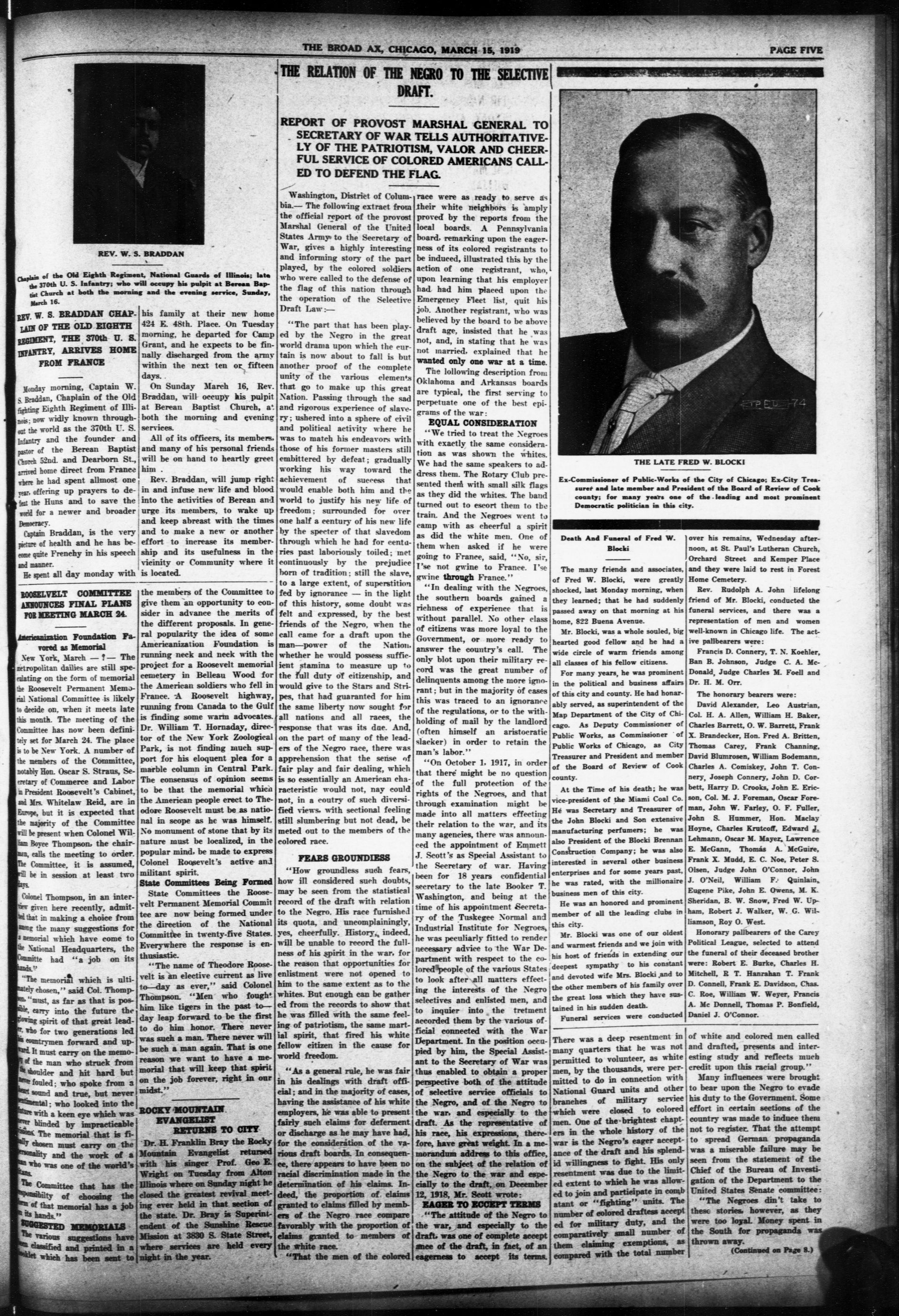
REV. W. S. BRADDAN
Chaplain of the Old Eighth Regiment, National Guards of Illinois; late the 370th U. S. Infantry; who will occupy his pulpit at Berean Baptist Church at both the morning and the evening service, Sunday, March 16.
REV. W. S. BRADDAN CHAPLAIN OF THE OLD EIGHTH REGIMENT, THE 370th U. S. INFANTRY, ARRIVES HOME FROM FRANCE
his family at their new home 424 E. 48th. Place. On Tuesday morning, he departed for Camp Grant, and he expects to be finally discharged from the army within the next ten or fifteen
Monday morning, Captain W. S. Braddan, Chaplain of the Old fighting Eighth Regiment of Illinois; now widely known throughout the world as the 370th U. S. Infantry and the founder and pastor of the Berean Baptist Church 52nd. and Dearborn St., arrived home direct from France where he had spent allmost one year, offering up prayers to defeat the Huns and to save the world for a newer and broader Democracy.
Captain Braddan, is the very picture of health and he has become quite Frenchy in his speech and manner.
He spent all day monday with
BOOSELVELT COMMITTEE
ANNOUNCES FINAL PLANS
FOR MEETING MARCH 24.
vored as Memorial
New York, March — ? — The metropolitan dailies are still speculating on the form of memorial the Roosevelt Permanent Memorial National Committee is likely to decide on, when it meets late this month. The meeting of the Committee has now been definitely set for March 24. The place is to be New York. A number of the members of the Committee, notably Hon. Oscar S. Straus, Secretary of Commerce and Labor in President Roosevelt's Cabinet, and Mrs. Whitelaw Reid, are in Europe, but it is expected that the majority of the Committee will be present when Colonel William Boyce Thompson, the chairman, calls the meeting to order. The Committee, it is assumed, will be in session at least two days.
Colonel Thompson, in an interview given here recently, admitted that in making a choice from among the many suggestions for a memorial which have come to the National Headquarters, the Committee had "a job on its hands."
his family at their new home 424 E. 48th. Place. On Tuesday morning, he departed for Camp Grant, and he expects to be finally discharged from the army within the next ten or fifteen days.
On Sunday March 16, Rev. Braddan, will occupy his pulpit at Berean Baptist Church, at both the morning and evening services.
All of its officers, its members, and many of his personal friends will be on hand to heartly greet him.
Rev. Braddan, will jump right in and infuse new life and blood into the activities of Berean and urge its members, to wake up and keep abreast with the times and to make a new or another effort to increase its membership and its usefulness in the vicinity or Community where it is located.
the members of the Committee to give them an opportunity to consider in advance the merits of the different proposals. In general popularity the idea of some Americanization Foundation is running neck and neck with the project for a Roosevelt memorial cemetery in Belleau Wood for the American soldiers who fell in France. A Roosevelt highway, running from Canada to the Gulf is finding some warm advocates. Dr. William T. Hornaday, director of the New York Zoological Park, is not finding much support for his eloquent plea for a marble column in Central Park. The consensus of opinion seems to be that the memorial which the American people erect to Theodore Roosevelt must be as national in scope as he was himself. No monument of stone that by its nature must be localized, in the popular mind, be made to express Colonel Roosevelt's active and militant spirit.
State Committees the Roosevelt Permanent Memorial Committee are now being formed under the direction of the National Committee in twenty-five States. Everywhere the response is enthusiastic.
"The name of Theodore Roosevelt is an elective current as live to-day as ever," said Colonel Thompson. "Men who fought him like tigers in the past to-day leap forward to be the first to do him honor. There never was such a man. There never will be such a man again. That is one reason we want to have a memorial that will keep that spirit on the job forever, right in our midst."
ROCKY MOUNTAIN
RETURNS TO CITY
Dr. H. Franklin Bray the Roeky Mountain Evangelist retursed with his singer Prof. Geo E. Wright on Tuesday from Alton Illinois where on Sunday night he closed the greatest revival meeting ever held in that section of the state. Dr. Bray is Superintendent of the Sunshine Rescue Mission at 3830 S. State Street, where services are held every night in the year.
THE BROAD AX, CHICAGO, MARCH 15, 1919
THE RELATION OF THE NEGRO TO THE SELECTIVE DRAFT.
REPORT OF PROVOST MARSHAL GENERAL TO SECRETARY OF WAR TELLS AUTHORITATIVELY OF THE PATRIOTISM, VALOR AND CHEERFUL SERVICE OF COLORED AMERICANS CALLED TO DEFEND THE FLAG.
Washington, District of Columbia.—The following extract from the official report of the provost Marshal General of the United States Army to the Secretary of War, gives a highly interesting and informing story of the part played, by the colored soldiers who were called to the defense of the flag of this nation through the operation of the Selective Draft Law:—
"The part that has been played by the Negro in the great world drama upon which the curtain is now about to fall is but another proof of the complete unity of the various elements that go to make up this great Nation. Passing through the sad and rigorous experience of slavery; ushered into a sphere of civil and political activity where he was to match his endeavors with those of his former masters still embittered by defeat; gradually working his way toward the achievement of success that would enable both him and the world to justify his new life of freedom; surrounded for over one half a century of his new life by the specter of that slavedom through which he had for centuries past laboriously toiled; met continuously by the prejudice born of tradition; still the slave, to a large extent, of superstition fed by ignorance — in the light of this history, some doubt was felt and expressed, by the best friends of the Negro, when the call came for a draft upon the man—power of the Nation; whether he would possess sufficient stamina to measure up to the full duty of citizenship, and would give to the Stars and Stripes, that had guaranteed for him the same liberty now sought for all nations and all races, the response that was its due. And, on the part of many of the leaders of the Negro race, there was apprehension that the sense of fair play and fair dealing, which is so essentially an American characteristic would not, nay could not, in a country of such diversified views, with sectional feeling still slumbering but not dead, be meted out to the members of the colored race.
FEARS GROUNDIESS
"How groundless such fears, how ill considered such doubts, may be seen from the statistical record of the draft with relation to the Negro. His race furnished its quota, and uncomplainingly, yes, cheerfully. History, indeed, will be unable to record the fullness of his spirit in the war, for the reason that opportunities for enlistment were not opened to him to the same extent as to the whites. But enough can be gathered from the records to show that he was filled with the same feeling of patriotism, the same martial spirit, that fired his white fellow citizen in the cause for world freedom.
"As a general rule, he was fair in his dealings with draft official; and in the majority of cases, having the assistance of his white employers, he was able to present fairly such claims for deferment or discharge as he may have had, for the consideration of the various draft boards. In consequence, there appears to have been no racial discrimination made in the determination of his claims. Indeed, the proportion of claims granted to claims filled by members of the Negro race compare favorably with the proportion of claims granted to members of the white race.
"That the men of the colored
---
race were as ready to serve as their white neighbors is amply proved by the reports from the local boards. A Pennsylvania board. remarking upon the eagerness of its colored registrants to be induced, illustrated this by the action of one registrant, who, upon learning that his employer had had him placed upon the Emergency Fleet list, quit his job. Another registrant, who was believed by the board to be above draft age, insisted that he was not, and, in stating that he was not married, explained that he wanted only one war at a time. The following description from Oklahoma and Arkansas boards are typical, the first serving to perpetuate one of the best epigrams of the war:
EQUAL CONSIDERATION
"We tried to treat the Negroes with exactly the same consideration as was shown the whites. We had the same speakers to address them. The Rotary Club presented them with small silk flags as they did the whites. The band turned out to escort them to the train. And the Negroes went to camp with as cheerful a spirit as did the white men. One of them when asked if he were going to France, said, "No, sir, I'se not gwine to France. I'se gwine through France."
"In dealing with the Negroes, the southern boards gained a richness of experience that is without parallel. No other class of citizens was more loyal to the Government, or more ready to answer the country's call. The only blot upon their military record was the great number of delinquents among the more ignorant; but in the majority of cases this was traced to an ignorance of the regulations, or to the withholding of mail by the landlord (often himself an aristocratic slacker) in order to retain the man's labor."
"On October 1. 1917, in order that there might be no question of the full protection of the rights of the Negroes, and that through examination might be made into all matters effecting their relation to the war, and its many agencies, there was announced the appointment of Emmett J. Scott's as Special Assistant to the Secretary of war. Having been for 18 years confidential secretary to the late Booker T. Washington, and being at the time of his appointment Secretary of the Tuskegee Normal and Industrial Institute for Negroes, he was peculiarly fitted to render necessary advice to the War Department with respect to the colored people of the various States to look after all matters effecting the interests of the Negro selectives and enlisted men, and to inquier into the tretment accorded them by the various official connected with the War Department. In the position occupied by him, the Special Assistant to the Secretary of War was thus enabled to obtain a proper perspective both of the attitude of selective service officials to the Negro, and of the Negro to the war, and especially to the draft. As the representative of his race, his expressions, therefore, have great weight. In a memorandum address to this office, on the subject of the relation of the Negro to the war and especially to the draft, on December 12. 1918. Mr. Scott wrote:
EAGER TO ECCEPT TERMS "The attitude of the Negro to the war, and especially to the draft, was one of complete accept ance of the draft, in fact, of an eagerness to accept its terms.
TPEU 74
THE LATE FRED W. BLOCKI
Ex-Commissioner of Public-Works of the City of Chicago; Ex-City Treasurer and late member and President of the Board of Review of Cook county; for many years one of the leading and most prominent Democratic politician in this city.
Ex-Commissioner of Public-Works of the City of Chicago; Ex-City Treasurer and late member and President of the Board of Review of Cook county; for many years one of the leading and most prominent Democratic politician in this city.
Death And Funeral of Fred W.
Blocki
The many friends and associates, of Fred W. Blocki, were greatly shocked, last Monday morning, when they learned; that he had suddenly passed away on that morning at his home, 822 Buena Avenue.
Mr. Blocki, was a whole souled, big hearted good fellow and he had a wide circle of warm friends among all classes of his fellow citizens.
For many years, he was prominent in the political and business affairs of this city and county. He had honorably served, as superintendent of the Map Department of the City of Chicago. As Deputy Commissioner of Public Works, as Commissioner of Public Works of Chicago, as City Treasurer and President and member of the Board of Review of Cook county.
At the Time of his death; he was vice-president of the Miami Coal Co. He was Secretary and Treasurer of the John Blocki and Son extensive manufacturing perfumers; he was also President of the Blocki Brennan Construction Company; he was also interested in several other business enterprises and for some years past, he was rated, with the millionaire business men of this city. He was an honored and prominent member of all the leading clubs in this city.
Mr. Blocki was one of our oldest and warmest friends and we join with his host of friends in extending our deepest sympathy to his constant and devoted wife Mrs. Blocki and to the other members of his family over the great loss which they have sustained in his sudden death.
There was a deep resentment in many quarters that he was not permitted to volunteer, as white men, by the thousands, were permitted to do in connection with National Guard units and other branches of military service which were closed to colored men. One of the brightest chapters in the whole history of the war is the Negro's eager acceptance of the draft and his splendid willingness to fight. His only resentment was due to the limited extent to which he was allowed to join and participate in combat or "fighting" units. The number of colored draftess accepted for military duty, and the comparatively small number of them claiming exemptions, as compared with the total number
TREU 74
of the City of Chicago; Ex-City Treasident of the Board of Review of Cook of the leading and most prominent ty.
over his remains, Wednesday afternoon, at St. Paul's Lutheran Church, Orchard Street and Kemper Place and they were laid to rest in Forest Home Cemetery.
Rev. Rudolph A. John lifelong friend of Mr. Blocki, conducted the funeral services, and there was a representation of men and women well-known in Chicago life. The active pallbearers were:
Francis D. Connery, T. N. Koehler, Ban B. Johnson, Judge C. A. McDonald, Judge Charles M. Foell and Dr. H. M. Orr.
The honorary bearers were:
David Alexander, Leo Austrian, Col. H. A. Allen, William H. Baker, Charles Barrett, O. W. Barrett, Frank X. Brandecker, Hon. Fred A. Britten, Thomas Carey, Frank Channing, David Blumrosen, William Bodemann, Charles A. Comiskey, John T. Connery, Joseph Connery, John D. Corbett, Harry D. Crooks, John E. Ericson, Col. M. J. Foreman, Oscar Foreman, John W. Farley, O. F. Fuller, John S. Hummer, Hon. Maclay Hoyne, Charles Krutcoff, Edward J. Lehmann, Oscar M. Mayer, Lawrence E. McGann, Thomás A. McGuire, Frank X. Mudd, E. C. Noe, Peter S. Olsen, Judge John O'Connor, John J. O'Neil, William F. Quinlain, Eugene Pike, John E. Owens, M. K. Sheridan, B. W. Snow, Fred W. Upham, Robert J. Walker, W. G. Williamson, Roy O. West.
Honorary palbearers of the Carey Political League, selected to attend the funeral of their deceased brother were: Robert E. Burke, Charles H. Mitchell, R T. Hanrahan T. Frank D. Connell, Frank E. Davidson, Chas. C. Roe, William W. Weyer, Francis A. Mc Donnell, Thomas P. Bonfield, Daniel J. O'Connor. of white and colored men called and drafted, presents and interesting study and reflects much credit upon this racial group."
Many influences were brought to bear upon the Negro to evade his duty to the Government. Some effort in certain sections of the country was made to induce them not to register. That the attempt to spread German propaganda was a miserable failure may be seen from the statement of the Chief of the Bureau of Investigation of the Department to the United States Senate committee: "The Negroes dn't take to these stories, however, as they were too loyal. Money spent in the South for propaganda was thrown away.
(Continued on Page 8.)
PAGE FIVE
Ex-City Treaty review of Cook most prominent
on Page 8.)
GOWNS AND HATS SHOWN IN PARIS
Black Charmeuse Dress Is a Type
Every Woman Needs in
Her Wardrobe.
EARLY SPRING FLORAL TOQUE
Headgear That Is a Real Joy to Eyes
Wearied by Sight of Gray,
Dreary Days and
Evenings.
This week is sketched a distinct novelty, which would certainly prove very useful for afternoon wear. It is a black charmeuse dress which takes the form of an ultralong tunic, thrown over a straight fourreau of black and white broche silk. The dress is exactly the same back and front and it is in reality a throw-on dress, invisibly attached to the broche fourreau on the shoulders by pressure buttons. The dress buttons right down the back, and down the front from the
THE
A novel black charmeuse frock opening at back and front over a straight fourreau of black and white broche silk.
point of the deep V opening, and the outline is quite original. The ceinture is made of white skunk and the same fur borders the high Medicl collar and petal cuffs.
This is the type of dress, writes a Paris correspondent, that all elegant women need in their wardrobes. It is sufficiently ornate to wear at a fashionable wedding, and yet it might with perfect propriety be worn at a restaurant tea, or for ordinary visiting. This idea of throwing on a picturesque satin dress over a brocaded or striped princess robe is very popular in Paris just now.
We are in the midst of galey of one kind or another. Your splendid president has been in our midst and visits, of a ceremonious order, were the order of the day. Now for such visits this is the kind of costume that our smartest women wore. Something original, dressy without being eccentric and rich withal. The combination of black charmeuse and brocaded silk is immensely popular.
Materials Are Favored.
Worth is using these two materials with the best effects; so is Mme. Paquin and so is Doucet. I saw, recently, in Doucet's showrooms a model dress very similar to that sketched, which was made of deep purple panne over gray and black brocaded silk, the latter material being traced over with silver threads. On the neck and sleeves there were narrow borders of sable.
There was a long cape-wrap to accompany the dress and this was also made of purple panne, with an immense sable collar and a lining of silver gray peau de soie—a truly regal toilette. The Parisiennes fell in love with Mrs. Wilson. Everywhere one heard of her "lovely smile" and—for French women place great faith in a correct taste in dress—of her excellent taste in sartorial matters.
I heard a well-known leader of Parisian society exclam: "Mme. Wilson puts on her hats quite perfectly." Greater praise than this could not be given—by a Parisienne. For the presidential entertainments many lovely afternoon and evening dresses were ordered in the rue de la Palm. Amongst these I noticed several lace gowns, set in flouches from waist to hem and worn with a tight-fitting satin or emboldered tulle corsage which recalls the outline of days gone by. Lace dresses are becoming quite a craze in Paris; black lace, cream lace and the two combined. We are drifting toward a revival of fussy evening dresses; elaborate gowns trimmed with flouces and with intricate draperies and loops or ribbon. We are in for a reaction in dress matters.
For a long time back we have been satisfied with evening dresses of severe outline, which one could hardly call evening gowns at all.
Await the Final Peace.
Now we are rapidly blossoming out.
As if by magic the big "Maison" have suddenly produced exquisite and elaborate evening toilets, though the Parisiennes insist that really decollate
dresses will not come right into fashion until peace is really signed. All the same we are dancing gaily along the road with leads to such frivolities. Mirror velvet and panne may be said to be the favorite materials of the present moment for afternoon dresses of elaborate order, and both these materials are mixed with silk jersey-cloth and with bands of handsome fur. Nearly all the more expensive models have rich embroideries on corsage or side-panel, and these embroideries are achieved in metallic threads, glittering beads, brilliant silks and chillelle.
I have often seen all these combined on a single length of embroidery. Worth is showing some lovely velvet princess robes which have richly embroidered, very high collars and cleverly arranged draperies of fine silk jersey cloth which fall heavy and straight at the sides of the robe. One model which specially pleased me was in mole-gray velvet, with mole-gray silk jersey cloth side draperies and superb embroideries worked in silver threads and steel beads. There was a high Medici collar, covered with embroidery and bordered with moleskin and the petal sleeves were very similar to those shown in our sketch. This was one of those elegant, dignified toilettes which are eminently suitable for women of "certain age;" soft, rich dresses, which look so lovely when combined with pure white hair, carefully arranged.
Once again we have floral toques in our midst. This is the best of good news, for the floral toque in early spring, is a thing of beauty and a real joy to eyes weared by the sight of gray, rather dreary, days and evenings. And then the floral toque is almost universally becoming. The leading milliners in Paris are showing these toques in several different forms; but personally I award the palm for beauty to the close-fitting Russian turban shape which I have sketched.
On a young and pretty girl, or woman, this is an ideal toque for early spring wear. It may be covered with any small flat flower, but roses, violets, hyacinths or scarlet japonica blossoms are perhaps the best of all. The model was covered with dull pink Banksia roses, and very lovely it was. Quite plain and simple, but full of rich and varied color, for the little roses were shaded—here and there dark.
This style of toque must be pressed close down on the head so that the hair at the back is almost covered. No fringe shows on the forehead, but coguettish curls are allowed to strangle forward over the ears. A toque of this kind made entirely of dark purple violets would be lovely; or of Parma violets mixed with dull blue hyacinths; or again with moss roses and soft green rose leaves.
The correct thing to combine with such a toque as this is a large square
M
Floral toque covered with dull pink Bankia roses. A thing of beauty and a great relief from the dark gray days.
throw-over veil made of taupe gray Russian net, with the border embroidered in silver threads. These taupe-colored veils are extremely becoming to bright complexions. They look remarkably smart when worn with an all-black hat or toque.
For early spring wear Lewis is already showing very large flat-brimmed hats made entirely of satin and trimmed with flat sows of velvet ribbon, the latter being placed at one side near the back. Everyone says that the spring season will open exceptionally early this year of 1919. It is to be hoped that the clerk of the weather will remember that we shall badly need a great deal of brilliant sunshine. What is a fete without sunshine? And this year Paris will enjoy one long, long fete.
Frilling by the yard was the standard neck-and-sleeve finish at one time. Now it is quite prominent again on the neckwear counters, being used for the round-necked, collarless dress or waist. It comes in white, maize and other soft tones. With a fold of some suitable color it is worn as a fichu.
Jet and Velvet Hats for Late Winter. For late winter wear there are some very attractive little hats of jet and velvet. The Jet sequins are spangled all over with velvet, which is then concocted into a becoming little hat with a puffed crown and a narrow brim. Some of these hats are cut with mitered crown, like a bishop's can.
THE BROAD AX, CHICAGO, MARCH 15, 1919
COATS FOR GIRLS
Shepherd's Plaid and Wool Fabrics Are to Be Favorites.
Taffetas in Wide Range of Colors and Shades—Navy and Tan Are Also Popular.
The most important item in the spring outfit of every young girl is the separate coat. For several years washable dresses have been preferred for girls under six, regardless of season. Therefore few radical changes are noted in dresses developed for these junior citizens. Of course, every season brings its novelties, changes in fabric, color and color combination, but actual style changes are so few that a cotton wash frock made for summer wear may appear with equally good effect during winter, or vice versa.
Spring naturally makes the heavy winter coat an impossible garment. Therefore the new spring coat is an all-important item of the little girl's wardrobe.
During the coming spring taffeta and shepherd's plaid wool fabrics will unquestionably be the favorite ma-
F
Little Girls' Coat of Shepherd's Plaid.
materials for the development of little girls' coats. Taffetas appear in a wide range of colors and shades. Navy, of course, is good, tan shades are extremely popular and the light blues such as French and soldier blue, also are favorites.
These little coats are usually made with a normal waistline or with a waistline a trifle higher than normal. There is always a waistline. The straight coats make their appearance for older girls and for women.
Shepherd's plaid wool fabric makes an extremely chic little coat and one that is always serviceable.
The sketch gives a suggestion for a smart coat for a girl of six or eight years. The belt may be of patent leather in either red or black, the buttons, of course, being selected to match the shade of the belt. The coat is finished at the neck with a collar of plaid over which is laid a detachable collar of white satin, georgette or organdie. Lace collars are pretty, but they are usually worn on the taffeta coats, the more tailored, plain collars being preferred for coats of wool material.
GOWNS TO MATCH HANGINGS
Recent Fad Is to Have Apparel Harmonize With Draperies and Appointments of the Boudoir.
One of the latest fads of fashion is the elaborate room gown designed to harmonize with the hangings and appointments of the boudoir itself and for these rose pink brocade, French blue, and metal brocades are the first requisition.
A shimmery gold and blue brocade, light in effect, has been used for one of these. It is cut on kimono lines, but softly draped at either side of the front. Dull gold braid, oddly tasseled in gilt and black beads, makes an edge finish, and a single large motif of the braid marks the fastening at one side. The garment is lined in chiffon of the shade of light Parma violets, and the whole suggests a setting done in dainty French boudoir style.
In the same spirit is designed a brighter model of flame color, with lace bodice and overjacket of flame, trimmed with changeable ribbon in a soft shade of light blue shot with flame.
On New Handkerchiefs
On New Handkerchiefs.
Black dots on blue form the decorative scheme of one of the daintiest of the new handkerchiefs. The dots form an irregular border, widening at the corners, where they are interspersed with a few bits of embroidery done in white cotton thread. Black handkerchiefs, that is handkerchiefs with black centers, are often seen. They have borders of color, usually printed in blocks, or checks or stripes. These handkerchiefs are a bit startling, even to the eye used to handkerchiefs of all colors of the rainbow—for, of course, black isn't in the rainbow.
Through the Looking Glass By EVELYN NESBIT
When a man offers you the world with a fence around it, there may be a string tied to it. Watch out for the string.
D
It is foolish for a young girl to marry a man for the things he promises to give her after the knot is tied. So easy is the business of making promises that all young swains are prone to paint the future in brilliant colors. And the young girl nibbles and bites. Then she regrets it—when it is too late.
Don't marry in the hope that you may ride in a golden automobile, or that you may have ice cream for dessert every day. Those are not the things that count. Don't marry for the sake of living in a hubby-to-be's fine five-story house, or for the sake of becoming part owner in his prosperous business. Watch out for the string.
Hubby-to-be may offer you hts fine house as a home before you are married, but afterward he may expect you to run it for him as a boarding house. Hubby-to-be may offer you before you are married a partnership in his fine, prosperous business, but afterward he may expect you to sink your precious savings into it and lose them all.
Watch out for the string when you marry a man for the material good you may expect to get out of the match. If you have your eyes open beforehand you may learn that marriage founded on dollars and cents is a delusion and a snare. The woman who marries for the sake of having the world with a fence around it generally loses in the end.
CHECK SERGE SPRING SUIT
Copyright
Underwood &
Godefried
This very attractive spring suit is of check serge and black binding. It is a model that should appeal to many of the stylish dressers.
DICTATES OF FASHION
The richer the fabric the less it should be trimmed.
Draped collars appear on the spring wrap coats.
Gray astrakhan is much liked on suits instead of other furs.
Leopard skin makes a most striking trimming for beige velvet.
Match Scratcher.
Save the strip of sandpaper that comes on the match boxes and tack on jamb of door with tiny Swede tucks; or strips of sandpaper may be cut five inches long and three-eighth-inch wide. Place a tack at each end and one in the middle. This will not interfere with opening and closing of door, and will save steps in running back to get another match.
Skirts Have Deep Hems.
Many of the new organdle and other sheer frocks are made with hems so deep as to meet midway from the ankles to the waistline. This makes the frock set rather better than otherwise, because of the added weight at the lower half of the skirt, and also renders a skirt made of transparent material less transparent.
TO BLEND COLORS
Trick Is in Knowing What Hues Will Combine.
Some of the Popular and Harmonizing Tints That Are in the Limelight This Season.
The trick is in knowing what colors combine. It is not enough to know that such and such a color carries fashion's immediate favor, but to know just what color that color goes with to conform with the canons of smartness. And really in designing your new frocks, if you have settled the matter of color combination, you have accomplished quite a little. For color combinations that would be impossible one season have, because they are stamped with the approval of some great dressmaker, or through some association of the times, taken first place among combinations that are distinctly possible.
At the present time Paris has stamped with her approval combinations of metallic hue and almost any color on the calendar. Thus many of the smartest new ribbons show silver or gold threads running one way, with the colored threads running the other. These are used extensively in connection with the new evening frocks. Among the interesting ones are gold and brown, gold with a bright blue and silver with emerald green. Such a ribbon would, of course, give the key to the color scheme of the evening frock on which it was used. Pale blue georgette over yellow is a color combination seen in some of the newest lingerie. The effect is a rather vague green. For the young woman with a complexion fair and clear such a color combination would have great charm in an evening frock.
Henna may be on the wane, but it has attached some interest to itself even in a house gown in which it is combined with mustard yellow. Now, this doesn't sound very pretty, and perhaps it isn't pretty, but interesting it is, and it carries with it a distinct impression of smartness.
Another color combination that isn't pretty, but that has the "right" look to it, is violet and brick. Some shades of brown are used with a vivid red in some of the evening hats in Paris, and, though brown and red would to most persons seem to be a very unlovely combination, this carries the seal of fashion's approval. Cream and cerise are interestingly combined in one of the new foulards, and this might suggest a color scheme for an afternoon frock of considerable distinction.
Particularly pleasing at all times are combinations of two harmonizing shades of the same color. They are never difficult as are some of the more daring contrasting combinations. Paquin used two shades of rose in marquisette recently with extremely effective results, and another French dressmaker used orchid georgette embroidered in rose wool.
BEDROOM LINENS AND SCARFS
Blocked Effect Is Done Either in Colors or White, According to Accompanying Embroidery.
A curious development in table linens and scarfs for the bedroom is the blocked effect done either in colors or white, according to the character of the accompanying embroidery and in various ways. The reason for this is rather obvious. Now that fine linens have become so scarce, the pleasure of looking at a pure, unbroken surface of soft white linen is not for the housewife of today. Her "linens" will very likely be cottons for some time, and anything which will break the cotton expanse and make the finish less noticeable is welcome.
Hemstitching by machine or hand is one way of making these checkered cloths. Outline or couching is effective, too. The blocks vary according to the size of the piece, but six inches is a good working size for most of them. Small motifs may then appear in the corners or in every other block, or as a border around the edge. There is much chance for novelty here.
STYLISH HAT FOR SPRING
THE WEEKEND
Smart hat for spring in turquoise blue braid with old-fashioned flowers and double-faced ribbon of blue and black.
Women in Sweden have been permitted to take the higher university degrees since 1882.
Sherri
Sherri
Sherri
Simplicity in lines is the keynote of this attractive green duvetyn coats. Practically the only deviation in found in the four little box plains. There are self-piped button holes and fancy black and green buttons to match.
USES FOR ODDS AND ENDS
Save old ribbons of various colors press with a hot iron and put them away to be used in mending old garments. The under seams of old waists may be beautifully mended in this manner if you have a strip of ribbon the same color.
Often round doilies can be cut from the best part in such a way as to bring a pattern in the center. A border may be crocheted around this and pretty plate doilies made for ordinary use.
To make kitchen towels last longer when they begin to wear thin, place two together and stitch all around the edge, then lengthwise down the middle of the towel and once each side at the middle half way to the edge of the towel.
Linen collars which have been discarded make excellent bandages to use for cuts, burns and bruises. Soak them in water until soft, cut off the stitching, then dry and make into rolls ready for any emergency. Old stockings, especially heavy fleeced ones, may be used to make underdrawers for small children. They are easily made by making a V seat.
Spring Brings Cotton Blouses.
Spring Brings Cotton Blouses.
The seasons dovetail into each other so closely that style questions are just about settled for winter when along comes spring to unsettle them again, and so on through the year. During the fall and winter days, silks of all kinds hold sway in the development of all lines and types of garments. When warm weather aproaches fine, sheer cotton fabrics are found very much worth while in least two lines—blouses and undergarments. Batiste, organdie and very fine volle are the three most popular cotton waist fabrics, and for the comin season hand-made laces, such as fillet and Irish crochet, will be the popular trimmings, with hand embroidery and hestitching aiding in the decorative scheme.
Fadeless Kitchen Gowns
Fadeless Kitchen Gingham
Kitchen dresses of light weight or bleached cotton were adopted by dainty young housewife who found that her colored wash dresses faded quickly, "and," she says, "I never looked so well in the kitchen before. All are made by some simple pattern and have a touch of colored brodery or crochet on the neck, bell sleeves, and pockets. These dresses can be washed and boiled and then no starch, and they look new when they are worn out, and will outweigh gingham or percale. The material should be shrunk before cutting.
Heavy Sweaters of Silk.
Shops are showing heavy silk sweaters for winter wear. They are especially desirable for indoor wear when the low supply of coal makes it impossible to keep up the normal degree of heat. These new sweaters have many odd bits of finishing, such as veens, deep collars, fringed edges and usual cuffs—anything for the sake of novelty.
Tailored Blouses of Silk.
The strictly man-tailored shirt-blouses cut on the lines of men's shirts with straight shirt sleeves with mannish cuffs and adjustable high or low collars is in great demand for sport wear. These are in plain wash silk and sash and in fancy colorfully striped wash silk.
Women school executives of Kansas have organized a state association.
IT PAYS TO ADVERTISE IN THE BROAD AX
Stop Thief!
THE "Jumbo" gas burner shown here at the right, (actual size) is a robber on any gas lighting fixture in Chicago. If you have one, get rid of it! It makes high gas bills and causes a great many of the complaints that come to us.
Claims that a "Jumbo" will give more light without using more gas are false.
Use mantle burners to get more light with Burning five hours a day for a month, the consumes $2.30 worth of gas; a "Junior" man in the same time, consumes only 39 cents $1.91 less, and gives much more light.
Use mantle burners to get more light with the Burning five hours a day for a month, the consumes $2.30 worth of gas; a "Junior" mantle in the same time, consumes only 39 cents w $1.91 less, and gives much more light.
Use mantle burners to get more light with less gas. Burning five hours a day for a month, the "Jumbo" consumes $2.30 worth of gas; a "Junior" mantle burner, in the same time, consumes only 39 cents worth, or $1.91 less, and gives much more light.
This Is the
"JUNIOR MANTLE"
Telephone Calumet 602-3572
HUGH NORRIS, Pres. KIRBY W
NORRIS-WA
COAL CO.
NORRIS-WAI
COAL CO.
Incorporated
2545 SOUTH PARK AVENUE
Chicago
---
---
THE FORTY-FOURTH STREET
THE CRANFORD Apartment Building
3600 WABASH AVENUE
The finest building ever opened to Colored tenants in Chicago. Steam heat, electric lights, tile baths, marble entrance
J. W. CASEY, Agent
Phone Main 263 133 W. Washington Street
to get more light with less gas. day for a month, the "Jumbo" of gas; a "Junior" mantle burner, insumes only 39 cents worth, or much more light.
We sell "Junior Mantle" lights complete for only fifteen cents, (which is less than "Jumbos" usually cost) or give one free, in exchange for a "Jumbo," at our main office or any of these stores:
West Side
2142 West Madison St.
1709 West 12th St.
1641 Milwaukee Ave.
3221 Oden Ave.
4033 West Madison St.
North Side
3071 Lincoln Ave.
3643 Irving Park Blvd.
408 West North Ave.
South Side
731 West 63rd St.
3478 Archer Ave.
103-5 East 35th St.
9051 Commercial St.
11025 Michigan Ave.
The Peoples Gas Light & Coke Co.
Michigan Avenue at Adams Street
Telephone Wabash 6000
ne Calumet 602-3572
KIRBY WARD, Sec
IS-WARD
AL CO.
A
This Is the "Jumbo" Gas Burner
THE BROAD AX, CHICAGO, MARCH 15, 1919
PATRONIZE OUR ADVERTISERS
As Near As Your Telephone DISTANCE IMMATERIAL
JOHN H. HARRIS
IN a Metropolitan City of this size, death knocks every thirty minutes at some door. Too often that death not only brings sorrow, but misfortune as well. Let the price you pay for a funeral be a business proposition and you will benefit by it in service, quality and cost to you in dollars and cents. The result of my campaign has built for me one of the largest and most magnificent establishments in the world. A visit will convince you.
LAUREL WREATH
Consult me, I can save you Worry, Time and Money. Shipping to all parts of the Country and Automobile Funerals a Specialty. Central Display Rooms and Chapel. Call promptly answered day or night.
OWNERS AND DIRECTORS
DAN M. JACKSON
GEO. T. KERSEY
Phones Calumet 6164
DAVID A McGOWAN
Automatic 71-629
AHMED A. RAYNER
OPEN DAY AND NIGHT
The Emanuel Jackson Undertaking Co., Inc.
Residence 3419 South Park Ave.
PHONE DOUGLAS 9354
Residence: 508 East 36th Street
Phone Douglas 4307
J. GRAY LUCAS
Attorney At Law
Suite 815 Hartford Building
8 S. Dearborn St., Chicago.
Phrase Central 6583
WM. J. LATHAM
OFFICE PHONE: CALUMET 875
2 EAST 31ST STREET
Suite 7
CHICAGO
F. Dunn, J. B. McCahey, Trusees
Tel.: Oakland 1552, 1551, 1550
Tel. Central 3142
JOHN J. DUNN
ESTABLISHED 1877
Wholesale and Retail
S. A. T. WATKINS
36 WEST RANDOLPH STREET CHICAGO
Fifty-First and Federal Sts. CHICAGO
KINKY HAIR
Atlanta, Ga.
Exelento Med. Co.
Gentlemen's Center
My picture shows you what your fine
EXELENTO QUININE POMADE
has done for my little brother. Put it, my hair was short and coarse, and so soft and silky that I can do it any way I want to.
JANIE RAND.
Don't let some fake Kink Remover fool you. You really can a straighten your hair until it's nice and long. That's what EXELENTO QUININE POMADE does, removes Dandruff, feeds the Roots of the hair, and makes it grow long, soft and silky. After using a weed oil, tell the difference, and after a little while it will be so pretty and long that you can fix it up to suit you. If Exelento don't do as we claim, we will give your money back. 25c by mail on receipt of stamp or coin.
AGENTS WANTED EVENTWHERE
Write Poem
EXELENTO MEDICINE CO., Atlanta, Ga.
WALTER M. FARMER
ATTORNEY AND
COUNSELOR AT LAW
NOTARY PUBLIC
Suite 708
184 W. Washington St.
Tel., Office, Main 4153 Auto 33736
CHICAGO
MILES J. DEVINE
Attorney At Law
Suite 318-320 REAPER BLOCK
Clark and Washington Streets
Phone Central 1239
CHICAGO
A. D. GASH
Attorney At Law
118 North La Salle Street
CHICAGO
A. F. CODOZOE
J. H. WHISTON, Proprietors
CHAS. HARRIS, Manager
The E
and
3030 STATE STREET
National Hall Bldg. 4300 So. State St.
Space for Offices, Professional and Others Lodge and Assembly Halls. .. Large and Spacious Dance Hall. .. Best Ventilated Halls in Chicago for Rent. .. .. ..
Chicago Title and Trust Company
OUR BUSINESS SINCE 1847 has been that of showing the condition of real estate titles. The millions upon millions required to build and rebuild Chicago have been furnished relying on the accuracy of our ABSTRACTS and TITLE POLICIES.
Wise men judge future action by past behavior
CHICAGO TITLE AND TRUST COMPANY
GEORGE F. HARDING, JR.
Up-to-Date or Modern Houses Apartments and Stores to Rent
3101 Cottage Grove Avenue Corner 31st Street, Chicago
JOHNSON EXPRESS, STORAGE AND VAN CO.
EXPERT PIANO MOVERS—AUTO SERVICE
Packers, Shippers and Storage
TRUNKS TO AND FROM ALL DEPOTS
Main Office: 1431 East 67th Street
AUTO. 72-379
Phones: DOUGLAS 3256
DOUGLAS 5071
Cafe
et
PAGE SEVEN
CHICAGO
THE BR
THE BROAD AX
PUBLISHED EVERY SATURDAY
In this city since July 15th, 18
Republicans, Democrats, Catholics,
infidels or anyone else can have the
proper and responsibility is fixed.
The Broad Ax is a newspaper
all, ever claiming the editorial m
Local communications will re
on one side of the paper.
Subscriptions must be paid i
One Year.
Six Months.
Advertising rates made know
Vol. XXIV. MA
In this city since July 15th, 1899, without missing one single issue. Republicans, Democrats, Catholics, Protestants, Single Taxers, Priests, infidels or anyone else can have their say as long as their language is proper and responsibility is fixed.
The Broad Ax is a newspaper whose platform is broad enough for all, ever claiming the editorial right to speak its own mind. Local communications will receive attention. Write plainly, only on one side of the paper.
Address all communications to
THE BROAD AX
6206 South Elizabeth Street, Chicago, Ill.
Phone Wentworth 2597.
JULIUS F. TAYLOR.....Editor and
DR. M. A. MAJORS.....Assoc.
4700 South State Street,
Phone Drexel 1416
IMPORTANT NOTICE
For resolutions, obituary notices, cards of thanks,
special announcements of events to happen, when a charge
sion is made, and the opening of new business enterpris
cents per line; 6 words or fraction makes one line.
Personal or social items such as marriages, births,
everything of a general interest, published free of charge
Entered as Second-Class Matter, August 19, 1992, at the Post Office at
Under Act of March 3, 1879.
IMPORTANT NOTICE
For resolutions, obituary notices, cards of thanks, write-ups, special announcements of events to happen, when a charge of admission is made, and the opening of new business enterprises, etc., 15 cents per line; 6 words or fraction makes one line.
Personal or social items such as marriages, births, deaths and everything of a general interest, published free of charge.
THE COLORED SOLDIERS IN THE WAR IN FRANCE.
(Concluded from Page 5.)
HOW MORALE WAS
PROMOTED
"Then, too, these evil influences were more than offset by the various publicity and "promotion of morale" measures carried on through the office of the Special Assistant to the Secretary of War, and his assistants. Correspondence was kept up with influential Negroes all over the courty. Letters, circulars, and news items for the purpose of effecting and encouraging the continued loyalty of the Negro citizens were regularly issued to the various papers comprising both the white and Negro press. "A special committee of 100 colored speakers was appointed to deliver public patriotic addresses all over the courty, under the auspices of the. Committee on Public Information, stating the war aims of the Government and seeking to keep unbroken the spirit of loyalty of colored American citizens.
"A special conference of Negro editors was called to meet in Washington in June, 1918, under the auspices of the Committee on Public Information, in order to gather and disseminate the thought and public opinion of the various leaders of the Negro race. Such has been only a part of the work of the department of the Special Assistant to the Secretary of War in the record of the marshaling of the man power of the American Nation.
"The appreciation of this representative of the colored race for the cooperation shown by the Selective Service administration, especially as it affected members of the colored race, in reference to occasional complaints received, will appear from the following extract from a memorandum written to this office on September 12th, by the Special Assistant to the Secretary of War:
MR. SCOTT TELS OF DRAFT
FAIRNESS
"Throughout my tenure here I have keenly appreciated the prompt and cordial cooperation of the Provost Marshall General's Office with that particular section of the office of the Secretary of War especially referred to herein. The Provost Marshal General's Office has carefully investigated and has furnished full and complete reports in each and every complaint or case referred to it for attention, involving discrimination, race prejudice, erroneous classification of draftees, etc., and has rectified these complaints whenever it was found upon investigation that there was just ground for the same. Especially in the matter of supplying
```markdown
```
PAGE EIGHT
1
1899, without missing one single issue.
lics, Protestants, Single Taxers, Priests,
their say as long as their language is
ed.
Other whose platform is broad enough for
right to speak its own mind.
receive attention. Write plainly, only
in advance.
.....$2.00
1.00
own on application.
MARCH 15 No. 26
notices, cards of thanks, write-ups,
to happen, when a charge of admis-
tion makes one line.
such as marriages, births, deaths and
published free of charge.
19, 1992, at the Post Office at Chicago, Ill.
of March 8, 1879.
and carrying out the Selective Service Regulations, the Provost Marshal General's Office has kept a watchful eye upon certain local exemption boards which seemed disinclined to threat Negro draftees on the same basis as other Americans subject to the draft law. It is an actual fact that in a number of instances where flagrant violations have occurred in the application of the draft law to Negro men in certain sections of the country, local exemption boards have been removed bodily and new boards have been appointed to supplant them. In several instances these boards so appointed have been ordered by the Provost Marshal General to reclassify colored men who had been unlawfully conscripted into the Army men have had their complaints remedied and have been properly reclassified.
"It is also valuable to note the opinion of his representative of the colored race as to the results of the Negroe's participation in the war. :
"In a word, I believe that the Negro's participation in the war his eagerness to serve, and his great courage and demonstrated valor across the seas, have given him a new idea of Americanism and likewise have given to the white people of our country a new idea of his citizenship, his real character and capabilities, and his 100 per cent Americanism Incidentally, the Negro has been helped in many ways, physically and mentally and has been made into an even more satisfactory asset to the Nation."
BETHEL LITERARY SOCIETY
Last Sunday afternoon, Prof. Willis N. Huggins, A. M. B. S. for three years Social worker, and teacher in New York Public Schools, two years Professor of History and Sociology at the Colored State College Huntsville, Ala. and now instructor of Mechanical Drawing and Manual Training in three of the public Schools of this City addressed Bethel Literary Subject "Vocational Guidance and its relation to Colored Children". Prof. Huggins delivered a very instructive an interesting address and the large audience present requested Pres. Sandy W. Trice, to invite Prof. Huggins to again address us in the near future on the same subject. Music was rendered by Grant Chapel A. M. E. Choir. "Calvary" led by Madame T. L. Scott, a beautiful Contralto, and assisted by the Choir was the musical attraction of the afternoon. Dr. T. L. Scott highly favored us with his presence. Next Sunday afternoon in the Auditorium of Bethel Church under the auspices of Bethel Literary Society,
---
THE BROAD AX. CHICAGO, MARCH 15, 1919
EDITORIAL PAGE
Stewardess board No. 2, Mrs. Mollie Price, Pres. will be addressed by Dr. D. D. Lewis Pres. of Health Sanitorium, Montrel Canada, Subject: "Things that are helpful".—
The special musical numbers are,
SOLO..... Mrs Mary E. Jones
DUETT..... Mrs. Mary Robinson and Miss. Georgia Isabella
SOLO..... Mrs. Nannie Mitchem
THE VICTORY
LIBERTY LOAN
An interesting announcement from Washington, in connection with the coming Victory Liberty Loan campaign, is that the workers in the Victory drive will be awarded medals made from captured German cannon.
An official message to this effect was received from the Treasury Department by Ben F. McCutcheon, Publicity Director of the Liberty Loan Organization, Seventh Federal Reserve District, the text of which follows:
"You are at liberty to make full use of the announcement that the Treasury Department will award medals made from captured German cannon to all workers during the Victory Liberty Loan campaign. The medal is the size of a half dollar and contains on one side a reproduction of the Treasury Building and on the transverse side a certification of Loan participation. Space is left for engraving the name of the recipient."
"I heartily approve of this action of the Government in casting up honor medals made from German cannon to award to Victory Liberty Loan workers," said Charles H. Schweppe, Director of Campaign for the Seventh Federal Reserve District. "It supplies an added incentive to supreme endeavor and surely will have a good effect that will be shown in increased sales. The awarding of these medals made from cannon captured from the foe should result in bringing us a full complement of workers."
LOAN DRIVE TO LAST THREE WEEKS, APRIL 21 — MAY 10
Washington, D. C., (Special)—Secretary of the Treasury Glass announced tonight that the driver subscription of the Victory Liberty Loan will open on April 21 and close on May 10. He has informed official privately that this will be the last popular war loan. The amount probably will be $5,000,000,000. The secretary announced that he had decided to issue short term notes instead of any of the remaining unissued 4½ per cent Liberty bonds, which it is recognized it would be difficult to market extensively.
The loan will take the form of notes of the United States maturing in not over five years. They will be issued both in registered and coupon form, and the coupon notes will be in final form and will have attached the interest coupons covering the entire life of the notes.
Mr. Glass said the interest rate on the notes and the amounts to be exempted from taxation would not be determined until a week or two before the campaign, as they would be based upon financial conditions at that time. It was intimated, however, that the notes might bear interest in excess of 4½ per cent.
Attorney William H. Stanton, of Pittsburg, Pa., spent the first part of this week in Chicago, with his old friend. Alderman Louis B. Anderson.
EIGHT THOUSAND DOLLARS A MONTH SAVED TO GAS CONSUMERS.
As a result of the exposure of the "Jumbo Gas Burner" in this paper, and other publications, the Gas Company reports a turnin of over four thousand of these robber burners in the first four weeks. They have been replaced with Junior Mantle lights, which give about twice as much illumination and consume nearly fifteen feet an hour LESS gas.
The average lighting hours this time of the year are 150 a month, so a saving of fifteen cubic feet per hour on each of these four thousand burners would amount to nearly NINE MILLION CUBIC FEET of gas a month — in dollars and cents about $8,000,00 — an average saving to each customer of $2.00 a month. Any of our readers who are still using these Jumbo burners will save money on their gas bill by getting rid of them at once.
MEN OF 365th RESENT
"JIM CROW" RULE OF
CAPTAIN OF TRANSPORT
They're glad to get home, happy to see their relatives and friends and to be where cooties are not and there's neither bugler nor corporal to disturb their morning sleep.—
But, if some of them had an idea of how they were to be "Jim Crowed" on the way over from France, they would have asked to remain in their mudhole dug-outs "for the rest of our lives."
This was the assertion to-day from many of the Colored warriors of the 365th Infantry which came triumphantly into the city Monday morning. Srgt. Albert H. Jones, assistant band master, who laid down his drum to take one end of a Red Cross stretcher in battle, was particularly indignant.
ENGLISH JURY ASKS
CLEMENCY FOR NEGRO
London, England. (Special). "Manslaughter, but the majority of us think the blow was given under provocation", was the verdict rendered in the trial of Private John Monroe for the murder of Allen MacDonald. a white private in the Canadian forestry corps.
The trial brought out the fact that a black private named John Albert had been called "Nigger" by MacDonald, and when the former resented the epithet, was knocked down. At this point Private Monroe walked up and asked Mac Donald why he had hit Albert, and when DacDonald replied with an abusive term, Monroe knocked him down. When MacDonald was picked up he was dead.
$1,000 DONATED TO
WILBERFORCE BY
MR. & MRS. MALONE
Wilberforce, Ohio. (Special)—The annual Founder's Day celebration proved one of the most successful ever held. Many visitors were present and a most interesting program was rendered. One of the features of the occasion was the donation by Mr. and Mrs. Malone of the Poro College of St. Louis, Mo. of $1,000. With this and other funds raised, the total collections were over $4,000.
MR. AND MRS. F. L. BARNETT JR., ARE HOME AGAIN AFTER SPENDING THEIR HONEY-MOON AT SPARLAND, ILL.
Mr. and Mrs. F. L. Barnett, Jr. 3815 Vernon avenue, have returned from their bridal tour at Sparland, Ill. where they spent their honey moon on the farm of Mr. and Mrs. William Moody.
Monarch's Compliment.
A pretty compliment was that Philip IV of Spain, himself a painter, tendered to a greater artist, Velasquez. When Velasquez had finished his famous picture "Las Meninas," which includes not only Philip and his queen, but the artist himself, brush in hand, he asked of the king, "Is anything wanting?" "One thing only," answered Philip; and taking the palette from Velasquez's hands, he painted on the breast of the artist's figure in the picture the Cross of the Order of Santiago, the most distinguished in Spain.
Animal's Strong Instinct.
Some animals are remarkable, indeed, for the wonderful development of love and devotion they possess and show toward men. They are so acute in the sense of their affections that they seem to perceive the feelings of their master in advance of his expressions. Masters of dumb animals have often been heard to declare that their animals were quicker to detect in them a spirit of anger than were their fellow men.
Trinidad Lizard Farm
On the island of Trinidad there is today a veritable lizard farm which has all the equipment for the successful breeding of these too numerous members of the reptile family which are now known to be indispensable to the sugar planters. In addition to this enterprise a wider search is being made for toads to help increase the world's sugar output.
Custom Hard to Down
Pens made of feathers were common in the seventh century, but so inveterate was the old habit of writing with reeds on parchment and paper that it continued a long time after the first use of quills. The custom of carrying a pen behind the ear is ancient, as may be seen in the life of St. Odo: "He saw a pen sticking in his ear in the manner of a writer."
Poor Relative's Figure.
She said with a sigh, "My, how glad I am that I have a poor relative's figure! I can wear anything from the frocks made for Cousin Anne, who is nearly six feet and looks like a clothespin, to the suits built for Cousin Jane, who is five feet and weighs one hundred and eighty."
Black Marble.
Black marble may be cleaned with a mixture of equal parts of pearlash and soft soap. Apply this with a flannel and let it remain on for some minutes. Then rinse, first with warm and then with cold water. When dry polish with a paraffin cloth until it shines.
New Word.
One of our exchanges tells about a man who "unthoughtedly" left his pocketbook, containing $5, on a counter in a railway station. As an addition to the English language we maintain that unthoughtedly is unthinkable.—St. Louis Republic.
Now You'll Take Better.
Because flashlight powders are not swift enough for the most rapid photography an electrical device has been invented which lights the powder and then snaps the camera shutter when the burning powder is at its greatest brilliancy.
The "Classic."
Perhaps the best definition of classic is that given by Lowell: "Something that can be simple without being vulgar, elevated without being distant, that is neither ancient nor modern, always new and incapable of growing old."
Seeing as Well.
By a Frenchman's invention as a language student hears a word spoken by a phonograph he also sees it appear on a printed roll in conjunction with its'translation in his own tongue.
Keep Children Errect
To make a child maintain an erect position while writing at a school desk a German has invented a rod to be attached to a desk, terminating in a cup against the child's chin.
Keeps Hands and Feet Out.
Keeps Hands and Feet Out. A Greek inventor has produced a machine which automatically cleans and packs more than 150 cases of currants an hour without contact of human hand or foot.
Believes Pain of Sting
The Saroyards rub a crushed clove of garlic upon a spot that has been stung by a wasp or bee. This makes the swelling go down and drives away the pain.
Long-Felt Want
A species of cactus growing prolifically in Algeria has been made by French scientists to yield 14 per cent of sugar and about 60 per cent alcohol.
Internationality.
Make this our conviction; "I am not born for one corner of the earth; my country is this world."—Seneca.
FROM THIS DATE ONWARD THE BROAD AX CAN ALWAYS BE FOUND ON SALE AT THE FOLLOWING NEWS STANDS:
Mrs. L. Graves, The Provident
Candy Shop, Notion Store and News
Stand, 15 W. 36th Street, near State.
George I. Martin, Cigar, Notion
Store and News Stand, 18 W. 31st
St., near State.
Edward Felix, Notions, Cigars and
News Stand, 3002 S. Dearborn St.
F. Bishop, Cigars, Tobacco and
News Stand, 8 W. 27th Street, near
State.
A. D. Hayes, Cigars, Tobacco, Notion, Stationery and News Stand, 3640 S. State Street.
Dodson's Shoe Shining Parlors and News Stand, So. West Corner 35th and State Streets.
Lawrence M. Heard, Traveling News Agent, with news stands at 3129 S. State St. and So. East Cor. 35th and State Streets.
Charles F. Mallory's Barber Shop and News Stand, 313 E. 35th Street.
W. D. Scott's Lunch Room and Restaurant, 248 E. 35th Street.
Louis Wimbley's Shoe Shining Parlors and News Stand, 2946 South State Street.
Mrs. F. A. Peyton, News Stand, Confectionary Store, 5012 S. State Street.
Samuel Taylor, 1728 Fulton St.
News item left with any of the above news agents prior to Wednesday mornings of each week, will find their way into the columns of The Broad Ax.