The Broad Ax
Saturday, April 5, 1919
Chicago, Illinois
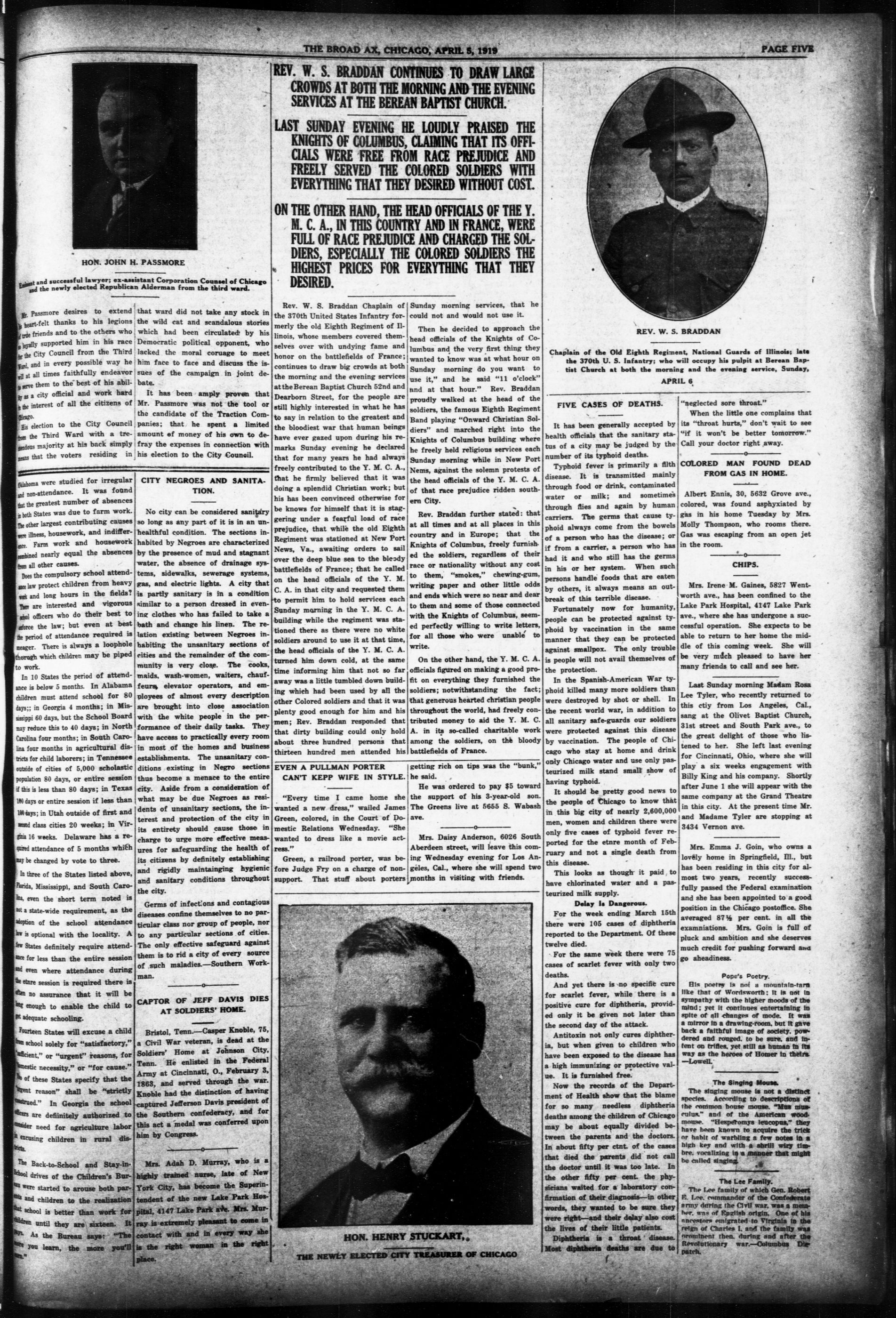
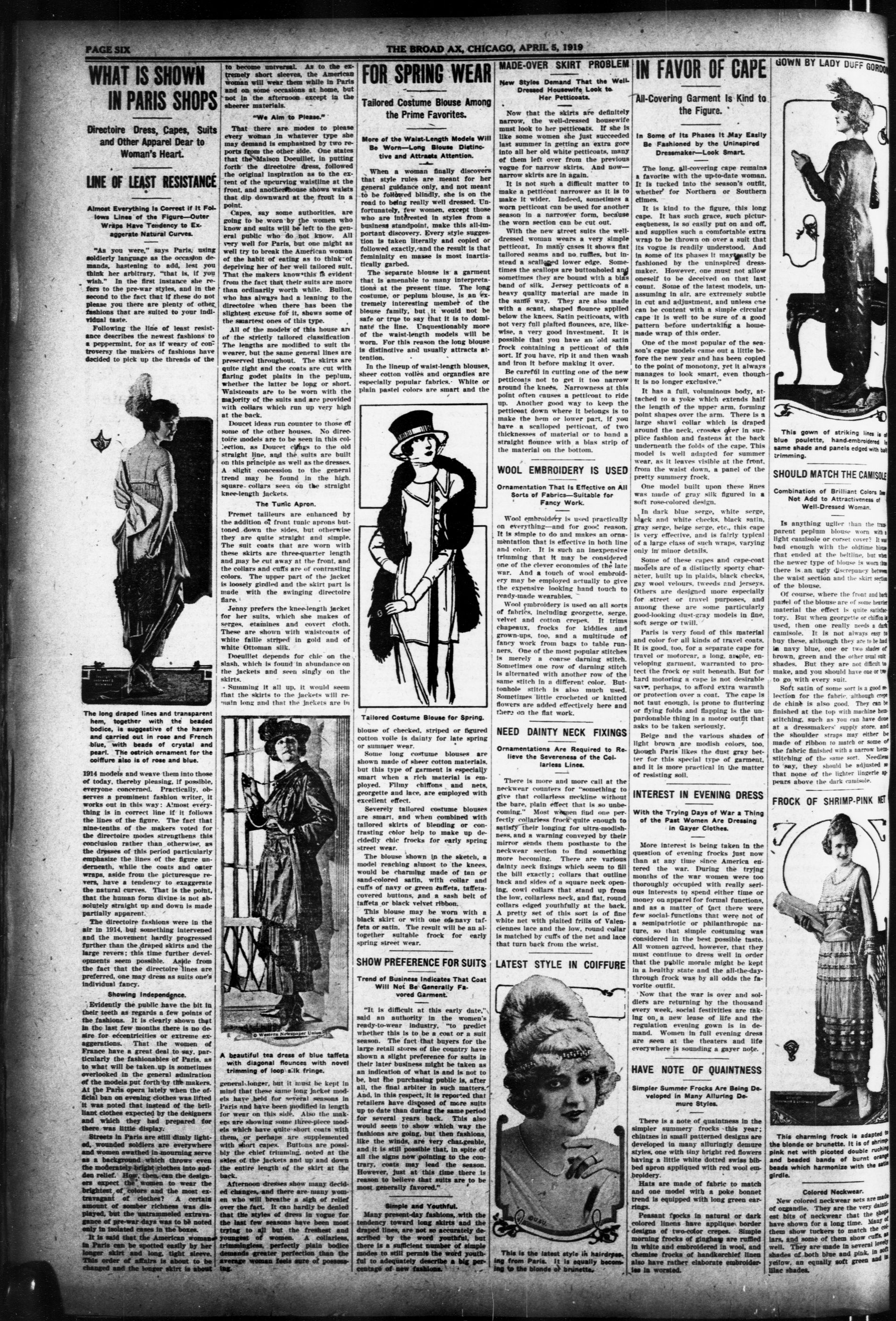
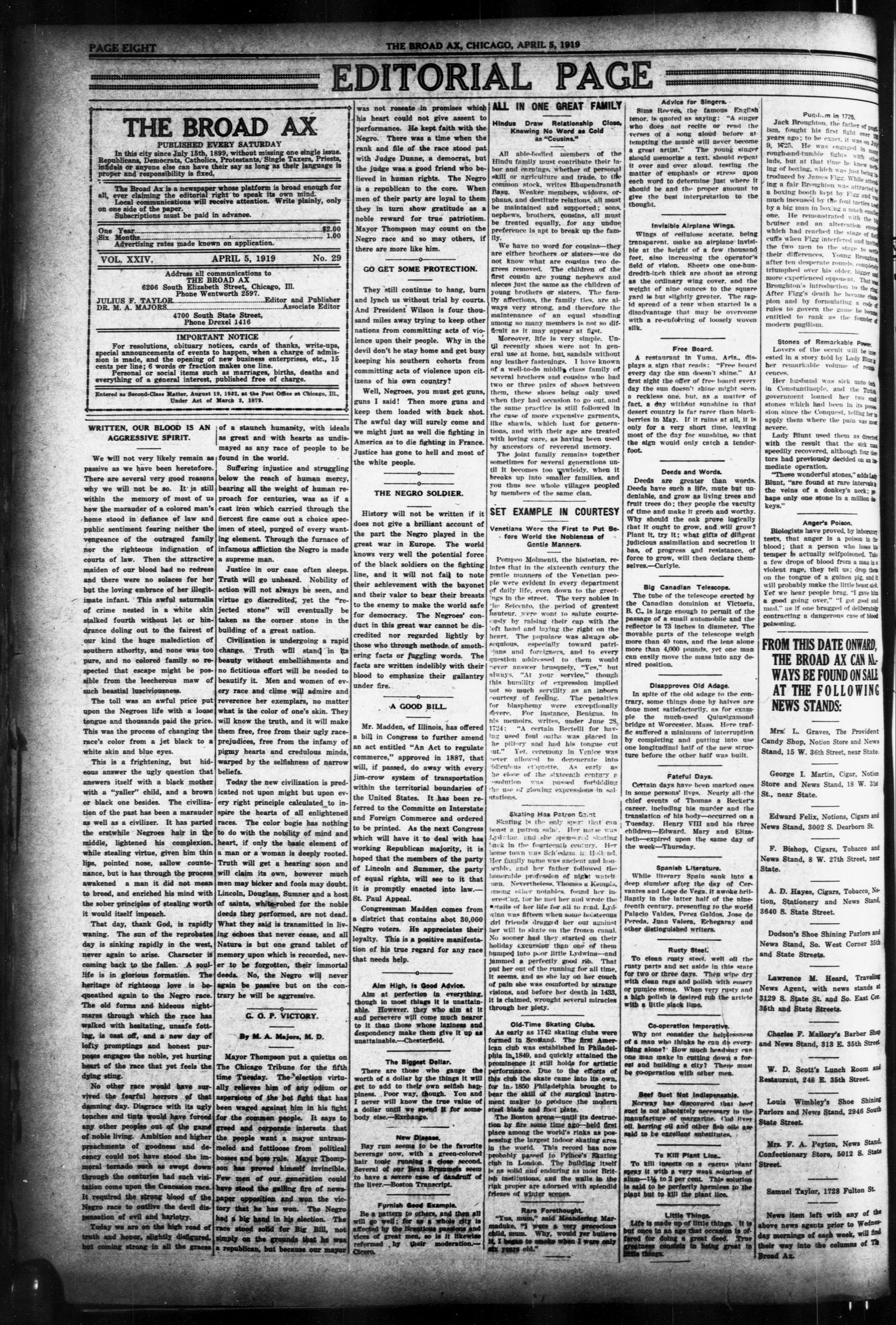
Page text (machine-generated)
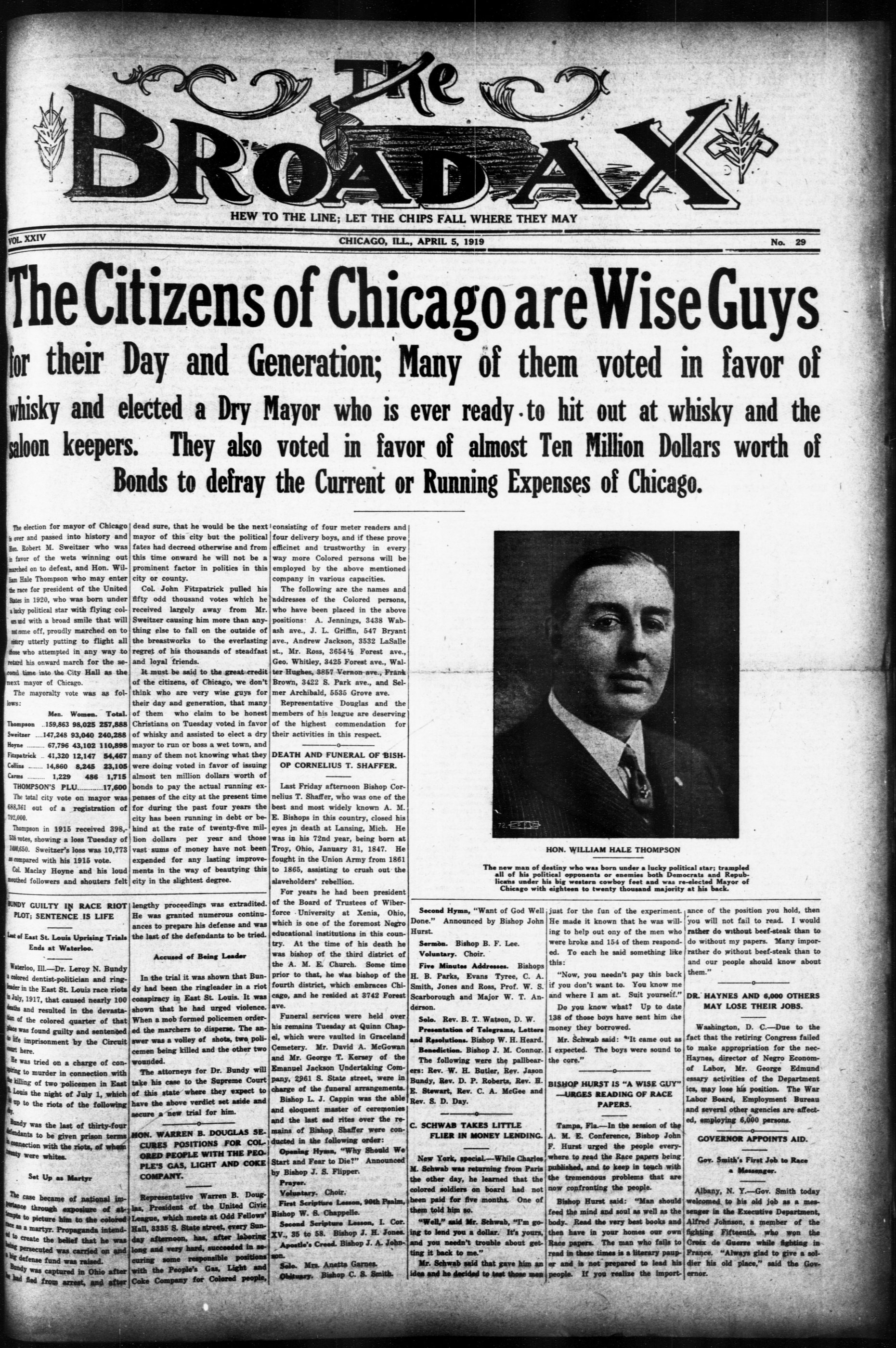
THE BROAD AX
HEW TO THE LINE; LET THE CHIPS FALL WHERE THEY MAY
The Citizens of Chicago are Wise Guys for their Day and Generation; Many of them voted in favor of whisky and elected a Dry Mayor who is ever ready to hit out at whisky and the saloon keepers. They also voted in favor of almost Ten Million Dollars worth of Bonds to defray the Current or Running Expenses of Chicago.
The election for mayor of Chicago is over and passed into history and Hon. Robert M. Sweitzer who was in favor of the wets winning out marched on to defeat, and Hon. William Hale Thompson who may enter the race for president of the United States in 1920, who was born under a lucky political star with flying colors and with a broad smile that will not come off, proudly marched on to history utterly putting to flight all those who attempted in any way to retard his onward march for the second time into the City Hall as the next mayor of Chicago.
The mayoralty vote was as follows:
Men. Women. Total.
Thompson ..159,863 98,025 257,888
Sweitzer ..147,248 93,040 240,288
Hoyne ..67,796 43,102 110,898
Fitzpatrick ..41,320 12,147 54,467
Collins ..14,860 8,245 23,105
Carms ..1,229 486 1,715
THOMPSON'S PLU.....17,600
The total city vote on mayor was
688,361 out of a registration of
792,000.
Thompson in 1915 received 398,-
538 votes, showing a loss Tuesday of
1400,650. Sweitzer's loss was 10,773
as compared with his 1915 vote.
Col. Maclay Hoyne and his loud
mouthed followers and shouters felt
BUNDY GUILTY IN RACE RIOT
PLOT; SENTENCE IS LIFE
last of East St. Louis Uprising Trials
Ends at Waterloo.
Waterloo, Ill.—Dr. Leroy N. Bundy a colored dentist-politician and ring-leader in the East St. Louis race riots in July, 1917, that caused nearly 100 deaths and resulted in the devastation of the colored quarter of that place was found guilty and sentenced to life imprisonment by the Circuit court here.
He was tried on a charge of conquering to murder in connection with the killing of two policemen in East St. Louis the night of July 1, which led up to the riots of the following day.
Bundy was the last of thirty-four defendants to be given prison terms in connection with the riots, of whom twenty were whites.
Set Up as Martyr
The case became of national importance through exposure of atrocities to picture him to the colored face as a martyr. Propaganda intended to create the belief that he was being persecuted was carried on and a big defense fund was raised. Bundy was captured in Ohio after he had fled from arrest, and after
dead sure, that he would be the next mayor of this city but the political fates had decreed otherwise and from this time onward he will not be a prominent factor in politics in this city or county.
Col. John Fitzpatrick pulled his fifty odd thousand votes which he received largely away from Mr. Sweitzer causing him more than anything else to fall on the outside of the breastworks to the everlasting regret of his thousands of steadfast and loyal friends.
It must be said to the great credit of the citizens, of Chicago, we don't think who are very wise guys for their day and generation, that many of them who claim to be honest Christians on Tuesday voted in favor of whisky and assisted to elect a dry mayor to run or boss a wet town, and many of them not knowing what they were doing voted in favor of issuing almost ten million dollars worth of bonds to pay the actual running expenses of the city at the present time for during the past four years the city has been running in debt or behind at the rate of twenty-five million dollars per year and those vast sums of money have not been expended for any lasting improvements in the way of beautying this city in the slightest degree.
lengthy proceedings was extradited. He was granted numerous continuances to prepare his defense and was the last of the defendants to be tried.
Accused of Being Leader
In the trial it was shown that Bundy had been the ringleader in a riot conspiracy in East St. Louis. It was shown that he had urged violence. When a mob formed policemen ordered the marchers to disperse. The answer was a volley of shots, two policemen being killed and the other two wounded.
The attorneys for Dr. Bundy will take his case to the Supreme Court of this state where they expect to have the above verdict set aside and secure a new trial for him.
MON. WARREN B. DOUGLAS SECURES POSITIONS FOR COLORED PEOPLE WITH THE PEOPLE'S GAS, LIGHT AND COKE COMPANY.
Representative Warren B. Douglas, President of the United Civic League, which meets at Odd Fellows' Hall, 8335 S. State street, every Sunday afternoon, has, after laboring long and very hard, succeeded in securing some responsible positions with the People's Gas, Light and Coke Company for Colored people,
of Chicago generation; Many o Mayor who is ever rea voted in favor of al the Current or Running
consisting of four meter readers and four delivery boys, and if these prove efficinet and trustworthy in every way more Colored persons will be employed by the above mentioned company in various capacities.
The following are the names and addresses of the Colored persons, who have been placed in the above positions: A. Jennings, 3438 Wabash ave., J. L. Griffin, 547 Bryant ave., Andrew Jackson, 3532 LaSalle st., Mr. Ross, $ 3645 \frac{1}{2} $ Forest ave., Geo. Whitley, 3425 Forest ave., Walter Hughes, 8857 Vernon ave., Frank Brown, 3422 S. Park ave., and Selmer Archibald, 5535 Grove ave.
Representative Douglas and the members of his league are deserving of the highest commendation for their activities in this respect.
DEATH AND FUNERAL OF BISH
OP CORNELIUS T. SHAFFER.
Last Friday afternoon Bishop Cornelius T. Shaffer, who was one of the best and most widely known A. M. E. Bishops in this country, closed his eyes in death at Lansing, Mich. He was in his 72nd year, being born at Troy, Ohio, January 31, 1847. He fought in the Union Army from 1861 to 1865, assisting to crush out the slaveholders' rebellion. For years he had been president of the Board of Trustees of Wiberforce University at Xenia, Ohio, which is one of the foremost Negro educational institutions in this country. At the time of his death he was bishop of the third district of the A. M. E. Church. Some time prior to that, he was bishop of the fourth district, which embraces Chicago, and he resided at 3742 Forest ave.
Funeral services were held over his remains Tuesday at Quinn Chapel, which were vaulted in Graceland Cemetery. Mr. David A. McGowan and Mr. George T. Kersey of the Emanuel Jackson Undertaking Company, 2961 S. State street, were in charge of the funeral arrangements. Bishop L. J. Cappin was the able and eloquent master of ceremonies and the last sad rites over the remains of Bishop Shaffer were conducted in the following order:
Opening Hymn, "Why Should We Start and Fear to Die?" Announced by Bishop J. S. Flipper.
Prayer.
Voluntary. Choir.
First Scripture Lesson, 90th Psalm, Bishop W. S. Chappelle.
Second Scripture Lesson, I. Cor. XV., 35 to 58. Bishop J. H. Jones.
Apostle's Creed. Bishop J. A. Johnson.
Solo. Mrs. Anette Garnes.
Obituary. Bishop C. S. Smith.
---
cago a
Many of the
ever ready to
or of almost T
r Running Expo
The new man of c
all of his pol
licans under h
Chicago with
Second Hymn, "Want of God Well Done." Announced by Bishop John Hurst.
Sermon. Bishop B. F. Lee.
Voluntary. Choir.
Five Minutes Addresses. Bishops H. B. Parks, Evans Tyree, C. A. Smith, Jones and Ross, Prof. W. S. Scarborough and Major W. T. Anderson.
Solo. Rev. B. T. Watson, D. W.
Presentation of Telegrams, Letters and Resolutions. Bishop W. H. Heard.
Benediction. Bishop J. M. Connor.
The following were the pallbearers: Rev. W. H. Butler, Rev. Jason Bundy, Rev. D. P. Roberts, Rev. H. E. Stewart, Rev. C. A. McGee and Rev. S. D. Day.
C. SCHWAB TAKES LITTLE
New York, special.----While Charles M. Schwab was returning from Paris the other day, he learned that the colored soldiers on board had not been paid for five months. One of them told him so.
"Well," said Mr. Schwab, "I'm going to lend you a dollar. It's yours, and you needn't trouble about getting it back to me."
Mr. Schwab said that gave him an idea and he decided to test those men
72
The new man of destiny who was born under a lucky political star; trampled all of his political opponents or enemies both Democrats and Republicans under his big western cowboy feet and was re-elected Mayor of Chicago with eighteen to twenty thousand majority at his back.
HON. WILLIAM HALE THOMPSON
destiny who was born under a lucky political opponents or enemies both Demis big western cowboy feet and was r eighteen to twenty thousand majority
just for the fun of the experiment.
He made it known that he was willing to help out ony of the men who were broke and 154 of them responded. To each he said something like this:
"Now, you needn't pay this back if you don't want to. You know me and where I am at. Suit yourself."
Do you know what? Up to date 138 of those boys have sent him the money they borrowed.
Mr. Schwab said: "It came out as I expected. The boys were sound to the core."
BISHOP HURST IS "A WISE GUY"
—URGES READING OF RACE
PAPERS.
Tampa, Fla.—In the session of the
A. M. E. Conference, Bishop John
F. Hurst urged the people every-
where to read the Race papers being
published, and to keep in touch with
the tremendous problems that are
now confronting the people.
Bishop Hurst said: "Man should
feed the mind and soul as well as the
body. Read the very best books and
then have in your homes our own
Race papers. The man who fails to
read in these times is a literary pau-
per and is not prepared to lead his
people. If you realize the import-
ance of the position you hold, then you will not fail to read. I would rather do without beef-steak than to do without my papers. Many imporrather do without beef-steak than to and our people should know about them."
DR. HAYNES AND 6,000 OTHERS
MAY LOSE THEIR JOBS.
Waahington, D. C.—Due to the fact that the retiring Congress failed to make appropriation for the necHaynes, director of Negro Economof Labor, Mr. George Edmund essary activities of the Department ics, may lose his position. The War Labor Board, Employment Bureau and several other agencies are affect-ed, employing 6,000 persons.
GOVERNOR APPOINTS AID.
Gov. Smith's First Job to Race a Messenger.
Albany, N. Y.—Gov. Smith today welcomed to his old job as a messenger in the Executive Department, Alfred Johnson, a member of the fighting Fifteenth, who won the Croix de Guerre while fighting in France. "Always glad to give a soldier his old place," said the Governor.
---
PAGE TWO
THE BROAD AX
Published Every Saturday
In this city since July 15th, 1899, without missing one single issue. Republicans, Democrats, Catholics, Protestants, Single Taxers, Priests, infidels or anyone else can have their say as long as their language is proper and responsibility is fixed.
The Broad Ax is a newspaper whose platform is broad enough for all, ever claiming the editorial right to speak its own mind.
Local communications, will receive attention. Write only on one side of the paper.
Subscriptions must be paid in advance.
One Year.....$2.00
Six Months.....1.00
Advertising rates made known on application.
Address all communications to
THE BROAD AX
6206 So. Elizabeth St., Chicago, Ill.
Phone Wentworth 2597.
JULIUS F. TAYLOR
Editor and Publisher
DR. M. A. MAJORS
Associate Editor
4700 South State Street
Phone Drexel 1416
Vol. XXIV. April 5, 1919. No. 23
Entered as Second-Class Matter, August 19
$902, at the Post Office at Chicago,
Ill., under Act of March 3, 1879
NURSE HAD INGENIOUS IDEA
Surely If Use of Makeup Was Ever Justified, It Could Be Defended in This Case.
A laugh is going the rounds over the stunt pulled by one of the attendants at the orphanage who had waxed enthusiastic in the work of finding parents for her little charges.
On this particular occasion she had interested a young couple in a three-months-old baby and they had promised to call the following day with a view to taking the infant if she was the dainty dimpled cherub the attendant said she was.
And in the meantime the baby contracted a cold, which, on the day she was to be inspected, had left her thin and pallid. The nurse knew that the child's chances for being adopted were very slim.
Suddenly she hit on an idea. A lip stick and a box of rouge. The very things to make the pallid Nancy into a rose-faced cherub. And so the fairy godmother, being a sophisticated person, painted the lily, and Nancy, with a complexion like roses and cream. charmed her prospective parents and everyone was happy.-Los Angeles Times.
Greatest Bliss Is Congenial Work.
Greatest Bliss is Congenial Work.
There is no greater happiness in life than doing the work you love. It matters not what the work is—to some women it is embroidery, or writing a book, or baby tending, or studying chemistry, or cooking, or keeping a house polished. It does not always happen that we have great ability in the thing we enjoy doing—although the chances are that this is so. For nothing stimulates you to continued effort in a piece of work more than the consciousness that you do it well.
And so if you are unhappy—genuinely unhappy—in the work you're doing, try to find out what it is that you'd prefer to do. If there is nothing else in your mind, then perhaps your discontent is only temporary. But if you sincerely wish to do some other definite piece of work, you have a legitimate grievance and you owe it to yourself to pave the way for a new shot at a new occupation.
The Open Window.
Mr. Walter Winans, writing in the Saturday Review on the open window, says: The Russian peasants, in whose huts I have lived in very severe winters, seal up the windows hermetically during the whole winter (double windows), and they have warm water to wash in, and do not break the ice to wash as people fond of open windows have to do. In Petiograd some years ago twelve Englishmen started a bathing society to break holes in the ice of the Neva and have a cold plunge every morning. Before the spring they were all dead, and I have never heard of a case of a foreigner (the Russians, of course, never do so) who lived through a Russian winter and slept with his bedroom window open.
Family Life.
Not for nothing have we been grouped in families, neighborhoods, nations; and he who will not recognize the divinely appointed nearness to himself of some over others, who thinks himself to be a cosmopolite without being a patriot, a philanthropist without owning a distinguishing love for them that are peculiarly his own, who would thus have a circumference without having a center, deceives his own heart, and affirming all men to be equally dear to him is indeed affirming them to be equally indifferent.
1
Various Kinds That Have Been in Use at Different Times Mark the Country's Progress.
The progress and condition of our settlements can be traced in our fences, writes Alice Morse Earle, in "Home Life in Colonial Days." As Indians disappeared or succumbed, the solid row of pales (stockade) gave place to a log fence, which served well to keep out depredatory animals. The dangers from Indians or wild animals entirely disappeared, boards were still not over-plenty, and the strength of the owner could not be overspent on unnecessary fencing. Then came the double-rail fence; two rails, held in place, one above the other, at each joining, by four crossed sticks. It was a boundary, and would keep in cattle. It was said that every fence should be horse-high, bull-proof and pig-tight. Then came stone walls, showing a thorough clearing and taming of the land. The succeeding "half-high" stone wall—a foot or two high, with a single rail on top—showed that stones were not as plentiful in the fields as in early days. The "snake-fence," or "Virginia fence," so common in the southern states, utilized the second growth of forest trees. The split-rail fence, four or five rails in height, was set at intervals with posts, pierced with holes to hold the ends of the rails. These were used, to some extent in the East; but our western states were fenced throughout with rails split by sturdy pioneer rail-spitters, among them young Abraham Lincoln. Board fences showed the day of the sawmill and its plentiful supply; the wire fences of today equally prove the decrease of our forests and our wood, and the growth of our mineral supplies and manufactures of metals. Thus even our fences might be called historical monuments.
DOES NOT LIKE NEW YORK
Fact That Would Seem Evident From Comments Made by San Francisco Writer.
New York was made by and for New Yorkers, and those that love it deserve no better fate than to live in it, writes Bailey Millard in the San Francisco Bulletin.
That habel of self-assured greatness is a terrible place to me. Carlyle called London a wen on nature's face; but what would he have said of New York, with its fervent money worship, its "society" folk with their inane and perpetual discussion of stocks, its thousands of other idle gamblers in drawing-room and den, its thousands of lackeys in and out of livery, its other thousands of make believes who would have you think, they were somebody, and while buying $10 dinners, are letting their washweaen go unpaid; its blinded slaves of trade in their whirling strife, so complex, multifaceted, confused.
And then its "dandical body" in their exclusive clothes, exclusive hats, ties and shoes who belong to exclusive sets, wholly exclusive of brains! And then its millions of half-clothed, half-starved "people of the abyss," living in dark, effluated hells instead of homes, suffering the cold, un-Christian contempt of the they "betters!"
Lucky and Unlucky Accidents
General Grant used to contend that it was because his mother happened on one occasion to be short of butter that he eventually became president. observes London Tit-Bits. It was while procuring the butter that the lad heard read a letter concerning a possible vacancy at West Point. He applied, obtained the vacancy and from that time never looked back.
A simple incident observed in a little country tavern resulted in no less a measure than the introduction of the penny post. The observer of the incident happened to be Rowland Hill. Only a missing marriage certificate prevented the hodecarrier of Hugh Miller establishing his claim to the earldom of Crawford, just as the absence of a comma in a bill which passed through congress on one occasion cost the American government a million dollars.
Moral Courage.
If there is any one quality of the mind in which the really great have conspired, as it were, to surpass other men it is moral courage. In private life what daily deceit would be avoided, what evils would be remedied if we did but possess more moral courage—not that false image of it which proceeds from a blind and inconsiderate rashness, from an absence both of forethought and imagination; but that calm reliance on the decisions of reason, that carelessness of the undeserved applause of our neighbors which will induce the great man to act according to his own informed judgment and not according to the opinions of those who will not know, and who could never appreciate his motives.
Why Lawn Is Called Lawn.
Years ago the Dutch excelled all other peoples in the bleached linens they sent forth. That was in a time, of course, when bleached linen was considered a luxury. The Dutch gained their fame for this excellence because they had a wonderful system of treating the muslin to make it white. To begin with, they treated it to bleaches and acids of various sorts; and then they placed it on bleaching lawns, or greens, where it lay at intervals from March to September. The white material thus produced took the name of the lawns whereon it was bleached—at least, so goes the story
Not Much of a Pusher.
It was the elevated station at 8:30 on a weekday morning. The advice of the Irish guard who helps close the gates of the rear cars was an education in-itself. But he had a competitor in a girl who was doing her valiant best to get on. "Push, push," she urged of a little weak masculine beside her. In a wish-washy voice he replied that he was pushing. Back came the swift retort: "You make me tired? You push like a jellyfish!"—New York Sun.
Not a Complete Success.
Edward was a timid boy. hard to overcome his timidity, little success. One day his fatt home and brought him an Ind. After Edward had it/on his fa him that he would be brave. Indians always were. Edward out in the front yard to show neighbor playmate when the dog from across the street came across. The "Indian" came up on the front porch, cry, sobbed out: "Take the suit"
Oplum.
Opium is the dried juice of the white poppy, a flower that grows in many parts of Asia. A few days after the flowers have fallen off the plants men go through the fields in the afternoon and make little cuts in the poppy head. Out of these cuts a milky juice oozes, which dries into a brown, sticky paste. Every morning the men go through the fields again and scrape off this paste, which they put into jars. Later on it is made into half-pound balls and then packed for shipment.
America's Largest Industry.
The United States' largest manufacturing industry is iron and steel. The pig iron recovered in smelting iron ore amounts to about 25 per cent of the raw materials. The equivalent of about 14 per cent is driven off by volatilization in the coking of the coal; in the process of smelting a further 40 per cent escapes in gas, fumes and dust, and the remaining 21 per cent represents the slag.
Why Huskies Go Blind.
Many dogs that are driven in double-traced harness go blind. Particles of ice, exceedingly hard and fine, fall from the brush of the dog that is traveling ahead, and, striking the eye, scratch it, and in time couse partial or total blindness. The more ferocious dogs of the pack fight their way to the front of the teams, and are usually saved from this trouble.
Their Surprising Way.
"I was never more disappointed in anybody in my life than I was in my consious up to Kay See." admitted Gabe Gosnell of Grudge, who was just back from a visit to the Big Burg. "Why, with everything on earth going on and anything you could think of liable to happen at any moment. I'll be switched if they don't poke off to bed at between nine and ten o'clock every night of the world!"—Kansas Citr Stur.
To Make Attar of Roses
After having gathered a quantity of roses, place them in a jar, then pour upon them some spring water. Cover the top with thin muslin to keep out the dust, and expose the jar to the heat of the sun for a few days, until only particles are observed to be floating on the surface of the water. Take off this oil substance and place it in a bottle. This is the perfume known as "attar of roses."
Cannot Do Without Sleep.
Sleep is a necessity of life no less than is food. No man has ever succeeded in keeping awake for more than a few days continuously. If he is forced to do so, as in ancient Chinese tortures, where constant tickling of the feet made sleep impossible, he falls at last into a comatose state from which he never awakes.
Hadn't Got to That
Philanthropic Person—"Have you never striven my friend, to attain a higher life?" Mundane Marmaduke—"Well, mister, we ain't got past corned beef an' beer yet, but whether we'll ever reach champagne and chicken I can't bloomin' well say."—Sydney Bulletin.
His Ruling Thought
One hears a great deal about the absent-minded professor, but it would be hard to find one more absent-minded than the dentist who said soothingly, as he applied a tool to his automobile, under which he lay: "Now, this is going to hurt just a little."
Size of the Foot.
The foot should be as long as the ulna, or chief bone of the forearm—that is, from the small head of the bone to be seen at the wrist to the point of the elbow should be the length of the foot.
Grandmother's Economy
Another reason why your dear old grandmother didn't think she could afford silk stockings was because she thought she ought to wear six or seven petticoats.-Dallas News.
Psychological tests are being used by the United States employment service in New York to aid in determining the work for which applicants are best fitted.
Be Slow to Condemn.
Why condemn an individual or institution before you hear both sides?
Does a jury convict or a judge sentence a prisoner before the evidence is heard?
Daily Thought.
Wisdom is oftimes nearer when we stoop than when we soar.—Wordsworth.
Not a Complete Success.
Edward was a timid boy. He tried hard to overcome his timidity, but with little success. One day his father came home and brought him an Indian suit. After Edward had it on his father told him that he would be brave now, for Indians always were. Edward went out in the front yard to show it to a neighbor playmate when the big collie dog from across the street came bounding across. The "Indian" came rushing up on the front porch, crying, and sobbed out: "Take the suit back; it don't work on me."
Worthy Mate of Great Writer
James Russell Lowell's first wife, Maria White Lowell, was also a poet. A small collection of her verses, printed privately by Lowell in 1855, two years after her death, is now almost forgotten. One copy of it is preserved in the archives of the New York public library. She was the daughter of a farmer in Watertown, Mass. In letters to a friend, when Lowell was first getting acquainted with Maria, he said: "She knows more poetry than anyone I know."
The Candle in History
The cult of the candle plays a large role in Roman, Jewish and Eastern ecclesiastical history; and many are the customs that have their birth in some magical or ritualistic use to which the candle has been put. In some parts of Ireland, for instance, it was usual on Christmas eve to burn a large candle which no one was permitted to snuff except those who bore the name of Mary.
Beans.
The common bean is a native of South America and was introduced into Europe during the sixteenth century. Now it is represented by over 150 varieties. The big broad bean is probably a native of southwest Asia and northeastern Europe. The broad, but not thick, lime bean, called by some "butter bean," is a pole variety that comes from South America.
The Village Stocks
The curious old habit of punishing offenders by placing them in the public stocks seems very far in the shadowy past, yet a number of these old wooden machines may still be seen in England. Usually they stand, or they stood, on the village green, near the church; and it is not such a long while since stocks ceased to be used in the land.
Appropriate Look.
Robert had lost his little pet dog and felt bad about it. His father told him poor little Fido must be dead or he would return home. His mother sent him on an errand, when he met a woman friend of his mother's who asked him if he was ill, as he had little to say. "Oh, no," he said, "but my little dog is dead and I am wearing a black look."
Fats in the Body.
Fats in the body occur under the skin in the muscles and around certain organs. They act as a protection for the body against injury and serve as a stored supply of fuel. in case food cannot be taken. Fats are liquid in the body and are stored in albuminous cells.
Early American Statesman
Alexander Hamilton, one of our greatest statesmen, was sometimes called "Alexander the Coppersmith," because of the copper cents he had made in 1793, when he was secretary of the treasury. These pennles were very unpopular with the people. He was killed in a duel by Aaron Burr.
Just a Little One. Maybe.
While to be sure we believe George Washington never told a lie we always will wonder how he got around it if Mrs. Washington ever asked him if he didn't think her new way of serving parsnips made them perfectly deliclous. -Macon Telegraph.
Canning in India.
Missionaries to India have started a canning movement among the natives. The products are put up according to the directions put out by the United States department of agriculture.
Barber (carried away by his reminiscences)—"And when he'd looped the loop he did a nose dive that fairly took your breath away."—Boston Evening Transcript.
Why not try to look over the other fellow's mistakes? We have been making them ever since Grandfather Adam lost his place in the Garden of Eden.
What your mirror tells you you may depend upon as the result of reflection—Boston Transcript.
If folks had to pay taxes on grouches, this would be a smiller world than it is.
Optimistic Thought.
When sovereignty is divided it is very easily destroyed.
The First Gas Respirator
The first apparatus to enable persons to enter a noxious inflammable atmosphere was called an "aerophore" and was the invention of M. Denayrouse, a French inventor and scientist. It was first tested at Chatham, England, 44 years ago, and was reported successful. Fast improvements on this device, which comprised an air pump, lamp and flexible tubing, have since been made and these have saved the lives of hundreds in mine accidents and other disasters where rescue work would be impossible without their use.
The World Is Cheerful.
Doctor Johnson's old schoolmate said that he could not be a philosopher because "cheerfulness was always breaking in." Our world of mankind cannot be that kind of a philosopher, either for the same reason. It may have its moods and depressions, or prove to the utmost the reasonableness of despair; but there is an inexhaustible wellspring of vigor within it, and vigor is another word for joy.—From the Unpopular Review.
Sleep and the Brain
It used to be thought that sleep happened because the circulation of blood through the brain grew so feeble that this, the seat of consciousness, could work no longer and sleep took place. Many years ago a surgeon studying the subject watched the falling circulation of the brain through a hole in the skull of a sleeping animal. Yet this is only effect, not cause. The brain has less blood because it sleeps; it does not sleep because it has less blood.
Dark Ages
The term is applied to a portion of the Middle Ages, including the period of about 1,000 years from the fall of Rome to revival of letters in the fifteenth century. It is generally regarded as beginning with invasion of France by Clovis, 486 A. D., and closing with invasion of Naples by Charles VIII in 1495. Learning was at a low ebb during this period.
Time Is Money.
In Korea, both among prosperous Christians and among those to whom money is a hasty and infrequent visitor, a favorite subscription blank is one which says: "I promise to give — days to church work this year." The days thus given are devoted to evangelistic services or to the building of churches and schools.—World Outlook.
Oriental's Believe in 13.
Thirteen has no terrors for Orientalists. This was shown in Seattle, Wash., when the little Japanese sailing vessel Kashima Maru arrived in port from the Orient with a crew of exactly 13 men aboard. Officers of the vessel explained that 13 is considered in the Orient just like an even dozen or a score when it comes to manning vessels or inviting wedding guests.
Bright Silver.
Silver will be found brighter if wiped directly from clean, hot, slightly soapy water. Silver may be boiled in a bright aluminum pan with several small pieces of zinc or in a special silver pan with salt and soda. These methods clean the silver and it can be polished afterward.
Burning Truth.
Said the facetious feller: "These golf fanatics get a lot of satisfaction out of reducin' their strokes from last season, but the real joy of life comes from bein' able to reduce the number of tons of coal from the winter before."
Tea Testing.
To ascertain whether artificial coloring matter has been added to tea, place a quantity on white paper and rub with knife to a fine powder. Now brush the paper with a brush, and if any prussian blue has been used there will be little streaks on the paper.
Handicap Worth While.
When a handlecap becomes the fulcrum over which we pry out success with the long iron bar of determination it ought to make us shake hands with the hindrance and say. "Thank you! You have helped me out fine!"
Symbol of Firmness.
You can't push a mule and you can't pill him. As an example of firmness what better do you want. A mule-sure has the courage of his convictions—Jacksonville Times-Union.
Salute to the Flag.
The salute to the flag is given by raising the right hand, palm outward, until the index finger is even with the lower edge of the forehead, and standing at attention.
The Old-Fashioned Folio.
The advantage of the old-fashioned folio was that it was safe from borrowers.—Emerson.
To know thyself is better than trying to find out all about the neighbors.
—Toledo Blade.
Daily Thought.
Wit is the salt of our conversation,
not the food.—Hazlitt.
Making Gas From Wood
Experiments on wood as part substitute for coal in gas making have been carried out in France. The wood used was sea pine in the form of billets cut from the middle of the trunk. The charge of the wood was about half the weight of that of coal, and carbonization occupied half the usual time. When running one retort with wood to every two with coal, no appreciable difference in the calorific power of the gas was noted. Of the two by-products—small coke and tar—the former amounted to 5 to 10 per cent.
Bronzing Small Articles
Small articles may be glided by immersing them in the following solution, which must be used at nearly boiling heat: Caustic potash, 18 parts; carbonate of potash, 20 parts; cyanide of potassium, 9 parts; water, 1,000 parts. Rather more than one and one-half parts chloride of gold should be dissolved in the water when the other substances are to be added, and the whole boiled together. This mixture is often employed by dealers in cheap jewelry.
No Person Has Seen the Su
Astronomers aver that no one has ever seen the sun. A series of cone-shaped shells envelops a nucleus of which we apparently know nothing except that it must be almost infinitely hotter than the fiercest furnace, and that it must amount to more than nine-tenth of the solar mass. That nucleus is the real sun, forever hidden from us. The outermost of the enveloping shell is about 5,000 miles thick, and is called the "chromosphere."
Ordering One's Life
Take time to scrutinize your life.
Try to define just why you are "run"
and decide for yourself that if you are
going to be ruled, as most of us are
it must be by something or somebody
well worth the arduous spiriting we
are all indulging in. If the goal to
ward which we are being steered is
worth while, only then can we look
back and feel that the race has been
well run.
Test of Woolens
One test is to cut off a bit of the selvedge and touch a match to it. If it shrives up, but does not burn it is wool, but if the fabric burns with a flame it is cotton. Another way is to put a bit of the cloth in a test solution or other glass receptacle with a solution of caustic soda. The sofa will eat up the wool, leaving that which is not wool.
Maybe You're Rich.
Some men are rich and don't know it—rich in health, rich in a large and happy family, rich in friends, rich in influence and standing in their communities, rich in the spirit of charity and brotherly love. These same men may be poor in this world's goods but they're rich, just the same—Crosman.
Hired Man's Life Saved
James was bowlegged and felt it his duty to whip every boy that reminded him of the fact. When he visited in the country the hired man laughed and told him he couldn't stop a pig if he tried. James told his mother what the man had said then added: "He's pretty big, and I'm might glad he didn't say I was bowlegged."
A Glass Horn.
An innovation in phonographs is an instrument equipped with a horn of beveled mirror glass. The claim of the makers is that the horn of a talking machine best amplifies the tone when its surface is smooth and right hence one of heavy glass is preferable to one of wood or metal.
British Has Odd Meter
An English engineer has developed a novel form of rotary motor having four cylinders that operate inside the blades of the propeller. The propeller blades are made of metal and the exhaust issues from the ends of the blades.
Liberty's Demands
We honor liberty in name and form.
We set up her statues, and sound her praises. But we have not yet fairly trusted her. And with our growth, so grow her demands. She will have no half-service.—Macunhay.
The First Private Garage
The first private garage constructed in New York city was built in the spring of 1900 by a prominent New York automobile enthusiast, who at that time owned three motor vehicles.
Preferred "Motorhouse."
Preferred motorhouse. In England during the early days of motor vehicles, there was a decided preference for the name "motorhouse" rather than "garage."
Another advantage of tortoise shell glasses is that they cover up a good deal of face—Kansas Industrialist.
Failure.
When a man lacks principal he naturally falls from lack of interest.
Daily Thought.
Man is one world and hath another to attend him.—Herbert.
First, it's very individual, this Me of mine. It eats, it walks, it plays, it works, and it sleeps. Also, it plans and thinks and dreams and loves. This Me of mine gets lonely, too, even in the midst of work. It looks around itself and marvels at time and space and things, and grows into a warm ecstacle mood at the feel of life and all its tasks. I like this Me of mine, because it is understandable. Good and bad, both. But honestly abreast. For true things are passing by at every hour of every day. I talk to this Me of mine. And it talks to me. And the 'world of action' all around stirs the blood in this Me of mine. For it is wakeful and alert. I run errands for this Me of mine. I risk, I work, I sorrow, I sympathize to this Me of mine.
Inside one, this outside one, this everywhere one—this Me of mine—it's all that I may keep and call my own. But I shall stick, with loyal pride, and steadily strive to make better, to wield stronger, the brain, the heart and the soul of this Me of mine.
So that to serve may prove the end of all that there is to this Me of mine. From Good Housekeeping.
JUDGE WAS ON RIGHT TRACK
New Englander a Pioneer in Scheme of Conserving Water for Use in Summer Montha.
Present-day interest in the development of water power has recalled a modest, old-fashioned episode in the history of New England when, some time in the forties, Judge Nathan Crossby drove round Lake Winnespaukein in his carriage and made rough calculations of the effect upon local agricultural land if the lake level were raised a few feet. Out of that carriage ride grew a plan by which Lakes Winnespaukee, Squam, Newfound and others have since been used as storage basins, conserving water for the summer months, and thus becoming modest pleneers of the more impressive plants for water utilization that will doubtless be a feature of the United States in the not distant future. Judge Crosby, however, may have had no more idea of the transmission of water power in the form of electricity than his buggy had of becoming an automobile—Christian Science Monitor.
"Left-Handed" Elephants
Not many people are aware that elephants are "right-handed" and "left-handed" in using their tusks, and that an examination of the tusks of any particular elephant will reveal the class to which the elephant belongs.
An elephant uses only one tusk most of the time it is digging for salt earth, uppooing trees or tearing up roots, says a contributor to an English magazine. When its working tusk becomes badly broken it turns to the other, just as a man who has injured his right hand takes to his left. The tusk must be very severely damaged before it will give up using it in preference to the other.
The working tusk becomes worn and smooth toward the end—so much worn, in fact, that it is often appreciably shorter than the other, and frequently the tip has been broken off. After that has happened the jagged edge becomes gradually worn smooth, and in the course of years pointed again, but the working tusk is always blunter than the other.
Presidential Succession
Members of the cabinet are in line to the succession, if they can comply with the Constitutional requirements, which provide that: "No person except a natural born citizen, or a citizen of the United States at the time of the adoption of this Constitution, shall be eligible to the office of president." What is called the presidential act, passed in 1886, provides for the succession to the presidency by cabinet officers in the following orders: Secretary of state, secretary of the treasury, secretary of war, secretary of the navy, secretary of the interior, secretary of agriculture, secretary of commerce, secretary of labor. A person not born in this country may be a member of the president's cabinet, but he is not eligible to the presidency, being barred by the Constitutional provision quoted above.
Candle Auction.
The candle has been used for many purposes. In the seventeenth century a candle auction was the regular method of selling wares at the mart of the East India company—a custom which is still in vogue in various parts of the country, notably at Tatworth, near Chard, in Somerset, where the letting of land is annually conducted by this novel method. The thirty or forty people having rights in the land assemble and bid, and it is "knocked down" to the last bladder as the inch of candle flickers out. In three successive years the candle burned for $35\frac{1}{2}$. 27 and $39\frac{1}{2}$ minutes—London Times
Not Desirable
"I had to ask Flubdub not to eat here any more."
"What's wrong?"
"Every time I got a pretty waitress he'd try to convince her that she was cut out for a movie career, so I told him to take his hash business somewhere else."—Louisville Courier-Journal
CAN EAT WAY THROUGH LEAD
Beetle of Remarkable Power Would Make Man Much Trouble If It Existed in Quantities.
Probably most persons who read the newspaper story of the discovery by a Santa Barbara (Cal.) telephone engineer of an insect that eats its way through sheet lead thought it in the same class with the ancient box about "the worm that eats steel nails," which was perpetrated about a quarter of a century ago and still reappears at intervals. One of the editors of Engineering News, however, has seen the insects, a number of which are held in captivity in lead boxes with glass covers, to see how fong it will take them to bore their way to freedom.
The insect is a slender black beetle about a quarter of an inch long, with hard wing covers and of innocent and placid demeanor. It is said to light on a lead-covered telephone cable and bore a tiny round hole through the lead sheath and the paper insulation down to the copper. Possibly it believes the cable to be a part of a tree or vine into which it is accustomed to bore holes, and so it proceeds to bore through the lead as it would through the bark. Some persons think that concealment is its motive; others that the boring process is preliminary to egg depositing.
The lead borers have been heard of in South Bend, Ind., and Rockford, Ill.; in Omaha, Tacoma, Portland and San Diego; in Florida and in Australia. The fact that numbers of them have been found in old lead foil tea packages leads one to suspect that the family is of oriental extraction. Youth's Companion.
DAYS OF ATHENS' GREATNESS
Emperor Hadrian Did Much Toward Making the City Religious Center for All Hellas.
It was during Hadrian's first visit to Athens (about 124 A. D.) that he made plans for rebuilding the majestic temple of Olympian Zeus. He added signally to the adornment of Athens with many temples and other buildings; he built an aqueduct to bring the water of Cephissus to the city, and at Corinth he constructed aqueducts to bring to that city the water from Lake Stymphalus. Sparta was then the most important city in the Peloponnesus, and the visit of Hadrian there is established by an inscription. He was absent from Rome three years at this time, returning by way of Sicily, where he made the ascent of Mount Etna to witness a sunrise. Gregorovius believes he has evidence that proves Hadrian to have been in Athens again in the year 132 A. D., and he assumes that the great temple of Olympian Zeus was then completed and dedicated. Not for centuries had Athens known any such magnificent festival as that of the dedication of this Olympionion. It was made a national festival, with representatives from every city in Greece, as the Olympian Zeus was the new religious center for all Hellas. The dedicatory address was delivered by Polemon of Smyrna, who was the most celebrated Sophist of his day.—From "Athens, the Violet-Crowned," by Lillian Whiting.
Gold Leaf on Wood.
The following method is given for applying gold leaf on wood: The surface must first be carefully cleaned and prepared, and when quite dry treated with the appropriate gold size, which is laid on with a very soft hog's hair brush or camel's hair pencil; several coatings are applied, each being dry before the application of the other, and finally smoothed down. To this surface the gold leaf, cut into suitable sizes, is taken up by the tip of a special brush and laid on, being pressed down by a dry camel's hair brush, and so on piece after piece until the whole surface is covered. Finally, when dry, certain parts of the gilded frame are burnished with a flint or agate burnisher specially made for the purpose. The whole operation requires a certain amount of experience to obtain satisfactory results.
The Perfect Mind.
Truth is bigger-than our minds, and we are not the same with it, but have a lower participation only of the intellectual nature and are rather apprehenders than comprehenders thereof. This is, indeed, one badge of our creaturely state that we have not a perfectly comprehensive knowledge, or such as is adequate and commensurate to the essence of things; from whence we ought to be led to this acknowledgment that there is another perfect mind or understanding being above us in the universe from which our imperfect minds were derived and upon which they do depend.—Ralph Cudworth.
Not a Jovous Occasion.
A pig belonging to James Newman of San Francisco was unusually obstruct, and he tried calling it "nice piggie" and a lot of other pet names, but the animal snorted and refused to come along. Then its owner called the hog names that indicated he was very angry, but the harsh words had no more effect than those of honey. At last Newman lassoed the animal and was at once arrested for cruelty to animals. "The hog didn't seem to be very cheerful, judge," the policeman told the judge. "He was on the way to his own funeral." Newman pointed out. "You wouldn't expect him be laughing, hardly, would you now index."
THE BROAD AX. CHICAGO. APRIL 5. 1919
FAMOUS OLD ENGLISH FORT
Porchester Castle, Obsoleta Now, Must Have Been Place of Great Strength in Its Day.
Far away, behind all that the majority of people know of Portsmouth (Eng.) harbor—the outer basin with the ships of all kinds and descriptions coming and going in it, from the great battle cruisers to the steamers plying to and fro from the Isle of Wight—far from all the bustle of the harbor side, at the extreme end of a great stretch of tidal water, backed by the long, low line of the downs, stands Porsche castle. Roman as its name denotes, Porchester is said to have been one of the nine fortresses built by the Romans to defend the British coasts against marauding pirates from across the North sea. However this may happen to be, the walls which face the huge expanse of mud flats at low tide and water at high tide are really the work of Roman builders, which is a great deal more than can be said for many of the so-called "Romna walls" in other places. Wonderful walls they are, too—Roman builders never did things by halves—fully ten feet thick and built of flint and concrete with courses of limestone slabs.
The strength of the place before artillery came into use, or against an enemy unprovided with it, must have been enormous, and its situation must have made it almost impregnable. The Normans recognized its value and Henry I added the great keep and many of the other buildings.
LINK WITH PREHISTORIC DAYS
Hoatzin Birds, Found in Guiana, Have Long Been a Subject of Study by Scientists.
Running on all fours; climbing with fingers and toes like monkeys; diving and swimming as skillfully as if they were denizens of the ocean, the baby Hoatzin birds, found in Guiana, perpetuate the prehistoric days when reptiles were the dominant beings. It can neither sing nor fly gracefully and its very presence is betrayed by its strong odor, but it is none the less of great importance in the bird world because of its strange prehistoric attributes.
The nests of the old birds are always built out over the water, frequently some 15 feet above the surface, and the young birds, with their wings turned back, not folded as is usual but up like a diver's hands, will dive cleanly from the nest into the water and swim like a fish. When they wish to return to the nest they climb on shore and walking on their feet and handle ends of their wings will creep back to the tree and then climb like a monkey, using what is virtually the thumb and first fingers of their strange wings. They have a long neck and head far more reptilian than birdlike, and despite their lack of beauty many scientific expeditions have been sent to Gulana to photograph and study these birds, who represent all the ages of history from reptile to modern life.
Thrill of Doing Things.
Life is made up of trials and satisfactions. The one is to keep up your muscle, and the other is to keep up your morale. The one sets tasks that try the fibers of your nature; the other bestows the mental laurel that marks consciously won victory. The whole process begets thrills that enhances ideas of achievement. The very idea of doing seems to carry with it the sense of worth and fitness. Instead of feeling yourself driven by the stress of compulsion you feel like an explorer in new regions. Each thing does add to the joy of doing as it brings facility and smoothness of operation. The sum of things attempted and finished tells a story of joy known only to the fellow who has felt the thrill of doing things. The biggest challenge to the healthy man is the chance to do.
England's Big Mistake.
On the 8th of March in 1765 the house of lords in England passed the stamp act, which led to the famous Boston tea party, the first militant act of the Revolution. The English treasury had been drained by the Seven Years' war and the country needed money. The people of England were already taxed to the limit and King George and the English parliament decided that the most expedient way to raise money was to tax the American colonists and to establish the principle that the colonists must pay taxes to the crown even though they were not allowed representation in the English parliament.
Mammoth and Man.
The first mammoth remains dug up in Europe were supposed to be those of gigantic men. In 1577 a learned professor at Lucerne, from a pelvis and one thigh bone, "reconstructed" a man 19 feet high. Nor was the mistake without excuse, inasmuch as the bones of the mammoth are remarkably human like. The vertebrae look like magnified copies of human spine sections, and the same is true of the shoulder blade, the pelvis, the femur, etc.
Association of Ideas
"Why do you object to the study of botany in the schools?"
"It nearly ruined my digestion," said Mr. Growcher. "I cultivated the habit of calling vegetables by their Latin names until nearly everything I ate sounded as if it had come out of a doctor's prescription."
FISH THAT KNOWS NO FEAR
Killer Whale Easily Holds Title of Most Ferocious of the Animals of the Deep.
The killer whale is one of the most deadly animals that swim in the sea. Killers are found in almost every ocean of the world, but, because of the nature of their food, they use as feeding grounds the sounds and bays along the coast, rather than the open sea. They are ferocious pursuers, constantly destroying more than they eat.
"Killers apparently will eat anything that swims," says Roy C. Andrews, of the American museum, who has been studying whales for some time. "Fish, birds, seals, walrus and other whales are all its prey. Its capacity is almost unbelievable. There is a record of thirteen porpoise and fourteen seals being taken from the stomach of a 21-foot specimen." The capacity of the killer has given rise to a number of fantastic tales, one of which tells of a killer being seen with a seal under each flipper, a third under its dorsal fin and a fourth in its mouth. In pursuing, the killer bellows in a terrifying manner.
Killers are the only whales that feed upon their own kind. They sometimes go in company by dozens and set upon a young whale, balting him like so many bulldogs. Some will lay hold of his tail, while others bite at his head and thrash him until the animal dies. So great is the strength of the killer that a single one, by fastening its teeth into the body of a dead whale being towed by several whaling boats, can carry it to the bottom in an instant. They know no fear and in parties they will attack the largest whale.
Not even a ship, or a number of ships can daunt the ferocious killer, who frequently, through its boldness, help whaling parties by terrifying their mutual prey into nonresistance.—From an American Museum of Natural History Bulletin.
MANY PERSONS 'SOUND BLIND'
Peculiar Affliction That It Is Now Asserted Is Not Uncommon Among Mankind.
Color blindness is by no means an uncommon complaint, for many people, although they may possess perfect eyesight for reading or seeing long distances, are quite unable to distinguish between green and red and many other pairs of colors. Lately it has been found that some suffer from an exactly similar affection of the hearing power—that is an inability to distinguish particular shades of sound. A school teacher reports a boy who could not distinguish at all between the sounds of "very," "perry" and "Polly," and yet he could hear at as great a distance as anybody. Another youngster would spell "Different" "drifent." He said that was how it sounded to him. Several others ran the letters "r," "n" and "I" together in a hopeless way, being unable to tell one from the other.
Robert Louis Stevenson's Praver.
Robert Louis Stevenson's prayer.
Robert Louis Stevenson's last prayer
tells us how all great men live by faith
of the life immortal. Assembling his
servants, at the end of the day, in his
house in Samoa, he prayed: "Behold
us with favor, folk of many families
and nations; gathered together in the
peace of this room. Weak men and
women, subsisting under the covert
of thy patience, be patient still. Suffer
us yet a while longer, with our broken
purposes of good, with our idle
enewer against evil. Bless to us our
extraordinary mercies: If the day come
when these must be taken, brace us to
play the man under affliction. Call
us up with morning faces and with
morning hearts, eager to labor, eager
to be happy, if happiness shall be our
portion, and, if the day be marked for
sorrow, strong to endure."—From a
season by the Rev. Dr. Newell Dwight
Hillis at Brooklyn, N. Y.
Giotti.
Vincenzo Giotti was a native of Bologna, born about 1580. He became a scholar of Dionysius Calverte at the time that Guido Reni studied under that master. At twenty years of age he went to Rome in company with Guido, and there painted some pictures. He was then invited to the court of Naples, where he passed the remainder of his life. Glotto possessed so ready an invention, and such surprising facility, that Orlandi states, from a list of his works, found after his death, that he had painted no fewer than 218 pictures for public positions in the different towns of the kingdom of Naples. He died at Reggio in 1636.
Study the Words of Songs.
In their efforts to secure good diction—by taking lessons from a high-priced coach—singers often overlook the benefit which may be secured by reading, with careful attention, the texts of the songs they are to sing.
It is manifest that a singer who cannot give an intelligent reading of a poem cannot give an intelligent interpretation of that poem in singing. The value of each word, each phrase, and their relations to each other, and to the whole thought, are legitimate objects for thorough study. Especially is this true of the pause which is so valuable in speech or in the reading of a poem.
"He refused to publish a lot of poetry I wrote in my youth."—Louisville Courier-Journal
TOILED HARD FOR SUCCESS
Great Sculptor Knew Many Vicisludes Before His Genius Compelled World's Acknowledgment.
The old, old story of genius tolling against adversity and winning the struggle is ever repeating itself—and is ever interesting. Rodin, the great French sculptor, climbed the sladder laboriously, but with such a persistence that fame could not escape him. In "Rodin, the Man and His Art," Miss Judith Cladel tells how the young artist, in order to live, applied himself to varied occupations.
He chipped at stone and marble, he drew sketches for the fashionable jewelers of Paris, and he made articles of decorative art ordered by manufacturers. Despite a considerable loss of time he obtained by that means a true apprenticeship in art, and finally was able to realize his first dream—to have an atelier of his own.
His utelier! It was a stable in the Rue Lebrun, in the quarter of the Gobelins, where he was born. It was a cold hovel-cave, with a well sunk in the angle of the wall that, at every season, exhaled its chilling breath. It did not matter. The place was sufficiently large and well lighted. There Rodin accumulated his studies and works until the place became so crowded that he could hardly turn himself about, but, being too poor to have them cast, he lost the greater part of them. Sometimes the soft clay settled and fell asunder; sometimes, becoming too dry, it cracked and crumbled.—Youth's Companion.
NEVER V.ORE ROYAL DIADEM
Seven Queens of England Who Remained Uncrowned on Account of State and Religious Reasons.
There have been seven uncrowned queens of England. The first was Margaret of France, the second wife of Edward I. Money was scarce in the government coffers at the time, and Edward could not afford the expense of a coronation. The four later wives of Henry VIII, Anne Boleyn's successors—Jane Seymour, Anne of Cleves, Catherine Howard and Catherine Parr—were never publicly crowned as queen consorts. Perhaps it was because Henry thought it would cause ridicule to have coronations occur as frequently as his marriages. Henrietta Marina, the wife of Charles I, being a strict Catholic, refused to take part in a state function which would compel her to partake of the sacrament according to the rites of the Church of England. Sophia Dorothea, the wife of George I, and mother of George II was never recognized as queen of England, and therefore cannot be classed as one of Britain's uncrowned queens. Caroline of Brunswick, the wife of George IV, was not permitted to be present in Westminster hall at his coronation.
Lone Tree of 1849.
There was an immense cottonwood, four feet thick and very tall, which stood in Nebraska almost in the center of the continent. half-way between New York and San Francisco, which was within one mile of that center. Under its branches rested thousands of forty-nners en route to the Eldorado of the Pacific coast. It was the best known camping ground on the old California trail. From 1849, when the gold seekers rushed across the great plains down to the completion of the Union Pacific railway, the great tree was a guidepost to the wagon trains going West.
After the railway was completed there was no further use for the old tree and it eventually rotted away and died. In 1910 a monument was erected on the spot that the tree had occupied. It represents the trunk of a giant cottonwood and bears this inscription: "On this spot stood the original Lone Tree on the old California trail."
Remarkable Women Rulers.
Remarkable in many ways was Elizabeth Petrovna, empress of Russia, and daughter of Peter the Great. She died 157 years ago, after a reign of 20 years. While history knows her chiefly for her immorality, she left behind her monuments to her better nature, the University of Moscow and the Academy of Fine Arts in Petrograd. Empress Elizabeth's mother was the Empress Catherine, who had been the wife of a Swedish dragon, and became the mistress of several men before Peter the Great married her. Her daughter, Elizabeth Petrovna, when she ruled Russia, once became so mortified by one of the jests of Frederick the Great that she made war on the witty Prussian king, and until her death Russia was one of his most dangerous enemies.
Ant's Sweet Tooth
One of the greatest pests that haunt our orange groves is the Argentine ant, and yet it never goes near the trees. Every bit of the damage it does indirectly. It seems that it has a very sweet tooth and is abnormally fond of a honey dew that is secreted by certain mealy bugs and scales that are most injurious, and it will go to any lengths to protect them from being destroyed or harmed in any way. In Louisiana they have discovered a way of trapping these ants. They construct nests and when they all congregate there, as they will in rainy weather, they can destroy them. In California they poison them with poison syrup. When they are once gone it is easy enough to deal with their friends.
PAGE THRE
DAY HONORED BY WELSHMEN
March the First Known the World Over as Anniversary of the Country's Patron Saint.
The first day of March has long been observed as a special day by the people of Wales and is called St. David's day in honor of the good St. David, patron saint of the Welsh, who lived in the sixth century.
St. David was sald to have been the son of a prince of Cardiganshire, Wales, and is accredited with the working of many miracles, especially among the poor of the country. It was sald that when the saint first went into the fields to preach to his followers the ground on which he was standing began to rise until it assumed a goodly height, and henceforth was his pulit.
For hundreds of years the Welsh wore sprigs of leek—a plant with broad bluish-green leaves and yellow flower clusters—in their hats as a symbol of recognition of the day. This custom was brought about, some say, from the fact that in a battle of the Welsh against their old enemies, the Saxons, St. David had ordered all Welshmen to go into battle wearing their native leek, not only to distingush them from their enemies, but to bring them good luck.
Other writers argue that the badge was worn more as a fraternal sign and because leek was grown in every Welsh garden and was the favorite vegetable of a true Welshman.
Writers of the last century depict a typical Welsh garden as a garden of onions, garlic and leek. Homely incidents are told of Welshmen assisting each other in farming and eating their leeks together, a ceremony symbolic of hospitality and good fellowship.
NOT ALWAYS PROPERLY SANE
Scientists Assert Few People Have at All Times Full Command of Their Mental Faculties.
Many people think that the expression "temporary insanity" is merely used by a jury wishing to save relatives pain, but numbers of doctors who have made a study of mental disorders emphatically declare it is no idle term.
One doctor has stated that temporary insanity is a condition of double consciousness, not dissimilar to epilepsy. A person normally quite sane may have attacks of temporary aberration lasting little more than a few minutes, especially after long bouts of hard, continuous mental work, being particularly liable if insomnia supervenes.
Crimes have been committed in the early morning when the perpetrator has not really been properly awake, and has been horrified to find what he has done. This is a true case of temporary insanity, but it is comparatively rare, and a man in normal health would not suffer in this way. A specialist in mental diseases has stated that he knew a case in which a person was insane during a certain time of each day, and that others have been known when the patient was quite normal at ordinary times, but suffered from a temporary fit of mania regularly once a month.
Forming Artificial Pearls
Pearls were valuable as gems in China as early as twenty-two centuries before our era, and the Chinese had worked out a plan for the artificial formation of pearls about 700 years ago, which they have carried on extensively. Large numbers of oysters are collected and the shell gently opened to allow the introduction of various foreign substances which are inserted by means of a forked bamboo stick. These pellets are generally made of prepared mud, but may be bone, brass or wood. The oysters are then placed in shallow ponds connected with canals and are nourished by tubs of night soil thrown in from time to time.
Some time later, from several months to two years, depending upon the size of the gem desired, these oysters are taken out of the shell, the pearls removed and the body of the animal eaten as food. Millions of such pearls are sold annually in China. The most valuable are either round or pear shaped.
Few Old People in New Guinea
Few Old People in New Guinea.
The average duration of life is shorter in New Guinea than in any other country, owing to the peculiar diet of the natives, who devour with gusto the larvae of beetles, dug out of decayed tree trunks, and habitually drink seawater when near the coast. "The people die off at about forty." A. E. Pratt says in his "Two Years Among the Cannibals of New Guinea." "We saw one very old man, who may have been about sixty years of age—the only example of longevity that we came across. He was bent almost double, and had a long, white beard. His fellow tribesmen regarded him as a great curiosity, and brought him to see us. Despite the decrepitude of his body, however, there was no trace of senility; his senses were unimpaired, and the poor old creature showed great gratitude for a gift of tobacco."
Hence the Congestion
"You have plenty of room in Ameri-
cn." said the foreign visitor.
"Oh, yes."
"Then why do you build so many
sky-scraper?"
"I guess that's because the average
American thinks he can't transact
business unless he's within walking
distance of the post office."—Birnaling
harm Ame-Herald.
HON. GEORGE
ELECTED JUDGE OF THE MUNICIPAL MAJORITY
WETS CARRY CITY
The vote on the little ballot proposition, "Shall Chicago be Dry Territory?" was won by the wets by 247,228 majority.
The precinct returns on wet and dry were:
Men. Women. Total
Dry 67,707 76,325 144,032
Wet 266,529 124,731 301,260
M. J. H.
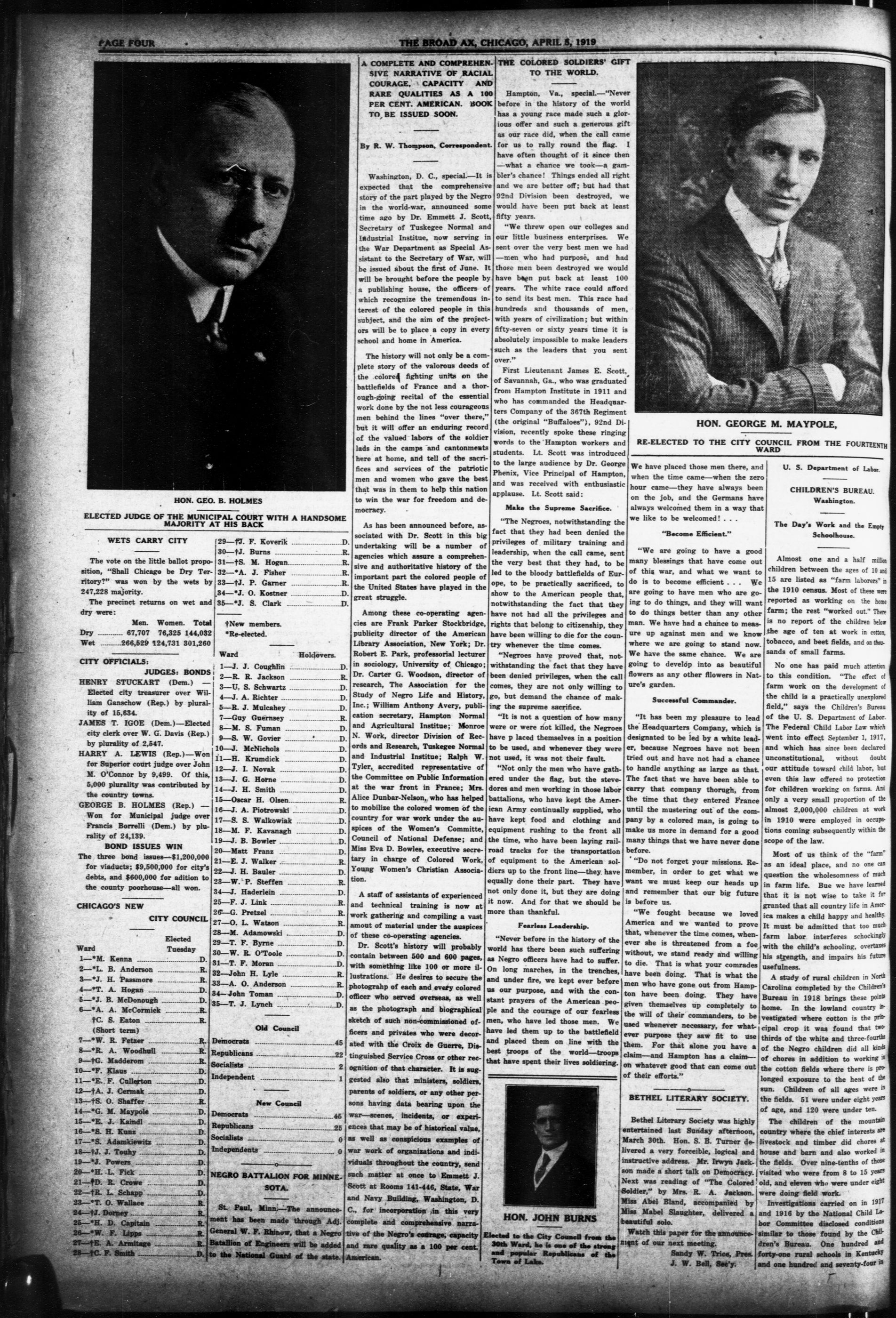
HON. GEO. B. HOLMES
ELECTED JUDGE OF THE MUNICIPAL COURT WITH A HANDSOME MAJORITY AT HIS BACK
CITY OFFICIALS:
JUDGES: BONDS
HENRY STUCKART (Dem.) —
Elected city treasurer over William Ganschow (Rep.) by plurality of 15,634.
JAMES T. IGOE (Dem.)—Elected city clerk over W. G. Davis (Rep.) by plurality of 2,547.
HARRY A. LEWIS (Rep.)—Won for Superior court judge over John M. O'Connor by 9,499. Of this, 5,000 plurality was contributed by the country towns.
GEORGE B. HOLMES (Rep.) —
Won for Municipal judge over Francis Borrelli (Dem.) by plurality of 24,139.
BOND ISSUES WIN
The three bond issues—$1,200,000 for viaducts; $9,500,000 for city's debts, and $600,000 for adition to the county poorhouse—all won.
Ward Elected Tuesday
1—*M. Kenna D.
2—*L. B. Anderson R.
3—*J. H. Passmore R.
4—*T. A. Hogan D.
5—*J. B. McDonough D.
6—*A. A. McCormick R.
†C. S. Eaton R.
(Short term)
7—*W. R. Fetzer R.
8—*R. A. Woodhull R.
9—*G. Madderom R.
10—*F. Klaus D.
11—*E. F. Cullerton D.
12—†A. J. Cermak D.
13—†S. O. Shaffer R.
14—*G. M. Maypole D.
15—*E. J. Kaindl D.
16—*S. H. Kunz D.
17—*S. Adamkiewitz D.
18—*J. J. Touhy D.
19—*J. Powers D.
20—*H. L. Fick D.
21—†D. R. Crowe D.
22—†R. L. Schapp D.
23—*T. O. Wallace R.
24—†J. Dorney R.
25—*H. D. Capitain R.
26—*W. F. Lapps R.
27—*E. A. Armitage R.
28—†C. F. Smith D.
---
PAGE FOUR
.
29—†J. F. Koverik ..... D.
30—†J. Burns ..... R.
31—†S. M. Hogan ..... R.
32—*A. J. Fisher ..... R.
33—†J. P. Garner ..... R.
34—*J. O. Kostner ..... D.
35—*J. S. Clark ..... D.
Ward Holdovers.
1—J. J. Coughlin D.
2—R. R. Jackson R.
3—U. S. Schwartz D.
4—J. A. Richter D.
5—R. J. Mulcahey D.
7—Guy Guernsey R.
8—M. S. Fuman D.
9—S. W. Govier D.
10—J. McNichols D.
11—H. Krumdick D.
12—J. I. Novak D.
13—J. G. Horne D.
14—J. H. Smith D.
15—Oscar H. Olsen R.
16—J. A. Piotrowski D.
17—S. S. Walkowiak D.
18—M. F. Kavanagh D.
19—J. B. Bowler D.
20—Matt Franz R.
21—E. J. Walker R.
22—J. H. Bauler D.
23—W. P. Steffen R.
34—J. Haderlein D.
25—F. J. Link R.
26—G. Pretzel R.
27—O. L. Watson R.
28—M. Adamowski D.
29—T. F. Byrne D.
30—W. R. O'Toole D.
31—T. F. Moran D.
32—John H. Lyle R.
33—A. O. Anderson R.
34—John Toman D.
35—T. J. Lynch D.
THE BROAD AX, CHICAGO, APRIL 5, 1919
A COMPLETE AND COMPREHENSIVE NARRATIVE OF RACIAL COURAGE, CAPACITY AND RARE QUALITIES AS A 100 PER CENT. AMERICAN. BOOK TO BE ISSUED SOON.
THE COLORED SOLDIER TO THE WORLD.
Hampton, Va., special-before in the history of tha has a young race made such
By R. W. Thompson, Correspondent.
Washington, D. C., special.—It is expected that the comprehensive story of the part played by the Negro in the world-war, announced some time ago by Dr. Emmett J. Scott, Secretary of Tuskegee Normal and Industrial Institute, now serving in the War Department as Special Assistant to the Secretary of War, will be issued about the first of June. It will be brought before the people by a publishing house, the officers of which recognize the tremendous interest of the colored people in this subject, and the aim of the projectors will be to place a copy in every school and home in America.
The history will not only be a complete story of the valorous deeds of the colored fighting units on the battlefields of France and a thorough-going recital of the essential work done by the not less courageous men behind the lines "over there," but it will offer an enduring record of the valued labors of the soldier lads in the camps and cantonments here at home, and tell of the sacrifices and services of the patriotic men and women who gave the best that was in them to help this nation to win the war for freedom and democracy.
As has been announced before, associated with Dr. Scott in this big undertaking will be a number of agencies which assure a comprehensive and authoritative history of the important part the colored people of the United States have played in the great struggle.
Among these co-operating agencies are Frank Parker Stockbridge publicity director of the American Library Association, New York; Dr Robert E. Park, professorial lecturer in sociology, University of Chicago; Dr. Carter G. Woodson, director of research, The Association for the Study of Negro Life and History, Inc.; William Anthony Avery, publication secretary, Hampton Normal and Agricultural Institue; Monroe N. Work, director Division of Records and Research, Tuskegee Normal and Industrial Institue; Ralph W. Tyler, accredited representative of the Committee on Public Information at the war front in France; Mrs. Alice Dunbar-Nelson, who has helped to mobilize the colored women of the country for war work under the auspices of the Women's Committee, Council of National Defense; and Miss Eva D. Bowles, executive secretary in charge of Colored Work, Young Women's Christian Association.
A staff of assistants of experienced and technical training is now at work gathering and compiling a vast amount of material under the auspices of these co-operating agencies.
Dr. Scott's history will probably contain between 500 and 600 pages, with something like 100 or more illustrations. He desires to secure the photograph of each and every colored officer who served overseas, as well as the photograph and biographical sketch of such non-commissioned officers and privates who were decorated with the Croix de Guerre, Distinguished Service Cross or other recognition of that character. It is suggested also that ministers, soldiers, parents of soldiers, or any other persons having data bearing upon the war—scenes, incidents, or experiences that may be of historical value, as well as conspicious examples of war work of organizations and individuals throughout the country, send such matter at once to Emmett J. Scott at Rooms 141-446, State, War and Navy Building, Washington, D.C., for incorporation in this very complete and comprehensive narrative of the Negro's courage; capacity and rare quality as a 100 per cent. American
THE COLORED SOLDIERS' GIFT TO THE WORLD.
Hampton, Va., special.—"Never before in the history of the world has a young race made such a glorious offer and such a generous gift as our race did, when the call came for us to rally round the flag. I have often thought of it since then—what a chance we took—a gambler's chance! Things ended all right and we are better off; but had that 92nd Division been destroyed, we would have been put back at least fifty years.
"We threw open our colleges and our little business enterprises. We sent over the very best men we had—men who had purpose, and had those men been destroyed we would have been put back at least 100 years. The white race could afford to send its best men. This race had hundreds and thousands of men, with years of civilization; but within fifty-seven or sixty years time it is absolutely impossible to make leaders such as the leaders that you sent over."
First Lieutenant James E. Scott, of Savannah, Ga., who was graduated from Hampton Institute in 1911 and who has commanded the Headquarters Company of the 367th Regiment (the original "Buffaloes"), 92nd Division, recently spoke these ringing words to the Hampton workers and students. Lt. Scott was introduced to the large audience by Dr. George Phenix, Vice Principal of Hampton, and was received with enthusiastic applause. Lt. Scott said:
Make the Supreme Sacrifice.
"The Negroes, notwithstanding the fact that they had been denied the privileges of military training and leadership, when the call came, sent the very best that they had, to be led to the bloody battlefields of Europe, to be practically sacrificed, to show to the American people that, notwithstanding the fact that they have not had all the privileges and rights that belong to citizenship, they have been willing to die for the country whenever the time comes.
"Negroes have proved that, notwithstanding the fact that they have been denied privileges, when the call comes, they are not only willing to go, but demand the chance of making the supreme sacrifice.
"It is not a question of how many were or were not killed, the Negroes have p laced themselves in a position to be used, and whenever they were not used, it was not their fault.
"Not only the men who have gathered under the flag, but the stevedores and men working in those labor battalions, who have kept the American Army continually supplied, who have kept food and clothing and equipment rushing to the front all the time, who have been laying railroad tracks for the transportation of equipment to the American soldiers up to the front line—they have equally done their part. They have not only done it, but they are doing it now. And for that we should be more than thankful.
Fearless Leadership.
"Never before in the history of the world has there been such suffering as Negro officers have had to suffer. On long marches, in the trenches, and under fire, we kept ever before us our purpose, and with the constant prayers of the American people and the courage of our fearless men, who have led those men. We have led them up to the battlefield and placed them on line with the best troops of the world—troops that have spent their lives soldiering.
HON. JOHN BURNS
Elected to the City Council from the 30th Ward, he is one of the strong and popular Republicans of the Town of Lake.
HON. GEORGE M. MAYPOLE,
RE-ELECTED TO THE CITY COUNCIL FROM THE FOURTEENTH WARD
We have placed those men there, and when the time came—when the zero hour came—they have always been on the job, and the Germans have always welcomed them in a way that we like to be welcomed! . . .
U. S. Department of Labor.
CHILDREN'S BUREAU.
Washington.
"Become Efficient."
"We are going to have a good many blessings that have come out of this war, and what we want to do is to become efficient . . . We are going to have men who are going to do things, and they will want to do things better than any other man. We have had a chance to measure up against men and we know where we are going to stand now. We have the same chance. We are going to develop into as beautiful flowers as any other flowers in Nature's garden.
Successful Commander.
"It has been my pleasure to lead the Headquarters Company, which is designated to be led by a white leader, because Negroes have not been tried out and have not had a chance to handle anything as large as that. The fact that we have been able to carry that company thorough, from the time that they entered France until the mustering out of the company by a colored man, is going to make us more in demand for a good many things that we have never done before.
"Do not forget your missions. Remember, in order to get what we want we must keep our heads up and remember that our big future is before us.
"We fought because we loved America and we wanted to prove that, whenever the time comes, whenever she is threatened from a foe without, we stand ready and willing to die. That is what your comrades have been doing. That is what the men who have gone out from Hampton have been doing. They have given themselves up completely to the will of their commanders, to be used whenever necessary, for whatever purpose they saw fit to use them. For that alone you have a claim—and Hampton has a claim—on whatever good that can come out of their efforts."
BETHEL LITERARY SOCIETY.
Bethel Literary Society was highly entertained last Sunday afternoon, March 30th. Hon. S. B. Turner delivered a very forceible, logical and instructive address. Mr. Irwyn Jackson made a short talk on Democracy. Next was reading of "The Colored Soldier," by Mrs. R. A. Jackson. Miss Abel Bland, accompanied by Miss Mabel Slaughter, delivered a beautiful solo.
Watch this paper for the announcement of our next meeting.
Sandy W. Trice, Pres.
J. W. Bell, See'y.
U. S. Department of Labor.
CHILDREN'S BUREAU.
Washington.
The Day's Work and the Empty Schoolhouse.
Almost one and a half million children between the ages of 10 and 15 are listed as "farm laborers" in the 1910 census. Most of these were reported as working on the home farm; the rest "worked out." There is no report of the children below the age of ten at work in cotton, tobacco, and beet fields, and on thousands of small farms.
No one has paid much attention to this condition. "The effect of farm work on the development of the child is a practically unexplored field," says the Children's Bureau of the U. S. Department of Labor. The Federal Child Labor Law which went into effect September 1, 1917, and which has since been declared unconstitutional, without doubt our attitude toward child labor, but even this law offered no protection for children working on farms. And only a very small proportion of the almost 2,000,000 children at work in 1910 were employed in occupations coming subsequently within the scope of the law.
Most of us think of the "farm" as an ideal place, and no one can question the wholesomness of much in farm life. Bue we have learned that it is not wise to take it for granted that all country life in America makes a child happy and healthy. It must be admitted that too much farm labor interferes schockingly with the child's schooling, overtaxes his strength, and impairs his future usefulness.
A study of rural children in North Carolina completed by the Children's Bureau in 1918 brings these points home. In the lowland country investigated where cotton is the principal crop it was found that two-thirds of the white and three-fourths of the Negro children did all kinds of chores in addition to working in the cotton fields where there is prolonged exposure to the heat of the sun. Children of all ages were in the fields. 51 were under eight years of age, and 120 were under ten.
The children of the mountain country where the chief interests are livestock and timber did chores at house and barn and also worked in the fields. Over nine-tenths of those visited who were from 8 to 15 years old, and eleven who were under eight were doing field work.
Investigations carried on in 1917 and 1916 by the National Child Labor Committee disclosed conditions similar to those found by the Children's Bureau. One hundred and forty-one rural schools in Kentucky and one hundred and seventy-four in
M. C. KENNEDY
HON. JOHN H. PASSMORE
Eminent and successful lawyer; ex-assistant Corporation Counsel of Chicago and the newly elected Republican Alderman from the third ward.
Mr. Passmore desires to extend his heart-felt thanks to his legions of true friends and to the others who loyally supported him in his race for the City Council from the Third Ward, and in every possible way he will at all times faithfully endeavor to serve them to the best of his ability as a city official and work hard in the interest of all the citizens of Chicago.
that ward did not take any stock in the wild cat and scandalous stories which had been circulated by his Democratic political opponent, who lacked the moral curse to meet him face to face and discuss the issues of the campaign in joint debate.
It has been amply proven that Mr. Passmore was not the tool of the candidate of the Traction Com
His election to the City Council from the Third Ward with a tremendous majority at his back simply means that the voters residing in Oklahoma were studied for irregular and non-attendance. It was found that the greatest number of absences in both States was due to farm work. The other largest contributing causes were illness, housework, and indifference. Farm work and housework combined nearly equal the absences from all other causes.
Does the compulsory school attendance law protect children from heavy work and long hours in the fields? There are interested and vigorous school officers who do their best to enforce the law; but even at best the period of attendance required is meager. There is always a loophole through which children may be piped to work.
In 10 States the period of attendance is below 5 months. In Alabama children must attend school for 80 days;; in Georgia 4 months; in Mississippi 60 days, but the School Board may reduce this to 40 days; in North Carolina four months; in South Carolina four months in agricultural districts for child laborers; in Tennessee outside of cities of 5,000 scholastic population 80 days, or entire session if this is less than 80 days; in Texas 100 days or entire session if less than 100 days; in Utah outside of first and second class cities 20 weeks; in Virginia 16 weeks. Delaware has a required attendance of 5 months which may be changed by vote to three.
In three of the States listed above, Florida, Mississippi, and South Carolina, even the short term noted is not a state-wide requirement, as the adoption of the school attendance law is optional with the locality. A few States definitely require attendance for less than the entire session and even where attendance during the entire session is required there is often no assurance that it will be long enough to enable the child to get adequate schooling.
Fourteen States will excuse a child from school solely for "satisfactory," insufficient," or "urgent" reasons, for domestic necessity," or "for cause." No of these States specify that the urgent reason" shall be "strictly construed." In Georgia the school officers are definitely authorized to consider need for agriculture labor in excusing children in rural districts.
The Back-to-School and Stay-in-school drives of the Children's Bureau were started to arouse both parents and children to the realization that school is better than work for children until they are sixteen. It says. As the Bureau says: "The more you learn, the more you'll learn."
instant Corporation Counsel of Chicago in Alderman from the third ward.
that ward did not take any stock in the wild cat and scandalous stories which had been circulated by his Democratic political opponent, who lacked the moral coruage to meet him face to face and discuss the issues of the campaign in joint debate.
It has been amply proven that Mr. Passmore was not the tool or the candidate of the Traction Companies; that, he spent a limited amount of money of his own to defray the expenses in connection with his election to the City Council.
CITY NEGROES AND SANITATION.
No city can be considered sanitary so long as any part of it is in an unhealthful condition. The sections inhabited by Negroes are characterized by the presence of mud and stagnant water, the absence of drainage systems, sidewalks, sewerage systems, gas, and electric lights. A city that is partly sanitary is in a condition similar to a person dressed in evening clothes who has failed to take a bath and change his linen. The relation existing between Negroes inhabiting the unsanitary sections of cities and the remainder of the community is very close. The cooks, maids, wash-women, waiters, chauffeurs, elevator operators, and employees of almost every description are brought into close association with the white people in the performance of their daily tasks. They have access to practically every room in most of the homes and business establishments. The unsanitary conditions existing in Negro sections thus become a menace to the entire city. Aside from a consideration of what may be due Negroes as residents of unsanitary sections, the interest and protection of the city in its entirety should cause those in charge to urge more effective measures for safeguarding the health of its citizens by definitely establishing and rigidly maintaining hygienic and sanitary conditions throughout the city.
Germs of infections and contagious diseases confine themselves to no particular class nor group of people, nor to any particular sections of cities. The only effective safeguard against them is to rid a city of every source of such maladies.—Southern Workman.
CAPTOR OF JEFF DAVIS DIES
AT SOLDIERS' HOME.
Bristol, Tenn.—Casper Knoble, 75, a Civil War veteran, is dead at the Soldiers' Home at Johnson City, Tenn. He enlisted in the Federal Army at Cincinnati, O., February 8, 1868, and served through the war. Knoble had the distinction of having captured Jefferson Davis president of the Southern confederacy, and for this act a medal was conferred upon him by Congress.
Mrs. Adah D. Murray, who is a highly trained nurse, late of New York City, has become the Superintendent of the new Lake Park Hospital, 4147 Lake Park ave. Mrs. Murray is extremely pleasant to come in contact with and in every way she is the right woman in the right place.
REV. W. S. BRADDAN CONTINUES TO DRAW LARGE CROWDS AT BOTH THE MORNING AND THE EVENING SERVICES AT THE BEREAN BAPTIST CHURCH.
LAST SUNDAY EVENING HE LOUDLY PRAISED THE KNIGHTS OF COLUMBUS, CLAIMING THAT ITS OFFICIALS WERE FREE FROM RACE PREJUDICE AND FREELY SERVED THE COLORED SOLDIERS WITH EVERYTHING THAT THEY DESIRED WITHOUT COST.
ON THE OTHER HAND, THE HEAD OFFICIALS OF THE Y. M. C. A., IN THIS COUNTRY AND IN FRANCE, WERE FULL OF RACE PREJUDICE AND CHARGED THE SOLDIERS, ESPECIALLY THE COLORED SOLDIERS THE HIGHEST PRICES FOR EVERYTHING THAT THEY DESIRED.
Rev. W. S. Braddan Chaplain of the 370th United States Infantry formerly the old Eighth Regiment of Illinois, whose members covered themselves over with undying fame and honor on the battlefields of France; continues to draw big crowds at both the morning and the evening services at the Berean Baptist Church 52nd and Dearborn Street, for the people are still highly interested in what he has to say in relation to the greatest and the bloodiest war that human beings have ever gazed upon during his remarks Sunday evening he declared that for many years he had always freely contributed to the Y. M. C. A., that he firmly believed that it was doing a splendid Christian work; but his has been convinced otherwise for be knows for himself that it is staggering under a fearful load of race prejudice, that while the old Eighth Regiment was stationed at New Port News, Va., awaiting orders to sail over the deep blue sea to the bleody battlefields of France; that he called on the head officials of the Y. M. C. A. in that city and requested them to permit him to hold services each Sunday morning in the Y. M. C. A. building while the regiment was stationed there as there were no white soldiers around to use it at that time, the head officials of the Y. M. C. A. turned him down cold, at the same time informing him that not so far away was a little tumbled down building which had been used by all the other Colored soldiers and that it was plenty good enough for him and his men; Rev. Braddan responded that that dirty building could only hold about three hundred persons that thirteen hundred men attended his
EVEN A PULLMAN PORTER
"Every time I came home she wanted a new dress," wailed James Green, colored, in the Court of Domestic Relations Wednesday. "She wanted to dress like a movie actress." Green, a railroad porter, was before Judge Fry on a charge of nonsupport. That stuff about porters
Sunday morning services, that he could not and would not use it.
Then he decided to approach the head officials of the Knights of Columbus and the very first thing they wanted to know was at what hour on Sunday morning do you want to use it," and he said "11 o'clock" and at that hour." Rev. Braddan proudly walked at the head of the soldiers, the famous Eighth Regiment Band playing "Onward Christian Soldiers" and marched right into the Knights of Columbus building where he freely held religious services each Sunday morning while in New Port Nems, against the solemn protests of the head officials of the Y. M. C. A. of that race prejudice ridden southern City.
Rev. Braddan further stated: that at all times and at all places in this country and in Europe; that the Knights of Columbus, freely furnished the soldiers, regardless of their race or nationality without any cost to them, "smokes," chewing-gum, writing paper and other little odds and ends which were so near and dear to them and some of those connected with the Knights of Columbus, seemed perfectly willing to write letters, for all those who were unable to write.
On the other hand, the Y. M. C. A. officials figured on making a good profit on everything they furnished the soldiers; notwithstanding the fact; that generous hearted christian people throughout the world, had freely contributed money to aid the Y. M. C. A. in its so-called charitable work among the soldiers, on the bloody battlefields of France.
getting rich on tips was the "bunk," he said.
He was ordered to pay $5 toward the support of his 3-year-old son. The Greens live at 5655 S. Wabash ave.
Mrs. Daisy Anderson, 6026 South Aberdeen street, will leave this coming Wednesday evening for Los Angeles, Cal., where she will spend two months in visiting with friends.
[Name not visible]
REV. W. S. BRADDAN
Chaplain of the Old Eighth Regiment, National Guards of Illinois; late the 370th U. S. Infantry; who will occupy his pulpit at Berean Baptist Church at both the morning and the evening service, Sunday,
FIVE CASES OF DEATHS.
It has been generally accepted by health officials that the sanitary status of a city may be judged by the number of its typhoid deaths. Typhoid fever is primarily a filth disease. It is transmitted mainly through food or drink, contaminated water or milk; and sometimes through flies and again by human carriers. The germs that cause typhoid always come from the bowels of a person who has the disease; or if from a carrier, a person who has had it and who still has the germs in his or her system. When such persons handle foods that are eaten by others, it always means an outbreak of this terrible disease.
Fortunately now for humanity, people can be protected against typhoid by vaccination in the same manner that they can be protected against smallpox. The only trouble is people will not avail themselves of the protection.
In the Spanish-American War typhoid killed many more soldiers than were destroyed by shot or shell. In the recent world war, in addition to all sanitary safe-guards our soldiers were protected against this disease by vaccination. The people of Chicago who stay at home and drink only Chicago water and use only pasteurized milk stand small show of having typhoid.
It should be pretty good news to the people of Chicago to know that in this big city of nearly 2,600,000 men, women and children there were only five cases of typhoid fever reported for the entire month of February and not a single death from this disease.
This looks as though it paid to have chlorinated water and a pasteurized milk supply.
Delay Is Dangerous.
For the week ending March 15th there were 105 cases of diphtheria reported to the Department. Of these twelve died.
For the same week there were 75 cases of scarlet fever with only two deaths.
And yet there is no specific cure for scarlet fever, while there is a positive cure for diphtheria, provided only it be given not later than the second day of the attack.
Antitoxin not only cures diphtheria, but when given to children who have been exposed to the disease has a high immunizing or protective value. It is furnished free.
Now the records of the Department of Health show that the blame for so many needless diphtheria deaths among the children of Chicago may be about equally divided between the parents and the doctors. In about fifty per ctnt. of the cases that died the parents did not call the doctor until it was too late. In the other fifty per cent. the physicians waited for a laboratory confirmation of their diagnosis—in other words, they wanted to be sure they were right—and their delay also cost the lives of their little patients. Diphtheria is a throat disease. Most diphtheria deaths are due to
T.
nt, National Guards of Illinois; late will occupy his pulpit at Berean Bap-g and the evening service, Sunday, IL 6.
"neglected sore throat."
When the little one complains that its "throat hurts," don't wait to see "if it won't be better tomorrow."
Call your doctor right away.
COLORED MAN FOUND DEAD FROM GAS IN HOME.
Albert Ennis, 30, 5632 Grove ave. colored, was found asphyxiated by gas in his home Tuesday by Mrs. Molly Thompson, who rooms there. Gas was escaping from an open jet in the room.
Mrs. Irene M. Gaines, 5827 Wentworth ave., has been confined to the Lake Park Hospital, 4147 Lake Park ave., where she has undergone a successful operation. She expects to be able to return to her home the middle of this coming week. She will be very much pleased to have her many friends to call and see her.
Last Sunday morning Madam Rosa Lee Tyler, who recently returned to this city from Los Angeles, Cal., sang at the Olivet Baptist Church, 31st street and South Park ave., to the great delight of those who listened to her. She left last evening for Cincinnati, Ohio, where she will play a six weeks engagement with Billy King and his company. Shortly after June 1 she will appear with the same company at the Grand Theatre in this city. At the present time Mr. and Madame Tyler are stopping at 3434 Vernon ave.
Mrs. Emma J. Goin, who owns a lovely home in Springfield, Ill., but has been residing in this city for almost two years, recently successfully passed the Federal examination and she has been appointed to a good position in the Chicago postoffice. She averaged $87 \frac{1}{2}$ per cent. in all the examiations. Mrs. Goin is full of pluck and ambition and she deserves much credit for pushing forward and go aheadiness.
His poetry is not a mountain-tara like that of Wordsworth; it is not in sympathy with the higher moods of the mind; yet it continues entertaining in spite of all changes of mode. It was a mirror in a drawing-room, but it gave back a faithful image of society, powdered and rouged, to be sure, and intent on trifles, yet still as human in its way as the heroes of Homer in theirs.—Lowell.
The singing mouse is not a distinct species. According to descriptions of the common house mouse, "Mus musculus," and of the American woodmouse, "Hesperomys leucopus," they have been known to acquire the trick or habit of warbling a few notes in a high key and with a shrill wry timbre, vocalizing in a manner that might be called singing.
The Lee family of which Gen. Robert E. Lee, commander of the Confederate army during the Civil war, was a member, was of English origin. One of his ancestors emigrated to Virginia in the reign of Charles I, and the family was prominent then, during and after the Revolutionary war—Columbus Dispatch.
PAGE FIVE
of Illinois; lata
t Berean Bap-
service, Sunday,
Pope's Poetry.
The Singing Mouse.
The Lee Family.
```markdown
```
CHIPS.
WHAT IS SHOWN IN PARIS SHOPS
Directoire Dress, Capes, Suits and Other Apparel Dear to Woman's Heart.
Almost Everything Is Correct if It Follows Lines of the Figure—Outer Wrapa Have Tendency to Exaggerate Natural Curves.
"As you were," says Paris, using soldierly language as the occasion demands, hastening to add, lest you think her arbitrary, "that is, if you wish." In the first instance she refers to the pre-war styles, and in the second to the fact that if these do not please you there are plenty of other fashions that are suited to your individual taste.
Following the line of least resistance describes the newest fashions to a peppermint, for as if weary of controversy the makers of fashions have decided to pick up the threads of the
TEXTILES
ADVERTISING &
BILLOWING
The long draped lines and transparent hem, together with the beaded bodice, is suggestive of the harem and carried out in rose and French blue, with beads of crystal and pearl. The ostrich ornament for the coiffure also is of rose and blue.
1914 models and weave them into those of today, thereby pleasing, if possible, everyone concerned. Practically, observes a prominent fashion writer, it works out in this way: Almost everything is in correct line if it follows the lines of the figure. The fact that nine-tenths of the makers voted for the directoire modes strengthens this conclusion rather than otherwise, as the dresses of this period particularly emphasize the lines of the figure underneath, while the coats and outer wraps, aside from the picturesque revers, have a tendency to exaggerate the natural curves. That is the point, that the human form divine is not absolutely straight up and down is made partially apparent.
The directoire fashions were in the air in 1914, but something intervened and the movement hardly progressed further than the draped skirts and the large revers; this time further developments seem possible. Aside from the fact that the directoire lines are preferred, one may dress as suits one's individual fancy.
Showing Independence.
Evidently the public have the bit in their teeth as regards a few points of the fashions. It is clearly shown that in the last few months there is no desire for eccentricities or extreme exaggerations. That the women of France have a great deal to say, particularly the fashionables of Paris, as to what will be taken, up is sometimes overlooked in the general admiration of the models put forth by the makers. At the Paris opera lately when the official ban on evening clothes was lifted it was noted that instead of the brilliant clothes expected by the designers and which they had prepared for there was little display.
Streets in Paris are still dimly lighted, wounded soldiers are everywhere and women swathed in mourning serve as a background which throws even the moderately bright clothes into sudden relief. How, then, can the designers expect the women to wear the brightest of colors and the most extravagant of clothes? A certain amount of somber richness was displayed, but the untrammeled extravagance of pre-war days was to be noted only in isolated cases in the boxes.
It is said that the American woman in Paris can be spotted easily by her longer skirt and long, tight sleeve. This order of affairs is about to be changed and the longer skirt is about
to become universal. As to the extremely short sleeves, the American woman will wear them while in Paris and on some occasions at home, but not in the afternoon except in the sheerer materials.
"We Aim to Please."
That there are modes to please every woman in whatever type she may demand is emphasized by two reports from the other side. One states that the Maison Doeullet, in putting forth the directoire dress, followed the original inspiration as to the extent of the upcurving waistline at the front, and another house shows waists that dip downward at the front in a point.
Capes, say some authorities, are going to be worn by the women who know and suits will be left to the general public who do not know. All very well for Paris, but one might as well try to break the American woman of the habit of eating as to think-of depriving her of her well tailored suit. That the makers know*this is evident from the fact that their suits are more than ordinarily worth while. Bulloz, who has always had a leaning to the directore when there has been the slightest excuse for it, shows some of the smartest ones of this type.
All of the models of this house are of the strictly tailored classification. The lengths are modified to suit the wearer, but the same general lines are preserved throughout. The skirts are quite tight and the coats are cut with flaring godet plaits in the peplum, whether the latter be long or short. Waistcoats are to be worn with the majority of the suits and are provided with collars which run up very high at the back.
Doucet ideas run counter to those of some of the other houses. No directoire models are to be seen in this collection, as Doucet clings to the old straight line, and the suits are built on this principle as well as the dresses. A slight concession to the general trend may be found in the high square-collars seen on the straight knee-length jackets.
The Turic Apron.
Premet taillleurs are enhanced by the addition of front tunic aprons buttoned down the sides, but otherwise they are quite straight and simple. The suit coats that are worn with these skirts are three-quarter length and may be cut away at the front, and the collars and cuffs are of contrasting colors. The upper part of the jacket is loosely girdled and the skirt part is made with the swinging directoire flare.
Jenny prefers the knee-length jacket for her suits, which she makes of serges, etamines and covert cloth. These are shown with waistcoats of white faille striped in gold and of white Ottoman silk.
Doeulillet depends for chic on the slash, which is found in abundance on the jackets and seen singly on the skirts.
- Summing it all up, it would seem that the skirts to the jackets will remain long and that the jackets are in
© Western Newspaper Union
A beautiful tea dress of blue taffeta with diagonal flouces with novel trimming of loop silk fringe.
general, longer, but it must be kept in mind that these same long jacket models have held for several seasons in Paris and have been modified in length for wear on this side. Also the makers are showing some three-piece models which have quite short coats with them, or perhaps are supplemented with short capes. Buttons are possibly the chief trimming, noted at the sides of the jackets and up and down the entire length of the skirt at the back.
Afternoon dresses show many decided changes, and there are many women who will breathe a sigh of relief over the fact. It can hardly be denied that the styles of dress in vogue for the last few seasons have been most trying to all but the freshest and youngest of women. A collarless, trimmingless, perfectly plain bodice demands greater perfection than the average woman feels sure of possessing.
THE BROAD AX, CHICAGO, APRIL 5, 1919
FOR SPRING WEAR
FOR SPRING WEAR
Tailored Costume Biouse Among the Prime Favorites.
More of the Waist-Length Models Will Be Worn—Long Blouse Distinctive and Attracts Attention.
When a woman finally discovers that style rules are meant for her general guidance only, and not meant to be followed blindly, she is on the road to being really well dressed. Unfortunately, few women, except those who are interested in styles from a business standpoint, make this all-important discovery. Every style suggestion is taken literally and copied or followed exactly, and the result is that femininity en masse is most inartistically garbed.
The separate blouse is a garment that is amenable to many interpretations at the present time. The long costume, or peplum blouse, is an extremely interesting member of the blouse family, but it would not be safe or true to say that it is to dominate the line. Unquestionably more of the waist-length models will be worn. For this reason the long blouse is distinctive and usually attracts attention. In the lineup of waist-length blouses, sheer cotton volles and organdies are especially popular fabrics. White or plain pastel colors are smart and the
THE FASHION OF THE TWENTIES
Tailored Costume Blouse for Spring. blouse of checked, striped or figured cotton voile is dainty for late spring or summer wear. Some long costume blouses are shown made of sheer cotton materials, but this type of garment is especially smart when a rich material is employed. Filmy chiffons and nets, georgette and lace, are employed with excellent effect. Severely tailored costume blouses are smart, and when combined with tailored skirts of blending or contrasting color help to make up decidedly chic frocks for early spring street wear.
The blouse shown in the sketch, a model reaching almost to the knees, would be charming made of tan or sand-colored satin, with collar and cuffs of navy or green taffeta, taffeta-covered buttons, and a sash belt of taffeta or black velvet ribbon. This blouse may be worn with a black skirt or with one of navy taffeta or satin. The result will be an altogether suitable frock for early spring street wear.
SHOW PREFERENCE FOR SUITS
Trend of Business Indicates That Coat Will Not Be Generally Favored Garment.
"It is difficult at this early date," said an authority in the women's ready-to-wear industry, "to predict whether this is to be a coat or a suit season. The fact that buyers for the large retail stores of the country have shown a slight preference for suits in their later business might be taken as an indication of what is and is not to be, but the purchasing public is, after all, the final arbiter in such matters. And, in this respect, it is reported that retailers have disposed of more suits up to date than during the same period for several years back. This also would seem to show which way the fashions are going, but then fashions, like the winds, are very changeable, and it is still possible that, in spite of all the signs now pointing to the contrary, coats may lead the season. However, just at this time there is reason to believe that suits are to be most generally favored."
Many present-day fashions, with the tendency toward long skirts and the draped lines, are not so accurately described by the word youthful, but there is a sufficient number of simple modes to still permit the word youthful to adequately describe a big percentage of new fashions.
MADE-OVER SKIRT PROBLEM
New Styles Demand That the Well-Dressed Housewife Look to Her Petticoats.
Now that the skirts are definitely narrow, the well-dressed housewife must look to her petticoats. If she is like some women she just succeeded last summer in getting an extra gore into all her old white petticoats, many of them left over from the previous vogue for narrow skirts. And now—narrow skirts are in again.
It is not such a difficult matter to make a petticoat narrower as it is to make it wider. Indeed, sometimes a worn petticoat can be used for another season in a narrower form, because the worn section can be cut out.
With the new street suits the well-dressed woman wears a very simple petticoat. In many cases it shows flat tailored seams and no ruffles, but instead a scalloped lower edge. Sometimes the scallops are buttonholed and sometimes they are bound with a bias band of silk. Jersey petticoats of a heavy quality material are made in the same way. They are also made with a scant, shaped flounce applied below the knees. Satin petticoats, with not very full plaited flounces, are, likewise, a very good investment. It is possible that you have an old satin frock containing a petticoat of this sort. If you have, rip it and then wash and iron it before making it over.
Be careful in cutting one of the new petticoats not to get it too narrow around the knees. Narrowness at this point often causes a petticoat to ride up. Another good way to keep the petticoat down where it belongs is to make the hem or lower part, if you have a scalloped petticoat, of two thicknesses of material or to band a straight flounce with a blaz strip of the material on the bottom.
WOOL EMBROIDERY IS USED
Ornamentation That Is Effective on All Sorts of Fabrics—Suitable for Fancy Work.
Wool embroidery is used practically on everything—and for good reason. It is simple to do and makes an ornamentation that is effective in both line and color. It is such an inexpensive trimming that it may be considered one of the clever economies of the late war. And a touch of wool embroidery may be employed actually to give the expensive looking hand touch to ready-made wearables.
Wool embroidery is used on all sorts of fabrics, including georgette, serge, velvet and cotton crepes. It trims chapeaux, frocks for kiddies and grown-ups, too, and a multitude of fancy work from bags to table runners. One of the most popular stitches is merely a coarse darning stitch. Sometimes one row of darning stitch is alternated with another row of the same stitch in a different color. Buttonhole stitch is also much used. Sometimes little crocheted or knitted flowers are added effectively here and there on the flat work.
NEED DAINTY NECK FIXINGS
Ornamentations Are Required to Relieve the Severeness of the Collarless Lines.
There is more and more call at the neckwear counters for "something to give that collarless neckline without the bare, plain effect that is so unbecoming." Most women find one perfectly collarless frock quite enough to satisfy their longing for ultra-modishness, and a warning conveyed by their mirror sends them posthaste to the neckwear section to find something more becoming. There are various dalny neck fixings which seem to fill the bill exactly; collars that outline back and sides of a square neck opening, cowl collars that stand up from the low, collarless neck, and flat, round collars edged youthfully at the back. A pretty set of this sort is of fine white net with plaited frills of Valenciennes lace and the low, round collar is matched by cuffs of the net and lace that turn back from the wrist.
LATEST STYLE IN COIFFURE
OUBU.
This is the latest style in hairdressing from Paris. It is equally becoming to the blonde or brunette.
IN FAVOR OF CAPE
All-Covering Garment Is Kind to the Figure.
In Some of its Phases It May Easily Be Fashioned by the Uninspired Dressmaker-Look Smart.
The long, all-covering cape remains a favorite with the up-to-date woman. It is tucked into the season's outfit, whether for Northern or Southern climes.
It is kind to the figure, this long cape. It has such grace, such picturesqueness, is so easily put on and off, and supplies such a comfortable extra wrap to be thrown on over a suit that its vogue is readily understood. And in some of its phases it may easily be fashioned by the uninspired dressmaker. However, one must not allow oneself to be deceived on that last count. Some of the latest models, unassuming in air, are extremely subtle in cut and adjustment, and unless one can be content with a simple circular cape it is well to be sure of a good pattern before undertaking a homemade wrap of this order.
One of the most popular of the season's cape models came out a little before the new year and has been copied to the point of monotony, yet it always manages to look smart, even though it is no longer exclusive."
It has a full, voluminous body, attached to a yoke which extends half the length of the upper arm, forming point shapes over the arm. There is a large shawl collar which is draped around the neck, crosses over in surplice fashion and fastens at the back underneath the folds of the cape. This model is well adapted for summer wear, as it leaves visible at the front, from the waist down, a panel of the pretty summery frock.
One model built upon these lines was made of gray silk figured in a soft rose-colored design.
In dark blue serge, white serge, black and white checks, black satin, gray serge, beige serge, etc., this cape is very effective, and is fairly typical of a large class of such wraps, varying only in minor details.
Some of these capes and cape-co models are of a distinctly sporty character, built up in plaids, black checks, gay wool velours, tweeds and jerseys. Others are designed more especially for street or travel purposes, and among these are some particularly good-looking dust-gray models in fine, soft serge or twill.
Paris is very fond of this material and color for all kinds of travel coats. It is good, too, for a separate cape for travel or motorcar, a long, ample, enveloping garment, warranted to protect the frock or suit beneath. But for hard motoring a cape is not desirable save, perhaps, to afford extra warmth or protection over a coat. The cape is not taut enough, is prone to fluttering or flying folds and flapping is the unpardonable thing in a motor outfit that asks to be taken seriously.
Beige and the various shades of light brown are modish colors, too, though Paris likes the dust gray better for this special type of garment, and it is more practical in the matter of resisting soil.
INTEREST IN EVENING DRESS
With the Trying Days of War a Thing of the Past Women Are Dressing in Gayer Clothes.
More interest is being taken in the question of evening frocks just now than at any time since America entered the war. During the trying months of the war women were too thoroughly occupied with really serious interests to spend either time or money on apparel for formal functions, and as a matter of fact there were few social-functions that were not of a semipatriotic or philanthropic nature, so that simple costuming was considered in the best possible taste. All women agreed, however, that they must continue to dress well in order that the public morale might be kept in a healthy state and the all-the-day-through frock was by all odds the favorite outfit.
Now that the war is over and soldiers are returning by the thousand every week, social festivities are taking on, a new lease of life and the regulation evening gown is in demand. Women in full evening dress are seen at the theaters and life everywhere is sounding a gayer note.
HAVE NOTE OF QUAINTNESS
Simpler Summer Frocks Are Being Developed in Many Alluring Demure Styles.
There is a note of quaintness in the simpler summery frocks this year; chintzes in small patterned designs are developed in many alluringly demure styles, one with tiny bright red flowers having a little white dotted swiss blubed apron appliqued with red wool embroidery.
Hats are made of fabric to match and one model with a poke bonnet trend is equipped with long green earrings.
Peasant frocks in natural or dark colored linens have applique border designs of two-color crepes. Simple morning frocks of gingham are ruffled in white and embroidered in wool, and chemise frocks of handkerchief linen also have rather elaborate embroideries in worsted.
Q
This gown of striking lines is of blue poulette, hand-embroidered in same shade and panels edged with ball trimming.
SHOULD MATCH THE CAMISOL
Combination of Brilliant Colors Are Not Add to Attractiveness of Well-Dressed Woman.
Is anything uglier than the transparent peplum blouse worn with a light camisole or corset cover? It was bad enough with the oldtime blouse that ended at the beltline, but when the newer type of blouse is worn there is an ugly discrepancy between the waist section and the skirt section of the blouse.
Of course, where the front and back panel of the blouse are of some heavier material the effect is quite satisfactory. But when georgette or chiffon is used, then one really needs a dark camisole. It is not always easy to buy these, although they are to be had in navy blue, one or two shades of brown, green and the other usual suit shades. But they are not difficult to make, and you should have one or two to go with every suit.
Soft satin of some sort is a good collection for the fabric, although crepe de chine is also good. They can be finished at the top with machine hemming, such as you can have done at a dressmakers' supply store, and the shoulder straps may either be made of ribbon to match or some of the fabric finished with a narrow hemming of the same sort. Needless to say, they should be adjusted so that none of the lighter lingerie appears above the dark camisole.
FROCK OF SHRIMP-PINK NET
CINEMA
CINEMA & CINEMA
This charming frock is adapted to the blonde or brunette. It is of shrimp pink net with plotted double ruching and beaded bands of burnt orange beads which harmonize with the satin girdle.
Colored Neckwear
New colored neckwear sets are made of ogandile. They are the very daintest bits of neckwear that the shops have shown for a long time. Many of them show tuckers to match the colars, and some of them show cuffs, as well. They are made in several lovely shades of both blue and pink, in soft yellow, an equally soft green and in illac shades.
Stop Thief!
THE "Jumbo" gas burner shown here at the right, (actual size) is a robber on any gas lighting fixture in Chicago. If you have one, get rid of it! It makes high gas bills and causes a great many of the complaints that come to us.
Use mantle burners to get more light with less gas. Burning five hours a day for a month, the "Jumbo" consumes $2.30 worth of gas; a "Junior" mantle burner, in the same time, consumes only 39 cents worth, or $1.91 less, and gives much more light.
We sell "Junior Mantle" lights complete for only fifteen cents, (which is less than "Jumbos" usually cost) or give one free, in exchange for a "Jumbo," at our main office or any of these stores:
West Side 2142 West Madison St. 1709 West 12th St. 1641 Milwaukee Ave. 3221 Ogden Ave. 4033 West Madison St.
North Side 3071 Lincoln Ave. 3643 Irving Park Blvd. 408 West North Ave.
South Side 731 West 63rd St. 3478 Archer Ave. 103-5 East 35th St. 9051 Commercial St. 11025 Michigan Ave.
This Is the The Peoples Gas Light & Coke Co. Michigan Avenue at Adams Street "JUNIOR MANTLE" Telephone Wabash 6000
This Is the
"JUNIOR MANTLE"
Is the
MANTLE"
Telephone Calumet 602-3572
MORRIS, Pres.
KIRBY W
MORRIS-WAL
COAL CO.
Incorporated
HUGH NORRIS, Pres. KIRBY W
NORRIS-WA
COAL CO.
Incorporated
2545 SOUTH PARK AVENUE
Chicago
THE CR
Apartment
3600 WABA
The finest building ever open
cago. Steam heat, electric li
Phone Main 263
THE CRANFORD
department Building
3600 WABASH AVENUE
building ever opened to Colored ten-
m heat, electric lights, tile baths, mar-
in 263
J. W. CAS
133 W. Washin
rise in the BROA
THE MIDDLE FLOOR
THE CRANFORD Apartment Building
3600 WABASH AVENUE
The finest building ever opened to Colored tenants in Chicago. Steam heat, electric lights, tile baths, marble entrance
J. W. CASEY, Agent
Phone Main 263
133 W. Washington Street
Advertise in the BROAD AX
a lake near Biggar, Saskatchewan, has been found to be saturated with sodium sulphate, and the deposits under the lake and alongside the edge be nearly 97 per cent pure sulphate. The mineral is used extensively in the manufacture of sulphuric acid, in photography and other industrial purposes.
to clean and polish wallpaper, add
tablespoonfuls of ammonia to half
pailful of water, and wash the walls
own with a flannel dipped in this.
also half a pailful of water and add
tablespoonfuls of turpentine. Wash
walls a second time with this and
be as dry as possible.
Good Rule for Life.
we are ruined, not by what we really want, but by what we think we is therefore, never go abroad in search of your wants; for if they be all wants they will come in search of us. He that buys what he does not, will soon want what he cannot—Colton.
```markdown
```
We sell "Junior Mantle" lights complete for only fifteen cents,
(which is less than "Jumbos"usually cost) or give one free, in exchange for a "Jumbo," at our main office or any of these stores:
West Side 3643 Irving Park Blvd.
2142 West Madison St. 408 West North Ave.
1709 West 12th St.
1641 Milwaukee Ave.
3221 Ogden Ave. 731 West 63rd St.
4033 West Madison St. 3478 Archer Ave.
103-5 East 35th St.
North Side 9051 Commercial St.
3071 Lincoln Ave. 11025 Michigan Ave.
The Peoples Gas Light & Coke Co.
Michigan Avenue at Adams Street
Telephone Webash 6000
The Calumet 602-3572
KIRBY WARD, See
IS-WARD
AL CO.
Incorporated
CRANFORD
ent Building
ABASH AVENUE
opened to Colored tenants in Chi-
ic lights, tile baths, marble entrance
J. W. CASEY, Agent
133 W. Washington Street
the BROAD AX
Alexander Bell was the great American who invented the telephone, which is still called the Bell telephone; and Alexander Humboldt was a German traveler, statesman and the most distinguished naturalist of all times. One of his most important discoveries was the decrease in intensity of the earth's magnetic force from the pole to the equator. His most important book, "Kesmos," was written in his seventy-fifth year. He did much in his long life-to further the science of the world.
Important Rivers.
and
Just as Egypt, has been made by the Mile, so Mesopotamia has been made by the Tigris and the Euphrates. The view put forward with some authority that the rivers should be kept exclusively for irrigation and not be depended upon for transport is challenged on many grounds, one of which is that irrigation and navigation can be effectively combined, and indeed made mutually advantageous for many years to come.
```markdown
```
THE BROAD AX, CHICAGO, APRIL 5, 1919
As Near As Your Telephone DISTANCE IMMATERIAL
IN a Metropolitan City of this size, death knocks every thirty minutes at some door. Too often that death not only brings sorrow, but misfortune as well. Let the price you pay for a funeral be a business proposition and you will benefit by it in service, quality and cost to you in dollars and cents. The result of my campaign has built for me one of the largest and most magnificent establishments in the world. A visit will convince you.
Consult me, I can save you Worry,
Shipping to all parts of the Country
Funerals a Specialty. Central Dis
Chapel. Call promptly answered day
Ernest H. William
KENWOOD
455
Undertake
5028 and 5030 S. State St.,
OWNERS A
DAN M. JACKSON
GEO. T. KERSEY
DAVID A McGOWAN
AHMED A. RAYNER
Consult me, I can save you Worry, Time and Money. Shipping to all parts of the Country and Automobile Funerals a Specialty. Central Display Rooms and Chapel. Call promptly answered day or night.
OWNERS AND DIRECTORS
DAN M. JACKSON
GEO. T. KERSEY
DAVID A McGOWAN
AHMED A. RAYNER
Phones Calumet 6164
Automatic 71-629
OPEN DAY AND NIGHT
The Eman
Undertak
2959-61 South
Reliable Service
Reasona
FREE CHAPEL
Complete Line of Funeral G
The Emanuel Jackson Undertaking Co., Inc.
2959-61 South State Street
Reliable Service Courteous Treatment
Reasonable Prices
FREE CHAPEL IN CONNECTION
Complete Line of Funeral Goods Automobiles for Hire
Residence: 508 East 36th Street
Phone Douglas 4397
J. GRAY LUCAS
Attorney At Law
Suite 815 Hartford Building
8 S. Dearborn St., Chicago.
Phone Central 6583
Tel. Central 3142
S. A. T. WATKINS
LAWYER
36 WEST RANDOLPH STREET
CHICAGO
Residence, 4533 Prairie Avenue
Phone Kenwood 8520
WALTER M. FARMER
ATTORNEY AND
COUNSELOR AT LAW
NOTARY PUBLIC
Suite 708
184 W. Washington St.
Tel., Office, Main 4153 Auto 33736
CHICAGO
Residence, 1262 Macalister Place
Tel. Monroe 2714
MILES J. DEVINE
Attorney At Law
Suite 318-320 REAPER BLOCK
Clark and Washington Streets
Phone Central 1239
CHICAGO
A. D. GASH
Attorney At Law
118 North La Salle Street
CHICAGO
Res. 3855 Prairie Ave.,
Phone Douglas 9133
Phones: Main 2017, Auto. 32-395
A. L. WILLIAMS
ATTORNEY AND
COUNSELOR AT LAW
Suite 706 Firmenich Building
184 W. Washington St., Chicago.
PETER H. HARRIS
Tel. Central 3142
DIRECTORS
Phones Calumet 6164
Automatic 71-629
Michael Jackson
Building Co., Inc.
On State Street
Courteous Treatment
Single Prices
IN CONNECTION
Beds Automobiles for Hire
Residence 3419 South Park Ave.
PHONE DOUGLAS 9354
WM. J. LATHAM
Attorney At Law
OFFICE PHONE: CALUMET 875
2 EAST 31ST STREET
Suite 7
CHICAGO
JOHN J. DUNN
ESTABLISHED 1877
Wholesale and Retail
Fifty-First and Federal Sts.
CHICAGO
KINKY HAIR
Albany, Ga.
Erie State Med. Co.
Gentlemen.
My picture shows
you what you see.
EXELENTO
QUININE
PORADE
has done for my
hair. Before I used
it, my hair was
short and fine.
and now it is 24
inches long, and so
soft and silky that
I can do it up any
way I want to.
JANIE RANJA
Don't let some fake Kink Remover fool you. You really can't straighten your hair until it's nice and long. That's what EXELENTO QUININE POMADE does, removes Daundruff, feeds the Roots of hair like Daundruff and silky. After using a few times you can tell the difference, and after a little while it will be so pretty and long that you can fix it up to suit your needs. After using it will give your money back. 256 by mail on receipt of stamps or coin. AGENTS WANTED EVERYWHERE. Write For Furiousness. EXELENTO MEDICINE CO. Atlanta, Ga.
NOW IS THE TIME TO SUBSCRIBE FOR THE BROAD AX
---
LAUREL
A. F. CODOZOE AU
J. H. WHISTON, Proprietors Phones: D
CHAS. HARRIS, Manager DG
The Elite Cafe
and Buffet
3030 STATE STREET
Space for Offices, Professional and Others Lodge and Assembly Halls. .. Large and Spacious Dance Hall. .. Best Ventilated Halls in Chicago for Rent. :: :: ::
J. L. Slaughter Real Estate 4300 So. STATE STREET TEL. DREXEL 7812
Chicago Title and Trust Company
OUR BUSINESS SINCE 1847 has been that of showing the condition of real estate titles.
The millions upon millions required to build and rebuild Chicago have been furnished relying on the accuracy of our ABSTRACTS and TITLE POLICIES.
No man has lost a dollar by so relying.
This is our past.
Wise men judge future action by past behavior
CHICAGO TITLE AND TRUST COMPANY
69 W. Washington Street
Assets exceed $12,000,000.00
No deposits or demand liabilities.
GEORGE F. HARDING, JR.
Up-to-Date or Modern Houses Apartments and Stores to Rent
3101 Cottage Grove Avenue Corner 31st Street, Chicago
JOHNSON EXPRESS, STORAGE AND VAN CO.
EXPERT PIANO MOVERS-AUTO SERVICE Packers, Shippers and Storage TRUNKS TO AND FROM ALL DEPOTS Main Office: 1431 East 67th Street
AUTO. 72-379
Phones: DOUGLAS 3256
DOUGLAS 5071
PAGE SEVEN
CHICAGO
THE BR
THE BROAD AX
THE BROAD AX
PUBLISHED EVERY SATURDAY
In this city since July 15th, 1899, without missing one single issue. Republicans, Democrats, Catholics, Protestants, Single Taxers, Priests, infidels or anyone else can have their say as long as their language is proper and responsibility is fixed.
In this city since July 15th, 1813, Republicana, Democrata, Catholic infidels or anyone else can have the proper and responsibility is fixed.
The Broad Ax is a newspaper all, ever claiming the editorial right. Local communications will run on one side of the paper. Subscriptions must be paid in One Year. Six Months. Advertising rates made known.
VOL. XXIV.
Address all co. THE Bld. 6206 South Elizabeth Phone Wen. JULIUS F. TAYLOR DR. M. A. MAJORS. 4700 South Phone D.
IMPORTANT For resolutions, obituary new special announcements of events a sion is made, and the opening of cents per line; 6 words or fraction Personal or social items such everything of a general interest,
Entered as Second-Class Matter, August Under Act of
The Broad Ax is a newspaper whose platform is broad enough for all, ever claiming the editorial right to speak its own mind. Local communications will receive attention. Write plainly, only
JULIUS F. TAYLOR.....Editor and Publisher
DR. M. A. MAJORS.....Associate Editor
4700 South State Street,
Phone Drexel 1416
IMPORTANT NOTICE
For resolutions, obituary notices, cards of thanks, write-ups, special announcements of events to happen, when a charge of admission is made, and the opening of new business enterprises, etc., 15 cents per line; 6 words or fraction makes one line.
Personal or social items such as marriages, births, deaths and everything of a general interest, published free of charge.
Entered as Second-Class Matter, August 19, 1982, at the Post Office at Chicago, Ill., Under Act of March 3, 1879.
WRITTEN, OUR BLOOD IS AN AGGRESSIVE SPIRIT.
We will not very likely remain as passive as we have been heretofore. There are several very good reasons why we will not be so. It is still within the memory of most of us how the maurander of a colored man's home stood in defiance of law and public sentiment fearing neither the vengeance of the outraged family nor the righteous indignation of courts of law. Then the attractive maiden of our blood had no redress and there were no solaces for her but the loving embrace of her illegitimate infant. This awful saturnalia of crime nested in a white skin stalked fourth without let or hindrance doling out to the fairest of our kind the huge malediction of southern authority, and none was too pure, and no colored family so respected that escape might be possible from the leecherous maw of such beastial lusciviousness.
The toll was an awful price put upon the Negroes life with a loose tongue and thousands paid the price. This was the process of changing the race's color from a jet black to a white skin and blue eyes.
This is a frightening, but hideous answer the ugly question that answers itself with a black mother with a "yaller" child, and a brown or black one besides. The civilization of the past has been a marauder as well as a civilizer. It has parted the erstwhile Negroes hair in the middle, lightened his complexion, while stealing virtue, given him thin lips, pointed nose, sallow countenance, but is has through the process awakened a man it did not mean to breed, and enriched his mind with the sober principles of stealing worth it would itself impeach.
That day, thank God, is rapidly waning. The sun of the reprobates day is sinking rapidly in the west, never again to arise. Character is coming back to the fallen. A soul-life is in glorious formation. The heritage of righteous love is bequeathed again to the Negro race. The old forms and hideous nightmares through which the race has walked with hesitating, unsafe fotting, is cast off, and a new day of lofty promptings and honest purposes engages the noble, yet hurting heart of the race that yet feels the dying sting.
No other race would have survived the fearful horrors of that damning day. Disgrace with its ugly touches and tints would have forced any other peoples out of the game of noble living. Ambition and higher preachments of goodness and decency could not have stood the immoral tornado such as swept down through the centuries had such visitation come upon the Caucasian race. It required the strong blood of the Negro race to outlive the devil dispensation of evil and harlotry.
Today we are on the high road of truth and honor, slightly disfigured, but coming strong in all the graces
---
PAGE EIGHT
899, without missing one single issue.
3, Protestants, Single Taxers, Priests,
their say as long as their language is
for whose platform is broad enough for
right to speak its own mind.
receive attention. Write plainly, only
on advance.
.....$2.00
.....1.00
own on application.
APRIL 5, 1919 No. 29
communications to
ROAD AX
North Street, Chicago, Ill.
atworth 2597.
Editor and Publisher
Associate Editor
State Street,
rexel 1416
otices, cards of thanks, write-ups,
to happen, when a charge of admis-
tion new business enterprises, etc., 15
a makes one line.
th as marriages, births, deaths and
published free of charge.
19, 1982, at the Post Office at Chicago, III.
March 3, 1879.
of a staunch humanity, with ideals
as great and with hearts as undis-
mayed as any race of people to be
found in the world.
Suffering injustice and struggling below the reach of human mercy, bearing all the weight of human reproach for centuries, was as if a cast iron which carried through the fiercest fire came out a choice specimen of steel, purged of every wanting element. Through the furnace of infamous affliction the Negro is made a supreme man.
Justice in our case often sleeps. Truth will go unheard. Nobility of action will not always be seen, and virtue go discredited, yet the "rejected stone" will eventually be taken as the corner stone in the building of a great nation.
Civilization is undergoing a rapid change. Truth will stand in its beauty without embellishments and no fictitious effort will be needed to beautify it. Men and women of every race and clime will admire and reverence her exemplars, no matter what is the color of one's skin. They will know the truth, and it will make them free, free from their ugly race-prejudices, free from the infamy of piggy hearts and credulous minds, warped by the selfishness of narrow beliefs.
Today the new civilization is predicated not upon might but upon every right principle calculated to inspire the hearts of all enlightened races. The color bogie has nothing to do with the nobility of mind and heart, if only the basic element of a man or a woman is deeply rooted. Truth will get a hearing soon and will claim its own, however much men may bicker and fools may doubt. Lincoln, Douglass, Sumner and a host of saints, white-robed for the noble deeds they performed, are not dead. What they said is transmitted in living echoes that never cease, and all Nature is but one grand tablet of memory upon which is recorded, never to be forgotten, their immortal deeds. No, the Negro will never again be passive but on the contrary he will be aggressive.
G. O. P. VICTORY
By M. A. Majors, M. D.
Mayor Thompson put a quietus on The Chicago Tribune for the fifth time Tuesday. The election virtually relieves him of any odium or aspersions of the hot fight that has been waged against him in his fight for the common people. It says to greed and corporate interests that the people want a mayor untrammeled and fottloose from political bosses and boss rule. Mayor Thompson has proved himself invincible. Few men of our, generation could have stood the galling fire of newspaper opposition and won the victory that he has won. The Negro had a big hand in his election. The race stood solid for Big Bill, not simply on the grounds that he was a republican, but because our mayor
```markdown
```
THE BROAD AX, CHICAGO, APRIL 5, 1919
EDITORIAL PAGE
was not roseate in promises which his heart could not give assent to performance. He kept faith with the Negro. There was a time when the rank and file of the race stood pat with Judge Dunne, a democrat, but the judge was a good friend who believed in human rights. The Negro is a republican to the core. When men of their party are loyal to them they in turn show gratitude as a noble reward for true patriotism. Mayor Thompson may count on the Negro race and so may others, if there are more like him.
GO GET SOME PROTECTION.
They still continue to hang, burn and lynch us without trial by courts. And President Wilson is four thousand miles away trying to keep other nations from committing acts of violence upon their people. Why in the devil don't he stay home and get busy keeping his southern cohorts from committing acts of violence upon citizens of his own country?
Well, Negroes, you must get guns, guns I said! Then more guns and keep them loaded with buck shot. The awful day will surely come and we might just as well die fighting in America as to die fighting in France. Justice has gone to hell and most of the white people.
THE NEGRO SOLDIER
History will not be written if it does not give a brilliant account of the part the Negro played in the great war in Europe. The world knows very well the potential force of the black soldiers on the fighting line, and it will not fail to note their achievement with the bayonet and their valor to bear their breasts to the enemy to make the world safe for democracy. The Negroes' conduct in this great war cannot be discredited nor regarded lightly by those who through methods of smothering facts or juggling words. The facts are written indelibly with their blood to emphasize their gallantry under fire.
A GOOD BILL.
Mr. Madden, of Illinois, has offered a bill in Congress to further amend an act entitled "An Act to regulate commerce," approved in 1887, that will, if passed, do away with every jim-crow system of transportation within the territorial boundaries of the United States. It has been referred to the Committee on Interstate and Foreign Commerce and ordered to be printed. As the next Congress which will have it to deal with has working Republican majority, it is hoped that the members of the party of Lincoln and Summer, the party of equal rights, will see to it that it is promptly enacted into law.—St. Paul Appeal.
Congressman Madden comes from a district that contains abot 30,000 Negro voters. He appreciates their loyalty. This is a positive manifestation of his true regard for any race that needs help.
Alm High. Is Good Advice.
Aim at perfection in everything, though in most things it is unattainable. However, they who aim at it and persevere will come much nearer to it than those whose laziness and despondency make them give it up as unattainable.—Chesterfield.
The Biggest Dollar.
There are those who gauge the worth of a dollar by the things it will get to add to their own selfish happiness. Poor way, though. You and I never will know the true value of a dollar until we spend it for somebody else. Exchange.
New Disease.
Bay rum seems to be the favorite beverage now, with a green-colored hair tonic running a close second. Several of our Bean Brummels seem to have a severe case of dandruff of the liver.—Boston Transcript.
Purnish Good Example.
Be a pattern to others, and then all will go well; for as a whole city is affected by the licentious passions and vices of great men, so is it likewise reformed, by their moderation.—Cleoë.
ALL IN ONE GREAT FAMILY
Hindus Draw Relationship Close, Knowing No Word as Cold as "Cousins."
All able-bodied members of the Hindu family must contribute their labor and earnings, whether of personal skill or agriculture and trade, to the common stock, writes Bhupendranath Basu. Weaker members, widows, orphans, and destitute relations, all must be maintained and supported; sons, nephews, brothers, cousins, all must be treated equally, for any undue preference is apt to break up the family.
We have no word for cousins—they are either brothers or sisters—we do not know what are cousins two degrees removed. The children of the first cousin are young nephews and nieces just the same as the children of young brothers or sisters. The family affections, the family ties, are always very strong, and therefore the maintenance of an equal standing among so many members is not so difficult as it may appear at first.
Moreover, life is very simple. Until recently shoes were not in general use at home, but sandals without any leather fastenings. I have known of a well-to-do middle class family of several brothers and cousins who had two or three pairs of shoes between them, these shoes being only used when they had occasion to go out, and the same practice is still followed in the case of more expensive garments, like shawls, which last for generations, and with their age are treated with loving care, as having been used by ancestors of reverend memory.
The joint family remains together sometimes for several generations until it becomes too unwieldy, when it breaks up into smaller families, and you thus see whole villages peopled by members of the same clan.
SET EXAMPLE IN COURTESY
Venetians Were the First to Put Before World the Nobleness of Gentle Manners.
Pompeo Molmenti, the historian, relates that in the sixteenth century the gentle manners of the Venetian people were evident in every department of daily life, even down to the greetings in the street. The very nobles in the Selecento, the period of greatest hauteur, were wont to salute courteously by raising their cap with the left hand and laying the right on the heart. The populace was always obsequious, especially toward patricians and foreigners, and to every question addressed to them would never answer brusquely, "Yes," but always, "At your service," though this humility of expression implied not so much servility as an inborn courtesy of feeling. The penalties for blasphemy were exceptionally severe. For instance, Benigna, in his memoirs, writes, under June 28, 1724: "A certain Bertelli for having used foul oaths was placed in the pillory and had his tongue cut out." Yet, ceremony in Venice was never allowed to degenerate into delicuous etiquette. As early as the close of the sixteenth century a resolution was passed forbidding the use of glowing expressions in salutations.
Skating Has Patron Saint
Skating is the only sport that can boast a patron salo. Her name was Lydwina, and she sponsored skating back in the fourteenth century. Her home town was Schiedam, in Holland. Her family name was ancient and honorable, and her father followed the honorable profession of night watchman. Nevertheless, Thomas a Kempis, among other notables, found her interesting, for he met her and wrote the *stails of her life* for all to rend. Lydwina was fifteen when some boisterous girl friends dragged her out against her will to skate on the frozen canal. No sooner had they started on their holiday excursion than one of them bumped into poor little Lydwina—and jammed a perfectly good rib. That put her out of the running for all time, it seems, and as she lay on her couch of pain she was comforted by strange visions, and before her death in 1433, it is claimed, wrought several miracles through her plenty.
Old-Time Skating Clubs
As early as 1742 skating clubs were formed in Scotland. The first American club was established in Philadelphia in 1849, and quickly attained the prominence it still holds for artistic performance. Due to the efforts of this club the skate came into its own, for in 1850 Philadelphia brought to bear the skill of the surgical instrument maker to produce the modern steel blade and foot plate. The Boston arena—until its destruction by fire some time ago—held first place among the world's rinks as possessing the largest indoor skating area in the world. This record has now probably passed to Prince's Skating club in London. The building itself is as solid and enduring as most British institutions, and the walls in the rink proper are adorned with splendid friezes of winter scenes.
"Yus, mum," said Meandering Marmaduke, "I were a very precocious child, mum. Why. would yer bulleve it. I began to smoke when I were only six years old."
Advice for Singers.
Sims Reeves, the famous English tenor, is quoted as saying: "A singer who does not recite or read the verses of a song aloud before attempting the music will never become a great artist." The young singer should memorize a text, should repeat it over and over aloud, testing the matter of emphasis or stress upon each word to determine just where it should be and the proper amount to give the best interpretation to the thought.
Invisible Airplane Wings
Wings of cellulose acetate, being transparent, make an airplane invisible at the height of a few thousand feet, also increasing the operator's field of vision. Sheets one hundredth-inch thick are about as strong as the ordinary wing cover, and the weight of nine ounces to the square yard is but slightly greater. The rapid spread of a tear when started is a disadvantage that may be overcome with a re-enforcing of loosely woven silk.
Free Board
A restaurant in Yuma. Ariz., displays a sign that reads: "Free board every day the sun doesn't shine." At first sight the offer of free board every day the sun doesn't shine might seem a reckless one, but, as a matter of fact, a day without sunshine in that desert country is far rarer than blackberries in May. If it rains at all, it is only for a very short time, leaving most of the day for sunshine, so that the sign would only catch a tender-foot.
Deeds and Words
Deeds are greater than words. Deeds have such a life, mute but undenable, and grow as living trees and fruit trees do; they people the vacuity of time and make it green and worthy. Why should the oak prove logically that it ought to grow, and will grow? Plant it, try it; what gifts of diligent judicious assimilation and secretion it has, of progress and resistance, of force to grow, will then declare themselves.—Carlyle.
Big Canadian Telescope.
The tube of the telescope erected by the Canadian dominion at Victoria, B. C. is large enough to permit of the passage of a small automobile and the reflector is 73 inches in diameter. The movable parts of the telescope weigh more than 40 tons, and the lens alone more than 4,000 pounds, yet one man can easily move the mass into any desired position.
Disapproves Old Adage
In spite of the old adage to the contrary, some things done by halves are done most satisfactorily, as for example the much-used Quisigamond bridge at Worcester. Mass. Here traffic suffered a minimum of interruption by completing and putting into use one longitudinal half of the new structure before the other half was built.
Fateful Days.
Certain days have been marked ones in some persons' lives. Nearly all the chief events of Thomas a Becker's career, including his murder and the translation of his body—occurred on a Tuesday. Henry VIII and his three children—Edward. Mary and Elizabeth—expired upon the same day of the week—Thursday.
Spanish Literature
While literary Spain sank into a deep slumber after the day of Cervantes and Lope de Vega. It awoke brilliantly in the latter half of the nineteenth century, presenting to the world Palacio Valdes, Perez Galdos, Jose de Pereda, Junn Valera, Echegaray and other distinguished writers.
Rusty Steel.
To clean rusty steel, well oll the rusty parts and set aside in this state for two or three days. Then wipe dry with clean rags and polish with emery or pumice stone. When very rusty and a high polish is desired rub the article with a little slack lime.
Co-operation Imperative.
Why not consider the helplessness of a man who thinks he can do everything alone? How much headway can one man make in cutting down a forest and building a city? They must be cooperation with other men.
Beef Suet Not Indispensable
Norway has discovered that beef suet is not absolutely necessary to the manufacture of margarine. And liver oil, herring oil and other fish oils are said to be excellent substitutes.
To Kill Plant Lice
To kill insects on a cactus plant spray it with a very weak solution of alum—1 1/4 to 2 per cent. This solution is said to be perfectly harmless to the plant but to kill the plant lice.
Little Things
Life is made up of little things. It is but once in an age that occasion is offered for doing a great deed. True greatness consists in being great in little things.
Pugilism in 1725
Jack Broughton, the father of pugilism, fought his first fight over the years ago; to be exact, it was on July 9, 1625. He was engaged in many rough-and-tumble fights with other lads, but at that time he knew nothing of boxing, which was just being produced by James Figg. While attending a fair Broughton was attracted by a boxing booth kept by Figg and was much incensed by the foul tactics and by a big man in boxing a much smaller one. He demonstrated to the big bruiser and an altercation ensued which had reached the stage of cuffs when Figg interfered and invited the two men to the stage to settle their differences. Young Broughton after ten desperate rounds, completely triumphed over his older, bigger and more experienced opponent. That was Broughton's introduction to the ring. After Figg's death he became champion and by formulating a code of rules to govern the game he became entitled to rank as the founder of modern pugilism.
Stones of Remarkable F
Lovers of the occult will be interested in a story told by Lady Blunt in her remarkable volume of reminiscences.
Her husband was sick unto death in Constantinople, and the Turkish government loaned her two small stones which had been in its possession since the Conquest, telling her to apply them where the pain was most severe.
Lady Blunt used them as directed with the result that the sick man speedily recovered, although four doctors had previously decided on an immediate operation.
"These wonderful stones," adds Lady Blunt, "are found at rare intervals in the veins of a donkey's neck; she haps only one stone in a million keys."
Anger's Poison
Biologists have proved, by laboratory tests, that anger is a poison in the blood; that a person who loses his temper is actually selfpoisoned. Take a few drops of blood from a man in violent rage, they tell us; drop them on the tongue of a guinea pig, and it will probably make the little beast sick. Yet we hear people brag, "I gave him a good going over," "I got him and mad," as if one bragged of deliberately contracting a dangerous case of blood poisoning.
FROM THIS DATE ONWARD THE BROAD AX CAN ALWAYS BE FOUND ON SALE AT THE FOLLOWING NEWS STANDS:
Mrs. L. Graves, The Provident
Candy Shop, Notion Store and News
Stand, 15 W. 36th Street, near State.
George I. Martin, Cigar, Notion
Store and News Stand, 18 W. 31st
St., near State.
Edward Felix, Notions, Cigars and
News Stand, 3002 S. Dearborn St.
F. Bishop, Cigars, Tobacco and
News Stand, 8 W. 27th Street, near
State.
A. D. Hayes, Cigars, Tobacco, Notion, Stationery and News Stand,
3640 S. State Street.
Dodson's Shoe Shining Parlors and News Stand, So. West Corner 35th and State Streets.
Lawrence M. Heard, Traveling News Agent, with news stands at 3129 S. State St. and So. East Cor. 35th and State Streets.
Charles F. Mallory's Barber Shop and News Stand, 313 E. 35th Street.
W. D. Scott's Lunch Room and Restaurant, 248 E. 35th Street.
Louis Wimbley's Shoe Shining Parlors and News Stand, 2946 South State Street.
Mrs. F. A. Peyton, News Stand, Confectionary Store, 5012 S. State Street.
Samuel Taylor, 1728 Fulton St.
News item left with any of the above news agents prior to Wednesday mornings of each week, will find their way into the columns of The Broad Ax.
---