The Broad Ax
Saturday, April 12, 1919
Chicago, Illinois
Page text (machine-generated)
THE BROAD AX
HEW TO THE LINE; LET THE CHIPS FALL WHERE THEY MAY
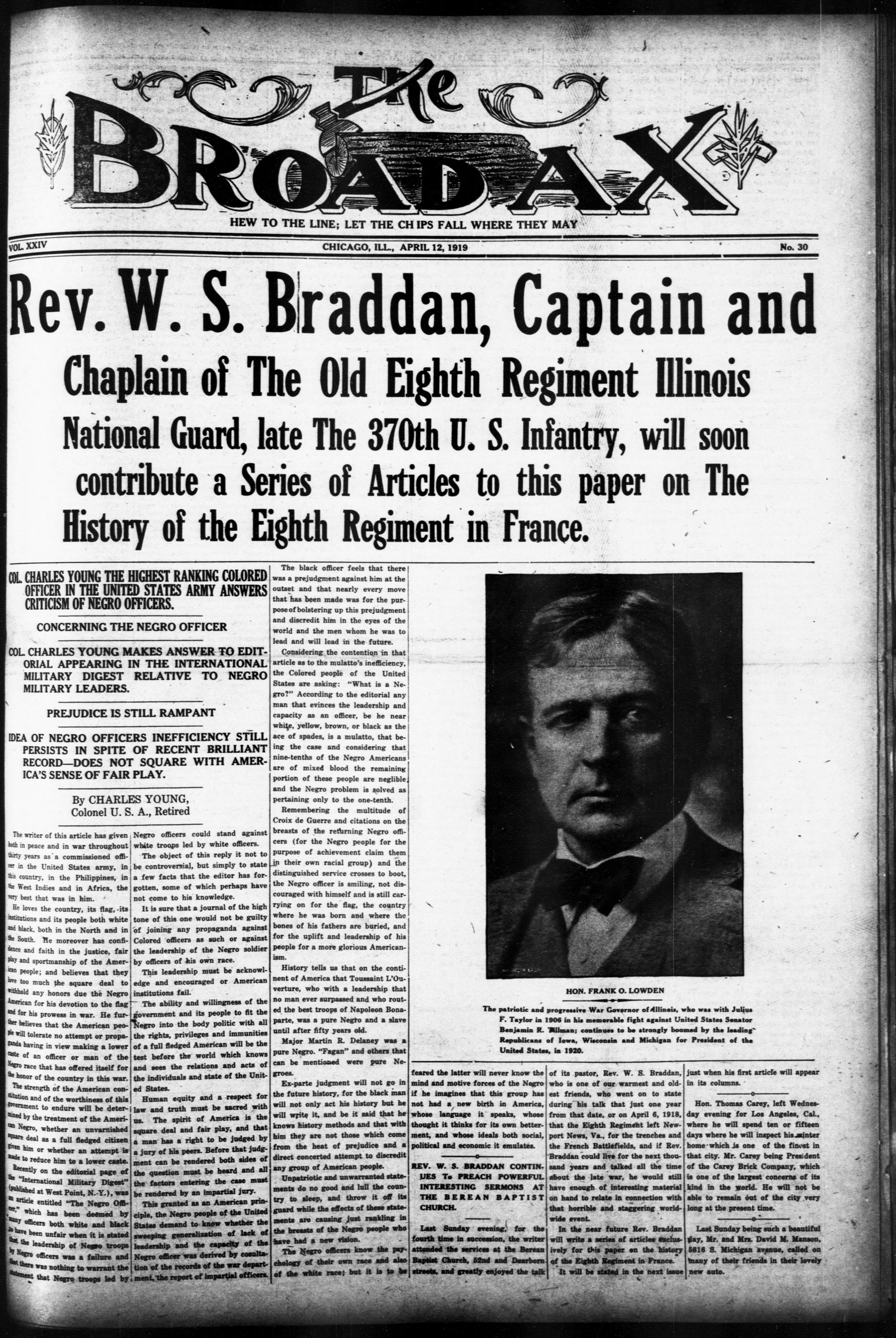
Rev. W. S. Braddan, Captain and Chaplain of The Old Eighth Regiment Illinois National Guard, late The 370th U. S. Infantry, will soon contribute a Series of Articles to this paper on The History of the Eighth Regiment in France.
COL. CHARLES YOUNG THE HIGHEST RANKING COLORED OFFICER IN THE UNITED STATES ARMY ANSWERS CRITICISM OF NEGRO OFFICERS.
CONCERNING THE NEGRO OFFICER
COL. CHARLES YOUNG MAKES ANSWER TO EDITORIAL APPEARING IN THE INTERNATIONAL MILITARY DIGEST RELATIVE TO NEGRO MILITARY LEADERS.
PREJUDICE IS STILL RAMPANT
IDEA OF NEGRO OFFICERS INEFFICIENCY STILL PERSISTS IN SPITE OF RECENT BRILLIANT RECORD—DOES NOT SQUARE WITH AMERICA'S SENSE OF FAIR PLAY.
IDEA OF NEGRO OFFICERS INEFFICIENCY STILL PERSISTS IN SPITE OF RECENT BRILLIANT RECORD—DOES NOT SQUARE WITH AMERICA'S SENSE OF FAIR PLAY.
By CHARLES YOUNG, Colonel U. S. A., Retired
The writer of this article has given both in peace and in war throughout thirty years as a commissioned officer in the United States army, in this country, in the Philippines, in the West Indies and in Africa, the very best that was in him.
ERS INEFFICIENCY STILL OF RECENT BRILLIANT SQUARE WITH AMER- PLAY.
Negro officers could stand against white troops led by white officers.
The object of this reply it not to be controversial, but simply to state a few facts that the editor has forgotten, some of which perhaps have not come to his knowledge.
It is sure that a journal of the high tone of this one would not be guilty of joining any propaganda against Colored officers as such or against the leadership of the Negro soldier by officers of his own race.
This leadership must be acknowledge and encouraged or American institutions fail.
The ability and willingness of the government and its people to fit the Negro into the body politic with all the rights, privileges and immunities of a full fledged American will be the test before the world which knows and sees the relations and acts of the individuals and state of the United States.
Human equity and a respect for law and truth must be sacred with us. The spirit of America is the square deal and fair play, and that a man has a right to be judged by a jury of his peers. Before that judgment can be rendered both sides of the question must be heard and all the factors entering the case must be rendered by an impartial jury. This granted as an American principle, the Negro people of the United States demand to know whether the sweeping generalization of lack of leadership and the capacity of the Negro officer was derived by cosultation of the records of the war department, the report of impartial officers.
The black officer feels that there was a prejudgment against him at the outset and that nearly every move that has been made was for the purpose of bolstering up this prejudgment and discredit him in the eyes of the world and the men whom he was to lead and will lead in the future.
Considering the contention in that article as to the mulatto's inefficiency, the Colored people of the United States are asking: "What is a Negro?" According to the editorial any man that evinces the leadership and capacity as an officer, be he near white, yellow, brown, or black as the ace of spades, is a mulatto, that being the case and considering that nine-tenths of the Negro Americans are of mixed blood the remaining portion of these people are negligible and the Negro problem is solved as pertaining only to the one-tenth.
Remembering the multitude of Croix de Guerre and citations on the breasts of the returning Negro officers (for the Negro people for the purpose of achievement claim them in their own racial group) and the distinguished service crosses to boot, the Negro officer is smiling, not discouraged with himself and is still carrying on for the flag, the country where he was born and where the bones of his fathers are buried, and for the uplift and leadership of his people for a more glorious Americanism.
History tells us that on the continent of America that Toussaint L'Ouverture, who with a leadership that no man ever surpassed and who routed the best troops of Napoleon Bonaparte, was a pure Negro and a slave until after fifty years old.
Major Martin R. Delaney was a pure Negro. "Fagan" and others that can be mentioned were pure Negroes.
Ex-parte judgment will not go in the future history, for the black man will not only act his history but he will write it, and be it said that he knows history methods and that with him they are not those which come from the heat of prejudice and a direct concerted attempt to discredit any group of American people.
M. H.
The patriotic and progressive War Governor of Allineis, who was with Julius F. Taylor in 1906 in his memorable fight against United States Senator Benjamin R. Millman; continues to be strongly boomed by the leading Republicans of Iowa, Wisconsin and Michigan for President of the United States, in 1920.
feared the latter will never know the mind and motive forces of the Negro if he imagines that this group has not had a new birth in America, whose language it speaks, whose thought it thinks for its own betterment, and whose ideals both social, political and economic it emulates.
REV. W. S. BRADDAN CONTINUES To PREACH POWERFUL INTERESTING SERMONS AT THE BEREAN BAPTIST CHURCH.
of its pastor, Rev. W. S. Braddan, who is one of our warmest and oldest friends, who went on to state during his talk that just one year from that date, or on April 6, 1918, that the Eighth Regiment left Newport News, Va., for the trenches and the French Battlefields, and if Rev. Braddan could live for the next thousand years and talked all the time about the late war, he would still have enough of interesting material on hand to relate in connection with that horrible and staggering worldwide event. In the near future Rev. Braddan will write a series of articles exclusively for this paper on the history of the Eighth Regiment in France. It will be stated in the next issue
just when his first article will appear in its columns.
Hon. Thomas Carey, left Wednesday evening for Los Angeles, Cal., where he will spend ten or fifteen days where he will inspect his winter home which is one of the finest in that city. Mr. Carey being President of the Carey Brick Company, which is one of the largest concerns of its kind in the world. He will not be able to remain out of the city very long at the present time.
Last Sunday being such a beautiful day, Mr. and Mrs. David M. Manson, 5816 S. Michigan avenue, called on many of their friends in their lovely new auto.
PAGE TWO
THE BROAD AX
In this city since July 15th, 1899, without missing one single issue. Republicans, Democrats, Catholics, Protestants, Single Taxers, Priests, infidels or anyone else can have their say as long as their language is proper and responsibility is fixed.
The Broad Ax is a newspaper whose platform is broad enough for all, ever claiming the editorial right to speak its own mind.
Local communications will receive attention. Write only on one side of the paper.
Subscriptions must be paid in advance.
One Year. $2.00
Six Months. 1.00
Advertising rates made known on application.
Address all communications to
THE BROAD AX
6206 So. Elizabeth St., Chicago, Ill.
Phone Wentworth 2597.
JULIUS F. TAYLOR
Editor and Publisher
DR. M. A. MAJORS
Associate Editor
4700 South State Street
Phone Drexel 1416
Vol. XXIV. April 12, 1919 No. 30
Entered as Second-Class Matter, August 19,
1902, at the Post Office at Chicago,
Ill., under Act of March 3, 1879
EVERY DISABLED SOLDIER AND
SAILLOR SHOULD KNOW
That the Government is resolved to do its best to restore him to health, strength, and self-supporting activity.
That until his discharge from hospital care the medical and surgical treatment necessary to restore him to health and strength is under the jurisdiction of the Military or Naval authorities.
That the vocational training which may be afterwards necessary to restore his self-supporting activity is under the jurisdiction of the Federal Board for Vocational Education.
That if he needs an artificial limb or other orthopedic or mechanical appliance the Bureau of War-Risk Insurance supplies it free upon his discharge and renews it when considered necessary.
That if, after his discharge, he again needs medical treatment on account of his disability the Bureau of War-Risk Insurance supplies it free.
That any man whose disability entitles him to compensation under the War-Risk Insurance Act may be provided by the Federal Board with a course of vocational training for a new occupation.
That the Government strongly recommends each man who needs it to undertake vocational training and put himself under the care of the Federal Board, but the decision to do so is optional with each man.
That if his disability does prevent him from returning to employment without training and he elects to follow a course of vocational training provided by the Federal Board, the course will be furnished free of cost, and he will also be paid as long as the training lasts a monthly compensation equal to the sum to which he is entitled under the War-Risk Insurance Act or a sum equal to the pay of his last month of active service, whichever is the greater, but in no case will a single man or a man required by his course of instruction to live apart from his dependents receive less than $65 per month, exclusive of the sum paid dependents; nor will a man living with his dependents receive less than $75 per month, inclusive of sum paid to dependents.
That if his disability does not prevent him from returning to employment without training and he elects to follow a course of vocational training provided by the Federal Board, the course will be furnished free of cost to him, and the compensation provided by the War-Risk Insurance Act will be paid to him, but no allowance will be paid to his family.
That in addition to the above the family or dependents of each disabled man will receive from the Gov-
}
erment during his period of training the same monthly allotment and allowance as that paid prior to his discharge from the Army or the Navy.
That upon completion of his course of training he will continue to receive the compensation prescribed by the War-Risk Insurance Act so long as his disability continues.
That in nearly every case, by following the advice and suggestions of the Federal Board, he can either get rid of the handicap, caused by his disability or acquire new powers to replace any that may have been lost.
That if he is willing to learn and to take advantage of the opportunities to increase his skill offered him by the Federal Board he can usually get a better position than he had before entering the service.
That if he fails to take advantage of these opportunities he will find himself badly handicapped when he is obliged to compete with the able-bodied men who come back to work after the war.
That the Federal Board, through its vocational experts, will study his particular disability and advise him as to the proper course to pursue and give him free training for the occupation best suited to him.
That on the satisfactory completion of his training the Federal Board, through its employment service, will assist him to secure a position.
That public authorities and other large employers will in many cases, at least, give the disabled soldiers and sailors preference when filling vacant positions, provided they possess the training necessary to fill them.
All disabled soldiers, whether in or out of the hospital, should address their communications either to the Federal Board for Vocational Education, Washington, D. C., or to the district office of the Federal Board of the district in which he is located. The district offices of the Board are located at the following points respectively:
District No. 1: Maine, New Hampshire, Vermont, Massachusetts, and Rhode Island. Office: Room 433, Tremont Building, Boston, Mass.
District No. 2: Connecticut, New York, and New Jersey. Office: Room 711, 280 Broadway, New York.
District No. 3: Pennsylvania and Delaware. Office: 1000 Penn Square Building, Philadelphia, Pa.
District No. 4: District of Columbia, Maryland, Virginia, and West Virginia. Office: 606 F Street NW., Washington, D. C.
District No. 5: North Carolina, South Carolina, Georgia, Florida, and Tennessee. Office: Room 1404 Candler Building, Atlanta, Ga.
District No. 6: Alabama, Mississippi, and Louisiana. Office: 822 Maison Blanche Annex, New Orleans, La.
District No. 7: Ohio, Indiana, and Kentucky. Office: 906 Mercantile Library Building, Cincinnati, Ohio.
District No. 8: Michigan, Illinois, and Wisconsin. Office: 1600 the Westminster, 110 South Dearborn Street, Chicago, Ill.
District No. 9: Iowa, Nebraska, Kansas, and Missouri. Office: 517 Chemical Building, St. Louis, Mo.
District No. 10: Minnesota, North Dakota, and South Dakota. Office: Room 742 Metropolitan Bank Building, Minneapolis, Minn.
District No. 11: Wyoming, Colorado, New Mexico, and Utah. Office: 909 Seventtenh Street, Denver, Colo.
THE BROAD AX, CHICAGO, APRIL 12, 1919
STATEMENT OF THE OWNERSHIP, MANAGEMENT, CIRCULATION, ETC., REQUIRED BY THE ACT OF CONGRESS OF AUGUST 24, 1912, OF THE BROAD AX,
published weekly at Chicago, Illinois, for April 1, 1919.
State of Illinois
County of Cook
BEREAN CHOIR MONTHLY DAY PROGRAM.
Captain, Chap. Wm. S. Br pastor of the Berean Baptist C will address the monthly program Berean Choir Sunday after April 13, 3.30 P. M. Rev. Br who recently returned from I where as capt, chaplain of the Regiment (the 8th Ill.) he w
Before me, a Notary Public in and for the State and county aforesaid, personally appeared Julius F. Taylor, who, having been duly sworn according to law, deposes and says that he is the editor of The Broad Ax, and that the following is, to the best of his knowledge and belief, a true statement of the ownership, management (and if a daily paper, the circulation), etc., of the aforesaid publication for the date shown in the above caption, required by the Act of August 24, 1912, embodied in section 443, Postal Laws and Regulations, printed on the reverse of this form, to wit:
Publisher, Julius F. Taylor, 6206
S. Elizabeth St., Chicago, Ill.
Managing Edtior, Julius F. Taylor, 6206 S. Elizabeth St., Chicago, Ill.
Business Manager, Julius F| Taylor, 6206 S. Elizabeth St., Chicago, Ill.
2. That the owners are: (Give names and addresses of individual owners, or, if a corporation, give its name and the names and addresses of stockholders owing or holding 1 per cent. or more of the total amount of stock.) Owner, Julius F. Taylor, 6206 S. Elizabeth St., Chicago, Ill.
3. That the kown bondholdrs, mortgagees, and other security holders owning or holding 1 per cent or more of total amount of bonds, mortgages, or other securities are: (If there are none, so state.) None.
4. That the two paragraphs next above, giving the names of the owners, stockholders, and security holders, if any, contain not only the list of stockholders and security holders as they appear upon the books of the company but also, in cases where the stockholders or security holder appears upon the books of the company as trustee or in any other fiduciary relation, the name of the person or corporation for whom such trustee is acting, is given; also that the said two paragraphs contain statements embracing affiant's full knowledge and belief as to the circumstances and conditions under which stockholders and security holders who do not appear upon the books of the company as trustees, hold stock and securities in a capacity other than of a bona fide owner; and this affiant has no reason to believe that any other person, association, or corporation has any interest direct or indirect in the said stock, bonds, or other securities than as so stated by him.
JULIUS F. TAYLOR.
Sworn to and subscribed before me
this 7th day of April, 1919.
MICHAEL J. O'MALLY.
(My commission expires March 8,
1920.)
THE TEXAS FELLOWSHIP CLUB.
Last evening the Texas Fellowship Club gave a very brilliant reception and banquet in honor of Col. Franklin A. Denison at the Soldiers' and Sailors' Home or Club rooms, 3201 S. Wabash Avenue. Dr. M. A. Majors, president of the Texas Fellowship Club who was all smiles was master of ceremonies and he was all attention, to the fair and lovely ladies, who were present in all of their finery and also to the gentlemen during the banquet and reception.
Many of the soldiers aside from Col. Denison, were present and greatly enjoyed the festivities of the evening.
David J. Knighten, who was for years one of the leading Colored Democratic politicians in the second ward; passed away the first part of this week. Softning of the bones, was the cause of his death. Funeral services were held over his remains Thurdesd
BEREAN CHOIR MONTHLY SUNDAY PROGRAM.
Captain, Chap. Wm. S. Braddan, pastor of the Berean Baptist Church will address the monthly program of Berean Choir Sunday afternoon April 13, 3.30 P. M. Rev. Braddan, who recently returned from France, where as capt chaplain of the 370th Regiment (the 8th Ill.) he won undying praise for his bravery on the battlefield and fearlessness in defending the cause of the men of this regiment. Musical numbers as follows will be presented: Miss Madeline Thomas, piano solo; Mrs. M. Pettiford, soprano; Mrs. J. A. Weathers, soprano; Mr. J. B. Tucker, saxophone soloist. Berean Mixed Quartete will sing two pleasing numbers and the choir will sing Gaul's grand chorus, "Let the Heavens Rejoice." "With Sheathed Sword," by "Costa," and "Thine Is the Kingdom," Gaul. A special invitation is extended to officers and men of the 365th and 370th Regiments to attend this meeting. The members and friends of Berean are urged to attend this program. The Choir is to make this a banner day. Berean Baptist Church, 52nd and Dearborn sts. Isaac T. Yarbrough, Chorister; Nannie M. Strayhorn, Organist; D. B. Hawley, Chr.
ATTENTION. WOMEN!
The Social Hygiene Department of the Council of National Defense, Ilionis Division, will present the Educational and Sensational government film, "The End of the Road," at the People's Movement Club, Saturday, April 19, 7:30 P. M., under the auspices of the Social Science Committee.
Do not miss seeing this wonderful picture. Only women and girls over 16 years of age admitted. Admission free.
Elizabeth Lindsay Davis, Ch.
Bell Graves Fountain, Sec.
BETHEL LITERARY SOCIETY.
Attorney Jerry M. Brumfield will address the Society next Sunday afternoon, April 13, at four o'clock. Subject, "The League of Nations." Assisting the program will be a short address by J. Porcius Falkner. Soprano solo, Mrs. Ethel Guevara. Tenor solo, "A Secret," Mr. E. Grundy. Baritone solo, "Over Jordan," Mr. Henry C. Smith.
Everybody invited. Admission free.
Sandy W. Trice, Pres.
Rev. W. D. Cook, D.D., pastor.
J. W. Bell, Secretary.
CHIPS
Madam M. Callaway Byron, 3300 Rhodes avenue; has returned home from Galveston, Tex., where she spent the winter with her school girl chum and friend Dr. Bryan, who has the distinction of being the first Colored woman doctor in the Lone Star State. Madam Byron greatly enjoyed her visit with her old friend and while in the South West she gave several very successful recitals at various points in Texas and Arkansas.
There will be a Grand Opening of the Lake Park Hospital, 4147 Lake Park Ave., April 16th, 17th, 18th, 1919, from 4:00 P. M. to 9 P. M. The public is cordially invited to come and bring whatever will be useful. Mrs. F. W. Willis has charge of the show assisted by many other ladies and all persons who are interested, in such.
Best Government
Best Government. The proper function of a government is to make it easy for people to do good and difficult for them to do evil. Gladstone.
No country, not even Egypt, made a deeper mark in the history of the ancient world than Mesopotamia. For thousands of years it was the seat of the Assyrian and Babylonian empires. To the bountiful resources of nature its peoples added those of art and science, and the country during the centuries waxed not only in material wealth and military power, but also in culture. The ancient glory of Mesopotamia has passed, but the alamour remains.
These Days of Hysteria
It is claimed that chess playing is dying out. In the old days, when hysteria did not have possession of the land and the inhabitants thereof, chess playing was quite popular. Now we are a steam-heated civilization, with no time for study for the mere delight of learning. Remember when Paul Murphy of New Orleans was the chess wizard of the world?—Los Angeles Times.
Japan's Delightful Climate
Japan is considered, because of its delightful climate, the playground of the East. Residents of other countries of the far East Indies, the Philippines, and the Straits settlements, flock to Japan in the hot summer months to enjoy its mountain resorts. Owing to the large tourist business some of these resorts present all the up-to-date advantages.
Makeshift, as It Were.
A strange family had recently moved into the neighborhood. Robert had made the acquaintance of the small son and had learned from him that the man was only the boy's stepfather, and, in explanation to me, Robert said: "It ain't James' own daddy, mamma; he's just a second-handed one."—Chicago Tribune.
A Windfall.
The origin of "windfall," in the sense of "good luck," dates from the time of William the Conqueror. It was then a criminal offense to cut timber in the forests. Only such could be gathered as the wind had blown down; hence, a heavy windstorm was halted by the peasants as so much good luck, and from this comes the modern application of the expression.
The Time He Hurries
When a seventeen-year-old boy's father tells him it's time he was picking out a trade he doesn't see any reason to hurry. But when his girl tells him the same thing he begins deciding between statesmanship and professional baseball right away.—Kansas City Star.
Seems an Unfair Division.
Thousands of hats discarded by English women are exported every year to Brazil, where they are eagerly bought by the Indians. The feathers and other ornaments on the hats are taken by the men, and the bare straw shapes given to their womenfolk.
Heat and Tuberculosis
James B. Murphy and Ernest Sturm (Journal of Experimental Medicine) subjected mice to heat and a week later inoculated them with a strain of tuberculosis virulent for mice. These animals displayed a greater resistance than normal.
Liberty Demands Full Loyalty.
We honor Liberty in name and form.
We set up her statues and sound her praises. But we have not yet fully trusted her. And with our growth, so grow her demands. She will have no half service.-Lord Macaulay.
Milton's Diction.
How grandly Milton rolls and winds through the arches and labyrinths of his magnificent and involved diction, waking musical echoes at every turn and variation of its progress!—E. P. Whipple.
Our Occasional Observance.
A man will sit by the hour matching pennies, but if his wife asks him to match a piece of dress goods, whatta howl of rage and-indignation there'd be!—Indianapolis Star.
Advantage of Wings
Another good thing about the flying an angel does is that he never has to light upon the top of a house and bawl for somebody to help him down.—Dallas News.
"Locket" Eyeglasses
Eyeglasses for which a British patient has been granted can be folded when idle to resemble a locket and worn on a chain as an ornament.
Be Glad.
If you see a man or woman successful, be glad of it. Don't waste time belittling his success. Use your force trying to equal it.
Daily Thought.
A man's own observation, what he finds good of, and what he finds hurt of, is the best physic to preserve health.—Bacon.
Useful Though Unwed.
The modern view is that a woman is not necessarily a failure because her life has been Miss-spent.—Boston Transcript.
Writer Describes Method by Which East Indians Play on Ignorance of Their Fellows.
A method by which snake charmers dupe ignorant people in India is thus described: One of them puts a harmless snake, in a stupefied condition, into a house, and his companion then tells the women of the house that he has noticed a poisonous snake there. The people are alarmed and offer a reward to the snake charmer to remove the snake. He declares it to be a deadly poisonous one and asks a good sum of money for the exploit, which, he says, may cost him his life. The reward is fixed and the money paid. The snake charmer, wearing only a loin cloth, commences to play on his bagpipe. The snake, previously rendered harmless, crawls into the middle of the room, and the snake charmer in catching it says that he has been bitten and falls senseless. His companion comes forward and puts a snake stone on an inclosure previously made for the purpose on the man's finger. The snake charmer at once recovers and gets up. His audience is much astonished and gives a big present to the cured snake charmer, who departs with the snake and the profit he has made.
Alm High. Is Good Advice
Alm at perfection in everything though in most things it is unattainable. However, they who alm at it and persevere will come much nearer to it than those whose laziness and despondency make them give it up and unattainable.—Chesterfield.
The Biggest Dollar
There are those who gauge the worth of a dollar by the things it will get to add to their own selfish happiness. Poor way, though. You and I never will know the true value of a dollar until we spend it for some body else—Exchange.
New Disease
Bay run seems to be the favorite beverage now, with a green-colored hair tonic running a close second. Several of our Beau Brummels seem to have a severe case of dandruff of the liver.—Boston Transcript.
Joy of Motoring
No feeling in the world is equal to the thrill of real motorizing. The joy of the long tour, through strange and out-of-the-way places is never ending. Odd scenes and quaint people are everywhere. Get out on the road, of the boulevard and see how the other people live.
Little Chance for Confession
"A good husband ought to tell his wife all his faults," explains the professional solver of domestic problems in a Milwaukee newspaper. A very original idea, but what is the prescribed method of conduct when she persists in telling about them first?
Mending Knives and Forks
To mend a knife or steel fork which has come out of the handle, fill the hole with finely powdered resin and hold the rough end of the knife or fork in the fire until it becomes hot. Insert it in the powdered resin and hold it straight until firmly fixed.
Whasse Matter With You Man?
Whissa Matter With You, MAR-
"Why won't I do?" demanded the
lady of 300 pounds displacement, as
she indignantly waved the want ad
section in his face. "Didn't you ad
vertise for a stout woman to do house
work?"—Indianapolis Star.
Ain't It So?
"Speakin' of musical instruments remarked the facetious felter. "here no music as purty to the ears of a business man as hearin' Taps played on his cash register."—Indianapolis Star.
New Screw Easterer.
An Australian inventor has patented a screw fastener for wool bale hands that enables the bales to be made tight and permits the use of narrow hands thereby saving steel.
Knew Where It Would Land.
Lawyer—"Yes, sir! We can settle up this estate for you in about eight months." The Principal Heir—"But can you wait that long for the money?" —Judge.
Wisdom in Saving.
A man may, if he knows not how to save as he gets, keep his nose all his life to the grindstone and die not worth a great at last.
Household Hint
"Albert, I want you to see the new dining room set Mr. Brown has bought for his wife. It would just match our wall paper."
Abbreviating Names.
The pioneers give up beautiful names and the postal authorities abbreviate them.—San Francisco Chronicle.
Optimistic Thought.
A low station with safety is better than a high one with danger.
ee _ raiTHE
wns EVER-FAITHFUL FRIEND
ulogizes the Serv.
et ee Horse ine at
al) Times Rendered.
Brangeline Booth, the gifted Com
wof the Salvation army, in
pader and Drivers pays a beautiful
Bisre to the horse. | The horseless
age which Wa predicted when the mo-
gor came, she SASS has not arrived,
Se pecer will. She continness
nn the very beginning of al
quar throush the march of the ees.
See in every sphere of Iie, the hor
reiccopied « significant place, In
got, nat, In literature, in war, in
ire, in commerce, in romance, ts
Pacts, in drudgery, im love, in re
tz, in life and in death, his rell-
Hee Forages, ever-rendy-L0r-com-
ea servant of man has proved In
Bi a most potent factor. His fleet
foots have flashed Hght from the peb-
Na path of every poet; hits arched
we and tossing mane have taxed the
il of the ublest sculptor’s chisel ;
eattractive figure has made realistic
fhestory of every class of Mterature—
icorie, fiction, fact and biblical; the
eight of childhood, the willing slave
‘fan, the sure trust of old age, this
fichful ally through all thme has
jioved the fields and hauled the loads
vy penetrated the wilderness and
tied the rivers and with bood-
wrined flanks has carried the warriors
phattle, and tossing Snowy mane has
herne the victor home through trium-
jist arch and a thousand times ten
fpoasand when worn by tolls and tack
u{food to a mere skeleton, has pressed
‘a with his task with a patience, per-
cererence and @ sweetness of temper
er one could almost call divine.”
as SQUIRREL WELL TAMED
intelligent Little Animal Beguiles
‘Tedium of Voyage for Naval
Officer on Active Duty.
‘There is a certain very companion-
sbie little squirrel which belongs to an
efcer on a warship, somewhere in
South African waters. She is a great
tulker—in her way—but she is always
very careful not to talk when any one
de is talking. Her master will call
ber down from her bedroom, and she
aqpears with cheery little squeaks and
fries. Then she waits.
“Will you have: toast this morning
ee milk?" is the question with which
te greets her, and her answer is @
cided chatter for a moment, When
fe stops, he goes on withthe con-
‘ersation, and she listens to him, with
ter little eyes full of interest, for
‘what he is telling her. Then comes her
tura, and she talks a bit. She is a very
Playful little squirrel, and she has
never been known to lose her temper
with her master, though sometimes tn
«romp, when she gets rather fiurried,
she bites a bit too hard. And, if her
ester gently raps her, she pretends
to feel grieved about ft, goes into @
comer and sulks and all that he can
to is to leave her alone until she
‘wants to play again —Montreal Herald.
Steady, Not Erratic.
It is 2 good thing to have work
done well and quickly by one person
fn an organization. But it is a far
better thing to have that whole organ-
ination work together effectively, each
te doing a part carefully and con-
sciously, than to have an expert here
nd there setting the pace.
Tt is safe to say that any business
thet succeeds -does 90 because the
head of that business never forgets
that he Is working with spores’
ings and not with machines.
tot expect them to do the impossible
Sy more than he expects impossibilt-
ties of himself, but he @oes require
of himself certain amount of con-
catrated effort done at the right time
every day. and he does require from
all his office force the same effort and
concentration.
The best way to conserve energy is
ot by speeding up every once In so
atten, but by keeping engines fired at
all time, ready to do the work at the
right time and in the right place—
‘New York Evening Telegram.
Ta See ee
A one-man strike occurred in an
Australian city. A prisoner fa the
torn jell, a tallor by trade, refused
t» work In the taflor’s shop on the
Blea that it would be contrary to his
Principles as a trade unionist, “unfair
competition with his brother unionists
ortside.” as he put it. He sent a let
te to the tuflors’ union, but as they
took no notice he was condemned te
tm 25" solitary confinement. dur
‘of which he “continued the strike.’
4 ere WAS a strike of paupers once
® country poorhouse. They strack
for new potatoes! ‘They expected
freens for dinner and, as there were
Done, they refused to eat old spuds!
They even declined to enter the dining
yom. The guardians prescribed
fread and water diet, with the Fesul!
that at the end of 24 hours the tm
Mates were for potatoes—new
wim were ready
Macaroni Release Bean is Shee
be eee en
The succulent Italie paste spreads
te tnd wide. We learn frou 2
ted 5
fe ee ee ‘aad
Secaron! in China is an enormous tp-
frsry and is carried on almost en-
SY by hand. Wheat, beans and Fee
a % Principal flour used. At Chefos
fe industry assumes greater propor
Sor tee anywhere elee Ju Chins,
$4 there the vermieelit I,
Qe dean product. Vermsle
on aha
. China
-sbont 15,000 tons
MARCH’S TWO BIRTHSTONES
Peteong Sorn_in That Month May
wire
‘The month of March has two birth-
stomes. The one sanctioned by ancient
termate the ane ae
‘Aquamarine is given in the
Ust of birthstones adopted by the Na-
tonal Jewelers association. ‘The blood-
Stone ts a variety of chalcedony, ‘dull
Green with blood-red spots. It is some-
times called heliotrope. The principal
mines are in India, though it ts found
1m Scotland, Brazil, Uruguay and Aus-
tralia, It was supposed in old times
to have therapeutic virtues and was
Bsed especially to cure hemorrhages
and inflammatory diseases. Because
‘of this fancied curative value It was
widely worn cut in the form of a heart
In Mexico in the days succeeding the
conquest by Spaniards and Indfans.
The stone is still believed by the su-
Perstitious to be an amulet bringing
good luck. An ancient Egyptian parch-
ment says: “If anyone have this stone
with him he will be given whatever he
asks for and whatever the wearer says
will be believed.”
‘The aquamarine ts a transparent va-
Fiety of beryl, characteristically of a
bluish green color. Its name, trans-
ated, means “sea water.” and it looks
Uke the green-bine water of the ocean
frozen into a flashing crystal. Large
Aquamarines are especially beautifal
‘as brooches or necklace pendants.
WALK MUCH AND LIVE LONG
Overwhelming Evidences That Pedes
trianism Is by Long Odds the
Best Form of Exercise.
“Walk, walk, walk, every day, and
while walking give the arms full
play. By so doing the bones, blood,
muscles, nerves and brain will be
kept in ‘healthy activity. Moreover,
never mind the weather. Take your
exercise, be the day wet or fine, hot
or cold. Above all, avold sitting over
a fire. Nothing is more conducive
to senility.” This is the prescription
of Sir Herman Weber, the eminent
Enropean physician, who died at the
age of ninety-five years. Certainly
there could be no better recommenda-
tion of the virtues of walking than the
ee
Walking Is something that cannot
be overdone, and at the same time
much out of fashion at the present
time. In this day of automobiles the
man who walks is the exception, and
while the man.in the motorcar de-
‘ives a vast amount of benefit from
his trips into the country and
through getting his lungs pumped
‘full of fresh air, he does not obtain
‘the great variety of health-giving fer-
‘tures that come with walking.
Many Glacial Periods.
One often hears of “the glacial
period” or “the ice age” of the earth.
‘Dut, strictly speaking, this expression
‘As not correct. It is now established
beyond all reasonable doubt thet this
planet has experienced not one but &
great many glacial periods. Evidence
has been found which proves that the
latest or Pleistocene glacial epoch, has
several important subdivisions, and
that all of the present continents have
experienced glacial epochs at different
ages. Great ice sheets were formed
‘at different periods back to the Pro-
terozolc age; that is, the age of the
oldest known sedimentary rocks,
great many million years ago. . One
‘of the most recent discoveries of the
‘old gincial deposits was made by Pro-
fessor W. W. Atwood. of the United
States geological survey, near Ridg-
way, In southwestern Colorado. These
deposits were found beneath tertiary
lavas of the San Juan mountains, and
resting upon upper cetaceous beds.
‘They have, It is believed, been formed
in early Eocene times.
‘Time and Watch -on Shipboard.
‘The bell on shipboard is struck ev-
ery half-hour. In the morning one
bell sounds at 12:30 a. m. and ev-
ery half-hour increases until eight
hells st 4 p. m.; then one bell again
at 4:30 a, m. to eight bells at 8.2 m.;
‘one bell again at 8:30 a. m.; and
eight bells at noon. In the afternoon
‘one bell sounds at 12:30 p. m. and
eight bells at 4 p. m, after which is
the first dog watch (one bell 4:30, two
bells 5, three bells 5:80, four bells 6).
and the second dog watch (one bell
6:30, two bells 7, three bells 7:30,
et eo ae oe en
to eight bells at midnight.
‘The day is divided into seven
watches, as fdtlows: Afternoon watch,
noon to 4 p. m.; Srst dog watch, 4p. m.
to 6 p. m.; second dog watch, 6 p. m.
to 8 p. m; first watch 8 p. m. to mid-
night; middle watch, midnight to 4
a. m; morning watch, 4 a. m. to 8 a.
m.; forenoon watch, § a. m. to noon.
ne
Ruan” ta Really Goose.
The Chinese “swan” ts not really
2 awan, but a goose. It has achieved
a vicarious reputation as & swan mere
ty because of an extremely long neck
not property belonging to 2 goose, but
altogether swanlike.
‘The Indy swan, instead of pursuing
the birdlike motherly habit of sitting
on ber eggs in order to transform
them froim mere eggs into baby swans
carefully covers them up with 2 mound
of sticks and things.
‘The Chinese ewan is known in high-
brow circien as = Crpnopsis crgneides
It ts & most peculler bird a large
wart on its Dill, which is as yellow
eu the xoyal dragon of China. It has
5 See a go oe
! itself, is given to secret
THE BROAD AX, CHICAGO, APRIL 12, 1919
——————————
SS
NOT HURT BY WARM CLIMATE "WOW PLANTS ARE “MATE
wr tm |e a se
ics ts Enervating to Whites Much Definiteness the Char-
Dwelling There. eee ie ia tie i
‘The opinion is widespread in north-
ern climes that a continuously warm
climate, unbroken by sharp periodic
changes, is enervating and detrimental
to the white man. This opinion ts sub-
stantiated by a considerable variety
of evidence. Exception, however, Is
taken by Vaughan MacCaughey, writ-
Ing tn Science.
Hawaii is sub-tropical. ‘The signifi-
cant fact is that the “white” popula-
tion lives “Amerienn style.”
| The hours of labor for business men,
Professional men and laborers are Just
as long as in northern regions, The
holidays and vacation periods are no
more numerous. The Innch period is
one hour at noon, and there is no
siesta. ‘
_ A white laboring class does not ex-
ist In Hawali. This is due, however,
Rot to clirsatie conditions, but to the
| economic competitio#’ of cheap ort
ental Inbor.
~ It must be acknowledged that the
change from a northern to sub-trop-
eal climate does not always agree with
the white women. Some suffer from
Poor health and more or less profound
functional derangement. However, the
‘problem Ix an open one as to whether
‘this Is directly due to cllmatie mal-
adaptation.
FRENCHMAN’S WORK OF ART
‘Beauvais Cathedral Clock a Remark.
able Example of Ingenuity in
. Ita Construction.
‘The clock of Beauvais (France) ca-
hedral is sald to be composed of 92,000
veparate pieces. One sees on the bd
lial plates the hour, the day, the week
and the month; the rising and setting
of the sun, phases of the moon, the
tides, the time In the principal cap-
itals of the world, together with #
zerles of terrestrial and astronomical
evolutions, The framework is carved
oak, elght meters by five meters, oF
26 feet by 16% feet. When the clock
strikes all the edifice seems In move-
ment. The designer wished to depict
the Last Judgment. This wonderful
work recalls the clock of Strassburg.
and Is of modern construction. It 1s
the work of M. Verite, wha was in the
engineering department of the Nord
rallway, and who died In 1887. The
cock crows, angels found a trumpet at
the four cardinal points, imitation of
flames appears from the openings of
little steeples right and left. A soul,
that of the Impenitent thief, appears
before the supreme Judge. It is con-
demned, “a I’ enfer.” and 2 demon
armed with a pitchfork selzes It and
casts it into the abyss, Next comes the
soul of the just. The angels advance
and conduct it to the realms of day,
‘sacred strains being heard.
Spread Love of Good Music.
‘The greatest factors that exist at
the present time in the spreading of
music and the inducement of a love
for {t, are the music-reproducing ma-
chines of all kinds. What these have
done to promote general musical
knowledge cannot be overestimated.
Why, you meet people who, a few
years ago, would not have known the
mame of one great musical compost
tion, who now are familiar not only
with the composers, but with thelt
foremest interpreters and the ways ir
which these Interpretations have beer
conceived. These people know evers
note of works they hadn't even heard 9
few years ago.
It ts not enough for a composition
to be great to help the world. appar
‘ently; it must be known to be great.
‘With a man it is a different matter.
Do your work well, and you will be
Judged by It. There are always those
‘who can judge If one’s work ts good;
let them judge—Exchange, ‘
‘Chance of Ownershic.
A poorty clad stranger had been
gazing for such a long time with
Interest at ® mansion, with Its spa
cious, stately carringe drive and well
kept grounds, that a policeman at the
corner grew suspicious and walked ur
to him. “Nice house,” sald the off
cet genially. “Yes” was the reply
“It's a very mice house. and it cost
money, too.” “Tt did that!” said the
officer. “I built that house,” said the
stranger. pe sear eee at the
seedy indivffinal and smiled. “What
did ser do it with he sald—“a spade
and hoe?” “No.” replied the man
sadly, “with money left me by my
‘uncle. It is not exactly as I would
have designed it, nor had I seen
it before——" “You never ‘saw it be
fore,” sald the officer, “and it ain’
fost as you'd like it, but you built ff
‘with money left you by your uncle:
that's 2 good joke.” “It's all true,”
naid the seedy stranger; “the owner
was my lawyer!” .
——_—___——
England and America. |
‘The language and treditions com
mon to England and America are like
other family bonds: they draw kindred
together at the greater crises of life,
but thes also occasion at times « little
friction and fault finding. The ground.
work of the two societies is so similar
that each nation, feeling almost at
home with the other, may inatinetitely
resent what hinders it from feeling at
to seem
‘by mistake and through sees
fault. Each will judge the other by
his own standards, not feeling as in
the presence of foreigners, that he
must make an effort of imagination
and put bimecif i another mas't
Sasi Ow , Sores, , a Saat
EER at eS
WOW PLANTS ARE “MATED”
Sreeders Today Able to Contre] With
Much Definiteness the Char-
acter of the Offcpring.
Plants very commonly depend for
thelr crose-fertilization upon insects,
which carry pollen from flower to
Sower. But, of course, the matings
= accomplished are purely haphaz-
a
‘The plant breeder to get worth while
results must select the destined par
ents and contro! the character of the
offspring by making sure that @ par-
ticular flower receives only certain
pollen, the latter being the male ele
ment.
He accomplishes this by artificial
Impregnation—a matter easy enough.
especially in greenhouse. The pollen
may be carried in a watchglass and
applied with the tip of a little brush.
There are, however, other methods.
To make the flower safe against
other and accidental pollens, it is In-
closed In a tiny hag of cheesecloth.
‘Then the breeder Is sure of his par-
ents, and It remains only to be seep
how the offspring will turn out. It
may prove a valuable new variety.
Suppose that a fruit ts concerned.
The latter, to prevent injury by In
sects or birds, may be further pro
tected by a cheesecloth hag big enough
to allow for its full development
‘Thus it grows to ripe perfection and,
when it fs ready to be picked, judg:
ment can be given ax to Its value.
SUNLIGHT IS FOE OF DEATH
‘The More a Man or Woman Can Get
of It, the Healthier and Hap-
pier Will They Be.
‘One time we were tramping the for-
ests of North Carolina in search of
game. When none came and we wished
to return to camp we discovered we
were lost—completely “turned around.”
‘Then we recalled reading one time.
“Light 1s life, moss always grows on
the north side of the tree trunk—far-
thest removed from the rays of the
sun.” We set about looking for moss.
and sure enough It was on the same
side of each tree. With this as a guide
it didn't take us long to find our way
back to the place whence we came.
But the point we wish to make ts that
the moss would not have been on the
north side of the tree if it hadn't been
impossible for the sun’s rays-to reach
it. Moss thrives on death. And death
is always found in the wake of the
sunless path. The more sunlight there
is In your life the more you live. The
freer you are from moss and the
things that thrive without light, the
better man or woman you are. Get all
the sunlight you can into your sleep-
ing and waking hours.—Milwaukee
Jeurael.
Historic Printing Press.
A printing press with a remarkable
history Is preserved by the University
of Oregon. On it was printed, 78 years
ago, the first number of the Oregon
Spectator at Oregon City. This was
the first press to be used west of the
Rocky mountains, and it was trans
ported to Oregon City by George
Abernathy, the first provisional gov-
emnor of Oregon. The eld Washington
hand press was in use in Oregon City
until the late sixties, when it was re
moved to Eugene. While being trans
ported up the Willamette river the
press was shipwrecked, but after s
time It was raised and continued its
Journey. For nearly half a century 11
was in use at Eugene, where it wa
presented to the state university. ‘The
University of Washington at Seattle
also has a famous old handpress
which was used in 1847 to print the
California Stur, the first paper in Sar
Francisco, and Inter was used in
printing the first number of the Port
fund Oregonian in 1850, and the Grst
Paper in Seattle in 186%.
ee a
‘The light of the moon ts due entire-
ly to-reflection of the light of the sun,
and the different phases of the moon
to its position in relation to the po-
sition of the earth and the sun. When
there is a new moon, half of the sur-
face of the moon is illuminated, but
the greater portion is turned from the
earth and only a delicate crescent ap-
pears to us. At the first quarter, half
of the illuminated surface is turned
toward us, and at the fifteenth day
the moon reaches 2 point in the heav-
ens directly opposite to that which the
sun occupies. She is then in opposi-
tion, and the whole of the illuminated
surface is turned toward us, and we
have a full moon. From opposition
the moon passes on in her orbit, grad-
ually decreasing in size, or rather less
and less of the illuminated part being
turned toward the earth.
"“Q@evernina “D.C.”
By the Constitution of the United
Staten, congress has the sole right to
govern the District of Columbia. But
congress, for convenience, delegates Its
powers to three commissioners. Two
are appointed from civil life by the
president, with the consent of the
senate. Gne must be an engineer offi
cer of the army, of the rank of captain,
at least, He ts detailed by the presi-
dent for service as 2 commissioner, at
the president's pleasure. The other
commiasioners verve three years. The
commissioners ave practically su-
‘power to govern, subject to the
ee emeeet by oe cont ot
appeals of the District.
Hardly
asked me to call” She—“Perhaps
iS tame “poems take be at
PAYING HOMAGE TO DEVILS
Recognized Method by Which Chinese
Insure Against Dire Work of
Evil Spirits.
Once a year during the first 14 days
of the seventh Chinese month, the cu-
rious ceremony of Yu-Nan-Whet is cel
ebrated, being, in fact, the -paying of
homage to the land and sea devils,
says New York Herald. Seven priests
carry out the ceremony by offering up
various forms of prayer and making
an unearthly nojse by beating ‘large
gongs.
Anyone wishing to show his respect
to the devils can do so by @ payment
of 600 eash—about 22 cents—to each
of the priests, for which amount they
will continue thetr performance for 12
hours—a truly modest remuneration
for men engaged In the ardent occupa-
tion of propitiating evil spirits. For
an extra payment of 2,000 cash a num-
ber of small red paper boats, about six
inches long. with lights inside, will
‘be sent floating down the river with
the current.
“These lights are for the benefit of
the sea devils, in order that they may
be able to see their way about on
dark nights—a lttle attention which
It Is hoped these maritime demons ap-
preciate. Having finished this per-
formance, the person on whesé behalf
It has been carried out goes away
happy in the conviction that he will
not lose any of his family throughout
the year, either by sickness or drown-
ing, so that the whole ceremony may
be looked upon as an insurance policy.
CRADLES OF GREAT EDITORS
‘Many Editorial Giants Got Theit Early
‘Training on Village Newspapers
‘of New England.
‘The old New England village news
papers nourished a race of journalistic
giants. It was from g little Connectt-
cut office, that of the Connecticut
Mirror, that a keen Yankee, named
George D. Prentice, went forth to pre-
pare the way for that great light of
Southern journalism, Henry Watter-
son.
‘The dingy little printing shops of
Vermont trained in the service of the
types many men who afterward be-
came eminent in metropolitan and
western journalism. But the case of
Greeley was an epic in itself. No more
uncouth and miserable little wretch
ever sought employment. But he
brightened up the Northefn Spectator
with his youthful writings, which were
then, as ever after, his very own, and
not mere {imitation Addisonianisms.
From the shop in East Poultney he
went forth to an fllustrious career;
and, whether it liked him or not, the
country had to listen to him, His
brain not infrequently—so his country
men would now express It—slipped &
cog. There were strange lapses in his
intellectual and moral achievement,
but none in his honesty or his good
will toward his fellow countrymen.
ss eeatvetus-Oll industry.
‘The pioneer of the Australian ew-
calyptus-oll industry was John White,
“Surgeon General to the Settlement,”
who came to Sydney with the first
fleet, says the Sydney Bulletin. _ The
following passage occurs in his “Jour-
_nal of x Voyage to New South Wales,”
published in London in 1790:
‘The name of peppermint tree has
been given to this plagt by Mr. White
on account of the very great resem-
blance between the essential oil drawn
from its leaves and that obtained from
the peppermint (Mentha _piperita)
which grows in England. This ol]
was found by Mr. White to be much
more efficacious in removing all
cholicky complaints than that of the
‘English peppermint, which he attrib-
utes to its being less pungent and
‘pore aromatic.
White not only used the off Yn N. 8.
Wales, but sent some to Englund. He
got it from @ tree which he called
Eucalyptus piperita, but which was
afterwards, renamed E. capitellata.
Qed Licht Alda Plante.
‘The attention of botanists has lately
been recalled to experiments made at
Tayisy, near Puris, by M. Flammarion
‘on the effect of exposing the seedlings
‘of sensitive plants to lights of differ-
ent colors. Having placed four pairs
‘of mimosa seedlings in four separate
pots in a hothouse. he covered one
pair with a bell of blue glass, another
with a bell of green glass, a third with
a bell of red glass, while the fourth
was exposed to ordinary white light
‘At the end of two months the plants
subjected to biue light were only one
inch high, having hardly grown at all.
Those exposed to white light were
four inches high, those that had grown
im green light were five inches high,
while those whose light had been red
were no less than 16 inches high.
Experiments with other kinds of
plants gave various results, but in ev-
ery Instance blue light impeded growth
and development.
meskies” on Strike.
“No Betting Today” was the amas
ing notice issued on a famous race
course shortly before the war. The
“bookies” had gone on strike, says
writer in London Answers. The stew
sate tat pinged Sem % 0 oem 8s
sition at the sides ‘approach te
as gekaasened ent the: copesint wes
that there was not room for the num
ber of pencilers, and also insufficien!
‘eccommodation for the public whe
wished to “put « bit on” The book
fee took up a position of their own
oa pens pe
CS was
2 er es ites tie ey 7
PAGE THREE
JSE CANNON MADE OF WOOD
People of at Least Three Countries
Employ That Material and Have
Found it Satisfactory.
Anyone familiar with modern weap-
mis of war &nd the high explosives
aed in them would naturally sup-
jose a wooden cannon of little use.
Wooden cannon have been used with
ronsidercole success in Cuba, Haiti
ind the Dominican Republic.
‘The wood used Is very tough, hav-
ng a twisted grain that curls about
the log In such a way that to split the
‘imber with the ordinary means ts al-
‘nost Impossible.
‘The best trees are selected and a
plece of the log five or six feet in
length and one foot in diameter is cut.
After the bark has been removed
‘and the fog made perfectly round, it
‘s swung up on a crude truss and a
hole 1s burned Into it from one end.
‘The log is wound with fresh rawhide,
which shrinks and hardens. When the
‘cannon is covered another layer is
‘wound on after certain treatment, and
this ts continued until the weapon has
Increased several inches In diameter.
Then the weapon Is treated to a hot
‘blast, which tends further to contract
‘the hide binding until it becomes al-
‘most as strong as wire. These crude
cannon have been employed in s num-
ber of instances, and It is astonishing,
so it Is sald, how many times they
can be fired before they burst or are
otherwise disabled.
DISPUTE OVER HUMAN BONES
Discovery In Florida Gives Scientists
Opportunity to Indulge in a
Lively Squabble. :
Geologists and anthropologists are
having # lively controversy among
themselves over certain human re-
mains which have been unearthed at
Vero, Fis. Human bones were found
In geological formations of the plels-
tocene or giacial period; man existed
in America during that early age. But.
objectors interpose, the skeletal re-
mains are those of a modern sort of
man, a regular Indian type. So ~—S
type at that period is incredible. The’
dividual must have been buried in the
ancient strata.
‘The other side answers that burial
fs out of question. The formation of
the earth above the bones indicated
gradual natural accumulation, and not
the heaping of earth into a grave.
That the bones were scattered some
twenty feet from the others, which in-
dicates that they drifted while on the
surface (how could buried bones move
twenty feet through the soll); and,
further, that the fact of the remains
‘being of a modern type of man merely
‘shows that this modern type of man
lived m the pleistocene age.
Fortune Telling in Germany.
‘Very curious forms of divination are
Practiced in Germany. The. methods
of forecasting the future vary, of
course, in different localities. In many
parts of Germany for instance, a girl
who Is desirous of knowing the voca-
tion of her future lover is told to
Usten to the singing of a large kettle.
With more or less accuracy the trade
or occupation is determined according
to the various tones.
A popular German amusement is the
telling of fortunes by means of wal-
nut shells. Good or ill-luck Is fore-
told according to their movements in
8 bow! of water. Casting lead is an-
other amusement to which the Ger-
man devotes himself. The molten mat-
ter is poured into a basin of cold
water after being placed over a spirit
lamp. In tracing the various shapes
assumed by the lead great amusement
is afforded. For they are all presumed,
by the way, to be symbolic as regards
the future.
‘iiiiaetess teins
‘Plants possess feelings and emotion
similar to human creatures, and It
may be found some day they possess
powers of reasoning.
Plants which have been occupying a
large sunny window become attached
to each other, and it very frequently
happens that when separated they be-
come sick and finally die. A begonia
becomes very much attached to a
fuchsia, and if the fuchsia is removed
the begonia will be apt to show im
Its appearance that something is sert-
ously wrong.
Plants seem to be aware of each
‘other's presence, even in the garden.
Tt is difficult to-say how far such
things really go in plant life, and it
is 2 study we should ail take more
interest in as we observe the curious
things in nature.
“Doctor Jim's” Burial Place.
The body of Sir Starr Jameson, bet-
ter known as “Doctor Jim,” of raid
fame, rests beside that of his beloved
leader and friend, Cecil Rhodes, amid
thasolitudes of the lofty, lonely Matop-
pos, in Matabeleland. The remains
‘were removed from England for that
purpose.
‘The lead shell in which “Doctor
Jim's” body was incased was quietly
removed from Kensal Green cemetery
and shipped to Africa. Thence the
remains were conveyed to Bulawayo
and opward through some of the most
charming scenery in Rhodesia to that
famous lonely bill In the 5,000 feet
high Matoppos, called by Doctor Jim's
‘friend, Cecil Rhodes, “The View of the
World.”
‘The Busy Wie, ”
“1 see by the paper that your wife
s mg to preside et the Women's
Sarre a ge
Gee aah. tee RT
es
| - a : Fs
aes, ; ”
wai Fe 3
Lee Pin,
si 5
. *
i ee ee
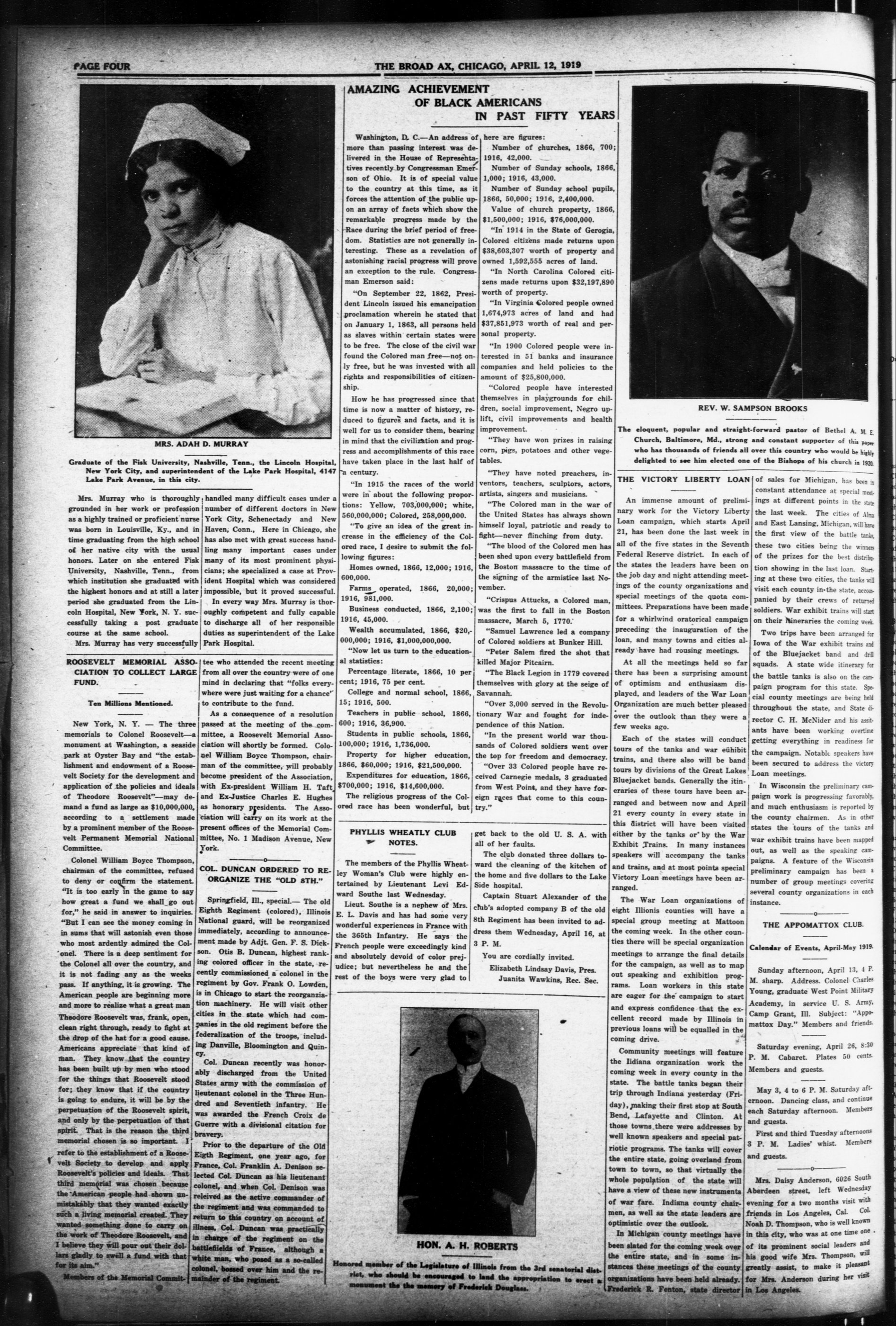
MRS. ADAH D. MURRAY
Graduate of the Fisk University, Nashville, Tenn., the Lincoln Hospital,
New York City, and superintendent of the Lake Park Hospital, 4147
Lake Park Avenue, in thie city.
Mrs. Murray who is thoroughly, handled many difficult cases under a
grounded in her work or profession | number of different doctors in New
as a highly trained or proficient nurse | York City, Schenectady and New
was born in Louisville, Ky., and in|Haven, Conn., Here in Chicago, she
time graduating from the high school | has also met with great success hand-
of her native city with the usual|ling many important cases under
honors. Later on she entered Fisk|_many of its most prominent physi-
University, Nashville, Tenn., from| cians; she specialized a case at Prov-
which institution she graduated with | ident Hospital which was considered
the highest honors and at still a later | impossible, but it proved successful.
period she graduated from the Lin-| In every way Mrs. Murray is thor-
coln Hospital, New York, N. Y. sue-| oughly competent and fully capable
cessfully taking a post graduate|to discharge all of her responsible
course at the same school. duties as superintendent of the Lake
Mrs. Murray has very successfully | Park Hospital.
ROOSEVELT MEMORIAL ASSO-| tee who attended the recent meeting
CIATION TO COLLECT LARGE | from all over the country were of one
FUND. mind in declaring that “folks every-
a where were just waiting for a chance”
‘Ten Millions Mentioned. _ to contribute to the fund.
New York, N. Y. — The three
memorials to Colonel Roosevelt—s
monument at Washington, a seaside
park at Oyster Bay and “the estab-
lishment and endowment of a Roose-
velt Society for the development and
application of the policies and ideals
of Theodore Roosevelt”—may de-
mand a fund as large as $10,000,000,
according to a settlement made
by a prominent member of the Roose-
velt Permanent Memorial National
Committee.
Colonel William Boyce Thompson,
chairman of the committee, refused
to deny or copfirm the statement
“It is too early in the game to say
how great a fund we shall_go out
for,” he said in answer to inquiries.
“But I can see the money coming in
in sums that will astonish even those
who most ardently admired the Col-
‘onel. There is 2 deep sentiment for
the Colonel all over the country, and
it is not fading any as the weeks
pass. If anything, it is growing. The
and more to realize what a great man
‘Theodore Roosevelt was, frank, open,
clean right through, ready to fight at
the drop of the hat for a good cause.
Americans appreciate that kind of
tan. They knowthat the country
has been built up by men who stood
for the things that Roosevelt stood
for; they know that if the country
is going to endure, it will be by the
perpetuation of the Roosevelt spirit,
and only by the-perpetuation of that
spirit. That is the reason the third
memorial chosen is so important. I
refer to the establishment of a Roose-
velt. Society to develop and apply)
Roosevelt's policies and ideals. That|
the American people had shown un- |,
mitakably that they wanted exactly}
ie i
ne work 4
poe Nese es
|
Nice ete ce hs
handled many difficult cases under 4
number of different doctors in New
York City, Schenectady and New
Haven, Conn., Here in Chicago, she
has also met with great success hand.
ling many important cases under
many of its most prominent physi
cians; she specialized a case at Prov-
ident Hospital which was considered
impossible, but it proved successful.
In every way Mrs. Murray is thor-
oughly corhpetent and fully capable
to discharge all of her responsible
duties as superintendent of the Lake
Park Hospital.
tee who attended the recent meeting
from all over the country were of one
mind in declaring that “folks every.
where were just waiting for a chance”
to contribute to the fund.
As a consequence of a resolution
passed at the meeting of the com-
mittee, a Roosevelt Memorial Asso-
ciation will shortly be formed. Colo-
‘nel William Boyce Thompson, chair-
man of the committee, will probably
become president of the Association,
with Ex-president William H. Taft
and Ex-Justice Charles E. Hughes
as honorary pgesidents. The Asso-
tiation will carry on its work at the
Present offices of the Memorial Com-
mittee, No. 1 Madison Avenue, New
York.
——o—___
COL. DUNCAN ORDERED TO RE-
ORGANIZE THE “OLD 8TH.” —
Springfield, Ml, special.— The ole
Eighth Regiment (colored), Illinois
National guard, will be reorganized
immediately, according to announce.
ment made by Adjt. Gen. F. S. Diek-
son. Otis B. Duncan, highest rank-
ing colored officer in the state, re-
cently commissioned a colonel in the
regiment by Gov. Frank 0. Lowden,
is in Chicago to start the reorganzia-
tion machinery. He will visit other
cities in the state which had com-
panies in the old regiment before the
federalization of the troops, includ-
ing Danville, Bloomington and Quin-
cy.
Col. Duncan recently was honor-
ably discharged from the United
States army with the commission of
lieutenant colonel in the Three Hun-
dred and Seventieth infantry. He
was awarded the French Croix de
Guerre with a divisional citation for
bravery.
Prior to the departure of the Old
Eigth Regiment, one year ago, for
France, Col. Franklin A. Denison se-
lected Col. Duncan as his lieutenant!
rolonel, and when Col. Denison was
eleived as the active commander of
he regiment and was commanded to
return to this country on account of,
n charge of the regiment on the
meeee iefiields of France, although »
t man, who posed ass so-called
ond Naset wee es at th we
AMAZING ACHIEVEMENT
OF BLACK AMERICANS
IN PAST FIFTY YEARS
| Washington, D. C.—An address o
more than passing interest was de
livered in the House of Represehta
tives recently by Congressman Emef
son of Ohio. It is of special valu
to the country at this time, as i
forces the attention of the public up
on an array of facts which show th
remarkable progress made by the
during the brief period of free-
dom. Statistics are not generally in-
teresting. These as a revelation of
astonishing racial progress will prove
an exception to the rule. Congress-
man Emerson said:
“On September 22, 1862, Presi-
dent Lincoln issued his emancipation
proclamation wherein he stated that
on January 1, 1863, all persons held
as slaves within certain states were
‘to be free. The close of the civil war
found the Colored man free—not on-
ly free, but he was invested with all
rights and responsibilities of citizen-
ship.
How he has progressed since that
time is now a matter of history, re-
duced to figure3 and facts, and it is
well for us to consider them, bearing
in mind that the civilization and prog-
ress and accomplishments of this race
have taken place in the last half of
a century.
“In 1915 the races of the world
were in about the following propor-
tions: Yellow, 703,000,000; white,
560,000,000; Colored, 258,000,000.
“To give an idea of the great in-
crease in the efficiency of the Col-
ored race, I desire to submit the fol-
lowing figures:
Homes owned, 1866, 12,000; 1916,
600,000.
Farms_ operated, 1866, 20,000;
1916, 981,000.
Business conducted, 1866, 2,100;|
1916, 45,000.
Wealth accumulated, 1866, $20,-
100,000; 1916, $1,000,000,000.
“Now let us turn to the education-
il statistics:
Percentage literate, 1866, 10 per
ent; 1916, 75 per cent. _
College and normal school, 1866,
5; 1916, 500.
Teachers in public school, 1866,
00; 1916, 36,900.
Students in public schools, 1866,
00,000; 1916, 1,736,000.
Property for higher education, |
866, $60,000; 1916, $21,500,000.
Expenditures for education, 1866, |
700,000; 1916, $14,600,000. :
The religious progress of the Col- |
red race has been wonderful, but |
PHYLLIS WHEATLY CLUB
sd NOTES.
The members of the Phyllis Wheat
ley Woman's Club were highly en-
tertained by Lieutenant Levi Ed-
ward Southe last Wednesday.
Lieut. Southe is a nephew of Mrs.
E. L. Davis and has had some very
wonderful experiences in France with
the 365th Infantry. He says the
French people were exceedingly kind
and absolutely devoid of color prej-
udice; but nevertheless he and the
rest of the boys were very glad to
ee Rage
Sieg ae
Fae aa
}
|
4 a |
be > |
J be
HON. A. H, ROBERTS
nonored member of the Legislature of Ulincis from the 3rd senatorial dist-
riety. who should: be encouraged to land the appropriation to erect »
monument the the memory of Frederick Douglass. + ae
bere are figures: Ss
Number of churches, 1866, 700
1916, 42,000. __
Number of Sunday schools, 1866
1,000; 1916, 43,000.
Number of Sunday school pupils,
1866, 50,000; 1916, 2,400,000.
Value of church property, 1866,
$1,500,000; 1916, $76,000,000.
“In' 1914 in the State of Gerogia,
Colored citizens made returns upon
$38,603,307 worth of property and
owned 1,592,555 acres of land.
“In North Carolina Colored citi-
zens made returns upon $32,197,890
worth of property.
“In Virginia Colored people owned
1,674,973 acres of land and had
$37,851,973 worth of real and per-
sonal property.
“In 1900 Colored people were in-
terested in 51 banks and insurance
companies and held policies to the
amount of $25,800,000.
“Colored people have interested
themselves in playgrounds for chil-
dren, social improvement, Negro up-
lift, civil improvements and health
improvement.
“They have won prizes in raising
corn, pigs, potatoes and other vege-
tables.
“They have noted preachers, in-
ventors, teachers, sculptors, actors,
artists, singers and musicians. ~
“The Colored man in the war of
the United States has always shown
himself loyal, patriotic and ready to
fight—never flinching from duty.
“The blood of the Colored men has
been shed upon every battlefield from
the Boston massacre to the time of
the signing of the armistice last No-
vember.
“Crispus Attucks, a Colored man,
was the first to fall in the Boston
massacre, March 5, 1770.
“Samuel Lawrence led a company
of Colored soldiers at Bunker Hill.
“Peter Salem fired the shot that
cilled Major Pitcairn.
“The Black Legion in 1779 covered
hemselves with glory at the seige of
javannah.
“Over 3,000 served in the Revolu-
ionary War and fought for inde-
jendence of this Nation.
“In the present world war thou-
ands of Colored soldiers went over
he top for freedom and democracy. |.
“Over 33 Colored people have re-|.
eived Carnegie medals, 3 graduated |,
rom West Point, and they have for- |.
ign races that come to this coun-|
ry.” F
get back to the old U. S. A. with
all of her faults.
The club donated three dollars to-
ward the cleaning of the kitchen of
‘the home and five dollars to the Lake
Side hospital.
Captain Stuart Alexander of the
club’s adopted company B of the old
‘8th Regiment has been invited to ad-
dress them Wednesday, April 16, at
3 P.M.
You are cordially invited.
Elizabeth Lindsay Davis, Pres.
Juanita Wawkins, Rec. Sec.
REV. W. SAMPSON BROOKS
The eloquent, popular and straight-forward pastor of Bethel A.M £
Church, Baltimore, Md., strong and constant supporter of this pape,
who has thousands of friends all over this country who would be binky
delighted to see him elected one of the Bishops of his church in 1921
THE VICTORY LIBERTY LOAN | of sales for Michigan, has been is
An immense amount of prelimi
nary work for the Victory Libert;
Loan campaign, which starts Apri
21, has been done the last week it
all of the five states in the Seventi
Federal Reserve district. In each of
the states the leaders have been or
the job day and night attending meet
ings of the county organizations and
special meetings of the quota com
mittees. Preparations have been made
for a whirlwind oratorical campaigr
Preceding the inauguration of the
loan, and many towns and cities al-
ready ‘have had rousing meetings.
At all the meetings held so far
there has been a surprising amount
of optimism and enthusiasm dis-
played, and leaders of the War Loan
‘Organization are much better pleased
over the outlook than they were a
few weeks ago.
Each of the states will conduct
tours of the tanks and war eihibit
trains, and there also will be band
tours by divisions of the Great Lakes
Bluejacket bands. Generally the itin-
eraries of these tours have been ar-
ranged and between now and April
21 every county in every state in
this istrict will have been visited
either by the tanks or“ by the War
Exhibit Trains. In many instances
speakers will accompany the tanks
and trains, and at most points special
Victory Loan meetings have been ar-
ranged.
The War Loan organizations of
eight Mlionis counties will have a
special group meeting at Mattoon
the coming week. In the other coun-
ties there will be special organization
meetings to arrange the final details
for the campaign, as well as to map
out speaking and exhibition prog-
rams. Loan workers in this state
are eager for the’ campaign to start
and express confidence that the ex-
cellent record made by Illinois in
previous loans will be equalled in |
coming drive. 2
Community meetings will feature
the Tidiana organization work the
oming week in every county in the
tate. The battle tanks began their
rip through Indiana yesterday (Fri-
lay), making their first stop at South
Bend, Lafayette and Clinton. At
hose towns there were addresses by
vell known speakers and special pat-
iotic programs. The tanks will cover
he entire state, going overland from
own to town, so that virtually the
vhole population of the state will
ave a view of these new instruments |.
f war fare. Indiana county chair-|
nen, as well as the state leaders are |
ptimistic over the outlook. > 2
In Michigan county meetings have |
een slated for the coming week over |
he entire state, and in some in-|
of sales for Michigan, has been ix
constant attendance at special meet.
ings at different points in the stae
the last week. The cities of Alm
and East Lansing, Michigan, will hay
the first view of the battle tanis,
these two cities being the winner
of the prizes for the best distribe
tion showing in the last loan. Start-
ing at these two cities, the tanks will
visit each county in-the state, accom
panied by their crews of retumed
soldiers. War exhibit trains will stat
on their Nineraries the coming week
Two trips have been arranged far
Towa of the War exhibit trains and
of the Bluejacket band and dil
squads. A state wide itinerary for
the battle tanks is also on the cam
paign program for this state. Spe
cial county meetings are being held
throughout the state, and State di
rector C. H. MeNider and his asit-
ants have been working overtime
getting everything in readiness for
the campaign. Notablc speakers have
been secured to address the vietory
Loan meetings.
In Wisconsin the preliminary cam
paign work is progressing favorably,
and much enthusiasm is reported by
the county chairmen. As in other
states the tours of the tanks and
war exhibit trains have been mapped
out, as well as the speaking cam-
paigns. A feature of the Wisconsin
preliminary campaign has been 4
number of group meetings covering
several county organizations in each
instance.
THE APPOMATTOX CLUB.
Calendar of Events, April-May 1919.
Sunday afternoon, April 13, 4 P.
M. sharp. Address. Colonel Charles
Young, graduate West Point Military
Academy, in service U. S. Army,
Camp Grant, Ill. Subject: “App
mattox Day.” Members and friends
Saturday evening, April 26, 3:30
P. M. Cabaret. Plates 50 cents
Members and guests.
May 3, 4 to 6 P. M. Saturday aft-
ernoon. Dancing class, and continue
each Saturday afternoon. Members
and guests.
First and third Tuesday afternoons
3 P. M. Ladies’ whist. Members
and guests.
| Mrs. Daisy Anderson, 6026 South
ee street, left Wednesday
‘evening for a two months visit with
friends in Los Angeles, Cal. Col
Noah D. Thompson, who is well know"
in this city, who was at one time on?
of its prominent social leaders and
his good wife Mrs. Thompson, will
greatly assist, to make it pleasant
s Os Seeagal during her vist
[Picture of a man in a suit with a tie].
HON. DANIEL P. TRUDE
One of the best and most popular judges of the Municipal Court, who continues to make a splendid record for himself, since his elevation to the municipal bench last November; there are higher judicial honors in store for Judge Trude.
Washington, D. C. — A preliminary accounting of the success of the Children's Year Campaign inaugurated a year ago today "to save 100,000 babies and get a square deal for children" has been rendered by the Children's Bureau of the U. S. Department of Labor and the Child Conservation Section of the Council of National Defense. According to this accounting, the efforts of the 11,000,000 women who have been interested in the year's activities have resulted in permanent measures for child welfare all over the country. Reports are not yet in from all the States, but the information now available shows a by no means inconsiderable bulk of work accomplished. The first activity of the year was a test of babies and little children under 6 to see whether or not they were up to the standard in height and weight. Nearly 7,000,000 record cards were issued in the course of this test and reports for 1,619,283 children have already been returned to the Children's Bureau, where the information they give will be tabulated. A number of communities have undertaken a second test this spring as a means of reaching the babies who were not included in the first test and also of noting the improvement made by children weighed and measured a year ago.
The weighing and measuring test has emphasized the need for preventive work in behalf of children. According to reports received from State Child Welfare Chairmen of the Council of National Defense communities in 24 States have employed new public health nurses during the year. From ten of these States a total of 127 new nurses has been reported. One hundred and thirty-four children's health centers to which mothers may go for expert advice concerning the best means of caring for their children have been established during Children's Year in communities in 15 States. Health centers are reported for 9 additional States but the number has not been given. Swimming pools, playgrounds, and new leisure-time activities have become a part of the play life of boys and girls in many communities as a result of the second drive of the year — drive for the sort of recreation that makes for a stronger young America. From sixteen States the establishment of new playgrounds has been reported.
The third drive of the year is still in progress. Forty-three States, New York City and the District of Columbia are all actively engaged in a campaign to prevent boys and girls from going to work before they have the training they need for successful and happy lives. "Back to School!" and "Day in School!" are the slogans of this drive. A number of communities have provided scholarship funds to enable children of needy parents to continue their education after they reach the legal working age. At least nine such scholarship for each of the
281,000 school houses in the United States is the goal that has been set.
This goal, like many of the other goals set for Children's Year, is still far from being attained, but although Children's Year is officially over, there is no indication that the work begun during the past twelve months is going to be allowed to lapse. On the contrary, in a number of States plans are under way to make every year a Children's Year, either by continuing the present organization or by turning the work over to some other agency. There is, according to those who have been in close touch with the work, a new consciousness of the value of the child and his need for proper surroundings, good health, wholesome play, adequate schooling, protection from premature work, and special care when needed. This consciousness is indicated not only in local activities for child welfare but in laws contemplated by the States. Legislatures are in session in nearly all of the States this year, and many bills looking to better protection for children are under consideration.
In order to discuss and consider tentative minimum standards for the health, education and work of the American child, the Children's Bureau has planned a conference with foreign experts who have had a part in the work done by European countries for the protection of children during the stress of war. The conference will consist of two distinct parts: first, a small working committee of American authorities to be invited by the Secretary of Labor, and members of the Bureau staff who will meet informally with the foreign guests at Washington during the week of May 6. Second, a series of regional conferences in various parts of the country at which the discussion of minimum standards can be continued under local auspices and with reference to local conditions. Foreign representatives will attend these meetings and put their experience at the service of the Americans who are seeking to increase and strengthen measures for the protection of childhood in the United States.
REV. AND MRS. J. T. TILLMAN OF PINE BLUFF, ARKANSAS, WILL MAKE THEIR FUTURE HOME IN CHICAGO.
Lately Rev. and Mrs. J. T. Tillman who have for years ranked among the best and the most highly respected Colored citizens of Pine Bluff, Ark., arrived in this city, which they will make their future home. Rev. and Mrs. Tillman will soon buy a home on the south side and settle right down to business.
At the present time they are stopping at the lovely home of Mr. and Mrs. Houston, 3706 South Wabash Ave. Rev. and Mr. Tillman are old friends of lawyer W. E. Mollison and attorney J. Gray Lucas and part of the time Rev. Tillman will make his headuarters at the book-store of Mr. A. D. Hayes, 3640 South State
THE BROAD AX, CHICAGO, APRIL 12, 1919 BIG W. C. C. S. MEETING AT ing, out of which there will HAMPTON INSTITUTE. preceded co-operation.
By Wm. Anthony Aery.
Hampton, Va., special.—Dean William Pickens, vice president of Morgan College, Baltimore, recently spoke to an audience of 2,000 citizens at the War Camp Community Service meeting which was held in Ogden Hall, Hampton Institute, on "The Negro and Reconstruction." This meeting was organized by Miss Elizabeth W. Martin, director of the Colored Girls' Division of the War Camp Community Service. Dean Pickens described the work of the Negro soldiers throughout American history and gave interesting details concerning the 92nd Division. He paid a fine tribute to the patriotism of 12,000,000 colored people who supported America's entire war program. He said:
"The American Negro is not vindictive. He is patient, sympathetic, and naturally unwarlike. As he is gentle in peace, so is he terrible in war—as the Germans soon learned. when, with fixed bayonet, he advanced with a song or hymn on his lips.
"The Great War has shown the possibilities of the black man, not only as a brave fighter and an efficient officer, but also as a reliable industrial worker. The Negro as a mass has made good in war activities, wherever tried out.
"The Great War has also shown that the weakness of any group becomes the weakness of the Nation and the strength of one group becomes the strength of all. An ignorant person is a continual deficit to the Nation. The reconstruction period is pregnant with great dangers and great opportunities. The interests of white and black people run inseparably."
Dr. Robert R. Moton, principal of Tuskogee Institute and successor to Dr. Booker T. Washington, who recently returned to the United States from an important mission overseas, declared that "the American Nation has done the biggest and most efficinet job in the shortest time—white and black co-operating—that the world has ever known." He declared emphatically that "no group did any better work than the American Negro officers. These men made a marvelously fine record. I have never been more hopeful of the future than I am today—hopeful that human justice and fairness will prevail."
John L. Einstein of Newport News, who has for fifteen months been in charge of the colored division of the W. C. C. S., declared that the white and colored newspapers exert a great power in bringing both races to understand each other better. In Mr. Einstein's judgment there has been throughout the Nation a great mental and spiritual awaken-
[Name]
J. H. WHISTON (LOVIEJOE)
ing, out of which there will come unprecedented co-operation. Now people are talking in terms of a working program rather than in terms of a problem.
Mr. Einstein expects the W. C. C. S. to do for civilians in peace times a work similar to that which it has successfully done for soldiers outside of the camps.
The Hampton Choral Union sang Dett's "America the Beautiful" and Burleigh's "Deep River." The great audience sang, as a closing chorus, "O Freedom Over Me."
A MOCK MILLIONAIRE MILITARY WEDDING AT THE ROYAL GARDENS A, HUGH SUCCESS
A mock millionaire wedding given at the Royal Gardens under the auspices of The Eureka Fine Arts Club proved to be a grand success.
The bridal party assembled in the Gold-room awaiting the distinguished guests were as follows:
Mayor William Hale Thompson and wife, Miss Clara Brown and Mr. Chapel.
Capt. Marshall Field and wife, Miss Ethel Patterson and Lieut. O. A. Browning.
Atty. Ed. H. Morris and wife, Miss Henley and Mr. Chas. S. Hunter.
General Marshal Foche and wife, Mme. Bertha L. Hensley and Lieut. R. W. Harang.
Then came the 8 charming little ribbon girls dressed in their dainty white frocks: Vera Leary, Leah Duff, Adie Jones, Thelma Lott, Morene Crittle, Edith Anthony, Thelma Porter, Ferrel Murrell.
In walked the minister Rev. C. C. Carter . Followed by the bride's mother and father. Mrs. Millionaire, Mrs. Estell Miller. Mr. Millionaire: Mr. Preston Allin.
Then the maids accompanied by the ushers in Kaki: Mrs. Mabel Powell in a most charming lavender chiffon embroidered in silver; Mrs. Marion Reed in a rich cream satin draped gown; Miss Julia Jacobs in a pearl grey Georgette over grey satin; Mrs. Margaret White in a blue tule over silver lace; Miss Thelma Chilton in a red tule over red satin; Mrs. Stella Walker in a pea-green Georgette draped over peach satin; Miss Violet Anderson in embroidered satin draped over gold charmouse; Mrs. S. D. Smith in a most charming white satin gown trimmed with silver. — Ushers in Kaki.
Sergt. Richard Courtney: R. Merridith—Eugenie Wright, Horice Jordan—Lieut. W. Price, Lieut. L. G. Harris—Sergt. H. A. Robertson, R. L. Jones.
Then like dainty little fairies came the little flower girls with their baskets of flowers Cadince Lee Baker, Adelaide Sudds, Alice Roberts, Hazel Sudds.
Apage dressed in green satin with
THE UNIVERSITY OF NEW YORK
MME. ADENA C. E. MINOTE
CLIO SCHOOL OPENS SPRING
SESSION.
The Clio School of Mental Sciences, 3543 State St., will open its spring session Monday evening, April 21. The slogan of the school is "Prepare for the New Era." These days of Re-construction bring the need more than ever for the ability to know people, and to be able to size up the man or woman with whom you curls and plumes and every thing necessary to drive two little team girls drove in. The page was master Nicholis Roberts. Team girls Lavora White, Elizabeth Conley. Then the matron of honor Miss Sylvia Mills.
And then the bride Mrs. Lillian Heard Areal. Bride dressed in a most charming gown of white satin combined with silver dotted satin. A georgeous lace veil extending over two yards behind her. Then the groom Lieut. Bernard Heard with the best man David Wymn. After the ceremony in flew a butterfly and sang and danced for the bride. This butterfly was Miss Thelma Washington.
The bridal party was then entertained in the Gold Room where the Trio II Trovatore by Mr. Clarence Muse, Mr. Atkins, Mr. Douglas.
Duet—Piano—Miss Geraldine Rowell.
Violin—Mr. S. Atkins "Spring Song".
Mrs. Elsie Norris, Gen. Chair. Mrs.
Lizzie Crawley, Mrs. Bula Williams,
Mrs. Myra Hunter Reeves, Directress.
EVANSTON NEWS ACTIVITIES.
By Miss Cecilia Fisher.
A grand reception was given the Evanston colored soldiers of the 365th and the 370th, in the First Methodist Church, last Thursday evening. The large auditorium room was filled with an enthusiastic audience to welcome the boys.
Hon. W. S. Powers, Chairman of the Draft Board, presided. Prayer was offered by Dr. R. E. Wilson, pastor Ebenezer A. M. E. Church. Music was furnished by a chorus from Ebenezer, and military quartette of the 365th. Prof. W. E. Gossette acted both and in the capacity of organist and director.
Addresses were made by Rev. Earnest F. Tittle, D.D., pastor of the First M. E. Church, Maj. Adam E. Patterson, Judge Advocate 92nd Div., Maj. Warner A. Ross, white, 365th Inf., and Prof. W. W. Fisher.
Miss Hazel Griffin, 1621 Lake St., who will leave the city next week for a six week's stay in Mississippi, entertained at tea last Sunday evening about forty guests. The affair was a most enjoyable one, the splendid music rendered being no small factor.
Sergt. George Smith, of the 372nd Inf., addressed the Evanston Lyceum at the Emerson St. Department Y. M. C. A. last Sunday. He spoke on his experiences while over seas. All present enjoyed his address.
Miss Majorie Wilson, of Morgan Park, spent the week end at the home of Mr. and Mrs. W. W. Fisher, 1911
deal. The time is ripe for people to be better prepared along all lines, and the harvest is abuot ready in all parts of the world for those who are prepared. The school teaches people, too, the way to properly employ their natural gifts and ability so as to reap maximum results with minimum labor. The term continues over a period of eight weeks. A large number of students are already enrolled.
Asbury Ave., visiting their daughters, Misses Cecilia and Jennie Fisher.
The Annual Mothers and Deaughters Banquet was held on Friday, April 11, at the Emerson St. Dept., Y. M. C. A., It was a very grand affair.
The Evanston Literary Club met last Monday at Ebenezer A. M. E. Church. The Chairman of the Program Committee, Mr. George Pressley, arranged a very enjoyable program. The next meeting will be held next Monday evening, at which time we expect to listen to another good program.
Rev. Wm. Fountain, Pres.
Miss Florence Walker, Sec.
Dr. George A. Lewis, 3900 S. State street; continues to grow slick and very prosperous looking, while looking after the interest of his many patients.
Attorney James A. Scott, Ex-Assistant State's Attorney of Cook county, may in the near future be selected to a responsible legal position by some of the big Republican politicians.
Madam Clara McAdams, 4806 S. Dearborn street, has been confined to her home, for the past two weeks from the effects of a nervous breakdown. She expects to be able to be out again the first part of this coming week.
Madam E. Avalia Hackley will in the near future give one of her noted "Folk Song" festivals, at Alexandria, Va., and Washington, D. C. Madam Hackley has met with remarkable success with her "Folk Song" festivals in the leading southern cities the past winter.
Mrs. W. A. Buckner, 3704 Prairie avenue, celebrated her umpteenth birthday Friday evening and her dutiful husband Dr. Buckner, in order to be in style or up-to-date, celebrated his birthday at the same time. It was a very pleasant family affair and Mrs. Buckner received some nice presents from some of her many friends.
Alderman Robert R. Jackson, Grand Major General, of the Uniform Rank, Knights of Pythias, throughout the world, was in Cincinnati, Ohio, Wednesday evening and spoke at the Central Baptist Church in that city under the auspices the Elite Co. No. 5 U. R. K. of P. and the people in general gave hinf a good time and he was royally entertained by the big Knights of Pythias of the smoky city.
PAGE FIVE
CHIPS
Pe ee ee ee Sr aes oe Pe ges ee Se
aS ae eee ponte : ’
PAGE RX ae sei ‘THE BROAD AX, CHICAGO, APRIL 12, 1919
= —S a ——————_
FUR SATIN es rere LATE ARRIVAL FROM PARIS BLOUSES FOR EARLY
‘The full-length figure sketched shows — SPRINg
SOFT FEL one of Redfern's new models for early ile ora Rainbow Assortment, Resens
spring wear. The material was slate- imocks, in Many Shades of"
T HATS c= tz sae ant te tm | evoration EMletively Used on ==] | Saffron or Marigold Yellow and Handkerchiet Uses
| ine comatated of bands wide, and Articles of Apparel. - Se Blue, Popular Shades. Se
Ermine, Moleskin, White Fox and | >roldered in white wools. ea Reo “4 needlework: department cone
; ‘This ts one of Redfern's newest re fork’s most Interestin short
Kolinsky to Be Worn This Seber ar ute ee esl ee » sky Children’s Garments Full of Life; | rainbow aoe sy
Summer. be wratipcnio trs Ararinr- Frei bend Ha rae rep “wd aa oes Bicomers to Match Necessary |! many pastel shades of banda
splendid on the coarse black net Slippers and Bags. 4 for the Small Girls. linen. At the first glance ther
—_ sroand sed tb a a siyle of trimaing a sei seus q = . = ble the smocks with which ">
ee es uae tat tana a Vivid colors are predominant in the | '# familiar, but a closer examina’
NEW EARLY SPRING COSTUME | meteriar. tt tooks particutarty well oo ene ae beads are just as much ’ {| development of owing a mee proves them to be cut smesnnat
M | black satin or on raven's-wing-biuo | ‘B¢ vorue this spring as ever. Beads Ka} | dresses for children. A very bright | ¢f 19 order to be pra vat
i cloth. The outline of the coat ts novel = ace its, blouses, gowns and 4 saffron or marigold yellow and an | WOM either inside or « utsia prizes.
Sole; Ti 2 Soe ae ioe: It ts quite long, Feach- | are still much bea ee ae 1] | cqualty bright biue are the two colors | IM8te0d of the usual snoekig
7 Trimming of | ing well below the knees. an : ded, and we wear XX that are notably popular, and these are | 2coration, they are ef, neking te
Coarse Black Filet Net Em- ‘Then in front there is a straight aa our necks, notes a corre- a quite often combined in gne dress. broidered in the cross-<titch, re®
broidered in Wool. Plastron which seems to tie round the | ical Se aians | FB | The sketch shows a dress made of | BOW $0 much in vorue ot
Guus tite oem. \tterns: much used © HBSS | a heavy serviceable cotton material in| deeper hues of mer ape,
Reavy SESveeEnaes CS ae | whens Meuse are brettinn
Recently, writes « Paris fashion cor
respondent, I witnessed an amusing Ut-
tle scene in which a famous London
beauty played the leading role. The
background was one of the big depart-
tent states on the Boulengré Hasse
mann, and the beauty wa none other
than Lady Diana Manners, daughter
of the duchess of Rutland. I noticed
® considerable crowd of women and
girls at the untrimmed hat department.
‘This was nothing new, for nowadays
every department of every big store
im Paris is crowded, but it struck me
that instead of searching for becom-
ing hat shapes for themselves these
eager girls and women were watching
someone else making 2 choice.
I made my way to the scene of ac-
tion and there standing before a look-
ing glass, I found very tall, thin Eng-
lish girl with wonderful golden hair,
starry blue eyes and blushrose cheeks.
She was actually making a restaurant
hat before the eyes of those amazed
onlookers.
‘With absolute unconcern she pulled
on a transparent brim made of black
tulle and then added a full crown of
glittering gold tissue. Then she push-
ed into place a cluster of metallic
flowers and a Louis XV bow of biack
velvet, gave the whole thing 2 final
pull to make it fit well down on her
lovely hair and Indicated to the speech-
Jess shop girl that she wished the hat
made “like that.” It was the prettiest
sight you can imagine.
A really beautiful girl displaying a
wonderful cleverness fn the arrange-
ment of fragile materials, above all,
the essentially English disregard for
the crowd of onlookers.
All for Picturesque Dressing.
Lady Diana was—es usual—dressed
Picturesquely. All the duchess o
Rutland’s daughters have inherited
their mother’s genins where clothes are
concerned. It will be remembered
that when the duchess was Lady Gran-
by she led a very exclusive circle, in
London, who called themselves “The
Souls.” All the members of this circle
went in for picturesque dressing and
the duchess of Rutland is still famous
for her clever arrangements of gor-
geous brocades, lengths of rich fur
and priceless laces.
‘The day I saw Lady Diana she was
‘wearing a simple one-plece frock, made
of navy blue serge, which had a nar-
row belt of scariet patent leather.
‘Thrust into this belt were two long,
white suede gloves and a magnificent
red rose.
‘Her wrap, which was thrown care-
Jessly back on her shoulders, was made
of black poult de sole and fashioned
Hike an Irish —peasant's cloak, with a
\ ves
NG)
Quaint toque in “flamingo” red sitk
crochet, embroidered in biue and
- black.
plain round yoke into which the rest
‘of the cloak was gathered. The man-
tle was lined with bishop's purple crepe
de chine and topped with 2 supple
collar of kolinsky. The cloak was tied
round Lady Dians's really lovely throat
with wide, black silk ribbons and wher
the moment came for taking off the
recently “created” hat and putting on
ene she had worn on entering the es
tabishment I found that the latter took
the form of a fisherman's cap, made
of scarlet silk tricot, with quaint black
‘and blue embroigeries round the peak
ed crown.
T have sketched this highly original
€ap for the benefit of fasbion's readers
‘They will see that it is charmingly
becoming and youthful.
Cap Well Drawn on Head.
Sars St
crown was ‘supported, bat
the cap was so wall drewa on the
‘Tie dace of Rainn wae ns
ee ee hat eee
ee
string of maguificent pearls caught 1s
by « @iamond brooch.
‘The full-length figure sketched shows
‘one of Redfern's new models for early
‘epring wear. ‘The material was slate-
gray cashmere de sole and the trim-
ming consisted of bands—wide and
narrow—of course black filet net em-
broldered in white wools.
‘This Is one of Redfern's newest
ideas and = very effective one; the
heavy white wool embroideries look
splendid on the coarse black net
ground and it is a style of trimming
which can be introduced on almost any
material. It looks particularly well on
Diack satin or on raven's-wing-blue
cloth. The outline of the coat is novel
and becoming. It 1s quite long, reach-
ing well below the knees.
‘Then in front there is a straight
plastron which seems to tie round the
waist. As a matter of fact, this plas-
tron is part of the cont itself and the
whole thing fastens invisibly at the
left side. Redfern ts showtng a good
‘many spring coats of this length and
‘ ie
d o
} ‘Dl
PES
Early spring costume in siate-gray
cashmere de soie, with bands of the
new white wool embroidery.
ROW WANs west embroidery.
4hey are having much success. The
accompanying skirt is short and tight
and the ensemble is exceedingly chic
and smart. The hat shown in this
drawing is a new model by Reboux.
‘The brim ts longer in front than at the
“back and the crown is high and full.
Style Popular in Paris.
A loosely curled feather Is taid roun¢
one side, with # fascinating tip droop
ing over the brim in tassel fashion
Please note the round-cut neck af the
coat. This is the style now most
pepular In Paris, for coats as well as
for dresses and blouses. Several of
our leading dressmakers are trying te
make high, tight collars popular—for
coats and dresses. but the Parixiennes
are holding away from this innovation.
except in the matter of wrap coats.
All the same we shall certainly see
something like revival of high dress
collars this spring. Whether this
fashion will quickly become generally
popular remains to be proved.
T have lately noticed 2 great many
ostrich feathers introduced on velvet
and felt hats. Some of these are of
the loose uncurled order, but others
are really handsome specimens of the
feather tribe. I have also seen clus-
ters of ostrich tips used as trimmings
for high Russian toques. This is a re-
vival of an old and very popular fash-
ton.
Black satin and soft felt hats will
be “the correct thing” all through the
spring and summer. The rSost fash-
Jonable milliner in Parix recently told
me that soft felt hats will be very
much worn this coming summer in con-
Junction with the most fragile dresses
and rich “summer furs.”
‘This indicates that we are in for
8 picturesque summer season, and that
1s good news. Summer furs are cer-
tain to be more worn than ever; such
furs as ermine, moleskin, white fox
and kolinsky—the latter in the form
of square collars for coatees made of
pale-bhued sntins.
Forty-Two Standard Colors.
‘The Textile Color Card association
announced the iasuance of a card of 42
standard colors for the manufacture of
fall fabrics, the majority making thelr
‘appearance for the first time. A de
parture was the inclusion of ten col-
‘ors tn wool, the association's efforts
formefiy having been Gevoted exciu-
sively 10 the silk trade. Nut and elk
‘browns, and trooper blue were said to
be striking features of the woo! tones.
Of the silk colors, it was stated, blues
predominate, led by the Introduction of
novelties named Louvain. Bruges and
Ghent, while peanut and pelt browns;
embr., “representing light and fire,”
on burot orange were given special
‘mention.
‘Red Straw and Dresden Silk.
Large hats will as usual be to the
fore for dressy wear. In small hats,
one style has # red Java straw brim
‘With the crown in the same shade of
silk tn-s dresden pattern. The trim-
ming is 2 feather mount. Matrons
Seam cuits oes
‘high tulle 204 of eag
Fong era neta a
— -
a
DEMANDFOR BEADS TATE ARRIVAL FROM
Decoration ese Used on ;
Tiey screens of ‘Gouna, Hy ae A » .
Of course everyone has noticed by
this time that beads are just as much
the vogue this spring as ever. Beads
there are on hats, blouses, gowns and
evening slippers, besides “purse bags”
are still much beaded, and we wear
beads around our necks, notes a corre-
‘spondent.
‘Two patterns of beads much used
on georgette blouses and frocks that
are very easy to copy are the round
and square designs. ‘The round de-
‘Bigns are merely circles of beads of
some effective contrasting color, such
‘as white beads on a coral fabric, or
Diack beads on yellow, that are sewed
on tunics in circles about as large
as a saucer. Sometimes a bit of em-
broidery—wool or silk—is applied as
& motif inside a circle.
The square pattern is developed ex-
tensively by the use of the shiny cyl-
indrical bead# about half an inch long.
‘These are applied in a very simple,
large plaid to whole dresses or tunics
or blouses. Sometimes just a two-
row border crosses in a plaid at the
corner of a drapery or a collar.
Coarse wooden beads in natural
wood color, or very bright colors, are
among the novelty beads trimming
some of the very daintiest frocks.
On millinery, the wooden bead, often
represents the center of a flower on
a black maline hat of the midsummer
Ungerie type.
A very simple yet striking way to
bead a bag is to use round beads about
the size of a pea, and sew them on
motre silk in spaces about two inches
apart all over the bag. Yellow beads
on dull blue moir are an effective color
combination.
Among the good color schemes to
employ with fabrics and bead trim-
mings are cut steel or silver beads on
Copenhagen blue, white beads on rose,
red beads on white, crystal beads on
pale green, bright blue beads on gray
or yellow, white beads on very palest
yellow for a very dainty effect and
black beads on the henna color.
Worn around the neck, beads not
only will accent or modify a neck line,
but when properly chosen, set off the
complexion.
Beads are an inexpensive but clever
way to add an expensive looking hand
touch to many ready-made wearables,
‘and it does not take a great deal of
time to do it, if only striking colors
and designs are chosen; so, all in all,
let mflady pay attention to beads, this
spring.
SATIN AND GEORGETTE CREPE
if
- F
The predominating feature of this
“arabesque” model is the odd com-
bination of black pussy willow satin
and pearl gray georgette whieh
Is sovtealioad. with meahegiob-eniensd
silk. General lines have tendency to
make wearer appear taller.
MODISH IDEAS
Full length suit Jackets have their
fullness gathered on rounded or shou!
der yokes.
There are buttons, buttons every-
where, assuming all duties of orna-
mentation. -
A Ddiouse of beige chiffon is frilled
with many ruffles bound with navy
Dine crepe.
‘The cape in all its forms ts one of
the most charming and serviceable of
garments.
trely of vivid Gowers, following
Mines of the head. ~ -
‘About Vella,
‘The vell meshes continue to show
enchanting designs. One of the most
“LATE ARRIVAL FROM PARIS
ait ks ed
ae
¥ he
Gers
: o
i
a?)
Bs
ie
eS =
~ Above is shown a black silk after.
[moon gown with overskirt effect. A
cluster of black leaves at the bodice
‘comprises a pleasing effect, while a
“string of black beads drapes from the
“shoulders.
SOME NEW COLLAR FABRICS
Scrim of Coarse Weave and Chinese
Silk Among the Decorations
Ger Cine.
, There was a time, Igng years ago,
hotes a fashion authority, when we
used to wear high. stiffened collars of
velvet and satin and silk. We consid-
ered those fabrics—velvet and satin
and silk—quite the fabrics for collars
in those days.
‘Then, when collariess frocks came
in, we wore collars of white wash
tabrics, organdie and muslin of va-
rious sorts. For, of course, though our
frocks were collariess, they had col-
lars just the same. That is, there
were turned back and rolled over col-
Jars, even more important than the
high ones that hugged and marred our
necks ysed to be. So we ran along for
years with collars and other sorts of
neckwear of organdie and net and
lace.
‘Then, again, satin came into being
as a neckwear fabric in first favor.
And colored muslins of various sorts
were also used.
And now there are even some other
unusual materials in vogue for cel-
lars.
One is scrim, of a heavy, coarse
weave, embroidered, which is used on
some of the frocks of serge and satin.
Chinese silk—that is to say, silk or
satin much enibroidered in the Chi-
nese fashion—ts another fabric now
used for collars on serge frocks. Need-
less to say, this doesn’t mean that if
you happen to have a bit of such
silk on hand you can simply pin it
deftly around the neck of your new
blue serge frock and think you have
a collar of the most uptodate sort.
No; but your dressmaker can use a
bit of this sik for such purpose by
cutting it properly. And very prob-
ably she will reiterate the same col-
ors in some embroidery or other part
‘of the frock.
METHODS OF APPLYING BRAID
Three Ways, Entirely by Hand, by
Machine and by the
‘Combination Plan.
‘There are three ways of applying
braid or tape as edge trimming—en-
tirely by hand, entirely by machine
and by « combination of hand and
machine work. In ench case care
must be taken to “ease” the bid
with the left hand as the work pro-
ceeds in order to avoid shrinkage in
wash material and puckering in silk
or woolen goods. Braid invariably
shrinks in laundering more than other
material.
When the application is to be made
by hand alone, writes 2 correspond-
ent, place the braid on the right side
of the material close to the edge and
backstitch the two together. The
stitebing should le very near the edge,
but not near enough to cause fraying.
. After the backstitehing 1s completed
fold tm half and crease the braid and
bem ft down on the wrong aide of the
material. The braid should just cover
the backstitching on the wrong side
‘and the hemming run close to it.
‘In the combination method the proc
eas is the same except that the first
‘stitching ts done on the machine. In
‘the machine work special care must
be taken to keep the braid sufficiently
lax To do the work by machine
‘lone fold the braid in heslf, place
eee wees the tehdes tetra
‘thicknesses.
Flowers, Flowers Everywhere,
Flowers are everywhere in the new
spring millinery. Vines of large as
well as smaller Sowers clamber about
‘brims and over crowns, and there ts
even a mode that dictates the single,
{Be tower planeredsomewnere on the
ee re See
COLORS HAVE CALL
Saffron or Marigold Yellow and
Blue, Popular Shades.
Children’s Garments Full of Life;
Bloomers to Match Necessary
for the Small Girls.
Vivid colors are predominant In the
development of spring and summer
@resses for children. A very bright
saffron or marigold yellow and an
‘equally bright blue are the two colors
that are notably popular, and these are
quite often combined in gne dress.
‘The sketch shows a dress made of
‘a heavy serviceable cotton material in
‘yellow, with guimpe of blue cotton
‘voile or handkerchief linen. Velvet
ribbon In a shade to match the guimpe
{s run through openings made for the
purpose on either side of the front
panel of the dress‘and tied in a smart
bow at the back. A little embroidered
‘motif in blue on the yellow dress gives
‘an additional trimming touch.
‘These two striking colors are used
‘for children of al? ages, rompers for
a two-year-old being very effectively
shown in both blue and yellow, and
tiny Uttle first trousers are made of
yellow cotton and buttoned securely
to frilled blouse of biue handkerchiat
linen or chambray.
In making summer clothes for the
girl of four to eight years, the sensible
mother will see to it that every little
dress has at least one, preferably two
or three, pairs of bloomers to match.
Bloomers are preferable to petticoats
for the small girl.
Cotton volle, both in all white and
in printed patterns, is a material very
much in use for children’s dresses for
the coming cummer, and pengea, 8
a
Al
i
Bright Colors for Children’s Clothes.
fabric that wears splendidly and laun-
ders equally well, is also being very
much used. The pongee sleeveless
frock, with bloomers accompanying it,
of course, may be worn with cotton or
Unen guimpe, in white or colors. Such
an outfit will be found not only service-
able but smart as well.
CARE OF VELVET IMPORTANT
Soft Brush Should Be Used in Clean-
ing; Olive Oi! When Renovat-
ing by Steam.
Velvet has been in high fashion.
And velvet shows the dust. Two facts
that somehow have to be reconciled
to each other. :
‘The only way to keep velvet look-
ing well is to give it careful and con-
tinuous attention. To begin with, buy
velvet of good quality, and whenever
possible get the sort that water will
not spot. Even if it Is to be used for
& house gown, where it will never
run the risks of raindrops, it may eas-
fly: be spotted with a drop of water
from a glass, or with a drop that drips
from the Singers when they emerge
from a finger bowl or a wash basin.
Velvet never should be brushed with
& stiff, coarse brush. The pile is eas-
fly Injured; in Tact, the short, soft
threads that make It upoften can eas-
fly be pulled from their foundations
with the finger nails, and @ coarse
brush is almost sure to loosen them.
A soft velvet brush Is the sort to use.
Even better than a brush is a plece
of erepe of crinoline. The rough fab-
rie seems to get all the dust from the
velvet and clean its inmost fibers.
Use a few drops of olive oll rubbed
by? means of a piece of soft flannel over
the surface of the steaming cloth. Con-
tinge this movement until the cloth is
quite dry and the velvet too ts dry.
‘The wrinkles will by this time have
Gisappeared and the velvet Will be
smooth and fresh.
Light-Topped Shoes Passe.
Light-topped shoes are almost out of
ate now, Little by little they have
siven place to the single-toned shoes
sed all bigck t very mach in favor
gO ee sh Te
BLOUSES FOR EARLY SPRiy
Smocks, in Many shag
Handkerchief Linc.
Prominently dispiayet in thy
eedlework: department of ore et
York's most interesting shops ig
rainbow assortment of dainty Wome
tm many pastel shades of hank,
Hinen. “At the frst slauce they rext
ble the smocks with whict eren
4s familiar, but @ closer ecm
Proves them to be cut somesat ame
(€f, in order to be practicable wey
Worn elther inside oF tside the ee
Instead of the usual swockigg ge
decoration, they are ettctively a
broldered in the cross-<titeh, mal
Bow #0 much In vocue, worked y
Geeper hues of mercerized cng
These blouses are prettiest when
simply, with @ V neck snd turnigg
collar of the linen. The sleeves, whag
are quite loose, are set in large am
holes to conform with the tare of iy
blouse, are gathered In sougiy at yy
wrists and Gnished with a oem
rather full ruffle, which falls over
hands.
The embroidery s placed actos ty
front of the blouse, at the curser g
the collar, as a Finishine touch ara
the edges of the wrist ruttes and aig
ly enough, on the upper part of ty
sleeve, Just over the forearm. A stag
of loosely braided embroidery tig
makes an unusual and effective te
slip under the collar. Because they
blouses are made So 2s to allow tre
dom of movement, they are excel
for spring outdoor wear: and, som
thelr fabric 1s very soft, they may ty
worn inside the belt, if preferred, iy
stead of the ling, a fine qualty g
dotted Swiss may be used to aing
tege, and, when it Is possible t a
tain this material with colored doy
exceptionally pretty effects may by
secured by using deeper tones forty
‘embroidery and tie.
TO MAKE PRETTY KERCHIER
Roll and Whip Border Is Made Atty
tive by Drawn Threads of a
Deeper Hue.
‘The woman who delights in makhg
dainty handkerchtefs is usually ite
ested tm novel ways of varying te
plain square which she wishes to bee
tify. The handkerchief with the ‘nl
and whip” border (the hem of whic
is rolled tightly by moistening it a lb
tle with the fingér tips, and whigpd
around and back again with colord
thread, to form tiny crosses fort
border) has been such a favorite tht
tt is now being ornamented by drum
threads of a deeper hue, inserted psn
lel to the edge, which give « most ¢
fective touch to the finished bantte
chief. a
It ts but @ simple matter to du
these through the linen if they
attached carefully to the ends of i
threads of the original fabric, whit
are to be removed to make room te
the colored ones. When the old threst
1s slipped out the new one follow
sutomatically in its place. ‘Two lines
may be Inserted parallel it prefers!
to give more color and character to te
‘design. A simple initigling at o#
corner is perhaps the most satisfac?
decoration to finish the gift. Handke
chief Imen is obtainable in a varey
of exquisite shades, which are most #
tractive when set off by = filstig
touch im darker hue.
USE FOR OLD CORSET STEELS
Stays Dropping From Worn Garmet
Prove Valuable Accessory t
the Sewing Basket.
When a steel drops out of the halt
worn corset there harilly seems sf
use to which it can any longer te
put; but if you will save a couple
these steels, especially the wider sf
more pliable ones. they will prove #
valuable accessory to your sewing
Ket. When sewing buttons, nooks sat
eyes or snap fasteners on 4 hem where
ft is desired that the stitching 68
not show through to the opposite sit
of the garment, as, for instance, wit
sewing the fasteners on the from ¢
fa fine lawn or crepe de chine sift
waist, leave one end of the hem ©
stitched so as to insert your fee
Your needle according!y will ps
through only one thickness of goods
tm sewing on the fastener.
Corset steels are also handy in a
Ing bags opening at the side and os
for all sorts of utility purposes. Pie
the steel across the top cf the bas
brace the stitching. It + strong sf
pliable, and in the end will serve
purposes far better than a piece #
‘wood, no matter how lizht.
a
HAT FOR SPRING AND SUMMER
a ea
<
ie 4 . _ s
is PS
4. U
yr eo Ss
Red and white plaid ratine on "ey
chip ctraw, decorated with ror
rilbbon and cherries.
ee
ce a
Tho water to which 0008 ue
abe washed wil be soft if 108
tebe Simponatula of cizceria 87
‘of water.
Stop Thief!
THE "Jumbo" gas burner shown here at the right, (actual size) is a robber on any gas lighting fixture in Chicago. If you have one, get rid of it! It makes high gas bills and causes a great many of the complaints that come to us.
Claims that a "Jumbo" will give more light without using more gas are false.
Use mantle burners to get more light with less gas. Burning five hours a day for a month, the "Jumbo" consumes $2.30 worth of gas; a "Junior" mantle burner, in the same time, consumes only 39 cents worth, or $1.91 less, and gives much more light.
This Is the
"JUNIOR MANTLE"
Telephone Cal
Telephone Calumet 602-3572
MORRIS, Pres. KIRBY W
MORRIS-WA
COAL CO.
HUGH NORRIS, Pres. KIRBY W
NORRIS-WA
COAL CO.
Incorporated
2545 SOUTH PARK AVENUE
Chicago
THE CR
Apartment
3600 WABA
The finest building ever open
cago. Steam heat, electric light
THE CRANFORD
department Building
3600 WABASH AVENUE
A building ever opened to Colored ten-
am heat, electric lights, tile baths, man
THE FORTY-FOURTH STREET
The finest building ever opened to Colored tenants in Chicago. Steam heat, electric lights, tile baths, marble entrance
Advertise in
tise in the BROA
Advertise in the BROAD AX
A lake near Biggar, Saskatchewan, has been found to be saturated with sodium sulphate, and the deposits under the lake and alongside the edge to be nearly 97 per cent pure sulphate. The mineral is used extensively in the manufacture of sulphuric acid, in photography and other industrial purposes.
Cleaning Wallpaper.
Cleaning Wallpaper.
To clean and polish wallpaper, add two tablespoonfuls of ammonia to half a pailful of water, and wash the walls down with a fannel dipped in this.
Take half a pailful of water and add two tablespoonfuls of turpentine. Wash the walls a second time with this and wipe as dry as possible.
Good Rule for Life.
Good Rule for Life.
We are ruined, not by what we really want, but by what we think we do; therefore, never go abroad in search of your wants; for if they be real wants they will come in search of you. He that buys what he does not want, will soon want what he cannot buy—Colton.
Phone Main 263
We sell "Junior Mantle" lights complete for only fifteen cents, (which is less than "Jumbos" usually cost) or give one free, in exchange for a "Jumbo," at our main office or any of these stores:
West Side 3643 Irving Park Blvd.
2142 West Madison St. 408 West North Ave.
1709 West 12th St. 1641 Milwaukee Ave. South Side
3221 Ogden Ave. 731 West 63rd St.
4033 West Madison St. 3478 Archer Ave.
North Side 101-5 East 35th St.
3071 Lincoln Ave. 9051 Commercial St.
11025 Michigan Ave.
The Peoples Gas Light & Coke Co.
Michigan Avenue at Adams Street
Telephone Wabash 6000
ne Calumet 602-3572
KIRBY WARD, Secr
IS-WARD
AL CO.
CRANFORD
ment Building
VABASH AVENUE
or opened to Colored tenants in Chi-
ric lights, tile baths, marble entrance
J. W. CASEY, Agent 133 W. Washington Street the BROAD AX
Great Alexanders.
Alexander Bell was the great American who invented the telephone, which is still called the Bell telephone; and Alexander Humboldt was a German traveler, statesman and the most distinguished naturalist of all times. One of his most important discoveries was the decrease in intensity of the earth's magnetic force from the pole to the equator. His most important book, "Kosmos," was written in his seventy-fifth year. He did much in his long life to further the science of the world.
Important Rivers.
Just as Egypt has been made by the Nile, so Mesopotamia has been made by the Tigris and the Euphrates. The view put forward with some authority that the rivers should be kept exclusively for irrigation and not be depended upon for transport is challenged on many grounds, one of which is that irrigation and navigation can be effectively combined, and indeed made mutually advantageous for many years to come.
THE BROAD AX, CHICAGO, APRIL 12, 1919
PATRONIZE OUR ADVERTISERS
As Near As Your Telephone DISTANCE IMMATERIAL
IN a Metropolitan City of this size, death knocks every thirty minutes at some door. Too often that death not only brings sorrow, but misfortune as well. Let the price you pay for a funeral be a business proposition and you will benefit by it in service, quality and cost to you in dollars and cents. The result of my campaign has built for me one of the largest and most magnificent establishments in the world. A visit will convince you.
Consult me, I can save you Worry, Time and Money. Shipping to all parts of the Country and Automobile Funerals a Specialty. Central Display Rooms and Chapel. Call promptly answered day or night.
The Emanuel Jackson Undertaking Co., Inc.
2959-61 South State Street
Reliable Service Courteous Treatment
Reasonable Prices
FREE CHAPEL IN CONNECTION
Complete Line of Funeral Goods Automobiles for Hire
M. C. H.
Consult me, I can save you Worry. The Shipping to all parts of the Country Funerals a Specialty. Central Disp. Chapel. Call promptly answered day
Ernest H. William
KENWOOD
455
Undertake
5028 and 5030 S. State St.
OWNERS AND
DAN M. JACKSON
GEO. T. KERSEY
DAVID A McGOWAN
AHMED A. RAYNER
OPEN DAY
The Emanuel
Undertake
2959-61 South
Reliable Service
Reasona
FREE CHAPEL
Complete Line of Funeral Go
Residence: 508 East 36th Street
Phone Douglas 4397
J. GRAY LUCAS
Attorney At Law
Suite 815 Hartford Building
8 S. Dearborn St., Chicago.
Phone Central 6583
Tel. Central 3142
S. A. T. WATKINS
LAWYER
36 WEST RANDOLPH STREET CHICAGO
Residence, 4533 Prairie Avenue
Phone Kenwood 8520
WALTER M. FARMER
ATTORNEY AND
COUNSELOR AT LAW
NOTARY PUBLIC
Suite 708
184 W. Washington St.
Tel., Office, Main 4153 Auto 33736
CHICAGO
Residence, 1262 Macalister Place
Tel. Monroe 2714
MILES J. DEVINE
Attorney At Law
Suite 318-320 REAPER BLOCK
Clark and Washington Streets
Phone Central 1239
CHICAGO
PHONE MAIN 2214
A. D. GASH
Attorney At Law
118 North La Salle Street
CHICAGO
Res. 3855 Prairie Ave.,
Phone Douglas 9133
Phones: Main 2017, Auto. 32-395
A. L. WILLIAMS
ATTORNEY - AND
COUNSELOR AT LAW
Suite 706 Firmenich Building
184 W. Washington St., Chicago.
Chicago, Ill.
DIRECTORS
Phones Calumet 6164
Automatic 71-629
BEND NIGHT
Michael Jackson
Bug Co., Inc.
State Street
Courteous Treatment
Prices
CONNECTION
Automobiles for Hire
Residence 3419 South Park Ave.
PHONE DOUGLAS 9354
WM. J. LATHAM
Attorney At Law
OFFICE PHONE: CALUMET 875
2 EAST 31ST STREET
Suite 7
CHICAGO
F. Dunn, J. B. McCahey, Trusees
Tel.: Oakland 1552, 1551, 1550
JOHN J. DUNN
ESTABLISHED 1877
Wholesale and Retail
Fifty-First and Federal Sts.
CHICAGO
KINKY HAIR
Atlanta, Ga.
Raleigh, NC.
Gentlemen.
My picture shows
you what your fine
EXELENTO
QUININE
PORADE
has done for my
hair. Before I used
it, my hair was
short and coarse,
and now it is 14
heels long, and so
well and nicely that
I can do it up any
way I want to.
JANIE RANDA
Don't let some fake Kink Remover fool you. You really can't straighten your hair until it's nice and long. That's what EXELENTO QUININE POMADE does. removes Dandruff, removes the Roots of the hair, and makes it great and silky. After washing a few times you can tell the difference, and after a little while it will be so pretty and long that you can fix it up to suit you. If Exelento do not as we claim, we will give your money back. 25c by mail on receipt ofumper coin.
AGENTS WANTED EVERYWHERE.
EXELENTO MEDICINE CO., Atlanta, Ga.
NOW IS THE TIME TO SUBSCRIBE FOR THE BROAD AX
---
A. F. CODOZOE AU
J. H. WHISTON, Proprietors Phones: DO
CHAS. HARRIS, Manager DO
The Elite Cafe
and Buffet
3030 STATE STREET
National
4300 So.
Space for Offices,
Lodge and Assemble
Spacious Dance H
Halls in Chicago
J. L. Slaugh
4300 So. STATE STR
Chicago Title and
STATE
OUR BUSINESS
been that of she
real estate titles
The millions
to build and rebu
furnished relying
ABSTRACTS are
No man has lo
This is our pas
Wise men jud
behavior
CHICAGO TITLE
69 W. W.
Assets exo
No deposits
National Hall Bldg
4300 So. State St
for Offices, Professional and O
e and Assembly Halls. . . Large
ious Dance Hall. . . Best Venue
in Chicago for Rent. ::
National Hall Bldg 4300 So. State St.
Space for Offices, Professional and Others
Lodge and Assembly Halls. .. Large and
Spacious Dance Hall. .. Best Ventilated
Halls in Chicago for Rent. :: :: ::
Slaughter Real L
STATE STREET TEL. DRE
Title and Trust Co.
STATED BRIEFLY:
OUR BUSINESS SINCE 1847
in that of showing the condition
of estate titles.
The millions upon millions req
uild and rebuild Chicago have
finished relying on the accuracy of
STRACTS and TITLE POLICY.
No man has lost a dollar by so re
This is our past.
Wise men judge future action by
bavior
CAGO TITLE AND TRUST CO.
69 W. Washington Street
Assets exceed $12,000,000.00
No deposits or demand liabilities
Chicago Title and Trust Company
OUR BUSINESS SINCE 1847 has been that of showing the condition of real estate titles.
The millions upon millions required to build and rebuild Chicago have been furnished relying on the accuracy of our ABSTRACTS and TITLE POLICIES.
No man has lost a dollar by so relying.
This is our past.
Wise men judge future action by past behavior
CHICAGO TITLE AND TRUST COMPANY
69 W. Washington Street
Assets exceed $12,000,000.00
No deposits or demand liabilities.
TELEPHONE DOUGLAS 1
GEORGE F.
RGE F. HARDING Real Estate
GEORGE F. HARDING, JR.
Up-to-Date or Modern Houses Apartments and Stores to Rent
3101 Cottage Grove Avenue Corner 31st Street, Chicago
JOHNSON EXPRESS, STORAGE AND VAN CO.
EXPERT PIANO MOVERS-AUTO SERVICE
Packers, Shippers and Storage
TRUNKS TO AND FROM ALL DEPOTS
Main Office: 1431 East 67th Street
Branch Office: 444 E. 39th St., near Vernon Ave. CHICAGO, ILL.
AUTO. 72-379
Phones: DOUGLAS 3256
DOUGLAS 5071
—APPLY—
PAGE SEVEN
CHICAGO
THE BR
THE BROAD AX
PUBLISHED EVERY SATURDAY
In this city since July 15th, I
Republicans, Democrats, Catholics,
infidels or anyone else can have a
proper and responsibility is fixed.
The Broad Ax is a newspaper
all, ever claiming the editorial
Local communications will run
on one side of the paper.
Subscriptions must be paid
One Year.....
Six Months.
Advertising rates made known
VOL. XXIV. AP
Address all co
THE B
6206 South Elizabeth
Phone Wet
JULIUS F. TAYLOR
DR. M. A. MAJORS
4700 South
Phone D
IMPORTANT
For resolutions, obituary n
special announcements of events
sion is made, and the opening of
cents per line; 6 words or fraction
Personal or social items such
everything of a general interest,
Entered as Second-Class Matter, August
Under Act of
In this city since July 15th, 1899, without missing one single issue, Republicans, Democrats, Catholics, Protestants, Single Taxers, Priests, infidels or anyone else can have their say as long as their language is proper and responsibility is fixed.
The Broad Ax is a newspaper whose platform is broad enough for all, ever claiming the editorial right to speak its own mind. Local communications will receive attention. Write plainly, only on one side of the paper.
4700 South State Street,
Phone Drexel 1416
IMPORTANT NOTICE
for resolutions, obituary notices, cards of thanks, write-ups, special announcements of events to happen, when a charge of admission is made, and the opening of new business enterprises, etc., 15 cents per line; 6 words or fraction makes one line.
Personal or social items such as marriages, births, deaths and everything of a general interest, published free of charge.
Entered as Second-Class Matter, August 19, 1982, at the Post Office at Chicago, Ill., Under Act of March 3, 1879.
ART DEVELOPED AS NEEDED
Makers of Cabinets Fitted Themselves to Demands of Increasingly Enlightened Generations.
Cabinet making, as all arts, began with the human needs of people. War and the necessity for hastily moving from place to place during the semicivilized periods gave place to the making of homes and the effort to furnish them comfortably—one of the strongest impulses in nature and the surest sign of civilization.
The old chests in which they kept their belongings were at last allowed to remain stationary and were used as seats. The name of these chests in England was "cabins," and the maker of them was called a "cabinet maker." As soon as might be, the cabinet maker provided the old chests with backs and they became settees, while others were raised on legs and became cabinets, or, being provided with doors and drawers, became cupboards or "chests of drawers." Tables and beds were also devised, together with wainscoting for entire walls, and people really began to live.
The workmen who made these things were capable of designing and executing an entire department with its furniture. Great skill was required, and notables and royalty prided themselves on having some artist-artisan to do their bidding. In the establishment of these men different degrees of skill were recognized, and the system of apprenticeship obtained. A youth entering one of these studio workshops, having passed all the grades, became a "master." To attain this degree was to be worthy of the respect of the world.
ART WORKS IN ANY LENGTH
Method of Getting Things Done Quickly Is Not by Any Means an Idea to Be Called New.
Hurry is not characteristic of the present century alone; our ancestors were not always immune from the habit. The Dutch artist Vanderstraaten was a master in scheming out short cuts and saving time.
Vanderstraaten had little difficulty, it is said, in painting in a day 30 landscapes the size of an ordinary sheet of drawing paper. He would surround himself with pots of paint, each of which had its particular purpose—one for the clouds, one for the grass, one for the shadows. When he was ready to begin painting he called his assistant, "Boy, a cloud!" and the lad speedily brought the desired pot.
Vanderstraaten, with a thick brush, quickly transferred the clouds to the canvas. With the finishing strokes he called, "There are the clouds; bring the grass!" And so it went, without a moment's waste of time, until the 30 landscapes were finished.
On occasions Vanderstraten would paint in the manner described a landscape upon a long piece of canvas. In filling the orders of customers he would cut the strip into pieces of various lengths. A purchaser could buy two, three or four feet of landscape, according to his fancy or according to the size of the space he wished to dee-
Dependent on Language
Many thoughts are so dependent upon the language in which they are clothed that they would lose half their beauty if otherwise expressed.—Ruskin.
Poison Bottle Warming
To distinguish bottles containing
polens in the dark a sandpaper band
to encircle them with an opening for
their labels has been invented.
According to English scientists, electricity passed through timber when freshly cut makes it more resistant against decay and fungous growth.
PAGE LIGHT
1899, without missing one single issue.
sics, Protestants, Single Taxers, Priests,
their say as long as their language is
il.
er whose platform is broad enough for
right to speak its own mind.
receive attention. Write plainly, only
in advance.
..... $2.00
..... 1.00
own on application.
PRIL 12, -919 No. 30
communications to
BROAD AX
with Street, Chicago, Ill.
entworth 2597.
Editor and Publisher
Associate Editor
notices, cards of thanks, write-ups,
to happen, when a charge of admis-
of new business enterprises, etc., 15
on makes one line.
such as marriages, births, deaths and
published free of charge.
19, 1992, at the Post Office at Chicago, Ill.,
March 8, 1879.
Much Cut Up!
One day recently a dilapidated, apa-
thetic man entered the office of the
Syracuse Medical college and offered
to sell his body cheap, adding that he
was out of work and almost discouraged.
"You're almost discouraged, are you?" rejoined the superintendent, who
always tried to change the determination
of these unfortunates. "Why,
man, if you sold your body to us the
first chance our students got they'd
take the heart out of you entirely!"—
Cartoons Magazine.
Time is a mystery which we have arbitrarily divided into a past and a future, that we may understand something of it. In itself we may be almost certain that it is but an immense, eternal motionless present, in which all that has taken place immutably, in which tomorrow, save in the ephemeral mind of man, is indistinguishable from yesterday and today.—From "The Double Garden," by Maurice Maeterlinck.
Red Lead for Dry Batteries
A dry battery utilizing red lead, instead of the usual manganese compound, has been patented by H. Czanyi. It is claimed that the red-lead battery lasts longer than the type now in vogue, may be kept inactive for months without any deterioration and may be recharged at least ten times, with each recharge as efficient as any present battery.
For Bed, Board and Laundry
Here is a perfect gem of misapplied English from a woman answering an advertisement for a French governess "au pair:" "I know a little English, and could give easy, at once, lessons in French, for which I will be nourished, lying down, and bleached, who, I think, are the conditions 'au pair.'"—Boston Transcript.
"Naturalizes" Bird in Cuckoo Clock. Cuckoo clocks, once so popular, were for the most part "made in Germany," so a jeweler in an Indiana town decided that it was time that the bird in his clock should be "naturalized," says Popular Mechanics Magazine. When he had finished alterations the bird came forth and whistled "Bob White," like a native American.
As It Seemed to Her. $ ^{2} $
A small daughter who appeared in the upper hall on the night her mother was giving a dinner party happened in in time to catch a glimpse of a handsome woman in a decollete gown. The next morning the first question she asked was: "Who was the pretty lady in the skirt?"
Lines to Be Remembered
A man who is good enough to shed his blood for his country is good enough to be given a square deal afterward. More than that no man is entitled to, and less than that no man shall have.—Theodore Roosevelt.
Not Necessary.
It isn't absolutely necessary to say something silly to the girl at the cigar counter. The proprietor doesn't require it of customers and the girl isn't paid for listening to senseless chatter.-Toledo Blade.
Whipping Wrong Horse.
Whipping Wrong Horse.
A foreigner on a visit to England is at a loss to understand why in the houses of parliament each party has a whip for its own party when it wants to beat the other party.
Myselfying "Adx"
A city advertisement was headed: "Two sisters want washing." So do a good many brothers. Another advertisement wae: "Wanted—a boy to sandpaper."
Much Cut Up!
Time.
THE BROAD AX. CHICAGO. APRIL 12, 1919
EDITORIAL PAGE
Coming up toward Sandy Hook on a perfectly placid sea we were blessed with just that amount of haze which turned Coney Island into Venice, Arthur E. Shipley writes in Scribner's Magazine. The sea was an Adratic lagoon; we might have left Trieste overnight! The same merciful mist changed the clear-cut outlines of the skyscrapers into Turner's pictures and the Boy and the Poet became ecstatic with the ecstasy of youth.
Spectacles.
The word is derived from the Latin "speeculum," which means show, exhibition, display for the gratification of the eye, etc. The word easily accommodated itself to describe the glasses invented in the thirteenth century, some say by a Florentine monk named Alessandro di Spinna, and others by Roger Bacon. They surely created a spectacle for persons long inflicted with defective sight.
By:Products
By-products are substances or results obtained collaterally or incidentally in the operation of a specific process or manufacture of something else. In hunting game for food the blides and feathers are by-products; in manufacturing lumber sawdust and shavings are by-products; in the manufacture of gas, coke is a by-product, though not the only one evolved in the process.
Raising Foxes on Ranches
Raising ranch-bred foxes is an industry that is being carried on extensively in all the Canadian provinces, in at least a dozen of the northernmost states of the United States, and beginning in Japan and Norway, all lying in much the same climate belt, adapted to domesticating the black fox, under the most favorable conditions.
Gluten
Gluten is the main nutritive element in all flour made from grain, though it exists in larger proportion in some varieties of wheat than in others, and in hard wheat more than in soft. Gluten flour is flour from which the starch element has been wholly or partly removed, thereby bettering it for the use of diabetic patients.
Who Owns the Ring?
That an engagement ring is no longer the property of a young lady who breaks her engagement is the recent verdict of an English court. The girl in the case had broken off the engagement, but decided to keep the tokens of regard as souvenirs—until the court interfered.-Savannah News.
Mad Musicians
Among professional men actors supply the greatest proportion of lunatics. Then come, in order, musicians, civil servants, clergymen, writers and editors, and army men. The wonder is that editors do not figure much higher in the list.
"John Chinaman."
As far as can be learned, the earliest use of the nickname John Chinaman as a designation for costumers is in "a letter to the committee of management of Drury Lane theater," published in London just 100 years ago.
Where the Wrinkles Are.
"Iimproving the boudou cap—little wrinkles that help to make it more becoming," says a headline. The wrinkles, as we understand the proposition, are in the cap, not on the wearer.—Kansas City Star.
Down to Brass Tacks
This is a printer's slang phrase. When a compositor exhausts the type in his "case" and "gets down to brass tacks," it means that he is down to sock-bottom, or gone the limit.
True Patriotism
Had 1 a dozen sons—each in my love allike—I had rather had eleven die nobly for their country than one voluptuously surfeit out of action.— Shakespeare.
Just Interested.
One day Jane was looking at the death notices and when asked why she was reading them she replied: "I want to see if Uncle Him is dead yet."
Wet Porphyry Pebblek
At Nantasket Beech I cannot but approve the taste which clothed the emperors in purple, when I see the wet porphyry pebbles. -Emerson.
Java Test Exports
In the tea wo-ld the rise of Java teas is notable. Exports from the island are soon expected to reach 100,000,000 pounds a year.
Optimistic Thought.
Station is no criterion of wisdom; Diogenes lived in a tub; Seneca in a palace.
It Doesn't Follor.
"Just because a man has a fertile brain is no indication that he can raise a lot of oil."
Transportation of the Future. Transportation is the fundamental of progress in civilization. All things must pass through it as through the neck of a bottle. If we can transport energy without using cars to carry it, there is just so much gain. Electricity is energy without substance. Its transmission calls for no vehicle other than a copper wire. Hence is it obvious that we must look to electricity for distributing the power on which our economic future as a nation depends.
Tablet to Horace Greeley.
The Vermont Press association placed a memorial tablet on the old building at East Poultnet where a ragged fourteen-year-old boy, in 1825, began a painful apprenticeship as a printer, in which he obtained a working knowledge of the most dynamic of all the artr. The ragged boy was Horace Greeley, and the building was the office of the Northern Spectator—a country weekly newspaper.
How the Montha Were Named
January gets its name from Janus;
*February from Februn—purification—a Sabine word; March from Mars; April from aperlo—open; May from Mala, goddess of growth; June from Junlus; July from Julius; August from Augustus; September from septem—seven; October from octo—eight; November from novem—nine; December from decem—ten.
Not All There
Delbrook was the proud possessor of a brand-new suit of clothes with a small wooden whistle attached to it. Soon after getting the suit, and while the family was dining away from home, his father asked him why he did not wear his new suit that evening. "I can't, daddy," he answered, "cause the whistle's broke."
Helpful Charlie
Little 4-year-old Charlie was missing one day. His mother going in search of him finally found him in the library sprinkling a valuable book that was on the table. "Why, my boy, what are you doing spoiling that nice book of dad?" "I was just wetting it for him because he said it was too awfully dry," he replied.
Why Stings Hurt.
The pain caused by the sting of nettles is due partly to formic acid and partly to a chemical resembling snake poison. Our nettles are comparatively harmless; but in India, Java and elsewhere, there are varieties the painful effects of which last weeks, and in some cases months, like snake-bites.
"Pieces of Eight."
The piece of eight was the Spanish plaster or peso, now called a dollar, thus known throughout the Spanish main in the days of piracy, because it was divided into eight reals. It was a silver coin worth $1 in the United States.
One Advantage of Education.
We have always believed in the high possibilities of the movies, and more particularly since a charming girl told us she had found you could hold hands just as well at an educational film as any other.—Grand Rapids Press.
Live Day by Day.
Finish every day and be done with it. You have done what you could; some blunders and absurdities no doubt crept in, forget them as soon as you can. This day for all that is good and fair—Emerson.
Yeth. Indeed It Ith.
Said the facetious feller: "It's pretty hard to convince a mere man that his wife hasn't a thing to wear when he has to wait two hours before theater time for her to put it on."
No Time to Stop Learning.
A man should always keep learning something—"always," as Arnold said, "keep the stream running"—whereas most people let it stagnate about middle life.
Uncle Eben.
"De man dat sells another man a gold brick," said Uncle Eben, "generally finishes up by gittin' fooled bigs'f on sumpin' a heap mo' important."
Death and Cruelty
Death is no cruelty or hardship, or our Creator would not have, made us suffer it; but cruelty to animals is a deadly sin.—Walter Winnans.
Pleasure in Production
Every blade of grass is a study; and to produce two where there was but one is both a profit and pleasure.—Lincoln.
Lines to Be Remembered
Lines to Be Remembered.
The sight of a battlefield after the fight is enough to inspire princes with a love of peace and a horror of war.—Napoleon I.
Daily Thought.
Let us consider the reason of the case. For nothing is law that is n—Sir John Powell.
Unexpected Information.
A clergyman lost his horse on a Saturday evening. After hunting with a boy until after midnight he gave up in despair. The next day, somewhat dejected at his loss, he went into the pulpit and took for his text the following passage from Job: "Oh, that I knew where I might find him." The boy, supposing the horse was still the burden of thought, cried out: "I know where he is. He's in Deacon Smith's barn!"
Taboo.
When anything is forbidden, or its exclusion has been ordered, English-speaking people sometimes say it is "taboo." The word is derived from an institution once common throughout Polynesia and New Zealand. It signifies something set apart or prohibited, because of its being either sacred or accursed. This has given rise to the use and significance of the word in English.
Making Goodness Attractive
It is not always the best people who are the most popular; and though popularity is no safe standard it counts for much in a person's scope of usefulness. If we have good things to offer let us offer them so attractively that others will be glad to accept; not so clumsily that what we offer will be rejected with scorn. If we can make goodness beautiful we make it beloved.—Exchange.
The British Kingdom
Great Britain includes England, Scotland and Wales. It is called Great Britain in distinction from Brittany (Bretagne, Lesser Britain). In the union with Scotland in 1707, Great Britain became the official name of the British kingdom, and so continued until the union with Ireland in 1801. Since then the form has been Great Britain and Ireland.
English Words.
It would be impossible to give the exact number of words in the English language. Words are constantly being coined and foreign words are being added to the language. A recent edition of a leading dictionary gives between 400,000 and 500,000 words. Many of them are derivatives, as run, running, ran, runner, etc.
Kerosene Kink
It has been proved that if lamps and heaters in which kerosene is used as fuel are kept scrupulously clean, there will be a decided saving of oil; also, there will be an equal pleasing absence of the disagreeable odor, that so often accompanies the burning of kerosene.
Rusty Steel.
To clean rusty steel, oil well the rusty parts and set aside in this state for two or three days. Then wipe dry with clean rags and polish with emery or pumice stone. When very rusty and a high polish is desired rub the article with a little slack lime.
Much Sameness in Mankind
Console yourself, dear old man and brother; whatever you may be sure of, be sure at least of this, that you are breadfully like other people. Human nature has a much greater genius for sameness than for originality—Lowell.
Three English Institutions
Wherever the sons of Britannia may roam, three great and unmistakably English institutions set them apart from other races and creeds: Tea in the afternoon, handkerchiefs pushed up the sleeves and "dress" for dinner.
Couldn't Find Any.
"I got one good laugh out of the tour, anyhow," said Yorick Hamm, "and that was when a tank town sheerly tried to attach our box office receipts."—Louisville Courier-Journal.
Profitable Well
A Pennsylvania corporation that has been prospecting for petroleum in Colombia has tapped a well that produces profitably after passing through oil-bearing sands.
Indelible Ink.
Aniline black, 5 parts; oeile acid, 6 parts; castor oil, 94 parts. To this mixture should be added a few parts of Indian ink. Shake before using.
The Fly and the Flea.
A fly and a flea in a fuse were imprisoned. Said the fly: "Let us flee." Said the flea: "Let us fly." So they flew through a flea in the fuse.
Daily Thought.
There is no better ballast for keeping the mind steady on its keel and saving it from all risk of creakiness than business.—Lowell.
X-Rays on Bugs.
X-ray apparatus has been invented for killing the tiny parasites that eat small holes in leaf tobacco.
It Can Be Done.
"You make $4,000 a year as an aviator. And yet people say you can't live on air."—Boston Transcript.
Fainting on Escape
Odour care is taken to have the surface absolutely clean, considerable difficulty is encountered in attempting to paint over polished brass. To ensure a satisfactory job the brass should first be sooured with a mixture of salt and vinegar to remove all grease after which the surface should be washed with hot soap suids and wiped dry with a clean rag. Thereafter the paint may be applied without risk of its running while wet or chipping off after it has dried.
Orioles
As for myself I am turned contractor of hammock netting for the orchids taking my pay in notes. I throw strings out of the window and they snap them up at once. They sit in the cherry trees hard by and wable, "Hurry up! hurry up!" I never found out before just what they said. But if you will listen you will find that this is what they first say. A rugism, I admit, but native.
Storms Carry Birds to Far North.
Certain instances of birds found singly far to the north of their usual range are possibly to be explained by the whirl of our cyclonic storms. The wind, turning counter-clockwise, blows off shore in the south and carries the bird out to sea. But sooner or later, if the bird has the good fortune to last out the experience, the farther spot of the storm tends to bring him ashore again.
Interesting Text Books
A school in Italy uses stamp albums to teach geography and history. Each student has his own collection, while the school owns a larger and more complete one. The boys and girls are a great deal more devoted to their studies with such novel text books to attract and interest them than they would be with just common pink and blue maps.
Arabian Hides Grade Well
Arabian skins coming into the world markets through Egypt and the Sudan originate exclusively in Jedda and places in the vicinity of Mecca. They embrace cattle hides, sheep skins, goat skins and camel hides, and are generally dry salted. Arabian hides are limited in quantity; the quality, however, is excellent.
FROM THIS DATE ONWARD THE BROAD AX CAN ALWAYS BE FOUND ON SALE AT THE FOLLOWING NEWS STANDS:
Mrs. L. Graves, The Provident
Candy Shop, Notion Store and News
Stand, 15 W. 36th Street, near State.
George I. Martin, Cigar, Notion
Store and News Stand, 18 W. 31st
St., near State.
Edward Felix, Notions, Cigars and
News Stand, 3002 S. Dearborn St.
F. Bishop, Cigars, Tobacco and
News Stand, 8 W. 27th Street, near
State.
A. D. Hayes, Cigars, Tobacco, Notion, Stationery and News Stand, 3640 S. State Street.
Dodson's Shoe Shining Parlors and News Stand, So. West Corner 35th and State Streets.
Lawrence M. Heard, Traveling News Agent, with news stands at 3129 S. State St. and So. East Cor. 35th and State Streets.
Charles F. Mallory's Barber Shop and News Stand, 313 E. 35th Street.
W. D. Scott's Lunch Room and Restaurant, 248 E. 35th Street.
Louis Wimbley's Shoe Shining Parlors and News Stand, 2946 South State Street.
Mrs. F. A. Peyton, News Stand, Confectionary Store, 5012 S. State Street.
Samuel Taylor. 1728 Fulton St.
News item left with any of the above news agents prior to Wednesday mornings of each week, will find their way into the columns of The Broad Ax.