The Broad Ax
Saturday, April 26, 1919
Chicago, Illinois
Page text (machine-generated)
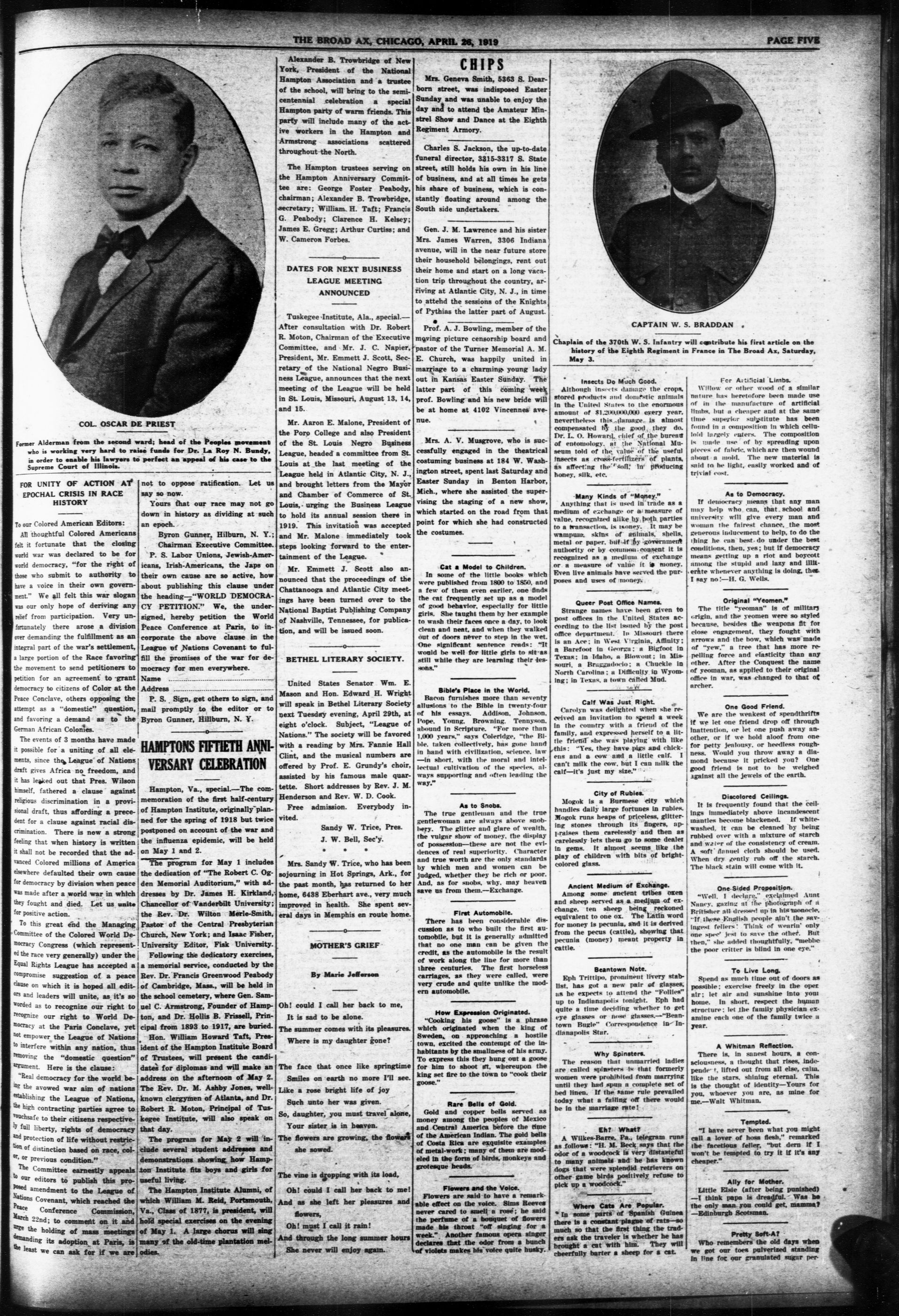
Rev. W. S. Braddan will Contribute His First Article to this Paper on the Eighth Regiment in France, Saturday May 3rd.
THE BROAD AX
HEW TO THE LINE; LET THE CHIPS FALL WHERE THEY MAY
VOL. XXIV
CHICAGO, ILL., SATURDAY, APRIL 26, 1919
No. 32
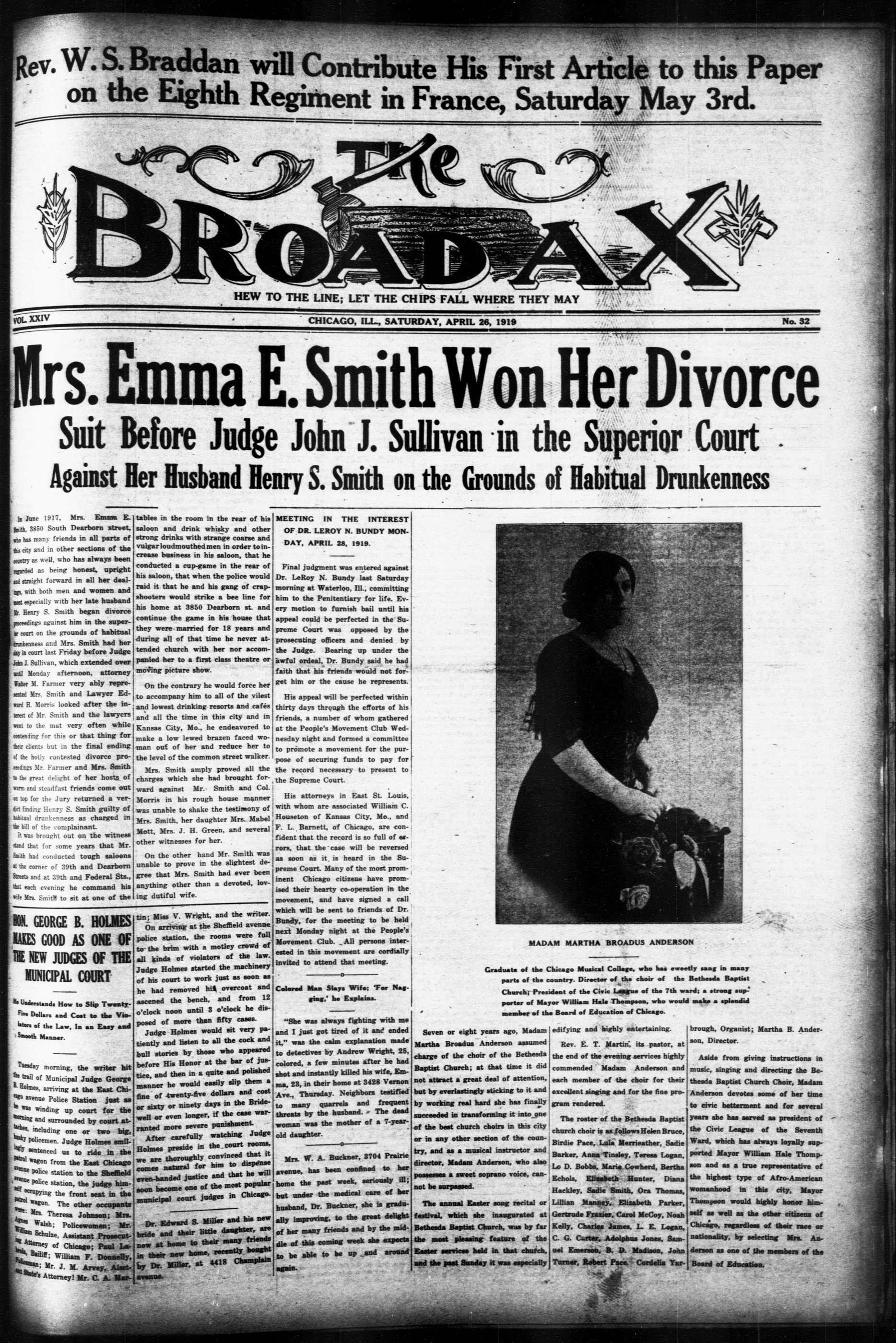
Mrs. Emma E. Smith Won Her Divorce Suit Before Judge John J. Sullivan in the Superior Court Against Her Husband Henry S. Smith on the Grounds of Habitual Drunkenness
In June 1917, Mrs. Emmy E. Smith, 3850 South Dearborn street, who has many friends in all parts of this city and in other sections of the country as well, who has always been regarded as being honest, upright and straight forward in all her dealings, with both men and women and most especially with her late husband Mr. Henry S. Smith began divorce proceedings against him in the superior court on the grounds of habitual drunkenness and Mrs. Smith had her day in court last Friday before Judge John J. Sullivan, which extended over until Monday afternoon, attorney Walter M. Farmer very ably represented Mrs. Smith and Lawyer Edward H. Morris looked after the interest of Mr. Smith and the lawyers went to the mat very often while contending for this or that thing for their clients but in the final ending of the hotly contested divorce proceedings Mr. Farmer and Mrs. Smith to the great delight of her hosts of warm and steadfast friends come out on top for the Jury returned a verdict finding Henry S. Smith guilty of habitual drunkenness as charged in the bill of the complainant.
It was brought out on the witness stand that for some years that Mr. Smith had conducted tough saloons at the corner of 39th and Dearborn Streets and at 39th and Federal Sts., that each evening he command his wife Mrs. Smith to sit at one of the
HON. GEORGE B. HOLMES MAKES GOOD AS ONE OF THE NEW JUDGES OF THE MUNICIPAL COURT
His Understands How to Slip Twenty. Five Dollars and Cost to the Violators of the Law, In an Easy and Smooth Manner.
Tuesday morning, the writer hit the trail of Municipal Judge George B. Holmes, arriving at the East Chicago avenue Police Station just as he was winding up court for the morning and surrounded by court attaches, including one or two big, husky policemen. Judge Holmes smilingly sentenced us to ride in the patrol wagon from the East Chicago avenue police station to the Sheffield avenue police station, the judge himself occupying the front seat in the patrol wagon. The other occupants were: Mrs. Theresa Johnson; Mrs. Agnes Walsh; Policewomen; Mr. William Schulze, Assistant Prosecuting Attorney of Chicago; Paul Larkola, Bailliff; William F. Donnellly, Policeman; Jr. J. M. Arvey, Assistant State's Attorney! Mr. C. A. Mar-
tables in the room in the rear of his saloon and drink whisky and other strong drinks with strange coarse and vulgar loudmouthed men in order to increase business in his saloon, that he conducted a cup-game in the rear of his saloon, that when the police would raid it that he and his gang of crapshooters would strike a bee line for his home at 3850 Dearborn st. and continue the game in his house that they were married for 18 years and during all of that time he never attended church with her nor accompanied her to a first class theatre or moving picture show.
On the contrary he would force her to accompany him to all of the vilest and lowest drinking resorts and cafes and all the time in this city and in Kansas City, Mo., he endeavored to make a low lewed brazen faced woman out of her and reduce her to the level of the common street walker.
Mrs. Smith amply proved all the charges which she had brought forward against Mr. Smith and Col. Morris in his rough house manner was unable to shake the testimony of Mrs. Smith, her daughter Mrs. Mabel Mott, Mrs. J. H. Green, and several other witnesses for her.
On the other hand Mr. Smith was unable to prove in the slightest degree that Mrs. Smith had ever been anything other than a devoted, loving dutiful wife.
tin; Miss V. Wright, and the writer.
On arriving at the Sheffield avenue police station, the rooms were full to the brim with a motley crowd of all kinds of violators of the law.
Judge Holmes started the machinery of his court to work just as soon as he had removed his overcoat and ascended the bench, and from 12 o'clock noon until 3 o'clock he disposed of more than fifty cases.
Judge Holmes would sit very patiently and listen to all the cock and bull stories by those who appeared before His Honor at the bar of justice, and then in a quite and polished manner he would easily slip them a fine of twenty-five dollars and cost or sixty or ninety days in the Bridewell or even longer, if the case warranted more severe punishment.
After carefully watching Judge Holmes preside in the court rooms, we are thoroughly convinced that it comes natural for him to dispense even-handed justice and that he will soon become one of the most popular municipal court judges in Chicago.
MEETING IN THE INTEREST OF DR. LEROY N. BUNDY MONDAY, APRIL 28, 1919.
Final judgment was entered against Dr. LeRoy N. Bundy last Saturday morning at Waterloo, Ill.; committing him to the Penitentiary for life. Every motion to furnish bail until his appeal could be perfected in the Supreme Court was opposed by the prosecuting officers and denied by the Judge. Bearing up under the awful ordeal, Dr. Bundy said he had faith that his friends would not forget him or the cause he represents.
His appeal will be perfected within thirty days through the efforts of his friends, a number of whom gathered at the People's Movement Club Wednesday night and formed a committee to promote a movement for the purpose of securing funds to pay for the record necessary to present to the Supreme Court.
His attorneys in East St. Louis, with whom are associated William C. Housetown of Kansas City, Mo., and F. L. Barnett, of Chicago, are confident that the record is so full of errors, that the case will be reversed as soon as it, is heard in the Supreme Court. Many of the most prominent Chicago citizens have promised their hearty co-operation in the movement, and have signed a call which will be sent to friends of Dr. Bundy, for the meeting to be held next Monday night at the People's Movement Club. All persons interested in this movement are cordially invited to attend that meeting.
Colored Man Slays Wife; 'For Nagging,' he Explains.
"She was always fighting with me and I just got tired of it and ended it," was the calm explanation made to detectives by Andrew Wright, 25, colored, a few minutes after he had shot and instantly killed his wife, Emma, 28, in their home at 3428 Vernon Ave., Thursday. Neighbors testified to many quarrels and frequent threats by the husband. The dead woman was the mother of a 7-year-old daughter.
Mrs. W. A. Buckner, 3704 Prairie avenue, has been confined to her home the past week, seriously ill; but under the medical care of her husband, Dr. Buckner, she is gradually improving, to the great delight of her many friends and by the middle of this coming week she expects to be able to be up and around
MARIA MAYER
Graduate of the Chicago Musical College, who has ewetely sang in many parts of the country. Director of the choir of the Bethesda Baptist Church; President of the Civic League of the 7th ward; a strong supporter of Mayor William Hale Thompson, who would make a splendid member of the Board of Education of Chicago.
Seven or eight years ago, Madam Martha Broadus Anderson assumed charge of the choir of the Bethesda Baptist Church; at that time it did not attract a great deal of attention, but by everlastingly sticking to it and by working real hard she has finally succeeded in transforming it into one of the best church choirs in this city or in any other section of the country, and as a musical instructor and director, Madam Anderson, who also possesses a sweet soprano voice, cannot be surpassed.
The annual Easter song recital or festival, which she inaugurated at Bethesda Baptist Church, was by far the most pleasing feature of the Easter services held in that church, and the past Sunday it was especially
Rev. E. T. Martin, its pastor, at the end of the evening services highly commended Madam Anderson and each member of the choir for their excellent singing and for the fine program rendered.
The roster of the Bethesda Baptist church choir is as follows Helen Bruce, Birdie Pace, Lula Merrieather, Sadie Barker, Anna Tinsley, Teresa Logan, Lo D. Bobbs, Marie Cowherd, Bertha Echols, Elizabeth Hunter, Diana Hackley, Sadie Smith, Ora Thomas, Lillian Manney, Elizabeth Parker, Gertrude Frazier, Carol McCoy, Noah Kelly, Charles James, L. E. Logan, C. G. Carter, Adolphus Jones, Samuel Emerson, B. D. Madison, John Turner, Robert Pace, Cordelia Yar-
brough, Organist; Martha B. Anderson, Director. Aside from giving instructions in music, singing and directing the Bethesda Baptist Church Choir, Madam Anderson devotes some of her time to civic betterment and for several years she has served as president of the Civic League of the Seventh Ward, which has always loyally supported Mayor William Hale Thompson and as a true representative of the highest type of Afro-American womanhood in this city, Mayor Thompson would highly honor himself as well as the other citizens of Chicago, regardless of their race or nationality, by selecting Mrs. Anderson as one of the members of the Board of Education.
PAGE TWO
Published Every Saturday
In this city since July 15th, 1899, without missing one single issue. Republicans, Democrats, Catholica, Protestans, Single Taxers, Priests, infidels or anyone else can have their say as long as their language is proper and responsibility is fixed.
The Broad Ax is a newspaper whose platform is broad enough for all, ever claiming the editorial right to speak its own mind.
Local communications will receive attention. Write only on one side of the paper.
Subscriptions must be paid in advance.
Advertising rates made known on application.
Address all communications to
THE BROAD AX
6206 So. Elizabeth St., Chicago, Ill.
JULIUS F. TAYLOR
Editor and Publisher
DR. M. A. MAJORS
Associate Editor
4700 South State Street
Phone Drexel 1416
Vol. XXIV. April 26, 1919. No. 32.
1902, at the Post Office at Chicago,
Ill., under Act of March 3, 1879
Would Do Better Next Time.
While in the act of playing coalman Robert dumped some building blocks out of his sister's doll buggy. His sister being asleep at the time, I told him to make less noise, as he might wake her up. His answer was: "I'll get soft coal next time, daddy, and she won't wake up."
The Baby Seal
When seals are born they are snow-white, which makes them invisible on the ice on which they lie. Their eyes and noses are black, and when the little ones are suddenly alarmed they close their eyes, bury their noses and lie quite still.
Life a Loan.
Life is given for us to use; it has been given to us as a loan without interest, and not to be paid back on any fixed day. Fortune distributes time in unequal portions at her will; she hurries off the young; she props up the old.—Persius.
Switching the Subject
Once upon a time, we heard of two women who had lost their hair. One had been through a sick spell and the other found hers later behind the dressing table.-Indianapolis Star.
Course Not.
Sald the facetious feller, "Course food is not the kind that is served in courses."
Optimistic Thought
After a season of sport the mind is prepared to resume its studies with increased vigor.
Timidity a Hand:cap.
A great deal of talent is lost to the world for want of a little courage. Every day sends to their graves a number of obscure men who have only remained in obscurity because their timidity has prevented them from making the first effort—Sydney Smith.
Rather Well Put.
John was downtown with his father, who was buying a pair of shoes. He found a pair that were satisfactory and told the clerk he would take them. John looked at his father-and said: "Are you sure your feet feel contented in them, daddy?"
One Woman's Deduction
One Atchison woman who has taken the best care of her hair all her life, only to have it turn gray at an early age, says: "The person who wrote that a woman's hair is her glory was a bald-headed man."—Kansas City Star.
Cork Renewal.
If corks are porous or you wish to prevent them taking the odor from the contents of the bottle, dip them in hot melted paraffin wax and insert in bottle at once. It also seals it airtight if not touched again.
Sbolar Must Work Hard.
Scholar Must Work Hard.
No way has been found for making heroism easy, even for the scholar.
Labor, iron labor, is for him.
The world was created as an audience for him; the atoms of which it is made are opportunities—Emerson.
Even worse than the man who borrows trouble is the fellow who gives it.—Boston Transcript.
No country, not even Egypt, made a deeper mark in the history of the ancient world than Mesopotamia. For thousands of years it was the seat of the Assyrian and Babylonian empires. To the bountiful resources of nature its peoples added those of art and science, and the country during the centuries waxed not only in material wealth and military power, but also in culture. The ancient glory of Mesopotamia has passed, but the glamour remains.
These Days of Hysteria.
It is claimed that chess playing is dying out. In the old days, when hysteria did not have possession of the land and the inhabitants thereof, chess playing was quite popular. Now we are a steam-heated civilization, with no time for study for the mere delight of learning. Remember when Paul Murphy of New Orleans was the chess wizard of the world?—Los Angeles Times
Japan's Delightful Climate.
Japan is considered, because of its delightful climate, the playground of the East. Residents of other countries of the far East Indies, the Philippines, and the Streits settlements, flock to Japan in the hot summer months to enjoy its mountain resorts. Owing to the large tourist business some of these resorts present all the up-to-date advantages.
Makeshift, as It Were.
A strange family had recently moved into the neighborhood. Robert had made the acquaintance of the small son and had learned from him that the man was only the boy's stepfather, a kid, in explanation to me, Robert said: "It itn' James' own daddy, mamma; he's just a second-handed one."—Chicago Tribune.
A Windfall.
The origin of "windfall," in the sense of "good luck," dates from the time of William the Conqueror. It was then a criminal offense to cut timber in the forests. Only such could be gathered as the wind had blown down; hence, a heavy windstorm was hailed by the peasants as so much good luck, and from this comes the modern application of the expression.
The Time He Hurries.
When a seventeen-year-old boy's father tells him it's time he was picking out a trade he doesn't see any reason to hurry. But when his girl tells him the same thing he begins deciding between statesmanship and professional baseball right away.—Kansas City Star.
Seems an Unfair Division.
Thousands of hats discarded by English women are exported every year to Brazil, where they are eagerly bought by the Indians. The feathers and other ornaments on the hats are taken by the men, and the bare straw shapes given to their womenfolk.
Heat and Tuberculosis
James B. Murphy and Ernest Sturm (Journal of Experimental Medicine) subjected mice to heat and a week later inoculated them with a strain of tuberculosis virulent for mice. These animals displayed a greater resistance than normal.
Liberty Demands Full Loyalty
We honor Liberty in name and form.
We set up her statues and sound her praises. But we have not yet fully trusted her. And with our growff, so grow her demands. She will have no half service.-Lord Macaulay.
Milton's Diction
How grandly Milton rolls and winds through the arches and labyrinths of his magnificent and involved diction, waking musical echoes at every turn and variation of its progress!—E. P. Whipple.
Our Occasional Observance
A man will sit by the hour matching pennies, but if his wife asks him to match a piece of dress goods, whatta howl of rage and indignation there'd be!—Indianapolis Star.
Advantage of Wings
Another good thing about the flying an angel does is that he never has to light upon the top of a house and bawl for somebody to help him down.—Dallas News.
"Locket" Exeglasses
Eyeglasses for which a British patient has been granted can be folded when idle to resemble a locket and worn on a chain as an ornament.
If you see a man or woman successful, be glad of it. Don't waste time belittling his success. Use your force trying to equal it.
A man's own observation, what he finds good of, and what he finds hurt of, is the best physic to preserve health.—Bacon.
The modern view is that a woman is not necessarily a failure because her life has been Miss-spent—Boston Transcript.
THE BROAD AX. CHICAGO. APRIL 26, 1919
DAY HONORED BY WELSHMEN
March the First Known the World Over as Anniversary of the Country's Patron Saint.
The first day of March has long been observed as a special day by the people of Wales and is called St. David's day in honor of the good St. David, patron saint of the Welsh, who lived in the sixth century.
St. David was said to have been the son of a prince of Cardiganshire, Wales, and is accredited with the working of many miracles, especially among the poor of the country. It was said that when the saint first went into the fields to preach to his followers the ground on which he was standing began to rise until it assumed a goodly height, and henceforth was his pulitn.
For hundreds of years the Welsh wore sprigs of leek—a plant with broad bluish-green leaves and yellow flower clusters—in their hats as a symbol of recognition of the day. This custom was brought about, some say, from the fact that in a battle of the Welsh against their old enemies, the Saxons, St. David had ordered all Welshmen to go into battle wearing their native leek, not only to distinguish them from their enemies, but to bring them good luck.
Other writers argue that the badge was worn more as a fraternal sign and because leek was grown in every Welsh garden and was the favorite vegetable of a true Welshman.
Writers of the last century depict a typical Welsh garden as a garden of onions, garlic and leek. Honely incidents are told of Welshmen assisting each other in farming and eating, their leeks together, a ceremony symbolic of hospitality and good fellowship.
NOT ALWAYS PROPERLY SANE
Scientists Assert Few People Have at All Times Full Command of Their Mental Faculties.
Many people think that the expression "temporary insanity" is merely used by a jury wishing to save relatives pain, but numbers of doctors who have made a study of mental disorders emphatically declare it is no idle term.
One doctor has stated that temporary insanity is a condition of double consciousness, not dissimilar to epilepsy. A person normally quite sane may have attacks of temporary aberration lasting little more than a few minutes, especially after long bouts of hard, continuous mental work, being particularly liable if insomnia supervenes.
Crimes have been committed in the early morning when the perpetrator has not really been properly awake, and has been horrified to find what he has done. This is a true case of temporary insanity, but it is comparatively rare, and a man in normal health would not suffer in this way. A specialist in mental diseases has stated that he knew a case in which a person was insane during a certain time of each day, and that others have been known when the patient was quite normal at ordinary times, but suffered from a temporary fit of mania regularly once a month.
Forming Artificial Pearls
Pearls were valuable as gems in China as early as twenty-two centuries before our era, and the Chinese had worked out a plan for the artificial formation of pearls about 700 years ago, which they have carried on extensively. Large numbers of oysters are collected and the shell gently opened to allow the introduction of various foreign substances which are inserted by means of a forked bamboo stick. These pellets are generally made of prepared mud, but may be bone, brass or wood. The oysters are then placed in shallow ponds connected with canals and are nourished by tubs of night soil thrown in from time to time.
Some time later, from several months to two years, depending upon the size of the gen desired, these oysters are taken out of the shell, the pearls removed and the body of the animal eaten as food. Millions of such pearls are sold annually in China. The most valuable are either round or pear shaped.
Few Old People in New Guinea.
The average duration of life is shorter in New Guinea than in any other country, owing to the peculiar diet of the natives, who devour with gusto the larvae of beetles, dug out of decayed tree trunks, and habitually drink seawater when near the coast. "The people die off at about forty," A. E. Pratt says in his "Two Years Among the Cannibals of New Guinea." "We saw one very old man, who may have been about sixty years of age—the only example of longevity that we came across. He was bent almost double, and hnd a long, white beard. His fellow tribesmen regarded him as a great curiosity, and brought him to see us. Despite the decrepitude of his body, however, there was no trace of senility; his senses were unimpaired and the poor old creature showed great gratitude for a gift of tobacco."
Hence the Congestion
Pence the Congestion.
"You have plenty of room in Ameri ca," said the foreign visitor.
"Oh, yes."
"Then why do you build so many sky-scrapers?"
"I guess that's because the average American thinks he can't transact business unless he's within walking distance of the post office."—Birmingham Age-Herald.
Centuries Pass, but No Difference Is Seen in the Structure of This Instrument
Even in this age of bustle and change, some few of the old stands-remain unchanged, but at that it is rather startling to realize that the violi, probably the best-loved of all musical instruments, has remained virtually unchanged in shape or substance for three centuries. In that time the harpsefchord, lute and spinet have passed away, the harp has been improved, the piano has been invented and developed, but the violi, which took a hundred years to assume its present form, since the days of the great Stradivari, the world's most famous violin maker, has remained unchanged.
The violin is popularly supposed to date from the date of the ancient Indians, but the present instrument had its beginning back in the days of the troubadours, who used musical boxes called violes or guitar fiddles. And as the years went by, the little violes were improved. The shape was altered; bit by bit the instrument changed. Now a bridge was added; now a waist: now the "F holes"—two carved openings on either side of the bridge—were added.
And from 1500 to 1760 the violin industry rose to its greatest achievement in the development of Amati, Guarneri, and Stradivari, Italian violin makers living in the town of Cremona. Since their time there has been no change, and the finest and most priceless musical instrument of today is a Stradivarius violin, made three centuries ago by the master craftsman, Stradivari, in Cremona.
BURIED WEALTH IN IVORY
Place in Far Northern Siberia is Undoubtedly Where Mammoths Went to Die.
In the region of the Lena delta, is far northern Siberia, there is a gigantic species of mole which, burrowing underground, dies if by chance exposed to light. It has enormous tusks, and the half-savage nomads of the country sometimes use strips of its thick hide for reindeer harness.
Truth to tell, the "mole" is the long-extinct mammoth, and the last surviving specimen perished long before the earliest dawn of human history, says a writer in Philadelphia Ledger. Indeed, it may very well be that 100,000 years have passed since the youngest mammoth walked the earth.
In their day these huge animals roamed in herds all over northern Siberia, where the climate was mild and salubrious. But there came a sudden change and Jack Frost established a permanent reign in that part of the world. The mammoths, huddled in valleys, were overwhelmed by snowdrifts, which hardened to solid ice, preserved their bodies intact even to the present time.
Now and then the hot sun of the short arctic summer melts out and reveals to view one of the great carcasses—the meat still fresh enough to be fed to dogs. The eyeballs of one specimen found on the Tas river, between the Obi and the Yenese, were as perfect as if the animal had been killed only a day or two earlier.
Origin of Number Symbols
The origin of our common number symbols has never been clearly established, but until recently all writers agree that these symbols were transmitted to Europe by the Arabs, who had obtained them from India. It is very interesting to note that available data relating to the origin of our common number symbols have been carefully re-examined by Carra de Vaux. Among the most surprising results are the following: Our common number symbols originated in Europe and from there were transmitted to the Persians. Both India and Arabia received them from Persia, so that the common term Hindu-Arabic numerals is decidedly misleading. The common numerals did not come from letters of the alphabet, but were formed directly for the purpose of representing numbers.
Ancient Jaffa
Jaffa is one of the oldest towns in the world; some call it the oldest town. The first historical document relating to Jaffa is found in Egypt, in an inscription on the temple of Karnak. It is in the list of towns which Thothmes the Third of Egypt conquered in the land of Canaan 16 centuries before the Christian era. Jaffa is already mentioned several times in the fifteenth century B. C., in the Tel Amarna letters, and Jabiterhe, an Egyptian governor, ruled Jaffa and Caza in the name of Pharaoh, king of Egypt. Then, as today, Jaffa was famous for its gardens. The place is not mentioned in the Pentateuch. The name is first found in Joshua 19:26, as bordering on the territory of Dan.
Time Ally of Virtues.
Sometimes the man with the vision goes down to dusty and silent death with his vision still unfulfilled. Yet, time does not desert him then. Time goes ever on and on, though men may falter and die. So, time proves an ally even in death. It blows its breath upon the smoldering embers and lifts the fires of every dream into flame again.
Truth, patience, faith, persistence—these are all virtues. And time is the only ally of them—the ally that justifies them in the end though the powers of darkness may contend against them—Los Angeles Times.
B.ENTAL LOVE OF BEAUTY
Flowers and Nature Have Always Figured Prominently in Their Paintings and Writings.
The Orient was always fond of flowers. In primitive times the Arabs studied the big herbals of Byzantine doctors and scientists and copied flower after flower in their own manner; they loved them, but they were unconscious of their beauty. When they wanted to adorn they only used the conventionalized form of the lotus and the arabesque flower consecrated by hundreds of years of tradition. Later on Chinese masters taught them the living beauty of flowers. In the Mongol miniatures they study the blossoming almond tree and the iris, but in the sixteenth century only they begin to love the flower for itself—to study each leaf, each petal, each line and each hue of color. They show the same intimate love for detail which inspired the landscapes of Behzad. Their landscapes are always like the poems of Haifz—sunny, cheerful and gay. Nothing more charming than these meetings of kings and princesses in the greens under richly embroidered tents with musicians and dancers. And no difference if the artist paints one of the cruel bloody scenes of the antique "Shahnameh"; must it not be a wonderful feeling to be executed by the order of the king in his illustrious presence, with retainers and maidens around, the sun shining, a soft wind covering your head and shoulders with the pink petals of the almond tree in flower? The birds sing sweeter than ever in the trees. The touch of the cold steel is after all only of passing moment and eternal is the beauty of sun, spring and flowers.—R. M. Riefstahl, In Asia Magazine.
SHOW SPIRIT OF FAIRNESS
American Gives English Writers Credit for One Attribute That Is Worthy of Praise.
I have frequently said the writers in England are superior to ours, particularly as to fairness and conservatism. The other day I ran across a review article criticising the general ignorance of the people about old and classical things. After proving his point cleverly and effectually the writer proceeded to examine himself. He turned to the encyclopedia at random and took the first subject at the top of the page. He confessed he knew nothing about it. He did the same thing with many other subjects of classical antiquity. And this fellow is one of the best-educated men in England.
An American writer would not have done that; he would have pretended to be thoroughly familiar with everything in the encyclopedia, and witheringly abused the people for lacking his great knowledge.
The truth about old classical subjects is that most of them are buried in books and that few people know anything about them, for the reason that they are not of the slightest importance.
An Englishman is mean, but he has a lot of sense; and he will be reasonably fair, even if disagreeable with it.
—E. W. Howe's Magazine.
Tints and Autumn Colors
Everyone has seen and admired the beautiful colors of autumn leaves, but very few know anything about the why and wherefore.
It has been noticed that in two trees of maples, oak or other trees, coloring in autumn, of the same species, one will often take on much brighter color than the other.
It should be remembered that, though there must be certain chemical combinations before any color can be produced, the act of producing is a vital one, and can only operate under vital conditions. If we cut off a branch of any tree in summer time and throw it aside, the leaves turn black or brown, and without any brilliant color; but if the branch be only half broken off of in some way injured the leaves will color, as if the autumn time had arrived.
This shows that coloring is connected with a check to vital power, short of its total destruction. Hence, in the autumn, the tree with the greater vital power will color less than the other.
The Whippoorwill.
It is almost impossible to see a whippoorwill in the daytime because of the manner in which it sits upon a limb of a tree. It doesn't sit cross-wise, like other birds, but lengthwise of the limb. Its toes are short, but broad-spreading, and it can sit lengthwise on a limb better than it could sit cross-wise, where it would have to clasp the limb with its toes like other birds. You may pass right under a tree where a whippoorwill is sitting on a limb and never notice it—and it knows it will never be noticed, so it doesn't become alarmed and fly out of the tree.
Why Diamonds Burst
That diamonds burst is an old idea, which has been variously explained. It has been thought that the stones have been fractured by violent eruptions in the inclosing rocks, by sudden removal of pressure around them, or in the smoky specimens by spontaneous breaking up. Dr. J. R. Sutton concludes that the breaking usually results from the minerals lctosed. These may be garnet zircon, limenite or iron pyrites, and such crystals, under ordinary heating at least, have so much greater expansion than the diamond that they would exert great pressure.
Papers of Thomas Jefferson Show His ConNECTION With Laying Out Capital's Great Avenue.
Among the papers of Thomas Jefferson in the library of congress there is the bill of Pontius D. Stelle, in 1807, to Thomas Munroe, superintendent of the city of Washington, for the supper provided for all the workman engaged in the public buildings, on the completion of the south wing of the capitol, 167 persons, at $1.25 per head." The supper was given at the capitol. The bill was approved by B. Henry Latrobe, superintendent of public buildings, who calls the event "the rising supper."
A particularly interesting letter in one from President Jefferson to Superintendent Munroe, dated Marchello, March 21, 1803, referring to Thornton's original design for Pennsylvania avenue, which Jefferson amended and approved. This approved design shows it gravel road for carriages 38 feet in width, bordered on each side by a space 41 feet wide for tree-lined walks, then a brick pavement 20 feet in width. Jefferson explains: "The reason of preference is that this agrees with the present disposition of the Pennsylvania avenue. It will allow us also next autumn either to plant our outer elms in the same line with the Lombardy poplars, giving to these trees of large growth a distance suitable to their size, or we may plant them midway, so as to make a shaded mall of 41 feet breadth, or pass a canal along the middle at a future day or a gravel walk, or anything we please."
HALTED AT EDGE OF JUNGLE
Explorers Forced to Cut Pathway to Reach Mighty Tropical Ocean of Foliage.
Here, at the edge of our cleared compound, we were confronted by a tangle. It was not very high—twenty feet or so—but dense and unbroken. Like newly trapped creatures we paced back and forth along it, looking for an opening. It was without a break. We examined it more closely, and saw a multitude of slender, graceful cane stems hung with festons of grasslike drummery. One of us seized a wisp of this climbing grass and pulled downward. When he dropped it, his hand dripped blood. He might as well have run a scroll saw over his fingers. The tangle had shown its teeth.
We laughed and retreated to the upper floor for consultation. The sight we saw there decided us. In the distance "not far away," to use the hopefully indefinite Galuma vernacular high over the tumbled lower growths towered the real jungle—the high bush. This was the edge of the ain'tguy tropical ocean of foliage, that sea of life with its surface 100, 200 feet above the earth, stretching unbroken to the Andes; beams of矿nkman wonderland. And here we were, after thousands of miles of voyaging to study the life of this great jungle, to find our last few yards blocked by a mass of vegetation. There was no dissenting voice. We must cut a trail, and at once, straight to the jungle.—William Beebe, in Atlantic Monthly.
Different in Japan.
The list of things done differently in Japan is said to be a long one by those competent to speak from contact with the Japanese. Here are a few taken at random, to show that the difference is real: Japanese ladies sit with their hands folded, palm upward; every lady shaves. Ladies never brush their hair, they only comb it. It is polite to make a noose with the mouth when eating certain food. Ladies, however, seldom do so, as they are supposed to suppress their feelings. A bride calls on her neighbors and friends, instead of her neighbors and friends calling on her. Where she speaks of a "sparrow's tear." Number three is always lucky, except in "miluwan" (pieckled radish). To offer a person three pieces would be rude. We speak of putting a thing on the fire to cook. The Japanese speak of putting fire through it. A man never wishes his wife "good morning" first. She greets him and he replies. A woman never speaks of her husband as such; she speaks of "the house."—Brooklyn Eagle.
No Official Italian Crown.
There is no official crown worn by the royalty of Italy. The famous crown of Lombardy, which dates from the middle of the fourth century, is treasured in an Italian cathedral, and is the oldest and most sacred of all crowns of Europe. However, the present king, like his two predecessors, has never been crowned, and never will be. The crown is made of large gold plaques hinged together and richly jeweled and enameled. It is held as very sacred, for inside the gold is a narrow iron band, which tradition says is the nail that fastened the feet of Christ to the cross. The crown is held as being too sacred to use.
Don't Worry.
Rise above small things. The woman who lets small things worry her will be completely undone the first time she meets with a really big problem. It is disintegrating to your mental and nervous condition, not to mention your physical condition, to worry. You need not be resigned to fate nor slip your troubles as the old friend duck's back throws water. But you can meet troubles with a will to conquer or adjust them—and after that "they should worry," but not you.
E. L. C.
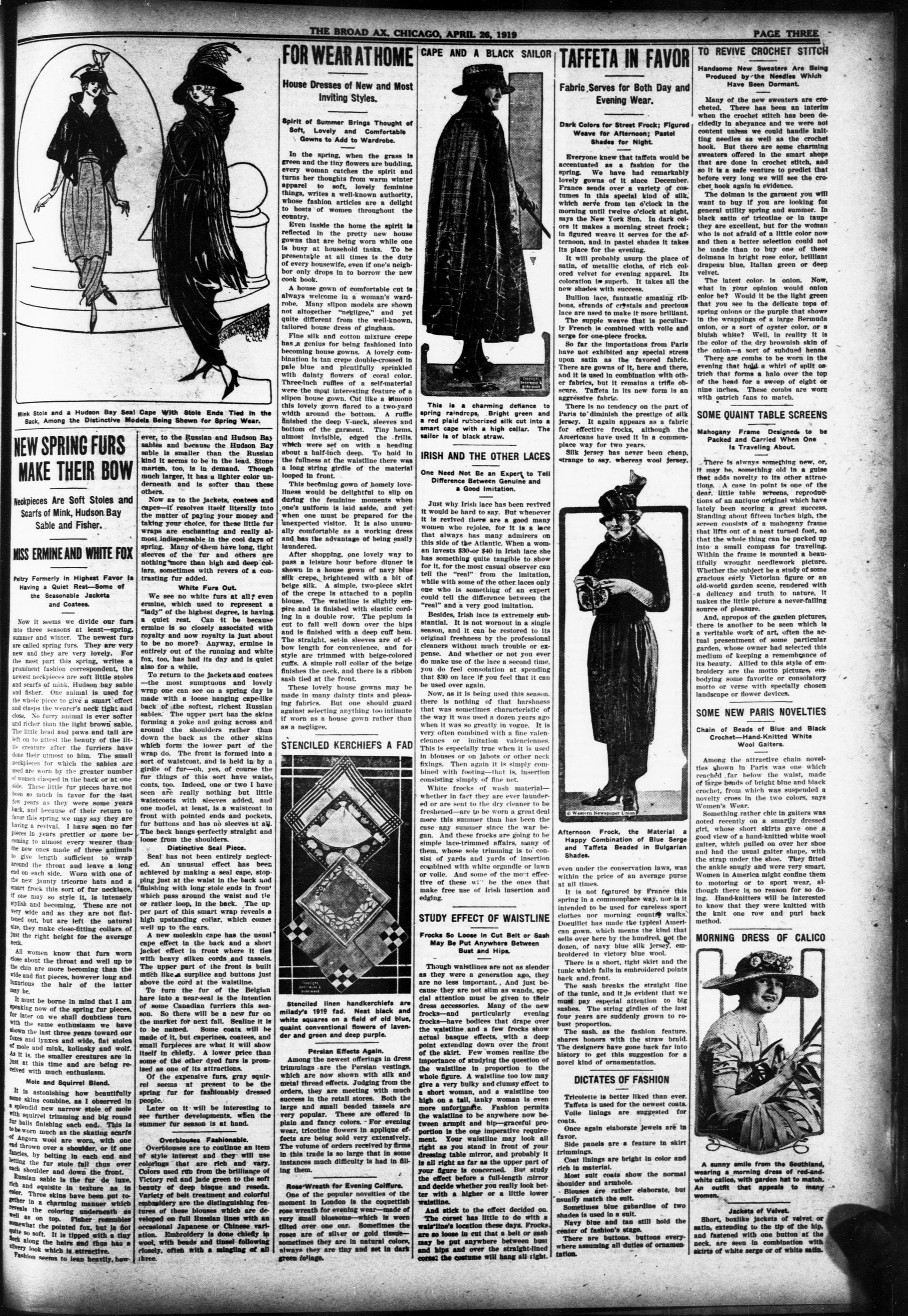
Mink Stole and a Hudson Bay Seal Cape With Stole Ende Tied in the Back. Among the Distinctive Models Being Shown for Spring Wear.
NEW SPRING FURS MAKE THEIR BOW
Neckpieces Are Soft Stoles and Scarfs of Mink, Hudson Bay Sable and Fisher.
MISS ERMINE AND WHITE FOX
Peltry Formerly in Highest Favor Is Having a Quiet Rest—Some of the Seasonable Jackets
Now it seems we divide our furs into three seasons at least—spring, summer and winter. The newest furs are called spring furs. They are very new and they are very lovely. For the most part this spring, writes a prominent fashion correspondent, the newest neckpieces are soft little stoles and scarfs of mink. Hudson bay sable and fisher. One animal is used for the whole piece to give a smart effect and clusps the wearer's neck tight and close. No furry animal is ever softer and richer than the light brown sable. No head and paws and tail are left on to attest the beauty of the little creature after the furriers have done their utmost to him. The small neckpieces for which the sables are used are worn by the greater number of women clasped in the back or at one side. These little fur pieces have not been so much in favor for the last few years as they were some years back, and because of their return to favor this spring we may say they are having a revival. I have seen no fur pieces in years prettier or more becoming to almost every wearer than the new ones made of three animals to give length sufficient to wrap around the throat and leave a long end on each side. Worn with one of the new jaunty tricorne hats and a smart frock this sort of fur necklace, if one may so style it, is intensely stylish and becoming. These are not very wide and as they are not flattened out, but are left the natural size, they make close-fitting collars of just the right height for the average neck.
All women know that furs worn close about the throat and well up to the chin are more becoming than the wide and flat pieces, however long and luxurious the hair of the latter may be.
It must be borne in mind that I am speaking now of the spring fur pieces, for later on we shall doubtless turn with the same enthusiasm we have shown the last three years toward our foxes and lynxes and wide, flat stoles of mole and mink, kolinsky and wolf.
As it is, the smaller creatures are in just at this time and are being received with much enthusiasm.
Mole and Squirrel Blend.
It is astonishing how beautifully some skins combine, as I observed in a splendid new narrow stole of mole with squirrel trimming and big round fur bails finishing each end. This is to be worn much as the skating scarfs of Angora wool are worn, with one end thrown over a shoulder, or if one fancies, by belting in each end and letting the fur stole fall thus over each shoulder and down the front. Russian sable is the fur de luxe, rich and equisite in texture as in color. Three skins have been put together in a charming manner which reveals the coloring underneath as well as on top. Fisher resembles somewhat the pointed fox, but is not quite so soft. It is tipped with a tiny neck along the hairs and thus has a silvery look which is attractive. Fashion seems to lean heavily, how-
ever, to the Russian and Hudson Bay sables and because the Hudson Bay sable is smaller than the Russian kind it seems to be in the lead. Stone marten, too, is in demand. Though much larger, it has a lighter color underneath and is softer than these others.
Now as to the jackets, coattees and capes—it resolves itself literally into the matter of paying your money and taking your choice, for these little fur wraps are enchanting and really almost indispensable in the cool days of spring. Many of them have long, tight sleeves of the fur and others are nothing more than high and deep collars, sometimes with revers of a contrasting fur added.
White Furs Out.
We see no white furs at all? even ermine, which used to represent a "lady" of the highest degree, is having a quiet rest. Can it be because ermine is so closely associated with royalty and now royalty is just about to be no more? Anyway, ermine is entirely out of the running and white fox, too, has had its day and is quiet also for a while.
To return to the jackets and coatees—the most sumptuous and lovely wrap one can see on a spring day is made with a loose hanging cape-like back of the softest, richest Russian sables. The upper part has the skins forming a yoke and going across and around the shoulders rather than down the back as the other skins which form the lower part of the wrap do. The front is formed into a sort of waistcoat, and is held in by a girdle of fur—oh, yes, of course the fur things of this sort have waistcoats, too. Indeed, one or two I have seen are really nothing but little waistcoats with sleeves added, and one model, at least, is a waistcoat in front with pointed ends and pockets, fur buttons and has no sleeves at all. The back hangs perfectly straight and loose from the shoulders.
Distinctive Seal Piece.
Seal has not been entirely neglected. An unusual effect has been achieved by making a seal cape, stopping just at the waist in the back and finishing with long stole ends in front which pass around the waist and tie or rather loop, in the back. The upper part of this smart wrap reveals a high upstanding collar, which comes well up to the ears.
A new moleskin cape has the usual cape effect in the back and a short jacket effect in front where it ties with heavy silk cords and tassels. The upper part of the front is built much like a surplice and buttons just above the cord at the waistline.
To turn the fur of the Belgian hare into a near-seal is the intention of some Canadian furriers this season. So there will be a new fur on the market for next fall. Sealine it is to be named. Some coats will be made of it, but caperines, coatees, and small furpieces are what it will show itself in chiefly. A lower price than some of the other dyed furs is promised as one of its attractions.
Of the expensive furs, gray squirrel seems at present to be the spring fur for fashionably dressed people.
Later on it will be interesting to see further developments, when the summer fur season is at hand.
Overblouses Fashionable
Overbouses are to continue an item of style interest and they will use colorings that are rich and vary. Colors used run from the brilliance of Victory red and jade green to the soft beauty of deep bisque and reseda. Variety of belt treatment and colorful embroidery are the distinguishing features of these blouses which are developed on full Russian lines with an occasional Japanese or Chinese variation. Embroidery is done chiefly in wool, with beads and tinsel following closely, often with a mingling of all
THE BROAD AX. CHICAGO. APRIL 26. 1919
FORWEARATHOME
House Dresses of New and Most Inviting Styles.
Spirit of Summer Brings Thought of Soft, Lovely and Comfortable Gowns to Add to Wardrobe.
In the spring, when the grass is green and the tiny flowers are budding, every woman catches the spirit and turns her thoughts from warm winter apparel to soft, lovely feminine things, writes a well-known authority, whose fashion articles are a delight to hosts of women throughout the country.
Even inside the home the spirit is reflected in the pretty new house gowns that are being worn while one is busy at household tasks. To be presentable at all times is the duty of every housewife, even if one's neighbor only drops in to borrow the new cook book.
A house gown of comfortable cut is always welcome in a woman's wardrobe. Many silipon models are shown not altogether "negligee," and yet quite different from the well-known, tailored house dress of ringham.
Fine silk and cotton mixture crepe has a genius for being fashioned into becoming house gowns. A lovely combination is tan crepe double-crossed in pale blue and plentifully sprinkled with dalty flowers of coral color. Three-inch ruffles of a self-material were the most interesting feature of a slipon house gown. Cut like a mimoono this lovely gown flared to a two-yard width around the bottom. A ruffle finished the deep V-neck, sleeves and bottom of the garment. Tiny hems, almost invisible, edged the frills, which were sef on with a heading about a half-inch deep. To hold in the fullness at the waistline there was a long string girdle of the material looped in front.
This becoming gown of homely loveliness would be delightful to slip on during the feminine moments when one's uniform is laid aside, and yet when one must be prepared for the unexpected visitor. It is also unusually comfortable as a working dress and has the advantage of being easily laundered.
After shopping, one lovely way to pass a leisure hour before dinner is shown in a house gown of navy blue silk crepe, brightened with a bit of beige silk. A simple, two-piece skirt of the crepe is attached to a poplin blouse. The waistline is slightly empire and is finished with elastic cording in a double row. The peplum is cut to fall well down over the hips and is finished with a deep cuff hem. The straight, set-in sleeves are of elbow length for convenience, and for style are trimmed with beige-colored cuffs. A simple roll collar of the beige finishes the neck, and there is a ribbon sash tied at the front.
These lovely house gowns may be made in many dainty tints and pleasing fabrics. But one should guard against selecting anything too intimate if worn as a house gown rather than as a negligee.
STENCILED KERCHIEFS A FAD
Copyright
Baldwin and B.
Underwood
Stenciled linen handkerchiefs are milady's 1919 fad. Neat black and white squares on a field of old blue, quaint conventional flowers of lavender and green and deep purple.
Peraian Effects Again.
Among the newest offerings in dress trimming are the Persian vestings, which are now shown with silk and metal thread effects. Judging from the orders, they are meeting with much success in the retail stores. Both the large and small beaded tassels are very popular. These are offered in plain and fancy colors. For evening wear, tricotine flowers in applique effects are being sold very extensively. The volume of orders received by firms in this trade is so large that in some instances much difficulty is had in filling them.
Rose'Wreath for Evening Coliffure
Rose/Wreath for Evening Colour.
One of the popular novelties of the moment in London is the coquettish rose wreath for evening wear—made of very small blossoms—which is worn tilted over one ear. Sometimes the roses are of silver or gold tissue—sometimes they are in natural colors, always they are thy and set in dark green foliage.
CORSET
HATWERD
AND
BADWARD
This is a charming defiance to spring raindrops. Bright green and a red plaid rubberized silk cut into a smart cape with a high collar. The sailor is of black straw.
IRISH AND THE OTHER LACES
One Need Not Be an Expert to Tell Difference Between Genuine and a Good Imitation.
Just why Irish lace has been revived it would be hard to say. But whenever it is revived there are a good many women who rejoice, for it is a lace that always has many admirers on this side of the Atlantic. When a woman invests $30-or $40 in Irish lace she has something quite tangible to show for it, for the most casual observer can tell the "real" from the imitation, while with some of the other laces only one who is something of an expert could tell the difference between the "real" and a very good imitation.
Besides, Irish lace is extremely substantial. It is not wornout in a single season, and it can be restored to its original freshness by the professional cleaners without much trouble or expense. And whether or not you ever do make use of the lace a second time, you do feel consolation at spending that $30 on lace if you feel that it can be used over again.
Now, as it is being used this season, there is nothing of that harshness that was sometimes characteristic of the way it was used a dozen years ago when it was so greatly in vogue. It is very often combined with a fine valenciennes or imitation valenciennes. This is especially true when it is used in blouses or on jabots or other neck fixings. Then again it is simply combined with footing—that is, insertion consisting simply of fine net.
White frocks of wash material—whether in fact they are ever laundered or are sent to the dry cleaner to be freshened—are to be worn a great deal more this summer than has been the case any summer since the war began. And these frocks are going to be simple lace-trimmed affairs, many of them, whose sole trimming is to consist of yards and yards of insertion combined with white organdle or lawn or volle. And some of the most effective of these wi' be the ones that make free use of Irish insertion and edging.
STUDY EFFECT OF WAISTLINE
Frocks So Loose in Cut Belt or Sash May Be Put Anywhere Between Bust and Hips.
Though waistlines are not as slender as they were a generation ago, they are no less important. And just because they are not slim as wands, special attention must be given to their dress accessories. Many of the new frocks—and particularly evening frocks—have bodices that drape over the waistline and a few frocks show actual basque effects, with a deep point extending down over the front of the skirt. Few women realize the importance of studying the question of the waistline in proportion to the whole figure. A waistline too low may give a very bulky and clumsy effect to a short woman, and a waistline too high on a tall, lanky woman is even more unfortunate. Fashion permits the waistline to be anywhere now between armpit and hip—graceful proportion is the one imperative requirement. Your waistline may look all right as you stand in front of your dressing table mirror, and probably it is all right as far as the upper part of your figure is concerned. But study the effect before a full-length mirror and decide whether you really look better with a higher or a little lower waistline.
And stick to the effect decided on. The corset has little to do with a wais'line' location these days. Frocks are so loose in cut that a belt or sash may be put anywhere between bust and hips and over the straight-lined corset; the costume will hang all right.
TAFFETA IN FAVOR
Fabric,Serves for Both Day and Evening Wear.
Dark Colors for Street Frock; Figured
Weave for Afternoon; Pastel
Shades for Night.
Everyone knew that taffeta would be accentuated as a fashion for the spring. We have had remarkably lovely gowns of it since December. France sends over a variety of costumes in this special kind of silk, which serve from ten o'clock in the morning until twelve o'clock at night, says the New York Sun. In dark colors it makes a morning street frock; in figured weave it serves for the afternoon, and in pastel shades it takes its place for the evening.
It will probably usurp the place of satin, of metallic cloths, of rich colored velvet for evening apparel. Its coloration is superb. It takes all the new shades with success.
Bullion lace, fantastic amazing ribbons, strands of crystals and precious lace are used to make it more brilliant.
The supple weave that is peculiarly French is combined with volle and serge for one-piece frocks.
So far the importations from Paris have not exhibited any special stress upon satin as the favored fabric. There are gowns of it, here and there, and it is used in combination with other fabrics, but it remains a trifle obscure. Taffeta in its new form is an aggressive fabric.
There is no tendency on the part of Paris to diminish the prestige of silk jersey. It again appears as a fabric for effective frocks, although the Americans have used it in a commonplace way for two years.
Silk jersey has never been cheap, strange to say, whereas wool jersey.
© Western Newspaper Union
Afternoon Frock, the Material a Happy Combination of Blue Serge and Taffeta Beaded in Bulgarian Shades.
even under the conservation laws, was within the price of an average purse at all times.
It is not featured by France this spring in a commonplace way, nor is it intended to be used for careless sport clothes nor morning county walks. Doeuillet has made the typical American gown, which means the kind that sells over here by the hundred, not the dozen, of navy blue silk jersey, embroidered in victory blue wool.
There is a short, tight skirt and the tunic which falls in embroidered points back and front.
The sash breaks the straight line of the tunic, and it is evident that we must pay especial attention to big sashes. The string girdles of the last four years are suddenly grown to robust proportion. The sash, as the fashion feature, shares honors with the straw braid. The designers have gone back far into history to get this suggestion for a novel kind of ornamentation.
DICTATES OF FASHION
Tricolette is better liked than ever.
Taffeta is used for the newest coats.
Volle linings are suggested for coats.
Once again elaborate jewels are in favor.
Side panels are a feature in skirt trimmings.
Coat linings are bright in color and rich in material.
Most suit coats show the normal shoulder and armhole.
Blouses are rather elaborate, but usually match the suit.
Sometimes blue gabardine of two shades is used in a suit.
Navy blue and tan still hold the center of fashion's stage.
There are buttons, buttons everywhere assuming all duties of ornamentation.
---
PAGE THREE
Handsome New Sweaters Are Being Produced by the Needles Which Have Been Dormant.
Many of the new sweaters are crocheted. There has been an interim when the crochet stitch has been decidedly in abeyance and we were not content unless we could handle knitting needles as well as the crochet hook. But there are some charming sweaters offered in the smart shops that are done in crochet stitch, and so it is a safe venture to predict that before very long we will see the crochet hook again in evidence.
The dolman is the garment you will want to buy if you are looking for general utility spring and summer. In black satin or tricotine or in taupe they are excellent, but for the woman who is not afraid of a little color now and then a better selection could not be made than to buy one of these dolmans in bright rose color, brilliant drapeau blue, Italian green or deep velvet.
The latest color is onion. Now, what in your opinion would onion color be? Would it be the light green that you see in the delicate tops of spring onions or the purple that shows in the wrappings of a large Bermuda onion, or a sort of oyster color, or a bluish white? Well, in reality it is the color of the dry brownish skin of the onion—a sort of subdued henna. There are combs to be worn in the evening that hold a whirl of split ostrich that forms a halo over the top of the head for a sweep of eight or nine inches. These combs are worn with ostrich fans to match.
SOME QUAINT TABLE SCREENS
Mahogany Frame Designs to be Packed and Carried When One Is Traveling About.
There is always something new, or, it may be, something old in a guise that adds novelty to its other attractions. A case in point is one of the dear, little table screens, reproductions of an antique original which have lately been scoring a great success. Standing about fifteen inches high, the screen consists of a mahogany frame that lifts out of a neat turned foot, so that the whole thing can be packed up into a small compass for traveling. Within the frame is mounted a beautifully wrought needlework picture. Whether the subject be a study of some gracious early Victorian figure or an old-world garden scene, rendered with a delicacy and truth to nature, it makes the little picture a never-falling source of pleasure.
And, apropos of the garden pictures, there is another to be seen which is a veritable work of art, often the actual presentment of some particular garden, whose owner had selected this medium of keeping a remembrance of its beauty. Allied to this style of embroidery are the motto pictures, embodying some favorite or consolatory motto or verse with specially chosen landscape or flower devices.
SOME NEW PARIS NOVELTIES
Chain of Beads of Blue and Black Crochet—Hand-Knitted White Wool Gaiters.
Among the attractive chain novelties shown in Paris was one which reached far below the waist, made of large beads of bright blue and black crochet, from which was suspended a novelty cross in the two colors, says Women's Wear.
Something rather chic in gaiters was noted recently on a smartly dressed girl, whose short skirts gave one a good view of a hand-knitted white wool gaiter, which pulled on over her shoe and had the usual gaiter shape, with the strap under the shoe. They fitted the ankle snugly and were very smart. Women in America might confine them to motoring or to sport wear, although there is no reason for so doing. Hand-knitters will be interested to know that they were knitted with the knit one row and purl back method.
I
A sunny smile from the Southland, wearing a morning dress of red-and-white calico, with garden hat to match. An outfit that appeals to many women.
Short, boxlike jackets of velvet or satin, extending to the tip of the hip, and fastened with one button at the neck, are seen in combination with skirts of white serge or of white satin.
1930
78
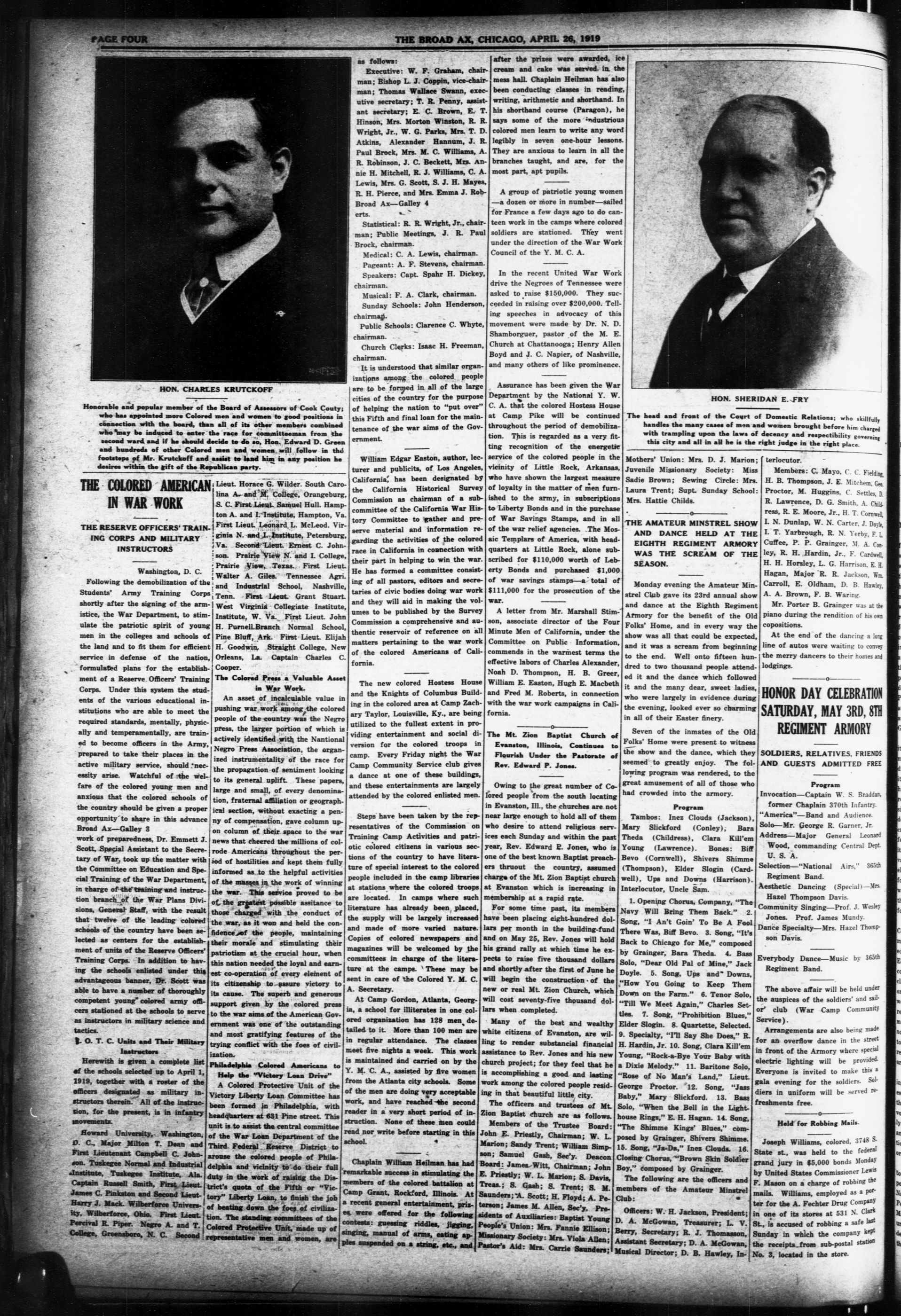
HON. CHARLES KRUTCKOFF
Honorable and popular member of the who has appointed more Colored connection with the board, that who may be induced to enter the second ward and if he should d and hundreds of other Colored footsteps of Mr. Krutckoff and desires within the gift of the Rep
Honorable and popular member of the Board of Assessors of Cook Couty; who has appointed more Colored men and women to good positions in connection with the board, than all of its other members combined who may be induced to enter the race for committeeman from the second ward and if he should decide to do so, Hon. Edward D. Green and hundreds of other Colored men and women will follow in the footsteps of Mr. Krutckoff and assist to land him in any position he desires within the gift of the Republican party.
THE COLORED AMERICAN IN WAR WORK
THE COLORED AMERICAN IN WAR WORK
THE RESERVE OFFICERS' TRAIN- ING CORPS AND MILITARY INSTRUCTORS
Washington, D. C.
Following the demobilization of the Students' Army Training Corps shortly after the signing of the armistice, the War Department, to stimulate the patriotic spirit of young men in the colleges and schools of the land and to fit them for efficient service in defense of the nation, formulated plans for the establishment of a Reserve. Officers' Training Corps. Under this system the students of the various educational institutions who are able to meet the required standards, mentally, physically and temperamentally, are trained to become officers in the Army, prepared to take their places in the active military service, should necessity arise. Watchful of the welfare of the colored young men and anxious that the colored schools of the country should be given a proper opportunity to share in this advance Broad Ax—Gallev 3
work of preparedness, Dr. Emmett J. Scott, Special Assistant to the Secretary of War, took up the matter with the Committee on Education and Special Training of the War Department, in charge of the training and instruction branch of the War Plans Divisions, General Staff, with the result that twelve of the leading colored schools of the country have been selected as centers for the establishment of units of the Reserve Officers' Training Corps. In addition to having the schools enlisted under this advantageous banner, Dr. Scott was able to have a number of thoroughly competent young colored army officers stationed at the schools to serve as instructors in military science and tactics.
J. O. T. C. Units and Their Military Instructors
Herewith is given a complete list of the schools selected up to April 1, 1919, together with a roster of the officers designated as military instructors therein. All of the instruction, for the present, is in infantry movements.
Howard University, Washington, D. C., Major Milton T. Dean and First Lieutenant Campbell C. Johnson. Tuskegee Normal and Industrial Institute, Tuskegee Institute, Ala. Captain Russell Smith, First Lieut. James C. Pinkston and Second Lieut-Harry J. Mack. Wilberforce University, Wilberforce, Ohio. First Lieut. Percival R. Piper. Negro A. and T. College, Greensboro, N. C. Second
```markdown
```
PAGE FOUR
Lieut. Horace G. Wilder. South Carolina A. and M. College, Orangeburg. S. C. First Lieut. Samuel Hull. Hampton A. and L. Institute, Hampton, Va. First Lieut. Leonard L. McLeod. Virginia N. and L. Institute, Petersburg. Va. Second Lieut. Ernest C. Johnson. Prairie View N. and I. College, Prairie View, Texas. First Lieut. Walter A. Giles. Tennessee Agri. and Industrial School, Nashville, Tenn. First Lieut. Grant Stuart. West Virginia Collegiate Institute, Institute, W. Va. First Lieut. John H. Purnell.Branch Normal School, Pine Bluff, Ark. First Lieut. Elijah H. Goodwin, Straight College, New Orleans, La. Captain Charles C. Cooper.
The Colored Press a Valuable Asset in War Work.
An asset of incalculable value in pushing war work among the colored people of the country was the Negro press, the larger portion of which is actively identified with the Nantional Negro Press Association, the organized instrumentality of the race for the propagation of sentiment looking to its general uplift. These papers large and small, of every denomination, fraternal affiliation or geographical section, without exacting a penny of compensation, gave column upon column of their space to the war news that cheered the millions of colrode Americans throughout the period of hostilities and kept them fully informed as to the helpful activities of the masses in the work of winning the war. This service proved to be of the greatest possible assistance to those charged with the conduct of the war, as it won and held the confidence of the people, maintaining their morale and stimulating their patriotism at the crucial hour, when this nation needed the loyal and earnest co-operation of every element of its citizenship to assure victory to its cause. The superb and generous support given by the colored press to the war aims of the American Government was one of the outstanding and most gratifying features of the trying conflict with the foes of civilization.
Philadelphia Colored Americans to
A Colored Protective Unit of the Victory Liberty Loan Committee has been formed in Philadelphia, with headquarters at 631 Pine street. This unit is to assist the central committee of the War Loan Department of the Third Federal Reserve District to arouse the colored people of Philadelphia and vicinity to do their full duty in the work of raising the District's quota of the Fifth or "Victory" Liberty Loan, to finish the job of beating down the foes of civilization. The standing committees of the Colored Protective Unit, made up of representative men and women, are
THE BROAD AX. CHICAGO. APRIL 26, 1919
as follows:
Executive: W. F. Graham, chairman; Bishop L. J. Coppin, vice-chairman; Thomas Wallace Swann, executive secretary; T. R. Penny, assistant secretary; E. C. Brown, E. T. Hinson, Mrs. Morton Winston, R. R. Wright, Jr., W. G. Parks, Mrs. T. D. Atkins, Alexander Hannum, J. R. Paul Brock, M. M. C. Williams, A. R. Robinson, J. C. Beckett, Mrs. Annie H. Mitchell, R. J. Williams, C. A. Lewis, Mrs. G. Scott, S. J. H. Mayes, R. H. Pierce, and Mrs. Emma J. Rob-Broad Ax—Galley 4
erts.
Statistical: R. R. Wright, Jr., chairman; Public Meetings, J. R. Paul Brock, chairman.
Medical: C. A. Lewis, chairman.
Pageant: A. F. Stevens, chairman.
Speakers: Capt. Spahr H. Dickey, chairman.
Musical: F. A. Clark, chairman.
Sunday Schools: John Henderson, chairman.
Public Schools: Clarence C. Whyte, chairman.
Church Clerks: Isaac H. Freeman, chairman.
It is understood that similar organizations among the colored people are to be formed in all of the large cities of the country for the purpose of helping the nation to "put over" this Fifth and final loan for the maintenance of the war aims of the Government.
William Edgar Easton, author, lecturer and publicis, of Los Angeles, California, has been designated by the California Historical Survey Commission as chairman of a subcommittee of the California War History Committee to gather and preserve material and information regarding the activities of the colored race in California in connection with their part in helping to win the war. He has formed a committee consisting of all pastors, editors and secretaries of civic bodies doing war work and they will aid in making the volumes to be published by the Survey Commission a comprehensive and authentic reservoir of reference on all matters pertaining to the war work of the colored Americans of California.
The new colored Hostess House and the Knights of Columbus Building in the colored area at Camp Zachary Taylor, Louisville, Ky., are being utilized to the fullest extent in providing entertainment and social diversion for the colored troops in camp. Every Friday night the War Camp Community Service club gives a dance at one of these buildings, and these entertainments are largely attended by the colored enlisted men.
Steps have been taken by the representatives of the Commission on Training Camp Activities and patriotic colored citizens in various sections of the country to have literature of special interest to the colored people included in the camp libraries at stations where the colored troops are located. In camps where such literature has already been placed, the supply will be largely increased and made of more varied nature. Copies of colored newspapers and magazines will be welcomed by the committees in charge of the literature at the camps. These may be sent in care of the Colored Y. M. C. A. Secretary.
At Camp Gordon, Atlanta, Georgia, a school for illiterates in one colored organization has 128 men detailed to it. More than 100 men are in regular attendance. The classes meet five nights a week. This work is maintained and carried on by the Y. M. C. A., assisted by five women from the Atlanta city schools. Some of the men are doing very acceptable work, and have reached the second reader in a very short period of instruction. None of these men could read nor write before starting in this school.
Chaplain William Heilman has had remarkable success in stimulating the members of the colored battalion at Camp Grant, Rockford, Illinois. At a recent general entertainment, prizes were offered for the following contests: guessing riddles, jigging, singing, manual of arms, eating apples suspended on a string, etc., and
after the prizes were awarded, ice cream and cake was served in the mess hall. Chaplain Heilman has also been conducting classes in reading, writing, arithmetic and shorthand. In his shorthand course (Paragon), he says some of the more industrious colored men learn to write any word legibly in seven one-hour lessons. They are anxious to learn in all the branches taught, and are, for the most part, apt pupils.
A group of patriotic young women—a dozen or more in number—sailed for France a few days ago to do canteen work in the camps where colored soldiers are stationed. They went under the direction of the War Work Council of the Y. M. C. A.
In the recent United War Work drive the Negroes of Tennessee were asked to raise $150,000. They succeeded in raising over $200,000. Telling speeches in advocacy of this movement were made by Dr. N. D. Shamborguer, pastor of the M. E. Church at Chattanooga; Henry Allen Boyd and J. C. Napier, of Nashville, and many others of like prominence.
Assurance has been given the War Department by the National Y. W. C. A. that the colored Hostess House at Camp Pike will be continued throughout the period of demobilization. This is regarded as a very fitting recognition of the energetic service of the colored people in the vicinity of Little Rock, Arkansas, who have shown the largest measure of loyalty in the matter of men furnished to the army, in subscriptions to Liberty Bonds and in the purchase of War Savings Stamps, and in all of the war relief agencies. The Mosaic Templars of America, with headquarters at Little Rock, alone subscribed for $110,000 worth of Leberty Bonds and purchased $1,000 of war savings stamps—a total of $111,000 for the prosecution of the war.
A letter from Mr. Marshall Stimson, associate director of the Four Minute Men of California, under the Committee on Public Information, commends in the warmest terms the effective labors of Charles Alexander, Noah D. Thompson, H. B. Greer, William E. Easton, Hugh E. Macbeth and Fred M. Roberts, in connection with the war work campaigns in California.
The Mt. Zion Baptist Church of Evanston, Illinois, Continues to Flourish Under the Pastorate of Rev. Edward P. Jones.
Owing to the great number of Colored people from the south locating in Evanston, Ill., the churches are not near large enough to hold all of them who desire to attend religious services each Sunday and within the past year, Rev. Edward P. Jones, who is one of the best known Baptist preachers thruout the country, assumed charge of the Mt. Zion Baptist church at Evanston which is increasing in membership at a rapid rate.
For some time past, its members have been placing eight-hundred dollars per month in the building-fund and on May 25, Rev. Jones will hold his grand rally at which time he expects to raise five thousand dollars and shortly after the first of June he will begin the construction of the new or real Mt. Zion Church, which will cost seventy-five thousand dollars when completed.
Many of the best and wealthy white citizens of Evanston, are willing to render substancial financial assistance to Rev. Jones and his new church project; for they feel that he is accomplishing a good and lasting work among the colored people residing in that beautiful little city.
The officers and trustees of Mt. Zion Baptist church are as follows. Members of the Trustee Board: John E. Priestly, Chairman; W. L. Marion; Sandy Trent; William Simpson; Samuel Gash, Sec'y. Deacon Board: James-Witt, Chairman; John E. Priestly; W. L. Marion; S. Davis, Treas.; S. Gash; S. Trent; S. M. Saunders; A. Scott; H. Floyd; A. Peterson; James M. Allen, Sec'y. Presidents of Auxiliaries: Baptist Young People's Union: Mrs. Fannie Ellison; Missionary Society: Mrs. Viola Allen; Pastor's Aid: Mrs. Carrie Saunders;
M.
HON. SHERIDAN E. FRY
The head and front of the Court of Domestic Relations; who skillfully handles the many cases of men and women brought before him charged with trampling upon the laws of decency and respectibility governing this city and all in all he is the right judge in the right place.
Mothers' Union: Mrs. D. J. Marion; Juvenile Missionary Society: Miss Sadie Brown; Sewing Circle: Mrs. Laura Trent; Supt. Sunday School: Mrs. Hattie Childs.
THE AMATEUR MINSTREL SHOW AND DANCE HELD AT THE EIGHTH REGIMENT ARMORY WAS THE SCREAM OF THE SEASON.
terlocutor.
Members: C. Mayo, C. C. Fielding, H. B. Thompson, J. E. Mitchem, Ge Proctor, M. Huggins, C. Settles, R. R. Lawrence, D. G. Smith, A. Childress, R. E. Moore, Jr., H. T. Cornwell, I. N. Dunlap, W. N. Carter, J. Doyle, I. T. Yarbrough, R. N. Yerby, F. P. Cuffee, P. P. Grainger, M. A. Coryley, R. H. Hardin, Jr., F. Cardwell, H. H. Horsley, L. G. Harrison, E.
Monday evening the Amateur Minstrel Club gave its 23rd annual show and dance at the Eighth Regiment Armory for the benefit of the Old Folks' Home, and in every way the show was all that could be expected, and it was a scream from beginning to the end. Well onto fifteen hundred to two thousand people attended it and the dance which followed it and the many dear, sweet ladies, who were largely in evidence during the evening, looked ever so charming in all of their Easter finery.
Seven of the inmates of the Old Folks' Home were present to witness the show and the dance, which they seemed to greatly enjoy. The following program was rendered, to the great amusement of all of those who had crowded into the armory.
Tambos: Inez Clouds (Jackson),
Mary Slickford (Conley), Bara
Theda (Childress), Clara Kill'em
Young (Lawrence). Bones: Biff
Bevo (Cornwell), Shivers Shimme
(Thompson), Elder Slogin (Card-
well), Ups and Downs (Harrison).
Interlocutor, Uncle Sam.
1. Opening Chorus, Company, "The Navy Will Bring Them Back." 2. Song, "I An't Goin' To Be A Fool There Was, Biff Bevo. 3. Song, "It's Back to Chicago for Me," composed by Grainger, Bara Theda. 4. Bass Solo, "Dear Old Pal of Mine," Jack Doyle. 5. Song, Ups and Downs, "How You Going to Keep Them Down on the Farm." 6. Tenor Solo, "Till We Meet Again," Charles Settles. 7. Song, "Prohibition Blues," Elder Slogon. 8. Quartet, Selected. 9. Specialty, "I'll Say She Does," R. H. Hardin, Jr. 10. Song, Clara Kill'em Young, "Rock-a-Bye Your Baby with a Dixie Melody." 11. Baritone Solo, "Rose of No Man's Land," Lieut. George Proctor. 12. Song, "Jass Baby," Mary Slickford. 13. Bass Solo, "When the Bell in the Lighthouse Ring's," E. H. Hagan. 14. Song, "The Shimme Kings' Blues," composed by Grainger, Shivers Shimme. 15. Song, "Ja-Da," Inez Clouds. 16. Closing Chorus, "Brown Skin Soldier Boy," composed by Grainger.
The following are the officers and members of the Amateur Minstrel Club:
Officers: W. H. Jackson, President;
D. A. McGowan, Treasurer; L. V. Berry, Secretary; R. J. Thomasson, Assistant Secretary; D. A. McGowan, Musical Director; D. B. Hawley, In-
Program
terlocutor.
Members: C. Mayo, C. C. Fielding.
H. B. Thompson, J. E. Mitchem, Geen
Proctor, M. Huggins, C. Settles, D.
R. Lawrence, D. G. Smith, H. T. Cornwell,
I. N. Dunlap, W. N. Carter, J. Doyle,
I. T. Yarbrough, R. N. Verby, F. L.
Cuffee, P. P. Grainger, M. A. Conley,
R. H. Hardin, Jr., F. Cardwell,
H. H. Horsley, L. G. Harrison, E. H.
Hagan, Major R. R. Jackson, Wm.
Carroll, E. Oldham, D. B. Hawley,
A. A. Brown, F. B. Waring.
Mr. Porter B. Grainger was at the
piano during the rendition of his own
copitions.
At the end of the dancing a long line of autos were waiting to convey the merry dancers to their homes and lodgings.
HONOR DAY CELEBRATION SATURDAY, MAY 3RD, 8TH REGIMENT ARMORY
HONOR DAY CELEBRATION SATURDAY, MAY 3RD, 8TH REGIMENT ARMORY
SOLDIERS, RELATIVES, FRIENDS AND GUESTS ADMITTED FREE
Program
Invocation—Captain W. S. Braddan,
former Chaplain 370th Infantry.
"America"—Band and Audience.
Solo—Mr. George R. Garner, Jr.
Address—Major, General, Leonard
Address—Major General Leonard
Wood, commanding Central Dept.
U. S. A.
Selection—"National Airs," 365th
Regiment Band.
Aesthetic Dancing (Special)—Mrs.
Hazel Thompson Davis.
Community Singing—Prof. J. Wesley
Jones. Prof. James Mundy.
Dance Specialty—Mrs. Hazel Thompson Davis.
Everybody Dance—Music by 365th
Regiment Band.
The above affair will be held under the auspices of the soldiers' and sailor' club (War Camp Community Service). Arrangements are also being made for an overflow dance in the street in front of the Armory where special electric lighting will be provided. Everyone is invited to make this a gala evening for the soldiers. Soldiers in uniform will be served refreshments free.
Held for Robbing Mails
Joseph Williams, colored, 3748 S. State st., was held to the federal grand jury in $5,000 bonds Monday by United States Commissioner Lewis F. Mason on a charge of robbing the mails. Williams, employed as a porter for the A. Fechter Drug Company in one of its stores at 531 N. Clark St., is accused of robbing a safe last Sunday in which the company kept the receipts from sub-postal station No. 3, located in the store.
COL. OSCAR DE PRIEST
Former Alderman from the second ward; head of the Peoples movement who is working very hard to raise funds for Dr. La Roy N. Bundy, in order to enable his lawyers to perfect an appeal of his case to the Supreme Court of Illinois.
FOR UNITY OF ACTION AT not to oppose ratification. Let us EPOCHAL CRISIS IN RACE say so now. HISTORY Yours that our race may not go
To our Colored American Editors: All thoughtful Colored Americans felt it fortunate that the closing world war was declared to be for world democracy, "for the right of those who submit to authority to have a voice in their own government." We all felt this war slogan was our only hope of deriving any relief from participation. Very unfortunately there arose a division over demanding the fulfillment as an integral part of the war's settlement, a large portion of the Race favoring the movement to send petitioners to petition for an agreement to grant democracy to citizens of Color at the Peace Conclave, others opposing the attempt as a "domestic" question, and favoring a demand as to the German African Colonies.
The events of 3 months have made it possible for a uniting of all elements, since the League of Nations draft gives Africa no freedom, and it has leaked out that Pres. Wilson himself, fathered a clause against religious discrimination in a provisional draft, thus affording a precedent for a clause against racial discrimination. There is now a strong feeling that when history is written it shall not be recorded that the advanced Colored millions of America elsewhere defaulted their own cause for democracy by division when peace was made after a world war in which they fought and died. Let us unite for positive action.
To this great end the Managing Committee of the Colored World Democracy Congress (which represented the race very generally) under the Equal Rights League has accepted a compromise suggestion of a peace clause on which it is hoped all editors and leaders will unite, as it's so worded as to recognize our right to recognize our right to World Democracy at the Paris Conclave, yet not empower the League of Nations to interfere within any nation, thus removing the "domestic question" argument. Here is the clause:
"Real democracy for the world being the avowed war aim of nations establishing the League of Nations, the high contracting parties agree to vouchsafe to their citizens respectively full liberty, rights of democracy and protection of life without restriction of distinction based on race, color, or previous condition."
The Committee earnestly appeals to our editors to publish this proposed amendment to the League of Nations Covenant, which reached the Peace Conference Commission, March 22nd; to comment on it and urge the holding of mass meetings demanding its adoption at Paris, is the least we can ask for if we are
not to oppose ratification. Let us say so now.
Yours that our race may not go down in history as dividing at such an epoch.
Byron Gunner, Hilburn, N. Y.
Chairman Executive Committee.
P. S. Labor Unions, Jewish-Americans, Irish-Americans, the Japs on their own cause are so active, how about publishing this clause under the heading—"WORLD DEMOCRACY PETITION." We, the undersigned, hereby petition the World Peace Conference at Paris, to incorporate the above clause in the League of Nations Covenant to fulfill the promises of the war for democracy for men everywhere.
Name
Address
P. S. Sign, get others to sign, and mail promptly to the editor or to Byron Gunner, Hillburn, N. Y.
HAMPTONS FIFTIETH ANNIVERSARY CELEBRATION
Hampton, Va., special.—The commemoration of the first half-century of Hampton Institute, originally planned for the spring of 1918 but twice postponed on account of the war and the influenza epidemic, will be held on May 1 and 2.
The program for May 1 includes the dedication of "The Robert C. Ogden Memorial Auditorium," with addresses by Dr. James H. Kirkland, Chancellor of Vanderbilt University; the Rev. Dr. Wilton Merle-Smith, Pastor of the Central Presbyterian Church, New York; and Isaac Fisher, University Editor. Fisk University.
Following the dedicatory exercises, a memorial service, conducted by the Rev. Dr. Francis Greenwood Peabody of Cambridge, Mass., will be held in the school cemetery, where Gen. Samuel C. Armstrong, Founder of Hampton, and Dr. Hollis B. Frissell, Principal from 1893 to 1917, are buried. Hon. William Howard Taft, President of the Hampton Institute Board of Trustees, will present the candidates for diplomas and will make an address on the afternoon of May 2. The Rev. Dr. M. Ashby Jones, well-known clergymen of Atlanta, and Dr. Robert R. Moton, Principal of Tuskegee Institute, will also speak on that day.
The program for May 2 will include several student addresses and demonstrations showing how Hampton Institute fits boys and girls for useful living.
The Hampton Institute Alumni, of which William M. Reid, Portsmouth, Va., Class of 1877, is president, will hold special exercises on the evening of May 1. A large chorus will sing many of the old-time plantation melodies.
Alexander B. Trowbridge of New York, President of the National Hampton Association and a trustee of the school, will bring to the semicentennial celebration a special Hampton party of warm friends. This party will include many of the active workers in the Hampton and Armstrong associations scattered throughout the North.
CHIP
Mrs. Geneva Smith, born street, was indis
Sunday and was unable
day and to attend the strelel Show and Dance
Regiment Armory.
Charles S. Jackson,
The Hampton trustees serving on the Hampton Anniversary Committee are: George Foster Peabody, chairman; Alexander B. Trowbridge, secretary; William H. Taft; Francis G. Peabody; Clarence H. Kelsey; James E. Gregg; Arthur Curtiss; and W. Cameron Forbes.
DATES FOR NEXT BUSINESS
LEAGUE MEETING
ANNOUNCED
Tuskegee Institute, Ala., special. After consultation with Dr. Robert R. Moton, Chairman of the Executive Committee, and Mr. J. C. Napier, President, Mr. Emmett J. Scott, Secretary of the National Negro Business League, announces that the next meeting of the League will be held in St. Louis, Missouri, August 13, 14, and 15.
Mr. Aaron E. Malone, President of the Porp College and also President of the St. Louis Negro Business League, headed a committee from St. Louis at the last meeting of the League held in Atlantic City, N. J., and brought letters from the Mayor and Chamber of Commerce of St. Louis, urging the Business League to hold its annual session there in 1919. This invitation was accepted and Mr. Malone immediately took steps looking forward to the entertainment of the League.
Mr. Emmett J. Scott also announced that the proceedings of the Chattanooga and Atlantic City meetings have been turned over to the National Baptist Publishing Company of Nashville, Tennessee, for publication, and will be issued soon.
BETHEL LITERARY SOCIETY.
United States Senator Wm. E. Mason and Hon. Edward H. Wright will speak in Bethel Literary Society next Tuesday evening, April 29th, at eight o'clock. Subject, "League of Nations." The society will be favored with a reading by Mrs. Fannie Hall Clint, and the musical numbers are offered by Prof. E. Grundy's choir, assisted by his famous male quartette. Short addresses by Rev. J. M. Henderson and Rev. W. D. Cook.
Free admission. Everybody invited.
Sandy W. Trice, Pres.
J. W. Bell, Sec'y.
Mrs. Sandy W. Trice, who has been sojourning in Hot Springs, Ark., for the past month, has returned to her home, 6438 Eberhart ave., very much improved in health. She spent several days in Memphis en route home.
MOTHER'S GRIEF
By Marie Jefferson
Oh! could I call her back to me,
It is sad to be alone.
The summer comes with its pleasures.
Where is my daughter gone?
The face that once like springtime
Smiles on earth no more I'll see.
Like a rose bright life of joy
Such unto her was given.
So, daughter, you must travel alone,
Your sister is in heaven.
The flowers are growing, the flowers
she sowed.
The vine is dropping with its load,
Oh! could I call her back to me!
And as she left her pleasures and
flowers,
Oh! must I call it rain!
And through the long summer hours
She never will enjoy again.
---
CHIPS
Mrs. Geneva Smith, 5363 S. Dearborn street, was indisposed Easter Sunday and was unable to enjoy the day and to attend the Amateur Minstrel Show and Dance at the Eighth Regiment Armory.
Charles S. Jackson, the up-to-date funeral director, 3215-3317 S. State street, still holds his own in his line of business, and at all times he gets his share of business, which is constantly floating around among the South side undertakers.
Gen. J. M. Lawrence and his sister Mrs. James Warren, 3306 Indiana avenue, will in the near future store their household belongings, rent out their home and start on a long vacation trip throughout the country, arriving at Atlantic City, N. J., in time to attendd the sessions of the Knights of Pythias the latter part of August.
Prof. A. J. Bowling, member of the moving picture censorship board and pastor of the Turner Memorial A. M. E. Church, was happily united in marriage to a charming young lady out in Kansas Easter Sunday. The latter part of this coming week prof. Bowling and his new bride will be at home at 4102 Vincennes avenue.
Mrs. A. V. Musgrove, who is successfully engaged in the theatrical costuming business at 184 W. Washington street, spent last Saturday and Easter Sunday in Benton Harbor, Mich., where she assisted the supervising the staging of a new show, which started on the road from that point for which she had constructed the costumes.
Cat a Model to Children.
In some of the little books which were published from 1800 to 1850, and a few of them even earlier, one finds the cat frequently set up as a model of good behavior, especially for little girls. She taught them by her example to wash their faces once a day, to look clean and neat, and when they walked out of doors never to step in the wet. One significant sentence reads: "It would be well for little girls to sit as still while they are learning their lessons."
Bible's Place in the World.
Bacon furnishes more than seventy allusions to the Bible in twenty-four of his essays. Addison, Johnson, Pope, Young, Browning, Tennyson, abound in Scripture. "For more than 1,000 years," says Coleridge, "the Bible, taken collectively, has gone hand in hand with civilization, science, law—in short, with the moral and intellectual cultivation of the species, always supporting and often leading the way."
As to Snobs.
The true gentleman and the true gentlewoman are always above snobbery. The glitter and glare of wealth, the vulgar show of money, the display of possession—these are not the evidences of real superiority. Character and true worth are the only standards by which men and women can be judged, whether they be rich or poor. And, as for snobs, why, may heaven save us from them.—Exchange.
First Automobile.
There has been considerable discussion as to who built the first automobile, but it is generally admitted that no one man can be given the credit, as the automobile is the result of work along the line for more than three centuries. The first horseless carriages, as they were called, were very crude and quite unlike the modern automobile.
How Expression Originated.
"Cooking his goose" is a phrase which originated when the king of Sweden, on approaching a hostile town, excited the contempt of the inhabitants by the smallness of his army. To express this they hung out a goose for him to shoot art, whereupon the king set fire to the town to "cook their goose."
Bare Bells of Gold
Gold and copper bells served as money among the peoples of Mexico and Central America before the time of the American Indian. The gold bells of Costa Rica are exquisite examples of metal-work; many of them are modeled in the form of birds, monkeys and grotesque heads.
Flowers and the Voice.
Flowers are said to have a remarkable effect on the voice. Sims Reeves never cared to smell a rose; he said the perfume of a bouquet of flowers made his throat "off singing for a week." Another famous opera singer declares that the odor from a bunch of violets makes his voice unite husky.
[Name not visible]
CAPTAIN W. S. BRADDAN
Chaplain of the 370th W. S. Infantry history of the Eighth Regiment in May 3.
Chaplain of the 370th W. S. Infantry will contribute his first article on the history of the Eighth Regiment in France in The Broad Ax, Saturday, May 3.
Insects Do Much Good.
Insects Do Much Good.
Although insects damage the crops, stored products and domestic animals in the United States to the enormous amount of $1,200,000,000 every year, nevertheless this damage, is almost compensated by the good, they do.
Dr. L. O. Howard, chief of the burent of entomology, at the National Museum told of the value of the useful insects as cross-fertilizers of plants, as affecting the soil; in producing honey, silk, etc.
Many Kinds of "Money."
Anything that is used in trade as a medium of exchange or a measure of value, recognized alike by both parties to a transaction, is money. It may be wampum, skins of animals, shells, metal or paper, but if by government authority or by common consent it is recognized as a medium of exchange or a measure of value it money. Even live animals have served the purposes and uses of money.
Queer Post Office Names
Strange names have been given to post offices in the United States according to the list issued by the post office department. In Missouri there is an Ace; in West Virginia, Affinity; a Barefoot in Georgia; a Bigfoot in Texas; in Idaho, a Blowout; in Missouri, a Braggadocio; a Chuckle in North Carolina; a Difficulty in Wyoming; in Texas, a town called Mud.
Calf Was Just Right
Carolyn was delighted when she received an invitation to spend a week in the country with a friend of the family, and expressed herself to a little friend she was playing with like this: "Yes, they have pigs and chickens and a cow and a little calf. I can't milk the cow, but I can milk the calf—it's just my size."
Mogok is a Burmese city which handles daily large fortunes in rubies. Mogok runs heaps of priceless, glittering stones through its fingers, appraises them carelessly and then as carelessly lets them go to some dealer in gems. It almost seems, like the play of children with bits of bright-colored glass.
Ancient Medium of Exchange
Among some ancient tribes oxen and sheep served as a medium of exchange, ten sheep being reckoned equivalent to one ox. The Latin word for money is pecunia, and it is derived from the pecus (cattle), showing that pecunia (money) meant property in cattle.
Eph Tritttipo, prominent livery stallist, has got a new pair of glasses, as he expects to attend the "Follies" up to Indianapolis tonight. Eph had quite a time deciding whether to get eye glasses or nose glasses.—"Beantown Bugle" Correspondence in Indianapolis Star.
The reason that unmarried ladies are called spinsters is that formerly women were prohibited from marrying until they had spun a complete set of bed linen. If the same rule prevailed today what a falling off there would be in the marriage rate!
A Wilkes-Barre, Pa., telegram runs as follows: "H. M. Beck says that the odor of a woodcock is very distasteful to many animals and he has known dogs that were splendid retrievers on other game birds positively refuse to pick up a woodcock."
Where Gats Are Popular
In some parts of Spanish Guinea there is a constant plague of rats-so much so that the first thing the traders ask the traveler is whether he has brought a cat with him. They will cheerfully barter a sheep for a cat.
City of Rubies.
Beantown Note.
Why Spinsters.
Eh? What?
For Artificial Limbs.
Willow or other wood of a similar nature has heretofore been made use of in the manufacture of artificial limbs, but a cheaper and at the same time superior substitute has been found in a composition in which celluloid largely enters. The composition is made use of by spreading upon pieces of fabric, which are then wound about a mold. The new material is said to be light, easily worked and of trivial cost.
If democracy means that any man may help who can, that school and university will give every man and woman the fairest chance, the most generous inducement to help, to do the thing he can best do under the best conditions, then, yes; but if democracy means getting up a riot and boycott among the stupid and lazy and illiterate whenever anything is doing, then I say no!—H. G. Wells.
The title "yeoman" is of military origin, and the yeomen were so styled because, besides the weapons fit for close engagement, they fought with arrows and the bow, which was made of "yew," a tree that has more repelling force and elasticity than any other. After the Conquest the name of yeoman, as applied to their original office in war, was changed to that of archer.
We are the weakest of spendthrifts if we let one friend drop off through inattention, or let one push away another, or if we hold aloof from one for petty jealousy, or heedless roughness. Would you throw away a diamond because it pricked you? One good friend is not to be weighed against all the jewels of the earth.
Discolored Ceilings
It is frequently found that the cellings immediately above incandescent mantles become blackened. If white-washed, it can be cleaned by being rubbed over with a mixture of starch and water of the consistency of cream. A soft damnel cloth should be used. When dry gently rub off the starch. The black stain will come with it.
One-Sided Proposition.
"Well, I declare," exclaimed Aunt Nancy, gazing at the photograph of a Britsher at all dressed up in his monocle, "If these English people aren't the savingsest fellers' Think of wearin' only one spec' jest to save the other. But then, she added thoughtfully, 'mebbe the poor critter is blind in one eye."
Spend as much time out of doors as possible; exercise freely in the oper air; let air and sunshine into your home. In short, respect the human structure; let the family physician examine each one of the family twice a year.
A Whitman Reflection
There is, in sinest hours, a consciousness, a thought that rises, independent, lifted out from all else, calm, like the stars, shining eternal. This is the thought of identity—Yours for you, whoever you are, as mine for me.—Walt Whitman.
"I have never been what you might call a lover of hoss flesh," remarked the facetious feller, "but dern if I won't be tempted to try it if it's any cheaper."
Any for mother.
Little Elsie (after being punished)
—I think papa is dreadful. Was he the only man you could get, mamma?
—Edinburgh Scotsman.
Who remembers the old days when we got our toes pulverized standing in line for our granulated sugar per
```markdown
```
PAGE FIVE
Aa to Democracy
Original "Yeomen."
One Good Friend.
To Live Long
Tempted.
Ally for Mother.
PAGE SIX
SKETCH OF PRE-HISTORIC MAN
Early Painting Proves That Thousands of Centuries Ago Humanity Walked on Four Feet.
The Paris Figaro gives an account of a recent remarkable discovery of paintings in a pre-historic cave of South France. In particular, a sketch has been found of a man who went on all fours and possessed a tail. The account runs, in part:
"Count Begouen and his sons discovered on the walls of the subterranean galleries some engravings estimated to be 80,000 years old, and in such quantity and variety that the extraordinary ensemble of pre-historic art work constitutes a veritable museum.
"The animals figured in the cave are considerable in number, and include reindeers, bisons, horses, both isolated and in groups; bears, elephants and rhinoceroses. The representation of felines are very rare in pre-historic art, but MM. Begouen have photographed in their cave a genuine lion, executed in bas-relief. They have made out, also, several birds, including swans and ducks, as well as three predatory night fliers.
"The human figure is likewise represented in the cave, which, in recognition of the sons of Count Begouen, has been baptized 'the Cave of the Three Brothers.' A silhouette is particularly remarkable, almost baffling. It represents a man in motion—a man of powerful body, whose head and shoulders are joined by an enormous neck; a man whose upper and lower limbs and whose hands and feet are perfectly human, but whose vertebral column is prolonged in an exterior appendage resembling that of the anthropoids—a man at last, 'who walks on four feet.'"
Japanese Catholics Have Set Aside February 5 as the Holiest Day in Their Calendar.
The Catholics of Japan have set aside February 5 as the festival of the martyrs of Nippon. This day is their holiest day of the year. St. Francis Xavier introduced Christianity to Japan early in the sixteenth century, but it has not made much progress among the population of 70,000,000 people, who follow Shinto and Buddha. There are about 115,000 Christians in Japan, of whom 75,000 are Catholics and 40,000 Protestants.
A number of Jesuit missionaries followed St. Francis to the east, and no opposition to Christianity was encountered until 40 years after the pioneer's death. Then a rigid persecution was begun and thousands of Christians were murdered. All Christian rites were forbidden. Japanese converts banded together in a confraternity of martyrts, for the purpose of dying for Christ. Many little children joined the organization. All, or as many as were caught, were put to death. Noblemen as well as the poor shared the same fate. Some were buried alive and left to die of starvation, while others were beheaded. The festival of Nippon commemorates these martyrts' deaths.
Undoubted Truth.
A party of tourists were taking a stroll through the ancient city of St. Andrews. All happened to be strangers to the city, and were naturally anxious for information. Coming to a massive archway adorned with sculptures, spanning the street, one of the party went up to a man who was working at the side of the arch and asked: "Can you please tell us what this is? Without turning his head, the man replied: "This? This is a wall!" "Yes, yes; but it's this building, this arch, we would like to know something about." The native came out to the middle of the street where the visitors were standing and looked perhaps more attentively at the arch than he had ever done in his life before. Though willing, he could give no information; he didn't seem to know its name even. "Weel," he said sagely at length, "theres a doot it is a very ancient place!"
Drink Plenty of Milk
Drink milk. Drink more milk. Pure, fresh, rich milk is a food fit for the gods. Bables cannot live without milk, and growing children grow faster for it.
It gives vitality to youth, power to middle life and to old age it brings a goodly portion of the health and strength of former years.
It should be used more largely by people of all ages, classes and conditions. Milk steadies the nerves and adds to the health, physical strength and mental energy of those who use it. It excels coffee and with it tea is not to be compared.
We may drink it at meals and between meals. It is delicious, refreshing, invigorating. It is one of nature's best gifts to man.
GlimpSES of Personalities
**Glimpses of Personality**
If you would get new, surprising stants at human character, spend a half hour turning the pages of reference books in a public library.
What a forlorn outlook on life has the man who upon the margin of a page in "The Riddle of the Universe" penciled this comment: "There is no aftercase. I know it absolutely."
And who was the saddening, aging spinster who in the prim, precise lines of a schoolteacher wrote in a pathetically drooping hand upon the margin of a page in an encyclopedia dealing with "Marriage" these soul-revealing words: "I wish I was married" $\textcircled{2}$ Haverhill Gazette.
Not All Wisdom, Virtue and Honesty Can Be Claimed as the Prerogative of the West.
If it is more important to introduce ready-made, cigarettes than it is to supply an example of unparalleled commercial honesty, China owes us a great deal. Otherwise it is vice versa. As an expert manager and as a member of the committee on foreign trade of the National Association of Manufacturers, I have learned much from foreigners in methods of merchandising, in courtesy and in breadth of business vision. The credit losses of American manufacturers average less in their dealings with the far East than they do in their domestic relations. Unjustified claims, petty exactions and semi-dishonesty are less frequent in foreign than in home trade.
An incident which happened in a New York hotel may give a hint as to why orientals are slow at accepting American ideals at our own valuation. An export manager was discussing with his Bombay agent the details of a campaign to cover the markets of India and Afghanistan. An American friend, calling the manager aside, whispered: "How can you bear to talk with a nigger?" The exporter explained his long friendship with the Indian and the importance of their business relations. Then he turned to introduce the two men. The Bombay merchant had hastily put on his right glove and shook hands with his hand covered. "Why the glove?" the exporter asked when they were alone.
"How else could I return the insult of his first glance without embarrassing you, good friend? The fact that he did not appreciate the insult makes my enjoyment the keener."—Exchange.
FIRST SETTLERS IN GEORGIA
James Oglethorpe Leader of Colonists Who Had Homes Where Now Is City of Savannah.
The first white settlers in Georgia landed at Yamacraw bluffs, on the site of the future city of Savannah, 180 years ago, and the event is now annually commemorated as "Georgia day." James Oglethorpe was the leader of the colonists, who made the trip from England in the good ship Ann, commanded by Capt. John Thomas, and the party included 35 families, besides General Oglethorpe and Rev. Thomas Bosomworth. Through Mary Musgrave, the Indian wife of a Carolina white man, the colonists obtained the consent of the Creeks to establish a settlement, Mary acting as interpreter, accounts say. Just a week later the first house was commenced and the settlement that sprang up on the spot later became the city of Savannah. It is noteworthy that Hebrews were among the first settlers in Georgia. Forty Jews were sent out to the colony and reached Savannah in the July following Oglethorpe's landing. A government was soon organized and one of the first acts of the trustees, passed in August of 1733, was to prohibit rum in Georgia. Before the year was passed a party of Saxons and another of Bavarians reached Georgia.
Fellow-Beings.
in that simple and beautiful record of a holy life, the Journal of John Woolman, there is a passage of which I have been more than once reminded in my intercourse with my fellow-beings: "Some glances of real beauty may be seen in their faces who dwell in true meekness. There is a divine harmony in the sound of that voice to which divine Love gives utterance." Quite the ugliest face I ever saw was that of a woman whom the world calls beautiful. . . . On the other hand, there are faces which the multitude at the first glance, pronounce homely, unattractive, and such as "nature fashions by the gross," which I always recognize with a warm heart-thrill; not for the world would I have one feature changed; they please me as they are; they are hallowed by kind memories; they are beautiful through their associations; nor are they any the less welcome that with my admiration of them "the stranger intermeddieth not."—Whittier.
Merely Changed Music.
How bands were once sometimes recruited for the navy is suggested by an old tale of maritime warfare. When the frigate United States captured the British frigate Macedonian, about a hundred years ago, it also captured a band of eight French, German and Italian musicians. The band had first put to sea in a French frigate, which was captured by a Portuguese vessel and brought into Lisbon. There the musicians had been persuaded to enlist on the Macedonian. After their capture by the United States one judges that they played just as cheerfully for American sailormen as they had already played for French, Portuguese, and British.
Variation of Dialects.
Dialects of variation in spoken languages are the result of peculiarities of speech, first involuntarily adopted by individuals and then perpetuated and extended by the unconscious imitation of others. They are not premeditated or assignable to any definite cause, except the constant tendency of language to become diversified. The same causes that have produced different languages among different nations tend to produce dialectic variations in the language of every nation. The results are apparent, but the cause cannot be defined.
THE BROAD AX, CHICAGO, APRIL 26, 1919
FORCING GROWTH OF PLANTS
Intelligence of Man Is Enabling Him to Become Master of Nature and the Seasons.
By degrees man is becoming master of the seasons. Light and electricity are being pressed into his service, and he can already force on plant growth so rapidly that he can beat the ordinary process of Nature by many weeks.
One method is to treat seed, before planting it, with small doses of high-tension electricity. In 1910 a trial was made of this method near Burnham-on-Crouch, in Essex, England. Spring wheat is usually sown in March or April. On this occasion the wheat of which the seed had been treated by this special process, was not sown until July 19. It was up in five days, and on September 16 was in ear. It was reaped 12 weeks from the time it was sown, whereas the ordinary time for wheat to mature in that country is 18 weeks.
Another method of forcing crops is to run a current of electricity through overhead wires. In this way the yield of oats and beans has been nearly doubled. Experiments tried last year at Lincluden Malns farm in Dumfrieshire, were practically successful. A third method is to use artificial light, either electric or, better still, acetylene. Plants are thus made to grow by night as well as by day. Cabbages and lettuce are easily forced in this way, but other, plants such as carrots, seem to resent it. Flowers bloom earlier under artificial light, and are more brilliant.
LOATH TO GIVE UP ARMOR
Nobles Wore It as Gala Costume Long After It Was of Any Value as Protection.
Until the sixteenth century armor developed in a logical way; its forms were governed by the necessities of war, changes in it were the result of practical experience and actual experiment on the battlefield—not decided upon in the office of the minfister of war.
After the sixteenth century it became fantastic and meaningless, a gala costume rather than a harness; the greatest captains opposed its use, but the nobles clung to it as a mark of distinction.
After it was made bulletproof it became so enormously heavy that at the end of the sixteenth century Lanone complained that gentlemen of thirty were already deformed by the weight of their armor.
In spite of the huge armors of Henry VIII, of Anthony of Burgundy and of some others, the average size of the modern man is greater than that of the soldier of the middle ages and the renaissance, if we can judge from the armors preserved in the museums of England and the Continent, which are, with few exceptions, small and narrow, especially in the leg and thigh pieces.
Valuable Stamp Collection
The first set of stamps in the $1,000-000 collection which the late Henry J. Duveen accumulated in less than 30 years, was purchased by Mr. Duveen in an attempt to induce his son Geoffrey, to take up the hobby. When the son evinced no interest in the stamps, his father, who knew little about the curios, bought another packet for himself, and becoming fascinated with the pursuit, continued his purchases until his collection grew to be one of the four finest in the world. It is said that the late J. Pierpont Morgan tried in vain to purchase the collection.
The love for his stamps which Mr. Duveen displayed may be judged from the care he took of them. It is said he kept his collection, during the latter years of his life, in a room especially prepared for them in a fashionable New York hotel. He paid $10 a day for the room and employed a special secretary to care for his treasures.
Rock That Floats.
James E. Grieve of Prospect, Jackson county, Ore., has a formation of rock on his property which will float. Mr. Grieve claims that floating rock is not uncommon in his vicinity, the supposition being that it is the rock from the eruption when Crater lake was formed, that body of water being about 30 miles from his property. The rock resembles pumice stone and pieces of it can be seen floating around on the ponda. Regarding this strange rock Mr. Grieve says: "To appreciate this enormous eruption one should visit Crater, Lake park and the surrounding country, which is being made more accessible and attractive every year by extensive road and trail work under direction of the war department."
Working Upward.
There is nothing so sure of succeeding as not to be over brilliant—as to be entirely wrapped up in the thought of success, and endowed with perseverance which, in spite of the rebuffs it may meet, never relaxes in the pursuit of its object, and the man of real talents is the man who will make bold to ask for what he wants. He will besiege every employer in the world for work before he will remain idle or be satisfied with a mediocre position. Then when he has once obtained it, he will almost immediately lay claim to something better. He will summon all his courage and demand the right to take a step higher up on the success ladder; and nine times out of ten he will be permitted to take it--Exchange.
Real Reasons Why Large Timepiece Is Always Considered to Be Saying "Tick, Tock."
Why do we always regard a clock as saying "tick, tock," and not "tick, tick," like a watch? Is there really any distinction between the alternate sounds, or is it a matter of psychology? Attention to the problem has been given by an investigator, whose conclusions are most interesting.
The general opinion, according to him, has always been that it was merely a matter of chance whether the "tick" accompanied the left and the "tock" the right bent of the pendulum or vice versa. The first important discovery this authority made was that the "tick" always marks the moment when the pendulum reaches the extreme point of detonation from the perpendicular on its beat to the right, while the reaching of its swing limit to the left is marked by the "tock" in pendulums of all lengths. He found that owing to the fact that the anchor of the escapement mechanism is above the rotating escapement wheel and in the same plane with it, the conditions under which its arms strike the cogs of the wheel are not the same for both arms.
One of the arms of the anchor strikes a cog of the wheel moving upward, in a direction opposed to that of the anchor, while the other arm strikes against the cog while it is moving downward, nearly in the same direction as the anchor. The result of the unequal conditions under which the two arms of the anchor engage the cogs of the escapement wheel is naturally an acoustic difference in the sounds produced by the contact of the parts.
SIMPLY PERFECT IN THEORY
Kitchen Management Left Nothing to Be Desired, Except the Prosaic Fact of Cooking.
An experienced housewife, who has never taken any other course in domestic science than that afforded by wrestling many years with the problem of three meals a day, felt much interested when her college-bred daughter told her that she was going to spend the week-end with a friend who was the last word in the highbrow world of the cooking specialist.
"Mother, it was wonderful," exclaimed the girl on her return. "On one side of her white-tiled laboratory—she doesn't call it a kitchen—there is the dishwashing machine and on the other the long tables for the constructive work. The arrangements are perfect, and everything is clean and shining. I'm just crazy about it. Not a bit like our haphazard kitchen." "And I presume the food was equally wonderful," said the really sympathetic mother, ready to learn of the new generation. "Tell me about it." The returned visitor looked thoughtful. "Well, you see, we didn't go very deep into cookery. She never does. We had dinner made in the fireless cooker, some sort of stew. And the rest of the stuff she gets at the delicatessen."—New York World.
Robert Burns.
Burns is the singer of songs as immortal as love, pure as the dew of the morning, and sweet as its breath: songs with which the lover wos his bride and the mother soothes her child, and the heart of a people beats with patrilotic exultation; songs that cheer human endeavor and console human sorrow and exalt human life. We cannot find out the secret of their power. Until we know why the rose is sweet or the dew-drop pure, or the rainbow beautiful, we cannot know why the poet is the best benefactor of humanity. If we were forced to surrender every expression of human genius but one, surely we should retain poetry; and if we were called to lose from the vast accumulation of literature all but a score of books, among that choice and perfect reminder would be the songs of Burns.—George Wilson Curtis.
Real "Fire King."
Back somewhere around 1830 was a man called M. Chabert, better known as "the fire king," and these are some of the things he did to prove himself inhuman and a marvel in London. To begin with, he swallowed 40 grains of phosphorus, which is quite enough to kill two good-sized men, and after that he slipped oil at 330 degrees, and lived long enough to rub a red-hot fire shovel over his tongue, face and hair, and then lived some more.
Some few years later, on a challenge of $250, he repeated the feat, won the wager and threw in a few more like stunts for good measure. He swallowed a piece of burning torch, for instance, and then, costumed in coarse woolen, entered an oven at 380 degrees, sang a song and cooked two dishes of beefsteak.
New Delicious Fruits
There have been found in the Philippines two fruits entirely unknown to Europe and even to America. One of these is the durian, which grows on a lofty tree somewhat resembling an elm, is about as large as a coconut, has a shiny shell and contains a creamy pulp which combines some of the flavors of delicious custard with those of a fine cheese. American soldiers in the Philippines have dubbed the durian the "vegetable limburger." The other rare fruit is the mangosteen, but the exquisitely flavored liquid it contains has not yet been successfully preserved for shipping.
Men Who Do Things Are Not Those Who Have Their Nose Constantly on Grindstone.
A certain vice president of a great railroad once remarked that he would much rather have to his employ a train dispatcher who had a cigar in his mouth and his feet cocked up on the desk than one who kept his nose too closely to the grindstone. As he had come up through the ranks the vice president's opinion was seasoned with accurate knowledge and experience. His theory was that the dispatcher with his feet cocked up had his road in better shape than the grindstone exponent, and could figure out the moves on the transportation chessboard better.
An official of probably the largest corporation in the world was reported to the head of the corporation by a large stockholder as continually loafing and looking out of his office window. The president assured the stockholder that the man was not loafing but thinking, and that his plans had saved in one year more than his salary for twenty. You can go through the office of the National City bank of New York, the largest bank in America, and find men sitting at glass-topped desks on which there is not a scrap of paper. Yet the daily business of this bank would keep a dozen country banks busy to capacity. You can pick at random one hundred of the highest executives of the country and find more than 90 per cent sitting at desks absolutely bare.
EFFICIENT ABOVE ALL THINGS
Human Ingenuity Has Never Constructed Machine of Greater Perfection Than the Shears.
Recurring to the very high efficiency of shears—although the use of the word "palr" is correct when one remembers that each blade is an old English "sear," or cutter—the inventor must have been a practical mechanic. He was, probably, one of the earliest of inventors, because among the pictures on the walls of the mestaba, or tomb, of Ti at ancient Memphis, shears are pictured for clipping wool from sheep and goats. The deceased Ti must have been a person of much importance in the Fifth dynasty (2500 B. C.), although he modestly described himself as "Keeper of the Pyramids."
Therefore shears were in familiar use 4,500 years ago and their general form has not been improved upon. This is due to the true engineering principle behind the shears.
The invention would appear to have sprung fell-fledged into the world, like Minerva from the brain of Jupiter. Imagination is required to picture the admiration with which the first user of a pair of shears contemplated the perfection of the service rendered. Although he probably did not recognize the fact, the efficiency of the shears is 99 9-10 per cent perfection.
Classifying the Apartment
Classifying the Apartment.
The apartment, in spite of wide physical differences, belongs to the same family as the lead razor and the wooden nutmeg. It is built to get rid of; and the persons who acquire one usually find that it isn't what they thought it was. In the popular mind, the apartment belongs to the great family of homes, and can easily be made into a true home by the addition of a rubber plant and an enlarged photograph of the Colosseum. This is as much of a fallacy as to think that a bluejay can be made into a bluebird by giving him a bluebird house to nest in. The bluejay belongs to the crow family; and while his plumage may please the esthetic senses for a time, his raucous screams and his bullying pugnacity will inevitably offend every one. The wise man, in acquiring an apartment, views it as a branch of the wooden nutmeg family and determines to pass it on to someone else with all possible speed.—Judge.
Some Watch!
While the latest thing in watches is the thin, round or octagon gold timepiece, Capt. Martin Van Buren Bates, who died at his home in Seville, Ohio, wore a watch that weighed four pounds. It was set with diamonds and a delicate set of chimes sounded the hours as the watch rested in his vest pocket. It was a gift from Queen Victoria.
It may be explained that the man who wore the four-pound watch was a famous giant. He stood 7 feet 4 inches and weighed 380 pounds. He was born in eastern Kentucky, and served as a soldier in the command of Gen. John Morgan, the confederate cavalry leader. He later toured the world with a circus with his first wife, Annie Swan, who was 8 feet tall.
Evening.
Thus my wife and I have begun life together. I think that most of our evenings will be spent in the room dedicated to a kind-word for life universal. No matter how closely the warring forces of existence, within or without, have pressed upon us elsewhere, when we enter there we enter peace. We shall be walled in from all darkness of whatsoever meaning; our better selves will be the sole guests of those luminous hours. And surely no greater good fortune can befall any household than to escape an ignoble evening. To attain a noble one is like lying calmly down to sleep on a mountain top towards which our feet have struggled upward amid enemies all day long.—James Lane Allen.
Strange Beliefs Which Christianity and Civilization Have Been Unable to Stamp Out.
Voodoolsm, or voodoo, that stranger worship that comes down from the native customs of West Africa, is still practiced to a great extent in Haiti, where they believe that the body has two spirits—a good one that returns to Africa, and a duppy, who remains in the vicinity of the dead. These "duppies" are considered to be very dangerous and in order to drive them away from the house where a death has occurred, all standing water is thrown out, and food and rum provided to propitate the "duppy" and perseude it to accompany the good spirit on its journey.
"Dupples" are supposed to have solid bodies instead, of ghostly ones and so the doors and windows, and even cracks in the house are stuffed up to keep them out.
Voodoolism, unfortunately, goes much farther than this belief, and the use of all kinds of charms, the worship of a certain sacred green snake, and the inciting and inflaming of the negroes to emotional heights by strange ceremonies continues in Haiti even now. At the close of a voodoo meeting when the audience is excited to a wild hysteria a dance called the "bolleich" is performed which ends in a wild orgy, an exchange states. In all these wild ceremonies and dances a drum is the instrument used, its rhythmic throbbing tending to excite those who hear it. Indeed, from time immemorial drums have been used for this purpose, the nerves of even the most civilized and self-contained persons responding almost immediately to a steady thrumming.
PROVIDENCE NOT TO BLAME
Causes of Mankind's Good or Bad Fortune Traced by Philosopher to Human Qualities.
I have always been of the opinion that the complaints against providences have been ill-grounded, and that the good or bad qualities of men are the causes of their good or bad fortune more than what is generally imagined. There are no doubt instances to the contrary, and pretty numerous too; but few in comparison to the instances we have of a right distribution of prosperity and adversity; nor, indeed could it be otherwise from the common course of human affairs. To be endowed with benevolent disposition and to love others will almost infallibly procure love and esteem, which is the chief circumstance in life and facilitates every enterprise and undertaking besides the satisfaction that immediately results from it. The case is much the same with the other virtues. Prosperity is naturally, but got necessarily, attached to virtue and merit; and adversity, in like manner to vice and folly—David Hume.
Dickens' Love of Humanity
Dickens' love for humanity, his desire to right wrong and relieve suffering, were some of the reasons given by Sheriff Lyell, talented member of the Scottish bar, speaking before the Glasgow Dickens society, for the administration that writer had won. "The Bar risters of Dickens" was the speaker's subject. He referred to Mr. Voles Eugene Raeburn, Tommy Traddles, Sidney Carton, Sergeant Buznaz and other characters well known to Dickens' readers.
"One must leave behind the spirit of criticism and give oneself up to a whole-hearted enjoyment in reading Dickens," he said. "There might at times, be exaggeration or forced sentiment, but there is also genius. I don't know why he made Tommy Todd dies a lawyer, unless it was to show that we barristers are not all as black as we are painted. Dickens was at his best in depicting deep and genuine paths, free from sentimentalism."
Famous Fleet Street
A modern writer has called Fleet street the "Street of Adventure," and the name is a good one, writes A. A Methley, in "A Child's Guide to London," for here all the news of the world is gathered together, and the strip of sky overhead is crisscrossed with the telegraph and telephone wires that bring tidings of warfare . . . victories, revolutions, and marvelous inventions and discoveries.
The road certainly deserves its picturesque title, but, in medieval times when, as Froissart says, the Londoners were the perlousest people in the world, and the most outrageousest, the name would have been even more appropriate. Then the adventures themselves actually took place here; and again and again in history we find wild stories of tumults . . . fought out on the rough cobblestones of old "Flete Strete."
Chinese Music.
Chinese music has always been beyond the grasp of the occidental mind, appearing to have neither rhythm nor reason to it. As a matter of fact, a Chinese musician must be very skilled, indeed, in his profession to hold a position in an oriental orchestra. Chinese music is not written. The words of some of the favorite songs have been preserved, but the music has been handed down from father to son for generations that go far back before the day of the troubadours. When music is played it is played according to the memory of the musician and his ideas of interpretation. A musician varies the performance as his best judgment dictates, and the strings, need at brass may break in at any time.
Stop Thief!
THE "Jumbo" gas burner shown here at the right, (actual size) is a robber on any gas lighting fixture in Chicago. If you have one, get rid of it! It makes high gas bills and causes a great many of the complaints that come to us.
Claims that a "Jumbo" will give more light without using more gas are false.
Use mantle burners to get more light with less gas. Burning five hours a day for a month, the "Jumbo" consumes $2.30 worth of gas; a "Junior" mantle burner, in the same time, consumes only 39 cents worth, or $1.91 less, and gives much more light.
This Is the
"JUNOR MANTLE"
Telephone Calumet 602-3572
MORRIS, Pres. KIRBY W
MORRIS-WA
COAL CO.
Incorporated
HUGH NORRIS, Pres.
NORRIS
COA
Incorpor
NORRIS-WARD COAL CO.
2545 SOUTH PARK AVENUE Chicago
THE CR
Apartment
3600 WABA
The finest building ever open
cago. Steam heat, electric light
THE CRANFORD
department Building
3600 WABASH AVENUE
This building ever opened to Colored ten-
m heat, electric lights, tile baths, man
THE FORTY-FOURTH STREET
The finest building ever opened to Colored tenants in Chicago. Steam heat, electric lights, tile baths, marble entrance
Advertise in
tise in the BROA
advertise in the BROAD AX
a lake near Biggar, Saskatchewan, has been found to be saturated with sulphate, and the deposits under the lake and alongside the edge are nearly 97 per cent pure sulphate. The mineral is used extensively in the manufacture of sulphuric acid, in photography and other industrial purposes.
Cleaning Wallpaper.
clean and polish wallpaper, add
tablespoonfuls of ammonia to half
pailful of water, and wash the walls
with a flannel dipped in this,
half a pailful of water and add
tablespoonfuls of turpentine. Wash
walls a second time with this and
use as dry as possible.
Good Rule for Life.
are ruined, not by what we
may want, but by what we think we
therefore, never go abroad in
each of your wants; for if they be
who wants they will come in search of
He that buys what he does not
will soon want what he cannot
- Cotton.
Phone Main 263
We sell "Junior Mantle" lights complete for only fifteen cents, (which is less than "Jumbos" usually cost) or give one free, in exchange for a "Jumbo," at our main office or any of these stores:
West Side 3643 Irving Park Blvd.
2142 West Madison St. 408 West North Ave.
1709 West 12th St. South Side
1641 Milwaukee Ave.
3221 Ogden Ave. 731 West 63rd St.
4033 West Madison St. 3478 Archer Ave.
North Side 103-5 East 13th St.
3071 Lincoln Ave. 9051 Commercial St.
11025 Michigan Ave.
The Peoples Gas Light & Coke Co.
Michigan Avenue at Adams Street
Telephone Wabash 6000
KIRBY WARD, Sec
IS-WARD
AL CO.
Incorporated
CRANFORD
ent Building
ABASH AVENUE
or opened to Colored tenants in Chi-
ric lights, tile baths, marble entrance
J. W. CASEY, Agent 133 W. Washington Street the BROAD AX
Great Alexanders.
Alexander Bell was the great American who invented the telephone, which is still called the Bell telephone; and Alexander Humboldt was a German traveler, statesman and the most distinguished naturalist of all times. One of his most important discoveries was the decrease in intensity of the earth's magnetic force from the pole to the equator. His most important book, "Kosmos," was written in his seventy-fifth year. He did much in his long life to further the science of the world.
Important Rivers.
Just as Egypt has been made by the Nile, so Mesopotamia has been made by the Tigris and the Euphrates. The view put forward with some authority that the rivers should be kept exclusively for irrigation and not be depended upon for transport is challenged on many grounds, one of which is that irrigation and navigation can be effectively combined, and indeed made intuitally advantageous for many years to come.
This Is the "Jumbo" Gas Burner
THE BROAD AX, CHICAGO, APRIL 26, 1919
PATRONIZE OUR ADVERTISERS
PATRONIZE OUR ADVERTISERS
As Near As Your Telephone DISTANCE IMMATERIAL
IN a Metropolitan City of this size, death knocks every thirty minutes at some door. Too often that death not only brings sorrow, but misfortune as well. Let the price you pay for a funeral be a business proposition and you will benefit by it in service, quality and cost to you in dollars and cents. The result of my campaign has built for me one of the largest and most magnificent establishments in the world.
A visit will come
Consult me, I can save you Worry, The
Shipping to all parts of the Country a
Funerals a Specialty. Central Dispai
Chapel. Call promptly answered day
Ernest H. William
KENWOOD
455
Undertake
5028 and 5030 S. State St.,
OWNERS AND
DAN M. JACKSON
GEO. T. KERSEY
DAVID A McGOWAN
AHMED A. RAYNER
Consult me, I can save you Worry, Time and Money. Shipping to all parts of the Country and Automobile Funerals a Specialty. Central Display Rooms and Chapel. Call promptly answered day or night.
OPEN DAY AND NIGHT
The Emanu
Undertaking
2959-61 South
Reliable Service
Reasona
FREE CHAPEL
Complete Line of Funeral Go
The Emanuel Jackson Undertaking Co., L
1959-61 South State Street
ce Court
Reasonable Prices
THE CHAPEL IN CONNECT
of Funeral Goods Auto
The Emanuel Jackson Undertaking Co., Inc.
2959-61 South State Street
Reliable Service Courteous Treatment
Reasonable Prices
FREE CHAPEL IN CONNECTION
Residence: 508 East 36th Street
Phone Douglas 4397
J. GRAY LUCAS
Attorney At Law
Suite 815 Hartford Building
8 S. Dearborn St., Chicago.
Phone Central 6583
Tel. Central 3142
S. A. T. WATKINS
LAWYER
36 WEST RANDOLPH STREET CHICAGO
Residence, 4533 Prairie Avenue
Phone Kenwood 8520
WALTER M. FARMER
ATTORNEY AND
COUNSELOR AT LAW
NOTARY PUBLIC
Suite 708
184 W. Washington St.
Tel., Office, Main 4153 Auto 33736
CHICAGO
PUBLIC
108
Bingham St.
53 Auto 33736
GO
Residence, 1262 Macalister Place
Tel. Monroe 2714
Attorney At Law
Suite 318-320 REAPER BLOCK
Clark and Washington Streets
Phone Central 1239
CHICAGO
PHONE MAIN 2214
A. D. GASH
Attorney At Law
118 North La Salle Street
CHICAGO
ASH
At Law
Salle Street
GO
Res. 3855 Prairie Ave.,
Phone Douglas 9133
Phones: Main 2017, Auto. 32-395
A. L. WILLIAMS
ATTORNEY AND
COUNSELOR AT LAW
Suite 706 Firmenich Building
184 W. Washington St., Chicago.
JOHN B. HARRIS
DIRECTORS
Phones Calumet 6164
Automatic 71-629
Del Jackson
Mining Co., Inc.
State Street
Courteous Treatment
Prices
CONNECTION
Automobiles for Hire
Residence 3419 South Park Ave.
PHONE DOUGLAS 9354
WM. J. LATHAM
Attorney At Law
OFFICE PHONE: CALUMET 875
2 EAST 31ST STREET
Suite 7
CHICAGO
F. Dunn, J. B. McCahey, Trusees
Tel.: Oakland 1552, 1551, 1550
JOHN J. DUNN
ESTABLISHED 1877
Wholesale and Retail
Fifty-First and Federal Sts.
CHICAGO
KINKY HAIR
Allaina, Ga.
Eskalo Med, Co.
Gentlemen.
If you want to show
you what your fine
EXELENTO
QUININE
POMADE
has done for my
hair. Before I used
it, my hair was
hard and curly,
and now it is 34
inches long, and so
soft and only that
I can do it up any
way I want to.
JANIE RAND.
Don't let some fake Kink Remover fool you. You really can't straighten your hair until it's nice and long. That's what EXELENTO QUINING does, removes Dandruff, feeds the Roots of the hair, and makes it grow long, soft and silky. After using a few times you can tell the difference, and after a little while it will be so pretty and long that you can knit it yourself. If you want to weel claim, we will give your money back. 25c by mail on receipt of stamps or coin AGENTS WANTED EVERYWHERE. Write For Particulars. EXELENTO CO., Atlanta, Ga.
NOW
IS
THE TIME
LAUREL
A. F. CODOZOE A
J. H. WHISTON, Proprietors Phones: 1
CHAS. HARRIS, Maxinger D
The Elite Cafe
and Buffet
3030 STATE STREET
National
4300 So.
Space for Offices,
Lodge and Assem-
Spacious Dance H
Halls in Chicago
J. L. Slaugh
4300 So. STATE STR
Chicago Title and
STATE
OUR BUSINESS
been that of sho-
real estate titles.
The millions u
to build and rebu
furnished relying
ABSTRACTS an
No man has los
This is our pass
Wise men judge
behavior
CHICAGO TITLE
69 W. W.
Assets exc
No deposits e
National Hall Bldg
4300 So. State St
Home for Offices, Professional and O
rce and Assembly Halls. . Large
ious Dance Hall. . Best Ven
tures in Chicago for Rent.
National Hall Bldg
Space for Offices, Professional and Others Lodge and Assembly Halls. .. Large and Spacious Dance Hall. .. Best Ventilated Halls in Chicago for Rent. :: :: ::
Slaughter Real Life
STATE STREET TEL. DRE
CAGO TITLE and Trust Co.
STATED BRIEFLY:
OUR BUSINESS SINCE 1847
in that of showing the condition
of real estate titles.
The millions upon millions req
uild and rebuild Chicago have
finished relying on the accuracy of
STRUCTS and TITLE POLICY.
No man has lost a dollar by so rea
This is our past.
Wise men judge future action by
behavior
CAGO TITLE AND TRUST CO.
69 W. Washington Street
Assets exceed $12,000,000.00
No deposits or demand liabilities
J. L. Slaughter Real Estate
4300 So. STATE STREET TEL. DREXEL 7612
Chicago Title and Trust Company
OUR BUSINESS SINCE 1847 has been that of showing the condition of real estate titles.
The millions upon millions required to build and rebuild Chicago have been furnished relying on the accuracy of our ABSTRACTS and TITLE POLICIES.
No man has lost a dollar by so relying.
This is our past.
Wise men judge future action by past behavior
CHICAGO TITLE AND TRUST COMPANY
TELEPHONE DOUGLAS 1
GEORGE F.
RGE F. HARDING Real Estate
GEORGE F. HARDING, JR.
Up-to-Date or Modern Houses Apartments and Stores to Rent
3101 Cottage Grove Avenue Corner 31st Street, Chicago
JOHNSON EXPRESS, STORAGE AND VAN CO.
EXPERT PIANO MOVERS—AUTO SERVICE
Packers, Shippers and Storage
TRUNKS TO AND FROM ALL DEPOTS
Main Office: 1431 East 67th Street
Branch Office: 444 E. 89th St., near Vernon Ave. CHICAGO, ILL.
AUTO. 72-379
Phones: DOUGLAS 3256
DOUGLAS 5071
—APPLY—
PAGE SEVEN
CHICAGO
THE BR
THE BROAD AX
THE BROAD AX
PUBLISHED EVERY SATURDAY
In this city since July 15th, I
Republicans, Democrats, Catholics
inidels or anyone else can have it
proper and responsibility is fixed.
The Broad Ax is a newspaper
all, ever claiming the editorial in
Local communications will run
on one side of the paper.
Subscriptions must be paid in
One Year.
Six Months.
Advertising rates made known
VOL. XXIV AR
Address all co
THE B
6206 South Elizabeth
Phone Wen
JULIUS F. TAYLOR
DR. M. A. MAJORS
since July 15th, 1899, without missing one single issue.
Democrats, Catholics, Protestants, Single Taxers, Priests,
the else can have their say as long as their language is
consistibility is fixed.
Ax is a newspaper whose platform is broad enough for
giving the editorial right to speak its own mind.
Communications will receive attention. Write plainly, only
the paper.
Us must be paid in advance.
$2.00
1.00
rates made known on application.
APRIL 26, 1919 No. 32
Address all communications to
THE BROAD AX
6 South Elizabeth Street, Chicago, Ill.
Phone Wentworth 2597.
YLOR Editor and Publisher
ERS Associate Editor
In this city since July 15th, 1899, without missing one single issue. Republicans, Democrats, Catholics, Protestants, Single Taxers, Priests, infidels or anyone else can have their say as long as their language is proper and responsibility is fixed.
The Broad Ax is a newspaper whose platform is broad enough for all, ever claiming the editorial right to speak its own mind. Local communications will receive attention. Write plainly, only
JULIUS F. TAYLOR Editor and Publisher
DR. M. A. MAJORS Associate Editor
4700 South State Street, Phone Drexel 1416
IMPORTANT
For resolutions, obituary n
special announcements of events
sion is made, and the opening of
cents per line; 6 words or fractions
Personal or social items such
everything of a general interest,
Entered as Second-Class Matter, August
Under Act of
IMPORTANT NOTICE
ions, obituary notices, cards of thanks, write-ups,
ments of events to happen, when a charge of admis-
dation of the opening of new business enterprises, etc., 15
words or fraction makes one line.
social items such as marriages, births, deaths and
general interest, published free of charge.
Class Matter, August 19, 1982, at the Post Office at Chicago, Ill.,
Under Act of March 8, 1879.
For resolutions, obituary notices, cards of thanks, write-ups, special announcements of events to happen, when a charge of admission is made, and the opening of new business enterprises, etc., 15 cents per line; 6 words or fraction makes one line.
Personal or social items such as marriages, births, deaths and everything of a general interest, published free of charge.
Entered as Second-Class Matter, August 19, 1982, at the Post Office at Chicago, Ill., Under Act of March 8, 1879.
Lately we have been reading an article entitled, "The Golden Rule." In our riper years we find from our position, condition and experience that we can see and understand so much better many of our noble teachings, which in yonuger years we could pass lightly over. We see so much splendor, beauty, and wholesome grandeur in it that we cannot suppress the temptation to write a few lines about it. What a great civilizer is this Golden Rule enunciated by Jesus Christ while here among men! What a wonderful beacon to human life! What a righteous holy preachement!
The principle of "doing unto others as you would have them do unto you," is as modern today as it was when voiced by Confucious and made practicable by the preaching of Jesus nearly two thousand years ago.
Oh! this is the sunlight of clear, clean human love radiating down through the centuries. It is almost about all we may do, no matter how powerful, and no matter how poor.
This doing unto others as you would others do unto you is the only religion.
To the man with an open mind and mental penetration, it will convey a great lesson.
Saul of Tarsus, the Roman, what a forceful name of positiveness; was a scholar and a gentleman, of high social and political standing and following, in Jerusalem, Palestine and oriental countries. He was a pupil a student of the greatest propounder, thinker and teacher of Mosaic law and Bible-history in Jerusalem and the Orient. The great Gameliel! An eye for an eye, a tooth for a tooth, was then the law of all the judicial courts of the Roman Empire.
Saul of Tarsus became public prosecutor of Palestine under the Roman Caesars and was very zealous and honest in the performance of the duties of his office; about that time a young man of about his own age, about thirty years old, who had been a carpenter by trade, the son of Joseph the carpenter of Nazareth, appeared in public.
This naturally very talented young man, Jesus by name, began to lecture on a supposedly entirely new philosophy; it happened to be just the opposite of the Mosaic law, he called it God's law. It was the Golden Rule: "Do unto others, as you would have them do unto you."
Of course, Saul of Tarsus and Gameliel knew all about this law from the book of Prophecies; but it being entirely against their interests they fought this new philosophy with all the power and might, granted them as officials of the Roman government. For thirty years Saul of Tarsus, as became his office, prosecuted and destroyed as many followers of this new philosophy as he could apprehend, without even thinking of taking any evidence or looking into the mer-
```markdown
```
---
PAGE EIGHT
THE GOLDEN RULE.
its of the accusations.
His name was a terror to all the new proselytes and the pride of all the public officials and society of the then Roman Empire.
One day his court attendants, bailiffs, sheriffs and slaves, on their way to Damascus for the purpose of condemning many hundreds of followers of the Golden Rule, Saul of Tarsus, who was on horseback, splendidly equipped, his mind bent upon his business in hand, all of a sudden fell off of his horse into the dust of the road, before any of his satellites could give him any assistance at all; they picked him up in a dazed condition; after a little rest, he said something to his entourage. He said something that had never entered his mind in thirty years, as public prosecutor: "You officials go back to Jerusalem, I will proceed alone to Damascus, I will investigate, study and examine the indictments of those followers of the Golden Rule."
His court followers were amazed, dumbfounded at hearing this announcement, because it was a new departure, unheard of and unknown in Roman court circles; at this turn of affairs they left him.
This was the end for Saul of Tarsus, as a Roman official, for he recalled upon investigation, that the Golden Rule, "To do unto others as you love to be done by," was older and greater than the Mosaic law, "An eye for an eye, and a tooth for a tooth," for it was God's law from the beginning.
Saul of Tarsus, the Roman, became after this St. Paul, the unprejudiced, the unselfish one, to all his hearers and during the remainder of his life, continually admonishing his audiences, not to be selfish, not to be prejudiced and called attention continuously and regretfully, what evil consequences and influences selfishness and prejudice had upon human society, referring everlastingly in self-accusation upon the unjust prosecutions and executions of the followers of truth! He coined the maxim: "Prove all things and choose the best!"
The Liberator
We are in receipt of The Liberator and have looked it thru with real genuine interest.
It is not a good thing always for the Negro not to have interests that lay outside of his environment, and indeed, we should not be so selfish as to belittle enterprises in which we have no racial touch, but when a great big propaganda brings to us the potency, and the staunch advocacy of right and human equality of privilege and immunity we should grow strong and proud in the glorious recognition of the principles which mean so much to an oppressed people. The Liberator stands for the full economic and political equality of
THE BROAD AX. CHICAGO, APRIL 26, 1919
EDITORIAL PAGE
the colored race throut the world. We have taken the liberty to clip from its columns the poem "The Dominant White" written by a real poet. In this era, we as a proud and aggressive element of the body politic should see good for the peoples of every race and clime where principle is not hedged to satisfy a reigning prejudice. We should learn to see the good which might come to all the elements of mankind as well when we are not greatly concerned. There is a great field of usefulness for The Liberator and we wish for it long life trudging the untrodden solitudes.
It bears the imprint of ripe scholarship. Its tone is very positive, and insistent for conveying strong truth, not in the least dogmatic, but never apologetic, yet stalwart in its every preachment. We have never read a magazine more true to noble principles, nor of higher purpose. We seem to catch the glimpse of the spirit of Lovejoy Douglass and John Brown as we persue its pages; and we have, no doubt, but that such such inspiration for our common good must actuate its publication for it is, indeed, most inspiring in its effects.
We are most agreeably pleased with the April number of "The Liberator" and regard the "The Aftermath," written by Mary Burrill, a clever dialogue.
The Broad Ax is suggesting that we take interest and read the Liberator, as it seems to outclass any Newspaper or Magazine we have read giving scope to matter interesting to the Negro.
DR. A. WILBERFORCE WILLIAMS BANQUETED
We are surely making rapid progress. A few nights ago the physicians, dentists, and pharmacists of Chicago, which make up quite a respectable number. I'll say perhaps one hundred and twenty met at the Gold Room of the Royal Gardens to pay tributes of respect and appreciation to one of their number who has Broad Ax—Galley 9 .BT. been honored because of his special fitness in making the study of tuberculosis his life work, by appointment of the government to go to Europe and lecture to the military camps now in France and Germany.
Dr. W. A. Evans of the Chicago Tribune was there, and spoke feeling of the spirit of our race to respect each other, and of the progress to be seen on all hands our doctors are making in the fields of science. It was a remarkable gathering from many viewpoints.
It was a very harmonious arrangement. Everything was strictly first class. Tables were laid in "E" shape, flowers were in abundance. The best catering service and red cross waitresses gave the huge affair rare splendor. Music, jass bands, violin solos, vocal solos, and duets comprised the entertaining. All of the old, as well as a great many of the young doctors were in attendance. They came from all over great Chicago.
All came to do honor to Dr. A. Wilberface Williams; Dr. M. R. Bibbwas, the master of ceremonies, and a great number of the doctors spoke the deep appreciation they feel for one of their own race, who has been so signally honored by the government.
The menu was the best the market could afford. At twelve o'clock the best stag banquet went into history.
BE YOURSELF!
The ostrich sticks his head in the sand and imagines he is out of sight. who is ashamed of his color whitens his face to make him look what he is not, and imagines people think he is better because of a little white powder. This is all cheap and foolish. Slick up your hair, and whiten your skin but do not forget, please, to whiten up your conscience and slick up on the noble principle of
truth, right, and honor.
Do not forget that if you are in the business of impressing people of your goodness and your greatness, your conduct and your nobility should keep pace with such pretense and such show.
On the other hand you need not whiten your skin, nor slick your hair to be somebody. You can wave all of such nonsense, and just make your fine qualities shine radiantly, and let your actions speak louder than fine words, and your works tell louder than gaudy display of pretended wealth.
Mr. J. A. Rogers, author of "From Superman to Man," has gotten from the press his new book, "As Nature Leads." It is forcible in its style, gloriously plain in the absturse things it treats, and full of rich philosophy. Perhaps no writer has gone so deeply into the complexities of race, and race peculiarities.
Mr. Rogers delights in analyzing the truth, and he goes down into the very deepest depths of "As Nature Leads." All should read this book.
King James Bible
The most remarkable event of the reign of King James I, who was characterized by the Duc du Sully as "The wisest fool in Europe," was the appointment of a commission to revise the English translation of the Bible, which was completed in 1611. In 1604 this commission was appointed by the crown, and consisted of the most profound scholars of that period, who in seven years completed the so-called King James version.
Try Both Ways
While it is true that the vast majority of people on this earth spend their nights in sleep, it is also a fact that many more people than one would suppose are awake o' nights and do their sleeping in daytime. Just think of all the night watchmen there are, all the milkmen, and just the natural night prowlers who like night best as a time in which to be awake and live.
Goat Cheese Popular.
The people of Norway have for many years shown a success of the goat as a milk producer and money maker. One of the Norwegian farmers' principal pursuits is goat cheese making, and the popularity of this table delicacy is evidenced by the fact that Americans have been trying hard to "copy" it, with little success.—Exchange
Matthew Arnold's Praise of Bible.
Matthew Arnold's Praise of Bible.
Matthew Arnold, a great critic, was anything but orthodox. "As well," said he. "imagine a man with a sense for sculpture not cultivating it by the help of the remains of Greek art, and a man with a sense of poetry not cultivating it by the help of Homer and Shakespeare, as a man with a sense for conduct not cultivating it by the help of the Bible.
Beauty
Oh, talk as we may of beauty as a thing to be chiseled from marble or wrought out on canvas; speculate as we may upon its colors and outlines, what is it but an intellectual abstraction, after all? The heart feels a beauty of another kind; looking through the outward environment, it discovers a deeper and more real loveliness—Whittier.
Italy's Votive-Candles
In Italy the distinctively votive candle is made by hand. The material is pure beeswax, which is kneaded and tempered and mixed with a secret ingredient to retard combustion. Special Egyptian cotton is used for the wicks. The cotton, too, is treated with chemicals to keep it from feeding too fast.
The Roaming Bee.
According to a scientist if a bee finds a suitable patch of flowers by following a zigzag course it will seek it again by the same devious route, and not in a straight line from the nest. Certain bees coming to visit a hollyhock-always came over the wall 25 yards to one side instead of directly opposite.
Any Excuse, Etc.
Little Edward disliked to attend school, so one morning he thought he would play off sick. "What is the matter with you, Edward?" asked his mother. Not knowing a whole vocabulary of ailments to select from, on the spur of the moment he replied, "Why, my teeth itch."
What Wealth Cannot Purchase
What Wealth Cannot Purchase.
Though one may inherit acres, an education cannot be inherited. The wealthy man may pay others for doing his work for him; but it is impossible to get his thinking done for him by education to purchase any kind of
Entomologist's First Duty.
When a new pest to any crop is brought to the attention of the economic entomologist and a remedy is asked, he must first know just what this insect is. He must know the group to which it belongs, the nabits of this group, the exact classification of this individual species. It may be that it will prove to be a perfectly new species, in which case it must be accurately described and properly placed, so that other workers will know about it and about its relationships and its possibilities for harm.
Sudden Cold Kills Fishes
It has been proved that sudden cold sometimes causes the death of thousands of fish in the shallow waters of the tropics and subtropics. Many species are so chilled as to become helpless, and either killed directly by drowning or are washed ashore in a catatose state. The phenomenon is known locally as "freezing" although the temperature of the water may be several degrees above the freezing point.
About Islands.
As a rule islands belong to the mainland near which they are located, Guadalpe belongs to Mexico, that is the one off the coast of Mexico. Andros, to the United States; Margarita, did belong to Germany, and the peace conference will settle its administration. Fiji belongs to England. The Marsball and Caroline islands also belonged to Germany. Marcus island belongs to Japan. Fanning island belongs to England.
Knecking on Wood
The superstition of rapping on wood after a boast of a piece of luck is of European origin. The rape were supposed to drive away evil spirits vexed by others' good fortune. The raps later signified the Trinity, and the necessity for rapping on wood was because that was the material of the cross. The expression dates from a custom in vogue five thousand years ago.
Says Whales Once Walked.
Whales used to walk. That is the statement of Prof. d'Arcy Thompson, authority on fishes of the sea, in a lecture on that subject at the Royal institution, London. He said the whale originally had four feet or fins, but that the two hind ones had simply dwindled away. In bygone ages ancestors of the present family of whales walked about much as seals do.
Wonderful Is Write
"Oh. Mr. Turnem-Downe," exclaimed Stayupp N. Schibble, "I will admit that my technique may permit of slight improvement, but you must concede that I have a wonderful imagination." "You certainly have, young man," returned the crusty fiction editor, "if you imagine you can sell your bunk to me."
Got Aristocratic Convicts.
Virginia was the only American colony which ever received British convicts, and very few were ever sent there. Most of those sent were political prisoners, and the aristocratic element predominated. In 1676 parliament forbade the transportation of convicts to English colonies in America.
City of Light.
The city of London's one square mile is probably the most brilliantly illuminated square mile in the world. Its lamps have a total of 2,270,000 candle power, which yields an average illumination of nearly one candle power for every two square yards of the area of the city.
She Knew a Way.
A little girl in our neighborhood stumbled and fell, hurting her head quite badly. The hair had to be cut around the wound, and after telling her that her hair would not grow where the hair was cut she said: "It will, if I put some hair seed on."—Chicago Tribune.
How Pleasure Comes
If you want knowledge, you must toll for it; and if pleasure, you must toll for it. Toil is the law. Pl pleasure comes through toll, and not by self-indulgence and indulence. When one gets to love work, his life is a happy one.—Ruskin.
Forbidden Fruit
"it's odd," remarked a woman, "how the dullest of women's luncheons—and ob! how dull they can be!—will suddenly take a turn for the better when some one broaches a bit of gossip. It puts new life into everything."—New York Post.
New Breed.
Donald was enjoying a ride with his mother when he noticed a black and white dog and remarked, "Why, mother, there's a Holstein dog."
A Pun.
There's a man in our town whom they call "the human sponge"—he never feels swell unless he's soaked.—
Woes Laid to Dyspepsia
How many serious family quarrels, marriages out of spite, and alterations of wills might have been prevented by a gentle dose of blue pill! What awful instances of chronic dyspepsia in the character of Hamlet and Othello! Banish dyspepsia from society and you have no crime, or at least so little that you would not consider it worth mentioning.-Charles Kingsley
De Leon's Landing in Florida
De Leon's Landing in Florida.
On March 27, in 1513, on Easter Sunday, Ponce de Leon discovered land after his voyage of exploration from Porto Rico. De Leon had sailed in search of the mythical island of Bemini, where the "Fountain of Youth" was said to be, when he discovered land on the North American continent. He named the country Florida, on account of the profusion of flowers.
False Diamonds Easily Detected
In former days even rock-crystal passed for diamond. Only within comparatively recent years has there been accurate knowledge of gem-stones. But the modern expert cannot be deceived A colorless beryl, for example, yields when well cut a very brilliant and diamond-like stone, but nobody could pass it off on a fairly intelligent pawn-broker for a real diamond.
Packing Hints
In packing a warehouse trunk, if plenty of tissue paper is used in the sleeves of and between the garments, there is little chance of their being out of shape when the destination is reached. A safe rule in all packing is to have everything tightly packed, so one should not be sparing with tissue paper.
Thoreau's Vision
If the moon looks larger here than in Europe, probably the sun looks larger also. If the heavens of America appear infinitely higher and the stars brighter, I trust that these facts are symbolical of the height to which the philosophy and poetry and religion of her inhabitants may one day soar—Thoreau.
Medicinal Plants
In the Philippines the number of plants used for medicinal purposes is very large. A few are recognized as sources of standard medicines, but the number having commercial value is decidedly small. From one, the St. Ignatius bean (Strychnos ignatii), the strychnine of commerce is extracted.
FROM THIS DATE ONWARD THE BROAD AX CAN ALWAYS BE FOUND ON SALE AT THE FOLLOWING NEWS STANDS:
Mrs. L. Graves, The Provident
Candy Shop, Notion Store and News
Stand, 15 W. 36th Street, near State.
George I. Martin, Cigar, Notion
Store and News/Stand, 18 W. 31st
St., near State.
Edward Felix, Notions, Cigars and
News Stand, 3002 S. Dearborn St.
F. Bishop, Cigars, Tobacco and
News Stand, 8 W. 27th Street, near
State.
A. D. Hayes, Cigars, Tobacco, Notion,
Stationery and News Stand,
3640 S. State Street.
Dodson's Shoe Shining Parlors and News Stand, So. West Corner 35th and State Streets.
Lawrence M. Heard, Traveling News Agent, with news stands at 3129 S. State St. and So. East Corner 35th and State Streets.
Charles F. Mallory's Barber Shop and News Stand, 313 E. 35th Street.
W. D. Scott's Lunch Room and Restaurant, 248 E. 35th Street.
Louis Wimbley's Shoe Shining Parlors and News Stand, 2946 South State Street.
Mrs. S. F. Peyton, News Stand, Confectionary Store, 5012 S. State Street.
News item left with any of the above news agents prior to Wednesday mornings of each week, will find their way into the columns of The Broad Ax.