The Broad Ax
Saturday, May 3, 1919
Chicago, Illinois
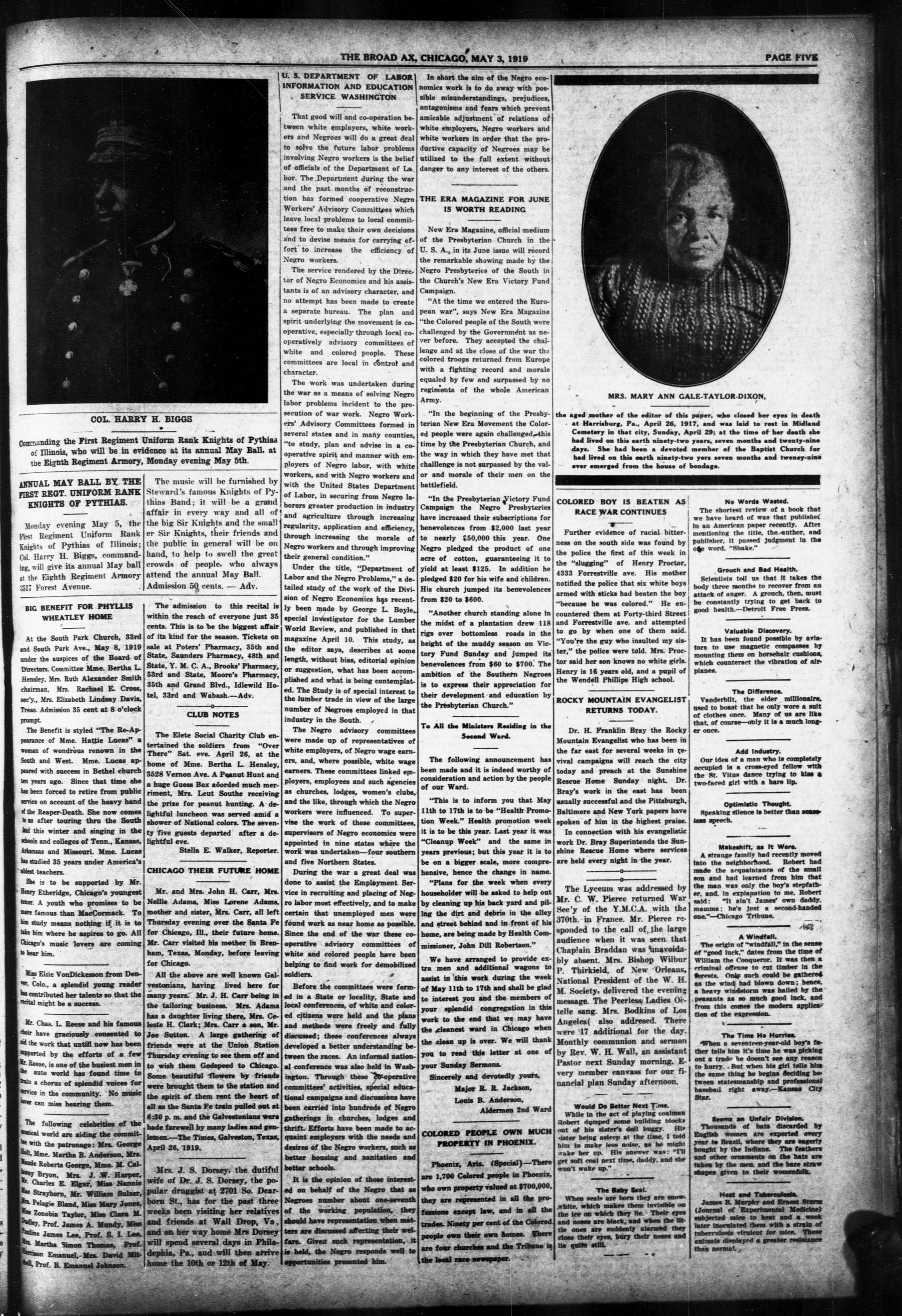
Page text (machine-generated)
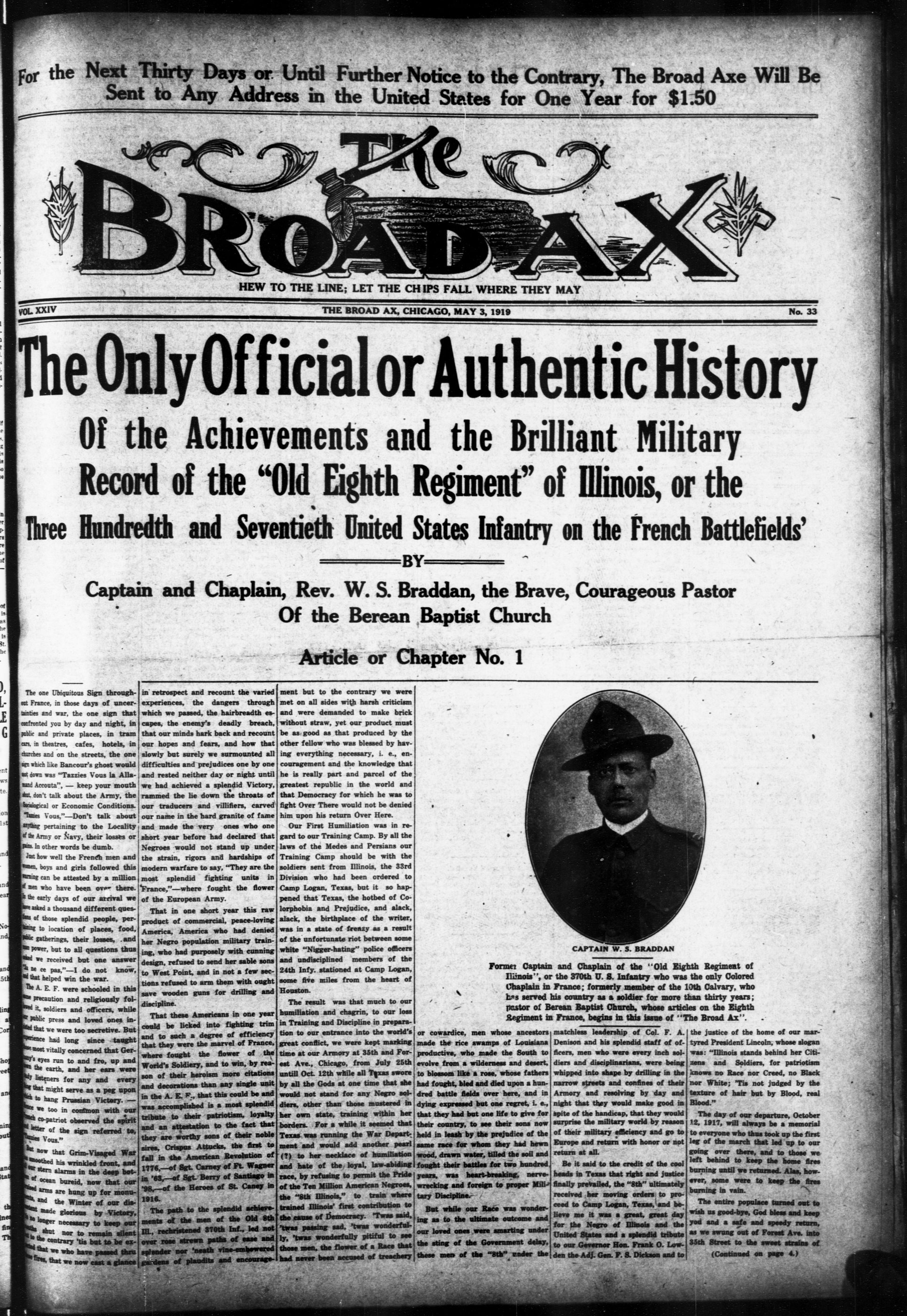
For the Next Thirty Days or Until Further Notice to the Contrary, The Broad Axe Will Be Sent to Any Address in the United States for One Year for $1.50
The Only Official or Authentic History Of the Achievements and the Brilliant Military Record of the "Old Eighth Regiment" of Illinois, or the Three Hundredth and Seventieth United States Infantry on the French Battlefields' BY
Captain and Chaplain, Rev. W. S. Braddan, the Brave, Courageous Pastor Of the Berean Baptist Church
in retrospect and recount the varied experiences, the dangers through which we passed, the hairbreadth escapes, the enemy's deadly breach, that our minds hark back and recount our hopes and fears, and how that slowly but surely we surmounted all difficulties and prejudices one by one and rested neither day or night until we had achieved a splendid Victory, rammed the lie down the throats of our traducers and villifiers, carved our name in the hard granite of fame and made the very ones who one short year before had declared that Negroes would not stand up under the strain, rigors and hardships of modern warfare to say, "They are the most splendid fighting units in France,"—where fought the flower of the European Army.
That in one short year this raw product of commercial, peace-loving America, America who had denied her Negro population military training, who had purposely with cunning design, refused to send her sable sons to West Point, and in not a few sections refused to arm them with ought save wooden guns for drilling and discipline.
That these Americans in one year could be licked into fighting trim and to such a degree of efficiency that they were the marvel of France, where fought the flower of the World's Soldiery, and to win, by reason of their heroism more citations and decorations than any single unit in the A. E. F., that this could be and was accomplished is a most splendid tribute to their patriotism, loyalty and an attestation to the fact that they are worthy sons of their noble sires, Crispus Attucks, the first to fall in the American Revolution of 1776,—of Sgt. Carney of Ft. Wagner in '68,—of Sgt. Berry of Santiago in '88,—of the Heroes of St. Caney in 1916.
The path to the splendid achievements of the men of the Old 8th Ill., rechristened 3700 Inf., led not over rose strewn paths of ease and splender nor 'neath vine-embowered gardens of plaudits and encourage-
Article or Chapter No. 1
ment but to the contrary we were met on all sides with harsh criticism and were demanded to make brick without straw, yet our product must be as good as that produced by the other fellow who was blessed by having everything necessary, i. e., encouragement and the knowledge that he is really part and parcel of the greatest republic in the world and that Democracy for which he was to fight Over There would not be denied him upon his return Over Here.
Our First Humiliation was in regard to our Training Camp. By all the laws of the Medes and Persians our Training Camp should be with the soldiers sent from Illinois, the 33rd Division who had been ordered to Camp Logan, Texas, but it so happened that Texas, the hotbed of Colorphobia and Prejudice, and alack, alack, the birthplace of the writer, was in a state of frenzy as a result of the unfortunate riot between some white "Nigger-hating" police officers and undisciplined members of the 24th Infy. stationed at Camp Logan, some five miles from the heart of Houston.
The result was that much to our humiliation and chagrin, to our loss in Training and Discipline in preparation to our entrance into the world's great conflict, we were kept marking time at our Armory at 35th and Forest Ave., Chicago, from July 25th until Oct. 12th while all Texas swore by all the Gods at one time that she would not stand for any Negro soldiers, other than those mustered in her own state, training within her borders. For a while it seemed that Texas was running the War Department and would add another pearl (?) to her necklace of humiliation and hate of the loyal, law-sabiding race, by refusing to permit the Pride of the Ten Million American Negroes, the "8th Illinois," to train where trained Illinois' first contribution to the cause of Democracy. 'Twas said, 'twas passing said, 'twas wonderfully, 'twas wonderfully pitiful to see those men, the flower of a Race that had never been accused of treachery
[Portrait of a soldier in uniform].
Former Captain and Chaplain of the "Old Eighth Regiment of Iliinois", or the 370th U. S. Infantry who was the only Colored Chaplain in France; formerly member of the 10th Calvary, who has served his country as a soldier for more than thirty years; pastor of Berean Baptist Church, whose articles on the Eighth Regiment in France, begins in this issue of "The Broad Ax".
or cowardice, men whose ancestors made the rice swamps of Louisiana productive, who made the South to evolve from a wilderness and desert, to blossom like a rose, whose fathers had fought, bled and died upon a hundred battle fields over here, and in dying expressed but one regret, i. e., that they had but one life to give for their country, to see their sons now held in leash by the prejudice of the same race for whom they had hewn wood, drawn water, tilled the soil and fought their battles for two hundred years, was heart-breaking, nervewrecking and foreign to proper Military Discipline.
But while our Race was wondering as to the ultimate outcome and our loved ones were smarting under the sting of the Government delay, these men of the "8th" under the
CAPTAIN W. S. BRADDAN
and Chaplain of the "Old Eight
the 370th U. S. Infantry who was
France; formerly member of the
this country as a soldier for more
American Baptist Church, whose arti-
France, begins in this issue of "
matchless leadership of Col. F. A. Denison and his splendid staff of officers, men who were every inch soldiers and disciplinarians, were being whipped into shape by drilling in the narrow streets and confines of their Armory and resolving by day and night that they would make good in spite of the handicap, that they would surprise the military world by reason of their military efficiency and go to Europe and return with honor or not return at all.
Be it said to the credit of the cool heads in Texas that right and justice finally prevailed, the "8th" ultimately received her moving orders to proceed to Camp Logan, Texas, and believe me it was a great, great day for the Negro of Illinois and the United States and a splendid tribute to our Governor Hon. Frank O. Lowden the Adj. Gen. F. S. Dickson and to
the justice of the home of our martyred President Lincoln, whose slogan was: "Illinois stands behind her Citizens and Soldiers, for patriotism knows no Race nor Creed, no Black nor White; 'Tis not judged by the texture of hair but by Blood, real Blood."
The day of our departure, October 12, 1917, will always be a memorial to everyone who thus took up the first leg of the march that led up to our going over there, and to those we left behind to keep the home fires burning until we returned. Alas, however, some were to keep the fires burning in vain.
PAGE TWO
THE BROAD AX
Published Every Saturday
In this city since July 15th, 1899,
without missing one single issue. Rep-
ublicans, Democrats, Catholics, Pro-
testans, Single Taxers, Priests, infid-
els or anyone else can have their
day as long as their language is pro-
pri and responsibility is fixed.
The Broad Ax is a newspaper
whose platform is broad enough for
all, ever claiming the editorial right
to speak its own mind.
Local communications will receive
attention. Write only on one side of
the paper.
Subscriptions must be paid in advance.
Advertising rates made known on application.
Address all communications to
THE BROAD AX
6206 So. Elizabeth St., Chicago, Ill.
Phone Wentworth 2597.
JULIUS F. TAYLOR
Editor and Publisher
DR. M. A. MAJORS
Associate Editor
4700 South State Street
Phone Drexel 1416
1802, at the Post Office at Chicago
ill., under Act of March 3, 1879
Korean Women Independent. Korean women are no longer slaves of their husbands, but are ready to assert their rights. Many of them no longer depend on their husbands for support as of old, but try to obtain their own living in various branches of industry.
Great Value of Courage
It is not clearly understood how valuable is the adjunct of courage in the man or woman, nor that, if accompanied by good judgment it is the most valuable of business assets.—John Brisbane Walker.
Real Moral Courage
When you are so devoted to doing what is right that you press straight on to that and disregard what men are saying about you, there is the triumph of moral courage.—Phillips Brooks.
Optimistic Thought
A man, said Talmage, never looks more dignified when he takes a spectacle case from his pocket, opens it, unfolds a lens, sets it astride his nose and looks you in the eye.
Imagination and Reality.
"How did Morgan come to break with Miss Blossom? He used to say that she was as good as gold!" "Yes, but you see he got acquainted with a girl who has gold!"
Start on Trade at 3.
In India wood, metal and ivory carvers begin to learn their trade at the age of three years and become skilled workers by the time they are twelve.
Keeping Twine.
Instead of making a ball of twine, roll it on one of the little wooden handles as come on packages and hang this on a hook.
White Chocolate.
A Swiss product which is said to have greater food value than the brown sweet chocolate of America is white chocolate. It is made of cocoa butter, and either sugar or dried cream. It is smooth, glossy, and rather attractive in appearance.
His Ultimate End
The children were discussing a famous soldier, when four-year-old Benny asked: "Who is he, anyway?" "Well," replied wise first-grade Harold, "he's a wonderful brave man now, after awhile he'll be a statue."
You May Not Believe it, but—
If statistics could be compiled showing the number of men who have a sudden and sneaking impulse to set the house on fire when the cleaning season approaches, the world would stand agast—Indianapolis Star.
Optimistic Thought
Optimistic Thought.
Heaven does not speak; how, then,
can it bestow sovereignty on man?
No Friends Like Old Friends.
A friend whom you have been gain-
ing during your whole life, you ought
not to be displeased with in a moment.
A stone is many years becoming a
ruby, take care you do not destroy it
in an instant against another stone.—
Sadl.
It is easy to make mistakes in the hanging of pictures. Observing the following as a guide, you will make fewer mistakes in this respect. First, a plain paper for the room is almost imperative. This will give you an opportunity to use all the pictures, no matter what they are. Soft grays and terra cotta tones are best for background. Avoid figured and highly-colored papers as these prevent the picture from standing out. Be careful not to tilt the pictures too much. Hang them almost flat.
Light and Dark' of Moon.
Popularly, the moon is called new when, after passing the sun, she first becomes visible as a thin crescent. Some persons say the light of the moon is from this time until the moon is full. Others say that the light of the moon is during the few days when the moon appears to be full. The dark of the moon is also thought by some to extend from the full moon until no moon is visible. Popularly, however, the moon is dark during the few days of invisibility when near conjunction with the sun.
The Brute.
Popperton—"The wife has gone shopping and left me in charge of the baby, and I'm blest if I know how to keep the beggar quiet." Grimshaw (after critically regarding the howling juvenile)—"I should think you could easily keep him quiet, both in a vocal and physical way, by gagging him carefully, tying his hands behind his back, binding his feet together, nailing his clothes to the floor, and then administering chloroform to him."
Biblical "Seven Ages."
First age, from the creation to the deluge, 2349 B. C.; second age, to the coming of Abraham into Canaan, 1922 B. C.; third age, to the Exodus from Egypt, 1491 B. C.; fourth age, to the founding of Solomon's temple, 1041 B. C.; fifth age, to the capture of Jerusalem, 588 B. C.; sixth age, to the birth of Christ; seventh age, to the present time.
Our Foolish Filosofy
Cheer up. Why worry? Most anything you do will make somebody glad. If you get sick somebody who don't like you will be pleased about it. If you get well somebody who likes you will feel mighty happy about it. If you die the undertaker is entitled to congratula—er—that is to say, we all have our little moments.—Indianapolis Star.
Violets.
There are many myths and legends connected with the violet, which has been considered the good luck flower by many nationalities. In some places, English rural folk say a handful of the first violets found should be taken into the farmhouse, so good luck will be assured in the hatching of all the baby fowls of the barnyard.
His Favorite.
Brother was attending a party at which the refreshments served were ice cream and cake. The hostess saw that brother wasn't making much headway with the ice cream, so asked him if he didn't care for it. "Oh, yes," he answered. "Ice cream is all right; but turkey is my favorite."
Her Appearance.
Mildred had accompanied her father to the near-by village and on her return was telling her mother of a woman she saw there. Her mother asked if it was a certain woman, and Mildred immediately replied: "No, mother, she looked newer than that."
Stains of Photos After Fixing
The brown or yellow stains which are sometimes found on photographic prints after, being taken out of the fixing bath can be prevented by mixing a tablespoonful of vinegar in the water in which the prints are washed after being developed.
One's Identity.
There is, in sanest hours, a consciousness, a thought that rises, independent, lifted out of all else, calm, like the stars, shining eternal. This is the thought of identity—yours for you, whoever you are, as mine for me.—Walt Whitman.
The Sayings of Shinbone.
"Ah done heard Brudder Jones prayin' las' night to be delivered from his 'upsettin' sins," remarked Shinbone, "an' Ah reckon he mus' hab referred to de sin of 'toxication."—Boston Transcript.
Two Bites and a Cup.
While many of our familiar comparisons have been scrapped by modern conditions, new comparisons are taking their places—for example: "An quickly over as a movie meal."—Boston Transcript.
Forecast of the Future
PORTRAIT OF THE FUTURE.
It will be a great day when wireless telephony is so perfected that a man can have a receiver in his hat and be managed by his wife all the time—Chicago News.
Optimistic Thought
The principal foundations of all states are good laws and good arms.
THE BROAD AX. CHICAGO. MAY 3. 1919
Wood In Demand
The unique timber of Turkey and a few other localities—the fine, hard-grained, compact boxwood so much prized for engravings, rules, etc., is now so scarce that the forest products laboratory in Wisconsin is seeking American substitutes. Only the Florida boxwood and the wahoo of Arkansas and other parts of the South approach nearly. Other hardwoods suitable for some of the coarser uses include mastic, torchwood, witch hazel, great rhododendron, mountain laurel, thornapple and yellow buckeye.
From Apricot Pita
California produces yearly about 7,000 tons of apricot pits, and home chemists now obtain $200 of materials from each ton. The price of the pits, formerly sold in central Europe at $45 a ton, was reduced two-thirds by the war. The products include a fruit oil substitute for olive oil, the essential oil of apricot (known also as bitter oil of almonds), a cooking meal and a cleansing meal, and American (formerly Prussian) blue.
Tail of the Fox.
One of the most notable features of the fox is his large and massive tail, writes John Rurroughs. Seen running on the snow at a distance, his tail is quite as conspicuous as his body; and, so far as appearing a burden, seems to contribute to his lightness and buoyancy. It softens the outline of his movements, and repeats or continues to the eye the ease and poise of his carriage.
This Dog Small Boy's Friend.
A pupil in one of the Rumford (Me.) grade schools failed to come to school and when the truant officer called to learn the reason, he was told that the dog had run off with the small boy's knickerbocker's, which had been put in their usual place the night before, and which could not be located until time to attend the afternoon session.
Violet Highly Prized.
The violet was the national flower of the Athenians, and the men of Athens were frequently addressed by their orators as "Athenians crowned in violets." The Romans believed the flower had medicinal qualities, and Pliny advised a garland of violets about the forehead would cure headache or dizziness.
Some Story.
Said the mournful man, "Someday, somebody, somewhere, somehow will get an inspiration and in the fervor of the hour will write a chunk of fiction that doesn't contain the word sordid. doesn't refer to the flotsam and jetsam of life and excludes all persons with hectic flushes."
Carrying Cocoa to the Coast.
An interesting spectacle in the African Gold Coast country is the transport of cocoa, the bulk of the inland produce being carried by porters to the railway. Sometimes the roadways as far as the eye can see are one long line of cocoa bags on the heads of hundreds of carriers.
When Money Is a Curse.
It is only when money is cheapened to worthlessness for some, and made impossibly dear to others, that it becomes a curse. In short, it is a curse only in such foolish social conditions that life itself is a curse.—George Bernard Shaw.
Vox Popull, Vox Del.
This is a very ancient saying and means "The voice of the people is the voice of God." It can be traced back through Latin to Greek. It is found first in a work on morals, by the Greek poet, Hesiod, who lived about the eighth century before Christ.
Puonacious Fish:
In Slam there are small fresh-water fish so pugnacious that when two of them are placed near each other they at once begin to fight. When the fish is quiet its colors are dull, but when excited it is of a metallic brilliance.
Without :Hindrance
The real democratic American idea is, not that every man shall be on a level with every other, but that everyone shall have liberty, without hindrance, to be what God made him—Reecher.
Where the Folly Lies.
It is hardly ever foolish to do a thing because we want to do it. The folly lies in doing a thing because other people think we ought to want to do it, and we do not.
The Word "Magnet"
The word "Magnet."
The word "magnet" is derived from the name of the city of Mognesia, in Asia Minor, where the properties of the loadstone are said to have been discovered.
Cousin Bill Sava:
"When a man thinks he has left his watch at home and takes it out of his pocket to see if he has time to go back for it. I should call that man absent-minded."
Optimistic Thought.
Virtue and goodness are confined to no station.
An astrologer, who was famed for his great learning and his knowledge of the stars, went out for a walk. As he walked, all the time looking up at the sky, he said to himself: "Oh, how much wiser am I than most men. All the secrets of the stars are known to me. I read them as other men read books. . . . " Thus speaking, he came to a well, but being far too busy praising his own cleverness to notice it, he tripped and fell in headlong, and there he had to stay until his servant, hearing his cries, came and pulled him out.—Aesop's Fables.
Anglo-Saxons.
The Angles, or Engles, were a people once located in a part of the world now known as Schleswig-Holstein and who accompanied or immediately followed the Saxons into England. The Angles are believed to have been the more powerful race, for they occupied the larger portion of Britain, and they gave their name to the land, for out of Engle grew the word England and the Saxons made the word Anglo-Saxon.
Needed Prompting.
Mr. Jobling was asked by his wife to call at a shop on his way home and get her three articles of feminine wear. When she reached the shop he had forgotten what they were, so he said apologetically to the attendant behind the counter: "Excuse me, my wife told me to come here and get her some things to wear, and I've forgotten what they are! Would you mind naming a few things?"
Status of the Shoes
Kathleen and her mamma had just returned from a shopping trip bringing home a pair of shoes for Kathleen, but only on approval: Upon arriving home Doris, Kathleen's older sister, out of curiosity immediately started to open the package. Kathleen indignantly said, "Doris, you just leave those shoes alone; mamma only brought them home on a furlough."
Mastering Worry.
The person who knows no worry is a fortunate individual (if such a human being possibly exists), but worry as well as its first cousins, nerves, can be mastered if we sensibly take each day as it comes, smiling at its problems, and forgetting all about that "doubtful future" which some folks declare is full of woes.
Benefactor of Men.
The New York Sun's appreciation of the late Dr. Mary Walker contains this tribute: "One debt of gratitude men owe Doctor Walker which they ought not to forget. She was the inventor of the inside neckband on shirts which protects the flesh from being rubbed by the collar button."—Outlook.
Care of Umbrellas.
Carelessness in the treatment of umbrellas is a great factor in their rapid deterioration. An umbrella merely damp should be opened and left until dry, while a very wet one should be put to drain first, handle downward, and opened for the final drying.
Unique Nation.
Costa Rica is unique among modern nations, inasmuch as it has more teachers than soldiers. The standing army is only 500 strong, while the teachers in active service number about 2,000. For nearly 45 years the country has enjoyed internal peace.
New Water Power.
A new use of ocean water power has been perfected by an Englishman. He catches water when the tide rises and makes it operate turbine engines when the tide falls. Thus he obtains a perpetual water power, as the tide always ebbs and flows.
Experimental
"Dad," inquired a small boy, "what is a test case?" "A test case, my son," replied his parent, "is a case brought into court to decide whether there's enough in it to justify lawyers in working up more cases of a similar kind!"
Law and the Successful Life
There is something servile in the habit of seeking after a law which we may obey. We may study the law of matter at and for our convenience, but a successful life knows no law.—Thoreau.
"Ah ain't passionally qualified wiv dis yar cootie" remarked Shibnone, "but Ah reckon he ain't nuffn' mo' dan a sartin omentenable insec' wiv er military trainih'"—Boston Transcript.
There be those who are ready to rush into great ventures on suspicion, as it were, not having made a careful and exhaustive survey of the situation, nor having counted the cost.
Rain by X-Ray.
An Australian inventor has patented a method for producing rain by raising large X-ray bulbs by balloons into higher strata of air that are filled with moisture.
Daily Thought.
Write to the mind and heart and let the ear glean after what it can.—Bailey.
ORIENTAL LOVE OF BEAUTY
Flowers and Nature Have Always Figured Prominently in Their Paintings and Writings.
The Orient was always fond of flowers. In primitive times the Arabs studied the big herbals of Byzantine doctors and scientists and copied flower after flower in their own manner; they loved them, but they were unconscious of their beauty. When they wanted to adorn they only used the conventionalized form of the lotus and the arabesque flower consecrated by hundreds of years of tradition. Later on Chinese masters taught them the living beauty of flowers. In the Mongol miniatures they study the blossoming almond tree and the iris, but in the sixteenth century only they begin to love the flower for itself—to study each leaf, each petal, each line, and each hue of color. They show the same intimate love for detail which inspired the landscapes of Behzad. Their landscapes are always like the poems of Haifz—sunny, cheerful and gay. Nothing more charming than these meetings of kings and princesses in the greens under richly embroidered tents with musicians and dancers. And no difference if the artist paints one of the cruel bloody scenes of the antique "Shahnameh"; must it not be a wonderful feeling to be executed by the order of the king in his illustrious presence, with retainers and maidens around, the sun shining, a soft wind covering your head and shoulders with the pink petals of the almond tree in flower? The birds singing sweeter than ever in the trees. The touch of the cold steel is after all only of passing moment and eternal is the beauty of sun, spring and flowers.—R. M. Riefstahl, in Asia Magazine.
SHOW SPIRIT OF FAIRNESS$
American Gives English Writers Credit for One Attribute That Is Worthy of Praise.
I have frequently said the writers in England are superior to ours, particularly as to fairness and conservatism. The other day I ran across a review article criticising the general ignorance of the people about old and classical things. After proving his point cleverly and effectually the writer proceeded to examine himself. He turned to the encyclopedia at random and took the first subject at the top of the page. He confessed he knew nothing about it. He did the same thing with many other subjects of classical antiquity. And this fellow is one of the best-educated men in England.
An American writer would not have done that; he would have pretended to be thoroughly familiar with everything in the encyclopedia, and witheringly abused the people for lacking his great knowledge.
The truth about old classical subjects is that most of them are buried in books and that few people know anything about them, for the reason that they are not of the slightest importance.
An Englishman is mean, but he has a lot of sense; and he will be reasonably fair, even if disagreeable with it.
-E. W. Howe's Magazine.
Tints and Autumn Colors
Everyone has seen and admired the beautiful colors of autumn leaves, but very few know anything about the why and wherefore.
It has been noticed that in two trees of maples, oak or other trees, coloring in autumn, of the same species, one will often take on much brighter color than the other.
It should be remembered that, though there must be certain chemical combinations before any color can be produced, the act of producing is a vital one, and can only operate under vital conditions. If we cut off a branch of any tree in summer time and throw it aside, the leaves turn black or brown, and without any brilliant color; but if the branch be only half broken off or in some way injured the leaves will color, as if the autumn time had arrived.
This shows that coloring is connected with a check to vital power, short of its total destruction. Hence, in the autumn, the tree with the greater vital power will color less than the other.
The Whippoorwill
It is almost impossible to see a whippoorwill in the daytime because of the manner in which it sits upon a limb of a tree. It doesn't sit cross-wise, like other birds, but lengthwise of the limb. Its toes are short, but broad-spreading, and it can sit lengthwise on a limb better than it could sit crosswise, where it would have to clasp the limb with its toes like other birds. You may pass right under a tree where a whippoorwill is sitting on a limb and never notice it—and it knows it will never be noticed, so it doesn't become alarmed and fly out of the tree.
Why Diamonds Burst
That diamonds burst is an old idea, which has been variously explained. It has been thought that the stones have fractured by violent eruptions in the inclosing rocks, by sudden removal of pressure around them, or is the smoky specimens by spontaneous breaking up. Dr. J. R. Sutton concludes that the breaking usually results from the minerals inclosed. These may be garnet zircon, ilmenite or iron pyrites, and such crystals, under ordinary heating at least, have so much greater expansion than the diamond that they would exert great pressure.
March the First Known the World
Over as Anniversary of the
Country's Patron Saint.
The first day of March has long been
observed as a special day by the peo-
ple of Wales and is called St. David's
day in honor of the good St. David,
patron saint of the Welsh, who lived
in the sixth century.
St. David was said to have been the
son of a prince of Cardiganshire,
Wales, and is accredited with the
working of many miracles, especially
among the poor of the country. It was
said that when the saint first went
into the fields to preach to his follow-
ers the ground on which he was stand-
ing began to rise until it assumed a
goodly height, and henceforth was his
pulpit.
For hundreds of years the Welsh wore sprigs of leek—a plant with broad blush-green leaves and yellow flower clusters—in their hats as a symbol of recognition of the day. This custom was brought about, some say, from the fact that in a battle of the Welsh against their old enemies, the Saxons, St. David had ordered all Welshmen to go into battle wearing their native leek, not only to distinguish them from their enemies, but to bring them good luck.
Other writers argue that the badge was worn more as a fraternal sign and because leek was grown in every Welsh garden and was the favorite vegetable of a true Welshman.
Writers of the last century depict a typical Welsh garden as a garden of onions, garlic and leek. Homely incidents are told of Welshmen assisting each other in farming and eating their leeks together, a ceremony symbol of hospitality and good fellowship.
NOT ALWAYS PROPERLY SANE
Scientists Assert Few People Have at All Times Full Command of Their Mental Faculties.
Many people think that the expression "temporary insanity" is merely used by a jury wishing to save relatives pain, but numbers of doctors who have made a study of mental disorders emphatically declare it is no idle term.
One doctor has stated that temporary insanity is a condition of double consciousness, not dissimilar to epilepsy. A person normally quite sane may have attacks of temporary ablation lasting little more than a few minutes, especially after long bouts of hard, continuous mental work, being particularly liable if insomnia supervenes.
Crimes have been committed in the early morning when the perpetrator has not really been properly awake, and has been horrified to find what he has done. This is a true case of temporary insanity, but it is comparatively rare, and a man in normal health would not suffer in this way. A specialist in mental diseases has stated that he knew a case in which a person was insane during a certain time of each day, and that others have been known when the patient was quite normal at ordinary times, but suffered from a temporary fit of mania regularly once a month.
Forming Artificial Pearls
Pearls were valuable as gems in China as early as twenty-two centuries before our era, and the Chinese had worked out a plan for the artificial formation of pearls about 700 years ago, which they have carried on extensively. Large numbers of oysters are collected and the shell gently opened to allow the introduction of various foreign substances which are inserted by means of a forked bamboo stick. These pellets are generally made of prepared mud, but may be bone, brass or wood. The oysters are then placed in shallow ponds connected with canals and are nourished by tubs of night soil thrown in from time to time.
Some time later, from several months to two years, depending upon the size of the gem desired, these orchers are taken out of the shell, the pearls removed and the body of the animal eaten as food. Millions of such pearls are sold annually in China. The most valuable are either round or pearl shaped.
Few Old People in New Guinea.
The average duration of life is shorter in New Guinea than in any other country, owing to the peculiar diet of the natives, who devour with gusto the larvae of beetles, dug out of decared tree trunks, and habitually drink seawater when near the coast. "The people die off at about forty." A. E. Pratt says in his "Two Years Among the Cannibals of New Guinea." "We saw one very old man, who may have been about sixty years of age—the only example of longevity that we came across. He was bent almost double, and had a long, white beard. His fellow tribesmen regarded him as a great curiosity, and brought him to see us. Despite the decrepitude of his body, however, there was no trace of senility; his senses were unimpaired and the poor old creature showed great gratitude for a gift of tobacco."
Hence the Congestion
Hence the Congestion.
"You have plenty of room in Amer-
ca," said the foreign visitor.
"Oh, yes."
"Then why do you build so many
skyscrapers?"
my-superior
"I guess that's because the average American thinks he can't transmit business unless he's within walking distance of the post office." -Birmingham, Ago-Herald
Parisian Designers Aim to Create a Campaign, Fashion Writer Declares.
Short Model Advancing, but its Fate Hangs in Balance—Abbreviated Sleeve Is Believed to Be
Exaggeration always has been the very essence of fashion. Women will adventure in clothes. This exaggerations asserts a fashion correspondent, usually is obtained by accentuating some portion of the human body, just as hoopskirts accentuated the slim slenderness of the waist. In the days of our now far-off Civil war Mrs. Lincoln and the wife of General Grant walked abroad with wide, swaying skirts. So full were they that the waist took on a waspilike appearance. Then there came a time when breadth was given to the shoulders by an absurdly large sleeve that puffed stiffly out at the top. Du Maurier ever depicted
T
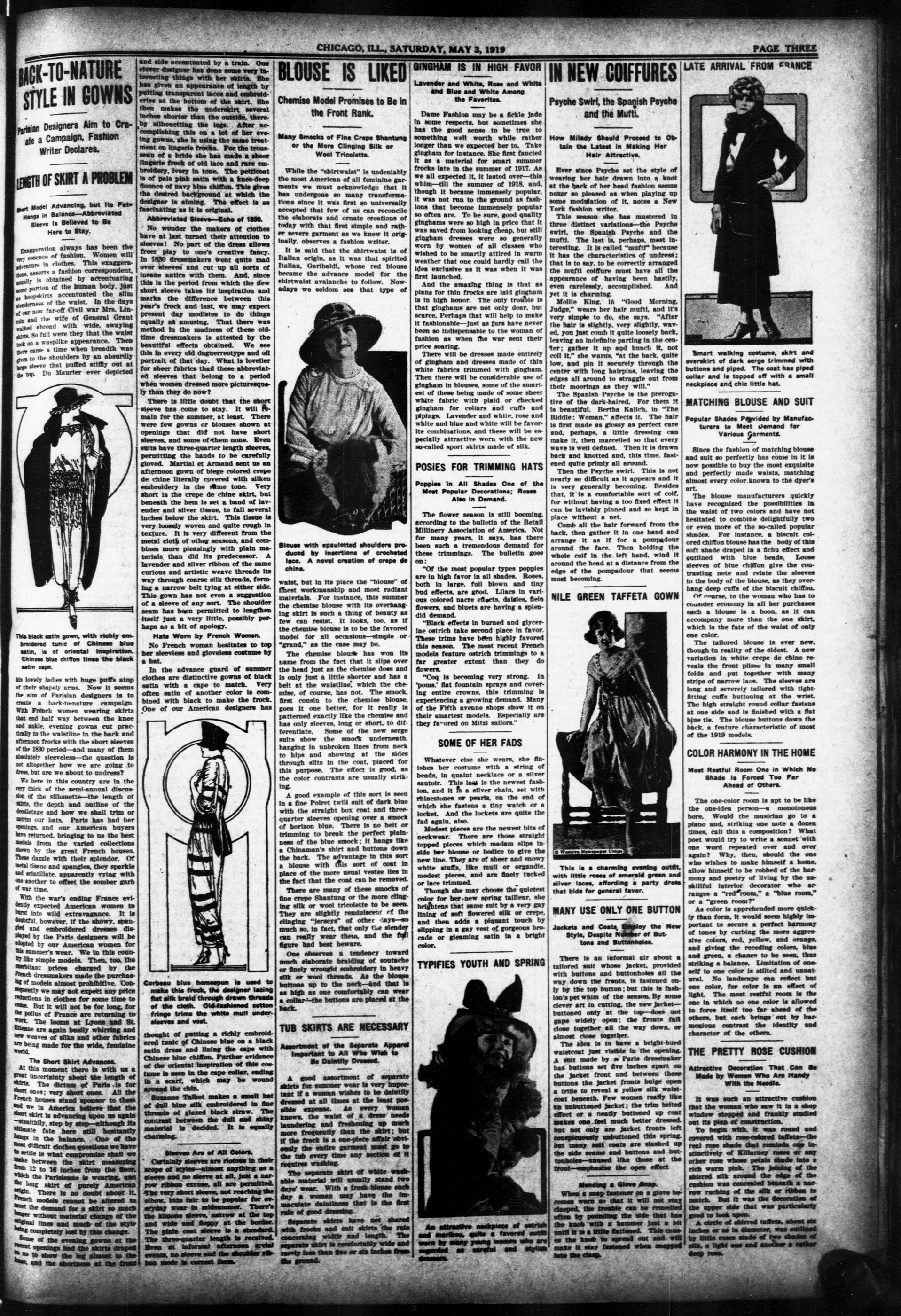
This black satin gown, with richly embroidered tunic of Chinese blue satin, is of oriental inspiration. Chinese blue chiffon lines the black satin cape.
This black satin gown, with richly embroidered tunic of Chinese blue satin, is of oriental inspiration. Chinese blue chiffon lines the black satin cape.
his lovely ladies with huge puffs atop of their shapely arms. Now it seems the aim of Parisian designers is to create a back-to-nature campaign. With French women wearing skirts that end half way between the knee and ankle, evening gowns cut practically to the waistline in the back and afternoon frocks with the short sleeves of the 1830 period—and many of them absolutely sleeveless—the question is not altogether how we are going to dress, but are we about to undress?
We here in this country are in the very thick of the semi-annual discussion of the silhouette—the length of stirrs, the depth and outline of the decolletage and how we shall trim or untrim our hats. Paris has had her openings, and our American buyers have returned, bringing to us the best models from the varied collections shown by the great French houses. These dazzle with their splendor. Of metal tissue and spangles, they sparkle and scintillate, apparently vying with one another to offset the somber garb of war time.
With the war's ending France evidently expected American women to burst into wild extravagance. It is doubtful, however, if the showy, spangled and embroidered dresses displayed by the Paris designers will be adopted by our American women for this summer's wear. We in this country like simple models. Then, too, the enburban? prices charged by the French dressmakers made the purchasing of models almost prohibitive. Consequently we may not expect any price reductions in clothes for some time to come. But it will not be for long, for the polus of France are returning to work. The looms at Lyons and St. Etienne are again bushy whirring and new weaves of stilks and other fabrics are being made for the wide, feminine world.
The Short Skirt Advances.
At this moment there is with us a great uncertainty about the length of skirts. The dictum of Paris is for short ones; very short ones. All the French houses stand sponsor to them and we in America believe that the short skirt is advancing upon us again—stealthily, step by step—although its ultimate fate here still hesitantly hangs in the balance. One of the most difficult clothes questions we have to settle is what compromise shall we make between the skirt measuring from 12 to 16 inches from the floor, which the Parisienne is wearing, and the long skirt of purely American origin. There is no doubt about it. French models cannot be altered to meet the demand for a skirt so much longer without material change of the original lines and much of the style being completely lost by this change.
Some of the evening gowns at the recent openings had the skirts draped as us to show the leg almost to the house, and the shortness at the front
and side accentuated by a train. One clever designer has done some very interesting things with her skirts. She has given an appearance of length by putting transparent laces and embroideries at the bottom of the skirt. She then makes the underskirt several inches shorter than the outside, thereby silhouetting the legs. After accomplishing this on a lot of her evening gowns, she is using the same treatment on lingerie frocks. For the trousseau of a bride she has made a sheer lingerie frock of old lace and rare embroidery, ivory in tone. The petticoat is of pale pink satin with a knee-deep flounce of navy blue chiffon. This gives the desired background at which the designer is aiming. The effect is as fascinating as it is original.
Abbreviated Sleeve—Echo of 1830.
No wonder the makers of clothes have at last turned their attention to sleeves! No part of the dress allows freer play to one's creative fancy. In 1830 dressmakers went quite mad over sleeves and cut-up all sorts of insane antics with them. And, since this is the period from which the new short sleeve takes its inspiration and marks the difference between this year's frock and last, we may expect present day modistes to do things equally as amusing. That there was method in the madness of these old-time dressmakers is attested by the beautiful effects obtained. We see this in every old daguerreotype and oil portrait of that day. What is lovelier for sheer fabrics than these abbreviated sleeves that belong to a period when women dressed more picturesquely than they do now?
There is little doubt that the short sleeve has come to stay. It will remain for the summer, at least. There were few gowns or blouses shown at openings that did not have short sleeves, and some of them none. Even suits have three-quarter length sleeves, permitting the hands to be carefully gloved. Martial et Armand sent us an afternoon gown of blege colored crepe de chine literally covered with silken embroidery in the same tone. Very short is the crepe de chine skirt, but beneath the hem is set a band of lavender and silver tissue, to fall several inches below the skirt. This tissue is very loosely woven and quite rough in texture. It is very different from the metal cloth of other seasons, and combines more pleasingly with plain materials than did its predecessor. A lavender and silver ribbon of the same curious and artistic weave threads its way through coarse silk threads, forming a narrow belt tying at either side. This gown has not even a suggestion of a sleeve of any sort. The shoulder seam has been permitted to lengthen itself just a very little, possibly perhaps as a bit of apology.
Hats Worn by French Women.
No French woman hesitates to top her sleeveless and gloveless costume by a hat.
In the advance guard of summer clothes are distinctive gowns of black satin with a cape to match. Very often satin of another color is combined with black to make the frock. One of our American designers has
I
Corbeau blue homepun is used to make this frock, the designer lacing flat silk braid through drawn threads of the cloth. Old-fashioned cotton fringe trimts the white mull under-sleeves and vest.
thought of putting a richly embroidered tunic of Chinese blue on a black satin dress and lining the cape with Chinese blue chiffon. Further evidence of the oriental inspiration of this costume is seen in the cape collar, ending in a scarf, which may be wound around the chin.
Susanne Talbot makes a small hat of dull blue silk embroidered in fine threads of glazed black straw. The contrast between the dull and shiny material is decided. It is equally charming.
Certainly sleeves are riotous in their scope of styles—almost anything as a sleeve and no sleeve at all, just a narrow ribbon exense, all are permitted. The very short sleeve, not reaching the elbow, bids fair to be popular for everyday wear in midsummer. There's the kimono sleeve, narrow at the top and wide and floppy at the border. The plain coat sleeve is a standard. The three-quarter length is received. Given at informal afternoon icral events, no sleeve and the shoulder ribbon made in correct form.
CHICAGO, ILL., SATURDAY, MAY 3, 1919
BLOUSE IS LIKED
Chemise Model Promises to Be in the Front Rank.
Many Smocks of Fine Crepe Shantung or the More Clinging Silk or Wool Tricollette.
While the "shirtwaist" is undeniably the most American of all feminine garments we must acknowledge that it has undergone so many transformations since it was first so universally accepted that few of us can reconcile the elaborate and ornate creations of today with that first simple and rather severe garment as we knew it originally, observes a fashion writer.
It is said that the shirtwaist is of Italian origin, as it was that spirited Italian, Garibaldi, whose red blouse became the advance model for the shirtwaist avalanche to follow. Nowadays we seldom see that type of
J.
Blouse with epauletted shoulders produced by insertions of crocheted lace. A novel creation of crepe de chine.
waist, but in its place the "blouse" of finest workmanship and most radiant materials. For instance, this summer the chemise blouse with its overhanging skirt is such a thing of beauty as few can resist. It looks, too, as if the chemise blouse is to be the favored model for all occasions - simple or "grand," as the case may be.
The chemise blouse has won its name from the fact that it slips over the head just as the chemise does and is only just a little shorter and has a belt at the waistline, which the chemise, of course, has not. The smock, first cousin to the chemise blouse, goes it one better, for it really is patterned exactly like the chemise and has only sleeves, long or short, to differentiate. Some of the new serge suits show the smock underneath, hanging in unbroken lines from neck to hips and showing at the sides through slits in the coat, placed for this purpose. The effect is good, as the color contrasts are usually striking.
A good example of this sort is seen in a fine Polret twill suit of dark blue with the straight box coat and three-quarter sleeves opening over a smock of horizon blue. There is no belt or trimming to break the perfect plainness of the blue smock; it hangs like a Chinaman's shirt and buttons down the back. The advantage in this sort a blouse with this sort of coat in place of the more usual vestee lies in the fact that the coat can be removed. There are many of these smocks of fine crepe Shantung or the more clinging silk or wool tricolore to be seen. They are slightly reminiscent of the clinging "jerseys" of other days—so much so, in fact, that only the slender can really wear them, and the full figure had best beware.
One observes a tendency toward much elaborate braiding of soutache or finely wrought embroidery in heavy silk or wool threads. As the blouse buttons up to the neck—and that is as high as one comfortably can wear a collar—the buttons are placed at the back.
TUB SKIRTS ARE NECESSARY
Assortment of the Separate Apparel Important to All Who Wish to Be Daintily Dressed.
A good assortment of separate skirts for summer wear is very important if a woman wishes to be daintily dressed at all times at the least possible expense. As every woman knows, the waist of a dress needs laundering and freshening up much more frequently than the skirt; but if the frock is a one-piece affair obviously the entire garment must go to the tub every time any section of it requires washing.
The separate skirt of white washable material will usually stand two days' wear. With a fresh blouse each day a woman may have the immaculate daintaint that is the first rule of good dressing.
Separate skirts have not shared with frocks and suit skirts the rule concerning width and length. The separate skirt is comfortably wide and rarely less than five or six inches from the ground.
GINGHAM IS IN HIGH FAVOR
Dame Fashion may be a fickle jade in some respects, but sometimes she has the good sense to be true to something well worth while rather longer than we expected her to. Take gingham for instance. She first fancied it as a material for smart summer frocks late in the summer of 1917. As we all expected it, it lasted over—this whim—till the summer of 1918, and, though it became immensely popular, it was not run to the ground as fashions that become immensely popular so often are. To be sure, good quality gingham were so high in price that it was saved from looking cheap, but still gingham dresses were so generally worn by women of all classes who wished to be smartly attired in warm weather that one could hardly call the idea exclusive as it was when it was first launched.
And the amazing thing is that as plans for thin frocks are laid gingham is in high honor. The only trouble is that ginghams are not only dear, but scarce. Perhaps that will help to make it fashionable—just as furs have never been so indispensable to the woman of fashion as when the war sent their price soaring.
There will be dresses made entirely of gingham and dresses made of thin white fabrics trimmed with gingham. Then there will be considerable use of gingham in blouses, some of the smartest of these being made of some sheer white fabric with plaid or checked gingham for collars and cuffs and pipings. Lavender and white, rose and white and blue and white will be favorite combinations, and these will be especially attractive worn with the new so-called sport skirts made of silk.
POSIES FOR TRIMMING HATS
Poppies In All Shades One of the Most Popular Decorations; Roses Also in Demand.
The flower season is still booming, according to the bulletin of the Retail Millinery Association of America. Not for many years, it says, has there been such a tremendous demand for these trimmings. The bulletin goes on:
"Of the most popular types poppies are in high favor in all shades. Roses, both in large, full blown and tiny bud effects, are good. Lilacs in various colored nacre effects, daisies, field flowers, and bluets are having a splendid demand.
"Black effects in burned and glycerine ostrich take second place in favor. These trims have been highly favored this season. The most recent French models feature ostrich trimmings to a far greater extent than they do flowers.
"Coq is becoming very strong. In 'poms' flat fountain sprays and covering entire crowns, this trimming is experiencing a growing demand. Many of the Fifth avenue shops show it on their smartest models. Especially are they favored on Mitzi sailors."
SOME OF HER FADS
Whatever else she wears, she finishes her costume with a string of beads, in quaint necklace or a silver sautoir. This lasso is the newest fashion, and it is a silver chain, set with rhinestones or pearls, on the end of which she fastens a tiny watch or a locket. And the lockets are quite the fad again, also.
Modest pieces are the newest bits of neckwear. There are those straight topped pieces which madam slips inside her blouse or bodice to give the new line. They are of sheer and snowy white stuffs, like mull or organdle, modest pieces, and are finely tucked or lace trimmed.
Though she may choose the quietest color for her-new spring taillier, she brightens that same suit by a very gay lining of soft flowered silk or crepe, and then adds a pliant touch by slipping in a gay vest of gorgeous brocade or gleaming satin in a bright color.
TYPIFIES YOUTH AND SPRING
An attractive neckpiece of estrich and maribou, quite a favored outfit worn by many young women who are regarded as careful and stylish
IN NEW COIFFURES
IN NEW COIFFURES
Psyche Swirl, the Spanish Psyche and the Mufti.
How Milady Should Proceed to Obtain the Latest in Making Her Hair Attractive.
Ever since Payche set the style of wearing her hair drawn into a knot at the back of her head fashion seems nexer so pleased as when playing up some modulation of it, notes a New York fashion writer.
This season she has mustered in three distinct variations—the Payche swirl, the Spanish Payche and the mufti. The last is, perhaps, most interesting. It is called "mufti" because it has the characteristics of undress; that is to say, to be correctly arranged the mufti collure must have all the appearance of having been hastily, even carelessly, accomplished. And yet it is charming.
Mollie King, in "Good Morning, Judge," wears her hair mufti, and it's very simple to do she says. "After the hair is slightly, very slightly, waved, you just comb it quite loosely back, leaving an indefinite parting in the center; gather it up and bunch it, not coll it," she warns, "at the back, quite low, and pin it securely through the center with long hairpins, leaving the edges all around to straggle out from their moorings as they will."
The Spanish Psyche is the prerogative of the dark-haired. For them it is beautiful. Bertha Kalkin, in "The Riddle: Woman," affects it. The hair is first made as glossy as perfect care and, perhaps, a little dressing can make it, then marcelled so that every wave is well defined. Then it is drawn back and knotted and, this time, fastened quite primly all around.
Then the Psyche swirl. This is not nearly so difficult as it appears and it is very generally becoming. Besides that, it is a comfortable sort of coif, for without having a too fixed effect it can be lavishly pinned and so kept in place without a net.
Comb all the hair forward from the back, then gather it in one hand and arrange it as if for a pompadour around the face. Then holding the whole coif in the left hand, wind it around the head at a distance from the edge of the pompadour that seems most becoming.
© Westera Newspaper Union
This is a charming evening outfit, with little roses of emerald green and silver laces, affording a party dress that bids for general favor.
MANY USE ONLY ONE BUTTON
Jackets and Coats, Employ the New Style, Despite Number of Buttons and Buttonholes.
There is an informal air about a tailored suit whose jacket, provided with buttons and buttonholes all the way down the fronts, is fastened only by the top button; but this is fashion's pet whim of the season. By some clever art in cutting, the new jacket—buttoned only at the top—does not gape widely open; the fronts fall close together all the way down, or almost close together.
The idea is to have a bright-hued walstcoat just visible in the opening. A suit made by a Paris dressmaker has buttons set five inches apart on the jacket front and between these buttons the jacket fronts bulge open a tride to reveal a yellow silk walstcoat beneath. Few women really like an unbuttoned jacket; the trim belted effect or a neatly buttoned up coat makes one feel much better dressed, but not only are jacket fronts left conspicuously unbuttoned this spring, but many suit coats are slashed up the side seams and buttons and buttonholes—unused like those at the front—emphasize the open effect
Mending a Glove Snap.
When a snap fastener on a glove becomes worn so that it will not stay clasped, the trouble can be remedied often by pounding the side that has the knob with a hammer just a bit until it is a little flattened. This causes the knob to spread out and will make it stay fastened when snapped into the clasp.
PAGE THREE
LATE ARRIVAL FROM FRANCE
THE FASHION WEEK
Smart walking costume, skirt and overskirt of dark serge trimmed with buttons and piped. The coat has piped collar and is topped off with a small neckpiece and chic little hat.
MATCHING BLOUSE AND SUIT
Popular Shades Provided by Manufacturers to Meet Demand for Various Garments.
Since the fashion of matching blouse and suit so perfectly has come in it is now possible to buy the most exquisite and perfectly made waists, matching almost every color known to the dyer's art.
The blouse manufacturers quickly have recognized the possibilities in the waist of two colors and have not hesitated to combine delightfully two or even more of the so-called popular shades. For instance, a biscuit colored chiffon blouse has the body of this soft shade draped in a fuchu effect and outlined with blue beads. Loose sleeves of blue chiffon give the contrasting note and relate the sleeves to the body of the blouse, as they overhang deep cuffs of the biscuit chiffon.
Of course, to the woman who has to consider economy in all her purchases such a blouse is a boon, as it can accompany more than the one skirt, which is the fate of the waist of only one color.
The tailored blouse is ever new, though in reality of the oldest. A new variation in white crepe de chine reveals the front plisse in many small folds and put together with many strips of narrow lace. The sleeves are long and severely tailored with tight-fitting cuffs buttoning at the wrist. The high straight round collar fastens at one side and is finished with a flat blue tie. The blouse buttons down the back, a feature characteristic of most of the 1919 models.
COLOR HARMONY IN THE HOME
Most Restful Room One in Which No Shade Is Forced Too Far Ahead of Others.
The one-color room is apt to be like the one-idea person—a monotonous bore. Would the musician go to a piano and, striking one note a dozen times, call this a composition? What poet would try to write a sonnet with one word repeated over and over again? Why, then, should the one who wishes to make himself a home, allow himself to be robbed of the harmony and poetry of living by the unskillful interior decorator who arranges a "red"room," a "blue room," or a "green room?"
As color is apprehended more quickly than form, it would seem highly important to secure a perfect harmony of tones by curbing the more aggressive colors, red, yellow, and orange, and giving the receding colors, blue and green, a chance to be seen, thus striking a balance. Limitation of oneself to one color is stilted and unnatural. No landscape can reflect but one color, for color is an effect of light. The most restful room is the one in which no one color is allowed to force itself too far ahead of the others, but each brings out by harmonious contrast the identity and character of the others.
THE PRETTY ROSE CUSHION
Attractive Decoration That. Can Be Made by Women Who Are Handy With the Needle.
It was such an attractive cushion that the woman who saw it in a shop window stopped and frankly studied out its plan of construction.
To begin with, it was round and covered with rose-colored taffeta—the real rose shade that reminds one instinctively of Killarney roses or any other rose whose petals shade into a rich warm pink. The joining of the shirred silk around the edge of the cushion was concealed beneath a narrow rushing of the silk or ribbon to match. But it was the decoration of the upper side that was particularly good to look upon.
A circle of shirred taffeta, about six inches or so in diameter, was outlined by little roses made of two shades of silk, a light one and another a rather deep tone.
THE NEW YORK TIMES
THE QUEEN OF WALES
MISS. NELLIE D. CALLAWAY
Real Estate owner; popular with parts of this City; who has the woman in Illinois to be appo the office of the Auditor of Kussel.—
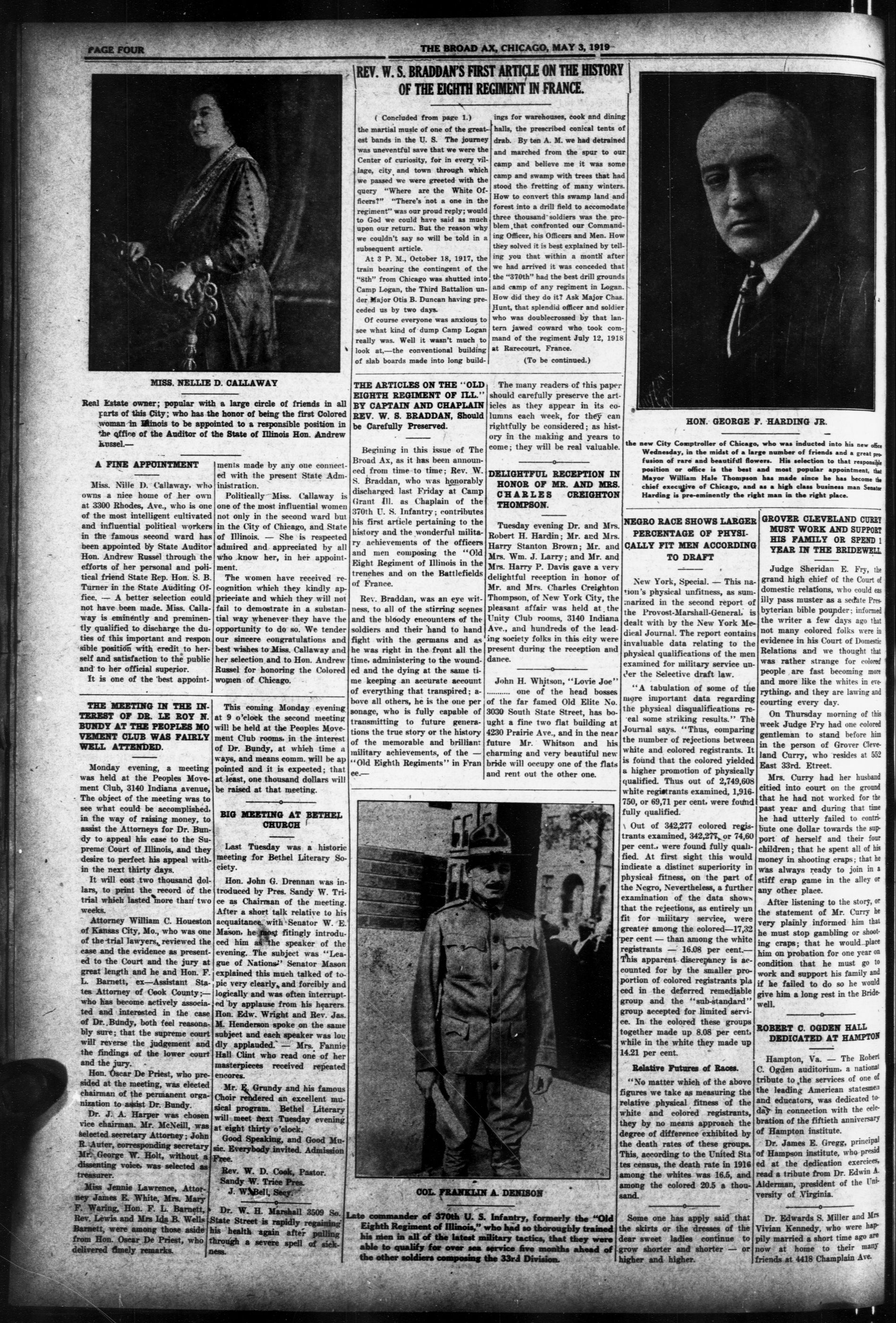
Real Estate owner; popular with a large circle of friends in all parts of this City; who has the honor of being the first Colored woman in Illinois to be appointed to a responsible position in the office of the Auditor of the State of Illinois Hon. Andrew Kussel.—
A FINE APPOINTMENT
Miss. Nille D. Callaway, who owns a nice home of her own at 3300 Rhodes, Ave., who is one of the most intelligent cultivated and influential political workers in the famous second ward has been appointed by State Auditor Hon. Andrew Russel through the efforts of her personal and political friend State Rep. Hon. S. B. Turner in the State Auditing Office. A better selection could not have been made. Miss. Callaway is eminently and prominently qualified to discharge the duties of this important and responsible position with credit to herself and satisfaction to the public and to her official superior.
It is one of the 'best appoint-
THE MEETING IN THE INTEREST OF DR. LE ROY N. BUNDY AT THE PEOPLES MOVEMENT CLUB WAS FAIRLY WELL ATTENDED.
Monday evening, a meeting was held at the Peoples Movement Club, 3140 Indiana avenue, The object of the meeting was to see what could be accomplished in the way of raising money, to assist the Attorneys for Dr. Bundy to appeal his case to the Supreme Court of Illinois, and they desire to perfect his appeal within the next thirty days. It will cost two thousand dollars, to print the record of the trial which lasted more than two weeks.
Attorney William C. Houeston of Kansas City, Mo., who was one of the trial lawyers, reviewed the case and the evidence as presented to the Court and the jury at great length and he and Hon. F. L. Barnett, ex—Assistant States Attorney of Cook County;—who has become actively associated and interested in the case of Dr. Bundy, both feel reasonably sure; that the supreme court will reverse the judgement and the findings of the lower court and the jury.
Hon. Oscar De Priest, who presided at the meeting, was elected chairman of the permanent organization to assist Dr. Bundy.
Dr. J. A. Harper was chosen vice chairman. Mr. McNeill, was selected secretary Attorney; John R. Auter, corresponding secretary Mr. George W. Holt, without a dissenting voice, was selected as treasurer.
Miss Jennie Lawrence, Attorney James E. White, Mrs. Mary F. Waring, Hon. F. L. Barnett, Rev. Lewis and Mrs Ida B. Wells Barnett, were among those aside from Hon. Oscar De Priest, who delivered timely remarks.
```markdown
```
PAGE FOUR
with a large circle of friends in all the honor of being the first Colored pointed to a responsible position in the State of Illinois Hon. Andrew ments made by any one connected with the present State Administration.
Politically Miss. Callaway is one of the most influential women not only in the second ward but in the City of Chicago, and State of Illinois. — She is respected admired and appreciated by all who know her, in her appointment.
The women have received recognition which they kindly apprieciate and which they will not fail to demostrate in a substantial way whenever they have the opportunity to do so. We tender our sincere congratulations and best wishes to Miss. Callaway and her selection and to Hon. Andrew Russel for honoring the Colored women of Chicago.
This coming Monday evening at 9 o'clock the second meeting will be held at the Peoples Movement Club rooms, in the interest of Dr. Bundy, at which time a ways, and means comm. will be ap pointed and it is expected; that at least, one thousand dollars will be raised at that meeting.
BIG MEETING AT BETHEL
CHURCH
Last Tuesday was a historic meeting for Bethel Literary Society.
Hon. John G. Drennan was introduced by Pres. Sandy W. Trice as Chairman of the meeting. After a short talk relative to his acquaintance with Senator W. E. Mason, he most fittingly introduced him as the speaker of the evening. The subject was "League of Nations." Senator Mason explained this much talked of topic very clearly, and forecibly and logically and was often interrupted by applause from his hearers. Hon. Edw. Wright and Rev. Jas. M. Henderson spoke on the same subject and each speaker was loudly applauded. — Mrs. Fannie Hall Clint who read one of her masterpieces received repeated encores.
Mr. E. Grundy and his famous Choir rendered an excellent musical program. Bethel Literary will meet next Tuesday evening at eight thirty o'clock.
Good Speaking, and Good Music. Everybody invited. Admission Free.
Rev. W. D. Cook, Pastor.
Sandy W. Trice Prea.
J. W. Bell, Secy.
Dr. W. H. Marshall 3509 So. State Street is rapidly regaining his health again after pulling through a severe spell of sick-
ness.
THE BROAD AX, CHICAGO, MAY 3, 1919
REV. W. S. BRADDAN'S FIRST ARTICLE ON THE HISTORY OF THE EIGHTH REGIMENT IN FRANCE.
REV. W. S. BRADDAN'S FIRST ARTICLE ON THE HISTORY OF THE EIGHTH REGIMENT IN FRANCE.
( Concluded from page 1. )
the martial music of one of the greatest bands in the U. S. The journey was uneventful save that we were the Center of curiosity, for in every village, city, and town through which we passed we were greeted with the query "Where are the White Officers?" "There's not a one in the regiment" was our proud reply; would to God we could have said as much upon our return. But the reason why we couldn't say so will be told in a subsequent article.
At 3 P. M., October 18, 1917, the train bearing the contingent of the "8th" from Chicago was shutted into Camp Logan, the Third Battalion under Major Otis B. Duncan having preceded us by two days. Of course everyone was anxious to see what kind of dump Camp Logan really was. Well it wasn't much to look at,—the conventional building of slab boards made into long build-
THE ARTICLES ON THE "OLD EIGHTH REGIMENT OF ILL." BY CAPTAIN AND CHAPLAIN REV. W. S. BRADDAN, Should be Carefully Preserved.
Begining in this issue of The Broad Ax, as it has been announced from time to time; Rev. W. S. Braddan, who was honorably discharged last Friday at Camp Grant Ill. as Chaplain of the 370th U. S. Infantry; contributes his first article pertaining to the history and the wonderful military achievements of the officers and men composing the "Old Eight Regiment of Illinois in the trenches and on the Battlefields of France.
Rev. Braddan, was an eye witness, to all of the stirring scenes and the bloody encounters of the soldiers and their hand to hand fight with the germans and as he was right in the front all the time, administering to the wounded and the dying at the same time keeping an accurate account of everything that transpired; above all others, he is the one personage, who is fully capable of transmitting to future generations the true story or the history of the memorable and brilliant military achievements, of the — "Old Eighth Regiments" in Fran ce
[Image of a uniformed soldier standing in front of a building with a brick wall and a flagpole.]
THE SERVICE
COL. FRANKLIN A. DENISON
Late commander of 370th U. S. Infantry, for Eighth Regiment of Illinois," who had so the his men in all of the latest military tactics, able to qualify for over sea service five m the other soldiers composing the 33rd Divis
Late commander of 370th U. S. Infantry, formerly the "Old Eighth Regiment of Illinois," who had so thoroughly trained his men in all of the latest military tactics, that they were able to qualify for over sea service five months ahead of the other soldiers composing the 33rd Division.
ings for warehouses, cook and dining halls, the prescribed conical tents of drab. By ten A. M. we had detrained and marched from the spur to our camp and believe me it was some camp and swamp with trees that had stood the fretting of many winters. How to convert this swamp land and forest into a drill field to accommodate three thousand soldiers was the problem that confronted our Commanding Officer, his Officers and Men. How they solved it is best explained by telling you that within a month after we had arrived it was conceded that the "370th" had the best drill grounds and camp of any regiment in Logan. How did they do it? Ask Major Chas. Hunt, that splendid officer and soldier who was doublecrossed by that lantern jawed coward who took command of the regiment July 12, 1918 at Rarecourt, France.
The many readers of this paper should carefully preserve the articles as they appear in its columns each week, for they can rightfully be considered; as history in the making and years to come; they will be real valuable.
DELIGHTFUL RECEPTION IN HONOR OF MR. AND MRS.
CHARLES CREIGHTON THOMPSON.
Tuesday evening Dr. and Mrs. Robert H. Hardin; Mr. and Mrs. Harry Stanton Brown; Mr. and Mrs. Wm. J. Larry; and Mr. and Mrs. Harry P. Davis gave a very delightful reception in honor of Mr. and Mrs. Charles Creighton Thompson, of New York City, the pleasant affair was held at the Unity Club rooms, 3140 Indiana Ave., and hundreds of the leading society folks in this city were present during the reception and dance.
John H. Whitson, "Lovie Joe"
..... one of the head bosses of the far famed Old Elite No.
3030 South State Street, has bought a fine two flat building at
4230 Prairie Ave., and in the near future Mr. Whitson and his charming and very beautiful new bride will occupy one of the flats and rent out the other one.
T
. Infantry, formerly the "Old who had so thoroughly trained military tactics, that they were service five months ahead of the 33rd Division.
(To be continued.)
M.
the new City Comptroller of Chicago, who was inducted Wednesday, in the midst of a large number of friend fusion of rare and beautiful flowers. His selection position or office is the best and most popular Mayor William Hale Thompson has made since he chief executive of Chicago, and as a high class bus Harding is pre-eminently the right man in the right
the new City Comptroller of Chicago, who was inducted into his new office Wednesday, in the midst of a large number of friends and a great pro fusion of rare and beautiful flowers. His selection to that responsible position or office is the best and most popular appointment, that Mayor William Hale Thompson has made since he has become the chief executive of Chicago, and as a high class business man Senator Harding is pre-eminently the right man in the right place.
NEGRO RACE SHOWS LARGER PERCENTAGE OF PHYSICALLY FIT MEN ACCORDING TO DRAFT
New York, Special. — This nation's physical unfitness, as summarized in the second report of the Provost-Marshall-General, is dealt with by the New York Medical Journal. The report contains invaluable data relating to the physical qualifications of the men examined for military service under the Selective draft law.
"A tabulation of some of the more important data regarding the physical disqualifications real some striking results." The Journal says. "Thus, comparing the number of rejections between white and colored registrants. It is found that the colored yielded a higher promotion of physically qualified. Thus out of 2,749,608 white registrants examined, 1,916,750, or 69,71 per cent, were found fully qualified.
Out of 342,277 colored registrants examined, 342,277 or 74,60 per cent., were found fully qualified. At first sight this would indicate a distinct superiority in physical fitness, on the part of the Negro, Nevertheless, a further examination of the data shown that the rejections, as entirely unfit for military service, were greater among the colored—17,32 per cent — than among the white registrants — 16.08 per cent. This apparent discrepancy is accounted for by the smaller proportion of colored registrants placed in the deferred remediable group and the "sub-standard" group accepted for limited service. In the colored these groups together made up 8.08 per cent, while in the white they made up 14.21 per cent.
Relative Futures of Races.
"No matter which of the above figures we take as measuring the relative physical fitness of the white and colored registrants, they by no means approach the degree of difference exhibited by the death rates of these groups. This, according to the United States census, the death rate in 1916 among the whites was 16.5, and among the colored 20.5 a thousand.
Some one has apply said that the skirts or the dresses of the dear sweet ladies continue to grow shorter and shorter — or higher and higher.
---
so, who was inducted into his new office large number of friends and a great prowers. His selection to that responsible and most popular appointment, that man has made since he has become the as a high class business man Senator right man in the right place.
GROVER CLEVELAND CUREY
MUST WORK AND SUPPORT
HIS FAMILY OR SPEND 1
YEAR IN THE BRIDEWELL
Judge Sheridan E. Fry, the grand high chief of the Court of domestic relations, who could easilly pass muster as a sedate Pressbyterian bible pounder; informed the writer a few days ago that not many colored folks were in evidence in his Court of Domestic Relations and we thought that was rather strange for colored people are fast becoming more and more like the whites in everything, and they are lawing and courting every day.
On Thursday morning of this week Judge Fry had one colored gentleman to stand before him in the person of Grover Cleveland Curry, who resides at 552 East 33rd. Etreet.
Mrs. Curry had her husband citied into court on the ground that he had not worked for the past year and during that time he had utterly failed to contribute one dollar towards the support of herself and their four children; that he spent all of his money in shooting eraps; that he was always ready to join in a stiff crap game in the alley or any other place.
After listening to the story, or the statement of Mr. Curry he very plainly informed him that he must stop gambling or shooting craps; that he would place him on probation for one year on condition that he must go to work and support his family and if he failed to do so he would give him a long rest in the Bridewell.
ROBERT C. OGDEN HALL
DEDICATED AT HAMPTON
Hampton, Va. — The Robert C. Ogden auditorium, a national tribute to the services of one of the leading American statesmen and educators, was dedicated today in connection with the celebration of the fiftieth anniversary of Hampton institute.
Dr. James E. Gregg, principal of Hampson institute, who presided at the dedication exercises, read a tribute from Dr. Edwin A. Alderman, president of the University of Virginia.
Dr. Edwards S. Miller and Mrs Vivian Kennedy, who were happily married a short time ago are now at home to their many friends at 4418 Champlain Ave.
COL. HARRY H. BIGGS
Commanding the First Regiment Uniform Rank Knights of Pythias of Illinois, who will be in evidence at its annual May Ball. at the Eighth Regiment Armory, Monday evening May 5th.
ANNUAL MAY BALL BY THE FIRST REGT. UNIFORM RANK KNIGHTS OF PYTHIAS.
Monday evening May 5, the First Regiment Uniform Rank Knights of Pythias of Illinois; Col. Harry H. Biggs, commanding, will give its annual May ball at the Eighth Regiment Armory 3517 Forest Avenue.
The music will be furnished by Steward's famous Knights of Pythias Band; it will be a grand affair in every way and all of the big Sir Knights and the smaller Sir Knights, their friends and the public in general will be on hand, to help to swell the great crowds of people, who always attend the annual May Ball. Admission 50 cents. — Adv.
BIG BENEFIT FOR PHYLIS
WHEATLEY HOME
At the South Park Church, 33rd and South Park Ave., May 8, 1919 under the auspices of the Board of Directors. Committee Mme. Bertha L. Hensley, Mrs. Ruth Alexander Smith chairman, Mrs. Rachael E. Cross, sec'y., Mrs. Elizabeth Lindsay Davis, Treas. Admission 35 cent at 8 o'clock prompt.
The Benefit is styled "The Re-Appearance of Mme. Hattie Lucas" a woman of wondrous renown in the South and West. Mme. Lucas appeared with success in Bethel church ten years ago. Since that time she has been forced to retire from public service on account of the heavy hand of the Reaper-Death. She now comes to us after touring thru the South and this winter and singing in the schools and colleges of Tenn., Kansas, Arkansas and Missouri. Mme. Lucas has studied 35 years under America's ablest teachers.
She is to be supported by Mr. Henry Etheridge, Chicago's youngest tenor. A youth who promises to be more famous than MacCormack. To him study means nothing if it is to take him where he aspires to go. All Chicago's music lovers are coming to hear him.
Miss Elsie VonDickesson from Denver, Colo., a splendid young reader has contributed her talents so that the recital might be a success.
Mr. Chas. L. Reese and his famous choir have graciously consented to aid the work that until now has been supported by the efforts of a few Mr. Reese, is one of the busiest men in the auto world has found time to train a chorus of splendid voices for service in the community. No music lover can miss hearing them.
The following celebrities of the musical world are aiding the committee with the patronage: Mrs. George Holt, Mme. Martha B. Anderson, Mrs. Maude Roberts George, Mme. M. Calhaway Bryon, Mrs. J. W. Harper, Mr. Charles E. Elgar, Miss Nannie Mae Strayhorn, Mr. William Sulzer, Mrs. Pelagie Bland, Miss Mary Jones, Miss Zonibia Taylor, Miss Clara M. Dudley, Prof. James A. Mundy, Miss Pauline James Lee, Prof. S. I. Lee, Mrs. Martha Simon Thomas, Prof. Harrison Emanuel, Mrs. David Mitchell, Prof. B. Emanuel Johnson
Uniform Rank Knights of Pythias dence at its annual May Ball, at Monday evening May 5th.
The music will be furnished by Steward's famous Knights of Pythias Band; it will be a grand affair in every way and all of the big Sir Knights and the smaller Sir Knights, their friends and the public in general will be on hand, to help to swell the great crowds of people, who always attend the annual May Ball.
Admission 50 cents. — Adv.
The admission to this recital is within the reach of everyone just 35 cents. This is to be the biggest affair of its kind for the season. Tickets on sale at Poters' Pharmacy, 35th and State, Saunders Pharmacy, 48th and State, Y. M. C. A., Brooks' Pharmacy, 53rd and State, Moore's Pharmacy, 35th and Grand Blvd., Idlewild Hotel, 33rd and Wabash.—Adv.
The Elete Social Charity Club entertained the soldiers from "Over There" Sat. eve. April 26, at the home of Mme. Bertha L. Hensley, 3528 Vernon Ave. A Pqanut Hunt and a huge Guess Box a6orded much merriment, Mrs. Leut Southe receiving the prize for peanut hunting. A delightful luncheon was served amid a shower of National colors. The seventy five guests departed after a delightful eve. Stella E. Walker, Reporter.
Mr. and Mrs. John H. Carr, Mrs. Nelle Adams, Miss Lorene Adams, mother and sister, Mrs. Carr, all left Thursday evening over the Santa Fe for Chicago, Ill., their future home. Mr. Carr visited his mother in Brenham, Texas, Monday, before leaving for Chicago.
All the above are well known Galvestonians, having lived here for many years. Mr. J. H. Carr being in the tailoring business. Mrs. Adams has a daughter living there. Mrs. Celeste H. Clark; Mrs. Carr a son, Mr. Joe Sutton. A large gathering of friends were at the Union Station Thursday evening to see them off and to wish them Godspeed to Chicago. Some beautiful flowers by friends were brought them to the station and the spirit of them rent the heart of all as the Santa Fe train pulled out at 6:30 p. m. and the Galvestonians were bade farewell by many ladies and gentlemen.—The Times, Galveston, Texas, April 26, 1919.
Mrs. J. S. Dorsey, the dutiful wife of Dr. J. S. Dorsey, the popular druggist at 2701 So. Dearborn St., has for the past three weeks been visiting her relatives and friends at Wall Drop, Va. and on her way home Mrs Dorsey will spend several days in Philadelphia, Pa., and will then arrive home the 10th or 12th of May.
CLUB NOTES
THE BROAD AX, CHICAGO, MAY 3, 1919
U. S. DEPARTMENT OF LABOR INFORMATION AND EDUCATION SERVICE WASHINGTON
That good will and co-operation between white employers, white workers and Negroes will do a great deal to solve the future labor problems involving Negro workers is the belief of officials of the Department of Labor. The Department during the war and the past months of reconstruction has formed cooperative Negro Workers' Advisory Committees which leave local problems to local committees free to make their own decisions and to devise means for carrying effort to increase the efficiency of Negro workers.
The service rendered by the Director of Negro Economics and his assistants is of an advisory character, and no attempt has been made to create a separate bureau. The plan and spirit underlying the movement is cooperative, especially through local cooperatively advisory committees of white and colored people. These committees are local in control and character.
The work was undertaken during the war as a means of solving Negro labor problems incident to the presecution of war work. Negro Workers' Advisory Committees formed in several states and in many counties, "to study, plan and advise in a cooperative spirit and manner with employers of Negro labor, with white workers, and with Negro workers and with the United States Department of Labor, in securing from Negro laborers greater production in industry and agriculture through increasing regularity, application and efficiency, through increasing the morale of Negro workers and through improving their general condition."
Under the title, "Department of Labor and the Negro Problems," a detailed study of the work of the Division of Negro Economics has recently been made by George L. Boyle, special investigator for the Lumber World Review, and published in that magazine April 10. This study, as the editor says, describes at some length, without bias, editorial opinion or suggestion, what has been accomplished and what is being contemplated. The Study is of special interest to the lumber trade in view of the large number of Negroes employed in that industry in the South.
The Negro advisory committees were made up of representatives of white employers, of Negro wage earners, and, where possible, white wage earners. These committees linked employers, employees and such agencies as churches, lodges, women's clubs, and the like, through which the Negro workers were influenced. To supervise the work of these committees, supervisors of Negro economies were appointed in nine states where the work was undertaken—four southern and five Northern States.
During the war a great deal was done to assist the Employment Service in recruiting and placing of Negro labor most effectively, and to make certain that unemployed men were found work as near home as possible. Since the end of the war these cooperative advisory committees of white and colored people have been helping to find work for demobilized soldiers.
Before the committees were formed in a State or locality, State and local conferences, of white and colored citizens were held and the plans and methods were freely and fully discussed; these conferences always developed a better understanding between the races. An informal national conference was also held in Washington. Through these cooperative committees' activities, special educational campaigns and discussions have been carried into hundreds of Negro gatherings in churches, lodges and thrift. Efforts have been made to acquaint employers with the needs and desires of the Negro workers, such as better housing and sanitation and better schools.
It is the opinion of those interested on behalf of the Negro that as Negroes number about one-seventh of the working population, they should have representation when matters are discussed affecting their welfare. Given such representation, it is held, the Negro responds well to opportunities presented him.
In short the aim of the Negro economics work is to do away with possible misunderstandings, prejudices, antagonisms and fears which prevent amicable adjustment of relations of white employers, Negro workers and white workers in order that the productive capacity of Negroes may be utilized to the full extent without danger to any interest of the others.
THE ERA MAGAZINE FOR JUNE
IS WORTH READING
New Era Magazine, official medium of the Presbyterian Church in the U. S. A., in its June issue will record the remarkable showing made by the Negro Presbyteries of the South in the Church's New Era Victory Fund Campaign.
"At the time we entered the European war", says New Era Magazine "the Colored people of the South were challenged by the Government as never before. They accepted the challenge and at the close of the war the colored troops returned from Europe with a fighting record and morale equaled by few and surpassed by no regiments of the whole American Army.
"In the beginning of the Presbyterian New Era Movement the Colored people were again challenged this time by the Presbyterian Church, and the way in which they have met that challenge is not surpassed by the valor and morale of their men on the battlefield.
"In the Presbyterian Victory Fund Campaign the Negro Presbyteries have increased their subscriptions for benevolences from $2,000 last year to nearly $50,000 this year. One Negro pledged the product of one acre of cotton, guaranteeing it to yield at least $125. In addition he pledged $20 for his wife and children. His church jumped its benevolences from $20 to $600.
"Another church standing alone in the midst of a plantation drew 118 rigs over bottomless roads in the height of the muddy season on Victory Fund Sunday and jumped its benevolences from $60 to $700. The ambition of the Southern Negroes is to express their appreciation for their development and education by the Présbyterian Church."
To All the Ministers Residing in the Second Ward.
The following announcement has been made and it is indeed worthy of consideration and action by the people of our Ward.
"This is to inform you that May 11th to 17th is to be "Health Promotion Week." Health promotion week it is to be this year. Last year it was "Cleanup Week" and the same in years previous; but this year it is to be on a bigger scale, more comprehensive, hence the change in name.
"Plans for the week when every householder will be asked to help out by cleaning up his back yard and piling the dirt and debris in the alley and street behind and in front of his home, are being made by Health Commissioner, John Dill Robertson."
We have arranged to provide extra men and additional wagons to assist in this work during the week of May 11th to 17th and shall be glad to interest you and the members of your splendid congregation in this work to the end that we may have the cleanest ward in Chicago when the clean up is over. We will thank you to read this letter at one of your Sunday Sermona.
COLORED PEOPLE OWN MUCH PROPERTY IN PHOENIX.
Phoenix, Ariz. (Special)—There are 1,700 Colored people in Phoenix, who own property valued at $700,000, they are represented in all the professions except law, and in all the trades. Ninety per cent of the Colored people own their own homes. There are four churches and the Tribune is the local race newspaper.
M. E. H.
the aged mother of the editor of this paper, who closed her at Harrisburg, Pa., April 26, 1917, and was laid to Cemetery in that city, Sunday, April 29; at the time of had lived on this earth ninety-two years, seven months days. She had been a devoted member of the Bap had lived on this earth ninety-two yers seven months ever emerged from the house of bondage.
the aged mother of the editor of this paper, who closed her eyes in death at Harriaburg, Pa., April 26, 1917, and was laid to rest in Midland Cemetery in that city, Sunday, April 29; at the time of her death she had lived on this earth ninety-two years, seven months and twenty-nine days. She had been a devoted member of the Baptist Church for had lived on this earth ninety-two yers seven months and tweney-nint ever emerged from the house of bondage.
COLORED BOY IS BEATEN AS
RACE WAR CONTINUES
Further evidence of racial bitterness on the south side was found by the police the first of this week in the "slugging" of Henry Proctor, 4333 Forrestville ave. His mother notified the police that six white boys armed with sticks had beaten the boy "because he was colored." He encountered them at Forty-third Street and Forrestville ave. and attempted to go by when one of them said. "You're the guy who insulted my sister," the police were told. Mrs. Proctor said her son knows no white girls. Henry is 16 years old, and a pupil of the Wendell Phillips High school.
ROCKY MOUNTAIN EVANGELIST
RETURNS TODAY.
Dr. H. Franklin Bray the Rocky Mountain Evangelist who has been in the far east for several weeks in revival campaigns will reach the city today and preach at the Sunshine Rescue Home Sunday night. Dr. Bray's work in the east has been usually successful and the Pittsburgh, Baltimore and New York papers have spoken of him in the highest praise. In connection with his evangelistic work Dr. Bray Superintends the Sunshine Rescue Home where services are held every night in the year.
The Lyceum was addressed by Mr. C. W. Pierce returned War See'y of the Y.M.C.A. with the 370th. in France. Mr. Pierce responded to the call of the large audience when it was seen that Chaplain Braddan was unavoidably absent. Mrs. Bishop Wilbur P. Thirkield, of New Orleans, National President of the W. H. M. Society, delivered the evening message. The Peerless Ladies Octelle sang. Mrs. Bodkins of Los Angeles( also addressed. There were 17 additional for the day. Monthly communion and sermon by Rev. W. H. Wall, an assistant Pastor next Sunday morning. Every member canvass for our financial plan Sunday afternoon.
Would Do Better Next Time.
Would Do Better Next I like.
While in the act of playing coallman Robert dumped some building blocks out of his slater's doll buggy. His sister being asleep at the time, I told him to make less noise, as he might wake her up. His answer was: "I'll get soft coal next time, daddy, and she won't wake up."
The Baby Scal
When seals are born they are snow-white, which makes them invisible on the ice on which they lie. Their eyes and noses are black, and when the little ones are suddenly alarmed they close their eyes, bury their noses and lie quite still.
MALA
paper, who closed her eyes in death 17, and was laid to rest in Midland April 29; at the time of her death she years, seven months and twenty-nine member of the Baptist Church for yers seven months and tweney-nine bondage.
No Words Wasted.
The shortest review of a book that we have heard of was that published in an American paper recently. After mentioning the title, the author, and publisher, it passed judgment in the one word, "Shake."
Grouch and Bad Health.
Scientists tell us that it takes the body three months to recover from an attack of anger. A grouch, then, must be constantly trying to get back to good health.—Detroit Free Press.
Valuable Discovery.
It has been found possible by aviators to use magnetic compasses by mounting them on horsehair cushions, which counteract the vibration of airplanes.
The Difference.
Vanderbilt, the elder millionaire, used to boast that he only wore a suit of clothes once. Many of us are like that, of course—only it is a much longer once.
Our idea of a man who is completely occupied is a cross-eyed fellow with the St. Vitus dance trying to kiss a two-faced girl with a hare lip.
Optimistic Thought
Speaking silence is better than sense less speech.
Makeshift, as It Were.
A strange family had recently moved into the neighborhood. Robert had made the acquaintance of the small son and had learned from him that the man was only the boy's stepfather, and, in explanation to me, Robert said: "It ain't James' own daddy, mamma; he's just a second-handed one."—Chicago Tribune.
The origin of "windfall," in the sense of "good luck," dates from the time of William the Conqueror. It was then a criminal offense to cut timber in the forests. Only such could be gathered as the wind had blown down; hence, a heavy windstorm was hailed by the peasants as so much good luck, and from this comes the modern application of the expression.
The Time He Hurries
When a seventeen-year-old boy's father tells him it's time he was picking out a trade he doesn't see any reason to hurry. But when his girl tells him the same thing he begins deciding between statesmanship and professional baseball right away.—Kansas City Star.
Seems an Unfair Division.
Thousands of hats discarded by English women are exported every year to Brazil, where they are eagerly bought by the Indians. The feathers and other ornaments on the hats are taken by the men, and the bare straw shapes given to their womenfolk.
Heat and Tuberculosis.
Heat and Tuberculosis.
James B. Murphy and Ernest Sturm
(Journal of Experimental Medicine)
subjected mice to heat and a week
later inoculated them with a strain of
tuberculosis virulent for mice. These
animals displayed a greater resistance
than normal.
PAGE FIVE
Add Industry
A Windfall.
An American business man had become convinced of the reasonableness of the doctrine of man's stewardship. He had thought it all out and decided that it might be a good thing to try the experiment. His various business enterprises had prospered; his income was constantly increasing; he certainly could do things which he might have done but had not. One night he lay awake pondering the whole matter, and before going to sleep prayed over it. Then he made up his mind, says the Christian Herald. Next morning he instructed his bookkeeper to open in the ledger a new account in his name, and marked "Special," to which the bookkeeper should regularly carry one-tenth of all the profits. He warned him never to fall to have the "Special" account ready when called for.
And that business man's "Special" has never failed. It has been to him a wonderful revelation of the capacity of a man immersed in big enterprises for dorg good on a large scale as a side line. It has helped to build churches, to promote the gospel, to support missionaries, to maintain and train orphans, to bring gladness to homes of suffering and to many shut-ins. He has had a hand in a hundred noble enterprises for Christ and humanity. And the most extraordinary thing about it is that it has given him a new zest for business, having, as he himself would say reverently, God as a silent partner. It has not only been a means of blessing his business, but it has purified his whole life, ennobled his character and made him ten times a better man.
MEANS END OF ALL THINGS
Number "30." Originally Newspaper Symbol, Has Come to Have Significance of Dire Import.
By frequent reference to it, noted by newspaper readers, doubtless the meaning of that caballistic symbol "30" has become familiar to many, but this indent and explanation is printed in connection with the obsequies of Sir Wilfrid Laurier, in the Montreal La Patrie. "What does that signify?" was asked by thousands who filed past the casket of Sir Wilfrid Laurier and had remarked the bouquet of flowers upon which lay the symbol "30" in red figures. This floral tribute was given by members of the press gallery in the Dominion parliament. For them this number means the same as the words which the great departed pronounced some days after being stricken by his malady: "It is ended." (C'est finl.) The origin of this conventional symbol has been lost in the traditions of journalism, but after each night and at the end of every day the conventional "30" traversed the continent from end to end. Editors in time adopted the sign "30" to inform the staff, the various news departments' and the composing room that all the "copy" was finished and that there would be nothing additional. Finally, for newspaper men, the number "30" became the symbol of the end of all things of earth, and even of life.
Yanka Like French Souvenira.
Yanks Like French Souvenirs
Yankee soldiers are keeping the French shops busy these days. Souvenirs of France and various regions and cities of France are all the go. Among these souvenirs are brooches bearing the arms of different cities. The head of the famous Lion of Belfort, the statue of Bartholdi, the sculptor who designed the goddess of Liberty, is another favorite. The Loralne cross has also proved very popular with the Yanks. This symbol has two sets of cross arms instead of one. It appeals particularly to the Americans because of the part which the Yanks played in Lorraine during the war. The Red Cross dog and the lucky white elephant charm are other French souvenirs which the Americans are procuring in large numbers to take back to the States.—From The Spiker, France.
Famous Old Inn Gone
The city of Augsburg has seen the last of that famous inn, "Drel Mohren," or preferably, in sonorous French, "Thotel des Trois Maurea." The Bavarian revolution has demolished it with the famous room and fireplace in which the financier Pugger, to save his life, lit a fire with all those "I. O. U.s." awkward reminders of a monarch's indebtedness. It was in this hostelry, too, that Marie Antoinette put up on her way to France to become the wife of the dauphin. Over the lintel of the "Trois Maurei" were carved the lilies of France in commemoration of the event. Now the inn and the lilies have disappeared in another such cataclysm as swept Marie Antoinette to the guillotine, some hundred and twenty-odd years ago.
They Were Prepared.
The wife of an Indianapolis merchant was recently quite sick. One day after she had improved a bit and her seven-year-old son had been permitted in her room for a little visit, she voiced the thought that had worried her all the time while she had been ill. "Ted," she asked, "what would you have done if mother had died."
Back came Teddy's startling answer: "Oh, the girls could have gone to grandmother's to live and papa and I—we'd have gotten us a new wife right away."
New Words and Phrases Most Frequently Have Their Origin in the Patter of Thieves.
It is necessary that the language of a nation should be refreshed and strengthened now and then by the introduction of new words and phrases, and, as belts democracy, these spring from the soil; not one of them descends upon us from the Olympian heights, observes the New York Herald. Neither scientific nor scholastic bodies ever enrich the common tongue with expressions so apt and full of meaning that they gain immediate and enduring vogue. The slang of the undergraduate collegian is pitifully incept and meager.
For anything that can give a new 'nest to the vulgate we must look to the stage, the gambling house and even to the opium den and thieves' resort. Returning soldiers will certainly bring with them much of the argot of field and trench of which "cooties" is a sample. The word "joint" as applied to infliutous and other resorts comes from the joint of bamboo from which an opium pipe is made. "Dope" was originally the slang term for opium—hence "dope" and "dopy." Innumerable are the verbal products of the gambling house. Among the commonest of them are "four flushing," "keeping tab," "standing pat" and "down to cases." To "give the office" or "office" some one is a very old bit of London thieves' slang.
The cause of all this is quile apparent to the thinking mind. Persons of education and cultivation have a vocabulary of their own sufficiently large and varied to enable them to express themselves without going beyond its limits. Those who are lacking in education sometimes coin words in an emergency that prove so expressive that they acquire general currency.
SUBSEA VESSELS AN OLD IDEA
Inventors Had Thoughts of Such Craft Centuries Ago; as Ancient Records Giv@ Proof.
Not in 1680, when Lord Verulam first made a vague allusion to the subject, but in 1648, it seems, was first mention made of the submarine; and then at some considerable length in a memoir published at "The Brazen Serpent, in Paul's Churchyard." And with this discovery comes another, that the submarine, or "Ark for Submarine Navigation," as the author, John Wilkins, terms it, had been tried and found a practical possibility in the days of the civil wars. "Cornelous Dreble" had experimented with "the contrivance," "here in England," and "found it feasible." There is something captivating Elizabethan about this John Wilkins, "Chaplain to the Prince Elector Palatine," and his farsighted consideration of the submarine as a war auxiliary. Londoners became acquainted with him one March evening recently, as they opened their Pall Mall Gazettes and dipped into the contents. "Cornelous Dreble, and his contrivance" arouse a tantalizing curiosity.
Live Stock for Belgium
No one in Belgium rejoiced more heartily when the Germans were driven out than the small farmers whose lot under the invaders had been made intolerable by the constant requisitioning of produce and stock by the enemy. A British farmer, who has just returned from the wide agricultural district around Menin, reports that the country is now practically devoid of live stock and that tillage and farm operations generally are at a standstill in consequence. Efforts are being made by the agricultural relief of allies committee to replace the animals in that neighborhood killed or stolen by the Germans with good British stock and a first consignment of dairy cattle will be forwarded in the course of a few weeks. These animals will, it is hoped, play a valuable part in restocking the farms of the peasants which lay across the path of the Germans in their march toward Calais.
The Fishing Worm
William Brake is a little fellow living in Eastern avenue. Birds, fishing worms, crickets and spiders are strange creations to him this year and he has not been fully able to determine just what kind of noises they make when happy and when angry. A few days ago William was watching a neighbor woman prepare ground for flowers. An unusually large fishing worm came to the surface.
"What is that?" William asked excitedly.
"That is a fishing worm."
"Well, I thought I heard her going 'tweet,' 'tweet' a while ago when you commenced digging," he said, and ran to tell his mamma of the strange animal.-Indianapolis News.
Taxes Drive Out Estates.
There are, or were before the war, nearly 1,000 great country estates scattered over Great Britain, many of which have now been closed because of the huge taxation. Of these sixty may be classed as private palaces, for each required a staff of from 200 to 600 servants and attendants. Outside of the household servants there were many men employed as caretakers for the grounds, gardens, parks, coverts, outbuildings and stables. — Rocky Mountain News.
THE BROAD AX, CHICAGO, MAY 3, 1919.
Many Reasons for Appalling That the Nation Is About Ready to Take Important Step.
It is only fair to assume that our country is steadily moving in the direction of compulsory sickness or health insurance. The reasons for this assumption are many, but among the most important are the following: (1) The force of the example of England and of eight other European countries with whose social insurance laws the people of this country are rapidly becoming familiar; (2) the general favor with which the proposed legislation is regarded by the extremely active and influential body of social workers in the United States; (3) the appointment of no less than eight commissions to investigate health and other forms of social insurance; (4) the support of the movement by numerous public health administrators and experts; (5) the gradual but irresistible swing of organized labor from opposition to support; (6) the present sympathetic attitude of the leading political parties toward the demands of labor; (7) the willingness of labor, officially expressed through state labor federations, to assume half the cost of the proposed insurance, and (8) the readiness of various state legislatures to act upon social reform measures which do not threaten to add to the troubles of the overburdened taxpayer and incidentally to those of the legislator.
These reasons, declares Modern Hospital in an editorial on the subject, are clearly indicative of the fact that the trend of the country's thought is in the direction of health insurance.
NOTHING SACRED TO YANKS
Ancient Edifices, With Their Historic Memories, Have No Power to Overawe American Soldiers.
You can't awe a Yank. You can feast his eye and his mind on history and castles and things that are so old they are sacred. But you can't awe him, Stephen Doughton writes in Chamberlain's. You can, as has been done, for instance, take him to Warwick castle and show him the moat, the portcullis, Caesar's tower and wonders that date from 900 A. D. Then when he sees the broad rampart on the castle wall he thinks what a fine place it would be to dance, and he does.
Recently a hundred Yanks on leave in England made a two-day tour. They played baseball at the home of the late William Shakespeare, Stratford-on-Avon; visited Leamington Spa, Coventry, Warwick castle and the ruins of the famous Kenilworth castle. Just to add a sort of finishing American touch to the tour-they had peanuts at Warwick-think of it, peanuts at sacred Warwick.
But lest the Yanks be falsely accused of carrying peanuts to Warwick let it be noted that Harry Gordon Selfridge, a former Chicagoan, now a department store man in London, sent up 50 pounds of the delectable goobers just to make the boys feel at home while gallivanting about the castle's moats and ramparts and towers and places.
Life in Archangel.
The girl problem is as serious in Archangel, Russia, as in any big military center, says Miss Elizabeth Boles, director of Y. W. C. A. work in Russia, who is home on a short leave of absence.
"Many girls from central Russia went up to Archangel to spend the summer because of the heat and of the food shortage and when military operations were begun in the territory surrounding they were unable to go home. They were virtually refugees without goloshes, furs and the heavy winter clothing necessary in that northern region. With the coming of the expeditionary force the housing question became a serious one. We Y. W. C. A. secretaries have fairly comfortable quarters—rooms with beds in and lighted with electricity. To be sure there are several of us in each room.
"Many girl clerical and stenographic workers were needed of course at army headquarters and at the postoffice. This offered employment to some of the refugees and women are doing everything in Archangel, even to running trarcars and trucking. They need organized recreation and that is what we are trying to give them.
Mosquito Fleet.
Among naval men the mosquito fleet is known as "the second line of defense." It is used in protecting the fortifications and harbors along the coast line, and, like the insect from which it is named, annoys the enemy in every way, at the same time preventing the possibility of a blockade. In the war against Germany the British navy was augmented by several thousands of small and sometimes very speedy vessels, and to this mosquito fleet, manned chiefly by naval reserve men and fishermen, the admiralty paid tribute for its patient and laborious work in laying and sweeping up mines, chasing submarines and patrolling the home waters.
Our Language.
A French soldier, enthusiastic over the beauties of his beet girl, was endeavoring to convey an idea of some of her charms to an English comrade. "She is pretty," the Frenchman said. "Yes, I see, fairly pretty, eh?" the Englishman replied.
"Ah! that is the word! She is fair."
"O, yes, pretty fair!" the Englishman responded—Cartoon Magazine
HOME-MAKING NOT SO EASY
Housewife Seems to Be Right When She Condemns Ideas Formulated by the Theorists.
"I am always amused," said the housewife, according to the New York Evening Post, "at the proposition we so often read and hear that mutilation and factory girls enter domestic service. The theorists seem to imagine that such a change can be accomplished right about face—overnight, in the twinkling of an eye. Good housework, of the sort that should be our standard, is not so easy as all that. While I don't consider that housework requires lifelong training, yet never have I taken a girl from a factory who knew the difference between a cloth for washing dishes and one-for wiping floors. As a rule a factory girl is ignorant of the simplest sanitary essentials that stand for home making. Cooking she may be taught, and cleaning she may learn, but the basic principles and habit are not picked up so readily. Many a time have I said to a maid: 'Had you gone to kindergarten you would never have piled your dishes and saucers like that.' It was at a kindergarten conference in California, you may recall, where it was said that no convicted criminal in that state had had kindergarten training. Besides their uncertain help in the homes of others think how wanting in their own homes—when they get them—these young factory girls will be—unless they pick up considerably more knowledge about domestic ways and means."
HAS SOMETHING OF A JOB
Bill Is Finding That Thinking Up an Explanation Is by No Means an Easy Task.
Bill Dudley and eleven other pinchle players who are members of a progressive pinchle club left their South side homes to go to Beech Grove the other night. While at Fountain square waiting for the Beech Grove car Bill and Joe Beck got too far away from the car to catch it and the other ten went to Beech Grove. Then Bill got an idea and he and Beck stole home to where Bill's car rested—for his wife won't let him take it out after dark. They opened the garage door noiselessly, pushed the car out and down the street for a block and then stepped on the starter. They got to Beech Grove before the rest of the club did.
Bill and his friend Beck drove home after the club meeting and repeated the performance in getting the car back in the garage. Then he went into the house. Presently the crowd came along and yelled at Bill through the window. Of course, that entailed explanations on Bill's part to his wife as to how he got home-first. The other members of the club say Bill has not yet been able to explain to his wife how he beat them home.—Indianapolis News.
Not Worth a Booster
Having lived next door to the home of a minister, I was often called in to witness a hasty wedding.
On one occasion the prospective bride and bridegroom arrived in a farm wagon. After the ceremony was duly performed the bridegroom asked to be excused just a moment, and on returning from his wagon he said: "Parson, I have no money to give you, but here is a nice young rooster for your Thanksgiving dinner, and I will bring you a turkey for Christmas."
On several occasions the minister saw the same man in town, who seemed to avoid him. One day on meeting him face to face he said: "Parson, I may as well tell you that I am not going to bring that turkey; I have found out she was not even worth the rooster I gave you."—Chicago Tribune.
Return of the Ox.
The ox as a beast of burden is coming into its own again in the farming communities of Maine and the oxing and apparatus used by blacksmiths in shoeing the animals, long ago thrown into the discard, is in use again. The sling consists of a rude frame of timber into which the animal is fastened by a pillory. Straps are then drawn under the body, the ends being made fast to upper timbers of the frame. In blacksmith shops 20 years ago the slings were common. Oxen are less expensive to feed than horses and are equally as useful on small farms and the rising value of feed is having much to do with the comeback of the ox as a work animal.
Found an Executive
The boys in a small Indiana high school desired a football team, but got no encouragement from their principal. who is a young woman. Finally they asked her if they could hold a meeting to organize a team. She gave her consent, but offered no comment other than, "I'm afraid you boys aren't good enough executives to manage such an affair." The next morning they told her the result of their meeting. "We organized our team" they said, "and, remembering what you told us about needing good executives, we elected you captain."
The medical officer on a troop traits was explaining the nature of the influenza germ to the colored porter. "Well, Cap'n, 'pears to me that that guhm would freeze to death in this cold weather, 'cause an animal o' that size would hardly have blood enough to keep body an' soul together."—Frederic W. Ganzert in Judge
Commander John G. Towers, who is in charge of the navy's transatlantic flight plans, said at a New York banquet:
"The better late than never method doesn't go in aviation any better than it went in the Jones case.
"Jones was a drummer and his wife during one of his trips gave birth to a son and seemed in a pretty bad way in consequence, so a telegram to that effect was given to the hired girl for dispatch to Jones, but the girl put it in her apron pocket and forgot all about it.
"Well, by luck, the next day Jones came home. His wife was then much better. He saw his son and departed again well pleased.
"A couple of weeks passed when the hired girl found the forgotten telegram in her pocket and in a panic sent it off to Jones, saying nothing to anybody about her remissness. And that is how it came about that Jones was horrified at dinner at his hotel that evening to get a wire which said:
"Another addition, a son; your wife very ill; return at once."
"Another? poor Jones, groaned. 'Impossible!' Then he added. 'What a terrible thing! Her condition must indeed be very grave.'
"He took the express and got home the next morning in a state of frenzy. The hired girl confessed all."
"I thought it was better to send the telegram late than never, Mr. Jones,' she said."
ASIA GREAT DANGER POINT
Is Today, and Has Been for All Time, the Home of Plague and Pestilence.
Asia is the home of plague and many other pests. The facilities for travel have brought Asia and our Pacific coast together, while the possession of the Philippines has multiplied the occasions for intercourse with the far east. Thus, says the Journal of the American Medical Association, the diseases of Asia threaten the lives and health of the American population, and the situation has been aggravated by the conditions of war. With the unvarying persistence of bubonic plague in Asia, it seems timely to lay further stress on these points.
The obstacles in the way of successfully grappling with the plague problem in Asia are almost insurmountable. The natives object to wholesale inoculation and rat destruction; hence the only effective mode of procedure is most difficult to carry out. Religious scruples against the slaughter of animals, even vermin, are prevalent throughout India. Consequently it may be taken for granted that plague will continue to persist in Asia, and as it is extremely rife in the two great ports of that continent, Hong Kong and Bombay, it is not an impossibility that it will be conveyed thence to American ports on the Pacific coast. While there is no doubt that our health authorities are awake to the danger, it is well to know that the danger exists in Asia.
History Repeats Itself
A charming little incident has taken place in Doctor Johnson's house, Gough square. A party of soldiers visited the Mecca and they got a colored member of the party to read aloud from the famous dictionary. He did so in excellent style. An inquiry revealed the fact that he was a native of Jamaica. All lovers of Johnson will remember it was Francis Barber of Jamaica who was the doctor's faithful servant, to whom he deft, a handsome bequest. And Barber once went to sea. The coincidence of a Jamaican sailor reading aloud the dictionary in the old house was certainly curious.—London Daily Chronicle.
"Golden Bell." Famoua Irish Relle.
"Golden Bell," Famous Irish Relic.
Curio collectors had an opportunity of obtaining a famous Irish relic at auction recently, at London, England.
This is the "golden bell" which, according to tradition, descended from heaven and was used for obtaining information when all other means failed.
On one occasion a pair of saddlebags with $1,700 was stolen, and as all inquiries were useless the priest stated he would swear all his flock on the bell on Sunday.
On the Saturday night a man came and said: "Father, there is no occasion for the golden bell—here is the money, every bit of it, all safe and sound."
Pony Twenty Years in Mine
A mine pit pony called Fulmen (after the winner of the Lincolnshire handicap in 1886) has just completed 20 years' continuous service in a South Kirby (Eng.) colliery. Fulmen was taken down the South Kirby colliery in April, 1899, and only once has he since been brought to the surface. This remarkable pony has never had a day's illness, and never met with an accident. The animal's eyesight remains good.
"There are sermons in stones." Mr. Dreliser said at a Greenwich village tea, whereupon a young lady sculptor interrupted him:
"Yes, that is very true,' she said, 'but you ought to remember that the precious stones are all small, and that they require a lot of cutting.'
WHIPPET TANK "BAD ACTOR"
Instrument of Warfare That for Excellent Reasons Was Dreaded by the Kaiser's Huns.
It was with the "whippet" that imagination touched the "tanks." The whippet—so named I suppose from the speedy dog which chases rabbits to earth—is the pacing dromedary of tankdom. She is light—only a few tons I should guess—and instead of accommodating man Jonah-like in her entrails, carries a cab like a camel's hump, from which one can look, sometimes perpendicularly, behind. The whippet has two engines, one for each of her paw series, and that accounts for her eccentric motion. As she runs her eight, ten, up to a conceivable 20 miles, an hour, she squeals raucously. At a rock or a stump—both bad for tanks, which can be "hung up" on their "bellies"—she whirls with unbelievable rapidity, till your eyes are looking one way and your stomach another. Then she rumbles gaily over the field seeking for trees under 12 inches through to practice on, sees a trench, rises on her hind quarters, drops below sky-line with a teeth-shaking bump, grips the further rolls up screaming and charges off for more.
A bank attracts her. She noses it until she finds an angle not quite, but almost perpendicular, and sticking her nails in the sod, worms, up, while you cling to the machine gun, and look at grass which is both back of and below you. And as she goes she spits oil, blows dust and flattens the world behind her. If an enemy, you may escape her by lying on the bottom of a trench; you can smash her with a shell if you can catch her on the wing, which is not easy; but the preferable place with a whippet is on top. Never was devised a more dangerous, humorous, human engine of warfare than this.—Henry Seldel Canby, in Yale Review.
SIMPLE WAY TO FIND OUT
Fussy Passenger Told Just How He Could Ascertain If Car Was Moving, or Not.
In the midst of Nebraska snowdrifts a train got stalled so that the wheels would not move forward or back. There it stood for six hours while the conductor walked four miles to the nearest station and got a section crew to dig the train out.
Aboard that train fidgeted a hungry farmer with Populist brown whiskers. He collected the individual opinions of everybody in the coach as to when the train was going to move on; and still he fidgeted.
At last the conductor returned.
"See here," signalled the farmer as the conductor hurried through the aisle. "Are we going?"
"Are we going?" blustered the conductor. "You raise the window and put your head out. If the zephyr fans your whiskers we're going; if not, the wheels of this train are probably frozen to the track." The car roared with laughter as the disgruntled whiskers retreated into the adjoining coach.
New Splint Works Well.
The treatment of broken and other wise injured arms has been somewhat facilitated by the invention of a new splint, which is a mechanical device ready for instant use in any case without regard to its character. It is in war, where a great number of cases are to be treated as quickly as possible, that this new device will be of the greatest value. It is adjusted to the body of the patient. It can be used on either arm and may be adjusted to any position in which it may be desired to hold the injured arm. It is a combination of metal rods, with suitable joints and hinges, so that the arm is properly supported and protected at all times.
Find for Autograph Friends.
Find for Autograph Flends.
The visitors' book at the Hotel Majestic or the Hotel Astoria, at Paris, is an interesting record of the signatures of well-known men. Nearly everyone who is anyone has written his name in one or the other and besides being a proof positive of the universal illegibility of the writing of celebrities the books would be worth their weight in gold to autograph flends. It has been suggested that when the conference is over and the various British, French United States, Italian, Siamese, Japanese, Russian, Czecho-Slovak, Polish and other celebrities scatter to their own places, the books might be put to auction, a page at a time, to help to destroy the expenses.
No Bride No Wedding
The only serious fault of the bride-to-be was that she was never known to be on time. Every place she went she was late, and it had gotten to be such an old story that even the minister, knowing of her falling, attempted to remind her of it at the wedding rehearsal.
"You know," he said, "the wedding ceremony is at 8 o'clock sharp; you must be here on time."
She looked up at the clergymen with a twinkle in her eye.
"Well, there is one thing—this weeding cannot go on very well without me. can it?"
And the clergyman had to admit that she had the best of him.
Occasional Observance.
We will soon be entering that joyous period of the year when Mr. CLIF Feller goeth into his back yard garden to spade, wearing old shoes on his feet and blisters on his hands.
Stop Thief!
THE "Jumbo" gas burner shown here at the right, (actual size) is a robber on any gas lighting fixture in Chicago. If you have one, get rid of it! It makes high gas bills and causes a great many of the complaints that come to us.
Claims that a "Jumbo" will give more light without using more gas are false.
Use mantle burners to get more light wit Burning five hours a day for a month, the consumes $2.30 worth of gas; a "Junior" man in the same time, consumes only 39 cents $1.91 less, and gives much more light.
se mantle burners to get more light with burning five hours a day for a month, the consumes $2.30 worth of gas; a "Junior" mant the same time, consumes only 39 cents 9.1 less, and gives much more light.
Use mantle burners to get more light with less gas. Burning five hours a day for a month, the "Jumbo" consumes $2.30 worth of gas; a "Junior" mantle burner, in the same time, consumes only 39 cents worth, or $1.91 less, and gives much more light.
We sell "Junior Mantle" lights complete for only fifteen cents, (which is less than "Jumbos" usually cost) or give one free, in exchange for a "Jumbo," at our main office or any of these stores:
West Side 3643 Irving Park Blvd.
2142 West Madison St. 408 West North Ave.
1709 West 12th St.
1641 Milwaukee Ave. South Side
3221 Ogden Ave. 731 West 63rd St.
4033 West Madison St. 3478 Archer Ave.
103-5 East 35th St.
North Side 9051 Commercial St.
3071 Lincoln Ave. 11025 Michigan Ave.
This Is the "JUNIOR MANTLE"
Telephone Ca
HUGH NORRIS, Pres.
NORRIS
COA
Telephone Calumet 602-3572
LUGH NORRIS, Pres. KIRBY W
NORRIS-WA
COAL CO.
Incorporated
2545 SOUTH PARK AVENUE
Chicago
THE CR
Apartment
3600 WABA
The finest building ever op-
cago. Steam heat, electric li-
phone Main 263
Advertise in
THE CRANFORD
Apartment Building
3600 WABASH AVENUE
the finest building ever opened to Colored ten-
go. Steam heat, electric lights, tile baths, mar-
J. W. CA
one Main 263
133 W. Washi
vertise in the BROA
THE FORTY-FOURTH STREET
3600 WABASH AVENUE
The finest building ever opened to Colored tenants in Chicago. Steam heat, electric lights, tile baths, marble entrance
J. W. CASEY, Agent
Phone Main 263 133 W. Washington Street
Advertise in the BROAD AX
John Tyler's Career:
On March 29, 1790, John Tyler, tenth president of the United States, was born in Charles City county, Virginia. Tyler was inaugurated vice president in 1841 and in the April following he was inaugurated as president to fill the place of William Henry Harrison, who had died. He served as president until 1845. After the organization of the Confederacy Tyler was elected a member of the Confederate congress. He died at Richmond, January 18, 1882.
Bactericides
Most fruit juices, through their acids, were found in Japanese experiments to destroy the bacillus of typhoid and other bacteria; but sugars and starches, even in the strongest solutions, had no antiseptic effect. The strongest bactericide of the vegetable acids proved to be tannic acid, which was followed in order by citric, tartaric and music. Imitation "lemonades", prepared with various acids, especially with hydrochloric acid, had considerable bactericidal action.
to get more light with less gas. day for a month, the "Jumbo" of gas; a "Junior" mantle burner, insumes only 39 cents worth, or much more light.
We sell "Junior Mantle" lights complete for only fifteen cents, (which is less than "Jumbos" usually cost) or give one free, in exchange for a "Jumbo," at our main office or any of these stores:
West Side 3643 Irving Park Blvd.
2142 West Madison St. 408 West North Ave.
1709 West 12th St. South Side
1641 Milwaukee Ave. 731 West 63rd St.
3221 Ogden Ave. 3478 Archer Ave.
4033 West Madison St. 103-5 East 35th St.
North Side 9051 Commercial St.
3071 Lincoln Ave. 11025 Michigan Ave.
The Peoples Gas Light & Coke Co.
Michigan Avenue at Adams Street
Telephone Wabash 6000
The Calumet 602-3572
KIRBY WARD, See
IS-WARD
AL CO.
CRANFORD
ent Building
ABASH AVENUE
or opened to Colored tenants in Chi-
ric lights, tile baths, marble entrance
J. W. CASEY, Agent
133 W. Washington Street
the BROAD AX
A lake near Biggar, Saskatchewan, has been found to be saturated with sodium sulphate, and the deposits under the lake and alongside the edge to be nearly 97 per cent pure sulphate. The mineral is used extensively in the manufacture of sulphuric acid, in photography and other industrial purposes.
Cleaning Wallpaper.
To clean and polish wallpaper, add two tablespoonfuls of ammonia to half a painful of water, and wash the walls down with a fannel dipped in this. Take half a painful of water and add two tablespoonfuls of turpentine. Wash the walls a second time with this and wipe as dry as possible.
We are ruined, not by what we really want, but by what we think we do; therefore, never go abroad in search of your wants; for if they be real wants they will come in search of you. He that buys what he does not want will soon want what he canno' but--Colton.
THE BROAD AX, CHICAGO, MAY 3, 1919
PATRONIZE OUR ADVERTISERS
As Near As Your Telephone DISTANCE·IMMATERIAL
IN a Metropolitan City of this size, death knocks every thirty minutes at some door. Too often that death not only brings sorrow, but misfortune as well. Let the price you pay for a funeral be a business proposition and you will benefit by it in service, quality and cost to you in dollars and cents. The result of my campaign has built for me one of the largest and most magnificent establishments in the world.
Consult me, I can save you Worry. Shipping to all parts of the Country Funerals a Specialty. Central Disp Chapel. Call promptly answered day
Ernest H. William
KENWOOD
455
Undertake
5028 and 5030 S. State St.
Consult me, I can save you Worry, Time and Money. Shipping to all parts of the Country and Automobile Funerals a Specialty. Central Display Rooms and Chapel. Call promptly answered day or night.
OWNERS AND DIRECTORS
DAN M. JACKSON
GEO. T. KERSEY
Phones Calumet 6164
DAVID A McGOWAN
Automatic 71-629
AHMED A. RAYNER
OPEN DAY AND NIGHT
DAN M. JACKSON
GEO. T. KERSEY
DAVID A McGOWAN
AHMED A. RAYNER
OPEN DAY
The Eman
Undertaki
2959-61 South
Reliable Service
Reasona
FREE CHAPEL
Complete Line of Funeral Ge
Residence: 508 East 36th Street
Phone Douglas 4397
The Emanuel Jackson Undertaking Co., Inc.
2959-61 South State Street
Reliable Service Courteous Treatment
Reasonable Prices
FREE CHAPEL IN CONNECTION
Complete Line of Funeral Goods Automobiles for Hire
J. GRAY LUCAS
Attorney At Law
Suite 815 Hartford Building
8 S. Dearborn St., Chicago.
Phone Central 6583
Tel. Central 3142
S. A. T. WATKINS
LAWYER
36 WEST RANDOLPH STREET
CHICAGO
Residence, 4533 Prairie Avenue
Phone Kenwood 8520
WALTER M. FARMER
ATTORNEY AND
COUNSELOR AT LAW
NOTARY PUBLIC
Suite 708
184 W. Washington St.
Tel., Office, Main 4153 Auto 33736
CHICAGO
Residence, 1262 Macalister Place
Tel. Monroe 2714
MILES J. DEVINE
Attorney At Law
Suite 318-320 REAPER BLOCK
Clark and Washington Streets
Phone Central 1239
CHICAGO
PHONE MAIN 2214
A. D. GASH
Attorney At Law
118 North La Salle Street
CHICAGO
Res. 3855 Prairie Ave.,
Phone Douglas 9133
Phones: Main 2017, Auto. 32-395
A. L. WILLIAMS
ATTORNEY AND
COUNSELOR AT LAW
Suite 765 Firmenich Building
184 W. Washington St., Chicago.
A. B.
Phones Calumet 6164
Automatic 71-629
AND NIGHT
Michael Jackson
Bug Co., Inc.
State Street
Courteous Treatment
Prices
CONNECTION
Automobiles for Hire
Residence 3419 South Park Ave.
PHONE DOUGLAS 9354
WM. J. LATHAM
Attorney At Law
OFFICE PHONE: CALUMET 875
2 EAST 31ST STREET
Suite 7
CHICAGO
F. Dunn, J. B. McCahey, Trusees
Tel.: Oakland 1552, 1551, 1550
JOHN J. DUNN
ESTABLISHED 1877
Wholesale and Retail
COAL
Fifty-First and Federal Sts.
CHICAGO
KINKY HAIR
Alliance, Co.
Bristol Road, Co.
Gatitton.
It makes hair
you what your fine
EXELENTO QUININE
POMADE
has done for my
hair. Before I used
it my hair, and now
and now it is 14
locked in. It is a
gift and ally that
I can do it up any
way it is to me.
JANIE RAND.
Don't let some fake Kink Remover fool
you. You really can't straighten your hair
until it's nice and long. That's what
EXELENTO QUININE
POMADE
dou, removes Dandruff, feeds the Roots of
the hair, and makes it grow long, soft and
silky. After using a few times you can tell
will be so soft and lye that it fix
it up to suit you. If Exeluento don't do
as we chain, we will give your money back.
SBE by mail on receipt of stamp or coin.
AGENTS WANTED EVERYWHERE.
Wrote For Purposes.
EXELENTO MEDICINE CO., ABBOTH, Ohio
NOW IS THE TIME TO SUBSCRIBE FOR THE BROAD AX
---
Chicago, Ill.
A. F. CODOZOE
J. H. WHISTON, Proprietors
CHAS. HARRIS, Manager
The Eh
and
The Elite Cafe and Buffet 3030 STATE STREET CHIC
National
4300 So.
Space for Offices, H
Lodge and Assemb
Spacious Dance H
Halls in Chicago f
J. L. Slaught
4300 So. STATE STRE
Chicago Title and
STATED
OUR BUSINESS
been that of show
real estate titles.
The millions u
to build and rebu
furnished relying
ABSTRACTS an
National Hall Bldg
4300 So. State St.
Place for Offices, Professional and Other
Bridge and Assembly Halls. ... Large and
Jucious Dance Hall. ... Best Ventilated
Halls in Chicago for Rent. :: :: ::
National Hall Bldg 4300 So. State St.
Space for Offices, Professional and Others Lodge and Assembly Halls. .. Large and Spacious Dance Hall. .. Best Ventilated Halls in Chicago for Rent. :: :: ::
U. Slaughter Real Estate
So. STATE STREET TEL. DREXEL
Chicago Title and Trust Company
STATED BRIEFLY:
OUR BUSINESS SINCE 1847 has seen that of showing the condition of real estate titles.
The millions upon millions required to build and rebuild Chicago have been furnished relying on the accuracy of our ABSTRACTS and TITLE POLICIES.
Chicago Title and Trust Company
OUR BUSINESS SINCE 1847 has been that of showing the condition of real estate titles.
The millions upon millions required to build and rebuild Chicago have been furnished relying on the accuracy of our ABSTRACTS and TITLE POLICIES.
No man has lost a dollar by so relying.
This is our past.
Wise men judge behavior
CHICAGO TITLE A
69 W. Wash
Assets exceed
Wise men judge future action by past behavior
MICAGO TITLE AND TRUST COMPANY
69 W. Washington Street
Assets exceed $12,000,000.00
Wise men judge future action by past behavior
CHICAGO TITLE AND TRUST COMPANY
69 W. Washington Street
Assets exceed $12,000,000.00
No deposits or demand liabilities.
GEORGE F. HARDING, JR.
Real Estate
Up-to-Date or Modern Houses,
Apartments and Stores
to Rent
3101 Cottage Grove Avenue
Corner 31st Street, Chicago
EXPERT PIANO MOVERS-AUTO SERVICE
Packers, Shippers and Storage
TRUNKS TO AND FROM ALL DEPOTS
Main Office: 1431 East 67th Street
—APPLY—
PAGE SEVEN
AUTO. 72-379
Phones: DOUGLAS 3256
DOUGLAS 5071
Cafe
t
CHICAGO
All Bldg
State St.
Annual and Others
... Large and
Best Ventilated
Real Estate
DEL. DREXEL 7812
Trust Company
LY:
CE 1847 has
condition of
ions required
logo have been
accuracy of our
POLICIES.
action by past
JUST COMPANY
Street
0,000.00
liabilities
THE BRO
THE BROAD AX
PUBLISHED EVERY SATURDAY
If this city since July 15th, 1899, without missing one single issue. Republicans, Democrats, Catholics, Protestants, Single Taxers, Priests, infidels or anyone else can have their say as long as their language is proper and responsibility is fixed.
In this city since July 15th, 18
Republicans, Democrats, Catholics
infidels or anyone else can have the
proper and responsibility is fixed.
The Broad Ax is a newspaper
all, ever claiming the editorial re
Local communications will re
on one side of the paper.
Subscriptions must be paid in
One Year
Six Months
Advertising rates made known
VOL. XXIV MAY
Address all co
THE B
6206 South Elizabeth
Phone Wen
JULIUS F. TAYLOR
DR. M. A. MAJORS
4700 South State Street,
Phone Drexel 1416
IMPORTANT
For resolutions, obituary no special announcements of events the sion is made, and the opening of cents per line; 6 words or fraction. Personal or social items such everything of a general interest,
Entered as Second-Class Matter, August Under Act of
IMPORTANT NOTICE
For resolutions, obituary notices, cards of thanks, write-ups, special announcements of events to happen, when a charge of admission is made, and the opening of new business enterprises, etc., 15 cents per Line; 5 words or fraction makes one line.
Personal or social items such as marriages, births, deaths and everything of a general interest, published free of charge.
Entered as Second-Class Matter, August 19, 1902, at the Post Office at Chicago, Ill., Under Act of March 3, 1879.
A LONG THE COLOR LINE
The Editorials in the Chicago Daily Tribune anent the needed spirit of neighborhiness in which has special reference to the Negro race in Chicago and other large industrial centers come with excellent grace and altho belated will no doubt, accomplish very great good.
Certainly such Editorials coming to an oppressed people unsolicited is self evident that a sober consciousness has actuated. The Tribune, causing the reciprocal nature of all concerned to better conditions in the economic and home making life of our citizens. We are very proud to see the splendid spirit of America's great est newspaper in two recent Editorials, each contending for the maintenance of lofty principles, and enunciating a doctrine that holds in its promulgation the preachments of The Golden Rule.
The Negroes of America, no less than those of Chicago are under a debt of gratitude which they may help make glorious. We could not ask for more than the Tribune of April 27th., in its leading Editorial advocates:—
The people of our race suffer certain odium because of a former condition and the color of skin, neither of which are they accountable in any sense whatever. Their development, intellectually, financially and morally has but poorly moderated the severity of Cancassian prejudice. Color as it is applied to the Negro seems to be a greater crime than could be ascribed to outlawry and infamy.
In spite of his horrofying grotesque thing which is so very loathing to a vast majority of the people of other races, the Negro has almost in fifty years broken down the ugly walls of his barrieis which forbade promotion, and with but very little encouragement to hope against the terrible fallacy of color prejudice taken a decent place in scholarship, art and science, winning the respect of humanity.
But we do not wish for more than is humanities due. We could not save all for our humanity, in so far as it pertains to the Negro by building churches, colleges, Y. M. C. A. or Urban Leagues. Nor could the forces, legal, civic, religious, industrial or financial save the race from the peril of the criminal from the peril of debauchery, harlotry and all such. The peril of color has effected the Negro far beyond any human necessity. Industry, honesty, frugality, sobriety, belongs to all. Equally who will follow to the letter the righteous mandates of
---
PAGE EIGHT
1899, without missing one single issue.
Protestants, Single Taxers, Priests,
their say as long as their language is
whose platform is broad enough for
right to speak its own mind.
receive attention. Write plainly, only
on advance.
$2.00
1.00
on application.
7 3, 1919 No. 33
communications to
ROAD AX
High Street, Chicago, Ill.
Ettworth 2597.
Editor and Publisher
Associate Editor
otices, cards of thanks, write-ups,
no happen, when a charge of admin-
new business enterprises, etc., 15
makes one line.
in as marriages, births, deaths and
published free of charge.
19, 1902, at the Post Office at Chicago, III,
March 8, 1879.
the human obligation.
The, Negro composition is an
excellent element in our body
politic. Even in the graces that
make people respected and belo-
ved he shines with a lustre undimmed
by the lips of his assail-ants.
His qualities and qualifications fit him for citizenship quite as sufficient, as like qualities and qualifications fit the people of other races for citizenship and since he measures up fairly on the sober graces of humanity, why may he not merit a morsel of commendation rather than a concealed condemnation which is ever as unwholesome as it is cruel and unreasonable.
THE SUN DO MOVE
Professor W. C. Adamson, a white Georgia gentleman, just in the sense that most respected Georgians are gentlemen, until the court lets in the searchlight of truth upon their benighted lustful lascivious lives, has been called to account for criminal assault in the Atlanta Superior court. This is all remarkable. Isn't it fortunate that there was not a single Negro near the scene upon whom the eager scoundrels could allege the criminality. The Associated Press reveals the fact that no less than a dozen little girls were enticed by this Caucasian Georgia gentleman who had a wife whose mind was deronged on account of his immoral crookedness.
Now, here in Chicago a few days ago a lady of refinement conceals her deadly weapon throughout a court trial, and at the last moment empties said revolver into the living body of a recreant husband, who discredited the marriage vow and had continued for four years to make mockery hollow of his wife's affections.
That is to be said when professors in great Technological schools, and trusted men in high places put under crooked feet the holy laws of God and make a joke of the virtue of women and girls' of the white race?
For the once in that old Georgia colony now more than three hundred years old a white man has been caught, adjudged guilty, and condemned to hang for criminal assault. For the twenty-seventh time in Chicago a white woman has shot down her hasbund (this time in Court) for cruelty and infidelity.
The men of any race are usually convivial and lepros in the premises forbidden his female of the species, but we have been looking so much upon the civilization product of the white race for what was of good report, now to find ourselves tricked and disillusioned whither shall we turn to find decency and respectability?
Certainly the uncaught are in a multiplied ratio, but had we not a nobler approximent, and fonder holier notions of humanity?
```markdown
```
THE BROAD AX, CHICAGO, MAY 3, 1919
EDITORIAL PAGE
RACE LITERATURE
Let us get more books written by the race into the public libraries.—
People read what our authors produce, and occasionally it causes a happy condition of mind towards the race. This is our strongest asset. Our own authors reflect the higher life of our race in their books, and this in turn speaks eloquently in hundreds of places where we would have no voice.
Let us arouse the race spirit to read books, magazine and newspaper written by our own people. Let us start a propaganda to promote the circulation of our books magazines and newspapers. It requires work, and patience, but nothing worth while was ever accomplished anyother way. Let some one rise up among us whose heart is inspired with this one idea and the good that could be accomplished by this means would be incalculable.
Books are the foundation stones to the life of a child. The superstructure is merely the bright intellect resting upon the good books which he or she read and re—read. All or most people who ever arose in the world point back with pride to the good book that gave them stimulus. We are not doing our best in any of our endeavors. Let us quicken up our pace a bit and see what will happen.
Dr. Lyman Beecher Bluitt of St. Louis, Mo. was in the city this week visiting his brother, Dr. R. R. Bluitt, and his old associates Dr. M. A. Majors.
Dr. Bluitt is a property owner in Chicago. In contemplation of opening a first class Drug Store in the city of St. Louis, he is here looking at the fixtures, and furniture that it takes to complete the idea. — He returned Wednesday night.
He says, "Dr. Bundy is being persecuted through politics, that is all".
The Way of the Fool
A fool is one who goes through life with his eyes open, but sees not the things his eyes were intended to see. Instead of passing to one side of trouble, he bumps into it, runs headlong into brambles and gets stuck in mire. And sometimes he walks right into the arms of fortune or happens to be Johnny on the spot when favors are being distributed. But his streaks of luck are so thin as compared with the thickness of his worries and disappointments that they seem to be hardly worth considering.
Peculiar Hawaiian Flowers.
It is known that upon many of the summits of the high mountain ridges of the Hawaiian islands, in the regions of heavy rainfall, are open bogs which support a peculiar and interesting florm. Many species form more or less hemispherical tussocks which rise above the general level of the bog. A showy lobella with numerous large cream-colored flowers as much as three and a half inches long, peculiar violets and a sundew are found there.
No Wonger.
Mrs. Jobling—"I don't know what is the matter with this clock, but it won't go." Her husband looked at it, then oiled it, and it bled in it with the belows, but it would not go, and he went to bed. The next morning his wife said: "Henry, I know what is the matter with the clock." "Well, what?" asked her husband. "It wants winding!" she said.
Repetition.
Anyone gathering a sheaf of remarkable coincidences should include the following: Six brothers of Cano, Nova Scotia, bearing the Biblical names of Cyrus, Elias, Silas, Ananias, Zacharias and Cornelius, were working on a fish wharf when a heavy thunderstorm came up and one of them was struck by lightning. It was Ananias—Boston Transcript.
Point She Noticed.
At a movie a young miss amused those near her with her remarks, showing her keen observation and interest in the picture. Her best remark came when an empty jintikisha pulled by a Japanese cooie came down the street and stopped before a house. She piped up in a shrill voice: "He lost his horse."
MidiAir Proposal.
The "most remarkable proposal" we know of was made at St. Louis by Charles Kruger, a trapeze performer, one of whose most sensational performances was to catch with his hands a lady who dived through the air from a great height in a desperate "leap for life." One night as he caught her in her downward flight and had her swinging in the air, he proposed to her; and before the cheers had died away he had secured her consent to be his wife.
Eggs on Bushes.
Herring that flock along the coast of southern Alaska in vast "schools" lay their eggs in bunches in very shallow water near shore, attaching them to floating seaweeds or rocks. It is a habit of which the native Indians take advantage by throwing quantities of brush into the water at the spawning season. Later, they collect the brush and scrape off the fish eggs, drying the latter in the sun for food.
Learn to Swim.
Swim every day and you will not develop large, ugly muscles, but beautiful, smooth-working ones under a clean skin, a body that moves with grace, bright eyes and a smile that will carry you anywhere. One of the greatest medical experts in the country has classed swimming as the greatest of exercises, because it uses the whole muscular system, with moderate demand on nerve control.
World's Supply of Coal.
A good authority gives the coaal area of the world in square miles as follows: United States, 192,000; British America, 18,000; Great Britain, 12,000; Spain, 4,000; France, 2,000; Germany, 1,800; Belgium, 518; rest of Europe, 100,000; China, 2,000; Japan, 5,000. Coal is found in commercial quantities in 28 of the states and territories of the United States.
Stones for Rosaries
The rosaries sold at Kandahar are extensively manufactured from soft, crystallized silicate of magnesia. This is quarried from a hill about thirty miles northwest of the city, where soapstone and antimony are also obtained in considerable abundance. The stone varies in color from a light yellow to a bluish white, and is generally opaque.
Apache Custom.
In order to ascertain the time of day, the Apache Indians used a gourd on which the stars of heaven were marked. As the constellation rose the Indian could tell the hour by referring to the gourd, and by turning the gourd round he could tell the order in which the constellations might be expected to appear.
Potash-Producing Weed.
It 15 believed that the ash of bracken contains 40 to 50 per cent of soluble potash. In parts of Australia, where the weed grows abundantly, it has been found that a yield of 400 pounds of potash can be obtained per acre. The potassium occurs chiefly as sulphate and chloride.
Trade Secret.
A West Dallas widow says that the latest proposal she has received was from a lunch counter magnate, who said if she would agree to marry him he would show her how to make a chicken ple without monkeying with a chicken—Dallas News.
Were on the Way.
Virginia was greatly interested in the setting of duck eggs. She was visiting her aunt shortly afterward and her aunt asked her if she had any little ducks yet. "No, Aunt Mollie," seriously, "but we have got lots of them planted."
Great and Small Things.
We are too fond of our own will. We want to be doing what we fancy mighty things; but the great point is, to do small things, when called to them, in a right spirit.—R. Cecil.
Yep, He Would Be a Sight to See. "In all my travels hither and you and return," remarked the facetious reller, "I never ran across a man who was so color blind he couldn't distinguish a roll of greenbacks."
Uncle Eben
"After an argument has lasted as much as an hour an' a half," said Uncle Eben, "I decides dat it's either about finished or else dar ain' g'ineter be no end to it."
Fact and Fiction
In novels a man nearly always marries the right woman. And he succeeds in doing so about half the time in real life.—Topeka Capital.
Cookery is become a art. a noble science; cooks are beetlemen—Burton
Clowe and Pantaloon.
According to a little book on symbolism which Lady Glenconner had privately printed for her friends, the harlequinade is of sacred origin: The ordeals through which the harlequin (who is the Unknown) and columbine (the Soul) pass are the tribulations of the spirits in the material phase of existence. The clown represents the world and the pantaloon the body. Possibly, many clowns and pantaloons all over the country are unaware of this.
Magpie Superstitions
The magpie has a lot of stories connected with his career. What I am going to tell you seems like nonsense, but it is a straight fact. The "mag" of magpie was originally Marguerite or Margaret, simmering down into a nickname. Just as a lot of human Margarets are affectively called "Mag" by their friends. Of the magpie it is said that to see one is a sign of bad luck, two good luck, three death, four a wedding—Exchange.
Horse Is Received.
A horse sees everything about 22 per cent larger than does a man. So that a six-foot man looms up a little short of seven feet six inches high. The fnet has, of course, never been proved, but a favorite explanation of the large image in a horse's eye is that if a horse knew man's exact size he would realize his power and pass beyond his control.
Wolsey's Disinfectant
Whenever Cardinal Wolsey granted an audience to the people, or whenever he went anywhere where he was apt to have to mingle with a crowd, he carried an orange that had been especially prepared for him by removing the pulp and putting a sponge soaked with disinfectant and sweet smelling spices inside it.
How Busy Man Saves Time.
The busy business man no longer need linger over such platitudes as "yours of the 5th at hand," and "we are glad to be of service to you in the matter." Instead he has his favorite phrases numbered and filed in a small desk catalogue, and dictates his letters largely by talking numbers to his stenographer.
Powdered, Eggs.
China is one of the principal sources of dried and powdered eggs. Manufacturers of prepared products in this country are said to be interested in the possibilities of dried and powdered eggs, especially in view of the increased use of such products in readymixed flours and in bakeries.
Egyptian Saw.
The saw appears to be the earliest tool in Egyptian history. It was found first in the form of a notched bronze knife, 5,000 years before the Christian ern. There are no dated specimens until the seventh century before the Christian era, when the Assyrians used iron saws.
Telephone Tattle.
Thieves and beggars have a "cant" language of their own. When a burglar uses the phrase, "struck by lightning," he means that he was arrested by the police whilst engaged on his little job, through information conveyed through the telephone.
Fruits of the Spirit
The fruits of the spirit are love, joy, peace, kindness, benevolence. The lesson here is not only for the great powers, hitherto concerned at peace settlements only with division of spolls; but it is also for labor and capital, for the upper ten and the lower five, for all the varied and sometimes embattled elements in our complicated social framework. The mind that is ruled by hate is sowing seeds for his own reaping in loss and shame. The Sermon on the Mount still stands.—Exchange.
She Almost Started a Fad.
A girl who selected two earrings from different sets yesterday morning when dressing hurriedly, was suspected of introducing a new fad. She was unconscious of the attention she attracted and did not realize that heads of her neighbors in church were turned and twisted to get a "close-up" of her jewels until she reached home. A glance in her mirror told her that she was the object of interest in her pew, for a huge pearl blossomed in one ear and a brilliant blue pendant hung from the lobe of the other.—Worcester Evening Post.
Optium is the dried juice of the white poppy, a flower that grows in many parts of Asia. A few days after the flowers have fallen off the plants men go through the fields in the afternoon and make little cuts in the poppy head. Out of these cuts a milky juice oozes, which dries into a brown, sticky paste. Every morning the men go through the fields again and escape off this paste, which they put into jars. Later on it is made into half-pound balls and then packed for shipment.
*Various Powers Named
Only the power derived from melting glaciers and snow caps is known as white coal, while other water powers are termed "green coal." But there is another vast source of power, namely, that which may be derived from the waves and tides of the ocean; and this is now termed "blue coal."
Pearl Long Valued as Jewel
The pearl is the only jewel worn as nature formed it. All the precious stones—diamonds, rubies, emeralds and the rest—have to be cut before they can be worn. But the pearl is worn just as it is taken from the outer shell. It is among the most ancient of jewels.
Giving and Doing
It is the giving up of life that saves it. When we stop calling it our own seeking to hoard it and enrich it for ourselves, and begin bestowing it in loving interest and service upon others, we find that it has suddenly be come richer and stronger than ever before.
Cannibal Fish
Many fresh-water fish copy the scales and turn cannibal. Pike are the worst in this respect but trout have similar habits. Almost every pool in a brook has its cannibal which accounts daily for half a dozen of its younger
Hours for Work and for Play
The hours of relaxation must come; they are absolutely necessary for all of us, but a very definite line should be drawn between the hours of work and the hours of play if one expects to make any kind of success. It is a play to have to be curt in order to make this line apparent to one's friends and family, but the line must be made plain, even if radical measures are necessary, and the sooner the business woman learns this the better will be her work and the calmer her nerves—Exchange.
All More or Less Mythical
The Indian rope trick is the sea serpent of the plains, and, like the mythical monster of the deep, varies in its form, appearances and disappearances. Much depends upon the mentality of the observer and narrator, says Stuart Cumberland in London Daily Mall. Things in this world seldom, if ever, occur exactly as related, and this applies with additional force to so-called occult phenomena, whether of occidental or oriental origin.
FROM THIS DATE ONWARD THE BROAD AX CAN ALWAYS BE FOUND ON SALE AT THE FOLLOWING NEWS STANDS:
Mrs. L. Graves, The Provident
Candy Shop, Notion Store and News
Stand, 15 W. 36th Street, near State.
George I. Martin, Cigar, Notion
Store and News Stand, 18 W. 31st
St., near State.
Edward Felix, Notions, Cigars and
News Stand, 3002 S. Dearborn St.
F. Bishop, Cigars, Tobacco and
News Stand, 8 W. 27th Street, near
State.
A. D. Hayes, Cigars, Tobacco, Notion,
Stationery and News Stand,
3640 S. State Street.
Dodson's Shoe Shining Parlors and News Stand, So. West Corner 35th and State Streets.
Lawrence M. Heard, Traveling News Agent, with news stands at 3129 S State St. and So. East Cor. 35th and State Streets.
Charles F. Mallory's Barber Shop and News Stand, 313 E. 35th Street.
W. D. Scott's Lunch Room and Restaurant, 248 E. 35th Street.
Louis Wimbley's Shoe Shining Parlors and News Stand, 2946 South State Street.
Mrs. S. F. Peyton, News Stand, Confectionary Store, 5012 S. State Street.
News item left with any of the above news agents prior to Wednesday mornings of each week, will find their way into the columns of The Broad Ax.
---