The Broad Ax
Saturday, May 17, 1919
Chicago, Illinois
Page text (machine-generated)
For the Next Thirty Days or Until Further Notice to the Contrary, The Broad Ax Will Be Sent to Any Address in the United States for One Year for $1.50
THE BROAD AX
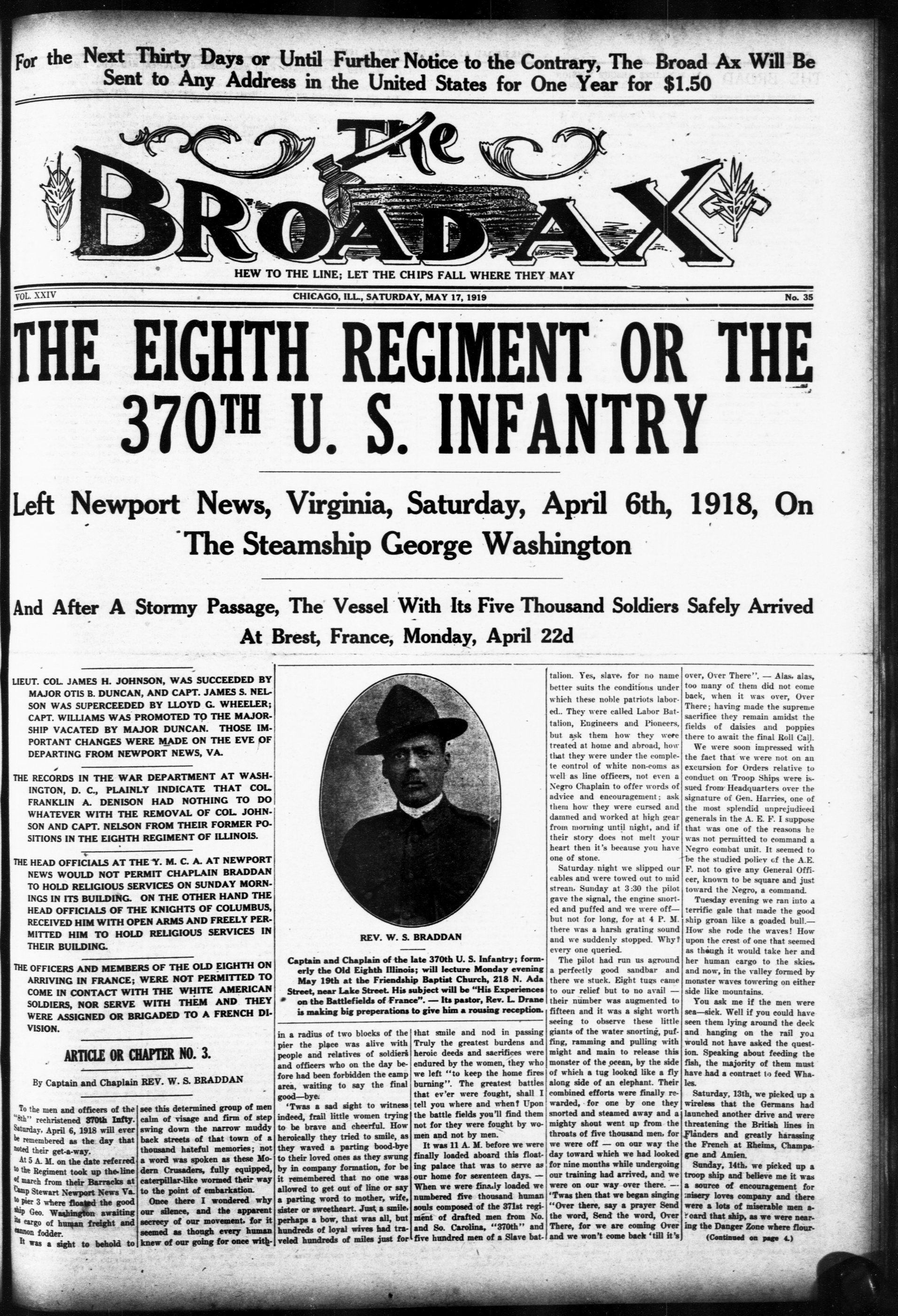
THE EIGHTH REGIMENT OR THE 370TH U.S. INFANTRY
Left Newport News, Virginia, Saturday, April 6th, 1918, On The Steamship George Washington
And After A Stormy Passage, The Vessel With Its Five Thousand Soldiers Safely Arrived At Brest, France, Monday, April 22d
LIEUT. COL. JAMES H. JOHN
MAJOR OTIS B. DUNCAN
SON WAS SUPERCEEDER
CAPT. WILLIAMS WAS B
SHIP VACATED BY MA
PORTANT CHANGES W
DEPARTING FROM NEW
THE RECORDS IN THE WA
INGTON, D. C., PLAIN
FRANKLIN A. DENISO
WHATEVER WITH THE
SON AND CAPT. NELSON
SITIONS IN THE EIGHTH
THE HEAD OFFICIALS AT THE
NEWS WOULD NOT PEN
TO HOLD RELIGIOUS SE
INGS IN ITS BUILDING.
HEAD OFFICIALS OF THE
RECEIVED HIM WITH O
MITTED HIM TO HOLD
THEIR BUILDING.
THE OFFICERS AND MEMB
ARRIVING IN FRANCE;
COME IN CONTACT WITH
SOLDIERS, NOR SERVE
WERE ASSIGNED OR BE
VISION.
LIEUT. COL. JAMES H. JOHNSON, WAS SUCCEEDED BY MAJOR OTIS B. DUNCAN, AND CAPT. JAMES S. NELSON WAS SUPERCEEDED BY LLOYD G. WHEELER; CAPT. WILLIAMS WAS PROMOTED TO THE MAJORSHIP VACATED BY MAJOR DUNCAN. THOSE IMPORTANT CHANGES WERE MADE ON THE EVE OF DEPARTING FROM NEWPORT NEWS, VA.
THE RECORDS IN THE WAR DEPARTMENT AT WASHINGTON, D. C., PLAINLY INDICATE THAT COL. FRANKLIN A. DENISON HAD NOTHING TO DO WHATEVER WITH THE REMOVAL OF COL. JOHNSON AND CAPT. NELSON FROM THEIR FORMER POSITIONS IN THE EIGHTH REGIMENT OF ILLINOIS.
THE HEAD OFFICIALS AT THE Y. M. C. A. AT NEWPORT NEWS WOULD NOT PERMIT CHAPLAIN BRADDAN TO HOLD RELIGIOUS SERVICES ON SUNDAY MORNINGS IN ITS BUILDING. ON THE OTHER HAND THE HEAD OFFICIALS OF THE KNIGHTS OF COLUMBUS, RECEIVED HIM WITH OPEN ARMS AND FREELY PERMITTED HIM TO HOLD RELIGIOUS SERVICES IN THEIR BUILDING.
THE OFFICERS AND MEMBERS OF THE OLD EIGHTH ON ARRIVING IN FRANCE; WERE NOT PERMITTED TO COME IN CONTACT WITH THE WHITE AMERICAN SOLDIERS, NOR SERVE WITH THEM AND THEY WERE ASSIGNED OR BRIGADED TO A FRENCH DIVISION.
ARTICLE OR CHAPTER NO. 3.
By Captain and Chaplain
By Captain and Chaplain REV. W. S. BRADDAN
To the men and officers of the "8th" rechristened 370th Infty. Saturday, April 6, 1918 will ever be remembered as the day that noted their get-a-way.
At 5 A. M. on the date referred to the Regiment took up the line of march from their Barracks at Camp Stewart Newport News Va. to pier 3 where floated the good ship Geo. Washington awaiting its cargo of human freight and cannon fodder.
It was a sight to behold to
VOL. XXIV
REV. W. S. BRADDAN
see this determined group of men calm of visage and firm of step swing down the narrow muddy back streets of that town of a thousand hateful memories; not a word was spoken as these Modern Crusaders, fully equipped, caterpillar-like wormed their way to the point of embarkation.
Once there I wondered why our silence, and the apparent secrecy of our movement, for it seemed as though every human knew of our going for once with-
CHICAGO, ILL., SATURDAY, MAY 17, 1919
REV. W. S. BRADDAN
Captain and Chaplain of the erly the Old Eighth Illinois May 19th at the Friendsh Street, near Lake Street. His on the Battlefields of Frank is making big preperations
Captain and Chaplain of the late 370th U. S. Infantry; formerly the Old Eighth Illinois; will lecture Monday evening May 19th at the Friendship Baptist Church, 218 N. Ada Street, near Lake Street. His subject will be "His Experiences on the Battlefields of France". — Its pastor, Rev. L. Drane is making big preparations to give him a rousing reception.
in a radius of two blocks of the pier the place was alive with people and relatives of soldiers and officers who on the day before had been forbidden the camp area, waiting to say the final good—bye:
that smile and nod in passing Truly the greatest burdens and heroic deeds and sacrifices were endured by the women, they who we left "to keep the home fires burning". The greatest battles that ev'er were fought, shall I
'Twas a sad sight to witness indeed, frail little women trying to be brave and cheerful. How heroically they tried to smile, as they waved a parting bood-bye to their loved ones as they swung by in company formation, for be it remembered that no one was allowed to get out of line or say a parting word to mother, wife, sister or sweetheart. Just a smile, perhaps a bow, that was all, but hundreds of loyal wives had traveled hundreds of miles just for
late 370th U. S. Infantry; forms; will lecture Monday evening ip Baptist Church, 218 N. Ada subject will be "His Experiences ce". — Its pastor, Rev. L. Drane to give him a rousing reception.
that smile and nod in passing Truly the greatest burdens and heroic deeds and sacrifices were endured by the women, they who we left "to keep the home fires burning". The greatest battles that ev'er were fought, shall I tell you where and when? Upon the battle fields you'll find them not for they were fought by women and not by men.
It was 11 A. M. before we were finally loaded aboard this floating palace that was to serve as our home for seventeen days. When we were finally loaded we numbered five thousand human souls composed of the 371st regiment of drafted men from No. and So. Carolina, "370th" and five hundred men of a Slave bat-
talion. Yes, slave, for no name better suits the conditions under which these noble patriots labored.. They were called Labor Battalion, Engineers and Pioneers, but ask them how they were treated at home and abroad, how that they were under the complete control of white non-coms as well as line officers, not even a Negro Chaplain to offer words of advice and encouragement; ask them how they were cursed and damned and worked at high gear from morning until night, and if their story does not melt your heart then it's because you have one of stone.
Saturday. night we slipped our cables and were towed out to midstream. Sunday at 3:30 the pilot gave the signal, the engine snorted and puffed and we were off—but not for long, for at 4 P. M. there was a harsh grating sound and we suddenly stopped. Why? every one queried.
The pilot had run us aground a perfectly good sandbar and there we stuck. Eight tugs came to our relief but to no avail—their number was augmented to fifteen and it was a sight worth seeing to observe these little giants of the water snorting, puffing, ramming and pulling with might and main to release this monster of the ocean, by the side of which a tug looked like a fly along side of an elephant. Their combined efforts were finally rewarded, for one by one they snorted and steamed away and a mighty shout went up from the throats of five thousand men, for we were off — on our way the day toward which we had looked for nine months while undergoing our training had arrived, and we were on our way over there. —'Twas then that we began singing "Over there, say a prayer Send the word, Send the word, Over There, for we are coming Over and we won't come back 'till it's
over, Over There". — Alas, alas, too many of them did not come back, when it was over, Over There; having made the supreme sacrifice they remain amidst the fields of daisies and poppies there to await the final Roll Call. We were soon impressed with the fact that we were not on an excursion for Orders relative to conduct on Troop Ships were issued from Headquarters over the signature of Gen. Harries, one of the most splendid unprejudiced generals in the A. E. F. I suppose that was one of the reasons he was not permitted to command a Negro combat unit. It seemed to be the studied policy of the A.E. F. not to give any General Officer, known to be square and just toward the Negro, a command
Tuesday evening we ran into a terrific gale that made the good ship groan like a goaded bull. How she rode the waves! How upon the crest of one that seemed as though it would take her and her human cargo to the skies, and now, in the valley formed by monster waves towering on either side like mountains.
You ask me if the men were sea—sick. Well if you could have seen them lying around the deck and hanging on the rail you would not have asked the question. Speaking about feeding the fish, the majority of them must have had a contract to feed Whales.
Saturday, 13th, we picked up a wireless that the Germans had launched another drive and were threatening the British lines in Flanders and greatly harassing the French at Rheims, Champagne and Amien.
Sunday, 14th. we picked up a troop ship and believe me it was a source of encouragement for misery loves company and there were a lots of miserable men aboard that ship, as we were nearing the Danger Zone where flour- (Continued on page 4.)
PAGE TWO
THE BROAD AX
Published Every Saturday
In this city since July 15th, 1899, without missing one single issue. Republicans, Democrats, Catholics, Protestants, Single Taxers, Priests, infidels or anyone else can have their say as long as their language is proper and responsibility is fixed.
The Broad Ax is a newspaper whose platform is broad enough for all, ever claiming the editorial right to speak its own mind.
Local communications will receive attention. Write only on one side of the paper.
Subscriptions must be paid in advance.
Advertising rates made known on application.
Address all communications to
THE BROAD AX
6206 So. Elizabeth St., Chicago, Ill.
Phone Wentworth 2597.
JULIUS F. TAYLOR
Editor and Publisher
DR. M. A. MAJORS
Associate Editor
4700 South State Street
Phone Drexel 1416
Vol. XXIV. May 17,1919 No. 35
1902, at the Post Office at Chicago,
Ill., under Act of March 3, 1879
THE GIRLS PATRIOTIC SERVICE LEAGUE
Will Hold Intresting Services
The Girls' Patriotic Service League will hold its Dedicatory services on Sunday May 18th at 5 o'clock P. M. at Grace Presbyterian church, 36th and Vincennes Ave. under the auspices of Grace Lyceum.
Rev. John Timothy Stone, Pastor 1st Presbyterian church will deliver the dedicatory address.
Miss. Myrtle Carpenter, General Director Girls' Division will also speak.
There will be an excellent musical program.
The girls' unit having the largest number of girls present over seventy-five will be awarded a beautiful silk banner on which will be written the Girls' Patriotic Service League Pledge. The public is cordially invited to attend this unique service.
THOUSAND POUND HOG
SOLD BY COLORED FARMER
Waycross, Ga.. Ike Lane, a colored farmer who lives just outside the limits of Waycross, and who sold a hog on the market here a few weeks ago that weighed dressed 798 pounds, sold another to a farmer of Pierce county that weighed 1.002 pounds gross. The price paid for the one sold some time ago was $120, the total received for the two hogs was $270.30. These hogs were a cross between Poland China and Berkshire.
WHITE PANTS, PINK VEST
GREEN TIE, YELLOW SPATS
Philadelphia, Pa., — A-bloom literally a-bloom, was a highly colored gentleman when he recently strolled down South Broad St. The Negro was all dressed up in a pair of snowy white trousers, a Prince Albert coat and a high silk hat. But lest Spring be forgotten, he also wore a pink silk vest, a pea green tie and yellow spats. To complete the color scheme a huge bunch of violets adorned the left lapel of the coat.
76,078 DEAD IS TOLL OF
Washington, — Casualties among the American forces, according to revised figures made public today, totaled 287,590. The dead total 76,078 of which 34,065 were killed in action, 14,215 died of wounds, 23,210 of disease and 4,588 of accidents and other causes.
SUNSHINE RESCUE MISSION
2830 S. STATE STREET
Service Every Night in the Year. Rev. H. Franklin Bray, B. D. Superintendent.—
The services last week were unusually interesting and profitable.
Many souls were won for Christ and added to the churches of the city. This is a life saving station and we do not accept members but enroll them as rapidly as they are converted in the established churches of the city. Here men and boys are given food, clothing and shelter and have the gospel preached to them every night.
Dr. Bray has returned from his lengthy campaign in the far east and is inaugerateing several new features into the services of the Mission. He will preach Sunday night and deliver a special address to the children at 2 P. M.
HON. CHARLES S. ANDRUE
WILL ADDRESS THE UNITED
CIVIC LEAGUE
Every-one is cordially invited to attend the United Civic League at the Odd Fellows Hall, 3333 South State Street, Sunday May 18th at three o'clock, at which time the Hon. Charles S. Andrue, chairman of the State Industrial Board of Illinois will discuss the Compensation laws of Illinois and its effect upon the Colored People.
This meeting should be attended by every one who is vitally interested in the welfare of the race and the United Civic League should be commended by the well thinking citizens for having secured so valuable Citizen to address them. Other grand features will be in evidence at this meeting.
NEW YORK HAS COLORED MAN ON JURY
Albany, N. Y., — For the first time in twenty years a Colored man, H. B. Cobbs, set on a jury in county court. The ease was a damage suit for $1,500.
CHIPS
Judge and Mrs. Thomas F. Scully, and the other members of their family, including Thomas F. Scully Jr., have removed from 1107 S. Ashland Bvld. to 4444 N. Campbell Avenue.
Mr. and Mrs. David M. Manson, have given up their apartment at 5816 S. Michigan ave., and for the past ten days they were guests at the Palmer House. They are now at home to their many friends in their new home at 4406 Grand Blvd.
Captain Nicholas Hunt, head of the Shippy - Hunt, International Detective Agency with headdquarters in the City Hall Square Bldg. is one of the oldest and most steadfast friends of the editor of this paper and he has been a constant subscriber to it, from October 1, 1899 down to the present time.
Dr. A. Wilbeforce Williams, 3545 S. State Street; is on his way over seas, where he will lecture to the soldiers in France, on Sanitation, Tubercolosis and so on. He will travel from camp to camp and deliver two lectures each day. He expects to be absent from four to six months and if nothing happens he will attend a course of lectures at the university of France. — Miss. Rose M. Edie, will continue to assist to look after his many patients.
"And we can sell you this car on easy payments," said the agent, pleasantly.
"My friend," replied the prospect, "the expression 'easy payments' belongs to the same category with that other well-known fib, 'painless dentistr."—New York Globe.
THE BROAD AX. CHICAGO, MAY 17, 1919
Airplane Prospecting.
The airplane is destined to be of enormous utility in facilitating prospecting for and opening up mineral properties in the Andean valleys. Hydroplanes can fly from the Pacific to the upper waters of the Amazon in a few hours, while there are good landing places for planes on many of the snow fields of the higher Andes, which have never yet been explored. The airplane is almost ideal for transporting precious metals, where the value is high in proportion to weight and bulk, and the time-saving is so important as well as the safety from robbery. Already plans are under way to use planes in Peru and Colombia.
Do You Need a Periscope?
Don't give up hope, even if you are a tiny person in a large crowd. To your rescue comes an adaptation of the periscope, designed specially for use in crowds. According to Popular Mechanics Magazine:
"It consists of a case, having a mirror set at the proper angle at either end, which can be extended to a length of two feet or more by reason of a bellows connecting the two ends. With the device lengthened, the mirrors are exposed so that the user can see over the heads of a crowd without difficulty."
A Great Man.
A great man is he who chooses the right in invincible resolution, who resists the sorest temptations from within and without, who bears the heaviest burdens cheerfully, who is calmest in storms and most fearless under frowns, whose reliance on truth, on virtue, on God, is most unfaltering. I believe this greatness to be most common among the multitude, whose names are never heard.—W. E. Channing.
Keep Sweet
Losing the temper takes all the sweet, pure feeling out of life. One may get up in the morning with a clean heart, full of song, and start out as happy as a bird, and the moment he is crossed and gives way to temper the clean feeling vanishes; and a load as heavy as lead is rolled upon the heart. Be the master of your temper and you hold the key to joy and contentment.
Whence "Dutch"
The name Dutch is derived from Dietsch, meaning the vernacular, as distinguished from Latin. It is the same word as the German Deutsch. Dutch belongs to the Frankish division of the Low German, and is closely related to the Flemish, with which it is now practically identified in its written form. The Dutch language is one of the Germanic group of dialects, and is practically the same in its structure.
Evidently No Lover of Tiards
It is very wonderful to see persons of the best sense passing hours together in shuffling and dividing a pack of cards with no conversation but in different figures. Would not a man what is made up of a few game phrases, and no other ideas but those of black or red spots ranged together laugh to hear any one of his species complaining that life is short?—Addison.
Endurance
Endurance, not fleetness, wins the race. Never give up. Keep pegging away even though everything looks hopeless. Many a man has failed to achieve both fortune and fame because he lost courage just as he was within reach of them. What you desire may be only one step ahead. Keep going.
Curiosities of the Calendar
It will be found that January always begins on the same day of the week as October, and the same is true of April and July, September and December. Again February, March and November also begin on the same day of the week. This, however, is only true in years of 365 days.
Testing for All Wool
Anybody can tell whether it is all wool or not by boiling out a little piece in a test-tube with a solution of caustic soda over an alcohol lamp. Whatever does not dissolve is not wool. This piece of chemical wisdom is propounded by the Little Journal.
The Old Story.
We asked at our house for a menu that would make for plain living and clear thinking, and they gave us an alligator pear salad with pomegranate seeds and Thousand island dressing. Grand Rapids Press.
The Other Side
If you want to make yourself solid with other folks don't stop to tell them what wonderful things you have done, but just say, "You fellows have the world beaten for big things."
Found Road to Happiness
I have been a great deal happler since I have given up thinking about what is easy and pleasant, and being discontented because I could not have my own will.—George Ellot.
Write Agricultural Bureau.
We wonder if one could raise forage
for a nightmare in a garden of dreams
—Columbian Missourian.
CITY BELOVED OF TOURISTS
Bultenzorg, Java, Noted for its Gay
eties and its Wonderful Displa-
play of Horticulture.
When a wealthy Dutch planter in Java discovers that he has acquired brain fag by talking business with his overseers and superintendents he orders his servants to make preparations for a trip to Buitenzorg, the capital of the island.
Buitenzorg is one of those few fascinating cities where the climate is perfect and business never seems to interfere with pleasure. The governor-general's mansion is the center of Javanese government and frivolity—the scene of occasional weighty conferences and many balls and garden parties. In this-tropical court the Dutch heilress makes her first bashful bow to society, and noted scientists who come to view the famous botanic gardens of the city are feted.
Bamboo huts of the Javanese, all too small for the families they hold, snuggle within the shadows of modern hotels and shops. All around are gardens overflowing with roses and gay tropical blooms. Flowers are popular in Buitenzorg, but, attractive as the amateur gardens are, their charm is forgotten in the wonderful beauty of the botanic gardens, which lie within the estate of the governor general.
For more than a century horticultural experts have cultivated these famous gardens, the success of their work being proved by the enthusiasm of scientists, to whom this spot is a botanist's paradise. Unscientific visitors revel in the profusion of blossoms, sweet smelling, gorgeous, strange and lovely, but the scientist hastens past these frankly attractive blooms to expend his enthusiasm on some twisted dwarf, which he designates a botanical triumph and labels with an unpronounceable name.
TRACING LOST INDIAN TRIBE
Scientists Interested in Explorations of Abodes of the Long-Gone Arawak Nation.
When in 1494, on his second voyage, Columbus discovered the island of Jamaica, it was populated by the Arawak Indians, who, although at first hostile to him, became friendly on his giving them clothing and other articles hitherto unknown to them.
When later the Spaniards settled the island they forced the Indians not only to do agricultural work in their own island, but to labor in the gold mines of Haytli. So hard were the Spanish taskmasters that by 1558 the whole Arawak nation was exterminated.
During the past eight years efforts have been made, under the auspices of a scientific society, to recover all possible traces of the lost race. To that end explorations have been made in the old kitchen middens, or refuse heaps of the Arawaks, in which there have been found, besides shells and pottery and fish, turtle and cony bones, many cels, or rude chisels, grinding stones, stone pendants and axes—1,500 objects in all, which have been given to the American Museum of Natural History in New York city.
To the anthropologist the most interesting objects are the cylindrical stone pendants, which were fashioned with sand and stone and endless rubbing. Pendants of exactly the same sort are worn today as insignia of office by chiefs or headmen of tribes in northern South America.
You Could Not Mistake Him.
Persons who had been in the habit of traversing Covent Garden at that time might, by extending their walk a few yards into Russell street, have noticed a small, spare man, clothed in black, who went out every morning, and returned every afternoon as the hands of the clock moved toward certain hours. You could not mistake him. He was somewhat stiff in his manner and almost clerical in dress; which indicated much wear. He had a long, melancholy face, with keen, penetrating eyes; and he walked with a short, resolute step citywards. He looked no one in the face for more than a moment, yet contrived to see everything as he went on. No one who ever studied the human feature could pass him by without recollecting his countenance; it was full of sensibility, and it came upon you like new thought, which you could not help dwelling upon afterward; it gave rise to meditation and did you good. This small, half-clerical man was—Charles Lamb—Barry Cornwall.
"Nice" Once Meant "Foolish."
Words that have undergone a remarkable change of meaning with the passage of the centuries are "pretty" and "nice." Both these words meant originally almost exactly the reverse of their present definitions. "Pretty" comes from the old French word proud or "prud." In old Saxon the word became "prut"—magnificent, splendid, vain, insolent. From this came "prit" or "pritte," meaning almost the same; till at length it came to signify handsome, bold or fine; finally, after many gradations, reaching its present usual sense as a personal adjective of girlish and effeminate significance. "Nice"—which comes from a French source—at first meant foolish, absurd, ridiculous; then in course of time it came to signify wanton, whimsical, fantastic; then delicate and subtle, till finally it was used to denote any specially pleasant quality.
BOAT WAS "SOME" STRETCHER
And Many Will Believe That Old Man Moody Belongs In Much the Same Class.
A group of guides was sitting about the tavern table telling stories. Among them, says Mr. Leon Dean in Outing, was Old Man Moody. When the conversational ball was tossed to him he was ready for it.
"Boya," he drawled, "you remember that collapsible rubber boat that the old gentlemen sent me up? as a present from New York last year?" The circle of heads nodded recollection. "Funny thing happened this morning. The pickerel ought to be striking today," thinks I; and I went down to the pond to get my boat. Ed Greene was there. Ed wants to race me every time we meet; he's some handy with the oars, I'll allow, but he can't beat the little old rubber bathtub.
"Today he's got a new scheme; wants to try it across the pond rowing frontwards, facing the bow. Says he can trim me to a frazzle that way. It's a favorite of him, you know.
"Says I, 'You can't'; and off we went. We was going like grease, too, but I was kind of playing with him, when all of a sudden, about halfway across, I felt the little boat begin to drag. She dragged harder and harder. 'Gosh all fishhooks,' thinks I, 'she must be hitched to the bottom.'
"By the time we was three quarters over it was no joke. I was putting into it for all I was worth and having all I could do to keep up with Ed. 'Come on, ol man,' says he; and we let out for the finish. Well, boys, we hit the bank jest about nip and tuck. And what do you think the trouble was?"
He paused dramatically, and the circle regarded him expectantly.
"When I stepped out I heard a sort of swish behind he. I turned round, and there won't no boat there. I'd forgot to untle her on tother side, and she had snapped clean back."
THEORY OF ODD NUMBERS
As Far Back as Can Be Traced, Superstition Has Held Them in Reverence.
"Why is a hen given an odd number of eggs to hatch and never an even number?" a writer in Tit-Bits asks. He answers himself by saying that it is all a matter of superstition and that, despite our advanced civilization we still cling to things of the musty past.
Salutes from warships, forts, etc., are always given in odd numbers, he explains, with no valid reason, other than the old theory that the odd number was always lucky.
Virgil records all sorts of charms and spells practiced around odd numbers and never an even one.
People still say, after two failures, that a third attempt may be successful.
Seven is the favorite biblical number, and old divines taught that it held a mystical perfection. Three is the number of the Trinity—an odd number again.
Falstaff, in the "Merry Wives," is entrapped a third time. He is quoted as saying "They say there is a divinity in odd numbers."
The number two was always avoided and had an evil reputation, in ancient times, because on the second day hell was created.
Law Always Governs.
Everything out of doors is a matter of law. That is, all actions of all created things are in conformity to the laws laid down by nature. Growth and development are not by chance; they are matters of law. The robin returns to a certain region, not as a matter of accident or chance, but because it is governed absolutely by law—just as the drop of water flows down the steep sides of the roof according to law.
Every action of every created thing affects the actions of all other created things. All nature is interwoven until nothing can do anything without its having its effect upon everything else. That may seem like a strange statement, but it is a fact.
Perfect Automobile Springs
The comfort of the passengers in an automobile is to a great degree dependent upon the character of the springs of the vehicle. These may be adjusted to suit the loads by means of a new invention of French origin. At each end of the rear springs is an elongated slot, in which the eyebolts can be moved by a lever or wheel at the driver's seat. The effect of altering the position of the bolts is to lengthen or shorten the springs, thus decreasing or increasing their stiffness and resistance. Definite positions or stopping points are provided for the sliding bolts, so that the driver may adjust his springs to a specific number of passengers.
The "Know-Nothing"
"Know-Nothings" was an epithet popularly conferred upon the American or native American party, a secret political organization in the United States, because its members when questioned as to its principles and purposes professed "to know nothing." The party was organized about 1854, showed considerable strength the next year, and in 1856 nominated Millard Fillmore for re-election to the presidency. "Know-Nothings" split on the slavery question and became divided into the "North" and "South" Americans. They were merged into the Constitutional Union party in 1860.
Various Ways by Which the Ancients Kept Some Track of the Fast. Fleeting Hours.
Sacred history furnishes the earliest reference to anything like a fixed and permanent measureer. Isaiah speaks of the dial of Ahaz which went ten degrees backward, and this dial it has been conjectured, was a tall and slender column, which cast a shadow on a series of steps with which it was encircled.
The Egyptians, too, are credited with having used their monoliths, such as Cleopatra's needle, as time measureers. However, the Chaldeans had other methods of measuring time, for they, as well as the contemporary Hindoos, and very likely the Egyptians, were acquainted with the water clock, or clepsydra, which measured time to the fashion of the hour glass, water taking the place of sand.
Indeed, it is believed that the Egyptians actually had hour glasses, for upon one of the bas-reliefs which have come to light after their long interment of 3,000 years or more is an object which those learned to such matters assure us can be nothing else than a sand glass.
In principle the clepsydra was nothing but a rod floating upon water, which was slowly dropping from an orifice in the vessel in which it was contained. Certain divisions were marked upon the rod, and a fixed pointer served the purpose of a clock hand.
But the Greeks, who seem to have used them on every possible occasion, expended much labor and artistic skill upon their manufacture. Some times they were groups of children, the escaping water representing the falling tears of some of their number, while others pointed out the time with a wand.
MEMORABLE GAME OF CARDS
Said to Have Suggested System of Life Insurance to Eminent French Mathematician.
A game of cards is said to have suggested the system of life insurance now so universal, according to London Answers.
A Flemish nobleman in the seventeenth century tried to divide equitably the cash staked upon an interrupted game of chance. He was helped in his attempt by Pascal, a distinguished French mathematician, who solved the problem. In doing so he also solved the "doctrine of probabilities" or laws governing insurances of all kinds.
The idea can be illustrated by the throwing up an ace being one out of six. In a large number of throws the chances are in the same proportion. From this Pascal laid down the proposition that results which have happened in a given number of observed cases will again happen in similar circumstances, provided the numbers be sufficient for the proper working of the law of averages.
The life of a person is one of the greatest uncertainties, but the duration or rate of mortality of a large number of persons may be predicted with the greatest accuracy by comparison with the observed result among a sufficiently large number of persons of similar ages and occupations and subject to similar climatic influences.
Song Inspired by Poster?
It is an interesting bit of history, in view of the importance of posters as an inspiration and interpretation of patriotism, that the Marsellaillise was inspired by a contemporary poster. At first thought one might imagine that the art of the poster, as it is now understood, was unknown in 1792, but the proclamation of the mayor of Strasburg, with its terse, ringing sentences, beginning "To arms, citizens" was no doubt as effective as the posters produced in 1918. Posted on the city walls, as Jean Richepin of the French academy has just pointed out, the words of the proclamation directly inspired Rouget de Lisle in the composition of the "Marsellaillise", or, as it was first called, "The War of the Armies of the Rhine." Later the convention at Paris entitled it the "Hymn of Marselles", but the public promptly named it "La Marsellaillise", and it might almost be said to have set the mayor's poster to music—Christian Science Monitor.
Red Bag to a Bull.
How many people know the real meaning of the phrase "Like red rag to a bull?" Why should a bull, or any other creature, he enraged when a piece of scarlet cloth is faunted before them? For bulls are not alone in this. Sheep, usually so meek and gentle, will apparently become transported with rage if they see anything of this color. Geese and turkeys are similarly affected—the former even having been known to attack a scarlet-clad child. The excitement animals display in such circumstances is similar to that caused by the smell of blood. Here is the theory: The color reminds the animals of blood, an association which invariably suggests bodily discomfort and hurt. So they express their terror by the only means they possess.
Weather Talk
Mrs. Flatbush—They say some people can talk of nothing but the weather.
Mrs. Bensonhurst—Well, I believe it. I asked my husband for some money this morning and he said, "I'm it a beautiful day!"
BLACK SILK IS MUCH IN FAVOR
Trend Runs to Frocks in Which Harshness Has Given Way to Charm and Dignity.
NEW TAFET/AS ARE IMPROVED
Material Does Not Split and Crack and Is Regarded a Better Investment Than It Was Some Sea.
To complete one's spring warurobe at least one taffeta frock must be included. This may be one of the new and very lovely black gowns of this crisp silk or a stiff and rather simple and quaint evening frock, but to be absolutely correct, declares a fashion writer, at least one taffeta frock must be included in the season's outfit.
None of the silk gowns for years past has had just the charm and dignity that the black taffetas of this spring have achieved. Indeed, the very silk itself has acquired a new suppleness and a softness which gives delightful drapery effects. Again, these newer taffetas do not split and crack as once they did and are therefore a much better investment than this sort of silk was some seasons ago.
Ruffles In Vogue.
Since ruffles are so much in vogue it is interesting to note that one of the most advanced models developed in black taffeta silk shows a very long and narrow skirt with a slightly hobbled effect carried out by placing three ruffles one above the other with the hems of the little frills turped up to the waist instead of in the usual manner of placing ruffles turned down toward the hem of the skirt. This is one of the new fancies of the spring—this of the upside down ruffle—and it gives a distinctive look to all frocks and proves them of the latest model.
On the particular black dress mentioned, the very long front panel is unbroken from the square neck quite to the bottom of the skirt, except by the ruffles, and untrimmed except for a straight row of black silk buttons placed straight down one side. The back has a slightly draped bustle effect and a sash, and the sleeves are long and tight.
Just why black should be preferred in this sort of silk frock it is difficult to say, as for a long time black taffeta silk was left for the middle aged and for mourning gowns. Certain it is
The quick brown fox jumps over the lazy dog.
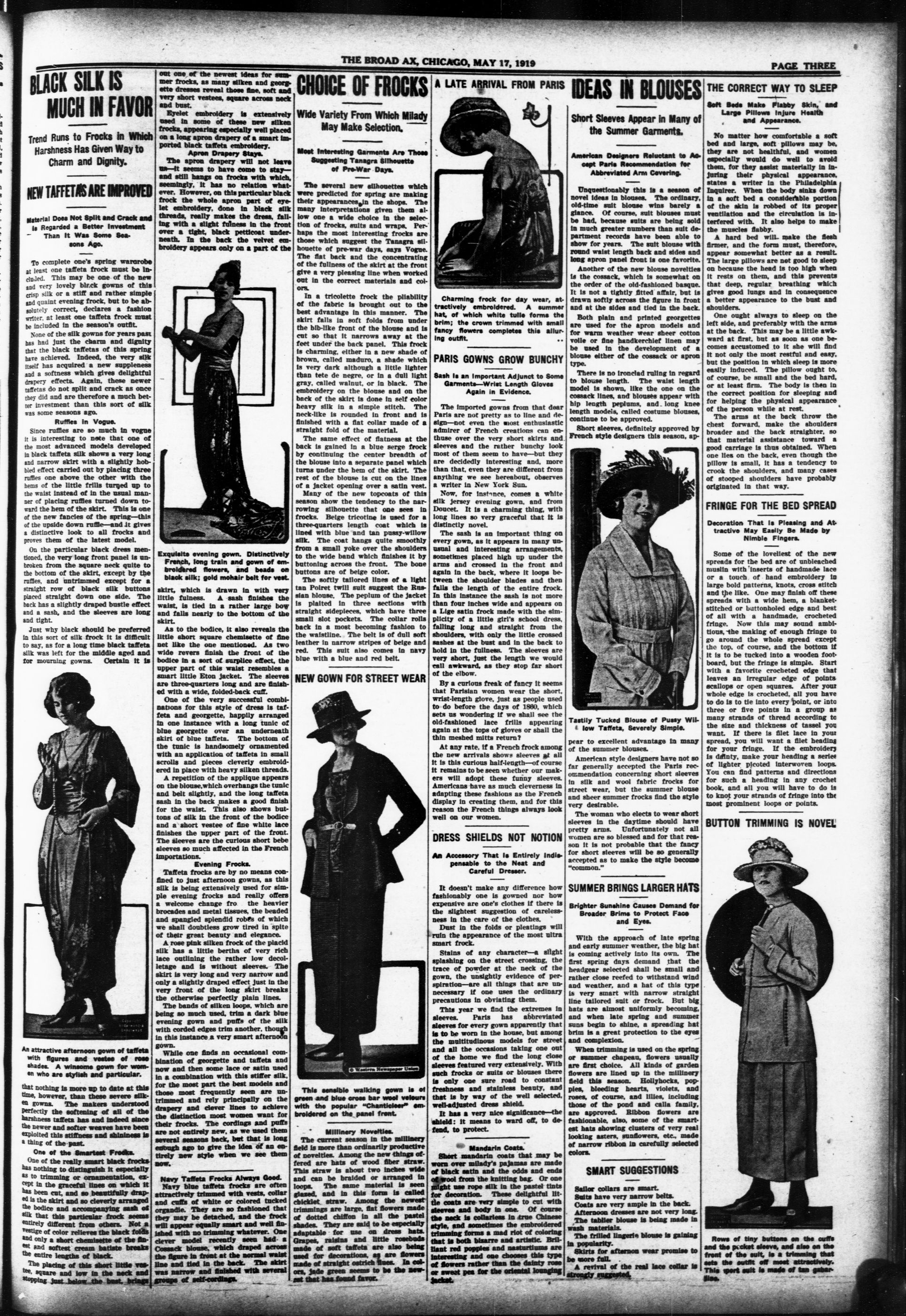
An attractive afternoon gown of taffeta with figures and vests of rose shades. A winnie gown for women who are stylish and particular.
An attractive afternoon gown of taffeta with figures and vestes of rose shades. A winsome gown for women who are stylish and particular.
that nothing is more up to date at this time, however, than these severe silken gowns. The makers understood perfectly the softening of all of the harshness taffeta has and indeed since the newer and softer weaves have been exploited this stiffness and shininess is a thing of the past.
One of the Smartest Frocks.
One of the really smart black frocks has nothing to distinguish it especially as to trimming or ornamentation, except in the graceful lines on which it has been cut, and so beautifully draped is the skirt and so cleverly arranged the bodice and accompanying sash of silk that this particular frock seems entirely different from others. Not a vestige of color relieves the black folds and only a short chemisette of the finest and softest cream batiste breaks the entire lengths of black.
The placing of this short little vestee, square and low in the neck and stopping just below the bust, brings
out one of the newest ideas for summer frocks, as many silken and georgette dresses reveal those fine, soft and very short vestees, square across neck and bust.
Eyelet embroidery is extensively used in some of these new silken frocks, appearing especially well placed on a long apron drapery of a smart imported black taffeta embroidery.
Apron Drapery Stays.
The apron drapery will not leave us—it seems to have come to stay—and still hangs on frocks with which, seemingly, it has no relation whatever. However, on this particular black frock the whole apron part of eyelet embroidery, done in black silk threads, really makes the dress, falling with a slight fulness in the front over a tight, black petticoat underneath. In the back the velvet embroidery appears only on a part of the
I
Exquisite evening gown. Distinctively French, long train and gown of embroidered flowers, and beads on black silk; gold mohair belt for vest. skirt, which is drawn in with very little fulness. A sash finishes the waist, is tied in a rather large bow and falls nearly to the bottom of the skirt. As to the bodice, it also reveals the little short square chemisette of fine net like the one mentioned. As two wide revers finish the front of the bodice in a sort of surplice effect, the upper part of this waist resembles a smart little Eton jacket. The sleeves are three-quarters long and are finished with a wide, folded-back cuff.
One of the very successful combinations for this style of dress is taffeta and georgette, happily arranged in one instance with a long tunic of blue georgette over an underneath skirt of blue taffeta. The bottom of the tunic is handsomely ornamented with an application of taffeta in small scrolls and pieces cleverly embroidered in place with heavy silken threads. A repetition of the applique appears on the blouse,which overhangs the tunic and belt slightly, and the long taffeta sash in the back makes a good finish for the waist. This also shows buttons of silk in the front of the bodice and a short vestee of fine white lace finishes the upper part of the front. The sleeves are the curious short bebe sleeves so much affected in the French importations.
Evening Frocks.
Taffeta frocks are by no means confined to just afternoon gowns, as this silk is being extensively used for simple evening frocks and really offers a welcome change fro. the heavier brocades and metal tissues, the beaded and spangled splendid robes of which we shall doubtless grow tired in spite of their great beauty and elegance. A rose pink silken frock of the placid silk has a little bertha of very rich lace outlining the rather low decouletage and is without sleeves. The skirt is very long and very narrow and only a slightly draped effect just in the very front of the long skirt breaks the otherwise perfectly plain lines. The bands of silken loops, which are being so much used, trim a dark blue evening gown and puffs of the silk with corded edges trim another, though in this instance a very smart afternoon gown.
While one finds an occasional combination of georgette and taffeta and now and then some lace or satin used in a combination with this stiffer silk, for the most part the best models and those most frequently seen are untrimmed and rely principally on the drapery and clever lines to achieve the distinction most women want for their frocks. The cordings and puffs are not entirely new, as we used them several seasons back, but that is long enough ago to give the idea of an entirely new style when we see them now.
Navy blue taffeta frocks are often attractively trimmed with vests, collar and cuffs of white or colored tucked organdle. They are so fashioned that they may be detached, and the frock will appear equally smart and well finished with no trimming whatever. One clever model recently seen had a Cossack blouse, which draped across the figure in front at the normal waist line and tied in the back. The skirt was narrow and finished with several groups of self-cording.
THE BROAD AX, CHICAGO, MAY 17, 1919
CHOICE OF FROCKS
CHOICE OF FROCKS
Wide Variety From Which Milady May Make Selection.
Most Interesting Garments Are Those Suggesting Tanagra Silhouette of Pre-War Days.
The several new silhouettes which were predicted for spring are making their appearances in the shops. The many interpretations given them allow one a wide choice in the selection of frocks, suits and wraps. Perhaps the most interesting frocks are those which suggest the Tanagra silhouette of pre-war days, says Vogue. The flat back and the concentrating of the fullness of the skirt at the front give a very pleasing line when worked out in the correct materials and colors.
In a tricolette frock the piability of the fabric is brought out to the best advantage in this manner. The skirt falls in soft folds from under the bib-like front of the blouse and is cut so that it narrows away at the feet under the back panel. This frock is charming, either in a new shade of brown, called maduro, a shade which is very dark although a little lighter than tete de negre, or in a dull light gray, called walnut, or in black. The embroidery on the blouse and on the back of the skirt is done in self color heavy silk in a simple stitch. The neck-like is rounded in front and is finished with a flat collar made of a straight fold of the material.
The same effect of flatness at the back is gained in a blue serge frock by continuing the center breadth of the blouse into a separate panel which turns under the hem of the skirt. The rest of the blouse is cut on the lines of a jacket opening over a satin vest. Many of the new topcoats of this season show the tendency to the narrowing silhouette that one sees in frocks. Beige tricotine is used for a three-quarters length coat which is lined with blue and tan pussy-willow silk. The coat hangs quite smoothly from a small yoke over the shoulders to the wide band which finishes it by buttoning across the front. The bone buttons are of beige color.
The softly tailored lines of a light tan Poiret twill suit suggest the Russian blouse. The peplum of the jacket is platted in three sections with straight sidepieces, which have three small slot pockets. The collar rolls back in a most becoming fashion to the waistline. The belt is of dull soft leather in narrow stripes of beige and red. This suit also comes in navy blue with a blue and red belt.
© Western Newspaper Union
This sensible walking gown is of green and blue cross bar wool velours with the popular "Chanticleer" embroidered on the panel front.
The current season in the millinery field is more than ordinarily productive of novelties. Among the new things offered are hats of wood fiber straw. This straw is about two inches wide and can be braided or arranged in loops. The same material is seen glazed, and in this form is called chicklet straw. Among the newest trimmings are large, flat flowers made of dotted chiffon in all the pastel shades. They are said to be especially adaptable for use on dress hats. Grapes, raisins and little rosebuds made of soft taffeta are also being used for decorations, as are flowers made of straight ostrich flues. In colors, jade green seems to be the new set that has found favor.
1
Charming frock for day wear, attractively embroidered. A summer hat, of which white tulle forms the brim; the crown trimmed with small fancy flowers completes this alluring outfit.
PARIS GOWNS GROW BUNCHY
Sash is an Important Adjunct to Some Garments—Wrist Length Gloves Again in Evidence.
The imported gowns from that dear Paris are not pretty as to line and design—not even the most enthusiastic admirer of French creations can enthuse over the very short skirts and sleeves and the rather bunchy look most of them seem to have—but they are decidedly interesting and, more than that, even they are different from anything we see hereabout, observes a writer in New York Sun.
Now, for instance, comes a white silk jersey evening gown, and from Doucet. It is a charming thing, with long lines so very graceful that it is distinctly novel.
The sash is an important thing on every gown, as it appears in many unusual and interesting arrangements, sometimes placed high up under the arms and crossed in the front and again in the back, where it loops between the shoulder blades and then fails the length of the entire frock. In this instance the sash is not more than four inches wide and appears on a Lige satin frock made with the simplicity of a little girl's school dress, falling long and straight from the shoulders, with only the little crossed sashes at the bust and in the back to hold in the fullness. The sleeves are very short, just the length we would call awkward, as they stop far short of the elbow.
By a curious freak of fancy it seems that Parisian women wear the short, wrist-length glove, just as people used to do before the days of 1860, which sets us wondering if we shall see the old-fashioned lace frills appearing again at the tops of gloves or shall the thin meshed mitts return?
At any rate, if a French frock among the new arrivals shows sleeves at all it is this curious half-length—of course it remains to be seen whether our makers will adopt these funny sleeves. Americans have as much cleverness in adapting these fashions as the French display in creating them, and for this reason the French things always look well on our women.
DRESS SHIELDS NOT NOTION
An Accessory That Is Entirely Indispensable to the Neat and Careful Dresser.
It doesn't make any difference how fashionably one is gowned nor how expensive are one's clothes if there is the slightest suggestion of carelessness in the care of the clothes.
Dust in the folds or pleatings will ruin the appearance of the most ultra smart frock.
Stains of any character—a silight splashing on the street crossing, the trace of powder at the neck of the gown, the unsightly evidence of perspiration—are all things that are unnecessary if one uses the ordinary precautions in obviating them.
This year we find the extremes in sleeves. Paris has abbreviated sleeves for every gown apparently that is to be worn in the house, but among the multitudinous models for street and all the occasions taking one out of the home we find the long close sleeves featured very extensively. With such frocks or suits or blouses there is only one sure road to constant freshness and stainless beauty, and that is by way of the well selected, well-adjusted dress shield.
It has a very nice significance—the shield: it means to ward off, to defend, to protect.
Mandarin Coats.
Short mandarin coats that may be worn over milady's pajamas are made of black satin and the odds and ends of wool from the knitting bag. Or one might use rope silk in the pastel tints for decoration. These delightful little coats are very simple to cut with sleeves and body in one. Of course the neck is collarless in true Chinese style, and sometimes the embroidered trimming forms a mad riot of coloring that is both bizarre and artistic. Brilliant red poppies and nasturtiums are interesting and one chooses this type of flowers rather than the dainty rose or sweet pea for the oriental lounging toilet.
Short Sleeves Appear in Many of the Summer Garments.
American Designers Reluctant to Accept Paris Recommendation for Abbreviated Arm Covering.
Unquestionably this is a season of novel ideas in blouses. The ordinary, old-time suit blouse wins barely a glance. Of course, suit blouses must be bead, because suits are being sold in much greater numbers than suit department records have been able to show for years. The suit blouse with round waist length back and sides and long apron panel front is one favorite.
Another of the new blouse novelties is the cossack, which is somewhat on the order of the old-fashioned basque. It is not a tightly fitted affair, but is drawn softly across the figure in front and at the sides and tied in the back.
Both plain and printed georgettes are used for the apron models and for warm weather wear sheer cotton volle or fine handkerchief linen may be used in the development of a blouse either of the cossack or apron type.
There is no ironclad ruling in regard to blouse length. The waist length model is shown, like the one on the cossack lines, and blouses appear with hip length peplums, and long knee length models, called costume blouses, continue to be approved.
Short sleeves, definitely approved by French style designers this season, ap-
CAROLINE HARRIS
Tastily Tucked Blouse of Pussy Will
low Taffeta. Severely Simple.
Tastily Tucked Blouse of Pusay Willow Taffeta, Severely Simple.
pear to excellent advantage in many of the summer blouses.
American style designers have not so far generally accepted the Paris recommendation concerning short sleeves in silk and wool fabric frocks for street wear, but the summer blouse and sheer summer frocks find the style very desirable.
The woman who elects to wear short sleeves in the daytime should have pretty arms. Unfortunately not all women are so blessed and for that reason it is not probable that the fancy for short sleeves will be so generally accepted as to make the style become "common."
SUMMER BRINGS LARGER HATS
Brighter Sunshine Causes Demand for Broader Brims to Protect Face and Eyes.
With the approach of late spring and early summer weather, the big hat is coming actively into its own. The first spring days demand that the headgear selected shall be small and rather close reefed to withstand wind and weather, and a hat of this type is very smart with narrow straight line tailored suit or frock. But big hats are almost uniformly becoming, and when late spring and summer suns begin to shine, a spreading hat brim is a great protection to the eyes and complexion.
When trimming is used on the spring or summer chapeau, flowers usually are first choice. All kinds of garden flowers are lined up in the millinery field this season. Hollyhocks, poppies, bleeding hearts, violets, and roses, of course, and lilies, including those of the pond and calla family, are approved. Ribbon flowers are fashionable, also, some of the smartest hats showing clusters of very real looking asters, sunflowers, etc., made of narrow ribbon in carefully selected colors.
SMART SUGGESTIONS
Sailor collars are smart.
Suits have very narrow belts.
Coats are very ample in the back.
Afternoon dresses are not very long.
The tablier blouse is being made in wash materials.
The frilled lingerie blouse is gaining in popularity.
Skirts for afternoon wear promise to be more full.
A revival of the real lace collar is strongly suggested.
PAGE THREE
THE CORRECT WAY TO SLEEP
Soft Beds Make Flabby Skin, and Large Pillows Injure Health and Appearance.
No matter how comfortable a soft bed and large, soft pillows may be, they are not healthful, and women especially would do well to avoid them, for they assist materially in injuring their physical appearance, states a writer in the Philadelphia Inquirer. When the body sinks down in a soft bed a considerable portion of the skin is robbed of its proper ventilation and the circulation is interfered with. It also helps to make the muscles fabby.
A hard bed will make the flesh firmer, and the form must, therefore, appear somewhat better as a result. The large pillows are not good to sleep on because the head is too high when it rests on them, and this prevents that deep, regular breathing which gives good lungs and in consequence a better appearance to the bust and shoulders.
One ought always to sleep on the left side, and preferably with the arms at the back. This may be a little awkward at first, but as soon as one becomes accustomed to it she will find it not only the most restful and easy, but the position in which sleep is more easily induced. The pillow ought to, of course, be small and the bed hard, or at least firm. The body is then in the correct position for sleeping and for helping the physical appearance of the person while at rest.
The arms at the back throw the chest forward, make the shoulders broader and the back straighter, so that material assistance toward a good carriage is thus obtained. When one lies on the back, even though the pillow is small, it has a tendency to crook the shoulders, and many cases of stooped shoulders have probably originated in that way.
FRINGE FOR THE BED SPREAD
Decoration That Is Pleasing and Attractive May Easily Be Made by Nimble Fingers.
Some of the loveliest of the new spreads for the bed are of unbleached muslin with 'inserts of handmade lace or a touch of hand embroidery in large bold patterns, knots, cross stitch and the like. One may finish off these spreads with a wide hem, a blanket-stitched or buttonholed edge and best of all with a handmade, crocheted fringe. Now this may sound ambitions, the making of enough fringe to go around the whole spread except the top, of course, and the bottom if it is to be tucked into a wooden footboard, but the fringe is simple. Start with a favorite crocheted edge that leaves an irregular edge of points scallops or open squares. After your whole edge is crocheted, all you have to do is to tie into every point, or into three or five points in a group as many strands of thread according to the size and thickness of tassel you want. If there is fletace in your spread, you will want a filet heading for your fringe. If the embroidery is dainty, make your heading a series of lighter plotted woven loops. You can find patterns and directions for such a heading in any crochet book, and all you will have to do is to knot your strands of fringe into the most prominent loops or points.
BUTTON TRIMMING IS NOVEL
BUTTON THIMMING IS NOVEL
Rows of tiny buttons on the cuffs and the pocket sleeve, and also on the front of the suit, is a trimming that sets the outfit off most attractively. This sport suit is made of tan garan-
HON. P.
Member of the Board of Revenue business man and head of extensive and successful co
M.
HON. P. A. NASH
Member of the Board of Review of Cook County high class business man and head of the firm of Nash Brothers the extensive and successful contractors.
DEATH AND FUNERAL OF FORMER ALDERMAN WILLIAMS T. MAYPOLE
Tuesday, May 13th, former Alderman William T. Maypole who was one of the best known, business men in this city; passed away at his home 2236 Washington Blvd., after a severe spell of sickness. Heart affection and complications of other diseases was the immediate cause of his death.
Alderman Maypole was a member of the City Council, from the old 13th and 14th ward from 1895 to 1907. — He was 69 years old at the time of his death.
He was born in Baltimore, Md. his parents removing to this city from there, when he was only three years old.
For thirty years he had been associated with his brother, John M. Maypole, in the manufacture of cornices.
Four sons survive — William, Robert, Harry, and George M. Maypole, who is now serving his second term as alderman from the Fourteenth ward.
Mr. Maypole was a member of the charter convention and a charter member of the Chicago plan commission.
Mr. Maypole, was by far one of the best and truest friends that the Colored people had on the west side. He always took great pride, in aiding or assisting them in any way that he possibly could.
Funeral services were held over his remains yesterday morning, from the family residence. Many of the most prominent politicians both Democrats, and Republicans attended the funeral services.
Interment at Mt. Carmel Cemetery.
ISADOR LEVIN STANDS ACE
HIGH WITH ALL BIG REPU
BLICAN AND DEMOCRATIC
POLITICIANS IN CHICAGO
For some years past Mr. Isador Levin, has been prominently connected with all the Leading Foreign Language newspapers published in this city and he is a splendid editorial writer, and for that reason, the various candidates at each election always tranact their business with him for the Foreign Language newspapers and they always receive a square real from him.
Mr. Levin resides in the 18th Warl and several times in the past he has secured well paying positions for Colored men resid-
PAGE FOUR
view of Cook County high class of the firm of Nash Brothers the contractors.
ing in that Ward, and its Aldermen Hon. John J. Touhy, and Hon. Maurice F. Kananagh always sware by Mr. Levin, for he is one of their strongest supporters and always shouts for their reelection to the City Council and Mr. Levin is loud in contending that Alderman Kananagh will be re-elected to the City Council in the Spring of 1920, and that Alderman John J. Touhy is more than likely to become a strong candidate for one of the Trustees of the sanitary District of Chicago.
INDEPENDENT ORDER OF GOOD SAMARITAINS AND DAUGHERS OF SAMARIA HELD FORTH AT BEREAN BAPTIST CHURCH SUNDAY EVENING
Sunday evening the Twentieth annual Thansgivining sermon of the Independent orders of Good Samaritains and Daughters of Samarita, was preached by Rev. W. S. Braddan, Pastor of Berean Baptist Church, 52nd. and Dearborn Street, and the former fighting chaplain of the Old Eighth Regiment of Illinois delivered an eloquent, sane and practical discourse which was highly instruction to all those who sat under the sound of his voice.. Mrs. Mamie Draper was mistress of Ceremonies and the following program was rendered Orgon Voluntary Choir Invocation Mrs. Elizabeth Arms prelate Selection Rescue the perishing by the Order
the Order
Solo by Mrs Laura Dillard
Reading by Miss. Addie Jackson
of morning Star Juvenile No. 3
Paper by State presiding Daughter — Miss Minnie Clark—Grand Chief J. W. Murphy.
Sermon by Pastor.
LAST WEEK'S ISSUE OF "THE BROAD-AX" A HIT
The issue of May 3rd of "The Broad Ax" which contains a history of the heroic deeds of the old Eighth Illinois Regiment written by our fighting chaplain, Rev W. S. Braddan, made a great hit with the public.
Brother Taylor, who is a veteran in the journalistic field among the race, is certainly giving the public a live, newsy sheet----From the Chicago Searchlight, of May 10, 1919.
Thanks, Thanks Brother Fitts. Editor.
Rev. Wm. S. Braddan
THE BROAD AX, CHICAGO, MAY 17, 1919
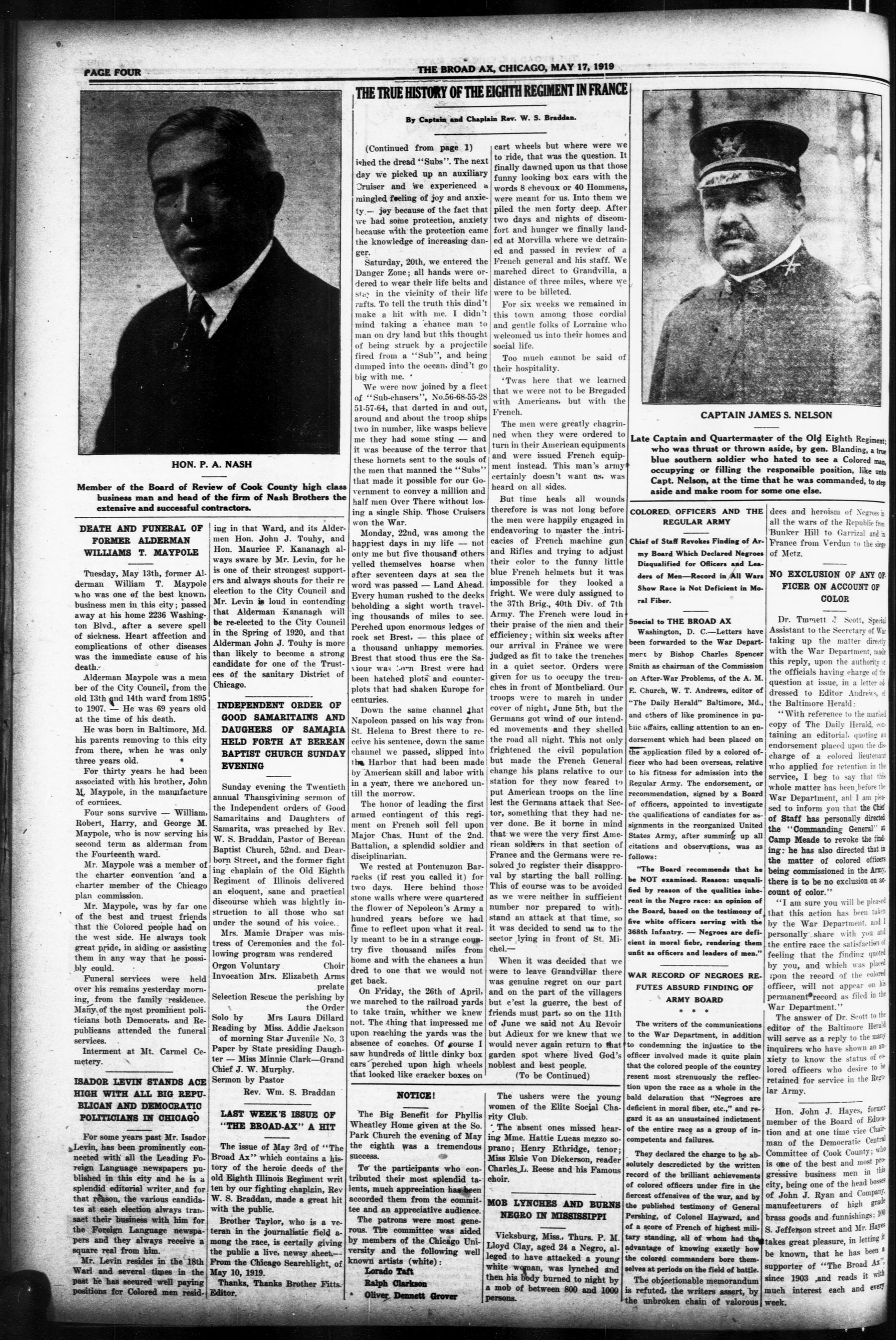
THE TRUE HISTORY OF THE EIGHTH REGIMENT IN FRANCE
By Captain and Chaplain Rev. W. S. Braddan.
(Continued from page 1) iched the dread "Subs". The next day we picked up an auxiliary Cruiser and we experienced a mingled feeling of joy and anxiety. joy because of the fact that we had some protection, anxiety because with the protection came the knowledge of increasing danger. Saturday, 20th, we entered the Danger Zone; all hands were ordered to wear their life belts and stay in the vicinity of their life rafts. To tell the truth this dind't make a hit with me. I didn't mind taking a chance man to man on dry land but this thought of being struck by a projectile fired from a "Sub", and being dumped into the ocean, dind't go big with me.
We were now joined by a fleet of "Sub-chasers", No.56-68-55-28 51-57-64, that darted in and out, around and about the troop ships two in number, like wasps believe me they had some sting — and it was because of the terror that these hornets sent to the souls of the men that manned the "Subs" that made it possible for our Government to convey a million and half men Over There without losing a single Ship. Those Cruisers won the War.
Monday, 22nd, was among the happiest days in my life — not only me but five thousand others yelled themselves hoarse when after seventeen days at sea the word was passed — Land Ahead. Every human rushed to the decks beholding a sight worth traveling thousands of miles to see. Perched upon enormous ledges of rock set Brest, — this place of a thousand unhappy memories. Brest that stood thus ere the Saviour was born Brest were had been hatched plots and counterplots that had shaken Europe for centuries.
Down the same channel that Napoleon passed on his way from St. Helena to Brest there to receive his sentence, down the same channel we passed, slipped into the Harbor that had been made by American skill and labor with in a year, there we anchored until the morrow.
The honor of leading the first armed contingent of this regiment on French soil fell upon Major Chas. Hunt of the 2nd. Battalion, a splendid soldier and disciplinarian.
We rested at Pontenuzon Barracks (if rest you called it) for two days. Here behind those stone walls where were quartered the flower of Nepoleon's Army a hundred years before we had time to reflect upon what it really meant to be in a strange country five thousand miles from home and with the chances a hundred to one that we would not get back.
On Friday, the 26th of April, we marched to the railroad yards to take train, whither we knew not. The thing that impressed me upon reaching the yards was the absence of coaches. Of course I saw hundreds of little dinky box cars perched upon high wheels that looked like cracker boxes on
The Big Benefit for Phyllis Wheatley Home given at the So. Park Church the evening of May the eighth was a tremendous success.
To the participants who contributed their most splendid talents, much appreciation has been accorded them from the committee and an appreciative audience.
The patrons were most generous. The committee was aided by members of the Chicago University and the following well known artists (white):
cart wheels but where were we to ride, that was the question. It finally dawned upon us that those funny looking box cars with the words 8 chevoux or 40 Hommens, were meant for us. Into them we piled the men forty deep. After two days and nights of discomfort and hunger we finally landed at Morvilla where we detrained and passed in review of a French general and his staff. We marched direct to Grandvilla, a distance of three miles, where we were to be billeted.
For six weeks we remained in this town among those cordial and gentle folks of Lorraine who welcomed us into their homes and social life.
Too much cannot be said of their hospitality.
'Twas here that we learned that we were not to be Bregaded with Americans, but with the French.
The men were greatly chagrinned when they were ordered to turn in their American equipments and were issued French equipment instead. This man's army certainly doesn't want us, was heard on all sides.
But time heals all wounds therefore is was not long before the men were happily engaged in endeavoring to master the intricacies of French machine gun and Rifles and trying to adjust their color to the funny little blue French helmets but it was impossible for they looked a fright. We were duly assigned to the 37th Brig., 40th Div. of 7th Army. The French were loud in their praise of the men and their efficiency; within six weeks after our arrival in France we were judged as fit to take the trenches in a quiet sector. Orders were given for us to occupy the trenches in front of Montbeliard. Our troops were to march in under cover of night, June 5th, but the Germans got wind of our intended movements and they shelled the road all night. This not only frightened the civil population but made the French General change his plans relative to our station for they now feared to put American troops on the line lest the Germans attack that Sector, something that they had never done. Be it borne in mind that we were the very first American soldiers in that section of France and the Germans were resolved to register their disapproval by starting the ball rolling. This of course was to be avoided as we were neither in sufficient number nor prepared to withstand an attack at that time, so it was decided to send us to the sector lying in front of St. Michel.—
When it was decided that we were to leave Grandvillar there was genuine regret on our part and on the part of the villagers but c'est la guerre, the best of friends must part, so on the 11th of June we said not Au Revoir but Adieux for we knew that we would never again return to that garden spot where lived God's noblest and best people.
The ushers were the young women of the Elite Social Charity Club. The absent ones missed hearing Mme. Hattie Lucas mezzo soprano; Henry Ethridge, tenor; Miss Elsie Von Dickerson, reader Charles L. Reese and his Famous choir.
MOB LYNCHES AND BURNS
NEGRO IN MISSISSIPPI
Vicksburg, Miss., Thurs. P. M. Lloyd Clay, aged 24 a Negro, alleged to have attacked a young white woman, was lynched and then his body burned to night by a mob of between 800 and 1000 persons.
CAPTAIN JAMES S. NELSON
Late Captain and Quartermaster who was thrust or thrown blue southern soldier who occupying or filling the Capt. Nelson, at the time aside and make room for s
Late Captain and Quartermaster of the Old Eighth Regiment who was thrust or thrown aside, by gen. Blanding, a true blue southern soldier who hated to see a Colored man occupying or filling the responsible position, like unto Capt. Nelson, at the time that he was commanded, to step aside and make room for some one else.
COLORED OFFICERS AND THE REGULAR ARMY
Chief of Staff Revokes Finding of Army Board Which Declared Negroes Disqualified for Officers and Leaders of Men—Record in All Wars Show Race is Not Deficient in Moral Fiber.
dees and heroism of Negroes in all the wars of the Republic from Bunker Hill to Garrizal and in France from Verdun to the sieges of Metz.
NO EXCLUSION OF ANY OF FICER ON ACCOUNT OF COLOR
Special to THE BROAD AX
Washington, D. C.—Letters have been forwarded to the War Department by Bishop Charles Spencer Smith as chairman of the Commission on After-War Problems, of the A. M. F. Church, W. T. Andrews, editor of "The Daily Herald" Baltimore, Md., and others of like prominence in public affairs, calling attention to an endorsement which had been placed on the application filed by a colored officer who had been overseas, relative to his fitness for admission into the Regular Army. The endorsement, or recommendation, signed by a Board of officers, appointed to investigate the qualifications of candidates for assignments in the reorganized United States Army, after summing up all citations and observations, was as follows:
"The Board recommends that he be NOT examined. Reason: unqualified by reason of the qualities inherent in the Negro race: an opinion of the Board, based on the testimony of five white officers serving with the 368th Infantry. — Negroes are deficient in moral fiebr, rendering them unfit as officers and leaders of men."
WAR RECORD OF NEGROES RES FUTES ABSURD FINDING OF
The writers of the communications to the War Department, in addition to condemning the injustice to the officer involved made it quite plain that the colored people of the country resent most strenuously the reflection upon the race as a whole in the bald delaration that "Negroes are deficient in moral fiber, etc.," and regard it as an unsustained indictment of the entire race as a group of incompetents and failures.
They declared the charge to be absolutely descredited by the written record of the brilliant achievements of colored officers under fire in the fiercest offensives of the war, and by the published testimony of General Pershing, of Colonel Hayward, and of a score of French of highest military standing, all of whom had the advantage of knowing exactly how the colored commanders bore themselves at periods on the field of battle.
The objectionable memorandum is refuted, the writers assert, by the unbroken chain of valorous
ARMY BOARD
dees and heroism of Negroes in all the wars of the Republic from Bunker Hill to Garrizal and in France from Verdun to the siege of Metz.
NO EXCLUSION OF ANY OF
FICER ON ACCOUNT OF
COLOR
Dr. Tmnett J. Scott, Special Assistant to the Secretary of War, taking up the matter directly with the War Department, made this reply, upon the authority of the officials having charge of the question at issue, in a letter addressed to Editor Andrews, of the Baltimore Herald:
"With reference to the marked copy of The Daily Herald, containing an editorial, quoting an endorsement placed upon the discharge of a colored lieutenant who applied for retention in the service, I beg to say that this whole matter has been before the War Department, and I am pleased to inform you that the Chief of Staff has personally directed the "Commanding General" at Camp Meade to revoke the finding: he has also directed that in the matter of colored officers being commissioned in the Army there is to be no exclusion on account of color."
"I am sure you will be pleased that this action has been taken by the War Department, and I personally share with you and the entire race the satisfaction of feeling that the finding quoted by you, and which was placed upon the record of the colored officer, will not appear on his permanent record as filed in the War Department."
The answer of Dr. Scott to the editor of the Baltimore Herald will serve as a reply to the many inquirers who have shown an anxiety to know the status of colored officers who desire to be retained for service in the Regular Army.
Hon. John J. Hayes, former member of the Board of Education and at one time vice Chairman of the Democratie Central Committee of Cook County; who is one of the best and most progressive business men in this city, being one of the head bosses of John J. Ryan and Company, manufacturers of high grade brass goods and funnishings; 100 S. Jefferson street and Mr. Hayes takes great pleasure, in letting it be known, that he has been a supporter of "The Broad Ax" since 1903, and reads it with much interest each and every week.
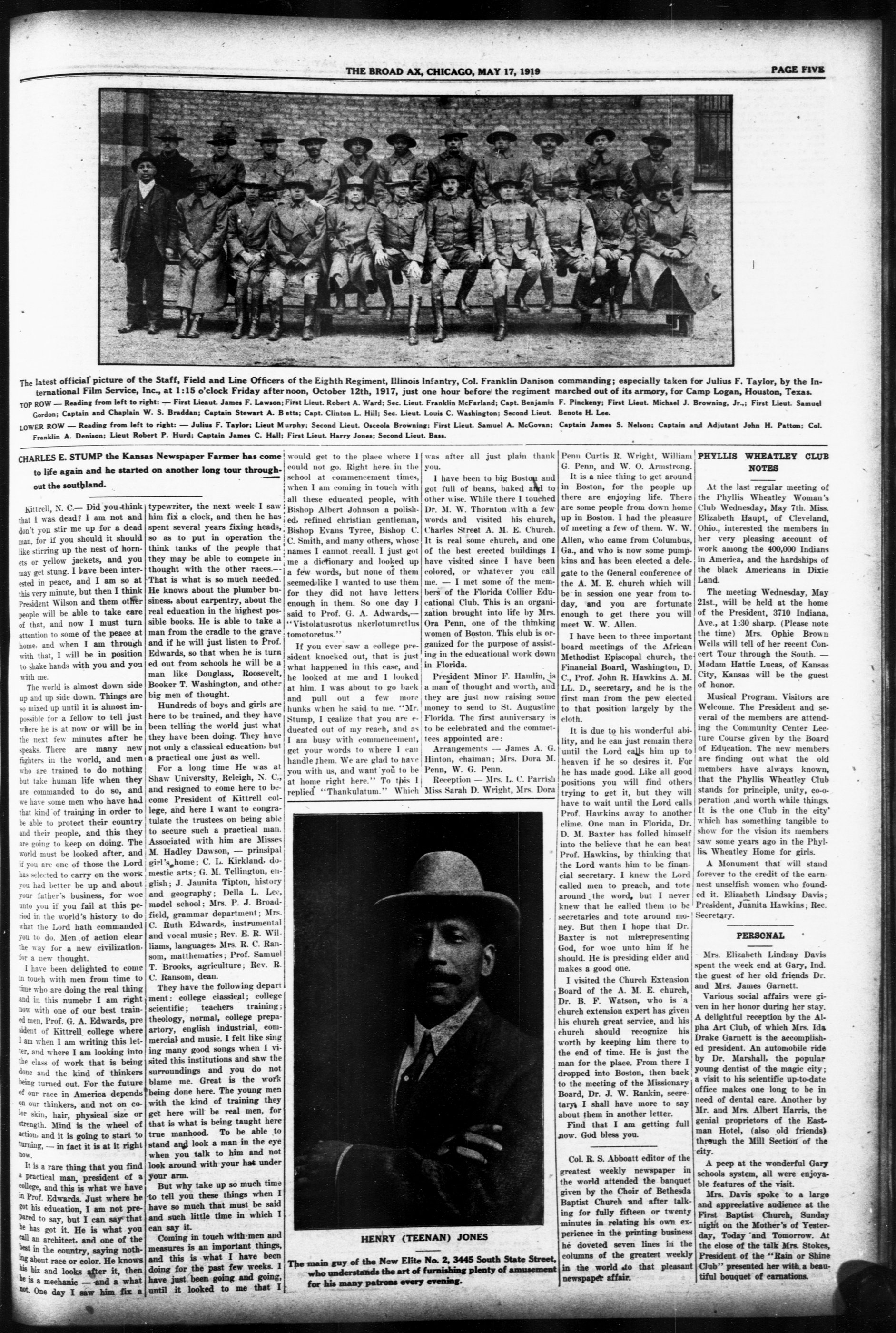
The latest official picture of the Staff, Field and Line Officers of the Eighth Regiment, Illinois Infantry, Col. Franklin Danison commanding; especially taken for Julius F. Taylor, by the International Film Service, Inc., at 1:15 o'clock Friday afternoon, October 12th, 1917, just one hour before the regiment marched out of its armory, for Camp Logan, Houston, Texas.
TOP ROW — Reading from left to right: — First Lieaut. James F. Lawson; First Lieut. Robert A. Ward; Sec. Lieut. Franklin McFarland; Capt. Benjamin F. Pinckeny; First Lieut. Michael J. Browning, Jr.; First Lieut. Samuel Gordon; Captain and Chaplain W. S. Braddan; Captain Stewart A. Betts; Capt. Clinton L. Hill; Sec. Lieut. Louis C. Washington; Second Lieut. Benote H. Lee.
LOWER ROW — Reading from left to right: — Julius F. Taylor; Lieut Murphy; Second Lieut. Osceola Browning; First Lieut. Samuel A. McGovan; Captain James S. Nelson; Captain and Adjutant John H. Patton; Col. Franklin A. Denison; Lieut Robert P. Hurd; Captain James C. Hall; First Lieut. Harry Jones; Second Lieut. Bass.
CHARLES E. STUMP the Kansas Newspaper Farmer has come to life again and he started on another long tour throughout the southland.
would get to the place where I could not go. Right here in the school at commencement times, when I am coming in touch with was after all just plain thank you.
I have been to big Boston and got full of beans baked and to Penn Curtis R. Wright, William G. Penn, and W. O. Armstrong.
It is a nice thing to get around in Boston, for the people up
PHYLLIS WHEATLEY CLU NOTES
At the last regular meeting.
Kittrell, N. C.—Did you think that I was dead? I am not and don't you stir me up for a dead man, for if you should it should like stirring up the nest of hornets or yellow jackets, and you may get stung. I have been interested in peace, and I am so at this very minute, but then I think President Wilson and them other people will be able to take care of that, and now I must turn attention to some of the peace at home, and when I am through with that, I will be in position to shake hands with you and you with me.
The world is almost down side up and up side down. Things are so mixed up until it is almost impossible for a fellow to tell just where he is at now or will be in the next few minutes after he speaks. There are many new fighters in the world, and men who are trained to do nothing but take human life when they are commanded to do so, and we have some men who have had that kind of training in order to be able to protect their country and their people, and this they are going to keep on doing. The world must be looked after, and if you are one of those the Lord has selected to carry on the work you had better be up and about your father's business, for woe unto you if you fail at this period in the world's history to do what the Lord hath commanded you to do. Men of action clear the way for a new civilization for a new thought.
I have been delighted to come in touch with men from time to time who are doing the real thing and in this numebr I am right now with one of our best trained men, Prof. G. A. Edwards, president of Kittrell college where I am when I am writing this letter, and where I am looking into the class of work that is being done and the kind of thinkers being turned out. For the future of our race in America depends on our thinkers, and not on color skin, hair, physical size or strength. Mind is the wheel of action, and it is going to start to turning, — in fact it is at it right now.
It is a rare thing that you find a practical man, president of a college, and this is what we have in Prof. Edwards. Just where he got his education, I am not prepared to say, but I can say that he has got it. He is what you call an architect, and one of the best in the country, saying nothing about race or color. He knows his biz and looks after it, then he is a mechanic — and a what not. One day I saw him fix a
typewriter, the next week I saw him fix a clock, and then he has spent several years fixing heads, so as to put in operation the think tanks of the people that they may be able to compete in thought with the other races. That is what is so much needed. He knows about the plumber business, about carpentry, about the real education in the highest possible books. He is able to take a man from the cradle to the grave and if he will just listen to Prof. Edwards, so that when he is turned out from schools he will be a man like Douglass, Roosevelt, Booker T. Washington, and other big men of thought.
Hundreds of boys and girls are here to be trained, and they have been telling the world just what they have been doing. They have not only a classical education, but a practical one just as well.
For a long time He was at Shaw University, Releigh, N. C., and resigned to come here to become President of Kittrell college, and here I want to congratulate the trustees on being able to secure such a practical man. Associated with him are Misses M. Hadley Dawson, — prinsipal girl's home; C. L. Kirkland. domestic arts; G. M. Tellington, english; J. Jaunita Tipton, history and geography; Della L. Lee. model school; Mrs. P. J. Broadfield, grammar department; Mrs. C. Ruth Edwards, instrumental and vocal music; Rev. E. R. Williams, languages, Mrs. R. C. Ransom, mathematics; Prof. Samuel T. Brooks, agriculture; Rev. R. C. Ransom dean.
They have the following department: college classical; college scientific; teachers training; theology, normal, college preparatory, english industrial, commercial and music. I felt like singing many good songs when I visited this institutions and saw the surroundings and you do not blame me. Great is the work being done here. The young men with the kind of training they get here will be real men, for that is what is being taught here true manhood. To be able to stand and look a man in the eye when you talk to him and not look around with your hat under your arm.
But why take up so much time to tell you these things when I have so much that must be said and such little time in which I can say it. Coming in touch with men and measures is an important things, and this is what I have been doing for the past few weeks. I have just been going and going, until it looked to me that I
THE BROAD AX. CHICAGO. MAY 17. 1919
would get to the place where I could not go. Right here in the school at commencement times, when I am coming in touch with all these educated people, with Bishop Albert Johnson a polished, refined christian gentleman, Bishop Evans Tyree, Bishop C. C. Smith, and many others, whose names I cannot recall. I just got me a dictionary and looked up a few words, but none of them seemed like I wanted to use them for they did not have letters enough in them. So one day I said to Prof. G. A. Adwards,—"Vistolatusrotus nkerlotumretlus tomotetus."
If you ever saw a college president knocked out, that is just what happened in this case, and he looked at me and I looked at him. I was about to go back and pull out a few more hunks when he said to me. "Mr. Stump, I realize that you are educated out of my reach, and as I am busy with commencement, get your words to where I can handle them. We are glad to have you with us, and want you to be at home right here." To this I replied "Thankulatum." Which
APPIED
M. R. S.
HENRY (TEENAN) JONES
The main guy of the New Elite who understands the art of for his many patrons every
The main guy of the New Elite No. 2, 3445 South State Street, who understands the art of furnishing plenty of amusement for his many patrons every evening.
was after all just plain thank you.
I have been to big Boston and got full of beans, baked and to other wise. While there I touched Dr. M. W. Thornton with a few words and visited his church, Charles Street A. M. E. Church. It is real some church, and one of the best erected buildings I have visited since I have been colored, or whatever you call me. — I met some of the members of the Florida Collier Educational Club. This is an organization brought into life by Mrs. Ora Penn, one of the thinking women of Boston. This club is organized for the purpose of assisting in the educational work down in Florida.
President Minor F. Hamlin, is a man of thought and worth, and they are just now raising some money to send to St. Augustine Florida. The first anniversary is to be celebrated and the committees appointed are: Arrangements — James A. G. Hinton, chairman; Mrs. Dora M. Penn, W. G. Penn. Reception — Mrs. L. C. Parrish Miss Sarah D. Wright, Mrs. Dora
[Image of a man in a suit and hat, with a serious expression, standing with his hands clasped in front of him.]
No. 2, 3445 South State Street, furnishing plenty of amusement evening.
Penn Curtis R. Wright, William G. Penn, and W. O. Armstrong. It is a nice thing to get around in Boston, for the people up there are enjoying life. There are some people from down home up in Boston. I had the pleasure of meeting a few of them. W. W. Allen, who came from Columbus, Ga., and who is now some pumpkins and has been elected a delegate to the General conference of the A. M. E. church which will be in session one year from today, and you are fortunate enough to get there you will meet W. W. Allen.
I have been to three important board meetings of the African Methodist Episcopal church, the Financial Board, Washington, D.C., Prof. John R. Hawkins A. M. LL. D., secretary, and he is the first man from the pew elected to that position largely by the cloth.
It is due to his wonderful ability, and he can just remain there until the Lord calls him up to heaven if he so desires it. For he has made good. Like all good positions you will find others trying to get it, but they will have to wait until the Lord calls Prof. Hawkins away to another clime. One man in Florida, Dr. D. M. Baxter has folled himself into the believe that he can beat Prof. Hawkins, by thinking that the Lord wants him to be financial secretary. I knew the Lord called men to preach, and tote around the word, but I never knew that he called them to be secretaries and tote around money. But then I hope that Dr. Baxter is not misrepresenting God, for woe unto him if he should. He is presiding elder and makes a good one.
I visited the Church Extension Board of the A. M. E. church, Dr. B. F. Watson, who is a church extension expert has given his church great service, and his church should recognize his worth by keeping him there to the end of time. He is just the man for the place. From there I dropped into Boston, then back to the meeting of the Missionary Board, Dr. J. W. Rankin, secretary. I shall have more to say about them in another letter.
Find that I am getting full now. God bless you.
Col. R. S. Abboatt editor of the greatest weekly newspaper in the world attended the banquet given by the Choir of Bethesda Baptist Church and after talking for fully fifteen or twenty minutes in relating his own experience in the printing business he doveted seven lines in the columns of the greatest weekly in the world so that pleasant newspaper affair.
PAGE FIVE
for Julius F. Taylor, by the In-amp Logan, Houston, Texas.
Browning, Jr.; First Lieut. Samuel
and Adjutant John H. Pattom; Col.
PHYLLIS WHEATLEY CLUB NOTES
At the last regular meeting of the Phyllis Wheatley Woman's Club Wednesday, May 7th. Miss. Elizabeth Haupt, of Cleveland, Ohio., interested the members in her very pleasing account of work among the 400,000 Indians in America, and the hardships of the black Americans in Dixie Land.
The meeting Wednesday, May 21st., will be held at the home of the President, 3710 Indiana, Ave., at 1:30 sharp. (Please note the time) Mrs. Ophie Brown Wells will tell of her recent Concert Tour through the South. — Madam Hattie Lucas, of Kansas City, Kansas will be the guest of honor.
Musical Program. Visitors are Welcome. The President and several of the members are attending the Community Center Lecture Course given by the Board of Education. The new members are finding out what the old members have always known, that the Phyllis Wheatley Club stands for principle, unity, cooperation, and worth while things. It is the one Club in the city which has something tangible to show for the vision its members saw some years ago in the Phyllis Wheatley Home for girls.
A Monument that will stand forever to the credit of the earnest unselfish women who founded it. Elizabeth Lindsay Davis; President, Juanita Hawkins; Rec. Secretary.
PERSONAL
Mrs. Elizabeth Lindsay Davis spent the week end at Gary, Ind. the guest of her old friends Dr. and Mrs. James Garnett.
Various social affairs were given in her honor during her stay. A delightful reception by the Alpha Art Club, of which Mrs. Ida Drake Garnett is the accomplished president. An automobile ride by Dr. Marshall, the popular young dentist of the magic city; a visit to his scientific up-to-date office makes one long to be in need of dental care. Another by Mr. and Mrs. Albert Harris, the genial proprietors of the Eastman Hotel, (also old friends) through the Mill Section of the city.
A peep at the wonderful Gary schools system, all were enjoyable features of the visit.
Mrs. Davis spoke to a large and appreciative audience at the First Baptist Church, Sunday night on the Mother's of Yesterday, Today and Tomorrow. At the close of the talk Mrs. Stokes, President of the "Rain or Shine Club" presented her with a beautiful bouquet of carnations.
PAGE SIX
SsS_>>>=>=
‘Alexandria,
Alerandria, founded by the world
conqueror, Alexander the Great, Is en
tcunntjon with the farewey pest and
the faraway past
become completely modernized. Fate
bas favored this ambition, for the won-
Gers that Cleopatra knew have bees
eaten by fre or swept away by the
sea, Alexandria is a city of trade and
‘fashion, dominated by prosperous Bu-
Topeans too deeply absorbed in the
stock exchange to be even vaguely in-
terested in the romantic side of thelr
tty. ass)
ee
Tides of the Ocean.
‘The incoming and the outgoing of
the tides ts caused by the gravite-
tional influence of the moon. The
moon, so to speak, draws or lifts the
water from the depths on the same
principle that = pump lifts water.
And as with a pump, the water rushes
1 to fill the space left; so the shal
low water near shore rushes out to fill
the extra space caused by rising of
the water, on the principle that water
seeks its own level.
World's Larcest Bullding.
‘The Vatican palace at Rome ts the
largest building in the world, covering
18% acres, but with its additions apd
enlargements It was several centuries
in building. The most extensive bulld-
ing in the world constructed at one
time is the Pennsylvania station in
New York city, which occupies eight
acres of ground and has exterior walls
neasuring about one-half a mile. The
capitol at Washington covers 158,112
square feet, or nearly four acres.
‘Washington's Advisers.
‘When Washington formed his cab-
{net it had but four members, the in-
terlor department being unknown, the
‘war and navy departments being un-
der one head, and the postmaster gen-
eral being subordinate to the treas-
‘ury. Nevertheless of these four posi-
tions, he gave two to Virginians, Sec
retary of State Jefferson and Attorney
General Randolph; one to New York,
Alexander Hamilton, and one to Mass
achusetts, Henry Knox.
‘There are four sorts of readers:
hour giass readers, whose reading runs
in and out and leaves nothing; sponge
readers, who imbibe all but only to
give it out again as they got tt, and
perhaps not so clear; jelly-bag readers,
who keep the dregs and refuse, and
let the pure run through; diamond
readers, who cast aside all that is
worthless and hold only gems.
‘Sympathetic Brothers.
‘The boys of the neighborhood were
anticipating the time when they could
go fishing. Everett, noticing. his ltt-
tle sister standing inside the yard,
watching them wistfully through the
fence, and listening to their plans
without jeining the conversation, re-
marked in an aside to bis compan-
fons: “Gee, it must be tongh to be
only @ girl”
Animals and Earthquakes.
One of the mysteries still unsolved
ts that of the sense by which the low-
er animals become aware of the ap-
proach of earthquakes. Birds and rate
become alarmed and try to escape
Super-sensitiveness to faiyt shocks
scarcely gives satisfactory explanation,
for modern selsmographs are very
sensitive.
Cause for Thankfulness.
‘The first reason for being thankful
tn the morning is that you have lived
to see the dawn of another day, with
opportunities to finish something be-
gun the day before and to begin some-
thing that you may be-able to do bet-
ter than you have ever done anything
before.
Asbestos Deposits.
In the Kotzebue sound region, west-
ern Alaska, there are asbestos. depos-
tte said to rival the richest in the
world. Asbestos, in its natural or vir
gin state, in as white as snow, soft as
the softest silk and lies in long strings
or layers, easily torn apart with the
firgers.
? %
: Utilizing Time.
“Ladies,” announced the president
‘of an afternoon bridge club. “It has
been moved and seconded that there
shall be no conversation at the card
tables. What shall we do with the mo-
tion?” “I suggest.” said a sprightly
member, “that we discuss tt while we
play.” 5
‘The Church-Qeers.-
‘Tf some men were to quote the welh
known psalm they would have to say,
“I was giad to make excuses wien
they said to us, ‘let us go intg the
house of the Lord’ ‘The ‘they’ re-
ferring probably to the women of the
house, or the church-going neighbors.—
‘Exchange.
————
Poesy’s Appeal.
Never id poesy appear so full of
heaven to me as when I saw how it
pierced throngh pride and fear to the
lives of the coarsest men —Lowell.
“A real loafer.” exid Uncle Eben,
“ain’ satisfied to get slong without
work. He wants busy folks to qutt
(Gctr jobs to admire him”
eeeenrrenermncmentieiy ina
= — i
"tie
ss
Readers.
‘To Poltsh Shoes.
‘The Englishman's shoes, or “boots,”
are the best looking seen on the feet
ef any race. The reason for this ts
that the Englishman puts treea in his
shoes, which are polished with the
leather thus smoothed out. The soft-
ning polish, if applied while the shoe
ts on the foot, as is usual in
creases the leather into the shape of
the foot and the shoe loses its smooth
effect. ‘Trees, which add to the long
Iife of shoes, are inexpensive and
should be put in the shoes every night.
If you polish your own shoes, try pol-
ishing them when on trees. You will
be pleased with the result.
ae
Freak Tree. ae
‘We are told that in Kentucky there
ts 2 tree bearing each year a crop of
walnuts and a crop of mulberries, and
the curious phenomenon is accounted
for by the supposition that a mulberry
seed fell where a walnut lay in the
ground, and the young shoots came up
side by side and united thelr forces
into one solid trunk. This supposition
seems feasible from the fact that the
dark of the tree is on one side that
‘of walnut and on the other that of
the mulberry.
——_——_— '
Have Good Light.
If you work at night be sure thet
you have a good light. Are lights, be-
‘cause of their glaring rays, are exceed-
ingly injurious. A shaded light ts the
best substitute at might for diffused
daylight. The electric bulbs should
either have a dome or a dark paper
shade. A gas light composed of man-
tle and bulb produces a good, diffused
light and when placed high enough
near the ceiling does not injure the
'
a a Ceres
Bofled Unseed olf is the finest thing
for genuine old mahogany, as it hard-
‘ens and preserves the wood. Pour the
ofl on to a pad of soft flannel and
rub the wood well. If there are any
cracks in the wood the ol! will fill
these and harden. Wipe off the su-
perftuous of! and polish with a dry,
‘soft cloth. A little vinegar added to
the of! will make a bright, clean, @ry
finish.
=
Sincerity First Requisite.
And least of all is sincerity a qual-
tty that can be successfully imitated.
It twines through the whole emotional
fiber; it has its roots in the heart.
“Sincerity gives wings to power,” Is
the way an old proverb happily puts
tt. Go through any list of acknow!-
edged leader of business and profes-
sional life. You will find there are
few who have not been pre-eminentiy
sincere—H. Addington Brace.
———_- !
Sinai: ciate
A certain Kansas City physician will
never know just how aear death he
was the other day when, after a thor-
ough examination of probably the
brightest, sweetest and altogether su-
preme ninemontheold baby in the
world, the mother asked: “Well, what
do you think about my baby?” and
he said: “Oh, it's a normal baby."—
Kansas City Star.
Bea ee 3
Household Hint.
‘To make a cheap filter, take a large
flower pot and stop the hole with «
sponge. Cover with a few inches of
powdered charcoal; fill with water.
and let ft stand over « pail supported
by two or three sticks. The water
filtering through the charcoal will be
freed from all impurities. The char
coal should be changed every three
months.
‘The Right View and the Wrong.
“The man who makes good doesn't
wait for opportunity to knock; he has
the door wide open,” says an exchange.
That's the right spirit. The other day
we heard a chap complaining because
old Opp didn't stick his toe in the door
lke a book agent—Boston Transcript.
A Planist.
Why are some folks so set in their
ways? There's old Opportunity, for
instance. For countless centuries she
has been knocking at people's doors.
Why doem’t the ol¢-fashioned thing
‘use the bell, come around to the back
door or else peck on the window?
Rest the Eye. = -
‘Look up every once in a while from
your work and lay it down for a min-
ute or two now and then, and let your
toterest focus on more distant things.
‘Thus you will give the eyes a little
rest by focussing in another position.
Wanted to “Honk it.‘
Ethel’s mother was trying to spray
her throat with the atomizer, but met
with considerable opposition from the
small victim. “I wouldn't mind it so
much,” sald Ethel, “if you would let
me honk it myself.”
Beauty va Brains.
Many a headliner “is more the re-
sult of her maid's handiwork than her
director's hea¢work.—Film Fun.
Dally Thought.
‘Success is counted sweetest by those
who ne'er succeed.—Emily Dickinson.
o denen lawsuite. =
THE BROAD AX, CHICAGO, MAY 17, 1919
Insects Preserved tn Amber.
In a collection of red amber present
ed to the British museum, Prof. T. D.
Cockerell has recognized an astonish-
ing variety of insect forms, and has
described not less than 81 new species,
of which five are types of new genera.
Most of them were found in a single
block little larger than s man's fist,
which was cut into half-inch siices, in
every qne of which the insects are
densely crowded. The amber is from
Miocene clay beds of Burma, though
perhaps washed from still older depos-
its, and nearly every large order of in-
sects is represented, the family of ants
b@ing « notable exception.
God of the Lower World.
In one temple of Japan the image ts
@ Japanese conception of the god of
the lower world. The figure has an
unusual history. An image maker, it
is said, died. When be appeared be-
fore the lord of the other world, he
was told that in his lifetime he had
never represented the lord of the world
properly, and that be must return to
earth and make a correct likeness.
The figure is pointed out as the result
of the order. It is 80 horrible with
Its red face and malevolent giare that
the story seems plausible.
Crees Wonderful Canoelsta.
“The Ojibway, the Cree and the
Montagnals are the most wonderful
canoemen in the world.” says S.
E. Sangster, writing of “The Woods
Indian” in Boys’ Life. “They pos-
sess a sixth sense in rapid-running and
if they say ‘run {t' you cam safely lay &
bet at odds that they will run it and
come through dry—even through water
the mere gilmpse of which makes your
hair stand up and sends chills chasing
up and down your spine.”
@ae Alums Gee ch Qt,
Ofiver was in the habit of going to
his grandma for favors, and was never
disappointed. While playing with the
other boys of the neighborhood thelr
football came apart. and they thought
they could sew it together if they only
had @ plece of shoestring. Oliver
came to the rescue. “Let's go and ask
grandma for # shoestring.” he sug-
gested. “You can get about anything
you ask for over at grandma's.”
Keeping Cider Sweet.
To keep elder sweet place in each
barrel immediately on making, mus-
tard, four ounces; salt, one ounee, and
ground chalk, one ounce. Shake well,
Or cider may be preserved sweet by
canning in airtight cans after the man-
ner of preserving frutt. The lquid
from the dregs, vet fermentation meat
from the dregs, but must
not be allowed to commence before
cenning or tt will not keep.
Officers’ Hat Cords.
Hat cords of general officers are
gold; of all other officers, gold and
black; of men in infantry, light blue:
of men in cavalry, yellow; of men in
artillery, scarlet; im quartermaster
corps, buff; medical department, ma-
Toon; corps of engineers, scarlet and
white; ordnance fepartment, black
and scarlet; signal corps, orange and
white.
—_—————— !
Feeding Rabbits.
Rabbits need not only green feed,
but s solid staple meal every day—
preferably of grain—but that is a diff.
culty at present; bread may be substi-
tuted, with a little bran or oatmeal,
and always plenty of clean water or
milk and water.
‘Trouble In the Future.
‘The pessimist is always anticipat-
tng new varieties of trouble. One con-
temporary casts his eye fort
ward to tho Gly. when wiraleas tele:
phony will be so perfect that a man
will have « receiver in his hut and be
managed by his wife all the time.
———y
All newspapers often have advertise
ments which could be rewritten advan-
tageously. But tt took a chureh paper
to offer the most original one yet:
“Wanted—A minister who has been
married 22 years is very desirous of
securing a change.”
Cannibal Movie Fans.
New Zealand Maoris, native Jar
anese and the cannibals of the South
Sea islands have developed a rave
nous appetite for the American movie
stars. Thelr appetite, hawever, doesn't
crave blood. They want them on the
screen.
World's Urgent Need.
‘The state will be saved if the Lord
puts it inte the heart of the average
man so to shape his life that the state
shall be worth saving, and only on
those terms. We need civic righteous-
ness.—Theodore Roosevelt.
Had Him There
“Deacon Simms ‘low be doan’ ap-
prove o’ churches advertisin’,” remark-
ed Shinbone; “bet when Ah ast him,
im Gat ease, wuffo’ be ring the church
bell fo’ service, he fs hed nuffin’ to
say."—Boston Transcript.
Says the Office Humerist.
‘The coleverest gardener in the world
cannot grow an oak tree out of a rose
bush. But the stupidest pipe smoker
cam make the “ash” grow inside the
‘On the Pike.
‘The old national pike, that magnif-
ceat road that used to run from Mary-
land to Ilinols, witnessed some sharp
brushes of fast driving and many aD
adventure of travel. The New York
Tribune tells one story about Henry
Clay, who was sometimes called the
“father of the Turnpike.” He was
traveling along the pike In # coach.
when the horses ran and spilled him
out headlong into the miry read. “No
harm done,” be said when the driver
rushed to pick him up. “Only ® poor
mixture of Pennsylvania sand with
Kentucky clay!"
Dictaphone Calle Mother.
‘A dictaphone with a megaphone and
a loud-speaking amplifier in the recelv-
er is shown in Popular Mechanics Mag-
azine. With the receiver fastened to
the baby's crib in the nursery upstairs,
and the megaphone placed in the par-
lor below, the arrangement works to
satisfaction. Mother may go about
her housework, while baby will sleep
soundly, undisturbed by the nolse of
the lving room, but if he should
waken, his cries will be instantly heard
downstairs.
United States of the World.
‘The day will come when we shall
realize not only the brotherhood of in-
dividuals but the essential unity of all
mankind. All are brothers; all chil-
dren of the same father. The barriers
which divide nations are artificial. I
believe the time is at hand when these
barriers will fall, like the walls of
Jericho, before love's trumpet sum-
mons, when the banner of brotherhood
and freedom will float forever over a
new federation—the United States of
the World.—Toistoy.
ee ,
AWhen Virginia Seceded.
On April 17 In 1861 the state con-
vention, composed of the members of
the legislature of Virginia, passed the
“ordinance of secession” by a vote of
88 t 55. Virginia, 11 days prior te
this, had refused to join the states of
‘America; but the decision of the Con-
federate leaders to fire upon Sumter
and Lincoln's call for 75,000 votun-
teers on April 15 turned the seale and
Virginia threw tm her lot with the
South.
Qecine the Earth Retite.
Tf a long pendulum Is set swinging
with {ts point of suspension free to
turn, the plane of swing will remain
fixed while the rotating earth skews
around under it. This ts the finest
demonstration of the earth's rotation.
and recently at Wellington, New Zea-
land, a pesduium only ten feet long
showed the rotation with 40 secs. after
the swing began.
No Sound From Giraffe.
Tt In said by animal trainers that the
giraffe has never been known to emit
a sound of any kind. No matter what
the animal may suffer when fll or In-
Jored, he remains silent. And scten-
tists have advanced the theory that,
because of the extreme length of the
neck, sound fs difficult or tmpossible for
the giraffe.
Wanted to Know.
A woman who was troubled with
chronic nightmare and who frequently
erled out in her sleep advertised for
room and board “with a family who
would not object to screaming in the
night.” Among the answers she re-
ceived was one which asked: “How
often would you require us to scream?”
—Boston Transcript.
Americans and Yankees.
Although Canada ts part of the
continent of America, the name
American is usually limited to citizens
of the United States. A real Yankee
ts supposed to have been born
and raised In one of the New England
states, but outside of this country the
name is applied indiscriminately to
people of the United States.
i armertens
‘The Scientific American says: Make
@ solution of 1 os. camphor, 1% oz.
spirits turpentine and 4 dr. of ether.
Keep the end of the drilling tool wet
with this fluid. The sharp corner of
a freshly broken point of a file is one
of the best drilling tools for this pur
pose.
Look at the Best in Sight.
Get into the habit of looking at the
silver lining of the cloud; and, when
you have found it, continue to look
at it rather than at the leaden gray
im the middie. It will help you over
many hard places—A. A. Willis, D. D.
Mard Tesk.
As & general thing, a man ought not
to marry a women to reform her un-
lees he is prepared to neglect his reg-
‘wlar business.—Dallas News.
‘bulls and the bears usually
‘The take
their lamb with mint salice—Bostoe
‘Transcript.
Our Occasional Offertory.
‘Quite right, Clara, they call ‘em step
fathers because they make the chil-
dren step around.
Optimistic Thought.
‘To enlighten his subjects is the true
‘provine? of a ruler.
Death Valley.
_ Death valley is a narrow valley be-
tween the Punamint and Funeral
mountains in Califorpia. It is trav
ersed by the Amargara river, which is
usually a dry channel, though prob-
ably was formerly full of water.
The level of the valley is covered
with salt, supposed to have been
brought by the torrents from the sur
rounding desert and left om the evap-
oration of the water. Death valley
ts considered to be the hottest and
driest place in thd United States. A
temperature of 422 degrees has been
observed.
4
Sky Went Along”
‘A woman was leaving a home where
she had been very happy, and, as she
bearded the train which was to take
her away, the tears came fast. Her
ttle son, anxtotis to comfort her,
tried the effect of a cheering discov-
‘ery he had just made. “Why, mother,”
he exclaimed, “the sky is going right
along with us.” Other faint-hearted
people need to make the same dis
covery. No matter what we leave be
hind, the best goes with us '
Find Indian Stene Celts
Tm an article on Indian stone celts
tm the Wisconsin Archeologist, Charies
B. Brown, chief of the state historical
museum, describes the various classes
of celts, of stone hatchets, and in what
‘Wisconsin localiftes many of them have
been found. Jefferson county has been
the source of many celts, and other
counties In which they have been found
are Dane, Calumet. Brown, Waupaca.
Walworth, Winnebago, Waukesha and
Washington.
fee War With Soain.
On the 18th of April. 1898, the United
Rates senate and the house of repre-
sontr‘ve declared Jointly that the
Cubans “are and of a right ought to
he frre and independent” and empow-
ered President McKinley to use the
land and naval forces of the United
States to their utmost capacity to ear
ry the resolution into effect. This reso-
Tution constituted our declaration of
war against Spain.
—<—<—<———w
Battie of San Jacinto.
‘The battle of San Jacinto was fought
April 21, 1836, between 1.600 Mext-
cans under Santa Anna and 800 Amer.
feans under Sam Houston. Santa
Anna was defeated and he and 730
of his men were captured, 630 killed
‘and 208 wounded. The Texan loss waa
2 killed and 28 wounded. This bat
tle decided the independence of Texas,
and the day is observed in the state
as a holiday.
‘The Making of @ Match.
‘Thorpe gives the following propor
tions for match head and for striking
surface: Head composition: Potas-
stum chlorat, five parts; potasstum
bichromat, two Purts; glass powder,
three parts; gum, two parts. Rubbing
surface: Antimony trisulfid, five parts;
re6 phosphorus, three parts; mangan-
ese dioxid, one and one-half parts;
giue, four parts—Electrical Expert-
meater.
——_ t
Household Suggestion.
A Los Angeles woman says now
that men have been taught to cook and
keep house in the army, they should
go ahead and cook and keep house in-
definitely, leaving the women free to
reform the world. Will the women
agree, then. not to bring guests home
to dinner without first calling up to
find out whether there Is enough food
fn the house to feed them? ,
A Russell Story.
A story that the late G. W. H. Rus
sell told with gusto was of a mayor
in a north of England town. His wor
ship presented some seats for the sea
front, and had this inscribed on them:
“Presented to the borough by the
mayor. Ald. Boggins. The sea is
bis and he made It."—London Chron-
ide
Pecullar Feeling.
Celia had been fll for many weeks.
One day when she was stronger and
had been put in a chalr, she slipped
down to the floor and stood for a mo-
ment on her feet. “Oh,” she said, in
& much surprised voice, “I feel heavy
to myself.” :
Why Be Thankful?
One good reason for being thankful
ail the time is that you have cool wa-
"ter to drink, wholesome food to eat,
and fresh air to breathe. These make
it possible to enjoy the kind of health
that brings the state of good feeling
called happiness.
‘Silly Jamie.
‘The other day Jamie came running
‘nto the house crying at the top of
hix voice. He was followed by Jane,
who explained by saying: “Mother,
Tin "shamed of Jamle—he's so unbrave,
‘erying ‘cause a little dog chased him.”
Proper Food important.
“As a man thinketh so is he.” Yes;
but also: “As a man eateth so doth
he think.” For the brain, a part of
the body, is built of food —Los Angeles
‘Times.
Dally Thought.
‘To be trusted is a greater complt-
matt Man to be lovel—Getege Mae
|
|
Find the Joy in Thingy
Do not tet the things that nee
made for your service crush out yee
Wife with their weizht. Lite is iy
of sunshine, and beauty, and lot
birds sing and flowers bloom tor ya
fg well as for pthers. Do not an
eyes to the beauties of tite,
Sees
fs Joy In a well-cooked tea! If we an
Rot overburdened. But there ty
Joy tm anything unless we open ity
oor of our hearts and let in tty
sunshine and dispel the gloom thet
we have created for ourseives—py
change.
a
Has Two Meanings.
‘Troops 1s used In the plural to mexy
the same as solders, and not including
tn its meaning the number or whethes
infantry, cavalry or artillery. The wort
as generally used in the papers tas
this meaning. Therefore 2.000 troop
means 2000 soldiers. In the strie
cavalry use of the word, however, 4
troop is the unif of formation, cop
sisting ‘usually of 60 troopers, om.
manded by captain and correspoog.
ing to company of infantry.
ee
Art's Inspiration,
A famous artist, who had art clase,
had forbidden smoking tn bis stutie
One day, after being out for half w
hour, he re-entered the stnlo sides.
ly and saw one student with « lghtat
cigarette In his fingers, which he tret
to conceal. With an alr of assume
playfulness the artist approached the
offender and sald: “A strange eraym
you have there, my friend. May I ast
what you propose to draw with that
“Clouds!” replied the student.
Death.
Death fs nothing more or less tha
slipping back Into Four own subcm
sclousness, and so becoming greater
and finer and more netive—more am
fal, too—and with grander powers
than we ever bad in our limited tmper
fect ‘bodies. Life Is nothing bat a
episode In our univers life...
Death Is Just a change of directoa
then, really; that’s all_—From “Te
Promise of Air.” by Algernon Black
wood,
Meredith's Vanity.
“George Meredith. ax his frients
used to tell with amusetent.” writes
Bodert Lynd tn the Lotion Nation
“was a vain mun. Someone bas re
lated how, In his Inter years he me
garded it es a matter of extreme tm
portance that his visitors should st
In a position from which they wool
see his face in profile.”
Books That Profit
‘There are hundreds of books, eset
one of which, if really read. really a+
similated by the person to whom it
happens to appeal, will enable that
person quite unconsciously to furnist
himself with ammunition which be wil
find of use in the battle of life—Roose
velt.
Long Sentences.
In “Les Miserables” Victor Hugo bes
fone sentence of hundred linet
and earlier in the book. in one of the
chapters descriptive of Waterloo, there
are over 50 lines without « full stop
England's record is helt by the for
eign enlistment act, one section ot
which reaches its six hundredth wort,
Goldsmith’s Masterpiece.
Goethe, at the time of publication
said that “The Viear of Wakefield”
was one of the best novels ever #rit
ten, and called It a “prose-idsil” Ils
certainly the musical prose of 8 Um
poet.—Jullan Hill.
His Christmas Present.
‘An old fellow T know. and ho Int
all sorts of money, says that when
was @ boy living on a farm in Pear
syivania all he got for (Christmas *#
the privilege of shooting « gun voce st
a mark.—E. W. Howe's Mouthly. ~
_
Amendment to Prayer:
Little Donald Frost, 3 years 0
says his prayers every night, end oof
evening after saying his remit?
prayer, finished up by saying: “Dar
Lord, please don't let Brother Bill
his cold feet on me."—Exchang®
an
Happiness.
| If we are to be happy. we must
happy now; if we are to be hapry.
must be happy here; if we are ©
happy, we must be happy in ourseint
and not in our conditions —Bxctaa
——
. ‘The Fast Breaker.
Just for the sake of giving ws 5
thing to start an argument, ill 908
Body please suggest that 4s it makes
‘a baby cross to cut teeth it mast ms
hhim cross-eyed to cut ere teeth.
; ia
: ‘The Crucial Test.
' Of course, Algernon, there 's -
‘gitimate way to learn whether yor
Sreetnearte complexion 1 oat «
‘applied. Rub it with a wet rae, -
look at the rag—Galveston New®
ee
mesi Geniality, .
‘The tnborn gealality of OMT
amounts to genius —E. P. Whirolt
: _
OpPmistic Thought.
| the tore of subjects 02 O
‘idle protection.
Stop Thief!
THE "Jumbo" gas burner shown here at the right, (actual size) is a robber on any gas lighting fixture in Chicago. If you have one, get rid of it! It makes high gas bills and causes a great many of the complaints that come to us.
Clairos that a "Jumbo" will give more light without using more gas are false.
Use mantle burners to get more light with Burning five hours a day for a month, the consumes $2.30 worth of gas; a "Junior" man in the same time, consumes only 39 cents $1.91 less, and gives much more light.
se mantle burners to get more light with burning five hours a day for a month, the consumes $2.30 worth of gas; a "Junior" manthe same time, consumes only 39 cents. 9.1 less, and gives much more light.
Use mantle burners to get more light with less gas. Burning five hours a day for a month, the "Jumbo" consumes $2.30 worth of gas; a "Junior" mantle burner, in the same time, consumes only 39 cents worth, or $1.91 less, and gives much more light.
We sell "Junior Mantle" lights complete for only fifteen cents, (which is less than "Jumbos" usually cost) or give one free, in exchange for a "Jumbo," at our main office or any of these stores:
West Side 2142 West Madison St. 1709 West 12th St. 1641 Milwaukee Ave. 3221 Ogden Ave. 4033 West Madison St.
South Side 731 West 63rd St. 3478 Archer Ave. 103-5 East 35th St.
North Side 9051 Commercial St. 11025 Michigan Ave. 3071 Lincoln Ave.
This Is the "JUNIOR MANTLE"
Telephone Calumet 602-3572
HUGH NORRIS, Pres. NORRIS COA
NORRIS-WA
COAL CO.
Incorporated
2545 SOUTH PARK AVENUE
Chicago
THE CR
Apartment
3600 WABA
The finest building ever op
cago. Steam heat, electric li
THE CRANFORD
Apartment Building
3600 WABASH AVENUE
the finest building ever opened to Colored ten-
go. Steam heat, electric lights, tile baths, mar
THE FORTY-FOURTH STREET
The finest building ever opened to Colored tenants in Chicago. Steam heat, electric lights, tile baths, marble entrance
vertise in the BROA
Advertise in
Advertise in the BROAD AX
John Tyler's Career.
On March 29, 1790, John Tyler,
tenth president of the United States,
was born in Charles City county,
Virginia. Tyler was inaugurated vice
president in 1841 and in the April
following he was inaugurated as presi-
dent to fill the place of William Henry
Harrison, who had died. He served as
president until 1845. After the orga-
nization of the Confederacy Tyler was
elected a member of the Confederate
congress. He died at Richmond, Jan-
uary 18, 1862.
Most fruit juices, through their acids, were found in Japanese experiments to destroy the bacillus of typhoid and other bacteria; but sugars and starches, even in the strongest solutions, had no antiseptic effect. The strongest bactericide of the vegetable acids proved to be tannic acid, which was followed in order by citric, tartaric and malic. Imitation "lemonades," prepared with various acids, especially with hydrochloric acid, had considerable bactericidal action.
---
Phone Main 263
Bactericides
to get more light with less gas.
a day for a month, the "Jumbo"
of gas; a "Junior" mantle burner,
insumes only 39 cents worth, or
much more light.
We sell "Junior Mantle" lights
complete for only fifteen cents,
(which is less than "Jumbos" usu-
ally cost) or give one free, in ex-
change for a "Jumbo," at our
main office or any of these stores:
West Side
2142 West Madison St.
1709 West 12th St.
1641 Milwaukee Ave.
3221 Ogden Ave.
4033 West Madison St.
North Side
3071 Lincoln Ave.
3643 Irving Park Blvd.
408 Irving North Ave.
South Side
731 West 63rd St.
3478 Archer Ave.
103-5 East 35th St.
9051 Commercial St.
11025 Michigan Ave.
The Peoples Gas Light & Coke Co
Michigan Avenue at Adams Street
Telephone Wabash 6000
KIRBY WARD, See IS-WARD AL CO.
CRANFORD
ent Building
ABASH AVENUE
or opened to Colored tenants in Chi-
ric lights, tile baths, marble entrance
J. W. CASEY, Agent
133 W. Washington Street
in the BROAD AX
Tyler, states, Vir service fol- presi- enery used as
A lake near Biggar, Saskatchewan, has been found to be saturated with sodium sulphate, and the deposits under the lake and alongside the edge to be nearly 97 per cent pure sulphate. The mineral is used extensively in the manufacture of sulphuric acid, in photography and other industrial purposes.
Cleaning Wallpaper.
To clean and polish wallpaper, add two tablespoonfuls of ammonia to half a palful of water, and wash the walls down with a fannel dipped in this. Take half a palful of water and add two tablespoonfuls of turpentine. Wash the walls a second time with this and wipe as dry as possible.
Good Rule for Life.
We are ruined, not by what we really want, but by what we think we do; therefore, never go abroad in search of your wants; for if they be real wants they will come in search of you. He that buys what he does not want, will soon want what he cannot buy.-Colton.
This Is the "Jumbo" Gas Burner
THE BROAD AX, CHICAGO, MAY 17, 1919
PATRONIZE OUR ADVERTISERS
As Near As Your Telephone DISTANCE IMMATERIAL
IN a Metropolitan City of this size, death knocks every thirty minutes at some door. Too often that death not only brings sorrow, but misfortune as well. Let the price you pay for a funeral be a business proposition and you will benefit by it in service, quality and cost to you in dollars and cents. The result of my campaign has built for me one of the largest and most magnificent establishments in the world. A visit will convince you.
Consult me, I can save you Worry, Time and Money. Shipping to all parts of the Country and Automobile Funerals a Specialty. Central Display Rooms and Chapel. Call promptly answered day or night.
OWNERS AND DIRECTORS
DAN M. JACKSON
GEO. T. KERSEY
Phones Calumet 6164
DAVID A McGOWAN
Automatic 71-629
AHMED A. RAYNER
OPEN DAY AND NIGHT
The Emanuel Jackson Undertaking Co., Inc.
2959-61 South State Street
Reliable Service Courteous Treatment
Reasonable Prices
FREE CHAPEL IN CONNECTION
P. H.
Consult me, I can save you Worry. T
Shipping to all parts of the Country
Funerals a Specialty. Central Disp
Chapel. Call promptly answered day
Ernest H. William
KENWOOD
455
Undertake
5028 and 5030 S. State St.,
OWNERS AND
DAN M. JACKSON
GEO. T. KERSEY
DAVID A McGOWAN
AHMED A. RAYNER
OPEN DAY
2959-61 South
Reliable Service
Reasons
FREE CHAPEL
Complete Line of Funeral Go
Residence: 508 East 36th Street
Phone Douglas 4397
J. GRAY LUCAS
Attorney At Law
Suite 815 Hartford Building
8 S. Dearborn St., Chicago.
Phone Central 6583
Tel. Central 3142
S. A. T. WATKINS
LAWYER
36 WEST RANDOLPH STREET
CHICAGO
Residence, 4533 Prairie Avenue
Phone Kenwood 8520
WALTER M. FARMER
ATTORNEY AND
COUNSELOR AT LAW
NOTARY PUBLIC
Suite 708
184 W. Washington St.
Tel., Office, Main 4153 Auto 33736
CHICAGO
Residence, 1262 Macalister Place
Tel. Monroe 2714
MILES J. DEVINE
Attorney At Law
Suite 318-320 REAPER BLOCK
Clark and Washington Streets
Phone Central 1239
CHICAGO
PHONE MAIN 2214
A. D. GASH
Attorney At Law
118 North La Salle Street
CHICAGO
Res. 8855 Prairie Ave.,
Phone Douglas 9133
Phones: Main 2017, Auto. 32-395
A. L. WILLIAMS
ATTORNEY AND
COUNSELOR AT LAW
Suite 706 Firmenich Building
184 W. Washington St., Chicago.
the world.
since you.
e and Money.
and Automobile
Rooms and
night.
SON,
AUTOMATIC
73-867
Chicago, Ill.
DIRECTORS
Phones Calumet 6164
Automatic 71-629
AND NIGHT
State Street
Courteous Treatment
Prices
CONNECTION
Ids Automobiles for Hire
Residence 3419 South Park Ave.
PHONE DOUGLAS 9354
WM. J. LATHAM
Attorney At Law
OFFICE PHONE: CALUMET 875
2 EAST 31ST STREET
Suite 7
CHICAGO
F. Dunn, J. B. McCahey, Trusees
Tel.: Oakland 1552, 1551, 1550
JOHN J. DUNN
ESTABLISHED 1877
Wholesale and Retail
Fifty-First and Federal Sts. CHICAGO
KINKY HAIR
Atlanta, Ga.
Baskin Co.
Gentlemen.
My picture shows you how we make
EXELENTO QUININE
POMADE
has done for my hair. Before I need
it like a fine short and course,
and now it is 18 inches
long and silky that I can do it up any
way I want to.
JANE RAND.
Don't let some fake Kink Remover fool
you. You can get it until it's also and long. That's what
EXELENTO QUININE
POMADE does. removes Dandruff, feeds the Roots of
the hair, and makes it grow long, stiff and
difference, and after a little while it
will be so pretty and long that you can fix
it up to suit you. If Exelents don't do as
you want, you can buy 28c by mail on receipt of stamp or coin.
AGENTS WANTED EVERYWHERE.
Write For Particular.
EXELENTO MEDICINE CO., Atlanta, Ga.
NOW IS THE TIME TO SUBSCRIBE FOR THE BROAD AX
---
A. F. CODOZOE A
J. H. WHISTON, Proprietors Phones: D
CHAS. HARRIS, Manager D
The Elite Cafe
and Buffet
3030 STATE STREET
National
4300 So
Space for Offices, B
Lodge and Assemble
Spacious Dance H
Halls in Chicago
J. L. Slaught
4300 So. STATE STR
Chicago Title and
STATE
OUR BUSINESS
been that of sho
real estate titles.
The millions u
to build and rebu
furnished relying
ABSTRACTS an
No man has los
This is our past
Wise men judge
behavior
CHICAGO TITLE
National Hall Blvd
4300 So. State St.
home for Offices, Professional and O
e and Assembly Halls. ... Large
ous Dance Hall. ... Best Venti
in Chicago for Rent. :: ::
National Hall Bldg 4300 So. State St.
Space for Offices, Professional and Others Lodge and Assembly Halls. .. Large and Spacious Dance Hall. .. Best Ventilated Halls in Chicago for Rent. :: :: ::
Slaughter Real E
STATE STREET TEL. DREX
Title and Trust Con
STATED BRIEFLY:
OUR BUSINESS SINCE 1847
in that of showing the condition
estate titles.
The millions upon millions requi
build and rebuild Chicago have be
finished relying on the accuracy of
TRACTS and TITLE POLICY.
No man has lost a dollar by so rely
this is our past.
Vise men judge future action by
avior
AGO TITLE AND TRUST COM
J. L. Slaughter Real Estate 4300 So. STATE STREET TEL. DREXEL 7812
Chicago Title and Trust Company
OUR BUSINESS SINCE 1847 has been that of showing the condition of real estate titles.
The millions upon millions required to build and rebuild Chicago have been furnished relying on the accuracy of our ABSTRACTS and TITLE POLICIES.
No man has lost a dollar by so relying.
This is our past.
Wise men judge future action by past behavior
CHICAGO TITLE AND TRUST COMPANY
69 W. Washington Street Assets exceed $12,000,000.00 No deposits or demand liabilities.
TELEPHONE DOUGLAS 1
GEORGE F.
RGE F. HARDING Real Estate
GEORGE F. HARDING, JR.
Up-to-Date or Modern Houses Apartments and Stores to Rent
3101 Cottage Grove Avenue Corner 31st Street, Chicago
JOHNSON EXPRESS, STORAGE AND VAN CO.
Packers, Shippers and Storage TRUNKS TO AND FROM ALL DEPOTS Main Office: 1431 East 67th Street
AUTO. 72-379
Phones: DOUGLAS 3256
DOUGLAS 5071
All Bldg
State St.
General and Others
... Large and
Best Ventilated
Real Estate
DEL. DREXEL 7812
Just Company
LY:
CE 1847 has
a condition of
ations required
ago have been
accuracy of our
POLICIES.
by so relying.
action by past
JUST COMPANY
AS 1
DING. JR.
—APPLY—
PAGE SEVEN
CHICAGO
THE BR
THE BROAD AX
THE BROAD AX
PUBLISHED EVERY SATURDAY
In this city since July 15th, 18
Republicans, Democrats, Catholics
infidels or anyone else can have the
proper and responsibility is fixed.
The Broad Ax is a newspaper
all, ever claiming the editorial, re
Local communications will re
on one side of the paper.
Subscriptions must be paid in
One Year
Six Months
Advertising rates made know
VOL. XXIV. MAY
In this city since July 15th, 1899, without missing one single issue. Republicans, Democrats, Catholics, Protestants, Single Taxers, Priests, infidels or anyone else can have their say as long as their language is proper and responsibility is fixed.
The Broad Ax is a newspaper whose platform is broad enough for all, ever claiming the editorial right to speak its own mind. Local communications will receive attention. Write plainly, only on one side of the paper.
Address all communications to
THE BROAD AX
6206 South Elizabeth Street, Chicago, Ill.
Phone Wentworth 2597.
JULIUS F. TAYLOR.....Editor and Publisher
DR. M. A. MAJORS.....Associate Editor
4700 South State Street,
Phone Drexel 1416
IMPORTANT
For resolutions, obituary no special announcements of events the sion is made, and the opening of cents per line; 6 words or fraction. Personal or social items such everything of a general interest,
Entered as Second-Class Matter, August 1
Under Act of
For resolutions, obituary notices, cards of thanks, write-ups, special announcements of events to happen, when a charge of admission is made, and the opening of new business enterprises, etc., 15 cents per line; 6 words or fraction makes one line.
Personal or social items such as marriages, births, deaths and everything of a general interest, published free of charge.
Entered as Second-Class Matter, August 19, 1902, at the Post Office at Chicago, Ill., Under Act of March 3, 1879.
WE ARE SOMEBODY
We are a wonderful race. Let us see if we can make out a good case for the Negro. Most of the time we are attending strictly to our own business. When trouble comes upon us most of the time it is because somebody has undertaken to hinder or obstruct us, to meddle with us or affront us, deny or deprive us, abuse us, or insult us. We do not emphasize a race hatred gainst any of God's human beings. We throw our whole soul in the scales on the side of every righteous principle. We are mostly a religious people, chiefly because we form a part of the divine prophecy.
We work rather than beg or steal. We have always done most of the labor of the section of country we came, and we are still performing the crude, hard labor of the south. We have acquired a billion dollars worth of property in the last fifty years, and we are educating our youths in all the knowledge attainable, or conceivable of the reaches of the human intellect.
Incidently we are going into business; forming insurance companies; opening banks; building fctories; setting up organizations which presage a united people of the future, doing collossal real estate and brokerage business; investing in financial institutions that pay reasonable profits, and dividends; supporting educational institutions which teach every trade, art and science. Adding our quote in a remarkable degree to the world work, uplifting humanity, and proving to be an aggressive element which accentuate the spirit of the times. Most of our ill is a visitation unwelcome and unsolicited. We vote the Republican ticket, we go to war and win as many war crosses as any other race, and prove our valor in blood red trenches, finding nothing too hard to overcome when carrying the American flag.
We've stood all the tests in the gage of battle, and proved the civilized world a liar and a cheat, by overleaping the barriers of whatever nature placed to traduce or stultify us, and in spite of the cruel misgivings of others, we are forever forgiving the slings and outrages visited upon us. We may figure up in the percentages of weak and frail humanity. All races have their misanthropes, their undesirables, their jail gang, their weaklings of whatever nature. We are no exception to the general rule, but in the ratio of crime it is to be considered remarkable that among us there are not ten times as many criminals, ten times as many undesirables, or ten times as many weaklings. It is some wonder that we are not ten times as frail in the scale of human decency.
All other races have enjoyed all their rights, privileges and immunities. We have not enjoyed them to any considerable extent, but in spite of what we have had to get along without it is to be wondered at that we are getting along at all.
PAGE EIGHT
1899, without missing one single issue.
Protestants, Single Taxers, Priests,
their say as long as their language is
whose platform is broad enough for
right to speak its own mind.
receive attention. Write plainly, only
in advance.
$2.00
1.00
in on application.
17, 1919 No. 35
RENT NOTICE
notices, cards of thanks, write-ups,
to happen, when a charge of admis-
new business enterprises, etc., 15
makes one line.
in as marriages, births, deaths and
published tree of charge.
9, 1992, at the Post Office at Chicago, Ill,
March 3, 1879.
BY THEIR FRUITS
YOU KNOW THEM
The external is that which can be observed by the casual person who, altho, he may know but little as to what is going on within may have assurance what is taking place beyond his ability to discern.
A people who live in good homes, dress well, support thriving groceries, drug stores, saloons, and mercantile establishments in the neighborhood, ride in autoon biles of their own, behave well, in fact seem to all appearances to be getting on fairly well, oftimes may not attract very serious attention for a long time, yet maintaining their churches, schools, and keeping up with the well ordered system of government, discharging obligations to society in a creditable manner.
Such is the external appearance of the race in Chicago. But the casual observer can only see but very little of what a hundred thousand people are doing. This of course applies to his general impression as it appertains to that which lies within the boundary of vision. In music, science art, mechanics, banking, insurance, real estate, education, mercantile and other lines of development there would be greater reasons for wonderment and amazement.
The social life of the Negro, his lodges, societies, clubs, etc., are to say the least exclusive. Naturally, any one with a vivid imagination ought to know by our large churches, large lodge halls, fine homes, automobiles, and various other determining factors that can be seen by the causal observer; that there is but little difference between the better element of both races. There isn't any between the worst element of both races.
Of course, the Negro has that snappy ambition to grow. Sharp spirit to estimate values, quick and easy methods of doing things wholesome anxiety to rise and shine, may be traces to the cause. In other days if his enviroment as a slave brought him in close touch with wealth and aristocracy it made them all aristocrats, the men and the women, all.
Even at this late date the spirit enunciated by that accursed system still animates their descendants, the consequence is the Negro has got to eat well, dress well, live in fine homes, have responsibility and in order to have these things he has to be industrious.
Compare the Negro with any othr race, white, red, or yellow and the observer that sees on the surface so much that is bewildering could only become astounding if only it were possible to
---
THE BROAD AX. CHICAGO, MAY 17, 1919
EDITORIAL PAGE
see what the Negro is doing, and about which he is not making any considerable noise. He need not suffer by comparison with those who assume that white is the livery of heaven and that Gods Angels are all white instead of being yellow like the gold they so often go to hell about.
The commercial era of our race growth is just beginning to show the tinted rays of a visioning sun. This might be seen by the casual observer, but he cannot look behind the walls where are stenographers at their machines, adding machines, printing and binding machines, in fact, where is in use every contrivance to spur facility of manufacture, advertisement and sale of thousands of useful articles and comodities all the result of Negro hands.
THE NEGRO LAWYER
The interest which attaches to us when by oratory and versatility we attract attention is usually of a permanent character. Thus our Negro lawyers who are scholarly, and yet too cultivated and well balanced to flaunt it, bring to our side very valuable influence. The judges, the jurors, and the people in court never tire of telling their friends of the persuasive argument made by one of our lawyers, his manner in the way he went about getting the confidence and sympathy, his tact, and his courteous and polite management of his case, and often when the lawyer wins his case they are really glad to find them taking success in a well modulated temper, still suave and kind.
This gentlemen demeanor is, indeed an asset to our race. A dignity that is lofty and sensible. Chicago colored people can boast of having among them the leading lawyers of the Negro race in America. Men of excellent qualifications, sober conduct, and excellent disposition. They are studious and rank high with the legal lights of America's second city.
POISONS IN COMMON SALT
Deadly Chemical Elements, When United, Form Substance Beneficial to All Animal Life.
When a native of the savage tribes of Africa happens to find a piece of rock salt he considers himself most fortunate. Often he will invite his friends to a party and serve this piece of salt as the refreshments. The guests seat themselves in a circle and take their turns at licking the choice bit, passing it ground in much the same manner as the Indians pass around their pipe of peace. Salt seems to be necessary for most forms of animal life. Cattle will travel for miles just to get a taste of it.
Few persons realize when eating this substance that it is composed of two deadly poisons, the metal sodium and the gas chlorine. Sodium is one of the most active metals, while chlorine is a gas dangerous to breathe even in small quantities. If a piece of sodium is placed on water it will react violently. For this reason it is always kept under kerosene to keep it from reacting with the moisture in the air, and it is always handled with tweezers, as it will cause a severe burn if allowed to touch the skin, especially if the hands are damp. The poisonous nature of chlorine is generally known, as it was one of the first deadly gases used by the Germans during the world war.
When these two chemical elements unite each loses its poisonous nature and the salt which is formed is an entirely new substance, having none of the properties of either sodium or chlorine. Nevertheless salt is composed of two deadly poisons, 'but chemically combined we eat it every day, as it is both harmless and necessary.
Only place all life before the child as within the realm of humanity, and thus the greater reveals to him the less. Put-life and soul into everything; describe to him even the lily, which he would pull up as an unorganized thing, as the daughter of a slender mother, standing in her garden bed, from whom her little offspring delivers nutritent and moisture. And let not this be done to excite an empty enervated habit of pity, a sort of inoculation hospital for foreign paths, but from the religious cultivation of reverence for life, the God all-moving in the tree top and the human brain. The love of animals, like material affections, has this advantage, that it is disinterested and does not return, and can also every moment find an object and an opportunity for its exercise.—Hilary A. Van Dyke, Emerson.
Inclosure Within Which Is Altar of Heaven for Centuries Consecrated to Use of Emperor.
The Temple of Heaven in Pekin is a Chinese temple without idols, a temple sacred to the use of Chinese emperors; and finally, a temple that is not one building, but a park several miles in area, with wonderful pagodas and altars scattered among its groves.
The Temple of Heaven has been for centuries as it is now. There is a red tiled wall inclosing a grove, and within, a yellow tiled wall inclosing another grove, with blue-roofed temples in unexpected places. In the most secluded spot is the Altar of Heaven, the temple's holy of holies.
The Altar of Heaven is a series of broad terraces and steps of white marble, leading to a circular platform of marble. On this elevated platform, under the open sky, the emperors of the old Chinese empire knelt twice a year to offer sacrifices to the spirit of heaven. On lower steps of the altar knelt the courtiers, while the emperor went through traditional rites and offered prayers and rolls of costly silks. This Altar of Heaven is said by the Chinese to be the center of the earth. In proof of this the sightseer is today allowed to stand on the top of the altar, the place so long reserved for emperors only, and tap the marble so that he may note the hollowness of the earth below.
Since the last living representative of the dragon prayed for prosperity at the Altar of Heaven, the temple has become neglected and moss grown. A president of China offered to sacrifice for the people at the emperor's altar, but the spirit of old China was stronger than he calculated. The Altar of Heaven is still untended.
DIDN'T SEE MUCH OF FIGHT
Rider on Elephant Attacked by Leopard Chieffly Occupied in Stickling to His Seat.
A scene that to the spectator might have been ludicrous, but that to the man who took a leading part proved more exciting than amusing, is described by C. E. Gouldsbury. He was traveling through an Indian jungle when a leopard sprang out and selzed the elephant on which he was riding by the trunk. Mr. Gouldsbury had no time to think—much less to raise his gun.
"What happened immediately afterward," he says, "I never could quite tell, for during the next few minutes I was not in a position favorable for observation. All I can remember is that our movements were extremely rapid and irregular, bringing me at times dangerously close to the leopard, which still retained his hold.
"The elephant, in its efforts to rid itself of the tenacious brute, was dancing about with an agility strangely at variance with its otherwise solemn and dignified appearance. Fortunately, the tussle did not last long, and the next thing I remembered was seeing the leopard hurled violently back into the jungle, where it lay, fully exposed to view, growling savagely, but showing no intention of renewing the struggle. The elephant stood quiet for a moment, and, taking advantage of the opportunity, I put a bullet through the leopard's head; then, forcing the elephant quickly through the scrub, I made good the distance between us."—From "Life in the Indian Police."
Law on Vampires
Some one has dug up an old anti-vampire law which indicates that vamping was just as much in vogue in the seventeenth century as it is at the present time. The law reads: "Female shams—A law against obtaining husbands under false pretense, passed by parliament in 1770, enacts: That woman of whatever age, rank, profession or degree, who shall after this act impose upon, seduce and betray into matrimony any of his majesty's subjects by virtue of paints, cosmetic washes, artificial teeth, false hair, iron stays, bolstered hips or high-heel shoes, shall incur the penalty now in force again; the marriage under such circumstances upon conviction of the offending parties shall be null and void."
---
Mind That Is Truly Free
I call that mind free which is jealous of its own freedom, which guards itself from being merged in others, which guards its empire over itself as nobler than the empire of the world.—William Ellery Channing.
Baby's Locomotion
Merrill's father had just been learning to drive his car. The baby was just learning to walk, and she walked sideways. One day Merrill ran into the house and said: "Oh, mamma, come and see the baby skidding!"
Not Guilty Here.
"Of all the left-handed compliments designed to keep mere man in a happy frame of mind," remarked the faceless philosopher. "the one about a man being handy about the house is the worst."—Indianaapolis News.
```markdown
```
DECEIT WILL ALWAYS OUT
Impossible for Any Man to Conceal His Real Self for Appreciable Length of Time.
The tag often affixed to the name of a public character is that "in private life" he or she is this or that. How many of us behind the scenes of the world's stage are all that we face the world with? An Irish comedian, suffering acutely from shell shock, made his rebellious body obey his spirit, to give entertainment to soldiers at the front in a play he wrote and managed, in which he assumed the chief part. Twice during the evening they found him outside the shed, crying as though his heart would break. Each time he gathered himself together and went back to his appointed task of bringing good cheer to the rest. This kind of dissembling is only to be praised. There is another sort that is not haudable.
"Throwing a front" gets a man just so far and no farther. The deception is pierced before long. The manner of man he truly is comes to be known by the company he keeps, by the chance word he lets fall, by the look in his face when he is off his guard. Happiness comes to crown the life of the man who is the same, essentially, at all times and in all places. He is not acting a part. He is always his own genuine, human self, and he does not know how to be anybody else. His private conduct and his public deeds do not need to be recovered, for all his life is an open book that needs no apology or explanation.
GET THEIR SUPPLY DIRECT
People of Naples Have Goats Brought Into Their Places of Residence and There Milked.
coats in flocks, wearing wooden collars and escorted by goatherds, usunily women or children, make free of the sidewalks of Naples, and constitute one of the most characteristic sights of that city. The herds are driven through the various streets and are taken into the houses, and even up to the third or fourth story, and there milked. The explanation that is given for the custom of driving the goats into the city and into the houses, sometimes to the top floors, to be milked, is that the consumers are thus assured of having the same quality of milk every day and of knowing that it is not diluted.
Although it would ordinarily be expected that quantities of milk would be sold in a city like Naples, of nearly a million inhabitants, it is, however, not used to a great extent by all classes of native Neapolitans. It is used by invalids, infants and old people, and then only by the poorer classes, because of their inability to get nourishment from other sources. Naples gets its supply principally from near-by towns through the media of the dairies and other establishments which distribute the milk to the people through the agency of the "latterie," and from the goats or cows kept in or near the city. There is also a small amount of donkey's milk, which is used only in small quantities and for those who are ill.
Mirrors Made Useful
Mirrors are great aids in the little house, for they give vistas and reflect distances in a most charming and very realistic way. One of the most satisfactory examples of their being able to effect spaciousness is seen in a much frequented restaurant. The dining room is very long, but unbelievably narrow. Indeed, ordinarily, it wouldn't do for the purpose at all, for folk would have a distressed smothered feeling between the two close walls. But the actual size of the restaurant is more than doubled in illusion, because the walls are solid mirrors from end to end, so that one has the impression that the place is without walls, and looking through the mirrors, which, of course, reflect one another from opposite sides of the room, the tables and people and lights and flowers spread far beyond the power of the eye to follow, and there is felt an exhilaration and a freedom which the little restaurant and the small crowd of diners could not pretend to give of themselves.
Musings of Martha.
If th' weddin' ceremony included,
besides "love, honor and obey," "cook
his meals, wash his clothes, darn his
socks, an' sew on his buttons," there'd
be fewer hasty marriages.
From the Heart.
Our favorite books are few; since only what rises from the heart reaches it, being caught and carried on the tongues of men wheresoever love and letters journey.—Alcott.
Something to Worry About
Considering how little it is accomplished, one sometimes wonders if it is really worth a hungry elephant's time to eat so small a thing as a peanut.
Daily Thought.
Good company and good discourse are the very sinews of virtue.—Isaak Walton.
The Man Who Overcame
Men with weak eyes will remember that Theodore Roosevelt had weak eyes all his life and became a successful fuler, an omnivorous reader and a keen naturalist. Men with defective hearing will remember that Theodore Roosevelt lost the use of one of his ears and could still distinguish the calls of birds and lead a people magnificently. Men stricken en with pain will remember that one Theodore Roosevelt worked at his correspondence until he fainted and the couch on which he lay was drenched with blood. Cripples will hear the word that Theodore Roosevelt spoke when a physician told him in the last month of his life that he might be confined to his chair the rest of his days. "All right! I can live that way, too!"
The millions will remember the in-
spiring leader; but a few with ter-
rors to face will always cherish most
the man who overcome.-Herman
Hagedorn in Carry On.
Ended With a Solo
It was Sunday morning in the choir of a large church. I was singing so prano in a quartet. At the end of the selection I was under the impression that we were to sing "Amen," but, not noticing closely that the other members in the quartet had seated themselves, I remained standing and started with the "Ahmen" ringing out in the silence of the church, without even the support of the organ. With the eyes of the congregation all turned on me, I sat down, amid the smiles of my fellow singers, wishing the floor might open up and swallow me—Chicago Tribune.
Overcome Obstacles
"Don't let obstacles or hardships worry you—a goodly share of difficulties and hardships have the same effect upon the right kind of young man as blows have upon a piece of steel that is being tempered. Setback train you to fight better. The 'Black Friday' panic of 1873 bankrupted me just after I had made my first start in business, when twenty-eight, and I well recall an older man then saying to me, by way of consolation "Happy and lucky is the man who fails when he is young."—Robert Dollar in the American Magazine.
Astonished Daddy
June is having some difficulty in set tling upon the proper title for her father. The other day she was playing with one of his collars when she tore it. Just then she heard him coming up stairs, and rushing to the top step called in distressful tones: "Oh daddy, I has tore my hubble's collar."
FROM THIS DATE ONWARD THE BROAD AX CAN ALWAYS BE FOUND ON SALE AT THE FOLLOWING NEWS STANDS:
Mrs. L. Graves, The Provident
Candy Shop, Notion Store and News
Stand, 15 W. 36th Street, near State.
George I. Martin, Cigar, Notion
Store and News Stand, 18 W. 31st
St., near State.
Edward Felix, Notions, Cigars and
News Stand, 3002 S. Dearborn St.
F. Bishop, Cigars, Tobacco and
News Stand, 8 W. 27th Street, near
State.
A. D. Hayes, Cigars, Tobacco, Notion,
Stationery and News Stand,
3640 S. State Street.
Dodson's Shoe Shining Parlors and News Stand, So. West Corner 35th and State Streets.
Lawrence M. Heard, Traveling News Agent, with news stands at 3129 S. State St. and So. East Cor. 35th and State Streets.
Charles F. Mallory's Barber Shop and News Stand, 313 E. 35th Street.
W. D. Scott's Lunch Room and Restaurant, 248 E. 35th Street.
Louis Wimbley's Shoe Shining
Parlors and News Stand, 2946 South
State Street.
Mrs. S. F. Peyton, News Stand,
Confectionary Store, 5012 S. State
Street.
News item left with any of the
above news agents prior to Wednesday
mornings of each week, will find
their way into the columns of The
Broad Ax.