The Broad Ax
Saturday, May 24, 1919
Chicago, Illinois
Page text (machine-generated)
For the Next Thirty Days or Until Further Notice to the Contrary, The Broad Ax Will Be Sent to Any Address in the United States for One Year for $1.50
THE BROAD AX
HEW TO THE LINE: LET THE CHIPS FALL WHERE THEY MAY
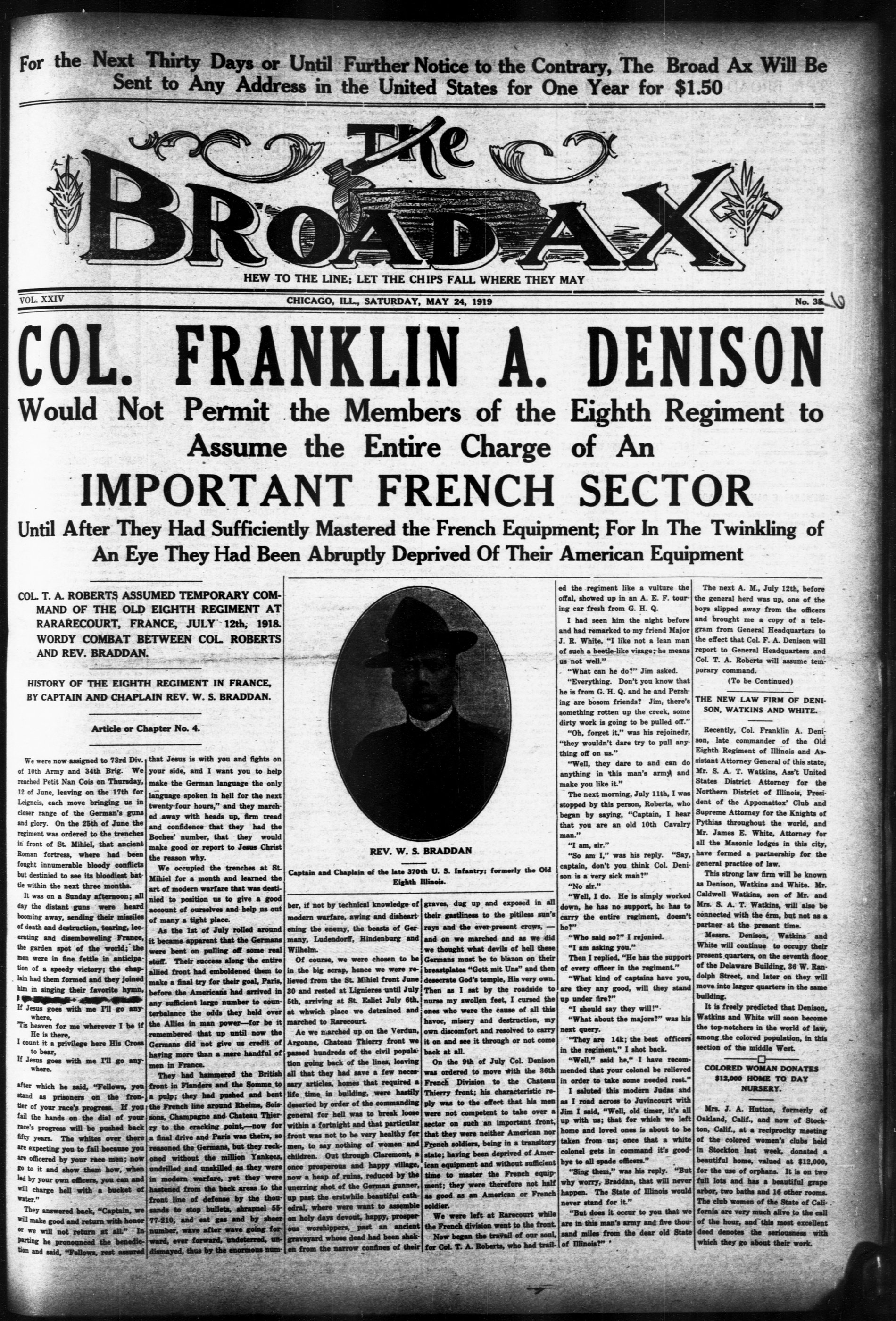
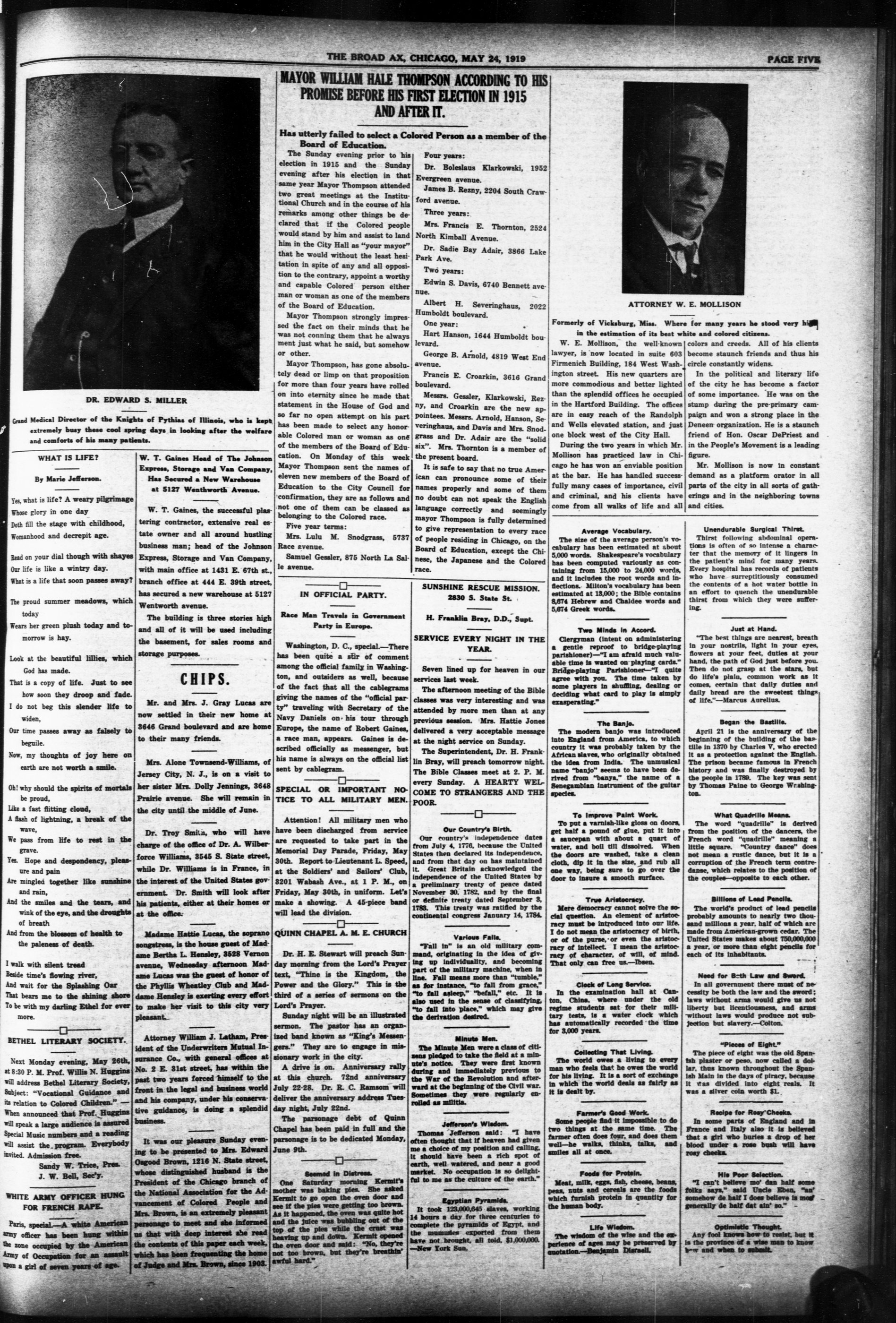
COL. FRANKLIN A. DENISON Would Not Permit the Members of the Eighth Regiment to Assume the Entire Charge of An IMPORTANT FRENCH SECTOR
Until After They Had Sufficiently Mastered the French Equipment; For In The Twinkling of An Eye They Had Been Abruptly Deprived Of Their American Equipment
COL.
Would No
IMI
Until After The
An Ey
COL. T. A. ROBERTS ASSU
MAND OF THE OLD
RARARECOURT, FR
WORDY COMBAT B
AND REV. BRADDAN
HISTORY OF THE EIGHTH
BY CAPTAIN AND CHAPL
COL. T. A. ROBERTS ASSUMED TEMPORARY COMMAND OF THE OLD EIGHTH REGIMENT AT RARARECOURT, FRANCE, JULY 12th; 1918. WORDY COMBAT BETWEEN COL. ROBERTS AND REV. BRADDAN.
HISTORY OF THE EIGHTH REGIMENT IN FRANCE, BY CAPTAIN AND CHAPLAIN REV. W. S. BRADDAN.
Article or Chapter No. 4.
We were now assigned to 73rd Div. of 10th Army and 34th Brig. We reached Petit Nan Cois on Thursday, 12 of June, leaving on the 17th for Leigneis, each move bringing us in closer range of the German's guns and glory. On the 25th of June the regiment was ordered to the trenches in front of St. Mihiel, that ancient Roman fortress, where had been fought innumerable bloody conflicts but destined to see its bloodiest battle within the next three months.
It was on a Sunday afternoon; all day the distant guns were heard booming away, sending their missiles of death and destruction, tearing, lecérating and disemboweling France, the garden spot of the world; the men were in fine fettle in anticipation of a speedy victory; the chaplain had them formed and they joined him in singing their favorite hymn.
If Jesus goes with me I'll go any
I Jesus goes with me I'll go any
where.
'Tis heaven for me wherever I be if
He is there.
I count it a privilege here His Cross
to bear.
If Jesus goes with me I'll go any
where.
after which he said, "Fellows, you
stand as prisoners on the front-
tier of your race's progress. If you
fail
VOL. XXIV
that Jesus is with you and fights on your side, and I want you to help make the German language the only language spoken in hell for the next twenty-four hours," and they marched away with heads up, firm tread and confidence that they had the Boches' number, that they would make good or report to Jesus Christ the reason why.
We occupied the trenches at St. Mihiel for a month and learned the art of modern warfare that was destined to position us to give a good account of ourselves and help us out of many a tight place.
As the 1st of July rolled around it became apparent that the Germans were bent on pulling off some real stuff. Their success along the entire allied front had emboldened them to make a final try for their goal, Paris, before the Americans had arrived in any sufficient large number to counterbalance the odds they held over the Allies in man power—for be it remembered that up until now the Germans did not give us credit of having more than a mere handful of men in France.
CHICAGO, ILL., SATURDAY, MAY 24, 1919
[Image of a man wearing a wide-brimmed hat and a dark shirt].
ber, if not by technical knowledge of modern warfare, awing and disheartening the enemy, the beasts of Germany, Ludendorff, Hindenburg and Wilhelm.
Of course, we were chosen to be in the big scrap, hence we were relieved from the St. Mihiel front June 30 and rested at Lignieres until July 5th, arriving at St. Esliet July 6th, at whwhich place we detrained and marched to Rarecourt.
graves, dug up and exposed in all their gastliness to the pitiless sun's rays and the ever-present crows, — and on we marched and as we diswe thought what devils of hell these Germans must be to blazon on their breastplates "Gott mit Uns" and then desecrate God's temple, His very own. Then as I sat by the roadside to nurse my swollen feet, I cursed the ones who were the cause of all this havoc, misery and destruction, my
Ae we marched up on the Verdun, Argonne, Chateau Thierry front we passed hundreds of the civil population going back of the lines, leaving all that they had save a few necessary articles, homes that required a life time in building, were hastily deserted by order of the commanding general for hell was to break loose within a fortnight and that particular front was not to be very healthy for men, to say nothing of women and children. Out through Claremont, a once prosperous and happy village, now a heap of ruins, reduced by the unerring shot of the German gunner, up past the erstwhile beautiful cathedral, where were want to assemble on holy days devout, happy, prosperous worshippers, past an ancient graveyard whose dead had been shaken from the narrow confines of their
graves, dug up and exposed in all their gastliness to the pitiless sun's rays and the ever-present crows, — and on we marched and as we did we thought what devils of hell these Germans must be to blazon on their breastplates "Gott mit Uns" and then desecrate God's temple, His very own. Then as I sat by the roadside to nurse my swollen feet, I cursed the ones who were the cause of all this havoc, misery and destruction, my own discomfort and resolved to carry it on and see it through or not come back at all.
On the 9th of July Col. Denison was ordered to move with the 36th French Division to the Chateau Thierry front; his characteristic reply was to the effect that his men were not competent to take over a sector on such an important front; that they were neither American nor French soldiers, being in a transitory state; having been deprived of American equipment and without sufficient time to master the French equipment; they were therefore not half as good as an American or French soldier.
We were left at Earecourt while the French division went to the front. Now began the travail of our soul, for Col. T. A. Roberts, who had trail-
ed the regiment like a vulture the offal, showed up in an A. E. F. touring car fresh from G. H. Q.
I had seen him the night before and had remarked to my friend Major J. R. White, "I like not a lean man of such a beetle-like visage; he means us not well."
"What can he do?" Jim asked.
"Everything. Don't you know that he is from G. H. Q. and he and Pershing are bosom friends? Jim, there's something rotten up the creek, some dirty work is going to be pulled off."
"Oh, forget it," was his rejoinedr, "they wouldn't dare try to pull anything off on us."
"Well, they dare to and can do anything in this man's army and make you like it."
The next morning, July 11th, I was stopped by this person, Roberts, who began by saying, "Captain, I hear that you are an old 10th Cavalry man."
"So am I," was his reply. "Say, captain, don't you think Col. Denison is a very sick man?"
"No sir."
"Well, I do. He is simply worked down, he has no support, he has to carry the entire regiment, doesn't he?"
Then I replied, "He has the support of every officer in the regiment."
"What kind of captains have you, are they any good, will they stand up under fire?"
"I should say they will!"
"What about the majors?" was his next query.
"They are 14k; the best officers in the regiment," I shot back.
"Well," said he," I have recommended that your colonel be relieved in order to take some needed rest."
I saluted this modern Judas and as I road across to Juvincourt with Jim I said, "Well, old timer, it's all up with us; that for which we left home and loved ones is about to be taken from us; once that a white colonel gets in command it's good-bye to all spade officers."
"Sing them," was his reply. "But why worry, Braddam, that will never happen. The State of Illinois would never stand for it."
"But does it occur to you that we are in this man's army and five thousand miles from the dear old State of Illinois?"
The next A. M., July 12th, before the general herd was up, one of the boys slipped away from the officers and brought me a copy of a telegram from General Headquarters to the effect that Col. F. A. Denison will report to General Headquarters and Col. T. A. Roberts will assume temporary command.
THE NEW LAW FIRM OF DENISON, WATKINS AND WHITE.
Recently, Col. Franklin A. Denison, late commander of the Old Eighth Regiment of Illinois and Assistant Attorney General of this state, Mr. S. A. T. Watkins, Ass't United States District Attorney for the Northern District of Illinois, President of the Appomattox' Club and Supreme Attorney for the Knights of Pythias throughout the world, and Mr. James E. White, Attorney for all the Masonic lodges in this city, have formed a partnership for the general practice of law.
This strong law firm will be known as Denison, Watkins and White. Mr. Caldwell Watkins, son of Mr. and Mrs. S. A. T. Watkins, will also be connected with the ern, but not as a partner at the present time.
Messrs. Denison, Watkins and White will continue to occupy their present quarters, on the seventh floor of the Delaware Building, 36 W. Randolph Street, and later on they will move into larger quarters in the same building.
It is freely predicted that Denison, Watkins and White will soon become the top-notchers in the world of law, among the colored population, in this section of the middle West.
Mrs. J. A. Hutton, formerly of Oakland, Calif., and now of Stockton, Calif., at a reciprocity meeting of the colored women's clubs held in Stockton last week, donated a beautiful home, valued at $12,000, for the use of orphans. It is on two full lots and has a beautiful grape arbor, two baths and 16 other rooms. The club women of the State of California are very much alive to the call of the hour, and this most excellent deed denotes the seriousness with which they go about their work.
PAGE TWO
THE BROAD AX
Published Every Saturday
In this city since July 15th, 1899, without missing one single issue. Republicans, Democrats, Catholics, Protestans, Single Taxers, Priests, infidels or anyone else can have their say as long as their language is proper and responsibility is fixed.
The Broad Ax is a newspaper whose platform is broad enough for all, ever claiming the editorial right to speak its own mind.
Local communications will receive attention. Write only on one side of the paper.
Subscriptions must be paid in advance.
Advertising rates made known on application.
Address all communications to
THE BROAD AX
No.06 So. Elizabeth St., Chicago, Ill.
Phone Wentworth 2597.
JULIUS F. TAYLOR
Editor and Publisher
DR. M. A. MAJORS
Associate Editor
4700 South State Street
Phone Drexel 1416
Vol. XXIV. May 24, 1919 No. 36
1902, at the Post Office at Chicago,
Ill., under Act of March 3, 1879
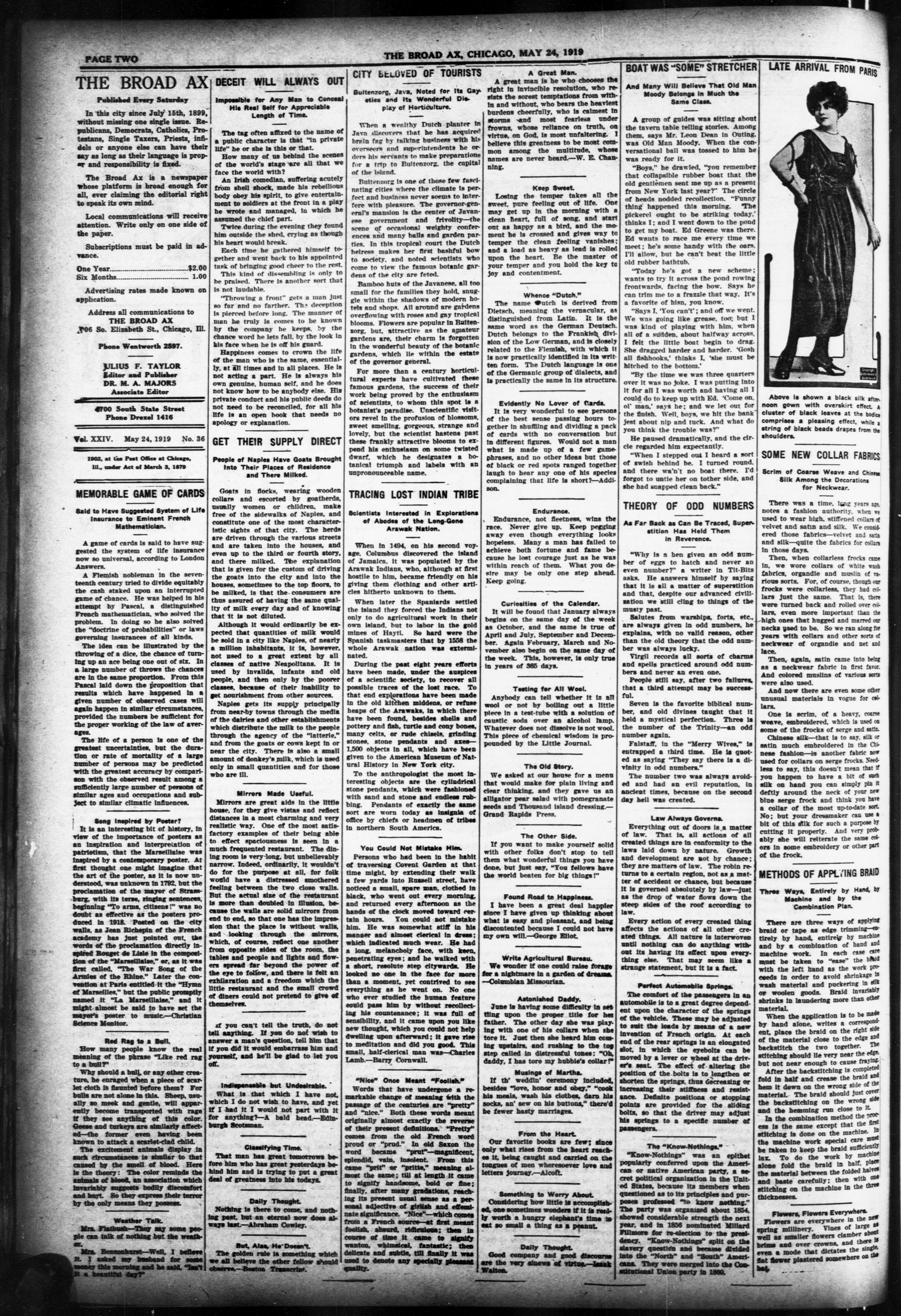
MEMORABLE GAME OF CARDS
Said to Have Suggested System of Life Insurance to Eminent French Mathematician.
A game of cards is said to have suggested the system of life insurance now so universal, according to London Answers.
A Flemish nobleman in the seventeenth century tried to divide equitably the cash staked upon an interrupted game of chance. He was helped in his attempt by Pascal, a distinguished French mathematician, who solved the problem. In doing so he also solved the "doctrine of probabilities" or laws governing insurances of all kinds.
The idea can be illustrated by the throwing of a dice, the chance of turning up an ace being one out of six. In a large number of throws the chances are in the same proportion. From this Pascal laid down the proposition that results which have happened in a given number of observed cases will again happen in similar circumstances, provided the numbers be sufficient for the proper working of the law of averages. The life of a person is one of the greatest uncertainties, but the duration or rate of mortality of a large number of persons may be predicted with the greatest accuracy by comparison with the observed result among a sufficiently large number of persons of similar ages and occupations and subject to similar climatic influences.
Song Inspired by Poster?
It is an interesting bit of history, in view of the importance of posters as an inspiration and interpretation of patriotism, that the Marsellaise was inspired by a contemporary poster. At first thought one might imagine that the art of the poster, as it is now understood, was unknown in 1792, but the proclamation of the mayor of Strasburg, with its terse, ringing sentences, beginning "To arms, citizens!" was no doubt as effective as the posters produced in 1918. Posted on the city walls, as Jean Richepin of the French academy has just pointed out, the words of the proclamation directly inspired Rouget de Lisi in the composition of the "Marsellaise," or, as it was first called, "The War Song of the Armies of the Rhine." Later the convention at Paris entitled it the "Hymn of Marsellies," but the public promptly named it "La Marsellaise," and it might almost be said to have set the mayor's poster to music—Christian Science Monitor.
Red Raa to a Bull.
How many people know the real meaning of the phrase "Like red rag to a bull?"
Why should a bull, or any other creature, he enraged when a piece of scarlet cloth is flaunted before them? For bulls are not alone in this. Sheep, usually so meek and gentle, will apparently become transported with rage if they see anything of this color. Geese and turkeys are similarly affected—the former even having been known to attack a scarlet-clad child.
The excitement animals display in such circumstances is similar to that caused by the smell of blood. Here is the theory: The color reminds the animals of blood, an association which invariably suggests bodily discomfort and hurt. So they express their terror by the only means they possess.
Mrs. Flatbush—They say some people can talk of nothing but the weather.
Mrs. Bensonhurst—Well, I believe it. I asked my husband for some money this morning and he said, "I'm not a beautiful dog."
DECEIT WILL ALWAYS OUT
Impossible for Any Man to Conceal His Real Self for Appreciable Length of Time.
The tag often affixed to the name of a public character is that "in private life" he or she is this or that.
How many of us behind the scenes of the world's stage are all that we face the world with?
An Irish comedian, suffering acutely from shell shock, made his rebellious body obey his spirit, to give entertainment to soldiers at the front in a play he wrote and managed, in which he assumed the chief part.
Twice during the evening they found him outside the shed, crying as though his heart would break.
Each time he gathered himself together and went back to his appointed task of bringing good cheer to the rest.
This kind of dissembling is only to be praised. There is another sort that is not laudable.
"Throwing a front" gets a man just so far and no farther. The deception is pierced before long. The manner of man he truly is comes to be known by the company he keeps, by the chance word he lets fall, by the look in his face when he is off his guard.
Happiness comes to crown the life of the man who is the same, essentially, at all times and in all places. He is not acting a part. He is always his own genuine, human self, and he does not know how to be anybody else. His private conduct and his public deeds do not need to be reconciled, for all his life is an open book that needs no apology or explanation.
GET THEIR SUPPLY DIRECT
People of Naples Have Goats Brought Into Their Places of Residence and There Milked.
Goats in flocks, wearing wooden collars and escorted by goatarths, usually women or children, make free of the sidewalks of Naples, and constitute one of the most characteristic sights of that city. The herds are driven through the various streets and are taken into the houses, and even up to the third or fourth story, and there milked. The explanation that is given for the custom of driving the goats into the city and into the houses, sometimes to the top floors, to be milked, is that the consumers are thus assured of having the same quality of milk every day and of knowing that it is not diluted.
Although it would ordinarily be expected that quantities of milk would be sold in a city like Naples, of nearly a million inhabitants, it is, however, not used to a great extent by all classes of native Neapolitans. It is used by invalids, infants and old people, and then only by the poorer classes, because of their inability to get nourishment from other sources. Naples gets its supply principally from near-by towns through the media of the dairies and other establishments which distribute the milk to the people through the agency of the "latterie," and from the goats or cows kept in or near the city. There is also a small amount of donkey's milk, which is used only in small quantities and for those who are ill.
Mirrors Made Useful.
Mirrors are great aids in the little house, for they give vistas and reflect distances in a most charming and very realistic way. One of the most satisfactory examples of their being able to effect spaciousness is seen in a much frequented restaurant. The dining room is very long, but unbelievably narrow. Indeed, ordinarily, it wouldn't do for the purpose at all, for folk would have a distressed smothered feeling between the two close walls. But the actual size of the restaurant is more than doubled in illusion, because the walls are solid mirrors from end to end, so that one has the impression that the place is without walls, and looking through the mirrors, which, of course, reflect one another from opposite sides of the room, the tables and people and lights and flowers spread far beyond the power of the eye to follow, and there is felt an exhilaration and a freedom which the little restaurant and the small crowd of diners could not pretend to give of themselves.
If you can't tell the truth, do not tell anything. If you do not wish to answer a man's question, tell him that if you did it would embarrass him and yourself, and he'll be glad to let you off.
What is that which I have not, which I do not wish to have, and yet if I had it I would not part with it for anything?—A bald head.—Edinburgh Scottsman.
Classifying Time.
That man has great tomorrows before him who has great yesterday behind him and is trying to put a great deal of greatness into his todays.
Daily Thought
Nothing is there to come, and nothing past, but an eternal now does always last—Abrham Cowley.
But, Alan, He Doesn't.
The golden rule is something which we all believe the other fellow should observe—Boston Transcript.
CITY BELOVED TOURISTS
Buitenzorg, Java, Noted for its Gayeties and Its Wonderful Display of Horticulture.
When a wealthy Dutch planter in Java discovers that he has acquired brain fag by talking business with his overseers and superintendents he orders his servants to make preparations for a trip to Buitenzorg, the capital of the island.
A Great Man.
A great man is he who clings in invincible resolution, sists the sorest temptations in and without, who bears the burdens cheerfully, who is a storms and most fearless, frowns, whose reliance on virtue, on God, is most unfaible this greatness to be common among the multitude names are never heard.—W. Ning.
Buitenzorg is one of those few fascinating cities where the climate is perfect and business never seems to interfere with pleasure. The governor-general's mansion is the center of Javanese government and frivolity—the scene of occasional weighty conferences and many balls and garden parties. In this tropical court the Dutch helress makes her first bashful bow to society, and noted scientists who come to view the famous botanic gardens of the city are feted.
Bamboo huts of the Javanese, all too small for the families they hold, snuggle within the shadows of modern hotels and shops. All around are gardens overflowing with roses and gay tropical blooms. Flowers are popular in Buitenzorg, but, attractive as the amateur gardens are, their charm is forgotten in the wonderful beauty of the botanic gardens, which lie within the estate of the governor general.
For more than a century horticultural experts have cultivated these famous gardens, the success of their work being proved by the enthusiasm of scientists, to whom this spot is a botanist's paradise. Unscientific visitors revel in the profusion of blossoms, sweet smelling, gorgeous, strange and lovely, but the scientist hastens past these frankly attractive blooms to extend his enthusiasm on some twisted dwarf, which he designates a botanical triumph and labels with an unpronounceable name.
TRACING LOST INDIAN TRIBE
Scientists Interested in Explorations of Abodes of the Long-Gone Arawak Nation.
When in 1494, on his second voyage, Columbus discovered the island of Jamaica, it was populated by the Arawak Indians, who, although at first hostile to him, became friendly on his giving them clothing and other articles hitherto unknown to them.
When later the Spaniards settled the island they forced the Indians not only to do agricultural work in their own island, but to labor in the gold mines of Hayti. So hard were the Spanish taskmasters that by 1558 the whole Arawak nation was exterminated.
During the past eight years efforts have been made, under the auspices of a scientific society, to recover all possible traces of the lost race. To that end explorations have been made in the old kitchen middens, or refuse heaps of the Arawaks, in which there have been found, besides shells and pottery and fish, turtle and cony bones, many celts, or rude chisels, grinding stones, stone pendants and axes—1,500 objects in all, which have been given to the American Museum of Natural History in New York city.
To the anthropologist the most interesting objects are the cylindrical stone pendants, which were fashioned with sand and stone and endless rubbing. Pendants of exactly the same sort are worn today as insignia of office by chiefs or headmen of tribes in northern South America.
You Could Not Mistake Him.
Persons who had been in the habit of traversing Covent Garden at that time might, by extending their walk a few yards into Russell street, have noticed a small, spare man, clothed in black, who went out every morning, and returned every afternoon as the hands of the clock moved toward certain hours. You could not mistake him. He was somewhat stiff in his manner and almost clerical in dress; which indicated much wear. He had a long, melancholy face, with keen, penetrating eyes; and he walked with a short, resolute step citywards. He looked no one in the face for more than a moment, yet contrived to see everything as he went on. No one who ever studied the human feature could pass him by without recollecting his countenance; it was full of sensibility, and it came upon you like new thought, which you could not help dwelling upon afterward; it gave rise to meditation and did you good. This small, half-clerical man was—Charles Lamb.—Barry Cornwall.
"Nice" Once Meant "Foolish."
"Nice. Once meant "Foolish."
Words that have undergone a remarkable change of meaning with the passage of the centuries are "pretty" and "nice." Both these words meant originally almost exactly the reverse of their present definitions. "Pretty" comes from the old French word proud or "prud." In old Saxon the word became "prut"—magnificent, splendid, vain, insolent. From this came "prit" or "pritte," meaning almost the same; till at length it came to signify handsome, bold or fine; finally, after many gradations, reaching its present usual sense as a personal adjective of girlish and effeminate significance. "Nice"—which comes from a French source—at first meant foolish, absurd, ridiculous; then in course of time it came to signify wanton, whimsical, fantastic; then delicate and subtle, till finally it was used to denote any specially pleasant quality.
A Great Man.
A great man is he who chooses the right in invincible resolution, who resists the sorest temptations from within and without, who bears the heaviest burdens cheerfully, who is calmest in storms and most fearless under frowns, whose reliance on truth, on virtue, on God, is most unfaltering. I believe this greatness to be most common among the multitude, whose names are never heard.—W. E. Channing.
Keep Sweet
Losing the temper takes all the sweet, pure feeling out of life. One may get up in the morning with a clean heart, full of song, and start out as happy as a bird, and the moment he is crossed and gives way to temper the clean feeling vanishes; and a load as heavy as lead is rolled upon the heart. Be the master of your temper and you hold the key to joy and contentment.
Whence "Dutch"
The name *dutch* is derived from Dletsch, meaning the vernacular, as distinguished from Latin. It is the same word as the German Deutsch. Dutch belongs to the Frankish division of the Low German, and is closely related to the Flemish, with which it is now practically identified in its written form. The Dutch language is one of the Germanic group of dialects, and is practically the same in its structure.
Evidently No Lover of Cards
It is very wonderful to see persons of the best sense passing hours together in shuffling and dividing a pack of cards with no conversation but in different figures. Would not a man what is made up of a few game phrases, and no other ideas but those of black or red spots ranged together laugh to hear any one of his species complaining that life is short?—Addison.
Endurance.
Endurance, not fleetness, wins the race. Never give up. Keep pegging away even though everything looks hopeless. Many a man has failed to achieve both fortune and fame because he lost courage just as he was within reach of them. What you desire may be only one step ahead. Keep going.
Curiosities of the Calendar
It will be found that January always begins on the same day of the week as October, and the same is true of April and July, September and December. Again February, March and November also begin on the same day of the week. This, however, is only true in years of 365 days.
Testing for All Wool
Anybody can tell whether it is all wool or not by boiling out a little piece in a test-tube with a solution of caustic soda over an alcohol lamp. Whatever does not dissolve is not wool. This piece of chemical wisdom is propounded by the Little Journal.
The Old Story
We asked at our house for a menu that would make for plain living and clear thinking, and they gave us an alligator pear salad with pomegranate seeds and Thousand island dressing. Grand-Ranis Press.
The Other Side.
If you want to make yourself solid with other folks don't stop to tell them what wonderful things you have done, but just say, "You fellows have the world beaten for big things."
Found Road to Happiness
I have been a great deal happier since I have given up thinking about what is easy and pleasant, and being discontented because I could not have my own will.—George Ellot.
Write Agricultural Bureau
We wonder if one could raise forage for a nightmare in a garden of dreams. Columbian Missouri
Astonished Daddy
June is having some difficulty in setting upon the proper title for her father. The other day she was playing with one of his collars when she tore it. Just then she heard him coming upstairs, and rushing to the top step called in distressful tones: "Oh, daddy, I has tore my hubble's collar!"
Musings of Martha.
If th' weddin' ceremony included,
besides "love, honor and obey," "cook
his meals, wash his clothes, darn his
socks, an' sew on his buttons," there'd
be fewer hasty marriages.
From the Heart
Our favorite books are few; since only what rises from the heart reaches it, being caught and carried on the tongues of men wheresoever love and letters journey.—Alcoff.
Something to Worry About.
Considering how little is accomplished, one sometimes wonders if it is really worth a hungry elephant's time to eat so small a thing as a peanut.
Daily Thought.
Good company and good discourse are the very sinews of virtue.—Isaak Walton.
BOAT WAS "SOME" STRETCHER
And Many Will Believe That Old Man Moody Belongs in Much the Same Class.
A group of guides was sitting about the tavern table telling stories. Among them, says Mr. Leon Dean in Outing, was Old Man Moody. When the conversational ball was tossed to him he was ready for it.
"Boys," he drawled, "you remember that collapsible rubber boat that the old gentlemen sent me up as a present from New York last year?" The circle of heads nodded recollection. "Funny thing happened this morning. The pickerle ought to be striking today,' thinks I; and I went down to the pond to get my boat. Ed Greene was there. Ed wants to race me every time we meet; he's some handy with the oars, I'll allow, but he can't beat the little old rubber bathtub.
"Today he's got a new scheme; wants to try it across the pond rowing frontwards, facing the bow. Says he can trim me to a frazzle that way. It's a favorite of him, you know.
"Says I, 'You can't'; and off we went. We was going like grease, too; but I was kind of playing with him, when all of a sudden, about halfway across. I felt the little bout begin to drag. She dragged harder and harder. 'Gosh all fishhooks,' thinks I, 'she must be hitched to the bottom.'"
"By the time we was three quarters over it was no joke. I was putting into it for all I was worth and having all I could do to keep up with Ed. 'Come on, ol man,' says he; and we let out for the finish. Well, boys, we hit the bank jest about nip and tuck. And what do you think the trouble was?"
He paused dramatically, and the circle regarded him expectantly.
"When I stepped out I heard a sort of swish behind be. I turned round, and there wasn't no boat there. I'd forgot to untie her on tother side, and she had snapped clean back."
THEORY OF ODD NUMBERS
As Far Back as Can Be Traced, Superstition Has Held Them in Reverence.
"Why is a hen given an odd number of eggs to hatch and never an even number?" a writer in Tit-Bits asks. He answers himself by saying that it is all a matter of superstition and that, despite our advanced civilization we still cling to things of the musty past.
Salutes from warships, forts, etc., are always given in odd numbers, he explains, with no valid reason, other than the old theory that the odd number was always lucky.
Virgil records all sorts of charms and spells practiced around odd numbers and never an even one.
People still say, after two failures, that a third attempt may be successful.
Seven is the favorite biblical number, and old divines taught that it held a mystical perfection. Three is the number of the Trinity—an odd number again.
Falstaff, in the "Merry Wives," is entrapped a third time. He is quoted as saying "They say there is a divinity in odd numbers."
The number two was always avoided and had an evil reputation, in ancient times, because on the second day hell was created.
Law Always Governa.
Everything out of doors is a matter of law. That is, all actions of all created things are in conformity to the laws laid down by nature. Growth and development are not by chance; they are matters of law. The robin returns to a certain region, not as a matter of accident or chance, but because it is governed absolutely by law—just as the drop of water flows down the steep sides of the roof according to law.
Every action of every created thing affects the actions of all other created things. All nature is interwoven until nothing can do anything without its having its effect upon everything else. That may seem like a strange statement, but it is a fact.
Perfect Automobile Springs
The comfort of the passengers in an automobile is to a great degree dependent upon the character of the springs of the vehicle. These may be adjusted to suit the loads by means of a new invention of French origin. At each end of the rear springs is an elongated slot, in which the eyebolts can be moved by a lever or wheel at the driver's seat. The effect of altering the position of the bolts is to lengthen or shorten the springs, thus decreasing or increasing their stiffness and resistance. Definite positions or stopping points are provided for the sliding bolts, so that the driver may adjust his springs to a specific number of passengers.
The "Know-Nothings"
"Know-Nothings" was an epithet popularly conferred upon the American or native American party, a secret political organization in the United States, because its members when questioned as to its principles and purposes professed "to know nothing." The party was organized about 1854, showed considerable strength the next year, and in 1856 nominated Millard Fillmore for re-election to the presidency. "Know-Nothings" split on the slavery question and became divided into the "North" and "South" Americans. They were merged into the Constitutional Union party in 1860.
Dengg
Lefrenne
hilbert
Above is shown a black silk afternoon gown with overskirt effect. A cluster of black leaves at the bodice comprises a pleasing effect, while a string of black beads drapes from the shoulders.
SOME NEW COLLAR FABRICS
Scrim of Coarse Weave and Chinese Silk Among the Decorations for Neckwear.
There was a time, long years ago, notes a fashion authority, when we used to wear high, stiffened collars of velvet and satin and silk. We considered those fabrics—velvet and satin and silk—quite the fabrics for collars in those days.
Then, when collarless frocks came in, we wore collars of white wash fabrics, organdie and muslin of various sorts. For, of course, though our frocks were collarless, they had collars just the same. That is, there were turned back and rolled over collars, even more important than the high ones that hugged and marred our necks used to be. So we ran along for years with collars and other sorts of neckwear of organdie and net and lace.
Then, again, satin came into being as a neckwear fabric in first favor. And colored muslins of various sorts were also used. And now there are even some other unusual materials in vogue for collars.
One is scrim, of a heavy, coarse weave, embroidered, which is used on some of the frocks of serge and satin.
Chinese silk—that is to say, silk or satin much embroidered in the Chinese fashion—is another fabric now used for collars on serge crocs. Needless to say, this doesn't mean that if you happen to have a bit of such silk on hand you can simply pin it deftly around the neck of your new blue serge crock and think you have a collar of the most up-to-date sort. No; but your dressmaker can use a bit of this silk for such a purpose by cutting it properly. And very probably she will reiterate the same colors in some embroidery or other part of the frock.
METHODS OF APPLYING BRAID
Three Ways, Entirely by Hand, by Machine and by the Combination Plan.
There are three ways of applying braid or tape as edge trimming—entirely by hand, entirely by machine and by a combination of hand and machine work. In each case care must be taken to "sease" the braid with the left hand as the work proceeds in order to avoid shrinkage in wash material and puckering in silk or woolen goods. Braid invariably shrinks in laundering more than other material.
When the application is to be made by hand alone, writes a correspondent, place the braid on the right side of the material close to the edge and backstitch the two together. The stitching should lie very near the edge, but not near enough to cause fraying.
After the backstitching is completed fold in half and crease the braid and hem it down on the wrong side of the material. The braid should just cover the backstitching on the wrong side and the hemming run close to it. In the combination method the process is the same except that the first stitching is done on the machine. In the machine work special care must be taken to keep the braid sufficiently lax. To do the work by machine alone fold the braid in half, place the material between the folded halves and baste carefully; then with one stitching on the machine in the three thicknesses.
Flowers Flowers Everywhere.
Flowers, Flowers Everywhere
Flowers are everywhere in the new spring millinery. Vines of large as well as smaller flowers clamber about brims and over crowns, and there is even a mode that dictates the single flat flower plastered somewhere on the hat.
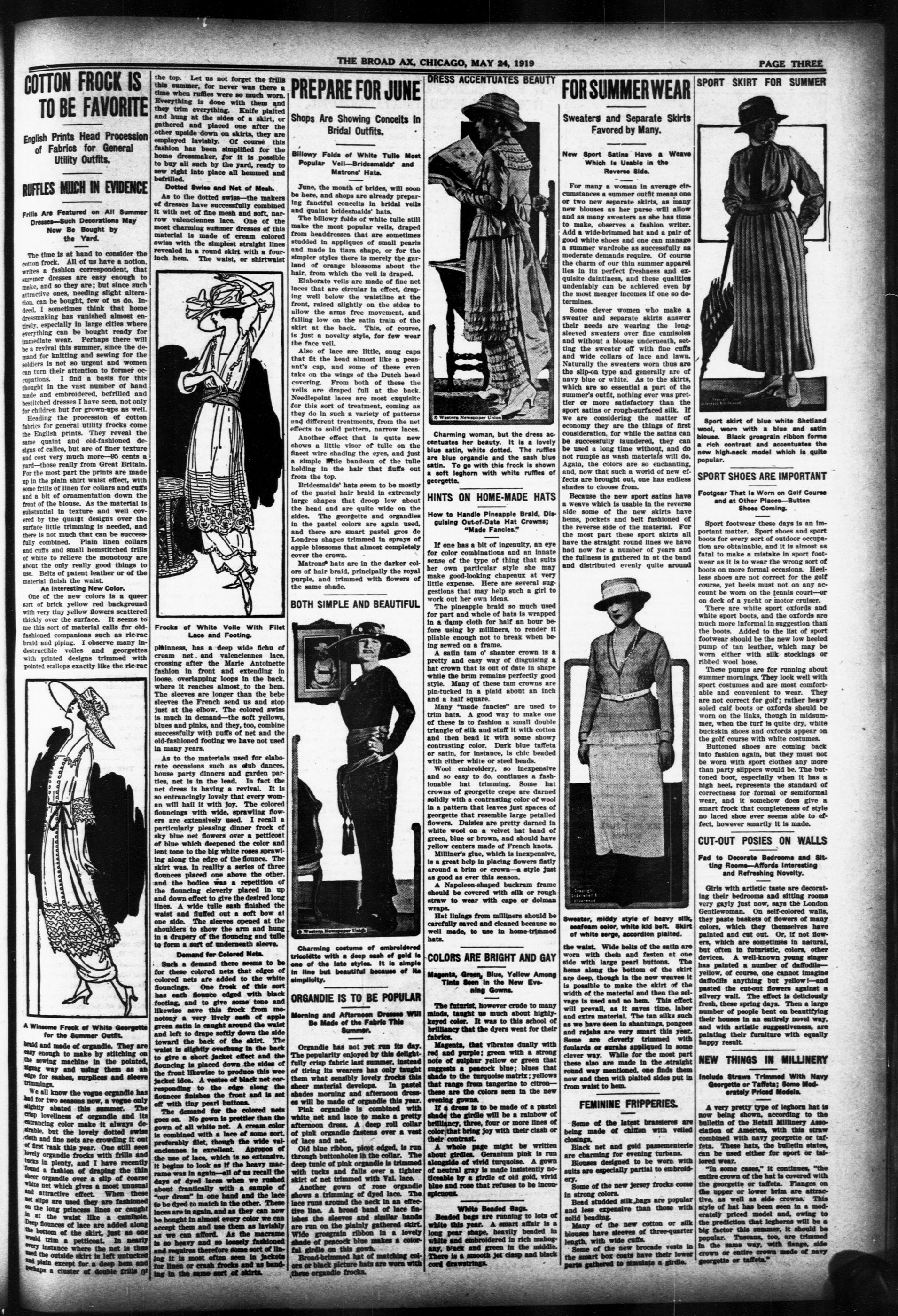
COTTON FROCK IS TO BE FAVORITE
English Prints Head Procession of Fabrics for General Utility Outfits.
Frills Are Featured on All Summer Dresses—Such Decorations May Now Be Bought by the Yard.
The time is at hand to consider the cotton frock. All of us have a notion, writes a fashion correspondent, that summer dresses are easy enough to make, and so they are; but since such attractive ones, needing slight alteration, can be bought, few of us do. Indeed, I sometimes think that home dressmaking has vanished almost entirely, especially in large cities where everything can be bought ready for immediate wear. Perhaps there will be a revival this summer, since the demand for knitting and sewing for the soldiers is not so urgent and women can turn their attention to former occupations. I find a basis for this thought in the vast number of hand made and embroidered, beffried and bestitched dresses I have seen, not only for children but for grown-ups as well.
Heading the procession of cotton fabrics for general utility frocks come the English prints. They reveal the same quaint and old-fashioned designs of calco, but are of finer texture and cost very much more—95 cents a yard—those really from Great Britain. For the most part the prints are made up in the plain shirt waist effect, with some frills of linen for collars and cuffs and a bit of ornamentation down the front of the blouse. As the material is substantial in texture and well covered by the qualit design's over the surface little trimming is needed, and there is not much that can be successfully combined. Plain linen collars and cuffs and small hemstitched frills of white to relieve the monotony are about the only really good things to use. Belts of patent leather or of the material finish the waist.
An Interesting New Color.
One of the new colors is a queer sort of brick yellow red background with very tiny yellow flowers scattered thickly over the surface. It seems to me this sort of material calls for old-fashioned companions such as rie-rac braid and piping. I observe many indestructible volles and georgettes with printed designs trimmed with pointed scallons exactly like the rie-rac
1
A Winsome Freck of White Georgette for the Summer Outfit.
braid and made of organdle. They are easy enough to make by stitching on the sewing machine in the pointed, signg way and using them as an edge for sashes, surplices and sleeve trimming.
We all know the vogue organdie has had for two seasons now, a vogue only slightly abated this summer. The crisp loveliness of organdie and its entrenching color make it always desirable, but the lovely dotted swiss cloth and fine nets are crowding it out of first rank this year. One still sees lovely organdie frocks with frills and tucks in plenty, and I have recently found a fashion of draping the thin sheer organdie over a slip of coarse white net which gives a most unusual and attractive effect. When these net slips are used they are fashioned on the long princess lines or caught in at the waist like a camphole. Deep flounces of lace are added along the bottom of the skirt, just as one would trim a petticoat. In nearly every instance where the net is thus used the outside skirt is left untucked and plain except for a deep hem and perhaps a cluster of double frilles gf
the top. Let us not forget the frills this summer, for never was there a time when ruffles were so much worn. Everything is done with them and they trim everything. Knife plaited and hung at the sides of a skirt, or gathered and placed one after the other upside down on skirts, they are employed lavishy. Of course this fashion has been simplified for the home dressmaker, for it is possible to buy all such by the yard, ready to sew right into place all hemmed and beffilled.
Dotted Swiss and Net of Mesh.
As to the dotted swiss—the makers of dresses have successfully combined it with net of fine mesh and soft, narrow valenciennes lace. One of the most charming summer dresses of this material is made of cream colored swiss with the simplest straight lines revealed in a round skirt with a four-inch hem. The waist, or shirtwrist
THE FASHION OF THE TWENTIETH CENTURY
Frocks of White Volle With Filet Lace and Footing.
phainness, has a deep wide fichu of cream net, and valenciennes lace, crossing after the Marie Antoinette fashion in front and extending in loose, overlapping loops in the back, where it reaches almost to the hem. The sleeves are longer than the bebe sleeves the French send us and stop just at the elbow. The colored swiss is much in demand—the soft yellows, blues and pinks, and they, too, combine successfully with puffs of net and the old-fashioned footing we have not used in many years.
As to the materials used for elaborate occasions such as club dances, house party dinners and garden parties, net is in the lead. In fact the net dress is having a revival. It is so entrancingly lovely that every woman will hall it with joy. The colored fountains with wide, sprawling flowers are extensively used. I recall a particularly pleasing dinner frock of sky blue net flowers over a petticoat of blue which deepened the color and lent tone to the big white roses sprawling along the edge of the flounce. The skirt was, in reality a series of three fountines placed one above the other, and the bodice was a repetition of the founting cleverly placed in up and down effect to give the desired long lines. A wide tide sash finished the waist and fluffed out a soft bow at one side. The sleeves opened at the shoulders to show the arm and hung in a drapery of the founting and tulle to form a sort of underneath sleeve.
Demand for Colored Nets.
Such a demand there seems to be for these colored nets that edges of colored nets are added to the white flouncings. One froak of this sort has each flounce edged with black footing, and to give some tone and likewise save this frock from monotony a very lively sash of apple green satin is caught around the waist and left to drape softly down the side toward the back of the skirt. The waist is slightly overhung in the back to give a short jacket effect and the flouncing is placed down the sides of the front likewise to produce this wee jacket idea. A vestee of black net corresponding to the edge along the flounces finishes the front and is set off with tiny nearl buttons.
The demand for the colored nets goes on. No gown is prettier than the gown of all white net. A cream color is combined with a lace of some sort, preferably filet, though the wide valenciennes is excellent. Appropos of the use of lace, which is so extensive, it begins to look as if the heavy macrame was in again—all of us recall the days of dyed laces when we rushed about frantically with a sample of "our dress" in one hand and the lace to be dyed to match in the other. These laces are in again, and as they can now be bought in almost every color we can accept them and use them as lavishly as we can afford. As the macrame is so heavy and so loosely fashioned and requires therefore some sort of lining it is most often seen in jackets for linen or crash frocks and as banding in the same sort of skirts.
THE BROAD AX, CHICAGO, MAY 24, 1919
PREPARE FOR JUNE
Shops Are Showing Conceits In Bridal Outfits.
Billowy Folds of White Tulle Most Popular Veil - Bridesmaids' and Matrons' Hats.
June, the month of brides, will soon be here, and shops are already preparing fanciful conceits in bridal vells and quaint bridesmaids' hats.
The billowy folds of white tulle still make the most popular vells, draped from headaddresses that are sometimes studded in appliques of small pearls and made in tiara shape, or for the simpler styles there is merely the garland of orange blossoms about the hair, from which the veil is draped.
Elaborate veils are made of fine net laces that are circular in effect, draping well below the waistline at the front, raised slightly on the sides to allow the arms free movement, and falling low on the satin train of the skirt at the back. This, of course, is just a novelty style, for few wear the face vell.
Also of lace are little, snug caps that fit the head almost like a peasant's cap, and some of these even take on the wings of the Dutch head covering. From both of these the veils are draped full at the back. Needlepoint laces are most exquisite for this sort of treatment, coming as they do in such a variety of patterns and different treatments, from the net effects to solid pattern, narrow laces.
Another effect that is quite new shows a little visor of tulle on the finest wire shading the eyes, and just a simple little bandeau of the tulle holding in the hair that fluffs out from the top.
Bridesmaids' hats seem to be mostly of the pastel hair braid in extremely large shapes that droop low about the head and are quite wide on the sides. The georgette and organdies in the pastel colors are again used, and there are smart pastel gros de Londres shapes trimmed in sprays of apple blossoms that almost completely cover the crown.
Matrons' hats are in the darker colors of hair braid, principally the royal purple, and trimmed with flowers of the same shade.
BOTH SIMPLE AND BEAUTIFUL
© Western Newspaper Uni
Charming costume of embroidered tricollette with a deep cash of gold is one of the late styles. It is simple in line but beautiful because of its simplicity.
ORGANDIE IS TO BE POPULAR
Organdie has not yet run its day. The popularity enjoyed by this delightfully crisp fabric last summer, instead of tiring its wearers has only taught them what sensibly lovely frocks this sheer material develops. In pastel shades morning and afternoon dresses will be made of organdie this year. Pink organdie is combined with white net and lace to make a pretty afternoon dress. A deep roll collar of pink organdie fastens over a vest of lace and net. Old blue ribbon, pict edged, is run through buttonholes in the collar. The deep tunic of pink organdie is trimmed with tucks and falls over a tighter skirt of net trimmed with Val lace.
Another gown of rose organdie shows a trimming of dyed lace. The lace runs around the neck in an effective line. A broad band of lace finishes the sleeves and similar bands are run on the plainly gathered skirt. Wide grosgrain ribbon in a lovely shade of peacock blue makes a colorful girdle on this gown. Broad-brimmed hat of matching colors or black picture hats are worn with these ornamental frocks.
DRESS ACCENTUATES BEAUTY
© Western Newspaper Union
Charming woman, but the dress accentuates her beauty. It is a lovely blue satin, white dotted. The ruffles are blue organdle and the sash blue satin. To go with this frock is shown a soft leghorn with white ruffles of georgette.
HINTS ON HOME-MADE HATS
How to Handle Pineapple Braid, Disguising Out-of-Date Hat Crowns;
"Made Fancies."
If one has a bit of ingenuity, an eye for color combinations and an innate sense of the type of thing that suits her own particular style she may make good-lookingcapeaux at very little expense. Here are several suggestions that may help such a girl to work out her own ideas.
The pineapple braid so much used for part and whole of hats is wrapped in a damp cloth for half an hour before using by milliners, to render it pliable enough not to break when being sewed on a frame.
A satin tam o' shanter crown is a pretty and easy way of disguising a hat crown that is out of date in shape while the brim remains perfectly good style. Many of these tam crowns are pin-tucked in a plaid about an inch and a half square.
Many "made fancies" are used to trim hats. A good way to make one of these is to fashion a small double triangle of silk and stuff it with cotton and then bead it with some showy contrasting color. Dark blue taffeta or satin, for instance, is chic beaded with either white or steel beads.
Wool embroidery, so inexpensive and so easy to do, continues a fashionable hat trimming. Some hat crowns of georgette crepe are darned solidly with a contrasting color of wool in a pattern that leaves just spaces of georgette that resemble large petalled flowers. Daisies are pretty darned in white wool on a velvet hat band of green, blue or brown, and should have yellow centers made of French knots.
Milliner's glue, which is inexpensive, is a great help in placing flowers flatly around a brim or crown—a style just as good as ever this season.
A Napoleon-shaped buckram frame should be covered with silk or rough straw to wear with cape or dolman wraps.
Hat linings from milliners should be carefully saved and cleaned because so well made, to use in home-trimmed hats.
COLORS ARE BRIGHT AND GAY
Magenta, Green, Blue, Yellow Among Tints Seen in the New Evening Gowns.
The futurist, however crude to many minds, taught us much about high-keyed color. It was in to this school of brilliancy that the dyers went for their fabrics.
Magenta, that vibrates dually with red and purple; green with a strong note of sulphur yellow or green that suggests a pencock blue; blues that shade to the turquoise matrix; yellows that range from tangerine to citron—these are the colors seen in the new evening gown.
If a dress is to be made of a pastel shade the girdle will be a rainbow of brilliancy, three, four or more lines of color that bring joy with their clash or their contrast.
A whole page might be written about girdles. Geranium pink is run alongside of vivid turquoise. A gown of neutral gray is made insistently noticeable by a girdle of old gold, vivid blue and rose that refuses to be inconspicuous.
White Beaded Bags
White Beaded Bags
Beaded bags are running to lots of white this year. A smart affair is a long pear shape, heavily beaded in white and embroidered in rich mahogany, black and green in the middle. There is a smooth jet clasp and black cord drawstrings.
FORSUMMERWEAR
Sweaters and Separate Skirts Favored by Many.
New Sport Satine Have a Weave Which Is Usable in the Reverse Side.
For many a woman in average circumstances a summer outfit means one or two new separate skirts, as many new blouses as her purse will allow and as many sweaters as she has time to make, observes a fashion writer. Add a wide-brimmed hat and a pair of good white shoes and one can manage a summer wardrobe as successfully as moderate demands require. Of course the charm of our thin summer apparel lies in its perfect freshness and exquisite daintiness, and these qualities undeniably can be achieved even by the most meager incomes if one so determines.
Some clever women who make a sweater and separate skirts answer their needs are wearing the long-sleeved sweaters over fine camisoles and without a blouse underneath, setting the sweater off with fine cuffs and wide collars of lace and lawn. Naturally the sweaters worn thus are the slip-on type and generally are of navy blue or white. As to the skirts, which are so essential a part of the summer's outfit, nothing ever was prettier or more satisfactory than the sport satins or rough-surfaced silk. If we are considering the matter of economy they are the things of first consideration, for while the satins can be successfully laundered, they can be used a long time without, and do not rumble as wash materials will do. Again, the colors are so enchanting, and, now that such a world of new effects are brought out, one has endless shades to choose from.
Because the new sport satins have a weave which is usable in the reverse side some of the new skirts have hems, pockets and belt fashioned of the reverse side of the material. For the most part these sport skirts all have the straight round lines we have had now for a number of years and the fullness is gathered in at the band and distributed evenly quite around
Copyright
Dorothy and B
Brownwood
Sweater, middy style of heavy silk, seafoam color, white kid belt. Skirt of white serge, accordion plaited.
Sweater, middy style of heavy silk, seafoam color, white kid belt. Skirt of white serge, accordion plaited. the waist. Wide belts of the satin are worn with them and fasten at one side with large pearl buttons. The hems along the bottom of the skirt are deep, though in the new weaves it is possible to make the skirt of the width of the material and then the selvage is used and no hem. This effect will prevail, as it saves time, labor and extra material. The tan silks such as we have seen in shantungs, ponges and rajals are very smart this year. Some are cleverly trimmed with foulards or aurails applipped in some clever way. While for the most part these also are made in the straight round way mentioned, one finds them now and then with plaited sides put in from waist to hem.
FEMININE FRIPPERIES
Some of the latest brassieros are being made of chiffon with velled closings.
Bead studded silk_bags are popular and less expensive than those with solid beading.
Many of the new cotton or silk blouses have sleeves of three-quarter length, with wide cuffs.
Some of the new brocade vests in the smart box coats have their lower parts gathered to simulate a girdle.
PAGE THREE
SPORT SKIRT FOR SUMMER
Copyright
LACROIX & DISTRIBUTED.
Sport skirt of blue white Shetland wool, worn with a blue and satin blouse. Black grosgrain ribbon forms a rich contrast and accentuates the new high-neck model which is quite popular.
SPORT SHOES ARE IMPORTANT
Footgear That Is Worn on Golf Courses and at Other Places—Button Shoes Coming.
Sport footwear these days is an important matter. Sport shoes and sport boots for every sort of outdoor occupation are obtainable, and it is almost as fatal to make a mistake in sport footwear as it is to wear the wrong sort of boots on more formal occasions. Heeled shoes are not correct for the golf course, yet heels must not on any account be worn on the tennis court—or on deck of a yacht or motor cruiser. There are white sport oxfords and white sport boots, and the oxfords are much more informal in suggestion than the boots. Added to the list of sport footwear should be the new low heeled pump of tan leather, which may be worn either with silk stockings or ribbed wool hose.
These pumps are for running about summer mornings. They look well with sport costumes and are most comfortable and convenient to wear. They are not correct for golf; rather heavy soled calf boots or oxford shoes should be worn on the links, though in midsummer, when the turf is quite dry, white buckskin shoes and oxford appear on the golf course with white costumes. Buttoned shoes are coming back into fashion again, but they must not be worn with sport clothes any more than party slippers would be. The buttoned boot, especially when it has a high heel, represents the standard of correctness for formal or semiformal wear, and it somehow does give a smart frock that completeness of style no laced shoe ever seems able to effect, however smartly it is made.
CUT-OUT POSIES ON WALLS
Fad to Decorate Bedroom and Sitting Rooms-Affords Interesting and Refreshing Novelty.
Girls with artistic taste are decorating their bedrooms and sitting rooms very gayly just now, says the London Gentlewoman. On self-colored walls, they paste baskets of flowers of many colors, which they themselves have painted and cut out. Or, if not flowers, which are sometimes in natural, but often in futuristic, colors, other devices. A well-known young singer has painted a number of daffodils—yellow, of course, one cannot imagine daffodils anything but yellow—and pasted the cut-out flowers against a slvery wall. The effect is deliciously fresh, these spring days. Then a large number of people bent on beautifying their houses in an entirely novel way, and with artistic suggestiveness, are painting their furniture with equally happy result.
NEW THINGS IN MILLINERY
Include Strawa Trimmed With Navy
Georgette or Taffeta; Some Mod-
erately Priced Models.
A very pretty type of leghorn hat is
now being shown, according to the
bulletin of the Retail Millinery
Association of America, with this straw
combined with navy georgette or
taffeta. These hats, the bulletin states,
can be used either for sport or tailored wear.
"In some cases," it continues, "the entire crown of the hat is covered with the georgette or taffeta. Flanges on the upper or lower brim are attractive, as well as side crowns. This style of hat has been seen in a moderately priced model and, owing to the prediction that leghorns will be a big factor this summer, it should be popular. Tuscans, too, are trimmed in the same way, with flange, side crown or entire crown made of navy georgette or taffeta."
```markdown
```
[Name]
HON. CHARLES M. FOELL
One of the high and popular Judges who contends that it is much hundred and fifty dollars per home to preside over it than it royal flush in a stiff game of
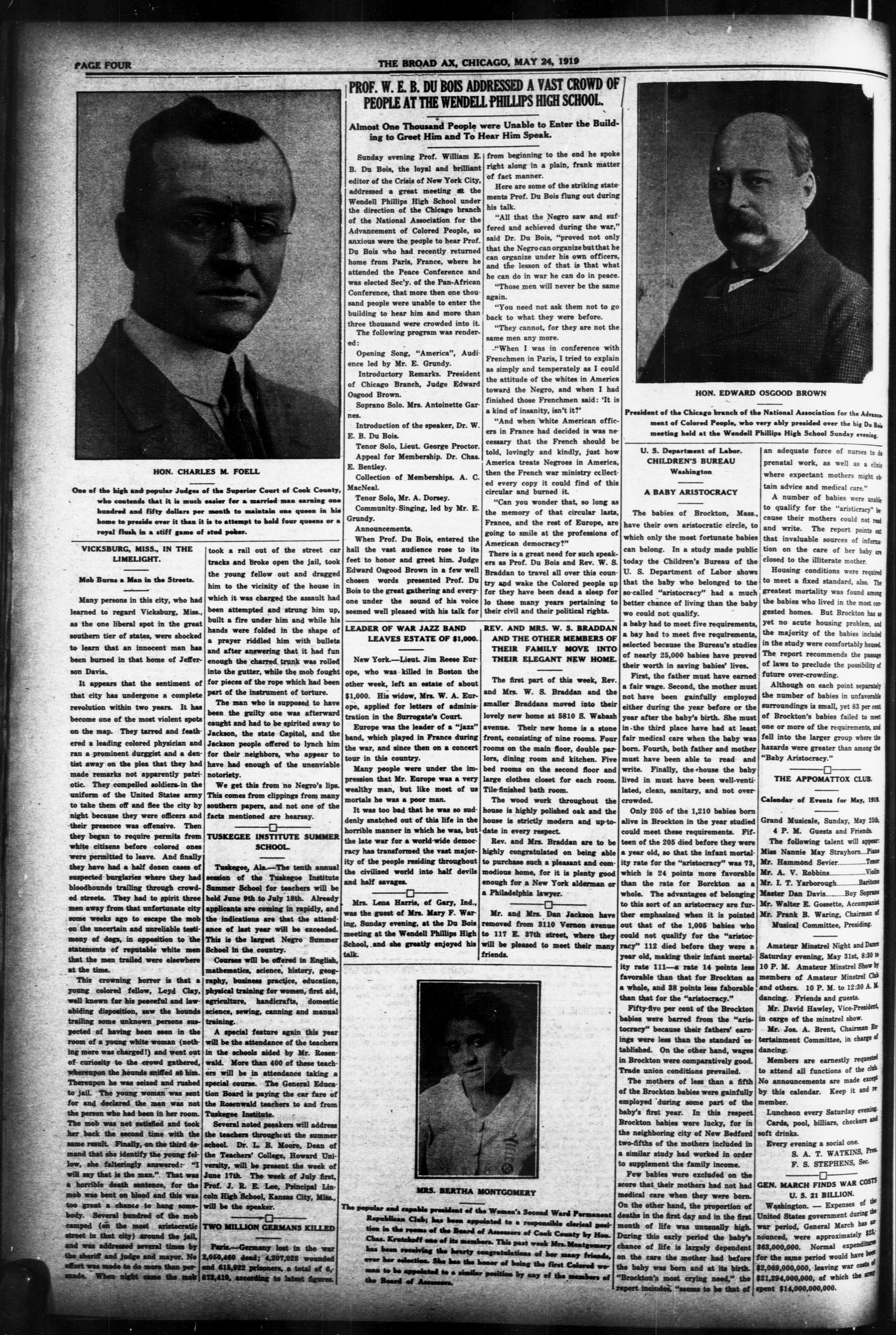
One of the high and popular Judges of the Superior Court of Cook County, who contends that it is much easier for a married man earning one hundred and fifty dollars per month to maintain one queen in his home to preside over it than it is to attempt to hold four queens or a royal flush in a stiff game of stud poker.
VICKSBURG, MISS., IN THE LIMELIGHT. took a rail out of the street car tracks and broke open the jail took
Mob Burns a Man in the Streets.
Many persons in this city, who had learned to regard Vicksburg, Miss., as the one liberal spot in the great southern tier of states, were shocked to learn that an innocent man has been burned in that home of Jefferson Davis.
It appears that the sentiment of that city has undergone a complete revolution within two years. It has become one of the most violent spots on the map. They tarred and feathered a leading colored physician and ran a prominent durggist and a dentist away on the plea that they had made remarks not apparently patriotic. They compelled soldiers in the uniform of the United States army to take them off and flee the city by night because they were officers and their presence was offensive. Then they began to require permits from white citizens before colored ones were permitted to leave. And finally they have had a half dozen cases of suspected burglaries where they had bloodhounds trailing through crowded streets. They had to spirit three men away from that unfortunate city some weeks ago to escape the mob on the uncertain and unreliable testimony of dogs, in opposition to the statements of reputable white men that the men trailed were elsewhere at the time.
This crowning horror is that a young colored fellow, Loyd Clay, well known for his peaceful and law-abiding disposition, saw the hounds trailing some unknown persons suspected of having been seen in the room of a young white woman (nothing more was charged!) and went out of curiosity to the crowd gathered, whereupon the hounds sniffed at him. Thereupon he was seized and rushed to jail. The young woman was sent for and declared the man was not the person who had been in her room. The mob was not satisfied and took her back the second time with the same result. Finally, on the third demand that she identify the young fellow, she falteringly answered: "I will say that is the man." That was a horrible death sentence, for the mob was bent on blood and this was too great a chance to hang somebody. Several hundred of the mob camped (on the most aristocratic street in that city) around the jail, and was addressed several times by the sheriff and judge and mayor. No effort was made to do more than persuade. When night came the mob
---
PAGE FOUR
took a rail out of the street car tracks and broke open the jail, took the young fellow out and dragged him to the vicinity of the house in which it was charged the assault had been attempted and strung him up, built a fire under him and while his hands were folded in the shape of a prayer riddled him with bullets and after answering that it had fun enough the charred trunk was rolled into the gutter, while the mob fought for pieces of the rope which had been part of the instrument of torture.
The man who is supposed to have been the guilty one was afterward caught and had to be spirited away to Jackson, the state Capitol, and the Jackson people offered to lynch him for their neighbors, who appear to have had enough of the unenviable notoriety.
We get this from no Negro's lips. This comes from clippings from many southern papers, and not one of the facts mentioned are hearsay.
Tuskegee, Ala.—The tenth annual session of the Tuskegee Institute Summer School for teachers will be held June 9th to July 18th. Already applicants are coming in rapidly, and the indications are that the attendance of last year will be exceeded. This is the largest Negro Summer School in the country. Courses will be offered in English, mathematics, science, history, geography, business practice, education, physical training for women, first aid, agriculture, handicrafts, domestic science, sewing, canning and manual training.
A special feature again this year will be the attendance of the teachers in the schools aided by Mr. Rosenwald. More than 400 of these teachers will be in attendance taking a special course. The General Education Board is paying the car fare of the Rosenwald teachers to and from Tuskegee Institute.
Several noted speakers will address the teachers throughout the summer school. Dr. L. B. Moore, Dean of the Teachers' College, Howard University, will be present the week of June 17th. The week of July first, Prof. J. R. E. Lee, Principal Lincoln High School, Kansas City, Miss., will be the speaker.
TWO MILLION GERMANS KILLED
Paris.—Germany lost in the war 2,050,460 dead; 4,207,028 wounded and 615,922 prisoners, a total of 6,878,410, according to latest figures.
THE BROAD AX. CHICAGO, MAY 24, 1919
PROF. W. E. B. DU BOIS ADDRESSED A VAST CROWD OF PEOPLE AT THE WENDELL PHILLIPS HIGH SCHOOL.
Almost One Thousand People were Unable to Enter the Building to Greet Him and To Hear Him Speak.
Sunday evening Prof. William E. B. Du Bois, the loyal and brilliant editor of the Crisis of New York City, addressed a great meeting at the Wendell Phillips High School under the direction of the Chicago branch of the National Association for the Advancement of Colored People, so anxious were the people to hear Prof. Du Bois who had recently returned home from Paris, France, where he attended the Peace Conference and was elected Sec'y. of the Pan-African Conference, that more then one thousand people were unable to enter the building to hear him and more than three thousand were crowded into it. The following program was rendered:
Opening Song, "America", Audience led by Mr. E. Grundy.
Introductory Remarks. President of Chicago Branch, Judge Edward Osgood Brown.
Soprano Solo. Mrs. Antoinette Garnes.
Introduction of the speaker, Dr. W. E. B. Du Bois.
Tenor Solo, Lieut. George Proctor.
Appeal for Membership. Dr. Chas. E. Bentley.
Collection of Memberships. A. C. MacNeal.
Tenor Solo, Mr. A. Dorsey.
Community-Singing, led by Mr. E. Grundy.
When Prof. Du Bois, entered the hall the vast audience rose to its feet to honor and greet him. Judge Edward Osgood Brown in a few well chosen words presented Prof. Du Bois to the great gathering and everyone under the sound of his voice seemed well pleased with his talk for
New York.—Lieut. Jim Reese Europe, who was killed in Boston the other week, left an estate of about $1,000. His widow, Mrs. W. A. Europe, applied for letters of administration in the Surrogate's Court. Europe was the leader of a "jazz" band, which played in France during the war, and since then on a concert tour in this country. Many people were under the impression that Mr. Europe was a very wealthy man, but like most of us mortals he was a poor man.
It was too bad that he was so suddenly snatched out of this life in the horrible manner in which he was, but the late war for a world-wide democracy has transformed the vast majority of the people residing throughout the civilized world into half devils and half savages.
Mrs. Lena Harris, of Gary, Ind., was the guest of Mrs. Mary F. Waring, Sunday evening, at the Du Bois meeting at the Wendell Phillips High School, and she greatly enjoyed his talk.
MARY MAY
MRS. BERTHA MONTGOMERY
The popular and capable president of the Women's Second Ward Permanent Republican Club; has been appointed to a responsible clerical position in the rooms of the Board of Assessors of Cook County by Hon. Chas. Krutchoff one of its members. This past week Mrs. Montgomery has been receiving the hearty congratulations of her many friends, over her selection. She has the honor of being the first Colored woman to be appointed to a similar position by any of the members of the Board of Assessors.
from beginning to the end he spoke right along in a plain, frank matter of fact manner.
Here are some of the striking statements Prof. Du Bois flung out during his talk.
"All that the Negro saw and suffered and achieved during the war," said Dr. Du Bois, "proved not only that the Negro can organize but that he can organize under his own officers, and the lesson of that is that what he can do in war he can do in peace.
"Those men will never be the same again.
"You need not ask them not to go back to what they were before.
"They cannot, for they are not the same men any more.
"When I was in conference with Frenchmen in Paris, I tried to explain as simply and temperately as I could the attitude of the whites in America toward the Negro, and when I had finished those Frenchmen said: 'It is a kind of insanity, isn't it?'"
"And when white American officers in France had decided is was necessary that the French should be told, lovingly and kindly, just how America treats Negroes in America, then the French war ministry collected every copy it could find of this circular and burned it.
"Can you wonder that, so long as the memory of that circular lasts, France, and the rest of Europe, are going to smile at the professions of American democracy?"
There is a great need for such speakers as Prof. Du Bois and Rev. W. S. Braddan to travel all over this country and wake the Colored people up for they have been dead a sleep for lo these many years pertaining to their civil and their political rights.
REV. AND MRS. W. S. BRADDAN AND THE OTHER MEMBERS OF THEIR FAMILY MOVE INTO THEIR ELEGANT NEW HOME.
The first part of this week, Rev. and Mrs. W. S. Braddan and the smaller Braddans moved into their lovely new home at 5810 S. Wabash avenue. Their new home is a stone front, consisting of nine rooms. Four rooms on the main floor, double parlor, dining room and kitchen. Five bed rooms on the second floor and large clothes closet for each room. Tile-finished bath room. The wood work throughout the house is highly polished oak and the house is strictly modern and up-to-date in every respect.
Rev. and Mrs. Braddan are to be highly congratulated on being able to purchase such a pleasant and commodious home, for it is plenty good enough for a New York alderman or a Philadelphia lawyer.
Mr. and Mrs. Dan Jackson have removed from 3110 Vernon avenue to 117 E. 37th street, where they will be pleased to meet their many friends.
M.
HON. EDWARD OSGOOD BROWN
President of the Chicago branch of the National Association for the Advancement of Colored People, who very ably presided over the big Du Bois meeting held at the Wendell Phillips High School Sunday evening.
U. S. Department of Labor.
CHILDREN'S BUREAU
Washington
an adequate force of nurses to do prenatal work, as well as a clinic where expectant mothers might
A BABY ARISTOCRACY
The babies of Brockton, Mass., have their own aristocratic circle, to which only the most fortunate babies can belong. In a study made public today the Children's Bureau of the U. S. Department of Labor shows that the baby who belonged to the so-called "aristocracy" had a much better chance of living than the baby wo could not qualify. a baby had to meet five requirements, a bay had to meet five requirements, selected because the Bureau's studies of nearly 25,000 babies have proved their worth in saving babies' lives.
First, the father must have earned a fair wage. Second, the mother must not have been gainfully employed either during the year before or the year after the baby's birth. She must in-the third place have had at least fair medical care when the baby was born. Fourth, both father and mother must have been able to read and write. Finally, the house the baby lived in must have been well-ventilated, clean, sanitary, and not overcrowded.
Only 205 of the 1,210 babies born alive in Brockton in the year studied could meet these requirements. Fifteen of the 205 died before they were a year old, so that the infant mortality rate for the "aristocracy" was 73, which is 24 points more favorable than the rate for Borckton as a whole. The advantages of belonging to this sort of an aristocracy are further emphasized when it is pointed out that of the 1,005 babies who could not qualify for the "aristocracy" 112 died before they were a year old, making their infant mortality rate 111—a rate 14 points less favorable than that for Brockton as a whole, and 38 points less favorable than that for the "aristocracy."
Fifty-five per cent of the Brockton babies were barred from the "aristocracy" because their fathers' earnings were less than the standard established. On the other hand, wages in Brockton were comparatively good. Trade union conditions prevailed. The mothers of less than a fifth of the Brockton babies were gainfully employed during some part of the baby's first year. In this respect Brockton babies were lucky, for in the neighboring city of New Bedford two-fifths of the mothers included in a similar study had worked in order to supplement the family income.
Few babies were excluded on the score that their mothers had not had medical care when they were born. On the other hand, the proportion of deaths in the first day and in the first month of life was unusually high. During this early period the baby's chance of life is largely dependent on the care the mother had before the baby was born and at its birth. "Brockton's most crying need," the report includes, "seems to be that of
an adequate force of nurses to do prenatal work, as well as a clinic where expectant mothers might obtain advice and medical care."
A number of babies were unable to qualify for the "aristocracy" because their mothers could not read and write. The report points out that invaluable sources of information on the care of her baby are closed to the illiterate mother.
Housing conditions were required to meet a fixed standard, also. The greatest mortality was found among the babies who lived in the most congested homes. But Brockton has as yet no acute housing problem, and the majority of the babies included in the study were comfortably housed. The report recommends the passage of laws to preclude the possibility of future over-crowding.
Although on each point separately the number of babies in unfavorable surroundings is small, yet 83 per cent of Brockton's babies failed to meet one or more of the requirements, and fell into the larger group where the hazards were greater than among the "Baby Aristocracy."
Calendar of Events for May, 1919
Grand Musicale, Sunday, May 25th
4 P. M. Guests and Friends.
4 P. M. Guests and Friends.
The following talent will appear:
Miss Nannie May Strayhorn.....Piano
Mr. Hammond Sevier.....Tenor
Mr. A. V. Robbins.....Violin
Mr. I. T. Yarborough.....Baritone
Master Dan Davis.....Boy Soprano
Mr. Walter E. Gossette, Accompanist
Mr. Frank B. Waring, Chairman of
Musical Committee, Presiding.
Amateur Minstrel Night and Dance
Saturday evening, May 31st, 8:30 to
10 P. M. Amateur Minstrel Show by
members of Amateur Minstrel Club
and others. 10 P. M. to 12:30 A. M.
dancing. Friends and guests.
Mr. David Hawley, Vice-President,
in charge of the minstrel show.
Mr. Jos. A. Brent, Chairman Entertainment Committee, in charge of dancing.
Members are earnestly requested to attend all functions of the club. No announcements are made except by this calendar. Keep it and remember.
Luncheon every Saturday evening.
Cards, pool, billiars, checkers and soft drinks.
Every evening a social one.
S. A. T. WATKINS, Pres.
F. S. STEPHENS, Sec.
GEN. MARCH FINDS WAR COSTS
U. S. 21 BILLION.
Washington. — Expenses of the United States government during the war period, General March has announced, were approximately $23,363,000,000. Normal expenditures for the same period would have been $2,069,000,000, leaving war costs of $21,294,000,000, of which the army spent $14,000,000,000.
1
DR. EDWARD S. MILLER
Grand Medical Director of the Knight
extremely busy these cool sp
and comforts of his many pat
WHAT IS LIFE?
By Marie Jefferson.
Grand Medical Director of the Knights of Pythias of Illinois, who is kept extremely busy these cool spring days in looking after the welfare and comforts of his many patients.
Yes, what is life? A weary pilgrimage
Whose glory in one day
Doth fill the stage with childhood,
Womanhood and decrepit age.
Read on your dial though with shayes
Our life is like a wintry day.
What is a life that soon passes away?
The proud summer meadows, which
today
Wears her green plush today and to-
morrow is hay.
Look at the beautiful lillies, which
God has made.
That is a copy of life. Just to see
how soon they droop and fade.
I do not beg this slender life to
widen,
Our time passes away as falsely to
beguile.
Now, my thoughts of joy here on
earth are not worth a smile.
Oh! why should the spirits of mortals
be proud,
Like a fast flitting cloud,
A flash of lightning, a break of the
wave,
We pass from life to rest in the
grave.
Yes. Hope and despondency, plea-
ure and pain
Are mingled together like sunshine
and rain,
And the smiles and the tears, and
wink of the eye, and the droughts
of breath
And from the blossom of health to
the paleness of death.
I walk with silent tread
Beside time's flowing river,
And wait for the Splashing Oar
That bears me to the shining shore
To be with my darling Ethel for ever
more.
BETHEL LITERARY SOCIETY.
Next Monday evening, May 26th,
at 8:30 P. M. Prof. Willis N. Huggins
will address Bethel Literary Society,
Subject: "Vocational Guidance and
its relation to Colored Children." —
When announced that Prof. Huggins
will speak a large audience is assured
Special Music numbers and a reading
will assist the program. Everybody
invited. Admission free.
Sandy W. Trice, Pres.
J. W. Bell, Sec'y.
WHITE ARMY OFFICER HUNG
FOR FRENCH RAPE.
Paris, special.—A white American army officer has been hung within the zone occupied by the American Army of Occupation for an assault upon a girl of seven years of age.
Rights of Pythias of Illinois, who is kept
ring days in looking after the welfare
ients.
W. T. Gaines Head of The Johnson
Express, Storage and Van Company,
Has Secured a New Warehouse
W. T. Gaines, the successful plastering contractor, extensive real estate owner and all around hustling business man; head of the Johnson Express, Storage and Van Company, with main office at 1431 E. 67th st., branch office at 444 E. 39th street, has secured a new warehouse at 5127 Wentworth avenue. The building is three stories high and all of it will be used including the basement, for sales rooms and storage purposes.
Mr. and Mrs. J. Gray Lucas are now settled in their new home at 3646 Grand boulevard and are home to their many friends.
Mrs. Alone Townsend-Williams, of Jersey City, N. J., is on a visit to her sister Mrs. Dolly Jennings, 3648 Prairie avenue. She will remain in the city until the middle of June.
Dr. Troy Smith, who will have charge of the office of Dr. A. Wilberforce Williams, 3545 S. State street, while Dr. Williams is in France, in the interest of the United States government. Dr. Smith will look after his patients, either at their homes or at the office.
Madame Hattie Lucas, the soprano songstress, is the house guest of Madame Bertha L. Hensley, 3528 Vernon avenue, Wednesday afternoon Madame Lucas was the guest of honor of the Phyllis Wheatley Club and Madame Hensley is exerting every effort to make her visit to this city very pleasant.
Attorney William J. Latham, President of the Underwriters Mutual Insurance Co., with general offices at No. 2 E. 31st street, has within the past two years forced himself to the front in the legal and business world and his company, under his conservative guidance, is doing a splendid business.
It was our pleasure Sunday evening to be presented to Mrs. Edward Osgood Brown, 1216 N. State street, whose distinguished husband is the President of the Chicago branch of the National Association for the Advancement of Colored People and Mrs. Brown, is an extremely pleasant personage to meet and she informed us that with deep interest she read the contents of this paper each week, which has been frequenting the home of Judge and Mrs. Brown, since 1903.
CHIPS.
THE BROAD AX, CHICAGO, MAY 24, 1919
MAYOR WILLIAM HALE THOMPSON ACCORDING TO HIS PROMISE BEFORE HIS FIRST ELECTION IN 1915 AND AFTER IT.
Has utterly failed to select a Colored Person as a member of the Board of Education.
The Sunday evening prior to his election in 1915 and the Sunday evening after his election in that same year Mayor Thompson attended two great meetings at the Institutional Church and in the course of his remarks among other things be declared that if the Colored people would stand by him and assist to land him in the City Hall as "your mayor" that he would without the least hesitation in spite of any and all opposition to the contrary, appoint a worthy and capable Colored person either man or woman as one of the members of the Board of Education.
Four years:
Dr. Boleslaus Klarkowski, 1952
Evergreen avenue.
James B. Rezny, 2204 South Crawford avenue.
Three years:
Mrs. Francis E. Thornton, 2524
North Kimball Avenue.
Dr. Sadie Bay Adair, 3866 Lake Park Ave.
Two years:
Edwin S. Davis, 6740 Bennett avenue.
Albert H. Severinghaus, 2022
Mayor Thompson strongly impressed the fact on their minds that he was not conning them that he always ment just what he said, but somehow or other.
Mayor Thompson, has gone absolutely dead or limp on that proposition for more than four years have rolled on into eternity since he made that statement in the House of God and so far no open attempt on his part has been made to select any honorable Colored man or woman as one of the members of the Board of Education. On Monday of this week Mayor Thompson sent the names of eleven new members of the Board of Education to the City Council for confirmation, they are as follows and not one of them can be classed as belonging to the Colored race. Five year terms:
Mrs. Lulu M. Snodgrass, 5737 Race avenue. Samuel Gessler, 875 North La Salle avenue.
Race Man Travels in Government Party in Europe.
Washington, D. C., special.—There has been quite a stir of comment among the official family in Washington, and outsiders as well, because of the fact that all the cablegrams giving the names of the "official party" traveling with Secretary of the Navy Daniels on his tour through Europe, the name of Robert Gaines, a race man, appears. Gaines is described officially as messenger, but his name is always on the official list sent by cablegram.
SPECIAL OR IMPORTANT NOTICE TO ALL MILITARY MEN.
Attention! All military men who have been discharged from service are requested to take part in the Memorial Day Parade, Friday, May 30th. Report to Lieutenant L. Speed, at the Soldiers' and Sailors' Club, 3201 Wabash Ave., at 1 P. M., on Friday, May 30th, in uniform. Let's make a showing. A 45-piece band will lead the division.
QUINN CHAPEL A. M. E. CHURCH
Dr. H. E. Stewart will preach Sunday morning from the Lord's Prayer text, "Thine is the Kingdom, the Power and the Glory." This is the third of a series of sermons on the Lord's Prayer.
Sunday night will be an illustrated sermon. The pastor has an organized band known as "King's Messengers." They are to engage in missionary work in the city.
A drive is on. Anniversary rally at this church. 72nd anniversary July 22-28. Dr. R. C. Ramsom will deliver the anniversary address Tuesday night. July 22nd.
The parsonage debt of Quinn Chapel has been paid in full and the parsonage is to be dedicated Monday, June 9th.
Seemed in Distress.
One Saturday morning Kermit's mother was baking pie. She asked Kermit to go open the oven door and see if the pie were getting too brown. As it happened, the oven was quite hot and the pie was bubbling out of the top of the pie while the crust was heavying up and down. Kermit opened the oven door and said: "No, they're not too brown, but they're breathin' awful hard."
Four years:
Dr. Boleslaus Klarkowski, 1952
Evergreen avenue.
James B. Rezny, 2204 South Crawford avenue.
Three years:
Mrs. Francis E. Thornton, 2524
North Kimball Avenue.
Dr. Sadie Bay Adair, 3866 Lake Park Ave.
Two years:
Edwin S. Davis, 6740 Bennett avenue.
Albert H. Severinghaus, 2022
Humboldt boulevard.
Hart Hanson, 1644 Humboldt boulevard.
George B. Arnold, 4819 West End avenue.
Francis E. Croarkin, 3616 Grand boulevard.
Messrs. Gessler, Klarkowski, Rezny, and Croarkin are the new appointees. Messrs. Arnold, Hanson, Severinghaus, and Davis and Mrs. Snodgrass and Dr. Adair are the "solid six". Mrs. Thornton is a member of the present board.
It is safe to say that no true American can pronounce some of their names properly and some of them no doubt can not speak the English language correctly and seemingly mayor Thompson is fully determined to give representation to every race of people residing in Chicago, on the Board of Education, except the Chinese, the Japanese and the Colored race.
SUNSHINE RESCUE MISSION.
2830 S. State St.
SERVICE EVERY NIGHT IN THE YEAR.
Seven lined up for heaven in our services last week.
The afternoon meeting of the Bible classes was very interesting and was attended by more men than at any previous session. Mrs. Hattie Jones delivered a very acceptable message at the night service on Sunday.
The Superintendent, Dr. H. Franklin Bray, will preach tomorrow night. The Bible Classes meet at 2. P. M. every Sunday. A HEARTY WELCOME TO STRANGERS AND THE POOR.
Our Country's Birth.
Our country's independence dates from July 4, 1776, because the United States then declared its independence, and from that day on has maintained it. Great Britain acknowledged the independence of the United States by a preliminary treaty of peace dated November 30, 1782, and by the final or definite treaty dated September 3, 1783. This treaty was ratified by the continental congress January 14, 1784.
Various Falls
"Fall in" is an old military command, originating in the idea of giving up individuality, and becoming part of the military machine, when in line. Fall means more than "tumble," as for instance, "to fall from grace," "to fall asleep," "befall," etc. It is also used in the sense of classifying, "to fall into place," which may give the derivation desired.
Minute Men.
The Minute Men were a class of citizens pledged to take the field at a minute's notice. They were first known during and immediately previous to the War of the Revolution and afterward at the beginning of the Civil war. Sometimes they were regularly enrolled as militia.
Jefferson's Wisdom
Thomas Jefferson said: "I have often thought that if heaven had given me a choice of my position and calling, it should have been a rich spot of earth, well watered, and near a good market. No occupation is so delightful to me as the culture of the earth."
Egyptian Pyramids
It took 123,000,645 slaves, working 14 hours a day for three centuries to complete the pyramids of Egypt, and the mummies exported from them have not brought, all told, $1,000,000. New York Sun.
[Picture of a man in a suit and tie].
ATTORNEY W. E. MOLLISON
Formerly of Vicksburg, Miss. Where for many years he stood very high in the estimation of its best white and colored citizens.
W. E. Mollison, the well-known lawyer, is now located in suite 603 Firmenich Building, 184 West Washington street. His new quarters are more commodious and better lighted than the splendid offices he occupied in the Hartford Building. The offices are in easy reach of the Randolph and Wells elevated station, and just one block west of the City Hall. During the two years in which Mr. Mollison has practiced law in Chicago he has won an enviable position at the bar. He has handled successfully many cases of importance, civil and criminal, and his clients have come from all walks of life and all
Average Vocabulary.
The size of the average person's vocabulary has been estimated at about 5,000 words. Shakespeare's vocabulary has been computed variously as containing from 15,000 to 24,000 words, and it includes the root words and inflections. Milton's vocabulary has been estimated at 18,000; the Bible contains 8,674 Hebrew and Chaldee words and 5,674 Greek words.
Two Minds in Accord.
Clergyman (intent on administering a gentle reproof to bridge-playing parishioner)—"I am afraid much valuable time is wasted on playing cards." Bridge-playing Parishioner—"I quite agree with you. The time taken by some players in shuffling, dealing or deciding what card to play is simply erasing."
The modern banjo was introduced into England from America, to which country it was probably taken by the African slaves, who originally obtained the idea from India. The unmusical name "banjo" seems to have been derived from "banya," the name of a Senegambian instrument of the guitar species.
To Improve Paint Work.
To put a varnish-like gloss on doors, get half a pound of glue, put it into a saucepan with about a quart of water, and boil till dissolved. When the doors are washed, take a clean cloth, dip it in the size, and rub all one way, being sure to go over the door to insure a smooth surface.
Mere democracy cannot solve the social question. An element of aristocracy must be introduced into our life. I do not mean the aristocracy of birth, or of the purse, or even the aristocracy of intellect. I mean the aristocracy of character, of will, of mind. That only can free us—Ibsen.
Clock of Long Service.
In the examination hall at Canton, China, where under the old regime students sat for their military tests, is a water clock which has automatically recorded the time for 3,000 years.
Collecting That Living.
The world owes a living to every man who feels that he owes the world for his living. It is a sort of exchange in which the world deals as fairly as it is dealt by.
Farmer's Good Work
Some people find it impossible to do two things at the same time. The farmer often does four, and does them well-he walks, thinks, talks, and smiles all at once.
Meat, milk, eggs, fish, cheese, beans, peas, nuts and cereals are the foods which furnish protein in quantity for the human body.
The wisdom of the wise and the experience of ages may be preserved by enotation.—Benjamin Disraell.
The Banio.
True Aristocracy.
Foods for Protein.
Life Wisdom
colors and creeds. All of his clients become staunch friends and thus his circle constantly widens.
In the political and literary life of the city he has become a factor of some importance. He was on the stump during the pre-primary campaign and won a strong place in the Deneen organization. He is a staunch friend of Hon. Oscar DePriest and in the People's Movement is a leading figure.
Mr. Mollison is now in constant demand as a platform orator in all parts of the city in all sorts of gatherings and in the neighboring towns and cities.
Unendurable Surgical Thirst
Thirst following abdominal operations is often of so intense a character that the memory of it lingers in the patient's mind for many years. Every hospital has records of patients who have surreptitiously consumed the contents of a hot water bottle in an effort to quench the unendurable thirst from which they were suffering.
"The best things are nearest, breath in your nostrils, light in your eyes, flowers at your feet, duties at your hand, the path of God just before you. Then do not grasp at the stars, but do life's plain, common work as it comes, certain that daily duties and daily bread are the sweetest things of life."—Marcus Aurelius.
Began the Bastille.
April 21 is the anniversary of the beginning of the building of the bastille in 1370 by Charles V, who erected it as a protection against the English. The prison became famous in French history and was finally destroyed by the people in 1789. The key was sent by Thomas Paine to George Washington.
What Quadrille Means.
The word "quadrille" is derived from the position of the dancers, the French word "quadrille" meaning a little square. "Country dance" does not mean a rustic dance, but it is a corruption of the French term contre-danse, which relates to the position of the couples—opposite to each other.
Billions of Lead Pencils
The world's product of lead pencils probably amounts to nearly two thousand millions a year, half of which are made from American-grown cedar. The United States makes about 750,000,000 a year, or more than eight pencils for each of its inhabitants.
Need for Bth Law and Sword.
In all government there must of necessity be both the law and the sword; laws without arms would give us not liberty but licentiousness, and arms without laws would produce not subjection but slavery.—Colton.
"Pieces of Eight."
The piece of eight was the old Spanish plaster or peso, now called a dollar, thus known throughout the Spanish Main in the days of piracy, because it was divided into eight reals. It was a silver coin worth $1.
Recipe for Roay'Chaaska
In some parts of England and in France and Italy also it is believed that a girl who buries a drop of her blood under a rose bush will have rosy cheeks.
His Poor Selection
"I can't believe mo' dan half some folks says," said Uncle Eben, "an' somehow de half I does believe is most generally de half dat ain' so."
Any fool knows how to resist, but it is the province of a wise man to know how and when to submit.
PAGE FIVE
Just at Hand.
PAGE SIX
Alexandria
Alexandria, founded by the world conqueror, Alexander the Great, is an Egyptian city that is eager to lose its connection with the faraway past and become completely modernized. Fate has favored this ambition, for the wonders that Cleopatra knew have been eaten by fire or swept away by the sea. Alexandria is a city of trade and fashion, dominated by prosperous Europeans too deeply absorbed in the stock exchange to be even vaguely interested in the romantic side of their city.
Tides of the Ocean.
The incoming and the outgoing of the tides is caused by the gravitational influence of the moon. The moon, so to speak, draws or lifts the water from the depths on the same principle that a pump lifts water. And as with a pump, the water rushes in to fill the space left; so the shallow water near shore rushes out to fill the extra space caused by rising of the water, on the principle that water seeks its own level.
World's Largest Building
The Vatican palace at Rome is the largest building in the world, covering 13% acres, but with its additions and enlargements it was several centuries in building. The most extensive building in the world constructed at one time is the Pennsylvania station in New York city, which occupies eight acres of ground and has exterior walls measuring about one-half a mile. The capitol at Washington covers 153,112 square feet, or nearly acres.
Washington's Advisers
When Washington formed his cabinet it had but four members, the interior department being unknown, the war and navy departments being under one head, and the postmaster general being subordinate to the treasury. Nevertheless of these four positions, he gave two to Virginians, Secretary of State Jefferson and Attorney General Randolph; one to New York, Alexander Hamilton, and one to Massachusetts, Henry Knox.
Readers.
There are four sorts of readers: hour glass readers, whose reading runs in and out and leaves nothing; sponge readers, who imbibe all but only to give it out again as they got it, and perhaps not so clear; jelly-bag readers, who keep the dregs and refuse, and let the pure run through; diamond readers, who cast aside all that is worthless and hold only gems.
Sympathetic Brothers
The boys of the neighborhood were anticipating the time when they could go fishing. Everett, noticing his little sister standing inside the yard, watching them wistfully through the fence, and listening to their plans without joining the conversation, remarked in an aside to his companions: "Gee, it must be tough to be only a girl."
Animals and Earthquakes
One of the mysteries still unsolved is that of the sense by which the lower animals become aware of the approach of earthquakes. Birds and rats become alarmed and try to escape. Super-sensitiveness to false shocks scarcely gives satisfactory explanation, for modern seismographs are very sensitive.
Cause for Thankfulness
The first reason for being thankful in the morning is that you have lived to see the dawn of another day, with opportunities to finish something begun the day before and to begin something that you may be able to do better than you have ever done anything before.
Asbestos Deposits
In the Kotzube sound region, western Alaska, there are asbestos deposits said to rival the richest in the world. Asbestos, in its natural or virgin state, is as white as snow, soft as the softest silk and lies in long strings or layers, easily torn apart with the fingers.
Utilizing Time.
"Ladies," announced the president of an afternoon bridge club. "It has been moved and seconded that there shall be no conversation at the card tables. What shall we do with the motion?" "I suggest," said a sprightly member, "that we discuss it while we play."
The Church-Goers
If some men were to quote the well-known psalm they would have to say, "I was glad to make excuses when they said to us, 'let us go into the house of the Lord.'" The 'they' referring probably to the women of the house, or the church-going neighbors. Exchange.
Pessy's Appeal
Never did poesy appear so full of heaven to me as when I saw how it pierced through pride and fear to the lives of the coarsest men—Lowell.
Uncle Eben.
"A real loafer," said Uncle Eben, "ain' satisfied to get along without work. He wants busy folks to quit their jobs to admire him."
A Great Record.
Gen. John Brown Kerr, who was born in Kentucky seventy-two years ago, was the hero of what the late General Miles declared to be the most daring exploit in the history of Indian warfare. In 1891 Kerr, at the head of a brave band of 20 men, found himself surrounded by more than 100 South Dakota Sioux Indians. Outnumbered five to one, Kerr and his men fought so valiantly and handled their guns with such effect that many of the braves were killed and the remainder surrendered.
German Siege of Paris.
The siege of Paris began on September 15, 1870, and ended on January 28, 1871, when the city surrendered, German troops entering the city in March, 1871, and remaining 48 hours. The eastern part of Paris was bombarded by the Germans on January 8, 1871, and about a week later there was a general bombardment, in which many buildings were damaged and a number of persons killed. After the latter bombardment France appealed to the neutral powers, but received no response.
Replacing Knocked Out Teeth.
Teeth that are knocked out in boxing, football or by falling against something, need not be thrown away. A good surgeon or dentist will clean them and the cavity, replace them, perhaps put a stitch in the gum, perhaps put a pad to bite on for about forty-eight hours, during which you will have to live on a fluid diet, and then gradually restore solid food. Before many weeks you will be able to bite apples and tackle hard crusts.
The Target at Fault.
A company of militia had been out all day for target practice, and on their return the captain said to one of the sergeants: "How are your men coming along, sergeant?" "Well, sir," said the sergeant, with an air of great pride, "my men shot very well today, very well, but they would have shot better perhaps if the target had stood a little more to the left!"
Cure for Rheumatism.
A certain variety of seaweed, known in Ireland as "tope," has been recommended by a famous physician as a cure for rheumatism and throat affections if eaten hot, whilst in some parts of England and Wales a variety of seaweed, known as "laver," has been in demand for years as a vegetable. Served with roast meats it is said to be extremely palatable.
When Actresses Were Unknown.
In ancient times actresses were unknown. The people of Elizabethan times were perfectly content to stand for a young male Juliet. Around about 1656, though, Charles II of England began encouraging women to appear on the English stage, and since then actresses have been appearing all over the world with varying degrees of success.
The First Silk
The first silk was made 2000 B. C. by the wife of a Chinese emperor. Aristotle, in 350 B. C., first mentions silk among the Greeks. The manufacture of silk was carried on in Sicily in the twelfth century, later spreading to Italy. Spain and the south of France. It was not manufactured in England before 1604.
Do We Eat Too Much?
One meal a day was the custom of the Greek patricians; the soldiers and plebeians had two; only the riffraff of the population ate three. And the Greek patricians were the healthiest of the population, and lived the longest. The moral is obvious—if you want to apply it.
Added Information.
Little Vivian was repeating the Lord's prayer after her mother one evening, and when she reached that part which relates to our daily bread she paused and said: "Mamma, 'ou might mention to Dod sat I like butter on it."
Really Hit
"Why do people say, 'As dead as a door nail?'" asked the boob. "Why is a door nail any dealer than a door?" "Because it has been hit on the head, I suppose," replied the cheerful iodot—Cincinnati Enquirer.
Plan Well Before You Begin
In our hurry to do things we often begin before we have a clear idea of what is to be done. We too often go on general propositions without studying all the facts. The result is disastrous.
Uncle Eben.
"Some men hate work," said Uncle Eben, "an' a lot more never git well enough acquainted with it to so much as dislike it."
From a magazine article: "William Penn was a short, stubby man"—Boston Transcript.
Daily Thought.
Strengthen me by sympathizing with
my strength, not my weakness.—Amos
Brouson Alcott.
THE BROAD AX. CHICAGO, MAY 24, 1919
Insects Preserved in Amber.
In a collection of red amber presented to the British museum, Prof. T. D. Cockerell has recognized an astonishing variety of insect forms, and has described not less than 31 new species, of which five are types of new genera.
Most of them were found in a single block little larger than a man's fist, which was cut into half-inch slices, in every one of which the insects are densely crowded. The amber is from Miocene clay beds of Burma, though perhaps washed from still older deposits, and nearly every large order of insects is represented, the family of ants being a notable exception.
God of the Lower World.
In one temple of Japan the image is a Japanese conception of the god of the lower world. The figure has an unusual history. An image maker, it is said, died. When he appeared before the lord of the other world, he was told that in his lifetime he had never represented the lord of the world properly, and that he must return to earth and make a correct likeness. The figure is pointed out as the result of the order. It is so horrible with its red face and malevolent glare that the story seems plausible.
Creas Wonderful Canoeista
"The Ojibway, the Cree and the Montagnais are the most wonderful canoemen in the world," says S. E. Sangster, writing of "The Woods Indian" in Boys' Life. "They possess a sixth sense in rapid-running and if they say 'run it' you can safely lay a bet at odds that they will run it and come through dry—even through water the mere glimpse of which makes your hair stand up and sends chills chasing up and down your spine."
Can Always Bely on Grandma.
Oliver was in the habit of going to his grandma for favors, and was never disappointed. While playing with the other boys of the neighborhood their football came apart, and they thought they could sew it together if they only had a piece of shoestring. Oliver came to the rescue. "Let's go and ask grandma for a shoestring," he suggested. "You can get about anything you ask for over at grandma's."
Keeping Cider Sweet
To keep cider sweet place in each barrel immediately on making, mustard, four ounces; salt, one ounce, and ground chalk, one ounce. Shake well. Or cider may be preserved sweet by canning in alight cans after the manner of preserving fruit. The liquid should be first settled and racked off from the dregs, but fermentation must not be allowed to commence before canning or it will not keep.
Officer' Hat Cords.
Hat cords of general officers are gold; of all other officers, gold and black; of men in infantry, light blue; of men in cavalry, yellow; of men in artillery, scarlet; in quartermaster corps, buff; medical department, maroon; corps of engineers, scarlet and white; ordnance department, black and scarlet; signal corps, orange and white.
Feeding Rabbit
Rabbits need not only green feed, but a solid staple meal every day—preferably of grain—but that is a difficulty at present; bread may be substituted, with a little bran or oatmeal, and always plenty of clean water or milk and water.
Trouble in the Future
The pessimist is always anticipating new varieties of trouble. One contemporary gloomster casts his eye forward to the day when wireless telephony will be so perfect that a man will have a receiver in his hat and be managed by his wife all the time.
Many Like Him.
All newspapers often have advertisements which could be rewritten advantageously. But it took a church paper to offer the most original one yet: "Wanted—A minister who has been married 22 years is very desirous of securing a change."
Cannibal Movie Panda
New Zealand Maori, native Javanese and the cannibals of the South Sea islands have developed a ravenous appetite for the American movie stars. Their appetite, however, doesn't crave blood. They want them on the screen.
World's Urgent Need.
The state will be saved if the Lord puts it into the heart of the average man so to shape his life that the state shall be worth saving, and only on those terms. We need civic righteousness.—Theodore Roosevelt.
Had Him There.
"Deacon Simms 'low he doan' approve o' churches advertisin', remarked Slimbone; "but when Ah ast him, in dat case, wruffo' he ring the church bell fo' service, he jes' had nuffin' to say."—Boston Transcript.
Save the Office Huronist
The celeverest gardener in the world cannot grow an oak tree out of a rose bush. But the stupidest pipe smoker can make the "ash" grow inside the "briar."
Robinson Crusoe.
Defoe based his story, "Robinson Crusoe," which made him famous, on the experiences of Selkirk, who was put ashore on Juan Fernandez island, at his own request, as he had quarreled with the captain of the Cinque Ports, of which he was sailing master. Selkirk remained on the island more than four years, and in 1712 there appeared his book, "Cruising Voyage Around the World," and Captain Cooke's "Voyage to the South Sea," which Defoe used as his basis.
1 Tip to Authors.
A youthful aspirant applied to a successful authoress for advice as to how to succeed in literature. "You need indomitable perseverance, a typewriter and a mangle," was the reply. "Do you mean I had better take in washing?" asked the aspirant. "Nonsense! You need the mangle to take the creases out of your manuscripts. Mangle them well, and then, unless the editors have burned them with cigarette ash, no one can tell they have been out before."
United States Senate
Each United States senator is elected for six years, unless he is chosen to fill the unexpired term of some senator who has died or resigned. On March 4 in every "odd year"—1919, etc—the terms of 32 senators expire; that is, one-third of the whole number. By this plan there is never an entirely new senate. Even if no members were re-elected, two-thirds of the membership would always consist of men who have had either two or four years' service.
Helpful Sympathy.
She was slowly recovering from a long illness, but still too weak for the trip downtown to a hairdresser for the much-needed shampoo. At last a maid was found who would come to the house. During the drying process she made the startling discovery of the first gray hairs. The convalescent's grief was so intense that the maid, striving to comfort, said: "Law, lady, what if you had to wear one of them transmissions on your head!"
Indian Potlatch.
Potlatch is a corruption of an Indian word common among the Pacific coast tribes, meaning a festival of gifts. At a potshatl (potlatch) celebration the more personal property an Indian gives away, blankets, ornaments, etc., the higher he stands in the estimation of his neighbors, and the more he expects to receive in return at the next potlatch. The festival is accompanied by music, dancing and feasting.
Peanut Oil.
The peanut oil, which is used as a substitute for other nut oils, is receiving special attention from growers who find this the most profitable feature of the industry. About 40,000,000 bushels a year are used in the production of peanut oil, a bushel weighing 30 pounds, usually yielding about a gallon.
Rich Brazilian Foresta
There are more than 300 varieties of woods in the Sao Paulo region alone and as a whole Brazilian forests not only abound in the finest of woods but are of enormous extent. Transportation facilities are developing slowly and the labor supply is a constant problem.
Not to Be Thought Of.
Jamie was asking his mother a lot of silly questions, such as, "Why are your eyes blue?" His mother said. "Why do you ask such silly questions when I am trying to read?" "Well," responded Jamie, "do you want your little boy to grow up without a vocabulary in his mind?"
Must Have Olive Oil
Although olive oil as a food and medicinal oil can be replaced very largely by other vegetable oils, there are one or two technical uses, wool-spinning, for instance, for which no entirely satisfactory substitute has yet been found.
Hia Regret.
One shrewd old farmer who had heard his first lecture on dietetics said if he'd known as much about feeding children as he did about rations for cows and hogs "his family'd have been a heap healthier folks."
Our Character
People seem not to see that their opinion of the world is also a confession of character. We can only see what we are, and, if we misheave, we suspect others.—Emerson.
Philosophical.
"Love levels all things," sighed the sad-eyed swain, with a pang of pain, as his sweetheart sat on his new high hat and smashed it flat.
Optimistic Thought
The hero lifteth his sword against the enemy that resisteth, but no sooner does he submit than he is satisfied.
Even the man who thinks twice he fore he speaks is often sorry he said it—Boston Transcript.
Death Valley.
Death valley is a narrow valley between the Panamint and Funeral mountains in California. It is traversed by the Amargara river, which is usually a dry channel, though probably it was formerly full of water. The level of the valley is covered with salt, supposed to have been brought by the torrents from the surrounding desert and left on the evaporation of the water. Death valley is considered to be the hottest and driest place in the United States. A temperature of 122 degrees has been observed.
Sky Went Along.
A woman was leaving a home where she had been very happy, and, as she boarded the train which was to take her away, the tears came fast. Her little son, anxious to comfort her, tried the effect of a cheering discovery he had just made. "Why, mother," he exclaimed, "the sky is going right along with us." Other faint-hearted people need to make the same discovery. No matter what we leave behind, the best goes with us.
Find Indian Stone Celts
In an article on Indian stone celts in the Wisconsin Archaeologist, Charles E. Brown, chief of the state historical museum, describes the various classes of celts, or stone hatchets, and in what Wisconsin localities many of them have been found. Jefferson county has been the source of many celts, and other counties in which they have been found are Dane, Calumet, Brown, Waupaca, Walworth, Winnebago, Waukesha and Washington.
C. u. War With Spain.
On the 18th of April, 1808, the United States senate and the house of representatives declared jointly that the Cubans "are and of a right ought to be free and independent" and empowered President McKinley to use the land and naval forces of the United States to their utmost capacity to carry the resolution into effect. This resolution constituted our declaration of war against Spain.
Battle of San Jacinto
The battle of San Jacinto was fought April 21, 1836, between 1,600 Mexicans under Santa Anna and 800 Americans under Sam Houston. Santa Anna was defeated and he and 730 of his men were captured, 630 killed and 206 wounded. The Texan loss was 2 killed and 23 wounded. This battle decided the independence of Texas, and the day is observed in the state as a holiday.
The Making of a Match.
Thorpe gives the following proportions for match head and for striking surface: Head composition: Potassium chlorat, five parts; potassium bichromat, two parts; glass powder, three parts; gum, two parts. Rubbing surface: Antimony trisulfid, five parts; red phosphorus, three parts; manganese dioxid, one and one-half parts; glue, four parts.—Electrical Experimenter.
Household Suggestion.
A Los Angeles woman says now that men have been taught to cook and keep house in the army, they should go ahead and cook and keep house indefinitely, leaving the women free to reform the world. Will the women agree, then, not to bring guests home to dinner without first calling up to find out whether there is enough food in the house to feed them?
A Russell Story.
A story that the late G. W. H. Russell told with gusto was of a mayor in a north of England town. His worship presented some seats for the sea front, and had this inscribed on them: "Presented to the borough by the mayor. Ald. Boggins. The sea is his and he made it."—London Chronicle
Peculiar Feeling.
Cella had been ill for many weeks. One day when she was stronger and had been put in a chair, she slipped down to the floor and stood for a moment on her feet. "Oh," she said, in a much surprised voice, "I feel heavy to myself."
Why Be Thankful?
One good reason for being thankful all the time is that you have cool water to drink, wholesome food to eat, and fresh air to breathe. These make it possible to enjoy the kind of health that brings the state of good feeling called happiness.
Silly Jamie.
The other day Jamie came running into the house crying at the top of his voice. He was followed by Jane, who explained by saying: "Mother, I'm 'shamed of Jamie'—he's so unbrave, crying 'cause a little dog chased him."
Proper Food Important
"As a man thinketh so is he." Yes; but also: "As a man eateth so doth he think." For the brain, a part of the body, is built of food.—Los Angeles Times.
Daily Thought.
To be trusted is a greater compliment than to be loved.—George Macdonald.
A new and very powerful explosive which may be used in mining and for other purposes, is lead azide, a salt of hydromitric acid. The acid forms a great number of salts, as mercury azide, silver azide and sodium azide. Large crystals of lead azide and mercury curts azide have been found to be very sensitive to mechanical shocks, the sensitiveness increasing with the size of the crystals. Even the breaking of a single large crystal is said to bring about explosion.
Harbinger of War Fable
Since ancient days the locust has been the flying wing of superstition. People forget from 1912 till 1939 that the locust has markings on his wings which carry a distinct letter W, which when noticed, usually results in many stories that war is at hand, the letter W being supposed to stand for the word, war. But the fallacy of such a supposition is in itself evident from the fact that the word for war in French does not begin with W, nor does it in Italian or Spanish.
Few Now Search for Gold
With the exception of the years of 1915 and 1916, when discoveries of tungsten brought a horde of wealth seekers to the Colorado hills, the search for gold has steadily diminished since the gold rush 25 years ago. At that time, old mining men say, the mountains were full of prospectors searching for new veins and placer deposits. The new generation has not followed in the footsteps of the old and one of the picturesque features of Western life is becoming extinct.
Can You Do It?
This sentence, president Ellot of Harvard university is said to have given to Doctor Lowell, his successor as head of the university, stipulating that the words all be spelled correctly: "It is agreeable to view the unparalleled embarrassment of a honeysed saddler or peddler sitting on a cemetery wall, gauging the symmetry of a skillfully peeled potato."
She Had to Wait
Jeen had been promised a kitten by one of the neighbors and after receiving the consent of her parents took a gummy sack with her in which to have the kitten home. After having been gone all the afternoon she returned empty-handed. Her father asked her where the kitten was and she replied, "Oh, I can't have it for awhile. It just came out of the hatch."
Matter All Settled.
My neighbor's son came into the house the other day, lending a child by the hand. We looked our astonishment, when we saw the little quaint stranger, and he immediately made this announcement: "I adopted her, she was all alone and crying, so I'dotted her and she can have all my toys, 'cepting my bicycle.'"—Chicago Tribune.
Not His Unlucky Number
Richard Wagner was essentially a child of the number 13. He was born in 1813. Add the numbers 1, 8, 1, 3, and we have again 13. Wagner has 13 letters in his name. He composed 13 great works. He finished "Tannhauser" on April 13, and it was produced on March 13. And Wagner died on February 13.
Needed Much Energy.
After returning from a strenuous play with her rather domineering little friend, Berta complained about Bobby's manner, which other children had described as being quite "bossful." "Oh, mother," she ended with a long-suffering sigh, "it certainly does take a lot of energy to play with Bobby."
Further Elucidation Needed.
Dr. Hugo Ribbert of Bonn, Germany in a book "Death From Old Age," tells that the way to stay young is to keep going. In other words, if you run around fast enough Old Nick will not be able to catch you. This is good advice, so far as it goes, but it is not all the answer.
Reservation Request Desire.
A man doesn't really know what money will do for him until he has a lot of it. That is why men want more as they get more. The same is true of knowledge, or fame, or friends, or religion.
Travel Is Expensive
"De Bible say dat de poor you has wiv you always," ruminated Shibnone, "an' I reckon da's kase dey is too poor ter break away."—Boston Transcript.
Many a man who boasts he can turn his hand to anything has also a genius for putting his foot in it.—Edinburgh Scotman.
Country Wants Bigness.
Country Wants Biggest
The bigger the man the more room there is for him out in the country. Not much room there for the small rooms.
Daily Thought
Dreaming of a tomorrow, which tomorrow will be as distant then as day.--Tome Burguillos.
Stop Thief!
THE "Jumbo" gas burner shown here at the right, (actual size) is a robber on any gas lighting fixture in Chicago. If you have one, get rid of it! It makes high gas bills and causes a great many of the complaints that come to us.
Clairus that a "Jumbo" will give more light without using more gas are false.
Use mantle burners to get more light with less gas. Burning five hours a day for a month, the "Jumbo" consumes $2.30 worth of gas; a "Junior" mantle burner, in the same time, consumes only 39 cents worth, or $1.91 less, and gives much more light.
This Is the
"JUNIOR MANTLE"
Telephone Calumet 602-3572
MORRIS-Pres. KIRBY W
ORRIS-WA
COAL CO.
HUGH NORRIS, Pres. KIRBY W
NORRIS-WA
COAL CO.
Incorporated
2545 SOUTH PARK AVENUE
Chicago
THE CR
Apartment
3600 WABA
The finest building ever open
cago. Steam heat, electric light
THE CRANFORD
department Building
3600 WABASH AVENUE
building ever opened to Colored ten-
m heat, electric lights, tile baths, mar-
in 263
J. W. CASE
133 W. Washi
tise in the BROA
THE FIRST FLOOR
Advertise in
Advertise in the BROAD AX
John Tyler's Career.
On March 29, 1790, John Tyler, ninth president of the United States, was born in Charles City county, Virginia. Tyler was inaugurated vice president in 1841 and in the April following he was inaugurated as president to fill the place of William Henry Harrison, who had died. He served as president until 1845. After the organization of the Confederacy Tyler was elected a member of the Confederate congress. He died at Richmond, January 18, 1862.
Bactericides
Most fruit julees, through their acids, were found in Japanese experiments to destroy the bacillus of typhoid and other bacteria; but sugars and starches, even in the strongest solutions, had no antiseptic effect. The strongest bactericide of the vegetable acids proved to be tannic acid, which was followed in order by citric, taric and malic. Imitation "hemodones", prepared with various acids, especially with hydrochloric acid, had considerable bactericidal action.
Phone Main 263
We sell "Junior Mantle" lights complete for only fifteen cents, (which is less than "Jumbos" usually cost) or give one free, in exchange for a "Jumbo," at our main office or any of these stores:
West Side 3643 Irving Park Blvd.
2142 West Madison St. 408 West North Ave.
1709 West 12th St. South Side
1641 Milwaukee Ave. 731 West 63rd St.
3221 Ogden Ave. 3478 Archer Ave.
4033 West Madison St. 103-5 East 35th St.
North Side 9051 Commercial St.
3071 Lincoln Ave. 11025 Michigan Ave.
The Peoples Gas Light & Coke Co.
Michigan Avenue at Adams Street
Telephone Wabash 6000
KIRBY WARD, See IS-WARD AL CO.
CRANFORD
Agent Building
ABASH AVENUE
or opened to Colored tenants in Chi-
ric lights, tile baths, marble entrance
J. W. CASEY, Agent
133 W. Washington Street
in the BROAD AX
A lake near Biggar, Saskatchewan, has been found to be saturated with sodium sulphate, and the deposits under the lake and alongside the edge to be nearly 97 per cent pure sulphate. The mineral is used extensively in the manufacture of sulphuric acid, in photography and other industrial purposes.
Cleaning Wallpaper
To clean and polish wallpaper, add two tablespoonfuls of ammonia to half a palful of water, and wash the walls down with a fannel dipped in this. Take half a palful of water and add two tablespoonfuls of turpentine. Wash the walls a second time with this and wipe as dry as possible.
Good Rule for Life.
We are ruined, not by what we really want, but by what we think we do; therefore, never go abroad in search of your wants; for if they be real wants they will come in search of you. He that buys what he does not want, will soon want what he cannot buy—Colton.
This Is the "Jumbo" Gas Burner
THE BROAD AX, CHICAGO, MAY 24, 1919
PATRONIZE OUR ADVERTISERS
PATRONIZE OUR ADVERTISERS
As Near As Your Telephone DISTANCE IMMATERIAL
IN a Metropolitan City of this size, death knocks every thirty minutes at some door. Too often that death not only brings sorrow, but misfortune as well. Let the price you pay for a funeral be a business proposition and you will benefit by it in service, quality and cost to you in dollars and cents. The result of my campaign has built for me one of the largest and most magnificent establishments in the world.
Consult me, I can save you Worry. The Shipping to all parts of the Country a Funerals a Specialty. Central Displ Chapel. Call promptly answered day e
Ernest H. William
KENWOOD
455
Undertake
Consult me, I can save you Worry, Time and Money. Shipping to all parts of the Country and Automobile Funerals a Specialty. Central Display Rooms and Chapel. Call promptly answered day or night.
5028 and 5030 S. State St.,
OWNERS AND DIRECTORS
DAN M. JACKSON
GEO. T. KERSEY
Phones Calumet 6164
DAVID A McGOWAN
Automatic 71-629
AHMED A. RAYNER
OPEN DAY AND NIGHT
DAN M. JACKSON
GEO. T. KERSEY
DAVID A McGOWAN
AHMED A. RAYNER
OPEN DAY
The Emanu
Undertakis
2959-61 South
Reliable Service
Reasona
FREE CHAPEL
Complete Line of Funeral Go
The Emanuel Jackson Undertaking Co., Inc.
2959-61 South State Street
Reliable Service Courteous Treatment
Reasonable Prices
FREE CHAPEL IN CONNECTION
Complete Line of Funeral Goods Automobiles for Hire
Residence: 508 East 36th Street
Phone Douglas 4397
J. GRAY LUCAS
Attorney At Law
Suite 815 Hartford Building
8 S. Dearborn St., Chicago.
Phone Central 6583
Tel. Central 3142
S. A. T. WATKINS
LAWYER
36 WEST RANDOLPH STREET CHICAGO
Residence, 4533 Prairie Avenue
Phone Kenwood 8520
WALTER M. FARMER
ATTORNEY AND
COUNSELOR AT LAW
NOTARY PUBLIC
Suite 708
184 W. Washington St.
Tel., Office, Main 4153 Auto 33736
CHICAGO
Residence, 1262 Macalister Place
Tel. Monroe 2714
MILES J. DEVINE
Attorney At Law
Suite 318-320 REAPER BLOCK
Clark and Washington Streets
Phone Central 1239
CHICAGO
PHONE MAIN 2214
A. D. GASH
Attorney At Law
118 North La Salle Street
CHICAGO
Res. 3855 Prairie Ave.,
Phone Douglas 9133
Phones: Main 2017, Auto. 32-395
A. L. WILLIAMS
ATTORNEY AND
COUNSELOR AT LAW
Suite 706 Firmenick Building
184 W. Washington St., Chicago.
A. B.
Phones Calumet 6164
Automatic 71-629
BEND NIGHT
Michael Jackson
Bug Co., Inc.
State Street
Courteous Treatment
Prices
CONNECTION
Automobiles for Hire
Residence 3419 South Park Ave.
PHONE DOUGLAS 9354
WM. J. LATHAM
Attorney At Law
OFFICE PHONE: CALUMET 875
2 EAST 31ST STREET
Suite 7
CHICAGO
F. Dunn, J. B. McCahey, Trusees
Tel.: Oakland 1552, 1551, 1550
JOHN J. DUNN
ESTABLISHED 1877
Wholesale and Retail
COAL
Fifty-First and Federal Sta.
CHICAGO
KINKY HAIR
Atlanta, Ga.
Exelento Hair, Co.
Gentlemen.
My point is to show you what your fine
EXELENTO
QUININE
POMADE
has done for my hair. Before I used
it, my hair was short and curly,
and now it is 8 in length, long and
gold and silky that I can do it up any
way I want to.
JANIE RAND.
Don't let some fake Kink Remover fool you. You really can't straighten your hair until it's also long. The way I want to.
EXELENTO
QUININE
POMADE
dont, remove Dandruff, feeds the Roots of the hair, and makes it grow long, soft and silky. After using a few times you can tell the difference, and after a little while it will be so pretty and beautiful you can do it up to milky you. If Encelio doesn't do as we claim, we will give your money back. 25c by mail on receipt of stamps or coin.
AGENTS WANTED EVERYWHERE.
Write Two Particulars.
EXELENTO BEDDICINE CO., Atlanta, Ga.
NOW IS THE TIME TO SUBSCRIBE FOR THE BROAD AX
---
Chicago, Ill.
A. F. CODOZOE A
J. H. WHISTON, Proprietors Phones: I
CHAS. HARRIS, Manager D
The Elite Cafe
and Buffet
3030 STATE STREET
National
4300 So.
Space for Offices,
Lodge and Assemble,
Spacious Dance Halls
Halls in Chicago
J. L. Slaugh
4300 So. STATE STR
Chicago Title and
STATE
OUR BUSINESS
been that of sho
real estate titles
The millions
to build and rebu
furnished relying
ABSTRACTS a
No man has lo
This is our pass
Wise men judge
behavior
CHICAGO TITLE
69 W. W.
Assets exc
No deposits
National Hall B
4300 So. State St
for Offices, Professional and
e and Assembly Halls. ... Large
ious Dance Hall. ... Best Ven
in Chicago for Rent. ::
National Hall Bldg 4300 So. State St.
Space for Offices, Professional and Others Lodge and Assembly Halls. .. Large and Spacious Dance Hall. .. Best Ventilated Halls in Chicago for Rent. :: :: ::
Slaughter Real
STATE STREET TEL. DRE
go Title and Trust C
J. L. Slaughter Real Estate
Chicago Title and Trust Company
STATED BRIEFLY:
OUR BUSINESS SINCE 1849
en that of showing the condition
real estate titles.
The millions upon millions re-
build and rebuild Chicago have
finished relying on the accuracy
STRUCTACTS and TITLE POLICY.
No man has lost a dollar by so re-
This is our past.
Wise men judge future action by
behavior
CHICAGO TITLE AND TRUST CO.
69 W. Washington Street
Assets exceed $12,000,000.00
No deposits or demand liabilities
OUR BUSINESS SINCE 1847 has been that of showing the condition of real estate titles.
The millions upon millions required to build and rebuild Chicago have been furnished relying on the accuracy of our ABSTRACTS and TITLE POLICIES.
No man has lost a dollar by so relying.
This is our past.
Wise men judge future action by past behavior
CHICAGO TITLE AND TRUST COMPANY
TELEPHONE DQUGLAS 1
GEORGE F.
RGE F. HARDIN
Real Estate
GEORGE F. HARDING, JR.
Up-to-Date or Modern Houses Apartments and Stores to Rent
3101 Cottage Grove Avenue Corner 31st Street, Chicago
JOHNSON EXPRESS, STORAGE AND VAN CO.
EXPERT PIANO MOVERS—AUTO SERVICE
Packers, Shippers and Storage
TRUNKS TO AND FROM ALL DEPOTS
Main Office: 1431 East 67th Street
Branch Office: 444 E. 39th St., near Vernon Ave. CHICAGO, ILL.
AUTO. 72-379
Phones: DOUGLAS 3256
DOUGLAS 5071
—APPLY—
PAGE SEVEN
CHICAGO
THE BRO
PUBLISHED EVEN
In this city since July 15th, 1889
Republicans, Democrats, Catholics,
infidels or anyone else can have the
proper and responsibility is fixed.
The Broad Ax is a newspaper for
all, ever claiming the editorial rig
Local communications will rec
on one side of the paper.
Subscriptions must be paid in
One Year
Six Months
Advertising rates made known
VOL. XXIV. MAY
Address all com
THE BRO
6206 South Elizabeth
Phone Went
JULIUS F. TAYLOR
DR. M. A. MAJORS
4700 South
Phone Dr
THE BROAD AX
In this city since July 15th, 1899, without missing one single issue. Republicans, Democrats, Catholics, Protestants, Single Taxers, Priests, infidels or anyone else can have their say as long as their language is proper and responsibility is fixed.
IMPORTANT NOTICE
For resolutions, obituary notices, cards of thanks, write-ups, special announcements of events to happen, when a charge of admission is made, and the opening of new business enterprises, etc., 15 cents per line; 6 words or fraction makes one line.
Personal or social items such as marriages, births, deaths and everything of a general interest, published free of charge.
For resolutions, obituary not special announcements of events to sion is made, and the opening of the cents per line; 6 words or fraction Personal or social items such everything of a general interest, p
Entered as Second-Class Matter, August 1
Under Act of
Entered as Second-Class Matter, August 19, 1992, at the Post Office at Chicago, Ill., Under Act of March 3, 1879.
THE PEACE TREATY.
The peace treaty with Germany and the great league of nations to guarantee the peace of the world have occupied the attention of the civilized world since Nov. 11th, 1918. It goes without saying that it is a great stride in the civilization of humanity and ranks with the celebrated Magna Charta of King George and the Constitution of the United States by Thomas Jefferson, Alexander Hamilton, John Quincy Adams and James Monroe.
Germany had for more than fifty years been a disturbing factor in the peace of the world. Under the military spirit of Bismarck, Von Moltke and the Hohenzollerns Europe had become the prey of a vindictive spirit of the pomp of the German nations, and might was in the ascendency with a strangling threat against the helplessness of smaller nations. The daredevil spirit of the Kaiser had run the gauntlet of every form of trickery and duplicity. Whatever was to be considered law and order must be dictated by Germany, and the rest of mankind had almost come to the place where when mercy was to be had from God, the Kaiser, who had almost become a usurper of the throne, must be included.
The other potent forces of the world, including England, America, France, Italy and Japan, had been building along the lines of peace, building ships ever to make that peace secure.
Always more ships, because Germany was industriously multiplying its armaments, making the great Krupp gun works a part of its pulsing, vibrant, bellicose bluff against the rest of creation. The great iron mines of Alsace she turned to this account and the coal filds she had almost stolen from Belgium.
Arrogance had permeated the entire life of the German empire so much that the conceit had become a hateful eye sore to humanity.
Thousands of huge guns, the immensity of which no nation had ever dreamed, had been turned out as finished products for a war, no peaceful nation anticipated.
Thousands of dirigible balloons and air-flying, death-dealing, city-destroying machines of war had been finished and kept in secret. Every art of the chemist to produce combustible matter and gases had been exploded and all of the rest of the world slumbered peacefully over this great volcano; this great hurricane of strife which was to devastate all the nations, and humble to their knees the rulers of all the great nations.
Gun emplacements far into the peaceful areas of France and Belgium, and maps of every ditch and cross road, were the object of subterfuges, called rock quarries of a peaceful Germany.
So far up had the devil carried the
```markdown
```
PAGE EIGHT
Kaiser, that he even sought to entrap the British navy at Kiel through the pretense of friendship, which would have ended in the destruction of England's greatest war power, and even England's life, had it not been for the mistrust of her great sea captains. of some unseen force that saved the ten agreements, made by Germany, But it was only the intervention British Lion from destruction.
Charters, peace treaties and writ-had seemed to rasp the great dignity of Wilhelm. His pronounciamento and dictum at once turned these into mere scraps of paper, because he had found excuse, he thought, to let loose his great dogs of war and surprise mankind to humiliating bewilderment and humbleness. He reckoned without his host but he did not know the cumulative spirit of the men of France, England, America, Japan and Italy.
He knew that the Russian front was a weak and helpless force, but he did not know or dream of the mechanical genius of the world outside of his empire. Invincible it seemed for a time the imbecility of force and might would trample the elements of peace in the dust of Belgium.
Then, as-time wore on and ammunition, guns, implements of the engineer, the surveyor, the road construction, the bridge building and the great ships began to carry men and provisions, the Red Cross, the Salvation Army. The soldiers of France, England and Canada were being cut down as with a scythe in the hands of a devil-man. Then America spoke with four million white and black soldiers.
Starvation had come to the Germans, as might have come to the Belgians. Prices went soaring. The stomach has to be filled, clothes were in tatters, leather was running short, shoes are needed, lead and iron were giving out, church bells were melted into bullets, horses into shrapnel and thus the play passed its climax and Wilhelm decided that Holland was a better place than the Germany he so much loved, and fled for a hiding place from the wrath of his own soldiers.
Now, after his dethronement, his great, pompous family of princes and princesses and royal principalities of royal history he is in disgrace, his country fined as an outlaw against civilization, his subjects condemned and mistrusted, his nation almost a curse upon the lips of innocent ones, assessed to pay a fine of twenty billion marks for the destruction brought upon a world that was studying and learning the art of universal peace.
In Germany's fall from austerity and ugly might, from a selfish greed to rule with a rod of iron the whole world, we may find a good lesson, which may be well learned. The white man above all others should learn his lesson well, for as sure
THE BROAD AX. CHICAGO, MAY 24, 1919
EDITORIAL PAGE
as God is the great omnipotent, if he does not change his manner toward the darker races, there will come upon him and his descendants a catastrophe by the side of which the war just ended will be but a solitary moment of sound and fury.
FRIENDSHIP
By M. A. MAJORS, MD.
In recounting many elements that go to make one's life a round of joy and happiness we come upon the word Friendship.
We do not have to go to the dictionary to look up its meaning. No one needs to be told what friendship is, nor how it acts, its effect, and what it implies. Like the sun it is vied from many angles.
Everyone has in a degree felt its influence, the joy of its far-reaching power. As it applies to individuals, so it applies also to races.
Fortunately, for our people, we have always had good friends to advocate our cause, look after our interests, and frequently becoming misunderstood because of a spirit of fair play.
We like to think of Wendell Phillips, the Lovejoys, Robt. G. Ingersoll, Henry Ward Beecher, Wm. Lloyd Garrison, John Brown, Frederick Douglass, Abraham Lincoln, Justice Harlan and a heaven-blissed host of white-robed martyrs who fought for the rights of humanity and died feeling they had done something to win human friendship of a despised race. At this period of American history, no era is so impoverished by the paucity of real stalwart human characters, men, real manly men. There are a few, it is true, that are brave and courageous, who have the noble spirit of Beecher, Harlan, and Lincoln. The age seems to be branded with human cowardice. Little, petty contemptible man fices, who lack all the elements of manly strength and character, who either are jealous or afraid of something that make them weak in the presence of courageous Negroes; whose hearts burn with the hope of future grandeur. Educated Negroes, self-determined men, who have always had to depend upon a form of endurance found only in the Negro race.
So when a white man comes along like Walliam Hale Thompson or Senator William E. Mason, or Martin B. Madden, the cheap politician can see only in such greatness of heart among such men as men of some kind of selfish policy with an axe to grind. We are to be proud of William Hale Thompson, and all such men who consider that we have rights just as other men, and are willing to be criticised by little consumate pigmies whose brains are about as dull as a candle in a skull.
Then we must not lose sight of the fact that we are measuring up to the standard on all the sober graces of humanity. No one may feel very long that it is condescension to pay proper regard to the Negro. All must remember that the Negro has nothing to do with color and skin, but if brain and capability are to be the standards of white meets and bounds, scratch any of our dusky hides, and you'll find us whiter than any set of Eva's that ever charmed an Uncle Tom.
Mind That Is Truly Free
I call that mind free which is jealous of its own freedom, which guards itself from being merged in others which guards its empire over itself as nobler than the empire of the world—William Ellery Channing.
Baby's Locomotion.
Merrill's father had just been learning to drive his car. The baby was just learning to walk, and she walked sideways. One day Merrill ran into the house and said: "Oh, mamma, come and see the baby skidding!"
Not Gullity Here.
"Of all the left-handed compliments designed to keep mere man in a happy frame of mind," remarked the facetious philosopher, "the one about a man being handy about the house is the worst."—Indianapolis News.
The thin watches that have been fashioned for several years are not a new model. P. V. Bergen of Bound Brook, N. J., has a thin watch that is more than 100 years old. It is an open-face watch, three-eighths of an inch thick. The movement is one and three-quarters inches in diameter and the watch itself two inches. The movement is full plate, lever escapement and opens at the front. The case is beautifully made and of 18-carat gold. The watch is marked "Micaltef & Giglio, Malta."
All Plodders.
I have known several men who may be recognized in days to come as men of genius, and they were all plodders, hard-working, intent men. Genius is known by its works; genius without works is a blind faith, a dumb oracle. But meritorious works are the result of time and labor, and cannot be accomplished by intention or by a wish. Every great work is the result of time, of vast preparatory training. Facility comes by labor. — George Ross.
Time's Changes
Caesar used to wait days to hear from the outposts of his empire, but today the descendants of his legions who plow the sunny fields near Hammond, La., get daily market news on their strawberries from places thousands of miles away. This news comes over wires and is issued in Italian, as well as in English, by the local office of the bureau of markets of the United States department of agriculture.
Life of Candle Flame.
Laboratory experiments conducted of late have shown that a candle flame will become extinguished when the oxygen content of the atmosphere in which it is burning falls to about 45 per cent. Sulphur stops burning when all but 13.5 per cent of the oxygen in an enclosed space has been exhausted. The case of charcoal, however, is notable. Combustion continues until only 9 per cent of the oxygen remains.
The Man Who Overcame
Men with weak eyes will remember that Theodore Roosevelt had weak eyes all his life and became a successful hunter, an omnivorous reader and a keen naturalist. Men with defective hearing will remember that Theodore Roosevelt lost the use of one of his ears and could still distinguish the calls of birds and lead a people magnificently. Men stricken with pain will remember that once Theodore Roosevelt worked at his correspondence until he fainted and the couch on which he lay was drenched with blood. Cripples will hear the word that Theodore Roosevelt spoke when a physician told him in the last month of his life that he might be confined to his chair the rest of his days, "All right! I can live that way, too!"
The millions will remember the inspiring leader; but a few with terrors to face will always cherish most the man who overcame.-Herman Hagedorn in Carry On.
Ended With a Solo.
It was Sunday morning in the choir of a large church. I was singing soprano in a quartet. At the end of the selection I was under the impression that we were to sing "Amen," but, not noticing closely that the other members in the quartet had seated themselves, I remained standing and started with the "Ahmen" ringing out in the silence of the church, without even the support of the organ. With the eyes of the congregation all turned on me, I sat down, amid the smiles of my fellow singers, wishing the floor might open up and swallow me.—Chicago Tribune.
Overcome Obstacles.
"Don't let obstacles or hardships worry you—a goodly share of difficulties and hardships have the same effect upon the right kind of young man as blows have upon a piece of steel that is being tempered. Setbacks train you to fight better. The 'Black Friday' panic of 1873 bankrupted me just after I had made my first start in business, when twenty-eight, and I well recall an older man then saying to me, by way of consolation: 'Happy and lucky is the man who fails when he is young.'"—Robert Dollar in the American Magazine.
Only race all life before the child as within the realm of humanity, and thus the greater reveals to him the less. Put life and soul into everything; describe to him even the lily, which he would pull up as an unorganized thing, as the daughter of a slender-mother, standing in her garden bed, from whom her little white offspring derives nurture and moisture. And let not this be done to excite an empty enervated habit of pity, a sort of morbid hospital for foreign pains, at from the religious cultivation of everness for life, the God all-moving in the tree top and the human brain, the love of animals, like material affections, has this advantage, that it is not rested and claims no return, and is also in every moment find an object and an opportunity for its ever-
Deadly Chemical Elements, When United, Form Substance Beneficial to All Animal Life.
When a native of the savage tribes of Africa happens to find a piece of rock salt he considers himself most fortunate. Often he will invite his friends to a party and serve this piece of salt as the refreshments. The guests seat themselves in a circle and take their turns at liking the choice bit, passing it around in much the same manner as the Indians pass around their pipe of peace. Salt seems to be necessary for most forms of animal life. Cattle will travel for miles just to get a taste of it.
Few persons realize when eating this substance that it is composed of two deadly poisons, the metal sodium and the gas chlorine. Sodium is one of the most active metals, while chlorine is a gas dangerous to breathe even in small quantities. If a piece of sodium is placed on water it will react violently. For this reason it is always kept under kerosene to keep it from reacting with the moisture in the air, and it is always handled with tweezers, as it will cause a severe burn if allowed to touch the skin, especially if the hands are damp. The polsonous nature of chlorine is generally known, as it was one of the first deadly gases used by the Germans during the world war.
When these two chemical elements unite each loses its poisonous nature and the salt which is formed is an entirely new substance, having none of the properties of either sodium or chlorine. Nevertheless salt is composed of two deadly poisons, but chemically combined we eat it every day, as it is both harmless and necessary.
Golden Eggs.
The value of the eggs and poultry produced every year in the United States in now $750,000,000, or more than that of all the gold, silver and diamonds produced in a year in the whole world. There are about three hens to a person, and each hen lays on an average 80 eggs a year. The best layers produce as many as 240 a year. Farmers' flocks consist on the average of only about 40 birds, but even at that they contribute notably to good living on the farm.
Chance for Real Friend in Need.
As the motorist turned a corner in a quiet country road he saw a brother of the wheel just ahead, evidently in trouble. Immediately he slowed down. "Want any help?" he asked, genially. The other motorist looked gratefully at him as he wiped the perspiration off his brow. "I do," he whispered. "See that lady in the car? She's my wife, and I'd be much obliged if you'd answer her questions and keep her amused while I'm seeing to this punctured tire."
Colors of the Sardine.
The fresh sardine is a beautiful little fish. The scales on its back are an iridescent blue-green, the exact tint which the sea so often takes, while beneath the scales there shows up the most wonderful peacock blue. There are bars on its back and sides when it first comes out of the water like those on the mackerel, but they seem to fade and disappear the moment it is exposed to the air. The remainder of its body is pure silver in its color scheme.
Icebergs.
Icebergs do not form at sea, but are masses detached from the glaciers which form on the land and project into the sea, where great blocks break off and float out to sea. There is hardly any limit to the size of these masses, and as ice is lighter than water they may float a long time with a large part of their bulk beneath the surface and melting gradually by contact with warmer water.
Airplane Prospecting.
The airplane is destined to be of enormous utility in facilitating prospecting for and opening up mineral properties in the Andean valleya Hydroplanes can fly from the Pacific to the upper waters of the Amazon in a few hours, while there are good landing places for planes on many of the snow fields of the higher Andes, which have never yet been explored. The airplane is almost ideal for transporting precious metals, where the value is high in proportion to weight and bulk, and the time-saving is no important as well as the safety from robbery. Already plans are under way to use planes in Peru and Colombia.
Do You Need a Periscope?
Don't give up hope, even if you are a tiny person in a large crowd. To your rescue comes an adaptation of the periscope, designed specially for use in crowds. According to Popular Mechanics Magazine:
"It consists of a case, having a mirror set at the proper angle at either end, which can be extended to a length of two feet or more by reason of a bellows connecting the two ends. With the device-lengthened, the mirrors are exposed so that the user can see over the heads of a crowd without difficulty."
French Goddess of Liberty
The Goddess of Liberty was created by the French convention in 1733, and was enthroned by a public ceremonial. The goddess on the occasion, but probably she was dressed in the French tricolor, red, white and blue, with cap and flowing skirt of classic design. The French liberty cap was red, the American is blue, with a border of gilt stars on white. The figure of Liberty on the early American coins had loose hair, tied behind, a sort of free and easy gown, with low neck and short sleeves and sandals without heels.
Self-Conquest
Patience and gentleness are not easy virtues when one is troubled within and buffeted without by the day's trials and demands. There are many times when the taking of a city might mean less to the individual concerned than the conquest of his own spirit and tongue. There are tense days when a carping or unruly word falls on the spirit like a lighted match on tinder; wherefore we should be the more careful to store no tinder for ourselves, and toss no lighted matches at our fellows.
Female Executioner
According to the London Sunday Times of February 15, 1829, the hanged man who executed Burke had a wife whom he had instructed in the art and mystery of hanging. Dressed in man's attire, while he was executing criminals in one part of the country, his lady was giving effect to the law in another. Burke, it may be recalled, was an Irishman, who was in the habit of suffocating his victims and selling their bodies to the anatomists. He was hanged at Edinburgh on January 28.
Law on Vampires
Some one has dug up an old ant-vampire law which indicates that vamping was just as much in vogue in the seventeenth century as it is at the present time. The law reads: "Female shams—A law against obtaining new bands under false pretense, passed by parliament in 1770, enacted: That woman of whatever age, rank, profession or degree, who shall after this act lay pose upon, seduce and betray law matrimony any of his majesty's acts by virtue of paints, cosmetics washes, artificial teeth, false hair, iron stays, bolstered shoes or high-heeled shoes, shall incur the penalty now force again; the marriage under such circumstances upon conviction of the offending parties shall be null and void."
FROM THIS DATE ONWARD
THE BROAD AX CAN ALWAYS BE FOUND ON SALE AT THE FOLLOWING NEWS STANDS:
Mrs. L. Graves, The Provident Candy Shop, Notion Store and News Stand, 15 W. 36th Street, near State.
George I. Martin, Cigar, Notion Store and News Stand, 18 W. 31st St., near State.
Edward Felix, Notions, Cigars and News Stand, 3002 S. Dearborn St.
F. Bishop, Cigars, Tobacco and News Stand, 8 W. 27th Street, new State.
A. D. Hayes, Cigars, Tobacco, Notion, Stationery and News Stand. 2640 S. State Street