The Broad Ax
Saturday, June 7, 1919
Chicago, Illinois
Page text (machine-generated)
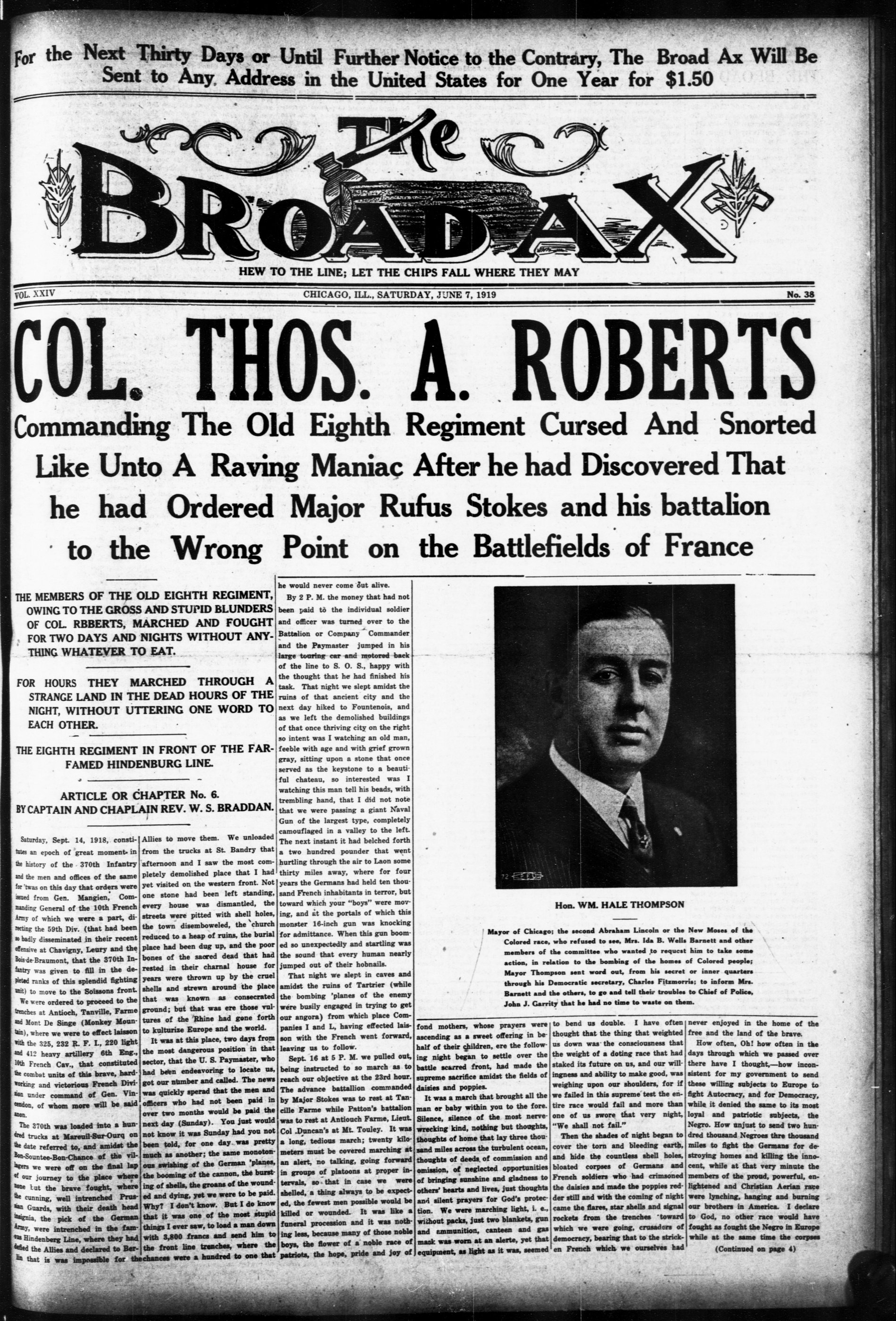
For the Next Thirty Days or Until Further Notice to the Contrary, The Broad Ax Will Be Sent to Any Address in the United States for One Year for $1.50
THE BROAD AX
COL. THOS. A. ROBERTS
Commanding The Old Eighth Regiment Cursed And Snorted Like Unto A Raving Maniac After he had Discovered That he had Ordered Major Rufus Stokes and his battalion to the Wrong Point on the Battlefields of France
THE MEMBERS OF THE OLD EIGHTH REGIMENT, OWING TO THE GROSS AND STUPID BLUNDERS OF COL. RBBERTS, MARCHED AND FOUGHT FOR TWO DAYS AND NIGHTS WITHOUT ANYTHING WHATEVER TO EAT.
FOR HOURS THEY MARCHED THROUGH A STRANGE LAND IN THE DEAD HOURS OF THE NIGHT, WITHOUT UTTERING ONE WORD TO EACH OTHER.
THE EIGHTH REGIMENT IN FRONT OF THE FAR-FAMED HINDENBURG LINE.
ARTICLE OR CHAPTER No. 6. BY CAPTAIN AND CHAPLAIN REV. W. S. BRADDAN
The 370th was loaded into a hundred trucks at Mareuil-Sur-Ourq on the date referred to, and amidst the Bon-Sountee-Bon-Chance of the villagers we were off on the final lap of our journey to the place where none but the brave fought, where the cunning, well intrenched Prussian Guards, with their death head insignia, the pick of the German Army, were intrenched in the famous Hindenberg Line, where they had defied the Allies and declared to Berlin that is was impossible for the
Allies to move them. We unloaded from the trucks at St. Bandry that afternoon and I saw the most completely demolished place that I had yet visited on the western front. Not one stone had been left standing, every house was dismantled, the streets were pitted with shell holes, the town disembowled, the church reduced to a heap of ruins, the burial place had been dug up, and the poor bones of the sacred dead that had rested in their charnal house for years were thrown up by the cruel shells and strewn around the place that was known as consecrated ground; but that was ere those vultures of the Rhine had gone forth to culturize Europe and the world.
It was at this place, two days from the most dangerous position in that sector, that the U. S. Paymaster, who had been endeavoring to locate us, got our number and called. The news was quickly sperad that the men and officers who had not been paid in over two months would be paid the next day (Sunday). You just would not know it was Sunday had you not been told, for one day was pretty much as another; the same monotonous swishing of the German 'planes, the booming of the cannon, the bursting of shells, the groans of the wounded and dying, yet we were to be paid. Why? I don't know. But I do know that it was one of the most stupid things I ever saw, to load a man down with 3,800 francs and send him to the front line trenches, where the chances were a hundred to one that
CHICAGO, ILL., SATURDAY, JUNE 7, 1919
he would never come out alive. By 2 P. M. the money that had not been paid to the individual soldier and officer was turned over to the Battalion or Company Commander and the Paymaster jumped in his large touring car and motored back of the line to S. O. S., happy with the thought that he had finished his task. That night we slept amidst the ruins of that ancient city and the next day hiked to Fountenois, and as we left the demolished buildings of that once thriving city on the right so intent was I watching an old man, feeble with age and with grief grown gray, sitting upon a stone that once served as the keystone to a beautiful chateau, so interested was I watching this man tell his beads, with trembling hand, that I did not note that we were passing a giant Naval Gun of the largest type, completely camouflaged in a valley to the left. The next instant it had belched forth a two hundred pounder that went hurtling through the air to Laon some thirty miles away, where for four years the Germans had held ten thousand French inhabitants in terror, but toward which your "boys" were moving, and at the portals of which this monster 16-inch gun was knocking for admittance. When this gun boomed so unexpectedly and startling was the sound that every human nearly jumped out of their hobnails.
That night we slept in caves and amidst the ruins of Tartrier (while the bombing 'planes of the enemy were busily engaged in trying to get our angora) from which place Companies I and L, having effected laison with the French went forward, leaving us to follow.
Sept. 16 at 5 P. M. we pulled out, being instructed to so march as to reach our objective at the 23rd hour. The advance battalion commanded by Major Stokes was to rest at Tancille Farme while Patton's battalion was to rest at Antiouch Farme, Lieut. Col. Duncan's at Mt. Touley. It was a long, tedious march; twenty kilometers must be covered marching at an alert, no talking, going forward in groups of platoons at proper intervals, so that in case we were shelled, a thing always to be expected, the fewest men possible would be killed or wounded. It was like a funeral procession and it was nothing less, because many of those noble boys, the flower of a noble race of patriots, the hope, pride and joy of
72
Mayor of Chicago; the second Abraham Lincoln or the New Moses of the Colored race, who refused to see, Mrs. Ida B. Wells Barnett and other members of the committee who wanted to request him to take some action, in relation to the bombing of the homes of Colored people; Mayor Thompson sent word out, from his secret or inner quarters through his Democratic secretary, Charles Fitzmorris; to inform Mrs. Barnett and the others, to go and tell their troubles to Chief of Police, John J. Garrity that he had no time to waste on them.
fond mothers, whose prayers were ascending as a sweet offering in behalf of their children, ere the following night began to settle over the battle scarred front, had made the supreme sacrifice amidst the fields of daisies and poppies.
It was a march that brought all the man or baby within you to the fore. Silence, silence of the most nervewrecking kind, nothing but thoughts, thoughts of home that lay three thousand miles across the turbulent ocean, thoughts of deeds of commission and omission, of neglected opportunities of bringing sunshine and gladness to others' hearts and lives, just thoughts and silent prayers for God's protection. We were marching light, i. e., without packs, just two blankets, gun and ammunition, canteen and gas mask was worn at an alerte, yet that equipment, as light as it was, seemed
Hon. WM. HALE THOMPSON
; the second Abraham Lincoln or the who refused to see, Mrs. Ida B. Wells the committee who wanted to requestation to the bombing of the homespson sent word out, from his secret Democratic secretary, Charles Fitzmor the others, to go and tell their troubles that he had no time to waste on the to bend us double. I have often thought that the thing that weighted us down was the consciousness that the weight of a doting race that had staked its future on us, and our willingness and ability to make good, was weighing upon our shoulders, for if we failed in this supreme test the entire race would fail and more than one of us swore that very night, "We shall not fail."
Then the shades of night began to cover the torn and bleeding earth, and hide the countless shell holes, bloated corpses of Germans and French soldiers who had crimsoned the daisies and made the poppies redder still and with the coming of night came the flares, star shells and signal rockets from the trenches toward which we were going, crusaders of democracy, bearing that to the stricken French which we ourselves had
never enjoyed in the home of the free and the land of the brave. How often, Oh! how often in the days through which we passed over there have I thought,—how inconsistent for my government to send these willing subjects to Europe to fight Autocracy, and for Democracy, while it denied the same to its most loyal and patriotic subjects, the Negro. How unjust to send two hundred thousand Negroes thre thousand miles to fight the Germans for destroying homes and killing the innocent, while at that very minute the members of the proud, powerful, enlightened and Christian Aerian race were lynching, hanging and burning our brothers in America. I declare to God, no other race would have fought as fought the Negro in Europe while at the same time the corpses
PAGE TWO
THE BROAD AX
Published Every Saturday
In this city since July 15th, 1899, without missing one single issue. Republicans, Democrats, Catholics, Protestants, Single Taxers, Priests, infidels or anyone else can have their say as long as their language is proper and responsibility is fixed.
The Broad Ax is a newspaper whose platform is broad enough for all, ever claiming the editorial right to speak its own mind.
Local communications will receive attention. Write only on one side of the paper.
Subscriptions must be paid in advance.
Advertising rates made known on application.
Address all communications to
THE BROAD AX
6206 So. Elizabeth St., Chicago, Ill.
Phone Wentworth 2597.
JULIUS F. TAYLOR
Editor and Publisher
DR. M. A. MAJORS
Associate Editor
4700 South State Street
Phone Drexel 1416
Vol. XXIV. June 7, 1919 No. 38
Entered as Second-Class Matter, Aug. 19, 1902, at the Post Office at Chicago, Ill. Under Act of March 3, 1879
At the End—Youth
If I had created men and women, I should have framed them on a type widely different from that which has actually prevailed—that of the higher mammifers. I should have made men and women, not to resemble the great apes as they do, but on the models of insects which, after a life as caterpillars, change into butterflies, and for the brief final term of their existence have no thought but to love and be lovely. I should have set youth at the end of the human span.—From "The Garden of Epicurus," by Anatole France.
The Old Name for Windsor.
English royalty has resided at Windor castle ever since Edward the Confessor built a hunting lodge just at the place where there came a great curve in the gentle river. In his "Child's Guide to London," Mr. A. A. Methley writes that the old name for the place was Windleshora or Windleshores, which may have meant "Winding shore," from the curve of the river at this point. Other say, however, that the word is derived from the Saxon "Windle," a willow tree.
To Fill Floor Cracks
A very complete filling for open cracks in floors may be made by thoroughly soaking old newspapers in a paste made of one pound of flour to three quarts of water, or a less quantity in those proportions. Put one tablespoonful of alum in the mixture and stir thoroughly until brought to a boiling heat. Make the final mixture about as thick as putty and apply with a putty knife. It will harden like papier mache.
Statement That Counts.
Do not let the man who says, "This is the year when I am going to show you how to farm it," think that he will have all clear sailing. He will meet wildcats and bears at every turn, and he may consider himself lucky if he gets off with a whole hide. The big thing is to stand on the far end of the field when the harvest is gathered in and be able to say, "I did what I said I would!"—Exchange.
Protect the Milk Snake
The milk snake, instead of stealing the farmer's milk, makes constant war upon rats who annually cost the country millions of dollars in the destruction of cereals. They like to live under barns and porches, and can follow through a rat hole where a ferret couldn't go, and eat the young rats. They eat meadow mice and field mice also.
Ant Simile.
The principal speaker at a political meeting was a budding orator who loved the light of publicity. Grasping the speaker by the arm on the conclusion of his long address, the chairman said: "Your speech was like a glass of good champagne," here the chairman smiled pleasantly, "lots of froth and very dry!"
Curious Plant
Among the curiosities of the desert of Sahara is a queer-looking scrabby plant, always yellow with fine sand, called the "coughing bean." In the long dry heat its pores become choked and it would die were it not for a powerful gas which accumulates inside and explodes with a sound like a human cough.
Transmigration of Souls.
A fresh young man was pressing an old gentleman, who evidently felt bored, to give him an illustration of the transmigration of souls, showing how a person's identity might be maintained. At last the old gentleman replied: "Supposing you should die, your soul might appear in a canary bird; when the canary bird died it might appear in a lion or a tiger; again, it might appear in a jackass—and I might stroke its ears and say, 'My dear fellow, you have not changed a bit'"—Pittsburgh Chronicle-Telegraph.
Senile Marriages.
Some bygone lawmakers would have been in sympathy with the Brooklyn millionaire who maintains that at 86 he was too old to be legally married. In Rome, under the Emperor Augustus, a law was passed forbidding men to marry when they were over 60, and women when they were over 50. Peter the Great, also disapproved of senile marriage, and enacted that no marriage contract should hold good if either of the contracting parties was over 80 at the time it was entered upon.
The Harpsichord.
This was the instrument out of which our modern piano grew. It was more like a grand than an upright piano and sometimes had two rows of keys, but it was very inferior in power and tone to the modern instrument. It had no pedals, and the wires were not struck by hammers, but were plucked by quills. The compass of the instrument was about four octaves which was gradually increased as it was improved upon.
English May Dances.
The love of the maypole still lingers in the affections of the children of England, and in villages many of the old May dances have been revived, and the gray playgrounds of the cities' schools oftimes glow with unwonted brightness on May morning, as the present-day girls with spring frocks and beribboned maypoles still sing the songs and dance the steps which made merry, the day through the long centuries.
First Daily Paper.
"March 11th was the anniversary of the birth of the first daily paper in England, to wit, the Dally Courant," says the London Morning Post. "It was issued in the year 1702, by E. Maillet, against the Ditch in Fleet Street," and it was cynically said of the worthy pioneer that he was the earliest journalist to show any jealousy for an accurate statement of fact.
Advice From One Who Knew.
The puppy had been punished and was sulking in a corner. To him came the small daughter of the house, to administer, not comfort, but advice. "You may just as well be good first as last, Buddy," she admonished. "Everybody that belongs to mother has got to mind. I've been through it all—and I know."
Beads Must Be Kent in Repair.
Roads must be kept. Investment of money in new roads does not become real economy until provision is made for keeping these new roads in condition after they are bulled. If a new road is built and then allowed to fall into disrepair, much of the original investment is simply wasted.
Learning to Be Miserable.
Blessings on the little folks that have not yet learned to be miserable! Smiles and bright faces are their natural meat and drink. We may all stay just that way if we will. How! By putting the very best there is in us into doing things for other folks.
Mercenary Love.
Two little consins had quarreled, and the mother of one of them tried to make peace. "Amy," she sald, "why did you tell Bobbie you wouldn't be his little sweetheart?" "Cos he didn't ask me," replied Amy indignantly, "till he known I had a new dime!"
Looking Ahead.
Charles, upon the arrival of a small brother, was asked if he was not glad that it was a boy so he could play with him. "Humph," came the answer, "by the time he is big enough to play I'll be grown up and married."
Where Pana Scored.
Father—"I never smoked when I was your age. Will you be able to tell that to your son when you are my age?" Willie—"Not with such a straight face as you do, father. You beat me there."
Musings of Martha.
These wonderful business women we
hear so much about may be all right,
but I'd like t' see one of 'em tangle th'
job of gettin' up in th' mornin' an'
gettin' breakfast fer ten before daylight
Power Paya.
It is said that a sewing machine with an individual motor averages 1,000 stitches a minute, while the old-foot-driven machine accomplishes only 300 or 400 stitches a minute at most.
Good Thing to Remember.
For grit in the eye apply a drop or two of castor oil; it relieves the irritation.
THE BROAD AX. CHICAGO, JUNE 7, 1919
Reason for Accidents
Too many accidentals spoil the melody. It's true they may keep you guessing, but they also keep you unsettled. And again it is the same with life. Men of judgment treat accidentals for what they are worth. But they aim to keep life to its regular course. Some lives are ruined by a love for the exceptional. They seem to be unable to follow the necessary routine of life. So the wise man alms to keep life sweet and normal, knowing that he best serves himself and his fellowmen by meeting daily needs with the best that's in him.
Jones Fought a Motorsar
The East African Standard describes a duel between a motorcar and a lioness. The affair, it says, happened at night near Nairobi. The chauffeur noted a commotion in the bush near the road, then the gleaming eyes of an enraged wild animal. He accelerated his speed at the instant the lioness leaped. She struck the hood and was thrown far in advance of the car, whose wheels then passed over her. The dead lioness was finally loaded into the car and taken back to the town in triumph.—From Outlook.
Stone Don't Grow.
Natural agencies operate to form beds of rock such as limestone, etc., just the same as beds of rock now in existence were formed at earlier periods in the earth's history. But the rocks and boulders scattered about the surface of the earth do not grow, not withstanding the popular belief to the contrary. Instead, they actually diminish in size, owing to the action of frost, wind and other disintegrating agencies.
Young Men Who Won Fame
It has been said "the story of success is the story of young men." Among the "famous before forty" are many of the world's best known names. At sixteen years of age Bacon pointed out the errors of Aristotle's philosophy; Edward Landseer gained fame by his picture, "Dogs Fighting," and Dibdin, writer of sea songs, staged his first comedy, "The Shepherd's Artifice," at Covent Garden.
Question Before the House.
"I wonder,' said the discontented bachelor, "what one is going to do when one buys woolen wear guaranteed not to shrink, and patronizes a laundry that guarantees not to shrink the unshrinkables, and then finds that the unshrinkable laundry shrinks the unshrinkable garments!" — London Sketch.
Aboriginal Superstition.
The Australian blacks weave the bushy tails of their "dingo" dogs into their beards to make them longer. Indians of the Puget Sound region make blankets of dogs' hair. Natives of Borneo believe that black dogs are the chosen familiars of sorcerers, and he who laughs when a dog crosses the path will be turned to stone.
In Chinese Gardens
Chinese gardeners sometimes plant statuettes of tiny men firmly in pots, just like real plants, and then train live evergreen to grow up over these statuettes. The vines thus form a kind of robe for the statuette men, their white faces and hands protruding from the green leaves.
Chicago's Wild Onions.
Attempts have been made to prove that the name "Chicago" is from an Indian word, meaning mighty, or that it has some poetic or high moral significance, but the general opinion is that it is a form of the Indian name for wild onion, which grows abundantly in that locality.
Plumbago Mines In Ceylon.
Ceylon's most important mineral product, plumbago, is known all over the world for its luster, lubricating, polishing and binding qualities. In appearance it is a strong black crystalline. There are now about 1,000 plumbago mines in Ceylon.
Why He Preferred Girls
Willard is fond of playing with several little girls in the neighborhood and, on being questioned regarding preference for girls, remarked: "Well, the girls never fight like the boys do, they only argue."
How Spain 'Honors Great Men.
Spanish paper money bears portraits of great literary men, painters, musicians, generals and other notables.
Korea a Rich Country
Korea contains extensive coal fields as yet undeveloped, iron in abundance, and gold to the value of $3,000,000 is annually exported.
National progress is the sum of national industry, energy and uprightness. Samuel Smiles.
Jap babies.
Japanese girl babies have their heads shaved until they are three years old.
Many a man's tongue shakes out its master's undoing. - Shakespeare
"Runes" were the letters of the alphabet used by the old Teutonic tribes. The word means hidden lore. The earliest runes were merely fanciful signs supposed to possess mysterious power. The letters were even considered magical, and were cast into the air, written separately upon chips, to fall as fate determined, on a cloth and to be read by the interpreters. The association of the runic letters with heathen superstitions caused the first Christian teachers to discourage their use.
A Gallen in the Country.
What pleasure is keener than that afforded by an early morning gallop in the country? Choose a bright, fresh May day, a little after sunrise, when dew and flowers and bird-song and wind-rustle and all the sweets and perfumes are at their best; mount and away. Your good horse will know what you are going to do, and will show the liveliest interest, for he likes these early flights as well as you do. He hears the bird-song, too.—Maurice Thompson.
Law of Falling Bodies
Since a body falls to the ground in consequence of the earth's attraction on each of its molecules, it follows that, everything else being the same, all bodies, great and small, light and heavy, ought to fall with equal rapidity. The fact that a stone falls more rapidly than a feather is due solely to the unequal resistance opposed by the air to the descent of these bodies. In a vacuum all bodies fall with equal rapidity.
Charcoal Invaluable
All kinds of glass vessels and other utensils may be purified from long-retained smells of every kind in the easiest and most perfect manner by rinsing them out with charcoal powder. Rubbing the teeth and washing out the mouth with fine charcoal powder will render the teeth beautifully white and the breath perfectly sweet. Putrid water is immediately deprived of its bad smell by charcoal.
Be Agreeable.
The true art of being agreeable is to appear well pleased with all the company, and rather to seem well entertained with them than to bring entertainment to them. A man thus disposed may not have much learning, nor any wit; but if he has common sense, and something friendly in his behavior, it conciliates men's minds more than the brightest parts without the disposition.—Addison.
Renews Carbon Paper.
An additional period of usefulness may be secured from a partially used sheet of carbon or transfer paper by simply holding it over an open flame such as a lamp, candle or match, with the carbon side down. The wax substances of the unused parts will melt and run into the thinner sections of the parts which are worn out.
Seven Days King.
The "seven days king" was Masaniello (Thomas Aniella), born in 1622. He headed a revolt against the Duke of Arcos, at Naples, July 7, 1647, forced him to abolish the tax on provisions, and for seven days was master of Naples. He was most arrogant and bloodthirsty and was assassinated July 16.
Call for Reform
When pinching the dollar leaves a deep mark on the heart of its owner, doesn't it seem as if he would let up? But few of us have anything to brag of in that line. Our souls are scarred from end to end with the marks of our penuriousness. Shame on us! Let's quit it!—Exchange.
Dainty Early Flowers
There is to me a daintiness about early flowers that touches me like poetry. They blow out with such a simple loveliness among the common herbs of pastures, and breathe their lives so unobtrusively, like hearts whose beatings are too gentle for the world.—Willis.
A Bustling Burg.
"By George!" triumphantly ejaculated a prominent resident of that onrushing hamlet. "Pruntytown is getting to be more and more metropolitan right along. Why, dog-take-it, the all night restaurant stays open till half-past ten or 'leven every night of the world, except Sundays!'—Judge.
Didn't Expect Too Much.
The Suitor—"I hope, sir, that you will consider me in the nature of an investment, even if I may not pay regular dividends." The Girl's Father—"My dear boy, don't talk of dividends. I shall be glad if you don't levy regular assessments on me."—Life.
Life a Constant Battle
The life of each of us is full of ancient evil, derived from the brutes, which is ever at war with the better and higher qualities—the true human part of our minds.-Nathaniel S. Shaler.
Optimistic Thought
The tale of calumny which has no foundation in truth cannot long retain its power to injure.
Politeness Didn't Pay Here.
Down on Water street, Augusta, Me. the other day, two men met at the corner of the street and they both stepped to the outer edge of the walk to avoid two ladies whom they met. Both men said in chorus: "Pardon me," then both sidestepped to the left. When they met again both sidestepped once more, this time to the right, and met again. Then they both stood still, and as one man turned to the right and extended his arms above his head as he fattened himself against the building, he said to the other man: "Say, when you get by, whistle."—Kennebec Journal.
Pie for Breakfast
Some doctors are discovering and asserting that pie makes a first-class breakfast food. The decision is not as shocking an innovation as it may seem on first reading, for a good many people, who are not doctors, have been eating pie for breakfast many years. If pie is the indigestible thing so many people pretend it is, it looks like good sense to eat it in the morning—if you really have to eat it—and take the whole day for the business of digestion—Philadelphia Press.
Quick Breathing an Anaesthetic.
United States scientists who have been conducting experiments in the art of breathing claim to have demonstrated that rapid breathing of pure air acts as an anaesthetic and renders a person immune to pain as long as it is maintained. Of course, after the rapid inhalations cease the pain will be felt. By a little training, it is said, a person may induce sound sleep by deep and rapid breathing for a few minutes.
Early American Post Offices.
In 1775 the first post offices in Maine were established at Kennebunk, Falmouth and Bath. The mails were carried by carriers on foot or on horseback and the average week's mail did not amount to five letters at each office. The rates were high, 6%, 12%, 18%, 25 and 37½ cents, according to the distance the letter had to be carried, and double the rate when the letter was of more than one sheet of paper.
The Word "Magnet."
The word "magnet" is derived from the name of the city of Magnesia, in Asia Minor, where the properties of the lodestone are said to have been discovered. It has, however, been asserted that the name comes from Magnes, the name of a shepherd who discovered magnetic power by being held on Mount Ida, in Greece, by its attraction for the nails in his shoes.
Hurry. Geta. Nowhere.
The man or woman who works in a hurry, always at high tension, with no knowledge of the value of relaxation, produces results far inferior to the quiet, composed worker, who knows how to conserve his strength. He can do more, do it better and at less cost of strength and energy than his hurried associate.
"Safety First."
Two recent cases of fainting in the bath recall the advice that the late Sir William Hingston, M. D., of Montreal was wont to give his patients. "Fill the bath," he used to say, "pul out the plug and then get in. If you faint in the bath the water will run out before you drown."
Critic Coine New Word.
Tired of the hackneyed phrase, a "gripping" story, originated by some weary critic and eagerly snatched up by book advertisers, it has remained for a Boston dramatic critic to discover a new term. He has found a play that is "riveting" in its intensity of interest.
See Others' Point of View.
Half the troubles and miseries in this life would be smoothed away, if we would put ourselves in other people's places, and try to see things from their point of view. It is the great blank wall of self that hinders us.
Why Librarians Go to Danvers
Young Woman (to librarian)—"I'm sorry to trouble you, but I've forgotten the name of the book I want. If you'll just mention what books you have I'll stop you when you come to it"—Boston Transcript.
Triumph Over Selfishness.
Triumph Over Sensibility.
The toughest nut any man ever tried to crack is a selfish heart. It takes a giant hammer, swung by superhuman power to do that. But once the shell is broken, the sweetest meat ever tasted drops out.
Saint Seens a Prodigy
Saint-Saens commenced to play the piano almost as soon as he learned to walk. He could tell as a child the notes struck by all the clock chimes in the house.
A Tree.
Of all works of art, a cathedral is the greatest. A vast and majestic tree is greater than that—H. W. Beecher.
Daily Thought
The scholar who cherishes the love of comfort is not fit to be deemed a scholar—Confucius.
Work With Others
No matter how much enthusiasm, how much ardor, how much brilliance we may have, if it is misdirected it cannot help, but it must hinder the work of the world. Learn to work with people, not against them. Stand always for what is right and against that which is wrong, but do not throw your energy into constant striving against theories and opinions, and even actions of others. Let your ardor and enthusiasm and your love of life be constructive. Strive to build up and not to tear down, for that is the way to help on in the scheme of living.
Trinity Church Yard
According to the New York city records, Trinity church obtained the site by a grant from the king of England. It was known as the king's domain. Later the largest tract of land owned by the Trinity parish, known as the queen's lands, came into the hands of that corporation by gift. Therefore we have no original owners to trace antedating the English, save only the Dutch government and the Indians from whom the Dutch bought Manhattan island.
Tattoo Marks
It is usually impossible to remove such marks without leaving a permanent scar. One method is to tattoo the skin with a concentrated solution of tannin, following the original design. Then apply a crayon of silver nitrate until the skin turns black. Wipe off the excess of moisture and allow the caustic to eat into the skin. There will be pain and reddish scars will form, which may gradually disappear.
Medicinal Properties of Beech Tree.
The beech, which is found in the temperate zone in Europe, America and Asia, is valuable in medicine for the creosote distilled from its tar. Creosote, creosote carbonate and guslacol are medicines used to supplement the hygienic measures which have done so much to reduce the death rate in sufferers from pulmonary tuberculosis.
As He Saw It
During a discourse on individuality as expressed In the countenance, a schoolmaster held up a portrait of Charles Dickens. "Here," said he, "the face of a celebrated author and man of genius. Do you see anything particularly noticeable about the features?" "Yes," replied one of the brightest scholars, "a lot of whiskers!"
Animal Disease Costly.
Animal disease, such as hog cholera, the foot-and-mouth disease, etc., are costing the farmers and the general public an enormous sum each year, although agricultural leaders have been waging an effective fight upon such epidemics. Ultimately the farmers will be enjoying the use of about $200,000,000 which they now lose each year through these causes.
At the Zoo.
Bobby, aged seven, was making his first visit to the zoo. He looked around at the various animals, and coming to a cage marked "Female," he rushed up to his mother in great excitement. "Oh, mother," he said. "I've always wanted to see a 'Female,' and here he is!"—Cartoons Magazine.
When Beards Flourished.
The reign of Henry IV of France was the golden age of beards, for at that time as much attention was paid to them as to the dressing of the hair of both sexes. Louis VIII, then a child, came to the throne, and the beard had to go in honor of the hair less chin of the new monarch.
He Was Supplied
Billy had just been going to school a short time, but considered himself wise in the ways of schoolboys. One day while playing with his younger brother he said, "Jean, when you start to school you want to pick you out a girl. I've got me one."
Achieving Success
Success in life depends more than anything else on "animated modernization," on a certain combination of energy of mind and balance of mind hard to attain and harder to keep—Walter Bargehot.
The Voice of Envy.
John, upon being taken in to see his brand-new brother, gazed long and earnestly upon him and said: "Gee, but you are a lucky kid! You won't have to wash your own ears for years and years."
From the Beginning.
Men who expect women to be punctual in keeping their appointments fail to remember that Eve did not arrive until Adam had been in the garden quite a while.—Boston Transcript.
Uncle Eben.
"If every small boy could carry out his mother's expectations for his future," said Uncle Eben, "dar'd have to be several million presidents of de United States all to once."
Fed Up.
The man who never does anything
he doesn't like rarely likes anything
he does—Life.
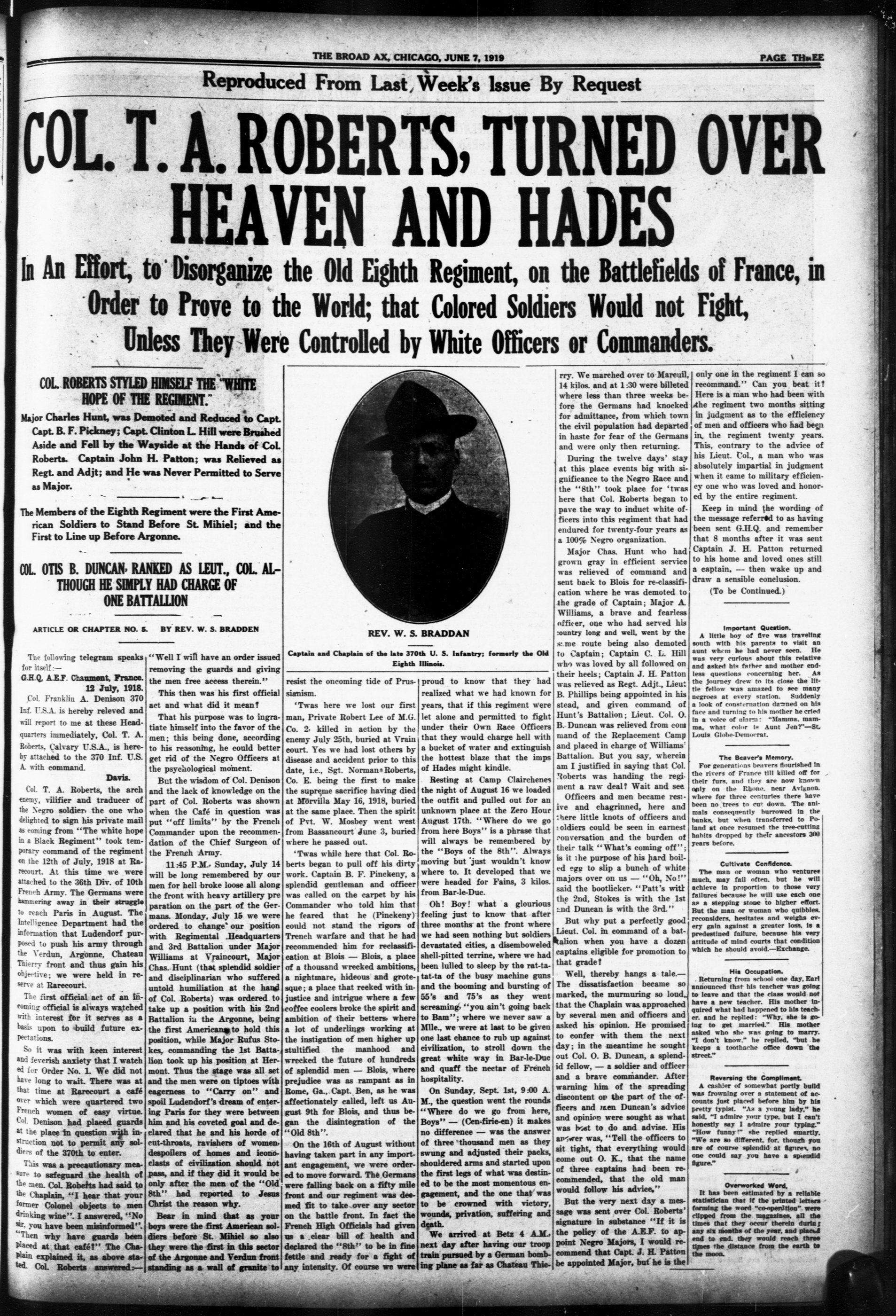
COL. T. A. ROBERTS, TURNED OVER HEAVEN AND HADES
In An Effort, to Disorganize the Old Eighth Regiment, on the Battlefields of France, in Order to Prove to the World; that Colored Soldiers Would not Fight, Unless They Were Controlled by White Officers or Commanders.
COL. ROBERTS STYLED HIMSELF THE "WHITE HOPE OF THE REGIMENT."
Major Charles Hunt, was Demoted and Reduced to Capt. Capt. B. F. Pickney; Capt. Clinton L. Hill were Brushed Aside and Fell by the Wayside at the Hands of Col. Roberts. Captain John H. Patton; was Relieved as Regt. and Adjt; and He was Never Permitted to Serve as Major.
The Members of the Eighth Regiment were the First American Soldiers to Stand Before St. Mihiel; and the First to Line up Before Argonne.
COL. OTIS B. DUNCAN RANKED AS LEUT., COL. AL-THOUGH HE SIMPLY HAD CHARGE OF ONE BATTALLION
ARTICLE OR CHAPTER NO. 5. BY REV. W. S. BRADDEN
The following telegram speaks for itself:—
G.H.O. A.E.F. Chaumont France.
G.H.Q. A.E.F. Chaumont, France. 12 July, 1918. Col. Franklin A. Denison 370 Inf. U.S.A. is hereby relieved and will report to me at these Headquarters immediately, Col. T. A. Roberts, Calvary U.S.A., is hereby attached to the 370 Inf. U.S. A. with command
Davis.
Col. T. A. Roberts, the arch enemy, vilifier and traducer of the Negro soldier, the one who delighted to sign his private mail as coming from "The white hope in a Black Regiment" took temporary command of the regiment on the 12th of July, 1918 at Rarecourt. At this time we were attached to the 36th Div. of 10th French Army. The Germans were hammering away in their struggle to reach Paris in August. The Intelligence Department had the information that Ludendorf purposed to push his army through the Verdun, Argonne, Chateau Thierry front and thus gain his objective; we were held in reserve at Rarecourt.
The first official act of an incoming official is always watched with interest for it serves as a basis upon to build future expectations.
So it was with keen interest and feverish anxiety that I watched for Order No. 1. We did not have long to wait. There was at that time at Rarecourt a café over which were quartered two French women of easy virtue. Col. Denison had placed guards at the place in question with instruction not to permit any soldiers of the 370th to enter.
This was a precautionary measure to safeguard the health of the men. Col. Roberts had said to the Chaplain, "I hear that your former Colonel objects to men drinking wine". I answered, "No sir, you have been misinformed". "Then why have guards been placed at that café?" The Chaplain explained it, as above stated. Col. Roberts answered:
Reproduced From Last Week's Issue By Request
"Well I will have an order issued removing the guards and giving the men free access therein."
This then was his first official act and what did it mean?
That his purpose was to ingratiate himself into the favor of the men; this being done, according to his reasoning, he could better get rid of the Negro Officers at the psychological moment.
But the wisdom of Col. Denison and the lack of knowledge on the part of Col. Roberts was shown when the Café in question was put "off limits" by the French Commander upon the recommendation of the Chief Surgeon of the French Army.
11:45 P.M. Sunday, July 14 will be long remembered by our men for hell broke loose all along the front with heavy artillery preparation on the part of the Germans. Monday, July 15 we were ordered to change our position with Regimental Headquarters and 3rd Battalion under Major Williams at Vraincourt, Major Chas. Hunt (that splendid soldier and disciplinarian who suffered untold humiliation at the hand of Col. Roberts) was ordered to take up a position with his 2nd Battalion in the Argonne, being the first Americans to hold this position, while Major Rufus Stokes, commanding the 1st Battalion took up his position at Hermont. Thus the stage was all set and the men were on tiptoes with eagerness to "Carry on" and spoil Ludendorf's dream of entering Paris for they were between him and his coveted goal and declared that he and his horde of cut-throats, ravishers of women-despoilers of homes and iconoclasts of civilization should not pass, and if they did it would be only after the men of the "Old 8th" had reported to Jesus Christ the reason why.
Bear in mind that as your boys were the first American soldiers before St. Mihiel so also they were the first in this sector of the Argonne and Verdun front standing as a wall of granite to
THE BROAD AX, CHICAGO, JUNE 7, 1919
[Name not visible]
REV. W. S. BRADDAN
Captain and Chaplain of the late 370th U. S. Infantry; formerly the Old Eighth Illinois.
resist the oncoming tide of Prus proud to know that they had signism. realized what we had known for
'Twas here we lost our first man, Private Robert Lee of M.G. Co. 2. killed in action by the enemy July 25th, buried at Vrain court. Yes we had lost others by disease and accident prior to this date, i.e., Sgt. Norman Roberts, Co. E. being the first to make the supreme sacrifice having died at Morvilla May 16, 1918, buried at the same place. Then the spirit of Pvt. W. Mosbey went west from Bassancourt June 3, buried where he passed out.
'Twas while here that Col. Roberts began to pull off his dirty work. Captain B. F. Pinckeny, a splendid gentleman and officer was called on the carpet by his Commander who told him that he feared that he (Pinckeny) could not stand the rigors of Trench warfare and that he had recommended him for reclassification at Blois — Blois, a place of a thousand wrecked ambitions, a nightmare, hideous and grotesque; a place that reeked with injustice and intrigue where a few coffee coolers broke the spirit and ambition of their betters, where a lot of underlings working at the instigation of men higher up stultified the manhood and wrecked the future of hundreds of splendid men — Blois, where prejudice was as rampant as in Rome, Ga., Capt. Ben, as he was affectionately called, left us August 9th for Blois, and thus began the disintegration of the "Old 8th".
On the 16th of August without having taken part in any important engagement, we were ordered to move forward. The Germans were falling back on a fifty mile front and our regiment was deemed fit to take over any sector on the battle front. In fact the French High Officials had given us a clear bill of health and declared the "8th" to be in fine fettle and ready for a fight of any intensity. Of course we were
proud to know that they had realized what we had known for years, that if this regiment were let alone and permitted to fight under their Own Race Officers that they would charge hell with a bucket of water and extinguish the hottest blaze that the imps of Hades might kindle.
Resting at Camp Clairehenes the night of August 16 we loaded the outfit and pulled out for an unknown place at the Zero Hour August 17th. "Where do we go from here Boys" is a phrase that will always be remembered by the "Boys of the 8th". Always moving but just wouldn't know where to. It developed that we were headed for Fains, 3 kilos, from Bar-le-Due.
Oh! Boy! what a glorious feeling just to know that after three months at the front where we had seen nothing but soldiers devastated cities, a disemboweled shell-pitted terrine, where we had been lulled to sleep by the rat-tat-tat-ta of the busy machine guns and the booming and bursting of 55's and 75's as they went screaming "you ain't going back to Bam"; where we never saw a Mlle., we were at last to be given one last chance to rub up against civilization, to stroll down the great white way in Bar-le-Duc and quaff the nectar of French hospitality.
On Sunday, Sept. 1st, 9:00 A.M., the question went the rounds "Where do we go from here, Boys" — (Cen-firie-en) it makes no difference — was the answer of three thousand men as they swung and adjusted their packs, shouldered arms and started upon the first legs of what was destined to be the most momentous engagement, and the one that was to be crowned with victory, wounds, privation, suffering and death.
We arrived at Betz 4 A.M. next day after having our troop train pursued by a German bombing plane as far as Chateau Thie-
rry. We marched over to Mareuil, 14 kilos, and at 1:30 were billeted where less than three weeks before the Germans had knocked for admittance, from which town the civil population had departed in haste for fear of the Germans and were only then returning.
During the twelve days' stay at this place events big with significance to the Negro Race and the "8th" took place for 'twas here that Col. Roberts began to pave the way to induct white officers into this regiment that had endured for twenty-four years as a 100% Negro organization.
Major Chas. Hunt who had grown gray in efficient service was relieved of command and sent back to Blois for re-classification where he was demoted to the grade of Captain; Major A. Williams, a brave and fearless officer, one who had served his country long and well, went by the same route being also demoted to Captain; Captain C. L. Hill who was loved by all followed on their heels; Captain J. H. Patton was relieved as Regt. Adjt., Lieut. B. Phillips being appointed in his stead, and given command of Hunt's Battalion; Lieut. Col. O. B. Duncan was relieved from command of the Replacement Camp and placed in charge of Williams' Battalion. But you say, wherein am I justified in saying that Col. Roberts was handing the regiment a raw deal? Wait and see
Officers and men became resive and chagrinned, here and there little knots of officers and soldiers could be seen in earnest conversation and the burden of their talk "What's coming off"; is it the purpose of his hard boiled egg to slip a bunch of white majors over on us — "Oh, No!" said the bootlicker. "Patt's with the 2nd, Stokes is with the 1st and Duncan is with the 3rd."
But why put a perfectly good Lieut. Col. in command of a battalion when you have a dozen captains eligible for promotion to that grade?
Well, thereby hangs a tale.—The dissatisfaction became so marked, the murmuring so loud, that the Chaplain was approached by several men and officers and asked his opinion. He promised to confer with them the next day; in the meantime he sought out Col. O. B. Duncan, a splendid fellow, — a soldier and officer and a brave commander. After warning him of the spreading discontent on the part of the officers and men Duncan's advice and opinion were sought as what was best to do and advise. His answer was, "Tell the officers to sit tight, that everything would come out O. K., that the name of three captains had been recommended, that the old man would follow his advice."
But the very next day a message was sent over Col. Roberts' signature in substance "If it is the policy of the A.EF. to appoint Negro Majors, I would recommend that Capt. J. H. Patton be appointed Major, but he is the
PAGE THREE
OVER
s of France, in
Fight,
ers.
only one in the regiment I can so recommand." Can you beat it! Here is a man who had been with the regiment two months sitting in judgment as to the efficiency of men and officers who had begun in the regiment twenty years. This, contrary to the advice of his Lieut. Col., a man who was absolutely impartial in judgment when it came to military efficiency one who was loved and honored by the entire regiment.
Keep in mind the wording of the message referred to as having been sent G.H.Q. and remember that 8 months after it was sent Captain J. H. Patton returned to his home and loved ones still a captain, -- then wake up and draw a sensible conclusion.
(To be Continued.)
Important Question.
A little boy of five was traveling south with his parents to visit an aunt whom he had never seen. He was very curious about this relative and asked his father and mother endless questions concerning her. As the journey drew to its close the little fellow was amazed to see many negroes at every station. Suddenly a look of consternation dawned on his face and turning to his mother he cried in a voice of alarm: "Mamma, mamma, what color is Aunt Jen?"—St. Louis Globe-Democrat.
The Beaver's Memory.
For generations beavers flourished in the rivers of France till killed off for their furs, and they are now known only on the Rhone, near Avignon, where for three centuries there have been no trees to cut down. The animals consequently burrowed in the banks, but when transferred to Poland at once resumed the tree-cutting habits dropped by their ancestors 300 years before.
Cultivate Confidence
The man or woman who ventures much, may fail often, but he will achieve in proportion to those very failures because he will use each one as a stepping stone to higher effort. But the man or woman who quibbles, reconsiders, hesitates and weighs every gain against a greater loss, is a predestined failure, because his very attitude of mind courts that condition which he should avoid—Exchange.
His Occupation.
Returning from school one day, Earl announced that his teacher was going to leave and that the class would not have a new teacher. His mother inquired what had happened to his teacher. and he replied: "Why, she is going to get married." His mother asked who she was going to marry. "I don't know," he replied, "but he keeps a toothache office down the street."
Reversing the Compliment.
A cashier of somewhat portly build was frowning over a statement of accounts just placed before him by his pretty typlist. "As a young lady," he said, "I admire your type, but I can't honestly say I admire your typling." "How funny!" she replied smartly, "We are so different, for, though you are of course splendid at figure, no one could say you have a splendid figure."
Overworked Word
It has been estimated by a reliable statistician that if the printed letters forming the word "co-operation" were clipped from the magazines, all the times that they occur therein during any six months of the year, and placed end to end, they would reach three times the distance from the earth to the moon.
THE NEW YORK TIMES
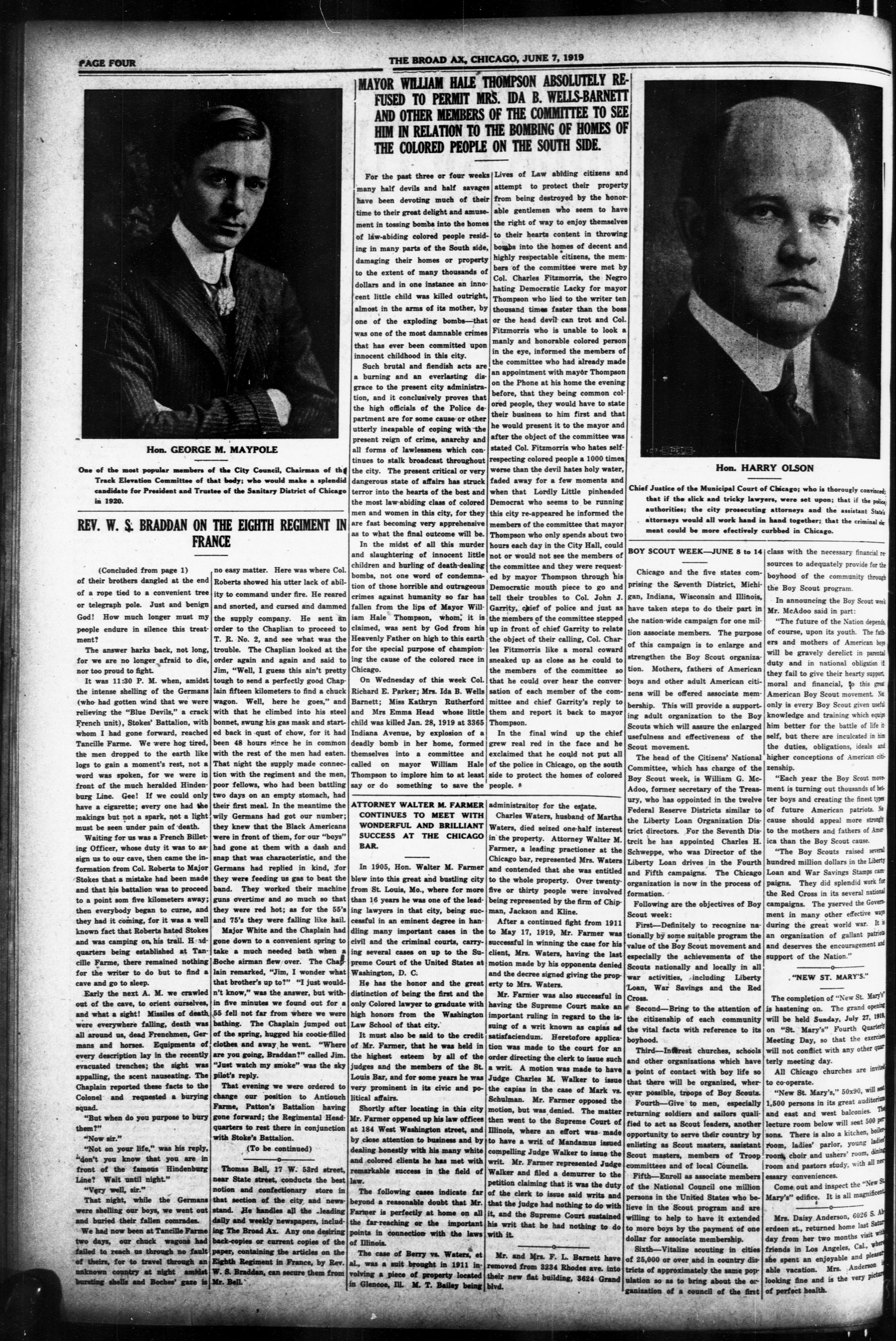
Hon. GEORGE M. MAYPOLE
One of the most popular members of
Track Elevation Committee of 6
candidate for President and Trust
in 1920.
REV. W. S. BRADDAN ON
FRA
One of the most popular members of the City Council, Chairman of the Track Elevation Committee of that body; who would make a splendid candidate for President and Trustee of the Sanitary District of Chicago in 1920.
(Concluded from page 1) of their brothers dangled at the end of a rope tied to a convenient tree or telegraph pole. Just and benign God! How much longer must my people endure in silence this treatment?
The answer harks back, not long, for we are no longer afraid to die, nor too proud to fight.
It was 11:30 P. M. when, amidst the intense shelling of the Germans (who had gotten wind that we were relieving the "Blue Devils," a crack French unit), Stokes' Battalion, with whom I had gone forward, reached Tancille Farme. We were hog tired, the men dropped to the earth like logs to gain a moment's rest, not a word was spoken, for we were in front of the much heralded Hindenburg Line. Gee! If we could only have a cigarette; every one had the makings but not a spark, not a light must be seen under pain of death.
Waiting for us was a French Billeting Officer, whose duty it was to assign us to our cave, then came the information from Col. Roberts to Major Stokes that a mistake had been made and that his battalion was to proceed to a point som five kilometers away; then everybody began to curse, and they had it coming, for it was a well known fact that Roberts hated Stokes and was camping on his trail. Headquarters being established at Tancille Farme, there remained nothing for the writer to do but to find a cave and go to sleep.
Early the next A. M. we crawled out of the cave, to orient ourselves, and what a sight! Missiles of death were everywhere falling, death was all around us, dead Frenchmen, Germans and horses. Equipment of every description lay in the recently evacuated trenches; the sight was appalling, the scent nauseating. The Chaplain reported these facts to the Colonel and requested a burying squad.
"But when do you purpose to bury them?"
"Not on your life," was his reply, "don't you know that you are in front of the famous Hindenburg Line? Wait until night."
"Very well, sir."
That night, while the Germans were shelling our boys, we went out and buried their fallen comrades.
We had now been at Tancille Farme two days, our chuck wagons had failed to reach us through no fault of theirs, for to travel through an unknown country at night amidst bursting shells and Boches' gaze is
PAGE FOUR
9
of the City Council, Chairman of the that body; who would make a splendid tree of the Sanitary District of Chicago
THE EIGHTH REGIMENT INSTANCE
no easy matter. Here was where Col. Roberts showed his utter lack of ability to command under fire. He reared and snorted, and cursed and dammed the supply company. He sent an order to the Chaplian to proceed to T. R. No. 2, and see what was the trouble. The Chaplian looked at the order again and again and said to Jim, "Well, I guess this ain't pretty tough to send a perfectly good Chaplain fifteen kilometers to find a chuck wagon. Well, here he goes," and with that he climbed into his steel bonnet, swung his gas mask and started back in qust of chow, for it had been 48 hours since he in common with the rest of the men had eaten. That night the supply made connection with the regiment and the men, poor fellows, who had been battling two days on an empty stomach, had their first meal. In the meantime the wily Germans had got our number; they knew that the Black Americans were in front of them, for our "boys" had gone at them with a dash and snap that was characteristic, and the Germans had replied in kind, for they were feeding us gas to beat the band. They worked their machine guns overtime and so much so that they were red hot; as for the 55's and 75's they were falling like hail
Major White and the Chaplain had gone down to a convenient spring to take a much needed bath when a Boche airman flew over. The Chaplain remarked, "Jim, I wonder what that brother's up to?" "I just wouldn't know," was the answer, but within five minutes we found out for a 55 fell not far from where we were bathing. The Chaplain jumped out of the spring, hugged his cootie-filled clothes and away he went. "Where are you going, Braddan?" called Jim. "Just watch my smoke" was the sky pilot's reply.
That evening we were ordered to change our position to Antiouch Farme, Patton's Battalion having gone forward; the Regimental Headquarters to rest there in conjunction with Stoke's Battalion.
Thomas Bell, 17 W. 53rd street, near State street, conducts the best notion and confectionary store in that section of the city and newsstand. He handles all the leading daily and weekly newspapers, including The Broad Ax. Any one desiring back-copies or current copies of the paper, containing the articles on the Eighth Regiment in France, by Rev. W. S. Braddan, can secure them from Mr. Bell.
THE BROAD AX, CHICAGO, JUNE 7, 1919
MAYOR WILLIAM HALE THOMPSON ABSOLUTELY REFUSED TO PERMIT MRS. IDA B. WELLS-BARNETT AND OTHER MEMBERS OF THE COMMITTEE TO SEE HIM IN RELATION TO THE BOMBING OF HOMES OF THE COLORED PEOPLE ON THE SOUTH SIDE.
For the past three or four weeks many half devils and half savages have been devoting much of their time to their great delight and amusement in tossing bombs into the homes of law-abiding colored people residing in many parts of the South side, damaging their homes or property to the extent of many thousands of dollars and in one instance an innocent little child was killed outright, almost in the arms of its mother, by one of the exploding bombs—that was one of the most damnable crimes that has ever been committed upon innocent childhood in this city.
Such brutal and fiendish acts are a burning and an everlasting disgrace to the present city administration, and it conclusively proves that the high officials of the Police department are for some cause or other utterly incapable of coping with the present reign of crime, anarchy and all forms of lawlessness which continues to stalk broadcast throughout the city. The present critical or very dangerous state of affairs has struck terror into the hearts of the best and the most law-abiding class of colored men and women in this city, for they are fast becoming very apprehensive as to what the final outcome will be.
In the midst of all this murder and slaughtering of innocent little children and hurling of death-dealing bombs, not one word of condemnation of those horrible and outrageous crimes against humanity so far has fallen from the lips of Mayor William Hale Thompson, whom, it is claimed, was sent by God from his Heavenly Father on high to this earth for the special purpose of championing the cause of the colored race in Chicago.
On Wednesday of this week Col. Richard E. Parker; Mrs. Ida B. Wells Barnett; Miss Kathryn Rutherford and Mrs Emma Head whose little child was killed Jan. 28, 1919 at 3365 Indiana Avenue, by explosion of a deadly bomb in her home, formed themselves into a committee and called on mayor William Hale Thompson to implore him to at least say or do something to save the
ATTORNEY WALTER M. FARMER CONTINUES TO MEET WITH WONDERFUL AND BRILLIANT SUCCESS AT THE CHICAGO BAR.
In 1905, Hon. Walter M. Farmer blew into this great and bustling city from St. Louis, Mo., where for more than 16 years he was one of the leading lawyers in that city, being successful in an eminent degree in handling many important cases in the civil and the criminal courts, carrying several cases on up to the Supreme Court of the United States at Washington, D. C. He has the honor and the great distinction of being the first and the only Colored lawyer to graduate with high honors from the Washington Law School of that city.
It must also be said to the credit of Mr. Farmer, that he was held in the highest esteem by all of the judges and the members of the St. Louis Bar, and for some years he was very prominent in its civic and political affairs. Shortly after locating in this city Mr. Farmer opened up his law offices at 184 West Washington street, and by close attention to business and by dealing honestly with his many white and colored clients he has met with remarkable success in the field of law.
The following cases indicate far beyond a reasonable doubt that Mr. Farmer is perfectly at home on all the far-reaching or the important points in connection with the laws of Illinois. The case of Berry vs. Waters, et al., was a suit brought in 1911 involving a piece of property located in Glencoe, Ill. M. T. Bailey being
In the final wind up the chief grew real red in the face and he exclaimed that he could not put all of the police in Chicago, on the south side to protect the homes of colored people.
administraitor for the estate.
Charles Waters, husband of Martha Waters, died seized one-half interest in the property. Attorney Walter M. Farmer, a leading practitioner at the Chicago bar, represented Mrs. Waters and contended that she was entitled to the whole property. Over twenty-five or thirty people were involved being represented by the firm of Chipman, Jackson and Kline.
After a continued fight from 1911 to May 17, 1919, Mr. Farmer was successful in winning the case for his client, Mrs. Waters, having the last motion made by his opponents denied and the decree signed giving the property to Mrs. Waters.
Mr. Farmer was also successful in having the Supreme Court make an important ruling in regard to the issuing of a writ known as capias ad satisfaciendum. Heretofore application was made to the court for an order directing the clerk to issue such a writ. A motion was made to have Judge Charles M. Walker to issue the capias in the case of Mark vs. Schulman. Mr. Farmer opposed the motion, but was denied. The matter then went to the Supreme Court of Illinois, where an effort was made to have a writ of Mandamus issued compelling Judge Walker to issue the writ. Mr. Farmer represented Judge Walker and filed a demurrer to the petition claiming that it was the duty of the clerk to issue said writs and that the judge had nothing to do with it, and the Supreme Court sustained his writ that he had nothing to do with it.
Mr. and Mrs. F. L. Barnett have removed from 3234 Rhodes ave. into their new flat building, 3624 Grand blvd.
107 PEL
Hon. HARRY OLSON
Chief Justice of the Municipal Court of Chicago; who is thoroughly convinced that if the slick and tricky lawyers, were set upon; that if the police authorities; the city prosecuting attorneys and the assistant Statist attorneys would all work hand in hand together; that the criminal element could be more effectively curbed in Chicago.
Chicago and the five states comprising the Seventh District, Michigan, Indiana, Wisconsin and Illinois, have taken steps to do their part in the nation-wide campaign for one million associate members. The purpose of this campaign is to enlarge and strengthen the Boy Scout organization. Mothers, fathers of American boys and other adult American citizens will be offered associate membership. This will provide a supporting adult organization to the Boy Scouts which will assure the enlarged usefulness and effectiveness of the Scout movement.
The head of the Citizens' National Committee, which has charge of the Boy Scout week, is William G. McAdoo, former secretary of the Treasury, who has appointed in the twelve Federal Reserve Districts similar to the Liberty Loan Organization District directors. For the Seventh District he has appointed Charles H. Schweppe, who was Director of the Liberty Loan drives in the Fourth and Fifth campaigns. The Chicago organization is now in the process of formation. Following are the objectives of Boy Scout week:
First—Definitely to recognize nationally by some suitable program the value of the Boy Scout movement and especially the achievements of the Scouts nationally and locally in all war activities, including Liberty Loan, War Savings and the Red Cross. Second—Bring to the attention of the citizenship of each community the vital facts with reference to its boyhood. Third—Interest churches, schools and other organizations which have a point of contact with boy life so that there will be organized, wherever possible, troops of Boy Scouts.
Fourth—Give to men, especially returning soldiers and sailors qualified to act as Scout leaders, another opportunity to serve their country by enlisting as Scout masters, assistant Scout masters, members of Troop committees and of local Councils.
Fifth—Enroll as associate members of the National Council one million persons in the United States who believe in the Scout program and are willing to help to have it extended to more boys by the payment of one dollar for associate membership.
Sixth—Vitalize scouting in cities of 25,000 or over and in country districts of approximately the same population so as to bring about the organization of a council of the first
class with the necessary financial resources to adequately provide for the boyhood of the community through the Boy Scout program.
In announcing the Boy Scout week Mr. McAdoo said in part:
"The future of the Nation depends of course, upon its youth. The fathers and mothers of American boys will be gravely derelict in parental duty and in national obligation if they fail to give their hearty support, moral and financial, so this great American Boy Scout movement. Not only is every Boy Scout given useful knowledge and training which equips him better for the battle of life itself, but there are inculcated in him the duties, obligations, ideals and higher conceptions of American citizenship.
"Each year the Boy Scout movement is turning out thousands of better boys and creating the finest types of future American patriots. No cause should appeal more strongly to the mothers and fathers of America than the Boy Scout cause.
"The Boy Scouts raised several hundred million dollars in the Liberty Loan and War Savings Stamps campaigns. They did splendid work for the Red Cross in its several national campaigns. The ysserved the Government in many other effective ways during the great world war. It is an organization of gallant patriots and deserves the encouragement and support of the Nation."
, "NEW ST. MARY'S."
The completion of "New St. Mary's is hastening on. The grand opening will be held Sunday, July 27, 1919 on "St. Mary's" Fourth Quarter Meeting Day, so that the exercises will not conflict with any other quarterly meeting day.
All Chicago churches are invited to co-operate.
"New St. Mary's," 50x90, will seat 1,500 persons in its great auditorium and east and west balconies. The lecture room below will seat 500 persons. There is also a kitchen, boiler room, ladies' parlor, young ladies' room, choir and ushers' room, dining room and pastors study, with all necessary conveniences.
Come out and inspect the "New St Mary's" edifice. It is all magnificent.
Mrs. Daisy Anderson, 6026 S. Ab erdeen st., returned home last Satur day from her two months visit with friends in Los Angeles, Cal., where she spent an enjoyable and pleasant vacation. Mrs. Anderson is looking fine and is the very picture of perfect health.
```markdown
```
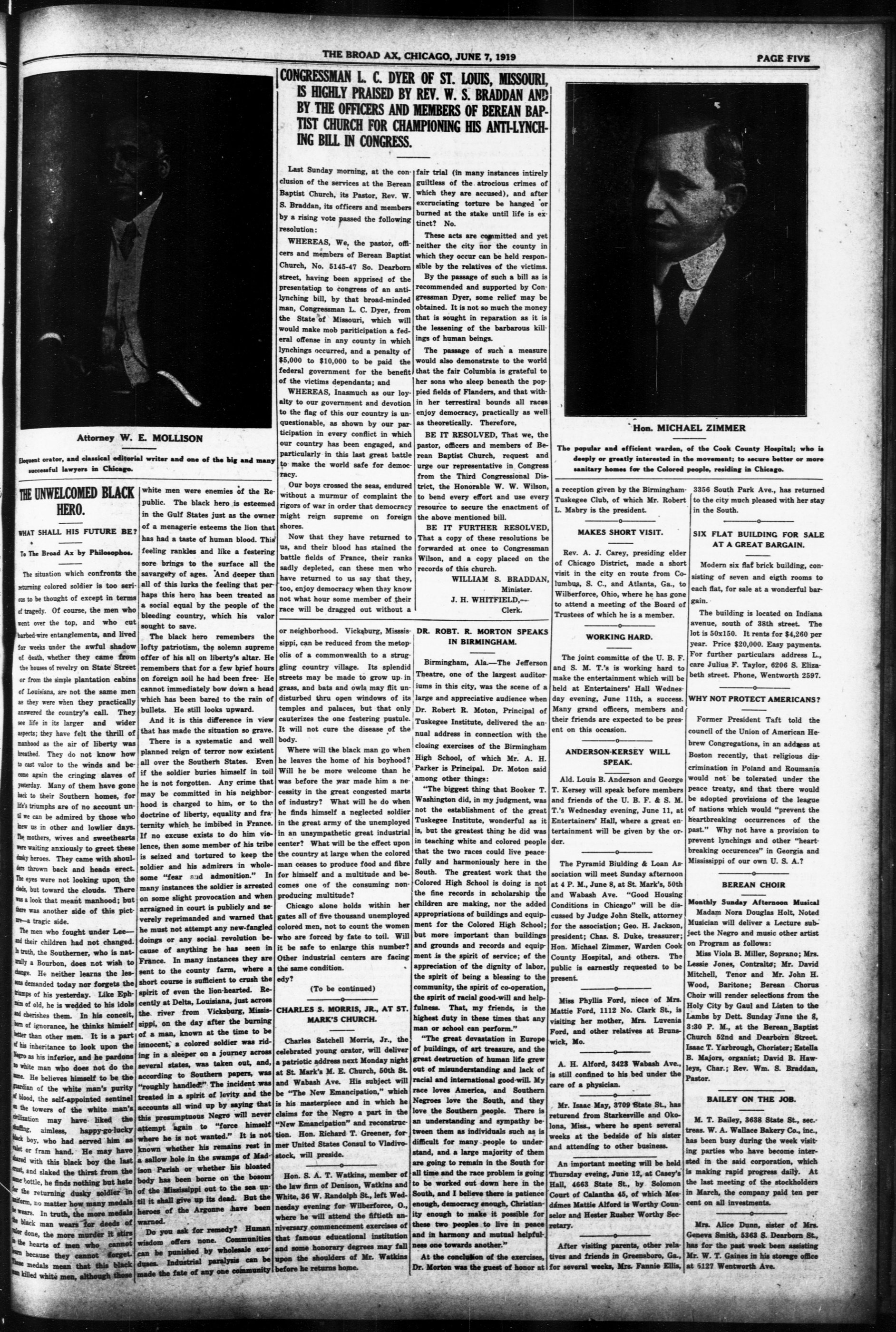
Attorney W. E. MOLLISON
Elequent orator, and classical editorial writer and one of the big and many successful lawyers in Chicago.
THE UNWELCOMED BLACK HERO.
WHAT SHALL HIS FUTURE BET
* ____
The situation which confronts the returning colored soldier is too serious to be thought of except in terms of tragedy. Of course, the men who went over the top, and who cut barbed-wire entanglements, and lived for weeks under the awful shadow of death, whether they came from the houses of revelry on State Street or from the simple plantation cabins of Louisiana, are not the same men as they were when they practically answered the country's call. They see life in its larger and wider aspects; they have felt the thrill of manhood as the air of liberty was breathed. They do not know how to cast valor to the winds and become again the cringing slaves of yesterday. Many of them have gone back to their Southern homes, for life's triumphs are of no account until we can be admired by those who knew us in other and lowlier days. The mothers, wives and sweethearts were waiting anxiously to greet these danky heroes. They came with shoulders thrown back and heads erect. The eyes were not looking upon the clods, but toward the clouds. There was a look that meant manhood; but there was another side of this picture—a tragic side.
The men who fought under Lee—and their children had not changed. In truth, the Southerner, who is naturally a Bourbon, does not wish to change. He neither learns the lessons demanded today nor forgets the trumps of his yesterday. Like Ephram of old, he is wedded to his idols and cherishes them. In his conceit, born of ignorance, he thinks himself better than other men. It is a part of his inheritance to look upon the Negro as his inferior, and he pardons no white man who does not do the name. He believes himself to be the guardian of the white man's purity of blood, the self-appointed sentinel on the towers of the white man's civilization may have liked the shuffling, aimless, happy-go-lucky black boy, who had served him as suet or fram hand. He may have shared with this black boy the last crust, and slaked the thirst from the same bottle, he finds nothing but hate for the returning dusky soldier in uniform, no matter how many medals he wears. In truth, the more medals the black man wears for deeds of color done, the more murder it stirs in the hearts of men who cannot learn because they cannot forget. These medals mean that this black man killed white men, although those
white men are enemies of the Republic. The black hero is esteemed in the Gulf States just as the owner of a menagerie esteems the lion that has had a taste of human blood. This feeling rankles and like a festering sore brings to the surface all the savargery of ages. And deeper than all of this lurks the feeling that perhaps this hero has been treated as a social equal by the people of the bleeding country, which his valor sought to save.
The black hero remembers the lofty patriotism, the solemn supreme offer of his all on liberty's altar. He remembers that for a few brief hours on foreign soil he had been free. He cannot immediately bow down a head which has been bared to the rain of bullets. He still looks upward.
And it is this difference in view that has made the situation so grave. There is a systematic and well planned reign of terror now existent all over the Southern States. Even if the soldier buries himself in toil he is not forgotten. Any crime that may be committed in his neighborhood is charged to him, or to the doctrine of liberty, equality and fraternity which he imbibed in France. If no excuse exists to do him violence, then some member of his tribe is seized and tortured to keep the soldier and his admirers in wholesome "fear and admonition." In many instances the soldier is arrested on some slight provocation and when arraigned in court is publicly and severely reprimanded and warned that he must not attempt any new-fangled doings or any social revolution because of anything he has seen in France. In many instances they are sent to the county farm, where a short course is sufficient to crush the spirit of even the lion-hearted. Recently at Delta, Louisiana, just across the river from Vicksburg, Mississippi, on the day after the burning of a man, known at the time to be innocent, a colored soldier was riding in a sleeper on a journey across several states, was taken out, and, according to Southern papers, was "roughly handled." The incident was treated in a spirit of levity and the accounts all wind up by saying that this presumptuous Negro will never attempt again to "force himself where he is not wanted." It is not known whether his remains rest in a sallow hole in the swamps of Madison Parish or whether his bloated body has been borne on the bosom of the Mississippi out to the sea until it shall give up its dead. But the heroes of the Argonne have been warned.
Do you ask for remedy? Human wisdom offers none. Communities can be punished by wholesale exoduses. Industrial paralysis can be made the fate of any one community
THE BROAD AX, CHICAGO, JUNE 7, 1919
CONGRESSMAN L. C. DYER OF ST. LOUIS, MISSOURI, IS HIGHLY PRAISED BY REV. W. S. BRADDAN AND BY THE OFFICERS AND MEMBERS OF BEREAN BAPTIST CHURCH FOR CHAMPIONING HIS ANTI-LYNCHING BILL IN CONGRESS.
Last Sunday morning, at the conclusion of the services at the Berean Baptist Church, its Pastor, Rev. W. S. Braddan, its officers and members by a rising vote passed the following resolution:
WHEREAS, We, the pastor, officers and members of Berean Baptist Church, No. 5145-47 So. Dearborn street, having been apprised of the presentation to congress of an antilynching bill, by that broad-minded man, Congressman L. C. Dyer, from the State of Missouri, which will would make mob participation a federal offense in any county in which lynchings occurred, and a penalty of $5,000 to $10,000 to be paid the federal government for the benefit of the victims dependants; and
WHEREAS, Inasmuch as our loyalty to our government and devotion to the flag of this our country is unquestionable, as shown by our participation in every conflict in which our country has been engaged, and particularly in this last great battle to make the world safe for democracy.
Our boys crossed the seas, endured without a murmur of complaint the rigors of war in order that democracy might reign supreme on foreign shores.
Now that they have returned to us, and their blood has stained the battle fields of France, their ranks sadly depleted, can these men who have returned to us say that they, too, enjoy democracy when they know not what hour some member of their race will be dragged out without a
or neighborhood. Vicksburg, Mississippi, can be reduced from the metropolis of a commonwealth to a struggling country village. Its splendid streets may be made to grow up in grass, and bats and owls may flit undisturbed thru open windows of its temples and palaces, but that only cauterizes the one festering pustule. It will not cure the disease of the body.
Where will the black man go when he leaves the home of his boyhood? Will he be more welcome than he was before the war made him a necessity in the great congested marts of industry? What will he do when he finds himself a neglected soldier in the great army of the unemployed in an unsympathetic great industrial center? What will be the effect upon the country at large when the colored man ceases to produce food and fibre for himself and a multitude and becomes one of the consuming non-producing multitude?
Chicago alone holds within her gates all of five thousand unemployed colored men, not to count the women who are forced by fate to toil. Will it be safe to enlarge this number? Other industrial centers are facing the same condition.
(To be continued)
CHARLES S. MORRIS, JR., AT ST. MARK'S CHURCH.
Charles Satchell Morris, Jr., the celebrated young orator, will deliver a patriotic address next Monday night at St. Mark's M. E. Church, 50th St. and Wabash Ave. His subject will be "The New Emancipation," which is his masterpiece and in which he claims for the Negro a part in the "New Emancipation" and reconstruction. Hon. Richard T. Greener, former United States Consul to Vladivostock, will preside.
Hon. S. A. T. Watkins, member of the law firm of Denison, Watkins and White, 36 W. Randolph St., left Wednesday evening for Wilberforce, O., where he will attend the fiftieth anniversary commencement exercises of that famous educational institution and some honorary degrees may fall upon the shoulders of Mr. Watkins before he returns home.
fair trial (in many instances intirely guiltless of the atrocious crimes of which they are accused), and after excruciating torture be hanged or burned at the stake until life is extinct? No. These acts are committed and yet neither the city nor the county in which they occur can be held responsible by the relatives of the victims. By the passage of such a bill as is recommended and supported by Congressman Dyer, some relief may be obtained. It is not so much the money that is sought in reparation as it is the lessening of the barbarous killings of human beings.
The passage of such a measure would also demonstrate to the world that the fair Columbia is grateful to her sons who sleep beneath the poppied fields of Flanders, and that within her terrestrial bounds all races enjoy democracy, practically as well as theoretically. Therefore,
BE IT RESOLVED, That we, the pastor, officers and members of Berean Baptist Church, request and urge our representative in Congress from the Third Congressional District, the Honorable W. W. Wilson, to bend every effort and use every resource to secure the enactment of the above mentioned bill.
BE IT FURTHER RESOLVED,
That a copy of these resolutions be
forwarded at once to Congressman
Wilson, and a copy placed on the
records of this church.
WILLIAM S. BRADDAN,
Minister.
J. H. WHITFIELD,
Clerk.
DR. ROBT. R. MORTON SPEAKS IN BIRMINGHAM.
Birmingham, Ala.—The Jefferson Theatre, one of the largest auditoriums in this city, was the scene of a large and appreciative audience when Dr. Robert R. Moton, Principal of Tuskegee Institute, delivered the annual address in connection with the closing exercises of the Birmingham High School, of which Mr. A. H. Parker is Principal. Dr. Moton said among other things:
"The biggest thing that Booker T. Washington did, in my judgment, was not the establishment of the great Tuskegee Institute, wonderful as it is, but the greatest thing he did was in teaching white and colored people that the two races could live peacefully and harmoniously here in the South. The greatest work that the Colored High School is doing is not the fine records in scholarship the children are making, nor the added appropriations of buildings and equipment for the Colored High School; but more important than buildings and grounds and records and equipment is the spirit of service; of the appreciation of the dignity of labor, the spirit of being a blessing to the community, the spirit of co-operation, the spirit of racial good-will and helpfulness. That, my friends, is the highest duty in these times that any man or school can perform."
"The great devastation in Europe of buildings, of art treasure, and the great destruction of human life grew out of misunderstanding and lack of racial and international good-will. My race loves America, and Southern Negroes love the South, and they love the Southern people. There is an understanding and sympathy between them as individuals such as is difficult for many people to understand, and a large majority of them are going to remain in the South for all time and the race problem is going to be worked out down here in the South, and I believe there is patience enough, democracy enough, Christianity enough to make it possible for these two peoples to live in peace and in harmony and mutual helpfulness one towards another."
At the conclusion of the exercises, Dr. Morton was the guest of honor at
M.
Hon. MICHAEL ZIMMER
the popular and efficient warden, deeply or greatly interested in the sanitary homes for the Colored
The popular and efficient warden, of the Cook County Hospital; who is deeply or greatly interested in the movement; to secure better or more sanitary homes for the Colored people, residing in Chicago.
a reception given by the Birmingham- 3356 South Park Ave., has returned Tuskegee Club, of which Mr. Robert to the city much pleased with her stay L. Mabry is the president. in the South.
MAKES SHORT VISIT.
Rev. A. J. Carey, presiding elder of Chicago District, made a short visit in the city en route from Columbus, S. C., and Atlanta, Ga., to Wilberforce, Ohio, where he has gone to attend a meeting of the Board of Trustees of which he is a member.
WORKING HARD
The joint committee of the U. B. F. and S. M. T.'s is working hard to make the entertainment which will be held at Entertainers' Hall Wednesday evening, June 11th, a success. Many grand officers, members and their friends are expected to be present on this occasion.
ANDERSON-KERSEY WILL
SPEAK.
Ald. Louis B. Anderson and George T. Kersey will speak before members and friends of the U. B. F. & S. M. T.'s Wednesday evening, June 11, at Entertainers' Hall, where a great entertainment will be given by the order.
The Pyramid Building & Loan Association will meet Sunday afternoon at 4 P. M., June 8, at St. Mark's, 50th and Wabash Ave. "Good Housing Conditions in Chicago" will be discussed by Judge John Stelk, attorney for the association; Geo. H. Jackson, president; Chas. S. Duke, treasurer; Hon. Michael Zimmer, Warden Cook County Hospital, and others. The public is earnestly requested to be present.
Miss Phyllis Ford, niece of Mrs. Mattie Ford, 1112 No. Clark St., is visiting her mother, Mrs. Luvenia Ford, and other relatives at Brunswick, Mo.
A. H. Alford, 3423 Wabash Ave., is still confined to his bed under the care of a physician.
Mr. Isaac May, 3709 State St., has returend from Starkesville and Okolona, Miss., where he spent several weeks at the bedside of his sister and attending to other business.
An important meeting will be held Thursday eveing, June 12, at Casey's Hall, 4663 State St., by Solomon Court of Calantha 45, of which Mesdames Mattie Alford is Worthy Counselor and Hester Rusher Worthy Secretary.
After visiting parents, other relatives and friends in Greensboro, Ga., for several weeks, Mrs. Fannie Ellis,
[Image of a man in a suit with a tie].
of the Cook County Hospital; who is the movement; to secure better or more people, residing in Chicago. 3356 South Park Ave., has returned to the city much pleased with her stay in the South.
SIX FLAT BUILDING FOR SALE
AT A GREAT BARGAIN.
Modern six flat brick building, consisting of seven and eighth rooms to each flat, for sale at a wonderful bargain.
The building is located on Indiana avenue, south of 38th street. The lot is 50x150. It rents for $4,260 per year. Price $20,000. Easy payments. For further particulars address L., care Julius F. Taylor, 6206 S. Elizabeth street. Phone, Wentworth 2597.
WHY NOT PROTECT AMERICANS?
Former President Taft told the council of the Union of American Hebrew Congregations, in an address at Boston recently, that religious discrimination in Poland and Roumania would not be tolerated under the peace treaty, and that there would be adopted provisions of the league of nations which would "prevent the heartbreaking occurrences of the past." Why not have a provision to prevent lynchings and other "heartbreaking occurrences" in Georgia and Mississippi of our own U. S. A.?
BEREAN CHOIR
Monthly Sunday Afternoon Musical
Madam Nora Douglas Holt, Noted
Musician will deliver a Lecture subject
the Negro and music other artist
on Program as follows:
Miss Viola B. Miller, Soprano; Mrs.
Lessie Jones, Contralto; Mr. David
Mitchell, Tenor and Mr. John H.
Wood, Baritone; Berean Chorus
Choir will render selections from the
Holy City by Gaul and Listen to the
Lambs by Dett. Sunday June the 8,
3:30 P. M., at the Berean Baptist
Church 52nd and Dearborn Street.
Isaac T. Yarbrough, Chorister; Estella
B. Majors, organist; David B. Hawleys,
Char.; Rev. Wm. S. Braddan,
Pastor.
BAILEY ON THE JOB
M. T. Bailey, 3638 State St., sectreas. W. A. Wallace Bakery Co., inc., has been busy during the week visiting parties who have become interested in the said corporation, which is making rapid progress daily. At the last meeting of the stockholders in March, the company paid ten per cent on all investments.
Mrs. Alice Dunn, sister of Mrs. Geneva Smith, 5363 S. Dearborn St., has for the past week been assisting Mr. W. T. Gaines in his storage office at 5127 Wentworth Ave.
---
PAGE FIVE
PAGE SIX
SHADE FOR FROCKS
Raspberry, Lemon and Almond Are New Colors for Summer.
Organdle is Unequaled for Thin Garments, Because Delicate Tints Appear Frosted.
There doesn't need to be anything very new about a thing so utterly satisfactory as a summer frock, notes a New York fashion writer. It need not be a tour de force of the dressmaker's art; less than any other dress does it need to be intricate, elaborate, sophisticated. It is at its best when it is a very simple thing, uncomplicated by thoughts of new lines, ultra modes, latest decrees from Paris. It need only be something to express the individuality of the wearer, and to make everyone who looks upon her feel cool and crisp and rested. It should be a cloud rather than a dress, a cooling color that somehow—perhaps by means of its sash or its shoulder straps—stays all in one place when one would expect it to dissolve into thin air and float away, says Vogue. Organdie is unequaled for thin frocks, because delicate colors in this material appear frosted. Raspberry, lemon, almond—these are the new colors for summer frocks, the colors which suggest the rich or delicate tones of fruit.
Just off Fifth avenue there is a little shop which is making a specialty of summer frocks—especially those that one naturally associates with afternoon tea or garden party. They are shown in a wide range of materials, which embody all the new shades. The designs are quite simple, and, what is more quite suitable for summer mornings or afternoons. One is agreeably surprised upon entering this shop and examining the merchandise to find ready-made summer dresses that tub well, displaying handiwork and those dalty touches that usually accompany the made-to-order dress.
Striped handkerchief linen was used for a dress made up along rather tailored lines. This model is especially pleasing to the women who prefer plain smart frocks for morning wear. Cuffs and collar are of white organelle, bound with an edging of the linen cut on the blas.
This is one of those touches that give dresses a unique charm. The tie of the organdie is finished in the same manner. This dress is entirely hand made. One may have it in striped linen in different shades, in plain white or in a plain color.
BLUE BLOUSE AND HAT STYLE
The blouse is of vivid blue and white barred material, all hand made. The hat is of blue straw and satin.
The blouse is of vivid blue and white barred material, all hand made. The hat is of blue straw and satin.
THE ETERNAL SKIRT QUESTION
Hobble Affairs Are Declined by Many, Yet Majority Follow Fashion's Decrees.
The question of skirt width is a problem that looms large on the horizon of the fashion world just now. Straight line effects have held sway for many seasons, and this season garments rather reached the limit of strightness by reason of the decree that popularized the very narrow skirt. Coming as it did immediately on the basis of a period of unheard-of activity among women, due to the demand for their service in all sorts of war work, the vogue for ultra narrow skirts attracted more attention than it ordinarily would, and many women have firmly declined to accept the hobble affairs. However, the majority of women follow fashion's decrees whether they really like them or not, and skirts not more than a yard in width are everyday sights on the streets of most cities.
A foreword from Paris announces that very full skirts are looming up there, and there is a very strong indication that when fall styles put in their appearance the little, tight-skirted affairs of the present season will serve merely as foundations if any remodeling is to be done.
An advance guard of the full skirt that is threatened or promised appeared recently.
Width of Wash Skirts
Wash skirts are of medium width, averaging one and three-quarter yards. Pin tucks are being used as trimming, in novel effects such as diamonds, crosses and checks. The very ornate pockets are not promised much popularity, on account of laundry difficulties. There will be side buttoned and front buttoned skirts with large pearl buttons from belt to hem.
SUMMER FROCK AND CHIC HAT
WILLIAMS & CO.
This is delicate white indestructible volle with countless tiers of latin ruffles. The hat of leghorn has a pink crown and flowing pink and blue ribbons.
CREPE DE CHINE FROM JAPAN
Italy and France Also Produce the Favored Fabric—No Factories in China.
Crepe de chine, in spite of its name, does not come from China but from Japan, Italy and France. There are no factories for making silk piece goods in China, all the weaving being done by hand. With the exception of ponges the products of the Chinese looms are not popular abroad, except in oriental countries, being too heavy, although the patterns are wonderfully beautiful and the colors exceedingly rich.
The ponges are woven in the homes of the peasants, and as they come from many looms no two pieces are ever exactly alike in weight, menness, color and texture. The shantung come from the Lutang district, and the nanshal from the Nighal district.
These ponges are made from the wild silk of Manchuria, where the silkworms are not cultivated and fed on mulberry leaves as in the rest of China but feed at will on oak leaves. In the spring the eggs hatch on the branches of the oak trees and the coons are gathered about September. On attaining their full growth silkworms seek something to which to attach themselves in order to wind themselves up in their silk envelopes. Having found it the worm spins a thread from five hundred to a thousand yards long, wrapping it around its body as it spins. This takes from thirty-six to forty-eight hours.
If left alone the worm's skin hardens, its internal organs disintegrate to a thin jelly, and then begin reorganizing themselves into those of a butterfly. Within a week or ten days it would be a butterfly, and as such would eat its way out through its envelope of silk.
AN OVER-THE-SKIRT BLOUSE
Garment for Summer Wear Is Made of Sheer Cotton Voile and Handkerchief Linen.
It is no longer necessary to emphasize the fact that the long costume or smock blouse has a preferential place in the lineup of fashionable garments. The question now is not at all whether the long blouse is fashionable but rather one of putting as much originality as possible into its designing and development. This type of blouse proves a great aid to the woman who wants to make over a last season frock, using just the best portions of it. The simplest sort of skirt is always the best selection as an accompaniment of the costume blouse, and as gay colorings predominate in many of these blouses the skirt may be of any color. The long blouse shown for summer wear is made of sheer cotton volle, cotton novelty fabrics and lovely handkerchief linen in white and colors.
Eibow and three-quarter length sleeves are decidedly approved by American designers and by the women themselves.
American designers are always feverishly anxious to know what styles the French are showing—what they are recommending, etc., but for several seasons there has been a very noteworthy tendency on the part of American fashion designers to accept more suggestions from the French houses and these to a large extent are modified and Americanized.
There is no denying that Paris first brought out the long blouse and that we have been a long time in accepting it. This very thing helps to prove that no longer does the American dressmaker and style designer blindly follow any leader.
What is known as the Talbot green is the color sensation of Paris, according to an American buyer of millinery. At any rate it is chiefly by the brilliancy of their coloring that Paris designers are expressing their joy of victory.
THE BROAD AX, CHICAGO, JUNE 7, 1919
FAVOR FABRIC HAT
Headgear That Is the Cause of a Creative Impulse.
Tuille, Georgette, Crepe de Chine and Other Summery Materials to Be Seen in Windows.
The fabric hat might be called the pitfall of the amateur milliner. Few indeed are the women who have not been selzed at least once in their lives with the creative impulse in regard to a few short lengths of silk or muslin, a hat frame and a handful of flowers and ribbons.
It looks the easiest task in the world to produce a hat which shall at least be modestly successful out of almost any bit of left-over material, but it is only a fair warning that however much a joy the fabric hat may be in inspiration, in realization it is usually blank despair.
Once in a long time the amateur discovers a hidden vein of talent, but all too often the only results are pricked fingers, tears and trampled finery. A sadder and wiser woman realizes that the fabric hat requires the full measure of the trained milliner's skill in the fashioning.
Whether owing to a scarcity of straw or to a degree of fashion, the fabric hat appears to be occupying the foreground of the picture during the early summer.
Hats of tulle, hats of crepe de chine or of georgette crepe, grass-cloth hats, innumerable taffeta hats, hats of lace and purely summery hats of cotton fabric are making irresistible appeal from every milliner's window.
The tulle hat we have had with us all winter, but its extraordinary charm makes it difficult to abandon.
Afternoon Hat of Lavender Georgette
Antarctic Hat of Lavender Georgette
A close toque of pink roses completely surrounded by a flaring Turkish turban of black tulle has a curious charm of its own, but it by no means has the chic of the closely folded snug dark brown tulle turban with the swirl of brown paradise springing from one side of its front.
A charming little poke shape formed of black tulle ruffles edged with jet and fastened under the chin by a tulle strap is crowned by pink taffeta rose petals.
Taffeta hats of all shapes are in great favor, from the extremely broad brimmed, picturesque Second Empire shape with its drooping, wide black lace edge to the small, low-crowned
Hat of Lavender Georgette.
sailor. One black taffeta hat which droops demurely at the sides is gayly decorated with trailing bunches of yellow, rose and mauve flowers and has in addition a blue ribbon about the crown.
Taffeta hats of the taller crowned persuasion are frequently decorated with embroidery as their only trimming with the exception of a narrow ribbon tied about the crown. The embroidery may be in bright wools, but it is more often in silken threads, raised in bold relief, but of the same color as the taffeta.
Crepe de chine has a rather limited use for summer fabric hats, but georgette crepe is in high favor for both large and small shapes and nearly always in light and exquisite colors. The broad shapes usually have a drooping edge of one thickness of the crepe, but they may be bound with a fold and they are nearly always crowned or creatted about by flowers or fruit, or both, in exquisite shades.
IN FASHION LAND.
Waists are rather tight.
Flower-trimmed hats are popular.
Skirts have flounces in the back.
The hat "off the face" is fashionable.
For sport wear, rose is a favorite color.
Stockings with clocks are fashionable.
Fabric gloves are more than ever in favor.
The pointed toe is noticeable in all shoes.
Birds in flight are seen on the new parasols.
African brown is a good color for stockings.
Almost all of the new suit coats are box style.
The sweater collars are made of rough wool.
Cherry red is seen in some of the new buttons.
Taffeta and kitten's ear crepe are very popular.
A black directoire poke bonnet has its visor effect emphasized by a dashing bow of black velvet.
G
Cape of navy blue and biscuit silk poplin, and one of brown tulle over brown chiffon fur trimmed.
CAPE HOLDS ITS OWN ALL YEAR
Garment Is Still Popular and Appears in Many Interesting Types.
VARIED CHOICE OF STYLES
Wide Range of Colors and Materials; Georgette With Fur Trimming Makes One of the Smartest Wraps.
Season in and season out the cape flourishes in undiminished popularity. It is not often, declares a fashion authority, that a conspicuous fashion such as this, which quickly attained universal favor, survives for a single season, much less for the four well-rounded ones which the cape already has to its credit, as it enters on the summer soilstice with a following as enthusiastic as ever.
There are capes long and short, capes slim and straight or draped in voluminous folds, three tiered capes, reversible capes, capes in striking combinations of two materials in one color or of two colors in the same material, curious and interesting capes and cobwebby sketches of capes in georgette or tulle boldly accented with fur.
One sees much less of the waistcoat in the summer cape models. It is hard to tell whether the almost total elimination of this feature in all except the strictly sport models is due to the fact that its added warmth is no longer desirable or whether it has been simply done to death.
Collar Arrangements.
The collar arrangement which wraps around the neck in many folds is still much in evidence, but there are capes with Medicil collars, capes with a fitted yoke and high close-fitting collar and capes with no more collar than a band about the shoulders.
One of the most useful cape models has a very wide band of the fabric folded softly back across the front from hem to hem. This can be gathered snugly about the throat or allowed to fall in gracefully negligent folds around the shoulders as occasion demands.
This cape is displayed at its best in two-toned combinations of one material or in different fabrics of identical color. It is handsomely developed in navy blue serge and satin or in castor tricolette and duvetee.
There is a peculiar smartness about the circular three-tiered capes, and there are capes on straight lines also with three tiers, the extremely wide cape collar which falls well below the shoulder line forming the upper tier. These capes are at their best in Poiret twill or gabardine, but it is only fair to say that the useful navy blue serge cape has been relegated to the background which useful old friends are so frequently required to grace.
In dealing with the summer cape there is not much to be said of woolen fabrics except as they are used in combination with silken stuffs or in their unchallenged field, the sport outet.
For Sport Wear.
For summer sports the strictly serviceable tailored capes of English worsteds and tweeds may be passed over as year round standbys, but capes of homespun, dyed in soft fruity colors, have by reason of their light open weave a distinctly summery place in the sport outfit. Wool jersey still has a claim on the summer sportswoman and capes of this fabric are frequently seen, the most popular development of this garment being the detachable cape to be buttoned beneath the collar of a sleeveless sport suit. A white wool
jersey sleeveless jacket has a cape of navy blue wool jersey, with white facings buttoned back with pearl buttons. This forms a very useful as well as an undeniably attractive costume.
A sport cape which is comparatively new and while will interest many women is fashioned of channelette. This wool fabric, apparently knit by hand, but in reality a product of the knitting machine, can be purchased by the yard in a variety of gay and lovely colors. It is 36 inches wide and sufficiently expensive, but as capes of this type are cut very scant and straight a large quantity of the fabric is not required.
Narrow bands of Angora knitted wool may also be bought with which capes and sport coats of channelette are bordered, collared and cuffed. A cape has been designed for country wear of heavy, soft linen crash, lined with bright gingham, which has a certain bizarre charm of its own but comes dangerously near being an eccentricity.
Silk. Satin and Wool.
Capes of silken weaves for daytime wear spell summer in every inustrous length of tricolette or satin and in the crisp and sprightly folds of moire or taffeta. Satin is often used in combinations with wool, either duveteen, gardine or wool jersey. The upper part of the cape is usually of satin with a broad band of the woolen fabric at the lower edge. Often the collar is of wool, but frequently of fur. A delectable cape of this type has the lower half of beige wool jersey, the upper half of brown satin and the collar of summer ermine.
Satin as well as taffeta is sometimes reduced to the severe cut of the three-tiered cape, but it is at its best in the more suave and gracious lines of the draped models. One very lovely cape of double-faced satin has a long scarf front and is gathered at the shoulders with a small upstanding frill. The soft, dull blue of the under side is turned back in a wide fold at the neck and down the front over the navy blue of the exterior.
Attractive satin capes in henna, black or blue show the plainness of their surface broken by roundabout gathered inserts of georgette.
Capes of tricolette, often gathered into wide bands of duvetee or garabdine of the same shade, have a great deal of distinction. Both the plain and fancy weaves are employed, and in the latter case the trimming of wool fabric is frequently omitted, while a fur collar gives the accent of weight and substance which most summer capes seem to require as a need of their being.
A changeable taffeta cape in shades of red, brown and blue is a noticeable exception to this rule. Its quaintly gathered and frilled body is topped by a yoke in which delicate dull gold embroidery plays an important part.
Capes Extraordinarily Smart
Extraordinarily smart capes are developed in more silk in navy, black, brown or castor and nearly always with the all but inevitable fur collar.
One in black has superimposed upon its more surface brocaded satin figures, the glint of which, added to its squirrel collar, completes a cape distinguished enough for any occasion.
What might be called the apotheosis of the summer cape is now coming very much to the fore in all the more exclusive shops. These exquisite and fragile garments have little to recommend them except sheer charm. Extravagant they are to a degree, both in the initial cost and in perishability; and as to warmth, two thicknesses of georgette provide but scant protection even to the most imaginative. They are like Lucy Lockett's pocket, which had nothing in it but the binding round it, and depend altogether for substance on the bandings and mountings of fur which do their-utmost to hold these thistledown garments near the earth.
Short-hip length georgette capes with armholes banded by fur to match the deep collars are provided for those who have a weakness for these intriguing little affairs.
AFTERNOON FROCK OF SATIN
This frock of brown satin, simply made into an afternoon outfit, acquires charm by rows of cords. It is suggested as a practical, all-round tume.
GLITTER AND GLISTEN FADS
Bead Embroideries and Paillettes, T
nics of Gorgeous Brocades, and
Fringes and Tassels.
This is a season of glitter and glisten ten so far as evening frocks are concerned. Bead embroideries and paillettes, tunics made of gorgeous brocades, which show silver and gold designs on shot backgrounds of gauze or crepe, fringes everywhere, and, of course, tassels. It is an ultramusuptuous year, but not unduly extravagant, because brocaded tunics can be easily made at home, and then need not run into more than two yards of material at most. If you happen to see a remnant of orch broche silk—metallic designs on a dark or black ground—possess yourself of it. If it is not long enough to make the whole of an evening tunic it will certainly make a splendid border, with bands for the corsage and armholes, of one made of chiffon or voile de soie. In putting on a hem of metallic brocade one ought to introduce a little hand embroidery—feather stitching or something of that sort. This gives the garment the desirable air of being "a creation."
FLOOR CUSHION THE LATEST
Contrivance Is Covered With Wor
Rugs—May be Used for
Porch or Lawn.
No cheap rug goes so well with mahogany furniture as does a rag rug especially in a bedroom. Indeed some clever young women, setting out in housekeeping in attractive houses, with white enameled woodwork and good mahogany furniture, old and new, have decided to start out with rag rugs in their living rooms, to replace them later on probably by more pretentious rugs. But the rug rugs are especially good in an interior in which original or reproduced colonial mahogany is used. But the latest thing is not the rug rug, attractive as that is in its springtime guise. The latest thing is the floor cushion covered with woven rugs. This fabric, with which the cushions are covered, is identical with that of the rug. It is simply formed into a cover for a big cushion and then is used as a floor cushion or for the porch or lawn. Usually there is a plain center section, with a band of floral design at each end.
DRESSES OF YELLOW VELVET
Rich Garment Carries a Most Pleasing Contrast in its Facings of Orchid Velvet.
A dress of yellow velvet carries an exquisite contrast in its facings of orchid velvet. The neck is cut deeply square in front and is invisibly wired to stand up in the back, where the orchid tones display themselves against the skin of the throat and neck. The bodice of this dress is cut kimono sleeve and is tight at the waistline like a basque. The elbow-length sleeves are faced with orchid velvet.
The flowers at the girdle line are made of taffeta in shades of mauve, orange, pale yellow and purple. These flowers are in lovely part of the costume because every color seems to answer either to the orchid or the yellow velvet of the gown. The skirt of this picturesque model is draped slightly blas, so as to swing tightly around the feet. There a facing of orchid velvet contrasts with the yellow folds of the shirt.
Telephone Calumet 602-3572
MORRIS, Pres. KIRBY WARD, See
MORRIS-WARD
COAL CO.
Incorporated
2545 SOUTH PARK AVENUE
Chicago
THE CRANFORD
department Building
3600 WABASH AVENUE
building ever opened to Colored tenant
heat, electric lights, tile baths, marble
ANFORD
Building
H AVENUE
to Colored tenants in Chi-
tile baths, marble entrance
THE FORTY-FOURTH STREET
The finest building ever opened to Colored tenants in Chicago. Steam heat, electric lights, tile baths, marble entrance
J. W. CASEY, Agent
133 W. Washington Street
Phone Main 263
KINKY HAIR
KINKY HAIR
Atlanta, Ga.
Boston, Mass. Co.
Gentlemen.
My picture shows
you what your face
Chicago, Ill.
THE BROAD AX, CHICAGO, JUNE 7, 1919
OWNERS AND DIRECTORS
DAN M. JACKSON
GEO. T. KERSEY
Phones Calumet 6164
DAVID A McGOWAN
Automatic 71-629
AHMED A. RAYNER
OPEN DAY AND NIGHT
The Emanuel Jackson Undertaking Co., Inc.
DENISON,
WATKINS
AND
WHITE
ATTORNEYS AT LAW
Franklin A. Denison,
S. A. T. Watkins
James E. White
Telephone Central 3142
CHICAGO
Res. 3855 Prairie Ave.,
Phone Douglas 9133
Phones: Main 2017, Auto. 32-395
ATTORNEY AND COUNSELOR AT LAW
Suite 706 Firmenich Building
184 W. Washington St., Chicago.
PHONE MAIN 2214
A. D. GASH
Attorney At Law
118 North La Salle Street
CHICAGO
F. Dunn, J. B. McCahey, Trusees
Tel.: Oakland 1552, 1551, 1550
JOHN J. DUNN
ESTABLISHED 1877
Wholesale and Retail
COAL
Fifty-First and Federal Sts.
CHICAGO
Animals and Earthquakes.
Animals and Earthquakes.
One of the mysteries still unsolved is that of the sense by which the lower animals become aware of the approach of earthquakes. Birds and rats become alarmed and try to escape. Super-sensitiveness to faint shocks scarcely gives satisfactory explanation, for modern selsmographs are very sensitive.
Cause for Thankfulness
The first reason for being thankful in the morning is that you have lived to see the dawn of another day, with opportunities to finish something begun the day before and to begin something that you may be able to do better than you have ever done anything before.
Asbestos Deposita.
In the Kotzebue sound region, western Alaska, there are asbestos deposits said to rival the richest in the world. Asbestos, in its natural or virgin state, is as white as snow, soft as the softest silk and lies in long strings or layers, easily torn apart with the fingers.
Utilizing Time.
"Ladies," announced the president of an afternoon bridge club. "It has been moved and seconded that there shall be no conversation at the card tables. What shall we do with the motion?" "I suggest," said a sprightly member, "that we discuss it while we play."
The Church-Goers.
The Church-General
If some men were to quote the well-known psalm they would have to say, "I was glad to make excuses when they said to us, 'let us go into the house of the Lord.'" 'The 'they' referring probably to the women of the house, or the church-going neighbors.—Exchange.
Possy's Appeal.
Never did poesy appear so full of heaven to me as when I saw how it pierced through pride and fear to the lives of the coarsest men.—Lowell.
Uncle Eben.
"A real loafer," said Uncle Eben,
"ain' satisfied to get along without
work. He wants busy folks to quit
doir jobs to admire him."
Attorney At Law
Suite 318-320 REAPER BLOCK
Clark and Washington Streets
Phone Central 1239
CHICAGO
Residence, 4533 Prairie Avenue
Phone Kenwood 8520
WALTER M. FARMER
ATTORNEY AND
COUNSELOR AT LAW
NOTARY PUBLIC
Suite 708
184 W. Washington St.
Tel., Office, Main 4153 Auto 33736
CHICAGO
Residence 3419 South Park Ave.
PHONE DOUGLAS 9354
WM. J. LATHAM
Attorney At Law
OFFICE PHONE: CALUMET 875
2 EAST 31ST STREET
Suite 7
CHICAGO
Pays to Be Agreeable.
It's never too late to prepare for what is left of life. The best gift is to be able to cultivate your agreeable traits of character early in life. Gentleness that blossoms into culture with youth saves many a heartache. But you are never too late to improve. Why use harsh, biting words when gentle ones will do more good? You will feel better and so will everyone else. You don't have to be a fawning courtier. Just be your natural self warmed by the good graces of cultivated manners. They will help you to health, wealth and happiness.—Grit.
Silka of Seville.
Four hundred years ago the silks of Seville, then the most famous in the world, were exported to all countries, for Spain was the first nation of western Europe to take up silk culture. The climate of Spain is excellent for this industry, and fine silkworms, such as were employed when silk cultivation was at its height, are available in the foothills of the Sierra Nevada, near Granada. This worm has a life of 50 days, and in the first 30 it grows to thousands of times its original weight.
Juvenile Rebuke.
Little five-year-old Mary, who had great kindness of heart for all the animal creation, saw a hen preparing to gather her chickens under her wings, and shouted earnestly: "Oh, don't sit down on those beautiful little birds, you great big, ugly, old rooster!"
Modern Spelling.
Professor Miller of the University of Minnesota asked ninety normal students to spell ten words, and the best record was seven of the ten words, repellent, collectible, plicnicking, inoculate, consensus, inferred, sacrilegious, dissipate, billious, vilify.
Bad Indeed.
First laborer—"Yes, I 'eard you was in th' hospital. Was yer very bad?" Second laborer—"Bad? I should think I was bad! Why, a pal o mine brings me a bottle o' beer, an' I couldn't so much as look at it!"—London Mall.
Wanted Masculine Touch.
Bobby was a small boy, but he objected vigorously to a little waist that had a big collar and cuffs with a narrow ruffle around the edge. When asked the reason he said he didn't like the "girl" on it.
Why Should He?—The World Is His.
"An Englishman comes into a drawing room as if he owned it. An American comes into a drawing room as if he didn't care a damn who owned it."—London Sketch.
---
PAGE SEVEN
AUTO. 72-379
Phones: DOUGLAS 3256
DOUGLAS 5071
Chicago Title and Trust Company
OUR BUSINESS SINCE 1847 has been that of showing the condition of real estate titles.
The millions upon millions required to build and rebuild Chicago have been furnished relying on the accuracy of our ABSTRACTS and TITLE POLICIES.
No man has lost a dollar by so relying.
This is our past.
Wise men judge future action by past behavior
CHICAGO TITLE AND TRUST COMPANY
69 W. Washington Street
Assets exceed $12,000,000.00
No deposits or demand liabilities.
TELEPHONE DOUGLAS 1
GEORGE F. HARDING, JR.
Real Estate
Up-to-Date or Modern Houses,
Apartments and Stores
to Rent
3101 Cottage Grove Avenue
Corner 31st Street, Chicago
THE BR
THE BROAD AX
THE BROAD AX
PUBLISHED EVERY SATURDAY
In this city since July 15th, 1899, without missing one single issue, Republicans, Democrats, Catholics, Protestants, Single Taxers, Priests, infidels or anyone else can have their say as long as their language is proper and responsibility is fixed.
In this city since July 15th, 18
Republicans, Democrats, Catholics
infidels or anyone else can have the
proper and responsibility is fixed.
The Broad Ax is a newspaper
all, ever claiming the editorial re
Local communications will re
on one side of the paper.
Subscriptions must be paid in
One Year
Six Months
Advertising rates made known
VOL. XXIV. JU
The Broad Ax is a newspaper whose platform is broad enough for all, ever claiming the editorial right to speak its own mind. Local communications will receive attention. Write plainly, only on one side of the paper.
Address all communications to
THE BROAD AX
6206 South Elizabeth Street, Chicago, Ill.
Phone Wentworth 2597.
4700 South State Street,
Phone Drexel 1416
IMPORTANT
For resolutions, obituary not
special announcements of events to
sion is made, and the opening of
cents per line; 6 words or fraction
Personal or social items such
everything of a general interest,
Entered as Second-Class Matter, August 1
Under Act of
IMPORTANT NOTICE
For resolutions, obituary notices, cards of thanks, write-ups, special announcements of events to happen, when a charge of admission is made, and the opening of new business enterprises, etc., 15 cents per line; 6 words or fraction makes one line.
cents per hour, or social items such as marriages, births, deaths and everything of a general interest, published free of charge.
Entered as Second-Class Matter, August 19, 1902, at the Post Office at Chicago, Ill., Under Act of March 3, 1879.
BETTERMENT OF RACE RELATIONS IS ASSURED
BETTERMENT OF RACE RELATIONS IS ASSURED
By Wm. Anthony Aery
Hampton, Va.—"The Southern Sociological Congress strongly condemns lynchings and mob-rule, which are both un-American and subversive of law and order. We officially call upon the editors of our papers, the ministers of all our churches, and the teachers in all our schools and colleges to proclaim against these practices, which constitue both a disgrace and menace at home and also discredit American democracy abroad. We urge the immediate exercise of all possible state and federal power to put a speedy end to these outrages throughout the country." Lynchings and mob-rule were condemned in this resolution, which was unanimously adopted at one of the mass meetings of the Eighth Congress, recently held in Knoxville.
Dr. James Hardy Dillard of Charlottesville, Va., president of the Jeanes and Slater Boards, presided over the Race Relations Conference, which attracted from distant parts of the South and of the Nation several hundred white and colored leaders in social-service work. Dr. Dillard said:
Hopeful Outlook.
"Each year marks another step in the progress of race relations in the Southern states. Never in the history of the world has a race made such physical, mental, and moral improvement as the Negro race made during the past sixty years. This does not mean, however, that there should be any letting-up in the forward movement. There are still thousands upon thousands of uneducated people and many who are still very poor and in need of moral advancement.
"Never before in history, during any period of sixty years, have two races, thrown together so closely, been known to reach such a proachment for good as we find in the South. It takes time to change the habits of thought and feeling among individuals. It takes a still longer time for social groups to change their habits. We must, therefore, be vry patient one with the other.
"Give Negro a Chance"
"I Give Negro a Chance
"I have been over the South time and time again. Each year I have seen marked improvement in race relations. It is better for us all who stay in the South to remain in fellowship and co-operation. We must learn to live together in love, good-feeling and co-operation. We must give the Negro a chance to develop into the full stature of manhood.
"The colored people, during the war, were called upon to take their part of the Nation's burden. They did more than was expected. Their war work was amazing.
---
PAGE EIGHT
JULIUS F. TAYLOI DR. M. A. MAJORS.
1899, without missing one single issue.
Protestants, Single Taxers, Priests,
their say as long as their language is
whose platform is broad enough for
right to speak its own mind.
receive attention. Write plainly, only
in advance.
..... $2.00
..... 1.00
in on application.
JUNE 7, 1919 No. 38
ritices, cards of thanks, write-ups,
no happen, when a charge of admis-
new business enterprises, etc., 15
makes one line.
on as marriages, births, deaths and
published free of charge.
19, 1902, at the Post Office at Chicago, Ill.
March 3, 1879.
"The South has come to the conviction that justice, fairness and good feeling are the best ways of improving relations between the races. State superintendents of public instruction are getting larger appropriations for the colored schools. Justice and Christianity reach over all facts. We can have faith in the future.
Negro Soldiers Make Good.
Dr. Thomas Jesse Jones, of the U. S. Bureau of Education and Phelps-Stokes Foundation, who recently returned from morale work in France, spoke on "The Negro Troops Overseas," who have won the thanks of General Pershing and his fellow-officers in the American and Allied Armies. "The remarkable service of the colored soldiers in the back areas, those engaged in the Service of Supplies, and also the record of colored soldiers and officers on the battlefront, throughout all of the past war," said Dr. Jones, "should make us proud of colored men as fellow-citizens. We have found that colored officers can command their brothers in battle as in peace. The attitude of the colored soldiers should be expressed in the words of the song: 'When the good Lord writes of a hero's deeds, he draws no color line.'"
"Negroes in the Backgroud."
Negroes in the Background. Dr. W. W. Alexander of Atlanta, who has been helping the Y. M. C. A. War Work Council in the intensive training of white and colored men for handling reconstruction problems, spoke on "Making Men Fit for Citizenship." Dr. Alexander declared that "the thoughtful colored leaders simply are asking all the white people of the Nation to give the colored population of twelve millions a fair chance to work out their lives—a chance to be given places that men can occupy—an opportunity to be understood on the common problems that concern community life. New faith, encouragement and ideals are needed for a sympathetic understanding of Negroes in the background. The self-restraint and self-sacrifice of Negro leaders are worthy of high praises."
Extension of Democracy.
Rev. Alfred Lawless, Jr., of New Orleans, stated that "far too many white people are living on the traditions of the past and are not thinking problems through for themselves. The common sense and sanity of the Negro have often saved a difficult situation. The Negro asks, "Am I included in the idea of democracy?" The race question is faced by three important groups. One says, 'The case is hopeless'; another, 'Let there be revolution'; and still another, 'Let us begin an evolutionary process and secure high standards through good team work.' The third group merits attention."
Southern Leadership
Dr. James E. Gregg, principal of
THE BROAD AX, CHICAGO, JUNE 7, 1919
EDITORIAL PAGE
Hampton Institute, said: "The people of the South are thinking hard on the subject of race relations. The mind, the heart, and the conscience of men are at work as never before on Negro problems. While many are fearful, there never was a time, I think, when there were so many white people of the South ready and willing to substitute justice for injustice, kindness for ill-will, patience for impatience; ready to face the future with eagerness and hope. We are coming to realize that it is easier to lead men than it is to drive them.
"The Southern Sociological Congress is leading the South as a pilot guides a ship's course, through the authority of wisdom and skill."
Lynching a National Sin
Dr. Edwin Mims of Vanderbilt University, in his "Call of the New South to Suppress Lynching," spoke out boldly in the name of the best white South. "Lynching is unjustifiable under all circumstances," he said. "It is wrong in the sight of man and God. Lynching is a blot on our National escutcheon and is a menace to the whole country. Lynching is an economic peril to the South. It is inexpedient, unwise, and a political mistake. Above all, it is a community and a National sin . . .
"When one set of people sets up a crime for which a lynching is justifiable, there is nothing to prevent another group of people from setting up another crime, which it considers equally jutifiable. A mob in action knows no law. It knows no reason. It is governed only by its passion at white heat..... If the community cannot stop lynching, then the state can. If the state cannot stop lynching, then the nation can—and will."
Racial Co-operation Possible.
Dr. W. A. Bell of Atlanta, Ga., outlined "Some Reconstruction Plans for Colored People," which expressed the ideas of thoughtful colored leaders. "Right-thinking Americans," he said, "appreciate the loyalty and service of the colored people throughout the war. The best Southern white people have determined that justice must come to the Negro. The Negro, on the other hand, must conserve this feeling of brotherhood and must capitalize this quickened sense of human justice.
"Better race co-operation can be developed by conferences of carefully selected groups of both races for the study and discussion of community conditions and constructive social-service programs. We must study what improvements are needed and then make them. Venereal diseases should be fought through a three-fold campaign—education, recreation and suppression. The causes of the inefficiency of Negroes in industry must be removed; farm life must be improved; co-operative buying and selling must be encouraged.
"More liberal publicity should be given to creditable news concerning the Negro. News concerning the crimes of Negroes should be treated as crime and reprehensible, but not distinctly as Negro crime. Terms which reflect discredit on the Negroes should be eliminated from news-stories. Publicity agencies should be organized for the promotion of a right understanding between the races.
"Equal treatment before the law should be secured for all citizens. Civil justice should include adequate protection of all life and property; impartial law enforcement; proper supervision of penal institutions; equal accommodations for equal rates in public places and on common carries; enactment of a qualification suffrage law to affect both races alike; the abolition of jim crowism and lynching. In education the opportunity of grammar-school training should be given every normal colored child, and the distributing of school funds should make possible adequate high-school, technical and higher training for qualified colored students."
To increase the cost of transportation tends to retard a city's expansion along the lines of community health and safety. Cheap car fares with liberal transfers have been a tremendous factor in Chicago's territorial growth and development. Cheap and rapid transportation is also a means of preventing the crowding together of people in limited areas with the attending damage to both health and morals that always are in evidence in badly congested districts.
The question of family health has impelled thousands of people in Chicago to seek the outlying districts where air and sunshine can be had in abundance and where there is elbow room and a chance for children to grow and develop into healthy and vigorous men and women. And cheap and rapid transportation has made this possible. The workmen of today can travel a round trip distance of twenty miles between his home and his work place and do it in less time than he could have traveled one-half the distance twenty years or more ago.
A well known health worker in this city said some years ago that improved transportation facilities had taken thousands of people out of the congested district in a single ward and into neighborhoods where, with no increase in rentals, the living surroundings from a health standpoint were immeasureably superior to those amid which they had formerly lived. And while there can be no accurate estimate made a sto the number of lives saved each year on account of a whole sale hegira of people from bad to good surroundings, there can be no doubt that such moves do exert a direct and vital influence over both the sickness and the death rates of the city. Especially, too, are fresh air, sunshine and open air playgrounds important factors in promoting the healthy, normal development of growing children.
A long while ago Lord Bacon said: "There are three things that make a nation great and powerful, a fertile soil, busy workshops and easy transportation of men and goods from place to place."
And many years later Lord Macauley, the noted English historian, put it this way: "Of all human inventions, the alphabet alone excepted, those inventions which have served to abridge distance have done the most for human civilization."
Of course, under Macauley's interpretation may be classed the telephone and the telegraph as agents which practically eliminate distance. But none the less does cheap and rapid transportation figure as factors in the making of higher standards of living as directly related to the people's health and to their moral and social life.
Improved housing conditions make for a healthy, happy citizenship by serving to stimulate ambition along right lines of endeavor; by promoting self-respect and confidence and by improving the community death and sickness rates.
Under the common law any person who maintains a public nuisance can be indicted. The courts have decided that a fly-breeding manure pile is a public nuisance; so that even in the absence of an ordinance on the subject, the owner of a manure pile can be indicted and punished for maintaining a public nuisance.
PAYS TRIBUTE TO HUSBAND
Mrs. Mary Freeman, 5224 State St., sent a beautiful wax pillow of flowers to decorate the grave of her husband, J. L. Freeman, in Fayersville, N. C.
Mesdames Ray Davenport and Florence Washington of Winnepeg, Canada, spent an enjoyable week with their cousin, Mrs. Mildred McCloyne, 3857 State St.
```markdown
```
ST. PAUL DISTRICT CONFERENCE ENDORSES DR. SNELSON FOR GENERAL CONFERENCE DELEGATE AND PRAISES HIS CONSTRUCTIVE ACHIEVEMENTS.
The St. Paul District Conference, Rev. James Higgins, P. E., in its session at Milwaukee, Wis., voted an enthusiastic endorsement of the Rev. FLOYD GRANT SNELSON, D.D., P.H.D., F.R.G.S., the splendid pastor of ST. MARY'S A. M. E. CHURCH, Chicago, as a delegate to the next general conference of 1920, to be held at St. Louis.
The following were some of the reasons given in their speeches for their support of Doctor Snelson: 1st. His exceptional ability as a scholar and pulpit orator, which has reflected great credit to the Chicago Conference. 2nd. Dr. Snelsons' masterly achievements in building up the membership and strength of St. Mary's in the Conference is the admiration of all, so that St. Mary's now ranks next to Bethel and Quinn Chapel, and is also the "Banner Church of them all in the Conference Branch Missionary Societies."
3rd. In the Erection of "NEW ST. MARY'S CATHEDRAL" this Conference year Doctor Snelson has accomplished a permanent constructive work to the honor of the A. M. E. Church and the Chicago Conference, that has not been equalled by any other, and "NEW ST. MARY'S" is indeed the pride of his brethren and of the City of Chicago.
4th. Dr. Snelson is an ardent supporter of Dr. Carey for the Bishopric, and as a result of his large experience and great circle of acquaintances among the prominent men of the connection will grandly represent the wish and will of the Chicago Conference by pushing the candidacy of Dr. Carey, the magnetic and preeminently successful presiding Elder of the Chicago District.
U. S. NAVY ANTI-SUBMARINE FLOTILLA NOW ON THE MISSISSIPPI RIVER.
(Special to The Broad Ax)
The Anti-Submarine Flotilla, which the Navy Department assembled for a visit to the Mississippi and its tributaries, is now on the river. It includes the U. S. N. Submarine K5, the destroyer Isabel, the Submarine Chasers and the Flying Boats; all of which with a majority of their officers have seen active service in the War Zone. They completely illustrate the types of ships, guns and equipment which were used in fighting the "U" boats. The flotilla was sent to the Mississippi to give the people of this section every opportunity of seeing these ships, and making a close inspection of them.
Preceded by several days start by one of the Chasers, the flotila will call at the nearest landing. The itinerary is now being completed and every town to be visited will be notified in ample time of the coming of the Navy Fleet. A Scout Chaser will leave St. Louis in advance of the flotila to call at all towns to complete arrangements.
It is also planned to have ships of the flotilla call at the principal ports on the Ohio above Cairo, the Mississippi above St. Louis and the Illinois River. The exact dates and itinerary will be announced.
The flottila carries a Navy band, a glee club of Blue Jackets and a base ball team. A display will be made at each port of motion pictures of navy life and training.
LEAVES FOR THE EAST.
Making a short stay with friends in Cincinnati, Chicago, Minneapolis and St. Paul, Mrs. Sadie Morton, Hartford, Conn., has returned to her home. Mrs. Morton was the guest of Mrs. Leona Dixon, 3752 Rhodes Ave., and was highly entertained by her life-long friend, Mrs. Anna Northington, 2916 State St., at luncheon last Sunday afternoon.
FIFTEEN MILLION PENNY SAVE
INGS BANKS FOR SCHOOL
CHILDREN.
Fiften million hand
Fifteen million hand grenades, the death-dealing "iron baseballs" of the trenches, have been made available to the school children of the country as war souvenirs.
Besides their value as trophies they have been given permanent worth by conversion into dime and penny savings banks.
This great quantity of hand grenades was about to be sold for junk by the War Department when the Savings Division of the Treasury found that each bomb could be readily converted into a savings bank by cutting a slot near the top and providing a removable plug in the bottom.
All of the bomb except the explosive charge of "TNT" and the fuse is left untouched, so that the banks are entirely realistic in appearance.
They are to be distributed by the twelve Government Savings Directors of the Federal Reserve District. A plan approved by the Savings Division is for distribution through the schools. Each child earning dimes and quarters enough during the summer to buy one War Savings Stamps hand grenade banks from his school teacher when he hands in a story of will be entiled to receive one of the how he earned the money that bought the bank. In the case of children over ten years old, under this plan, two War Savings Stamps would be required.
CHICAGO NEGRO AVIATOR
KILLED NEAR PARIS CAFE
Paris.—The Negro whose death from the effects of a blow received outside a Paris café Sunday evening was Eugene Bullard of Chicago. He joined the French foreign legion at the beginning of the war and became an aviator.
CHIPS.
Mrs. T. J. Callaway, sister in-law of Madame M. Callaway-Byron and Miss Nellie Callaway, 3300 Rhodes Ave., has been spending the past week in visiting with them and last evening she returend to her home at Battle Creek, Mich.
Col. R. S. Abbott was honored the past week by having some honorary degress conferred upon him by the Morris Brown College of Atlanta, Ga., and some claim that later on Col Abbott may be induced to become a shouting A. M. E. preacher.
The City Federation of Colored Women's Clubs, held forth at Quinn Chapel, Monday; both the morning and the afternoon sessions, were largely attended. A small sum of money was pledged for the aid of Dr. La Roy, N. Bundy, in his fight for a new trial.
Attorney H. H. Ferrell, 5659 Grove Avenue; closed his eyes in death the later part of last week. Funeral services were held over his remains at his late home, Monday noon, Rev W. S. Braddan, officiating. At the time of his death, Mr. Ferrell, was assistant superintendent of the Sunday School of Berean Baptist Church
Why Be Thankful?
One good reason for being thankful all the time is that you have cool water to drink, wholesome food to eat and fresh air to breathe. These make it possible to enjoy the kind of health that brings the state of good feeling called happiness.
Silly Jamie.
The other day Jamie came running into the house crying at the top of his voice. He was followed by Jane who explained by saying: "Mother, Pin 'shamed of Jamie—he's so unbrave, crying 'cause a little dog chased him."
Prepar. Food Important.
Proper Food Important.
"As a man thinketh so is he." Yes;
but also: "As a man eateth so doth
he think." For the brain, a part of
the body, is built of food.—Los Angeles
Times.