The Broad Ax
Saturday, June 28, 1919
Chicago, Illinois
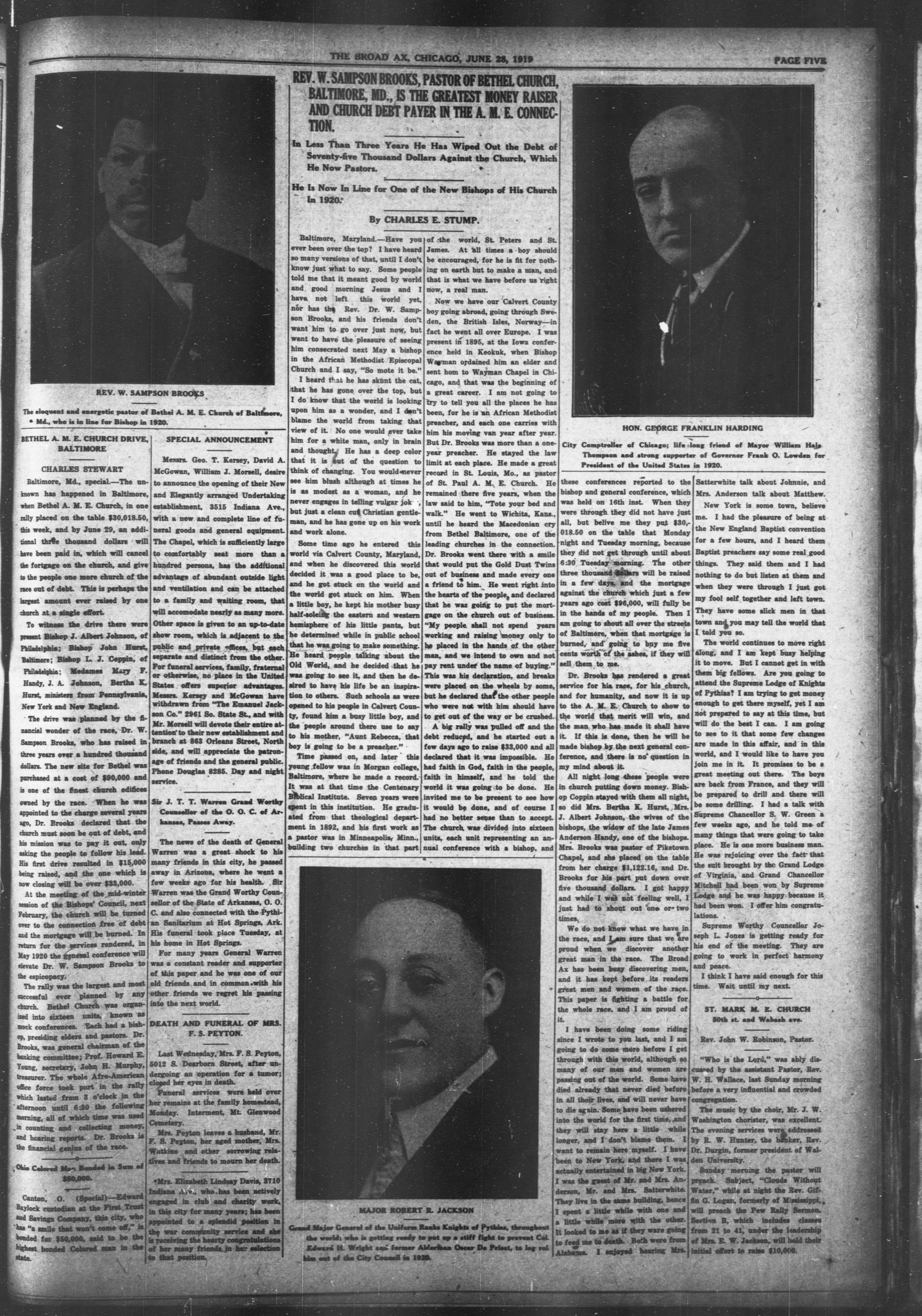
Page text (machine-generated)
Five hundred extra copies of The Broad Ax sold last Saturday and Sunday. The articles on the Eighth Regiment in France, by Rev. W. S. Braddan, are attracting wide attention
One Hundred copies of this issue forwarded to Baltimore, Md.
THE BROAD AX
HEW TO THE LINE; LET THE CHIPS FALL WHERE THEY MAY
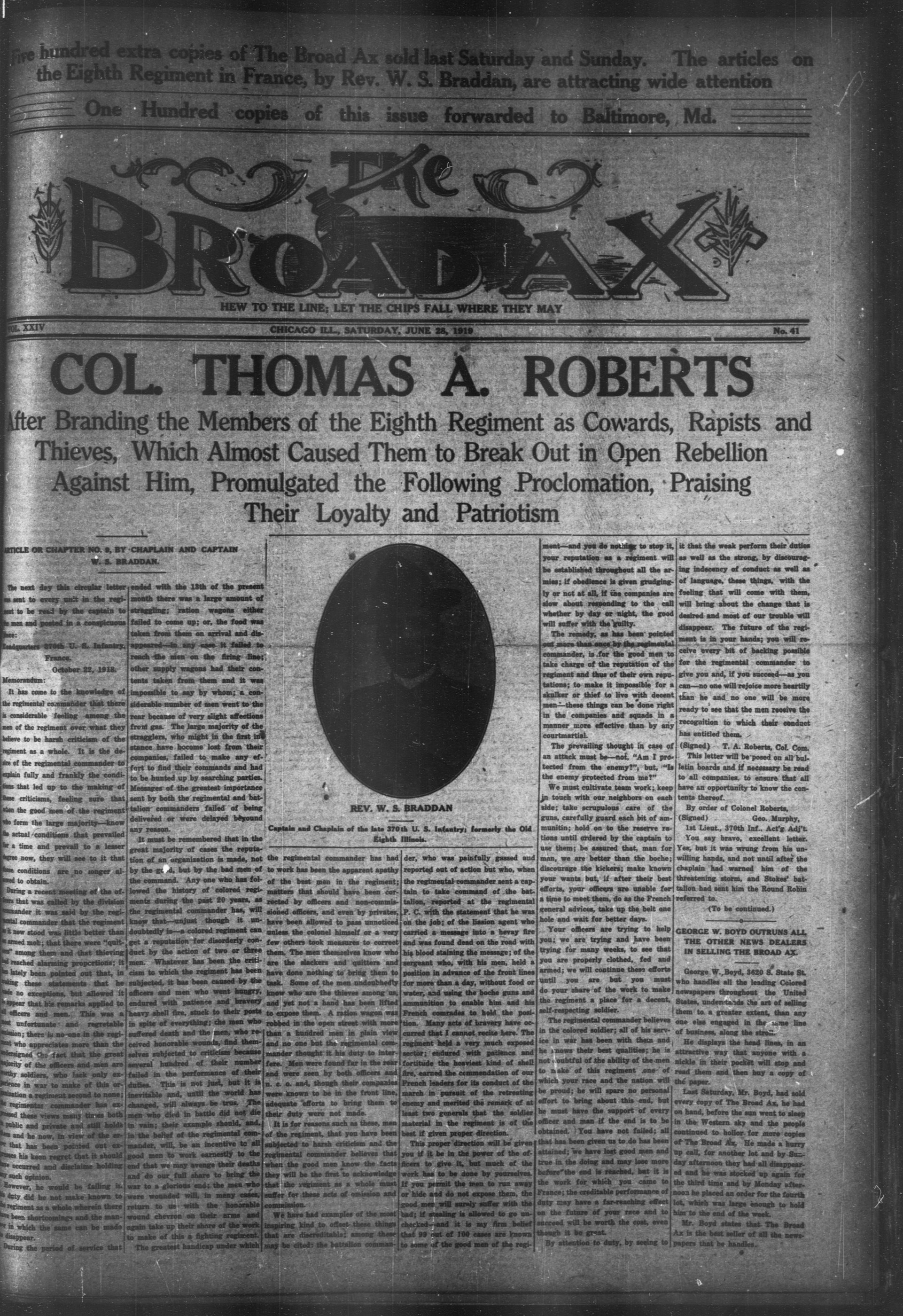
COL. THOMAS A. ROBERTS
After Branding the Members of the Eighth Regiment as Cowards, Rapists and Thieves, Which Almost Caused Them to Break Out in Open Rebellion Against Him, Promulgated the Following Proclomation, Praising Their Loyalty and Patriotism
The next day this circular letter was sent to every unit in the regiment to be read by the captain to the men and posted in a conspicuous place:
Headquarters 370th U. S. Infantry, France.
October 22, 1918.
Memorandum:
It has come to the knowledge of the regimental commander that there is considerable feeling among the men of the regiment over what they believe to be harsh criticism of the regiment as a whole. It is the desire of the regimental commander to explain fully and frankly the conditions that led up to the making of these criticisms, feeling sure that when the good men of the regiment who form the large majority—know the actual conditions that prevailed for a time and prevail to a lesser degree now, they will see to it that these conditions are no longer allowed to obtain.
During a recent meeting of the officers that was called by the division commander it was said by the regimental commander that the regiment as it now stood was little better than an armed mob; that there were "quitmen" among them and that thieving had reached alarming proportions; it was lately been pointed out that, in making these statements that he made no exceptions, but allowed it to appear that his remarks applied to all officers and men. This was a great unfortunate and regretable omission; there is no one in the regiment who appreciates more than the undersigned the fact that the great majority of the officers and men are worthy soldiers, who lack only experience in war to make of this organization a regiment second to none; the regimental commander has expressed these views many times both in public and private and still holds them and he now, in view of the answer that has been pointed out expresses his keen regret that it should have occurred and disclaims holding any such opinion.
However, he would be failing in his duty did he not make known to the regiment as a whole wherein there have been shortcomings and the manner in which the same can be made a disappear.
During the period of service that
ended with the 13th of the present month there was a large amount of straggling; ration wagons either failed to come up; or, the food was taken from them on arrival and disappeared—in any case it failed to reach the men on the firing line; other supply wagons had their contents taken from them and it was impossible to say by whom; a considerable number of men went to the rear because of very slight affections from gas. The large majority of the stragglers, who might in the first instance have become lost from their companies, failed to make any effort to find their commands and had to be hunted up by searching parties. Messages of the greatest importance sent by both the regimental and battalion commanders failed of being delivered or were delayed beyond any reason.
It must be remembered that in the great majority of cases the reputation of an organization is made, not by the good, but by the bad men of the command. Any one who has followed the history of colored regiments during the past 20 years, as the regimental commander has, will know that—unjust though it undoubtedly is—a colored regiment can get a reputation for disorderly conduct by the action of two or three men. Whatever has been the criticism to which the regiment has been subjected, it has been caused by the officers and men who went hungry, endured with patience and bravery heavy shell fire, stuck to their posts in spite of everything; the men who suffered death and the men, who received honorable wounds, find themselves subjected to criticism because several hundred of their number failed in the performance of their duties. This is not just, but it is inevitable and, until the world has changed, will always be true. The men who died in battle did not die in vain; their example should, and, in the belief of the regimental commander, will be an incentive to all good men to work earnestly to the end that we may avenge their deaths and do our full share to bring the war to a glorious end; the men who were wounded will, in many cases, return to us with the honorable wound chevron on their arms and again take up their share of the work to make of this a fighting regiment.
The greatest handicap under which
REV. W. S. BRADDAN
REV. W. S. BRADDAN
the regimental commander has had to work has been the apparent apathy of the best men in the regiment; matters that should have been corrected by officers and non-commissioned officers, and even by privates, have been allowed to pass unnoticed unless the colonel himself or a very few others took measures to correct them. The men themselves know who are the slackers and quitters and have done nothing to bring them to task. Some of the men undoubtedly know who are the thieves among us, and yet not a hand has been lifted to expose them. A ration wagon was robbed in the open street with more than a hundred men in plain view and no one but the regimental commander thought it his duty to interfere. Men were found far in the rear and were seen by both officers and n. c. o. and, though their companies were known to be in the front line, adequate efforts to bring them to their duty were not made.
It is for reasons such as these, men of the regiment, that you have been subjected to harsh criticism and the regimental commander believes that when the good men know the facts they will be the first to acknowledge that the regiment as a whole must suffer for these acts of omission and commission.
We have had examples of the most inspiring kind to offset these things that are discreditable; among these may be cited: the battalion command-
der, who was painfully gassed and reported out of action but who, when the regimental-commander sent a captain to take command of the battalion, reported at the regimental P. C. with the statement that he was on the job; of the Hison agent who carried a message into a heyay fire and was found dead on the road with his blood staining the message; of the sergeant who, with his men, held a position in advance of the front lines for more than a day, without food or water, and using the boche guns and ammunition to enable him and his French comrades to hold the position. Many acts of bravery have occurred that I cannot recite here. The regiment held a very much exposed sector; endured with patience and fortitude the heaviest kind of shell fire, earned the commendation of our French leaders for its conduct of the march in pursuit of the retreating enemy and merited the remark of at least two generals that the soldier material in the regiment is of the best if given proper direction.
This proper direction will be given you if it be in the power of the officers to give it, but much of the work has to be done by yourselves. If you permit the men to run away or hide and do not expose them, the good men will surely suffer with the bad; if sealing is allowed to go unchecked—and it is my firm belief that 99 out of 100 cases are known to some of the good men of the regi-
ment—and you do nothing to stop it, your reputation as a regiment will be established throughout all the armies; if obedience is given grudgingly or not at all, if the companies are slow about responding to the call whether by day or night, the good will suffer with the guilty.
The remedy, as has been pointed out more than once by the regimental commander, is for the good men to take charge of the reputation of the regiment and thus of their own reputations; to make it impossible for a skulker or thief to live with decent men—these things can be done right in the companies and squads in a manner more effective than by any courtmartial.
The prevailing thought in case of an attack must be—not, "Am I protected from the enemy?", but, "Is the enemy protected from me?"
We must cultivate team work; keep in touch with our neighbors on each side; take scrupulous care of the guns, carefully guard each bit of ammunition; hold on to the reserve rations until ordered by the captain to use them; be assured that, man for man, we are better than the boche; discourage the kickers; make known your wants but, if after their best efforts, your officers are unable for a time to meet them, do as the French general advices, take up the belt one hole and wait for better days.
Your officers are trying to help you; we are trying and have been trying for many weeks, to see that you are properly clothed, fed and armed; we will continue these efforts until you are but you must do your share of the work to make the regiment a place for a decent, self-respecting soldier.
The regimental commander believes in the colored soldier; all of his service in war has been with them and he knows their best qualities; he is not doubtful of the ability of the men to make of this regiment one of which your race and the nation will be proud; he will spare no personal effort to bring about this end, but he must have the support of every officer and man if the end is to be obtained. You have not failed; all that has been given us to do has been attained; we have lost good men and true in the doing and may lose more before the end is reached, but it is the work for which you came to France; the creditable performance of duty may have a far-reaching effect on the future of your race and to succeed will be worth the cost, even though it be great.
By attention to duty, by seeing to
if that the weak perform their duties as well as the strong, by discouraging indecency of conduct as well as of language, these things, with the feeling that will come with them, will bring about the change that is desired and most of our trouble will disappear. The future of the regiment is in your hands; you will receive every bit of backing possible for the regimental commander to give you and, if you succeed—as you can—no one will rejoice more heartily than he and no one will be more ready to see that the men receive the recognition to which their conduct has entitled them.
(Signed) T. A. Roberts, Col. Com. This letter will be posed on all bulletin boards and if necessary be read to all companies, to ensure that all have an opportunity to know the contents thereof.
By order of Colonel Roberts,
(Signed) Geo. Murphy,
1st Lieut., 370th Inf., Act'g Adj't.
You say bravo, excellent letter.
Yes, but it was wrung from his unwilling hands, and not until after the chaplain had warned him of the threatening storm, and Stokes' battalion had sent him the Round Robin referred to.
GEORGE W. BOYD OUTRUNS ALL THE OTHER NEWS DEALERS IN SELLING THE BROAD AX.
George W. Boyd, 3620 S. State St. who handles all the leading Colored newspapers throughout the United States, understands the art of selling them to a greater extent, than any one else engaged in the same line of business, along the stroll.
He displays the head lines, in an attractive way that anyone with a nickle in their pocket will stop and read them and then buy a copy of the paper.
Last Saturday, Mr. Boyd, had sold every copy of The Broad Ax, he had on hand, before the sun went to sleep in the Western sky and the people continued to hollar for more copies of The Broad Ax. He made a hurry up call, for another lot and by Sunday afternoon they had all disappeared and he was stocked up again for the third time and by Monday afternoon he placed an order for the fourth lot, which was large enough to hold him to the end of the week.
Mr. Boyd states that The Broad Ax is the best seller of all the newspapers that he handles.
PAGE TWO
THE BROAD AX
Published Every Saturday
In this city since July 15th, 1899,
without missing one single issue. Republican, Democrats, Catholics, Protestants, Single Taxera, Priests, indols or anyone else can have their say as long as their language is proper and responsibility is fixed.
The Broad Ax is a newspaper whose platform is broad enough for all, ever claiming the editorial right to speak its own mind.
Local communications will receive attention. Write only on one side of the paper.
Subscriptions must be paid in advance.
One Year.....$2.00
Six Months.....1.00
Advertising rates made known on application.
Address all communications to
THE BROAD AX
£206 So. Elizabeth St., Chicago, Ill.
Phone Wentworth 2597.
JULIUS F. TAYLOR
Editor and Publisher
DR. M. A. MAJORS
Associate Editor
4700 South State Street
Phone Droxel 1416
Vol. XIV. June 28,1919 No. 41
Entered as Second-Class Matter, Aug.
19, 1902, at the Post Office at Chicago,
Ill., Under Act of March 3, 1879
Not Going To Withdraw It.
A man who had a very bad impediment in his speech once got into an argument with an acquaintance to whom he had taken a great dislike. The dispute became hotter and hotter until the unfortunate stammerer completely lost his temper. "You're a I-F-I-fool!" he shouted furiously. "Sir," replied the acquaintance coldly, "you must retract that at once." "Never!" retorted the stammerer. "Tm too glad to g-g-get it out!"
Spirits of Trees.
The Malayans and other Jobore natives believe that each species of tree has a spirit or divinity that presides over its affairs. The spirit of the camphor tree is known by the name of Bisman—literally, "a woman." Her resting place is near the tree, and when at night a peculiar noise is heard in the woods resembling that of a cicada, the Bisman is believed to be singing and camphor will surely be found in that neighborhood.
Author of the "Doxology."
The author of the "Doxology" was the English bishop, Thomas Ken (1837-1711), who, in 1601, was deprived of his see (Bathe and Wells) as a nonjuror. His most widely known hymns include the morning and evening hymns, "Awake, My Soul!" and "Glory to Thee, My God, This Night," both of which end with the famous "Doxology," "Praise God From Whom All Blessings Flow."
HornbillPa Remarkable Nest
Most wonderful of all is the nest of the hornbill. The hen bird lays her eggs in a hollow in a tree, and as soon as she is settled on them the male bird walla her in with clay, leaving just space for her head to stick out. He feeds her, and there she sits, not only until the eggs are hatched, but until the young are big enough to come out.
Untying the Knot
There is a marriage custom among the Santals, a tribe in India, by which, after a cash price has been set on the bride by the parents, the flance and his lady tie a knot in a string for each day to intervene before the wedding. Then the parents separate; day by day a knot is unfied, and when the end of the string is reached the real knot is tied that makes the couple one.
Pearl Superstition
Pearls used to be considered unlucky and history tells of more than one queen who, before the sudden and tragic death of their royal consorts, saw in dreams all their jewels turned to pearls and were told that it preaged tears. Just the same, women were not afraid to wear them and nowadays we laugh at superstition.
Rich Silver Colina
In the republic of Honduras the silver currency was for years minted from Socorro bullion. This nearly always contains a certain proportion of gold, which used not to be separated before it went to the mint; so the Honduras silver coins prior to 1011 generally contain a certain proportion of gold.
Sensitiveness of Plants.
When rain is about to fall the clover shits its leaves, bringing two of its three leaves face to face and folding the third over the tow. The young blossoms are also carefully sheltered by including leaves which move forward in the evening and wrap them
Damnats now come rheumatism, dyspepsia, kidney troubles, sore eyes and corns by pulling, filling or otherwise maltreating the teeth. Stomach specialists relieve toothache by treating the digestion. Meadaches have nothing to do with the head, except to make it hurt; the seat of their operations is in the stomach or liver. The whole body seems to be merely a system of interlocking directories, the Philadelphia Ledger comments.
Why, then, one is inclined to ask, do we have specialists? If the functions of the body, instead of being a system of such complete entanglements and inter-relations from head to foot, were really divided up into watertight compartments, then specialistic treatment would indeed be indicated. In that case each specialist would have his own compartment to look after, with a sign upon the membrane which marks the entrance to his domain, "Trespassers will be prosecuted." But what are you going to do with a body in which nephritis is directly caused by an ulcerated tooth which the dentist hasn't discovered, and the legs swell up and become useless because there is an unlicited intestinal kink? It would really seem that before a man is fitted to operate as a specialist on any part of the body he must have specialized a while over every other part of it—so that the East side doctor's sign, "Specialist in All Diseases," need not be regarded as so absurd after all. The first qualification of a good specialist is to be an all-around physician.
But at present the dentist has the advantage over all other specialists. Give him a chance to pull out every tooth in your head and you will be delivered forever from Bright's disease, rheumatism, pleurisy, liver complaint, neuritis, pyelitis, and virtually every other kind of disease. But what will the dentist do when he has drawn everybody's teeth?
MUCH DEPENDS ON ONESELF
Good Hard Sense as Applied to Ancient Superstitions Concerning "Blue Monday."
I happened to find a most entertaining old book in the free library—a dictionary of superstitions. It has three big volumes, all crammed with the fears and beliefs of the human race. Just to sample some of them that apply to Monday, here are a few:
"If things commence to go wrong on Monday they will go wrong all the week, but if you have good luck on Monday you will keep it up."
"Pay no bills on Monday if you can help it."
(This is congenial advice and easily followed.)
"If you meet a cross-eyed person on Monday you will not have go.d luck till Thursday."
"If the sun sets clear Friday night it will rain before Monday night."
"It is a bad sign to lose a tooth on Monday."
(Yes, or a hand or a leg either, I should say.)
"If you lose your temper three times on Monday, you will have a great family quarrel."
(This bit of sagacity has an excellent chance of being true, one would think. Still, there may be some men who could get away with three blow-outs and have no comeback.)
To add our own observation to the collected wisdom of the ages your Monday is neither more or less than what you choose to make it when you get out of bed in the morning. You can make it lucky or unlucky if you wish—Philadelphia Bulletin.
Impressionable Fewis
Sunshine seems to play an important part in the lives of fowls. There is no doubt that they lay much more regularly, and appear generally happier, when in the sunlight. The next best thing to sunshine in this dull old country is a light which gives to the fowls the impression that the sun is shining.
Fortunately the fowl is easily deceived, with the result that a great deal of success has attended the experiments of a well-known engineer who is building fowl-houses with a material similar to canvas, stained and varnished so that the house is always lighted in the daytime with light of a pleasant golden color. By means of electric light placed outside, the fowls can easily be made to think the sun is always shining; and so successful have been the results that a farm is being established on these lines.
Tick!iah. Ien't it?
Is there a problem which, perhaps, is more likely to be answered some day than this one, which has been propounded to the bewilderment of scientists.
Suppose a pipe which would permit of the passage of a man's body were pierced through the earth from London to the Antipodes, and a man commenced to descend by means of a ladder running the length of the pipe. Naturally he would descend feet foremost. On reaching the center of the earth he would, on account of the revolution and formation of the globe, presumably be going upwards until he emerged in the Antipodes.
Query: How can a ladder on which one is descending become a ladder on which one is ascending? And how could one go up a ladder feet foremost? Next, please!
Wedding Riga.
The wedding ring was not always plain, as we see it today. It was frequently highly ornamented and wrought with various designs. But as other rings began to be worn the wedding ring was made conspicuously plain. The practice, however, was long in vege of lincebiling appropriate mottoes on rings. The ring may be said to be symbolic. It is of gold and typifies purity and refinement, whereas its rotundity signifies "the round nowing of mutual love and hearty affection."
The two great centers of earthquake activity in the British isles are Comrie, in Perthshire, and Mersea Island, in the mouth of the Blackwater, on the Estes coast. In both these localities earthquakes are frequent, and earthquakes are usually a sign of volcanic activity. Highly unpleasant as it would be, geologists would be no more surprised at the resurrection of one of the British volcanoes than they have been at the rebirth of Mount Elburz.
Waves of Young Sparrows.
Ways of Young Sparrows. After the young sparrows leave the nest, they gather in nocks, which with other flocks return every night to the same roosting place, writes Frank W. Chapman, in "Our Winter Birds." Sometimes this is in a densely-foliaged tree, at others in ivy or other vines. The birds all seem to have much to say as they retire, and cluster together in a chorus which is fortunately hushed by the approach of darkness.
Three Capital Crimes.
"When I was a boy," states Mr. Patch in Stockton Herald, "there were three capital crimes—murder, blasphemy, and lying abed in the morning. Of the three, murder and blasphemy might sometimes be forgiven, but late rising never. One of my grandfathers frequently got up at four o'clock on a winter morning, built a fire in the cook stove and then would sit down by it and go to sleep."—Kansas City Times.
Official Peace Day.
May 18 in 1899 was called "Peace day." It was the opening of the international peace conference at The Hague in Holland, which established the permanent court of arbitration for the settlement of all vital issues between and among the great nations. The conference was first proposed by the cxar of Russia.
Show Volcanic Formation
The whole of the west of Scotland and northeast Ireland are of volcanic formation. Look at the Giant cane-way, with its queer pipes of basalt, and the Isle of Skye, which is simply made of lava. Stafa consists of sheets of bedded basaltic lava, and the famous Fingail's cave is excavated from pure lava.
Columbus' III Fate.
On the twentieth of May, 1506, Christopher Columbus died at Valladolid, Spain, at the age of seventy. His whole life had been devoted to exploration and discovery for the aggrandizement of Spain, yet his last years were embittered by the ingratitude shown him by the nation.
Eyeglasses.
The suggestion of the use of lenses for the cure of eye defects was made by Roger Bacon, the great scientist of the thirteenth century. The making of the spectacles was carried out by Italians. Physicians of those days, however, did not know the true theory upon which they were based.
Nature's Wonderful Work.
Nature gives to every time and season some beauties of its own; and from morning to night, as from the cradle to the grave, is but a succession of changes so gentle and easy that we can scarcely mark their progress. —Dickens.
Opinion.
Opinion is divided into four parts—what we want our friends to think of us, what we think they think of us, what they do think of us, and what we think they think we think they think of us.
First Land Sale
We should say the first land sale on record was the purchase of the field of Machpelah by Abraham, who paid 400 shekels of silver for the field in which he buried his wife.
Happiness and Interests. Personal happiness is almost synonymous with personal interests; the wider the range of the latter the higher is the degree of happiness.—Lilian Whiting.
It is quite true that there are 1,031 different kinds of faiths in the world—and there are about 3,456,876 different kinds of sheer cussetness!
Moral Purpose.
The greatest work has always gone hand in hand with the most fervent moral purpose—Sidney Lanier.
Daily Thought.
Man is but a reed, the weakest in nature, but he is a thinking reed—Maude Fascal.
Between Syracuse and Rochester lies a country of hills, known as drummins, which is one of the most beautiful and unique bits of scenery in the eastern United States. The term drummil is an Irish one and is applied to low, rolling hills of glacial origin which exist in that country, and also in parts of New York and New England. This section between Syracuse and Rochester is the very heart of the American drummil.
Most American mountains and hills were formed by violent disturbances of the earth's surface, and their rude origin is reflected in their ruggedness. But the drummil were built by the great ice sheet which once covered all of North America. The materials of which they are made were pushed together slowly by the crawling glaciers moulded and tamped and smoothed by the great ice fingers as a child makes mud pies.
The drummins look as though they had been designed by some great intelligence with a sense of beauty, for they rise in smooth, gentle curves, like those of a perfect human body. They are remarkably uniform in height, usually a little less than 200 feet, and so smooth and lenient are their slopes that many of them are cultivated to their summits. Some of them are as round as half an apple, and others are long weils or rolls. Scattered among the hills are a number of small lakes and ponds, clear and pretty, and there is good fishing in many of them. The drummins are a favorite playground of the people in Syracuse, Rochester and other nearby towns, but they are little known beyond the counties in which they lie.
CHARM OF "MERRIE ENGLAND"
What It Was in the Days of Old Can Still Be Discerned in Spots Today.
Of our forefathers, nine out of ten lived in the rural parts; and the remainder, the busiest and the best title of English humanity, in towns whose darkest lane was never a mile from the orchards round the town, so that the recreation of the city dweller was by the hedgerows and riverbanks. . . . The spring and the winter came unsought into every man's life, not as they come today, wayfarers bewandered among the housetops, feebly whispering of unknown things in far salubrious lands, but fresh with bursting bough or strong in glowing frost. The thoughts of the "Allegro" and "Il Penseroso" are indeed the glowing of a rare mind, but the most valgar slave of custom enjoyed in the days of King Charles the conditions of daily life which Milton there described; the sweet influences of the seasons, had their effect. . . . Whether they knew it or not, the Cavalliers drew their charm from the fields, and the Puritans their strength from the earth. . . . What this old England was can still be seen and felt in the combes and on the round hilltops of Somerset and Devon, in the wooded lands over which Malvern looks to the west, and in the broken valleys that lead the lake mountains down toward the sea. —G. M. Trevelyan.
Prizes for Pigmanship
Every year, a pig race is held at Crone-sur-Marne, in the north of France, a prize of 2,000 francs being awarded the lucky rider of the winning plig. This race is held in accordance with the terms of the will of a wealthy tradesman of the village, who died forty-two years ago.
He ordered that amongst the amusements of the annual fete should be included a race with pigs, to be ridden either by men or boys. The prize, however, was not to be handed to the winning jockey except on condition that he wore deep mourning for the deceased for two years after the race. The municipality accepted the eccentric bequest, and these singular races have been held regularly ever since.
Felicity a Necessity.
The presence of a wise population implies the search for felicity as well as for food; nor can any population reach its maximum but through that wisdom which "rejoices" in the habitable parts of the earth. The desert has its appointed place and work; the eternal engine, whose beam is the earth's axle, whose beat is its year, and whose breath is its ocean will still divide imperiously to their desert kingdoms bound with unfurrowable rock, and swept by unarrested sand, their powers of frost and fire; but the stones and lands between, habitable, will be loveliest in habitation. The desire of the heart is also the light of the eyes.—Huskin.
Question of Opinion
Question of Opinion.
The late General Booth of the Salvation army was conducting a big meeting which lasted unusually long, and toward the close a newspaper reporter left his seat and gained the aisle. General Booth pointed a finger at him and said:
"Whoever leaves this auditorium will be damned by God."
The reporter answered: "If I don't leave this auditorium and hurry back to my office I'll be damned by the city editor."
"Yes, I think he is," plausely responded the reporter, "but the city editor doesn't!"
The conductor of a band, giving an open-air concert, beat time very energetically, leaning now toward one part of the band and now to another, and stamping his foot apparently in paroxysms of musical fervor. Mike, in the audience, watched him, fascinated; but at the end of the selection, with a disappointed air, he turned to leave. "How old ye like it, Mike?" asked his friend. "Come away!" said Mike, in disgust. "Ol've been watchin' him for half an hour, and he hasn't hit one of them yet!"
Eastern "Mad-Stones."
In eastern countries rabies is treated by the "tabasheer," or some other form of what are indifferently called "make stones," or "madstones," and which are believed to be a specific for all forms of poisonous bites or wounds. "Tabasheer" is a porous, stony accretion found in the stalks of bamboo. It was used in Persia so long ago as the tenth century, and is carefully described by the French traveler Tavernier, who visited India in the seventeenth century.
First Aero Mail Service.
The first regular aero mail service in the world was started by the United States government, May 15, 1918, between New York and Washington. The actual flying time made was three hours and twenty minutes, including six minutes' stop for relaying at Philadelphia. At that time the fastest railroad train record between the two cities was five hours. The airship time has since been reduced to two hours and thirty minutes.
Grateful Enjoyment
Suffering is not necessarily a blessing in disguise. Sometimes it is simply an undisguised evil, an evil that we have no right to be carying about with us. Self-denial for its own sake is only a foolish refusal of pleasures that we might thankfully enjoy. Courage and faith when trouble comes are no more our duty than is grateful enjoyment of our blessings when the days are bright.
"Cobbler's Dozen."
While in most countries thirteen is always spoken of as "the baker's dozen," in Italy it is called "the cobbler's dozen." There is a tradition in Italy that formerly there was a law compelling cobblers to put twelve nails round the edge of a boot heel, and that when nails were cheap, a thirteenth nail was driven in the center for luck.
Sponge Reservoirs Plant
Sponge Resembles Plant. Seen alive in its natural surroundings at the bottom of the sea, the sponge looks like a small plant. Sponging is an old industry in Nassau. Most of the "harvest of the sea" in pre-war days was shipped to the great sponge-markets of Europe-London and Paris. New York also came in for its share.
The Bowling Green.
Bowling Green is New York city's oldest park, says Gas Logic. It was leased by the city council in 1732 to John Chambers, Peter Bayard and Peter Jay for a "bowling green," at an annual rental of one peppercorn a year. The original lease was for 11 years.
Amphibious soldiers.
A Frenchman has suggested that with a little training the solide, may be amphibious to a certain degree. It is contended that with practice a body of soldiers with their arms and accounts could cross a stream 90 feet wide by merely walking across on the bottom with the water over their heads.
Better Off Than His Dad.
Nowadays a man thinks he is having a rough time when he has to help move the furniture around a bit, forgetting that his glorious dad used to spend a week out in the back yard beating the dust out of carpets and thought nothing of it.
"You say the jury is deliberating?"
"Yes, they are," replied the sarcastic lawyer. "The only juror who has a thimbleful of brains is probably telling 11 numskulls that my client is guilty."—Birmingham Age-Herald.
"Ah always had mo' faith in sympathy dan in congratulations," observed Shinbone. "You knows fo' sure dat dar can't anybody gwinter be jealous ob you' haub luck."—Boston Transcript.
One of the largest squares in London, the open space called Lincoln's Inn fields, is said to be the same size as the base of the Great Pyramid at Giza.
It is for him that is lonely or in prison to dream of fellowship, but for him that is of a fellowship to do and not to dream.—William Morris.
In the Morning.
A happy hour in the morning sweetens the whole day—Louisa Olcott.
Daily Thought.
Silence is more eloquent than words.
—Carlyle.
PHILOSOPHER'S VIEW OF LIFE
Mr. Goslington Tells How Sight of Funeral Procession Brings Reections That Uplift.
"As a rule," said Mr. Goslington, "I take a cheerful view. Perhaps when I get to be older I shall be more doleful, but it would be hard for me to be that way now. For as far as I've got life has been pretty good to me. I have had my little setbacks and now and then a real jolt, but on the whole my lot has been happy.
"True I have not accumulated a fortune, but I have had work to do and I have earned a living, I might say a comfortable living; and I have been blessed with good health. And so for me all nature smiles and men are friendly and the world is a pleasing place to live in; I take a cheerful view—as a rule.
"But I will admit that I do have spells, not of sheer despondency—I would not say that, but times when I am depressed, when things go wrong, when adverse happenings have all but discouraged me; times when I totally forget what we should in such days always remember, namely, that there never yet was a storm but cleared of some time, to leave everything bright and sunshine as before; there are times, I say, when even I, usually so cheerful, am downcast.
When thus oppressed I find great help in funeral processions.
"As the solemn cortege passes I cannot but reflect that I still have the one great priceless gift and blessing—life, with all its hopes and opportunities; and so, with all respect and sorrow for the dead, in this presence my own petty troubles vanish, the clouds roll back and the sun comes out clear and strong again.—New York Sun.
STORK'S VISIT TO SCOTLAND
Record of Bird's Appearance in 1418
May Be Found in Chronicles of
the Country.
The white stork of the continent of
Europe, which is encouraged in most,
and even protected in some, of the
countries to which it resorts to breed,
and round which much story and leg-
end have gathered, has been known
for centuries to be an occasional
visitor to the British isles, chiefly to Nor-
folk, but very rarely to Scotland,
though it has never been known to
nest or even attempt to do so in Brit-
ain.
However, a record of its having nested in Scotland appears in Good all's edition of the "Schotchchonchon." This work was begun by John Fordun, who died about 1384, and was continued by Walter Bower, the abbot of Inchcolm. It is in Bower's chronicles for 1416 that the story appears. The translation runs thus:
"In the year of our Lord, fourteen hundred and sixteen, there died on the morrow of the birth of St. John the Baptist, Master James Hiset, prior of St. Andrew's. In this same year, a pair of storks came to Scotland and nested on top of the church of St. Giles of Edinburgh and dwelt there throughout a season of the year; but to what place they flow away thereafter so one known."
Commenting on this, Lord Lagie Clarke says: "The church of St. Glare on which the storks nested, was a new stone edifice commenced in 1887, to replace a former church destroyed in 1885, and some of it doubtless forms part of the cathedral of today."
Mark Twain on Conscience
Mark Twain on Conscience
There is on record a conversation that Mark Twain had with Kipling, in which the former discussed on the conscience. The story is told by Kipling. He reports Twain as saying: "A conscience is like a child. If you pet it and play with it and let it have everything that it wants it becomes spoiled and intrudes on all your amusements and most of your griefs. Treat your conscience as you would treat anything else. When it rebels spank it—be severe with it, prevent its coming to play with you at all hours, and you will secure a good conscience; that is to say, a properly trained one. A spilled one simply destroys the pleasures of life. I think that I have reduced mine to order. At least I have not heard from it for some time. Perhaps I have killed it from severity. It's wrong to kill a child, but in spite of all I have said a conscience differs from a child in many ways. Perhaps it's best when it is dead."
Innovation #Eaker, Bistol
Ingenious "Fake" Pistol.
A French inventor has recently placed on the market a "fake" pistol. This weapon, although in reality absolutely harmless, goes off with a very realistic crack when the trigger is pulled. It also makes a blinding flash calculated to scare any burglar.
Inventions of an even more complicated nature are constantly being heard of. A well-to-do gentleman living in Surrey has recently had his house and grounds fitted with an elaborate burglar trap. With this device a midnight marauder cannot approach near the house without setting a number of electric bells within a ringing. And should the burglar not hear them and actually enter the building he would be caught in a vise by one of the many steel contraptions cunningly placed about—London Tit-Bits.
Mrs. Justwed—When I married I resolved to yield to my husband in everything
Mrs. Langwed—So did L. And then resolved never to act on that resolution.
The feather trimming which has learned dancing frocks all winter will be seen during the summer gayly waving along the edges of parasols. One of the imported models of very dark silk has a Belgian blue feather edge running along in a pointed effect of wavy curling tips. Of course it is unusual enough to cause the most close person to say, "Well, for goodness sake."
Still another model also of the deep nose which we call midnight has a narrow fringe of red uncurled ostrich and this somehow does not seem so startling as the curly feather for the season that we have often seen fringe on parasols, and the uncurled ostrich deeply resembles fringe.
Parasols this summer are different in many ways from their predecessors, not as to their main characteristics, for after all a parasol is a parasol and can only be of certain shapes, but as to the materials of which they are made. A very handsome one of these black net is lined with soft black cliffon. On the outside a band of silver and black lace 12 inches deep goes entirely around the outside in a flat circle. This parasol is really beautiful and makes one wonder why we have never seen things like it before. The handles of all of these are of dark handsome wood with no carving, and the ribs and tips are of white bone.
One seldom sees the long handles which were so fashionable some seasons ago, for the correct parasol of the moment both for rain and sun is rather short as to handle and shorter as to tip. The new silks impervious to any kind of weather are shown in lovely colors, so that it is possible to match any costume. The smartest of these little utility umbrellas have leather loops through the handles and by means of which they can be carried over the arm.
Velvet parasols are new enough to cause comment, designed perhaps for service with the newest of the sport coats, which are at this moment being made of velvet with collars and revers of white Angora wool. In fact almost every material which has never been used before is appearing in parasols this season—challis, organdie, cretonne and linene, though of course the latter two materials have been used year after year.
Western Newspaper Union
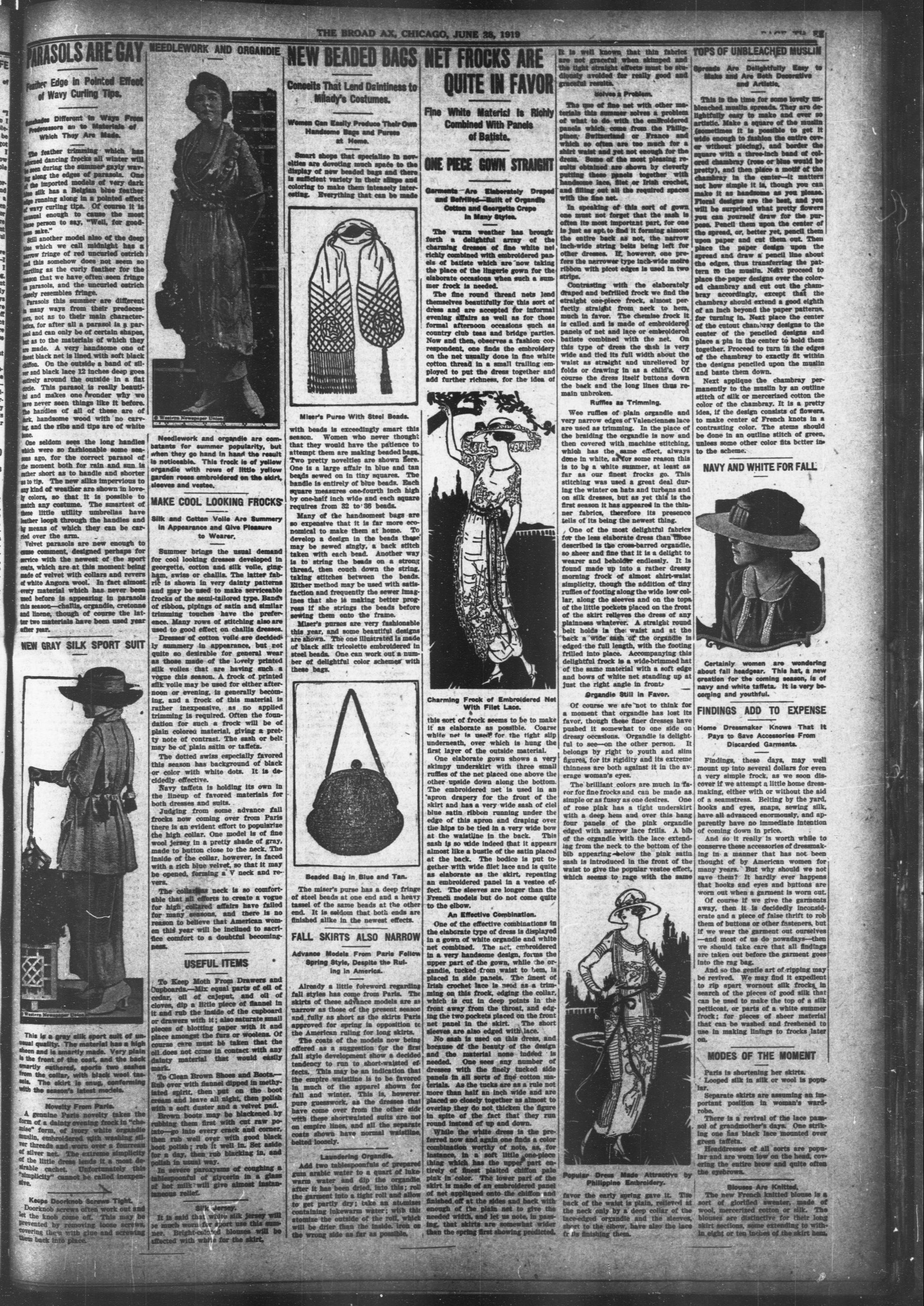
This is a gray silk sport suit of unusual quality. The material has a high sheen and is smartly made. Very plain is the front of the coat, and the back smartly eathered, sports two cashes from the collar, with black wool tassels. The skirt is enug, conferring with the season's latest models.
Novelty From Paris.
A genuine Paris novelty takes the form of a dainty evening frock in "chemise" form, of ivory white ornament muslin, embroidered with washing silver threads and worn over a fourround of silver net. The extreme simplicity of the little dress lends it a most desirable cachet. Unfortunately this "simplicity" cannot be called inexpensive.
Keeps Doorknob Screws Tight
Doorknob screws often work out and let the knob come off. This may be prevented by removing loose screws, covering them with glue and screwing them back into place.
© Western Newspaper Union
Needlework and organdle are combatants for summer popularity, but when they go hand in hand the result is noticeable. This frock is of yellow organdle with rows of little yellow garden roses embroidered on the skirt, sleeves and vestes.
MAKE COOL LOOKING FROCKS
Silk and Cotton Voile Are Summary in Appearance and Give Pleasure to Wearer.
Summer brings the usual demand for cool looking dresses developed in georgette, cotton and silk voile, gingham, swiss or challis. The latter fabric is shown in very dainty patterns and may be used to make serviceable trocks of the semi-tailored type. Bands of ribbon, pipings of satin and similar trimming touches have the preference. Many rows of stitching also are used to good effect on challis dresses.
Dresses of cotton volle are decidedly summery in appearance, but not quite so desirable for general wear as those made of the lovely printed silk vollees that are having such a vogue this season. A frock of printed silk volle may be used for either afternoon or evening, is generally becoming, and a frock of this material is rather inexpensive, as no applied trimming is required. Often the foundation for such a frock will be of plain colored material, giving a pretty note of contrast. The sash or belt may be of plain satin or taffeta.
The dotted swiss especially favored this season has background of black or color with white dots. It is decidedly effective.
Navy taffeta is holding its own in the lineup of favored materials for both dresses and suits.
Judging from some advance fall frocks now coming over from Paris there is an evident effort to popularize the high collar. One model is of fine wool jersey in a pretty shade of gray, made to button close to the neck. The inside of the collar, however, is faced with a rich blue velvet, so that it may be opened, forming a V neck and revers.
The collars as neck is so comfortable that all efforts to create a vogue for high collared affairs have failed for many seasons, and there is no reason to believe that American women this year will be inclined to sacrifice comfort to a doubtful becoming-
USEFUL ITEMS
To Keep Moth From Drawers and Cupboards—Mix equal parts of oil of cedar, oil of cajeput, and oil of cloves, dip a little piece of flannel in it and rub the inside of the cupboard or drawers with it; also saturate small pieces of blotting paper with it and place amongst the furs or woolens. Of course care must be taken that the oil does not come in contact with any dainty material that would easily mark.
To Clean Brown Shoes and Boots—Rub over with fannel dipped in methylated spirit, then put on the boot cream and leave all night, then polish with a soft duster and a velvet pad.
Brown boots may be blackened by rubbing them first with cut raw pointo—go into every crack and corner, then rub well over with good black boot polish; rub it well in. Set aside for a day, then rub blackening in, and polish in usual way.
In severe paroxysms of coughing a tablespoonful of glycerin in a glass of hot milk will give almost instantaneous relief.
Silk jersey.
It is said that white silk jersey will be much worn for sport use this summer. Bright-colored blouses will be affected with white for the skirt.
THE BROAD AX, CHICAGO, JUNE 28, 1919
Smart shops that specialise in newelties are devoting much space to the display of new beaded bags and there is sufficient variety in their shapes and coloring to make them intensely interesting. Everything that can be made
[Image of a scarf with a lattice pattern and tassel.]
Miser's Purse With Steel Beads.
with beads is exceedingly smart this season. Women who never thought that they would have the patience to attempt them are making beaded bags. Two pretty novelties are shown here.
One is a large affair in blue and tan beads sewed on in tiny squares. The handle is entirely of blue beads. Each square measures one-fourth inch high by one-half inch wide and each square requires from 32 to 36 beads.
Many of the handsomest bags are so expensive that it is far more economical to make them at home. To develop a design in the beads those may be sewed singly, a back stitch taken with each bead. Another way is to string the beads on a strong thread, then couch down the string, taking stitches between the beads. Either method may be used with satisfaction and frequently the sewer imagines that she is making better progress if she strings the beads before sewing them onto the frame. Miser's purses are very fashionable this year, and some beautiful designs are shown. The one illustrated is made of black silk tricolore embroidered in steel beads. One can work out a number of delightful color schemes with these bags.
A
Beaded Bag in Blue and Tan.
The miser's purse has a deep fringe of steel beads at one end and a heavy tassel of the same beads at the other end. It is seldom that both ends are finished alike in the newest effects.
Advance Models From Paris Fellow Spring Style, Despite the Ruling in America.
Already a little foreword regarding fall styles has come from Paris. The skirts of these advance models are as narrow as those of the present season and fully as short as the skirts Paris approved for spring in opposition to the American ruling for long skirts.
The coats of the models now being offered as a suggestion for the first fall style development show a decided tendency to run to short-waisted effects. This may be an indication that the empire waistline is to be favored in much of the apparel shown for fall and winter. This is, however, pure guesswork, as the dresses that have come over from the other side with these shortwaisted suits are not on empire lines, and all the separate coats shown have normal waistline, belted loosely.
Add two tahlespoonfuls of prepared gum arable water to a quart of lukewarm water and dip the organdle after it has been dried; into this; roll the garment into a tight roll and allow to get partly dry; take an atomizer containing lukewarm water; with this atomize the outside of the roll, which will be drier than the inside, iron on the wrong side as far as possible.
The warm weather has brought forth a delightful array of the charming dresses of fine white net richly combined with embroidered panels of batiste which are now taking the place of the lingerie gown for the elaborate occasions when such a summer frock is needed. The fine round thread nets lend themselves beautifully for this sort of dress and are accepted for informal evening affairs as well as for those formal afternoon occasions such as country club teas and bridge parties. Now and then, observes a fashion correspondent, one finds the embroidery on the net usually done in fine white cotton thread in a small trailing employed to put the dress together and add further richness, for the idea of
JANE
Charming Frock of Embreidered Net With Filet Lace.
this sort of frock seems to be to make it as elaborate as possible. Coarse white net is used for the tight slip underneath, over which is hung the first layer of the outside material.
One elaborate gown shows a very skimpy underskirt with three small ruffles of the net placed one above the other upside down along the bottom. The embroidered net is used in an apron drapery for the front of the skirt and has a very wide sash of ciel blue satin ribbon running under the edge of this apron and draping over the hips to be tied in a very wide bow at the waistline in the back. This sash is so wide indeed that it appears almost like a bustle of the satin placed at the back. The bodice is put together with wide fletl lace and is quite as elaborate as the skirt, repeating an embroidered panel in a vestee effect. The sleeves are longer than the French models but do not come quite to the elbow.
An Effective Combination.
One of the effective combinations in the elaborate type of dress is displayed in a gown of white organdie and white net combined. The net, embroidered in a very handsome design, forms the upper part of the gown, while the organdie, tucked from waist to hem, is placed in side panels. The finest of Irish crochet lace is used as a trimming on this frock, edging the collar, which is cut in deep points in the front away from the throat, and edging the two pockets placed on the front net panel in the skirt. The short sleeves are also edged with lace.
No sash is used on this dress, and because of the beauty of the design and the material none indeed is needed. One sees any number of dresses with the finely tucked side panels in all sorts of fine cotton materials. As the tucks are as a rule not more than half an inch wide and are placed so closely together as almost to overlap they do not thicken the figure in spite of the fact that they run round instead of up and down.
While the white dress in the preferred now and again one finds a color combination worthy of note, as, for instance, in a soft little one-piece thing which has the upper part entirely of finest plaited chiffon pale pink in color. The lower part of the skirt is made of an embroidered panel of not appliqued onto the chiffon and finished off at the sides and back with enough of the plain net to give the needed width, and let us note, in passing, that skirts are somewhat wider than the spring first showing predicted.
It is well known that thin fabrics are not graceful when skimped and the light straight effects must be studiously avoided for really good and graceful results.
Solve a Problem.
The use of fine net with other materials this summer solves a problem of what to do with the embroidered panels which come from the Philippines; Switzerland or France and which so often are too much for a shirt waist and get not enough for the dress. Some of the most pleasing results obtained are shown by cleverly putting these panels together with handsome lace, fllet or Irish crochet, and filling out all the required spaces with the fine net.
In speaking of this sort of gown one must not forget that the sash is often its most important part, for one is just as apt, to find it forming almost the entire back as not, the narrow inch-wide string belts being left for other dresses. If, however, one prefers the narrower type inch-wide moire ribbon with picot edges is used in two strips.
Contrasting with the elaborately draped and befrilled frock we find the straight one-piece frock, almost perfectly straight from neck to hem, much in favor. The chemise frock it is called and is made of embroidered panels of net and lace or embroidered batiste combined with the net. On this type of dress the shish is very wide and tied its full width about the waist as straight and unrelieved by folds or drawing in as a child's. Of course the dress itself buttons down the back and the long lines thus remain unbroken.
Ruffles as Trimming.
Wee ruffles of plain organdle and very narrow edges of Valenciennes lace are used as trimming. In the place of the braiding the organdle is now and then covered with machine stitching, which has the same effect, always done in white, as for some reason this is to be a white summer, at least as far as our finest frocks go. This stitching was used a great deal during the winter on hats and turbans and on silk dresses, but as yet this is the first season it has appeared in the thinner fabrics, therefore its presence tells of its being the newest thing.
One of the most delightful fabrics for the less elaborate dress than those described is the cross-barred organdle, so sheer and fine that it is a delight to wearer and beholder endlessly. It is found made up in a rather dressy morning frock of almost shirt-waist simplicity, though the addition of tiny ruffles of footing along the wide low collar, along the sleeves and on the tops of the little pockets placed on the front of the skirt relieves the dress of any plainness whatever. A straight round belt holds in the waist and at the back a wide sash of the organdle is edged the full length, with the footing frilled into place. Accompanying this delightful frock is a wide-brimmed hat of the same material with a soft edge and bows of white net standing up at just the right angle in front.
@rgandie Still in Favor.
Of course we are not to think for a moment that organdile has lost its favor, though these finer dresses have pushed it somewhat to one side on dressy occasions. Organdile is delightful to see—on the other person. It belongs by right to youth and slim figures, for its rigidity and its extreme thinness are both against it in the average woman's eyes.
The brilliant colors are much in favor for fine frocks and can be made as simple or as fussy as one desires. One of rose pink has a tight underskirt with a deep hem and over this hang four panels of the pink organdile edged with narrow lace frills. A bib of the organdile with the lace extending from the neck to the bottom of the bib appearing below the pink satin sash is introduced in the front of the waist to give the popular veste effect, which seems to rage with the same
THE FASHION OF THE TWENTIETH CENTURY
Popular Dress Made Attractive by Philippine Embroidery. favor the early spring gave it. The back of the waist is plain, relieved at the neck only by a deep collar of the face-edged organdle and the sleeves, short to the elbow, have also the lace frills finishing them.
TOPS OF UNBLEACHED MUSLIM Spreads Are Delightfully Easy to Make and Are Both Decorative and Artistic.
This in the time for some lovely unbleached muslin spreads. They are delightfully easy to make and ever so artistic. Make a square of the muslin (sometimes it is possible to get it wide enough to fashion the entire cover without plecing), and border the square with a three-inch band of colored chambray (rose or blue would be pretty), and then place a motif of the chambray in the center—it matters not how simple it is, though you can make it as handsome as you please. Floral designs are the best, and you will be surprised what pretty flowers you can yourself draw for the purpose. Pencil them upon the center of the spread, or, better yet, pencil them upon paper and cut them out. Then place the paper design upon the spread and draw a pencil line about the edges, thus transferring the pattern to the muslin. Next proceed to place the paper designs over the colored chambray and cut out the chambray accordingly, except that the chambray should extend a good eighth of an inch beyond the paper patterns, for turning in. Next place the center of the cutout chambray designs to the center of the penciled designs and place a pln in the center to hold them together. Proceed to turn in the edges of the chambray to exactly fit within the designs penciled upon the muslin and paste them down.
Next applique the chambray permanently to the muslin by an outline stitch of silk or mercerized cotton the color of the chambray. It is a pretty idea, if the design consists of flowers, to make center of French knots in a contrasting color. The stems should be done in an outline stitch of green, unless some other color fits better into the scheme.
NAVY AND WHITE FOR FALL
J
Certainly women are wondering about fall headgear. This hat, a new creation for the coming season, is of navy and white taffeta. It is very becoming and youthful.
FINDINGS ADD TO EXPENSE
Home Dressmaker Knows That It Pays to Save Accessories From Discarded Garments.
Findings, these days, may well mount up into several dollars for even a very simple frock, as we soon discover if we attempt a little home dressmaking, either with or without the aid of a seamstress. Belting by the yard, hooks and eyes, snaps, sewing silk, have all advanced enormously, and apparently have no immediate intention of coming down in price.
And so it really is worth while to conserve these accessories of dressmaking in a manner that has not been thought of by American women for many years. But why should we not save them? It hardly ever happens that hooks and eyes and buttons are worn out when a garment is worn out. Of course if we give the garments away, then it is decidedly inconsiderate and a piece of false thrift to rob them of buttons or other fasteners, but if we wear the garment out ourselves—and most of us do nowadays—then we should take care that all findings are taken out before the garment goes into the rag bag.
And so the gentle art of ripping may be revived. We may find it expedient to rip spart wornout silk frockg in search of the pieces of good silk that can be used to make the top of a silk petticoat, or parts of a white summer frock; for pieces of sheer material that can be washed and freshened to use in making linings to frocks later on.
MODES OF THE MOMENT
Paris is shortening her skirts.
Looped silk in silk or wool is popular.
Separate skirts are assuming an important position in woman's wardrobe.
There is a revival of the lace pamol of grandmother's days. One striking one has black lace mounted over green taffeta.
Headdresses of all sorts are popular and are worn low on the head, covering the entire brow and quite often the eyebrows.
Blouses Are Knitted.
The new French knitted blouse is a sort of glorified sweater, made of wool, mercerized cotton or silk. The blouses are distinctive for their long skirt sections, some extending to within eight or ten inches of the skirt hem.
---
22
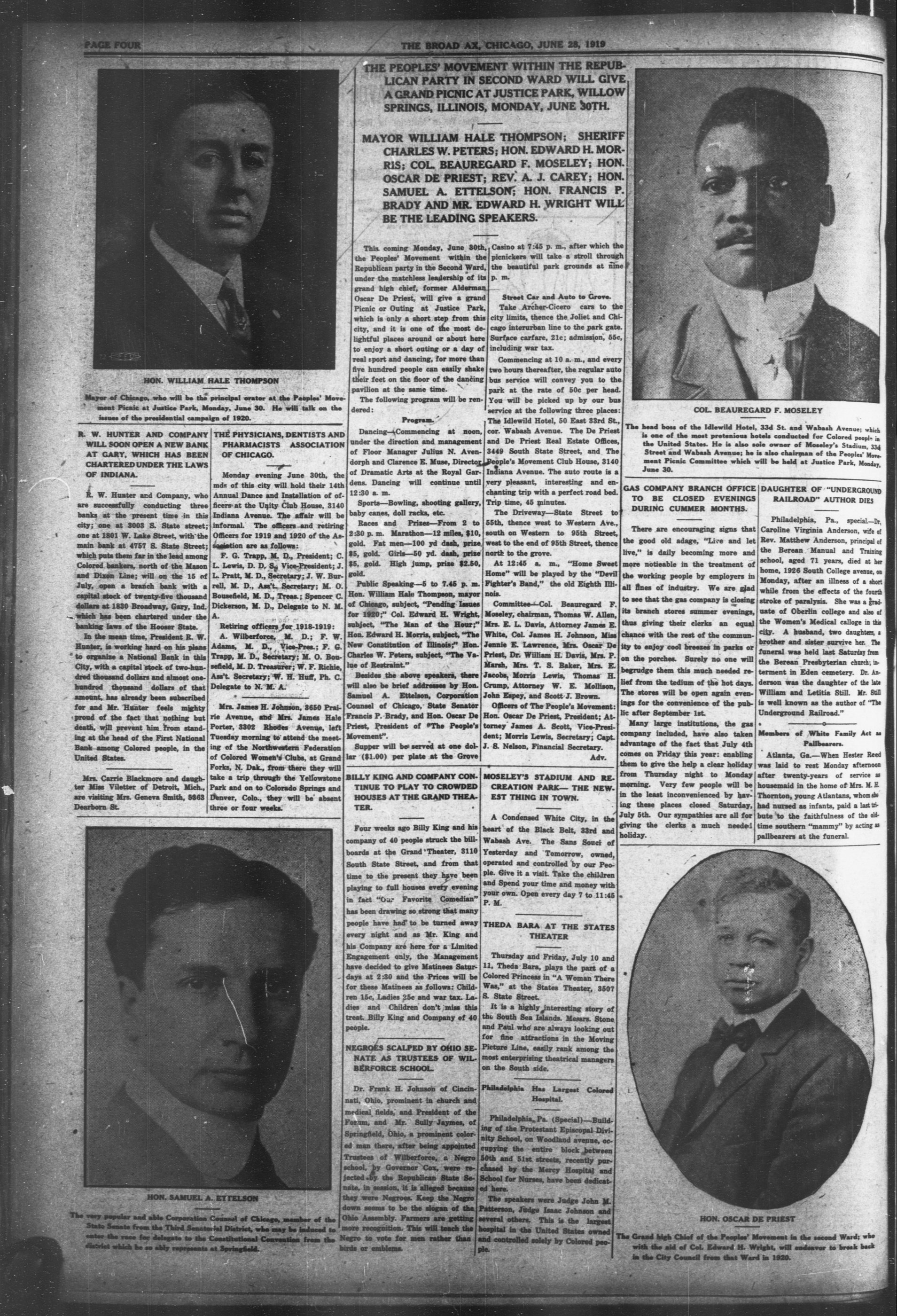
HON. WILLIAM HALE THOMPSON
Mayor of Chicago, who will be the principal orator at the People's Movement Picnic at Justice Park, Monday, June 30. He will talk on the issues of the presidential campaign of 1920.
M.
PAGE FOUR
HON. WILLIAM
Mayor of Chicago, who will be the
ment Picnic at Justice Park, M
issues of the presidential campa
R. W. HUNTER AND COMPANY WILL SOON OPEN A NEW BANK AT GARY, WHICH HAS BEEN CHARTERED UNDER THE LAWS OF INDIANA.
R. W. Hunter and Company, who are successfully conducting three banks at the present time in this city; one at 3003 S. State street; one at 1801 W. Lake Street, with the main bank at 4757 S. State Street; which puts them far in the lead among Colored bankers, north of the Mason and Dixon Line; will on the 15 of July, open a branch bank with a capital stock of twenty-five thousand dollars at 1830 Broadway, Gary, Ind, which has been chartered under the banking laws of the Hoover State.
In the mean time, President R. W. Hunter, is working hard on his plans to organize a National Bank in this City, with a capital stock of two-hundred thousand dollars and almost one-hundred thousand dollars of that amount, has already been subscribed for and Mr. Hunter feels mighty proud of the fact that nothing but death, will prevent him from standing at the head of the First National Bank among Colored people, in the United States.
Mrs. Carrie Blackmore and daughter Miss Vilette of Detroit, Mich., are visiting Mrs. Geneva Smith, 5363 Dearborn St.
---
THE PHYSICIANS, DENTISTS AND PHARMACISTS ASSOCIATION OF CHICAGO.
Monday evening June 30th, the mds of this city will hold their 14th Annual Dance and Installation of officers at the Unity Club House, 3140 Indiana Avenue. The affair will be informal. The officers and retiring Officers for 1919 and 1920 of the Association are as follows:
F. G. Trapp, M. D., President; C.
L. Lewis, D. D, S. Vice-President; J.
L. Pratt, M. D., Secretary; J. W. Burrell, M. D., Ass't. Secretary; M. O. Bousefield, M. D., Treas.; Spencer C. Dickerson, M. D., Delegate to N. M. A.
Retiring officers for 1918-1919:
A. Wilberforce, M. D.; F. W. Adams, M. D., Vice-Pres.; F. G. Trapp, M. D., Secretary; M. O. Bousefield, M. D. Treasurer; W. F. Richie, Ass't. Secretary; W. H. Huff, Ph. C. Delegate to N. M. A.
Mrs. James H. Johnson, 3650 Prairie Avenue, and Mrs. James Hale Porter, 3302 Rhodes Avenue, left Tuesday morning to attend the meeting of the Northwestern Federation of Colored Women's Clubs, at Grand Forks, N. Dak., from there they will take a trip through the Yellowstone Park and on to Colorado Springs and Denver, Colo., they will be absent three or four weeks.
THE BROAD AX, CHICAGO, JUNE 28, 1919 THE PEOPLES' MOVEMENT WITHIN THE REPUBLICAN PARTY IN SECOND WARD WILL GIVE A GRAND PICNIC AT JUSTICE PARK, WILLOW SPRINGS, ILLINOIS, MONDAY, JUNE 30TH.
MAYOR WILLIAM HALE THOMPSON; SHERIFF CHARLES W. PETERS; HON. EDWARD H. MORRIS; COL. BEAUREGARD F. MOSELEY; HON. OSCAR DE PRIEST; REV. A. J. CAREY; HON. SAMUEL A. ETTELSON; HON. FRANCIS P. BRADY AND MR. EDWARD H. WRIGHT WILL BE THE LEADING SPEAKERS.
This coming Monday, June 30th, the Peoples' Movement within the Republican party in the Second Ward, under the matchless leadership of its grand high chief, former Alderman Oscar De Priest, will give a grand Picnic or Outing at Justice Park, which is only a short step from this city, and it is one of the most delightful places around or about here to enjoy a short outing or a day of real sport and dancing, for more than five hundred people can easily shake their feet on the floor of the dancing pavilion at the same time.
The following program will be rendered:
Program.
Dancing—Commencing at noon, under the direction and management of Floor Manager Julius N. Avendorph and Clarence E. Muse, Director of Dramatic Arts at the Royal Gardens. Dancing will continue until 12:30 a.m.
Races and Prizes—From 2 to 2:30 p. m. Marathon—12 miles, $10, gold. Fat men—100 yd dash, prize $5, gold. Girls—50 yd. dash, prize $5, gold. High jump, prize $2.50, gold.
Public Speaking—5 to 7.45 p. m. Hon. William Hale Thompson, mayor of Chicago, subject, "Pending Issues for 1920;" Col. Edward H. Wright, subject, "The Man of the Hour;" Hon. Edward H. Morris, subject, "The New Constitution of Illinois;" Hon. Charles W. Peters, subject, "The Value of Restraint."
Besides the above speakers, there will also be brief addresses by Hon. Samuel A. Ettelson, Corporation Counsel of Chicago, State Senator Francis P. Brady, and Hon. Oscar De Priest, President of "The People's Movement".
Supper will be served at one dollar ($1.00) per plate at the Grove
BILLY KING AND COMPANY CONTINUE TO PLAY TO CROWDED HOUSES AT THE GRAND THEATER.
Four weeks ago Billy King and his company of 40 people struck the billboards at the Grand Theater, 3110 South State Street, and from that time to the present they have been playing to full houses every evening in fact "Our Favorite Comedian" has been drawing so strong that many people have had to be turned away every night and as Mr. King and his Company are here for a Limited Engagement only, the Management have decided to give Matinees Saturdays at 2:30 and the Prices will be for these Matinees as follows: Children 15c, Ladies 25c and war tax. Ladies and Children don't miss this treat. Billy King and Company of 40 people.
NEGROES SCALPED BY OHIO SE-
NATE AS TRUSTEES OF WIL-
BERFORCE SCHOOL.
Dr. Frank H. Johnson of Cincinnati, Ohio, prominent in church and medical fields, and President of the Forum, and Mr. Sully Jaymes, of Springfield, Ohio, a prominent colored man there, after being appointed Trustees of Wilberforce, a Negro school, by Governor Cox, were rejected by the Republican State Senate, in session, it is alleged because they were Negroes. Keep the Negro down seems to be the slogan of the Ohio Assembly. Farmers are getting more recognition. This will teach the Negro to vote for men rather than birds or emblems.
Casino at 7:45 p. m., after which the picnickers will take a stroll through the beautiful park grounds at nine p. m.
Street Car and Auto to Grove.
Take Archer-Cicero cars to the city limits, thence the Joliet and Chicago interurban line to the park gate.
Surface carfare, 21c; admission, 55c, including war tax.
Commencing at 10 a. m., and every two hours thereafter, the regular auto bus service will convey you to the park at the rate of 50c per head. You will be picked up by our bus service at the following three places: The Idlewild Hotel, 50 East 33rd St., cor. Wabash Avenue. The De Priest and De Priest Real Estate Offices, 3449 South State Street, and The People's Movement Club House, 3140 Indiana Avenue. The auto route is a very pleasant, interesting and enchanting trip with a perfect road bed. Trip time, 45 minutes.
The Driveway—State Street to 55th, thence west to Western Ave., south on Western to 95th Street, west to the end of 95th Street, thence north to the grove.
At 12:45 a. m., "Home Sweet Home" will be played by the "Devil Fighter's Band," the old Eighth Illinois.
Committee—Col. Beauregard F. Moseley, chairman, Thomas W. Allen, Mrs. E. L. Davis, Attorney James E. White, Col. James H. Johnson, Miss Jennie E. Lawrence, Mrs. Oscar De Priest, Dr. William H. Davis, Mrs. P. Marsh, Mrs. T. S. Baker, Mrs. E. Jacobs, Morris Lewis, Thomas H. Crump, Attorney W. E. Mollison, John Espey, and Scott J. Brown. Officers of The People's Movement: Hon. Oscar De Priest, President; Attorney James A. Scott, Vice-President; Morris Lewis, Secretary; Capt. J. S. Nelson, Financial Secretary.
MOSELEY'S STADIUM AND RECREATION PARK—THE NEWEST THING IN TOWN.
A Condensed White City, in the heart of the Black Belt, 33rd and Wabash Ave. The Sans Souci of Yesterday and Tomorrow, owned, operated and controlled by our People. Give it a visit. Take the children and Spend your time and money with your own. Open every day 7 to 11:45 P. M.
Thursday and Friday, July 10 and 11, Theda Bara, plays the part of a Colored Princess in "A Woman There Was," at the States Theater, 3507 S. State Street.
It is a highly interesting story of the South Sea Islands. Messrs. Stone and Paul who are always looking out for fine attractions in the Moving Picture Line, easily rank among the most enterprising theatrical managers on the South side.
Philadelphia, Pa. (Special)—Building of the Protestant Episcopal Divinity School, on Woodland avenue, occupying the entire block between 50th and 51st streets, recently purchased by the Mercy Hospital and School for Nurses, have been dedicated here.
The speakers were Judge John M. Patterson, Judge Isaac Johnson and several others. This is the largest hospital in the United States owned and controlled solely by Colored people.
COL. BEAUREGARD F. MOSELEY
The head boss of the Idlewild Hotel, is one of the most pretentious he the United States. He is also s Street and Wabash Avenue; he ment Picnic Committee which w June 30.
The head boss of the Idlewild Hotel, 33d St. and Wabash Avenue; which is one of the most pretenious hotels conducted for Colored people in the United States. He is also sole owner of Moseley's Stadium, 33d Street and Wabash Avenue; he is also chairman of the Peoples' Movement Picnic Committee which will be held at Justice Park, Monday, June 30.
GAS COMPANY BRANCH OFFICE TO BE CLOSED EVENINGS DURING CUMMER MONTHS.
DAUGHTER OF "UNDERGROUND RAILROAD" AUTHOR DIES
There are encouraging signs that the good old adage, "Live and let live," is daily becoming more and more noticeable in the treatment of the working people by employers in all lines of industry. We are glad to see that the gas company is closing its branch stores summer evenings, thus giving their clerks an equal chance with the rest of the community to enjoy cool breezes in parks or on the porches. Surely no one will begrudge them this much needed relief from the tedium of the hot days. The stores will be open again evenings for the convenience of the public after September 1st.
Many large institutions, the gas company included, have also taken advantage of the fact that July 4th comes on Friday this year: enabling them to give the help a clear holiday from Thursday night to Monday morning. Very few people will be in the least inconvenienced by having these places closed Saturday, July 5th. Our sympathies are all for giving the clerks a much needed holiday.
D.
33d St. and Wabash Avenue; which hotels conducted for Colored people in sole owner of Moseley's Stadium, 33d is also chairman of the Peoples' Move will be held at Justice Park, Monday,
DAUGHTER OF "UNDERGROUND RAILROAD" AUTHOR DIES
Philadelphia, Pa., special—Dr. Caroline Virginia Anderson, wife of Rev. Matthew Anderson, principal of the Berean Manual and Training school, aged 71 years, died at her home, 1926 South College avenue, on Monday, after an illness of a short while from the effects of the fourth stroke of paralysis. She was a graduate of Oberlin college and also of the Women's Medical calloge in this city. A husband, two daughter, a brother and sister survive her. The funeral was held last Saturday from the Berean Presbyterian church; interment in Eden cemetery. Dr. Anderson was the daughter of the late William and Letitia Still. Mr. Still is well known as the author of "The Underground Railroad."
Atlanta, Ga.—When Hester Reed was laid to rest Monday afternoon after twenty-years of service as housemaid in the home of Mrs. M. H. Thornton, young Atlantans, whom she had nursed as infants, paid a last tribute to the faithfulness of the old-time southern "mammy" by acting as pallbearers at the funeral.
[Name]
The eloquent and energetic pastor of Bethel A. M. E. Church of Baltimore, Md., who is in line for Bishop in 1920.
BETHEL A. M. E. CHURCH DRIVE BALTIMORE
CHARLES STEWART
Baltimore, Md., special.—The unknown has happened in Baltimore, when Bethel A. M. E. Church, in one rally placed on the table $30,018.50, this week, and by June 29, an additional three thousand dollars will have been paid in, which will cancel the fortage on the church, and give to the people one more church of the race out of debt. This is perhaps the largest amount ever raised by one church at a single effort.
To witness the drive there were present Bishop J. Albert Johnson, of Philadelphia; Bishop John Hurst, Baltimore; Bishop L. J. Coppin, of Philadelphia; Medames Mary F. Handy, J. A. Johnson, Bertha K. Hurst, ministers from Pennsylvania, New York and New England.
The drive was planned by the financial wonder of the race, Dr. W. Sampson Brooks, who has raised in three years over a hundred thousand dollars. The new site for Bethel was purchased at a cost of $90,000 and is one of the finest church edifices owned by the race. When he was appointed to the charge several years ago, Dr. Brooks declared that the church must soon be out of debt, and his mission was to pay it out, only asking the people to follow his lead. His first drive resulted in $15,000 being raised, and the one which is now closing will be over $33,000.
At the meeting of the mid-winter session of the Bishops' Council, next February, the church will be turned over to the connection free of debt and the mortgage will be burned. In return for the services rendered, in May 1920 the general conference will elevate Dr. W. Sampson Brooks to the episcopacy.
The rally was the largest and most successful ever planned by any church. Bethel Church was organized into sixteen units, known as mock conferences. Each had a bishop, presiding elders and pastors. Dr. Brooks, was general chairman of the banking committee; Prof. Howard E. Young, secretary, John H. Murphy, treasurer. The whole Afro-American office force took part in the rally which lasted from 3 o'clock in the afternoon until 6:20 the following morning, all of which time was used in counting and collecting money, and hearing reports. Dr. Brooks is the financial genius of the race.
Ohio Colored Man Bounded in Sum of $50,000.
Canton, O. (Special)—Edward Baylock custodian at the First Trust and Savings Company, this city, who has "a smile that won't come off," is bonded for $50,000, said to be the highest bonded Colored man in the state.
Messrs. Geo. T. Kersey, David A. McGowan, William J. Morsell, desire to announce the opening of their New and Elegantly arranged Undertaking establishment, 3515 Indiana Ave., with a new and complete line of funeral goods and general equipment. The Chapel, which is sufficiently large to comfortably seat more than a hundred persons, has the additional advantage of abundant outside light and ventilation and can be attached to a family and waiting room, that will accommodate nearly as many more. Other space is given to an up-to-date show room, which is adjacent to the public and private offices, but each separate and distinct from the other. For funeral services, family, fraternal or otherwise, no place in the United States offers superior advantages. Messrs. Kersey and McGowan have withdrawn from "The Emanuel Jackson Co." 2961 So. State St., and with Mr. Morsell will devote their entire attention' to their new establishment and branch at 863 Orleans Street, North side, and will appreciate the patronage of friends and the general public. Phone Douglas 8285. Day and night service.
The news of the death of General Warren was a great shock to his many friends in this city, he passed away in Arizona, where he went a few weeks ago for his health. Sir Warren was the Grand Worthy Counsellor of the State of Arkansas, O. O. C. and also connected with the Pythian Sanitarium at Hot Springs, Ark. His funeral took place Tuesday, at his home in Hot Springs.
For many years General Warren was a constant reader and supporter of this paper and he was one of our old friends and in common with his other friends we regret his passing into the next world.
Last Wednesday, Mrs. F. S. Peyton, 5012 S. Dearborn Street, after undergoing an operation for a tumor; closed her eyes in death.
Funeral services were held over her remains at the family homestead, Monday. Interment, Mt. Glenwood Cemetery.
Mrs. Peyton leaves a husband, Mr. F. S. Peyton, her aged mother, Mrs. Watkins and other sorrowing relatives and friends to mourn her death.
*Mrs. Elizabeth Lindsay Davis, 3710 Indiana Ave., who has been actively engaged in club and charity work, in this city for many years; has been appointed to a splendid position in the war community service and she is receiving the hearty congratulations of her many friends in her selection to that position.
REV. W. SAMPSON BROOKS, PASTOR OF BETHEL CHURCH, BALTIMORE, MD., IS THE GREATEST MONEY RAISER AND CHURCH DEBT PAYER IN THE A. M. E. CONNEC TION.
In Less Than Three Years He Has Wiped Out the Debt of Seventy-five Thousand Dollars Against the Church, Which He Now Pastors.
He Is Now In Line for One of the New Bishops of His Church In 1920:
By CHARLES E. STUMP
Baltimore, Maryland.—Have you ever been over the top? I have heard so many versions of that, until I don't know just what to say. Some people told me that it meant good by world and good morning Jesus and I have not left this world yet, nor has the Rev. Dr. W. Sampson Brooks, and his friends don't want him to go over just now, but want to have the pleasure of seeing him consecrated next May a bishop in the African Methodist Episcopal Church and I say, "So mote it be." I heard that he has skint the cat, that he has gone over the top, but I do know that the world is looking upon him as a wonder, and I don't blame the world from taking that view of it. No one would ever take him for a white man, only in brain and thought. He has a deep color that it is out of the question to think of changing. You would never see him blush although at times he is as modest as a woman, and he never engages in telling vulgar jok, but just a clean cut Christian gentleman, and he has gone up on his work and work alone.
Some time ago he entered this world via Calvert County, Maryland, and when he discovered this world decided it was a good place to be, and he got stuck on the world and the world got stuck on him. When a little boy, he kept his mother busy half-soleing the eastern and western hemisphere of his little pants, but he determined while in public school that he was going to make something. He heard people talking about the Old World, and he decided that he was going to see it, and then he desired to have his life be an inspiration to others. Such schools as were opened to his people in Calvert County, found him a busy little boy, and the people around there use to say to his mother, "Aunt Rebecca, that boy is going to be a preacher."
Time passed on, and later this young fellow was in Morgan college, Baltimore, where he made a record. It was at that time the Centenary Biblical Institute. Seven years were spent in this institution. He graduated from that theological department in 1892, and his first work as a pastor was in Minneapolis, Minn., building two churches in that part
M. J.
of the world, St. Peters and St. James. At all times a boy should be encouraged, for he is fit for nothing on earth but to make a man, and that is what we have before us right now, a real man.
Now we have our Calvert County boy going abroad, going through Sweden, the British Isles, Norway—in fact he went all over Europe. I was present in 1895, at the Iowa conference held in Keokuk, when Bishop Wayman ordained him an elder and sent hom to Wayman Chapel in Chicago, and that was the beginning of a great career. I am not going to try to tell you all the places he has been, for he is an African Methodist preacher, and each one carries with him his moving van year after year. But Dr. Brooks was more than a one-year preacher. He stayed the law limit at each place. He made a great record in St. Louis, Mo., as pastor of St. Paul A. M. E. Church. He remained three five years, when the law said to him, "Tote your bed and walk." He went to Wichita, Kans., until he heard the Macedonian cry from Bethel Baltimore, one of the leading churches in the connection. Dr. Brooks went there with a smile that would put the Gold Dust Twins out of business and made every one a friend to him. He went right into the hearts of the people, and declared that he was going to put the mortgage on the church out of business.
"My people shall not spend years working and raising money only to be placed in the hands of the other man, and we intend to own and not pay rent under the name of buying." This was his declaration, and breaks were placed on the wheels by some, but he declared that the other people who were not with him should have to get out of the way or be crushed.
A big rally was pulled off and the debt reduced, and he started out a few days ago to raise $33,000 and all declared that it was impossible. He had faith in God, faith in the people, faith in himself, and he told the world it was going to be done. He invited me to be present to see how it would be done, and of course I had no better sense than to accept. The church was divided into sixteen units, each unit representing an annual conference with a bishop, and
M.
City Comptroller of Chicago; life-long friend of Mayor William Hale Thompson and strong supporter of Governor Frank O. Lowden for President of the United States in 1920.
Dr. Brooks has rendered a great service for his race, for his church, and for humanity, and now it is up to the A. M. E. Church to show to the world that merit will win, and the man who has made it shall have it. If this is done, then he will be made bishop by the next general conference, and there is no question in my mind about it.
All night long these people were in church putting down money. Bishop Coppin stayed with them all night, so did Mrs. Bertha K. Hurst, Mrs. J. Albert Johnson, the wives of the bishops, the widow of the late James Anderson Handy, one of the bishops. Mrs. Brooks was pastor of Piketown Chapel, and she placed on the table from her charge $1,122.16, and Dr. Brooks for his part put down over five thousand dollars. I got happy and while I was not feeling well, I just had to shout out one or two times.
PAGE FIVE
long friend of Mayor William Hale
er of Governor Frank O. Lowden for
in 1920.
Satterwhite talk about Johnnie, and Mrs. Anderson talk about Matthew. New York is some town, believe me. I had the pleasure of being at the New England Baptist convention for a few hours, and I heard them Baptist preachers say some real good things. They said them and I had nothing to do but listen at them and when they were through I just got my fool self together and left town. They have some slick men in that town and you may tell the world that I told you so.
The world continues to move right along, and I am kept busy helping it to move. But I cannot get in with them big fellows. Are you going to attend the Supreme Lodge of Knights of Pythias? I am trying to get money enough to get there myself, yet I am not prepared to say at this time, but will do the best I can. I am going to see to it that some few changes are made in this affair, and in this world, and I would like to have you join me in it. It promises to be a great meeting out there. The boys are back from France, and they will be prepared to drill and there will be some drilling. I had a talk with Supreme Chancellor S. W. Green a few weeks ago, and he told me of many things that were going to take place. He is one more business man. He was rejoicing over the fact that the suit brought by the Grand Lodge of Virginia, and Grand Chancellor Mitchell had been won by Supreme Lodge and he was happy because it had been won. I offer him congratulations.
Supreme Worthy Councillor Joseph L. Jones is getting ready for his end of the meeting. They are going to work in perfect harmony and peace.
I think I have said enough for this time. Wait until my next.
ST. MARK M. E. CHURCH
50th st. and Wabash ave.
Rev. John W. Robinson, Pastor.
"Who is the Lord," was ably discussed by the assistant Pastor, Rev. W. H. Wallace, last Sunday morning before a very influential and crowded congregation.
The music by the choir, Mr. J. W. Washington chorister, was excellent. The evening services were addressed by R. W. Hunter, the banker, Rev. Dr. Durgin, former president of Walden University.
Sunday morning the pastor will preach. Subject, "Clouds Without Water," while at night the Rev. Giffin G. Logan, formerly of Mississippi, will preach the Pew Rally Sermon. Section B, which includes classes from 21 to 41, under the leadership of Mrs. E. W. Jackson, will hold their initial effort to raise $10,000.
```markdown
```
PAGE SIX
HORSES IN ANCIENT BATTLE
Seems to Have Been Little Used Except to Carry the Infantry Into the Fight.
In the old days when the Romans and Greeks fought furious battles, the charioteers drove their care in all directions, hurled their javelins, and by the din and clatter of horses and wheels commonly threw the ranks of the enemy into disorder, and, making their way among the squadrons of the enemy's cavalry, leaped down from their chariots and fought on foot. The charioteers then withdrew, little by little, from the fight, and placed their chariots in such a way that if they were hard pressed they could readily retreat to their own side. Thus in battle they afforded the mobility of cavalry with the steadiness of infantry. Daily practice enabled them to pull up their horses at full speed when on a steep slope, or to run out on the pole and stand on the yoke, and to get nimbly back into the chariot.
With the introduction of cavalry in the later from age came larger horses, but their use for this purpose seems to have been restricted to isolated areas. There is no doubt that the west German tribes, as late as the campaign of Caesar in Gaul, used only the shaggy pony. It is said in cavalry actions they held it disgraceful and slothful to use any kind of saddle, and instead of charging in squadrons they dismounted and fought on foot. As far as England is concerned, the art of riding seems to have been introduced by the Normans. The Saxons appear to have been but indifferent horsemen.
GIVES CAT PALM OF WISDOM
Writer in California Newspaper Comes Forward With Loud Praise of Household Pet.
It is often a subject for discussion as to which is the wisest animal. Some say it is the dog and some are in favor of the horse, while scientists appear to think it is the elephant.
We beg to differ with all these views. We do not even agree to the movement in certain quarters to give the palm for wisdom to the fox. To our mind the wisest animal that lives is the cat. And, if it goes to that, we are willing to have it further known that of all animals we like the cat the best.
A cat is so wise that it succeeds in not letting us know how wise it really is. If you will be friendly with cats—and that's an easy thing to do—you will be astounded at their wisdom. And you could not imagine how affectionate a cat can also be.
There is an old yellow cat up in the Verdugo hills that we wouldn't trade for all the dogs and horses and elephants outside of Barnum's circus. When the last of his nine lives departs from the earth those mountains will be a very lonely place for us—Los Angeles Times.
For Success in Business
Wealth is, after all, only what is produced by us, either by mental or physical labor. It stands to reason, therefore, that if a man would become rich in this world's goods, or in knowledge of things or men, he must work hard and long to acquire such knowledge and skill. And he will be rewarded in proportion to his work. Despite a lucky stroke occasionally here and there in a man's life, I am a firm believer in the motto that nothing really comes by chance to a man which is of much value beyond the ordinary. Success has usually been prepared for, striven for, helped onward by his own innate ability, work, or tact in ways the exterior world often failed to recognize. Hard work is the best friend any man ever embraced.
I would say to all youthful beginners in business that business is like the land—the more you put into it the more you will get out. If you put nothing in, you will get precious little out; if you tend it in desultory fashion, you can only expect an indifferent harvest, if any at all—Exchange.
Where Is Teacher?
This is the latest breakfast-table problem. Although the town has figured prominently in European history at various times for over a century, Lloyd George had to confess, when it was mentioned at the peace conference, that he did not know exactly where it was situated. Nor was he alone in his lack of knowledge. It is doubtful if one person in fifty would be able to give you any information about the town. And yet it was once the scene of a great peace conference—that of 1779, when Vergennes, the foreign minister of France, arranged the peace of Teschen, thereby avoiding a great European war, and also, in all probability, securing the independence of the United States.
Right Pivot
A darky was unloading horses and when he had the halter hanks of six horses he started up the road toward camp and the stubbles. Just before entering camp the road turned sharply 20/the right; in fact, it made a right angle with its previous course.
At this point the darky with his six "halter hanks experienced some difficulty in getting all the horses to make the turn and he was heard to shout: "Here, what's the matter with you all? Don't you all know how to make a turn to da right? Number one pivot! Pivot dar on de right."—Pittsburgh Chronicle Telegraph.
Popples
A characteristic of the corn poppy, beside its brilliant scarlet coloring, is the large size of its two outer petals, which hide the lesser pair until the bower has opened. Popples of Flanders, be they corn popples or other varieties, are not of the oriental species from which oplum is derived. The corn poppy, when cultivated, is known as the Shirley poppy. The flower is perennial or annual, according to the variety.
Ancient Admonition
Thoughtless persons who insist on talking during a musical performance, marring the pleasure of those who would listen to the music, we have always with us. It is curious to note that this particular pest was already extant more than 2,000 years ago. In the ancient book "Ecclesiastics" we read, "Speak, thou that art the elder, for it becometh thee, but with sound judgment, and hinder-not music."
Man'a Friend.
The funeral of Harold Bannister, an outfitter of Leyland, was followed by his favorite dog. It entered the church with the mourners, and, sitting by the bier, occasionally sniffed at the coffin. At the graveside the dog sat still while the coffin was being lowered and then put its paws on the edge of the grave and took a farewell view of its late master—London Express.
Looking for a Bargain
Elizabeth was thrifty. She had her picture taken, and her mother sent her for the proofs. "How much are they, please?" asked Elizabeth, and the photographer announced: "One dollar and a half for the original and 50 cents each for duplicates. Elizabeth pondered a moment, then said: "I think we'll take six duplicates, please."
Where the Banjo Game From
The modern banjo was introduced into England from the United States, to which country it was probably taken by the African slaves, who originally obtained the idea from Indis. The unmusical name "banjo" seems to have been derived from "banya," the name of a Senegambian instrument of the guitar species.
To Frost Glass.
It is often convenient to frost bulbs and lenses, and here is a method by which this work may be done at home. To a mixture of 24 ounces of ether and 18 ounces of benzine add two and a quarter ounces of sandrach and half an ounce of mastic. The parts to be frosted should be immersed in this solution a few minutes.
With a Proviso.
James was fond of one of his mother's friends, a girl in her twenties. One day, when he had been particularly well entertained by her, he remarked: "Aunt Margie, when I grow up I'm going to marry you." Then he looked at her thoughtfully and added: "That is, if you last long enough."
Eye of the Starfish
At the end of each arm in the starfish there is a little red eye. It does not form an image, but has considerable sensitiveness in distinguishing different degrees of light, enabling the fish to become aware of distant illumination that differs from the surrounding area.
The Venerable Toad
Toads often look very old, don't they? Even so, probably you have never imagined that a toad might be 250 years old. Actual records prove that there have been toads of more than 100 years of age, and very likely this estimate has been exceeded.
Ancient Rock Drawings
A huge buffalo with enormous horns is consplenous in prehistoric-rock drawings lately found in Algeria. The African elephant is also a striking feature, and other animals include the lion, leopard, gazelle and domestic goats and sheep.
Handy Oil to Have.
Automobile oil is inexpensive, and useful for many household purposes; one drop will relieve a squeaking door hinge or a heavy running sewing machine; wipe it off with absorbent cotton.
Pity He Didn't Mise Them.
Entomology does not record the first appearance of the cootie, but we suppose that they were not slighted in the trip Noah made to save two of every living thing.
As Far as It Goes
Some people's idea of efficiency is to
pin a notice on the front door that the
bell is out of order, instead of having
it fixed—Ohio State Journal.
Wife and Husband's Money.
It has been upheld in the courts
that a woman cannot steal from her
husband if they are living together.
Where They Err.
Men err not so much in prompt action
as in hasty judgment—Louis
Napoleon.
Arduous Job.
Outlate—M'Dear, mustn't sit up for
me; law forbids night work for women.
THE BROAD AX. CHICAGO, JUNE 28, 1910
LAZINESS ACTING AS SPUR
Good Work Done by Those Who Dislike it, and Want to Get Through and Rest.
The best work is done by the lazy people who want to get through and rest.
The industrious, active body, busy as a bee, and always at it, is very liable to become a puttgrer.
Mark Twain called attention to the fact that the ant, to whom the sage recommended the sluggard to go, spends most of his energy in running around like a drunken Indian.
The great humorist hated to move; he used to give the boy in the printing office a nickel to sweep around him, so that he would not have to take his feet off the table. At seventy he confessed that "all exercise is loathsome."
Laxiness is not good in itself; but when joined to conscientiousness and a sense of responsibility, as it often is, it is the very best worker.
The world's work is done by those who do not like it. Nine persons out of ten would quit what they are doing if they could.
At the very beginning of Arnold Bennett's novel, "Hilda Lessways," is a luminous bit of philosophy:
"Hilda hated domestic work, and because she hated it she often did it passionately and thoroughly."
Mark Twain hated to write—Dr. Frank Crane, in Farm Life.
MUST CONCENTRATE TO WIN
Though Thorough Absorption May Be Carried Too Far, It Is Necessary to Success.
There is always danger, when anyone concentrates, that the concentration will be carried too far—so far that it produces a narrow, one-sided and warped point of view. The great scientist, the great scholar, the great thinker in any line is usually not an all-around "good fellow." "Crabbed," "queer," "peculiar," "odd," "funny" and "warped"—are these not the adjectives that generally describe the geniuses of the world? The very effort to concentrate on the one subject which has brought success has made it impossible to keep in touch with the thousand-and-one currents of thought and topics of conversation which go to make up comfortable and easy-going life. Like the old sea captain, these geniuses miss something in their effort to fix their attention on one thing.
In spite of this danger, it is a good thing to work for concentration. The likelihood of becoming one-sided is big where genius is concerned, but then it can be excused. Most of us can safely concentrate our attention and still feel sure that we will keep in touch with the world about us.
Need for Eternal Vigilance.
"We first make our habits and then our habits make us," said an unknown sage. In other words, what we are at this moment, what we can do at this moment, depends not only upon making up our minds at the time being, but also upon how we have made up our minds countless other times in thousands of minutes already gone by and now out of our control. The one thing we cannot control is the past; it may, however, control us for good or for evil. The fact that we should remember in forming habits is that our minds and hearts are the meeting ground of strange conflicts; that good and bad in us are making opposite suggestions; that each is striving for the mastery; and that sometimes we are so self-deluded that the bad may seem to be the good. At any hour the beginnings of a vicious habit, perhaps through the suggestion of someone else or by our own carelessness, indifference, or faults, may find their way into our hearts. The price we must pay for continually proving and possessing the good is eternal vigilance.—Exchange.
Discouraged Aide to Beauty.
In the day of Louis XIV LaBruyere wrote this: "If women only desire to be beautiful in each other's eyes they may, of course, follow their own caprice or taste as to the way in which they dress and adorn themselves; but if they desire to please men, if it is to charm them they rouge and paint. I can assert in the name of mankind, or at least of those men whose votes I have taken, that white and red paints make women look old and hideous; that it is as disgusting to see women with paint on their faces as with false teeth in their mouths and waxen balls to puff out their thin cheeks; and that far from countenancing it, men solemnly protest against all such arts, which infallibly tend to cure them of love."
The wonder arises if LaBruyere spoke only for the men of his time.
The crow is one of the most widely disliked of birds. His reputation is bad, and is probably deserved.
No matter how long you study the crow, you will always have something to learn, and at the end of all your study he will know more about you than you will about him. At times it seems as if he knew what you were thinking about.
The crow has a large variety of notes or calls, and each one seems to be the harshest in all bird vocalism until the next one is sounded, which is a little barrser. He is an accomplished bird, and intelligent. If tamed, he can be taught many things, but never to be good. He is a natural thief, and cannot be reformed.
Cynicism.
We are reminded that resentment, doubt and cynicism are so easily misaken for the wisdom of disillusionment that there is double reason to guard against them. Many a hurt soul fancies it is growing wise in the ways of the world when in truth it is only growing hard and bitter. An acquaintance with mankind does not mean merely learning humanity's seamy side and being on guard against it. A wider study will bring a far different and more hopeful knowledge.
Chief Executives Censured
Congress has twice censured a president—Andrew Jackson, in June, 1834, for causing the removal of the government deposits of about ten million dollars from the United States bank the preceding September; and John Tyler, in 1843. Tyler was elected as a Whig, but was really a Democrat; so he was therefore constantly antagonizing the policies of the party which had elected him.
Forces Within.
Trials without discover forces within. Says Victor Hugo: "There are instincts for all the crises of life." A deep perplexity awakens a flash of insight; a bitter opposition sets the soul on fire; a brave peril opens our eyes to horses and charriots of fire; a severe catastrophe evokes a heroism of which the sufferer had not thought himself capable—W. L. Watkinson.
Had Origin in America.
There has been much controversy over the song, "The Red. White and Blue," but the logical conclusion is that the English adapted their words from the American song, which was written by Thomas A. Becket, an Englishman, after he had made America his home. Before this song was written, in 1800, no similar version was known in England.
Teasel in Cloth Dressing
Few people probably have heard of teasel, which is grown for the purpose of cloth dressing. The w'd teasel is found in English hedges and copses and bears a purple flower in July. The function of the teasel is to raise the nap of the cloth, although to some extent it has been superseded by the use of wire brushes.
Make for Business Success
The foundations for success in business are work, perseverance and character. Different men who have triumphed in various spheres of business may set down their own experiences and views in other ways, but you will practically always find that the summing up comes to those three items in the end.
Learning.
Learning, joined with true knowledge, is an especial and graceful ornament, and an implement of wonderful use and consequence. . . . I would rather prefer wisdom, judgment, civil customs and modest behavior, than bare and mere literal learning.—Montagne.
Glass-Bottomed Bucket
A curious sight at Palermo is to see the fishermen spearing fish by the aid of glass-bottomed buckets. There are many corners of the world where fish are speared, but perhaps the use of the glass-bottomed bucket in this connection is to be seen only at Palermo.
No Place for Him to Die
Daniel Webster, taken ill one day in a town, of decided Democratic leanings, begged his friends to take him home at once. "I was born a Federalist," he pleaded. "I have lived a Federalist, and I can't die in a Democratic town."
Nemeals.
Nemesis was a goddess of justice and retribution. In Gréek-mythology Nemesis was a goddess personifying allotment, of the divine distribution to every man of the precise share of fortune, good and bad.
Build for All Time.
When we build, let us think that we build forever. Let it not be for present life, nor present use alone; let it be such work as our descendants will thank us for.—Ruskin.
Uncle Ehan.
"Dar aln' no use tryin' to bury de hatchet wif some folka," said Uncle Eben, "not as long as dey kin keep dodgin' into de hardware store an' getin' mo' cutley."
Rough on New Jersey. Oliver Wendell Holmes' idea of New Jersey, New York's next-door neighbor, was that it was "a double-headed outour, rather than a state."
Stage Set for Him.
Blobbs—"Some fellows would rather be born lucky than rich." Slobbs—"But the fellow who is born rich is already lucky."
Daily Thought
To receive honestly is the best thanks for a good thing.—George MacDonald.
Daily Thought.
Great thoughts, like great deeds,
need no trumpet.—Bailey.
Accountancy, which is the science of systematizing business, has a history that runs back at least 4,000 years. Very early in the development of nations it was found that in commerce as well as in the affairs of state, systematic and careful account-keeping were indispensable. These systems were, at first, crude and laborious, but they at least kept the finances of the nation and the marks of trade from being chaotic.
The invention of double entry book-keeping early in the fifteenth century by the merchants and bankers of Venice gave to the commerce of Europe an invaluable trade instrument, and one without which the great commercial enterprises of the later centuries could hardly have existed.
And so it has been on down to the present time; there has been a parallel progress between the accomplishments of commerce and the science of accounting, and it is known to every man in business that the former could not continue without the latter. Even the most unbusinesslike people know this much, and we can hardly imagine anyone silly enough to attempt to carry on any kind of a business enterprise without keeping books.
Bookkeeping, as a formal subject of study, is taught in most of the public and private schools of this country, but it is only that form of bookkeeping that applies to the affairs of the merchant or the shopkeeper. The public has yet to learn that bookkeeping is quite as necessary to the prosperity of the wageworker, the salaried man, the farmer and the housekeeper as it is to the shopkeeper, the merchant or the manufacturer.—Exchange.
FLOWERS' HOURS OF SLEEP
That They Differ is a Proof of the Adaptability of Everything in Nature.
That flowers sleep is evident to the most casual observer. The beautiful daisy opens at sunrise and closes at sunset, whence its name "day's eye." The morning glory opens its flower with the day. The "four o'clock" awakes at four o'clock in the morning, but closes its eyes in the middle of the day, and the dandelion is in full bloom only while there is strong light. The habit of some flowers is certainly curious, and furnishes one of the many instances which prove the singular adaptability of everything in nature. The reason is found in the method by which this class of flowers is fertilized.
Flowers which are fertilized by night flying insects derive no advantage from being open by day; and, on the other hand, those which are fertilized by bees would gain nothing by being open at night. May, it would be a disadvantage, because it would render them liable to be robbed of their honey and pollen by insects which are incapable of fertilizing them. It is possible, then, that the closing of flowers may have reference to the habit of insects, and it may be observed, also, in support of this, that wind-fertilized flowers never sleen.
Blind Horse
The manner in which blind horses get about without coming to more harm than they do is remarkable. They rarely, if ever, hit their heads against a fence or stone wall, and will sheer off when they come near one. It appears from careful observation that it is neither shade nor shelter which warns them of the danger. On an absolutely sunless and windless day their behavior is the same. Their olfactory nerves doubtless become very sensitive, for they will poke their heads downward in search of water fifty yards before they come to a stream crossing the roadway.
It cannot be an abnormally developed sense of hearing which leads them to do this, for they will act alike though the water be a stagnant pool. Men who have been blind for any great length of time develop somewhat similar instincts to blind horses.
"Catch the Dog!"
"Mrs. Howe was always thoughtful of animals. During the reign at 241 Beacon street of the little fox terrier Patch, it often fell to her lot to take him out to walk, and she felt this to be a grave responsibility.
"One day Patch run away on Beacon street, and would not come when she called him. At this instant Doctor Hotmes, passing, paused for a friendly greeting.
"Mrs. Howe,' he said, 'I trust this fine morning—'
"Catch the dog!" cried Mrs. Howe. One author flew one way, one the other; between them Patch was caught and brought in triumph home."—From the Life of Julla Ward Howe, by her daughters.
Women and Mics.
It is contended that woman's fear of mice arises from their being classed as vermin. The fact that rats carry disease and plague is not disputed. Mice may not be quite so dangerous. Their bites and scratches are trifling. But they carry disease and dirt, and a baby sleeping in a cradle, for instance, may suffer in consequence. Mothers have for ages been affected by this dread, and in seeking to protect their offspring from contact with mice have unconsciously, we are told, breed that feeling of nervousness which has provided the comic artist with his periodical picture.
"On the twenty-ninth of May, 1856, Lincoln made a speech at the first Republican state convention in Illinois that is remembered as Lincoln's "Lost Speech." Lincoln, who was one of the delegates, was suggested for governor, but he proposed that William Russell should be nominated instead. The suggestion was accepted and Lincoln addressed the convention for one hour, speaking with such fire and eloquence that the surprised and interested reporters forgot to take notes and his great speech was never recorded.
Flowers Loved by All
Flowers seem intended for the solace of ordinary humanity; children love them; quiet, contented, ordinary people love them as they grow; luxurious and disorderly people rejoice in them gathered; they are the cottager's treasure, and in the crowded town mark as with a little broken fragment of rainbow, the windows of the workers in whose hearts rests the covenant of peace.—Ruskin.
The Chrysanthemum
It is believed that the first specimen of the chrysanthemum in Europe was reared at the Botanic gardens, London, in 1764. The flower's rise into favor was chiefly due to the Stoke Newington Chrysanthemum society, which held its first exhibition of blossoms in 1846 and served as a school of chrysanthemum culture for the world.
Relic of Noah
The Desert de Carlitte, in the Pyrenees, close on 10,000 feet above the sea, contains no fewer than 60 lakes of varying sizes. These, according to local tradition, were left at the time of the flood. When the water subsided it is said, Noah and his family landed on the Puy de Prigue, one of the highest peaks in the district.
Regularly Acquired
I was visiting in a little country place and was about to board the train to return when I noticed a dear little girl with tight crows close to her head, and, calling her, I asked: "Where did you get all those pretty crows? Much annoyed, she answered: "Oh day was on me when I tuned."—Chicago Tribune.
Patience.
The best things usually require the most patience for their development. A tent may be put up in an hour, but a strong and stately building calls for long and careful work. We have need of patience not only with others, but also with ourselves in the building of character into what we would have it.
Worth Seeing
We don't know much about this circus that's coming, but we hope it's the one Pat attended not long ago. "There was wan fellow," he said, "that beat all the rest. Sure, he balances a ladder on his nose, climbs up to the top and pulls the ladder up after him."—Boston Transcript.
Two Famous Brogues.
Broken English, Professor Beers says, is merely the imperfect English of an individual foreigner. Pidgin English, the English of Hans Brietmann's ballads and of the comedy Frenchman, are of that class. Creole English and Pennsylvania Dutch are brogues.
Had to Split Up.
Little Jack, very much impressed with his first night in a berth on a Pullman sleeper, said: "Why, grandma, the flats were so small we couldn't all live together. Mamma and I slept in the first flat, and Daddy in the second flat."
But They Are Always There.
There are chords in the human heart which are only struck by accident; which will remain mute and senseless to appeals the most passionate and earnest, and respond at last to the slightest casual touch.-Dickens.
His Language.
Mother told sister that baby came from heaven, so when baby was eight months old sister said to a playmate: "Our baby is talking now, but we can't understand him, cause he talks sky talk."
Dilemma.
A woman novelist is bemoaning that if a woman holds onto her opinions she loses her husband's love—and if she holds onto his love she loses her identity.
Only Real Monument
Only real monuments:
"Those only deserve a monument," wrote Hazlitt, "who do not need one; that is, who have raised themselves a monument in the minds and memories of men."
Optimistic thought Those who have few affairs to attend to are great speakers; the less men think the more they talk.
In Large Supply.
When you start to borrow trouble the loan is generally oversubscribed.—Boston Transcript.
Optimistic Thought
Talk to please others; act to please yourself.
a 7s ‘
DISTANCE IMMATERIAL
: : = KS Seo ey
3 sete ogre ge lae ten,nt dek
= Fen eal eee by erates beioee proposition and
y 3 ae benelit by it in service, quality coat 308
by io tk SaFipd mga nc
£ walbbioess % te ool
gs Way Ty i i
, imme he
= “RECS St
foot Cal pene maven day araigit
Ernest H. Williamson,
=gs” - Undertaker “75-267
9028 and 5030 S. State St, ~~ - = + Chicago, 2
NORRIS-WARD
COAL CO.
Paes moe
Nig as =
THE CRANFORD
Apartment Building
3600 WABASH AVENUE :
The finest building ever opened to Colored tenants in Chi-
cago. Steam heat, electric lights, tile baths, marble entrance
J. W. CASEY, Agent
Phone Main 263 133 W. Washington Street
Lae
CSE >
= =
Ber. je | ES
Water Heating
_ Service
For Everyone
| Aes
ES
in every detail.
We Have Water Heaters
"Scab fr
Modere Bangatows
Fi Seldiage =
=
SSeS
best suited to your nequinements ©
ianeet Ge ear
nue weap preach ot ve
ee
ES Sac |
KINKY HAIR
i=
SSeS
eee
ee ee ee eee Oe
« FOR a
THE BROAD AX -
a és eee
2 bie meena
« THE BROAD AX, CHICAGO, JUNE 28, 1919
PS eS - ad
Your Opportuni
four Upportunity
___ The R. W. Hunter Banking Company of Chicago, Ill.,
"will begin plans on the first day of July, 1919, to organize
& National bank with a capital stock of $200,000. This
step will be one of the most important évents in the com-
mercial life of the Negro in the United States. It will
mean the establishment of a great Negro National Bank
with $200,000 capital and under the supervision of Na-
tional banking laws, thereby giving people all over the
United States unlimited banking facilities and ghe strong-
est protection that the laws of the United States afford.
We want to give the people of Chirago and thruout
the country an opportunity to become stockholders in this
great enterprise, and we are now offering them $100,000
worth of convertible participating stock in denominations
of $50 per share, with four coupons attached and interest
of 6 per cent per annum. A share can be purchased by
paying $10 down and $10 per month for four months
thereafter, until $50 is paid. -
YOU CANNOT AFFORD TO MISS THIS CHANCE TO
PLACE YOUR SAVINGS WHERE THEY WILL BRING
THE GREATEST FINANCIAL RETURNS
For further particulars write or call on
R. W. HUNTER & C0.
MAIN BANK 4757 S. STATE ST., CHICAGO, ILL.
BRANCH BANKS 3003 S. STATE ST., 1801 WEST LAKE ST.
The amount of busincss handled by R..W. Hunter & Coth so
great that in the Real Estste Department alone they employ fourteen
young men, using three au‘omobiles to make collections. By working
this system the firm saves time and heavy ineurred by con-
cerns operating by the old method. "hye for prema mo
sales and reduce expences to the minimum. have leases on pro-
perty in Chicago amounting to nearly a million dollars, located in
some of the best sections of the city of Chicago. The leases are
netting the firm a good profit. Mail your check, money order or cur-
rency TODAY for a share of this Participating Stock DON'T DELAY.-
DO YOU READ NEGRO PAPERS? .
WE CAN SAVE YOU SUBSCRIPTION MONEY
‘We can furnish any NEGRO MAGAZINE or NEWS-
PAPER, (no matter where published) in combination with —
‘a subsctiption to The Broad Ax at money saving prices. |
Write for our combination list, or better still, send us a
list of any publication desired and allow us to quote our —
deer: prises tee souas, etene eer yur order. When —
you we can save you money, send us your order.
SWANCY & SONS
2060 N. 3rd Street KANSAS CITY, KANSAS
1 DENISON 3
WATKINS «=~
AND
‘WHITE
ATTORNEYS AT LAW
36 West Randolph Street
Franklin A. Denison, ‘
S.A. T. Watkins
James E. White
| Telephone Central 3142
. CHICAGO
a e
PHONE MAIN 2214
Attorney At Law
118 North La Salle Street
__- CHICAGO
Pam at
Wholesale and Retail
COAL
Fifty-First and Federal Sts.
<4 CHICAGO
Go Easy on Criticiem.
‘When you begin to criticize a man
you must not forget that be ls grow-
ing. By tomorrow he may have quite
outgrown the quality which you dis:
Mike.
——_——— 4
Ae ot a
He who has = heerty leugh in
‘2 laugh which leaves a sweet
Stmonbtance afterward, has conferred
no small boon. —Lyman Abbott.
———
‘The Study of Blooraphy.
of biography will ‘cure ws
off ctectaton and conceit—David
m.
_————=—=
3 f Tg
© guage es those wa ete
Residence, 1262 Macalister Piace
Tel. Monroe 2714
MILES J. DEVINE
Attorney At Law
Suite 318-320 REAPER BLOCK
Clark and Washington Streets
Phone Central 1239
CHICAGO
>
Residence, 4533 Prairie Avenue
Phone Kenwood 8520
WALTER M. FARMER
ATTORNEY AND
COUNSELOR AT LAW
NOTARY PUBLIC
Suite 708
184 W. Washington St.
‘Tel., Office, Main 4153 Auto 33736
CHICAGO
Residence 3419 South Park Avo.
PHONE DOUGLAS 9354
WM. J. LATHAM
Attorney At Law
OFFICE PHONE: CALUMET 875
2 EAST 31ST STREET
Suite 7
CHICAGO
Tel. Contral 6583
Res. 3646 Grand Boul.
_ Phone Douglas 4397
J. GRAY LUCAS
ATTORNEY AT LAW.
36 W. Randolph St.
Corner Dearborn St.
Suite 402 Delaware Building
Baste) oF GARD:
‘Res. 3855 Prairie Ave,
Phone Dougias 9133
* Main 2017, Auto. 32.395
A. L.-WHLLIAMS —
ATTORNEY AND
COUNSELOR AT LAW
Suite 706 Firmenich Building
"4 W. Washingtes St, Chicago.
PAGE SEVER
‘A. F. CODOZOE 2 e AUTO. 72379 *
J. W. WHISTON, Propricters Phonée: DOUGLAS 3256
CHAS. HARRIS, Manager DOUGLAS 5071
“The Elite Cafe
‘ and Buffet
3030 STATE STREET CHICAGO, ILL.
Office Phone: Douglas 8285
~~ KERSEY, MCGOWAN AND MORSELL
CHICAGO’S BE PRESENTATIVE
GnpERTAKERs
FINEST ESTABLISHMENT IN THE U. 8.
(GEO. T KERSEY D. A. McGOWAN WM. J. MORSELL
= Propristers” a
15 INDIANA AVENUE. CHICAGO, ILL.
ee aes W aaa ca a
JOHNSON EXPRESS
STORAGE AND VAN C0.
EXPERT PAN, NOVERS-ATO SERVICE
Chicago Title and Trust Company
'_. STATED BRIEFLY:
OUR BUSINESS SINCE 1847 has
been that of showing the condition of
real estate titles.
to build and rebuild Chicago have been
furnished relying on the accuracy of our
ABSTRACTS and TITLE POLICIES.
- Noman has lost a dollar by so relying.
This is our past.
Wise men judge future action by past
behavior : :
CHICAGO ‘TITLE AND TRUST COMPANY
69 W. Washington Street ~ :
Assets exceed $12,000,000.00
No deposits or demand liabilities.
GEORGE F. HARDING, JR.
‘Real Estate
Up-to-Date or Modern Houses, ~
Apartments and Stores
: d - to Rent
3101 Cottage Grove A a
ADVERTISE IN THE BROAD AX
THE BROAD AX
In this city since July 15th, 1899, without missing one single issue. Epublicana, Democrate, Catholics, Protestants, Single Taxers, Priests, indulge or anyone else can have their say as long as their language is proper and responsibility is fixed.
The Broad Ax is a newspaper whose platform is broad enough for all, ever claiming the editorial right to speak its own mind. Local communications will receive attention. Write plainly, only
IMPORTANT NOTICE
For resolutions, obituary notices, cards of thanks, write-ups, special announcements of events to happen, when a charge of admission is made, and the opening of new business enterprises, etc., 15 cents per line; 6 words or fraction makes one line.
Personal or social items such as marriages, births, deaths and everything of a general interest, published free of charge.
Entered as Second-Class Matter, August 19, 1902, at the Post Office at Chicago, Ill., Under Act of March 3, 1879
PAGE EIGHT
PUBLISHED EVERY SATURDAY
since July 15th, 1899, without missing
Democrats, Catholics, Protestants, Singles,
and also can have their say as long as a
possibility is fixed.
Ax is a newspaper whose platform is b
ing the editorial right to speak its
omunications will receive attention. Writ
e paper.
It must be paid in advance.
rates made known on application.
JUNE 28, 1919
Address all communications to
THE BROAD AX
36 South Elizabeth Street, Chicago,
Phone Wentworth 2597.
VILOR Editors
ERS
4700 South State Street,
Phone Drexel 1416
IMPORTANT NOTICE
Items, obituary notices, cards of the
ments of events to happen, when a c
and the opening of new business enter
words or fraction makes one line.
Social items such as marriages, bir
general interest, published free of o
Mass Matter, August 19, 1902, at the Post Of
Under Act of March 3, 1879
1898, without missing one single issue. Protestants, Single Taxers, Priests, their say an long as their language is
of whose platform is broad enough for right to speak its own mind, receive attention. Write plainly, only on advance.
..... $2.00
on application.
No. 41.
Communications to LOAD AX
On Street, Chicago, Ill.
Soworth 2597.
Editor and Publisher
Associate Editor
State Street,
Exel 1416
NOT NOTICE
Tices, cards of thanks, write-ups, to happen, when a charge of admis-
new business enterprises, etc., 15 makes one line.
as marriages, births, deaths and published free of charge.
1898, 1962, at the Post Office at Chicago, Ill,
March 3, 1879
of the land. The promoters declare that the Interstate Association is destined to become one of the greatest labor unions in the United States, not less effective from a racial standpoint than the American Federation of Labor, in conserving the common rights of our trainmen.
Recently, the General Counselor, E. T. Barbour, was invited into conference at Atlantic City by Samuel Gompers, president of the American Federation of Labor, for a complete survey of the wishes and policies of the association in the maintenance of union reciprocity between the A. F. of L. and the Negro Trainmen's Association. Subsequent to this interview, Mr. Barbour has decided that no further negotiations will be entered into until the matter can be thoroughly considered at the forthcoming special meeting of the trainmen, as it is felt that the formation of any kind of an alliance just now might not be to the best interests of the Negro employees in question: The primary aim of the organizers is to place the association upon a firm, business basis, and its success in attracting to its ranks a group of our most intelligent, influential and public-spirited men is regarded as a tribute to its worth as a factor for racial uplift. The phenomenal progress made during the past few months is persuading its sponsors to believe that the association is to fill a large place in American history, far surpassing any previous effort to mobilize the thousands of Negro trainmen, who have needed only progressive leadership to obtain the rights and immunities due them.
have an impor- tion of its af- marksdale, of this attache, is a char- active worker in the Interstate As-rainmen are: To standard work- a uniform wage and color prej- against justice to estab-
PATRIOTIC FOURTH OF JULY CELEBRATION
A mark of appreciation to the re- turned soldiers for the heroic service they performed in the great war for world democracy, this Fourth of July, will be celebrated all over Chi- cago by every man, woman and child with the same fervor and enthusiasm that marked the Fourth of July cele- brations at the close of the Civil War. The close of the war has
A mark of appreciation to the returned soldiers for the heroic service they performed in the great war for world democracy, this Fourth of July, will be celebrated all over Chicago by every man, woman and child with the same fervor and enthusiasm that marked the Fourth of July celebrations at the close of the Civil War. The close of the war has
THE BROAD AX, CHICAGO, JUNE 28, 1919
EDITORIAL PAGE
Patriotic citizens are expected to get together immediately to plan a community celebration for themselves and their families. The central Fourth of July Committee is organized to help in the organization of each community celebration and in the matter of bands, program, music, speakers and locations.
Uniform programs will be followed at each celebration consisting of:
1. Flag raising.
2. Singing of Star Spangled Banner.
3. Salute to the Flag.
4. Reading of special message from President.
5. Address of Welcome to soldiers and sailors and native and naturalized citizens.
6. Singing of America.
6. Singing of America.
Information can be obtained at 630 Tribune Bldg., Central 3980, Ira Jay Ingraham, Executive Secretary. The shortness of time makes immediate action imperative. Every American is asked to constitute himself a committee of one to promote these community Fourth of July Celebrations and get in touch with his aldermen or this committee.
CHARLES P. SCHWARTZ,
Chairman Fourth of July Committee.
WESTERN NEGRO PRESS ASS'N TO MEET IN KANSAS CITY
To Members of the Western Negro Press Association and to all other newspaper and magazine representatives, Greeting: By the authority vested in me as president of the Western Negro Press Association, I hereby call upon you to convene in the 15th annual session of said association in the Masonic Temple, 18th and Woodland streets, Kansas City, Mo., July 25 and 26, 1919, for the purpose of transacting all business of the association that may be brought before the convention, and for taking up and discussing important public questions affecting the interests and welfare of the Race in the United States of America.
I earnestly urge all newspaper and magazine owners, whether members of the association or not, to send representatives to this meeting, which will be one of the most interesting in the history of our association.
Never before have the opportunities seemed so bright for the Colored newspaper man as now; and never before have the attending responsibilities been so pronounced as those now devolving upon us.
It is for the Colored press to blaze the way for the Race through the vieled future of a great reconstruction period, and to meet these grave responsibilities, to act wisely and timely, is one of the big problems we will attempt to solve at this meeting.
Another very interesting feature of this meeting will be the entertainment in Kansas City on the 24th and 25th of July of the Oklahoma Roosters, a large party of Race people who will travel in autos from Tulsa, Oklahoma, via Winfield, Wichita, Newton and Topeka to Kansas City. The press boys have been invited to make the entire trip with the party and doubtless many of them will accept the invitation.
Allow me again to urge every Colored publication owner to send representatives to this meeting.
A. J. SMITHERMAN, Prea.
Tulsa, Oklahoma.
J. D. COOKE, Sec.
Gary, Indiana.
Miss Nellie D. Collaway, 3300 Rho-the War Community service or work des Avenue, who is one of the prominent women politicians in the second Ward, has just had the exterior of her home repainted which makes it look very inviting and attractive.
The young woman who says she prefers death to a kiss can scarcely qualify as an expert, since she admits that she has tried neither.
SERVICE EVERY NIGHT IN THE YEAR
Last Sabbath was a good full day for God, the Bible School at 2 P. M. was largely attended and the interest and profit unusually great. Rev. H. P. Jackson of Bethel preached a very acceptable sermon at 8 o'clock. In this Rescue Mission services are held every night in the year, which requires a large amount of fuel and entails a heavy monthly gas bill. Friends of the work are planning now for coal fund benefits in various parts of the city. The Mission burned 35 tons last winter and because of enlarged quarters will need more than that amount this winter. This is purely a Life Saving Station and dependent upon charity. Sunday services at 2 and 8 P. M. Hearty welcome to strangers and the poor. —"C."
NEGRO TAKES HORSE
AND CATCHES THEIR With SUNDAY PANTS.
Decatur, Ga., special.—Lewis Williams, Colored, of Pantherville district, returning home, found his house broken open and burglarized. Lewis was furious and, on horseback, gave chase over the countryside on a hot trail to recover his gun and Sunday pants, which he did. In fact, he did better than that, for he overhauled and captured the burglar, Lon McClure, by name, and placed him safely in the county jail. This was no mean feat, and Lewis greatly enjoyed the hearty congratulations of Sheriff McCurdy.
BETHEL LITERARY SOCIETY
On last Monday evening Mr. L. W. Washington addressed Bethel Literary, subject "Ethiopia or the Negro Race." Mr. Washington brought to us a historic message, beautifully and eloquently displayed, which showed to all present how little we know of our past history and greatness as a race. The society is honored in having enrolled as a member Mrs. Mae Motley, the foremost poetess of the race. She recited her latest composition and was loudly applauded. A standing vote of thanks was given Mr. Washington and Mrs. Motley.
On next Monday evening at 8:30 o'clock the society will be addressed by Mr. W. D. Neighbors. Sub't, "Combination and Conservation the Hope of the Race." A reading and special musical numbers will assist the program. Everybody invited. Free admission.
SANDY W. TRICE, Pres.
J. W. BELL, See'y.
COLORED BOY BEST WRITER IN OMAHA SCHOOLS
Again the honor of being the best writer in the Omaha publis schools has fallen to a member of the Colored race. This honor last year fell to Miss Watson. This year George Goff, aged fourteen, a former pupil of the Lincoln school, and a freshman in the High, carries off this coveted honor. It is the first time the prize has been won by a boy. Among those receiving the gold seal for excellence in penmanship are several Colored pupils. Miss Robbie Jones of Cass school being among the number.
CHIPS
Mrs. B. F. Moseley, 50 E. 53rd St., who has almost completely recovered her usual good health, will on this coming Tuesday morning leave for her Summer home at Idlewild, Mich., which has been greatly improved and put in apple pie order. Mrs. Moseley, will remain there until September 1. Her daughter, Mrs. Bertha L. Moseley Lewis, will join her within the next ten or fifteen days and Grandma, Mrs. Jane Hammond and Col. B. F. Moseley will remain home and run
The Most Valuable.
So, day by day, and week by week; so, month after month, and year after year, work on; and in that process gain strength and symmetry, and nerve and knowledge, that when success, patiently and bravely worked for, shall come, it may find you prepared to receive it and keep it. The development which you will get in this brave and patient labor, will prove itself, in the end, the most valuable of your successes.-J. G. Holland.
Reviving the Bride
They were being married in a small country church that was heated. with a stove. Everything went well until at the close of the ceremony the bride fainted. In the general excitement that followed the bridegroom lost his head. He grabbed the empty coal scuttle and rushed to the pump for some water. Then he came running in and dashed a scuttleful of black sooty water over his then reviving bride.
Mystical Thirteen.
In the Indian Pantheon there are 13 Buddhas; the apex of an Indian or Cilene pagoda is crowned with 13 mystical disks. The sacred sword, preserved in the Temple of Atsusa, in Japan, has 13 objects of mystery forming its hilt. When playing whist and many other games of cards each player has 13 cards and the pack is made up of four suits of 13 each.
Speed of Birds.
The speed of birds is often overrated. The swift, for instance, has been credited with a speed of 150 miles an hour, and the popular imagination compares the flight of a sparrowhawk with that of a cannon ball. The homing pigeon can be relied on under fairly easy conditions to make 60 miles an hour, or considerably more.
At Home.
The program at the Twentieth Century club was on Joan of Arc, her tortures and imprisonment. A small boy had allowed to accompany his mother and had seemed much interested in the program. On the way home he said: "Take me again, mother. I like that Penitentiary club." —Cartoons Magazine.
Satisfied His Curiosity.
An inquisitive young gentleman read this advertisement in a local paper: "Young man, some woman dearly loves you. Would you know who she is? Send post order for ten shillings to Occult Diviner, address as below, and learn who she is." He sent the money and received this answer: "Your mother."
Do It Now!
The doors of opportunity remain open for years, but they close with a bang, and they never reopen. We are responsible for the good we might do, and the world is poorer for our neglect, as no one can do our work. If there is something that needs doing, don't wait till tomorrow! Do it now!
Perfectly Safe
"Now," said the physician to the poet who had susmonned him, "you are not in good health, and I must forbid all brain work." "But, doctor," protested the poet, "may I not write some verses?" "Certainly," the doctor said, "write all the verses you want to."
The Leading Citizen.
Stranger—"Does this man, Amos Darby, hold any place of distinction in the village?" Villager—"Ye kin judge fer y'self. When th' postman brings th' weekly newspaper down to Guy Parkinson's grocery store, Amos is the 'first reader'."—Life
Iron Rust Proof.
To make ironwork proof against rust, heat it until it is almost red hot and then brush it over with linseed oil. This makes a varnish which, unlike ordinary paint or enamel, does not chip off.
Close Quarters.
Disappointed House Hunter—I've brought back the keys of your maisonette—why, there isn't room in it for the childrens to have the mumps!—London Opinion.
Diamonds of Many Colors.
Although when free of color they are said to be of first water, diamonds are found in nearly every color of the rainbow—red, yellow, orange, green and blue.
Thing That Rently Counts.
The great thing in this world is not so much where we are, but in what direction we are moving.—Oliver Wendell Holmes.
Borrowed Dignity.
S. "Doesn't Charles look dis-
tinished in that full-dress suit?" He
—"How could he help it? That outfi-
n in its day has been on the backs of
three football captains, two editors
and the leading man in our last col-
lege production."—Stanford Chaparal.
One Good Sign
Jack had just entered the fifth grade. His former teacher of the fourth grade met him one day and asked him how his present teacher liked his class. "I guess she likes"us all right," he said, "for she hasn't taken the smile off her face yet."
Woman's Superiority.
Men's tailors frequently fail to fit their customers, because, as someone has said, tailors do not perform miracles. But women's tailors have better luck, for in their case the women perform the miracles.—Kansas City Star
Hit It Right That Time.
"How the Blanks could afford to give such a grand dinner I don't understand," said Mrs. Blundeby to her guest. "It was really a most presumptuous repast." — Boston Transcript.
Warth Trying
A few more smiles of silent sympathy, a few more tender words, a little more restraint on temper, may make all the difference in our lives.—Stoppy Brooke.
Must Be Earned
Happiness and the sense of victory are only for those who live for conscience and duty and the soul's higher ideals.—Newell Dwight Hills.
"It's better," said Uncle Eben, "to go up like a skyrocket an' come down like a stick dan to be Jes' plain stick all de time."
In the fool's paradise everybody will have an office and noghing to do. Ohio State Journal.
Daily Thought.
The one thing in the world which is of value, is the active soul—Emerson.
FROM THIS DATE ONWARD THE BROAD AX CAN ALWAYS BE FOUND ON SALE AT THE FOLLOWING NEWS STANDS:
Mrs. L. Graves, The Provident
Candy Shop, Notion Store and News
Stand, 15 W. 36th Street, near State.
George I. Martin, Cigar, Notion
Store and News Stand, 18 W. 31st
St., near State.
Edward Felix, Notions, Cigars and
News Stand, 3002 S. Dearborn St.
F. Bishop, Cigars, Tobacco and
News Stand, 8 W. 27th Street, near
State.
A. D. Hayes, Cigars, Tobacco, Notion, Stationery and News Stand, 3640 S. State Street.
Dodson's Shoe Shining Parlors and News Stand, So. West Corner 35th and State Streets.
Lawrencee M. Heard, Traveling News Agent, with news stands at 3129 S. State St. and So. East Cor. 35th and State Streets.
Charles F. Mallory's Barber Shop and News Stand, 313 E. 35th Street.
W. D. Scott's Lunch Room and Restaurant, 248 E. 35th Street.
Louis Wimbley's Shoe Shining Parlors and News Stand, 2946 South State Street.
Mrs. S. F. Peyton, News Stand, Confectionary Store, 5012 S. State Street.
News item left with any of the above news agents prior to Wednesday mornings of each week, will find their way into the columns of The Broad Ax.
```markdown
```