The Broad Ax
Saturday, July 5, 1919
Chicago, Illinois
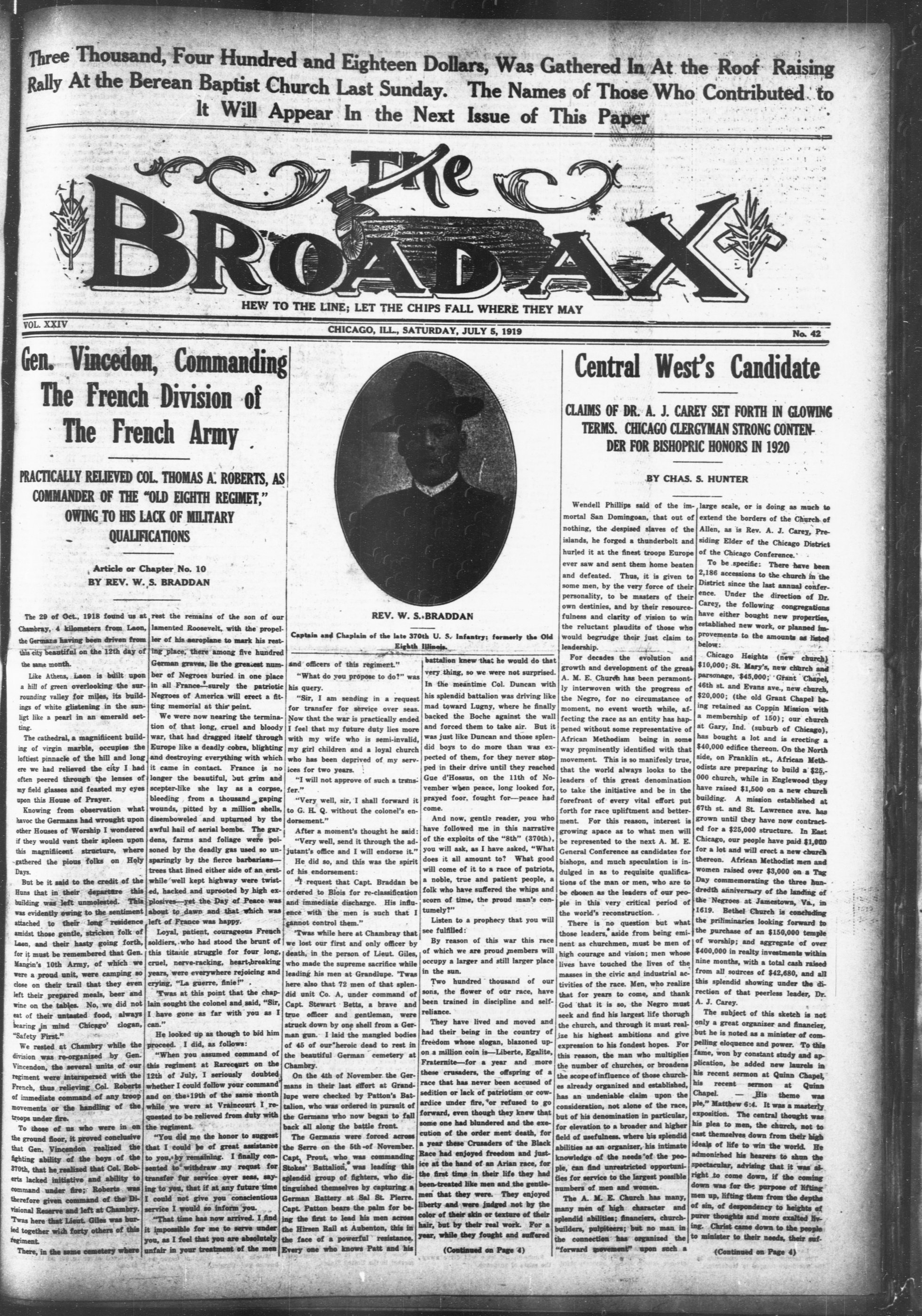
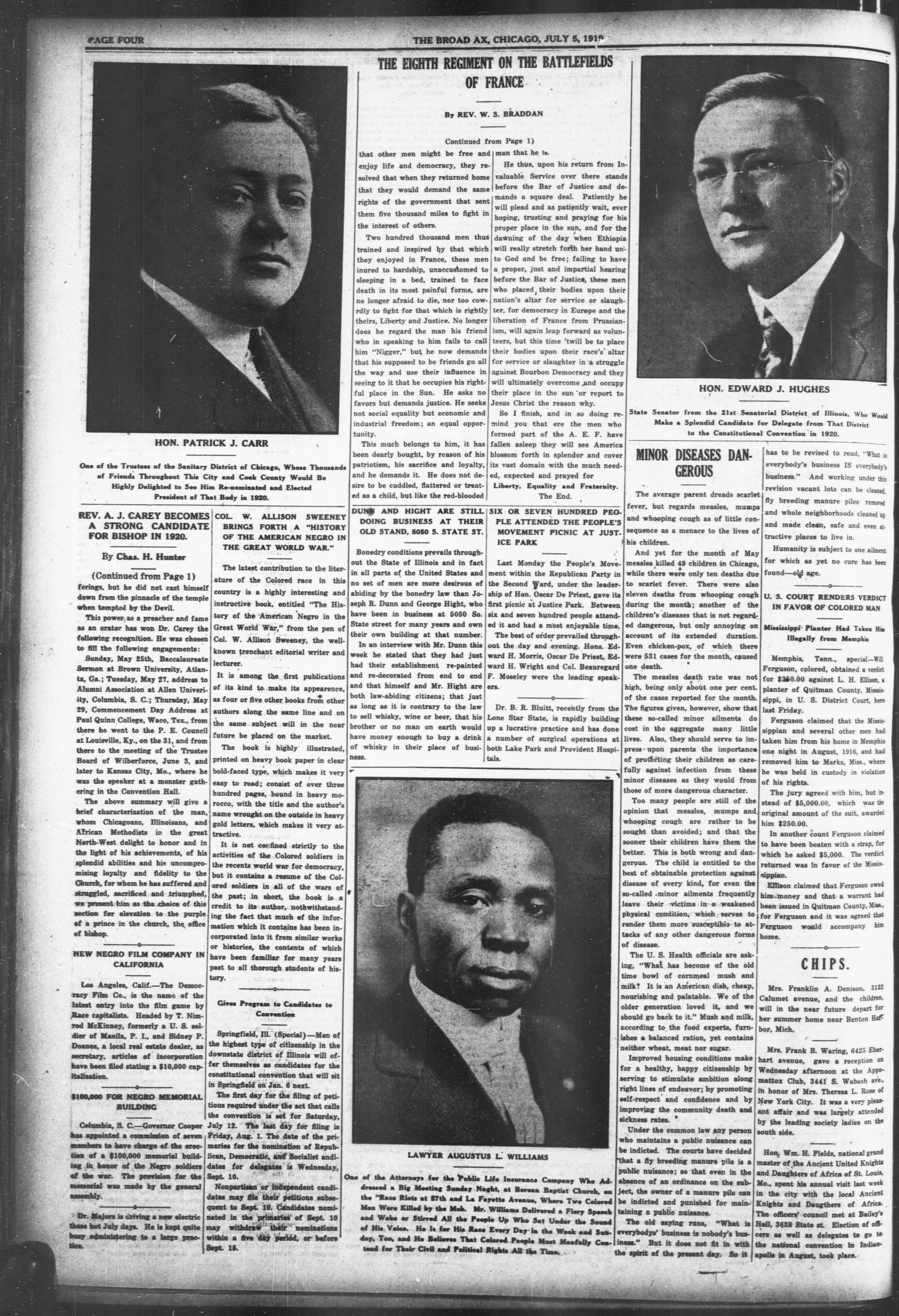
Page text (machine-generated)
Three Thousand, Four Hundred and Eighteen Dollars, Was Gathered In At the Roof Raising Rally At the Berean Baptist Church Last Sunday. The Names of Those Who Contributed to It Will Appear In the Next Issue of This Paper
THE BROAD AX
Gen. Vincedon, Commanding The French Division of The French Army
PRACTICALLY RELIEVED COL. THOMAS A. ROBERTS, AS COMMANDER OF THE "OLD EIGHTH REGIMET," OWING TO HIS LACK OF MILITARY QUALIFICATIONS
Article or Chapter No. 10 BY REV. W. S. BRADDAN
The 29 of Oct., 1918 found us at Chambray, 4 kilometers from Laon, the Germans having been driven from this city beautiful on the 12th day of the same month.
Like Athens, Laon is built upon a hill of green overlooking the surrounding valley for miles, its buildings of white glistening in the sunligt like a pearl in an emerald setting.
The cathedral, a magnificent building of virgin marble, occupies the loftiest pinnacle of the hill and long ere we had relieved the city I had often peered through the lenses of my field glasses and feasted my eyes upon this House of Prayer.
Knowing from observation what havoc the Germans had wrought upon other Houses of Worship I wondered if they would vent their spleen upon this magnificent structure, where gathered the pious folks on Holy Days.
But be it said to the credit of the Huns that in their departure this building was left unmolested. This was evidently owing to the sentiment attached to their long residence amidst those gentle, stricken folk of Laen, and their hasty going forth, for it must be remembered that Gen. Mangin's 10th Army, of which we were a proud unit, were camping so close on their trail that they even left their prepared meals, beer and wine on the tables. No, we did not eat of their untasted food, always bearing in mind Chicago' slogan, "Safety First."
We rested at Chambry while the division was re-organized by Gen. Vincendon, the several units of our regiment were interspersed with the French, thus relieving Col. Roberts of immediate command of any troop movements or the handling of the troops under fire.
To those of us who were in on the ground floor, it proved conclusive that Gen. Vincendon realized the fighting ability of the boys of the 370th, that he realized that Col. Roberts lacked initiative and ability to command under fire; Roberts was therefore given command of the Divisional Reserve and left at Chambry. 'Twas here that Lieut. Giles was buried together with forty others of this regiment.
rest the remains of the son of our lamented Roosevelt, with the propeller of his aeroplane to mark his resting place, there among five hundred German graves, lie the greatest number of Negroes buried in one place in all France—surely the patriotic Negroes of America will erect a fitting memorial at this point.
We were now nearing the termination of that long, cruel and bloody war, that had dragged itself through Europe like a deadly cobra, blighting and destroying everything with which it came in contact. France is no longer the beautiful, but grim and scepter-like she lay as a corpse, bleeding from a thousand gaping wounds, pitted by a million shells, disembowelled and upturned by the awful hail of aerial bombs. The gardens, farms and foliage were poisoned by the deadly gas used so unsparingly by the fierce barbarians—trees that lined either side of an erstwhile well kept highway were twisted, hacked and uprooted by high explosives—yet the Day of Peace was about to dawn and that which was left of France was happy.
Loyal, patient, courageous French soldiers, who had stood the brunt of this titanic struggle for four long, cruel, nerve-racking, heart-breaking years, were everywhere rejoicing and crying, "La guerre, finie!"
"Twas at this point that the chaplain sought the colonel and said, "Sir, I have gone as far with you as I can."
He looked up as though to bid him proceed. I did, as follows:
"When you assumed command of this regiment at Rarecourt on the 12th of July, I seriously doubted whether I could follow your command and on the 19th of the same month while we were at Vraincourt I requested to be relieved from duty with the regiment.
"You did me the honor to suggest that I could be of great assistance to you, by remaining. I finally consented to withdraw my request for transfer for service over seas, saying to you, that if at any future time I could not give you conscientious service I would so inform you.
"That time has now arrived. I find it impossible for me to serve under you, as I feel that you are absolutely unfair in your treatment of the men
HEW TO THE LINE; LET THE CHIPS FALL WHERE THEY MAY
REV. W. S..BRADDAN
and officers of this regiment."
"What do you propose to do?" was his query.
"Sir, I am sending in a request for transfer for service over seas. Now that the war is practically ended I feel that my future duty lies more with my wife who is semi-invalid, my girl children and a loyal church who has been deprived of my services for two years.
"I will not approve of such a transfer."
"Very well, sir, I shall forward it to G. H. Q. without the colonel's endorsement."
After a moment's thought he said:
"Very well, send it through the adjutant's office and I will endorse it."
He did so, and this was the spirit of his endorsement:
battalion knew that he would do that very thing, so we were not surprised. In the meantime Col. Duncan with his splendid battalion was driving like mad toward Lugny, where he finally backed the Boche against the wall and forced them to take air. But it was just like Duncan and those splendid boys to do more than was expected of them, for they never stopped in their drive until they reached Gue d'Hossus, on the 11th of November when peace, long looked for, prayed foor, fought for—peace had come.
And now, gentle reader, you who have followed me in this narrative of the exploits of the "8th" (370th), you will ask, as I have asked, "What does it all amount to? What good will come of it to a race of patriots,
"I request that Capt. Braddan be ordered to Blois for re-classification and immediate discharge. His influence with the men is such that I cannot control them."
"Twas while here at Chambray that we lost our first and only officer by death, in the person of Lieut. Giles, who made the supreme sacrifice while leading his men at Grandlupe. 'Twas here also that 72 men of that splendid unit Co. A, under command of Capt. Stewart Betts, a brave and true officer and gentleman, were struck down by one shell from a German gun. I laid the mangled bodies of 45 of our heroic dead to rest in the beautiful German cemetery at Chambry.
On the 4th of November the Germans in their last effort at Grandlupe were checked by Patton's Battalion, who was ordered in pursuit of the Germans who now began to fall back all along the battle front."
The Germans were forced across the Serre on the 5th of November. Capt. Prout, who was commanding Stokes' Battalion, was leading this splendid group of fighters, who distinguished themselves by capturing a German Battery at Sal St. Pierre. Capt. Patton bears the palm for being the first to lead his men across the Hirsen Rail at Aubenton, this in the face of a powerful resistance. Every one who knows Patt and his
battalion knew that he would do that very thing, so we were not surprised. In the meantime Col. Duncan with his splendid battalion was driving like mad toward Lugny, where he finally backed the Boche against the wall and forced them to take air. But it was just like Duncan and those splendid boys to do more than was expected of them, for they never stopped in their drive until they reached Gue d'Hossus, on the 11th of November when peace, long looked for, prayed fear, fought for—peace had come.
And now, gentle reader, you who have followed me in this narrative of the exploits of the "8th" (370th), you will ask, as I have asked, "What does it all amount to? What good will come of it to a race of patriots, a noble, true and patient people, a folk who have suffered the whips and scorn of time, the proud man's contumely?"
Listen to a prophecy that you will see fulfilled:
By reason of this war this race of which we are proud members will occupy a larger and still larger place in the sun. Two hundred thousand of our sons, the flower of our race, have been trained in discipline and self-reliance.
They have lived and moved and had their being in the country of freedom whose slogan, blazoned upon a million coin is—Liberte, Egalite, Fraternite—for a year and more these crusaders, the offspring of a race that has never been accused of sedition or lack of patriotism or cowardice under fire, or refused to go forward, even though they knew that some one had blundered and the execution of the order ment death, for a year these Crusaders of the Black Race had enjoyed freedom and justice at the hand of an Arian race, for the first time in their life they had been-treated like men and the gentlemen that they were. They enjoyed liberty and were judged not by the color of their skin or texture of their hair, but by their real work. For a year, while they fought and suffered
Central West's Candidate
CLAIMS OF DR. A. J. CAREY SET FORTH IN GLOWING TERMS. CHICAGO CLERGYMAN STRONG CONTENDER FOR BISHOPRIC HONORS IN 1920
.BY CHAS. S. HUNTER
Wendell Phillips said of the immortal San Domingoan, that out of nothing, the despised slaves of the islands, he forged a thunderbolt and hurled it at the finest troops Europe ever saw and sent them home beaten and defeated. Thus, it is given to some men, by the very force of their personality, to be masters of their own destinies, and by their resourcefulness and clarity of vision to win the reluctant plaudits of those who would begrudge their just claim to leadership.
For decades the evolution and growth and development of the great A. M. E. Church has been peramonthly interwoven with the progress of the Negro, for no circumstance of moment, no event worth while, affecting the race as an entity has happened without some representative of African Methodism being in some way prominently identified with that movement. This is so manifesely true, that the world always looks to the leaders of this great denomination to take the initiative and be in the forefront of every vital effort put forth for race upliftment and betterment. For this reason, interest is growing apace as to what men will be represented to the next A. M. E. General Conference as candidates for bishops, and much speculation is indulged in as to requisite qualifications of the man or men, who are to be chosen as the leaders of our people in this very critical period of the world's reconstruction.
There is no question but what those leaders, aside from being eminent as churchmen, must be men of high courage and vision; men whose lives have touched the lives of the masses in the civic and industrial activities of the race. Men, who realize that for years to come, and thank God that it is so, the Negro must seek and find his largest life thorough the church, and through it must realize his highest ambitions and give expression to his fondest hopes. For this reason, the man who multiplies the number of churches, or broadens the scope of influence of those churches already organized and established, has an undeniable claim upon the consideration, not alone of the race, but of his denomination in particular, for elevation to a broader and higher field of usefulness, where his splendid abilities as an organizer, his intimate knowledge of the needs of the people, can find unrestricted opportunities for service to the largest possible numbers of men and women.
The A. M. E. Church has many, many men of high character and splendid abilities; financiers, church-builders, pulpiteers; but no man in the connection has organized the "forward movement" upon such a
large scale, or is doing as much to extend the borders of the Church of Allen, as is Rev. A. J. Carey, Presiding Elder of the Chicago District of the Chicago Conference.
To be specific: There have been 2,186 accessions to the church in the District since the last annual conference. Under the direction of Dr. Carey, the following congregations have either bought new properties, established new work, or planned improvements to the amounts as listed below:
Chicago Heights (new church) $10,000; St. Mary's, new church and parsonage, $45,000; Grant Chapel, 46th st. and Evans ave., new church, $20,000; (the old Grant Chapel being retained as Coppin Mission with a membership of 150); our church at Gary, Ind. (suburb of Chicago), has bought a lot and is erecting a $40,000 edifice thereon. On the North side, on Franklin st., African Methodists are preparing to build a $25,-000 church, while in Englewood they have raised $1,500 on a new church building. A mission established at 67th st. and St. Lawrence ave. has grown until they have now contracted for a $25,000 structure. In East Chicago, our people have paid $1,000 for a lot and will erect a new church thereon. African Methodist men and women raised over $3,000 on a Tag Day commemorating the three hundredth anniversary of the landing of the Negroes at Jamestown, Va., in 1619. Bethel Church is concluding the preliminaries looking forward to the purchase of an $150,000 temple of worship; and aggregate of over $400,000 in realty investments within nine months, with a total cash raised from all sources of $42,680, and all this splendid showing under the direction of that peerless leader, Dr. A. J. Carey.
The subject of this sketch is not only a great organizer and financier, but he is noted as a minister of compelling eloquence and power. To this fame, won by constant study and application, he added new laurels in his recent sermon at Quinn Chapel, his recent sermon at Quinn Chapel. — His theme was ple," Matthew 6:4. It was a masterly exposition. The central thought was his plea to men, the church, not to cast themselves down from their high ideals of life to win the world. He admonished his hearers to shun the spectacular, advising that it was alright to come down, if the coming down was for the purpose of lifting men up, lifting them from the depths of sin, of despondency to heights of purer thoughts and more exalted living. Christ came down to the people to minister to their needs, their suf.
(Continued on Page 4)
No.42
PAGE TWO
THE BROAD AX
Published Every Saturday
In this city since July 15th, 1899, without missing one single issue. Republicans, Democrats, Catholics, Protestants, Single Taxers, Priests, infidels or anyone else can have their say as long as their language is proper and responsibility is fixed.
The Broad Ax is a newspaper whose platform is broad enough for all, ever claiming the editorial right to speak its own mind.
Local communications will receive attention. Write only on one side of the paper.
Subscriptions must be paid in advance.
Advertising rates made known on application.
6206 So. Elizabeth St., Chicago, Ill.
JULIUS F. TAYLOR
Editor and Publisher
DR. M. A. MAJORS
Associate Editor
4700 South State Street
Phone Drexel 1416
Vol. XXIV. July 5, 1919 No. 42
Entered as Second-Class Matter, Aug.
19, 1902, at the Post Office at Chicago, Ill., Under Act of March 3, 1879
Fiendish Delight
Bloggs—"From what you've told me of your mother-in-law I should think you hear enough from her in person without having cared to induce her to talk into your photograph." Moggs—"Oh, you can't imagine the pleasure it gives me to start the machine going and then shut it off right in the middle of a sentence!"
Supply Was One Short
The twins, Harry and Henry, have always had toys exactly alike. The other morning as father came hurrying downstairs he met Harry, saying: "Oh, come up stairs and see your new brother." As Harry was looking at his new brother, Henry came in, crying: "Daddy, where is MY new brother?"
Plant to Be Dreaded
One of the most terrible plants in existence is the Asclepias gigantea, which is common in Abyssinia, and grows also in Ceylon. When cut, a milky sap exudes from the stem and leaves, and the least drop of this will cause total blindness if it comes in contact with the eyes.
The Largest Flower
Mindanao, produces the largest flower in the world. Its habitat is the Parag mountain, 2,500 feet above sea level. The natives give it the name of Bolo. Its full-blossom, five-petalled, is over three feet in diameter and weighs 22 pounds. The flower was first found in Sumatra.
What You Make It
"After all," a man writes, "life is merely the act of going to one's grave." Not much in that; it is hardly worth printing. Life is long and full of interest, opportunity and pleasure. Life is abused unjustly and untruthfully.—B. W. Howe's Monthly.
Baby Shoe an Ornament
The first shoe of the first baby may be preserved as an ornament with both intrinsic and sentimental value. A jeweler plates in gold or silver the creased and worn little shoes just as the baby foot formed it.
All He Wanted
There was a plate of cake on the table and Guy's grandmother asked him which piece he would have. "T'll take any piece so long as it's a good big one," was his unselfish reply.
One Thing in His Favor
"Do man da laughs at his own jokes," said Uncle Eben, "makes you feel like kind o' friendly toward 'lm,' cause he seems so good-natured and easy to please."
Bird Trials.
It is said to be an established fact that several kinds of birds, crowns in particular, hold trials to judge one of their number which has in some way offended.
Get the Habit
The habit of viewing things cheerfully, and of thinking about life hopefully, may be made to grow up in us like any other habit.—Samuel Simles.
Plane Truth.
The paradoxical thing about the airplane is that it is not much good unless it is used up.—Boston Transcript.
Largest Pineapple Canneries.
The largest pineapple canneries in the world are located in Honolulu.
Undeveloped Country
Lake St. John, at the head of the picturesque Saguenay river, has been brought to the notice of the Royal Society of Arts by Prof. J. C. McLennan as one of the best undeveloped power sources in North America. It has an area of about 350 square miles, drains a basin of 20,000 square miles, and is 315 feet above sea level. Three easily developed power sites are capable of yielding a total of 1,000,000 horse power at tidewater, and many sites for docks and industrial plants are available on the river.
When Boston Was In Trouble.
In 1774, on the 1st of June, the Boston port, bill went into operation. At noon the harbor was closed against all vessels and business was suspended. In a 20 days' notice the citizens of Boston were deprived of their means of gaining a living. Indignation ran high throughout the colonies, contributions were raised in other cities for their relief, and the people of Marblehead offered the Boston merchants the use of their wharves.
Surely Drafty.
There are all sorts of different ways of bringing a thing home to people. Take the case, for instance, of a member of the Essex district council in England, recently, who wanted to enable his fellow-councillors to realize the shameful disrepair of a certain cottage near by. It was so drafty, he said, that tunes could be played on a mouth organ moved up and down along cracks in the walls.
Didn't Quite Understand
Little John and his mother were visiting at the minister's home one day, when John picked up a Testament from the table. The minister's wife said: "You must not play with that book, for it is God's book." A week later, while at the minister's home again, he sped the book and said: "Why doesn't God come and get his book?"
Woman's Brainiest Age.
A woman's brain reaches its greatest weight about the age of twenty-five, while in the case of a man, this does not occur until ten years later. This explains the assertion that a woman at the age of twenty-one is in a better position to give a matured judgment than a man at the same age.
Education Always Help.
The success of the unlettered man is often argued to show that men do not need education. In special cases the truth may seem to be conclusive, but did you ever stop to inquire what the fellow might have become had he education added to his natural talents? He has succeeded in spite of a handicap and not because of it.
Only That Difference.
As I was going shopping I met a charming little fellow, who spoke to me quite politely. In further conversation I inquired his name. "Oh," he answered with easy assurance, "it's just the same as my daddy's, only it's got 'Jr.' on the end of it."—Chicago Tribune.
Solomon's Fountain
Water from King Solomon's "Sealed Fountain," seven miles from Jerusalem, is conveyed to the city through modern iron pipes part of the way, and the remainder of the distance by an ancient sluiceway known as Solomon's aqueduct.
Japanese Marriage Agencies
Marriage agencies in Japan are now limited to 25 pesos fee on each match made. One peso for an introduction five for a hunt for a life partner and the rest for actually blinding two together are the legal prices.
Is the Converse True?
The Chinese have a proverb directed against "habblers," for whom they have a particular aversion. Is it applicable in America? "The great church bells rarely sound; the full cask returns no sound."
Keeping Cut Flowers Fresh
The length of time cut flowers can be kept can be greatly lengthened by putting a little saltpeter or carbonate of soda in the water in which they are kept.
As Usual.
The man who is always telling what a perfectly lovely place he used to live in makes you wonder how he ever came to leave such an Eden.—Farm Life.
Almost Any Excuse Goes.
We break many a promise to ourselves with excuses so weak that we would be ashamed to offer them to another.
Mutual Obligations
Mutual Obligations.
"Husbands should be frank and tell their wives everything." says a woman writer. Yes, and wives should be generous and believe it.
Gravity is the ballast of the soul, which keeps the mind steady.—Fuller.
Causes for Divorce.
Desertion ranks first as a cause for divorce, cruelty second, adultery third.
THE BROAD AX, CHICAGO, JULY 5, 1919
Girey Language.
T' language of the Gipsies, Roma... is said to be Hindoo dislect derived from Sanskrit. Ethnologists pretty well agree that the Gipsies are descendants of an obscure Hindoo tribe. The popular belief that Gipsies are descendants of the Egyptians has no other basis than the similarity of the two words. The word "Gipsy" as a matter of fact, is from the Bohemian, and means "vagabond." The first Gipsies appeared in England early in the sixteenth century, but were found in eastern Europe at least two centuries earlier. They are now scattered all over the world.
World's Highest Peaks
The highest mountain peak in North America is Mt. McKinley, in Alaska, whose altitude is 20,300 feet, and the highest in South America, Mt. Acconagun, in the Andes, on the border of Chile and Argentina, 23,080 feet. The highest mountain in the world is Mt. Everest, in the Himalayas, in Asia. Its altitude is 29,002 feet. There are several hundred mountain peaks in the Himalayas 20,000 feet or over, running to an altitude of 28,278 feet.
Cruelty in Training Birds
Performing birds are often taught by starvation. How many are aware that the pretty doves that fly when released to the bespangled artists, and form themselves into geometrical patterns on her head and outstretched arms, are often the sole survivors of hundreds which have been starved and then only fed when they perched upon an exact spot on the owner's arms.
Picturesque Lisbon
Lisbon, the westernmost of European capitals, spreads itself in leisurely fashion over its 11 hills, extending for more than five miles along the shores of the famous Rada de Lisboa, and for more than three miles inland. Beyond the narrow channel leading out of the Rada through which flow the waters of the Tagus lies the open sea, and some 800 miles away over the horizon to the west are the Azores.
Fortune Awaits Inventor
"Untearable" linen has long been the dream of many people, but although experiments have often been made, the way to weave an indestructible cloth is still unknown, and no one has claimed the fortune which is awaiting the inventor who solves the mystery.
Warsaw.
Warsaw is a very beautiful and imposing city as viewed from the castle at Praga across the Vistula, and contains a number of magnificent palaces, among which an ancient Saxon stronghold is the most notable. There also is the cathedral of St. John the Divine, a splendid example of gothic architecture, which dates from 1250.
Story of the Mirror
From the twelfth to the fifteenth century small mirrors, carried in the pocket or attached to the girdle, were regarded as indispensable adjuncts to ladies' toilets. The pocket mirror was a circular plaque of polished metal fixed in a shallow box and covered with a lid.
The first recorded visit to what is now Yellowstone park was made in 1810 by John Colter, a trapper, who took refuge there from hostile Indians. His tale of its wonders were absolutely discredited.
Roosevelt's Long Ride.
In February, 1909, the late former President Roosevelt rode 98 miles on horseback in the seventeen hours between daylight and dark. The trip was from Washington to Warrenton and return. Three horses were used.
Cheek by Growl.
"By taking celo-celery each morning you will wash all poisons from stomach, leaving it pure and sweet, with rosy cheeks."—Dudley (England) Herald.
Airplane Work Tiring
Workers in the "dope" room of aeroplane factories are found to be affected generally with a mild form of anemia, but it is not sufficiently pronounced to be alarming.
"Y." of Course.
Before they were married she thought him a treasure, now she considers him a treasure.-Edinburgh Scotsman.
Uncle Eben.
"De amount of hurryin' a man wants to do," said Uncle Eben, "it mighty apt to depend on whether he's travelin' afoot or drivin' a hose."
Kidd a New Yorker
The redoubtable Capt. Kidd lived about 200 years ago in a house that stood on the present site of 119-121 Pearl street, New York City.
Millions of Miles of Water.
The volume of water on the earth's surface is estimated at 315,000,000 cubic miles.
Optimistic Thought. Sunbeams of hope will drive away the mists of suspense.
When Tobacco Was Taboo.
In 1638 the Massachusetts general court ordered, a writer comments, "that no man shall take any tobacco within 20 poles of any house, or so near as may endanger the same." In 1798 an act was passed forbidding the carrying of fire through the streets except in a covered vessel, smoking, or having in one's possession "any lighted pipe or segar" in the streets or on the wharves. The penalty was $2. If the offender was in a ropewalk, the penalty was from $5 to $100. This prohibition of 1798 was not repealed until 1890.
Deaf and Dumb Language
The Encyclopedia Britannica says: "We have conversed by signs with deaf people from all parts of the British Isles, from France, from Norway and Sweden, Poland, Finland, Italy, Russia, Turkey, the United States and found that they are indeed a worldwide means of communication. Deaf people in America converse with Red Indians with ease, thereby showing how natural the generality of even del Epee signs are."
Steel and Iron.
Steel is a kind of iron which can easily be hammered out thin without cracking and can be made extremely hard by being heated and then cooled quickly. It is different from ordinary iron because of the amount of carbon in it. Wrought iron contains less carbon than steel and so it cannot be made so hard; cast iron contains more and so is brittle.
Guarded Natural Resources
"The Indians of Kentucky," says Dr. Clark Wissler, "were in the habit of burning off forest areas regularly so as to provide pasturage for the buffalo, thus enticing him to remain in the country." Again, the Indians living in the regions where wild rice grows, were observed to take certain precautions to protect the rice beds, even to facilitating their growth."
To Drive Moths From a Piano
When moths get into a piano the best means of ejecting them is to make up a mixture of turpentine, benzoline and oil of lavender, and squirt this inside the instrument with a scent spray. Use seven parts of benzoline to one of turpentine; add a few drops of lavender to each ounce.
The Husband in Charge
Wife—"Considering how long I've been away, I think you might have made some preparations to receive me." Husband—"You do me injustice, my dear. I have had the library and parlor thoroughly cleaned and aired." Servant (interrupting)—"Please, the man has come with a barrow for them empty bottles."
A. Nincompoop.
"Nincompoop" is a most entirely satisfying and refined way of calling a person a foof or blockhead or a simpleton. It is a corruption of the Latin phrase "non compos mentis"—not sound of mind. Besides being satisfying and refined it has a classical origin in addition.
Dogs of War
On July 28, 1838, General Zachary Taylor, afterward president of the United States, requested the government to furnish him with bloodhounds to be used in hunting the Semihole Indians of Florida. He was furnished with the dogs.
Taking Up Our Time
Sometime we are going to figure up how many hours a day of our telephoning time is devoted to listening patiently to sweet voices saying that, they know they ought not to disturb us at our work. -Ohio State Journal.
Chance for Inventors
A prize of $10,000 is offered by the Walnut Growers' association to any one who will invent a satisfactory machine for branding the shell of each English walnut in a yearly $10,000,000 crop.
Not Done in That Reckless Way.
Minden Counter-"A few years ago Mr. ____ spent $2.50 for advertising without drawing any crowd to his store, so he is convinced that it doesn't pay."-Boston Transcript.
Sex Differences
When it is a man getting a set of false teeth, he is afraid he is not going to be able to eat with them; if it is a woman, she is afraid she will not be able to talk—Houston Post.
The Truly Wise
He who has obtained any amount of knowledge is not truly wise unless he appropriates it and can use it for his need—Dr. John Brown.
Delicate Anemone
Anemone means "windflower," and is so called because it is so delicately poised that it sways with the lightest motion of the atmosphere.
Daily Thought.
Words and feathers the wind carries away.—Herbert.
Country's Largest Coal Market.
New York city is the largest coal market in the United States.
Why Hair Stands on End.
When hair stands on end on the back of a dog or cat when frightened it is moved by tiny muscles attached to the roots. The hair follicle is like a little seed buried in the flesh. Attached to either side of this seed are tiny muscles which run diagonally through the flesh from the lower part of the follicle. These little muscles are like the guy ropes of a tent. They are what are called the erector muscles, and when fear or cold is experienced these muscles promptly tighten up in such a manner as to "hoist" the hair very quickly.
Arctic Night.
Viewed solely as a matter of optics, the Arctic night is as dark as any night. Explorers in high latitudes say, however, that there are many alleviations of the obscurity. The stars flash keenly, the moon comes along in a regular succession of phases, the snow surface relieves the gloom under conditions of the utmost absence of light, and the aurora borealis is the finest kind of illuminant. Explorers all agree that their men pass the winter night without much difficulty if only there are means of amusement.
The Amazon
The Amazon discharges the largest amount of water of any river in the world, and the St. Lawrence next. Other interesting facts about these rivers are that the length of the Amazon is 3,300 miles and its width varies from a few hundred feet at different points to more than 100 miles at its mouth. The St. Lawrence is 2,200 miles in length, is from one to several miles wide at places to ninety miles at its mouth.
Abbreviations
The letters i. e. are an abbreviation of the Latin phrase "id est," meaning "that is," and the letters e. g. an abbreviation of another Latin phrase "exempli gratia," having the meaning of "for the sake of example" and "for instance." Vs. is an abbreviation of the Latin word versus, meaning "against." Vice versa is a phrase meaning "the order or relation of terms being reversed."
Dreaming of Cate
To dream of cats is said not to be lucky. If you dreamt of a black cat, your enemies are active; to be bitten by one indicates misfortune; burglars are about when a cat follows you in a dream; while to dream you are stroking one means, beware of false friends.
Long Indian Name
The longest geographical Indian name is probably that of Lake Chargo gagogmaunchaugagogchebunnygunga-maug. This lake is in Massachusetts and its name has recently been changed to Lake Webster. The word is of Algonquin origin and is said to mean "How the south wind made a large water where many blackbirds chatter."
Expensive and Unnecessary
The fact that of all the buttons that have been given out to be testimony to the wearers' participation in the performance of public duty few are worn should be admonition to put the time consumed in the making of such buttons, and the money spent to pay for them, to better use.-Albany Journal.
Small Daily Task
Nothing surely is so potent as a law that may not be disobeyed. It has the force of the water-drop that hollows the stone. A small daily task, if it be really daily, will beat the labors of a spasmodic Hercules.—Anthony Trollone.
"Cataup."
The word "catsup," which is spelled "catsup," "catchup," "ketchup" and "kitchup," is a corruption of the Chinese word "kitjap," the name given to an inferior kind of soy made in China.
A: Little Girl's Problem.
The father of a little girl I know is a Methodist, and her mother an Episcopalian, and the poor child neyer knows, in saying her prayers, whether to end them with "A-men" or "Ahmen."—E. W. Howe's Monthly.
Little Sympathy for Him.
"Readin' 'bout what dem soldier men went through," said Uncle Eben, "is g'neter make it mighty hard to sympathize wif'de man dat complains 'bout a little thing like a hot day."
Seek to Retain Old Friends
The years have taught some sweet, some bitter lessons—none wiser than this: to spend in all things else, but of old friends to be most miserly.—Lowell.
Nerve of Small Note
In spite of the vast mechanical improvements of the age, the best alarm clock is still the sweet perfume of frying ham and eggs.—Toledo Blade.
Drunk With Love
"Oh, Amorous Dove by this imposing queen, was one of the best sots of the evening."—New York Times.
Daily Thought.
Words without thoughts never to heaven go.—Hamlet.
PHILOSOPHER'S VIEW OF LIFE
Mr. Goslington Tells How Sight of Funeral Procession Brings Reflections That Uplift.
"As a rule," said Mr. Goslington, "I take a cheerful view. Perhaps when I get to be older I shall be more doleful, but it would be hard for me to be that way now. For as far as I've got life has been pretty good to me. I have had my little setbacks and now and then a real jolt, but on the whole my lot has been happy.
"True I have not accumulated a fortune, but I have had work to do and I have earned a living. I might say a comfortable living; and I have been blessed with good health. And so for me all nature smiles and men are friendly and the world is a pleasant place to live in; I take a cheerful view—as a rule.
"But I will admit that I do have spells, not of sheer despondency—I would not say that, but times when I am depressed, when things go wrong, when adverse happenings have all but discouraged me; times when I finally forget what we should in such days always remember, namely, that there never yet was a storm but cleared off some' time, to leave everything bright and sunshine as before; there are times, I say, when even I, usually so cheerful, am downcast.
"When thus oppressed I find great help in funeral processes.
"As the solemn cortege passes I can not but reflect that I still have the one great priceless gift and blessing—life, with all its hopes and opportunities; and so, with all respect and sorrow for the dead, in this presence my own petty troubles vanish, the clouds roll back and the sun comes out clear and strong again.—New York Sun.
STORK'S VISIT TO SCOTLAND
Record of Bird's Appearance in 1418
May Be Found in Chronicles of
the Country.
The white stork of the continent of
Europe, which is encouraged in most,
and even protected in some, of the
countries to which it resorts to breed,
and round which much story and leg-
end have gathered, has been known
for centuries to be an occasional visi-
tator to the British isles, chiefly to Nor-
folk, but very rarely to Scotland,
though it has never been known to
nest or even attempt to do so in Brit-
aln.
However, a record of its having nested in Scotland appears in Good all's edition of the "Schotchconchion." This work was begun by John Fordun, who died about 1884, and was continued by Walter Bower, the abbot of Inchcolm. It is in Bower's chronicles for 1416 that the story appears. The translation runs thus:
"In the year of our Lord, fourteen hundred and sixteen, there died on the morrow of the birth of St. John the Baptist, Master James Biset, prior of St. Andrew's. In this same year, a pair of storks came to Scotland and nested on top of the church of St. Giles of Edinburgh and dwelt there throughout a season of the year; but to what place they flew away thereafter no one known."
Commenting on this, Lord Lagle Clarke says: "The church of St. Giles, on which the storks nested, was a new stone edifice commenced in 1387, to replace a former church destroyed in 1385, and some of it doubtless forms part of the cathedral of today."
Mark Twain on Conscience.
There is on record a conversation that Mark Twain had with Kipling, in which the former discussed on the conscience. The story is told by Kipling. He reports Twain is saying: "A conscience is like a child. If you pet it and play with it and let it have everything that it wants it becomes spoiled and intrudes on all your amusements and most of your griefs. Treat your conscience as you would treat anything else. When it rebels spank it—be severe with it, prevent its coming to play with you at all hours, and you will secure a good conscience; that is to say, a properly trained one. A spoiled one simply destroys the pleasures of life. I think that I have reduced mine to order. At least I have not heard from it for some time. Perhaps I have killed it from severity. It's wrong to kill a child, but in spite of all I have said a conscience differs from a child in many ways. Perhaps it's best when it is dead."
Ingenious "Fake" Pistol
A French inventor has recently placed on the market a "fake" pistol. This weapon, although in reality absolutely harmless, goes off with a very realistic crack when the trigger is pulled. It also makes a blinding flash calculated to scare any burglar. Inventions of an even more complicated nature are constantly being heard of. A well-to-do gentleman living in Surrey has recently had his house and grounds fitted with an elaborate burglar trap. With this device a midnight marauder cannot approach near the house without setting a number of electric bells within a ringing. And should the burglar not hear them and actually enter the building he would be caught in a vise by one of the many steel contraptions cunningly placed about—London Tit-Bits.
Second Thoughts.
Mrs. Justwed—When I married I resolved to yield to my husband in everything.
Mrs. Langwed—So did I. And then resolved never to act on that resolution.
The sultan of Morocco was always an absolute monarch, and in that capacity the revenues of the country were his. There had never been any distinction between public funds and private funds—all belonged to the sultan. It was therefore no easy task to arrive at an agreement as to which were state and which private debts, so inextricably mixed had they been in the past. There was, for instance, a bill for some hundreds of yards of very expensive and very fine crimson cloth. Naturally the protectorate authorities scheduled this among the private debts. The sultan protested. The cloth, he said, had been purchased for governmental purposes—in fact for the trousers of the imperial kitchen maids; for there are several hundred slave-women employed in preparing the palace food. The protectorate government refused to be responsible for this debt. The ex-sultan drew up a historical treatise to prove that imperial kitchen maids were part and parcel of the state, and passed, like the palace itself, from sultan to sultan. The principle was accepted, but the debt was disallowed on the ground that these good ladies did not require such expensive stuff for their nether garments. A cotton material, they argued, would have equally well served the purpose. The sultan's reply was answerable and crushing. "In Europe," he said, "it may be the custom for the imperial kitchen maids to wear cotton trousers, but 'in Morocco we have more appreciation of the dignity of their position.' There was nothing more to be said. The debt was paid—by the protectorate government.—From "The Liquidation of a Sultanate," by W. B. Harris, in "Asia" magazine.
FOLLOWED PATHS OF PEACE
Aberigines of Texas Unlike the Fierce Tribes of Other Sections of the Country.
Stone implements found in ancient workshops in Texas, antedating French, Spanish or American settlers, prove that the original settlers of this state were not like the fierce tribes encountered in modern times by the white settlers.
Little is known about the aboriginal population of Texas, which lies between the Pueblo and mound builders' area, but Dr. J. Walter Fewkes, chief of the American bureau of ethnology, aided by Professor Peace of the University of Texas, have located some long-forgotten village sites. Their investigations lead to the belief that the original people of the middle part of the state were hunters, while those of the eastern part near the timber belt, were followers of agricultural pursuits and were skilled in the manufacture of pottery. They resembled the mound builders. The western part of the state was a more elevated and less arid plateau. Here the people resembled the Pueblos of New Mexico. Some of the tribes are reported to have been cannibals. In the opening of the eighteenth century Apaches Comanches and other savage tribes roamed over Texas, following the buffalo, or raiding across it into Mexico. There seems to have been constant hostility with these Indians, in which many smaller tribes were exterminated.
Remarkable Chimpanzee Dilea
Remarkable Chimpanzee Dies.
A few weeks ago there died a chimpanzee who had spent the eight years of his life defying all rules laid down for the well being of chimpanzees. His name was Antony, and he was the only one of his tribe of monkeys who has ever managed to stand an English climate unmitigated by artificial heat. He came from the Congo in 1911, when he was very young and small. At that time he weighed 14 pounds, by last summer he was just six times as heavy. During the whole period of his civilized life he was kept in a brick building facing southwest and unheated, and he slept in straw without blankets. Chocolates and sweets—poleson to ordinary chimpanzees—were the special treats of Antony's dietary, and he had a less comprehensible fancy for beans.—Manchester Guardian
The "Amen Corner."
The phrase "amen corner" is said to have originated in London, where, at the end of Paternoster row, the monks at one time finished their recitation of the "Pater Noster" as they went in procession on Corpus Christi day to St. Paul's cathedral. They began in Paternoster row with the Lord's prayer in Latin, continuing it to the end of the street, and then said "amen" at the corner of the row. As used in this country, the phrase described the corner of a church where the elderly members sit and pronounce the word "amen" at intervals.
Fisherman's Mascot
A mascot to which deep-sea fishermen attach great importance is a tiny flat stone or bone found in the ear of plaque and other fish. The wearer of one of these stones is supposed to be immune to the danger of drowning. It is easy to find these stones in the ears of fish, although they are no bigger than a split lentil. Anybody who cares to look for one and to examine it will see on its surface light and dark rings similar to those found on a larger scale in tree trunks. The number of rings tells the age of the fish, as a new ring appears each year.
Tribes in Interior of Venezuela Have Had Little Contact With Civilization.
Almost every tribe and race has found the secret of fire, even though civilization has not come near them. Needless to say, matches are unknown except as they have been carried into distant lands by white men, and fire is made by rubbing sticks together, with a sort of flint and tinder or, as in the case of the Macacos, with a drill.
These "people of the mist," as the explorers into the interior of Venezuela call them, keep their fires burning steadily from one year's end to another, but if a new one is needed it is started by drilling into wood until it bursts into fame.
The Macaoes share the Indians' love of painting their faces and, like them, use bow and arrow for hunting, but go about swathed in heavy clothing, much like that of the Arabs, because of the cold of the region in which they live.
The homes of the Macaoes are all built on hilltops, and the average altitude of the settlement is 3,000 feet. They cultivate sweet potatoes, bananas and melo, out of a combination of which they make a very strong fermented drink for use at feasts, and they are also exceedingly clever at basketry and other weaving, but are among the most uncleanly of all tribes and never, so it is said, take a bath unless unexpectedly caught out in a rain.
GOOD HEALTH RULES FOR ALL
English People Have Many Ideas Which It Would Be Well for Americans to Copy.
One of the most popular forms of food in England is cheese. This supplies a highly concentrated protein food which, when properly ripened and masticated, is usually well assimilated. Not only does this food contain a large percentage of protein, but it also contains fat and mineral salts. When combined with bread, which is a carbohydrate food, cheese makes an ideal combination, supplying as it does all the elements necessary for nourishment—protein, fat, carbo-hydrate and mineral salts.
Cheese and bread is a very popular form of food in England and it is eaten by all classes. Being an economical food, it is eaten to a larger extent by the laboring classes, who, owing to the sort of work they do, require a good tissue builder at a moderate price.
It is well to remember that part of the health of the English race is due to the fact that the English life is an outdoor life, and it is a very good thing for us to profit by this and cultivate at all times, in ourselves and in our children, the habit of getting outdoors as much as possible.
Where "Loot" Originated
Where Loot Originated.
The word "loot" came into the English language by way of India, and is supposed to be derived from the Sanscrit "totra," signifying booty. Originally all booty taken from the enemy in war pertained to the crown of the victorious nation, the title thereto being regarded as indisputable. The crown was supposed to dispose of these spoils of war according to its pleasure, bearing in mind the services of the captors of the matter. This was, indeed, the basis of prize law at sea. But at every international congress at which the laws of war and of mutual relations came under discussion it was agreed to exempt from seizure private property on land and to restrict confiscation to the national property of the foe.
Art for Many.
"I do not want art for a few," said William Morris, "any more than education for a few, or freedom for a few"—and civic art is essentially public art. It has been likened to "a fire built upon the market place, where every one may light his torch; while private art is a fire built upon a heartstone which will blaze and die out with the rise and fall of fortunes.
"Beauty in art is truth bathed in the impression, the emotion that is received from nature. Seek truth and exactitude, but with the envelope of sentiment which you felt at first, if you have been sincere in your emotion you will be able to pass it on to others."—Industrial Arts Magazine.
Consistency.
A foolish consistency is the hobgoblin of little minds, adored by little tatesmen and philosophers and divines. With consistency a great soul has simply nothing to do. He may as well concern himself with his shadow on the wall. Speak what you think today, in words as hard as cannon balls, and tomorrow speak what tomorrow thinks, in hard words again, though it contradict everything you said today. Ah, then, exclaim the aged ladies, you will be sure to be misunderstood. To be great is to be misunderstood.—Ralph Waldo Emerson.
The Higher Learning.
The schoolmaster was calling on an indignant mother.
"For my part," babbled the good woman, "I can't deceive what on earth edification is comin' to! When I was young, if a gal only understood the elimens of distraction, provision, replenishing, an' the common dominator, an' knew all about the rivers an' their obturaries, the currants, an' the dormitories, the provinces an' umpires, they had edification enough!"—Success.
THE BROAD AX. CHICAGO. JULY 5. 1919
People Have a Curious Method of Getting Rid of a Caller Who Outstays Welcome.
Once in a long while a caller comes to one's house or office or study and overstays his welcome, writes Cieland B. McAfee, in Forward. He of course is not conscious of this breach. All he needs is something to remind him he has stayed long enough. So far no device has been discovered for ending the call without risk of offense, though various formulas have been tried out. A few years ago a friend told a group of acquaintances that he always received his callers standing, and saw to it that there were no chairs in the room. Needless to say, the calls were always short. It was the common opinion among his listeners that this would be harder on him than on the callers. But that was his affair.
Perhaps the Japanese have come as near as any to solving the problem. A missionary to that land tells how, when a person makes too long a call, and apparently doesn't know it is time for him to leave, they stand a broom upside down somewhere in the house. This is a charm, supposed to throw a spell over the caller, and all unknown to himself he is compelled to go home. The broom doesn't have to be seen by the visitor; any obscure corner will do. The missionary tells of her own cook, not yet a Christian, who was so annoyed by callers who interfered with the dinner hour that she was just starting to turn the broom upside down when the callers left. Of course that confirmed the superstition. In America brooms have been known to rid a house of visitors, but ordinarily we adopt more drastic ways of handling it to gain that result.
It is not clear whether the Japanese method is more interesting as a superstition or as a courtesy. Certainly it is not peculiar to that nation to connect things which can have no real relation, but it is of the very essence of the race to think of a way to get things done without offending. At any rate there is the custom.
DIAMONDS HIDE IN AMERICA
Gems May One Day Be Mined on a Large Scale in This Country, Say Geologists.
Geologists, according to exchanges, believe that some day diamonds will be mined on a very large scale in the United States. They are confident there are valuable diamond mines hidden under this country, because many loose diamonds have been found in various sections. There must be a parent-lode, they say, and this is believed to be in either the Rocky mountain or Appalachian range. Regular diamond chimneys, like those of South Africa, were found in Arkansas in 1906. They were filled with periododite, akin to the famous Kimberlite of South Africa.
A farmer in Indiana, plowing a gravelly hillside, found the first diamond in America in 1837. More than 20 diamonds have been found in Indiana in the last 20 years, and one sold for $1,200. Other valuable diamonds have been found in Virginia, North Carolina, Wisconsin, South Carolina, Georgia, Alabama, Louisiana, Idaho, Texas, Montana, Arizona and California. A laborer working in an excavation in Manchester, Va., found a stone weighing 23% karats in 1855. Numerous stones, weighing from three to 21% karats have been found in Wisconsin.
Embroidery an Old Art
Embroidery is supposed to be one of the earliest domestic arts, for it is argued that it must have been employed for decorative purposes very soon after sewing was invented. This would place it long before the art of weaving was discovered and back in the days when the skins of animals were the only material for clothing that existed. The earliest known specimens of embroidery, however, are some fragments discovered in Egypt, and the earliest of these is supposed to have been made about the fifteenth century B. C. Naturally materials of this kind disappear very rapidly, and it is only in a very dry climate like Egypt, with its sandy soil, that fabrics suitable for embroidery could survive.
Dental Hygiene in Africa.
The manufacturer of a popular dental powder advertises that "Savages lead a different kind of life from us, and therefore nature takes care of their teeth without artificial help." Wellerburn, the wanderer in remote places, saw this and laughed. "I know of at least three African tribes," he said, "that brush their teeth regularly. Each person carries a twig of a certain fibrous tree. They chew the end of it into a good bunch of bristles and spend a quarter-hour every morning cleaning their teeth thoroughly. They tie a string to the twig and dangle it from the waist cord, if they have no other clothes to fasten it on. It is an important thing to them."
The Needed Lubrication.
A fervent, but unlettered, preacher among the mountain whites of the Carolinas was exhorting his flock to come forward and take advantage of the "means of grace."
"It it air pride that's keeping you settin' in ye seats," he cried. "Come to the altar and get down on your benders, and if they air too stiff with pride, ile' em, ile' em, as it says in the Scriptur' with ile of Patmoa."—New York Evening Post.
Symbol of Pennsylvania Family Had Origin in Gratitude for Previdential Help.
There is a quaint symbol engraved on the silver plate, the library book plates and the note paper of a family in Pennsylvania, but it isn't a crest on a coat of arms, by any means. In fact, it has no connection with the heraldry of the old world but is typically American.
The design is of a cat carrying a rabbit in its mouth, and there is an interesting legend to account for it. The first of the family to emigrate to this country was the father of ten children. He sailed the same year as Penn and died on the voyage, leaving bis wife to land alone with her helpless flock. She had a grant of land, it is said, but no money, and so was obliged, like many of the first immigrants to our shores, to take refuge in a cave dug out of the side of a hill.
The unfortunate family had a hard winter; provisions failed, and the widow was in despair as she saw her children grow pale and weak for want of food. The day came at last when there was not a grain of meal in the barrel. The poor woman spent many hours in prayer. When she arose, the story runs, she smiled, as her children put it, "as if she had seen an angel coming to help her." It was no angel, however, that the good woman beheld, but a cat with a freshly killed rabbit in its mouth. This rabbit provided a good meal, wherein, of course, the cat had its full share. And so the descendants of this woman, forming a prosperous and influential family, preserve to this day this old symbol of their early history.
"ANY FOOL CAN FIND FAULT"
Phrase Is as True Today as When Great Man Said It Many Centuries Ago.
There is nothing however good but a person may find some fault in it if he is determined to do so. There is nothing perfect that is of man's making. There is nothing that man originates or performs but what contains more or less of his weakness. Worth, like water, must stay below the level of its source. It is quite natural that a person should dissent. The scientists dispute as much as the theologians. Every time one obtains a new standpoint he changes his opinion. Every time he meets a friend he finds that he differs.
So we must make up our minds to disagree, but this disagreement may be of advantage if we disagree in the right spirit. If we don't do that and our disagreement falls into ill will and anxiety, then we become enemies of the truth and social pests besides. The person we earnestly and candidly disagree with may be right and ourselves wholly wrong. It would make us feel very absurd sometimes, in the midst of a violent controversy, to have a sudden light let in on the controversy and show our adversary entirely right. The safest thing, so far as one's conduct toward him is concerned, is to remember he may be right and treat him accordingly. -Ohio State Journal.
Odd Filipine Custom
Of the inherited rover spirit of the wild people of Davao and their belief that the death of a member of the family is indicative of the will of Allah for them to change their homes, the bureau of forestry says:
"When someone dies in the house built on the land or homestead given to the head of the family, the entire family will move to some other place, and in most cases the house is either burned or torn down and the land on which it was built is abandoned for some years. A bird of the pigeon family, locally known as Alimukon, is the common god or fortune teller of the wild people of Davao. Unless this bird answers favorably to their supplications to go back to the old place, their old abode or abodes are either forever abandoned or left untouched for many years."
Chinaman Finds Joy in Work
Chinaman Pride Story in Work
While nature has been kind to China in the gift of natural resources, the nature and quality of her people justify high expectations of their ability to utilize these resources for the benefit of all mankind. The Chinese have wrought out a standard of living which for efficiency in the realm of labor challenges the world. When the statement is made that a Chinese laborer can work for 12 hours of the 24 for 15 cents a day and board himself, the suggestion will naturally come to mind, but what of the quality of the work? The Chinaman has not yet raised the question of the number of hours which constitutes a day's work. He toils uncomplainingly from break of day until the evening star is clearly in sight, and this he will do every day of the week. Holidays are not frequent, and work is the source of his joy.
A Toothsome Thing
"I see where a poet claims to have interpreted the soul of a mushroom," "Ah!" "In association with a thick, juicy steak, I can understand how a mushroom might lift a bard on the wings of song."
Made It Worse.
Mr. Plain—You are sure to admire him; he's a strikingly handsome man. The girl—I'm glad he is. I simply detest homely men. (Suddenly starting and blushing.)—Oh. I beg your pardon; I didn't mean to say that.
SKILLFUL IN USE OF POISON
South African Bushmen Had Weapon Which in Other Hands Might Have Been Invincible.
The bushmen, Africa's pygmies of the South, who succumbed so quickly to civilization, are becoming racer every day. Famine, wars and the white man's encroachments have killed off thousands.
The one great achievement of these children of the woods is their skillful use of poisons. In the hands of a more subtle people the poisoned arrow might have been an invincible weapon, but for the bushman it only delayed inevitable defeat.
The bushman's arrow is a toy of light reed until he turns it into a certain death dealer by covering the tip with one of his favorite poisons. A certain caterpillar of the jungle, the most venomous snakes and spiders, poisonous roots and leaves all yield their power to kill to the use of these natives.
Special men of the tribe prepare the poisons for their purpose, usually heating them in a dish before dipping the dart into them. While waiting for their poisonous brew to cook, the poison cochors dance about the fire in excitement at the coming hunt or combat. Skulking in breathless silence upon an imaginary enemy, they suddenly leap up and discharge the fatal arrows, after which they shift easily to the part of the victim, and writhe and howl with all the agony of the hunted. Exhaustion and the completion of the poison put an end to this vivid rehearsal.
LIES FAR BELOW SEA LEVEL
Forbidding Death Valley, in California, Was Formerly the Bed of a Salt Lake.
Death valley, California, is said to be the lowest dry land in the United States; it is 276 feet below sea level. The name of Death valley is gruesome enough in itself, but to enhance this effect the mountains thereabouts are called the Funeral range.
While Death valley is the lowest dry land in the country Mount Whitney, which is less than eighty miles from the point of lowest depression, is one of the highest points of land in the United States, its summit being 14,501 feet above sea level.
Death valley,was formerly the bed of a salt lake and is 150 miles in length. A small salt marsh still occupies a part of it. There are few places in Death valley where fresh water is obtainable. The best known are Bennett wells and Saratoga springs. For the greater part of the time Death valley is a gigantic furnace of burning hot shifting sand dunes. At times this strange desert is filled with wonderful colors. The air is very dry, and at dawn the light is very white and minus the mist usually associated with that time of day. Gradually a faint azure tint appears and deepens above the gray-tan dunes. As the sun rises over the desert the pastel tints of sky and sands burn into brighter shades until at noon the very atmosphere vibrates into hot vividness. Toward twilight the reds of sky and desert shade into deep purples and black.
Old Publications
An odd bit of the past turns up in a list of old publications soon to be sold at auction, namely, to give it its full, imposing title. "A Sermon Preached at White-Chapel, in the Presence of Many Honorable and Worshipful, the Adventurers and Planters for Virginia," and "Published for the Benefit and Use of the Colony, Planted, and to bee Planted there and for the Advancement of their Christian Purpose." The Rev. William Symonds preached that sermon, notes the Christian Science Monitor, and described Virginia as a land "with the fruitfulness whereof England, our mistresse, cannot compare, no, not when she is in her greatest pride." Yet he preached to rather a sorry congregation, says history, largely composed of immigrants who had failed at home through bad habits little calculated to help in a new country.
Battle of the Giants
According to Brewer's "Historic Note Book," neither the battle of Waterloo nor the battle of Austerlitz was known as the "Battle of the Glants," but the battle of Marignano was so designated. This battle was fought on September 18, 1515, and during which the allied French and Venetian armies under Francois I and d'Altviano defeated the allied Italian and Swiss armies. The carriage was very great, as 12,000 of the conquered and 4,000 of the victors were left dead and dying on the field. Trivulzio, who had been present in 18 pitched battles, called them all child's play compared with this "combat of the giants."
Question for Debate
Judging by union standards, the good lady in Proverbs, belauded as she has been for centuries, set a most questionable example. Her price might be above rubles, but what business had she to "rise up early in the morning, before it was yet light" and continue all day her industrial pace-setting? It couldn't have been good for her husband either, for all we hear of his activity is that he "praised her" and that he "sat in the gates"—which latter I take to be the Biblical equivalent of sitting on the porch of a country store with his feet on the rail, taking all her labor for granted—Exchange.
WHY SOCKS HAVE "CLOCKS"
They Were Originally Made, It Is Ascerted, to Hold the Seams in Hoslery.
It is surprising how much of the past still remains, more especially in regard to the clothes we wear.
On the backs of most gloves will be found three thin strips. These marks correspond to the fourchette pieces between the fingers. In earlier times gloves were not made so neatly as they are today, and the stitching of the fingers was carried down part of the way on to the back of the glove, braid being used to conceal the seams.
To a practically similar reason does the clock on a sock owe its origin, says London Answers. In the days when stockings were made of cloth the seams occurred where the clocks are now displayed, the decoration being utilized to hide the seams. The little bow which will invariably be found in the leather band inside a man's hat is a survival of the time when a hat was made by taking a piece of leather, boring two holes through it and drawing it together with a piece of string.
Handkerchiefs were not always square. At one time they were shaped to the user's fancy. It chanced that this irregularity displeased Queen Marie Antonette, who suggested one winter evening at Versailles that a uniform shape would be an indication of good taste. The result was a decree by Louis XVI, issued in the early days of 1788, emulating that all pocket handkerchiefs should have right-angled edges henceforward.
IN HEART OF MOORISH CITIES
House to Which Faw 'Visitora Penetrate Are Frequently Luxurious In Their Appointments.
Through the narrow lanes of Moulish cities the water carrier, who has filled his goat-skins at the nearest fountain, piles his trade from house to house. The town of Morocco does not extend open, smiling arms to the strummer. The houses present cold, forbidding fronts. The winding, irregular streets twist and turn in a bewildering fashion, and the low arches, often linking house with house, convert the streets into a series of high-walled, semilopen courtyards, still more confusing to the uninitiated. But if one is privileged to enter through the massive gates formidably re-enforced with heavy iron bands and heavily bolted, one may step into courtyards inlaid with mosaics and ornamented with laced abasques, surrounded with arched passageways, richly carved and covered with luxuriant hangings; into a melancholy garden fagged with an ancient white stones, where a marble fountain plays softly and great orange trees are outlined voluptuously against the white walls and the unclouded sky. Who knows how many wistful harem ladies have languished there, what fantastic tragedies have been spun on curiously fatalistic silken threads?—From "Through the Gate of the Moghreb," by Elsie F. Well, in Asia Magazine.
Sport In Haiti
"Boosters that crow night and day and have no sense of proportion at all," is the way William Almon Wolff describes Haiti's only fowl of any importance, in an article in Collers. In addition he accuses them of not being educated, "like the mass of the population," and of being ignorant of the fact that a cock's business is to let an unobservant world which wouldn't notice the phenomenon itself, know that the sun has risen." "When it comes to cock fighting in Haiti," Mr. Wolff writes, "the rooster plays a very important role. Sunday afternoon is the great time for that," he says, "and all day Sunday you may see sporting Haitians going about with a gamecock or two under their arms. There are two rings in Port au Prince; thousands of men gather there every Sunday afternoon and bet on their favorites. Haitian cockfighting is not a very brutal affair; the birds aren't spurred. It is the custom for the owner of the losing rooster to cry quits before much damage is done."
Human Frailties.
Our structure, both external and internal, is full of imperfection; yet there is nothing in nature but what is of use, not even inutility itself. There is nothing in this universe which has not some proper place it. Our being is cemented with certain mean qualities; ambition, featious, envy, revenge, superstition, despair, have so natural a lodgment in us that the image of them is discerned in the brute beasts; nay cruelty itself, a vice so much out of nature; for even in the midst of compassion we feel within us an unaccountable bitter-sweet titillation of ill-natured pleasure in seeing another suffer; and even children are sensible of it — Montigne.
Did More Than Come Back.
Jane's mamma left Jane home alone for a few moments while she ran around to the store. Before going she told Jane that she positively must not let the cat in before she returned. Jane assured her mother that she would do as she was: told and not let him in. Ten minutes later Jane's mamma returned and Jane sat where she left her, petting the cat.
"Jane," said mamma, "I think I told you not to let kitty in until I came back."
"You did, mamma," replied Jane, "n' I didn't let him in. He opened the door blissed and walked in."
```markdown
```
```markdown
```
HON. PATRICK J. CARR
One of the Trustees of the Sanitary of Friends Throughout This City Highly Delighted to See His President of The
One of the Trustees of the Sanitary District of Chicago, Whose Thousands of Friends Throughout This City and Cook County Would Be Highly Delighted to See Him Re-nominated and Elected President of That Body in 1920.
REV. A. J. CAREY BECOMES A STRONG CANDIDATE FOR BISHOP IN 1920.
COL. W. ALLISON SWEENEY BRINGS FORTH A "HISTORY OF THE AMERICAN NEGRO IN
By Chas. H. Hunter
(Continued from Page 1) ferings, but he did not cast himself down from the pinnacle of the temple when tempted by the Devil. This power as a preacher and fame as an orator has won Dr. Carey the following recognition. He was chosen to fill the following engagements:
Sunday, May 25th, Baccalaureate Sermon at Brown University, Atlanta, Ga.; Tuesday, May 27, address to Alumni Association at Allen University, Columbia, S. C.; Thursday, May 29, Commencement Day Address at Paul Quinn College, Waco, Tex., from there he went to the P. E. Council at Louisville, Ky., on the 31, and from there to the meeting of the Trustee Board of Wilberforce, June 3, and later to Kansas City, Mo., where he was the speaker at a monster gathering in the Convention Hall.
The above summary will give a brief characterization of the man, whom Chicagoans, Illinoisans, and African Methodists in the great North-West delight to honor and in the light of his achievements, of his splendid abilities and his uncompromising loyalty and fidelity to the Church, for whom he has suffered and struggled, sacrificed and triumphed, we present him as the choice of this section for elevation to the purple of a prince in the church, the office of bishop.
NEW NEGRO FILM COMPANY IN
CALIFORNIA
Los Angeles, Calif.-The Democracy Film Co., is the name of the latest entry into the film game by Race capitalists. Headed by T. Nimrod McKinney, formerly a U. S. soldier of Manila, P. I., and Sidney P. Doanes, a local real estate dealer, as secretary, articles of incorporation have been filed stating a $10,000 capitalization.
$100,000 FOR NEGRO MEMORIAL
BUILDING
Columbia, S. C.—Governor Cooper has appointed a commission of seven members to have charge of the erection of a $100,000 memorial building in honor of the Negro soldiers of the war. The provision for the memorial was made by the general assembly.
Dr. Majors is driving a new electric these hot July days. He is kept quite busy administering to a large practice.
PAGE FOUR
COL. W. ALLISON SWEENEY BRINGS FORTH A "HISTORY OF THE AMERICAN NEGRO IN THE GREAT WORLD WAR."
The latest contribution to the literature of the Colored race in this country is a highly interesting and instructive book, entitled "The History of the American Negro in the Great World War," from the pen of Col. W. Allison Sweeney, the well-known trenchant editorial writer and lecturer.
It is among the first publications of its kind to make its appearance, as four or five other books from other authors along the same line and on the same subject will in the near future be placed on the market. The book is highly illustrated, printed on heavy book paper in clear bold-faced type, which makes it very easy to read; consist of over three hundred pages, bound in heavy morocco, with the title and the author's name wrought on the outside in heavy gold letters, which makes it very attractive.
It is not confined strictly to the activities of the Colored soldiers in the recents world war for democracy, but it contains a resume of the Colored soldiers in all of the wars of the past; in short, the book is a credit to its author, notwithstanding the fact that much of the information which it contains has been incorporated into it from similar works or histories, the contents of which have been familiar for many years past to all thorough students of history.
Gives Program to Candidates to Convention
Springfield, Ill. (Special)—Men of the highest type of citizenship in the downstate district of Illinois will offer themselves as candidates for the constitutional convention that will sit in Springfield on Jan. 6 next.
The first day for the filing of petitions required under the act that calls the convention is set for Saturday, July 12. The last day for filing is Friday, Aug. 1. The date of the primaries for the nomination of Republican, Democratic, and Socialist candidates for delegates is Wednesday, Sept. 10.
Nonpartisan or independent candidates may file their petitions subsequent to Sept. 10. Candidates nominated in the primaries of Sept. 10 may withdraw their nominations within a five day period, or before Sent. 15.
THE BROAD AX, CHICAGO, JULY 5, 1919
THE EIGHTH REGIMENT ON THE BATTLEFIELDS OF FRANCE
By REV. W. S. BRADDAN
Continued from Page 1) that other men might be free and enjoy life and democracy, they resolved that when they returned home that they would demand the same rights of the government that sent them five thousand miles to fight in the interest of others. man that he He thus, valuable So before the mands a so will plead a hoping, trust proper place
Two hundred thousand men thus trained and inspired by that which they enjoyed in France, these men inured to hardship, unaccustomed to sleeping in a bed, trained to face death in its most painful forms, are no longer afraid to die, nor too cowrdly to fight for that which is rightly theirs, Liberty and Justice. No longer does he regard the man his friend who in speaking to him fails to call him "Nigger," but he now demands that his supposed to be friends go all the way and use their influence in seeing to it that he occupies his rightful place in the Sun. He asks no favors but demands justice. He seeks not social equality but economic and industrial freedom; an equal opportunity.
This much belongs to him, it has been dearly bought, by reason of his patriotism, his sacrifice and loyalty, and he demands it. He does not desire to be cuddled, flattered or treated as a child, but like the red-blooded
DUN AND HIGHT ARE STILL DOING BUSINESS AT THEIR OLD STAND, 5050 S. STATE ST.
Bonedry conditions prevails throughout the State of Illinois and in fact in all parts of the United States and no set of men are more desirous of abiding by the bonedry law than Joseph R. Dunn and George Hight, who have been in business at 5050 So. State street for many years and own their own building at that number.
In an interview with Mr. Dunn this week he stated that they had just had their establishment re-painted and re-decorated from end to end and that himself and Mr. Hight are both law-abiding citizens; that just as long as it is contrary to the law to sell whisky, wine or beer, that his brother or no man on earth would have money enough to buy a drink of whisky in their place of business.
[Name]
[Name]
LAWYER AUGUSTUS L. WILLIAMS
One of the Attorneys for the Public Life Insurance Company dressed a Big Meeting Sunday Night, at Berean Bay the "Race Riots at 57th and La Fayette Avenue, W Men Were Killed by the Mob. Mr. Williams Delivered and Woke or Stirred All the People Up Who Sat of His Voice. He Is for His Race Every Day in the day, Too, and He Believes That Colored People Must tend for Their Civil and Political Rights All the Time
One of the Attorneys for the Public Life Insurance Company Who Addressed a Big Meeting Sunday Night, at Berean Baptist Church, on the "Race Riots at 57th and La Fayette Avenue, Where Two Colored Men Were Killed by the Mob. Mr. Williams Delivered a Fiery Speech and Woke or Stirred All the People Up Who Sat Under the Sound of His Voice. He Is for His Race Every Day in the Week and Sunday, Too, and He Believes That Colored People Must Manfully Contend for Their Civil and Political Rights All the Time.
He thus, upon his return from Invaluable Service over there stands before the Bar of Justice and demands a square deal. Patiently he will plead and as patiently wait, ever hoping, trusting and praying for his proper place in the sun, and for the dawning of the day when Ethiopia will really stretch forth her hand unto God and be free; failing to have a proper, just and impartial hearing before the Bar of Justice, these men who placed their bodies upon their nation's altar for service or slaughter, for democracy in Europe and the liberation of France from Prussianism, will again leap forward as volunteers, but this time 'twill be to place their bodies upon their race's altar for service or slaughter in a struggle against Bourbon Democracy and they will ultimately overcome and occupy their place in the sun or report to Jesus Christ the reason why.
So I finish, and in so doing remind you that ere the men who formed part of the A. E. F. have fallen asleep they will see America blossom forth in splendor and cover its vast domain with the much needed, expected and prayed for Liberty, Equality and Fraternity.
SIX-OR SEVEN HUNDRED PEOPLE ATTENDED THE PEOPLE'S MOVEMENT PICNIC AT JUSTICE PARK
Last Monday the People's Movement within the Republican Party in the Second Ward, under the leadership of Hon. Oscar De Priest, gave its first picnic at Justice Park. Between six and seven hundred people attended it and had a most enjoyable time. The best of order prevailed throughout the day and evening. Hons. Edward H. Morris, Oscar De Priest, Edward H. Wright and Col. Beauregard F. Moseley were the leading speakers.
Dr. B. R. Bluitt, recently from the Lone Star State, is rapidly building up a lucrative practice and has done a number of surgical operations at both Lake Park and Provident Hospitals.
in ti m n o sl is no fo se ri se in sie
Life Insurance Company Who Addight, at Borean Baptist Church, on Bayette Avenue, Where Two Colored Williams Delivered a Fiery Speechople Up Who Sat Under the Sound Every Day in the Week and Sun-Colored People Must Manfully Con- Rights All the Time.
uality and Fraternity. The End.
HON. EDWARD J. HUGHES
State Senator from the 21st Senatorial District of Illinois, Who Would Make a Splendid Candidate for Delegate from That District to the Constitutional Convention in 1920.
MINOR DISEASES DANGEROUS
The average parent dreads scarlet fever, but regards measles, mumps and whooping cough as of little consequence as a menace to the lives of his children. And yet for the month of May measles killed 49 children in Chicago, while there were only ten deaths due to scarlet fever. There were also eleven deaths from whooping cough during the month; another of the children's diseases that is not regarded dangerous, but only annoying on account of its extended duration. Even chicken-pox, of which there were 531 cases for the month, caused one death.
The measles death rate was not high, being only about one per cent. of the cases reported for the month. The figures given, however, show that these so-called minor ailments do cost in the aggregate many little lives. Also, they should serve to impress upon parents the importance of protecting their children as carefully against infection from these minor diseases as they would from those of more dangerous character.
Too many people are still of the opinion that measles, mumps and whooping cough are rather to be sought than avoided; and that the sooner their children have them the better. This is both wrong and dangerous. The child is entitled to the best of obtainable protection against disease of every kind, for even the so-called minor ailments frequently leave their victims in a weakened physical condition; which serves to render them more susceptible to attacks of any other dangerous forms of disease.
The U. S. Health officials are asking, "What has become of the old time bowl of cornmeal mush and milk? It is an American dish, cheap, nourishing and palatable. We of the older generation loved it, and we should go back to it." Mush and milk, according to the food experts, furnishes a balanced ration, yet contains neither wheat, meat nor sugar. Improved housing conditions make for a healthy, happy citizenship by serving to stimulate ambition along right lines of endeavor; by promoting self-respect and confidence and by improving the community death and sickness rates.
Under the common law any person who maintains a public nuisance can be indicted. The courts have decided that a fly breeding manure pile is a public nuisance; so that even in the absence of an ordinance on the subject, the owner of a manure pile can be indicted and punished for maintaining a public nuisance.
The old saying runs, "What is everybody's business is nobody's business." But it does not fit in with the spirit of the present day. So it
atorial District of Illinois, Who Would for Delegate from That District final Convention in 1920.
has to be revised to read, "What is everybody's business IS everybody's business." And working under this revision vacant lots can be cleaned, fly breeding manure piles removed and whole neighborhoods cleaned up and made clean, safe and even attractive places to live in.
Humanity is subject to one ailment for which as yet no cure has been found—old age.
U. S. COURT RENDERS VERDICT
IN FAVOR OF COLORED MAN
Mississippi Planter Had Taken Him
Illegally from Memphis
Memphis, Tenn., special.—Will Ferguson, colored, obtained a verdict for $250.00 against L. H. Ellison, a planter of Quitman County, Mississippi, in U. S. District Court, here last Friday.
Ferguson claimed that the Mississippiian and several other men had taken him from his home in Memphis one night in August, 1916, and had removed him to Marks, Miss., where he was held in custody in violation of his rights.
The jury agreed with him, but instead of $5,000.00, which was the original amount of the suit, awarded him $250.00.
In another count Ferguson claimed to have been beaten with a strap, for which he asked $5,000. The verdict returned was in favor of the Mississippian. Ellison claimed that Ferguson owed him money and that a warrant had been issued in Quitman County, Miss., for Ferguson and it was agreed that Ferguson would accompany him home.
CHIPS
Mrs. Franklin A. Denison, 3132 Calumet avenue, and the children, will in the near future depart for her summer home near Benton Harbor, Mich.
Mrs. Frank B. Waring, 6425 Eberhart avenue, gave a reception on Wednesday afternoon at the Appomattox Club, 3441 S. Wabash ave. in honor of Mrs. Theresa L. Rose of New York City. It was a very pleasant affair and was largely attended by the leading society ladies on the south side.
Hon. Wm. H. Fields, national grand master of the Ancient United Knights and Daughters of Africa of St. Louis, Mo., spent his annual visit last week in the city with the local Ancient Knights and Daughters of Africa. The officers' council met at Bailey's Hall, 3638 State st. Election of officers as well as delegates to go to the national convention in Indianapolis in August, took place.
M.
One of the Greatest Revivalists in the United States; Who Has Been Suc Cessfully Holding Forth at Mt. Zion Baptist Church, Evanston, Ill., for the Past Week
REV. J. GORDON McPHERSON,
"THE BLACK BILLY SUNDAY," HOLDS ROUSING REVIVAL MEETINGS AT EVANSTON, ILL. sister and brother and with weeping eyes and hearts full of love lead them to Christ. This is the kind of Jim
Black Billy Sunday, the man with a burning message that has thrilled thousands from coast to coast, has invaded the exclusive strongholds of the multi-millionaires and the near multi-millionaires with his old-time gospel, and hundreds are crowding the Mt. Zion Baptist Church nightly, of which the eminent Dr. E. P. Jones, who is president of the Great National Baptist Convention (unincorporated), is the genial pastor. No evangelist has ever visited Evanston and so stirred the community with such religious fervor as this gifted man of God, while the "Search Light" has attempted to stir up a tempest in a tea pot under the bold caption "Jim Crow Revival in Evanston." If there is such a revival in progress in Evanston, the editor of this yellow journal is urged to come to Evanston and locate the same or forever be branded as the man who beat the Devil at his own game and he is the father of lies. If reports are true Black Billy has held meetings down in the Negro-hating South, where the race-lines are drawn so close until one could hardly slip a sheet of paper between the lines, and reports from Southern journals have told the story under glowing head lines of the great meetings, where color lines were thrown to the four winds, so anxious have been the people to hear the old Gospel.
It can be said of Black Billi'y's work here in Evanston that it has no earmarks of the so-called Negro revivals with old-time grottiousness and whooping 'em up like an Indian war dance with its blood and thunder, Black Billy is the evangelist of the new order and preaches the Gospel with a punch that makes blacklegs and hypocrites in the amen corners whine, as he sends home his gospel javelin, one was heard to say that if the Black Billy Sunday meetings are of the "Jim Crow" order God hasten the day when this class of Jim Crow-ism shall cover the land. For here is an unusual sight never before witnessed in this section of good white Christian men and women not only singing and playing the instruments nightly, but when it comes to personal work they throw aside every vestige of racial feelings and throw their arms around their black
sister and brother and with weeping eyes and hearts full of love lead them to Christ. This is the kind of Jim Crow-ism one may witness any night in the Black Billy Sunday revival meetings whether in exclusive Evansston or down in Texas. Black Billy preaches the Gospel "that Christ is all and in all" as the only paneces for the world's ills. Many on every side are heard to say that Black Billy's coming to Chicago and Evansston has been a godsend for whether in the trenches at San Juan Hill in 1898 or on the rostrum he has proven himself the same fearless foe, the terror to evildoers. He has preached the old Gospel with a strange power, that has hade the natives sit up and take notice.
As this Sunday will mark the end of his stay in Evanston, it is predicted that if the Patton Gymnasium could be secured for farwell demonstration that a capacity audience would hear the final word of the eloquent soul winner before he beats trail back to his home in the Lone Star State, where thousands of both races await his coming with open arms.
In October, 1896, Rev. J. Gordon McPherson proudly marched through the streets of Salt Lake City, Utah, on his way to Fort Douglas as one of the members of the famous 24th Regiment, and from that time to the present he and the writer have been warm friends. He faithfully served with that regiment in Cuba during the Spanish-American War in 1898, and greatly assisted to administer to the sick and the afflicted, he was right up in front and was in the thickest of the fighting when the members of that regiment made its long to be remembered charge up San Juan Hill amid shot and shell, which was falling all around them as thick and as fast as hail.
Not long after the close of the Spanish-American War he honorably severed his connection with the 24th Regiment and for several years thereafter he resided in Salt Lake City, Utah, where he was highly respected by all classes of its citizens.
Alexandria, La.—The Lincoln Film Co., production, "The Law of Nature." has been selected as the opening feature of the new Liberty theater at this point.
THE BROAD AX, CHICAGO, JULY 5, 1919
BROTHER JAKE JOHNSON OF DENVER, COLO., WAS TERRIBLY SCALDED WITH BOILING HOT WATER BY HIS WIFE FCR MAKING LOVE TO HER BEAUTIFUL NIECE
BY CHARLES E. STUMP
Denver, Colo.—Have you ever eaten any real tough rooster? The people in Denver were about to be feasted on a big human rooster a few days ago, and if you can just get in touch with Brother Jake Johnson, whose body was prepared to be picked for the stewing pan, and even some of his flesh was cooked done enough to eat, but it was too tough.
This is how it happened. Way back yonder within the memory of man, who won the heart of a beautiful young damsel, and they secured a preacher who tied the knot so tight that even eternity could not untie it. He declared that God had joined them together and the man who attempted to untie it would have to tell God the reason for so doing. Things have moved along smoothly, but Sister Johnson, lost by age some of her teeth, and her face began to have lines on it like the map of the United States, and she could not move along as she once could.
But now you want to know what had that to do with it. Not a thing. Brother Johnson remained young, on first, legging. He liked the young girls and was found of their company. His wrinkled-faced wife did not pay much attention to this, because he was always fond of children. There came into the home her beautiful young niece. She was an aggrivating brown, that would be a model in any fashion store for beauty. She was endowed with it, and the wife did not have to appeal to her husband to help to dress the girl, for he found every dollar he got hold of at the disposal of the young girl. He wanted her to dress and look as well as any of the other girls.
But things went wrong in that home a few Sundays ago. The wife was up and about getting breakfast, the girl, not feeling well, had remained in her room a little late that morning, and the good head of the house was taking his usual morning rest, but by some means in a dream he got in the other room in the bed where this young niece was. The wife fell upon her knees and talked to the Lord for a few minutes in this manner:
"Lord, it has always been my aim to serve you on Sunday*morning, but this morning the Old Devil has gotten in my way, and now, Lord, I don't know how to shoot, and if I should I may kill, and you told us not to kill. But, Lord, you know I used to pick chickens when I cooked for other people, and I have not forgotten the art of doing so now. Just let the water get hot, and I am going
M. B. B.
J. H. WHISTON (LOVIEJOE)
One of the Most Popular Colored Business Men on the South Side, Who In Connection With His Partner, Art Codeszoe, Will Continue to Conduct the Old Elite Cafe No. 1, at 3030 S. State St.
One of the Most Popular Colored Business Men on the South Side, Who In Connection With His Partner, Art Codozzo, Will Continue to Conduct the Old Elite Cafe No. 1, at 3030 S. State St.
to fix this old rooster of mine, until he will feel that he is ripe for heaven or the other place. Sho' I must do this if I would keep him straight, increase my strength, Lord." She said the amen, got the kettle of hot water and proceeded to apply it to her loving husband, who ran down the street screaming at the top of his voice and a few-degress above: "The world is on fire, help me to put it out." He had a sheet all over him, but the skin was falling off. Dr. Justina L. Ford, who used to be in Chicago, was called in and rendered what they call first aid, and then sent him rushing to the hospital where he is yet confined, but will not talk about his fun.
But then why talk about it, for I have been going some since I wrote to you from Baltimore, last week, and told you all about that wonderful rally which Dr. W. Sampson Brooks had. Well, it was some rally and don't you forget it, and now he is ready for his episcopal robe, and we all want to know that he has been given the right to wear it, for he has won his place.
From Baltimore, I went down to Durham, N. C. Here they were having an Old Aunt Dolly time, celebrating the 20th anniversary of the North Carolina Mutual Life Insurance Company. It is one of the biggest in the world and ranks with the wealth of America. The officers of this company are John Merrick, president; A. M. Moore, M.D., secretary-treasurer; C. C. Spaulding, vice-president and general manager; and they have some other things. I am told that they started the company 20 years ago in one rented room, paying two dollars a month for it, and now they own a whole block of buildings, employing 40 clerks and over 2,000 agents. We are just getting there.
I am not going into details, but just a word, that's all. From there I made my way to Chicago, and there I found they are getting ready to go to Atlantic City, N. J., to the Supreme Lodge of Knights of Pythias. It is going to be a great big meeting and I want to be there myself, and I hope that you will be on hand. Major R. R. Jackson is going to stretch his wings, and he will all but fly. He will be at home when he gets at the head of his Pythian Army. Supreme Chancellor S. W. Green has issued his proclamation, and he will be there with much information. John T. T. Warren will not be there, for he was just a few days ago laid to rest. The Grand Court or Supreme Court, headed by Gen. Joseph L
PETER B. BROWN
COL. BEAUREGARD F. MOSELEY The head boss of the Idlewild Hotel, 33rd St. and Wabash Avenue, which is one of the most pretenious hotels conducted for Colored people in the United States. He is also sole owner of Moseley's Stadium, 33rd Street and Wabash Avenue.
MOSELEY'S STADIUM AT THIRTY-THIRD STREET AND WABASH AVENUE CONTINUES TO DO A RUSHING BUSINESS
One of the handiest and most pleasant amusement or recreation parks is located at Thirty-third street and S. Wabash ave. It is owned and controlled by Col. Beuregard F. Moseley, who is fast becoming a real live amusement king.
In fact, it is a little White City within itself. It contains a merry-go-round, which is the delight of the young folks as well as many of the older ones.
Jones, will be there, and I have a letter from Mrs. Carrie A. Tuggle, stating that Alabama would be there in good shape with many people. They are now arranging for headquarters. I had a big time in Chicago, but will let you know about it when I return. I expect to be there Sunday. I am told that Charles Stewart will preach on the West Side Sunday night for the Rev. Dr. Prince, and I will be there to hear him. I wonder if he can preach?
I am here in Denver looking the city over, and looking at them full-grown hills called mountains. I can see snow on them and it is as hot as the hot place down here where I am. I am turning out black ink myself. Well, you know how these things happen, for I do not. One place hot and the other place snowing. God knew what He was about when He made this world.
Reaching the town I went direct to the home of Dr. J. L. Ford, where I had been invited to stop, for you see I had been suffering with a bad case of ancestors, and was informed that she could make the proper cure. She is just one of the leading doctors of our country, and I am proud of her because she has worked from the ground up. She came into the world a baby just like all the rest of us, and she used to cry like other babies.
Just as soon as she was old enough her mother put her in the Galesburg, Ill., public school, and she worked her way right out through the high school, and then into a position as a teacher in Lovejoy, Ill., then accepted the hands of a coming minister, Rev. J. E. Ford, and helped him to lay a foundation for the man that he is. She took to medicine and finished in Chicago, and now she enjoys a lucrative practice. She is just kept busy all the time. In Denver she is the chairman of the reception committee and enjoying this distinction. There are some other things about her I shall tell you later. Her home is a young palace. I shall have to stop here for this week.
33rd St. and Wabash Avenue, which hotels conducted for Colored people in the owner of Mossley's Stadium, 33rd crowded and the jazz music compels every one who enters the pavilion to shake their fet and go to dancing. All kinds of soft drinks are on sale at one of the booths and there are booths for candy and for almost everything else imaginable including Gypsy fortune telling.
The park is open every day from 7 to 11:45 P. M. Free admission From 15 to 20 colored men and women are employed as cashiers and in other capacities and Mr. Moseley deserves great credit for endeavoring to do something in the way of making it possible for such a large number of colored men and women to earn an honest living.
MEETING OF THE NATIONAL NEGRO BUSINESS LEAGU
Tuskegee Inst., Ala.—At the last meeting of the National Negro Business League, at Atlantic City, N. J., Dr. Robert R. Moton, Chairman of the Executive Committee, in an address proposed a three-fold plan to the members of the National League, which included a thoroughly organized effort on the part of Negro newspapers to solicit national advertising and to extend their circulation. Second, a stronger organization of State and Local Negro Business Leagues and a closer co-operation with Negro farmers in the matter of marketing farm products. Third, to establish a fund from which advances might be made to earnest, ambitious, honest young men and women in helping them to establish business enterprises. This three-fold plan was thoughtfully discussed by many of the leading men present and it was decided to endeavor to translate a part at least of this very comprehensive plan into something concrete at the St. Louis meeting of the League this year.
Program material is being rapidly put into shape by the Secretary, Dr. Emmett J. Scott, and the officers of the St. Louis League have appointed the necessary committees to perfect the arrangements for the guests for the League's meeting to be held August 13, 14 and 15.
INSTITUTIONAL A. M. E. CHURCH
Dearborn, Near 38th St.
Rev. James M. Henderson, D.D.,
Pastor
The services were splendidly attended last Sabbath and the spiritual tide very high all day. Tomorrow Dr. H. Franklin Bray, the Rocky Mountain Evangelist, will preach at 11 A. M. and 8 P. M. The general public is cordially invited to hear this wonderful man of God. The choir will render special music for these services.—"J."
PAGE FIVE
PAGE SIX
The skirt of the tailored street frock is usually long. When there is an attempt to keep to the familiar short length, it is made uneven of line by inset panels or by an upward slant from front to back. Or the skirt may be fashioned with panels at the front and back or at the sides which are slightly longer than the main part of the skirt. The jackets of the 1919 tailored suits are varied. Some of them are straight and are put on on over the head like a seaman's blesse. These are very smart and youthful looking. Sometimes such jackets are embroidered with tapes or soutache in a contrasting color. Many of the long coats are also embroidered in similar style. These coats are simple of line, made with long sleeves and straight back. They are especially liked for wear with the silk afternoon frocks and may be worn over gowns of linen, organdle or other sheer summery materials.
A wrap sometimes replaces the coat or jacket, but these manteaus are difficult to describe. They are new in shape and all-enveloping and are made of duvetyn or silken material or fine serge.
Many of the summer frocks for afternoon wear shown at the more exclusive houses have hats to accompany each costume. A well-known courier stated recently that in designing a toilet the importance of the accompanying headgear should not be overlooked; this should be in harmony with the costume. And it must be admitted that this arrangement brings about a greater degree of harmony in the costume. Too often one notes a costume otherwise perfect, marred by the hat worn with it.
An exceedingly dainty frock of white batiste has a vest and tunic skirt inset with cluny lace. The short sleeves are also trimmed at the lower
© Western Newspaper Union
White Net and Silk Lace Work. part with an inset band of the lace. Accompanying the frock is a quaint poke bonnet of rose taffeta and straw—the hat facing and crown are of the rose taffeta. A small cluster of roses is placed at either side of the hat crown, underneath which long streamers are fastened.
CROWNLESS EVENING HAT
Wide Draped Band of Tulle Enclines Head and Is Worn Low Over the Forehead.
The very latest thing in evening hats is the wide draped band of tulle which encircles the head, is worn low over the forehead and is guiltless of anything resembling a crown, unless perchance a single layer of sheer tulle may be called a crown.
As a rule it is the coiffure itself which forms the crown, the high masses of curis and puffs which are now so extensively worn by all women filling the entire space left open by the draped band. Often the bands are adorned at the side with a sweeping oeprey, or by a long, curled ostrich plume. In the latter case the plume is attached under a bow of the tulle, and sweeps down over the shoulder to curl around the neck. Bands of tulls, tied in broad Alsatian bows at the back, have also been noted at some of the recent smart first nights at the thiemar. These evening headdresses, with a few models in lingerie hats or garden hats, alone reflect the Alsatian influence.
Gold and silver brocade vests made of ribbons are in good style. They are finished with a little belt across the front of gold or silver cord, knotted into a bucklelike ornament at the center front.
© Western Newspaper Union
A smart trotteur costume of wool
jersey and tricolore with white georgette
veste and cuffs. The hat is of
braid to match.
Pink and Blue Chambraye Came in Dainty Models and Popular for Summer.
Frocks for the small girl this summer are both quaint and practical. The ginghams are attractively combined with plain one-tone materials, or have collars, cuffs and chemisettes of sheer white materials. Plain pink, blue, green, yellow or lavender chambrays are also made more dainty and becoming by collar and cuff sets of white organdie, dimity, batigte or linen lawn. One house which makes a specialty of children's clothes shows numbers of quaintly chambraye frocks made from imported dimities, chambrays and swirches.
Two of the models in an exhibit were made of chambray, one being in a clear, apple-green tone. There is a plain short-waisted bodice belted with a two-inch band piped with black. The belt is embroidered with colored poser and green leaves. The sleeves and neck are piped with black. Another frock is of pale-pink chambray, with the sheerest of scalloped white collars and cuffs. The frock also has a short waisted bodice and a very full skirt is attached to the plain little bodice, the joining line being defined by a piping of color. Embroidered poses, unever in height, rise from the piping and embroidered lines to about one-third the bodice length. The skirt is also trimmed with embroidered lines.
Dotted swiss is essentially a fabric for children's wear, especially that weave which shows the tiniest of embroidered dots. Two dainty models recently noted were made of imported dotted swiss. One of the models was made of the dotted swiss, trimmed with black velvet ribbon and narrow frills of plaited organdie.
CARE FOR THE COSTLY BOOT
Footgear Should Be Kept on Trees; Adjust Them to Fit the Shoes; Attention Necessary.
Boots and shoes are an important item of the toilette, for no one can look well dressed who wears bad or unsuitable footgear. But oh! what a price are all the boots and shoes nowadays. All the more reason to take great care of those which we have. Boots and shoes should be kept on trees, and it is important that they are adjusted to fit the shoe, for if too loose they are useless, and if too tight they strain the sewing and cause it ultimately to tear.
If a girl cannot afford trees for all her footwear she should tree them in turn, keeping the toes well stuffed out with paper in the interval.
Boots and shoes, if wet, should be treed and slowly dried, never put very near the fire, or in a too warm cupboard, and any leather footwear, including that made of patent leather, and not often worn, should be slightly greased and kept in a cool place.
ALL KINDS OF SHOE BUCKLES
Shoe buckles of cut steel, of silver, gold, gunmetal, bronze and jet are sold for street wear. Silver and gold buckles are elaborately set with rhinestones, Amethysts, sapphires, emeralds and rubles, and shoes thus adorned are worn with afternoon and evening costumes.
A pretty fad is the matching of the stones in the shoe buckles and back combs and in the ornaments used on the evening gown.
For morning wear, cut steel buckles lead in popularity, with bronze a close second for brown or tan pumps. Buckles of bronze beads are also shown for wear with brown and tan pumps.
THE BROAD AX, CHICAGO, JULY 5, 1919
DAINTY FUR WRAPS
Ermine and Coney the Popular Summer Fashion.
Every Ounce of Weight Has Been Eliminated by the Manufacturer in the Seasonable Apparel.
About this season the gay little ermine begins to change his snow white coat for a darker one that will exactly match the bare rocks upon which he disports. For him spotless white ermine is out of fashion temporarily; but it is ermine all the year round—the whitest of white ermine—for Dame Fashion! She cares little for the brownish hue of summer ermine—the color that the little animal selects to match his rock background—and most of the dainty little wraps for summer wear have narrow facings of ermine at the neck line. A few of them are all ermine; but these, of course, are the very expensive models.
White coney is a humble first cousin of the ermine, which has managed to obtain a place in high society. It is not always easy to tell genuine white ermine from the soft and really beautiful white coney, though the latter fur is much cheaper to buy. Sometimes ermine and coney are blended in the same wrap and usually a sprinkling of black ermine tails is enough to convey the all-ermine suggestion to an average observer.
And, after all, what does it matter, so long as a wrap is really attractive and smart? Solid worth in dollars is not the measure of merit in a summer fur garment as it is in a winter one; grace, daintiness, modishness are the chief requirements of Madame Mode and fur that is good enough to pass muster and not suggest actual cheapness.
The Paris frenzy for short sleeves, which is actually such an obsession just now that in Paris a long sleeve is conspicuous, has brought the question of summer fur wraps into fresh interest. Even a chiffon sleeve is warmer than no sleeve at all.
Very comfortable, at such times, to cuddle into a fur wrap, even though the date be mid-July; but the fur wrap must be feather-light and not burdensome to carry about. The wrap builders have seen to this; the little fur pelisses and capetels for summer time are the daintiest affairs imaginable. The beautifully dressed skins, soft and supple as silk, are lined with chiffon or with silk mouseline, or very soft, lightweight satin, and summer fur wraps dispense with quantities of dangling tails and animal heads—or in fact anything that could add an extra ounce of weight.
When not actually in use they must be carried on the arm—and a heavy fur wrap on a warm day would be an abomination to carry about. But a little capetel of mole or ermine lined with shirred chiffon is very different.
SATINE IS AGAIN IN FAVOR
Capefruit
Dress made of
Duckweed
The newest thing in fashion is a dress made of that old, designed fabric—satine. It is really stunning, too. The color is warm yellow and the embroidery is in brown and tan. The ribbons are blue. The little hat is sheer cream lace.
Manufacturers of women's neckwear are busy adding new ideas for summer selling. Novelty waltcoat gumpies in organdle, net or lace have the majors share of representation. Very narrow, dainty collars with matching cuffs, designed especially for wear with the oval neckline, are also regarded as promising. Filling-in orders in vellings indicate that many types are included in the current demand. Fancy combination meshes, all-over chenille dots and various new drape veils are favored.
FROCK FOR THE YOUNG MISS
Western Newspaper Union
This charming outfit for the young lady is called the "petal frock," and is said to be a great favorite.
NOVELTIES IN SUMMER HATS
Fine Straw Regarded as an Excellent Selection as it Can Be Made Over Many Times.
If you are going to have several hats this season, by all means choose one that is of rather fine straw, and has a medium high crown and a medium wide brim. Buying such a hat is real hat economy, for such a chapeau can be used over and over again for several seasons, because a large hat is always good style every midsummer, anyway, and a conservative brim and crown make the hat, if becoming in color and smartly trimmed, in good taste any year.
A pretty brunette who selected a hat of this type four years ago is still wearing it and having it admired, because it has been so easy to make chic each season. Her hat was originally a light gray hemp with a plain crown and brim, and was trimmed the first year with a three-inch band of black velvet around the base of the crown, and a gay wreath of field flowers, such as scarlet popies, daisies and buttercups, on the brim. The next year the same hat was faced with pink crepe de chine on the under brim, and a dainty wreath of blue forget-me-nots and tiny pink rose buds was the trimming which gave it a delicate pastel effect that made it a thing of beauty to wear with an oyster-colored silk suit. The third season it was colored a soft leaf green with hat dye (of which there are half a dozen good kinds), the pink facing freshly pinkened with dye also, and the trimming consisted of a band of darker green velvet around the crown, which was embroidered in coarse stitches with silk in shadow lawn green, purple and a touch of magenta, and it received the most compliments of all this third year.
This year this clever home milliner is going to dye her durable hat a dark, but rather bright blue. It will have the same pink underfacing, and the trimming will consist of a very wide dark blue satin ribbon with a Roman stripe or two in pink, that will be draped loosely, sash fashion, around the brim of the hat and fringed at the ends, which will droop from the left side of the brim. The hat will be worn with a blue sport suit and a flesh-colored blouse.
APPLIQUE IS EVER FOPULAR
Method of Applying the Decoration to Obtain the Most Pleasing Results.
Applique continues to be as popular and as effective a method of exterior decoration as ever. There's an interesting new wrinkle to the latest phase of it that you will want to know about. Usually the applied motifs are put on flat; unusually they are pinch-tucked into position, which gives them the altogether effective look of relief work. For instance, there is the morning glory. It is cut generously large to begin with so as to allow for the pinch-tucks radiating from its center. And that very fetching idea isn't limited to morning glories, by any means. There is many a flower that is more realistic for this extra bit of hand-work.
Leaves, too, are given more artistic prominence for a bit of tucking along their veins, and when the tucking is treated to some decorative stitching it becomes even more charming.
Cleaning Process.
To dry-clean cream holland blinds have plenty of clean powdered brick dust ready. Lay the blinds flat on the table and with a clean, dry cloth rub the brick dust well into the blinds, renewing it as it gets dirty. Shake well, then give them a final rub with a fresh clean cloth.
DAY OF NAKROW AND WIDE SKIRT
Present Fashion Predicted as a Forerunner of More Comfortable Styles.
TAFFETA IS FAVORED FABRIC
Because of Stiffness of Material It Aids in Accomplishing the Desired Bouffancy—Brown for Summer Clothes.
Those who study styles closely look upon the full overskirt gathered in at the bottom as a forerunner of wide skirts, writes a New York fashion correspondent. The silhouette has followed the straight and narrow way so long that unless there is a change fashions will become stagnant and there will not be sufficient stimulation to the art and industry of evolving new clothes to keep it at its best. Nor will we enjoy the exhilaration that comes from the wearing of something entirely new. The narrow silhouette, as well as the wide, appears in collections created by the same designers, and this is bound to fill us with uncertainty in ordering our costumes.
At the house of Callot in Paris are shown dresses of the flaring Camargo silhouette, their straight bell skirts fairly bristling with frills cut so that they stand out almost stiff, and in juxtaposition to these there are Callot gowns so slender in their lines that Grecian draperies are wide compared to them. Many women order both types of frocks, but she who looks into the future and buys her clothes to predate a fashion will give consideration to the wider skirt.
Narrow and Wide at Same Time.
The new skirts puff out halfway between the knee and the ankle. There are several ways of creating this effect, which looks as though accomplished by means of a crinoline or a cage. One is by a clever manipulation of drapery; other times the bottom of the tunic is shirred to a heavy cord. There is always a tunic or overkirt cut to fare at the bottom, where it is brought in to a tight, straight foundation skirt, for fashion still insists that skirts must be narrow at the ankle, and no matter how voluminous they are above, they must decrease to a mere band at the hem.
Taffeta is a favorite material for these gowns, because the stiffness of the silk aids greatly in accomplishing the desired bourbancy. One black taffeta frock is cored in an unusual way. The cords take the form of half hoops, beginning at the bottom of the skirt and curving upward toward the waist. This silhouette alms to give an effect of extreme flatness both in the back and front and a puffiness at the sides.
In the skirt just described the front is flat solid cording, with the taffeta setting out stiffly at either side. The flat appearance in the back is emphasized through the skirt being drawn toward the front by means of the shirrings. The skirt is considerably longer in the back than in the front.
On one of the most striking costumes showing the new silhouette the tight underskirt has two large wheels
1
Gown of Black Taffeta, Featuring the Fitted Bodice, Which Is Taking the Place of the Chemistry Lines. The Marie Antinette Fichu is of French Mull.
formed by shirring narrow pieces of taffeta and setting them in circular fashion on a plain skirt. The same treatment is carried out on the sleeves. Mellow Brown Comics Once More.
We have always thought of brown as a winter color. Now it is being used for our summer clothes, and used with enchanting effect. A new shade of
brown tone seen in the roots of trees,
suggests hitherto unthought of color
connections. A tendency toward a
profuse use of this color appeared first
in the French hats that came over this
spring; many models from the best
Paris modistes were in this shade.
Now one sees on Fifth avenue in the
morning shopping hours ever so many
smart women wearing accordion-plated
skirts of brown checked or navy blue
woolen, with short coats of navy blue
serge.
At Sherry's one evening recently a pretty dark-eyed girl was wearing an evening gown of deep rose-colored chiffon, griddled with brown tulle that tied itself in a frivolous puffy bow at the back with the ends falling a little below the hem of the skirt. A lively fan of brown ostrich feathers completed a striking and beautiful color combination. Often brown is omitted with jade green. The latter color also became a fashion favorite through the spring millinery in Paris. It is made
A
Dress of Black Taffeta With Wired Collar and Underleaves of White Net and Belt of Chinese Blue Ribbon.
used for evening clothes and vies with hyacinth blue for popularity in the evening.
The Mermaid Dress
I want to tell you about one other dress that a Fifth avenue designer has just made. It reminds one of a mermaid. The upper part is of iridescent spangled silver cloth that drapes loosely around the body and low on the hips. It gleams like a shiny body that has just come out of the ocean into the moonlight. The lower part is black satin, which is very tight around the ankles and creeps away into a little fisktail train that undulates along behind one.
Even the realm of parasols has been invaded by new materials. The same feeling for the use of whitry fabrics in this summer's clothes that we have seen noted in both hats and gowns is expressed in parasols. Black velvet frequently is used for them; these are lined with thin silks of contrasting tone, blue being the color most often used.
Ostrich Finda New Place for Plumage.
The French feathers for the use of ostrich feathers appears in parasols as well as hats. Many of these imported by American firms are of taffeta bordered with ostrich. Others have the three little Prince of Wales ostrich tips placed at the end of each rib, and still others have the ferrule encircled with feathers.
Very lovely are sunshades of old-fashioned chintz, such as might have been used by the beauties of pre-revolutionary days. These make charming garden parasols.
The French always make their parasols tub shape, but we in America do not like these shapes as well as the larger English ones, because they interfere with our headgear. A tub-shaped parasol is made of old blue georgette crepe over bright red tafetta and is outlined with red roses. Both Cloisonne and jade are used for the handles of parasols. For the country there are some charming Japanese umbrellas that are very short—much shorter than the diminutive English rain or shine umbrellas that we have been using. They are almost like a miniature parasol that may be tucked under the arm when going out for a morning walk.
Demand for Ginghams
One of the features of the colored end of the cotton goods trade is the present "tightness" of the situation as it affects dress ginghams. These clothes are already in strong demand over the retail counters, it appears. At wholesale the producers have the situation so strongly in hand that concentrated efforts are being made by many well-known jobbing firms in various parts of the country to induce the former to be more liberal in the way of selling terms. That the gingham vogue is by no means over is shown by the demand for fall goods of this character on the part of the manufacturing trades.
As Near As Your Telephone DISTANCE IMMATERIAL
IN a Metropolitan City of this size, death knocks every thirty minutes at some door. Too often that death not only brings sorrow, but misfortune as well. Let the price you pay for a funeral be a business proposition and you will benefit by it in service, quality and cost to you in dollars and cents. The result of my campaign has built for me one of the largest and most magnificent establishments in the world.
Consult me, I can save you Worry
Shipping to all parts of the Count
Funerals a Specialty. Central D
Chapel. Call promptly answered d
Ernest H. Willi
KENWOOD
455
Undertal
5028 and 5030 S. State St.
Telephone
HUGH NORRIS, Pres.
NORRIS-WA
COAL CO.
Incorporated
2545 SOUTH PARK AVENUE
Chicago
THE CH
Apartmen
3600 WAB
The finest building ever op
cago. Steam heat, electric li
THE CRANFORD
Department Building
3600 WABASH AVENUE
building ever opened to Colored tenant
heat, electric lights, tile baths, marble
J. W. CASE
263
133 W. Washington
THE FORTY-FOURTH STREET
THE CRANFORD Apartment Building
The finest building ever opened to Colored tenants in Chicago. Steam heat, electric lights, tile baths, marble entrance
Water Heating
Service
For Everyone
ALL of the Water Heaters sold by the Gas Company are tested in our own laboratory. They are correctly and carefully installed under our own supervision and guaranteed to be satisfactory in every detail.
We Have Water Heaters
Suitable for—
Modern Bungalow Hotels
Residences Barber Shops
Flat Buildings Butcher Shops
Apartments Garages
Restaurants Factories, etc.
We will be glad to send our representative to examine your needs and advise the kind of water heater best suited to your requirements.
Everything from Instantaneous Automatic to low priced Tank Heaters. Easy monthly payments. Inquire at any of our branch stores.
North Side
2071 Lincoln Ave. 204 Irving Park Blvd.
410 West North Ave.
Coke Co.
at Adama Street
M.
Phone Main 263
KIRBY WARD, Seck S-WARD L CO.
ANFORD
at Building
SH AVENUE
led to Colored tenants in Chi-
ts, tile baths, marble entrance
J. W. CASEY, Agent
133 W. Washington Street
KINKY HAIR
Atlanta, Ga.
Baltimore Med. Co.
Chelsea, Mo.
My pictures show
you what your hair
EXELENTO
GUNINE
POMADE
has done for my
bath. Before I used
it, my hair was
showered, and now it is its
lather long, and so
mild and silky. And
I can do it my way
I want to,
JANIE BARD.
Don't bet some fake Kink Remover fool you. You really can't straighten your hair until it's nice and long. That's what EXELENTO QUINIE POMADE does, removes Danzruff, feeds the Root of the hair, and removes a few soft and adhensive a few times you can tell the difference, and after a little while it will be no pretty and long that you can fix it up to suit you. If Exelente doesn't do as we claim, we will buy you a money back 25c but on receipt of stamps or coin.
AGENTS WANTED EVERYWHERE.
With Per For further.
EXELENTO MEDICINE CO., Atlanta, Ga.
NOW IS THE TIME TO SUBSCRIBE FOR THE BROAD AX
---
Chicago Ill
THE BROAD AX, CHICAGO, JULY 5. 1919
Your Opportunity
The R. W. Hunter Banking Company of Chicago, Ill., will begin plans on the first day of July, 1919, to organize a National bank with a capital stock of $200,000. This step will be one of the most important events in the commercial life of the Negro in the United States. It will mean the establishment of a great Negro National Bank with $200,000 capital and under the supervision of National banking laws, thereby giving people all over the United States unlimited banking facilities and the strongest protection that the laws of the United States afford.
We want to give the people of Chicago and throut the country an opportunity to become stockholders in this great enterprise, and we are now offering them $100,000 worth of convertible participating stock in denominations of $50 per share, with four coupons attached and interest of 6 per cent per annum. A share can be purchased by paying $10 down and $10 per month for four months thereafter, until $50 is paid.
YOU CANNOT AFFORD TO MISS THIS CHANCE TO PLACE YOUR SAVINGS WHERE THEY WILL BRING THE GREATEST FINANCIAL RETURNS
For further particulars write or call on
R.W.HUNTER&CO.
MAIN BANK 4757 S. STATE ST., CHICAGO, ILL.
BRANCH BANKS 3003 S. STATE ST., 1801 WEST LAKE ST.
The amount of business handled by R. W. Hunter & Co. is so great that in the Real Estate Department alone they employ fourteen young men, using three automobiles to make collections. By working this system the firm saves time and heavy expense incurred by concerns operating by the old method. They see more people, make more sales and reduce expenses to the minimum. They have leases on property in Chicago amounting to nearly a million dollars, located in some of the best sections of the city of Chicago. The leases are netting the firm a good profit. Mail your check, money order or currency TODAY for a share of this Participating Stock DON'T DELAY.
DO YOU READ NEGRO PAPERS?
WE CAN SAVE YOU SUBSCRIPTION MONEY
We can furnish any NEGRO MAGAZINE or NEWS-PAPER, (no matter where published) in combination with a subscription to The Broad Ax at money saving prices. Write for our combination list, or better still, send us a list of any publication desired and allow us to quote our low prices for same, before placing your order. When you find we can save you money, send us your order.
SWANCY & SONS
2060 N. 3rd Street KANSAS CITY, KANSAS
DENISON
WATKINS
AND
WHITE
ATTORNEYS AT LAW
36 West Randolph Street
Franklin A. Denison,
S. A. T. Watkins
James E. White
Telephone Central 3142
CHICAGO
PHONE MAIN 2214
A. D. GASH
Attorney At Law
118 North La Salle Street
CHICAGO
F. Dunn, J. B. McCahey, Trusees
Tel.: Oakland 1552, 1551, 1550
JOHN J. DUNN
ESTABLISHED 1877
Wholesale and Retail
COAL
Fifty-First and Federal Sts.
CHICAGO
Go Easy on Criticism.
When you begin to criticize a man you must not forget that he is growing. By tomorrow he may have quite outgrown the quality which you dislike.
A Hearty Laugh.
He who has a hearty laugh in a company, a laugh which leaves a sweet remembrance afterward, has conferred no small boon.—Lyman Abbott.
The Study of Biography.
The study of biography will cure us of affectation and conceit.—David Pryde.
Optimistic Thought.
There are a thousand ways to waste
superfluous wealth.
Residence, 1262 Macalister Place
Tel. Monroe 2714
MILES J. DEVINE
Attorney At Law
Suite 318-320 REAPER BLOCK
Clark and Washington Streets
Phone Central 1239
CHICAGO
Residence, 4533 Prairie Avenue
Phone Kenwood 8520
WALTER M. FARMER
ATTORNEY AND
COUNSELOR AT LAW
NOTARY PUBLIC
Suite 708
184 W. Washington St.
Tel., Office, Main 4153 Auto 33736
CHICAGO
Residence 3419 South Park Ave.
PHONE DOUGLAS 9354
Attorney At Law
OFFICE PHONE: CALUMET 875
2 EAST 31ST STREET
Suite 7
CHICAGO
Tel. Central 6583
Res. 3646 Grand Boul.
Phone Douglas 4397
J. GRAY LUCAS
ATTORNEY AT LAW
36 W. Randolph St.
Corner Dearborn St.
Suite 402 Delaware Building
CHICAGO
Res. 3855 Prairie Ave.,
Phone Douglas 9133
Phones: Main 2017, Auto. 32-395
A. J. WILLIAMS
ATTORNEY AND
COUNSELOR AT LAW
Suite 706 Firmenich Building
'84 W. Washington St., Chicago.
A. F. CODOZOE
J. H. WHISTON, Propriators
CHAS. HARRIS, Manager
The Elit
The Elite Cafe
TE STREET CHI
3030 STATE STREET
Office Phone: Douglas 8285
CHICAGO'S RE PRESENTATIVE UNDERTAKERS FINEST ESTABLISHMENT IN THE U. S.
Proprietors
3515 INDIANA AVENUE
Main Office Blackstone 459 Branch Office Phone
JOHNSON EXPR
STORAGE AND VAN
Incorporated
EXPERT PIANO MOVERS—AUTO SER
JOHNSON EXPRESS
STORAGE AND VAN C
Incorporated
EXPERT PIANO MOVERS—AUTO SERVE
Packers, Shippers and Storage
TRUNKS TO AND FROM ALL DEPOTS
Main Office: 1431 East 67th Street
Branch Office: 5127 Wentworth Ave.
Chicago Title and T
STATED BR
OUR BUSINESS S
been that of showing
real estate titles.
The millions upon
to build and rebuild C
furnished relying on the
ABSTRACTS and T
No man has lost a do
Migo Title and Trust Company
STATED BRIEFLY:
OUR BUSINESS SINCE 1847 I
can that of showing the condition of
real estate titles.
The millions upon millions require
build and rebuild Chicago have be
finished relying on the accuracy of o
STRACTS and TITLE POLICIES
No man has lost a dollar by so relying
Chicago Title and Trust Company
OUR BUSINESS SINCE 1847 has been that of showing the condition of real estate titles. The millions upon millions required to build and rebuild Chicago have been furnished relying on the accuracy of our ABSTRACTS and TITLE POLICIES.
This is our past.
Wise men judge futu behavior
CHICAGO TITLE AND
Vise men judge future action by persuior
AGO TITLE AND TRUST COMPAN
Wise men judge future action by past behavior
CHICAGO TITLE AND TRUST COMPANY
69 W. Washington Street
Assets exceed $12,000,000.00
No deposits or demand liabilities.
TELEPHONE DOUGLAS 1
GEORGE F. HARDING,
Real Estate
Up-to-Date or Modern House
Apartments and Stores
RGE F. HARDING Real Estate to-Date or Modern Hous Apartments and Stores
GEORGE F. HARDING, JR.
Up-to-Date or Modern Houses Apartments and Stores to Rent
3101 Cottage Grove Avenue Corner 31st Street, Chicago
ADVERTISE IN THE BROAD AX
AUTO. 72-379
Phones: DOUGLAS 3256
DOUGLAS 5071
te Cafe
CHICAGO, ILL.
Branch Office Phone Blvd. 2828
EXPRESS
ND VAN CO.
rated
RS—AUTO SERVICE
TRUST COMPANY
RIEFLY:
SINCE 1847 has
g the condition of
millions required
Chicago have been
the accuracy of our
TITLE POLICIES.
dollar by so relying.
ture action by past
TRUST COMPANY
---
ARDING, JR. state modern Houses, and Stores
PAGE SEVEN
CHICAGO, ILL.
CHICAGO, ILL.
CHICAGO, ILL.
THE BR
THE BROAD AX
THE BROAD AX
PUBLISHED EVERY SATURDAY
In this city since July 15th, 1899, without missing one single issue. Republicans, Democrats, Catholics, Protestants, Single Taxers, Priests, infidels or anyone else can have their say as long as their language is proper and responsibility is fixed.
In this city since July 15th, 1871 Republicans, Democrats, Catholics infidels or anyone else can have the proper and responsibility is fixed.
The Broad Ax is a newspaper all, ever claiming the editorial local communications will run on one side of the paper. Subscriptions must be paid at
One Year
Six Months
Advertising rates made known
VOL. XXIV. JU
Address all co
THE B
6206 South Elizabeth
Phone Wen
JULIUS F. TAYLOR
DR. M. A. MAJORS
4700 South
Phone D
IMPORTANT
For resolutions, obituary new special announcements of events the sion is made, and the opening of cents per line; 6 words or fraction
Personal or social items such everything of a general interest,
Entered as Second-Class Matter, August 18, 1871
Under Act of
The Broad Ax is a newspaper whose platform is broad enough for all, ever claiming the editorial right to speak its own mind. Local communications will receive attention. Write plainly, only
4700 South State Street,
Phone Drexel 1416
IMPORTANT NOTICE
For resolutions, obituary notices, cards of thanks, write-ups, special announcements of events to happen, when a charge of admission is made, and the opening of new business enterprises, etc., 15 cents per line; 6 words or fraction makes one line.
Personal or social items such as marriages, births, deaths and everything of a general interest, published free of charge.
Entered as Second-Class Matter, August 19, 1902, at the Post Office at Chicago, Ill., Under Act of March 3, 1879.
ST. MARKS M. E. CHURCH
At the Paul Laurence Dunbar memorial, which is presided over by Mr. Julius Avendorph, there was assembled a very cultured audience. It was held at St. Marks M. E. Church Sunday at 5 P. M., June 29th. A most excellent program was rendered, which included elocution, pipe organ solo, address, vocal solo and violin solo. The speaker of the occasion was Hon. Clarence S. Darrow, a lawyer and a scholar of national reputation.
His speech was conversational, but strung with golden diadems fit to be deck a crown. That rich commonplace philosophy that only a ripe student of human nature could descant upon.
He knew, it seemed, the reason why to all our mental ills, and racial worries, but because he knew Dunbar in the mental spheres, he also knew our race, because of what Dunbar had written.
Our poet had none of those color frills to give him urge. Perhaps it was because of his handcap (being black) that made him struggle the harder to overcome it and prove that being black need not be a barrier to greatness and fame.
It is a shame, and indeed a lasting one, that Paul Laurence Dunbar was not respected by his race, nor taken for the hundredth-part of his worth, nor did he live to enjoy seeing the great honor brought to his race because of what he did. It is a pity that the Negro is so dadgasted blind and deficient in matters of due honor and appreciation respecting his own race. But what is to be done? We think some times that centuries must come and go before the best of us will stop lauding and praising some white face that ought to be damned if he does not produce and expect only merited reward and praise to come to us by way of white man approval.
We may do better some day. Why not now?
Organ Solo—Largo from the New
World Symphony ——Dzorak
Walter E. Gossette
Contralto Solo—
The Last Long Rest.....Bond
Love and Sorrow.....Bond
Jennie F. W. Johnson
Reading—Colored Soldier, Paul Laurence Dunbar.
Fannie Hall Clint
Address.....Paul Laurence Dunbar
Clarence S. Darrow
Contralto Solo, Selections from Dunbar's Poems.
Jennie F. W. Johnson
Violin Solo—Praeludium and Allegro
_____. Gpugnam-Kreisler
Ushers; Julius N. Avendorph, Jr.,
Abbot Sayre, Edward Smith, Andrew
PAGE EIGHT
1899, without missing one single issue.
lics, Protestants, Single Taxers, Priests,
their say as long as their language is
d.
After whose platform is broad enough for
right to speak its own mind.
receive attention. Write plainly, only
in advance.
..... $2.00
1.00
own on application.
JULY 5, 1919 No. 42
communications to
BROAD AX
North Street, Chicago, Ill.
entworth 2597.
Editor and Publisher
Associate Editor
notices, cards of thanks, write-ups,
to happen, when a charge of admis-
few business enterprises, etc., 15
makes one line.
such as marriages, births, deaths and
published free of charge.
19, 1902, a: The Post Office at Chicago, Ill.
March 3, 1879.
L. Smith, Jr., Charles Jennings.
A collection was taken and hold-
ing in his hand a check for $150, Mr.
Avendorph stated that a Mr. Mc-
Murdy was greatly interested in the
Dunbar Memorials which have been
held every year since the great poet's
death.
He stated that a scholarship at Fisk University was to grow out of the anniversary, which would make it possible for bright boys and girls to be given opportunity to go to college. Especially those who through adversity had no chance but yet bristled with genius.
To this end one thousand dollars had been offered the movement held up by Mr. Avendorph if the colored people of Chicago would raise another thousand dollars.
It ought to be done. What big Negro preacher with a big congregation will lead out in a proposition of this kind? Don't all speak at once!
ST. MARK M. E. CHURCH
Rev. Jno.. W. Robinson, D.D., Pastor
A large audience was present last Sunday morning to listen to the powerful sermon of the Rev. J. W. Woods, D.D., Sec'y of the Foreign Missionary Society of the A. M. E. Zion Church. He preached from the following text: "And unto one He gave five talents, to another two and to another one; to every man according to his ability, and straightway took his journey." Matt. 25:15.
In the afternoon the memorial service of the Negro's Poet Laureate, Paul Laurence Dunbar, was held and well appreciated by a crowded audience.
At the evening service an unusually large crowd entered enthusiastically into the first pew service of Section B, leading to our Great Rally which closes in September. The sermon was delivered by Chaplain T. E. Roach of Providence, R. I. As next Sunday is the first Sunday in the month, our Holy Communion will be held. Section A will hold its pew service in the evening.
We are expecting many of the leaders of our church to visit us going to and from the centenary exposition at Columbus.
Our pastor, accompanied by his dangther, Miss Luille Robinson, is spending this week at the centenary celebration. We are sure that he will return with even more zeal to carry forward the centenary program.
Mr. and Mrs. William Bartse, 3511 Federal street, have recently painted and re-decorated their home on the in and outside, which is a great improvement and shows that they are wide awake and want to keep up with the times. They have also opened up a neat little delicatessen store at the same number.
---
THE BROAD AX. CHICAGO, JULY 5, 1919
EDITORIAL PAGE
The greatest session in the history of the A. M. E. Zion Conference closed Monday evening at Walters A. M. E. Zion Church, 38th and Dearborn sts., where it had been in session since last Wednesday. Presiding Bishop G. L. Blackwell, D.D., L.L.D., of Philadelphia was much pleased with the work of the men of the conference and spoke with deep words of appreciation for their efforts put forth and for the work accomplished. During the conference year over $42,000 was raised and during the conference over $3,500 was raised. The meetings were attended by bishops, ministers and visitors from all parts of the United States and Canada.
Among the many bishops present were Bishops W. L. Lee, Brooklyn, N. Y.; J. S. Caldwell, Philadelphia; G. C. Clement, Louisville, Ky.; L. W. Kyles, St. Louis, Mo., as well as Drs. J. Harvey Anderson, editor Star of Zion; J. W. Martin, St. Louis, secretary, education; Rev. C. S. Whitted, New Haven, Conn.; sec.-treas., Ministerial Brotherhood; Dr. Woods, sec., Missions and Mrs. G. L. Blackwell.
Aside from the many bishops present there were many noted men and we men among them being, Dr. A. A. Crook, New York; Rev. E. D. W. Jones, Rochester, N. Y.; Rev. H. J. Callas, Washington, D. C. Rev. Gaines, Pittsburgh; Revs. T. L. Scott and N. J. McCracken, Chicago, as well as. Much credit is due Rev. W.A. Blackwell and his church auxiliaries for the manner in which they entertained the conference.
The following changes were made by the bishop:
Chicago district, Rev. W. H. Taylor presiding elder; Walters A. M. E. Zion Church, Rev. W. A. Blackwell; St. Matthews, Rev. L. L. Wood; Blackwell Temple, Rev. J. A. Terry; Michigan Ave., Rev. J. M. Branch; St. Catharine, Rev. L. A. Roach; Indiana Harbor, Rev. J. M. Howard; Taylor's Chapel, Rev. L. P. Powell; Gary, Rev. W. M. Vintes; Kankakee, Rev. G. W. Armstrong; Fond du Lac, Rev. C. L. Tucker; Fort Wayne, Rev. P. C. Wilburn.
Detroit district, Rev. S. Samuels presiding elder; St. Paul, Rev. L. T. Conquest; St. Peters, Hamtramic, Rev. J. A. S. Cole; Walkers Chapel, Windsor, Rev. A. N. Webb; St. Marks, Rev. E. F. Frye; St. Paul, Toledo, Rev. W. L. Barr; Grand Rapids, Rev. A. C. Pait; Albion, Rev. B. H. Lacy; Pontiac, Rev. J. L. Nicholson; East End, Rev. W. L. White; Fliht, Rev. H. R. White.
The delegates elected to go to the general conference in May, 1920, which will convene in Inoxville, Tenn., are Revs. L. P. Powell, South Bend, Ind., W. H. Taylor, Chicago; J. M. Howard, Indiana Harbor, Ind. Lay delegates, Miss Lillian I. Bowder, Walters A. M. E. Zion Church and Mrs. Sallie Moores, St. Catharine Church. The delegates were instructed to ask that Bishop Blackwell be sent to the Michigan conference for another four years.
BETHEL LITERARY SOCIETY
The Pyramid Building and Loan Association will hold a great mass meeting next Tuesday evening, July 8th, at 8:30 P. m., under the auspices of Bethel Literary Society. Pres. Sandy W. Trice will introduce Hon. John G. Drennan of the Illinois Central, who will preside as chairman. Addresses will be delivered by Hon. Ged. H. Jackson, Pres. Pyramid Building and Loan Ass'n. Hon. Michael Zimmer, Warden Cook County Hospital, and Judge John Stelk. A reading fitting the occasion will be rendered by Mrs. Mae Motley. The musical program will be furnished by Prof. E. Grundy. Admission free. Everybody invited.
Rev. W. D. Cook, Pastor.
Sandy W. Trice, Pres.
J. W. Bell, See'y.
A VICTORY BENEFIT
LAKE PARK HOSPITAL
THE AMANDA SMITH HOME
A Gripping Melodrama
"THE OUTCAST'S DAUGHTER"
An Unusual Amature Cast Including
Solomon Bruse & Irene McCoy Gaines
Four Acts,
Joy, Pathos, Laughter, Intense
Suffering.
One Nigt Only at
The Chicago School of Dramatic Art,
Recital Hall, 461 31st St.
(Upstairs)
July 9, 1919, at 8:15 P. M.
Directed by Clarence E. Muse.
Given by The Elete Social Charity Club.
Admission 35c. Dancing after Play.
Ticket Contest Closes Night of Play.
COMMITTEE:
Mme. Bertha L. Hensley, Gen. Chair-
man.
Mrs. Marie Patrick.
Miss Lola Johnson.
Miss Beatrice Mitchell.
Mrs. S. David Smith.
SUNSHINE RESCUE MISSION
2830 S. State St.
H. Franklin Bray, D.D., Supt.
SERVICE EVERY NIGHT IN THE
YEAR
The Bible School was well attended last Sunday and Rev. Father Taylor delivered a good sermon at the Sunday night service. The Supt., Dr. H. Franklin Bray, was in Alton last week assisting in a rally at Campbell Chapel A. M. E. Church. Bible School tomorrow at 2 P. M. and preaching at 8 P. M. Srtangers and poor have a hearty welcome.—"C."
Prof. W. W. Fisher, who is well known in Evanston, Ill., being one of its property holders who holds down a responsible position in the office of Attorney General, Hon. Edward J. Brundage, in the Otis Building, is highly pleased with The Broad Ax and states that it is one of the best newspapers published in this section of this country.
Submarine Coal Mines
There are many submarine coal deposits off the British isles, but so far they are not much worked. The tunnels of the mines at Whitehaven extend some four miles from shore under the Irish sea, however, and there also is some submarine coal mining at Bolness near the Firth of Forth and at Monkwearmanth in Durham.
Gathering Life's Gold.
The gold of life does not lie hidden in mines; it sparkles in tiny sands all along the common path of every day. He only who gathers it bit by bit from daily duties and pleasures and opportunities and friendships will find himself the possessor of the seal treasure at last.
For the Teacher.
No one is too young or too old to be impressed with the fact that obedience is the law of life. Show its rewards and its test of discipleship. When one wills to obey, he throws into gear machinery the like of which is not known anywhere else on earth.
Very Old Banknote
The longest time during which a note has remained outside the Bank of England is 111 years. It was one of £25, and it is computed that the compound interest during that long period amounted to no less than £0.009.
Happiness Always Right
Let us never be afraid of innocent joy. We must dare to be happy, regarding ourselves always as the depositaries and not the author of our joy.—Amiel.
Education the Only Road.
Education alone can conduct us to
that enjoyment which is at once best
in quality and infinite in quantity.—
Horace Mann.
Leather-Lunged.
"Hold on, William!" commands a voice in patent-leather shoes, running down the stairs, all pink with haste." —Pearson's Magazine.
Daily Thought.
Honest bread is very well—it's the butter that makes the temptation.—Douglas Jerrold.
Ireland Still Medieval.
In Ireland we are still medieval and think that how to live is more important than how to get a living. When I was a young man if I announced that I intended next morning at break of day to start on some enterprise of amusement, or it might be of high duty, the whole family would get up to see me off; but if it were on some matter of mere commercial gain, I would breakfast in the care of the servants. It was thus, through the whole of Irish life,—John Butler Yeats.
The Unknown Quantity
When a thing like that happens a man does not know exactly where he is or how he feels. The largeness and the smallness of the world amaze him; the mystery of life bewilders him; he is confused in the presence of the unknown quantity. How he behaves, what he says or does, depends entirely upon instincts beyond his control. This is what happened to Richard when he heard the voice of Carola.—Henry Van Duke.
Oldest Living Thing.
The oldest living thing in the world is thought to be the famous cypress in the churchyard of the village of Santa Maria del Tule, a few miles from Mexico city. Experts have estimated its age as between five and six thousand years. It is said to have been a stripling two hundred years old when Cheops built the great pyramid.—Exchange.
To Repair Book :Covers
Beautiful books are generally bound with leather, and if they are in constant use the calf or morocco soon becomes worn. To remedy this, use equal quantities of white of egg and water beaten together, apply with a soft brush or piece of flannel, and when thoroughly dry polish with a fresh piece of flannel.
Popular Names for Towns
Popular Names For Towns. There are 31 Franklin given in the latest United States postal guide. Chester and Clinton are close seconds, there being 30 towns and cities by each of these names in the United States, Washington and Newport come next in popularity, each having 28.
Neat Blarney.
"Why does your horse go so slow?" asked a tourist one day in the Glen of the Downs, Ireland, of his driver. "It is out of respect to the bayutiful sanery, yer honor—he wants ye to see it all. And thin he's an intelligent baste, and appreciates good company, an' wants to kape the like o' ye in ould Ireland as long as he can."
Bird Friends of Gardener
Few people realize the value of birds in keeping garden insects under control. Even the desplied English sparrow sometimes eats a worm. I have watched them for hours, busily chasing moths which the birds go after with far more energy than they ever display in gathering seeds.—Exchange.
When Sneezing Was a Bad Omen.
Sneezing from remote times has been held ominous. Our forefathers went to bed again if they sneezed while putting on their shoes. A sneeze to the right was deemed lucky; to the left of evil portent. To sneeze near a burial place was unlucky.
Monkeya Hard to Train
Performing monkeys seldom live more than a few months. Many of them die of fright while being trained, and it is consequently necessary for trainers to keep a large number of animal understudies.
Musical Taste.
Composer—"I've got a new song that's bound to make a hit." Concert Manager—"Any sense in it?" "None at all." "Any fun in it?" "Not a bit." "Any music in it?" "Not a note." "Quite right! You've got a success!"
Dickens as an Editor
Charles Dickens was an editor for a third of a century. He began with Behlety's Miscellany in 1837 and was editing All the Year Round when he died in 1870.
Only Action That Counts.
"I aln' got no time," said \Uncle
Eben, "to listen to de man dat telle
me i mn't appreciated, unless he kin
step forward his ownself an' glimme a
better job."
Strong Family Resemblance
"Strong Family Resilience."
"Contentment," remarked Shinbone, "am a mighty thing; de only trouble 'bout it is it's-kin' o haud to 'stingish from jee' plain laziness."—Boston Transcript.
Success Depends.
"Opportunities," said Uncle Eben, "is like race hossen. Dar's allus plenty of 'em. De success of de trick depends on pickir' de right one."
The Camel's Swiftness
Everyone has heard of the swiftness of the dromedary, that on his native snails he can travel faster than an Arab horse. There is a picturequeen Eastern proverb which declares: "When thou shalt meet a camel and to the rider, good morning, before he shall have answered, he will be far off and out of sight, for the camely swiftness is like the wind."
The Zuyder Zee
The Zynder zee, or Southern sea, was formerly a lake surrounded by marshes its present extent being the result of floods in the thirteenth century. Its area is about 2,000 square miles, and the average depth from 10 to 19 feet The Hollanders have reclaimed a million acres from sea, lake and river since the sixteenth century.
Youth WILL Seek Its Fortune
Japanese are sturdy voyagers. Recently, when many Japanese were going to Brazil, a patriarch of ninety gathered his descendants to the number of forty-four and at their head fared forth to South America in search of new adventures and a fresh fortune; he already had a very handsome competence stored away.
Keeping Mirrors Bright
To clean mirrors, keep a piece of sponge, a cloth and a silk handkerchief. First sponge the glass well, so as to clean off all spots, then dust over it powder blue tied in muslin; rub it off lightly and quickly with the cloth, and finish by rubbing it with the handkerchief.
Nature's Method.
Nature imitates herself. A grain thrown into good ground brings forth fruit; a principle thrown into a good mind brings forth fruit. Everything is created and conducted by the same master; the root, the branch, the fruits—the principles, the consequences—Pascal.
Women Architects in Serbia
Prefecture, the Serbian capital, was the nineteenth city in the world to employ women architects.
Wrongs That Harm
Not the wrongs done us harm us
those we do to others—Longtek
low.
FROM THIS DATE ONWARD THE BROAD AX CAN ALWAYS BE FOUND ON SALE AT THE FOLLOWING NEWS STANDS:
Mrs. L. Graves, The Provident
Candy Shop, Notion Store and News
Stand, 15 W. 36th Street, near State.
George I. Martin, Cigar, Notion
Store and News Stand, 18 W. 31st
St., near State.
Edward Felix, Notions, Cigars and
News Stand, 3002 S. Dearborn St.
F. Bishop, Cigars, Tobacco and
News Stand, 8 W. 27th Street, near
State.
A. D. Hayes, Cigars, Tobacco, Notion, Stationery and News Stand,
3640 S. State Street.
Dodson's Shoe Shining Parlors and News Stand, So. West Corner 35th and State Streets.
Lawrence M. Heard, Traveling News Agent, with news stands at 3129 S. State St. and So. East Cor. 35th and State Streets.
Charles F. Mallory's Barber Shop and News Stand, 313 E. 35th Street.
W. D. Scott's Lunch Room and Restaurant, 248 E. 35th Street.
Louis Wimbley's Shoe Shining Parlors and News Stand, 2946 South State Street.
Mrs. S. F. Peyton, News Stand, Confectionary Store, 5012 S. State Street.
News item left with any of the above news agents prior to Wednesday mornings of each week, will find their way into the columns of The Broad Ax.