The Broad Ax
Saturday, September 13, 1919
Chicago, Illinois
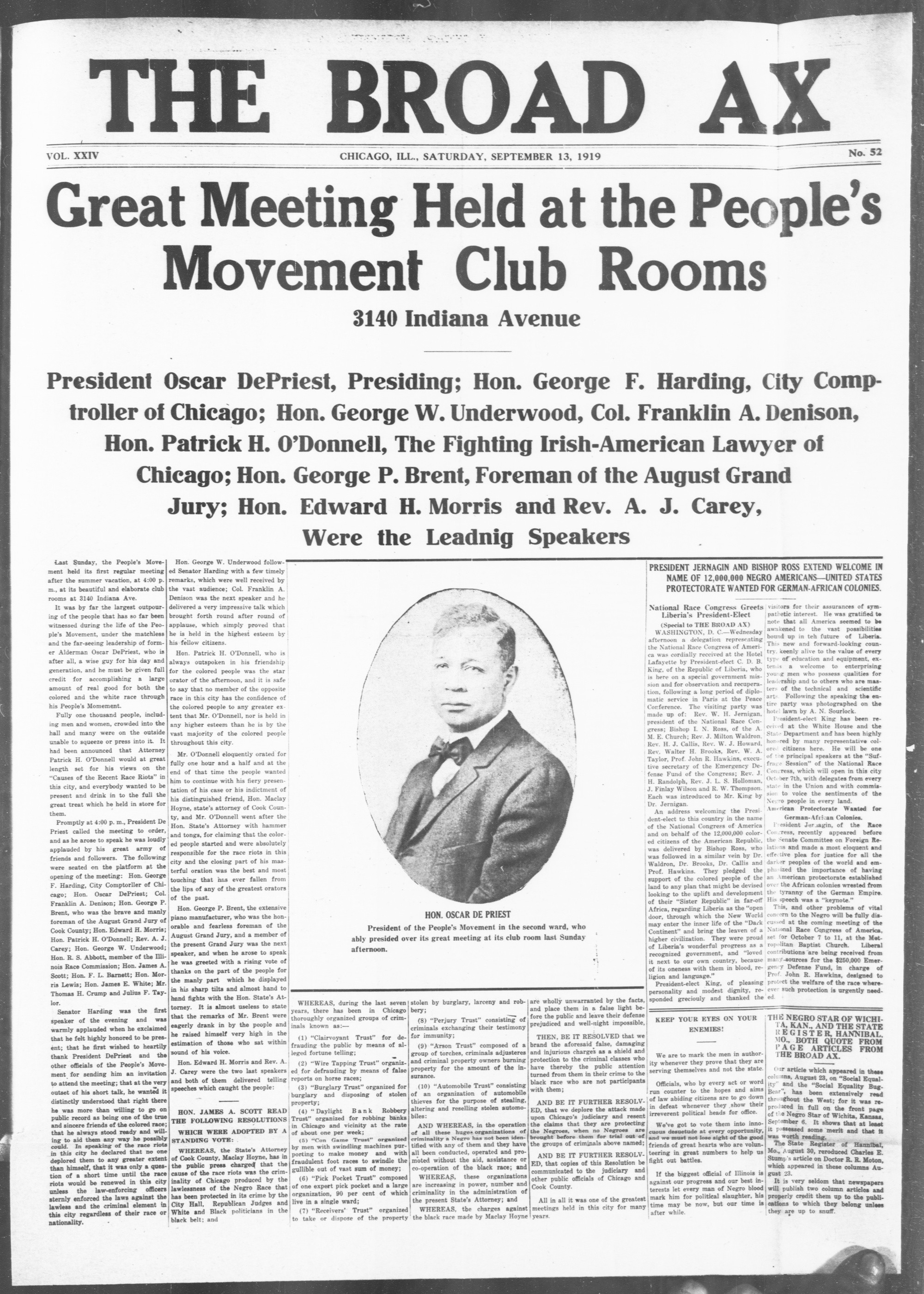
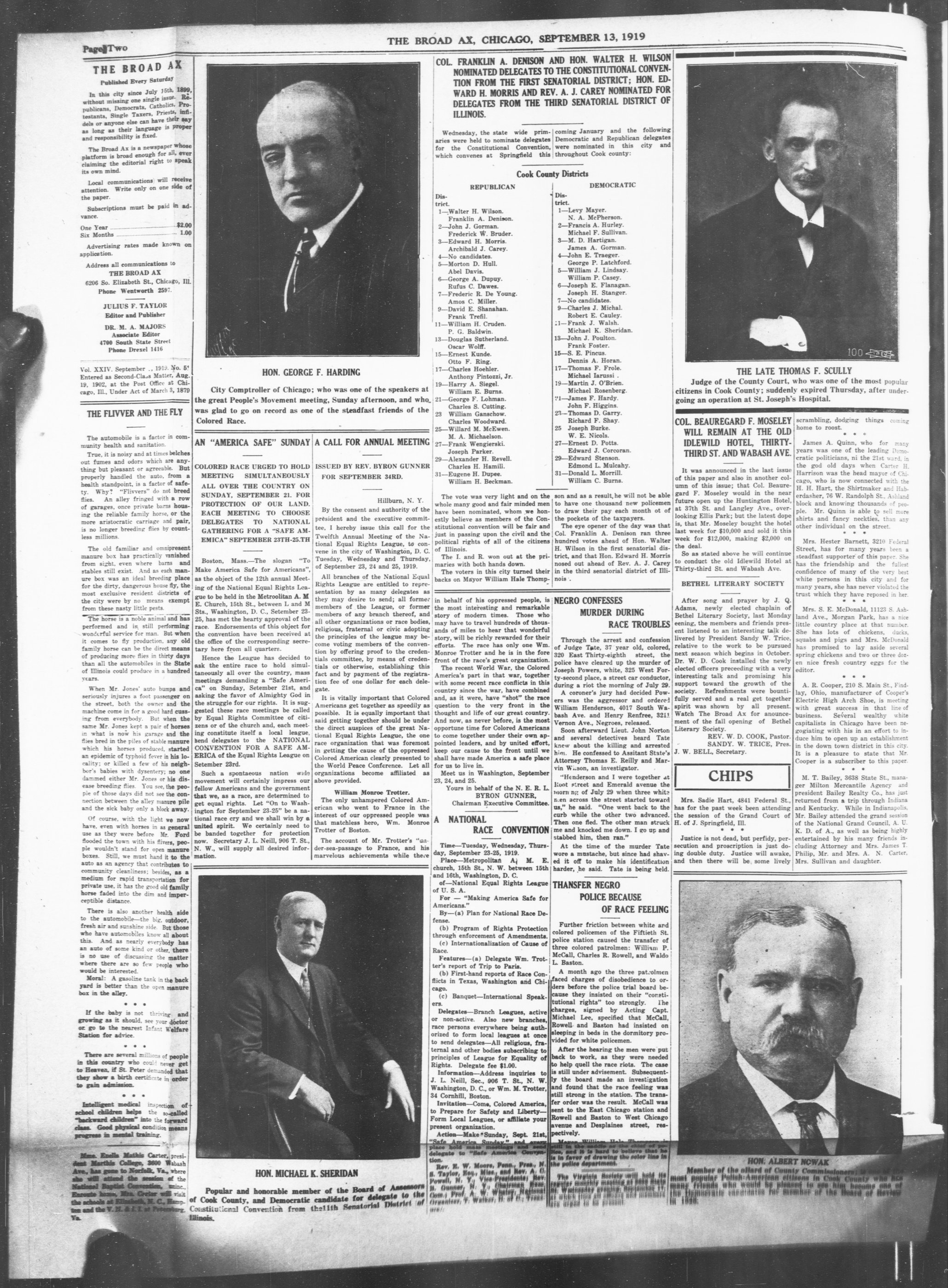
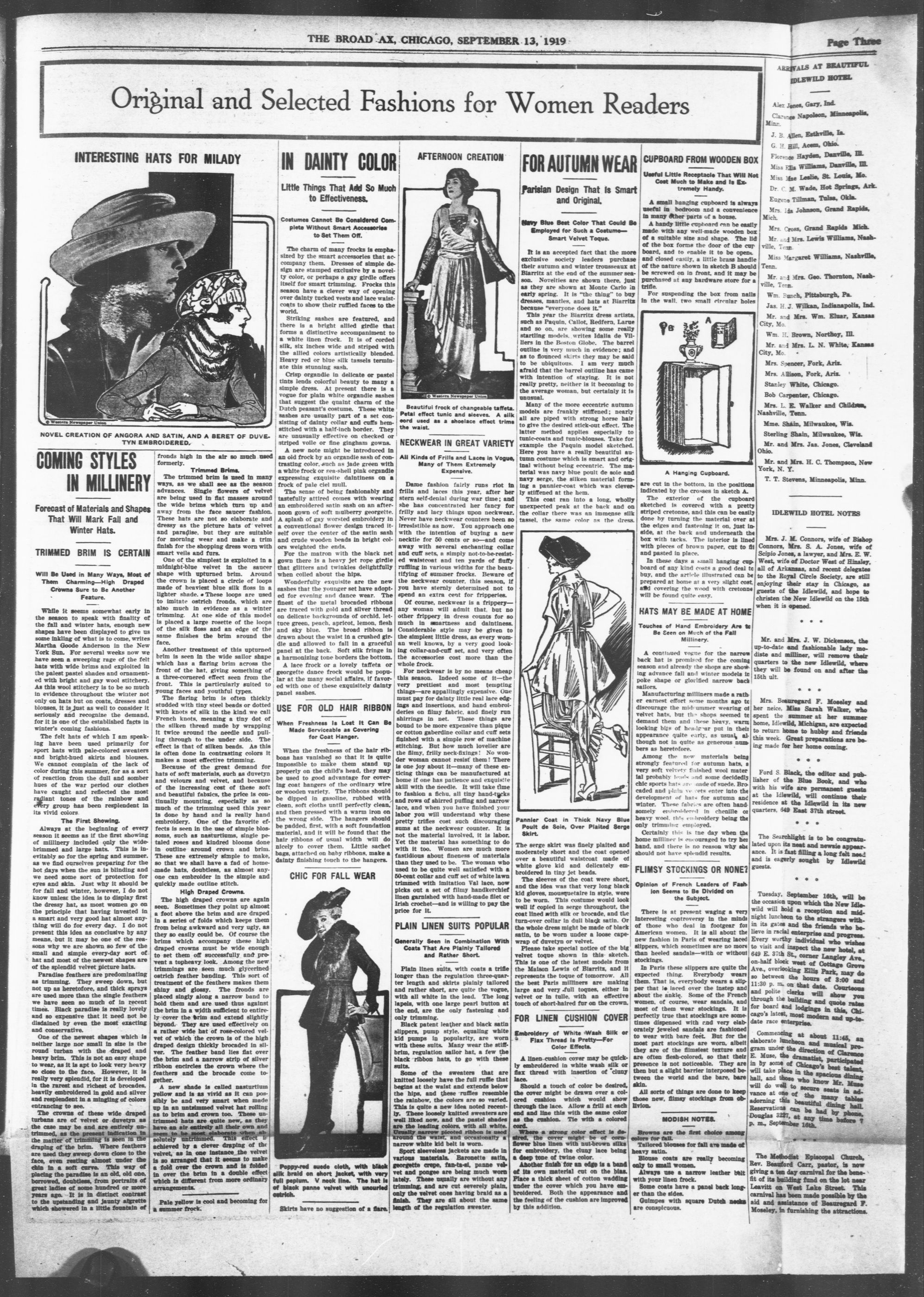
Page text (machine-generated)
THE BROAD AX
Great Meeting Held at the People's Movement Club Rooms
President Oscar DePriest, Presiding; Hon. George F. Harding, City Comp troller of Chicago; Hon. George W. Underwood, Col. Franklin A. Denison, Hon. Patrick H. O'Donnell, The Fighting Irish-American Lawyer of Chicago; Hon. George P. Brent, Foreman of the August Grand Jury; Hon. Edward H. Morris and Rev. A. J. Carey, Were the Leadniq Speakers
VOL. XXIV
President Controller of Hon. Chi
Last Sunday, the People's Movement held its first regular meeting after the summer vacation, at 4:00 p.m., at its beautiful and elaborate club rooms at 3140 Indiana Ave.
It was by far the largest outpouring of the people that has so far been witnessed during the life of the People's Movement, under the matchless and the far-seeing leadership of former Alderman Oscar DePriest, who is after all, a wise guy for his day and generation, and he must be given full credit for accomplishing a large amount of real good for both the colored and the white race through his People's Moment.
Fully one thousand people, including men and women, crowded into the hall and many were on the outside unable to squeeze or press into it. It had been announced that Attorney Patrick H. O'Donnell would at great length set for his views on the "Causes of the Recent Race Riots" in this city, and everybody wanted to be present and drink in to the full the great treat which he held in store for them.
Promptly at 4:00 p. m., President De Priest called the meeting to orders, and as he arose to speak he was loudly applauded by his great army of friends and followers. The following were seated on the platform at the opening of the meeting: Hon. George F. Harding, City Comptorler of Chicago; Hon. Oscar DePriest; Col Franklin A. Denison; Hon. George P. Brent, who was the brave and manly foreman of the August Grand Jury of Cook County; Hon. Edward H. Morris; Hon. Patrick H. O'Donnell; Rev. A. J. Carey; Hon. George W. Underwood; Hon. R. S. Abbott, member of the Illinois Race Commission; Hon. James A. Scott; Hon. F. L. Barnett; Hon. Morris Lewis; Hon. James E. White; Mr. Thomas H. Crump and Julius F. Taylor.
Senator Harding was the first speaker of the evening and was warmly applauded when he exclaimed that he felt highly honored to be present; that he first wished to heartily thank President DePriest and the other officials of the People's Movement for sending him an invitation to attend the meeting; that at the very outset of his short talk, he wanted it distinctly understood that right there he was more than willing to go on public record as being one of the true and sincere friends of the colored race; that he always stood ready and willing to aid them any way he possibly could. In speaking of the race riots in this city he declared that no one deplored them to any greater extent than himself, that it was only a question of a short time until the race riots would be renewed in this city unless the law-enforcing officers sternly enforced the laws against the lawless and the criminal element in this city regardless of their race or nationality.
---
Hon. George W. Underwood followed Senator Harding with a few timely remarks, which were well received by the vast audience; Col. Franklin A. Denison was the next speaker and he delivered a very impressive talk which brought forth round after round of applause, which simply proved that he is held in the highest esteem by his fellow citizens.
Hon. Patrick H. O'Donnell, who is always outspoken in his friendship for the colored people was the star orator of the afternoon, and it is safe to say that no member of the opposite race in this city has the confidence of the colored people to any greater extent that Mr. O'Donnell, nor is held in any higher esteem than he is by the vast majority of the colored people throughout this city.
Mr. O'Donnell eloquently orated for fully one hour and a half and at the end of that time the people wanted him to continue with his fiery presentation of his case or his indictment of his distinguished friend, Hon. Maclay Hoyne, state's attorney of Cook County, and Mr. O'Donnell went after the Hon. State's Attorney with hammer and tongs, for claiming that the colored people started and were absolutely responsible for the race riots in this city and the closing part of his masterful oration was the best and most touching that has ever fallen from the lips of any of the greatest orators of the past.
Hon. George P. Brent, the extensive piano manufacturer, who was the honorable and fearless foreman of the August Grand Jury, and a member of the present Grand Jury was the next speaker, and when he arose to speak he was greeted with a rising vote of thanks on the part of the people for the manly part which he displayed in his sharp tilts and almost hand to hand fights with the Hon. State's Attorney. It is almost useless to state that the remarks of Mr. Brent were eagerly drank in by the people and he raised himself very high in the estimation of those who sat within sound of his voice.
Hon. Edward H. Morris and Rev. A. J. Carey were the two last speakers and both of them delivered telling speeches which caught the people:
HON. JAMES A. SCOTT READ
THE FOLLOWING RESOLUTIONS
WHICH WERE ADOPTED BY A
STANDING VOTE:
WHEREAS, the State's Attorney
of Cook County, Maclay Hoyne, has in
the public press charged that the
cause of the race riots was the crimi-
nality of Chicago produced by the
lawlessness of the Negro Race that
has been protected in its crime by the
City Hall, Republican Judges and
White and Black politicians in
the black belt; and
CHICAGO, ILL., SATURDAY, SEPTEMBER 13, 1919
3140 Indiana Avenue
[Name]
WHEREAS, during the last seven years, there has been in Chicago thoroughly organized groups of criminals known as:—
(1) "Clairvoyant Trust" for defrauding the public by means of alleged fortune telling;
(2) "Wire Tapping Trust" organized for defrauding by means of false reports on horse races;
(3) "Burglary Trust" organized for burglary and disposing of stolen property;
(4) "Daylight Bank Robbery Trust" organized for robbing banks in Chicago and vicinity at the rate of about one per week;
(5) "Con Game Trust" organized by men with swindling machines purporting to make money and with fraudulent foot races to swindle the gullible out of vast sum of money;
(6) "Pick Pocket Trust" composed of one expert pick pocket and a large organization, 90 per cent of which live in a single ward;
(7) "Receivers' Trust" organized to take or dispose of the property
stolen by burglary, larceny and robbery;
(8) "Perjury Trust" consisting of criminals exchanging their testimony for immunity;
(9) "Arson Trust" composed of a group of torches, criminals adjusters and criminal property owners burning property for the amount of the insurance.
(10) "Automobile Trust" consisting of an organization of automobile thieves for the purpose of stealing, altering and reselling stolen automobiles:
AND WHEREAS, in the operation of all these huge organizations of criminality a huge has not been identified with any of them and they have all been conducted, operated and promoted without the aid, assistance or co-operation of the black race; and WHEREAS, these organizations are increasing in power, number and criminality in the administration of the present State's Attorney; and WHEREAS, the charges against the black race made by Maclay Hoyne
are wholly unwarranted by the facts, and place them in a false light before the public and leave their defense prejudiced and well-night impossible.
THEN, BE IT RESOLVED that we brand the aforesaid false, damaging and injurious charges as a shield and protection to the criminal classes who have thereby the public attention turned from them in their crime to the black race who are not participants with them;
AND BE IT FURTHER RESOLVED, that we deplore the attack made upon Chicago's judiciary and resent the claims that they are protecting the Negroes, when no Negroes are brought before them for trial out of the groups of criminals above named;
AND BE IT FURTHER RESOLVED, that copies of this Resolution be communicated to the judiciary and other public officials of Chicago and Cook County.
All in all it was one of the greatest meetings held in this city for many years.
PRESIDENT JERNAGIN AND BISHOP ROSS EXTEND WELCOME IN NAME OF 12,000,000 NEGRO AMERICANS—UNITED STATES PROTECTORATE WANTED FOR GERMAN-AFRICAN COLONIES.
National Race Congress Greets Liberia's President-Elect (Special to THE BROAD AX)
WASHINGTON, D. C.—Wednesday afternoon a delegation representing the National Race Congress of America was cordially received at the Hotel Lafayette by President-elect C. D. B. King, of the Republic of Liberia, who is here on a special government mission and for observation and recuperation, following a long period of diplomatic service in Paris at the Peace Conference. The visiting party was made up of: Rev. W. H. Jernigan, president of the National Race Congress; Bishop I. N. Ross, of the A. M. E. Church; Rev. J. Milton Waldon, Rev. H. J. Callis, Rev. W. J. Howard, Rev. Walter H. Brooks, Rev. W. A. Taylor, Prof John R. Hawkins, executive secretary of the Emergency Defense Fund of the Congress; Rev. J. H. Randolph, Rev. J. L. S. Holloman, J. Finlay Wilson and R. W. Thompson. Each was introduced to Mr. King by Dr. Jernigan.
visitors for their assurances of sympathetic interest. He was gratified to note that all America seemed to be awakened to the vast possibilities bound up in the future of Liberia. This new and forward-looking country, keenly alive to the value of every type of education and equipment, extends a welcome to enterprising young men who possess qualities for leadership and to others who are masters of the technical and scientific arts. Following the speaking the entire party was photographed on the hotel lawn by A. N. Sourlock.
President-elect King has been received at the White House and has been highly honored by many representative colored citizens here. He will be one of the principal speakers at the "Suffrage Session" of the National Race Congress, which will open in this city October 7th, with delegates from every state in the Union and with commission to voice the sentiments of the Negro people in every land.
An address welcoming the President-elect to this country in the name of the National Congress of America and on behalf of the 12,000,000 colored citizens of the American Republic, was delivered by Bishop Ross, who was followed in a similar vein by Dr. Waldron, Dr. Brooks, Dr. Callis and Prof. Hawkins. They pledged the support of the colored people of the land to any plan that might be devised looking to the uplift and development of their "Sister Republic" in far-off Africa, regarding Liberia as the "open door, through which the New World may enter the inner life of the "Dark Continent" and bring the leaven of a higher civilization. They were proud of Liberia's wonderful progress as a recognized government, and "loved it next to our own country, because of its oneness with them in blood, religion and language."
President-elect King, of pleasing personality and modest dignity, responded greciously and thanked the
KEEP YOUR EYES ON YOUR
ENEMIES!
We are to mark the men in authority whenever they prove that they are serving themselves and not the state.
Officials, who by every act or word run counter to the hopes and aims of law abiding citizens are to go down in defeat whenever they show their irreverent political heads for office.
We've got to vote them into innocuous desuetude at every opportunity, and we must not lose sight of the good friends of great hearts who are volunteering in great numbers to help us fight out battles.
If the biggest official of Illinois is against our progress and our best interests let every man of Negro blood mark him for political slaughter, his time may be now, but our time is after while.
No. 52
visitors for their assurances of sympathetic interest. He was gratified to note that all America seemed to be awakened to the vast possibilities bound up in teh future of Liberia. This new and forward-looking country, keenly alive to the value of every type of education and equipment, extends a welcome to enterprising young men who possess qualities for leadership and to others who are masters of the technical and scientific arts. Following the speaking the entire party was photographed on the hotel lawn by A. N. Sourlock.
President-elect King has been received at the White House and the State Department and has been highly honored by many representative colored citizens here. He will be one of the principal speakers at the "Suffrage Session" of the National Race Congress, which will open in this city October 7th, with delegates from every state in the Union and with commission to voice the sentiments of the Negro people in every land.
American Protectorate Wanted for German-African Colonies
President Jeremiah, of the Race Congress, recently appeared before the Senate Committee on Foreign Relations and made a most eloquent and effective plea for justice for all the darker peoples of the world and emphasized the importance of having an American protectorate established over the African colonies wrested from the tyranny of the German Empire. His speech was a "keynote." This, and other problems of vital concern to the Negro will be fully discussed at the coming meeting of the National Race Congress of America, set for October 7 to 11, at the Metropolitan Baptist Church. Liberal contributions are being received from many sources for the $250,000 Emergency Defense Fund, in charge of Prof. John R. Hawkins, designed to protect the welfare of the race where ever such protection is urgently needed.
THE NEGRO STAR OF WICHITA, KAN., AND THE STATE REGISTER, HANNIBAL, MO., BOTH QUOTE FROM PAGE ARTICLES FROM THE BROAD AX.
Our article which appeared in these columns, August 23, on "Social Equality" and the "Social Equality BugBear", has been extensively read throughout the West; for it was reproduced in full on the front page of the Negro Star of Wichita, Kansas, September 6. It shows that at least it possessed some merit and that it was worth reading.
The State Register of Hannibal, Mo., August 30, reproduced Charles E. Stump's article on Doctor R. R. Moton, which appeared in these columns August 23.
It is very seldom that newspapers will publish two column articles and properly credit them up to the publications to which they belong unless they are up to snuff.
Page Two
THE BROAD AX
Published Every Saturday
In this city since July 15th, 1899, without missing one single issue. Republicans, Democrats, Catholics, Protestants, Single Taxers, Priests, infidels or anyone else can have their say as long as their language is proper and responsibility is fixed.
The Broad Ax is a newspaper whose platform is broad enough for all, ever claiming the editorial right to speak its own mind.
Local communications will receive attention. Write only on one side of the paper.
Subscriptions must be paid in advance.
One Year ..... $2.00
Six Months ..... 1.00
Advertising rates made known on application.
Address all communications to
THE BROAD AX
6206 So. Elizabeth St., Chicago, Ill.
Phone Wentworth 2597.
JULIUS F. TAYLOR
Editor and Publisher
DR. M. A. MAJORS
Associate Editor
4700 South State Street
Phone Drexel 1416
Vol. XXIJ, September . 1919. No. 51
Entered as Second-Class Matter. Aug.
19, 1902, at the Post Office at
Chicago. Ill., Under Act of March 8,
1879
THE FLIVVER AND THE FLY
The automobile is a factor in community health and sanitation.
True, it is noisy and at times belches out fumes and odors which are anything but pleasant or agreeable. But properly handled the auto, from a health standpoint, is a factor of safety. Why? "Flilivers" do not breed flies. An alley fringed with a row of garages, once private barns housing the reliable family horse, or the more aristocratic carriage and pair, is no longer breeding flies by countless millions.
The old familiar and omnipresent manure box has practically vanished from sight, even where barns and stables still exist. And as each manure box was an ideal breeding place for the dirty, dangerous house fly, the most exclusive resident districts of the city were by no means exempt from these nasty little pests.
The horse is a noble animal and has performed and is still performing wonderful service for man. But when it comes to fly production, any old family horse can be the direct means of producing more flies in thirty days than all the automobiles in the State of Illinois could produce in a hundred years.
When Mr. Jones' auto bumps and seriously injures a foot passenger on the street, both the owner and the machine come in for a good hard cussing from everybody. But when the same Mr. Jones kept a pair of horses in what is now his garage and the flies bred in the piles of stable manure which his horses produced, started an epidemic of typhoid fever in his locality; or killed a few of his neighbor's babies with dysentery; no one dammed either Mr. Jones or his disease breeding flies. You see, the people of those days did not see the connection between the alley manure pile and the sick baby only a block away.
Of course, with the light we now have, even with horses in as general use as they were before Mr. Ford flooded the town with his flivers, people wouldn't stand for open manure boxes. Still, we must hand it to the auto as an agency that contributes to community cleanliness; besides, as a medium for rapid transportation for private use, it has the good old family horse faded into the dim and imperceptible distance.
There is also another health side to the automobile—the big, outdoor, fresh air and sunshine side. But those who have automobiles know all about this. And as nearly everybody has an auto of some kind or other, there is no use of discussing the matter where there are so few people who would be interested.
Moral: A gasoline tank in the back yard is better than the open manure box in the alley.
If the baby is not thriving and growing as it should, see your doctor or go to the nearest Infant Welfare Station for advice.
There are several millions of people in this country who could never get to Heaven, if St. Peter demanded that they show a birth certificate in order to gain admission.
Intelligent medical inspection of school children helps the so-called "backward children" into the forward class. Good physical condition means progress in mental training.
Mona. Emilia Mathis Carter, president Marthin College, 2000 Wabash Ave., has gone to Norfolk, Va., where she will attend the session of the National Baptist Convention, mince. Encoure home, Mrs. Creater will visit the schools at Ellisbeth, M.C., Hampton and the V. M. & I. L. at Petersburg, Va.
M.
HON. GEORGE F. HARDING
City Comptroller of Chicago the great People's Movement men was glad to go on record as on Colored Race.
AN "AMERICA SAFE" SUNDAY
City Comptroller of Chicago; who was one of the speakers at the great People's Movement meeting, Sunday afternoon, and who was glad to go on record as one of the steadfast friends of the Colored Race.
COLORED RACE URGED TO HOLD MEETING SIMULTANEOUSLY ALL OVER THE COUNTRY ON SUNDAY, SEPTEMBER 21. FOR PROTECTION OF OUR LAND, EACH MEETING TO CHOOSE DELEGATES TO NATIONAL GATHERING FOR A "SAFE AMERICA" SEPTEMBER 23TH-25TH
Boston, Mass.-The slogan "To Make America Safe for Americans" as the object of the 12th annual Meeting of the National Equal Rights League to be held in the Metrololitan A. M. E. Church, 15th St., between L and M Sts., Washington, D. C., Setember 23-25, has met the hearty approval of the race. Endorsements of this object for the convention have been received at the office of the corresponding secretary here from all quarters.
Hence the League has decided to ask the entire race to hold simultaneously all over the country, mass meetings demanding a "Safe America" on Sunday, Setember 21st, and asking the favor of Almighty God in the struggle for our rights. It is suggested these race meetings be called by Equal Rights Committee of citizens or of the church and, each meeting constitute itself a local league, send delegates to the NATIONAL CONVENTION FOR A SAFE AMERICA of the Equal Rights League on September 23rd.
Such a spontaneous nation wids movement will certainly impress our fellow Americans and the government that we, as a race, are determined to get equal rights. Let "On to Washington for September 23-25" be a national race cry and we shall win by a united spirit. We certainly need to be banded together for protection now. Secretary J. L. Neill, 906 T. St., N. W., will supply all desired information.
1930
HON. MICHAEL K. SHERIDAN
Popular and honorable member of the B
of Cook County, and Democratic candidate for
Constitutional Convention from the11th Senai
Illinois.
Popular and honorable member of the Board of Ansonnorm of Cook County, and Democratic candidate for delegate to the Constitutional Convention from the 11th Senatorial District of Illinois.
---
A CALL FOR ANNUAL MEETING
ISSUED BY REV. BYRON GUNNER
FOR SEPTEMBER 34RD.
By the consent and authority of the president and the executive committee, I hereby issue this call for the Twelfth Annual Meeting of the National Equal Rights League, to convene in the city of Washington, D. C. Tuesday, Wednesday and Thursday of September 23, 24 and 25, 1919.
All branches of the National Equal Rights League are entitled to representation by as many delegates as they may desire to send; all former members of the League, or former members of any branch thereof, and all other organizations or race bodies, religious, fraternal or civic adopting the principles of the league may become voting members of the convention by offering proof to the credentials committee, by race members of credentials or otherwise, establishing this fact and by payment of the registration fee of one dollar for each delegate.
It is vitally important that Colored Americans get together as speedily as possible. It is equally important that said getting together should be under the direct auspices of the great National Equal Rights League, the one race organization that was foremost in getting the cause of the oppressed Colored American clearly presented to the World Peace Conference. Let all organizations become affiliated as above provided.
William Monroe Trotter
The only unhampered Colored American who went to France in the interest of our oppressed people was that matchless hero, Wm. Monroe Trotter of Boston.
The account of Mr. Trotter's "under-sea-passage to France, and his marvelous achievements while there
```markdown
```
per of the Board of Annessorn candidate for delegate to the the 11th Senatorial District of
THE BROAD AX. CHICAGO, SEPTEMBER 13, 1919
Hillburn. N. Y.
COL. FRANKLIN A. DENISON AND HON. WALTER H. WILSON NOMINATED DELEGATES TO THE CONSTITUTIONAL CONVENTION FROM THE FIRST SENATORIAL DISTRICT; HON. EDWARD H. MORRIS AND REV. A. J. CAREY NOMINATED FOR DELEGATES FROM THE THIRD SENATORIAL DISTRICT OF ILLINOIS.
Wednesday, the state wide primaries were held to nominate delegates for the Constitutional Convention, which convenes at Springfield this coming January and the following Democratic and Republican delegates were nominated in this city and throughout Cook county:
Cook County Districts
REPUBLICAN DEMOCRATIC
Dis-
trict.
1—Walter H. Wilson.
Franklin A. Denison.
2—John J. Gorman.
Frederick W. Bruder.
3—Edward H. Morris.
Archibald J. Carey.
4—No candidates.
5—Morton D. Hull.
Abel Davis.
6—George A. Dupuy.
Rufus C. Dawes.
7—Frederic R. De Young.
Amos C. Miller.
9—David E. Shanahan.
Frank Trefli.
11—William H. Cruden.
P. G. Baldwin.
13—Douglas Sutherland.
Oscar Wolff.
15—Ernest Kunde.
Otto F. Ring.
17—Charles Hoehler.
Anthony Pintozzi, Jr.
18—Harry A. Siegel.
William E. Burns.
21—George F. Lohman.
Charles S. Cutting.
23 William Ganschow.
Charles Woodward.
25—Willard M. McEwen.
M. A. Michaelson.
27—Frank Wengierski.
Joseph Parker.
29—Alexander H. Revell.
Charles H. Hamili.
31—Eugene H. Dupee.
William H. Beckman.
Dis-
trict.
1—Levy Mayer.
N. A. McPherson.
2—Francis A. Hurley.
Michael F. Sullivan.
3—M. D. Hartigan.
James A. Gorman.
4—John E. Traeger.
George P. Latchford.
5—William J. Lindsay.
William P. Casey.
6—Joseph E. Flanagan.
Joseph H. Stanger.
7—No candidates.
9—Charles J. Michal.
Robert E. Cauley.
11—Frank J. Walsh.
Michael K. Sheridan.
13—John J. Poulton.
Frank Foster.
15—S. E. Pincus.
Dennis A. Horan.
17—Thomas F. Frole.
Michael Iarussi.
19—Martin J. O'Brien.
Michael Rosenberg.
21—James F. Hardy.
John F. Higgins.
23—Thomas D. Garry.
Richard F. Shay.
25 Joseph Burke.
W. E. Nicols.
27—Ernest D. Potts.
Edward J. Corcoran.
29—Edward Stenson.
Edmond L. Mulcahy.
31—Donald L. Morrill.
William C. Burns.
The vote was very light and on the whole many good and fair minded men have been nominated, whom we honestly believe as members of the Constitutional convention will be fair and just in passing upon the civil and the political rights of all of the citizens of Illinois.
The I. and R. won out at the primaries with both hands down.
The voters in this city turned their backs on Mayor William Hale Thompson in behalf of his oppressed people, is the most interesting and remarkable story of modern times. Those who may have to travel hundreds of thousands of miles to hear that wonderful story, will be richly rewarded for their efforts. The race has only one Wm. Monroe Trotter and he is in the forefront of the race's great organization.
The recent World War, the Colored America's part in that war, together with some recent race conflicts in this country since the war, have combined and, as it were, have "shot" the race question to the very front in the thought and life of our great country. And now, as never before, is the most opportune time for Colored Americans to come together under their own appointed leaders, and by united effort, keep our cause to the front until we shall have made America a safe place for us to live in.
Meet us in Washington, September 23, 24, and 25.
Yours in behalf of the N. E. R. L. BYRON GUNNER,
Chairman Executive Committee.
RACE CONVENTION
Time—Tuesday, Wednesday, Thursday, September 23-25, 1919.
Place—Metropolitan A M. E. church, 15th St., N. W. between 15th and 16th, Washington, D. C.
of—National Equal Rights League of U. S. A.
For — "Making America Safe for Americans."
By—(a) Plan for National Race Defense.
(b) Program of Rights Protection through enforcement of Amendments.
(c) Internationalization of Cause of Race.
Features—(a) Delegate Wm. Trotter's report of Trip to Paris.
(b) First-hand reports of Race Conflicts in Texas, Washington and Chicago.
(c) Banquet—International Speakers.
Delegates—Branch Leagues, active or non-active. Also new branches, race persons everywhere being authorized to form local leagues at once to send delegates—All religious, fraternal and other bodies subscribing to principles of League for Equality of Rights. Delegate fee $1.00.
Information—Address inquiries to
J. L. Neill, Sec., 906 T. St., N. W.
Washington, D. C., or Wm. M. Trotter,
34 Cornhill, Boston.
Invitation—Come, Colored America,
to prepare for Safety and Liberty—
Form Local Leagues, or affiliate your
present organization.
Action—Make*Sunday, Sept. 21st,
"Safe America Sunday," and ensure
place hold makes mistakes and
delegate to "Safe America Conv.
Rev. E. W. Moore, Penn, Pres. N.
B. Taylor, Esq., Miss, and Rev. A. O.
Powell, N. Y., Vice-Presidenta Rev.
B. Gunner, N. Y., Chairman
Com. Prof. A. W. Whaley, National
Organizer, T. Walker, H. of U. Trans.
DEMOCRATIC
District.
1—Levy Mayer.
N. A. McPherson.
2—Francis A. Hurley.
Michael F. Sullivan.
3—M. D. Hartigan.
James A. Gorman.
4—John E. Traeger.
George P. Latchford.
5—William J. Lindsay.
William P. Casey.
6—Joseph E. Flanagan.
Joseph H. Stanger.
7—No candidates.
9—Charles J. Michal.
Robert E. Cauley.
11—Frank J. Walsh.
Michael K. Sheridan.
13—John J. Poulton.
Frank Foster.
15—S. E. Pincus.
Dennis A. Horan.
17—Thomas F. Frole.
Michael Iarussi.
19—Martin J. O'Brien.
Michael Rosenberg.
21—James F. Hardy.
John F. Higgins.
23—Thomas D. Garry.
Richard F. Shay.
25 Joseph Burke.
W. E. Nicols.
27—Ernest D. Potts.
Edward J. Corcoran.
29—Edward Stenson.
Edmond L. Mulcahy.
31—Donald L. Morrill.
William C. Burns.
son and as a result, he will not be able to have one thousand new policemen to draw their pay each month ot of the pockets of the taxpayers.
The eye opener of the day was that Col. Franklin A. Denison ran three hundred votes ahead of Hon. Walter H. Wilson in the first senatorial district, and that Hon. Edward H. Morris nosed out ahead of Rev. A. J. Carey in the third senatorial district of Illinois.
NEGRO CONFESSES
MURDER DURING
RACE TROUBLES
Through the arrest and confession of Judge Tate, 37 year old, colored, 320 East Thirty-eighth street, the police have cleared up the murder of Joseph Powers, white, 325 West Forty-second place, a street car conductor, during a riot the morning of July 29. A coroner's jury had decided Powers was the aggressor and ordered William Henderson, 4017 South Wabash Ave. and Henry Renfree, 3211 Vernon Ave., Negroes, released. Soon afterward Lieut. John Norton and several detectives heard Tate knew about the killing and arrested him. He confessed to Assistant State's Attorney Thomas E. Reilly and Marvin Wilson, an investigator.
"Henderson and I were together at Koot street and Emerald avenue the morning of July 29 when three whites men across the street started toward us," he said. "One went back to the curb while the other two advanced. Then one fled. The other man struck me and knocked me down. I go up and stabbed him, then ran."
At the time of the murder Tate wore a mustache, but since had shaved it off to make his identification harder, he said. Tate is being held.
THANSFER NEGRO
POLICE BECAUSE
OF RACE FEELING
Further friction between white and colored policemen of the Fiftieth St. police station caused the transfer of three colored patrolmen: William P. McCall, Charles R. Rowell, and Waldo L. Baston.
A month ago the three patrolmen faced charges of disobedience to orders before the police trial board because they insisted on their "constitutional rights" too strongly. The charges, signed by Acting Capt. Michael Lee, specified that McCall, Rowell and Baston had insisted on sleeping in beds in the dormitory provided for white policemen.
After the hearing the men were put back to work, as they were needed to help quell the race riots. The case is still under advisement. Subsequently the board made an investigation and found that the race feeling was still strong in the station. The transfer order was the result. McCall was sent to the East Chicago station and Rowell and Baston to West Chicago avenue and Desplaines street, respectively.
Morgan William Hale, Thomason is still in the middle on the color line of parade Hoe, and it is hard to see him in favor of drawing the color line in the police department.
The Virginia Society will hold its regular monthly meeting at the Bain Dr. Washington evening. Respondents try
---
100
THE LATE THOMAS F. SCULLY
Judge of the County Court, citizens in Cook County; sudden going an operation at St. Joseph'
Judge of the County Court, who was one of the most popular citizens in Cook County; suddenly expired Thursday, after undergoing an operation at St. Joseph's Hospital.
COL. BEAUREGARD F. MOSELEY
WILL REMAIN AT THE OLD
IDLEWILD HOTEL, THIRTY-
THIRD ST. AND WABASH AVE.
It was announced in the last issue of this paper and also in another column of this issue; that Col. Beauregard F. Moseley was in the near future open up the Huntington Hotel at 37th St. and Langley Ave., over-looking Ellis Park; but the latest dope is, that Mr. Moseley bought the hotel last week for $10,000 and sold it this week for $12,000, making $2,000 on the deal.
So as stated above he will continue to conduct the old Idlewild Hotel at Thirty-third St. and Wabash Ave.
BETHEL LITERARY SOCIETY
After song and prayer by J. Q. Adams, newly elected chaplain of Bethel Literary Society, last Monday eening, the members and friends present listened to an interesting talk delivered by President Sandy W. Trice relative to the work to be pursued next season which begins in October Dr. W. D. Cook installed the newly elected officers preceding with a very interesting talk and promising his support toward the growth of the society. Refreshments were bountifully served and a real get together spirit was shown by all present Watch The Broad Ax for anouncement of the fall opening of Bethel Literary Society. REV. W. D. COOK, Pastor SANDY. W. TRICE, Pres. J. W. BELL, Secretary.
Mrs. Sadie Hart, 4841 Federal St. has for the past week been attending the session of the Grand Court of H. of J. Springfield, Ill.
Justice is not dead, but perfidy, persecution and prosecution is just doing double duty. Justice will awake, and then there will be, some lively
M. B.
Member of the oard of County Commissioners) is of recent popular Polish-American citizens in Cook County who has many friends who would be pleased to see him become one of the Democratic candidates for Member of the Board of Review in 1998.
CHIPS
scrambling, dodging things coming home to roost.
James A. Quinn, who for many years was one of the leading Democratic politicians, ni the 21st ward, in the god old days when Carter H. Harrison was the head mayor of Chicago, who is now connected with the H. H. Hart, the Shirtmaker and Haberdasher, 76 W. Randolph St. Ashland block and knowing thousands of people. Mr. Quinn is able to sell more shirts and fancy neckties, than any other individual on the street.
Mrs. Hester Barnett, 3210 Federal Street, has for many years been a steadfast supporter of this paper. She has the friendship and the fullest confidence of many of the very best white persons in this city and for many years, she has never violated the trust which they have reposed in her. * * *
Mrs. S. E. McDonald, 11123 S. Ashland Ave., Morgan Park, has a nice little country place at that number. She has lots of chickens, ducks, squabs and pigs and Mrs. McDonald has promised to lay aside several spring chickens and two or three dozen nice fresh country eggs for the editor.
A. R. Cooper, 210 S. Main St., Findlay, Ohio, manufacturer of Cooper's Electric High Arch Shoe, is meeting with great success in that line of business. Several wealthy white capitalists in Chicago have been negotiating with his in an effort to induce him to open up an establishment in the down town district in this city. It is a pleasure to state that Mr. Cooper is a subscriber to this paper.
M. T. Bailey, 3638 State St., manager Milton Mercantile Agency and president Bailey Realty Co., has just returned from a trip through Indiana and Kentucky. While in Indianapolis, Mr. Bailey attended the grand session of the National Grand Council, A. U. K. D. of A., as well as being highly entertained by his many friends including Attorney and Mrs. James T. Philip, Mr. and Mrs. A. N. Carter, Mrs. Sullivan and daughter.
---
Original and Selected Fashions for Women Readers
INTERESTING HATS FOR MILADY
© Western Newspaper Union
NOVEL CREATION OF ANGORA AND SATIN, AND A BERET OF DUVE-TYN EMBROIDERED.
COMING STYLES IN MILLINERY
Forecast of Materials and Shapes That Will Mark Fall and Winter Hats.
fronds high in the air so much use formerly.
Trimmed Brima.
The trimmed brim is used in many ways, as we shall see as the season advances. Single flowers of velvet are being used in flat masses around the wide brims which turn up and away from the face saucer fashion. These hats are not so elaborate and dressy as the picture hats of velvet and paradise, but they are suitable
TRIMMED BRIM IS CERTAIN
Will Be Used in Many Ways, Most of Them Charming—High Draped Crowns Sure to Be Another Feature.
While it seems somewhat early in the season to speak with finality of the fall and winter hats, enough new shapes have been displayed to give us some inkling of what is to come, writes Martha Goode Anderson in the New York Sun. For several weeks now we have seen a sweeping rage of the felt hats with wide brims and exploited in the palest pastel shades and ornamented with bright and gay wool stitchery. As this wool stitchery is to be so much in evidence throughout the winter not only on hats but on coats, dresses and blouses, it is just as well to consider it seriously and recognize the demand, for it is one of the established facts in winter's coming fashions.
The felt hats of which I am speaking have been used primarily for sport hats with pale-colored sweaters and bright-hued skirts and blouses. We cannot complain of the lack of color during this summer, for as a sort of reaction from the dull and somber hues of the war period our clothes have caught and reflected the most radiant tones of the rainbow and every group has been resplendent in its vivid colors.
The First Showing
Always at the beginning of every season it seems as if the first showing of millinery included only the wide brimmed and large hats. This is inevitably so for the spring and summer, as we find ourselves preparing for the hot days when the sun is blinding and we need some sort of protection for eyes and skin. Just why it should be for fall and winter, however, I do not know unless the idea is to display first the dressy hat, as most women go on the principle that having invested in a smart and very good hat almost anything will do for every day. I do not present this idea as conclusive by any means, but it may be one of the reasons why we are shown so few of the small and simple everyday sort of hat and most of the newest shapes are of the splendid velvet picture hats.
Paradise feathers are predominating as trimming. They sweep down, but not up as heretofore, and thick sprays are used more than the single feathers we have seen so much of in recent times. Black paradise is really lovely and so expensive that it need not be disdained by even the most exacting and conservative.
One of the newest shapes which is neither large nor small in size is the round turban with the draped and heavy brim. This is not an easy shape to wear, as it is apt to look very heavy so close to the face. However, it is really very splendid, for it is developed in the rarest and richest of broaches, heavily embroidered in gold and silver and resplendent in a mingling of colors entrancing to see.
The crowns of these wide draped turbans are of velvet or duvetyn as the case may be and are entirely untrimmed, as the present indication in the matter of trimming is seen in the draping of the brim. Where feathers are used they sweep down close to the face, even resting almost under the chin in a soft curve. This way of placing the paradise is an old, old one, borrowed, doubtless, from portraits of great ladies of some hundred or more years ago. It is in distinct contrast to the upstanding and jaunty agleste which showed in a little fountain of
fronds high in the air so much used formerly.
Trimmed Brims
The trimmed brim is used in many ways, as we shall see as the season advances. Single flowers of velvet are being used in flat masses around the wide brims which turn up and away from the face saucer fashion. These hats are not so elaborate and dress as the picture hats of velvet and paradise, but they are suitable for morning wear and make a trim finish for the shopping dress worn with smart vells and furs.
One of the simplest is exploited in a midnight-blue velvet in the saucer shape with upturned brim. Around the crown is placed a circle of loops made of heaviest blue silk floss in a lighter shade. These loops are used to imitate ostrich fronds, which are also much in evidence as a winter trimming. At one side of this model is placed a large rosette of the loops of the silk floss and an edge of the same finishes the brim around the face.
Another treatment of this upturned brim is seen in the wide sailor shape which has a faring brim across the front of the hat, giving something of a three-cornered effect seen from the front. This is particularly suited to young faces and youthful types. The faring brim is often thickly studded with tiny steel beads or dotted with knots of silk in the kind we call French knots, meaning a tiny dot of the silken thread made by wrapping it twice around the needle and pulling through to the under side. The effect is that of silken beads. As this is often done in contrasting colors it makes a most effective trimming.
Because of the great demand for hats of soft materials, such as duvetyn and velours and velvet, and because of the increasing cost of these soft and beautiful fabrics, the price is continually mounting, especially as so much of the trimming used this year is done by hand and is really hand embroidery. One of the favorite effects is seen in the use of simple blossoms, such as nasturtiums, single petaled roses and kindred blooms done in outline around crown and brim. These are extremely simple to make, so that we shall have a fad of homemade hats, doubtless, as almost anyone can embroider in the simple and quickly made outline stitch.
High Draped Crowns
The high draped crowns are again seen. Sometimes they point up almost a foot above the brim and are draped in a series of folds which keeps them from being awkward and very ugly, as they so easily could be. Of course the brims which accompany these high draped crowns must be wide enough to set them off successfully and prevent a topheavy look. Among the new trimmings are seen much glycerined ostrich feather banding. This sort of treatment of the feathers makes them shiny and glossy. The fronds are placed singly along a narrow band to hold them and are used thus against the brim in a width sufficient to entirely cover the brim and extend slightly beyond. They are used effectively on a rather wide hat of rose-colored velvet of which the crown is of the high draped design thickly brocaded in silver. The feather band lies flat over the brim and a narrow strip of silver ribbon encircles the crown where the feathers and the brocade come together.
A new shade is called nasturtium yellow and is as vivid as it can possibly be and very smart when made up in an untrimmed velvet hat rolling as to brim and crown too. These untrimmed hats are quite new, as they have an air entirely all their own and seem to be most elaborate when absolutely untrimmed. This effect is achieved by a clever draping of the velvet, as in one instance the velvet is so arranged that it seems to make a fold over the crown and is folded in over the brim in a double effect which is different from more ordinary arrangements.
Pale yellow is cool and becoming for a summer frock.
THE BROAD AX, CHICAGO, SEPTEMBER 13, 1919
IN DAINTY COLOR
Little Things That Add So Much to Effectiveness.
Costumes Cannot Be Considered Complete Without Smart Accessories to Set Them Off.
The charm of many frocks is emphasized by the smart accessories that accompany them. Dresses of simple design are stamped exclusive by a novelty color, or perhaps a gay girdle offers itself for smart trimming. Frocks this season have a clever way of opening over dalty tucked vests and lace waistcoats to show their ruffled faces to the world.
Striking sashes are featured, and there is a bright allied girdle that forms a distinctive accompaniment to a white linen frock. It is of corded silk, six inches wide and striped with the allied colors artistically blended. Heavy red or blue silk tassels terminate this stunning sash.
Crisp organdie in delicate or pastel tints lends colorful beauty to many a simple dress. At present there is a vogue for plain white organdie sashes that suggest the quaint charm of the Dutch peasant's costume. These white sashes are usually part of a set consisting of dainty collar and cuffs hemstitched with a half-inch border. They are unusually effective on checked or striped voile or fine gingham gowns. A new note might be introduced in an old frock by an organdie sash of contrasting color, such as jade green with a white frock or sea-shell pink organdie expressing exquisite daintiness on a frock of pale ciel mull. The sense of being fashionably and tastefully attired comes with wearing an embroidered satin sash on an afternoon gown of soft mulberry georgette. A splash of gay worsted embroidery in a conventional flower design traced itself over the center of the satin sash and crude wooden beads in bright colors weighed the ends.
For the matron with the black net gown there is a heavy jet rope girdle that glitters and twinkles delightfully when colled about the hips. Wonderfully exquisite are the new sashes that the younger set have adopted for evening and dance wear. The finest of the metal brocaded ribbons are traced with gold and silver thread on delicate backgrounds of orchid, lettuce green, peach, apricot, lemon, flesh and sky blue. The broad ribbon is drawn about the waist in a crushed girdle and allowed to fall in a graceful panel at the back. Soft silk fringe in a harmonizing tone borders the bottom. A lace frock or a lovely taffeta or georgette dance frock would be popular at the many social affairs, if favored with one of these exquisitely dainty panel sashes.
USE FOR OLD HAIR RIBBON
When Freshness is Lost It Can Be Made Serviceable as Covering for Coat Hanger.
When the freshness of the hair ribbons has vanished so that it is quite impossible to make them stand up properly on the child's head, they may be used to good advantage for covering coat hangers of the ordinary wire or wooden variety. The ribbons should be dipped in gasoline, rubbed with clean, soft cloths until perfectly clean, and then pressed with a warm iron on the wrong side. The hangers should be padded, first, with a soft foundation material, and it will be found that the hair ribbons of usual width will nicely to cover them. Little sachet bags, attached on baby ribbons, make a dainty finishing touch to the hangers.
CHIC FOR FALL WEAR
LAURENCE
DETROIT & CO.
Poppy-red suede cloth, with black
elk braid on short jacket, with very
full peplum. V neck line. The hat is
of black panne velvet with uncurled
outrich.
Skirts have no suggestion of a flare.
AFTERNOON CREATION
© Western Newspaper Union
Beautiful frock of changeable taffeta.
Petal effect tunic and sleeves. A silk cord used as a shoelace effect trime the waist.
NECKWEAR IN GREAT VARIETY
All Kinds of Frills and Laces in Vogue,
Many of Them Extremely
Expensive.
Dame fashion fairly runs riot in
frills and laces this year, after her
stern self-denial during war time; and
she has concentrated her fancy for
frilly and lacy things upon neckwear.
Never have neckwear counters been so
irresistible as now. You approach one
with the intention of buying a new
necklet for 50 cents or so—and come
away with several enchanting collar
and cuff sets, a simply not-to-be-resisted
walstcoat and ten yards of fluffy
ruffling in various widths for the
beautifying of summer frocks. Beware of
the neckwear counter, this season, if
you have sternly determined not to
spend an extra cent for fripperies.
Of course, neckwear is a friperpy—any woman will admit that, but no other friperpy in dress counts for so much in smartness and daintiness. Considerable style may be given to the simplest little dress, as every woman well knows, by a very good looking collar-and-cuff set, and very often the accessories cost more than the whole frock.
For neckwear is by no means cheap this season. Indeed some of it—the very prettiest and most tempting things—are appallingly expensive. One must pay for dalty little real lace edgings and insertions, and hand embroideries on filmy fabric, and finely run shirrings in net. These things are bound to be more expensive than plaque or cotton garbeline collar and cuff sets finished with a simple row of machine stitching. But how much lovelier are the filmy, frilly neck-fixings? No woman cannot resist them! There is one joy about it—many of these enticing things can be manufactured at home if one has patience and exquisite skill with the needle. It will take time to fashion a fuchu, all tiny hand-tucks and rows of shirred puffing and narrow lace, and when you have finished your labor you will understand why these pretty trifles cost such discouraging sums at the neckwear counter. It is not the material involved, it is labor. Yet the material has something to do with it too. Women are much more fastidious about fineness of materials than they used to be. The woman who used to be quite well satisfied with a 50-cent collar and cuff set of white lawn trimmed with imitation Val lace, now picks out a set of filmy handkerchief linen garnished with hand-made flet or Irish crochet—and is willing to pay the price for it.
PLAIN LINEN SUITS POPULAR
Generally Seen in combination With Coats That Are Plainly Tailored and Rather Short.
Plain linen suits, with coats a trifle longer than the regulation three-quarter length and skirts plainly tailored and rather short, are quite the vogue, with all white in the lead. The long lapels, with one large pearl button at the end, are the only fastening and only trimming.
Black patent leather and black satin slippers, pump style, equaling white kid pumps in popularity, are worn with these suits. Many wear the stiff-brim, regulation sailor hat, a few the black ribbon hats, to go with these suits.
Some of the sweaters that are knitted loosely have the full ruffle that begins at the waist and extends below the hips, and these ruffles resemble the rainbow, the colors are so varied. This is quite a new idea noted recently. These loosely knitted sweaters are well liked now and the pastel shades are adding colors, with all white. Usually narrow pictured ribbon is used around the waist, and occasionally a narrow white kid belt is worn.
Sport sleeveless jackets are made in various materials. Baronette satin, georgette crepe, fan-ta-si, panne velvet and pongee are being much worn lately. These usually are without any trimming, and are cut severely plain, only the velvet ones having braid as a finish. They are all about the same length of the regulation sweater.
FOR AUTUMN WEAR
Parisian Design That Is Smart and Original.
Navy Blue Best Color That Could Be Employed for Such a Costume—Smart Velvet Touque.
It is an accepted fact that the more exclusive society leaders purchase their autumn and winter trousseaux at Biarritz at the end of the summer season. Novelties are shown there, just as they are shown at Monte Carlo in early spring. It is "the thing" to buy dresses, mantles, and hats at Biarritz because "everyone does it."
This year the Biarritz dress artists, such as Paquin, Callot, Redfern, Larue and so on, are showing some really startling models, writes Idalia de Villiers in the Boston Globe. The barrel outline is very much in evidence; and as to flounced skirts they may be said to be ubiquitous. I am very much afraid that the barrel outline has cane with intention of staying. It is not really pretty, neither is it becoming to the average woman, but certainly it is unusual.
Many of the more eccentric autumn models are frankly stiffened; nearly all are piped with strong horse hair to give the desired stick-out effect. The latter method applies especially to tunic-coats and tunic-blouses. Take for example the Paquin model sketched.
Here you have a really beautiful autumn costume which is smart and original without being eccentric. The material was navy blue poult de sole and navy serge, the silken material forming a pannier-coat which was cleverly stiffened at the hem.
This coat ran into a long, wholly unexpected peak at the back and on the collar there was an immense silk tassel, the same color as the dress.
A
Pannier Coat in Thick Navy Blue Poilt de Soie, Over Plaisted Serge Skirt.
The serge skirt was finely plaited and moderately short and the coat opened over a beautiful waistcoat made of white glove kid and delicately embroidered in tiny jet beads.
The sleeves of the coat were short, and the idea was that very long black kid gloves, mousquetaire in style, were to be worn. This costume would look well if copied in serge throughout, the coat lined with silk or brocade, and the turn-over collar in dull black satin. On the whole dress might be made of black satin, to be worn under a loose cape-wrap of duvetex or velvet.
Please take special notice of the big velvet toque shown in this sketch. This is one of the latest models from the Maison Lewis of Blairrits, and it represents the toque of tomorrow. All the best Paris milliners are making large and very full toques, either in velvet or in tulle, with an effective touch of short-haired fur on the crown.
FOR LINEN CUSHION COVER
Embroidery of White *Wash Silk* or
*Flax Thread* is Pretty—For
Color Effects.
A linen-cushion cover may be quickly
embroidered in white wash silk or
flax thread with insertion of cluny
lace.
Should a touch of color be desired,
the cover might be drawn over a colored
cushion which would show
through the lace. Allow a frill at each
end and line this with the same color
as the cushion. Tie with a colored
cord.
Have a strong color effect is desired,
the cover might be of cornflower
linen with nut-brown alikes
for embroidery, the cluny lace being
a deep tone of twine color.
Another finish for an edge is a band of
its own material cut on the blas.
Place a thick sheet of cotton wadding
under the cover which you have
embroidered. Both the appearance and
the feeling of the cushion are improved
by this addition.
CUPBOARD FROM WOODEN BOX
Useful Little Receptacle That Will Not Cost Much to Make and Is Extremely Handy.
A small hanging cupboard is always useful in bedroom and a convenience in many other parts of a house.
A handy little cupboard can be easily made with any well-made wooden box of a suitable size and shape. The lid of the box forms the door of the cupboard, and to enable it to be open, and closed easily, a little brass handle of the nature shown in sketch B should be screwed on in front, and it may be purchased at any hardware store for a trifle.
For suspending the box from nails in the wall, two small circular holes
B A
A Hanging Cupboard.
are cut in the bottom, in the positions indicated by the crosses in sketch A. The exterior of the cupboard sketched is covered with a pretty striped cretonne, and this can be easily done by turning the material over at the edges and fastening it on, just inside, at the back and underneath the box with tacks. The interior is lined with pieces of brown paper, cut to fit and pasted in place. In these days a small hanging cupboard of any kind costs a good deal to buy, and the article illustrated can be prepared at home at a very slight cost, and covering the wood with cretonne will be found quite easy.
HATS MAY BE MADE AT HOME
Touches of Hand Embroidery Are to Be Seen on Much of the Fall Millinery.
A continued vogue for the narrow back hat is promised for the coming season and already the shops are showing advance fall and winter models in poke shape or glorified narrow back sallons.
Manufacturing milliners made a rather earnest effort some months ago to discourage the midummer wearing of velvet hats, but the shops seemed to demand them and these heavy, warm looking bits of headdress put in their appearance quite early, as usual, although not in quite as generous numbers as heretofore.
Among the new materials being strongly featured for autumn hats, a very soft velvety finished wool material probably leads and some decidedly chic sports hats are made of suede. Brocaded and plain veets enter into the development of hats for autumn and winter. These fabrics are often handsomely embroidered in chenille or heavy wool, this embroidery being the only trimming employed. Certainly this is the day when the home milliner is encouraged to try her hand, and there is no reason why she should not have splendid results.
FLIMSY STOCKINGS OR NONE?
Opinion of French Leaders of Fashion Seems to Be Divided on the Subject.
There is at present waging a very interesting controversy in the minds of those who deal in footwear for American women. It is all about the new fashion in Paris of wearing laced slippers, which sometimes are no more than heeled sandals—with or without stockings.
In Paris these slippers are quite the expected thing. Everybody wears them. That is, everybody wears a slipper that is laced over the instep and about the ankle. Some of the French women, of course, wear sandals, and most of them wear stockings. It is perfectly true that stockings are sometimes dispensed with and very elaborately jeweled sandals are fashioned to wear with bare feet. But for the most part stockings are worn, albeit they are of the filmsiest texture and are often flesh-colored, so that their presence is not noticeable. They are then but a slight barrier interposed between the world and the bare, bare skin.
All sorts of things are done to keep those new, filmy stockings from oblivion.
MODISH NOTES.
Browns are the first choice among colors for fall.
Tailored blouses for fall are made of heavy satin.
Blouse coats are really becoming only to small women.
Always use a narrow leather belt with your linen frock.
Some coats have a panel back longer than the sides.
Gulps with square Dutch necks are conspicuous.
ARRIVALS AT BEAUTIFUL
IDLEWILD HOTEL
Alex Jones, Gary, and
Clarence Napoleon, Minneapolis,
Minn.
G. H. Hau, Accom.
Florence Hayden, Danville, Ill.
Miss Ella Williams, Danville, Ill.
Miss Mae Leslie, St. Louis, Mo.
Dr. C. M. Wade, Hot Springs, Ark.
Eugene Tillman, Tulsa, Okla.
Mrs. Ida Johnson, Grand Rapids,
Mich.
Mrs. Cross, Grand Rapids Mich.
Mr. and Mrs. Lewis Williams, Nashville,
Team.
Miss Margaret Williams, Nashville,
Tenn.
Mr. and Mrs. Geo. Thornton, Nashville,
Team.
Wm. Bunch, Pittsburgh, Pa.
Jas. H. J. Wilkan, Indianapolis, Ind.
Mr. and Mrs. Wm. Eluar, Kansas
City, Mo.
Wm. H. Brown, Northoy, Ill.
Mr. and Mrs. L. N. White, Kansas
City, Mo.
Mrs. Spencer, Fork, Ariz.
Mrs. Allison, Fork, Ariz.
Stanley White, Chicago.
Bob Carpenter, Chicago.
Mrs. L. E. Walker and Children,
Nashville, Tenn.
Mme. Shain, Milwaukee, Wis.
Sterling Shain, Milwaukee, Wis.
Mr. and Mrs. Jas. Jones, Cleveland
Ohio.
Mr. and Mrs. H. C. Thompson, New
York, N. Y.
T. T. Stevens, Minneapolis, Minn.
IDLEWILD HOTEL NOTES
Mrs. J. M. Connors, wife of Bishop Connors, Mrs. S. A. Jones, wife of Scipio Jones, a lawyer, and Mrs. E. W. West, wife of Doctor West of Hinsley, all of Arkansas, and recent delegates to the Royal Circle Society, are still enjoying their stay in Chicago, as guests of the Idlewild, and hope to christen the New Idlewild on the 15th when it is opened.
---
Mr. and Mrs. J. W. Dickenson, the up-to-date and fashionable lady modiste and milliner, will remove their quarters to the new Idlewild, where they will be found on and after the 15th ult.
---
Mrs. Beauregard F. Moseley and her niece, Miss Sarah Walker, who spent the summer at her summer home, Idlewild, Michigan, are expected to return home to hubby and friends this week. Great preparations are being made for her home coming.
---
Ford S. Black, the editor and publisher of the Blue Book, and who with his wife are permanent guests at the Idlewild, will continue their residence at the Idlewild in its new quarters, 649 East 37th street
---
The Searchlight is to be congratulated upon its nect and newsie appearance. It is fast filling a long felt need and is eagerly sought by Idlewild guests.
---
Tuesday, September 16th, will be the occasion upon which the New Idlewild will hold a reception and midnight lunchon to the strangers within its gates and the friends who believe in racial enterprise and progress. Every worthy individual who wishes to visit and inspect the new hotel, at 649 E. 37th St, corner Langley Ave., on-half block west of Cottage Grove Ave., overlooking Ellis Park, may do so between the hours of 3:00 and 11:30 p. m. on that date. Courteous and polite clerks will show you through the building and quote rates for board and lodgings in this, Chicago's latest, most modern and up-to-date race enterprise.
Commending at about 11:45, an elaborate luncheon and musical program under the direction of Clarence E. Muse, the dramatist, participated in by some of Chicago's best talent, will take place in the spacious dining hall, and those who know Mr. Muse will do well to secure seats in advance at one of the many tables adoring this beautiful dining hall. Reservations can be had by phone, Douglas 3227, at any time before 7 p. m., September 16th.
The Methodist Episcopal Church, Rev. Beauford Carr, pastor, is now giving a ten day carnival for the benefit of its building fund on the lot near Leavitt on West Lake Street. This carnival has been made possible by the aid and assistance of Beauregard F. Moseley, in furnishing the attractions.
...The... BROAD AX Is the Defender of the Colored Race in Chicago