The Broad Ax
Saturday, September 20, 1919
Chicago, Illinois
Page text (machine-generated)
THE BROAD AX
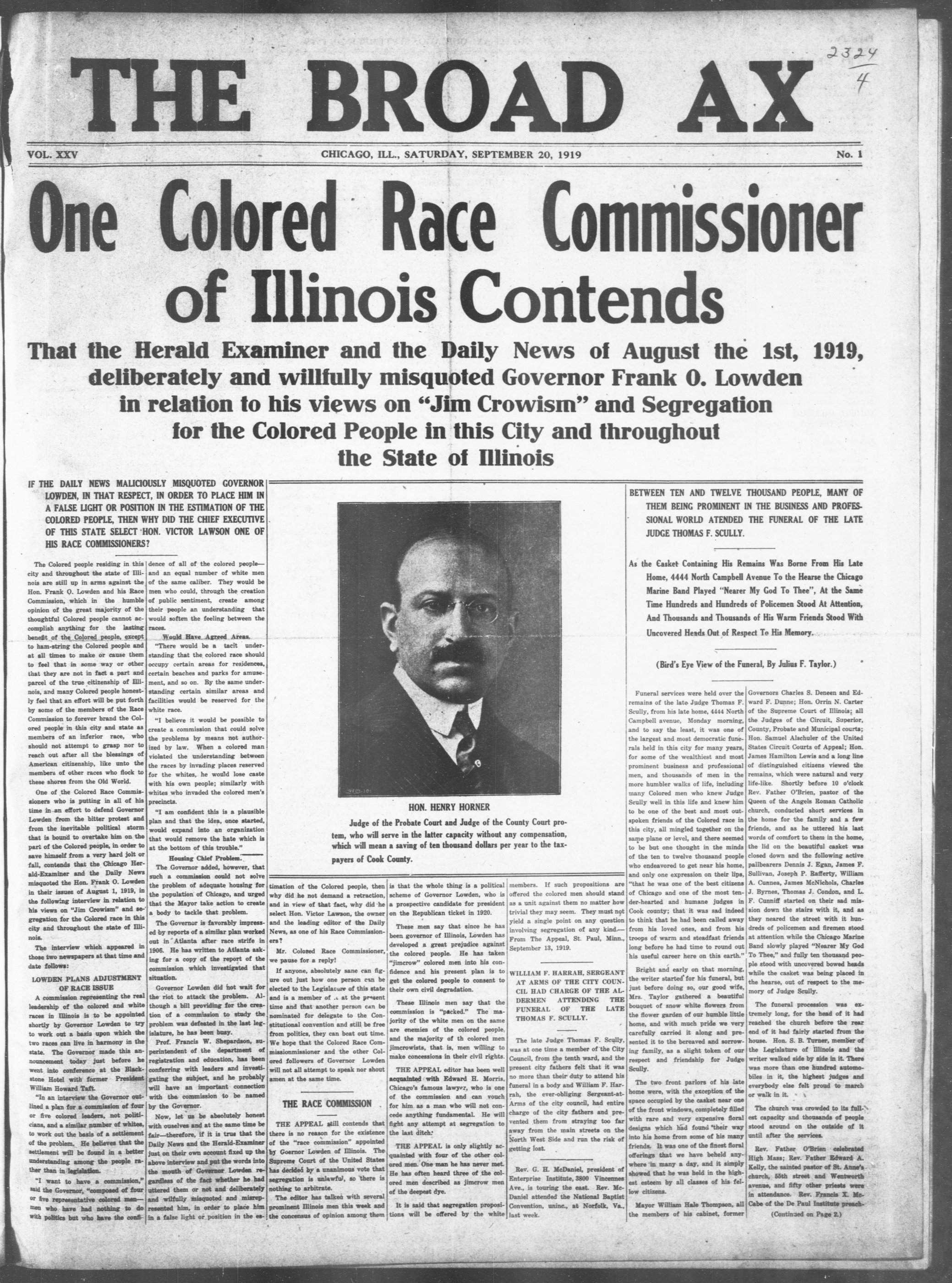
One Colored Race Commissioner of Illinois Contends
That the Herald Examiner and the Daily News of August the 1st, 1919, deliberately and willfully misquoted Governor Frank O. Lowden in relation to his views on "Jim Crowism" and Segregation for the Colored People in this City and throughout the State of Illinois
IF THE DAILY NEWS MALICIOUSLY MISQUOTED GOVERNOR LOWDEN, IN THAT RESPECT, IN ORDER TO PLACE HIM IN A FALSE LIGHT OR POSITION IN THE ESTIMATION OF THE COLORED PEOPLE, THEN WHY DID THE CHIEF EXECUTIVE OF THIS STATE SELECT HON. VICTOR LAWSON ONE OF HIS RACE COMMISSIONERS?
VOL. XXV
One
That the H
delib
in
IF THE DAILY NEWS MALICIO
LOWDEN, IN THAT RESPEC
A FALSE LIGHT OR POSITI
COLORED PEOPLE, THEN V
OF THIS STATE SELECT
HIS RACE COMMISSIONERS
The Colored people residing in this city and throughout the state of Illinois are still up in arms against the Hon. Frank O. Lowden and his Race Commission, which in the humble opinion of the great majority of the thoughtful Colored people cannot accomplish anything for the lasting benefit of the Colored people, except to ham-string the Colored people and at all times to make or cause them to feel that in some way or other that they are not in fact a part and parcel of the true citizenship of Illinois, and many Colored people honestly feel that an effort will be put forth by some of the members of the Race Commission to forever brand the Colored people in this city and state as members of an inferior race, who should not attempt to grasp nor to reach out after all the blessings of American citizenship, like unto the members of other races who flock to these shores from the Old World.
One of the Colored Race Commissioners who is putting in all of his time in an effort to defend Governor Lowden from the bitter protest and from the inevitable political storm that is bound to overtake him on the part of the Colored people, in order to save himself from a very hard jolt or fall, contends that the Chicago Herald-Examiner and the Daily News misquoted the Hon. Frank O. Lowden in their issues of August 1, 1919, in the following interview in relation to his views on "Jim Crowism" and segregation for the Colored race in this city and throughout the state of Illinois.
The interview which appeared in those two newspapers at that time and date follows:
LOWDEN PLANS ADJUSTMENT OF RACE ISSUE
A commission representing the real leadership of the colored and white races in Illinois is to be appointed shortly by Governor Lowden to try to work out a basis upon which the two races can live in harmony in the state. The Governor made this announcement today just before he went into conference at the Blackstone Hotel with former President William Howard Taft.
"In an interview the Governor outlined a plan for a commission of four or five colored leaders, not politicians, and a similar number of whites, to work out the basis of a settlement of the problem. He believes that the settlement will be found in a better understanding among the people rather than in legislation.
"I want to have a commission," said the Governor, "composed of four or five representative colored men—men who have had nothing to do with politics but who have the confi-
---
dence of all of the colored people—and an equal number of white men of the same caliber. They would be men who could, through the creation of public sentiment, create among their people an understanding that would soften the feeling between the races.
Would Have Agreed Areas.
"There would be a tacit understanding that the colored race should occupy certain areas for residences, certain beaches and parks for amusement, and so on. By the same understanding certain similar areas and facilities would be reserved for the white race.
"I believe it would be possible to create a commission that could solve the problems by means not authorized by law. When a colored man violated the understanding between the races by invading places reserved for the whites, he would lose caste with his own people; similarly with whites who invaded the colored men's precincts.
"I am confident this is a plausible plan and that the idea, once started, would expand into an organization that would remove the hate which is at the bottom of this trouble."
Housing Chief Problem.
The Governor added, however, that such a commission could not solve the problem of adequate housing for the population of Chicago, and urged that the Mayor take action to create a body to tackle that problem.
The Governor is favorably impressed by reports of a similar plan worked out in Atlanta after race strife in 1906. He has written to Atlanta asking for a copy of the report of the commission which investigated that situation.
Governor Lowden did not wait for the riot to attack the problem. Although a bill providing for the creation of a commission to study the problem was defeated in the last legislature, he has been busy.
Prof. Francis W. Shepardson, superintendent of the department of registration and education, has been conferring with leaders and investigating the subject, and he probably will have an important connection with the commission to be named by the Governor.
Now, let us be absolutely honest with ourselves and at the same time be fair—therefore, if it is true that the Daily News and the Herald-Examiner just on their own account fixed up the above interview and put the words into the mouth of Governor Lowden regardless of the fact whether he had uttered them or not and deliberately and wilfully misquoted and misrepresented him, in order to place him in a false light or position in the es-
CHICAGO, ILL., SATURDAY, SEPTEMBER 20, 1919
101
Judge of the Probate Court and Judge of the County Court pro tem, who will serve in the latter capacity without any compensation, which will mean a saving of ten thousand dollars per year to the taxpayers of Cook County.
timation of the Colored people, then why did he not demand a retraction, and in view of that fact, why did he select Hon. Victor Lawson, the owner and the leading editor of the Daily News, as one of his Race Commissioners?
Mr. Colored Race Commissioner, we pause for a reply!
If anyone, absolutely sane can figure out just how one person can be elected to the Legislature of this state and is a member of it at the present time and that another person can be nominated for delegate to the Constitutional convention and still be free from politics, they can beat out time. We hope that the Colored Race Commissionmissioner and the other Colored followers of Governor Lowden will not all attempt to speak nor shout amen at the same time.
THE RACE COMMISSION
THE APPEAL still contends that there is no reason for the existence of the "race commission" appointed by Goorner Lowden of Illinois. The Supreme Court of the United States has decided by a unanimous vote that segregation is unlawful, so there is nothing to arbitrate. The editor has talked with several prominent Illinois men this week and the consensus of opinion among them
HON. HENRY HORNER
the Probate Court and Judge of the serve in the latter capacity without a saving of ten thousand dollars per County.
is that the whole thing is a political scheme of Governor Lowden, who is a prospective candidate for president on the Republican ticket in 1920.
These men say that since he has been governor of Illinois, Lowden has developed a great prejudice against the colored people. He has taken "jimcrow" colored men into his confidence and his present plan is to get the colored people to consent to their own civil degradation.
These Illinois men say that the commission is "packed." The majority of the white men on the same are enemies of the colored people, and the majority of th colored men jimcrowists, that is, men willing to make concessions in their civil rights.
THE APPEAL editor has been well acquainted with Edward H. Morris, Chicago's famous lawyer, who is one of the commission and can vouch for him as a man who will not concede anything fundamental. He will fight any attempt at segregation to the last ditch:
THE APPEAL is only slightly acquainted with four of the other colored men. One man he has never met. He has often heard three of the colored men described as jimcrow men of the deepest dye.
It is said that segregation propositions will be offered by the white
members. If such propositions are offered the colored men should stand as a unit against them no matter how trivial they may seem. They must not yield a single point on any question involving segregation of any kind. From The Appeal, St. Paul, Minn., September 13, 1919.
WILLIAM F. HARRAH, SERGEANT
AT ARMS OF THE CITY COUN-
CIL HAD CHARGE OF THE AL-
DERMEN ATTENDING THE
FUNERAL OF THE LATE
THOMAS F. SCULLY.
The late Judge Thomas F. Scully, was at one time a member of the City Council, from the tenth ward, and the present city fathers felt that it was no more than their duty to attend his funeral in a body and William F. Harrah, the ever-obliging Sergeant-at-Arms of the city council, had entire charge of the city fathers and prevented them from straying too far away from the main streets on the North West Side and run the risk of getting lost.
Rev. G. H. McDaniel, president of Enterprise Institute, 3800 Vincennes Ave., is touring the east. Rev. McDaniel attended the National Baptist Convention, uninc., at Norfolk, Va., last week.
BETWEEN TEN AND TWELVE THOUSAND PEOPLE, MANY OF THEM BEING PROMINENT IN THE BUSINESS AND PROFESSIONAL WORLD ATENDED THE FUNERAL OF THE LATE JUDGE THOMAS F. SCULLY.
As the Casket Containing His Remains Was Borne From His Late Home, 4444 North Campbell Avenue To the Hearse the Chicago Marine Band Played "Nearer My God To Thee", At the Same Time Hundreds and Hundreds of Policemen Stood At Attention, And Thousands and Thousands of His Warm Friends Stood With
Uncovered Heads Out of Respect To His Memory.
(Bird's Eve View of the Funeral. By Julius F. Taylor.)
Funeral services were held over the remains of the late Judge Thomas F. Scully, from his late home, 4444 North Campbell avenue, Monday morning, and to say the least, it was one of the largest and most democratic funerals held in this city for many years, for some of the wealthiest and most prominent business and professional men, and thousands of men in the more humbler walks of life, including many Colored men who knew Judge Scully well in this life and knew him to be one of the best and most outspoken friends of the Colored race in this city, all mingled together on the same plane or level, and there seemed to be but one thought in the minds of the ten to twelve thousand people who endeavored to get near his home, and only one expression on their lips, "that he was one of the best citizens of Chicago and one of the most tender-hearted and humane judges in Cook county; that it was sad indeed to think that he had been called away from his loved ones, and from his troops of warm and steadfast friends long before he had time to round out his useful career here on this earth."
Bright and early on that morning, the writer started for his funeral, but just before doing so, our good wife, Mrs. Taylor gathered a beautiful bouquet of snow white flowers from the flower garden of our humble little home, and with much pride we very carefully carried it along and presented it to the bereaved and sorrowing family, as a slight token of our respect and friendship for Judge Scully.
The two front parlors of his late home were, with the exception of the space occupied by the casket near one of the front windows, completely filled with rare and very expensive floral designs which had found "their way into his home from some of his many friends. It was one of the finest floral offerings that we have beheld anywhere in many a day, and it simply showed that he was held in the highest esteem by all classes of his fellow citizens.
Mayor William Hale Thompson, all the members of his cabinet, former
2324
ioner
The 1st, 1919,
Swden
on
THOUSAND PEOPLE, MANY OF
IN THE BUSINESS AND PROFES-
THE FUNERAL OF THE LATE
mains Was Borne From His Late
Avenue To the Hearse the Chicago
My God To Thee", At the Same
of Policemen Stood At Attention,
als of His Warm Friends Stood With
spect To His Memory.
meral, By Julius F. Taylor.)
No. 1
1919,
MANY OF
PROFES-
THE LATE
In His Late
the Chicago
t the Same
Attention,
Stood With
Governors Charles S. Deneen and Edward F. Dunne; Hon. Orrin N. Carter of the Supreme Court of Illinois; all the Judges of the Circuit, Superior, County, Probate and Municipal courts; Hon. Samuel Alschuler of the United States Circuit Courts of Appeal; Hon. James Hamilton Lewis and a long line of distinguished citizens viewed the remains, which were natural and very life-like. Shortly before 10 o'clock Rev. Father O'Brien, pastor of the Queen of the Angels Roman Catholic church, conducted short services in the home for the family and a few friends, and as he uttered his last words of comfort to them in the home, the lid on the beautiful casket was closed down and the following active pallbearers Dennis J. Egan, James F. Sullivan, Joseph P. Rafferty, William A. Cunnea, James McNiehols, Charles J. Byrnes, Thomas J. Condon, and L. F. Cunniff started on their sad mission down the stairs with it, and as they neared the street with it hundreds of policemen and firemen stood at attention while the Chicago Marine Band slowly played "Nearer My God To Thee," and fully ten thousand people stood with uncovered bowed heads while the casket was being placed in the hearse, out of respect to the memory of Judge Scully.
The funeral procession was extremely long, for the head of it had reached the church before the rear end of it had fairly started from the house. Hon. S. B. Turner, member of the Legislature of Illinois and the writer walked side by side in it. There was more than one hundred automobiles in it, the highest judges and everybody else felt proud to march or walk in it.
The church was crowded to its fullest capacity and thousands of people stood around on the outside of it until after the services.
Rev. Father O'Brien celebrated High Mass; Rev. Father Edward A. Kelly, the sainted pastor of St. Anne's church, 55th street and Wentworth avenue, and fifty other priests were in attendance. Rev. Francis X. McCabe of the De Paul Institute preach-
(Continued on Page 2.)
---
Page Two
THE BROAD AX
Published Every Saturday
In this city since July 16th, 1899, without missing one single issue. Republicans, Democrats, Catholics, Protestants, Single Taxes, Priests, infidels or anyone else can have their say as long as their language is proper and responsibility is fixed.
The Broad Ax is a newspaper whose platform is broad enough for all, ever claiming the editorial right to speak its own mind.
Local communications will receive attention. Write only on one side of the paper.
Subscriptions must be paid in advance.
Advertising rates made known on application.
Address all communications to
THE BROAD AX
6206 So. Elizabeth St., Chicago, Ill.
Phone Wentworth 2597.
JULIUS F. TAYLOR
Editor and Publisher
DR. M. A. MAJORS
Associate Editor
4700 South State Street
Phone Drexel 1416
Vol. XXV, September 20, 1919. No. 1
Entered as Second-Claas Matter, Aug.
19, 1902, at the Post Office at Chicago,
Ill., Under Act of March 3, 1879
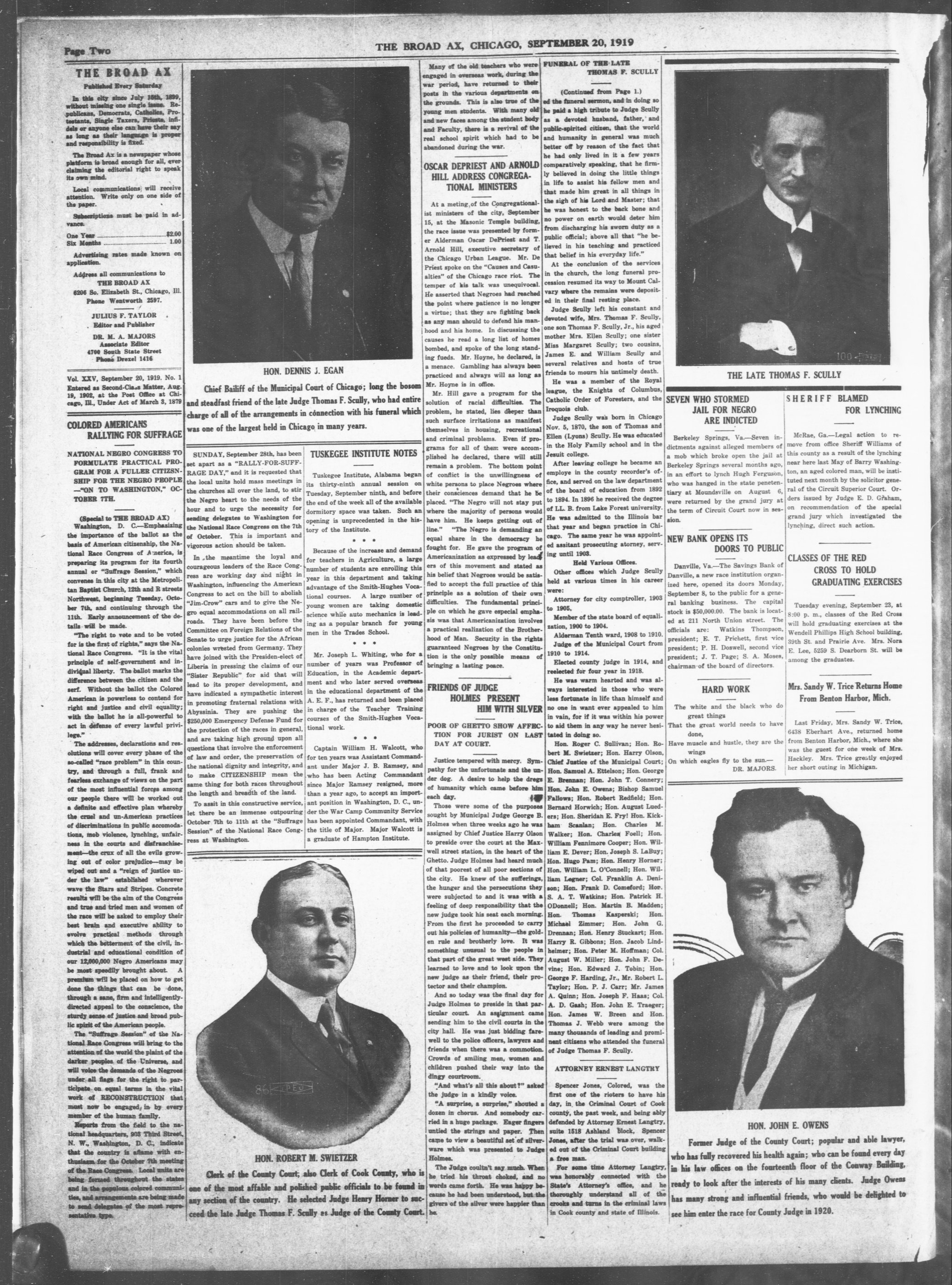
COLORED AMERICANS RALLYING FOR SUFFRAGE
NATIONAL NEGRO CONGRESS TO FORMULATE PRACTICAL PROGRAM FOR A FULLER CITIZENSHIP FOR THE NEGRO PEOPLE—"ON TO WASHINGTON," OCTOBER 7TH.
(Special to THE BROAD AX) Washington, D. C.—Emphasizing the importance of the ballot as the basis of American citizenship, the National Race Congress of America, is preparing its program for its fourth annual or "Suffrage Session," which convenes in this city at the Metropolitan Baptist Church, 12th and R streets Northwest, beginning Tuesday, October 7th, and continuing through the 11th. Early announcement of the details will be made.
"The right to vote and to be voted for is the first of rights," says the National Race Congress. "It is the vital principle of self-government and individual liberty. The ballot marks the difference between the citizen and the serf. Without the ballot the Colored American is powerless to contend for right and justice and civil equality, with the ballot he is all-powerful to act in defense of every lawful privilege."
The addresses, declarations and resolutions will cover every phase of the so-called "race problem" in this country, and through a full, frank and fearless exchange of views on the part of the most influential forces among our people there will be worked out a definite and effective plan whereby the cruel and un-American practices of discriminations in public accommodations, mob violence, lynching, unfairness in the courts and disfranchisement—the crux of all the evils growing out of color prejudice—may be wiped out and a "reign of justice under the law" established wherever wave the Stars and Stripes. Concrete results will be the aim of the Congress and true and tried men and women of the race will be asked to employ their best brain and executive ability to evolve practical methods through which the betterment of the civil, industrial and educational condition of our 12,000,000 Negro Americans may be most speedily brought about. A premium will be placed on how to get done the things that can be done, through a sane, firm and intelligently-directed appeal to the conscience, the sturdy sense of justice and broad public spirit of the American people.
The "Suffrage Session" of the National Race Congress will bring to the attention of the world the plaint of the darker peoples of the Universe, and will voice the demands of the Negroes under all flags for the right to participate, on equal terms in the vital work of RECONSTRUCTION that must now be engaged in by every member of the human family.
Reports from the field to the national headquarters, 903 Third Street, N. W., Washington, D. C., indicate that the country is afame with enthusiasm for the October 7th meeting of the Race Congress. Local units are being formed throughout the states and in the populous colored communities, and arrangements are being made to send delegates of the most representative type.
M. J.
HON. DENNIS J. EGAN
Chief Bailiff of the Municipal and steadfast friend of the late Jud charge of all of the arrangements it was one of the largest held in Chic
Chief Bailiff of the Municipal Court of Chicago; long the bosom and steadfast friend of the late Judge Thomas F. Scully, who had entire charge of all of the arrangements in connection with his funeral which was one of the largest held in Chicago in many years.
SUNDAY, September 28th, has been set apart as a "RALLY-FOR-SUFF-RAGE DAY," and it is requested that the local units hold mass meetings in the churches all over the land, to stir the Negro heart to the needs of the hour and to urge the necessity for sending delegates to Washington for the National Race Congress on the 7th of October. This is important and vigorous action should be taken.
In the meantime the loyal and courageous leaders of the Race Congress are working day and night in Washington, influencing the American Congress to act on the bill to abolish "Jim-Crow" cars and to give the Negro equal accommodations on all railroads. They have been before the Committee on Foreign Relations of the Senate to urge justice for the African colonies wrested from Germany. They have joined with the Presiden-elect of Liberia in pressing the claims of our "Sister Republic" for aid that will lead to its proper development, and have indicated a sympathetic interest in promoting fraternal relations with Abyssinia. They are pushing the $250,000 Emergency Defense Fund for the protection of the races in general, and are taking high ground upon all questions that involve the enforcement of law and order, the preservation of the national dignity and integrity, and to make CITIZENSHIP mean the same thing for both races throughout the length and breadth of the land.
To assit in this constructive service, let there be an immense outpouring October 7th to 11th at the "Suffrage Session" of the National Race Congress at Washington.
86
861 PEU
HON. ROBERT M. SWIETZER
Clerk of the County Court; one of the most affable and poli any section of the country. He a ceed the late Judge Thomas F. S
Clerk of the County Court; also Clerk of Cook County, who is one of the most affable and polished public officials to be found in any section of the country. He selected Judge Henry Horner to succeed the late Judge Thomas F. Scully as Judge of the County Court.
in Court of Chicago; long the bosom of George Thomas F. Scully, who had entire connection with his funeral whichago in many years.
TUSKEGEE INSTITUTE NOTES
Tuskegee Institute, Alabama began its thirty-ninth annual session on Tuesday, September ninth, and before the end of the week all of the available dormitory space was taken. Such an opening is unprecedented in the history of the Institute.
Because of the increase and demand for teachers in Agriculture, a large number of students are enrolling this year in this department and taking advantage of the Smith-Hughes Vocational courses. A large number of young women are taking domestic science while auto mechanics is leading as a popular branch for young men in the Trades School.
Mr. Joseph L. Whiting, who for a number of years was Professor of Education, in the Academic department and who later served overseas in the educational department of the A. E.F., has returned and been placed in charge of the Teacher Training courses of the Smith-Hughes Vocational work.
Captain William H. Walcott, who for ten years was Assistant Commandant under Major J. B. Ramsey, and who has been Acting Commandant since Major Ramsey resigned, more than a year ago, to accept an important position in Washington, D. C., under the War Camp Community Service has been appointed Commandant, with the title of Major. Major Walcott is a graduate of Hampton Institute.
V
also Clerk of Cook County, who is
hired public officials to be found in
selected Judge Henry Horner to suc-
cultly as Judge of the County Court
THE BROAD AX, CHICAGO, SEPTEMBER 20, 1919
---
---
---
Many of the old teachers who were engaged in overseas work, during the war period, have returned to their posts in the various departments on the grounds. This is also true of the young men students. With many old and new faces among the student body and Faculty, there is a revival of the real school spirit which had to be abandoned during the war.
OSCAR DEPRIEST AND ARNOLI HILL ADDRESS CONGREGA TIONAL MINISTERS
At a meeting, of the Congregationalist ministers of the city, September 15, at the Masonic Temple building, the race issue was presented by former Alderman Oscar DePriest and T. Arnold Hill, executive secretary of the Chicago Urban League. Mr. DePriest spoke on the "Causes and Casualties" of the Chicago race riot. The temper of his talk was unequivocal. He asserted that Negroes had reached the point where patience is no longer a virtue; that they are fighting back as any man should to defend his manhood and his home. In discussing the causes he read a long list of homes bombed, and spoke of the long standing fueds. Mr. Hoyne, he declared, is a menace. Gambling has always been practiced and always will as long as Mr. Hoyne is in office.
Mr. Hill gave a program for the solution of racial difficulties. The problem, he stated, lies deeper than such surface irritations as manifest themselves in housing, recreational and criminal problems. Even if programs for all of them were accomplished he declared, there will still remain a problem. The bottom point of conflict is the unwillingness of white persons to place Negroes where their consciences demand that he be placed. "The Negro will not stay put where the majority of persons would have him. He keeps getting out of line." "The Negro is demanding an equal share in the democracy he fought for. He gave the program of Americanization as expressed by leaders of this movement and stated as his belief that Negroes would be satisfied to accept the full practice of this principle as a solution of their own difficulties. The fundamental principle on which he gave especial emphasis was that Americanization involves a practical realization of the Brotherhood of Man. Security in the rights guaranteed Negroes by the Constitution is the only possible means of bringing a lasting peace.
FRIENDS OF JUDGE
HOLMES PRESENT
HIM WITH SILVER
POOR OF GHETTO SHOW AFFECTION FOR JURIST ON LAST DAY AT COURT.
Justice tempered with mercy. Sympathy for the unfortunate and the under dog. A desire to help the dregs of humanity which came before him each day.
Those were some of the purposes sought by Municipal Judge George B. Holmes when three weeks ago he was assigned by Chief Justice Harry Olson to preside over the court at the Maxwell street station, in the heart of the Ghetto. Judge Holmes had heard much of that poorest of all poor sections of the city. He knew of the sufferings, the hunger and the persecutions they were subjected to and it was with a feeling of deep responsibility that the new judge took his seat each morning. From the first he proceeded to carry out his policies of humanity—the golden rule and brotherly love. It was something unusual to the people in that part of the great west side. They learned to love and to look upon the new judge as their friend, their protector and their champion.
And so today was the final day for Judge Holmes to preside in that particular court. An assignment came sending him to the civil courts in the city hall. He was just bidding farewell to the police officers, lawyers and friends when there was a commotion. Crowds of smiling men, women and children pushed their way into the dingy courtroom.
"And what's all this about?" asked the judge in a kindly voice.
"A surprise, a surprise," shouted a dozen in chorus. And somebody carried in a huge package. Eager fingers untied the strings and paper. Then came to view a beautiful set of silverware which was presented to Judge Holmes.
The Judge couldn't say much. When he tried his throat choked, and no words came forth. He was happy because he had been understood, but the givers of the silver were happier than he.
FUNERAL OF THE LATE
THOMAS F. SCULLY
(Continued from Page 1.)
ed the funeral sermon, and in doing so he paid a high tribute to Judge Scully as a devoted husband, father, and public-spirited citizen, that the world and humanity in general was much better off by reason of the fact that he had only lived in it a few years comparatively speaking, that he firmly believed in doing the little things in life to assist his fellow men and that made him great in all things in the sigh of his Lord and Master; that he was honest to the back bone and no power on earth would deter him from discharging his sworn duty as a public official; above all that "he believed in his teaching and practiced that belief in his everyday life."
At the conclusion of the services in the church, the long funeral procession resumed its way to Mount Calvary where the remains were deposited in their final resting place.
Judge Scully left his constant and devoted wife, Mrs. Thomas F. Scully, one son Thomas F. Scully, Jr., his aged mother Mrs. Ellen Scully; one sister Miss Margaret Scully; two cousins, James E. and William Scully and several relatives and hosts of true friends to mourn his untimely death.
He was a member of the Royal league, the Knights of Columbus, Catholic Order of Foresters, and the Iroquois club.
Judge Scully was born in Chicago Nov. 5, 1870, the son of Thomas and Ellen (Lyons) Scully. He was educated in the Holy Family school and in the Jesuit college.
After leaving college he became an employee in the county recorder's office, and served on the law department of the board of education from 1892 to 1894. In 1896 he received the degree of LL. B. from Lake Forest university. He was admitted to the Illinois bar that year and began practice in Chicago. The same year he was appointed assistant prosecuting attorney, serving until 1903.
Held Various Offices.
Other offices which Judge Scully held at various times in his career were:
Attorney for city comptroller, 1903 to 1905.
Member of the state board of equalization, 1900 to 1904.
Alderman Tenth ward, 1908 to 1910.
Judge of the Municipal Court from 1910 to 1914.
Elected county judge in 1914, and reelected for four year in 1918.
He was warm hearted and was always interested in those who were less fortunate in life than himself and no one in want ever appealed to him in vain, for if it was within his power to aid them in any way he never hesitated in doing so.
Hon. Roger C. Sullivan; Hon. Robert M. Swietzer; Hon. Harry Olson, Chief Justice of the Municipal Court; Hon. Samuel A. Ettelson; Hon. George E. Brennan; Hon. John T. Connery; Hon. John E. Owens; Bishop Samuel Fallows; Hon. Robert Redfield; Hon. Bernard Horwich; Hon. August Lueders; Hon. Sheridan E. Fry! Hon. Kickham Scanlan; Hon. Charles M. Walker; Hon. Charles Foell; Hon. William Fennimore Cooper; Hon. William E. Dever; Hon. Joseph S. LaBuy; Hon. Hugo Pam; Hon. Henry Horner; Hon. William L. O'Connell; Hon. William Legner; Col. Franklin A. Denison; Hon. Frank D. Comeford; Hoe. S. A. T. Watkins; Hon. Patrick H. ODonnell; Hon. Martin B. Madden; Hon. Thomas Kasperaki; Hon. Michael Zimmer; Hon. John G. Drennan; Hon. Henry Stuckart; Hon. Harry R. Gibbons; Hon. Jacob Lindheimer; Hon. Peter M. Hoffman; Col. August W. Miller; Hon. John F. Devine; Hon. Edward J. Tobin; Hon. George F. Harding, Jr., Mr. Robert L. Taylor; Hon. P. J. Carr; Mr. James A. Quinn; Hon. Joseph F. Haas; Col. A. D. Gash; Hon. John E. Traeger; Hon. James W. Breen; Hon. Thomas J. Webb were among the many thousands of leading and prominent citizens who attended the funeral of Judge Thomas F. Scully.
ATTORNEY ERNEST LANGTRY
Spencer Jones, Colored, was the first one of the riots to have his day, in the Criminal Court of Cook county, the past week, and being ably defended by Attorney Ernest Langtry, suite 1518 Ashland block, Spencer Jones, after the trial was over, walked out of the Criminal Court building a free man. For some time Attorney Langtry, was honorably connected with the State's Attorney's office, and he thoroughly understand all of the crooks and turns in the criminal laws in Cook county and state of Illinois.
100
THE LATE THOMAS F. SCULLY
ORMED
R NEGRO
INDICTED
SHERIFF B
SEVEN WHO STORMED
JAIL FOR NEGRO
ARE INDICTED
Berkeley Springs, Va.—Seven indictments against alleged members of a mob which broke open the jail at Berkeley Springs several months ago, in an effort to lynch Hugh Ferguson, who was hanged in the state penentiary at Moundsville on August 6, were returned by the grand jury at the term of Circuit Court now in session.
NEW BANK OPENS ITS
DOORS TO PUBLIC
Danville, Va.—The Savings Bank of Danville, a new race institution organized here, opened its doors Monday, September 8, to the public for a general banking business. The capital stock is $50,000.00. The bank is located at 211 North Union street. The officials are: Watkins Thompson, president; E. T. Prichett, first vice president; P. H. Doswell, second vice president; J. T. Page; S. A. Moses, chairman of the board of directors.
HARD WORK
The white and the black who do great things
That the great world needs to have done,
Have muscle and hustle, they are the wings
On which eagles fly to the sun.—DR. MAJORS.
THE NEW YORK TIMES
M.
IRELAND
HON. JOHN E. OWENS
Former Judge of the County who has fully recovered his health in his law offices on the fourteen ready to look after the interests has many strong and influential see him enter the race for County
edge of the County Court; popularly discovered his health again; who can be on the fourteenth floor of the after the interests of his many clieng and influential friends, who woule race for County Judge in 1920.
Former Judge of the County Court; popular and able lawyer, who has fully recovered his health again; who can be found every day in his law offices on the fourteenth floor of the Conway Building, ready to look after the interests of his many clients. Judge Owens has many strong and influential friends, who would be delighted to see him enter the race for County Judge in 1920.
SHERIFF BLAMED FOR LYNCHING
McRae, Ga.—Legal action to remove from office Sheriff Williams of this county as a result of the lynching near here last May of Barry Washington, an aged colored man, will be instituted next month by the solicitor general of the Circuit Superior Court. Orders issued by Judge E. D. Graham, on recommendation of the special grand jury which investigated the lynching, direct such action.
CLASSES OF THE RED
CROSS TO HOLD
GRADUATING EXERCISES
Tuesday evening, September 23, at 8:00 p. m., classes of the Red Cross will hold graduating exercises at the Wendell Phillips High School building, 39th St. and Prairie Ave. Mrs. Nora E. Lee, 5259 S. Dearborn St. will be among the graduates.
Mrs. Sandy W. Trice Returns Home From Benton Harbor, Mich.
Last Friday, Mrs. Sandy W. Trice,
6438 Eberhart Ave., returned home
from Benton Harbor, Mich., where she
was the guest for one week of Mrs.
Hackley. Mrs. Trice greatly enjoyed
her short outing in Michigan.
1
by Court; popular and able lawyer again; who can be found every day ninth floor of the Conway Building of his many clients. Judge Owen friends, who would be delighted to Judge in 1920.
Original and Selected Fashions for Women Readers
Western Newspaper Union
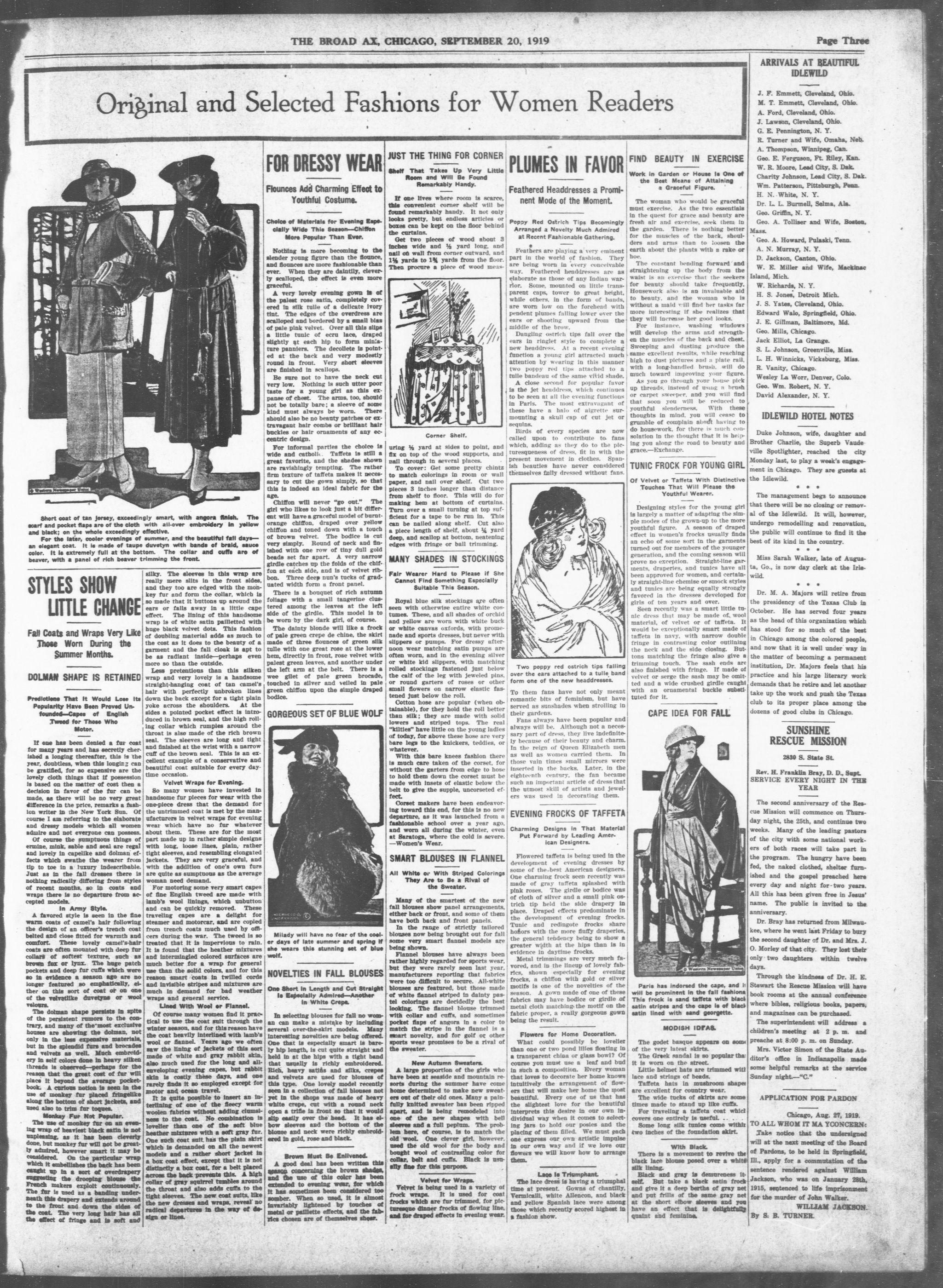
Short coat of tan jersey, exceedingly smart, with angora finish. The scarf and pocket flaps are of the cloth with all-over embroidery in yellow and black; on the whole exceedingly effective.
For the later, cool evening of summer, and the beautiful fall days—an elegant coat. It is made of taupe duvetyn with bands of braid, sauce color. It is extremely full at the bottom. The collar and cuffs are of beaver, with a panel of rich beaver trimming the front.
STYLES SHOW LITTLE CHANGE
Fall Coats and Wraps Very Like Those Worn During the Summer Months.
DOLMAN SHAPE IS RETAINED
Predictions That It Would Lose Its Popularity Have Been Proved Unfounded—Capes of English Tweed for Those Who Motor.
If one has been denied a fur coat for many years and has secretly cherished a longing thereafter, this is the year, doubtless, when this longing can be gratified, for so expensive are the lovely cloth things that if possession is based on the matter of cost then a decision in favor of the fur can be made, as there will be no very great difference in the price, remarks a fashion writer in the New York Sun. Of course I am referring to the elaborate and dress models which all women admire and not everyone can possess. Of course the sumptuous things of ermine, mink, sable and seal are regal and lovely in capelike and dolman effects which swathe the wearer from tip to toe in a luxury indescribable. Just as in the fall dresses there is nothing radically differing from styles of recent months, so in coats and wraps there is no departure from accepted models.
In Army Style
A favored style is seen in the fine warm coats of camel's hair following the design of an officer's trench coat belted and close fitted for warmth and comfort. These lovely camel's-hair coats are often mounted with deep fur collars of soffet texture, such as brown fox or lynx. The huge patch pockets and deep fur cuffs which were so in evidence a season age are no longer featured so emphatically, either on this sort of coat or on one of the velvetlike duvetyns or wool velour.
The dolman shape persists in spite of the persistent rumors to the contrary, and many of the most exclusive houses are showing the dolman, not only in the less expensive materials, but in the splendid fur and brooches and velvets as well. Much embroidery in self colors done in heavy silken threads is observed—perhaps for the reason that the great cost of fur will place it beyond the average pocket-book. A curious notion is seen in the use of monkey fur placed fringelike along the bottom of short jackets, and used also to trim fur toques.
Monkey Fur Not Popular
MONKEY FUR NOT POPULAR.
The use of monkey fur on an evening wrap of heaviest black satin is not unpleasing, as it has been cleverly done, but monkey fur will not be greatly admired, however smart it may be considered. On the particular wrap which it embellishes the back has caught up in a sort of overdrapery suggesting the drooping blouse the French makers exploit continuously. The fur is used as a banding underneath this drapery and extends around to the front and down the sides of the coat. The very long hair has all the effect of fringe and is soft and
silky. The sleeves in this wrap are really mere slits in the front sides, and they too are edged with the monkey fur and form the collar, which is so made that it buttons up around the ears or falls away in a little cape effect. The lining of this handsome wrap is of white satin pailletted with huge black velvet dots. This fashion of doubling material adds as much to the cost as it does to the beauty of a garment and the fall cloak is apt to be as radiant inside—perhaps even more so than the outside.
Less pretentious than this silken wrap and very lovely is a handsome straight-hanging coat of tan cannel's hair with perfectly unbroken lines down the back except for a tight plain yoke across the shoulders. At the sides a pointed pocket effect is introduced in brown seal, and the high rolling collar which rumps around the throat is also made of the rich brown seal. The sleeves are long and tight and finished at the wrist with a narrow cuff of the brown seal. This is an excellent example of a conservative and beautiful coat suitable for every daytime occasion.
Velvet Wraps for Evening.
So many women have invested in handsome fur pieces for wear with the one-piece dress that the demand for the untrimmed coat is met by the manufacturers in velvet wraps for evening wear which have no fur whatever about them. These are for the most part made up in rather simple designs with long, loose lines, plain, rather tight sleeves, and resembling elongated jackets. They are very graceful, and with the addition of one's own furs are quite as sumptuous as the average woman need demand.
For motoring some very smart capes of fine English tweed are made with lamb's wool linings, which unbutton and can be quickly removed. These traveling capes are a delight for steamer and motorcar, and are copied from trench coats much used by officers during the war. The tweed is so treated that it is impervious to rain. It is found that the heather mixtures and intermingled colored surfaces are much better for a wrap for general use than the solid colors, and for this reason smart coats in twilled cords and invisible stripes and mixtures are much in demand for bad weather wraps and general service.
Lined With Wool or Flannel.
Of course many women find it practical to use the coat suit through the winter season, and for this reason have the coat heavily interlined with lamb's wool or flannel. Years ago we often saw the lining of jackets of this sort made of white and gray rabbit skin, also much used for the long and all-enveloping evening capes, but rabbit skin is costly these days, and one rarely finds it so employed except for motor and ocean travel.
It is quite possible to insert an interlining of one of the fleecy warm woolen fabrics without adding clumsiness to the coat. No combination is lovelier than one of the soft blue heather mixtures with a soft gray fur. One such coat suit has the plain skirt which is demanded on all the newest models and a rather short jacket in a box coat effect, except that it is not distinctly a box coat, for a belt placed across the back prevents this. A high collar of gray squirrel turtles around the throat and also adds cuffs to the tight sleeve. The new coat suits, like the new dresses and wraps, reveal no radical departures in the way of design or lines.
THE BROAD AX. CHICAGO. SEPTEMBER 20. 1919
FOR DRESSY WEAR
Flounces Add Charming Effect to Youthful Costume.
Choice of Materials for Evening Especially Wide This Season—Chiffon More Popular Than Ever.
Nothing is more becoming to the slender young figure than the flounce, and flouces are more fashionable than ever. When they are dainty, cleverly scalloped, the effect is even more graceful.
A very lovely evening gown is of the palest rose satin, completely covered in silk tulle of a delicate ivory tint. The edges of the overdress are scalloped and bordered by a small bliss of pale pink velvet. Over all this slips a little tunic of ecru lace, draped slightly at each hip to form miniature panniers. The decollete is pointed at the back and very modestly round in front. Very short sleeves are finished in scallops.
Be sure not to have the neck cut very low. Nothing is such utter poor taste for a young girl as this expanse of chest. The arms, too, should not be totally bare; a sleeve of some kind must always be worn. There should also be no beauty patches or extravagant hair combs or brilliant hair buckles or hair ornaments of any eccentric design.
For informal parties the choice is wide and catholic. Taffeta is still a great favorite, and the shades shown are ravishingly tempting. The rather firm texture of taffeta makes it necessary to cut the gown simply, so that this is indeed an ideal fabric for the age.
Chiffon will never "go out." The girl who likes to look just a bit different will have a graceful model of burnt orange chiffon, draped over yellow chiffon and toned down with a touch of brown velvet. The bodice is cut very simply. Round of neck and finished with one row of tiny dull gold beads set far apart. A very narrow girdle catches up the folds of the chiffon at each side, and is of velvet ribbon. Three deep nun's tucks of graduated width form a front panel.
There is a bouquet of rich autumn foliage with a small tangerine clustered among the leaves at the left side of the girdle. This model is to be worn by the dark girl, of course.
The dainty blonde will like a frock of pale green crepe de chine, the skirt made of three floundes of green silk tulle with one great rose at the lower hem, directly in front, rose velvet with palest green leaves, and another under the left arm at the belt. There is a wee glet of pale green brocade, touched in silver and velled in pale green chiffon upon the simple draped bodice.
GORGEOUS SET OF BLUE WOLF
DEERWOO
L ALF FAYWOOD
Milady will have no fear of the cooler days of late summer and spring if she wears this stunning set of blue wolf.
NOVELTIES IN FALL BLOUSES
One Short In Length and Cut Straight Is Especially Admired—Another in White Crepe.
In selecting blouses for fall no woman can make a mistake by including several over-the-skirt models. Many interesting novelties are being offered. One that is especially smart is barely hip length, is cut quite straight and held in at the hips with a tight band that usually is richly embroidered. Rich, heavy satinies and silks, crepes and velvets are used for blouses of this type. One lovely model recently seen in a collection of fall blouses not yet in the shops was made of heavy white crepe, cut with a round neck open a trifle in front so that it would slip easily over the head. It has elbow sleeves and the bottom of the blouse and neck were richly embroidered in gold, rose and black.
Brown Must Be Enlivened.
A good deal has been written this season concerning the brown shades, and the use of this color has been extended to evening wear, for which it has sometimes been considered too somber. When so used, it is almost invariably lightened by touches of metal or palllette effects, and the fabrics chosen are of themselves shear.
JUST THE THING FOR CORNER
Shelf That Takes Up Very Little Room and Will Be Found Remarkably Handy.
If one lives where room is scarce, this convenient corner shelf will be found remarkably handy. It not only looks pretty, but endless articles or boxes can be kept on the floor behind the curtains.
Get two pieces of wood about 3 inches wide and 1/2 yard long, and nail on wall from corner outward, and 1/2 yards to 1/4 yards from the floor. Then procure a piece of wood meas
Corner Shelf.
uring ½ yard at sides to point, and fix on top of the wood supports, and nail through in several places.
To cover: Get some pretty chinata to match colorings in room or wall paper, and nail over shelf. Cut two pieces 3 inches longer than distance from shelf to floor. This will do for making him at bottom of curtains. Turn over a small turning at top sufficient for a tape to be run in. This can be nailed along shelf. Cut also a piece length of shelf, about ½ yard deep, and scallop at bottom, neatening edges with fringe or ball trimming.
MANY SHADES IN STOCKINGS
Fair Wearer Hard to Please if She Cannot Find Something Especially Suitable This Season.
Royal blue silk stockings are often seen with otherwise entire white costumes. These, and all shades of orchid and yellow are worn with white buck or white canvas oxford, with promenade and sports dresses, but never with slippers or pumps. For dressy afternoon wear matching satin pumps are often worn, and in the evening silver or white kid slippers, with matching rolled stockings fastened just below the calf of the leg with jeweled pins, or round garters of roses or other small flowers on narrow elastic fastened just below the roll.
Cotton hose are popular (when obtainable), for they hold the roll better than silk; they are made with solid lowers and striped tops. The real "kilties" have little on the young ladies of today, for above these hose are very bare legs to the knickers, teddies, or whatever.
With this bare knees fashion there is much care taken of the corset, for without the garters from edge to hose to hold them down the corset must be made with insets of elastic below the belt to give the supple, unscored effect. Corset makers have been endeavoring toward this end, for this is no new departure, as it was launched from a fashionable school over a year ago, and worn all during the winter, even at Saratoga, where the cold is severe — Women's Wear.
SMART BLOUSES IN FLANNEL
All White or With Striped Colorings They Are to Be a Rival of the Sweater.
Many of the smartest of the new fall blouses show panel arrangements, either back or front, and some of them have both back and front panels. In the range of strictly tailored blouses now being brought out for fall some very smart flannel models are being shown. Fliannel blouses have always been rather highly regarded for sports wear, but they were rarely seen last year, manufacturers reporting that fabrics were too difficult to secure. All-white blouses are featured, but those made of white flannel striped in dainty pastel colorings are decidedly the best looking. The flannel blouse trimmed with collar and cuffs, and sometimes pocket flaps of angora in a color to match the stripe in the flannel is a smart novelty, and for golf or other sports wear promises to be a rival of the sweater.
New Autumn Sweaters.
A large proportion of the girls who have been at seaside and mountain resorts during the summer have come home determined to make new sweaters out of their old ones. Many a painfully knitted sweater has been ripped apart, and is being remodeled into one of the new shapes with bell sleeves and a full peplum. The problem here, of course, is to match the old wool. One clever girl, however, used the old wool for the body and bought wool of contrasting color for collar, belt and cuffs. Black is usually fine for this purpose.
Velvet for Wraps.
Velvet is being used in a variety of frock wraps. It is used for coat frocks which are fur trimmed, for picturesque dinner frocks of flowing line, and for draped effects in evening wear.
PLUMES IN FAVOR
Feathered Headdresses a Prominent Mode of the Moment.
Poppy Red Ostrich Tips Becomingly Arranged a Novelty Much Admired at Recent Fashionable Gathering.
Feathers are playing a very eminent part in the world of fashion. They are being worn in every conceivable way. Feathered headdresses are as elaborate as those of any Indian warrior. Some, mounted on little transparent caps, tower to great height, while others, in the form of bands, are worn low on the forehead with pendent plumes falling lower over the ears or shooting upward from the middle of the brow.
Dangling ostrich tips fall over the ears in ringlet style to complete a new headdress. At a recent evening function a young girl attracted much attention by wearing in this manner two poppy red tips attached to a tulle bandeau of the same vivid shade. A close second for popular favor is the jet headdress, which continues to be seen at all the evening functions in Paris. The most extravagant of these have a halo of algrette surmounting a skull cap of cut jet or sequins. Birds of every species are now called upon to contribute to fans which, adding as they do to the picturesqueness of dress, fit in with the present movement in clothes. Spanish beauties have never considered themselves fully dressed without fans.
A
Two poppy red ostrich tips falling over the ears attached to a tulle band form one of the new headdresses.
To them fans have not only meant romantic bits of feminism, but have served as sunshades when strolling in their gardens.
Fans always have been popular and always will be. Although not a necessary part of dress, they live indefinitely because of their beauty and charm.
In the reign of Queen Elizabeth men as well as women carried them. In those vain times small mirrors were inserted in the backs. Later, in the eighteenth century, the fan became such an important article of dress that the utmost skill of artists and jewelers was used in decorating them.
EVENING FROCKS OF TAFFETA
Charming Designs in That Material Put Forward by Leading American Designers.
Flowered taffeta is being used in the development of evening dresses by some of the-best American designers. One charming frock seen recently was made of gray taffeta splashed with pink roses. The girdle or bodice was of cloth of silver and a small pink ostrich tip held the side drapery in place. Draped effects predominate in the development of evening frocks. Tunic and redingote frocks share honors with the more fluffy draperies, the general tendency being to show a greater width at the hips than is in evidence in daytime frocks.
Metal trimmings are very much favored, and in the lineup of lovely fabrics, shown especially for evening frocks, a chiffon with gold or silver motifs is one of the novelties of the season. A gown made of one of these fabrics may have bodice or girdle of metal cloth matching the motif on the fabric proper, a really gorgeous gown being the result.
Flowers for Home Decoration
What could possibly be lovelier than one or two pond lilies floating in a transparent china or glass bowl? Of course you must use a leaf and bud in such a composition. Every woman that loves to decorate her home knows intuitively the arrangement of flowers that will make her home the most beautiful. Every one of us that has the slightest love for the beautiful interprets this desire in our own individual way when it comes to selecting jars to hold our postes and the placing of them filled. We must pach one express our own artistic impulse in our own way and if we love our flowers we will know how to arrange them.
Lage le Triumphant
The lace dress is having a triumphal time at present. Gowns of chantilly, Vermicall, white Allencon, and black and yellow Spanish lace were among those which recently scored highest in a fashion show.
FIND BEAUTY IN EXERCISE
Work in Garden or House is One of the Best Means of Attaining a Graceful Figure.
The woman who would be graceful must exercise. As the two essentials in the quest for grace and beauty are fresh air and exercise, seek them in the garden. There is nothing better for the muscles of the back, shoulders and arms than to loosen the earth about the plants with a rake or hoe.
The constant bending forward and straightening up the body from the waist is an exercise that the seekers for beauty should take frequently. Housework also is an invaluable aid to beauty, and the woman who is without a maid will find her tasks far more interesting if she realizes that they will increase her good looks.
For instance, washing windows will develop the arms and strengthen the muscles of the back and chest. Sweeping and dusting produce the same excellent results, while reaching high to dust pictures and a plate rail, with a long-handled brush, will do much toward improving your figure. As you go through your house pick up threads, instead of using a brush or carpet sweeper, and you will find that soon you will be reduced to youthful slenderness. With these thoughts in mind, you will cease to grumble of complain aboot having to do housework, for there is much consolation in the thought that it is helping you along the road to beauty and grace.—Exchange.
TUNIC FROCK FOR YOUNG GIRL
Of Velvet or Taffeta With Distinctive
Touches That Will Please the
Youthful Wearer.
Designing styles for the young girl is largely a matter of adapting the simple modes of the grown-up to the more youthful figure. A season of draped effect in women's frocks usually finds an echo of some sort in the garments turned out for members of the younger generation, and the coming season will prove no exception. Straight-line garments, draperies, and tunics have all been approved for women, and certainly straight-line chemise or smock styles and tunics are being equally strongly favored in the dresses developed for girls of ten years and over.
Seen recently was a smart little tunic dress that may be made of wool material, of velvet or of taffeta. It would be exceptionally smart made of taffeta in navy, with narrow double fringe in contrasting color outlining the neck and the side closing. Buttons matching the fringe also give a trimming touch. The sash ends are also finished with fringe. If made of velvet or serge the sash may be b omitted and a wide crushed girdle caught with an ornamental buckle substituted for it.
CAPE IDEA FOR FALL
© Western Newspaper Union
Paris has indored the cape, and it will be prominent in the fall fashions. This frock is sand taffeta with black satin stripes and the cape is of black satin lined with sand georgette.
MODISH IDFAS.
The godet basque appears on some of the very latest skirts.
The Greek sandal is so popular that it is worn on the street.
Little helmet hats are trimmed with lace and strings of beads.
Taffeta hats in mushroom shapes are excellent for country wear.
The wide tucks of skirts are some times made to stand up like cuffs.
For traveling a taffeta coat which covers one entirely is useful. . .
Some long silk tunics come within two inches of the foundation skirt.
With Black
There is a movement to revive the black lace blouse posed over a white silk lining.
Black and gray is denureness itself. But take a black satin frock and give it a deep bertha of gray net and put frills of the same gray net at the short elbow sleeves and you have an effect that is delightfully quaint and feminine.
Page Three
ARRIVALS AT BEAUTIFUL IDLEWILD
J. F. Emmett, Cleveland, Ohio.
M. T. Emmett, Cleveland, Ohio.
A. Ford, Cleveland, Ohio.
J. Lawson, Cleveland, Ohio.
G. E. Pennington, N. Y.
R. Turner and Wife, Omaha, Neb.
A. Thompson, Winnipeg, Can.
Geo. E. Ferguson, Ft. Riley, Kan.
W. R. Moore, Lead City, S. Dak.
Charity Johnson, Lead City, S. Dak.
Wm. Patterson, Pittsburgh, Penn.
H. N. White, N. Y.
Dr. L. L. Burmell, Selma, Ala.
Geo. Griffin, N. Y.
Geo. A. Tolliser and Wife, Boston,
Mass.
Geo. A. Howard, Pulaski, Tenn.
A. N. Murray, N. Y.
D. Jackson, Canton, Ohio.
W. E. Miller and Wife, Mackinac Island, Mich.
W. Richards, N. Y.
H. S. Jones, Detroit Mich.
J. S. Yates, Cleveland, Ohio.
Edward Walo, Springfield, Ohio.
J. E. Gillman, Baltimore, Md.
Geo. Mills, Chicago.
Jack Elliot, La Grange.
S. L. Johnson, Greenville, Miss.
L. H. Winnicks, Vicksburg, Miss.
R. Vanity, Chicago.
Wesley La Worr, Denver, Colo.
Geo. Wm. Robert, N. Y.
David Alexander, N. Y.
IDLEWILD HOTEL NOTES
Duke Johnson, wife, daughter and Brother Charlie, the Superb Vaudeville Spotlighter, reached the city Monday last, to play a week's engagement in Chicago. They are guests at the Idlewild.
* * *
The management begs to announce that there will be no closing or removal of the Idlewild. It will, however, undergo remodelling and renovation, the public will continue to find it the best of its kind in the country.
* * *
Miss Sarah Walker, late of Augusta, Go., is now day clerk at the Iriewild.
Dr. M. A. Majors will retire from the presidency of the Texas Club in October. He has served four years as the head of this organization which has stood for so much of the best in Chicago among the colored people, and now that it is well under way in the matter of becoming a permanent institution, Dr. Majors feels that his practice and his large literary work demands that he retire and let another take up the work and push the Texas club to its proper place among the dozens of good clubs in Chicago.
SUNSHINE
RESCUE MISSION
2830 S. State St.
Rev. H. Franklin Bray, D. D., Supt.
SERVICE EVERY NIGHT IN THE
YEAR
The second anniversary of the Rescue Mission will commence on Thursday night, the 25th, and continue two weeks. Many of the leading pastors of the city with some national workers of both races will take part in the program. The hungry have been fed, the naked clothed, shelter furnished and the gospel preached here every day and night for-two years. All this has been given free in Jesus' name. The public is invited to the anniversary.
Dr. Bray has returned from Milwaukee, where he went last Friday to bury the second daughter of Dr. and Mrs. J. O. Morley of that city. They lost their only two daughters within twelve days.
Through the kindness of Dr. H. E. Stewart the Rescue Mission will have book rooms at the annual conference where bibles, religious books, papers, and magazines can be purchased.
The superintendent will address a children's meeting at 2 p. m. and preach at 8:00 p. m. on Sunday.
Mrs. Victor Simon of the State Auditor's office in Indianapolis made some helpful remarks at the service Sunday night."C."
APPLICATION FOR PARDON
Chicago, Aug. 27, 1919.
TO ALL WHOM IT MA CONCERN:
Take notice that the undersigned will at the next meeting of the Board of Pardons, to be held in Springfield, Ill., apply for a commutation of the sentence rendered against William Jackson, who was on January 28th, 1915, sentenced to life imprisonment for the murder of John Walker.
WILLIAM JACKSON.
By S. B. TURNER.
Stop T
THE "Jumbo" gas burn
the right, (actual size
any gas lighting fixture it
have one, get rid of it!
bills and causes a great
plaints that come to us.
Claims that a "Jumbo"
light without using mo
Use mantle burners to g
Burning five hours a day
consumes $2.30 worth of g
in the same time, consu
$1.91 less, and gives mu
Stop Thief!
THE "Jumbo" gas burner shown here at the right, (actual size) is a robber on any gas lighting fixture in Chicago. If you have one, get rid of it! It makes high gas bills and causes a great many of the complaints that come to us.
Use mantle burners to get more light with less gas. Burning five hours a day for a month, the "Jumbo" consumes $2.30 worth of gas; a "Junior" mantle burner, in the same time, consumes only 39 cents worth, or $1.91 less, and gives much more light.
We sell "Junior Mantle" lights complete for only fifteen cents, (which is less than "Jumbos" usually cost) or give one free, in exchange for a "Jumbo," at our main office or any of these stores:
West Side 2142 West Madison St. 1769 West 12th St. 1641 Milwaukee Ave. 3221 Ogden Ave. 4083 West Madison St. North Side 3071 Lincoln Ave. 3643 Irving Park Blvd. 408 West North Ave. South Side 731 West 63rd St. 3478 Archer Ave. 163-5 East 35th St. 9051 Commercial St. 11025 Michigan Ave.
Mose
Dixie Land Pa
33rd Street an
NOW
Moseley's
e Land Park and Stadium
33rd Street and Wabash Avenue
NOW OPEN
Moseley's Dixie Land Park and Stadium 33rd Street and Wabash Avenue NOW OPEN
7 to 11:45 P. M. Daily
Sundays and Holidays 2
Dancing to the best Jazz m
concessions.
Show your Race pride an
own and are welcome. F
amusement for your own.
s and Holidays 2 to 12 P. M. Band Concerts; the best Jazz music. Shows and all kinds of
our Race pride and spend your money with your are welcome. Furnish employment as well as for your own.
Sundays and Holidays 2 to 12 P. M. Band Concerts; Dancing to the best Jazz music. Shows and all kinds of concessions.
Show your Race pride and spend your money with your own and are welcome. Furnish employment as well as amusement for your own.
A. F. CODOZOE
J. H. WHISTON, Proprietors
CHAS. HARRIS, Manager
The Elite Cafe
3030 STATE STREET
Office Phone: Douglas 8285
KERSEY, McGOWAN AND MORSELL
CHICAGO'S REPRESENTATIVE
UNDER TAKERS
Finest Establishment in the U. S.
GEO. T. KERSEY D. A. McGOWAN WM. J. MORSELL
Proprietors
3515 INDIANA AVENUE CHICAGO, ILL.
Main Office Blackstone 459
JOHNSON
STORAGE A
Blackstone 459 Branch Office Phone Blvd. 2828
NSON EXPRESS
Main Office Blackstone 459 Branch Office Phone Blvd. 2828
JOHNSON EXPRESS
EXPERT PIANO MOVERS—AUTO SERVICE
Packers, Shippers and Storage
TRUNKS TO AND FROM ALL DEPOTS
Main Office: 1431 East 67th Street
Branch Office: 5127 Wentworth Ave CHICAGO, ILL.
Advertise in The Broad Ax
Page Four
This Is the
"JUNIOR MANTLE"
```markdown
```
We sell "Junior Mantle" lights complete for only fifteen cents, (which is less than "Jumbos" usually cost) or give one free, in exchange for a "Jumbo," at our main office or any of these stores:
West Side 2142 West Madison St. 408 West North Ave.
1720 West 10th St. South Side
1641 Nibiru Avenue. 731 West 63rd St.
2221 Oplen Ave. 347 Avenue.
4083 West Madison St. 103.5 East 35th St.
North Side 9051 Commercial St.
3071 Lincoln Ave. 11025 Michigan Ave.
West Side 3643 Irving Park Blvd.
2142 West Madison St. 408 West Near Ave.
1789 West 12th St. South Side
1641 Milwaukee Ave. 731 West 63rd St.
3221 Ogden Ave. 3478 Archer Ave.
4033 West EAST 35th St.
North Side 9051 Commercial St.
3071 Lincoln Ave. 11025 Michigan Ave.
The Peoples Gas Light & Coke Co.
Michigan Avenue at Adams Street
Telephone Wabash 6009
AUTO 72-379
Phones: DOUGLAS 3256
DOUGLAS 5071
CHICAGO, ILL.
CHICAGO, ILL.
THE BROAD AX. CHICAGO. SEPTEMBER 20, 1919
DENISON, WATKINS AND WHITE
ATTORNEYS AT LAW
36 West Randolph Street
Franklin A. Denison,
S. A. T. Watkins,
James E. White
Telephone Central 3142
CHICAGO
CHIPS
Mrs. Nora F. Taylor, 3337 Vernon Ave., has returned to the city after spending considerable time in the east.
Mrs. Callie Moore, Memphis, Tenn., is in the city visiting her sister, Mrs. Julia Catron, 422 Marquette Road, as well as other relatives.
Chicago Title and Trust Company
Chicago Title and Trust Company
OUR BUSINESS SINCE 1847 has been that of showing the condition of real estate titles.
The millions upon millions required to build and rebuild Chicago have been furnished relying on the accuracy of our ABSTRACTS AND TITLE POLICIES.
No man has lost a dollar by so relying.
This is our past.
Wise men judge future action by past behavior.
Tel. Central 6583
Residence 3646 Grand Boulevard
Phone Douglas 4397
J. GRAY LUCAS
ATTORNEY AT LAW
36 W. Randelph Street
Corner Dearborn St.
Suite 402 Delaware Building
'CHICAGO
F. Dunn, J. B. McCahey,
Trustees
Tel: Oakland 1552, 1551, 1550
JOHN J. DUNN
Established 1877
WHOLESALE AND RETAIL
COAL
Fifty-First and Federal Streets
CHICAGO
Residence, 1262 Macalister Place
Tel. Monroe 2714
MILES J. DEVINE
ATTORNEY AT LAW
SUITE 318-320 REAPER BLK.
Clark and Washington Streets
Phone Central 1239
CHICAGO
Residence, 4533 Prairie Avenue
Phone Kenwood 8520
WALTER M. FARMER
ATTORNEY AND
COUNSELOR AT LAW
NOTARY PUBLIC
Suite 708
Office Telephone: Main 4153
CHICAGO
Residence 3419 South Park Ave.
Phone Douglas 9354
WM. J. LATHAM
ATTORNEY AT LAW
Office Phone: Calumet 875
2 EAST THIRTY-FIRST ST.
Suite 7
CHICAGO
Residence 3855 Prairie Ave.
Phone Douglas 9138
Phones: Main 2017 Auto 32-395
A. L. WILLIAMS
ATTORNEY AND
COUNSELOR AT LAW
Suite 706 Firmenich Buliding
84 W. Washington Street
CHICAGO
Chicago Title and
STATED
RNEST H. WILLIAMSON
UNDERTAKER
PHONE: KENWOOD 455
Office: 5028-5030 S. State Street
King Resources of Pennsylvania park
Traveling to New York
by train
Disaster Insurance
Oracle Film Corp. S.A.
College Time Group
Mr. J. E. Whitfield has been appointed Acting Director of the Agricultural Department, to succeed Mr. F. H. Cardozo, who resigned in July on account of his health. Mr. Whitfield is a member of the Class of 1910.
The W. A. Wallace Bakery Co., 3600 is fast becoming one of the largest corporations of its kind. Electric bread mixers have been installed and auto trucks are delivering bread and rolls to all groceries.
Silver Shower Council No. 127 was largely attended last Friday evening when it met in its regular meeting at Bailey's hall. Mrs. Sarah Stratton, most excellent queen has just returned from Indianapolis.
During the past week, M. T. Bailey, 3638 State St., manager Milton Mercantile Agency and president of the aBiley Realty Company, received much southern business. The plan offered by the Bailey Realty Co. is such an easy one that people all over the United States are taking this opportunity of purchasing homes through Mr. aBiley.
Mrs. W. M. Hyde, of Minneapolis, Minn., who is one of the delegates to the Mite Missionary Society, in this city, is the house guest of Mrs. Sandy W. Trice, 6438 Eberhart Ave.
Mrs. Ella M. Holmes, 3115 Wabasl Ave., has returned to the city from Indianapolis, Ind., where she attended the national grand council of A. U. K. D. of A. and in which meeting she was reelected state grand queen of Illinois.
Walter Mundy, Battle Creek, Mich., spent several days in the city during the past week with old friends.
Maj. Arthur Williams who spent some time in Metropolis, Ill., his old home town has returned to the city, and is stopping with Mr. and Mrs. A. H. Young, 3556 Forest Ave.
The Rosenwald School building program continues to grow. An active campaign to complete a total of 1,000 Rosenwald schools by Christmas is under way, and the colored and white people throughout the South are co-operating as never before in this very important work.
Mr. Charles E. Morrison, special messenger to Major William Hale Thompson, attended the funeral of the late Judge Thomas F. Scully, last Monday, the services being held at the Queen of Angels Roman Catholic church. Mr. Morrison was kept busy shaking hands with the prominent persons present.
The Pyramid Building & Loan Association has done much good toward helping members of the Race to pay off mortgages, erect cottages and making loans. This association was organized January 27 with George H. Jackson as president; James H. Parker, secretary and Chas. S. Duke as treasurer. M. T. Bailey, president of the Bailey Realty Company, Anderson H. Richey and Walter B. Anderson of Anderson & Terrell, constitute the board of appraisers. Judge Stelk of the Municipal Court is attorney for the association.
RACE CONVENTION
Time — Tuesday, Wednesday, Thursday, September 23-25, 1919.
Place — Metropolitan A. M. E. chureh, 15th St., N. W. between 15th and 16th, Washington, D. C.
of — National Equal Rights League of U. S. A.
For — "Making America Safe for Americans."
ARNEST H. WILSON
UNDERST
PHONE - KENWOOD
Office - 5028 - 5070 S.
The Cunningham Car
"Exelento Will Make Your Hair Long, Too"
EXELENTO FOR KINKY HAIR
"Every woman can have nice, long hair." May Gilbert. My hair is grown 28 inches long, using your wonderful
EXELENTO QUININE POMADE
Don't be fooled by fake Kink Removers. You must use a pomade removed deadstuff, keeps the roots of the hair and makes it grow long and silky.
We make Exelento Skin Beautifier, an ointment for dark, shallow skin. Used in treatments of skin trouble.
PRICE OF EACH 25c IN STAMPS OR COIN
AGENTS WANTED EVERYWHERE
Writes for Particulars
EXELENTO MEDICINE CO., Atlanta, Ga.
The Broad Ax
$2.00 per year
---
---
A NATIONAL
Features—(a) Delegate Wm. Trotter's report of Trid to Paris.
(c) Banquet—International Speakers.
Delegates—Branch Leagues, active or non-active. Also new branches, race persons everywhere being authorized to form local leagues at once to send delegates—All religious, fraternal and other bodies subscribing to principles of League for Equality of Rights. Delegate fee $1.00.
Information—Address inquiries to J. L. Neill, Sec., 906 T. St., N. W. Washington, D. C., or Wm. M. Trotter, 34 Cornhill, Boston.
Invitation—Come, Colored America, to Prepare for Safety and Liberty—Form Local Leagues, or affiliate your present organization.
Action—Make Sunday, Sept. 21st, "Safe America Sunday," and every place hold mass meetings and send delegate to "Safe America Convention.
Rev. E. W. Moore, Penn., Pres. N. S. Taylor, Esq., Miss., and Rev. A. C Powell, N. Y., Vice-Presidents; Rev B. Gunner, N. Y., Chairman Exec Com.; Prof. A. W. Whaley, National Organizer, T. Walker, D. of C., Treasurer.
AN "AMERICA SAFE" SUNDAY
COLORED RACE URGED TO HOLD MEETING SIMULTANEOUSLY ALL OVER THE COUNTRY ON SUNDAY, SEPTEMBER 21. FOR PROTECTION OF OUR LAND. EACH MEETING TO CHOOSE DELEGATES TO NATIONAL GATHERING FOR A "SAFE AMEMICA" SEPTEMBER 23TH-25TH
Boston, Mass.-The slogan "To Make America Safe for Americans" as the object of the 12th annual Meeting of the National Equal Rights League to be held in the Metroolitan A. M E. Church, 15th St., between L and M Sts., Washington, D. C., Setember 23-25, has met the hearty approval of the race. Endorsements of this object for the convention have been received at the office of the corresponding secretary here from all quarters.
Hence the League has decided to ask the entire race to hold simultaneously all over the country, mass meetings demanding a "Safe America" on Sunday, Setember 21st, and asking the favor of Almighty God in the struggle for our rights. It is suggested these race meetings be called by Equal Rights Committee of citizens or of the church and, each meeting constitute itself a local league, send delegates to the NATIONAL
WILLIAMSON
TAKER
00 435
State Street.
```markdown
```
THE HOTEL
The finest building ever opened to Colored tenants in Chicago. Steam heat, electric lights, tile baths, marble entrance Phone Main 263 J. W. CASEY, Agt. 133 W. Washington St.
CONVENTION FOR A SAFE AMERICA of the Equal Rights League on September 23rd.
Such a spontaneous nation wide movement will certainly impress our fellow Americans and the government that we, as a race, are determined to get equal rights. Let "On to Washington for September 23-25" be a national race cry and we shall win by a united spirit. We certainly need to be banded together for protection now. Secretary J. L. Neill, 906 T. St., N. W., will supply all desired information.
NOTICE OF REMOVAL
Attorney W. L. Jackson, graduate of the Illinois College of Law, class 1904, and who has been in continuous practice of law since, announces the removal of his office from 24th and State streets to 33rd and Wabash Ave., where he will hereafter be associated with Colonel Beauregard F. Moseley, proprietor of Englewood Law and Collection Agency. Mr. Jackson will have charge of the Law Department.
Mr. Jackson and Mr. Moseley have fitted up an elaborate suite of offices in the southwest corner of the Idlewild Hotel, where they can be of service to the public.
Call or address W. L. Jackson, 50 East 33rd St., phone Douglas 752.
COL. BEAUREGARD F. MOSELEY
WILL REMAIN AT THE OLD
IDLEWILD HOTEL, THIRTY-
THIRD ST. AND WABASH AVE.
It was announced in the last issue of this paper and also in another column of this issue; that Col. Beauregard F. Moseley was in the near future up open the Huntington Hotel, at 37th St. and Langley Ave., overlooking Ellis Park; but the latest dope is, that Mr. Moseley bought the hotel last week for $10,000 and sold it this week for $12,000, making $2,000 on the deal.
So as stated above he will continue to conduct the old Idlewild Hotel at Thirty-third St. and Wabash Ave.
MAJESTIC ROYAL INK
THE INK WITHOUT
THE INKY SMELL
THE INK WITHOUT
THE INKY SMELL