The Broad Ax
Saturday, December 25, 1920
Chicago, Illinois
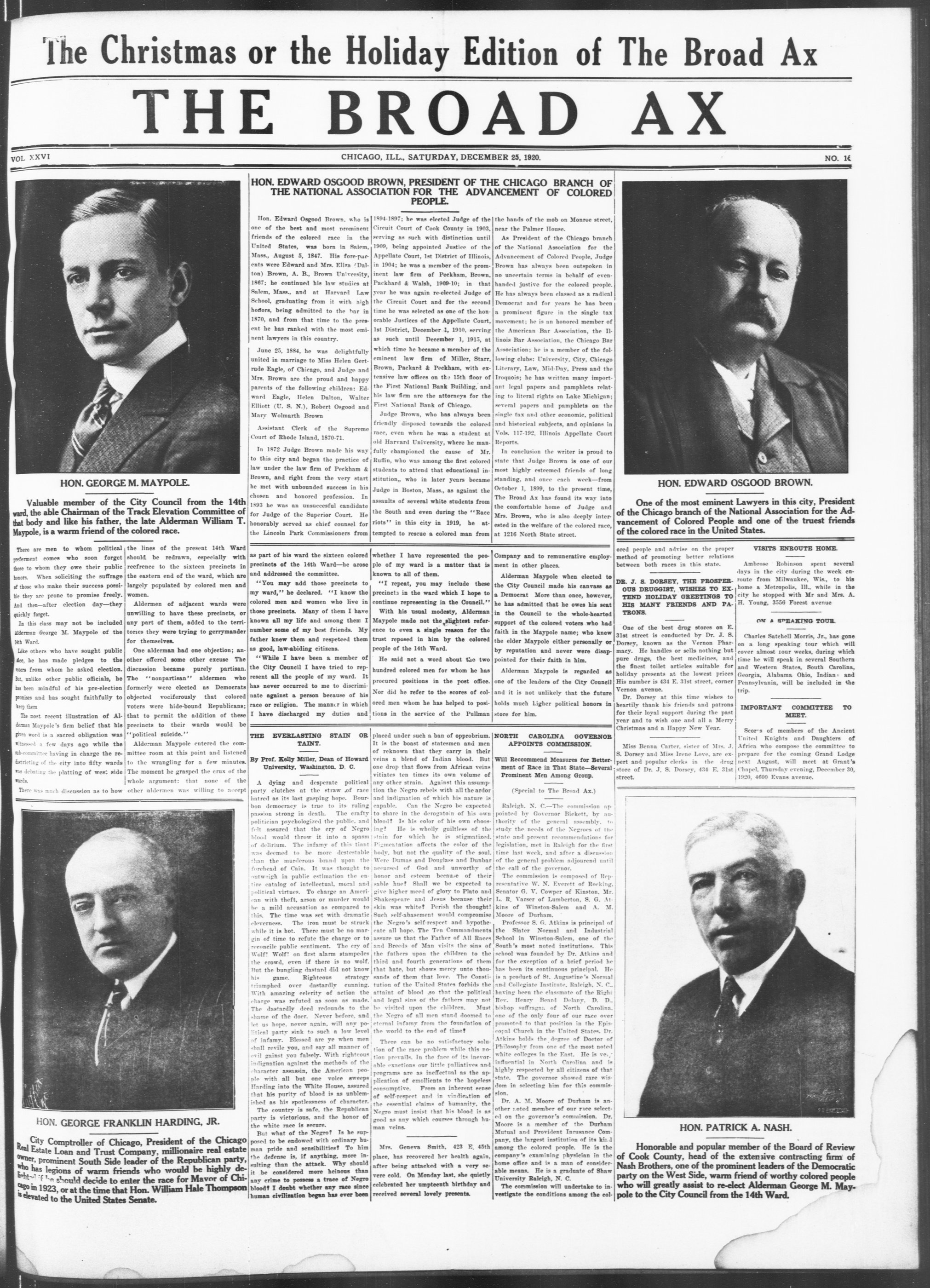
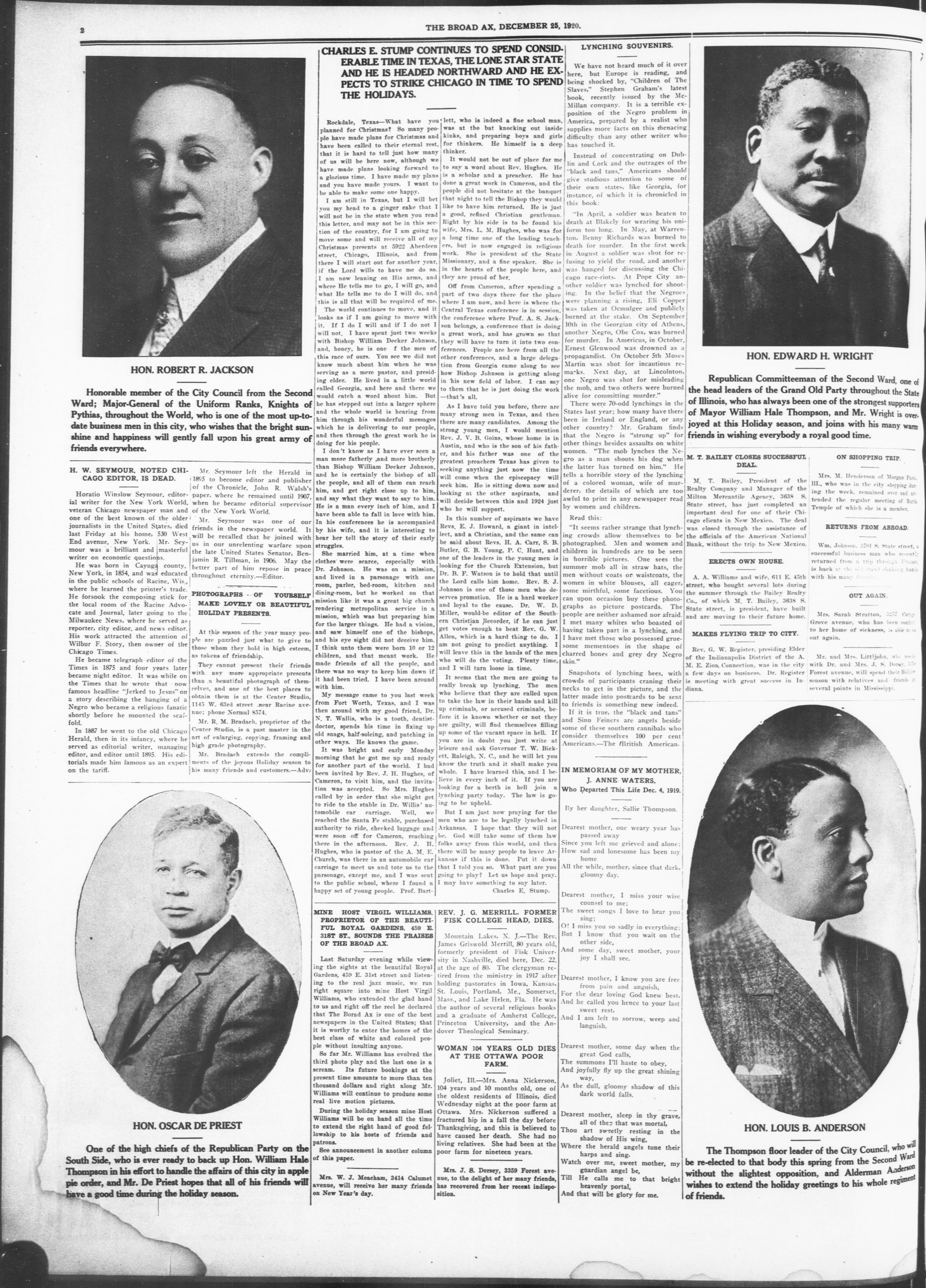
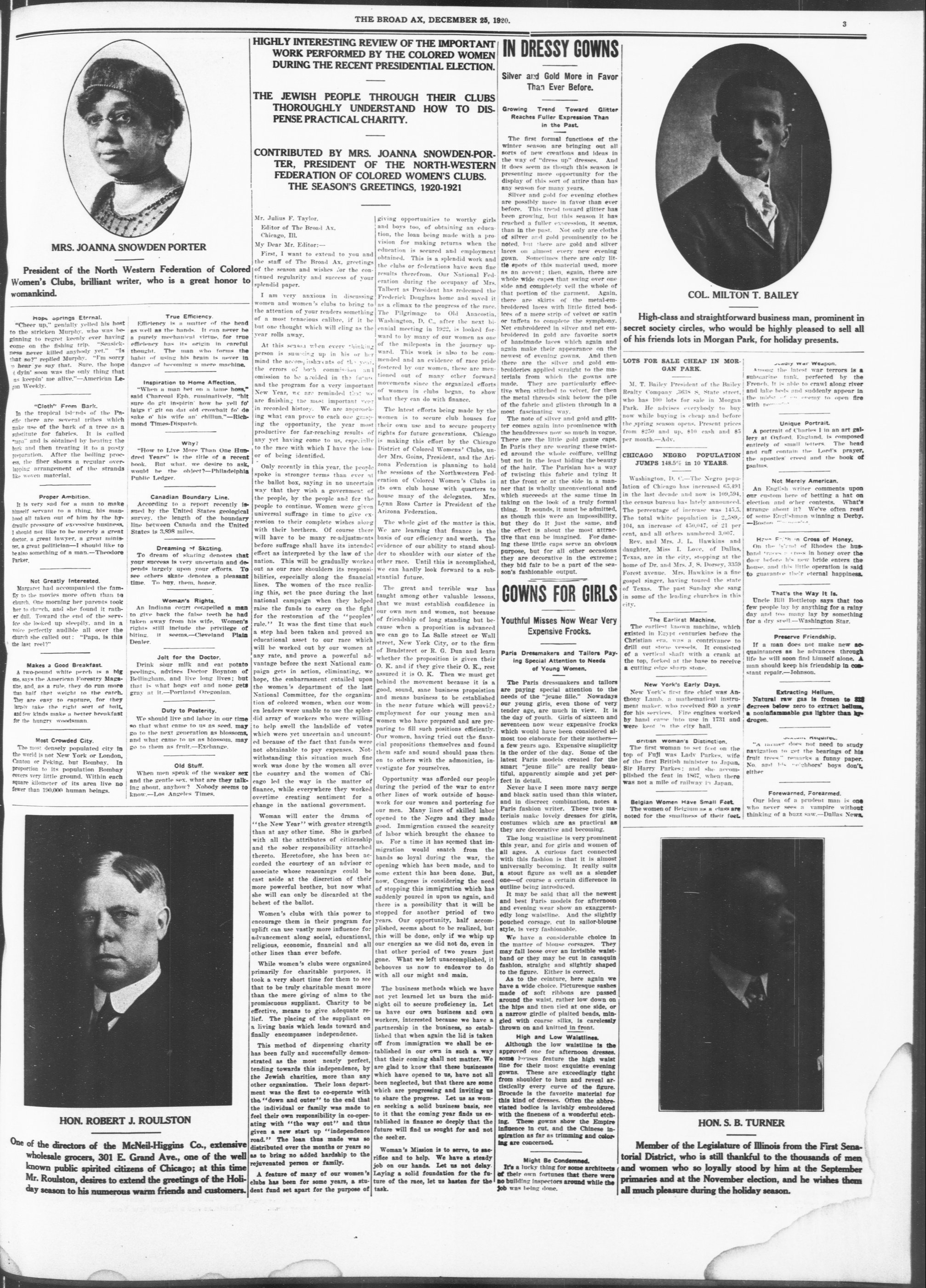
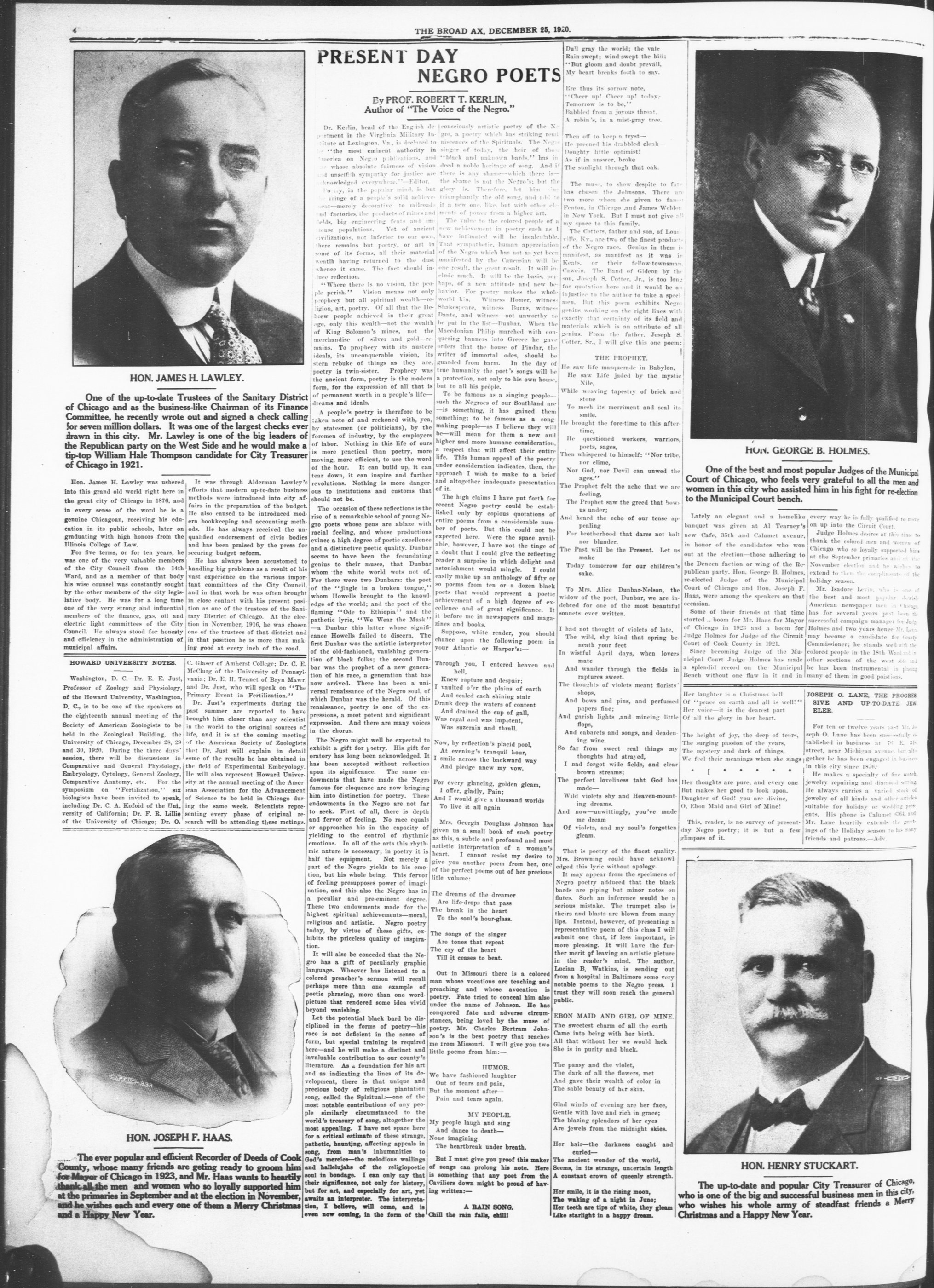
Page text (machine-generated)
The Christmas or the Holiday Edition of The Broad Ax
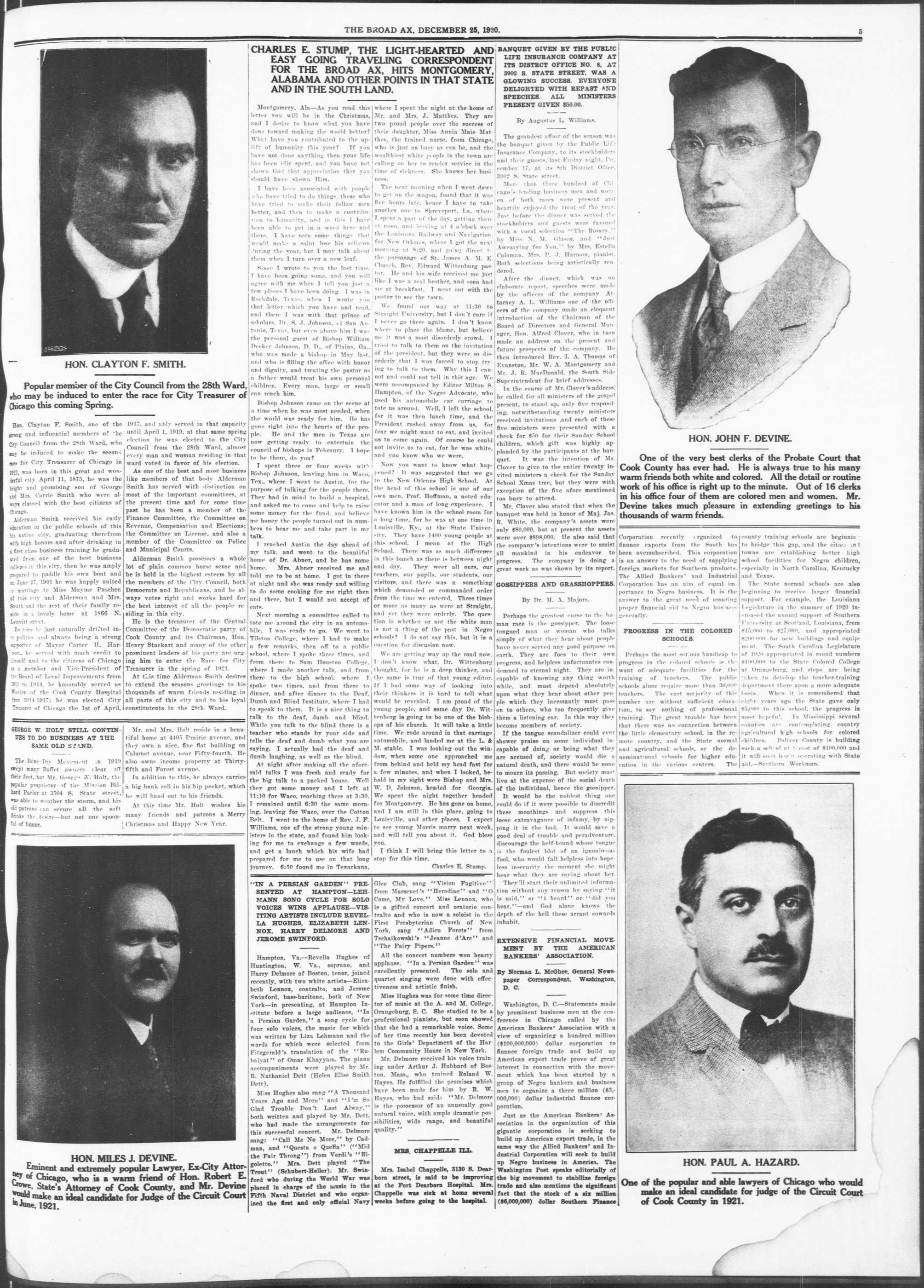
HON. GEORGE M. MAYPOLE. Valuable member of the City Council f ward, the able Chairman of the Track Elevation that body and like his father, the late Aldermaypole, is a warm friend of the colored race.
Valuable member of the City Council from the 14th ward, the able Chairman of the Track Elevation Committee of that body and like his father, the late Alderman William T. Maypole, is a warm friend of the colored race.
There are men to whom political preferment comes who soon forget those to whom they owe their public honors. When soliciting the suffrage of those who make their success possible they are prone to promise freely. And then—after election day—they quickly forget.
In this class may not be included Alderman George M. Maypole of the 14th Ward. Like others who have sought public face, he has made pledges to the voters from whom he asked election. But, unlike other public officials, he has been mindful of his pre-election promises and has sought faithfully to keep them
the lines of the present 14th Ward should be redrawn, especially with reference to the sixteen precincts in the eastern end of the ward, which are largely populated by colored men and women.
Aldermen of adjacent wards were unwilling to have these precincts, or any part of them, added to the territories they were trying to gerrymander for themselves.
One alderman had one objection; another offered some other excuse. The discussion became purely partisan. The "nonpartisan" aldermen who formerly were elected as Democrats objected vociferously that colored voters were hide-bound Republicans.
The most recent illustration of Alderman Maypole's firm belief that his given word is a sacred obligation was witnessed a few days ago while the sub-committee having in charge the redistricting of the city into fifty wards was debating the platting of west side wards.
There was much discussion as to how
M. H. M.
HON. GEORGE FRANKLIN HARDING, JR. City Comptroller of Chicago, President of the Chicago Real Estate Loan and Trust Company, millionaire real estate owner, prominent South Side leader of the Republican party, who has legions of warm friends who would be highly delighted if he should decide to enter the race for Mavor of Chicago in 1923, or at the time that Hon. William Hale Thompson is elevated to the United States Senate.
THE BROAD AX
a City Council from the 14th Track Elevation Committee of the late Alderman William T. the colored race.
the lines of the present 14th Ward should be redrawn, especially with reference to the sixteen precincts in the eastern end of the ward, which are largely populated by colored men and women.
Aldermen of adjacent wards were unwilling to have these precincts, or any part of them, added to the territories they were trying to gerrymander for themselves.
One alderman had one objection; another offered some other excuse. The discussion became purely partisan. The "nonpartisan" aldermen who formerly were elected as Democrats objected vociferously that colored voters were hide-bound Republicans; that to permit the addition of these precincts to their wards would be "political suicide."
Alderman Maypole entered the committee room at this point and listened to the wrangling for a few minutes. The moment he grasped the crux of the whole argument: that none of the other aldermen was willing to accept
CHICAGO, ILL., SATURDAY, DECEMBER 25, 1920.
HON, EDWARD OSGOOD BROWN, PRESIDENT OF THE CHICAGO BRANCH OF THE NATIONAL ASSOCIATION FOR THE ADVANCEMENT OF COLORED PEOPLE.
Hon. Edward Osgood Brown, who is one of the best and most prominent friends of the colored race in the United States, was born in Salem, Mass., August 5, 1847. His foreparents were Edward and Mrs. Eliza (Dalton) Brown, A. B., Brown University, 1867; he continued his law studies at Salem, Mass., and at Harvard Law School, graduating from it with high honors, being admitted to the bar in 1870, and from that time to the present he has ranked with the most eminent lawyers in this country.
June 25, 1884, he was delightfully united in marriage to Miss Helen Gertrude Eagle, of Chicago, and Judge and Mrs. Brown are the proud and happy parents of the following children: Edward Eagle, Helen Dalton, Walter Elliott (U. S. N.), Robert Osgood and Mary Wolmarth Brown
Assistant Clerk of the Supreme Court of Rhode Island, 1870-71.
In 1872 Judge Brown made his way to this city and began the practice of law under the law firm of Peckham & Brown, and right from the very start he met with unbounded success in his chosen and honored profession. In 1893 he was an unsuccessful candidate for Judge of the Superior Court. He honorably served as chief counsel for the Lincoln Park Commissioners from
as part of his ward the sixteen colored precincts of the 14th Ward—he arose and addressed the committee.
"You may add those precincts to my ward," he declared. "I know the colored men and women who live in those precincts. Many of them I have known all my life and among them I number some of my best friends. My father knew them and respeeted them as good, law-abiding citizens.
"While I have been a member of the City Council I have tried to represent all the people of my ward. It has never occurred to me to discriminate against a person because of his race or religion. The manner in which I have discharged my duties and
THE EVERLASTING STAIN OI
TAINT.
By Prof. Kelly Miller, Dean of Howard University, Washington, D. C.
A dying and desperate political party clutches at the stair of race hatred as its last gasping hope. Bourbon democracy is true to its ruling passion strong in death. The crafty politician psychologized the public, and felt assured that the cry of Negro blood would throw it into a spasm of delirium. The infamy of this tainu was deemed to be more destestable than the murderous brand upon the forehead of Cain. It was thought to outweigh in public estimation the entire catalog of intellectual, moral and cultural virtues. To charge an American with theft, arson or murder would be a mild accusation as compared to this. The time was set with dramatic cleverness. The iron must be struck when it is hot. There must be no margin of time to refute the charge or to reconcile public sentiment. The cry of Wolf! Wolf! on first alarm stamped the crowd, even if there is no wolf. The bungling dastardid did not know his game. Righteous strategy triumphed over dastardly eunning. With amazing celerity of action the charge was refuted as soon as made. The dastardly deed redounds to the shame of the doer. Never before, and let us hope, never again, will any political party sink to such a low level of infamy. Blessed are ye when men shall revile you, and say all manner of evil gainst you falsely. With righteous indignation against the methods of the character assassin, the American people with all but one voice sweeps Harding into the White House, assured that his purity of blood is as unblemished as his spotlessness of character. The country is safe, the Republican party is victorious, and the honor of the white race is secure.
But what of the Negro? Is he supposed to be endowed with ordinary human pride and sensibilities? To him the defense is, if anything, more insulting than the attack. Why should it be considered more heinous than any crime to possess a trace of Negro blood? I doubt whether any race since human civilization began has ever been
1894-1897; he was elected Judge of the Circuit Court of Cook County in 1903, serving as such with distinction until 1909, being appointed Justice of the Appellate Court, 1st District of Illinois, in 1904; he was a member of the prominent law firm of Peekham, Brown, Packhard & Walsh, 1909-10; in that year he was again re-elected Judge of the Circuit Court and for the second time he was selected as one of the honorable Justices of the Appellate Court, 1st District, December 1, 1910, serving as such until December 1, 1915, at which time he became a member of the eminent law firm of Miller, Starr, Brown, Packard & Peekham, with extensive law offices on the 15th floor of the First National Bank Building, and his law firm are the attorneys for the First National Bank of Chicago.
Judge Brown, who has always been friendly disposed towards the colored race, even when he was a student at old Harvard University, where he manfully championed the cause of Mr. Ruffin, who was among the first colored students to attend that educational institution, who in later years became Judge in Boston, Mass., as against the assaults of several white students from the South and even during the "Race riots" in this city in 1919, he attempted to rescue a colored man from whether I have represented the people of my ward is a matter that is known to all of them.
"I repeat, you may include these precincts in the ward which I hope to continue representing in the Council."
With his usual modesty, Alderman Maypole made not the slightest reference to even a single reason for the trust reposed in him by the colored people of the 14th Ward.
He said not a word about the two hundred colored men for whom he has procured positions in the post office. Nor did he refer to the scores of colored men whom he has helped to positions in the service of the Pullman
placed under such a ban of opprobrium.
It is the boast of statesmen and men of reknown that they carry in their veins a blend of Indian blood. But one drop that flows from African veins vitiates ten times its own volume of any other strain. Against this assumption the Negro rebels with all the ardor and indignation of which his nature is capable. Can the Negro be expected to share in the derogation of his own blood? Is his color of his own choosing? He is wholly guiltless of the stain for which he is stigmatized. Pigmentation affects the color of the body, but not the quality of the soul. Were Dumans and Douglass and Dunban accursed of God and unworthy of honor and esteem because of their sable hue? Shall we be expected to give higher meed of glory to Plato and Shakespeare and Jesus because their skin was white? Perish the thought! Such self-abasement would compromise the Negro's self-respect and hypothecate all his hope. The Ten Commandments assure us that the Father of All Races and Breeds of Man visits the sins of the fathers upon the children to the third and fourth generations of them that hate, but shows mercy unto thousands of them that love. The Constitution of the United States forbids the attainment of blood so that the political and legal sins of the fathers may not be visited upon the children. Must the Negro of all men stand doomed to eternal infamy from the foundation of the world to the end of time!
There can be no satisfactory solution of the race problem while this notion prevails. In the face of its inevitable exactions our little palliatives and programs are as ineffectual as the application of emollients to the hopeless consumitive. From an inherent sense of self-respect and in vindication of the essential claims of humanity, the Negro must insist that his blood is as good as any which courses through human veins.
Mrs. Geneva Smith, 423 E. 45th place, has recovered her health again, after being attacked with a very severe cold. On Monday last, she quietly celebrated her umpteenth birthday and received several lovely presents.
the hands of the mob on Monroe street, near the Palmer House.
As President of the Chicago branch of the National Association for the Advancement of Colored People, Judge Brown has always been outspoken in no uncertain terms in behalf of evenhanded justive for the colored people. He has always been classed as a radical Democrat and for years he has been a prominent figure in the single tax movement; he is an honored member of the American Bar Association, the Illinois Bar Association, the Chicago Bar Association; he is a member of the following clubs: University, City, Chicago Literary, Law, Mid-Day, Press and the Iroquois; he has written many important legal papers and pamphlets relating to literal rights on Lake Michigan; several papers and pamphlets on the single tax and other economic, political and historical subjects, and opinions in Vols. 117-192. Illinois Appellate Court Reports.
In conclusion the writer is proud to state that Judge Brown is one of our most highly esteemed friends of long standing, and once each week—from October 1, 1899, to the present time, The Broad Ax has found its way into the comfortable home of Judge and Mrs. Brown, who is also deeply interested in the welfare of the colored race, at 1216 North State street.
Company and to remunerative employment in other places.
Alderman Maypole when elected to the City Council made his canvass as a Democrat More than once, however, he has admitted that he owes his seat in the Council to the whole-hearted support of the colored voters who had faith in the Maypole name; who knew the elder Maypole either personally or by reputation and never were disappointed for their faith in him.
Alderman Maypole is regarded as one of the leaders of the City Council and it is not unlikely that the future holds much higher political honors in store for him.
NORTH CAROLINA GOVERNOR
POINTS COMMISSION.
Will Recommend Measures for Betterment of Race in That State—Several Prominent Men Among Group.
(Special to The Broad Ax.)
Raleigh, N. C.—The commission appointed by Governor Bickett, by authority of the general assembly, to study the needs of the Negroes of the state and present recommendations for legislation, met in Raleigh for the first time last week, and after a discussion of the general problem adjournend until the call of the governor.
The commission is composed of Representative W. N. Everett of Rocking, Senator G. V. Cowper of Kinston, Mr. L. R. Varser of Lumberton, S. G. Atkins of Winston-Salem and A. M. Moore of Durham.
Professor S. G. Atkins is principal of the Slater Normal and Industrial School in Winston-Salem, one of the South's most noted institutions. This school was founded by Dr. Atkins and for the exception of a brief period he has been its continuous principal. He is a product of St. Augustine's Normal and Collegiate Institute, Raleigh, N. C., having been the classmate of the Right Rev. Henry Beard Delany, D. D. bishop suffragan, of North Carolina, one of the only four of our race over promoted to that position in the Episcopal Church in the United States. Dr. Atkins holds the degree of Doctor of Philosophy from one of the most noted white colleges in the East. He is ve. influential in North Carolina and is highly respected by all citizens of that state. The governor showed rare wisdom in selecting him for this commission.
Dr. A. M. Moore of Durham is another noted member of our race selected on the governor's commission. Dr. Moore is a member of the Durham Mutual and Provident Insuance Company, the largest institution of its kind among the colored people. He is the company's examining physician in the home office and is a man of considerable means. He is a graduate of Shaw University Raleigh, N. C.
The commission will undertake to investigate the conditions among the col
[Image of a man with a mustache and a suit, looking slightly to the right.]
One of the most eminent Lawyers in this city, President of the Chicago branch of the National Association for the Advancement of Colored People and one of the truest friends of the colored race in the United States.
ored people and advise on the proper method of promoting better relations between both races in this state.
DR. J. S. DORSEY, THE PROSPERIOUS DRUGGIST, WISHES TO EXTEND HOLIDAY GREETINGS TO HIS MANY FRIENDS AND PATRONS.
One of the best drug stores on E. 31st street is conducted by Dr. J. S. Dorsey, known as the Vernon Pharmacy. He handles or sells nothing but pure drugs, the best medicines, and the finest toilet articles suitable for holiday presents at the lowest prices His number is 434 E. 31st street, corner Vernon avenue.
Dr. Dorsey at this time wishes to heartily thank his friends and patrons for their loyal support during the past year and to wish one and all a Merry Christmas and a Happy New Year.
VISITS ENROUTE HOME.
Ambrose Robinson spent several days in the city during the week enroute from Milwaukee, Wis., to his home a Metropolis, Ill., while in the city he stopped with Mr and Mrs. A. H. Young, 3556 Forest avenue
ON A SPEAKING TOUR.
Charles Satchell Morris, Jr., has gone on a long speaking tour which will cover almost four weeks, during which he will speak in several Southern and Western States, South Carolina, Georgia, Alabama Ohio, Indiana and Pennsylvania, will be included in the trip.
IMPORTANT COMMITTEE TO MEET.
Miss Benna Carter, sister of Mrs. J. S. Dorsey and Irene Love, are expert and popular clerks in the drug store of Dr. J. S. Dorsey. 434 E. 31st street.
THE NEW YORK TIMES
1930
98
HON. PATRICK A. NASH.
Honorable and popular m of Cook County, head of the Nash Brothers, one of the prom party on the West Side, warm who will greatly assist to re-ele pole to the City Council from t
and popular member of the bury, head of the extensive committee of the prominent leaders of West Side, warm friend of worthy assist to re-elect Alderman Council from the 14th Ward.
Honorable and popular member of the Board of Review of Cook County, head of the extensive contracting firm of Nash Brothers, one of the prominent leaders of the Democratic party on the West Side, warm friend of worthy colored people who will greatly assist to re-elect Alderman George M. Maypole to the City Council from the 14th Ward.
VISITS ENROUTE HOME
Ambrose Robinson spent several days in the city during the week enroute from Milwaukee, Wis., to his home a Metropolis, Ill., while in the city he stopped with Mr and Mrs. A. H. Young. 3556 Forest avenue
ON A SPEAKING TOUR.
Charles Satchell Morris, Jr., has gone on a long speaking tour which will cover almost four weeks, during which time he will speak in several Southern and Western States, South Carolina, Georgia, Alabama Ohio, Indian and Pennsylvania, will be included in the trip.
IMPORTANT COMMITTEE TO MEET.
Scors' of members of the Ancient United Knights and Daughters of Africa who compose the committee to prepare for the coming Grand Lodge next August, will meet at Grant's Chapel, Thursday evening, December 30, 1920. 4600 Evans avenue.
90
member of the Board of Reviews extensive contracting firm ofinent leaders of the Democratic friend of worthy colored peopleect Alderman George M. Mayhe 14th Ward.
NO. 14
[Name]
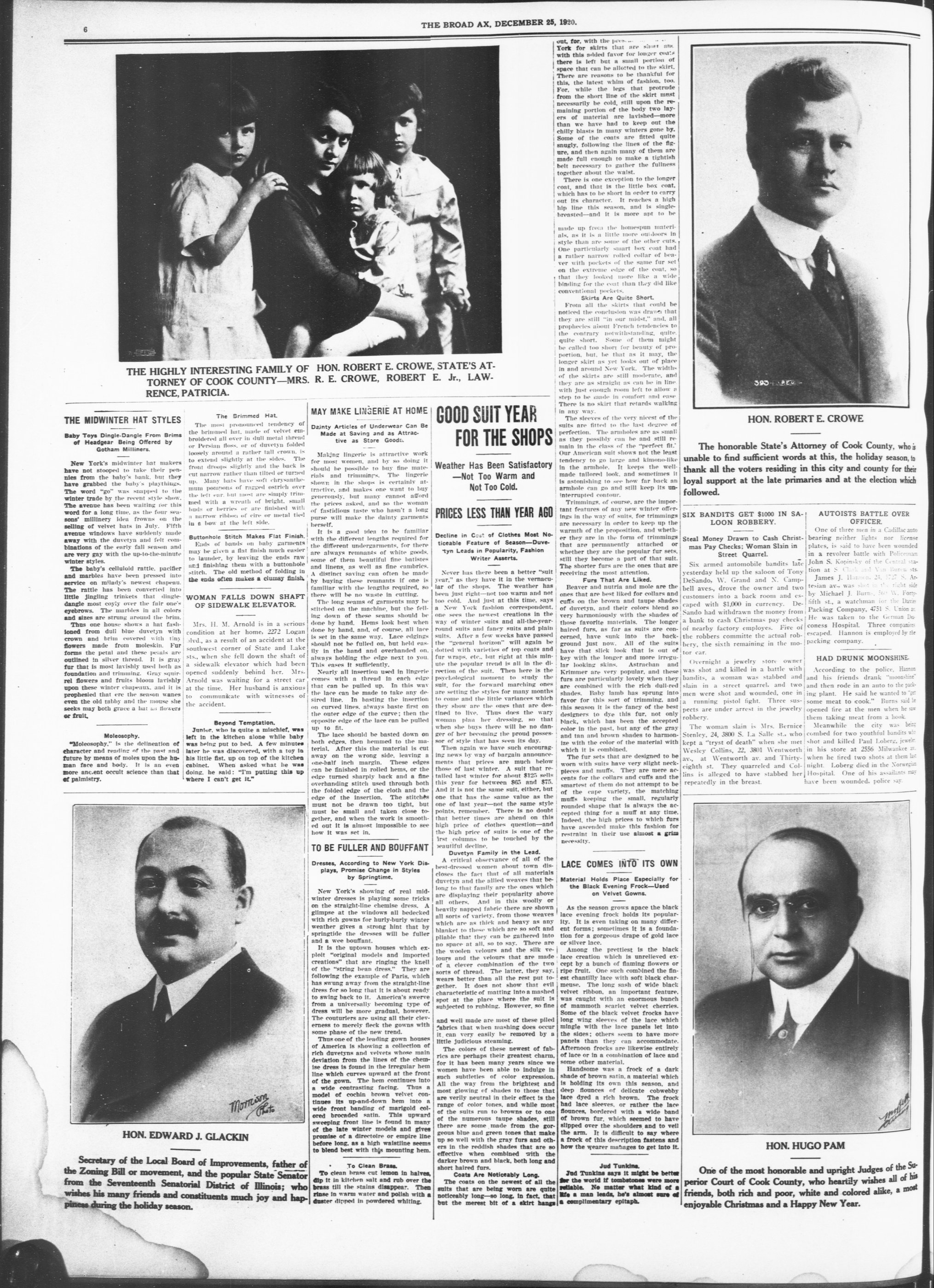
HON. ROBERT R. JACKSON
Honorable member of the Ward; Major-General of the Pythias, throughout the World date business men in this city, shine and happiness will gent friends everywhere.
a member of the City Council from General of the Uniform Rank without the World, who is one of the men in this city, who wishes that happiness will gently fall upon his there.
Honorable member of the City Council from the Second Ward; Major-General of the Uniform Ranks, Knights of Pythias, throughout the World, who is one of the most up-to-date business men in this city, who wishes that the bright sunshine and happiness will gently fall upon his great army of friends everywhere.
H. W. SEYMOUR, NOTED CHI
CAGO EDITOR, IS DEAD.
Horatio Winslow Seymour, editorial writer for the New York World, veteran Chicago newspaper man and one of the best known of the older journalists in the United States, died last Friday at his home, 530 West End avenue, New York. Mr. Seymour was a brilliant and masterful writer on economic questions.
He was born in Cayuga county, New York, in 1854, and was educated in the public schools of Racine, Wis, where he learned the printer's trade. He forsook the composing stick for the local room of the Racine Advocate and Journal, later going to the Milwaukee News, where he served as reporter, city editor, and news editor. His work attracted the attention of Wilbur F. Story, then owner of the Chicago Times.
He became telegraph editor of the Times in 1875 and four years later became night editor. It was while on the Times that he wrote that now famous headline "Jerked to Jesus" on a story describing the hanging of a Negro who became a religious fanatic shortly before he mounted the scaffold.
In 1887 he went to the old Chicago Herald, then in its infancy, where he served as editorial writer, managing editor, and editor until 1895. His editorials made him famous as an expert on the tariff.
```markdown
```
[Name]
[Name]
HON. OSCAR DE PRIEST
One of the high chiefs of the Republic South Side, who is ever ready to back up He Thompson in his effort to handle the affairs of pie order, and Mr. De Priest hopes that all of have a good time during the holiday season.
he high chiefs of the Republican who is ever ready to back up Hon. effort to handle the affairs of this Mr. De Priest hopes that all of he during the holiday season.
One of the high chiefs of the Republican Party on the South Side, who is ever ready to back up Hon. William Hale Thompson in his effort to handle the affairs of this city in apple pie order, and Mr. De Priest hopes that all of his friends will have a good time during the holiday season.
2
City Council from the Second
Uniform Ranks, Knights of
el, who is one of the most up-to-
who wishes that the bright sun-
ly fall upon his great army of
Mr. Seymour left the Herald in
1855 to become editor and publisher
of the Chronicle, John R. Walsh's
paper, where he remained until 1907,
when he became editorial supervisor
of the New York World.
Mr. Seymour was one of our friends in the newspaper world. It will be recalled that he joined with us in our unrelenting warfare upon the late United States Senator, Benjamin R. Tillman, in 1906. May the better part of him repose in peace throughout eternity.—Editor.
PHOTOGRAPHS . . OF YOURSELF
MAKE LOVELY OR BEAUTIFUL
HOLIDAY PRESENTS.
At this season of the year many people are puzzled just what to give to those whom they hold in high esteem as tokens of friendship.
They cannot present their friends with any more appropriate presents than a beautiful photograph of themselves, and one of the best places to obtain them is at the Center Studio 1145 W. 63rd street near Racine avenue; phone Normal 8574.
Mr. R. M. Bradade, proprietor of the Center Studio, is a past master in the art of enlarging, copying, framing and high grade photography.
Mr. Bradade extends the compliments of the joyous Holiday season to his many friends and customers.—Ady
```markdown
```
of the Republican Party on the to back up Hon. William Hale the affairs of this city in apple hopes that all of his friends will holiday season.
CHARLES E. STUMP CONTINUES TO SPEND CONSIDERABLE TIME IN TEXAS, THE LONE STAR STATE AND HE IS HEADED NORTHWARD AND HE EXPECTS TO STRIKE CHICAGO IN TIME TO SPEND THE HOLIDAYS.
Rockdale, Texas—What have you planned for Christmas? So many people have made plans for Christmas and have been called to their eternal rest, that it is hard to tell just how many of us will be here now, although we have made plans looking forward to a glorious time. I have made my plans and you have made yours. I want to be able to make some one happy.
I am still in Texas, but I will bet you my head to a ginger cake that I will not be in the state when you read this letter, and may not be in this section of the country, for I am going to move some and will receive all of my Christmas presents at 5922 Aberdeen street, Chicago, Illinois, and from there I will start out for another year, if the Lord wills to have me do so, I am now leaning on His arms, and where He tells me to go, I will go, and what He tells me to do I will do, and this is all that will be required of me. The world continues to move, and it looks as if I am going to move with it. If I do I will and if I do not I will not. I have spent just two weeks with Bishop William Decker Johnson, and honey, he is one f the men of this race of ours. You see we did not know much about him when he was serving as a mere pastor, and presiding elder. He lived in a little world called Georgia, and here and there we would catch a word about him. But he has stepped out into a larger sphere and the whole world is hearing from him through his wonderful messages which he is delivering to our people, and then through the great work he is doing for his people.
I don't know as I have ever seen a man more fatherly, and more brotherly than Bishop William Decker Johnson, and he is certainly the bishop of all the people, and all of them can reach him, and get right close up to him, and say what they want to say to him. He is a man every inch of him, and I have been able to fall in love with him. In his conferences he is accompanied by his wife, and it is interesting to hear her tell the story of their early struggles.
She married him, at a time when clothes were scarce, especially with Dr. Johnson. He was on a mission, and lived in a parsonage with one room, parlor, bed-room, kitchen and dining-room, but he worked on that mission like it was a great big church rendering metropolitan service in a mission, which was but preparing him for the larger things. He had a vision, and saw himself one of the bishops, and his eye sight did not deceive him. I think unto them were born 10 or 12 children, and that meant work. He made friends of all the people, and there was no way to keep him down if it had been tried. I have been around with him.
My message came to you last week from Fort Worth, Texas, and I was then around with my good friend, Dr. N. T. Wallis, who is a tooth, dentist-doctor, spends his time in fixing up old snags, half-soiling, and patching in other ways. He knows the game.
It was bright and early Monday morning that he got me up and ready for another part of the world. I had been invited by Rev. J. H. Hughes, of Cameron, to visit him, and the invitation was accepted. So Mrs. Hughes called by in order that she might get to ride to the stable in Dr. Willis' automobile car carriage. Well, we reached the Santa Fe stable, purchased authority to ride, checked luggage and were soon off for Cameron, reaching there in the afternoon. Rev. J. H. Hughes, who is pastor of the A. M. E. Church, was there in an automobile car carriage to meet us and to tote us to the parsonage, except me, and I was sent to the public school, where I found a happy set of young people. Prof. Bart-
MINE HOST VIRGIL WILLIAMS,
PROPRIETOR OF THE BEAUTI-
FUL ROYAL GARDENS, 459 E
31ST ST., SOUNDS THE PRAISES
OF THE BROAD AX.
Last Saturday evening while viewing the sights at the beautiful Royal Gardens, 459 E. 31st street and listening to the real jazz music, we run right square into mine Host Virgil Williams, who extended the glad hand to us and right off the reel he declared that The Borad Ax is one of the best newspapers in the United States; that it is worthy to enter the homes of the best class of white and colored people without insulting anyone.
So far Mr. Williams has evolved the third photo play and the last one is a scream. Its future bookings at the present time amounts to more than ten thousand dollars and right along Mr. Williams will continue to produce some real live motion pictures.
During the holiday season mine Host Williams will be on hand all the time to extend the right hand of good fellowship to his hosts of friends and patrons.
See announcement in another column of this paper.
Mrs. W. J. Meacham, 3414 Calumet avenue, will receive her many friends on New Year's day.
THE BROAD AX. DECEMBER 25, 1920.
lett, who is indeed a fine school man, was at the bat knocking out inside kinks, and preparing boys and girls for thinkers. He himself is a deep thinker. It would not be out of place for me to say a word about Rev. Hughes. He is a scholar and a preacher. He has done a great work in Cameron, and the people did not hesitate at the banquet that night to tell the Bishop they would like to have him returned. He is just a good, refined Christian gentleman. Right by his side is to be found his wife, Mrs. L. M. Hughes, who was for a long time one of the leading teachers, but is now engaged in religious work. She is president of the State Missionary, and a fine speaker. She is in the hearts of the people here, and they are proud of her.
Off from Cameron, after spending a part of two days there for the place where I am now, and here is where the Central Texas conference is in session the conference where Prof. A. S. Jackson belongs, a conference that is doing a great work, and has grown so that they will have to turn it into two conferences. People are here from all the other conferences, and a large delegation from Georgia came along to see how Bishop Johnson is getting along in his new field of labor. I can say to them that he is just doing the work—that's all.
As I have told you before, there are many strong men in Texas, and then there are many candidates. Among the strong young men, I would mention Rev. J. V. B. Goins, whose home is in Austin, and who is the son of his father, and his father was one of the greatest preachers Texas has given to seeking anything just now the time will come when the episcopacy will seek him. He is sitting down now and looking at the other aspirants, and will decide between this and 1924 just who he will support.
In this number of aspirants we have Revs, E. J. Howard, a giant in intellect, and a Christian, and the same can be said about Revs. H. A. Carr, S. B. Butler, G. B. Young, P. C. Hunt, and one of the leaders in the young men is looking for the Church Extension, but Dr. B. F. Watson is to hold that until the Lord calls him home. Rev. S. J. Johnson is one of those men who deserves promotion. He is a hard worker and loyal to the cause. Dr. W. D. Miller, would-be editor of the Southern Christian Recorder, if he can just get votes enough to beat Rev. G. W. Allen, which is a hard thing to do. I am not going to predict anything. I will leave this in the hands of the men who will do the voting. Plenty time, and I will turn loose in time.
It seems that the men are going to really break up lynching. The men who believe that they are called upon to take the law in their hands and kill up criminals, or accused criminals, before it is known whether or not they are guilty, will find themselves filling up some of the vacant space in hell. If you are in doubt you just write at leisure and ask Governor T. W. Bickett, Raleigh, N. C., and he will let you know the truth and it shall make you whole. I have learned this, and I believe in every inch of it. If you are looking for a berth in hell join a lynching party today. The law is going to be upheld.
But I am just now praying for the men who are to be legally lynched in Arkansas. I hope that they will not be. God will take some of them law folks away from this world, and then there will be many people to leave Arkansas if this is done. Put it down that I told you so. What part are you going to play? Let us hope and pray. I may have something to say later.
Charles E. Stump
REV. J. G. MERRILL. FORME
FISK COLLEGE HEAD, DIES.
Mountain Lakes, N. J.-The Rev James Griswold Merrill, 80 years old, formerly president of Fisk University in Nashville, died here, Dec. 22 at the age of 80. The clergyman retired from the ministry in 1917 after holding pastorates in Iowa, Kansas, St. Louis, Portland, Me, Somerset, Mass, and Lake Helen, Fla. He was the author of several religious books and a graduate of Amherst College, Princeton University, and the Andover Theological Seminary.
WOMAN 104 YEARS OLD DIES AT THE OTTAWA POOR FARM.
Joliet, Ill.—Mrs. Anna Nickerson, 104 years and 10 months old, one of the oldest residents of Illinois, died Wednesday night at the poor farm at Ottawa. Mrs. Nickerson suffered a fractured hip in a fall the day before Thanksgiving, and this is believed to have caused her death. She had no living relatives. She had been at the poor farm for nineteen years.
Mrs. J. B. Dorsey, 3359 Forest avenue, to the delight of her many friends, has recovered from her recent indisposition.
LYNCHING SOUVENIRS.
We have not heard much of it over here, but Europe is reading, and being shocked by, "Children of The Slaves," Stephen Graham's latest book, recently issued by the McMillan company. It is a terrible exposition of the Negro problem in America, prepared by a realist who supplies more facts on this menacing difficulty than any other writer who has touched it. Instead of concentrating on Dublin and Cork and the outrages of the "black and tans," Americans should give studious attention to some of their own states, like Georgia, for instance, of which it is chronicled in this book:
"In April, a soldier was beaten to death at Blakely for wearing his uniform too long. In May, at Warrenton, Benny Richards was burned to death for murder. In the first week in August a soldier was shot for refusing to yield the road, and another was hanged for discussing the Chicago race-riots. At Pope City another soldier was lynched for shooting. In the belief that the Negroes were planning a rising, Eli Copper was taken at Ocmulgee and publicly burned at the stake. On September 10th in the Georgian city of Athens, another Negro, Obe Cox, was burned for murder. In Americus, in October, Ernest Glenwood was drowned as a propagandist. On October 5th Moses Martin was shot for incautious rema-ks. Next day, at Lincolnton, one Negro was shot for misleading the mob, and two others were burned alive for committing murder."
There were 70-odd lynchings in the States last year; how many have there been in Ireland or England, or any other country? Mr. Graham finds that the Negro is "strung up" for other things besides assaults on white women. "The mob lynches the Negro as a man shoots his dog when the latter has turned on him." He tells a horrible story of the lynching of a colored woman, wife of murderer, the details of which are too awful to print in any newspaper read by women and children.
Read this:
"It seems rather strange that lynching crowds allow themselves to be photographed. Men and women and children in hundreds are to be seen in horrible pictures. One sees the summer mob all in straw hats, the men without coats or waistcoats, the women in white blouses, all cagers, some mirthful, some facetious. You can upon occasion buy these photographs as picture postcards. The people are neither ashamed nor afraid. I met many whites who boasted of having taken part in a lynching, and I have met those who possessed gruesome mementoes in the shape of charred bones and grey dry Negro skin."
Snapshots of lynching bees, with crowds of participants craning their necks to get in the picture, and the latter made into postcards to be sent to friends is something new indeed. If it is true, the "black and tans" and Sinn Feiners are angels beside some of these southern cannibals who consider themselves 100 per cent Americans.—The British American-
IN MEMORIAM OF MY MOTHER
J. ANNE WATERS.
Who Departed This Life Dec. 4, 1919.
By her daughter, Sallie Thompson.
Dearest mother, one weary year has passed away
Since you left me grieved and alone;
How sad and lonesome has been my home
All the while, mother, since that dark, gloomy day.
Dearest mother, I miss your wise counsel to me;
The sweet songs I love to hear you sing;
O! I miss you so sadly in everything;
But I know that you wait on the other side,
And some day, sweet mother, your joy I shall see.
Dearest mother, I know you are free from pain and anguish.
For the dear loving God knew best.
And he called you hence to your last sweet rest.
And I am left to sorrow, weep and languish.
Dearest mother, some day when the great God calls,
As the dull, gloomy shadow of this dark world falls.
Dearest mother, sleep in thy grave, all of thee that was mortal,
Thou art sweetly resting in the shadow of His wing,
Where the herald angels tune their harps and sing.
Watch over me, sweet mother, my guardian angel be,
Till He calls me to that bright heavenly portal,
And that will be glory for me.
[Name]
HON. EDWARD H. WRIGHT
Republican Committeeman of the Second the head leaders of the Grand Old Party through of Illinois, who has always been one of the strong of Mayor William Hale Thompson, and Mr. W joyed at this Holiday season, and joins with his friends in wishing everybody a royal good time.
ian Committeeman of the Second ers of the Grand Old Party through so has always been one of the strong William Hale Thompson, and Mr. W Holiday season, and joins with h ning everybody a royal good time.
Republican Committeeman of the Second Ward, one of the head leaders of the Grand Old Party throughout the State of Illinois, who has always been one of the strongest supporters of Mayor William Hale Thompson, and Mr. Wright is overjoyed at this Holiday season, and joins with his many warm friends in wishing everybody a royal good time.
M. T. BAILEY CLOSES SUCCESSFUL
DRAL
M. T. Bailey, President of the Realty Company and Manager of the Milton Mercantile Agency, 3638 S. State street, has just completed an important deal for one of their Chicago clients in New Mexico. The deal was closed through the assistance of the officials of the American National Bank, without the trip to New Mexico.
ERECTS OWN HOUSE.
A. A. Williams and wife, 611 E. 45th street, who bought several lots during the summer through the Bailey Realty Co., of which M. T. Bailey, 3638 S. State street, is president, have built and are moving to their future home.
MAKES FLYING TRIP TO CITY.
Rev. G. W. Register, presiding Elder of the Indianapolis District of the A. M. E. Zion Connection, was in the city a few days on business. Dr. Register is meeting with great success in Indiana.
```markdown
```
[Name]
[Name]
HON. LOUIS B. ANDERSON
The Thompson floor leader of the City C be re-elected to that body this spring from the without the slightest opposition, and Alden wishes to extend the holiday greetings to his of friends.
Tempson floor leader of the City Court so that body this spring from the lightest opposition, and Aldermen and the holiday greetings to his wife
The Thompson floor leader of the City Council, who will be re-elected to that body this spring from the Second Ward without the slightest opposition, and Alderman Anderson wishes to extend the holiday greetings to his whole regiment of friends.
man of the Second Ward, one of Old Party throughout the State in one of the strongest supporters, Thompson, and Mr. Wright is over and joins with his many warm royal good time.
ON SHOPPING TRIP
Mrs. M. Henderson of Morgan Patio III, who was in the city shopping during the week, remained over and attended the regular meeting of Bath Temple of which she is a member.
RETURNS FROM ABROAD
Wm. Johnson, 3501 S. State street,
successful business man who recently
returned from a trip through France
is back at the old stand shaking hand
with his many friends.
Mrs. Sarah Stratton, 2357 Congrove avenue, who has been entitled to her home of sickness, is able to be out again.
Mr. and Mrs. Littljohn, who reside with Dr. and Mrs. J. S. Dorser, 2350 Forest avenue, will spend their Holiday season with relatives and friends at several points in Mississippi.
```markdown
```
er of the City Council, who will spring from the Second Ward on, and Alderman Anderson greetings to his whole regiment
OUT AGAIN
President of the North Women's Clubs, brilliant womankind.
MRS. JOANNA SNOWDEN PORTER President of the North Western Federation of Colored Women's Clubs, brilliant writer, who is a great honor to womankind.
Hope springs Eternal
"Cheer up," genially yelled his host to the stricken Murphy, who was begging on to regret keenly ever having come on the fishing trip. "Seasickness never killed anybody yet." "Is that so?" replied Murphy. "I'm sorry to hear ye say that. Sure, the hope 'din' soon was the only thing that as keepin' me alive."—American Leon Weekly.
"Cloth" From Bark
In the tropical islands of the Pacific there are several tribes which make use of the bark of a tree as a substitute for fabrics. It is called "napa" and is obtained by heating the bark and then treating it to a paste preparation. After the boiling process, the fiber shows a regular overlapping arrangement of the strands like woven material.
Proper Ambition.
It is very sad for a man to make himself servant to a thing, his manhood all taken out of him by the hydraulic pressure of excessive business, I should not like to be merely a great doctor, a great lawyer, a great minister, a great politician—I should like to be also something of a man—Theodore Parker
Not Greatly Interested
Margaret had accompanied the family to the movies more often than to church. One morning her parents took her to church, and she found it rather dull. Toward the end of the service she looked up sleepily, and in a voice perfectly audible all over the church she called out: "Papa, is this the last reel?"
Makes a Good Breakfast
A two-pound perch as a big one, says the American Forestry Magazine, and, as a rule, they do run more than half that weight to the catch. They are easy to capture, for they lazily take the right sort of bait, and few kinds make a better breakfast for the hungry woodman.
Most Crowded City
The most densely populated city in the world is not New York or London, Canton or Peking, but Bombay. In proportion to its population Bombay covers very little ground. Within each square kilometer of its area live no fewer than 190,000 human beings.
[Name]
[Name]
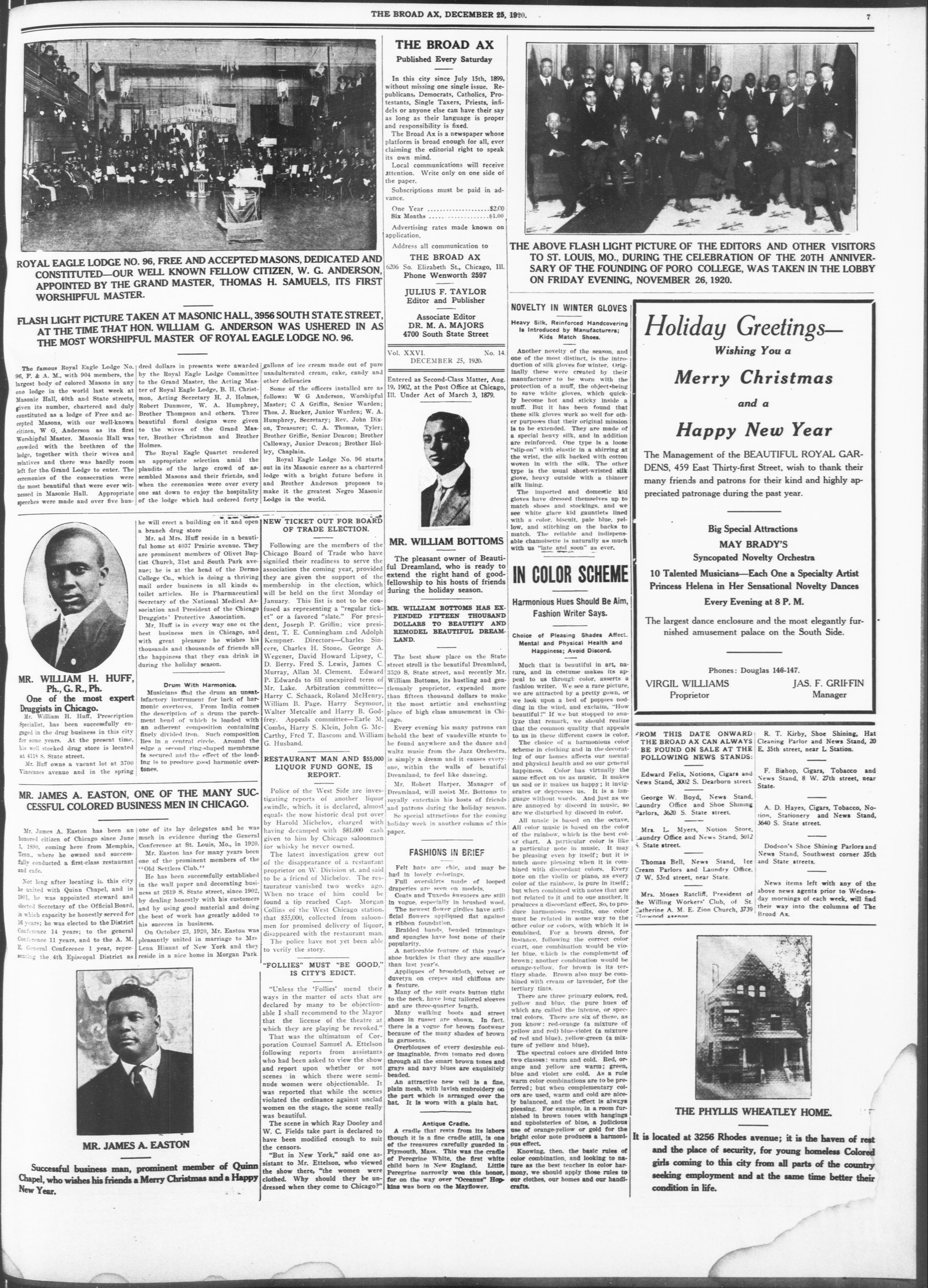
HON. ROBERT J. ROULSTON
One of the directors of the McNeil-Higgins co wholesale grocers, 301 E. Grand Ave., or known public spirited citizens of Chicago Mr. Roulston, desires to extend the greeting day season to his numerous warm friends s
One of the directors of the McNeil-Higgins Co., extensive wholesale grocers, 301 E. Grand Ave., one of the well known public spirited citizens of Chicago; at this time Mr. Roulston, desires to extend the greetings of the Holiday season to his numerous warm friends and customers.
One of the directors of the McNeil-Higgins Co., extensive wholesale grocers, 301 E. Grand Ave., one of the well known public spirited citizens of Chicago; at this time Mr. Roulston, desires to extend the greetings of the Holiday season to his numerous warm friends and customers.
NOWDEN PORTER
Western Federation of Colored
Writer, who is a great honor to
True Efficiency.
Efficiency is a matter of the head as well as the hands. It can never be a purely mechanical virtue, for true efficiency has its origin in careful thought. The man who forms the habit of using his brain is never in danger of becoming a mere machine.
Inspiration to Home Affection
"When a man bet on a lame boss," said Chairman Eph, ruminatively, "hit sure do git inspirin' how he yell fo' laigs t' on dat old crowbait to' de sake o' his wife an' chillun."—Richmond Times-Dispatch
"How to Live More Than One Hundred Years" is the title of a recent book. But what, we desire to ask, would be the object?—Philadelphia Public Ledger.
Canadian Boundary Line
According to a report recently issued by the United States geological survey, the length of the boundary line between Canada and the United States is 3,808 miles.
Dreaming of Skating
To dream of skating denotes that your success is very uncertain and depends largely upon your efforts. To see others skate denotes a pleasant time. To buy them honor.
Woman's Rights
An Indiana court compelled a man to give back the false teeth he had taken away from his wife. Women's rights still include the privilege of biting, it seems.—Cleveland Plain Dealer.
Jolt for the Doctor
Drink sour milk and eat potato peelings, advises Doctor Boynton of Bellingham, and live long lives; but that is what hogs eat and none gets gray at it—Portland Oregonian.
Duty to Posterity
We should live and labor in our time so that what came to us as seed, may go to the next generation as blossoms, and what came to us as blossom, may go to them as fruit—Exchange.
When men speak of the weaker sex and the gentle sex, what are they talking about, anyhow? Nobody seems to know.-Los Angeles Times.
```markdown
```
McNeil-Higgins Co., extensive Grand Ave., one of the well citizens of Chicago; at this time attend the greetings of the Holi's warm friends and customers.
Why?
Old Stuff.
HIGHLY INTERESTING REVIEW OF THE IMPORTANT WORK PERFORMED BY THE COLORED WOMEN DURING THE RECENT PRESIDENTIAL ELECTION.
THE JEWISH PEOPLE THROUGH THEIR CLUBS THOROUGHLY UNDERSTAND HOW TO DISPENSE PRACTICAL CHARITY.
CONTRIBUTED BY MRS. JOANNA SNOWDEN-PORTER, PRESIDENT OF THE NORTH-WESTERN FEDERATION OF COLORED WOMEN'S CLUBS. THE SEASON'S GREETINGS. 1920-1921
Mr. Julius F. Taylor.
My Dear Mr. Editor:—
First, I want to extend to you and the staff of The Broad Ax, greetings of the season and wishes for the continued regularity and success of your splendid paper.
I am very anxious in discussing women and women's clubs to bring to the attention of your readers something of a most tenacious calibre, if it be but one thought which will elong as the year rolls away.
At this season when every thinking person is summing up in his or her mind the accomplishments of the year the errors of both commission and omission to be avoided in the future and the program for a very important New Year, we are reminded that we are finishing the most important work recorded history. We are approaching what can prove to each one grouping the opportunity, the year most productive for far-reaching results of any yet having come to us, especially to the race with which I have the honour of being identified.
Only recently in this year, the people spoke in stronger terms than ever at the ballot box, saying in no uncertain way that they wish a government of the people, by the people and for the people to continue. Women were given universal suffrage in time to give exposition to their complete wishes along with their brethren. Of course there will have to be many re-adjustments before suffrage shall have its intended effect as interpreted by the law of the nation. This will be gradually worked out as our race shoulders its responsibilities, especially along the financial lines. The women of the race realizing this, set the pace during the last national campaign when they helped raise the funds to carry on the fight for the restoration of the "people's rule." It was the first time that such a step had been taken and proved an educational asset to our race which will be worked out by our women at any rate, and prove a powerful advantage before the next National campaign gets in action, eliminating, we hope, the embarrassment entailed upon the women's department of the last National Committee, for the organization of colored women, when our women leaders were unable to use the splendid array of workers who were willing to help swell the landslide of votes which were yet uncertain and uncounted because of the fact that funds were not obtainable to pay expenses. Notwithstanding this situation much fine work was done by the women all over the country and the women of Chicago led the way in the matter of finance, while everywhere they worked overtime creating sentiment for a change in the national government.
Woman will enter the drama of "the New Year" with greater strength than at any other time. She is garbed with all the attributes of citizenship and the sober responsibility attached thereto. Heretofore, she has been accorded the courtesy of an advisor or associate whose reasonings could be cast aside at the discretion of their more powerful brother, but now what she will can only be discarded at the behest of the ballot.
Women's clubs with this power to encourage them in their program for uplift can use vastly more influence for advancement along social, educational, religious, economic, financial and all other lines than ever before.
While women's clubs were organized primarily for charitable purposes, it took a very short time for them to see that to be truly charitable meant more than the mere giving of alms to the promiscuous suppliant. Charity to be effective, means to give adequate relief. The placing of the suppliant on a living basis which leads toward and finally encompasses independence.
This method of dispensing charity has been fully and successfully demonstrated as the most nearly perfect, tending towards this independence, by the Jewish charities, more than any other organization. Their loan department was the first to co-operate with the "down and outer" to the end that the individual or family was made to feel their own responsibility in co-operating with "the way out" and thus given a new start up "independence road." The loan thus made was so distributed over the months or years so as to bring no added hardship to the rejuvenated person or family.
A feature of many of our women's clubs has been for some years, a student fund set apart for the purpose of
THE BROAD AX. DECEMBER 25. 1920
giving opportunities to worthy girls and boys too, of obtaining an education, the loan being made with a provision for making returns when the education is secured and employment obtained. This is a splendid work and the clubs or federations have seen final results therefrom. Our National Federation during the occupancy of Mrs. Talbert as President has redeemed the Frederiek Doughlass home and saved it as a climax to the progress of the race The Pilgrimage to Old Anacostia Washington, D. C., after the next biennial meeting in 1922, is looked forward to by many of our women as one of the mileposts in the journey upward. This work is also to be commended and an evidence of race pride fostered by our women, these are mentioned out of many other forward movements since the organized efforts of women in clubs began, to show what they can do with finance.
The latest efforts being made by the women is to secure club houses for their own use and to secure property rights for future generations. Chicago is making this effort by the Chicago District of Colored Womens' Clubs, under Mrs. Goins, President, and the Arizona Federation is planning to hold the sessions of the Northwestern Federation of Colored Women's Clubs in its own club house with quarters to house many of the delegates. Mrs. Lynn Ross Carter is President of the Arizona Federation.
The whole gist of the matter is this. We are learning that finance is the basis of our efficiency and worth. The evidence of our ability to stand shoulder to shoulder with our sister of the other race. Until this is accomplished, we can hardly look forward to a substantial future.
The great and terrible war has taught among other valuable lessons, that we must establish confidence in our own men and women, not because of friendship of long standing but because when a proposition is advanced we can go to La Salle street or Wall street, New York City, or to the firm of Brudstreet or R. G. Dun and learn whether the proposition is given their O. K, and if they give their O. K, rest assured it is O. K. Then we must get behind the movement because it is a good, sound, sane business proposition and means business to be established in the near future which will provide employment for our young men and women who have prepared and are preparing to fill such positions efficiently. Our women, having tried out the financial propositions themselves and found them safe and sound should pass them on to others with the admonition, investigate for yourselves.
Opportunity was afforded our people during the period of the war to enter other lines of work outside of housework for our women and portering for our men. Many lines of skilled labor opened to the Negro and they made good. Immigration caused the scarcity of labor which brought the chance to us. For a time it has seemed that immigration would snatch from the hands so loyal during the war, the opening which has been made, and to some extent this has been done. But, now, Congress is considering the need of stopping this immigration which has suddenly poured in upon us again, and there is a possibility that it will be stopped for another period of two years. Our opportunity, half accomplished, seems about to be realized, but this will be done, only if we whip up our energies as we did not do, even in that other period of two years just gone. What we left unaccomplished, it behooves us now to endeavor to do with all our might and main.
The business methods which we have not yet learned let us burn the midnight oil to secure proficiency in. Let us have our own business and own workers, interested because we have a partnership in the business, so established that when again the lid is taken off from immigration we shall be established in our own in such a way that their coming shall not matter. We are glad to know that these businesses which have opened to us, have not all been neglected, but that there are some which are progressing and inviting us to share the progress. Let us as women seeking a solid business basis, see to it that the coming year finds us established in finance so deeply that the future will find us sought for and not the seeker.
Woman's Mission is to serve, to sacrifice and to help. We have a steady job on our hands. Let us not delay. Laying a solid foundation for the future of the race, let us hasten for the task.
IN DRESSY GOWNS
Silver and Gold More in Favor Than Ever Before.
Growing Trend Toward Glitter Reaches Fuller Expression Than in the Past.
The first formal functions of the winter season are bringing out all sorts of new creations and ideas in the way of "dress up" dresses. And it does seem as though this season is presenting more opportunity for the display of this sort of attire than has any season for many years.
Silver and gold for evening clothes are possibly more in favor than ever before. This tread toward glitter has been growing, but this season it has reached a fuller expression, it seems, than in the past. Not only are clothes of silver and gold prominently to be noted, but there are gold and silver laces on almost every new evening gown. Sometimes there are only little spots of this material used, more as an accent; then, again, there are whole wide capes that swing over one side and completely veil the whole of that portion of the garment. Again, there are skirts of the metal-embroidered laces with little fitted bodices of a mere strip of velvet or satin or taffeta to complete the symphony. Net embroidered in silver and net embroidered in gold are favorite sorts of handmade laces which again and again make their appearance on the newest of evening gowns. And then there are the silver and gold embroideries applied straight to the materials from which the gowns are made. They are particularly effective when stitched to velvet, for then the metal threads sink below the pile of the fabric and glisten through in a most fascinating way.
The note of silver and gold and glitter comes again into prominence with the headresses now so much in vogue. There are the little gold gauze caps. In Paris they are wearing these twisted around the whole coiffure, velling but not in the least hiding the beauty of the hair. The Parisian has a way of twisting this fabric and tying it at the front or at the side in a manner that is wholly unconventional and which succeeds at the same time in taking on the look of a truly formal thing. It sounds, it must be admitted, as though this were an impossibility, but they do it just the same, and the effect is about the most attractive that can be imagined. For dancing these little caps serve an obvious purpose, but for all other occasions they are decorative in the extreme; they bid fair to be a part of the season's fashionable output.
GOWNS FOR GIRLS
Youthful Misses Now Wear Very Expensive Frocks.
Paris Dressmakers and Tailors Paying Special Attention to Needs of Young Women.
The Paris dressmakers and tailors are paying special attention to the needs of the "jeune fille." Nowadays our young girls, even those of very tender age, are much in view. It is the day of youth. Girls of sixteen and seventeen now wear expensive frocks which would have been considered almost too elaborate for their mothers—a few years ago. Expensive simplicity is the order of the day. Some of the latest Paris models created for the smart "jeune fille" are really beautiful, apparently simple and yet perfect in detail.
Never have I seen more navy serge and black satin used than this winter, and in discreet combination, notes a Paris fashion writer. These two materials make lovely dresses for girls, costumes which are as practical as they are decorative and becoming.
The long waistline is very prominent this year, and for girls and women of all ages. A curious fact connected with this fashion is that it is almost universally becoming. It really suits a stout figure as well as a slender one—of course a certain difference in outline being introduced. It may be said that all the newest and best Paris models for afternoon and evening wear show an exaggeratedly long waistline. And the slightly pouched corsage, cut in sailor-blouse style, is very fashionable.
We have a considerable choice in the matter of blouse corsages. They may fall loose over an invisible waistband or they may be cut in casuquin fashion, straight and slightly shaped to the figure. Either is correct.
As to the ceinture, here again we have a wide choice. Picturesque sashes made of soft ribbons are passed around the waist, rather low down on the hips and then tied at one side, or a narrow girde of plaited beads, mingled with coarse silks, is carelessly thrown on and knitted in front.
High and Low Waistlines.
Although the low waistline is the approved one for afternoon dresses, some houses feature the high waist line for their most exquisite evening gowns. These are exceedingly tight from shoulder to hem and reveal artistically every curve of the figure. Brocade is the favorite material for this kind of dresses. Often the abbreviated bodice is lavishly embroidered with the fineness of a wonderful etching. These gowns show the Empire influence in cut, and the Chinese inspiration as far as trimming and coloring are concerned.
Might Be Condemned
It's a lucky thing for some architects of their own fortunes that there were no building inspectors around while the job was being done.
[Name]
COL. MILTON T. BAILEY
High-class and straightforward secret society circles, who work of his friends lots in Morgan P
and straightforward business mnrcles, who would be highly ppts in Morgan Park, for holiday
High-class and straightforward business man, prominent in secret society circles, who would be highly pleased to sell all of his friends lots in Morgan Park, for holiday presents.
LOTS FOR SALE CHEAP IN MORGAN PARK.
M. T. Bailey President of the Bailey Realty Company 3638 S. State street, who has 100 lots for sale in Morgan Park. He advises everybody to buy now while buying is cheap and before the spring season opens. Present prices from $250 and up. $10 cash and $5 per month.-Adv.
CHICAGO NEGRO POPULATION
JUMPS 148.5% in 10 YEARS.
Washington, D. C., The Negro population of Chicago has increased 65,491 in the last decade and now is 109,594, the census bureau has lately announced. The percentage of increase was 145.5. The total white population is 2,589,104, an increase of 450,047, or 21 percent, and all others numbered 3,007. Rev. and Mrs. J. L. Hawkins and daughter, Miss I. Love, of Dallas, Texas, are in the city, stopping at the home of Dr. and Mrs. J. S. Dorsey, 3359 Forest avenue. Mrs. Hawkins is a fine gospel singer, having toured the state of Texas. The past Sunday she sang in some of the leading churches in this city.
The Earliest Machine
The earliest known machine, which existed in Egypt centuries before the Christian era, was a contrivance to drill out stone vessels. It consisted of a vertical shaft with a crank at the top, forked at the base to receive a cutting edge sharp stone.
New York's Early Days
New York's first fire chief was Anthony Lamb, a mathematical instrument maker who received $60 a year for his services. Fire engines worked by hand came into use in 1731 and were kept in the city hall.
british woman's Distinction
The first woman to set foot on the top of Fuji was Lady Parkes, wife of the first British minister to Japan, Sir Harry Parkes; and she accomplished the feat in 1867, when there was not a mile of railway in Japan.
Belgian Women Have Small Feet
The women of Belgium as a class are noted for the smallness of their feet.
```markdown
```
[Name]
[Image of a man in a suit with a tie].
Member of the Legislature of Illinois for
torial District, who is still thankful to the
and women who so loyally stood by him
primaries and at the November election, a
all much pleasure during the holiday season
the Legislature of Illinois from who is still thankful to the tho so loyally stood by him at the November election, and during the holiday season.
Member of the Legislature of Illinois from the First Senatorial District, who is still thankful to the thousands of men and women who so loyally stood by him at the September primaries and at the November election, and he wishes them all much pleasure during the holiday season.
hard business man, prominent in could be highly pleased to sell all mark, for holiday presents.
Leadly War Weapon.
Among the latest war terrors is a submarine tank, perfected by the French. It is able to crawl along river and lake beds and suddenly appear in the midst of an enemy to open fire with percussion.
A portrait of Charles I in an art gallery at Oxford, England, is composed entirely of small letters. The head and ruff contain the Lord's prayer, the apostles' creed and the book of psalms.
Not Merely American
An English writer comments upon our custom here of betting a hat on election and other contests. What's strange about it? We've often read of some Englishman winning a Derby.
—Boston University
On the island of Rhodes the husband tries a cross in honey over the door before his new bride enters the house, and this little operation is said to guarantee their eternal happiness.
That's the Way It Is.
Uncle Bill Bottletop says that too few people lay by anything for a rainy day and too many lay by something for a dry sore —Washington Star.
Preserve Friendship
If a man does not make new acquaintances as he advances through life he will soon find himself alone. A man should keep his friendship in constant repair—Johnson.
Extracting Hellum
Natural raw gas is frozen to 822 degrees below zero to extract helium, a noninflammable gas lighter than hydrogen.
"A farmer does not need to study navigation to get the bearings of his fruit trees" remarks a funny paper. No. and his neighbors' boys don't, either.
Forewarned. Forearmed
Our idea of a prudent man is one who never sees a vampire without thinking of a buzz saw.—Dallas News.
The image provided is too blurry to accurately recognize any text or details. It appears to be a grayscale photograph of a person, but no identifiable features or text can be discerned.
of Illinois from the First Senakful to the thousands of men good by him at the September election, and he wishes them a day season.
3
Unique Portrait.
2020.04.25 10:00:00
[Picture of a man in a suit with a tie].
HON. JAMES H. LAWLEY.
One of the up-to-date T of Chicago and as the business Committee, he recently wrote for seven million dollars. It was drawn in this city. Mr. Lawn the Republican party on the W tip-top William Hale Thompson of Chicago in 1921.
One of the up-to-date Trustees of the Sanitary District of Chicago and as the business-like Chairman of its Finance Committee, he recently wrote out and signed a check calling for seven million dollars. It was one of the largest checks ever drawn in this city. Mr. Lawley is one of the big leaders of the Republican party on the West Side and he would make a tip-top William Hale Thompson candidate for City Treasurer of Chicago in 1921.
Hon. James H. Lawley was ushered into this grand old world right here in the great city of Chicago in 1876, and in every sense of the word he is a genuine Chicagoan, receiving his education in its public schools, later on graduating with high honors from the Illinois College of Law.
It was through Alderman Lawley's efforts that modern up-to-date business methods were introduced into city affairs in the preparation of the budget. He also caused to be introduced modern bookkeeping and accounting methods. He has always received the unqualified endorsement of civic bodies and has been praised by the press for
For five terms, or for ten years, he was one of the very valuable members of the City Council from the 14th Ward, and as a member of that body his wise counsel was constantly sought by the other members of the city legislative body. He was for a long time one of the very strong and influential members of the finance, gas, oil and electric light committees of the City Council. He always stood for honesty and efficiency in the administration of municipal affairs.
HOWARD UNIVERSITY NOTES
Washington, D. C.—Dr. E. E. Just Professor of Zoology and Physiology of the Howard University, Washington, D. C., is to be one of the speakers at the eighteenth annual meeting of the Society of American Zoologists to be held in the Zoological Building, the University of Chicago, December 28, 29 and 30, 1920. During the three days' session, there will be discussions in Comparative and General Physiology, Embryology, Cytology, General Zoology, Comparative Anatomy, etc. For the symposium on "Fertilization," six biologists have been invited to speak, including Dr. C. A. Kofoid of the University of California; Dr. F. R. Lillie of the University of Chicago; Dr. O.
E12E03-333
333
HON. JOSEPH F. HAAS.
The ever popular and efficient Recorder County, whose many friends are getting real for Mayor of Chicago in 1923, and Mr. Haas thank all the men and women who so loyal at the primaries in September and at the elect and he wishes each and every one of them a and a Happy New Year.
The ever popular and efficient Recorder of Deeds of Cook County, whose many friends are getting ready to groom him for Mayor of Chicago in 1923, and Mr. Haas wants to heartily thank all the men and women who so loyally supported him at the primaries in September and at the election in November, and he wishes each and every one of them a Merry Christmas and a Happy New Year.
4
trustees of the Sanitary District, less-like Chairman of its Finance, out and signed a check calling was one of the largest checks ever ley is one of the big leaders of West Side and he would make an candidate for City Treasurer.
It was through Alderman Lawley's efforts that modern up-to-date business methods were introduced into city affairs in the preparation of the budget. He also caused to be introduced modern bookkeeping and accounting methods. He has always received the unqualified endorsement of civic bodies and has been praised by the press for securing budget reform.
He has always been accustomed to handling big problems as a result of his vast experience on the various important committees of the City Council and in that work he was often brought in close contact with his position as one of the trustees of the Sanitary District of Chicago. At the election in November, 1916, he was chosen one of the trustees of that district and in that position he is more than making good at every inch of the road.
C. Glaser of Amherst College; Dr. C. E. McClurg of the University of Pennsylvania; Dr. E. H. Tennet of Bryn Mawr, and Dr. Just, who will speak on "The Primary Event in Fertilization."
Dr. Just's experiments during the past summer are reported to have brought him closer than any scientist in the world to the original sources of life, and it is at the coming meeting of the American Society of Zoologists that Dr. Just will explain in detail some of the results he has obtained in the field of Experimental Embryology. He will also represent Howard University at the annual meeting of the American Association for the Advancement of Science to be held in Chicago during the same week. Scientists representing every phase of original research will be attending these meetings.
C. W. H.
ent Recorder of Deeds of Cook are getting ready to groom him and Mr. Haas wants to heartily who so loyally supported him and at the election in November, one of them a Merry Christmas
PRESENT DAY NEGRO POETS
By PROF. ROBERT T. KERLIN, Author of "The Voice of the Negro."
Dr. Kerlin, head of the English department in the Virginia Military Institute at Lexington, Va., is declared to be "the most eminent authority in America on Negro publications, and one whose absolute fairness of vision and unselfish sympathy for justice are acknowledged everywhere."—Editor. Doily, in the popular mind, is but the ringle of a people's solid achievement—merely decorative to milions and factories, the products of mines and fields, big engineering feats and immense populations. Yet of ancient civilizations, not inferior to our own, there remains but poetry, or art in some of its forms, all their material wealth having returned to the dust whence it came. The fact should induce reflection.
"Where there is no vision, the people perish." Vision means not only prophecy but all spiritual wealth—religion, art, poetry. Of all that the Hebrew people achieved in their great age, only this wealth—not the wealth of King Solomon's mines, not the merchandise of silver and gold—remains. To prophecy with its austere ideals, its unconquerable vision, its stern rebuke of things as they are, poetry is twin-sister. Prophecy was the ancient form, poetry is the modern form, for the expression of all that is of permanent worth in a people's life—dreams and ideals.
A people's poetry is therefore to be taken note of and reckoned with, year by statesmen (or politicians), by the foremen of industry, by the employers of labor. Nothing in this life of ours is more practical than poetry, more moving, more efficient, to use the word of the hour. It can build up, it can tear down, it can inspire and further revolutions. Nothing is more dangerous to institutions and customs that should not be.
The occasion of these reflections is the rise of a remarkable school of young Negro poets whose pens are ablaze with racial feeling, and whose productions evince a high degree of poetic excellence and a distinctive poetic quality. Dunbar seems to have been the fecundating genius to their muses, that Dunbar whom the white world wots not of. For there were two Dunbars: the poet of the "jingle in a broken tongue," whom Howells brought to the knowledge of the world; and the poet of the flaming "Ode to Ethiopia" and the pathetic lyric, "We Wear the Mask"—a Dunbar latter whose significance Howells failed to disearn. The first Dunbar was the artistic interpreter of the old-fashioned, vanishing generation of black folks; the second Dunbar was the prophet of a new generation of his race, a generation that has now arrived. There has been a universal renaissance of the Negro soul, of which Dunbar was the herald. Of this renaissance, poetry is one of the expressions, a most potent and significant expression. And there are many voices in the chorus.
The Negro might well be expected to exhibit a gift for poetry. His gift for oratory has long been acknowledged. It has been accepted without reflection upon its significance. The same endowments that have made the Negro famous for eloquence are now bringing him into distinction for poetry. These endowments in the Negro are not far to seek. First of all, there is depth and fervor of feeling. No race equals or approaches his in the capacity of yielding to the control of rhythmic emotions. In all of the arts this rhythmic nature is necessary; in poetry it is half the equipment. Not merely a part of the Negro yields to his emotion, but his whole being. This fervor of feeling presupposes power of imagination, and this also the Negro has in a peculiar and pre-eminent degree. These two endowments made for the highest spiritual achievements—moral, religious and artistic. Negro poetry today, by virtue of these gifts, exhibits the priceless quality of inspiration.
It will also be conceded that the Negro has a gift of peculiarly graphic language. Whoever has listened to a colored preacher's sermon will recall perhaps more than one example of poetie phrasing, more than one word-picture that rendered some idea vivid beyond vanishing.
Let the potential black bard be disciplined in the forms of poetry—his race is not deficient in the sense of form, but special training is required here—and he will make a distinct and invaluable contribution to our county's literature. As a foundation for his art and as indicating the lines of its development, there is that unique and precious body of religious plantation song, called the Spiritual—one of the most notable contributions of any people similarly circumstanced to the world's treasury of song, altogether the most appealing. I have not space here for a critical estimate of these strange, pathetic, haunting, affecting appeals in song, from man's inhumanities to God's mercies—the melodious wallings and hallelujahs of the religiopoetic soul in bondage. I can only say that their significance, not only for history, but for art, and especially for art, yet awaits an interpreter. The interpretation, I believe, will come, and is even now coming, in the form of the
THE BROAD AX. DECEMBER 25, 1920.
consciously artistic poetry of the Negro, a poetry which has striking reminiscences of the Spirituals. The Negro singer of today, the heir of those "black and unknown bards," has in deed a noble heritage of song. And if there is any shame—which there is—the shame is not the Negro's; but the glory is. Therefore, let him triumphantly the old song, and add to it a new one, like, but with other elements of power from a higher art.
The value to the colored people of a new achievement in poetry such as a have intimated will be incalculable. That sympathetic, human appreciation of the Negro which has not as yet been manifested by the Caesarian will be one result, the great result. It will in elude much. It will be the basis, perhaps, of a new attitude and new behavior. For poetry makes the whole world kin. Witness Homer, witness Shakespeare, witness Burns, witness Dante, and witness—not unworthy to be put in the list—Dunbar. When the Macedonian Philip marched with conquering banners into Greece he gave orders that the house of Pindar, the writer of immortal odes, should be guarded from harm. In the day of true humanity the poet's songs will be a protection, not only to his own house, but to all his people.
To be famous as a singing people—such the Negroes of our Southland are—is something, it has gained them something; to be famous as a song-making people—as I believe they will be—will mean for them a new and higher and more humane consideration, a respect that will affect their entire life. This human appeal of the poetry under consideration indicates, then, the approach I wish to make to a brief and altogether inadequate presentation of it.
The high claims I have put forth for recent Negro poetry could be established only by copious quotations of entire poems from a considerable number of poets. But this could not be expected here. Were the space available, however, I have not the tinge of a doubt that I could give the reflecting reader a surprise in which delight and astonishment would mingle. I could easily make up an anthology of fifty or so poems from ten or a dozen black poets that would represent a poetic achievement of a high degree of excellence and of great significance. It it before me in newspapers and magazines and books.
Suppose, white reader, you should chance upon the following poem in your Atlantic or Harper's:—
Through you, I entered heaven and hell.
Knew rapture and despair;
I vaulted o'er the plains of earth
And sealed each shining stair
Drank deep the waters of content
And drained the cup of gall,
Was regal and was impotent,
Was suzerain and thrall.
Now, by reflection's placid pool,
At evening's tranquil hour,
I smile across the backward way
And pledge anew my vow.
For every glancing, golden gleam,
I offer, gladly, Pain;
And I would give a thousand worlds
To live it all again
Mrs. Georgia Douglass Johnson has given us a small book of such poetry as this, a subtle and profound and most artistic interpretation of a woman's heart. I cannot resist my desire to give you another poem from her, one of the perfect poems out of her precious little volume:
The dreams of the dreamer
Are life-drops that pass
The break in the heart
To the soul's hour-glass.
The songs of the singer
Are tones that repeat
The cry of the heart
Till it ceases to beat.
Out in Missouri there is a colored man whose vocations are teaching and preaching and whose avocation is poetry. Fate tried to conceal him also under the name of Johnson. He has conquered fate and adverse circumstances, being loved by the muse of poetry. Mr. Charles Bertram Johnson's is the best poetry that reaches me from Missouri. I will give you two little poems from him:—
HUMOR
We have fashioned laughter
Out of tears and pain,
But the moment after
Pain and tears again.
MY PEOPLE
MY PEOPLE.
My people laugh and sing
And dance to death—
None imagining
The heartbreak under breath.
But I must give you proof this maker of songs can prolong his note. Here is something that any poet from the Caviliers down might be proud of having written:—
A RAIN SONG.
Chill the rain falls, chill!
Dull gray the world; the vale
Rain-swept; wind-swept the hill;
"But gloom and doubt prevail.
My heart breaks footh to say.
Ere thus its sorrow note,
"Cheer up! Cheer up! today;
Tomorrow is to be,"
Babbled from a joyous throat.
A robin's, in a mist-gray tree.
Then off to keep a tryst—
He preened his drabbed cloak—
Doughty little optimist!
As if in answer, broke
The sunlight through that oak.
The muse, to show despite to fate
has chosen the Johnsons. There are
two more whom she given to fame.
Fenton, in Chicago, and James Webb
in New York. But I must not give all
my space to this family.
The Cotters, father and son, of Louisville, Ky., are two of the finest products of the Negro race. Genius in them manifest, as manifest as it was in Keats, or their fellow-townsman Cawein. The Band of Gideon by the son, Joseph S. Cotter, Jr., is too long for quotation here and it would be an injustice to the author to take a specimen. But this poem exhibits Negro genius working on the right lines with exactly that certainty of its field and materials which is an attribute of all genius. From the father, Joseph S. Cotter, Sr., I will give this one poem:
THE PROPHET.
He saw life masquerade in Babylon,
He saw Life jaded by the mystic Nile.
While weaving tapestry of brick and stone
To mesh its merriment and seal its smile.
He brought the fore-time to this after-time,
He questioned workers, warriors, poets, sages,
Then whispered to himself: "Nor tribe, nor clime,
Nor God, nor Devil can unwed the ages."
The Prophet felt the ache that we are feeling,
The Prophet saw the greed that bows us under;
And heard the echo of our tense appealing
For brotherhood that dares not halt nor blunder.
The Past will be the Present. Let us make
Today tomorrow for our children's sake.
To Mrs. Alice Dunbar-Nelson, the widow of the poet, Dunbar, we are indebted for one of the most beautiful sonnets ever written.
I had not thought of violets of late,
The wild, shy kind that spring beneath your feet.
And wander through the fields in raptures sweet.
The thoughts of violets meant florists shops,
And bows and pins, and perfumed papers fine;
And cabarets and songs, and deadening wine.
So far from sweet real things my thoughts had strayed.
I and forgot wide fields, and clean brown streams;
The perfect loveliness taht God has made—
And now—unwittingly, you've made me dream
Of violets, and my soul's forgotten gleam.
That is poetry of the finest quality.
Mrs. Browning could have acknowledged this lyric without apology.
It may appear from the specimens of Negro poetry adduced that the black bards are piping but minor notes on flutes. Such an inference would be a serious mistake. The trumpet also is theirs and blasts are blown from many lips. Instead, however, of presenting a representative poem of this class I will submit one that, if less important, is more pleasing. It will have the further merit of leaving an artistic picture in the reader's mind. The author, Lucian B. Watkins, is sending out from a hospital in Baltimore some very notable poems to the Negro press. I trust they will soon reach the general public.
EBON MAID AND GIRL OF MINE. The sweetest charm of all the earth Came into being with her birth. All that without her we would lack She is in purity and black.
The pansy and the violet,
The dark of all the flowers, met
And gave their wealth of color in
The sable beauty of her skin.
Glad winds of evening are her face,
Gentle with love and rich in grace;
The blazing splendors of her eyes
Are jewels from the midnight skies.
Her hair—the darkness caught and
curled—
The ancient wonder of the world,
Seems, in its strange, uncertain length
A constant crown of queenly strength.
Her smile, it is the rising moon,
The waking of a night in June;
Her teeth are tips of white, they gleam
Like starlight in a happy dream.
[Name]
HON. GEORGE B. HOLMES
One of the best and most Court of Chicago, who feels women in this city who assisted to the Municipal Court bench.
the best and most popular Judges of cagao, who feels very grateful to a city who assisted him in his figh pal Court bench.
One of the best and most popular Judges of the Municipal Court of Chicago, who feels very grateful to all the men and women in this city who assisted him in his fight for re-election to the Municipal Court bench.
Lately an elegant and a homelike banquet was given at Al Tearney's new Cafe, 35th and Calumet avenue, in honor of the candidates who won out at the election—those adhering to the Deneen faction or wing of the Republican party. Hon. George B. Holmes, re-elected Judge of the Municipal Court of Chicago and Hon. Joseph F. Haas, were among the speakers on that occasion.
every way he is fully qualified to move on up into the Circuit Court.
Judge Holmes desires at this time to thank the colored men and women of Chicago who so loyally supported him at the September primaries and at the November election and he wishes to extend to them the compliments of the holiday season.
Mr. Isadore Levin, who is one of the best and most popular Jewish American newspaper men in Chicago
Lately an elegant and a homelike every way he is fully qualified to move banquet was given at Al Tearney's on up into the Circuit Court.
Some of their friends at that time started .. boom for Mr. Haas for Mayor of Chicago in 1923 and a boom for Judge Holmes for Judge of the Circuit Court of Cook County in 1921.
Since becoming Judge of the Municipal Court Judge Holmes has made a splendid record on the Municipal Bench without one flaw in it and in
Her laughter is a Christmas bell
Of "peace on earth and all is well!"
Her voice—it is the dearest part
Of all the glory in her heart.
The height of joy, the deep of tears,
The surging passion of the years,
The mystery and dark of things.
We feel their meanings when she sings
Her thoughts are pure, and every one But makes her good to look upon. Daughter of God! you are divine, O, Ebon Maid and Girl of Mine!
This, reader, is no survey of present-day Negro poetry; it is but a few glimpses of it.
[Image of a man with a mustache and a bow tie].
[Image of a man with a mustache and a bow tie].
107
HON. HENRY STUCKART.
The up-to-date and popular City Treasurer who is one of the big and successful business who wishes his whole army of steadfast for Christmas and a Happy New Year.
date and popular City Treasurer the big and successful business men is whole army of steadfast friend in Happy New Year.
The up-to-date and popular City Treasurer of Chicago, who is one of the big and successful business men in this city, who wishes his whole army of steadfast friends a Merry Christmas and a Happy New Year.
popular Judges of the Municipal
very grateful to all the men and
ed him in his fight for re-election
every way he is fully qualified to move
on up into the Circuit Court.
Judge Holmes desires at this time to
thank the colored men and women of
Chicago who so loyally supported him
at the September primaries and at the
November election and he wishes to
extend to them the compliments of the
holiday season.
Mr. Isadore Levin, who is one of the best and most popular newspaper men in Chicago has for several years past been the successful campaign manager for July Holmes and two years hence Mr. Levin may become a candidate for County Commissioner; he stands well with the colored people in the 18th Ward and in other sections of the west side and he has been instrumental in placing many of them in good positions.
JOSEPH O. LANE, THE PROGRESSIVE AND UP-TO-DATE JEWELER.
For ten or twelve years past Mr. Joseph O. Lane has been successfully established in business at 76 E. 31st street, near Michigan avenue, but also gether he has been engaged in business in this city since 1876.
He makes a speciality of fine watch jewelry repairing and diamond setting. He always carries a varied stock of jewelry of all kinds and other articles suitable for holiday or wedding presents. His phone is Calumet 656, and Mr. Lane heartily extends the greetings of the Holiday season to his many friends and patrons.—Ady.
107
ar City Treasurer of Chicago, successful business men in this city, of steadfast friends a Merry car.
895
HON. CLAYTON F. SMITH. Popular member of the City Council from who may be induced to enter the race for Ci Chicago this coming Spring.
Popular member of the City Council from the 28th Ward who may be induced to enter the race for City Treasurer of Chicago this coming Spring.
Hon. Clayton F. Smith, one of the strong and influential members of the City Council from the 28th Ward, who may be induced to make the second race for City Treasurer of Chicago in 1921, was born in this great and wonderful city April 11, 1875, he was the bright and promising son of George and Mrs. Carrie Smith who were always classed with the best citizens of Chicago.
1917, and ably served in that capacity until April 1, 1919, at that same spring election he was elected to the City Council from the 28th Ward, almost every man and woman residing in that ward voted in favor of his election.
As one of the best and most business like members of that body Alderman Smith has served with distinction on most of the important committees, at the present time and for some time past he has been a member of the
Alderman Smith received his early education in the public schools of this native city, graduating therefrom with high honors and after drinking in a first class business training he graduated from one of the best business colleges in this city, then he was amply prepared to paddle his own boat and on June 27, 1901 he was happily united in marriage to Miss Maye Paschen of this city and Alderman and Mrs. Smith and the rest of their family reside in a lovely home at 1866 N. Leavitt street.
In time he just naturally drifted into politics and always being a strong supporter of Mayor Carter H. Harrison, he served with much credit to himself and to the citizens of Chicago is a member and Vice-President of the Board of Local Improvements from 1911 to 1914, he honorably served as Warden of the Cook County Hospital from 1914-1917; he was elected City Treasurer of Chicago the 1st of April.
GEORGE W. HOLT STILL CONTINU
UES TO DO BUSINESS AT THE
SAME OLD STAND.
The Bone Dry Movement in 1919 swept many Buffet owners clear of their feet, but Mr. George W. Holt, the popular proprietor of the Mission Billiard Parlor at 3504 S. State street, was able to weather the storm, and his old patrons can secure all the soft drinks the desire—but not one spoonful of liquor.
```markdown
```
1
HON. MILES J. DEVINE.
Eminent and extremely popular Lawyer, Ex-City Attorney of Chicago, who is a warm friend of Hon. Robert E. Crowe, State's Attorney of Cook County, and Mr. Devine would make an ideal candidate for Judge of the Circuit Court in June, 1921.
Eminent and extremely popular Lawyer, Ex-City Attorney of Chicago, who is a warm friend of Hon. Robert E. Crowe, State's Attorney of Cook County, and Mr. Devine would make an ideal candidate for Judge of the Circuit Court in June, 1921.
Eminent and extremely pney of Chicago, who is a w Crowe, State's Attorney of C would make an ideal candidate in June, 1921.
City Council from the 28th Ward, the race for City Treasurer of 1917, and ably served in that capacity until April 1, 1919, at that same spring election he was elected to the City Council from the 28th Ward, almost every man and woman residing in that ward voted in favor of his election.
As one of the best and most business like members of that body Alderman Smith has served with distinction on most of the important committees, at the present time and for some time past he has been a member of the Finance Committee, the Committee on Revenue, Compensation and Elections; the Committee on License, and also a member of the Committee on Police and Municipal Courts.
Alderman Smith possesses a whole lot of plain common horse sense and he is held in the highest esteem by all the members of the City Council, both Democrats and Republicans, and he always votes right and works hard for the best interest of all the people residing in this city.
He is the treasurer of the Central Committee of the Democratic party of Cook County and its Chairman, Hon. Henry Stuckart and many of the other prominent leaders of his party are urging him to enter the Race for City Treasurer in the spring of 1921. At t.lis time Alderman Smith desires to extend the seasons greetings to his thousands of warm friends residing in all parts of this city and to his loyal constituents in the 28th Ward.
Mr. and Mrs. Holt reside in a beautiful home at 4405 Prairie avenue, and they own a nice, fine flat building on Calumet avenue, near Fifty-fourth. He also owns income property at Thirty-fifth and Forest avenue.
In addition to this, he always carries a big bank roll in his hip pocket, which he will hand out to his friends.
At this time Mr. Holt wishes his many friends and patrons a Merry Christmas and Happy New Year.
1910
Popular Lawyer, Ex-City Attor-
torm friend of Hon. Robert E.
Cook County, and Mr. Devine
for Judge of the Circuit Court
THE BROAD AX. DECEMBER 25. 1920
CHARLES E. STUMP, THE LIGHT-HEARTED AND EASY GOING TRAVELING CORRESPONDENT FOR THE BROAD AX, HITS MONTGOMERY, ALABAMA AND OTHER POINTS IN THAT STATE AND IN THE SOUTH LAND.
CHARLES E. STUMP, THE LIGHT-HEARTED AND EASY GOING TRAVELING CORRESPONDENT FOR THE BROAD AX, HITS MONTGOMERY, ALABAMA AND OTHER POINTS IN THAT STATE AND IN THE SOUTH LAND.
Montgomery, Ala—As you read this letter you will be in the Christmas, and I desire to know what you have done toward making the world better? What have you contributed to the uplift of humanity this year? If you have not done anything then your life has been idly spent, and you have not shown God that appreciation that you should have shown Him.
I have been associated with people who have tried to do things, those who have tried to make their fellow men better, and then to make a contribution to humanity, and in this I have been able to get in a word here and there. I have seen some things that would make a saint lose his religion during the year, but I may talk about them when I turn over a new leaf.
Since I wrote to you the last time, I have been going some, and you will agree with me when I tell you just a few pieces I have been doing. I was in Rockdale, Texas, when I wrote you that letter which you have and read, and there I was with that prince of scholars, Dr. S. J. Johnson, of San Antonio, Texas, but even above him I was the personal guest of Bishop William Decker Johnson, D. D., of Plains, Ga., who was made a bishop in May last, and who is filling the office with honor and dignity, and treating the pastor as a father would treat his own personal children. Every man, large or small can reach him.
Bishop Johnson came on the scene at a time when he was most needed, when the world was ready for him. He has gone right into the hearts of the people. He and the men in Texas are now getting ready to entertain the council of bishops in February. I hope to be there, do you?
I spent three or four weeks witt' Bishop Johnson, leaving him in Waco Tex., where I went to Austin, for the purpose of talking for the people there. They had in mind to build a hospital, and asked me to come and help to raise some money for the fund, and believe me honey the people turned out in numbers to hear me and take part in my talk.
I reached Austin the day ahead of my talk, and went to the beautiful home of Dr. Abner, and he has some home. Mrs. Abner received me and told me to be at home. I got in there at night and she was ready and willing to do some cooking for me right then and there, but I would not accept of cats.
Next morning a committee called to tote me around the city in an automobile. I was ready to go. We went to Tilston College, where I had to make a few remarks, then off to a public school, where I spoke three times, and from there to Sam Houston College, where I made another talk, and from there to the high school, where I spoke two times, and from there to dinner, and after dinner to the Deaf, Dumb and Blind Institute, where I had to speak to them. It is a nice thing to talk to the deaf, dumb and blind. While you talk to the blind there is a teacher who stands by your side and tells the deaf and dumb what you are saying. I actually had the deaf and dumb laughing, as well as the blind.
At night after making all the aforesaid talks I was fresh and ready for the big talk to a packed house. Well they got some money and I left at 11:10 for Waco, reaching there at 3:30. I remained until 6:30 the same morning, leaving for Waco, over the Cotton Belt. I went to the home of Rev. J. P. Williams, one of the strong young ministers in the state, and found him looking for me to exchange a few words, and get a lunch which his wife had prepared for me to use on that long journey. 6:50 found me in Texarkana.
"IN A PERSIAN GARDEN" PRESENTED AT HAMPTON—LEHMANN SONG CYCLE FOR SOLOVOICES WINS APPLAUSE—VISITING ARTISTS INCLUDE REVELLA HUGHES, ELIZABETH LENOX, HARRY DELMORE AND JEROME SWINFORD.
Hampton, Va.—Revella Hughes of Huntington, W. Va., soprano, and Harry Delmore of Boston, tenor, joined recently, with two white artists—Eliza beth Lennox, contralto, and Jerome Swinford, bass-baritone, both of New York—in presenting, at Hampton Institute before a large audience, "In a Persian Garden," a song cycle for four solo voices, the music for which was written by Liza Lehmann and the words for which were selected from Fitzgerald's translation of the "Ruaiyat" of Omar Khayyam. The piano accompaniments were played by Mr. R. Nathaniel Dett (Helen Elise Smith Dett).
Miss Hughes also sang "A Thousand Years Ago and More" and "I'm So Glad Trouble Don't Last Alway," both written and played by Mr. Dettt, who had made the arrangements for this successful concert. Mr. Delmore sang: "Call Me No More," by Cadman, and "Questa o QueHa" "Mid the Fair Throng" from Verdi's "Rigoletto." Mrs. Dett played "The Trout" (Schubert-Heller). Mr. Swinford who during the World War was placed in charge of the music in the Fifth Naval District and who organized the first and only official Navy
where I spent the night at the home of Mr. and Mrs. J. Matthes. They are two proud people over the success of their daughter, Miss Annia Maie Matthes, the trained nurse, from Chicago who is just as busy as can be, and the wealthiest white people in the town are calling on her to render service in the time of sickness. She knows her business.
The next morning when I went down to get on the wagon, found that it was five hours late, hence I have to take another one to Shreveport, La, where I spent a part of the day, getting there at noon, and leaving at 4 o'clock over the Louisiana Railway and Navigation for New Orleans, where I got the next morning at 8:20, and going direct to the parsonage of St. James A. M. E Church, Rev. Edward Wittenburg pastor. He and his wife received me just like I was a real brother, and soon had me at breakfast. I went out with the pastor to see the town.
We found our way at 11:30 to Straight University, but I don't care if I never go there again. I don't know where to place the blame, but believe me it was a most disorderly crowd. I tried to talk to them on the invitation of the president, but they were so disorderly that I was forced to stop trying to talk to them. Why this I cannot and could not tell in this age. We were accompanied by Editor Milton S. Hampton, of the Negro Advocate, who used his automobile car earring to tote us around. Well, I left the school for it was then lunch time, and the President rushed away from us, for fear we might want to eat, and invited us to come again. Of course he could not invite us to eat, for he was white, and you know who we were.
Now you want to know what happened? It was suggested that we go to the New Orleans High School. At the head of this school is one of our own men, Prof. Hoffman, a noted educator and a man of long experience. I have known him in the school room for a long time, for he was at one time in Louisville, Ky., at the State University. They have 1400 young people at this school. I mean at the High School. There was as much difference in this bunch as there is between night and day. They weer all ours, our teachers, our pupils, our students, our visitors, and there was a something which demanded or commanded order from the time we entered. Three times or more as many as were at Straight, and yet they were orderly. The question is whether or not the white man is not a thing of the past in Negro schools? I do not say this, but it is a question for discussion now.
We are getting way up the road now, I don't know what, Dr. Wittenberg thought, for he is a deep thinker, and the same is true of that young editor. If I had some way of looking into their thinkers it is hard to tell what would be revealed. I am proud of the young people, and some day Dr. Wittenberg is going to be one of the bishops of his church. It will take a little time. We rode around in that carriage automobile, and landed me at the L. & M. stable. I was looking out the window, when some one approached me from behind and held my head fast for a few minutes, and when I looked, behold in my sight were Bishop and Mrs. W. D. Johnson, headed for Georgia. We spent the night together headed for Montgomery. He has gone on home, and I am still in this place, going to Louisville, and other places. I expect to see young Morris marry next week and will tell you about it. God bless you.
I think I will bring this letter to a stop for this time.
Charles E. Stump.
Glee Club, sang "Vision Fugitive" from Massenet's "Herodiae" and "O Come, My Love." Miss Lennox, who is a gifted concert and oratorio contralto and who is now a soloist in the First Presbyterian Church of New York, sang "Adieu Forets" from Tschaikowski's "Jeanne d'Are" and "The Fair Pipers."
All the concert numbers won hearty applause. "In a Persian Garden" was excellently presented. The solo and quartet singing were done with effectiveness and artistic finish.
Miss Hughes was for some time director of music at the A. and M. College, Orangeburg, S. C. She studied to be a professional pianist, but soon showed that she had a remarkable voice. Some of her time recently has been devoted to the Girls' Department of the Harlem Community House in New York. Mr. Delmore received his voice training under Arthur J. Hubbard of Boston. Mass., who trained Roland W. Hayes. He fulfilled the promises which have been made for him by R. W. Hayes, who had said: "Mr. Delmore is the possessor of an unusually good natural voice, with ample dramatic possibilities, wide range, and beautiful quality."
MRS CHAPPELLE ILL
Mrs. Isabel Chappelle, 3130 S. Dearborn street, is said to be improving at the Fort Dearborn Hospital. Mrs. Chappelle was sick at home several weeks before going to the hospital.
BANQUET GIVEN BY THE PUBLIC
LIFE INSURANCE COMPANY AT
ITS DISTRICT OFFICE NO. 8, AT
3902 S. STATE STREET, WAS A
GLOWING SUCCESS. EVERYONE
DELIGHTED WITH REPAST AND
SPEECHES. ALL MINISTERS
PRESENT GIVEN $5.00.00.
By Augustus L. Williams.
The grandest affair of the season was the banquet given by the Public Life Insurance Company, to its stockholders and their guests, last Friday night, December 17, at its 8th District Office, 3002 S. State street.
More than three hundred of Chicago's leading business men and women of both races were present and heartily enjoyed the treat of the year. Just before the dinner was served the stockholders and guests were favored with a vocal selection "The Rosary," by Miss N. M. Glaseo, and "Just Awearying for You," by Mrs. Estella Calman, Mrs. P. J. Harmon, pianist. Both selections being artistically rendered
After the dinner, which was an elaborate repast, speeches were made by the officers of the company Attorney A. L. Williams one of the officers of the company made an eloquent introduction of the Chairman of the Board of Directors and General Manager, Hon. Alfred Clover, who in turn made an address on the present and future prospects of the company. He then introduced Rev. I. A. Thomas of Evanston, Mr. W. A. Montgomery and Mr. J. R. MaeDonald, the South Side Superintendent for brief addresses.
In the course of Mr. Clover's address, he called for all ministers of the gospel present, to stand up, only five responding, notwithstanding twenty ministers received invitations and each of these five ministers were presented with a check for $50 for their Sunday School children, which gift was highly applauded by the participants at the banquet. It was the intention of Mr. Clover to give to the entire twenty invited ministers a check for the Sunday School Xmas tree, but they were with exception of the five afore mentioned too busy to attend.
Mr. Clover also stated that when the banquet was held in honor of Maj. Jas. R. White, the company's assets were only $80,000, but at present the assets were over $898,000. He also said that the company's intentions were to assist all mankind in his endeavor to progress. The company is doing a great work as was shown by its report.
GOSSIPPERS AND GRASSHOPPERS
By Dr. M. A. Majors.
Perhaps the greatest curse to the human race is the gossipier. The loose tongued man or woman who talks simply of what they hear about people have never served any good purpose on earth. They are foes to their own progress, and helpless unfortunate condemned to eternal night. They are incapable of knowing any thing worth while, and must depend absolutely upon what they hear about other people which they incessantly must pass on to others, who too frequently give them a listening ear. In this way they become members of society.
If the tongue scandalizer could ever shower praise on some individual incapable of doing or being what they are accused of, society would die at a natural death, and there would be none to mourn its passing. But society must live at the expense of the social death of the individual, hence the gossipier. It would be the noblest thing one could do if it were possible to discredit these mouthings and suppress this loose extravagance of infamy, by nipping it in the bud. It would save a good deal of trouble and peradventure, discourage the half-bound whose tongue is the foulest blot of an ignonious fool, who would fall helpless into hopelessness the moment she might hear what they are saying about her. They'll start their unlimited information without any reason by saying "it is said," or "I heard" or "did you hear,"—and God alone knows the depth of the hell these arrant cowards inhabit.
EXTENSIVE FINANCIAL MOVE
MENT BY THE AMERICAN
BANKERS' ASSOCIATION.
By Norman L. McGhee, General News paper Correspondent, Washington D. C.
Washington, D. C.-Statements made by prominent business men at the conference in Chicago called by the American Bankers' Association with a view of organizing a hundred million ($100,000,000) dollar corporation to finance foreign trade and build up American export trade prove of great interest in connection with the movement which has been started by a group of Negro bankers and business men to organize a three million ($3,000,000) dollar industrial finance corporation.
Just as the American Bankers' Association in the organization of this gigantic corporation is seeking to build up American export trade, in the same way the Allied Bankers' and Industrial Corporation will seek to build up Negro business in America. The Washington Post speaks editorially of the big movement to stabilize foreign trade and also mentions the significant fact that the stock of a six million (86,000,000) dollar Southern Finance
[Name]
HON. JOHN F. DEVINE.
One of the very best clo Cook County has ever had. warm friends both white and c work of his office is right up t in his office four of them are Devine takes much pleasure thousands of warm friends.
The very best clerks of the Prob was ever had. He is always true with white and colored. All the face is right up to the minute. Our of them are colored men and much pleasure in extending gorm friends.
One of the very best clerks of the Probate Court that Cook County has ever had. He is always true to his many warm friends both white and colored. All the detail or routine work of his office is right up to the minute. Out of 16 clerks in his office four of them are colored men and women. Mr. Devine takes much pleasure in extending greetings to his thousands of warm friends.
Corporation recently organized to finance exports from the South has been oversubscribed. This corporation is an answer to the need of supplying foreign markets for Southern products. The Allied Bankers' and Industrial Corporation has an aim of equal importance to Negro business. It is the answer to the great need of assuring proper financial aid to Negro business generally.
county training schools are beginning to bridge this gap, and the cities in towns are establishing better school facilities for Negro children, especially in North Carolina, Kentucky and Texas.
The State normal schools are also beginning to receive larger financial support. For example, the Louisiana legislature in the summer of 1920 increased the annual support of Southern
PROGRESS IN THE COLORED SCHOOLS.
Perhaps the most serious handicap to progress in the colored schools is the want of adequate facilities for the training of teachers. The public schools alone require more than 30,000 teachers. The vast majority of this number are without sufficient education, to say nothing of professional training. The great trouble has been that there was no connection between the little elementary school, in the remote country, and the State normal and agricultural schools, or the denominational schools for higher education in the various centers. The
[Image of a man in a suit with a tie].
HON. PAUL A. HAZARD.
One of the popular and able make an ideal candidate of Cook County in 192
popular and able lawyers of Chicag ideal candidate for judge of the County in 1921.
One of the popular and able lawyers of Chicago who would make an ideal candidate for judge of the Circuit Court of Cook County in 1921.
erks of the Probate Court that He is always true to his many colored. All the detail or routine to the minute. Out of 16 clerks colored men and women. Mr. in extending greetings to his county training schools are beginning to bridge this gap, and the cities and towns are establishing better high school facilities for Negro children, especially in North Carolina, Kentucky and Texas.
The State normal schools are also beginning to receive larger financial support. For example, the Louisiana Legislature in the summer of 1920 increased the annual support of Southern University at Scotland, Louisiana, from $15,000 to $27,000, and appropriated $200,000 for new buildings and equipment. The South Carolina Legislature
of 1920 appropriated in round numbers $100,000 to the State Colored College at Orangeburg, and steps are being taken to develop the teacher-training department there upon a more adequate basis. When it is remembered that eight years ago the State gave only $5,000 to this school, the progress is most hopeful. In Mississippi several counties are contemplating country agricultural high schools for colored children. Poliwer County is building such a school at a cost of $100,000 and it will soon begin operating with State aid.—Southern Workman.
[Image of a man in a suit with a bow tie].
lawyers of Chicago who would be for judge of the Circuit Court.
5
7
THE HIGHLY INTERESTING FAMILY OF HON. ROBERT E. CROWE, STATE'S ATTORNEY OF COOK COUNTY—MRS. R. E. CROWE, ROBERT E. Jr., LAWRENCE. PATRICIA.
THE MIDWINTER HAT STYLES
Baby Toys Dingle-Dangle From Brims of Headgear Being Offered by Gotham Milliners.
New York's midwinter hat makers have not stooped to take their pennies from the baby's bank, but they have grabbed the baby's playthings. The word "go" was snapped to the winter trade by the recent style show. The avenue has been waiting for this word for a long time, as the four seasons' millinery idea frowns on the selling of velvet hats in July. Fifth avenue windows have suddenly made away with the duvetyn and felt combinations of the early fall season and are very gay with the up-to-the-minute winter styles.
The baby's celluloid rattle, pacifier and marbles have been pressed into service on milady's newest chapeau. The rattle has been converted into little jingling trinkets that dingle-dangle most coyly over the fair one's eyebrows. The marbles in all colors and sizes are strung around the brim. Thus one house shows a hat fashioned from dull blue duvetvyn with crown and brim covered with tiny flowers made from moleksil. Fur forms the petal and these petals are outlined in silver thread. It is gray fur that is most lavishly used both as foundation and trimming. Gray squirrel flowers and fruits bloom lavishly upon these winter chapeaux, and it is prophesied that are the season wanes even the old tubaby and the mouse she seeks may both grace a hat as flowers or fruit.
"Moleosophy." is the delineation of character and reading of the past and future by means of moles upon the human face and body. It is an even more ancient occult science than that of palmistry.
[Image of a man in a suit with a tie and a mustache].
Morrison
Photo
Secretary of the Local Board of Improvement the Zoning Bill or movement, and the popular from the Seventeenth Senatorial District of wishes his many friends and constituents much piness during the holiday season.
Secretary of the Local Board of Improvements, father of the Zoning Bill or movement, and the popular State Senator from the Seventeenth Senatorial District of Illinois; who wishes his many friends and constituents much joy and happiness during the holiday season.
6
Moleosophy
The Brimmed Hat
The most pronounced tendency of the brimmed hat, made of velvet embroidered all over in dull metal thread or Persian floss, or of duvetyn folded loosely around a rather tall crown, is to extend slightly at the sides. The front droops slightly and the back is cut narrow rather than tilted or turned up. Many hats have soft chrysanthemum pompons of ragged ostrich over the left ear, but most are simply trimmed with a wreath of bright, small buds or berries or are finished with a narrow ribbon of cire or metal tied in a bow at the left side.
Buttonhole Stitch Makes Flat Finish.
Ends of bands on baby garments may be given a flat finish much easier to launder, by leaving the ends raw and finishing them with a buttonhole stitch. The old method of folding in the ends often makes a clumsy finish.
WOMAN FALLS DOWN SHAFT
OF SIDEWALK ELEVATOR.
Mrs. H. M. Arnold is in a serious condition at her home, 2272 Logan old, as a result of an accident at the southwest corner of State and Lake sts., when she fell down the shaft of a sidewalk elevator which had been opened suddenly behind her. Mrs. Arnold was waiting for a street car at the time. Her husband is anxious to communicate with witnesses of the accident.
Beyond Temptation
Junior, who is quite a mischief, was left in the kitchen alone while baby was being put to bed. A few minutes later he was discovered, with a toy in his little fist, up on top of the kitchen cabinet. When asked what he was doing, he said: "I'm putting this up where I can't get it."
Morrison
Photo
ward of Improvements, father of and the popular State Senator Memorial District of Illinois; who constituents much joy and happiness.
MAY MAKE LINGERIE AT HOME
Dainty Articles of Underwear Can Be Made at Saving and as Attractive as Store Goods.
Making lingerie is attractive work for most women, and by so doing it should be possible to buy fine materials and trimnings. The lingerie shown in the shops is certainly attractive, and makes one want to buy generously, but many cannot afford the prices asked, and so the woman of fastidious taste who hasn't a long purse will make the dainty garments herself.
It is a good idea to be familiar with the different lengths required for the different undergarments, for there are always remnants of white goods, some of them beautiful fine batistes and linens, as well as fine cambries. A distinct saving can often be made by buying these remnants if one is familiar with the lengths required, so there will be no waste in cutting.
The long seams of garments may be stitched on the machine, but the felling down of these seams should be done by hand. Hems look best when done by hand, and, of course, all lace is set in the same way. Lace edgings should not be fulfilled on, but hold easily in the hand and overhanded on, always holding the edge next to you. This eases it sufficiently.
Nearly all insertion used in lingerie comes with a thread in each edge that can be pulled up. In this way the lace can be made to take any desired line. In basting the insertion on curved lines, always baste first on the outer edge of the curve; then the opposite edge of the lace can be pulled up to fit.
The lace should be basted down on both edges, then hemmed to the material. After this the material is cut away on the wrong side, leaving a one-half inch margin. These edges can be finished in rolled hems, or the edge turned sharply back and a fine overhanding stitch used through both the folded edge of the cloth and the edge of the insertion. The stitches must not be drawn too tight, but must be small and taken close together, and when the work is smoothed out it is almost impossible to see how it was set in.
TO BE FULLER AND BOUFFANT
Dresses, According to New York Dis plays, Promise Change in Styles by Springtime.
New York's showing of real mid-winter dresses is playing some tricks on the straight-line chemise dress. A glimpse at the windows all bedecked with rich gowns for hurly-burly winter weather gives a strong hint that by springtime the dresses will be fuller and a wee bounfant.
It is the uptown houses which exploit "original models and imported creations" that are ringing the knell of the "string bean dress." They are following the example of Paris, which has swung away from the straight-line dress for so long that it is about ready to swing back to it. America's swerve from a universally becoming type of dress will be more gradual, however. The couturiers are using all their cleverness to merely fleck the gowns with some phase of the new trend.
Thus one of the leading gown houses of America is showing a collection of rich duvetynes and velvetts whose main deviation from the lines of the chemise dress is found in the irregular hem line which curves upward at the front of the gown. The hem continues into a wide contrasting facing. Thus a model of cochin brown velvet continues its up-and-down hem into a wide front banding of marigold colored brocaded satin. This upward sweeping front line is found in many of the late winter models and gives promise of a directoire or empire line before long, as a high waistline seems to blend best with this mounting hem.
To clean brass cut lemon in halves, dip it in kitchen salt and rub over the brass till the stains disappear. Then rinse in warm water and polish with a duster dipped in powdered whiting.
THE BROAD AX. DECEMBER 25, 1920.
WE, STATE'S AT-
T E. Jr., LAW-
GOOD SUIT YEAR FOR THE SHOPS
Weather Has Been Satisfactory
—Not Too Warm and
Not Too Cold.
PRICES LESS THAN YEAR AGO
Decline in Cost of Clothes Most Noticeable Feature of Season—Duvetyn Leads in Popularity, Fashion Writer Asserts,
Never has there been a better "suit year," as they have it in the vernacular of the shops. The weather has been just right—not too warm and not too cold. And just at this time, says a New York fashion correspondent, one sees the newest creations in the way of winter suits and all the-year-round suits and fancy suits and plain suits. After a few weeks have passed the "general horizon" will again be dotted with varieties of top coats and fur wraps, etc., but right at this minute the popular trend is all in the direction of the suit. Then here is the psychological moment to study the suit, for the forward marching ones are setting the styles for many months to come and the little variances which they show are the ones that are destined to live. Thus does the wary woman plan her dressing, so that when she buys there will be no danger of her becoming the proud possessor of style that has seen its day.
Then again we have such encouraging news by way of bargain announcements that prices are much below those of last winter. A suit that retailed last winter for about $125 sells this year for between $65 and $75. And it is not the same suit, either, but one that has the same value as the one of last year—not the same style points, remember. There is no doubt that better times are ahead on this high price of clothes question—and the high price of suits is one of the first columns to be touched by the beautiful decline.
Duvetty Family in the Lead.
A critical observance of all of the best-dressed women about town discloses the fact that of all materials duvetyn and the allied weaves that belong to that family are the ones which are displaying their popularity above all others. And in this woolly or heavily napped fabric there are shown all sorts of variety, from those weaves which are as thick and heavy as any blanket to those which are so soft and pliable that they can be gathered into no space at all, so to say. There are the woolen velours and the silk veours and the velours that are made of a clever combination of the two sorts of thread. The latter, they say, wears better than all the rest put together. It does not show that evil characteristic of matting into a mashed spot at the place where the suit is subjected to rubbing. So fine
and well made are most of these piled fabrics that when mashing does occur it can very easily be removed by a little judicious steaming. The colors of these newest of fabrics are perhaps their greatest charm, for it has been many years since we women have been able to indulge in such subtleties of color expression. All the way from the brightest and most glowing of shades to those that are verily neutral in their effect is the range of color tones, and while most of the suits run to browns or to one of the numerous taupe shades, still there are some made from the gorgeous blue and green tones that make up so well with the gray furs and others in the reddish shades that are so effective when combined with the darker brown and black, both long and short haired furs.
The coats on the newest of all the suits that are being worn are quite noticeably long—so long, in fact, that but the merest bit of a skirt hangs
out, for, with the press.
York for skirts that are short and with this added favor for longer coats there is left but a small portion of space that can be allotted to the skirt. There are reasons to be thankful for this, the latest whim of fashion, too. For, while the legs that protrude from the short line of the skirt must necessarily be cold, still upon the remaining portion of the body two layers of material are lavished—more than we have had to keep out the chilly blasts in many winters gone by. Some of the coats are fitted quite snugly, following the lines of the figure, and then again many of them are made full enough to make a tightish belt necessary to gather the fullness together about the waist.
There is one exception to the longer coat, and that is the little box coat, which has to be short in order to carry out its character. It reaches a high hip line this season, and is single-breasted—and it is more apt to be
made up from the housepun materials, as it is a little more outdoors in style than are some of the other cuts. One particularly smart box coat had a rather narrow rolled collar of beaver with pockets of the same fur set on the extreme edge of the coat, so that they looked more like a wide binding for the coat than they did like conventional pockets.
SKIRTS Are Quite Short.
From all the skirts that could be noticed the conclusion was drawn that they are still "in our mist," and all prophecies about French tendencies to the contrary notwithstanding, quite quite short. Some of them might be called too short for beauty of proportion, but, be that as it may, the longer skirt as yet looks out of place in and around New York. The widths of the skirts are still moderate, and they are as straight as can be in line with just enough room left to allow a step to be made in comfort and ease. There is no skirt that retards walking in any way.
The sleeves of the very nicest of the suits are fitted to the last degree of perfection. The armholes are as small as they possibly can be and still remain in the class of the 'perfect fit.' Our American suit shows not the least tendency to go large and kimono-like in the armhole. It keeps the well-made tailored look, and sometimes it is astonishing to see how far back an armhole can go and still keep its uninterrupted contour.
Trimmings, of course, are the important features of any new winter offerings in the way of suits, for trimmings are necessary in order to keep up the warmth of the proposition, and whether they are in the form of trimmings that are permanently attached or whether they are the popular fur sets, still they become a part of that suit. The shorter furs are the ones that are receiving the most attention.
Furs That Are Liked.
Beaver and nutria and mole are the ones that are best liked for collars and cuffs on the brown and taupe shades of duvetyn, and their colors blend so very harmoniously with the shades of those favorite materials. The longer haired furs, as far as suits are concerned, have sunk into the background just now. All of the suits have that slick look that is out of key with the longer and more irregular looking skins. Astrachan and Krimmer are very popular, and these furs are particularly lovely when they are combined with the rich dull-red shades. Baby lamb has sprung into favor for this sort of trimming, and this season it is the fancy of the best designers to dye this fur, not only black, which has been the accepted color in the past, but any of the gray and tan and brown shades to harmonize with the color of the material with which it is combined.
The fur sets that are designed to be worn with suits have very slight neckpieces and muffs. They are mere accents for the collars and cuffs and the smartest of them do not attempt to be of the cape variety, the matching muffs keeping the small, regularly rounded shape that is always the accepted shape for a muff at any time. Indeed, the high prices to which furs have ascended make this fashion for restraint in their use almost a grim necessity.
LACE COMES INTO ITS OWN
Material Holds Place Especially for the Black Evening Frock—Used on Velvet Gowns.
As the season grows apace the black lace evening frock holds its popularity. It is even taking on many different forms; sometimes it is a foundation for a gorgeous drape of gold lace or silver lace.
Among the prettiest is the black lace creation which is unrelieved except by a bunch of fanning flowers or ripe fruit. One such combined the finest chantilly lace with soft black charmeuse. The long sash of wide black velvet ribbon, an important feature, was caught with an enormous bunch of mammoth scarlet velvet cherries. Some of the black velvet frocks have long wing sleeves of the lace which mingle with the lace panels let into the sides; others seem to have more panels than they can accommodate. Afternoon frocks are likewise entirely of lace or in a combination of lace and some other material.
Handsome was a frock of a dark shade of brown satin, a material which is holding its own this season, and deep flouces of delicate cobwebby lace dyed a rich brown. The frock had lace sleeves, or rather the lace flouces, bordered with a wide band of brown fur, which seemed to have slipped over the shoulders and to vell the arm. It is difficult to say where a frock of this description fastens and how the wearer manages to get into it.
Jud Tunkina.
Jud Tunkins says it might be better for the world if tombstones were more reliable. No matter what kind of a life a man leads, he's almost sure of a complimentary epitaph.
393
HON. ROBERT E. CROWE
The honorable State's Attu unable to find sufficient words thank all the voters residing in loyal support at the late prim followed.
Table State's Attorney of Cooke sufficient words at this, the hot poters residing in this city and at the late primaries and at the
The honorable State's Attorney of Cook County, who is unable to find sufficient words at this, the holiday season, to thank all the voters residing in this city and county for their loyal support at the late primaries and at the election which followed.
SIX BANDITS GET $1000 IN SA
LOON ROBBERY.
Steal Money Drawn to Cash Christmas Pay Checks; Woman Slain in Street Quarrel.
Six armed automobile bandits late yesterday held up the saloon of Tony DeSando, W. Grand and X. Campbell aves, drove the owner and two customers into a back room and escaped with $1,000 in currency. Desando with withdrawn the money from a bank to cash Christmas pay checks of nearby factory employees. Five of the robbers commit the actual robbery, the sixth remaining in the motor car.
Overnight a jewelry store owner was shot and killed in a battle with bandits, a woman was stabbed and slain in a street quarrel, and two men were shot and wounded, one in a running pistol fight. Three suspects are under arrest in the jewelry robbery.
The woman slain is Mrs. Bernice Stenley, 24, 3800 S. La Salle st., who kept a "tryst of death" when she met Wesley Collins, 22, 3801 Wentworth av., at Wentworth av. and Thirty-eighth st. They quarreled and Collins is alleged to have stabbed her repeatedly in the breast.
[Image of a man in a suit with a tie and glasses, looking directly at the camera. The background is a plain, light-colored wall.]
[No text or additional information is present in the image.]
[Name]
Moffett
HON. HUGO PAM
One of the most honorable perior Court of Cook County, friends, both rich and poor, we enjoyable Christmas and a Hap
most honorable and upright Juvenile Cook County, who heartily wished and poor, white and colored Christmas and a Happy New Year.
One of the most honorable and upright Judges of the Superior Court of Cook County, who heartily wishes all of his friends, both rich and poor, white and colored alike, a most enjoyable Christmas and a Happy New Year.
One of the most honorable and upright Judges of the Superior Court of Cook County, who heartily wishes all of his friends, both rich and poor, white and colored alike, a most enjoyable Christmas and a Happy New Year.
attorney of Cook County, who is at this, the holiday season, to in this city and county for theiraries and at the election which
AUTOISTS BATTLE OVER
OFFICER
One of three men in a Cadillac auto bearing neither lights nor license plates, is said to have been wounded in a revolver battle with Policeman John S. Kopinsky of the Central station at S. Clark and Van Buren st. James J. Hannon 24, 5127 S. Artesian av. was shot in the right side by Michael J. Burns, 500 W. Fortififth st., a watchman for the Davis Packing Company, 4751 S. Union as He was taken to the German Conness Hospital. Three companies escaped. Hannon is employed by the packing company.
HAD DRUNK MOONSHINE
According to the police, Hannon and his friends drank "moonshine" and then rode in an auto to the packing plant. He said he wanted to "get some meat to cook." Burns said he opened fire at the men when he saw them taking meat from a hook. Meanwhile the city was being combed for two youthful bandits who shot and killed Paul Loberg, jeweler, in his store at 2556 Milwaukee when he fired two shots at them last night. Loberg died in the Norwegian Hospital. One of his assailants may have been wounded, police say.
Mohit
and upright Judges of the Sui who heartily wishes all of his white and colored alike, a most happy New Year.
THE FEDERAL CONFERENCE ON THE AMERICAN REPUBLIC
ROYAL EAGLE LODGE NO. 96, FREE AND ACCEPTED MASONS, DEDICATED AND CONSTITUTED—OUR WELL KNOWN FELLOW CITIZEN, W. G. ANDERSON, APPOINTED BY THE GRAND MASTER, THOMAS H. SAMUELS, ITS FIRST WORSHIPFUL MASTER.
The famous Royal Eagle Lodge No. 96, F. & A. M., with 904 members, the largest body of colored Masons in any one lodge in the world last week at Masonic Hall, 40th and State streets, given its number, chartered and duly constituted as a lodge of Free and accepted Masons, with our well-known citizen, W G. Anderson as its first Worshipful Master. Masonic Hall was crowded with the brethren of the lodge, together with their wives and relatives and there was hardly room left for the Grand Lodge to enter. The ceremonies of the consecration were the most beautiful that were ever witnessed in Masonic Hall. Appropriate greeces were made and over five hun-
[Name]
MR. WILLIAM H. HUFF
Ph., G.R., Ph.
One of the most expert Druggists in Chicago.
Mr. William H. Huff, Prescription Specialist, has been successfully engaged in the drug business in this city for some years. At the present time, his well stocked drug store is located at 4118 S. State street.
Mr. Huff owns a vacant lot at 3700 Vinecrest avenue and in the spring
MR. JAMES A. EASTON, ONE OF THE MANY SUCE CESSEUL COLORED BUSINESS MEN IN CHICAGO.
MR. JAMES A. EASTON, ONE OF THE MANY SUCE CESSEUL COLORED BUSINESS MEN IN CHICAGO.
Mr. James A. Easton has been an honored citizen of Chicago since June 1, 1890, coming here from Memphis, Tenn., where he owned and successfully conducted a first-class restaurant and cafe.
Not long after locating in this city he united with Quinn Chapel, and in 1901, he was appointed steward and elected Secretary of the Official Board, in which capacity he honestly served for 16 years; he was elected to the District Conference 14 years; to the general Conference 11 years, and to the A. M. E. General Conference 1 year, representing the 4th Episcopal District as
MR. JAMES A. EASTON
Successful business man, prominent member of Quinn Chapel, who wishes his friends a Merry Christmas and a Happy New Year.
dred dollars in presents were awarded by the Royal Eagle Lodge Committee to the Grand Master, the Acting Master of Royal Eagle Lodge, B. H. Christmon, Acting Secretary H. J. Holmes, Robert Dunmore, W. A. Humphrey, Brother Thompson and others. Three beautiful floral designs were given to the wives of the Grand Master, Brother Christmon and Brother Holmes. The Royal Eagle Quartet rendered an appropriate selection amid the plaudits of the large crowd of assembled Masons and their friends, and when the ceremonies were over every one sat down to enjoy the hospitality of the lodge which had ordered forty
he will erect a building on it and open a branch drug store
Mr. ad Mrs. Huff reside in a beautiful home at 4037 Prairie avenue. They are prominent members of Olivet Baptist Church, 31st and South Park avenue; he is at the head of the Dermo College Co., which is doing a thriving mail order business in all kinds of toilet articles. He is Pharmaceutical Secretary of the National Medical Association and President of the Chicago Druggists' Protective Association. Mr. Huff is in every way one or the best business men in Chicago, and with great pleasure he wishes his thousands and thousands of friends all the happiness that they can drink in during the holiday season.
Drum With Harmonics.
Musicians find the drum an unsatisfactory instrument for lack of harmonic overtones. From India comes the description of a drum the parchment head of which is loaded with an adherent composition containing finely divided iron. Such composition lies in a central circle. Around the edge a second ring-shaped membrane is secured and the effect of the loading is to produce good harmonic overtones.
one of its lay delegates and he was much in evidence during the General Conference at St. Louis, Mo., in 1920. Mr. Easton has for many years been one of the prominent members of the "Old Settlers Club." He has been successfully established in the wall paper and decorating business at 2619 S. State street, in 1902, by dealing honestly with his customers and by using good material and doing the best of work has greatly added to his success in business. On October 23, 1920, Mr. Easton was pleasantly united in marriage to Mrs. Lena Hinnant of New York and they reside in a nice home in Morgan Park
gallons of ice cream made out of pure unadulterated cream, cake, candy and other delicacies
Some of the officers installed are as follows: W G Anderson, Worshipful Master; C A Griffin, Senior Warden; Thos. J. Rucker, Junior Warden; W. A. Humphrey, Secretary; Rev. John Dixon, Treasurer; C. A. Thomas, Tyler; Brother Griffie, Senior Deacon; Brother Calloway, Junior Deacon; Brother Holley, Chaplain.
Royal Eagle Lodge No. 96 starts out in its Masonic career as a chartered lodge with a bright future before it and Brother Anderson proposes to make it the greatest Negro Masonic Lodge in the world.
NEW TICKET OUT FOR BOARD OF TRADE ELECTION.
Following are the members of the Chicago Board of Trade who have signified their readiness to serve the association the coming year, provided they are given the support of the membership in the election, which will be held on the first Monday of January. This list is not to be confused as representing a "regular ticket" or a favored "slate." For president, Joseph P. Griffin; vice president, T. E. Cunningham and Adolph Kempner. Directors—Charles Sincere, Charles H. Stone, George A. Wegener, David Howard Lipsey, C. D. Berry, Fred S. Lewis, James C Murray, Allan M. Clement. Edward P. Edwards to fill unexpired term of Mr. Lake. Arbitration committee—Harry C. Schaack, Roland McHenry, William B. Page, Harry Seymour, Walter Metcalfe and Harry B. Godfrey. Appeals committee—Earle M. Combs, Harry S. Klein, John G. McCarthy, Fred T. Bascom and William G. Husband.
RESTAURANT MAN AND $55,000 LIQUOR FUND GONE, IS REPORT
Police of the West Side are investigating reports of another liquor swindle, which, it is declared, almost equals the now historic deal put over by Harold Michelov, charged with having decamped with $81,000 cash given to him by Chicago saloonmen for whisky he never owned.
The latest investigation grew out of the disappearance of a restaurant proprietor on W. Division st. and said to be a friend of Michelov. The restaurant vanished two weeks ago. When no trace of him could be found a tip reached Capt. Morgan Collins of the West Chicago station, that $55,000, collected from saloonmen for promised delivery of liquor, disappeared with the restaurant man.
The police have not yet been able to verify the story.
"FOLLIES" MUST "BE GOOD,
IS CITY'S EDICT.
"Unless the 'Follies' mend their ways in the matter of acts that are declared by many to be objectionable I shall recommend to the Mayor that the license of the theatre at which they are playing be revoked." That was the ultimatum of Corporation Counsel Samuel A. Ettelson following reports from assistants who had been asked to view the show and report upon whether or not scenes in which there were seminude women were objectionable. It was reported that while the scenes violated the ordinance against unclad women on the stage, the scene really was beautiful. The scene in which Ray Dooley and W. C. Fields take part is declared to have been modified enough to suit the censors.
"But in New York," said one assistant to Mr. Ettelson, who viewed the show there, "the women were clothed. Why should they be undressed when they come to Chicago?"
THE BROAD AX. DECEMBER 25. 1920.
THE BROAD AX Published Every Saturday
In this city since July 15th, 1899,
without missing one single issue. Republicans, Democrats, Catholics, Protestants, Single Taxers, Priests, infidels or anyone else can have their say as long as their language is proper and responsibility is fixed.
The Broad Ax is a newspaper whose platform is broad enough for all, ever claiming the editorial right to speak its own mind.
Local communications will receive attention. Write only on one side of the paper.
Subscriptions must be paid in advance.
One Year .....$2.00
Six Months .....$1.00
Advertising rates made known on application.
6206 So. Elizabeth St., Chicago, Ill.
Phone Wenworth 2597
JULIUS F. TAYLOR
Editor and Publisher
Associate Editor
DR. M. A. MAJORS
4700 South State Street
Vol. XXVI No. 14
DECEMBER 25, 1920.
Entered as Second-Class Matter, Aug
19, 1902, at the Post Office at Chicago
Ill. Under Act of March 3, 1879.
A. E. H.
MR. WILLIAM BOTTOMS
The pleasant owner of Beautiful Dreamland, who is ready to extend the right hand of good-fellowship to his hosts of friends during the holiday season.
MR. WILLIAM BOTTOMS HAS EXPENDED FIFTEEN THOUSAND DOLLARS TO BEAUTIFY AND REMODEL BEAUTIFUL DREAMLAND.
The best show place on the State street stroll is the beautiful Dreamland, 3520 S. State street, and recently Mr. William Bottoms, its hustling and gentlemanly proprietor, expended more than fifteen thousand dollars to make it the most artistic and enchanting place of high class amusement in Chicago.
Every evening his many patrons can behold the best of vaudeville stunts to be found anywhere and the dance and waltz music from the Jazz Orchestra is simply a dream and it causes everyone, within the walls of beautiful Dreamland, to feel like dancing.
Mr. Robert Harper, Manager of Dreamland, will assist Mr. Bottoms to royally entertain his hosts of friends and patrons during the holiday season.
Se special attractions for the coming holiday week in another column of this paper.
FASHIONS IN BRIEF
Felt hats are chic, and may be be
d in lovely colorings.
Full overskiirts made of looped draperies are seen on models.
Coats and Tuxedo sweaters are still in vogue, especially in brushed wool.
The newest flower girdles have artificial flowers appliqued flat against a ribbon foundation.
Braided bands, beaded trimmings and spangles have lost none of their popularity.
A noticeable feature of this year's shoe buckles is that they are smaller than last year's.
Appliques of broadcloth, velvet or duvetyn on crepes and chiffons are a feature.
Many of the suit coats button tight to the neck, have long tallened sleeves and are three-quarter length.
Many walking boots and street shoes in russet are shown. In fact, there is a vogue for brown footwear because of the many shades of brown in garments.
Overblouses of every desirable color imaginable, from tomato red down through all the smart brown tones and grays and navy blues are exquisitely beaded.
An attractive new vell is a fine, plain mesh, with lavish embroidery on the part which is arranged over the hat. It is worn with a plain hat.
Antique Cradle
A cradle that rests from its labors though it is a fine cradle still, is one of the treasures carefully guarded in Plymouth, Mass. This was the cradle of Peregrine White, the first white child born in New England. Little Peregrine narrowly won this honor, for on the way over "Oceanus" Hopkins was born on the Mayflower.
[Black and white photograph of a group of men in formal attire, posed in a room with a patterned carpet and a wall of windows in the background. The men are arranged in a semi-circle, with some standing in the back and others in the front. The group includes men of varying heights and ages, all dressed in formal suits and ties. The setting appears to be an indoor space, possibly a hall or a room with a high ceiling.]
THE ABOVE FLASH LIGHT PICTURE OF THE EDITORS AND OTHER VISITORS TO ST. LOUIS, MO., DURING THE CELEBRATION OF THE 20TH ANNIVERSARY OF THE FOUNDING OF PORO COLLEGE, WAS TAKEN IN THE LOBBY ON FRIDAY EVENING. NOVEMBER 26, 1920.
THE ABOVE FLASH LIGHT PICTURE OF THE EDITORS AND OTHER VISITORS TO ST. LOUIS, MO., DURING THE CELEBRATION OF THE 20TH ANNIVERSARY OF THE FOUNDING OF PORO COLLEGE, WAS TAKEN IN THE LOBBY ON FRIDAY EVENING. NOVEMBER 26, 1920.
NOVELTY IN WINTER GLOVES
Heavy Silk, Reinforced Handcovering Is Introduced by Manufacturers; Kids Match Shoes.
Another novelty of the season, and one of the most distinct, is the introduction of silk gloves for winter. Originally these were created by their manufacturer to be worn with the protection of a muff, the object-being to save white gloves, which quickly become hot and sticky inside a muff. But it has been found that these silk gloves work so well for other purposes that their original mission is to be extended. They are made of a special heavy silk, and in addition are reinforced. One type is a loose "slip-on" with elastic in a shirring at the wrist, the silk backed with cotton woven in with the silk. The other type is the usual short-wristed silk glove, heavy outside with a thinner silk lining.
The imported and domestic kid gloves have dressed themselves up to match shoes and stockings, and we see white glace kid gauntlets lined with a color, biscuit, pale blue, yellow, and stitching on the backs to match. The reliable and indispensable chameleos is naturally as much with us "late and soon" as ever.
IN COLOR SCHEME
Harmonious Hues Should Be Aim, Fashion Writer Says.
Choice of Pleasing Shades Affect. Mental and Physical Health and Happiness; Avoid Discord.
Much that is beautiful in art, nature, and in costume makes its appeal to us through color, asserts a fashion writer. We see a rare picture, we are attracted by a pretty gown, or we look upon a bed of poppies nodding in the wind, and exclaim, "How beautiful!" If we but stopped to analyze that remark, we should realize that the common quality that appeals to us in these different cases is color. The choice of a harmonious color scheme in clothing and in the decorating of our homes affects our mental and physical health and so our general happiness. Color has virtually the same effect on us as music. It makes us sad or it makes us happy; it invigorates or depresses us. It is a language without words. And just as we are annoyed by discord in music, so are we disturbed by discord in color.
All music is based on the octave.
All color music is based on the color of the rainbow, which is the best color chart. A particular color is like a particular note in music. It may be pleasing even by itself; but it is much more pleasing when it is combined with discordant colors. Every note on the violin or piano, as every color of the rainbow, is pure in itself; but when combined with notes that are not related to it and to one another, it produces a discordant effect. So, to produce harmonious results, one color must be related in some way to the other color or colors, with which it is combined. For a brown dress, for instance, following the correct color chart, one combination would be violet blue, which is the complement of brown; another combination would be orange-yellow, for brown is its tertiary shade. Brown also may be combined with cream or lavender, for the tertiary tints.
There are three primary colors, red, yellow and blue, the pure hues of which are called the intense, or spectral colors. There are six of these, as you know: red-orange (a mixture of yellow and red) blue-violet (a mixture of red and blue), yellow-green (a mixture of yellow and blue).
The spectral colors are divided into two classes: warm and cold. Red, orange and yellow are warm; green, blue and violet are cold. As a rule warm color combinations are to be preferred; but when complementary colors are used, warm and cold are nicely balanced, and the effect is always pleasing. For example, in a room furnished in brown tones with hangings and upholstered of blue, a judicious use of orange-yellow or gold for the bright color note produces a harmonious effect.
Knowing, then, the basic rules of color combination, and looking to nature as the best teacher in color harmony, we should apply those rules to our clothes, our homes and our handicraft.
The Management of the BEAUTIFUL ROYAL GARDENS, 459 East Thirty-first Street, wish to thank their many friends and patrons for their kind and highly appreciated patronage during the past year.
Big Special Attractions
MAY BRADY'S
Syncopated Novelty Orchestra
10 Talented Musicians—Each One a Specialty Artist
Princess Helena in Her Sensational Novelty Dances
Every Evening at 8 P. M.
The largest dance enclosure and the most elegantly furnished amusement palace on the South Side.
Phones: Douglas 146-147.
VIRGIL WILLIAMS Proprietor
FROM THIS DATE ONWARD
THE BROAD AX CAN ALWAYS
BE FOUND ON SALE AT THE
FOLLOWING NEWS STANDS:
Edward Felix, Notions, Cigars and
News Stand, 3002 S. Dearborn street.
George W. Boyd, News Stand,
Laundry Office and Shoe Shining
Parlors, 3620 S. State street.
Mrs. L. Myers, Notion Store,
Laundry Office and News Stand, 5012
S. State street.
Thomas Bell, News Stand, Ice
Cream Parlors and Laundry Office,
17 W. 53rd street, near State.
Mrs. Moses Ratcliff, President of the Willing Workers' Club, of St. Catherine A. M. E. Zion Church, 3739 St. Catherine Avenue
1900
It is located at 3256 Rhodes a and the place of security girls coming to this city
THE PHYLLIS WHEATLEY HOME
It is located at 3256 Rhodes avenue; it is the haven of rest and the place of security, for young homeless Colored girls coming to this city from all parts of the country seeking employment and at the same time better their condition in life.
R. T. Kirby, Shoe Shining, Hat Cleaning Parlor and News Stand, 20 E. 35th street, near L Station.
F. Bishop, Cigars, Tobacco and News Stand, 8 W. 27th street, near State.
A. D. Hayes, Cigars, Tobacco, Norton, Stationery and News Stand, 3640 S. State street.
Dodson's Shoe Shining Parlors and News Stand, Southwest corner 35th and State streets.
News items left with any of the above news agents prior to Wednesday mornings of each week, will find their way into the columns of The Broad Ax.
HEATLEY HOME.venue; it is the haven of rest for young homeless Colored from all parts of the country.
and a
7
JAS. F. GRIFFIN Manager
Capital Stock( $100,000
Binga
OF
(A)
Now in Prog
This Bank will be
Opening the first week o
to the public for busine
The major portion
representative people, m
Estate, knowing that the
Bank.
For the purpose of o
providing a broad distri
tors has set aside a block
one to five shares at $12
Address
BINGA STATE
C. N. L.
Binga State BANK
OF CHICAGO
(A STATE BANK)
Now in Progress of Organi
bank will be remodeled and ready
first week of December—throwing
up for business the first day of D
major portion of the stock has been
people, many of whom are owing that their interests will be
purpose of offering an opportunity
broad distribution of stock the B
aside a block of shares to be sold
shares at $120.00 per share.
Address all correspondence to
BINGA STATE BANK, 3633 So. State.
C. N. LANGSTON, Cashier
Binga State Bank
OF CHICAGO
(A STATE BANK)
This Bank will be remodeled and ready for the Grand Opening the first week of December—throwing open its doors to the public for business the first day of December, 1920. The major portion of the stock has been subscribed by representative people, many of whom are owners of Real Estate, knowing that their interests will be served by this Bank.
For the purpose of offering an opportunity to others and providing a broad distribution of stock the Board of Directors has set aside a block of shares to be sold in lots of from one to five shares at $120.00 per share.
BINGA STATE BANK, 3633 So. State Street
C. N. LANGSTON, Cashier
DIRECTORS
JESSE BINGA,
President
CLEA S. JACKSON,
Undertaker, Vice-President.
R. S. ABOTT.
Editor, Ohio State Defender.
W. A. ROBINSON,
Attorney-at-Law.
H. R. SMITH,
Physician.
OOL. JOHN R. MARSHA
Member of State Board
U. C. BANK,
Physician and Surgeon.
C. N. LANGSTON,
Cashier.
EL, Pres. EDWIN S.
We'll Save You Money
Street Furniture
INC.
131-33-35 State Stree
A. B. STIEFEL, Pres.
We'll S
State Street
3131-33
State Street Furniture Co.
INC.
3131-33-35 State Street
The
SQUARE DEAL
Wins!
Special Holiday Program at the
al
lay
ram
the
Dreamland
3520 South State Street
CHICAGO
Saturday, December
Sunday, December 1
Monday, December 2
Tuesday, December
Wednesday, December
Thursday, December
Friday, December 3
Saturday, January 1
Sunday, January 2
WILLIAM BOTT
Proprietor
BOOKS
A COMPLETE EXPO
ASTROLOGY
6th and 7th Books of Moses,
Ancient Hel
Rev. J. M. Webb's famou
Civilization," 88
The Negro Year
Other good books worth
HAYES' BOOK STORE,
C U
For
A THROAT
Prepared for the imme
Hoarseness, Bronchitis,
Blood and all Pulmonary
May, December 25, 1920.....0
May, December 26 .....Special
May, December 27 .....Jazz
May, December 28 .....Business & Pro
Sunday, December 29 .....Waltz
May, December 30 .....Theatre
May, December 31 .....New Y
May, January 1, 1921 .....New Y
May, January 2 .....Special
RAM BOTTOMS, ROBERT H
Proprietor Manag
Saturday, December 25, 1920.....Christmas
Sunday, December 26.....Special Program
Monday, December 27.....Jazz Contest
Tuesday, December 28.....Business & Profes. Men
Wednesday, December 29.....Waltz Contest
Thursday, December 30.....Theatrical Night
Friday, December 31.....New Year's Eve
Saturday, January 1, 1921.....New Year's Day
Sunday, January 2.....Special Program
WILLIAM BOTTOMS, ROBERT HARPER,
Proprietor Manager
ALETE EXPOSITION OF THE SCH
ASTROLOGY. 200 PAGES—$1.50
Also
Books of Moses, Magical Spirit-Art, Trans
Ancient Hebrew. 190 Pages—$1.50
Webb's famous books, "The Black Ma-
civilization," 8Sc. Alberta Magnet, $1.50
The Negro Year Book By Monroe N. W.
l books worth reading. Send all mon-
K STORE, 3640 STATE ST., CK
CU-COL
For Colds
THROAT AND LUNG BALSA
for the immediate relief of Coughs,
Bronchitis, Sore Throat, Asthma
Pulmonary Diseases.
A COMPLETE EXPOSITION OF THE SCIENCE OF ASTROLOGY. 200 PAGES—$1.50
Also ...
6th and 7th Books of Moses, Magical Spirit-Art, Translated from the Ancient Hebrew. 190 Pages—$1.50
Rev. J. M. Webb's famous books, "The Black Man, Father of Civilization," 85c. Alberta Magnet, $1.50.
The Negro Year Book By Monroe N. Work.
Other good books worth reading. Send all money orders to HAYES' BOOK STORE, 3640 STATE ST., CHICAGO, ILL.
A THROAT AND LUNG BALSAM
Prepared for the immediate relief of Coughs, Colds, Croup, Hoarseness, Bronchitis, Sore Throat, Asthma, Spitting of Blood and all Pulmonary Diseases.
Montrose W. Rankin
REGISTERED PHARMACIST
3550 So. State St.
CHICAGO
Established 1897
Telephone Douglas 1390
Wm. Jones
3550 So. State St.
Established 1897
Wm
E
Grocerie
HOME MADE S
VEGETABLES A
We are as near you as
ceive prompt attention.
Phon
Groceries and Meat MADE SAUSAGE A SPECIAL TABLES AND FRUITS IN SE near you as your telephone, and attention.
Groceries and Meats
HOME MADE SAUSAGE A SPECIALTY
VEGETABLES AND FRUITS IN SEASON
We are as near you as your telephone, and all calls receive prompt attention.
Phone Boulevard 1812
3636 South State Street CHICAGO
---
8
Home Outfitters
State Bank
CHICAGO
(STATE BANK)
Isss of Organization
deleted and ready for the Grand
December—throwing open its doors
the first day of December, 1920.
The stock has been subscribed by
of whom are owners of Real
interests will be served by this
ing an opportunity to others and
on stock the Board of Direc-
shares to be sold in lots of from
per share.
Correspondence to
K, 3633 So. State Street
ESTON, Cashier
ACTORS
H. R. SMITH,
Physician.
G. W. R. MARSHALL,
Member of State Board of Pardons.
U. G. DALEY,
Physician and Surgeon.
G. N. LANGSTON,
Cashier.
EDWIN STIEFEL, Sec'y.
You Money
Furniture Co.
INC.
5 State Street
mland
1920.....Christmas
Special Program
Jazz Contest
Business & Profes. Men
Waltz Contest
Theatrical Night
New Year's Eve
New Year's Day
Special Program
ROBERT HARPER,
Manager
ON OF THE SCIENCE OF
200 PAGES—$1.50
Soo
Spirit-Art, Translated from the
190 Pages—$1.50
Kings, "The Black Man, Father of
Alberta Magnet, $1.50.
By Monroe N. Work.
Eng. Send all money orders to
STATE ST., CHICAGO, ILL.
COL
Colds
LUNG BALSAM
relief of Coughs, Colds, Croup,
Throat, Asthma, Spitting of
cases.
CHICAGO
Telephone Douglas 1390
Jones
fished 1899
ER IN
and Meats
SAGE A SPECIALTY
FRUITS IN SEASON
telephone, and all calls re-
Established 1899
DEALER IN
Phone Boulevard 1812
---
DIRECTORS
ASTROLOGY
Surplus, $20,000
Cash or Credit
BOOKS
CHICAGO
THE BROAD AX. DECEMBER 25, 1920.
PHONE MAIN 2214
A. D. GASH
ATTORNEY AT LAW
118 N. La Salle Street
CHICAGO
Residence Telephone
3342 Calumet Ave. Douglas 1275
JAMES G. COTTER
ATTORNEY AT LAW
145 NORTH CLARK STREET
SUITE 407
Telephone Central 8354
CHICAGO
Formerly
Assistant Attorney General
State of Illinois
Res. 3646 Grand Boul.
Doug. 4397
J. GRAY LUCAS
ATTORNEY-AT-LAW
129 E. 31ST STREET
Suite 16-17
CHICAGO
F. Dunn, J. B. McCahey,
Trustees
Tel: Oakland 1552, 1551, 1550
JOHN J. DUNN
Established 1877
WHOLESALE AND RETAIL
Fifty-First and Federal Streets CHICAGO
Residence, 1262 Mclean Place
Tn. moore 210
MILES J. DEVINE
ATTORNEY AT LAW
SUITE 318-330 REAPER BLE.
Clark and Washington Streets
Phone Central 1220
CHICAGO
Notary Public
Phones: Office Main 4153; Residence,
4751 Champlain Avenue.
Phone Kenwood 5611
ATTORNEY AND COUNSELOR AT LAW
Suite 708—184 W. Washington St.
CHICAGO
Residence 3855 Prairie Ave.
Phone Douglas 9138
Phones: Main 2017 Auto 32-395
A. L. WILLIAMS
ATTORNEY AND
COUNSELOR AT LAW
Suite 706 Firmenich Building
84 W. Washington Street
CHICAGO
Telephone Oakland 246
E. K. CALDWELL
Successor to
C. E. KREYSLER
DRUGGIST
5057 South State Street Near 51st St
Not On the Corner CHICAGO
Telephone Central 5832
Residence Chicago 2615
Mrs. Warner
Painless Chiropody
15 Years' Experience
Opposite Palmer House
20 So. State Street CHICAGO
Phones Douglas 6302 and Douglas 653
Nights call Douglas 7078
J. S. DORSEY
Reliable
Druggist
Full Line of Fresh Drugs and Toilet
Articles Prescriptions Filled
With Accuracy.
494 East 31st Street
Chicago, Ill.
---
Don't Keep Putting Off
The opening of a Savings Account—day after day—month after month. Open an account with this strong bank today. You'll find it easy to accumulate a surplus if you deposit regularly.
If you spend all your money, some other person is banking it.
Your Savings Are Safe
BANKING HOURS FOR
SAVINGS DEPOSITS.
9 a. m. to 2 p. m.
Saturdays 9 a. m. to 8 p. m.
STRENGTH
SUCCESS
the sign of success
ILLINOIS TRUST
& SAVINGS BAN
La Salle at Jackson Chicago
EXELEM
BEA
Good for all
immediately and
on dark and sa
and removing al
Price 25c.
West Englewoo
Ashland State B
CAPITAL AND SURPLUS $300,000.0
West Englewood
Ohland State Ba
CAPITAL AND SURPLUS $300,000.
West Englewood Ashland State Bank
1610 West 63rd Street
Comparative Statement of Deposits
November 18, 1912, $836,605.23
November 17, 1914, $912,005.69
November 17, 1916, $1,132,750.72
November 18, 1918, $1,284,084.24
November 17, 1919, $2,359,636.62
November 15, 1920, $3,224,633.09
OF
JOHN BAIN President
MICHAEL MAISEL,
EDW. C. BARR
W. MERLE
ARTH
JOHN BAIN President
MICHAEL MAISEL, Vice President
EDW. C. BARRY, Cashier
W. MERLE FISHER, Assistant Cashier
ARTHUR C. UTESCH, Asst. Cashier
JOHN BAIN President
MICHAEL MAISEL, Vice President
EDW. C. BARRY, Cashier
W. MERLE FISHER, Assistant
ARTHUR C. UTESCH, A
TELEPHONE DOUGLAS 1
GEORGE F. HARDING
GEORGE F. HARDING
REAL ESTATE
Up-to-Date or Modern Houses, Ap
and Stores to Rent
3101 COTTAGE GROVE
Corner 31st Street, Chicago
Date or Modern Houses, Ap
and Stores to Rent
COTTAGE GROVE
Corner 31st Street, Chicago
Up-to-Date or Modern Houses, Apartments and Stores to Rent 3101 COTTAGE GROVE AVE. Corner 31st Street, Chicago
Office Phone: Douglas 8285
KERSEY, McGOW CHICAGO'S RI
SEY, McGOWAN AND MORS CHICAGO'S REPRESENTATIVE
KERSEY, McGOWAN AND MORSELL
CHICAGO'S REPRESENTATIVE
UNDERTAKERS
Finest Establishment in the U. S.
GEO. T. KERSEY D. A. McGOWAN WM. J. MORSELL
Proprietors
3515 INDIANA AVENUE CHICAGO, ILL.
EXECUTIVE WILL LAMBERT
IOWA SENATOR A.
PRESIDENT OF THE
UNION
ERNEST
UND
PHONE -
Office-202
COST W. WILLIAMSON
I Give a Sorrowful a
Responsible Office
ARNEST H. WILLIAMSON
UNDERTAKER
PHONE - KENWOOD 455.
Office-5028-5030 S. State Street.
I give permission to reasonable service
I am as near to you
as your telephone
Deferred Transitional
Local The Iowa State
State Highway Traffic & Busy
"Admired By Every Man and Envied By Every Woman"..
A.
Good for all skin allures, Acts immediately and almost miraculously on dark and sallow skins, whitening and removing all pimples and blisters. Price 25c.
Ewood
State Bank
US $300,000.00
Chicago
of Deposits
$912,005.69
1,132,750.72
1,284,084.24
2,359,636.62
3,224,633.09
RESIDENT
HIER
ER, Assistant Cashier
UTESCH, Asst. Cashier.
DUGLAS 1
RDING, JR.
STATE
Houses, Apartments
Rent
GROVE AVE.
St, Chicago
glas 8285
AND MORSELL
PENTATIVE
ERS
on the U. S.
AN WM. J. MORSELL
WEST H. WILLIAM
INDERTAKEN
PHONE-KENWOOD 4-5
Office-5028-5030 S. State St
---
OFFICERS
OTHER FAMOUS EXELENTO BEAUTY PREPARATIONS
EXELENTO MEDICATED SKIN SOAP
A mild, healing soap that gives the skin the soft, clear look of perfect health. Wonderful results are obtained when used with Exelento Skin Beautifier, Price 25c.
Phones: Victory 7897, Beverly 2873
James A.
DEALER
2619 State Street
Phone Dou
The M
Billiard
The Cranford Apartment
3600 WABAS
The fines, building; ever opened to
Steam heat, electric lights, t
Phone Main 263
J. W. Casey
WILLIAMSON
DAKER
OD 455
Fate Street.
The Cranford Apartment Bldg.
3600 WABASH AVENUE
The fines, building ever opened to Colored tenants in Chicago
Steam heat, electric lights, tile baths, marble entrance
Phone Main 263 J. W. Casey, Agt. 133 W. Washington St
The Cunningham Car
---
EXELENTO SKIN BEAUTIFIER
Chicago
CHICAGO, ILL.
Long, straight, silky hair can be yours if you want it. We have letters from thousands of satisfied users of EXELENTO QUININE POMADE. You, too, can have beautiful, luxuriant hair that will make you "admired by every man and envied by every woman."
EXELENTO will do for you what it has done for others. It is a truly marvelous preparation that removes dandruff, keeps the scalp clean and sweet, softens the hair, and makes it long, straight and beautiful.
EXELENTO costs but 25c. If you cannot get the genuine EXELENTO from your druggist, send 25c in stamps or coin for full sized package.
Agents Wanted Everywhere—Write for Particulars
EXELENTO MEDICINE CO.,
Atlanta, Georgia
mes A. Easton
DEALER IN
WALL PAPER
Decorator House Painter
Street CH
Phone Douglas 8629
The Mission
Billiard Hall
GEO. W. HOLT, Propr.
3504 SOUTH STATE STREET
CHICAGO, ILL.
EXELEENTO BEAUTY FACE POWDER A face powder of exceptional fineness, superiority and quality that is a necessity for a beautiful complexion, Shades-white, flesh, high brown, Price 35c.
1973 Auto Truck Service
A. Easton
TOLLER IN
douglas 8620
Mission
rd Hall
---
---
CHICAGO