The Broad Ax
Saturday, January 22, 1921
Chicago, Illinois
Page text (machine-generated)
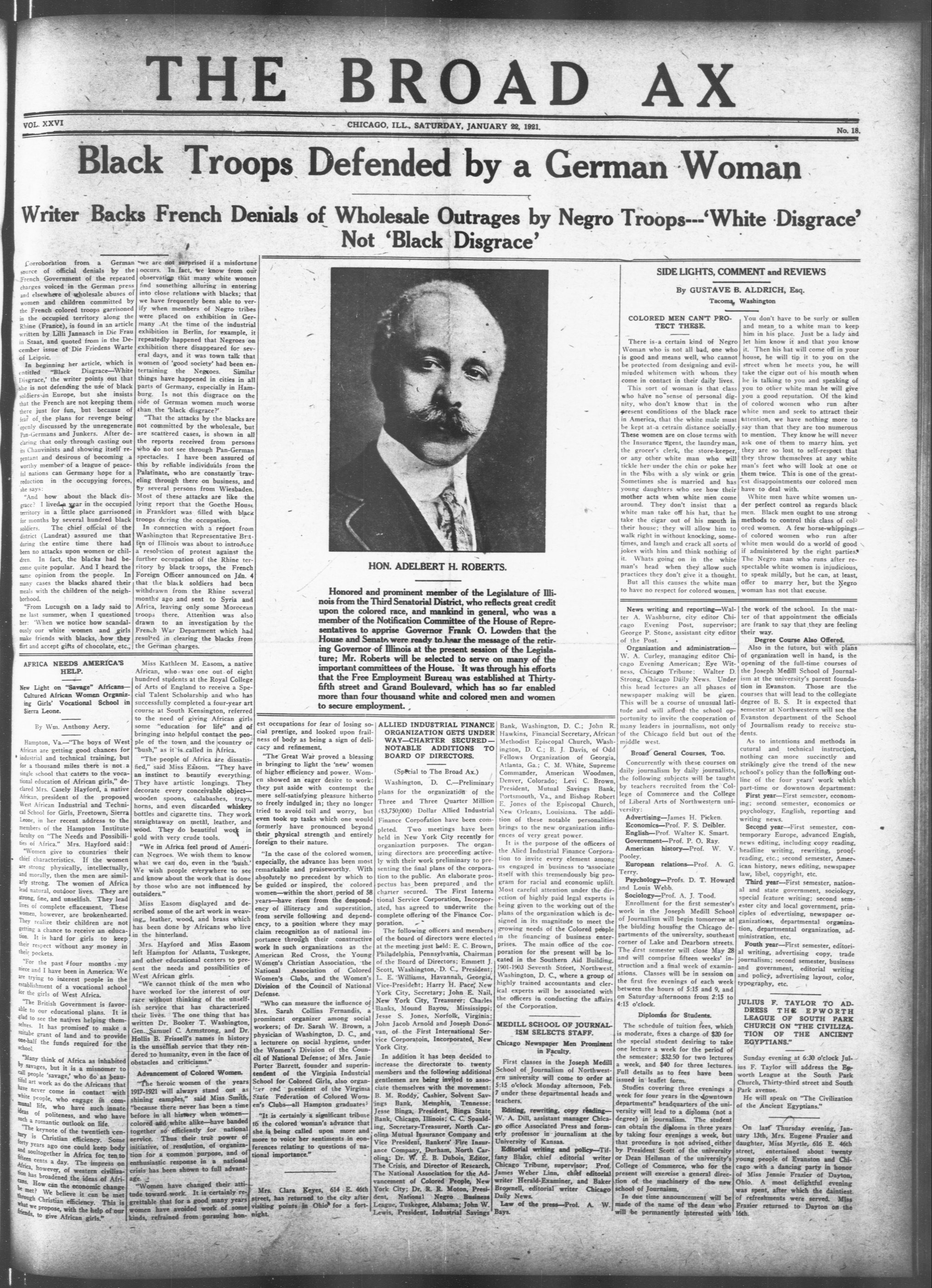
Black Troops Defended by a German Woman
VOL. XXVI
Corroboration from a German source of official denials by the French Government of the repeated charges voiced in the German press and elsewhere of wholesale abuses of women and children committed by the French colored troops garrisoned in the occupied territory along the Rhine (France), is found in an article written by Lilli Jannasch in Die Frau in Staat, and quoted from in the December issue of Die Friedens Warte of Leipsic.
In beginning her article, which is entitled "Black Disgrace—White Disgrace," the writer points out that she is not defending the use of black soldiers in Europe, but she insists that the French are not keeping them there just for fun, but because of fear of the plans for revenge being openly discussed by the unregenerate Pan-Germans and Junkers. After declaring that only through casting out its Chauvinists and showing itself repentant and desirous of becoming a worthy member of a league of peaceful nations can Germany hope for a reduction in the occupying forces, she says:
"And how about the black disgrace? I lived a year in the occupied territory in a little place garrisoned for months by several hundred black soldiers. The chief official of the district (Landrat) assured me that during the entire time there had been no attacks upon women or children. In fact, the blacks had become quite popular. And I heard the same opinion from the people. In many cases the blacks shared their meals with the children of the neighborhood.
"From Lucugsh on a lady said to me last summer, when I questioned her: 'When we notice how scandalously our white women and girls make friends with blacks, how they flirt and accept gifts of chocolate, etc.,
AFRICA NEEDS AMERICA'S HELP.
New Light on "Savage" Africans- Cultured African Women Organizing Girls' Vocational School in Siraa Leone.
By Wm. Anthony Aery.
Hampton, Va.—"The boys of West African are getting good chances for industrial and technical training, but for a thousand miles there is not a single school that caters to the vocational education of African girls," declared Mrs. Casely Hayford, a native African, president of the proposed West African Industrial and Technical School for Girls, Freetown, Sierra Leone, in her recent address to the members of the Hampton Institute faculty on "The Needs and Possibilities of Africa." Mrs. Hayford said: "Women give to countries their chief characteristics. If the women are strong physically, intellectually, and morally, then the men are similarly strong. The women of Africa lead natural, outdoor lives. They are strong, fine, and unselfish. They lead lives of complete effacement. These women, however, are brokenhearted. They realize their children are not getting a chance to receive an education. It is hard for girls to keep their respect without any money in their pockets.
"For the past four months my niece and I have been in America. We are trying to interest people in the establishment of a vocational school for the girls of West Africa.
"The British Government is favorable to our educational plans. It is glad to see the natives helping themselves. It has promised to make a suitable grant of land and to provide one-half the funds required for the school.
"Many think of Africa as inhabited by savages, but it is a misnomer to call people 'savage', who do as beautiful art work as do the Africans that have never come in contact with white people, who engage in communal life, who have such innate ideas of politeness, and who have such a romantic outlook on life.
The keynote of the twentieth century is Christian efficiency. Some forty years ago one could keep body and soul together in Africa for ten to fifteen cents a day. The impress on Africa, however, of western civilization has broadened the ideas of Africans. How can the economic change be met? We believe it can be met through Christian efficiency. This is what we propose, with the help of our friends, to give African girls."
THE BROAD AX
we are not surprised if a misfortune occurs. In fact, we know from our observation that many white women find something alluring in entering into close relations with blacks; that we have frequently been able to verify when members of Negro tribes were placed on exhibition in Germany. At the time of the industrial exhibition in Berlin, for example, it repeatedly happened that Negroes on exhibition there disappeared for several days, and it was town talk that women of 'good society' had been entertaining the Negroes. Similar things have happened in cities in all parts of Germany, especially in Hamburg. Is not this disgrace on the side of German women much worse than the 'black disgrace?' "That the attacks by the blacks are not committed by the wholesale, but are scattered cases, is shown in all the reports received from persons who do not see through Pan-German spectacles. I have been assured of this by refable individuals from the Palatinate, who are constantly traveling through there on business, and by several persons from Wiesbaden. Most of these attacks are like the lying report that the Goethe House in Frankfort was filled with black troops during the occupation.
In connection with a report from Washington that Representative Brutten of Illinois was about to introduce a resolution of protest against the further occupation of the Rhine territory by black troops, the French Foreign Officer announced on Ján. 4 that the black soldiers had been withdrawn from the Rhine several months ago and sent to Syria and Africa, leaving only some Morocean troops there. Attention was also drawn to an investigation by the French War Department which had resulted in clearing the blacks from the German charges.
Miss Kathleen M. Easom, a native African, who was one out-of-eight hundred students at the Royal College of Arts of England to receive a Special Talent Scholarship and who has successfully completed a four-year art course at South Kensington, referred to the need of giving African girls some "education for life" and of bringing into helpful contact the people of the town and the country or "bush," as it is called in Africa.
"The people of Africa are dissatisfied," said Miss Easom. "They have an instinct to beautify everything. They have artistic longings. They decorate every conceivable object—wooden spoons, calabashes, trays, horns, and even discarded whiskey bottles and cigarette tins. They work straightaway on metal, leather, and wood. They do beautiful work in gold with very crude tools.
"We in Africa feel proud of American Negroes. We wish them to know what we can do, even in the 'bush'. We wish people everywhere to see and know about the work that is done by those who are not influenced by outsiders."
Miss Easom displayed and described some of the art work in weaving, leather, wood, and brass which has been done by Africans who live in the hinterland.
Mrs. Hayford and Miss Easom left Hampton for Atlanta, Tuskegee, and other educational centers to present the needs and possibilities of West African girls.
"We cannot think of the men who have worked for the interest of our race without thinking of the unselfish service that has characterized their lives. The one thing that has written Dr. Booker T. Washington, Gen. Samuel C. Armstrong, and Dr. Hollis B. Frissell's names in history is the unselfish service that they rendered to humanity, even in the face of obstacles and criticisms."
Advancement of Colored Women.
"The heroic women of the years 1917-1921 will always stand out as shining examples," said Miss Smith, "because there never has been a time before in all history when women colored and white alike—have banded together so efficiently for national service. Thus their true power of initiative, of resolution, of organization for a common purpose, and of enthusiastic response in a national crisis has been shown to full advantage.
"Women have changed their attitude toward work. It is certainly regrettable that for a good many years women have avoided work of some kinds, refrained from pursuing hon-
CHICAGO, ILL., SATURDAY, JANUARY 22, 1921.
Honored and prominent member of the Legislature of Illinois from the Third Senatorial District, who reflects great credit upon the colored race, and mankind in general, who was a member of the Notification Committee of the House of Representatives to apprise Governor Frank O. Lowden that the House and Senate were ready to hear the message of the retiring Governor of Illinois at the present session of the Legislature; Mr. Roberts will be selected to serve on many of the important committees of the House. It was through his efforts that the Free Employment Bureau was established at Thirty-fifth street and Grand Boulevard, which has so far enabled more than four thousand white and colored men and women to secure employment.
est occupations for fear of losing social prestige, and looked upon frailness of body as being a sign of delicacy and refinement.
"The Great War proved a blessing in bringing to light the 'new' women of higher efficiency and power. Women showed an eager desire to work; they put aside with contempt the mere self-satisfying pleasure hitherto so freely indulged in; they no longer tried to avoid toil and worry, but even took up tasks which one would formerly have pronounced beyond their physical strength and entirely foreign to their nature.
"In the case of the colored women, especially, the advance has been most remarkable and praiseworthy. With absolutely no precedent by which to be guided or inspired, the colored women—within the short period of 58 years—have risen from the despondency of illiteracy and superstition, from servile following and dependency, to a position where they may claim recognition as of national importance through their constructive work in such organizations as the American Red Cross, the Young Women's Christian Association, the National Association of Colored Women's Clubs, and the Women's Division of the Council of National Defense.
"Who can measure the influence of Mrs. Sarah Collins Fernandis, a prominent organizer among social workers; of Dr. Sarah W. Brown, a physician of Washington, D. C., and a lecturer on social hygiene, under the Women's Division of the Council of National Defense; of Mrs. Janie Porter Barrett, founder and superintendent of the Virginia Industrial School for Colored Girls, also organizer and president of the Virginia State Federation of Colored Women's Clubs—all Hampton graduates."
"It is certainly a significant tribute to the colored woman's advance that she is being called upon more and more to voice her sentiments in conferences relating to questions of national importance."
Mrs. Clara Keyes, 614 E. 46th street, has returned to the city after visiting points in Ohio for a fortnight.
and prominent member of the Legislature. The Third Senatorial District, who reflected colored race, and mankind in general, the Notification Committee of the House to apprise Governor Frank O. Lowen Senate were ready to hear the message of Illinois at the present session of Roberts will be selected to serve on committees of the House. It was through the Employment Bureau was established and Grand Boulevard, which has so far thousand white and colored men employment.
ALLIED INDUSTRIAL FINANCE ORGANIZATION GETS UNDER WAY—CHARTER SECURED—NOTABLE ADDITIONS TO BOARD OF DIRECTORS.
(Special to The Broad Ax.)
Washington, D. C.—Preliminary plans for the organization of the Three and Three Quarter Million ($3,750,000) Dollar Allied Industrial Finance Corporation have been completed. Two meetings have been held in New York City recently for organization purposes. The organizing directors are proceeding actively with their work preliminary to presenting the final plans of the corporation to the public. An elaborate prospectus has been prepared and the charter secured. The First International Service Corporation, Incorporated, has agreed to underwrite the complete offering of the Finance Corporation.
The following officers and members of the board of directors were elected at the meeting just held: E. C. Brown, Philadelphia, Pennsylvania, Chairman of the Board of Directors; Emmett J. Scott, Washington, D. C., President; L. E. Williams, Havannah, Georgia, Vice-Presideht; Harry H. Pace, New York City, Secretary; John E. Nail, New York City, Treasurer; Charles Banks, Mound Bayou, Mississippi; Jesse S. Jones, Norfolk, Virginia; John Jacob Arnold and Joseph Donovan, of the First International Service Corporatoin, Incorporated, New York City.
In addition it has been decided to increase the directorate to twenty members and the following additional gentlemen are being invited to associate themselves with the movement: B. M. Roddy, Cashier, Solvent Savings Bank, Memphis, Tennessee; Jesse Binga, President, Binga State Bank, Chicago, Illinois; C. C. Spaulding, Secretary-Treasurer, North Carolina Mutual Insurance Company and Vice President, Bankers' Fire Insurance Company, Durham, North Carolina; Dr. W. E. B. Dubois, Editor, The Crisis, and Director of Research, The National Association for the Advancement of Colored People, New York City; Dr. R. R. Moton, President, National Negro Business League, Tuskegee, Alabama; John W. Lewis, President, Industrial Savings
Bank, Washington, D. C.; John R Hawkins, Financial Secretary, African Methodist Episcopal Church, Washington, D. C.; B. J. Davis, of Odd Fellows Organization of Georgia Atlanta, Ga.; C. M. White, Supreme Commander, American Woodmen Denver, Colorado; Levi C. Brown President, Mutual Savings Bank Portsmouth, Va., and Bishop Robert E. Jones of the Episcopal Church, New Orleans, Louisiana. The addition of these notable personalities brings to the new organization influences of very great power.
It is the purpose of the officers of the Allied Industrial Finance Corporation to invite every element among us engaged in business to associate itself with this tremendously big program for racial and economic uplift. Most careful attention under the direction of highly paid legal experts is being given to the working out of the plans of the organization which is designed in its magnitude to meet the growing needs of the Colored people in the financing of business enterprises. The main office of the corporation for the present will be located in the Southern Aid Building, 1901-1903 Seventh Street, Northwest, Washington, D. C., where a group of highly trained accountants and clerical experts will be associated with the officers in conducting the affairs of the Corporation.
MEDILL SCHOOL OF JOURNAL
ISM SELECTS STAFF.
Chicago Newspaper Men Prominent in Faculty.
First classes in the Joseph Medill School of Journalism of Northwestern university will come to order at 5:15 o'clock Monday afternoon, Feb 7 under these departmental heads and teachers.
Editing, rewriting, copy reading—W. A. Dill, assistant manager Chicago office Associated Press and formerly professor in journalism at the University of Kansas.
Editorial writing and policy—Tiffany Blake, chief editorial writer Chicago Tribune, supervisor; Prof. James Weber Linn, chief editorial writer Herald-Examiner, and Baker Brownell, editorial writer Chicago Daily News.
Law of the press—Prol. A. W.
SIDE LIGHTS, COMMENT and REVIEWS
By GUSTAVE B. ALDRICH, Esq.
Tacoma, Washington
COLORED MEN CANT PRO
TECT THESE.
There is a certain kind of Negro Woman who is not all bad, one who is good and means well, who cannot be protected from designing and evil-minded whiteness with whom they come in contact in their daily lives. This sort of woman is that class who have no sense of personal dignity, who don't know that in the present conditions of the black race in America, that the white male must be kept at a cetrain distance socially. These women are on close terms with the Insurance agent, the laundry man, the grocer's clerk, the store-keeper, or any other white man who will tickle her under the chin or poke her in the fibs with a sly wink or grin. Sometimes she is married and has young daughters who see how their mother acts when white men come around. They don't insist that a white man take off his hat, that he take the cigar out of his mouth in their house; they will allow him to walk right in without knocking, sometimes, and laugh and crack all sorts of jokes with him and think nothing of it. Whats going on in the white man's head when they allow such practices they don't give it a thought. But all this causes the white man to have no respect for colored women.
News writing and reporting—Walter A. Washburne, city editor Chicago Evening Post, supervisor; George P. Stone, assistant city editor of the Post.
Organization and administration—W. A. Curley, managing editor Chicago Evening American; Eye Witness, Chicago Tribune; Walter D. Strong, Chicago Daily News. Under this head lectures an all phases of newspaper making will be given. This will be a course of unusual latitude and will afford the school opportunity to the cooperation of many leaders in journalism, not only of the Chicago field but out of the middle west.
Broad General Courses. Too.
Concurrently with these courses on daily journalism by daily journalists, the following subjects will be taught by teachers recruited from the College of Commerce and the College of Liberal Arts of Northwestern university:
American history—Prof. W. V. Pooley.
European relations—Prof. A. G. Terry.
Psychology—Profs. D. T. Howard and Louis Webb.
Sociology—Prof. A. J. Tood.
Enrollment for the first semester's work in the Joseph Medill School of Journalism will begin tomorrow at the building housing the Chicago departments of the university, southeast corner of Lake and Dearborn streets.
The first semester will close May 28 and will comprise fifteen weeks' instruction and a final week of examinations. Classes will be in session on the first five evenings of each week between the hours of 5:15 and 9, and on Saturday afternoon from 2:15 to 4:15 o'clock.
Diplomás for Students
The schedule of tuition fees, which is moderate, fixes a charge of $20 for the special student desiring to take one lecture a week for the period of the semester; $32.50 for two lectures a week, and $40 for three lectures. Full details as to fees have been issued in leaflet form. Studies covering three evenings a week for four years in the downtown departments" headquarters of the university will lead to a diploma (not a degree) in journalism. The student can obtain the diploma in three years by taking four evenings a week, but that procedure is not advised either by President Scott of the university or Dean Heilman of the university's College of Commerce, who for the present will exercise a general direction of the machinery of the new school of Journalism. In due time announcement will be made of the name of the dean who will be permanently interested with
You don't have to be surly or sullen and mean to a white man to keep him in his place. Just be a lady and let him know it and that you know it. Then his hat will come off in your house, he will tip it to you on the street when he meets you, he will take the cigar out of his mouth when he is talking to you and speaking of you to other white man he will give you a good reputation. Of the kind of colored women who run after white men and seek to attract their attention, we have nothing more to say than that they are too numerous to mention. They know he will never ask one of them to marry him, yet they are so lost to self-respect that they throw themselves at any white man's feet who will look at one or them twice. This is one of the greatest disappointments our colored men have to deal with.
White men have white women under perfect control as regards black men. Black men ought to use strong methods to control this class of colored women. A few horse-whippings of colored women who run after white men would do a world of good if administered by the right parties. The Negro man who runs after respectable white women is injudicious, to speak mildly, but he can, at least, offer to marry her, but the Negro woman has not that excuse.
the work of the school. In the matter of that appointment the officials are frank to say that they are feeling their way.
Degree Course Also Offered.
Also in the future, with plans of organization well in hand, is the opening of the full-time courses of the Joseph Medill School of Journalism at the university's parent foundation in Evanston. Those are the courses that will lead to the collegiate degree of B. S. It is expected that semester at Northwestern will see the Evanston department of the School of Journalism ready to receive students.
As to intentions and methods in cultural and technical instruction, nothing can more succinctly and strikingly give the trend of the new school's policy than the following outline of the four years' work which part-time or downtown department: First year—First semester, economing; second semester, economics or psychology, English, reporting and writing news. Second year—First semester, contemporary Europe, advanced English, news editing, including copy reading, headline writing, rewriting, proof-reading, etc.; second semester, American history, news editing, newspaper law, libel, copyright, etc. Third year—First semester, national and state government, sociology, special feature writing; second semester city and local government, principles of advertising, newspaper organizations, departmental organization, departmental organization, administration, etc. Fourth year—First semester, editorial writing, advertising copy, trade journalism; second semester, business and government, editorial writing and policy, advertising layout, color, typography, etc.
JULIUS F. TAYLOR TO ADDRESS THE EPWORTH LEAGUE OF SOUTH PARK CHURCH ON "THE CIVILIZATION OF THE ANCIENT EGYPTIANS."
Sunday evening at 6:30 o'clock Julius F. Taylor will address the Egworth League at the South Park Church, Thirty-third street and South Park avenue.
He will speak on "The Civilization of the Ancient Egyptians."
on last Thursday evening, January 13th, Mrs. Eugene Frazier and daughter, Miss Myrtle, 616 E. 46th street, entertained about twenty young people of Evanston and Chicago with a dancing party in honor of Miss Jennie Frazier of Dayton, Ohio. A most delightful evening was spent, after which the daintiest of refreshments were served. Miss Frazier returned to Dayton on the 16th.
In this city since July 15th, 1899, without missing one single issue. Republicans, Democrats, Catholics, Protestants, Single Taxers, Priests, infidels or anyone else can have their say as long as their language is proper and responsibility is fixed. The Broad Ax is a newspaper whose platform is broad enough for all, ever claiming the editorial right to speak its own mind. Local communications will receive attention. Write only on one side of the paper.
Subscriptions must be paid in advance.
One Year ..... $2.00
Six Months ..... $1.00
Advertising rates made known on application.
Address all communication to
THE BROAD AX
6206 So. Elizabeth St., Chicago, Ill.
Phone Wenworth 2597
JULIUS F. TAYLOR
Editor and Publisher
Associate Editor
DR. M. A. MAJORS
4700 South State Street
Vol. XXVI. No. 18
JANUARY 22, 1921.
Entered as Second-Class Matter, Aug
19, 1902, at the Post Office at Chicago
III. Under Act of March 8, 1879.
By Monroe A. Majors, M. D.
The Broad Ax is doing a work that no Negro paper has ever before attempted in bringing weekly before the reading public the good opinion that is expressed in its columns anent our progressive element.
Chicago is one of the very few cities in the world where personal worth is given such serious consideration. Where the ability and the qualification of the individual is so highly rated. Where so little attention is given to color if the prerequisites are not absent.
Today we represent every force in great nature attuned to the harmony of a happy life. We have the spirit of the modern civilization to carry forward the very highest, principles of human progress, and secure in the things that make a race respected, we persist along lines wherever we have been hitherto denied to show our ability and skill.
It is a long step for a people long wronged by a system of cruel usage. More than any one thing else is the thing we have got to do for ourselves, and chiefly that which will lift us up in the estimation of those who have so long delightfully misused and abused us. Our saddest misfortune is the contempt in which we are held by those that know so little about us. We have a herculean work, a stupendous work to undertake and carry forward in trying as best we may to emphasize the qualification of our really worth while citizens.
The spirit of the race is mounting higher than it ever has before. There never has been a time when we could put so much of our worth in the analytical scales. There never was a time when we were as sober and serious as we are today. There never was so much of the different phases of our struggles, our strife, our successes; in fact, we have become so much a part of the social fabric of the world that we need not emphasize, or specify in too large a decree.
A very large element in the races of mankind have come to look upon the requirements, rather than requirements, of the man and woman. We have come a long distance from the Jamestown colonies. Our powers and adaptation, our endurance and our belief in God is very much accountable for our racial existence, and we need not blubber over in foolish and vain notions that we are here today because there was any such thing as mercy in the paganism which ran counter to everything holy and righteous.
Pat yourself on the back and be proud that the slave system did not work your fathers and mothers to death. It tried to do it all right. Be proud that the paganism of the country did not overcome your staying qualities. It was the same brawn and muscle that has saved this country from a pitiless starvation, and made wealthy a multitude of infamous ingrates who are perpetually screeching about "superior race."
The best behaved man is the superior man and being the color of a goat has nothing to do with it. The many educational tests which well nigh reaches beyond our recollection proves that the entire color scheme is the greatest cheat in the universe. But today no one can hardly tell whether he or she is what most people think they are.
The Broad Ax has nothing to do with the color question, and is firm in the proposition laid down in the Bible, and in the preamble in the constitution of the United States, "That all men are created equal."
J.P. E.
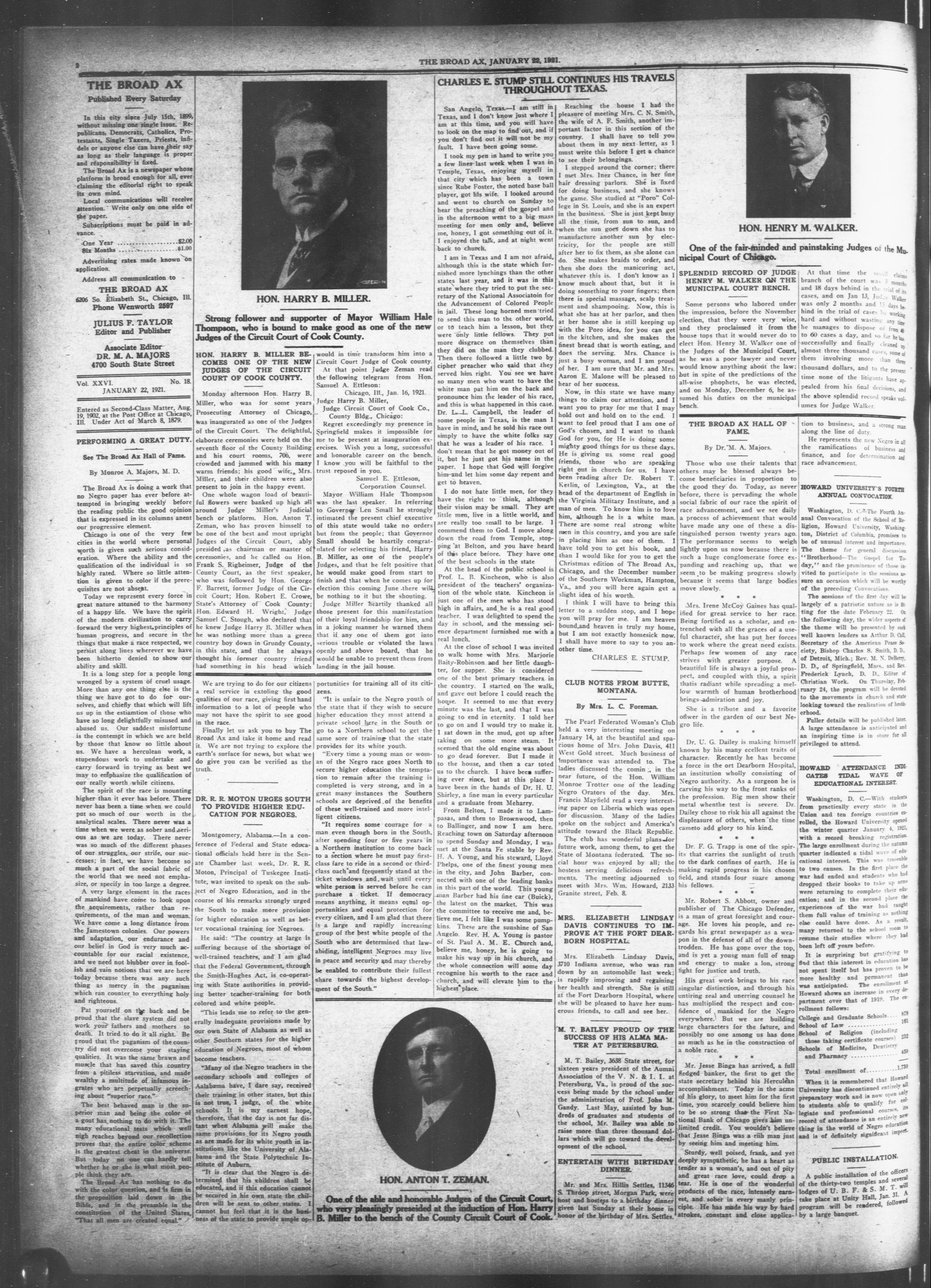
HON. HARRY B. MILLER
HON. HARRY B. MILLER BE-
COMES ONE OF THE NEW
JUDGES OF THE CIRCUIT
COURT OF COOK COUNTY.
Monday afternoon Hon. Harry B.
Miller, who was for some years
Prosecuting Attorney of Chicago,
was inaugurated as one of the Judges
of the Circuit Court. The delightful,
elaborate ceremonies were held on the
seventh floor of the County Building
and his court rooms, 706, were
crowded and jammed with his many
warm friends; his good wife, Mrs.
Miller, and their children were also
present to join in the happy event.
One whole wagon load of beautiful flowers were banked up high all around Judge Miller's Judicial bench or platform. Hon. Anton T. Zeman, who has proven himself to be one of the best and most upright Judges of the Circuit Court, ably presided as chairman or master of ceremonies, and he called on Hon. Frank S. Righeimer, Judge of the County Court, as the first speaker, who was followed by Hon. George F. Barrett, former Judge of the Circuit Court; Hon. Robert E. Crowe, State's attorney of Cook County; Hon. Edward H. Wright, Judge Samuel C. Stough, who declared that he knew Judge Harry B. Miller when he was nothing more than a green country boy down in Grundy County, in this state, and that he always thought his former country friend had something in his head which
We are trying to do for our citizens a real service in extolting the good qualities of our race, giving first hand information to a lot of people who may not have the spirit to see good in the race.
Finally let us ask you to buy The Broad Ax and take it home and read it. We are not trying to explore the earth's surface for news, but what we do give you can be verified as the truth.
DR. R. R. MOTON URGES SOUTH TO PROVIDE HIGHER EDUCATION FOR NEGROES
Montgomery, Alabama—In a conference of Federal and State educational officials held here in the Senate Chamber last week, Dr. R. R. Moton, Principal of Tuskegee Institute, was invited to speak on the subject of Negro Education, and in the course of his remarks strongly urged the South to make more provision for higher education as well as better vocational training for Negroes. He said: "The country at large is suffering because of the shortage of well-trained teachers, and I am glad that the Federal Government, through the Smith-Hughes Act, is co-operating with State authorities in providing better teacher-training for both colored and white people.
"This leads me to refer to the generally inadequate provisions made by our own State of Alabama as well as other Southern states for the higher education of Negroes, most of whom become teachers.
"Many of the Negro teachers in the secondary schools and colleges of Alabama have, I dare say, received their training in other states, but this is not true, I judge, of the white schools. It is my carnest hope, therefore, that the day is not far distant when Alabama will make the same provisions for its Negro youth as are made for its white youth in institutions like the University of Alabama and the State Polytechnic Institute of Auburn.
"It is clear that the Negro is determined that his children shall be educated, and if this education cannot be secured in his own state the children will be sent to other states. I cannot but feel that it is the business of the state to provide ample op-
would in time transform him into a Circuit Court Judge of Cook county. At that point Judge Zeman read the following telegram from Hon Samuel A. Ettleson: Chicago, Ill., Jan. 16, 1921. Judge Harry B. Miller,
Judge Circuit Court of Cook Co. County Blide, Chicago
County Blud, Chicago: Regret exceedingly my presence in Springfield makes it impossible for me to be present at inauguration exercises. Wish you a long, successful and honorable career on the bench. I know you will be faithful to the trust reposed in you.
Samuel E. Ettleson, Corporation Counsel.
Mayor William Hale Thompson was the last speaker. In referring to Governor Len Small he strongly intimated the present chief executive of this state would take no orders but from the people; that Governor Small should be heartily congratulated for selecting his friend, Harry B. Miller, as one of the people's Judges, and that he felt positive that he would make good from start to finish and that when he comes up for election this coming June there will be nothing to it but the shouting.
Judge Miller heartily thanked all those present for this manifestation of their loyal friendship for him, and in a joking manner he warned them that if any one of them got into serious trouble or violated the laws openly and above board, that he would be unable to prevent them from landing in the jail house.
portunities for training all of its citizens.
"It is unfair to the Negro youth of the state that if they wish to secure higher education they must attend a private school here in the South or go to a Northern school to get the same sore of training that the state provides for its white youth.
"Every time a young man or woman of the Negro race goes North to secure higher education the temptation to remain after the training is completed is very strong, and in a great many instances the Southern schools are deprived, of the benefits of these well-trained and more intelligent citizens.
"It requires some courage for a man even though born in the South, after spending four or five years in a Northern institution to come back to a section where he must pay first-class fare to ride in a second or third-class oach and frequently stand at the ticket windows and wait until every white person is served before he can purchase a ticket. If democracy means anything, it means equal opportunities and equal protection for every citizen, and I am glad that there is a large and rapidly increasing group of the best white people of the South who are determined that law-abiding, intelligent Negroes may live in peace and security and may thereby be enabled to contribute their fullest share towards the highest development of the South."
One of the able and honorable Judges of the Circuit Court, who very pleasingly preseided at the induction of Hon. Harry B. Miller to the bench of the County Circuit Court of Cook.
HON. ANTON T. ZEMAN.
THE BROAD AX. JANUARY 22, 1921
CHARLES E. STUMP STILL CONTINUES HIS TRAVELS THROUGHOUT TEXAS.
San Angelo, Texas.—I am still in Texas, and I don't know just where I am at this time, and you will have to look on the map to find out, and if you don't find out it will not be my fault. I have been going some.
I took my pen in hand to write you a few lines-last week when I was in Temple, Texas, enjoying myself in that city which has been a town since Rube Foster, the noted base ball player, got his wife. I looked around and went to church on Sunday to hear the preaching of the gospel and in the afternoon went to a big mass meeting for men only and, believe me, honey, I got something out of it. I enjoyed the talk, and at night went back to church.
I am in Texas and I am not afraid, although this is the state which furnished more lynchings than the other states last year, and it was in this state where they tried to put the secretary of the National Association for the Advancement of Colored People in jail. These long horned men tried to send this man to the other world, or to teach him a lesson, but they were only little fellows. They put more disgrace on themselves than they did on the man they clubbed. Then there followed a little two by cipher preacher who said that they served him right. You see we have so many men who want to have the white man pat him on the back and pronounce him the leader of his race, and this is what happened in this case. Dr. L.-L. Campbell, the leader of some people in Texas, is the man I have in mind, and he sold his race out simply to have the white folks say that he was a leader of his race. I don't mean that he got money out of it, but he just got his name in the paper. I hope that God will forgive him and let him some day repent and get to heaven.
I do not hate little men, for they have the right to think, although their vision may be small. They are little men, live in a little world, and are really too small to be large. I commend them to God. I move along down the road from Temple, stopping at Belton, and you have heard of this place before. They have one of the best schools in the state. At the head of the public school is Prof. L. B. Kincheon, who is also president of the teachers' organization of the whole state. Kincheon is just one of the men who has stood high in affairs, and he is a real good teacher. I was delighted to spend the day in school, and the messing science department furnished me with a real lunch.
At the close of school I was invited to walk home with Mrs. Marjorie Baity-Robinson and her little daughter, for supper. She is considered one of the best primary teachers in the country. I started on the walk, and gave out before I could reach the house. It seemed to me that every minute was the last, and that I was going to end in eternity. I told her to go on and I would try to make it. I sat down in the mud, got up after taking on some more steam. It seemed that the old engine was about to go dead forever. But I made it to the house, and then a car towed us to the church. I have been suffering ever since, but at this place I have been in the hands of Dr. H. U. Shirley, a fine man in every particular and a graduate from Meharry.
From Belton, I made it to Lampasas, and then to Brownwood, then to Ballinger, and now I am here. Reaching town on Saturday afternoon to spend Sunday and Monday, I was met at the Santa Fe stable by Rev. H. A. Young, and his steward, Lloyd Phelps, one of the finest young men in the city, and John Barber, connected with one of the leading banks in this part of the world. This young man Barber had his fine car (Buick), the latest on the market. This was the committee to receive me and, believe me, I felt like I was some pumpkins. These are the sunshine of San Angelo. Rev. H. A. Young is pastor of St. Paul A. M. E. Church and, believe me, honey, he is going to make his way up in his church, and the whole connection will some day recognize his worth to the race and church, and will elevate him to the highest place.
Reaching the house I had the pleasure of meeting Mrs. C. N. Smith, the wife of A. F. Smith, another important factor in this section of the country. I shall have to tell you about them in my next letter, as I must write this before I get a chance to see their belongings.
I stepped around the corner; there I met Mrs. Inez Chance, in her fine hair dressing parlors. She is fixed for doing business, and she knows the game. She studied at "Poro" College in St. Louis, and she is an expert in the business. She is just kept busy all the time, from sun to sun, and when the sun goes down she has to manufacture another sun by electricity, for the people are still after her to fix them, as she alone can do. She makes braids to order, and then she does the manicuring act, whatever this is. I don't know as I know much about that, but it is doing something to your fingers; then there is special massage, scalp treatment and shampooing. Now, this is what she has at her parlor, and then at her home she is still keeping up with the Poro idea, for you can get in the kitchen, and she makes the finest bread that is worth eating, and does the serving. Mrs. Chance is just a busy woman, and I am proud of her. I am sure that Mr. and Mrs. Aaron E. Malone will be pleased to hear of her success.
Now, in this state we have many things to claim our attention, and I want you to pray for me that I may hold out and hold on to the end. I want to feel proud that I am one of God's chosen, and I want to thank God for you, for He is doing some mighty good things for us these days. He is giving us some real good friends, those who are speaking right out in church for us. I have been reading after Dr. Robert T. Ketlin, of Lexington, Va., at the head of the department of English in the Virginia Military Institute, and a man of men. To know him is to love him, although he is a white man. There are some real strong white men in this country, and you are safe in placing him as one of them. I have told you to get his book, and than I would like for you to get the Christmas edition of The Broad Ax, Chicago, and the December number of the Southern Workman, Hampton, Va., and you will here again get a slight idea of his worth.
I think I will have to bring this letter to a sudden stop, and I hope you will pray for me. I am heaven bound, and heaven is truly my home. But I am not exactly homesick now. I shall have more to say to you another time.
CHARLES E. STUMP
CLUB NOTES FROM BUTTE,
MONTANA.
By Mrs. L. C. Foreman
The Pearl Federated Woman's Club held a very interesting meeting on January 14, at the beautiful and spacious home of Mrs. John Davis, 411 West Gold street. Much business of importance was attended to. The ladies discussed the comin', in the near future, of the Hon. William Monroe Trotter one of the leading Negro Orators of the day. Mrs. Francis Mayfield read a very interesting paper on Liberia which was open for discussion. Many of the ladies spoke on the subject and America's attitude toward the Black Republic. The club has wonderful plans for future work, among them, to get the State of Montana federated. The social hour was enjoyed by all; the hostess serving delicious refreshments. The meeting adjourned to meet with Mrs. Wm. Howard, 2133 Granite street, Feb. 8.
MRS. ELIZABETH LINDSAY
DAVIS CONTINUES TO IM
PROVE AT THE FORT DEAR.
BORN HOSPITAL.
Mrs. Elizabeth Lindsay Davis, 3710 Indiana avenue, who was ran down by an automobile last week; is rapidly improving and regaining her health and strength. She is still at the Fort Dearborn Hospital, where she will be pleased to have her numerous friends, to call and see her.
M. T. BAILEY PROUD OF THE SUCCESS OF HIS ALMA MATER AT PETERSBURG.
M. T. Bailey, 3638 State street, for sixteen years president of the Aumni Association of the V. N. & I. I. at Petersburg, Va., is proud of the success being made by the school under the administration of Prof. John M. Gandy. Last May, assisted by hundreds of graduates and students of the school, Mr. Bailey was able to raise more than three thousand dollars which will go toward the development of the school.
ENTERTAIN WITH BIRTHDAY DINNER
Mr. and Mrs. Hillis Settles, 11346
S. Thröop street, Morgan Park, were host and hostess to a birthday dinner given last Sunday at their home in honor of the birthday of Mrs. Settles.
PETER H. BURKE
One of the fair-minded and painstaking Judges of the Municipal Court of Chicago.
SPLENDID RECORD OF JUDGE
HENRY M. WALKER ON THE
MUNICIPAL COURT BENCH.
Some persons who labored under
the impression, before the November
election, that they were very wise,
and they proclaimed it from the
house tops that it would never do to
elect Hon. Henry M. Walker one of
the Judges of the Municipal Court,
as he was a poor lawyer and never
would know anything about the law;
in spite of the predictions of the
all-wise phophets, he was elected,
and on Monday, December 6, he
assumed his duties on the municipal
bench.
THE BROAD AX HALL OF
FAME.
By Dr. M. A. Majors
Those who use their talents that others may be blessed always become beneficiaries in proportion to the good they do. Today, as never before, there is pervading the whole social fabric of our race the spirit of race advancement, and we see daily a process of achievement that would have made any one of these a distinguished person twenty years ago. The performance seems to weigh lightly upon us now because there is such a huge conglomerate force expanding and reaching up, that we seem, to be making progress slowly because it seems that large bodies move slowly.
Mrs. Irene McCoy Gaines has qualified for great service to her race Being fortified as a scholar, and entrenched with all the graces of a useful character, she has put her forces to work where the great need exists. Perhaps few women of any race strives with greater purpose. A beautiful life is always a joyful prospect, and coupled with this, a spirit thatis radiant while spreading a mellow warmth of human brotherhood brings admiration and joy.
She is a tribute and a favorite offer in the garden of our best Negro life.
Dr. U. G. Dailey is making himself known by his many excellent traits of character. Recently he has become a force in the ort Dearborn Hospital, an institution wholly consisting of Negro authority. As a surgeon he is carving his way to the front ranks of the profession. Big men show their metal whenthe test is severe. Dr. Dailey chose to risk his all against the displeasure of others, when the time cameto add glory to his kind.
Dr. F. G. Trapp is one of the spirits that carries the sunlight of truth to the dark confines of earth. He is making rapid progress in his chosen field, and stands four suare among his fellows.
Mr. Robert S. Abbott, owner and publisher of The Chicago Defender, is a man of great foresight and courage. He loves his people, and regards his great newspaper as a weapon in the defense of all of the downtrodden. He has gone over the top, and is yet a young man full of snap and energy to make a lon, strong fight for justice and truth.
His great work brings to his race singular distinction, and through his untiring zeal and unerring counsel he has multiplied the respect and confidence of mankind for the Negro everywhere. But we are building large characters for the future, and possibly no one among us has done as much as he in the construction of a noble race.
Mr. Jesse Binga has arrived, a full fledged banker, the first to get the state secretary behind his Herculean accomplishment. Today in the acme of his glory, to meet him for the first time, you scarcely could believe him to be so strong that the First National Bank of Chicago gives him unlimited credit. You wouldn't believe that Jesse Binga was a rilh man just by seeing him and meeting him. Sturdy, well poised, frank, and yet deeply sympathetic, he has a heart as tender as a woman's, and out of pity and great race love, could drop a tear. He is one of the wonderful products of the race, intensely earnest, and sober in every manly principle. He has made his way by hard strokes, constant and close applica-
\* \* \*
* * *
***
At that time the small claims branch of the court was 3 months and 18 days behind in the trial of its cases, and on Jan 13, Judge Walker was only 2 months and 15 days behind in the trial of cases by working hard and without wasting any time he manages to dispose of from 40 to 60 cases a day, and so far he has successfully and finally cleaned up almost three thousand cases, some of them involving more than three thousand dollars, and to the present time none of the litigants have appealed from his final decisions, and the above splendid record speaks volumes for Judge Walker. tion to business, and a strong man along the line of duty.
He represents the new Negro in all the ramifications of business and finance, and for determination and race advancement.
HOWARD UNIVERSITY'S FOURTH
ANNUAL CONVOCATION.
Washington, D. C. The Fourth Annual Convocation of the School of Religion, Howard University, Washington, District of Columbia, promises to be of unusual interest and importance The theme for general discussion "Brotherhood-The Gospel for Today," and the prominence of those invited to participate in the sessions assure an occasion which will be worthy of the preceding Convocations.
The sessions of the first day will be largely of a patriotic nature as is fitting for the date February 22. On the following day, the wider aspects of the theme will be presented by such well known leaders as Arthur D. Call, Secretary of the American Peace Society, Bishop Charles S. Smith, D. D. of Detroit, Mich.; Rev. M. N. DeBerry, D. D., of Springfield, Mass., and Rev. Frederick Lynch, D. D., Editor of Christian Work. On Thursday, February 24, the program will be devoted to the movements in church and state looking toward the realization of brotherhood.
Fuller details will be published later. A large attendance is anticipated and an inspiring time is in store for all privileged to attend.
HOWARD ATTENDANCE IND
CATES TIDAL WAVE OF
EDUCATIONAL INTEREST.
Washington, D. C.—With students from practically every state in the Union and ten foreign countries enrolled, the Howard University opened the winter quarter January 4, 1921, with a record breaking registration. The large enrollment during the autumn quarter indicated a tidal wave of educational interest. This was traceable to two causes. In the first place the war had ended and students who had dropped their books to take up arms were returning to complete their education; and in the second place the experiences of the war had taught them full value of training as nothing else could have done. As a result many returned to the school room to resume their studies where they had been left off years before.
It is surprising but gratifying to find that this interest in education has not spent itself but has proven to be more healthy and permanent than was anticipated. The enrollment at Howard shows an increase in every department over that of 1919. The enrollment follows:
College and Graduate Schools..... 875
School of Law..... 161
School of Religion (including those taking certificate courses)..... 232
Schools of Medicine, Dentistry and Pharmacy..... 459
When it is remembered that Howard University has discontinued entirely all preparatory work and is now open only to students able to qualify for collegiate and professional courses, its record of attendance is an entirely new thing in the world of Negro education and is of definitely significant import.
PUBLIC INSTALLATION
A public installation of the officers of the thirty-two temples and several lodges of U. B. F. & S. M. T. will take place at Unity Hall, Jan. 31. A program will be rendered, followed by a large banquet.
[Name]
HON. ROBERT R. JACKSON.
Member of the City Council from the Secor has succeeded in having Forest av. changed from st. on the north and Thirty-ninth st. on the south in honor of the late Lieut. George L. Giles, w. on the bloody battlefields of France. It is almost in the history of this country that the name of any city has been changed to honor the memory of man.
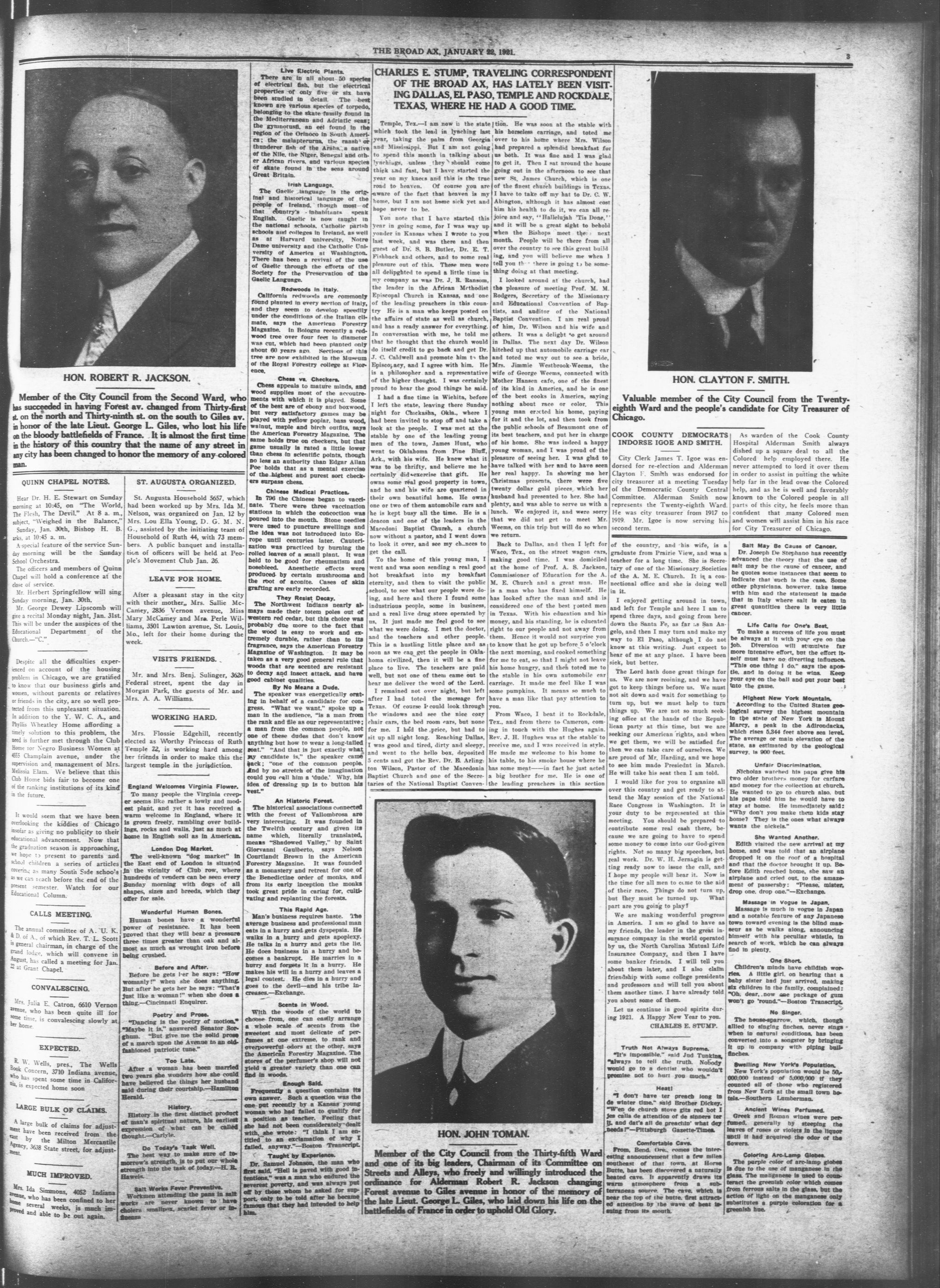
Member of the City Council from the Second Ward, who has succeeded in having Forest av. changed from Thirty-first st. on the north and Thirty-ninth st. on the south to Giles av. in honor of the late Lieut. George L. Giles, who lost his life on the bloody battlefields of France. It is almost the first time in the history of this country that the name of any street in any city has been changed to honor the memory of any colored man.
QUINN CHAPEL NOTES.
Hear Dr. H. E. Stewart on Sunday morning at 10:45, on "The World, The Flesh, The Devil." At 8 a.m., subject, "Weighed in the Balance," Sunday, Jan. 30th, Bishop H. B. arks, at 10:45 a.m.
As special feature of the service Sunday morning will be the Sunday School Orchestra.
The officers and members of Quinn Chapel will hold a conference at the close of service.
Mr. Herbert Springfellow will sing Sunday morning, Jan. 30th.
Mr. George Dewey Lipscomb will give a recital Monday night, Jan. 31st. This will be under the auspices of the Educational Department of the Church."C."
Despite all the difficulties experienced on account of the housing problem in Chicago, we are gratified to know that our business girls and women, without parents or relatives or friends in the city, are so well protected from this unpleasant situation. In addition to the Y. W. C. A., and Phyllis Wheatley Home affording a timely solution to this problem, the need is further met through the Club Home or Negro Business Women at 4555 Champlain avenue, under the supervision and management of Mrs. Melissa Elam. We believe that this Club Home bids fair to become one of the ranking institutions of its kind in the future.
It would seem that we have been overlooking the kiddies of Chicago insolar as giving no publicity to their educational advancement. Now that the graduation season is approaching, we hope to present to parents and school children a series of articles covering as many South Side schools as we can reach before the end of the present semester. Watch for our Educational Column.
CALLS MEETING
The annual committee of A. U. K. & D. of A., of which Rev. T. L. Scott is general chairman, in charge of the grand lodge, which will convene in August, has called a meeting for Jan. 22 at Grant Chanel.
CONVALESCING
Mrs. Julia E. Catron, 6610 Vernon avenue, who has been quite ill for some time, is convalescing slowly at her home.
R. W. Wells, pres., The Wells Book Concern, 3710 Indiana avenue, who has spent some time in California, is expected home soon.
A large bulk of claims for adjustment have been received from the east by the Milton Mercantile Agency, 3638 State street, for adjustment.
MUCH IMPROVED
Mrs. Ida Simmons, 4052 Indiana avenue, who has been confined to her home several weeks, is much improved and able to be out again.
EXPECTED.
ncil from the Second Ward, who rest av. changed from Thirty-first ninth st. on the south to Giles av. George L. Giles, who lost his life France. It is almost the first time that the name of any street in honor the memory of any colored
ST. AUGUSTA ORGANIZED
St. Augusta Household 6557, which had been worked up by Mrs. Ida M Nelson, was organized on Jan. 12 by Mrs. Lou Ella Young, D. G. M. N. G., assisted by the initiating team of Household of Ruth 44, with 73 members. A public banquet and installation of officers will be held at People's Movement Club Jan. 26.
LEAVE FOR HOME
After a pleasant stay in the city with their mother," Mrs. Sallie McCamey, 2836 Vernon avenue, Miss Mary McCamey and Mrs. Perle Williams, 3501 Lawton avenue, St. Louis, Mo. left for their home during the week.
VISITS FRIENDS.
Mr. and Mrs. Benj. Sulinger, 3629 Federal street, spent the day in Morgan Park, the guests of Mr. and Mrs. A. A. Williams.
WORKING HARD
Mrs. Flossie Edghill, recently elected as Worthy Princess of Ruth Temple 22, is working hard among her friends in order to make this the largest temple in the jurisdiction.
England Welcomes Virginia Flower.
To many people the Virginia creeper seems like rather a lowly and modest plant, and yet it has received a warm welcome in England, where it is grown freely, rambling over buildings, rocks and walls, just as much at home in English soil as in American.
London Dog Market
The well-known "dog market" in the East end of London is situated in the vicinity of Club row, where hundreds of venders can be seen every Sunday morning with dogs of all shapes, sizes and breeds, which they offer for sale.
Wonderful Human Bones
Human bones have a wonderful power of resistance. It has been proved that they will bear a pressure three times greater than oak and almost as much as wrought iron before being crushed.
Before and After
Before he gets her he says: "How womanly!" when she does anything But after he gets her he says: "That's just like a woman!" when she does a thing—Cincinnati Enquirer.
Poetry and Prose
"Dancing is the poetry of motion." "Maybe it is," answered Senator Sorghum. "But give me the solid press of a march upon the Avenue to an old-fashioned patricio tune."
Too Late.
After a woman has been married two years she wonders how she could have believed the things her husband said during their courtship—Hamilton Herald.
History.
History is the first distinct product of man's spiritual nature, his earliest expression of what can be called thought—Carlyle.
Do Today's Task Well.
Do Today's Task Weil.
The best way to make sure of tomorrow's strength, is to put our whole strength into the task of today.—H. R. Hawels.
Salt Works Fever Preventive.
Workmen attending the pans in salt works are never known to have cholera smallpox, scarlet fever or influenza.
Live Electric Plants
There are in all about 50 species of electrical fish, but the electrical properties of only five or six have been studied in detail. The best known are various species of torpedo, belonging to the skate-family found in the Mediterranean and Adriatic seas; the gymnotus, an eel found in the region of the Orinoco in South America; the malapterura, the ransh or thunderer fish of the Aruba, a native of the Nile, the Niger, Senegal and other African rivers, and various species of skate found in the seas around Great Britain.
Irish Language
The Gaelic language is the original and historical language of the people of Ireland, though most of that country's inhabitants speak English. Gaelic is now taught in the national schools, Catholic parish schools and colleges in Ireland, as well as at Harvard university, Notre Dame university and the Catholic University of America at Washington. There has been a revival of the use of Gaelic through the efforts of the Society for the Preservation of the Gaelic Language.
Redwoods In Italy.
California redwoods are commonly found planted in every section of Italy, and they seem to develop speedily under the conditions of the Italian climate, says the American Forestry Magazine. In Bologna recently a redwood tree over four feet in diameter was cut, which had been planted only about 60 years ago. Sections of this tree are now exhibited in the Museum of the Royal Forestry college at Florence.
Chess vs. Checker
Chess appeals to mature minds, and wood supplies most of the accountements with which it is played. Some of the best are of ebony and boxwood, but very satisfactory games may be played with yellow poplar, bass wood, walnut, maple and birch outfits, says the American Forestry Magazine. The same holds true on checkers, but that game usually is rated a little lower than chess in scientific points, though no less an authority than Edgar Allan Poe holds that as a mental exercise of the highest and purest sort checkers surpass chess.
Chinese Medical Practices
In 706 the Chinese to vaccinate. There were three vaccination stations in which the concoction was poured into the mouth. Stone needles were used to puncture swellings and the idea was not introduced into Europe until centuries later. Caut尔ization was practiced by burning the rolled leaves of a small plant. It was to be good for rheumatism and nosebleed. Anesthetic effects were produced by certain mushrooms and the root of aconite. Cases of skin grafting are early recorded.
They Resist Decay.
The Northwest Indians nearly always made their totem poles out of western red cedar, but this choice was probably due more to the fact that the wood is easy to work and extremely durable, rather than to its fragrance, says the American Forestry Magazine of Washington. It may be taken as a very good general rule that woods that are scented are resistant to decay and insect attack, and have good cabinet qualities.
By No Means a Dude.
The speaker was energetically oring in behalf of a candidate for congress. "What we want," spoke up a man in the audience, "is a man from the rank and file as our representative; a man from the common people, not one of these dudes that don't know anything but how to wear a long-tailed coat." "And that is just exactly what my candidate is," the speaker came back; "one of the common people. And by no stretch of the imagination could you call him a 'dude.' Why, his idea of dressing up is to button his vest."
An Historic Forest.
The historical associations connected with the forest of Vallombrosa are very interesting. It was founded in the Twelfth century and given its name which, literally translated, means "Shadowed Valley," by Saint Glorvanni Gaulberto, says Nelson Courtlandt Brown in the American Forestry Magazine. It was founded as a monastery and retreat for one of the Benedictine order of monks, and from its early inception the monks took great pride in caring for, cultivating and replanting the forests.
This Rapid Age.
Man's business requires haste. The average business and professional man eats in a hurry and gets dyspepsia. He walks in a hurry and gets apoplexy. He talks in a hurry and gets the lie. He does business in a hurry and becomes a bankrupt. He marries in a hurry and forgets it in a hurry. He makes his will in a hurry and leaves a legal contest. He dies in a hurry and goes to the devil—and his tribe increases.—Exchange.
Scents in Wood.
With the woods of the world to choose from, one can easily arrange a whole scale of scents from the sweetest and most delicate of perfumes at one extreme, to rank and overpowerful odors at the other, says the American Forestry Magazine. The stores of the perfumer's shop will not yield a greater variety than one can find in woods.
Enough Said.
Frequently a question contains its own answer. Such a question was the one put recently by a Kansas young woman who had failed to qualify for a position as teacher. Feeling that she had not been considerably dealt with, she wrote: "I think I am entitled to an exclamation of why I failed, anyway."—Boston Transcript.
Taught by Experience.
Taught by Experience.
Dr. Samuel Johnson, the man who first said, "Hell is paved with good intentions," was a man who endured the severest poverty, and was always put off by those whom he asked for support, only to be told after he became famous that they had intended to help him.
THE BROAD AX, JANUARY 22, 1921
CHARLES E. STUMP, TRAVELL OF THE BROAD AX, HAS ING DALLAS, EL PASO, TEM TEXAS, WHERE HE HAD A
CHARLES E. STUMP, TRAVELING CORRESPONDENT OF THE BROAD AX, HAS LATELY BEEN VISITING DALLAS, EL PASO, TEMPLE AND ROCKDALE, TEXAS, WHERE HE HAD A GOOD TIME.
Temple, Tex.—I am now it the state which took the lead in lynching last year, taking the palm from Georgia and Mississippi. But I am not going to spend this month in talking about lynchings, unless they should come thick and fast, but I have started the year on my knees and this is the true road to heaven. Of course you are aware of the fact that heaven is my home, but I am not home sick yet and hope never to be.
You note that I have started this year in going some, for I was way up yonder in Kansas when I wrote to you last week, and was there and then guest of Dr. S. B. Butler, Dr. E. T. Fishback and others, and to some real pleasure out of this. These men were all deliberted to spend a little time in my company as was Dr. J. R. Ransom, the leader in the African Methodist Episcopal Church in Kansas, and one of the leading preachers in this country. He is a man who keeps posted on the affairs of state as well as church, and has a ready answer for everything. In conversation with me, he told me that he thought that the church would do itself credit to go back and get Dr. J. C. Caldwell and promote him to the Episcopacy, and I agree with him. He is a philosopher and a representative of the higher thought. I was certainly proud to hear the good things he said.
I had a fine time in Wiehitsa, before I left the state, leaving there Sunday night for Chiekasha, Okla., where I had been invited to stop off and take a look at the people. I was met at the stable by one of the leading young men of the town, James Hunt, who went to Oklahoma from Pine Bluff, Ark., with his wife. He knew what it was to be thrifty, and believe me he certainly did exercise that gift. He owns some real good property in town, and he and his wife are quartered in their own beautiful home. He owns one or two of them automobile cars and he is kept busy all the time. He is a deacon and one of the leaders in the Macedoni Baptist Church, a church now without a pastor, and I went down to look it over, and see my chances to get the call.
To the home of this young man, I went and was soon sending a real good hot breakfast into my breakfast eternity, and then to visit the public school, to see what our people were doing, and here and there I found some industrious people, some in business, and a real live drug store operated by us. It just made me feel good to see what we were doing. I met the doctor, and the teachers and other people. This is a hustling little place and as soon as we can get the people in Oklahoma civilized, then it will be a fine place to live. The teachers are paid well, but not one of them came out to hear me deliver the word of the Lord. I remained not over night, but left after I had to take the message for Texas. Of course I could look through the windows and see the nice cozy chair, the bed room ears, but none for me. I had the price, but had to sit up all night long. Reaching Dallas, I was good and tired, dirty and sleepy, and went to the hello box, deposited 5 cents and got the Rev. Dr. E. Arlington Wilson, Pastor of the Macedonia Baptist Church and one of the Secretaries of the National Baptist Conven-
1914
JOHN B. HARRIS
HON. JOHN TOMANI
Member of the City Council from the and one of its big leaders, Chairman of Streets and Alleys, who freely and willing ordinance for Alderman Robert R. Forest avenue to Giles avenue in honor the late Lieut. George L. Giles, who laid battlefields of France in order to uphold Old
Member of the City Council from the Thirty-fifth Ward and one of its big leaders, Chairman of its Committee on Streets and Alleys, who freely and willingly introduced the ordinance for Alderman Robert R. Jackson changing Forest avenue to Giles avenue in honor of the memory of the late Lieut. George L. Giles, who laid down his life on the battlefields of France in order to unhold Old Glory.
tion. He was soon at the stable with his horesell carriage, and toted me over to his home where Mrs. Wilson had prepared a spendid breakfast for us both. It was fine and I was glad to get it. Then I sat around the house out in the afternoon to see that new St. James Church, which is one of the finest church buildings in Texas. I have to take off my hat to Dr. C. W. Abington, although it has almost cost him his heath to do it, we can all rejoice and say, "Halleluja 'Tis Done," and it will be a great sight to behold when the Bishops meet the next month. People will be there from all over the country to see this great building, and you will believe me when I tell you that there is going to be something doing at that meeting.
I looked around at the church, had the pleasure of meeting Prof. M. M. Rodgers, Secretary of the Missionary and Educational Convention of Baptists, and auditor of the National Baptist Convention. I am real proud of him, Dr. Wilson and his wife and others. It was a delight *o* get around in Dallas. The next day Dr. Wilson hitched up that automobile carriage car and toted my way out to see a bride, Mrs. Jimmie Westbrook-Weems, the wife of George Weems, connected with Mother Hansen cafe, one of the finest of its kind in America, and he is one of the best cooks in America, saying nothing about race or color. This young man erected his home, paying for it and the lot, and then took from the public schools of Beaumont one of its best teachers, and put her in charge of his home. She was indeed a happy young woman, and I was proud of the pleasure of seeing her. I was glad to have talked with her and to have seen her real happy. In showing me her Christmas presents, there were five twenty dollar gold pieces, which her husband had presented to her. She had plenty, and was able to serve us with a lunch. We enjoyed it, and were sorry that we did not get to meet Mr. Weems, on this trip but will do so when we return.
Back to Dallas, and then I left for Waco, Tex., on the street womens cars making good time. I was domiciled at the home of Prof. A. S. Jackson Commissioner of Education for the A.M. E. Church and a great man. He is a man who has fixed himself. He has looked after the man and and is considered one of the best posted men in Texas. With his education and his money, and his standing, he is educated right to our people and not away from them. Hence it would not surprise you to know that he got up before 5 o'clock the next morning, and cooked something for me to eat, so that I might not leave his home hungry, and then toted me to the stable in his own automobile ear carriage. It made me feel like I was some pumpkins. It means so much to have a man like that pay attention to you.
From Waco, I beat it to Rockdale Tex., and from there to Cameron, coming in touch with the Hughes again. Rev. J. H. Hughes was at the stable to receive me, and I was received in style. He made me welcome to his home to his table, to his smoke house where he has some meat—in fact he just acted a big brother for me. He is one of the leading preachers in this section
o t H y n e c s r r t I t o b p
i n s b I s a f a n t l y
i n
d from the Thirty-fifth Ward
chairman of its Committee on
and willingly introduced the
Robert R. Jackson changing
in honor of the memory of
who laid down his life on the
uphold Old Glory.
39
HON. CLAYTON F. SMITH. Valuable member of the City Council from the Twenty-eighth Ward and the people's candidate for City Treasurer of Chicago.
City Clerk James T. Igoe was endorsed for re-election and Alderman Clayton F. Smith was endorsed for city treasurer at a meeting Tuesday of the Democratic County Central Committee. Alderman Smith now represents the Twenty-eighth Ward. He was city treasurer from 1917 to 1919. Mr. Igoe is now serving his second term.
of the country, and his wife, is a graduate from Prairie View, and was a teacher for a long time. She is Secretary of one of the Missionary Societies of the A. M. E. Church. It is a connectional office and she is doing well in it.
I enjoyed getting around in town, and left for Temple and here I am to spend three days, and going from here down the Santa Fe, as far as San Angelo, and then I may turn and make my way to El Paso, although I do not know at this writing. Just expect to hear of me at any place. I have been sick, but better.
The Lord hath done great things for us. We are now reoining, and we have got to keep things before us. We must not sit down and wait for something to turn up, but we must help to turn things up. We are not so much seeking office at the hands of the Republican party at this time, but we are seeking our American rights, and when we get them, we will be satisfied for then we can take care of ourselves. We are proud of Mr. Harding, and we hope to see him made President in March. He will take his seat then I am told.
I would like for you to organize all over this country and get ready to attend the May session of the National Race Congress in Washington. It is your duty to be represented at this meeting. You should be prepared to contribute some real cash there, because we are going to have to spend some money to come into our God-given rights. Not so many big speeches, but real work. Dr. W. H. Jernagin is getting ready now to issue the call, and I hope my people will hear it. Now is the time for all men to come to the aid of their race. Things do not turn up, but they must be turned up. What part are you going to play?
We are making wonderful progress in America. I am so glad to have as my friends, the leader in the great insurance company in the world operated by us, the North Carolina Mutual Life Insurance Company, and then I have some banker friends. I will tell you about them later, and I also claim friendship with some college presidents and professors and will tell you about them another time. I have already told you about some of them.
Let us continue in good spirits during 1921. A Happy New Year to you.
CHARLES E. STUMP.
Truth Not Always Supreme
Truth Not Always Supreme.
"I's impossible," said Jud Tunkina, "always to tell the truth. Nobody would go to a dentist who wouldn't promise not to hurt you much."
Heat!
"I don't have ter preach long in de winter time," said Brother Dickey. "Wen de church store gits red hot I jes calls de attention of de sinners ter it, and dat's all de preachin' what day needs!"—Pittsburgh Gazette-Time.
Comfortable Cave.
From, Bend, Ore, comes the interesting announcement that a few miles southeast of that town, at Horse Butte, has been discovered a naturally heated cave. It apparently draws its warm atmosphere from a subterranean source. The cave, which is near the top of the butte, first attracted attention by the wave of heat issuing from its mouth.
Heat!
Comfortable Cave.
As warden of the Cook County Hospital Alderman Smith always dished up a square deal to all the Colored help employed there. He never attempted to lord it over them in order to assist in putting the white help far in the lead over the Colored help, and as he is well and favorably known to the Colored people in all parts of this city, he feels more than confident that many Colored men and women will assist him in his race for City Treasurer of Chicago.
Salt May Be Cause of Cancer
Dr. Joseph De Stephano has recently advanced the theory that the use of salt may be the cause of cancer, and he quotes some instances that seem to indicate that such is the case. Some other physician, however, take issue with him and the statement is made that in Italy where salt is eaten in great quantities there is very little cancer.
Life Calls for One's Best
To make a success of life you must be always at it with your eye on the job. Diversion will stimulate far more intensive effort, but the effort itself must have no diverting influence. "This one thing I do," says the apostle, and in doing it he wins. Keep your eye on the ball and put your best into the game.
Highest New York Mountain
According to the United States geological survey the highest mountain in the state of New York is Mount Marcy, a peak in the Adirondacks, which rises 5,344 feet above sea level. The average or main elevation of the state, as estimated by the geological survey, is 900 feet.
Unfair Discrimination
Nicholas watched his papa give his two older brothers money for carfare and money for the collection at church. He wanted to go to church also, but his papa told him he would have to stay at home. He immediately said: "Why don't you make them kids stay home? They is the ones what always wants the nickels."
She Wanted Another
Edith visited the new arrival at my home, and was told that an airplane dropped it on the roof of a hospital and that the doctor brought it up. Before Edith reached home, she saw an airplane and cried out, to the amazement of passbys: "Please, mister, drop one, drop one."—Exchange.
Massage in Vogue in Japan
Massage is much in vogue in Japan and a notable feature of any Japanese town toward evening is the blind masseur as he walks along, announcing himself with his peculiar whistle, in search of work, which he can always find in plenty.
One Short.
Children's minds have childish worries. A little girl, on hearing that a baby sister had just arrived, making six children in the family, complained: "Oh, dear...now one package of gum won't go round."—Boston Transcript.
No Singer.
The house-sparrow, which, though allied to singing finches, never sings when in natural conditions, has been converted into a songster by bringing it up in company with piping bull-finches.
Swelling New York's Population. New York's population would be 50,000,000 instead of 5,000,000 if they counted all of those who registered from New York at the small town hotels. -Southern Lumberman.
Ancient Wines Perfumed
Greek and Roman wines were perfumed, generally by steeping the leaves of roses or violets in the liquor until it had acquired the odor of the flowers.
Coloring Arc-Lamp Globe
The purple color of arc-lamp globes is due to the use of manganese in the glass. The manganese is used to counteract the greenish color which comes from ferrous salts in the glass, but the action of light on the manganese only substitutes a purple coloration for a greenish hue.
One Short.
No Singer.
Capital Stock( $100,000 ‘Surplus, $20,000
Binga State Bank
, OF CHICAGO
FULLY ORGANIZED
BINGA STATE BANK, 3633 So. State Street
C. N. LANGSTON, Cashier ©
ae oe
oe a
Dnereabe, Vier Preset Gicaber of bate Board of Pardons.
SE Sey
eee
== =
wi
WASHINGTON, D. C.
J. STANLEY DURKEE, A. M, Ph. D., President
| EMMETT J. SCOTT, A.M, LL. D., Secretary-Treasurer
Collegiate and Professional Schools
:
‘ing the Fresh id yh id
couaag eo canoes ee ee
Senior College, consisting of the Schools of Liberal Arts, Education,
Journalism, and Commerce and Finance, granting respectively the
degrees. AB or B.S; A B.or B.S. in Education; BS. in Jour-
nalism; B.S. in Commerce.
School of Applied Science, four year course, giving degree, B.S. in
CE;B.S.inE E. B.S. in M.E, B.S. in Architecture; B. S.
in Agriculture, and B.S. in Household Economics. *
School of Music, four year course, giving degre of Mus. B.
School of Religion, three year course, giving degree of B.D. (Also Di-
ploma and Correspondence Courses.)
‘School of Law, three year evening course, giving degree of LL.B.
School of Medicine, including Medical, Dental, Pharmaceutical Col-
leges. Four year course for Medical and Dental Students; three
3. for Pharmaceutical students. Following degrees given:
. D., D.D. S., Phar. C.
Students may enter for Collegiate Work at the beginning of any
‘quarter.
REQISTRATION:
‘Autumn Quarter............September #7 te 23, 1820
Winter Quarter ........0.-+.--------danuary & TET
‘Spring Quarter................Mareh 19 and 1, 1981
For Catalog and Information write
: DWIGHT 0. W. HOSMES, Registrar
Moward University, Washington, D. C.
BOOKS Srey BOOKS
A COMPLETE EXPOSITION OF THE SCIENCE OF
ASTROLOGY. 200 PAGES—$1.50
Also =
Sth and 7th Books of Moses, fical Spirit-Art, Translated from the
Ancient hon ae eee
Rev. J. M. Webb's famous books, “The Black Man, Father of
Civilization,” 85c. Alberta Magnet, $1.50. .
2 ‘The Negro Year Book By Monroe N. Work. ‘ *
Other good books worth reading. Send all money orders to
HAYES’ BOOK STORE, 3640 STATE ST, CHICAGO, ILL.
CU-COL
; j For Colds
4 THROAT AND LUNG BALSAM
Prepared for the immediate relief of Coughs, Colds, Croup,
is; Sore Throat itting of
saeerenan mp oe it, Asthma, Spitting
Montrose W. Rankin
REGISTERED PHARMACIST
3550 So. State St. CHICAGO
‘Established 1897 Telephone Douglas 1390
ene
———————————
Wm. Jones |
Established 1899
e ‘DEALER IN
Groceries and Meats
HOME MADE SAUSAGE A SPECIALTY
VEGETABLES AND FRUITS IN SEASON
‘We are as near you as your telephone, and all calls re-
_teive prompt attention,
a he Phage Begiprert sar2 -
9636 South “ate Street ¢ i CHICAGO.
ae oa x
4
Beware of Apologizing.
Apologizing“s very desperate habit
one that is rarely cured. 4pologi»
tng ts only egotism wrong side out
Wine times out of ten. the frst thing
‘& men's companion knows of his short-
comings is from his apology.—Oliver
‘Wendell Holmes.
‘Squeaking Shoes 2 Good Omen.
‘Theatrical people have many super
stitions and they ciing to the profes
sion closely. one_being Wf an actor's
shoes squeak, ever so little as be
makes the first entrance. be ts axsured
@f & welcome from the audience.
‘The Magic Square’
The origin of the magic square te
Uuspally ascribed 10 the Chinese as the
‘Yup King. an early classic. describes
Fis Sake semere ove knows
Hindoos and to the Arabian a»
trologers.
Chinamen, Ouidewss Women. >
Tn China the men as a role are more
extravagan: in dress (han the women,
The Boozer’s Fiances.
From an Engits Story—In her tux
arias binck tresses nestled a large, red
post,
PHONE MAIN 2814
A. D. GASH
ATTORNEY AT LAW
118 N. La Salle Street
CHICAGO
Residence ‘Telephone
‘3342 Catumet Ave. Dougias 1275
JAMES G. COTTER
ATTORNEY AT LAW
145 NORTH CLARK STREET
suITE 47
‘Telephone Central 8354
cHicaco
Formerly
Assietant Attorney General
‘State of Ittinole |
Res. 9646 Grand Boul.
4 ee
J. GRAY LUCAS
ATTORNEY-AT-LAW
129 E. 31ST STREET
‘Suite 16-17
Phone: Deugiae 6581
CHICAGO
F. Duna, J. B MeCahey,
‘Trastecs
Tel: Oakland 1568, 1561, 1550
JOHN J. DUNN
‘etablished 1877
WHOLESALE AND RETAIL
COAL
Fifty-First and Federal Streets
cHICAGO
H Residence, 1263 Mcealister Flase .
: Te mene silk
; MILES J. DEVINE
ATTORNEY AT LAW
‘SUITE 318-320 REAPER BLK
Clark and Washington Strests
Phone Central 1259
cmiIcaco
saben werent eee
| Notary Public
Phones: Office Main 4153; Residence,
4751 Champlain Avenue-
Phone Kenwood S611
Walter M. Farmer
ATTORNEY AND COUN-
SELOR AT LAW
Suite 708—184 W. Washington St
CHICAGO |
Aestdoses 3856 Prairie Ave.
* Phone Dougias 9153
Phones: Main 2017 Auto 22-205
A. L. WILLIAMS
ATTORNEY and
COUNSELOR AT LAW
Seite 106 Firmenich Buliding
$4 W. Washington Street
cmIcaco
‘Telephone Onkiand 346
| E. K. CALDWELL
Seccussar 1
C. E. KREYSSLER
DEUGGIST
sast pout State Street Moar S168 Bt
Net On the Corner OMICAGG
oe
Eailence Dougies 36
Mrs. Warner
Painless Chiropody
15 Years’ Experience
Opposite Palmer House
128 Se. State Street ‘CHICAGO
Phones Douglas 6W2 and Dougias 653
Nights call Douglas 7078
~J. S. DORSEY
Reliable
Draggist -
Pull Lime of Fresh Drugs and Toilet
Articles Prescriptions Filled
‘With Accuracy.
494 East Sist Street
F ‘Chicago, TL -
THE BROAD AX, JANUARY 22, 1921.
- ired By Every M d
mir y ve an an
Envied By Every Woman”
mn eocees
aa Long, straight, silky haif can be yours if yoy
» | Rege ee want it, We have letters from thousands of «;1:..
fr, fied users of EXELENTO QUININE Powapp
ME | You, t, can have besutifa, loxurant tare a
oe ° ee will make you “admired by every man and envied
ae ao by every woman.”
es Metis] §=—\_- EXELENTO will do for you what it has done for cn,
. ers. It is a truly marvelous preparation tha: removes
> { dandruff, keeps the scalp clean and sweet, softens the
r hair, and makes it long, straight and beautifol,
| EXELENTO costs but 25e. If you cannot get the
gepuine EXELENTO from your druggist, send 25¢ ig
{ stamps or coin for full sized package.
‘ " Agents Wanted Everywhere—Write for Particulars
ieee | EXELENTO MEDICINE Co,
rw | Atlanta, Georgia
OTHER FAMOUS EXELENTO BEAUTY PREPARATIONS
EXELENTO SKIN EXELENTO MEDICATED EXELENTO BEAUTY
BEAUTIFIER SKIN SOAP FACE POWDER
Good for all skin aliments Acts A mild, Dealing soap that giv the A face perder of exces! tag
Immeditety nd “atmeatmiracalony shin the. sof, car lok of perfect ning bupeterly ant Gag ne
con dark and sallow shina, whitening health. Wonderful raul are obiained nocealty for basal Tanta ||
and removing ll pimpler and blisters» when wntd with Exelento Shin Beautl Shader—white, flesh, hich beeee, |
Price 2, Ser Price Bie. Price ae
nas
ay
Your War Time
- Wages
Everybody earns more
money today than four
years ago. /
Some are saving more—
Are you?
Inflated prices do not en-
rich a country, nor in-
creased wages an individ-
ual, unless part of the in-
come is saved.
Save now when the dol-
‘ar buys less. It will buy
more later on. Then you'll
be glad.
Capital and Surplus
$15,000,000
Special Hours for Savings
Saturdays, All Day to 8 P.M.
Nos TRUST
@ SAVINGS BAN
Le Salle « Jackson: -Chicagu
CAPITAL AND SURPLUS $300,000.00 -
1610 West 63rd Street Chicago
ee es eee
Comparative Statement of Deposits
November 18, 1912, $836,603.23
November 17, 1914, $912,005.69
November 17, 1916, $1,132,750.72
November 18, 1918, $1,284,084.24
November 17, 1919, $2,359,636.62
November 15, 1920, $3,224,633.09 :
ee eee
OFFICERS
(iN RAIN President
MICHAEL MAISEL, Vice President
EDW. C. BARRY, Cashier
: W. MERLE FISHER, Assistant Cashier
ARTHUR C. UTESCH, Asst. Cashier. |
| Phones: Victory 7897, Beverly 2873 Auto Truck Service
James A. Easton |
DEALER IN
WALL PAPER
Decorator House Painter |
2619 State Street, CHICAGO
Phone Douglas 8628
The Mission
Biulard hall
GEO. W. HOLT, Propr.
3504 SOUTH STATE STREET
CHICAGO, ILL.
; TELEPHONE DOUGLAS 1 ae
GEORGE F. HARDING, JR.
REAL ESTATE
Up-to-Date or Modern Houses, Apartments
and Stores to Rent
3101 COTTAGE GROVE AVE.
Corner 31st Street, Chicago |
. Ee |
an cue
jo : fasaiae | x
Pao eh ee
Bote | ce ae
parryi Femeee, Fears.
if i a ee |
a = ei. ;
ee
ee eee
Office Phone: Dougias 8235
KERSEY, McGOWAN AND MORSELL
CHICAGO'S REPRESENTATIVE ;
UNDERTAKERS
Finest Establishment in the U. 8.
GEO.T. KERSEY D.A.McGOWAN WM. J. MORSELL
. Proprietors
3515 INDIANA AVENUE CHICAGO; ILL.
The Cranford Apartment Bldg.
3600 WABASH AVENUE
T he fmesx buildin ; ever opened to Colored tenants in Chicaso
Steam heat, electric lights, tile beths, marble entrance
Phone Main 263 J. W. Casey, Agt. 133 W. Washington S.
ay ee aes . a ae ee
* : “ae TEE. Ae) or Ss
4 tit! AeA ree |
= “¥3 aaa oe
=A oS —
tr - Eee.
EN =| eee er eee |
4 i/o eh ae. li
en SSA Uf See Dee
#. = ee ee eee ay
Seem j Nee Na
\ = : asi Wn a £
’ i * > Hs
3 TE
— ae sree
; 3 y
The Guminghon Car