The Broad Ax
Saturday, February 26, 1921
Chicago, Illinois
Page text (machine-generated)
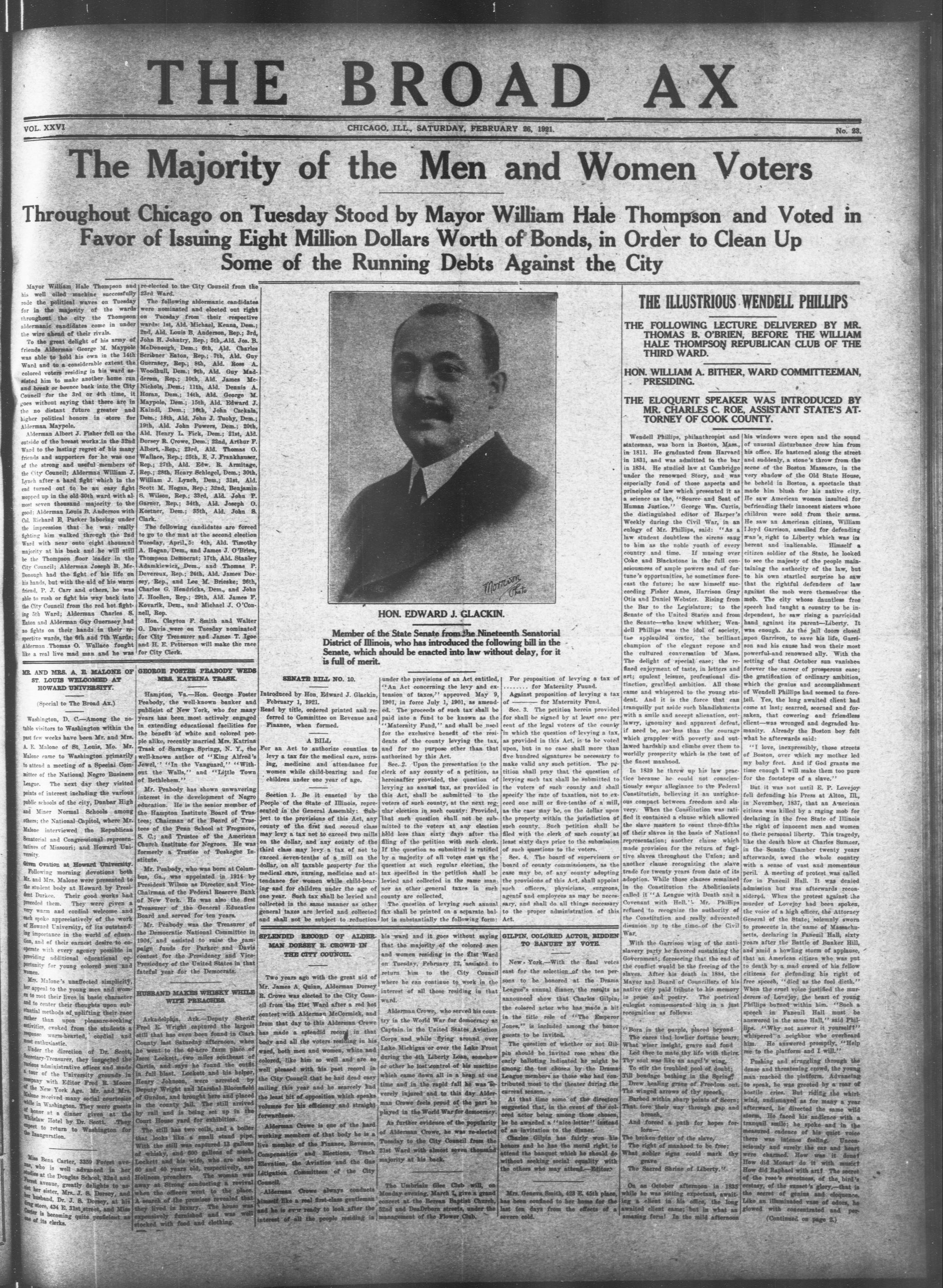
The Majority of the Men and Women Voters
Throughout Chicago on Tuesday Stood by Mayor William Hale Thompson and Voted in Favor of Issuing Eight Million Dollars Worth of Bonds, in Order to Clean Up Some of the Running Debts Against the City
Mayor William Hale Thompson and his well oiled machine successfully rode the political waves on Tuesday for in the majority of the wards throughout the city the Thompson aldermanic candidates come in under the wire ahead of their rivals.
To the great delight of his army of friends Alderman George M. Maypole was able to hold his own in the 14th Ward and to a considerable extent the colored voters residing in his ward assisted him to make another home run and break or bounce back into the City Council for the 3rd or 4th time, it goes without saying that there are in the no distant future greater and higher political honors in store for Alderman Maypole.
Alderman Albert J. Fisher fell on the outside of the breast works in the 32nd Ward to the hastening regret of his many friends and supporters for he was one of the strong and useful members of the City Council; Aldermaa William J. Lynch after a hard fight which in the end turned out to be an easy fight mopped up in the old 304th ward with almost seven thousand majority to the good; Aldermaa Louis B. Anderson with Col. Richard E. Parker laboring under the impression that he was really fighting him walked through the 2nd Ward with near onto eight thousand majority at his back and he will still be the Thompson floor leader in the City Council; Aldermaa Joseph B. McDonough had the fight of his life on his hands, but with the aid of his warm friend, P. J. Carr and others, he was able to rush or fight his way back into the City Council from the red hot fighting Aldermaa Charles S. Eaton and Alderman Guy Guernsey had no fights on their hands in their respective wards, the 6th and 7th Wards; Alderman Thomas O. Wallace fought like a real live mad man and he was
(Special to The Broad Ax.)
Washington, D. C.—Among the notable visitors to Washington within the past few weeks have been Mr. and Mrs. A. E. Malone of St. Louis, Mo. Mr. Malone came to Washington primarily to attend a meeting of a Special Committee of the National Negro Business League. The next day they visited points of interest including the various public schools of the city, Dunbar High and Miner Normal Schools among others; the National Capitol, where Mr. Malone interviewed the Republican Senatorial and Congressional representatives of Missouri; and Howard University.
Given Ovation at Howard University, Following morning devotions both Mr. and Mrs. Malone were presented to the student body at Howard by President Durkee. Their good works had preceded them. They were given a very warm and cordial welcome and each spoke appreciatively of the work of Howard University, of its outstanding importance in the world of education, and of their earnest desire to cooperate with every agency possible in providing additional educational opportunity for young colored men and women.
Mrs. Malone's unaffected simplicity, her appeal to the young men and women to root their lives in basic character and to center their thoughts upon substantial methods of uplifting their race rather than upon pleasure-seeking activities, evoked from the students a response warm-hearted, cordial and most enthusiastic.
Under the direction of Dr. Scott, Secretary-Treasurer, they inspected the various administrative offices and made a tour of the University grounds in company with Editor Fred R. Moore of the New York Age. Mr. and Mrs. Malone received many social courtesies while in Washington. They were guests of honor at a dinner given at the Whitelaw Hotel by Dr. Scott. They expect to return to Washington for the Inauguration.
Miss Bena Carter, 3359 Forest avenue, who is well advanced in her studies at the Douglas School, 32nd and Forest avenue, greatly delights to assist her sister, Mrs. J. S. Dorsey, and her husband, Dr. J. S. Dorsey, at his drug store, 434 E. 31st street, and Miss Carter is becoming quite proficient as one of its clerks.
THE BROAD AX
re-elected to the City Council from the 23rd Ward.
The following aldermanic candidates were nominated and elected out right on Tuesday from their respective wards: 1st, Ald. Michael, Kenna, Dem; 2nd, Ald. Louis B. Anderson, Dem; 3rd, John H. Johatry, Rep; 5th, Ald. Jos. B. McDonough, Dem; 6th, Ald. Charles Scribner Eaton, Rep; 7th, Ald. Guy Guernsey, Rep; 8th, Ald. Ross A. Woodhull, Dem; 9th, Ald. Guy Madderon, Rep; 10th, Ald. James McNichols, Dem; 11th, Ald. Dennis A. Horan, Dem; 14th, Ald. George M. Maypole, Dem; 15th, Ald. Edward J. Kaindl, Dem; 16th, John Czekala, Dem; 18th, Ald. John J. Tuohy, Dem; 19th, Ald. John Powers, Dem; 20th, Ald. Henry L. Fick, Dem; 21st, Ald. Dorsey R. Crowne, Dem; 22nd, Arthur F. Albert, Rep; 23rd, Ald. Thomas O. Wallace, Rep; 25th, E. J. Frankhauser, Rep; 27th, Ald. Edw. R. Armitage, Rep; 28th, Henry Schlegel, Dem; 30th, William J. Lynch, Dem; 31st, Ald. Scott M. Hogan, Rep; 32nd, Benjamin S. Wilson, Rep; 33rd, Ald. John P. Garner, Rep; 34th, Ald. Joseph O. Kostner, Dem; 35th, Ald. John S. Clark.
The following candidates are forced to go to the mat at the second election Tuesday, April 5: 4th, Ald. Timothy A. Hogan, Dem, and James J. O'Brien, Thompson Democrat; 17th, Ald. Stanley Adamkiewicz, Dem, and Thomas P. Devereux, Rep; 24th, Ald. James Dorsey, Rep, and M. M. Brieske; 26th, Charles G. Hendricks, Dem, and John J. Hoellen, Rep; 29th, Ald. James F. Kovark, Dem, and Michael J. O'Connell, Rep.
Hon. Clayton F. Smith and Walter G. Davis were on Tuesday nominated for City Treasurer and James T. Igee and H. E. Petterson will make the race for City Clerk.
Hampton, Va.—Hon. George Foster Peabody, the well-known banker and publicist of New York, who for many years has been most actively engaged in extending educational facilities for the benefit of white and colored people alike, recently married Mrs. Katrina Trask of Saratoga Springs, N. Y., the well-known author of "King Alfred's Jewel." "In the Vanguard," "Without the Walls," and "Little Town of Bethlehem."
Mr. Peabody has shown unwavering interest in the development of Negro education. He is the senior member of the Hampton Institute Board of Trustees; Chairman of the Board of Trustees of the Penn School at Progmore, S. C.; and Trustee of the American Church Institute for Negroes. He was formerly a Trustee of Toskegee Institute.
Mr. Peabody, who was born at Columbus, Ga., was appointed in 1914 by President Wilson as Director and Vice-Chairman of the Federal Reserve Bank of New York. He was also the first Treasurer of the General Education Board and served for ten years.
Mr. Peabody was the Treasurer of the Democratic National Committee in 1904, and assisted to raise the campaign funds for Parker and Davis contest for the Presidency and Vice-Presidency of the United States in that fateful year for the Democrats.
HUSBAND MAKES WHISKY WHILE WIFE PREACHES.
Arkadelphia, Ark.-Deputy Sheriff Fred E. Wright captured the largest still that has even been found in Clark County last Saturday afternoon, when he went to the 40-acre farm place of Isom Lockett, two miles southeast of Curtis, and says he found the outfit in full blast. Lockett and his helper, Henry Johnson, were arrested by Deputy Wright and Marshal Bloomfield of Gusdon, and brought here and placed in the county jail. The still arrived by rail and is being set up in the Court House yard for exhibition.
The still has two coils, and a boiler that looks like a small stand pipe. With the still was captured 12 gallons of whisky, and 600 gallons of mash. Lockett and his wife, who are about 60 and 40 years old, respectively, are Holiness preacher. The woman was away at Strong conducting a revival when the officers went to the place. A search of the premises revealed that they lived in luxury. The house was extensively furnished and was well stocked with food and clothing.
Morrison
Photo
Member of the State Senate from the Nineteenth Senatorial District of Illinois, who has introduced the following bill in the Senate, which should be enacted into law without delay, for it is full of merit.
SENATE BILL NO. 10.
Introduced by Hon. Edward J. Glackin,
February 1, 1921.
Read by title, ordered printed and referred to Committee on Revenue and
Finance, when formed.
For an Act to authorize counties to levy a tax for the medical care, nursing, medicine and attendance for women while child-bearing and for children under one year of age.
Section 1. Be it enacted by the People of the State of Illinois, represented in the General Assembly: Subject to the provisions of this Act, any county of the first and second class may levy a tax not to exceed two mills on the dollar, and any county of the third class may levy a tax of not to exceed seven-tenths of a mill on the dollar, on all taxable property for the medical care, nursing, medicine and attendance for women while child-bearing and for children under the age of one year. Such tax shall be levied and collected in the same manner as other general taxes are levied and collected and shall not be subject to reduction
Two years ago with the great aid of Mr. James A. Quinn, Alderman Dorsey R. Crowe was elected to the City Council from the 21st Ward after a red hot contest with Alderman McCormiek, and from that day to this Alderman Crowe has made a splendid record in that body and all the voters residing in his ward, both men and women, white and colored, like him so well and are so well pleased with his past record in the City Council that he had dead easy sailing this year and he scarcely had the least bit of opposition which speaks volumes for his efficiency and straight forwardness.
Alderman Crowe is one of the hard working members of that body he is a live member of the Finance, Revenue, Compensation and Elections, Track Elevation, the Aviation and the Gas Litigation Committees of the City Council.
Alderman Crowe always conducts himself like a real first-class gentleman and he is ever ready to look after the interest of all the people residing in
HON. EDWARD J. GLACKIN.
under the provisions of an Act entitled, "An Act concerning the levy and extension of taxes," approved May 9, 1901, in force July 1, 1901, as amended. The proceeds of such tax shall be paid into a fund to be known as the "Maternity Fund," and shall be used for the exclusive benefit of the residents of the county levying the tax, and for no purpose other than that authorized by this Act.
Sec. 2. Upon the presentation to the clerk of any county of a petition, as hereinafter provided, the question of levying an annual tax, as provided in this Act, shall be submitted to the voters of such county, at the next regular election in such county: Provided, that such question shall not be submitted to the voters at any election held less than sixty days after the filing of the petition with such clerk. If the question so submitted is ratified by a majority of all votes cast on the question at such regular election, the tax specified in the petition shall be levied and collected in the same manner as other general taxes in such county are collected.
The question of levying such annual fax shall be printed on a separate ballot in substantially the following form:
his ward and it goes without saying that the majority of the colored men and women residing in the 21st Ward on Tuesday, February 22, assisted to return him to the City Council where he can continue to work in the interest of all those residing in that ward.
Alderman Crowe, who served his country in the World War for democracy as Captain in the United States Aviation Corps and while flying around over Lake Michigan or over the Lake Front during the 4th Liberty Loan, somehow or other he lost control of his machine which came down all in a heap at one time and in the rapid fall he was severely injured and to this day Alderman Crowe feels proud of the part he played in the World War for democracy.
As further evidence of the popularity of Alderman Crowe, he was re-elected Tuesday to the City Council from the 21st Ward with almost seven thousand majority at his back.
The Umbriain Glee Club will, on Monday evening, March 4, give a grand concert at the Beren Baptist Church, 52nd and DeaDyborn streets, under the management of the Flower Club.
For proposition of levying a tax of
..... for Maternity Fund.
Against proposition of levying a tax
of _____ for Maternity Fund.
for maternity fund.
See 3. The petition herein provided for shall be signed by at least one percent of the legal voters of the county in which the question of levying a tax as provided in this Act, is to be voted upon, but in no case shall more than five hundred signatures be necessary to make valid any such petition. The petition shall pray that the question of levying such tax shall be submitted to the voters of such county and shall specify the rate of taxation, not to exceed one mill or five-tenths of a mill, as the case may be, on the dollar upon the property within the jurisdiction of such county. Such petition shall be filed with the clerk of such county at least sixty days prior to the submission of such questions to the voters.
See 4. The board of supervisors or board of county commissioners, as the case may be, of any county adopting the provisions of this Act, shall appoint such officers, physicians, surgeons, agents and employees as may be necessary, and shall do all things necessary to the proper administration of this Act.
GILPIN, COLORED ACTOR, BIDDEN
TO BANUET BY VOTE
New·York.—With the final votes cast for the selection of the ten persons to be honored at the Drama League's annual dinner, the results as announced show that Charles Gilpin the colored actor who has made a hit in the title role of "The Emperor Jones," is included among the honor guests to be invited.
The question of whether or not Gilpin should be invited rose when the early balloting indicated he might be among the ten chosen by the Drama League members as those who had contributed most to the theater during the current season.
At that time some of the directors suggested that, in the event of the colored actor being among those chosen, he be awarded a "nice letter" instead of an invitation to the dinner.
Charles Gilpin has fairly won his honors and he has the moral right to attend the banquet which he should do without seeking social equality with the others who may attend—Editor.
Mrs. Genoa Smith, 433 E. 45th place, has been confined to her home for the last ten days from the effects of a severe cold.
THE ILLUSTRIOUS WENDELL PHILLIPS
THE FOLLOWING LECTURE DELIVERED BY MR. THOMAS B. O'BRIEN, BEFORE THE WILLIAM HALE THOMPSON REPUBLICAN CLUB OF THE THIRD WARD.
HON. WILLIAM A. BITHER, WARD COMMITTEEMAN, PRESIDING.
THE ELOQUENT SPEAKER WAS INTRODUCED BY MR. CHARLES C. ROE, ASSISTANT STATE'S ATTORNEY OF COOK COUNTY.
Wendell Phillips, philanthropist and statesman, was born in Boston, Mass., in 1811. He graduated from Harvard in 1831, and was admitted to the bar in 1834. He studied law at Cambridge under the renowned Story, and was especially fond of those aspects and principles of law which presented it as a science as the, "Source and Seat of Human Justice." George Wm. Curtis, the distinguished editor of Harper's Weekly during the Civil War, in an enology of Mr. Phillips, said: "As a law student doubtless the sirens sang to him as the noble youth of every country and time. If musing over Coke and Blackstone in the full consciousness of ample powers and of fortune's opportunities, he sometimes forecast the future; he saw himself succeeding Fisher Ames, Harrison Gray Otis and Daniel Webster. Rising from the Bar to the Legislature; to the Senate of the United States and from the Senate—who knew whither; Wendell Phillips was the idol of society, the applauded orator, the brilliant champion of the elegant repose and the cultured conversation of Mass. The delight of special ease; the refined enjoyment of taste, in letters and art; opulent leisure, professional distinction, gratified ambition. All these came and whispered to the young student. And it is the force that can tranquilly put aside such blandishments with a smile and accept alienation, outlawry, ignominy and apparent defeat, if need be, no less than the courage which grapples with poverty and outlawed hardship and climbs over them to worldly prosperity which is the test of the finest manhood.
In 1839 he threw up his law practice because he could not conscieniously swear allegiance to the Federal Constitution, believing it an unrighteous compact between freedom and slavery. When the Constitution was ratified it contained a clause which allowed the slave masters to count three-fifths of their slaves in the basis of National representation; another clause which made provision for the return of fugitive slaves throughout the Union; and another clause recognizing the slave trade for twenty years from date of its adoption. While those clauses remained in the Constitution the Abolitionists called it "A League with Death and a Covenant with Hell." Mr. PhilHips refused to recognize the authority of the Constitution and really advocated disunion up to the time of the Civil War.
With the Garrison wing of the anti-slavery party he favored sustaining the Government; foreseeing that the end of the conflict would be the freeing of the slaves. After his death in 1884, the Mayor and Board of Councillors of his native city paid tribute to his memory in prose and poetry. The poetical eulogist commemorated hip in a just recognition as follows:
his windows were open and the sound of unusual disturbance drew him from his office. He hastened along the street and suddenly, a stone's throw from the scene of the Boston Massacre, in the very shadow of the Old State House, he beheld in Boston, a spectacle that made him blush for his native city. He saw American women insulted for befriending their innocent sisters whose children were sold from their arms. He saw an American citizen, William Iloyd Garrison, assailed for defending man's right to Liberty which was inherent and inalienable. Himself a citizen soldier of the State, he looked to see the majesty of the people maintaining the authority of the law, but to his own startled surprise he saw that the rightful defenders of law against the mob were themselves the mob. The city whose dauntless free speech had taught a country to be independent, he saw rising a parricidal hand against its parent—Liberty. It was enough. As the jail doors closed upon Garrison, to save his life, Garrison and his cause had won their most powerful and renowned ally. With the setting of that October sun vanisheer forever the career of prosperous ease; the gratification of ordinary ambition, which the genius and accomplishment of Wendell Phillips had seemed to foretell. Yes, the long awaited client had come at last; scarred, scorned and forsaken, that cowering and friendless client—was wronged and degraded humanity. Already the Boston boy felt what he afterwards said:
"I love, inexpressibly, those streets of Boston, over which my mother led my baby feet. And if God grants me time enough I will make them too pure for the footsteps of a slave."
But it was not until E. P. Lovejoy fell defending his Press at Alton, III, in November, 1837, that an American citizen was killed by a raging mob for declaring in the free State of Illinois the right of innocent men and women to their personal liberty. This tragedy, like the death blow at Charles Sumner, in the Senate Chamber twenty years afterwards, awed the whole country with a sense of vast and momentous peril. A meeting of protest was called for in Faneuil Hall. It was denied admission but was afterwards reconsidered. When the protest against the murder of Lovejoy had been spoken, the voice of a high officer, the Attorney General of the State; solemnly sworn to prosecute in the name of Massachusetts, declaring in Faneuil Hall, sixty years after the Battle of Bunker Hill, and amid a howling storm of applause, that an American citizen who was put to death by a mad crowd of his fellow citizens for defending his right of free speech, "died as the fool dieth." When the cruel voice justified the murders of Lovejoy, the heart of young Phillips burned within him. "Such a speech in Faneuil Hall must be answered in the same Hall," said Phillips. "Why not answer it yourself?" whispered a neighbor who overheard him. He answered promptly, "Help me to the platform and I will."
Pushing and struggling through the dense and threatening crowd, the young man reached the platform. Advancing to speak, he was greeted by a rear of hostile cries. But riding the whirlwind, undismayed as for many a year afterward, he directed the same wild storm. He faced his audience with a tranquil smile; he spoke and in the measured evidence of his quiet voice there was intense feeling. Unconciously and surely the ear and heart were chamed. How was it donet How did Mozart do it with music? How did Raphael with art? The secret of the rose's sweetness, of the bird's ecstasy, of the sunset's glory—that is the secret of genius and eloquence. Like an illuminated vase of odors, he glowed with concentrated and par- (Continued on page 2.)
M.
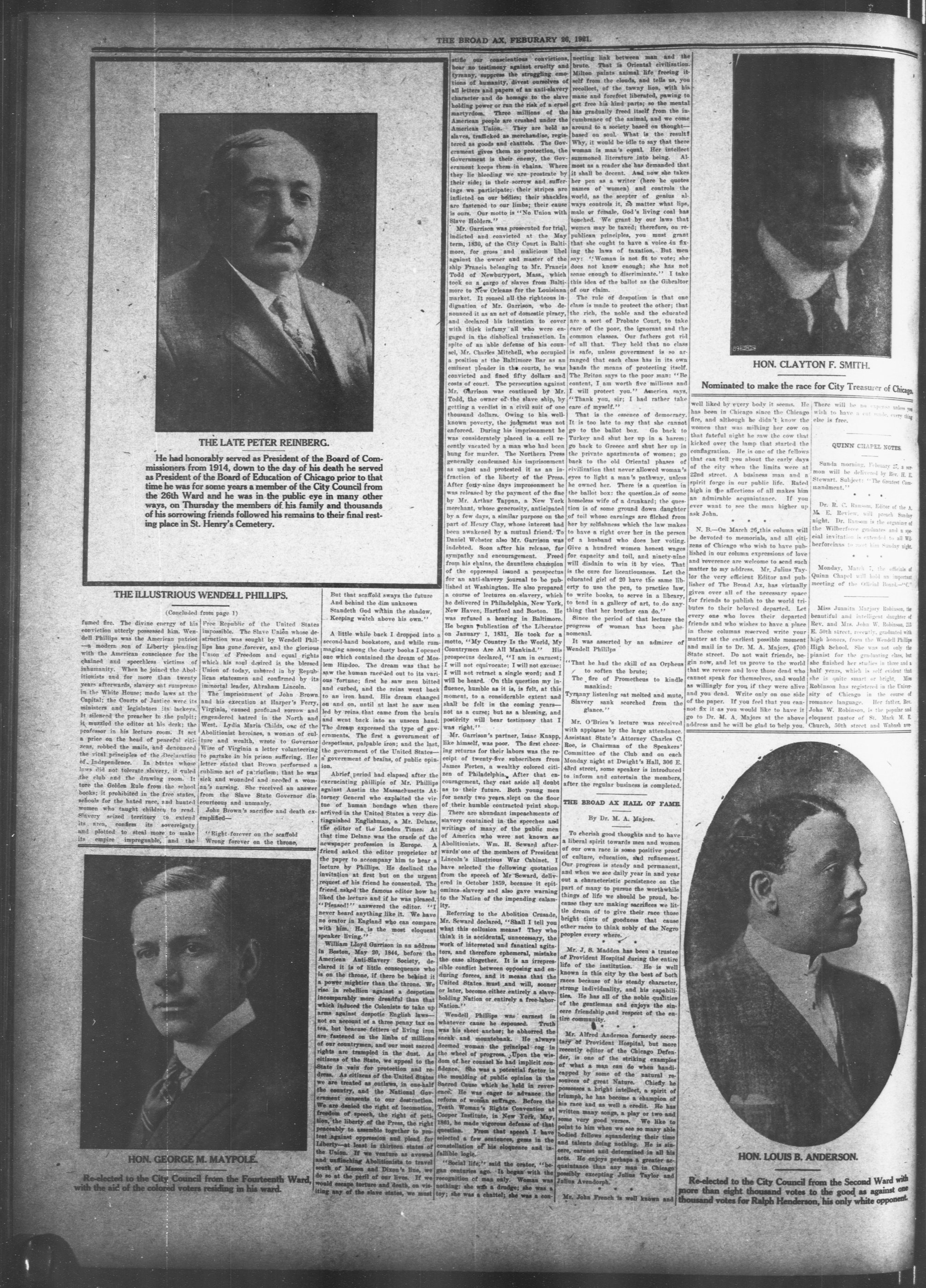
He had honorably served as President of the Board of Commissioners from 1914, down to the day of his death he served as President of the Board of Education of Chicago prior to that time he was for some years a member of the City Council from the 26th Ward and he was in the public eye in many other ways, on Thursday the members of his family and thousands of his sorrowing friends followed his remains to their final resting place in St. Henry's Cemetery.
THE ILLUSTRIOUS WENDELL PHILLIPS.
1
fumed fire. The divine energy of his conviction utterly possessed him. Wendell Phillips was the American patriot—a modern son of Liberty pleading with the American conscience for the chained and speechless victims of inhumanity. When he joined the Abolitionists and for more than twenty years afterwards, slavery sat supreme in the White House; made laws at the Capital; the Courts of Justice were its ministers and legislators its lackeys. It silenced the preacher in the pulpit; it muzzled the editor at his desk; the professor in his lecture room. It set a price on the head of peaceful citizens, robbed the mails, and denounced the vital principles of the Declaration of Independence. In States whose laws did not tolerate slavery, it ruled the club and the drawing room. It tore the Golden Rule from the school books; it prohibited in the free states, schools for the hated race, and hunted women who taught children to read. Slavery seized territory to extend its area, confirm its sovereignty and plotted to steal more to make its empire impregnable, and the
THE LATE PETER REINBERG.
honorably served as President of the Bom from 1914, down to the day of his de of the Board of Education of Chicago for some years a member of the City and he was in the public eye in Thursday the members of his family a long friends followed his remains to t. Henry's Cemetery.
WENDELL PHILLIPS.
from page 1)
Free Republic of the United States impossible. The Shave Union whose destruction was sought by Wendell Phillips has gone forever, and the glorious Union of Freedom and equal rights which his soul desired is the blessed Union of today, ushered in by Republican statesmen and confirmed by its immortal leader, Abraham Lincoln.
The imprisonment of John Brown and his execution at Harper's Ferry Virginia, caused profound sorrow and engendered hatred in the North and West. Lydia Maria Childs, one of the Abolitionist heroines, a woman of culture and wealth, wrote to Governor Wise of Virginia a letter volunteering to partake in his prison suffering. Her letter stated that Brown performed a sublime act of patriotism; that he was sick and wounded and needed a woman's nursing. She received an answer from the Slave State Governor discoureous and unmanly. John Brown's sacrifice and death.
John Brown's sacrifice and death exemplified—
"Eight forever on the scaffold
Wrong forever on the throne,
But that scaffold sways the future
And behind the dim unknown
Standeth God within the shadow,
Keeping watch above his own."
A little while back I dropped into a second-hand bookstore, and while rumaging among the dusty books I opened one which contained the dream of Moslem Hindeo. The dream was that he saw the human race led out to its various fortune; first he saw men bitten and curbed, and the reins went back to an iron hand. His dream changed on and on, until at last he saw men led by reins that came from the brain and went back into an unseen hand. The dream expressed the type of governments. The first a government of despotisms, palpable iron; and the last, the government of the United States—a government of brains, of public opinion.
Abriet period had elapsed after the excerciation phillipie of Mr. Phillips against Austin the Massachusetts Attorney General who exploited the virtue of human bondage when there arrived in the United States a very distinguished Englishman, a Mr. Delaney the editor of the London Times. At that time Delaney was the oracle of the newspaper profession in Europe. A friend asked the editor proprietor of the paper to accompany him to hear a lecture by Phillips. He declined the invitation at first but on the urgent request of his friend he consented. The friend asked the famous editor how he liked the lecture and he was pleased. "Pleased!" answered the editor. "I never heard anything like it. We have no orator in England who can compare with him. He is the most eloquent speaker living."
William Lloyd Garrison in an address in Boston, May 20, 1844, before the American Anti-Slavery Society, declared it is of little consequence who is on the throne, if there be behind it a power mightier than the throne. We rise in rebellion against a despotism incomparably more dreadful than that which induced the Colonists to take up arms against despotic English laws—not on account of a three penny tax on tea, but because fetters of living iron are fastened on the limbs of millions of our countrymen, and our most sacred rights are trampled in the dust. As citizens of the State, we appeal to the State in vain for protection and redress. As citizens of the United States we are treated as outlaws, in one-half the country, and the National Government consents to our destruction. We are denied the right of locomotion, freedom of speech, the right of petition, the liberty of the Press, the right peacefully to assemble together to protest against oppression and plead for Liberty—at least in thirteen states of the Union. If we venture as avowed and unfinishing Abolitionists to travel south of Mason and Dixon's line, we do so at the peril of our lives. If we would escape torture and death, on visiting any of the slave states, we must
THE BROAD AX. FEBURARY 26, 1921.
Mr. J. S. Madden has been a trustee of Provident Hospital during the entire life of the institution. He is well known in this city by the best of both races because of his steady character, strong individuality, and his capabilities. He has all of the noble qualities of the gentleman and enjoys the sincere friendship and respect of the entire community.
Mr. Alfred Anderson formerly secretary of Provident Hospital, but more recently editor of the Chicago Defender, is one of the striking examples of what a man can do when handicapped by some of the natural resources of great Nature. Chiefly he possesses a bright intellect, a spirit of triumph, he has become a champion of his race and as well a credit. He has written many songs, a play or two and some very good verses. We like to point to him when we see so many able bodied fellows squandering their time and talents doing nothing. He is sincere, earnest and determined in all his acts. He enjoys perhaps a greater acquaintance than any man in Chicago possibly excepting Julius Taylor and Julius Avandorph.
Mr. John French is well known and
stifle our conscientious convictions bear no testimony against cruelty and tyranny, suppress the struggling emotions of humanity, divest ourselves of all letters and papers of an anti-slavery character and do homage to the slave holding power or run the risk of a cruel martyrdom. Three millions of the American people are crushed under the American Union. They are held as slaves, trafficked as merchandise, registered as goods and chattels. The Government gives them no protection, the Government is their enemy, the Government keeps them in chains. Where they lie bleeding we are-prostrate by their side; in their sorrow and sufferings we participate; their stripes are inflicted on our bodies; their shackles are fastened to our limbs; their cause is ours. Our motto is "No Union with Slave Holders."
Mr. Garrison was prosecuted for trial indicted and convicted at the May term, 1830, of the City Court in Balti more, for gross and malicious libe against the owner and master of the ship Francis belonging to Mr. Francis Todd of Newburyport, Mass., which took on a cargo of slaves from Balti more to New Orleans for the Louisiana market. It roused all the righteous in dignation of Mr. Garrison, who denounced it as an act of domestic piracy and declared his intention to cover with thick infamy all who were engaged in the diabolical transaction. In spite of an able defense of his counsel, Mr. Charles Mitchell, who occupied a position at the Baltimore Bar as an eminent pleader in the courts, he was convicted and fined fifty dollars and costs of court. The persecution against Mr. Garrison was continued by Mr. Todd, the owner of the slave ship, by getting a verdict in a civil suit of one thousand dollars. Owing to his well-known poverty, the judgment was not enforced. During his imprisonment he was considerably placed in a cell recently vacated by a man who had been hung for murder. The Northern Press generally condemned his imprisonment as unjust and protested it as an infraction of the liberty of the Press. After forty-nine days imprisonment he was released by the payment of the fine by Mr. Arthur Tappan, a New York merchant, whose generosity, anticipated by a few days, a similar purpose on the part of Henry Clay, whose interest had been awakened by a mutual friend. To Daniel Webster also Mr. Garrison was indebted. Soon after his release, for sympathy and encouragement. Freed from his chains, the dauntless champion of the oppressed issued a prospectus for an anti-slavery journal to be published at Washington. He also prepared a course of lectures on slavery, which he delivered in Philadelphia, New York, New Haven, Hartford and Boston. He was refused a hearing in Baltimore. He began publication of the Liberator on January 1, 1831. He took for a motto, "My Country Is the World, My Countrymen Are All Mankind." His prospectus declared, "I am in earnest; I will not equivocate; I will not excuse; I will not retract a single word; and I will be heard. On this question my influence, humble as it is, is felt, at this moment, to a considerable extent and shall be felt in the coming years—not as a curse; but as a blessing, and postity will bear testimony that I was right."
Mr. Garrison's partner, Isaac Knapp, like himself, was poor. The first cheerful returns for their labors was the receipt of twenty-five subscribers from James Forten, a wealthy colored citizen of Philadelphia. After that encouragement, they cast aside all doubles as to their future. Both young men for nearly two years slept on the floor of their humble contracted print shop. There are abundant impeachments of slavery contained in the speeches and writings of many of the public men of America who were not known as Abolitionists. Wm. H. Seward afterwards one of the members of President Lincoln's illustrious War Cabinet. I have selected the following quotation from the speech of Mr Seward, delivered in October 1859, because it epitomizes slavery and also gave warning to the Nation of the impending calamity.
Referring to the Abolition Crusade Mr. Seward declared, "Shall I tell you what this collusion means? They who think it is accidental, unnecessary, the work of interested and fanatical agitators, and therefore ephemeral, mistake the case altogether. It is an irrepressible conflict between opposing and enduring forces, and it means that the United States must and will, sooner or later, become either entirely a slave-holding Nation or entirely a free-labor-Nation."
Wendell, Phillips was earnest in whatever cause he espoused. Truth was his sheet anchor; he aborbed the snake and mountebank. He always deemed woman the principal cog in the wheel of progress. Upon the wisdom of her counsel he had implicit confidence. She was a potential factor in the moulding of public opinion in the Sacred Cause which he held in reverence. He was eager to advance the reform of woman suffrage. Before the Tenth Woman's Rights Convention at Cooper Institute, in New York, May, 1861, he made vigorous defense of that question. From that speech I have selected a few sentences, gems in the constellation of his eloquence and infallible logic.
"Social life," said the orator, "began centuries ago. It began with the recognition of man only. Woman was nothing; she was a drudge; she was a toy; she was a woman; she was a con-
neeting link between man and the brute. That is Oriental civilization. Milton pennants animal life freeing itself from the clouds, and tells us, you recollect, of the tawny lion, with his mane and forefeet liberated, pawing to get free his hind parts; so the mental has gradually freed itself from the incumbance of the animal, and we come around to a society based on thought—based on soul. What is the result? Why, it would be idle to say that there woman is man's equal. Her intellect summoned literature into being. Almost as a reader she has demanded that it shall be decent. And now she takes her pen as a writer (here he quotes names of women) and controls the world, as the scepter of genius always controls it, no matter what lips, male or female, God's living coal has toned. We grant by our laws that women may be taxed; therefore, on republican principles, you must grant that she ought to have a voice in fixing the laws of taxation. But men say: "Woman is not fit to vote; she does not know enough; she has not sense enough to discriminate." I take this idea of the ballot as the Gibraltar of our claim.
The rule of despotism is that one class is made to protect the other; that the rich, the noble and the educated are a sort of Probate Court, to take care of the poor, the ignorant and the common classes. Our fathers got rid of all that. They held that no class is safe, unless government is so arranged that each class has in its own hands the means of protecting itself. The Briton says to the poor man: "Be content, I am worth five millions and I will protect you." America says, "Thank you, sir; I had rather take care of myself."
That is the essence of democracy. It is too late to say that she cannot go to the ballot box. Go back to Turkey and shut her up in a harem; go back to Greece and shut her up in the private apartments of women; go back to the old Oriental phases of civilization that never allowed woman's eyes to light a man's pathway, unless he owned her. There is a question in the ballot box: the question_is of some homeless wife of a drunkard; the question is of some ground down daughter of toil whose earnings are filched from her by selfishness which the law makes to have a right over her in the person of a husband who does her voting. Give a hundred women honest wages for capacity and toil, and ninety-nine will disdain to win it by vice. That is the cure for licentiousness. Let the educated girl of 20 have the same liberty to use the pen, to practice law, to write books, to serve in a library, to tend in a gallery of art, to do anything that her brother can do."
Since the period of that lecture the progress of woman has been phenomenal.
It was asserted by an admirer of Wendell Phillips
"That he had the skill of an Orpheus to soften the brute;
The fire of Prometheus to kindle mankind:
Tyranny listening sat melted and muted. Slainy sank scorched from the glance. "Mr. O'Brien's lecture was received with applause by the large attendance. Assistant State's Attorney Charles C. Roe, is chairman of the Speakers' Committee of the Club and on each Monday night at Dwight's Hall, 306 E. 43rd street, some speaker is introduced to inform and entertain the members, after the regular business is completed.
THE BROAD AX HALL OF FAME
To cherish good thoughts and to have a liberal spirit towards men and women of our own race is some positive proof of culture, education, and refinement. Our progress is steady and permanent, and when we see daily year in and year out a characteristic persistence on the part of many to pursue the worthwhile things of life we should be proud, because they are making sacrifices we little dream of to give their race those bright tints of goodness that cause other races to think nobly of the Negro peoples everywhere.
89
HON. CLAYTON F. SMITH.
well liked by every body it seems. He has been in Chicago since the Chicago fire, and although he didn't know the women that was milking her cow on that fateful night he saw the cow that kicked over the lamp that started the conflagration. He is one of the fellows that can tell you about the early days of the city when the limits were at 22nd street. A business man and a spirit forge in our public life. Rated high in the affections of all makes him an admirable acquaintance. If you ever want to see the man higher up ask John.
. . .
N. B.—On March 26, this column will be devoted to memorials, and all citizens of Chicago who wish to have published in our column expressions of love and reverence are welcome to send such matter to my address. Mr. Julius Taylor the very efficient Editor and publisher of The Broad Ax, has virtually given over all of the necessary space for friends to publish to the world tributes to their beloved departed. Let every one who loves their departed friends and who wishes to have a place in these columns reserved write your matter at the earliest possible moment and mail in to Dr. M. A. Majors, 4700 State street. Do not wait friends, begin now, and let us prove to the world that we revere and love those dead who cannot speak for themselves, and would as willingly for you if they were alive and you dead. Write only on one side of the paper. If you feel that you cannot fix it as you would like to have it go to Dr. M. A. Majors at the above address and he will be glad to help you.
```markdown
```
[Name]
HON. LOUIS B. ANDERSON
Re-elected to the City Council from the Sec
more than eight thousand votes to the good
thousand votes for Ralph Henderson, his only w
to the City Council from the Second
thousand votes to the good as
for Ralph Henderson, his only whit
Re-elected to the City Council from the Second Ward with more than eight thousand votes to the good as against one thousand votes for Ralph Henderson, his only white opponent.
There will be no expense unless you wish to have a cut smile, every thing else is free.
QUINN CHAPEL NOTES
Sunda morning, February 27, a sermon will be delivered by Rev. H. E. Stewart. Subject: "The Greatest Commandment."
Dr. R. C. Ransom, Editor of the A. M. E. Review, will preach Sunday night. Dr. Ransom is the organizer of the Wilberforce graduates and a special invitation is extended to all Wilberforceans to meet him Sunday night
Monday, March 7, the officials of Quinn Chapel will hold an important meeting of the Official Board-"C
Miss Juannita Marjory Robinson, the beautiful and intelligent daughter of Rev. and Mrs. John W. Robinson, 215 E. 50th street, recently, graduated with high honors, from the Wendell Phillips High School. She was not only the pianist for the graduating class, but she finished her studies in three and a half years, which is self evident that she is quite smart or bright. Miss Robinson has registered in the University of Chicago in the course of romance language. Her father, Rev. John W. Robinson, is the popular and eloquent pastor of St. Mark M. E. Church, 50th street and Wabash ave.
```markdown
```
from the Second Ward with to the good as against one on, his only white opponent.
. . .
1920 94
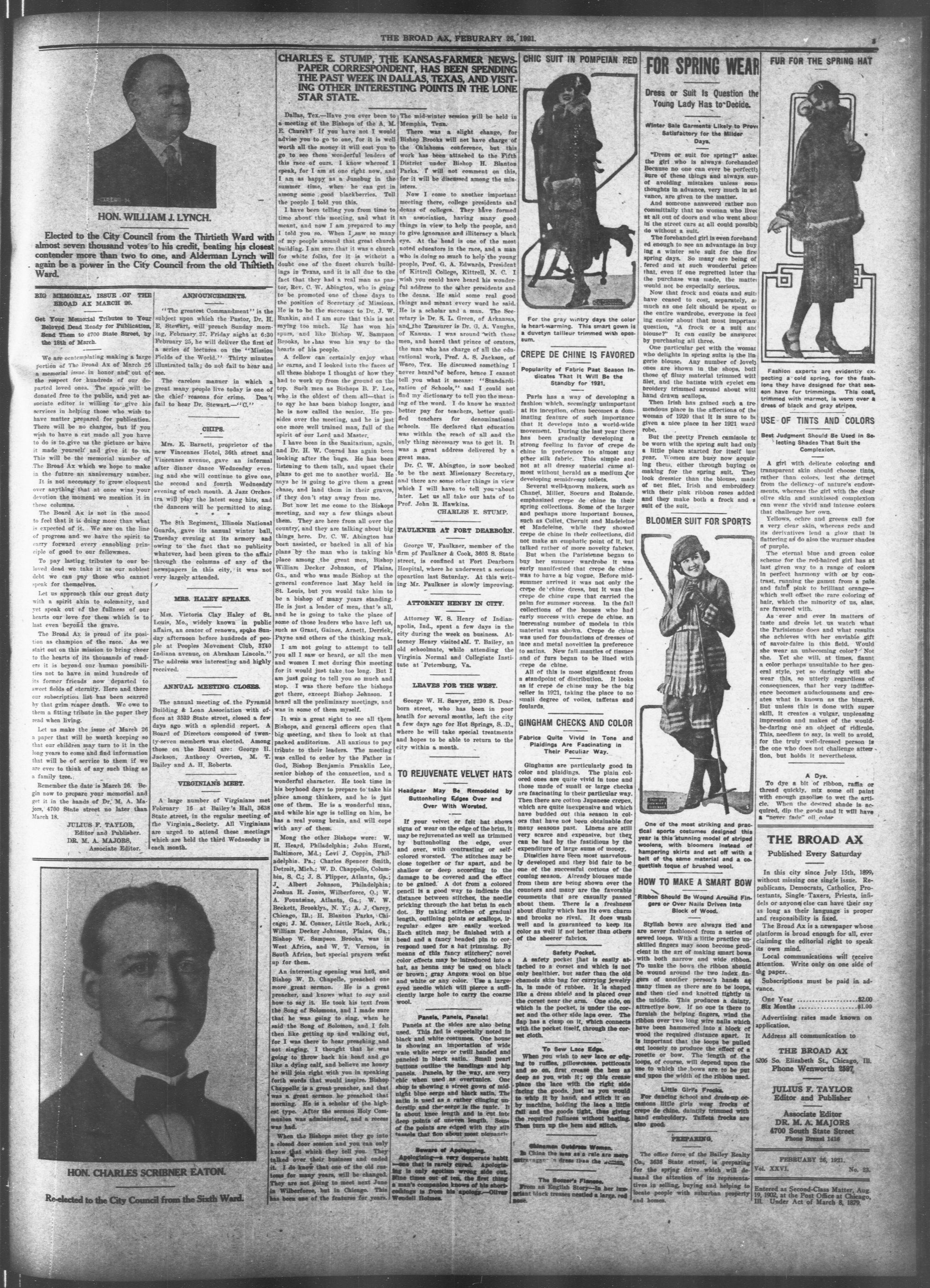
HON. WILLIAM J. LYNCH.
Elected to the City Council from the Thirtieth Ward with almost seven thousand votes to his credit, beating his closest contender more than two to one, and Alderman Lynch will again be a power in the City Council from the old Thirtieth Ward.
BIG MEMORIAL ISSUE OF THE BROAD AX MARCH 26.
Get Your Memorial Tributes to Your Beloved Dead Ready for Publication, Send Them to 4700 State Street, by the 18th of March.
ANNOUNCEMENTS.
"The greatest Commandment" is the subject upon which the Pastor, Dr. H. E. Stewart, will preach Sunday morning, February 27. Friday night at 6:30 February 25, he will deliver the first of
We are contemplating making a large portion of The Broad Ax of March 26 a memorial issue in honor and out of the respect for hundreds of our departed loved ones. The space will be donated free to the public, and yet associate editor is willing to give his services in helping those who wish to have matter prepared for publication. There will be no charges, but if you wish to have a cut made all you have to do is to give us the picture or have it made yourself and give it to us. This will be the memorial number of The Broad Ax which we hope to make in the future an anniversary number. It is not necessary to grow eloquent over anything that at once wins your devotion the moment we mention it in these columns.
The Board Ax is not in the mood to feel that it is doing more than what is expected of it. We are on the line of progress and we have the spirit to carry forward every ennobling principle of good to our fellowmen.
To pay lasting tributes to our beloved dead we take it as our noblest debt we can pay those who cannot speak for themselves.
Let us approach this our great duty with a spirit akin to solemnity, and yet speak out of the fullness of our hearts our love for them which is to last even beyond the grave.
The Broad Ax is proud of its position as champion of the race. As we start out on this mission to bring cheer to the hearts of its thousands of readers it is beyond our human possibilities not to have in mind hundreds of its former friends now departed to sweet fields of eternity. Here and there our subscription list has been scarred by that grim reaper death. We owe to them a fitting tribute in the paper they read when living.
Let us make the issue of March 26 a paper that will be worth keeping so that our children may turn to it in the long years to come and find information that will be of service to them if we are ever to think of any such thing as a family tree.
Remember the date is March 26. Begin now to prepare your memorial and get it in the hands of Dr. M. A. Majors, 4700 State street no later than March 18.
JULIUS F. TAYLOR,
Editor and Publisher.
DR. M. A. MAJORS,
Associate Editor.
J.
ail from the Thirtieth Ward with to his credit, beating his closest one, and Alderman Lynch will Council from the old Thirtieth
ANNOUNCEMENTS
"The greatest Commandment" is the subject upon which the Pastor, Dr. H. E. Stewart, will preach Sunday morning, February 27. Friday night at 6:30 February 25, he will deliver the first of a series of lectures on the "Mission Fields of the World." Thirty minutes illustrated talk; do not fail to hear and see.
The careless manner in which a great many people live today is one of the chief reasons for crime. Don't fail to hear Dr. Stewart."
Mrs. E. Barnett, proprietor of the new Vincennes Hotel, 36th street and Vincennes avenue, gave an informal after dinner dance Wednesday evening and she will continue to give one, the second and fourth Wednesday evening of each month. A Jazz Orchestra will play the latest song hits, and the dancers will be permitted to sing.
The 8th Regiment, Illinois National Guards, gave its annual winter ball. Tuesday evening at its armory and owing to the fact that no publicity whatever, had been given to the affair through the columns of any of the newspapers in this city, it was not very largely attended.
MRS. HALEY SPEAKS
Mrs. Victoria Clay Haley of St. Louis, Mo., widely known in public affairs, an orator of renown, spike Sunday afternoon before hundreds of people at Peoples Movement Club, 3140 Indiana avenue, on Abraham Lincoln. "The address was interesting and highly received.
ANNUAL MEETING CLOSES.
The annual meeting of the Pyramid Building & Loan Association with offices at 3539 State street, closed a few days ago with a splendid report. A Board of Directors composed of twenty-seven members was elected. Among those on the Board are: George H. Jackson, Anthony Overton, M. T. Bailey and A. H. Roberts.
VIRGINIANS MEET
A large number of Virginians met February 16 at Bailey's Hall, 3638 State street, in the regular meeting of the Virginia_Society. All Virginians are urged to attend these meetings which are held the third Wednesday in each month.
CHIPS
CHARLES E. STUMP, THE KANSAS-FARMER NEWS-PAPER CORRESPONDENT, HAS BEEN SPENDING THE PAST WEEK IN DALLAS, TEXAS, AND VISITING OTHER INTERESTING POINTS IN THE LONE STAR STATE.
Dallas, Tex.—Have you ever been to a meeting of the Bishops of the A. M. E. Church? If you have not I would advise you to go to one, for it is well worth all the money it will cost you to go to see these wonderful leaders of this race of ours. I know whereof I speak, for I am at one right now, and I am as happy as a Junebug in the summer time, when he can get in among some good blackberries. Tell the people I told you this.
The mid-winter session will be held in Memphis, Tenn.
There was a slight change, for Bishop Brooks will not have charge of the Oklahoma conference, but this work has been attached to the Fifth District under Bishop H. Blanton Parks. I will not comment on this, for it will be discussed among the ministers.
Now I come to another important meeting there, college presidents and
I have been telling you from time to time about this meeting, and what it meant, and now I am prepared to say I told you so. When I saw so many of my people around that great church building, I am sure that it was a church for white folks, for it is without a doubt one of the finest church buildings in Texas, and it is all due to the fact that they had a real man as pastor, Rev. C. W. Abington, who is going to be promoted one of these days to the position of Secretary of Missions. He is to be the successor to Dr. J. W. Rankin, and I am sure that this is not saying too much. He has won his spurs, and like Bishop W. Sampson Brooks, he has won his way to the hearts of his people.
A fellow can certainly enjoy what he earns, and I looked into the faces of all these bishops I thought of how they had to work up from the ground on the top. Such men as Bishops B. F. Lee, who is the oldest of them all—that is to say he has been bishop longer, and he is now called the senior. He presides over the meeting, and he is just one more well trained man, full of the spirit of our Lord and Master.
I have been in the Sanitarium, again, and Dr. H. W. Conrad has again been looking after the bugs. He has been listening to them talk, and upset their plans to get me to another world. He says he is going to give them a great chase, and land them in their grenues, if they don't stay away from me.
But now let me come to the Bishops meeting, and say a few things about them. They are here from all over the country, and they are talking about big things here. Dr. C. W. Abington has been assisted, or backed in all of his plans by the man who is taking his place among the great men, Bishop William Decker Johnson, of Plains, Ga., and who was made Bishop at the general conference last May held in St. Louis, but you would take him to be a bishop of many years standing. He is just a leader of men, that's all, and he is going to take the place of some of those leaders who have left us, such as Grant, Gaines, Arnett, Derrick, Payne and others of the thinking rank.
I am not going to attempt to tell you all I saw or heard, or all the men and women I met during this meeting for it would just take too long. But I am just going to tell you so much and stop. I was there before the bishops got there, except Bishop Johnson. I heard all the preliminary meetings, and was in some of them myself.
It was a great sight to see all them Bishop, and general officers open that big meeting, and then to look at that packed auditorium. All anxious to pay tribute to their leaders. The meeting was called to order by the Father in God, Bishop Benjamin Franklin Lee, senior bishop of the connection, and a wonderful character. He took time in his boyhood days to prepare to take his place among thinkers, and he is just one of them. He is a wonderful man, and while his age is telling on him, he has a real young brain, and will cope with any of them.
Mong the other Bishops were: W. H. Heard, Philadelphia; John Hurst, Baltimore, Md.; Levi J. Coppin, Philadelphia. Pa.; Charles Spencer Smith, Detroit, Mich.; W. D. Chappelle, Columbia, S. C.; J. S. Flipper, Atlanta, Ga.; J. Albert Johnson, Philadelphia; Joshua H. Jones, Wilberforce, O.; W. A. Fountaine, Atlants, Ga.; W. W. Beckett, Brooklyn, N. Y.; A. J. Carey, Chicago, Ill.; H. Blanton Parks, Chicago; J. M. Conner, Little Rock, Ark.; William Decker Johnson, Plains, Ga.; Bishop W. Sampson Brooks, was in West Africa, and W. T. Vernon, in South Africa, but special prayers went up for them.
An interesting opening was hud, and Bishop W. D. Chapelle, preached one more great sermon. He is a great preacher, and knows what to say and how to say it. He took his text from the Song of Solomons, and I made sure that he was going to sing, when he said the Song of Solomons, and I felt then like getting up and walking out, for I was there to hear preaching and not singing. I thought that he was going to throw back his head and go like a dying calf, and believe me honey he will join right with you in speaking forth words that would inspire. Bishop Chappelle is a great preacher, and that was a great sermon he preached that morning. He is a scholar of the highest type. After the sermon Holy Communion was administered, and a recess was had.
When the Bishops meet they go into a closed door session and you can only know that which they tell you. They talked over their business and ended it. I do know that one of the old customs for many years, will be changed. They are not going to meet next June in Wilberforce, but in Chicago. This has been one of the features for years.
THE BROAD AX. FEBURARY 26, 1921
The mid-winter session will be held in Memphis, Tenn.
There was a slight change, for Bishop Brooks will not have charge of the Oklahoma conference, but this work has been attached to the Fifth District under Bishop H. Blanton Parks. I will not comment on this, for it will be discussed among the ministers.
Now I come to another important meeting there, college presidents and deans of colleges. They have formed an association, having many good things in view to help the people, and to give ignorance and illiteracy a black eye. At the head is one of the most noted educators in the race, and a man who is doing so much to help the young people, Prof. G. A. Edwards, President of Kittrell College, Kittrell, N. C. I wish you could have heard his wonderful address to the other presidents and the deans. He said some real good things and meant every word he said. He is a scholar and a man. The Secretary is Dr. S. L. Green, of Arkansas, and the Treasurer is Dr. G. A. Vaughn, of Kansas. I was around with these men, and heard that prince of orators, the man who has charge of all the educational work, Prof. A. S. Jackson, of Waco, Tex. He discussed something I never heard of before, hence I cannot tell you what it means: "Standardization of Schools," and I could not find my dictionary to tell you the meaning of the word. I do know he wanted better pay for teachers, better qualified teachers for denominational schools. He declared that education was within the reach of all and the only thing necessary was to get it. It was a great address delivered by a great man.
Dr. C. W. Abington, is now booked to be the next Missionary Secretary, and there are some other things in view which I will have to tell you about later. Let us all take our hats of to Prof. John R. Hawkins.
FAULKNER AT FORT DEARBORN
George W. Faulkner, member of the firm of Faulkner & Cook, 3605 S. State street, is confined at Fort Dearborn Hospital, where he underwent a serious operation last Saturday. At this writing Mr. Faulkner is slowly improving.
ATTORNEY HENRY IN CITY
Attorney W. S. Henry of Indianapolis, Ind., spent a few days in the city during the week on business. Attorney Henry visited M. T. Bailey, an old schoolmate, while attending the Virginia Normal and Collegiate Institute at Petersburg, Va.
LEAVES FOR THE WEST
George W. H. Sawyer, 2230 S. Dearborn street, who has been in poor health for several months, left the city a few days ago for Hot Springs, S.D., where he will take special treatments and hopes to be able to return to the city within a month.
TO REJUVENATE VELVET HATS
Headgear May Be Remodeled by Buttonholing Edges Over and Over With Worsted.
If your velvet or felt hat shows signs of wear on the edge of the brim, it may be rejuvenated as well as trimmed by buttonholing the edge, over and over, with contrasting or self-colored worsted. The stitches may be close together or far apart, and be shallow or deep according to the damage to be covered and the effect to be gained. A dot from a colored pencil is a good way to indicate the distance between stitches, the needle pricking through the hat brim in each dot. By taking stitches of gradual length, outlining points or scallops, irregular edges are easily worked. Each stitch may be finished with a bead and a fancy headed pin to correspond used for a hat trimming. By means of this fancy stitching, novel color effects may be introduced into a hat, as henna may be used on black or brown; gray Angora wool on blue and white or any color. Use a large-eyed needle which will pierce a sufficiently large hole to carry the coarse wool.
Panels Panels Panels
Panels at the sides are also being used. This fad is especially noted in black and white costumes. One house is showing an importation of wide white white serge or twill banded and paneled in black satin. Small pearl buttons outline the bandings and hip panels. Panels, by the way, are very chic when used as overturens. One shop is showing a street gown of midnight blue serge and black satin. The satin is used as a rather clinging undershirt and the serge is the tunic. It is about knee length and is cut into deep points of uneven length. Some of the points are edged with tiny silk tassels that flown about most plenantly.
Safeware of Apologizing
Apologizing—a very desperate habit—one that is rarely cured. Apologizing is only apotism wrong side out. Mine times out of ten, the first thing a man's companion knows of his short-comings is from his apologs—Oliver Wendell Holmes.
CINEMAS
For the gray wintry days the color is heart-warming. This smart gown is a duvety tailleur trimmed with opossum.
CREPE DE CHINE IS FAVORED
Popularity of Fabric Past Season Indicates That It Will Be the Standby for 1921.
Paris has a way of developing a fashion which, seemingly unimportant at its inception, often becomes a dominating feature of such importance that it develops into a world-wide movement. During the last year there has been gradually developing a strong feeling in favor of crepe de chine in preference to almost any other silk fabric. This simple and not at all dressy material came almost without herald as a medium for developing semidressy toilets.
Several well-known makers, such as Chanel, Miller, Soeurs and Rolande, emphasized crepe de chine in their spring collections. Some of the larger and perhaps more important houses, such as Collet, Chernit and Madeleine et Madeleine, while they showed crepe de chine in their collections, did not make an emphatic point of it, but talked rather of more novelty fabrics. But when the Paristenne began to buy her summer wardrobe it was early manifested that crepe de chine was to have a big vogue. Before mid-summer arrived it was not only the crepe de chine dress, but it was the crepe de chine cape that carried the palm for summer success. In the fall collections of the houses who had early success with crepe de chine, an increasing number of models in this material was shown. Crepe de chine was used for foundations of dresses of lace and metal novelties in preference to satins. New fall mantles of tissues and of furs began to be lined with crepe de chine.
All of this is most significant from a standpoint of distribution. It looks as if crepe de chine may be the big seller in 1921, taking the place to no small degree of voiles, taffetas and foulards.
GINGHAM CHECKS AND COLOR
Fabrics Quite Vivid in Tone and Plaidings Are Fascinating in Their Peculiar Way.
Gingham are particularly good in color and plaidings. The plain colored ones are quite vivid in tone and those made of small or large checks are fascinating in their particular way. Then there are cotton Japanese crepes, which are quite inexpensive and which have budded out this season in colors that have not been obtainable for many seasons past. Linens are still very scarce and expensive, but they can be bad by the fastidious by the expenditure of large sums of money.
Dinasties have been most marvelously developed and they bid fair to be one of the successful cottons of the coming season. Already bloues made from them are being shown over the counters and many are the favorable comments that are casually passed about them. There is a freshness about dimity which has its own charm and brooks no rival. It does wash well and is guaranteed to keep its color as well if not better than others of the sheerer fabrics.
Safety Pocket.
A safety pocket that is easily attached to a corset and which is not only healthier, but safer than the old chamois skin bag for carrying jewelry in, is made of rubber. It is shaped like a dress shield and is placed over the corset near the arm. One side, on which is the pocket, is under the corset and the other side laps over. The flap has a clasp on it, which connects with the pocket itself, through the corset cloth.
To Sew Lace Edge.
When you wish to sew lace or edging to ruffles, pillowcases, petticoats and so on, first crease the hem as deep as you wish it; on this crease place the lace with the right side facing the goods, just as you would to whip it by hand, and stitch it on by machine, holding the lace a little fall and the goods tight, thus giving the required fullness without basting. Then turn up the hem and stitch.
FOR SPRING WEAR
Dress or Suit Is Question the Young Lady Has to- Decide.
Winter Sale Garments Likely to Prove Satisfactory for the Milder Days.
"Dress or suit for spring?" asket the girl who is always forehanded Because no one can ever be perfectly sure of these things and always sure of avoiding mistakes unless some thoughts in advance, very much in advance, are given to the matter.
And someone answered rather non committially that no woman who live at all out of doors and who went about in the street cars at all could possibly do without a suit.
The forehanded girl is even forehand ed enough to see an advantage in buying a winter sale suit for the first spring days. So many are being of fered and at such wonderful price that, even if one regretted later that the purchase was made, the matter would not be especially serious
Now that frock and coats and suits have ceased to cost, separately, as much as one felt should be spent on the entire wardrobe, everyone is feeling easier about that most important question, "A frock or a suit and blouse?" It can easily be answered by purchasing all three.
One particular pet with the woman who delights in spring suits is the linierie blouse. Any number of lovely ones are shown in the shops, both those of fliny material trimmed with fillet, and the batiste with eyelet embroidery trimmed around about with hand drawn scallops.
Then Irish has gained such a tremendous place in the affections of the woman of 1920 that it is sure to be given a nice place in her 1921 wardrobe.
But the pretty French camisole to be worn with the spring suit had only a little place started for itself last year. Women are busy now acquiring them, either through buying or making for the spring suit. They look dressier than the blouse, made of net fillet, Irish and embroidery with their pink ribbon roses added and they make both a frock and a suit of the suit.
BLOOMER SUIT FOR SPORTS
3
One of the most striking and practical sports costumes designed this year is this stunning model of striped woolens, with bloomers instead of hampering skirts and set off with a belt of the same material and a coquettish toque of brushed wool.
HOW TO MAKE A SMART BOW
Ribbon Should Be Wound Around Fingers or Over Nails Driven Into Block of Wood.
Stylish bows are always tied and are never fashioned from a series of sewed loops. With a little practice unskilled fingers may soon become proficient in the art of making smart bows with both narrow and wide ribbon. To make the bows the ribbon should be wound around the two index fingers of another person's hands as many times as there are to be loops, and then tied and knotted tightly in the middle. This produces a dainty, attractive bow. If no one is there to furnish the helping fingers, wind the ribbon over two long wire nails which have been hammered into a block of wood the required distance apart. It is important that the loops be pulled out loosely to produce the effect of a rosette or bow. The length of the loops, of course, will depend upon the use to which the bows are to be put and upon the width of the ribbon used.
For dancing school and dress-up occasions little girls wear frocks of crepe de chine, dainty trimmed with hand embroidery. Taffeta frocks are also good.
PREPARING
The office force of the Bailey Realty Co., 3638 State street, in preparing for the spring drive which will demand the attention of its representatives in selling, buying and helping to locate people with suburban property and homes.
FUR FOR THE SPRING HAT
UNITED STATES AUSTRALIA
Fashion experts are evidently expecting a cold spring, for the fashions they have designed for that season have fur trimming. This coat, trimmed with marmot, is worn over a dress of black and gray stripes.
USE OF TINTS AND COLORS
Best Judgment Should Be Used in Selecting Shades That Suit the Complexion.
A girl with delicate coloring and transparent skin should choose tints, rather than colors, lest she detract from the delicacy-of nature's endowments, whereas the girl with the clear olive skin and sunkissed complexion can wear the vivid and intense colors that challenge her own.
Yellows, ochre and greens call for a very clear skin, whereas reds and its derivatives lend a glow that is flattering as do also the warmer shades of purple.
The eternal blue and green color scheme for the red-haired girl has at last given way to a range of colors in perfect harmony with or by contrast, running the gamut from a pale and faint pink to brilliant orange—which well offset the rare coloring of hair, which the minority of us, alas, are favored with.
As -ever and ever in matters of taste and dress let us watch what the Parisienne does and what results she achieves with her envalible gift of savoir-faire in this field. Would she wear an unbecoming color? Not she. Yet she will, at times, flaunt a color perhaps unsuitable to her general style, yet so daringly will she wear this, so utterly regardless of consequences, that her very indifference becomes audaciousness and creates what is known as the blizzar. But unless this is done with super skill, it creates a vulgar, unpleasing impression and makes of the would-be-daring one an object of ridicule. This, needless to say, is well to avoid, for the truly well-dressed person is the one who does not challenge attention, but holds it nevertheless.
A Dye.
To dye a bit of ribbon, raffia or thread quickly, mix some oil paint with enough gasoline to wet the article. When the desired shade is acquired, dip the goods and it will have "never fade" oil color.
THE BROAD AX
Published Every Saturday
In this city since July 15th, 1899, without missing one single issue. Republicans, Democrats, Catholics, Protestants, Single-Taxers, Priests, infidels or anyone else can have their say as long as their language is proper and responsibility is fixed.
The Broad Ax is a newspaper whose platform is broad enough for all, ever claiming the editorial right to speak its own mind.
Local communications will receive attention. Write only on one side of the paper.
Subscriptions must be paid in advance.
One Year .....$2.00
Six Months .....$1.00
Advertising rates made known on application.
Address all communication to
THE BROAD AX
6206 So. Elizabeth St., Chicago, Ill.
Phone Wenworth 2597
JULIUS F. TAYLOR
Editor and Publisher
Associate Editor
DR. M. A. MAJORS
4700 South State Street
Phone Drexel 1416
FEBRUARY 26, 1921.
Vol. XXVI. No. 23.
Entered as Second-Class Matter, Aug.
19, 1902, at the Post Office at Chicago,
Ill. Under Act of March 8, 1879.
ILLINOIS TRUST
& SAVINGS BAN
La, Salle at Jackson...Chicago
PHONE MAIN 2814
A. D. GASH
ATTORNEY AT LAW
118 N. La Salle Street
CHICAGO
J. STANLEY DURKEE, A. M., Ph. D., President EMMETT J. SCOTT, A. M., LL. D., Secretary-Treasurer
Residence Telephone
3342 Calumet Ave. Douglas 1275
JAMES G. COTTER
ATTORNEY AT LAW
145 NORTH CLARK STREET
SUITE 407
Telephone Central 8354
CHICAGO
Formerly
Assistant Attorney General
State of Illinois
Res. 3646 Grand Boul.
Doug. 4397
J. GRAY LUCAS
ATTORNEY-AT-LAW
129 E. 31ST STREET
Suits 16-17
Phone: Douglas 6381
CHICAGO
For Catalog and Information write
DWIGHT O. W. HOLMES, Registrar
Moward University,
Washington, D. C.
Wm. Jones
Established 1899
DEALER IN
Groceries and Meats
HOME MADE SAUSAGE A SPECIALTY
VEGETABLES AND FRUITS IN SEASON
We are as near you as your telephone, and all calls re-
ceive prompt attention.
Phone Boulevard 1812
3636 South State Street
CHICAGO
F. Dunn, J. B. McCahay,
Trustees
Tel: Oakland 1552, 1551, 1550
JOHN J. DUNN
Established 1877
WHOLESALE AND RETAIL
COAL
Fifty-First and Federal Streets
CHICAGO
Residence, 1263 MesaBurst Place
Tul. monies, 411
MILES J. DEVINE
ATTORNEY AT LAW
SUITE 818-320 REAPER BLE.
Clark and Washington Streets
Phone Central 1899
CHICAGO
SOFT
SILKY
HAIR
At last a reliable hair grower
that makes short, kinky hair quick-
ly grow long hair and silky. Stop
falling hair, remove it and craft
West Engl
Ashland Sta
CAPITAL AND SURPL
1610 West 63rd Street
West Englewood Highland State Bank CAPITAL AND SURPLUS $300,000.00 at 63rd Street
Comparative Statement of Deposits
November 18, 1912, $836,605.23
November 17, 1914, $912,005.69
November 17, 1916, $1,132,750.72
November 18, 1918, $1,284,064.24
November 17, 1919, $2,359,636.62
November 15, 1920, $3,224,633.09
OFFICERS
JOHN BAIN President
MICHAEL MAISEL, Vice President
EDW. C. BARRY, Cashier
W. MERLE FISHER, Assistant
ARTHUR C. UTESCH, As
OFFICERS
N. President
AEL MAISEL, Vice President
DW. C. BARRY, Cashier
W. MERLE FISHER, Assistant
ARTHUR C. UTESCH, As
JOHN BAIN President
MICHAEL MAISEL, Vice President
EDW. C. BARRY, Cashier
W. MERLE FISHER, Assistant Cashier
ARTHUR C. UTESCH, Asst. Cashier.
Squeaking Shoes a Good Omen.
Theatrical people have many superstitions and they cling to the profession closely, one being if an actor's shoes squeak, ever so little, as he makes the first entrance, he is assured of a welcome from the audience.
TELEPHONE DOUGH
GEORGE F. HARRIS
REAL ESTATE
Up-to-Date or Modern Houses and Stores to R
3101 COTTAGE GRE
Corner 31st Street,
Office Phone: Douglass
KERSEY, McGOWAN AND CHICAGO'S REPRESENT
UNDERTAKEN
Finest Establishment in
GEO. T. KERSEY D. A. McGOWAN
Preprietors
3515 INDIANA AVENUE
TELEPHONE DOUGLAS 1
AGE F. HARDING,
REAL ESTATE
State or Modern Houses, Apart
and Stores to Rent
COTTAGE GROVE
Corner 31st Street, Chicago
Office Phone: Douglas 8285
TY, McGOWAN AND MORSE
CHICAGO'S REPRESENTATIVE
UNDERTAKERS
finest Establishment in the U. S.
KEY D. A. McGOWAN WM. J. M.
Proprietors
NA AVENUE
CHICAGO
Up-to-Date or Modern Houses, Apartments and Stores to Rent
3101 COTTAGE GROVE AVE.
Corner 31st Street, Chicago
GEO. T. KERSEY D. A. McGOWAN WM. J. MORSELL Preprieters
Notary Public
Phones: Office Main 4153; Residence,
4751 Champlain Avenue.
Phone Kenwood 5611
Walter M. Farmer
ATTORNEY AND COUNSELOR AT LAW
Suite 708—184 W. Washington St.
CHICAGO
Audifone 3885 Prahrie Ave.
Phone Douglas 6128
Phones: Main 2017 Auto 82-305
A. L. WILLIAMS
ATTORNEY AND
COUNSELOR AT LAW
Suite 706 Firmenich Bullding
84 W. Washington Street
CHICAGO
Telephone Oakland 246
E. K. CALDWELL
Successor to
C. E. KREYSSLER
DRUGGIST
8457 South State Street Near 51st St.
Not On the Corner CHICAGO
DOWELL
to
MISSLER
Near Flat St.
CHICAGO
Telephone Central 5832
Residence Douglas 2616
Mrs. Warner
Painless Chiropody
15 Years' Experience
Opposite Palmer House
120 Se. State Street CHICAGO
Phones Douglas 6302 and Douglas 653
Nights call Douglas 7078
J. S. DORSEY
Reliable
Druggist
Pull Line of Fresh Drugs and Toilet
Articles Prescriptions Filled
With Accuracy.
484-East 51st Street
Chicago, Ill.
and Douglas 653
Douglas 7078
ERSEY
The
List
Bags and Toilet
Rions Filled
Lacy.
Street
Ernest
Day Light C
I am as near
immaterial, c
5121 & 5123
FUNERAL DIRECTORS
5121 ERNEST H. WILLIAMSON UNDERTAKER
GARAGE
GASOLINE OIL
OPEN BAY & RIGHT
Ernest H. Williamson UNDERTAKER
Day Light Chapel, capacity 200, Outside Ventilation—Organ and Organist Free—
I am as near as your Telephone—I give service at a reasonable price—Distance
immaterial, consult me—I save you wor y, time and money.
5121 & 5123 SOUTH STATE STREET
CHICAGO, ILLINOIS
THE FORTY-FOURTH STREET
The finest building ever opened to Colored tenants in Chicago Steam heat, electric lights, tile baths, marble entrance Phone Main 263 J. W. Casey, Agt. 133 W. Washington St.
Highest New York Mountain.
According to the United States geological survey the highest mountain in the state of New York is Mount Marcy, a peak in the Adirondacks, which rises 5,344 feet above sea level. The average or main elevation of the state, as estimated by the geological survey, is 900 feet.
Coloring Arc-Lamp Globes.
The purple color of arc-lamp globes is due to the use of manganese in the glass. The manganese is used to counteract the greenish color which comes from ferrous salts in the glass, but the action of light on the manganese only substitutes a purple coloration for a greenish hue.